/



























































































































































Author: Gerald F. Gaus Kukathas C.
Tags: history politics handbook political theory sage publications handbook of political theory
ISBN: 0-7619-6787-7



Text
                    Handbook of

Political Theory

Edited by

Gerald F. Gaus & Chandran Kukathas
S AG E

Kukathas-Prelims.qxd

6/18/2004

7:10 PM

Page i

HANDBOOK
of
POLITICAL THEORY

Kukathas-Prelims.qxd

6/18/2004

7:10 PM

Page ii

Associate Editors

Richard Bellamy, University of Essex
Michael Freeden, Oxford University
Moria Gatens, University of Sydney
Susan James, Birkbeck College, London
Percy B. Lehning, Erasmus University Rotterdam
Martyn P. Thompson, Tulane University
EDITORIAL BOARD

Fred D’Agostino, University of Queensland
Joao Espada, Portuguese Catholic University
John Gray, London School of Economics
Amy Gutmann, University of Pennsylvania
Knud Haakonssen, Boston University
Russell Hardin, New York University
Stephen Macedo, Princeton University
Harvey Mansfield, Harvard University
David Miller, Oxford University
Carole Pateman, University of California, Los Angeles
Ellen Paul, Bowling Green State University
Philippe Van Parijs, Université catholique de Louvain
Arlene Saxonhouse, University of Michigan
Tracy Strong, University of California, San Diego
David Schmidtz, University of Arizona
Christine Swanton, University of Auckland
Chin Liew Ten, National University of Singapore

Kukathas-Prelims.qxd

6/18/2004

7:10 PM

Page iii

HANDBOOK
of
POLITICAL THEORY
Edited by

GERALD F. GAUS AND CHANDRAN KUKATHAS

SAGE Publications
London

●

Thousand Oaks ● New Delhi

Kukathas-Prelims.qxd

6/18/2004

7:10 PM

Page iv

Editorial arrangement and introduction © Gerald
F. Gaus and Chandran Kukathas 2004
Chapter 1 © Michael Freeden 2004
Chapter 2 © Terence Ball 2004
Chapter 3 © Thomas L. Pangle 2004
Chapter 4 © Jane Bennett 2004
Chapter 5 © H. Donald Forbes 2004
Chapter 6 © Andrew Levine 2004
Chapter 7 © Jeremy Waldron 2004
Chapter 8 © Gerald F. Gaus 2004
Chapter 9 © Eric Mack and Gerald F. Gaus 2004
Chapter 10 © John Kekes 2004
Chapter 11 © John S. Dryzek 2004
Chapter 12 © James Bohman 2004
Chapter 13 © Richard Dagger 2004
Chapter 14 © John Barry and Andrew Dobson 2004
Chapter 15 © Christopher W. Morris 2004

Chapter 16 © J. Donald Moon 2004
Chapter 17 © Julian Lamont 2004
Chapter 18 © Fred D’Agostino 2004
Chapter 19 © Chandran Kukathas 2004
Chapter 20 © David West 2004
Chapter 21 © Véronique Mottier 2004
Chapter 22 © Chris Brown 2004
Chapter 23 © David Keyt and Fred D. Miller, Jr 2004
Chapter 24 © Helen Dunstan 2004
Chapter 25 © John Kilcullen 2004
Chapter 26 © Frederick G. Whelan 2004
Chapter 27 © Michaelle Browers 2004
Chapter 28 © Raymond Plant 2004
Chapter 29 © Richard Bellamy, Jeremy Jennings
and Peter Lassman 2004
Chapter 30 © David Weinstein 2004

First published 2004
Apart from any fair dealing for the purposes of research or
private study, or criticism or review, as permitted under
the Copyright, Designs and Patents Act, 1988, this publication
may be reproduced, stored or transmitted in any form, or by
any means, only with the prior permission in writing of the
publishers, or in the case of reprographic reproduction, in
accordance with the terms of licences issued by the
Copyright Licensing Agency. Inquiries concerning
reproduction outside those terms should be sent to
the publishers.
SAGE Publications Ltd
1 Oliver’s Yard
55 City Road
London EC1Y 1SP
SAGE Publications Inc.
2455 Teller Road
Thousand Oaks, California 91320
SAGE Publications India Pvt Ltd
B-42, Panchsheel Enclave
Post Box 4109
New Delhi 110 017
British Library Cataloguing in Publication data
A catalogue record for this book is available
from the British Library
ISBN 0-7619-6787-7
ISBN 0-7619-6788-5 (pbk)
Library of Congress Control Number: 2002112355
Typeset by C&M Digitals (P) Ltd., Chennai, India
Printed in Great Britain by Cromwell Press Ltd., Trowbridge, Wiltshire

Kukathas-Prelims.qxd

6/18/2004

7:10 PM

Page v

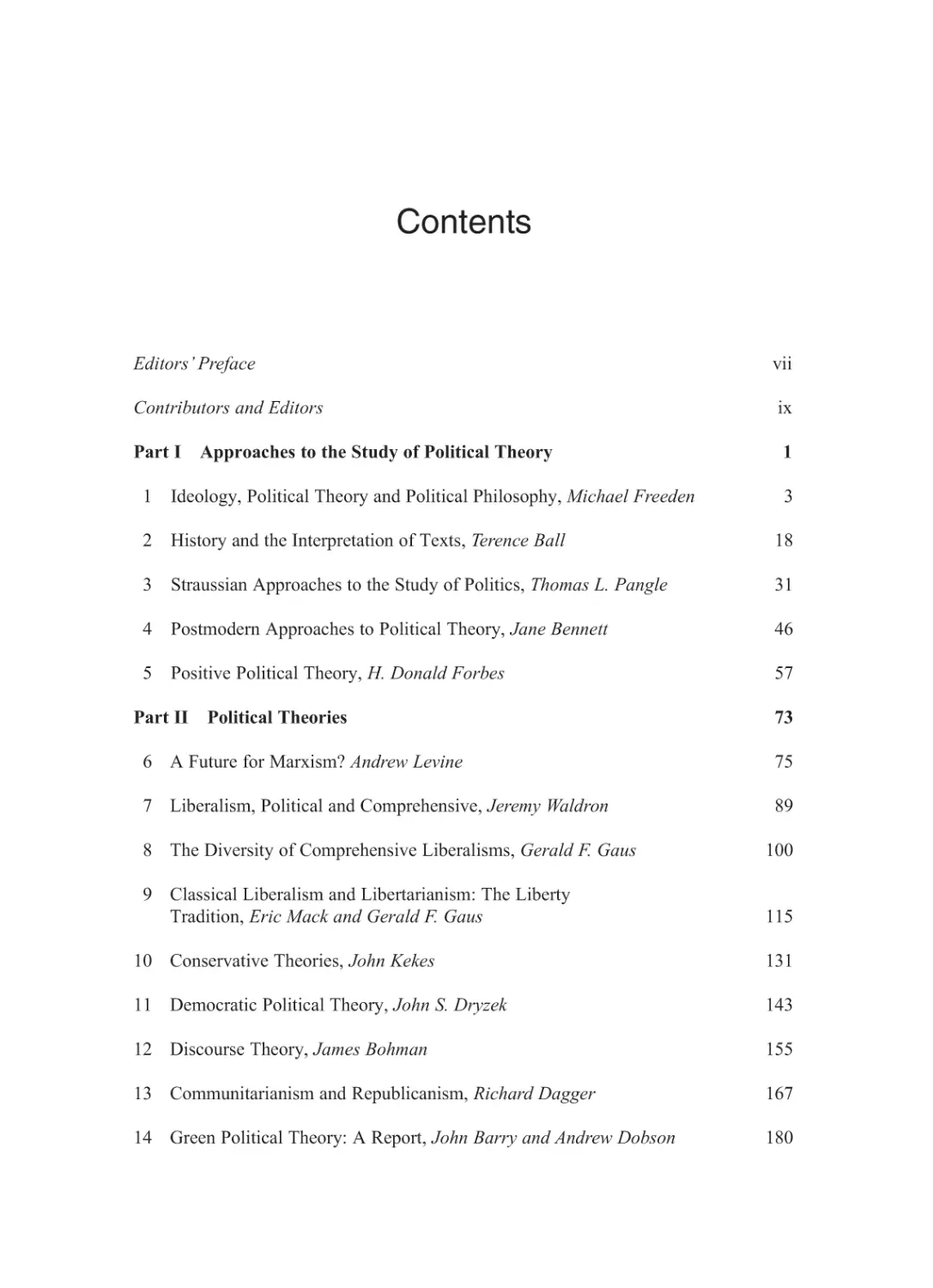
Contents

Editors’ Preface

vii

Contributors and Editors

ix

Part I

1

Approaches to the Study of Political Theory

1 Ideology, Political Theory and Political Philosophy, Michael Freeden

3

2 History and the Interpretation of Texts, Terence Ball

18

3 Straussian Approaches to the Study of Politics, Thomas L. Pangle

31

4 Postmodern Approaches to Political Theory, Jane Bennett

46

5 Positive Political Theory, H. Donald Forbes

57

Part II

Political Theories

73

6 A Future for Marxism? Andrew Levine

75

7 Liberalism, Political and Comprehensive, Jeremy Waldron

89

8 The Diversity of Comprehensive Liberalisms, Gerald F. Gaus

100

9 Classical Liberalism and Libertarianism: The Liberty
Tradition, Eric Mack and Gerald F. Gaus

115

10 Conservative Theories, John Kekes

131

11 Democratic Political Theory, John S. Dryzek

143

12 Discourse Theory, James Bohman

155

13 Communitarianism and Republicanism, Richard Dagger

167

14 Green Political Theory: A Report, John Barry and Andrew Dobson

180

Kukathas-Prelims.qxd

6/18/2004

7:10 PM

vi

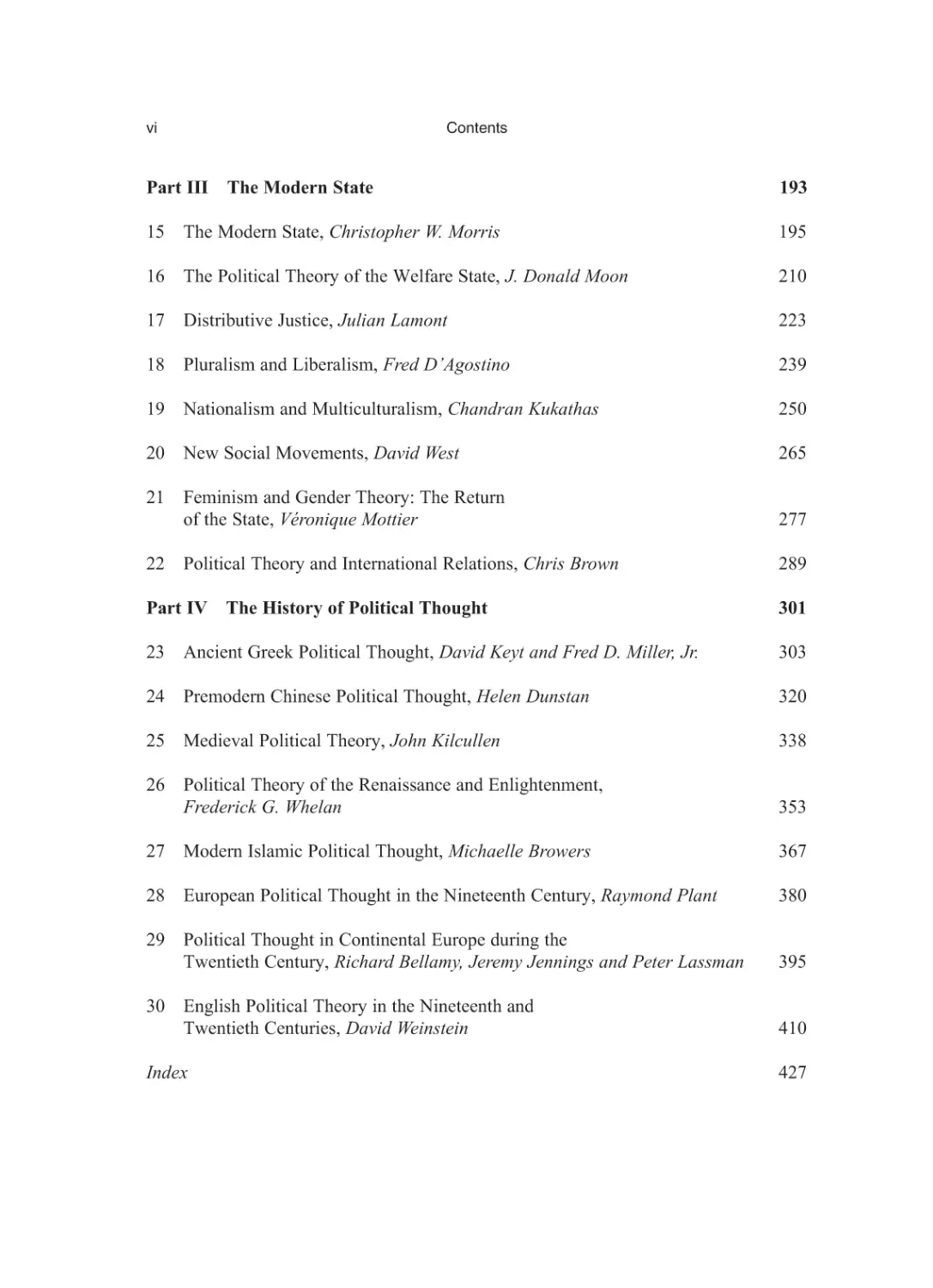
Part III

Page vi

Contents

The Modern State

193

15 The Modern State, Christopher W. Morris

195

16 The Political Theory of the Welfare State, J. Donald Moon

210

17 Distributive Justice, Julian Lamont

223

18 Pluralism and Liberalism, Fred D’Agostino

239

19 Nationalism and Multiculturalism, Chandran Kukathas

250

20 New Social Movements, David West

265

21 Feminism and Gender Theory: The Return
of the State, Véronique Mottier

277

22 Political Theory and International Relations, Chris Brown

289

Part IV

301

The History of Political Thought

23 Ancient Greek Political Thought, David Keyt and Fred D. Miller, Jr.

303

24 Premodern Chinese Political Thought, Helen Dunstan

320

25 Medieval Political Theory, John Kilcullen

338

26 Political Theory of the Renaissance and Enlightenment,
Frederick G. Whelan

353

27 Modern Islamic Political Thought, Michaelle Browers

367

28 European Political Thought in the Nineteenth Century, Raymond Plant

380

29 Political Thought in Continental Europe during the
Twentieth Century, Richard Bellamy, Jeremy Jennings and Peter Lassman

395

30 English Political Theory in the Nineteenth and
Twentieth Centuries, David Weinstein

410

Index

427

Kukathas-Prelims.qxd

6/18/2004

7:10 PM

Page vii

Editors’ Preface

In compiling this Handbook of Political Theory our aim has been to provide both a
comprehensive mapping of the terrain of contemporary political theory and in-depth
analyses. We have eschewed short encyclopaedia-like treatments in favour of essays that
present not only a précis of the state of scholarship, but the contributor’s own analysis of
the main issues. As such, the Handbook should be useful to scholars as well as students –
especially postgraduate students who are seeking to acquaint themselves with current
scholarship in contemporary political theory.
The Handbook is divided into four parts. Part I focuses on different ways of doing
political theory – the nature of scholarship in political theory. This first part examines,
among other problems, the relation of political theory to philosophy, political science
and ideology, the place of historical scholarship in the study of texts, as well as
Straussian and postmodern approaches to texts. The second part offers analyses of some
of the main political theories that provide a focus for contemporary scholarship, such as
Marxism, liberalism, conservatism, republicanism, communitarianism and democratic,
discourse and green theories. Our aim here was not to provide a list of ‘isms’; these
chapters present analyses of the main contributions and trends in contemporary political
theory, focused on explications, and criticisms, of the dominant liberal approaches. Part III
is organized around investigations of the modern state: problems of consent, authority
and obligation, the welfare state, distributive justice, pluralism and the aggregation of
individual judgements, social movements, nationalism, secession, ethnic rights, international relations and the place of the state in feminist and gender theory. Because the contemporary practice of political theory is so closely linked to the history of political
thought, the last part of Handbook is devoted to studies of periods in the history of political thought, presenting discussions of the main thinkers of each period as well as current scholarship. Our aim to present thorough analyses required editorial judgements
about coverage: even given the understanding of Sage Publications, and our wonderful
editor, Lucy Robinson, not every period which one of the editors or associate editors
thought valuable could be included. The reader will discover that Part IV provides comprehensive and rigorous treatments of the main epochs of Western political theory, as
well as fascinating chapters on crucial themes in Chinese political thought and the
currently important topic of modern Islamic political thought.
Because the Handbook contains thematic and historical chapters, detailed examinations of a theory or theorist are apt to be found in more than one chapter. We have provided cross-references and an extensive index to assist readers in locating relevant
discussions.

Kukathas-Prelims.qxd

viii

6/18/2004

7:10 PM

Page viii

Editors’ Preface

The editors have been assisted by a team of associate editors, who have provided
invaluable guidance both in early decisions about the structure of the Handbook, and in
reading drafts and providing expert advice. Our sincere thanks to Richard Bellamy,
Michael Freeden, Moria Gatens, Susan James, Percy Lehning and Martyn Thompson for
taking time from their own work to assist us in the Handbook. All of us were, further,
assisted by an Editorial Board, who provided important guidance about the structure and
content of the Handbook, as well as lending their expert advice; again, our sincere
thanks. Finally, and most importantly, we are indebted to our contributors, who took such
care in researching and writing their chapters.
Gerald F. Gaus
Chandran Kukathas

Kukathas-Prelims.qxd

6/18/2004

7:10 PM

Page ix

Contributors and Editors

Terence Ball was formerly Professor of Political Science at the University of Minnesota
and Visiting Professor at the University of California–San Diego and Oxford. He now
teaches political theory at Arizona State University. He is author of Transforming
Political Discourse (Oxford, 1988), Reappraising Political Theory (Oxford, 1995), and
a mystery novel, Rousseau’s Ghost (New York, 1998), as well as editor of James Mill:
Political Writings (Cambridge, 1992), The Federalist (Cambridge, 2003), co-editor of
After Marx (1984), Jefferson: Political Writings (1999), and The Cambridge History of
Twentieth-Century Political Thought (Cambridge, 2003), among other books. He is also
an avid sea-kayaker and master carpenter.
John Barry is Reader in Politics at Queen’s University, Belfast. His main interest is in
the relation between moral/political theory and the environment, with particular focus
on ecofeminism, the implications of green theory for thinking about justice, and theories
of political economy in relation to the environment. He is the author of Environment
and Social Theory (Routledge, 1999) and Rethinking Green Politics: Nature, Virtue
and Progress (Sage, 1999), winner of the UK Political Studies Association W. J. M.
Mackenzie Prize for best book published in Political Science in 1999. He is a co-editor
of Citizenship, Sustainability and Environmental Research: Q Methodology and Local
Exchange and Trading Systems (Edward Elgar, 2000), Sustaining Liberal Democracy:
Ecological Challenges and Opportunities (Palgrave, 2001), and The International
Encyclopedia of Environmental Politics (Routledge, 2001).
Richard Bellamy is Professor of Government at the University of Essex and Academic
Director of the European Consortium for Political Research (ECPR). He is the author of
Modern Italian Social Theory: Ideology and Politics from Pareto to the Present,
Liberalism and Modern Society: An Historical Argument, Liberalism and Pluralism:
Towards a Politics of Compromise, and Rethinking Liberalism, as well as co-author of
Gramsci and the Italian State. His edited and co-edited books include Victorian
Liberalism: Nineteenth Century Political Thought and Practice, Constitutionalism,
Democracy and Sovereignty: American and European Perspectives, Constitutionalism in
Transformation: European and Theoretical Perspectives, Citizenship and Governance
in the EU, and The Cambridge History of Twentieth Century Political Thought. He is
co-editor of Critical Review of Social and Political Philosophy.
Jane Bennett is Professor of Political Science at Johns Hopkins University. She is
the author of The Enchantment of Modern Life: Attachments, Crossings, and Ethics

Kukathas-Prelims.qxd

x

6/18/2004

7:10 PM

Page x

Contributors and Editors

(Princeton University Press, 2001), Thoreau’s Nature (Rowman and Littlefield, 1994),
and Unthinking Faith and Enlightenment (New York University Press, 1986). Her
current project explores the role of ‘matter’ or materiality in the political philosophies of
Theodor Adorno, Gilles Deleuze, and Bruno Latour.
James Bohman is Danforth Professor of Philosophy at Saint Louis University. He is
author of Public Deliberation: Pluralism, Complexity and Democracy (MIT, 1996) and
New Philosophy of Social Science: Problems of Indeterminacy (MIT, 1991). He has also
recently edited books on Deliberative Democracy (with William Rehg) and Perpetual
Peace: Essays on Kant’s Cosmopolitan Ideal (with Matthias Lutz-Bachmann), both with
MIT Press. He is currently writing a book on cosmopolitan democracy. His other interests include philosophy of social science, critical social theory and pragmatism.
Michaelle Browers is Assistant Professor of Political Science at Wake Forest
University. She has studied and conducted research in Morocco, Syria, Jordan, Egypt,
Lebanon, and the Occupied Territories. She has most recently co-edited a book with
Charles Kurzman, entitled An Islamic Reformation? (Rowman and Littlefield, 2004), and
completed a monograph entitled Democracy and Civil Society in Arab Political Thought:
Transcultural Possibilities.
Chris Brown is Professor of International Relations at the London School of Economics
and the author of International Relations Theory: New Normative Approaches (Harvester
Wheatsheaf/Columbia, 1992), Understanding International Relations (Macmillan, 1997;
2nd edn Palgrave, 2001), and Sovereignty, Rights and Justice (Polity, 2002), and editor
of Political Restructuring in Europe: Ethical Perspectives (Routledge, 1994) and (with
Terry Nardin and N. J. Rengger) International Relations in Political Thought: Texts from
the Greeks to the First World War (Cambridge, 2002).
Richard Dagger is Professor of Political Science and Philosophy at Arizona State
University, where he also directs the Philosophy, Politics, and Law Program for the
Barrett Honors College. His publications include Civic Virtues: Rights, Citizenship, and
Republican Liberalism (Oxford University Press, 1997) and, with Terence Ball, Political
Ideologies and the Democratic Ideal (Longman, 5th edn 2004). His articles on rights,
republicanism, political obligation, punishment, and other topics in political and legal
philosophy have appeared in the American Political Science Review, Ethics, the
American Journal of Political Science, the Review of Politics, Political Studies, Criminal
Justice Ethics, Law and Philosophy, and other scholarly journals and books.
Fred D’Agostino was educated at Amherst College, Princeton University, and the London
School of Economics and has taught at the Australian National University and the
University of New England, where he was Head of the School of Social Science. He
presently directs the Contemporary Studies program at the University of Queensland. He
is author of the books Chomsky’s System of Ideas, Free Public Reason, and Incommensurability and Commensuration: The Common Denominator. He is now working on a
collectivist epistemology drawing on ideas of Hayek, Foucault, Kuhn, and Bakhtin.

Kukathas-Prelims.qxd

6/18/2004

7:10 PM

Page xi

Contributors and Editors

xi

Andrew Dobson is Professor of Politics at the Open University. He is an environmental
political theorist, and his publications include Green Political Thought (third edition,
Routledge, 2000), Justice and the Environment (OUP, 1998), and the edited collection
Fairness and Futurity (OUP, 1999). His most recent book is Citizenship and the
Environment (OUP, 2003).
John S. Dryzek is Professor and Head of the Social and Political Theory Program,
Research School of Social Sciences, Australian National University. His recent books
include Deliberative Democracy and Beyond: Liberals, Critics, Contestations (Oxford,
2000), Post-Communist Democratization: Political Discourses across Thirteen
Countries (co-authored, Cambridge, 2002), and Green States and Social Movements:
Environmentalism in the United States, United Kingdom, Germany, and Norway
(co-authored, Oxford, 2003).
Helen Dunstan is Professor of Chinese Studies at the University of Sydney. A specialist on the history of politics and political economy in eighteenth-century China, she is the
author of Conflicting Counsels to Confuse the Age: A Documentary Study of Political
Economy in Qing China, 1644–1840 (Michigan, 1996) and State or Merchant? Political
Economy and Political Process in 1740s China (Cambridge, MA, forthcoming). She is a
member of the Australian Labor Party.
H. Donald Forbes is Professor of Political Science at the University of Toronto. His
works include Ethnic Conflict: Commerce, Culture, and the Contact Hypothesis (Yale,
1997) and Nationalism, Ethnocentrism, and Personality: Social Science and Critical
Theory (Chicago, 1985). He is the editor of Canadian Political Thought (Oxford, 1987).
He is currently writing books about multiculturalism in Canada and researching the political thought of George Grant.
Michael Freeden is Professor of Politics at the University of Oxford and Professorial
Fellow at Mansfield College, Oxford. Among his books are The New Liberalism: An
Ideology of Social Reform (Clarendon Press, 1978), Liberalism Divided: A Study in British
Political Thought 1914–1939 (Clarendon Press, 1986), Reappraising J. A. Hobson (ed.)
(Unwin Hyman, 1990), Rights (Open University Press, 1991), Ideologies and Political
Theory: A Conceptual Approach (Clarendon Press, 1996), Reassessing Political Ideologies:
The Durability of Dissent (ed.) (Routledge, 2001), and A Very Short Introduction to Ideology
(Oxford University Press, 2003). His books have been translated into Italian, Japanese and
Romanian. He is the founder editor of the Journal of Political Ideologies, and the director
of the Centre for Political Ideologies at the University of Oxford.
Moira Gatens is Professor of Philosophy at the University of Sydney. She is author of
Feminism and Philosophy: Perspectives on Equality and Difference, Imaginary Bodies:
Power, Ethics and Corporeality, and (with G. Lloyd) Collective Imaginings: Spinoza,
Past and Present. She is editor of Feminist Ethics and co-editor of Gender and
Institutions and Oxford Companion to Australian Feminism. She is presently working on
women’s rights.

Kukathas-Prelims.qxd

xii

6/18/2004

7:10 PM

Page xii

Contributors and Editors

Gerald F. Gaus is Professor of Philosophy, and on the faculty of the Murphy Institute,
at Tulane University. Among his books are Value and Justification (1990), Justificatory
Liberalism (1996), Social Philosophy (1999), Political Concepts and Political
Theories (2000), and Contemporary Theories of Liberalism: Public Reason as a PostEnlightenment Project (2003). With Stanley Benn he edited Public and Private in Social
Life (1983), and with F. B. D’Agostino edited Public Reason (1998). He was formerly
an editor of the Australasian Journal of Philosophy, and is a founding editor of Politics,
Philosophy and Economics. He is currently working on a book on principled reasoning
in morals and politics.
Susan James is Professor of Philosophy at Birkbeck College, London. Her publications
include The Content of Social Explanation (Cambridge, 1984), Beyond Equality and
Difference (edited with Gisela Bock, Routledge, 1992), Passion and Action: The Emotions
in Early Modern Philosophy (Oxford, 1997, 1999), Visible Women: Essays on Feminist
Legal Theory and Political Philosophy (edited with Stephanie Palmer, Hart, 2002), The
Political Writings of Margaret Cavendish (edited with an introduction and notes,
Cambridge, 2003). She is currently writing a book about the political philosophy of Spinoza,
and one on a more wide-ranging project about the emotions in political philosophy.
Jeremy Jennings is Professor of Political Theory in the Department of Political Science
and International Studies at the University of Birmingham. He is the author of Georges
Sorel: the Character and Development of His Thought (Macmillan, 1985) and Syndicalism
in France: A Study of Ideas (Macmillan, 1990). He has edited and translated Intellectuals
in Twentieth-Century France (Macmillan, 1993) and Georges Sorel’s Reflections on
Violence, with introduction, for the Cambridge Texts in the History of Political Thought
(Cambridge, 1999, 2002). He is the editor (with Tony Kemp-Welch) of Intellectuals in
Politics: From the Dreyfus Affair to Salman Rushdie (Routledge, 1997), and (with Simon
Glendinning et al.) of The Edinburgh Encyclopedia of Continental Philosophy
(Edinburgh, 1999) and of a four-volume collection on Socialism (Routledge, 2003). He
has been an assistant editor of The British Journal of Politics and International Relations
and is a founding editor of the European Journal of Political Theory.
John Kekes is Research Professor at the State University of New York at Albany. His
most recent books are Against Liberalism (Cornell, 1997), A Case for Conservatism
(Cornell, 1998), Pluralism in Philosophy: Changing the Subject (Cornell, 2000), and The
Art of Life (Cornell, 2002).
David Keyt is Professor of Philosophy at the University of Washington in Seattle. He is
the author of Aristotle Politics Books V and VI (Clarendon Press, 1999) and co-editor
with Fred D. Miller, Jr of A Companion to Aristotle’s Politics (Blackwell, 1991).
John Kilcullen is a graduate in Philosophy of the University of Toronto and of the
Australian National University. He taught politics at Macquarie University for many
years and is now retired. He has written on utilitarianism, on religious toleration, on the

Kukathas-Prelims.qxd

6/18/2004

7:10 PM

Page xiii

Contributors and Editors

xiii

political philosophy and ethics of Antoine Arnauld and Pierre Bayle, and on the political
thought of William of Ockham. He is one of a team preparing a critical edition and
translation of Ockham’s main political work, the Dialogus.
Chandran Kukathas is Maxwell Professor of Political Science at the University of
Utah. He is the author of Hayek and Modern Liberalism (Oxford, 1989), Rawls: A Theory
of Justice and Its Critics (with Philip Pettit, Polity, 1990), The Liberal Archipelago: A
Theory of Diversity and Freedom (Oxford, 2003) and various books and papers on
Australian politics, liberal political theory, and multiculturalism. He is a founder and coeditor of the Journal of Political Philosophy.
Julian Lamont is Lecturer in the Philosophy Department at the University of Queensland.
His research interests include moral and political philosophy, applied ethics, economics
and philosophy, political economy, business and professional ethics, and bioethics. He is
the Vice-President of the International Economics and Philosophy Society. He is completing a book entitled Income Justice and has had articles published in Philosophical
Quarterly, Journal of Political Philosophy, Public Affairs Quarterly, Social Theory and
Practice, Australasian Journal of Philosophy, and Journal of Applied Philosophy. He is an
associate editor of Politics, Philosophy and Economics.
Peter Lassman is Senior Lecturer in Political Theory in the Department of Political
Science and International Studies at the University of Birmingham. His current research
interests include moral pluralism and political theory, modern German political
thought from Kant to Habermas (and beyond), Max Weber, John Rawls and
political liberalism, and Hannah Arendt, Leo Strauss, Carl Schmitt and the Weimar
intellectuals. He is the editor of Weber: Political Writings (1994), Max Weber’s ‘Science
as a Vocation’ (with Irving Velody and Herminio Martins, 1989), and Politics and Social
Theory (1989). He is a founding editor of the European Journal of Political Theory.
Percy B. Lehning is Professor of Political Philosophy, Erasmus University Rotterdam.
Presently his concern is to employ the techniques of contemporary analytic political theory
to discuss questions of political principle raised by the process of European political integration. Some of his recent publications are Citizenship, Social Justice and the New Europe
(edited with Albert Weale, Routledge, 1997), Theories of Secession (edited, Routledge,
1998), ‘Towards multicultural civil society: the role of social capital and democratic
citizenship’ in Government and Opposition (1998), ‘The coherence of Rawls’s plea for
democratic equality’ in the Critical Review of International Social and Political Philosophy
(1998), ‘Rawls in the Netherlands’ in the European Journal of Political Theory (2002), and
‘European citizenship: towards a European identity’ in Law and Philosophy (2001).
Andrew Levine is Professor of Philosophy at the University of Wisconsin–Madison. His
recent publications include A Future for Marxism? (Pluto), Engaging Political
Philosophy: Hobbes to Rawls (Blackwell), and Rethinking Liberal Equality: From a
‘Utopian’ Point of View (Cornell).

Kukathas-Prelims.qxd

xiv

6/18/2004

7:10 PM

Page xiv

Contributors and Editors

Eric Mack is Professor of Philosophy at Tulane University where he is also on the Faculty
of the Murphy Institute. He is the author of numerous articles in scholarly journals and
anthologies on topics within ethics, political philosophy, and the philosophy of law.
Fred D. Miller, Jr is Professor of Philosophy and Executive Director of the Social
Philosophy and Policy Center at Bowling Green State University. He was President of
the Society for Ancient Greek Philosophy from 1998 to 2002. He is the author of Nature,
Justice, and Rights in Aristotle’s Politics (Oxford, 1995), co-editor with David Keyt of A
Companion to Aristotle’s Politics (Blackwell, 1991), editor of A History of the Philosophy
of Law from the Ancient Greeks to the Scholastics, volume 6 of A Treatise of Legal
Philosophy and General Jurisprudence (Kluwer, forthcoming), and associate editor of
the journal Social Philosophy and Policy.
J. Donald Moon is Professor of Government at Wesleyan University. He is the editor
of Responsibility, Rights, and Welfare: The Theory of the Welfare State (1988) and the
author of Constructing Community: Moral Pluralism and Tragic Conflicts (1995, 2001),
and with Stephen K. White edited What is Political Theory? (2004). He is consulting
editor for Political Theory.
Christopher W. Morris is Professor of Philosophy, University of Maryland, College
Park. He is the author of An Essay on the Modern State (Cambridge, 1998), ‘The very
idea of popular sovereignty: we “the people” reconsidered’ in Social Philosophy and
Policy (2000), and the editor of The Social Contract Theories: Critical Essays on
Hobbes, Locke, and Rousseau (Rowman and Littlefield, 1999).
Véronique Mottier is Swiss National Science Foundation Research Professor at the
Institut d’Études Politiques et Internationales at the University of Lausanne,
Switzerland and Fellow of Jesus College, Cambridge. She is co-convenor of the
Standing Group on Political Theory of the European Consortium for Political Research,
and Associate Editor of Feminist Theory and Nouvelles Questions Féministes. She has
co-edited Politics of Sexuality: Identity, Gender, Citizenship (Routledge, 1998) and
Genre et politique: débats et perspectives (Gallimard, 2000). Her main research and
teaching interests are the politics of gender and sexuality, eugenics, and discourse
theory.
Thomas L. Pangle holds a University Professorship in the Department of Political
Science at the University of Toronto, and is a Fellow of the Royal Society of Canada.
Educated at Cornell University and the University of Chicago, he has won Guggenheim,
Killam–Canada Council, Carl Friedrich von Siemens, and four National Endowment for
the Humanities fellowships. He has been awarded The Benton Bowl, Yale University
(for contribution to education in politics) and the Robert Foster Cherry Great Teacher of
the World Prize, Baylor University. He is the author of Montesquieu’s Philosophy of
Liberalism (Chicago, 1973), The Spirit of Modern Republicanism: The Moral Vision
of the American Founders and the Philosophy of Locke (Chicago, 1988), The Ennobling of
Democracy: The Challenge of the Postmodern Age (Johns Hopkins, 1992), The Learning

Kukathas-Prelims.qxd

6/18/2004

7:10 PM

Page xv

Contributors and Editors

xv

of Liberty: The Educational Ideas of the American Founders, co-authored with wife
Lorraine (University Press of Kansas, 1993), Justice among Nations: On the Moral Basis
of Power and Peace, co-authored with Peter J. Ahrensdorf (University Press of Kansas,
1999), and Political Philosophy and the God of Abraham (Johns Hopkins, 2003).
Raymond Plant is a Labour member of the House of Lords in the British Parliament and
Professor in the Law School, King’s College, University of London, where he focuses
on legal and political philosophy. Among his books are Community and Ideology: An
Essay in Applied Social Philosophy (1974), Hegel: An Introduction (1984), Philosophy,
Politics and Citizenship: The Life and Thought of the British Idealists (with Andrew
Vincent, 1985), Conservative Capitalism in Britain and the United States: A Critical
Appraisal (with Kenneth Hoover, 1989), Modern Political Thought (1991), Hegel (Great
Philosophers Series, 1999), and Politics, Theology and History (2001). He has given the
Stanton Lectures at Cambridge University; the Sarum Lectures at Oxford University;
the Fergusson Lectures and the Scott Holland Lectures at Manchester University and the
Agnes Cummings Lectures at University College Dublin. He is currently working on a
book with the title The Neo Liberal State and the Rule of Law.
Martyn P. Thompson is Associate Professor and Director of Graduate Studies in the
Department of Political Science at Tulane University. His degrees include a PhD from
the London School of Economics and Political Science, and a DrPhilHabil from the
University of Tuebingen. He is author, editor, or co-editor of nine books, including Ideas
of Contract in English Political Thought in the Age of John Locke, and over 50 articles
in journals such as Political Studies, Political Theory, American Historical Review,
Politisches Denken, Journal of the History of Ideas, Il Pensiero Politico, History and
Theory, and Historical Journal. He is the translator or co-translator from German into
English of over 100 essays, articles and academic reviews. Since 1990 he has been the
editor of Politisches Denken Jahrbuch.
Jeremy Waldron is the Maurice and Hilda Friedman Professor of Law at Columbia Law
School, in the City of New York, and Director of Columbia University’s Center for Law
and Philosophy. A native of New Zealand, he has taught previously at Otago, Oxford,
Edinburgh, Berkeley, and Princeton. He writes in the area of overlap between jurisprudence, political theory, and moral and political philosophy, and he is the author of several
books, including God, Locke, and Equality (Cambridge, 2002), Law and Disagreement
(Oxford, 1999), The Dignity of Legislation (Cambridge, 1999), and Liberal Rights
(Cambridge, 1993). He is presently working on a project entitled ‘Cosmopolitan Right’.
Professor Waldron is a frequent lecturer, having delivered the second series of Seeley
Lectures at Cambridge University in 1996, the Carlyle Lectures at the University of Oxford
in 1999, the Spring 2000 University Lecture at Columbia, and – in the last few years –
public lectures at Harvard, Princeton, Toronto, St Andrews, Auckland, Canberra, and
Buenos Aires. He was elected to the American Academy of Arts and Sciences in 1998.
David Weinstein is Associate Professor of Political Science at Wake Forest University
and in 2002–3 was Visiting Fellow at Mansfield College, Oxford. His books include

Kukathas-Prelims.qxd

xvi

6/18/2004

7:10 PM

Page xvi

Contributors and Editors

Equal Freedom and Utility (Cambridge, 1998) and The New Liberalism: Reconciling
Liberty and Community, edited with Avital Simhony (Cambridge, 2001). He is currently
writing two books: The Idolatry of Dichotomies: Utilitarianism and the New Liberalism
and Exile and Interpretation: Constructing Modern European Intellectual History, the
latter with Avihu Zakai.
David West is Senior Lecturer in Social and Political Theory in the School of Social
Sciences at the Australian National University, having previously taught at the
Universities of Bradford and Liverpool. After completing a doctorate on critical theories
of human interests, his first book, Authenticity and Empowerment: A Theory of Liberation,
was published by Harvester Wheatsheaf in 1990. An Introduction to Continental
Philosophy (Polity, Cambridge and Blackwell, US) was published in 1996. His forthcoming book Reason, Self and Sexuality is to be published by Polity Press in 2004.
Frederick G. Whelan is Professor of Political Science at the University of Pittsburgh,
where he teaches political theory. He has published Order and Artifice in Hume’s Political
Philosophy (Princeton, 1985), Edmund Burke and India (Pittsburgh, 1996), and Hume and
Machiavelli: Political Realism and Liberal Thought (Lexington Books, forthcomlng).

KuKathas-Ch-01.qxd

6/18/2004

9:51 AM

Page 1

Part I

APPROACHES TO THE
STUDY OF POLITICAL
THEORY

KuKathas-Ch-01.qxd

6/18/2004

9:51 AM

Page 2

KuKathas-Ch-01.qxd

6/18/2004

9:51 AM

Page 3

1

Ideology, Political Theory
and Political Philosophy
MICHAEL FREEDEN

It has been common practice in current professional
and academic circles to assign the terms ‘political
thought’ or ‘political theory’ to a subdiscipline of
political science in which texts, arguments and discourses obtain an existence of their own and are
studied for the values and visions they contain [see
further Chapter 2]. But in the broadest sense political thought refers to thinking about politics at any
level of conceptualization and articulation. Far from
being an arcane, esoteric or cocooned practice, it is
the preliminary to, accompaniment of, and consequence of all political activity and processes. We
should certainly not regard political thought as a
separate area of political study, or as a rarefied,
even luxurious, form of political self-indulgence –
as some hard-nosed and pragmatic detractors would
have it – but should recognize it as a normal and
necessary aspect of the political that requires careful analysis both for what it is and for what it does.
Political thought in the broadest sense currently
exhibits six strands: (1) the meticulous construction
of argument; (2) the normative prescription of standards of public conduct; (3) the imaginative production of insight; (4) the genealogical exploration
of provenance and change; (5) the deconstructive
unpacking of paradigms; and (6) the morphological
analysis of concepts and conceptual clusters. This
chapter will focus mainly on the first and the last
strands, but will bring the others into its orbit.
Political theorists can engage in more than one of
the above, though they are unlikely to engage in all.
The emphasis on one or another of the strands centrally impacts on the questions: how do we identify
what political thought is; and what work do we
want that identification to do for us?

For most of its existence the study of political
thought was constructed and packaged as a historical narrative, a sequenced story that examined the
ways in which a number of outstanding individuals
such as Aristotle, Hobbes or Rousseau applied their
wisdom to questions of state and of human nature.
In the course of that process they provided an overlapping – if not common – field of ideas, theorems
and positions from which generation after generation was supposed to draw. Those individuals, with
very few exceptions – Machiavelli may have been
one – were philosophers who offered conceptions
of the good life combined with intricate arguments
and reasons for adopting rational and moral prescriptions and proposals for implementing them,
some practical, some less so. Only from the late
nineteenth century onwards was the production of
systematic, overarching hypotheses about the structure and functions of political institutions, processes
and conduct graced with an identity of its own –
through pioneers such as Max Weber, Gaetano Mosca
and Roberto Michels – though it was soon to be
siphoned off as political sociology. As for the more
mundane thinking which inevitably accompanies
any conscious account, explanation or justification
of a political act, that was not acknowledged as a
distinct category of political thought until the
behaviourism of the mid twentieth century with its
studies of attitudes and beliefs. To add to these, the
specific political thinking emerging from groups or
masses was identified, but as a rule pejoratively dismissed through strongly individualistic, or strongly
elitist, perspectives. The interest scholars evinced in
it was prompted by the aggregative opinion studies
of American social science on the one hand, and – on

KuKathas-Ch-01.qxd

4

6/18/2004

9:51 AM

Page 4

Handbook of Political Theory

the other hand – by the focus on popular thinking
that a Marxism true to its principles should have
developed far earlier, but had to await the insights
of Antonio Gramsci. It was Gramsci (1971) who
recognized the role of the masses as well as intellectuals in shaping political ideas at all levels of
social and cultural life.
All the above varieties are, however, central
aspects of thinking about politics and about the state.
Their detachment from each other is significant in distinguishing among a rich panoply of political ideas,
their roles and shapes, but it has frequently done harm
as well as good, and exaggerated the commonalties
that political thinking possesses. In particular, political thought is not just straightforwardly equivalent to
what people say (and write) that they think about
political issues, or even what we hear (and read) them
saying. It is highly sensitive to the diverse methods it
employs to determine which kinds of thinking are
political, and which issues are within the remit of the
scholars who study political thinking. Differences in
political thought have become increasingly reflective
of splits and specializations among its students, and
the divergence between some philosophers and some
students of ideology is the most significant, and the
least understood, among these.

POLITICAL PHILOSOPHY:
THE GOOD, THE RIGHT AND THE VALID
Political philosophy is situated in a highly intriguing relationship to politics. On the one hand, its
focus on the normative, on forms of the good life,
on what is morally proper, and on the right kind of
decisions, has placed it at the centre of what most
contemporary academics regard as political theory:
a guide, a corrective, and a justification for enlightened and civilized forms of organized social life
and political institutions. On the other hand, the disciplinary constraints that apply to producing good
philosophy have all too often distanced its practitioners from the actual stuff of politics and have
contributed to a general sense of the estrangement
of philosophy from political life. There is unsurprisingly no complete agreement on what political
philosophers do, and there are great divides
between, say, Anglo-American analytical philosophers and varieties of continental philosophy, a distinction that is more substantive than geographical.
Analytical philosophers are not necessarily specific
students of politics; they may often be seen as applying their general insights to the realm of politics.
That is to say, political philosophers are frequently
philosophers prior to their examination of the political, and they apply techniques and methods typical
of philosophers rather than other students of politics.

For instance, one of their central concerns relates to
what constitutes a good argument. Which of the
following, for instance, would justify civil disobedience: the disregard of past promises, the lack of
crucial social or material benefits, or the breaching
of a categorical moral principle? A good argument
in the view of analytical philosophers is one that
is rational, that identifies conceptual distinctions
and logical paths of reasoning, whether deductive
or inductive, and that constructs coherent compatibilities among conceptual units. The producers of
a good argument are concurrently expected to
undertake particular thought processes that are
reflexive and self-critical. Sometimes this approach
also involves an appeal to intuitions (linked also to
a philosophical interest in common sense arguments), the detection of which should serve as a
guide to practices, although such intuitions – it
is often counter-claimed – may themselves be
culture-bound.
In addition, a good political argument may have
an ethical, as well as an analytical, dimension; indeed
for some scholars political philosophy ‘is a very
specific subset of moral philosophy’ (Swift, 2001: 6).
On this account, a worthy political argument is presented as one that enhances and promotes values
that are desirable for individuals in their capacity as
members of political communities. Those values
delineate what is good or bad, right or wrong, for all
human beings, irrespective of their distance in time
(considering future or past generations) or space;
the moral rights, duties and obligations (systematized as deontology) that derive from those understandings; and their political expressions. Their
realization is predicated on the attainment of the
reflective equilibrium proposed by John Rawls, or
the free and rational communication advocated by
Jürgen Habermas (1981). While in the past, issues
of political obligation and authority were predominant among political philosophers, because the state
was still perceived as a supreme political institution
primarily providing security and stability, in recent
literature political value has typically been ascribed
to distributive justice [Chapter 17], to the safeguarding of individual autonomy, to fostering a
sense of community [Chapter 13], to forms of deliberative democracy [Chapter 11], to beneficial kinds
of pluralism [Chapter 18], and to preserving a sustainable environment [Chapter 14]. All these reflect
a view of the state as enabler of human and social
flourishing, though they also allow the state to be
circumvented through a grand range of attempts to
reaffirm the rational, contemplative individual as
the source of political nous and, not infrequently,
the cultural community as the locus of individual
identity-cum-autonomy.
Philosophical ends are frequently characterized
by the search for certainty and truth, not merely by

KuKathas-Ch-01.qxd

6/18/2004

9:51 AM

Page 5

Ideology, Political Theory and Political Philosophy

the pursuit of methodological purity or self-critical
understanding. Certainty refers to the flight
from contingency and the aspiration to unshakeable knowledge (Barber, 1988: 6). That aspiration
employs, sometimes unintentionally, traditional but
erroneous models from the natural sciences. Here,
possibly, an infelicitous coalition between philosophers and power wielders emerges, both intent
upon closing debate. Indeed, it was one of the earliest and greatest of political philosophers, Plato,
who prescribed the need for convergence between
power and knowledge in the figure of the philosopherking. Truth is a far more difficult issue. As Hannah
Arendt pointed out, governments and politics are
based on opinion, not factual truth. For her, factual
truth was an essential component of the freedom of
thought that political thinking required. But the
truth of the philosophers was rational truth, involving axioms and theories. That truth was singular
and hence apolitical (Arendt, 1968: 231, 238, 242,
246). In approaches such as these, the non-political
status of truth rests on the assumption that it is
knowable, and often on ostensibly unassailable
foundationalist assumptions regarding human
nature, whereas politics is assumed to involve
fundamental contests over both the good and the
right. However, for politics the rhetoric of certainty
or near-certainty – as a feature of conviction rather
than of knowledge – may be necessary as a preliminary to decision-making, decision-making being
an ineliminable core feature of politics. A political
or ideological decision is an attempt at an unequivocal choice, superimposed on an indeterminate
field, a field in which no single path is unchallengeable, or one in which many paths are possible.
However, not all closure of debate successfully
bridges the gap between certainty and truth.
Certainty is often a necessary substitute for the
unattainability of truth, and it is here that the role of
ideologies is both indispensable and decisive in tailoring political thinking to the requirements of the
political. Alternatively, Mill’s political philosophy
allowed for provisional – and in that sense, relative –
truths. As he claimed,
if the lists are kept open, we may hope that if there be a
better truth, it will be found when the human mind is
capable of receiving it; and in the meantime we may
rely on having attained such approach to truth as is possible in our own day. This is the amount of certainty
attainable by a fallible being. (Mill, 1910: 83)

THE SINGULAR AND THE UNIVERSAL
The singularity of political philosophy, when
inspired by ethical frameworks, is one of its great
strengths. After all, a central task of political

5

philosophers as moral philosophers has been to
provide yardsticks for public conduct, so essential
in areas such as the distribution of scarce goods, or
the wielding of power by political leaders and
decision-makers. Societies rightly rely on political
philosophers to point out ways of improving social
institutions, for political ethics pertains to the
instilling of virtuous public practices. At the same
time, the increasing democratization of politics has
shifted the emphasis of scholarship from ‘great
men and women’ philosophers to the moral claims
any individual and all individuals may direct at
their societies and the benefits they ought to derive
from social life. Just as historians now seldom tell
the story of kings and queens but have developed
a keen interest in popular history, so political
theorists have refocused around individual selfdevelopment, participation, citizenship, and civic
virtue (Young, 1996: 479, 484–5), notions close to
the concerns of contemporary liberal theory, as we
shall see.
One manifestation of this has been the recent fascination of philosophers with questions of justice.
Although justice is a systemic property of a wellorganized society, it has been reformulated, primarily by John Rawls (1971), as establishing the
correct manner of attaining fairness for individuals,
through devices that ensure that ordinary persons
themselves decide reasonably on the rules of justice
that ought to apply to them. Intriguingly, then, singularity refers both to the universality of rational
philosophical truths and to the concentration on the
individual as sited at the heart of political philosophy. Consequently, the deontology of rights and
duties has been predominantly assigned to individuals, and Anglo-American political philosophy
has been resistant to the impingement of groups and
communities on its fundamental epistemology – an
inclination towards atomism that is itself ideological as well as methodological. Moreover, that
approach is predicated on the assumption that the
rationally exercised faculties of individuals will in
crucial instances converge on common ground
rather than diverge in a range of acceptable, rational
and good solutions radiating out from a common
core, as John Stuart Mill had indicated. The unintended elision between the plural and the singular is
evident in Rawls’s ambivalent observation that
political philosophy cannot coerce our considered
convictions, with the immediate addition: ‘If we
feel coerced, it may be because, when we reflect on
the matter at hand, values, principles, and standards
are so formulated and arranged that they are freely
recognized as ones we do, or should, accept’ (1993:
45). So while many contemporary political philosophers emphasize measured individual judgement
rather than blanket subscription to philosophical
systems such as idealism or utilitarianism, they

KuKathas-Ch-01.qxd

6

6/18/2004

9:51 AM

Page 6

Handbook of Political Theory

leave open the possibility of the convergence of
individual judgements in a reasonable reflective
equilibrium, as well as the question of the objectivity or subjectivity of values.
Another feature of political philosophy is evident
in the abstractness of its generality. Rawls has contended that abstraction is a way of continuing public
discussion when shared understandings of lesser
generalities have broken down. The deeper the conflict, he has argued, the higher the level of abstraction necessary to get an uncluttered view of the
roots of the conflict (Rawls, 1993: 46). Abstraction
may be conceptually more difficult to comprehend,
but it is also a useful modelling device that proffers
simplification, sets out issues in stark and concise
form and is amenable to the universalization to
which so many philosophers aspire. Such constructivist approaches resonate with political theories –
especially social contract theory – in which the state
is an artificial edifice, and morality, legitimacy or
authority can therefore be subjected to thought
experiments. Conversely, social philosophers such
as Marx and Engels have criticized abstract philosophy. Contrasting their approach with that of
German philosophy, they wrote:
we do not set out from what men say, imagine, conceive, nor from men as narrated, thought of, imagined,
conceived … We set out from real, active men, and on
the basis of their real life-processes we demonstrate the
development of the ideological reflexes and echoes of
this life-process. (Marx and Engels, 1974: 47)

But their repudiation of the methods of philosophy
converged on their particular understanding of ideology. For them, abstract philosophy was nothing
more than ideology, because both were the inverted
mental reflection of a distorted and alienated reality.

A MODEL OF MODERN IDEOLOGY:
PATTERNED DIVERGENCES
Non-Marxist students of ideology understand their
subject-matter differently. Ideologies are usefully
comprehended not as defective philosophies, but
rather as ubiquitous and patterned forms of thinking
about politics. They are clusters of ideas, beliefs,
opinions, values, and attitudes usually held by identifiable groups, that provide directives, even plans,
of action for public policy-making in an endeavour
to uphold, justify, change or criticize the social and
political arrangements of a state or other political
community. This tells us something about their
functions and about the necessary services they perform for such a community. To begin with, it is
unimaginable to conceive of a society that does not
engage in such patterned thought, that does not have

distinguishable and recurrent ways of thinking, say,
about who should be rewarded in that society
and for what, about the limits to the exercise of
political power, about the value of national
symbols, or about its expectations of government.
However, that thinking may range from the articulate and sophisticated to the clumsy and banal; it
may range from the conscious and specific to the
unconscious and fuzzy; and it may range from the
local through the national to the international, but
always as the product of groups. Ideologies, let it be
emphasized, are evident in the entire field of thinking about political ends and principles, and virtually
all members of a society have political views and
values they promote and defend. By contrast,
analytical political philosophy sites itself at a particular
end of each of these spectrums. The articulateness
and sophistication of philosophical arguments are
non-negotiable, their intentionality and deliberation
are a sine qua non of recognizing them as a subjectmatter for investigation and respect, and their attribution to individual inspiration is a mark and
condition of their standing in the profession.
On another and parallel dimension, ideologies –
in discharging the above functions – compete deliberately or unintentionally over the control of political
language, by means of which they attempt to wield
the political power necessary to realizing their functions. Ultimately, they aim to give precise definition
to the essentially contested meanings of the major
political concepts. In other words, they aim to
decontest those concepts and endorse one of the
multiple conceptions those concepts invariably
accrue but which, importantly, the concepts cannot
contain simultaneously: is equality to be understood
as equality of opportunity, of need, of respect, or of
outcome? What relative weight do we assign,
within the notion of democracy, to self-government,
political equality, an idea of community, or active
participation in the public domain? When confronted with a number of those decontested concepts, arranged in a particular configuration, we
perceive an ideology’s typical structure. Ideologies
differ from one another in the particular meaning
they allocate to every one of the main political concepts, in the priority they accord each concept, and
in the particular position and interrelationship
between each concept and the other political concepts contained within the given ideological field
(Freeden, 1996: 47–95). The production of a high
degree of certainty in these defining and ordering
activities ensures that ideologies are integrally
intertwined with politics; ideologies too are crucially
locked into the process of choosing among alternative paths of action and of subsequent decisionmaking. So whereas a political philosopher such as
Rawls contends that many hard decisions may seem
to have no clear answer (1993: 57), the morphology

KuKathas-Ch-01.qxd

6/18/2004

9:51 AM

Page 7

Ideology, Political Theory and Political Philosophy

of concepts suggests that, to the contrary, they may
have many clear answers. Doubt is not one of the
most obvious features of ideological discourse. In
the eagerness of ideologists to establish an uncontestable framework for political decision-making,
assertion will frequently replace demonstration and
proof – those prerequisites of good philosophical
analysis.
Ideologies may be seen as pooled resources from
which a society draws, a bank of ideas that has
accrued over time and that may be cashed in almost
any permutation, subject only to constraints of logic
(the universal) and of the culturally permissible (the
local, even when it appears in a universalist guise).
To be sure, new assets may be added and constructed, and some of the older bills and coins may
be removed from circulation. Continuity is not
unbroken, and entirely different sets of ideas may
be extracted from the same pool and confront each
other with immense hostility. But all this is the very
fabric of politics, just as political philosophy contributes to supplying the very fabric of qualitative
values and justifications that a society may require
for its moral health. We usually come across
ideologies in a more or less distinct and pre-structured
form, such as liberalism, conservatism, socialism,
feminism or fascism. That is because certain political movements or belief systems have generated
enormous support from significant social groups
who have subscribed to one of the overarching and
dominant ‘grand’ ideological families. They provide their followers with a social and political identity and operate as one of the major factors in the
realization of political goals. But a few notes of
caution need to be sounded.
First, there is no necessary configuration of ideologies in these forms; they may well be the product of contingent historical forces that appear and
vanish over time. On the other hand, some of the
ideological families may reflect fundamental
human understandings of the social order and its
relation to human drives and hopes. Thus, traditionalism and conservatism are rooted in deep psychological motivations; whereas the desire for
emancipation from the control of others has – in
one of liberalism’s many manifestations – always
served as an impetus for the redistribution of political power. Second, any one of these ideologies
is host to loose and fluid positions. There is no
obvious thing called socialism, but there certainly
are socialisms: Marxist, evolutionary, or guild
socialisms are examples. General morphological
patterns sharing core ideas and distinct ideational
paths connecting the key political concepts are
evident – this is after all how we access all political
thinking – but ideological micro-analysis uncovers
fundamental internal differences that must be
acknowledged in serious scholarly investigation.

7

Thus socialists extol the importance of group
solidarity and of interpersonal equality, but within
the family of socialisms there are considerable differences over whether solidarity expresses total
human interdependence, or merely empathy and
altruism; and over whether equality entails differential distribution on the basis of individual needs
alone or also on the basis of contribution to the public
good. Third, ideologies are not mutually exclusive.
They intersect and overlap with each other, creating
hybrids such as libertarianism – a cross between
liberalism and conservatism. Finally, a fragmentation of ideologies has accompanied the great families and has become more marked in recent
decades. Alongside the full ideologies, with their
total if not totalitarian solutions to social issues,
there exist thin ideologies that address areas of
ideological contestation, but otherwise rely on other
ideologies to fill the gaps with which they do not
primarily concern themselves. Nationalism is one
such instance, containing no substantive theory of
distributive justice [see Chapters 17, 19].

IDEOLOGICAL ANALYSIS: WHAT
DOES IT EXPLORE?
If the development of qualitative normative thinking is one of the rationales of political philosophy,
it is not difficult to understand why the study of ideology receives short shrift from many philosophers,
and is ignored by others (witness the absence of an
American Political Science Association subject
section on political ideology). For it would appear
that many ideologies are incapable of producing
normative profundities, particularly when we
follow the tendency of some scholars to identify
ideologies only with the politically extreme representatives of the genre. Nonetheless, the study of ideologies is laden with sensitivity to moral standards
and political values. To begin with, it explores the
choices any given combination of norms and political concepts opens up or closes, which can then be
appraised against whatever political arrangements
are deemed desirable by the analyst. Utilitarian or
deontological evaluations of political ideas benefit
greatly by testing them not only against abstract
logical permutations but against the concrete manifestations these ideas have already received in the
world. Second, as will be argued below, the product
of Anglo-American political philosophy is itself,
from the perspective of ideological analysis, a specific ideological manifestation, and its normative
solutions require decoding in terms of their preferences and understandings of the social world as
does any ideology. Hence the role of the student of
ideologies is to unpack such beliefs, account for

KuKathas-Ch-01.qxd

8

6/18/2004

9:51 AM

Page 8

Handbook of Political Theory

them, and map their complexity. That analysis may
well be a necessary preliminary to the endorsement
by political philosophers of particular ideational
permutations. Third, the study of ideology offers a
different kind of assessment, one that examines the
logical and cultural constraints that make a particular set of political concepts intelligible, attractive, or
legitimate (and vice versa); and one that weighs up
the implicit as well as explicit assumptions that render an ideology plausible for its consumers. This
form of evaluation appears not as a normative pronouncement but as an interpretation that seeks to be
intellectually appealing instead of absolutely valid
or morally prescriptive.
Consequently, a much broader range of subjectmatter is prone to ideological analysis and a gulf
begins to open up between it and philosophical
argument. No student of ‘empirical’ politics would
wish to disregard ‘imperfect’ political institutions –
would want, for example, to exclude the election
of the American Presidency in 2000 from study and
comment. Equally, no student of ideologies would
wish to exclude ‘imperfect’, half-baked, even
inconsistent or wrong political arguments and ideas
from their compass, precisely because such phenomena are both typical of political thought-practices
and offer insight into how societies actually work
and make decisions. Nazism has little allure for
philosophers, because it fails to pass muster on
moral and analytical grounds. But its nature, if not
its messages, attracts the curiosity of students of
ideology wishing to understand the nature of dogmatism, myth-making, extremism and terror, and
wanting to account for the ideational forces that
propelled political action into those directions
rather than others, and that might do so again. So
while the disciplinary roots of political philosophy
have become increasingly remote from the concerns
of the social sciences, the painstaking and critical
investigation of ideologies is the only area of analysis in which political ideas can receive appropriate
consideration as a direct branch of the study of politics, rather than of philosophy or history. Only then
can questions such as the following be addressed:
what are the social and political functions of political ideas; how are meaningful clusters of political
argument formed and made accessible; what
assumptions have to hold in order for the producer
of an argument to believe that his/her argument is a
true, good, or valid one (rather than whether the
argument is true, good, or valid); how does the field
of political practice constrain and mould the political ideas available to a society; how does ideological change come about; how do ideologies compete
over, and shape, understandings of what is and what
can be in politics? All these can only be undertaken
if we also consider immorality, inconsistency and
bad arguments as suitable subject-matter for analysis

within the sphere of political practice. Because they
exist, and arguably always will, they have a substantial bearing on human understanding, conduct
and institutional processes, without which our comprehension of the political will be profoundly
impoverished.
It has often been argued, following Marx, that
ideologies are a sinister and exploitative form of
exercising power over individuals and groups
through providing them with a false view of social
reality, in which they are made to adopt the norms
and aims of ruling social strata. On the account
offered here, although power and control remain
central features of ideologies, they are far less insidious. Rather, they reflect the core of the political:
the necessity of ordering, deciding and regulating
the combined affairs of groups of people, and
through that of enabling individuals to have a say in
their own fortunes. Politics is not just about physical force and the clash of economic interests, but
also about the assignment of contested meaning to
social phenomena. It is not just about the use of the
law, of the police, or of illegitimate forms of
violence, nor is it just about the maximization of
economic assets through the manipulation of markets,
or about the impact of personality on public life. It
is also about deciding on the range of meanings
attributed to concepts such as welfare (e.g. a mechanism of social parasitism or the institutional
enabling of human flourishing) or freedom (e.g. the
uninhibited assertion of individual powers against
others or the rational expression of self-developing
choices), and about selecting which of these meanings will be accorded legitimacy and supremacy in
formulating public policy. Hence the control of
political language, through which the understanding
of such contested political concepts is mediated, is
a cardinal and typical way of capturing the high
ground of the social meanings and interpretations
available to a given society. This is where ideologies come in, as the devices through which political
language is presented and organized for the purposes of determining those dominant meanings.
They offer the maps that attach, say, the qualifiers
‘democratic’ and ‘human right’ – rather than lèsemajesté or ‘rebellion’ – to ‘dissent’; or that clash
over allocating the term ‘terrorist’ to some activities
rather than others. And to make matters quite clear:
without dominant meanings, however temporary,
no political decisions could be made and social
paralysis would ensue. In that sense, it is manifestly
misleading to insist on the elimination of plural
meanings, and to express concern when faced with
selection processes among meanings. Domination
in the hard sense of a group preventing the equal
access of others to social goods is undesirable and
eliminable in principle, but ‘domination’ in the gentle sense of ensuring that a particular set of values

KuKathas-Ch-01.qxd

6/18/2004

9:51 AM

Page 9

Ideology, Political Theory and Political Philosophy

secures practical preference is ineluctable. To that
extent, the much-trumpeted neutrality of liberalism
among different conceptions of the good is both
chimerical and palpably undesirable in a political
society where practices have to be put into effect,
unless – as some political philosophers do – one
believes in the possibility as well as the desirability
of a fundamental social consensus on values.

TWO PROFESSIONAL DISCIPLINES
AND THEIR SUBJECT-MATTER
Before we examine other central differences
between political philosophy and political ideologies,
one vital distinction needs to be mentioned. The
producers and formulators of ideology may differ
substantially from the producers and formulators of
philosophy. Ideologies are rarely created by professional thinkers; indeed, they are more likely to
emanate from social sectors with a greater or lesser
interest in political ideals and ends, but with an
amateurish control over the units – the political
concepts – from which ideologies are fashioned.
These sectors include categories such as political
parties, journalists, civil servants, or oppressed
groups. The students of ideology, to the contrary –
like any practitioners of a discipline – are professional or expert analysts, in this case of political
thinking, language, and concepts. They cannot take
the utterances and texts of the ideologists they
examine as role models or examples of coherent
and optimal thinking about politics (though when
not engaged in their professional activities they too
will be ideologists). There is therefore a fundamental dissimilarity between political ideologists and
the investigators of political ideology; the latter
require different techniques in order to arrive at a
higher level of conceptual analysis of the explanandum, not the least because they do not have to
market their products as ideational solutions to
pressing political issues. That distinction does not
necessarily apply to political philosophy, where
students of philosophy enter into similar discourses
to those whom they study, in an apparently seamless conversation and convergence on techniques of
good argumentation. The philosopher and the
student of philosophy are often one and the same
thing. Consequently, political philosophers are
prone to mistake the ‘inferior thinking’ of ideologists for the analytical thinking produced in the
study of political ideologies and to write both off as
bad philosophy (Swift, 2001: 133), and the latter as
bad scholarship as well.
One important consequence of this phenomenon
is that many philosophers find it difficult to distance themselves from their own methodology (for

9

example, privileging individual agency, rational
discourse, logical cohesion, and justification of
arguments in relation to ethical yardsticks), especially because what is required of them is to
immerse themselves into that methodology as a
given set of thought practices and to emulate its
best practitioners. Hence this kind of philosophy is
unusually lacking in self-criticism of its own
assumptions. It does not tend to query the possible
limitations that its techniques may impose on
understanding and interpretation, though it is
superb in its subtle critique of the distinctions and
clarifications made within its paradigms of analysis.
Certainly, it refrains from engaging in the metatheory beloved by analysts of ideology who explore
the features of the thought products they examine.
Those analysts would, for instance, be particularly
alert to the constraints and biases any methodology
sets up – whether through notions such as agency,
logical cohesion or universal ethics, or through
other notions – and the way in which these understandings shaped views of, and preferences for, particular forms of social and ideational activity. Even
in its Marxist versions, the concept of ideology was
employed in an ‘unmasking’ role in order to penetrate through the illusions and distortions that
unreconstructed political thinking was inevitably
thought to conjure up. In non-Marxist understandings of ideology the critique of ideology as masking
truth has been abandoned, simply because of the
uncertainty, referred to above, concerning what
truth would be. But the critique of ideology as holding hidden and implicit assumptions, irrespective of
their truth or falsehood status, continues to occupy
centre-stage.
Clearly, a central purpose of political theory is to
prescribe and to offer good solutions to problems of
political organization and practices. Philosophers
and ideologues agree on this end. But students of
ideology do not see prescription as their aim,
though their findings are intended to assist philosophers and ideologists in their prescriptions. As
social scientists, they strive to offer a persuasive
account of what the world of ideologies is like and
how it relates to the world of politics. One consequence is that contemporary students of ideology
display an even more heightened awareness of
political language as a tool, wielded deliberately or
unintentionally to attain a selection of values and
ends, without which the entire political process
would founder. This ought to engender a methodological scepticism and relativism, from which
vantage-point any conclusions about the worlds of
political ideas and action are tentative and subject
to continuous review and change. While liberal
political philosophers instruct us to revise individual life plans but remain committed to the constant
values of liberty, human rights and human progress,

KuKathas-Ch-01.qxd

10

6/18/2004

9:51 AM

Page 10

Handbook of Political Theory

students of ideology demand revised assessments of
the frameworks and constraints that propel groups
into preferring one combination of ideas to another.
However, to endeavour to account for the features,
sources and outcomes of political ideologies is by
no means an endorsement of all their manifestations; it does not promote a relativism in which
‘anything goes’. Indeed, local forms of thinking
may share some features with each other in a kind
of contingent universalism that acts as a cultural
constraint on what societies may legitimately do.
Political idea systems are a product of interacting,
even overlapping, human minds, and also exist
within differentiated geographical, historical and
cultural spaces. The comparative study of ideologies has to address these problems of translation,
when differences are often masked by ostensible
similarities of language, while similarities are disguised by disparate ways of expression.

IS PHILOSOPHY LIBERAL PHILOSOPHY,
OR EVEN LIBERAL IDEOLOGY?
The parallel to philosophical misgivings about ideologies, and their study, is a continuous attempt by
students of ideology to reduce Western political
philosophy, especially in recent decades, to the one
ideological dimension of liberalism. Analysts of
ideology point out that the story of contemporary
philosophy is tantamount to that of liberalism itself,
and that political philosophy in the twenty-first
century has become incapable of absorbing, and reacting to, a broader spectrum of extra-liberal political
thinking. Moreover, political philosophy is accused
of demonstrating considerable blindness to the liberal nature of its own premises – a critique also
voiced by feminists – and ignorance about the liberal traditions that spawned such positions, in a
battle of ideas that began in the eighteenth century
and continues to this very day. One such example is
the renewed interest among political philosophers
in citizenship and participatory democracy [see
Chapters 11, 13]. Employing models garnered from
civic republican theories of public virtue, and augmenting them with conceptions of liberty anchored
in communal self-government and tailored to eliminate the arbitrary domination of one group over
another, these contemporary theories are nevertheless seeped in liberal values, no less than the
theories from which they seek to differ and which
they aspire to correct (Pettit, 1997; Skinner, 1998;
Dagger, 1997).
The ends of Anglo-American political philosophy are those at the heart of the liberal tradition: the
enhancing of a particular understanding of liberty as
autonomy, coupled with a conviction in the possibility

and necessity of individual self-development
guaranteed through fundamental human rights, and
a growing emphasis on equality. This bundle has
been predominantly couched in the language of
moral universalism; in Brian Barry’s phrase, ‘there
is no distinctive liberal theory of political boundaries at the level of principle’ (2001: 137). These
ends have not changed over time, though the preconditions for their attainment have been variously
understood even with the liberal camp and promoted also by those who should go under the label
of libertarians, even individualist anarchists. As a
rule, though, the core of twentieth-century liberalism constituted an appeal for the release of a flow of
free, vital and spontaneous activity emanating from
individuals, one that would spread across the globe
not through an internal rational logic but through a
successful appeal to the intellects and emotions of
the oppressed and underprivileged (Hobhouse,
1911; Freeden, 2001b: 21–2). That was equated
with the story of the growth of civilization itself, but
it was also decisively dependent on human cooperation and the mutual guarantee of standards of
human welfare and well-being. This communitarian
aspect of modern liberalism preceded by an entire
century the lately rediscovered emphasis on the participation of communities in ‘republican’ public
practices, an emphasis that accentuates a greater
egalitarianism than previously supplied by liberalism [see Chapter 13]. However, the otherwise strong
liberal origins of that argument have been obscured
because recent political philosophers have erroneously modelled liberalism as highly individualistic. One consequence is the false exclusion
of ‘communitarians’ from the plural camp of
liberalisms, under the impact of a philosophical
dichotomy between liberals and communitarians
that is not borne out by the complexity of liberal
ideology (Taylor, 1989; Simhony and Weinstein,
2001) [see also Chapter 30]. That ideology has
developed strong appeals to mutual support and collective well-being at the heart of twentieth-century
welfare state thinking [see Chapter 16].
The texts and authors encompassed by the study
of ideology are broader than those examined by
political philosophers, but they always include
those latter texts. From the perspective of analysing
ideologies, philosophical texts are selective decontestations of political concepts like any other. Both
political philosophers and students of ideology
employ political concepts as their basic units or
building blocks, and their theories embody conceptual configurations. However, the standards of argument brought into play by philosophers about the
content of those concepts, and the justification for
preferring a certain configuration over another, may
be more rigorous and considered than those
employed in more popular or mundane writings and

KuKathas-Ch-01.qxd

6/18/2004

9:51 AM

Page 11

Ideology, Political Theory and Political Philosophy

utterances. Here is the basis of another asymmetry:
while philosophers cannot profitably read many
ideological texts, because those texts fail the complex
qualitative tests philosophers expect to encounter,
students of ideology argue that philosophical texts
may be subject to varied kinds of reading. Marx
may have offered a weighty critique of German
philosophy and substituted for it an epistemology
that presented a searching array of new questions,
but he was concurrently the creator of specific
understandings of liberty as emancipation from
alienation; of the individual as intimately linked to
the notion of species being; and of power as
exploitation of one class by another. This fashioned
a particular ideological understanding of the political world and became known as Marxism. Rawls
may have offered a theory of justice that satisfied
the requirements of rational individual choice as
well as promoting the interests of all, including the
least advantaged, subject to a free-standing reflective consensus that can accommodate various
versions of the good life, but he is concurrently the
articulator of a specific version of American liberalism that regards individuals as rational, moral,
purposive and autonomous agents (which contextualist and communitarian theories wish at the very
least to water down). This is a particular subset of
liberal ideology, elevating procedural justice above
welfare as the first virtue of a society and promoting
a universal, individualistic and over-optimistically
‘neutralist’ view of the state (whereas state neutrality may more appositely be interpreted as an
attempt at impartiality within a preferred ethical
and ideological framework). Historians of political
thought know that that subset has been competing
with other variants of liberalism for the best part of
the past century.

SIX DIFFERENCES IN
SEARCH OF ELUCIDATION
Given the distinction, lacking among philosophers,
between the language used by the producers and
that used by the analysts of ideology, let us note
some major differences between ideology and
philosophy. First, ideologies are by their very rationale public forms of language, intended to be disseminated and consumed by large groups of people,
and to create shared understandings that can direct
political practices. As a means to control the use of
political language an ideology needs a broad circulation, and it cannot be phrased in terms that are
conceptually and argumentatively too complex. Not
so with political philosophy, the primary qualitative
test of which has now become its acceptance by
professional philosophers. It tends, consequently, to

11

be a semi-private or restricted language, accessible
only to specialists and thus bereft of wider public
impact. Its scholarly significance may be in inverse
ratio to its practical import, and it often requires
vulgarization – in the form of a common-language
ideology – in order to acquire the communicability
and influence to which a mass-oriented ideology
aspires. As Gerald Gaus has commented on liberalism as theory, it now tends to be ‘too principled and
severe a doctrine to have widespread political
appeal’ (2000a: 193). The emphasis of political
philosophies is on the quality of their production,
while the emphasis of ideologies is on the effectiveness of their consumption. So while political
philosophies share decontesting and interpretive
features with ideologies, their style and ‘packaging’
vary considerably. At the other end of the spectrum
new methodologies involving discourse analysis of
common language aim at including ordinary utterances as indicative of highly informative and even
influential ideological patterns (Van Dijk, 1998), as
befits the emphasis of the social sciences on all
forms of human interaction, and as befits the
increased demands for the democratic accountability
of politics.
Second, ideologies are not merely directed at
groups, they always are group products. As in Karl
Mannheim’s famous (1936) account, ideologies
are Weltanschauungen or world views of people
who share common understandings of the world,
perhaps because of joint socio-economic roots, or
because they have assimilated a particular set of
cultural values. Some of these people are of course
philosophers themselves, but that is yet again to
note the ideological dimensions of political philosophy. The usual self-understanding of philosophers is that their own thought systems are the
creation of exceptionally talented, or expertly
trained, individuals. The production of theory
tends therefore to have an individualistic bias, and
this is once again linked to the belief that qualitatively superior thought cannot be produced en
masse, but only by exceptional thinkers. The
greater appeal of the study of ideologies to the
social sciences is obvious. The focus of these
sciences on patterns of group behaviour is mirrored
in the focus of ideological analysis on the political
thought-behaviour of both overlapping and competing groups. Ideologies, after all, are offered as
generally sustainable solutions to group decisionmaking and regulation.
Third, ideologies employ a threefold use of emotion. They wrap rational discourse in varying layers
of emotive idiom; they assign emotional import to
their key values; and they openly recognize the centrality of emotion in socio-political interaction. This
is by no means a defect, nor is it anomalous among
forms of political thought. When deliberate, the

KuKathas-Ch-01.qxd

12

6/18/2004

9:51 AM

Page 12

Handbook of Political Theory

emotive idiom is usually in the form of rhetoric – a
linguistic device designed to appeal to the human
imagination through poetic analogy, through invoking shared sentiments, and through the stirring up of
passions. Philosophical rhetoric tends to the former,
while many ideologies do not shy away from the
latter. However, even the most rawly emotional ideology must have a minimum of logical presentation.
Racist ideologies invite potential consumers into a
warped and coarse sphere of myth and prejudice,
but once this looking-glass world has been entered,
it follows its own preposterous logic. If indeed there
are subhumans who contaminate the rest of humanity
(the unsubstantiated emotive postulate), they need
to be removed from contact with others (a plausible
logical conclusion, given the ‘truth’ value of the
postulate). On the other hand, even the most rational and austere political philosophy will promote
values to which the philosopher is deeply committed. Philosophers, like ideologists, subscribe to nonnegotiable values, though they are rarely aware of
the emotional commitment this entails, one that frequently may be read between their lines. But a nonnegotiable value, in Max Weber’s terms, is a type of
non-instrumental rationality (1949: 34 and passim).
Instrumental rationality will engage in cost–benefit
calculations concerning the values it endorses as
well as the means to promote them. Substantive
rationality endorses values at whatever cost to their
champions, and is sustained by an attachment that
transcends the quantitative and purposive features
of instrumental rationality. Thus liberalism has a
fundamentally rational belief in the superiority of
liberty and human rights, which means that they
cannot be traded in wholesale for other values under
any circumstances. Concurrently the language of
liberalism has always sanctioned liberty in quasisacred terms, and has eulogized its worth as a
supreme sign of civilization. True, some ideologists
are inclined to make assertions (e.g. communism is
an ‘evil empire’) rather than offer the kind of reflective arguments most philosophers might find convincing. Alternatively, ideologists will submit what
they regard as persuasive or appealing reasons for
an argument (e.g. ‘immigration should be restricted
in order to protect our indigenous culture from alien
influences’), but these may fall outside the criteria
moral philosophers prefer for what constitutes a
good reason.
Most analytical philosophers will not contemplate the creation of an apparatus that can identify
and study emotion as a feature of political language.
For example, in discussions of political obligation
and civil disobedience, recourse is had to rational
and ethical models of promising and consent, or to
utilitarian arguments. But these address the problem
of obligation to a government as against obligation
to a state, not obligation to a nation. Yet political

obligation to a nation is a significant sentiment that
helps constitute political identity. The reason that it
cannot be addressed using the current terms of
political philosophy lies in the difficulty in conceptualizing its breach. Civil disobedience is located at
the point of tension between obedience to a government and obedience to the constitutive principles of
a state, and its practices are well recognized as acts
of rational and ethical challenge. But would principled disobedience to a nation be expressed in a
refusal to speak its language or to recognize its
holidays? Ideological analysis can identify alternative features of discourse that treat obligation as
an act of emotional sustenance by focusing on its
unconditionality vis-à-vis a nation, as well as on its
empowering consequences for those bearing the
obligation.
A fourth distinction revolves around the issues of
transparency and the face value of political language. The very essence of Western philosophy lies
in its cognitive and conscious nature. Whatever else
philosophy is, it is an attempt to make sense of
human and natural phenomena, to explain, clarify,
and justify. The ultimate success of a philosophical
argument is the rational persuasion of its targeted
audience in its good sense. But the ultimate success
of an ideology is in its mobilization of significant
groups who compete ideationally in order to impact
on acts of collective decision-making. It is therefore
no surprise that most, if not all, ideologies delight in
surrounding their arguments in the opaque and the
non-transparent aura of terms such as ‘natural’ or
‘self-evident’ precisely because this captures the
high ground that is immune from challenge. These
are acts of conceptual decontestation devised to end
the competition over which political meaning is
dominant or legitimate, and ‘legitimate’ does not
always carry with it the connotation of morally or
rationally justifiable (Gaus, 2000b: 39). As Plato
shrewdly remarked of the magnificent myth with its
story of the metals from which the different classes
are naturally constituted, it would ‘carry conviction
to our whole community … [and] serve to increase
their loyalty to the state and to each other’ (1955:
159–61). Now, of course, observations such as
these have opened ideology to the accusation of
manipulating people’s perceptions of the world and
reinforced those who regard all ideology as a
method of distorting reality. It is certainly the case
that some ideologies have systematically and cynically practised such manipulation and distortion,
and it is likely that all ideologies press their prejudices through some form of bias. But Marxist
theorists of ideology have ignored the important
distinctions between distortion and interpretation,
and between manipulation and control. Whereas the
first of each duo is an unsavoury option, the second
is a necessary consequence of the requirement to

KuKathas-Ch-01.qxd

6/18/2004

9:51 AM

Page 13

Ideology, Political Theory and Political Philosophy

regulate, organize and rationalize the social world.
The student of ideology’s equivalent to the philosopher’s ‘unexamined life’ is an uninterpreted world.
It would be a world without humanly ordered patterns and decisions, a world of chaos, entropy, and
paralysis, within which no individual could function adequately.
The above feature may also be seen in a different
light, leading to a fifth distinction between ideology
and philosophy, which relates to intentionality and
unintentionality. A key consequence of the deliberateness of analytical political philosophers is that
unintentional messages, whether their own or those
they examine, are of no scholarly or relevant significance. A central aim of philosophy is to control
and to refine language to the point where it can
carry highly accurate and complex analyses, where
it can do ‘exactly’ what its users want it to do.
Scholars of ideology aspire to similar standards in
controlling knowledge according to their own criteria, but they are equally interested in the unintentional meanings forged by their subject-matter, the
ideological producers. And the interpretation of
thought practices is crucially dependent on understanding both the intentional and the unintentional
forms of expression indulged in by ideologists.
To understand that, one must appreciate some of
the insights of the hermeneutical tradition and of
linguistic semantics, in particular their reference to
the existence of multiple readings of any given text,
as the readers or consumers of that text impose their
interpretations on the polysemic words, phrases and
chapters they encounter [see Chapter 2]. Political
terms, like any other, accrue and shed meanings
over time and space, and they can be understood
differentially within a given society at a specific
point in time, as each consumer of the text seeks to
decontest its potentially multifold meanings and
thus to render it intelligible. Paul Ricoeur employed
the phrase ‘surplus of meaning’ to account, among
others, for the gap between what the author
intended to say and what his or her readers understand the author to say: the ‘excess of signification’.
As he put it,
there is a problem of interpretation not so much because
of the incommunicability of the psychic experience of
the author, but because of the very nature of the verbal
intention of the text. The surpassing of the intention by
the meaning signifies precisely that understanding takes
place in a nonpsychological and properly semantic
space, which the text has carved out by severing itself
from the mental intention of the author. (Ricoeur, 1976:
76 and passim)

That, of course, is a major function of ideology. It
imposes a logically arbitrary but culturally significant
set of meanings on political reality. This provides

13

a plausible map in relation to which political
preferences can be expressed and political action
can be taken. But that imposed map is incomplete,
not entirely the conscious product of its designers,
and its contours and details are continually rediscovered and redrawn by later travellers.
From that perspective, political ideologies
contain both overt and coded messages. Overt
messages are intended by their ideologue producers
to mobilize mass behaviour in certain ways, but
perfect control over the consumption and allocation
of meaning to those messages is unattainable. In
addition, the student of ideologies wishes to decipher additional meanings carried by the ideological
discourse inaccessible to the original producers.
When liberal supporters of votes for women
demanded their inclusion in the general suffrage,
they typically assumed that political equality was
both necessary and sufficient for ensuring that
women were treated in the same way as men. They
failed to realize that one form of surplus meaning
they were carrying related to another tacit assumption: that most differences between men and
women, whether desirable or undesirable, were
irrelevant to the political sphere. Current readings
of these early liberal feminists interpret their claims
in ways that transcend their own understandings,
but that central function of ideological analysis is
immaterial to most Anglo-American philosophy.
A sixth distinction between ideology and philosophy returns us to what constitutes a good argument. We have noted above the criteria for a good
argument to which analytical philosophers subscribe, one that is rational, logical, coherent, precise, reflexive and self-critical. For ideologists, a
good argument may contain some of these elements, particularly some degree of internal rationality and a credible underpinning of the compatibility
of its principal concepts. But it will not display
them exclusively or optimally. Indeed, it would be
futile to insist on all these features too rigidly in an
ideology, as ideologies will frequently disintegrate
under such scrutiny. Moreover, that would miss the
point of ideologies entirely and cause us to forget
what work ideologies are designed to perform.
Rather, a good ideological argument is one whose
morphology of conceptual decontestations can
transform or preserve political practices, and such
an argument is not always optimally couched in
rational or precise terms. A good argument is therefore one that brings about a change in power relationships, through prescription or through the
denying of transparency.
The protection necessary to stabilize an ideology’s internal structure is achieved through different kinds of argumentative persuasiveness – reason,
morality, and emotion – and they are engaged differentially by philosophers and ideologists. These

KuKathas-Ch-01.qxd

14

6/18/2004

9:51 AM

Page 14

Handbook of Political Theory

join two further protective devices: the removal of
transparency, and the resort to linguistic fiat – a
method beloved by totalitarian ideologies that lock
concepts into superimposed configurations. But a
good ideological argument requires further features.
It must be influential, it must – as we have seen – be
communicable, and it must be culturally and contextually creative. This last attribute is an intriguing
one. Ideologies have to be appreciated as inventive
and imaginative representations of ‘social reality’,
when invention and imagination are the raw, visionary, constructive, experimental – and yes, also the
volatile or dangerous – aspects of that perennial
blend of reason and emotion that emanates from
the human mind (Freeden, 2001a: 5–12). That creativity is occasionally acquired at the expense of
philosophical cogency and it will often be harmful
and irresponsible, but the pay-off is in terms of an
adaptive ability employed to shape the fortunes of
societies undergoing change. Of course, some of the
greatest political philosophers, Plato or Rousseau,
as well as many utopians, have exhibited marvellous imaginations too. But these are now mainly
valued by philosophers as metaphors or thought
exercises through which to test the robustness of
assumptions, premises and hypotheses, rather than
as practicable reworkings of a social order.

UNDERSTANDING POLITICAL THINKING:
CONTEXTS AND DECONSTRUCTIONS
Having adumbrated some of the differences
between philosophy and ideology, and between philosophy and the study of ideology, one issue of fundamental importance remains with respect to the
latter. A number of recent philosophical approaches
and recent analyses of ideology have been mutually
reinforcing. Hermeneutics and the study of interpretation have coalesced with theories of the ‘essential
contestability’ of concepts and with poststructuralist and feminist affirmations of the social construction of meaning [see Chapter 4]. Wittgenstein,
Gadamer, and others have alerted many contemporary philosophers to the language games and the
contextual inputs that fashion human understanding
and that conspire against a facile universalism, even
if some broadly common understandings may still
operate to co-ordinate human minds. Wittgenstein’s
notion of family resemblances has helped students
of ideology to construe ideological groupings such
as socialism as consisting of a complex network of
similarities rather than constituting a monolithic
block. Following from that, ideologies are perceived as containing overlapping and shared
components, and the borders between them are
considered to be permeable. Hermeneutical inputs

have focused on the malleability of texts, and on the
limitless readings to which they are open through
their recontextualization. Understanding is thus permanently associated with interpretation and with
the particularity of spatial and temporal viewpoints,
while allowing nonetheless for some diachronic and
geographical similarities to persist.
Students of ideology have applied to those
insights a further micro-structural examination of
the conceptual components of such texts, and they
have employed this approach to proclaim the vast
potential ideational resources inherent in political
utterances and the fluidity of internal relationships
within each ideological family. They have noted
that liberty may be attached to self-development
and to democratic participation in one ideological
variant of liberalism, but in another liberal variant
liberty may be attached to unrestricted economic
transactions and to large accumulations of property.
They have noted how new readings of wellestablished political terms such as ‘natural rights’
have shifted alongside a transformed understanding
of what (if anything!) is natural in human social
conduct. While this may allow the emergence of the
unpredictable, the appreciation of historical development has also alerted students of ideology to the
diachronic constraints on ideologies, channelling
some ideological change into recognizably stable
patterns. The school of conceptual history (Koselleck,
1985; Richter, 1995) has been influential in identifying key historical periods when a struggle over
the ‘correct’ political and social concepts occurs,
and in reconstructing the meaning of such concepts
over time. In parallel John Pocock (1972) has investigated the ways in which political languages have
changed over time. Cultural anthropologists, on
their part, have highlighted the symbolic and often
non-verbal nature of ideologies, in addition to portraying them as mapping devices that impose integrated fields of meaning on political occurrences
(Geertz, 1964). Ideologies were now regarded as
contained in practices and in cultural symbols as
well as in oral and written texts, thus extending the
disciplinary boundaries from which analytical
methodologies for their investigation could be
extrapolated. Finally, poststructural philosophers
have regarded ideology as a modernist expedient
that offers a narrative necessary to preserving the
social order, itself often considered to be a fiction or
a social imaginary. These approaches demote the
centrality and autonomy of the subject at the heart
of analytical philosophy, as can be seen in Michel
Foucault’s treatment of discourse as a repository of
power. Theorists such as Ernesto Laclau and
Chantal Mouffe have emphasized the discursive
nature of ideology, and the way in which it articulates a social unity in a hegemonic manner. They
also point out the existence of concepts, ‘empty

KuKathas-Ch-01.qxd

6/18/2004

9:51 AM

Page 15

Ideology, Political Theory and Political Philosophy

signifiers’, to which no signified, no external social
phenomenon, condition or object, corresponds. On
that understanding, for example, the term ‘order’ is
an empty concept, referring to inadequate representations of social stability because no complete
order can ever exist. In contradistinction to AngloAmerican political philosophy, the emphasis here is
on the impossibility of making truth statements, on
the illusory nature of representing reality, let alone
discerning essential meanings, and on the functional rather than ethical potential of thinking about
politics (Laclau and Mouffe,
1985; Laclau, 1996;
∨
Norval, 2000). Slavoj Ziz∨ek (1989; 1994), drawing
on Lacanian psychoanalytical theory, similarly
regards ideology as an unconscious fantasmic illusion that papers over the ‘real’ that cannot be fathomed or represented. Other philosophical schools,
emerging from diverse intellectual bases, focus on
dichotomies, agonisms and contradictions arising
out of incommensurability as endemic to human
thought as well as to social structure, approaches
that have resulted in a revival of interest in Arendt
or Carl Schmitt and that are central also to some
varieties of feminism (Mouffe, 2000; Nicholson,
1990; Canovan, 1992; Schmitt, 1996). These
deconstructivist positions challenge the holism and
integration evident in many instances of philosophical thinking about politics, but they also challenge
methodologies that propose to regard conceptual,
linguistic and structural interrelationships as fruitful. One result is the problematization of pluralism,
not because its nod in the direction of liberal diversity conflicts with the harmonized unity of thought
that is the goal of some political philosophers, but
because it now exudes the aura of unmanageable,
yet endemic, destructiveness – pluralism as concealing a fragmented world [see further Chapter 18].
Some poststructuralists abandon the search for
norms too readily. But even among the contrary
camp of Anglo-American philosophers the certainty
that is assumed to accompany objective and neutral
understandings of concepts is being challenged.
Thus Michael Walzer (1985) has focused on the contextual and social meanings of social goods, while
Ronald Dworkin has noted that most contemporary
philosophers accept that conceptual definitions are
substantive and normative. Taking democracy as
an example, Dworkin contends against essentialist
definitions that
we still need an account of what makes one feature of a
social or political arrangement essential to its character
as a democracy and another feature only contingent,
and once we have rejected the idea that reflection on the
meaning of ‘democracy’ will supply that distinction,
nothing else will. (2001: 11)

Ethical values have no independent status but
are derivative from what makes a good and

15

successful life, i.e. one that furthers individual
interests. These observations significantly reduce
the gap between philosophers and students of ideology, though they still leave open the question of
whether the idea of a good life is a stable one.
Even given general consensus on the primacy of
well-being, the small print that fills in that
conceptual category may differ markedly from
case to case. Divergent ideologies can offer varying yet plausibly legitimate notions of human
flourishing.
CONCLUSION
To suggest that political philosophy concerns what
ought to be, while ideology concerns what is, is
not just an oversimplification; it is misleading. All
too often political philosophy does not offer us
what ought to be, if ‘ought’ implies a realizable
possibility, because in its dominant current guises
it is excessively utopian, a label philosophers
would be loath to acknowledge. It is utopian in
two senses: first, it engages in thought experiments to which no reality could correspond;
second, it offers purified generalities from which
conflict and inconsistencies have been surgically
removed (e.g. Habermas and Rawls). The uses of
political philosophy are in its sharp elucidation of
issues within its broader generalities. For instance,
it has cast important light on problems of equalization of treatment and of life chances by offering
criteria for fair and justifiable inequalities. But it
would be inappropriate to describe these as best
practice, if best practice can never be achieved.
Rather, these are models of what good practice
could be, were we to abstract a particular set of
problems from contextual constraints, and were
we to smooth over the frictions which any political solution attempts to eliminate. Political
philosophers achieve micro-coherence by holding
most ‘externalities’ constant. That is one of their
prime methods, and it discharges vital functions: it
enables the critical construction of alternatives
through which to assess, and often to reject, current practice; it advances our moral sensibilities; it
refines the analytical skills required for the lucid
understanding and prescription of social practices;
and it encourages precise thinking on the causes
and consequences of human conduct.
The study of ideology, to the contrary, is not – as
often portrayed – a descriptive art, but an interpretive one. It responds to the question: which rigorous interpretive paradigms are the most helpful in
furthering our understanding of the nature and
potential of political thought? It reconstructs existing thought practices, but from a necessarily relative perspective; and in its critical mode it offers us

KuKathas-Ch-01.qxd

6/18/2004

9:51 AM

16

Page 16

Handbook of Political Theory

tools for appreciating not what ought to be, but what
can be, in the domain of political practice. Some
ideologies are, contra Karl Mannheim, utopias, but
they then are consciously and deliberately utopian.
Others are concrete sets of solutions, some of
which are attractive, sagacious or prudent, and
some of which may be shocking and ruthless in
their conceptualization and stray beyond any
accepted limits of decency. Many ideologies are
more modest, and less precise, approximations of
what political philosophers aspire to. Ideologies
are, in effect, more likely than political philosophies to abstract from logical constraints than from
contextual ones. Their study tells us less than the
study of political philosophies when it comes to the
intricacies involved in testing political thought to
its limits. But it tells us much more about the fields
of political thinking available to a society, and it
illuminates that thinking through exploring the
constraints and options that make each ideology a
distinct configuration shaped by time, space and
culture. The amenability of ideologies to change
and diversification also accounts for the need to
decontest, to impose a particular solution – logically arbitrary though culturally significant – on
political practice. This recognition of the inevitable
act of decontesting the essentially contestable, an
act that bestows specific meaning on an unstructured multiverse of meanings, marks out the student of ideologies from the political philosopher,
who performs similar decontestations but is prone
to package them as general solutions to the issues
at hand (as, with less elegance, does the ideologue).
If political philosophers dream of drawing thinking
together, students of ideology crave understanding
for its fissured condition. The discipline of political
theory requires both philosophical and ideological
analysis, but its practitioners need to know when to
employ the one and when the other, and what
crucial insights each of these subdisciplines can
deliver.

REFERENCES
Arendt, H. (1968) ‘Truth and politics’. In H. Arendt,
Between Past and Future. New York: Viking.
Barber, B. (1988) The Conquest of Politics. Princeton, NJ:
Princeton University Press.
Barry, B. (2001) Culture and Equality. Cambridge: Polity.
Canovan, M. (1992) Hannah Arendt. Cambridge:
Cambridge University Press.
Dagger, R. (1997) Civic Virtues. Oxford: Oxford University
Press.
Dworkin, R. (2001) ‘Political and legal Archimedeans’,
draft paper.

Freeden, M. (1996) Ideologies and Political Theory: A
Conceptual Approach. Oxford: Clarendon.
Freeden, M. (2001a) ‘What is special about ideologies?’
Journal of Political Ideologies, 6: 5–12.
Freeden, M. (2001b) ‘Twentieth-century liberal thought:
development or transformation?’ In M. Evans, ed.,
The Edinburgh Companion to Contemporary Liberalism.
Edinburgh: Edinburgh University Press.
Gaus, G. F. (2000a) ‘Liberalism at the end of the century’.
Journal of Political Ideologies, 5: 179–99.
Gaus, G. F. (2000b) Political Concepts and Political
Theories. Boulder, CO: Westview.
Geertz, C. (1964) ‘Ideology as a cultural system’. In
D. E. Apter, ed., Ideology and Discontent. New York:
Free.
Gramsci, A. (1971) Selections from Prison Notebooks, eds
Q. Hoare and G. Newell-Smith. London: Lawrence and
Wishart.
Habermas, J. (1981) The Theory of Communicative
Action. Vol. 1, Reason and the Rationalization of
Society. Boston: Beacon.
Hobhouse, L. T. (1911) Liberalism. London: Williams
and Norgate.
Koselleck, R. (1985) Futures Past. Cambridge, MA: MIT
Press.
Laclau, E. (1996) ‘The death and resurrection of the theory
of ideology’. Journal of Political Ideologies, 1: 201–20.
Laclau, E. and C. Mouffe (1985) Hegemony and Socialist
Strategy. London: Verso.
Mannheim, K. (1936) Ideology and Utopia. London:
Routledge and Kegan Paul.
Marx, K. and F. Engels (1974) The German Ideology, ed.
C. J. Arthur. London: Lawrence and Wishart.
Mill, J. S. (1910) On Liberty. London: Dent.
Mouffe, C. (2000) The Democratic Paradox. London:
Verso.
Nicholson, L. J., ed. (1990) Feminism/Postmodernism.
New York: Routledge.
Norval, A. (2000) ‘The things we do with words: contemporary approaches to the analysis of ideology’. British
Journal of Political Science, 30: 313–46.
Pettit, P. (1997) Republicanism: A Theory of Freedom and
Government. Oxford: Oxford University Press.
Plato (1955) The Republic. Harmondsworth: Penguin.
Pocock, J. G. A. (1972) Politics, Language and Time.
London: Methuen.
Rawls, J. (1971) A Theory of Justice. Oxford: Oxford
University Press.
Rawls, J. (1993) Political Liberalism. New York:
Columbia University Press.
Richter, M. (1995) A History of Political and Social
Concepts. New York: Oxford University Press.
Ricoeur, P. (1976) Interpretation Theory: Discourse and
the Surplus of Meaning. Fort Worth, TX: Texas
Christian University Press.
Schmitt, C. (1996) The Concept of the Political. Chicago:
University of Chicago Press.

KuKathas-Ch-01.qxd

6/18/2004

9:51 AM

Page 17

Ideology, Political Theory and Political Philosophy

Simhony, A. and D. Weinstein, eds (2001) The New
Liberalism: Reconciling Liberty and Community.
Cambridge: Cambridge University Press.
Skinner, Q. (1998) Liberty before Liberalism. Cambridge:
Cambridge University Press.
Swift, A. (2001) Political Philosophy: A Beginner’s Guide
for Students and Politicians. Cambridge: Polity.
Taylor, C. (1989) ‘Cross-purposes: the liberal–
communitarian debate’. In N. Rosenblum, ed., Liberalism
and the Moral Life. Cambridge, MA: Harvard University
Press.
Van Dijk, T. (1998) Ideology: A Multidisciplinary
Approach. London: Sage.

17

Walzer, M. (1985) Spheres of Justice. Oxford: Blackwell.
Weber, M. (1949) The Methodology of the Social
Sciences. New York: Free.
Young, I. M. (1996) ‘Political theory: an overview’. In
Robert E. Goodin and Hans-Dieter Klingemann, eds, A
New Handbook of Political Science. Oxford: Oxford
University Press.
∨
Ziz∨ek, S. (1989) The Sublime Object of Ideology. London:
Verso.
∨
∨
Ziz∨ek, S. (1994) ‘The spectre of ideology’. In S. Ziz∨ek, ed.,
Mapping Ideology. London: Verso.

KuKathas-Ch-02.qxd

6/18/2004

9:51 AM

Page 18

2

History and the Interpretation of Texts
TERENCE BALL

Hermeneutics – the art of interpretation – takes its
name from Hermes. In Greek mythology Hermes
was the winged-foot messenger of the gods and
something of a trickster to boot. Like the Sphinx
and the Oracle at Delphi, he relayed messages from
the gods in an encoded and allusive way, typically
in the form of riddles, leaving it to his human hearers
to interpret the meaning and significance of any
message (Palmer, 1969: 13). Sometimes they got it
right, and sometimes not – often with disastrous
results.
Students of political theory do not attempt to
decode and interpret the meaning of messages of
divine origin. But we do, of necessity, attempt to
understand messages sent to us by long-dead and
all-too-human thinkers whose works we read and
ponder and mine for meaning. Thus political theory
is in important ways a backward-looking enterprise.
A very considerable part of its subject-matter is its
own history, which consists of classic works from
Plato onward. In this respect political theory is quite
unlike (say) physics. One can be a very fine physicist without ever having studied the history of
physics or having read Aristotle’s Physics or the
Ionian nature philosophers or, for that matter, the
works of Galileo and Newton. The same cannot be
said of political theory. A student of political theory
must have read, reread and reflected upon the works
of Plato, Aristotle, Machiavelli, Hobbes, Locke,
Rousseau, Marx, Mill and many others if she is to
be competent in her chosen vocation.
But there is more than one way to read, interpret,
and understand the works that comprise the canon –
changing and contested as it is – of political theory.
My aim in this chapter is to say something about the
variety and diversity of approaches to the interpretation of texts in political theory. I shall begin by
noting that interpretation is not an option but a

necessity for the meaning-seeking creatures that we
are. Next I shall sketch briefly the chief tenets of
various ‘schools’ of (or, less formally, approaches
to) interpretation – Marxian, ‘totalitarian’, Freudian,
feminist, Straussian, new historical, and postmodernist – and the interpretive controversies between
and among them. Along the way I shall supply several cautionary tales about how not to interpret particular passages from important thinkers. And
finally I conclude by presenting and defending my
own ‘pluralistic’ and ‘problem-driven’ approach to
the interpretation of texts in political theory. I want
throughout to emphasize two points in particular:
that not all interpretations are equally valid or valuable; and that interpretations are rationally criticizable and corrigible.

THE INDISPENSABILITY
OF INTERPRETATION
Interpretation comes with the territory of being
human. It is an activity from which humans cannot
escape. Our prehistoric ancestors interpreted the
meaning of animal entrails, omens and other signs
that might make their world more intelligible and
perhaps portend their future. They, like modern
meteorologists, attempted to forecast the weather
by looking at clouds and observing the behaviour of
birds and other creatures. With the coming of literacy came the primacy of the written over the spoken
word. Religious people, then as now, interpret the
meaning of sacred scripture. Judges, lawyers and
ordinary citizens read and interpret constitutions
and other texts. And students of political theory
read – and adjudicate among rival interpretations of –
texts in political theory.

KuKathas-Ch-02.qxd

6/18/2004

9:51 AM

Page 19

History and the Interpretation of Texts

How one interprets the meaning of any text has
implications for what one does with it. Hermeneutics
can be, and often is, a deadly serious – and sometimes simply deadly – business (Ball, 1987). If you
doubt it, you need only think of how Torquemada
and the Spanish Inquisition interpreted the Bible, or
Lenin and Stalin (not to mention Mao and Pol Pot)
the works of Marx, or Hitler and the Nazis the writings of Nietzsche, or Osama bin Laden and Islamic
fundamentalists the Koran, to see what carnage can
result from interpretations of texts taken to be foundational for mass movements. It is therefore important for students of political theory to treat the texts
they study not as sacred scripture, but as the handiwork of human beings who, although fallible, have
much to teach their critical readers.
The vocation of political theory is in large part
defined by its perennial fascination with and attention to ‘classic’ works. Each generation reads them
anew and from their own vantage point. These
authors and their works comprise an important
aspect of our political tradition, which we renew and
enrich by reading, reflecting upon and criticizing
these works. And yet to read and attempt to understand a work written a long time ago, perhaps in a
different language, by an author whose mentalité
differs remarkably from our own, is a daunting task.
The reader finds herself in a position akin to that of
an anthropologist studying an alien culture (Rorty,
Schneewind and Skinner, 1984: 6–7). As readers of
works by Plato and other long-dead authors, we find
ourselves in an alien age or culture with whose concepts, categories, customs, and practices we are
largely unfamiliar. In such situations we are often at
a loss to know what is being said, much less why it
is being said or what its meaning may be. We therefore need a ‘translation’ – not only of the words of
the text but of its meaning. A good translation or
interpretation is one that diminishes the strangeness
of the text, making it more familiar and accessible to
an otherwise puzzled or perplexed observer. The
artifacts or texts produced in political cultures preceding and differing from our own do not readily
reveal their meanings even to the most careful
reader. To read a text ‘over and over again’, as some
(e.g. Plamenatz, 1963: I, x) advise, is no doubt necessary. But it is hardly sufficient to enable us to
arrive at anything like an adequate understanding of
what (say) Plato meant by advocating the use of
‘noble lies’ or what Machiavelli meant by comparing ‘fortune’ (fortuna) to a woman who must be
beaten and bullied. To try to make sense of such
puzzling terms and speech acts requires that we
interpret their meaning. There is no understanding
without interpretation, and no interpretation without
the possibility of multiple (mis)understandings.
Nor is there a neutral standpoint or Archimedean
point from which to interpret and appraise any text,

19

classic or otherwise. All interpretation implies, and
originates in, some vantage point or standpoint.
Every interpretation, in short, implies an interest
that provides the ground for and possibility of an
interpretation – a standpoint from which inquiry
can begin and interpretation proceed. These interests are, moreover, multiple and varied. One’s
interests can be contemporary: what (for example)
can Mill still teach us about liberty? Or they may be
more historical: why did Mill’s arguments in On
Liberty take the form they did? Who were Mill’s
main targets and his intended audience? Or one’s
interests may be more narrowly linguistic or literary: what metaphors did Mill employ, and with
what effect? Or one’s interests may be logical or
philosophical: is Mill’s argument in On Liberty logically consistent? Are there gaps or lacunae in the
argument? Is the argument convincing? None of
these interests necessarily excludes the others. But
they do dictate what will count as a problem, what
constitutes an interesting or important question, and
what method might be most appropriate and fruitful
for answering such questions. One would not, for
example, assess the logical adequacy of Mill’s argument by examining the metaphors he uses. Nor
would one be able to answer questions posed from
a historical perspective by looking only at the logical structure of his argument.
What one’s guiding interests might be – and how
one goes about answering to them – is as likely as
not to depend on the interpretive ‘school’ to which
one belongs.
‘SCHOOLS’ OF INTERPRETATION
There are today a number of influential schools of,
or approaches to, interpretation. Each takes a distinctive approach to the history of political thought,
and each is highly critical of the others. Disputes
between and among these schools are heated and
often protracted. I want now to offer brief thumbnail
sketches of several approaches to interpretation.
Marxian Interpretation
I begin by considering the Marxian approach to
textual interpretation. Marx famously remarked
that ‘the ideas of the ruling class are in every epoch
the ruling ideas’ (Marx and Engels, 1947: 39). That
is, the dominant or mainstream ideas of any era are
those that serve the interests of the dominant class,
largely by legitimating their pre-eminent position
in society. So it comes as no surprise, Marxists say,
that in slave-owning societies slavery is portrayed
and widely regarded as normal and natural:
Aristotle said so in fourth-century BC Greece, as

KuKathas-Ch-02.qxd

20

6/18/2004

9:51 AM

Page 20

Handbook of Political Theory

did George Fitzhugh and other apologists for
American slavery before the Civil War. In capitalist
societies the free market is portrayed in the mainstream media – books, mass-circulation magazines
and newspapers, television, movies – as the most
normal, natural and efficient way to organize and run
an economy. Other alternatives, such as socialism,
are always portrayed negatively, as abnormal, unnatural and inefficient. Ideas – including those to be
found in works of political theory – combine to form
a more or less consistent set or system of ideas that
Marx calls an ‘ideology’. The point and purpose of
any ideology is to lend legitimacy to the rule of the
dominant class. Thus ideologies serve as smokescreens, hiding tawdry reality from a credulous
public, and presenting a rosy – albeit false – picture
of a society that treats all its members fairly, that
rewards the deserving and punishes the undeserving,
and distributes valued goods in a just and equitable
manner.
For a Marxist, then, the task of textual interpretation is to get behind appearances, to uncover the
reality they obscure, and to expose what Marx calls
‘the illusion of that epoch’ (1947: 30). This general
approach, which is now sometimes called ‘the hermeneutics of suspicion’, takes no statement at face
value but views it as a stratagem or move in a game
whose point is to obscure reality and legitimize
existing power relations. An adequate or good interpretation is one that performs the function of
‘ideology critique’ – that is, penetrates the veil of
illusion and brings us closer to unveiling and exposing a heretofore hidden socio-economic reality. An
example may serve to illustrate what this might
mean in actual interpretive practice.
One particularly important Marxian interpretation
of key works in political theory is C. B. Macpherson’s
The Political Theory of Possessive Individualism
(1962). By ‘possessive individualism’ Macpherson
means the political theory that serves to support and
legitimize those mainstays of modern capitalism –
economic self-interest and the institution of private
property. He finds Hobbes and Locke, in particular,
to be ideologists and apologists for capitalism avant
la lettre. Thus Locke, for example, ceases to be the
good, grey, tolerant, proto-democratic thinker we
thought we knew, and becomes instead an extraordinarily clever propagandist for the then-emerging
capitalist order. Macpherson makes much, for
example, of Locke’s discussion of private property
in the Second Treatise of Government (1690).
Locke’s problem was to justify the institution of
private property, particularly since the Scriptures
say that God had given the earth to all mankind.
How then could any individual make any portion of
that common property his own? Locke famously
answers that one separates one’s own part from the
common by mixing one’s labour with it:

27. Though the Earth, and all inferior Creatures be
common to all men, yet every Man has a Property in his
own Person. This no Body has any Right to but himself.
The Labour of his Body, and the Work of his hands, we
may say, are properly his. Whatsoever then he removes
out of the State that Nature hath provided, and left it in,
he hath mixed his Labour with, and joyned to it something that is his own, and thereby makes it his Property.

Even so, Locke adds, there remain restrictions on
how much one might justifiably remove from the
common store – namely, one may not take more
than one can ‘use’ without its ‘spoiling’. You might
make apples from a commonly owned tree your
own property by expending your labour – by climbing the tree, picking the apples, sorting and washing
them, etc. – but you are entitled to take no more
apples than you can use without their spoiling.
These ‘use’ and ‘spoilage’ limitations are overcome, however, with the introduction of money:
47. And thus came in the use of Money, some lasting
thing that Men might keep without spoiling, and that by
mutual consent Men would take in exchange for the
truly useful, but perishable Supports of Life.
48. And as different degrees of Industry were apt to
give Men Possessions in different Proportions, so this
Invention of Money gave them the opportunity to continue to enlarge them.

Macpherson makes much of these passages, which
he takes to represent a key juncture in Locke’s justification of capitalist accumulation and evergreater inequalities of wealth (1962: 203–11,
233–5). Macpherson’s critics contend that it is anything but: that Locke was a devout Christian who
had deep misgivings about money (the love of
which is said in the Scriptures to be ‘the root of all
evil’); that the word Locke uses in paragraph 48 is
not ‘property’ – that which is properly and by right
your own – but ‘possession’ (which is mere fact
without moral or legal import: a thief may possess
your wallet but it is not properly his, i.e. his property); hence the most we may conclude is that
money, and therefore presumably capital itself, is ‘a
human institution about whose moral status Locke
felt deeply ambivalent’ (Dunn, 1984: 40).
A Marxian approach to textual interpretation
encounters a number of difficulties, among them
the following. We have seen already that Marxists
assume that the ruling ideas of an epoch are those
that serve the interests of the ruling class; and since
most political thinkers have belonged to an educated and literate elite, their ideas serve the ruling
class. But then Marx and Engels (and Lenin,
Trotsky, Bukharin, Lukács, and many other prominent Marxists) have not belonged to the class of
oppressed labourers but to a learned and literate

KuKathas-Ch-02.qxd

6/18/2004

9:51 AM

Page 21

History and the Interpretation of Texts

elite. By Marxian lights their ideas should serve the
interests of the ruling capitalist class, not those of
the labouring proletariat. How can the ideas of these
Marxists serve the interests of a class to which they
do not belong? All attempts (by Marx and others) to
answer this question – that there are some who
through will or intellect transcend their ‘objective’
class basis, that the workers cannot theorize for
themselves because they are afflicted with ‘false
consciousness’ whilst middle-class intellectuals are
not, etc. – are merely ad hoc rationalizations and are
clearly unsatisfactory. Moreover, how Marxists can
interpret all political theories, past and present, as
ideological masks concealing and justifying the
domination of one class by another – and yet exempt
their own theorizing as an exception to this rule – is
not explained (or even explainable) in any satisfactory way. And, not least, Marxian interpretations
have a formulaic, cookie-cutter quality: the interpreter has preset ideas about what she will find –
namely ideological trickery or obfuscation in the
service of the ruling class – and, presto, she finds
it lurking in even the most innocent-sounding
passages.
‘Totalitarian’ Interpretations
The twentieth century saw the rise to power and
prominence of various totalitarian regimes and
ideologies, among which fascism and communism
were particularly prominent. One important and
influential approach to textual interpretation views
these ideologies as rooted in the thinking of earlier
political theorists going as far back as Plato. These
earlier theories, when put into modern political
practice, allegedly produced Hitler and the
Holocaust and Stalin and the Gulag. It was therefore deemed important to detect and expose the
philosophical ‘origins’ or ‘roots’ of modern totalitarianism by rereading and reinterpreting earlier
thinkers in light of the latter-day ‘fruits’ of their
theorizing.
Once one begins to look for proto-totalitarian
themes and tendencies in earlier theorists, they
seem to be everywhere. What is Plato’s perfect
republic, ruled by a philosopher-king who employs
censorship and ‘noble lies’, if not a blueprint for a
Nazi regime ruled by an all-knowing Führer,
backed by propaganda and the Big Lie, or for a
Soviet-style communist utopia ruled by a Lenin or
a Stalin? Much the same might be said about
Machiavelli’s ruthless prince or Hobbes’s allpowerful Sovereign or Rousseau’s all-wise Legislator.
Indeed, Rousseau’s Social Contract has come in for
special censure. Rousseau’s critics have viewed
him as a precursor of totalitarianism for four main
reasons. The first is his notion of the General Will,

21

which is ‘always right’ and ‘cannot err’. The second
is Rousseau’s chilling assertion that would-be dissidents must be ‘forced to be free’. The third is the
ominous figure of the omniscient and god-like
Legislator. The fourth and most frightening feature
of Rousseau’s ideal republic is the civil religion that
supplies a religious rationale for its draconian laws
and institutions. Taken together, these four features
constitute a bill of indictment of Rousseau’s totalitarian intentions (Talmon, 1952; Barker, 1951;
Crocker, 1968).1 Other later thinkers – particularly
Hegel and Marx – have been subjected to similar
criticisms.
Among the most prominent representatives of the
‘totalitarian’ approach to textual interpretation was
the late Sir Karl Popper, whose The Open Society
and Its Enemies (1963 [1945]) is the most sustained
and systematic attempt to trace the roots of modern
totalitarianism to ideas advanced by ‘enemies’ of
‘the open society’ from Plato through to Marx. An
Austrian Jew who fled from the Nazis and emigrated to New Zealand in the 1930s, Popper
regarded his research for and writing of The Open
Society as his ‘war effort’ (1976: 115). It may be
instructive to revisit Popper’s Open Society to show
how sincerely held present-day concerns can
inform – or misinform – our interpretation of
‘classic’ works in political theory. Let us choose from
the preceding rogues’ gallery a single example for
closer examination: Hegel’s remark in Philosophy
of Right that ‘what is rational is actual and what is
actual is rational’ (1952: 10).
Popper quotes Hegel’s remark in English translation and then glosses it as follows: ‘Hegel maintain[s] that everything that is reasonable must be
real, and everything that is real must be reasonable.’
Thus Hegel holds that ‘everything that is now real
or actual exists by necessity, and must be reasonable as well as good. (Particularly good is … the
existing Prussian state)’ (Popper, 1963: II, 41). The
Prussian state of Hegel’s time was an authoritarian
police state that practised censorship, arbitrary
arrest and imprisonment without due process of
law. That state was real; therefore, in Hegel’s view,
that state was rational or reasonable and thus good.
In this way, Popper claims, Hegel gave his philosophical blessing to the Prussian prototype of the
modern totalitarian state, and so must himself be
accounted a ‘totalitarian’ thinker and apologist.
Hegel is, in short, an ‘enemy’ of the ‘open society’.
But is Hegel guilty as charged? The short answer
is no. Let us see why. Here is Hegel’s own statement in the original German: ‘Was vernunftig ist,
das ist wirklich; und was wirklich ist, das ist vernunftig.’ The closest English equivalent is: ‘What is
rational is actual; and what is actual is rational.’
Note that wirklich is translated not as ‘real’ but as
‘actual’. In everyday German, as in English, there is

KuKathas-Ch-02.qxd

22

6/18/2004

9:51 AM

Page 22

Handbook of Political Theory

ordinarily no sharp distinction between ‘real’ and
‘actual’. Popper (whose first language was German)
fails to note that Hegel was writing not in ordinary
non-technical German but in a technical-philosophical
idiom. He draws and maintains a sharp distinction
between wirklich (actual) and reell (real). In
Hegel’s philosophical nomenclature an acorn (for
example) is real; but it is not actual until its potential is fully actualized, that is, when it becomes a
full-grown oak. In other words, Hegel uses wirklich
to mean ‘fully actualized’; he contrasts ‘actual’,
not with unreal, but with ‘potential’. Thus Hegel’s
(in)famous statement means something like, ‘What
is rational is that which fully actualizes its potential;
and that which fully actualizes its potential is rational.’ This is far from being the sinister statement
that Popper makes it out to be and which he takes to
be evidence of Hegel’s ‘totalitarian’ tendencies.2
There is a larger hermeneutical lesson to be
learned from Popper’s (and many others’) misreading of Hegel (and Plato, Rousseau, and other theorists). First, it is important to place statements in
their proper context – conceptual-philosophical or
otherwise. In this instance that means taking note of
how Hegel uses an apparently ordinary term in a
non-ordinary or technical way. Second, one should
beware of any interpreter who, like Popper, has a
preset thesis that he then ‘proves’ by selectively
quoting and stitching together statements taken out
of their textual and linguistic context – a penchant
Popper shares, ironically, with the Marxists he so
detests.
Psychoanalytic Interpretation
In The Interpretation of Dreams, The Psychopathology of Everyday Life, and other works,
Sigmund Freud famously argued that our actions
are often motivated by wishes, desires, or fears of
which we are not consciously aware. Psychoanalytic interpretations, like Marxian ones, fall
under the heading of ‘the hermeneutics of suspicion’. My apparently accidental slips of the tongue
(or pen), for example, may reveal to a trained psychoanalyst aspects of my ‘unconscious’ that are not
evident to me. So too with my dreams. Suppose I
dream that I am at bat in a baseball game, bottom of
the ninth inning, with my team losing, all bases
loaded, one ball and two strikes. Here comes the
pitch. As I begin to swing, my bat suddenly turns
rubbery and floppy, like one that a circus clown
might swing. The ball whizzes past my ineffectual
bat and I strike out, losing the game for my team,
and bringing embarrassment and disgrace upon
myself. How to interpret what I’ve dreamed? Well,
if I were a baseball player who’s afraid of cracking
under pressure, the meaning of my dream would be

pretty transparent. But, alas, I’m not a baseball
player. I’m merely a 50-something male academic.
An analyst might interpret this dream as a fear of
losing sexual potency, particularly when there are
high expectations and lots of pressure to ‘perform’.
In this case, the baseball game is not a game and the
limp bat is not a bat but a symbol standing for something else … Well, you get the idea.3
One can supply psychoanalytic interpretations
not only of dreams but of all sorts of texts – including
those in political theory. This has been done in the
case of Machiavelli (Pitkin, 1984), Edmund Burke
(Kramnick, 1977), Martin Luther (Erikson, 1958)
and Mahatma Gandhi (Erikson, 1969), among
others. I want to look, more particularly, at Bruce
Mazlish’s (1975) psychoanalytic interpretation of
themes in the work of John Stuart Mill. Mill is most
famous as the author of On Liberty (1859) in which
he argues in favour of a very wide sphere of personal freedom to live one’s life as one wishes, without undue interference from others, no matter how
well-meaning those others may be. Now as Mill
tells us in his Autobiography, his stern Scots father
James Mill did not permit his first-born son to live
and act as he wished. Young John was not allowed
to associate with other children, to play games, or to
do anything except to read and be exactingly examined on books assigned by his father. The elder
Mill’s strict educational regimen was constructed
and carried out with the best of intentions. This
tightly regimented upbringing produced impressive
results, but also took its toll. At age 20 John suffered a mental breakdown from which he recovered
only slowly and in part through the reading of
romantic poetry (chiefly Wordsworth and
Coleridge) of which his father heartily disapproved.
From that point on Mill ceased to be his father’s
intellectual clone; he became a thinker with a mind
of his own, and an author more prolific and more
famous than his father.
Mazlish interprets On Liberty less as a work of
liberal political theory than as a cri de coeur and a
declaration of personal independence that is more
autobiographical than analytical (perhaps that’s
what Nietzsche meant when he said that all theory
is autobiography). This is not what Mill consciously
intended; but he was led by unconscious desires to
declare himself independent of his father and, some
23 years after his father’s death, to justify his own
independence and autonomy (Mazlish, 1975:
ch. 15). As Freud theorized, sons subconsciously
wish to kill their fathers and possess their mothers:
this he called the ‘Oedipus complex’. Mill was
locked in an Oedipal struggle with his father, whom
he defeated in argument. What then of his relations
with his mother? Her name was Harriet. Significantly,
as Mazlish notes, Mill had an illicit affair with a
married woman and mother named (you guessed it)

KuKathas-Ch-02.qxd

6/18/2004

9:51 AM

Page 23

History and the Interpretation of Texts

Harriet, who after her husband died, became Harriet
Taylor Mill. From a psychoanalytic perspective,
this is strong stuff, and Mazlish makes the most of
it (1975: 283–93).
Although often suggestive and sometimes
insightful, psychoanalytic interpretations face stiff
evidentiary challenges. They are open to criticisms
that they are speculative, impressionistic and nonfalsifiable, and mistake coincidences for causes. To
the claim that Mill symbolically defeated his father
and married his mother, for example, a sceptic
might answer that ‘Harriet’ was a very common
woman’s name in nineteenth-century Britain
(indeed Mill had a younger sister named Harriet)
and that Mill’s affair with and marriage to Harriet
Taylor was a coincidence of no importance, symbolic or otherwise. As for Mill’s motivation in writing On Liberty, one can note that motivations are
typically multiple and varied and while Mazlish
may have correctly pinpointed one source, that is
largely beside the point if one wishes to understand
the aim and argument of On Liberty. Psychoanalytic interpretations direct our attention away
from the text and toward its author: which is fine, if
what we wish to understand is the latter instead of
the former. But textual interpretation is not the
same thing as limning authorial motivation. Mill
begins On Liberty by saying that ‘The subject of
this Essay is … the nature and limits of the power
which can be legitimately exercised by society over
the individual.’ He does not say ‘by fathers over
sons’. To assert, as Mazlish does, that the latter is
the ‘real’, albeit hidden, meaning is merely to speculate about Mill’s motives, not to understand the
argument of On Liberty. It is perhaps because of
these evident shortcomings that psychoanalytic
interpretations have by and large fallen out of
favour among students of political theory.4
Feminist Interpretation
Feminism has had a profound and lasting impact on
the way we study and interpret works in the history
of political thought. A feminist perspective puts
issues concerning gender at the forefront, and from
that vantage point one views political theory anew
and makes interesting – and sometimes appalling –
discoveries [see further Chapter 21]. Such a sensibility injects a strong strain of scepticism into the
study of ‘classic’ works. For, as Susan Okin observes,
‘the great tradition of political philosophy consists,
generally speaking, of writings by men, for men,
and about men’ (1979: 5). To study this tradition
from a feminist perspective is to be struck by the
extent to which the civic and legal status of women
was long considered to be a subject unworthy of
theoretical treatment – or perhaps merely beneath

23

the theorists’ contempt, and therefore outside the
purview of historians of political thought, most of
whom happen to be male. The neglect of women in
the history of Western (and indeed non-Western)
political thought is a silence that, to modern ears, is
deafening. Feminist rereadings and reappraisals of
the ‘canon’ of ‘classic’ works have made, and continue to make, startling and often unsuspected connections between phenomena as apparently
disparate as a thinker’s view of the family and his
(yes, his) view of liberty, authority, power, equality, obligation, and other concepts in political
theory.
A feminist or gender-centred approach to the
history of political thought began in the 1960s when
women were looking for a ‘usable past’, a history
that connected present struggles with previous ones
largely neglected by historians, most of whom were
male. Feminist historians of political thought
sought heroines – and heroes – who had championed the cause of women’s rights and related
causes. One early anthology (Schneir, 1972) included
not only selections from Mary Wollstonecraft,
Emma Goldman, and others, but also a section on
‘Men as Feminists’, which placed Friedrich Engels,
John Stuart Mill, and other men in the feminist pantheon. This transgender ‘popular front’ sought support
from all available quarters.
Several specialized studies of particular thinkers
appeared during this brief period. Theorists who
might roughly be labelled as ‘liberal’ were singled
out for special attention and homage. Melissa
Butler (1991) found the ‘liberal roots’ of feminism
in Locke’s ‘attack on patriarchalism’. Jeremy
Bentham was honoured as ‘the father of feminism’
(Boralevi, 1984: ch. 2) and John Stuart Mill as its
‘patron saint’ (Williford, 1975). This popular front
was short-lived, however, for the father was
exposed as a patriarch and something of a misogynist and the patron saint as a closet sinner with feet
of clay (Okin, 1979: ch. 9; Pateman, 1988; 1989).
The differences between outright misogynists such
as Aristotle and Rousseau and their more enlightened liberal brothers were merely matters of
degree, not of kind. Male theorists marginalize
women by placing them outside the public or civic
sphere in which men move and act politically
(Elshtain, 1981). In the name of protecting the
weak, men have by and large lumped women with
children and idiots and have therefore accorded
them decidedly less than the rights and obligations
of full-fledged citizens. And nowhere are these
nefarious moves more evident than in the so-called
classics of political thought.
In this angrier – and arguably more accurate –
second phase, feminist scholars set out to expose
and criticize the misogyny lurking in the works of
Plato, Aristotle, Machiavelli, Hobbes, Locke,

KuKathas-Ch-02.qxd

24

6/18/2004

9:51 AM

Page 24

Handbook of Political Theory

Rousseau, Bentham, Mill, and Marx, amongst many
others. The public/private dichotomy and the concept of consent in liberal theory are a sham, the
social contract is a ‘fraternal’ construct, and the
modern welfare state is a covertly patriarchal institution (Pateman, 1989). Not only are misogyny and
patriarchy present in the history of political thought,
they can be found in histories of political thought
written by males whose interpretations of (say)
Locke reproduce the latter’s sexism by failing to
detect or criticize its presence (1989: ch. 5).
A third phase followed in which the ostensibly
civic virtues of men were turned into vices – the
hunger for power, domination, or simply showing
off – that women supposedly lacked. Men are domineering, women nurturing; men competitive,
women co-operative; men think and judge in
abstract and universal categories, women in concrete and particular instances; and so on. A new
phrase – ‘maternal thinking’ – was coined to cover
this gently militant momism (Ruddick, 1989). On
this view, men are absent fathers and domineering
patriarchs; women are caring and concerned mothers
speaking ‘in a different voice’ (Gilligan, 1982).
This represents something of a return to the
‘biology-is-destiny’ essentialism and ‘functionalism’ criticized so vigorously by Okin and others. It
also accepts the public/private distinction criticized
by Pateman and others, upending and reifying that
dichotomy so that the ‘private’ realm of the family
is taken to be superior to the ‘public’ area of politics, power, aggression, and war (Elshtain, 1987).
Thus was Aristotle turned on his head, and Antigone
reread as a heroic defence of the family against an
aggressive and anti-familial political realm
(Elshtain, 1981; 1982).
The new ‘maternal thinking’ – and the new maternalists’ approach to the history of political thought,
in particular – did not want for critics. Against the
maternalists’ valorization of the private realm and
the celebration of mothering, Mary Dietz (1985) and
other feminist critics held out the prospect of an
active and engaged civic feminism, or ‘citizenship
with a feminist face’. This prospect is precluded, or
at least dimmed considerably, by inadequate interpretations of Aristotle and other seminal figures
from whom feminists might yet learn something of
value about politics and citizenship. A ‘more generous reading’ of Aristotle, Sophocles, and others
yields political insights and civic lessons that a cartoonlike inversion cannot hope to match (1985: 29). If
feminists are to learn and apply these lessons, they
must engage in more nuanced textual analysis and
historical interpretation. The Western political tradition is not reducible to an abattoir or a sinkhole of
misogyny and other vices; it can, despite its various
vices and when properly understood, be a wellspring
of political wisdom.

‘Straussian’ Interpretation
Straussians – followers of the late Leo Strauss
(1899–1973) – claim that a canon of works by Plato
and a handful of other authors contains the Whole
Truth about politics, a truth which is eternal,
unchanging, and accessible only to the fortunate
few [see further Chapter 3]. Gaining access to this
truth requires a special way of reading and of interpreting what one reads.
Strauss was a Jewish refugee from Nazi Germany
who emigrated to the United States and subsequently attracted an attentive and loyal band of
students and followers. He brought with him the
memory of the short-lived Weimar Republic and
the rise to power of Hitler and his Nazi thugs. He
detested modern liberalism and distrusted liberal
democracy, in no small part because Hitler had
come to power in a liberal-democratic regime by
legal and democratic means. It was therefore unsurprising that Strauss saw the history of modern
Western liberal political thought as a story of degeneration and enfeeblement. He and his followers contrasted the vigour of classical Greek and Roman
political thought with the resigned ennui of slackminded modern liberal thinkers. Modern liberalism
is a philosophy without foundations. Having
eschewed any grounding in nature or natural law,
modern liberalism, from Hobbes to the present, is
reduced to a spineless relativism and is therefore
without the normative foundations and philosophical resources to resist the winds of twentiethcentury fanaticism blowing from both right and left.
The ‘crisis of the West’, as diagnosed by Oswald
Spengler and Carl Schmitt, amongst others, has
deep philosophical roots. ‘The crisis of our time,’
Strauss announced, ‘is a consequence of the crisis
of political philosophy’ (1972: 41). His and his disciples’ historical inquiries and textual interpretations attempted to trace the origins and diagnose if
not cure the multiple maladies of liberalism, relativism, historicism and scientism that together contribute to ‘the crisis of our time’. The present being
bankrupt, students of political philosophy must look
to the past for guidance; they must be historians but
not ‘historicists’. Historicism is the relativist doctrine that different ages have different, if not indeed
incommensurable, mentalités and outlooks; accordingly, we moderns can hardly hope to understand,
much less learn from, Plato and other earlier
thinkers. The history of political thought, on this
historicist view, becomes a vast burial ground
instead of what it can and should be – a source
of genuine knowledge and a reliable guide for the
perplexed (Strauss, 1959).
Knowledge and guidance of the sort we require
are not easy to come by, however. They require that
we read these ‘old books’ aright – that we decipher

KuKathas-Ch-02.qxd

6/18/2004

9:51 AM

Page 25

History and the Interpretation of Texts

the real meaning of the messages encoded by
authors fearful of persecution and wishing to communicate with cognoscenti through the ages
(Strauss, 1952). For philosophy is dangerous; to
espouse its truths in public – in that liberal oxymoron known as the ‘marketplace of ideas’ – is to
risk ridicule and incomprehension, or even persecution, by hoi polloi. To communicate with the great
thinkers of antiquity is to appreciate how far we
have fallen. The rot began in the seventeenth century,
with the advent of modern liberalism, and that of
Hobbes and Locke especially (Strauss, 1953). They
disavowed the ancient wisdom and the older idea
of natural law, favouring instead a view of
politics founded on security and self-interest. The
ancient ‘philosophical’ quest for the good life was
transmuted into the modern ‘scientific’ search for
safety, security, and the accommodation of competing interests.
The ‘Straussian’ approach to the history of political thought requires the recovery of ancient, or at
any rate premodern and preliberal, knowledge of
‘political things’. And this in turn requires that one
read not only the classics – Plato and Aristotle, in
particular – but texts and authors who show us the
way back into the labyrinth, e.g. Xenophon, Alfarabi,
Maimonides, and others who are rarely (if ever)
included in the non-Straussian curriculum (Strauss
and Cropsey, 1972; Strauss, 1983). In this way one
is sensitized to, and initiated into the secrets of,
political philosophy. Most philosophers have written two doctrines – an ‘exoteric’ one meant for consumption by the uninitiated, and a deeper ‘esoteric’
doctrine to be decoded and understood by those initiated into the mysteries. A ‘Straussian’ interpretation involves reading between the lines of the
written text, so as to reveal its ‘real’, albeit
hidden, meaning which is communicated, as it were,
in a kind of invisible ink. Straussian interpretation
owes much to the cabalistic tradition inaugurated by
medieval rabbis and scholars, who read religious
scripture as texts that had been encoded by authors
fearful of persecution and wishing to be understood
only by readers who were clean, pure of heart, and
initiated into the inner cicle.
Straussian interpretations have been criticized on
a number of grounds. One is that they rely on the
sort of supposed ‘insider’s knowledge’ that is available only to those who have been initiated into the
mysteries of Straussian interpretation (and who in
turn conveniently dismiss criticisms by non-Straussian
outsiders as being hopelessly ignorant and uninformed). Another is that they assume, without argument or evidence, that the ‘real’ text does not
correspond, point for point, to the written and publicly available ‘exoteric’ text; the real or ‘esoteric’
text remains hidden from public view, its meaning
inaccessible to the uninitiated and unworthy.

25

Postmodernist Interpretation
The interpretive standpoint or perspective of
postmodernism arises out of ‘the postmodern condition’ of fragmentation and the failure of systematic philosophies or ‘grand metanarratives’ such as
Hegelianism and Marxism that emerged from the
European Enlightenment (Lyotard, 1984).5 Postmodernism is not a single, unified perspective; nor,
still less, is it a systematic philosophy shared by all
who call themselves postmodernists. This diffuse
group includes Mikhail Bakhtin, Paul de Man,
Roland Barthes, Jean-François Lyotard and Jacques
Derrida (literary critics and semioticians), Michel
Foucault (social historian and genealogist), Jacques
Lacan (psychoanalyst), Gaston Bachelard (historian
of science), Jean Baudrillard (cultural theorist and
critic), Richard Rorty (philosopher), and William E.
Connolly (political theorist), among many others.
All respond, in different ways, to the postmodern
condition of fragmentation, discontinuity, disillusionment, and contingency. The world is not as
coherent, continuous and comprehensible as earlier
(and especially Enlightenment) thinkers believed.
Even our most basic beliefs are historically contingent (Rorty, 1989). Pace Hegel and Marx, history
has no larger point or ‘meaning’ discernible via an
overarching philosophy of history or ‘grand narrative’ (Lyotard, 1984). Nor is there progress in
human affairs. What is called progress is more often
than not an advance in some dominant group’s
power to oppress another. Advances in technology –
in communications technology, say – increase the
opportunity for surveillance and suppression
(Foucault), and mass media promote one-dimensional
views of truth, beauty, normality, and morality
that perpetuate and legitimize the modern
consumer society and those who profit from it
(Baudrillard).
The postmodern sensibility is not a single, stable
thing. There are, to simplify somewhat, two main
versions of postmodernist interpretation. One derives
largely from Nietzsche and Foucault; the other,
from Derrida. I shall briefly consider the former
before describing the latter.
A Foucauldian approach to interpretation seeks
to expose and criticize the myriad ways in which
human beings are ‘normalized’ or made into ‘subjects’, i.e. willing participants in their own subjugation
(Foucault, 1980). Thus a postmodernist perspective
on the interpretation of texts typically focuses on
the ways in which earlier thinkers – Rousseau or
Bentham, for example – contributed ideas to the
mentalité that paved the way for the creation and
legitimation of the modern surveillance society.
And conversely postmodernist interpreters look for
earlier thinkers who challenged or questioned or
undermined these ideas. This Foucauldian approach

KuKathas-Ch-02.qxd

26

6/18/2004

9:51 AM

Page 26

Handbook of Political Theory

is well represented by William Connolly’s Political
Theory and Modernity (1988). Connolly begins
with the genial suggestion that one view earlier
thinkers as collegial contemporaries residing down
the hall from one’s office. To read their works is
like dropping by for a friendly chat (1988: vii).
(This is perhaps the amiably unbuttoned postmodernegalitarian equivalent to Machiavelli’s ‘entering
the ancient courts of ancient men’, minus the
Florentine’s somewhat stringent dress code.) The
reader’s questions are posed, and criticisms made,
from the perspective of the present – that is, of
‘modernity’ and the constitution of the modern
‘subject’.
Given this set of concerns Connolly proposes to
reread the history of political thought in a new and
presumably more fruitful way. That is, we can see
who has contributed to or dissented from the project
of modernity and the construction of the modern
surveillance society. A postmodernist rereading
relocates and realigns earlier thinkers along altogether different axes. A postmodernist reading of
the history of political thought not only exposes
heretofore unsuspected villains, it also reveals
heroes who have dared to resist the pressures and
processes of ‘normalization’. Amongst the former
are Hobbes and Rousseau. That the historical
Rousseau was exceedingly critical of the historical
Hobbes does not matter for a postmodernist reading. For we can now see them as birds of a feather,
each having extended ‘the gaze’ ever more deeply
into the inner recesses of the human psyche, thereby
aiding and abetting the subjugation of modern men
and women. Amongst the latter, the Marquis de
Sade and Friedrich Nietzsche are particularly
prominent. ‘We can,’ as Connolly contends, ‘treat
Sade as a dissident thinker whose positive formulations are designed to crack the foundations upon
which the theories of Hobbes and Rousseau rest’
(1988: 73). Whether this design was consciously
formulated and put into play by the aristocratic
French pornographer is, at best, doubtful; but like
other postmodernist interpreters Connolly eschews
any concern with such historical niceties as authorial
intention.
Despite their emphasis on ‘identity’ and ‘difference’, postmodernists are not at all concerned with
what John Dunn (1968) has termed the ‘historical
identity’ of works of political theory; nor are they
concerned with the differences that earlier thinkers
saw amongst themselves. Rousseau hardly saw
himself as Hobbes’s soulmate – quite the contrary,
on Rousseau’s own telling – but this does not deter
postmodernists from lumping these theorists
together as fellow labourers on and contributors to
a common project. Whether, or to what extent, such
second-guessing is good history or bad remains a
matter of considerable controversy.

In Derrida’s version of postmodernism, the aim
of interpretation is to expose and criticize the arbitrary or constructed character of claims to truth or
knowledge, particularly by examining various
binary oppositions or dichotomies such as knower/
known, object/representation, text/interpretation,
true/false – a process that Derrida (1976) calls
‘deconstruction’. According to Derrida, all attempts
to ‘represent’ reality produce, not knowledge or
truth, but only different ‘representations’, none of
which can be proven to be better or truer than any
other. All social phenomena and forms of human
experience – wars, revolutions, relations between
the sexes, and so on – exist only through their representations or ‘texts’. And just as a literary text has
many possible interpretations, so, says Derrida, do
these other texts admit of multiple and contradictory ‘readings’ or interpretations. And all interpretations of meaning are in the final analysis
‘indeterminate’ and ‘undecidable’. As Derrida
famously puts it, ‘there is nothing outside the text’
and even within the text its constitutive concepts or
‘signifiers’ have no stable meaning. Ambiguities
within the text only increase with the passage of
time and multiple and varied readings, until the
text’s signifiers float freely and playfully apart, so
that the reader – not the author – constructs whatever meaning the text may be said to have. Thus
‘the death of the author’ refers not to a physical fact
but to an artifact of postmodernist interpretation.
Various criticisms can be levelled against a postmodernist perspective on interpretation. One is that
we do sometimes wish, and legitimately so, to know
whether something Marx or Mill said was true. We
will not be helped by being told that true/false is a
specious ‘binary’. More perniciously, with its emphasis on diverse, divergent and conflicting ‘readings’
or interpretations – there are allegedly no facts, only
interpretation ‘all the way down’ – postmodernism
is constitutionally unable to distinguish truth from
falsehood and propaganda from fact. Thus – to take
a particularly dramatic example – the differences,
between those who recognize the reality of the
Holocaust as reported by survivors and chronicled
by careful historians such as Raul Hilberg, and
those (mainly neo-Nazis) who deny it ever happened, are, by postmodernist lights, differences
of interpretation and not of truth or falsity. But, as
critics of postmodernism note, some ‘representations’ are misrepresentations – or, more bluntly,
lies – that serve to conceal and/or legitimate abuses
of some human beings by others. A perspective that
professes to be unable to tell fact from fiction or
true statements from lies is surely unsatisfactory not
only from an epistemological but from a moral
point of view. Finally, though not least, postmodernists place themselves in a logical bind. Derrida,
for one, has complained, often and loudly, that

KuKathas-Ch-02.qxd

6/18/2004

9:51 AM

Page 27

History and the Interpretation of Texts

some of his critics have misread, misinterpreted,
and misrepresented his views. But how can that be,
if meanings are indeterminate and authorial intentions are irrelevant in interpreting texts, including
those written by Derrida?
Cambridge ‘New History’
The Cambridge ‘new historians’ have, since the
1960s, advanced a distinctive programme of historical research and textual interpretation. Its origins
may be traced in part to R. G. Collingwood’s (1978
[1939]) approach to the history of philosophy
(Skinner, 2001). That history, he said, was not
about an eternal but finite set of questions to which
different philosophers have proposed different
answers. It was, rather, about historically variable
problems to which particular philosophers proposed
particular answers:
If there were a permanent problem P, we could ask
‘what did Kant, or Leibniz, or Berkeley, think about P?’ …
But what is thought to be a permanent problem P is
really a number of transitory problems p1 p2 p3 …
whose individual peculiarities are blurred by the historical myopia of the person who lumps them together
under the one name P. (1978 [1939]: 69)

In contrast to those who claim that there are ‘perennial’ questions or problems in political theory (e.g.
Tinder, 1979), Collingwood argued that the questions themselves change in subtle but significant ways.
If we are to understand the meaning of something
that a particular political theorist wrote, we must
first understand the problem he was addressing and
attempting to solve.
This Collingwoodian approach informs Peter
Laslett’s lengthy and learned introduction to his
edition of John Locke’s Two Treatises of Government
(1960 [1690]), which restored Locke’s political treatise to its political and historical context in the
Exclusion Crisis of the early 1680s. Far from having
his head in the clouds of philosophical abstraction,
Locke was deeply involved in the radical politics of
the Shaftesbury circle. By means of some brilliant
historical detective work, Laslett showed that
Locke’s Two Treatises had been written nearly a
decade earlier than anyone had heretofore supposed
and that, far from offering a post hoc justification of
the Glorious Revolution of 1688–9, Locke was prescribing and legitimizing just that sort of revolutionary action before the fact. Laslett’s scholarly
sleuthing paved the way for subsequent interpretations of Locke (Dunn, 1969; Tully, 1980; 1993;
Ashcraft, 1986) in particular, and of other works of
political theory more generally.
If Laslett was circumspect about articulating and
defending his method of historical investigation and

27

textual interpretation, others were not. J. G. A. Pocock
(1962), John Dunn (1968; 1969; 1996), and – most
especially – Quentin Skinner (1969; 2002; Tully,
1989) provided deflationary critiques of traditional
‘textbook’ approaches to the interpretation of works
of political theory. Most of what has heretofore
passed as the history of political theory has been
insufficiently historical, i.e. concerned with the
context and situation in which Locke and others
found themselves and the problems with which they
dealt [see also Chapter 30].
In his The Political Thought of John Locke
(1969) Dunn derides psychoanalytic, Marxian, and
Straussian interpretations. His is, he says, a ‘historical … account of what Locke was talking about,
not a doctrine written (perhaps unconsciously) by
him in a sort of invisible ink which becomes apparent only when held up to the light (or heat) of the
twentieth-century mind’. Dunn rejects the quixotic
attempts by ‘a succession of determined philosophers mounting their scholastic Rosinantes and
riding forth to do battle with a set of disused windmills, or solemnly and expertly flailing thin air’.
Dunn’s inquiry aims instead.
to restore the windmill to its original condition, to show
how, creakingly but unmistakably, the sails used to
turn. Even at the level of preserving ancient monuments
it is perhaps a service to recondition these hallowed targets. There seems little purpose in recording hits on a
target that has no existence outside our own minds.
(1969: x)

The Cambridge historians view works of political
theory as forms of political action, grasping the
point or meaning of which requires that one recover
the intentions of the actor/author and the linguistic
resources and conventions available to him or her
(Skinner, 2002). A work of political theory is itself
a political act or intervention consisting of a series
of interconnected actions with words – ‘speech
acts’ in J. L. Austin’s sense – that are intended to
produce certain effects in the reader: to warn, to
persuade, to criticize, to frighten, to encourage,
to console, etc. Political theorists have not, by and
large, been armchair philosophers engaged in
abstract thinking. They have been political actors
engaged in high-level propaganda and persuasion
on behalf of this or that political cause: the critique
(or defence) of democracy; the critique (or defence)
of royal absolutism; likewise for religious toleration, resistance and regicide, the French (or other)
revolutions, capitalism, the emancipation of slaves
and/or women, and so on, through a rather long list
of political causes and campaigns. Textual interpretation is largely a matter of restoring a text to the
historical context in which it was composed and the
question(s) to which it was offered as an answer.

KuKathas-Ch-02.qxd

28

6/18/2004

9:51 AM

Page 28

Handbook of Political Theory

CONCLUSION: PLURALISTIC AND
PROBLEM-DRIVEN INTERPRETATION
I come, finally and by way of conclusion, to my
own view of these matters. Very briefly: I do not
believe that any single method will suffice to
answer all the questions we wish to ask of any work
of political theory. This nudges me in the direction
of eclecticism or, better perhaps, of pluralism. A
plurality of approaches and methods is preferable to
a more confining mono-methodology that restricts
the range of questions we can ask and address. For
example, I agree with the Cambridge historians
about the importance, indeed the indispensability,
of the contexts – intellectual, political and linguistic –
in which political theorists write and their texts
appear and do their work. But of course these contexts are varied and multiple, encompassing not
only the context in which a text was written, but
also the successive contexts in which it was
received, read, interpreted, criticized, reread, and
reinterpreted and perhaps put to uses very different
from those the author intended. As Alan Ryan
observes:
Once the essay or book in which we are interested has
been put before the public, it takes on a life of its own.
Whatever the copyright laws, an author has only a
limited control over his own writings. What he writes
will have implications which he did not see – implications in the narrow sense of more or less logical inferences from what he says to the consequences of what he
says … Works outlive their authors, and take on lives
their writers might be perturbed to see. (1984: 3–4)

Thus authorial intentions, although important, are
not in every instance all-important. For certain purposes one may wish to discover, recover, and
restate an author’s intentions so as to show what he
was trying to do in using a certain word or phrase,
or constructing a particular argument in a particular
way, or even composing an entire treatise. But
sometimes we are less interested in Locke, say, than
in what subsequent author-actors – Thomas
Jefferson, for example, or some modern feminists –
made of Locke’s text, and quite possibly in ways
that Locke would not or even could not have
intended, did not foresee, and almost certainly
would not have approved of. Because political
actions – including the act of writing – often produce unintended consequences, a focus on authorial
intention is not always appropriate or helpful.
A second feature of my view is that our interpretive inquiries are problem-driven; that is, we are
likely to be less interested in authors, texts, and/or
contexts per se than in particular problems that arise
as we attempt to understand them. As a rule we come

to Locke or Rousseau not because we want to know
‘all about’ them or their texts or their times, but
because we are puzzled about something. Was
Thomas More being serious or satirical in describing his fictional Utopia as ‘the best state of the commonwealth’? Did Locke really mean to defend the
property rights of a rising bourgeoisie? How are we
to understand the role of the ‘civil religion’ in
Rousseau’s Social Contract? What are the probable
sources of John Stuart Mill’s feminist sympathies?
What was the nature of Marx’s debt to Hegel and
how did it shape his view of history and human
progress?
Such problems can come from any source and be
of almost any sort. One might be interested in Mill
because one is sympathetic to or highly critical of
the liberal tradition, or because one believes that
liberty is under threat and that Mill might shed
some light on our modern predicament. Or one
might wish to assess the (in)adequacy of the
Western and liberal conception of tolerance in light
of some contemporary question or issue and find it
both necessary and desirable to reread and reappraise Locke on toleration and Mill on liberty. In
short, the problem-driven ‘context of discovery’ is
wide open, even as the ‘context of justification’ is
rather more restricted.6 The problems can come
from anywhere and be addressed via a variety of
strategies; but the (in)adequacy of the resulting
interpretive solutions must be assessed according to
more stringent scholarly criteria.
The historical study of political theory is, in sum,
a problem-solving activity. It takes other interpretations as alternative solutions to some puzzle or
problem, and then goes on to assess their adequacy
vis-à-vis each other and in relation to one’s own
proposed solution. Interpretation is, so to speak, a
kind of triangulation between the text and two (or
more) interpretations of it. Hence we cannot but
take others’ interpretations into account, reappraising their adequacy and value. The activity of rereading, reinterpretation, and reappraisal is not incidental
to the practice of political theory but is instead an
indispensable – indeed a defining – feature of our
craft. Political theory, perhaps more than any other
vocation, takes its own past to be an essential part
of its present. Its past includes not only a history of
theorizing, of great (and not-so-great) books, but a
history of commentary and interpretation. It is
through the latter that the former are reconsidered,
criticized, and re-evaluated – in short, reappraised.
The seminal works of political theory are kept alive
and vivid – keep their ‘classic’ status, so to speak –
not by being worshipped at academic shrines but,
on the contrary, by being carefully reinterpreted and
critically reappraised from a variety of interpretive
standpoints.

KuKathas-Ch-02.qxd

6/18/2004

9:51 AM

Page 29

History and the Interpretation of Texts

NOTES
1 For a critique and attempted refutation of this interpretation of Rousseau’s intentions, particularly as regards
his réligion civile, see Ball (1995: ch. 5).
2 For further criticisms of Popper’s (mis)interpretation
of Hegel, see Kaufmann (1972).
3 Happily, this example is drawn not from personal
experience but from Hall (1966). Sadly, he adds:
‘Unpleasant dreams are more numerous than pleasant
ones, and as one gets older the proportion of unpleasant
dreams increases’ (1966: 40).
4 This judgement may prove premature, as some postmodernists practise a form of psychoanalytic interpretation borrowed from Jacques Lacan. See e.g. Zerilli (1994).
5 For a wider-ranging (and more sympathetic) discussion of postmodernism, see Jane Bennett in this volume
[Chapter 4]. See further Dews (2003).
6 I borrow this distinction from Reichenbach (1962:
6–7).

REFERENCES
Ashcraft, Richard (1986) Revolutionary Politics and Locke’s
Two Treatises on Government. Princeton, NJ: Princeton
University Press.
Ball, Terence (1987) ‘Deadly hermeneutics; or, Sinn and
the social scientist’. In Terence Ball, ed., Idioms of
Inquiry: Critique and Renewal in Political Science.
Albany, NY: State University of New York Press, ch. 4.
Ball, Terence (1995) Reappraising Political Theory:
Revisionist Studies in the History of Political Thought.
Oxford: Oxford University Press.
Barker, Ernest (1951) Essays on Government. Oxford:
Oxford University Press.
Boralevi, Lea Campos (1984) Bentham and the Oppressed.
Berlin: de Gruyter.
Butler, Melissa A. (1991) ‘Early liberal roots of feminism:
John Locke and the attack on patriarchy’. In Mary
Lyndon Shanley and Carole Pateman, eds, Feminist
Interpretations and Political Theory. University Park,
PA: Pennsylvania State University Press.
Collingwood, R. G. (1978 [1939]) An Autobiography.
Oxford: Oxford University Press.
Connolly, William E. (1988) Political Theory and Modernity. Oxford: Oxford University Press.
Crocker, Lester G. (1968) Rousseau’s Social Contract.
Cleveland: Case Western Reserve University Press.
Derrida, Jacques (1976) Of Grammatology, trans. Gayatrai
Spivak. Baltimore: Johns Hopkins University Press.
Dews, Peter (2003) ‘Postmodernism: pathologies of
modernity from Nietzsche to Foucault’. In Terence Ball
and Richard Bellamy, eds, The Cambridge History of
Twentieth-Century Political Thought. Cambridge:
Cambridge University Press.

29

Dietz, Mary G. (1985) ‘Citizenship with a feminist face:
the problem with maternal thinking’. Political Theory,
13: 19–37.
Dunn, John (1968) ‘The identity of the history of ideas’.
Philosophy (April): 85–104.
Dunn, John (1969) The Political Thought of John Locke.
Cambridge: Cambridge University Press.
Dunn, John (1984) Locke. Oxford: Oxford University
Press.
Dunn, John (1996) The History of Political Theory.
Cambridge: Cambridge University Press.
Elshtain, Jean Bethke (1981) Public Man, Private Woman.
Princeton, NJ: Princeton University Press.
Elshtain, Jean Bethke, ed. (1982) The Family in Political
Thought. Amherst, MA: University of Massachusetts
Press.
Elshtain, Jean Bethke (1987) Women and War. New York:
Praeger.
Erikson, Erik (1958) Young Man Luther. New York:
Norton.
Erikson, Erik (1969) Gandhi’s Truth. New York: Norton.
Foucault, Michel (1980) Power/Knowledge, ed. Colin
Gordon. New York: Pantheon.
Gilligan, Carol (1982) In a Different Voice. Cambridge,
MA: Harvard University Press.
Hall, Calvin S. (1966) The Meaning of Dreams, 2nd edn.
New York: McGraw-Hill.
Hegel, G. W. F. (1952 [1820]) Philosophy of Right, trans.
T. M. Knox. Oxford: Oxford University Press.
Kaufmann, Walter (1972) ‘The Hegel myth and its
method’. In Alasdair MacIntyre, ed., Hegel: A
Collection of Critical Essays. Garden City, NY:
Anchor.
Kramnick, Isaac (1977) The Rage of Edmund Burke.
New York: Basic.
Locke, John (1960 [1690]) Two Treatises of Government,
ed. Peter Laslett. Cambridge: Cambridge University
Press.
Lyotard, Jean-François (1984) The Postmodern Condition:
A Report on Knowledge, trans. Geoff Bennington and
Brian Massumi. Minneapolis: University of Minnesota
Press.
Macpherson, C. B. (1962) The Political Theory of
Possessive Individualism. Oxford: Oxford University
Press.
Marx, Karl and Friedrich Engels (1947) The German
Ideology. New York: International.
Mazlish, Bruce (1975) James and John Stuart Mill:
Father and Son in the Nineteenth Century. New York:
Basic.
Okin, Susan M. (1979) Women in Western Political
Thought. Princeton, NJ: Princeton University Press.
Palmer, Richard E. (1969) Hermeneutics: Interpretation
Theory in Schleirmacher, Dilthey, Heidegger, and
Gadamer. Evanston, IL: Northwestern University Press.
Pateman, Carole (1988) The Sexual Contract. Stanford,
CA: Stanford University Press.

KuKathas-Ch-02.qxd

30

6/18/2004

9:51 AM

Page 30

Handbook of Political Theory

Pateman, Carole (1989) The Disorder of Women. Stanford,
CA: Stanford University Press.
Pitkin, Hanna Fenichel (1984) Fortune is a Woman:
Gender and Politics in the Thought of Niccolo
Machiavelli. Berkeley, CA: University of California
Press.
Plamenatz, John (1963) Man and Society, 2 vols.
New York: McGraw-Hill.
Pocock, J. G. A. (1962) ‘The history of political thought:
a methodological enquiry’. In Peter Laslett and W. G.
Runciman, eds, Philosophy, Politics and Society, 2nd
series. Oxford: Blackwell.
Popper, Karl R. (1963 [1945]) The Open Society and Its
Enemies, 4th edn. New York: Harper and Row.
Popper, Karl R. (1976) Unended Quest: An Intellectual
Autobiography. London: Fontana.
Reichenbach, Hans (1961) Experience and Prediction.
Chicago: University of Chicago Press.
Rorty, Richard (1989) Contingency, Irony, and Solidarity.
Cambridge: Cambridge University Press.
Rorty, Richard, J. B. Schneewind and Quentin Skinner,
eds (1984) Philosophy in History. Cambridge:
Cambridge University Press.
Ruddick, Sara (1989) Maternal Thinking: Toward a
Politics of Peace. Boston: Beacon.
Ryan, Alan (1984) Property and Political Theory. Oxford:
Blackwell.
Schneir, Miriam, ed. (1972) Feminism: The Essential
Historical Writings. New York: Vintage.
Skinner, Quentin (1969) ‘Meaning and understanding in
the history of ideas’. History and Theory, 8: 3–53.
[Reprinted with other methodological essays in Tully,
1989.]
Skinner, Quentin (2001) ‘The rise of, challenge to and
prospects for a Collingwoodian approach to the history
of political thought’. In Dario Castiglione and Iain
Hampsher-Monk, eds, The History of Political Thought

in National Context. Cambridge: Cambridge University
Press, ch. 9.
Skinner, Quentin (2002) Visions of Politics, 3 vols, vol. I.
Cambridge: Cambridge University Press.
Strauss, Leo (1952) Persecution and the Art of Writing.
Glencoe, IL: Free.
Strauss, Leo (1953) Natural Right and History. Chicago:
University of Chicago Press.
Strauss, Leo (1959) What is Political Philosophy?
Glencoe, IL: Free.
Strauss, Leo (1972) ‘Political philosophy and the crisis of
our time’. In George J. Graham and George W. Carey,
eds, The Post-Behavioral Era. New York: McKay.
Strauss, Leo (1983) Studies in Platonic Political
Philosophy, ed. Thomas M. Pangle. Chicago: University
of Chicago Press.
Strauss, Leo and Joseph Cropsey, eds (1972) History of
Political Philosophy, 2nd edn. Chicago: Rand McNally.
Talmon, J. L. (1952) The Origins of Totalitarian Democracy.
London: Secker and Warburg.
Tinder, Glenn E. (1979) Political Thinking: The Perennial
Questions, 3rd edn. Boston: Little, Brown.
Tully, James (1980) A Discourse on Property: John Locke
and His Adversaries. Cambridge: Cambridge
University Press.
Tully, James, ed. (1989) Meaning and Context: Quentin
Skinner and His Critics. Princeton, NJ: Princeton
University Press.
Tully, James (1993) An Approach to Political Philosophy:
Locke in Contexts. Cambridge: Cambridge University
Press.
Williford, Miriam (1975) ‘Bentham on the rights of
women’. Journal of the History of Ideas, 36: 167–76.
Zerilli, Linda (1994) Signifying Woman: Culture and Chaos
in Rousseau, Burke and Mill. Ithaca, NY: Cornell
University Press.

KuKathas-Ch-03.qxd

6/18/2004

9:52 AM

Page 31

3

Straussian Approaches to the
Study of Politics
T H O M A S L . PA N G L E

THE ORIGINATING IMPULSE
AND AGENDA
The studies that fall under this rubric take their
inspiration from Leo Strauss’s (1899–1973) critique
of twentieth-century political thought and action.
Born into a Jewish orthodox community in rural
Wilhelminian Germany, Strauss was initially drawn
to the Marburg neo-Kantian school. There he
encountered a purportedly rigorous foundation for
progressive liberal constitutionalism, and an interpretation of Judaism as being or as culminating in ‘the
religion of reason’. But Strauss soon found himself
unable to deny the devastating power of Nietzsche’s,
and then Heidegger’s and Rosenzweig’s, ruthless
exposure of the groundlessness, and hence the
ultimately nihilistic and degrading spiritual consequences, of the claims of Western rationalism (1965:
7–8, 11, 15, 21; 1983: chs 1, 7, 15).
The ‘Crisis of the West’
In this light, the Great Tradition of Western rationalism stands revealed as in the last stages of terminal
illness. For that tradition lived through the mutually
invigorating dialogue between competing versions of
the claim to ascend from subjective cultural opinion
to objective verifiable knowledge of final moral
Truth. All such purported ‘truths’, and the very
attempt to ascend toward such truth, have become
incredible. Western humanism is left defended only
by ‘theories of justice’ that explicitly abandon all
pretensions to foundational and permanent truth.
These ‘theories’ are thus at bottom indistinguishable

from subtle ideology defending beloved inherited (and
admittedly transient) cultural prejudices. No sooner
had World War II ended than the defeat of fascism,
and the hoped-for defeat or neutralization of Marxism,
was authoritatively interpreted as the victory of a dogmatic historicist relativism, issuing the following fiat:
‘thou shalt embrace and serve secular individualistic
and egalitarian norms which are ultimately unjustified
and unjustifiable, but which reign historically, for the
foreseeable future, on account of economic, technological, and military power’ (Bloom, 1975; Strauss,
1971: introduction; 1989: chs 1, 2).
Strauss was incapable of surrendering his intellectual integrity to this ‘manifest and deliberate
collectivization or coordination of thought’ (Strauss
and Kojève, 1991: 27). Moreover, he anticipated
the ‘postmodernist’ recognition that this questionably ‘liberal’ historicist relativism lacked any
coherent defence against the more honestly authoritarian counter-commands of militant illiberal
religious orthodoxy (cf. Strauss, 1965, with Owen,
2001) [see further Chapter 4].
Strauss’s Response
Strauss came to grips with the crisis by launching a
vast research project to explore meticulously the
possibility of recovering, from the greatest rationalist political philosophers of the past, an objectively
defensible conception of and standard for intellectual freedom and civic dignity. His initial studies of
Spinoza, Hobbes, and Calvin (Strauss, 1930) uncovered, as the root of the ‘crisis’, reason’s apparently
insuperable failure to dispose of the ‘fundamental
alternative’ posed by the claimed experiential

KuKathas-Ch-03.qxd

32

6/18/2004

9:52 AM

Page 32

Handbook of Political Theory

testimony of miraculous divine revelation, validating
the comprehensive ‘supra-rational’ laws elaborated
in sacred Scriptures. Following Spinoza, Strauss
termed this all-embracing challenge ‘the theologicopolitical problem’, and this problem, Strauss wrote
late in his life, ‘has remained the theme of my studies’ (1965; 1996: III, 8).
The rediscovery of classical
rationalism and of ‘esoteric writing’
Increasing dissatisfaction with Spinoza’s arguments
against Maimonides helped propel Strauss back to a
startling encounter with the medieval rationalism
elaborated in the Arab-speaking world by Alfarabi
and his successors. There Strauss discovered a forgotten re-enactment of authentic classical political
philosophy – a re-enactment that exposed the shallowness and naïveté of all accepted scholarly interpretations of the classics. Alfarabi, Avicenna,
Averroës, Halevi, and Maimonides taught Strauss to
recognize that the Socratic enterprise is centred on a
mode of conversational argumentation (‘dialectic’)
which, while forging an impregnable1 foundation for
philosophy or science, exposes the theoretical way of
life to persecution – a persecution that is understandable, since Socratic or ‘zetetic’ scepticism threatens to
corrode grounding opinions essential to healthy, especially republican, civic spirit. The practical response
is ‘Socratic rhetoric’: an intricate theory of communication, oral and written, by which otherwise potentially subversive philosophic inquiry is carried on
through painstakingly wrought veils that contribute to
enhancing and deepening civic life, while they entice
the most capable young toward radical questioning.
It thus transpires that all conventional scholarly
interpretations of classical political philosophy fail
to appreciate the self-consciously strategic relation
of that philosophy to its historical context. Strauss
suggests that the obfuscation of the nature of ‘esoteric writing’ (and hence of the true, radical substance of classical philosophy) began to occur
through the tradition of Christian Platonism and
scholasticism. But complete ignorance has set in, he
observes, only under the reign of the twin (and contradictory) late modern dogmas: on the one hand,
the ‘taking for granted’ of ‘the essential harmony
between thought and society or between intellectual
progress and social progress’; and, on the other
hand, the unquestioned assumption that all thought,
even philosophy, is determined and decisively
limited by its historical epoch.2

liberal in the original sense of the term’) enables a
restoration of the true meaning of the ‘great alternative’ seen in modern rationalism and modern
‘liberalism’ (1968: x and chs 1–3). The ‘moderns’,
beginning with Machiavelli, having lost sight of the
hidden core of Socratism, launched a very different
‘project’, with a different kind of ‘esoteric writing’.
The ‘moderns’ employed partially disguised propagandistic rhetoric to promulgate new doctrines of
justice and virtue aimed at a cultural revolution that
would transform the world so as to make secular
reason actually rule society (1958: 172–3, 295–8;
1971: 166–79; 1995: introduction). But this
‘Enlightenment’ required or consisted in a drastic
‘lowering of the goals’ of both republicanism and
philosophy. On the one hand, civic virtue has
become chiefly if not simply instrumental to the
pursuit of a freedom conceived as ‘individuality’
that is ‘unredeemed and unjustified’ – and that is in
fact consumed by what Max Weber ‘rightly identified’ as the ‘spirit of capitalism’: unlimited material
gain achieved by endless acquisitive labour, or ‘the
joyless quest for joy’ (1971: 5–6, 60, 246–51, 294,
323). On the other hand, philosophy, which was
‘originally’ the ‘humanizing quest for the eternal
order’, has ‘since the seventeenth century’ become
‘thoroughly politicized’, ‘a weapon and hence an
instrument’ (1971: 34).
Strauss expresses his deep admiration for the
‘intrepidity of thought’, the ‘grandeur of vision’, the
‘graceful subtlety of speech’, and the profound
political astuteness or ‘public spirit’ that characterize the great modern project, at least in its philosophic originators (1958: 13, 120–2, 207–8, 218,
252–3, 289–90; 1971: 177, 206–7). He readily
acknowledges the magnitude of the project’s worldhistorical achievements. But he argues that modernity, taken as a whole in all its unfolding richness,
represents an estrangement from ‘erotic’ human
nature as revealed or confirmed by Socratic dialectics (1959: 55; 1971: 175–6, 201–2). Strauss’s
complex diagnosis of the roots or causes points a path
through the crisis – ‘the tentative or experimental’
revival of Socratic political philosophy – and our
own original application, to our unprecedented
form of society, of the Aristotelian political science
and liberal education that was the fullest civic
expression of Socratic philosophy (1964: 11; 1968:
chs 1 and 2).

Ancients versus moderns

AN ARISTOTELIAN SCIENCE OF
MODERN POLITICS: THE
THEORETICAL FRAMEWORK

Strauss’s recovery of the lost genuine theory and
practice of classical political rationalism (which ‘is

The Straussian philosophy of social science3 begins
from the civic premise that a responsible science of

KuKathas-Ch-03.qxd

6/18/2004

9:52 AM

Page 33

Straussian Approaches to the Study of Politics

politics should be concerned to promote political
health or fitness. But then political philosophy must
guide, rather than be separated from, sound political
science. For political philosophy pursues the essential questions, what is civic health, what is justice or
the common good, what is human flourishing? Yet
this pursuit in its proper form – the model for which
is Plato’s Laws together with Aristotle’s paired
Ethics and Politics – takes its bearings by first listening with docility to, and then questioning, clarifying, and critically deepening (and thus defending)
the ‘political wisdom’ of respected and experienced
citizens. For sound guiding principles of civic
action are known, if not perfectly known, to reflective ‘common sense’, prior to and independent of
theoretical science or philosophy. Strauss goes so
far as to declare that ‘the sphere governed by prudence’ is ‘in principle self-sufficient’. He immediately concedes, however, that in fact this sphere is
ceaselessly breached by perplexing assaults from
‘false doctrines’ that claim to provide answers to
questions that are ‘the most important questions’ –
about the coherence of justice and about humanity’s
situation and fate within the whole. These questions
‘are not stated, let alone answered, with sufficient
clarity by practical wisdom itself’. It is the need to
have these questions, and the challenges that raise
them, disposed of that makes ‘practical wisdom’
dependent, de facto though not de jure on political
philosophy as ‘practical science’.
‘The Pit beneath the Natural Cave’
Beginning in the medieval period, and reaching a
pitch in our time, this defensive task takes on a new
complexity unknown to the classics. As Strauss
puts it, revising a famous Platonic metaphor, the
emergence of ‘pseudo-philosophy’ has cast the
human spirit into ‘a pit beneath the natural cave’
(1952: 154–8). The cultural revolution effected by
‘modern’ political philosophy has immensely deepened this problem, by making it appear that theory
must be the source, as well as the guide, of practical norms. As a result, common sense has been pervasively contaminated by a parade of competing,
philosophic or theoretical, moral doctrines (Hobbes,
Locke, Rousseau, Smith, Kant, Hegel, Marx, utilitarianism, etc.). The successive failure of these
leaves common sense, in our time, sliding into still
more self-alienating enthralment to the historicistrelativistic ‘scientific study of politics’, which
looks to mathematized and materialistic physics
and biology as a model, or as a source of ‘method’
and ‘epistemology’. This move is not without
reason, since ‘mathematical science’ is the sole part
of modern rationalism that has not undergone disgraceful self-destruction. Yet ‘social science’ goes

33

widely astray in so far as it looks to modern science
as anything more than a subordinate, if (within its
proper narrow bounds) marvellously effective, tool
for gathering and establishing correlations among
quantifiable data [see further Chapter 5]. For the
modern scientific method in all its versions has no
eyes to see what is in fact the critical factor in all
human ‘behaviour’: humanity’s passionate concern
with to kalon – with self-respect, with dignity, with
the human as a rational and thus free being capable
of dedication, devotion, and even sacrifice, for the
sake of causes perceived as just and as thereby
partaking of transcendent or eternal value.
The Politeia or Regime
This moral core of the human as the ‘political
animal’ (Aristotle, Politics, Book 3, ch. 6) is the
deepest source of the contest that keeps politics
ceaselessly in motion. For, as we learn vividly in
Book 3 of Aristotle’s Politics, the moral virtues, distilled in the Ethics as the core of true dignity, manifest themselves politically in forms distorted by
passions – evil, crass, and sublime. The claim to
uphold and advance some notion of justice, of fairness and the common good, is always at the heart of
political action; but this claim is always put forth,
justice is always in practice defined, in a partisan
and biased spirit. Political life is riven by competition among adherents of conflicting ‘regimes’
(politeiai) – democracy and oligarchy and aristocracy and monarchy and theocracy and so forth, in
their various versions and even mixtures. What is at
stake becomes evident only when one recognizes,
with Aristotle, that each ‘regime’ stands for, and as
it gains victory imposes, a specific moral ranking of
the various human types and their excellences (the
priests, the warriors, the proletarians, the yeoman
farmers, the merchants and businessmen, etc., etc.).
The ranking is clearly expressed by the degree of
civic authority or share in rule assigned to each
human class or type by each of the competing
regimes. Each such ranking, each ‘regime’, lays a
claim to justice that implies a more or less severe
moral condemnation of contrasting and competing
‘regimes’ and their rankings. The regime, as the outcome of the struggle over which human type or
types will be morally preponderant, shapes the ‘way
of life’ in each society more than any other formative factor except for nature itself. The contest
among competing aspirants to define the regime is
then the supremely important contest in human existence, and a political science worthy of the name
must keep this most fundamental political fact
squarely in view (Strauss, 1959: 33–6; 1964: 30–5,
45–9; 1971: 135–45). One may make the same point
by declaring that genuine social science is political

KuKathas-Ch-03.qxd

34

6/18/2004

9:52 AM

Page 34

Handbook of Political Theory

science – and its self-conscious subordinates, political
economy, political psychology, political history, etc.
All social sciences, in our time, which claim autonomy from political science fundamentally misunderstand the nature of human society.
A sound science of humanity will make the conflict over the regime, or among competing regimes,
or among competing versions of the existing
regime, its cynosure. It will view the regime contest
in the light of the ‘best regime simply’, the regime
that would be dedicated to the maximum possible
human fulfilment. It will do so knowing that, while
the best regime must be articulated as a standard, it
cannot be regarded as a practical goal. In fact, the
full articulation of the best regime reveals it to be
itself riven by insoluble tensions – above all,
between the highest, intellectual virtues and the
civic virtues. These tensions clarify the limitations
on all political life, and make precise the intractability of human nature (Bartlett, 1994; Bruell, 1994;
Strauss, 1959: 34–5; 1964: ch. 2; Strauss and
Kojève, 1991: 187–8). None of the actual forms of
democracy, oligarchy, monarchy, tyranny, theocracy, etc. (and mixtures thereof) stand for more
than a partial and dimly perceived version of justice
and the good life. Yet each, by the same token, is
defined above all by its dedication to some dim conception of the just and good life. The political
scientist’s proper role in the conflict among regimes
and over the regime is neither that of a partisan nor
that of a neutral ‘scientific’ observer engaging in
merely ‘comparative’ politics. The political scientist’s
proper role is that of an unofficial umpire or judge.
The best example of such a political science as
applied to modern democracy may be said to be
Tocqueville’s Democracy in America [see further
Chapter 5].
The gravest dangers for any particular regime are
always those least noted by its partisans because
those dangers are inherent in the unchecked
supremacy of the regime’s own favourite and dominant moral spirit – and because, as a consequence,
those who dare to prescribe the needed antidotes will
almost inevitably be suspected of being ‘antiregime’ (Aristotle, Politics, Book 5, ch. 9 end). Now
since the political scientist, as a loyal citizen, will
exert his chastising scientific efforts first and foremost on his own regime, in its competing strands
and in controversy with its most serious international and historical competitors, this means that the
genuine political scientist will almost inevitably
incur moral opprobrium in his own community.
In modern democracy, the courageously loyal
political scientist will, imitating Tocqueville, limn
the democratic dangers to democracy by reminding
of aristocracy’s and monarchy’s contrasting moral
and spiritual and civic strengths. He will not allow
it to be forgotten that democracy ‘is meant to be an

aristocracy which has broadened into a universal
aristocracy’; that ‘liberal education is the ladder by
which we try to ascend from mass democracy to
democracy as originally meant’. He will endure,
even as a badge of pride, the odium that attends the
democratic political scientist who, if he is the genuine article, relentlessly points, in a reformist spirit,
to the dangers inherent in the unchecked advance of
the treasured moral principles of equality and individual liberty and popular sovereignty and
economic ‘growth’: in Strauss’s lapidary words,
‘we are not permitted to be flatterers of democracy
precisely because we are friends and allies of
democracy’ (1968: 4–5, 10–25).4
AN ARISTOTELIAN SCIENCE OF
MODERN POLITICS: THE EXECUTION
The grounding expressions of Straussian neoAristotelian political science are necessarily polemical: in our epoch, common sense has first to be
sprung free from the thought control exercised by
the established intelligentsia of left and right.
Leading the way are Strauss’s dissection of Max
Weber’s ‘nihilist’ self-contradictions, and Herbert J.
Storing’s exposure of the debilitating incoherences
in the Nobel laureate Herbert Simon’s theory of
decision and management (Storing, 1962: ch. 2;
Strauss, 1971: ch. 2). But, while this kind of foundational criticism has continued, expanding to meet
new manifestations of the relativistic and historicist
‘scientific study’ of politics (Ceaser, 1990;
Mansfield, 1978; 1991: chs 1 and 11), there has
been erected on these foundations a substantial
literature exemplifying an alternative analysis,
including the proper employment of the new quantitative tools modern science makes available.
Political Economy
A constructive sequel to Storing’s critique of Simon
is Steven E. Rhoads’s (1985) sympathetic analysis
of ‘the economist’s view of the world’. This book
delineates the moral as well as empirical strengths
of microeconomic, welfare economic, and benefit–
cost analyses, while showing precisely how those
very strengths risk hypertrophic distortion of their
subject matter if they do not submit to governance
by political philosophy, and especially by moral,
cultural, and psychological categories made available in Straussian explications of Plato, Rousseau,
and Tocqueville (for illuminating specific applications, see Rhoads, 1993). In general, Straussian
engagement with contemporary economic thinking
has insisted on the need for continual re-encounter
with the texts of the philosophic founders of modern

KuKathas-Ch-03.qxd

6/18/2004

9:52 AM

Page 35

Straussian Approaches to the Study of Politics

‘political economy’ (Hobbes, Locke, Montesquieu,
Hume, Smith, Ferguson, etc.), on the grounds that
in those texts alone can one find, and truly test the
cogency of, justifications for the most basic (and
controversial, nay deeply problematic) moral commitments uncritically and often unconsciously at
work in contemporary economics and so-called
‘rational choice’ (e.g. Danford, 1980; Lerner, 1987:
ch. 6; Nichols and Wright, 1990: chs 1–3, 5, 10;
Shulsky, 1991b). In this enterprise, and in the
retrieval, from the ashen hands of conventional historicist scholarship, of the true but half-hidden
positions of thinkers such as Locke, there is some
overlap between Straussian and the most sophisticated Marxist scholarship (Macpherson, 1962;
1973; Strauss, 1983: ch. 13).
Political Psychology
Horwitz’s searing critique of Lasswell’s Freudianinspired science of leadership ‘personality’
(Storing, 1962: ch. 4) has been carried forward in
Straussian criticism of the application of scientificpsychological ‘personality’ typologies to the
American presidency. Truly empirical psychology
of leadership, Straussians contend, has to rise to the
difficult challenge of evaluating the virtues and
vices, the moral character, of leaders as leaders; for
character is the true phenomenon underlying and
generating the epiphenomena of ‘personality’ and
‘style’ with which contemporary political psychology is (to its discredit) obsessed. And acutely significant in this regard is painstaking analysis of the
meaning and role played by the longing for eternity
that expresses itself as the love of fame (Bessette
and Tulis, 1981: chs 8–9; Frisch and Stevens, 1971;
McNamara, 1999; Ruderman, 1997a; 1997b).
H. Donald Forbes’s (1985) work has shown how
the Straussian-inspired deployment of the Platonic
regime psychology adumbrated in the eighth book of
Plato’s Republic can provide the basis for a sound
critical revision of the Frankfurt school’s political
personality studies and their implications. Forbes’s
later (1997) work on ethnic conflict, testing systematically the famous ‘contact hypothesis’ (roughly
speaking, the hypothesis that increased familiar
intermingling between ethnic groups promotes
greater mutual acceptance), is exemplary of
Straussian employment of quantitative methods,
where appropriate, in the execution of a political
psychology and sociology whose horizon is explicitly
Montesquieuian in human breadth and moral depth.
The Science of Regimes
The Straussian approach subordinates, however, the
study of quantifiable mass effects, opinion, and

35

‘behaviour’ to the scrutiny of writings, speeches,
and recorded utterances, authored by leaders at
various levels but especially at the highest, when
they are engaged in turning points of action – and in
the formative past of a regime or nation as much as
or more than in the immediate present. The working
hypothesis is that the conceptions shaping the
evolution of a political society’s way of life are
most visibly in play where those with access to rule,
or seeking such access, articulate and fight over
moral goals, principles, and priorities, in response
to defining problems and crises.
Communist regimes
The paramountcy, as shaping causal forces, of
struggles over the regime holds even in tyrannic
regimes. Straussian analysis stresses the supreme
importance of the need never to lose sight of the
moral inferiority of tyrannies, despite the partial
and disquieting advantages they may possess. But
even tyrants cannot escape the natural and overriding human need for justification. Straussian study
of the inner workings of tyrannies focuses here on
the (often Byzantine) contests among aspirants to
embody the regime’s leading human qualities.
These competitions take on a new, characteristic
complexity in modernity, in as much as tyranny
manifests itself in a new, distinctly modern, form:
modern tyranny tends to be ‘ideological’, or to
understand itself as guided by some comprehensive
theoretical analysis of the human situation. The
struggle over the regime is therefore simultaneously
a struggle over what is to be the orthodox interpretation of the justifying ideological theory. This
characteristic of modern tyranny was exhibited
most powerfully in communism. Paradigmatic
Straussian studies are Victor Baras’s (1975) account
of the crucial stages in Ulbricht’s, and thereby
East Germany’s, career of self-definition; Myron
Rush’s (1958; 1965; 1974; 1993) analyses of the
evolution of the post-Stalinist Soviet and East
European regimes, centring on the succession struggles in the leadership; and Charles H. Fairbanks’s
(1993; 1995a; 1995b; 1997) explorations of the
reasons for the decline, fall and aftermath of the
Soviet Union.5
International relations
Straussian study of foreign policy and international
relations (including international law) has been
rooted in a revolution in Thucydidean interpretation, bringing out the close kinship between
Thucydides and the Socratics. The predominant
pre-Straussian notion of Thucydides among political theorists is expressed in Michael Walzer’s

KuKathas-Ch-03.qxd

36

6/18/2004

9:52 AM

Page 36

Handbook of Political Theory

still-influential treatment (1977: ch. 1), which
dismisses Thucydides as representative of a ‘realism’
whose ‘purpose’ is to make moral ‘discourse about
particular cases appear to be idle chatter’. Strauss
and his followers have executed sustained exegesis
in arguing that, on the contrary, Thucydides’ central
theme is an exploration, unrivalled in its depth and
lack of sentimentality, of the true meaning and full
force of justice in political speech and action at its
peak (Bolotin, 1987; Bruell, 1974; Orwin, 1994;
Strauss, 1964: ch. 3). Straussian Thucydidean studies
have exposed contemporary so-called ‘realist’ and
‘neorealist’ international theory as unrealistic in its
failure to take into account how drastically foreign
policy and international behaviour varies with
the varying regimes and their competing moral
outlooks (Ahrensdorf, 1997; Forde, 1995; Hassner,
1995; Pangle and Ahrensdorf, 1999: chs 7–8;
Shulsky, 1991a) [see further Chapter 22]. As an
antistrophe, we find a line of sympathetic but sceptical Straussian examinations of the strengths and
weaknesses of modern philosophic, especially
Kantian, international idealism – in practice as well
as in theory (Forde, 1998; Hassner, 1961; 1997;
Knippenberg, 1989; Pangle and Ahrensdorf, 1999:
ch. 6; Plattner, 1984; Tarcov, 1984b; 1989a;
1989b). Last but not least, Francis Fukuyama
(1992), inspired by Strauss, but breaking with him,
has made famous the provocative thesis that
Strauss’s dialogic antagonist, Alexandre Kojève, in
fact set forth the true (Hegelian) philosophic
account that explains the world-historical meaning
of the fall of Soviet communism and thus the fated
dispensation of the centuries upon which we are
entering.6
The American Regime
At the heart of American politics, in the Straussian
view, is the Constitution and its evolution – viewed
as the working out of the basic principles enunciated in the Revolution and above all in the
Declaration of Independence. To discover the
Constitution’s full meaning as the basic law of
the regime is to achieve clarity about the overarching moral goals, the way of life, the human types,
that the Constitution fosters – and, conversely,
those that it discourages. Now the study of the
Founding epoch is especially revealing in these
regards – and not only because we may observe the
foundations in the act of being laid. In the
American case the Founding was blessed with leaders – and opponents – of unusual wisdom and articulateness. Not only do these men of action speak
for themselves, but they point us with some explicitness to their philosophic teachers, above all
(though by no means exclusively) Locke and

Montesquieu. The Founding is of course not the
end, it is only the pregnant beginning of the story.
But the Founding sets the horizon within which
move subsequent developments – even when
they verge on ‘refoundings’ (the Jeffersonian and
Jacksonian movements, the struggles over slavery
and race, the response to the Great Depression, the
Cold War). The Founding exhibits unsolved and
even insoluble problems that keep the regime in disquieting motion. The scientist of American government will continually miss the deep (and
contestable) presuppositions and entailments of the
system he is studying if he fails constantly to recur
to a meticulous and meditative reflection on the
writings and especially the debates of the Founding
period, situating them in contrast with the great
alternative philosophies of republicanism ancient
and modern [see further Chapter 13].7
This means, to be sure, that the neo-Aristotelian
political scientist will soon become aware of a deep
and half-hidden complexity in the nature of the
‘regime’ under the conditions of modern political
life – shaped as that life is, largely though by no
means completely, by modern political theory. For
one can say that it is the deliberate intention of
modern political philosophy to try to truncate the
regime character of politics: to replace reliance on
human character, and therefore overt encouragement of specific character traits, with reliance on
institutions, and on the minimal modifications of
human behaviour and outlook required by a civic
virtue that is principally ‘self-interest rightly understood’. Paradoxically, the aim constantly pursued,
with enormous political and legal energy, by
modern liberal politics at its deepest or most selfconscious is the depoliticization of human existence. The modern liberal regime seeks to submerge
its own regime character: the distinctive way of life
and the restricted range of human types forcibly
encouraged by liberal democracy are meant to
appear to be the product of an openness to the greatest diversity of ways and types. But the distinctive
human ways and characteristics actually fostered –
tolerance, competitive and acquisitive entrepreneurial talent, the privatization of religious and
moral demands, egalitarianism and individualism,
etc. – have never been sufficient to provide the civic
virtue needed in a republican form of government,
even in a liberal republican form. And the various
complex institutional arrangements suggested by a
succession of great modern theorists (federalism,
representation, separation of powers, the party
system, etc.) have never gone as far as intended in
obviating the need for statesmanship of a high order
as well as a public spirited citizenry. So a major and
persisting problematic of Straussian study has been
the investigation and explanation of how precisely
the modern liberal project has had to be modified,

KuKathas-Ch-03.qxd

6/18/2004

9:52 AM

Page 37

Straussian Approaches to the Study of Politics

or has had to modify itself, in an attempt to
incorporate essential or abiding demands of humanity’s political nature, made most visible in classical
republican life and thought (see esp. Diamond,
1992: ch. 21; Mansfield, 1965a; 1965b; 1971; 1978:
ch. 1; 1991: Part Three).
The judiciary
Straussian approaches to American government are
distinguished by the importance given to the observation that the higher judiciary, in the American
system, is uniquely delegated to deliver a publicly
reasoned justification of the laws through which,
above all else, the regime evolves. An Aristotelian
perspective on the regime context spotlights,
however, the deeply problematic fact that this is an
essentially aristocratic function uneasily situated within,
and meant to temper, a basically democratic regime.
The practice of ‘judicial review’ therefore requires a
delicate and circumspect judicial prudence. The most
fruitful focus of study of the American judiciary is,
accordingly, not the ‘judicial behaviour’ so fashionable in ‘scientific studies’ (seeking to discover the
sub-jurisprudential and therefore supposedly more
predictable sources of judicial decisions) but rather
judicial reasoning linked to judicial statesmanship.
The task of sound political scientific study of the
judiciary is that of examining the strengths and
weaknesses of the arguments, in light of their civic
implications and effects (discerned partly by looking
to later political and legal consequences). This
entails simultaneous evaluative scrutiny of the dialogue between the judicial pronouncements and the
words and deeds of the various legislatures and executives (Landy and Levin, 1995; Melnick, 1983;
1994; Rabkin, 1989). Of the greatest importance are
some of the earliest opinions, especially by Marshall
(in sharp contrast to Taney’s Dred Scott decision):
these not only laid the groundwork of American constitutional jurisprudence, but were compelled to take
far less for granted than is the case with contemporary jurisprudence. Straussians, led by Walter Berns,
are not hesitant to argue the superior wisdom of those
early opinions – especially as regards their grasp of
the nature of judicial review, of the meaning of original intent, of the legal and political status of religion,
and of the reasons that justify (and thus define)
freedom of speech as well as other basic rights
(Berns, 1957; 1984: chs 2 and 15; 1987; Brubaker,
1987; Canavan, 1971; Clor, 1969; Faulkner, 1968;
Frisch and Stevens, 1971; Malbin, 1981).
The executive
A natural leitmotif of Straussian study of American
politics is critical evaluation of those presidents

37

and would-be presidents in the course of whose
careers the regime has undergone severe and often
transformative testing. Here are illuminated the
evolving potentials and limits of the office, and its
relation to the rest of the constitutional regime. A
distinctive theme of the Straussian study of presidential selection has been a quest to recover or discover institutional and civic resources that might
help check the regime’s proclivity to drift toward
more narrowly power-centred, and more demagogic, conceptions of the presidency. Part of this
effort has been the retrieval and development of the
Hamiltonian understanding of the presidency as a
responsible republican substitute for monarchy.
Looming large here are accounts, especially
Harvey C. Mansfield’s, of the evolution of the
modern constitutional executive out of the struggle
of the great philosophers to ‘tame’ Machiavelli’s
conception of ‘the prince’ – and to find a substitute
for Aristotelian monarchy, as developed especially
by Marsilius of Padua [on Marsilius, see further
Chapter 25]. In unpacking this dimension of the
evolution of modern constitutional theory, light is
shed not only on the nature of the presidency (as
well as parliamentary leadership), but also on some
of the conundrums of the modern philosophers’
attempts to overcome the limitations of the rule of
law and institutionalized rationality (Bessette and
Tulis, 1981; Diamond, 1992: chs 4 and 15;
Flaumenhaff, 1992; Frisch and Stevens, 1971;
Mansfield, 1989; 1991: chs 2–5 and 9; 1996: ch. 13;
McNamara, 1999: chs 3 and 4; Milkis, 1993: chs
3–6; Stourzh, 1970; Storing, 1995: chs 18–22;
Tarcov, 1990).
Straussians by no means ignore the enormous
role played by the more anonymous and undramatic
lower echelons of the modern executive – ‘bureaucratic’ politics or ‘public administration’. But
Straussian approaches typically protest against, and
try to repair, the scholarly tendency to pay insufficient heed to how much the natures of bureaucracies are decisively differentiated by the distinctive
moral goals set by the particular regime – and by
political struggles over defining the regime – in
which bureaucratic politics operate (Fairbanks,
1987; 1993: 53–6; Melnick, 2000; Shulsky, 1991a:
ch. 6). Following Storing’s lead, Straussian study of
public administration in the American regime looks
for ways to foster a distinctly American version
of a ‘higher’ or ‘senior’ civil service akin to that of
the United Kingdom: bureaucrats responsive to the
commands of the elected government, who yet pose
a moral counterweight because they are endowed
with an ethos not of mere technical competence and
‘neutrality’, but of self-conscious responsibility to
and for the overarching national interest (Lawler,
Schaefer and Schaefer, 1997; Storing, 1995:
chs 13–17).

KuKathas-Ch-03.qxd

38

6/18/2004

9:52 AM

Page 38

Handbook of Political Theory

The legislative branch and political parties
Paradigmatic for the Straussian perspective on
Congress is Joseph Bessette’s (1994) insistence on
the deliberative nature of legislative bodies. This
approach opposes the fashionable analytic tendency
to reduce congressional deliberations to ‘decisions’
that express nothing more than the outcome of the
perhaps quantifiable sum of the vectors of the tug
and pull of interest-group struggle and the drive for
re-election. Without by any means denying the
strength of these powerful forces, Straussian analysis lays out the manifold evidence for a process in
which reasoning in quest of compromises that serve
the common good can supervene to mediate and to
elevate the ever-active, narrow and self-serving
interest struggle (Landy and Levin, 1995; Melnick,
1983; 1994). The broad-based political parties are
shown to be major contributors to the deliberative
dimension of the interest-group struggle, and one
can characterize Straussian political science as
evincing unusually high respect for the two-party
system in the United States, and even for rather
unpopular practices (such as party-controlled redistricting) and institutions (such as the electoral
college) that arguably help maintain or strengthen the
major parties.8 Wilson Carey McWilliams (2000)
and others have highlighted the importance of
parties in fostering an otherwise weak and threatened
‘fraternal’, local or decentralized, and participatory
dimension of democracy. Harry V. Jaffa’s interpretation (1965: ch. 1) of the evolution of party realignment has shown how the two-party system,
strangely unforeseen at the Founding, is rooted
in (though surely not wholly explained by) the
irrepressible if usually muted and, on the whole,
healthy continuation of regime differences, or of
fundamental debate over the regime. This same
analysis serves to underline the important function
played in American civic development by dissenters
from the existing regime (Storing, 1962: ch. 3 and
319, 323; 1995: chs 12, 13; Fairbanks, 1997).
The contribution made by dissenters
Indeed, radical ‘unofficial’ opposition, and the
moral challenges it forces upon the reigning regime,
are spotlighted in the Straussian optic both as
shapers of regime evolution and, even when the
dissent fails, as uniquely revealing indicators of
the nature of the regime. It is no accident that the
biggest work of Straussian study of American political thought is Storing’s seven-volume Complete
Anti-Federalist (1981), or that the single most
influential volume of Straussian ‘American politics’ is
Jaffa’s (1959) account of the intellectual evolution

of the two great radicals, Douglas and Lincoln – and
their decisive debates, in which and through which
the American regime was transformed forever, or
indeed refounded. McWilliams (1983; 1984; 1987),
pre-eminent among others influenced by Strauss,
has limned the contribution made by America’s
Puritan-based religious traditions, especially in
their dissent from secular liberalism, to moderating
the atomization that haunts modern democracy.9
Straussian study of the American regime has from
the beginning brought to the fore the challenge to
the regime’s moral self-definition posed by the core
problem of race, and has made it a major project to
recover African-American theorists, pre-eminently
Frederick Douglass, but also theorists of ‘Black
Nationalism’ and ‘Black Power’, in their dialogue
with theorists of assimilation.10
Interest groups, civil society,
and cultural criticism
The characteristic Straussian approach to the study
of interest-group politics and of ‘civil society’ relies
on a new exegesis of Tocqueville’s Democracy in
America. This interpretation, opposing or subordinating more conventional ‘sociological’ readings,
insists on the philosophically inspired, and partially
Aristotelian, character of what Tocqueville calls his
‘new science of politics’ (Ceaser, 1990; Koritansky,
1986; Lawler, 1993; Manent, 1982; Mansfield,
1991: chs 13, 14; McWilliams, 1992). The light cast
by this science, so understood, does more than help
illuminate how ‘associations’ in modern democracy
can function, in interaction with local government
and political party participation, to sublimate private
group interest into public interest. More specifically
and controversially, what becomes prominent in
Straussian–Tocquevillean societal analysis is the
vacuum of meaning and sources of dedication that
looms as the greatest threat to the human spirit in
American democracy. Seen from the Straussian–
Tocquevillean perspective, the challenge of filling
this vacuum calls for strengthening organized
religion as well as organized parties, for preserving
as much as can be preserved of traditional family
mores and structure, and for the revival of democratic liberal education informed by a concern more
characteristic of aristocracy – that is, spiritual deepening and intellectual refinement (as well as character
development and civic spirit) (Clor, 1996;
McWilliams, 1987; Melzer, Weinberger and
Zinman, 1998; Schwartz, 2000; Yarbrough, 1998).
The most dramatic application of this perspective
to cultural criticism of contemporary democracy is
Alan Bloom’s (1987) explosive bestseller, whose
impact proved the potential of Straussian political

KuKathas-Ch-03.qxd

6/18/2004

9:52 AM

Page 39

Straussian Approaches to the Study of Politics

theory to reach out and speak with arresting power
to the spiritual perplexities of the broad mass of the
reading public in our age. Presenting a dedicated
teacher’s ‘first-person’ report on the soulless disintegration of the liberal arts in the university, Bloom
offered, as an alternative, a vision of a liberating,
erotic encounter with the Great Books, whose deepest unifying theme he explicated through a
sustained meditation on the history of political
philosophy since Socrates. (What was most original
in Bloom’s scholarship was his pioneering readings
of great works of literature as vehicles for affording
vivid access, in our parochially secular-democratic
age, to the great alternatives among regimes, among
types of human excellence, and among experiences
of erotic passion and thought.)11 Bloom argued that
the modern democratic hopes for participating in
such a truly liberal, because liberating, education
are being washed away by profoundly antidemocratic and anti-rational intellectual trends
derived from proto-fascistic distortions of twentiethcentury continental philosophy. The scholarly purveyors of these trends, which have come to
dominate the liberal arts in the universities, believe
themselves to be contributing to democracy while
they inadvertently sap its essential moral and mental fibre. That Bloom had struck a nerve became
obvious from the thunderous howls of truly febrile
indignation that arose from the academic establishment: the ‘culture war’ (or wars) that Bloom’s
volcanic eruption ignited have not died out.
Straussian–Tocquevillean concern to shore up or
repair the pillars of democratic health may be said
to overlap with at least some versions of ‘communitarian’ critique and analysis [see further Chapter 13].
But the Straussian approach diverges from the
‘communitarian’ in at least three important (and not
necessarily harmonious) ways. In the first place,
Straussians are more inclined to respect, and to seek
to revitalize, the concern for individual autonomy,
responsibility, and hence dignity retrievable from
the older Lockean individualist and free enterprise
philosophic tradition (Brubaker, 1988; Kautz,
1995; Lerner, 1987: ch. 1; Tarcov, 1984a). In the
second place, Straussians (or communitarians influenced by the Straussian approach) are more likely
to look to religion and to the religious traditions in
America, for counterweights to what are seen as in
part excessively secular sources of individualism,
materialism, and civic apathy or cynicism (Elazar,
1996–8; Kraynak, 2001; Lawler, 1993; 1999;
McWilliams, 1984; 1987). Third, Straussians tend
to fault communitarians for neglecting to recognize
how much their continental philosophic sources are
profoundly anti-liberal, anti-egalitarian, and antidemocratic. Straussians are far from denying that
something very important is to be learned from

39

continental political theory’s explicit and implicit
critiques of liberal democracy in America, but they
tend to insist that the fully discomfiting character of
those critiques needs to be confronted, so that we
can learn from them what communitarians are
prone to overlook – the dangers in the excesses of
the democratic spirit itself, and not least in
unchecked egalitarianism and egalitarian communalism (Bloom, 1990b; Ceaser, 1997).

FROM CULTURAL CRITICISM TO
THE FUNDAMENTAL QUESTIONS
Thus the Straussian critical theory of American
civil society draws from and conduces to
hermeneutic scholarship aimed at bringing to light
the full force and depth of the late modern critique,
rooted in Rousseau, of Enlightenment rationalism
in theory and in practice. First Rousseau, and then,
successively, his more systematic if less intransigent German heirs, diagnosed the imperfections of
the Enlightenment – with a view to refurbishing it
and thus consummating its deepest (this-worldly)
intentions. It was the apparent failure of these magnificent efforts that led Nietzsche to proclaim the
need for a shattering transrational departure. But to
what extent is this historical dialectic inevitable?
And are its results necessarily as crisis-prone as
Strauss seems to have concluded? Can we not seriously consider a return to one or another stage of the
unfolding drama, there to recover the essential complement that will make a reformed modernity, and
perhaps a reformed America, truly defensible? The
challenge to modernity that Strauss laid down, in his
opposition of ancients to moderns, continues to
inspire manifold Straussian interpretive work, on
Rousseau (e.g. Bloom, 1993: Part One; Kelly, 1987;
Meier, 1984; Melzer, 1990; Orwin and Tarcov,
1997; Schwartz, 1984), Kant (Galston, 1975;
Knippenberg, 1993; Shell, 1980; Velkley, 1989),
Hegel (Frost, 1999; Maletz, 1983; 1989; Smith,
1989), and Nietzsche (Dannhauser, 1974; Detwiler,
1990; Lampert, 1986; 2001). This scholarship
follows with gratitude Strauss’s lead, but often seeks,
implicitly if not explicitly, to find a way to overcome his profoundly troubling conclusions.
In other words, there is discernible in the work of
many of those Strauss has inspired a search, not
always explicit (perhaps not even fully selfconscious), for a circumvention of the radical theses
that express the core of his thought. This is most
apparent in the fissures that have opened up among
competing interpretations of the foundations of the
American regime and of the Enlightenment rationalism that informs it. Jaffa and his followers go so

KuKathas-Ch-03.qxd

40

6/18/2004

9:52 AM

Page 40

Handbook of Political Theory

far as to argue that the American regime, centred on
Lincoln, shakes off the contamination of modern
philosophy (whose failure Strauss is conceded to
have correctly diagnosed) through a quasi-divinatory
recovery of Aristotelian praxis. Most others among
the first generation of Strauss’s students (for the
best articulation, see Diamond, 1992: ch. 21) have
remained more soberly and modestly, if reluctantly,
close to Strauss’s own judgement – as indicated in
his relentless essay on Locke (Strauss, 1971) and in
his brief but incisive remarks there and elsewhere
on the distinctly modern principles animating the
American regime (McWilliams, 1998). Yet is it
possible that the living presence of Strauss, and the
reverence he naturally aroused, shielded the sober
and modest students from facing, paradoxically, the
very grave difficulties that his thought teaches must
be faced? Strauss not only brought back to life the
philosophic quest for final moral truth, he deliberately resuscitated the possibility and the necessity
of studying the American regime with genuine, and
passionately hopeful, respect for its Founding claim
to be grounded on moral ‘truths’ that are ‘selfevident’: ‘the laws of Nature and of Nature’s God’.
But Strauss also compelled the recognition that genuine respect for such a claim requires genuine
testing of its validity – leading perhaps to the discovery, in the process, of something of the utmost
importance regarding one’s own soul. Now given
Strauss’s insistence on ‘the lowering of the goals’
that comes to sight at the very heart of modern
political thought; given Strauss’s unmistakable
inclination to judge modern rationalism to be ultimately an erroneous if magnificent failure, and to
judge classical philosophy to be, in contrast, simply
true; given Strauss’s much more qualified endorsement of the superiority of ancient to modern practice (his meticulous account of Plato’s unvarnished
analysis of life in the polis at its best: Strauss,
1975b); given these intransigently severe features
of Strauss’s central contentions, I say, it is understandable that those deeply affected by the serious
initial hopes Strauss inspired should encounter,
sooner or later, deep perplexity. It is understandable
that even or especially those loyally indebted to and
respectful of Strauss should find it hard, as dedicated citizens of America or of the West, to accept
the detachment from the achievements of modernity, and from the love of one’s own, that the logic
of Strauss’s critique demands. It is not surprising,
then, that there has emerged a growing inclination
among his followers to depart from Strauss, to challenge his relentless exposure of Locke’s Hobbesian
individualism and atheism and to seek to discover
in Locke, as well as in other early moderns, and
thence in the theory and not only the practice of
modernity, especially in America, a nobler, and
even a more religious, outlook than Strauss’s own

analysis allows. By the same token, the question has
been pressed whether Strauss’s unflattering judgement on modernity, in comparison with antiquity,
can stand, once one faces squarely the harshness
and inhumanity of the polis. Prominent here are the
massive though very different books of Paul Rahe
(1992) and Michael Zuckert (1994), whose sophisticated historical erudition has greatly enriched,
from somewhat divergent perspectives, our understanding of the precise stages in the evolution of
republican thought from Machiavelli to the
American Founding.12
The great question is whether these restive
quests, sensible enough on their own terms, for a
way out of the Straussian problematic, do not spring
from a failure to appreciate what was for Strauss the
heart of the matter. That heart is the challenge posed
by revelation, and the Socratic dialectical investigation of justice and nobility as the key to meeting
that challenge, and thus as the grounding of the
truly natural life for man: the contemplative life,
consumed by the serene (if mortal and therefore
melancholy) joy of the free investigation of the
permanent nature of the beings.
Efforts at achieving the appreciation of which I
speak, through re-enacting Strauss’s confrontation
with the Bible and with the capital texts of ancient
and medieval rationalism, represent the most
profound of the scholarly endeavours that carry forward Strauss’s approach to the study of politics.13 It
is fair to wonder, however, whether any of us
has yet fully plumbed the existential meaning of
that ‘permanent human problem’ to which Strauss
sought to reawaken modern mankind. That
problem, I believe Strauss was convinced by
Socrates, has gnawed at the marrow, and has propelled the thinking, of every mind genuinely penetrated by the truth of the human condition. It is the
lobotomizing of the modern brain’s capacity to recognize this problem14 – it is the ‘oblivion of eternity, or, in other words, estrangement from man’s
deepest desire and therewith from the primary
issues’ (Strauss, 1959: 55) – that is the soul-destroying
consequence which constitutes the decisive inferiority of all modern thought and life to ancient (and
medieval) thought and life.

NOTES
1 Plato, Republic, 511b (to anhypotheton); Aristotle,
Topics, 101a37–b4; Alfarabi, The Philosophy of Plato,
s. 12–15.
2 Strauss (1952: introduction and ch. 1; 1959: ch. 9;
1989: ch. 5), Strauss and Kojève (1991: 26–8); see also
Ahrensdorf (1994). For detailed Straussian critiques of
Quentin Skinner’s approach (diametrically opposed to that

KuKathas-Ch-03.qxd

6/18/2004

9:52 AM

Page 41

Straussian Approaches to the Study of Politics

of Strauss) to the study of the texts of the history of political
philosophy, see Tarcov (1982a; 1982b; 1983) [see further
Chapters 2, 30].
3 For what follows, see Storing (1962: esp. 308–11, as
well as 124–32 and 317–18), Strauss (1959: ch. 3); also
Bartlett (1996a), Ceaser (1990).
4 For other revealing critical comments of Strauss on
liberal democracy, see esp. Strauss (1968: 15, 23–5,
263–4, 271–2; 1959: 36–8, 306–11). A very helpful brief
characterization and assessment of Strauss’s relation to
American democracy is McWilliams (1998).
5 The key failing of conventional Soviet studies is
stated succinctly by Fairbanks: ‘It is impossible to understand the collapse of Soviet Communism without appreciating the role of ideas and convictions in history… [T]he
communist system was … destroyed, in large part because
of the contradiction between ideals and reality … One of
the effects of our scholarship’s depreciation of ideas and
convictions was the expectation that, if there was to be
reform in the Soviet Union, it would be made by ‘technocrats’ or ‘pragmatists’ such as industrial managers, not
by people who were most closely identified with the alien
or communist side of the regime, such as the ideological
specialists within the Party apparatus, the closely related
leadership of the international communist movement, and
the political police … It was thus a surprise to find the
‘secret police’ intimately involved in the origins of perestroika … It was also a surprise to find militant reformers
within the ideological specialization of the Party apparatus’ (1993: 50–1).
6 For Straussian and kindred replies to Fukuyama, see
Burns (1994) as well as the responses collected in The
National Interest, vol. 16 (1989).
7 The most substantial contributions to the Straussian
elucidation of the Founding ideas include Diamond
(1992), Epstein (1984), Goldwin (1990; 1997), Kurland
and Lerner (1986), and Storing (1981; 1995: Part One).
8 Ceaser (1979), Diamond (1992: ch. 11), Milkis
(1993), Storing (1995: ch. 21). For an analysis of the
mutual benefits of the dialectical struggle between party
and bureaucratic influence in American government, see
Storing (1995: ch. 15).
9 McWilliams (1998: 242) points us to those brief but
pregnant comments with which Strauss indicated his appreciation of biblical religion’s role in American public life.
10 Berns (1984: chs 15–17), Brotz (1970; 1992), Jaffa
(1965: ch. 7; 1975), Lerner (1987: ch. 5), Mansfield (1991:
ch. 7), Storing (1995: chs 7–9 and 11). For explorations
of the racial issue as a moral problem in the Founders’
thought, see esp. Berns (1984: ch. 14; 1987: ch. 1), Goldwin
(1990), Griswold (1991), Lerner (1987: ch. 4), Rahe (1992:
Book 3, ch. 2), and Storing (1995: ch. 6).
11 Bloom (1990a; 1993), and, above all, Bloom with
Jaffa (1964). Bloom’s legacy is seen in studies such as
Cantor (1976), Ruderman (1995), Higuera (1995), and
Spiekerman (2001).
12 Contrast McWilliams (1998) and Bruell (1991).
Zuckert (2001) has recently written in agreement with

41

Kraynak (2000: 278–9) that ‘Mansfield differs from
Strauss … most strikingly in maintaining, as Kraynak has
it, that “Locke and Madison are modern Aristotelians” …
[and] that the Lockean theory of rights is better understood in terms of prideful self-assertion than in the
Hobbesian terms Strauss attributed to Locke’. While this
last characterization of the Lockean theory of rights may
reflect Zuckert’s own view of that theory, I am not
convinced that Kraynak has accurately characterized
Mansfield’s intention – which may be better understood, I
believe, as a supplement to, rather than a disagreement
with, Strauss’s analysis of Locke’s Hobbesian core.
13 Bartlett (1996b; 2001), Bolotin (1979; 1998), Bruell
(1994; 1999), Fradkin (1983; 1995), Jang (1997a; 1997b),
Stauffer (2001). See also the references to the literature on
Thucydides cited earlier in this chapter: Bolotin (1987),
Bruell (1974), Orwin (1994), Strauss (1964: ch. 3),
Ahrensdorf (1997), Forde (1995), Hassner (1995), Pangle
and Ahrensdorf (1999: chs 7, 8), and Shulsky (1991a).
14 The problem, if not classical rationalism’s way of
grappling with it, has become more visible in the work of
theologically inspired Straussians (Lawler, 1999; Manent,
1994) and in the revolution that Meier (1995) has brought
about in the understanding of Carl Schmitt, and the latter’s
lifelong wrestling with Strauss [see further Chapter 29].

REFERENCES
Ahrensdorf, Peter (1994) ‘The question of historical
context and the study of Plato’. Polity, 27: 113–35.
Ahrensdorf, Peter (1997) ‘Thucydides’ realistic critique of
realism’. Polity, 30 (2): 231–65.
Baras, Victor (1975) ‘Beria’s fall and Ulbricht’s survival’.
Soviet Studies, 27 (3): 381–95.
Bartlett, Robert C. (1994) ‘The “Realism” of classical
political science’. American Journal of Political
Science, 38 (2): 381–402.
Bartlett, Robert C. (1996a) ‘On the decline of contemporary political developmental studies’. Review of
Politics, 58 (2): 269–98.
Bartlett, Robert C. (1996b) Xenophon: The Shorter
Socratic Writings. Ithaca, NY: Cornell University
Press.
Bartlett, Robert C. (2001) The Idea of Enlightenment:
A Post-Mortem Study. Toronto: University of Toronto
Press.
Berns, Walter (1957) Freedom, Virtue and the First
Amendment. Baton Rouge, LA: Louisiana State
University Press.
Berns, Walter (1984) In Defense of Liberal Democracy.
Chicago: Regnery Gateway.
Berns, Walter (1987) Taking the Constitution Seriously.
New York: Simon and Schuster.
Bessette, Joseph M. (1994) The Mild Voice of Reason:
Deliberative Democracy and American National
Government. Chicago: University of Chicago Press.

KuKathas-Ch-03.qxd

42

6/18/2004

9:52 AM

Page 42

Handbook of Political Theory

Bessette, Joseph M. and Jeffrey Tulis, eds (1981) The
Presidency in the Constitutional Order. Baton Rouge,
LA: Louisiana State University Press.
Bloom, Allan (1975) ‘Justice: John Rawls vs. the tradition
of political philosophy’. American Political Science
Review, 69 (2): 648–62.
Bloom, Allan (1987) The Closing of the American Mind.
New York: Simon and Schuster.
Bloom, Allan (1990a) Giants and Dwarfs: Essays
1960–1990. New York: Simon and Schuster.
Bloom, Allan (ed.) (1990b) Confronting the Constitution:
The Challenge to Locke, Montesquieu, Jefferson, and
The Federalists from Utilitarianism, Historicism,
Marxism, Freudianism, Pragmatism, Existentialism …
Washington: AEI Press.
Bloom, Allan (1993) Love and Friendship. New York:
Simon and Schuster.
Bloom, Allan with Harry V. Jaffa (1964) Shakespeare’s
Politics. New York: Basic Books.
Bolotin, David (1979) Plato’s Dialogue on Friendship.
Ithaca, NY: Cornell University Press.
Bolotin, David (1987) ‘Thucydides’. In Leo Strauss and
Joseph Cropsey, eds, History of Political Philosophy,
3rd edn. Chicago: University of Chicago Press, 7–32.
Bolotin, David (1998) An Approach to Aristotle’s Physics.
Albany, NY: SUNY Press.
Brotz, Howard M. (1970) The Black Jews of Harlem
(1964). New York: Schocken.
Brotz, Howard M. (1992) African-American Social and
Political Thought 1850–1920 (1966). New Brunswick,
NJ: Transaction.
Brubaker, Stanley C. (1987) ‘Republican government and
judicial restraint’. Review of Politics, 49 (4): 570–3.
Brubaker, Stanley C. (1988) ‘Can liberals punish?’
American Political Science Review, 82 (3): 821–36.
Bruell, Christopher (1974) ‘Thucydides’ view of Athenian
imperialism’. American Political Science Review,
68 (1): 11–17.
Bruell, Christopher (1991) ‘A return to classical political
philosophy and the understanding of the American
founding’. Review of Politics, 53 (1): 173–86.
Bruell, Christopher (1994) ‘On Plato’s political philosophy’. Review of Politics, 56 (2): 261–82.
Bruell, Christopher (1999) On the Socratic Education.
Lanham, MD: Rowman and Littlefield.
Burns, Timothy (1994) After History? Francis Fukuyama
and His Critics. Lanham, MD: Rowman and Littlefield.
Canavan, Francis (1971) ‘Freedom of speech and press:
for what purpose?’ American Journal of Jurisprudence,
16 (1): 95–142.
Cantor, Paul (1976) Shakespeare’s Rome. Ithaca, NY:
Cornell University Press.
Ceaser, James W. (1979) Presidential Selection.
Princeton, NJ: Princeton University Press.
Ceaser, James W. (1990) Liberal Democracy and
Political Science. Baltimore: Johns Hopkins University
Press.

Ceaser, James W. (1997) Reconstructing America. New
Haven, CT: Yale University Press.
Clor, Harry M. (1969) Obscenity and Public Morality.
Chicago: University of Chicago Press.
Clor, Harry M. (1996) Public Morality and Liberal
Society. Notre Dame, IN: University of Notre Dame
Press.
Danford, John (1980) ‘Adam Smith, equality, and the
wealth of sympathy’. American Journal of Political
Science, 24 (4): 674–95.
Dannhauser, Werner (1974) Nietzsche’s View of Socrates.
Ithaca, NY: Cornell University Press.
Detwiler, Bruce (1990) Nietzsche and the Politics of
Aristocratic Radicalism. Chicago: University of
Chicago Press.
Diamond, Martin (1992) As Far as Republican Principles
Will Admit, ed. William Shambra. Washington, DC:
AEI.
Elazar, Daniel J. (1996–8) The Covenant Tradition in
Politics, 4 vols. New Brunswick, NJ: Transaction.
Epstein, David (1984) The Political Theory of the
Federalist. Chicago: University of Chicago Press.
Fairbanks, Charles H. Jr (1987) ‘Bureaucratic politics in
the Soviet Union and in the Ottoman Empire’.
Comparative Strategy, 6 (3): 333–62.
Fairbanks, Charles H. Jr (1993) ‘The nature of the beast’.
The National Interest, 31: 46–56.
Fairbanks, Charles H. Jr (1995a) ‘A tired anarchy’. The
National Interest, 39: 15–25.
Fairbanks, Charles H. Jr (1995b) ‘The postcommunist
wars’. Journal of Democracy, 6 (4): 18–34.
Fairbanks, Charles H. Jr (1997) ‘The public void: antipolitics in the former Soviet Union’. In Andreas Schedler,
ed., The End of Politics? Explorations into Modern
Antipolitics. New York: St Martin’s, 146–83.
Faulkner, Robert K. (1968) The Jurisprudence of John
Marshall. Princeton, NJ: Princeton University Press.
Forbes, H. D. (1985) Nationalism, Ethnocentrism, and
Personality. Chicago: University of Chicago Press.
Forbes, H. D. (1997) Ethnic Conflict. New Haven, CT:
Yale University Press.
Forde, Steven (1995) ‘International realism: Thucydides,
Machiavelli, and neorealism’. International Studies
Quarterly, 39 (2): 141–60.
Forde, Steven (1998) ‘Hugo Grotius’ approach to the
ethics of war’. American Political Science Review,
92 (3): 39–48.
Fradkin, Hillel (1983) ‘God’s politics: lessons from the
beginning’. This World, 4: 86–104.
Fradkin, Hillel (1995) ‘Poet-kings: a Biblical perspective
on heroes’. In M. Palmer and T. Pangle, eds, Political
Philosophy and the Human Soul: Essays in Memory of
Allan Bloom. Lanham, MD: Rowman and Littlefield,
55–66.
Frisch, Morton J. and Richard G. Stevens (1971)
American Political Thought. New York: Scribner’s
Sons.

KuKathas-Ch-03.qxd

6/18/2004

9:52 AM

Page 43

Straussian Approaches to the Study of Politics

Frost, Bryan-Paul (1999) ‘A critical introduction to
Alexandre Kojève’s Esquisse d’une phénomenologie
du droit’. Review of Metaphysics, 52: 595–640.
Fukuyama, Francis (1992) The End of History and the
Last Man. New York: Free.
Galston, William (1975) Kant and the Problem of History.
Chicago: University of Chicago Press.
Goldwin, Robert A. (1990) Why Blacks, Women, and Jews
Are Not Mentioned in the Constitution. Washington,
DC: AEI.
Goldwin, Robert A. (1997) From Parchment to Power.
Washington, DC: AEI.
Griswold, Charles (1991) ‘Rights and wrongs: Jefferson,
slavery, and philosophical quandaries’. In Michael J.
Lacey and Knud Haakonssen, eds, A Culture of Rights.
Cambridge: Cambridge University Press, 49–74.
Hassner, Pierre (1961) ‘Les concepts de guerre et de paix
chez Kant’. Revue française de science politique,
11 (3): 642–70.
Hassner, Pierre (1995) La Violence et la paix. Paris:
Esprit.
Hassner, Pierre (1997) ‘Rousseau and the theory and practice of international relations’. In Clifford Orwin and
Nathan Tarcov, eds, The Legacy of Rousseau. Chicago:
University of Chicago Press, 200–19.
Higuera, Henry (1995) Eros and Empire. Lanham, MD:
Rowman and Littlefield.
Jaffa, Harry V. (1959) Crisis of the House Divided.
Garden City, NY: Doubleday.
Jaffa, Harry V. (1965) Equality and Liberty. Oxford:
Oxford University Press.
Jaffa, Harry V. (1975) ‘Reflections on Thoreau and
Lincoln: civil disobedience and the American tradition’. In The Conditions of Freedom. Baltimore: Johns
Hopkins University Press, 124–48.
Jang, In Ha (1997a) ‘Socrates’ refutation of Thrasymachus’.
History of Political Thought, 18 (2): 189–206.
Jang, In Ha (1997b) ‘The problematic character of
Socrates’ defense of justice in Plato’s Republic’. In
Leslie G. Rubin, ed., Justice vs. Law in Greek Political
Thought (Politikos III). Lanham, MD: Rowman and
Littlefield, 3–26.
Kautz, Steven (1995) Liberalism and Community. Ithaca,
NY: Cornell University Press.
Kelly, Christopher (1987) Rousseau’s Exemplary Life.
Ithaca, NY: Cornell University Press.
Knippenberg, Joseph (1989) ‘Moving beyond fear:
Rousseau and Kant on cosmopolitan education’.
Journal of Politics, 51 (4): 809–27.
Knippenberg, Joseph (1993) ‘The politics of Kant’s
philosophy’. In Ronald Beiner and William Booth, eds,
Kant and Political Philosophy: The Contemporary
Legacy. New Haven, CT: Yale University Press,
155–72.
Koritansky, John (1986) Alexis de Tocqueville and the
New Science of Politics. Durham, NC: Carolina
Academic Press.

43

Kraynak, Robert P. (2000) ‘The care of souls in a
constitutional democracy: some lessons from Harvey
Mansfield and Alexander Solzhenitsyn’. In Mark Blitz
and William Kristol, eds, Educating the Prince: Essays
in Honor of Harvey Mansfield. Lanham, MD: Rowman
and Littlefield, 270–90.
Kraynak, Robert P. (2001) Christian Faith and Modern
Democracy. Notre Dame, IN: University of Notre
Dame Press.
Kurland, Philip B. and Ralph Lerner, eds (1986) The
Founders’ Constitution, 5 vols. Chicago: University of
Chicago Press.
Lampert, Laurence (1986) Nietzsche’s Teaching. New
Haven, CT: Yale University Press.
Lampert, Laurence (2001) Nietzsche’s Task. New Haven,
CT: Yale University Press.
Landy, Marc and Martin Levin, eds (1995) The New
Politics of Public Policy. Baltimore: Johns Hopkins
University Press.
Lawler, Peter Augustine (1993) The Restless Mind.
Lanham, MD: Rowman and Littlefield.
Lawler, Peter Augustine (1999) Postmodernism Rightly
Understood. Lanham, MD: Rowman and Littlefield.
Lawler, Peter, Roberta Schaefer and David Schaefer, eds
(1997) Active Duty: Administration as Democratic
Statesmanship. Lanham, MD: Rowman and Littlefield.
Lerner, Ralph (1987) The Thinking Revolutionary. Ithaca,
NY: Cornell University Press.
Macpherson, C. B. (1962) The Political Theory of
Possessive Individualism. Oxford: Oxford University
Press.
Macpherson, C. B. (1973) ‘Hobbes’s bourgeois man’. In
his Democratic Theory: Essays in Retrieval. Oxford:
Oxford University Press, 238–50.
Malbin, Michael (1981) Religion and Politics: The
Intention of the Authors of the First Amendment.
Washington, DC: AEI.
Maletz, Donald J. (1983) ‘On the revival of Hegelian
political thought’. The Political Science Reviewer, 13:
155–78.
Maletz, Donald J. (1989) ‘Hegel on right as actualized
will’. Political Theory, 17 (1): 33–50.
Manent, Pierre (1982) Tocqueville et la nature de la
démocratie. Paris: Julliard.
Manent, Pierre (1994) La Cité de l’homme. Paris: Fayard.
Mansfield, Harvey C. (1965a) ‘Whether party government
is inevitable’. Political Science Quarterly, 80 (2):
517–42.
Mansfield, Harvey C. (1965b) Statesmanship and Party
Government. Chicago: University of Chicago Press.
Mansfield, Harvey C. (1971) ‘Hobbes and the science of
indirect government’. American Political Science
Review, 65 (1): 97–110.
Mansfield, Harvey C. (1978) The Spirit of Liberalism.
Cambridge, MA: Harvard University Press.
Mansfield, Harvey C. (1989) Taming the Prince.
New York: Free Press.

KuKathas-Ch-03.qxd

44

6/18/2004

9:52 AM

Page 44

Handbook of Political Theory

Mansfield, Harvey C. (1991) America’s Constitutional
Soul. Baltimore: Johns Hopkins University Press.
McNamara, Peter (1999) The Noblest Minds: Fame,
Honor, and the American Founding. Lanham, MD:
Rowman and Littlefield.
McWilliams, Wilson Carey (1983) ‘In good faith: on the
foundations of American politics’. Humanities in
Society, 6: 19–40.
McWilliams, Wilson Carey (1984) ‘The Bible in the
American tradition’. In M. J. Aronoff, ed., Religion and
Politics (Political Anthropology III). New Brunswick,
NJ: Transaction, 11–46.
McWilliams, Wilson Carey (1987) ‘Civil religion in the
age of reason: Thomas Paine on liberalism, redemption,
and revolution’. Social Research, 54 (3): 447–90.
McWilliams, Wilson Carey (1992) ‘Tocqueville and
responsible parties: Individualism, participation, and
citizenship in America’. In Challenges to Party
Government, John K. White and Jerome Mileur (eds).
Carbondale, IL: Southern Illinois University Press, 58–93.
McWilliams, Wilson Carey (1998) ‘Leo Strauss and the
dignity of American political thought’. Review of
Politics, 60 (2): 231–46.
McWilliams, Wilson Carey (2000) Beyond the Politics of
Disappointment? Chatham, NJ: Chatham House.
Meier, Heinrich (1984) Diskurs über die Ungleichheit.
Paderborn: Schöningh.
Meier, Heinrich (1995) Carl Schmitt and Leo Strauss: The
Hidden Dialogue (1988), trans. J. Harvey Lomax.
Chicago: University of Chicago Press.
Melnick, R. Shep (1983) Regulation and the Courts: The
Case of the Clean Air Act. Washington, DC: Brookings.
Melnick, R. Shep (1994) Between the Lines: Interpreting
Welfare Rights. Washington, DC: Brookings.
Melnick, R. Shep (2000) ‘Constitutional bureaucracy’. In
Mark Blitz and William Kristol, eds, Educating the
Prince: Essays in Honor of Harvey Mansfield. Lanham,
MD: Rowman and Littlefield, 246–63.
Melzer, Arthur (1990) The Natural Goodness of Man: On
the System of Rousseau’s Thought. Chicago: University
of Chicago Press.
Melzer, Arthur, Jerry Weinberger and M. Richard
Zinman (1998) Multiculturalism and American
Democracy. Lawrence, KS: University Press of
Kansas.
Milkis, Sidney M. (1993) The President and the Parties:
The Transformation of the American Party System Since
the New Deal. New York: Oxford University Press.
Nichols, James H. Jr and Colin Wright, eds (1990) From
Political Economy to Economics – and Back? San
Francisco: Institute for Contemporary Studies.
Orwin, Clifford (1994) The Humanity of Thucydides.
Princeton, NJ: Princeton University Press.
Orwin, Clifford and Nathan Tarcov (1997) The Legacy of
Rousseau. Chicago: University of Chicago Press.
Owen, J. Judd (2001) Religion and the Demise of Liberal
Rationalism. Chicago: University of Chicago Press.

Pangle, Thomas and Peter Ahrensdorf (1999) Justice
among Nations: On the Moral Basis of Power and
Peace. Lawrence, KS: University Press of Kansas.
Plattner, Marc, ed. (1984) Human Rights in Our Time.
Boulder, CO: Westview.
Rabkin, Jeremy (1989) Judicial Compulsions: How Public
Law Distorts Public Policy. New York: Basic Books.
Rahe, Paul A. (1992) Republics Ancient and Modern.
Chapel Hill, NC: University of North Carolina Press.
Rhoads, Steven E. (1985) The Economist’s View of the
World. Cambridge: Cambridge University Press.
Rhoads, Steven E. (1993) Incomparable Worth: Pay
Equity Meets the Market. Cambridge: Cambridge
University Press.
Ruderman, Anne (1995) The Pleasures of Virtue: Political
Thought in the Novels of Jane Austen. Lanham, MD:
Rowman and Littlefield.
Ruderman, Richard (1997a) ‘Democracy and the problem
of statesmanship’. Review of Politics, 59 (4): 759–87.
Ruderman, Richard (1997b) ‘Aristotle and the recovery of
political judgment’. American Political Science Review,
91 (2): 409–20.
Rush, Myron (1958) The Rise of Khrushchev.
Washington, DC: Public Affairs Press.
Rush, Myron (1965) Political Succession in the USSR.
New York: Columbia University Press.
Rush, Myron (1974) How Communist States Change
Their Rulers. Ithaca, NY: Cornell University Press.
Rush, Myron (1993) ‘Fortune and fate’. The National
Interest, 31: 19–25.
Schwartz, Joel (1984) The Sexual Politics of Jean-Jacques
Rousseau. Chicago: University of Chicago Press.
Schwartz, Joel (2000) Fighting Poverty with Virtue.
Bloomington, IN: Indiana University Press.
Shell, Susan (1980) The Rights of Reason. Toronto:
University of Toronto Press.
Shulsky, Abram (1991a) Silent Warfare: Understanding
the World of Intelligence. Washington, DC: Brassey’s/
Macmillan.
Shulsky, Abram (1991b) ‘The “infrastructure” of
Aristotle’s Politics: Aristotle on economics and politics’.
In Carnes Lord and David K. O’Connor, eds, Essays on
the Foundations of Aristotelian Political Science.
Berkeley, CA: University of California Press, 74–111.
Smith, Steven B. (1989) Hegel’s Critique of Liberalism.
Chicago: University of Chicago Press.
Spiekerman, Timothy (2001) Shakespeare’s Political
Realism. Albany, NY: SUNY Press.
Stauffer, Devin (2001) Plato’s Introduction to the
Question of Justice. Albany, NY: SUNY Press.
Storing, Herbert J., ed. (1962) Essays on the Scientific
Study of Politics. New York: Holt, Rinehart and
Winston.
Storing, Herbert J. (1981) The Complete Anti-Federalist,
7 vols. Chicago: University of Chicago Press.
Storing, Herbert J. (1995) Toward a More Perfect Union,
ed. Joseph M. Bessette. Washington, DC: AEI.

KuKathas-Ch-03.qxd

6/18/2004

9:52 AM

Page 45

Straussian Approaches to the Study of Politics

Strauss, Leo (1930) Die Religionskritik Spinozas. Berlin:
Akademie.
Strauss, Leo (1952) Persecution and the Art of Writing.
Glencoe, IL: Free Press.
Strauss, Leo (1958) Thoughts on Machiavelli. Glencoe,
IL: Free Press.
Strauss, Leo (1959) What is Political Philosophy?
Glencoe, IL: Free Press.
Strauss, Leo (1964) The City and Man. Chicago: Rand
McNally.
Strauss, Leo (1965) ‘Autobiographical preface’ to
Spinoza’s Critique of Religion. New York: Schocken,
1–31.
Strauss, Leo (1968) Liberalism Ancient and Modern.
New York: Basic Books.
Strauss, Leo (1971) Natural Right and History (1953).
Chicago: University of Chicago Press.
Strauss, Leo (1975) The Argument and the Action of
Plato’s Laws. Chicago: University of Chicago Press.
Strauss, Leo (1983) Studies in Platonic Political
Philosophy. Chicago: University of Chicago Press.
Strauss, Leo (1989) The Rebirth of Classical Political
Rationalism: An Introduction to the Thought of Leo
Strauss. ed. T. Pangle. Chicago: University of Chicago
Press.
Strauss, Leo (1995) Philosophy and Law (1935), trans.
Eve Adler. Albany, NY: SUNY Press.
Strauss, Leo (1996) ‘Vorwort’ to Hobbes’ Politische
Wissenschaft (1965). In Gesammelte Schriften, 3 vols
thus far. Stuttgart: Metzler, vol. 3, 7–10.
Strauss, Leo, and Alexandre Kojève (1991) On Tyranny
(1948), rev. edn. New York: Free Press.

45

Tarcov, Nathan (1982a) ‘Political thought in early modern
Europe II: the Age of Reformation’, Journal of Modern
History, 54 (1): 56–65.
Tarcov, Nathan (1982b) ‘Quentin Skinner’s method and
Machiavelli’s Prince’. Ethics, 92 (4): 692–709.
Tarcov, Nathan (1983) ‘Philosophy and history: tradition
and interpretation in the work of Leo Strauss’. Polity,
16 (1): 5–29.
Tarcov, Nathan (1984a) Locke’s Education for Liberty.
Chicago: University of Chicago Press.
Tarcov, Nathan (1984b) ‘Principle and prudence in
foreign policy: the Founders’ perspective’. The Public
Interest, 76: 45–60.
Tarcov, Nathan (1989a) Principle and prudence: the use of
force from the founders’ perspective’, in American
Defence Policy and Liberal Democracy, Fred E.
Baumann and Kenneth M. Jensen (eds). Charlottesville:
University Press of Virginia, 76–94.
Tarcov, Nathan (1989b) ‘If this long war is over’, The
National Interest, 18: 50–53.
Velkley, Richard L. (1989) Freedom and the End of
Reason. Chicago: University of Chicago Press.
Walzer, Michael (1977) Just and Unjust Wars. New York:
Basic.
Yarbrough, Jean (1998) American Virtues: Thomas
Jefferson on the Character of a Free People. Lawrence,
KS: University Press of Kansas.
Zuckert, Michael P. (1994) Natural Rights and the New
Republicanism. Princeton, NJ: Princeton University
Press.
Zuckert, Michael P. (2001) ‘Pride and political philosophy’.
The Claremont Review of Books, 1 (4): 17–23.

KuKathas-Ch-04.qxd

6/18/2004

9:52 AM

Page 46

4

Postmodern Approaches
to Political Theory
JANE BENNETT

The term postmodernism has currency in political
theory, but also in literary studies, philosophy,
anthropology, the arts, and popular discourse, in
each case functioning somewhat differently. Its
usages can be summarized under three headings:
(1) as a sociological designation for an epochal shift in
the way collective life is organized (from centralized and hierarchical control towards a network
structure); (2) as an aesthetic genre (literature that
experiments with non-linear narration, a playful
architecture of mixed styles, an appreciation of popular culture that complicates the distinction between
high and low); (3) as a set of philosophical critiques
of teleological and/or rationalist conceptions of
nature, history, power, freedom, and subjectivity.
Postmodernism in political theory participates in all
three, but perhaps most intensively in the third,
which is the emphasis of this chapter.
Judith Butler points out that to use the category
‘postmodern theory’ is to make an assumption that
postmodern theorists find problematic, i.e. that
‘theories offer themselves in bundles or in organized totalities, and that … a set of theories which
are structurally similar emerge as the articulation of
an historically specific condition of human reflection’ (1995: 38). In all arenas, discussions of postmodernism are highly charged; it is routinely
denounced as nihilistic, immoral, or politically irresponsible. Indeed, the term is invoked more often
by those who oppose postmodernism than by those
said to be its practitioners. Many of the latter reject
it as a self-description: Gilles Deleuze because he
pursued a kind of metaphysics, whereas postmodernism is said to be post-metaphysical, and because
he preferred a Kafkaesque humour of sense and

nonsense to the irony more typically associated
with postmodernism (Rajchman, 2000: 126);
William Connolly (2002) because the term is identified with the theme of the world as text, a theme
he takes to underestimate the significance of human
corporeality, and because the term’s content floats
with the concerns of the critic bestowing the name.
Drucilla Cornell accepts the designation reluctantly,
in part because she rejects ‘the very idea that periods of history can be rigidly separated’ (1991: 207).
Richard Rorty feels ‘doomed to be referred to as a
“postmodernist” ’, but acknowledges that ‘the
people they are bunching me with do share quite a
few enemies and attitudes’ (1995: 214 n.1). Amidst
all this, I will retain the label because it gestures,
however imperfectly, toward an innovative body of
theoretical work that came of age in the last several
decades.
Within political theory, critics from both the right
and the left have tended to see postmodernism as a
rejection of the quest for an objective truth behind
subjective experiences (Cheney, 1996; Dumm and
Norton, 1998). Because this quest is thought to set
the condition of possibility for any affirmative
claim, postmodern political theory is charged with
being anti-political and unable to take an ethical
stand, except that of resistance, disobedience,
refusal, or deconstruction for deconstruction’s sake.
Stephen White offers a subtle version of this criticism: while ‘poststructuralist and postmodern
thought … carries a persistent utopian hope of a
“not yet”’, it too often ‘remains blithely unspecific
about normative orientation in the here and now’
(2000: 90). In response, some postmodernists contend
that a positive ethic need not require a universal

KuKathas-Ch-04.qxd

6/18/2004

9:52 AM

Page 47

Postmodern Approaches to Political Theory

God, Reason or some such surrogate, but can be
grounded on the cultivation of existential attachment to life rather than on an internal or external
authority (Bennett, 2001; Coles, 1997; Foucault,
1988; Kateb, 2000). The complex of epistemological and ontological claims that constitute the distinctive style of thinking called postmodern cannot
with justice be reduced to negativism. Nevertheless,
the charge has prompted some of its best theorists
to articulate more closely the affirmative possibilities within their approach.
I will focus in what follows on the positive
themes within postmodernism. My summary is a
selective account of what a postmodernist sensibility has to offer in the way of an affirmative political
vision. Postmodernism in political theory emerged,
and continues to develop, in close relation to other
theoretical approaches, including feminism, liberalism, psychoanalytic theory, critical theory, and
utopianism. It makes the most sense, then, when
understood in dialogue with these other perspectives, as part of a broader discussion about the
nature of reality, the degree to which it is knowable
or in some way accessible to experience, and the
possibilities for its improvement in terms of justice,
freedom, or humaneness.
Postmodern theory often takes the form of
genealogical studies which reveal how discursive
practices and conceptual schemata are embedded
with power relations, and how these cultural forms
constitute what is experienced as natural or real
(Butler, 1993; Brown, 1995; Ferguson, 1991). One
of the political insights of postmodern theory is that
‘the stakes of a democratic politics … are as much
about the modern crisis of representation as they are
about the distribution of other goods’ (Dumm,
1999: 60). Deconstructions of madness and criminality, feminist and queer studies of gender and
sexuality, postcolonial studies of race and nation –
these all seek to uncover the human-madeness of
entities formerly considered either natural, universal, or innevitable. Much genealogical work, however, also insists upon the material recalcitrance of
cultural products. Gender, sexuality, race, and personal identity are viewed as congealed responses to
contingent sets of historical circumstances, and yet
the mere fact that they are human artifacts does not
mean that they yield readily to human understanding or control (Gatens, 1996). A personal identity,
for example, is a construction, but one sedimented
into bodily movements, instinctive tendencies, linguistic routines, and institutional forms that resist
human attempts to redirect or revise them.
Everything is acculturated, but cultural forms are
themselves material assemblages of natural bodies.
Postmodern theory acknowledges the artifice of the
natural and the materiality of the cultural. In what

47

follows, I emphasize how its partisans wrestle with
this uneasy pair of insights.

THE ELUSIVE AND PRODUCTIVE EXCESS
There always exists – in words, things, bodies,
thoughts, artifacts, ways of life – that which is
persistently resistant to theoretical capture, or, for
that matter, to any fixed form. This indeterminate
and never fully determinable dimension of things
has been described as difference or différance
(Jacques Derrida), the virtual (Gilles Deleuze),
non-identity (Theodor Adorno), the invisible
(Maurice Merleau-Ponty), the immanent (William
Connolly), the semiotic (Julia Kristeva), sexual difference (Luce Irigaray), the real (Jacques Lacan),
life (Friedrich Nietzsche), or negativity (Diana
Coole). Jean-François Lyotard calls it ‘that which
exceeds every putting into form or object without
being anywhere else but within them’ (1997: 29).
Whether this restlessness that haunts all positive
forms is an ontological necessity or an effect of language is a question answered differently by various
postmodern thinkers (Coole, 2000). In all cases,
however, it functions as a chastening limit to the
projects of political mastery, final moral codes, or
normative consensus, reminding us of the capacity
for resistance, perhaps even a moment of independence, of life and the world. Postmodern political
theory tries to acknowledge this resistance and to
resist the urge to expel this disruptive force from
politics (Honig, 1993). Difference is important to
postmodern theory not only because it ‘is’ in some
sense, and thus ought to be acknowledged, but also
because its operation is seen as a condition of positivity or concrete form as such (Corson, 2001). In
other words, difference both subsists in the positive
and helps to produce new positivities; it is ‘the principle of generativity itself: that force or movement
which … renders meaning and institutions possible
yet menaced’ (Coole, 2000: 74). Différance, the
virtual, non-identity, etc. name, on the one hand, the
remainder left out of any theoretical account, and,
on the other hand, the creative energy within existing forms out of which new things (identities,
rights, social movements) emerge [see further
Chapter 20]. That creative process is understood as
ever ongoing: any given being is seen – if one
places it in the appropriate period of duration – as
in the process of becoming, i.e. becoming otherwise
than it is.
A contribution of Lacanian theory to postmodern
political theory consists in its identification of these
moments of becoming as political moments. In
contrast to ‘politics’, or the established, institutional

KuKathas-Ch-04.qxd

48

6/18/2004

9:52 AM

Page 48

Handbook of Political Theory

means for organizing collective life, the ‘political’
here refers to those irruptive events that reveal ‘politics’ to be a masking of the restless and stubbornly
diverse quality of ‘the real’ or that which always
exceeds actuality and eludes symbolic expression.
The event of the political provides a glimpse into
this real, thus revealing the fantasmic character of
the image of society as a harmonious whole
(Stavrakakis, 1999).
The Lacanian notion of the political functions in
a similar way to what Gilles Deleuze and Felix
Guattari (1987) call, using a more physicalist
vocabulary, the cosmic. The cosmic is that dimension of an entity, an act, or a claim that is energetic
and not organized into an object of knowledge or
thing with which it is possible to identify. The
cosmic consists in unruly and unpredictable ‘forces,
densities, intensities’ that ‘are not thinkable in
themselves’ (1987: 342–3). The cosmic is the virtual world that subsists in the actual and whose
presence is signalled by the surprising eruption of
an event that no one foresaw or could have foreseen. The cosmic is this ‘political’ dimension of
existence.
Why might postmodern political theorists invoke
this turbulent and elusive realm? First, in order to
assert the futility of attempts to achieve a final and
fixed form of political order – a project which
appears as something like an ontological impossibility. And, second, in order to defend democratic
culture, with its constitutive tensions between order
and disorder, as a form of governance that is, paradoxically, most in harmony with the nature of
being. The postmodern story of the world as itself
‘political’ or having a ‘cosmic’ dimension is one
kind of metanarrative.
A METANARRATIVE OF IMMANENCE
A metanarrative is an overarching theory about the
way the world operates, a story about the fundamental character of the natural-social universe. As
such, it functions as a frame of reference for judging other theories of more limited scope and aspiration. It may be experienced as a religious truth or as
a metaphysical imaginary with a contingent heuristic value, or as occupying one of many positions
between these two poles. Metanarratives are used
within political theory to help legitimate a theory’s
claims about authority, the state, citizenship, freedom, rights, etc. For example, Hobbes uses a metanarrative of a world of natural bodies in perpetual
motion and a distant, Jobian God to ground his
notions of sovereignty, contract, political speech, and
civil peace. One distinctive mark of postmodern
theory is its rejection of those metanarratives that

present themselves as expressive of a transcendental
truth, or that view nature or history as having an
intrinsic purpose, or that entail a two-world metaphysic. Examples of the last include Plato’s division between the true world of the forms and
the deceptive world of sensuous appearances,
Augustine’s City of God and City of Man, Kant’s
noumenal and phenomenal realms, and Hegel’s
implicit Idea as it unfolds in history.
Some postmodern theorists reject any use of
metanarrative, but others do not. The second group
affirms the psychological utility and ethical power
of an ontological imaginary. These theorists, like
Hobbes, link their political claims to speculative
claims about nature, matter, or being. But their
metaphysical views are presented as an onto-story
whose persuasiveness is always at issue and ‘can
never be fully disentangled from an interpretation
of present historical circumstances’ (White, 2000:
10–11). Not all postmodern theorists, then, purport
to be post-metaphysical, just as some who purport
to be post-metaphysical, such as Rawls and Habermas
and those inspired by them, are not postmodern theorists [see Chapters 7 and 12].
Nietzsche is often the inspiration behind the
onto-stories affirmed within postmodern theory, in
terms of both content and style. He offers a vision
of the way the world is. But he also insists that, like
all metaphysical orientations, it is a ‘conjecture’ he
is not able to prove:
do you know what ‘the world’ is to me? … a monster of
energy … that does not expend itself but only transforms itself … [A] play of forces and waves of forces,
at the same time one and many … a sea of forces flowing and rushing together, eternally changing … with an
ebb and a flood of its forms; out of the simplest forms
striving toward the most complex, out of the stillest,
most rigid, coldest forms toward the hottest, most turbulent … and then again returning home to the simple
out of this abundance, out of the play of contradictions
back to the joy of concord. (Nietzsche, 1987: 1067)

The Deleuzean story of a world of protean forces
shares Nietzsche’s emphasis on open-ended
dynamism and flow, as does Lyotard’s ‘A postmodern fable’, a sci-fi tale of humans preparing to
escape the earth as the sun is about to burn out. Also
like Nietzsche, Lyotard describes a world without
the promise of a final or eschatological achievement. If to be modern, says Lyotard, is to long to
re-establish a ‘full and whole relation with the law
of the Other … as this … was in the beginning’,
then to be postmodern is to try to cure thought and
action of this eschatological desiring (1997: 96–7).
Lyotard discerns this desire not only in Christian
political theory but in some Enlightenment narratives, in Romanticist or speculative dialectics, and

KuKathas-Ch-04.qxd

6/18/2004

9:52 AM

Page 49

Postmodern Approaches to Political Theory

in Marxism. He is particularly harsh on what he
takes to be Habermas’s search for universal consensus, a search Lyotard identifies with a terroristic
conformity (Docker, 1994). Lacanian political
theory, whose relationship to postmodernism is in
other ways more complicated, also rejects the
desire for fullness discernible in much of political
theory (Laclau and Mouffe, 1985). It seeks a democratic polity based not on the vision of a harmonious social whole but upon ‘the recognition of the
impossibility and the catastrophic consequences of
such a dream’ (Stavrakakis, 1999: 111).
In more general terms, postmodern theory that
does not seek to be post-metaphysical pursues a
metaphysics of immanence, an onto-story where
there is nothing outside of the immensely complex,
wondrously diverse, and never fully manifest material world. In the two-world metaphysics of Plato,
Augustine, and Kant, immanence is conceived as
immanent to something transcendent that is given
moral or conceptual primacy (Berg-Sorensen,
2001). The goal of the postmodern metaphysicians,
in contrast, is to think immanence without reintroducing transcendence, to narrate what Giorgio
Agamben calls ‘the vertigo in which outside and
inside, immanence and transcendence, are
absolutely indistinguishable’ (1999: 238–9). The
‘outside’ is pictured as an evanescent field (of difference, the virtual, etc.) that is nevertheless not
‘transcendent’ because it is always already folding
into the immanent realm of discrete entities. It is a
constitutive outside.
There is a materialist energetics in several versions of postmodernism – not the mechanical materialism of classical metaphysics, but an immanent
materialism in which the world itself contains the
power to metamorphose at unexpected junctures
from old forms into new and surprising ones.
Deleuze and Guattari speak, for example, of nature
as a perpetual machine for generating new and
dynamic compositions: nature as ‘a pure plane of
immanence … upon which everything is given,
upon which unformed elements and materials
dance’ (1987: 255). This onto-story shares Hegel’s
sense of nature as a fluid field of potentialities, but
not Hegel’s confidence about the possibility of taming this force or his lack of concern about the violence involved in doing so. For Hegel, the encounter
with nature’s becoming provokes the desire
to compel this Proteus to cease its transformations and
show itself to us and declare itself to us; so that it may
not present us with a variety of ever new forms, but in
simpler fashion bring to our consciousness in language
what it is. (1974: 199)

Postmodern theory affirms Hegel’s insight into
the protean character of life, but aspires to a

49

different balance between being and becoming in
social life.
HUMANS, ANIMALS, CYBORGS
Postmodern theorizing repositions the human in
relation to the non-human entities and forces with
which it shares the world. Its metaphysics of immanence displaces humans from the centre of the
universe. We are viewed instead as a particularly
complex and reflexive formation, differing from
other forms in significant degree but not in kind.
‘Humankind is taken for a complex material
system; consciousness, for an effect of language;
and language for a highly complex material system’
(Lyotard, 1997: 98). Human beings are more complex animals, rather than animals ‘with an extra
added ingredient called “intellect” or “the rational
soul”’ (Rorty, 1995: 199). Thought and thinking
are not devalued here; they are made part of the natural world in which we are set. The suspicion
amongst opponents of postmodern approaches to
political theory is that if one denies a two-world
metaphysics, one necessarily disparages the importance of thinking. But a variety of postmodern
thinkers believe that to give thinking its due as a
sophisticated process and creative activity, it is
important to address its implication in somatic
forces and natural systems.
The human is pictured as a mixture of categories
of things against which it has traditionally been
defined. We are hybrids of animal and machine,
culture and biology, language and affect. We are
cyborgs, says Donna Haraway (1989), who examines the advantages and disadvantages of this for
democratic politics, feminism, and multicultural
coexistence. Bruno Latour says that the human is
not one pole to be opposed to another called the
non-human, but rather a ‘weaver of morphisms’:
‘The expression “anthropomorphic” considerably
underestimates our humanity. We should be talking
about … technomorphisms, zoomorphisms, physiomorphisms, ideomorphisms, theomorphisms, sociomorphisms, psychomorphisms … Their alliances and
their exchanges, taken together, are what define the
anthropos’ (1993: 137).
Deleuze and Guattari’s (1987) discussion of the
childhood game of ‘becoming animal’ explores
the positive potential of this mobile hybridity. The
game, they say, reveals the child’s sense of herself
as born from an over-rich field of protean forces
and materials, only some of which are tapped by her
current, human form. In playing their barking,
mooing, chirping, growling games, children bear
witness to an ‘inhuman contrivance with the animal’
within them:

KuKathas-Ch-04.qxd

50

6/18/2004

9:52 AM

Page 50

Handbook of Political Theory

it is as though, independent of the evolution carrying
them toward adulthood, there were room in the child for
other becomings, ‘other contemporaneous possibilities’
that are not regressions but creative involutions bearing
witness to ‘an inhumanity immediately experienced in
the body as such’. (1987: 273)

The postmodern emphasis on the shared material
basis of all things – of humans, animals, artifacts
and natural objects – also advances an ecological
sense of interconnectedness. In its environmentalism, postmodernism competes with other theoretical approaches as a route to a more progressive
politics [see further Chapter 14].
THE PHYSICS OF BECOMING
Postmodern theorists picture the human being, like
everything else that is, to be engaged in ongoing
transitions between being and becoming. For
Derrida, becoming is what makes possible any
progress or improvement toward an ideal in
political life:
If man is a perfectible creature, that is, if the identity of
man is something ‘to come’, then the limits of humanity are not given … So from that point of view, to be
suspicious about the limits of man is not to be antihumanist, on the contrary, it’s a way of respecting what
remains ‘to come’, under the name and the face of what
we call ‘man’. (2001: 44)

Individuals and states are not, however, fully in
charge of this process or best understood as the
master agents behind it. Again, humanity is one
wondrous material manifestation among others. It
has good, though inadequate, resources for intervening in life and inflecting the direction of becoming. The stuff of becoming is conceived as energy,
force, affect, intensity, or life. These flows both
subsist within intentions, spirituality, morality,
culture, identity, and reasoning and help to give
them the potential for mobility. None of these traditional entities is denied, but all are taken to be
second-order formations emerging out of that which
they are not. Within such an onto-story, it would be
foolish to attempt to master the world; becomings
can be facilitated, shifted, or resisted, but not commanded or ordered completely.
Lyotard’s (1997) postmodern fable dramatizes
this point. In it ‘energy’ is engaged in a perpetual
and productive struggle between entropic disorder
and the development of increasingly complex systems of order. This development
is not an invention made by Humans. Humans are an
invention of development. The hero of the fable is not

the human species, but energy. The fable narrates a
series of episodes marking now the success of what is
most likely, death, and now the success of what is least
likely and most precarious, and what is also the most
efficient, the complex. (1997: 92)

At the end of the fable, some being is seeking to
escape the earth, but whether it is a human and
his/her brain, or a brain and its human, ‘that, the
story does not tell’ (1997: 83).
Postmodern theory experiments with the idea that
society and nature participate in similar logics, the
non-linear ordering of a web of interdependencies.
Here cultural theorists have sought to adjust complexity theory, originally developed by scientists to
describe the most perplexing physical systems, to
describe political and social relations. Lyotard
(1997), Deleuze and Guattari (1987), and Michel
Serres (1982), for example, draw upon the work of
the Nobel laureate in chemistry, Ilya Prigogine.
Their postmodern theories do not reject modern
science, as some critics contend, but actively
endorse one version of modern science, the one that
understands nature in terms of turbulent systems
where small changes in background conditions can
have big effects, where micro-shifts can produce
macro-effects.
Prigogine articulates a version of natural science
congenial to postmodern cultural theory. He and his
collaborator, the philosopher of science Isabelle
Stengers, eschew the model of nature implied in classical dynamics, which presents ‘a silent world … a
dead, passive nature, a nature that behaves as an
automaton which, once programmed, continues to
follow the rules inscribed in the program’ (Prigogine
and Stengers, 1984: 6). Their own model engages a
nature where creativity and novelty abound and
‘where the possible is richer than the real’. They
insist, however, that nature retains a kind of intelligibility, even in its most complex and indeterminate
states (Prigogine, 1997). Nature is neither the static
world of classical dynamics nor some random set of
fluctuations unrecognizable as a world: ‘a new formulation of the laws of nature is now possible … in
which there is room for both the laws of nature and
novelty and creativity’ (1997: 16).
Postmodern theory tends, in its various manifestations, to conceive the relationship between social
order and change in a similar manner, as an incompletely structured system, an open system susceptible to unpredictable encounters and the periodic
emergence of new formations.
REASON AND AFFECT
Postmodern approaches to political theory do not
reject reasoning, rationality, or Enlightenment values.

KuKathas-Ch-04.qxd

6/18/2004

9:52 AM

Page 51

Postmodern Approaches to Political Theory

They do call into question Reason, i.e. the Kantian
idea of a transcendental field that finds various
expressions in the scientific, moral, and aesthetic
judgements of human beings. Foucault, for example, believes that ‘the central issue of philosophy
and critical thought since the eighteenth century has
been, still is, and will, I hope, remain the question,
What is the Reason that we use? What are its
historical effects? What are its limits, and what are
its dangers?’ (1989: 269). To employ reasoning
without recourse to Reason, as postmodern theory
does, is to develop a heightened sensitivity to the
ethical and political dangers of relying upon reasoning outside of its relationship to less cognitive
forms of knowing and experiencing.
There is a distinctive set of fears and anxieties
that provoke postmodern thinking, including the
excessive regulation and normalization of persons,
places and experiences. One of the negative effects
of societal rationalization and scientific categorization is the marginalization and denigration of people
found not to measure up to prevailing criteria of
rationality, normality, and responsibility (White,
1998). This element of cruelty within rationality is
said to coexist alongside its nobler achievements.
A second liability of rationality concerns its inadequacy as a somatic inspiration for ethical action.
Rational principles do not provide their own incentive for enactment. The key claim here is that ethics
requires both reasoning and affect, where reasoning
refers to acts of representation and systematic
thought and affect refers to feeling-imbued thoughts
that are not representational. Though affect is in
ordinary parlance used as a synonym for emotion, in
postmodern theory it is associated with a more protean kind of force, an intensity not yet organized into
the distinct shape of emotion (Massumi, 2002). On
this model of ethics, ethics entails both a moral code
(which condenses moral ideals and metaphysical
assumptions into rational principles and reasonable
rules) and an embodied sensibility (which organizes
affects into a style and generates the impetus to
enact the code). Moral codes, for example, the Ten
Commandments, remain inert without a disposition
hospitable to their injunctions, the perceptual refinement necessary to apply them to particular cases,
and the affective energy needed to perform them.
Foucault puts the point this way:
for an action to be ‘moral’, it must not be reducible to
an act or a series of acts conforming to a rule, a law, or
a value … There is … no moral conduct that does not
[also] call for the forming of oneself as an ethical subject; and no forming of the ethical subject without …
‘practices of the self’ that support them. (1985: 28)

Regardless of whether the ethical code is conceived
as divine command or pragmatic rule, if the code is

51

to be transformed into acts, affects must be
engaged, orchestrated, and bound to it.
Here postmodern theory adopts and inflects an
insight from Romanticism. Its emphasis on the
importance of rituals, exercises, drills, and litanies
is one example of how postmodern theory attends
to the affective and aesthetic dimensions of political and ethical life and thought. In so doing, postmodern theory also connects to religious traditions
(see Coles, 1997).
MICROPOLITICS AND MACROPOLITICS
Postmodern theorizing draws attention to the
socially transformative potential of micropolitical
practices. It insists upon the connections between
micropolitics and macropolitics. Deleuze and
Guattari use the term micropolitics to name a realm
of activities that have public effect – that help to
shape the tenor of collective life – but which do not
fit into the traditional paradigms of political action.
Micropolitical activities are not official acts of presidents or parliaments and they are often not aimed
directly at elections or legislative agendas. Rather,
the key agencies of micropolitics are television
shows, films, military training, professional meetings, worship services, clubs, neighbourhood gangs,
and Internet mobilizations; and its key targets are
bodily affect, social tempers, political moods, and
cultural sensibilities. The emphasis upon micropolitics issues from the belief that there is an indispensably somatic and affective dimension to political
(and all other human) action, including macropolitical action. Partly a response to Marxist criticisms,
the notion of micropolitics is a more intersubjective
and collectivist version of Foucault’s notion of technologies or practices of the self, which he defined as
the means through which humans effect ‘a certain
number of operations on their own bodies and souls,
thoughts, conducts, and way of being, so as to transform themselves’ (1988: 18).
Micropolitics aims to reform, refine, intensify, or
discipline the emotions, aesthetic impulses, moral
and moralistic urges, and diffuse moods that enter
into (and make possible) political programmes,
party affiliations, ideological commitments, and
policy preferences. Why do postmodern theorists
advocate working experimentally upon such affections? Because to do so is ultimately, though indirectly and unpredictably, to alter the microsettings
in which we participate and to help determine the
macropolitical possibilities. Moods and affects are
also said to be relevant to public life in that they
may provide the motivational energy required to enact
intellectual commitments or political priorities – to
transform them into actualities. Again, the idea is to

KuKathas-Ch-04.qxd

52

6/18/2004

9:52 AM

Page 52

Handbook of Political Theory

give the affective dimension of thought and action
its due: politics in the broadest sense – as action that
makes a public difference – requires not only intintellectual things (like principles, programmes of
reform, visions of the future) but also embodied
sensibilities that organize affects into a style and
generate the impetus to enact principles, programmes, and visions (Curtis, 1999).
Individualists, iconoclasts, and queer theorists
employ micropolitics in order to render themselves
resistant to the lure of conformity and the demand
for normality. Transcendentalists in the tradition of
Henry Thoreau engage in a series of practical exercises – including nature walks, perceptual attentiveness to small details of ordinary things, journal
writing – in order to foster a more deliberate life
(Bennett, 2002). Ecospiritualists advocate meditation and wilderness excursions as ways of enhancing the experience of the interdependency of all
things. Religious activists engage in prayer or
church attendance as ways of disciplining the body
and developing good character. Deleuze and
Guattari use micropolitical techniques to experiment with becoming otherwise and to forestall the
reduction of becoming to being. Postmodern political theory acknowledges that micropolitics can
be pursued on behalf of different aims and a wide
variety of political ideologies.

DISCIPLINARY POWER AND THE
POSSIBILITY OF FREEDOM
One influential postmodern insight is that the power
exercised over citizens and subjects does not only
issue from identifiable loci like the state and its
laws. It also operates more diffusely and more
insidiously by means of normal, everyday practices
which have no particular author and instead present
themselves as simply the way things are done.
Foucault describes the first as a juridical model of
power and the second as disciplinary, normalizing
or bio-power. His early genealogies of criminality,
madness, and sexuality sensitized readers to the
medical, educational, military, and even architectural practices that function to inscribe norms right
onto the body (Dumm, 1996). Terry Eagleton
describes this second kind of power, which operates
primarily not by means of prohibition but rather by
constituting the very subjectivity of its objects,
when he warns that the Romantic attempt to conjoin
reason with sentiment had the effect of inscribing
power ‘in the minutiae of subjective experience’
and thus it participated in the larger historical trend
whereby ‘power is shifting its location from centralized institutions to the silent, invisible depths of
the subject itself (1990: 20, 27).

But this focus on the pervasiveness of power
does not mean that there is no such thing, from a
postmodern perspective, as freedom. In his later
work Foucault, for example, affirmed a project of
aesthetic self-inscription and suggested that sensibility was susceptible, to some degree, to selfconscious craftsmanship. This craftsmanship is not
reducible to those reflexive arcs by which one uses
new thoughts to revise old beliefs, though that is
part of it. It also folds specific postures, sounds, and
images into that process, so as to impinge more
actively upon the affective register of being. If the
point of Foucault’s early genealogies is to expose
the normal individual as a ruse of power, and to disrupt our association of self-discipline with freedom,
the point of his later work is to enunciate the more
complex thesis that there is no self without power
and discipline, and no power or discipline that does
not also harbour opportunities for freedom in terms
of arts of the self.
What kind of freedom can coexist with ubiquitous, productive power? A postmodern notion of
freedom is not the Kantian idea of an autonomous
rational will; neither is it the Romantic revision of
Kant wherein an aesthetic modulation of the psyche
allows the rational will to kick in. Freedom is resignified by locating it in a relationship with historically situated rationality and human embodiment.
The goal is to find ways to promote a higher degree
of self-direction in and against a system of disciplinary power. Freedom is not defined as something
that rises above desire, sensibility and feeling; it
consists rather in a reflective – and often agonistic –
kind of heteronomy. It is the recognition of one’s
implication in a sticky web of social and physical
relations within which also reside vital (although
unpredictable and contested) opportunities for selfdirection. What counts as self-direction depends
upon the particularities of what one has become and
the sort of obstacles and opportunities culturally
available. Sometimes self-direction is direct, by
self-command or self-exertion; more often it is pursued through arts, techniques, and strategies applied
by the self to a corporeal sensibility below the level
of direct intellectual control (Connolly, 1999). The
experience of freedom is vibrant; one experiences
the exhilaration of making a mark upon what one
comes to be. But this sense of liberation does not
carry one above the world of sensibility or power. It
consists, rather, in tentative explorations of the
outer edges of existing regimes of subjectivity and
intersubjectivity.
For postmodern political theorists, these engagements with the frontier reveal the possibility of new
configurations of identity. These new configurations are still a function of an institutional matrix;
they are still implicated in historically contingent
practices of power, and they continue to contend

KuKathas-Ch-04.qxd

6/18/2004

9:52 AM

Page 53

Postmodern Approaches to Political Theory

with a body that never fully coincides with the
subjectivity available to it. The ape in Kafka’s story,
‘A report to an academy’ (1971) makes a similar
point. Caught and caged for exhibition, Rotpeter
decided to become human, for only then would he
be let out: ‘Freedom,’ he says, ‘was not what I
wanted. Only a way out; right or left, or in any
direction; I made no other demand’(1971: 253–4).
The apeman seeks not unconditional freedom, only
a way to transform his situation into a place with
more room to exercise his potential for self-direction.
Kafka here articulates a postmodern conception of
freedom.
Postmodern political theorizing typically proceeds, then, on the assumption that moments of critical freedom are internal to a system of power. Power
pervades the very conceptual apparatus that seeks to
negotiate its terms, including the subject position of the
critic; and … this implication of the terms of criticism
in the field of power is not the advent of a nihilistic relativism incapable of furnishing norms, but, rather, the
very precondition of a politically engaged critique.
(Butler, 1995: 38–9; see also Spivak, 1999)

RHIZOMATIC STRUCTURES
AND LINES OF FLIGHT
In the onto-story of a world of becoming, things are
moving at different speeds and metamorphoses
abound; matter is mobile and thus so are humans
and their cultural forms. Communitarian political
theory tends to view this as a lamentable and dangerous characterization of social life: it undermines
the legitimacy of traditional moral codes and dims
the prospect of achieving consensus on a basic set
of norms and values. The fear is that the postmodern story worsens the postmodern condition,
characterized as a state of fragmentation plagued by
a crisis of meaning. Some postmodern theorists
themselves embrace this diagnosis, but others view
it as overstated by virtue of the contrast model of
harmony it implicitly invokes. The contemporary
world will surely appear as fragmented and in crisis
if it is compared to a lost, golden age of social
coherence, unquestioned morality, and pervasive
faith in a single, transcendent God. To question the
historical plausibility of this tale of community and
cosmological coherence, however, is to see things
differently. Postmodern theorists find the nostalgic
metanarrative to be inappropriate, even as a regulative ideal, in a world where multicultural societies
are the norm, where technological developments
increase the speed with which social transformation
occurs, and where peoples with diverse onto-stories
coexist on the same territory and under the same
government.

53

William Connolly does not, for example, support
a world of fragmentation as opposed to unity, but
advocates a kind of pluralism where social groups
with divergent moral traditions and competing
ontological convictions form pragmatic and partial
alliances. Attentive to the constitutive tension
between the need for order and the value of disruption/
reformation, he moves pluralism away from the
image of a cultural centre surrounded by minorities
at the margin and toward a vision of public life as
populated by multiple minorities with cross-cutting
allegiances along ‘lines of religion, linguistic habit,
economic interest, irreligion, ethnicity, sensuality,
gender performances, and moral sources of inspiration’ (Connolly, 1999: 92). He calls the relations
between and within these minorities rhizomatic
rather than fragmenting.
A rhizome is a botanical term for a particular
kind of root structure: a non-linear and web-like
organization, like that of bulbs, tubers, stems and
filaments, in contrast to a single tap-root. A rhizomatic politics does not have as its regulative ideal
a general consensus. It is inspired, rather, by the
vision of mobile constellations whose members
support common policies but not necessarily all for
the same reasons, and who attempt to render themselves ‘more open to responsive engagement with
alternative faiths, sensualities, gender practices,
ethnicities, and so on’ (1999: 146). Practising a
generous ‘ethos of engagement’, citizens would
strive to acknowledge the contestability of any
moral source or onto-story, including their own
(Connolly, 1995).
Critical theorists, like communitarians, are often
wary of postmodern theory and the postmodern
condition in so far as the former aggravates the latter and both allow global capital and commodified
culture to fill the void left by stable, local ways of
life. Postmodern theorists themselves are divided
on this issue. Some emphasize the dangers of a
world of becoming, e.g. the continual emergence of
tensions between a shifting array of social groups,
the endless need to renegotiate meanings, and the
tendency of power relations to congeal into hegemonic, i.e. capitalist, formations. Others emphasize
the liberating potential and marvels of this evolving
world. Often the debate exists within theorists as
well as between them. The question is to what
extent the world of diverse becomings meets its
match in a culture where the lifeworld has been
colonized by a homogenizing commodity culture.
A good example here is Michael Hardt and
Antonio Negri’s Empire (2000), which attempts to
combine Marxist insights about the structural
impediments to social justice with those of Deleuze
and Guattari about the potential ‘lines of flight’
within every structure, i.e. the omnipresence of ‘paths
along which things change or become transformed

KuKathas-Ch-04.qxd

54

6/18/2004

9:52 AM

Page 54

Handbook of Political Theory

into something else’ (Patton, 2000: 86). Hardt and
Negri transform the old notion of the proletariat,
defined in terms of industrial wage work, into the
more protean and multi-class force called the
multitude. Likewise, the logic of capitalism becomes
something more flexible and impersonal – and thus
both more diabolical and less competent; it is
replaced by empire. ‘The multitude is the real productive force of our social world, whereas Empire
is a mere apparatus of capture that lives only off
the vitality of the multitude’ (Hardt and Negri,
2000: 62). But industrial, intellectual, aesthetic,
and communicative labourers ‘cannot be completely subjugated to the laws of capitalist accumulation – at every moment they overflow and shatter
the bounds of measure’ (2000: 396–7; see also
Shapiro, 2000).
Some postmodern theory discerns a limited but
real potential for justice and freedom within market
and commodity-centred economies. It is unlikely to
view capitalism as a closed system, with no way out
short of revolutionary violence. It tentatively affirms
‘the ambivalent excitement about capitalism’s transformative possibilities expressed by Marx himself’
(Robbins, 1999: 35). This postmodernism does not
necessarily advocate a post-market economy, and it
rejects the image of global capital as a monster
devouring everything in its path as both empirically
inaccurate and politically disabling:
The impossibility of a global order must be affirmed …
If we can accept that it is impossible to subsume every
individual being, place and practice to a universal law …
then it will follow that the local cannot be fully interior
to the global, nor can its inventive potential be captured
by any singular imagining [of the economy]. (GibsonGraham, 2003)

Such work aims to deny capitalism quite the degree
of efficacy and totalizing power that its critics (and
defenders) often attribute to it, and to exploit the
positive ethical potential secreted within it
(Bennett, 2001). Again, such analyses work with a
particular image of power, in which ‘there is always
something that flows or flees, that escapes … the
overcoding machine’ (Deleuze and Guattari, 1987:
216). Though ‘capitalists may be the master of surplus value and its distribution … they do not dominate the flows from which surplus value derives’
(1987: 226).
The notion of lines of flight that persist within the
densest of networks of power – or of the subsistence
of a virtual world within the actual, or of the possibility of forging rhizomatic connections between
people who do not share a common moral framework – reveals a link between postmodern theory
and the political hopefulness of the cultural revolution of the 1960s. Postmodern theory affirms the

value of idealizations, even if they are regulative
ideals not fully realizable. Romand Coles, for
example, defends a post-secular, non-theistic ethic
of generosity even though its practice must always
fall ‘short of the highest solicitation to give’ (1997:
81). Foucault suggests that political freedom is
enabled by the impossible desire for self-direction
and the dream of a beautifully designed subjectivity. Derrida has faith in a justice that is a ‘kind of
reserve which is not exhausted by any particular
concept of justice’:
On the one hand, you have the law which is deconstructible; that is, the set of legislations … which are …
deconstructible because we change them, we improve
them, we want to improve them, we can improve
them … On the other hand, justice, in the name of
which one deconstructs the law, is not deconstructible.
(2001: 6, 9)

Like all approaches to political theory, postmodernism has developed a distinctive vocabulary, but
perhaps more than other approaches it has refused
‘to translate its insights directly into an idiom compatible with the traditional cognitive machinery of
political thought’ (White, 1991: 19). New modes of
political organization seem to require new ways
of thinking: the experience of alienation that accompanies the encounter with a foreign language can
have positive political effects. If there is a vision of
politics common to postmodern theories, it is of a
political realm that renegotiates the age-old debate
between being and becoming in order to give more
room to becoming and to render itself more open to
change and democratic in operation.

REFERENCES
Agamben, Giorgio (1999) ‘Absolute immanence’. In
Potentialities: Collected Essays in Philosophy.
Stanford, CA: Stanford University Press.
Bennett, Jane (2001) The Enchantment of Modern Life:
Attachments, Crossings, and Ethics. Princeton, NJ:
Princeton University Press.
Bennett, Jane (2002) Thoreau’s Nature: Ethics, Politics,
and the Wild. Lanham, MD: Rowman and Littlefield.
Berg-Sorensen, Anders (2001) ‘Paradiso–diaspora: political theologies or critiques of religion’. PhD dissertation,
University of Copenhagen.
Brown, Wendy (1995) States of Injury: Power and
Freedom in Late Modernity. Princeton, NJ: Princeton
University Press.
Butler, Judith (1993) Bodies That Matter: On the
Discursive Limits of ‘Sex’. New York: Routledge.
Butler, Judith (1995) ‘Contingent foundations’. In Seyla
Benhabib, Judith Butler, Drucilla Cornell and Nancy

KuKathas-Ch-04.qxd

6/18/2004

9:52 AM

Page 55

Postmodern Approaches to Political Theory

Fraser, eds, Feminist Contentions: A Philosophical
Exchange. New York: Routledge, 35–57.
Cheney, Lynne (1996) Telling the Truth: Why Our
Culture and Our Country Have Stopped Making
Sense and What We Can Do About It. New York:
Touchstone.
Coles, Romand (1997) Rethinking Generosity: Critical
Theory and the Politics of Caritas. Ithaca, NY: Cornell
University Press.
Connolly, William E. (1995) The Ethos of Pluralization.
Minneapolis: University of Minnesota Press.
Connolly, William E. (1999) Why I Am Not a Secularist.
Minneapolis: University of Minnesota Press.
Connolly, William E. (2002) Neuropolitics: Thinking,
Culture, Speed. Minneapolis: University of Minnesota
Press.
Coole, Diana (2000) Negativity and Politics: Dionysus
and Dialectics from Kant to Poststructuralism.
New York: Routledge.
Cornell, Drucilla (1991) Beyond Accommodation: Ethical
Feminism, Deconstruction, and the Law. New York:
Routledge.
Corson, Ben (2001) ‘Transcending violence in Derrida:
a reply to John McCormack’. Political Theory,
29 (December).
Curtis, Kimberley (1999) Our Sense of the Real: Aesthetic
Experience and Arendtian Politics. Ithaca, NY: Cornell
University Press.
Deleuze, Gilles and Guattari, Felix (1987) A Thousand
Plateaus, trans. Brian Massumi. Minneapolis:
University of Minnesota Press.
Derrida, Jacques (2001) ‘An interview with Jacques
Derrida’. Theory & Event, 5 (1).
Docker, John (1994) Postmodernism and Popular
Culture: A Cultural History. Cambridge: Cambridge
University Press.
Dumm, Thomas (1996) Michel Foucault and the Politics
of Freedom. New York: Rowman and Littlefield.
Dumm, Thomas (1999) ‘The problem of the We’. boundary
2, 26 (3): 55–61.
Dumm, Thomas and Anne Norton, eds (1998) ‘On left
conservatism I’ and ‘On left conservatism II’. Theory &
Event, 2 (2) and 2 (3).
Eagleton, Terry (1990) Ideology of the Aesthetic. London:
Blackwell.
Ferguson, Kathy E. (1991) The Man Question: Visions of
Subjectivity in Feminist Theory. Berkeley, CA:
University of California Press.
Foucault, Michel (1985) The Use of Pleasure: The History
of Sexuality, Volume II. New York: Pantheon.
Foucault, Michel (1988) Care of the Self: The History of
Sexuality, Volume III. New York: Random House.
Foucault, Michel (1989) ‘An ethics of pleasure’. In
Sylverer Lotringer, ed., Foucault Live, trans. John
Johnston. London: Semiotext(e).
Gatens, Moira (1996) Imaginary Bodies: Ethics, Power
and Corporeality. New York: Routledge.

55

Gibson-Graham, J. K. (1996) The End of Capitalism (As
We Knew It). London: Blackwell.
Gibson-Graham, J. K. (2003) ‘An ethics of the local’.
Rethinking Marxism, 15 (1).
Haraway, Donna (1989) Primate Visions. New York:
Routledge.
Hardt, Michael and Antonio Negri (2000) Empire.
Cambridge, MA: Harvard University Press.
Hegel, Friedrich (1974) Hegel: The Essential Writings, ed.
Frederick Weiss. New York: Harper.
Honig, Bonnie (1993) Political Theory and the
Displacement of Politics. Ithaca, NY: Cornell
University Press.
Kateb, George (2000) ‘Aestheticism and morality: their
cooperation and hostility’. Political Theory, 28 (1):
5–37.
Kafka, Franz (1971) ‘A report to an academy’. In The
Complete Stories. New York: Schocken, 250–62.
Laclau, Ernesto and Chantal Mouffe (1985) Hegemony
and Socialist Strategy. London: Verso.
Latour, Bruno (1993) We Have Never Been Modern.
Cambridge, MA: Harvard University Press.
Lyotard, Jean-François (1997) Postmodern Fables, trans.
Georges van den Abbeele. Minneapolis: University of
Minnesota Press.
Massumi, Brian (2002) Parables for the virtual:
Movement, Affect, Sensation. Durham, NC: Duke
University Press.
Nietzsche, Friedrich (1987) The Will to Power. New York:
Random House.
Patton, Paul (2000) Deleuze and the Political. New York:
Routledge.
Prigogine, Ilya (1997) The End of Certainty: Time, Chaos,
and the New Laws of Nature. New York: Free.
Prigogine, Ilya and Isabelle, Stengers (1984) Order Out of
Chaos: Man’s New Dialogue with Nature. New York:
Bantam.
Rajchman, John (2000) The Deleuze Connections.
Cambridge, MA: MIT Press.
Robbins, Bruce (1999) ‘Disjoining the Left’. boundary 2,
26 (3).
Rorty, Richard (1995) ‘Philosophy and the future’. In
Herman J. Saatkamp Jr, ed., Rorty and Pragmatism:
The Philosopher Responds to his Critics. Nashville,
TN: Vanderbilt University Press.
Serres, Michel (1982) Hermes: Literature, Science,
Philosophy. Baltimore: Johns Hopkins University
Press.
Shapiro, Kam (2000) ‘From dream to desire: at the
threshold of old and new utopias’. Theory & Event,
vol. 4 (4).
Spivak, Gayatri Chakravorty (1999) A Critique of
Postcolonial Reason: Toward a History of the
Vanishing Present. Cambridge, MA: Harvard
University Press.
Stavrakakis, Yannis (1999) Lacan and the Political.
New York: Routledge.

KuKathas-Ch-04.qxd

56

6/18/2004

9:52 AM

Page 56

Handbook of Political Theory

White, Stephen K. (1991) Political Theory and
Postmodernism. Cambridge: Cambridge University
Press.
White, Stephen K. (1998) ‘Postmodernism and political
theory’. In Edward Craig et al., eds, Encyclopedia of
Philosophy. New York: Routledge.

White, Stephen K. (2000) Affirmation in Political Theory:
The Strengths of Weak Ontology. Princeton, NJ:
Princeton University Press.

KuKathas-Ch-05.qxd

6/18/2004

9:53 AM

Page 57

5

Positive Political Theory
H. DONALD FORBES

Positive political theory, narrowly understood,
means rational choice theory applied to the study of
politics. More broadly understood, as it will be here,
it can refer to a much wider array of analytic approaches and final goals. Its limits are set by two familiar
contrasts: positive, or what is, is contrasted with normative, or what ought to be; and theory, in the sense
of abstraction and explanation, is contrasted with
detailed descriptions of particular cases.1
The aim of this chapter is to clarify what it can
mean, in the academic study of politics, to give simplifying empirical analysis of some kind priority
over plain description and explicit prescription.
Three main kinds of positive theorizing will be distinguished, which will be called, for want of any
better terms, conditional, rational, and intentional.
Most of professional political science fits within
one or more of these categories, but only a few
examples of each can be selected for discussion
here.
CONDITIONAL ANALYSIS
The analysis of political facts is often cast in terms
of the relations between independent and dependent
variables, and when it is, the aim is almost always
to isolate some relatively simple functional relationships among the values of the variables. Do any
of the independent variables correlate strongly with
the dependent dimension? Are any of these correlations more than just correlations – that is, evidence
of causal connections? What are the necessary
and/or sufficient conditions for the outcomes of
interest? More generally, which prior conditions
make these outcomes more or less likely? In the
present context, conditional may be better than the

standard term causal for distinguishing the kind
of causal analysis suggested by these questions
(cf. King, Keohane and Verba, 1994).
Consider a simple example. Why do some
citizens of Detroit vote Democrat and others
Republican? Surveys may suggest that Catholics
vote significantly more often for the Democrats
than do Protestants or Jews. This correlation
between religion and vote may be a clear statistical
fact, derived by rigorous reasoning from some more
elementary (or ‘brute’) facts about the way a sample of Detroit’s residents have answered questions
about their race, religion, occupation, education,
and so on. Admittedly, it may have almost no relation to what these voters would say if asked to
explain why they voted as they did (they might say
almost nothing about their religious backgrounds or
beliefs), but it may still be an important fact in the
context of practically oriented speculation about
why voters really vote the way they do and what
can be done to make them vote as one would like.
In short, it may be part of a ‘causal’ theory of voting, in Detroit or elsewhere, and the theory may be
true or false, regardless of what one thinks ‘normatively’ about voting for any particular party.
Rigorous statistical reasoning was first widely
used in political science to establish and to explain
or interpret simple relationships of this kind. The
quantitative study of public opinion and voting is
now one of the largest subfields of the discipline.
Few of its many findings are perhaps of much interest to political theorists, but the methods and overall approach of such ‘behavioural’ research are
another matter. And recently some of their most
important applications have had to do with large
claims about the causes and effects of democracy,
as the following examples will show.

KuKathas-Ch-05.qxd

58

6/18/2004

9:53 AM

Page 58

Handbook of Political Theory

The Democratic Peace Hypothesis
Liberal democracies have rarely or never gone to
war with each other. But can we say that democracy
is a cause of peace or a sufficient condition for it?
The democratic peace hypothesis is essentially the
claim that wars have occurred and can occur only
between autocracies or between democracies and
autocracies. If all countries were democracies, there
would be no wars.
The hypothesis can claim a root deep in modern
political theory (Doyle, 1983; Cavallar, 2001;
Franceschet, 2001). Whether true or false, it may
have influenced policy-making at the highest levels.
Both theoretically and practically, therefore, it
seems important to determine whether it is in fact
true or false.
The literature bearing on the hypothesis has
grown dramatically in the past 20 years and has
gradually become very technical. The earliest
statistical studies (Babst, 1972; Small and Singer,
1976) suffered from some obvious shortcomings,
but more recent studies have been models of careful
conceptualization, assiduous data collection, and
sophisticated multivariate data analysis. The basic
challenge has been to justify a causal interpretation
of a striking statistical regularity. To do so statistically one must introduce additional variables and
test more complex models. Unfortunately, the more
elaborate the statistical models, the more precarious
their empirical foundations. War is a rare event, and
since most of its causal conditions change only
slowly, one cannot easily determine, from the
examination of the annual data used in most statistical studies, whether there is any statistically significant relationship between the occurrence of war
and particular background conditions, such as the
presence or absence of democracy. The choice of an
appropriate probability model is evidently a crucial
first step in the analysis of the historical record, but
it is very difficult to see which model provides the
proper benchmark.2 Moreover, since the relevant
cases are so few, the coding of one or two problematic ones (Spain’s status as a democracy in 1898,
Finland’s status as an enemy of the Allied powers
from 1941 to 1944) can have a substantial impact
on the results of any statistical analysis.3
Despite these difficulties, there is now a consensus that empirical research generally supports the
hypothesis: joint democracy seems to be a sufficient
condition for peaceful relations between states (for
reviews of the literature see Chan, 1997; Ray, 1995;
1998; Russett, 1993; Russett and Oneal, 2001). This
now widely accepted ‘empirical law’ about ‘democratic dyads’ provides an outstanding example of
statistically based causal theorizing in political
science.

Even strong and well-established statistical
relationships invite conflicting causal interpretations,
however. Thus Joanne Gowa (1999), using the same
historical data as many other studies of democracy
and war, suggests that there was a different relationship between these variables before World War I
than there has been since World War II. Before
World War I, it seems, democracies may have been
more likely than autocracies to threaten each other
militarily and no less likely to be involved in war.
Only since World War II do the data support the idea
of a ‘democratic peace’. In other words, the hypothesis does not hold universally, according to Gowa,
but only as a statistical rule in particular circumstances, as a by-product of a particular structure of
alliances. Other recent studies have advanced a
related critique, suggesting that broad ‘cultural variables’ (similarities of interest and outlook) are more
important than ‘structural variables’ (forms of government) in explaining the relations between states
(Gartzke, 1998; Henderson, 1998; Kacowicz, 1995)
or that other political similarities, such as joint
republicanism or joint dictatorship, may be as
strongly associated with peace between states as
joint democracy is (Peceny, Beer and SanchezTerry, 2002; Weart, 1998; Werner, 2000).
Democratization and Ethnic Conflict
Controversial hypotheses can sometimes be
defended by combining them with others in a more
complex theory. Each hypothesis, in isolation, may
be vulnerable to damaging objections, but combined with others, it may become part of a much
sturdier web of belief. This possibility is nicely
illustrated by recent discussions of a practically
very important objection to the democratic peace
hypothesis.
Mature democracies may not fight wars with
each other, and they may have reliable ways of
resolving their internal conflicts, but what about
countries in transition to a more democratic form of
government? The collapse of autocratic authority
may mean the end of power-sharing arrangements
between ethnic or national rivals. Moreover, the
threat of majority rule may give traditional autocratic elites a motive for fostering ethnic or national
strife, to block further democratization. Thus
democratization, in the context of ethnic diversity
and latent ethnic conflicts, may produce not peace,
but civil and international war. Examples that seem
to fit this pattern come easily to mind, but do they
illustrate a general rule?
Attempts to deal with this question in a straightforward way, along the lines suggested by the studies
cited above, have yielded inconclusive results

KuKathas-Ch-05.qxd

6/18/2004

9:53 AM

Page 59

Positive Political Theory

(Ellingsen, 2000; Enterline, 1996; Gleditsch,
2002; Gleditsch and Ward, 2000; Hegre et al., 2001;
Mansfield and Snyder, 1995; 1996; 1997; 2002;
Mousseau, 2001; Thompson and Tucker, 1997; Ward
and Gleditsch, 1998; Weitsman and Shambaugh,
2002). The relationship, assuming it exists, seems
to be too weak to stand out clearly from the multitude of other relationships involved in the causes of
war and domestic turmoil. In the rigorously quantitative literature, therefore, methodological disputes
(about the shortcomings of different data sets, the
definition and coding of variables, the treatment of
ex-colonial regimes, the calculation of significance levels, and so on) have tended to divert
attention from the basic idea that promoting
democracy (in China, for example) may actually
increase the risks of war. A practically important
claim is lost from sight in a blizzard of methodological minutiae.
The merits of the new hypothesis about democratization and war proneness are clearer when it is
evaluated in a more ‘qualitative’ way. Thus Jack
Snyder uses a variety of historical case studies to
suggest that ‘none of the mechanisms that produce
the democratic peace among mature democracies
operate in the same fashion in newly democratizing
states. Indeed, most of them work in reverse’ (2000:
55). The sense of security mature democracies feel
in dealing with each other, their commercial rather
than military preoccupations, the aversion of their
peoples to war and their unwillingness to bear its
costs: these and other checks on warlike behaviour
may all be overridden in semi-democratic regimes,
where power elites, threatened by democracy, may
foment war as a way of bolstering their power,
where wealthy industrialists may profit from the
preparations for war, and where ordinary citizens
may be neutralized or led astray by unfair constraints on electoral competition, disorganized
political parties, and partial media monopolies.
Case studies to illustrate these possibilities fall on
the ‘qualitative’ side of the standard quantitative–
qualitative divide, but the goal of the qualitative
research can remain, as this example shows, ‘quantitative’, that is, the discovery of simple correlations
between background conditions and a dependent
variable of interest.
Snyder’s basic contention is that traditional autocratic elites create exclusionist ethnic nationalisms
when their power is threatened by the spread of
democracy. In a quite ‘rational’ way, they provoke
nationalist conflicts to protect their own interests.
By claiming to govern in the name of a threatened
people, they avoid having to surrender real political
authority to the average citizen. ‘Nationalist conflicts arise as a byproduct of elites’ efforts to persuade the people to accept divisive nationalist

59

ideas’ (2000: 32). Nationalism is thus the intervening
variable between Snyder’s regime variable (democratic, democratizing, etc.) and his dependent variable of internal or external violence. Different
varieties of nationalism (three ethnic, one civic)
mediate the postulated relationships between
mature democracy and peace, on the one hand, and
between democratization and war proneness, on the
other hand. Snyder’s theory lifts these relationships
out of their statistical context, one can say, and
gives them a more understandable meaning, with a
‘theoretical logic’ illustrated by the case studies.
The resulting theory of nationalism is certainly
plausible, and it has a distinguished pedigree, going
back to early scientific studies of the deviousness of
princes, but a really convincing demonstration of its
merits would require a more systematic discussion
than Snyder provides of the alternatives to it – the
other causal theories that have been abstracted from
the vast historical and social scientific literature on
nationality and ethnicity. Nonetheless, the rhetorical strategy of the book – supporting a shaky statistical generalization and putative causal law by
means of case studies and a ‘theoretical logic’
loosely related to the idea of rational individual
choice – is effective. It resembles the one employed
in another recent and very influential theory about
the conditions of democracy or good government.
Social Capital and Democracy
Social capital has different meanings in different
contexts. Here it will be used for the variable Robert
Putnam (1993) argues is a powerful determinant of
effective democratic government. This determinant
is the number of ‘horizontal’ linkages between
individuals of equivalent status and power in voluntary associations such as choral societies, soccer
clubs, hiking clubs, birdwatching clubs, literary circles, and the like. The more such linkages in a
region, the better was the performance of that
region’s government, Putnam found in his celebrated comparative study of the 20 regions of Italy.
The relevant correlations were amazingly strong,
and they pointed to the conclusion that a dense network of voluntary linkages is a crucial condition for
strong, stable, responsive, effective democratic
government.
Putnam maintains that ‘social trust’ (which he
also calls social capital) is the variable connecting
associational density to democratic performance.
Trust is vitally important for a society, he says,
because it helps to overcome ‘dilemmas of collective action’ and thus ‘to solve the fundamental
Hobbesian dilemma of public order’ (1993: 112).
Trusting and trustworthy citizens are more able to

KuKathas-Ch-05.qxd

60

6/18/2004

9:53 AM

Page 60

Handbook of Political Theory

co-operate with each other, on the basis of voluntary
agreements, than are those who lack trust in each
other and cannot make credible commitments. A
dense (and closed) network of civic engagements
sustains generalized trust because it threatens naturally self-interested individuals with realistic
punishments for defecting from their commitments
(Coleman, 1988; 1990). In looser, more open social
networks, individualism or narrow self-interest
(opportunism, free riding, etc.) is more likely to
flourish, so that all must forgo many opportunities
for mutual gain. Trust, and the norm of reciprocity
associated with it, serve to reconcile self-interest
and solidarity. They ‘lubricate’ co-operation, not
just in politics, but also in economics. In short,
‘good government in Italy is a by-product of singing
groups and soccer clubs’ (Putnam, 1993: 176).
Since its publication, Putnam’s remarkably suggestive analysis has been exposed to a great deal of
critical scrutiny. Some have objected to his depiction of Italian society and politics; others have challenged the application of his theory to other
countries, particularly the United States. Putnam,
for example, may not have paid sufficient attention
to the role that the Communist Party of Italy played
in creating good government (operationalized as
pollution controls, daycare centres, responsive
bureaucrats, etc.) in those regions where it was
strong (Tarrow, 1996). Could the crucial independent variable have been, not singing groups and
soccer clubs, but communist cells? And how many
regions are there really, from a statistician’s standpoint, in Italy? Are there the 20 that are distinguished in law and that are the basis for Putnam’s
statistics, or are there really just two distinct
regions, North and South? The weight of the statistical evidence must evidently depend on the answer
to this question.
Similar problems appear when the theory is
applied to other countries. Some support for its general applicability has been found in studies of the
American states, even though the relevant correlations are distinctly weaker (Putnam, 2000; Rice and
Sumberg, 1997; Rice and Arnett, 2001). Other comparative studies are not so encouraging, however.
Peter Hall’s (1999) detailed study of Britain suggests that changes in norms and trust over time may
be unrelated to changes in the vibrancy of associational life. Susan Pharr (2000) and Donatella della
Porta (2000) make strong cases for attributing high
levels of distrust and dissatisfaction with politics in
Japan and Italy respectively, not to changes in social
capital (in the sense of networks), or to the performance of the economy, but simply to the conduct in
office of each nation’s politicians (cf. Jackman and
Miller, 1998). A number of critics (e.g. Berman,
1997; Fukuyama, 2001; Levi, 1996; Varshney,
2001) have argued that different kinds of social

capital may have different effects, so that democratic
political performance may be threatened by its ‘bad’
or ‘uncivic’ forms, difficult to distinguish in principle from its more desirable forms. As noted above, a
simple horizontal–vertical (or secular–sacred) distinction seems to have worked well for Putnam in
Italy, but it may not be so easy to apply and justify
elsewhere. (In fact it is silently dropped in Putnam,
2000.) Even if civic norms and trust are consistently
related to performance, associational activity may
not be (Knack and Keefer, 1997). And heterogeneous communities, where ‘bridging’ social capital
is most needed, may be the least able to develop it
(Alesina and La Ferrara, 2000; 2002).
Putnam’s chain of correlations (from social networks through trust to democratic performance)
gains its aura of causal necessity, not so much from
the strength and persistence of the statistical relations he and others have been able to demonstrate,
as from the reasoning about collective action problems that accompanies the presentation of the still
somewhat scanty evidence. If the chain must hold in
theory, one assumes, then surely its links must be
observable in the facts.
Some Provisional Generalizations
The studies cited so far illustrate the maturing of the
kind of positive science of politics that the partisans
of the ‘behavioural’ movement in political science
were calling for 50 years ago.4 The early behaviouralists could provide only vague outlines and
very simple examples of the more scientific
research that they thought should replace intellectual history and institutional description as the core
political science disciplines (e.g. Easton, 1965;
Easton and Dennis, 1968). Their opponents could
reasonably argue that nothing coherent or worthwhile would ever come of their attempts to build
‘empirical theory’. Impatient critics could wave
away the whole enterprise, saying that it might
serve to show how Catholics voted in Detroit, but
not much else (Taylor, 1968: 90). Such high-handed
dismissals are less effective today, where research
workers in the social sciences have access to vast
archives of machine readable data from scores of
countries, and they routinely employ far more
powerful methods of statistical analysis than were
generally available even a generation ago. The
embarrassingly nebulous grand theories of the
recent past – systems theory, structural-functional
theory, group theory, and the like – have receded
from view. Attention now focuses on demonstrable
relationships between measurable variables of obvious importance, such as democracy and war, and
their analysis does not stop with the establishment
of a few simple correlations.

KuKathas-Ch-05.qxd

6/18/2004

9:53 AM

Page 61

Positive Political Theory

To be sure, studies of the kind cited above remain
vulnerable to some common objections. The difficulty of operationalizing key concepts such as
democracy, war, nationalism, and good government
is obviously a source of serious problems. Such
‘essentially contested’ political ‘variables’ do not
lend themselves to easy quantification, or even
identification, for statistical analysis. In addition, a
serious, often insurmountable source of difficulties
is the complexity of the background conditions that
may have to be untangled before any simple causal
connections can be shown. A realistic statistical
model of the phenomena of interest may involve
many variables whose effects rebound on their
causes, making statistical estimation extremely
difficult. Nonetheless, statistically based causal analysis does not require for its justification that every
statistical study make a major contribution to scientific knowledge or that it be beyond reproach. It
requires only that there be rigorous ways of testing
hypothesized relationships and untangling the webs
of conditioning variables in which they are embedded.
The data and methods used in a particular study
may be inappropriate, but this will be shown by
comparing its assumptions and results with those of
other such studies, not by abandoning statistical
reasoning altogether for some radically different
way of establishing causal conditions. Even case
studies, as Gary King, Robert Keohane and Sidney
Verba (1994) have argued, can provide grist for the
statistical mill.
The trend towards statistical reasoning is even
more striking when it is viewed from a longer historical perspective. More than a century and a half
ago, John Stuart Mill clearly explained the basic
‘logic’ of a positive social science in Book VI of his
System of Logic (1843). He showed that there could
be no fundamental differences between social and
psychological inquiries (‘the moral sciences’), on
the one hand, and the natural sciences, on the other,
in so far as they were all ‘inquiries into the course
of nature’, that is, attempts to discover the background conditions that produce particular phenomena. Much of contemporary social science is
directly descended from his philosophy. But Mill
seems to have had no inkling when he wrote that the
growth of statistics, not just as data and methods, but
as a way of reasoning about cause and effect, would
transform the character of the science he projected
and narrow its concerns, making it almost indistinguishable from the quantitative analysis of social
and economic policy.5
Mill saw more clearly that the ‘logic’ involved in
developing and testing scientific hypotheses about
sequences of conditions or events is quite different
from that required by ‘Practice, or Art, including
Morality and Policy’ (the title of ch. 12 of Book
VI). Mill’s distinction between ‘science’ and ‘art’ is

61

our familiar fact–value distinction: the statements
of science are in the indicative mood, he said, while
those of art are in the imperative or optative moods.
(They have to do with defining and harmonizing
our different ends or objects of desire, such as
‘health’ and ‘the happiness of mankind’.) This distinction has always been controversial, but in the
present context it is easy to see how the ‘scientific’
investigation of causal conditions can be separated
from the ‘ethical’ discussion of ends, and also easy,
with Mill, to regard the two kinds of inquiry as
complementary. Empirically grounded simplifications help political practitioners to know the conditions of the effects they seek and therefore, to some
extent, whether they are worth pursuing.

RATIONAL CHOICE THEORY
The rapid development of rational choice theory and
research has been the most dramatic change in professional political science since the 1950s. It represents a sharper break from earlier modes of inquiry
than the statistically based causal modelling that has
also flourished during the same period. Given the
training and habits of mind that ‘rational choice’
requires, it is unlikely ever to win the allegiance of
most political scientists or to have much direct
impact outside the academy, but it has undeniably
had a resounding impact on the more professional
strata of the profession. Its root problems – the fairness of games of chance, the unpredictability of
strategic interaction, the merits of different voting
rules, the peculiarity of spatial competition – have
more or less lengthy histories. Around 1960 the
techniques that mathematicians and economists had
developed to deal with these problems crystallized
as a distinctive outlook and set of principles.6
The principles can be summarized in three words –
individualism, rationalism, and formalism. Rational
choice theorists seek to explain collective outcomes
by individual choices, which are generally assumed
to derive from fixed preferences that are basically
self-regarding. Individual actors are assumed to be
rational in the limited sense, roughly, of having clear
goals (being able to rank the possible outcomes of
their choices coherently) and being willing and able
to do whatever is necessary (within given constraints)
to satisfy them. But there are obviously many situations in which it is difficult to know which choices
will in fact best serve one’s preferences. These situations may become clear only as the result of a
‘formal’ mathematical analysis of their elements.
Consequently, it is assumed, any satisfactory explanation of what happens in these confusing situations
must have the form of a mathematical model that
reveals the implications of instrumental rationality.7

KuKathas-Ch-05.qxd

62

6/18/2004

9:53 AM

Page 62

Handbook of Political Theory

‘Positive political theory’, narrowly understood,
refers to studies conforming to these principles.
Hundreds if not thousands of investigations, by
economists and sociologists as well as political
scientists, could be cited to illustrate their role in
contemporary political science.8 To ask at this point
what contribution they have made to the discipline
would be a bit like asking for an assessment of the
contribution of probability theory or cross-tabulations.
Nonetheless, the legitimacy of the approach, the
value of its results, and its future prospects are now
matters of heated debate.
Donald Green and Ian Shapiro, after reviewing
rational choice studies of American politics up to
the early 1990s, concluded that their achievements
were ‘few, far between, and considerably more
modest than the combination of mystique and
methodological fanfare surrounding the rational
choice movement would lead one to expect’ (1994:
179). Elegant as the basic theory may be, they said
in effect, it adds nothing to our already large stock
of knowledge about American politics and the
causal processes at work in it. The cases are very
rare, it seems, where an important, distinctive, and
falsifiable generalization or prediction derived from
the theory has not been falsified.9
Stephen Walt (1999) offers a similarly harsh
assessment of the contributions of game-theoretic
models in international relations. After summarizing 11 exemplary studies, he concludes that ‘formalization has not led to powerful new explanations
of important real-world phenomena’ and ‘recent
formal work generally lacks rigorous empirical support’ (1999: 46). He ends his critique with a plea for
methodological diversity, but the evidence he has
assembled encourages scepticism about formal
theory and the empirical research associated with
it as sources of new hypotheses or well-verified
findings.
Geraldo Munck (2001) makes no attempt to
assess the ‘substantive contributions’ of rational
choice theory in the study of comparative politics,
but aims only to provide a ‘balanced assessment’ of
the strengths and limitations of formal modelling as
practised by comparativists. Its great strength, he
suggests, is its focus on choice: despite its mathematical complexity and abstractness, it presents
actors as acting, not just being pushed around by
external forces. In Munck’s view, this strength is
offset by some serious weaknesses, however. The
expected utility model may be bad psychology;
many game models have multiple equilibria, yielding
no clear predictions, and in many studies ‘the rules
of the game’ are treated as givens when in fact,
more realistically, they are often what we most want
to understand. Because of these limitations, Munck
concludes, the ‘value added’ by formalization may
be ‘relatively minor’ (2001: 191). In short, the

reader is not encouraged to think that there are
many important ‘substantive contributions’ attributable to formal modelling in the literature of
comparative politics.
A deeper source of the current scepticism may
be, as Munck suggests, the research by psychologists and economists on whether people generally
choose ‘rationally’ in simple situations of risk and
uncertainty of the kind that decision-theoretic and
game-theoretic models are meant to represent. Do
they truly want to pursue their own self-interest as
it has been defined by their preference orderings
and utility functions and are they capable of seeing,
despite the confusing situations in which they may
find themselves, what they must do in order to
achieve this end? The relevant research, much of it
experimental, suggests a negative answer.10 In other
words, it seems that people tend to choose cautiously, fairly, trustingly, etc. rather than ‘rationally’, when dealing with risk, clashes of interest,
and uncertainty about how others will behave. Their
ordinary conception of reasonableness evidently
differs from the ‘rationality’ favoured by theorists.
One reaction to these and other criticisms has
been to retreat from the demanding assumptions
about instrumental rationality used in building
simple models and to adopt instead more realistic
assumptions as a basis for building ‘second generation models of empirically grounded, boundedly
rational, and moral decision-making’ (Ostrom,
1998: 15). Such models may provide a better
description of what people actually do. In principle,
they could take into account the social norms, emotional reactions, moral inhibitions, limited information, limited computing ability, and cognitive
crutches that seem to keep most people from being
as instrumentally rational as it is easy to assume
they all are. But such models, being more complex,
may not yield any useful predictions or insights.
The ‘folk theorem’ of game theorists – roughly that
in repeated games no particular outcome can be
singled out as more likely or more rational than any
other – may apply, or a rule of thumb not unlike it:
realism is generally bought at the price of clarity
and tractability.
A contrasting reaction would be to maintain the
old simplifying assumptions, but to abandon the
claim that law-like explanatory generalizations or
predictions can routinely be derived from them.
One could even say that the simpler theories remain
true, even if their predictions are always false, for
they define what it is rational for individuals to do
(in order to realize their postulated goals), even if
nobody in fact behaves as the theories, used predictively, would require. From this perspective, the
most important use of rational choice theory (or
theories) would be, not as a basis for predictions, but
as an aid in understanding more deeply the situations

KuKathas-Ch-05.qxd

6/18/2004

9:53 AM

Page 63

Positive Political Theory

of risk, strategic interaction, and social choice in
which people commonly fall into error when pursuing their own interests or advising others, and in
which detached observers of their actions can also
become confused. Interpreted in this way, rational
choice theory remains positive and theoretical, and
thus ‘scientific’, but in quite a different way from
the studies of conditioning relationships that provide the standard of comparison for critics like
Green, Shapiro, Walt, and (less clearly) Munck.
Some leading rational choice theorists seem to
favour this second reaction to the theory’s ‘mid-life
crisis’. Thus Kenneth Shepsle (1995) endorses the
combination of ‘hard theory and soft assessment’ represented by rational choice theory, in contrast to the
‘soft (or no) theory with hard assessment’ favoured
by its critics. The ‘hard theory’ offers real insight, he
maintains, while ‘statistical political philosophy’
offers only unintelligible correlations. Similarly,
Peter Ordeshook (1993; 1995) and Emerson Niou and
Ordeshook (1999) make a distinction between
science and engineering that amounts to saying that
abstract models need not fit any easily observable
regularities in order to be illuminating.
In fact, some of the most widely acclaimed contributions of rational choice theory have had little to
do with explanation or prediction as usually understood. Thus the theory is sometimes credited with
helping to revive interest in institutions, not by providing a rigorous analysis of the conditions that
account for institutional differences, but rather by
treating ‘institutions’ as the explanation for an otherwise puzzling fact. Simple rational choice models
seem to ‘predict’ far more political instability than
can be observed. Institutions can be understood as
ways of constraining individual maximizing behaviour, to reduce this potential instability (Miller,
1997: 1193–8; Weingast, 1996). But how could
such constraining institutions develop on the basis
of individual self-interest? The recent and much
discussed volume on Analytic Narratives (Bates
et al., 1998) is essentially an offshoot of this ‘new
institutionalism’. Its authors aim to combine indepth historical research with formal modelling of
co-ordination problems to explain particular institutional or policy developments. Their models and
parameters are chosen (and tweaked) to fit particular historical facts – not to make any real predictions, or to explain any common features of all
institutions, or to account systematically for differences between them (see also Bates, de Figueiredo
and Weingast, 1998).
Rational choice theory thus subordinates conventional ideas about causation to the interpretation of
individual intentions and the assumptions about
them that underlie institutions. The explanations it
provides have a fundamentally different character
from those derived from theories about causal

63

conditions. Causal analysis of the kind discussed
earlier focuses on rates within classes (the
Democratic share of the vote among Catholics in
Detroit, and so on). Only at a limit rarely or never
reached do its causal laws and statistical generalizations apply, strictly speaking, to individuals.
Rational choice theory, by contrast, normally
focuses on the choices made by particular individuals – not just individual persons but also other
‘individual’ actors (firms, states, parties, etc.), each of
which is taken individually, so to speak, rather than
as belonging to a category and being part of a comparison. The problem is to better understand the
decisions these individuals make, given the situations they are in and their preferences or utility
functions. They are assumed to be rational and calculating. They may in fact be caught in a vast network of physical causes and effects stretching from
the distant past into the remote future – they may be
cogs in a complex machine whose behaviour is
determined by the past values of its variables – but
this is not how rational choice theory deals with
them. Whatever their causal entanglements with the
past may be, they are treated as agents, not patients.
They are pictured looking ahead, as it were, anticipating the consequences of their actions, not with
their backs to the future, being swept along by
forces beyond their control. They are assumed to be
free and reasonable, at least potentially, and not just
the victims of blind causation. The situations in
which they find themselves may be said to cause
their decisions, of course, but these determining
situations have their effects, not through fixed laws or
statistical generalizations linking independent and
dependent variables, but through their being understood rationally (or misunderstood) as situations of
choice offering each individual better or worse
opportunities to pursue what he or she thinks is
good.
Seen from this angle, rational choice theory represents a return to an ‘ideographic’ mode of inquiry
from the currently dominant ‘nomothetic’ conception of science (Bates et al., 1998: 10). It aims at the
right interpretation of individual actions, not the
establishment of general laws. And yet, because of
its abstractness and generality, its bold simplifications, its affinity with economics, its heavy use of
mathematics, and last but not least, its unblinking
acceptance of individual self-interest, not as what
ought to be but as what is, it stands apart from contemporary ‘normative’ theorizing and can claim to
be the most positively theoretical (or resolutely
scientific) approach to the analysis of politics, exceeding in steely-eyed clarity even the most incisive
statistical analyses of the hardest possible data.
The conclusion I draw is that the analysis of
human behaviour can be both ‘positive’ and ‘theoretical’ without being ‘causal’ in the usual sense.

KuKathas-Ch-05.qxd

64

6/18/2004

9:53 AM

Page 64

Handbook of Political Theory

Rational choice theory shows that one can focus on
individuals or single cases, rather than on the statistical differences between groups or classes of individuals or cases, and that one can disregard their
conditioning entanglements in order to focus on the
logic of voluntary choice, without becoming explicitly normative or merely descriptive. Rational
choice theory may thus help to clarify an important
kind of positive theoretical inquiry that is often misunderstood today because it is thought to be either
essentially normative or simply descriptive.

INTENTIONAL ANALYSIS
Clarifying the purpose or purposes of political institutions and communities is not the same as testing
hypotheses about the conditions of their existence,
and it may have little to do with providing simple
facts about their most obvious features – their sizes,
locations, budgets, the names of their officers, and
the like. Nor need it have much to do with analysing
the interests of individual persons. Institutions may
generally serve the interests of their members, but
they also shape and define those interests, and it
may not be clear what the relevant interests really
are. Economic institutions such as firms presumably give priority to economic goals and mainly
serve individual economic interests, but it would
clearly be cynical to make the same simplifying
assumptions about churches and universities: no
one seriously maintains that they are primarily
money-making institutions. Similarly, political
institutions obviously have economic functions, but
they also claim to promote justice and the good life,
and their various ways of understanding these goals
and pursuing them raise factual and interpretive
questions that invite inquiry.
Alexis de Tocqueville’s Democracy in America
(1835, 1840), particularly its first volume, is an outstanding example of such inquiry. It is a description
of American democracy directed to readers unfamiliar with the working of American institutions
and their underlying spirit. Its presentation of
American democracy may have been governed by a
desire to moderate aristocratic fears of modern
democracy, and its young author was certainly not
shy about offering ‘normative’ advice, but the book,
if it were fresh off the press today, would not be
reviewed as a contribution to ‘normative political
theory’. It is far too ‘empirical’: Tocqueville’s
declaration, in his introduction, that he simply wanted
to make known what he had seen in America, is too
close to the truth. His account of American political
institutions involves assumptions about their causes
and effects, including their relations to the religious
beliefs of Americans, but it would be a distortion of

his analysis to say that he wanted to test any general
causal hypotheses. Rather, to simplify greatly, he
wanted to show, in detail, the affinity between the
institutions of a stable democracy and the culture or
psychology – the ‘social condition’ – of its citizens.
American political institutions, he thought,
expressed the beliefs of a people lacking high aristocratic ambitions and they encouraged those under
their authority to pursue practical economic goals.
Another familiar example – a more recent classic
of the same kind – is The Power Elite (1956) by
C. Wright Mills. It too is fundamentally descriptive,
but not simply so. It is more quantitative and social
scientific in style than Tocqueville’s book, but it
resembles it in subordinating causal analysis to the
elucidation of collective purposes. The overall
theme of the book is the transformation of
American democracy since the nineteenth century.
New social conditions, new institutions (national
corporations, mass media, etc.), and a new role in
the world have gradually given American democracy a new meaning, by contrast with the meaning
it had in Tocqueville’s time.
The discussion of a community’s purposes can
take a variety of forms and need not put a lot of
emphasis on formal institutions, as Michael Lind
(1995) shows. Indeed, it may look a lot like the
analysis of causal conditions. Putnam (2000), for
example, is in many ways similar to Putnam (1993),
but the two books are directed to different goals.
Making Democracy Work offers a causal theory
based on a quasi-experimental analysis of regional
differences. Bowling Alone is a more diagnostic and
therapeutic investigation of contemporary American
political culture. It tries to define a malaise in the
way Americans relate to each other and pursue their
collective purposes.
The kind of political analysis illustrated by these
examples is factual or empirical and thus ‘positive’,
but neither simply ‘causal’ nor ‘rational’. It resembles what we are doing when we try to understand
the political outlook and choices of individual
persons, famous or obscure. What kind of a citizen
is John Doe? What does politics mean for him?
What does he think it is about? How does his
involvement in it fit within the story of his life?
What reasons does he have for voting (assuming he
does)? What considerations explain the votes he
casts? Questions of this kind can also be raised
about loosely organized social groupings –
Catholics in Detroit – as well as about organized
parties and interest groups. How do they understand
their situations? How do they define their identities? What are their concrete objectives? What relation do they see between the interests they wish to
promote and the interests of others? How do they
justify, publicly and privately, what they are doing
or would like to do?

KuKathas-Ch-05.qxd

6/18/2004

9:53 AM

Page 65

65

Positive Political Theory

Clarifying collective purposes, particularly those
of large, complex, multi-purpose political institutions and whole societies, has always been a challenge for the academic observer of politics. Only in
the past century has it gradually been overshadowed by the scientific analysis of causal conditions
and, more recently still, by the development of an
impressive calculus of individual interests and decisions. Yet the challenge remains, as may be seen in
accounts of ‘the new institutionalism’ (Hall and
Taylor, 1996; Immergut, 1998) and in the literature
on ‘the power of ideas’ (Berman, 1998; Blyth,
2002; Hall, 1989; Majone, 1996).
The recent literature on constructivism in international relations and comparative politics (see
Adler, 1997; 2002; Checkel, 1998; Finnemore and
Sikkink, 2001; Ruggie, 1998; Wendt, 1999) may
provide the most revealing discussions of the
problem of understanding collective purposes and
relating them to the currently dominant forms of
political analysis. The approach has developed in
opposition to specific academic positions – neorealism
and neoliberal institutionalism, for example, in
international relations – and it is entangled with
confusing theories about the ‘social construction’ of
its objects of study.11 Nonetheless, it shares with a
variety of recent protests against mainstream
professional political science a positive analytic
purpose and an insistent emphasis on the importance
of shared ideas, aspirations, collective identities,
and intersubjective meanings.
The common element in these examples and
movements is difficult to isolate. ‘Interpretation’
and ‘thick description’ are sometimes used to
define it. Charles Taylor (1971), the classic plea for
interpretation in the social sciences, argued that
political phenomena should be regarded as analogous to obscure texts, in need of translation or interpretive explication. As with texts, so with political
phenomena: we do not understand them until we
understand their meanings. Opinion polls and other
surveys (e.g. Almond and Verba, 1963) may be
some help, but since the relevant meanings are not
just ‘subjective’ (and more or less widely shared)
but also ‘intersubjective’ (and thus not normally
topics for discussion or even reflection), direct
answers to direct questions will often be unrevealing. The deeper meanings we seek can be brought
to light only by the kind of ‘thick description’
exemplified in Clifford Geertz’s famous (1973)
analysis of Balinese cockfighting.
Perhaps the best label today for what Taylor and
Geertz represent is the title of this section, ‘intentional analysis’. It avoids the unhelpful breadth of
‘interpretation’, the novelty and obscurity of ‘thick
description’, the distracting associations of
‘hermeneutics’, and the misleading suggestion,
implicit in the old contrast between explanation

and understanding (von Wright, 1971), that the
clarification of intentions is not explanatory. It puts
the emphasis squarely on the purposive character of
individual actions and social institutions and clearly
suggests the need for careful analysis, since the
relevant purposes may not be obvious or easily stated.
They cannot be just postulated, as they are, generally speaking, in rational choice studies, but must
be investigated, for they can be complicated and
obscure and may even be denied by those to whom
they are rightly attributed.
The scientific status of ‘intentional analysis’ in
this restricted sense is admittedly questionable. It
may well seem too speculative, subjective, and
impractical (too theoretical in the bad sense) as well
as too descriptive (not theoretical enough in the
sense of abstraction, systematic comparison, and
explanation) to merit a place in political science.
The evidence for its interpretations – its attributions of intentions – will generally come in the form
of contestable biographical and historical narratives. Its explanatory inferences, unlike those in
statistical studies or rational choice theory, will be
more psychological and rhetorical than logical or
mathematical. The intentions in question will be
entangled with the acceptance and perhaps modification or distortion of ‘normative’ theories such as
Marxism and liberalism which demand the commitment of scientific observers as well as those they
observe. It will thus be much harder to maintain the
standard fact–value distinction in the study of intentions (because the right description of actions will
be the issue) than in the study of ‘behaviour’ (where
actions are already under agreed descriptions).
Finally, although an analysis of intentions may be
some help to policy-makers (they may benefit from
a clearer understanding of their own or others’
intentions), it is unlikely to suggest any simple formulas for influencing ‘the course of nature’. In
short, there is no denying that reasonable objections
can be levelled at the idea of a social science dedicated to the elucidation of intentions (cf. Winch,
1958). But there is also no denying its appeal to
common sense: political institutions are purposive
structures; the collective intentions that sustain them
are not simply the conscious purposes of individuals
at large; they are often not easily articulated, but
come to light only as the result of careful investigation in a ‘positive’ spirit; and this investigation is
necessarily ‘theoretical’, not just descriptive.

CONCLUSIONS
Positive political theory, broadly understood,
embraces most of professional political science, a
discipline offering a rich array of competing

KuKathas-Ch-05.qxd

66

6/18/2004

9:53 AM

Page 66

Handbook of Political Theory

approaches, methods, models, and theories. The
aim of this chapter has been to clarify the current
meaning of positive theory among political scientists by focusing on three main forms of it, ignoring
all but a few examples of the actual research that
could illustrate each type.
The statistical analysis of causal conditions and
the formal modelling of rational choices are now
clearly the dominant forms. The first is the direct
outgrowth of the ‘behavioural revolution’ of the
1950s and 1960s. It aspires to move from the systematic collection of descriptive facts to wellgrounded causal laws about political phenomena. It
has shed the grandiose aspirations of earlier years
and now strikes, so to speak, at targets of opportunity.12 It has gradually become very close in methods
and spirit to applied policy analysis. Rational
choice theory, by contrast, keeps alive larger theoretical ambitions. It has always scorned the vague
sociological and psychological concepts, the
awkward operational definitions, and the tedious
statistical analyses it associates with ‘behavioural’
research. In developing its explanations, it strives to
imitate modern economics, with its elegant, coherent, parsimonious, mathematical models of how
people behave.
Sharp as the differences may be between statistical and rational modelling, they nonetheless share
some common features. Both rely on mathematical
reasoning not accessible to those without special
training, and both can be understood to be contributing to causal knowledge as this is generally
understood, that is, to objective knowledge of the
necessary and sufficient conditions of events. In
principle, the statistical analysis of independent and
dependent variables goes straight for the goal, while
formal modelling of the kind associated with rational choice theory approaches it by a more roundabout route. It tries to isolate and explain basic
patterns of social interaction by working out the
implications of individualistic assumptions about
instrumental rationality.
There is little point denying that progress can be
made towards the common goal by following either
route. But as the possibility of future advances has
become clearer, in the light of past achievements, so
too have some of the difficulties to be expected and
the reasonableness of some old objections. Thus,
despite faster computers, larger data archives, and
more powerful statistical methods, it remains true
that realistic causal models of political processes
often far outrun our ability to test them in any
rigorous way. Similarly, findings from the experimental study of individual decision-making and
advances in the theoretical analysis of strategic
interaction have clarified the difficulty of deriving
any solid, interesting generalizations about political behaviour from the basic premises of rational

choice theory. The project of going ‘from micromotives to macrobehaviour’ in the political
realm looks more questionable now than it did a
generation ago.
In the long run, the most valuable contribution of
rational choice theory to political science may not
be its contribution to causal analysis as commonly
understood, but rather the light it can throw on the
role of thought and ideas in the explanation of the
behaviour of individuals. This contribution is close
to the original purpose of the theory, which was to
guide decision-makers in complicated situations of
individual and social choice. It thus demonstrates
that the ‘normative’ analysis of such situations can
be closely related to their ‘positive’ description and
‘theoretical’ explanation, even when it is unrelated
to the testing of any statistical generalizations. In
other words, it can show that there is a causality of
intentions and reasons as well as one of background
conditions, and it can thus open the way for a reconsideration of a classic but now marginalized and
frequently misinterpreted form of political analysis.
Alongside or beneath today’s two main contenders for the title ‘positive political theory’, I have
suggested that there is a third, ‘intentional analysis’.
And just as rational choice theory can be positive
and theoretical without being causal in the standard
sense, so too can the analysis (or interpretation) of
the purposes actually pursued by individuals,
groups, and political communities. Its rules of procedure may be less easily codified than those for
statistical analysis or formal modelling; its criteria
of success or failure may be less clear; its assumptions about human motivation may be far less parsimonious than the gross simplifications associated
with ‘rational choice’, but intentional analysis is
nonetheless directed to answering factual questions
of a theoretical character. It is not just disguised
moralizing or devious prescribing – or at least no
more so than the currently more reputable forms of
positive theorizing. And its descriptions, like theirs,
are not just collections of brute facts: they are
revealing abstractions from or interpretations of the
facts, showing a certain distinctive detachment
from practice.
Surveying these three ways of being positive and
theoretical in political science, I am struck by the
power of conditional analysis to draw both rational
choice theory and the study of individual cases into
its understanding of the nature and purposes of
theory and its relation to practice – and implicitly to
exclude intentional analysis from the domain of
political science. Economics is sometimes said to
be a colonizing social science, using its gametheoretic models and concepts like ‘social capital’
to establish its hegemony over the other social
sciences (Fine and Green, 2000). But the broader
and more deeply rooted imperial enterprise may be

KuKathas-Ch-05.qxd

6/18/2004

9:53 AM

Page 67

Positive Political Theory

the technological way of thinking about theory, as a
roundabout way of improving practical manipulation.
It tends to exclude as unscientific the kind of detached
observation of collective intentions that should also
be called positive, political, and theoretical.

NOTES
1 The primary contrasts here are (1) positive and metaphysical and (2) theory and practice. In the case of positive, the derivation of its current meaning from earlier
usage is relatively easy to explain: from the assumption
that ‘normative’ propositions are scientifically untestable,
it is only a short step to the conclusion that they must be
‘metaphysical’, unlike the ‘empirical’ propositions of
‘positive’ social science, which can be verified by the
metaphysically neutral methods of modern science
(cf. Ayer, 1936; Easton, 1953; and Robbins, 1935). It is not
so easy to explain the meaning of theory as used here. Its
current meaning derives from the ancient contrast between
two ways of life, ‘theory’ and ‘practice’. Gradually its
meaning shifted from detached observation (in contrast to
political engagement) to abstract thinking (in contrast to
the practical application of thought), a trend which is
carried further in the distinction now sometimes made in
the natural sciences between theorists, who develop mathematical models, and experimenters, who test them in
laboratories prior to their application ‘in the real world’
(Lobkowicz, 1967). In contemporary political science, the
praise of theory in manuals of theory construction (e.g.
King, Keohane and Verba, 1994; Morton, 1999) is essentially a praise of ‘testable’ speculative simplifications, in
contrast to detailed descriptions of specific phenomena.
2 To see how difficult, the reader should consult Beck
and Katz (2001), Beck, King and Zeng (2000), BoxSteffensmeier and Zorn (2001), Green, Kim and Yoon
(2001), Oneal and Russett (2001), Russett (1995), and
Spiro (1994), which show the investment in statistical
training now expected of those preparing to do advanced
empirical research in political science.
3 The treatment of Imperial Germany presents especially formidable problems. Oren (1995) has shown that
Germany was once widely thought to exemplify the
crucial, positively valued characteristics of modern constitutional government (the rule of law, a professional public
service, progressive social legislation, academic freedom,
etc.). Only as the balance of power and the system of
alliances changed, in the 20 years before World War I, did
Germany begin to be perceived, to its discredit, as less
‘democratic’ than the United States and its allies. In short,
according to Oren, the description or classification of
Germany’s system of government by Americans
depended on Germany’s relations with America. Imperial
Germany is now coded as an autocracy, even by most critics
of the democratic peace hypothesis, and World War I,
rather than counting heavily against the hypothesis, adds

67

to the evidence favouring it. More generally, Oren
suggests, the ‘coding rules’ used in recent American studies
of the democratic peace represent no more than a temporary consensus that will change as American foreign relations change. ‘Democracy’ is an elastic term, stretched or
compressed by practical exigencies, and not the name for
a well-defined condition that could have a simple causal
relation to war and peace. Countries with similar regimes
may never seem to fight each other, but this may be more
like an optical illusion than a scientific regularity. Real
similarities may not stifle or preclude conflicts, and
regime differences may not create them, but violent antagonism may require widespread belief in appropriate
political differences.
4 The behavioural movement was in part a reaction
against the ‘hyperfactualism’ of an earlier form of positivism, which identified positive knowledge with solid,
practical knowledge of matters of fact, and this in turn, in
the social sciences, with scrupulous attention to factual
detail. Impressed by the powerful theoretical simplifications of the natural sciences, empiricists in political
science began to demand ‘empirical theory’ – not just
more facts, but a new way of ordering and analysing them,
more positive and explanatory than the ‘historicism’ and
‘premature’ policy prescriptions associated with academic
political theory (Easton, 1953).
5 Mill anticipated the creation of a historically based
‘general science of society’ that would limit and control
the conclusions reached in the more specialized branches
of social inquiry, such as political economy. Rational
choice theory can now claim to be performing that function, but not at all in the way that Mill envisioned. And in
the loosely related statistical inquiries of contemporary
‘Millian’ social science, there is little evidence of any
interest in Mill’s goal or any movement towards it.
Instead, there seems to be an increasingly obsessive concern about proper statistical method.
6 Duncan Luce and Howard Raiffa (1957) provided an
influential survey of the development of expected utility
theory and game theory. Kenneth Arrow’s (1951) ‘impossibility theorem’ about social welfare functions and
Duncan Black’s (1958) analysis of voting cycles drew
attention to the problem of voting rules and the potential
instability of simple majority decision-making [see further
Chapter 18]. Anthony Downs (1957) demonstrated that
microeconomic reasoning could have interesting applications in the study of electoral politics, James Buchanan
and Gordon Tullock (1962) applied it more widely, and
Mancur Olson (1965) showed its relevance for understanding interest groups and interest-group politics. Game
theory had from the beginning been of interest to those at
the cutting edge of international relations research. Anatol
Rapoport (1960) and Thomas Schelling (1960) helped to
broaden the interest in it.
7 Just as one can say that ‘behavioural’ political
science has more to do with statistics than behaviour,
rational choice theory is better defined by its ‘formalizations’ (the mathematical models it uses) than by its varying

KuKathas-Ch-05.qxd

68

6/18/2004

9:53 AM

Page 68

Handbook of Political Theory

assumptions about rationality. Thus even the most telling
objections to the most widely used simplifying assumptions about instrumental rationality become clear only
with the help of formal models (e.g. Kahneman and
Tversky, 1979; and Tversky and Kahneman, 1981). The
current faith in modelling is a version of the formalism
analysed by Jeffrey Bergner – ‘thoroughgoing concern
about the form of proper theorizing and about the form of
evidence which might render the various theories acceptable or unacceptable’ (1981: 3) – but it is more directly
indebted to the example of economics than to the neoKantian philosophy discussed by Bergner. Modern
‘formalist’ political science has English (Mill, Russell, Ayer)
and economic (Marshall, Keynes, Robbins) as well as
German (Kant, Cohen, Rickert) and sociological (Weber,
Tönnies, Simmel) roots. Broadly speaking, the ‘behavioural’ political science of the 1950s and 1960s aspired to
imitate the econometric model-building of macroeconomists, while the ‘rational’ political science of more recent
times has developed in a close, fertilizing relationship to
the new microeconomics of the 1970s and 1980s based on
game models (e.g. principal–agent theory).
8 See Mueller (1997) and Shughart and Razzolini
(2001) for compendious reviews of the research on many
topics. For a digestible survey of the different mathematical models used by rational choice theorists, with simplified examples of their applications, see Shepsle and
Bonchek (1997). ‘Public choice’ and ‘rational choice’
differ in the emphasis they put on economic motives.
The former has closer affinities to economics and is more
vulnerable to the objection that human motivation is not
exclusively selfish and ‘material’. ‘Rational choice’, by
contrast, makes more provision in principle for anger,
benevolence, cruelty, duty, envy, and the like. Nonetheless there is a very great overlap between the two varieties of formal modelling, as may be seen from Miller
(1997).
9 The simplest example is the familiar ‘paradox of voting turnout’: a ‘rational’ analysis of the costs and benefits
of voting makes it seem unlikely that very many people
would ever go to the polls, but in fact, of course, hundreds
of millions of them do so regularly. For recent discussions
of this difficulty, see Blais (2000) and Verba, Schlozman
and Brady (2000). The problem may be much greater
when the discrepancy between ‘prediction’ and reality is
less glaring, as it often is, for then the impressive abstract
reasoning can cast an unjustified aura of necessity on
hypothesized ‘regularities’ of doubtful validity. A classic
example is Riker’s (1962) derivation of a ‘size principle’
about political coalitions from the assumption that legislative politics can be modelled as a constant-sum co-operative
game. Riker appeared to be providing a rigorously ‘rational’ explanation of a basic law of political behaviour.
Only later did it become clear that there was no relevant
regularity to be explained ‘deductively’ (de Swaan, 1973).
As suggested above, Putnam (1993) may be an important
recent study deserving attention from this perspective.

10 The reviews of experimental research by Camerer
(1995), Ledyard (1995), and Roth (1995) show the scope
of the problem. For discussions oriented to political
science, see Lane (1995), Lee (1997), Levy (1997), and
McDermott (2001).
11 It may seem strange to put anything having to do
with ‘social construction’ under the rubric of ‘positive
theory’, but the incongruity disappears if one distinguishes, as John Searle (1995) does, between (a) ‘the
social construction of reality’, with its suggestion that
since everything is ‘discourse’, nothing can be simply true
or false, and (b) ‘the construction of social reality’, which
recognizes that the ‘ontologically subjective’ can be ‘epistemologically objective’. See also Hacking (1999).
12 In the spirit of Green and Shapiro: ‘Looking for a
general theory of politics may be like looking for a general
theory of holes; there may be no theory out there waiting
to be discovered’ (1994: 184). Cf. MacIntyre (1971: 260).

REFERENCES
Adler, Emanuel (1997) ‘Seizing the middle ground: constructivism in world politics’. European Journal of
International Relations, 3: 319–63.
Adler, Emanuel (2002) ‘Constructivism in international
relations: sources, contributions, debates, and future
directions’. In Walter Carlsnaes, Thomas Risse and
Beth A. Simmons, eds, Handbook of International
Relations. London: Sage, 95–118.
Alesina, Alberto and Eliana La Ferrara (2000)
‘Participation in heterogeneous communities’. Quarterly
Journal of Economics, 115: 847–904.
Alesina, Alberto and Eliana La Ferrara (2002) ‘Who trusts
others?’ Journal of Public Economics, 85: 207–34.
Almond, Gabriel and Sidney Verba (1963) The Civic
Culture: Political Attitudes and Democracy in Five
Nations. Princeton, NJ: Princeton University Press.
Arrow, Kenneth J. (1951) Social Choice and Individual
Values. New York: Wiley.
Ayer, Alfred Jules (1936) Language, Truth and Logic.
London: Gollancz.
Babst, Dean (1972) ‘A force for peace’. Industrial
Research, 4 (4): 55–8.
Bates, Robert H., Rui J. P. de Figueiredo and Barry R.
Weingast (1998) ‘The politics of interpretation: rationality, culture, and transition’. Politics and Society,
26: 603–42.
Bates, Robert H., Avner Greif, Margaret Levi, JeanLaurent Rosenthal and Barry R. Weingast (1998)
Analytic Narratives. Princeton, NJ: Princeton
University Press.
Beck, Nathaniel and Jonathan N. Katz (2001) ‘Throwing
out the baby with the bath water: a comment on Green,
Kim, and Yoon’. International Organization,
55: 487–95.

KuKathas-Ch-05.qxd

6/18/2004

9:53 AM

Page 69

Positive Political Theory

Beck, Nathaniel, Gary King and Langche Zeng (2000)
‘Improving quantitative studies of international conflict: a
conjecture’. American Political Science Review, 94: 21–35.
Bergner, Jeffrey T. (1981) The Origin of Formalism in
Social Science. Chicago: University of Chicago Press.
Berman, Sheri (1997) ‘Civil society and political institutionalization’. American Behavioral Scientist, 40: 562–74.
Berman, Sheri (1998) The Social Democratic Movement:
Ideas and Politics in the Making of Interwar Europe.
Cambridge, MA: Harvard University Press.
Black, Duncan (1958) The Theory of Committees and
Elections. Cambridge: Cambridge University Press.
Blais, André (2000) To Vote or Not to Vote: The Merits
and Limits of Rational Choice Theory. Pittsburgh:
University of Pittsburgh Press.
Blyth, Mark (2002) Great Transformations: Economic
Ideas and Institutional Change in the Twentieth
Century. Cambridge: Cambridge University Press.
Box-Steffensmeier, Janet M. and Christopher J. W. Zorn
(2001) ‘Duration models and proportional hazards in
political science’. American Journal of Political
Science, 45: 972–88.
Buchanan, James M. and Gordon Tullock (1962) The
Calculus of Consent. Ann Arbor, MI: University of
Michigan Press.
Camerer, Colin F. (1995) ‘Individual decision making’. In
John Kagel and Alvin E. Roth, eds, Handbook of
Experimental Economics. Princeton, NJ: Princeton
University Press, 587–704.
Cavallar, Georg (2001) ‘Kantian perspectives on democratic peace: alternatives to Doyle’. Review of
International Studies, 27: 229–48.
Chan, Steve (1997) ‘In search of democratic peace: problems and promise’. Mershon International Studies
Review, 41: 59–91.
Checkel, Jeffrey T. (1998) ‘The constructivist turn in
international relations theory’. World Politics,
50: 324–48.
Coleman, James S. (1988) ‘Social capital in the creation
of human capital’. American Journal of Sociology,
94: S 95–120.
Coleman, James S. (1990) Foundations of Social Theory.
Cambridge, MA: Harvard University Press.
Della Porta, Donatella (2000) ‘Social capital, beliefs in
government, and political corruption’. In Susan J. Pharr
and Robert D. Putnam, eds, Disaffected Democracies:
What’s Troubling the Trilateral Democracies?
Princeton, NJ: Princeton University Press, 587–704.
De Swaan, Abram (1973) Coalition Theories and Cabinet
Formations: A Study of Formal Theories of Coalition
Formation Applied to Nine European Parliaments after
1918. Amsterdam: Elsevier.
Downs, Anthony (1957) An Economic Theory of
Democracy. New York: Harper and Row.
Doyle, Michael (1983) ‘Kant, liberal legacies, and foreign
affairs’, Parts I and II. Philosophy and Public Affairs,
12: 205–35, 323–53.

69

Easton, David (1953) The Political System: An Inquiry
into the State of Political Science. New York: Knopf.
Easton, David (1965) A Systems Analysis of Political Life.
New York: Wiley.
Easton, David and Jack Dennis (1969) Children in the
Political System: Origins of Political Legitimacy.
New York: McGraw-Hill.
Ellingsen, Tanja (2000) ‘Colorful community or ethnic
witches’ brew? Multiethnicity and domestic conflict
during and after the Cold War’. Journal of Conflict
Resolution, 44: 228–49.
Enterline, Andrew J. (1996) ‘Driving while democratizing
(DWD)’. International Security, 20 (4): 183–96.
Fine, Ben and Francis Green (2000) ‘Economics, social
capital, and the colonization of the social sciences’. In
Stephen Baron, John Field and Tom Schuller, eds,
Social Capital: Critical Perspectives. Oxford: Oxford
University Press.
Finnemore, Martha and Kathryn Sikkink (2001) ‘Taking
stock: the constructivist research program in international relations and comparative politics’. Annual
Review of Political Science, 4: 391–416.
Franceschet, Antonio (2001) ‘Sovereignty and freedom:
Immanuel Kant’s liberal internationalist “legacy”’.
Review of International Studies, 27: 209–28.
Fukuyama, Francis (2001) ‘Social capital, civil society
and development’. Third World Quarterly, 22 (1): 7–20.
Gartzke, Erik (1998) ‘Kant we all just get along?
Opportunity, willingness, and the origins of the democratic peace’. American Journal of Political Science,
42: 1–27.
Geertz, Clifford (1973) The Interpretation of Cultures:
Selected Essays. New York: Basic.
Gleditsch, Kristian S. (2002) All International Politics Is
Local: The Diffusion of Conflict, Integration, and
Democratization. Ann Arbor, MI: University of
Michigan Press.
Gleditsch, Kristian S. and Michael D. Ward (2000) ‘War
and peace in space and time: the role of democratization’. International Studies Quarterly, 44: 1–29.
Gowa, Joanne (1999) Ballots and Bullets: The Elusive
Democratic Peace. Princeton, NJ: Princeton University
Press.
Green, Donald P. and Ian Shapiro (1994) Pathologies of
Rational Choice Theory: A Critique of Applications in
Political Science. New Haven, CT: Yale University
Press.
Green, Donald P., Soo Yeon Kim and David H. Yoon
(2001) ‘Dirty pool’. International Organization,
55: 441–68.
Hacking, Ian (1999) The Social Construction of What?
Cambridge, MA: Harvard University Press.
Hall, Peter A., ed. (1989) The Political Power of
Economic Ideas. Princeton, NJ: Princeton University
Press.
Hall, Peter A. (1999) ‘Social capital in Britain’. British
Journal of Political Science, 29: 417–61.

KuKathas-Ch-05.qxd

70

6/18/2004

9:53 AM

Page 70

Handbook of Political Theory

Hall, Peter A. and Rosemary C. R. Taylor (1996) ‘Political
science and the three new institutionalisms’. Political
Studies, 44: 936–57.
Hegre, Havard, Tanja Ellingsen, Scott Gates and Nils
Peter Gleditsch (2001) ‘Toward a democratic civil
peace? Democracy, political change, and civil war,
1816–1992’. American Political Science Review, 95:
33–48.
Henderson, Errol A. (1998) ‘The democratic peace
through the lens of culture, 1820–1989’. International
Studies Quarterly, 42: 461–84.
Immergut, Ellen M. (1998) ‘The theoretical core of the
new institutionalism’. Politics and Society, 26: 5–34.
Jackman, Robert W. and Ross A. Miller (1998) ‘Social
capital and politics’. Annual Review of Political
Science, 1: 47–73.
Kacowicz, Arie M. (1995) ‘Explaining zones of peace:
democracies as satisfied powers?’ Journal of Peace
Research, 32: 265–76.
Kahneman, Daniel and Amos Tversky (1979) ‘Prospect
theory: an analysis of decision under risk’.
Econometrica, 47: 263–91.
King, Gary, Robert O. Keohane and Sidney Verba (1994)
Designing Social Inquiry: Scientific Inference in
Qualitative Research. Princeton, NJ: Princeton
University Press.
Knack, Stephen and Philip Keefer (1997) ‘Does social
capital have an economic payoff? A cross-country
investigation’. Quarterly Journal of Economics,
112: 1251–88.
Lane, Robert E. (1995) ‘What rational choice explains’.
Critical Review, 9 (1–2): 107–26.
Ledyard, John O. (1995) ‘Public goods: a survey of experimental research’. In John H. Kagel and Alvin E. Roth,
eds, Handbook of Experimental Economics. Princeton,
NJ: Princeton University Press, 111–94.
Lee, Albert S. (1997) ‘Thick rationality and the missing
“brute fact”: the limits of rationalist incorporation of
norms and ideas’. Journal of Politics, 59: 1001–39.
Levi, Margaret (1996) ‘Social and unsocial capital: a
review essay of Robert Putnam’s Making Democracy
Work’. Politics and Society, 24: 45–55.
Levy, Jack S. (1997) ‘Prospect theory, rational choice, and
international relations’. International Studies
Quarterly, 41: 87–112.
Lind, Michael (1995) The Next American Nation: The
New Nationalism and the Fourth American Revolution.
New York: Free.
Lobkowicz, Nicholas (1967) Theory and Practice:
History of a Concept from Aristotle to Marx. Notre
Dame, IN: University of Notre Dame Press.
Luce, R. Duncan and Howard Raiffa (1957) Games and
Decisions: Introduction and Critical Survey. New
York: Wiley.
MacIntyre, Alasdair (1971) ‘Is a science of comparative
politics possible?’ In his Against the Self-Images of the
Age: Essays on Ideology and Philosophy. London:
Duckworth.

Majone, Giandomenico (1996) ‘Public policy and administration: ideas, interests and institutions’. In Robert
E. Goodin and Hans-Dieter Klingemann, eds, A New
Handbook of Political Science. Oxford: Oxford
University Press, 610–27.
Mansfield, Edward D. and Jack Snyder (1995) ‘Democratization and the danger of war’. International Security,
20 (1): 5–38.
Mansfield, Edward D. and Jack Snyder (1996) ‘The
effects of democratization on war’. International
Security, 20 (4): 196–207.
Mansfield, Edward D. and Jack Snyder (1997) ‘A reply to
Thompson and Tucker’. Journal of Conflict Resolution,
41: 457–61.
Mansfield, Edward D. and Jack Snyder (2002)
‘Democratic transitions, institutional strength, and war’.
International Organization, 56: 297–337.
McDermott, Rose (2001) ‘The psychological ideas of
Amos Tversky and their relevance for political science’.
Journal of Theoretical Politics, 13: 5–33.
Mill, John Stuart (1974 [1843]) A System of Logic
Ratiocinative and Inductive, 2 vols. In J. M. Robson,
ed., The Collected Works of John Stuart Mill. Toronto:
University of Toronto Press.
Miller, Gary J. (1997) ‘The impact of economics on contemporary political science’. Journal of Economic
Literature, 35: 1173–1204.
Mills, C. Wright (1956) The Power Elite. New York:
Oxford University Press.
Morton, Rebecca B. (1999) Methods and Models: A Guide
to the Empirical Analysis of Formal Models in Political
Science. New York: Cambridge University Press.
Mousseau, Demet Yelcin (2001) ‘Democratizing with
ethnic divisions: a source of conflict?’ Journal of Peace
Research, 38: 547–67.
Mueller, Dennis C., ed. (1997) Perspectives on Public
Choice: A Handbook. New York: Cambridge University
Press.
Munck, Geraldo L. (2001) ‘Game theory and comparative
politics: new perspectives and old concerns’. World
Politics, 53: 173–204.
Niou, Emerson M. S. and Peter C. Ordeshook (1999) ‘Return
of the Luddites’. International Security, 24 (2): 84–96.
Olson, Mancur (1965) The Logic of Collective Action:
Public Goods and the Theory of Groups. Cambridge,
MA: Harvard University Press.
Oneal, John R. and Bruce Russett (2001) ‘Clear and clean:
the fixed effects of the liberal peace’. International
Organization, 55: 469–85.
Ordeshook, Peter C. (1993) ‘The development of contemporary political theory’. In William A. Barnett, Melvin J.
Hinch and Normal J. Schofield, eds, Political Economy:
Institutions, Competition, and Representation, Proceedings of the 7th International Symposium in Economic
Theory and Econometrics. New York: Cambridge
University Press.
Ordeshook, Peter C. (1995) ‘Engineering or science: what is
the study of politics?’ Critical Review, 9 (1–2): 175–88.

KuKathas-Ch-05.qxd

6/18/2004

9:53 AM

Page 71

Positive Political Theory

Oren, Ido (1995) ‘The subjectivity of the “democratic”
peace: changing U.S. perceptions of imperial
Germany’. International Security, 20 (2): 147–84.
Ostrom, Elinor (1998) ‘A behavioral approach to the
rational choice theory of collective action’. American
Political Science Review, 92: 1–22.
Peceny, Mark, Caroline C. Beer and Shannon SanchezTerry (2002) ‘Dictatorial peace?’ American Political
Science Review, 96: 15–26.
Pharr, Susan J. (2000) ‘Officials’ misconduct and public
distrust: Japan and the trilateral democracies’. In Susan
J. Pharr and Robert D. Putnam, eds, Disaffected
Democracies: What’s Troubling the Trilateral
Democracies? Princeton, NJ: Princeton University
Press, 173–201.
Putnam, Robert D. (1993) Making Democracy Work:
Civic Traditions in Modern Italy. Princeton, NJ:
Princeton University Press.
Putnam, Robert D. (2000) Bowling Alone: The Collapse
and Revival of American Community. New York:
Simon and Schuster.
Rapoport, Anatol (1960) Fights, Games, and Debates.
Ann Arbor, MI: University of Michigan Press.
Ray, James Lee (1995) Democracy and International
Conflict: An Evaluation of the Democratic Peace
Proposition. Columbia, SC: University of South
Carolina Press.
Ray, James Lee (1998) ‘Does democracy cause peace?’
Annual Review of Political Science, 1: 27–46.
Rice, Tom W. and Marshall Arnett (2001) ‘Civic culture
and socioeconomic development in the United States: a
view from the states, 1880s–1990s’. Social Science
Journal, 38: 39–51.
Rice, Tom W. and Alexander F. Sumberg (1997) ‘Civic
culture and government performance in the American
states’. Publius, 27: 99–114.
Riker, William H. (1962) The Theory of Political
Coalitions. New Haven, CT: Yale University Press.
Robbins, Lionel (1935) An Essay on the Nature and
Significance of Economic Science, 2nd edn. London:
Macmillan.
Roth, Alvin E. (1995) ‘Bargaining experiments’. In John
H. Kagel and Alvin E. Roth, eds, Handbook of
Experimental Economics. Princeton, NJ: Princeton
University Press, 253–348.
Ruggie, John Gerard (1998) Constructing the World
Polity: Essays on International Institutionalization.
New York: Routledge.
Russett, Bruce (1993) Grasping the Democratic Peace:
Principles for a Post-Cold War World. Princeton:
Princeton University Press.
Russett, Bruce (1995) ‘The democratic peace: “and yet it
moves”’. International Security, 19 (2): 164–75.
Russett, Bruce and John R. Oneal (2001) Triangulating
Peace: Democracy, Interdependence, and International
Organizations. New York: Norton.
Schelling, Thomas C. (1960) The Strategy of Conflict.
Cambridge, MA: Harvard University Press.

71

Searle, John R. (1995) The Construction of Social Reality.
New York: Free.
Shepsle, Kenneth A. (1995) ‘Statistical political philosophy
and positive political theory’. Critical Review, 9 (1–2):
213–22.
Shepsle, Kenneth A. and Mark S. Bonchek (1997)
Analyzing Politics: Rationality, Behavior, and Institutions. New York: Norton.
Shughart, William F. and Laura Razzolini, eds (2001) The
Elgar Companion to Public Choice. Cheltenham:
Elgar.
Small, Melvin and J. David Singer (1976) ‘The warproneness of democratic regimes’. Jerusalem Journal
of International Relations, 1: 50–69.
Snyder, Jack (2000) From Voting to Violence:
Democratization and Nationalist Conflict. New York:
Norton.
Spiro, David E. (1994) ‘The insignificance of the liberal
peace’. International Security, 19 (2): 50–86.
Tarrow, Sidney (1996) ‘Making social science work
across space and time: a critical reflection on Robert
Putnam’s Making Democracy Work’. American
Political Science Review, 90: 389–97.
Taylor, Charles (1985 [1968]) ‘Neutrality in political
science’. In his Philosophy and the Human Sciences,
Philosophical Papers, vol. 2. Cambridge: Cambridge
University Press, 58–90.
Taylor, Charles (1985 [1971]) ‘Interpretation and the
sciences of man’. In his Philosophy and the Human
Sciences, Philosophical Papers, vol. 2. Cambridge:
Cambridge University Press, 15–57.
Thompson, William R. and Richard Tucker (1997) ‘A tale
of two democratic peace critiques’. Journal of Conflict
Resolution, 41: 428–54.
Tocqueville, Alexis de (1966) Democracy in America
(1835, 1840), trans. George Lawrence, ed. J. P. Mayer.
New York: Harper and Row.
Tversky, Amos and Daniel Kahneman (1981) ‘The framing
of decisions and the psychology of choice’. Science,
211: 453–58.
Varshney, Ashutosh (2001) ‘Ethnic conflict and civil
society: India and beyond’. World Politics, 53: 362–98.
Verba, Sidney, Kay L. Schlozman and Henry E. Brady
(2000) ‘Rational action and political activity’. Journal
of Theoretical Politics, 12: 243–68.
Von Wright, Georg Henrik (1971) Explanation and
Understanding. London: Routledge and Kegan Paul.
Walt, Stephen M. (1999) ‘Rigor or rigor mortis? Rational
choice and security studies’. International Security,
23 (4): 5–48.
Ward, Michael D. and Kristian Gleditsch (1998)
‘Democratizing for peace’. American Political Science
Review, 92: 51–61.
Weart, Spencer R. (1998) Never at War: Why
Democracies Will Not Fight One Another. New Haven,
CT: Yale University Press.
Weingast, Barry R. (1996) ‘Political institutions: rational
choice perspectives’. In Robert E. Goodin and

KuKathas-Ch-05.qxd

72

6/18/2004

9:53 AM

Page 72

Handbook of Political Theory

Hans-Dieter Klingemann, eds, A New Handbook of
Political Science. Oxford: Oxford University Press,
167–90.
Weitsman, Patricia A. and George E. Shambaugh (2002)
‘International systems, domestic structures, and risk’.
Journal of Peace Research, 39: 289–312.
Wendt, Alexander (1999) Social Theory of International
Politics. Cambridge: Cambridge University Press.

Werner, Suzanne (2000) ‘The effects of political similarity
on the onset of militarized disputes, 1816–1985’.
Political Research Quarterly, 53: 343–74.
Winch, Peter (1958) The Idea of a Social Science and its
Relation to Philosophy. London: Routledge and Kegan
Paul.

KuKathas-Ch-06.qxd

6/18/2004

9:53 AM

Page 73

Part II

POLITICAL THEORIES

KuKathas-Ch-06.qxd

6/18/2004

9:53 AM

Page 74

KuKathas-Ch-06.qxd

6/18/2004

9:53 AM

Page 75

6

A Future for Marxism?
ANDREW LEVINE

Does Marxism have a future? The short answer is
‘Yes’. The slightly longer answer is a qualified
‘Yes’. What follows elaborates on the slightly longer
answer.
What ‘Marxism’ is has been contentious for as
long as the word has been in use. Anyone who
would reflect on Marxism’s future must therefore
address this question. In addition, in light of recent
work in Marxist philosophy, the idea that the term
designates nothing theoretically distinctive at all
must also be taken seriously. I will focus on the
latter contention – disputing it by pressing a certain
view of Marxism’s core theoretical commitments,
and by arguing that this core can and should have a
role in the political theory of the future. But even
those who think differently agree that ‘Marxism’
designates a body of theoretical work – that of Marx
and his closest co-thinkers. In order not to prejudge
the question of what, if anything, Marxism is, I will
use the term, for now, in this uncontentious sense.
The question, then, is whether there are distinctive
and defensible views within this tradition that political theorists today ought to make their own.
‘Marxism’ and ‘Marxist’ have been used in other
ways too – for example, to describe social, political
and economic systems like the one in the former
Soviet Union, or to characterize political parties and
movements that identify with Marx and his successors. However, the connection(s) between these
usages and the theoretical work of Karl Marx is tenuous, at best [on Marx, see further Chapter 28]. In
the case of Soviet Marxism, it is especially remote.
But it does matter for Marxist theory that Marxism,
as a political orientation, is now almost extinct in
the liberal democratic, capitalist West and in the
formerly ‘socialist’ East. The situation in what was
once called the Third World is increasingly tending

in a similar direction. This worldwide phenomenon
has caused interest in Marx’s thought to lapse. Thus
Marxist political theory is nowadays nearly as
defunct as Soviet-style regimes and officially
Marxist political parties. This is a remarkable
development. Rarely has an intellectual tendency
faded so rapidly from the scene.
Ironically, Marxism still survives, albeit barely,
in universities. Earlier generations of Marxists,
even if they could have imagined a period like our
own in which Marx’s thought is, at best, in eclipse,
would hardly have expected that these bastions of
‘bourgeois’ culture would become its last redoubt.
But the irony is more apparent than real. Many, perhaps most, self-described academic Marxists today
identify with one or another form of postmodernism
[see further Chapters 4, 29]. In doing so, they reject
many of the fundamental assumptions that Marx
and his closest co-thinkers shared with other intellectual heirs of the Enlightenment tradition [see further Chapter 26], not least among them, a dedication
to representing the world as it really is, not just as it
seems from particular standpoints or as it might be
‘constructed’ out of particular ‘discursive practices’
[see further Chapters 12, 20]. Thus their ‘Marxism’
has little connection to the letter or spirit of Marx’s
work. I will therefore have nothing more to say
about it here. Instead, I will focus on a very different creature of late-twentieth-century university
culture, analytical Marxism. Analytical Marxists
genuinely were Marxist. And unlike their postmodernist colleagues, they generally exhibited an intellectual seriousness and rigour equal to the best
philosophy and social science of their time.
Analytical Marxism never achieved the popularity
that (self-identified) postmodernist versions of
Marxism enjoyed within the academy. But for anyone

KuKathas-Ch-06.qxd

76

6/18/2004

9:53 AM

Page 76

Handbook of Political Theory

who would defend a future for Marxism, it is of far
greater importance.
To speculate on Marxism’s future, it is instructive to tell the story of analytical Marxism. What,
after all, could be more in the spirit of Marx’s
thought than to reflect on the present, and speculate
on the future, by understanding the past? The reason
to focus on this comparatively inconspicuous
swatch of the past will emerge in due course.
The story of analytical Marxism is a short one –
beginning in the decade that spanned the years 1968
to 1978, and then continuing for roughly the next
decade and a half. The story has a paradoxical
aspect. On the one hand, despite the intentions of its
founders, analytical Marxism came to reinforce the
impression that Marxism is finished as a distinct
intellectual current. It did so not just in acquiescence to the spirit of the age, but for reasons
grounded in rationally compelling arguments. Work
in an analytical Marxist vein therefore poses a challenge to the claim that Marxism has a future. It
especially challenges a conviction that lies at the
heart of what Marxist political theory maintains –
that a regime beyond the conceptual horizons of
mainstream liberalism is both feasible and desirable. On the other hand, whatever most practitioners of the genre now believe, analytical Marxism
uncovered what the living core of the Marxist theoretical tradition is. Thus it would be only slightly
facetious to say that this new departure in Marxist
theory saved Marxism by destroying it.
But, for all appearances, the analytical turn in
Marxist theory resulted in a very different outcome –
it collapsed Marxism into liberalism. This feat
was achieved with regret. None of the major analytical Marxists became apostates, as so many earlier
generations of former Marxists had been. The analytical Marxists saw themselves remaining true to
Marxism’s spirit, even as they (tacitly) abandoned
Marxism. There is nothing disingenuous in this
belief. But the analytical Marxists’ own assessment(s) of Marxism’s fate need not be taken at face
value. After analytical Marxism, it is clearer than it
ever was what Marxism was about all along. It has
therefore become plain that Marx left the world
vital theoretical resources, unavailable elsewhere.
With respect to political theory specifically, Marx
provided means for grasping the difference between
forms of societal organization that are humanly feasible and also politically achievable, and visions of
ideal arrangements that are inaccessible and therefore dangerous to endorse. Marxist socialists have
always opposed utopian socialisms that envision
ideal arrangements apart from accounts of the real
course of human history. My suggestion is that
this self-representation was basically correct.
(Revealingly, one of the foremost analytical Marxists,
G. A. Cohen, 2000, has recently argued that the

utopian socialists were right, after all.) Only
Marxism joins a defensible account of what is historically feasible with a vision of what those who
would complete the project of the historical left
really want.
Analytical Marxism was largely a creature of the
Anglo-American university of the 1970s and 1980s.
It emerged in consequence of the student movements that came to a head, briefly, in the spring of
1968. But the upheavals of 1968, their short-term
political and institutional extensions, and then their
abrupt subsidence by the mid 1970s, were a worldwide phenomenon. Analytical Marxism was a culturally specific and institutionally structured
manifestation of these larger events. To understand
analytical Marxism therefore, it is necessary to
reflect on Marxism’s career in the university culture
of the English-speaking world. What follows is not
a comprehensive history of the movement.1 My aim
is only to convey a sense of what the analytical
Marxists did, with a view to showing, on the one
hand, how they contributed to the current dominance of liberal political philosophy and, on the
other, how their work can help to restore Marx’s
vision of a social order beyond liberalism.

THE BACKGROUND
To a degree that is unparalleled elsewhere in the
West, the English-speaking world and especially
the United States never had significant political or
intellectual movements identified with Marxism.
Anglophone philosophers and social scientists of
the generation of 1968 who were moved to identify
with Marxism, whether for reasons of intellectual
commitment or out of a sense of solidarity with
others in struggle or for some combination of these
reasons, therefore had no tradition to continue, in
contrast to their counterparts elsewhere. They also
had less reason to join political parties identified
with Marxism, communist or otherwise. This is
why the history of analytical Marxism had more to
do with the exigencies of membership in academic
communities than with the crises of Marxist political movements at home or abroad. If analytical
Marxists were accountable to anyone or anything it
was to their own internalized disciplinary standards.
Before analytical Marxism, theoretical work in a
Marxist vein was almost always linked to partisan
political concerns. In contrast, analytical Marxism
was as free-floating as any other academic enterprise. In at least one respect, this situation was
advantageous: it left analytical Marxists free to
invent themselves and to follow their own course.
In this, they were abetted by the fact that they could
begin from a nearly clean slate. The English-speaking

KuKathas-Ch-06.qxd

6/18/2004

9:53 AM

Page 77

A Future for Marxism?

world had been very little affected by any of the
intellectual tendencies we now call Western
Marxism,2 and English-speaking contributions to
official communist doctrine were generally marginal and derivative. There were, of course, influential European émigrés on American soil during
and after World War II, and also Trotskyists and
independent Marxist theorists. In Britain, there was
a tradition of Marxist historiography that enjoyed a
certain influence by the early 1960s. But, in the
main, analytical Marxism represented a fresh start,
very little encumbered by what had gone on before.
The kinds of Marxism that were most attractive,
at first, to members of the generation of 1968 were
varieties of Western Marxism imported from
Germany and France [see further Chapter 29]. But
Western Marxism proved intractably difficult to
integrate into the prevailing intellectual culture,
especially as political fervour waned and, along
with it, uncritical enthusiasm for anything bearing a
Marxist pedigree. Just as the earlier emigration of
some leading Western Marxists, fleeing Nazism
and war, had little lasting influence on the mainstream intellectual culture of the United States or
Britain, this later importation of Western Marxism
also failed to take hold, except on the fringes of
intellectual life. Western Marxism drew on intellectual currents that were, on the whole, unfamiliar in
the English-speaking world – neo-Hegelianism,
structuralism, phenomenology and existentialism.
Unlike logical positivism, another continental
import of roughly the same vintage, these doctrines
were uncongenial to Anglo-American sensibilities,
except on the margins. Western Marxists were proficient at grand theorizing and at programmatic formulations. But they were more inclined to posture
than to argue. In the end, they did not do all that
much that was recognizably philosophical to
philosophers schooled in the analytic tradition,
where the reigning inclination was to look on grand
theorizing and programmatic pronouncements with
suspicion, and to greet the appearance of profundity
with derision.
In the 1950s and 1960s, the cutting edge of philosophical work in the English-speaking world consisted in painstaking investigations of ordinary
speech, guided by the conviction that most, if not
all, long-standing philosophical problems are actually only consequences of linguistic confusions,
awaiting dissolution through careful analysis.
Ordinary language philosophy had passed from the
scene by 1968, but the spirit that motivated it
remained in force. Then, as now, mainstream
philosophers in the English-speaking world preferred to engage in tasks that look pedestrian from
the Olympian vantage-point continental philosophers assumed: discerning conceptual structures,
making distinctions (where appropriate), collapsing

77

distinctions (where they are inappropriately drawn),
and marshalling clear and sound arguments. To
anyone trained in this tradition, continental philosophy seems pretentious and obscure. Because it
drew on these currents, Western Marxism courted a
similar judgement.
That this understanding took time to register was
a consequence of two related phenomena, the one
psychological, the other political. By the late 1960s,
the need for an ideology consonant with prevailing
political attitudes was keenly felt by many on the
left. Everyone assumed that some version of
Marxism must fit that description. In those days
too, when many student radicals genuinely believed
that ‘the arm of criticism’ was about to pass into
‘the criticism of arms’, there was little appetite for
protracted intellectual undertakings.3 Novice
socialist militants wanted their Marxism readymade. But desire is the root of denial. Add impressive Franco-German credentials and the possibilities
for self-deception become limitless. In retrospect, it
seems odd that the intra-Marxist debates of the
1970s between neo-Hegelian Marxists and
Althusserians were, in part, debates about which
side was more rigorous or scientific. The oddity is
partly a consequence of the fact that the intellectual
heirs of these tendencies, the postmodernists, characteristically disparage rigour and science – in practice, and often in theory too. But the more
astonishing fact is that the obvious answer, none of
the above, failed to impress itself on the participants. For there was at hand, in the disciplinary
standards commonplace in Anglo-American universities, a standard of rigour that none of the parties in these debates began to approach. Everyone
should have known this. But so ardent was the
desire to assume the mantle of revolutionary
Marxism, that hardly anyone acknowledged this
incontrovertible fact.
There was also a more political reason why so
many welcomed Western Marxism enthusiastically.
The student movements of the period were directed,
in the first instance, against the institutions in which
students found themselves, the universities. In the
United States, where radical students were motivated mainly by the struggle for civil rights and by
opposition to the Vietnam War, institutional racism
and university involvement with the military were
therefore the principal arenas of contestation. It was
natural, in these circumstances, to oppose the intellectual culture of the institution one was fighting
against. For many, this attitude took a nihilistic
turn, away from intellectual work altogether, into
the realm of an emerging ‘counter-culture’ or into
workerist politics. But, for some, particularly those
who looked forward to university careers, the temptation of an alternative intellectual style readily at
hand was irresistible. No matter that this alternative

KuKathas-Ch-06.qxd

78

6/18/2004

9:53 AM

Page 78

Handbook of Political Theory

was taken from what was, in the end, only a different
academy. All the better, in fact, in as much as this
alternative was vested with the prestige of German
and French culture, a condition that played well
against the lingering sense of intellectual insecurity
that continued to plague American academics in the
humanities. Elsewhere in the English-speaking
world, where the underlying political dynamics differed, the theoretical deficit experienced by wouldbe Marxists was much the same. The temptations of
Western Marxism were therefore nearly as lively as
in the United States. Thus Western Marxism
came to be embraced by student militants in these
countries too.
In time, though, the political motivation faded
into oblivion and so too did the need of would-be
Marxists to deceive themselves about the merits of
the Western Marxisms to which they had been
drawn. As interest in Marxism generally waned,
interest in Western Marxism subsided too. Some
descendants of the Frankfurt school continued to
enjoy a certain standing among academics with
philosophical training. But the figure in that tradition who is taken most seriously, Jürgen Habermas
[see further Chapters 12, 20, 29], has come to distance himself from the Marxist past of his intellectual forebears and to ally instead with AngloAmerican liberalism. Otherwise, apart from a few
vestigial remnants, Western Marxism has passed
from the scene.
Contemporaneously, liberal political philosophy
underwent a renaissance [see further Chapters 7–9].
In the period immediately preceding the 1960s,
after logical positivism and ordinary language philosophy had deflated philosophy’s pretensions, political philosophy seemed spent. A cogent statement of
this view, registered as late as the early 1960s, was
Isaiah Berlin’s essay, ‘Does political theory still
exist?’ (1962). Then, in 1971, John Rawls published A Theory of Justice, putting that impression
definitively to rest. Rawls’s masterpiece revived
political philosophy and set its subsequent course.
The Rawlsian turn in academic political philosophy
shaped the course of analytical Marxism from the
beginning.
Marxist credentials have never been helpful to
Anglophone academics. No one thought Marxism a
ticket to academic success. The impulse motivating
investigations of Marxist themes in an analytical
vein was therefore not academic opportunism. It
was to advance Marxism by defending Marx’s
views; an objective that required, first of all, that
they be stated clearly and in a form in which they
could be rationally assessed. Thus close reading
and, where necessary, imaginative philosophical
reconstruction became the order of the day. The
guiding conviction was that Marx’s positions would
survive even the most stringent critical assessments;

in other words, that Marx’s views were generally
correct. Guided by this conviction, attention
focused on a number of issues important in the
Marxism of the period preceding the Russian
Revolution. Of these, one especially, the problem of
justice, coincided with the question that Rawls had
made the prime topic in mainstream political philosophy.4 The coincidence was not accidental.
Philosophers working in a field in which Rawls’s
influence was already paramount cut their teeth on
the topic they knew best.
Orthodox Marxists had always denied that justice
was a trans-historical ‘critical’ concept, a standard
against which socio-economic structures could be
assessed. Their view was that ideas of justice were
‘superstructural’, that what is just or unjust is relative to the mode of production in place. Injustices
can arise within capitalism, then, but capitalism
itself cannot be unjust. Among the first analytical
Marxist ventures were efforts to prove the orthodox
view right or, failing that, to show how a suitable
trans-historical concept of justice could be integrated into the larger theoretical structure Marx
contrived (see Buchanan, 1982; Lukes, 1985: ch. 4).
From the outset, then, there was an effort to draw
Marx and Rawls together. The connection was not
merely topical. It carried over into styles of argumentation too. For the first time, philosophers
working on Marxist themes approached their subject in the way that philosophers working on other
issues did. In this respect, the debate on Marxist
justice anticipated what would follow.
The idea, again, was to interrogate Marx’s positions, not Rawls’s or any other liberal’s, and to
debate the question of justice from within a Marxist
framework. But in doing so, it was necessary, in the
circumstances, to deal with Rawlsian justice too
and therefore with liberal political theory generally.
Inevitably the engagement took place on the latter’s
terrain. Analytical Marxism was, after all, in its
infancy. Liberal political philosophy was a mature
intellectual discipline, undergoing a renaissance.
And because it was firmly entrenched in the universities, it had the weight of those embattled but
solidly established institutions behind it. If there
was to be a Marxist voice in ongoing discussions of
justice, it could only be on terms that the institution
in which these discussions would take place already
acknowledged.
In retrospect, the superior position Rawlsian liberalism enjoyed may have worked to the advantage
of the left, at least if it is fair to hold that socialist
theory, Marxist or otherwise, was bound to suffer
setbacks in the period that ensued. Rawlsian liberalism breathed new life into egalitarian theory and
therefore into a core component, arguably the core
component, of socialist ideology. This fact may
seem paradoxical in view of the separate histories

KuKathas-Ch-06.qxd

6/18/2004

9:53 AM

Page 79

A Future for Marxism?

of liberalism and socialism. But Rawlsian liberalism
upset the conventional wisdom on connections
between egalitarianism and liberal theory, and
therefore forced a rethinking of the relation
between the two (see further Levine, 1998).
The methodological affinity joining early analytical Marxist ventures in the theory of justice to
mainstream philosophy was, at first, more accidental than deliberate. Those who engaged Marx on
justice knew no other way to do philosophy. Even
had they wanted to be Western Marxists, it is not
clear how they might have been. The issues
involved in the debates of the period were too
focused on details and arguments for that grand but
obscure style of theorizing to be deployed. Thus
Marxism became one voice among many in an
ecumenical philosophical discussion. In time, it
became clear that it was not a different kind of
voice. Eventually, a virtue was made of this observation. The methodological affinity joining analytical Marxism to mainstream philosophy gave rise to
a substantive claim, one to which nearly all analytical Marxists implicitly subscribed.

MARX’S METHOD
That claim is that there is no distinctive Marxist
methodology. This conviction separated analytical
Marxism from other Marxist currents. For if there
was a point on which orthodox Marxists and
Western Marxists of all stripes agreed, it was that
Marx, following Hegel, developed a dialectical
methodology that distinguishes Marxism from
‘bourgeois’ science and philosophy. This view is
famously associated with a celebrated essay of
Georg Lukács, ‘What is orthodox Marxism?’
(1971: 1–27),5 though one finds similar claims
advanced in the work of nearly all the Western
Marxists. It was also commonplace in official and
semi-official communist primers on Marxist theory.
Indeed, it was assumed throughout the entire intellectual culture. Opponents of Marxism often faulted
Marxists on these grounds; they claimed that the
method Marxists deployed violated defensible
norms of scientific practice. A well-known exponent of this view was Karl Popper (see e.g. Popper,
1958; 1972; 1973). Many less distinguished
thinkers agreed with him. But no one took the
Marxists’ claims to methodological distinctiveness
to task. The idea that there is a distinctive Marxist
methodology was a dogma of the intellectual
culture.
But this claim is ambiguous. If the aim of Marx’s
investigations of ‘the laws of motion of capitalist
society’ and of his various other explanatory projects was consistent with the aims of modern

79

science generally, as Marx himself maintained (for
instance in the preface to the first German edition of
Capital, vol. 1) – if, in other words, what Marx
wanted to do was to discover the real causal determinants of the phenomena he investigated – then
the idea would be that Marx contrived or at least
deployed a novel and distinctive way of executing
this task: of forming concepts, constructing
theories, corroborating hypotheses and so on. No
one has ever shown this to be the case. On the other
hand, if a different sort of objective is supposed,
then Marxism’s purported methodological distinctiveness would have to be understood in light of this
aim, whatever it might be. This is what most believers in Marxism’s methodological distinctiveness
appear to have had in mind. But the Western
Marxists were, at best, unhelpful in identifying an
alternative explanatory objective, and so were their
orthodox opponents. There are, of course, explanations that social scientists advance that do not
involve causal structures. The interpretation of cultural practices is an obvious example. However
Marx and the majority of Marxists after him did
little that could be construed along these lines, despite
the affinity of some latter-day self-identified
Marxists with the historicist tradition in social
science. There is therefore no reason not to take
Marx at his word and to acknowledge that the
explanatory aim of Marxist social science is indeed
the discovery of real causal determinations. Those
who would insist otherwise shoulder the burden of
proof. Their first move in discharging this burden
must be to identify what alternative explanatory
aim Marx might have had in mind. So far, no one
has. This is not to deny that the ‘dialectical’ method
has been defended countless times. But the proof
lies in the elaboration of the programme, not in its
declaration. The analytical Marxists came to realize
that dialectical explanations either restate what can
be expressed in unexceptionable ways, or else are
unintelligible and therefore not explanatory at all.
The lesson is plain: if there were a dialectical
method that bears constructively on the explanatory
aims Marx espoused, it ought by now to have
become apparent. That it has not is good reason to
conclude that, at most, the dialectic is a way of
organizing and directing thinking at a pre-theoretic
level. A heuristic device of this sort is not to be
despised. But it is not a royal road to knowledge
inaccessible to modern science.
Analytical Marxists came to this conclusion
reluctantly. Their intent, at first, was only to reconstruct and defend Marxist orthodoxy. That Marx
was a ‘dialectical materialist’ is an orthodox claim.
To be sure, Marx never used the expression. But he
did identify with the idea. At the same time that he
asserted his allegiance to the explanatory objectives
of modern science, he represented himself as a

KuKathas-Ch-06.qxd

80

6/18/2004

9:53 AM

Page 80

Handbook of Political Theory

dialectician in the Hegelian tradition, faulting his
rivals for their shortcomings in this regard.6 Was
this a ‘creative tension’ or a simple confusion?
Perhaps both. In any case, those analytical Marxists
who focused on questions of method sought, at first,
to rehabilitate dialectical logic, not to debunk it.7
What transpired as they did so anticipated what
would happen in so many other areas: the operation
succeeded but the patient died.
For an analytical Marxist, to defend a position is
to translate it into terms that bear scrutiny according
to the most demanding disciplinary standards in
philosophy or in an appropriate social science.
Marx’s positions have turned out to be remarkably
amenable to this kind of treatment (see, for example, Roemer, 1982). Before analytical Marxism,
Marx’s views were thought to differ qualitatively
from mainstream positions, to follow from a different and perhaps incommensurable ‘paradigm’.
Marxist theoretical work was also thought to imply
conclusions that mainstream theorists would, in
many cases, reject – not just because of ideological
resistance, but on grounds that depend on their own
theoretical commitments. These assumptions can
no longer be sustained. In making Marx’s views
acceptable in the way that analytical Marxists did,
Marxism became a voice among others in ongoing
debates.

THE THEORY OF HISTORY
This conclusion upsets received understandings.
But it is not the whole story. For there is a component of Marxist orthodoxy that does lie outside the
scope of mainstream thinking – historical materialism, Marx’s theory of history. Historical materialism was of nearly as much concern to early
analytical Marxism as was justice. But with the
publication in 1978 of G. A. Cohen’s Karl Marx’s
Theory of History: A Defence the topic assumed a
pre-eminent importance (see further Wright, Levine
and Sober, 1992; Shaw, 1978). For Marx, the inner
workings of capitalism and other modes of production are only intelligible as part of an endogenous
process of development and transformation.
Historical materialism provides an account of this
process. Cohen ‘naturalized’ this theory, assimilating it into the intellectual mainstream. In doing so,
he showed how Marx’s theory of history, unlike
Hegel’s, is not teleological. Scientists from at least
the seventeenth century on rejected the notion of
teleological causality, the idea that to explain a phenomenon is to discover the ‘end’ or telos towards
which it tends. Historical materialism, on Cohen’s
reconstruction, joins the scientific consensus.
Cohen made it clear that Marxism is equipped to

supply and defend an account of history’s structure
and direction that in no way compromises modern
understandings of causality and explanation.
Contemporary historiography proceeds on the
assumption that there are no significant theoretical
constraints on what counts as an object of historical
inquiry or as a historical explanation, and supposes
that there is nothing intelligible to say about
history’s structure and direction. Past events, no
matter how they are individuated or categorized,
may be susceptible to causal explanations. But
history itself cannot be explained. Historians can, of
course, impute structures and directionality to
aspects of the past. But, when they do, they are only
imposing categories that accord with their own or
others’ interests or with received understandings –
as when American historians identify, say, the Age
of Lincoln, or the Progressive Era. Imposing categories in this way is not the same thing as discovering real properties of past events or collections of
events. When practising historians deal with trends
or when they otherwise generalize over long
swatches of time, they are only organizing their data
in ways that serve subjective purposes. They are not
discovering real properties of human history. One
cannot even concoct a trivial account of history’s
structure and direction by conjoining all particular
explanations. To do so, it would be necessary, first,
to have a theoretically well-motivated way of marking off events and therefore of identifying discrete
explanations to join together. But in the atheoretical
view of modern historiography, this is impossible.
Even if we allow (almost) anything to count as an
explanation, there is no theoretical warrant for
dividing the world up into exhaustive and mutually
exclusive events and therefore no justification for
joining these explanations together.
The idea that history as such is intelligible was
advanced first by Christian, Muslim, and eventually
secular philosophers whose explanatory objectives
were of a piece with neither practising historians
nor modern scientists. Instead of looking for causal
determinations in history, these philosophers concocted narratives that elaborated theologically prescribed notions of providential design or its secular
equivalents in light of which (some) past events
take on meanings. Since meanings in this sense are
only conceivable from particular vantage-points, to
talk of the meaning of history is to suppose that
there is a definitive perspective, an end (telos) of
history, in light of which everything that comes
before is retrospectively intelligible. This is why
theories of history, before historical materialism,
were teleological – why history was thought to consist in the unfolding of a pre-given end. Among the
very first philosophers of history was St Augustine,
whose case is exemplary (see Deane, 1963).
Augustine sought to make sense of Roman history

KuKathas-Ch-06.qxd

6/18/2004

9:53 AM

Page 81

A Future for Marxism?

by situating it in a narrative structured by theological
events – the Creation, the Fall, Christ’s resurrection
and ultimately the Final Judgement, the end, both
literally and teleologically, of the historical process.
For Augustine, history is the story of the preparation of humankind for the Final Judgement, in
which souls are sorted out into two eternal cities –
the City of God, where all and only those who are
‘saved’ reside, and the City of Man, the city of all
the reprobate, who will suffer torments for all eternity. For this sorting out to take place in accord with
God’s will, the sacraments of the Church must be
supplied to the elect of all nations. Augustine maintained that Roman institutions and the order they
imposed were indispensable in this endeavour.
Thus he told the story of Roman history, especially
the history of the Empire and its travails, from this
perspective, the telos but also the final moment of
human history. Only one of these senses, the teleological one, survives in the last great teleological
philosophy of history, Hegel’s [see further
Chapter 28]. His was, of course, a secular account.
Following developments in Kantian and postKantian German philosophy, history for Hegel was
the story of the unfolding of the Idea of Freedom,
culminating in its realization in the institutions of
the Rechtsstaat, a state based on universal principles of right (Hegel, 1942). Hegel’s ‘cunning of
reason’, therefore, is not quite the same idea as
Augustine’s providential design. But in its basic
structure, Hegel’s philosophy of history resembled
Augustine’s. It too made sense of (part of) the past
by telling a story from the vantage-point of
history’s end.
Hegel’s philosophy of history was, of course, the
immediate inspiration for Marx’s attempt to make
sense of history as such. But Marx broke ranks with
Hegel and the entire tradition that his work culminated in by rejecting teleology and, with it, the project of discovering what historical events mean.
Marx retained Hegel’s sense of history’s intelligibility; he sought to provide an account of real historical structures and of the direction of historical
change. But, for Marx, history is as meaningless as
nature is. Like nature too, it has properties that are
independent of investigators’ interests and that are
in principle capable of being known. The philosophers of history, Hegel especially, had grasped
aspects of real history, but through the distorting
lens of their own teleological convictions. Marx set
them right, without succumbing to the atheoreticism of contemporary historians.
Any theory that purports to be part of the larger
enterprise of modern science is in principle susceptible to revision. To be sure, the more fundamental
it is, the less likely it is to change through the ordinary procedures of ‘normal science’. Fundamental
theoretical frameworks may sometimes even be

81

recalcitrant to all but thoroughgoing ‘scientific
revolutions’ (Kuhn, 1962). However, even basic
theories that are not exactly overthrown undergo
revision over time. Historical materialism was no
exception. Once it was elaborated in a way that
invited scrutiny and assessment, it came under attack
and began to fall.
Western Marxisms, for all their differences, were
of one mind in distancing themselves from Marx’s
theory of history. The historical materialist orthodoxy of the Second and Third Internationals was, in
the eyes of Western Marxists, too fatalistic to pass
muster. It failed to accord human agency its due. Its
commitment to historical inevitability even seemed
to render the very idea of politics otiose. If the end
is already given, one can perhaps hasten its coming,
but nothing can fundamentally change the ultimate
outcome. This, it seemed to them, was a formula for
quiescence, for passively awaiting the revolution.
But the historical materialism Western Marxists
faulted was not exactly the historical materialism
Cohen defended. Cohen’s version of historical
materialism is, at most, a theory of what could happen or, more precisely, of what would happen
ceteris absentibus, in the absence of countervailing
forces. It is not a prophecy of what is bound
to come. Its purchase on historical inevitability is
therefore more nuanced than anything that can be
found in more traditional formulations of Marx’s
idea.8 Perhaps for this reason and perhaps also
because it was introduced in a period that was
already politically quiescent, the Cohen version
failed to elicit the kinds of criticisms that earlier
accounts had drawn upon themselves. In the discussions it generated, the worries of the Western
Marxists were ignored. Attention focused instead
on such issues as the adequacy of Cohen’s recourse
to functional explanations, and on other matters of
a generally technical and apolitical nature. Even so,
it seemed for a while that Marxist philosophy
would revive by returning to its classical roots. But
this hope quickly faded. Subject to relentless criticism, some of it from Cohen himself, many historical materialist claims came to seem indefensible.
(Cohen’s own hesitations about the theory he had
reconstructed and defended are evident in Cohen,
1988.) No one maintained that the theory ought to
be cast entirely aside. But the historical materialism
that emerged in the wake of the scrutiny Cohen’s
work spawned was a considerably attenuated version
of Marx’s theory.
Analytical Marxism began with the implicit
understanding that Marxism is not methodologically distinctive, a claim it went on to vindicate. It
offered the promise, though, of defensible substantive claims that would distinguish Marxism from
‘bourgeois’ theory. But as historical materialism’s
explanatory pretensions were progressively retracted,

KuKathas-Ch-06.qxd

82

6/18/2004

9:53 AM

Page 82

Handbook of Political Theory

this expectation too diminished. This increasingly
evident state of affairs added to an emerging
consensus that, to this day, is more tacit than
explicit. The idea is not quite that Marxism has
suffered a historical defeat in the way that communism
did. No analytical Marxist came to the conclusion
that Marx’s positions were without merit. It was
rather that, as The Communist Manifesto famously
said of ‘all that is solid’ in bourgeois society,
Marxism seemed to have ‘melted into air’. What
once appeared to be an alternative to ‘bourgeois’
ways of apprehending the world had vanished,
almost without trace. This is analytical Marxism’s
unintended legacy, or at least the part of it that is
apparent for now.
As remarked, the turmoil that attended defections
from the Marxist camp in generations past never
surfaced in the wake of these developments.
Perhaps analytical Marxism was too academic to
arouse fundamental passions in the way that earlier
strains of Marxist theorizing had. In any case, its
internal trajectory gave rise to disappointments, not
betrayals. But, for Marxism itself, the effect was
even more devastating. For analytical Marxists
were driven by ostensibly timeless, rationally compelling arguments, not passing political concerns.
If, from this purview, Marxism melts into air, then
it is effectively finished.
What happened to historical materialism paralleled developments elsewhere. I have already noted
how Marxist political economy, ostensibly an alternative to mainstream, neoclassical economics,
collapsed into its putative rival. Marxist sociology
suffered a similar fate. If there is no distinctive
Marxist methodology in the social sciences, then
Marxist sociology is, at most, a framework for generating explanations – one that, following Marx’s
own example, accords explanatory priority to class
structure and class conflict or, more precisely, to the
understanding of class structure and conflict that
Marx developed.9 But, then, it is an open question
how explanatory class analysis is for the range of
phenomena sociologists investigate. There is no
doubt that it explains a great deal (see, for example,
Wright, 1997). But unless there is a theoretically
well-motivated reason to privilege class analysis,
one cannot say that it explains the most important or
most fundamental things. Historical materialism
supplies grounds for according a kind of explanatory pre-eminence to class analysis. But as it came
increasingly under attack, this rationale seemed to
evaporate and class analysis came to look like nothing more than one explanatory strategy among
others. No one denied its importance. But it became
difficult to maintain that it is an alternative to mainstream sociology. Thus, in sociology too, the
analytical Marxists folded Marxism, unintentionally
but inexorably, into its ostensible rival.

INTO LIBERALISM
Eventually, analytical Marxists came to make a
case for Marxism’s distinctiveness and theoretical
integrity on the terrain of normative theory. This
stand is doubly ironic. The first irony is a consequence of analytical Marxism’s political detachment. Having executed a radical divorce of Marxist
theory from its political roots, the analytical
Marxists arrived at the conclusion that the one thing
that keeps Marxism from melting into air, that
keeps it an ism, is its valuational commitments. In
as much as these commitments imply a dedication
to changing the world in the way Marxists have
always envisioned, it follows that Marxism is
distinguished by its politics, after all. From their
apolitical vantage-point, the analytical Marxists
brought politics back in, and even placed it at
centre-stage.
The second irony arises out of the analytical
Marxists’ dedication to orthodoxy. Orthodox
Marxism derogated normative concerns. Engels, for
example, famously insisted that Marx’s socialism
was ‘scientific,’ not ‘utopian’. By this, he meant
that the case for socialism Marx and his followers
advanced followed from an analysis of the ‘laws of
motion’ of real history, not from a normative ideal.
Orthodox historical materialism took this understanding to heart, and so accordingly did Cohen’s
reconstruction of it. To be sure, Cohen’s defence of
historical materialism was friendlier to normative
concerns than Marx’s own writings generally were.
But it was only in the course of criticizing the
theory he had reconstructed that Cohen and others
created a space, within the Marxist fold, for normative theory as such. The idea that Marxism’s distinctiveness lies with its normative commitments
suggested itself to analytical Marxists because they
failed in their original purpose, because they were
not able to defend a more orthodox view. It should
always have been plain, however, that this was a
desperate move. The idea that Marxism is distinguished by its valuational commitments simply
does not bear scrutiny, for just the reason that led
the orthodox Marxists to disparage morality.
From the time that Marx broke away from
Ludwig Feuerbach and the Young Hegelians, from
roughly his mid twenties on, he was not much interested in normative theory, except in one respect. He
remained a steadfast opponent of applications of
moral theory in class divided societies. No doubt,
this opposition was partly pragmatic and rhetorical.
But there was also, as Marx might have said, a
‘rational kernel’ contained within the outer, polemical shell of this position.
To begin to extract this kernel, we must first
distinguish moral theory from normative theory

KuKathas-Ch-06.qxd

6/18/2004

9:53 AM

Page 83

A Future for Marxism?

generally. Let us therefore say, following much
precedent, that a moral theory is a normative theory
that adopts the moral point of view.10 This is the
point of view implicit in the Golden Rule and
epitomized in the categorical imperative, the point of
view of generality or universality (see Kant, 1959).
(Kant formulated the categorical imperative in several, quite distinct ways. But the guiding idea,
already implicit in the Golden Rule, is that, in
appropriate contexts, one ought to act according to
‘maxims’, principles of action, that one could rationally will that all other moral agents act on as well.)
The Golden Rule tells us ‘to do unto others’ as we
would have others do unto ourselves. It tells us, in
other words, that in deliberating on alternative
courses of action, what matters is not what differentiates us from one another, but what we have in
common. Thus we are enjoined to deliberate in an
impartial or agent-neutral way – from the vantagepoint of agency as such, rather than from our own
perspectives as particular agents. This point of view
is obviously not appropriate in all contexts. In
ordering from a menu in a restaurant, where
nothing depends on one’s order except what food one
will be served, it would be pointless to engage in
agent-neutral deliberation. One ought simply to
order what one prefers to eat; in other words, to
deliberate in an agent-specific way. On the other
hand, in thinking about whether to pay one’s debts
or to cultivate one’s talents, moral deliberation does
seem to have a place. It provides reasons –
typically, determinative reasons – governing how
agents are to act.
Marx had something to say about this deliberative stance – not so much in its applications to individual conduct, however, as in its role in organizing
and defending institutional arrangements. He did
not take issue with universalizability as such.
Indeed, in his early writings, Marx faulted existing
social, political and especially economic arrangements from precisely this point of view (see Levine,
1978). Marx’s concept of ‘alienation’, the central
normative concept employed throughout his early
writings, is essentially the Kantian notion of
‘unfreedom’ or ‘heteronomy’ – where heteronomy
contrasts with autonomy (freedom), and an action is
heteronomously determined when it is determined
by the will of another – including, Kant insisted,
one’s own self, in so far as reason is not in control
(Levine, 1978). Marx never rejected this, even as he
abandoned Feuerbachian criticism for other
explanatory projects. Throughout his life, Marx
insisted that claims for universality in class-divided
societies are almost always false and also tendentious in the sense that they promote the particular
interests of the economically dominant class. This
is why Marx took issue with the idea of Recht, of
universal principles implemented in social and

83

political institutions, and therefore why he came to
fault Hegel’s notion of the Rechtsstaat. In Marx’s
view, the Rechtsstaat, and the theory that sustains it –
moral theory in its definitive, Kantian form – plays
a role in the class struggle. It is only under communism, when systemic social divisions generally and
class divisions in particular will have disappeared,
that institutions can genuinely implement universal
ideals. Thus Marx was not a critic of moral theory
as such. In his view, a genuinely moral order is a
human possibility and an eminently worthy objective. What he denounced was real-world applications
of moral theory in social and political contexts –
not just in particular instances but, this side of communism, in (nearly) all likely cases.
This claim, if sustained, has enormous implications for normative theory. But it does not imply an
alternative to moral theory. Rather, Marx was one
among a number of nineteenth- and twentiethcentury critics of morality, a group that includes
Nietzsche, neo-Aristotelian defenders of ‘virtue
ethics’, and some contemporary feminists. The common thread running through their work is the idea
that morality itself is problematic. This is a charge
worthy of careful attention. But it is hardly a basis
for claiming that Marxism is a distinctive and theoretically integral body of thought.
Marx had almost nothing directly to say about
the bases of normative evaluation, although he was
hardly shy about condemning economic, social and
political arrangements in normative and even
moralistic terms. Arguably, then, he did have views
on the subject, even if they have to be teased out of
his various writings. Marx’s normative commitments have, in fact, received a great deal of attention in recent years. It is plain that, following
Aristotle’s lead, but then historicizing Aristotle’s
idea, Marx valued self-realization, the actualization
of historically situated human potentialities. He
assessed social, political and economic arrangements according to how well they serve this end. It
is equally plain that Marx accorded central importance to a particular notion of community, evident
earlier in the political philosophy of Jean-Jacques
Rousseau and, implicitly, in the republican tradition
in seventeenth- and eighteenth-century political
theory [see further Chapters 13, 26]. Above all,
however, Marx valued autonomy. In his view, it
was precisely this idea of freedom that took a
wrong turn, as it were, into Hegel’s philosophy of
right; and it is this idea that will finally become
feasible under communism, when the Rechtsstaat,
along with so many other defining institutions of
bourgeois society, will have withered away
(Levine, 1998; see also Lukes, 1985; Elster, 1985).
But, again, these commitments hardly constitute
a distinctive normative theory. The idea that a
Marxism can be concocted out of Marx’s valuational

KuKathas-Ch-06.qxd

6/18/2004

9:53 AM

84

Page 84

Handbook of Political Theory

commitments is therefore illusory in the Freudian
sense; it is the expression of an (unconscious) wish.
Thus the last stand of the analytical Marxists fares
no better than the rest. With nowhere else to retreat,
some analytical Marxists drew the apparently
unavoidable conclusion: that analytical Marxism,
despite itself, has brought Marxism itself to its end –
not its telos, but its final moment.

would be nothing more than a strategy egalitarians
might pursue. As with other imaginable strategies,
its suitability would depend on circumstances of
time and place. This conclusion would mark the end
of the Marxists’ long-standing commitment to the
idea of communism – to a vision of ideal social and
political arrangements beyond the purview of
liberal political philosophy. This is a high price to pay
for joining the liberal camp, and an unnecessary one.

EGALITARIANISM
PROFESSIONAL DEFORMATIONS
The value that has served as the main point of
contact between liberalism and Marxism, as liberalism
took a Rawlsian turn and as Marxism became
ensconced under the broad Rawlsian tent, is equality.
Therein too lies an irony. For both liberalism and
Marxism have, for most of their histories, evinced
ambivalence, if not hostility, towards this ideal. The
first liberals were concerned mainly to defend property rights – above all, the right to accumulate property privately and without limitation. They were
therefore anti-egalitarian, according to the usual
understanding of the term. Marxists also have characteristically disparaged egalitarianism, though their
views about the distribution of the economic surplus
plainly have egalitarian implications. In part,
Marxists distanced themselves from egalitarians in
order to differentiate their own objectives from those
of other socialist traditions. But they had a more substantive reason as well. Marx’s goal was communism, a society of a radically new and different kind.
In the dialectical language some Marxists still
prefer, communism is the ‘negation’ of capitalism. But
income equality or, more generally, resource equality does not imply the negation of capitalism. In
principle, it can be realized in capitalist societies
through redistributive taxation and other social
policies. So too can any other likely egalitarian
objective [see further Chapters 16, 17, 30].
More generally, if, by ‘socialism’, we mean an
economic system in which ‘social’ property
replaces private property in society’s principal
means of production, then, if all socialists want is
equality, socialism is, at best, only a means to the
desired end. Roemer (1994) is the most ardent
defender of the idea that equality is what socialists
really want (Levine, 1996). But, then, it is an open
question how efficacious this means is. It could turn
out that there are better ways to attain the end in
view, in some circumstances or perhaps even in all
likely cases. Then, paradoxically, socialism would
be unnecessary for attaining what socialists want.
Marxists could still insist that, in real-world conditions, socialist property relations are useful or
perhaps even indispensable for realizing the objectives
they and Rawlsian liberals share. But, then, socialism

I would venture that part of the explanation for the
fact that the analytical Marxists were so ready to
give up on the idea of communism has to do with
the professional culture and disciplinary styles to
which they held themselves accountable. Analytical
Marxism was free from disabling political ties. But
analytical Marxists were especially susceptible to
certain déformations professionnelles.
By far the most influential of the academic disciplines that shaped analytical Marxism was philosophy. In effect, analytical Marxism was just analytical
philosophy applied to Marxist themes. Philosophy
apart, the academic discipline that, more than any
other, influenced analytical Marxism substantively,
shaping its explanatory strategies, was economics,
the most mathematical of the social sciences and the
most self-consciously rigorous in its standards.
Analytical Marxism had, on the whole, a beneficial
relationship with economic theory. But there are,
even so, perennial features of mainstream economics that found their way into analytical Marxism –
to its detriment.
Of these, perhaps the most important is a
tendency to focus on what can be modelled formally
and therefore to emphasize theoretical elegance over
substantive insight. This temptation undoubtedly
played a role in leading analytical Marxists to focus
on equality more than on the values that Marx unambivalently endorsed – self-realization, community
and autonomy. Mainstream economics deals with
the distribution and redistribution of resources.
Equality therefore falls within its purview. Thanks
to decades of work on the topic, it is plain that the
idea can be modelled in ways that advance understanding. Self-realization, community, and autonomy
have received much less attention and are, in any
case, less susceptible to formal modelling than
equality is. It is not surprising, therefore, that analytical Marxists, prone to internalize the standards of
the economics profession, would emphasize this
value at the expense of the others.
There is, in addition, a more subtle consequence
of the influence of academic economics on analytical Marxism. Professional economists are drawn to

KuKathas-Ch-06.qxd

6/18/2004

9:53 AM

Page 85

A Future for Marxism?

rational choice explanations [see further Chapter 5].
They ‘deduce’ the behaviours of rational agents in
idealized accounts of real-world circumstances, and
then endeavour to make sense of their various
explananda by invoking explanatory principles
derived from these idealized cases. In theory, this
explanatory strategy can be applied to many aspects
of social life, not just to the economy. But, in practice,
it only comes into its own in economics itself – in
other words, when the explanandum is the behaviours
of economic agents, whether individuals or firms.
Needless to say, the economic agents the economics
profession knows best interact through market
arrangements in regimes of private property. It is
therefore natural for those who have internalized
the norms of the profession, when they investigate
equality, to assume, as liberal egalitarians do, that
equality enhancing measures involve the redistribution of privately owned goods; in other words, that
capitalist markets distribute assets that the state
then redistributes in accord with one or another
egalitarian ideal. Marx’s communism is difficult to
accommodate within this explanatory programme.
So too is any other non-capitalist or non-statist set
of institutional arrangements.
Finally, because it is committed to rational choice
explanations, mainstream economics is hospitable to
methodological individualism, a view about explanation that was proposed earlier in this century by
philosophers of a deliberately anti-Marxist bent and
then revived by the analytical Marxists (see esp.
Elster, 1985; Roemer, 1982; for a critical challenge
see Wright, Levine and Sober, 1992: ch. 6). In this
regard, the irony is extreme. Marx famously
inveighed against the ‘individualism’ of the classical
economists and contractarian political philosophers,
heaping scorn on their efforts to conceive individuals
abstracted from their social relations. In the mid
twentieth century, the principal defenders of methodological individualism, Karl Popper and Friedrich
von Hayek, took Marx at his word, faulting him on
this account. They promoted methodological
individualism as an alternative to Marxism. Writers
sympathetic to Marxism responded in kind. But for
many analytical Marxists, this debate was wrongheaded. What matters, in their view, is just that social
scientists risk falling into error when they formulate
explanations that fail to take account of the individuallevel ‘mechanisms’, psychological or otherwise,
through which social factors become causally efficacious. Elster’s methodological individualism, in
particular, was motivated by the thought that social
scientists are obliged, whenever possible, ‘to look
under the hood’, to identify the micro-foundational
means through which social effects are realized. No
matter, then, that the older generation of methodological individualists were motivated by a politics
inimical to socialism. Their view of explanation was

85

basically correct, and therefore ought, so far as
possible, to be incorporated into the Marxist fold. It
had been the conventional wisdom, among Marxists,
that Marx set Hegel ‘on his feet’, putting the dialectical method that Hegel had devised for an ‘idealist’
metaphysics to good ‘materialist’ use. Following this
precedent, we might say that Elster performed a similar operation on Popper and Hayek. He maintained
that it is because many Marxist explanations are susceptible to methodological individualist reconstructions that they are generally sound. Elster continued
to defend methodological individualism throughout
the 1980s and 1990s, even as he turned his attention
away from expressly Marxist themes (see e.g.
Elster, 1989).
This is not the place to take on Elster’s views on
explanation (but see Wright, Levine and Sober,
1992: ch. 6). But I would suggest that a penchant for
explanations that satisfy methodological individualist constraints encourages a disposition to focus on
normative concerns that are compatible with an
individualist outlook. The liberal understanding of
equality fits this description because it focuses on
individuals’ holdings. In the liberal view, equality is
achieved when individuals have equal shares of the
right distribuand, whatever it might be. The values
that mattered more to Marx accord less well with
this sensibility. This is plainly the case for community. Communal interests are irreducible to the interests of individual members of communities (see
further Levine, 1993; 1998). But it is also true for
self-realization and autonomy, as Marx understood
these notions. For Marx as for Aristotle, to selfrealize is, among other things, to become a social and
political being, an integral part of a political community. For Marx as for Kant, to be autonomous is to act
in harmony with other free beings, to become ‘selflegislating members of a republic of ends’, integral
components of a harmonious, internally co-ordinated
association of rational beings.
To be sure, methodological individualism, a view
about social scientific explanation, is compatible
with a wide range of normative commitments. But,
psychologically, the doctrine makes it difficult for
its adherents to endorse normative commitments
that are not individualistic. It is therefore curious
that Elster, who did so much to investigate the
philosophical implications of such psychological
phenomena as cognitive dissonance and denial,
generally supports the understanding of Marx’s
normative commitments set out here (Elster, 1985:
esp. ch. 2; for Elster’s views on the implications of
various psychological phenomena for moral theory,
see, for example, Elster, 1983: ch. 2). Unlike Roemer,
Elster never claimed, even implicitly, that Marx
would have been a liberal egalitarian, if only he had
better understood what he and other socialists
wanted. Instead, Elster reconstructed and defended

KuKathas-Ch-06.qxd

6/18/2004

9:53 AM

86

Page 86

Handbook of Political Theory

Marx’s commitment to self-realization and, to a
lesser degree, to autonomy and community as well.
He did so, moreover, without suggesting that the
normative theory implicit in Marx’s work is in any
way at odds with sound explanatory practice. But to
endorse these values and methodological individualism at the same time is, as it were, to court cognitive dissonance or to invite denial. In Elster’s case,
the way out was, as he might say, essentially a byproduct of changes in his intellectual interests.
Quietly, Elster abandoned Marxism. Others, like
Roemer, buffeted by similar tensions but intent on
maintaining continuity with the Marxist political
tradition, endeavoured to fit normative concerns
that better conform to an individualist world view
into a Marxist framework.

IS ANYTHING LEFT?
For more than a century, Marxists led a long march
that has only recently fallen into disarray. But that
march is likely to resume its forward journey; perhaps, some day, it will successfully conclude. The
former prediction, at least, is a good bet, because
despite (but also because of) capitalist development, the real-world factors that led so many for so
long to yearn for socialism are as much in force as
they ever were, albeit on a global scale and in ever
changing forms. It is doubtful, though, whether a
revived left will ever again march under the banner
of ‘Marxism’. The burdens of history, especially the
taint of the Soviet experience, make this prospect
unlikely. Will Marx’s work therefore be ignored or,
if studied, treated only as a historical artefact? It is
not impossible. But it would be unfortunate if this is
what the future holds. For it would then be necessary to rediscover what the Marxists already knew.
The account I have given of analytical Marxism’s
trajectory suggests any number of reasons why this
is so. I will end by briefly recalling a few of them.
In the 1980s, historical materialism had its day in
the sun. Tenets of the orthodox view were challenged, sometimes decisively. Partly in consequence, interest in the topic has waned. But the
theory itself remains generally intact. It may not
explain all that its defenders once thought that it did,
but it still explains a great deal (Wright, Levine and
Sober, 1992; Cohen, 1988). It shows what, in the
way of real property relations, is materially possible,
and therefore what economic structures are on the
historical agenda. Suitably qualified, it also shows
that ‘legal and political superstructures’ and ‘forms
of consciousness’ are explained by the nature of the
economic base that sustains them. These positions
have important implications for political theory. To
date, they have been only barely explored.

What historical materialism challenges is nothing
less than the central dogma of modern political philosophy after Hobbes: the idea that the state is ultimately a state of its undifferentiated citizenry. On
this assumption, social divisions, however trenchant,
are of only secondary importance in political life.
The state and the individual are the principal players.
Class divisions are therefore excluded from the
political sphere. This position stands in contrast to
the claim, famously articulated in The Communist
Manifesto, that states are always only ‘executive
committees’ of the economically dominant class. It
will be instructive to reflect on the difference.
For political philosophers in the modern era, the
point of departure for thinking about political
arrangements has always been the individual, conceived atomistically, and the principal problem has
been to conceive how the behaviours of such individuals might be co-ordinated, as their interests
require. But because Marx was a historical materialist, the fundamental unit of society, for him, was
social classes, not individuals. In his view, then,
there is no general, inter-individual co-ordination
problem for the state to solve. There is, of course, a
class co-ordination problem. However, unlike the
atomic individuals Hobbes described, classes are
not exactly mired in a war of all against all. To be
sure, their interests are antagonistic, just as Hobbes
thought the interests of individuals in a state of
nature are. But a war of all against all presupposes
relative equality among the combatants, and, in
consequence of the economic structure, classes are
too unequal. Among the classes whose interests
stand opposed, some (usually one) are powerful
enough to dominate the rest. Some (usually one) are
in a position to take unfair advantage, to exploit, the
others. Strictly speaking, then, the inter-class
co-ordination problem does not require a solution
analogous to the institution of sovereignty in Hobbes’s
state of nature. Class relations are co-ordinated by
the economic structure or mode of production itself.
But, for the economic structure to be in place and to
reproduce itself, there is an intra-class or, more precisely, an intra-ruling-class co-ordination problem,
similar to the one Hobbes identified for subjects
generally, that must be solved. Among the exploiters, individuals and coalitions of individuals have
conflicting interests. But they also have a common
interest, analogous to the interest in peace that individuals in a Hobbesian state of nature share.
Everyone in the economically dominant class has
an interest in maintaining the system of exploitation
itself, for it is only by virtue of this system that they
are economically dominant. The state is the means
through which they do so. It is what allows the
economically dominant class to overcome its own
internal co-ordination problem, its intra-class ‘war
of all against all’, the better to wage ‘war’, class

KuKathas-Ch-06.qxd

6/18/2004

9:53 AM

Page 87

87

A Future for Marxism?

war, against those it dominates. This is why Marx
and Engels called the state the ‘executive committee’ of the entire ruling class. Subordinate classes
also face co-ordination problems. These problems
are exacerbated by the system of class rule that
enforces their subordination. Marx carefully investigated this phenomenon. It was one of the principal
concerns of the very subtle analyses of political
events that he produced throughout his life. The
analytical Marxists had almost nothing to say about
this aspect of Marx’s thought. It is a treasure trove
awaiting philosophical exploration.
It became Marx’s view in the 1870s, in the aftermath of the Paris Commune, that different kinds of
legislative, administrative and repressive institutions are appropriate for different forms of the state –
that, in other words, a proletarian class state would
differ institutionally in far-reaching ways from the
state that organizes the class power of the bourgeoisie. A proletarian state would be more directly
democratic, not just in its manner of rendering
collective choices, but also in its system for the administration of justice. Among other things, standing
armies would give way to popular militias, and a
relatively independent judiciary would be replaced
by popular tribunals. In light of what would be done
in the Soviet Union and elsewhere in the name of
‘the dictatorship of the proletariat’, these proposals
are plainly problematic. But the extent of Marx’s
retroactive complicity with what some selfidentified Marxists would do is itself a vexed and
complicated question. What is clear is that Marx’s
reflections on institutional forms, and the speculations of some of his co-thinkers, including the
Lenin of The State and Revolution, provide a rich
source of material to reflect upon. Those who
would investigate the great political issues of our
time – the nature of democracy, the need for liberal
constraints on state power, and, ultimately, the relation between liberalism and democracy – cannot
afford to ignore what they had to say.
Most of all, though, Marx’s political writings
provide resources for thinking about the possibility
of going beyond the conceptual horizons of mainstream liberalism. Marx was, again, a (small ‘c’)
communist; a proponent of a form of social organization that mainstream liberal political philosophy
does not and probably cannot countenance (Levine,
1993; 1998). The model, arguably, was the just
state of Rousseau’s Social Contract. The ideal, as
Kant discerned from Rousseau, was a ‘kingdom of
ends’ or, as Marx would have it, in language that
resonates back to Kant and Rousseau, a world in
which the condition for ‘the free development of
each’ is ‘the free development of all’. Historical
materialism, however modified and revised it must
be, establishes the material possibility of a world of
this kind. If the political philosophy of the future is

to be true to the most compelling human concerns,
it ignores this possibility at its peril.

NOTES
1 There has been to date, very little useful historical
analysis of analytical Marxism. An exception is Roberts
(1996). The account that follows differs in some respects
from the picture Roberts presents and, more importantly, in
its assessment of what the analytical Marxist legacy can be.
2 The term Western Marxism was introduced by
Maurice Merleau-Ponty (1973); see also Perry Anderson
(1976). The term denotes the work of a very wide range of
thinkers – among others, Georg Lukács, Karl Korsch,
Antonio Gramsci, the theorists of the Frankfurt school
(Theodor Adorno, Max Horkheimer, Herbert Marcuse,
etc.), existentialist Marxists (Jean-Paul Sartre, Maurice
Merleau-Ponty), structuralist Marxists (Louis Althusser,
Etienne Balibar), and so on. A common thread is hard to
find. All Western Marxists opposed the official Marxism
of the Soviet Union and the Western European communist
parties – though, in some cases, the opposition was very
tacit, even to the point of maintaining party membership.
Another common thread will be noted in the paragraph
that follows: Western Marxism drew substantially on
twentieth-century ‘continental’ philosophy, and therefore
on the work of such figures as Hegel and Husserl and
others whose ideas and methods had little resonance in
mainstream, English-speaking academic philosophy.
3 It was these terms – the arm of criticism, the criticism
of arms – that the young Marx invoked to describe the
unfolding revolutionary dynamic of Germany in the
1840s, a period of ferment that culminated in the revolutionary upheavals of 1848. See ‘A contribution to the
critique of Hegel’s Philosophy of Right: introduction’
(Marx, 1994: 64).
4 Among others, the journal Philosophy and Public
Affairs, launched in 1971, opened its pages to these studies,
some of which are anthologized in Cohen, Nagel and
Scanlon (1980). See also Wood (1981: chs 9 and 10).
5 This collection of essays, written in the wake of the
Bolshevik Revolution and the subsequent failure of revolutionary uprisings in Central Europe (including his native
Hungary), was first published in 1922.
6 Thus in the same preface to Capital, vol. 1 in which
Marx declared his scientificity, he also declared his
attachment to Hegelian philosophy, even crediting his
scientific advances to his Hegelianism.
7 See, for example, Elster (1978, esp. chs 3–5). Elster
undertook this investigation of dialectical logic (and a host
of related ideas) before he expressly identified with the
analytical Marxist camp, though his sympathies with
Marxist theory were already evident. For a more considered view, after Elster had become a leading analytical
Marxist, see Elster (1985: ch. 1). Perhaps the most ardent
defender of the dialectic in a broadly analytical vein has

KuKathas-Ch-06.qxd

6/18/2004

9:53 AM

88

Page 88

Handbook of Political Theory

been Bertell Ollman: see, for example, Ollman (1971;
1993). Ollman would probably resist being described as an
analytical Marxist, in part because he finds analytical
Marxist writing insufficiently dialectical. But his intellectual style is as ‘analytical’ as that of any analytical Marxist.
8 Cohen discusses aspects of these issues in a number
of articles published after Karl Marx’s Theory of History
(1978). See, especially, ‘Historical inevitability and revolutionary agency’ in Cohen (1988).
9 For an analytical Marxist account of the Marxist concept of class and its differences from mainstream understandings, see Wright (1985).
10 The more usual distinction is between ethical theory,
which has to do with that part of normative theory that pertains to individual conduct, and moral theory, which is a
subset of ethical theory, one that, with respect to individual
conduct, proposes, where appropriate, the adoption of the
moral point of view. See, for example, Darwall (1998). My
suggestion that we view moral theory as a subset of normative, rather than just ethical, theory is motivated by a concern
to capture Marx’s views not only on how individuals ought
to act but also on how institutions ought to be organized.

REFERENCES
Anderson, Perry (1976) Considerations on Western
Marxism. London: New Left Books.
Berlin, Isaiah (1962) ‘Does political theory still exist?’ In
Peter Laslett, and W. G. Runcimann, eds (1962)
Philosophy, Politics, and Society, 2nd series. Oxford:
Blackwell.
Buchanan, Allen E. (1982) Marx and Justice: The Radical
Critique of Liberalism. Totawa, NJ: Rowman and
Littlefield.
Cohen, G. A. (1978) Karl Marx’s Theory of History: A
Defence. Oxford: Oxford University Press.
Cohen, G. A. (1988) History, Labour and Freedom: Themes
from Marx. Oxford: Oxford University Press.
Cohen, G. A. (2000) If You’re An Egalitarian, How Come
You’re So Rich? Cambridge, MA: Harvard University
Press.
Cohen, Marshall, Thomas Nagel and Thomas Scanlon, eds
(1980) Marx, Justice and Utopia. Princeton, NJ: Princeton
University Press.
Darwall, Steven (1998) Philosophical Ethics. Boulder,
CO: Westview.
Deane, Herbert A. (1963) The Political and Social Ideas of
St. Augustine. New York: Columbia University Press.
Elster, Jon (1978) Logic and Society: Contradictions and
Possible Worlds. New York: Wiley.
Elster, Jon (1983) Sour Grapes: Studies in the Subversion
of Rationality. Cambridge: Cambridge University Press.
Elster, Jon (1985) Making Sense of Marx. Cambridge:
Cambridge University Press.
Elster, Jon (1989) Nuts and Bolts: For the Social Sciences.
Cambridge: Cambridge University Press.

Hegel, G. W. F. (1942) The Philosophy of Right, trans,
T. M. Knox. Oxford: Clarendon.
Kant, Immanuel (1959 [1785]) Foundations of the
Metaphysics of Morals. New York: Library of Liberal
Arts.
Kuhn, Thomas S. (1962) The Structure of Scientific
Revolutions. Chicago: University of Chicago Press.
Levine, Andrew (1978) ‘Alienation as heteronomy’. The
Philosophical Forum, 8 (2–4): 256–68.
Levine, Andrew (1993) The General Will: Rousseau,
Marx, Communism. Cambridge: Cambridge University
Press.
Levine, Andrew (1996) ‘Saving socialism and/or abandoning it’. In Erik Olin Wright, ed., Equal Shares:
Making Market Socialism Work. London: Verso.
Levine, Andrew (1998) Rethinking Liberal Equality.
Ithaca, NY: Cornell University Press.
Lukács, Georg (1971) History and Class Consciousness,
trans. Rodney Livingstone. London: Merlin.
Lukes, Steven (1985) Marxism and Morality. Oxford:
Oxford University Press.
Marx, Karl (1994) Early Political Writings, ed. Joseph
O’Malley. Cambridge: Cambridge University Press.
Merleau-Ponty, Maurice (1973) Adventures in the
Dialectic, trans. Joseph Bien. Evanston, IL: Northwestern
University Press.
Ollman, Bertell (1971) Alienation: Marx’s Conception of
Man in Capitalist Society (2nd edn 1977). Cambridge:
Cambridge University Press.
Ollman, Bertel (1993) Dialectical Investigations.
New York: Routledge.
Popper, Karl (1958) The Poverty of Historicism. London:
Routledge and Kegan Paul.
Popper, Karl (1972) Objective Knowledge. Oxford:
Oxford University Press.
Popper, Karl (1973) Conjectures and Refutations. London:
Routledge and Kegan Paul.
Rawls, John (1971) A Theory of Justice. Cambridge, MA:
Harvard University Press.
Roberts, Marcus (1996) Analytical Marxism: A Critique.
London: Verso.
Roemer, John (1982) Analytical Foundations of Marxian
Economic Theory. Cambridge: Cambridge University
Press.
Roemer, John (1994) A Future for Socialism. Cambridge,
MA: Harvard University Press.
Shaw, William H. (1978) Marx’s Theory of History. Stanford,
CA: Stanford University Press.
Wood, Alan (1981) Karl Marx. London: Routledge and
Kegan Paul.
Wright, Erik Olin (1985) Classes. London: Verso.
Wright, Erik Olin (1997) Class Counts: Comparative Studies
in Class Analysis. Cambridge: Cambridge University
Press.
Wright, Erik Olin, Andrew Levine and Elliot Sober (1992)
Reconstructing Marxism: Essays on Explanation and
the Theory of History. London: Verso.

KuKathas-Ch-07.qxd

6/18/2004

9:54 AM

Page 89

7

Liberalism, Political and Comprehensive
JEREMY WALDRON

THE BACKGROUND DIFFICULTY
The modern distinction between ‘political’ and
‘comprehensive’ versions of liberalism arises in
connection with a serious problem about the basis
of justification for liberal principles in a pluralistic
society. The problem arises as follows.
Liberals envisage a tolerant, inclusive society, populated by people adhering to a variety of belief systems. Many modern societies in which liberalism
flourishes as a political ideal already have this character: they are religiously pluralist and multicultural
societies, in which heritages and ideals of all sorts rub
shoulders with one another and compete for adherents, and in which communities of faith and tradition
share quarters with groups committed to radical
exploration of new ways of living, thinking, and
being [see further Chapter 19]. Societies of this sort of
course face the same challenges that all human societies face, and they must deal with the questions of
justice and order that affect human societies generally. How are property and the economy to be structured? What is the extent of each person’s
responsibility for the fate of others and for the social
fabric as a whole? How are structures of freedom and
responsibility, mutual forbearance and mutual aid, coordination and co-operation, power and participation
to be defined? Those are questions for every society.
But a pluralist society also faces an additional
agenda. Where different faiths and cultures rub
shoulders, there is likely to be friction and offence:
one group’s worship or festivities might seem like a
reproach or an attack on another group, and as
values and philosophies compete in the marketplace
of ideas, the competition will often seem disrespectful as each creed tries to discredit its opponents and gain adherents for itself. It is not easy to

define the duty of mutual toleration under these
circumstances, or to sustain the distinction between
harm and offence that a pluralistic regime requires.
And that is not the only distinction that pluralism
threatens. The line between public and private,
between issues of policy and social welfare on the
one hand and individual ethics and religious or
cultural observance on the other, is always going to be
an issue. Certain cultures and religions in a pluralistic
society may aspire to be a society unto themselves.
A religion, for example, may have its own values
with a distinctive bearing on the problems of
social life, and it may impose quite particular obligations (for example, dietary laws or rules of religious observance) on its members, which may or
may not be compatible with the society’s broader
social arrangements. To make law and policy for a
pluralistic society is thus a greater challenge than
for a society that is religiously and culturally homogeneous. The latter just needs to settle on a single
set of answers and enforce them. But the former has
to deal with the fact that its members are already
firmly wedded to disparate answers. The various
answers may be incommensurable; but even if they
are mutually intelligible, they may not present
themselves simply as rival political opinions about
how to solve the problems faced by the larger
society [see further Chapter 18]. Instead they may
present themselves as claims of identity, demanding
accommodation as a matter of justice, or as a matter
of respect for the persons whose religious and cultural allegiances they represent.
Now these distinctive difficulties associated with
pluralism are not in themselves the problem which I
mentioned in the opening lines of this chapter.
Indeed, the challenge that I have just outlined is one to
which liberals respond gamely and enthusiastically.

KuKathas-Ch-07.qxd

90

6/18/2004

9:54 AM

Page 90

Handbook of Political Theory

Since the rise of religious toleration in the West,
liberal political philosophy has made a speciality of
arguing about structures of order, justice, and
liberty for pluralistic societies; it has made a speciality of arguing about the distinctions between
harm and offence and between public and private.
Though liberals disagree with one another on many
of these issues, they pride themselves on their willingness to confront these difficulties and deal with
them honestly, straight on, without wishing them
away. There is a whole heritage of reflection on the
values and principles that may be used to define a
fair social and political order under conditions of
freedom and diversity. We find it in the canon of
liberal theory – in the work of John Locke, Immanuel
Kant, the French philosophes, the Federalists, John
Stuart Mill, as well as the more problematic contributions of Hobbes, Rousseau, Hegel, the utilitarians,
and the new liberals who combined with the canon
some of the insights of socialism. There may not be
consensus among these various liberal thinkers, but
there is a wealth of resources to draw on.
But here is the difficulty. The ideas that we draw
on in order to elaborate and defend liberal principles
and liberal solutions to the problems outlined above
are often ideas associated with particular philosophical traditions. The sanctity of life and bodily
integrity, the importance of autonomy, consent and
individuals’ control of their own destiny, the concern we are supposed to have for each other’s selfdevelopment, the inherent value supposedly
attaching to the satisfaction of an individual’s preference, the respect accorded to ethical and spiritual
thinking at the level of the individual mind and conscience, the key position occupied by reason and
rationality, and the principle of equality which associates these values with all human beings, whatever
their sex, race, age, or social position – these are
artefacts of a particular tradition or cluster of traditions that have grown up in our civilization. Many of
us find them compelling. But we cannot be under
any illusion that they are features of every culture or
tradition that we expect to find represented in a modern
pluralistic society. They are features of some world
views and not others. So: by elaborating and defending liberal principles and liberal solutions to the
problems of social life on this sort of basis, we seem
to be taking sides in the midst of cultural and ethical
plurality. We seem to be picking and choosing
among the variety of ethical, philosophical and religious traditions in the world, privileging some as
foundational and marginalizing others.
An Example: Locke on Toleration
An example will illustrate the difficulty. John Locke’s
Letter Concerning Toleration (1983) is plainly one

of the foundational documents in the early modern
liberal tradition of religious freedom and religious
plurality. But part of the Lockean defence of religious toleration is built up on religious foundations:
‘The toleration of those that differ from others in
matters of religion,’ says Locke, ‘is so agreeable to
the Gospel of Jesus Christ, that it seems monstrous
for men to be so blind as not to perceive the necessity and advantage of it in so clear a light’ (1983:
25). And he goes on to argue that the essence of
religion is sincere belief, that Jesus used persuasion
rather than force to win adherents to the Gospel,
that he did not endow his apostles with earthly
power, and that he did not need to because religious
heterodoxy by one person is not harmful to the soul
or spiritual health of another. Now these are
Christian arguments, and there is no reason why
they would be convincing to everyone for whom
Locke envisaged toleration (let alone for everyone
for whom we envisage toleration). True, Locke
advanced other more pragmatic arguments for toleration that were not dependent on Christian conceptions in this way. But he evidently thought the
Christian foundations were important, and it is
arguable that his case would be incomplete or vulnerable to fairly straightforward objections if it
were not defended in this way.
So Locke is put to his choice. Either he defends
liberal toleration on a basis that is rooted in a particular world view (or a narrow class of world
views), and risks diminishing its appeal as something held in common among a variety of faiths. Or
he seeks a more pragmatic defence that can appeal
to people who start from a genuine variety of religious and ethical assumptions; but it may have to be
a shallower and philosophically less sophisticated
defence. The second approach may not say, in
defence of toleration, everything that John Locke
thinks it important to say: maybe what is really
important about toleration is its agreeability to the
Gospel of Jesus Christ. Still this second kind of
defence – if it can be concocted – will have the
advantage of being more widely appealing. Now I
don’t think Locke ever in fact faced up to this
choice. The politics of his audience was not such
that he needed to: though he proposed toleration for
Muslims and Jews, and other non-Christians, the
success of his proposal did not depend on
the acceptability of his argument in their eyes. The
mainstream audience he addressed was a Christian
audience, and so he could afford to develop a
Christian argument. (Indeed the mainstream audience he addressed was a Protestant audience, so he
could afford to flirt with grounds for toleration that
were unacceptable to Roman Catholics.) In our day,
however, the politics of toleration are different: for
us, a politically sensible defence of the principle of
toleration has to command the allegiance of people

KuKathas-Ch-07.qxd

6/18/2004

9:54 AM

Page 91

Liberalism, Political and Comprehensive

of many different faiths (and some with no faith at
all). If it cannot be articulated in a way that makes
sense to them, it cannot be articulated as part of the
shared, public order of the society. And so we face
a dilemma. A liberal theory of toleration should try
to say what is important about toleration, why it
matters, and how values and ideals that seem to
point in the other direction can be rebutted. Can this
be done in a way that is acceptable to everyone, in
a way that does not alienate the adherents of some
faith or some philosophy in society? Maybe not.
Maybe you cannot see what is really important
about toleration except from a perspective that
invokes particular values and particular philosophical conceptions. If that is right, then either we opt
for a shallow theory of toleration with a broad
appeal to diverse groups in society, or in the interest of developing a deeper theory of toleration, we
face up to the fact that our liberal commitments will
be seen as rooted in the values and conceptions of
some particular philosophical outlook.
Defining ‘Political’ and
‘Comprehensive’ Liberalism
These two approaches have come to be associated
with the labels ‘political liberalism’ and ‘comprehensive liberalism’. Though ‘political liberalism’ is
now associated particularly with the recent work of
John Rawls (1993), both labels should be understood
in the first instance as referring to types of position.
This is partly because ‘liberalism’ itself is not the
name of a determinate set of social and political
commitments. There are certain core positions and
the various schools of liberal thought may have a
family resemblance to one another. But in many
areas they offer rival conceptions of the values that
are characteristically associated with liberalism,
like liberty, equality, democracy, toleration, and the
rule of law. Two political liberals may therefore be
distinguished from one another by their different
positions and their different conceptions. But what
they will have in common – as political liberals – is
their insistence on a distinction between the principles and ideals that (in their respective views)
define a liberal order for society, and the deeper
values and commitments associated with particular
philosophical outlooks. The political liberal insists
that the articulation and defence of a given set of
liberal commitments for a society should not
depend on any particular theory of what gives value
or meaning to a human life. A comprehensive liberal denies this. He maintains that it is impossible
adequately to defend or elaborate liberal commitments except by invoking the deeper values and
commitments associated with some overall or
‘comprehensive’ philosophy.

91

There may also be a second layer of difference
among political liberals. Whether or not the substance of their liberal commitment is the same, two
political liberals may differ in the justificatory
strategies they adopt as political liberals. One may
emphasize the idea of an ‘overlapping consensus’ –
a variety of justificatory paths from disparate philosophical premises to a plateau of liberal principles.
(This is Rawls’s view, which we shall examine
shortly.) Another may opt for a ‘lowest common
denominator’ approach, emphasizing justificatory
premises that all members of a pluralist society may
be presumed to accept, whatever the differences in
their ethics or world view. And the phrase ‘may be
presumed to accept’ may be glossed in various
ways, ranging from the idea of universally accessible reasons and reasoning to some fairly aggressive
account of basic human interests, like the survivalist account developed by Hobbes (1991).
Obviously there are important differences, also,
among comprehensive liberals. A first layer of difference is the same as for political liberals. Two
comprehensive liberals may have different liberal
commitments: one may be a left liberal and the
other a libertarian liberal. A second layer of difference has to do with the content of the comprehensive outlooks on which their liberal commitments
are based. John Locke’s Christian foundations are
not the same as Immanuel Kant’s (1991) theory of
autonomy, and none of those is the same as the
hedonistic foundation of Jeremy Bentham’s (1982)
utilitarianism. But they all have this in common:
they relate liberal commitments in political philosophy to some vision or conception of what matters
in life and of the human person and its place in the
world. And they are united, too, in their negative
conviction that the political liberal cannot complete
the assignment that he has taken up. Liberalism,
says the comprehensive liberal, is a robust position
in political philosophy, a position whose moral partisanship reaches deep into the foundations of our
conceptions of person, freedom, and value [see
further Chapter 8].
The general difficulty that I have outlined, and
the two kinds of response to it, have not always
been a staple of discussion in liberal political philosophy. Many of the canonical figures in the liberal
tradition are unapologetically ‘comprehensive’ liberals in the sense that their conceptions of social
order and their elaborations and defences of freedom and equality are patently rooted in a deep and
extensive vision of the human person and of the
ethical significance of human interaction in society.
I have already mentioned John Locke’s argument
for toleration. Locke’s more general theory of politics (his theory of inalienable natural rights, his critique of slavery, his contractarianism, his argument
against absolutism) also has a straightforwardly

KuKathas-Ch-07.qxd

92

6/18/2004

9:54 AM

Page 92

Handbook of Political Theory

comprehensive character. It rests on the axiom that
men are ‘all the workmanship of one omnipotent,
and infinitely wise maker; all the servants of one
sovereign master’ – God – ‘sent into the world by
his order, and about his business’, and that ‘they are
his property, whose workmanship they are, made to
last during his, not one another’s pleasure’ (Locke,
1988: 271). One might also mention the political
philosophy of Immanuel Kant. Kant’s basic principle of right – ‘An action is right if it can coexist
with everyone’s freedom in accordance with a universal law’ (1991: 56) – is presented as part of a
metaphysical system that makes rational sense of
our ability to distinguish those aspects of force and
constraint that are a necessary part of any social
order from those that are condemned by the value
we attribute to freedom. We proceed in political life
as though this distinction were of tremendous
importance, and Kant’s position is that we cannot
explain it without a philosophical theory of the relation between reason, universality, and the harmonization of human wills. And one might cite, too,
the work of John Stuart Mill in this regard. A superficial reading of Mill seems to indicate that he was
proposing only a political principle: ‘the only purpose for which power can be rightfully exercised
over any member of a civilized community, against
his will, is to prevent harm to others’ (1956: 13).
But Mill’s commitment turns out to depend on a
particular vision of human flourishing, in which (as
Wilhelm von Humboldt put it, in a passage Mill
cited), ‘the end of man … is the highest and most
harmonious development of his powers to a complete and consistent whole’, and therefore the object
‘toward which every human being must ceaselessly
direct his efforts … is the individuality of power of
development’ (1956: 69).
It does not seem to have occurred to Locke, Kant,
and Mill that these foundational positions would
pose a problem for the politics of liberalism in a
society whose members disagreed about the existence of God, the nature of reason, and the destiny of
the human individual. They just took it for granted
that liberalism required a philosophical foundation
of this kind, and that their task as political philosophers was to articulate that foundation, convince
(as Mill put it) ‘the intelligent part of the public …
to see its value’ (1956: 90), and if necessary argue,
as Locke argued in his discussion of atheism (1983:
51), that those who could not subscribe to these
foundational positions might have to be regarded as
dangerous by the government of a liberal society.
The Principle of Liberal Neutrality
The difficulty I have raised came to the fore in discussions of ‘liberal neutrality’ in the 1970s and

1980s. A number of theorists attempted to sum up
the essence of liberalism in terms of a principle
requiring the state to refrain from taking sides on
disputed ethical and religious questions. Thus
Ronald Dworkin suggested the liberal commitment
to treating people as equals meant that
political decisions must be, so far as possible, independent of any particular conception of the good life or of
what gives value to life. Since the citizens of a society
differ in their conceptions, the government does not
treat them as equals if it prefers one conception to
another, either because the officials believe that one is
intrinsically superior, or because one is held by the
more numerous or more powerful group. (1985: 191)

Dworkin did not suppose that neutrality was a general moral requirement, one that everyone should
strive to satisfy. Neutrality was proposed as a principle of specifically political morality. It is not
wrong for someone to favour a particular conception of what gives value to life, but it is wrong for
him to do so in his capacity as a legislator or as a
judge. It is not wrong for a church or a firm to pursue some particular spiritual or ethical religion, but
it is wrong for the state to do so (Larmore, 1987:
45). The idea had a lot in common with American
constitutional doctrines of state action: the First
Amendment makes it unconstitutional for the state
or the law to favour a religion and the Fourteenth
Amendment makes it unconstitutional for the state
or the law to discriminate, but neither provision is
read as prohibiting religious choice or even racial
discrimination by individuals, firms, churches, or
clubs (except in cases where their private actions
can plausibly be imputed to the state).
Liberal neutrality may be seen as a generalization
of religious toleration into the realm of ethical
choice generally. The liberal state was no longer
required merely to be neutral as between religions;
it had to be neutral also between almost all aspects
of its citizens’ conceptions of the good, whether
these were spiritual or secular (the only exceptions
being conceptions of the good that themselves
denied liberal principles). But therein lay the position’s vulnerability. So long as liberalism was read
as a principle about religious neutrality, its defence
could be rooted in moral ideas. Once it expanded
into the ethical realm, it was not clear what it could
rest on. It couldn’t be based on scepticism about
values, for it seemed to represent a particular commitment in the realm of value (Dworkin, 1985: 203).
Liberal theorists scrambled to define a distinction
within the realm of values between political morality
(e.g. moral principles of justice and right, like the
neutrality principle itself), on which the state was
permitted to act, and ethics (and perhaps the rest of
morality besides justice and right), on which it
was not permitted to act (Waldron, 1993: 156–63).

KuKathas-Ch-07.qxd

6/18/2004

9:54 AM

Page 93

Liberalism, Political and Comprehensive

But it was always a fine line, and the wider world
tended to blur the distinction between ethics and
morality and talk generally about the liberal commitment to value neutrality. Once the position was
characterized in that way, the defenders of neutrality
faced a dilemma: either they left their principle
undefended, or they faced accusations of nonneutrality on their own side in respect of the values
which they adduced to justify it.
A similar dilemma confronted those who tried to
use neutrality as a meta-principle of political justification. Bruce Ackerman (1980) developed a
theory of justice in the form of a contractarian dialogue, for which it was laid down as a ground rule
that no reason (adduced in conversation to justify
any particular distribution of power) ‘is a good
reason if it requires the power holder to assert …
that his conception of the good is better than that
asserted by any of his fellow citizens’ (1980: 11).
Now, why should this be the ground rule? Ackerman
said that there were several ways to justify the neutrality principle: it could be justified by reference to
the epistemic value of experiments in ethics, or the
intrinsic importance of autonomy, or scepticism
about ethics, or about the ability of power-holders
to reach accurate conclusions about the good (1980:
11–12). The liberal state need not side with any of
these justifications in particular. It only needs an
assurance that everyone can reach neutrality by at
least one of these routes.
Could this strategy work? It might, but only if we
were certain that the different paths to neutrality did
not make a difference to the meaning or character
of the destination. But this seems unlikely. Moral
principles are characteristically dependent for their
interpretation on some understanding of the point or
purpose for which they are imposed. Change the
purpose and you provide a different basis for interpreting the principle. So far as neutrality is concerned, one of the main interpretive difficulties
concerns the issue of intention: does neutrality forbid only political action motivated by a non-neutral
intention or does it forbid also action, however
motivated, which is non-neutral in its effects? It
turns out that some of Ackerman’s paths to neutrality favour the intentionalist interpretation while
one, at least, favours the consequentialist interpretation: scepticism about a power-holder’s ethical
abilities should inhibit only his deliberate attempts
to favour one conception of the good. The value of
ethical diversity, on the other hand, should make us
pause whenever state action actually has a detrimental impact on some conceptions of the good,
whether this is intended or not. Ackerman’s ‘overlapping consensus’ is really a recipe for a disordered society, as citizens follow their different
paths to an interpretive quarrel and find no common
basis to resolve it (see Waldron, 1993: 151–3).

93

RAWLS’S POLITICAL LIBERALISM
When it was first published in 1971, John Rawls’s
book A Theory of Justice seemed to present itself as
a set of more or less universal claims: it was supposed to tell us what justice was and what it
required in any society which faced what Rawls
called ‘the circumstances of justice’ – moderate
scarcity, mutual disinterest of individuals in one
another’s ends, and so on (1971: 126). Under these
circumstances, Rawls seemed to be implying, it was
appropriate for people to use the idea of the ‘Original
Position’ – decision behind a ‘veil of ignorance’ – as
a way of figuring out appropriate principles of justice. And he argued that anyone selecting principles
from that perspective would adopt strong principles
of equal basic liberty, equal opportunity, and a
social framework oriented to the well-being of
members of the worst-off group. He seemed prepared to argue for these conclusions and defend
them against rival conceptions (like Nozick, 1974)
as a conception which could command the support
of anyone interested in the subject.
Rawls’s Withdrawal from
Comprehensive Theory
Through the 1980s, however, Rawls began to offer
a more modest characterization than he had in 1971:
[W]e are not trying to find a conception of justice suitable for all societies regardless of their particular social
or historical circumstances … We look to ourselves and
to our future, and reflect upon our disputes since, let’s
say, the Declaration of Independence. How far the conclusions we reach are of interest in a wider context is a
separate question … What justifies a conception of justice is not its being true to an order antecedent to and
given to us, but its congruence with our deeper understanding of ourselves and our aspirations, and our realization that, given our history and the traditions
embedded in our public life, it is the most reasonable
doctrine for us. (1980: 518–19)

This resonated with a theme emphasized by Walzer
(1983) that a well-ordered society is a society true
to its own understandings or, if it is to be reproached
as unjust, it has to be reproached as having fallen
away from values that already have a purchase in
the life and practice of its members.
That amounted to a withdrawal from moral universalism in one direction: Rawlsian justice was
not a theory for all societies, but a theory for societies like the United States. But it then required
us to focus on some of the particular characteristics
of societies like the United States, and the most
prominent of these – apart from their prosperity and
their traditions of political stability – was their

KuKathas-Ch-07.qxd

6/18/2004

9:54 AM

94

Page 94

Handbook of Political Theory

religious and cultural diversity. Ethical and religious
heterogeneity were no longer to be regarded as a
feature that societies governed by justice might or
might not have, or might have at one period but not
at another. It was to be seen instead as a permanent
feature of the societies, one that could not be expected
soon to pass away.
By the beginning of the 1990s Rawls had become
convinced that his approach in A Theory of Justice
was disqualified generally on this ground. Though it
contained, in the principle governing basic liberties,
a robust defence of toleration and mutual accommodation, it grounded that approach in a particular
vision of the human individual – ‘a thin theory of the
good’ (1971: 395–9) – according to which individuals have a fundamental interest in forming and
following a rational plan of life which enables them
to realize and exercise the whole range of their individual capacities. An individual’s active engagement with this task, Rawls suggested, is the basis of
his or her self-respect. Some commentators (e.g.
Barry, 1995) have expressed doubts about Rawls’s
self-criticism that the adoption of this ‘thin theory’
means that A Theory of Justice was rooted in a particular comprehensive conception. But it is pretty
clear that large parts of Rawlsian justice would not
work without this thin theory of the good and of the
importance of self-respect. The thin theory of the
good and the notion of self-respect are implicated in
the non-negotiable status that Rawls accords to freedom of conscience, for example, as well as in the
general doctrine of the priority of liberty, the
doctrine of the priority of opportunity, and his argument to the effect that citizens in a well-ordered
society will not be motivated by material envy.
Someone who did not regard self-respect as so
important, or did not associate it so tightly with individual self-development or the active pursuit of
value, might well come up with other conclusions on
any or all of these fronts. Moreover, the individualism of Rawls’s thin theory drew criticism from communitarian philosophers, who repudiated the
implicit assumption that individual plans of life are
chosen by persons unencumbered by prior commitments and allegiances. Those who thought of themselves as essentially members of a particular family
or community or people might find it hard to accept
a theory of justice oriented at foundational level to
the well-being of persons conceived as liberated
from all such attachments (Sandel, 1982) [see further
Chapter 13].
Rawls’s Strategy
‘[H]ow is it possible,’ Rawls asked, ‘for there
to exist over time a just and stable society of free
and equal citizens who remain profoundly divided

by reasonable religious, philosophical, and moral
doctrines?’ (1993: 4). In the introduction to Political
Liberalism, he argued that this could no longer be
achieved by convincing everyone of the ethical and
philosophical premises on which a comprehensive
liberal theory of justice might be founded. Instead
Rawlsian justice would now have to be presented
as something that could command support from a
variety of ethical perspectives.
The first task in this new Rawlsian agenda was to
characterize the array of comprehensive views which
needed to be taken into account in our thinking
about justice: must a conception of justice be accessible from literally every standpoint that we find
represented in society, or are we entitled to ignore
or marginalize some as crazy or unreasonable? A
second task was to define the appropriate relation
between a conception of justice and the various
comprehensive doctrines that the political liberal
was required to take seriously: should we think of
the conception of justice as a modus vivendi, or
should it be related more robustly to the relevant
comprehensive doctrines either by way of minimal
shared premises or by way of overlapping consensus? A third task – and this was the substance of the
new approach – would involve the detailed reformulation of a conception of justice in a way that
was responsive to these specifications: how many
of the substantive principles and doctrines of A
Theory of Justice would survive this new approach?
Finally, what would be the implications of this new
approach so far as the actual politics of a liberal
society were concerned?
All parts of this agenda have proved challenging
and controversial, and there has been considerable
debate about the ability of Rawlsians and other
political liberals to carry through their programme
on these four fronts. In what follows I shall outline
Rawls’s views and explain some of the difficulties
they face.
Reasonable Diversity
The starting point of Rawls’s new approach was the
sheer ‘diversity of opposing and irreconcilable
religious, philosophical and moral doctrines’
(1993: 3–4) flourishing in modern society. Rawls
described this diversity as a social fact – a permanent feature of modern society. Some who would
agree with him about that might nevertheless regard
such diversity as a pathology endemic to the
modern or postmodern condition. But Rawls takes no
such approach. Human life engages multiple values
and it is natural that people will disagree about how
to balance or prioritize them. What’s more their
different positions, perspectives and experiences in
life will give them different bases from which to

KuKathas-Ch-07.qxd

6/18/2004

9:54 AM

Page 95

Liberalism, Political and Comprehensive

make these delicate judgements. Together factors
like these make disagreement in good faith not only
possible but predictable.
However, not all dissensus is regarded as reasonable. Some positions, he says, are just crazy and
irrational, and those do not in themselves present a
compelling case for accommodation. He seems to
think that a society will have to exclude aims that
are unreasonable in this epistemic sense: ‘In their
case the problem is to contain them so that they do
not undermine the unity and justice of the society’
(1993: xvii).
Unfortunately, as Rawls uses it, the term ‘reasonable’ is ambiguous as between this and another
use. Sometimes he uses it in the sense of something
that represents a fair use of human reason under
modern circumstances. Other times, he uses a more
moralized definition: persons are reasonable when
they are ready to propose principles and standards as
fair terms of cooperation and to abide by them willingly, given the assurance that others will likewise do
so … By contrast, people are unreasonable … when
they plan to engage in cooperative schemes but are
unwilling to honour, or even to propose, except as a
necessary public pretence, any general principles or
standards for specifying fair terms of cooperation. They
are ready to violate such terms as suits their interests
when circumstances allow. (1993: 49–50)

What is crucial on this second definition of reasonableness is one’s willingness to share a world with
those who accept other conceptions of the good or
the holy, one’s willingness to submit one’s own convictions along with theirs to the governance of
neutral principles. Plainly the two senses of reasonableness come apart. There are views which are tolerant but nevertheless irrational, and – this is the
greater problem – there are views which are reasonable in the sense of not crazy, but whose orientation
to social accommodation with other views is problematic. Militant Islam might provide an example of
a comprehensive conception whose claims are
(arguably) reasonable in the first (epistemic) sense,
but quite unreasonable in the second sense of willingness to live in accommodation with others.
Overlapping Consensus
Assuming we can define, even roughly, the set of
conceptions of the good that must be accommodated in the approach that we take to justice and the
justification of the basic structure of a liberal
society, what is the relation supposed to be between
the set of reasonable conceptions and an acceptable
theory of justice?
One possibility is to insist on something like a
unanimity requirement: i.e. we could say that no

95

theory of justice is acceptable if members of a given
conception of the good are inclined to repudiate it.
But this is much too strong, and in a way that misconceives the nature of the difficulty that political
liberalism addresses. The problem is not that
theories of justice are controversial; the critical
reaction that led Rawls to modify the approach he
took to the subject of justice was not that people
(like Nozick, 1974, for example) disagreed with his
principles on justice-related grounds. The problem
was that some people would have a particular kind
of difficulty with his theory, based on the terms in
which it was formulated and the approach it took
(for the purposes of justice) to the question of what
matters in social life. The key, then, is to insist that
an acceptable theory of justice, T, must be such that,
among whatever reasons there are for rejecting T or
disagreeing with T, none turn on T’s commitment
to a particular conception of value or other comprehensive philosophical conception. Obviously, of
course, this is a threshold test only: T may be
acceptable in this sense, but still unacceptable overall as a theory of justice. But this would be for
justice-related reasons, not because of T’s complicity
with a particular comprehensive conception.
And there are further questions about how this
threshold test should be understood. One possibility
is that T represents an acceptable modus vivendi for
the adherents of the various comprehensive conceptions {C1, C2, … , Cn}. Like a treaty that puts an end
to conflict between previously hostile powers, T
may be presented as the best that C1 can hope for in
the way of a theory of justice given that it has to
coexist with C2, …, Cn, and the best that C2 can hope
for given that it has to coexist with C1, C3, … , Cn, and
so on. Rawls, however, regards this as unsatisfactory as a basis for a conception of justice. It
leaves T vulnerable to demographic changes or
other changes in the balance of power between rival
comprehensive conceptions, a vulnerability that is
quite at odds with the steadfast moral force that we
usually associate with justice (1993: 148).
Instead Rawls develops the idea that T should
represent an overlapping moral consensus among
{C1, C2, … , Cn}. By this he means that T could be
made acceptable on moral grounds to the adherents
of C1, and acceptable on moral grounds to the
adherents of C2, and so on. The grounds of course
would not be the same in each case. But still the
adherents of each comprehensive conception would
adhere to T for moral reasons. Thus, for example,
the proposition that religious toleration is required
as a matter of justice may be affirmed by Christians
on Lockean grounds having to do with each
person’s individualized responsibility to God for
his own religious beliefs, by secular Lockeans on
the grounds of unamenability of belief to coercion,
by Kantians on the grounds of the high ethical

KuKathas-Ch-07.qxd

96

6/18/2004

9:54 AM

Page 96

Handbook of Political Theory

importance accorded to autonomy, by followers of
John Stuart Mill on the basis of the importance of
individuality and the free interplay of ideas, and so
on. There are different routes to the toleration principle, and adherents of the various conceptions of
the good in the society embed toleration in their
own overall philosophy in different ways. Still each
accepts toleration for moral reasons, of the right sort
of weight and stringency, and each knows that all
the others do this as well.
Whether this actually works is an issue we considered when we discussed Ackerman’s approach to
neutrality. The idea of overlapping consensus
assumes that there can be many routes to the same
destination. Geographically the metaphor is plausible enough, but when the destination is a set of
moral principles, and ‘routes’ is read as reasons for
the acceptance of those principles, then the matter is
less clear. Unlike legal rules, moral propositions are
not just formulas. A principle is perhaps best understood as a normative proposition together with the
reasons that are properly adduced in its support. On
either of these accounts, the principle of toleration
arrived at by the Christian route is different from
the principle of toleration arrived at by Mill’s route.
And this is a difference that may matter, for a theory
of justice is not only supposed to provide a set of
slogans for a society; it is also supposed to guide the
members of that society through the disputes that
may break out concerning how these slogans are to
be understood and applied.
Justice in Political Liberalism
There are many sources of disagreement about justice, and in the previous section I tried to emphasize
that the rivalry among comprehensive conceptions
does not account for all of them. Accordingly we
should not understand the strategy of the political
liberal as a strategy of attempting to suppress all
basis for disagreement about justice. Political liberals should think about justice as a topic that naturally evokes disagreement even when the influence
of rival comprehensive conceptions is left out of
account. The fact that one major source of dissensus
is removed should not lead us to assume – what
many political theorists mistakenly assume about
rights – that what is just and unjust can be determined in some realm of principle that is beyond
politics, some arena of philosophical argument
where political procedures like voting will not be
necessary. Like individual rights, justice remains an
intensely contested issue, and though the contestation may be diminished it is not eliminated by the
strategies that the political liberal proposes.
A further question is whether political liberalism
actually defines a terrain on which disagreements
about justice can actually be played out. It is hard to

tell from Rawls’s later work, for very little of it is
concerned with detailed issues of social and economic justice, or with controversies of the level and
ferocity that the earlier book evoked. But I suspect
the answer is ‘No’. Social justice, after all, raises
concerns that can hardly be dealt with by the strategy of vagueness or evasion associated with overlapping consensus – putting about a set of anodyne
formulas that can mean all things to all people. A
theory of social justice has hard, critical work to do,
on Rawls’s original account: it has to settle complex
questions about freedom, equality, desert, and
opportunity, and it has to hold its own against rival
conceptions (against Nozickian historical entitlement, for example, or against utilitarian or
efficiency-based approaches). The actual examples
of overlapping consensus for a pluralist society provided in Political Liberalism are laughably easy by
comparison. Both Kantians and non-Kantians might
favour democracy, Rawls says, and both Christians
and secularists may well oppose slavery (1993:
122–5). The hard part comes when we try to establish an overlapping consensus among (say) Christian
fundamentalists, Hindus, secular humanists, scientific determinists, and members of the dot-com generation on the definition of ‘equal opportunity’, the
use of economic incentives, and the distinction
between liberty and the worth of liberty.
Just to give a taste of the difficulty, consider the
problem of the relevance of desert to basic social
entitlement. This was central in social justice discussions in the 1970s and 1980s, and various
approaches to it informed people’s views about
market success, the problem of the undeserving
poor, and so on. Now, it was not hard to see that
insistence on a strong theory of desert might mean
that a theory of justice would have to buy into social
and religious controversies about virtue. But it was
much more difficult to know what to do with that
point, or what would be a fair or a neutral way to
move on from it. Does one simply reject desert in
this sphere (and the whole view of the person that
goes with desert), or does one try to develop a thin
theory of desert, or to modify the assumptions, e.g.
about freedom and background responsibility for
character, that deserving is sometimes thought to
presuppose? Can we imagine an overlapping consensus on problems like that between (say) the
Protestant work ethic, the notion of apostolic
poverty, and ideas of the fundamental solidarity of
community? It is easy to despair of answering questions like this under the conditions that Rawls’s
later work has emphasized.
Public Reason
So far our discussion has been pitched at a rather
abstract philosophical level: on what sort of basis is

KuKathas-Ch-07.qxd

6/18/2004

9:54 AM

Page 97

Liberalism, Political and Comprehensive

it appropriate to construct a theory of justice? But
Rawls is also interested in exploring the consequences of his political liberalism for real-world
political arguments. A theory of justice, on his
account, is not just some set of esoteric formulas; it
is supposed to be something public, something
shared among the citizens as a common point of
reference for their debates about the allocation of
rights and responsibilities. So political liberalism
also has implications for what this sharing a conception of justice amounts to. We do not share a
conception of justice, Rawls argues, and our society
is not well ordered by his lights if, when there is
argument about the allocation of rights and responsibilities, conceptions of value are invoked which
not everybody shares.
Rawls believes this point about public reason is
pretty obvious when we think about the way in
which some of our political institutions are supposed to operate. For example, the justices of the US
Supreme Court cannot invoke ‘their own personal
morality, nor the ideals and virtues of morality generally’ (1993: 236). They must view these as irrelevant to the issues they decide, not just because they
are unconnected to the texts and doctrines the courts
are supposed to interpret, but because it would be
disrespectful to justify the exercise of public power
on grounds that they knew many citizens would –
quite reasonably – be unable to endorse. Rawls
generalizes this to apply also to the other arms of
government in their public deliberations and acts
and decisions. But he does not leave it there. He also
believes it applies to the citizens, who are after all
exercising a modicum of public power when they
decide how to vote or when they bring pressure to
bear on the government or its agencies. At least
when they are addressing the fundamentals of justice, Rawls believes that citizens must search their
consciences to ensure that they are not voting one
way or another under the auspices of principles that
they know their fellow citizens cannot accept,
and – as a matter of basic civility – when they make
arguments in the public realm, they must address
these arguguments not just to their co-religionists or
those who share their values, but to all their citizens
conceived as participants in the just ordering of a
society dedicated to the accommodation of all who
hold reasonable views about what makes life worth
living. So a left liberal like me may not say, for
example, to a Social Darwinian that even the feeblest person is entitled to our compassion because he
is created in the image of God. I must find some way
of putting my point about equality that can be
affirmed even by people who do not share my religious convictions. Equally a Christian conservative
may not justify laws restricting abortion on the
grounds that foetuses have souls, since this too is
rooted in a comprehensive conception he cannot
expect others to share.

97

Interestingly some of the discussion in Political
Liberalism of the abortion example showed how
difficult it is to apply this stricture in practice. In a
footnote to the original edition Rawls inferred,
from the fact that anti-abortion laws usually rest on
controversial religious grounds, that liberty in this
regard was required (1993: 243n). But he quickly
had to concede that that was a mistake (1996: lv),
for three reasons. First, we are not entitled to
assume liberty in such an area as the default position, any more than we are entitled to conclude that
foetuses do not have souls from the fact that political liberalism is unable to countenance religious
arguments to the effect that they do. Second,
although there might be good neutral arguments for
a right to choose abortion in the first trimester, we
must not assume that there are no contrary arguments or no way of opposing abortion rights that
does not run foul of the strictures of political liberalism. Many opponents of abortion will insist that
their arguments for protecting human foetuses are
continuous with arguments (that they insist any
theory of justice must acknowledge) for protecting
all human life, particularly in its most vulnerable
forms. They do not accept that a political liberal
can casually cut off debate about this and still have
a strong doctrine of human dignity and human
equality to deploy in other areas of justice where
such doctrines are indispensable. Third, the fact
that a religious doctrine may not be appealed to in
order to justify restrictions on abortion doesn’t
mean that such doctrines are altogether beyond the
pale. Rawls came close to implying that doctrines
which might have this consequence are ipso facto
unreasonable, and so need not even be considered
as constituents in the overlapping consensus on
which principles of justice are to be based (1993:
243n). It would surely be catastrophic for Rawls’s
theory if say all or even most religious conceptions
were to be excluded from the realm of the reasonable. But if they are not so excluded, then (as we
saw in the earlier section on overlapping consensus) there must be a way of reaching the public
doctrine of respect for human life from the
premises of these religious accounts. And it is not
at all clear that that way can be charted if the endpoint is supposed to be a position that the religious
adherent cannot but regard as offensively flawed
and inconsistent.
The issue illustrates how quickly these arguments can turn into a debate about the whole viability of the political liberal’s approach. On the one
hand, the political liberal says that the only doctrines of human dignity and human equality we are
entitled to deploy are doctrines that are elaborated
independently of any comprehensive conception.
On the other hand, the political liberal knows that
these doctrines have work to do in a theory of justice that requires a considerable amount of moral

KuKathas-Ch-07.qxd

98

6/18/2004

9:54 AM

Page 98

Handbook of Political Theory

weight. The doctrine of human dignity and equality
deployed in a theory of justice must be able to resist –
in more or less the manner of a moral absolute –
various pragmatic considerations that might tempt
us to sacrifice or neglect the interests of a few weak
and vulnerable persons for the sake of the convenience or prosperity of the wealthy or powerful.
Justice has to be able to stand up to that, and its constitutive doctrines have to have what it takes to do
that heavy moral lifting. Many of the comprehensive conceptions that political liberals want to
exclude from the public realm address themselves
to exactly this issue: they explain in ethical or transcendent terms why exactly it is that the few weak
and vulnerable may not be sacrificed in this way.
The political liberal proposes to do this work without help from any such conception, but in a way
which nevertheless retains their allegiance in overlapping consensus. It is, I think, a tall order, and
the tendency of latter-day Rawlsians to shy away
from hard issues of justice – like their masters’ own
equivocations on the issue of abortion – provides
ample reason to think that that tall order cannot be
filled.

LIBERALISM AND UNANIMITY
One of the impulses behind the move to political
liberalism was the suggestion by some liberal theorists (e.g. Waldron, 1993: 43ff) that social arrangements must be not only justified in the abstract, but
justifiable to each and every one of persons who
have to live under those arrangements and who are
(potentially) subject to the force that backs them up.
This suggestion is bound up with the basic liberal
idea of government by consent, i.e. the principle
that the exercise of power can be made legitimate
only when those who are subject to it can accept the
principles on which its exercise is based. Of course
this suggestion might be taken more or less literally:
we might talk about principles that everyone actually does accept or we might talk about principles
that people would accept if they were well
informed, thinking logically, and so on (see Gaus,
1996). Still, the thought was that if political justifications rested on values that derived from religious
or ethical conceptions held by some citizens but
repudiated by others, then they would not satisfy
even the looser versions of this requirement of
justifiability to all.
However, the dative element in this requirement –
that political justification be understood as justification
to each and every individual – can be understood in
more than one way. It may be understood as a
requirement that the justificatation of political
arrangements should be directed to the good or

interests of each and every one who is subject to
those arrangements. I shall call this the ‘interestregarding’ interpretation. Or it may be understood
as a requirement that the justification of a political
decision be plausibly reckoned likely to persuade
everyone who is subject to the arrangements. I shall
call this the ‘premise-regarding’ interpretation,
because it understands ‘justification to X’ as justification that seeks to hook up with premises to which
X is already committed.
It’s pretty clear how the two interpretations may
come apart. Suppose I justify the criminalization of
prostitution on the ground that this is good for the
souls of the prostitutes. A prostitute who is an atheist
may find my justification unacceptable, perhaps
even unintelligible. Still it does purport to address
her interests (only not as she understands them). On
the other hand, taking the premise-regarding interpretation, I might justify a law against prostitution
on grounds that are perfectly intelligible to the prostitute, but they might be grounds that take no
account whatever of her interests. I may say, for
example, that it is in the interests of the majority of
decent citizens that prostitution be banned. The
prostitute may understand this argument, and if she
were submissive and demoralized enough she might
even accept this justification. Still the justification
would fail my test on the interest-regarding interpretation, because it would not be addressed to her
interests.
Clearly Rawls’s political liberalism assumes
what I have called the ‘premise-regarding’ interpretation of the requirement that political justification
must be justification to each and every individual. It
may accept the interest-regarding interpretation as
well, for the two are not mutually exclusive. Rawls
indicates, in his later work, that political liberalism
will still have room for the idea of social contract
and choice of principles of justice in an original
position (1993: 304–10), and these are conceptions
which model the idea that principles are acceptable
only if they advance the interests of all. A political
liberal, however, will have to articulate these ideas
carefully so that they do not embody – for example,
in the assumptions they make about the motivation
of parties in the original position – anything associated with particular conceptions of the good.
However it is also important to see that interestregarding interpretation of justifiability to all can be
maintained even if the premise-regarding interpretation is given up. Our earlier case of the dogooder’s concern for the soul of the prostitute
provides one crude example. But even if one felt
uneasy about this example, the uneasiness may not
be best explained by political liberalism. Someone
may reject the salvation-of-the-soul argument for
the law against prostitution on the grounds that this
makes no sense to the prostitute. But his basis for

KuKathas-Ch-07.qxd

6/18/2004

9:54 AM

Page 99

Liberalism, Political and Comprehensive

that may not be political liberalism. It may rather be
that the alleged justification fails to connect in the
appropriate way with the prostitute’s well-being. A
case may be made on comprehensive grounds for
insisting that a justification counts as connecting in
the appropriate way with X’s interests only if it connects with X’s well-being as X understands it (or as
X would understand it under moderately favourable
conditions). And this condition might be argued for,
not as a weak version of political liberalism, but on
the basis of some affirmative account of what wellbeing is and of the importance of a person’s own
conscious engagement with her well-being. For
example, the terms of some comprehensive conception may be such that it is implausible to attach
moral importance to X’s well-being and to insist
that others respect it unless X herself already
affirms it or could be thought to affirm it under suitable conditions. Liberals have always insisted on
paying attention to how things actually are for the
people they claim to respect, and they have been
impatient with political proposals oriented to a
person’s ‘real self’, where that self is impossibly
distant from the person’s occurrent experience. But
this is not on account of any metatheoretic requirement of neutrality of the sort maintained by political liberals; it is on the basis of an affirmative focus
on the here and now, and on how things actually are
for people in their own felt sense of what actually
matters to them.
Now here’s the point. Some comprehensive conceptions will affirm the moral importance of
people’s actual experience here and now, while
others may sideline or denigrate it. Those that do
affirm it will sit more naturally with, and in a way
will generate and inspire, the moral and political
commitments traditionally associated with liberalism. And that is what the comprehensive liberal
wants to remind us of. Liberalism is based on certain ethical commitments, certain propositions
about what matters and about the importance of certain kinds of respect for the lives, experiences, and
liberty of ordinary men and women. It is not a
neutral or nonchalant creed, and its commitments
arguably cannot be articulated at a purely political
level. Traditional liberals have said that human life,
liberty and experience command respect, period,
not just because of the way we configure our politics but because of what they are. And the same is
true of many of the moral absolutes and the stringency and priority associated with justice and
rights. These again are not just pragmatic matters
established at a political level; instead their application in politics is derivative of deeper truths about
the nature of the goods they protect and the moral
concerns that they express.

99

So, although liberals seek a universal application
for their principles in a world of many faiths and
many philosophies, it may be a mistake to base that
universal application on the shallowness of the
liberal claims. If liberal positions are to be sustained,
certain confrontations at the comprehensive level
may be unavoidable. A willingness to face up to
these issues and to explore these deeper foundations
may be the price one has to pay for robust liberal
convictions.
REFERENCES
Ackerman, Bruce (1980) Social Justice in the Liberal
State. New Haven, CT: Yale University Press.
Barry, Brian (1995) ‘John Rawls and the search for
stability’. Ethics, 105 (4): 874–915.
Bentham, Jeremy (1982 [1780]) An Introduction to the
Principles of Morals and Legislation, eds, J. H. Burns
and H. L. A. Hart. London: Methuen.
Dworkin, Ronald (1985) A Matter of Principle.
Cambridge, MA: Harvard University Press.
Gaus, Gerald F. (1996) Justificatory Liberalism: An Essay
on Epistemology and Political Theory. New York:
Oxford University Press.
Hobbes, Thomas (1991 [1651]) Leviathan, ed. Richard
Tuck. Cambridge: Cambridge University Press.
Kant, Immanuel (1991 [1785]) The Metaphysics of
Morals, trans. Mary Gregor. Cambridge: Cambridge
University Press.
Larmore, Charles E. (1987) Patterns of Moral Complexity.
Cambridge: Cambridge University Press.
Locke, John (1983 [1689]) A Letter Concerning
Toleration, ed. James H. Tully. Indianapolis: Hackett.
Locke, John (1988 [1688]) Two Treatises of Government,
ed. Peter Laslett. Cambridge: Cambridge University
Press.
Nozick, Robert (1974) Anarchy, State and Utopia Oxford:
Blackwell.
Mill, John Stuart (1956 [1859]) On Liberty, ed. Currin V.
Shields. Indianapolis: Hackett.
Rawls, John (1971) A Theory of Justice. Cambridge, MA:
Harvard University Press.
Rawls, John (1980) ‘Kantian constructivism in moral
theory’. Journal of Philosophy, 77 (9): 515–72.
Rawls, John (1993) Political Liberalism. New York:
Columbia University Press.
Rawls, John (1996) Political Liberalism, new edn.
New York: Columbia University Press.
Sandel, Michael (1982) Liberalism and the Limits of
Justice. Cambridge: Cambridge University Press.
Waldron, Jeremy (1993) Liberal Rights: Collected Papers
1981–1991. Cambridge: Cambridge University Press.
Walzer, Michael (1983) Spheres of Justice: A Defense of
Pluralism and Equality. New York: Basic.

KuKathas-Ch-08.qxd

6/18/2004

9:55 AM

Page 100

8

The Diversity of Comprehensive
Liberalisms
G E R A L D F. G A U S

COMPREHENSIVE LIBERALISMS

focus on the following versions of comprehensive
liberalism:

The distinction between ‘comprehensive’ and
‘political’ liberalisms, explored in the previous
chapter, has become central to contemporary political theory. My aim in this chapter is to examine
various ‘comprehensive’ liberalisms, with particular care to identifying in what sense they are comprehensive. As I have argued elsewhere (Gaus,
2003: ch. 7), the distinction between political and
comprehensive liberalisms is elusive. Rawls repeatedly describes as ‘comprehensive’ ‘philosophical’,
‘moral’ and ‘religious’ ‘doctrines’ (1996: xxv, 4,
36, 38, 160) or ‘beliefs’ (1996: 63). Indeed, so often
does Rawls characterize comprehensiveness in
terms of moral, religious and philosophical doctrines or beliefs that a reader may be tempted to
conclude that a doctrine is comprehensive if and
only if it is moral, religious or philosophical. But
though it is tempting to understand ‘comprehensive
conceptions’ in this way, it would be wrong. Rawls
is clear that ‘the distinction between the political
conception and other moral conceptions is a matter
of scope; that is, the range of subjects to which a
conception applies and the content a wider range
requires’ (1996: 13). Comprehensive and general
doctrines cover a wide range of topics, values and
ideals applicable to various areas of life. Even given
the terms of Rawls’s own analyses, rather than conceiving of comprehensive liberalisms as all relying
on a fully comprehensive doctrine, it is better to
conceive of them in terms of a spectrum of theories,
from those that rely on something like a fully comprehensive view to those that rely on, say, only a
general theory of the right. In this chapter I shall

• liberalism as a secular philosophy;
• liberalism as a philosophy of the good life;
• liberalism as a political theory derived from a
specific moral theory;
• liberalism as itself a distinctive theory of the
right or justice.
Liberalism as a secular philosophy is a distinctly
radical conception, which in some ways is the paradigmatic ‘fully comprehensive’ liberalism. On this
view, human reason leads to convergence on a theory
of human life in society, which includes a metaphysics, an epistemology, as well as theories of
morality and politics. On the other hand, liberalism
as a theory of right is much more cautious about the
extent that human reason converges; its more modest
versions shade off into Rawlsian political liberalism.
Thus I shall argue that the ‘comprehensive’ liberalism of A Theory of Justice (1971) was a distinctly
‘partial’ comprehensive view, which was not as comprehensive as many other varieties of liberalism.
LIBERALISM AS A
PHILOSOPHICAL SYSTEM
John W. Chapman (1965) argues that all political
theories are inherently comprehensive as they combine an account of social reality, epistemology, psychology and ethics to provide political diagnoses
and prescriptions. Liberalism certainly has been
understood as a political theory in this sense, a truly
comprehensive liberalism – an overall theory of

KuKathas-Ch-08.qxd

6/18/2004

9:55 AM

Page 101

The Diversity of Comprehensive Liberalisms

inquiry, social life, as well as the good life and
political justice. I have argued elsewhere (Gaus,
2000b) that liberal theory over the last hundred
years has been characterized by recurring debates
about the psychologies, value theories, epistemologies and theories of self and society, as well as
principles of justice that must or may form part of a
truly liberal comprehensive philosophy. I shall
focus here on two core aspects of this debate about
liberalism as a comprehensive philosophy: whether
there is a distinctively liberal epistemology or
social metaphysics.
Liberal Epistemology
We can observe a split between two liberal epistemologies. The rationalistic camp is associated with
‘Enlightenment liberalism’; indeed, as Stephen
Holmes points out, liberalism’s critics often associate
it with a ‘hyperrationalism’ (1993: 247). Thus
understood, liberalism not only manifests a faith in
reason and science, it is an attack on superstition,
custom and, importantly, religion. Thus the secular
and anti-religious character of much liberal
thought. Here ‘liberalism’ is ‘secular humanism’.
This sort of militant, confident rationalism is also
associated with great confidence in the ability of
humans to understand nature and control their
social world.
Liberalism as secular humanism remains important today, though liberalism as a self-confident
rationalism has been under attack by pluralists,
relativists, postmodernists and pragmatists (see Gaus,
2003: ch. 1) However, in an interesting and surprising sense, the pragmatist liberalism of Richard
Rorty (1991) and others, although it depicts itself as
rejecting Enlightenment rationalism and epistemology, is nevertheless an inheritor of this conception
of liberalism as an overall method for arriving at the
truth. To be sure, pragmatism is a reaction to rationalism and representational views of the mind and
knowledge; as Rorty stresses, our minds do not
mirror nature, and truth is not a correct representation
of nature (1979: 176–9). Nonetheless, truth is still
the result of convergence in individual reasoning:
what is true is what a certain sort of community of
inquirers would converge on (Misak, 2000). So,
while rejecting the specific view of reason and truth
that characterized much Enlightenment thinking,
twentieth-century pragmatist liberalism continues
to identify liberal democracy with a certain mode of
inquiry, and one which, when properly implemented, leads to a convergence of rational belief.
Moreover, in the hands of liberals such as Dewey
this mode of inquiry allowed society to obtain ‘conscious control’ – for example, in the form of economic planning – over its collective life (1980: 87).

101

Thus liberalism is understood as a doctrine about
the convergence of rational inquiry that provides
for a rationally ordered society.
According to F. A. Hayek, the flaw at the heart of
such liberalisms is their faith in the ability of reason
to understand and control complex social processes.
It is, insists Hayek, ‘our ignorance’ that makes
social rules necessary (1976: 20). Karl Popper
(1945) made a similar charge against Plato, Hegel
and Marx, namely that they failed to appreciate the
limits of knowledge. Hayek and Popper, then, represent the other strain of liberal epistemology: an
insistence that reason is limited, and our basic position is one of ignorance. In contrast to liberal rationalism, this cautious, fallibilistic liberalism is less
apt to be militantly secular than tolerant of religion;
it is more likely to stress the incremental and experimental nature of social policy than to advocate
grand social reconstructions. And it is more likely
to appreciate the market, as a device for coping with
our constitutional ignorance, and less likely to be
enamoured with state planning.
The Metaphysics of Liberalism
Throughout the last century, liberalism has been
beset by controversies between, on the one hand,
those broadly identified as ‘individualists’ and, on
the other, ‘collectivists’, ‘communitarians’ or
‘organicists’ (for scepticism about this, though, see
Bird, 1999). These vague and sweeping designations have been applied to a wide array of disputes;
I focus here on controversies concerning (1) the
nature of society, and (2) the nature of the self.
Liberalism is, of course, usually associated with
individualist analyses of society. ‘Human beings in
society,’ Mill claimed, ‘have no properties but
those which are derived from, and which may be
resolved into, the laws of the nature of individual
men’ (1963b: 879; see also Bentham, 1987: ch. I, s. 4).
Spencer agreed: ‘the properties of the mass are
dependent upon the attributes of its component
parts’ (1995: 1). In the last years of the nineteenth
century this individualist view was increasingly
subject to attack, especially by those who were
influenced by idealist philosophy [see further
Chapter 30]. D. G. Ritchie, criticizing Spencer’s
philosophy in 1891, explicitly rejected the idea that
society is simply a ‘heap’ of individuals, insisting
that it is more akin to an organism, with a
complex internal life (1902: 13). Liberals such as
L. T. Hobhouse and Dewey refused to adopt radically
collectivist views such as those advocated by
Bernard Bosanquet (2001), but they too rejected the
radical individualism of Bentham, Mill and
Spencer. Throughout most of the first half of the
twentieth century such ‘organic’ analyses of society

KuKathas-Ch-08.qxd

102

6/18/2004

9:55 AM

Page 102

Handbook of Political Theory

held sway in liberal theory, even in economics
(see A. F. Mummery and J. A. Hobson, 1956: 106;
J. M. Keynes, 1972: 275).
During and after the Second World War the idea
that liberalism was inherently individualist arose
again. Karl Popper’s The Open Society and its
Enemies (1945) presented a sustained critique of
Hegelian and Marxist theory and its collectivist and
historicist, and to Popper inherently illiberal, understanding of society. The re-emergence of economic
analysis in liberal theory brought to the fore a thoroughgoing methodological individualism. Writing
in the early 1960s, James Buchanan and Gordon
Tullock adamantly defended the ‘individualistic
postulate’ against all forms of ‘organicism’: ‘This
[organicist] approach or theory of the collectivity …
is essentially opposed to the Western philosophical
tradition in which the human individual is the primary philosophical entity’ (1965: 11–12). Human
beings, insisted Buchanan and Tullock, are the only
real choosers and decision-makers, and their preferences determine both public and private actions.
The renascent individualism of late-twentiethcentury liberalism was closely bound up with the
induction of Hobbes as a member of the liberal pantheon. Hobbes’s relentlessly individualistic account
of society, and the manner in which his analysis of
the state of nature lent itself to game-theoretic modelling, yielded a highly individualist, formal analysis of the liberal state and liberal morality (see
Buchanan, 1975; Hampton, 1986).
Of course, as is widely known, the last 20 years
have witnessed a renewed interest in collectivist
analyses of liberal society – though the term
‘collectivist’ is abjured in favour of ‘communitarian’. Writing in 1985, Amy Gutmann observed that
‘[w]e are witnessing a revival of communitarian
criticisms of liberal political theory. Like the critics
of the 1960s, those of the 1980s fault liberalism for
being mistakenly and irreparably individualistic’
(1985: 308, emphasis added). Starting with Michael
Sandel’s famous (1982) criticism of Rawls, a number of critics charged that liberalism was necessarily premised on an abstract conception of individual
selves as pure choosers, whose commitments,
values and concerns are possessions of the self, but
never constitute the self. Although the now famous,
not to say infamous, ‘liberal-communitarian’ debate
[see further Chapter 13] ultimately involved wideranging moral, political and sociological disputes
about the nature of communities, and the rights and
responsibilities of their members, the heart of the
debate was about the nature of liberal selves. For
Sandel the flaw at the heart of Rawls’s liberalism
was its implausibly abstract theory of the self, the
pure autonomous chooser. Rawls, he charges, ultimately assumes that it makes sense to identify us
with a pure capacity for choice, and that such pure

choosers might reject any or all of their attachments
and values and yet retain their identity.
Throughout the 1990s various liberals sought to
show how liberalism may consistently advocate a
theory of the self which finds room for cultural
membership and other non-chosen attachments and
commitments which at least partially constitute the
self (Kymlicka, 1991). Much of liberal theory has
become focused on the issue of how we can be
social creatures, members of cultures and raised in
various traditions, while also being autonomous
choosers who employ our liberty to construct lives
of our own. What is important for our purposes is
that these debates focus on whether liberalism
entails an individualist theory of humans in society,
or whether its political and moral commitments can
be conjoined with various conceptions of the self
and the social order; it is thus a debate about just
how ‘comprehensive’ liberalism really is.

LIBERALISM AS A GENERAL THEORY
OF THE GOOD LIFE
The Ideal of the Developed Individual
Over the last century and a half – say, roughly since
John Stuart Mill – a great deal of liberal philosophy
has been built on a particular view of human excellence. What might be called a perfectionist theory of
the good life, or one devoted to self-realization as
the end, can be found in Mill, T. H. Green, Bernard
Bosanquet, L. T. Hobhouse, John Dewey and even,
I would venture, in the third part of John Rawls’s
Theory of Justice – the most distinctly ‘comprehensive’ element of the book (Gaus, 1983a). The crux of
this theory is presented in the third chapter of On
Liberty, ‘Of Individuality, as One of the Elements of
Well-Being’, where human nature is compared to ‘a
tree, which requires to grow and develop itself on all
sides, according to the tendency of the inward forces
that make it a living thing’ (Mill, 1963a: ch. 3). Mill
closely ties individuality to this growth or development of human nature: ‘Individuality is the same
thing with development’ (1963a: ch. 3). Mill
believes that reason reveals our nature and its needs;
human nature possesses impulses or energies that try
to manifest themselves. Not only do we naturally
possess different capacities, but these capacities are
sources of energy that seek to express themselves.
Consequently, to block a person from developing
her capacities is to de-energize her – to make
her passive and lethargic (1963a: ch. 3; Gaus,
1983a: ch. 4).
This perfectionist theory of the good life – the
good life involves the perfection of human beings in
society – has wide appeal in contemporary political

KuKathas-Ch-08.qxd

6/18/2004

9:55 AM

Page 103

The Diversity of Comprehensive Liberalisms

theory [see Chapter 30]. It was at the heart of
William Galston’s earlier (1980; 1991) work and
has been employed by Douglas B. Rasmuessen and
Douglas J. Den Uyl (1991) as a foundation for a
defence of classical liberalism. Although readers
are often confused by Ayn Rand’s description of
her position as ‘egoism’, some idea of human perfection also seems foundational to Randian-inspired
liberalism (Machan, 1989; Smith, 1995: 62ff).
Such perfectionist accounts of the good life are
distinctly liberal in two ways. First, and most obviously, they provide the grounds for an argument for
liberty. People need room to grow, room to find out
which ways of living suit their unique natures and
which do not. As Mill puts it, people need freedom
to engage in ‘experiments in living’. The lack of
freedom will constrain growth, thus blocking
human impulses and producing passive personalities. Second, such theories tend to place the individual and her choices at the centre of ethical life:
liberalism is understood as a theory of ethical
individualism. This is not to say that such theories
see development as asocial; indeed, they often put
stress on the way social life is necessary for complete development (Gaus, 1983a, chs 2 and 3;
Kymlicka, 1991). Still, it is the individual and her
self-realization or flourishing that has ultimate
value, and individuals are not so deeply embedded
in society as to make their choices a reflection of
social history or culture (Sher, 1997: ch. 7).
Loosening the Telos: Theories of Personal
Autonomy and Project Pursuit
Thus interpreted, Mill advances a quintessential
Enlightenment argument: we can know human
nature, and the knowledge of human nature provides truths about how we ought to live (Gaus,
2003; ch. 1; cf. Shapiro, 2003). Liberalism becomes
identified with the promotion of a certain sort of
self-realizing individual, one who develops her
nature, is rational and suspicious of custom, experiments with different ways of living and is not
prone to conformism. Two worries have been
advanced about this as a conception of liberalism.
First, its picture of the good life seems too specific
and controversial to serve as a basis for liberal
politics. Many in liberal societies are not devoted to
the cultivation of individual perfection; in the face
of this, liberalism seems to be a theory of the elite,
which must struggle against the mass, uninterested
in perfection. The mass of society, according to
Mill, is a ‘collective mediocrity’: they tend to conform and are not interested in new ideas. The few
who do think and invent are ‘the salt of the earth:
without them, human life would become a stagnant
pool’ (1963a: ch. 3, para. 10). Second, and following

103

from this, such perfectionist theories raise the spectre
of widespread paternalism. Although Mill argued
for a strongly anti-paternalistic morality, it seems
that the ideal is so specific and demanding as
to open the gates to interferences with liberty, seeking to prod the mediocre mass towards a richer personality. It also becomes less than obvious why
they should be granted liberty equal to that of the
perfecting elite.
Many have argued that a defence of freedom
based on personal autonomy is not subject to these
objections [see David Weinstein’s discussion in
Chapter 30]. According to Joseph Raz, whereas
Mill’s ideal of ‘[s]elf-realization consists in the
development to their fullest extent of all, or all
the valuable capacities a person possesses … [t]he
autonomous person is one who makes his own life
and he may choose the path of self-realization or
reject it’ (1986: 325). The basic thought is that,
according to the ideal of autonomy, it is not crucial
that a person decides to develop her capacities, but
that she decides whether to develop her capacities
and, more generally, how to live her life. The fully
autonomous person leads a life of her own choosing –
she makes decisions about her life on the basis of
the things to which she is committed. The importance of liberty, argue tthe advocates of personal
autonomy, is that it makes such a life possible.
The ideal of personal autonomy fractures into a
variety of more specific doctrines (Lindley, 1986).
Personal autonomy has been understood in terms of
project pursuit, self-rule, self-creation and critical
reflection on one’s projects and values, or consistency between first- and second-order volitions (on
this last, see Gill, 2001: 20ff ). Most conceptions of
personal autonomy draw on several of these ideas.
According to Steven Wall, for example, ‘autonomous people need (a) the capacity to choose
projects and sustain commitments, (b) the independence necessary to chart their own course though
life and to develop their own understanding of what
is valuable and worth doing, (c) the self-consciousness
and vigor to take control of their affairs’ (1998:
132; see also Raz, 1986). And to Gerald Dworkin,
‘[w]hat makes an individual the particular person he
is is his life plan, his projects. In pursuing autonomy, one shapes one’s life, one constructs its meaning. The autonomous person gives meaning to his
life’ (1988: 31). Such visions of autonomy retain
much of the structure of nineteenth-century
self-realization perfectionism, while making less of
the idea of a rich development of one’s capacities.
The notion of a coherent plan of life was central to
nineteenth-century self-realization theory (Gaus,
1983a: 34–44); the idea of a project or a plan points
to a coherent and integrated set of ends. To the
extent that a conception of personal autonomy presupposes a certain rational structure of ends, or a

KuKathas-Ch-08.qxd

104

6/18/2004

9:55 AM

Page 104

Handbook of Political Theory

rationally constructed plan, it invites the elitist and
paternalist objections raised against nineteenthcentury liberal perfectionism.
These problems are mitigated by conceptions of
autonomy according to which ‘the fundamental idea
in autonomy is that of authoring one’s own world
without being subject to the will of others’ (Young,
1986: 19). An autonomous person employs her critical faculties to evaluate and choose her aims and
projects in such a way that they are truly hers, rather
than simply imposed by, or unreflectively taken
over from, others. Autonomy is thus understood as
‘an ideal of self-creation … Autonomy is opposed
to a life of coerced choices. It contrasts with a life
of no choices, or of drifting through life without
ever exercising one’s capacity to choose’ (Raz,
1986: 370, 371). This conception of autonomy is
thus a much more open-ended, and so less controversial, ideal than the ideals of either self-realization
or project pursuit. Autonomy does not tell us what
to choose; it only insists on the value of a chosen
life. The worry, though, is that nobody really creates himself. Our personalities and choices are
deeply influenced by our natural talents and propensities, our culture and our upbringing. What options
we consider attractive are strongly affected by our
upbringing and culture. As John Stuart Mill pointed
out, it is ‘mere accident’ that decides the traditions
into which one is inducted: ‘the same causes which
make him a Churchman in London, would have
made him a Buddhist or a Confucian [or, we might
add, a Maoist] in Pekin’ (1963a: ch. 2, para. 4).
Given that we necessarily come to adulthood
with values and commitments that we did not
choose, Stanley Benn argues that an autonomous
person is one who is engaged in an ongoing process
of ‘critical adjustment within a system of beliefs in
which it is possible to appraise one sector by canons
drawn from another’ (1988: 32; but cf. Wall, 1998:
128–9). On this view, a person who leads a selfchosen life is not really one who creates herself, but
one who continually evaluates all her commitments
and values to ensure that they are ones that she can
continue to affirm in light of the other things she
accepts. She cannot evaluate everything at once, but
she can always be prepared to look critically at her
values and projects to ask whether they are really
things she is prepared to continue to affirm. Thus
understood, a person’s life is not a freely chosen,
autonomous life, if there are some parts of it she
refuses to examine – if she has some commitments
that she will not, or cannot, critically reflect upon. If
she possesses some such commitments, they are
ones that she cannot freely affirm, for her refusal to
evaluate them indicates that she can only continue
to affirm them so long as she is not free to revise or
reject them. Benn recognizes, though, that this renders personal autonomy a character ideal that can be

achieved to various degrees, and that many people
fall far short of. Thus, in contrast to most liberal
autonomists, Benn refuses to base liberal freedoms
on autonomy, seeing it as a personal ideal, but not a
foundation for basic liberal justice (1988: ch. 9).
What Makes Personal Autonomy a
Liberal Theory of the Good Life?
The theory of personal autonomy, interpreted
widely to include Millian self-development, is not
simply a view of the good life that has been held by
liberals, or even a view of the good life that justifies
liberal political institutions. It is a distinctively liberal conception of the good life: the good life is a
freely chosen life, and so the good life is a free life.
It is, as Raz (1986) says, a morality of freedom; it
puts a certain conception of a free life at the centre
of morality. This is not to say that the autonomist
project succeeds; as I have stressed, freedom qua
autonomy seems to teeter on the verge of justifying
elitism and paternalism, and so invites the sort of
critique famously advanced by Berlin in ‘Two concepts of liberty’. As Berlin quotes Kant, ‘paternalism is the greatest despotism imaginable’(1969:
157). Horacio Spector (1992) provides perhaps the
most sophisticated attempt to show that a grounding
in autonomy need not lead to such policies, but can
justify strong classical liberal rights.
It is a mistake to try to define liberalism; liberal
theories are complex clusters of conceptual and
value commitments. But surely a crucial criterion
for describing a view as ‘liberal’ is whether freedom is the core conceptual commitment (Freeden,
1996; Gaus, 2000a). Theories of personal autonomy,
in insisting both that traditional liberal freedoms are
necessary for personal autonomy, and that achieving autonomy is itself a type of freedom, thus have
a strong claim to be advancing distinctively liberal
moralities. Contrast this to Ronald Dworkin’s
famous claim that liberalism rests on a basic commitment to equality, not liberty (1978: 115; see also
2000: Part I). According to his egalitarian liberalism, liberties such as freedom of speech and association are ways to achieve equal concern and respect.
Their equal distribution is an instance of the general
case for an equal distribution of resources and
opportunities. The special status attributed to these
basic liberties in liberal thought does not derive
from the unique importance of freedom, but arises
as a way to express equal concern and respect. It
must be wondered whether liberalism is rendered
more plausible by, first, almost entirely removing
its traditional core of liberty and, second, replacing
it with equality, a value that has traditionally had
a complex and difficult place in liberal theory
(Freeden, 1996: 241; Gaus, 2000a: 166–8) [for a

KuKathas-Ch-08.qxd

6/18/2004

9:55 AM

Page 105

The Diversity of Comprehensive Liberalisms

105

sympathetic treatment of egalitarian liberalism, see
Chapter 30].

substituted for ‘happiness’); that, however, is a
problem in utilitarian ethical theory that need not
occupy us here.

LIBERALISM DERIVED FROM
MORAL THEORIES

Utility and liberty: the orthodox critique

A moral theory such as that of personal autonomy, I
have argued, has a good claim to be a liberal conception of morality as it articulates a view of the
good life that has at its core a notion of a free life.
Reason should lead us to converge on a liberal
understanding of the good life, and in that sense it is
a ‘comprehensive’, though not ‘fully comprehensive’, view. Now a liberal theory of the good life and
morality must be distinguished from a commitment
to liberalism built on a moral theory; these two distinct conceptions of liberalism are often lumped
together as ‘comprehensive’ liberalism. Liberal
political principles can be derived from moral
theories that themselves are not intrinsically liberal.
I consider three such theories: utilitarianism,
Hobbesian contractualism and value scepticism.
Utilitarian Liberalism
Reason and the principle of utility
Utilitarian moral theories hold that we can possess
knowledge of both the good and the right; pace
Rawls, these are not matters of ‘reasonable pluralism’. The most straightforward versions of utilitarianism maintain that the good is either pleasure,
happiness or preference satisfaction, and the right is
the overall maximization of the good. Bentham,
interestingly, did not think that the principle of utility could be proven; he did, though, contend that it
could not reasonably be denied (1987: ch. 11, s. 11).
Any reasonable person would see that pleasure is
the ultimate end: consequently the principle of utility was beyond reasonable dispute. Whether or not
the principle of utility could be established by
reason was and is, though, a matter of dispute. Mill,
famously, advanced a proof (1963c: ch. 4).
Sidgwick, in contrast, insists that basic intuitions
must be drawn upon in any argument for utilitarianism; in the end, Sidgwick appeared to accept that
one could be an egoist and yet not irrational (1962:
418–22). It does seem, though, that if one accepts
that (1) I value my own happiness, (2) because happiness is good, and (3) indeed is the only good
and (4) more good is better than less good, then
(5) assuming that we can interpersonally compare
the happiness of different people, (6) one ought to
seek the greatest happiness. Each step of this argument is controversial (and remains so regardless
of whether ‘pleasure’ or ‘preference satisfaction’ is

For present purposes the important question is
whether, if accepted in ethics, the principle of utility justifies liberal political principles [for more on
liberal utilitarianism, see Chapter 30]. Rawls
(1971), of course, argued that it was, at best, uncertain whether a principle that aims at maximizing the
aggregate amount of utility (happiness, pleasure,
etc.) would yield an equal distribution of liberty. If
greater happiness for many could be achieved by
granting a few a lesser liberty, then the principle of
utility would apparently justify illiberal policies.
According to this common criticism, the problem is
that the principle of utility takes the decision rule
for choice by an individual – how he can best
maximize his good – as a choice rule for society.
While it is perfectly consistent with liberalism for
an individual to sacrifice some parts of his life for
more good in other parts, this seems illiberal in
political decisions about the distribution of benefits
between people. Thus the complaint that the principle of utility treats society ‘as a sort of single great
person’ (Chapman, 1964: 163).
This criticism is so common as to be an orthodoxy in contemporary political theory. Utilitarian
liberals, though, have advanced a number of replies.
The theory of the market
Rawls’s criticism of utilitarianism is so widely
accepted that we are apt to forget that liberalism
and utilitarianism marched hand-in-hand throughout the nineteenth century. Most of the great classical political economists were utilitarians of some
sort (Gaus, 1983b), as probably are most economists today. The theory of the market is, in effect, a
sophisticated argument showing that, under certain
conditions, the best way to maximize aggregate
utility is for each person to act to promote her own
welfare. J. R. McCulloch stated the doctrine thus:
When individuals are left to be guided by their sense of
what is best for themselves in the employment of their
stock and industry, their interests are identified with
those of the public; and those who are most successful
in increasing their own wealth, necessarily, also contribute most effectually to increase the wealth of the
state to which they belong. (1964: 125)

This supposes, of course, that wealth is a proxy
for happiness or utility, an assumption often explicitly made by the liberal political economists
(Gaus, 1983b) and indeed by much of economics

KuKathas-Ch-08.qxd

6/18/2004

9:55 AM

106

Page 106

Handbook of Political Theory

today (which employs money as an objective utility
function). We thus find today that, while most
philosophers and political theorists are apt to see a
conflict between liberalism and utilitarianism, most
economists do not; neoclassical economics reconciles what philosophy draws asunder.
To be sure, it can be pointed out that the conditions under which market transactions maximize
preference satisfaction are idealized, and so are not
met in the actual world. Thus state action to correct
market failures can be justified. Moreover, given
the assumption of decreasing marginal utility (or
decreasing rates of substitution between goods),
utilitarianism can justify an egalitarian redistribution of incomes; P. J. Kelly (1990) argues that even
before marginalism, Bentham’s utilitarianism
endorsed moderate egalitarianism. Given the extent
of market failure, utilitarianism can also support a
more extensive state. On the other hand, the theory
of public choice advances a theory of state failure
(Mueller, 2003). If the government action itself
suffers from serious failures to promote optimal outcomes, then the market’s failure to do so does not
establish a case for intervention. Thus even in the
face of serious market failures, a utilitarian may
endorse relatively free markets.
Whether utilitarianism underwrites liberal politics and economics thus turns on economic theory,
public choice, theories of institutional design
(Goodin, 1996), and so on. In that sense liberal utilitarianism is indeed a partially comprehensive
theory, with various theories of economics and
politics being part of the case for liberal utilitarianism.
Many philosophers are apt to reject liberal utilitarianism just because it turns on empirical claims;
these anti-utilitarians often advance fanciful ‘what
if’ examples, showing that under strange circumstances, utilitarianism might lead to strange results.
In contrast, utilitarians typically have high confidence in these theories, and see no reason to suppose that our theory of political right should be
independent of our best empirical theories of economics and politics (Goodin, 1982).
Paretian liberalism
Many standard economic utilitarian cases for liberalism presuppose interpersonal comparisons of utility. Although economists are sensitive to problems
of comparing the utilities of different people, a great
deal of political economy does so (Mueller, 2003:
566ff). If, instead, we suppose that the utilities (or
happiness, or pleasure) of different people are
incommensurable, we confront the problems of
pluralism and social incommensurabilities [explored
in Chapter 18]. Even given incommensurable personal utilities, we still can make some minimal

overall welfarist judgements. According to the
Pareto criterion, (1) social state S1 is Pareto-superior
to S2 if and only if at least one person is better off in
S1 than in S2 and no one is worse off in S1 than in S2;
and (2) if no state is Pareto-superior to S1, then S1 is
in the set of Pareto-optimal social states. These
criteria, of course, may identify a large set of Paretooptimal states, and so might often be indecisive
among the choices open to us.
Even though it may often be indecisive, at least
the Pareto criterion avoids the problem identified by
Rawls: sacrificing the welfare of the few to benefit
the many is excluded. Thus Paretian welfarism
would seem at least consistent with liberalism.
Amartya Sen, however, has proven this is not necessarily the case. Sen (1970) shows that if rights are
understood as conferring individual authority
to decide between at least two social states, then if
there are two rights holders, liberal rights may conflict with unrestricted Paretian welfarism. Some
have contested Sen’s characterization of rights as
jurisdictions over the selection of social states (for a
discussion, see Mueller, 2003: 650–51); recent
work on the theory of rights, however, has shown
the independent plausibility of such a jurisdictional
theory (Mack, 2000; Gaus, 1996: 199–204). Sen’s
result is important as it shows that in principle even
a very minimal form of welfarism may be inconsistent with liberalism. More generally, Louis Kaplow
and Steven Shavell (2002) have argued recently that
almost any non-welfarist principle can conflict with
the Pareto criterion.
Utilitarianism and rights
Utilitarians, or more broadly, consequentialists,
have spent a good deal of effort investigating in
what ways personal rights might enter into a utilitarian system. Sen (1990) offers a version of consequentialism that takes rights satisfaction as part of
the utility of a state of affairs (cf. Scanlon, 1977;
Nozick, 1974: 166). Mill’s complicated utilitarianism –
which seems to integrate rules into the concept of a
morality – has often been used as a model for utilitarian rights (Lyons, 1978; Frey, 1984) [see further
Chapters 17 and 30 on ‘indirect’ utilitarianism].
Russell Hardin (1988; 1993) has advocated an
‘institutional utilitarianism’ that takes account of
knowledge problems in designing utilitarian institutions, which he offers as an alternative to both act
and rule utilitarianism. According to Hardin, ‘[w]e
need an institutional structure of rights or protections because not everyone is utilitarian or otherwise moral and because there are severe limits
to our knowledge of others, whose interests are
therefore likely to be best fulfilled in many ways if
they have substantial control over the fulfillment.’

KuKathas-Ch-08.qxd

6/18/2004

9:55 AM

Page 107

The Diversity of Comprehensive Liberalisms

That, he adds, ‘is how traditional rights should be
understood’ (1988: 78).
L. W. Sumner (1987) presents an especially
influential consequentialist case for rights. Sumner
recognizes the paradoxical air of a thoroughly consequentialist argument for rights: in so far as the
consequentialist seeks to maximize achievement of
a certain goal, and rights are a constraint on the
ways goals are achieved, it looks as if the consequentialist must argue that the best way to achieve
the goal is to constrain our efforts to achieve it. The
key to resolving this paradox, says Sumner, is to
distinguish consequentialism as a theory of moral
justification from the preferred theory of moral
decision-making (1987: 179) or, we might say, consequentialism as a theory of evaluation from a
theory of deliberation. This argument for rights
consequentialism (or, more generally, rule consequentialism) argues that there is no easy transition
from the claim that the right action is that which
maximizes good consequences to the claim that the
best decision procedure is to perform that action
which one thinks has the best consequences. Thus,
the best decision procedure from a consequential
perspective may be to limit the extent to which one
engages in consequentialist reasoning by constraining the pursuit of goals through the recognition of
rights.
This type of argument was advanced by
Sidgwick (1962: 489), who accepted that utilitarianism may be self-effacing, in the sense that it
could instruct us not to encourage its use as a theory
for making decisions. It may be better, he argued, if
many people are guided by common sense morality.
Two problems confront such a view. First, it is
often not realized that rule utilitarianism puts more,
not less, computational burdens on those devising
the system of rules. To employ such a rule utilitarian approach, we have to know that following rule
R is a good way to maximize, or at least promote,
utility. But to do so, we need to forecast the utility
of large sets of actions, as well as the expected rates
at which people will ignore R or misapply it, the
costs of teaching R and the costs of punishments.
The problem is highlighted in Sidgwick’s own
treatment of common sense morality, which makes
Herculean assumptions about the tendency of common sense morality to promote the general happiness. Second, by divorcing utilitarianism as a
standard of evaluation from its role as a standard of
deliberation, we invite the sort of moral elitism that
attracted Sidgwick: perhaps hoi polloi should be
restricted to non-utilitarian reasoning, but the class
of excellent calculators may be able to better promote utility by employing utilitarianism as a
method of deliberation (1962: 489ff). Drawing
inspiration from Sidgwick, Robert E. Goodin
(1995: ch. 4) has recently defended ‘government

107

house’ utilitarianism, which casts utilitarianism as a
‘public philosophy’ to be employed by policy-makers,
rather than a guide to individual conduct.
Hobbesian Contractualism
As I noted above, the last 20 years has witnessed
the induction of Hobbes as a core member of the
liberal pantheon. In addition to his relentless individualist analysis on humans in society, the liberalization of Hobbes has been driven by his
contractualism, and the way in which it lends itself
to game-theoretic modelling, most importantly in
the work of Jean Hampton (1986; for a discussion
see Kraus, 1993). At first blush one might think that
Hobbes did not offer a moral contractualist theory
at all: the laws of nature are pre-contractual moral
norms, and the contract concerns the institution of a
political sovereign, not agreement on moral norms.
However, as David Gauthier (1995) has stressed,
the Hobbesian contract involves an authorization of
the sovereign’s use of reason as right reason,
including his reasoning about what morality
requires; it is thus a political contract that subsumes
morality. In any event, recent analyses inspired by
Hobbes – most importantly Gauthier (1986) – have
converted the Hobbesian approach into an account
of justified morality which, in turn, endorses liberal
arrangements (for doubts about the Hobbesian pedigree of Gauthier, see Lloyd, 1998).
As is well known, the starting point of neoHobbesian theory is a hypothetical analysis of the
nature of unstructured interaction among rational
individuals who are devoted to maximizing their
preferences (Kavka, 1986: 123–4). There is some
debate as to whether Hobbesian accounts suppose
predominant egoism (Kavka, 1986: 64) or simply
non-tuistic preference maximization (Gaus, 1999:
12, 74; Wicksteed, 1946: vol. 1, 180). In such a
situation, individuals will confront prisoner’s dilemmas, games of chicken and assurance games
(Mueller, 2003: ch. 2; Skyrms, 1996); they will
generally be unable to secure co-operation, and so
the interests of all will suffer. Thus Hobbesian
agents have reasons, based on the satisfaction of
their own preferences, to agree to rules that structure their interactions and, in particular, that allow
them to escape the prisoner’s dilemmas in which
they find themselves.
Hobbesian contracts confront three main problems (Gaus, 1999; ch. 5; see also Kraus, 1993).
First, given that life in the state of nature – the condition of unstructured interaction – is ‘nasty, brutish
and short’ (Hobbes, 1948: ch. 13), it will be relatively easy to show that some agreement is better
than no agreement. However, there are likely to
be a large number of social contracts that are

KuKathas-Ch-08.qxd

108

6/18/2004

9:55 AM

Page 108

Handbook of Political Theory

Pareto-optimal: all are better than the state of
nature, but none is Pareto-superior to the others.
Some contracts will be preferred by some parties,
different ones by others. Thus the Hobbesian contract may be indeterminate; if so, then it is doubtful
whether it can be seen as a strong justification of
substantively liberal principles. Second, given that
Hobbesian individuals are single-minded rational
maximizers, it seems that they would cheat on any
social contract if they would benefit by cheating
and their cheating will go undetected. But knowing
this is the case, each knows the social contract
would not bind anyone to sacrifice their interests, so
there is no point in agreeing to it. Lastly, suppose,
following James Buchanan (1975), one proposes
the following contract: each keeps the holdings that
each has in the state of nature, and agrees to call off
the war of each against all. This would clearly
benefit everyone, since each avoids the cost of protecting her holdings in the state of war. But it also
seems unfair in the sense that it reflects the bargaining power of parties based on how well they did
in the war that characterizes the state of nature.
Such a bargain may be a modus vivendi – a compromise among competing interests that produces
peace – but it hardly seems the basis of morality
(for a defence of the Hobbesian contract as a modus
vivendi see Gray, 2000).
Sophisticated analyses such as David Gauthier’s
(1986) contractualism seek to solve these problems
(for general discussions, see Vallentyne, 1991).
Gauthier argues that, in order to best pursue their
goals, rational maximizers would agree to stop
making maximizing choices. If individuals could
adopt a disposition to obey the social contract the
second problem, that of compliance, would be
solved; once they have this disposition – this tendency to act – they no longer make choices by calculating what would best advance their goals, but
on the basis of what would advance their goals in
ways allowed for by the contract. If people adopted
this disposition, then, somewhat paradoxically, they
would do better at maximization, as they could honour the agreement that benefits all. Gauthier calls
this ‘constrained maximization’ (1986: 158).
The obvious problem for Gauthier is that, at least
on the face of it, the truly rational thing to do is to
appear to turn yourself into a constrained maximizer while others really turn themselves into constrained maximizers. Gauthier has a two-part
response. (1) Constrained maximizers do not adopt
an unconditional disposition to constrain themselves no matter with whom they interact. They are
only disposed to act in a constrained manner with
those who are also constrained maximizers. (2)
Gauthier insists that we are not totally opaque to
each other; to some extent we can see into others
and know their dispositions. As he puts it, we are

‘translucent’. People can see through us to some
extent. If one is translucent, the conditional
co-operators will not act in a constrained way towards
one if one is a cheater, and thus one will not achieve
the benefits of social co-operation. Thus, concludes
Gauthier, a rational agent would not seek to remain
an unconstrained maximizer when others turn themselves into constrained maximizers.
It might seem that Gauthier would think that it is
always rational to become an unconstrained maximizer when others do so. Not so. In Morals by
Agreement Gauthier distinguished two dispositions
to comply: broad and narrow (1986: 177ff, 225ff).
Someone who is broadly compliant will comply
with any agreement that benefits her; someone who
is narrowly compliant will only comply with a fair
and non-coercive agreement. As Gauthier sees it, it
is not rational to become a broadly compliant
person: you are asking people to take advantage of
you, as you will honour any agreement you make
regardless of how little you benefit. Thus we can
see that Gauthier is addressing the worry about
unfair contracts. It is only rational to turn yourself
into a narrowly compliant person – someone who
will comply with beneficial, fair and non-coercive
arrangements.
Rational contractors will only comply with fair
and rational bargains, but, as I have said, it is hard
to know what is the uniquely best contract, the
uniquely rational bargain. Gauthier originally
defended a ‘minimax relative concession’ solution
(1986: 226), but has since altered his views (1993:
178ff ). Hobbesian accounts of justice thus seem
dependent on some bargaining theory, and the complexities such theories involve (see Barry, 1989:
Part I).
Value Scepticism
The idea that, somehow, liberalism could be intimately associated with scepticism about values, or
some form of subjectivism, is controversial today:
many important liberals such as Sher (1997) dispute
it. Moreover, opponents of liberalism such as
Alasdair MacIntyre (1981) have sought to make just
this link, making contemporary defenders of liberalism suspicious about accepting some sort of tie.
Nevertheless, scepticism about the interpersonal
status of values has long been a part of liberalism.
The sceptical camp includes all those liberalisms
premised on the supposition that the powers of
human reason are insufficient to provide public,
definitive answers to the enduring questions concerning what makes life worth living, and to what
ends we should devote ourselves. This line of liberal thinking can trace itself back to Hobbes and
Locke. According to Locke:

KuKathas-Ch-08.qxd

6/18/2004

9:55 AM

Page 109

The Diversity of Comprehensive Liberalisms

The Mind has a different relish, as well as the Palate;
and you will as fruitlessly endeavour to delight all Men
with Riches or Glory, (which yet some Men place their
Happiness in,) as you would satisfy all Men’s Hunger
with Cheese or Lobsters; which, though very agreeable
and delicious fare to some, are to others extremely nauseous and offensive: And many People would with
Reason preferr the griping of a hungry Belly, to those
Dishes, which are a feast to others. Hence it was, I think
that the Philosophers of old did in vain enquire, whether
the Summum bonum consisted in Riches, or bodily
delights, or Virtue, or Contemplation: And they might
have as reasonably disputed, whether the best relish
were to be found in Apples, Plumbs or Nuts; and have
divided themselves into Sects upon it. (1975: 299)

Such subjectivist theories of value – which equate
values with tastes or preferences – have a prominent
place in twentieth-century liberal theory. A subjective conception of value was integral to the Austrian
school; Carl Menger (1994: ch. 3) and his followers
such as Ludwig von Mises (1966) explicitly endeavoured to integrate a subjectivist theory of value into
economics. Of course in so far as economic liberalism is based on the supposition that the satisfaction
of preferences alone determines value, then it too is
subjectivist (for a criticism see Sunstein, 1997:
15ff). Subjectivist accounts of value have been
defended by philosophers as well as economists:
indeed it may well be that some form of subjectivism – that locates value either in the desires or in
the feelings of agents – is the dominant account of
value in twentieth-century philosophy (see Gaus,
1990: Part I). The upshot of these subjective
accounts is that, by relativizing value to the desires,
feelings or preferences of the individual agent, they
undermine the proposal that the state should devote
itself to pursuing the summum bonum. Liberal politics, on this view, cannot be reasonably grounded on
pursuit of what is truly valuable, for value is a matter
of taste, and our tastes differ. Of course such
theories do not themselves lead to liberalism;
although they act as ‘defeaters’ to arguments that
seek to establish the justifiability of constructing
politics around pursuit of the summum bonum, we
still require positive arguments for liberal justice, to
which we will now turn.
LIBERAL THEORIES OF JUSTICE
The line between a Hobbesian justification of liberal principles and what I shall call a ‘liberal theory
of justice’ is fuzzy and open to challenge. The rationale for the distinction is this: utilitarian, Hobbesian
and value subjectivist moralities may be employed
to justify liberal arrangements, but depending on
the details and assumptions, they can also justify

109

distinctively illiberal policies. They thus require
additional premises (say, the theory of the market)
to ground liberal political principles. After all,
Hobbes’s own theory was distinctively illiberal. In
contrast, what I shall call ‘liberal theories of justice’
tie the very idea of justice and moral reasoning to
basic liberal principles. On such views, although
there may be no liberal theory of the good life or
value, there is indeed a liberal theory of right.
Basic Liberal Rights Theories
I note in passing [as they are examined in Chapter 9
at greater length] that Lockean natural right views
(Nozick, 1974; Simmons, 1992) are certainly liberal
accounts of justice. In general, rights-based theories
of justice that give pride of place to individual liberty rights (Lomasky, 1987; Steiner, 1994) are distinctly liberal understandings of justice.
Harm and Liberty
In On Liberty J. S. Mill advances his ‘one very
simple principle … that the sole end for which
mankind are warranted, individually or collectively,
in interfering with the liberty of action of any of their
number … is to prevent harm to others’ (1963a: ch. 1,
para. 9). Mill advances a radical liberal theory of
political right: coercion – which includes social pressure intended to discourage any act A – must be
justified on the grounds that A constitutes a harm to
others, and the coercion is intended to prevent that
harm [see further Chapter 9].
A good deal of recent liberal theory has been
devoted to explicating this harm principle, and
whether it really can serve as the sole ground for
justified coercion. One dispute concerns whether
Mill intends the principle to identify a set of acts –
those that do not directly harm others – that are
immune from social coercion (see Riley, 1998:
93ff), or whether the principle is best interpreted as
identifying a set of reasons – harm to others – that
can justify coercion (Ten, 1980: 50–7; Gaus,
1999: 106–13).
The classic work on the harm principle, and more
generally on this Millian approach to political justice, is Joel Feinberg’s masterful four-volume The
Moral Limits of the Criminal Law (1984–90).
Feinberg’s four volumes carefully analyse the main
issues in Millian morality. (1) Precisely what is a
harm (1984)? (2) Does Millian morality allow coercion to prevent acts that, while not harmful to
others, are offensive to some (1985)? (3) When individuals are unable to make fully voluntary choices,
can coercion then be employed to stop them from
harming themselves (1986)? And (4) are there any
conditions under which liberals justify coercion that

KuKathas-Ch-08.qxd

110

6/18/2004

9:55 AM

Page 110

Handbook of Political Theory

do not fall into one of the above categories (1990)?
Feinberg convincingly shows that, when carefully
examined, Mill’s radical proposal – that only harm
to others can justify social interference – is implausible, but nevertheless is plausibly construed as the
core of a liberal social morality (see further Gaus,
1999: Part II).
As Feinberg points out, moralities based on the
harm principle are liberal in so far as there is a presumption of liberty: if a person’s action does not
constitute a harm to others, then she has the right to
act as she sees fit (1984: 9). Moreover, fundamental
to the harm principle is the principle that where
there is consent, there is no harm: thus one may
consent to acts that set back one’s interests (such as
taking drugs); not only does one have the right to
harm oneself, but the dealer does not harm you if
you have given informed consent to the purchase.
However, critics of the harm principle (e.g. de
Jasay, 1991) have argued that it is a poor grounding
for liberal principles as the concept of harm is so
malleable: it can be interpreted to encompass the
prevention of psychological and culture harms (see
e.g. Kernohan, 1997), thus justifying extensive and
intrusive coercive interventions. Moreover, the
requirement that the agent give ‘informed consent’
and that her self-harming acts are ‘voluntary’ opens
the way to paternalistic interventions (Kleinig,
1983). Lastly, although the harm principle might be
understood as a free-standing principle of morality
that can be endorsed by those with very different
views of the good life (Gaus, 1999: ch. 6), Mill and
many of his followers have tied it to perfectionist
theories, thus making it part of a more comprehensive package.
Kantian Liberalism I: from Respect
to Liberal Rights
What Feinberg called the ‘presumption in favour of
liberty’ has been defended by Benn in terms of a
principle of non-interference based on respect for
persons. Benn (1988) tells the story of Alan the
pebble splitter, who is happily splitting pebbles on
a public beach, when Betty comes along and
demands that he justify himself to her. Benn agrees
with Feinberg; he has no burden to justify himself
to her. Now suppose she seeks to stop him, and he
demands justification from her. Benn insists that a
‘tu quoque reply from her that he, on his side, had
not offered her a justification for splitting pebbles,
would not meet the case, for Alan’s pebble splitting
had done nothing to interfere with Betty’s
actions’(1988: 87). There is, argues Benn, a basic
asymmetry between you acting and you interfering
with the actions of another. Alan does not have to
justify his pebble splitting to Betty: he is under no

standing requirement to show Betty that he has
good reasons for what he is doing. On the other
hand, it is required of Betty that she justify to Alan
interfering with his actions, or stopping him for
what he is doing.
Benn argues that Betty’s recognition of Alan’s
right to act is required if she is to respect his person:
‘One may believe the other’s project quite worthless in itself. Its claim to respect rests not on its
being valuable and worthy of one’s concern … but
simply in its being a person’s project’ (1988: 107).
Because one claims a right to non-interference for
oneself, respect for others requires that one grants it
to others. In a similar vein, Jeffrey Reiman concludes that ‘it is rationally required that we each
limit our actions at that point at which all can pursue their sovereign interests to the maximum compatible with the same for everyone. We recognize
the truth of the moral imperative of respect’ (1990:
141–142, emphasis in original). Despite Benn’s reference to ‘projects’, the argument does not presuppose a robust notion of autonomy or a plan of life;
as Benn makes clear, the presupposition is that
agents possess what he call ‘autarchy’, the capacity
for genuine choice, a condition that is consistent
with heteronomy (1988: chs. 8, 9). Thus Benn is
advancing a liberal theory of the right that does not
presuppose a liberal conception of the good or valuable life: even pebble splitters have a claim to
non-interference.
A similar sort of argument was advanced by
Alan Gewirth in his important and recently
neglected book Reason and Morality (1981).
Gewirth’s argument, like Benn’s, starts from a
broad conception of agency and holds that, given
this conception, individuals are committed to
claiming for themselves, and honouring the claims
of others to, basic rights to freedom and wellbeing. Benn and Gewirth thus share the common
project of deriving basic liberal rights from the
very idea of moral agency. Gewirth’s aim, though,
is more radical: he argues that the nature of rational agency impels one to make a certain prudential
claim, which gives rise to moral claims on others,
which reason requires that one generalize. Moral
agency is entailed by rationality. (For a general
criticism of this type of argument, see Williams,
1985: 55–64.) In contrast, Benn distinguishes rational agency from moral agency. It is possible, he
argues, to be a purely ‘natural person’ who makes
no moral claims: psychopaths, he suggests, may
possess rational natural personality – rational
agents devoted to securing their goals – but be
devoid of moral personality (1988: 101–2). Moral
persons are those who see others and themselves in
terms of moral relations: it is how we do in fact
see ourselves, and it is moral persons who would
recognize the basic right of non-interference.

KuKathas-Ch-08.qxd

6/18/2004

9:55 AM

Page 111

The Diversity of Comprehensive Liberalisms

Kantian Liberalism II: from Respect
to the Moral Contract and then to
Liberal Rights
Despite their differences, Benn and Gewirth both
seek a direct route from agency to liberal rights: if
we understand the type of agents we are, we see that
we must claim certain liberal rights and grant them
to others. In contrast, what is often called ‘Kantian
liberalism’ seeks to establish liberal rights via a
hypothetical contract, which then generates basic
rights. In the words of Sandel, its most famous
critic, according to ‘deontological’ or ‘Kantian liberalism’, ‘society, being composed of a plurality of
persons, each with his own aims, interests, and conceptions of the good, is best arranged when it is
governed by principles that do not themselves presuppose any particular conception of the good’
(1982: 1–7). Because, on this view, each is a
chooser of her own ends in life, respect for the
person of others demands that we refrain from
imposing our view of the good life on her. Only
principles that can be justified to all respect the personhood of each. Respect, then, requires a certain
mode of justification, according to which moral
principles are acceptable to all free moral persons in
a fair choice situation. Liberal principles are then
generated via this mode of justification. ‘According
to contractualism,’ says Thomas Scanlon, ‘when we
address our minds to a question of right and wrong,
what we are trying to decide is, first and foremost,
whether certain principles are ones that no one, if
suitably motivated, could reasonably reject’ (1998:
189; see also Barry, 1995) [see the discussion of
contractualism and Barry in Chapter 30].
Notice that Scanlon’s test concerns ‘reasonable’
rejection, not what could be rationally rejected
(1998: 191). For Scanlon, ‘[t]he distinction between
what it would be reasonable to do and what it would
be rational to do is not a technical one, but a familiar one in ordinary language’ (1998: 192). A reasonable person does not make claims that others cannot
be expected to live with, or are grossly unfair.
Rawls has a similar idea: parties to his original
position are ‘rational and reasonable’, not
simply rational: ‘Persons are reasonable … when they
are ready to propose principles and standards as fair
terms of co-operation and to abide by them willingly, given the assurance that others will likewise
do so’ (1996: 48). In contrast to Hobbesian contractors, Rawlsian contractors seek to respect each
other’s status as free and equal moral beings
(Larmore, 1996: ch. 6).
Kantian contractualism must build into the
account some constraint that limits consideration to
only justifications that all reasonable people would
accept, or that none would reject. One way to do
this is, à la Rawls, to constrain the choice situation

111

in such a way that the rational parties are forced to
advance only reasonable considerations. The nature
of Rawls’s argument behind the veil of ignorance
(which excludes specific knowledge about a contractor’s post-contract life and personality) is such
that given the constraints on choice, the most rational choice for a contractor will model a reasonable
choice for you and me. Instead, though, of building
into the framework of the choice situation our
understanding of the demands of reasonableness,
we might, as Scanlon suggests, appeal directly to
our intuitions about reasonableness in the contractarian analysis (1998: ch. 5). Alternatively, one
could seek to minimize the appeal to intuitions
about reasonableness by developing a more systematic theory of justification and reasonable rejection
(see Gaus, 1996).
A fruitful project for Kantian liberalism is to
integrate the more direct version described above
with the contractual argument (Reiman, 1990;
Gaus, 1990: Part II). Some basic moral principles
may be directly derived from our conceptions of
ourselves as moral persons (i.e. a basic right to noninterference), while other moral principles (say,
concerning specific schemes of property rights and
distributive justice) may be justified via a contractual argument. The rights justified by the direct
argument from moral agency would structure and
constrain the contractual stage of the justification.
In so far as Kantian contractualism supposes that
some norms (i.e. concerning what principles are
reasonable) are prior to the contract, admitting
these additional pre-contractual norms is entirely
consistent with the approach.
Kantian contractualism leads to the analysis of
‘public reason’ (see D’Agostino, 1996), the key element of so-called ‘political liberalism’. The line
between Kantian contractualism and political liberalism is as thin and uncertain as the line between
A Theory of Justice and Political Liberalism.

CONCLUSION
It should be clear that the label ‘comprehensive’
liberalism is misleading: it includes everything from
truly comprehensive liberalisms as wide-ranging
secular philosophies to Kantian liberal theories of
political justice that seem consistent with a wide
range of notions about value, social knowledge, and
selfhood. To be sure, just how wide a range of conceptions of the self are consistent, say, with Kantian
liberalism has been one of the hotly disputed issues
over the last 20 years; thus just how comprehensive
such liberalism must be has been the crux of
the debate. For the most part, it seems mistaken to
treat Millian and Kantian liberalism as equally

KuKathas-Ch-08.qxd

6/18/2004

9:55 AM

112

Page 112

Handbook of Political Theory

comprehensive. Whereas Kantian liberalism makes
some claims about the nature of agency and interpersonal rights, Millian liberalism qua a theory of
individual development seems committed to a rich
theory of the good life, while qua a utilitarian
theory is committed to an overall theory of the good
and the right. On the other hand, understood simply
as an account of liberalism resting on the harm principle, Millian liberalism may not be any more comprehensive than Kantian liberalism; indeed it may
be less comprehensive, adopting a moral principle
that can be subject to what Rawls calls overlapping
consensus (1996: Lecture 4). All told, it would
probably be better to abandon the contrast between
‘comprehensive’ and ‘political’ liberalisms in
favour of more fine-grained distinctions.

REFERENCES
Barry, Brian (1989) Theories of Justice. Berkeley, CA:
University of California Press.
Barry, Brian (1995) Justice as Impartiality. Oxford:
Clarendon.
Benn, Stanley I. (1988) A Theory of Freedom. Cambridge:
Cambridge University Press.
Bentham, Jeremy (1987) Introduction to the Principles of
Morals and Legislation. In Utilitarianism and Other
Essays, ed. Alan Ryan. Harmondsworth: Penguin.
Berlin, Isaiah (1969) ‘Two concepts of liberty’. In his
Four Essays on Liberty. Oxford: Oxford University
Press, 118–72.
Bird, Colin (1999) The Myth of Liberal Individualism.
Cambridge: Cambridge University Press.
Bosanquet, Bernard (2001) The Philosophical Theory of
the States and Related Essays, eds, Gerald F. Gaus and
William Sweet. Indianapolis: St Augustine.
Buchanan, James M. (1975) The Limits of Liberty:
Between Anarchy and Leviathan. Chicago: University
of Chicago Press.
Buchanan, James M. and Gordon Tullock (1965) The
Calculus of Consent: Logical Foundations of Constitutional Democracy. Ann Arbor, MI: University of
Michigan Press.
Chapman, John W. (1964) ‘Justice and fairness’. In Carl J.
Friedrich and John W. Chapman, eds, NOMOS VI:
Justice. New York: Atherton.
Chapman, John W. (1965) ‘Political theory: logical structure and enduring types’. In L’Idée de philosophie politique. Paris: Presses Universitaires de France, 57–96.
D’Agostino, Fred (1996) Free Public Reason. Oxford:
Oxford University Press.
De Jasay, Anthony (1991) Choice, Contract and Consent:
A Restatement of Liberalism. London: Institute of
Economic Affairs.
Dewey, John (1980) Liberalism and Social Action.
New York: Putnam’s Sons.

Dworkin, Gerald (1988) The Theory and Practice of
Autonomy. Cambridge: Cambridge University Press.
Dworkin, Ronald (1978) ‘Liberalism’. In Public and
Private Morality, ed. Stuart Hampshire. Cambridge:
Cambridge University Press, 115–43.
Dworkin, Ronald (2000) Sovereign Equality: The Theory
and Practice of Equality. Cambridge, MA: Harvard
University Press.
Feinberg, Joel (1984) The Moral Limits of the Criminal
Law. Vol. I, Harm to Others. New York: Oxford
University Press.
Feinberg, Joel (1985) The Moral Limits of the Criminal
Law. Vol. II, Offense to Others. New York: Oxford
University Press.
Feinberg, Joel (1986) The Moral Limits of the Criminal
Law. Vol. III, Harm to Self. New York: Oxford
University Press.
Feinberg, Joel (1990) The Moral Limits of the Criminal
Law. Vol. IV, Harmless Wrongdoing. New York:
Oxford University Press.
Freeden, Michael (1996) Ideologies and Political Theory.
Oxford: Clarendon.
Frey, R. G. (1984) ‘Act-utilitarianism, consequentialism
and moral rights’. In R. G. Frey, ed., Utility and Rights.
Oxford: Blackwell, 61–95.
Galston, William (1980) Justice and the Human Good.
Chicago: Chicago University Press.
Galston, William (1991) Liberal Purposes: Goods,
Virtues and Diversity in the Liberal State. Cambridge:
Cambridge University Press.
Gaus, Gerald F. (1983a) The Modern Liberal Theory of
Man. New York: St Martin’s.
Gaus, Gerald F. (1983b) ‘Public and private interests in
liberal political economy, old and new’. In S. I. Benn
and G. F. Gaus, eds, Public and Private in Social Life.
New York: St Martins, 183–222.
Gaus, Gerald F. (1990) Value and Justification: The
Foundations of Liberal Theory. Cambridge: Cambridge
University Press.
Gaus, Gerald F. (1996) Justificatory Liberalism: An Essay
in Epistemology and Political Theory. Oxford: Oxford
University Press.
Gaus, Gerald F. (1999) Social Philosophy. Armonk, NY:
Sharpe.
Gaus, Gerald F. (2000a) Political Theories and Political
Concepts. Boulder, CO: Westview.
Gaus, Gerald F. (2000b) ‘Liberalism at the end of the century’. Journal of Political Ideologies, 5 (2): 179–99.
Gaus, Gerald F. (2003) Contemporary Theories of
Liberalism: Public Reason as a Post-Enlightenment
Project. London: Sage.
Gauthier, David (1986) Morals by Agreement. Oxford:
Clarendon.
Gauthier, David (1993) ‘Uniting separate persons’. In David
Gauthier and Robert Sugden, eds, Rationality, Justice and
the Social Contract. New York: Harvester Wheatsheaf.
Gauthier, David (1995) ‘Public reason’. Social Philosophy &
Policy, 12 (Winter): 19–42.

KuKathas-Ch-08.qxd

6/18/2004

9:55 AM

Page 113

The Diversity of Comprehensive Liberalisms

Gewirth, Alan (1981) Reason and Morality. Chicago:
University of Chicago Press.
Gill, Emily R. (2001) Becoming Free: Autonomy and
Diversity in the Liberal State. Lawrence, KS:
University of Kansas Press.
Goodin, Robert E. (1982) Political Theory and Public
Policy. Chicago: University of Chicago Press.
Goodin, Robert E. (1995) Utilitarianism as a Public
Philosophy. Cambridge: Cambridge University Press.
Goodin, Robert E., ed. (1996) The Theory of Institutional
Design. Cambridge: Cambridge University Press.
Gutmann, Amy (1985) ‘Communitarian critics of liberalism’. Philosophy & Public Affairs, 14: 308–22.
Hampton, Jean (1986) Hobbes and the Social Contract
Tradition. Cambridge: Cambridge University Press.
Hardin, Russell (1988) Morality within the Limits of
Reason. Chicago: University of Chicago Press.
Hardin, Russell (1993) ‘Economics of knowledge and
utilitarian morality’. In Brad Hooker, ed., Rationality,
Rules and Utility. Boulder, CO: Westview.
Hayek, F. A. (1976) The Mirage of Social Justice.
Chicago: University of Chicago Press.
Hobbes, Thomas (1948) Leviathan, ed. Michael
Oakeshott. Oxford: Blackwell.
Holmes, Stephen (1993) The Anatomy of Illiberalism.
Cambridge, MA: Harvard University Press.
Kaplow, Louis and Steven Shavell (2002) Fairness versus
Welfare. Cambridge, MA: Harvard University Press.
Kavka, Gregory (1986) Hobbesian Moral and Political
Theory. Princeton, NJ: Princeton University Press.
Kelly, P. J. (1990) Utilitarianism and Distributive Justice.
Oxford: Clarendon.
Kernohan, Andrew (1997) Liberalism, Equality, and
Cultural Oppression. Cambridge: Cambridge University
Press.
Keynes, John Maynard (1972) ‘The end of laissez-faire’.
In his Essays in Persuasion. London: Macmillan.
Kleinig, John (1983) Paternalism. Totowa, NJ: Rowman
and Allenhead.
Kraus, Jody S. (1993) The Limits of Hobbesian Contractualism. Cambridge: Cambridge University Press.
Kymlicka, Will (1991) Liberalism, Community and
Culture. Oxford: Clarendon.
Larmore, Charles (1996) The Morals of Modernity.
Cambridge: Cambridge University Press.
Lindley, Richard (1986) Autonomy. London: Macmillan.
Lloyd, S. A. (1998) ‘Contemporary uses of Hobbes’s
political philosophy’. In Jules S. Coleman and
Christopher Morris, eds, Rational Commitment and
Social Justice: Essays for Gregory Kavka. Cambridge:
Cambridge University Press.
Locke, John (1975) An Essay Concerning Human
Understanding, ed. Peter H. Nidditch. Oxford: Clarendon.
Lomasky, Loren E. (1987) Persons, Rights, and the Moral
Community. New York: Oxford University Press.
Lyons, David (1978) ‘Mill’s theory of justice’. In
A. I. Goldman and J. Kim, eds, Values and Morals.
Dordrecht: Reidel, 1–20.

113

Machan, Tibor (1989) Individuals and Their Rights.
La Salle, IL: Open Court.
MacIntyre, Alasdair (1981) After Virtue. Notre Dame, IN:
University of Notre Dame Press.
Mack, Eric (2000) ‘In defense of the jurisdiction theory of
rights’. The Journal of Ethics, 4: 71–98.
McCulloch, J. R. (1964) Principles of Political Economy,
5th edn. Edinburgh: Black.
Menger, Carl (1994) Principles of Economics, trans.
James Dingwall and Bert F. Hoselitz. Grove City, PA:
Libertarian.
Mill, John Stuart (1963a) On Liberty. In J. M. Robson, ed.,
The Collected Works of John Stuart Mill. Toronto:
University of Toronto Press, vol. XVIII, 213–301.
Mill, John Stuart (1963b) A System of Logic:
Ratiocinative and Inductive. In J. M. Robson, ed., The
Collected Works of John Stuart Mill. Toronto:
University of Toronto Press, vols VII and VIII.
Mill, John Stuart (1963c) Utilitarianism. In J. M. Robson,
ed., The Collected Works of John Stuart Mill. Toronto:
University of Toronto Press, vol. X, 203–59.
Misak, Cheryl (2000) Truth, Politics, Morality:
Pragmatism and Deliberation. London: Routledge.
Mises, Ludwig von (1966) Human Action: A Treatise on
Economics, 3rd edn. Chicago: Contemporary.
Mueller, Dennis C. (2003) Public Choice III. Cambridge:
Cambridge University Press.
Mummery, A. F. and J. A. Hobson (1956) The Physiology
of Industry. New York: Kelly and Millman.
Nozick, Robert (1974) Anarchy, State and Utopia.
New York: Basic.
Popper, Karl (1945) The Open Society and Its Enemies.
London: Routledge and Kegan Paul.
Rasmussen, Douglas B. and Douglas J. Den Uyl (1992)
Liberty and Nature: An Aristotelian Defense of Liberal
Order. La Salle, IL: Open Court.
Rawls, John (1971) A Theory of Justice. Cambridge, MA:
Harvard University Press.
Rawls, John (1996) Political Liberalism, paperback edn.
New York: Columbia University Press.
Raz, Joseph (1986) The Morality of Freedom. Oxford:
Clarendon.
Reiman, Jeffrey (1990) Justice and Modern Moral
Philosophy. New Haven, CT: Yale University Press.
Ritchie, D. G. (1902) The Principles of State Interference:
Four Essays on the Political Philosophy of Mr. Herbert
Spencer, J. S. Mill, and T. H. Green. London:
Allen and Unwin.
Riley, Jonathan (1998) Routledge GuideBook to Mill on
Liberty. London: Routledge.
Rorty, Richard (1979) Philosophy and the Mirror of
Nature. Princeton, NJ: Princeton University Press.
Rorty, Richard (1991) Objectivity, Relativism and Truth.
Cambridge: Cambridge University Press.
Sandel, Michael (1982) Liberalism and the Limits of
Justice. Cambridge: Cambridge University Press.
Scanlon, Thomas (1977) ‘Rights, goals and fairness’.
Erkenntnis, 11 (May): 81–95.

KuKathas-Ch-08.qxd

114

6/18/2004

9:55 AM

Page 114

Handbook of Political Theory

Scanlon, Thomas (1998) What We Owe Each Other.
Cambridge, MA: Harvard University Press.
Sen, Amartya K. (1970) ‘The impossibility of a Paretian
liberal’. Journal of Political Economy, 78 (Jan./Feb.):
152–7.
Sen, Amartya K. (1990) ‘Rights consequentialism’. In
Jonathan Glover, ed., Utilitarianism and its Critics.
London: Macmillan, 111–18.
Shapiro, Ian (2003) The Moral Foundations of Politics.
New Haven, CT: Yale University Press.
Sher, George (1997) Beyond Neutrality: Perfectionism
and Politics. Cambridge: Cambridge University Press.
Sidgwick, Henry (1962) The Methods of Ethics, 7th edn.
Chicago: University of Chicago Press.
Simmons, A. John (1992) The Lockean Theory of Rights.
Princeton, NJ: Princeton University Press.
Skyrms, Brian (1996) The Evolution of the Social
Contract. Cambridge: Cambridge University Press.
Smith, Tara (1995) Moral Rights and Political Freedom.
Lanham, MD: Rowman and Littlefield.
Spector, Horacio (1992) Autonomy and Rights: The Moral
Foundations of Liberalism. Oxford: Clarendon.

Spencer, William (1995) Social Statics. New York:
Robert Schalkenback Foundation.
Steiner, Hillel (1994) An Essay on Rights. Cambridge,
MA: Blackwell.
Sumner, L. W. (1987) The Moral Foundations of Rights.
Oxford: Oxford University Press.
Sunstein, Cass R. (1997) Free Markets and Social Justice.
Oxford: Oxford University Press.
Ten, C. L. (1980) Mill on Liberty. Oxford: Clarendon.
Vallentyne, Peter, ed. (1991) Contractarianism and
Rational Choice. Cambridge: Cambridge University
Press.
Wall, Steven (1998) Liberalism, Perfectionism and
Restraint. Cambridge: Cambridge University Press.
Wicksteed, Philip H. (1946) The Commonsense of
Political Economy, ed. Lionel Robbins. London:
Routledge.
Williams, Bernard (1985) Ethics and the Limits of
Philosophy. London: Fontana/Collins.
Young, Robert (1986) Personal Autonomy: Beyond
Negative and Positive Freedom. London: Croom-Helm.

KuKathas-Ch-09.qxd

6/18/2004

6:07 PM

Page 115

9

Classical Liberalism and Libertarianism:
The Liberty Tradition
E R I C M A C K A N D G E R A L D F. G A U S

THE LIBERTY TRADITION
Alasdair MacIntyre provides a helpful characterization
of what constitutes a ‘tradition’ within moral or
political thought. He says that such a tradition is:
an argument extended through time in which certain
fundamental agreements are defined and redefined in
terms of two kinds of conflict: those with critics and
enemies external to the tradition who reject all or at
least key parts of those fundamental agreements, and
those internal, interpretative debates through which the
meaning and rationale of the fundamental agreements
come to be expressed and by whose progress a tradition
is constituted. (1988:12)

In MacIntyre’s sense, libertarianism and classical
liberalism constitute a tradition of political thought.
Within a tradition the internal debates may be so
important to its members that the criteria for genuine membership are tied to one’s position on these
issues, and so the criteria of membership in the tradition are themselves contested. Some in the tradition will seek to withhold the status of member to
others who claim it. For example, some members of
the socialist tradition (say Marxists) might not grant
that label to other members of that tradition or
might themselves insist upon some differentiation
between themselves and others (e.g. ‘utopian
socialists’) within the same basic tradition. In the
case of the libertarian/classical-liberal tradition, the
most radically anti-statist members of this tradition
may claim the label ‘libertarian’ and deny that label
to their less anti-statist fellow-travellers, while the
least anti-statist members of the tradition may claim

the label ‘classical liberal’, which they deny to their
most hard-core anti-statist comrades. Hence, the
hyphenated designation of the tradition that concerns
us here. However, despite this hyphenated designation, it is enlightening to understand classical liberalism and libertarianism as comprising a single
tradition of political thought. All the positions that
we shall place in that tradition share a significant
family resemblance, which is acknowledged by
most members of this tradition by their willingness
to accept for themselves and for most other
members both the designations ‘libertarian’ and
‘classical liberal’. Rather than the awkward phrase
‘libertarian/classical-liberal tradition’ we shall refer
to the more melodious ‘liberty tradition’.
The family resemblance among members of the
liberty tradition obtains at two related levels.
Underlying the tradition is, first, a doctrinal resemblance, constituted by a substantial sharing of normative principles and more or less empirical
generalizations about how the world works (or fails
to work) – principles and generalizations that
together yield conclusions about the normative constraints on legitimate states. Second, there is a consequent political resemblance, a substantial similarity
of conclusions about the way these shared normative constraints are to be applied, and thus what sort
of state, if any, is justified. As with all traditions in
political thought, this commonality of outlook is
conjoined with vigorous disagreements. Some
members of the liberty tradition accept different
versions of the characteristic doctrinal elements.
Indeed, some members of the liberty tradition
entirely reject some of its characteristic doctrines.
Furthermore, members of the tradition accept a

KuKathas-Ch-09.qxd

6/18/2004

6:07 PM

116

Page 116

Handbook of Political Theory

range of conclusions about what sort of state, if any,
can be justified. This range constitutes a spectrum
of political stances which, from the most anti-statist
left to its least anti-statist right, encompasses what
we shall call Market Anarchism,1 Minimal Statism,
Taxing Minimal Statism and Small Statism.
We begin by explicating the unity of the tradition
in terms of the doctrinal family resemblance among
its members. Following that explication, the diversity within the tradition is introduced in terms of its
internal debate about what sort of state, if any, can
be justified. This debate itself, however, reflects and
motivates a complex discussion within the tradition
about precisely which interpretations of which of the
doctrinal elements associated with the liberty tradition ought to be affirmed, and which is central and
which is peripheral. Thus, an examination of the
diversity of political stances within the liberty tradition quickly brings us back to the doctrinal level of
this tradition but, this time, with a focus on internal
doctrinal debate. We conclude by considering a
recent attempt to extend the liberty tradition far
toward statism – so-called ‘Left Libertarianism’.

Each individual’s life, well-being or preference
satisfaction is thought of as having supreme importance in and of itself, not merely in so far as it contributes to social life, well-being, or preference
satisfaction (Mack, 1999). This normative individualism underlies an insistence on the illegitimacy of
actions and policies that impose losses on some
individuals in the name of providing more extensive
benefits to others (Nozick, 1974: 28–35). It might
seem that utilitarian members of the tradition
oppose this: utilitarians insist that only the greatest
overall happiness is of value, and so it would seem
that individuals are normatively important only as a
means to aggregate satisfaction. While this might
be the crux of utilitarianism in moral theory, it has
not been in the liberty tradition. As Samuel Brittan
has observed:

DOCTRINAL UNITY

In addition, the liberty tradition is ontologically
individualist in that it takes individuals, not classes,
or races, or nations, to be in the final analysis the
only sites of value, the only real agents, the only
true bearers of rights and of responsibilities (see
Bentham, 1987: ch. 1, s. 4; Buchanan and Tullock,
1965: 11–12). Only individuals make choices; there
is, literally, no such thing as ‘social choice’ (de
Jasay, 1991: 57–9).

Let us begin with formulations of a dozen doctrinal
elements that unify the liberty tradition. For the
sake of including all wings of the liberty tradition,
each formulation allows for a range of interpretations. Not all members of the tradition endorse
every doctrinal element, let alone all the same interpretations. And behind their endorsement of different combinations of different interpretations of
these doctrines, members of the tradition differ in
the precedence attributed to various doctrines.
Some depend most heavily upon bold versions of
the normative doctrines articulated below, while
others base their case on bold claims about how the
world works, conjoined with more modest versions
of the normative doctrines. These dozen doctrinal
elements are not independent axioms or theorems
entailed by such axioms. Behind the doctrinal unity
lies a diversity of deeper philosophical strategies –
for example, deontological, contractarian, or consequentialist strategies – for vindicating some set of
versions of these normative doctrinal elements.
What provides unity at this philosophical level is
each member’s anticipation that his philosophical
strategy best vindicates his interpretation of these
doctrinal components which, in turn, supports a
political position within the libertarian/classicalliberal spectrum.
(I) The liberty tradition is normatively individualist, affirming the separate value of each individual.

the traditional economist’s case for a form of market
economy has been based on what might be called
liberal utilitarianism. This is a belief that individual
desires should normally be satisfied to the maximum
degree possible without interfering with the desires of
others. The utilitarianism involved is a highly qualified
one. (1988: 43)

(II) Normative individualism – the separate
importance of each individual’s life, well-being or
preference satisfaction – is thought to endorse
enforceable moral claims held by all individuals
against interferences that diminish their lives, wellbeing or preference satisfaction. A moral claim
against interference by others is basic to the liberty
tradition (Nozick, 1974: 30ff; Machan, 1989: 7ff).
The special importance that each individual’s life,
well-being or preference satisfaction has for her is
an obstacle to justifying moral duties that require an
individual to put aside her own concerns to work for
the well-being or preference satisfaction of others
(Lomasky, 1987: 94ff). At the very least, an additional burden of proof rests upon anyone who
asserts that enforceable claims against being interfered with or harmed must be compromised in order
to make room for enforceable claims to be assisted
(Gaus, 1999: 117–19, 191–4).
(III) The liberty tradition takes individual liberty
to be the core political or legal norm (Robbins,
1961: 104). Individual liberty is what each individual

KuKathas-Ch-09.qxd

6/18/2004

6:07 PM

Page 117

Classical Liberalism and Libertarianism: The Liberty Tradition

may legitimately demand of each other individual.
There may be many other things that are good in
life as ends in themselves or as means to those ends,
but – at least absent complicating special circumstances – these rarely can be demanded of others as
a matter of right. Part of the reason that liberty is
the only thing – or at least the primary thing – that
may be demanded of others as a political right is
that the demand for liberty is uniquely modest; to
demand liberty is merely to insist that one be left
alone in one’s solitary activities or in one’s joint
activities with other consenting individuals. Liberty
as non-interference by others is thus a good that
everyone with aims, goals or projects has an interest of demanding from all others, it can only be supplied by others, and it can be universally supplied
at modest costs, unlike demands to be benefited
or served at the expense of others (Lomasky, 1987:
ch. 5).
(IV) According to the liberty tradition, respect for
the individual and her liberty requires respect for
that individual’s control of extra-personal objects –
tangible and non-tangible property – that she has
acquired in ways that do not infringe upon others’
equal liberty (Lomasky, 1987: ch. 6; Mack, 1990).
Several related sub-themes are apt to be endorsed
by members of the liberty tradition. First, seizing
another’s peacefully acquired holdings is itself a
violation of her liberty. Second, seizing the fruits of
another’s labour or what a person has acquired
through voluntary exchange of his labour or the
fruits of his labour violates that person’s entitlement or desert (Gaus, 1999: ch. 8). Third, a system
that allows such seizures renders all other sorts of
liberty insecure; secure private property is a background condition for a general regime of liberty
(Gray, 1986: ch. 8). Fourth, secure private property
is a background condition for economic prosperity.
In general, the liberty tradition insists that freedom
is only possible given the institutions of private
property and the free market. Indeed, for some
members of the tradition ‘liberty is property’
(Narveson, 1988: 66).
(V) In the liberty tradition, a desirable social
order is an association of individuals (and subassociations), each of whom has and pursues their
own legitimate ends in life, but who themselves share
no common goals (Oakeshott, 1975). Desirable social
order emerges through the choices that individuals
make when rights are secure. The liberty tradition
denies that society is a collective enterprise, in
which order is achieved through individual devotion (and subservience) to collective aims. According
to the liberty tradition, individuals are able to enter
into peaceful and mutually beneficial relations
because of their general compliance with certain
general rules – rules that are protective of the
domains defined by individuals’ rights to their

117

lives, liberties, and justly acquired estates. The
ideal of the rule of law is that all are subject to the
same general rules – rules that do not subordinate
them to one another or to some spurious societal
end but rather protect and facilitate each person’s
pursuit of her own projects and ends (Hayek, 1973).
(VI) A social order that emerges out of the choices
that individuals make when their rights are secure is
more desirable than a centrally planned order
because it allows and encourages individuals to
bring their highly individualized and dispersed
knowledge to bear on their decision-making (Barnett,
1998). When these rights are secure, individuals
tend to benefit from their own productive decisions
and bear the costs of their own unproductive
choices; this provides an economically and socially
desirable incentive structure. Moreover, institutions
that reflect such decentralized decision-making,
such as markets and non-coerced customs, themselves give rise to and convey important information for yet further individual planning and
decision-making (Hayek, 1991). The liberty
tradition emphasizes the extent to which political
decision-makers are and must be ignorant of the
knowledge they would have to have in order to
engage effectively in the central planning to which
they aspire (Hayek, 1944).
(VII) At least as a first approximation, we can say
that in the liberty tradition the licit use of coercion
is limited to blocking or nullifying infringements
upon the rightful claims of individuals. Any use of
coercion that infringes upon an individual’s control
of her person or property (and, thereby, abrogates
the basic condition for the emergence of mutually
beneficial social interactions) is illicit. To seize
another and enslave him is to engage in illegitimate
force; to break the slave-catcher’s arm to prevent
one’s capture or to escape from slavery is to engage
in legitimate force. Within the liberty tradition, any
proposal to expand the list of legitimate uses of
force – either by expanding the list of rights for
which people can demand coercive protection or by
expanding the role of legitimate coercion beyond
the protection of rights – bears a heavy burden of
proof. And part of what must be proven within the
liberty tradition is that the proposed expansion of
legitimate coercion still leaves individual liberty,
as originally conceived, as the central political
norm.
(VIII) The distinctive feature of political institutions
in the liberty tradition is that they authorize the use
of force and can legitimately threaten and use force
against citizens. Because the scope of legitimate
force is so limited, political policies and institutions
readily fail to be legitimate. As at least a first
approximation, we can say that political policies
and institutions are legitimate if and only if they
restrict their use of force to actions that block or

KuKathas-Ch-09.qxd

118

6/18/2004

6:07 PM

Page 118

Handbook of Political Theory

nullify the violation of people’s rights to liberty and
property. Within the tradition, political institutions
that use coercion more extensively must bear an
especially heavy burden of justification, one that is
too great to justify a state that extensively employs
coercion against its citizens.
(IX) The liberty tradition rejects a basic distinction
between the morality that applies to individuals
generally and the morality that applies to public
institutions and officials. To be sure, the special circumstances of public officials – including, perhaps,
their possession of political authority – means that
they may engage in particular actions, e.g. the punishment of wrongdoers, that is denied to citizens generally. But all sorts of special circumstances can
render one individual, e.g. the executor of another’s
will, free to act in a way that is denied to citizens
generally. The recognition of special rights and
duties is consistent with the same principles of justice that apply to private individuals applying also
to public officials. Illicit coercion is just as criminal
when performed by public officials who pretend
to be the instruments of justice as when it is
engaged in by thieves and murderers. The liberty
tradition certainly rejects the idea that there is a
‘special distinction and dignity’ attaching to the
functions of government or the public (von Mises,
1985: 40).
(X) One familiar way of conveying the liberty
tradition is to say that individual A may rightfully
be subject to force by individual or institution C, if
and only if that force will prevent A from harming
B or will nullify some harm that A has already
inflicted upon B. This formula, deriving from
J. S. Mill (1991 [1859]), nicely highlights purposes
that do not justify the use of force:
(a) C’s preventing A from harming himself does
not justify C’s forcible intervention.
(b) C’s preventing A from acting in some sinful
or ignoble way does not justify C’s forcible
intervention.
(c) C’s preventing A from offending B (in a nonharming way) does not justify C’s forcible
intervention.
(d) C’s causing A to bestow a benefit upon B does
not justify C’s forcible intervention.
As is well known, how such a Millian formulation
works itself out depends upon such detailed matters
as, for example, how one construes harm and what
counts as an imposition of harm. The liberty tradition is highly sceptical of proposals that would
question (a)–(d) or interpret them in such a way that
they provide no real barrier to state coercion. One
can remain within the tradition if one chips away at
the edges of some of these principles but not if one
fractures any of them.

(XI) In contrast to the conventional left and right,
members of the liberty tradition reject any fundamental distinction between ‘personal’ and ‘economic’ liberties (Machan, 1989: 98), and they
certainly deny that there is a strong case only for
so-called personal liberty. Because of the tradition’s
highly generalized endorsement of individual
liberty, it is important for members of the tradition
to hold that across all the various important dimensions of human life and interaction, desirable order
tends to emerge from the exercise of individual liberty rather than from the imposition of some centrally determined structure or arrangement. For
some members of the tradition, the fact that secure
liberty is the fountainhead of beneficial order will
be the generalization about how the world works
that stands at the core of their doctrinal stance.
(XII) Members of the liberty tradition believe that
most, if not all, political regimes have continuously
and grievously infringed upon people’s just liberties, and have continuously engaged in extensive
acts of unjustified aggression, plunder, and meddlesomeness. The self-image of the liberty tradition is
that it sees through the common demands and rationalizations for political power to understand the
permanent tendency of political power to be oppressive, exploitative, and destructive of harmonious
and mutually beneficial social arrangements.
Members of this tradition hold that, even though
some form of political authority is perhaps necessary and justified, citizens must always be jealous
of such power, on their guard against it, be ready to
condemn and resist its expansion and misuse.
POLITICAL AND DOCTRINAL DIVERSITY
Let us proceed now to the internal debates within
the liberty tradition. We can best articulate these
debates by attending to four political positions
along the liberty tradition spectrum – (1) Market
Anarchism, (2) the Minimal State, (3) the Taxing
Minimal State and (4) the Small State – and the
intellectual disputes among them. Although one
could simply catalogue the doctrinal debates among
members of the tradition, the actual structure of and
motivation for the tradition’s internal doctrinal
debate are better captured by seeing how certain
key differences about doctrinal elements fit into the
contentious dialogue among advocates of these distinct political positions.
Market Anarchism
The liberty tradition’s doctrinal commitments
easily endorse Market Anarchism (Friedman, 1973).
Liberty requires private property and a market order

KuKathas-Ch-09.qxd

6/18/2004

6:07 PM

Page 119

Classical Liberalism and Libertarianism: The Liberty Tradition

(IV), desirable order emerges out of individual
choices (V), the market uses the dispersed information of individuals (VI), the tradition is deeply sceptical of all coercion (VII) to the extent that most
coercion is illegitimate (VIII), and, crucially,
because the liberty tradition rejects an important
distinction between public and private morality
(IX), the grounds for justified coercion must lie in
the rights of private individuals. Recall that according to John Locke, in a pre-political condition – a
state of nature – individuals would have not only
rights to life, liberty and property, but rights to
‘punish the offender, and be Executioner of the Law
of Nature’ (1960: 290). If all rights, including rights
to punish and enforce rights, reside in individuals,
and if the market order is itself necessary for freedom, there is a strong case to be made that the protection of freedom itself can be left to the market.
Locke himself famously rejected life in anarchy
(but see Simmons, 1993). Because each would
judge for himself about the proper bounds of his
and other rights, and about whether infractions had
actually occurred, individuals would end up in conflict. The solution, Locke argued, would be that
each would agree to a political society, ‘all private
judgement of every particular Member being
excluded, the Community comes to be Umpire, by
settled standing Rules, indifferent and the same to
all Parties’ and where only some have the authority
to interpret and enforce these rules (1960: 342).
Market Anarchists, however, do not concede the
need for political authority to solve such disagreement. Although people employing their private
judgements can come into conflict, Locke himself
shows that they seek the good of shared judgement
that would resolve the conflict. If so, there is no
reason why such a good must be provided by that
monopolistic provider we call the state. Against
Locke, the market anarchist argues that a market
regime of multiple, competing, protective agencies
will not produce disorder and strife – so long as
there is a strong demand for the orderly, peaceful,
and just resolution of disputes. If we suppose that
people desire the orderly, peaceful, and just resolution of disputes strongly enough that the powers of
a minimal state would be confined to the provision
of such resolutions, this very demand for orderly,
peaceful, and just resolution of disputes would be
strong enough to call forth their market provision.
Members of the liberty tradition attracted to anarchistic solutions thus endorse competitive providers
of legal and police services. As in the market generally, competition between providers of judgements and enforcement will tend to produce
high-quality goods; in this case, a high-quality good
of impartial, efficient umpiring of conflicting rights
claims. People will gravitate to impartial judging
services for a variety of reasons. Verdicts from partial

119

or unreliable judges will be apt to be resisted by
others, and private enforcement agents will not seek
to execute them, knowing that they are likely to be
biased and, so, opposed by those who are found
guilty or liable by them (Barnett, 1998). Market
rivalry in the production and sale of protective services will motivate not merely price competition
but also the discovery and production of new and
better modes of law and rights protection. This is to
be contrasted with a monopolistic provider’s almost
total disinterest in the cost-effective production of
good law and good rights protection if it is allowed
to maintain its monopoly by suppressing aspiring
competitors. Desirable positive law will emerge as
the articulated rights and rules that protective agencies will provide in order to satisfy consumer
demand. As with other dimensions of desirable
social order, claims the market anarchist, desirable
positive law is more likely to be the product of
market (or market-like) processes than of political
processes.
In the world of the market anarchist, politics as
we know it – including law that arises through legislation – completely withers away. The complete
elimination of the political is a better yet alternative
to eternal vigilance towards political power (see
doctrine XII). The core claim of the market anarchist, then, is that anarchy better respects the very
doctrinal elements that motivate the Lockean. All
members of the liberty tradition maintain that
everyone ought to enjoy the freedom of deploying
one’s property as one pleases – in any enterprise
one pleases – as long as that deployment does not
infringe upon anyone’s rightful liberty. According
to the market anarchist, an aspiring competitor who
proposes to sell services very much like those
offered by the minimal state is proposing to deploy
his resources in ways which the champions of the
minimal state cannot honestly claim are impermissible and subject to coercive suppression. The
champions of the monopolistic provider called
‘government’ must themselves recognize that its
suppression of these competitive endeavours would
be criminal.
Minimal State Views
States as legitimate monopolies
A member of the liberty tradition defending some
form of government might reply to this anarchist
case in two ways. The first claims that the enterprise of producing and delivering the protection of
rightful claims is especially subject to natural
monopolies or cartelization.
The argument from natural monopoly, representing a qualification of doctrinal element V, argues

KuKathas-Ch-09.qxd

120

6/18/2004

6:07 PM

Page 120

Handbook of Political Theory

that judging and protection are characterized by
increasing returns. If it is the case that over the full
range of possible outputs, the (n + 1)th unit costs less
to produce than did the nth unit, then the larger a
provider already is, the less its marginal and average
costs. This may well be the case with protection services. Suppose a protection agency adjudicates all
conflicts among its members peacefully, and typically protects with force the invasion of its members
by non-members. If so, the larger an agency is in
terms of members, the more conflicts it can adjudicate peacefully, and so its cost per member will
decrease. If increasing returns hold, a monopolistic
provider is apt to arise in a free market. In two ways
this takes the sting out of the anarchist’s condemnation of the government’s monopoly (Nozick, 1974: 52).
First, if markets give rise to monopolistic providers,
then the anarchist is wrong to think that his free
market case is an anti-monopoly case. Second, if we
are stuck with a monopolistic provider, then there
seems grounds for following Locke’s lead and
putting special restrictions on its behaviour. Hence,
it might be argued, it must be subject to some other
form of public regulation. Perhaps constraining constitutions ought to be thought of as the public regulation of this especially dangerous sort of natural
monopoly.
A related argument concerns cartelization
(Cowen, 1992). A protective agency will be able to
compete effectively in the provision of desired protective services only if it can offer to its clients the
enforcement of the rights articulations, rules, procedures, and appeal mechanisms that emerge from
agreements among the competing protective agencies. And any particular agency will be able to offer
this law enforcement to clients only if it itself is
party to those inter-agency agreements. But, once
such law-generating agreements are in place, it will
be in the interest of the agencies already party to
them to exclude further agencies from admission
and, thereby, to preclude these agencies from
becoming viable competitors to them. Moreover,
argues the defender of the state, this exclusion
involves no initiation of coercion and, hence, contravenes no liberty tradition norms. Thus, something like a confederation of rights-protecting
agencies that enjoys something like a monopoly on
the production and sale of defence services can be
expected to arise by processes to which the individualist anarchist cannot morally object.
The second response to the anarchistic challenge
does involve some explicit refinement, if not weakening, of liberty tradition norms. According to this
response, a protective agency or confederation of
such agencies that aspires to the status of minimal
state can more readily permissibly suppress the putatively rights-protecting activities of its competitors
than may at first seem to be the case (Nozick, 1974).

For such an agency or confederation may permissibly
suppress activities that pose even a moderate risk of
violating rights (at least if it will not be feasible for
the boundary crossers to compensate the victims of
their violations). Or, to a similar effect, it may be
held that such an agency or confederation may permissibly suppress activities of its competitors in the
name of the procedural rights of its clients. Thus,
considerations of risk or of procedural rights are
invoked to refine liberty tradition doctrines in ways
that seem to support the minimal statist against the
anarchist critique.2
The minimal state and revenues
We thus arrive at the endorsement of the minimal
state – a monopolistic agency legitimately employing force and the threat of force solely to protect
people’s lives, limbs, liberties, estates, and contractual rights against both internal and external
threats. This minimal state achieves the protection
of these rightful claims only in ways that are themselves respectful of people’s rightful claims. The
effective enforcement of these claims is taken to
secure the background conditions out of which
mutually beneficial and valued social and economic
order is most likely and most extensively to emerge
through individuals’ own, well-motivated exercise
of their protected liberties.
But how can the minimal state acquire the funds
to provide protective services without itself violating people’s rightful claims? According to its own
champions, the minimal state is subject to the same
moral strictures that apply to all of us. If it would be
criminal for any one of us to seize funds from
another, even if that first party proceeded to employ
those funds to provide the second party with protection against third parties, then it will also be
criminal for the minimal state to seize funds from
any of us even if it proceeds to employ those funds
to provide us with protection against (other) internal
or external threats. One will at least draw this conclusion unless the advocate of the minimal state can
bear the burden of showing that, contrary to appearances, the seizures conducted by the minimal state
are really distinct from the deprivations conducted
by ordinary thieves in morally significant ways (see
element XI).
How, consistent with unreconstructed liberty
norms, could the minimal state acquire the
resources necessary to finance the services it supplies? The key to the minimal statist’s answer is that
individuals do not have original (pre-contractual)
moral claims to the various forms of protection that
the state proposes to provide. Whereas individuals
have original moral claims not to be interfered with
or harmed by others in certain ways, individuals do

KuKathas-Ch-09.qxd

6/18/2004

6:07 PM

Page 121

Classical Liberalism and Libertarianism: The Liberty Tradition

121

All others
Enough others co-operate,
so that defence is secured

Not enough others co-operate,
so that defence is not secured

Pay my share

Agent gains the public good,
but has to pay part of
the cost for it

Agent pays the cost, but since
others don’t co-operate, she
doesn’t get the public good

Do not pay
my share

Agent gets the public good
for free

Agent doesn’t get the public
good, but at least she doesn’t
pay anything

Agent

Figure 9.1 A multi-person prisoner’s dilemma

not have original moral claims that other agents
protect them against those interferences or harms. If
I am shipwrecked on that proverbial island with
strangers A and B, I have a claim that A (and B) not
attack me. But I do not have a claim against B that
B protect me against A’s attacks. B’s protecting me
would be a service and, if I want a claim to that
service, I must acquire that claim by paying B for it
(in cash or kind). Similarly, say the friends of the
minimal state, this agency is under no pre-contractual
obligation to provide individuals with the protection in which it specializes. It is, therefore, free to
offer its presumably highly valued protective services for sale – as is any aspiring supplier of valuable services. The minimal state’s acquisition of the
resources necessary to provide its services is vindicated as one side of a normal voluntary business
transaction. (The minimal state may offer somewhat different packages of services at differing
prices to its various potential customers.) Such a
minimal state, of course, cannot require that people
buy protection. As a monopoly it can charge consumers, and as a constitutionally unregulated
monopoly it can charge consumers whatever the
market will bear. But it cannot require anyone to
purchase its services.
The Taxing Minimal State
Protection as a public good
The market anarchist and the minimal statist share
a crucial premise, namely, that the value to individuals of their receipt of protective services will
motivate almost everyone to pay for those services.
Individuals eager to be protected in their lives,
limbs, liberties, and estates will finance the production of protective institutions by patronizing either
a range of competing protective agencies or a minimal

state that is the monopoly supplier of those services.
Put somewhat differently, the shared premise is that
the protection of rightful claims is a standard economic good which people will voluntarily pay for
to the extent that they value it. Unfortunately, however, important parts or aspects of the protection of
rightful claims are not like standard economic
goods; important parts or aspects of the protection
of rightful claims are public goods.
The crucial feature of a public good is that, if the
good is produced, it will not be feasible to exclude
individuals who have not paid for that good from
benefiting from it. The usual example of a public
good is the protective service of national defence. If
a system of national defence is funded and produced, it will not be feasible to exclude occupants of
the national territory from its benefits. The nonexcludability of these goods provides people with an
incentive not to purchase them. Rational individuals
confront a multi-person case of the well-known prisoner’s dilemma, depicted in Figure 9.1. Defection
(not paying her share) is the agent’s dominant strategy: no matter what the rest of society does, she does
best by not paying her share. Thus public goods tend
to be undersupplied even if everyone prefers paying
their share for the public good to not having it. The
parties thus end up at a Pareto-inferior result: each
orders the north-west over the south-east cell, yet
they all end up in the latter. If these special difficulties in soliciting voluntary market payments for
public goods cannot cost-effectively be overcome,
the public good will not be financed and produced,
and every member of the public will be worse off
than she would be had she paid her share of the cost
of that good and it had been financed and produced.
In the case of rights-protective goods, every member
of the public will be worse off with respect to the
protection of her rightful claims.
It is widely held that these special difficulties of
marketing public goods cannot cost-effectively be

KuKathas-Ch-09.qxd

122

6/18/2004

6:07 PM

Page 122

Handbook of Political Theory

overcome by voluntary means (but see Schmidtz,
1991; Cowen, 2003), and it is also widely held that
public goods can cost-effectively be financed by
coercive means. The latter idea is that individuals
can be coerced into paying their share of the cost of
public goods and this will result in each being a net
beneficiary: the direct and indirect costs imposed
upon each individual by requiring her to pay her
share will be less than the benefits to her of having
the relevant public good produced. These views
amount to a qualification of the liberty tradition’s
general endorsement of markets and contractual
relationships as the best devices for allocating
resources to their most valuable uses (see elements
V and VI). Government is justified largely on the
grounds of market failure: although the market generally provides for both a free and a prosperous
society, it is not perfect (Buchanan, 1975: ch. 3).
Thus the classical liberal political economists of the
nineteenth century – Adam Smith, J. R. McCulloch,
Nassau William Senior, J. B. Say, David Ricardo,
Robert Torrens – insisted that the market depended
on a political framework that it could not itself provide; the market could not itself provide a coercive
public apparatus for the enforcement of property
rights and contracts (Robbins, 1961; Gaus, 1983).
Market anarchists and minimal statists may challenge these widely held views. They may argue,
first, that coercive state provision of public goods
tends to oversupply them, so that it has its own offsetting inefficiencies (Buchanan and Tullock,
1965). And, they may insist, market and contractual
arrangements can be envisioned that will yield
funding for public goods – especially rights-protective
public goods – that is not significantly suboptimal
(Buchanan, 1975; Narveson, 1988: 238). Advocates
of the minimal state that depict it as a natural
monopoly seem better positioned to make this argument than are market anarchists. Such a minimal
state will, to a considerable degree, be able to tie its
clients’ purchase of non-public aspects of rights
protection to their also paying for public aspects of
rights protection. For instance, it will be able to say,
‘We will sell you access to our courts for the settlement of criminal and civil disputes – which you
need to purchase from us if you are to enjoy it –
only if you also agree to buy national defence from
us.’ Of course the state’s monopolist position poses
its own problems: in so far as the state is a monopoly it tends to restrict supply and to make consumers pay more for its output than they would
under market competition.
If crucial public goods would be significantly
underproduced in the absence of individuals being
required to contribute to their funding (and requiring such contributions would yield a satisfactory
level of the production of those public goods),
members of the liberty tradition are faced with a

hard choice. On the one hand, they may stick with
unreconstructed versions of that tradition’s basic
norms at the cost of precluding the mutual benefits
associated with those public goods (while no doubt
insisting that the public good characteristics of law
enforcement are typically overestimated, and that
most of what the state should do is to provide essentially privately consumed protection services). Or,
on the other hand, they may legitimate the coercive
takings that are, by hypothesis, needed to fund those
valuable goods at the cost of weakening at least
some of those central norms. The second alternative
moves us to the right along the liberty spectrum to
the taxing minimal state – a state which funds itself
through taxation, but only in so far as is necessary
to finance the production of protective services
(or, perhaps, the production of these and other
public goods).
Three justifications for public
goods provision
How great will be the doctrinal cost of this weakening of liberty tradition norms? That depends upon
how much independent reason – reason independent of the felt practical need to allow for the coercive funding of public goods – there is for the
adoption of less restrictive versions of these norms.
We can identify three approaches to justification:
(1) that coercive public goods provision is fully
consistent with the basic commitments of the liberty
tradition; (2) that the goods at stake justify overriding liberty; and (3) that such provision is benign
paternalism.
(1) Many members of the liberty tradition insist
that, on the most plausible understanding of its
basic norms, they are not violated by coercive
public goods provision. According to these defenders of the coercive funding of public goods, to
recognize the ‘separateness of persons’ is to reject
the idea that the gains that may accrue to some vindicate the infliction of losses upon others. So the
core norm of the tradition is a prohibition on benefiting some individuals at the expense of others.
This core, anti-redistributive norm is not offended
by the coercive takings involved in financing public
goods (which, by hypothesis, would not be voluntarily funded). For, we are assuming, those forced
extractions leave everyone better off than they
would be were people not subjected to them; these
forced extractions, inducing Pareto-superior moves,
are not redistributive.
This line of argument narrows the scope of the
behaviour against which individuals have rightful
claims; it says that further reflection upon the basis
of liberty and immunity from injury narrows the

KuKathas-Ch-09.qxd

6/18/2004

6:07 PM

Page 123

Classical Liberalism and Libertarianism: The Liberty Tradition

tradition’s prohibitions to treatments by others that,
on net, are costly or harmful to the individual.
Similar reasoning can be offered for a similar conclusion – but one that is cast in terms of the character, rather than the scope, of the individual’s
rightful claims. Here it is argued that an individual’s rightful claims are justified by the service that
those claims provide for her basic interests.
People’s rightful claims and the correlative constraints upon others’ liberty of action ought to be as
stringent as necessary to serve the relevant interests
of those persons – and no more stringent than that.
Rights can be divided by stringency into more stringent rights that straightforwardly prohibit certain
interferences with the right holder, and less stringent rights that prohibit certain interferences if (but
only if) those interferences leave their subjects
injured in her basic interests. One standard way of
characterizing these two levels of rights is to say
that the more stringent rights are rights protected by
a property rule (others simply must not trespass
upon the right), while the less stringent rights are
protected by a liability rule (others may trespass if
and only if the intervention does not on net damage
the interests protected by the right) (Calabresi and
Melamed, 1972). If the rationale for rights is their
service in protecting people’s basic interests, the
rationale for rights would point to rights of the less
stringent sort. In the case of public goods, agents’
basic interests are served by possessing rights of the
less stringent variety. For this allows the coercive
takings that are, by hypothesis, necessary for the
public goods to be produced whereas more stringent rights would forbid those takings and leave the
agents worse off in their basic interests.
(2) Members of the liberty tradition whose primary philosophical orientation is contractarian or
consequentialist will sympathize with more direct
vindications of the coercive funding of public
goods – vindications that do not focus specifically
on the scope or stringency of rights. Contractarians
will simply point to the mutual gains which, by
hypothesis, the coercive financing of public goods
will yield (Buchanan, 1975; Gaus, 1999: ch. 10).
Because the consequentialists within the tradition
adhere to the core normative commitment (doctrine I), they are highly sceptical of any measure of
aggregate societal well-being that would justify
harming some to benefit others. They are, instead,
apt to hold that the only sound measure of societal
improvement is the Pareto criterion: a social
change can be said to be an improvement if and
only if at least some individuals gain and no individuals lose. Absent special complications, promotions of public goods, if necessary even by
coercive means, will be Pareto improvements.
Hence, this generally sceptical consequentialism
endorses such promotions.

123

(3) Finally, coercive funding for public goods
may be defended within the liberty tradition as
involving only a most benign form of paternalism
and, hence, as involving little or no weakening of
the tradition’s strongly anti-paternalist stance (see
element X). The problem that exists when individuals are faced with the choice of whether or not to
contribute to the funding of a public good is that
those individuals will tend to be too clever for their
own good as shown by the prisoner’s dilemma in
Figure 9.1. Rational agents will cleverly refuse to
volunteer to pay their share; regardless of what
others do – whether enough others contribute or fail
to – a rational agent does best by refusing to contribute. But rather than ending up with their most
preferred outcome, namely receipt of the good with
no payment, each will end up not receiving the
good. The actual outcome will be worse, in terms of
the actual values and preferences of the individuals
involved, than the outcome of each individual being
required to pay her share. Coercively requiring
these payments from individuals merely helps them
overcome their indulgence in all-too-clever strategic reasoning, which threatens to harm them.
This appeal to putatively benign paternalism
points to a common feature of all these vindications of coercive takings – a feature to which many
of the more anti-statist members of the tradition
will take exception. From the perspective of these
more anti-statist members, these vindications share
a failure to take choice or discretionary control
seriously enough (Mack, 2000). These members of
the tradition understand its crucial norms as protective of agents’ authority (or jurisdiction or sovereignty) over themselves and their personal
domains. The primary wrong involved in a coercive intervention consists in the intervener’s
impairment of the agent’s choice and not in the setback to the agent’s interests which normally
accompanies such an impairment of the agent’s
discretionary control. Thus, coercive interventions
remain wrongful even when they advance the
interests of their subjects.
The Small State
If the arguments that support the Taxing Minimal
State are extended to legitimize coercive takings for
the production of other sorts of public goods (for
example, the public good of mosquito abatement)
or to correct other types of market failure (say, the
regulation of natural monopolies), then we have
gone beyond the Minimal State to the Small State.
The more types of goods and services that are
accepted as significantly public and, hence, as justifiably financed through taxation, the larger the
Small State becomes.

KuKathas-Ch-09.qxd

6/18/2004

6:07 PM

124

Page 124

Handbook of Political Theory

Column
Contribute

Don’t contribute
1

2

Contribute
1

Row

4
4

3

Don’t contribute
2

3

Figure 9.2 An assurance game

The nineteenth-century classical liberal political
economists endorsed significant public activity on
essentially market failure grounds. Public provision of roads, harbours and canals was generally
endorsed, though Adam Smith at least was clear
that these were not really public goods (Smith,
1976: 724; O’Brien, 1975: 275–6; Gaus, 1983).
Widespread primary and secondary education are
also often seen as, if not perfect public goods,
goods that possess significant similarities to
public goods, and so will be significantly undersupplied by free markets. However, while advocates of the Small State thus endorse taxation to
fund general education, this does not justify
public provision of that education. ‘The strong
case for government finance of at least general
education,’ says Hayek, ‘does not however imply
that this education should also be managed by the
government, and still less that government should
acquire a monopoly of it’ (1979: 61). Thus advocates of the Small State have endorsed vouchers,
by which government compensates for the undersupply of education by additional funding, but
leaves provision to the market (Friedman and
Friedman, 1980: ch. 6).
The major movement towards the right of the
liberty spectrum is driven by the belief that
markets will fail to allocate resources efficiently to
the production of public goods. Convictions about
other sorts of market failure reinforce this rightward movement. For example, a belief in the
propensity of unregulated market processes to give
rise to monopolies within certain industries will
dispose members of the tradition to accept political regulation of those processes or those monopolies – unless it can be argued that the costs of
these market failures will, in any case, be less than
the costs of the governmental failures associated
with this political regulation. Members of the
liberty tradition who accept the need and propriety
for coercive taxation for the funding of an array of

public goods that go beyond protective services,
and the need and propriety for some moderate
level of governmental regulation in response to
other market failures, are to be located at the Small
State position on the liberty spectrum (but see
Cowen, 1988).
The social minimum and
the liberty tradition
A public goods argument can be advanced for
general forced donation to the elimination of
poverty. Hayek, for example, suggests that a
scheme for assistance against severe deprivation
is in the interest of all; indeed, he adds that ‘it
may be felt a duty of all to assist, within the
organized community, those who cannot help
themselves’ (1976: 87). Now even if we all accept
this duty, we may not freely contribute, as Figure 9.2
shows. The numbers in each cell refer to
Column’s (top right) and Row’s (bottom left)
preference orderings. In this ‘assurance game’,
each gets his first choice if both contribute; they
both prefer contributing to eliminate poverty over
not contributing. But neither wants to be played
for a ‘sucker’ in which one contributes but the
other does not; not only might such unilateral
contribution be less efficient, but the players may
think it unfair that one bears the total burden. As
can be seen from Figure 9.2, if Row and Column
can be assured that the other will contribute, then
each gets his best option by also contributing; but
if one player thinks that the other will not contribute, then the rational thing to do is also not
contribute (thus getting her third rather than
fourth option).
It is not at all obvious, though, that charity is a
good that must be achieved through joint action of
this sort (Narveson, 1988: 258ff). Another difficulty
with this argument is that any actual scheme of

KuKathas-Ch-09.qxd

6/18/2004

6:07 PM

Page 125

Classical Liberalism and Libertarianism: The Liberty Tradition

forced contribution will ensnare individuals who do
not much value the amelioration of poverty (who do
not have the preference orderings of Row and
Column); any actual scheme will, therefore, be a
bad for some individuals. Furthermore, members of
the tradition will emphasize that benevolent people
commonly care not about the general elimination of
poverty, but rather about they themselves making a
contribution to amelioration of some particular
instance or sort of poverty, and this is something
individuals can accomplish without the forced
co-operation of others.
Nevertheless, the endorsement of state provision
of an income floor or safety net remains the most
likely and salient route to the Small State.
Endorsement of this role for the state most prominently distinguishes advocates of the Small State
from advocates of the Taxing Minimal state (and
their more anti-statist brethren). Still, the endorsed
redistributive role for the state must be modest, if it
is not to carry its advocate outside of the liberty
tradition. The state’s redistributive function must
be seen as something of an afterthought or supplement to the primary purpose of the state, namely,
the protection of persons’ rightful liberties. A further complication is that certain justifications for
transfers from some individuals to others turn out
not to be genuinely redistributive. Let us consider
two doctrinal refinements that seek to vindicate
required transfers yet are not genuinely redistributive before proceeding to genuinely redistributive proposals.
The first defends a minimal safety net on the
grounds that it is a public good of the rights-protective
sort. According to this argument, the presence of a
safety net enhances the safety of those whose lives,
limbs, liberties or estates would otherwise be
threatened by those in free fall. If the benefits to
non-free-falling individuals of the enhanced safety
(in terms of the better protection of their rights)
exceed the costs of their contributions to the safety
net, there is as strong a justification for taxation to
finance the net as there is for such taxation for
national defence (Lomasky, 1987). However, such
transfers are not genuinely redistributive, and for
this reason this endorsement of required transfers
does not amount to a move rightward from the
Taxing Minimal State to the Small State.
The second non-redistributive doctrinal refinement supporting transfer involves the adoption of a
version of the ‘Lockean proviso’ (a term coined by
Nozick, 1974: 178). A Lockean proviso specifies
some way in which people’s otherwise unobjectionable acquisition, possession, or deployment of
private property can have an objectionable net
impact upon other individuals, for instance, by
making those other individuals worse off than they
would be were private property not to exist. An

125

advocate of such a proviso holds that acquisition,
possession, or deployment of private property that
would have an objectionable impact will, nevertheless, be acceptable if the acquirers, possessors or
deployers compensate those individuals so that the
net impact is not objectionable (Gaus, 1999: ch. 9).
Requiring property holders to make these compensatory payments will appear to be taxation for
redistributive purposes. But, since the rationale for
requiring these payments is much more like the
rationale for requiring tort feasors to compensate
those they have damaged, it is not actually taxation;
requiring such payments is consistent with mere
Minimal Statism.
In what ways, then, may a member of the liberty
tradition seek to justify genuinely redistributive
transfers? The ways are as many as the types of
underlying philosophical strategies to be found
among members of the tradition. Kantian members
may argue that whereas the primary way in which
we manifest respect for persons is non-interference
with their persons and choices, respect for persons
also requires that one not gratuitously fail to assist
individuals who need assistance merely to sustain
their personhood or agency. According to this argument, to fail to assist such persons when that assistance has no significant opportunity cost is to fail to
recognize the separate importance or moral standing
of these individuals. Contractarian members may
argue that reasonable agents bargaining about the
basic enforceable norms that will morally govern
their interaction will include a modest duty of assistance because, for each individual, the expected
costs associated with this duty’s enforcement will be
less than the expected benefits (Morris, 1998: ch. 5).
Consequentialist members may argue that the gains
in social welfare generated by this modest level (and
extent) of coerced assistance will exceed the losses
in social welfare thereby generated.
Of course, advocates of each of these philosophical strategies who favour positions to the left of
the small state will dispute their co-strategists’
contentions. The more anti-statist Kantian will
argue that any coercive taking treats its subject as
a means to others’ ends, while no failure to assist
an individual, no matter how necessitous she is,
treats her as a means. The more anti-statist contractarian will argue that reasonable people who
have an appropriate level of information about
themselves and their prospects will not all sign on
to a society-wide mandatory assistance programme.
The more anti-statist consequentialist will argue
for the greater social value of voluntary philanthropic and mutual aid institutions compared with
the actual value of mandatory assistance programmes. Each of these more anti-statist members
of the tradition, in response to pro-redistribution
arguments offered by advocates of competing

KuKathas-Ch-09.qxd

126

6/18/2004

6:07 PM

Page 126

Handbook of Political Theory

philosophical strategies, will say that the appearance
of those arguments proves that only adherents of
her own philosophical strategy will be reliable
enemies of the state.
‘LEFT LIBERTARIANISM’:
EXTENDING THE LIBERTY TRADITION
INTO STATISM?
We have argued that the liberty tradition, at its far
right (i.e. statist) wing, accommodates a small
state and perhaps some small genuinely redistributive transfers. Others, however, have recently
attempted to push the liberty tradition to embrace
statist conclusions of an egalitarian nature.
Although, on our account of the liberty tradition,
any movement to more statist positions is a movement to the right, these more statist, egalitarian
proposals are generally described as ‘leftist’
(Steiner and Vallentyne, 2000). We shall follow
convention here and speak of this egalitarian push
for a more extensive and activist state as ‘left libertarianism’. We can identify three strategies that
have been pursued by left libertarians: (1) the
endorsing of a more positive conception of liberty;
(2) the supposition of equal claim to all social
resources; and (3) an expansive interpretation of
harming others.
Liberty as Effective Opportunity
The liberty tradition’s devotion to individual freedom is, of course, a devotion to some version of
negative freedom (Berlin, 1969). Now egalitarians
have long criticized the liberty tradition for denying
that freedom requires resources. Liberty, it has long
been argued, is not simply about the absence of
interferences with one’s actions, but the ability to
perform the actions a person desires. In short, a free
person can do what she desires to do. As the British
socialist R. H. Tawney put it, liberty implies ‘the
ability to act’ (1931: 221).
Phillipe Van Parijs has recently advanced a far
more sophisticated version of this so-called leftwing critique of negative liberty (for discussions,
see Reeve and Williams, 2003). For Van Parijs,
‘real freedom’ involves three components: ‘security, self-ownership and opportunity – in contrast to
formal freedom, which only incorporates the first
two’ (1995: 22–3). A real libertarian society, Van
Parijs argues, meets three conditions:
1 There is some well-enforced structure of rights
(security).
2 This structure is such that each person owns
herself (self-ownership).

3 This structure is such that each person has the
greatest possible opportunity to do whatever
she might want to do (leximin opportunity)
(1995: 25).
As Van Parijs explains, this last condition requires
that ‘in a free society, the person with least opportunities has opportunities that are no smaller than
those enjoyed by the person with the least opportunities under any other feasible arrangement’ (1995:
25). And this in turn leads to the requirement that a
society provides the highest sustainable basic
income for all, including surfers who spend their
days off Malibu (a position rejected by Rawls,
2002: 179).
Van Parijs argues – as he must, given his commitment to self-ownership – that the transfers of
income required by such a scheme respect the selfownership of the industrious and do not exploit
them (1995: ch. 5). It is, he argues, the equalization
of external endowments that drives redistribution: if
someone produces without using resources in
scarce supply she has the right to her full product,
but because production always requires such
resources, his basic income proposal does not lead
to exploitation of the industrious.
Van Parijs’s case that this proposal is not unfair
to the industrious is long, sophisticated and complicated. It is so complex because he is trying to show
what seems manifestly false: namely that a scheme
in which the productive are required to provide the
unproductive with the highest feasible income does
not exploit the productive (using them as a mere
resource for the surfing pleasure of others). If one
has a claim to the fruits of one’s labour, removing
these fruits so that others can surf certainly appears
unjust. Consider a version of an example of
Van Parijs (1995: 160), in which the Greens and the
Reds live in a society that only produces houses;
each person receives a house of equal quality. In
their production, the two groups work equally hard
but the Reds, alas, are unlucky: their tools break,
termites infest their structures, every time they paint
it unexpectedly rains, and so on, such that they
actually do not produce any houses. Van Parijs takes
it as manifest that because the Reds and Greens work
equally hard and get the same rewards no exploitation results; indeed he thinks it would be ‘embarrassing’ to see the Reds as exploiters. Yet for all
their (wasted) effort the Reds have not managed to
build houses to live in: they only live as well as the
Greens because they have taken over some of the
fruits of Green labour. Van Parijs’s intuition is that
luck must be irrelevant to justice (1995: 160): if
some have managed to actually produce while
others have tried and failed because of bad luck or
natural adversities (see also Steiner, 2001), they
have a claim on those who do produce. ‘It’s not our

KuKathas-Ch-09.qxd

6/18/2004

6:07 PM

Page 127

Classical Liberalism and Libertarianism: The Liberty Tradition

fault,’ the Reds appear to claim, ‘that we never
actually build houses; those who succeed must give
us houses as good as their own.’ This is not an intuition shared by the liberty tradition (Rand, 1957). It
violates doctrinal commitment IV of the liberty tradition against seizure of the fruits of another’s
labour, a commitment that, unsurprisingly, Van
Parijs rejects (1995: 145ff). Moreover, Van Parijs’s
position seems to illustrate how violations of commitment IV also compromise persons’ claims to
self-sovereignty (doctrinal commitment II).
Equal Ownership of Original Property
In contrast to Van Parijs, the left libertarianism of
Hillel Steiner advocates a radical version of negative liberty. Building his theory on a Hobbesian
conception of negative liberty, Steiner holds that
‘Broadly speaking, it suggests that a person is
unfree to do an action if, and only if, his doing that
action is rendered impossible by the action of
another person’ (1994: 8). If, am free to X if and
only if I cannot be prevented by another from X-ing,
then it follows that I am free to X if and only if none
of the locations and objects necessary to X-ing are
controlled by others, or would be controlled by
others should I attempt to X. Thus ‘Freedom is the
possession of things’ (1994: 39). But to have a right
to freedom requires more: it is to have a title to a
domain of locations and things: it is to have property rights (1994: 81). Thus all rights to freedom are
property rights, and all property rights are rights to
freedom, a claim made by many in the liberty tradition (see element IV).
Steiner claims that his account of liberty as property rights has a virtue lacking in competing
theories of rights: compossibility. If rights are
defined in terms of intentional actions – e.g. I have
a right to see a film tomorrow and you have a right
to wreck a building tomorrow – they can conflict:
Whether my seeing a film tomorrow afternoon, and your
wrecking a building then, are or are not jointly performable actions depends inter alia on whether the building you are to wreck is the cinema I’m to attend. If and
only if we each have a duty to do these actions, those two
duties are incompossible and so are the respective rights
which they correlatively entail. (1994: 91–2)

Steiner thus argues that a system of rights can be
guaranteed to be compossible – the performance of
all the correlative duties are necessarily jointly
possible – only if rights are defined in terms of
property over a ‘set of extensional elements’
(control over objects, locations in time and so on).
Steiner’s conception of liberty, rights and the
compossibility requirement supports his entitlement
account of justice. Justice involves a division of the

127

world into various domains, each person possessing
rights over some of it, this defining his sphere of
freedom. Since, Steiner insists, rights protect our
ability to choose, we are free (while alive) to transfer our holdings to others; the justice of a system of
holdings will thus crucially depend on its history –
whether it has been brought about by a series of
legitimate, non-exploitative, choices.
Thus far all this looks like the liberty tradition,
but we still need to know what constitutes a just initial distribution of the world’s resources. Only if the
initial distribution is just will the subsequent moves
be just. And while Steiner insists that we own our
bodies (though not our ‘germ line genetic information’), he rejects the simple version of Lockean
theory, according to which simply by mixing our
labour with an unowned resource we appropriate
the resource. But if we cannot justly appropriate
nature that way, how do we generate just claims
over natural resources?
Steiner is attracted to a quick route to egalitarianism. This quick argument for equality requires
two premises: (1) justice involves treating equally
those who are in relevant respects equal, and treating unequally those who are in relevant respects
unequal; and (2) in these matters there are no relevant differences; so (3) justice demands equality.
This argument leads Steiner to the claim that everyone is entitled to equal freedom and so to some sort
of equal share of natural resources (1994: 216,
235). This equality of ownership may also be
depicted as a version of the Lockean theory, in
which we originally hold the world in common
(Otsuka, 1998). Steiner supports the crucial premise
(2) by arguing that rules of justice are intended to
adjudicate disputes among those with different
moral codes; any attempt to specify the relevant
differences between those with different moral codes
is sure to draw on those very codes that are being
disputed. Consequently it is question-begging to
advance any account of relevant differences (1994:
215) and so, from the perspective of justifying a
system of justice, we must be completely sceptical
that there are any relevant differences. So, in essence,
the argument is that formal justice plus thoroughgoing scepticism about public relevant reasons
equals equality: if ‘no criterion for relevantly differentiating cases can be eligible to serve as a standard of distributive justice, the inference must
be that no cases can be regarded as relevantly
different; that is, all cases are relevantly alike’
(1994: 216).
But the inference is not pellucid. Consider: (1) if
justice involves treating equally those who are in
relevant respects equal; and (2′) because of thoroughgoing scepticism about public reasons, it cannot be
shown that people are equal in any relevant way;
then (3′) justice doesn’t demand treating everyone

KuKathas-Ch-09.qxd

128

6/18/2004

6:07 PM

Page 128

Handbook of Political Theory

equally. As Steiner seems to realize, it is obscure
how to apply a doctrine about relevant reasons (formal justice) given the complete absence of relevant
reasons; formal justice makes sense in an account of
the rule of law against a background of rights and
relevant reasons. Although at some points in his
Essay on Rights Steiner seems to distance himself
from this argument, he comes back to its central
claim in the same work: that in a world where all
reasons are tendentious, only equality is impartial,
and so only equality can be accepted by everyone as
a ‘lexically prior’ rule of justice, overriding the
rules of their own moral codes.
Steiner, and most left-libertarians, thus uphold
some form of substantial income redistribution on
the grounds of a claim by each to an equal share in
natural resources. Unique to Van Parij’s left libertarianism is a ‘massive extension’ of the scope of
resources to be redistributed (taxed) by including
job assets as an external resource (Van Parijs, 2003:
206). More specifically, Van Parijs seeks to identify
and capture the employment ‘rents’ associated with
jobs. (On the idea of rents, see Mack, 1992.) The
core of Van Parijs’ argument for treating jobs as
assets is that, for a variety of reasons, workers are
paid above the market-clearing wage; this constitutes a rent, and should be considered an additional
element of their endowment (Van Parijs, 1995:
108). In our economies a worker’s endowment can
have a value of X (the income she would receive
from her job given a market-clearing wage), but she
may receive X+n; the value of n is a rent which Van
Parijs counts as a social resource. Now suppose we
are in a situation with a market clearing wage: the
marginal entrant gets X and so collects no rent, but
given uniform pricing all non-marginal entrants
collect a surplus – they would work for X-m, but
still receive X. Van Parijs, however, explicitly
excludes these as rents (1995: 264, n35). His complaint, then, is not that many people get more than
they require to do their job; it is that if Marge the
marginal worker gets more than she requires, there
exists some unemployed person Maggie who would
take the job at a lower wage than Marge, but Marge
has claimed this scare resource and so effectively
denies to it Maggie. Van Parijs sees everyone who
gets rent n as having claimed a scarce social
resource, and so their rent may be taxed away.
However jobs cannot be considered simply as unalloyed resources to be distributed, but as packages of
rights and liabilities (Williams, 2003). Given these
liabilities, many do not want a job even if it is
offered to them: it does not count as a resource to
them since they would not take it at any price
because since they don’t want to work. It looks as
if Van Parijs is exploiting those who work to support
those who do not want to: those uninterested in actually doing the job receive a sort of compensation for

being excluded from it. Moreover, this is especially
odd in a ‘libertarian’ theory: the benefits of an uncoerced agreement between two free agents employing
their labour and property – an employment contract –
is said to generate a social resource to which all
others have something like an equal claim.
Extending Harmful Action
If equal ownership of resources cannot be established as a default, the egalitarian interpretation of
Locke must provide a positive argument as to why
we all possess equal claims to external resources. If
natural resources are owned in common, how did
that come about? Far more plausible is the view that
natural resources are not originally owned at all –
that we all equally lack original rights over natural
resources – but that any act of acquisition must
avoid harming others, which leads to something
like the liberty tradition’s understanding of the
Lockean proviso. Now a third ‘leftward’ (statist)
push comes from attempts to widen the concept of
harm, such that almost any economic activity constitutes a harm to others.
Thomas Pogge (2002) has recently argued along
these lines. Pogge builds his case on what looks like
the liberty tradition’s understanding of negative
rights, in particular the right not to be harmed (see
element X). However, he argues that ‘simple libertarianism’ is flawed because it fails to appreciate
how institutions create harm (2002: 172). In particular, Pogge insists that the imposition of the ‘global
economic order’ causes harm: it ‘engenders war,
torture and starvation’ (2002: 173), and so anyone
who participates in that order is contributing to
injustice (2002: 211). Indeed, all participants help
starve the poor (2002: 214). Thus global redistribution is required to compensate for harms done, as
well as to satisfy a version of the Lockean proviso
(2002: ch. 8; compare Steiner, 1994: ch. 8).
Note how this argument depends on the idea that
there exists an overall global system which is to be
the object of our evaluation (rather than, say individual actions), that this system is coercively imposed
on the poor, that as a consequence of this system the
poor are harmed, and that each one of us is ‘deeply
implicated’ in the harm perpetrated by the system
(2002: 142). This is not the place to evaluate these
controversial claims about international economics
and politics [see further Chapters 17 and 22]. It is
important here to note, though, the way that the
argument seeks to avoid the normative individualism of the liberty tradition (element I). The idea that
there exists an all-encompassing system in which
all participate – it is almost impossible to opt out –
and so we are all responsible for the results of the
system, makes each individual responsible for all

KuKathas-Ch-09.qxd

6/18/2004

6:07 PM

Page 129

Classical Liberalism and Libertarianism: The Liberty Tradition

the results of ‘the global system’, which are almost
solely the results of other people’s actions and
decisions.

CONCLUSION
We have characterized the liberty tradition both by
its doctrinal commitments and by its internal controversies, and we have criticized attempts to
extend it towards statism. The unity of the liberty
tradition is comprised by its convergence – not, of
course, perfect, but substantial – on the key doctrinal commitments. The tradition’s core commitment
is a normative individualism that grounds the primary political norm of individual liberty and
responsibility; individual liberty is what each
individual may legitimately demand of each other
individual, and individuals are responsible for their
own actions and decisions. Respect for the individual and his liberty requires respect for that individual’s property rights. The liberty tradition refuses
to divide up liberty into the personal and the economic, and it refuses to equate freedom with the
power to do what one wants. The market, as well as
private property, is fundamental to the tradition. In
a market order, desirable social order emerges out
of the choices that individuals make when their
rights are secure. And when these rights are secure,
individuals tend to benefit from their own productive decisions and bear the costs of their own activities. In the liberty tradition, coercion is first and
foremost justified on the grounds that it is required
to block or nullify infringements upon the rightful
claims of individuals; use of coercion that infringes
upon an individual’s control of her person or property is illicit. Or, we might say, justified coercion
prevents harms to others, but we must be careful not
to stretch the concept of harm so that everything we
do always harms others. As the liberty tradition sees
it, the state – a mechanism of organized violence –
ought to be bound by the morality that applies to all.
But, of course, it has not been bound: the state regularly engages in unjustified aggression, plunder,
and meddlesomeness.
The liberty tradition’s internal disputes focus on
the extent of the justified state, from the market
anarchist who denies that any monopoly of violence
can be justified, to the advocate of the Small State
who is willing to countenance not only the state but
coercive taxation to promote public goods and correct various ‘market failures’. The market anarchist
is apt to see the small statist as an ally of the modern expansive state, lending legitimacy to the idea
that government’s job is to ‘fix the market’. The
small statist responds that ‘[classical] liberalism
is not anarchism, nor has it anything whatsoever

129

to do with anarchism’ (von Mises, 1985: 37). The
classical liberal, said von Mises, is no more an
enemy of the state than he is an enemy of sulphuric
acid; both can be useful, and both are dangerous
(1985: 38). At least about that last part, all members
of the liberty tradition will agree.
NOTES
1 Slightly more cumbersome labels for this stance
would be ‘private property anarchism’ and ‘anarchocapitalism’. ‘Individualist anarchism’ would be fine except
for the residue within actual individualist anarchists, such
as Benjamin Tucker (1926) and Lysander Spooner (1971),
of belief in the labour theory of value. See further Murray
Rothbard (2000).
2 See Nozick (1974: chs 4, 5). For Nozick, this greater
scope for suppression allows for a legitimate ‘ultra-minimal’
state, but that legitimacy is only retained if the ‘ultraminimal’ state compensates those who are disadvantaged
by these prohibitions and, thereby, transforms itself into
the ‘minimal’ state.

REFERENCES
Barnett, Randy E. (1998) The Structure of Liberty.
Oxford: Clarendon.
Bentham, Jeremy (1987) Introduction to the Principles
of Morals and Legislation. In Alan Ryan, ed.,
Utilitarianism and Other Essays. Harmondsworth:
Penguin.
Berlin, Isaiah (1969) ‘Two concepts of liberty’. In his
Four Essays on Liberty. Oxford: Oxford University
Press.
Brittan, Samuel (1988) A Restatement of Economic
Liberalism. Atlantic Highlands, NJ: Humanities.
Buchanan, James M. (1975) The Limits of Liberty:
Between Anarchy and Leviathan. Chicago: University
of Chicago Press.
Buchanan, James M. and Gordon Tullock (1965) The
Calculus of Consent: Logical Foundations of
Constitutional Democracy. Ann Arbor, MI: University
of Michigan Press.
Calabresi, Guido and A. Douglas Melamed (1972)
‘Property rights, liability rules and inalienability: one
view of the cathedral’. Harvard Law Review, 8:
1089–128.
Cowen, Tyler (1988) The Theory of Market Failure.
Lanham, MD: University Publishing Association.
Cowen, Tyler (1992) ‘Law as a public good: the economics of anarchy’. Economics and Philosophy, 8: 249–67.
Cowen, Tyler with Gregory Kavka (2003) ‘The public
goods rationale for government and the circularity
problem’. Politics, Philosophy and Economics,
2 (June): 265–78.

KuKathas-Ch-09.qxd

130

6/18/2004

6:07 PM

Page 130

Handbook of Political Theory

De Jasay, Anthony (1991) Choice, Contract, Consent:
A Restatement of Liberalism. London: Institute of
Economic Affairs.
Friedman, David (1973) The Machinery of Freedom.
New York: Harper and Row.
Friedman, Milton and Rose Friedman (1980) Free to
Choose. London: Secker and Warburg.
Gaus, Gerald F. (1983) ‘Public and private interests in liberal political economy, old and new’. In S. I. Benn
and G. F. Gaus, eds, Public and Private in Social Life.
New York: St Martin’s, 183–222.
Gaus, Gerald F. (1999) Social Philosophy. Armonk, NY:
Sharpe.
Gray, John (1986) Liberalism. Milton Keynes: Open
University Press.
Hayek, F. A. (1944) The Road to Serfdom. Chicago:
University of Chicago Press.
Hayek, F. A. (1973) Law, Legislation and Liberty. Vol. I,
Rules and Order. London: Routledge.
Hayek, F. A. (1976) Law, Legislation and Liberty. Vol. II,
The Mirage of Social Justice. London: Routledge.
Hayek, F. A. (1979) Law, Legislation and Liberty. Vol. III,
The Political Order of a Free People. London:
Routledge.
Hayek, F. A. (1991) ‘The use of knowledge’. In Richard
M. Ebeling, ed., Austrian Economics. Hillsdale, MI:
Hillsdale College Press, ch. 14.
Locke, John (1960) Second Treatise of Government. In
Peter Laslett, ed., Two Treatises of Government.
Cambridge: Cambridge University Press.
Lomasky, Loren E. (1987) Persons, Rights, and the Moral
Community. New York: Oxford University Press.
Machan, Tibor (1989) Individuals and Their Rights.
La Salle, IL: Open Court.
MacIntyre, Alasdair (1988) Whose Justice? Which
Rationality? Notre Dame, IN: University of Notre
Dame Press.
Mack, Eric (1990) ‘Self-ownership and the right of
property’. The Monist, 73 (October): 519–43.
Mack, Eric (1992) ‘Gauthier on rights and economic rents’.
Social Philosophy and Policy, 9: 171–200.
Mack, Eric (1999) ‘In defense of individualism’. Ethical
Theory and Moral Practice, 2: 87–115.
Mack, Eric (2000) ‘In defense of the jurisdiction theory of
rights’. Journal of Ethics, 4 (January–March): 71–98.
Mill, John Stuart (1991) On Liberty. In John Gray, ed., On
Liberty and Other Essays. New York: Oxford
University Press.
Morris, Christopher (1998) An Essay on the Modern State.
Cambridge: Cambridge University Press.
Narveson, Jan (1988) The Libertarian Idea. Philadelphia:
Temple University Press.
Nozick, Robert (1974) Anarchy, State and Utopia.
New York: Basic.
Oakeshott, Michael (1975) On Human Conduct. Oxford:
Clarendon.

O’Brien, D. P. (1975) The Classical Political Economists.
Oxford: Clarendon.
Otsuka, Michael (1998) ‘Self-ownership and equality:
a Lockean reconciliation’. Philosophy and Public Affairs,
27 (Winter): 65–92.
Pogge, Thomas (2002) World Poverty and Human Rights.
Oxford: Polity.
Rand, Ayn (1957) Atlas Shrugged. New York: Dutton.
Rawls, John (2002) Justice as Fairness: A Restatement,
ed. Erin Kelly Cambridge, MA: Belknap.
Reeve, Andrew and Andrew Williams, eds (2003) Real
Libertarianism Assessed: Political Theory after Van
Parijs. New York: Palgrave Macmillan.
Robbins, Lord (1961) The Theory of Economic Policy in
Classical English Political Economy. London:
Macmillan.
Rothbard, Murray (2000) ‘The Spooner–Tucker doctrine:
an economist’s view’. In Egalitarianism as a Revolt
against Nature, 2nd edn. Auburn, AL: Ludwig von
Mises Institute.
Schmidtz, David (1991) The Limits of Government:
An Essay on the Public Goods Argument. Boulder, CO:
Westview.
Simmons, John A. (1993) On the Edge of Anarchy: Locke,
Consent and the Limits of Society. Princeton, NJ:
Princeton University Press.
Smith, Adam (1976) An Inquiry into the Nature and
Causes of the Wealth of Nations, ed. W. B. Todd.
Oxford: Clarendon.
Spooner, Lysander (1971) The Collected Works of
Lysander Spooner. Weston, MA: M. and S.
Steiner, Hillel (1994) An Essay on Rights. Cambridge,
MA: Blackwell.
Steiner, Hillel (2001) ‘The ethics of redistribution’. Acta
Philosophica Fennica, 68: 37–45.
Steiner, Hillel and Peter Vallentyne, eds (2000) LeftLibertarianism and Its Critics: The Contemporary
Debate. Basingstoke: Palgrave.
Tawney, R. H. (1931) Equality. New York: Harcourt,
Brace.
Tucker, Benjamin (1926) Individual Liberty. New York:
Vanguard.
Van Parijs, Phillipe (1995) Real Freedom for All: What
(If Anything) Can Justify Capitalism? Oxford:
Clarendon.
Van Parijs, Philippe (2003) ‘Hybrid justice, patriotism and
democracy’. In Real Liberterianism Assessed: Political
Theory after Van Parijs, ed. Andrew Reeve and Andrew
Williams. Houndsmill, Basingstoke: Palgrave: 201–214.
Von Mises, Ludwig (1985) Liberalism in the Classical
Tradition. San Francisco: Cobden.
Williams, Andrew (2003) ‘Resource egalitarianism and the
limits to basic income’. In Real Libertarianism
Assessed: Political Theory after Van Parijs, ed. Andrew
Reeve and Andrew Williams. Houndsmill, Basingstoke:
Palgrave: 111–35.

KuKathas-Ch-10.qxd

6/18/2004

9:56 AM

Page 131

10

Conservative Theories
JOHN KEKES

Conservatism is a political morality. It is political
because it aims at political arrangements that make
a society good, and it is moral because it holds that
a society is good if it enables people living in it to
live good lives, that is, lives that are personally satisfying and beneficial for others. Conservatism, like
liberalism [see Chapters 7–9] and socialism [see
Chapters 6 and 30], has different versions, partly
because conservatives often disagree with each
other about the particular political arrangements
that ought to be conserved.1 There is no disagreement among them, however, that the reasons for or
against those arrangements are to be found in the
history of the society whose arrangements they are.
This commits conservatives to denying that the reasons are to be derived from a hypothetical contract,
or from an imagined ideal order, or from what is
supposed to be beneficial for the whole of humanity.
In preference to these and other alternatives, conservatives look to the history of their own society
because it exerts a formative influence on their present lives and on how it is reasonable for them to
want to live in the future. The conservative attitude,
however, is not an unexamined prejudice in favour
of the historical arrangements of the conservatives’
society. They are in favour of conserving only those
arrangements that their history has shown to be
conducive to good lives.
Another reason for the disagreements among
conservatives is that, although they agree in regarding certain questions as basic to political morality
and in identifying the range of reasonable answers
to them, they nevertheless give answers that fall at
different points within that range. The combination
of the questions that are thought to be basic and
the answers to them that are thought to be reasonable defines different versions of conservatism,

explains their differences, and distinguishes
between conservative, liberal, socialist, and other
theories.
These questions are:
• To what extent should political arrangements be
based on history?
• How does the diversity of values affect political
arrangements?
• What should be the relation between individual
autonomy and social authority?
• How should political arrangements respond to
the prevalence of evil?
The discussion will proceed by considering these
questions and the different answers conservatives
give to them. It will conclude by identifying a
version of conservatism that appears to be the most
reasonable.

TO WHAT EXTENT SHOULD
POLITICAL ARRANGEMENTS BE
BASED ON HISTORY?
Conservatives agree that history is the appropriate
starting point, but some of them believe that it is not
a contingent fact that certain political arrangements
have historically fostered good lives, while others
have been detrimental to them. Conservatives who
believe this think that there is a deeper explanation
for the historical success or failure of various
arrangements. There is a moral orders in reality.
Political arrangements that conform to this order
foster good lives, those that conflict with it are
bound to make lives worse. These conservatives are
committed to a

KuKathas-Ch-10.qxd

132

6/18/2004

9:56 AM

Page 132

Handbook of Political Theory

belief about the nature and scope of rational understanding,
which, on the one hand, confines it to the promulgation
of abstract general propositions and, on the other hand,
extends its relevance to the whole of human life – a
doctrine which may be called ‘rationalism’. And there
is as much difference between rational enquiry and
‘rationalism’ as there is between scientific enquiry and
‘scientism’, and it is a difference of the same kind.
Moreover, it is important that a writer who wishes to
contest the excessive claims of ‘rationalism’ should
observe the difference, because if he fails to do so he
will not only be liable to self-contradiction (for his
argument will itself be nothing if it is not rational), but
also he will make himself appear the advocate of irrationality, which is going further than he either needs or
intends to go. (Oakeshott, 1993: 99–100)

Rationalistically inclined conservatives are willing
to learn from history, but only because history points
beyond itself toward more fundamental considerations. That these considerations centre on a moral
order is agreed to by all of them. But they nevertheless disagree whether the order is providential, as it
is held to be by various religions; or a Platonic chain
of being at whose pinnacle is the Form of the Good;
or the Hegelian unfolding of the dialectic of clashing
forces culminating in the final unity of reason and
action; or the one reflected by natural law, which, if
adhered to, would remove all obstacles from the
path of realizing the purpose inherent in human
nature; or some further possibility.
Such disagreements notwithstanding, rationalist
conservatives are convinced that the ultimate reasons for or against specific political arrangements
are to be found in the moral order of reality. They
attribute disagreements to insufficient rationality,
and they believe that there is an absolute and eternal truth about these matters. The problem is finding out what it is, or, if it has already been revealed,
finding out how the canonical text ought to be interpreted.2 This belief is held not only by some conservatives, but also by some left-wing and
right-wing radicals who otherwise disagree with
conservatives. These radicals believe that the laws
that govern human affairs have been discovered.
Some say that the laws are those of history, others
that they are of sociology, psychology, sociobiology, or ethology. Their shared view is, however,
that a good society is possible only if its political
arrangements reflect the relevant laws. Misery is a
consequence of ignorance or wickedness, which
leads to arrangements contrary to the laws. History,
as they see it, is the painful story of societies banging their collective heads against the wall. They
have found the key, however: the door is now open,
history has reached its final phase, and from here
on all manner of things would be well, if only their
prescriptions were followed.

The historical record of societies whose political
arrangements were inspired by rationalistic
schemes is most alarming. They have tended to
impose their certainties on unwilling or indoctrinated people, and they have often made their lives
miserable, all the while promising great improvements just after the present crisis, which has usually
turned out to be permanent. If the last century
has a moral achievement, it is the realization that
proceeding in this way is morally and politically
dangerous.
Opposed to these rationalistically inclined conservatives and non-conservative utopians are sceptical conservatives. Their scepticism, however, may
take either an extreme or a moderate form. The
extreme form is fideism. It involves reliance on
faith and the repudiation of reason. Fideistic conservatives reject reason as a guide to the political
arrangements that a good society ought to have. (It
follows from their nature that systematic arguments
for fideistic conservatism are rare. One notable
exception is Maistre, 1965.) It makes no difference
to them whether the reasons are scientific, metaphysical, or merely empirical. They are opposed to
relying on reason in whatever form it may take.
They believe that all reasoning is ultimately based
on assumptions that must be accepted on faith.
Their rejection of the guidance of reason, however, leaves fideistic conservatives with the
problem of how to decide what political arrangements they ought to favour. The solution they have
historically offered is either to be guided by faith, or
to perpetuate the existing arrangements simply
because they are familiar. The dangers of these
solutions have been made as evident by the historical record as the dangers of the preceding approach.
Faith breeds dogmatism, the persecution of those
who reject it or who hold other faiths, and it provides no ground for regarding the political arrangements it favours as better than contrary ones.
Whereas the perpetuation of the status quo on
account of its familiarity makes it impossible to
improve the existing political arrangements.
Between the dangerous extremes of rationalistic
politics and the fideistic repudiation of reason
is scepticism that takes a moderate form.
Conservatives who hold this view need not deny
that there is a moral order in reality. They are committed only to denying that reliable knowledge of it
can be had. Sceptical conservatives are far more
impressed by human fallibility than by the success
of efforts to overcome it. They think that the claims
of revelation, canonical texts, and knowledge of
eternal verities stand in need of persuasive
evidence. They regard these claims only as credible as
the evidence that is available to support them. But
the evidence is as questionable as the claims that
rest on it. According to sceptical conservatives, it is

KuKathas-Ch-10.qxd

6/18/2004

9:56 AM

Page 133

Conservative Theories

therefore far more reasonable to look to the historical
record of various political arrangements than
to endeavour to justify or criticize them by appealing to metaphysical or utopian considerations that
are bound to be less reliable than the historical
record.3
Scepticism, however, does not lead conservatives to deny that it is possible to evaluate political
arrangements by adducing reasons for or against
them. What they deny is that good reasons must be
absolute and universal. The scepticism of these
conservatives, therefore, is not a global doubt
about it being possible and desirable to be reasonable, to base beliefs on the evidence available in
support of them, and to make the strength of beliefs
commensurate with the strength of the evidence.
Their scepticism is about deducing political
arrangements from metaphysical or utopian
premises. They want political arrangements to be
firmly rooted in the experiences of the people who
are subject to them. Since these experiences are
unavoidably historical, it is to history that sceptical
conservatives look for supporting evidence. They
will not try to deduce from metaphysical premises
which orifices of the body are suitable for sexual
pleasure, or evaluate people’s desires on the basis
of their conformity to some utopian ideal that the
people do not share. Scepticism thus avoids the
pitfalls of basing political arrangements on speculation about what lies beyond experience and of
suspecting all efforts to make reasonable political
arrangements because of a global distrust of
reason.
It seems, then, that the most reasonable answer
to the question about the extent to which political
arrangements should be based on history follows
from moderate scepticism. There is a presumption
in favour of the arrangements that have endured.
Their endurance is a prima facie reason for supposing both that they have been supported by the
people subject to them and that they have enhanced
the possibility of living lives that are personally
satisfying and beneficial for others. If this presumption is justified, then there is a reason against
changing the arrangements that have stood the test
of time. The presumption, of course, may not be
justified. The arrangements may have endured
because opposition to them was made too dangerous by powerful interests or because people were
manipulated into accepting them. If the case for
changing them is based on a cogent claim that the
arrangements have endured because of force or
manipulation, then it should be seriously considered. But if the case for changing them is inspired
by the latest utopian, metaphysical, or revolutionary theory, then much more needs to be said in support of it to represent a reasonable challenge to the
presumption.

133

HOW DOES THE DIVERSITY OF VALUES
AFFECT POLITICAL ARRANGEMENTS?
Conservatives are committed to political arrangements that foster good lives, so they must have a
view about what lives are good, about what obligations, virtues, and satisfactions are worth valuing.
They must have a view, that is, about the values that
make lives good. Values, however, appear to be
diverse. There are countless obligations, virtues,
and satisfactions, countless ways of combining
them and evaluating their respective importance,
and so there seem to be countless ways in which
lives can be good. Conservatives, therefore, must
have a view about the diversity of values because it
has a fundamental influence on the reasons that can
be offered for or against particular political arrangements. The problem is that there are three widely
held but mutually exclusive views: absolutism,
relativism, and pluralism.
Absolutists believe that the diversity of values is
apparent, not real. They concede that there are many
values, but they think that there is a universal and
objective standard that can be appealed to in evaluating their respective importance. This standard may
be a highest value, the summum bonum; other values
can be ranked on the basis of their contribution to its
realization. The highest value may be happiness,
duty, God’s will, a life of virtue, and so forth. Or the
standard may be a principle, such as the categorical
imperative, the greatest happiness for the greatest
number, the Ten Commandments, or the Golden
Rule. If a choice needs to be made between different
values, then the principle will determine which
value ought to take precedence. Absolutists, then,
give as their reason for preferring some political
arrangements over others that the preferred ones
conform more closely to the universal and objective
standard than the alternatives to it.4
Absolutism often has a rationalistic basis. For the
most frequently offered reason in favour of the universality and objectivity of the standard that absolutists regard as the highest is that it reflects the
moral order of reality. This is the inspiration behind
the attempts to establish ecclesiastical polities, on
the right, and egalitarian, utopian, or millennial
ones, on the left. Nevertheless, the connection
between absolutism and rationalism is not a necessary one. Standards can be regarded as universal
and objective even if they are not metaphysically
sanctioned. If, however, their advocates eschew
metaphysics, then they must provide some other
reason for regarding some particular standard as
universal and objective. One such reason will be
considered shortly.
It is a considerable embarrassment to absolutists
that the candidates for universal and objective

KuKathas-Ch-10.qxd

134

6/18/2004

9:56 AM

Page 134

Handbook of Political Theory

standards are also diverse, and thus face the same
problems as the values whose diversity is supposed
to be diminished by them. Absolutists acknowledge
this, and explain it in terms of human shortcomings
that prevent people from recognizing the one and
true standard. The history of religious wars, revolutions, left-wing and right-wing tyrannies, and persecutions of countless unbelievers, all aiming to
rectify human shortcomings, testifies to the dangers
inherent in this explanation.
Opposed to absolutism is relativism. Relativists
regard the diversity of values as real: there are many
values and there are many ways of combining and
ranking them. There is no universal and objective
standard that could be appealed to in resolving disagreements about the identity and comparative
importance of values. A good society, however,
requires some consensus about what is accepted as
a possibility and what is placed beyond limits. The
political arrangements of a good society reflect this
consensus, and the arrangements change as the
consensus does. What counts as a value and how
important it is depends, then, according to relativists, on the consensus of a society. A value is
what is valued in a particular context; all values,
therefore, are context-dependent.
This is not to say that values and the political
arrangements that reflect them cannot be reasonably
justified or criticized. They can be, but the reasons
that are given for or against them count as reasons
only within the context of the society whose values
and political arrangements they are. The reasons
appeal to the prevailing consensus, and they will not
and are not meant to persuade outsiders. The ultimate appeal of relativists is to point at their arrangements and say: this is what we do here. If relativism
takes a conservative form, it often results in the
romantic celebration of national identity, of the
spirit of a people and an age, of the shared landscape, historical milestones, ceremonies, stylistic
conventions, manners, and rituals that unite a
society.5
Just as absolutism is naturally allied to a rationalistic orientation, so relativism is readily combined
with fideism. If there is no discernible moral order
in reality, then the best guide to good lives and to
the political arrangements that foster them is the
faith that has prevailed in a society. But the faith of
one society is different from the faith of another. It
is only to be expected therefore that good lives and
political arrangements will correspondingly differ.
Relativism appears to avoid the dangers of dogmatism and repression that so often engulf absolutism, but it does not. Relativism is no less prone
to dogmatism and repression than absolutism. From
the fact that the political arrangements of the relativist’s society are not thought to be binding outside
of it, nothing follows about the manner in which

they are held within it. If the world is full of people
and societies whose values are hostile to the values
of the relativist’s society, then there is much the
more reason to guard jealously those values. If the
justification of the political arrangements of a
society is the consensus about values that prevails
in it, then any political arrangement becomes justifiable just so long as a sufficiently large number of
people in the society support the consensus favouring them. Thus slavery, female circumcision, the
maltreatment of minorities, child prostitution, the
mutilation of criminals, blood feuds, bribery, and a
lot of other political arrangements may become
sanctioned on the grounds that that is what happens
to be valued here.
These pitfalls of the rationalistic aspirations of
absolutism and the fideistic orientation of relativism
make them unreliable sources of reasons for evaluating political arrangements. It is with some relief
then that conservatives may turn to pluralism as an
intermediate position between these dangerous
extremes. Pluralists are in partial agreement and
disagreement with both absolutists and relativists.
According to pluralists, there is a universal and
objective standard, but it is applicable only to some
values. The standard is universal and objective
enough to apply to some values that must be recognized by all political arrangements that foster good
lives, but it is not sufficiently universal and objective to apply to all the many diverse values that may
contribute to good lives. The standard, in other
words, is a minimal one. (For accounts of pluralism
in general, see Kekes, 1993; Rescher, 1993.) [See
also Chapter 18.]6
It is possible to establish with reference to it
some universal and objective values required by all
good lives, but the standard does not specify all the
values that good lives require. It regards some political arrangements as necessary for good lives, but it
allows for a generous plurality of possible political
arrangements beyond the necessary minimum. The
standard operates in the realm of moral necessity,
and it leaves open what happens in the realm of
moral possibility. The standard thus accommodates
part of the universal values of absolutism and part
of the context-dependent values of relativism.
Absolutism prevails in the realm of moral necessity;
relativism in the realm of moral possibility.
The source of this standard is human nature. (For
a general account of the political significance of
human nature for politics, see Berry, 1986. For the
specific connection between human nature and conservatism, see Berry, 1983.) To understand human
nature sufficiently for the purposes of this standard
does not require plumbing the depths of the soul,
unravelling the obscure springs of human motivation, or conducting scientific research. It does not
call for any metaphysical commitment and it can be

KuKathas-Ch-10.qxd

6/18/2004

9:56 AM

Page 135

Conservative Theories

held without subscribing to the existence of a natural
law. It is enough for it to concentrate on normal
people in a commonsensical way. It will then
become obvious that good lives depend on the satisfaction of basic physiological, psychological, and
social needs: for nutrition, shelter, and rest; for companionship, self-respect, and the hope for a good or
better life; for the division of labour, justice, and
predictability in human affairs; and so forth. The
satisfaction of these needs is a universal and objective requirement of all good lives, whatever the
social context may be in which they are lived. If the
political arrangements of a society foster their satisfaction, that is a reason for having and conserving
them; if the political arrangements hinder their satisfaction, that is a reason for reforming them.
If absolutists merely asserted this, and if relativists merely denied it, then the former would be
right and the latter wrong. But both go beyond the
mere assertion and denial of this point. Satisfying
these minimum requirements of human nature is
necessary but not sufficient for good lives.
Absolutists go beyond the minimum and think that
their universal and objective standard applies all the
way up to the achievement of good lives. Relativists
deny that there is such a standard. In this respect,
pluralists side with relativists and oppose absolutists. Pluralists think that beyond the minimum
level there is a plurality of values, of ways of ranking them, and of good lives that embody these
values and rankings. According to pluralists, then,
the political arrangements of a society ought to protect the minimum requirements of good lives and
ought to foster a plurality of good lives beyond the
minimum.
If pluralism takes a conservative form, it provides two important possibilities for its defenders.
The first is a universal and objective reason in
favour of those political arrangements of the conservative’s society that protect the minimum
requirements and against those political arrangements that violate them. It motivates, gives direction to, and sets the goal of intended reforms. It
makes it possible to draw reasonable comparisons
among different societies on the basis of how well
they protect the conditions on which all good lives
depend. Pluralistic conservatism thus avoids the
objection to relativism that it sanctions any political
arrangement so long as a wide enough consensus
supports it. Second, pluralistic conservatism is most
receptive to the view that the best guide to the political arrangements that a society ought to have
beyond the minimum level is the history of the
society. It is that history, rather than any metaphysical or utopian consideration, that is most likely to
provide the relevant considerations for or against
the political arrangements that present themselves
as possibilities in that society. It is thus that pluralistic

135

conservatism avoids the dangers of dogmatism and
repression that beset absolutism.
The most reasonable answer to the question of
how the diversity of values should affect political
arrangements is that the arrangements that concern
the minimum requirements of good lives are not
affected at all, but those that concern requirements
beyond the minimum are affected. Political
arrangements ought to protect the universal and
objective conditions that must be met by all good
lives. Societies and their arrangements can be reasonably compared and evaluated on the basis of
how well they protect them. There are also other
conditions that vary with societies. They are particular, not universal, and they reflect the diversity of
values. They can also be reasonably evaluated, but
only within the context of particular societies. Their
evaluation depends on whether or not they have historically enhanced the chances of good lives. If they
have, they ought to be protected; if they have not,
they ought to be changed.
The political arrangements that pluralistic conservatives favour are committed to a familiar list of
values: justice, freedom, the rule of law, order, legal
and political equality, prosperity, peace, civility, happiness, and so forth. There is likely to be a significant
overlap between the conservative list and those
which liberals, socialists, or others may draw up.
Nevertheless, there will be also a significant difference between pluralistic conservative politics and the
politics of others: this kind of conservatism is genuinely pluralistic, whereas the politics of the alternative approaches are not. Liberals, socialists, and
others are committed to regarding some few values
as overriding. What makes them liberals, socialists,
or whatever is their claim that when the few values
they favour conflict with the less favoured ones, then
the ones they favour should prevail. If they did not
believe this, they would cease to be liberals, socialists, or whatever. Pluralistic conservatives reject this
approach. Their commitment is to the conservation
of the whole system of values of a society. Its conservation sometimes requires favouring a particular
value over another, sometimes the reverse. Pluralistic
conservatives hold this to be true of all values. They
differ from others in refusing to make the a priori
commitment that others make to the overridingness
of any particular value or small number of values in
the prevailing system of values.

WHAT SHOULD BE THE RELATION
BETWEEN INDIVIDUAL AUTONOMY AND
SOCIAL AUTHORITY?
It is common ground among most political moralities that human beings are essentially social in their

KuKathas-Ch-10.qxd

136

6/18/2004

9:56 AM

Page 136

Handbook of Political Theory

nature. In good lives, therefore, the individual and
social constituents are inextricably connected. That,
however, still leaves the question of which constituent should be dominant. It has far-reaching
political consequences in how it is answered. If the
individual constituent dominates over the social
one, then the desirable political arrangements will
foster individual autonomy at the expense of social
authority. If, on the other hand, the social constituent is ultimately more important, then the
favoured political arrangements will strengthen
social authority. The answer that favours individual
autonomy over social authority is typically given by
many liberals, especially those influenced by Kant.
The opposing answer is usually championed by
absolutist conservatives, on the right; socialists and
Marxists, on the left; and communitarians, somewhere in between [see further Chapter 13]. This
leaves room for yet another answer, to be considered shortly, offered by conservatives who are
sceptics and pluralists.
Putting individual autonomy before social authority faces two very serious problems. First, it assumes
that good lives must be autonomous and cannot
involve the acceptance of some form of social
authority. If this were so, no military or devoutly
religious life, no life in static, traditional, hierarchical societies, no life, that is, that involves the subordination of the individual’s will and judgement to
what is regarded as a higher purpose, could be good.
This would require thinking of the vast majority of
lives outside of prosperous Western societies as bad.
The mistake is to slide from the reasonable view that
autonomous lives may be good to the unreasonable
view that a life cannot be good unless it is
autonomous. This is not only mistaken in its own
right, but also incompatible with the pluralism to
which liberals who think this way claim themselves
to be committed [see further Chapters 8, 18 and 30].
Second, if a good society is one that fosters the
good lives of the individuals who live in it, then
giving precedence to autonomy over authority cannot
be right, since autonomous lives may be bad. That
the will and judgement of individuals take precedence over social authority leaves it open whether
the resulting lives will be sufficiently satisfying
personally and beneficial for others to be good.
Autonomous lives may be frustrating and harmful.
The most casual reflection on history shows that
social authority must prevail over the individual
autonomy of fanatics, criminals, fools, and crazies, if
a society is indeed dedicated to fostering good lives.
The problems of letting social authority override
individual autonomy are no less serious. What is the
reason for thinking that if social authority prevails
over individual autonomy, then the resulting lives
will be good? Lives cannot just be pronounced
good by some social authority. They must actually

be satisfying and beneficial, and that must ultimately
be judged by the individuals whose will is unavoidably engaged in causing and enjoying the satisfactions and the benefits. Their will and judgement may
of course be influenced by the prescriptions of a
social authority. But no matter how strong that influence is, it cannot override the ultimate autonomy of
individuals in finding what is satisfying or beneficial
for them. As the lamentable historical record shows,
however, this has not prevented countless religious
and ideological authorities from stigmatizing individuals who reject their prescriptions as heretics,
infidels, class enemies, maladjusted, or living with
false consciousness, in bad faith, or in a state of sin.
The result is a repressive society whose dogmatism
is reinforced by specious moralizing.
How then is the question to be answered? Which
constituent of good lives should be regarded as
primary? The answer, as before, is to eschew the two
extremes and look for an intermediate position that
accommodates the salvageable portions of both.
There is no need to insist that either individual
autonomy or social authority should systematically
prevail over the other. Both are necessary for good
lives. Instead of engaging in futile arguments about
their comparative importance, it is far more illuminating to understand that they are parts of two interdependent aspects of the same underlying activity.
The activity is that of individuals trying to make
good lives for themselves. Its two aspects are the
individual and the social; autonomy and authority
are their respective parts; and the connecting link
between them is tradition. The intermediate position that is reasonably favoured by conservatives
may therefore be called traditionalism.7
A tradition is a set of customary beliefs, practices, and actions that has endured from the past to
the present and attracted the allegiance of people so
that they wish to perpetuate it. A tradition may be
reflective and designed, like the deliberations of the
Supreme Court, or unreflective and spontaneous,
like sports fans rooting for their teams; it may have
a formal institutional framework, like the Catholic
Church, or it may be unstructured, like mountain
climbing; it may be competitive, like the Olympics;
largely passive, like going to the opera; humanitarian, like the Red Cross; self-centred, like jogging;
honorific, like the Nobel Prize; or punitive, like
criminal proceedings. Traditions may be religious,
horticultural, scientific, athletic, political, stylistic,
moral, aesthetic, commercial, medical, legal,
military, educational, architectural, and so on and
so on. They permeate human lives. (For an account
of tradition in general, see Shils, 1981; see also
Casey, 1978; Kekes, 1998: ch. 6; MacIntyre, 1981:
ch. 15; Eliot, 1975.)
When individuals gradually and experimentally
form their conceptions of a good life, what they

KuKathas-Ch-10.qxd

6/18/2004

9:56 AM

Page 137

Conservative Theories

are to a very large extent doing is deciding which
traditions they should participate in. This decision
may be taken from the inside of the traditions to
which they belong, or from the outside by considering other traditions that appeal, repel, bore, or interest them. The decisions may be conscious,
deliberate, clear-cut yes-or-no choices, they may be
ways of unconsciously, unreflectively falling in
with familiar patterns, or they may be at various
points in between. The bulk of the activities of individuals concerned with living in ways that strike
them as good is composed of participation in the
various traditions of their society.
As they participate in them, they exercise their
autonomy. They make choices and judgements,
their wills are engaged, they learn from the past and
plan for the future. But they do so in the frameworks of various traditions which authoritatively
provide them with the relevant choices, with the
matters that are left to their judgements, and with
standards that within a tradition determine what
choices and judgements are good or bad, reasonable
or unreasonable. Their exercise of autonomy is the
individual aspect of their conformity to their tradition’s authority, which is the social aspect of what
they are doing. They act autonomously by following
the authoritative patterns of the traditions to which
they feel allegiance. When a Catholic goes to confession, a violinist gives a concert, a football player
scores a touchdown, a student graduates, a judge
sentences a criminal, then the individual and the
social, the autonomous and the authoritative, the
traditional pattern of doing it and a particular
person’s doing of it are inextricably mixed. To
understand what is going on in terms of individual
autonomy is as one-sided as it is to do so in terms
of social authority. Both play an essential role, and
understanding what is going on requires understanding both the roles they play and what makes
them essential. Traditionalism rests on this understanding, and it is a political response to it. The
response is to have and maintain political arrangements that foster the participation of individuals in
the various traditions that have historically endured
in their society. The reason for fostering them is
that good lives depend on participation in a variety
of traditions.
Traditions do not stand independently of each
other. They overlap, form parts of each other, and
problems or questions occurring in one are often
resolved in terms of another. Most traditions have
legal, moral, political, aesthetic, stylistic, managerial, and a multitude of other aspects. Furthermore,
people participating in one tradition necessarily
bring with them the beliefs, values, and practices of
many of the other traditions in which they also
participate. Changes in one tradition, therefore, are
most likely to produce changes in others. Traditions

137

are intimately connected. That is why changes in
one tradition are like waves that reverberate
throughout the other traditions of a society.
Some of these changes are for the better, others
for the worse. Most of them, however, are complex,
have consequences that grow more unpredictable
the more distant they are, and thus tend to escape
human control. (This is one of the key ideas of
Hayek, 1982; see Kukathas, 1989: 174–91 on the
complicated connection between Hayek and conservatism.) Since these changes are changes in the
traditions upon which good lives depend, the attitude to them of conservative traditionalists will be
one of extreme caution. They will want to minimize
the changes in so far as it is possible. They will
want them to be no greater than what is necessary
for remedying some specific defect. They will be
opposed to experimental, general, or large changes
because of their uncertain effects on good lives.
Changes, of course, are often necessary because
traditions may be vicious, destructive, stultifying,
nay-saying, and thus not conducive to good lives. It
is part of the purpose of the prevailing political
arrangements to draw distinctions among traditions
that are unacceptable (like slavery), suspect but tolerable (like pornography), and worthy of encouragement (like university education). Traditions that
violate the minimum requirements of human nature
should be prohibited. Traditions that have shown
themselves to make questionable contributions to
good lives should be tolerated but not encouraged.
Traditions whose historical record testifies to their
importance for good lives should be cherished.
The obvious question is who should decide
which tradition is which and how that decision
should be made. The answer conservatives give is
that the decision should be made by those who are
legitimately empowered to do so through the political process of their society and they should make
the decisions by reflecting on the historical record
of the tradition in question.
From this three corollaries follow. First, the
people who are empowered to make the decisions
ought to be those who can and do view the prevailing political arrangements from a historical perspective. The political process works well if it ends
up empowering these people. They are unlikely to
be ill-educated, preoccupied with some single issue,
inexperienced, or have qualifications that lie in
some other field of endeavour. Conservatives, in a
word, are not in favour of populist politics. Second,
a society that proceeds in the manner just indicated
is pluralistic because it fosters a plurality of traditions. It does so because it sees as the justification
of its political arrangements that they foster good
lives, and fostering them depends on fostering the
traditions in which participation may make lives
good. Third, the society is tolerant because it is

KuKathas-Ch-10.qxd

138

6/18/2004

9:56 AM

Page 138

Handbook of Political Theory

committed to having as many traditions as possible.
Its political arrangements place the burden of proof
on those who wish to proscribe a tradition. If a tradition has endured, if it has the allegiance of enough
people to perpetuate it, then there is a prima facie
case for it. That case may be, and often is, defeated,
but the initial presumption is in its favour.
This implies that a conservative society that is
sceptical, pluralistic, and traditionalist will be in
favour of limited government. The purpose of its
political arrangements is not to bring heaven on
earth by imposing on people some conception of a
good life. No government has a mandate from
heaven. The political arrangements of a limited
government interfere as little as possible with the
indigenous traditions that flourish among people
subject to it. The purpose of its arrangements is to
enable people to live as they please, rather than to
force them to live in a particular way. One of the
most important ways of accomplishing this is to
have a wide plurality of traditions as a bulwark
between individuals and the government that has
power over them.
The answer, then, to the question that heads this
section is that, as traditionalist conservatives
believe, a good society aims to have political
arrangements that balance the claims of individual
autonomy and social authority. This balance is
reached by the mediation of the traditions of a
society that make autonomy possible and provide
many of the forms that it might take. But conservatives also believe that in a good society it is not
assumed that lives cannot be good unless they are
autonomous. It is certainly repugnant to force
people to live lives that they would not otherwise
live. But it is equally certain that many people live
satisfying and beneficial lives that are neither
autonomous nor forced on them.

HOW SHOULD POLITICAL
ARRANGEMENTS RESPOND TO
THE PREVALENCE OF EVIL?
One of the safest generalizations is that conservatives tend to be pessimists. In some conservative
writings – Montaigne’s, Hume’s, and Oakeshott’s –
cheerfulness keeps breaking through, but even then,
it does so in spite of their doubts about the possibility of a significant improvement in the human
condition. Conservatives take a dim view of
progress. They are not so foolish as to deny that
great advances have been made in science, technology, medicine, communication, management, education, and so forth, and that they have changed
human lives for the better. But they have also
changed them for the worse. Advances have been

both beneficial and harmful. They have certainly
enlarged the stock of human possibilities, but the
possibilities are for both good and evil, and new
possibilities are seldom without new evils. Conservatives tend to be pessimistic because they doubt
that more possibilities will make lives on the whole
better. They believe that there are obstacles that
stand in the way of the permanent overall improvement of the human condition.
Conservatism has been called the politics of
imperfection (O’Sullivan, 1976: ch. 10; Quinton,
1978). This is in some ways an apt characterization,
but it is misleading in others. It rightly suggests that
conservatives reject the idea of human perfectibility. (For the history of the idea, see Passmore, 1970;
Kekes, 1997.) Yet it is too sanguine because it
implies that, apart from some imperfections, the
human condition is by and large all right. But it is
worse than a bad joke to regard as mere imperfections war, genocide, tyranny, torture, terrorism, the
drug trade, concentration camps, racism, the murder
of religious and political opponents, easily avoidable epidemics and starvation, and other familiar
and widespread evils. Conservatives are much more
impressed by the prevalence of evil than this label
implies. If evil is understood as serious unjustified
harm caused by human beings, then the conservative view is that the prevalence of evil is a permanent condition that cannot be significantly altered.
The politics of imperfection is a misleading label
also because it suggests that the imperfection is in
human beings. Conservatives certainly think that
human beings are responsible for much evil, but to
think only that is shallow. The prevalence of evil
reflects not just a human propensity for evil, but also
a contingency that influences what propensities
human beings have and develop independently of
human intentions. The human propensity for evil is
itself a manifestation of this deeper and more pervasive contingency, which operates through genetic
inheritance, environmental factors, the confluence of
events that places people at certain places at certain
times, the crimes, accidents, pieces of good or bad
fortune that happen or do not happen to them, the historical period, society, and family into which they are
born, and so forth. The same contingency also affects
people because others whom they love and depend
on, and with whom their lives are intertwined in
other ways, are as subject to it as they are themselves.
The view of thoughtful conservatives is not a
hopeless misanthropic pessimism, according to
which contingency makes human nature evil rather
than good. Their view is rather a realistic pessimism
that holds that whether the balance of good and evil
propensities and their realization in people tilts one
way or another is a contingent matter over which
human beings and their political arrangements have
insufficient control.8 This point needs to be

KuKathas-Ch-10.qxd

6/18/2004

9:56 AM

Page 139

Conservative Theories

stressed. Conservatives do not think that the human
condition is devoid of hope. They are, however,
realistic about the limited control a society has over
its future. Their view is not that human beings are
corrupt and that their evil propensities are uncontrollable. Their view is rather that human beings
have both good and evil propensities and neither
they nor their societies can exercise sufficient control to make the realization of good propensities
reliably prevail over the realization of evil ones.
The right political arrangements help, of course,
just as the wrong ones make matters worse. But
even under the best political arrangements a great
deal of contingency remains, and it places beyond
human control much good and evil. The chief
reason for this is that human efforts to control contingency are themselves subject to the very contingency they aim to control. And that, of course, is
the fundamental reason why conservatives are
pessimistic and sceptical about the possibility of
significant improvement in the human condition. It
is thus that the scepticism and pessimism of conservatives reinforce one another.
It does not follow from this, and conservatives do
not believe, that it is a matter of indifference what
political arrangements are made. It is true that political arrangements cannot guarantee the victory of
good over evil, but they can influence how things
go. Whether that is sufficient at a certain time and
place is itself a contingent matter insufficiently
within human control. The attitude that results from
the realization that this is so has a negative and
positive component. The negative one is acceptance of
the fact that not even the best political arrangements
guarantee good lives. The positive one is to strive
nevertheless to make the political arrangements as
good as possible. The impetus behind the latter is
the realization that bad political arrangements
worsen the already uncertain human condition.
If the choice of political arrangements is governed
by this conservative attitude, it results in arrangements that look both to foster what is taken to be
good and to hinder what is regarded as evil. One
significant difference between conservative politics
and most current alternatives to it is the insistence of
conservatives on the importance of political arrangements that hinder evil. This difference is a direct
result of the pessimism of conservatives and the optimistic belief of others in human perfectibility. Their
optimism rests on the assumption that the prevalence
of evil is the result of bad political arrangements. If
people were not poor, oppressed, exploited, discriminated against, and so forth, it is optimistically supposed, then they would be naturally inclined to live
good lives. The prevalence of evil is thus assumed to
be the result of the political corruption of human
nature. If political arrangements were good, there
would be no corruption. What is needed, therefore, is

139

to make political arrangements that foster the good.
The arrangements that hinder evil are unfortunate
and temporary measures needed only until the effects
of the good arrangements are generally felt.
Conservatives reject this optimism. They do not
think that evil is prevalent merely because of bad
political arrangements. It needs to be asked why
political arrangements are bad. And the answer
must be that political arrangements are made by
people, and they are bound to reflect the propensities of their makers. Bad political arrangements are
ultimately traceable to the evil propensities of the
people who make them. Since the propensities are
subject to contingencies over which human control
is insufficient, there is no guarantee whatsoever that
political arrangements can be made good. Nor that,
if they were made good, they would be sufficient to
hinder evil.
Conservatives insist, therefore, on the necessity
and importance of political arrangements that hinder evil. They stress moral education, the enforcement of morality, the treatment of people according
to what they deserve, the importance of swift and
severe punishment for serious crimes, and so on.
They oppose the prevailing attitudes that lead to
agonizing over the criminal and forgetting the
crime, to perpetuating the absurd fiction of a fundamental moral equality between habitual evildoers
and their victims, to guaranteeing the same freedom
and welfare rights to good and evil people, and so
forth. Conservatives reject, therefore, the egalitarian view of justice championed by liberals and
socialists (inspired and defended by Rawls, 1971),
which recommends taking economic resources
from people who have more and giving them to
those who have less without asking whether the
first deserve to have them and the second deserve to
receive them. Conservatives think that justice is
essentially connected with desert, and its aim is, not
equality, but the upholding of the rule of law that
assures that people get what they deserve [see also
Chapters 7, 17 and 30].
Political arrangements that are meant to hinder
evil are liable to abuse. Conservatives know and
care about the historical record that testifies to the
dreadful things that have been done to people on the
many occasions when such arrangements have gone
wrong. The remedy, however, cannot be to refuse to
make the arrangements; it must be to make them,
learn from history, and try hard to avoid their abuse.
Conservatives know that in this respect, as in all
others, contingency will cause complete success to
elude them. But this is precisely the reason why
political arrangements are necessary for hindering
evil. Their pessimism leads conservatives to face
the worst and try to deny scope to it, rather than
endeavour to build the City of Man on the illusion
of human perfectibility.

KuKathas-Ch-10.qxd

6/18/2004

9:56 AM

140

Page 140

Handbook of Political Theory

CONCLUSION
The central concern of conservatism is with political
arrangements that make a society good. Since
conservatism takes the goodness of a society to
depend on the goodness of the lives of the people
who live in it, it is a moral view. Good lives, of
course, require much more than what political
arrangements can secure. The right political
arrangements, however, do secure some of the conditions necessary for them. These arrangements,
according to conservatives, are discovered by
reflection on the history of the political arrangements that prevail in one’s society. This discloses
that the society is partly constituted of various
enduring traditions in which individuals participate
because they conceive of good lives in terms of the
beliefs, values, and practices that these traditions
embody. The reasons for or against particular political arrangements are then to be found by reflection
on their historical success or failure in fostering
those traditions and participation in them that is
conducive to satisfying and beneficial lives.
As a result of differences in history and circumstances, political arrangements, traditions, and lives
that are reasonably regarded as good are likely to vary
from society to society. Conservatives, therefore, do
not seek to formulate a general theory that provides a
blueprint for a good society. There is no such blueprint. This is why the most reasonable version of conservatism is sceptical and pluralistic. The absence of
a blueprint, however, does not mean that conservative
politics is doomed to arbitrariness. Good reasons in
politics, beyond a basic level, are local and historically conditioned. Their concern is with the evaluation of the arrangements and traditions that provide
the particular framework in which individuals can try
to make good lives for themselves. This is why the
most reasonable version of conservatism is traditionalist. But it is also realistically pessimist because it
recognizes that the prevalence of evil is created by
contingencies over which human control is imperfect,
since the attempts at control are affected by the very
contingency they aim to control.
Moderate scepticism about general theories in
politics; pluralism about traditions, values, and
conceptions of a good life; traditionalism; and
pessimism about human perfectibility and the
eradication of evil; these jointly define the version
of conservatism that is the best alternative to its
chief contemporary rivals, liberalism and socialism.
NOTES
It is odd but necessary to begin with a note about the
notes. In several of the notes below conservative views are

attributed to various people. This is not meant to imply that
the people who hold these views are conservative. They are
conservative in respect to these views, but they also hold
other views, which may or may not be conservative. It is
often difficult to say whether someone is conservative,
especially since few of the people referred to were concerned with formulating an explicit political morality.
1 Reliable accounts of some of these disagreements
may be found in O’Sullivan (1976) and Quinton (1978).
For general surveys and bibliographies of conservative
ideas, see Minogue (1967), O’Hear (1995), Quinton
(1993), and Vierhaus (1968). Three useful anthologies of
conservatives writings are Kirk (1982), Muller (1997), and
Scruton (1991). Some of the classic works that have influenced the development of conservatism are: Plato’s
Republic, Aristotle’s Politics, Nicomachean Ethics, and
Rhetoric, Machiavelli’s The Prince and Discourses,
Montaigne’s Essays, Hobbes’s Leviathan, Hume’s
Treatise, Enquiries, Essays, and History of England,
Burke’s Reflections on the Revolution in France,
Tocqueville’s Democracy in America and The Old Regime
and the French Revolution, Hegel’s Philosophy of Right,
Stephen’s Liberty, Equality, Fraternity, Bradley’s Ethical
Studies, Santayana’s Dominations and Powers,
Wittgenstein’s Philosophical Investigations and On
Certainty, and Oakeshott’s Rationalism in Politics and On
Human Conduct.
2 This is the view of many religious conservatives
mainly, but not exclusively, in the Catholic tradition. For
surveys and bibliographies divided along national lines, see:
O’Sullivan (1976), Chapter 2 for France and Chapter 3 for
Germany; von Klemperer (1957) for Germany; Quinton
(1978) for England; Kirk (2001) for England and America
[see also Chapter 30]; Dunn and Woodard (1996), East
(1986), Nash (1976), and Rossiter (1982) for America.
3 The roots of sceptical conservatism are to be found
scattered in Montaigne’s Essays, Hobbes’s Leviathan,
Hume’s Treatise, Enquiries, Essays, and History of
England, Burke’s Reflections on the Revolution in France,
Tocqueville’s Democracy in America and The Old Regime
and the French Revolution, Santayana’s Dominations and
Powers, and Wittgenstein’s Philosophical Investigations
and On Certainty. On Montaigne’s conservatism, see Kekes
(1992: ch. 4); on Hobbes’s conservatism, see Oakeshott
(1974); on Hume’s conservatism, see Letwin (1965: Part I),
Livingston (1984: ch. 12), and Wolin (1954); on
Tocqueville’s conservatism, see Boesche (1987), Frohnen
(1993), and Kahan (1986); on Santayana’s conservatism,
see Gray (1989a) and O’Sullivan (1992); on Wittgenstein’s
conservatism, see Covell (1986: ch. 1), and Nyiri (1982).
Some contemporary sceptical conservative works are
Allison (1984), Gray (1989b; 1993a; 1993b), Kekes (1998),
Letwin (1982), and Oakeshott (1975; 1991; 1996).
4 For historical surveys of absolutist conservatism, see
note 2 above. Some contemporary absolutist conservative
works are Finnis (1980; 1983), Grisez (1988), Veatch
(1985), and Voegelin (1954–87).

KuKathas-Ch-10.qxd

6/18/2004

9:56 AM

Page 141

Conservative Theories

5 The historical origins of relativistic conservatism are
to be found in Vico (1970), Herder (1968), Dilthey
(1914–77), and, a step removed, Burke (1968). This tradition is most illuminatingly treated by Mannheim (1953)
and Berlin (1976; 1980). See also Earmarth (1978).
6 Contemporary works of pluralistic conservatism by
and large coincide with those of sceptical conservatism;
see note 3 above.
7 Traditionalism is an expression that does not appear
in any of the works listed below, but the position defended
in them is very close to traditionalism, so it is perhaps
justified to claim affinity with them. See Bradley (1927:
Essays 5 and 6), Kekes (1989), MacIntyre (1981; 1988;
1990), Oakeshott (1975), Popper (1968), and Scruton
(1980). Traditionalism is also embraced by many communitarians [see further Chapter 13]. The relation between
communitarianism and conservatism is as obscure as the
relation between communitarianism and liberalism.
Communitarians tend to be pluralists and traditionalists,
so they share much common ground with conservatives.
Yet no communitarian claims to be a conservative. For
some communitarian works, see Sandel (1982), Taylor
(1992a; 1992b), and Walzer (1983).
8 This sort of pessimism may be found in the tragedies
of Sophocles, especially in Oedipus the King and Antigone,
Thucydides’ The Peloponnesian War, Machiavelli’s The
Prince and The Discourses, Montaigne’s Essays, Stephen’s
Liberty, Equality, Fraternity, Bradley’s Ethical Studies,
Essay VII, and Santayana’s Dominations and Powers. A
recent statement of it is Kekes (1990).

REFERENCES
Allison, Lincoln (1984) Right Principles. Oxford:
Blackwell.
Berlin, Isaiah (1976) Vico and Herder. London: Hogarth.
Berlin, Isaiah (1980) ‘The counter-Enlightenment’. In
Henry Hardy, ed., Against the Current. New York:
Viking.
Berry, Christopher J. (1983) ‘Conservatism and human
nature’. In Ian Forbes and Steve Smith, eds, Politics
and Human Nature. London: Pinter.
Berry, Christopher J. (1986) Human Nature. London:
Macmillan.
Boesche, Roger (1987) The Strange Liberalism of
Alexis de Tocqueville. Ithaca, NY: Cornell University
Press.
Bradley, Francis Herbert (1927) Ethical Studies, Essays
5 and 6, 2nd edn. Oxford: Clarendon.
Burke, Edmund (1968) Reflections on the Revolution in
France, ed. Conor Cruise O’Brien. Harmondsworth:
Penguin.
Casey, John (1978) ‘Tradition and authority’. In Maurice
Cowling, ed., Conservative Essays. London: Cassell.
Covell, Charles (1986) The Redefinition of Conservatism.
New York: Palgrave Macmillan.

141

Dilthey, Wilhelm (1914–77) Gesammelte Schriften,
18 vols. Stuttgart: Teubner and Gottingen: Vandenhoeck
and Ruprecht.
Dunn, Charles W. and J. David Woodard (1996) The
Conservative Tradition in America. Lanham, MD:
Rowman and Littlefield.
Earmarth, Michael (1978) Wilhelm Dilthey: The Critique
of Historical Reason. Chicago: University of Chicago
Press.
East, John P. (1986) The American Conservative
Movement. Chicago: Regnery.
Eliot, Thomas Stearns (1975) ‘Tradition and the individual talent’. In Frank Kermode, ed., The Selected Prose
of T. S. Eliot. New York: Farrar, Straus and Giroux.
Finnis, John (1980) Natural Law and Natural Rights.
Oxford: Clarendon.
Finnis, John (1983) Fundamentals of Ethics. Oxford:
Clarendon.
Frohnen, Bruce (1993) Virtue and the Promise of
Conservatism. Lawrence, KS: University of Kansas
Press.
Gray, John (1989a) ‘George Santayana and the critique of
liberalism’. The World and I, 2, 593–607.
Gray, John (1989b) Liberalisms. London: Routledge.
Gray, John (1993a) Beyond the New Right. London:
Routledge.
Gray, John (1993b) Post-Liberalism. New York: Routledge.
Grisez, Germain (1988) Beyond the New Morality. Notre
Dame, IN: University of Notre Dame Press.
Hayek, Friedrich A. (1982) Law, Legislation and Liberty,
vols 1–3. Chicago: University of Chicago Press.
Herder, Johann Gottfried von (1968) Reflections on
the Philosophy of the History of Mankind, trans. by
T. O. Churchill. Chicago: University of Chicago Press.
Kahan, Alan S. (1986) Aristocratic Liberalism.
New York: Oxford University Press.
Kekes, John (1989) Moral Tradition and Individuality.
Princeton, NJ: Princeton University Press.
Kekes, John (1990) Facing Evil. Princeton, NJ: Princeton
University Press.
Kekes, John (1992) The Examined Life. University Park,
PA: Penn State Press.
Kekes, John (1993) The Morality of Pluralism. Princeton,
NJ: Princeton University Press.
Kekes, John (1997) Against Liberalism. Ithaca, NY:
Cornell University Press.
Kekes, John (1998) A Case for Conservatism. Ithaca, NY:
Cornell University Press.
Kirk, Russell, ed. (1982) Conservative Reader.
Harmondsworth: Penguin.
Kirk, Russell (2001) The Conservative Mind. Washington,
DC: Regnery.
Kukathas, Chandran (1989) Hayek and Modern
Liberalism. Oxford: Clarendon.
Letwin, Shirley Robin (1965) The Pursuit of Certainty.
Cambridge: Cambridge University Press.
Letwin, Shirley Robin (1982) The Gentleman in Trollope.
Cambridge: Harvard.

KuKathas-Ch-10.qxd

142

6/18/2004

9:56 AM

Page 142

Handbook of Political Theory

Livingston, Donald W. (1984) Hume’s Philosophy of
Common Life. Chicago: University of Chicago Press.
MacIntyre, Alasdair (1981) After Virtue. Notre Dame, IN:
University of Notre Dame Press.
MacIntyre, Alasdair (1988) Whose Justice? Which
Rationality? Notre Dame, IN: University of Notre
Dame Press.
MacIntyre, Alasdair (1990) Three Rival Versions of Moral
Enquiry. Notre Dame, IN: University of Notre Dame
Press.
Maistre, Joseph de (1965) Works, ed., trans. and introduction Jack Lively. London: Macmillan.
Mannheim, Karl (1953) ‘Conservative thought’. In Paul
Kecskemeti, ed., Essays on Sociology and Social
Psychology. New York: Oxford University Press.
Minogue, Kenneth (1967) ‘Conservatism’. In Paul
Edwards, ed., Encyclopedia of Philosophy. New York:
Macmillan.
Muller, Jerry Z., ed. (1997) Conservatism. Princeton, NJ:
Princeton University Press.
Nash, George H. (1976) The Conservative Intellectual
Movement in America. New York: Basic.
Nyiri, J. C. (1982) ‘Wittgenstein’s later work in relation to
Conservatism’. In Brian McGuinness, ed., Wittgenstein
and His Times. Oxford: Blackwell.
Oakeshott, Michael (1974) Hobbes on Civil Association.
Oxford: Blackwell.
Oakeshott, Michael (1975) On Human Conduct. Oxford:
Clarendon.
Oakeshott, Michael (1991) Rationalism in Politics.
Indianapolis: Liberty.
Oakeshott, Michael (1993) ‘Scientific politics’. In
Timothy Fuller, ed., Religion, Politics and the Moral
Life. New Haven, CT: Yale University Press.
Oakeshott, Michael (1996) The Politics of Faith and the
Politics of Scepticism, ed. Timothy Fuller. New Haven,
CT: Yale University Press.
O’Hear, Anthony (1995) ‘Conservatism’. In Ted
Honderich, ed., The Oxford Companion to Philosophy.
Oxford: Oxford University Press.
O’Sullivan, Noel (1976) Conservatism. New York:
St Martin’s.
O’Sullivan, Noel (1992) Santayana. St Albans: Claridge.
Passmore, John (1970) The Perfectibility of Man. London:
Duckworth.

Popper, Karl R. (1968) ‘Towards a rational theory of
tradition’. In Conjectures and Refutations. New York:
Harper and Row.
Quinton, Anthony (1978) The Politics of Imperfection.
London: Faber and Faber.
Quinton, Anthony (1993) ‘Conservatism’. In Robert E.
Goodin and Philip Pettit, eds, A Companion to
Contemporary Political Philosophy. Oxford:
Blackwell.
Rawls, John (1971) A Theory of Justice. Cambridge, MA:
Harvard University Press.
Rescher, Nicholas (1993) Pluralism. Oxford: Clarendon.
Rossiter, Clinton (1982) Conservatism in America,
2nd rev. edn. Cambridge, MA: Harvard University Press.
Sandel, Michael J. (1982) Liberalism and the Limits of
Justice. Cambridge: Cambridge University Press.
Scruton, Roger (1980) The Meaning of Conservatism.
Harmondsworth: Penguin.
Scruton, Roger, ed. (1991) Conservative Texts. New York:
St Martin’s.
Shils, Edward (1981) Tradition. Chicago: University of
Chicago Press.
Taylor, Charles (1992a) Multiculturalism and ‘The
Politics of Recognition’. Princeton, NJ: Princeton
University Press.
Taylor, Charles (1992b) The Ethics of Authenticity.
Cambridge, MA: Harvard University Press.
Veatch, Henry B. (1985) Human Rights. Baton Rouge,
LA: Louisiana State University Press.
Vico, Giambattista (1970) New Science, trans. Thomas
Goddard Bergin and Max Harold Frisch. Ithaca, NY:
Cornell University Press.
Vierhaus, Rudolf (1968) ‘Conservatism’. In Philip
P. Wiener, ed., Dictionary of the History of Ideas.
New York: Scribner’s.
Voegelin, Eric (1954–87) Order in History, 5 vols. Baton
Rouge, LA: Louisiana State University Press.
Von Klemperer, Klemens (1957) Germany’s New
Conservatism. Princeton, NJ: Princeton University
Press.
Walzer, Michael (1983) Spheres of Justice. New York:
Basic.
Wolin, Sheldon S. (1954) ‘Hume and Conservatism’.
American Political Science Review, 98: 999–1016.

KuKathas-Ch-11.qxd

6/18/2004

6:13 PM

Page 143

11

Democratic Political Theory
JOHN S. DRYZEK

A PLETHORA OF DEMOCRACIES
Adversarial, aggregative, associative, capitalist,
Christian, classical, communicative, communitarian, consensual, consociational, constitutional,
contestatory, corporatist, cosmopolitan, delegative,
deliberative, developmental, difference, direct,
discursive, ecological, economic, electoral, elitist,
epistemic, feminist, global, grassroots, green,
juridical, industrial, legal, liberal, local, majoritarian, minimalist, parliamentary, participatory,
peoples’, pluralist, populist, presidential, procedural,
property-owning, protective, push-button, radical,
reflective, representative, social, strong, thin,
transnational and unitary are all adjectives that can
be, and have been, attached to democracy.
One could write an account of the state of democratic theory by elucidating and juxtaposing the
meanings of these 54 adjectives. But life is too
short, and pages too limited. Let me begin instead
with three observations about this list.
The list is a long one; there is a lot of democracy
about, at least in theory, and perhaps in practice.
The categories represented by the adjectives are
not mutually exclusive. While there are some obvious binary oppositions (aggregative versus deliberative, participatory versus representative), many
combinations are plausible and have their advocates
and critics.
The categories represented by these adjectives
are not collectively exhaustive. The conversation
about democratic development shows no signs of
closure. (This is no bad thing; arguably the continuation of this conversation is intrinsic to democracy
itself, though only for democracy as conceptualized
by some of the categories.)

While covering a lot of territory, democratic
theory is not completely unbounded. Contributors
to the enterprise all address questions pertaining to
the collective construction, distribution, application, and limitation of political authority. These
questions define the boundaries of the democratic
concourse, the sum of communication about
democracy. Within these borders may be found a
heartland where practitioners consider what rule by
the people and the political equality it implies can
mean in contemporary complex societies that also
value liberty and efficiency. While it would be nice
to be able to specify more precisely a common set
of problems that democratic theorists try to resolve,
along with a set of standards for what constitute
adequate solutions, I believe that is not possible.
For such standards emerge in the process of dialogue across theorists (and others), and their content
may change with time.
Though historically contingent, these standards
have real power, as indicated by the number of dead
ducks that have fallen victim to them. The most
noteworthy dead duck is democracy’s longstanding authoritarian opponent. In 1989 Robert Dahl
could plausibly organize a major statement and
defence of democracy using as a foil guardianship,
the idea that some elite both knows what is best for
society and has the appropriate expertise to implement that programme. In 2004 that would no longer
be worth the effort. Serious advocates of guardianship can no longer be found. For example, in the
realm of environmental political thought, in the
1970s eco-authoritarian models were quite popular
(for an extreme statement, see Heilbroner, 1974).
Come the 1990s, the main flourishing enterprise in
ecopolitical thought was green democracy (see for
example the essays collected by Mathews, 1996),

KuKathas-Ch-11.qxd

144

6/18/2004

6:13 PM

Page 144

Handbook of Political Theory

while advocates of ecological guardianship have
almost vanished. Other dead ducks include people’s
democracy, workplace democracy, community
democracy (in the sense of whole-community
mobilization), collectives, Theodore Lowi’s (1969)
juridical democracy, and perhaps democratic
socialism. Still, there are only a few dead democratic ducks, and they are always outnumbered by
new democratic ducklings. Thus with time democratic theory no less than democracy itself becomes
more differentiated and complex.
One might despair in the face of ever increasing
variety. So, for example, John Dunn suggests that
‘democratic theory is the moral Esperanto of the
present nation-state system, the language in which
all Nations are truly united, the public cant of the
modern world, a dubious currency indeed’ (1979: 2).
Democracy does indeed sometimes look a bit like a
Christmas tree, a positive symbol to which one can
attach any good things one likes. Dahl (1971)
prefers to use the term ‘polyarchy’ on the grounds
that it provides more in the way of conceptual precision and real-world purchase than ‘democracy’.
Alternatively, one could try to engage in conceptual
clarification when it comes to the term ‘democracy’
itself, to cut through the confusion in search of the
essential meaning. This is the approach of, for
example, Giovanni Sartori, who describes his book
on democratic theory as ‘above all, a housecleaning
venture, a task of dispelling sloppiness (in argument) and messiness (in conception)’ (1987: xi).
Such an approach will not do for two reasons. First,
part of what makes democracy interesting in both
theory and practice is contestation over its essence.
Second, any search for the essential meaning
of democracy is undermined by conceptual historians who point to the inevitable historical contingency of key political concepts like democracy
(Hanson, 1989), and how democracy’s meaning is
itself constitutive of politics at particular times and
places.
Conceptual history will do for political theory in
history of ideas mode. Indeed, Russell Hanson’s
excellent (1989) history is instructive in that it
reminds us that only in the nineteenth century does
democracy as a concept cease to be universally
reviled, and come to attract positive connotations.
In the United States, this comes about largely as a
result of the Jacksonian and populist concern for
‘The Democracy’ – that is, for the ordinary people
against the plutocracy. However, while necessary,
conceptual history is insufficient for those with critical and evaluative concerns who want to contribute
to the continuing conversation of democratic
development. Moreover, conceptual history does
not equip us to come to terms with radical variety
within an era (such as the present), as opposed
to change across eras. Hanson himself confronts

present variety only with a lament for the fact that
democracy seems to have been emptied of meaning,
followed by a plea for the recovery of the class
connotations of the term (1989: 85–6).
One way to cope with variety is to isolate and
compare the major models of democracy. This is,
for example, the approach taken by David Held
(1996) in what is the best textbook survey of the
field. Held’s models are classical, republican, protective, developmental, direct, competitive elitist,
pluralist, legal, participatory, democratic autonomy,
and cosmopolitan. This set is very helpful in providing a basic vocabulary and identifying some of
the main focal points of democratic theory through
the ages. Yet Held only has 11 models: at the outset
of this essay I listed 54 adjectives. Not all the adjectives can be squeezed into a particular model. For
example, deliberative democrats could be classical,
republican, developmental, participatory or cosmopolitan, in Held’s scheme. Some of the adjectives
(for example, associative, difference) find no easy
home in any of his models. So while Held’s survey
is essential reading, it only goes so far in capturing
the range of interesting contemporary thinking
about democracy.
Just as there are many adjectives to qualify and
describe democracy, so there are many axes of
contention about what democracy can, ought, and
ought not to be. Moreover, different accounts of
democracy will dispute the importance of different
axes. So how then to proceed, if it is futile to seek a
single essence of democracy, if the enumeration of
models gets overwhelmed by the complexity
of democratic thinking, and if consensus cannot
even be found on what constitutes the main lines of
contention?
My answer is straightforward. Though democracy comes in many varieties, the dominant current
in democratic theory is now a deliberative one.
Indeed, it is accurate to say that around 1990 the
theory of democracy took a deliberative turn. Thus
different accounts of democracy can be appraised in
terms of the content, strength, and significance of
their relation to the deliberative turn – whether in
support, opposition, capture, or qualification.
A second starting point will be the very different
view of democracy shared by most of those who
study the real world of democracy. Indeed, the
depiction of variety when it comes to democracy in
theory and practice with which I began will surprise
political scientists who study the comparative
politics of democracy, as well as more journalistic
observers of the recent life and times of democracy.
To this latter group, what is striking about contemporary democracy is less its variety than its uniformity. The passing of the Soviet alternative and the
contemporaneous withering away of democratic
socialism in the West signal to this group the global

KuKathas-Ch-11.qxd

6/18/2004

6:13 PM

Page 145

Democratic Political Theory

triumph of an unambiguously liberal, electoralist,
elitist, capitalist, and minimalist model of democracy.
This liberal capitalist model captures a great deal
of what is important about democracy in the real
world. But one of the key tasks of contemporary
democratic theory is to engage this model, and not
to let it have the easy ride that some of its adherents
seek. So again, different accounts of democracy can
be appraised in terms of how they connect to this
liberal capitalist model. And just as was the case
with the deliberative turn, those relationships can
involve support, opposition, capture, or qualification. It ought to be especially important to sort out
the relationship between deliberative democracy
and the minimalist liberal model as deployed by
comparativists. However, this turns out to be surprisingly difficult, given the lack of direct engagement between the two approaches to date.

THE DELIBERATIVE TURN
The deliberative turn in democratic theory occurred
in the early 1990s. However, it does have antecedents,
reaching back to Aristotle and the Athenian polis,
and encompassing conservatives such as Edmund
Burke (for whom deliberation connoted mature
reflection as opposed to hasty action), as well as liberals such as John Stuart Mill and John Dewey (for
a good history, see the introduction to Bohman and
Rehg, 1997). There are also continuities in emphasis with participatory democrats such as Carole
Pateman (1970) who were dissatisfied with the lack
of opportunity for deep democratic experience in
contemporary liberal democracies. Benjamin
Barber’s (1984) ‘strong democracy’ can be seen in
retrospect as a bridge between participatory and
deliberative democracy, given his emphasis on
‘strong democratic talk’. Yet prior to 1990, theorists generally interpreted democracy in terms of
the aggregation of the interests or preferences of
members of the demos through mechanisms such as
voting and representation that produce collective
decisions.
With the deliberative turn, the core of democratic
legitimacy became instead the right or ability of
those subject to a public decision to participate in
genuine deliberation (see Manin, 1987; Cohen,
1989; the term ‘deliberative democracy’ was first
used by Bessette, 1980). The decision itself has to
be justified to these people in terms that, on reflection, they can accept. More formally, deliberation
has argumentative, informational, reflective, and
social aspects (the last of these referring to the
solidarity that can emerge among participants in
deliberation). The reflective aspect means that preferences, judgements and views that are taken as

145

fixed in aggregative models are treated as amenable
to change in deliberation. Authenticity is therefore
a central concern: democratic control should ideally
be substantive not symbolic, involving uncoerced
communication among competent participants [see
further Chapter 12]. The importance of the deliberative turn was confirmed in the 1990s by the
announcements of the most important liberal
theorist John Rawls, and critical theorist Jürgen
Habermas, that they were deliberative democrats
(Rawls, 1993; 1997: 771–2; Habermas, 1996).
Given the sheer number of democratic theorists
who now sail under the deliberative flag, as well as
the historically different schools of thought from
which they come (conservatism, liberalism, and
critical theory), there really ought to be substantial
variety among deliberative democrats. But what is
now striking is less the variety than the uniformity.
For better or for worse, deliberative democracy has
mostly been assimilated to liberal constitutionalism, which can be defined in terms of the reconciliation of interests established prior to political
interaction under a neutral set of rules and rights.
This rapid assimilation, celebrated by James
Bohman (1998) as ‘The coming of age of deliberative democracy’, ought to be surprising. For in its
beginnings the deliberative turn involved a critical
challenge to established liberal ways of thinking
about democracy – especially to the idea that interests and preferences are only aggregated and reconciled, not transformed, in political interaction.
The assimilation happened in three ways (see
Dryzek, 2000: 10–17). First, a commitment to deliberative principles can be used to justify some (but not
all) of the rights long cherished by liberals. This
argument applies most straightforwardly to freedom
of expression and association, but also, with a bit
more stretching, to freedom of religion and political
equality (Cohen, 1996). Second, liberal constitutions
can be interpreted as devices that promote deliberation. This is, for example, how Bessette (1980; 1994)
interprets the United States Constitution, especially
what it says about Congress. Other theorists emphasize deliberation in courts rather than legislatures (for
example, Rawls, 1993: 231). Third, constitutionmaking can be seen as the quintessentially deliberative process, guided by impartial public reason, even
if normal politics under the constitution is aggregative, strategic, and driven by partial interests.
Deliberative theorists who emphasize constitutionmaking include Bruce Ackerman (1991), David
Estlund (1993), and Rawls (1993) (who also wants
deliberation guided by public reason to cover matters
of ‘basic justice’). Amy Gutmann and Dennis
Thompson (1996) are particularly comprehensive in
deploying all three of these linkages.
The main shortcoming of liberal constitutionalist
deliberative democracy is that it says little about

KuKathas-Ch-11.qxd

146

6/18/2004

6:13 PM

Page 146

Handbook of Political Theory

extra-constitutional agents of distortion, such as the
dominant position of business in liberal states,
oppressive discourses (in Foucault’s sense), and
imperatives dictated to states by either security concerns or the transnational political economy and its
institutions. In this light, it is perhaps surprising that
Habermas, who once highlighted such forces, has
now turned his back upon them and taken his critical theory of deliberation quite close to liberalism.
In Between Facts and Norms (1996) he advances a
‘two-track’ model of deliberative democracy. One
track is rooted in the public sphere, the other in the
legislature. Influence formulated through deliberation in the informal public sphere is converted to
communicative power – especially via elections –
and thence to administrative power through legislation, whose precepts are followed to the letter
by government bureaucracies. Constitutions are
necessary to detail these elements and, in particular,
to specify the rights necessary to enable the public
sphere to flourish. The public sphere itself is seen in
less insurgent terms than was the case for an earlier
Habermas (for example, 1989), and there is no
recognition of any need to democratize the economy, the administrative state, or the legal system,
all of which receive easy legitimacy.
However invigorating this assimilation of deliberative democracy might be for liberalism, it may
be bad news for democracy. Some deliberative
liberals are not especially democratic. Notably, Rawls
in the end wants to entrust deliberation to experts in
public reason such as Supreme Court justices, who
only need to deliberate in the personal as opposed to
the interactive sense of the word (see Goodin, 2000,
for an explicit defence of personal as opposed to
interactive deliberation). This is justified because
Rawls believes public reason is unitary, accessible
in the same terms by any reflective individual, and
thus best accessible by the most qualified individual(s). Even setting aside such non-democratic
deliberation, thorough assimilation to liberal constitutionalism blunts any critical edge deliberative
democracy might have had, and diverts attention
away from extra-constitutional agents of both distortion and democratic influence, as well as novel
sites of democratic innovation. Liberal constitutionalism emphasizes what is undeniably an important
location – the state – but one that is arguably
increasingly constrained by economic forces that
determine the content of public policy.
Critics of Deliberation
Deliberative democracy has three prominent sets of
critics, who otherwise have absolutely nothing in
common: social choice theorists, difference democrats, and sceptical egalitarians.

Social choice theory does of course long predate
the deliberative turn, but for reasons I will explain
shortly, its contemporary significance may now lie
mostly in its relationship to deliberative democracy.
The social choice account of democracy takes its
bearings from Kenneth Arrow’s (1951) demonstration of the impossibility of any collective choice
mechanism, such as a voting system, simultaneously achieving an innocuous set of conditions
(unanimity, non-dictatorship, transitivity, unrestricted domain of preferences, and independence
of irrelevant alternatives). William Riker (1982)
radicalized the social choice critique of democracy
by observing that different voting systems and rules
avoid the Arrow problem only by introducing an
element of arbitrariness into collective choice.
Given that different mechanisms will produce different results from identical distributions of preferences, there is no such thing as a popular will
independent of the mechanism that ascertains it.
This is especially true if, as Riker believes, there is
no particular reason to prefer any mechanism (e.g.
majority rule, or approval voting, or consensus)
over any other. Democracy is then emptied of
meaning.
Social choice theory has developed for half a
century alongside a rational choice account of politics, though the two enterprises are actually logically distinct [see further Chapter 5]. At a time of
democratic advance in the real world, their main
thrust, with a few exceptions, has been in exactly
the opposite direction. The public choice field that
they constitute is home to many demonstrations of
the arbitrariness, instability, perversity, and inefficiency of democratic politics. Beyond Riker’s
exposé of the vacuum at the heart of democracy,
public choice theorists have argued that:
• In political systems of any size, voting is
irrational.
• Majority rule entails the Pareto-suboptimal
exploitation of minorities.
• Self-interested elected representatives at best
create programmes that benefit their own constituents at the expense of the public interest, at
worst deliberately design programmes badly
such that their own intercession is required to
deliver benefits.
• Public spending levels are mostly a consequence of self-interested bureaucrats maximizing budgets. Bureaucrats can conspire with
special interest groups and their supportive
politicians to divert public resources for their
own benefit.
• More generally, ‘distributional coalitions’ such
as labour unions and employers secure laws and
policies to protect their own privileges at the
expense of economic efficiency.

KuKathas-Ch-11.qxd

6/18/2004

6:13 PM

Page 147

Democratic Political Theory

• Democratic politics is intrinsically irresponsible
because all actors seek benefits for themselves
while imposing costs upon others; the result is a
negative-sum game where total costs outweigh
total benefits.
Now, not all public choice analysts argue all of
these points; the most unremittingly anti-state
aspects are found only in Virginia-style public
choice (see Mitchell and Simmons, 1994, for a
statement). The more highly mathematical rational
choice treatments of politics found in (say) the
pages of the American Political Science Review
have a less overtly political agenda. Yet it remains
true that when such analyses do have implications
for democratic politics, the news is usually bad.
Thus can Russell Hardin conclude that public
choice analyses have ‘largely helped to expose
flaws – grievous, foundational flaws – in democratic
thought and practice’ (1993: 170).
However, if, to use the title of Hardin’s survey,
the conflict is ‘Public choice versus democracy’,
then by the early 2000s democracy was winning.
The claims of rational choice as explanatory theory
have been severely dented within political science
(Green and Shapiro, 1994). Social choice theory in
its Rochester-style anti-democratic manifestation
has been destroyed by Mackie (2003). Gerry
Mackie shows that every real-world example of a
voting cycle (A beats B beats C beats A) adduced by
William Riker or his followers to illustrate the
potential for arbitrariness, instability, and manipulation in collective choice is actually inconsistent
with the historical evidence.
What, then, remains of public choice as democratic theory? The answer is that it provides a set of
warnings about what democratic politics could be
like if political actors behaved in Homo economicus
fashion, and if no mechanisms existed to curb these
behavioural proclivities and their consequences.
Deliberative democracy provides both a communicative paradigm of personhood and mechanisms
to bring Homo economicus and his interactions
under control (a non-deliberative alternative can be
found in Shepsle’s 1979 idea of structure-induced
equilibrium).
Now, social choice theorists can still try to pour
cold water over deliberation because it is easy to
demonstrate that the very conditions of free access,
equality, and unrestricted communication conducive to authentic deliberation are exactly the conditions conducive to instability, arbitrariness, and
so strategic manipulation (van Mill, 1996; see also
Grofman, 1993: 1578; Knight and Johnson, 1994).
Deliberative democrats can reply that there are
mechanisms intrinsic to deliberation that act to
structure preferences in ways that solve social
choice problems (Dryzek and List, 2003). For

147

example, deliberation can disaggregate a dimension
on which preferences are non-single-peaked (one
major cause of cycles across three or more alternatives that are at the root of the kind of instability
Riker identifies) into several dimensions on each of
which single-peakedness prevails (Miller, 1992).
To the extent this deliberative reply succeeds, then
the social choice critique undermines only an
aggregative account of democracy in which all
actors behave strategically, and can actually be
deployed to show why deliberation is necessary.
While social choice critics of democracy fear the
unmanageable diversity that deliberation can
encourage, difference democrats criticize deliberation for exactly the opposite reason: that it represses
diversity. To greater or lesser degrees difference
democrats take their bearings from the postmodern
theory of identity and difference, in which the
essence of democracy is seen in terms of the creative encounter of those with disparate identities
(for example, Connolly, 1991). Just as for the deliberative democrats, the core of democracy is therefore seen as communication. However, difference
democrats problematize communication, and criticize the allegedly neutral forms of communication
emphasized by deliberative democrats for their
cultural biases. Notably, Iris Young (2000) argues
(in a US context) that any main or exclusive emphasis on rational argument further disadvantages
minorities who are not well versed in its niceties.
Her ‘communicative democracy’ would feature
greeting, rhetoric, and storytelling (or testimony, or
narrative) as well as argument – forms of communication she believes are more accessible to disadvantaged minorities. This resonates with
Young’s earlier (1990) advocacy of guaranteed representation and veto power over policies that affect
them for disadvantaged groups.
Deliberative democrats who are not under the
sway of an exclusive Rawlsian belief in unitary
public reason or an overly narrow Habermasian
account of communicative rationality could reply
that there is nothing in deliberation that excludes
these alternative forms of communication (though
they ought to balk at any suggestion of veto power).
However, Young’s trio should not be accepted
uncritically, as she eventually recognizes (2000:
77–80). Instead, they need to be held up to the tests
of non-coercion, capacity to induce reflection, and
ability to link the particular with the general
(Dryzek, 2000: 68–71).
A third group of critics of deliberation, those I
style sceptical egalitarians, defend more traditional
accounts of democracy against the deliberative
turn. In Shapiro’s pithy (1999) terms, ‘enough
about deliberation, politics is about interest and
power’. In this light, those interested in improving
the quality of democracy should seek the equalization

KuKathas-Ch-11.qxd

148

6/18/2004

6:13 PM

Page 148

Handbook of Political Theory

of power; here, issues of democracy become linked
to distributive justice. Such sceptics can point to the
rather embarrassing fact that deliberation cannot be
a complete theory of democracy because its advocates do not specify how collective decisions get
made (Saward, 2000). If so, then deliberative
democrats might have to retreat to more familiar
aggregative mechanisms, and the deliberative/
aggregative dichotomy is proven false, for then democracy is necessarily aggregative, and votes have to
be taken (Przeworski, 1998: 140–2). Goodin (2000)
points out that deliberation is an activity that can
never realistically involve more than a handful of
people. Saward (2000) believes that such considerations mean that egalitarians should therefore
oppose deliberation’s aristocratic leanings that
would exclude those with non-deliberative preferences; far better, in this light, to extend democracy
in more direct fashion (for example, by greater use
of referenda).
Deliberative democrats can reply to the sceptics
who charge that deliberation can only be an elite
activity in several ways here. In Fishkin’s (1995)
deliberative opinion polls, participants for a deliberative forum are selected at random from the population, and complete a questionnaire at the end of
the process. Citizens’ juries too are recruited by random selection, but conclude with a policy recommendation crafted and agreed upon by the jurors
rather than a questionnaire (Smith and Wales,
2000). Fishkin argues that a deliberative poll represents what public opinion would be if everyone
could deliberate; the same might be said for
citizens’ juries.
Alternatively, deliberative democrats could allow
that deliberation can coexist with a variety of mechanisms for reaching binding decisions, be they voting in referenda, elections, or the legislature, the
decisions of courts, consensus among stakeholders
in an issue, or even administrative fiat. More radically, they might think about ways in which the
deliberative contestation of discourses in the public
sphere can generate collective outcomes not only in
its indirect influence on public policy, but also via
cultural change and paragovernmental action
(Dryzek, 2000).
Before leaving the deliberative turn and its critics,
one further argument that might weigh against
deliberation should be noted. If democracy involves
aggregation (however much it is downplayed by
deliberative democrats), that can be across judgements and not just across preferences as emphasized in social choice theory. Such judgements can
involve disagreement over (say) what is in the common good. This epistemic way of thinking about
democracy is associated with Rousseau, according
to whom the general will can be ascertained by voting. Bernard Grofman and Scott Feld (1988) argue

that if indeed there is such a thing as the common
good, though people differ in their judgements
about which option will best serve it, then
Condorcet’s jury theorem applies. This theorem
demonstrates that if each citizen has a better than
even chance of being correct in his/her judgement,
then the larger the number of voters, the greater the
chance of the majority choosing the correct option.
The jury theorem therefore justifies the rationality
of majoritarian democracy, at least in a republican
context of a search for the common good, though
only if each citizen reaches and exercises independent judgement. So there should be no factions
(which reduce the effective number of voters) and,
it might seem, no communication. These, at least,
were Rousseau’s own views: deliberation should
only be a matter of internal reflection, not communication. However, as Robert Goodin (2002: 125)
and others point out, discussion is fine so long as
people then subsequently exercise their own independent judgements when voting. Goodin then
questions an epistemic democracy rooted in
Rousseau and the jury theorem by pointing out that
in a dynamic context, their implication is that
minorities should rationally and immediately cease
their opposition when a majority votes against
them. Persistent opposition therefore makes sense
only when values differ, but not when only factual
judgements vary (2002: 144). If only factual judgements are at issue, an epistemic approach threatens
to wipe out the contestatory aspect of democracy.
For better or for worse, the deliberative approach
sets the agenda for contemporary democratic
theory. However, it should be clear that there
remains plenty to argue about, both among those
who share the deliberative orientation, and those
who reject it. Yet there are scholars of democracy who
remain untouched by the deliberative approach, and
to these I now turn.

LIBERAL MINIMALISM AND
ITS ALTERNATIVES
The model of democracy most popular among comparative politics scholars, especially those in the
burgeoning field of democratic transition and consolidation, expects far less from democracy than do
the deliberative democrats. This model is essentially that proposed long ago by Schumpeter (1942):
democracy is no more than competition among
elites for popular approval that confers the right to
rule. In the 1950s this idea became the foundation
for ‘empirical’ theories of democracy happy with
the generally apathetic role of the ignorant and
potentially authoritarian masses (Berelson, 1952;
Sartori, 1962). Such competitive elitist models have

KuKathas-Ch-11.qxd

6/18/2004

6:13 PM

Page 149

Democratic Political Theory

long been discredited among democratic theorists – not
least those such as Dahl (1989) who had earlier
believed in them as both accurate descriptions of
United States politics and desirable states of affairs.
Yet they live on among transitologists and consolidologists, who see the hallmark of a consolidated
democracy as a set of well-behaved parties representing material interests engaged in electoral competition regulated by constitutional rules (see, for
example, Di Palma, 1990; Huntington, 1991;
Mueller, 1996; Schedler, 1998). The deliberative
democrat’s concern with authenticity is nowhere to
be seen. Active citizens play no role in such
models. There is no outlet for citizen engagement
with politics beyond regular elections where the
mostly uninformed, uninterested and apathetic
masses can register preferences across a limited
range of candidates or parties.
What can explain the popularity of this minimalist,
electoralist model? Partly it is a matter of the undeniable analytic purchase the model provides for those
who study the real world of democracy. To such
scholars, the contested character of democracy in
political theory is a nuisance when it comes to devising empirical indicators for the comparison of different countries and the tracking of democratic transition
and consolidation in particular countries. Acceptance
of the minimalist model makes life much easier. It
can be applied, for example, in Huntington’s (1991:
267) famous two-election test for consolidated
democracy, which requires a freely elected government to cede power in a subsequent electoral defeat.
Or it can underwrite a temporal scale for assessing the
degree to which democracy is consolidated; Lijphart
(1984: 38) suggests 30 to 35 years.
Perhaps a more important reason for the popularity
of liberal minimalism is its consistency with developments that see capitalist marketization and democratization marching together. Since the mid 1970s,
the adoption of liberal democratic systems by ever
more countries has gone hand-in-hand with the
global expansion of capitalism. It has of course
long been noted that there is a correlation between
capitalism and liberal democracy. Exactly why
such a correlation exists is a matter of dispute.
To Lipset (1959) it was a matter of capitalism producing a middle class that had all the right democratic virtues of toleration and moderation. To
Rueschemeyer, Stephens and Stephens (1992) the
answer lies instead in the fact that capitalism produces a working class with a vested interest in
redistribution that is promoted by effective universal franchise. To Adam Przeworski et al. (2000) it
is not that capitalism causes democracy, for countries can become democratic at any level of development. However, capitalism produces wealth
which in turn provides protection against the overthrow of democracy.

149

While capitalism facilitates the development or
stability of a minimalist liberal democracy, it
impedes any strengthening of democracy beyond
this minimum. As Lindblom (1982) among others
notes, the capitalist market context automatically
punishes governments that pursue policies that
undermine the confidence of actual or potential
investors by causing disinvestment and capital
flight. Thus when it comes to public policy, democracy can only operate in what Lindblom calls an
‘unimprisoned’ zone. The corollary is that too
much state democracy means dangerous indeterminacy in public policy (Dryzek, 1996). Democracy
may no longer mean, as Plato defined it in the
Republic, ‘a state in which the poor, gaining the
upper hand, kill some and banish others, and then
divide the offices among the remaining citizens,
usually by lot’. But there is a lingering possibility
that too much democracy might undermine the
inequalities on which effective wealth creation
rests. The minimalist model therefore seems
uniquely suited to the contemporary liberal capitalist political economy.
This combination of capitalism and liberal minimalist democracy received perhaps its most positive gloss (and a dash of Hegel) in the triumphalism
of Francis Fukuyama’s (1989; 1992) ‘end of
history’. Fukuyama’s thesis lost plausibility in the
ensuing decade, but only in terms of the persistence
(or renewal) of challenges such as religious fundamentalisms, ethnic nationalism, and Confucian
capitalism. But the basic idea that democracy is
globally dominant and that the liberal capitalist
model of democracy has few if any plausible challengers that merit the title ‘democracy’ is still the
dominant view among transitologists. Life with this
model, and without the kinds of critical questions
that democratic theorists are apt to raise, is certainly
less complicated for the transitologist. Obviously
happy about this state of affairs, Sartori wants to be
done with the critics: ‘the winner is an entirely liberal democracy, not only popularly elected government, but also, and indivisibly, constitutional
government; that is, the hitherto much belittled
“formal democracy” that controls the exercise of
power’ (1991: 437).
The more critical stances that democratic theorists are inclined to take would highlight the limitations on democracy that this global dominance of
minimalist liberal democracy plus capitalism
entails. But any such critical response is easily countered if it remains devoid of ideas about how such
dominance might realistically be challenged (without retreating to ungrounded idealism). Part of the
response might involve the strengthening and
democratization of international institutions in
response to the migration of political power from the
state to the transnational political economy. This is,

KuKathas-Ch-11.qxd

150

6/18/2004

6:13 PM

Page 150

Handbook of Political Theory

for example, the approach taken by Held and his
fellow advocates of a cosmopolitan democracy that
would involve a more inclusive United Nations
Security Council, a strengthened UN General
Assembly, cross-national referenda, and international
economic, military and judicial authorities accountable to regional and global parliamentary bodies
(Held, 1995; Archibugi, Held and Köhler, 1998).
Alternatively, if state democracy can only be minimalist, theorists might explore non-state locations
for the pursuit of democracy. Such locations might
involve public spheres in both domestic and transnational civil society that remain distant from state
power though still oriented to public affairs (Cohen
and Arato, 1992; Fraser, 1992; Dryzek, 1996:
46–53), and home to social movements [see further
Chapter 20]. Community-based grassroots democracy, collectives, and workplace democracy would
also fit here, but today seem to have fallen on hard
times. Feminist proposals for democratization of
areas of life traditionally considered private, such as
the household, remain perhaps more promising
(Rowbotham, 1986), but also more tangential, at
least in the sense that they do not confront the state
and its enmeshment in the transnational capitalist
political economy head-on [see further Chapter 21].
A rare normative defence of the minimalist model
is provided by Przeworski (1999) who argues that
the model at least puts an end to large-scale political
violence once those defeated accept that they have a
realistic chance to return and win another day (proponents of consensual democracy such as Lijphart,
1999, could respond that power-sharing not majority
rule is the best defence against violence in a divided
society). Given that the structure of interests in a
complex society means that competing interests can
never be reconciled, their provisional resolution in
electoral competition is about the best we can ever
do. Riker’s (1982) attempted social-choice-theoretic
defence of minimalism is that though voting is
meaningless, periodic elections at least provide an
opportunity for the removal of tyrannical, incompetent, or corrupt leadership. But Riker’s defence fails
because his own analysis shows that there is no will
of the voters independent of the mechanism that is
supposed to measure it – and this has to include the
will to dismiss tyrants or incompetents (Coleman
and Ferejohn, 1986: 22).
Democratic Theory and Practice
Acceptance of the minimalist model would render
most democratic theory unnecessary. But minimalism fails in its own terms, for the following reasons.
Democratic theorists are well placed to highlight
these failures and move the conversation beyond
them.

First, minimalism can allow forms of democracy
that are very thin indeed, to the extent they barely
merit the description ‘democratic’. For example,
what Guillermo O’Donnell (1994) calls delegative
democracy passes the minimalist test. Under delegative democracy, found especially in Latin
America but also in the post-communist world,
leaders submit themselves to regular elections, but
otherwise govern without accountability, without
any sense that election promises need to be remembered and without constitutional constraint (except
of course the one specifying regular free elections).
Delegative democracy completely misses what
Philip Pettit (1999) calls the contestatory as
opposed to electoral aspect of democracy. In light
of this aspect, the guarantee of freedom (defined as
non-domination) is the ability of citizens to contest
the content of collective decisions under fair terms,
be it via access to courts, legislatures, or administrative review.
Second, minimalism is insensitive to the variety
of forms that democracy can take in practice as well
as theory, leading to misinterpretation of events and
developments, and so undermining the analytical
purchase that is one of minimalism’s main justifications. For example, under sway of a liberal model of
democracy, Juan Linz and Alfred Stepan (1996)
fear for democracy in post-communist Poland and
the Czech Republic because of the legacy of the
kind of politics that characterized their oppositional
civil societies in the Soviet era: ‘Ethical civil
society represents “truth” but political society in a
consolidated democracy normally represents “interests”’ (1996: 272). However, the kind of politics
they criticize is consistent not only with the deeper
republican history of these two countries (reaching
back to the eighteenth century in Poland), but also
with contemporary civic republican political theory
(Sandel, 1996). In this light, the practices and discourses bemoaned by Linz and Stepan actually provide resources for those interested in consolidating
and deepening democracy (Dryzek and Holmes,
2002: chs 14 and 15).
Such practices and attitudes might also include
the civic attributes fostered in associational life that
are, according to Robert Putnam (1993; 2000), the
key to ‘making democracy work’. For Putnam, a
widely shared civic orientation that is not reducible
to private material interest is necessary to defend
state democracy against amoral clientelism (as in
southern Italy) or rampant individualism (as in the
United States in recent decades).
A variety of democratic systems observable in
contemporary nation-states passes the minimalist
test: libertarian and social democratic, elitist and
pluralist, presidential and parliamentary, nationalist
and cosmopolitan, dense and weak civil societies.
Uncritical application of liberal minimalism fails to

KuKathas-Ch-11.qxd

6/18/2004

6:13 PM

Page 151

151

Democratic Political Theory

pick up on the importance of these variations. Of
course, the minimalist might reply that the variations are unimportant; but he or she should be
required to demonstrate this fact rather than merely
assert it, and the theorist can at least identify the
dimensions along which a response is required.
A third reason why minimalism is inadequate is
that it is untrue to democratization as understood by
many political actors in transitional systems. The
more idealistic, such as Vaclav Havel, President of
Czechoslovakia and then the Czech Republic, see
continued experimentation with and dialogue about
forms of democracy at the centre of the democratic
project (Lienesch, 1992: 1012; on the idea of
democracy as an open-ended project, see also
Downs, 1987: 146). While Havel’s idealism may
put him in a minority, minimalism fails to do justice
to the variety of conceptions that political elites and
ordinary people in these societies bring to bear
when it comes to their expectations of and hopes for
democracy (for evidence for 13 post-communist
countries, see Dryzek and Holmes, 2002).
These sorts of considerations might suggest that
those who study the real world of democracy (and
especially democratic transitions) ought to listen
more to democratic theorists. But the converse is
also true: democratic theorists should attend more
to real-world constraints and possibilities that
empirical social science can help to illuminate.
In common with many areas of political theory,
democratic theory can sometimes lapse into a selfreferential dialogue in which connections to realworld events, constraints, and possibilities are lost
(Gunnell, 1986). As Jeffrey Isaac (1995) points out,
the fall of the Berlin Wall went largely unnoticed
by political theory. Whether or not this is a satisfactory state of affairs depends in the end on one’s
conception of the value and role of political theory.
Yet normative democratic theory at least generally
looks as though it is developing prescriptions that it
has some interest in being followed, or at least
attempted, in the real world. It is then problematic
when theorists propose schemes that stand little
chance of being implemented in the world as it is.
For example, Young (1992), picking up on the
model of associative democracy proposed by
Joshua Cohen and Joel Rogers (1992), wants the
first task of the state to be the organization of
oppressed minorities into forces capable of exercising real power. This is not a kind of state whose
existence it is at all plausible to postulate, especially
given the many constraints and imperatives to
which real states are subject. The theorist’s last line
of defence here might be that such abstractions are
necessary in order to maintain a critical distance, to
present counterfactual ideals that expose the shortcomings of real-world situations in particularly
stark form. But does everyone need to do that?

Might not contextually sensitive critique be more
productive? And is not a closed, self-referential
discourse of democratic theory reflexively undemocratic in cutting itself off from those who struggle
to promote, defend, develop, and deepen democracy? (A thoroughly reflexive approach to democratic theory would begin with popular conceptions
of democracy; see Dryzek and Berejikian, 1993.)
An additional reason why democratic theorists
should attend more to democratic practice is that
sometimes problems that concern democratic theorists may actually find solutions in political practice. For example, David Schlosberg (1999) argues
that the problem of engagement across deep difference identified by postmodern theorists as the key
democratic challenge has been successfully negotiated in the political practice of the environmental
justice movement in the United States.
I have argued that the two main poles in contemporary thinking about democracy are the deliberative approach and liberal minimalism. Some schools
of thought have engaged both poles. So social
choice theory can provide both a defence of minimalism and a critique of deliberation, though it can
also be deployed to reach almost the opposite position. Civic republicanism has many synergies with
deliberation, and can also be used to criticize liberal
minimalism’s application to real-world political systems. However, there has yet to be any direct
engagement between deliberative democrats and the
liberal minimalism of the comparative scholars of
democratic transition and consolidation. The two
approaches have only connected via intermediaries.
This state of affairs might be indicative of the gap
between democratic theory and democratic practice,
though as I have argued, the minimalists have not
got the practice right. And the fact that there are
intermediaries shows that the gap can be bridged.

CONCLUSION
One measure of democratic theory’s success will be
the extent to which it can loosen the grip of liberal
minimalism on those who study the comparative
politics of democracy and democratization. A
second more demanding measure would be found
in the degree to which it can contribute to the global
conversation about democratic development, in
established liberal democracies and the transnational arena, no less than transitional societies and
new democracies. These are of course both external
tests: the internal conversation currently flourishes
without them being passed, though there are sporadic exceptions (for example, in connection with
deliberative opinion polls and citizens’ juries). The
fact that the internal conversation is full of vigour is

KuKathas-Ch-11.qxd

6/18/2004

6:13 PM

152

Page 152

Handbook of Political Theory

cause for self-congratulation. But democratic political
theory, precisely because it is democratic political
theory, cannot get off so lightly in this respect as
most other areas of political theory.
NOTE
For advice and criticism, I thank Robert Goodin, John
Parkinson, and Philip Pettit.

REFERENCES
Ackerman, Bruce (1991) We the People I: Foundations.
Cambridge, MA: Harvard University Press.
Archibugi, Daniele, David Held and Martin Köhler, eds
(1998) Re-Imagining Political Community: Studies in
Cosmopolitan Democracy. Cambridge: Polity.
Arrow, Kenneth J. (1951) Social Choice and Individual
Values. New York: Wiley.
Barber, Benjamin (1984) Strong Democracy: Participatory Politics for a New Age. Berkeley, CA: University
of California Press.
Berelson, Bernard (1952) ‘Democratic theory and public
opinion’. Public Opinion Quarterly, 16: 313–30.
Bessette, Joseph M. (1980) ‘Deliberative democracy: the
majoritarian principle in republican government’. In
Robert A. Goldwin and William A. Shambra, eds, How
Democratic is the Constitution? Washington, DC:
American Enterprise Institute.
Bessette, Joseph M. (1994) The Mild Voice of Reason:
Deliberative Democracy and American National
Government. Chicago: University of Chicago Press.
Bohman, James (1998) ‘The coming of age of deliberative
democracy’. Journal of Political Philosophy, 6: 399–423.
Bohman, James and William Rehg (1997) Deliberative
Democracy: Essays on Reason and Politics.
Cambridge, MA: MIT Press.
Cohen, Jean and Andrew Arato (1992) Civil Society and
Political Theory. Cambridge, MA: MIT Press.
Cohen, Joshua (1989) ‘Deliberation and democratic legitimacy’. In Alan Hamlin and Philip Pettit, eds, The Good
Polity: Normative Analysis of the State. Oxford:
Blackwell.
Cohen, Joshua (1996) ‘Procedure and substance in deliberative democracy’. In Seyla Benhabib, ed., Democracy
and Difference: Contesting the Boundaries of the
Political. Princeton, NJ: Princeton University Press.
Cohen, Joshua and Joel Rogers (1992) ‘Secondary associations and democratic governance’. Politics and
Society, 20: 393–472.
Coleman, Jules and John Ferejohn (1986) ‘Democracy
and social choice’. Ethics, 97: 6–25.
Connolly, William E. (1991) Identity/Difference:
Democratic Negotiations of Political Paradox. Ithaca,
NY: Cornell University Press.

Dahl, Robert A. (1971) Polyarchy: Participation and
Opposition. New Haven, CT: Yale University Press.
Dahl, Robert A. (1989) Democracy and its Critics. New
Haven, CT: Yale University Press.
Di Palma, Giuseppe (1990) To Craft Democracies.
Berkeley, CA: University of California Press.
Downs, Anthony (1987) ‘The evolution of democracy’.
Daedalus, 116 (3): 119–48.
Dryzek, John S. (1996) Democracy in Capitalist Times:
Ideals, Limits, and Struggles. New York: Oxford
University Press.
Dryzek, John S. (2000) Deliberative Democracy and
Beyond: Liberals, Critics, Contestations. Oxford:
Oxford University Press.
Dryzek, John S. and Jeffrey Berejikian (1993)
‘Reconstructive democratic theory’. American Political
Science Review, 87: 48–60.
Dryzek, John S. and Leslie Holmes (2002) Postcommunist
Democratization: Political Discourses across Thirteen
Countries. Cambridge: Cambridge University Press.
Dryzek, John S. and Christian List (2003) ‘Social choice
theory and deliberative democracy: a reconciliation’.
British Journal of Political Science, 33: 1–28.
Dunn, John (1979) Western Political Theory in the Face of
the Future. Cambridge: Cambridge University Press.
Estlund, David (1993) ‘Who’s afraid of deliberative
democracy? On the strategic/deliberative dichotomy in
recent constitutional jurisprudence’. Texas Law Review,
71: 1437–77.
Fishkin, James (1995) The Voice of the People: Public
Opinion and Democracy. New Haven, CT: Yale
University Press.
Fraser, Nancy (1992) ‘Rethinking the public sphere: a
contribution to the critique of actually existing democracy’. In Craig Calhoun, ed., Habermas and the Public
Sphere. Cambridge, MA: MIT Press.
Fukuyama, Francis (1989) ‘The end of history?’ National
Interest, Summer: 3–18.
Fukuyama, Francis (1992) The End of History and the
Last Man. New York: Free Press.
Goodin, Robert E. (2000) ‘Democratic deliberation
within’. Philosophy and Public Affairs, 29: 81–109.
Goodin, Robert E. (2002) Reflective Democracy. Oxford:
Oxford University Press.
Green, Donald P. and Ian Shapiro (1994) Pathologies of
Rational Choice Theory: A Critique of Applications in
Political Science. New Haven, CT: Yale University
Press.
Grofman, Bernard (1993) ‘Public choice, civic republicanism, and American politics: perspectives of a
“reasonable choice” modeler’. Texas Law Review, 71:
1541–87.
Grofman, Bernard and Scott Feld (1988) ‘Rousseau’s
general will: a Condorcetian perspective’. American
Political Science Review, 82: 567–76.
Gunnell, John G. (1986) Between Philosophy and
Politics: The Alienation of Political Theory. Amherst,
MA: University of Massachusetts Press.

KuKathas-Ch-11.qxd

6/18/2004

6:13 PM

Page 153

Democratic Political Theory

Gutmann, Amy and Dennis Thompson (1996) Democracy
and Disagreement. Cambridge, MA: Harvard University
Press.
Habermas, Jürgen (1989) Structural Transformation of the
Public Sphere: An Inquiry into a Category of Bourgeois
Society. Cambridge MA: MIT Press.
Habermas, Jürgen (1996) Between Facts and Norms:
Contributions to a Discourse Theory of Law and
Democracy. Cambridge, MA: MIT Press.
Hanson, Russell L. (1989) ‘Democracy’. In Terence Ball,
James Farr and Russell L. Hanson, eds, Political
Innovation and Conceptual Change. Cambridge:
Cambridge University Press.
Hardin, Russell (1993) ‘Public choice versus democracy’.
In David Copp, Jean Hampton and John E. Roemer,
eds, The Idea of Democracy. Cambridge: Cambridge
University Press.
Heilbroner, Robert L. (1974) An Inquiry Into the Human
Prospect. New York: Norton.
Held, David (1995) Democracy and the Global Order:
From the Nation State to Cosmopolitan Governance.
Cambridge: Polity.
Held, David (1996) Models of Democracy, 2nd edn.
Cambridge: Polity.
Huntington, Samuel (1991) The Third Wave. Norman,
OK: University of Oklahoma Press.
Isaac, Jeffrey (1995) ‘The strange silence of political
theory’. Political Theory, 23: 636–52.
Knight, Jack and James Johnson (1994) ‘Aggregation and
Deliberation: On the possibility of democratic legitimacy’. Political Theory, 22: 277–96.
Lienesch, Michael (1992) ‘Wo(e)begon(e) democracy’.
American Journal of Political Science, 36: 1004–14.
Lijphart, Arend (1984) Democracies: Patterns of
Majoritarian and Consensus Government in TwentyOne Countries. New Haven, CT: Yale University Press.
Lijphart, Arend (1999) Patterns of Democracy:
Governmental Forms and Performance in Thirty-Six
Countries. New Haven, CT: Yale University Press.
Lindblom, Charles E. (1982) ‘The market as prison’.
Journal of Politics, 44: 324–36.
Linz, Juan J. and Alfred E. Stepan (1996) Problems of
Democratic Transition and Consolidation: Southern
Europe, South America, and Post-Communist Europe.
Baltimore: Johns Hopkins University Press.
Lipset, Seymour Martin (1959) ‘Some social prerequisites
of democracy: economic development and political legitimacy’. American Political Science Review, 53: 69–105.
Lowi, Theodore J. (1969) The End of Liberalism.
New York: Norton.
Mackie, Gerry (2003) Democracy Defended. Cambridge:
Cambridge University Press.
Manin, Bernard (1987) ‘On legitimacy and political deliberation’. Political Theory, 15: 338–68.
Mathews, Freya, ed. (1996) Ecology and Democracy.
London: Cass.
Miller, David (1992) ‘Deliberative democracy and social
choice’. Political Studies, 40 (special issue): 54–67.

153

Mitchell, William C. and Randy T. Simmons (1994)
Beyond Politics: Markets, Welfare, and the Failure of
Bureaucracy. Boulder, CO: Westview.
Mueller, John (1996) ‘Democracy, capitalism and the end
of transition’. In Michael Mandelbaum, ed.,
Postcommunism: Four Perspectives. New York:
Council on Foreign Relations.
O’Donnell, Guillermo (1994) ‘Delegative democracy’.
Journal of Democracy, 5: 55–69.
Pateman, Carole (1970) Participation and Democratic
Theory. Cambridge: Cambridge University Press.
Pettit, Philip (1999) ‘Republican freedom and contestatory democratization’. In Ian Shapiro and Casiano
Hacker-Cordón, eds, Democracy’s Value. Cambridge:
Cambridge University Press, 163–90.
Przeworski, Adam (1998) ‘Deliberation and ideological
domination’. In Jon Elster, ed., Deliberative
Democracy. Cambridge: Cambridge University Press,
140–60.
Przeworski, Adam (1999) ‘Minimalist conception of
democracy: a defense’. In Ian Shapiro and Casiano
Hacker-Cordón, eds, Democracy’s Value. Cambridge:
Cambridge University Press, 23–55.
Przeworski, Adam, Michael E. Alvarez, Jose Antonio
Cheibub and Fernando Limongi (2000) Democracy and
Development: Political Institutions and Well-Being in
the World, 1950–1990. Cambridge: Cambridge
University Press.
Putnam, Robert D. (1993) Making Democracy Work:
Civic Traditions in Modern Italy. Princeton, NJ:
Princeton University Press.
Putnam, Robert D. (2000) Bowling Alone: The Collapse
and Revival of American Community. New York:
Simon and Schuster.
Rawls, John (1993) Political Liberalism. New York:
Columbia University Press.
Rawls, John (1997) ‘The idea of public reason revisited’.
University of Chicago Law Review, 94: 765–807.
Riker, William H. (1982) Liberalism against Populism:
A Confrontation between the Theory of Democracy and
the Theory of Social Choice. San Francisco: Freeman.
Rowbotham, Sheila (1986) ‘Feminism and democracy’. In
David Held and Christopher Pollitt, eds, New Forms of
Democracy. Beverly Hills, CA: Sage, 78–109.
Rueschemeyer, Dietrich, Evelyn Huber Stephens and
John D. Stephens (1992) Capitalist Development and
Democracy. Chicago: University of Chicago Press.
Sandel, Michael (1996) Democracy’s Discontent.
Cambridge, MA: Harvard University Press.
Sartori, Giovanni (1962) Democratic Theory. Detroit:
Wayne State University Press.
Sartori, Giovanni (1987) The Theory of Democracy
Revisited. Chatham, NJ: Chatham House.
Sartori, Giovanni (1991) ‘Rethinking democracy: bad
polity and bad politics’. International Social Science
Journal, 129: 437–50.
Saward, Michael (2000) ‘Less than meets the eye: democratic legitimacy and deliberative theory’. In Michael

KuKathas-Ch-11.qxd

154

6/18/2004

6:13 PM

Page 154

Handbook of Political Theory

Saward, ed., Democratic Innovation: Deliberation,
Association and Representation. London: Routledge,
66–77.
Schedler, A. (1998) ‘What is democratic consolidation?’
Journal of Democracy, 9: 91–107.
Schlosberg, David (1999) Environmental Justice and the
New Pluralism: The Challenge of Difference for
Environmentalism. Oxford: Oxford University Press.
Schumpeter, Joseph A. (1942) Capitalism, Socialism, and
Democracy. New York: Harper.
Shapiro, Ian (1999) ‘Enough of deliberation: politics is
about interest and power’. In Stephen Macedo, ed.,
Deliberative Politics: Essays on Democracy and
Disagreement. New York: Oxford University Press,
28–38.

Shepsle, Kenneth (1979) ‘Institutional arrangements and
equilibrium in multidimensional voting models’.
American Journal of Political Science, 23: 27–60.
Smith, Graham and Corinne Wales (2000) ‘Citizens’
juries and deliberative democracy’. Political Studies,
48: 51–65.
Van Mill, David (1996) ‘The possibility of rational outcomes from democratic discourse and procedures’.
Journal of Politics, 58: 734–52.
Young, Iris Marion (1990) Justice and the Politics of
Difference. Princeton, NJ: Princeton University Press.
Young, Iris Marion (1992) ‘Social groups in associative
democracy’. Politics and Society, 20: 529–34.
Young, Iris Marion (2000) Inclusion and Democracy.
Oxford: Oxford University Press.

KuKathas-Ch-12.qxd

6/18/2004

9:56 AM

Page 155

12

Discourse Theory
JAMES BOHMAN

‘Discourse theory’ may be used in a broad and in a
narrow sense. In the broad sense it refers to any theoretical enterprise that considers language in use,
that is, language as it is used in practices and performances, from the analysis of ordinary conversation or public argumentation to formal scientific
papers or parliamentary discussion. It can also be
used in the narrow sense of a particular sort of normative ethical and political theory derived from the
work of Jürgen Habermas (1984; 1996) [see also
Chapters 20 and 29]. This theory provides an account
of those social practices in which dialogue, reason
giving and argumentation play a central role and
which thus may be called ‘discursive’. It is also a
theory of rationality based on the practical knowhow of speaking and acting subjects that is a social
scientific alternative to instrumental or strategic
conceptions dominant in rational choice and game
theory. Discourse theory in both senses has already
found wide application from argumentation theory
(Crosswhite, 1996) to the sociology of scientific
knowledge (Lynch, 1993). It has also become significant in political theory, especially in constructive
approaches to the public sphere and democracy on
the one hand (Habermas, 1996; Calhoun, 1989) and
in critical analyses of race and gender on the other
(Goldberg, 1990; Butler, 1993). While the former
figures prominently in normative theories, the latter
sort of discourse theory is often the basis for showing the inadequacies of normative claims to reason
and justification.
Discourse in the broad sense includes ‘talk’,
‘writing’, and ‘discussion’. Social scientists use discourse theory to analyse how people talk about
politics and social problems (Gamson, 1992).
Discourse theory may also attempt to uncover
shared assumptions and assumed capabilities, such

as the ways in which specific policy issues (such as
nuclear power or international trade) are framed in
terms of the extent of expert authority. Such
assumptions can shift to a more publicly oriented
frame (Gamson, 1988). Political discourses also
emerge around institutions, as when constitutions
and constitutional courts produce an evolving discourse on the nature of rights and obligations in liberal democracies (Dryzek, 2000), or Orientalism
around European colonialism (Said, 1978), or
when various international financial institutions
give loans and create policies to promote ‘development’ based on specific models of ‘baskets’ of
human goods as commodities (Sen, 1999). These
discourses themselves can become the subject of
second-order public debate and discussion, as critics and citizens become dissatisfied with such policies and the assumptions that guide them. In this
case, discourse becomes a means not merely for
conveying information or for public discussion, but
rather for the contestation and challenge of policies
and practices.
How can discourse do all these things? When
applied to politics, discourse theory focuses on
practices that have features that go beyond mere
talk. Discourse in political practices and in the
public sphere seems to be directed to an implied
audience or ‘unseen gallery’ and thus goes beyond
‘sociable’ interaction among friends (Gamson,
1992: 20). Thus, discourse is communication
directed to an indefinite audience, and an extension
of face-to-face interaction that is made possible by
technologies of writing, mass media or computer
assisted communication and by formal political
institutions (Thompson, 1995). Second, discourse
that has the property of being public is also reflexive
or second-order communication; it must at least

KuKathas-Ch-12.qxd

156

6/18/2004

9:56 AM

Page 156

Handbook of Political Theory

include the possibility of communication about the
mode and assumptions of communication itself, for
example, whether it is really public or not
(Habermas, 1984). This reflexivity is apparent especially when communication fails, when the assumptions that we make for practical purposes ‘until
further notice’ in Garfinkel’s (1969: 33) phrase are
no longer successful in producing mutual understanding or co-ordination of action. In this case,
speakers must make explicit the basis of communication itself by providing reasons and arguments
that others might be able to accept. Just how far the
demand for justification can be pursued by speakers
and institutionalized in practices is subject to dispute among the proponents of various theories of
discourse. For some, the linguistic medium makes
reflexivity possible, while for others it imposes
insuperable limits on reflection (Hoy and
McCarthy, 1994).
For these reasons, discourse theory emerges at
the intersection between philosophy, social science
and political theory. On the one hand, various disciplines in philosophy underwent the ‘linguistic turn’,
especially in the philosophy of language where the
slogan ‘meaning as use’ replaced less socially
informed theories. This emphasis on use focuses
attention on ‘how we do things with words’ and
thus also on the conditions of success for various
sorts of speech acts (Austin, 1962; Searle, 1969;
Habermas, 1979). At the same time, the philosophy
of social science attempted an ‘interpretive turn’, in
which agents’ own self-interpretations become
central to making actions intelligible to us, rather
than explaining actions in light of causal laws or
mechanisms available to the observer. In interpretive social science, texts and discourse become
central objects for interpretation (Geertz, 1973;
Taylor, 1985), while the focus on shared meaning
led to the rejection of the emphasis on individual
preferences and aggregation common to rational
choice theorists. In social theory, then, these turns
gave new importance to the potential generative
role of communication and the structuring role of
language and linguistic practices.
Political theory has experienced a similar set of
turns. The role of discourse highlights the differences between the ‘market’ and the ‘forum’,
between the aggregation of given preferences in
social choice mechanisms and the formation and
transformation of preferences in public discourse
(Elster, 1997; Cohen, 1997). Nowhere was the shift
to discourse more important than in democratic
theory. This distinction allows political theory to
take a ‘deliberative turn’ in emphasizing discursive
and communicative practices in which participants
attempt to convince each other by offering reasons
in public discussion and debate. Not only does this
open up a space for giving and asking for reasons in

the public sphere or in various forums, but reason
giving is also a particularly non-coercive form of
political integration and a potentially effective
method for solving problems and settling conflicts
[see further Chapter 11]. All of these various ‘turns’
in philosophy, social science and political theory
together make discourse central to normative and
empirical theorizing and mark a watershed in thinking about the form of democratic politics and social
integration specific to modern societies.
The focus of this chapter is on the various uses of
discourse theory that are now common in political
theory. First, several approaches to discourse theory
need to be distinguished along three important
dimensions: whether they are normative, empirical,
or both. Next, the usefulness of discourse theory
will be illustrated with respect to normative democratic theory, with respect to institutional design and
to democratic deliberation. Third, the critical uses
of discourse theory will be developed in terms of
problems of ideology and toleration that are not
merely limited to ‘non-ideal theory’ in Rawls’s
(1999) sense. Finally, I consider the limits of discourse theory and suggest that the issue is properly
epistemic rather than linguistic, a matter of the
precise nature of the critical know-how necessary to
participate in discursive practices. The proper goal
of such a discursive political theory is to avoid the
impasses of past debates: the Scylla of an empty
idealization of discourse and the Charybdis of a
blind scepticism that offers no guide to the practices
in which discourse is employed.

APPROACHES TO DISCOURSE THEORY:
NORMATIVE AND EMPIRICAL
Discourse theory has been developed through three
competing approaches. The first and broadly ‘constructive’ approach is fundamentally normative,
where the practical know-how of speaking and acting subjects is developed into a theory of communicative rationality that has implications for how we
ought to think of political and legal institutions
(Habermas, 1984; Rawls, 1999). It construes discourse as a rule-governed activity, the rules of
which may be reconstructed as procedural idealizations (such as giving all the opportunity to speak, to
engage in all forms of speech and so on). Such a
theory permits political theorists to develop explicit
rules for governing discourses, rules that may have
either a role in criticizing existing discursive practices or a constructive role in evaluating and designing institutions. Since not all assumptions of
discourse can be made fully explicit in rules, such
an account can no more be a complete account of
democratic political life than a written constitution

KuKathas-Ch-12.qxd

6/18/2004

9:56 AM

Page 157

Discourse Theory

can describe all of its derivative practices. If such a
theory is too idealizing, there may be a wide gap
between the norms and ideals it proscribes and the
existing practices. Faced with this gap, other
theories of discourse try to capture deeper, more
structural assumptions and presuppositions that
shape actual discussion and practices (Foucault,
1977; Bourdieu, 1991; Butler, 1993). This approach
identifies deep linguistic structures and thus
eschews explicit rules, aiming instead to uncover
deep practical constraints operating through norms.
It alerts us to relations of power within discourses.
These two conflicting approaches are not the only
available theoretical options. The third, broadly
‘reconstructive’ and critical approach combines the
best features of both (Bohman, 1996; Hoy and
McCarthy, 1994). It seeks a theory that is normative
without relying solely on idealizations and counterfactual ideals, and empirical without becoming sceptical of all attempts to institutionalize discursive
practices of justification. Such an approach is operative in some proponents of the deliberative turn in
democratic theory [see Chapter 11]. A defensible
discourse theory thus provides a test case for normative theory that is informed by social science but
still seeks to develop robust and practical norms for
guiding institutions and practices.

CONSTRUCTING IDEAL
DISCURSIVE PROCEDURES
As the leading proponent of the normative theory of
discourse, Habermas proposes that the development
of norms of discourse is the task of a theory of communicative or discursive rationality, where rationality
is defined as ‘how speaking and acting subjects
acquire and use knowledge’ (1984: 11). Such a
broad definition suggests that the theory could be
developed through explicating the conditions for
reaching understanding through language, and this
task falls primarily on ‘formal pragmatics’. ‘Formal
pragmatics’ is Habermas’s term for a general
account of the capacity of a speaker to use and
understand speech acts correctly: ‘the know-how of
subjects who are capable of speech and action, who
are attributed the capacity to produce valid utterances, and who consider themselves capable of distinguishing (at least intuitively) between valid and
invalid expressions’ (1990: 31). The focus of formal pragmatics is on the know-how necessary for
producing and evaluating correct and incorrect
expressions or valid and invalid utterances, or for
producing well-formed utterances that meet the
conditions of successful communication.
What might such a formal pragmatic analysis
contribute to a theory of discourse? The intuitive

157

knowledge of a competent speaker permits them to
engage in second-order evaluation in asking for justification or reasons for various sorts of validity
claims that are implicit in utterances; to understand
an utterance is to know its ‘acceptability conditions’. While validity claims may remain implicit
so long as communication is unproblematic and
ongoing, competent speakers may also demand that
the implied warrant be redeemed and demand
explicit justification in second-order communication (communication about communication, or
‘discourse’ proper) in order to reach an understanding.
Habermas locates the rational potential of communication in discourse in the explicit and secondorder capacities of actors to provide reasons for
their own claims and evaluate the reasons offered
by others; they thereby engage in argumentation,
through which the implicit basis of ongoing communication is suspended and made the basis of
explicit testing, judgement and assent. Such secondorder communication is discourse when it takes the
form of acts of communication that suspend the
constraints of action and co-ordination and examine
the validity claims implicit in the utterances made
by speakers.
Such a reconstruction of implicit know-how may
have a critical function in so far as it can specify
when speakers violate the conditions of rationality
implicit in communicatively successful utterances.
For Habermas, reconstruction also has a constructive role to the extent that these conditions can be
explicated and then formulated as explicit rules or
principles. A formal pragmatic theory could then
reconstruct discursive justification in a general
way, through what Habermas calls ‘the principle of
discourse’. When applied to normative statements,
this principle offers a proceduralist justification of
any norm in the form of a principle of universalization: ‘Only those norms of actions are valid to
which all those affected could agree as participants
in rational discourses’ (Habermas, 1996: 138;
Baynes, 1995: 208). The general principle of discourse is then specified in a principle for the justification of norms or rules. Second-level principles of
discursive justification can then be applied in
various more specific principles tailored to specific
domains of discourses, such as moral or legal argumentation or the variety of forms of political deliberation (Alexy, 1989). These explicit principles
guide practice, and institutions in various domains
ought to approximate them in justifying their rules
or actions.
Habermas’s explicit rule for democratic legitimacy is analogous to Kant’s ‘general principle of
right’, in that the principle of democracy is a general principle of legitimate law making: ‘Only those
laws are legitimate that can meet with the agreement of all legal consociates in a discursive process

KuKathas-Ch-12.qxd

158

6/18/2004

9:56 AM

Page 158

Handbook of Political Theory

of law making that in turn has been legally constituted’
(1996: 141). The democratic principle is then an
application of discursive justification applied to the
law making process. Laws are valid as norms to the
extent that those subject to law also formulate and
agree to them as participants in rational discourse.
In this discursive process, citizens are the authors of
the laws to which they are subjected; they are
legally guaranteed certain rights that ensure public
and private autonomy. Discourse theory not only
permits us to recast general normative principles in
terms of discursive procedures, thus enriching
Kant’s principle of right or Rawls’s first principle
of justice as equal freedom; it also has a constructive role in formulating principles that guide or regulate the very practices it reconstructs. The
principle is both ideal and proceduralist: the conditions of legitimacy are counterfactual. Under such
ideal conditions of assertibility, all participants in
the discourse would not only agree, but would agree
for the same reason, so that all disagreement must
be due to the ways in which the actual conditions
fall short of the ideally rational procedure. This
abstraction from actual discourse leads some to
propose a historically contingent and contextspecific theory rather than a theory of discursive
rationality.

EMPIRICAL AND SOMETIMES
SCEPTICAL APPROACHES
The second set of approaches start from a less
idealized and more empirical view of discourse,
finding in it a constraining and limiting rather than an
enabling condition for reflection and deliberation as
essential aspects of social practices. Social scientific approaches look closely at the specific features
of discursive contexts, noting for example the role
of social status in the emergence of the scientific
discourse (Shapin, 1994) or the role that slavery and
racial categories play in the discourse on citizenship
in American history (Smith, 1997). Here we find
that the closer we look at actual discourses, the
more they depart from the ideal procedural conditions that constitute their rationality. Moreover, ethnomethodological discourse analysis tied to specific
situations shows that norms and rules are highly
flexible and contingent in their application in informal contexts, even if they are crucial to the act of
making others intelligible (Heritage, 1984). The
critical legal studies movement has shown that
many legal and constitutional norms are indeterminate, and even capable of justifying decisions that
now seem to contradict them (Unger, 1986).
Indeed, empirical studies demonstrate how rules
shape practices (when they do) and are useful in

closing the gap between ideal counterfactual analysis
and its application to social and political practices,
as well as in showing why procedures may fail to
realize the discursive principles on which they are
purportedly based (Hoy and McCarthy, 1994).
However, some empirical analyses of discourse
attempt to underwrite more sceptical challenges to
normative theories. There are two main critics who
take these empirically informed challenges a step
further in language related to social power: Michel
Foucault and his theory of ‘discursive formations’
as regimes of truth, and Pierre Bourdieu and his
conception of symbolic power.
Michel Foucault argues discourses can be
analysed as ‘regimes of rationality’ which are not
independent of power and its effects but rather are
constitutive of a ‘general politics of truth’. It is on
the basis of such a regime rather than ideal discursive conditions that speakers accept that something
is a ‘truth candidate’ (Hacking, 1986). In this way,
validity is not independent of social context but is
relative to a regime of truth that shapes what is possibly true, normatively correct or practically feasible. Moreover, the human sciences are themselves
inscribed in a regime of truth that is also implicated
in social technologies that establish the normal and
the abnormal, the distribution of bodies in social
space. Foucault (1977) argues that the effects of
power discourses are connected to ‘disciplinary
practices’ that cannot be dissolved by democracy.
Here the issue is one of agency: whether or not discourse is something so deeply constitutive that it is
no longer under the control of speakers [see further
Chapters 4, 20 and 29].
By contrast, Bourdieu’s challenge is more epistemic, relativizing linguistic activities and practices
to a background habitus, a set of dispositions inculcated in socialization. The object here is to appeal to
‘generative and implicit schemata’ rather than
explicit or consciously sanctioned rules. Practices
are regular and reproducible patterns of action
‘without being the product of rules and without presupposing a conscious aim or the express mastery
of them’ (Bourdieu, 1977: 55). He criticizes ideal
theories for their ‘linguistic communism’, as blind
to the forms of status and inequalities that make it
possible for speakers to be authoritative and persuasive. The capacity to produce comprehensible utterances ‘may be quite inadequate to produce
sentences that are likely to be listened to, likely to
be recognized as acceptable in all situations in
which there is occasion to speak’ (Bourdieu, 1991:
55). Normative discourse theories leave out social
relations among speakers, their different social
positions and their capacities to garner linguistic
authority. Bourdieu thinks that because habitus is
not a matter of rules, its limitations are not in principle
accessible to speakers at the level of second-order

KuKathas-Ch-12.qxd

6/18/2004

9:56 AM

Page 159

159

Discourse Theory

communication, when speakers must offer explicit
justification for their actions and practices. Both
challenges see power as operating within discourse
itself, not merely as an external constraint upon it.
These same sorts of constraints on discourse may
also operate in the ways that deeply historically
embedded inequalities such as race and gender
shape discourse and restrict its reflexivity (Butler,
1993: 232).
These challenges to normative theories of discourse raise important questions about the epistemic constraints on speakers and social limitations
on the linguistic medium. This sort of limitation
may in part be overcome by the formal organization
of speech in institutional settings, such as in courts
of law or democratic institutions of parliamentary
debate. They also must be answered at the same
level at which they are raised: the analysis of the
restrictions on communication and more importantly on discourse as the second-order communication in which justification of practices and policies
occur. Normative theories of discourse discuss
these same issues in terms of the theory of ideology
and the critical attitude of toleration in communication. Before turning to these problems as limitations
on democratic practices, let me turn first to the discursive reconstruction of democratic theory, including questions of institutional design.

DISCOURSE AND DEMOCRACY
Any discursive account of democracy is not merely
an account of democratic discourse, however idealized it may be. Rather, it must itself be a complete
account of democracy, in the sense of offering a
reconstruction of its usual elements while giving
them novel interpretations. In what follows, I will
discuss the main lines of a reconstruction of democracy as a discursive practice, guided to a large
extent (although not exclusively) by Habermas’s
normative political theory. Although Habermas,
Dryzek and some others use the terms ‘discursive’
or ‘communicative’ democracy or offer a ‘discursive theory of democratic legitimacy’, almost all
theories of deliberative democracy have to a large
degree been shaped by discourse theory proper or
offer an implied theory of discourse themselves.
This discursive component defines what deliberation is to be; for example, ‘reasoned argumentation’, or discussion guided only by ‘the force of the
better argument’, where decision making must be
based on reasons that ‘all may accept as free and
equal citizens’. Indeed, John Dewey already argued
that democracy itself is not a feasible idea unless
there exists ‘full publicity’, or free and open communication necessary for deliberation as a form

of social inquiry. Whatever obstructs or restricts
publicity, he argued, ‘limits and distorts public
opinion and checks and distorts thinking on social
affairs’ (Dewey, 1988: 339). How might institutions
approximate this ideal and promote full publicity?
Discursive Designs
Discourse theory has a properly constructive role in
providing the basis for various forms of institutions
designed with the aim of creating opportunities for
wide and effective participation in discursive
processes of public discussion, deliberation and
argumentation. Constitutions are in part discursively designed, so as to establish not only the separation of powers and thus discursive competence,
but also a division of labour in communication and
deliberation. Broadly speaking, the framers of the
United States Constitution had deliberation in
mind, in designing institutions that would produce
the ‘mild voice of reason’ that would overcome
narrow self-interestedness, the passions, and the
mischief of factions (Bessette, 1994). More recent
discussions of the deliberative or discursive design
of democratic institutions reflect a three-level distinction of various aspects of political life in a complex and pluralistic modern society. Such a society
is differentiated in a number of ways, with distinctions between the state and the market, civil society
and its associations, and the political public sphere
of citizens and various sub-public spheres. In general, discourse and deliberation can go on both
within and outside various formal institutions, in
civil society and the public sphere as well as in the
formal institutions of the modern state with its law
making powers and authority (Habermas, 1996;
Dryzek, 1996).
The discursive approach to democracy leads to
an institutional design that is based on a ‘two-track
model’, in which on the one hand formal institutions generate effective decisions through the
medium of law and thus are ‘jurisgenerative’
(Michelman, 1988; Habermas, 1996), and on the
other the robust public sphere and civil society
allow citizens to engage in deliberation with each
other from a variety of perspectives. Deliberative
politics then takes place in both tracks at once, in a
complex discursive network that includes argumentation, discussion, bargaining and compromise.
Formal institutions must be designed to be open to
influence from the wider and more informal public
sphere and civil society, with various mechanisms
such as representation and elections that ensure not
only access to influence but also that a variety of
perspectives emerge in deliberation and debate.
Formal institutions require at least the widespread
perception of legitimacy, and in this way ‘cannot
operate without an associated and supportive

KuKathas-Ch-12.qxd

160

6/18/2004

9:56 AM

Page 160

Handbook of Political Theory

discourse (or discourses)’ (Dryzek, 1996: 204).
This includes the discourse of rights and citizenship
for liberal institutions or the discourse of scientific
authority and expertise for many administrative
institutions.
A main issue separating various proponents of
deliberative designs is whether or not and in what
ways public deliberation actually shapes or should
influence decisions. Such influence may be direct
or indirect. Others want a more direct role for deliberation, seeing institutional reform of law or administration as necessary in order to make them more
open to citizens’ deliberation; this would require
new forms of decision making, including deliberative planning or citizen juries. Thus, there is a conflict between a view of public discourse as
providing challenges to formal legal and political
authority and, as such, being indirectly deliberative
(Dryzek, 2000; Pettit, 1998) and subject to discursive challenge from the outside; and the view of
those who see it as more directly deliberative in the
decision making process itself (Habermas, 1996:
ch. 8; Dorf and Sabel, 1998). This is not as much of
a forced choice as some make it out to be, since in
some instances challenge may be the best or indeed
the only effective means for influence given the
way in which political authority is constituted; or
there may be cases in which more directly deliberative approaches are necessary to preserve the reality
of popular sovereignty and accountability to citizens.
Scientific or expert authority that is delegated
public power provides an example of the first; the
planning process in public administration provides
an example of the second. Indeed, there seems to be
a continuum from direct to indirect deliberation,
depending on the sort of institutions and supportive
discourses involved.
Democracy and Administration:
Designing Non-Democratic
Institutions Discursively
The discursive design of democratic institutions
seeks to open the policies and decisions of powerful
institutions to discursive testing. Newer forms of
political authority such as expertise and the media
seem to operate outside the potentially discursively
designed constitutional state and are less open to
discursive influence. Administrative institutions act
for the common good, a use of public power authorized by legislative mandates to achieve certain
ends. For that reason, philosophers from Locke to
Hegel and Weber see administrators as engaged
only in ‘neutral’ means/ends reasoning, a necessity
for the exercise of effective political power.
Foucault and others have analysed the way in which
this power is exercised in part via discursive means,

in the way that people and things are named, classified
and disciplined in a ‘symbolic order’ (Foucault,
1977; Bourdieu, 1991; Flyvbjerg, 1998). Social
scientists also have long recognized the ambiguous
relationship between democracy and bureaucracy:
Weber saw that democracy helps produce more
bureaucracy, even as bureaucracy tends to undermine democracy as the former becomes an efficient
‘social machine’ (Weber, 1946; Hummel, 1994),
open only indirectly to deliberative influence.
The alternative is to put deliberative mechanisms
and interaction with the public within the design of
administrative institutions themselves, and this sort
of design has taken the form of ‘deliberative planning’ (Fischer and Forester, 1994; Forester, 1993).
As Habermas puts it, administrators ‘cannot avoid
appealing to normative reasons when implementing
legal imperatives’, so these processes must occur
within procedures that pass the test of constitutional
legitimacy and lead to the ‘democratization of
administration’ (1996: 440) by discursive means.
Similar sorts of considerations might apply to other
forms of non-democratic social authority, such as
the authority of medical researchers that has been
recently challenged by AIDS activists who sought
to directly influence the practice of medical experimentation (Epstein, 1996).
These collaborative processes could certainly be
fruitfully applied to deliberative processes within
other institutions of the constitutional state, making
them all potentially more ‘directly deliberative’
than the two-track solution to size and complexity
permits (Dorf and Sabel, 1998). Discursive modes
of decision making are more feasible if decision
making power is dispersed, where implementation
is not subject to the requirement of uniform solutions and thus open to local variations and concerns.
In fact, such decentralized and directly deliberative
processes seem appropriate in supranational contexts that go beyond the representative institutions
of the modern state, such as the emerging postsovereign polity of the European Union.
Democratic Discourse: Restricted
or Plural in Form?
For some proponents of deliberative democracy, a
strong distinction between reasoned argumentation
and mere discussion provides the basis for the claim
that deliberation must be oriented to consensus
(Habermas, 1996; Cohen, 1997). Deliberation is not
merely discourse or dialogue, Cohen argues, because
it must be ‘reasoned’, that is based on ‘public argument and reasoning among equal citizens’ that yield
the single best answer (1997: 74). Critics often
charge that both of these claims are exclusionary
and lead to undemocratic consequences under the

KuKathas-Ch-12.qxd

6/18/2004

9:56 AM

Page 161

Discourse Theory

circumstance of background injustice and pervasive
inequalities. It might seem that an orientation to
consensus is not a requirement of deliberation, even
if it may function as a regulative ideal. Deliberation
must at least resemble argumentation to the extent
that it is a matter of giving and asking for reasons.
The reasons that make a decision acceptable ought
to be distinguished from modes by which they are
communicated. Democratic standards demanded
for decisions need not apply to the medium of communication as such, and not all formal public
spheres need to be ideally inclusive. This means
that formal theories of communication and rationality cannot decide in advance precisely what modes
and forms of communication are empirically appropriate in various settings.
The first tension between the empirical and normative dimensions of a theory of democratic deliberation concerns whether or not there is a specific
type of discourse that characterizes democratic
deliberation in general, as Habermas and Cohen
hold for argumentation. Once again, it appears that
the choice is between a theory of deliberative
democracy that takes deliberation to be highly constrained and thus potentially exclusionary, and one
that takes deliberation to have no normative constraints in the informal public sphere. The rejection
of the former may be motivated by the attempt to
see public deliberation as broader than the confines
of formal institutions of the constitutional state
(Dryzek, 2000). Any specific form of discourse
may privilege certain citizens over others, as when
argumentation favours articulate and dispassionate
speakers and thus the better-educated elites
(Young, 2000; Sanders, 1997). It seems an empirical question whether argument favours the privileged. Regardless of how this debate about acceptable
forms of discourse is settled, even more important
for political equality is the fact that some differences in competence and abilities among participants will remain. Assuming that both formal and
informal settings are necessary for robust deliberation, how could formal and informal discourses
interact so that unjust privilege and unequal influence may be avoided?
Is argumentation really a formal mode of discourse? If discourse is to be distinguished from acts
of communication as a second-order and reflective
activity, then argumentation in a general sense is
the mode of critical self-reflection, of making
claims and justifications explicit. Furthermore, if
utterances make validity claims and these claims
are supported by reasons, then argumentation is
precisely the process by which speakers’ claims can
be tested and made explicit (Habermas, 1984: 42).
Even here, however, there remains an irreducible
empirical diversity of types of argumentation, from
the strict arguments made in the context of scientific

161

disciplines or the regulated context of a court with
rules of evidence, to arguments that attempt to convince ‘anyone’. Rather than being merely formal,
argumentation can be seen rhetorically as a way to
settle conflicts over reasons and assumptions that
inform practices, although less than in the conception of persuasion through oratory favoured by
some critics of deliberative democracy (Remer,
1999). As opposed to both formal and rhetorical
models, such an account conceives of arguments
dialogically, as the giving of reasons and the
answering of objections raised by one’s fellow
citizens. Rather than as a means of reaching a conclusive agreement, argumentation is better seen as
an ongoing means of resolving conflict that is successful only if each perspective is taken into
account and each objection given a hearing
(Crosswhite, 1996: 102ff ).
Similar criticisms emerge when reason giving is
thought of by critics in an overly cognitivist and
consensualist way. With regard to the first, reasoned argumentation is often construed logically as
linking premises to a conclusion in a complex series
of statements that is not enthymematic. While some
reason giving may be guided by institutionalized,
strict requirements such as in a court of law, reasons
are better construed as discursive responses to challenges to claims: ‘A claim is not an argument; a
claim with a reason is’ (Crosswhite, 1996: 79).
Reason giving and argumentation may be seen not
only in a more dialogical way, but also as operating
in the specific context of disagreement and conflict
and their resolution. Argumentation makes the conflict explicit and mutual, establishing an exchange
of challenges and reasons between the claimant and
respondent (1996: 102ff ). On this view, there are
special features of all ‘public’ reasons; if all participants may raise challenges, this responsiveness
must be oriented to an indefinite audience and is
still possible even given persistent disagreement.
Indeed, disagreement is precisely what makes
democratic deliberation not only necessary, but also
fruitful and productive when tested through the
variety of perspectives typical of a diverse and pluralistic audience. Argumentative discourse need not
presuppose unanimity, or seek consensus, but rather
places conflicts within a mutually constructed space
of reasons.
This fact of disagreement raises the issue of
whether or not public deliberation is ‘oriented to consensus’. Consensus is meant here to contrast with
mere aggregation of preferences in voting and with
bargaining or compromise. Certainly, if democracy
were only voting and bargaining, it would lack the
self-critical testing and responsiveness of reason
giving and discourse; the problems of the tyranny
of the majority and aggregation problems of social
choice would undermine the effectiveness of

KuKathas-Ch-12.qxd

162

6/18/2004

9:56 AM

Page 162

Handbook of Political Theory

democracy and its claims to legitimacy. However, if
we demand too much agreement and an overly
strong conception of consensus, then we lose the
advantages of resolving conflict through argumentative means. Habermas thinks that participants in
argumentation must be guided by the ideal of a
single right answer to which all agree ‘for the same
reasons’ (1996: ch. 8; Bohman and Rehg, 1996). He
may well be correct that an overly agonistic conception of public discourse would undermine the
epistemic basis for claims to democratic legitimacy,
that is, that democratic deliberation is legitimate
and not only is a fair process, but is more likely to
find the most equitable and true outcome (Estlund,
1997). For all its attractions to critics of deliberation, agonistic debate is no less open to the charge
of elitism (Benhabib, 1991), and even less based on
the sort of co-operation needed to resolve conflict
mutually. At the same time, the demand that all
agree for the same reasons is overly strong and
reduces the epistemic benefits of argumentation and
challenge. If participants agree for different reasons, the epistemic gains that result from testing any
agreement from a plurality of perspectives would
arguably be superior to the gains of any orientation
to consensus as a regulative norm.
Besides issues related to the emphasis on argumentation and consensus as overly narrow, other
critics of deliberative democracy argue that it has
too narrow a conception of the range of discursive
possibilities within the public forum, leading to the
exclusion of rhetoric, testimony, and other important modes of speech that do not seem to be forms
of reason giving. The wider notion of argumentation as involving claims, challenges and reasons as
responses vitiates these criticisms to some degree.
If ‘all speech acts must be open to all participants’
in free and open communication, then perhaps the
most important deliberative speech act is related to
the opening of a discursive exchange or the proposing of a topic or theme for public deliberation
(Bohman, 1996). Indeed, to make a claim is to
invite a response, and with this kind of invitation
comes an implicit obligation to be responsive to
those who reply. Indeed, the discursive obligations
of citizenship involve not only the willingness to
engage in the special mutual conflict distinctive of
argumentative practices but also obligations of
responsiveness and answerability to others.
Listening is thus just as important an obligation as
speaking, and it is here that asymmetries are likely
to emerge rather than on the expressive side, however formally restrictive some public spheres may
be in permissible modes of expression. What if such
collaborative perspective taking is blocked, and
communication remains unsuccessful in resolving
conflict? This raises issues of ideology and toleration,
of putting the current and sometimes unnoticed

limits of discourse up for democratic debate and
challenge.

IDEOLOGY AND DEMOCRACY:
TOLERATION AND THE LIMITS
OF DISCOURSE
Democracy traditionally refers to a specific set of
institutions that assure citizens’ self-rule via procedural mechanisms that, at the very least, permit
equal access to political influence. For example,
making decisions according to voting rules such as
the formal principle of ‘one person, one vote’ is also
an attempt to assure political equality by distributing political power widely. Other decision rules
would require different forms of equality: in ‘deliberative politics’ in the constitutional state, equal
chances to participate in deliberation might be conjoined with mechanisms of decision making by
majority rule (Habermas, 1996: ch. 8). However
important they may be, the necessary conditions for
deliberative politics are not exhausted by explicit
rules of justification or the distribution of power in
decision making. Besides the background of common knowledge of such rules and of a shared political culture, democracy in general and deliberative
democracy in particular require a particular communicative infrastructure. Without the effective
operation of implicit norms of communicative success as a resource available to all, formal procedures and institutions, no matter how well designed,
will not succeed in distributing power in accordance
with explicit norms of political freedom, equality
and publicity (Bohman, 1996: ch. 3). The lack of
consideration of the relation between implicit
norms of communicative success and explicit
norms for the distribution of power has led to practical deficits in normative theories of discursive
politics. Here we can incorporate the insights of
sceptical-empirical theories and apply them to the
existing structures of communication and deliberation in particular institutions. If they are to be made
grounds for deepening democratic practices, these
should be formulated not as theoretical claims about
the limits of language or reflection in general, but as
the efficacy of citizens who currently lack effective
voice and address their criticisms to other citizens
as claims to justice. Is democratic discourse a means
of overcoming the implicit restrictions of political
discourses informed by social categories of racist
and sexist speech?
Rather than only being a set of explicit principles
of justification and institutional decision rules,
democracy is also a particular structure of communication. It is a structure of communication among free
and equal citizens. By contrast, ideology restricts or

KuKathas-Ch-12.qxd

6/18/2004

9:56 AM

Page 163

Discourse Theory

limits social processes of communication and the
conditions of success within them [see further
Chapter 1]. As a reconstruction of the correct
insights of the Marxian critique of liberal ideology,
the theory of distorted communication is therefore
especially suited to the ways in which meanings are
used to reproduce power even under explicit rules of
equality and freedom. This is not to say that explicit
rules are unimportant: they make it possible for
overt forms of coercion and power to be constrained, the illegitimacy of which requires no
appeal to norms implicit in practices. For example,
violations of communicative freedom may remain
implicit: the success of a deliberation may simply
not be a matter of putting one’s reasons up for evaluation by others when one avoids communication
altogether. Under conditions of great inequality,
contested topics may simply be avoided at the
agenda setting stage that reflects organizational bias.
In any actual democracy, both strategic and communicative action may be present. For example,
large advantages in the agency freedom of one
group over all others may be due to the possession
of vastly greater resources or other forms of social
power; the achievement of their goals may not
depend upon the consensual resolution of a conflict
with groups with less social power. If Przeworski
and Wallerstein (1988) are right, for example, powerful economic groups have historically been able to
attain their agency goals not by explicitly excluding
topics from democratic discussion but rather by
implied threats and other non-deliberative means
(Bohman, 1996). We can see the differences
between such strategic forms of interaction to the
extent that they reflect differences in bargaining
power, regardless of the democratic means used to
reach this equilibrium. Threats of declining investments block redistributive schemes, such as those
that would burden well-off groups with higher tax
rates; these credible threats circumvent the need to
convince others of the reasons for such policies or to
put some issue under democratic control. Similar
discursive effects occur when institutions operate
with implicit discursive frames, as did the Nuclear
Regulatory Agency when it considered the 1966
partial meltdown of the Detroit Edison reactor to be
a mere ‘engineering mishap’ (Gamson, 1992). The
excessive agency freedom of some and the lack of
social power of others means that some dissenting
reasons will not become topics to be recognized or
respected. However, it is possible to shift the framework of justification in both these cases, where the
meanings of policies are changed and new agendas
formed. In these cases, strategic actions by social
movements are used to open up communication
where it is blocked, to move discourse and deliberation beyond a bargaining equilibrium asymmetrical
negotiating power [see further Chapter 20].

163

By looking at such cases, we can better see the
division of labour in reconstructive theories of discourse. Explicit rules function to create the frameworks in which institutions operate to the extent
that they can be embodied in deliberative procedures. But this constructive role for the theory is not
sufficient, since implicit social norms can undermine communicative success within an institutional
framework of explicit rules. Civil rights, for example, may be interpreted legally so as to establish and
guarantee a minimum threshold and the fair value
of communicative liberties. They can be interpreted, for example, to assure that voting power is
more equitably distributed, permitting greater
access to representative forums, or they may open
up regulations of political speech to diminish the
effects of discrepancies in campaign financing. The
emergence of new norms or the reinterpretation of
old ones may require a period of what Ackerman
(1991) calls ‘constitutional politics’ within an existing democracy. Ackerman thus sees the constitution as an open-ended discursive project subject to
paradigm shifts at historical junctures such as
Reconstruction after the Civil War and the Great
Depression. These changes reflect ‘discourse
moments’, to use Gamson’s (1992: Part I) term, in
which the people, the courts, or the executive
respond to historical circumstance by reinterpreting
and recreating the Constitution.
Besides constitutional reform, limitations on
expression may demand the formation of alternative
public spheres, the developed forms of expression of
which expand the pool of reasons and the styles of
acceptable public communication in the larger public
sphere. In all of these cases, the critic is equipped
with the reflective abilities of a participant in a communicative process, not the least of which entails the
ability to challenge the correctness of the communicative process itself. But in this case, circularity is
avoided because the critic does not have to start
from scratch: bootstrapping of new communicative
possibilities begins with the ability to participate in
those areas of everyday communication, no matter
how small, which are not distorted by power. At the
very least, reflection produces gains in freedom by
permitting speakers to become aware of the ways in
which implicit violations of norms limit public functioning and inhibit those very corrective and transformative performances that might change the
conditions of communication.
This possibility of self-critical communication
requires that the virtue of toleration be given a discursive reconstruction and brought to bear on the
problem of ideological restrictions on deliberation
and communication. In a context of a high degree of
social and cultural pluralism and the conflicts that it
might engender, proper responsiveness would require
toleration among citizens, even if such toleration

KuKathas-Ch-12.qxd

164

6/18/2004

9:56 AM

Page 164

Handbook of Political Theory

were extended to taking their perspectives seriously
while challenging their claims in public deliberation. In this way, toleration is required in order that
we treat others as political equals, as having equal
entitlement to contribute to the definition of the
society in which they live (Scanlon, 1996). In order
to capture the obligations of public deliberation,
Onora O’Neill (1990) correctly argues that it is
communication itself that is ‘the proper object of
toleration’ in a democracy. In deliberative settings,
citizens manifest their equality with each other not
only by refraining from interfering with their acts of
expression, but also by sustaining the conditions for
communication. How do they do this? They do this
reflexively, in their communication with each
other in public deliberation and in their attitudes
towards others as participants in a public process
(Bohman, 1999). Toleration in this sense is discursive openness.
If publicity is the more general norm and attitude
of concern for the structures and processes of communication in a democracy, then toleration demands
that citizens be concerned with the structural features of public debate and discussion through which
deliberation takes place. Toleration in a weak sense
is directed towards the reasons that others offer in
communication: they must be taken seriously and
not disqualified ex ante (either in principle or in
fact). Toleration is needed in the public process
aimed at discovering whether a reason is a publicly
acceptable one or not. Publicity in this sense is practical and historical rather than merely a formal ideal.
If the public character of a reason in this sense is
better seen as an outcome of an actual process of
discussion, then it is not necessarily significant if
the reason is religious or secular (Rawls, 1999).
However, taking reasons seriously is not all that
deliberation requires. Toleration in the strong sense
extends not directly to reasons as such but to the
perspectives that inform these reasons and give them
their cogency. Before a reason can first be seen as a
reason and then potentially as one that passes the
critical scrutiny of all citizens, the perspectives of
others and the experiences that inform them must be
recognized as legitimate; in light of this inclusion of
their perspective, groups recognize themselves as
contributing to democratic decisions. The toleration
of others’ perspectives is then part of recognizing
them as equal members of a political community,
despite the potential for persistent disagreements
and deep conflicts. As Scanlon (1996) puts it, what
toleration expresses is recognition of common membership that is deeper than these conflicts, recognition
of others as just as discursively ‘entitled as we are to
contribute to the definition of our society’.
These two features of toleration – as perspective
taking and as normative attitude in communication –
take up the sceptical challenge of putative limits of

discourse. A regime of toleration is illegitimate if it
denies discursive entitlements by falsely generalizing the perspective of the tolerating group so that
they can reject the claims and reasons of the tolerated group. A regime of toleration is just if it permits
citizens to fulfil their obligations of justification to
all if they are to respect the equal entitlement of each
to contribute to the definition of their society. The
toleration of perspectives is a matter not only of
first-order communication, but of the second-order
properties of the regime that aims at protecting the
integrity of communication and deliberation
(Young, 1997; 2000). In this respect, toleration is a
second-order property of the framework that creates
a deliberative community. It is also a property of
citizens, who are obligated to exhibit concern for
democratic communication. When coupled with
critical reflection on the conditions of successful
communication, toleration acts as a form of antipower to overcome the restrictions of ideology on
the structure of communication in democratic
processes. Those who make these criticisms may act
as the ‘generalized other’ in Mead’s sense, the other
whose claims test the limits of the supposedly free
and open discursive community of citizens. The limits
on discourse are then limits on the regime of toleration and its implied generalized other to whom the
regime must be justified.

CONCLUSION: EXTENDING THE
DISCURSIVE COMMUNITY
Besides these applications to democratic practices
and institutions, discourse has properties that make
it a unique medium. It is certainly reflexive and
self-referential, since it is primarily through discourse that we can challenge discourses and their
implicit restrictions. This reflexivity makes discourse uniquely suited to extending democracy. By
permitting indefinitely large and indirect social
relations, discourses are not confined to specific
linguistic communities but may extend beyond their
historical, social and cultural origins. As Mead
(1934) put it, ‘the universe of discourse’ is the most
inclusive and extensive of all human communities,
if that term may be applied to any grouping determined by participation in intensive communicative
interaction. The universe of discourse then enables
‘the largest conceivable number of individuals to
enter into some social relationship to each other,
however indirect and abstract that may be’ (1934:
158). Mead asks further political questions of organizing discourse in institutions: ‘Can we carry on a
conversation in international terms? It is largely a
question of social organization’ (1934: 271). With
global communications, interaction, and media, the

KuKathas-Ch-12.qxd

6/18/2004

9:56 AM

Page 165

Discourse Theory

global public sphere seems to be a new reality to be
reckoned with politically (Bohman, 1999;
Habermas, 2000). This provides at least the potential for democratic innovation and for new cosmopolitan discourses, both made possible at least in
part by the extension of communicative interaction
in the emerging global public sphere.
The emergence of a transnational civil society and
a global public sphere provides the countervailing
global infrastructure for the same sort of contestation
that is the basis for the democratic accountability of
the media and technoscience. Cosmopolitan democrats must foster the conditions for communication
that make this contestation effective. Their goal has
already been formulated in deliberative theories of
democracy: to support a communicative infrastructure needed to expand the possibilities of democratic
politics to the global arena where asymmetries are
now prevalent. Given the scale of such a democracy,
influence on decision making may be highly mediated and often indirect. The political structure of this
higher-level democracy is yet to be determined, but
its demands of scale make it unlikely that it will institutionalize the discursive principle in the same way
as it has been in the modern state. For now, cosmopolitan democracy consists mostly of discursive
challenges to the current international order from
transnational civil society and public spheres, since it
is not yet organized institutionally as to permit deliberative authorization or equal opportunities for effective participation rather than contestation. The
cosmopolitan ideal is thus another potential target for
discursive reconstruction, since in discourse all
speakers become the potential addressee of claims
made by others to whom we have the rational obligation to be open and responsive. If politics is the
means by which a society acts upon itself, then
increasing interdependence may lead to the expansion of politics. Since discourse remains the means
by which politics becomes deliberative, the question
is then to come up with a feasible institutional design
to organize discursive exchange in the international
political community [see further Chapter 22].

REFERENCES
Ackerman, Bruce (1991) We the People, vol. I.
Cambridge: Harvard University Press.
Alexy, Robert (1989) A Theory of Legal Argumentation:
The Theory of Rational Discourse as a Theory of Legal
Justification. Oxford: Oxford University Press.
Austin, J. L. (1962) How to Do Things with Words.
Oxford: Oxford University Press.
Baynes, Kenneth (1995) ‘Democracy and the Rechtsstaat’.
In S. White, ed., The Cambridge Companion to
Habermas. Cambridge: Cambridge University Press.

165

Benhabib, Seyla (1991) Situating the Self. London:
Routledge.
Bessette, Joseph (1994) The Mild Voice of Reason.
Chicago: University of Chicago Press.
Bohman, James (1996) Public Deliberation. Cambridge,
MA: MIT Press.
Bohman, James (1999) ‘Citizenship and norms of publicity: wide public reason in cosmopolitan societies’.
Political Theory, 27: 176–202.
Bohman, James and William Rehg (1996) ‘Discourse and
democracy: the formal and informal bases of democratic legitimacy’. The Journal of Political Philosophy,
4 (1): 79–99.
Bourdieu, Pierre (1977) Outline of a Theory of Practice.
Cambridge: Cambridge University Press.
Bourdieu, Pierre (1991) Language and Symbolic Power.
Cambridge: Polity.
Butler, Judith (1993) Bodies that Matter: On the
Discursive Limits of Sex. London: Routledge.
Calhoun, Craig, ed. (1989) Habermas and the Public
Sphere. Cambridge, MA: MIT Press.
Cohen, Joshua (1997) ‘Deliberation and democratic legitimacy’. In J. Bohman and W. Rehg, eds, Deliberative
Democracy. Cambridge, MA: MIT Press.
Crosswhite, James (1996) The Rhetoric of Reason.
Madison, WI: University of Wisconsin Press.
Dewey, John (1988) The Public and Its Problems. In The
Later Works, vol. 2. Carbondale, IL: Southern Illinois
University Press.
Dorf, Michael and Charles Sabel (1998) ‘Democratic
experimentalism’. Columbia University Law Review,
26: 270–472.
Dryzek, John (1996) ‘The informal logic of institutional
design’. In R. Goodin, ed., Theories of Institutional
Design. Cambridge: Cambridge University Press.
Dryzek, John (2000) Deliberative Democracy and
Beyond. Oxford: Oxford University Press.
Elster, Jon (1997) ‘The market and the forum’. In J. Bohman
and W. Rehg, eds, Deliberative Democracy: Essays on
Reason and Politics. Cambridge, MA: MIT Press.
Epstein, Stephen (1996) Impure Science: AIDS, Activism
and the Politics of Knowledge. Berkeley, CA:
University of California Press.
Estlund, David (1997) ‘Beyond fairness and deliberation:
the epistemic dimension of democratic authority’. In
J. Bohman and W. Rehg, eds, Deliberative Democracy:
Essays on Reason and Politics. Cambridge, MA: MIT
Press.
Fischer, Frank and John Forester, eds (1994) The
Argumentative Turn in Policy Analysis and Planning.
Durham, NC: Duke University Press.
Flyvbjerg, Bent (1998) Rationality and Power. Chicago:
University of Chicago Press.
Forester, John (1993) Critical Theory, Public Policy, and
Planning Practice. Albany, NY: State University of
New York Press.
Foucault, Michel (1977) Discipline and Punish.
New York: Vantage.

KuKathas-Ch-12.qxd

166

6/18/2004

9:56 AM

Page 166

Handbook of Political Theory

Gamson, William (1988) ‘Political discourses and collective
action’. International Social Movement Research, 1:
219–44.
Gamson, William (1992) Talking Politics. Cambridge:
Cambridge University Press.
Garfinkel, Harold (1969) Studies in Ethnomethodology.
Englewood Cliffs, NJ: Prentice Hall.
Geertz, Clifford (1973) Interpretation of Cultures.
New York: Basic.
Goldberg, David Theo (1990) ‘The social formation of
racist discourse’. In Anatomy of Racism. Minneapolis:
University of Minnesota Press.
Habermas, Jürgen (1979) ‘What is universal pragmatics?’
In his Communication and the Evolution of Society.
Boston: Beacon.
Habermas, Jürgen (1984) The Theory of Communicative
Action, vol. I. Boston: Beacon.
Habermas, Jürgen (1990) Moral Consciousness and
Communicative Action. Cambridge, MA: MIT Press.
Habermas, Jürgen (1996) Between Facts and Norms.
Cambridge, MA: MIT Press.
Habermas, Jürgen (2000) The Postnational Constellation.
Cambridge: Polity.
Hacking, Ian (1986) ‘Language, truth and reason’. In
S. Lukes and M. Hollis, eds, Rationality and Relativism.
Cambridge, MA: MIT Press.
Heritage, John (1984) Garfinkel and Ethnomethodology.
Cambridge: Polity.
Hoy, David and Thomas, McCarthy (1994) Critical
Theory. London: Blackwell.
Hummel, R. P. (1994) The Bureaucratic Experience: A
Critique of Life in the Modern Organization. New York:
St Martin’s.
Lynch, Michael (1993) Scientific Practice and Ordinary
Action. Cambridge: Cambridge University Press.
Mead, George Herbert (1934) Mind, Self and Society.
Chicago: University of Chicago Press.
Michelman, Frank (1988) ‘Law’s republic’. Yale Law
Review, 97: 1493–537.
O’Neill, Onora (1990) ‘Practices of toleration’. In
J. Lichtenberg, ed., Democracy and the Mass Media.
Cambridge: Cambridge University Press.

Pettit, Philip (1998) Republicanism. Oxford: Oxford
University Press.
Przeworski, Adam and Michael Wallerstein (1988) ‘The
structural dependence of the state on capital’. American
Political Science Review, 82: 11–29.
Rawls, John (1999) ‘The idea of public reason revisited’.
In Samuel Freeman, ed., John Rawls: Collected Papers.
Cambridge, MA: Harvard University Press: 573–615.
Remer, Gary (1999) ‘Political oratory and conversation:
Cicero versus deliberative democracy’. Political
Theory, 27: 39–64.
Said, Edward (1978) Orientalism. New York: Pantheon.
Sanders, Lynn (1997) ‘Against deliberation’. Political
Theory, 25: 347–76.
Scanlon, T. M. (1996) ‘The difficulty of toleration’. In
D. Heyd, ed., Toleration: An Elusive Virtue. Princeton,
NJ: Princeton University Press.
Searle, John (1969) Speech Acts. Cambridge: Cambridge
University Press.
Sen, Amartya (1999) Development as Freedom. New York:
Knopf.
Shapin, Stephen (1994) A Social History of Truth.
Chicago, IL: University of Chicago Press.
Smith, Rogers (1997) Civic Ideals. New Haven: Yale
University Press.
Taylor, Charles (1985) ‘Interpretation and the sciences of
man’. In his Collected Papers: Volume 2. Cambridge:
Cambridge University Press.
Thompson, John (1995) The Media and Modernity.
Stanford, CA: Stanford University Press.
Unger, Roberto (1986) The Critical Legal Studies
Movement. Cambridge, MA: Harvard University Press.
Weber, Max (1946) From Max Weber, eds, H. H. Gerth
and C. Wright Mills. Oxford: Oxford University Press.
Young, Iris (1997) ‘Difference as a resource for democratic communication’. In James Bohman and William
Rehg, eds. Deliberative Democracy. Cambridge, MA:
MIT Press.
Young, Iris (2000) Democracy and Inclusion. Oxford:
Oxford University Press.

KuKathas-Ch-13.qxd

6/18/2004

9:57 AM

Page 167

13

Communitarianism and Republicanism
RICHARD DAGGER

Communitarianism and republicanism are closely
related schools of thought – so closely related that
friend and foe alike sometimes conflate them. The
relationship is evident in their Latin roots: communitarians are concerned with communitas, the common life of people who form a community, and
republicans are devoted to the res publica, the good
of the public. Of the two, however, only republicanism traces its lineage as well as its name to
ancient Rome. Indeed, scholars often look beyond
Rome to the philosophers and city-states of ancient
Greece, particularly Aristotle and Sparta, for the
origins of republicanism. For the origins of communitarianism, though, one need look no farther
back than the nineteenth century, and it is only since
the 1980s that the term ‘communitarian’ has gained
its present currency as a result of the so-called
liberal–communitarian debate.
This debate points to another way in which communitarianism and republicanism are related. Both
the emergence of communitarianism and the revival
of republicanism in recent years stem from an uneasiness with liberalism. In both cases the fundamental
complaint is that liberalism is guilty of an excessive
or misguided emphasis on the rights and liberties of
the individual that ‘nurtures a socially corrosive form
of individualism’ (Newman, 1989: 254). But exactly
how liberalism has gone wrong and what should be
done to set matters right are points on which communitarians and republicans disagree – not only with
each other but among themselves. Some communitarians and republicans advance their theories as alternatives to liberalism, while others take themselves to
be restoring or reviving the concern for community or
civic life that once informed liberal theory and practice. For contemporary communitarians and republicans alike, then, the abiding challenge is to define
their position in relation to liberalism.

This challenge is especially daunting for
communitarians, who seem to be joined more by a
common impulse or longing than by agreement on
shared principles. As a result, as I shall explain
below, communitarians have been vulnerable to
three charges: first, that their objections to liberal
theory are largely misconceived; second, that they
have no clear alternative to offer, largely because
they fail to define ‘community’ in a precise or useful way; and third, that the vague alternative they do
offer runs the risk of imposing stifling conformity,
or worse, on society. There is, in addition, the
embarrassment that some of the most prominent
scholars to wear the communitarian label have
either abandoned communitarianism or denied that
the label ever truly fitted them.
Contemporary republicans face similar charges,
but they have more resources with which to meet
them. To understand what these resources are,
however, and to appreciate the superiority of republicanism to communitarianism, we shall need to begin
at the beginning – before the liberal–communitarian
debate and before the republican revival of the last
30 years or so – with a brief account of the republican tradition in the history of political thought.
With that and an even briefer account of the development of communitarianism lending the necessary
background, we shall be in a position to assess the
merits and prospects of contemporary communitarianism and republicanism.

REPUBLICANISM, CLASSICAL
AND MODERN
According to the standard dictionary definition, a
republic is a political system with a representative

KuKathas-Ch-13.qxd

168

6/18/2004

9:57 AM

Page 168

Handbook of Political Theory

government and an elected executive officer rather
than a monarch. In places where the presence or
vestiges of monarchy are not a concern, the stress is
likely to fall on the representative aspect of republicanism, as it did when James Madison distinguished a ‘republic’ from a ‘pure democracy’ in
Federalist 10 (Rossiter, 1961: 81–2). Where the
real or symbolic power of monarchy is still a political force, the anti-monarchical aspect of republicanism will be primary – as the statements of the
Australian Republican Movement and similar
groups in other Commonwealth countries indicate.1
The same is true of France and other countries in
which the struggle between pro- and anti-monarchical
forces became a defining feature of the political
culture.2 Setting these differences of emphasis
aside, however, it seems safe to say that a republican is someone who favours representative government and opposes hereditary monarchy.
Safe, perhaps, but neither entirely accurate nor
especially enlightening. Whether they were Greeks
or Romans, the original republicans did not think of
the republic as a form of representative government.
The ideal, at least, was that the republic would be a
form of self-government in which citizens would act
and speak for themselves. Historically, moreover,
republicans have been concerned less with the elimination of monarchy than with preventing the abuse
of power by anyone holding public office. Cicero
does ask in his Republic, ‘So who would call that a
republic, i.e., the property of the public, when everyone was oppressed by the cruelty of a single man?’
(1998: 72 [Book III, 43]). But the subsequent discussion reveals that Cicero believed that rule by the
few and rule by the many could also be tyrannical –
and therefore not republican. Like Polybius,
Aristotle, and Plato, he held that there are both just
and tyrannical forms of rule by one, by the few, and
by the many, and he agreed with Polybius when he
insisted that the surest way to prevent tyranny is
through ‘a carefully proportioned mixture’ (1998: 21
[Book I, 45]) of these forms of rule. If Cicero and
other republicans have often opposed monarchy, it is
because hereditary monarchs tend to regard the state
or body politic as their property, to be disposed of as
they wish, rather than as the res publica – the
public’s property or affair. The core of republicanism, in short, is neither a desire for representation
nor opposition to monarchy as such; it is the belief
that government is a public matter to be directed by
the members of the public themselves.3
This is to say that publicity and self-government
are the cornerstones of republicanism. By ‘publicity’ I mean the condition of being open and public
rather than private or personal. This is the sense in
which John Stuart Mill uses the word when he
argues in Considerations on Representative
Government that the vote is not a right to be exercised

in secret but a trust or duty that ‘should be performed
under the eye and criticism of the public’ (1991:
355). But what, then, is ‘the public’? And how are
its members to govern themselves? There is no single
republican answer to these questions. Republicans
long assumed that only citizens counted as
members of the public and only property-owning,
arms-bearing men could be citizens. Contemporary
republicans define the public and citizenship more
expansively, however, to include women and
people without substantial property. Similar shifts
have occurred with regard to self-government.
When they designed representative institutions for
the new republic, for example, the men who drafted
the US Constitution knew they were departing from the
classical conception of self-government as direct
participation in rule; yet they saw representation as
an improvement within, not an abandonment of,
republican practice. Whether they were right to
think so, or whether they sacrificed too much
participation and relied too heavily on representation, remains a point of contention. But it is the
commitment to publicity and self-government that
generates this and other intramural disputes among
republicans. For republicans, the question is not
whether publicity and self-government are good
things, but how best to achieve them.
One could say the same, of course, about liberals,
conservatives, socialists, and others who claim to
promote government of, by, and for the people. To
the extent that they stress the importance of publicity and self-government, however, modern political
theories draw upon the legacy of classical republicanism. To the extent that they differ from one
another – and from republicanism – it is because
they pursue the implications of publicity and selfgovernment in different ways. To understand what
is distinctive about republicanism, then, we must
examine the implications republicans draw from
publicity and self-government.
In the case of publicity, the implications are
twofold. The first is that politics, as the public’s
business, must be conducted openly, in public. The
second is that ‘the public’ is more than a group of
people; it is an aspect or sphere of life with its own
claims and considerations, even if it is not easily
distinguished from the private. Something is public
when it involves people who share common concerns that take them out of their private lives and
beyond: as Tocqueville put it in Democracy in
America, ‘the circle of family and friends’ (1969:
506). No matter how desirable they may seem to
others, neither a life of unfettered self-indulgence
nor one devoted exclusively to family and friends
will appeal to a republican.
From these aspects of publicity follow the
republican emphases on the rule of law and, perhaps
most distinctively, civic virtue. The public business

KuKathas-Ch-13.qxd

6/18/2004

9:57 AM

Page 169

Communitarianism and Republicanism

must be conducted in public not only for reasons of
convenience – literally, of coming together – but
also to guard against corruption. As citizens, people
must be prepared to overcome their personal inclinations and set aside their private interests when
necessary to do what is best for the public as a
whole. The public-spirited citizens who act in this
way display public or civic virtue. If they are to
manifest this virtue, furthermore, the public must be
bound by the rule of law. Because it is the public’s
business, politics requires public debate and decisions, which in turn require rules establishing who
may speak, when they may speak, and how decisions are to be reached. Decisions must then take
the form of promulgated rules or decrees that guide the
conduct of the members of the public. From
the insistence on publicity, the rule of law quickly
follows.4
The connection of self-government to the rule
of law is at least as strong and immediate. Selfgoverning citizens cannot be subject to absolute or
arbitrary rule, whether it proceeds from external or
internal forces. If the citizen is to be self-governing,
that is, he or she must be free from the absolute or
arbitrary rule of others, which means that citizens
must be subject to the rule of law – the government
or empire of laws, not of men, according to the old
formula.5 Moreover, self-government requires selfgoverning. The republican citizen is someone who
acts not arbitrarily, impulsively, or recklessly, but
according to laws he or she has a voice in making.
‘For the impulse of appetite alone is slavery’, as
Rousseau declared in the Social Contract (1978: 56
[Book I, ch. 8]), ‘and obedience to the law one has
prescribed for oneself is freedom’.6 Again, the need
for the rule of law is evident.
As with publicity, the republican commitment to
self-government leads to characteristic republican
themes, such as concern for freedom, equality, and,
again, civic virtue. Self-government is, of course, a
form of freedom. For republicans, it is the most
important form, for other kinds of individual freedom are secure only in a free state, under law.
Freedom thus requires dependence upon the law so
that citizens may be independent of the arbitrary
will of others. As Rousseau said in Émile:
Dependence on men … engenders all the vices, and by
it, master and slave are mutually corrupted. If there is
any means of remedying this ill in society, it is to substitute law for man and to arm the general wills with a
real strength superior to the action of every particular
will. (1979: 85)

Rousseau also knew, as he makes plain in the
Discourse on the Origin of Inequality and Political
Economy, that the law itself could be corrupted.
That is why he ends Book I of the Social Contract
with this note: ‘laws are always useful to those who

169

have possessions and harmful to those who have
nothing. It follows from this that the social state is
only advantageous to men insofar as they all have
something and none of them has anything superfluous’ (1978: 58). Equality under law is only possible, in other words, when wealth and property are
distributed in a way that prevents some people from
bending the law to their will. Republicans, including Rousseau, have typically endorsed private ownership of property because they see in it a means of
fostering independence. They have been less interested in an equal opportunity to become rich, however, than in equal protection under the law and
equal opportunities to participate in public life.
That is why they have sometimes called for limits
on the accumulation of wealth, as James Harrington
did in Oceana when he advocated an ‘agrarian’ law
‘fixing the balance in lands’ (1992: 13). (For similar views in contemporary republicanism, see
Sandel, 1996: 329–33 and Pettit, 1997: 135.) It also
explains Mary Wollstonecraft’s complaint that the
inferior status of women often compels them to eat
‘the bitter bread of dependence’ (1985: 158).
The law only ensures the citizen’s freedom, however, when it is responsive to the citizenry and
when the republic itself is secure and stable enough
for its laws to be effective. Sustaining freedom
under the rule of law thus requires not only publicspirited participation in public affairs and a willingness to bear the burdens of a common life – the
civic virtue of the republican citizen – but also the
proper form of government. This usually has been
some version of mixed or balanced government,
so called because it mixes and balances elements of
rule by one, by the few, and by the many. As J. G. A.
Pocock (1975) and others have noted, writers from
Polybius and Cicero to Machiavelli and the
American Founders celebrated the mixed constitution for its ability to stave off corruption and
tyranny [see further Chapter 26]. Monarchy, aristocracy, and democracy, according to these writers,
are prone to degenerate into tyranny, oligarchy, and
mob rule, respectively; but a government that disperses power among the three elements could prevent either the one, the few, or the many from
pursuing its own interest at the expense of the common good. With each element holding enough
power to check the others, the result should be a
free, stable, and long-lasting government. To be
sure, republicans have sometimes struggled to
reconcile their faith in mixed government with their
distrust or even hatred of hereditary monarchy and
aristocracy. But this struggle, as in the case of the
American Founders, has led to a reinterpretation of
balanced government as one that relies upon the
checks and balances of separated powers or functions of government. Whether mixed in the older
sense or balanced in the newer, though, the point is

KuKathas-Ch-13.qxd

170

6/18/2004

9:57 AM

Page 170

Handbook of Political Theory

to resist the corruption of power by preventing its
concentration.
If the balanced constitution is the characteristic
form of the republic, civic virtue is its lifeblood.
Without citizens who are willing to defend the
republic against foreign threats and to take an active
part in government, even the mixed constitution
will fail. Republics must thus engage in what
Michael Sandel calls ‘a formative politics … that
cultivates in citizens the qualities of character that
self-government requires’ (1996: 6). Constitutional
safeguards may be necessary to resist avarice,
ambition, luxury, idleness, and other forms of corruption, but they will not be enough to sustain freedom under the rule of law. Replenishing the supply
of civic virtue through education and other means
will thus be one of the principal concerns of a
prudent republic – a concern manifest in the works
of writers as different in other respects as Aristotle
and Wollstonecraft.
A prudent republic will also be a small one. That,
at least, has been the conclusion – or presumption –
of many republicans throughout the centuries. ‘In a
large republic,’ Montesquieu explained in The
Spirit of the Laws, ‘the common good is sacrificed
to a thousand considerations; it is subordinated to
exceptions; it depends upon accidents. In a small
one, the public good is better felt, better known, lies
nearer to each citizen; abuses are less extensive and
consequently less protected’ (1989: 124 [Book
VIII, ch. 16]). So widespread was this view in the
late eighteenth century that the American authors of
the Federalist found it necessary to point out that
Montesquieu had also allowed for the possibility of
a ‘federal’ or ‘CONFEDERATE’ (Federalist 9)
republic. Even then, the debate over the proposed
Constitution often turned on the question of
whether the United States would become a ‘federal’
or a ‘compound’ republic – that is, a republic comprising 13 or more smaller republics – or whether it
would become a ‘consolidated’ republic that could
not long preserve its republican character.
Some scholars have taken disagreements about
the proper size of a republic to mark one way in
which modern republicans have diverged from the
path of classical republicanism. According to this
view (Pangle, 1988; Rahe, 1992; Zuckert, 1994),
the truly classical republicans of ancient Greece
saw civic virtue as desirable because it protected
and preserved the polis in which the highest virtues
could be cultivated: ‘Wherever the genuine classical republican tradition still lives, there is some kind
of agreement as to the supreme value of the intellectual virtues, and of a life spent in leisured meditation on the nature of justice, the soul, and divinity’
(Pangle, 1988: 61). By contrast, modern republicans, who stem from Machiavelli, are willing to
accept representative government and large polities

because of their conception of virtue, which allows
for commerce and acquisitiveness, and their concern
for natural rights [see also Chapters 3 and 26].
Other scholars are more impressed by the continuity of the republican tradition. Some of these,
such as Pocock (1975), trace the line of development from the ‘Atlantic republicans’ of the seventeenth and eighteenth centuries back through
Machiavelli to Polybius and Aristotle, while
Quentin Skinner (1998) and others hold that
modern republicanism derives primarily from Roman
theory and practice (see e.g. Sellers, 1998). Those
who look back to Aristotle tend to stress the side of
republicanism that calls for a life of public-spirited
political participation; those who look to Rome
stress the republican commitment to independence
as freedom under the law. (See Honohan, 2002, for
an analysis that stresses the distinction between
participatory and rule-of-law republicanism.) In
neither case, however, is there an attempt to draw a
sharp or significant distinction between classical
and modern republicanism. To the contrary, these
scholars take the historical consciousness of
modern republicans – a consciousness reflected
in their tendency to look to the ancient world for
exemplars – as evidence of the continuity of the
classical republican tradition.
Whether the camp that insists on distinguishing
modern from classical republicanism or the camp
that resists that distinction is right is, of course, a
contested matter. But there is no doubt that it is the
latter group that is largely responsible for the republican revival of recent years. Before turning to that
revival, however, we should step back for a brief
survey of communitarianism, with special attention
to the liberal–communitarian debate [see further
Chapters 8 and 30].

COMMUNITARIANISM
Longing for community is no doubt to be found in
political thought at least as far back as the republican concern for publicity and self-government. But
that longing did not find expression in the word
‘communitarian’ until the 1840s, when it and communautaire appeared almost simultaneously in the
writings of English and French socialists [see
further Chapters 28 and 29]. French dictionaries point
to Étienne Cabet and Pierre-Joseph Proudhon as the
first to use communautaire, but the Oxford English
Dictionary gives the credit for ‘communitarian’ to
one Goodwyn Barmby, who founded the Universal
Communitarian Association in 1841 and edited
a magazine he called The Promethean, or Communitarian Apostle. According to Ralph Waldo
Emerson’s essay on ‘English reformers’, Barmby

KuKathas-Ch-13.qxd

6/18/2004

9:57 AM

Page 171

Communitarianism and Republicanism

advertised his publication as ‘the cheapest of all
magazines, and the paper most devoted of any to
the cause of the people; consecrated to Pantheism in
Religion, and Communism in Politics’ (1842: 239).
In the beginning, then, ‘communitarian’ seems to
have been a rough synonym of ‘socialist’ and ‘communist’. While those words gradually acquired a
more precise sense in the ideological battles of the
nineteenth and twentieth centuries, ‘communitarian’, when it was used at all, remained a vague, general term. To be a communitarian was simply to
believe that community is somehow vital to a
worthwhile life and is therefore to be protected
against various threats. Socialists and communists
were leftists, but a communitarian could as easily
be to the right as the left of centre politically
(Miller, 2000c) [see further Chapter 10].
Communitarianism in this sense began to take
shape as a self-conscious way of thinking about
society and politics in the late nineteenth century
[see Chapters 28 and 29]. According to one line of
thought that developed at the time, the primary
threat to community is the centrifugal force of
modern life. That is, people who moved from the settled, family-focused life of villages and small towns
to the unsettled, individualistic life of commerce
and cities might gain affluence and personal freedom, but they paid the price of alienation, isolation,
and rootlessness. Ferdinand Tönnies (2001), with
his distinction between Gemeinschaft (community)
and Gesellschaft (association or civil society), has
been especially influential in this regard. As
Tönnies defines the terms, Gemeinschaft is an intimate, organic, and traditional form of human association; Gesellschaft is impersonal, mechanical, and
rational. To exchange the former for the latter, then,
is to trade warmth and support for coldness and
calculation.
Concern for community took another direction in
the twentieth century as some writers began to see
the centripetal force of the modern state as the principal threat to community. This turn is evident, for
instance, in José Ortega y Gasset’s warnings in The
Revolt of the Masses against ‘the gravest danger
that today threatens civilisation: State intervention;
the absorption of all spontaneous social effort by
the State’ (1932: 120). Robert Nisbet’s The Quest
for Community (1953) provides an especially clear
statement of this position, which draws more on
Tocqueville’s insistence on the importance of
voluntary associations of citizens than on a longing for
Gemeinschaft. Community, on Nisbet’s account, is
a form of association in which people more or less
spontaneously work together to solve common
problems and live under codes of authority they
have generated themselves. But the free and healthy
life of community is increasingly difficult to sustain, he argues, in the face of constant pressure from

171

the modern state, with its impulses toward centralized
power and bureaucratic regulation.
In the nineteenth and twentieth centuries, in
short, the longing for community took the form of a
reaction against both the atomizing, anomic tendencies of modern, urban society and the use of the
centripetal force of the modern state to check these
tendencies. Moreover, modernity was often linked
with liberalism, a theory that many took to rest on
and encourage atomistic and even ‘possessive’ individualism (Macpherson, 1962). Against this background, communitarianism developed in the late
twentieth century in the course of a debate with – or
perhaps within – liberalism. This debate occasionally took an overtly political form as various political figures insisted on the need to defend
community standards and cohesion against the
onslaught of relentless individualism. Most
notably, Bill Clinton in the United States and Tony
Blair in Britain appealed to communitarian concerns as they advocated policies meant to give
as much weight to individual responsibilities as
to individual rights. The terms of the liberal–
communitarian debate, however, were set not so
much by politicians as by political philosophers.
Four books published in rapid succession in the
1980s – Alasdair MacIntyre’s After Virtue (1981),
Michael Sandel’s Liberalism and the Limits of
Justice (1982), Michael Walzer’s Spheres of Justice
(1983), and Charles Taylor’s Philosophical Papers
(1985) – marked the emergence of this philosophical form of communitarianism.7 Different as they
are from one another, all of these books express dissatisfaction with liberalism, especially in the form
of theories of justice and rights. The main target
here was John Rawls’s A Theory of Justice (1971),
but Robert Nozick’s Anarchy, State, and Utopia
(1974), Ronald Dworkin’s Taking Rights Seriously
(1977), and Bruce Ackerman’s Social Justice in the
Liberal State (1980) also came in for criticism. A
typical complaint was, and is, that these theories are
too abstract and universalistic. In opposing them,
Walzer proposes a ‘radically particularist’ approach
that attends to ‘history, culture, and membership’
by asking not what ‘rational individuals … under
universalizing conditions of such-and-such a sort’
would choose, but what would ‘individuals like us
choose, who are situated as we are, who share a
culture and are determined to go on sharing it?’
(1983: xiv, 5). Walzer thus calls attention to the
importance of community, which he and others
writing in the early 1980s took to be suffering from
both philosophical and political neglect.
Nor do Walzer and the others who came to be
known as ‘communitarians’ believe that theoretical
indifference has merely coincided with the erosion
of community that they see in the world around
them. In various ways Walzer, MacIntyre, Sandel,

KuKathas-Ch-13.qxd

172

6/18/2004

9:57 AM

Page 172

Handbook of Political Theory

and Taylor, among others, have all charged that the
liberal emphasis on distributive justice and individual rights works to divide the citizens of the modern
state against one another, thereby fostering isolation, alienation, and apathy rather than commitment
to a common civic enterprise. Liberals responded,
of course, and the liberal–communitarian debate
was on.
Those enlisted on the communitarian side of the
debate have pressed four major objections against
their ‘liberal’ or ‘individualist’ opponents. The first
is the complaint, already noted in Walzer, that
abstract reason will not bear the weight philosophers
have placed on it in their attempts to ground justice
and morality. This ‘Enlightenment project’
(MacIntyre, 1981) is doomed by its failure to recognize that reasoning about these matters cannot proceed apart from shared traditions and practices, each
with its own set of roles, responsibilities, and
virtues. Second, the liberal emphasis on individual
rights and justice comes at the expense of civic duty
and the common good. In Sandel’s words, ‘justice
finds its limits in those forms of community that
engage the identity as well as the interests of the
participants. … [T]o some I owe more than justice
requires or even permits … in virtue of those more
or less enduring attachments and commitments
which taken together partly define the person I am’
(1982: 179, 182). Contemporary liberals are blind to
these enduring attachments and commitments,
according to the third charge, because they too often
rely on an atomistic conception of the self – an
‘unencumbered self’, in Sandel’s terms – that is supposedly prior to its ends and attachments. Such a
conception is both false and pernicious, for individual selves are largely constituted by the communities
that nurture and sustain them. When Rawls and other
‘deontological liberals’ teach individuals to think of
themselves as somehow prior to and apart from these
communities, they are engaged quite literally in a
self-defeating enterprise. The fourth objection, then,
is that these abstract and universalistic theories of
justice and rights have contributed to the withdrawal
into private life and the intransigent insistence on
one’s rights against others that threaten modern
societies. There is little sense of a common good or
even a common ground on which citizens can meet.
In MacIntyre’s words, the conflict between the advocates of incommensurable moral positions has so
riven modern societies that politics now ‘is civil war
carried on by other means’ (1981: 253). The best we
can do in these circumstances is to agree to disagree
while we try to fashion ‘local forms of community
within which civility and the intellectual and moral
life can be sustained through the new dark ages
which are already upon us’ (1981: 263).
The communitarians have not all pressed all of
these objections with equal force, nor have they all

understood themselves to be criticizing liberalism
from the outside. Taylor (1989), for instance, has
argued that reasonable liberals and communitarians
share a commitment to ‘holist individualism’ – a
view that rejects ontological atomism and affirms
that individuals are somehow socially constituted,
on the one hand, yet also recognizes, on the other,
the importance of individual rights and liberties.
Other theorists with communitarian leanings continue to regard themselves as liberals (Galston,
1991; Spragens, 1995). From their point of view the
fundamental worry is that other liberals are so preoccupied with the rights and liberties of the abstract
individual that they put the survival of liberal societies at risk. Whether this worry is well founded is
a question that the ‘liberal’ side of the debate has
raised in response to the ‘communitarians’. (For a
valuable, full-length survey of this debate, see
Mulhall and Swift, 1996.)
Here we may distinguish three interlocking
responses. The first is that the communitarians’ criticisms are misplaced because they have misconceived liberalism (Caney, 1992). In particular, the
communitarians have misunderstood the abstractness of the theories they criticize. Thus Rawls maintains (1993: Lecture I) that his ‘political’
conception of the self as prior to its ends is not a
metaphysical claim about the nature of the self, as
Sandel believes, but simply a way of representing
the parties who are choosing principles of justice
from behind the ‘veil of ignorance’. Nor does this
conception of the individual as a self capable of
choosing its ends require liberals to deny that individual identity is in many ways the product of
unchosen attachments and social circumstances.
‘What is central to the liberal view,’ according to
Will Kymlicka, ‘is not that we can perceive a self
prior to its ends, but that we understand ourselves to
be prior to our ends, in the sense that no end or goal
is exempt from possible re-examination’ (1989: 52,
emphasis in original). With this understood, a
second response is to grant, as Kymlicka, Dworkin
(1986; 1992), Gewirth (1996), and Mason (2000)
do, that liberals should pay more attention to
belonging, identity, and community, but to insist
that they can do this perfectly well within their
existing theories. The third response, finally, is to
point to the dangers of the critics’ appeal to community norms. Communities have their virtues, but
they have their vices, too – smugness, intolerance,
and various forms of oppression and exploitation
among them. The fact that communitarians do not
embrace these vices simply reveals the perversity of
their criticism: they ‘want us to live in Salem, but
not to believe in witches’ (Gutmann, 1992: 133;
Friedman, 1992). If liberals rely on abstractions and
universal considerations in their theories of justice
and rights, that is because they must do so to rise

KuKathas-Ch-13.qxd

6/18/2004

9:57 AM

Page 173

Communitarianism and Republicanism

above – and critically assess – local prejudices that
communitarians must simply accept.
Communitarian rejoinders have indicated their
sensitivity to this last point. Sandel, as we shall see,
has decided that ‘republican’ better defines his
position than ‘communitarian’, and MacIntyre has
denied, quite forcefully, that he is or ever was a
communitarian.8 Others have embraced the communitarian label, but their rejoinders to ‘liberal’
criticisms stress their desire to strike a balance
between individual rights and civic responsibilities
(Etzioni, 1996) in order to ‘move closer to the ideal
of community life’ – a life in which ‘we learn the
value of integrating what we seek individually with
the needs and aspirations of other people’ (Tam,
1998: 220, emphasis added). In contrast to
MacIntyre, Sandel, Walzer, and Taylor, these
‘political communitarians’ (Frazer, 1999) are less
concerned with philosophical criticism of liberalism or individualism than with moving closer to the
ideal of community life by reviving civil society.
They hope to do this, in particular, by calling attention to shared values and beliefs, encouraging
active and widespread participation in civic life,
and bringing politics down to the local, properly
‘human’ level (Frazer, 1999: 41–2).
The key question for these ‘political’ communitarians is whether ‘the ideal of community life’ is
precise and powerful enough to do the work they
want it to do. To the ‘political’ communitarian,
appealing to the ‘spirit’ of community holds the
promise of uniting people of various political inclinations – left, right, and centre. To others, however,
it seems that ‘the communitarian political movement, avoiding controversial political issues in
order to appeal to as wide a range of constituents as
possible, ends up as little more than a moral appeal
to us all to behave better: take more responsibility
for our social environment, avoid corruption, etc.,
etc.’ (Miller, 2000c: 109). Communitarianism of
this sort may be useful as exhortation, but it is too
vague and accommodating to succeed as a political
philosophy.

REPUBLICANISM REVIVED
Whether ‘philosophical’ or ‘political’, communitarianism is too vague to be helpful and too accommodating to be acceptable. Communities take a
great many forms, including some – such as fascist
or Nazi communes – that communitarians themselves must find unpalatable or intolerable. Sandel
acknowledges the point when he says, in his review
of Rawls’s Political Liberalism, that the ‘term
“communitarianism” is misleading … insofar as
it implies that rights should rest on the values or

173

preferences that prevail in any given community at
any given time’ (1994: 1767). He has, accordingly,
abandoned this misleading term in favour of
‘republicanism’. He persists in his criticism of liberalism, to be sure, but he apparently believes that
he is in a better position to criticize as a republican
committed to ‘a formative politics … that cultivates
in citizens the qualities of character self-government
requires’ (1996: 6) than as a communitarian committed to the prevailing values and preferences in a
given community at a given time. What counts for
the republican is not community per se, but the community of self-governing, public-spirited citizens.
Sandel’s profession of republicanism has contributed to a revival of republican political theory
that has been under way since at least 1975, when
Pocock’s Machiavellian Moment called attention to
the ‘Atlantic republican tradition’. Pocock himself
drew on the work of other historians, such as Zera
Fink (1945), Caroline Robbins (1959), Bernard
Bailyn (1967), and Gordon Wood (1969), who had
stressed the importance of republican or ‘commonwealth’ themes in the political controversies and
upheavals of England and America in the
seventeenth and eighteenth centuries [see further
Chapter 26]. Another source of inspiration was the
political theorist Hannah Arendt: ‘In terms borrowed from or suggested by the language of
Hannah Arendt, [The Machiavellian Moment] has
told part of the story of the revival in the early modern West of the ancient ideal of homo politicus (the
zo-on politikon of Aristotle), who affirms his being
and his virtue by the medium of political action’
(1975: 550) [see further Chapter 23].
It would be unwise to say that a thinker as multifarious as Arendt was first, last, and above all a
republican, but there is certainly a strong streak of
republicanism in her writings (Canovan, 1992, esp.
ch. 6). This streak is most evident in her recurring
concern for what I have called the cornerstones of
republicanism – publicity and self-government. To
some commentators this concern seems little more
than misplaced nostalgia for the ancient polis (e.g.
O’Sullivan, 1975). But Arendt’s complaint is not so
much that civic life in modern democracies has
declined dramatically from some golden age, as
that it has failed to realize the promise of republican
citizenship. Technology has eased the burdens of
labour and freed us to act as citizens in the public
realm, she argued in The Human Condition (1958),
yet we forsake public life in favour of private consumption. We want government to provide for the
welfare of the citizenry, she declared in On
Revolution, but we ‘deny the very existence of
public happiness and public freedom’ as we ‘insist
that politics is a burden’ (1965: 273). We are, in
short, squandering an opportunity to achieve what
the republicans of ancient Greece and Rome

KuKathas-Ch-13.qxd

174

6/18/2004

9:57 AM

Page 174

Handbook of Political Theory

thought to be impossible – a polity in which the
freedom of republican self-government is available
not only to the well-to-do few but to almost the
entire people.
Similar worries about ‘the erosion of the distinctively political’ animated Sheldon Wolin’s influential Politics and Vision (1960: 290). Like Arendt,
Wolin’s complaint is that ‘the political’ has been
displaced by ‘the social’ in the modern world. What
we call ‘politics’ is little more than the squabbling
of groups seeking to protect and promote their interests, with devastating consequences for civic life.
‘There is substantial evidence,’ Wolin remarks, that
participation in public affairs is regarded with indifference by vast numbers of members. The average citizen
seems to find the exercise of political rights burdensome, boring, and often lacking in significance. To be a
citizen does not appear an important role nor political
participation an intrinsic good … By reducing citizenship to a cheap commodity, democracy has seemingly
contributed to the dilution of politics. (1960: 353)

In retrospect, then, Pocock’s Machiavellian
Moment appears to have brought together and supplied a name for two previously distinct bodies of
scholarship: the efforts of historians to recover a
form of political thought that seemed to be all but
lost; and the efforts of political theorists, notably
Arendt and Wolin, to remind their contemporaries
of the value of the public life of the self-governing
citizen. Those scholars who have subsequently seen
themselves as engaged in the republican revival
have tried, for the most part, to combine these tasks
by dedicating themselves to the historical retrieval
and reconstruction of republicanism (e.g. Sullivan,
1986; Boyte, 1989; Oldfield, 1990). So much is
necessary, it seems, if they are to show that the
republican concepts and idioms of earlier eras still
speak to present concerns. Thus Sandel tries in
Democracy’s Discontent to devise a ‘public philosophy’ for the United States by reclaiming the
republicanism of the American Founding and the
‘political economy of citizenship’ that governed
American thinking about economic relationships,
he argues, into the late nineteenth century.
But that is not to say that neorepublican theorists
have shied away from prescription as they have
explored the implications of republicanism for contemporary politics. To the contrary, their recommendations range from the specific – national or
civic service programmes (Barber, 1984: 298–303),
campaign finance reform (Sunstein, 1988: 1576–8),
and compulsory voting (Dagger, 1997: 145–51), for
example – to such general issues as national identity
(Miller, 1995), economic arrangements that foster
citizenship and strong communities (Sandel, 1996:
Part II; Sullivan, 1986; ch. 7), and the justification of

punishment (Braithwaite and Pettit, 1990). They are
not so united on any of these points as to warrant the
claim that there is a neorepublican programme for
political change, but it is possible to discern four
broad themes on which they do agree. These are the
interrelated themes of political equality, freedom as
self-government, deliberative politics, and civic
virtue (cf. Sunstein, 1988: 1548).
The commitment to equality is hardly distinctive
of neorepublicanism, for it is a commitment shared,
if Dworkin (1977: 179–83) and Kymlicka (1990:
4–5 and passim) are correct, by every plausible
political theory. It does distinguish them, of course,
from their classical forebears, whose praise of the
equal rule (isonomia) of citizens sometimes went
hand-in-hand with a defence of slavery. What
makes the neorepublican position truly distinctive,
however, is the combination of a belief in the equal
moral worth of persons with the traditional republican emphasis on the importance of political equality.
Everyone, that is, should have the opportunity to
become a citizen, and every citizen should stand on
an equal footing, under law and in the political
arena, with every other citizen. Republicanism may
thus require steps to be taken to relieve women
from subjection to men, workers from subjection to
employers, and the members of some racial, ethnic,
or cultural groups from subjection to others. In the
traditional idiom, these steps may be necessary to
free some people from dependence on others. They
may also require some redistribution of wealth and
limits on the use of money to obtain or exercise
political influence. Even so, neorepublicans typically take the Aristotelian view of property – private
ownership for the public good – and see no point in
‘material egalitarianism’ for its own sake (Pettit,
1997: 161).
The connection of political equality to the second
theme, freedom as self-government, is a close one.
Both involve what Philip Pettit calls ‘the frankness
of intersubjective equality’ (1997: 64). On the republican view, as we have seen, freedom is not so much
a matter of being left alone as it is of living under
the rule of laws that one has a voice in making.
Republicans differ from liberals in this regard,
according to Pettit, because ‘the supreme political
value’ (1997: 80) of republicanism is freedom
understood not as non-interference – the liberal
view – but as non-domination or, in Skinner’s
terms, ‘absence of dependence’ (2002: 18). It is not
interference as such that is objectionable, on this
view, but its arbitrariness. The slave and the citizen
may both suffer interference when one must bow to
the will of the master and the other must bow to the
law, but it is a mistake to say that they both suffer
the loss of freedom. The master need not be concerned for the slave’s desires or interests, but the
law, at least in the ideal, must attend to the interests

KuKathas-Ch-13.qxd

6/18/2004

9:57 AM

Page 175

Communitarianism and Republicanism

of the citizen qua citizen even when it interferes
with his or her activities. By protecting the citizen
against arbitrary power, the law is ‘the non-mastering
interferer’ (Pettit, 1997: 41) that ensures the
citizen’s freedom. So valuable is this independence
from arbitrary power, Pettit insists, that it is a ‘primary good’ in the Rawlsian sense. Whatever else
people may want, they will want to be free from
domination because they then will have the ability
to make plans, to speak with independent voices,
and simply to be persons: ‘everyone – or at least
everyone who has to make his or her way in a
pluralistic society – will want to be treated properly
as a person, as a voice that cannot be generally
ignored’ (1997: 91).
Republican political institutions, then, must
ensure the political equality of self-governing
citizens. To this end, neorepublicans call for a more
deliberative form of politics [see further Chapters 11
and 12]. As Cass Sunstein puts it, ‘republicans will
attempt to design political institutions that promote
discussion and debate among the citizenry; they
will be hostile to systems that promote lawmaking
as “deals” or bargains among self-interested private
groups’ (1988: 1549). This is not to say that republicans believe that citizens would easily or quickly
come to agreement about what the common good
requires if only government could be freed from the
stranglehold of interest groups. The point, instead,
is that reviving the republican conception of politics
as the public business means rejecting the ‘economic model’ of politics, according to which individuals and groups bring their preferences, already
fixed, to the political marketplace, where they use
their political capital and bargaining power to strike
the best deals for themselves. On the republican
view, politics of this sort is a form of corruption
that reduces the citizen to a consumer seeking to
promote his or her personal interests. Steps must be
taken, then, to limit the power of private interests,
to prepare people through civic education to take
the part of the public-spirited citizen, and to provide
them with arenas or forums in which they may
engage in debate and deliberation on the public
business.
Deliberative politics will succeed, however, only
if there is a sufficient supply of civic virtue; otherwise debate and deliberation will be little more than
a vain display that distracts attention from the ‘real’
politics of bargaining for personal advantage. This
is the fourth theme of the neorepublicans: civic
virtue is necessary if self-government is to be sustained. But the neorepublicans also tend to believe
that civic virtue is either in decline or in jeopardy,
and they frequently place the blame on liberalism.
As Sandel says, ‘the civic or formative aspect of
our [American] politics has largely given way to
the liberalism that conceives persons as free and

175

independent selves, unencumbered by moral or
civic ties they have not chosen’ (1996: 6). This
‘voluntarist’ or ‘procedural’ liberalism, as found in
the works of liberal philosophers such as Rawls and
the decisions of liberal jurists, has fostered a society
in which individuals fail to understand how much
they owe to the community. The chief purpose of
the state is thus taken to be the arbitration of conflicting claims of individuals in pursuit of their disparate conceptions of the good life. Such a society
will be self-subverting, Sandel insists, for it ‘fails to
capture those loyalties and responsibilities whose
moral force consists partly in the fact that living by
them is inseparable from understanding ourselves
as the particular persons we are – as members of
this family or city or nation or people, as bearers of
that history, as citizens of this republic’ (1996: 14).
Where such loyalties and responsibilities cannot be
sustained, self-government cannot survive. Hence
the need for a republican revival.
Taken together, these four themes suggest that
republicans today have a powerful and coherent
political theory – more powerful and coherent, in
my view, than communitarianism. But there is a
fifth theme running through the writings of the new
republicans, and on this point they seem to divide.
This theme is the relationship of republicanism to
liberalism. In general, neorepublicans share the
communitarian conviction that many liberals give
too much attention to individual rights and too little
to civic duties. This is particularly true, they hold,
of libertarians and those who maintain that liberalism must be strictly neutral with regard to competing conceptions of the good [see further Chapter 9].
In response, some scholars with republican sympathies see a need to recall the ‘civic’ or ‘republican’
elements in liberalism (e.g. Holmes, 1995; Terchek,
1997; Spragens, 1999) or otherwise argue for the
adoption of republican liberalism or liberal republicanism (Sunstein, 1988; Burtt, 1993; Dagger,
1997). But others insist, with Pettit and Sandel, that
republicanism is different enough from liberalism
to justify thinking of them as rival theories. By
doing so, however, they open themselves to the
objection that Sandel has brought against those
liberals who have embraced the ideals of political
neutrality and the unencumbered self: that they are
engaged in a self-subverting enterprise. Just as a
liberal society must be able to count on a sense of
community and civic engagement, so a republican
polity must be able to count on a commitment to
principles generally associated with liberalism,
such as tolerance, fair play, and respect for the
rights of others. If their zeal for individual rights
and liberty sometimes leads liberals to undercut
their position by threatening the communal or
republican underpinnings of a liberal society, so
Pettit, Sandel, and others who oppose republicanism

KuKathas-Ch-13.qxd

6/18/2004

9:57 AM

176

Page 176

Handbook of Political Theory

to liberalism are in danger of undercutting their
position by threatening the liberal principles upon
which they implicitly rely. (See Dagger, 1999 and
2000, for elaboration of this criticism of Sandel and
Pettit, respectively.)

their classical forebears neither faced nor anticipated.
That their theory contains such resources is, in the
end, the best testimony to the importance of reviving republicanism.

NOTES
CONCLUSION
Two conclusions follow from this survey of communitarianism and republicanism. One is that
republicanism is superior to communitarianism;
the other is that neither historical considerations
(Banning, 1986; Isaac, 1988) nor theoretical
prudence warrant a sharp distinction between republicanism and liberalism. In developing their theory,
though, neorepublicans continue to face difficulties
and challenges – two of which I shall briefly discuss
by way of conclusion.
The first challenge is to respond to those who
hold that neorepublicans can never escape the
biases implicit in the traditional republican ideal of
the citizen as a property-owning, arms-bearing man.
This objection is put forcefully by Iris Marion
Young, who detects a denial of ‘difference’ in
republican attempts to establish a ‘civic public’ in
which citizens devote themselves to the common
good. ‘This ideal of the civic public,’ Young
charges, ‘excludes women and other groups defined
as different, because its rational and universal status
derives only from its opposition to affectivity,
particularity, and the body’ (1990: 117).
The second challenge is to demonstrate the relevance of republicanism in an age of globalization.
In the face of the rapid spread of global communications, the rise of the global economy, and threats
to the environment that respect no boundaries,
political theorists must think in cosmopolitan terms.
To a critical eye, however, republicanism may seem
to be a nostalgic form of political thinking that is so
fixed on the small-scale polities of years long past –
on the Italian city-states, the Roman civitas, and the
Greek polis – as to be incapable of responding to
the challenges of globalization.
These are challenges that republicans must take
seriously. Indeed, they are taking them seriously, as
recent republican or ‘civic liberal’ responses to the
challenges of ‘difference’ and of globalism indicate.9 These responses engage the four themes mentioned above, and they rely ultimately on the
republican commitment to publicity and selfgovernment – a commitment that cannot be met if
too much is conceded to either the politics of difference or cosmopolitanism. There will be disagreement, no doubt, as to the adequacy of these responses.
There should be no doubt, however, that neorepublicans are capable of responding to challenges that

I am grateful to Terence Ball, Iseult Honohan, and David
Miller for helpful comments on earlier drafts of this
chapter.
1 The website of the Australian Republican Movement
quotes a dictionary definition of a republic as a system in
which the people elect representatives, then adds this
statement: ‘In particular, a republic refers to a system of
government that has no hereditary monarch – a person
who holds political or constitutional office purely as a
birthright’ (www.republic.org.au, 18 July 2002).
2 Even Sudhir Hazareesingh, who identifies the leading
characteristics of French republicanism as ‘[p]articipationism, perfectionism, universalism, nationalism, and
revolutionism’ (1994: 68–9), assumes that opposition to
monarchy is a defining feature of republicanism: ‘None of
the central figures of the revolution was a self-confessed
republican, and France was declared a Republic only in
September 1792, after the experiment of a constitutional
monarchy had been deemed a failure. The proclamation of
the Republic was itself accelerated by popular pressure,
emanating particularly from such grass-roots organizations as the anti-monarchical clubs de quartiers’
(1994: 69).
3 Cf. Everdell in a book entitled The End of Kings: ‘The
essential republican principle is that no one person shall
rule the community, that everyone shall have a part in the
public’s business’ (1983: 297).
4 Cicero again is apposite: ‘a public is not every kind of
human gathering, congregating in any manner, but a
numerous gathering brought together by legal consent and
community of interest’ (1998: 19 [Book I, 39]). See also
Book III, 45 (1998: 73): ‘there is no public except when it
is held together by a legal agreement’; and for analysis and
assessment, see Schofield (1995).
5 Historians (Wirszubski, 1960: 9; Skinner, 1998: 45)
trace this formula to the Roman writers Sallust, Livy, and
Cicero.
6 Note also the challenge Rousseau sets himself in the
Social Contract: ‘Find a form of association that defends
and protects the person and goods of each associate with
all the common force, and by means of which each one,
uniting with all, nevertheless obeys only himself and
remains as free as before’ (1978: 53 [Book I, ch. 6]).
7 A fifth book, Bellah et al. (1985), invoked communitarian themes in the course of a sociological analysis of the
American middle class.
8 Note Bell (1993: 4 and n. 14) on the reluctance of
MacIntyre, Walzer, Taylor, and Sandel to admit to being

KuKathas-Ch-13.qxd

6/18/2004

9:57 AM

Page 177

Communitarianism and Republicanism

communitarians. See also MacIntyre: ‘Contemporary
communitarians, from whom I have strongly dissociated
myself whenever I have had an opportunity to do so,
advance their proposals as a contribution to the politics of
the nation-state’ (1994: 302); ‘Liberals … mistakenly suppose that those [totalitarian and other] evils arise from any
form of political community which embodies substantive
practical agreement upon some strong conception of the
human good. I by contrast take them to arise from the
specific character of the nation-state, thus agreeing with
liberals in this at least, that modern nation-states which
masquerade as embodiments of community are always to
be resisted’ (1994: 303); ‘In any case the liberal critique
of those nation-states which pretend to embody the values
of community has little to say to those Aristotelians, such
as myself, for whom the nation-state is not and cannot be
the locus of community’ (1994: 303). See further
MacIntyre (1998: 243–50).
9 For responses to ‘difference’, see Dagger (1997:
176–81), Spragens (1999: ch. 4), and Miller (2000b). For
responses to the global or cosmopolitan challenge, see
Sandel (1996: 338–51), Miller (2000a), and Dagger (2001).

REFERENCES
Ackerman, Bruce (1980) Social Justice in the Liberal
State. New Haven, CT: Yale University Press.
Arendt, Hannah (1958) The Human Condition. Chicago:
University of Chicago Press.
Arendt, Hannah (1965) On Revolution. New York: Viking.
Bailyn, Bernard (1967) The Ideological Origins of the
American Revolution. Cambridge, MA: Harvard
University Press.
Banning, Lance (1986) ‘Jeffersonian ideology revisited:
liberal and classical ideas in the new American republic’. William and Mary Quarterly, 43 (January): 3–19.
Barber, Benjamin (1984) Strong Democracy:
Participatory Politics for a New Age. Berkeley, CA:
University of California Press.
Bell, Daniel (1993) Communitarianism and Its Critics.
Oxford: Clarendon.
Bellah, R., R. Madsen, W. Sullivan, A. Swidler and
S. Tipton (1985) Habits of the Heart: Individualism
and Commitment in American Life. New York: Harper
and Row.
Boyte, Harry (1989) CommonWealth: A Return to Citizen
Politics. New York: Free Press.
Braithwaite, John and Philip Pettit (1990) Not Just
Deserts: A Republican Theory of Criminal Justice.
Oxford: Clarendon.
Burtt, Shelley (1993) ‘The politics of virtue today: a critique and a proposal’. American Political Science
Review, 87 (June): 360–8.
Caney, Simon (1992) ‘Liberalism and communitarianism:
a misconceived debate’. Political Studies, 40 (June):
273–89.

177

Canovan, Margaret (1992) Hannah Arendt: A
Reinterpretation of Her Political Thought. Cambridge:
Cambridge University Press.
Cicero (1998) The Republic and The Laws, eds, J. Powell
and N. Rudd, trans. N. Rudd. Oxford: Oxford
University Press.
Dagger, Richard (1997) Civic Virtues: Rights, Citizenship,
and Republican Liberalism. New York: Oxford
University Press.
Dagger, Richard (1999) ‘The Sandelian republic and the
encumbered self’. The Review of Politics, 61 (Spring):
181–217.
Dagger, Richard (2000) ‘Republicanism refashioned:
comments on Pettit’s theory of freedom and government’. The Good Society, 9 (3): 50–3.
Dagger, Richard (2001) ‘Republicanism and the politics
of place’. Philosophical Explorations, 4 (3): 157–73.
Dworkin, Ronald (1977) Taking Rights Seriously.
Cambridge, MA: Harvard University Press.
Dworkin, Ronald (1986) Law’s Empire. Cambridge, MA:
Harvard University Press.
Dworkin, Ronald (1992) ‘Liberal community’. In
S. Avineri and A. de-Shalit, eds, Communitarianism
and Individualism. Oxford: Oxford University Press.
Emerson, R. W. (1842) ‘English reformers’. The Dial,
3 (2).
Etzioni, Amitai (1996) The New Golden Rule: Community
and Morality in Democratic Society. New York: Basic.
Everdell, William (1983) The End of Kings: A History of
Republics and Republicanism. New York: Free.
Fink, Zera (1945) The Classical Republicans: An Essay in
the Recovery of a Pattern of Thought in Seventeenth
Century England. Evanston, IL: Northwestern
University Press.
Frazer, Elizabeth (1999) The Problems of Communitarian
Politics: Unity and Conflict. Oxford: Oxford University
Press.
Friedman, Marilyn (1992) ‘Feminism and modern friendship: dislocating the community’. In S. Avineri and
A. de-Shalit, eds, Communitarianism and Individualism.
Oxford: Oxford University Press.
Galston, William (1991) Liberal Purposes: Goods,
Virtues, and Diversity in the Liberal State. Cambridge:
Cambridge University Press.
Gewirth, Alan (1996) The Community of Rights. Chicago:
University of Chicago Press.
Gutmann, Amy (1992) ‘Communitarian critics of liberalism’. In S. Avineri and A. de-Shalit, eds, Communitarianism and Individualism. Oxford: Oxford University
Press.
Harrington, James (1992 [1656]) The Commonwealth of
Oceana and A System of Politics, ed., J. G. A. Pocock.
Cambridge: Cambridge University Press.
Hazareesingh, Sudhir (1994) Political Traditions in
Modern France. Oxford: Oxford University Press.
Holmes, Stephen (1995) Passions and Constraint: On the
Theory of Liberal Democracy. Chicago: University of
Chicago Press.

KuKathas-Ch-13.qxd

178

6/18/2004

9:57 AM

Page 178

Handbook of Political Theory

Honohan, Iseult (2002) Civic Republicanism. London:
Routledge.
Isaac, Jeffrey (1988) ‘Republicanism vs. liberalism? A
reconsideration’. History of Political Thought,
9 (Summer): 349–77.
Kymlicka, Will (1989) Liberalism, Community, and
Culture. Oxford: Clarendon.
Kymlicka, Will (1990) Contemporary Political
Philosophy: An Introduction. Oxford: Clarendon.
MacIntyre, Alasdair (1981) After Virtue: A Study in Moral
Theory. Notre Dame, IN: University of Notre Dame
Press.
MacIntyre, Alasdair (1994) ‘A partial response to my critics’. In J. Horton and S. Mendus, eds, After MacIntyre:
Critical Perspectives on the Work of Alasdair
MacIntyre. Cambridge: Polity.
MacIntyre, Alasdair (1998) ‘Politics, philosophy and the
common good’. In K. Knight, ed., The MacIntyre
Reader. Cambridge: Polity.
Macpherson, C. B. (1962) The Political Theory of
Possessive Individualism: Hobbes to Locke. Oxford:
Clarendon.
Mason, Andrew (2000) Community, Solidarity, and
Belonging: Levels of Community and Their Normative
Significance. Cambridge: Cambridge University
Press.
Mill, J. S. (1991 [1861]) Considerations on Representative
Government. In John Gray, ed., On Liberty and Other
Essays. Oxford: Oxford University Press.
Miller, David (1995) On Nationality. Oxford: Clarendon.
Miller, David (2000a) ‘Bounded citizenship’. In his
Citizenship and National Identity. Cambridge: Polity.
Miller, David (2000b) ‘Citizenship and pluralism’. In his
Citizenship and National Identity. Cambridge: Polity.
Miller, David (2000c) ‘Communitarianism: left, right and
centre’. In his Citizenship and National Identity.
Cambridge: Polity.
Montesquieu, C. (1989 [1748]) The Spirit of the Laws, eds
and trans. A. Cohler, B. Miller and H. Stone.
Cambridge: Cambridge University Press.
Mulhall, Stephen and Adam Swift (1996) Liberals and
Communitarians, 2nd edn. Oxford: Blackwell.
Newman, Stephen (1989) ‘Challenging the liberal individualist tradition in America: “community” as a critical
ideal in recent political theory’. In A. C. Hutchinson
and L. J. M. Green, eds, Law and the Community: The
End of Individualism? Toronto: Carswell.
Nisbet, Robert (1953) The Quest for Community. Oxford:
Oxford University Press.
Nozick, Robert (1974) Anarchy, State, and Utopia.
New York: Basic.
Oldfield, Adrian (1990) Citizenship and Community:
Civic Republicanism and the Modern World. London:
Routledge.
Ortega y Gasset, José (1932) The Revolt of the Masses.
New York: Norton.
O’Sullivan, Noel (1975) ‘Hannah Arendt: Hellenic nostalgia and industrial society’. In A. de Crespigny and

K. Minogue, eds, Contemporary Political Philosophers.
New York: Dodd, Mead.
Pangle, Thomas (1988) The Spirit of Modern
Republicanism: The Moral Vision of the American
Founders and the Philosophy of Locke. Chicago:
University of Chicago Press.
Pettit, Philip (1997) Republicanism: A Theory of Freedom
and Government. Oxford: Clarendon.
Pocock, J. G. A. (1975) The Machiavellian Moment:
Florentine Political Thought and the Atlantic
Republican Tradition. Princeton, NJ: Princeton
University Press.
Rahe, Paul (1992) Republics Ancient and Modern:
Classical Republicanism and the American Revolution.
Chapel Hill, NC: University of North Carolina Press.
Rawls, John (1971) A Theory of Justice. Cambridge, MA:
Harvard University Press.
Rawls, John (1993) Political Liberalism. New York:
Columbia University Press.
Robbins, Caroline (1959) The Eighteenth-Century
Commonwealthman. Cambridge, MA: Harvard
University Press.
Rossiter, Clinton, ed. (1961 [1787]) The Federalist
Papers. New York: New American Library.
Rousseau, Jean-Jacques (1978 [1762]) On the Social
Contract, ed. R. D. Masters, trans. J. R. Masters.
New York: St Martin’s.
Rousseau, Jean-Jacques (1979 [1762]) Émile, trans.
A. Bloom. New York: Free Press.
Sandel, Michael (1982) Liberalism and the Limits of
Justice. Cambridge: Cambridge University Press.
Sandel, Michael (1994) ‘Political Liberalism’. Harvard
Law Review, 107 (May): 1765–94.
Sandel, Michael (1996) Democracy’s Discontent: America
in Search of a Public Philosophy. Cambridge, MA:
Harvard University Press.
Schofield, Malcolm (1995) ‘Cicero’s definition of res
publica’. In J. G. F. Powell, ed., Cicero the Philosopher:
Twelve Papers. Oxford: Clarendon.
Sellers, M. N. S. (1998) The Sacred Fire of Liberty:
Republicanism, Liberalism and the Law. London:
Macmillan.
Skinner, Quentin (1998) Liberty before Liberalism.
Cambridge: Cambridge University Press.
Skinner, Quentin (2002) ‘A third concept of liberty’.
London Review of Books, 4 April: 16–18.
Spragens, Thomas Jr (1995) ‘Communitarian liberalism’.
In A. Etzioni, ed., New Communitarian Thinking:
Persons, Virtues, Institutions, and Communities.
Charlottesville, VA: University of Virginia Press.
Spragens, Thomas Jr (1999) Civic Liberalism: Reflections
on Our Democratic Ideals. Lanham, MD: Rowman and
Littlefield.
Sullivan, William (1986) Reconstructing Public
Philosophy. Berkeley, CA: University of California
Press.
Sunstein, Cass (1988) ‘Beyond the republican revival’.
Yale Law Journal, 97 (July): 1539–89.

KuKathas-Ch-13.qxd

6/18/2004

9:57 AM

Page 179

Communitarianism and Republicanism

Tam, Henry (1998) Communitarianism: A New Agenda
for Politics and Citizenship. Basingstoke: Macmillan.
Taylor, Charles (1985) Philosophical Papers, 2 vols.
Cambridge: Cambridge University Press.
Taylor, Charles (1989) ‘Cross-purposes: the liberal–
communitarian debate’. In N. Rosenblum, ed.,
Liberalism and the Moral Life. Cambridge, MA:
Harvard University Press.
Terchek, Ronald (1997) Republican Paradoxes and
Liberal Anxieties. Lanham, MD: Rowman and
Littlefield.
Tocqueville, Alexis de (1969 [1835, 1840]) Democracy in
America, ed. J. P. Mayer, trans. G. Lawrence. Garden
City, NY: Doubleday Anchor.
Tönnies, Ferdinand (2001 [1887]) Community and Civil
Society, trans. J. Harris and M. Hollis. Cambridge:
Cambridge University Press.

179

Walzer, Michael (1983) Spheres of Justice: A Defense of
Pluralism and Equality. New York: Basic.
Wirszubski, Ch. (1960) Libertas as a Political Idea at
Rome during the Late Republic and Early Principate.
Cambridge: Cambridge University Press.
Wolin, Sheldon (1960) Politics and Vision: Continuity
and Innovation in Western Political Thought. Boston:
Little, Brown.
Wollstonecraft, Mary (1985 [1792]) Vindication of the
Rights of Woman, ed. M. Brody. London: Penguin.
Wood, Gordon (1969) The Creation of the American
Republic, 1776–1787. Chapel Hill, NC: University of
North Carolina Press.
Young, Iris Marion (1990) Justice and the Politics of
Difference. Princeton, NJ: Princeton University Press.
Zuckert, Michael (1994) Natural Rights and the New
Republicanism. Princeton, NJ: Princeton University Press.

KuKathas-Ch-14.qxd

6/18/2004

9:57 AM

Page 180

14

Green Political Theory: A Report
JOHN BARRY AND ANDREW DOBSON

In 1983 the United Nations undertook a little-reported
series of ‘time-lapse’ experiments on selected individuals to try to calibrate the effect of ever-accelerating
social and intellectual change. The fear that underlay these experiments was that humans are illadapted to rapid change, and that if the rate of
change continued to accelerate to the degree
observed throughout the twentieth century, humanity’s non-adaptive reactions could become pathological, with potentially disastrous consequences.
The experiment required that individuals from
various walks of life be isolated from developments
occurring in their fields of endeavour for a period
of 20 years from 1 January 1983. Although cryogenic technology would have been the perfect way
of achieving the required ‘deep sleep’, ethical and
technical difficulties counted decisively against it.
In the end, the UN’s Time-Lapse Secretariat (TLS)
decided on geographical rather than strictly
diachronic isolation. Advertisements went out in
specialist journals for volunteers for the experiment, and after a vigorous selection process including tests to determine individuals’representativeness
of their occupation or station in life, as well as their
ability to stand up to the rigours of 20 years of isolation, 500 individuals were sent to an uninhabited
atoll in the Pacific Ocean to begin their period of
isolation. Thereafter the only contact they had with
the outside world was with the service craft and
personnel charged with maintaining, on a periodic
basis, the atoll’s life support systems. Contact
between the experiment’s subjects and service personnel was strictly regulated to prevent the transfer
of information of any sort in either direction.
Twenty years later, on 1 January 2003, the
isolation phase of the experiment ended with the
return of the subjects to their families and communities. Subjects were returned, too, to their former

occupations or stations in life and asked, simply, to
record the changes they observed in them, and to try,
impressionistically, to calibrate the rate of change.
In general, the conclusions reached at the end of
the time-lapse experiments were encouraging and
comforting. The experimental subjects proved capable of assimilating the changes that had occurred in
their fields and occupations during their isolation,
even in areas where change had been extremely
rapid, such as information technology and breakfast cereal development. Apart from these broad
conclusions, no more concrete results for the timelapse experiment are due for release until 2005
when detailed assessment will be complete. By
a circuitous route, however, one experimental
subject’s complete account has come into our
hands, and what follows is an abridged version of
one part of it.
The subject in question was a normative political
theorist, well known to his colleagues and peers in
the early 1980s as a researcher across a formidably
wide range of topics in his subdiscipline – just the
qualities that spurred the TLS to select him to represent his field of endeavour in the time-lapse
experiment. The part of the report that concerns us
here is that which deals with what the subject (let’s
call him ‘Z’) variously calls ‘green’, ‘environmental’ or ‘ecological’ political theory. What follows
are verbatim extracts from Z’s report.
***
I never thought I’d suffer so much from book and
article deprivation during my time in the Pacific
Ocean. When they let me loose on 2 January 2003
in my old university library I felt like a kid in a
candy store. Where was the best place to look to get
an overview of the previous 20 years of political

KuKathas-Ch-14.qxd

6/18/2004

9:57 AM

Page 181

Green Political Theory: A Report

theory? Predictably, I made a beeline for the textbooks
on political ideologies, and there I made my first
discovery. Before I left for the Pacific the last
chapter in every textbook of this sort was on feminism [see further Chapter 21]. Now the last chapter
seemed to be called ‘ecologism’ or ‘environmentalism’. What was this? What had happened? And
should I pay it any attention? The key theme running
through the various interpretations of ecologism –
indeed the key theme, I was to discover, running
through everything I came to understand as ‘green
political theory’ – is that while we have known
since Aristotle that ‘human beings are political
animals’, political theory has generally focused more
on the ‘political’ than on the ‘animal’. Green political theory asks us, in effect, to invert this prospectus. We are invited to ask what it means for politics
when the public and private spaces it inhabits
include the ‘natural’ world.

LIMITS TO GROWTH
One way of couching the question, I discovered
after reading my way through several ‘ecologism’
chapters, is in terms of ‘the limits to growth’
(Meadows et al., 1972). This is not only the title of
a book that I remember well myself and that made a
massive public impact – referred to by some as signalling the beginning of the modern environmental
movement – but also a phrase that has become a
pervasive trope in green political literature. I had a
dim memory of the ‘doom and gloom’, ‘ecocatastrophic’ character of the limits to growth argument, which complemented the plethora of postapocalyptic movies of the 1970s, and also coincided
with the oil shortages of 1972. Commentators regard
it as one kind of expression of the embeddedness of
the human condition, an embeddedness that constitutes the context within which political projects
must be written. Reflecting on this in the context of
other chapters in the textbooks on modern ideologies, it occurred to me that the closest cousin of this
sort of idea is conservatism [see further Chapter 10].
Yet ecologism is more often politically and analytically presented as a progressive ideology, an heir to
the Enlightenment tradition of equality, closely
related to the ‘new social movements’ (another category I’ve had to learn about since my return from
the Pacific) [see Chapter 20] and aligned with
(sometimes in fraternal competition with, indeed)
social democratic and labour parties. Is this an ideology that manages to lean left and bear right at the
same time? Or is it just – in the immortal phrase –
over the rainbow? I’ll come back to this.
Limits to growth is, it seems, in part a descriptive
commentary on the metabolistic relationship

181

between human beings and their environment,
regarded in terms of its capacity to provide services
for the production and reproduction of human life.
The stock and flow of these services is the context
for any human project. None of the other ideologies
in the textbooks on my 1983–2003 shelf talks quite
like this. ‘Stock’ refers to resources such as coal
that are to all intents and purposes finite, and ‘flow’
refers to resources that are in principle renewable,
such as fish and energy from the sun, and the capacity of the earth’s systems to absorb waste and pollution. Stock resources run down as they are
accessed and converted into useful material for the
reproduction of human life, and flow resources,
while to all intents and purposes infinite in quantity,
may be difficult to capture effectively (the sun’s
energy, for example), or easy to run down if not
carefully looked after (fish in the sea, for example).
As a critical commentary, limits to growth suggests that ‘industrialism’ – broadly, the productive
path followed by all so-called advanced industrial
countries since the industrial revolution, and
regarded by most developing countries as the right
development path to follow – cannot continue
indefinitely because it fails to take account of the
resources context in which it is inscribed. Stock
resources are used up as if they had no limit, and no
attempt is made to seek substitutes to enable the
services they provide to continue. Flow resources
are over-exploited, sometimes to the point where
they are unable to recover. Ecologism presents
itself as unique among modern political ideologies
in pointing to this metabolistic context for political
projects, and it self-consciously criticizes other
ideologies for not doing so.
Reading more, I found out that two of the most
significant examples of this metabolistic relationship
going wrong are global warming or climate change,
and biodiversity loss. While obviously I was
alarmed at the rate and extent of human-induced
changes to the earth’s climate and depletion of the
variety of species on the planet, the phenomenon of
global warming did at least explain why I noticed
that the atoll we lived on in the Pacific did indeed
get smaller as the years went by, and it was not due
(as some of my island companions intimated) to my
taste for home-brewed coconut beer.
It didn’t take me long to discover that the limits
to growth thesis has its detractors. Some suggest
that the model on which its conclusions were based
is fragile. How can one accurately model such a
vast range of complex inputs and outputs, simultaneously taking full and appropriate account of the
variables that constitute the weft and warp of the
metabolistic relationship of individuals and societies
with their environment? Some pointed to the obvious issue of how we tell ‘environmental degradation’ (bad) from ‘environmental change’ (neutral)?

KuKathas-Ch-14.qxd

182

6/18/2004

9:57 AM

Page 182

Handbook of Political Theory

Others focused on the variables themselves. The
report dwells on population growth as a key factor
in resource use, but without discriminating between
different rates of resource use among poorer and
wealthier populations. Not everyone is equally culpable, surely, of exceeding the limits set by a finite
environment. I wondered, then, to what extent this
could be called a politics, so bereft of analyses of
power does it seem to be? However, upon further
reading, it was clear that as green political theory
evolved, the analysis of power and how it is directly
related to responsibility for environmental damage
also developed. Impoverished people clear-cutting
a forest to survive is in quite a different moral and
political category to the environmental damage
caused by affluent consumer lifestyles, which are
energy and resource intensive. The emergence of a
discourse of ‘environmental justice’ (both local
and global) and green political economy, both of
which focused on inequalities in power, wealth
and environmental quality, were important here
(Dobson, 1998; Dower, 1998; Schlosberg, 1999;
Martinez Alier, 2002; J. Barry, 1999a).
I also wondered about the politics of the language
of ‘limits’ itself. I recalled Karl Marx’s devastating
critique of Thomas Malthus which pointed out that
limits are not ‘given’, but that nature is, rather, in a
dialectical relationship with humanity (Benton,
1996; Hayward, 1992; J. Barry, 1999c; Dobson,
1994). Humans transform nature as nature transforms humans, and this means that limits are a function of humans’ metabolistic relationship with
nature rather than set in some predetermined way.
But does this do terminal damage to the green
case? Marx’s is an acknowledgement that nature –
‘man’s inorganic body’ – is a political category, a
notion entirely absent from all the other chapters in
the ideologies textbook I have in front of me, but
which is ecologism’s central point. Political ecologists don’t seem to deny that human beings can
shape the contours of environmental limits (Benton,
1993; J. Barry, 1999b), but they do claim that modern ideological unwillingness to regard the environment as a political category has led to local,
regional and now global breakdowns in the environment’s capacity to offer a more or less predictable and sustainable set of services to human
beings. I have discovered some evidence to suggest
that political parties of both left and right – if not the
ideologies from which they seek their inspiration –
regard this as a message worth listening to. ‘The
environment’ is now clearly a category through
which many party manifestos speak, and it constitutes a major policy area that cuts across other
policy issues such as energy, housing, transport,
agriculture and food. One of the biggest surprises
on my return from the Pacific was to find green
parties not only with parliamentary representation,

but also sharing power in national governments
(Müller-Rommel and Poguntke, 2002).

THE ETHICAL STATUS OF THE
NON-HUMAN WORLD
I came to regard the ‘limits to growth’ reasons for
care for the environment as ‘pragmatic’ responses
to observable deteriorations in the environment.
However, they do not exhaust the range of reasons
that ecologism has to offer. I was struck by the way
in which ecologism is part of a broader remoralization of politics, according to which people do the
right thing because it is morally the right thing to
do, not because of some financial incentive or other
prudential set of reasons. In this context the striking
suggestion made by some political ecologists – in
its most general form – is that the non-human natural world has moral standing. The meaning and
implications of this took some time for me to digest.
A suggestive letter to the national press in the UK
that I came across as I trawled through back
numbers of newspapers soon after my return from
the Pacific captures the ‘foot-in-the-door’ approach
that characterizes green attempts to make inroads
into our scepticism. The letter was written in
response to news that scientists had implanted an
alien gene in a monkey, with a view to creating
transgenic monkeys that perfectly mimic human
diseases so as to road test cures for them. The letter
ran as follows:
If the rhesus monkey really is ‘so similar’ to human
beings then shouldn’t we resist experimenting on it for
the same reasons we resist experimenting on human
beings? And if it’s dissimilar enough for us not to have
such ethical qualms, then why are we experimenting on
it at all? (The Guardian, 13 January 2001)

Scientists insist on the necessity of experimenting
on our close species relatives precisely because they
are close relatives. The claim is that they can learn
more from animals that are physiologically similar
to human beings than from those that are distant.
This makes scientific sense. But it also tweaks a
moral tail in the way captured in the first question
of the letter. The characteristic that makes the rhesus
monkey such an ideal pharmacological subject – i.e.
similarity with the human species – is the very same
characteristic that suggests a moral prohibition
against experimentation. Note that this prohibition
would not turn on prudential arguments, but would
take the same form as arguments for human rights.
If humans have a right not to be experimented upon
this is because they should be treated as ends in
themselves and not as means only. The letter writer
points out that if this is true for humans it must be

KuKathas-Ch-14.qxd

6/18/2004

9:57 AM

Page 183

Green Political Theory: A Report

true for other beings similar in relevant respects to
humans.
Ah! There’s the phrase that rings throughout
green political theory: ‘similar in relevant respects’.
Litres of green ink have been spilt arguing over
what ‘relevant respects’ means, in particular. What,
exactly, is the ‘X factor’ that makes for moral considerability? Jeremy Bentham alerted us to the massive difference that alternative answers can make
when he said that, ‘The day may come when the
rest of the animal creation may acquire those rights
which could never have been withholden from them
but by the hand of tyranny … The question is not,
Can they reason?, nor Can they talk?, but Can they
suffer?’ (1970: 311). If reason and/or verbal communication are the X factor then the charmed moral
circle is restricted to human beings. (Or at least it is
restricted to those who can reason and/or talk. But
what about those in a persistent vegetative state, for
example? Are they now on the same level as the
rhesus monkey, and legitimately liable to the same
treatment?) If the capacity to suffer pain is the X
factor, on the other hand, then the moral circle is
widened considerably. And there are ways of
widening it even further. We could, it seems, render
the X factor as ‘autopoiesis’ (Eckersley, 1992:
60–1), or the capacity for self-reproduction, and
then the circle is even bigger.
And so, it seems, the debate goes on, ever more
arcane and insecure, taking in collections of beings
as well as individuals until the circle of moral considerability includes, in principle, the whole of the
non-human natural world.1 It is easy to lose sight of
the key point on this side of ecologism’s equation:
that the environment should be protected not (only)
for prudential reasons but because it has (something
akin to) a right to protection. From either point of
view – the moral or the prudential – ecologism
politicizes the environment by opening up the
question of its use and abuse as a political question.
I’ll come back to this, but there’s one other interesting aspect of the motivational question (‘Why
protect the environment?’) on which I ought to
report. There is evident dissatisfaction with the
Byzantine and politically unconvincing arguments
that the ‘similar in relevant respects’ debate has
spawned. I was intrigued to see an argument that
cuts the Gordian knot by politicizing the environment indirectly.

FUTURE GENERATIONS AND
THE ENVIRONMENT
This is done by broadening the political community
in a different kind of direction – but again quite
unlike anything else I came across in the political

183

ideologies textbook. Before my Pacific exile I had
grown used to thinking of progressive politics as
about the recognition of the political claims of everincreasing numbers of previously marginalized
social groups. Most obviously, for example, women
are now recognized in a way that would have been
unthinkable even 100 years ago. As befits the last
chapter in the ideologies textbook, ecologism has
its own novel take on the ‘recognition question’.
Think, for a moment, of ‘the environment’ as a
diverse range of resources of all types. Not just the
kinds of resources that are required for physiological survival but also those that are a necessary condition for conceiving life plans of all sorts. This, in
other words, is the environment conceived as the
‘stuff’ through which life plans are formed and carried out. Put differently again, the environment constitutes a range of options for life-plan conception
and execution.
Think, now, of all this in terms of justice. What
is the fairest way of distributing this thing (the environment) that constitutes a range of options for life
plans? And, crucially for ecologism, who should be
recognized as legitimate recipients of the fruits of
this distribution? For political ecology, the answer
includes, among others, future generations of
human beings. For ecologism, there is no reason in
justice why the present generation of human beings
should be entitled to deprive future generations of
the ‘stuff’ through which and from which plans for
life are conceived and executed.
It is not hard to see how all of this amounts to the
indirect protection of the environment. It is protected, in effect, by doing justice to future generations of human beings. Any degradation of the
environment amounts to intergenerational injustice
in that it constitutes a reduction in the options available to them. Bryan Norton, for example, has developed a ‘convergence hypothesis’ (1991: 188–203),
which he proposes as a way to advance environmental protection politically as well as to heal the
division within ecologism between ‘ecocentrism’
and ‘anthropocentrism’. Couching the reasons for
protecting or being concerned about the environment in terms of obligations to future generations
involves using anthropocentric means to achieve
ecocentric ends. Of equal significance is the fact
that focusing on intergenerational justice amounts
to the building of a bridge between green political
theory and mainstream contemporary political
theory, as Brian Barry’s forays into environmental
issues demonstrate (B. Barry, 1978; 1989; 1999).
As well as being of intellectual interest, this argument also has some political merit. My politicalecological investigations have led to me to believe
that one of ecologism’s biggest political disadvantages is the suspension of disbelief required when
you land on some of its wildest shores. As a political

KuKathas-Ch-14.qxd

184

6/18/2004

9:57 AM

Page 184

Handbook of Political Theory

idea, the great ape project, for example, might make
some headway on the ‘similar in relevant respects’
platform, but species extensions much beyond this
are difficult to make stick politically. Justice, however, is a well-established discourse both in normative political theory and in civil society, and its
extension to future generations, while by no means
universally accepted as legitimate among commentators, is a bridge less far than extending moral
recognition to louseworts. Justice is also related to
the discourse of rights, which is the dominant ethical and political normative grammar within modern
liberal theory and practice. I shall come back to the
issue of future generations later.
One thing I noticed by this point in my investigation was that ecologism as an ideology was heading
out of ideologies textbooks and into the broader territory of political theory. I have come to think that
the best way of capturing this is to think of ecologism as expressing a political objective, which we
might call ‘sustainability’. Sustainability, in turn, is
best thought of as a ‘concept’ – as the sustaining of
some X into the future – which has many competing
‘conceptions’. These conceptions will all offer different answers to some basic sustainability questions, like: how long should X be sustainable into
the future? For whom or what should X be sustainable? And what is X anyway?
Once we think of sustainability as a political
objective, the rather traditional question arises of
how it stands in relation to other political objectives. The form of this question is one with which
political theorists are well acquainted. The history
of political theory itself can be seen in terms of
arguments of priority and compatibility between
liberty and equality, democracy and order, justice
and liberty, and so on. My reading of what has
taken place over the past 20 years – the period of
my exile from the development of political theory –
is that ecologism has added another political objective to the list of competitors.
This is borne out by a survey of the development
of green political theory over the past 10 years or
so. It is as though so-called ‘green theorists’ are
working their way through the list of political
desiderata and working out the relationship
between them and sustainability in a normative
sense. This move from ideology to theory seems
also to have had the effect of taking green political
theory out of what might have been regarded as a
ghetto in its early days. My reading of the environmental ethical literature, for example, reveals a
vicious downwards spiral of debate of everdecreasing size and political relevance (between
ecocentrism and anthropocentrism, deep and shallow ecology, light and dark greens) that would
have been the envy of medieval theologians trying
to work out how many angels can fit on a pinhead.

The move outwards occasioned by debates over
conflict and compatibility between sustainability
and other political objectives, on the other hand,
has drawn mainstream theorists into the green
political theory debate. From my vantage point of
20 years absence from political theory, I would
judge this as good for both sides.
Before I try to make good this claim, though, let
me return briefly to the conundrum of whether
green politics – a.k.a. ecologism – is a progressive
or a conservative ideology. One way of groping for
an answer is to think of it in terms of the discourse
of utopianism. We are inclined to think of progressive ideologies as having a utopian ‘moment’, in
that their prescriptive dimension contains a picture
of the world as we have never seen it before. This
contrasts with conservative prescriptions that tend
to paint an idealized picture of some valued
moment in the past which conservatives would like
to see restored in the present, typically coupled with
a negative/realistic view of human nature which
sets clear limits to political change. Ecologism, I
think, occupies a place somewhere in between these
two positions. It shares the progressive view that
what is usually referred to as ‘human nature’ is malleable, so we are not condemned to ‘selfish’ or any
other determined sort of behaviour, but it also nods
in the direction of conservative thoughts by suggesting that the human condition sets limits on our
projects. This distinction between human nature
and the human condition allows ecologism to claim
elasticity for the former, and a degree of fixity for
the latter. The outcome is a kind of progressive politics whose utopian element firmly accepts limits,
which is another distinctive feature of the ideology
of ecologism.

SCIENCE, TECHNOLOGY
AND VULNERABILITY
The notion of limits is extremely important within
ecologism, and the role of science in identifying
such limits gives it a unique place within ecologism. Unlike all other ideologies and political
theories I was familiar with (with the notable exception of the flawed attempts to develop a ‘scientific
Marxism’), ecologism is firmly based on science.
From its relationship to ecological science in the
nineteenth century, to more recent scientific discoveries of global climate change and scientific debate
over genetically modified crops, ecologism is the
first political theory to be so firmly involved with
scientific knowledge. After all, without scientific
knowledge, most of the ecological problems that
concern green political theory would not be ‘problems’. Science thus plays a vital role in ecologism

KuKathas-Ch-14.qxd

6/18/2004

9:57 AM

Page 185

Green Political Theory: A Report

by providing it with the ‘facts’ and ‘problems’ relating
to our metabolic dependence upon the non-human
world and its natural systems.
However, my reading of green literature suggests
that a positive relationship to and attitude towards
science is not universally shared. For some political
ecologists, science (and more particularly technological developments and innovations) is a major
part of the cause of ecological damage, that is, it is
part of the problem not the solution. Such views
point to scientific and technological developments
such as nuclear power, the internal combustion
engine, biotechnology and generally the way science
and technology have been harnessed to produce
more effective ways of consuming the planet’s
resources as evidence in their case against science.
This critique of science and technology moves ecologism in the direction of Ulrich Beck’s (1992;
1995) critique of the ‘risk society’ and the dangers
‘mega technologies’ can pose to modern societies
in terms of both actual harm and dangers to democratic practices, especially in terms of the antidemocratic dangers of rule by experts (J. Barry,
1999a: 202–6). It is thus no surprise that many
green theorists have integrated the concepts and
discourses around risk society into the green
perspective (Blühdorn, 2000; Achterberg, 2001).
Equally, a well-established argument within
green political theory concerns the ‘techno-fix’
mentality of industrialism. The ‘techno-fix’ view is
most closely associated with those who, while they
may agree with political ecologists that there are
definite ecological problems, remain absolutely
confident that there are technological solutions,
and that science and technological innovation will
find these solutions. The main import of this
techno-fix perspective is that finding solutions to
ecological problems does not require major
changes to current political and economic systems,
or consumption and production patterns. John
Dryzek points to the close association between this
techno-fix view and the ‘cornucopian discourse’
which denies the ‘limits to growth’ view so central
to green political theory (1997: 45–61). Here,
green views identify another limit in terms of
human scientific knowledge, questioning that we
can or ought to proceed on the basis that we will (at
some future stage) have complete knowledge (and
thus control and power) over the natural world
(O’Neill, 1993: 146–67).
Finally, for many political ecologists an overreliance on science and technology as the only or
dominant ‘frame’ to understand the ecological
crisis tends to both ‘depoliticize’ and ‘demoralize’ that
crisis. That is, adopting a purely technological or
scientific approach to the ecological crisis tends to
reduce it to a ‘technical’ matter (often best left to
‘experts’ to sort out), thus denying the profound

185

ethical and political character of the ecological
crisis in terms of what it says about our ethical
obligations to the natural world and its place in our
moral thinking and action (J. Barry, 1999a: 109;
O’Neill, 1996).
In the main, however, political ecologism does
not reject science and technology, despite what critics of ecologism from both left and right may think
in terms of ecologism as espousing a ‘Luddite’
world view (Holmes, 1993: 122–41) or as a conservative, backward looking, anti-modernist ideology
(Giddens, 1994; J. Barry, 1999c: 94–104), seeking
a return to some premodern ‘ecological Golden
Age’.2 Ecologism accepts science and technology,
but does so knowing that they are intrinsically political and not ‘neutral’ instruments, that they have
ethical implications, but nevertheless will (where
appropriate) be part of the solution to many ecological problems. In this way ecologism is firmly
within rather than outside the Enlightenment and
modernity, though sharing with other political perspectives such as socialism and feminism a ‘critical
insider’ status.
The scientific identification of ecological limits
and measurement of ecological degradation also
highlights human dependency upon the natural
world, and shows up the flaws in an arrogant
assumption of human control and power over the
non-human world. In keeping with its stress on
limits, notions of vulnerability, dependence and associated ideas of care and responsibility are common
features of green discourse. Greens stress the
mutual vulnerability of the non-human world and
humanity (J. Barry, 2002). They offer, in the
increasingly technologically driven globalizing
world, a cautionary voice which stresses the dangers of the underlying assumption or aim of human
technological control over the natural world based
on complete knowledge of its workings generated
by science. In response to the limits to human
knowledge, limits to growth, the ethical considerability of the non-human world, and the mutual
dependence of human and non-human worlds,
greens speak of caution, prudence and care. The
growing significance (ethically, politically, economically and epistemologically) of the precautionary principle within green political theory is
evidence of this (O’Riordan and Jordan, 1995:
O’Riordan, Cameron and Jordan, 2001). In the context of the irreducible ignorance (Faber, Manstetten
and Proops, 1992) and complexity of the metabolism between humans and the non-human world,
we are, according to greens, foolhardy to rush headlong with irreversible and large-scale alterations to
the natural world, the long-term effects of which we
simply do not know. The green perspective is nicely
captured in Aquinas’ view that ‘It is better that a
blind horse be slow.’

KuKathas-Ch-14.qxd

186

6/18/2004

9:57 AM

Page 186

Handbook of Political Theory

SUSTAINABILITY, DEMOCRACY AND
SOCIAL JUSTICE
Returning to the issue of the conversation with the
broader themes of political theory that ‘greens’ have
initiated, two political concepts, in particular, have
occasioned a great deal of comment in connection
with sustainability: social justice and democracy.
The former has been an especially rich source of
cross-fertilization between green political theorists
and their mainstream colleagues, but ‘democracy
and sustainability’ came onto the scene first, so let
me make one or two comments about democracy
here. A brief journey back to the ‘limits to growth’
idea will serve to show why democracy has been so
closely examined from a green point of view.
Two characteristics of the limits to growth idea
stand out. First, there is the urgency which supporters of the idea try to impress upon us. Certain
characteristics of resource use – its supposedly
exponential nature, for example – add up to the
thought that limits of extraction and use can be
reached very quickly. Collapse will only be
avoided, therefore, if rapid action is taken. Second,
and connected, there is the point that sustainability
will only be possible if major changes in lifestyles –
particularly those of high consumption individuals –
take place. Most people, it has been suggested, will
not do this voluntarily, and so sustainability will
involve coercion. Both of the positions point away
from democracy, of course. This is because, first,
democracy takes time, and time is as scarce a
resource as oil for limits to growth enthusiasts.
Second, democracy as a way of making decisions is
founded on the autonomy of individuals. But what
if autonomous individuals make the wrong choices?
What if they do not want to make the changes
required to live a sustainable life? They may, then,
have to be ‘forced to be free’. I remember these
arguments being put, indeed, before I volunteered
for the time-lapse study, so I was especially intrigued
to see them having been debated so thoroughly during
my time away.
The environmental movement, as distinct from
green political theory, has been self-consciously
democratic in orientation. Its most visible successes
have been in parliamentary and local or municipal
elections, while green parties have long been noted
for their extremely open, transparent and democratic internal structures, making them the most internally democratic parties within modern electoral
politics (Doherty, 2002). This may be the reason
why the relationship between democracy and sustainability has been so thoroughly explored
(Doherty and de Geus, 1996; Lafferty and
Meadowcroft, 1996; Mathews, 1996). The debate is
of considerable interest to theorists of democracy in

general, and not only those who come at it from the
sustainability end, as it were. Sustainability as an
objective has a number of general characteristics
that make it a ‘test bed’ for whether political objectives of this type are compatible with democracy.
Two aspects of sustainability in the previous paragraph seemed to point away from democracy. But it
has other features that point towards compatibility
too. I have already pointed up the indeterminate
nature of sustainability, for example. The ‘limits’
argument for imposed solutions to unsustainability
depends, it seems, on there being a determinate
answer to the question ‘What is to be done?’ But
precisely because sustainability is a normative
notion there can be no fixed idea of what it is, and
therefore no clearly defined route map for how to
get to it. I have come to find it useful to interrogate
that classical sustainability concept, ‘threshold’,
from this point of view. A threshold designates the
point beyond which further disturbance to a natural
process or further exploitation of a natural resource
will tip it into unsustainability. This point might
seem scientifically determinate but we only have to
ask ourselves the question ‘Unsustainable for whom
or for what?’ to see that while science can provide
us with information on which to base a decision, we
cannot expect a computer to crunch out a complete
answer for us.
Two examples come to mind. First, do we count
future generations of human beings as a legitimate
answer to our ‘For whom?’ question? If we do, then
we have to be much more careful with what we do
with finite resources such as coal, oil and gas than
if we believe that sustainability is only an issue for
the present generation. Given that there are sufficient of these resources to satisfy the needs and
wants of the present generation, there is no need to
think in terms of ‘thresholds’ at all as far as this
generation is concerned. Thresholds for finite
resources only become relevant if we envisage
users of these resources sometime after the point at
which their running-down endangers their effective
use and exploitation.
A second example throws into relief the possibility that sustainability might have interspecies ramifications too. Some species are much more resilient
to disturbance than others, so a threshold for one
species might not be a threshold for others. Human
beings are adaptable to an extraordinary degree and
have proved themselves adept at occupying ecological niches for which they are singularly unsuitable.
We are the species nature did not specialize in many
respects, making the whole planet our ‘ecological
niche’ as it were. Humans seem almost infinitely
capable, then, of transgressing whatever thresholds
are designated for them. Yet even this tremendous
capacity for adaptation pales against that of creatures such as spiders and cockroaches which, as I

KuKathas-Ch-14.qxd

6/18/2004

9:57 AM

Page 187

Green Political Theory: A Report

recall from debates around the ‘nuclear winter’ that
would have resulted from an exchange of atomic
weapons between the USA and the USSR, would
have survived even this kind of cataclysmic event.
The ‘nuclear threshold’, then, would have been
more critical to human beings than to cockroaches.
The decision as to whether to include only cockroaches or human beings – or both – in threshold
calculations is clearly a normative one.
So if sustainability is a normative notion, how do
we determine what it is? Democracy is one answer
to this question [see further Chapter 11]. We find
out what it is, in an appropriately provisional and
temporary sense, by debating it, allowing many perspectives and voices to be heard. And at this point,
epistemology and political pragmatism seem to be
happily coincidental. From the epistemological
point of view, if there is anything like a ‘truth’ of
sustainability then it is more likely to emerge from
an open-ended democratic conversation than from
the deliberations of a closed epistemic community
of ‘experts’. And from the pragmatic point of view,
measures for sustainability are more likely to be
endorsed and supported by people if they have had
the opportunity to decide upon and design them
than if they have not. The latter is especially important in terms of ensuring popular legitimacy for sustainability policies that will require changes in the
lifestyles of many people – especially in the ‘developed’ countries.
So while democracy and sustainability seem to
be in tension, sustainability as a policy objective
has enough in common with other objectives to be
regarded as a late addition to the list rather than
something entirely new. In this regard, sustainability requires both some kind of definition and an
acceptance of the legitimacy of the definition –
even if both definition and legitimacy are provisional. Especially if they are provisional, indeed.
Democracy as a form of decision-making seems
ideally suited to both of these requirements.
What it cannot guarantee, though, is sustainable
outcomes. The green engagement with democracy
brings into sharp relief the fact that the procedural
nature of democracy means that it cannot be
expected to deliver any specific outcomes. This is a
lesson worth learning, recognizing and applying in
other contexts, and it raises interesting wider questions regarding decisions ‘produced’ by democracies. The fact that democracies cannot guarantee
outcomes to any extent prompts the question of
whether decisions that undermine democracy itself
can be regarded as legitimate. The idea that a
democracy might take a series of decisions leading
to systematically unsustainable policies, thereby
undermining the conditions for its own existence,
is structurally similar to a democratic election
producing a government determined to end the

187

democratic process. How should democracies react
to this possibility?
A related issue, which I see emerging from the
later stages of the literature with which I was presented, is that of ‘green citizenship’ (Dobson, 2003;
Smith, 1998; J. Barry, 1999a; 2002; Christoff,
1996). Part of the idea here is that citizens are the
‘raw material’ of democracy, the ones who make
the decisions – at least in principle. If one wants
sustainable outcomes from the democratic process,
then, one way of maximizing the possibility is to
‘ecologize’ citizens. This is what ‘greening’ citizenship consists in. ‘Green’ or ‘ecological’ citizenship
demands that we think of citizenship in rather
novel ways. First, we must think of the rights and
obligations of citizenship as existing outside the
usual citizenship context of the nation-state. There
are those who will argue that this cannot be done,
and that citizenship is definitionally about the rights
and responsibilities of individuals in relation to the
states of which they are members. I see an interesting debate developing here between supporters of
so-called cosmopolitan citizenship (e.g. Linklater
1998) and their ecological counterparts [see further
Chapters 15, 19 and 22]. Second, the rights and
duties of citizens in traditional conceptions are usually regarded as reciprocal, but what sense can this
make in a global context in which ecological damage is asymmetrically inflicted? Ecological citizenship suggests that while my duty as a causer of
damage to reduce it is generated by the reciprocal
right of those on the receiving end to a liveable
environment, they have no reciprocal and corresponding duty towards me. Third, ecological
citizenship seems to revive the idea of virtue –
pretty much absent from citizenship talk since the
heyday of civic republicanism [see further Chapter
13]. Yet it talks about citizenship virtue in rather
novel ways, and asks whether the virtues we
more normally associate with the private realm –
compassion and care, for example – ought not to be
brought into the discursive fold of citizenship. This
is part, fourth and finally, of the transgressive move
to associate citizenship with the private realm itself,
on the grounds that ‘private’ acts of consumption and
(re)production have ‘public’ effects. Citizenship,
some ecological theory seems to suggest, begins at
home.
The other key democracy issue raised by the sustainability debate is that of representation. There
are at least three types of constituency in the green
context that are unfamiliar to democratic theory and
practice – in terms of boundaries in space, time and
the species barrier. First, we know that environmental problems, such as pollution, cannot be restricted
to one country, so decisions with an environmental
dimension made in any given country may – indeed
probably will – affect people in other countries.

KuKathas-Ch-14.qxd

188

6/18/2004

9:57 AM

Page 188

Handbook of Political Theory

Do these people have a right to be democratically
represented, on something like a ‘principle of
affected interests’? Second, the discussion above
indicated that future generations of human beings
form a key part of the sustainability equation. They
are evidently not actually present (and could not be
present) when environmental decisions are taken,
but should they be ‘present’ surrogately – for democratic reasons – in some way? Representation in
democratic theory has always been about making
the absent present, so if there are objections to the
idea of representing future generations democratically, this is likely to be for practical rather than
normative reasons. Finally, we saw earlier that one
aspect of the green normative agenda revolves
around expanding the moral and – perhaps – the
political community to include (some) species other
than the human one. The interests of other species
are evidently affected by human actions, so should
these interests be represented in some way in the
democratic process?3
The ecologism–democracy debate, then, is interesting for reasons internal to green politics, but
democratic theorists in general have reason to think
about the implications of the environmental problematic for democratic theory and practice too. The
same goes for social justice [see further Chapter 17].
As we know, social justice is about the fair
distribution of benefits and burdens in society.
Sustainability makes us think about this general
prospectus in a number of different ways. First of all,
there is the question of whether the ‘environment’
can and should be regarded in terms of ‘benefits and
burdens’. No theory of justice has made this a
central question, but the presuppositional nature of
‘the environment’ for leading meaningful lives
would suggest that it should be. The fact that the
environment has been ignored as a potential feature
of theories of justice speaks volumes for the disembodied and disembedded nature of much modern
political theory. It is curious, yet significant, to
recognize that that which makes social justice possible at all, as theory and as practice, has no place in
the considerations of social justice theorists. It is
part of the significance of green political theory,
indeed, that this stricture might be applied to political theory in general (Baxter, 1996).
But of course social justice theorists are not only
interested in the ‘What?’ of distribution, but also in
the ‘According to what principle?’ question.
Typical candidates are equality, merit, and historical right. In other words, what does ‘fair’ mean? My
readings over the past few weeks suggest that thinking of the environment as something that can be distributed provides us with an interesting case against
which to test Michael Walzer’s (1983) ‘spheres of
justice’ notion. It will be remembered that Walzer
resists the standard view that a universal metric of

distribution can be applied across all distributable
goods and bads. He argues that specific goods and
bads (or ‘spheres’) have a principle of distribution
‘attached’ to them. One of his points is that goods
with a preconditional quality should be distributed
equally. This is something of a challenge to those
who believe that a more universal metric should be
applied – such as merit, for example. On this reading, goods of all sorts should be distributed on the
basis of what people deserve, with the rider, perhaps, that they should begin in conditions of equal
opportunity. Walzer provides an alternative view to
this, and ‘the environment’ constitutes a test case
for this alternative view. Green political theory suggests that the environment is a preconditional good
par excellence, so if Walzer’s variable metric for
distribution cannot be made to work in this context,
then that may indicate a flaw in the theory itself. It
occurs to me that this is an excellent example of the
way in which issues raised in green political theory
have a wider salience. In this case, I am persuaded
that ‘mainstream’ political theorists are doing themselves a disservice if they regard environmental
issues as unconnected with their interests. On the
contrary, environmental issues constitute a rich
context within which standard political theoretical
enquiries take on new inflections and generate new
implications.
This is true of another dimension of social justice
theory, too – that which concerns the ‘community
of justice’, or the issue of who can be appropriately
regarded as potential recipients of justice. It is a
measure of the boundary-pushing nature of green
political theory that it also raises the unusual question of whether beings other than human beings can
be regarded as recipients of justice (Dobson, 1998;
Low and Gleeson, 1998). A less exotic but nevertheless instructive and challenging possibility suggested by the environmental problematic is that
future generations of human beings should be
included in the community of justice. The idea of
intergenerational justice hardly figures in most
theories of justice, and I can’t help thinking that this
is a missed opportunity for social justice theory.
The possibility that future generations might be
regarded as legitimate recipients of justice raises
some standard social justice questions in the starkest form, such as: how much sacrifice can be
demanded of one group in order to do justice to
other groups? The general shape of this question is
familiar to us in the context, for example, of redistributive taxation policies: how much is it legitimate
to ask those that have to forgo for the sake of doing
justice to those that have not? In the intergenerational context this becomes a question of how much
the present generation should be asked to forgo for
the sake of leaving future generations with the
opportunities (in environmental terms) to live full

KuKathas-Ch-14.qxd

6/18/2004

9:57 AM

Page 189

189

Green Political Theory: A Report

and meaningful lives. It is something of a mystery
why questions such as this have not been broached
in social justice theory before, and my exposure to
the justice/environment debate that took place
while I was away has led me to the conclusion that
social justice theorists are not doing their job properly if they fail to take seriously and fully Walzer’s
stricture that membership of the community of justice
is the most important thing to be distributed – and
that this community may well include generations
of people yet to be born (as well as non-humans and
non-nationals).

CONCLUSIONS
Twenty years was a long time to be away. I had no
idea what to expect when I returned to home and
hearth but I certainly had plenty of time to think
about it. One recurring thought I had was that
returning would be like being born again, in the
sense that changes would have taken place over
which I had had no control and in regard of which I
had had no input. It worried me that decisions
would be made without taking account of the needs
and potential wants of people 20 years hence – i.e.
me when I returned from the Pacific. Imagine my
surprise, then, when I discovered that this ‘worry’
had become a central concern of this new branch of
political theory that had developed while I was
away – green political theory. Sitting in splendid
isolation on my Pacific island, I was clearly a member of the global political community but my actual
absence meant that I played no part in it, even
though my interests were being affected by decisions taken in it. This is the lived experience both of
the many people marginalized from global
decision-making today, and an accurate surrogate
portrayal of the ‘absence’ of future generations
from the decision-making process even though their
interests are clearly harmed or enhanced by it.
Green political theory, then, challenges us to
expand the political community, and to grapple
with the implications of imagining the interests of
future generations as our own, at least in the first
instance. One dimension of this involves understanding the embeddedness of human beings in
their ‘natural’ environment. Future generations
cannot do without the skein of life support that starts
just below the surface of the earth and ends at the
stratosphere. I ‘knew’ this in my mind when I first
went to the Pacific island, but I ‘lived’ it during my
feeble yet ultimately more or less successful
attempts to grow indigenous crops during my time
there. And my relationship with my surroundings
underwent a more subtle change too. Physically
isolated from the rest of the world, the island was – and

is – the home of species of animal and plant that are
found nowhere else in the world. It was a source of
great joy to me and to some of my companions on
the experiment to live with this flora and fauna and
to observe its rare rhymes and rhythms. As it happened I was the very last person to leave the island,
having volunteered to do some clearing up and
closing down. During that final day on the island I
felt like the last person on earth.4 The island was
there to do with as I wished; everything on it was at
my mercy and in my gift. Almost the last thing I
saw before boarding the boat that would take me
home was a nest containing one egg belonging to
what we believed was the last breeding pair of a
bird known only to this island. I briefly considered
taking the egg as a memento of my 20 years’ isolation from the world – and then realized in flash of
blinding clarity that this was the wrong thing to do,
not for any reason relating to human beings (there
were none left) but because, simply, it might have
been the last egg of all.
I never thought I would see that experience
turned into a key aspect of a ‘new politics’ during
my time away, yet politicizing and moralizing our
relationship with the non-human natural world is
indeed the leitmotif of green political theory. I am
not a green political theorist myself, but I am firmly
of the belief that the future of political theory
should contain – and would be enriched by – a systematic engagement with its themes and challenges.
Like its general subject – the multifaceted relationship, both physical/metabolic and ethical-political,
between humans and the non-human world – there
are few issues that green political theory does not
touch upon. Given the range of problems and issues
that we face in the twenty-first century (the democratic and social justice consequences of corporate
led globalization, biotechnology and the commercial application of genetic knowledge; energy and
resource shortages; and conflicts based on resource
scarcity, world poverty and global inequality) it is
clear that green political theory will continue to
evolve as a key aspect of political theory to help us
critically understand these developments and offer
alternatives to them.

NOTES
1 Within green political theory (and the wider environmental movement), this issue as to the ethical status of the
non-human world (or parts of it) and the weight to be
attached to this status/value has led to debates between
‘ecocentric’ and ‘anthropocentric’ schools of thought
(Dobson, 2001; J. Barry, 2001).
2 Like all forms of political theory, ecologism includes
a range of perspectives; thus there are some self-professed

KuKathas-Ch-14.qxd

6/18/2004

9:57 AM

190

Page 190

Handbook of Political Theory

political ecologists who do come close to a Luddite,
anti-technological perspective such as Sale (1995).
3 One recent direction in which this has led green
political theory is exploring legal and constitutional provisions and means for representing these constituencies and
enshrining environmental protection. See Hayward
(2001).
4 Thinking about the value of the environment or one’s
reasons for valuing the environment via the thought experiment of being the last person on earth is interesting and
can reveal support for arguments as to the intrinsic value
of the non-human world. Most people in this position do
not endorse the view that the earth or parts of it should be
destroyed or harmed just because there will be or are no
humans around to appreciate it. That is, there is no good
reason that can support the wanton destruction of the nonhuman world in this case. For a critical account of this see
Lee (1993).

REFERENCES
Achterberg, W. (2001) ‘Democracy, justice and risk
society: the meaning and shape of ecological democracy’. In J. Barry and M. Wissenburg, eds, Sustaining
Liberal Democracy: Ecological Challenges and
Opportunities. New York: Palgrave Macmillan.
Barry, B. (1978) ‘Circumstances of justice and future generations’. In R. I. Sikora and B. Barry, eds, Obligations
to Future Generations. Philadelphia: Temple University
Press.
Barry, B. (1989) ‘The ethics of resource depletion’. In
B. Barry, Democracy, Power and Justice. Oxford:
Clarendon.
Barry, B. (1999) ‘Sustainability and intergenerational justice’. In A. Dobson, ed., Fairness and Futurity: Essays
on Environmental Sustainability and Social Justice.
Oxford: Oxford University Press.
Barry, J. (1999a) Rethinking Green Politics: Nature,
Virtue and Progress. London: Sage.
Barry, J. (1999b) ‘Marxism and ecology’. In A. Gamble,
D. Marsh and T. Tant, eds, Marxism and Social
Science. Basingstoke: Macmillan.
Barry, J. (1999c) Environment and Social Theory.
London: Routledge.
Barry, J. (2001) ‘Green political theory’. In J. Barry and
E. Gene Frankland, eds, International Encyclopedia of
Environmental Politics. London: Routledge.
Barry, J. (2002) ‘Vulnerability and virtue: democracy,
dependency and ecological stewardship’. In
B. Pepperman-Taylor and B. Minteer, eds, Democracy
and the Claims of Nature: Critical Perspectives for a
New Century. New York: Rowman and Littlefield.
Baxter, B. (1996) ‘Must political theory now be green?’
In I. Hampshire-Monk and J. Stanyer, eds, Contemporary Political Studies. Belfast: Political Studies
Association.

Beck, U. (1992) Risk Society: Towards a New Modernity.
London: Sage.
Beck, U. (1995) Ecological Politics in an Age of Risk.
Cambridge: Polity.
Bentham, J. (1970 [1823]) The Principles of Morals and
Legislation. Darien, CT: Hafner.
Benton, T. (1993) Natural Relations: Ecology, Animal
Rights and Social Justice. London: Verso.
Benton, T., ed. (1996) The Greening of Marxism.
New York: Guilford.
Blühdorn, I. (2000) Post-Ecologist Politics: Social Theory
and the Abdication of the Ecologist Paradigm. London:
Routledge.
Christoff, P. (1996) ‘Ecological citizens and ecologically
guided democracy’. In B. Doherty and M. de Geus, eds,
Democracy and Green Political Thought:
Sustainability, Rights and Citizenship. London:
Routledge.
Dobson, A. (1994) ‘Ecologism and the Relegitimation of
Socialism’. Radical Philosophy, 67: 13–19.
Dobson, A. (1998) Justice and the Environment:
Conceptions of Environmental Sustainability and
Dimensions of Justice. Oxford: Oxford University
Press.
Dobson, A. (2001) ‘Environmentalism and ecologism’. In
J. Barry and E. Gene Frankland, eds, International
Encyclopedia of Environmental Politics. London:
Routledge.
Dobson, A. (2003) Citizenship and the Environment.
Oxford: Oxford University Press.
Doherty, B. (2002) Ideas and Action in One Green
Movement. London: Routledge.
Doherty, B. and M. de Geus, eds (1996) Democracy and
Green Political Thought: Sustainability, Rights and
Citizenship. London: Routledge.
Dower, N. (1998) World Ethics: The New Agenda.
Edinburgh: Edinburgh University Press.
Dryzek, J. (1997) The Politics of the Earth:
Environmental Discourses. Oxford: Oxford University
Press.
Eckerlsey, R. (1992) Environmentalism and Political
Theory: Toward an Ecocentric Approach. London:
University College London Press.
Faber, M., R. Manstetten and J. Proops (1992)
‘Humankind and the environment: an anatomy of surprise and ignorance’. Environmental Values, 1 (3):
217–41.
Giddens, A. (1994) Beyond Left and Right: The Future of
Radical Politics. Cambridge: Polity.
Hayward, T. (1992) ‘Ecology and Human Emancipation’.
Radical Philosophy, 62: 3–13.
Hayward, T. (2001) ‘Constitutional environmental rights
and liberal democracy’. In J. Barry and M. Wissenburg,
eds, Sustaining Liberal Democracy: Ecological
Challenges and Opportunities. New York: Palgrave
Macmillan.
Hayward, T. (forthcoming) ‘Greening the constitutional
state: environmental rights in the European Union’.

KuKathas-Ch-14.qxd

6/18/2004

9:57 AM

Page 191

Green Political Theory: A Report

In J. Barry and R. Eckersley, eds, The Global Ecological
Crisis and the Nation-State. Cambridge, MA: MIT
Press.
Holmes, S. (1993) The Anatomy of Anti-Liberalism.
Cambridge, MA: Harvard University Press.
Lafferty, W. and J. Meadowcroft, eds (1996) Democracy
and the Environment. Cheltenham: Elgar.
Lee, K. (1993) ‘Instrumentalism and the last person argument’. Environmental Ethics, 14 (4): 333–44.
Linklater, A. (1998) The Transformation of Political
Community: Ethical Foundations of the PostWestphalian Era. Cambridge: Polity.
Low, N. and B. Gleeson (1998) Justice, Society and
Nature: An Exploration of Political Ecology. London:
Routledge.
Martinez-Alier, J. (2002) The Environmentalism of the
Poor. Cheltenham: Elgar.
Mathews, F., ed. (1996) Ecology and Democracy.
London: Cass.
Meadows, D. H., D. L. Meadows, J. Randers and
W. W. Brehens III (1972) The Limits to Growth.
New York: New American Library.
Müller-Rommel, F. and T. Poguntke (2002) ‘Green
parties in national governments’. Environmental Politics,
Special Issue, 11 (Spring).

191

Norton,
B.
(1991)
Toward
Unity
among
Environmentalists. Oxford: Oxford University Press.
O’Neill, J. (1993) Ecology, Politics and Policy: Human
Well-Being and the Natural World. London: Routledge.
O’Neill, O. (1996) Towards Justice and Virtue: A
Constructive Account of Practical Reasoning.
Cambridge: Cambridge University Press.
O’Riordan, T., J. Cameron and A. Jordan, eds (2001)
Reinterpreting the Precautionary Principle. London:
Cameron May.
O’Riordan, T. and A. Jordan, (1995) ‘The precautionary
principle in contemporary environmental politics’.
Environmental Values, 4 (3): 191–212.
Sale, K. (1995) Rebels against the Future: The Luddites
and Their War on the Industrial Revolution: Lessons for
the Computer Age. Reading, MA: Addison-Wesley.
Schlosberg, D. (1999) Environmental Justice and the New
Pluralism. Oxford: Oxford University Press.
Smith, M. (1998) Ecologism: Towards Ecological
Citizenship. Milton Keynes: Open University Press.
Walzer, M. (1983) Spheres of Justice: A Defence of
Pluralism and Equality. Oxford: Robertson.

KuKathas-Ch-14.qxd

6/18/2004

9:57 AM

Page 192

KuKathas-Ch-15.qxd

6/18/2004

9:58 AM

Page 193

Part III

THE MODERN STATE

KuKathas-Ch-15.qxd

6/18/2004

9:58 AM

Page 194

KuKathas-Ch-15.qxd

6/18/2004

9:58 AM

Page 195

15

The Modern State
C H R I S TO P H E R W. M O R R I S

Modern political philosophy takes its principal
object of study to be the state. How to understand
it? How should it be organized? What is its justification? It is hard to teach a course in modern political
philosophy that does not focus on the state – it is
what preoccupies Hobbes, Locke, Rousseau, and
Hegel – and a discussion of contemporary political
theory cannot ignore it. While few political thinkers
today go so far as to accept Hegel’s conception of
political science which would have us ‘attempt to
comprehend and portray the state as an inherently
rational entity’ (1821: 21), most take the state to be
the central feature of the political landscape and the
task of determining its justification to be central to
political philosophy. A few thinkers question our
acceptance of the state and take seriously the challenge of anarchism, but most think states in some
form or another are justifiable.
It is hard to ignore the state or government –
‘You may not be interested in the state, but the state
is certainly interested in you’, to adapt Trotsky’s
quip about war. Almost wherever we find ourselves
today we find government. Some have urged that
the state be kept out of our lives, or at least our bedrooms, but to little avail. The state is omnipresent.
States appear as much in our dreams and nightmares as in our lives. Movements of ‘national liberation’ typically aspire to a state of their own;
secessionists seek independence in order to found a
new state. Only states are accorded the privilege of a
seat at the (misnamed) United Nations. The European
Union is feared by some lest it become a superstate,
just as the United Nations was opposed long ago by
opponents of ‘world government’. Those sceptical
about the possibility of world government often conclude that international affairs must be anarchic in
the absence of a world state, as if state and anarchy
exhaust the possibilities [see further Chapter 22].

It may be hard to ignore the state, and as theorists
of politics we cannot do so. But does it deserve the
central place it has been given in our thought and
action? Might anarchists be right in thinking that we
can do without the state or that it is not justified? Is
the only alternative to the current system of states
world government or a single suprastate?
To answer questions like these we need to know
more about what we are talking about in the first
place. Casual reference to ‘the state’ may suggest
that we are relatively clear about the object of
our inquiry. But this may be an illusion as it turns
out to be very difficult to determine what exactly it
is that we are talking about when referring to
‘the state’.

WHAT IS THE STATE?
At an early stage in most discussions of the state a
‘definition’ is trotted out. Most often it is an abbreviated version of Max Weber’s well-known characterization of the state as ‘a human community that
(successfully) claims the monopoly of the legitimate use of physical force within a given territory’
(1919: 78). Weber says that ‘the right to use physical force is ascribed to other institutions or to individuals only to the extent to which the state permits it.
The state is considered the sole source of the “right”
to use violence.’
This oft-cited definition, however, is problematic
for a number of reasons. In the section that follows
I shall question the centrality it accords to force and
coercion. The first thing to note about it now is its
simplicity. A human community is a state if and
only if it successfully claims to possess two things:
a monopoly of force and the sole right to determine

KuKathas-Ch-15.qxd

196

6/18/2004

9:58 AM

Page 196

Handbook of Political Theory

who may legitimately use force. Could an organized
criminal organization or one of Nozick’s protective
agencies be a state? One might have thought something more would be required. States are rather
large and complex sorts of things, with legal systems, administrative agencies, and a number of
other important features. In fact Weber himself, as
one might expect, thought there was much more to
the matter. Elsewhere he offered a much more complete characterization:
Since the concept of the state has only in modern times
reached its full development, it is best to define it in
terms appropriate to the modern type of state, but at the
same time, in terms which abstract from the values of
the present day, since these are particularly subject to
change. The primary formal characteristics of the
modern state are as follows: It possesses an administrative
and legal order subject to change by legislation, to
which the organized corporate activity of the administrative staff, which is also regulated by legislation, is
oriented. This system of order claims binding authority,
not only over the members of the state, the citizens …
but also to a very large extent, over all actions taking
place in the area of its jurisdiction. It is thus a compulsory association with a territorial basis. Furthermore,
today, the use of force is regarded as legitimate only so
far as it is either permitted by the state or prescribed by
it. (1947: 156)

A number of additional features or attributes are
singled out by Weber in this passage: the existence
of an administrative and legal order subject to
change by legislation, maintained by a substantial
administrative staff, itself regulated by legislation,
a claim to ‘binding authority, not only over the
members of the state, the citizens … but also to a
very large extent, over all actions taking place in the
area of its jurisdiction … a compulsory association
with a territorial basis’.
Simple definitions like the one customarily
attributed to Weber are inadequate; at the very least
they require supplementation. I shall argue later that
these definitions make force or coercion too central
and draw our attention away from other important
features. What are some of the other features of
states?
A theme of this chapter is that political theorists
take states too much for granted. The world was not
always organized as a system of states, and it is helpful to recall the ways the world was before the development of states. We can appreciate better the nature of
states by contrasting them with the orders they
replaced. As states originate in early modern Europe,
the contrast that is most revealing is the world of late
medieval Europe [see further Chapter 25].
Philosophers raised on a diet of classical Greek
and modern philosophy, without much attention to

the long period of thought that lies between the two,
often assume that the discussions and concerns of
Hobbes and other early modern political theorists
are continuous with the work of Greek and Roman
thinkers. There is some continuity, of course, and
the works of the latter were certainly used by late
medieval and early modern theorists, as well as
developers, of the state. But it is a mistake to identify the Greek polis and the Roman civitas with our
modern state as if nothing had changed. There are
some structural resemblances, but significant differences. Although certain features of the polis and of
Roman law were adapted to late medieval and early
modern governance, the Greek poleis and the
Empire had disappeared by the time modern states
were emerging. The historical context for the emergence of the modern European state has only traces
of the classical world of Greece and Rome. The distinctiveness of the modern state is most noticeable
when contrasted with the complex forms of political
organization of medieval Europe.
‘Europe’ from the end of the Roman Empire to
the end of the feudal period or the thirteenth century
was a complicated social order in which political
power is decentralized and highly fragmented.1
Political relations between people were multifaceted, allegiances varied and overlapping, and the
resulting political orders complex. Social order was
not secured by centralized, hierarchical institutions,
as in our societies; power and authority were decentralized. Broadly speaking, medieval Europe consisted of complex, crosscutting jurisdictions of
towns, lords, kings, emperors, popes and bishops.
While all were unified as part of Christendom, power
was fragmented and shared by many different
parties, allegiances were multiple, and there was no
clearly defined hierarchy of authority. Allegiances
could, and frequently did, overlap. Different lords,
monarchs, and emperors could each have some
claim over someone, and bishops and popes as well.
Governance was typically mediated. No single
agency controlled, or could possibly control, political life in the ways now routine for modern states.
Given the largely customary nature of law, there is
no single legal system, with an unambiguous hierarchy of juridical authorities. Several features are
important to note. Not only was power fragmented
and control of territory denied any one group or
institution, but relations of authority overlapped and
were not exclusive, and no clear hierarchy was discernible. In addition, feudal rule was essentially
personal. Rule was based on particular (voluntary
or involuntary) relations between individuals,
governance was essentially over people rather than
land, and power was treated as a private possession:
‘It can be divided among heirs, given as a marriage
portion, mortgaged, bought and sold. Private
contracts and the rules of family law determine the

KuKathas-Ch-15.qxd

6/18/2004

9:58 AM

Page 197

The Modern State

possessors of judicial and administrative authority’
(Strayer, 1965: 12). Relations between particular
persons, many essentially promissory, laid the basis
for the complex obligations between lords and vassals. Governance was not territorial. It is not so
much that control of particular geographical areas
was incomplete or insecure (though this was the
case), it is that allegiances were not territorially
determined: ‘[I]nclusion in the feudal structure was
not defined by physical location … One’s specific
obligations or rights depended on one’s place in the
matrix of personal ties, not on one’s location in a
particular area’ (Spruyt, 1994: 35, 40). In these
important ways, certain characteristic features of
modern governance were not to be found.
Christendom was a unifying force and as such
could be thought to be analogous in some ways to
our polities. But, as noted, the Church’s authority
was (and still is) over believers and not territorial,
and there were no geographical limits to its jurisdiction. The importance of customary law, and the local
nature of important political allegiances, limit its
power. It is not that the Church’s power was contested by ‘secular’ rulers (though it was); rather, it is
that its control was never intended to be as complete
as with modern polities. The instruments of power
did not, of course, permit this. But the different elements of medieval governance coexisted, in principle, with Christendom and its agents. Pope, bishops,
monks, monarchs, lords, vassals, serfs, all were part
of a single order, or better, an order of orders.
Further, though we speak about political authority
and organization in the Middle Ages, there is no clear
distinction between the political and the rest of life.
It is said that ‘the very term “political” did not enter
the vocabulary of governments and writers before
the thirteenth century’ (Ullmann, 1965: 17). There
was only one normative world, so to speak, and all –
Christians at least – were part of it. Not only does this
mean that the various realms of Christendom were
not separate, self-sufficient juridical domains. It
means that all, including monarchs and ‘sovereigns’,
were subject to law, both customary and natural.
‘Political’ organization in medieval Europe, in
summary, was complex, and ‘political’ power highly
fragmented and decentralized. Allegiances were
multiple and largely personal, and no clear hierarchy
of political authority was discernible. Governance
was not territorial; it was largely rule over persons,
qua individuals or qua Christians. The complexity of
relations of authority meant that rule was mediated
and not, for the most part, ‘direct’ and institutions
did not ‘penetrate’ society in the ways characteristic
of our states. There were no ‘self-sufficient’ polities
and consequently no ‘international relations’. The
modern state did not yet exist.
In the modern world, governance is territorial.
Modern polities for the most part have definite and

197

distinct territories. The colours and lines on modern
maps have a particular and familiar sense: within the
boundaries of a state, there is a single system of governance, distinct from others, operating ‘outside’ or
‘externally’. Today, virtually all inhabitable parts of
the globe are the territory of some state. Governance
is territorial in another sense, namely, that law
applies to (virtually) all who find themselves within
these boundaries. Geography acquires a new significance, the territorialization of political obligation.
By virtue of being in a place, circumscribed by lines
or markers, people acquire obligations, independently of personal relations, vows, faith, or origin.
The territorialization of governance is not compatible with the personal nature of political relations. And it is not compatible with power being
understood as the personal possession of rulers.
One of the features distinguishing modern polities
from earlier kingships is the distinction between the
persons of the rulers and the office and institutions
they occupy. But it is not just that there emerges a
distinction between a person and roles and institutions. It is that the polity, that is, the state, comes to
be understood as an order distinct from its agents
and institutions, something reflected in the linguistic distinctions discussed earlier between ‘state’ and
‘government’. The modern use of ‘state’ to refer to
a public order distinct from both ruled and ruler,
with highly centralized institutions wielding power
over inhabitants of a defined territory, seems to date
back no earlier than the sixteenth century (see
Skinner, 1978: vol. 2, 352ff; 1989: 90–131; Dyson,
1980: 25ff; Vincent, 1987: 16–19). The word
derives from the Latin stare, to stand, and status,
standing or position. Status also connotes stability
or permanence, which is carried over into ‘estate’,
the immediate ancestor of ‘state’. But the modern
use of the word is new:
Before the sixteenth century, the term status was only
used by political writers to refer to one of two things:
either the state or condition in which a ruler finds himself (the status principis); or else the general ‘state of
the nation’ or condition of the realm as a whole (the
status regni). What was lacking in these usages was the
distinctively modern idea of the State as a form of
public power separate from both the ruler and the ruled,
and constituting the supreme political authority within
a certain defined territory. (Skinner, 1978: 353)

The development of a new vocabulary signals
a new conception of the polity, that of an order
which is separate from ruler and ruled (or citizen),
separate from other polities like it, and operating in
a distinct territory.
The territoriality of modern rule means that all
who find themselves within the polity’s boundaries
are, by that fact, governed. Territory becomes a

KuKathas-Ch-15.qxd

198

6/18/2004

9:58 AM

Page 198

Handbook of Political Theory

jurisdictional domain. Rule also becomes direct in a
particular sense. In empires rule is typically indirect: considerable power is left to local governors
and administrators, and governance is largely
through intermediaries. In medieval Christendom,
popes for the most part governed believers indirectly through clergy and kings. In the modern
world rule comes to be direct; each and every subject is governed by the sovereign or the state, without mediation (see especially Tilly, 1990). The
development of direct rule in this sense is a late
development, and it is related to the ‘penetration’ of
society by the state stressed by Michael Mann and
others: ‘the modern state added routine, formalised,
rationalised institutions of wider scope over citizens
and territories. It penetrates its territories with both
law and administration … as earlier states did not’
(1986: vol. II, 56–7).
Direct rule and ‘penetration’ presuppose not only
territoriality of the state but also its extensive
authority. The boundaries of the state – its borders –
create an ‘inside’ and an ‘outside’. What happens
‘inside’ is the concern of the state; no ‘external’
authority has jurisdiction here, at least without the
state’s acquiescence. Not only is the state’s authority exclusive within its realm, it is increasingly farreaching. States – initially, sovereigns – come to
claim to be the ultimate sources of political power
within their realms. That is, they come to claim
sovereignty. And this becomes a significant and
distinguishing feature of modern states.
It is always important to have established means
of resolving conflict and disagreement. In medieval
societies, as in most, there were many such means,
some more formal and institutional than others. But,
as I noted, allegiances were multiple, jurisdictions
frequently overlapped, and there often were significant disagreements and conflicts among the governing bodies and persons. In the absence of an
unambiguous and widely acknowledged hierarchy
of authorities, resolutions might be ineffective.
Without a single, ultimate source of political power
within a domain, many have thought, disagreements
could not be ‘decided’, except by force. This possibility may be looked upon with alarm, especially
given the ferocity of much human conflict. The
more serious the conflicts between people, the more
pressing the question ‘who decides?’ is likely to be.
‘To decide’ a matter, in this sense, is frequently
understood to mean to be ‘the final arbiter’. In
Christendom this could only be God and, in the
event that His word would require frequent interpretation, the Church. Indeed, the very notion of a
final arbiter seemed to presuppose a cosmological
hierarchy like that provided by Christian monotheism. The state’s answer to the question ‘who
decides?’ is to put itself in the Church’s place, or

rather, God’s place – ‘le prince est image de Dieu’
(Bodin, 1583: Book I, ch. VIII, 137).2 It, and only
it, is the final arbiter, at least locally, on matters that
pertain to it. To assert this, states had to contest the
Church’s authority. They had, as well, to contest the
power of ‘internal’ rivals, namely, feudal lords.
Emerging from these contests is the modern notion
of sovereignty: the state is the ultimate source of
political power within its realm.
It is a mistake to think that modern sovereignty is
merely a restatement of old ideas about power and
authority. The elements may be present in different
forms, especially in Roman law and in certain theological accounts of God’s power. But the conception
of political power that is thereby attached to a new
type of political order is novel: ‘at the beginning, the
idea of sovereignty was the idea that there is a final
and absolute political authority in the political community … and no final and absolute authority exists
elsewhere’ (Hinsley, 1986: 25–6). The concept of
the modern state in fact develops along with that of
sovereignty. This is evident in the work of the master
theorist of the modern state, where sovereignty is the
‘Artificiall Soul’ of ‘that great LEVIATHAN called a
COMMON-WEALTH, or STATE, (in latine CIVITAS)’
(Hobbes, 1651: introduction, 9).
States not only claim ultimate power within their
realms (‘internal sovereignty’), they also claim
independence of one another (‘external sovereignty’). In rejecting the authority of popes and
emperors, sovereigns asserted the state’s autonomy
of other states. Not only is the state the author of its
own laws – the etymological meaning of autonomos – but the laws of others have no claim on it.
With the advent of the sovereign state, relations
between states or ‘international relations’ become
possible. Prior to this, there were no ‘foreign
affairs’ or distinction between ‘internal’ and ‘external’, and the modern conception of the nature of
world politics as ‘anarchical’ or unregulated was
not yet possible. Once the sovereignty of states is
admitted, their relations are thought to constitute a
‘state of nature’, one which, for most early modern
theorists, was beyond law. For some, to such a condition, ‘this also is consequent; that nothing can be
Unjust. The notions of Right and Wrong, Justice
and Injustice have there no place. Where there is no
common Power, there is no Law: where no Law, no
Injustice’ (Hobbes, 1651: ch. 13, 90).3
States claim sovereignty. In the early modern
quarrel between monarchs and lords on the one
side, and popes on the other, the kings won. The
core idea of sovereignty is the notion of the ultimate
source of political authority within a realm. We distinguish between ‘internal’ and ‘external’ sovereignty, the first pertaining to the structure or
constitution of a state, the second to the relations

KuKathas-Ch-15.qxd

6/18/2004

9:58 AM

Page 199

The Modern State

between states. Internal sovereignty thus conceived
has to do with the state’s authority over its subjects,
while the second notion refers to the independence
or autonomy of states. The two conceptions are
closely linked in early modern conceptions of
sovereignty. In the writings of Bodin, Hobbes, and
Rousseau, internal and external sovereignty are
tightly connected. These thinkers thought sovereignty to be absolute (legally unconstrained or
unlimited), indivisible (unique and undivided), and
inalienable (cannot be delegated or ‘represented’).
If absolute sovereignty is attributed to states, then
their authority cannot be constrained by international law or possibly even by the rights of individuals. Conceiving of sovereignty as absolute thus
requires granting states a certain autonomy or liberty
in their ‘international relations’.
The core idea of sovereignty is that of the ultimate
source of political authority within a realm. This is
the power that monarchs claimed in their battles
against lords and princes on the one hand and popes
on the other. Their realm (or kingdom) was theirs,
and their authority over it was to be shared with no
one. The core notion of sovereignty – the ultimate
source of political authority within a realm –
requires unpacking. Sovereignty is associated with
modern kingdoms and states; the ‘realms’ in question are the well-defined territories of such states.
The relevant notion of political authority is more
controversial. Something is an authority, in the
sense relevant here, only if its directives are (and are
intended to be) action-guiding. For instance, consider the law. It forbids us from doing certain things,
and it intends these prohibitions to guide our behaviour; specifically, these prohibitions are reasonproviding. Authorities, then, mean to guide behaviour
by providing reasons for action to their subjects. On
this view, political authority is not to be understood
simply as justified force; something is a genuine
authority only in so far as its directives are reasons
for action. Sanctions or force may frequently be
necessary as a means to make effective this authority,
but the two are not to be conflated.
The key to the notion of sovereignty lies in the
idea of ultimate authority. What is it for a source of
authority to be ultimate? An authority may be ultimate if it is the highest in a hierarchy of authorities.
Such an authority may also be final: there is no
further appeal after it has spoken (it has ‘the last
word’). Lastly, an ultimate authority may be one
which is supreme in a particular sense: it has
authority over all other authorities in its realm. The
state’s authority is sovereign in this sense; it takes
precedence over competing authorities (e.g. corporate, syndicate, church, conscience). Summarizing,
then, sovereignty is the highest, final, and supreme
political authority within a modern territorial realm.

199

States claim sovereignty and demand considerable
loyalty from their subjects and citizens. Their
power is considerable, and they frequently appear
to resort to the use of force in securing their will.
Presumably this is the source for the common characterization of states in terms of their concentrated
power and their control over the use of force, and
specifically, the source of the appeal of Weberian
characterizations.
The social order – or orders – from which the
modern state emerged were ones in which governance was decentralized, fragmented, varied, overlapping and non-exclusive, mediated, and personal.
These social orders were also part of Christendom,
and its practical unity was less than claimed.
Governance in the modern state is, by contrast,
relatively centralized, unified, uniform, hierarchical
and exclusive, non-mediated or direct, penetrating,
impersonal and territorial. The concept of the modern state, then, as it emerges in medieval and early
modern history, is that of a new and complex form
of political organization. To summarize, we may
think of the state in terms of a number of interrelated features (Morris, 1998: ch. 2):
1 Continuity in time and space. (a) The modern
state is a form of political organization whose
institutions endure over time; in particular, they
survive changes in leadership or government.
(b) It is the form of political organization of a
definite and distinct territory.
2 Transcendence. The modern state is a particular
form of political organization that constitutes a
unitary public order distinct from and superior
to both ruled and rulers, one capable of agency.
The institutions that are associated with modern
states – in particular, the government, the judiciary, the bureaucracy, standing armies – do not
themselves constitute the state; they are its
agents.
3 Political organization. The institutions through
which the state acts – in particular, the government,
the judiciary, the bureaucracy, the police – are
differentiated from other political organizations
and associations; they are formally co-ordinated
one with another, and they are relatively centralized. Relations of authority are hierarchical.
Rule is direct and territorial; it is relatively
pervasive and penetrates society legally and
administratively.
4 Authority. The state is sovereign, that is, the ultimate source of political authority in its territory,
and it claims a monopoly on the use of legitimate force within its territory. The jurisdiction
of its institutions extends directly to all residents
or members of that territory. In its relations to
other public orders, the state is autonomous.

KuKathas-Ch-15.qxd

200

6/18/2004

9:58 AM

Page 200

Handbook of Political Theory

5 Allegiance. The state expects and receives the
loyalty of its members and of the permanent
inhabitants of its territory. The loyalty that it
typically expects and receives assumes precedence over that loyalty formerly owed to family,
clan, commune, lord, bishop, pope, or emperor.
Members of a state are the primary subjects of
its laws and have a general obligation to obey by
virtue of their membership.
Modern states, then, are distinctive territorial forms
of political organization that claim sovereignty over
their realms and independence from other states. A
state system can be thought of simply as a group of
states interacting in ways, often hostile, that significantly affect the fate of each.
This general characterization of the state may not
be suitable for all purposes, and I do not wish to say
that all other characterizations of the state are
straightforwardly mistaken. Some are, but many
others are not. Different characteristics of related
forms of political organization may be emphasized,
depending on one’s explanatory or evaluative purposes. For some purposes it may be useful to distinguish less sharply between modern and premodern
forms of political organization. (For instance, differences between state, empire, principality, or
polis may not be important for many anthropological research projects.) By contrast, my characterization is helpful for raising certain normative
questions about distinctively modern forms of political organization and considering alternative ways
of arranging our world. The world of states appears
to be changing – the effects of the demise of the
Soviet Union, various trends clustered under the
label of ‘globalization’, the threats of Islamist
terrorism or insurgency – and evaluating these
changes requires understanding the modern state.
COERCION AND AUTHORITY
State power is closely associated with force, as we
see from the popularity of the Weberian definition.
Many theorists think states are necessarily or essentially coercive. ‘States are “grounded” in force in the
sense that, by definition, they are coercive: they coordinate behavior through the use or threat of force’
(Levine, 1987: 176); ‘State-power is in the last
analysis coercive power’ (Geuss, 2001: 12); ‘political power is always coercive power backed up by the
government’s use of sanctions, for government alone
has the authority to use force in upholding its laws’
(Rawls, 1996: 136). The view that governments must
wield force or that their power is necessarily coercive
is widespread in contemporary political thought.
The incompleteness of Weberian definitions of
the state is only part of my objection to them. The

second concern is about understanding coercion or
force to be part of the concept of the state. One
might have thought, to the contrary, that states without coercion or force are conceivable; if so, state
and coercion and force cannot be conceptually
connected. Consider a ‘state’ without law, or one
whose jurisdiction was not territorial. We would not
consider it to be a genuine state. Law and territoriality are essential properties of states, part of the
concept of a state. Contrast these properties with
coercion or force. We can conceive of a state which
does not employ coercion or force. Imagine a state
that is legitimate; its basic structure and its laws are
just, and those subject to its laws are obligated to
obey them. Suppose that the latter are always motivated to comply with just laws; they do not, for
instance, suffer from any weakness of the will or
any other problem which might lead them to fail to
do what they ought to do. Then, coercion and force
would not be needed to enforce the law. This possibility, admittedly fantastic and utopian, seems perfectly coherent. There is nothing in the nature of a
law which requires that compliance be assured
coercively. It does not seem to be, then, a conceptual truth that states are coercive.
Why might we think, with Rawls, that ‘political
power is always coercive power backed up by the
government’s use of sanctions’? Perhaps because of
the conjunction of law and sanction. But that connection is not necessary. Some laws are not
enforced by sanctions (for instance, laws governing
the obligations of officials, laws establishing
powers, constitutional laws). Attempts to understand
the law in terms of the coercive commands of a sovereign are implausible (see Austin, 1885, for the classic formulation of this position; and Hart, 1994, for
the classic refutation). There does not seem to be a
conceptual connection between states and coercion.
It is hard to imagine a state in our world which
did not coerce. Even if sanctions are not always in
place or necessary, we should ask why most laws
are in fact backed by sanctions and why coercion
often is needed. Why must compliance sometimes
be assured by coercion? At least on occasion, most
of us will not do as we are required to do unless
prodded. Presumably virtually all of us will always
refrain from intentional homicide, but we do not
always put coins in parking meters or adhere to
speeding limits or pay all of our taxes in the absence
of the threat of sanctions. Legal systems provide for
sanctions in order to offer special incentives when
people are not otherwise motivated to comply. Why
exactly might people fail to comply? There are a
number of circumstances which contribute to disobedience. Sometimes we violate laws because of
ignorance or stupidity. Other times we may fail to
obey out of weakness of the will or some other form
of irrationality. We may sometimes simply wish to

KuKathas-Ch-15.qxd

6/18/2004

9:58 AM

Page 201

The Modern State

defy authority. Or we may be fanatics, in the grip
of beliefs recommending disobedience. Of course,
if our state is illegitimate there may be additional
reasons not to obey its laws.4
What is crucial to note about these rationales is that
they implicitly understand sanctions to be secondary.
Coercion and force are thus rationalized but only as
supplementary measures. And this is as it should be:
the law’s primary appeal is to its authority. Hart notes
this early in his discussion of command theories of
law: ‘To command is characteristically to exercise
authority over men, not power to inflict harm, and
though it may be combined with threats of harm a
command is primarily an appeal not to fear but to
respect for authority’ (1994: 20). Authorities guide
behaviour by providing reasons for action to their
subjects. Something is an authority in this sense
only if its directives are meant to be reasons
for action (see: Raz, 1979; 1986; Green, 1988).
One does not understand law and, more generally,
states if one does not see coercion and force as supplementary to authority. Coercion and force are
needed when the state’s authority is unappreciated,
defective, or absent.
We should, of course, expect that laws will be
backed by the threat of sanctions and that force may
be needed. One of the reasons, after all, for wanting
to have a legal system is to ensure compliance on the
part of those otherwise inclined or tempted to
behave in the ways required by social order. But
recourse to sanctions and force, it must be stressed,
does not mean that laws cannot provide reasons or
motivate without such sanctions or that they must
presuppose them. The law claims authority, and that
claim may often be valid. Unless one assumes that
norms per se cannot be reasons, then there should be
no reason to insist that legal rules must necessarily
be backed up with sanctions. But given human
nature we should expect them to be an important
part of virtually all legal and political orders.
Most governmental activities of liberal states do
not require the deployment of force, many that
involve the threatening of sanctions do not customarily involve force, and much compliance with law
is secured by other means. It may still be claimed
that the state’s influence is ‘ultimately based on’
force. In the end, ‘in the final instance’, we may
say, its power is based on force. ‘State-power is in
the last analysis coercive power’ (Geuss, 2001: 14).
This is not an uncommon view.
What does it mean to say that law is ultimately
backed by sanctions or ultimately a matter of force?
The term ‘ultimate’ is one of the most opaque in philosophy and social theory and should be used with
care. In some contexts the term has a clear sense. An
authority, for instance, may be ultimate if it is the
highest authority. This idea presupposes that authorities constitute an ordering (often a strict ordering),

201

and that the highest authority is the last one in a
certain chain or continuum of authorities. Legal
systems are usually thought to have such a hierarchical
structure, so that we can talk of the highest or ultimate authority for any such legal order – the notion
of sovereignty presupposes such a hierarchy. Even if
we were able to find in every legal system a hierarchical ordering of authorities, it is very unlikely that
powers generally will be so ordered. That is, it is
very unlikely that we can order power relations in
this way, so that for any pair of powers one is greater
than the other and the set of all powers is an ordering (i.e. transitive). If this is right, it means that the
concept of an ultimate power will be ill-defined.
This means that it is unclear and likely misleading to
talk of ‘ultimate’ powers, for there may never be one
power that is so placed that it is ‘ultimate’ or ‘final’
(see Morris, 1998: ch. 8).
One may argue that force is fundamental to maintaining social order. That is, it may be thought to be
more important than any other factor in maintaining
the state. The proof is that no state can do without it.
Remove force (and sanctions), and the legal order
collapses. But this argument, common as it is, is too
swift. Why do we obey the law or, for that matter,
do almost anything? Usually our reasons are multiple, and very often our actions are overdetermined.
Consider the case of overdetermined actions.
Removing one consideration favouring the action in
question may not change the balance of reasons.
(I am supposing that we act, and should act, in most
circumstances on the balance of reasons.) The
metaphor here is that of weights and measures. The
rationality of an act is determined by the relative
‘weight’ of reasons favouring it over alternatives. If
an act is overdetermined by reasons, then removing
one reason (e.g. the threat of sanctions) may not
affect our rational choice. Consider next acts that are
not overdetermined. Suppose, for instance, that I
decide to put money in a parking meter or not to
hide some of my income from the tax authorities,
and that I would not have taken these decisions had
there been no credible threat of sanctions. Does this
show that coercion is decisive in determining my
action? We could say that it does but only in the
sense that any number of things are equally decisive.
After all, if the act is not overdetermined and is
favoured by the balance of reasons, virtually any
change will alter the balance; anything that ‘tips the
balance’ will, on this account, be decisive.
Coercion and force may be important and even
indispensable, but that does not mean they are more
important than anything else. A political order
which may not hold together without force may
also collapse if numerous other factors are not
present – for instance, if subjects cease to be patriotic,
if they become less prudent, if they become literate,
if they act together, if they sober up. Even tyrannical

KuKathas-Ch-15.qxd

6/18/2004

9:58 AM

202

Page 202

Handbook of Political Theory

regimes require something more than force to remain
in place; they cannot maintain themselves only
with force.
An overemphasis on the role of coercion and
force in contemporary discussions of the state contributes as well to the neglect in contemporary political theory – but not in legal theory – of the
importance and centrality of the state’s authority.
Theorists put the state’s coercive powers at centre
stage, but these are less puzzling or problematic
than their claims to authority. Indeed, what’s
puzzling about the state’s coercive powers is not its
justification for its use of sanctions or force; rather
it is the justification for its claim to monopolize
legitimate force. The authority claimed by states –
typically, sovereignty – is extraordinary. In a certain
respect, states are both easier and harder to justify.
In my view their use of force may be much less
problematic than is usually assumed. It is not hard
to justify the use of force against killers and bullies.
What is hard to justify are the extraordinarily
sweeping normative powers claimed by states.
LEGITIMACY
Modern states claim sweeping normative powers.
On my analysis they claim sovereignty. Citizens and
other subjects of states are held to be obligated to
obey the law and to have no greater loyalty to any
other country or cause. We may think that states can
and often do serve important interests and that life in
their absence would very often be very bad. Suppose
that some states – those that serve our interests, that
behave justly, and so on – are such that they are
justified and that they are thereby legitimated. Do they
then possess all of the normative powers they claim?
We need to investigate legitimacy. When are states
legitimate? What is the basis of their legitimacy?
And what exactly does legitimacy entail?
‘Legitimacy’ is derived from lex and has the
same root as ‘legislation’. One sense of ‘legitimate’
is being in accordance with law or lawful (legality).
Any lawful or ‘legal’ state is legitimate in this
sense. Closely related would be the more general
notion of being in accordance with the established
rules or procedures relevant to the matter at issue
(e.g. a legitimate move in chess, the legitimate heir
to the throne). These senses of ‘legitimate’, largely
procedural and similar to the primary sense of
‘legal’ (being in accordance with the law), are not
very useful for our normative inquiry.
Often in politics and especially international
affairs a state is thought to be legitimate if it is
recognized or accepted by others. There is considerable unclarity as to what this means. Sometimes the
suggestion seems to be merely that a legitimate
state is a genuine state. Legitimacy in this sense is

uninteresting. Sometimes the idea of acceptance or
recognition suggests that being a legitimate state
requires being so recognized by other states, as if
legitimacy were a kind of membership in an organization or club. Even if the members of this club are
not all corrupt, this notion also seems uninteresting.
The question is what conditions ought to be imposed
for membership.
In the social sciences, accounts derived from
Weber would have us understand the state’s legitimacy in terms of the attitudes of subjects. The crudest would say that a state is legitimate in so far as it
is so regarded by its subjects, which is not very illuminating until we understand what it is for someone
so to regard a state. People may regard their state as
legitimate when they believe it to be lawful or
justified. But given that it is possible that they may
be mistaken, the interesting question would concern
the conditions of lawfulness or justification.
Legitimacy may depend on people’s attitudes, but
the first question is what attitudes ought we to have.
What is it then for a state to be legitimate in a
more substantive sense? If a state is legitimate it has
a certain status. At the least, its existence is permissible. It may also have a (claim-)right to exist. A
state exists to the extent that a territory and its inhabitants are organized politically (as we described
above) and when many of the state’s powers related
to governance are acknowledged by significant
bodies of people. States are forms of governance,
and they also claim certain powers, liberties, and
rights related to governance. Legitimacy may also
confer these. A legitimate state, we shall say, is
minimally one which has a liberty, presumably a
(claim-)right, to exist. It would presumably also
possess the liberty or the right to establish laws and
to adjudicate and enforce these as necessary for the
maintenance of order and other ends. Legitimacy
in this minimal sense would be the right to exist and
to rule.
The right to rule is often thought of as entailing
obligations to obedience. Trivially we have an
obligation to obey any valid (obligation-creating)
law.5 If an obligation-creating law is valid and
applies to us, then we are obligated. Often it is said
that this obligation is merely ‘legal’ and not necessarily ‘moral’. A more than minimal conception of
legitimacy would construe the right to rule as entailing a moral obligation to obey the law. If a state is
legitimate in this stronger sense then it would be
wrong or unjust for a citizen to violate a valid law
(except in special circumstances).
It is useful at this point to distinguish weaker and
stronger conceptions of legitimacy. A legitimate
state possesses a (claim-)right to exist and to rule.
The right to exist entails obligations on the part
of others not to threaten its existence in certain
ways (e.g. not to attack or to conquer it). A state is

KuKathas-Ch-15.qxd

6/18/2004

9:58 AM

Page 203

The Modern State

minimally legitimate, I shall say, if its right to rule
entails that others are obligated not to undermine it
but are not necessarily obligated to obey it. By
contrast, a state is fully legitimate if its right to rule
entails an obligation of subjects, or at least citizens,
to obey (each valid law). This obligation may be
thought of as a general obligation to obey the law,
one which requires compliance with every law that
applies to one except in circumstances indicated by
the law (e.g. justified or excused disobedience).
The second, stronger understanding of legitimacy
may be the most common one in contemporary discussions.6 But I think it illuminating to invoke the
weaker conception too.
What establishes minimal legitimacy? Suppose a
state to be just.7 That is, suppose that it respects the
constraints of justice and does not act unjustly. In
addition, suppose that it provides justice to those
subject to its rule; it makes and enforces laws, adjudicates disputes, and provides mechanisms for
collective decisions (e.g. contracts, corporate law,
local governments, parliaments). Some of the laws
as well as a number of social programmes seek to
effect distributive justice [see further Chapters 16
and 17]. Government in general is responsive to the
just interests or wishes of the governed. A state like
this would be just. Suppose in addition that it is
relatively efficient in its activities. Elsewhere I have
argued that a relatively just and efficient state is one
that is justified, and that justification confers minimal legitimacy (Morris, 1998: chs 4 and 6).
It may, however, be thought that there is too much
disagreement about justice to make justice the basis
of legitimacy. Some have thought that one of the
main reasons for states is the absence of agreement
about justice or right. And positions like this are
popular today both in North America and in Europe.
Sovereign states, on this view, may be needed for
social order in large part because people have
incompatible views about justice. The thought is
that where there is little agreement about justice and
other moral values, these standards cannot be the
basis for legitimation. ‘Realist’ accounts of legitimacy may be understood thus (see, for instance,
Morgenthau, 1978). This sort of position may be
most plausible if it is seen as derived from some
kind of scepticism about morality or ‘right reason’.
Hobbes can be read as one of the originators of this
idea. His Sovereign can be understood to be an arbitrator made necessary by disagreement and conflict:
as when there is controversy in an account, the parties
must by their own accord, set up for right Reason, the
Reason of some Arbitrator, or Judge, to whose sentence they will both stand, or their controversie must
either come to blowes, or be undecided, for want of a
right Reason constituted by Nature. (Hobbes, 1651:
ch. 5, 32–3)

203

If moral disagreement renders justice an inappropriate
standard for legitimacy, then the question is what
alternative to use. Elsewhere I have considered
what I called ‘rational justification’ (Morris, 1998:
114–15, 122–7, 134–6, 160–1). A rational justification of a state, we may say, is provided when the
relevant people have reasons to respect its laws and
to support it in various ways. More broadly, they
may have reasons to do their part in supporting and
maintaining the state. Such a state might be thought
to be minimally legitimate. Now it is very unlikely
that many states are such as to provide (virtually)
all subjects with reasons to obey (virtually) all laws,
even if we take sanctions to provide reasons of the
relevant sort. It may also be that many states that do
offer most subjects reasons are tyrannical or capable
of committing various evils. It is doubtful, therefore, that rational justification is the sort we should
seek. It would seem that some species of moral
justification is what is needed.8
There certainly is considerable disagreement
about justice, as well as about many other things.
But surely to say that there is no agreement about
justice is hyperbolic. While there is considerable
disagreement about distributive justice, the rights of
property, the death penalty, and the like, there is
striking consensus today about a number of matters –
for instance, that slavery is (very) wrong and that
persons have certain basic rights not to be killed or
not to be restricted in their liberties without cause,
that torture is rarely, if ever, to be used, that it is
wrong to threaten or to harm the innocent. Often
disagreement about justice concerns the specification of widely accepted principles. For instance, all
parties to the contemporary controversies about
abortion, assisted suicide, and the death penalty
presuppose that killing generally is wrong. There is
considerable disagreement at the margins, but a
significant core agreement seems to exist. Even if
many norms require determination or specification –
for instance, norms prohibiting theft or trespass will
always require application to new and puzzling
cases – there are some norms of justice which seem
to be widely acceptable and applicable prior to the
establishment of familiar legislative and judicial
institutions. It seems that we might very well
be able to evaluate our states by many of the norms
of justice.
What must a state do to be just? A just state
presumably is first of all one that respects the
constraints of justice. Justice imposes constraints
on the behaviour (and intentions) of persons and,
presumably, institutions. We may suppose that
many of these constraints take the form of (moral)
rights and duties. States, then, must respect the
(moral) rights of individuals and fulfil duties owed
to individuals. We may suppose that we each have
moral rights to our lives, liberty, and possessions,

KuKathas-Ch-15.qxd

204

6/18/2004

9:58 AM

Page 204

Handbook of Political Theory

though, as I said, the difficult questions concern
their nature and scope. It is not particularly controversial to say of the regimes of Nazi Germany,
the former Soviet Union, China, Iraq, etc. that they
violated the rights to life, liberty, and possessions
of many.
States typically claim sovereignty and exclusive
rights to use force. Individuals are not supposed to
use force without the state’s permission. It is often
argued that states have the particular task of ensuring that we do not individually need to use force
(e.g. to protect ourselves). If this is true then states
may consequently have the provision of justice as
one of their main tasks. Restrictions on one’s capacity to use force might not be advantageous or
justified except as part of a package that offered one
better protection. Justice may then require of states
not only that they respect the constraints of justice
but also that they provide justice. What might be
involved in a state’s provision of justice? Typically
states create and enforce laws, adjudicate disputes,
and provide mechanisms for collective decisions;
they also seek to effect distributive justice.
We may then require of states that they respect
and provide justice. Suppose that we say that a state
is justified in so far as it is just (and efficient). Now
it may be that no state is, or could be, thereby justified. ‘Individuals have rights … So strong and farreaching are these rights that they raise the question
of what, if anything, the state and its officials may
do. How much room do individual rights leave for
the states?’ (Nozick, 1974: ix). It may be that the
constraints of justice are such as to fill up all of
moral space or at least leave no room for the state’s
exercise of its functions or even for its existence.
For instance, should we possess indefeasible (or
‘virtually indefeasible’) natural rights to (our) life,
(our) liberty, and (our) possessions, then it is doubtful that the state may do very much, if anything,
without violating our (moral) rights.
Natural rights – rights which are held by virtue of
the possessor’s nature – seem to constrain states by
requiring them to secure the consent of the governed. This is, in effect, to assume that rights protect
choices. It is now common in the literature on rights
to distinguish between choice (or will) accounts and
interest (or benefit) accounts. The latter understand
rights to be protected interests or benefits, where the
former conceive of them as protecting choices. In
one case, the correlative duties protect interests or
guarantee benefits, in the other the duties (and
accompanying powers) protect choices. Consent
would effect (limited) alienation or suspension of
our rights and thus be a condition of justified state
interference. However, it may be that our fundamental rights are best construed as protecting interests or benefits. On this interpretation they would
not block states, at least as easily as choice-protecting

rights. We could then argue that ‘to secure these rights,
governments are instituted amongst men’ and that
(the) people may alter or abolish governments that
become ‘destructive of these rights’, without
endorsing Jefferson’s principle that governments
derive ‘their just powers from the consent of the
governed’.
Consent can be a necessary condition for legitimacy
or merely a sufficient one (or both). Assuming that
consent could suffice to legitimate only (reasonably) just governments or states, we should think of
consent theory as affirming both the necessity and
the sufficiency of consent to legitimacy. The claim
that consent is sufficient is the less controversial of
the two (see Simmons, 1979: 57; 1993: 197–8;
Green, 1988: 161–2; Beran, 1987). It is the claim of
its necessity that is of greater concern, and I take it
to constitute the core of consent theory or political
consentualism. Many partisans of consent have as
well affirmed the consensual legitimacy of some
states or types of states (e.g. republics or democracies), but this need not be part of the theory.
Consent theory is a normative account, and it is possible that all actual states fail to satisfy its conditions
for legitimacy. This is what many contemporary
consent theorists in fact claim.
Consent is to be distinguished from consensus or
general agreement. Most forms of political organization depend to some degree on consensus or
agreement. But the latter have to do largely with
shared beliefs (or values). Sometimes terms like
these are used to suggest more, but they essentially
refer to agreement in belief or thought (or value).9
Consent, by contrast, involves the engagement of
the will or commitment. Something counts as consent only if it is a deliberate undertaking. Ideally, an
act is one of consent if it is the deliberate and effective communication of an intention to bring about a
change in one’s normative situation (i.e. one’s
rights or obligations). It must be voluntary and, to
some degree, informed. Consent can be express
(direct), or it can be tacit or implied (indirect). Both
are forms of actual consent. By contrast, (nonactual) ‘hypothetical consent’ is not consent.
Consent theory should be seen as a distinctive
philosophical position, one standing in opposition
to other traditions which find the polity or political
rule to be natural or would see government and law
as justified by their benefits. The mutual advantage,
Paretian tradition and different types of consequentialism seek to base full legitimacy in what the
polity does for its subjects and others (for the
former see J. Buchanan, 1975; Gauthier, 1986). Other,
more ‘participatory’ traditions might require active
involvement by citizenry for legitimacy. Political
consentualism should not be conflated with these
other traditions, however closely associated they
may be historically, and it should certainly not be

KuKathas-Ch-15.qxd

6/18/2004

9:58 AM

Page 205

The Modern State

confused with other allegedly ‘consensual’ theories
that base legitimacy on consensus or agreement.
The conclusion of contemporary consent theorists seems to be that virtually no states satisfy the
account’s conditions for full legitimacy. It is simply
that few people, ‘naturalized’ citizens and officials
aside, have explicitly or tacitly consented to their
state. It is implausible to interpret voting in democratic elections as expressing the requisite consent,
and mere residence and the like do not seem to be
the sort of engagements of the will required by consent theorists for obligation. Consequently, most
people may not have the general obligation to obey
the laws of their states that they are commonly
thought to have.
The adjudication of the challenge posed to state
legitimacy by consentualism is a complicated matter
and cannot be taken up here. For now let me summarize some of the implications of our discussion.
Supposing reasonably just and efficient states to be
justified and thus to be minimally legitimate, something more seems required for full legitimacy and
obligations to obey the law. The literature on this
question is substantial (see Edmundson, 1999), and
the debates cannot be adequately explored here.
Many have argued that the conditions for what I have
called full legitimacy are hard to realize even in
states that are justified or minimally legitimate. This
position is one defended by me (in Morris, 1998)
and, in different terms, by John Simmons (1979;
1993). If a state is minimally but not fully legitimate,
then the obligations of citizens and other subjects are
similar to those of foreigners. The latter, even when
not in the territory of a legitimate state, are obligated
not to undermine its institutions and possibly to support or assist it in certain circumstances. Noncitizens have no general obligation to obey the laws
of legitimate states to which they do not belong or in
whose territories they do not find themselves.
Citizens of a merely minimally legitimate state have
the same kinds of obligations: obligations not to
undermine its institutions, and to support or assist it
in certain circumstances, but no general obligation to
obey every law (in the absence of a special relation,
for instance, of taking an oath to obey).
Full legitimacy is required for a general obligation to obey the law. But we can ask what follows
from such an obligation. As I have said, a general
obligation to obey the law requires compliance with
every law that applies to one except in circumstances indicated by the law (e.g. justified or
excused disobedience). It is commonly assumed
that someone so obligated always has a reason (of a
stringent or pre-emptive kind) to comply. But it is
possible to deny this and to assume that obligations
do not always entail reasons to comply. The first
position is often labelled a kind of ‘internalism’ in
moral theory and the latter ‘externalism’. So the

205

questions about legitimacy, obligation, and action
are more complicated than we may have thought. It
is possible to think that states can be fully legitimate but that citizens lack reasons to comply, in
which case they would not necessarily have more
reasons to comply with the law than they would if
the state in question were merely minimally legitimate. Without the assumption that obligations
always provide stringent or pre-emptive reasons,
full legitimacy is not much more demanding than
minimal legitimacy.

NATIONS AND NATION-STATES
What I have called states are often spoken of as
‘nations’. This is confusing but understandable. In
everyday settings we don’t make distinctions unless
necessary, and often ‘nation’ doesn’t mean anything
more than ‘country’. In addition, the term ‘state’ in
American English is already reserved for the subunits of the US federal system and is also sometimes
used to refer to government. (The United Nations
could not have been called the ‘United States of the
World’.) States in the sense we have been discussing
are also referred to as ‘nation-states’, perhaps to distinguish them from Greek poleis or Renaissance
city-republics. If we think of states and nations as
different things, an interesting question is whether
states must be nation-states. To raise this question
we need to distinguish states and nations.
In the sense that interests us here, a nation is a
society whose members are linked by sentiments of
solidarity and self-conscious identity based on a
number of other bonds (e.g. history, territory,
culture, race, ‘ethnicity’, language, religion, customs) [see further Chapter 19]. A group of humans
will constitute a nation in this sense in so far as the
members share certain properties and in so far as
they are conscious of this shared condition and
recognize one another by virtue of these common
properties. Nations, then, will be collections of
individuals with common histories, cultures, languages, and the like, and whose members recognize
other members by virtue of their possession of these
attributes (see Morris, 1998: ch. 8). This characterization may be incomplete; for instance, many
nationalities seem based on ‘ethnic’ attributes (e.g.
Japan), and the common history may be thought to
involve common ancestry (see below). But this way
of characterizing nations will help in explaining and
evaluating certain significant ways humans have of
understanding themselves.
Once states and nations are distinguished, a number
of possible relations become obvious. Since the
entire land mass of the globe is now the territory of
some state, we do not find any nation that does not

KuKathas-Ch-15.qxd

206

6/18/2004

9:58 AM

Page 206

Handbook of Political Theory

overlap with a state. We can then eliminate the
possible ‘one nation, no state’ relation. The main
remaining possibilities are:
•
•
•

one nation + one state (e.g. Japan, Germany)
one nation + several states (e.g. the Basques,
the Kurds)
several nations + one state (e.g. Canada,
Switzerland, Belgium).

The first possibility is the salient one as it is that
adopted by nationalists and defenders of the view
that national peoples are entitled to their own state.
Some have claimed that nationalism, the principle
‘which holds that the political and the national unit
should be congruent’, ‘determines the norm for the
legitimacy of political units in the modern world’
(Gellner, 1983: 1, 49). A related thesis is that
nationality is a basis for the legitimacy of states:
‘Nationalism … holds that the only legitimate type
of government is national self-determination’
(Kedourie, 1993: 1).
It is a mistake, albeit an understandable one, to
characterize nationalism as Gellner does; some
nationalists do not seek statehood for their people,
and characterizing nationalism in terms of statehood begs the question against ‘liberal’ or anarchist
nationalism and other moderate positions. We
might expect that most contemporary nationalist
movements would claim a state for their nation, but
one can be a nationalist without being a statist.
The best cases for the claim that nations are entitled
to become states are heavily qualified and will not
accord a right to statehood to every nation.10 Defences
of the national principle based on self-rule have to
answer the questions why self-rule must take the form
of statehood (as opposed to democratic federalism)
and why nations are the appropriate unit of self-rule.
We may think of nation-states as the combination
‘a single nation + a single state’. If it is not the case
that every nation is entitled to become or ought to
become a distinct state, and if consequently not
every state will be the state of a single nation, what then
are nation-states? Most states today and throughout the
last two centuries have been multinational states – in
this respect multiculturalism is not a new invention.
Consider France: the existence of Basques, Bretons
and Catalans seems to make it a multinational
country. Similarly the United States is multinational,
and many Americans explicitly identify themselves
in multinational ‘hyphenated’ ways (e.g. ItalianAmerican). These two countries are interesting as
they are comparatively old states. In addition, both
share an Enlightenment tradition which is hostile to
nationalism; each was born of an eighteenth-century
revolution fought in the name of universal principles. Even if they are multinational as well as somewhat hostile to nationalism, they both seem in

certain senses to be nation-states of a kind. Each is a
state which has developed a ‘national’ culture,
easily recognizable to outsiders, whose members are
readily moved by sentiments of patriotic allegiance.
In terms of the characterization of nation that I have
invoked, there is a way in which we can say that
France and the US have become in their distinct
ways multinational nations and thus nation-states.
An interesting question is then whether there are
tendencies for states to become, over time, nationstates of sorts, at least to the extent of coming to
have a common culture and of their members developing sentiments of patriotic allegiance. Perhaps
states, that is, modern societies organized politically
as states, even if multinational, tend to become
nation-states. Even if nations need not and may not
always be entitled to become states, states nevertheless tend to become nation-states.

ALTERNATIVES
There is a tendency in political philosophy to think
of the state in opposition to ‘the state of nature’ or to
anarchy. It is important not to think of these concepts as exhausting the possible forms of political
organization. Hobbes, of course, understood these
alternatives to be exhaustive: either asocial anarchy
or a sovereign state. It is important, especially at this
time, to consider more carefully the variety of forms
of political organization that may be available to us.
The tendency of many philosophers and of some
social scientists, in particular anthropologists, to
think of ‘state’ expansively to include all forms of
political organization is an error, one which hides
the diversity of ways of arranging our lives.
The state, as the fundamental form of political
organization, has swept the world. Today virtually all
of the land masses of the globe are territorial states.
The state system, once European, now includes
China and Japan, as well as the former colonies of all
the modern empires. But the global spread of the
state system does not convey the full extent of the
state’s victory over alternative forms of political
organization. The state has conquered our imaginations as well. It is not just that we tend to dismiss
anarchism. It is that we do not easily imagine many
alternatives to states. We have trouble, for instance,
understanding the status of various ‘international’
bodies and often instinctively categorize institutional
attempts to regulate states as themselves proto-states;
for instance, the United Nations was once thought of
as a step towards ‘World Government’ (more threatening if capitalized), and now the European Union is
feared as a potential federal state, a ‘United States of
Europe’. Consider as well our understanding of the

KuKathas-Ch-15.qxd

6/18/2004

9:58 AM

Page 207

207

The Modern State

remnants of pre-statist European polities, such as
Luxembourg (a grand duchy), Liechtenstein and
Monaco (principalities), San Marino (a republic), or
Andorra (under the joint suzerainty of the President
of France and the Bishop of Urgel, Spain). We commonly take these to be states. It is not thought an
absurdity to consider the Vatican a state, though it
has no citizenry (see Shaw, 1991: 167–8). It is as if
our minds, as well as the categories of our systems of
law, had room only for one sort of entity or unit.
Normatively, the state’s victory is equally complete. It is common in political philosophy to
assume that our societies are and must be states, the
difficult questions revolving over what shape they
should take, what policies governments should
implement, what ideals they should serve, if any,
and the like. I referred in my opening remarks to the
common tendency to take the state to be the subject
matter of modern political philosophy.
Consider the case of Rawls, who understands
‘the primary subject of justice [to be] the basic
structure of society, or more exactly, the way in
which the major social institutions distribute fundamental rights and duties and determine the division
of advantages from social cooperation’. These
major institutions are ‘the political constitution and
the principal economic and social arrangements’
(1971: 7). In Political Liberalism Rawls specifies
the basic structure as ‘a society’s main political,
social, and economic institutions, and how they fit
together into one unified system of social co-operation
from one generation to the next’ (1996: 11). And he
indicates that he takes the basic structure to be ‘a
modern constitutional democracy’. It is certainly
possible to think of non-statist political, social, and
economic institutions that might be thought to be a
basic structure, but it is not clear that they would
necessarily constitute a single, unitary system.
Rawls seems simply to assume that modern states
are the setting for his account of justice.11
We considered earlier how modern states
emerged from the political orders of late medieval
Europe. The world replaced by the modern state
system had many alternative arrangements. Charles
Tilly reminds of the possibilities offered by these
alternatives when he argues that the victory of the
modern state was not inevitable:
In the thirteenth century, then, five outcomes may still
have been open: (1) the form of national state which
actually emerged; (2) a political federation or empire
controlled, if only loosely, from a single centre; (3) a
theocratic federation – a commonwealth – held together
by the structure of the Catholic Church; (4) an intensive
trading network without large-scale, central political
organization; (5) the persistence of the ‘feudal’ structure
which prevailed in the thirteenth century. (1975: 25–6)

Tilly notes that the Roman Empire was followed by
the Holy Roman Empire and reminds us not to forget about the Habsburgs’ Empire or federation. The
city-republics of northern Italy and the cities of
northern Europe were also, for some time, viable
alternatives to states.
Even if the various political orders of late
medieval Europe are not viable models for our
world, certain features of these older forms of political organization represent alternatives. Hedley
Bull speculates that it is ‘conceivable that sovereign
states might disappear and be replaced not by world
government but by a modern and secular equivalent
of the kind of universal political organization that
existed in Western Christendom in the Middle
Ages’ (1997: 254). It is hard to say, however, what
forms a viable alternative to the state system may
take. Presumably the growth and development of
international law will figure prominently in a new
world order. But it is too soon to tell what alterations the state system may undergo. In the last
decade of the twentieth century there was considerable enthusiasm about globalization and a new
world order, one which limited the sovereign powers of states. But the security fears caused by international terrorism at the start of the new century
may serve only to reinforce the old state system. It
may be too early for Minerva’s owl to take flight.

NOTES
1 For accessible accounts of the development of the
modern state, see van Creveld (1999), Tilly (1990), Spruyt
(1994), Pogge (1978), Mann (1986), and Dyson (1980).
See also Hall and Ikenberry (1989), Hinsley (1966) and
Strayer (1970). Less historical and more theoretical
accounts are provided by Oakshotte (1975), Mairet (1997),
Beaud (1994). See also Morris (2001).
2 ‘All significant concepts of the modern theory of the
state are secularized theological concepts’ (Schmitt, 1985:
ch. 3, 36).
3 Hegel’s view is similar: ‘since the sovereignty of
states is the principle governing their mutual relations,
they exist to that extent in a state of nature in relation to
one another’ (1821: para. 333). Varying accounts of this
state of nature are the hallmark of the ‘realist’ tradition of
international relations.
4 If there are circumstances in which others will not,
in the absence of sanctions, be adequately motivated to
comply with laws, then an important additional reason for
sanctions is assurance. To threaten to impose sanctions
for disobedience will assure those who are otherwise disposed to comply that they will not be taken advantage of
by the violators. In situations where compliance with certain
laws is thought to be conditional on the like compliance

KuKathas-Ch-15.qxd

6/18/2004

9:58 AM

208

Page 208

Handbook of Political Theory

of others, enforcement may have as its main purpose the
provision of assurance [see further Chapter 9].
5 My cumbersome formulation is due to the fact that
many laws do not create or recognize obligations (e.g.
power-creating laws).
6 ‘A state’s legitimacy … is its exclusive right to
impose new duties on subjects by initiating legally binding directives, to have those directives obeyed, and to
coerce noncompliers’ (Simmons, 1999: 137). ‘“Justifying
the state” is normally thought to mean showing that there
are universal obligations to obey the law … [T]he goal of
justification of the state is to show that, in principle, everyone within its territories is morally bound to follow its
laws and edicts’ (Wolff, 1996: 42).
7 ‘Without justice, what are kingdoms but great robber
bands?’ (Augustine, 1984: 30). ‘Justice is the first virtue
of social institutions, as truth is of systems of thought’
(Rawls, 1971: 3).
8 A number of contemporary theorists have defended
democracy as a procedurally fair way to make decisions in
the face of serious disagreement about justice. These
thinkers argue that democratic institutions are essential to
the legitimation of states (see Christiano, 1996). See also
A. Buchanan (2002) for a similar claim about democratic
legitimacy and for a conception of legitimacy similar to
Morris (1998).
9 Consent in this sense should also be distinguished
from ‘endorsement consent’ in Hampton (1997: 94–7).
10 One of the very best cases is that offered by Margalit
and Raz (1990).
11 Consider also the influential characterization of
equality expressed by Will Kymlicka: ‘A theory is egalitarian in this sense if it accepts that the interests of each
member of the community matter, and matter equally. Put
another way, egalitarian theories require that the government treat its citizens with equal consideration’ (1990:
4–5). In much of contemporary political philosophy, the
state is taken for granted to such an extent that it is no
longer visible.

REFERENCES
Augustine (1994 [425]) Political Writings, eds E. Fortin
and D. Kries, trans. M. Tracz and D. Kries. Indianapolis:
Hackett.
Austin, John (1995 [1885]) The Province of Jurisprudence
Determined. Cambridge: Cambridge University Press.
Beaud, Olivier (1994) La Puissance de l’État. Paris:
Presses Universitaires de France.
Beran, Harry (1987) The Consent Theory of Political
Obligation. Beckenham: Croom Helm.
Bodin, Jean (1993 [1583]) Les Six Livres de la
République, ed. G. Mairet. Paris: Livres de Poche.
Buchanan, Allen (2002) ‘Political legitimacy and democracy’. Ethics, 112 (July): 689–719.

Buchanan, James (1975) The Limits of Liberty: Between
Anarchy and Leviathan. Chicago: University of Chicago
Press.
Bull, Hedley (1997) The Anarchical Society: A Study of
Order in World Politics. New York: Columbia University
Press.
Christiano, Thomas (1996) The Rule of Many: Fundamental
Issues in Democratic Theory. Boulder, CO: Westview.
Dyson, Kenneth H. F. (1980) The State Tradition in
Western Europe. New York: Oxford University Press.
Edmundson, William A., ed. (1999) The Duty to Obey the
Law: Selected Philosophical Readings. Lanham, MD:
Rowman and Littlefield.
Gauthier, David (1986) Morals by Agreement. Oxford:
Clarendon.
Gellner, Ernest (1983) Nations and Nationalism. Ithaca,
NY: Cornell University Press.
Geuss, Raymond (2001) History and Illusion in Politics.
Cambridge: Cambridge University Press.
Green, Leslie (1988) The Authority of the State. Oxford:
Clarendon.
Hall, John A. and G. John Ikenberry (1989) The State.
Milton Keynes: Open University Press.
Hampton, Jean (1997) Political Philosophy. Boulder, CO:
Westview.
Hart, H. L. A. (1994) The Concept of Law, 2nd edn.
Oxford: Oxford University Press.
Hegel, G. W. F. (1991 [1821]) Elements of the Philosophy
of Right, ed. A. Wood, trans. H. Nisbet. Cambridge:
Cambridge University Press.
Hinsley, F. H. (1986) Sovereignty, 2nd edn. Cambridge:
Cambridge University Press.
Hobbes, Thomas (1991 [1651]) Leviathan, ed. Richard
Tuck. Cambridge: Cambridge University Press.
Kedourie, Elie (1993 [1960]) Nationalism, 4th edn.
Oxford: Blackwell.
Kymlicka, Will (1990) Contemporary Political Philosophy.
Oxford: Clarendon.
Levine, Andrew (1987) The End of the State. London:
Verso.
Mairet, Gérard (1997) Le Principe de souveraineté:
Histoires et fondements du pouvoir moderne. Paris:
Gallimard.
Mann, Michael (1986) The Sources of Social Power,
2 vols. Cambridge: Cambridge University Press.
Margalit, Avishai and Joseph Raz, (1990) ‘National selfdetermination’. Journal of Philosophy, 87 (September):
439–461.
Morgenthau, Hans J. (1978) Politics among Nations, 5th
edn rev. New York: Knopf.
Morris, Christopher W. (1998) An Essay on the Modern
State. Cambridge: Cambridge University Press.
Morris, Christopher W. (2001) ‘Peoples, nations, and
the unity of societies’. In C. Gould and P. Pasquino,
eds, Cultural Identity and Nation-State. Lanham, MD:
Rowman and Littlefield, 19–29.

KuKathas-Ch-15.qxd

6/18/2004

9:58 AM

Page 209

The Modern State

Nozick, Robert (1974) Anarchy, State, and Utopia.
New York: Basic.
Oakeshott, Michael (1975) ‘On the character of a modern
European state’. In his On Human Conduct. Oxford:
Clarendon.
Poggi, Gianfranco (1978) The Development of the Modern
State. Stanford, CA: Stanford University Press.
Rawls, John (1971) A Theory of Justice. Cambridge, MA:
Harvard University Press.
Rawls, John (1996) Political Liberalism. New York:
Columbia University Press.
Raz, Joseph (1979) The Authority of Law. Oxford:
Clarendon.
Raz, Joseph (1986) The Morality of Freedom. Oxford:
Clarendon.
Schmitt, Carl (1985 [1922]) Political Theology, trans.
G. Schwab. Cambridge, MA: MIT Press.
Shaw, Malcolm N. (1991) International Law, 3rd edn.
Cambridge: Grotius.
Simmons, A. John (1979) Moral Principles and Political
Obligations. Princeton, NJ: Princeton University Press.
Simmons, A. John (1993) On the Edge of Anarchy: Locke,
Consent, and the Limits of Society. Princeton, NJ:
Princeton University Press.
Simmons, A. John (1999) ‘Justification and legitimacy’.
In his Justification and Legitimacy: Essays on Rights
and Obligations. Cambridge: Cambridge University
Press, 122–57.
Skinner, Quentin (1978) The Foundations of Modern
Political Thought, 2 vols. Cambridge: Cambridge
University Press.
Skinner, Quentin (1989) ‘The state’. In T. Ball, J. Farr and
R. Hanson, eds, Political Innovation and Conceptual
Change. Cambridge: Cambridge University Press,
90–131.

209

Spruyt, Hendrik (1994) The Sovereign State and Its
Competitors. Princeton, NJ: Princeton University Press.
Strayer, Joseph (1965) Feudalism. Princeton, NJ:
Van Nostrand.
Strayer, Joseph (1970) On the Medieval Origins of the
Modern State. Princeton, NJ: Princeton University
Press.
Tilly, Charles (1975) ‘Reflections on the history of
European state-making’. In his The Formation of
National States in Western Europe. Princeton, NJ:
Princeton University Press, 3–83.
Tilly, Charles (1990) Coercion, Capital, and European
States, AD 990–1990. Oxford: Blackwell.
Ullmann, Walter (1965) Medieval Political Thought.
Harmondsworth: Penguin.
Van Creveld, Martin (1999) The Rise and Decline of the
State. Cambridge: Cambridge University Press.
Vincent, Andrew (1987) Theories of the State. Oxford:
Blackwell.
Weber, Max (1946 [1919]) ‘Politics as a vocation’.
In From Max Weber: Essays in Sociology, eds and
trans. H. Gerth and C. Wright Mills. New York: Oxford
University Press.
Weber, Max (1947) The Theory of Social and Economic
Organization (Part I of Wirtschaft und Gesellschaft),
trans. A. M. Henderson and T. Parsons. New York:
Oxford University Press.
Wolff, Jonathan (1996) An Introduction to Political
Philosophy. Oxford: Oxford University Press.

KuKathas-Ch-16.qxd

6/18/2004

9:58 AM

Page 210

16

The Political Theory of the Welfare State
J. DONALD MOON

The term ‘the welfare state’ came into common
usage in the middle of the twentieth century. Its use
reflected the growth in Western democracies of
governmental responsibility for, and programmes
addressing, an extensive range of human needs,
such as education, health care, housing, child care,
and economic security for the elderly, the unemployed, and the disabled. Some of the programmes
of the welfare state, such as public schools and old
age pensions, were first developed in the nineteenth
century, but what might be called the ‘institutional’
welfare state did not fully emerge until after World
War II, when most democratic countries adopted a
more or less integrated range of programmes of
welfare provision and policies of economic management. The institutional welfare state is characterized by a range of programmes designed to meet
different needs and to provide security against
various contingencies. Depending upon what ‘category’ one falls into, one would be eligible for different types of benefits. Thus, elderly people would be
eligible for pensions, sick people for sickness benefits and health care, unemployed people for unemployment compensation, young people and those
without marketable skills for education or job training, etc. At least as an ideal, as Brian Barry (1990)
points out, the institutional welfare state would not
even require a general safety net, since specialized
programmes would cover all of the different conditions that prevent people from meeting their needs.
In reality, of course, there will always be some who
fall between the cracks, and so the welfare state must
have a programme of ‘social assistance’ to cover
residual cases. The emergence of the institutional
welfare state is reflected in the enormous growth of
government expenditures to finance its programmes,
both in absolute terms and in relation to national

income. In the UK, for example, social expenditure
increased from less than 6 percent of GNP in 1920
to 25 percent in 1996–7 (Barr, 1998: 171).
There is no standard definition of the welfare
state, and there are major national variations in
the forms it has taken, reflecting the different
sequences through which welfare states emerged,
the social forces that advanced or resisted their creation, and the various political cultures and institutional frameworks. Students of the welfare state
have offered a variety of classifications of welfare
regimes, and disagree among themselves even
about whether particular countries (notably, the US)
even qualify as welfare states. Some students of
welfare politics emphasize the difference between
selective and universal welfare states (e.g.
Rothstein, 1998); others discern liberal, corporatist,
and social democratic regimes (e.g. EspingAndersen, 1990); while yet others distinguish
among social democratic, Christian democratic,
liberal, and wage-earner welfare states (Huber and
Stephens, 2001). More philosophically oriented
theorists place the welfare state in the context of
different traditions of political thought, and different ideals and/or patterns of justification. Thus,
some discuss the minimal state and the arguments
for and against it (e.g. Nozick, 1974; Schmidtz and
Goodin, 1998); others consider the ‘residual’ versus
the ‘institutional’ welfare state (e.g. Barry, 1999);
yet others find four distinct strands, laissez-faire,
feminism, socialism, and Fabianism (Clarke,
Cochrane and Smart, 1987). While most recognize
that class is a major concern of the welfare state, an
increasing number of theorists see that gender is at
least as important (Gordon, 1990; Fraser, 1997).
As a political formation the welfare state tends to
divide theorists who in other respects share a view

KuKathas-Ch-16.qxd

6/18/2004

9:58 AM

Page 211

The Political Theory of the Welfare State

of politics. Thus, defenders and critics of the
welfare state include people who identify themselves
as (inter alia) conservatives, liberals, communitarians, socialists, and postmodernists, and so both
its critics and its defenders find themselves with
strange allies and opponents. There is certainly no
single, unified theory of the welfare state setting out
its fundamental principles and institutions. In the
untidy field of political theory, theorizing of the
welfare state is particularly untidy, and any general
survey – including this one – must be highly selective not only in the issues it covers, but also in the
way in which it constructs the topic itself.
One natural way of conceptualizing the welfare
state is to view it in instrumental terms, as the organization of society to promote ‘welfare’ or wellbeing. The roots of this view can be found in
Jeremy Bentham’s political thinking, particularly
his insistence on rationalizing law and political
institutions to make them maximally effective in
realizing the interests of the community, which is to
say, in his words, ‘the sum of the interests of the
members who compose it’ (1948: 126). Different
accounts of the welfare state on this view would
project different accounts of what constitutes ‘welfare’ or ‘well-being’, how the welfare of different
individuals should be aggregated, and what policies
and institutions are most effective in promoting
welfare so understood. Although this instrumental
approach captures many important issues, particularly justifications of the welfare state in terms of
‘efficiency’, it sits uncomfortably with other important theories of the welfare state, particularly those
that see it as ‘expressing’ or embodying the
requirements of social solidarity and democratic
citizenship.1
In this chapter I will proceed nominalistically so
to speak. In spite of the great variability mentioned
above, welfare states share important features; four
of the most important are a democratic political
system, a largely private market economy, a wide
range of public programmes that provide monetary
support or services as a matter of right, and an
active role for the state in managing the economy to
dampen the business cycle and to regulate economic activities. It is important to emphasize the
third feature, since it distinguishes the welfare state
from an earlier tradition of relief for the poor. In the
welfare state, receiving benefits does not undermine one’s citizenship; social provision is not an
act of charity or a mere exercise of the state’s police
powers.
Theorizing about the welfare state has tended to
develop in response to its emergence, and the political conflicts and unanticipated consequences it
had, rather than being the object of a particular
political programme or philosophy. In an earlier

211

time the welfare state may have provided a clearer
target for study and criticism. Some may have
bemoaned it for its role in shoring up capitalism.
Others may have envisioned it as a possible road to
a socialism, gradually contributing to the decommodification of labour and the collectivization of
consumption and, eventually, investment. In this
age of muted expectations, few see the welfare state
as having such power, and attention has shifted to
the different forms it has taken, and to the ongoing
dilemmas with which it struggles. The hopeful
visions of a T. H. Marshall or a R. H. Tawney,
who imagined that the institutionalization of the
social rights of citizenship would pave the way for
a genuinely inclusive, democratic society, have
given way to agonizing struggles over what appear
to be permanent dilemmas of social policy. The
very institutions that make the relief of destitution
possible, at the same time create new forms of marginalization; the promise of freedom is accompanied by the reality of new and not so new forms of
discipline, measures to increase efficiency and
responsiveness at the same time raise troubling
questions of equity and access. In the next section,
I will set out a line of argument, appealing to the
value of ‘efficiency’, justifying one of the welfare
state’s principal features – the collective, mandatory organization and provision of certain services.
I will then address the ‘redistributive’ function of
the welfare state, which is justified by appeal to
values such as rights, solidarity, and social justice.
In the last section I will discuss some of the ways in
which both left-wing and right-wing critiques of the
welfare state have converged in recent years.

EFFICIENCY-BASED ACCOUNTS
The task of meeting our needs in areas such as education, health, and old age security is obviously not
uniquely assigned to the state. Even in countries
with extensive social programmes, most of the
‘labour’ involved in providing welfare services,
such as care for the young, the elderly, and the ill,
is provided informally in households, through kinship networks, and by volunteers in religious and
other organizations in civil society.2 In addition,
many welfare services are provided through market
transactions, such as the purchase of life or medical
insurance. Why, then, should the state be involved
in providing welfare, either directly in the form of
specific services (such as health care or education)
or in the form of resources or income to enable
people to meet their own needs? Government
programmes, after all, both involve an element of
coercion and impose uniformity. Social insurance

KuKathas-Ch-16.qxd

212

6/18/2004

9:58 AM

Page 212

Handbook of Political Theory

for unemployment or pensions, for example, is
based on mandatory ‘contributions’ – i.e. taxes –
and sets uniform benefit schedules, retirement ages,
and other requirements.3 Allowing people to meet
their own needs permits people to shape their lives
according to their own priorities.
The alternative to state provision is often taken to
be the market, where profit-seeking firms provide
consumers with goods and services. But this is an
oversimplification, as families and voluntary associations also play key roles. Prior to the rise of the
welfare state, at least in Britain and America,
people formed voluntary organizations to cover
contingencies such as illness, disability, death, and
old age. Individuals and families, wishing to insure
themselves against various contingencies, could
often choose among a variety of groups, or in some
cases commercial firms, offering protection on different terms, and could make arrangements that
were more or less tailored to their own circumstances and aspirations. The rise of the welfare state
with its compulsory programmes has led to the
demise of many of these voluntary associations and
private firms, reducing citizens’ autonomy and
imposing uniformity on them. The more extensive
the welfare state, the more it has displaced other
welfare institutions.4
One reason for substituting state for private provision is that state provision (either of services or of
resources) can sometimes be more effective than
private provision, either because it can provide services or resources more cheaply, or because private
provision is incapable of providing an optimal (or
even adequate) level of services. In such cases,
public provision may be justified on the grounds
that it corrects some form of what is called ‘market
failure’. A standard example of market failure is
public goods, such as national defence. In such
cases, providing the good for one member of the
group is impossible without providing it for all. It is
difficult for a group to provide public goods for
itself voluntarily, because each member has an
incentive to free ride on the efforts of others, with
the result that the good in question is not provided
at all (or is provided only at a less than optimal
level) [see further Chapter 9].
But are typical welfare goods public goods in that
sense? To some degree, perhaps. If we all wanted to
live in a society where no one suffered from destitution, and were willing to pay something to see
that achieved, then we would all be better off if the
government provided a safety net. Reasoning along
these lines, Milton Friedman (1962: 191) has
argued for a minimal welfare state, in which a ‘negative income tax’ would be employed to provide a
subsistence income to people without other means
of support. The minimal welfare state would not,
however, be an ‘institutional welfare state’, since its

main concern would be to ensure that everyone had
enough income to avoid destitution. Presumably, it
would also provide other public goods such as
public health and sanitation, for each of us is better
off if others are inoculated against infectious diseases, or if the town disposes of every household’s
sewage and garbage in a sanitary manner. But many
welfare programmes do not seem to provide public
goods: the principal beneficiary of an old age pension is the pensioner, the principal beneficiary of
a high school or college education is the student
whose skills are improved and whose life is
enriched, the principal beneficiary of open heart
surgery is the patient whose life is saved, and so
forth.
Even when the institutional welfare state does not
provide public goods, strictly speaking, there are
other limitations of the voluntary model it can overcome. For example, private firms and voluntary
organizations are poorly equipped to protect individuals from income loss due to unemployment.
Non-governmental risk-pooling schemes work best
when the chances that one person will suffer a given
condition – say disability or death – are more or less
independent of anyone else’s chances, and when
the overall risks facing the group are known. Under
these conditions, each individual can pay into the
fund, which can accumulate enough to provide benefits to the unfortunate. But if the risks in question
are not independent, if one person’s suffering
increases the likelihood that others will suffer as
well, then a private scheme may collapse, as more
and more people shift from being contributors to
being claimants, and the group’s reserves are
depleted. Unemployment is (in part) cyclical, which
means that in a downturn some people lose their
jobs, and as a result reduce their consumption,
thereby leading other firms to lay off workers, in an
expanding cycle. Thus, a private firm or voluntary
association offering unemployment insurance
would run the risk of going out of business as fewer
and fewer people held jobs (and so paid into the
fund) and more and more people lost their jobs, and
so became claimants. Because state-sponsored
schemes, unlike private associations, are able to run
deficits, and to the extent that these deficits actually
contribute to expanding demand and so reducing
unemployment and stabilizing the economy, they
can deal with problems that non-state schemes
cannot.
Voluntary welfare provision may also be unable
to cover everyone in a society. Many people in the
heyday of mutual aid societies were not members,
and non-members were often among the least
advantaged, those without steady jobs and a secure
place within the community. And it is easy to understand why. Organizations offering protection recognize that those most likely to need protection have

KuKathas-Ch-16.qxd

6/18/2004

9:58 AM

Page 213

The Political Theory of the Welfare State

the greatest incentive to seek it, and so to join a
mutual aid society or to purchase insurance, while
those facing the lowest risks have an incentive to stay
out. As a result of this process of ‘adverse selection’,
risks tend to be spread over a smaller and smaller
part of the population, and premiums must rise
accordingly. This process of adverse selection can
continue to the point where most of those in need of
protection are unable to afford it, because premiums
have to rise so high that all but the most vulnerable
drop out. The welfare state can combat the problem
of adverse selection by making membership compulsory: ‘because low risks cannot opt out, it makes
possible a pooling solution’ (Barr, 1992: 755).
Adverse selection is reinforced by a second
process or condition, called ‘moral hazard’. People
who are insured against a certain risk may be more
willing to take chances than they would be in the
absence of insurance. Knowing that if I get sick or
injured, my medical bills will be covered, may make
me more willing to engage in risky behaviour, such
as downhill skiing. To the extent that this occurs,
organizations may face higher claims, thereby forcing them to raise their charges, and discouraging
others from purchasing protection. More obviously,
unemployment insurance schemes are subject to
moral hazard, for knowing that I will be covered in
the event that I am unemployed, I have an incentive
to quit (or arrange to be fired) and/or not to seek or
accept employment. Of course, state schemes are
subject to moral hazard as well, but the key point is
that if the genuine risk of losing one’s job is to be
covered at all, it must be covered through a public
programme (see Barr, 1998: 190–2).
A related problem is a tendency for people to
overuse services when they are free at the point of
delivery. If my purchasing an insurance policy or
joining a mutual aid society gives me the right to a
free service, I may be tempted to take advantage of
that opportunity to a greater extent than I would be
if I had to pay for it each time I used it. In that case,
costs would tend to escalate and the group as a whole
may end up paying more for the protection than
would be optimal from their own point of view.
For all of these reasons organizations offering
protection will try to limit use, to prevent too many
high risk people from joining, and to charge them
more in order to hang on to their other members. In
the case of voluntary groups, such as neighbourhood-, work- or craft-based mutual aid societies,
informal patterns of social surveillance and affinity
may function to exclude outsiders and others who
are thought to be especially likely to need benefits.
Similarly, private firms may use various underwriting mechanisms to screen out high risk individuals
or groups. The overall result may well be that certain groups may receive no or inadequate coverage,
and the cost of services may be much greater than

213

they would be if they were provided through a
compulsory plan that spread risks more widely and
rationed services to avoid overuse.5
It is important to stress that state provision is not
necessarily superior to private provision. Even if
there are clear examples of ‘market failures’, areas in
which voluntary provision is incapable of providing
an optimal level of services of one sort or another, it
does not follow that government action will be superior. Just as real-world markets are subject to market
failure, so real-world governments are subject to
non-market failure. For example, while mandatory
programmes can avoid the problem of adverse selection, by requiring low risk individuals to participate
in the risk-sharing scheme, they may exacerbate the
problem of moral hazard, by giving individuals
incentives not to provide for themselves (e.g. by
reducing their savings rate, or not taking a job) and
relying upon the public programme of pensions or
unemployment compensation to meet their needs.
And government provision is subject to its own limitations. For example, government programmes can
be run for the benefit of the bureaucrats who administer them, at the expense of the clients they are supposed to serve, or may be captured by special interest
groups, who succeed in diverting resources to their
own ends. Moreover, markets are often able to provide public goods or deal with externalities in effective ways. What is required, then, is a balancing of
the relative costs and benefits of different forms of
provision for different kinds of contingencies, and in
different settings.6
The recognition that public provision can involve
greater costs than voluntary programmes has led to
calls for ‘privatization’ of some welfare state activities during the past 20 or 25 years. Different groups
have advocated devolving to private parties those
activities once performed by the state, ranging from
the sale of nationalized industries to contracting
with private firms to provide public services, such
as running schools or supplying cleaning services to
a government bureaucracy. In a similar vein, recent
years have seen efforts to increase choice and simulate market processes within public programmes,
such as the use of vouchers in public education, or
the ‘internal market’ in Britain’s National Health
Service. In all of these initiatives, the hope is to
increase efficiency, to make service providers more
responsive to clients, and to enable people to
receive more individualized services, reflecting
their specific needs and interests. On the other
hand, these developments raise the concern that
even ‘quasi-market’ choice in areas such as pensions or education will adversely affect disadvantaged groups. For example, when the successful
school in a system relying upon vouchers or other
‘parental choice’ mechanisms is able to attract more
students than it has space for, the fear is that it may

KuKathas-Ch-16.qxd

214

6/18/2004

9:58 AM

Page 214

Handbook of Political Theory

respond by excluding ‘problem’ children, possibly
leaving them even worse off than before. Whether
the issue is pensions, education, health care, or
other areas of the welfare state, efficiency arguments for public versus private provision involve a
balancing of their relative costs.7

THE WELFARE STATE AND
REDISTRIBUTION
A second line of argument supporting the welfare
state appeals to the idea of justice rather than efficiency. The policies of the welfare state do not simply make it possible for individuals to realize their
own interests more effectively, but generally redistribute income [see further Chapter 17]. Efficiencybased arguments normally take the outcome
produced by market exchange, prior to governmental
taxation and transfers, as their baseline, and show
that a particular policy can at least in principle make
everyone better off than they would be given that
baseline. But to the extent that welfare policies deliberately redistribute income, those whose income
goes down would normally (though not necessarily)
be worse off; such policies could be justified, then,
only by invoking values other than efficiency.8
More important, the appeal to efficiency is itself
problematic, in as much as the pretax/pretransfer
baseline it takes for granted must be justified. There
are some risks which we face, when we think of our
lives taken as a whole, that cannot be covered by
any form of private provision, because they reflect
conditions into which we are born, such as congenital handicaps, genetic predispositions to certain
diseases, and the cultural and economic disadvantages one’s parents may suffer. Because of these
conditions, those who are fortunate have no incentive to join a risk-sharing scheme to compensate
those who are not. Any private system of provision
is limited to pooling the shared risks that people
face in the future, and so presupposes a ‘baseline’ of
a given distribution of advantages and disadvantages. But from a larger point of view, this restriction
to a given status quo is arbitrary.
Even using the term ‘redistribution’ may be misleading to the extent that it seems to presuppose that
the initial ‘distribution’ is somehow morally privileged, so that deviations from it – redistributions –
must be ‘justified’. But a moment’s reflection should
be sufficient to see that this presupposition is false,
and that any distribution of ‘the advantages of social
co-operation’ must be justified, whether it results
from market transactions or from welfare state policies
specifically designed to redistribute income.
The presumption that distributions that result
from ‘government’ action must be justified, and

that pretax and pretransfer distributions are
presumptively just, appears to be widespread at
least in America, leading to hostility on the part of
some towards the welfare state. Strong libertarians
like Nozick hold that taxation to redistribute
resources from some taxpayers to others is not only
presumptively but actually unjust because it violates
citizens’ property rights [see further Chapter 9]. This
critique obviously presupposes that the right we
have to our property, including income from
employment or business activity, is not created by
the state, but exists in some sense ‘prior’ to political
life, and so limits what governments may legitimately do. If such a theory of natural or prepolitical
rights could be vindicated, it would block redistributive welfare state programmes.
Welfare Rights
It goes beyond the scope of this chapter to examine
the case for natural or prepolitical property rights,
but it is worth pointing out that many of the considerations that can be invoked to support strong property rights also support welfare or ‘positive’ rights,
and so can be used to justify the redistributive activities of a welfare state. When we think about why
we are attracted to the idea that humans have rights
at all, including a (defeasible) right not to be
coerced by others, the reasons we are likely to come
up with will support the idea that people ought to be
accorded certain basic welfare rights, rights to
goods and services necessary for human functioning. For example, Nozick refers to the idea that
people are capable of leading meaningful lives, and
so they have (or should have) a right against being
coerced by others because such a right is necessary
to protect that fundamental human capacity. I can
only create projects for myself, and organize my life
to realize those projects, and thus find meaning in
my life, if I am free from coercion by others: they
can’t force me to do their bidding rather than fulfil
my own aspirations.
This is a powerful argument, but it is equally true
that to live my own life requires not only protection
against interference from others, but also access
to the resources necessary to life itself. If those
resources can be appropriated as private property,
then a person could be deprived of anything resembling a decent life, or even life itself, because she
lacked the necessary resources. Jeremy Waldron
(1993: 309–38) gives the example of a homeless
person, in a setting in which all land and other
amenities, such as toilets or sleeping places, are privately owned. Under those circumstances, she
would not be able to live, or at least to live without
violating someone’s ‘rights’. But what reason
would she have to acknowledge a duty not to take

KuKathas-Ch-16.qxd

6/18/2004

9:58 AM

Page 215

The Political Theory of the Welfare State

what she needed, when her life depended on it? It is
hard to see why people, recognizing the possibility
that they might become impoverished, would have
reason to accept a system of property rights that
could leave them in such desperate straits. As
Waldron (1993: ch. 1 and passim) argues, the only
system of property rights that all have a reason to
endorse would be one that ensured that no one need
be deprived of essential resources, and the obvious
way of achieving that would be to make property
holdings subject to taxation, so that the state could
provide essential goods and services, or at least a
minimum income, when necessary.9
This line of argument supports what might be
called a social minimum state, not necessarily an
institutional welfare state. The core argument is that
some fundamental human values – the idea of a
meaningful life, personal autonomy, or life itself –
can be realized (or at least guaranteed) only if there
are government programmes providing enough
income at least for subsistence. F. A. Hayek, for
example, is renowned as a critic of the welfare
state, but he accepts the idea of a social minimum,
arguing that citizens may feel that there is ‘a clear
moral duty of all to assist, within the organized community, those who cannot help themselves’, and so
the society could provide ‘a uniform minimum
income … outside the market’ to those who are
indigent (1976: 87).10
Others have argued that people have prepolitical
welfare rights, on all fours with the ‘negative’ rights
to non-interference such as the right to bodily
integrity, and that it is the government’s responsibility to secure those rights. A just society, then,
could only be a society in which those rights are
secured, and so only a welfare state could be a just
state. To the extent that welfare rights are rights to
specific resources, such as health care, education,
and housing, fulfilling them may require or at least
justify an institutional welfare state, not just a redistributive tax and transfer system. More plausibly,
arguments from positive or welfare rights might
be combined with the efficiency-based arguments
surveyed above to justify an institutional welfare state.
The view that we have welfare rights that are, in
some sense, prepolitical, which require that the
state provide various goods and services, is subject
to well known difficulties. The standards defining
the scope of such rights claims are notoriously
vague. Raymond Plant et al. (1980), for example,
base positive rights claims in ‘needs’, but what are
the boundaries of need? I may ‘need’ an enormously expensive kind of medical treatment in
order to prolong my life, if only for a few days, but
is it plausible to say that I have a right to such treatment? Ronald Dworkin argues the traditional practice
of medicine may be based on the ‘rescue principle’,
which answers that question affirmatively: ‘it says

215

we should spend all we can [on health care] until
the next dollar would buy no gain in health or life
expectancy at all’, but he insists that ‘No sane
society would try to meet that standard’ (2000:
309): it would require sacrificing too many competing goods, including other rights claims, like
the right to an education or a minimal standard of
living.
Alan Gewirth views positive rights claims as
implicit in the commitment to human agency, a
commitment one necessarily undertakes in performing any intentional action, because doing
so presupposes that one views oneself as an agent,
and so is implicitly committed to those conditions
necessary for the exercise of agency, which include
access to certain resources. But who is responsible
for ensuring that I have access to the resources
necessary to exercise agency in my own case? Gewirth
holds that when I cannot meet my needs through
my own efforts, others have an obligation ‘positively to assist’ me (1978: 134). But what standards
are they to use to determine what constitutes a reasonable effort on my part?
These concerns may not be decisive to reject the
idea of basic welfare rights, but they do mean that
specifying them is impossible in the absence of
some political process through which the standards
governing responsibility and trade-offs among
conflicting uses can be determined (see Holmes and
Sunstein, 1999). And because these rights cannot
be specified except through a political process, it
is implausible to view them as establishing a prepolitical standard of justice to which that political
process must conform.
Equality of Opportunity
A second justice-based argument for the welfare
state appeals to the idea of ‘fair equality of opportunity’, to use Rawls’s phrase. Fair equality of
opportunity requires not only that there be no ‘arbitrary’ barriers to the life choices one may make,
such as restrictions on occupational or educational
opportunity based on race or gender, but that everyone has access to the resources and experiences
necessary to qualify for the different positions and
careers that exist in society. To the extent that one’s
chances in life are determined by the class position
into which one is born, then fair equality of opportunity is denied. Arguably, fair equality of opportunity supports not only a social minimum state, but
an institutional welfare state, in which education,
including perhaps early childhood education, and
medical care are provided on a common basis for
all. But, like welfare rights generally, the requirements of fair equality of opportunity cannot be
specified except in specific social contexts; the kind

KuKathas-Ch-16.qxd

216

6/18/2004

9:58 AM

Page 216

Handbook of Political Theory

of educational opportunities necessary in a largely
agrarian society, to take an obvious example, are
very different from those required in a postindustrial
setting. And once again it is necessary to make tradeoffs between equal opportunity and other values,
such as the privacy and autonomy of families.
Membership and Solidarity
Because concepts of positive rights and equal
opportunity are not well defined outside of specific
social contexts, they are often combined with arguments appealing to ideals of citizenship and social
solidarity. The basic argument is that the welfare
state should guarantee the inclusion of all citizens
as full members of a democratic society, which
requires that an extensive range of social rights be
provided. The reasoning is fairly straightforward:
just as citizens must have civil and political rights,
they must be guaranteed certain social rights if they
are to be full members of a society, and specifically
if they are to participate in democratic politics. The
key premise in this argument is that citizenship
must be universal. All who are capable of intentional or responsible action must be full citizens.
The only legitimate basis for exclusion is incapacity
for responsible action.
T. H. Marshall (1977) offers a classical account
of the welfare state as the necessary result of the
universal extension of citizenship. He traces the
emergence of universal citizenship by observing
three successive phases, the first involving the general extension of civil rights, the second the universalization of the suffrage, and the third the growth
of the welfare state and the creation of the ‘social
rights of citizenship’.11 Social citizenship is essential for democratic equality; people who are destitute, or who lack access to essential resources such
as medical care, or who do not have at least a basic
education, cannot stand with others on an equal
plane. If citizenship is to be universal, the state must
guarantee that everyone has access to these essential goods. The democratic state must thus be a
welfare state.
There are a number of variants of this argument,
but a common theme is a deep suspicion of the
market and at least certain forms of individualism.
Whereas arguments from efficiency take the market
as a baseline, and justify social policies on the
ground that they can correct market failures, arguments from solidarity begin with something close to
the opposite assumption – projecting an ideal in
which all activities are organized through collective
associations, in which individuals are oriented principally towards common needs and aspirations.
Richard Titmuss (1972) extols the ‘gift relationship’, and David Harris (1987) speaks of the family

as a model for social life. More concretely, Claus
Offe (1984) and Gosta Esping-Andersen (1985)
once expressed the hope that the growth of collective consumption and other forms of decommodification will eventually displace capitalism, leading
to a socialist order of society.
Harris offers a communitarian version of the
argument from solidarity. He argues that ‘full membership’ in a society requires that each person be
able to enjoy ‘a certain style of life’ and ‘certain life
chances’ (1987: 147). Although he recognizes that
modern societies include a plurality of different
groups, he insists that there are more or less common standards of what an individual must be able to
do and how one must be able to live if one is not to
be excluded or socially marginalized. These standards determine the needs of members of that
society, and should be equally available to all
citizens as a matter of right, for only in that way can
the equal status of members be recognized and
respected (1987: 154–7). This line of argument
supports the institutional welfare state in which
services are provided in kind in part because ‘citizens
have a right to that specific resource’, such as ‘education’, rather than a right ‘to income which may
or may not be spent on education’ (1987: 150).
Further, the universal provision of certain services
is expressive of, and may contribute to, a sense of
community and equal citizenship. Finally, providing services in kind may be a form of ‘justified
paternalism’ to the extent that ‘some persons may
be imprudent or wasteful or be unable to make
adequate use of cash’ (1987: 150–1).
Harris’s account relies upon an analogy between
political society and the family: just as we have
obligations towards, and rights against, members of
our family, irrespective of what they may have done
for us individually, so we have obligations towards,
and rights against, our fellow citizens. The stress on
obligations is crucial, for the possibility of enjoying
one’s rights depends upon the willing support of
social policies on the part of the citizenry, and to
claim one’s rights one must be prepared to fulfil the
‘system of duties’ that ‘underlies the structure of
citizen rights’ (1987: 160). Thus, a person ‘who is
genuinely and personally responsible for his condition’ has no rights-based claim to assistance, for he
has not fulfilled his ‘duty to maintain himself as an
independent member of society’ (1987: 160).
However, Harris goes on to argue that the pragmatic
difficulties involved in determining whether someone’s unfulfilled needs are a result of his own
choices are so great that we should presume that
there are no such cases, and should rely upon a
‘sense of duty or community … to prevent or
minimize abuse of the system’ (1987: 161). Of
course, this same sense of community is necessary
if those relatively advantaged citizens, who are net

KuKathas-Ch-16.qxd

6/18/2004

9:58 AM

Page 217

The Political Theory of the Welfare State

contributors to welfare schemes, are to be willing
participants in the process.
These arguments are subject to a number of obvious reservations. In the first place, the founding of
rights and obligations on ‘membership’ is deeply
problematic, in as much as it begs the question of
whether the social order of which we are to be
members is just. To say that we are all equally
members, and so should be equally entitled to the
resources necessary to be full members, is not to
say that as members we are equal, as Harris seems
to suppose. In a caste or feudal society, everyone
might equally be a member, and membership may
well carry with it certain welfare (and other) rights,
but these rights are not equal but differentiated by
status, and the distribution may be deeply unjust.
The general argument from membership does little
to support a modern welfare state in the absence of
a larger theory of justice. I will return to this point
below.
Second, and ironically, welfare states have a systematic tendency to undermine the very communitarian sentiments and relationships that would support
the values of solidarity and equality. Although
participating in a common programme, such as a
national health service or medicare, may give rise to
feelings of solidarity with others, what people actually experience may often be quite different. In many
cases it is more like being reduced to the status of a
client, attempting to meet one’s needs through an
impersonal and unresponsive bureaucracy. Far from
contributing to a sense of community, public provision (which is almost inevitably bureaucratic provision) may disrupt the communitarian forms through
which needs may have been met in the past,
replacing personal relationships which engender
obligations and mutual identification with legally
prescribed associations of strangers.12
Further, the commitment to equality can sometimes sit uneasily with the commitment to
democracy. Consider, for example, Albert Weale’s
argument for earnings-related welfare state schemes,
such as social security in the US. Weale argues that
such schemes increase the total volume of government transfers, thus leading to greater ‘egalitarian
effectiveness’. Weale explains this egalitarian
effectiveness in part as follows:
Of course, there is no necessary incentive to redistribute
savings in the public earnings-related system, but
equally there is little practical opportunity to resist any
modest redistribution that managers of the public
scheme determine. Denied the ‘exit’ option of shopping
around, the typical citizen is confronted merely with the
costly ‘voice’ option of changing the terms of the public
scheme. Since people are often highly ignorant of the
details of pension schemes, participation to change their
terms is extremely costly. (1990: 481)

217

In short, because democratic control is difficult,
popular opposition to redistribution will be ineffective, allowing elites to achieve greater ‘egalitarian
effectiveness’ than citizens would be willing to
support directly.
Solidaristic Conceptions of Justice
An adequate account of the welfare state, one that
can justify its redistributive aims, must ultimately
be based upon a theory of justice, and the most
promising theories are those which Phillipe Van
Parijs calls ‘solidaristic conceptions of justice’
(1995: 28), such as those offered by Rawls, Dworkin,
Amartya Sen, and Van Parijs himself. Solidaristic
conceptions of justice are based upon a commitment to ‘equal concern’ for the interests of all, and
to ‘equal respect, that is, the view that what counts
as a just society should not be determined on the
basis of some particular substantive conception of
the good life’ (1995: 28). The ‘liberal’ commitment
to equal respect in solidaristic theories of justice
underlies their support for the standard ‘negative’
and democratic rights characteristic of the welfare
state, and the commitment to equal concern underlies their accounts of social justice and so the redistributive elements of the welfare state.
Different solidaristic theories provide different
accounts of social justice, and support different
institutions. No theory, by itself, directly supports
the institutional welfare state. Van Parijs, for example, rejects it in favour of a system providing the
highest possible basic income for all, and Rawls
explicitly rejects the welfare state on the grounds
that it tolerates the highly unequal distribution
of wealth produced by a capitalist society, and so
undermines democracy by concentrating too much
economic and political power in a wealthy elite.
Still, solidiaristic theories can supply the deficiencies, noted above, in justifications of the welfare
state that appeal to membership and solidarity, and
to the baseline problem in efficiency-based arguments. With regard to the appeal to membership,
solidaristic theories of justice provide grounds
for the value of social inclusion on a principle of
equality. And they address the serious lacunae in
efficiency-based arguments, specifically the fact
that they take a market generated outcome as their
starting point, and ask whether that outcome could
be improved through some government policy. But
because there is nothing privileged about market
generated outcomes, market institutions and the
‘initial’ distribution of resources must themselves
be morally justified, and solidaristic theories of
justice address that problem.
While solidaristic arguments do not necessarily
justify the welfare state as the ideal regime, they do

KuKathas-Ch-16.qxd

218

6/18/2004

9:58 AM

Page 218

Handbook of Political Theory

provide grounds for central welfare state policies.
Rawls’s ideal regimes, a property-owning democracy or market socialism, would have to be welfare
states in the sense I have used the term here: that is,
they would have to have social policies that would
collectively provide for certain needs, justified in
terms of efficiency and their redistributive consequences. And Van Parijs allows significant scope
for collective provision including the area of medical care.13
PARADOXES OF THE WELFARE STATE
I have asserted that the justification of the welfare
state rests upon arguments invoking both efficiency
and justice. Arguments for redistribution or equality
do not necessarily support the collective provision
of services or categorical forms of income support
characteristic of the welfare state, but must be
supplemented by other considerations. These can
include the ‘expressive’ value of common provision
stressed in some social democratic and communitarian accounts, with their direct appeals to solidarity and membership, or to analyses that show that
collective provision of services (e.g. medical care)
or social insurance is superior to voluntary and
market provision in terms of enabling individuals to
meet their needs.
A common theme in justifications for the welfare
state is the need for social provision if freedom is to
be effectively realized for all citizens. Ironically, this
very commitment to freedom and solidarity is subject
to a certain inner tension. One way to think about this
is to see that the effort to empower individuals and to
promote social inclusion also leads to new forms of
marginalization and control. One major reason for
this is that the goal of social inclusion cannot be
achieved merely by providing people with resources,
for what is ultimately required is that people be able
to participate effectively in the social and political
‘life of the community’ (Sen, 1992: 5). Thus, we must
be concerned not simply with citizens’ command of
external resources, but with what they can do with
them, as Amartya Sen argues. He distinguishes
between ‘functionings’, which ‘represent parts of the
state of a person – in particular, the various things that
he or she manages to do or be in leading a life’, and
a person’s ‘capability’, which ‘reflects the alternative
combinations of functionings the person can achieve’
(Sen, 1993: 31). Functionings can be very complex
performances or states of being, or ensembles of performances and states of being, such as ‘being in good
health’ or ‘achieving self respect or being socially
integrated’ (1993: 31).
In spite of the importance of functioning as
opposed to possessing, most evaluations of welfare

state performance focus on what people have, rather
than on what they can do. One common measure,
for example, is ‘percentage of poor households
lifted out of poverty as a result of taxes and
transfers’, where poverty is defined as having an
income below 50 percent of adjusted median household income of the country in which one lives
(Rothstein, 1998: 183–4). But if the objective of the
welfare state is to enable citizens to participate
effectively, this measure is problematic because
income, or income alone, does not provide the capability to achieve many of the most important functionings. In a recent study aptly titled What Money
Can’t Buy (1997), Susan Mayer has examined the
‘functionings’ of children, adolescents, and young
adults, and correlated them with family income. Her
findings, consistent with Sen’s general argument
about the relationship between resources and functionings, are that, above a basic level, in most cases
‘additional parental income does not improve
children’s chances for success’ (1997: 2). Mayer
hypothesizes that the reason that income has such a
limited effect is that other parental characteristics,
such as ‘skills, diligence, honesty, good health, and
reliability, also improve children’s life chances,
independent of their effect on parents’ income.
Children of parents with these attributes do well
even when their parents do not have much income’
(1997: 3). The more general point here is that functionings that are important for full membership or
citizenship depend upon internalized dispositions
and skills and not merely on access to external
resources. Thus, it might be concluded, ensuring
equal citizenship requires programmes that go
beyond the provision of external resources.

Welfare and Work
The argument about the necessity for effective
functioning, as opposed simply to having access to
resources, has been most heated in the area of work.
If democratic citizenship requires that all be
enabled to participate fully in society, then people
must have not only certain resources, but also certain capacities, skills, and dispositions. Recently,
however, the issue of duties of citizens has become
more urgent, as all welfare states have seen the
emergence of a class of citizens who are dependent
on the state’s welfare programmes for their survival, and who do not provide for themselves and
their families through their own labour, or through
benefit programmes such as social security in which
benefits reflect their previous efforts and earnings.
In much popular discourse, the welfare-dependent
population is stigmatized as exploitative, irresponsibly taking advantage of the social safety net to

KuKathas-Ch-16.qxd

6/18/2004

9:58 AM

Page 219

The Political Theory of the Welfare State

avoid work and provide themselves with more
leisure than they could otherwise afford, giving rise
to demands for punitive measures to limit access to
such benefits. But even people who are sympathetic
to the plight of those who more or less permanently
rely upon public assistance have cause for concern.
One can acknowledge that people rely upon ‘welfare’ because their options are so limited, and so
their condition represents an indictment of the
society rather than the individuals concerned, but
the fact remains that receipt of social assistance
does not enable one to attain full citizenship or
membership in society. It simply sustains one in a
marginalized condition. Social inclusion requires
more than receiving benefits.
This line of argument has been advanced by a
number of ‘conservative’ critics of the welfare
state. Lawrence Mead (1992), for example, argues
that the character of poverty at least in America has
changed in the past several decades, and that the
social exclusion represented by poverty reflects the
inability of poor people to act as rational agents in
pursuit even of their own interests.14 The key to
overcoming this exclusion is to inculcate in the
passive poor the capacities for agency, for acting to
promote their own interests and to control their own
lives, by imposing adequate disciplinary controls
on them. If poverty creates social exclusion, and so
is a barrier to citizenship, then the state must ensure
that its citizens develop the capacities that enable
them to escape poverty. The key policy, in Mead’s
view, is workfare; the poor must be required to
work as a condition of support, for unless they
develop the discipline and sense of accomplishment
that work involves, they will be unable to escape
the conditions of dependency. Social policy must
take on an explicitly ‘paternalistic’ character, and
the state self-consciously assume a tutelary role.
Mead holds out the possibility that ‘public paternalism might help regenerate … informal [social]
controls, by involving community organizations in
directive programs’ (1997: 27–8). In that case,
‘paternalism in its public sense might not have to be
permanent’, but only because the necessary disciplines are imposed through other social agencies.
Nikolas Rose has pointed out that the emphasis
on paid employment is not a monopoly of the right:
‘From the “social democratic left”, too, work [is]
now seen as the [principal] mode of inclusion, and
absence from the labour market the most potent
source of exclusion’ (1999, 163). In some solidaristic accounts, the emphasis on work invokes an older
language of duties. In Harris’s account, for example, the duties correlative to our welfare rights are
‘strict obligations’ and may be enforced by ‘coercion’ (1987: 161). In this, he echoes Marshall, who
looked beyond the social rights of citizenship to

219

consider the duties of the enriched and inclusive
model of citizenship he advocated, including ‘the
duty to work’, which he thought was of ‘paramount
importance’. Similarly, Amy Gutmann and Dennis
Thompson offer a justification for enforcing work
obligations that draws on the idea of citizenship,
arguing that ‘work should be seen as a necessary
part of citizenship’ (1996: 293), because it is
‘essential to social dignity’. Since ‘earning is not
only a means of making a living but also a mark of
equal citizenship’, paid employment has a ‘political
dimension’ that ‘provides a further justification for
the obligation to work’ (1996: 302).
But this obligation to work is not, or is not merely,
a demand to be made on the individual, one which
he might reasonably wish to resist, for ultimately it
is rooted in an ideal of social inclusion and active
citizenship through which the individual’s own
interests and needs can be realized. Anthony
Giddens sounds this theme in his call for ‘the positive welfare society’, in which ‘the contract
between individual and government shifts, since
autonomy and the development of self – the
medium of expanding individual responsibility –
become the prime focus’ (1998: 128). Replacing
the traditional ‘welfare state’ with the ‘social
investment state’, the task of government would be
to invest in ‘human capital’ rather than ‘the direct
provision of economic maintenance’ (1998: 117).
Although he allows that full employment might not
be realized, he calls for the redistribution of work to
include as many as possible, and various forms of
payment for participation in the ‘social economy’,
the sphere of civil society traditionally maintained
by voluntary work. As Rose puts it, the contemporary ‘organization of freedom’ views individuals as
best able to ‘fulfil their political obligations in relation to the wealth, health and happiness of the
nation not when they are bound into relations of
dependency and obligation, but when they seek to
fulfil themselves as free individuals’, which
depends ‘upon the activation of the powers of the
citizen’ (1999: 166).
There is a certain irony in this development. It
is not just that the welfare state’s commitment to
providing the resources necessary for everyone,
including the most disadvantaged, to make their
formal freedom effective comes with new forms of
social control. That could hardly be avoided.
Rather, the irony is to be found in the way in which
this current in thinking about the welfare state
appropriates and reverses the emphasis of those
who first resisted it. Long before the development
of the welfare state, von Humboldt argued that ‘The
true end of Man … is the highest and most harmonious development of his powers to a complete and
consistent whole’ (1969: 16), a condition which can

KuKathas-Ch-16.qxd

6/18/2004

9:58 AM

220

Page 220

Handbook of Political Theory

be realized only if the authority and action of the
state are limited to protecting individuals against
violations of their rights, for any effort on the part
of the state to advance the ‘positive welfare of the
citizen is harmful’ (von Humboldt, 1969: 3). State
action ‘invariably produces national uniformity’
(von Humboldt, 1969: 23), and leads to the ‘deterioration of the moral character’ of citizens because
they are deprived of the opportunity and need to
manage their own concerns, and the stimulus to
intellectual and moral development that such management provides. Von Humboldt’s argument
inspired important strands in John Stuart Mill’s
thinking, and his ideas are reflected in the work
of many nineteenth-century liberals, who often
defended the elimination of outdoor relief and
similar policies on the grounds that welfare undermines capacity for autonomy and other virtues of its
intended beneficiaries.15 Today, in the focus on
social inclusion and the recognition that this
involves not just having rights and resources, but
fulfilling duties and exercising capacities, the welfare state is being reshaped (or at least readvertised)
as a device for shaping citizens and inculcating
virtue, including the virtues necessary to ‘fulfil
themselves as free individuals’ (Rose, 1999: 166).
That is not, I hasten to add, a reason to reject the
welfare state, but only a reason to recognize both
the causes of its persistence in the face of continual
‘crises’, and its limitations.

NOTES
1 For an introduction to the political theory of the
welfare state that takes ‘welfare’ as its point of departure, see
Barry (1999). For a critique of the welfare state conceived
in instrumental terms, focusing on the major (and in the
author’s view, unrealizable) epistemic demands it makes,
see Gaus (1998).
2 In general, the economic value of unpaid ‘work’ in
modern market economies rivals that of paid employment.
Kaufman reports that in West Germany in 1992 the
amount of paid work consisted of 60 billion hours, while
unpaid work (including ‘time for household production,
network assistance and volunteer activities’) amounted to
95.5 billion hours, and its value was ‘only 9% less than the
total of all gross wages and salaries in the West German
economy’ (2001: 20).
3 For example, unemployment benefits are usually
available only to people who are actively seeking work.
4 See Paul (1997), particularly the articles by Beito,
Davies, and the references cited therein for an account of
non-state forms of welfare.
5 An example of how a system dominated by private
provision both is more expensive, and provides protection
to a smaller proportion of the population, may be medical

care in the US. The US spends a far higher proportion of
its GDP (12.9 percent in 1998 compared with Germany’s
10.3 or the UK’s 6.8) on medical care than other rich
countries, but fails to provide coverage for over 20 percent
of its population. Ironically, public provision of medical
care in the US is larger than that of the UK (5.8 versus 5.7
percent of GDP), not even counting the implicit subsidy
represented by the favourable tax treatment of employerprovided health insurance (OECD health statistics).
6 See Cowen (1988) for analyses of how markets can
provide public goods and handle externalities; see
Tullock, Seldon and Brady (2002) for sustained critiques
of the capacity of government to correct market failures.
7 For an excellent range of studies of the ‘revolution in
social policy’ created by the move to ‘quasi-markets’ in a
variety of policy areas and countries, see Bartlett, Roberts
and Le Grand (1998).
8 The argument that the alleviation of poverty is a
public good, discussed above, would be an example of
justifying redistribution on efficiency grounds.
9 See Lomasky (1987) for a rights-based defence of a
minimal welfare state, which taxes people to provide for a
minimum standard of living for all.
10 Although generally critical of the welfare state,
Hayek seems to allow for certain forms of public provision and compulsory insurance (1960: 285–394).
11 Like so much of social science, Marshall’s account
is blind to issues of gender, as he depicts these phases as a
historical succession, the completion or virtual completion
of one laying the basis for the realization of the next. His
stages describe the gradual extension of the rights associated with citizenship for men, but they ignore the experience of women (and, I might add, other non-class-based
exclusions), who often were able to claim various welfare
rights (e.g. widows’ pensions) before they were entitled to
political or even full civil rights.
12 This is an important theme in Wolfe’s analysis and
critique of state provision (see 1989: esp. chs 4 and 5).
13 See Rawls (2001: 135–40) and the preface to the
revised edition of his Theory of Justice (1999) for his discussion of politico-economic regimes; and see Van Parijs
(1995: 41–5).
14 It should be noted that Mead would reject the characterization of his position as ‘conservative’, arguing that
at least in America the conservative position shares the
liberal assumption that the poor are ‘competent’, and
believes that the problem of poverty is caused by the way
in which welfare programmes distort the incentives poor
people face. The solution, then, is not to reform the poor,
but to abolish welfare programmes. No doubt this view
reflects the thinking of some conservatives, but other selfidentified conservatives do view the issue in terms similar
to Mead’s.
15 Collini points out that ‘one of the most distinctive
features of the political argument of this period (in the late
19th century) seems … to be the independent and overriding
value assigned to the fostering of “character” as a primary
aim of politics’ (1979: 28). See also Friedman’s (1990: ch. 3)

KuKathas-Ch-16.qxd

6/18/2004

9:58 AM

Page 221

The Political Theory of the Welfare State

contrast of the nineteenth- and twentieth-century conceptions
of freedom and individualism.

REFERENCES
Barr, Nicholas (1992) ‘Economic theory and the welfare
state’. Journal of Economic Literature, 30 (2):
741–803.
Barr, Nicholas (1998) The Economics of the Welfare
State, 3rd edn. Stanford, CA: Stanford University Press.
Barry, Brian (1990) ‘The welfare state versus the relief of
poverty’. Ethics, 100 (June): 503–29.
Barry, Norman (1999) Welfare, 2nd edn. Minneapolis:
University of Minnesota Press.
Bartlett, Will, Jennifer Roberts and Julian Le Grand, eds
(1998) A Revolution in Social Policy: Quasi-Market
Reforms in the 1990s. Bristol: Policy.
Bentham, Jeremy (1948 [1823]) An Introduction to
the Principles of Morals and Legislation. Oxford:
Blackwell.
Clarke, John, Allan Cochrane and Carol Smart (1987)
Ideologies of Welfare. London: Hutchinson.
Collini, Stefan (1979) Liberalism and Sociology.
Cambridge: Cambridge University Press.
Cowen, Tyler, ed. (1988) The Theory of Market Failure.
Fairfax, VA: George Mason University Press.
Dworkin, Ronald (2000) Sovereign Virtue. Cambridge,
MA: Harvard University Press.
Esping-Andersen, Gosta (1985) Politics against Markets.
Princeton, NJ: Princeton University Press.
Esping-Andersen, Gosta (1990) Three Worlds of Welfare
Capitalism. Princeton, NJ: Princeton University Press.
Fraser, Nancy (1997) Justice Interruptus. New York:
Routledge.
Friedman, Lawrence M. (1990) The Republic of Choice.
Cambridge, MA: Harvard University Press.
Friedman, Milton (1962) Capitalism and Freedom.
Chicago: University of Chicago Press.
Gaus, Gerald (1998) ‘Why all welfare states (including
laissez-faire ones) are unreasonable’. Social Philosophy
and Policy, 15 (2): 1–33.
Gewirth, Alan (1978) Reason and Morality. Chicago:
University of Chicago Press.
Giddens, Anthony (1998) The Third Way: The Renewal of
Social Democracy. Cambridge: Polity.
Gordon, Linda, ed. (1990), Women, State, and Welfare.
Madison, WI: University of Wisconsin Press.
Gutmann, Amy, ed. (1988) Democracy and the Welfare
State. Princeton, NJ: Princeton University Press.
Gutmann, Amy and Dennis Thompson (1996) Democracy and Disagreement. Cambridge, MA: Harvard
University Press.
Harris, David (1987) Justifying State Welfare. Oxford:
Blackwell.
Hayek, Friedrich (1960) The Constitution of Liberty.
Chicago: University of Chicago Press.

221

Hayek, Friedrich (1976). The Mirage of Social Justice.
Chicago: University of Chicago Press.
Holmes, Stephen and Cass Sunstein (1999) The Cost of
Rights. New York: Norton.
Huber, Evelyne and John D. Stephens (2001) Development
and Crisis of the Welfare State. Chicago: University of
Chicago Press.
Kaufman, Franz-Xavier (2001) ‘Towards a theory of the
welfare state’. In Stephan Leibfried, ed., Welfare State
Futures. Cambridge: Cambridge University Press.
Lomasky, Loren (1987) Persons, Rights, and the Moral
Community. New York: Oxford University Press.
Marshall, T. H. (1977 [1950]) ‘Citizenship and social
class’. In his Class, Citizenship, and Social Development.
Chicago: University of Chicago Press.
Mayer, Susan (1997) What Money Can’t Buy. Cambridge,
MA: Harvard University Press.
Mead, Lawrence M. (1992) The New Politics of Poverty.
New York: Basic.
Mead, Lawrence M., ed. (1997) The New Paternalism.
Washington: Brookings Institution.
Nozick, Robert (1974) Anarchy, State, and Utopia.
Oxford: Blackwell.
Offe, Claus (1984) Contradictions of the Welfare State.
Cambridge, MA: MIT Press.
Paul, Ellen, ed. (1997) The Welfare State. Cambridge:
Cambridge University Press.
Plant, Raymond, H. Lesser and P. Taylor-Gooby (1980)
Political Philosophy and Social Welfare: Essays on the
Normative Basis of Welfare Provision. London:
Routledge and Kegan Paul.
Rawls, John (1999) A Theory of Justice, rev. edn.
Cambridge, MA: Harvard University Press.
Rawls, John (2001) Justice as Fairness: A Restatement.
Cambridge, MA: Harvard University Press.
Rose, Nikolas (1999) Powers of Freedom. Cambridge:
Cambridge University Press.
Rothstein, Bo (1998) Just Institutions Matter. Cambridge:
Cambridge University Press.
Schmidtz, David and Robert Goodin (1998) Social
Welfare and Individual Responsibility. Cambridge:
Cambridge University Press.
Sen, Amartya (1992) Inequality Reexamined. Cambridge,
MA: Harvard University Press.
Sen, Amartya (1993) ‘Capability and well-being’. In
Martha Nussbaum and Amartya Sen, eds, The Quality
of Life. Oxford: Oxford University Press.
Solow, Robert (1998) Work and Welfare. Princeton, NJ:
Princeton University Press.
Tullock, Gordon, Arthur Seldon and Gordon Brady
(2002) Government Failure: A Primer in Public
Choice. Washington, DC: Cato Institute.
Titmuss, Richard (1972) The Gift Relationship: From
Human Blood to Social Policy. New York: Random
House.
Von Humboldt, Wilhelm (1969) The Limits of State
Action, ed. and trans. J. W. Burrow. Cambridge:
Cambridge University Press.

KuKathas-Ch-16.qxd

222

6/18/2004

9:58 AM

Page 222

Handbook of Political Theory

Van Parijs, Philippe (1995) Real Freedom for All. Oxford:
Oxford University Press.
Waldron, Jeremy (1993) Liberal Rights. Cambridge:
Cambridge University Press.
Weale, Albert (1990) ‘Equality, social solidarity, and the
welfare state’. Ethics, 100: 473–88.

Wolfe, Alan (1989) Whose Keeper? Social Science
and Moral Obligation. Berkeley, CA: University of
California Press.

KuKathas-Ch-17.qxd

6/18/2004

6:27 PM

Page 223

17

Distributive Justice
JULIAN LAMONT

The conceptual terrain produced by modern
theories of distributive justice is multi-dimensional.
It can be conceived and categorized in many ways.
One way to gain insights is to view the different
theories according to the importance they afford the
competing considerations of welfare (or utility) and
responsibility, since the relative importance of these
considerations is a constant theme in political
discussion throughout the world. At one end of the
spectrum, a utilitarian approach to the distributive
problem would identify welfare as the only morally
relevant consideration in the design of distributive
systems, with other moral considerations, including
responsibility, entering the calculation not at all,
or only in so far as they increase welfare. Alternatively, an approach with responsibility as the
primary moral consideration would endeavour to
allocate goods and services only on the basis of
factors for which individuals are fully responsible.
So, for instance, the fact that giving goods to a
group would increase their welfare would not be a
relevant consideration, but whether that group
produced such goods would be. Such an approach
would not consider the various levels of welfare
different people derive from their goods – that is
something for which people themselves are responsible. Furthermore, the distributive institutions under
such an approach would be designed to reduce the
influence of factors that are the converse of responsibility, those over which people have little or no
control (sometimes called luck).
Before examining the different theories of distributive justice, it is important to reflect for a moment
on the purpose of developing such theories in the
first place. The various positions on offer usually
describe idealized distributive systems, which often
attract the criticism that such systems could never

be realized – ‘they don’t apply to the real world’ is
how the complaint is expressed. This criticism is
misguided, as it misconstrues the practical influence of normative theories of distributive justice.
These theories should be viewed not as holding out
a utopian dream, but as proposing ideals against
which the messiness of real-world systems can
be understood and evaluated. No society can avoid
assessment of its distributive systems, since even
the choice not to change the current distributive
system is to make the de facto evaluation that it
is preferable to any available alternative. In fact,
though, all real-world distributive systems are in a
constant state of change. Changes in the distribution
of goods, services, wealth and opportunities are
effected by most legislative decisions, at all levels.
While there never will be a pure utilitarian, pure
Rawlsian, or pure libertarian state, the advocates for
these and the other theories of justice surveyed here
have a significant role to play in informing the
constant changes made to distributive systems: they
provide the evaluative tools to assess current systems, with each theorist an advocate for moving
current distributive systems in a particular direction
for the reasons provided in their theory.

UTILITARIANISM
Over the last couple of centuries, one traditional
answer to the question of how the goods and services of a society should be distributed has been
that they should be distributed in a way that
increases the welfare of the poor. The most common
suggestion for achieving this has been through
the provision of adequate food, shelter, health and

KuKathas-Ch-17.qxd

224

6/18/2004

6:27 PM

Page 224

Handbook of Political Theory

education services. Utilitarianism extends this
traditional answer, so that welfare is not simply to
be increased, but must be maximized, and for
the whole population, not just for the poor. Under
utilitarianism, the right distribution is that which
maximizes overall welfare, or ‘utility’, variously
interpreted as net positive happiness, preference
satisfaction, pleasure, or well-being (Bayles, 1978;
Kelly, 1990; Smart and Williams, 1973) [see further
Chapters 8 and 30].
Unfortunately, through such extension, the
theory makes the requirement to benefit the poor a
contingent matter, according to the degree such
help will maximize overall welfare. Utilitarians,
who tend to accept the diminishing marginal utility
of resources, believe resources will tend to produce
more good when redistributed to the poor than to
the rich. Nevertheless, there are easily describable
conditions, such as in the case of a poor but satisfied
person and a non-satiated rich person, under which
utilitarianism would prescribe forcibly transferring
goods from the poor to the rich person. Because
of prescriptions such as this, and others, which
systematically violate common sense morality
(Scheffler, 1988; 1994), the ongoing movement in
utilitarian theory, in the last two decades, has been
towards variations of ‘indirect’ and ‘institutional’
utilitarianism (Bailey, 1997; Goodin, 1988; 1995;
Pettit, 1997). The most forceful idea of these theories
is to restrict the application of utilitarianism to
guide the choice of practices, institutions or public
policies rather than to guide individual actions.
Such a move ameliorates some of the force of the
criticisms from common sense morality. In the case
above, for example, even if satisfied poor and nonsatiated rich individuals do exist, it is very hard to
describe conditions where a general policy of redistributing goods from the poor to the wealthy will
definitely increase utility.
The move to indirect and institutional utilitarianism has breathed new life into utilitarian theory, but
at a high price. Under institutional utilitarianism,
the theoretical criterion for accepting an institution
or policy is straightforward: does it maximize the
aggregate utility of the population? The problem
arises at the practical level, where the information
requirements needed to determine which institutions or policies maximize aggregate utility are
almost always too great (Gaus, 1998). For example,
consider the question of whether institutional utilitarianism would recommend welfare payments to
the poor unemployed. This question would be more
easily answered if all people obtained the same
amount of welfare from all the goods and services
available, and if the amount of welfare obtained
from a good declined as more of the good is
received (that is, if all people had identical diminishing marginal utility functions). Under these

conditions we would have some reason to believe
that taking goods from the rich and giving them to
the poor would increase overall utility. However,
every individual has a different utility function and,
of course, nobody knows what these functions are.
The informational requirements for determining
whether utilitarianism recommends welfare payments seem impossible to meet. Unfortunately, the
same situation arises for the full range of policies.
This problem is compounded by analogues to the
common sense morality objections that plagued
earlier versions of utilitarianism. For instance, most
people in modern liberal democracies strongly
believe some policies, such as those that discriminate against racial minorities, are abhorrent, yet
even these policies cannot be absolutely ruled out
by utilitarianism. While many utilitarians claim that
economic or legal discrimination against ethnic
minorities will not maximize overall utility, they do
not provide the evidence required to support their
claims against the populist politicians advocating
such policies. Partly, this is due to the complexity of
the required evidence, but a further counterintuitive
element of the theory is that the consequences, for
overall welfare, of discriminatory practices include
such contingencies as the size of the ethnic minority
and whether the majority has racist beliefs and preferences. Few reasonable people, outside academia,
are willing to embrace a theory according to which
racist policies and institutions are morally right so
long as the ethnic minority is small enough. So substantial stumbling blocks have been encountered in
the utilitarian justification for expanding the
government’s role from improving the welfare of
the poor to maximizing overall welfare.

RAWLS
The most influential theory of distributive justice
over the last half century has been John Rawls’s
theory, termed ‘justice as fairness’. Rawls develops
a rival to utilitarianism, what he saw as the dominant theory of his time (Daniels, 1975; Kukathas
and Pettit, 1992; Pogge, 1989; Rawls, 1972; 1993;
2001). Rawls proposes two principles of justice, the
first of which guarantees equal basic liberties. His
second principle, composed of two parts, governs
the distribution of social and economic goods:
Social and economic inequalities are to satisfy two
conditions: (a) The Principle of Fair Equality of
Opportunity: They are to be attached to positions and
offices open to all under conditions of fair equality of
opportunity; and (b) The Difference Principle: They are
to be to the greatest benefit of the least advantaged
members of society. (1993: 5–6)

KuKathas-Ch-17.qxd

6/18/2004

6:27 PM

Page 225

Distributive Justice

Though Rawls permits some inequality, he falls
clearly on the egalitarian side of the political spectrum. That inequality is permitted under the difference principle at all is a recognition that the
absolute position of the poor is important, and can
sometimes be improved, when greater rewards to
some serve as an incentive for increasing the overall social product. When such inequalities are justified, however, the competition for these positions is
governed by a substantive, not merely formal, equal
opportunity, requiring that ‘those equally talented
and motivated have the same chances for success’
(1972: s.12). Even when this strong version of
equal opportunity is achieved, social and economic
inequalities are permitted only when they benefit
the least advantaged.
Of Rawls’s many arguments for his distributive
principles, the most interesting is his argument
from luck (Rawls, 1972; 2001). The role of the
principles of justice in the Rawlsian framework is
to constrain the operation of major social and political institutions, such as the system of political
rights and obligations, the provision of education
and health, the market, and the family. His argument for this is that these institutions significantly
affect people’s chances in life. These institutions
contain inequalities that are present from the start,
and hence are not the predictable or deserved consequences of people’s actions. So Rawls defends
the substantial redistributive measures required by
fair equality of opportunity and the difference principle by appeal to elements over which we have
no control, which otherwise would be permitted
in large part to determine our outcomes. Since
Rawls’s version of equal opportunity requires that
those similarly talented and motivated have the
same chances of success, it ideally removes the
influence of such social circumstances as economic
class and gender or racial discrimination. If redistributive matters ended here, the result would be
that not only people’s choices, but also the social
value of their natural talents and their motivation to
work, would still influence their expectations of
goods (1972: 72). But Rawls goes on to argue that
since one does nothing to deserve one’s natural
talents or their value to society, and since one’s
motivation to work is largely determined by family
upbringing, these factors can provide no justification for unequal distributive shares: ‘Once we are
troubled by the influence of either social contingencies or natural chance on the determination of distributive shares, we are bound, on reflection, to be
bothered by the influence of the other’ (1972: 75).
For these reasons Rawls argues that equality in
the distribution of basic liberties, and fair equality
of opportunity, are insufficient to constrain morally
arbitrary influences in people’s starting positions.
Therefore, the difference principle is also required

225

(Barry, 1988; Hill, 1985). The logical progression of
Rawls’s argument is straightforward. Begin with formal equality of opportunity because nobody should
have their life chances fundamentally affected by
factors over which they have no control, such as race
and gender. Then observe that factors, such as family
wealth or access to education, over which people
have no control, would still fundamentally affect
their life chances. This justifies the move from
merely formal to the more substantive fair equality of
opportunity, whereby those similarly talented and
motivated have the same life chances. Observe,
though, that people’s life chances are still greatly
influenced by factors over which they have little or
no control, such as their degree of natural talent or
intelligence, and the type of family support they are
given. Since these impediments to equal opportunity
are practically impossible to overcome, an additional
governing principle is required, the difference principle. It does not eliminate the influence of luck on life
chances, but it does provide compensation for those
least advantaged: the basic structure of society is
organized so that, in absolute terms, their life
prospects are maximized relative to any alternative
structure. In Rawls’s theory, then, we get one of the
most powerful arguments, based on luck, for aiding
the poorest in a society.

REFLECTIVE EQUILIBRIUM AND
EMPIRICAL BELIEFS
It is worthwhile to digress briefly from considering
substantive theories of distributive justice to consider one of the most common methodologies for
evaluating different theories. The method of reflective equilibrium in moral and political philosophy
has strong analogies with the scientific method of
theory evaluation. The main differences are that
instead of observations and experiments, we have
moral judgements and thought experiments. The
idea is to develop moral principles that cohere with
our considered ‘lower level’ moral judgements (Rawls,
1993: 8). Under the methodology, when proposed
principles do not cohere with our moral judgements, we may modify or reject the principles, or
choose to give up some of our moral judgements in
favour of those principles with especially good
explanatory power for our other judgements. Also,
thought experiments can be used to decide between
two theories that have similar recommendations
over everyday domains. The ideal is that these
adjustments are made until eventually our theories
and our considered moral judgements are in
equilibrium (Daniels, 1996).
This methodology can be understood as operating both at the personal level and at the level of the

KuKathas-Ch-17.qxd

226

6/18/2004

6:27 PM

Page 226

Handbook of Political Theory

wider community. Theorists, the general population,
and hopefully politicians, engage in a collective
cognitive process through discussion and debate in
order to come up with principles and policies
to better cohere with the moral judgements and
beliefs of the people. Of course, theorists can
achieve such an equilibrium only by finding out
what people believe (Miller, 1999: chs 3–4; Swift
et al., 1995). Fortunately, over the last couple of
decades, there has been a sustained effort to collect
the data necessary to this project (Elster, 1995;
Hochschild, 1981; Kluegel and Smith, 1986; Miller,
1999).
David Miller (1999: ch. 4) has surveyed the
empirical studies, partly summarizing the findings
as follows:
in people’s thinking about social distribution, [there is]
a tendency to favour more equality than presently exists
in liberal democracies. This is partly to be explained by
considerations of desert and need: people do not regard
income inequalities of the size that currently obtain as
deserved, and at the bottom of the scale they think it
unfair that people cannot earn enough to meet their
needs. (1999: 91)

In a series of experiments conducted to see
what distributive principles people would choose,
Frohlich and Oppenheimer (1992) presented the
subjects with four principles for distributing income:
(1) maximizing the average income, (2) maximizing the minimum income, (3) maximizing the average subject to a floor constraint (no income to fall
below $x), and (4) maximizing the average subject
to a range constraint (the gap between top and bottom incomes not to exceed $y). Maximizing the
average subject to a floor constraint (or safety net)
was chosen by the vast majority of individuals,
while maximizing the average was a distant second.
The alternative used to gauge support for the difference principle – maximizing the minimum income –
had very little support. So while Rawls (1993: 8)
popularized the theory of reflective equilibrium, his
own theory of distributive justice gains little support from it. Some critics of his difference principle
provide one reason for this. Although the argument,
outlined above, for the difference principle gives
moral weight to reducing the influence of factors
over which people have no control, it gives little
positive weight to choice and responsibility. Under
the difference principle, the social structure is
designed to maximize the position of the least
advantaged group (characterized by Rawls, 1972:
97, as the bottom socio-economic quartile), no
matter what choices individual members of that
group have made. If the general public has a
stronger view of the moral weight that should be
given to responsibility, as Samuel Scheffler (1992)
has argued they do, then the degree of support the

public believes is owed to the disadvantaged
will depend on whether the disadvantage is due to a
disability, a lack of motivation, or an individual
lifestyle choice. Such considerations have influenced resource egalitarians and desert theorists,
whose theories we consider next.

RESOURCE EGALITARIANISM
Influenced by Rawls’s natural arbitrariness argument, but even more sensitive than Rawls to what is
and what is not a matter of luck, are the resource
egalitarians. Since the rejection of slavery, feudalism, and aristocracy, one point of agreement among
contemporary theorists has been that equality, in
some sense, is a necessary part of any plausible
theory of justice. Disagreements arise, however, in
articulating the sense in which equality matters, or
in specifying what is to be distributed equally (Sen,
1980). In answer to this question, a number of thinkers
have promoted equality of resources, usually
because they believe in both equality and in responsibility, seeking to hold individuals responsible for
the choices they make in using their resources
(Cohen, 1989; Dworkin, 2000; Sen, 1980). By the
same token, however, they believe that social institutions should be designed to prevent inequalities
resulting from factors beyond individuals’ control.
They also recognize that an equal distribution of
material goods does not achieve equality of
resources, because people’s unequal genetic
endowments are also important resources. Thus,
they tend to argue for some kind of compensation to
individuals who are unlucky in the natural lottery,
to achieve a genuinely equal distribution of
resources (Roemer, 1985).
An important question for any theory of distributive justice is how to measure or compare individuals’ positions or shares of goods. A key insight of
the resource theorist is that individuals’ overall
positions relative to others depend not only on their
shares of social or economic goods, but on their natural endowments. One with severe disabilities, for
example, may need more money or more educational opportunity to reach the same level of wellbeing as others. Thus, even if egalitarian in its
motivation, a theory which fails to take into account
people’s natural endowments in the measurement of
distributive shares will not, according to the
resource theorist, achieve a genuinely egalitarian
result. The key question for resource theorists, and
what determines differences among them, is which
endowments are natural, and which are the result of
one’s own choices. A paraplegic injured in an
unavoidable accident is disadvantaged relative to
others even with the same social and economic

KuKathas-Ch-17.qxd

6/18/2004

6:27 PM

Page 227

227

Distributive Justice

goods, so a resource theorist would favour their
having a larger share. However, a lack of skill
resulting from the preference to play rather than
work does not entitle one to any compensation in
economic resources. The resource theorist’s aim is
to include natural endowments as resources, and
distribute the social and economic goods in such a
way as to ensure that people are compensated only
for bad luck, not for the consequences of their own
choices.
The most prominent resource-based theory,
developed by Ronald Dworkin (2000), proposes
that people begin with equal resources but end
up with unequal economic benefits as a result of
exercising their capacity to choose [see further
Chapter 30]. Dworkin’s method is to determine justice in material distributions by way of imagining
the behaviour of reasonable people at a hypothetical
auction. He asks us to suppose that everyone is
given equal purchasing power with which to bid,
in a fair auction, for resources best suited to their
life plans. They are then permitted to use those
resources as they see fit. In addition, Dworkin
supposes that before bidding, people do not know
their own natural endowments or the value and
distribution of these in society. They can, however,
contribute payments to an insurance pool to compensate those who are unlucky in the ‘natural lottery’, thereby protecting themselves from this sort
of disadvantage. Although people are likely to
finish with different economic benefits, they have
been treated equally, since they began with equal
resources and total freedom to bid for other
resource bundles had they wished.
The hope of Dworkin and other resource theorists is that institutions can be designed with this
hypothetical ideal in mind: individuals enjoy the
fruit of, or bear the burden of, their choices, but the
negative impact of luck is shared by society, unless
individuals choose to face the risk alone. Though
this ideal is plausible, its full implementation in a
real economy requires what now seems impossible:
the measurement of differences in people’s natural
talents. There is no philosophical or empirical agreement about which talents are natural, the result of
individuals’ choices, or largely influenced by social
factors beyond an individual’s control. A system of
special assistance to the physically and mentally
handicapped and to the ill would be a partial implementation of Dworkin’s compensation system, but
most natural inequalities would be untouched by
these measures. Despite its theoretical advantages,
therefore, it is difficult to see ‘equality of resources’
as a practical improvement on the difference principle, at least until there are answers to these implementation questions.
As Allen Buchanan argues, however, the theoretical aims of the resource theorist movement may

become more practically relevant as scientific
knowledge and technological advancement in the
area of genetics grow. The human genome project
is likely to affect our ideals regarding distributive
justice in a number of fundamental ways. First, as
we gain more knowledge of people’s genetic probabilities, we are more likely to pass judgement
about what is and what is not a matter of choice or
luck. We may also expect others to make responsible choices in light of this information. Second,
much of what is now seen as one’s ‘natural’ endowments may come to be seen as subject to human
intervention and so part of the social institutions to
which principles of justice apply. If our likelihood
of facing certain illnesses or disabilities depends
not entirely on luck or genetic makeup, but also on
the way in which access to and use of appropriate
technologies is regulated, and whether we choose to
make use of these, then this changes the scope of
what is natural and what is social. Thus, advances
in genetic technology have the potential to change
where the line is drawn between what is a matter of
luck, what is a matter of choice, and what is a
matter of social responsibility, so that the previous
array of theoretical positions may have very different implications in the social context of the coming
century (Buchanan et al., 2001).

DESERT THEORIES
Like resource egalitarians, desert theorists (Pojman
and McLeod, 1998) emphasize responsibility and
the minimization of the influence of factors over
which people have little control. Their primary
moral notion is not equality, however, as it is in
resource egalitarianism, but the notion of deserving
(though desert theories normally require a background of equal opportunity). Desert theorists seek
to correct Rawls’s failure to appreciate the extent to
which individuals are responsible for, and hence
deserving of, the fruits of their labour (Miller, 1976;
1989; 1999; Sher, 1987; Sterba, 1980). They argue
that the role of luck in determining our success is
not significant enough to undermine a legitimate
class of claims to deserve greater distributive shares
on the basis of greater effort or a more valuable
contribution towards the social product (Lamont,
1994; McLeod, 1996; Miller, 1999; Richards, 1986;
Sher, 1987). Central to the theories is the ideal of
people as agents who have the capacity to choose
responsibly for themselves. People exercise this
capacity to influence others’ treatment of them and
to act in ways that bring into the world goods and
services that others find valuable.
Desert theories differ about what should be the
basis for desert claims. The three main categories are:

KuKathas-Ch-17.qxd

228

6/18/2004

6:27 PM

Page 228

Handbook of Political Theory

1 Productivity. People should be rewarded for
their work activity with the product of their
labour or value thereof (Gaus, 1990: 410–16,
485–9; Miller, 1976; 1989; 1999; Riley, 1989).
2 Effort. People should be rewarded according to
the effort they expend in contributing to the
social product (Sadurski, 1985).
3 Compensation. People should be rewarded
according to the costs they voluntarily incur in
contributing to the social product (Carens, 1981;
Dick, 1975; Feinberg, 1970; Lamont, 1997).
Desert theorists in each category also differ about
the relationship between luck and desert. All desert
theorists hold that there are reasons to design institutions so that many of the gross vagaries of luck
are reduced, but theorists diverge with respect to
luck in the genetic lottery. For instance, advocates
of effort or compensation reject productivity as a
desert basis on the grounds that people’s productivity is too influenced by luck in the genetic lottery.
Desert theories have been relatively less prominent, over the last 40 years, than other theories
discussed in this chapter. This is peculiar given the
frequent usage of the notion of deserving in everyday language. As noted earlier, over the last two
decades there has been an enormous increase in
empirical data regarding people’s beliefs about
justice. The data reveal that desert is one of the most
common moral notions that people, across many
societies, use to justify and/or criticize economic
distributions, but many contemporary theories ignore
or dismiss the concept (Miller, 1999: ch. 4). The
reason for this can most easily be illustrated by
comparing desert and utilitarian theories of distribution. Desert theorists, because of their emphasis on
outcomes being tied to people’s responsibility
rather than their luck, view with concern how much
people’s level of economic benefits still depends
significantly on factors beyond their control. By
contrast, utilitarians consider this of no moral consequence since, for them, the only morally relevant
characteristic of any distribution is the utility resulting from it. This gap between the desert and utilitarian theorists, and hence between the general
public and utilitarian theorists, is partly attributable
to differences in empirical views. Desert theorists
are much more likely to view people as significantly responsible for their actions and want to give
effect to that responsibility by reducing the degree
to which people’s life prospects are influenced by
factors beyond their control. Utilitarians are more
likely to see people as largely the products of their
natural and social environment, and so not responsible for many of their actions in the first place. On
the latter view, the point of reducing the effect of
luck is less attractive. But, as Scheffler (1992)
points out, the general population has a noticeably

more robust view of the responsibility of people
than many academic theorists. For this reason, he
thinks certain theories of distributive justice, such
as utilitarianism, have, over recent decades, been
seen by the population as irrelevant. In contrast, the
ability of desert theorists to give direct recommendations about contemporary institutional design,
and the general public’s receptiveness to appeals to
desert, are combining to effect a resurgence in this
area of distributive justice research.

LIBERTARIANISM
In contrast to the theories so far presented, libertarian theories deny the relevance, for distributive
justice, of both luck and utility. In terms of the political institutions affecting distributive justice, libertarians (also known as classical liberals or right
libertarians) typically recommend that in ideally
just conditions goods and services be distributed in
a free market with minimal state intervention, redistributive measures and protectionism [see further
Chapter 9]. These recommendations are usually
based on what libertarians see as the normative
implications of property rights and liberty (Kukathas,
2003; Lomasky, 1987; Machan, 1989; Machan and
Rasmussen, 1995; Narveson, 1989; Nozick, 1974).
The starting point for libertarians’ strong interpretation of property rights is commonly self-ownership.
The most influential libertarian, Robert Nozick
(1974), argues that since people own their natural
endowments and their labour power, and since they
freely exercise these in various ways, they are entitled to the fruits of their labour. Even though outcomes are not justified according to desert (and
hence may be the result of luck), Nozick rejects
Rawls’s description of them as morally arbitrary,
since self-ownership gives rise to entitlements
(1974; ch. 7). Compensation for the influence of
luck has no place in the Nozickean conception of
justice, nor do any government measures to improve
the lives of people or to relieve human suffering.
Aid to the less fortunate must result from the individual voluntary actions of others.
Libertarian theories proposing minimal states on
the basis of self-ownership have generally encountered two stumbling blocks internal to the theories
themselves (Haworth, 1994). One is in defending
the argument that self-ownership implies unequal
and nearly absolute property rights. Critics of libertarianism are more disturbed with the unequal ownership of material goods and natural resources than
with self-ownership per se. The problem of how
ownership of oneself extends out to ownership of
natural resources has plagued all ownership-based
libertarian theories. Nozick tried unsuccessfully to

KuKathas-Ch-17.qxd

6/18/2004

6:27 PM

Page 229

Distributive Justice

justify the acquisition of natural resources with a
version of the ‘first come, first served’ principle.
Such principles, whereby people can acquire unequal
natural resources to the detriment of, and against
the will of, others, including future generations, are
implausible for determining the use of natural
resources. The issue of how to solve this problem
continues to be a fertile area for research and has
been the source of a resurgence in ‘left libertarianism’ with its emphasis on material guarantees
for the disadvantaged (Cohen, 1995; Reeve
and Williams, 2003; Steiner, 1994; Steiner and
Vallentyne, 2000a; 2000b; Van Parijs, 1995), but
the most plausible suggestions regarding ownership
of natural resources appear unlikely to yield the
minimal state political systems normally associated
with libertarianism.
The second problem internal to ownership-based
libertarianism is what to do about past injustices.
Libertarianism is widely interpreted as advocating a
change to a laissez-faire system with government
functions limited to minimal taxes for police,
defence, and a court system. This interpretation,
however, is a mistake for the majority of libertarian
theories. Although right libertarians do believe such
minimal government is ideal when there has been
no injustice, current holdings of goods and land are
not morally legitimate under libertarianism if they
have come about as a result of past injustices. Given
that such past injustices are systemic to any current
society, libertarians have difficulty justifying any
move towards a more minimal state, unless they can
specify some way of recognizing and rectifying
past injustices first. As Nozick noted with his own
theory:
In the absence of [a full treatment of the principle of
rectification] applied to a particular society, one cannot
use the analysis and theory presented here to condemn
any particular scheme of transfer payments, unless it is
clear that no considerations of rectification of injustice
could apply to justify it. (1974: 231)

The treatment Nozick requires, however, is simply
beyond our capabilities. We know every existing
society is systematically infected with past injustice
including theft and forcible seizure of natural
resources. So, for instance, even if we could discover all the ways in which the majority of natural
resources were unjustly acquired, we have no way
of knowing what the distribution would look like if
the injustices had not occurred. A theory can make
a serious contribution to ongoing debate and policy
only if it can offer a realistic proposal for rectifying
past injustice, or if there are other resources in the
theory for recommending distributive principles
which do not depend on an entirely clean slate. The
problem seems particularly damning to ownership
or property rights versions of right libertarianism,

229

though, because the theory recommends a near
absolute respect for property rights over all other
moral considerations. These strong property rights
are implausible if infected with past injustice, but
the theory has little to offer for addressing the past
injustice problem.
The more fruitful arguments for libertarianism
are based on the value of liberty itself. The most
famous twentieth-century champion of such arguments was Friedrich Hayek (1944; 1976a; 1976b),
though there are many varieties, often inspired by
John Stuart Mill’s essay On Liberty (1982). This
group of libertarians have responded to critics with
greater depth. To see this, consider two of the more
general criticisms of libertarianism (Haworth,
1994). First, critics complain that libertarianism
excludes state measures to improve the lives of the
people, including the provision of public goods
(Morris, 1998: ch. 9; Van Parijs, 1995). Second,
libertarianism is also charged with preventing state
measures to alleviate deprivation and suffering.
Most ownership-based libertarian theories have
failed to respond to the first criticism, parting company at this point with neoclassical economists,
who have generally taken the public goods problem
more seriously than political libertarians. The most
common responses to the second criticism have
been various versions of ‘tough luck’: while it
might be nice if individuals transfer some of their
property rights to others in order to relieve suffering, people cannot justly be coerced to do so.
Nozick’s view, for instance, is that respect for
people’s absolute property rights is more important
than improving the lot of the least fortunate. The
harshness of this reply has been unappealing to the
majority in liberal democracies.
Millean and Hayekian versions of libertarianism
have been able to provide more fruitful replies, by
appealing more directly to the values of liberty and
autonomy (Lomasky, 1987). People’s optimism
about the government’s ability to aid and empower
people grew in the first 60 years of the twentieth
century, but stalled in the late 1960s and the 1970s.
Greater government intervention in the economy,
particularly to increase welfare in the general population rather than just for the most needy, proved
considerably less successful than preceding interventions targeted only to the poor. Hayek’s explanation for this failure was that governments do not,
and never will, have the information required for
successful intervention to help the majority of the
population. In agreement, Mill’s view was that individuals themselves are in the best informational position for improving their own situation, so the
government should allow them the liberty to act
upon it. To suppose that governments improve the
lives of the destitute by providing adequate food
and shelter is a much simpler and more plausible

KuKathas-Ch-17.qxd

230

6/18/2004

6:27 PM

Page 230

Handbook of Political Theory

matter than to suppose governments improve the
lives of the middle class by taxing and spending for
their own good. These forms of libertarianism do
not in principle oppose state measures to alleviate
suffering or to provide public goods, but are merely
sceptical of governments’ ability successfully to
carry out such functions. They differ about the
income level at which governments no longer have
sufficient information to intervene effectively in
people’s lives, and they differ on what level and
type of public goods governments have enough
knowledge to provide efficiently.
A related contribution of Millean and Hayekian
libertarianism is to highlight the costs of government intervention. While the increase in government intervention in liberal democracies in the first
half of the twentieth century enjoyed widespread
support and success, the increase in the size of government was not without costs. With the increase in
government size came an increase in regulation,
only some of which was beneficial. Much regulation primarily served the interests of bureaucracies,
while decreasing individuals’ autonomy. Public
choice theorists, inspired by libertarians such as
James Buchanan (Brennan and Buchanan, 1985;
Buchanan and Tullock, 1962; Buchanan, 1975;
Rowley et al., 1988), also argued forcefully that
increasing government size substantially increases
rent-seeking by lobby groups, professions, and
other powerful groups, distorting economic distribution in their favour. Once these and other consequences are taken into account, the success of
government interventions in realizing their intended
benefits is quite uncertain, compared with the clear
and demonstrable detrimental effects these interventions have on people’s liberty and autonomy.
Hence, as one of their most important ongoing contributions, libertarians have argued the possible
benefits need to be very large, or their realization
very certain, for the policies to be justified.
The third ongoing contribution of libertarianinspired theories is in the area of relations between
nations. The economic success of both the North
American Free Trade Agreement and the European
Economic Union have increased the momentum
towards global free trade. Although various other
liberal theorists have also supported free trade,
libertarians have usually been its most vocal advocates. One of the main areas for discussion and
research arises from the fact that a reduction in
barriers to trade or immigration typically causes
upward pressure on the wages/employment of
workers in Third World countries and downward
pressure on the wages/employment of workers in
equivalent First World industries. Moreover, the
effect is most pronounced with respect to low wage
occupations such as agricultural and labour-intensive
manufacturing workers in First World countries.

Libertarians argue that keeping trade barriers up in
order to protect low wage workers in First World
countries makes much poorer people in Third
World countries worse off. The poorer people’s
liberty to engage in consensual trade with consumers
in First World countries is restricted, thereby denying them an important means of improving their
economic well-being (Lomasky, 2001).
This issue arises as a result of technological
advances that have overcome distance, leading to
economic globalization and with it the capacity of
countries and corporations, through their policies
and actions, dramatically to influence the freedom
and well-being of people around the globe. So far,
the question has been framed in the libertarian context in terms of restricted liberty. However, the
same question can instead be framed in terms of
who is the proper subject of distributive justice concerns: is restricting the economic liberties of much
poorer people in other societies a legitimate means
to increasing the economic well-being of the poor at
home? Indeed, put this way, the question is crucial
to all the theories discussed so far. Whether the
justification for distributive institutions in a society
is based on beneficence, the arbitrariness of luck,
egalitarian concerns, self-ownership, or freedom,
theorists need to address whether the scope of the
theory should be local, national, or global. Peter
Singer (2002), for example, asks whether political
leaders should see their role as promoting the interests of their own citizens or whether they should be
concerned with the welfare of people everywhere.
This question is connected to the more general
problem of partiality/impartiality in moral theory:
are we morally permitted or even sometimes
required to give priority to the interests of one’s own
citizens, or indeed to one’s own family (Barry,
1995; Friedman, 1989; 1991)? Thomas Pogge
argues from a position of moral universalism to the
conclusion that the standard attitude of recognizing
greater obligations to alleviate the conditions of the
poor or oppressed at home than those of the poor
abroad counts as arbitrary discrimination (Pogge,
2001a; 2001b; Jones, 1999). In one form or another,
this question is crucial for all distributive justice
theories. Ever increasing globalization will require
greater attention to this area of research in each of
the theories [see further Chapter 22].

ALTERNATIVE CHARACTERIZATIONS
So far the major theories discussed have been characterized mainly according to the content of their
approach to the moral demands of welfare (or luck)
and responsibility. It is important to note here some
of the complications of these characterizations and

KuKathas-Ch-17.qxd

6/18/2004

6:27 PM

Page 231

Distributive Justice

also other ways of conceptualizing the distributive
justice literature. Most theorists are accurately
described by a number of non-equivalent labels.
The classifications used here are widespread in the
contemporary literature, but there are nevertheless
subtle differences in the ways different authors use
these labels.
One important distinction is between the content
of a distributive principle, and its justification.
‘Content’ refers to the distribution ideally recommended by a principle, whereas ‘justification’
refers to the reasons given in support of the principle. Theorists can be distinguished and labelled
according to the content of their theory or according
to the justification they give. The classifications
used in this chapter have been divided according to
the content but they could have been divided,
though somewhat more messily, according to their
justifications.
The messiness comes from two sources. First, the
common labels used here refer sometimes to the
content and other times to the justifications for
various positions. Second, most groups of theories
have justifications from a number of different
sources and single writers even will sometimes use
more than one source of justification for their
theory. Most combinations of content and justification, in fact, have been tried. For instance, different
libertarians use natural rights, desert, utilitarianism
or contractarianism in the justification of their
theories; different desert theorists use natural rights,
contractarianism and even utilitarianism (Mill,
1877; Sidgwick, 1890). Partly this comes about
because there are different versions of justifications
which nevertheless, due to some similarity, share
the same broad label. For instance, contractarianism
features in the justifications of many theories, and
covers both Hobbesian and Kantian contractarians,
after Thomas Hobbes and Immanuel Kant
(Hampton, 1991). Hobbesian contractarians, such
as David Gauthier, attempt to justify morality in
terms of the self-interested reasons individuals have
for agreeing to certain terms of social co-operation.
Kantian contractarians, such as John Rawls, appeal
to moral reasons to justify the terms of social cooperation that would be worthy of consent, usually
arguing for distributions on the egalitarian end of
the spectrum. A Hobbesian contractarian, as you
might suspect, is more likely to argue for libertarian
oriented systems (Buchanan, 1982; Gauthier, 1987;
Levin, 1982). However, there are also followers of
Hobbes who insist his contractarianism is better
read to justify some important aspects of the welfare
state, rather than a merely minimalist government
(Kavka, 1986; Morris, 1998: ch. 9; Vallentyne,
1991). So theorists who share the ‘contractarian’
label may also be characterized by a libertarian
rejection of redistribution or an egalitarian

231

insistence on widespread distribution [see further
Chapter 8].
The most common alternatives to characterizing
distributive justice theories along the dimensions of
welfare and responsibility have been to characterize
them either along the related dimension of equality,
or according to the degree of egalitarianism the
theories prescribe. So each of the theories already
surveyed here could alternatively be categorized
according to its treatment, or approach, to equality
(Joseph and Sumption, 1979; Rakowski, 1991). In
his influential lecture ‘Equality of what?’ (1980),
Amartya Sen addresses the question of what metric
egalitarians should use to determine the degree to
which a society realizes the ideal of equality. In his
lecture, Sen was addressing a debate over two candidate metrics, welfare (or utility) on the one hand,
and Rawlsian primary goods on the other. At issue
between these were questions about the extent to
which the welfare metric unfairly caters to morally
wrongful preferences or expensive tastes. Between
these extremes, Sen introduced ‘capability equality’,
where capabilities refer to what various goods do
for people, apart from the welfare they achieve
(Sen, 1985; 1987). This introduced another variable
into the ‘equality of what’ literature which had been
dominated by arguments between equality of outcome and equality of opportunity advocates (for
more recent contributions see Bowie, 1988).
A range of alternative variables for what should be
equalized have since been introduced (Daniels,
1990) and refined, including the resource egalitarians discussed above (Dworkin, 2000), equal opportunity for welfare (Arneson, 1989; 1990; 1991),
equal access to advantage (Cohen, 1989), and equal
political status (Anderson, 1999).
In arguing for equal political status, Elizabeth
Anderson (1999), in contrast to Rawls, resource
egalitarians, and desert theorists, criticizes the
prominence placed on luck and choice in the contemporary distributive justice literature. Even
though she supports egalitarian ideals, the point of
equality, in her view, is not to compensate for
different amounts of luck, but to express an ideal
of political equality in which all members of the
citizenry are publicly recognized as equally valuable and of equal status. Redistribution might be
required to ensure public institutions effectively
express political equality, but equality in the
distribution of resources, whether to rule out luck
or to hold people responsible for their choices, is
not, according to Anderson, the primary or even
legitimate aim of liberal redistributive institutions.
Anderson’s arguments align her to a significant
degree with a number of other political theorists,
including communitarians and some feminists,
who argue for the primacy of political recognition
and equality over the more directly material policies

KuKathas-Ch-17.qxd

232

6/18/2004

6:27 PM

Page 232

Handbook of Political Theory

of many other theorists. One of the challenges for
this group is to give the details of the policies
designed to give effect to their theories. Once this
is done, others will be in a much better position to
evaluate the substance of their proposals. For
instance, if the material policies designed to give
effect to political recognition and equality turned
out to be substantially similar to the theories with
which they were supposed to contrast, then they
would be considerably less interesting. If, however, they rejected the distributive policies of
many other theories, then that would be an interesting contrast likely to provoke ground-breaking
debate. But until such detail is given, proper evaluation is difficult.
Another approach not canvassed in detail here
has been to explore the notion of fairness more
fully. Some of the earliest discussions of distributive justice involved claims of fairness with respect
to the division of profits between labour and capital.
This work has continued as an important part of the
political economy literature on distributive justice.
In recent times it has moved away from Marxist
theories with state controlled socialism to market
socialism (Le Grand and Estrin, 1989; Ollman,
Lawler and Ticktin, 1998; Pranab, Bardhan and
Roemer, 1997; Roemer and Wright, 1996). For
socialists the motivation for this move has been to
embrace the virtues of the market mechanism for
the allocation of resources while avoiding the vices
of capitalism (Arnold, 1995).
Another approach to fairness, favoured by economists, has developed in the context of modern
game theory. The most common strategy is to introduce an ‘envy-free’ requirement: a distribution is
deemed fair when none of the relevant parties to the
distribution are envious of others’ allocations. This
and related notions of fairness are commonly
applied to ‘microjustice’ issues which arise in more
everyday or localized situations rather than distribution for the whole society (Baumol, 1986; Brams
and Taylor, 1996; Le Grand, 1991; Varian, 1975;
Young, 1994). The difficulties these theories face is
to specify real allocations satisfying the envy-free
criterion, but which do not achieve this by unreasonable extensions of our everyday notion of being
envy-free. Despite these difficulties, some theorists
have extended the analysis within the broader context of bargaining theory to deal with the traditional
problems of distributive justice (Barry, 1989;
Binmore, 1994; 1998; Zajac, 1995). This trend is
likely to continue in the future with more engagement between economists, political theorists and
philosophers.
Another complication worth noting, in presenting a comprehensive classification of theories,
comes from differences in how the very topic of
distributive justice itself is conceived, with some

theorists emphasizing process rather than content or
justification. For the most part, the theories discussed so far address the question of distributive
justice by recommending principles intended as
normative ideals for institutions, which themselves
will significantly determine the distribution of
resources. These theories reflect progress and a
growing consensus throughout most of the twentieth
century about what is not acceptable. For example,
all of the theories on offer reject the inequalities
characteristic in feudal, aristocratic, and slave societies, as well as the inequalities inherent in systems
that restrict access to goods, services, jobs or positions on the basis of race, gender, ethnicity or
religion. However, there remains a large area of
reasonable disagreement about which is the best
theory, with all theories offering some good reasons
and some problematic consequences. In the context
of such disagreement, philosophical argument can
continue to guide reasoned public debate and democratic decision-making towards building public
institutions which instantiate one or some combination of the proposed theories.
On the other hand, some theorists believe that the
ongoing existence of reasonable disagreement
reflects importantly on the very nature of distributive justice. They argue that, within the area of
reasonable disagreement about what are the best
distributive ideals, the additional questions to
examine are whether the processes for deciding distributive questions are just. So, some argue that certain distributive justice issues should be dealt with
at the constitutional level, variously described,
while other issues are properly decided at the legislative level. A subgroup of these theorists also
take the view that some decisions about distributive
justice issues can be partly or fully justified because
they are the result of a just process (Christiano,
1996; Gaus, 1996). Rational argument alone may be
able to exclude some systems as unjust, but others
will be justified not simply on the grounds of their
content, but also by the process by which they were
reached. This view does not exclude content-based
argument but adds that process-based arguments
will also be essential for the ongoing project of distributive justice in contemporary society.

CHALLENGES TO LIBERAL
DISTRIBUTIVE THEORIES
Most of the theories of distributive justice discussed
so far are properly seen as embedded in liberal
theories that also answer questions broader than the
concerns of distributive justice. So, for instance,
Rawls’s difference principle and equality of opportunity principle have their place in a broader theory

KuKathas-Ch-17.qxd

6/18/2004

6:27 PM

Page 233

Distributive Justice

in which the first principle is equal basic liberty for
all. ‘Liberalism’ or a ‘liberal position’ usually indicates an emphasis on individual liberty. That is,
government institutions are thought by liberal
philosophers to work in the interests of individuals,
as opposed to groups defined by ethnicity, geographic location, community identity, gender, or
class. The rights and obligations defended by liberals are held by individuals. Usually, these include
political institutions which protect a set of civil liberties, such as free speech, freedom of thought and
of religion, freedom of association, a free press, due
process under the law, etc. Liberals usually also
believe that the freedom of individuals entails that
government institutions be ‘neutral’, in the sense
that the government is not in the business of promoting or discouraging particular views, religions,
lifestyles, or conceptions of the good, except where
this is required to protect the basic liberties of
individuals (Hampton, 1997: 170–81; Nussbaum,
1999).
Within this framework, as we have seen, liberals
divide on questions of distribution. Classical liberals generally favour minimal government involvement in the marketplace, or in other distributive
institutions, such as those that distribute education
or health care. These theorists commonly argue for
their positions by reference to the value of individual liberty, and they see government interference
as a threat to, rather than a protector of, liberty.
Welfare liberals, at the other end of the spectrum,
view markedly unequal distributive outcomes as,
among other things, a threat to individual liberty.
They argue for government involvement in the marketplace and in the delivery of important resources
such as health care or education, in order to limit
the degree of inequality that might emerge from the
unhampered pursuit of individual liberty (Hampton,
1997: 172).
In addition to these content positions, ‘liberalism’ sometimes refers to a kind of methodology
whereby arguments are crafted largely a priori,
abstracting away from the particular history,
culture, or empirical conditions associated with a
particular society. Such arguments might appeal to
human nature, universal characteristics of persons,
or a priori reasons, and might even idealize, referring to ideal conditions or ideal persons which are
only hypothetical but nevertheless generate an ideal
principle to guide our necessarily imperfect institutions (Buchanan et al., 2000: 371–82). ‘Contractarianism’, ‘rights-based’ theories, and ‘utilitarianism’
are all, in different ways, examples of justifications
of this type.
The ideals that liberals specify are proposed as
constraints on the development and operation of
cultures; they are viewed as a way to ensure that
cultures develop freely and justly. They do not, for

233

the most part, employ a methodology that takes
distributive ideals to arise from specific cultural
practices, or historical struggles specific to a community. In this respect, communitarians and postmodern theorists have objected to the methodology of
liberalism as abstract, individualistic, universalistic,
and anti-democratic (MacIntyre, 1984; Mulhall
and Swift, 1996; Sandel, 1982; Walzer, 1983).
Communitarians and feminists have also questioned the nature of persons and autonomy that is
the celebrated core of liberalism. Communitarians
see individuals as largely the products of culture,
rather than as autonomous individuals who choose
freely by exercising an objective capacity to reason
(Mulhall and Swift, 1996; Taylor, 1985a; 1985b).
The dialogue growing out of the communitarian critique, along with the response of Rawls and other
liberals, has coincided with political movements in
Western democracies to respond to the myriad of
issues raised by the realities of multiculturalism and
feminism [see further Chapter 19]. This body of
literature discusses justice as much in terms of cultural recognition as in terms of resource distribution
(Taylor, 1994; Willet, 1998).
Communitarians oppose the methodology, but
not necessarily the content, of liberalism. They represent a range of positions that specify a methodology, a style of justification, and a theory of the
nature of persons. Communitarians, along with
Marxists, emphasize the relevance of the particular
history, culture, class struggles, and community
interests to the content and justification of distributive principles. Hence, they tend to be moral relativists. A communitarian liberal, then, such as
Michael Walzer (1983), is someone who, for some
particular society, will argue for liberal institutions
on communitarian grounds. One clear strand in the
communitarian critique is the claim that whatever
principles are proposed from a liberal-style methodology will be too vague and abstract to be of any
practical use, and at the same time, that they will
tend to be oppressive in so far as they ignore the
ideals actually arising from real political and cultural histories (Fisk, 1989; Walzer, 1983; Willet,
1998; Young, 2000). Theorizing about distributive
justice, for these thinkers, must be largely empirical
and relativistic.
Of the communitarian philosophers, Michael
Walzer (1983) is perhaps the most specific in
proposing a methodology for arriving at just distributive principles. For Walzer, criteria for the just
distribution of goods in a society are relative both to
the particular goods in question and to the particular
society’s values and understandings of those goods.
Walzer argues that goods such as political membership, market commodities, education, health care,
prestige, political office, professional expertise, or
income are always understood and interpreted in a

KuKathas-Ch-17.qxd

234

6/18/2004

6:27 PM

Page 234

Handbook of Political Theory

social context. Different societies have different
meanings, understandings, and values associated
with these goods. The particular meanings of the
goods, moreover, determine their proper distribution. So social meanings of goods give rise to distributive principles valid only in a given society,
within the sphere of those goods. Injustice occurs
when the distributive criteria for one good are
allowed to encroach on the sphere of another
(Walzer, 1983). For example, if a given society’s
interpretation of health care is that it should be distributed according to need, then injustice occurs
when health care becomes inaccessible to the needy
ill and available only to those who have money, or
talent, or fame. Similarly, if a particular society’s
interpretation of education is that it should be distributed equally or according to merit, then injustice
occurs when it is in fact distributed according to
wealth or social connection (Gutmann, 1980).
However, no argument for the injustice of such
distributions of health care or education can be
given independently of a particular society’s views,
histories, and culture. Walzer’s claim is that the
philosopher’s attempt to derive distributive criteria
for abstract goods from abstract reasons is ‘undemocratic’. Democracy, for Walzer, requires that
real people base principles on their actual views,
whatever they are, in deliberation with others. The
outcome of the deliberation and democratic struggle
will be principles reflecting compromises arising
from the actual historical processes of each society,
and there is no reason to expect much similarity
from culture to culture in the resulting ideals (Fisk,
1989). The right way to distribute the goods will
depend only on the requirement that all members of
the society actually participate in a manner free of
dominance in the development of the principles.
Thus, Walzer himself goes so far as to say that even
a caste system, where people’s positions of birth
determine their access to a whole range of social
goods, is permissible, so long as the social meanings inherent in the caste system are genuinely
shared by the society (Mulhall and Swift, 1996:
140). Of course, no such systems in the real world
are genuinely embraced by everyone in society,
raising questions as to what constitutes a ‘shared’
culture or community, and how to resolve disagreements within them. Walzer recognizes the reality of
disagreement in communities, but insists the resolution of disagreements must take place within the
specific historical and shared cultural context. The
consequence of this, he argues, is that there can be
no reference to hypothetical or objective abstract
ideals, independent of the particular community’s
standards, in resolving the disagreements or in
determining the institutional methods and procedures for resolving disagreements [see further
Chapters 13 and 30].

Where there is genuine disagreement within a
culture, what within the communitarian theory
ensures that voices of criticism and dissent will not
be drowned by the dominant, possibly oppressive,
culture? If there are no independent normative standards for defining oppression, and if even the points
of view of dissenting individuals are secondary to
the normative primacy of cultures, how can any
cultures be shown oppressive on the communitarian
view? Jean Hampton is one liberal theorist who
believes communitarian theories lack the theoretical
resources needed to answer these questions: in her
words, communitarian theories lack ‘critical moral
distance’ (1997: 188). Whether communitarians can
answer this complaint in a distinctive way will
determine the success of communitarian theory as a
viable alternative to liberalism, and will also determine, more broadly, the success of cultural relativism for distributive justice.
Perhaps the most significant distributive change
of the twentieth century has occurred as a result of
the feminist movement, yet it is surprisingly unclear
whether this movement is best classified as an extension of, or a rejection of, liberalism. Certainly the socalled first wave of feminism, in which the focus
was primarily on securing for women equal rights in
the areas of education, work, pay, and political participation, seemed to extend liberal rights. The theoretical underpinnings of this movement were largely
liberal in character, as evidenced in such classic
works as Mary Wollstonecraft’s A Vindication of the
Rights of Women (1995) and John Stuart Mill’s The
Subjection of Women (1979), in which feminism is
presented as a natural implication of liberalism.
However, feminists have also developed their views
under Marxist, socialist, communitarian, postmodern,
or radical frameworks, and have proposed creative
and novel positions modelled on the distinctive reasoning and nurturing associated with relationships,
especially the relationship between mother and child
(Jaggar, 1983; Tong, 1989; 1993).
The feminist field has been unprecedented in its
diversity, yet remarkably a common theme has
emerged, usually expressed under the motto ‘the
personal is political’. These feminists argue that
liberal theories of distributive justice are unable to
address oppression which surfaces in the so-called
private sphere of government non-interference.
There are many versions of this criticism, but perhaps the best developed is Susan Moller Okin’s
(1989: 128–30), which documents the effects of the
institution of the nuclear family. She argues that the
consequence of this institution is a position of systematic material and political inequality for women.
Okin demonstrates, for example, that women have
substantial disadvantages competing in the market
because of childrearing responsibilities which are
not equally shared with men. As a consequence, any

KuKathas-Ch-17.qxd

6/18/2004

6:27 PM

Page 235

Distributive Justice

theory relying on market mechanisms, including
most liberal theories, will yield systems which
result in women systematically having less income
and wealth than men. The theoretical trouble for
liberalism is that in its respect for individual liberty,
and in its insistence on government neutrality, it
cannot even recognize the inequalities in the
economic or political positions of women as unjust,
since these inequalities result from the combined
effect of many individual choices (Hampton, 1997:
200–8; MacKinnon, 1987: 36). In the distribution
of domestic labour, for example, classical liberal
philosophers would view these decisions as largely
non-political, to be made by individuals. So long as
government laws do not dictate unequal roles for
men and women – if men and women in their particular cultural contexts choose roles that in the
long run create unequal economic positions for men
and women – the liberal view would ordinarily
permit the outcome as not unjust. The feminist point
is that the choices are not necessarily free, and do not
preserve equality, but a liberal government is powerless to change the situation. Similar points can be
made about the unequal impact of other cultural
views, such as those that are racist or in other ways
work against minorities [see further Chapter 21].
Despite these important challenges, there is as
yet no consensus among feminists or communitarians about what alternatives are needed. Thus, the
distinctive issues raised by cultural diversity or the
political effects of the personal sphere are likely to
be addressed via refinements, rather than wholesale
rejections, of the liberal frameworks inherited from
Locke and Mill.
NOTE
Thanks to Christi Dawn Favor for a great deal of help in
conceptualizing all the different theories and to Pauline
Long for research assistance.

REFERENCES
Anderson, Elizabeth (1999) ‘What is the point of equality?’ Ethics, 109 (2): 287–337.
Arneson, Richard (1989) ‘Equality and equal opportunity
for welfare, Philosophical Studies, 56: 77–93.
Arneson, Richard (1990) ‘Liberalism, Distributive
Subjectivism and equal opportunity for welfare’,
Philosophy and Public Affairs, 19: 159–94.
Arneson, Richard (1991) ‘Lockean self-ownership:
towards a demolition’, Political Studies, 39 (1): 36–54.
Arnold, N. Scott (1995) The Philosophy and Economics of
Market Socialism: A Critical Study. Oxford: Oxford
University Press.

235

Bailey, James Wood (1997) Utilitarianism, Institutions,
and Justice. Oxford: Oxford University Press.
Barry, Brian (1988) ‘Equal opportunity and moral arbitrariness’. In Norman Bowie, ed., Equal Opportunity.
Boulder, CO: Westview, 23–44.
Barry, Brian (1989) Theories of Justice. Berkeley, CA:
University of California Press.
Barry, Brian (1995) Justice as Impartiality. Oxford:
Clarendon.
Baumol, William J. (1986) Superfairness: Applications
and Theory. Cambridge, MA: MIT Press.
Bayles, Michael D., ed. (1978) Contemporary Utilitarianism.
Gloucester, MA: Smith.
Binmore, Ken (1994) Game Theory and the Social Contract.
Vol. 1, Playing Fair. Cambridge, MA: MIT Press.
Binmore, Ken (1998) Game Theory and the Social
Contract. Vol. 2, Just Playing (Economic Learning and
Social Evolution). Cambridge, MA: MIT Press.
Bowie, Norman (1988) Equal Opportunity. Boulder, CO:
Westview.
Brams, Steven J. and Alan D. Taylor (1996) Fair
Division: From Cake-Cutting to Dispute Resolution.
Cambridge: Cambridge University Press.
Brennan, Geoffrey and James M. Buchanan (1985) The
Reason of Rules: Constitutional Political Economy.
New York: Cambridge University Press.
Buchanan, A., D. Brock, N. Daniels, and D. Wikler, eds
(2001) From Chance to Choice: Genetics and Justice.
Cambridge: Cambridge University Press.
Buchanan, Allen (1982) ‘A critical introduction to Rawls’
theory of justice’. In H. Gene Blocker and Elizabeth H.
Smith, eds, John Rawls’ Theory of Social Justice:
An Introduction. Athens, OH: Ohio University Press.
Buchanan, Allen, et al. (2000) From Chance to Choice.
Cambridge: Cambridge University Press.
Buchanan, James M. (1975) The Limits of Liberty:
Between Anarchy and Leviathan. Chicago: University
of Chicago Press.
Buchanan, James M. and Gordon Tullock (1962) The
Calculus of Consent. Ann Arbor, MI: University of
Michigan Press.
Carens, Joseph (1981) Equality, Moral Incentives and the
Market. Chicago: University of Chicago Press.
Christiano, Thomas (1996) The Rule of the Many:
Fundamental Issues in Democratic Theory. Boulder,
CO: Westview.
Cohen, G. A. (1989) ‘On the currency of egalitarian
justice’. Ethics, 99 (4): 906–44.
Cohen, G. A. (1995) Self-Ownership, Freedom, and
Equality. New York: Cambridge University Press.
Daniels, Norman, ed. (1975) Reading Rawls: Critical
Studies of A Theory of Justice. Oxford: Blackwell.
Daniels, Norman (1990) ‘Equality of what: welfare,
resources, or capabilities?’ Philosophy and Phenomenological Research, 50 (Fall): 273–96.
Daniels, Norman (1996) Justice and Justification:
Reflective Equilibrium in Theory and Practice.
Cambridge: Cambridge University Press.

KuKathas-Ch-17.qxd

236

6/18/2004

6:27 PM

Page 236

Handbook of Political Theory

Dick, James C. (1975) ‘How to justify a distribution of
earnings’. Philosophy and Public Affairs, 4: 248–72.
Dworkin, Ronald (2000) Sovereign Virtue: The Theory
and Practice of Equality. Cambridge, MA: Harvard
University Press.
Elster, Jon (1995) ‘The empirical study of justice’. In
David Miller and Michael Walzer, eds, Pluralism,
Justice, and Equality. New York: Oxford University
Press, 81–98.
Feinberg, Joel (1970) Doing and Deserving. Princeton,
NJ: Princeton University Press.
Fisk, Milton (1989) The State and Justice: An Essay in
Political Theory. Cambridge: Cambridge University
Press.
Friedman, Marilyn (1989) ‘The impracticality of impartiality’. Journal of Philosophy, 86 (11): 645–56.
Friedman, Marilyn (1991) ‘The practice of partiality’.
Ethics, 101 (4): 818–35.
Frohlich, N. and J. Oppenheimer (1992) Choosing Justice:
An Experimental Approach to Ethical Theory. Berkeley,
CA: University of California Press.
Gaus, Gerald F. (1990) Value and Identification.
Cambridge: Cambridge University Press.
Gaus, Gerald (1996) Justificatory Liberalism. New York:
Oxford University Press.
Gaus, Gerald (1998) ‘Why all welfare states (including
laissez-faire ones) are unreasonable’. Social Philosophy
and Policy, 15 (2): 1–33.
Gauthier, David Peter (1987) Morals by Agreement.
Oxford: Clarendon.
Goodin, Robert E. (1988) Reasons for Welfare: The
Political Theory of the Welfare State. Princeton, NJ:
Princeton University Press.
Goodin, Robert E. (1995) Utilitarianism as a Public
Philosophy. New York: Cambridge University Press.
Gutmann, Amy (1980) Liberal Equality. London:
Cambridge University Press.
Hampton, Jean (1991) ‘Two faces of contractarian
thought’. In Peter Vallentyne, ed., Contractarianism and
Rational Choice: Essays on David Gauthier’s Morals by
Agreement. New York: Oxford University Press, 31–55.
Hampton, Jean (1997) Political Philosophy. Oxford:
Westview.
Haworth, Alan (1994) Anti-Libertarianism. London:
Routledge.
Hayek, Friedrich A. (1944) The Road to Serfdom. London:
Routledge.
Hayek, Friedrich A. (1976a) Law, Legislation, and Liberty.
Vol. 2, The Mirage of Social Justice. London: Routledge.
Hayek, Friedrich A. (1976b) The Constitution of Liberty.
London: Routledge.
Hill, Christopher (1985) ‘Desert and the moral arbitrariness of the natural lottery’. Philosophical Forum,
16: 207–22.
Hochschild, Jennifer L. (1981) What’s Fair: American
Beliefs about Distributive Justice. Cambridge, MA:
Harvard University Press.

Jaggar, Alison (1983) Feminist Politics and Human
Nature. Totowa, NJ: Rowman and Littlefield.
Jones, Charles (1999) Global Justice: Defending
Cosmopolitanism. Oxford: Oxford University Press.
Joseph, Keith and Jonathan Sumption (1979) Equality.
London: Murray.
Kavka, Gregory S. (1986) Hobbesian Moral and Political
Theory. Princeton, NJ: Princeton University Press.
Kelly, P. J. (1990) Utilitarianism and Distributive Justice.
Oxford: Clarendon.
Kluegel, James R. and Eliot R. Smith (1986) Beliefs about
Inequality. Hawthorne, NY: Aldine De Gruyter.
Kukathas, Chandran (2003) The Liberal Archipelago:
A Theory of Diversity and Freedom. Oxford: Oxford
University Press.
Kukathas, Chandran and Philip Pettit (1992) Rawls:
A Theory of Justice and its Critics. Cambridge: Polity.
Lamont, Julian (1994) ‘The concept of desert in distributive justice’. Philosophical Quarterly, 44: 45–64.
Lamont, Julian (1997) ‘Incentive income, deserved
income, and economic rents’. Journal of Political
Philosophy, 5 (1): 26–46.
Le Grand, Julian (1991) Equity and Choice: An Essay in
Economics and Applied Philosophy. London: Harper
Collins.
Le Grand, Julian and Saul Estrin, eds (1989) Market
Socialism. Oxford: Oxford University Press.
Levin, Michael (1982) ‘A Hobbesian minimal state’.
Philosophy and Public Affairs, 11 (4): 338–53.
Lomasky, Loren E. (1987) Persons, Rights, and the Moral
Community. New York: Oxford University Press.
Lomasky, Loren (2001) ‘Toward a liberal theory of
national boundaries’. In David Miller and Sohail
Hashmi, eds, Boundaries and Justice. Princeton, NJ:
Princeton University Press, 55–78.
Machan, Tibor R. (1989) Individuals and their Rights.
La Salle, IL: Open Court.
Machan, Tibor R. and Douglas B. Rasmussen eds (1995)
Liberty for the Twenty-First Century: Contemporary
Libertarian Thought. Lanham, MD: Rowman and
Littlefield.
MacIntyre, Alasdair (1984) After Virtue: A Study in Moral
Theory, 2nd edn. Notre Dame, IN: University of Notre
Dame Press.
MacKinnon, Catherine A. (1987) Feminism Unmodified:
Discourses of Life and Law. Cambridge, MA: Harvard
University Press.
McLeod, Owen (1996) ‘Desert and wages’. Utilitas,
8: 205–21.
Mill, John S. (1877) Utilitarianism, 6th edn. London:
Longmans, Green.
Mill, John S. (1892) On Liberty. London: Longmans, Green.
Mill, John S. (1970) The Subjection of Women.
Cambridge, MA: MIT Press.
Mill, John Stuart (1979) Three Essays: On Liberty,
Representative Government, the Subjection of Women.
Oxford: Oxford University Press.

KuKathas-Ch-17.qxd

6/18/2004

6:27 PM

Page 237

Distributive Justice

Miller, David (1976) Social Justice. Oxford: Clarendon.
Miller, David (1989) Market, State, and Community.
Oxford: Clarendon.
Miller, David (1999) Principles of Social Justice.
Cambridge, MA: Harvard University Press.
Morris, Christopher (1998) An Essay on the Modern State.
Cambridge: Cambridge University Press.
Mulhall, Stephen and Adam Swift, eds (1996) Liberals
and Communitarians. Cambridge: Blackwell.
Narveson, Jan (1989) The Libertarian Idea. Philadelphia:
Temple University Press.
Nozick, Robert (1974) Anarchy, State and Utopia.
New York: Basic.
Nussbaum, Martha C. (1999) Sex and Social Justice.
Oxford: Oxford University Press.
Okin, Susan Moller (1989) Justice, Gender, and the
Family. New York: Harper Collins.
Ollman, Bertell, James Lawler and Hillel Ticktin eds
(1998) Market Socialism: The Debate Among
Socialists. London: Routledge.
Pettit, Philip (1997) Republicanism: A Theory of Freedom
and Government. Oxford: Oxford University Press.
Pogge, Thomas (1989) Realizing Rawls. Ithaca, NY:
Cornell University Press.
Pogge, Thomas (2001a) ‘Priorities of global justice’.
Metaphilosophy, 32 (1 and 2): 6–24.
Pogge, Thomas (2001b) ‘Global justice’. Metaphilosophy,
32 (1 and 2): 1–5.
Pojman, Louis P. and Owen McLeod, eds (1998) What Do
We Deserve? A Reader on Justice and Desert. Oxford:
Oxford University Press.
Pranab, K., J. Bardhan and John E. Roemer eds (1997)
Market Socialism: The Current Debate. Oxford:
Oxford University Press.
Rakowski, Eric (1991) Equal Justice. Oxford: Clarendon.
Rawls, John (1972) A Theory of Justice. Oxford: Oxford
University Press.
Rawls, John (1993) Political Liberalism. New York:
Columbia University Press.
Rawls, John (2001) Justice as Fairness: A Restatement.
Cambridge, MA: Harvard University Press.
Reeve, Andrew and Andrew Williams, eds (2003) Real
Libertarianism Assessed: Political Theory after Van
Parijs. New York: Palgrave Macmillan.
Richards, Norvin (1986) ‘Luck and desert’. Mind,
95: 198–209.
Riley, Jonathan (1989) ‘Justice under capitalism’. In John
H. Chapman, ed., NOMOS XXXI: Markets and Justice.
New York: New York University Press, 122–62.
Roemer, John (1985) ‘Equality of talent’. Economics and
Philosophy, 1: 151–86.
Roemer, John E. and Erik Olin Wright, eds (1996) Equal
Shares: Making Market Socialism Work. New York:
Verso.
Rowley, C. K., R. D. Tollison and G. Tullock, eds (1988)
The Political Economy of Rent-Seeking. Boston:
Kluwer.

237

Sadurski, Wojciech (1985) Giving Desert Its Due.
Dordrecht: Reidel.
Sandel, Michael J. (1982) Liberalism and the Limits of
Justice. Cambridge: Cambridge University Press.
Scheffler, Samuel, ed. (1988) Consequentialism and its
Critics. Oxford: Oxford University Press.
Scheffler, Samuel (1992) ‘Responsibility, reactive attitudes, and liberalism in philosophy and politics’.
Philosophy and Public Affairs, 21 (4): 299–323.
Scheffler, Samuel (1994) The Rejection of Consequentialism,
rev. edn. Oxford: Clarendon.
Sen, Amartya (1980) ‘Equality of what?’ In Sterling M.
McMurrin, ed., Tanner Lectures on Human Values, vol. 1.
Cambridge: Cambridge University Press, 195–220.
Sen, Amartya (1985) Commodities and Capabilities.
Oxford: Elsevier Science.
Sen, Amartya (1987) On Ethics and Economics.
Cambridge, MA: Blackwell.
Sher, George A. (1987) Desert. Princeton, NJ: Princeton
University Press.
Sidgwick, Henry (1890) The Methods of Ethics, 4th edn.
London: Macmillan.
Singer, Peter (2002) One World: The Ethics of
Globalisation. Melbourne: Text.
Smart, J. J. C. and Bernard Williams (1973) Utilitarianism
For and Against. Cambridge: Cambridge University
Press.
Steiner, Hillel (1994) An Essay on Rights. Oxford:
Blackwell.
Steiner, Hillel and Peter Vallentyne, eds (2000a) LeftLibertarianism and Its Critics: The Contemporary
Debate. Basingstoke: Palgrave.
Steiner, Hillel and Peter Vallentyne, eds (2000b) The
Origins of Left-Libertarianism: An Anthology of
Historical Writings. Basingstoke: Palgrave.
Sterba, James (1980) The Demands of Justice. Notre
Dame, IN: University of Notre Dame Press.
Swift, A., G. Marshall, C. Burgoyne and D. Routh, (1995)
‘Distributive justice: does it matter what the people
think?’ In James R. Kluegel, David S. Mason and
Bernard Wegener, eds, Social Justice and Political
Change. New York: Aldine De Gruyter, 15–47.
Taylor, Charles (1994) Multiculturalism and the Politics of
Recognition. Princeton, NJ: Princeton Universtiy Press.
Taylor, Charles (1985a) Human Agency and Language.
New York: Cambridge University Press.
Taylor, Charles (1985b) Philosophy and the Human
Sciences. New York: Cambridge University Press.
Tong, Rosemarie Putnam (1993) Feminine and Feminist
Ethics. Belmont, CA: Wadsworth.
Tong, Rosemarie (1989) Feminist Thought: A Comprehensive
Introduction. Boulder, CO: Westview Press.
Tong, Rosemarie (1993) Feminine and Feminist Ethics.
London: Wadsworth.
Vallentyne, Peter (1991) Contractarianism and Rational
Choice: Essays on David Gauthier’s Morals by
Agreement. New York: Cambridge University Press.

KuKathas-Ch-17.qxd

238

6/18/2004

6:27 PM

Page 238

Handbook of Political Theory

Van Parijs, Philippe (1995) Real Freedom for All: What (If
Anything) Can Justify Capitalism? Oxford: Oxford
University Press.
Varian, Hal R. (1975) ‘Distributive justice, welfare economics, and the theory of fairness’. Philosophy and
Public Affairs, 4: 223–47.
Walzer, Michael (1983) Spheres of Justice. Oxford:
Martin Robertson.
Willet, Cynthia, ed. (1998) Theorizing Multiculturalism.
Oxford: Blackwell.

Wollstonecraft, Mary (1995) A Vindication of the Rights of
Man and Vindication of the Rights of Woman and
Hints. ed. Sylvanna Tomaselli. Cambridge: Cambridge
University Press.
Young, H. Peyton (1994) Equity: In Theory and Practice.
Princeton, NJ: Princeton University Press.
Young, Iris Marion (2000) Inclusion and Democracy.
Oxford: Oxford University Press.
Zajac, Edward E. (1995) Political Economy of Fairness.
Cambridge, MA: MIT Press.

KuKathas-Ch-18.qxd

6/18/2004

7:17 PM

Page 239

18

Pluralism and Liberalism
FRED D’AGOSTINO

In this chapter I consider the relation between
liberalism and pluralism. I show, first, how pluralism
is related to the phenomenon of evaluative diversity
that is everywhere evident in our individual and
collective activities. I distinguish a weak version of
pluralism, associated with the work of John Rawls,
and a strong version, largely stemming from the
work of Isaiah Berlin, and perhaps more closely
associated with British than with American political
thought [see further Chapter 30]. I next give a brief
account of a famous result in social choice theory,
Arrow’s Theorem, in order to develop a way of
modelling what is potentially at issue in articulating
a theoretical relationship between pluralism and
liberalism. I then identify two devices – one theoretical, one institutional – for managing diversity
consistently with specifically liberal ethical commitments. I finally consider how the issue of liberalism’s relation to pluralism might look from other
theoretical perspectives, including especially those
of Jürgen Habermas and Michel Foucault, who
have, largely unnoticed by contemporary liberal
theorists, articulated a powerful and mainly immanent critique of liberalism’s response to diversity,
and hence of its compatibility with pluralism.

DIVERSITY AND PLURALISM
It will be useful, at the outset, to distinguish the fact
of diversity from the thesis of pluralism, or, more
accurately, from various pluralist doctrines and
arguments.
The fact of diversity is evident everywhere in our
social worlds. Individuals express different preferences, perhaps even different ‘reflective’ (i.e.
well-informed, carefully considered and suitably

‘impartial’) judgements, when it comes to the ways
in which their personal and collective lives are to be
organized. Of particular political relevance, as John
Rawls recognized, is the fact that people ‘disagree
about which principles should define the basic
terms of their association’ (1973: 5). Different standards for the assessment of options are current in
different social domains as well (Walzer, 1983),
meaning, inter alia, that even a given individual’s
attitudes may not be stable across those domains in
which she may have occasion to enact roles. Of
particular political relevance is the fact, as Thomas
Nagel noted, that ‘[c]onflicts between personal and
impersonal [ethical] claims are ubiquitous’ and
cannot ‘be resolved by subsuming either of the points
of view under the other, or both under a third’
(1979: 134). Even within a single domain, there
may be multiple standards, relevant to choice in that
domain, that favour different options.
Obviously, the fact of diversity poses prima facie
problems. Suppose that A prefers X to Y and that B
prefers Y to X, but that A and B must make a collectively binding choice between these two options. Or
consider what might happen if A, perhaps acting as
an agent for some collectivity, finds himself in a
situation in which, according to one criterion relevant
to his choice, X is preferable to Y, whereas, according to another such criterion, also relevant, Y is
preferable to X. In some cases, as when the choicerelevant criteria are from different domains and are
constituted as ‘side-constraints’ on action (Nozick,
1974) rather than as values to be maximized subject
to ‘trade-offs’, A may face a ‘tragic dilemma’, of
the kind analysed by theorists such as Stanley Benn
(1988) and Martha Nussbaum (1986). In other
cases the choice may be little easier, phenomenologically, even if it doesn’t exhibit hallmark characteristics of a specifically ‘tragic’ choice. As Philip

KuKathas-Ch-18.qxd

240

6/18/2004

7:17 PM

Page 240

Handbook of Political Theory

Tetlock noted, ‘people are reluctant decision makers
who do their damnedest to minimize cognitive
effort, emotional dissonance, and moral angst by
denying that important values conflict’ (2000: 240).
He continues:

principles of conduct, the same conduct might be
approved by one of those principles and condemned by
another; and there would be needed some more general
principles as umpire between them. (1990: 4, emphasis
added)

People … will be slow to recognize that core values
clash; they will rely on mental shortcuts that eliminate
direct comparisons between clashing values; they will
engage in the dissonance-reduction strategy of bolstering to reduce the stress of those value conflicts they are
forced to acknowledge; and they will resort to decisionevasion tactics, such as buck-passing, procrastination,
and obfuscation, to escape responsibility for making
choices. (2000: 240)

The notion of incommensurability is therefore
crucially important in the debate between monists
and pluralists (see, especially, Chang, 1997; Raz,
1986: ch. 13). Pluralists needn’t, of course, insist on
across-the-board incommensurability. As Barry
already argued in 1965, with his use of economists’
‘indifference curves’ (1990: ch. I, s. 2), and as James
Griffin (1986: 89–90) and others have reaffirmed
subsequently, a single, unequivocal ranking of
options is possible, even with multiple underlying
bases of assessment, so long as these values ‘trade
off’ against one another. Indeed, pluralism and
incommensurability are logically independent; even
a pluralist who believes that trade-offs are always
possible does not thereby become a monist (see
Dancy, 1993: 121). She has a basis, for instance,
which the genuine monist seems to lack, for conceptualizing the regret that we frequently experience even when we choose the best option (see
Stocker, 1997: 199). Rhetorically, it is nevertheless
understandable that pluralists have tended to focus
on cases where, because trade-offs seem impossible
or inappropriate, incommensurability is evident.
For pluralists identify their position at least partly in
opposition to monism, and incommensurability is
incompatible with full-blooded monism. (This is
the significance, for utilitarianism, of the debate
about ‘interpersonal comparability’ of welfare.
Without such comparability, utilitarianism becomes
a pluralist approach, lacking the single overall normative standard whose importance Mill stressed.
See, for instance, Elster and Roemer, 1991.)
There are, of course, a variety of pluralisms, of
stances towards and arguments about the purported
political relevance of diversity.
We might believe, for instance, that, ‘in the
limit’, diversity of evaluations would be eliminated
by the progressive correction of epistemic and/or
motivational deficiencies, much as monism presupposes. We might nevertheless also believe that, given
human finitude (Cherniak, 1986), such a ‘limit’ is
unapproachable (to any very great degree) without
forms of corrective action that would themselves be
manifestly indefensible, ethico-politically, and,
hence, that it cannot be demanded, as monism does
demand, that we actually aim at the elimination of
such diversity. This seems to have been John
Rawls’s view in the book Political Liberalism and
he grounds such weak pluralism, as I will call it, in
his analysis of the so-called ‘burdens of judgment’
(1993: ch. II, s. 2). These are, specifically, those
‘hazards involved in the correct (and conscientious)

(The psychic tendencies that Tetlock refers to can
make it hard to achieve political compromise, an
important mechanism in the liberal repertoire.)
Diversity, then, is a familiar phenomenon, of
some potential relevance to political theory and
practice. Pluralism, on the other hand, is embodied
in theses and arguments about this phenomenon. At
the most general level, pluralism is simply the
proposition that the fact of diversity must be
acknowledged as of fundamental ethico-political
significance, or more pointedly, as George Crowder
put it, that ‘such diversity is desirable’ (1994: 293).
In particular, it cannot be assumed, according to
pluralism, that diversity is legitimately eliminable
in all cases – that it always, for instance, reflects
corrigible epistemic or motivational deficiencies. If
diversity of assessments creates difficulties for individual or collective choice, then, in at least some
cases, according to pluralism, these difficulties have
to be addressed on terms which recognize the significance of the diversity which engenders them.
Pluralism, in this sense, stands in opposition to
evaluative monism, which holds, on the contrary,
that difficulties for choosing posed by prima facie
diversity of evaluations are to be addressed, precisely, by the elimination of diversity. (The model
here is, in effect, that of ‘realist’ epistemology,
according to which, if A asserts and B denies that p,
this diversity in their doxastic commitments must in
the limit be eliminated, resulting, as it must on this
account, from error in the assessment of evidence or
the drawing of inferences.) Just, then, as the appeal
of realism rests on the consistency in truth (and
hence unity in belief) which it posits, the appeal of
monism rests, as R. M. Hare (1981: 26), for
instance insisted, on a point tellingly made by John
Stuart Mill in A System of Logic and quoted by
Brian Barry:
There must be some standard by which to determine the
goodness or badness, absolute and comparative, of ends
or objects of desire. And whatever that standard is,
there can be but one: for if there are several ultimate

KuKathas-Ch-18.qxd

6/18/2004

7:17 PM

Page 241

Pluralism and Liberalism

exercise of our powers of reason and judgement in
the ordinary course of political life’, which make it
improbable that ‘conscientious persons with full
powers of reason, even after free discussion, will all
arrive at the same conclusion’ (1993: 56, 58).
Rawls himself characterizes this doctrine in terms
of ‘the practical impossibility of reaching reasonable and workable political agreement’ (1993: 63),
and says that it expresses ‘a political conception
[that] tries to avoid, so far as possible, disputed
philosophical theses and to give an account … that
rests on plain facts open to all’ (1993: 57, n. 10)
[see further Chapter 7].
We might believe, instead, and as Isaiah Berlin
influentially claimed, that diversity in valuations is
a reflection, empirically, of a deep and objective
fact about values per se, and not about the limitations, however profound, of human reasoning about
them. We might hold, as John Gray put it, that such
values
are many, [that] they often come into conflict with one
another and are uncombinable in a single human being
or a single society, and that in many of such conflicts
there is no overarching standard whereby the competing claims of such ultimate values are rationally arbitratable. (1993: 65)

Here, monism is rejected not on ‘practical’ grounds,
as in Rawls’s weak version of pluralism, but rather
on the basis, precisely, of ‘disputed philosophical
theses’ [see further Chapter 30]. In particular,
monism is rejected on ontological grounds – values
are plural – and on ethical grounds – the elimination
of apparent diversity can slight values that ought to
be honoured (and not merely, as in Rawls’s ‘weak
pluralism’, because the elimination of diversity
would itself require impermissible forms of behaviour). As Berlin said,
it is better to face [the] intellectually uncomfortable fact
[of ‘objective’ diversity] than to ignore it, or automatically attribute it to some deficiency on our part which
could be eliminated by an increase in skill or knowledge; or, what is worse still, suppress one of the competing values altogether by pretending it is identical
with its rival – and so end by distorting both. (1969: 1)

Such a strong pluralism is no longer merely ‘practical’, though Rawls’s own analysis alludes to some
of the argumentation supporting such a stance.
Three points are worthy of notice.
(1) Rawls points out that ‘[e]ven where we fully
agree about the kinds of considerations that are
relevant [to assessment and choice], we may disagree
about their weight, and so arrive at different [overall] judgments’ (1993: 56). Rawls himself of course
treats this phenomenon in purely ‘practical’ terms:
reduction of such diversity would require the

241

deployment of morally impermissible tactics. Some
observations of Thomas Kuhn (1977: 330ff ) provide the basis, however, for an argument in favour
of precisely this kind of diversity.
Suppose that the disagreement between A and B
about the relative merits of X and Y reflects the fact
that A weights some X-favourable standard of
assessment more heavily than B does. If a reduction
of diversity is not demanded, A and B will make
different choices and thus be in a position to collect
different information, that may not have been available antecedently, about the consequences of
choosing. But this can lead, and in suitable institutional settings will lead, to an improved basis for
choosing for both A and B (and for others). (This
point doesn’t presuppose any eventual ‘convergence’ of attitudes. A and B can improve their different bases for judgement by observing one
another’s judgements without having to come to
agreement about how to judge.) There are, in other
words, positive grounds for refusing the monist’s
demands for the elimination of diversity in weighting. (See D’Agostino, 2000. The monist might, of
course, say of this argument that it establishes, not
that values are plural, but rather that it is better,
consequentially, to behave as if they were plural.)
(2) Rawls points out that ‘all our [choice-relevant]
concepts ... are vague and subject to hard cases
[and that] this indeterminacy means that we must
rely on judgement and interpretation … where reasonable persons may differ’ (1993: 56). This might
mean, schematically, that A considers X superior to
Y whereas B does not because he, A, does judge that
some choice-relevant concept (e.g. ‘is just’) applies
to X whereas, because of indeterminacy or vagueness, she, B, does not. (A and B agree about ‘core
cases’ for the application of the term but disagree
about ‘peripheral cases’, which may, of course, still
be important, ethico-politically.)
There is, of course, a weak reading of this claim
and, in so far as Rawls is committed to avoiding
‘disputed philosophical theses’, he must have such
a reading in mind. He must mean, on this weak
reading, merely that there is some ‘practical impossibility’ associated with the reduction of those conceptual indeterminacies associated with evaluation
and choice. Still, there are also strong readings of
this claim, of which H. L. A. Hart provided a wellknown and influential example, in terms, specifically, of the ‘open texture’ of (specifically normative
and evaluative) language.
In particular, the sort of abstract and general terminology that unavoidably figures in the assessment of
options always represents a compromise between two
factors. On the one hand, such terminology must
provide for the unsupervised co-ordination of people’s
attitudes and actions – both A and B forgo Φ-ing
because each understands, independently of the

KuKathas-Ch-18.qxd

242

6/18/2004

7:17 PM

Page 242

Handbook of Political Theory

other, that Φ-ing is unjust. On the other hand, such
terminology must, as Hart put it, ‘leave open, for later
settlement by an informed [deliberative] choice,
issues which can only be properly appreciated and
settled when they arise in a concrete case’ (1962:
127). Any choice-relevant general idea that is sensitive to these two demands will be sufficiently vague
in its applications to specific cases to admit, at least
‘at the margins’, of multiple interpretations consistent
with previous usage. (The moral particularism of
such theorists as Jonathan Dancy, 1993, provides the
basis for an analogous argument, as does the finitism
which Barry Barnes, 1982, detects in the work of
Mary Hesse and Thomas Kuhn.)
(3) Rawls notes, finally, that ‘any system of
social institutions is limited in the values it can
admit so that some selection must be made from the
full range of moral and political values that might
be realized’ (1993: 57). This idea is better
expressed, perhaps, in terms of Stuart Hampshire’s
notion of ‘the inexhaustibility of description’.
According to Hampshire, ‘[a]ny situation which
confronts me, and which is not a situation in a
game, has an inexhaustible set of discriminable
features over and above ... those which are mentionable within the vocabulary that I possess and use’
(1983: 106). From this it follows, presumably, that
whatever A’s basis, in the description of options, for
preferring X to Y, there are potentially choice-relevant
features of these options which he has not considered but which might be considerable by B, and
which might, being considered by B, lead her to
favour Y instead of X. On this account, as with (2)
above, diversity of judgements about options is
given ‘in the nature of things’, and not merely as a
practical consequence of corrigible human limitations. (Practically speaking, different individuals
may find different choice-relevant features ‘considerable’ on account of occupying different social
roles. This will be particularly important in societies recognizing or, more strongly, valorizing a
complex division of labour.)
In Rawls’s terminology, diversity in individuals’
evaluations ‘rests on plain facts open to all’. And,
indeed, there may even, as Rawls himself believes,
be versions of the diversity-endorsing doctrine of
pluralism which manage to avoid ‘disputed philosophical theses’. But there are also versions of
pluralism which are more robust philosophically (than
Rawls’s weak pluralism), and which are argued for
on quite different bases.

DIVERSITY AND ‘CHAOS’
Barry said: ‘On the face of it, the claim made by
value monism is an extremely implausible one, and

I think the only reason for its having been adhered
to so tenaciously by philosophers is the fear that the
only alternative is chaos’ (1990: xxxix, emphasis
added). (Compare Berlin: unless monism is true,
‘the universe is not a cosmos, not a harmony (1969:
168).) In considering the implications for liberalism
of diversity and hence of such pluralist doctrines
and arguments which endorse it, it may be helpful,
though it is certainly not customary, to begin with
Arrow’s Theorem. I tried elsewhere (D’Agostino,
1996) to show that this result provides a model
for theorizing about ideals, such as ‘public reason’,
that are, at least nowadays, directly associated
with liberalism per se (see also Gaus, 1996; and
D’Agostino and Gaus, 1998). I invoke it here, however, entirely tactically – to provide a parable, if
you will. I think, in other words, that the theorem
can provide a particularly vivid basis for exploring
the relations between diversity and such problems
of collective decision-making as liberalism is
certainly concerned with, even if it is not concerned
with those problems in exactly the (rather
restricted) way that social choice theory is.
What is Arrow’s Theorem? Consider a collection
of individuals, each of whom has well-behaved preferences (or judgements) over a domain of alternative
social arrangements. The problem of collective
choice is to specify a procedure, meeting (at least)
minimal conditions of fairness, that will deliver a rating of these alternative arrangements, based on individuals’ assessments, that is sufficiently determinate
to warrant the selection of one of them as the collectively binding arrangement for this group. What
Arrow shows, and what much subsequent tinkering
has confirmed, is that there is no formal procedure of
amalgamation that can be relied on for this purpose
(see Arrow, 1979; and, for helpful commentary, see
Mueller, 1989, and Sen, 1970). In so far as a procedure fairly recognizes the antecedent assessments of
the various individuals, it will, on certain profiles of
assessments, fail to achieve determinacy, and, hence,
will fail to identify a collectively binding social
arrangement. (Even an unreliable procedure will, of
course, sometimes identify a collectively binding
arrangement, subject to conditions of fairness.) The
point of Arrow’s Theorem is not that formal procedures never work, but rather that they don’t always
work. And this point is ethico-politically significant
for two reasons. (1) When we apply a procedure in
concrete circumstances, we typically will not be able
to tell, antecedently, whether or not it will work in
these circumstances. (2) Even if we can determine
that it will not work in these circumstances, we have,
according to Arrow’s Theorem, no alternative procedure (of the same type) to use instead, except, of
course, another that also will not work.
A brief (and crude) illustration may be helpful.
Suppose that we have three individuals (A, B, C )

KuKathas-Ch-18.qxd

6/18/2004

7:17 PM

Page 243

243

Pluralism and Liberalism

Table 18.1

Table 18.3

S1

A
1st

B
3rd

C
2nd

S1

A
1st

S2

2nd

1st

3rd

S2

2nd

3rd

3rd

1st

S3

3rd

2nd

2nd

S3

3rd

2nd

Table 18.2
Procedure S1/S2 then S3 S1/S3 then S2 S2/S3 then S1
Winner

S3

S2

S1

and three possible social arrangements (S1, S2, S3),
and that individuals’ assessments of these arrangements are as shown in Table 18.1. Given this ‘profile’ of preferences (or deliberative judgements), no
merely ‘mechanical’ procedure of combination will
produce a non-arbitrary (and hence legitimately
collectively binding) ranking of the alternative
social arrangements. (Since rankings by individuals
are just that, rank orderings, it does not follow,
from the fact that each option has the same profile
of rankings as the others, that the three options are
collectively of equivalent standing and, hence, that
the group could for instance simply pick one
stochastically to play a collectively binding role.)
Consider, for instance, what happens if the individuals involved propose voting, pairwise, on the
alternatives in a two-stage process. In this case, any
of the three options could be selected, depending on
the particular procedure that was employed, as
shown in Table 18.2. If S1 is compared initially
with S2, then, since both A and C prefer S1 to S2, S1
emerges as the first-stage winner. When it is subsequently compared with S3, S3 is, according to this
scheme of comparison, the overall best since both B
and C prefer S3 to S1. Because we could, by exactly
parallel reasoning, derive S2 or S1 as best overall
for the group, it is clear that, on this profile of preferences, a collectively binding choice can be determined mechanically only on an ethico-politically
arbitrary basis – e.g. by fixing the order in which
alternatives are compared. (The alternative to such
arbitrariness is simple indeterminacy: none of the
options can be identified as the collectively binding
best for the group.)
In fact, unless there are strong constraints on
‘profiles’, it is possible to establish a very general
result, known in the literature of social choice as
the chaos theorem, according to which, as Melvin
Hinich and Michael Munger put it, ‘it is possible to
construct an agenda, or sequence of comparisons of
pairs of alternatives, that leads to any alternative …
Choosing an agenda implies a choice of an outcome’ (1997: 160–1). The situation is ‘chaotic’, in

B
1st

C
1st

particular, because the procedure fails to provide any
legitimate basis for distinguishing the alternatives
among which individuals are imagined as choosing.
This situation is also, of course, chaotic dynamically,
in the sense that any coalition to fix a particular procedure, and thus a particular outcome, can be destabilized. (This is called ‘cycling’ in the social choice
literature.) Consider Table 18.1. Both B and C prefer
S3 to S1, and hence could form a coalition against A
to fix the agenda (S1/S2 then S3) that will deliver S3
as the overall result. But both A and B prefer S2 to S3
and, indeed, since B ranks S2 first, A could plausibly
appeal to B to abandon her coalition with C and join
him in a coalition against C; and so on ad nauseam
(see Mueller, 1989: ch. II.5).
When it comes to the mechanical aggregation of
assessments, even as much diversity among individuals’ assessments as is exhibited in Table 18.1 is
‘too much’: no collectively best alternative can be
identified except on a basis which is arbitrary and
unstable. It is equally significant, of course, that,
conversely, once such diversity among individuals’
assessments is ‘managed’, exactly the indeterminacy of such formal procedures as voting (and other
modes of amalgamation) disappears. Suppose, for
instance, that through some programme of socialization and education, individuals’ assessments are
sufficiently ‘homogenized’ that one of the alternative social arrangements that individuals are assessing is ‘dominant’ in the sense that it is best from all
relevant points of view. In this case, we might have
the configuration in Table 18.3. Given this configuration, there would be no difficulty with collective
choice, either statically or dynamically. There is a
unique collectively best option whose identification
as such is not dependent on arbitrary factors and
whose selection as such cannot be destabilized (so
long as individuals’ assessments themselves remain
constant).
I said that Arrow’s Theorem might be considered
a parable; that it might suggest something, vividly,
for liberalism about the implications of diversity
(and hence pluralism). What, to this effect, does it
actually show? Albert Weale (1992) provides a
helpful analysis whose upshot also applies to
specifically liberal modalities of collective deliberation. He notes, in particular, that the conditions
which Arrow imposes on formalistic procedures for
collective choice should be understood as involving
two distinct requirements – ‘of coherence and

KuKathas-Ch-18.qxd

244

6/18/2004

7:17 PM

Page 244

Handbook of Political Theory

representativeness’, which, as he says, ‘come into
conflict’. He continues: ‘Coherence requires
decision-makers to know their own mind all things
considered, but representativeness pushes towards
the inclusion of considerations that may make
knowing one’s own mind impossible’ (1992: 213).
Representativeness, in other words, requires, of
any approach to collective decision-making, that it
make adequate provision for reasonable antecedent
diversity of preferences or judgements. Coherence,
on the other hand, requires of such an approach that
it make adequate provision for the identification of
collectively binding social arrangements. What
Arrow’s Theorem itself shows is that the specifically formalistic approaches to collective decisionmaking that are illustrated, for instance, in systems
of voting cannot, in fact, satisfy both these desiderata reliably. What, treated as a parable, Arrow’s
Theorem suggests is a conundrum: how can we
reconcile the demand for coherence in social
arrangements with the fact of evaluative diversity?
Of course, Arrow’s Theorem, and its extensions,
can be read as an argument for monism. Arrow
courts chaos in providing, as pluralists would insist,
for the recognition of diversity. If the price for the
avoidance of chaos is the abandonment of pluralism, this is anyway warranted by the fact that all
apparent diversity is ethico-politically insignificant
and merely conceals a deeper uniformity of assessments that sustains coherence in social arrangements. This reading is implicit, for instance, in John
Harsanyi’s (1977) attempt to show that, even when
they differ in their assessments of options, individuals can be brought to share the same ‘extended
preferences’ about social arrangements, and that
coherent collective choice procedures can be
defined on the basis of such (‘extended’) assessments. And, of course, it has indeed been suggested,
more pertinently, that specifically liberal doctrines
and institutions are incompatible with pluralism
and, hence, with the evaluative diversity which this
family of doctrines and arguments sanctions (see
Kekes, 1992; Crowder, 1994). Much recent liberal
political theory can, however, profitably be interpreted, I submit, as an attempt to find a principled
basis for acknowledging the demands both of diversity and of coherence.

LIBERAL RESPONSES TO DIVERSITY
According to pluralism, there are good reasons for
recognizing, ethico-politically, at least some of the
diversity of attitudes that are characteristic of societies such as ours. On the other hand, if we tolerate
‘too much’ diversity in individuals’ cognitive and
evaluative attitudes, it cannot be ruled out that we

will be unable to identify a collectively best system
of social arrangements. Of course, neither pluralism
nor representativeness requires the recognition of
all empirically given diversity of attitudes (see,
especially, Gaus, 1996). Some attitudes can reasonably be ‘filtered out’ or normalized as part of any
reasonable procedure for the identification of collectively binding social arrangements. If this can be
done compatibly with specifically liberal principles,
then liberalism can acknowledge diversity without
abandoning a commitment to coherence in theory
and in its institutional embodiments. (The idea of
normalization is associated with Michel Foucault,
1977, and I will return later to its specifically
Foucauldian associations.)
John Rawls’s original position (1973: ch. III)
represents the most influential attempt to identify a
device of normalization that meets specifically liberal requirements. Bruce Ackerman’s (1980) ‘neutral dialogue’ and Jürgen Habermas’s (1990) ‘ideal
speech situation’ are other examples [see further
Chapter 13]. On Rawls’s analysis, the members of a
society have to decide, in a way that will be collectively binding, how to rank proposals about the socalled ‘basic structure of society’ which determines
their relations with one another, at least in certain
institutionally fundamental ways. Of course, if we
take individual diversity as we find it, convergence
on a ranking of proposals is unlikely. Each individual will prefer a basic structure in which she fares
well. But structures in which some individuals do
fare well are, in the ‘circumstances of justice’ (especially scarcity of resources relative to total
demand), structures in which other individuals do
not. A profile of rankings much like that in Table 18.1
above is likely, and non-arbitrary identification of a
collectively best basic structure will therefore be
difficult.
Rawls addresses this problem by considering
how diversity of individuals’ antecedent judgements might be reduced compatibly with specifically liberal ideals and principles. His task is
twofold: (1) to find a basis for reduction, and (2) to
find a specifically liberal rationale for reduction.
Without (1), the coherence requirement cannot be
satisfied; there is ‘too much’ antecedent diversity
for a collectively best structure to be identified.
Without (2), representativeness is not adequately
acknowledged, for, absent a rationale, any reduction
will be arbitrary from an ethical point of view – i.e.
will arbitrarily fail adequately to represent decisionrelevant diversity of assessments.
Rawls’s solution is embodied, specifically, in the
veil of ignorance. When individuals deliberate
about the basic structure, they do so subject to a
restriction on their knowledge. No individual knows,
for instance, ‘his place in society, his class position
or social status ... his fortune in the distribution of

KuKathas-Ch-18.qxd

6/18/2004

7:17 PM

Page 245

Pluralism and Liberalism

natural assets and abilities, his intelligence and
strength, and the like’ (Rawls, 1973: 137).
Accordingly, no individual can, in his own deliberations about the basic structure, rank proposals
about it in accordance with how well he is likely to
fare if these proposals are implemented. How is he
to rank them, then? In accordance with how any
person is likely to fare if they are implemented. And,
according to Rawls, when individuals deliberate in
this way, how one person ranks proposals is the
same as how any other person ranks them, and
coherence is therefore achieved. (A dominant option
is available, as in Table 18.3 above.) This is how
Rawls’s original position argument seeks to provide
an adequate basis for reduction. (There is, of course,
considerable controversy about whether this argument succeeds: see the articles in Daniels, 1975.)
Notice, furthermore, that a specifically liberal
rationale might indeed be provided for the use of
this device. What the veil of ignorance prevents the
use of is, precisely, information that it would be
morally improper to use as a basis for the assessment of alternative basic structures. It prevents the
use of information that people would, characteristically, use in a self-interested way. As Rawls says,
‘[o]ne excludes knowledge of those contingencies
which set men at odds and allows them to be guided
by their prejudices’ (1973: 19). Blocking the use of
such information forces individuals to think impartially, i.e. ethically, about the terms of their association with one another. On the other hand, the
information about themselves that is available to
individuals deliberating about the basic structure
does, according to Rawls (1993: ch. II, s. 6), represent them as (potential) citizens of a specifically
liberal state, especially in acknowledging their
identities as free and equal moral agents. There is,
then, nothing arbitrary, according to this reasoning,
about the reductions of diversity effected by
deployment of the veil of ignorance.
Such normalizing devices are, then, one liberal
response to the conundrum which is posed by the
fact of diversity and by the endorsement of this fact
by various pluralist doctrines and arguments. These
kinds of devices achieve coherence by tweaking our
understanding of what representativeness requires.
It is interesting, then, that other characteristically
liberal devices work, in effect, by tweaking our
understanding of what coherence requires.
It will be helpful to consider, again, Table 18.1.
A problem of coherence results, in fact, precisely in
so far as we demand, of a solution to the problem of
collective choice, that it identify a particular option
as one which will be binding on all the individuals
involved. There is, however, another possibility,
and it has been widely exploited in specifically
liberal institutions. It is, in effect, to see the profile
of preferences represented in Table 18.1 as the

245

end-point, not the starting-point, of a process of
collective deliberation. Perhaps the individuals
involved agree to devolve decision-making about
these options to the individual level. In so far as
they do agree to this, we have a collective solution
to a problem of choice. Each of the individuals
agrees, with all the others, not about what preference should collectively be honoured, but rather
that that distribution of preferences over individuals
is to be preferred to any other in which each individual has the preferences which he antecedently has
(or which he would have, subject to specifically liberal normalization of his attitudes). And there are,
of course, numerous, specifically liberal grounds
for reaching such an agreement. (I draw, ironically,
on Crowder, 1994: 296ff.) When decision-making
is devolved in this way:
• Tolerance of diversity is institutionally
recognized.
• Individuals’ freedom of choice is protected,
especially since individuals’ relations with one
another must, with devolved responsibility, be
constituted on the basis of joint consent and
reciprocal advantage.
• Each individual has opportunities to develop
and to exercise her individuality and her
uniqueness and irreplaceability are socially
recognized.
• Each individual has opportunities to develop
and to exercise her autonomy as a moral agent.
Exactly this device of devolution is embodied, of
course, in such familiar, specifically liberal institutions as the market and the system of individual
rights (e.g. of conscience).
Consider the question ‘What should we
believe?’, meaning, in particular, ‘What beliefs
should we adopt as a moral or spiritual framework
for our lives?’ (Call these ‘basic beliefs’.) This is a
question that could be considered collectivistically
and, if it were, the assessment of the various options –
Christian fundamentalism, new age spiritualism,
secular humanism, historical materialism, etc. –
might require techniques of normalization if a
collectively binding best option were to be discoverable. (Without this, we might easily have a profile
over options like those in Table 18.1.) That the
very idea of treating the matter in this way is preposterous is, of course, a fundamental commitment
of specifically liberal approaches. Rather than
viewing the question ‘What should we believe?’
collectivistically as requiring a substantively
singular answer that would be binding on all, we view
it in liberal contexts individualistically, or more
properly, distributionally. In effect, we say that in
a society with n individual members, there are
n separate spheres in which an answer to this question might be sought, each of which is, in theory,

KuKathas-Ch-18.qxd

246

6/18/2004

7:17 PM

Page 246

Handbook of Political Theory

inviolable and particular to the individual who, in
effect, occupies it. A decides for himself what he
should believe, B for herself, and so on.
The matter is similar in many ways (but not all)
with the market. Of course, in so-called ‘command
economies’, as in the former Soviet bloc, the question ‘What should be produced and how should it
be distributed?’ was thought to require a collective
solution, in a special, and specifically anti-liberal,
sense. Although, empirically, individuals might differ in their requirements for commodities, it must be
assumed – and not just to ease calculational difficulties but also, of course, as a reflection of specifically
socialist assumptions about the person and her relation to society – that there is a ‘normal’ level of
demand for each of these products and that production and distribution should be aligned to this norm.
That such an approach seems absurd, and perhaps
too difficult computationally even when implausible
normalizing assumptions are made, simply reflects,
of course, our own disinclination, in specifically
liberal societies, to see the matter in this way.
Just as each individual, under liberty of conscience, can decide for herself what ‘basic beliefs’
she adopts as a framework for living, so too, under
liberty of exchange, can each individual decide for
himself what kinds and quantities of goods he is
willing to pay for. Of course, there is some coordination of individuals’ demand for commodities in
a market economy, as there arguably is not in relation
to ‘basic beliefs’. How easy an individual will find
it to satisfy his various requirements will depend, in
part, on how these articulate with those of other
consumers and with the abilities of suppliers to produce objects satisfying these requirements, given
other demands for the various factors of production
which enter into the manufacture of these objects. It
is not, in particular, that every individual can have
as much of every commodity as he might, in the
abstract, want to possess. (Since he can, under liberty of conscience, believe what it is right for him
specifically to believe, this is a disanalogy between
the market and civil society.) It is, rather, that each
individual can have as much of every commodity as
he is able and willing, concretely, to pay for at the
price that it commands given the demand for it
collectively among all consumers, and the availability of substitutes for it and for its input factors of
production. Again, and this time analogously with
the case of civil society, we achieve coherence via
devolution.
In particular, we don’t approach the matter of
production and distribution of commodities as one
which, impossibly (?), requires that individuals’
judgements about this matter be aggregated (perhaps after normalization). (This is one of Friedrich
Hayek’s most strongly emphasized points in favour
of the market. He says, for instance: ‘[T]he cosmos

of the market neither is nor could be governed by
such a single scale of ends; it serves the multiplicity
of separate and incommensurable ends of all its separate members’ (1976: 108).) We see it, rather, as a
question which is devolved to individuals and mediated by the price mechanism. The answer to the
question ‘What should be produced and how should
it be distributed?’ is, then, simply the result, via
market mechanisms, of individuals’ answers to the
question ‘What do I want and how willing am I to
pay for it?’ That (social) option is best, in effect, in
which each individual holds as her share of the
commodities produced in her society those that she
is willing and able to pay for. Other options, in
which all individuals, regardless of their own
assessments, hold the some ‘normal’ share of basic
commodities or in which individuals’ holdings
differ but are not ‘aligned’ to individuals’ own
payments, are ranked below this particular option
by the system which is defined by the principles of
liberty of exchange. (This is the rationale, relative
to the ideology of the market, for the principle
of ‘user pays’ which has recently been much
applied in commodities, including services, which
have traditionally been produced by public sector
organizations.)
The conundrum involving coherence and representativeness is addressed in these cases, then, by
reinterpreting what is required for coherence. While
one form of coherence is to be obtained by identifying an option as collectively best for all, another
form of coherence, and emphatically a specifically
liberal form of coherence, is to be obtained, on the
contrary, by identifying a distribution of options as
collectively best for all.

ALTERNATIVE PERSPECTIVES
On the account developed here, the market is a
(specifically liberal) device for achieving coherence
without sacrificing diversity. As Hayek said, ‘it is
the great advantage of … the market that … it
makes agreement on ends unnecessary [representativeness] and a reconciliation of divergent purposes
possible [coherence]’ (1976: 112). To be sure,
some theorists, across a range of theoretical perspectives, suspect and argue that the sort of ‘reconciliation of divergent purposes’ which specifically
market mechanisms of devolution facilitate in fact
works via a covert (and illegitimate) normalization
of subjects, and hence does depend, contrary to
Hayekian ideology, on a (manipulated) ‘agreement
on ends’.
Working within a pragmatist tradition, Elizabeth
Anderson and Margaret Radin notably complain,
for instance, of the way in which economistic

KuKathas-Ch-18.qxd

6/18/2004

7:17 PM

Page 247

Pluralism and Liberalism

modes of assessment increasingly supplant others,
with a consequent reduction in the diversity of ways
of evaluating options. According to Radin, ‘universal commodification implies that all value can be
expressed in terms of price [and hence] …
“reduces” all values to sums of money’ (1996: 8).
Anderson carries the argument to an overtly pluralist
conclusion:
To attempt to reduce the plurality of standards to a
single standard, ground, or good-constituting property
threatens to obliterate the self-understandings in terms
of which we make sense of and differentiate our emotions, attitudes, and concerns [and hence] ... to hopelessly impoverish our responsive capacities. (1993: 5)

On this account, even though individuals need not,
when acting in the market, agree on substantive
ends, they will, as a result of conducting their transactions under the banner of ‘economic exchange’,
increasingly come to resemble one another in their
impoverished bases for choice. The point is
twofold, of course. (1) Populations of individuals
become less diverse – because all individuals tend,
increasingly, to prioritize economistic modes of
evaluation. (2) For many an individual, her specific
mode of evaluation becomes less complex, being
increasingly based on market values, rather than the
‘use values’ and other evaluative features that are
‘overwritten’ by the narrowly economic considerations that come to predominate in her thinking.
That the increasing dominance of economistic
modes of evaluation and co-ordination may be
implicitly normalizing is also, of course, urged by
Habermas, who has long excoriated the tendency of
money and of its institutionalization in markets to
supplant, as a basis for the co-ordination of social
behaviour, that kind of free discussion based on a
variety of explicitly normative principles that, in
his view, facilitates a genuinely consensual basis
for social relations. (This is, in effect, one of the
forms of ‘colonization of the lifeworld’ that
Habermas and his interpreters have been keenest to
expose.) Habermas says, for instance:
The point is to protect areas of life that are functionally
dependent on social integration through values, norms,
and consensus formation, to preserve them from falling
prey to the systemic imperatives of economic and
administrative subsystems growing with dynamics of
their own, and to defend them from becoming converted over, through the steering mechanism of the law,
to a principle of sociation that is, for them, dysfunction.
(1987: 372–3)

On this account, (monetarily mediated) exchange
increasingly superintends the distribution of
resources in a wide variety of contexts in which distribution might, previously, have been subject to

247

collective deliberation according to context-specific
norms and standards. Again, there is normalization.
Again, it is twofold. (1) Each of a number of previously differentiated evaluative contexts becomes,
as a result of ‘colonization’, a context in which
economistic considerations are primary. (2) Each
individual’s evaluative repertoire is reduced in its
complexity. Where once she had multiple, contextspecific bases for evaluation, now she has the one,
generic basis that is provided by the economistic
model. (On Stanley Benn’s account, this results in a
degradation of the individual’s autonomy. She can
no longer, in these circumstances, use the standards
‘native’ to one context to assess options in other,
unrelated contexts, a capacity which, according to
Benn, 1988: 182, is crucial to her autonomy as a
deliberator and chooser.)
Devolution (in the form of marketization) can
work to normalize as well, according to these
claims. Of course, from a purely liberal perspective,
no issue is settled even if this observation is correct.
For normalization is, in principle, itself a legitimately liberal device for balancing the demands of
representativeness and coherence. (This is the significance of my discussion of the Rawlsian mechanism of normalization – i.e. the original position.)
This is, of course, the relevance of specifically
Foucauldian perspectives to the relation between
liberalism and pluralism [see further Chapter 4].
For what Foucault and his followers have argued
quite vigorously is, of course, that some of the characteristic forms of normalization in contemporary
societies are, in fact, hostile, not merely to the
prospects for diversity of values and attitudes, but
to the moral bases of liberalism itself. Nikolas Rose
is eloquent (and representative). He says:
[O]ne central feature of the emergence of this contemporary regime of the free individual, and the political
rationalities of liberalism to which freedom is so dear,
has been the invention of a range of … technologies for
governing individuals in terms of their freedom. The
importance of liberalism as an ethos of governments,
rather than as political philosophy, is thus not that it
first recognized, defined, or defended freedom as a
right of all citizens. Rather, its significance is that for
the first time the arts of government were systematically linked to the practice of freedom and hence to the
characteristics of human beings as potentially subjects
of freedom … The forms of freedom we inhabit today
are intrinsically bound to a regime of subjectification in
which subjects are not merely ‘free to choose’, but
obliged to be free, to understand and enact their lives in
terms of choice under conditions that systematically
limit the capacities of so many to shape their own destiny. Human beings must interpret their past, and dream
their future, as outcomes of personal choices made
or choices still to make yet within a narrow range of

KuKathas-Ch-18.qxd

6/18/2004

7:17 PM

248

Page 248

Handbook of Political Theory

possibilities whose restrictions are hard to discern
because they form the horizon of what is thinkable.
(1996: 16–17)

There is, on this account, a liberal rationale for the
sorts of normalization that are characteristic of
liberal societies, but that rationale falls far short of
providing the kinds of protections with which liberalism is especially associated. In particular, on this
account, individuals can be recognized in liberal
societies as ‘free and equal moral persons’ only
after they have been submitted to a great deal of
‘disciplinary’ shaping (à la Foucault), specifically
to ensure that these individuals act in sufficiently
self-disciplined way to make their freedom compatible with social coherence. As Jon Simons put it:
We are given the impression that society functions
because of a social contract, whereas it is discipline that
constitutes the social fabric. While ‘philosophers and
jurists’ had a ‘dream of a perfect society’ based on a
‘primal social contract’, there was also ‘a military
dream of society’ based on national discipline … In so
far as sovereignty theory legitimizes power by referring
to the willingness of subjects to obey, it is dependent on
the practices that have already rendered them obedient.
(1995: 56, 58, emphasis added)

Perhaps, then, as John Gray seems to suggest ‘cultural pluralism … advocated, but everywhere discouraged by modern liberalism’ (1993: 27) plays a
primarily ideological role in contemporary societies. While formally liberal societies purport to
provide protections for diversity, their primary
mechanisms for the mediation of diversity (and
hence for the recognition of pluralism) are in fact
hostile to diversity and perhaps even inconsistent
with liberalism’s own core commitment – e.g. to
tolerance of difference, to individual autonomy,
and so on.

REFERENCES
Ackerman, Bruce (1980) Social Justice in the Liberal
State. New Haven, CT: Yale University Press.
Anderson, Elizabeth (1993) Value in Ethics and
Economics. Cambridge, MA: Harvard University Press.
Arrow, Kenneth (1979) ‘Values and collective decision
making’. In Frank Hahn and Martin Hollis, eds,
Philosophy and Economic Theory. Oxford: Oxford
University Press.
Barnes, Barry (1982) T. S. Kuhn and Social Science.
London: Macmillan.
Barry, Brian (1990) Political Argument: A Reissue with a
New Introduction. Berkeley, CA: University of
California Press.

Benn, Stanley (1988) A Theory of Freedom. Cambridge:
Cambridge University Press.
Berlin, Isaiah (1969) Four Essays on Liberty. London:
Oxford University Press.
Chang, Ruth, ed. (1997) Incommensurability, Incomparability, and Practical Reason. Cambridge , MA:
Harvard University Press.
Cherniak, Christopher (1986) Minimal Rationality.
Cambridge, MA: MIT Press.
Crowder, George (1994) ‘Pluralism and liberalism’.
Political Studies, 42: 293–305.
D’Agostino, Fred (1996) Free Public Reason. Oxford:
Oxford University Press.
D’Agostino, Fred (2000) ‘Incommensurability and commensuration’. Studies in the History and Philosophy of
Science, 31: 429–47.
D’Agostino, Fred and Gerald Gaus, eds (1998) Public
Reason. Aldershot: Dartmouth.
Dancy, Jonathan (1993) Moral Reasons. Oxford:
Blackwell.
Daniels, Norman, ed. (1975) Reading Rawls. Oxford:
Blackwell.
Elster, Jon and John Roemer, eds (1991) Interpersonal
Comparisons of Well-Being. Cambridge: Cambridge
University Press.
Foucault, Michel (1977) Discipline and Punish: The Birth
of the Prison, trans. A. Sheridan. London: Allen Lane.
Gaus, Gerald (1996) Justificatory Liberalism. Oxford:
Oxford University Press.
Gray, John (1993) Post-Liberalism. New York: Routledge.
Griffin, James (1986) Well-Being. Oxford: Clarendon.
Habermas, Jürgen (1987) The Theory of Communicative
Action, trans. Thomas McCarthy. Boston: Beacon.
Habermas, Jürgen (1990) Moral Consciousness and
Communicative Action, trans. Christian Lenhart and
Shierry Weber Nicholson. Cambridge: Polity.
Hampshire, Stuart (1983) Morality and Conflict. Oxford:
Blackwell.
Hare, R. M. (1981) Moral Thinking. Oxford: Clarendon.
Harsanyi, John (1977) ‘Cardinal welfare, individualistic
ethics, and interpersonal comparisons of utility’. In his
Essays on Ethics, Social Behaviour and Scientific
Explanation. Dordrecht: Reidel.
Hart, H. L. A. (1962) The Concept of Law. Oxford:
Clarendon.
Hayek, Friedrich (1976) Law, Legislation and Liberty.
Vol. 2, The Mirage of Social Justice. Chicago:
University of Chicago Press.
Hinich, Melvin and Michael Munger (1997) Analytical
Politics. Cambridge: Cambridge University Press.
Kekes, John (1992) ‘The incompatibility of liberalism
and pluralism’. American Philosophical Quarterly,
29: 141–51.
Kuhn, Thomas (1977) The Essential Tension. Chicago:
University of Chicago Press.
Mueller, Dennis (1989) Public Choice II. Cambridge:
Cambridge University Press.

KuKathas-Ch-18.qxd

6/18/2004

7:17 PM

Page 249

Pluralism and Liberalism

Nagel, Thomas (1979) ‘The fragmentation of value’. In
Alan Ryan, ed., The Idea of Freedom. Oxford: Oxford
University Press.
Nozick, Robert (1974) Anarchy, State and Utopia.
Oxford: Blackwell.
Nussbaum, Martha (1986) The Fragility of Goodness.
Cambridge: Cambridge University Press.
Radin, Margaret (1996) Contested Commodities.
Cambridge, MA: Harvard University Press.
Rawls, John (1973) A Theory of Justice. Oxford: Oxford
University Press.
Rawls, John (1993) Political Liberalism. New York:
Columbia University Press.
Raz, Joseph (1986) The Morality of Freedom. Oxford:
Clarendon.
Rose, Nikolas (1996) Inventing Our Selves. Cambridge:
Cambridge University Press.
Sen, Amartya (1970) Collective Choice and Social
Welfare. San Francisco: Holden-Day.

249

Simons, Jon (1995) Foucault and the Political. London:
Routledge.
Stocker, Michael (1997) ‘Abstract and concrete value:
plurality, conflict, and maximization’. In Ruth Chang,
ed., Incommensurability, Incomparability, and Practical
Reason. Cambridge, MA: Harvard University Press.
Tetlock, Philip (2000) ‘Coping with trade-offs: psychological constraints and political implications’. In Arthur
Lupia, Mathew McCubbins and Samuel Popkin, eds,
Elements of Reason. Cambridge: Cambridge University
Press.
Walzer, Michael (1983) Spheres of Justice: A Defense of
Pluralism and Equality. Oxford: Blackwell.
Weale, Albert (1992) ‘Social choice’. In Shaun
Hargreaves Heap, Martin Hollis, Bruce Lyons, Robert
Sugden and Albert Weale, eds, The Theory of Choice:
A Critical Guide. Oxford: Blackwell.

KuKathas-Ch-19.qxd

6/18/2004

6:35 PM

Page 250

19

Nationalism and Multiculturalism
C H A N D R A N K U K AT H A S

DIVERSITY AND CONTEMPORARY
POLITICAL THEORY
If any issue dominates contemporary political
theory, it is how to deal with cultural diversity and
the claims – moral, legal, and political – made in the
name of ethnic, religious, linguistic, or national
allegiance (Kymlicka, 2001: 17). Today, governments are confronted by demands from cultural
minorities for recognition, protection, preferential
treatment, and political autonomy within the boundaries of the state. Equally, international society and
its political institutions, as well as states themselves, have had to deal with demands from various
peoples for political recognition as independent
nations, and for national self-determination. The
turbulent politics of the contemporary world may
account in part for this development: the collapse of
communist Eastern Europe led to an upsurge of
nationalist demands from peoples aspiring to statehood; the challenges to the legitimacy of rulers in
such places as Kashmir, Burma, East Timor, and
Bougainville have fed demands for national independence as well as attempts at secession; the emergence of an indigenous peoples’ movement gave
further encouragement to aboriginal groups calling
for affirmative action, or compensation for past
injustice, as well as rights of self-government; and
the mass migrations of peoples, fleeing war or
simply seeking better opportunities in new countries,
have seen the emergence of substantial cultural
minorities in states unprepared for the problems this
could bring.
Political theory had, until recent times, said relatively little about these matters (exceptions include
Plamenatz, 1960; Van Dyke, 1977; 1982; 1985).

But the issues raised by cultural diversity and
nationalist claims could not be ignored for long,
since they posed a challenge to the prevailing political theories – and to liberal and democratic theory
in particular. Indeed, the challenge of multiculturalism and nationalism has provoked a re-examination
of a great number of issues in political theory,
from the role of the state, the limits of toleration and
the rights of women, to the proper scope of public
education and the nature of citizenship. It has
brought about a reconsideration of the basis of
political order.
This chapter surveys the literature of nationalism
and multiculturalism as it has grown and developed
over the past 15 years. Its aim, however, is not
simply to summarize that body of writing but to draw
attention to the problems that have confronted contemporary political theory – and liberal theory in
particular – as it has struggled to embrace diversity.
How can the many live as one? That is an old question in political theory, and the theorists of nationalism and multiculturalism have, in different ways,
tried to offer an answer.
WHAT IS MULTICULTURALISM?
The term ‘multiculturalism’ predates its use in
political theory, but not by very long. Although
nationalism is an old concept which has been much
discussed in the past century (Kedourie, 1967;
Minogue, 1967), multiculturalism did not appear
until the 1960s and 1970s, when it was used to
describe a new public policy, first in Canada and
then in Australia. In both of these cases, this development marked an explicit movement by federal

KuKathas-Ch-19.qxd

6/18/2004

6:35 PM

Page 251

Nationalism and Multiculturalism

governments away from policies of assimilation of
ethnic minorities, and immigrants in particular,
toward policies of acceptance and integration of
diverse cultures (Lopez, 2000: 2–3). The term
did not enter the American (or British) lexicon until
the 1980s (Glazer, 1997: 8). When it did enter
American debates, however, it did so in the first
instance, in discussions about public education.
‘Multiculturalism,’ according to Nathan Glazer, ‘is
just the latest in [a] sequence of terms describing
how American society, particularly American education, should respond to diversity’ (1997: 8).
Multiculturalism, then, is a term that describes
one particular way of responding to ethnic diversity. ‘It is a position that rejects assimilation and the
“melting pot” image as an imposition of the dominant culture, and instead prefers such metaphors as
the “salad bowl” or the “glorious mosaic”, in which
each ethnic and racial element in the population
maintains its distinctiveness’ (1997: 10). Yet in
reality there is no single multiculturalist position
but rather a range of views of what multiculturalism
requires. For some, multiculturalism requires
moderate changes to social and political institutions
to enable cultural minorities to preserve their languages and their distinctive customs or practices.
For others, however, multiculturalism requires
much greater social transformation to turn modern
society into one in which racism has been eliminated and ‘difference’ is nurtured rather than repudiated, or simply tolerated.
But if multiculturalism is a way of embracing
diversity, this still leaves open the question of how
diversity is to be embraced. If a multicultural
society is one in which different religions, cultures,
languages, and peoples can coexist without some
being subordinated to others, or to a single, dominant group, how can this be achieved, and what
principles would describe such a society? This
issue arises because even if there is diversity, there
must surely be some kind of unity for a society to
exist. Unless we aspire to a borderless world, in
which people could move freely unimpeded by
national (and other) boundaries, even a multicultural society would have to settle on some basic
institutions, decide what it would accept as official
languages, and define itself as a nation, membership of which it controls by determining who
(and how many) may join it. The real question, in
other words, is what does multiculturalism mean in
practice?
This question, however, was not addressed systematically until the 1990s when political theorists
began to consider what might be the principled
basis of a multicultural society. It was only then that
the case for multiculturalism began to receive any
kind of sustained defence – and criticism.

251

MULTICULTURALISM DEFENDED
Kymlicka’s Theory
The first systematic theory of multiculturalism was
developed by Will Kymlicka in two major works:
Liberalism, Community and Culture (1989) and
Multicultural Citizenship (1995a). This field of
inquiry has also been shaped by Kymlicka’s other
writings (Kymlicka, 2000) and edited collections
(Kymlicka, 1995b; Kymlicka and Shapiro, 1997;
Kymlicka and Norman, 2000b). Kymlicka’s work
was born out of a dissatisfaction with the political
theory of post-war liberalism which, in his view,
had wrongly assumed that the problem of national
minorities could be resolved by ensuring the provision of basic individual rights. Just as religious
minorities were protected by the separation of
church from state, and the entrenching of freedom
of religion, so would ethnic identity be protected by
freedom to express in private life those cultural
attachments that were no business of the state.
The state would neither oppose nor nurture the freedom people enjoyed to express their attachments
to their particular cultures, but respond with
what Glazer called ‘benign neglect’ (1975: 25;
1983: 124; Kymlicka, 1995a: 3). But benign
neglect, in Kymlicka’s view, was not a plausible
option. The question is, why?
According to Kymlicka, minority rights could
not simply be subsumed under human rights
because ‘human rights standards are simply unable
to resolve some of the most important and controversial questions relating to cultural minorities’
(1995a: 4). These included questions about which
languages should be recognized in the parliaments,
bureaucracies and courts; whether any ethnic or
national groups should have publicly funded education in their mother tongue; whether internal boundaries should be drawn so that cultural minorities
form majorities in local regions; whether traditional
homelands of indigenous peoples should be
reserved for their benefit; and what degree of cultural integration might be required of immigrants
seeking citizenship (1995a: 4–5). Traditional human
rights doctrines, Kymlicka suggests, simply give us
no guidance on these questions. And unless they are
supplemented with a theory of minority rights,
human rights theory will not enable us to address
some of the most pressing issues confronting us in
places like Eastern Europe, where disputes over
local autonomy, language, and naturalization
threaten to leave those regions mired in violent conflict. Kymlicka’s ambition, therefore, has been
to develop a liberal theory of minority rights
that explains ‘how minority rights coexist with
human rights, and how minority rights are limited

KuKathas-Ch-19.qxd

252

6/18/2004

6:35 PM

Page 252

Handbook of Political Theory

by principles of individual liberty, democracy, and
social justice’ (1995a: 6).
The theory ultimately advanced by Kymlicka
distinguished three kinds of minority or groupdifferentiated rights that were to be accorded to ethnic
and national groups: self-government rights, polyethnic rights, and special representation rights. Selfgovernment rights require the delegation of powers
to national minorities, such as indigenous peoples,
but these rights would not be available to other
cultural minorities who had immigrated into the
country. The latter would be eligible for polyethnic
rights, which guarantee financial support and legal
protection for practices peculiar to some ethnic or
religious groups. Both indigenous peoples and
immigrant minorities might also be eligible for
special representation rights which guarantee places
for minority representatives on state bodies or institutions. Central to Kymlicka’s account of groupdifferentiated rights is a distinction between two
kinds of minorities: national minorities and ethnic
minorities. National minorities are peoples whose
previously self-governing, territorially concentrated
cultures have been incorporated into a larger state.
Examples include ‘American Indians’, Puerto
Ricans, Chicanos, and native Hawaiians in
the United States; the Quebecois and various
aboriginal communities in Canada; and the Australian
Aborigines. Ethnic minorities, however, are peoples
who have immigrated to a new society and do not
wish to govern themselves, but nonetheless wish to
hold on to their ethnic identities and traditions. A
modern state may be ‘multicultural’ in one (or both)
of two senses: either because it is ‘multinational’,
since its members belong to different nations; or
because it is ‘polyethnic’, since its members
emigrated from different nations (1995a: 18). In
Kymlicka’s theory, these two kinds of groups have
very different legitimate claims to make, and understanding this should make clear that national
minorities need not fear that policies of multiculturalism would reduce them to the status of migrants,
just as other citizens need not fear that multiculturalism implied that immigrants had a legitimate
claim to self-government.
At the heart of Kymlicka’s theory of multiculturalism is a form of nationalism – or liberal nationalism, to be precise. It is his contention that the liberal
tradition has a history of recognizing groupdifferentiated rights. This is most evident, in his
view, in the fact that most liberal theorists accept
that the world is made up of separate states. These
states are normally assumed to have the right to
decide who may enter their jurisdictions to visit,
reside, or acquire citizenship. Kymlicka’s view is that
‘the orthodox liberal view about the right of states to
determine who has citizenship rests on the same principles which justify group-differentiated citizenship

within states, and that accepting the former leads
logically to the latter’ (1995a: 124). That is to say,
citizenship or state membership is itself a groupdifferentiated notion, and liberalism is a view that
recognizes the rights of individuals as members of
states. It therefore makes perfect sense for liberals
to be willing to recognize groups within states, for
groups, like states, exist to protect people’s cultural
membership. What liberals defend is individual
freedom. Yet this is ‘not primarily the freedom to
move beyond one’s language and history, but rather
the freedom to move around within one’s societal
culture, to distance oneself from particular cultural
roles, to choose which features of the culture are
most worth developing, and which are without
value’ (1995a: 90–1). National cultures are ‘societal cultures’, and the modern world is divided into
such groupings. They provide their members with
meaningful ways of life across the range of human
activities – from the economic to the educational
and religious. ‘These cultures tend to be territorially
concentrated, and based on a shared language’
(1995a: 76). These are ‘societal’ cultures because
they comprise not just shared memories or values
but also common institutions and practices. A ‘societal culture’ is embodied in schools, in the media, in
the economy, and in government.
For Kymlicka, national minorities are, typically,
groups with societal cultures – albeit cultures that
have struggled against conquest, colonization, and
forced assimilation. Immigrants, however, have no
societal culture (though tthey may have left their
own societal cultures). Societal cultures tend to be
national cultures, and nations are almost invariably
societal cultures (1995a: 80). In the modern world,
cultures which are not societal cultures are not likely
to prosper, given the pressures towards the creation
of a single common culture in each country. His
theory of group-differentiated rights accordingly
focuses on enabling national minorities to sustain
their societal cultures, while protecting immigrants
with polyethnic rights that would ‘help ethnic
groups and religious minorities express their cultural particularity and pride without it hampering
their success in the economic and political institutions of the dominant society’ (1995a: 31).
Nonetheless, both kinds of group-differentiated
rights have something in common: they afford
groups protection against the impact of external
decisions without granting the group any right to
make internal restrictions on their members as it
sees fit. His argument is that ‘liberals can and should
endorse certain external protections, where they
promote fairness between groups, but should
reject internal restrictions which limit the right
of group members to question and revise traditional
authorities and practices’ (1995a: 37). What
group-differentiated rights are granted, then,

KuKathas-Ch-19.qxd

6/18/2004

6:35 PM

Page 253

Nationalism and Multiculturalism

depends on whether the particular multinational,
polyethnic, or special representation rights in question provide ‘external protections’, or enforce ‘internal
restrictions’.
Problems of Liberal Multiculturalism
Kymlicka’s defence of group-differentiated rights
immediately raised a range of questions and problems, and the literature on multiculturalism over the
past decade has tackled many of them. The first
issue to be addressed was the question of whether
groups could properly be the bearers of rights. To
some it was plain that they could not: only individuals could have rights (Narveson, 1991; Hartney,
1991). According to one view, groups were fictitious entities – and fictitious entities could not be
rights bearers (Graf, 1994: 194). Yet in spite of such
reservations, political theory has in recent years
(with the rise of multiculturalism) become much
more sympathetic to the idea of group rights.
Even before multiculturalism acquired its current
prominence, however, some philosophers had already
advanced accounts of group rights. Joseph Raz
(1986: 207–8), for example, in his influential account
of rights leaves space for collective rights. Larry May
(1987: 180), while remaining cautious about the
extent to which groups should be recognized as
rights holders, argued that moral theorists needed
to examine more closely the actions and interests
of social groups as possible bearers of rights and
responsibilities. And Frances Svensson (1979) had
earlier suggested that group rights were needed to do
justice to the claims of native peoples. Nonetheless,
theorists (or critics) of multiculturalism did not
always mean the same thing when they invoked
group rights or ‘cultural’ rights. The most helpful
elucidation of the different kinds of rights claims
made on behalf of cultural groups was offered by
Jacob Levy (1997: 24–5), who distinguished eight
categories of rights. These include exemption rights
(exempting groups from laws that burden their cultural practices), assistance rights (to do those things
the majority can do unassisted), self-government
rights, rights to impose external rules (say, restricting
non-members’ rights to buy property or restricting
their right to use their own language), rights to
enforce internal rules (even if they violate other
rights), rights of recognition of the group’s legal
code, rights of representation in government, and
rights to symbolic claims to acknowledge the worth,
status, or existence of the group (1997: 25).
The consensus of opinion is that it is quite possible for groups to have rights, or for rights to be
accorded both to groups and to individuals on the
basis of identity. A group may hold a right as an
independently recognized entity; and individuals

253

may hold particular rights because they are
members of particular collectivities. Nonetheless,
this issue has remained controversial because of the
implications of granting rights on the basis of group
membership. As Peter Jones put it, ‘Group rights
are often articulated as demands for group freedom,
but they are also feared as vehicles for group
oppression’ (1999: 354). Thus Raz’s view of group
rights, though widely accepted (Brett, 1991;
Freeman, 1995; Margalit and Halbertal, 1994), has
been criticized for being too capacious in as much
as it identifies groups as no more than collectivities
of individuals who share nothing more enduring
than an interest in a matter (Réaume, 1988; 1994;
Jones, 1999: 359). Yet even if we draw a distinction
between collective rights and corporate rights
(Jones, 1999) there remain other concerns about the
need for, or wisdom of, granting rights to groups.
For one thing, it is not clear that the identity of the
group is readily established, since groups are not
only changeable but also often composed of other,
smaller groups. To recognize groups is often to
reify or entrench formations that might otherwise be
temporary, and also to empower those who have
authority to speak for the group (Kukathas, 1992a;
1992b; 2003a). Equally, the way in which boundaries distinguishing groups are drawn may be contentious because people may not be happy about
being excluded, or included, within a designated
collective (Offe, 1998).
Further issues arise, however, once we begin to
consider the content of group rights. The demands
of some groups for rights in the form of exemptions,
for example, have generated a substantial debate
about the implications of such special rights. This
debate becomes especially vigorous, however,
when particular issues become salient: religion,
education, and children. While most liberal defenders
of multiculturalism have been ready to grant cultural minorities the right to live by their own beliefs,
children and education have raised special problems. For many, the limits of multiculturalism are
set by the need to protect the interests of children,
which override even the rights of parents or communities to inculcate their own religious beliefs.
There is considerable tension here within liberal
theories of minority rights in particular, as liberals
have sought both to respect cultural minorities and
to demand of those minorities that they abide by
certain liberal strictures.
Kymlicka (1995a :163), for example, recognizes
the dilemma liberals face here, but suggests that in
the end children need to be educated so that they
choose for themselves the paths they will take.
Others, however, have been more insistent that the
education of children is without doubt of fundamental importance, both from the perspective of
the individual child and from the perspective of the

KuKathas-Ch-19.qxd

254

6/18/2004

6:35 PM

Page 254

Handbook of Political Theory

liberal state – and should take priority over
religious or other claims. Education is education for
citizenship. Stephen Macedo, for example, argues
that those who embrace multiculturalism should
not forget that ‘liberal citizens do not come into
existence naturally’, that diversity ‘must be constituted for liberal democratic purposes’. Children, in
his view, must be educated so that they become
liberal citizens (Macedo, 1995a: 68; and also Macedo,
1995b; 2000). A similar view is advanced by Amy
Gutmann, even as she is at pains to emphasize the
importance of a multicultural education and the
dangers of a schooling that ignores the diversity of
traditions found in a society. Education must, in the
end, be education for democratic citizenship, even
if not only for citizenship (Gutmann, 1996). That it
will also tend to assimilate minorities, and work
toward the transformation of religious communities,
cannot be denied, and so must be accepted (Walzer,
1995: 29). As Eamonn Callan observes, ‘schools
must somehow honour both the interest in identity
formation that rightly belongs to parents and the
interest we all share as members of a civic community’ (2000: 66; see also Callan, 1997).
The tension between the claims of state and religious community when the treatment and education
of children are at issue has surfaced on numerous
occasions in legal cases, which have in turn generated considerable debate in political theory. In
1972, in the case of Wisconsin v. Yoder, the United
States Supreme Court decided in favour of Old
Order Amish parents who wished to withdraw their
children from Wisconsin state schools after eighth
grade, two years earlier than statutory requirements
for compulsory education permitted. A number of
theorists have argued that this was a poor decision,
either because it neglects the interests of the child,
though this should not be exaggerated since only
two additional years of education were at issue
(Feinberg, 1980; Gutmann, 1980), or because it
fails to recognize the importance of education for
citizenship (Arneson and Shapiro, 1996). Others,
however, have argued that the liberal state should
resist usurping parental authority in order to impose
its opinion on what is the best way of life for the
child (Burt, 1996: 432).
An equally significant amount of ink has been
spilt discussing the somewhat different case of
Mozert v. Hawkins, which involved an (unsuccessful) attempt by Christian fundamentalist parents to
win an exemption from Tennessee state regulations
requiring public school children to be taught from
textbooks that exposed them to a variety of values.
Once again, liberal theorists have been divided on
the limits of parental authority and the scope for
exemptions based on religious or cultural beliefs
(compare Callan, 1997 and Tomasi, 2001). One of
the dilemmas posed by such circumstances is

whether to bear the costs of granting exemptions or
the costs of refusing them. If the cost of granting
parents exemptions is that their children will not be
exposed to a diversity of views (which, presumably,
would make them better citizens), the cost of denying parents exemptions might be that more parents
decide to home school their children, thereby cutting
them off even more seriously from the democratic
mainstream (Reich, 2002).
The conflict between state and religion or culture
surfaced in a different, though no less controversial,
form in France in 1989 in the so-called ‘headscarves affair’. In this instance, a problem arose
because three North African immigrant women in a
French public secondary school chose to wear their
headscarves in class, in a gesture that was interpreted as a challenge to the national policy of secularism in schools. The headscarves were regarded
as a form of (Muslim) religious dress, and when the
French education minister insisted that the pupils be
readmitted to class many objected that this amounted
to buckling before the power of religious fanaticism. As Bhikhu Parekh notes, this issue ‘went to
the heart of the French conceptions of citizenship
and national identity and divided the country’
(2000: 250). But it also divided political theorists
(Galeotti, 1993; 1994; Moruzzi, 1994a; 1994b). In
this, as with other controversies surrounding the
matter of dress, the problem is that dress is not
unambiguously a private matter. It is complex
enough when turbaned Sikhs seek exemption from
laws mandating the use of motorcycle helmets. In
the headscarves case, however, the problem was
deepened by the French educational system and its
philosophical principle, laïcité, which demands
state neutrality towards ‘all kinds of religious practices, institutionalized through a vigilant removal of
sectarian religious symbols, signs, icons, and items
of clothing from official public spheres’ (Benhabbib,
2002: 95–6). How this was to be squared with other
public commitments to freedom of religion and
liberty of conscience, as well as personal liberty,
became entirely obscure.
On this, as on many other occasions, the liberal
contention that individuals should be left free to
live by their own lights in matters that are of private
and not public concern does not help to resolve
things. Even the matter of what one eats has a
public dimension since there are laws governing the
treatment of animals, and in particular the slaughtering of animals for human consumption. Religious
demands for kosher or halal meat go against laws
providing for the humane slaughter of animals in
Europe. And to the extent that religious and cultural
groups can gain exemptions to allow ritual slaughter or killing for sport, multiculturalism turns out
not only to be bad for animals but problematic for
political theory (Casal, 2003). What is to be

KuKathas-Ch-19.qxd

6/18/2004

6:35 PM

Page 255

Nationalism and Multiculturalism

regarded as a public issue and what as private itself
becomes a matter of political and philosophical disagreement. This is even more evidently the case
when disputes centre on state symbols, the official
status of languages, and the timing of holidays.
One of the reasons such issues become problematic is that diversity is sometimes sustained by continuing immigration which, in many countries, has
led to the growth of significant ethnic or cultural
minorities within a host society. Immigration might
thus further complicate the cultural landscape when
a society is already composed of a settler population and an indigenous minority, and perhaps a
significant minority population among the settler
society. Canada is an obvious example, as a polity
dominated by the descendants of English-speaking
settlers, with a substantial French minority, various
indigenous peoples and a significant immigrant
community of people from across the world. But
most of Europe and North America is now marked
by a similar diversity, accentuated by immigration
by peoples from the Third World. While Kymlicka’s
philosophical response to this has been a theory of
group-differentiated citizenship, with specific
rights for immigrant and indigenous minorities,
others have responded with calls for a slowing or
halting of immigration from culturally different
people (Brimelow, 1995) or restricting the granting
of citizenship to those who have more completely
assimilated into the ways of their new society
(Pickus, 1998). For some, the nation-state is indeed
the expression of a specific ethno-cultural group,
and to try to create a multicultural state is therefore
a mistake (Auster, 1992).
Conservative reservations about immigration
notwithstanding, immigration policy is unlikely to
change substantially enough to alter the fact that
migrants will continue to add to cultural and ethnic
diversity, particularly in the developed West.
Immigration will therefore continue to shape multicultural policy, and so multicultural theory
(Kukathas, 2003c). At this point, the strains in
multicultural policy also start to become evident
in political theory, and in liberal political theory in
particular. In part, this is because immigration is
itself problematic from a liberal point of view and
political theorists are divided on the question of
how free people should be to move from country to
country. While some favour open borders (Dowty,
1987; Carens, 1987; 1992; 2000; Goodin, 1988;
1992), others are less sure of the wisdom of letting
the liberal state throw open its society to all-comers,
particularly if that might threaten to undermine the
liberal state (Buchanan, 1995).
Unsurprisingly, then, much of the debate about
multiculturalism has been a debate about citizenship. The question is, how can it be possible to admit
a diversity of people into a society, and allow (or

255

even encourage) them to retain their own cultural
traditions or customs, and still preserve a polity
governed by, and respectful of the rights of, citizens
united by a common allegiance? The dilemma is
that the more robust the conception of citizenship,
the less accommodating must the polity be of
cultural diversity, to the extent that it cannot tolerate
cultural traditions that do not value citizenship. The
greater the diversity it wishes to admit, the weaker
must be the demands of citizenship the polity
imposes upon its members (Kukathas, 1993; 2003d:
72–5). Or citizenship may have to be rethought
completely (Kymlicka and Norman, 1994; 2000a).
Alternative Theories
While Kymlicka’s work has dominated the landscape of the political theory of multiculturalism,
this is not for any lack of other contributors. On the
contrary, a number of other theorists have offered
their own accounts of multiculturalism, some
agreeing with Kymlicka’s general standpoint while
disagreeing on particular questions, others offering
entirely independent theories of multiculturalism,
or rejecting Kymlicka’s ideas altogether.
Among the most important of these alternative
theories is that offered by Charles Taylor, in his
political writings generally but, more particularly,
in his influential essay ‘The politics of recognition’
(1994). Taylor rejects as inadequate what might be
called the liberal theory of multiculturalism, for liberalism, in his view, is incapable of giving culture
the recognition it requires. Liberalism offers to recognize individuals as the bearers of rights and the
possessors of dignity as equal citizens, regarding
each person as essentially the same. But what many
cultural groups want is recognition not of their
sameness, but of their distinctness. Out of such
desires, according to Taylor, grew a philosophical
alternative to liberalism: the politics of difference.
This view is sceptical about the pretensions of liberalism to offer neutral or difference-blind principles that are more than simply reflections of the
standards of the dominant culture. Taylor thus
rejects the efforts of Kymlicka to develop a liberalism that might accommodate difference by granting
individuals differential rights to enable them to pursue their particular cultural ends. For him, the
problem with this solution is that it works only ‘for
existing people who find themselves trapped within
a culture under pressure, and can flourish within it
or not at all. But it does not justify measures
designed to ensure survival through indefinite
future generations’ (1994: 62). It cannot, for example,
justify the collective goals of the Québecois,
whose aim is the long-term survival of the Frenchspeaking community in Canada.

KuKathas-Ch-19.qxd

256

6/18/2004

6:35 PM

Page 256

Handbook of Political Theory

A number of other theorists have developed
arguments about how cultural diversity might be
accommodated by giving greater recognition to
‘difference’ rather than extending the scope or
range of liberal rights (Baumeister, 2000). James
Tully’s Strange Multiplicity (1995), for example,
offers a reconstruction of modern constitutionalism
that is able to accommodate a greater variety of
cultural traditions, and adapt elements from some of
them to enhance the quality of liberal constitutional
arrangements. In many of these cases, defenders of
the politics of difference present an approach to
cultural diversity which not only criticizes liberal
individualism but also advocates a greater emphasis
on the extension of democratic processes to give
greater scope to the participation of cultural minorities in the shaping and governing of the polity (see
Young, 1990; 2000; Phillips, 1995; Devaux, 2000;
Williams, 1998; Tully, 2003).
Yet divisions exist not only between liberal
defenders of multiculturalism and their critics but
also among liberal theorists themselves. Two
major interrelated issues have shaped debate among
them: the extent to which diversity ought to
be tolerated by liberals when minorities turn out to
be illiberal in character, and the principled basis of
liberal acceptance of cultural diversity. For some,
the limits of liberal toleration are clear: toleration is
not extended to illiberal minorities. For Kymlicka,
for example, liberalism endorses group-differentiated
rights which provide for external protection for
groups, but does not permit ‘internal restrictions’:
groups may not curb the basic civil rights of their
members. Indeed, for Kymlicka (1989; 1995a) what
liberalism protects, above all, is the individual’s
capacity for autonomous choice; culture is important because it is the context within which individuals learn how to choose, but its value diminishes
when it ceases to enable individuals to choose their
lives for themselves. A number of other liberal
theorists concur with Kymlicka in this matter, arguing
that liberalism protects autonomy, and that cultures
that do not value or promote autonomy are less
deserving of toleration or, at best, should be tolerated on pragmatic rather than principled grounds
(Fitzmaurice, 1993; Levey, 1997; Gill 2001) [see
further Chapter 8].
Other liberals, however, are less enamoured of
autonomy. Some, like Jeff Spinner-Halev, consider
autonomy to be valuable, but are critical of those
who over emphasize its importance or define autonomy so strictly that many ways of living do not
qualify (Spinner-Halev, 2000: 62–7; Spinner,
1994). Others, however, have been more critical
still of autonomy, suggesting that toleration or
respect for diversity are much more important considerations for liberals (Galston, 1995; Kukathas,
1992a; 1999; 2003a; for an analysis of this liberal

divide see Levy, 2003). Kukathas (1997; 2001;
2003b), in particular, has argued vigorously that
toleration is so important a liberal virtue that a liberal
order will tolerate a diversity of cultures even if
some of them are highly illiberal. What a good
society protects is freedom of association, not
autonomy. And for as long as individuals are free to
exit the arrangements or communities or groups
within which they find themselves, that order is
legitimate – even if it might be one in which many
groups or communities are highly illiberal in as
much as they are themselves intolerant of diversity.
This view, however, gives no particular rights to
groups as such, and denies them the external protections advocated by Kymlicka and others; though
it also denies outside authorities any right to intervene to lift internal restrictions imposed by such
communities upon their members.
This issue of the treatment of minorities within
minorities has itself become the subject of considerable debate, many arguing that respect for
minorities cannot become grounds for accepting the
mistreatment of internal minorities (Green, 1994).
Levy, in particular, has offered a treatment of this
matter which is sensitive to the claims of minorities
seeking to live by their own cultural traditions but
nevertheless robust in its rejection of claims to perpetuate practices that are cruel or hateful. The
Multiculturalism of Fear, borrowing from Judith
Shklar’s reading of the liberal tradition emphasizing the significance of Montesquieu, insists that a
political theory of multiculturalism must be ‘centrally concerned neither with preserving and celebrating ethnic identities nor with overcoming them’
but with ‘mitigating the recurrent dangers such as
state violence toward cultural minorities, interethnic warfare, and intra-communal attacks on those
who try to alter or leave their cultural communities’
(Levy, 2000: 12–13). This theory tries to steer a
course between condemning cultural identification
and insisting that all minorities become good
Millian liberals, and condemning liberalism for
failing to be sufficiently hospitable to diversity.

MULTICULTURALISM UNDER FIRE
Not all theories, however, have been entirely sympathetic to multiculturalism, particularly when the
price of cultural diversity has looked like being
acceptance of illiberal or tyrannical practice.
According to Stanley Fish (1998: 73–5), no one
could genuinely advocate multiculturalism because
that would require tolerating all cultures, including
those determined to stamp out tolerance. Most multiculturalists are thus not ‘real’ but ‘boutique’ multiculturalists, prepared to tolerate difference for as

KuKathas-Ch-19.qxd

6/18/2004

6:35 PM

Page 257

Nationalism and Multiculturalism

long as differences are trivial. But regardless of
whether Fish’s argument is sound – and it is at least
debatable, in light of the long history of debate over
the question of the toleration of the intolerant
(Heyd, 1996) – some theorists have concluded that
when multiculturalism comes into conflict with more
important fundamental values, multiculturalism
will have to yield. Two critiques of multiculturalism are particularly worthy of note, the first coming
from the liberal egalitarian perspective and the
second from a feminist point of view. A third, coming from an aboriginal perspective, is perhaps also
worth considering.
The Liberal Egalitarian Critique
The most comprehensive liberal egalitarian critique
of multiculturalism has been offered by Brian Barry
in his book Culture and Equality (2001). According
to Barry, multiculturalism is inconsistent with
liberalism and a respect for liberal values and should
therefore be rejected. Attempts to show that it is
consistent with liberalism are, in his view, implausible. In this regard, he rejects what William
Galston has termed ‘Reformation liberalism’.
Unlike ‘Enlightenment liberalism’, which emphasizes the importance of individual autonomy,
‘Reformation liberalism’, Galston maintains,
values diversity and sees the importance of ‘differences among individuals and groups over such
matters as the nature of the good life, sources of moral
authority, reason versus faith, and the like’ (1995:
521). Barry rejects this distinction, but is especially
critical nonetheless of those who are members of
the diversity-promoting liberalism camp.
Barry rejects three major arguments advanced in
support of Reformation liberalism. The first is that
liberal theory values respect for persons and this
implies respect for the cultures to which individuals
belong. To this Barry replies that illiberal cultures
often violate the requirement of equal respect and to
that extent they do not deserve respect (2001: 128).
The second argument is that liberalism values
diversity because it increases the range of options
available to individuals. To this Barry responds that
liberals prize individuality rather than diversity
(2001: 129). The third argument is that liberalism
attaches great importance to the public/private
distinction, and so should be committed to nonintervention in the private realm. To this Barry replies
that liberalism has historically challenged the sanctity of parental and paternal authority, and sought to
protect individuals from the groups to which they
belong. This does not mean that, for Barry, liberalism requires every group to conform to liberal principles. Individuals must be free to associate in any
way they like (consistent with the law protecting

257

the interests of those outside the association). But
there are two important conditions: all participants in
the association should be sane adults, and their
participation should be voluntary (2001: 148). Groups
may then do as they please, provided those who do
not like the way a group’s affairs are run are able to
exit without facing excessive costs (2001: 150).
Barry’s view imposes serious constraints, then,
on the operation of groups. In the end, what it
tolerates is only what Fish calls ‘boutique multiculturalism’. It requires that illiberal practices not be
condoned, that parents be required to send their
children to school, and that generally the state
ensures that children are appropriately educated and
not made the victims of creationists and religious
zealots – even if they are their parents. Equally,
multiculturalism provides no warrant, in Barry’s
view, for allowing religious groups to be exempt
from the legal requirements for the humane treatment of animals. Jewish and Muslim demands for
kosher or halal meat are indefensible, and diversity
provides no warrant for making an exception (2001:
40–6). In the end, Barry’s view amounts to a
reassertion of liberal egalitarianism as a doctrine
that is simply incompatible with multiculturalism.
(For criticisms of Barry see the papers in Kelly,
2002; for another defence of liberal egalitarianism
see Kernohan, 1998.)
The Feminist Critique
If multiculturalism is inconsistent with liberal egalitarianism, it is perhaps even more at odds with contemporary feminism. One of the most important
objections to multiculturalism is that, in seeking
exemptions or special rights for cultural groups or
religious communities and organizations, it in
effect seeks protection for groups whose practices
are sexist and highly disadvantageous – if not altogether harmful – to women. This view has been put
most forcefully by Susan Okin (1998; 1999a;
1999b; 2002), who has taken issue with almost all
of the most prominent defenders of multiculturalism, and found their commitment to women’s rights
and interests wanting.
Multiculturalism is in tension with feminism
because the two ideas represent political visions
that stand some way apart. As Katha Pollit puts it,
‘In its demand for equality for women, feminism
sets itself in opposition to virtually every culture on
earth … multiculturalism demands respect for all
cultural traditions, while feminism interrogates and
challenges all cultural traditions’ (1999: 27).
Feminist critics of multiculturalism thus not only
ask why groups which do not accord women equal
opportunity, or even equal dignity, should be given
special rights or protections, but also why the

KuKathas-Ch-19.qxd

258

6/18/2004

6:35 PM

Page 258

Handbook of Political Theory

liberal state fails to intervene in such cultural
communities to ensure that women are not denied
education, forced into marriage or made the victims
of bodily mutilation. Why should a cultural group be
entitled to try to live by its ways if these ways violate the individual rights of their members? ‘Why
shouldn’t the liberal state, instead, make it clear to
members of such groups, preferably by education
but where necessary by punishment, that such practices are not to be tolerated?’ (Okin, 1998: 676).
Thus when writers such as Margalit and Halbertal
(1994) defend public funding of religious education
for ultra-orthodox Jews on the basis of the right to
culture, feminists like Okin (1999b: 131) ask how
this can be defensible when the corollary of this
practice is an education for girls that is oriented
towards facilitating the religious life of boys.
There is no doubt that feminism and multiculturalism come into conflict, for precisely the reasons
that Okin has identified. But the fact of this conflict
does not establish whether one philosophical stance
or the other ought to prevail (Kukathas, 2001).
Some writers, however, have tried to argue that
multicultural accommodation need not be incompatible with feminist concerns. The most notable
contribution to this position has come from Ayelet
Shachar, who argues that it is a mistake to think of
multiculturalism simply in terms of the granting of
‘external protections’ to cultural groups. Since individuals are typically members of many groups, the
question is how to ‘allocate jurisdiction to identity
groups in certain legal arenas while simultaneously
respecting group members’ rights as citizens’
(Shachar, 2001: 27–8). The fact that individuals are
members of multiple groups holds out the hope that
power might be divided among a number of jurisdictions, enabling women both to secure protection
against the power of particular groups and to retain
the capacity to participate in the cultural traditions
they cherish.
Other writers have also sought ways to reach
some solution to the tension between feminism and
multiculturalism. Some have concluded that some
form of differentiated citizenship will need to be
developed if the claims of women and the claims
of culture are to be mediated (Benhabib, 2002:
82–104). Others have suggested that a dialogic
solution, forswearing the appeal to individual rights
or procedural justice, offers a better prospect of
reaching an accommodation of cultural values and
women’s interests (Eisenberg, 2003).
The Aboriginal Critique
Generally, multiculturalism is assumed to speak not
only for the interests of immigrant cultural minorities but also for the aboriginal peoples who are

minorities in modern states. Canada, Australia,
New Zealand, and the United States, no less than
Fiji, Malaysia, Indonesia, India and most of South
and Central America, are home to peoples whose
ancestry may be traced back to premodern times,
and their interests are sometimes thought to be
addressed by the development of the institutions of
a multicultural society. Yet for many indigenous
peoples multiculturalism is less than welcome, for
its implication is the further marginalization of their
communities and culture in a modern state more
attuned to the needs of migrants than to those of
aborigines.
The recognition of this issue has shaped the
development of Kymlicka’s theory, which is particularly aware of the distinctive concerns of indigenous peoples. His model of group-differentiated
rights deliberately makes space for national minorities, as distinct from polyethnic groups. Whether or
not Kymlicka’s theory is defensible, however, aboriginal groups around the world have pressed the
case for the rights of indigenous minorities. (For a
sceptical assessment of the notion of indigenous
rights see Mulgan, 1989a. Mulgan, 1989b also suggests that, in the case of New Zealand, the land is
occupied by two indigenous peoples: the Maori
and Pakeha, or descendants of white settlers.)
Moreover, many indigenous groups have insisted
that, unlike immigrant peoples, what they need is
not only recognition of their independent status but
also rectification for past injustice.
Extended treatments of the problem of incorporating aboriginal peoples into modern liberal democratic society, in a way that respects the integrity of
aboriginal traditions, have been offered by Tully
(1995) and, more recently, Ivison (2002). Both suggest that a viable liberal order requires the establishment of a constitutional modus vivendi that
incorporates recognition of aboriginal custom and
culture. However, as Ivison argues, mere incorporation of indigenous law may not be enough given
that circumstances vary and both society and
indigenous societies are themselves changing
(2002: 141–62).
The problem of rectification for past injustice,
however, remains a serious difficulty, particularly
when the effluxion of time has made the matter of
ascribing to present generations responsibility for
past injustice a difficult one, morally, legally, and
politically. Jeremy Waldron (1992), for one, has
suggested that public policy should focus on future
welfare rather than past injustice if the aim is to do
justice to the concerns of aboriginal people (see
also Sher, 1981; Goodin, 2001). Though others
have offered theories of rectification that might
do justice to the demands of aboriginal peoples
(Kukathas, 2003a; Hill, 2002), it seems unlikely
that those demands will ever be met philosophically,

KuKathas-Ch-19.qxd

6/18/2004

6:35 PM

Page 259

Nationalism and Multiculturalism

let alone politically. In this regard, the distinctive
position of aboriginal peoples may not survive the
advance of multiculturalism, even if aboriginal
peoples remain reluctant to be content with the
status of one minority among many.
NATIONALISM
The emergence of multiculturalism over the past
three decades has been coterminous with the
re-emergence of nationalism, both as a political
phenomenon and as a topic for historical and philosophical investigation. Multiculturalism as a public
policy has been, at least in part, a response to
nationalist demands of a sort – at least to the extent
that cultural groups have begun to demand some
form of recognition of their distinctive identity,
even if they have not always demanded rights of
self-government or independence. Unsurprisingly,
then, concerns about culture have prompted a
rethinking of theories of nationalism, no less than
have concerns about nationality helped to shape
theories of multiculturalism. (The literature on
nationalism is vast, but the focus here is on normative theories of nationalism.)
Defining and Defending Nationalism
Nationalism, according to Margaret Moore, is ‘a
normative argument that confers moral value on
national membership, and on the past and future
existence of the nation, and identifies the nation
with a particular homeland or part of the globe’
(2002: 5). In her account, nations are moral communities characterized by bonds of solidarity and
mutual trust, and the attachment people feel to such
communities is reason enough to recognize national
identity. This very recent account of nationalism
takes issue with a number of prominent theories –
such as Ernest Gellner’s, which argued famously
that ‘nationalism is primarily a political principle,
which holds that the political and national unit
should be congruent’ (1983: 1). The problem with
this view is that it implies that every nationalist
movement seeks independence and political separation. Yet there are many groups which are nationalist
in character but do not demand statehood, and
would be content with greater freedom from external control within the existing state (Moore, 2001: 4)
[see further Chapter 15].
In Moore’s view, nations are moral communities
marked by bonds of solidarity and mutual trust.
Thus they are not grounded in culture, for national
identity should not be confounded with a common
culture. While nationalists seek to preserve political
communities, this does not mean that they seek to

259

preserve their cultures. In this regard, Moore’s
account is at odds with the arguments of liberal
nationalists such as Kymlicka, Margalit, Raz, and
Yael Tamir, who see nationality as grounded in
culture (Kymlicka, 1995a; Raz, 1994; Margalit and
Raz, 1990; Tamir, 1993). It has perhaps more in
common with Goodin’s (1997) suggestion that
group attachment is best explained in Bayesian
terms, as conventions arising out of an unwillingness of people to expend scarce resources to question the prejudices and presuppositions they grow
up with inside their own groups (for a similar analysis see Kukathas, 2002).
The definition, and also the sources, of nationalism are much disputed, some seeing it as the product of modernity and others as its cause. (See the
differing historical accounts of Gellner, 1983;
Greenfeld, 1992; and Anderson, 1993.) Similarly,
the question of the justifiability of nationalism has
been much argued about among political theorists.
Among liberal theorists in particular, nationalism is
viewed with suspicion, since its emphasis on community and belonging puts it at odds with liberal
commitments to individual rights and to freedom
and equality as universal values. Often, they are
inclined to give it only a qualified endorsement (see
McMahan, 1997; Hurka, 1997; Lichtenberg, 1997).
Increasingly, however, liberal theorists (though not
only liberal theorists) have begun to look more
sympathetically at nationalist aspirations (Tamir,
1993; Kymlicka, 1995a; Kymlicka, 2001: 203–89).
This has led to a reconsideration of the claims of
nationality in two respects. First, there is the claim
for national self-determination, often associated
with demands for independence or secession. And
second, there is the claim for the importance of the
principle of nationality for the coherence of the
state and the pursuit of liberal values in particular.
Both kinds of arguments in defence of nationality
reveal important conflicts of value with which
political theory – and liberal theory in particular –
continues to grapple.
National Self-Determination
and Secession
National self-determination has re-emerged as an
important issue in part because the 1990s saw the
break-up of an Eastern European empire as well as
the rise of secessionist movements around the
world, from Kashmir to East Timor. But the question is an old one, not only in the politics of the
twentieth century (which saw the redrawing of the
maps of Africa, the Middle East and South East
Asia to accommodate nationalist demands for independence), but also in liberal thought. In the
nineteenth century, nationalism was allied with

KuKathas-Ch-19.qxd

260

6/18/2004

6:35 PM

Page 260

Handbook of Political Theory

liberalism as the principle of nationality was
invoked as a principle of freedom – and against
alien rule. The liberalism of Mazzini, for example,
advocated the unification of Italy as a national
republic from which French, Austrian and Papal
power was expelled. [see further Chapter 28]. And
John Stuart Mill saw a common nationality as a
prerequisite for (liberal) representative government.
In this light, national self-determination might
seem unproblematic, as an ideal both liberals and
non-liberals alike might readily accept: liberals
because they favour self-determination, and nonliberals because they favour national community.
Yet matters are not so straightforward. In the first
instance, what is always, and inescapably, controversial is the issue of who is the ‘self’ that is entitled to self-determination. Even if people within a
boundary are entitled to govern themselves, how is
the boundary to be drawn: who is to be included and
who is to be excluded (Barry, 1991; 2001: 137)?
Theorists such as Raz and Margalit (1990) look
to resolve the problem by tying group membership
to culture, suggesting that ‘encompassing groups’
have a number of characteristics that give them a
unity which enables them to mount claims to selfhood and therefore self-determination. Central to
such groups is a common culture, but no less important is the fact that people within them recognize
each other as members and regard their membership
as important for their own self-identification. It is
also important to recognize, however, that the right
of self-determination can be enjoyed only by a
group that is a majority in a territory (1990: 441).
What Raz and Margalit reject, as an undesirable
illusion, is the individualist principle of consent: ‘It
is undesirable since … the more important human
groupings need to be based on shared history, and
on criteria of nonvoluntaristic (or at least not wholly
contractarian) membership to have the value they
have’ (1990: 456).
Yet it is difficult to see how consent can fail to
play a significant role in any account of selfdetermination if self-determination is to mean something more than the determination of the lives of
some by the will of others. And many other theories
of self-determination give a substantial role to consent as central to any account of political legitimacy. Among the most sustained defences of the
importance of consent is that offered in the writings
of Harry Beran, particularly in his defence of the
right of secession as central to the legitimacy of the
liberal state (Beran, 1984; 1987; but see also Green,
1988; and Simmons, 2001) [see further Chapter 15].
Secession has attracted considerable attention
from political theorists since Beran revived the
issue, not least because of its pertinence whenever
the question of nationality is raised. The most influential work is Allen Buchanan’s Secession: The

Morality of Political Divorce (1991), which explicitly
rejected consent as a sufficient condition for the
justification of secession, and suggested that, while
groups could have the right to secede, this was very
much a limited right. In the literature that has developed in the debates that followed Buchanan’s original contribution, three main categories of theories
of secession have emerged: just-cause theories
(Buchanan, 1991; 1997; Norman, 1998), choice
theories (Philpott, 1995; 1998), and nationalist
theories (Raz and Margalit, 1990; Nielsen, 1998).
Of the three, only just-cause theories have come
close to developing justifications with any prospect
of being codified in a way that might influence
or shape secessionist politics (Norman, 1998).
However, the reality of political power and its operation in the world makes one suspect that no theory
of secession is likely to provide the basis for a
workable, constitutionally guaranteed, right of
secession (Norman, 2003: 609).
Nationalism and Multiculturalism
Clearly national sentiment sometimes leads to calls
for some consideration to be given to the case for
secession. On other occasions, however, it pushes
in the other direction. While the principle of nationality is sympathetic to the interests or claims of
groups, and particularly to their claims to the protection of their identity, by definition it must also be
wary of group claims that might undermine a
national identity.
This issue arises in particular when nationalism
runs up against the question of multiculturalism. To
the extent that multiculturalism advocates the
accommodation of a plurality of identities holding
to divergent values within a polity, it is inconsistent
with any form of nationalism. And yet, in another
sense, multiculturalism is the theory of nationalism
par excellence, at least if one takes Moore’s view
that nationalism implies not separatism, but only a
measure of independence. To reconcile multiculturalism, or indeed any form of pluralism, with nationalism has been an important concern for a number
of theorists who wish to hold on to the principle of
nationality without jettisoning cultural diversity and
the toleration of difference.
Of particular significance here is the work of
David Miller (1995; 2000; 2001), who considers
that nations have good reason for wanting to be
self-determining, but also thinks that we can recognize the claims of nationality without suppressing
other sources of identity, such as ethnicity. A major
reason why nationality is important for Miller is
that it is a precondition of the pursuit of social justice, which cannot plausibly be pursued globally
(Miller, 1999). The pursuit of social justice requires,

KuKathas-Ch-19.qxd

6/18/2004

6:35 PM

Page 261

Nationalism and Multiculturalism

in particular, that a measure of social solidarity
is necessary if citizens are to go along with institutions which perform a redistributive function.
Indeed, as others have argued, the workings of legal
and political institutions may depend to a significant degree on a substantial willingness on the
part of the population of a state to view themselves
as members of the same group, who owe something
to each other in a way which they do not owe to
outsiders (Patten, 2001). For this reason, it may be
necessary for the state to take an interest in the
fostering of a sense of citizenship and belonging.
This, however, brings us back to the problems
with which our discussion began. The desire of each
to be recognized as different and distinctive gives
rise to a demand for a politics of multiculturalism –
one that recognizes and tolerates, or even encourages
and honours, diversity. Yet the politics of diversity in
turn may give rise to a demand for political separation, and the emergence of communities in which
diversity has no place. How the many can live as one
remains a salient question in political theory.

REFERENCES
Anderson, Benedict (1993) Imagined Communities:
Reflections on the Origin and Spread of Nationalism.
New York: Verso.
Arneson, Richard and Ian Shapiro (1996) ‘Democratic
autonomy and religious freedom: a critique of
Wisconsin v. Yoder’. In Ian Shapiro and Russell Hardin,
eds, Political Order: NOMOS XXXVIII. New York:
New York University Press, 365–411.
Auster, Lawrence (1992) ‘The forbidden topic: the link
between multiculturalism and immigration’. National
Review, 27 (April).
Barry, Brian (1991) ‘Self-government revisited’.
Democracy and Power. Oxford: Clarendon, 156–86.
Barry, Brian (2001) Culture and Equality: An Egalitarian
Critique of Multiculturalism. Oxford: Polity.
Baumeister, Andrea T. (2000) Liberalism and the
‘Politics of Difference’. Edinburgh: Edinburgh
University Press.
Benhabib, Seyla (2002) The Claims of Culture: Equality
and Diversity in the Global Era. Princeton, NJ:
Princeton University Press.
Beran, Harry (1984) ‘A liberal theory of secession’.
Political Studies, 32: 21–31.
Beran, Harry (1987) The Consent Theory of Political
Obligation. London: Croom Helm.
Brett, Nathan (1991) ‘Language laws and collective
rights’. Canadian Journal of Law and Jurisprudence,
4: 347–60.
Brimelow, Peter (1995) Alien Nation: Common Sense
about America’s Immigration Disaster. New York:
Random House.

261

Buchanan, Allen (1991) Secession: The Morality of
Political Divorce from Fort Sumter to Lithuania and
Quebec. Boulder, CO: Westview.
Buchanan, Allen (1997) ‘Theories of secession’.
Philosophy and Public Affairs, 26 (1): 30–61.
Buchanan, James (1995) ‘A two-country parable’.
In Warren F. Schwartz, ed., Justice in Immigration.
Cambridge: Cambridge University Press, 63–6.
Burt, Shelley (1996) ‘In defense of Yoder: parental authority
and the public schools’. In Ian Shapiro and Russell
Hardin, eds, Political Order: NOMOS XXXVIII.
New York: New York University Press, 412–37.
Callan, Eamonn (1997) Creating Citizens: Political
Education and Liberal Democracy. Oxford: Oxford
University Press.
Callan, Eamonn (2000) ‘Discrimination and religious
schooling’. In Will Kymlicka and Wayne Norman, eds,
Citizenship in Diverse Societies. Oxford: Oxford
University Press, 45–67.
Carens, Joseph H. (1987) ‘Aliens and citizens: the case for
open borders’. Review of Politics, 49 (2): 251–73.
Carens, Joseph H. (1992) ‘Migration and morality:
a liberal egalitarian perspective’. In Brian Barry and
Robert E. Goodin, eds, Free Movement: Ethical Issues
in the Transnational Migration of People and Money.
University Park, PA: Pennsylvania State University
Press, 25–47.
Carens, Joseph H. (2000) Culture, Citizenship and
Community: A Contextual Examination of Justice and
Evenhandedness. Oxford: Oxford University Press.
Casal, Paula (2003) ‘Is multiculturalism bad for animals?’
Journal of Political Philosophy, 11 (1): 1–22.
Devaux, Monique (2000) Cultural Pluralism and
Dilemmas of Justice. Ithaca, NY: Cornell University
Press.
Dowty, Alan (1987) Closed Borders: The Contemporary
Assault on Freedom of Movement. New Haven, CT:
Yale University Press.
Eisenberg, Avigail (2003) ‘Diversity and equality: three
approaches to cultural and sexual difference’. Journal
of Political Philosophy, 11 (1): 41–64.
Feinberg, Joel (1980) ‘The child’s right to an open future’.
In William Aiken and Hugh LaFollette, eds, Whose
Child? Children’s Rights, Parental Authority, and State
Power. Totowa, NJ: Littlefield Adams.
Fish, Stanley (1998) ‘Boutique multiculturalism’. In
Arthur Melzer, Jerry Weinberger and M. Richard
Zinman, eds, Multiculturalism and American
Democracy. Lawrence, KS: University of Kansas Press,
69–88.
Fitzmaurice, Deborah (1993) ‘Autonomy as a good: liberalism, autonomy and toleration’. Journal of Political
Philosophy, 1 (1): 1–16.
Freeman, Michael (1995) ‘Are there collective human
rights?’ Political Studies, Special Issue, 43: 25–40.
Galeotti, Anna Elisabetta (1993) ‘Citizenship and equality: the place for toleration’. Political Theory, 21 (4):
585–605.

KuKathas-Ch-19.qxd

262

6/18/2004

6:35 PM

Page 262

Handbook of Political Theory

Galeotti, Anna Elisabetta (1994) ‘A problem with theory:
a rejoinder to Moruzzi’. Political Theory, 22 (4): 673–7.
Galston, William (1995) ‘Two concepts of Liberalism’,
Ethics, 105(3): 516–34.
Gellner, Ernest (1983) Nations and Nationalism. Ithaca,
NY: Cornell University Press.
Gill, Emily R. (2001) Becoming Free: Autonomy and
Diversity in the Liberal Polity. Lawrence, KS:
University of Kansas Press.
Glazer, Nathan (1975) Affirmative Discrimination: Ethnic
Inequality and Public Policy. New York: Basic.
Glazer, Nathan (1983) Ethnic Dilemmas: 1964–1982.
Cambridge, MA: Harvard University Press.
Glazer, Nathan (1997) We Are All Multiculturalists Now.
Cambridge, MA: Harvard University Press.
Goodin, Robert E. (1988) ‘What’s so special about our
fellow countrymen?’ Ethics, 98: 663–86.
Goodin, Robert E. (1992) ‘If people were money? …’.
In Brian Barry and Robert E. Goodin, eds, Free
Movement: Ethical Issues in the Transnational
Migration of People and Money. University Park, PA:
Pennsylvania State University Press, 6–22.
Goodin, Robert E. (1997) ‘Conventions and conversions,
or why is nationalism sometimes so nasty?’ In Robert
McKim and Jeff McMahan, eds, The Morality of
Nationalism. Oxford: Oxford University Press, 88–106.
Goodin, Robert E. (2001) ‘Waitangi tales’. Australasian
Journal of Philosophy, 78 (3): 309–33.
Graf, James A. (1994) ‘Human rights, peoples, and the
right to self-determination’. In Judith Baker, ed., Group
Rights. Toronto: University of Toronto Press, 186–214.
Green, Leslie (1988) The Authority of the State. Oxford:
Oxford University Press.
Green, Leslie (1994) ‘Internal minorities and their rights’.
In Judith Baker, ed., Group Rights. Toronto: University
of Toronto Press, 100–17.
Greenfeld, Liah (1992) Nationalism: Five Roads to
Modernity. Cambridge, MA: Harvard University Press.
Gutmann, Amy (1980) ‘Children, paternalism and education’. Philosophy and Public Affairs, 9 (4): 338–58.
Gutmann, Amy (1996) ‘Challenges of multiculturalism in
democratic education’. In Robert K. Fullinwider, ed.,
Public Education in a Multicultural Society: Policy,
Theory, Critique. Cambridge: Cambridge University
Press, 156–79.
Hartney, Michael (1991) ‘Some confusions concerning
collective rights’. Canadian Journal of Law and
Jurisprudence, 4: 293–314.
Heyd, David, ed. (1996) Toleration: An Elusive Virtue.
Princeton, NJ: Princeton University Press.
Hill, Renée A. (2002) ‘Compensatory Justice: Over Time
and Between Groups’. Journal of Political Philosophy,
10 (4): 392–415.
Hurka, Thomas (1997) ‘The justification of national partiality’. In Robert McKim and Jeff McMahan, eds, The
Morality of Nationalism. Oxford: Oxford University
Press, 139–57.

Ivison, Duncan (2002) Postcolonial Liberalism.
Cambridge: Cambridge University Press.
Jones, Peter (1999) ‘Group rights and group oppression’.
Journal of Political Philosophy, 7 (4): 353–77.
Kedourie, Elie (1967) Nationalism. London: Hutchinson.
Kelly, Paul, ed. (2002) Multiculturalism Reconsidered:
Culture and Equality and Its Critics. Oxford: Polity.
Kernohan, Andrew (1998) Liberalism, Equality, and
Cultural Oppression. Cambridge: Cambridge
University Press.
Kukathas, Chandran (1992a) ‘Are there any cultural
rights?’ Political Theory, 20 (1): 105–39.
Kukathas, Chandran (1992b) ‘Cultural rights again: a
rejoinder to Kymlicka’. Political Theory, 20 (4): 674–80.
Kukathas, Chandran (1993) ‘The idea of a multicultural
society’. In Chandran Kukathas, ed., Multicultural
Citizens: The Philosophy and Politics of Identity.
St Leonards, NSW: Centre for Independent Studies, 19–30.
Kukathas, Chandran (1997) ‘Cultural toleration’. In Will
Kymlicka and Ian Shapiro, eds, Ethnicity and Group
Rights: NOMOS XXXIX. New York: New York
University Press, 69–104.
Kukathas, Chandran (1999) ‘Tolerating the intolerable’.
Papers on Parliament, 33: 67–81.
Kukathas, Chandran (2001) ‘Is Feminism Bad for
Multiculturalism?’ Public Affairs Quarterly, 15 (2):
83–98.
Kukathas, Chandran (2002) ‘Equality and diversity’.
Politics, Philosophy and Economics, 1 (2): 185–212.
Kukathas, Chandran (2003a) ‘Responsibility for past
injustice: how to shift the burden’. Politics, Philosophy
and Economics, 2 (2): 165–88.
Kukathas, Chandran (2003b) The Liberal Archipelago:
A Theory of Diversity and Freedom. Oxford: Oxford
University Press.
Kukathas, Chandran (2003c) ‘Immigration’. In Hugh
LaFollette, ed., The Oxford Handbook of Practical
Ethics. New York: Oxford University Press, 567–90.
Kukathas, Chandran (2003d) ‘Ethical pluralism from a
classical liberal perspective’. In Richard Madsen and
Tracy B. Strong, eds, The Many and the One: Religious
and Secular Perspectives on Ethical Pluralism in the
Modern World. Princeton, NJ: Princeton University
Press, 55–77.
Kymlicka, Will (1989) Liberalism, Community and
Culture. Oxford: Oxford University Press.
Kymlicka, Will (1995a) Multicultural Citizenship:
A Liberal Theory of Minority Rights. Oxford: Oxford
University Press.
Kymlicka, Will, ed. (1995b) The Rights of Minority
Cultures. Oxford: Oxford University Press.
Kymlicka, Will (2000) Finding Our Way: Rethinking
Ethnocultural Relations in Canada. Don Mills, Ontario:
Oxford University Press.
Kymlicka, Will (2001) Politics in the Vernacular:
Nationalism, Multiculturalism, and Citizenship.
Oxford: Oxford University Press.

KuKathas-Ch-19.qxd

6/18/2004

6:35 PM

Page 263

Nationalism and Multiculturalism

Kymlicka, Will and Wayne Norman (1994) ‘The return of
the citizen’. Ethics, 104 (2): 352–81.
Kymlicka, Will and Wayne Norman (2000a) ‘Citizenship
in culturally diverse societies: issues, contexts, concepts’. In Will Kymlicka and Wayne Norman, eds,
Citizenship in Diverse Societies. Oxford: Oxford
University Press, 1–41.
Kymlicka, Will and Wayne Norman, eds (2000b)
Citizenship in Diverse Societies. Oxford: Oxford
University Press.
Kymlicka, Will and Ian Shapiro, eds (1997) Ethnicity and
Group Rights: NOMOS XXXIX. New York: New York
University Press.
Levey, Geoffrey Brahm (1997) ‘Equality, autonomy and
cultural rights’. Political Theory, 25 (2): 215–48.
Levy, Jacob (1997) ‘Classifying cultural rights’. In Will
Kymlicka and Ian Shapiro, eds, Ethnicity and Group
Rights: NOMOS XXXIX. New York: New York
University Press, 22–66.
Levy, Jacob (2000) The Multiculturalism of Fear. Oxford:
Oxford University Press.
Levy, Jacob (2003) ‘Liberalism’s divide, after socialism
and before’. Social Philosophy and Policy, 20 (1):
278–97.
Lichtenberg, Judith (1997) ‘Nationalism, for and (mainly)
against’. In Robert McKim and Jeff McMahan, eds, The
Morality of Nationalism. Oxford: Oxford University
Press, 158–75.
Lopez, Mark (2000) The Origins of Multiculturalism in
Australian Politics. Melbourne: Melbourne University
Press.
Macedo, Stephen (1995a) ‘Multiculturalism for the religious right? Defending liberal civic education’. In Yael
Tamir, ed., Democratic Education in a Multicultural
State. Oxford: Blackwell, 65–80.
Macedo, Stephen (1995b) ‘Liberal civic education and
religious fundamentalism: the case of God v. John
Rawls’. Ethics, 105: 468–96.
Macedo, Stephen (2000) Democracy and Distrust: Civic
Education in a Multicultural Democracy. Cambridge,
MA: Harvard University Press.
McMahan, Jeff (1997) ‘The limits of national partiality’.
In Robert McKim and Jeff McMahan, eds, The
Morality of Nationalism. Oxford: Oxford University
Press, 107–38.
Margalit, Avishai and Moshe Halbertal (1994)
‘Liberalism and the right to culture’. Social Research,
61: 491–510.
Margalit, Avishai and Joseph Raz (1990) ‘National selfdetermination’. Journal of Philosophy, 87: 439–61.
May, Larry (1987) The Morality of Groups: Collective
Responsibility, Group-Based Harm, and Corporate
Rights. Notre Dame, IN: University of Notre Dame
Press.
Miller, David (1995) On Nationality. Oxford: Clarendon.
Miller, David (1999) ‘Justice and global inequality’.
In Andrew Hurrell and Ngaire Woods, eds, Inequality,

263

Globalization and World Politics. Oxford: Oxford
University Press, 187–210.
Miller, David (2000) Citizenship and National Identity.
Oxford: Polity.
Miller, David (2001) ‘Nationality in divided societies’.
In Alain-G. Gagnon and James Tully, eds, Multinational
Democracies. Cambridge: Cambridge University Press,
299–318.
Minogue, Kenneth (1967) Nationalism. London:
Batsford.
Moore, Margaret (2002) The Ethics of Nationalism.
Oxford: Oxford University Press.
Moruzzi, Norma Claire (1994a) ‘A problem with headscarves: contemporary complexities of political and
social identity’. Political Theory, 22 (4): 653–72.
Moruzzi, Norma Claire (1994b) ‘A response to Galeotti’.
Political Theory, 22 (4): 678–9.
Mulgan, Richard (1989a) ‘Should indigenous peoples
have special rights?’ Orbis, 33 (3): 375–88.
Mulgan, Richard (1989b) Maori, Pakeha and Democracy.
Auckland: Oxford University Press.
Narveson, Jan (1991) ‘Collective rights?’ Canadian
Journal of Law and Jurisprudence, 4: 329–45.
Nielsen, Kai (1998) ‘Liberal nationalism and secession’.
In Margaret Moore, ed., National Self-Determination
and Secession. Oxford: Oxford University Press,
103–33.
Norman, Wayne (1998) ‘The ethics of secession as the
regulation of secessionist politics’. In Margaret Moore,
ed., National Self-determination and Secession.
Oxford: Oxford University Press, 34–61.
Norman, Wayne (2003) ‘National autonomy’. In Hugh
LaFollette, ed., The Oxford Handbook of Practical
Ethics. Oxford: Oxford University Press, 591–619.
Offe, Claus (1998) ‘“Homogeneity” and constitutional
democracy: coping with identity conflicts through
group rights’. Journal of Political Philosophy, 6 (2):
113–41.
Okin, Susan Moller (1998) ‘Feminism and multiculturalism: some tensions’. Ethics, 108: 661–84.
Okin, Susan Moller (1999a) ‘Is multiculturalism bad for
women?’. In Joshua Cohen, Matthew Howard and
Martha C. Nussbaum, eds, Is Multiculturalism Bad for
Women? Princeton, NJ: Princeton University Press,
7–24.
Okin, Susan Moller (1999b) ‘Reply’. In Joshua Cohen,
Matthew Howard and Martha C. Nussbaum, eds,
Is Multiculturalism Bad for Women? Princeton, NJ:
Princeton University Press, 115–31.
Okin, Susan Moller (2002) ‘“Mistresses of their own destiny”: group rights, gender, and realistic rights of exit’.
Ethics, 112: 205–30.
Parekh, Bhikhu (2000) Rethinking Multiculturalism:
Cultural Diversity and Political Theory. London:
Macmillan.
Patten, Alan (2001) ‘Liberal citizenship in multinational
societies’. In Alain-G. Gagnon and James Tully, eds,

KuKathas-Ch-19.qxd

264

6/18/2004

6:35 PM

Page 264

Handbook of Political Theory

Multinational Democracies. Cambridge: Cambridge
University Press, 279–98.
Phillips, Anne (1995) The Politics of Presence. Oxford:
Clarendon.
Philpott, Daniel (1995) ‘In defence of self-determination’.
Ethics, 105 (2): 352–85.
Philpott, Daniel (1998) ‘Self-determination in practice’.
In Margaret Moore, ed., National Self-Determination and
Secession. Oxford: Oxford University Press, 79–102.
Pickus, Noah M. J. (1998) ‘To make natural: creating
citizens for the twenty-first century’. In Noah M. J.
Pickus, ed., Immigration and Citizenship in the TwentyFirst Century. Lanham, MD: Rowman and Littlefield,
107–40.
Plamenatz, John (1960) On Alien Rule and SelfGovernment. London: Longmans.
Pollit, Katha (1999) ‘Whose culture?’ In Joshua Cohen,
Matthew Howard and Martha C. Nussbaum, eds,
Is Multiculturalism Bad for Women? Princeton, NJ:
Princeton University Press, 27–30.
Raz, Joseph (1986) The Morality of Freedom. Oxford:
Clarendon.
Raz, Joseph (1994) ‘Multiculturalism: a liberal perspective’. In his Ethics in the Public Domain. Oxford:
Clarendon, 155–76.
Réaume, Denise G. (1988) ‘Individuals, groups, and rights
to public goods’. University of Toronto Law Journal,
38: 1–27.
Réaume, Denise G. (1994) ‘The group right to linguistic
security: Whose right? What duties?’ In Judith Baker,
ed., Group Rights. Toronto: University of Toronto
Press, 118–41.
Reich, Rob (2002) Bridging Liberalism and Multiculturalism in American Education. Chicago: University
of Chicago Press.
Sher, George (1981) ‘Ancient wrongs and modern rights’.
Philosophy and Public Affairs, 10 (1): 3–17.
Shachar, Ayelet (2001) Multicultural Jurisdictions.
Cambridge: Cambridge University Press.
Simmons, A. John (2001) Justification and Legitimacy:
Essays on Rights and Obligations. Cambridge:
Cambridge University Press.
Spinner, Jeff (1994) The Boundaries of Citizenship: Race,
Ethnicity and Nationality in the Liberal State.
Baltimore: Johns Hopkins University Press.

Spinner-Halev, Jeff (2000) Surviving Diversity: Religion
and Democratic Citizenship. Baltimore: Johns Hopkins
University Press.
Svensson, Frances (1979) ‘Liberal democracy and group
rights: the legacy of individualism and its impact on
American Indian tribes’. Political Studies, 23 (3):
421–39.
Tamir, Yael (1993) Liberal Nationalism. Princeton, NJ:
Princeton University Press.
Taylor, Charles (1994) ‘The politics of recognition’.
In Amy Gutmann, ed., Multiculturalism: Examining the
Politics of Recognition. Princeton, NJ: Princeton
University Press.
Tomasi, John (2001) Liberalism Beyond Justice.
Princeton, NJ: Princeton University Press.
Tully, James (1995) Strange Multiplicity: Constitutionalism
in an Age of Diversity. Cambridge: Cambridge University
Press.
Tully, James (2003) ‘Ethical pluralism and classical liberalism’. In Richard Madsen and Tracy B. Strong, eds,
The Many and the One: Religious and Secular Perspectives on Ethical Pluralism in the Modern World.
Princeton, NJ: Princeton University Press, 78–85.
Van Dyke, Vernon (1977) ‘The individual, the state, and
ethnic communities in political theory’. World Politics,
29 (3): 343–69.
Van Dyke, Vernon (1982) ‘Collective rights and moral
rights: problems in liberal-democratic thought’. Journal
of Politics, 44: 21–40.
Van Dyke, Vernon (1985) Human Rights, Ethnicity, and
Discrimination. Westport, CT: Greenwood.
Waldron, Jeremy (1992) ‘Superseding historic injustice’.
Ethics, 103: 4–28.
Walzer, Michael (1995) ‘Education, democratic citizenship, and multiculturalism’. In Yeal Tamir, ed.,
Democratic Education in a Multicultural State. Oxford:
Blackwell, 23–32.
Williams, Melissa (1998) Voice, Trust, and Memory:
Marginalized Groups and the Failings of Liberal
Representation. Princeton, NJ: Princeton University
Press.
Young, Iris Marion (1990) Justice and the Politics of
Difference. Princeton, NJ: Princeton University Press.
Young, Iris Marion (2000) Democracy and Inclusion.
Oxford: Oxford University Press.

KuKathas-Ch-20.qxd

6/18/2004

6:38 PM

Page 265

20

New Social Movements
D AV I D W E S T

New social movements (NSMs) are both a major
phenomenon of recent Western history and an
important topic within contemporary social and
political studies. The study of these movements
extends from straightforward empirical description
to more theoretical attempts to explain their rise,
activities and ultimate fate. However, the category
of NSMs has proved contentious almost from its
first use. In fact, the newness of new social movements is best understood in the context of an
unfolding set of theoretical debates rather than
simply as a reflection of a particular stage of Western
society. The focus, in what follows, is on the theoretical context or, more precisely, the intersections
and interactions between both theoretical and
historical contexts, in order to identify the ‘nub’ of
the problematic concept ‘new social movement’. As
a result, there will be no attempt either to provide an
exhaustive overview of theories or commentaries
on NSMs (impossible within the scope of the
present chapter) or to discuss the range of broadly
similar social movement activity in other regional
contexts such as the ‘Second’ or communist and
‘Third’ or developing worlds.
HISTORICAL CONTEXT: THE EMERGENCE
OF NEW SOCIAL MOVEMENTS
A Preliminary Definition
Although there is no straightforward answer to the
question ‘What are new social movements?’, a provisional definition will help to locate the problem.
Social movements, then, are less organized,
partially extra- or anti-institutional forms of collective
activity aiming, over an extended period, to bring

about (and sometimes prevent) social change.
Social movements interact with, influence and
sometimes succeed in transforming the institutionalized political structures of a society. The term ‘new
social movements’ refers to a group of contemporary (or recent) social movements that have played
a significant and, for most commentators, largely
progressive role in Western societies from the late
1960s. The identification of these waves of activism
as ‘new’ typically refers to their concern with issues
other than class. The category normally includes
peace and anti-nuclear movements, environmental,
ecological or green movements, lesbian and gay liberation, second-wave feminism, anti-racist and
alternative lifestyle movements.
After Stability: the Emergence of New
Social Movements
The emergence of new social movements in the
West came as a surprise to most commentators. The
‘long economic boom’ and ‘social democratic consensus’ after World War II corresponded to a period
of political stability and even apathy, marked by
academic pronouncements of the ‘end of ideology’
(Lipset, 1960: 403–17; Vincent, 1995: 9–13). The
conflict between capital and labour was tamed by
the class-compromising structures of the welfare
state with its progressive taxation, social security
and welfare provision, policies of full employment,
and ‘neocorporatist’ consultation between employers, trade unions and government (Berger, 1981;
Offe, 1984). A state of permanent Cold War with
the communist East helped to contain social conflicts in the capitalist West, cementing consensus
under US hegemony around a security policy based
on the nuclear deterrence of ‘mutually assured

KuKathas-Ch-20.qxd

266

6/18/2004

6:38 PM

Page 266

Handbook of Political Theory

destruction’. Liberal democrats and ‘elitist pluralists’
celebrated the stability of Western societies as
the permanent achievement of an ‘open’ political
system, which functioned as a political market
mediating the conflicting demands of organized
political interests (Schumpeter, 1950; Bachrach,
1967). Even Herbert Marcuse, a left-wing critic of
liberal capitalism, portrayed the prevailing social
order in substantially similar terms – albeit negatively – as a ‘one-dimensional society’ that had outgrown the polar opposition of capitalists and
workers (Marcuse, 1964).
But although Marcuse was pessimistic about the
proletariat’s immediate revolutionary potential, he
was alert to other cracks in the façade of liberal
democratic stability. From the 1950s in the USA,
the black Civil Rights movement spoke for ‘outcasts and outsiders’, who were excluded not just
from most of the material benefits of the ‘affluent
society’ but also from civil and democratic rights
(1964: 199–200). During the 1960s further cracks
appeared. Protests against the USA’s war in
Vietnam were both products and catalysts of an
emerging student radicalism, giving rise to organizations like Students for a Democratic Society
(SDS) at Berkeley (Cockburn and Blackburn,
1969). Student radicalism was itself inseparable
from a more diffuse ‘counterculture’ of ‘sex, drugs
and rock ‘n’ roll’. Students and ‘hippies’ chose to
‘drop out’, rejecting their parents’ commitments to
work and consumerism (Roszak, 1969). Others
sought to channel these developments into a reconstructed movement for socialism. Horrified by the
failures and crimes of Stalinism but equally dissatisfied with the compromise and bureaucratic paternalism of social democracy, New Left intellectuals
fashioned a more democratic, even more hedonistic
version of socialism (Thompson et al., 1960;
Oglesby, 1969). These diverse strands of dissent
and activism reached their public and symbolic
apogee in the ‘May Events’ of Paris in 1968, when
a combination of students and workers seemed on
the point of toppling the French state. Although
prospects of revolution were soon averted, the
dramatic nature of these events shattered complacent
belief in the inevitable stability of Western democracies (Touraine, 1971; Urwin, 1989: 229–55).
It is in the aftermath of the Paris Events that the
origins of new social movements can be located.
The 1969 riots at the Stonewall Bar in New York
were the spark for the formation of the Gay
Liberation Front, the vanguard of the contemporary
gay and lesbian movements (Jagose, 1996: 30–43;
Weeks, 1977: 185–206). Likewise, partly driven by
disillusionment with the ‘sexism’ of their New Left
comrades in the students’ and anti-war movements,
‘second-wave feminism’ flourished from the beginning of the 1970s [see further Chapter 21]. This

period also saw a strong revival of peace and
anti-nuclear activism, and the upsurge throughout
Western societies of the environmental or ‘green’
movements [see further Chapter 14]. In the former
West Germany, the ‘extra-parliamentary opposition’ was overtaken by a proliferation of large- and
small-scale protests against nuclear power stations
and military bases and other ‘citizens’ initiatives’
(Bürgerinitiativen). Peace and environmental
activism cross-fertilized with a broad array of feminist, gay and lesbian, alternative lifestyle, countercultural and ‘alternative’ groups (Hülsberg, 1988:
36–63), culminating in 1980 with the formation of
the German Green Party (Die Grünen) – the ‘antiparty’ party of NSMs.
What Was New about New
Social Movements?
The new social movements of the 1970s displayed
a number of seemingly novel characteristics and/or
displayed certain characteristics to a novel degree.
In contrast to the ‘old politics’ dominated by class
and distributional issues, new social movements
addressed issues of gender, sexuality, race, nature
and security. Although they still made material
demands (for equal pay and opportunities, social
justice, fair trade, etc.), the new movements
insisted on their independence from class-based
divisions. In contrast to the centralist and bureaucratic electoral and revolutionary organizations of
the old left, new forms of political practice and
collective action were also in evidence. Alongside
more conventional organizations, there was a flourishing of more fluid, participatory and even anarchistic groups. Loosely organized ‘affinity’ and
‘consciousness-raising’ groups practised a different kind of politics, which included the transformation of personal consciousness and identity as well
as direct action, moral and symbolic protest. The
activists of the new movements also differed from
the traditionally working-class stalwarts of the
labour movement: they were mainly younger, tertiary educated, from middle or ‘new middle’ class
backgrounds and less preponderantly male (Dalton
and Kuechler, 1990; Melucci, 1989: 5–6; Pakulski,
1991: 39–42).
On the other hand, of course, neither agents and
issues, nor forms of political practice and collective
action, were absolutely new. The wish to protect
nature from industrial civilization can be traced to
William Blake and the Romantic movement (Eder,
1990: 28–32). The isolated feminist protests of
Mary Wollstonecraft and Abigail Adams in the
eighteenth century were followed by the more organized campaigning of anti-slavery, temperance,
moral revival movements and suffragettes in the

KuKathas-Ch-20.qxd

6/18/2004

6:38 PM

Page 267

New Social Movements

nineteenth and twentieth centuries (Evans, 1977).
An energetic homosexual rights movement was
founded in Germany by Magnus Hirschfeld in 1897
(Steakley, 1993). Nineteenth-century anarchists
and some early socialists (dismissed by Marx and
Engels as ‘utopian’) already warned of the dangers
of state socialism. They advocated measures later
familiar from the movements of the 1960s and
1970s, such as direct democracy, rotation of offices
and the recall of delegates, designed to prevent the
re-emergence of tyrannical elites. Individual moral
renewal and even ‘free love’ within alternative
communities should anticipate or ‘prefigure’ the
ideal society (Gray, 1947; Lichtheim, 1968). As
E. P. Thompson (1968) has shown, even the ‘making’ of the English working class during the industrial revolution was less a matter of economic
determination than a self-making born of moral and
cultural creativity.
In fact, it was in large part the New Left and NSM
activists of the 1960s and 1970s who themselves,
through the rediscovery of previously ‘hidden’ histories of women, homosexuals, utopian socialists,
slaves and indigenous peoples, most effectively
contradicted claims of the absolute novelty of
new social movements (Duberman, Vicinus and
Chauncey, 1989; Rowbotham, 1974). If the scale of
the new movements and the prominence of their
distinctive traits nevertheless begin to establish
their relative historical significance, their novelty
ultimately depends as much on the theoretical and
ideological context of their emergence.
THEORETICAL AND IDEOLOGICAL
CONTEXT I: FROM COLLECTIVE
BEHAVIOUR TO COLLECTIVE ACTION
The ‘Collective Behaviour’ Tradition
The novelty of new social movements derives, in
large part, from their challenge to the state of theory
and ideology at the time of their emergence. Thus
new social movements challenged not only the
stability but, at the level of normative political theory,
also the legitimacy of liberal democratic societies.
Political developments from the 1960s made clear
that liberal democracies did not, as their apologists
had claimed, successfully represent all significant
political interests (cf. Bachrach, 1967). AfricanAmericans, women, lesbians and gays, and environmentalists could all claim to be excluded from
the social democratic consensus. Changes such as
the Civil Rights Acts in the USA, equal opportunities, equal pay and anti-discrimination legislation
regarding gender, race and sexuality, and the
decriminalization of homosexuality, amounted
to obvious extensions of liberal values, but many

267

liberals ignored these issues at the time. Rawls is
typical in this regard for his initial failure to consider
the justice of women’s position in society (Rawls,
1971; Okin, 1989). Long-lasting controversies were
also sparked over issues such as affirmative action
(Dworkin, 1978: 223–39). Furthermore, the campaigns that led to these changes transgressed the
conventional boundaries of acceptable or ‘institutionalized’ political activity, which included voting,
lobbying and standing for office, but not civil disobedience, direct action and the ever-expanding
repertoire of protest. Accordingly, normative theorists were inspired to reconsider the legitimacy of
these and other extra-institutional forms of social
movement activity (Dworkin, 1978: 206–22; Rawls,
1971: 363–91; Singer, 1973; Walzer, 1970).
The normative reappraisal of social movement
activities also contributed to significant methodological developments in empirical social science,
summed up in the very term ‘social movement’.
Social movement activity had previously been studied
mainly as ‘collective behaviour’. Continuing a long
tradition of suspicion towards unruly ‘rabbles’,
‘mobs’ and ‘masses’, classic studies from this perspective examined instances of collective irrationality from the riots, rumours and panics of the French
Revolution to the mass hysteria of National
Socialism and the Stalinist cult of personality
(Le Bon, 1947; Killian, 1964; Pakulski, 1991: 3–31).
Mainstream sociology and political science after
World War II, particularly in the USA, retained this
emphasis, typically regarding collective behaviour
as a threat to the rational, ordered, organized collective action enabled by liberal democratic institutions. One representative example of this approach,
Kornhauser’s Politics of Mass Society, noted the
‘widespread readiness to abandon constitutional
modes of political activity in favor of uncontrolled
mass action’, contrasting ‘mass society’ with the
‘pluralist society’ of diverse but organized interests
required for a healthy liberal democracy (1959: 5,
13). Smelser’s classic study similarly treats collective behaviour as the disruptive consequence of
‘structural strain’, which is characterized in terms
of ‘quasi-magical’ belief systems, ‘exaggerations,
crudeness and eccentricity’ and ‘impatient’ and
‘intolerant’ actions ‘based on rumors, ideology and
superstitions’ (1962: 8, 67–130). This sociological
disposition to denigrate social movement activity
corresponded to the almost complete absence of the
topic from political science. Political scientists,
who devoted considerable attention to the quasiinstitutional relationships between core political
institutions and organized interest and pressure
groups, relegated the extra-institutional activities
of social movements to a sphere beyond politics
altogether – as merely social rather than properly
political behaviour.

KuKathas-Ch-20.qxd

268

6/18/2004

6:38 PM

Page 268

Handbook of Political Theory

The Political and Social Science
of ‘Social Movement’
The methodological shift to the more neutral term
‘social movement’, which now spans the disciplines
of sociology and political science, reflects the ideological impact of the civil rights, anti-war and
student activism of the 1960s (Brand, Büsser and
Rucht, 1986: 35–7; Gamson, 1975; Oberschall,
1973; Piven and Cloward, 1977). Social movements, according to Pakulski’s useful definition, are
‘recurrent patterns of collective activities which are
partially institutionalized, value oriented and antisystemic in their form and symbolism’ (1991: xiv).
In effect, the non-, anti- or partially institutionalized
activities of social movements are no longer
equated with the irrational collective behaviour of
mobs, riots and panics. Social movement activity
involves potentially rational collective actions.
Social movements can be recognized as significant
achievements on the part of previously isolated and
powerless social groups. In other words, social
movements solve the ‘problem of collective action’;
for a particular constituency they achieve the
collective good of political action (Taylor, 1987).
By implication, the concept of social movement
extends the scope of political studies by recognizing political actions beyond the sphere of institutionalized politics. Since social movement activity
significantly influences and may serve to transform
institutionalized political forms, it must be
acknowledged as a proper element of the political
field. Accordingly, political scientists need to
understand how social movements function, how
they relate to government, parties and other political organizations. They need to study how contemporary social movements are in the process of
transforming existing political institutions, just as
the institutionalized activities of twentieth-century
labour organizations (a long-time staple of political
studies) emerged from the extra-institutional and
often illegal activities of the working class. What is
more, social movements can be seen to exert political influence not only through existing institutions
but also directly within ‘civil society’ (Keane, 1984;
1988). This possibility is even a self-conscious
feature of the political practice of new social movements in the form of ‘personal’ and ‘identity politics’, direct action, inventive use of mass media and
determined resistance to institutional co-option.
New social movements directly attack intrinsically
political features of civil society, such as patriarchy,
homophobia and racism (Eisenstein, 1984). They
seek changes independently of, as well as through,
state action. Social movements are, in sum, both an
important determinant of institutionalized politics
and a crucial constituent of the relatively autonomous politics of civil society.

Recognition of the potential rationality of
collective action is also reflected in theoretical
attempts to explain social movement activity. In the
USA, in particular, the influential paradigm of
‘rational choice theory’ has applied the methods of
neoclassical economics to the explanation of social
behaviour, giving rise to ‘resource mobilization
theory’ (RMT) [see further Chapter 5]. RMT treats
social movements as more or less successful
attempts by individuals to mobilize human and
other resources for the sake of collective goals. The
availability of resources, the capacity of ‘political
entrepreneurs’ to mobilize these resources and the
‘political opportunity structure’ of the surrounding
political system, all contribute to the distinctive trajectory of success and failure, growth and decline –
or ‘life cycle’ – of movements (Oberschall, 1973;
Tilly, 1978; Zald and McCarthy, 1987).
However, although resource mobilization theory
was, to a significant degree, a response to new
social movements, there are limits to its ability to
address what is distinctive about these movements.
In the first place, RMT addresses the formal properties of social movements in general, rather than
the substantive characteristics of new social movements in particular. It considers general preconditions, problems and determinants of collective
action. But like other rational choice theories, it has
nothing to say about the particular goals, values or
ideology of new social movement agents (Piven and
Cloward, 1992). Rational choice theories may be
able to deduce theorems predicting the ‘rational’
choices that agents make on the basis of particular
‘preferences’, but they are notoriously unable to
cast light on the formation of these preferences or
their possible replacement by others (Hindess,
1988). A second limitation of RMT derives more
directly from its individualistic assumptions.
Although it is certainly worthwhile examining the
incentives of individual participants in social movement activity, it seems unlikely that a theory
modelled on the egoistic materialism and narrow
sympathies of homo economicus will ever provide
an adequate explanation of social movement activity.
Rational choice approaches have, for example, been
much engaged by the ‘problem of voting’ – the
apparent irrationality of exerting even minimal
effort when the chances of influencing the outcome
of elections are infinitesimally small (Brennan and
Lomasky, 1993). They must surely have difficulty,
then, in understanding why people expend considerable long-term effort and even undergo serious
(sometimes mortal) risk for the sake of political
goals. Rational choice approaches can surely only
explain such actions to the extent that they are
prepared to consider the role of integrity, commitment
and identity, culture, community and solidarity, in
accounting for the otherwise inexplicable element

KuKathas-Ch-20.qxd

6/18/2004

6:38 PM

Page 269

New Social Movements

of self-sacrifice that they involve. Recently, indeed,
there has been consideration of such concepts
(Johnston and Klandermans, 1995). But such
evidently crucial determinants of social movement
activity are not obviously susceptible to rational
choice explanations, which are better equipped to
explain actions within, rather than transitions
between, social value systems, identities and cultures
(Eyerman and Jamison, 1991).
The revaluation of social movement activity is
reflected, finally, in the flourishing from the 1970s
of more straightforwardly empirical studies within
both sociology and political science. Within both
English-speaking and European social science,
there has been a plethora of descriptive and quantitative studies of contemporary social movements of
all kinds, both ‘new’ and ‘old’, progressive, conservative and reactionary (Kriesi et al., 1995; Rucht,
1991). These studies provide much of the empirical
basis for what has been called new social movement theory.

THEORETICAL AND IDEOLOGICAL
CONTEXT II: NEW SOCIAL
MOVEMENT THEORY

269

religious revivals as well as more straightforwardly
‘reactionary’ racist, sexist and homophobic movements from the category of NSMs.
Within the normative and theoretical domain so
defined, it is, however, the exclusion of class-based
social movements as ‘old’ that provides the most
direct entry into NSM theory. For many intellectuals and activists already disillusioned with what
Rudolf Bahro dubbed ‘actually existing socialism’,
the failure of the New Left in the late 1960s was
more than an event at the social and political level.
It was the occasion of a final loss of faith in the proletariat as the agent of an imminent, or even distant,
socialist revolution. A working class integrated into
the institutional structures and ‘reward mechanisms’
of welfare state capitalism seemed an unlikely
agent of revolution. In contrast to mainly middleclass and student draft evaders and protesters,
workers had largely supported the Vietnam War.
Again, although trade unions eventually played a
major role in the Paris Events of 1968, the traditional organizations of the left were seen to lag
behind, and then to seek to exploit the apparently
spontaneous eruption of protest. The scene was set
for a shift of theoretical paradigm, heralding NSMs
as the latest challengers to the existing order
(Brand, Büsser and Rucht, 1986; Jennett and
Stewart, 1989).

Farewell to the Working Class
Associated more with continental Europe than with
the English-speaking world, NSM theory seeks to
provide a substantive, as opposed to merely formal,
explanation of the rise, role and prospects of NSMs.
In contrast to the individualistic or agent-centred
approach of rational choice approaches, NSM
theorists pursue a ‘structural’ approach, explaining
the rise of new social movements in terms of the
systemic tensions or ‘contradictions’ of contemporary
Western societies. In addition, like Marxism, which
pioneered a similarly substantive, structural
account of the politics of capitalist society, NSM
theory is a variety of ‘critical theory’ (Geuss, 1981).
In other words, the attempt to understand the fundamental conflicts of Western society is designed to
contribute to its progressive transformation. The
normatively engaged stance of NSM theory is
apparent straight away in the designation of a particular category of movements as ‘new’ rather than
merely contemporary. The term ‘new’ evidently
belongs to the family of normative, philosophicohistorical or developmental concepts inherited from
the Enlightenment and closely related ever since
to Western claims of modernity (Williams, 1976).
NSMs are conceived as ‘radical’ or ‘progressive’,
because they are expected to contribute to the
further development of Western societies. This also
explains the exclusion of nationalist movements and

From Advanced Capitalism to Modernity
But, if NSMs are set to replace the working class as
agents of social advance, what transformations of
capitalist society account for this change? New
social movement theorists relate the emergence of
NSMs to basic structural features of contemporary
Western societies. Although these societies are variously portrayed as ‘late’, ‘advanced’, ‘organized’ or
‘welfare state’ forms of capitalism, as ‘postindustrial’ or ‘programmed’ societies, as the culmination
of ‘modernity’ or in transition to ‘postmodernity’,
these different theoretical constructions in fact belie
considerable continuity of sociological and political
analysis.
Closest to the Marxist paradigm – indeed almost
continuous with schools of Western and neoMarxism, which acknowledge the changing nature
of capitalism and corresponding decline of workingclass activism – are theories of new social movements as a response to the crises of ‘welfare state’
capitalism (WSC) (Offe, 1984; 1985). A startingpoint for such theories is the neocorporatist inclusion of the working class into the institutional
structures of capitalist society through trade
union and party political representation. The social
democratic legal order characteristic of WSC supplements civil and political rights (cherished by

KuKathas-Ch-20.qxd

270

6/18/2004

6:38 PM

Page 270

Handbook of Political Theory

liberal democracy) with ‘social welfare rights’ realized
through provision of social welfare (health, education, housing), social security (unemployment,
sickness and retirement benefits), measures of
economic redistribution (progressive taxation) and
Keynesian economic policies (full employment,
demand management) (Marshall, 1963: 74–126;
Offe, 1985: 821–5). These developments involve a
considerable expansion of the state’s activities in
comparison with liberal capitalism [see further
Chapters 16 and 17]. The associated decline of working-class activism is reinforced by the changing
nature of production in the transition from
‘Fordism’ or ‘Taylorism’ to ‘post-Fordism’ and
‘post-Taylorism’ (Lash and Urry, 1987). This
involves, in the first place, the decline of traditional
manufacturing and the rise of the service sector,
which is geographically more dispersed and industrially less organized. But, second, the Fordist
model – of mass, assembly-line production of a relatively small range of products for mass consumption – is gradually replaced by more diversified and
decentralized forms of production and consumption.
Both developments undermine traditional forms of
working-class solidarity and organization and tend
to support a multiplication and diversification of
forms of identity apart from class.
But if the post-Fordist welfare state pacifies the
working class by partially satisfying its demands
whilst disrupting traditional forms of class identity
and solidarity, it is also subject to crisis tendencies
of its own. Although the welfare state performs
certain essential functions for capitalism (securing
social stability, infrastructure and other public
goods), its ever-expanding financial requirements
ultimately threaten the profitability of capital. If the
welfare state denies the escalating demands of
citizens, then it risks a loss of authority or legitimacy
(Offe, 1985: 818–20; Habermas, 1976). But the
demands of citizens must inevitably grow, because
the expansion of the state’s responsibilities erodes
such ‘uncontested and non-contingent premises …
of politics’ as the family, religion and the work
ethic (Offe, 1985: 819). It is, of course, precisely
this ‘crisis of governability’ (Huntington, 1975;
O’Connor, 1973) that has motivated neoliberal
attempts to revive the less expansive state of liberal
capitalism. To the extent, however, that WSC
emerged as the necessary solution to the systemic
failures and crisis tendencies of liberal capitalism,
the neoliberal agenda must prove futile.
However, WSC has also given rise to new forms
of identity and activism associated with NSMs, who
promise a more satisfactory resolution of its crisis
tendencies. The new movements raise issues and
concerns excluded from the social democratic class
compromise. Women have been excluded or devalued
not only by employers but also by trade unions and

welfare structures committed to a man’s right to
the ‘family wage’. WSC has institutionalized the
shared interest of capital and labour in continued
economic growth and industrial expansion without
regard to longer-term damage to the environment.
The politics of nuclear deterrence and the burgeoning ‘military-industrial complex’ accommodate the
interests of capital and labour within a largely
shared understanding of security. The changing
nature of capitalism is thus related not only to
diminishing activism of the traditional working
class but also to the rise of the women’s, peace and
environmental movements (Offe, 1985: 825–32).
For Offe, NSMs offer a potentially more promising
response to the crisis of the welfare state in the
form of a reconstituted civil society independent of
the state. This possibility is more systematically
explored in the work of Habermas.
Habermas and the Incomplete
Project of Modernity
But the welfare state does not operate simply as a
manager of capitalist crisis tendencies. Shifting the
focus more decisively from capitalism to modernity, Jürgen Habermas draws on Weber’s account
of societal rationalization to provide an account of
the bureaucratic state as a relatively independent
source of domination [see also Chapters 12 and 29].1
The purely ‘formal’ or, in Habermas’s terms,
‘instrumental’ rationalization characteristic of
Western processes of modernization manifests itself
in the development of both capitalism and the state.
In Habermas’s terms, both capitalism (‘money’)
and the state (‘power’) represent developed forms
of ‘systems rationality’ (1984: 143–399; 1987:
113–97). As Pusey puts it, the ‘system refers to
those vast tracts of modern society that are “uncoupled” from communicatively shared experience in
ordinary language and co-ordinated, instead,
through the media of money and power’ (1987:
107). The development of both capitalism and the
state corresponds to the gradual ‘uncoupling’ and
expansion of social systems, which co-ordinate the
consequences of economic and political actions
quasi-mechanically and, as it were, behind the back
of participants. As these systems develop further,
they begin to invade or ‘colonize’ the intersubjective perspective of participants anchored in what
Habermas terms the ‘lifeworld’ (1987: 301–73).
The systems’ invasion of the lifeworld explains
what Habermas sees as the ambivalent potential of
modernity. As Weber’s notion of ‘disenchantment’
also implied, the formal or instrumental rationalization of society disrupts the substantive value systems of tradition and religion. In Habermas’s more
optimistic terms, the disruption of tradition opens

KuKathas-Ch-20.qxd

6/18/2004

6:38 PM

Page 271

New Social Movements

the way for the critical reassessment of what were
often oppressive norms, institutions and practices.
Then, through an unconstrained and self-critical
process of discourse, more universally acceptable
norms can emerge in what amounts to a ‘communicative’ rationalization of the lifeworld. On the
other hand, the expansion of state and capitalist
systems increasingly organizes human life according
to the instrumental logic of money and power, overwhelming any possibility of communicatively
achieved consensus and reducing the lifeworld to a
lifeless shell.
New social movements are understood in these
terms as an embryonic counterattack from the lifeworld against the colonizing force of instrumentally
rationalized systems (Habermas, 1981; 1987:
391–6). The new conflicts are displaced from economic and state systems to the lifeworld or, more
precisely, the ‘seam’ between system and lifeworld:
‘the new conflicts arise in areas of cultural reproduction, social integration and socialization … the
new conflicts are not sparked by problems of distribution, but concern the grammar of forms of life’.
NSMs respond to the disruption and ‘colonization’
of the lifeworld in either ‘defensive’ or ‘offensive’
ways according to whether it is a question of ‘how
to defend or reinstate endangered life styles, or how
to put reformed life styles into practice’ (1981: 32).
However, the women’s movement is
the only movement that follows the tradition of bourgeoissocialist liberation movements. The struggle against
patriarchal oppression and for the realization of a
promise that is deeply rooted in the acknowledged
universalist foundations of morality and legality lends
feminism the impetus of an offensive movement,
whereas all other movements are more defensive in
character. (1981: 34)

Environmental and peace movements – usual paradigms of new social movements – represent a more
‘defensive’ reaction, albeit one ‘which already
operates on the basis of a rationalized lifeworld and
tries out new forms of co-operation and community’
(1981: 35).
Touraine on Programmed
or Postindustrial Society
Although the work of Alain Touraine applies a
quite different vocabulary to the task of understanding new social movements, there are strong
parallels with the Weberian approach of Habermas
and even, more distantly, echoes of Marx. Touraine,
like Habermas, emphasizes the reflexive, self-critical
potential of modernity. Although human beings
have always made history, they have previously
done so only unconsciously. This is because in

271

premodern societies, society’s ‘self-production’
was restricted and obscured by ‘meta-social
guarantees’ – metaphysical and religious systems
that represented certain values as absolute limits on
social action and development. Modernity has
eroded these limits and so enhanced society’s
‘historicity’, which refers to society’s ‘capacity to
produce its own social and cultural field, its own
historical environment’ (Touraine, 1977: 16).
For Touraine the ultimate bearer of this potential
is social movements: ‘Men make their own history:
social life is produced by cultural achievement and
social conflicts, and at the heart of society burns the
fire of social movements’ (1981: 1).
But modernity’s promise of autonomy and social
creativity is, once again, threatened by the increasing pervasiveness of technical knowledge and
bureaucratic structures of management within what
Touraine calls ‘postindustrial’ or ‘programmed’
societies. This ‘technocracy’ extends beyond economy and state to institutions concerned with communication (media), production and transmission of
knowledge (education) and creation of symbolic
and cultural contents (media, entertainment industry,
marketing, design, etc.). By implication, the fundamental contradiction of industrial society, that
between capital and labour, is being superseded
by new conflicts. The fundamental opposition of
programmed society is between ‘those who manage
the apparatus of knowledge and economic transformation, and those who are caught up in change and are
trying to regain control over it’ (1977: 156). The
student activism of May 1968 in Paris was an early
symptom of new patterns of conflict (1971: 347);
anti-nuclear and environmental protesters represent
subsequent waves of resistance to the new form of
domination.
Evidently, although Touraine updates the
Marxist theory of class conflict, he retains its binary
structure. Despite the apparent plurality and diversity of new social movements, ultimately
[A] society is formed by two opposing movements: one
which changes historicity into organization, to the point
of transforming it into order and power, and another
which breaks down this order so as to rediscover the
orientations and conflicts through cultural innovation
and through social movements. (1981: 31)

Less radical forms of political activism are relegated to lesser categories of collective action in
accordance with Touraine’s aim ‘to extract the
social movement from the admixture in which it is
compounded with other types of collective behaviour’ (1981: 24; 1985).2 The genuine social movement is identified by its relation to the progressive
option of resistance to technocratic domination in
the crisis of programmed society. Like Habermas’s

KuKathas-Ch-20.qxd

272

6/18/2004

6:38 PM

Page 272

Handbook of Political Theory

analysis in its focus on reflexive modernity and on
the role of technocratic or instrumental reason, and,
above all, in its commitment to the schemata of
Marxian critical theory, Touraine’s approach differs mainly in what he regards as the alternative to
an increasingly technocratic society. As Touraine
puts it:
Some, like myself, think it necessary to re-introduce the
concept of the subject, not in a Cartesian or religious
sense, but as the effort of the individual to act as a
person, to select, organize and control his individual life
against all kinds of pressures. Others, like Habermas,
oppose to the instrumentalist view of modernity the idea
of intersubjectivity, communicative action and, in more
practical terms, democracy. (1991: 390–1)

Theorists of Postmodernity
Touraine and Habermas, with their commitment to
classically modern values like autonomy and rationality and variations on the Marxian schema of
critical theory, are both evidently theorists of
modernity. What has been described as the ‘mood
of postmodernity’, on the other hand, involves scepticism about precisely such universal values and
‘grand metanarratives’, and an enthusiastic celebration of diversity and ‘difference’. In this spirit, postmodernist theorists frequently refer to NSMs as
proof of the irreducible plurality of ‘subject positions’ and ‘voices’ characteristic of postmodern
Western societies in the aftermath of the unifying
(universalizing and ‘essentializing’) project of
Marxism (Laclau and Mouffe, 1985; Lyotard,
1984).
However, although postmodernists are sceptical
of any attempt to impose unifying or ‘totalizing’
theoretical constructions on the irreducible diversity
of social life, a number of theorists nevertheless
seek a more general understanding of NSMs as
responses to the arrival of postmodernity.3 What is
more, postmodernity is characterized in terms of
social and economic developments that are already
familiar from theorists of modernity. Characteristic
in this respect is Lash and Urry’s (1987) theory of
‘disorganized capitalism’. Their notion of disorganized capitalism refers to a series of social and
economic developments – the replacement of
‘Fordism’ by ‘post-Fordism’, the internationalization of production and finance, the relative decline
of manufacturing and rise of the service sector, and
the related decline of the traditional working class
and the rise of ‘new middle classes’. Like other
theorists of NSMs, Lash and Urry associate these
developments with the shift from the organized
class politics of industrialized societies to the new
politics of NSMs (1987: 311). An important further
consequence of these economic, social and political

developments is the increasing importance of
culture as a site of domination and resistance: ‘domination through cultural forms takes on significance
in disorganized capitalism which is comparable in
importance to domination in the sphere of production itself’ (1987: 14).
What differentiates Lash and Urry most clearly
as theorists of postmodernity is their distinctively
postmodernist view of contemporary culture.
Disorganized capitalism is associated with the
‘appearance and mass distribution of a culturalideological configuration of “postmodernism” [which]
affects high culture, popular culture and the symbols and discourse of everyday life’ (1987: 7).
Accordingly, philosophical postmodernism can be
regarded as a symptom of broader cultural developments, which can, in their turn, be characterized
in terms of postmodern philosophy. Postmodern
culture is ‘transgressive’ both of intellectual boundaries between ‘rational’ and ‘non-rational’ and of
aesthetic boundaries between ‘high’ and ‘low’
culture. It is suspicious of the distinction (so important for Habermas) between ethical, scientific and
aesthetic discourse. Drawing on the work of Walter
Benjamin, Lash and Urry describe postmodern
culture as ‘post-auratic’ (1987: 286): the work of art
is no longer an eternal object of contemplative,
almost religious reverence, just another constituent
of an ‘economy of pleasure’, a means of distraction
like any other. By implication, postmodern culture
is particularly resistant to the discursive forms characteristic of modernity. Communication now occurs
more through images, sounds and impulses than
through the spoken or written word. Culture,
finally, is an increasingly important medium of
political struggle. It is the potential site for the
imposition of an ‘authoritarian populism’ closely
identified with the politics of the new right and
Thatcherism. On the other hand, developments like
the counterculture, popular music and film testify to
the alternative possibility of an ‘anti-authoritarian
radical democracy’. Less clear from Lash and
Urry’s analysis are the details of this progressive
alternative: they offer little guidance beyond the
need for a ‘genuine dialogue’ between ‘new social
movements’ and the old left (1987: 312).
Laclau and Mouffe (1985), in their largely parallel
account of contemporary society and culture, offer
a similarly abstract vision of ‘radical and plural
democracy’. Radical and plural democracy is said
to imply radicalization of the liberal tradition to
include a deeper commitment to ‘autonomy’ and
‘pluralism’ as well as an ongoing commitment to
socialism, albeit only as ‘one of the components’
[see further Chapter 18]. The abstraction of these
postmodernist recommendations is, however, not so
much coincidence as unavoidable consequence of
postmodern principles:

KuKathas-Ch-20.qxd

6/18/2004

6:38 PM

Page 273

New Social Movements

This point is decisive: there is no radical and plural
democracy without renouncing the discourse of the universal and its implicit assumption of a privileged point
of access to ‘the truth’, which can be reached only by a
limited number of subjects. (1985: 191–2)

There is no predetermined logic of revolutionary
transformation such as to place either the working
class or even new social movements at the heart of
political struggle: ‘There is no unique privileged
position from which a uniform continuity of effects
will follow, concluding with the transformation of
society as a whole’ (1985: 169). Neither particular
social interests nor possible alliances between them
are given in advance, in the way Marxist and other
‘essentialist’ theories have assumed. Laclau and
Mouffe reject any notion of ‘representation’ that
posits pre-existing interests. Rather, both the unity
that constitutes a particular social interest (or
‘subject position’) and any possible alliance between
interests are the contingent and unpredictable results
of ‘articulation’, which refers to ‘any practice establishing a relation among elements such that their
identity is modified as a result of the articulatory
practice’ (1985: 105). Unity is never ‘the expression
of a common underlying essence but the result of
political construction and struggle’ (1985: 65).
Limitations of New Social
Movement Theory
New social movement theory typically regards
NSMs as the bearer of political tasks peculiar to the
present stage of Western history. By the same token,
it rehearses a figure of thought familiar from
Marxian critical theories, which seek to avoid the
futility of utopian moralizing by basing normative
critique on a ‘crisis’ theory of society (Habermas,
1976: 1–31). A first problem with this species of
theory is its unhelpful abstraction. Thus, for example, although Touraine’s critique of technocracy resonates with some goals of NSMs, his insistence that
‘the’ social movement must be defined in terms of a
single social choice or alternative relegates most
social movement activity to the indecisive margin of
politics. In a similar way, the universalistic ambition
of Habermas’s ideal of communicative rationality
fails to do justice to the more substantive and specific
insights of particular movements. As a result, as we
have seen, Habermas has difficulty identifying most
NSMs with his progressive ideal. In both cases,
undoubted insights about prevailing structures of
domination fail to connect convincingly with the
actual, practical politics of NSMs, which seem as
unlikely to live up to the world-historical expectations of their theorists as was the proletariat to Marx.
The detachment of NSM theory from the actual
politics of NSMs is related to a second problem

273

familiar from Marxism, namely the tension between
the pessimistic demonstration of the bondage of
contemporary society and the hoped-for escape into
a future realm of freedom. Thus, both Habermas and
Touraine locate the progressive potential of modernity in a possible escape from the ‘burden of history’
into a future of communicatively rational or individually autonomous self-determination. Marx too,
after all, had envisaged communist revolution as an
escape from a prehistory constrained by economic
scarcity and class domination into a history made, in
Habermas’s words, ‘with will and consciousness’.
But the more systematically the present state of
unfreedom is described and explained, the more
implausible appears the anticipated leap into a realm
of freedom (Connerton, 1980: 88–9). This implausibility is increased when, for the sake of presenting a
single, unifying prospectus of social change, critical
theories abstract from the specific and intractably
complex activities of social movements. The universalistic construction of a single social contradiction
and choice effectively denies the concrete social
creativity of actual social movements which, according to the theory, have failed to discern their true
political task.
At the opposite end of the theoretical spectrum
from these totalizing theories, postmodern
approaches are scarcely more helpful. Certainly,
Laclau and Mouffe resist the temptation to impose
any totalizing logic of binary struggle on the irreducibly diverse social creativity of NSMs. But at the
same time, they risk making no useful theoretical
contribution at all to the politics of contemporary
societies. Certainly, their emphasis on the always
constructed and contingent nature of political constituencies and alliances is a salutary antidote to
both fatalism and voluntarism, opposing pitfalls of
the Marxist tradition of politics. What is more, the
commitment to difference is not, as critics of postmodernism have repeatedly alleged, simply equivalent to a vacuous relativism without political import.
Laclau and Mouffe’s (1985) advocacy of radical and
plural democracy implies, at least, the positive
normative commitment to tolerance of diversity.
But understood in this way, their postmodernist
approach differs little from Habermas’s commitment to communicative rationality, which also
recommends a normative framework ensuring the
greatest possible coexistence of individual differences compatible with social harmony.

CONCLUSION: CRITICAL THEORY
OF NEW SOCIAL MOVEMENTS
The outcome of the foregoing discussion can best
be presented in terms of the earlier distinction

KuKathas-Ch-20.qxd

274

6/18/2004

6:38 PM

Page 274

Handbook of Political Theory

between ‘substantive’ and ‘formal’ approaches.
Rational choice approaches undoubtedly offer
important insights into the nature of social movements considered as a distinctive form of political
activity. These approaches also represent an important methodological advance over earlier studies,
which were unduly preoccupied with instances of
irrational, ‘mass’ behaviour. But at the same time,
rational choice approaches are, as we have seen,
limited in two ways. First, the atomism of rational
choice approaches seems ill-equipped to illuminate
notions of identity, value and cultural change,
which are both fundamental to the distinctive form
of social movement activity and irreducibly social
or collective. Second, by definition formal
approaches do not illuminate the substantive goals,
values and culture of new social movements in contemporary Western societies. The two problems are
mutually reinforcing to the extent that the role of
identity and culture is particularly prominent in
NSMs.
On the other hand, during recent decades sociologists and political scientists have gathered much
information concerning substantive characteristics –
the emergence, structures, strategies, tactics, political opportunities, agents, goals, evolution or ‘life
cycle’, successes, failures and sometimes decline –
of contemporary social movements (Della Porta and
Diani, 1999). But purely descriptive empirical
theories cannot, indeed do not aim to, provide theoretical guidance for the political practice of NSMs.
the same time, such empirical findings have been
incorporated into new social movement theory,
which presents a substantive account of the current
state, crises and possible transformation of contemporary Western societies. However, understood in
this way as a crisis theory in the tradition of
Marxian critical theory, NSM theory also presents
two basic problems. First, it reduces the complexity
of concrete practice and discourse to a single choice
between what amount to some variants of ‘socialism’ or ‘barbarism’. Second, and relatedly, this
abstraction from the concrete political practice and
experience of NSMs converts their actual, demonstrable social creativity into a projected, but highly
implausible leap into a predefined realm of freedom
and justice. Not surprisingly, NSM activists have
only exceptionally been inspired by such theoretical
constructions.
In fact, the best substantive explanation of the
nature, directions and possibilities of NSMs is to be
gained from their own concrete discourse and experience – including ideologies, values and theories,
but also histories, literature, music and art, individual narratives and so on. In these terms, the flourishing discourses of women, lesbians and gays,
ethnic minorities and indigenous people, greens and
peace activists, have undoubtedly served to enrich

the political, cultural and moral universe of Western
societies over the last decades. Furthermore, feminism, queer theory, postcolonialism and green
theory can be recognized, in these terms, as so
many critical theories combining empirical observation, theoretical analysis, normative critique
and political engagement. Approaches like those
of Habermas, Touraine and the postmodernists
should be understood as supplements rather than
substitutes for such theories, canvassing additional
concerns for deliberative democracy, personal autonomy and toleration of difference. What is more, at
the level of the socially embodied and concrete
critical discourse of NSMs, the mutual relations
between oppression, experience, identity, communication, theory and practice are less problematic.
Recognizing the concrete critical discourses of
actual social movements promises to resolve the
tension, otherwise endemic to the broadly Marxian
tradition, between critical theory and emancipatory
practice.
Finally, is any role left for the idea of a critical
theory of society that has general rather than merely
movement-specific pretensions? Briefly, a more
productive relationship both to the actual experience, discourse and practice of NSMs and to future
possibilities for the transformation of society can
arguably be sustained by means of a formal rather
than substantive approach to a critical theory of
society. A clue to the nature of such an approach is
provided by Foucault and Deleuze (1977). Against
the totalizing theories associated with modernism
and modernity, they present theory as a ‘local and
regional practice’ committed to multiplying rather
than unifying perspectives, experiences and voices;
theorists should aim to provide a ‘political toolbox’
for social movements (1977: 208). Such an
approach is formal, since it asks the critical theorist
to provide general political means or ‘tools’ of
political action rather than prescribing substantive
goals or utopian blueprints for social movements.
The critical theorist who is engaged on behalf of the
exploited and oppressed may yet avoid the ‘representative’ and totalizing pretensions of the radical
intellectual of Marxian provenance (1977: 205–9).

NOTES
1 Offe (1985: 850) also understands the issues of NSMs
in terms of a ‘modern’ critique of modernization.
2 Melucci (1985; 1989) follows Touraine’s approach
but, in a spirit closer to postmodernism (see below),
attempts to avoid such ‘totalizing’ tendencies.
3 Some like Lyotard (1984), who understands the
‘mood’ of postmodernity as a feature of ‘postindustrial’
societies, effectively attempt to do both.

KuKathas-Ch-20.qxd

6/18/2004

6:38 PM

Page 275

New Social Movements

REFERENCES
Bachrach, P. (1967) The Theory of Democratic Elitism.
Boston: Little, Brown.
Berger, S., ed. (1981) Organizing Interests in Western
Europe: Pluralism, Corporatism and the Transformation of Politics. Cambridge: Cambridge University
Press.
Brand, K.-W., D. Büsser and D. Rucht (1986) Aufbruch in
eine andere Gesellschaft: Neue soziale Bewegungen in
der Bundesrepublik, 3rd rev. edn. Frankfurt and
New York: Campus.
Brennan, Geoffrey and Loren Lomasky (1993) Democracy
and Decision: The Pure Theory of Electoral Preference.
Cambridge: Cambridge University Press.
Cockburn, A. and R. Blackburn, eds (1969) Student
Power: Problems, Diagnosis, Action. Harmondsworth:
Penguin.
Connerton, Paul (1980) The Tragedy of Enlightenment:
An Essay on the Frankfurt School. Cambridge:
Cambridge University Press.
Della Porta, Donatella and Mario Diani (1999) Social
Movements: An Introduction. Oxford: Blackwell.
Dalton, R. J. and M. Kuechler, eds (1990) Challenging the
Political Order: New Social and Political Movements
in Western Democracies. Oxford: Oxford University
Press.
Duberman, M. B., M. Vicinus and G. Chauncey, eds
(1989) Hidden from History: Reclaiming the Gay and
Lesbian Past. New York: New American Library.
Dworkin, Ronald (1978) Taking Rights Seriously.
Cambridge, MA: Harvard University Press.
Eder, Klaus (1990) ‘The rise of counter-culture movements against modernity: nature as a new field of class
struggle’. Culture and Society, 7 (4): 21–47.
Eisenstein, Hester (1984) Contemporary Feminist
Thought. London: Allen and Unwin.
Evans, R. J. (1977) The Feminists: Women’s Emancipation
Movements in Europe, America and Australasia,
1840–1920. London: Croom Helm.
Eyerman, Ron and Andrew Jamison (1991) Social
Movements: A Cognitive Approach. Cambridge: Polity.
Foucault, M. and G. Deleuze (1977) ‘Intellectuals and
power’. In Language, Counter-Memory, Practice, trans.
D. F. Bouchard and S. Simon. Ithaca, NY: Cornell
University Press.
Gamson, William A. (1975) The Strategy of Social
Protest. Homewood, IL: Dorsey.
Geuss, Raymond (1981) The Idea of Critical Theory:
Habermas and the Frankfurt School. Cambridge:
Cambridge University Press.
Gray, Alexander (1947) The Socialist Tradition: Moses to
Lenin. London: Longmans.
Habermas, Jürgen (1976) Legitimation Crisis, trans.
T. McCarthy. London: Heinemann.
Habermas, Jürgen (1981) ‘New social movements’. Telos,
49: 33–7.

275

Habermas, Jürgen (1984) The Theory of Communicative
Action. Vol. I, Reason and the Rationalization of
Society, trans. T. McCarthy. Cambridge: Polity.
Habermas, Jürgen (1987) The Theory of Communicative
Action. Vol. II, Lifeworld and System: A Critique of
Functionalist Reason, trans. T. McCarthy. Cambridge:
Polity.
Hindess, Barry (1988) Choice, Rationality and Social
Theory. London: Unwin Hyman.
Hülsberg, Werner (1988) The German Greens: A Social
and Political Profile. London: Verso.
Huntington, S. P. (1975) ‘The United States’. In
M. Crozier et al., eds, The Crisis of Democracy.
New York: New York University Press.
Jagose, Annamarie (1996) Queer Theory: An
Introduction. New York: New York University Press.
Jennett, Christine and Randal G. Stewart (1989) Politics
of the Future: The Role of Social Movements.
Melbourne: Macmillan.
Johnston, Hank and Bert Klandermans, eds (1995) Social
Movements and Culture. Minneapolis: University of
Minnesota Press.
Keane, John (1984) Public Life and Late Capitalism.
Cambridge: Cambridge University Press.
Keane, John, ed. (1988) Civil Society and the State.
London: Verso.
Killian, Lewis M. (1964) ‘Social movements’. In Robert
E. L. Faris, ed., Handbook of Modern Sociology.
Chicago: Rand McNally.
Kornhauser, William (1959) The Politics of Mass Society.
Glencoe, IL: Free.
Kriesi, H., R. Koopmans, J. W. Dyvendak and
M. G. Giugni (1995) New Social Movements in Western
Europe: A Comparative Analysis. Minneapolis:
University of Minnesota Press.
Laclau, Ernesto and Chantal Mouffe (1985) Hegemony
and Socialist Strategy: Towards a Radical Democratic
Politics. London: Verso.
Lash, Scott and John Urry (1987) The End of Organized
Capitalism. Cambridge: Polity.
Le Bon, Gustave (1947) The Crowd: A Study of the
Popular Mind. London: Benn.
Lichtheim, George (1968) The Origins of Socialism.
New York: Praeger.
Lipset, Seymour Martin (1960) Political Man. London:
Heinemann.
Lyotard, J. F. (1984) The Postmodern Condition:
A Report on Knowledge, trans. G. Bennington and
B. Massumi. Manchester: Manchester University Press.
Marcuse, Herbert (1964) One Dimensional Man. London:
Routledge and Kegan Paul.
Marshall, T. H. (1963) Sociology at the Crossroads and
Other Essays. London: Heinemann.
Melucci, A. (1985) ‘The symbolic challenge of contemporary movements’. Social Research, 52 (4): 789–815.
Melucci, A. (1989) Nomads of the Present: Social Movements and Individual Needs in Contemporary Society,
eds J. Keane and P. Mier. London: Hutchinson Radius.

KuKathas-Ch-20.qxd

276

6/18/2004

6:38 PM

Page 276

Handbook of Political Theory

Oberschall, Anthony (1973) Social Conflict and Social
Movements. Englewood Cliffs, NJ: Prentice Hall.
O’Connor, J. (1973) The Fiscal Crisis of the State.
New York: St Martin’s.
Oglesby, Carl, ed. (1969) The New Left Reader.
New York: Grove.
Offe, Claus (1984) Contradictions of the Welfare State, ed.
John Keane. Cambridge, MA: MIT Press.
Offe, Claus (1985) ‘New social movements: challenging
the boundaries of institutional politics’. Social
Research, 52 (4): 817–68.
Okin, Susan Moller (1989) Justice, Gender, and the
Family. New York: Basic.
Pakulski, Jan (1991) Social Movements: The Politics of
Moral Protest. Melbourne: Longman Cheshire.
Piven, F. F. and R. A. Cloward (1977) Poor People’s
Movements: Why They Succeed, How They Fail.
New York: Pantheon.
Piven, F. F. and R. A. Cloward (1992) ‘Normalizing collective protest’. In A. Morris and C. M. Mueller, eds,
Frontiers in Social Movement Theory. New Haven, CT:
Yale University Press.
Pusey, Michael (1987) Jürgen Habermas. London:
Tavistock.
Rawls, John (1971) A Theory of Justice. Cambridge, MA:
Harvard University Press.
Roszak, Theodore (1969) The Making of a Counter
Culture. London: Faber and Faber.
Rowbotham, Sheila (1974) Hidden from History: 300
Years of Women’s Oppression and the Fight Against It,
2nd edn. London: Pluto.
Rucht, Dieter, ed. (1991) Research on Social Movements:
The State of the Art in Western Europe and the USA.
Boulder, CO: Westview.
Schumpeter, Joseph (1950) Capitalism, Socialism, and
Democracy, 3rd edn. New York: Harper.
Singer, Peter (1973) Democracy and Disobedience.
Oxford: Clarendon.

Smelser, Neil J. (1962) Theory of Collective Behavior.
London: Routledge and Kegan Paul.
Steakley, J. D. (1993) The Homosexual Emancipation
Movement in Germany. Salem, NH: Ayer.
Taylor, Michael (1987) The Possibility of Co-operation.
Cambridge: Cambridge University Press.
Thompson, E. P. (1968) The Making of the English
Working Class. Harmondsworth: Penguin.
Thompson, E. P., K. Alexander, S. Hall, A. MacIntyre,
R. Samuel and P. Worsley (1960) Out of Apathy. London:
Stevens.
Tilly, Charles (1978) From Mobilization to Revolution.
Reading, MA: Addison-Wesley.
Touraine, Alain (1971) The May Movement: Revolt and
Reform. New York: Random House.
Touraine, Alain (1977) The Self-Production of Society,
trans. D. Coltman. Chicago: University of Chicago
Press.
Touraine, Alain (1981) The Voice and the Eye: An
Analysis of Social Movements. Cambridge: Cambridge
University Press.
Touraine, Alain (1985) ‘An introduction to the study of
social movements’. Social Research, 52 (4): 749–87.
Urwin, Derek W. (1989) Western Europe since 1945:
A Political History, 4th edn. London: Longman.
Vincent, Andrew (1995) Modern Political Ideologies,
2nd edn. Oxford: Blackwell.
Walzer, Michael (1970) Obligations: Essays on
Disobedience, War, and Citizenship. Cambridge, MA:
Harvard University Press.
Weeks, Jeffrey (1977) Coming Out: Homosexual Politics
in Britain, from the Nineteenth Century to the Present.
London: Quartet.
Williams, Raymond (1976) Keywords: A Vocabulary of
Culture and Society. Glasgow: Fontana.
Zald, Mayer N. and John McCarthy (1987) Social
Movements in an Organizational Society. New
Brunswick, NJ: Transaction.

KuKathas-Ch-21.qxd

6/18/2004

10:01 AM

Page 277

21

Feminism and Gender Theory:
The Return of the State
VÉRONIQUE MOTTIER

Early feminist perspectives within political science
have tended to focus primarily on issues such as
gender differentials in political representation and
participation. Feminist critiques of mainstream
political theory have been slower to develop. This
could be explained by the dominance of universalistic liberal thought, especially within the AngloSaxon, German and French traditions, which leaves
little theoretical space for the conceptualization of
identity differences. The past two decades however
have seen the development of an extensive feminist
perspective within political theory, which has set
out to rethink fundamental issues such as the nature
of power, the boundaries of the political, and the
democratization of citizenship and the public
sphere. This is not to suggest that feminist political
theory constitutes in any way a homogeneous field.
Within feminist theory, there are debates and
disagreements about most of the above issues, and
even about the concept of gender itself.
The analytical distinction between sex and gender has been the subject of much discussion within
feminist theory. The concept of gender (understood
as the social meanings around ‘natural’ sex differences) has been the focus of an old and now rather
tired debate between essentialist and anti-essentialist
views, somewhat resuscitated by the recent repopularization of evolutionist and genetic explanations.
Essentialist approaches to gender consider that
women are fundamentally different from men, in
particular for biological reasons – although the label
of essentialism has become so unpopular today that
few feminists seem comfortable with describing
their own position in these terms. Anti-essentialists,
often inspired by postmodern ideas, consider

gender to be a social and political construction.
They insist on the cultural and historical variations
and multidimensionality of gender identities, and
their imbrication with institutionalized relations of
power. Both essentialist and anti-essentialist feminists recognize the importance of sex differences,
but the political consequences that the respective
theorists draw from these diverge. For essentialists,
the fundamental differences between men and
women need to be addressed by political action,
aiming to reduce inequalities between the genders.
For anti-essentialists, on the contrary, the social
construction of gender identities itself is identified
as ‘the problem’ and object of study. Consequently,
not just sexual inequality, but also sexual differentiation are considered social constructions (Okin,
1991: 67).
However, inequalities of power can neither be
reduced to, nor explained by, gender differences
alone. Gender is not just about difference between
the sexes, but about power. Any convincing analysis of the gender order will therefore need to combine the analysis of gender difference with an
account of gender power. The focus of the theorization of links between gender and politics thus shifts
to the social and political institutionalization of sex
differences. The state has played a central role in
this process by regulating the relations between the
public and private spheres of social life, as well as
the access of citizens to social and political rights
and to democratic decision-making. Theorizing the
relations between gender and the state is consequently a central aspect of the feminist critique of
mainstream political theory. The following sections
will explore the feminist rethinking of the state, of

KuKathas-Ch-21.qxd

278

6/18/2004

10:01 AM

Page 278

Handbook of Political Theory

the relations between the public and the private
spheres, and of citizenship and democratic theory.

GENDER THEORY AND THE STATE
For a long time, feminist theory paid scant attention
to the role of the state in gender relations. There are
obvious historical reasons for this initial ‘stateblindness’ of gender analysis. At its inception in the
1970s, the new women’s movement was deeply
suspicious of mainstream politics and the state,
which were seen as fundamentally patriarchic in
nature. Many feminists intended to avoid conventional strategies and power games in favour of antihierarchical action within new social movements
outside of the formal political arena [see further
Chapter 20]. At the level of practical political
action, this critical stance was nevertheless often
combined with an appeal to the state, in key areas of
feminist struggles such as abortion, pornography, or
anti-rape legislation (Petchesky, 1986; Randall,
1998). The analytical consequence of the movement’s distrust of mainstream politics was an
under-theorization of the role of the state. Since the
mid 1980s, there has been a revaluation of the
central role of the state in the structuration and institutionalization of relations between men and
women, and in establishing and policing the frontiers between public and private spheres. Somewhat
paradoxically, at a time when the importance of the
state itself is eroded by supranational processes, the
state has been brought back into feminist theory.
Initially, as Waylen (1998) points out, gender
theorists tended to view the state in primarily negative terms. Socialist feminists in particular integrated the oppression of women within the Marxist
perspective. They consequently saw the state as an
instrument of domination in the hands of the ruling
class, and emphasized the importance of the role of
women in the reproduction of the workforce within
the family for the development of capitalism. Like
socialist feminists, radical feminists such as
Catharine MacKinnon also conceptualized the liberal state as a monolithic entity which institutionalizes the interests of dominant groups, particularly
through the law; only this time the latter were not
the bourgeois classes described by Marxist theorists
but the category of male citizens. The liberal legal
system, mainstream politics and the state were seen
as instruments of the subordination of women to
men, and of the legitimization of male interests as
the general interest. As MacKinnon put it, ‘liberal
legalism is thus a medium for making male dominance both invisible and legitimate by adopting the
male point of view in law at the same time as it
enforces that view on society’ (1989: 237). Within

these approaches, the state was perceived above all
as a patriarchal instrument which institutionalizes
and reproduces male domination. From the late
1980s, such an understanding of the state has been
challenged by a number of alternative perspectives.
The latter question, first, whether the impact of the
state on gender relations should be conceptualized in
negative terms only; and second, whether the state is
adequately theorized as a homogeneous actor.
Concerning the first question, a number of analyses of the welfare state promote a far more positive
vision of the state. Scandinavian authors such as
Drude Dahlerup (1987), Birte Siim (1988), and
Helga Hernes (1984; 1987) argue that the welfare
state has a positive effect on gender relations, in that
it makes for a lessening of financial dependency of
women towards men. Liberal authors defend a similarly more benign view, in that they conceptualize
the liberal state as a neutral arbiter between groups
rather than as an instrument of male domination (see
also Waylen, 1998). Other analyses, developed particularly in the Australian, Dutch and Scandinavian
context, argue that the state offers scope for the
subversion and transformation of gendered power
relations. They emphasize the possibilities of institutionalization – and therefore of promotion – of
women’s interests within the state, either through
the action of ‘femocrats’ (feminist bureaucrats)
working from within the state system to empower
women, or when the state itself acts in a way to further women’s status (Stetson and Mazur, 1995). In
this context, an important policy tool has been gender mainstreaming, by which is meant the systematic incorporation of gender concerns into policies
rather than as an ‘afterthought’ or, alternatively, the
emphasis on gender issues in specific policies.
The second issue, that of the homogeneous
nature of the state, is challenged particularly by
poststructuralist research. Feminists who draw on
poststructuralist (especially Foucauldian) theories
argue that it is problematic to consider the state as an
homogeneous, unitary entity which pursues specific
interests. They consider the state as a plurality of
arenas of struggle, rather than as unified actors [see
further Chapter 18]. Consequently, poststructuralist
analyses of the state introduce less dichotomous
perspectives which take into account the local,
diverse and dispersed nature of sites of gender
power (see, for example, Pringle and Watson,
1992). They consider feminist attempts to define
what ‘women’s interests’ might be by authors such
as Virginia Sapiro (1981) and Irene Diamond and
Nancy Hartsock (1981) as problematic, since these
treat as pre-given both the state and the notion
of interests. Drawing on poststructuralist theory,
R. Pringle and S. Watson point out that the analytical
focus needs to shift instead to the discursive practices which construct specific interests, including

KuKathas-Ch-21.qxd

6/18/2004

10:01 AM

Page 279

Feminism and Gender Theory: The Return of the State

those by femocrats. Comparative research has
similarly led to scepticism towards a vision of the
state and its role in structuring gender relations that
is too unilateral. Comparative analyses of welfare
states suggest that the impact of the state on gender
relations varies greatly from one welfare regime to
another, and importantly allow for the universalizing of the experience of individual states to be
avoided (Sainsbury, 1994; Lewis, 1997; Fraser and
Gordon, 1994).
Influenced by poststructuralist, postmodern, and
comparative perspectives, current feminist analyses
of the state thus usefully challenge the a priori
assumption that the state (always or necessarily) acts
as an agent of male domination. They increasingly
turn away from the theorization of relations between
gender and the state in general terms, to focus
instead on the construction of gender within specific
state discourses and practices.1 It is important to recognize that relations between the state and gender
are not intrinsically positive or negative. Feminist
analyses of the state need to take into account its historical complexity, its variations within different
political contexts such as liberal democracy, colonialism or state socialism, and its dynamic relationship to gendered power relations (Waylen, 1998: 7).
It is important for feminist analysis to develop
instead more sophisticated models which consider
the complex, multidimensional and differentiated
relations between the state and gender. Such models
should recognize that the state can be a positive as
well as a negative resource for feminists, and they
should emphasize the gendered nature of concepts
such as the welfare state or citizenship while also
taking into account historical and spatial national
variations [see further Chapters 16 and 19].

PUBLIC AND PRIVATE SPHERES
Whereas feminist theory has increasingly turned
towards the state, there is considerable disagreement as to how precisely to conceptualize the
boundaries of the state. As Susan Moller Okin
(1991) points out, political science tends to confuse
different usages of the terms ‘public’ and ‘private’:
first, to refer to the distinction between state and
society; and second, to refer to the distinction
between domestic and non-domestic spheres. The
first distinction between state and family is particularly problematic from a feminist point of view: this
dichotomy, where everything that relates to the
family is considered as private, leads to the exclusion from the conceptual field of political science of
a whole series of themes that are, in fact, essential,
such as the problem of justice in everyday life, the
political dimension of the family, or inequalities

279

between men and women (Okin, 1991). The majority
of classic and modern political thinkers (with the
exception of Held, Walzer and Sandel) consequently exclude the family from their analyses of
political power either explicitly, as do Rousseau,
Locke or Hegel, or implicitly, as does John Rawls
(Pateman, 1989; Okin, 1991). As Okin notes, this
omission is somewhat ironic since the revitalization
of modern political theory has in fact coincided
with major changes in the family, as well as in
wider social relations of gender and their challenge
by feminist theory and practice.
The new feminist movement of the 1970s made
the contestation of the traditional separation
between the spheres into a central issue of struggle,
represented in the slogan ‘the personal is political’.
There have been many controversies about the
exact meaning of this slogan. It was originally
directed mainly at male socialist or radical activists,
reminding them that the theoretical focus on capital
and labour and the extension of the notion of politics ignored the gender inequalities at home
(Phillips, 1998). For some feminists at the time, it
referred to the desire to free women by suppressing
the family, since the family was considered to be
the source of the oppression of women. Nowadays,
most feminists reject this extreme position, while
recognizing the important impact of unequal power
relations within the family. However, their ‘solution’ is not to abolish the family but rather to
democratize it. In so doing, they recognize the relevancy of the existence of two separate spheres. The
disagreements bear on the nature of these spheres,
as well as on the relations between them. In Okin’s
(1991) work for example, the numerous inequalities
of the private sphere are attributed to the structuration, by the state, of the relations between men and
women within the family. The labour market and
the economic market have been profoundly gendered and cannot be understood adequately without
taking into account their grounding in male domination and the female responsibility for the domestic sphere. Consequently, she argues that the
democratization of the public sphere is not possible
without the prior democratization of the private
sphere. In order to render possible the democratization of the private sphere, we need to acquire a
better grasp of the ways in which the private sphere
is shaped by the public sphere. Despite her critical
view on the interdependency of the spheres, Okin
thinks that it is important to maintain the distinction
between the private and the public. Quite a few
women’s rights such as the right to abortion, for
example, require a right to ‘privacy’ in order to be
exercised; that is, the respect of a sphere within
which the individual has the right to decide freely,
Okin (1991) argues. Anne Phillips (1991) similarly
conceptualizes the public and private spheres as

KuKathas-Ch-21.qxd

280

6/18/2004

10:01 AM

Page 280

Handbook of Political Theory

interdependent, but nevertheless distinct. For her,
‘the private is political’ means primarily that it is
necessary to extend the notion of ‘the political’. For
political science in particular, this means that it is
necessary to integrate the private sphere into the
analysis, rather than to restrict the analytical focus
to the public sphere, as traditional political scientists tend to do.
In order to show the necessity of taking into
account the private sphere, Phillips focuses on the
concept of democracy. She argues that to conceptualize democratic participation without taking into
account the constraints of the private sphere entails
too narrow a view of democracy. She criticizes the
traditional approaches to democracy for neglecting
the gendered nature of power relations around love,
sex and economics within the family. The inequalities within the family are as relevant to issues of
social justice as inequalities in the public sphere,
Phillips argues. Similarly to Okin, but also to arguments about the private sphere developed by theorists of participative democracy such as Carole
Pateman (1989), Phillips contends that the democratization of the public sphere – understood as the
higher participation of women in this sphere – is
impossible without the prior democratization of the
private sphere. In this sense, the democratization of
the private sphere is not only a means for achieving
the goals of active political citizenship, but also a
value in itself. Phillips thus argues for a conceptualization of democracy which includes power relations
in the private sphere.
Whereas feminists agree on the necessity of
democratizing the private sphere, they disagree as
to the political solutions. Pateman, for example,
argues for the abandoning of the distinction
between public and private spheres in favour of
more politicization of the private sphere. Other
authors think that it is essential to maintain clear
boundaries between the two spheres. Jean Bethke
Elshtain (1981), in particular, vehemently rejects
Pateman’s position. She considers the assimilation
of both spheres to be ‘totalitarian’ since it would not
leave any areas of life outside of politics. According
to Elshtain, the liberalist rigid separation of the
spheres leads to the removal from the political
sphere of family values, solidarity and care. The
public sphere becomes a space regulated only by
the principle of individualistic, rational pursuit of
egoistic self-interests. Consequently, the political
sphere becomes emptied of its more central values.
Elshtain thus argues that the application of principles of the public sphere to the private sphere let
loose the most negative tendencies of the modern
world. The family, she argues, should be protected
against the destructive effects of politicization by
rigorous maintenance of clear boundaries between
the two spheres.

For Phillips (1991), on the contrary, the idea
of a private sphere independent from the political
sphere is meaningless. She points out that relations
within the private sphere are regulated by the state,
economics, and the subordination of women.
Consequently, ‘these relations are already politicized,
whether we want it or not’ (1991: 106). Despite this
disagreement, Phillips rejoins Elshtain in arguing
for maintaining a separation between the public and
the private, but for different reasons: whereas
Elshtain argues for the protection of family values
from the intervention of the state, Phillips bases her
argument on the necessity to preserve areas within
which the principle of individual decision and
privacy is maintained, and she uses here the example of abortion. On this point, Phillips’s position is
close to that of Okin and Iris Marion Young (1987;
see also Petchesky, 1986: 108). However, Phillips
goes one step further than Okin in arguing for the
degendering of the distinction public/private: she
argues for detachment of the definition of the spheres
from the definition of gender roles. In other words,
the distinction between public and private spheres
should be detached from gender differences, and
based instead on the criterion of the right to
privacy.
Both Phillips and Young build on Habermasian,
deliberative theories to advocate retaining the concept of the public sphere, where personal identities
are shed to arrive at democratic decision-making
through rational deliberation [see further Chapters
11 and 12]. Most feminist theory has currently
moved towards similar arguments for maintaining
some sort of demarcation between the two spheres
while recognizing that the boundaries are relevant
to mechanisms of exclusion of women from politics, and that normative political theory can bring
questions of justice and freedom to the domestic
sphere. However, in contrast to Pateman’s, Phillips’s,
Young’s or Okin’s positions on this point, the question of whether these spheres are separate, interdependent, or identical needs to be problematized in
itself. As Terrell Carver (1996) points out, these
two spheres are not simply pre-given, and the task
of political theory is not just to theorize their relations. These are sociopolitical constructs, the frontiers of which are regulated by the state. Joining
others such as Robert Connell (1990), Judith
Squires (1994b), or Chantal Mouffe (1992), Carver
draws the conclusion that it is precisely the process
of construction of these spheres and their respective
frontiers that needs examining since it is there that
power issues operate.
Carver (1996) further emphasizes that the traditional structuration of the two spheres also has
consequences for men – a point which feminist
theorists tend to neglect. As he puts it somewhat
provocatively, ‘gender is not a synonym for women’.

KuKathas-Ch-21.qxd

6/18/2004

10:01 AM

Page 281

Feminism and Gender Theory: The Return of the State

Feminists have routinely criticized traditional
political theory for marginalizing themes conventionally associated with femininity – such as sexuality,
the care of children, or reproduction – to the private
sphere. As Carver points out, issues such as male
sexualities, the reproductive functions of men, or
the role of men in the education and care-giving of
children have also been excluded both from political theory and from political debate.

CITIZENSHIP AND DEMOCRATIC THEORY
Much of feminist theory has focused on the absence
of women from political theory. This theme was
first addressed by authors such as Okin (1979),
Elshtain (1981), Pateman (1983) and Arlene
Saxonhouse (1985; see also Mottier, Sgier and
Ballmer-Cao, 2000). Their pioneering work demonstrated that modern political theory neglects to
address the subordinated position attributed to
women in classical theories of democracy. The
emergence of modern liberal democracy introduced
a universalistic political discourse which claimed to
be indifferent to gender or other identity differences. Mainstream political theory consequently
considers citizenship as a universal concept.
Democratic rights of social and political participation apply to each citizen without regard for his or
her race, religion or gender. Feminist authors have
shown the central premises of universalistic conceptions of citizenship to be flawed due to gender
bias. As the work of Vicky Randall (1998), Ruth
Lister (1997) and Sylvia Walby (1994) illustrates,
women have been either excluded, or differentially
included, in citizenship.
Walby’s historical analysis, for example, demonstrates the gendered nature of citizenship through a
critical assessment of the work of T. H. Marshall
(1950), which is often taken to be the starting point
for modern debates on the question [see further
Chapter 16]. According to Marshall, different types
of citizenship developed successively, with civic
rights in the eighteenth century, political rights in
the nineteenth and social rights in the twentieth.
Analysing the history of citizenship in the United
Kingdom and the US, Walby questions Marshall’s
thesis. For example, up to the 1920s, in contrast to
men, British and American women had not yet
acquired the majority of civic and political rights. In
addition, the political rights were acquired by
women before the civic rights, contradicting
Marhall’s sequential model. In other words, as
Walby demonstrates, the three types of citizenship
rights described by Marshall have followed different historical trajectories for different social groups.
The conception of a unique model of citizenship

281

therefore reveals a gender bias which is also present
in the work of later authors who built on Marshall’s
work, such as Turner and Mann. As Walby points
out, these authors similarly put the emphasis on the
importance of social class in the history of citizenship and the formation of the nation-state, but
neglect other factors such as gender or race.
In this respect Walby joins other feminist critics
of the concept of citizenship, such as Lister (1990)
and Pateman (1989), for whom the fact that women
have not been treated in any democracy as full and
equal citizens means that ‘democracy has never
existed’ (1989: 372). However, Walby also points
out an important contradiction in their work: on the
one hand, authors such as Lister and Pateman question the gendered nature of the frontiers between the
public and the private while insisting on the importance of female values and roles (Pateman, 1991)
and on the recognition by the public sphere of the
work done by women in the private sphere (Lister,
1990). On the other hand, these authors propose as a
solution to the domestic exploitation of women their
entry into the public sphere, particularly in the
labour market. Feminist theorists have been instrumental in demonstrating the particularistic rather
than universal nature of citizenship. They reveal that
liberal democratic theory has been based on the
implicit assumption that ‘political action and masculinity were congruent, whereas political action
and femininity were antithetical’, as K. Jones and
A. G. Jonasdottir (1988: 2) put it. They also take issue
with the liberalist claim to universality for asking
subordinated social groups such as women to subordinate their own ‘partial’ needs to the ‘general’
interest (Young, 1990). Feminist perspectives on
citizenship diverge, however, as to the ways in
which they conceptualize citizenship, the theoretical
foundations of these conceptualizations, and the
conclusions to be drawn from the questioning of the
universality of citizenship. Perhaps most importantly, they diverge in their relationship to liberalist
thought. There has been an important move over the
last two decades within feminist theories of citizenship ‘to recuperate the liberal project’ (Squires,
1994a: 62). Authors such as Pateman (1989), Susan
James (1992), Phillips (1993) and Mouffe (1992)
explore the affinities between liberal and feminist
conceptions of citizenship. Feminist theorizations of
political citizenship and the democratization of the
public sphere have consequently been dominated by
debates between liberal feminist theorists and their
critics. Amongst the latter, maternalist and Marxist
perspectives have been particularly prominent in the
1980s, but more recently the focus of debate has
shifted to poststructuralist and postmodern critiques
of liberal understandings of citizenship.
For feminist Marxists, the notion of individual
rights is an illusion which serves to mask the capitalist

KuKathas-Ch-21.qxd

282

6/18/2004

10:01 AM

Page 282

Handbook of Political Theory

and patriarchal foundations of the liberal state, as
well as its domination by a male elite. They insist
particularly on the necessity of recognizing the
value of ‘reproductive work’ accomplished by
women. However, as Mary Dietz (1992) points out,
the theme of citizenship is highly underdeveloped
in the Marxist critique of capitalism and representative democracy. Marxist theorists tend to reduce
feminist politics to the revolutionary struggle
against the state – seen as the principal source of the
oppression of women – and to reduce women to
their reproductive functions.
‘Maternalist’ thinkers also reject the liberal contractual conception of citizenship. They place the
emphasis on the relational dimension of social life.
Drawing on the work of Nancy Chodorow (1978)
and Carol Gilligan (1982), maternalists argue that
the private sphere, in particular the family, is ruled
by a relational morality, an ‘ethics of care’ anchored
in mothering activities. As Sara Ruddick (1980)
argues, women who are mothers have developed
capacities, values and moral judgements that are
both little recognized and contrast with the dominant bureaucratic and technological rationality of
the modern public sphere. According to maternalists, women bring to the public sphere these relational capacities, including a respect for others and
a care for their well-being. They also bring a different use of power since the aim of ethics of care is to
empower others, not to control them. The public
sphere, on the contrary, is seen to be ruled by a masculinist ethics of justice, founded on individual
rights.
For maternalist theorists, the ethics of care is
morally superior to the individualist values that
dominate the public sphere. They see in the ethics
of care of the private sphere a possible source for
rethinking both morality in the public sphere and
the model of liberal citizenship. Consequently,
maternalist theorists such as Ruddick (1980; 1989)
and Elshtain (1982) argue for an integration into the
public sphere of relational skills such as listening
skills, emotions, and recognition of others’ needs
and vulnerability as a basis for democratic deliberation (Ruddick, 1980; 1989; Elshtain, 1982; Held,
1990). Women’s experiences from the private
sphere are thus taken as a normative model for
behaviour in the public sphere, where women’s
capacities for love and care for others come to be
seen as a model to be emulated by others, and as a
potential basis for public morality. Elshtain (1982)
calls for a ‘social feminism’ as an alternative to the
‘amoral statecraft’ of the modern bureaucratic state.
In her critical development of maternalist theory,
Selma Sevenhuijsen (1998: 20) shares this emphasis on the revaluation of caring activities. However,
she emphasizes that social practices of care do not
always spring from worthy motives but can also be

driven by the desire for control over others, or from
‘Christian guilt’. As Sevenhuijsen points out, ‘bad’
motives can lead to ‘good’ care, while a ‘good’
motive, such as attentiveness to vulnerability, is no
guarantee of good care but can lead to paternalism
or undue protection.
Maternal thinking has been the object of violent
disagreements within feminist theory. MacKinnon
(1989), for example, rejects its basic premise, arguing
that women’s caring ‘instincts’ are in fact the consequences of the socialization of women into their subordinate roles, and serve to sustain male domination.
Martha Nussbaum, while sympathetic to the emphasis on care and the possible role of trust and understanding in our lives, warns that ‘women are often
valued as creatures of care and sympathy. Often they
are devalued for the same characteristics’ (1999: 13).
The most systematic and influential critique of maternal thinking has been formulated by Dietz (1992).
Dietz criticizes maternalists for committing the same
errors as liberal thinkers: first, by transforming a historical model of female identity into a universal and
ahistorical one; and second, by reproducing the same
rigid distinction between the public and the private as
liberal approaches to citizenship. As Dietz points out,
there is no reason to think that the experience of
mothering leads necessarily to democratic practices.
Values that are virtues when taking care of vulnerable
children in the private sphere are not necessarily a
good model for political interactions between equal
citizens in the public sphere. She consequently pleads
in favour of a conception of citizenship that would
resist the ‘temptation of womanism’ which attributes
a superior moral nature to women (1992: 393). As
Dietz puts it, ‘such a premise would posit as a
starting-point precisely what a democratic attitude
must deny – that one group of citizens’ voices is generally better, more deserving of attention, more worthy
of emulation, more moral, than another’s’ (1992: 393).
Rather than a withdrawal into the assumed values of
the private sphere or interest-group politics, Dietz
emphasizes the active engagement of women in the
public sphere.
Forceful as these criticisms have been, it would
be premature to assume the demise of maternal
thinking within feminist theory. Despite its contested nature, its influence remains felt, particularly
in feminist analyses of the welfare state and in
ecofeminist thought.2 However, current feminist
critiques of citizenship tend to engage more explicitly with liberal thought, and to reappropriate critically some of its key elements.
Pateman’s critical rethinking of citizenship operates through a critique of theories of liberal democracy on the one hand and of theories of participatory
democracy on the other. ‘Feminism, liberalism
and democracy (that is, a political order in which
citizenship is universal, the right of each adult

KuKathas-Ch-21.qxd

6/18/2004

10:01 AM

Page 283

Feminism and Gender Theory: The Return of the State

individual member of the community) share a
common origin,’ Pateman argues.
Feminism, a general critique of social relationships of
sexual domination and subordination and a vision of a
sexually egalitarian future, like liberalism and democracy, emerges only when individualism, or the idea that
individuals are by nature free and equal to each other,
has developed as a universal theory of social organization. (1989: 373ff)

Similarly to Walby, Pateman (1983; 1989) emphasizes the necessity for feminist theories of citizenship
to rethink the links between the private and public
spheres. She develops this argument through a
rereading of classical and contemporary theories of
democracy, in which citizenship is assumed to be
universal. The problem with classical political theories
of democracy is, in her view, that only individuals of
male gender are considered to have individual rights
and liberties. Social contract theories such as those of
Locke and Rousseau, for example, are founded on the
subordination of women to men. As Pateman notes,
contemporary democratic theory sees no contradiction between universal citizenship on the one hand
and the exclusion of women from equal political participation, their relegation to the private sphere, and
their subordination to men on the other. For theories
of liberal democracy, social inequalities are in any
case irrelevant to democratic citizenship. Such a view
predominates in analyses of citizenship, including in
those that recognize that democracy does not concern
only the state, but also the organization of society (for
example, Barber, 1984). However, most authors continue to consider relations between men and women
in society as part of private life, and consequently do
not integrate a gender dimension in their theories.
Pateman argues that it is important to reconceptualize
the division between the private and the public sphere
and to raise questions about the implications of that
division for democratic theory. In her view, it is
impossible to democratize the public sphere –
whether through equality of chances as promoted by
liberalism or through participative citizenship which
includes all citizens – without a radical transformation of the links between men and women in the private sphere. ‘Democratic ideals and politics have to
be put into practice in the kitchen, the nursery and the
bedroom,’ Pateman writes (1989: 382).
Other authors such as Young and Seyla Benhabib
draw on liberalist thought to develop deliberative
models of democracy. Benhabib (1992) builds on
Habermas’s and Hannah Arendt’s analyses of the
public sphere to emphasize the necessity of democratizing public debate and opening access to it,
while at the same time criticizing these authors for
paying little attention to the exclusion of women
from that sphere. Although Benhabib is in favour of

283

maintaining some division between the spheres, she
takes issue with Arendt for conceptualizing this
separation in overly rigid terms. She also criticizes
Habermas for operating a distinction between
public norms of justice and private values, thereby
running the risk of reinstating the separation
between the two that has been at the origin of the
exclusion of women. Benhabib (1992), similarly to
Joan Landes (1995), argues for a Habermasian
model of public debate while rejecting the idea of
an abstract universal public, a rejection that allows
‘differences’ between men’s and women’s experiences to be taken into account instead.
Like Pateman, Young and Benhabib, Dietz
(1992) also founds her critique of the gendered
nature of citizenship on a critical reading of liberal
theories, based especially on the American political
context. She is, however, more hostile towards
liberal perspectives. Whereas Pateman reproaches
liberal theories for their relative indifference towards
social inequalities, including those between men
and women, Dietz’s critique is more radical: she
argues that liberalism and gendered concepts of citizenship are fundamentally incompatible. She thus
joins other feminist critics for whom the central
themes of liberalism – the citizen who has rights
and pursues his own interests in a capitalist and
competitive society – do not allow for the adequate
conceptualization of interrelations or relations of
dependency between individuals, either in the political or in the family spheres. Dietz shares the views
of Pateman and Walby concerning the necessity of
reconceptualizing the links between the public and
the private, and of rethinking the distinction
between the spheres. She also emphasizes the
importance of citizenship as ‘a continuous activity
and a good in itself, not as a momentary engagement (or a socialist revolution) with an eye to a
final goal or a societal arrangement’, calling for a
‘feminist revitalization’ of citizenship (1992: 392).
Mouffe (1992) similarly founds her conception
of citizenship on a critique as well as a critical reappropriation of liberalism. However, Mouffe’s
project of ‘plural democracy’ also draws strongly
on postmodern and poststructuralist arguments [see
further Chapter 4]. Indeed, Mouffe adopts an antiessentialist position towards citizenship, emphasizing the social and political construction of gender
identities. Certain feminists fear that anti-essentialist
positions limit the possibilities for political action
and mobilization around women’s identity. For
Mouffe, on the contrary, the critique of essentialist
identities is in fact a precondition for a truly feminist politics. The most urgent task in her view is to
recognize the process of social construction through
which sex difference has acquired such importance
as a structuring factor of social relations of subordination. According to Mouffe, it is precisely within

KuKathas-Ch-21.qxd

284

6/18/2004

10:01 AM

Page 284

Handbook of Political Theory

these processes that the real power relations operate
in society. Therefore, a perspective that focuses
only on the consequences of sex difference –
whether ‘equality of treatment’ means that women
and men should be treated differently or the same –
is meaningless in her eyes.
Mouffe’s anti-essentialism leads her to criticize
feminists who primarily promote the revalorization
of female values, such as (although coming from
different perspectives) Pateman or Elshtain. For
Mouffe, as for Judith Butler (1990), such a position
is problematic, as it assumes the existence of homogeneous identities such as ‘men’ and ‘women’.
Mouffe does not criticize only the essentialist outlook of such a position; she also shares the scepticism of Dietz towards the assumed link – especially
by maternalist thinkers – between maternal values
and democratic practices. Mouffe also criticizes
both Pateman’s project of a ‘sexually differentiated
citizenship’, which argues for the revalorization
through the public sphere of typically female activities that are usually relegated to the private sphere,
and Young’s ‘group-differentiated citizenship’.
Contrary to Pateman and Young, Mouffe thinks that
the solution is not to make gender or other group
characteristics relevant to the concept of citizenship, but on the contrary, to decrease their importance. The project of radical and democratic
citizenship that she proposes implies a conception
of citizenship which is neither gendered nor genderneutral, based on a real equality and liberty of all
citizens. She proposes, on the contrary, to focus on
political issues and claims and not on presumably
fixed and essential gender identities. Accordingly,
the distinction between the private and the public
spheres needs to be redefined from case to case,
according to the type of political demands, and not
in a fixed and permanent way. Similarly to Nancy
Fraser (1998), Mouffe argues for the importance of
coalition building. Rather than seeking to define the
interests of ‘women’, the feminist movement
should seek strategic alliances with other social
groups to defend together their political claims
regarding specific issues.
From an anti-essentialist perspective, the a priori
categorization of certain issues as relevant to either
gender – men or women – is in fact problematic.
While emphasizing an anti-essentialist understanding of the category of women, feminist political
theory has at times been guilty of essentializing the
category of men. As Carver (1996) points out, the
theorization of masculinity is crucial not only for
understanding the origins of gender inequalities but
also for identifying the possibilities for change,
which would be minimal if we stop at the idea that
men are always and necessarily only oppressors.
Feminist authors tend to conceptualize the citizen
within traditional political theory as simultaneously

degendered and male. Although Carver agrees that
the subject of traditional political theory is certainly
‘not a woman’, he points out that what is degendered
cannot at the same time be male. He further criticizes
feminist theorists for being inconsistent. With respect
to female identity, theorists such as Susan Mendus
and Phillips share his anti-essentialist view (contrary
to others such as Walby and the maternalist thinkers,
who consider the female body as an essential component of gender identity). But when it comes to
theorizing masculinity, Carver argues, even antiessentialist feminist theorists fall back upon a
‘crypto-biological’ and homogenizing essentialist
perspective. Indeed, men are defined primarily through
their lack of capacity to bear children. As Carver
points out, recent writings on masculinity show how
problematic it is to treat the dominant and stereotypical representations of masculinity as a universal
model of gender identity. Such writings also indicate
the need to analyse the construction of masculinity
critically. Drawing on the postmodern theories of
Donna Haraway and Butler, Carver thus defends a
multidimensional theorization of gender identities –
both female and male. An adequate theorization
needs to take into account the multiple component
parts and forms of these identities, including those
aspects that are marginalized with respect to dominant gender identity constructions (such as sexual
orientation, race, or ethnicity), he argues.
The postmodern theoretical move towards the
dissolution of essentialist understandings of identity, as exemplified by Mouffe and Carver, has been
challenged by black and postcolonial feminist
analyses. These take issue with this move for also
dissolving race and therefore analytically marginalizing racism (Mohanty, 1992). However, a false
universalism of gender is also problematic. As
Butler puts it, ‘identity categories are never merely
descriptive, but always normative, and as such,
exclusionary’ (1992: 15ff). The very category of the
universal is grounded in an ethnocentric bias. As
Chandra Talpade Mohanty (1992) points out, in
order to make gender visible, feminist theory again
runs the risk of making categories of race and class
invisible (see also Crenshaw, 1989). While placing
similar stress on difference and the centrality of
coalition building, Mohanty (1992) importantly
emphasizes the need to think through the issue of
‘difference’ in feminist cross-cultural analyses, and
to contextualize and historicize relations of gender
power and political agency.

CONCLUDING REMARKS
Feminist perspectives have importantly exposed the
false universalism of much of contemporary political

KuKathas-Ch-21.qxd

6/18/2004

10:01 AM

Page 285

Feminism and Gender Theory: The Return of the State

theory. In doing so, they have operated a theoretical
shift from an initial emphasis on politics of identity
towards the affirmation of a politics of difference,
especially since the 1990s. Whereas much of feminist activism has aimed to increase the inclusion of
women and ‘women’s issues’ into the sphere of
practical politics, the theoretical move away from
essentialist understandings of the identity category
of ‘women’ and ‘women’s issues’, as well as the
increasing recognition of the need for cross-cultural
and historicized understandings of ‘women’s experience’, has produced suspicion towards the universality inherent in feminist political theory itself,
especially of the categories of gender and gender
oppression. Black and postcolonial feminist perspectives have been instrumental in questioning the
universality of gender struggles, while poststructuralist and postmodern perspectives have offered
theoretical tools for critically rethinking feminist
politics. On a more critical note, despite an awareness of the need to avoid over-universalizing
Western political experiences and institutions, it
should be recognized that feminist political theory
is still paying too little attention to postcolonial
contexts and states (Rai and Lievesley, 1996).3
As Phillips puts it, the recent shift from an
emphasis on identity to difference has ‘moved feminism beyond the question of women’s exclusion/
inclusion to a less gender-specific set of issues associated with homogeneity/heterogeneity, sameness/
diversity, and universality/difference’ (1998: 15).
Against this backdrop, identity differences come to
be seen in positive terms, rather than as impediments towards political mobilization. Indeed, the
affirmation of group difference acts as a possible
platform for political action (Young, 1990;
Mendus, 1992). However, feminist theory is not
limited to providing tools for rethinking ‘women’s
issues’ or the role of women in practical politics,
important though these tasks are. More fundamentally, feminist political theory transforms the ways
in which we think about central issues within political theory, including the state, the relations between
public and private spheres, citizenship, and other
core aspects of democratic theory.
In particular, feminist theory has expanded the
notions of power and the political. On this point,
feminist political theory has operated a double
move over the past few decades. First, it has
extended the notion of the political to sites of power
outside of the formal arena of politics and key institutions of the public sphere such as the state, to
include family life and sexuality as sites of gender
inequality and construction of gender identities.
Recent feminist political theory has thus renewed
earlier concerns with sexuality and gender. Early
feminist theorists such as Kate Millett (1970) and
Shulamith Firestone (1970) emphasized the central

285

role of sexuality and reproduction in gender
relations of power, thereby extending the boundaries
of the political. At the level of practical politics, the
politicization of sexuality was correspondingly
central to an important part of feminist political
claims, such as the issues of contraception, sexual
violence, pornography, incest and sexual harassment. Thus, feminist discourse endeavoured to
introduce the politics of sex in the political arena –
and often succeeded (see Carver and Mottier, 1998).
Later feminist theorists have tended to shift the
focus to relations of power around the economy and
the state. Feminist debate on relations between the
public and the private have, as we have seen, tended
to move in recent years towards an argument for
maintaining some separation between the two
spheres. Current trends in the area of biotechnologies and reproductive technologies, combined with
the increasing influence of poststructuralist and
postmodern theories, have again put sexuality at the
centre of feminist analysis and practice. The broadening of the concept of democracy and power to
include relations in the private sphere, promoted
by many feminist theorists, is amongst the major
contributions of gender theory.
This is not to say that conventional sites of politics are of secondary importance to feminist theorists. Rather, the emphasis placed upon them varies
depending on the different theoretical strands.
Liberal feminists such as Pateman, Phillips and
Young in particular argue for what Phillips (1995)
has termed a ‘politics of presence’, involving
greater representation of women in conventional
political sites. In contrast, postmodern authors such
as Mouffe tend to privilege instead a broader
notion of politics, aiming to make gender less
significant to models of citizenship (see also
Nash, 1998).
The second key move in recent feminist political
theory is a renewed interest in the role of the state
in regulating gender relations. As we have seen,
feminist theorizations of the state have in recent years
tended to move away from generalizing theories of
the state to an increasing focus on the analysis of
discursive practices which construct gender within
specific state policies. They explore the ways in
which politics produces gendered subjects and
institutionalizes gender relations, as well as the
ways in which gender produces politics. Feminist
analyses of such discursive processes importantly
explore struggles over meanings, without reducing
politics to its discursive aspects only.
There is a certain irony in the return of the state
within feminist theory just as its importance in the
structuration of gender relations may currently be
decreasing as a result of transnational processes.
This is not to say that the state does not remain a
crucial actor in the structuration of gender relations.

KuKathas-Ch-21.qxd

6/18/2004

10:01 AM

286

Page 286

Handbook of Political Theory

Rather, the effects of current changes in the role of
the state resulting from processes of globalization
signal the need to take into account the importance
of alternative agents for understanding the reproduction as well as transformation of current gender
relations. From the focus on the effects of states on
gender relations, current feminist research is therefore increasingly exploring the impact of global
arenas such as the global political economy and international relations on gender relations, gender identifications, and gender mobilizations (for example,
Elshtain, 1987; Enloe, 1989; Peterson, 1992;
Sylvester, 1994; Steans, 1998). The feminist rethinking of the relations between states and the international arena further contributes to the move away
from what Christine Sylvester (1993) terms ‘Western
feminist narcissism’ [see further Chapter 22].
In his much-quoted outline of the future of political theory, John Dunn (1996) recently argued that
political theory needs to be more historical and more
contextualized; it needs to be more engaged with the
world, with issues of oppression and human misery;
it needs to become more cosmopolitan, to consider
consequences of growing global interdependence
and to propose a moral vision. Beyond the disagreements and debates between different feminist perspectives, given its emphasis on historicized and
contextualized analysis, its focus on ‘real-world’
inequalities, its intensifying dialogue with black and
postcolonial critiques, its increasing attention to
supranational processes, and its moral critique of
universalistic models of democratic representation,
justice and redistribution, feminist political theory
has much to offer to political theory as a whole.
NOTES
I wish to thank Max Bergman, Lea Sgier and Judith
Squires for extremely helpful comments on all or parts of
earlier drafts, and the editors, Jerry Gaus and Chandran
Kukathas, for encouragement as well as stoic patience.
Thanks are also due to Catherine O’Brien and Jon
Grossman for linguistic improvements of the text.
1 See, for example, Carol Bacchi’s (1999) discursive
analysis of the ways in which gender issues such as
‘women’s inequality’ are constructed in policy debates,
drawing on Foucault and the notion of ‘frames’.
2 Ecofeminism similarly draws upon the idea of
women having different dispositions, which can serve as a
basis for public morality – in this case, the care for nature
with which women have conventionally been associated.
In the same way that it is rare nowadays to find feminists
who feel comfortable with the much-derided label of
essentialism, most ecofeminists also argue that women’s
traditional association with ‘nature’ rather than ‘culture’
can be evaluated positively, while routinely rejecting the

charge that this necessarily entails an essentialist position
(for example, Sturgeon, 1997).
3 Phillips (2001) has in this context importantly warned
against the temptation of ‘substitutionism’, when certain
groups present themselves as spokespeople for all.

REFERENCES
Bacchi, Carol Lee (1999) Women, Policy and Politics: The
Construction of Policy Problems. London: Sage.
Barber, Benjamin (1984) Strong Democracy: Participatory
Politics for a New Age. Berkeley, CA: University of
California Press.
Benhabib, Seyla (1992) Situating the Self: Gender,
Community and Postmodernism in Contemporary
Ethics. New York: Routledge.
Butler, Judith (1990) Gender Trouble: Feminism and the
Subversion of Identity. New York: Routledge.
Butler, Judith (1992) ‘Contingent foundations’. In Judith
Butler and Joan W. Scott, eds, Feminists Theorize the
Political. New York: Routledge, 3–21.
Carver, Terrell (1996) Gender Is Not a Synonym for
Women. Boulder, CO: Lynne Rienner.
Carver, Terrell and Véronique Mottier, eds (1998) Politics
of Sexuality: Identity, Gender, Citizenship. London:
Routledge.
Chodorow, Nancy (1978) The Reproduction of Mothering.
Berkeley, CA: University of California Press.
Connell, Robert (1990) ‘The state, gender and sexual politics’. Theory and Society, 19: 507–44.
Crenshaw, Kimberle (1989) ‘Demarginalising the intersection of race and sex: a black feminist critique of
antidiscrimination doctrine, feminist theory, and
antiracist politics’. The University of Chicago Legal
Forum, 139: 139–67.
Dahlerup, Drude (1987) ‘Confusing concepts – confusing
reality: a theoretical discussion of the patriarchal state’.
In A. Showstack Sassoon, ed., Women and the State.
London: Routledge, 93–127.
Diamond, Irene and Nancy Hartsock (1981) ‘Beyond
interests in politics: a comment on Virginia Sapiro’s
“When are interests interesting? The problem of political representation of women”’. The American Political
Science Review, 75: 717–21.
Dietz, Mary (1992) ‘Context is all: feminism and theories
of citizenship’. In Chantal Mouffe, ed., Dimensions of
Radical Democracy. London: Verso, 63–85.
Dunn, John (1996) The History of Political Theory and
Other Essays. Cambridge: Cambridge University Press.
Elshtain, Jean Bethke (1981) Public Man, Private Women:
Women in Social and Political Thought. Princeton, NJ:
Princeton University Press.
Elshtain, Jean Bethke (1982) ‘Antigone’s daughters’.
Democracy in the World, 2: 48–59.
Elshtain, Jean Bethke (1987) Women and War. New York:
Basic.

KuKathas-Ch-21.qxd

6/18/2004

10:01 AM

Page 287

Feminism and Gender Theory: The Return of the State

Enloe, Cynthia (1989) Bananas, Beaches and Bases:
Making Feminist Sense of International Relations.
London: Pandora.
Firestone, Shulamith (1970) The Dialectic of Sex.
New York: Bantam.
Fraser, Nancy (1998) ‘From redistribution to recognition?
Dilemmas of justice in a “post-socialist” age’. In Anne
Phillips, ed., Feminism and Politics. Oxford: Oxford
University Press, 430–60.
Fraser, Nancy and Linda Gordon (1994) ‘A genealogy of
dependency: tracing a keyword of the U.S. welfare
state’. Signs, 19 (2, Winter): 309–36.
Gilligan, Carol (1982) In a Different Voice: Psychological
Theory and Woman’s Development. Cambridge, MA:
Harvard University Press.
Held, Virginia (1990) ‘Mothering versus contract’. In
Jane Mansbridge, ed., Beyond Self-Interest. University
of Chicago Press, 288–304.
Hernes, Helga (1984) ‘Women and the welfare state: the
transition from private to public dependence’. In
H. Holter, ed., Patriarchy in a Welfare Society. Oslo:
Universitetsvorlag, 26–44.
Hernes, Helga (1987) Welfare State and Woman Power.
Oslo: Norwegian University Press.
James, Susan (1992) ‘The good-enough citizen: female
citizenship and independence’. In G. Bock and
S. James, eds, Beyond Equality and Difference. London:
Routledge, 48–65.
Jones, K. and A. G. Jonasdottir (1988) ‘Gender as an
analytic category in political theory’. In K. Jones and
A. G. Jonasdottir, eds, The Political Interests of Gender.
London: Sage.
Landes, Joan (1995) ‘The public and the private sphere:
a feminist reconsideration’. In Johanna Meehan, ed.,
Feminists Read Habermas: Gendering the Subject of
Discourse. London: Routledge, 91–116.
Lewis, Jane (1997) ‘Gender and welfare regimes: further
thoughts’. Social Politics, 4 (2): 160–77.
Lister, Ruth (1990) ‘Women, economic dependency and
citizenship’. Journal of Social Policy, 19 (4): 445–67.
Lister, Ruth (1997) Citizenship: Feminist Perspectives.
Basingstoke: Macmillan.
MacKinnon, Catharine (1989) Toward a Feminist Theory
of the State. Cambridge, MA: Harvard University Press.
Marshall, T. H. (1950) Class, Citizenship and Social
Development. Chicago: University of Chicago Press.
Mendus, Susan (1992) ‘Losing the faith: feminism and
democracy’. In John Dunn, ed., Democracy: The
Unfinished Journey 508 BC to AD 1993. Oxford:
Oxford University Press, 207–19.
Millett, Kate (1970) Sexual Politics. New York: Doubleday.
Mohanty, Chandra Talpade (1992) ‘Feminist encounters:
locating the politics of experience’. In Michèle Barrett
and Anne Phillips, eds, Destabilizing Theory: Contemporary Feminist Debates. Stanford, CA: Stanford
University Press, 254–72.
Mottier, Véronique, Lea Sgier and Than-Huyen BallmerCao (2000) ‘Les rapports entre le genre et la politique’.

287

In Thanh-Huyen Ballmer-Cao, Véronique Mottier and
Lea Sgier, eds, Genre et politique: Débats et perspectives. Paris: Gallimard.
Mouffe, Chantal (1992) ‘Feminism, citizenship and radical democratic politics’. In Judith Butler and Joan
Scott, eds, Feminists Theorise the Political. New York:
Routledge, 22–40.
Nash, Kate (1998) ‘Beyond liberalism? Feminist theories
of democracy’. In Vicky Randall and Georgina
Waylen, eds, Gender, Politics and the State. London:
Routledge, 45–57.
Nussbaum, Martha (1999) Sex and Social Justice. Oxford:
Oxford University Press.
Okin, Susan Moller (1979) Women in Western Political
Thought. Princeton, NJ: Princeton University Press.
Okin, Susan Moller (1991) ‘Gender, the public, the private’. In David Held, ed., Political Theory Today.
Cambridge: Polity, 67–90.
Pateman, Carole (1983) ‘Feminist critiques of the
public/private dichotomy’. In S. I. Benn and G. F. Gaus,
eds, Public and Private in Social Life. London: Croom
Helm, 281–303.
Pateman, Carole (1989) The Disorder of Women:
Democracy, Feminism and Political Theory.
Cambridge: Polity.
Pateman, Carole (1991) The Disorder of Women.
Stanford: Stanford University Press.
Petchesky, Rosalind (1986) Abortion and Woman’s
Choice: The State, Sexuality and Reproductive
Freedom. London: Verso.
Peterson, Spike V., ed. (1992) Gendered States: Feminist
(Re-) Visions of International Relations Theory.
Boulder, CO: Lynne Reinner.
Phillips, Anne (1991) Engendering Democracy.
Cambridge: Polity.
Phillips, Anne (1993) Democracy and Difference.
Cambridge: Polity.
Phillips, Anne (1995) The Politics of Presence. Oxford:
Clarendon.
Phillips, Anne (1998) ‘Introduction’. In Anne Phillips,
ed., Feminism and Politics. Oxford: Oxford University
Press, 67–90.
Phillips, Anne (2001) Multiculturalism, Universalism and
the Claims of Democracy. UNRISD Programme on
Democracy, Governance and Human Rights. Programme
Paper no. 7. Geneva: UNRISD.
Pringle, R. and S. Watson (1992) ‘“Women’s interests”
and the poststructuralist state’. In Michele Barrett and
Anne Phillips, eds, Destabilising Theory: Contemporary
Feminist Debates. Cambridge: Polity, 53–73.
Rai, S. and G. Lievesley, eds (1996) Women and the State:
International Perspectives. London: Taylor and Francis.
Randall, Vicky (1998) ‘Gender and power: women
engage the state’. In Vicky Randall and Georgina
Waylen, eds, Gender, Politics and the State. London:
Routledge, 185–205.
Ruddick, Sara (1980) ‘Maternal thinking’. Feminist
Studies, 6 (Summer): 342–67.

KuKathas-Ch-21.qxd

288

6/18/2004

10:01 AM

Page 288

Handbook of Political Theory

Ruddick, Sara (1989) Maternal Thinking: Towards a
Politics of Peace. Boston: Beacon.
Sainsbury, Diane (1994) ‘Women’s and men’s social
rights: gendering dimensions of welfare states’. In
Diane Sainsbury, ed., Gendering Welfare States.
London: Sage, 150–69.
Sapiro, Virginia (1981) ‘When are women’s interests
interesting? The problem of political representation of
women’. The American Political Science Review,
75 (3): 701–16.
Saxonhouse, Arlene (1985) Women in the History of
Political Thought. New York: Praeger.
Sevenhuijsen, Selma (1998) Citizenship and the Ethics of
Care: Feminist Considerations on Justice, Morality and
Politics. London: Routledge.
Siim, Birte (1988) ‘Towards a feminist rethinking of
the welfate state’. In Kathleen B. Jones and Anna
G. Jonasdottir, eds, The Political Interests of Gender.
London: Sage, 160–86.
Squires, Judith (1994a) ‘Citizenship: androgynous or
engendered participation’. Annuaire Suisse de Science
Politique, 34: 51–62.
Squires, Judith (1994b) ‘Private lives, secluded places:
privacy as political possibility’. Environment and
Planning D: Society and Space, 12.

Steans, Jill (1998) Gender and International Relations.
Cambridge: Polity.
Stetson, D. and A. Mazur, eds (1995) Comparative State
Feminism. London: Sage.
Sturgeon, Noel (1997) Ecofeminist Natures. New York:
Routledge.
Sylvester, Christine (1993) ‘Homeless in international
relations? “Women’s” place in canonical texts and feminist reimaginings’. In M. Ringrose and A. J. Lerner, eds,
Reimagining the Nation. Milton Keynes: Open University
Press, 76–97.
Sylvester, Christine (1994) Feminist Theory and
International Relations in a Postmodern Era.
Cambridge: Cambridge University Press.
Walby, Sylvia (1994) ‘Is citizenship gendered?’
Sociology, 28 (2): 379–95.
Waylen, Georgina (1998) ‘Gender, feminism and the
state: an overview’. In Vicky Randall and Georgina
Waylen, eds, Gender, Politics and the State. London:
Routledge, 1–17.
Young, Iris Marion (1987) ‘Impartiality and the civic
public’. In Seyla Benhabib and Drucilla Cornell, eds,
Feminism as Critique. Cambridge: Polity, 56–76.
Young, Iris Marion (1990) Justice and the Politics of
Difference. Princeton, NJ: Princeton University Press.

KuKathas-Ch-22.qxd

6/18/2004

6:46 PM

Page 289

22
Political Theory and
International Relations
CHRIS BROWN

For much of the last century, ‘international relations’
and ‘political theory’ inhabited separate, clearly
demarcated, intellectual spaces. In the academic
discourse of international relations, ‘theory’
referred to linked sets of cause-and-effect propositions that purported to explain patterns of behaviour
discernible in the international system, on the
model of the natural sciences and, closer to home,
economics. Non-explanatory theory – that is, theory
that addressed normative issues or interpreted the
underlying nature of the international order – was
undervalued. ‘Realism’, the dominant international
relations theory, rested on a refusal to ask questions
that looked beyond the workings of the system,
characterizing theory that attempted this task as
‘utopian’ and ‘idealist’ – terms of abuse in the realist lexicon (it should be noted that realism and idealism here are terms of art, bearing no relationship
to their eponymous philosophical traditions).
Meanwhile, the dominant approaches to political
theory, within at least the Anglo-American world,
implicitly endorsed this refusal. Analytical political
theorists asked normative questions within the
context of bounded communities; they examined
the nature of the state [see Chapter 15], but rarely
focused on interstate relations. In this they followed
in the footsteps of earlier liberal, Anglo-American,
‘social contract’ theorists, although it should be
noted that pre-twentieth-century continental theorists (and English-speaking followers such as the
British idealists) had been more willing to theorize
the ‘international’ (Boucher, 1998; Brown, Nardin
and Rengger, 2002). The gap here between the continental and the Anglo-American traditions is given
added significance by the fact that the academic

discipline of international relations has been, and
remains, dominated by the ‘Anglo-Saxons’, or,
more accurately nowadays, by academics employing
the English language.
In any event, the mutual neglect of international
relations and political theory has changed over the
last two decades; although mainstream international
relations theory remains explanatory and positivist
in approach, and much political theory still ignores
the international, there now exists a substantial
community of ‘international political theorists’.
Some have entered this community as a result of
dissatisfaction with conventional international relations theory’s neglect of the normative and issues of
interpretation, while others are analytical theorists
who have become equally dissatisfied by accounts
of justice and rights that ignored or sidestepped the
international dimension to these topics. International
political theorists have also emerged from nonanalytical traditions; adherents to discourse ethics,
constructivism, radical feminism, poststructuralism,
postmodernism and many other varieties of late
modern thought have found it necessary, in an age
of globalization, to encompass the international.
From being one of the most staid of academic disciplines, conservatively locked into a position that
specifically and explicitly undervalued speculative
thought, international relations has become one of
the most open-minded fields in the modern academy. Indeed, it could well be argued, it has become
rather too open-minded: the rigidity of the old discipline has been replaced by an ‘anything goes’
attitude that, while undoubtedly entertaining, is
perhaps a little too indiscriminate in its affection for
the new. Most of the rest of this chapter will be

KuKathas-Ch-22.qxd

290

6/18/2004

6:46 PM

Page 290

Handbook of Political Theory

devoted to ‘international political theory’, focusing
on both analytical theory and, in much less detail,
constructivist and late modern thought; but first
some attention will be given to unreconstructed
international relations theory, and in particular to
realism.
REALISM AND POLITICAL THEORY
The genealogy of realist international relations
theory is interesting, and somewhat counterintuitive. Realists take the state to be the key international actor, assume that states pursue interests
defined in terms of power and, thus, hypothesize
a world which can be characterized as a ‘struggle
for power and peace’, the subtitle of Hans J.
Morgenthau’s influential Politics among Nations
(1948). Presented with this thumbnail sketch, a
political theorist might reasonably assume this doctrine to be connected with nineteenth-century
German power politics of the school of Heinrich
von Treitschke or, perhaps, at a higher level of
sophistication, with the twentieth-century, rightwing, political philosopher and legal theorist Carl
Schmitt, whose ‘friend–enemy’ distinction seem
highly relevant here (Schmitt, 1996; Treitschke,
2002). As will become apparent, nothing could be
further from the truth.
Augustinian Realism
Classic American realism emerged in the 1930s and
1940s. Its three most influential figures were the
radical theologian Reinhold Niebuhr, the diplomat
George Kennan, and the émigré international
lawyer, political theorist and, from 1943 onwards,
University of Chicago professor Morgenthau; their
work is well described in a number of modern studies (Smith, 1986; Rosenthal, 1991; Murray, 1996).
In 1919 an attempt had been made to bring international relations under the rule of law and the League
of Nations was established, largely at the instigation
of US President Woodrow Wilson, although the US
Senate refused to ratify the Treaty of Versailles
which contained the Covenant of the League. By
the early 1930s it was clear that the hopes resting on
the League were to be disappointed and realist
thought developed on the back of this disappointment, explaining what had gone wrong and proposing an alternative account of international relations.
Niebuhr was one of the first to undertake this task;
his message is conveyed in shorthand by the title of
his most influential work, Moral Man and Immoral
Society (1932); his point was that the liberals who
created the League wildly exaggerated the capacity
of collectivities of humans to behave in ways that

were truly moral. Niebuhr held that ‘men’ had the
capacity to be good, but that this capacity was
always in conflict with the sinful acquisitive and
aggressive drives that are also present in human
nature. These drives are given full scope in society
and it is unrealistic to think that they can be harnessed to the goal of international peace and understanding in bodies such as the League of Nations.
Niebuhr’s approach is essentially Augustinian, resting on Augustine’s account of the coexistence of
the two cities: the community of believers which
encompasses past, present and future and all that
is good in humanity, and the world as it is, fallen
and imperfect. The liberal internationalists of
1919 made the mistake of assuming that a world
of reason and justice could be erected while
these cities coexist; instead this coexistence
requires a politics based on a clear-headed understanding of power.
The diplomat, Kennan, reinforced this message –
arguing that the moralizing tendencies of US
foreign policy were damaging to the real interests of
the United States – but it was the professor,
Morgenthau, who turned it into a coherent doctrine
both in his philosophical works and in his influential text (Morgenthau, 1947; 1948; Kennan, 1951).
Morgenthau was a German-Jewish refugee who had
studied jurisprudence in Berlin in the 1920s; he was
well aware of Schmitt’s work, and despised both its
amoralism and its author’s engagement with the
Nazis. Instead, what runs through Morgenthau’s
work is an awareness of the greed and violence of
which human beings are capable, and his belief that
to neglect questions of power is to court the kind of
disaster that he and his co-religionists faced after
1933. Out of this position, Morgenthau shaped a
kind of secularized Augustinianism, a sense of original sin that did not have overt theological roots; to
neglect this feature of human nature was to repeat
the errors of 1919, when well-meaning liberals took
their wishes for reality, and in so doing undermined
the balance of world power, the only basis there
could be for an orderly world.
Liberal Realism and Rational
Choice Theory
On the other hand, for E. H. Carr (2001 [1939]), the
most influential British realist, the dilemmas of
international relations are created by the human
condition not by human nature. Scarcity, not sin, is
at the root of realism; there are not enough of the
good things to go around, and thus the liberal internationalist assumption of a natural harmony of
interests is wrong. Rather, the privileged, whether
states or individuals, will seek to defend the status
quo, dressing up this defence in legalistic and

KuKathas-Ch-22.qxd

6/18/2004

6:46 PM

Page 291

Political Theory and International Relations

moralistic terms, while the disadvantaged will,
equally understandably, seek to overturn it.
International politics is about this conflict, and the
mistake of 1919 was to attempt to assign a moral
status to the outcome of the First World War that it
did not deserve. In the first edition of his book, Carr
makes it clear that the correct way to deal with the
challenge posed by figures such as Hitler and
Mussolini in the 1930s was to buy them off in the
general interest, if necessary with other people’s
property; this position somehow failed to appear in
the second edition, published in 1945 (Fox, 1985;
Cox, introduction to Carr, 2001).
Carr’s politics were quasi-Marxist and his opponents were liberal internationalists, yet there is
much about his account of the world that is consistent with at least one variety of liberalism. Carr
presents an essentially Hobbesian account of the
human condition. For Carr, states and individuals
have interests which they pursue rationally, using
whatever means are at their disposal, and this
inevitably leads to conflict, which the international
system is unable to resolve because there is no
international Leviathan. Instead, and here Carr’s
realism and American realism can agree, the only
check on the exercise of power by one state (or
coalition) is the power of another.
It is for this reason that the balance of power is
the Theory of International Politics: the reference is
to the most important recent realist (or neorealist)
work, in which the argument from the human condition is recast in terms which are explicitly oriented towards contemporary social choice theory
(Waltz, 1979). Kenneth Waltz assumes that there
are two kinds of political systems: hierarchical, in
which the constituent units are functionally differentiated; and anarchical, in which units are differentiated only in terms of capabilities. The former
characterizes domestic politics, the latter international. States are assumed to be unitary, rational,
egotistic actors; Waltz is aware that states are not
actually unitary bodies and that their behaviour is
not always rational, but the working assumption is
that non-rational, non-egotistic behaviour will tend
to be punished one way or another. The imperatives
imposed by a self-help system will drive states to
behave rationally and selfishly: states are obliged
to treat each other as potential enemies, although,
if a balance of power can be sustained, a degree of
stability may emerge. The beauty of this approach
is that by marginally recasting its assumptions, a
version of liberal internationalism can also be
defended. Neorealists argue that rational egoists
cannot co-operate under anarchy, while neoliberals
argue that, given a degree of institutionalization and
improved information flows, co-operation is possible,
albeit at suboptimal levels (Axelrod and Keohane,
1985; Keohane, 1989; Mearsheimer, 2001).

291

The shift from Augustinian to ‘rational choice
realism’ has had important consequences. On the
positive side, it has undermined the assumption
that international relations theory is, in some strong
sense, sui generis, unconnected with the other
social sciences and based on a kind of ethnomethodology of diplomatic practice to which
social theory more generally cannot contribute.
On the other hand, the dominance of neorealist/
neoliberal thought has significantly narrowed the
range of questions that theorists of international
relations deem appropriate or answerable. Whether
states pursue relative gains or absolute gains (one
way of distinguishing between neorealist and
neoliberal assumptions) is an interesting question,
but can hardly form a satisfactory basis for an
examination of the foundations of the current international order (Grieco, 1988). Older realists were
more willing to criticize these foundations, and at
least made some attempt to engage with issues
such as the ethics of force, or the justice of a world
characterized by great material inequalities.
Morgenthau himself was a forceful opponent
of America’s war in Vietnam, and, as befits a
close friend of Hannah Arendt, wrote movingly
on the importance of speaking ‘truth to power’
(Morgenthau, 1970). Classical realists such as
Stanley Hoffman, influenced by the French thinker
Raymond Aron, and the English school’s Hedley
Bull at least attempted to engage with the Third
World’s 1970s demand for a new international
economic order (Aron, 1967; Hoffman, 1981; Bull,
1984). By way of contrast, neither neorealism nor
neoliberalism make any attempt to consider, much
less defend, the justice of the existing international
order; anarchy is simply a given, an assumption
that cannot be questioned, and concern with the
internal characteristics of states, such as their
poverty, is misdirected since states are posited to
be similar in their behaviour, relevantly differentiated only by their capabilities. In contrast to the
practical realism of Morgenthau, the realism of the
‘anarchy problematic’ rests on a theoretical construct, but, perhaps paradoxically, its very limitations have actually opened up a space which, over
the last two decades or so, a different kind of
theory has attempted to fill.

INTERNATIONAL POLITICAL THEORY
International political theory covers a wide range of
issues, but there is one central question that recurs,
namely that of establishing the right relationship
between the universal and the particular in international relations. More concretely, contemporary
international relations can be seen as the site of a

KuKathas-Ch-22.qxd

292

6/18/2004

6:46 PM

Page 292

Handbook of Political Theory

clash between two conflicting sets of norms: the
‘sovereignty’ norms associated with the so-called
Westphalia system, which endorse notions such as
national self-determination and non-intervention
and focus on the rights of states and/or political
communities, and the ‘human rights’ norms, established post-1945, which lay down universal standards of behaviour that all sovereigns are expected
to respect. This clash takes a number of different
forms, obviously coming into play when issues
such as humanitarian intervention and universal
criminal jurisdiction are involved, but also lying
behind the current discourse on global inequality
and international social justice. It is also present,
although less obviously, in much of the discourse
on cultural diversity and international political
theory.
The Rights of States, Communities
and Individuals
Richard Tuck (1999) has traced the way in which
humanist, Roman and republican notions of politics
contested with medieval, scholastic universalism in
the sixteenth and seventeenth centuries. As Friedrich
Kratochwil (1995) has argued, the origin of the
Westphalian notion of sovereignty is best understood in terms of the successful assertion by seventeenth-century rulers of the Roman notion of
dominium with respect to their territories. In other
words, these rulers established that their princedoms were their property, in the absolute, Roman,
sense of the term; what they did within their lands
was their own business, subject only to the requirement that they do not discomfort their fellow propertyholders, other sovereigns. There, in a nutshell, is
the doctrine of non-intervention, fundamental to
traditional international law. Originally, sovereigns
were – with one or two minor exceptions – actual
individuals, but with the coming of nationalism in
the nineteenth century, the system adapted to
accommodate the idea of popular sovereignty, with
the same rights and privileges assigned to the
sovereign people as has been claimed by kings and
princes. More, the doctrine of popular sovereignty
became associated with the right to national selfdetermination, which, although initially subversive
of multinational empires, ultimately strengthened
the norm of non-intervention, by assigning a moral
status to national autonomy. Thus were set in place
the Westphalian norms that were challenged by the
development of a human rights regime post-1945
[see further Chapter 19].
What intellectual rationale, if any, can be given
for the Westphalian order? Why should states as
opposed to individuals be assumed to be the normative focus of the system? Theorists of ‘international

society’ offer two, conflicting rationales: that
Westphalian norms allow for pluralism, the coexistence of competing conceptions of the good; and,
conversely and from a solidarist viewpoint, that
states are, in Hedley Bull’s phrase, ‘local agents of
the common good’ (1984: 14; Wheeler, 1992). The
first of these ideas is best represented today by
Terry Nardin’s (1983) Oakeshottian account of
international society as a ‘practical association’, the
international equivalent of Oakeshott’s (1975)
‘civic association’. States are committed to the
practices of conventional international law and
diplomacy because they have no common projects;
they simply desire to coexist under conditions of
peace and (procedural) justice. The norm of nonintervention protects the ability of states to be different, to develop their own sense of the good. This
position is not, strictly speaking, anti-universalist,
because it applies to all states, but it clearly stands
in opposition to the substantive universalism of the
international human rights regime. Partly for this
reason Nardin (1989) has recently somewhat distanced himself from his earlier work, but the latter
still stands as the best defence of the conventional
Westphalian norms currently available.
The notion that states are local agents of the common good can be expressed in simple, utilitarian
terms: a common good can be identified, but the
world is simply too big and complex to allow for
global government, and the interests of all are
served by a plurality of governments. However,
such a position does not require that states be sovereign, as opposed, for example, to being members
of a global federation. A better defence of state
sovereignty on these lines might be Hegelian: the
rights of individuals are actually established by the
state and therefore the sovereignty of the latter is
not in conflict with the rights of the former. Mervyn
Frost (1996) provides a modern version of this
argument. However, the most influential contemporary defence of the rights of states, to be found in
the work of Michael Walzer, takes a different form.
For Walzer, the rights of political communities
derive from the rights of their members and ‘[t]he
moral standing of any particular state depends on
the reality of the common life it protects and the
extent to which the sacrifices required by that protection are willingly accepted and thought worthwhile’ (1992: 54). What distinguishes this position
from that of the human rights regime is that it is up
to the members of a political community to determine what kind of ‘common life’ they wish to live,
and it cannot be assumed that their choice will be
based on the rights of the individual; thus the universal element in this position does not concern
what the community chooses, but rather its right to
choose for itself the arrangements under which it
is governed. For Walzer (1992: 90), communal

KuKathas-Ch-22.qxd

6/18/2004

6:46 PM

Page 293

Political Theory and International Relations

autonomy should be respected, and outsiders may
only intervene when it is clear that the common life
of a community does not exist or has broken down,
for instance into slavery, massacre or genocide.
This position, which Walzer initially established in
the context of a discussion of the ethics of warfare,
has been defended in a series of books over the last
two decades, and is consistent with the general
account of justice presented in his major work of
‘domestic’ political theory, Spheres of Justice
(1983; see also Walzer, 1987; 1994).
One obvious objection to Walzer’s position – and
to Nardin’s and Frost’s – is that the picture these
writers paint of the state does not seem to be drawn
from life. Even if one accepts that communities
should have the right to choose their form of government, overriding thereby the putative rights of
individuals – and many would deny this, arguing
that there is no intrinsic value to diversity – it is by
no means clear that the ‘fit’ between existing states
and political communities allows this communal
right to be activated under the Westphalian system.
How many actual states are based on a collectively
chosen ‘common life’? More to the point, perhaps,
how could we know the answer to this question in
the absence of democracy and individual rights?
Walzer assumes that regimes are legitimate unless
their populations have delegitimated them by
resorting to open revolt, but while giving the state
the benefit of the doubt in this way may be sensible
practice in an international order based on sovereign states, it is more difficult to see it as normatively compelling. Walzer’s position on this matter
is similar to that of John Stuart Mill (2002), who
argued that freedom could not be given to a people,
only taken by them, but the techniques of control
available to modern tyrants are rather more effective than in Mill’s day and the suppression of popular discontent by the security forces easier.
Walzer’s position makes sense on the assumption
that once the people have reached a settled adverse
verdict on a regime, the security forces will step
aside, which seems unduly optimistic.
In any event, in response to the atrocities committed by the Nazi regime in Germany – and as an
ideological stand against the rising power of the
USSR – an account of universal principles based on
the rights of individuals rather than on the rights of
collectivities was instituted by the UN Charter of
1945, and, more specifically, by the Universal
Declaration of Human Rights adopted by the UN
General Assembly in 1948. There is, as might be
expected, a very large literature on the international
human rights regime; here, the focus will be on economic rights and the theory of justice, and on cultural critiques of the rights regime (Dunne and
Wheeler, 1999). Before moving on, however, it is
worth noting one important feature of the human

293

rights regime; although it purports to impose
universal standards upon states, it has been, until
very recently, itself statist in origin and modes of
operation. It comprises declarations made by states,
covenants signed and ratified by them, and institutions subordinated to them. Only in one case, that of
the European Convention on Human Rights, can it
be said that effective mechanisms exist for ensuring
that states live up to their treaty obligations.
In the last decade or so practices have emerged
that have challenged this situation. In the first place,
groups of states have, on occasion, taken it upon
themselves to intervene forcibly in the internal
affairs of another state, in the interests of its inhabitants; second, more radically, developments in
international law have begun to undermine the principle of sovereign immunity. As to the first of these
changes – humanitarian intervention – the record of
the 1990s has been mixed (Mayall, 1996; Moore,
1998). There was no effective intervention in the
case of the worst atrocity of the decade – the
Rwanda genocide – and the results of external interventions in Somalia, Bosnia, Kosovo, East Timor
and Sierra Leone have been ambiguous. In each
case the motives of the interveners have been
impugned, and, rather more serious because the
importance of motive is contestable, it is by no
means clear that these actions have actually
improved the position of those they were designed
to assist. In short, although there have been developments of international law in this area, it may be
premature to talk of an emerging norm of humanitarian intervention, as Nicholas Wheeler does
(2000) in the best book on the subject.
Developments in international law have been
more unambiguously radical. The final ruling in the
Pinochet case in Britain (1998–2000) established
that the doctrine of ‘sovereign immunity’ could not be
allowed to cover acts banned under the international
Torture Convention of 1984. War crimes tribunals
established by the UN Security Council in the wake
of the Rwanda genocide and the wars of the former
Yugoslavia have brought in some high level convictions, and a former head of state is currently on
trial, Milosevic of Yugoslavia. The International
Criminal Court, established by the 1998 Rome
Statute which was ratified by the necessary 60
states in April 2002 and came into existence on 1
July 2002, represents an even greater challenge to
Westphalian sovereignty norms. In principle, under
the Rome Statute individuals up to and including
heads of state and government can be held personally responsible for crimes against humanity and
against the laws of war. In practice the powers of
the ICC are strictly circumscribed but even so, a
number of influential states, including China, India,
Russia and the US, regard this as a step too far.
American ‘new sovereigntists’ have argued that

KuKathas-Ch-22.qxd

294

6/18/2004

6:46 PM

Page 294

Handbook of Political Theory

the ICC and the Pinochet judgement have taken
international law far beyond its proper function,
which is to promote coexistence between sovereigns (Spiro, 2000; Rivkin and Casey, 2000–1). The
key issue here, to be returned to at the end of this
chapter, is whether there exists a sufficiently deep
sense of community at the global level to support a
legal system based on individuals as opposed to
states. In this connection, it should be noted that the
bedfellows of the new sovereigntists include all the
major Asian powers, few of whom have signed, let
alone ratified, the Rome Statute.
Global Inequality and International
Social Justice
The international human rights regime initially
stressed a political conception of rights, but economic and social rights have never been far from the
agenda. The most influential account here has been
that of Henry Shue (1983), who argues the focus
should be on basic rights seen as ‘everyone’s minimum reasonable demand upon the rest of humanity’.
Basic rights can be broken down into two components: security rights, that is, the right not to be subjected to murder, torture, mayhem, rape or assault;
and subsistence rights, that is, the right to minimal
economic security, ‘unpolluted air, unpolluted water,
adequate food, adequate clothing, adequate shelter
and minimum preventive public health care’ (1983:
19, 23). An obvious question is whether these are
‘rights’ in the full sense of the term, as opposed to
desiderata. Are there correlative duties to these
rights? Can the ‘rest of humanity’ be seen as the kind
of entity that could deliver on such duties? These are
difficult questions to answer in a satisfactory way,
and the notion of basic rights is probably best seen as
a rhetorical device to draw attention to the great
inequalities that characterize the contemporary international order; such inequalities are the subject of
theories of global social justice.
The reinvigoration of theories of justice begun by
John Rawls’s A Theory of Justice is examined elsewhere in this Handbook [Chapters 6, 7, 17 and 18];
here, the technicalities of Rawls’s scheme will be
taken for granted, and the focus will be on their
international implications (Brown, 1997; 2002a;
2002b). Notoriously, Rawls himself believes that
these implications are very limited; on his account
the principle of political equality has an international analogue in terms of the sovereign equality of
states and the principles of non-aggression and nonintervention, but there is no international equivalent
of the ‘difference principle’. International society is
not a ‘co-operative venture for mutual advantage’;
individual societies are assumed to be bounded and
self-sufficient, and so there is nothing that could

provide the basic materials for redistribution
required by the notion of international distributive
justice.
Few have agreed with this position. For a theory
of social justice to have nothing to say about the
extraordinary inequalities that exist between societies appears perverse. For Brian Barry this is
symptomatic of wider problems with Rawls’s project. International justice poses problems that are
structurally similar to those posed by, for example,
intergenerational justice and environmental justice;
in each case the central notion of a contract based,
at least in part, on the search for mutual advantage
by the contractors, cannot easily respond to the
interests of those who cannot be present as contractors, which category includes foreigners. Moreover,
the requirement that arrangements be, in some
sense, based on reciprocity is equally if not more
limiting (Barry, 1989). Barry’s alternative account
of ‘justice as impartiality’ has substantial international implications; impartiality requires that the
vital interests of each be put before the non-vital
interests of anyone, which means that the existing
distribution of wealth, and the environmental degradation characteristic of contemporary capitalism,
must be regarded as unreasonable and unjust. The
inescapable conclusion is that the advanced industrial world should slow down, or put into reverse, its
growth and transfer resources to the poor via a
system of ‘progressive’ global taxation (Barry,
1994; 1998).
Others have been more Rawlsian, but reach not
dissimilar conclusions. The most important text
here is the first, Charles Beitz’s pioneering study
Political Theory and International Relations
(1979); many of the key arguments first see the
light of day here. Beitz offers two reasons why
Rawls is wrong. First, even if we accept that states
are separate self-contained societies, their representatives would insist on a more wide-ranging contract than Rawls envisages. But, second, since states
are not self-contained there is no reason to look for
a second contract between them; instead Rawls’s
full account of justice should be applied worldwide, including a global ‘difference principle’.
Beitz’s first argument concerns the treatment of
‘natural’ resources. He argues contra Rawls that the
representatives of states meeting in the second original position would not agree to a rule that confirmed that natural resources belong to the states
whose territory encompasses them; risk-averse representatives would introduce a rule that distributed
the world’s resources equally, via some kind of
global wealth tax. This is, on the face of it, a rather
strong and widely supported argument; as noted
above, Barry also argues for a global tax system,
though without employing the veil of ignorance or
a second original position, while Hillel Steiner

KuKathas-Ch-22.qxd

6/18/2004

6:46 PM

Page 295

Political Theory and International Relations

(1999) derives a similar idea for a redistributive
global fund from libertarian foundations. The main
problem with these proposals is that they could produce unintended and counter-intuitive results; as
Rawls (1999) points out in his later defence of his
position, the wealth of a state is only very loosely,
if at all, correlated with its material resource base.
Beitz’s second position is that, as a result of
interdependence, the world must now be treated as
a single society, which means that Rawls’s full
account of social justice applies, with no necessity
for a second contract between state representatives.
The problem here is that, however interdependent
the present world order may be, it can hardly be
seen as a co-operative venture for mutual advantage
given the gross inequalities it generates. The international economy is certainly based on the idea that
everyone benefits from economic exchange, but it
would be a particularly enthusiastic neoliberal who
argued that this applies across the board to all interactions between rich and poor. Beitz has now
acknowledged the strength of this criticism and
effectively abandoned much of the Rawlsian justification for his cosmopolitanism in a later article –
but not the cosmopolitanism itself, which he now
grounds in a Kantian account of the moral equality
of persons (Beitz, 1983). To some extent, Beitz’s
original position is restated by Thomas Pogge in his
Realizing Rawls (1989). Pogge suggests that it is
legitimate to have separate societies only if they can
be seen as the product of a decision that emerges
from a kind of meta-original position in which all
the inhabitants of the world are represented. The
latter may well decide to create separate societies
but they are unlikely to endorse Westphalian-style
sovereignty norms. Instead, the units created
through this meta-contract will acknowledge
responsibilities towards one another. Pogge, like
Barry, favours a scheme of global taxation (a global
resources dividend) and, like Beitz, sees it as best
based on natural resources; but in order to meet
environmental goals he suggests it should be based
on the value of natural resources actually used,
rather than on those left in the ground.
This position conveniently raises the issue of
borders and international political theory. Since
existing boundaries are clearly not the result of any
kind of contract – nor are they ‘natural’ – what, if
any, justification can be given for the norm which
assigns to state authorities the right to control such
borders, and thus creates categories such as ‘political refugee’ and ‘economic migrant’? Pogge suggests none, and the majority of cosmopolitan
liberals agree (Barry and Goodin, 1992; O’Neill,
1994). However, as most cosmopolitans also agree,
there are obviously practical problems with such a
position, and liberal nationalists such as Michael
Walzer and David Miller argue that Rawls was

295

essentially correct to assume that distributive justice
can only be a feature of bounded communities
(Miller and Walzer, 1995). A socially just society
will involve redistribution of resources, and the
willingness of citizens to redistribute depends
crucially on the existence of a sense of community
(Miller, 1995). A community is a mutual aid association, membership of which will confer benefits
and duties; such benefits cannot be made global
given the current state of the world, and it is
reasonable that such an association should have
the right to determine its own membership. It should
be noted that this position is compatible with an
acknowledgement of the essentially arbitrary nature
of borders; it is not how a community came to be
defined that is crucial for its legitimacy, but rather
its conduct in the here and now, its commitment to
social justice. Even so, from this perspective, a
world of socially just communities might still be a
radically unequal world. Can such a state of affairs
truly be just?
There is an impasse here which is symptomatic
of a wider set of problems for contemporary cosmopolitan liberalism (Brown, 2000a). The distinction between ‘insiders’ and ‘outsiders’ is difficult to
justify rationally, but a politics without this distinction, a politics without borders, is, in the world as it
is, unattainable and undesirable, unless a libertarian
conception of liberalism be taken to its limits, as
Hillel Steiner (1992) advocates. [see further
Chapter 9]. This dilemma is built into Westphalian
politics; it may also reflect a certain utopianism in
contemporary analytical normative theory, where
the theoretical possibility of a proposal such as
‘open borders’ is given greater importance than its
practical implausibility.
Cultural Diversity and International
Political Theory
Economic and social rights are often described as
‘second generation’, political rights being ‘first’.
‘Third-generation’ rights are the rights of peoples,
which include such general notions as a right
to self-determination, but also more specific sets
of rights such as those of indigenous peoples
(Crawford, 1988). There is a conceptual problem
here; the notion of human rights is associated with
the promotion of universal standards and equality
of treatment, but the rights of peoples can only be
meaningful if they endorse a right to be different.
Indigenous peoples, for example, demand the right
to be governed in terms of their own customs and
mores, which may well not sit easily with universal
norms; this is a well-recognized issue in the politics
of multiculturalism (Kymlicka, 1995; Parekh, 2000)
[see further Chapter 19]. However, in international

KuKathas-Ch-22.qxd

296

6/18/2004

6:46 PM

Page 296

Handbook of Political Theory

relations, the most striking manifestation of this
problem arises in the context of a wider challenge to
the notion of human rights: the argument that the
international human rights regime is based on
specifically Western values, an argument most
clearly articulated by a number of East Asian states,
hence often referred to as the ‘Asian values’ debate
(Bauer and Bell, 1999; Bell, 2000).
The core argument is that the human rights identified in the 1948 Declaration and subsequently are
related to a specifically Western conception of the
individual and the public sphere; Asian values, it is
argued, are oriented towards the family and the collectivity, stress duties and responsibilities rather than
rights, and place a greater emphasis on religion. The
argument here is structurally similar to the feminist
critique of the notion of rights as patriarchal, based on
a specifically masculine conception of political life,
although since advocates of Asian values usually
deplore the modern liberal emphasis on gender equality there is no real meeting of minds here (Peters and
Volper, 1995). The East Asian critique emerged in the
early 1990s, and is perhaps best seen as a foreign
policy response to the ‘democracy promotion’ that
was characteristic of the immediate post-Cold-War
era. There was then a widespread and understandable
resentment that, after several hundred years of imperialism and exploitation, the West should now, once
again, be telling the rest of the world what to do, and
the notion of Asian values was developed as part of a
strategy of resistance to this pressure. Of course,
another way of expressing the last point would be
to say that this argument was developed in order to
protect the positions of undemocratic Asian leaders –
although it is worth noting in passing that the argument could only perform this task domestically if it
actually struck a chord with ordinary Asians.
Democracy promotion is a less prominent feature
of contemporary US policy than it was in 1993, and
the debate over human rights and Asian values is
less salient today than it once was, but the general
issue of cultural diversity and international political
theory remains on the agenda (Brown, 2000b). The
central point here is that both the Westphalian
values of sovereignty, and the values of the international human rights regime, originate in one particular region and political order – the classical
Western European international system – and are
now applied on a world stage, regulating relations
between states many of which developed out of
very different contexts. This need not present a
problem – it is noticeable that the states whose
rulers have criticized Western notions of human
rights have enthusiastically adopted the even more
Western notion of the sovereign state – but in the
longer run, as the impact of colonialism becomes
more distant, it seems likely that there will be some
shift in the normative foundations of the system.

It is unlikely that this shift will take the dramatic
form of a ‘clash of civilizations’, civilizations not
being the kind of discrete physical entities that
could ‘clash’, even though Al-Qaeda’s attack on the
US on 11 September 2001 and the subsequent ‘war
on terrorism’ have given a certain superficial plausibility to Samuel Huntington’s (1993) thesis. Just
as ‘Western civilization’ covers a multitude of
viewpoints, so the idea that a coherent Islamic
world view can be identified is patently false; all
‘civilizations’ have been influencing each other for
thousands of years, and the self-presentation of a
figure such as Osama Bin Laden draws on a great
many diverse sources, from Ibn Khaldoun to
Madison Avenue. Still, the fact that so many people
throughout the non-Western world – including
many non-Muslims – have been prepared to
applaud Al-Qaeda’s crimes suggests a certain resistance to Western notions of universal values, as
well, of course, as resentment at the power of the
United States. It seems quite plausible that in the
interests of intercultural relations a renewed ethics
of coexistence based on older notions of international society will come to challenge the universal
standards promoted by the human rights regime.
The question then arises, coexistence with
whom? Are all positions entitled to be treated
equally simply because they are associated with
particular religions or cultures, which could easily
lead to absurdities? If not, how are we to discriminate? John Rawls in his Law of Peoples (1999)
attempts this task, identifying a potential category
of ‘decent’ well-ordered societies – characterized
by their adherence to basic rights even though they
privilege one particular comprehensive account of
the good – who form with liberal societies the membership of a confederation of peoples, and who
are entitled to the protection of a norm of nonintervention designed to promote coexistence. Many
critics, such as Allen Buchanan (2000), adhere to a
stronger account of liberalism and doubt the legitimacy of any non-liberal society, but from the perspective of international political theory Rawls’s
limited openness to diversity has much to commend
it (Brown, 2002a).
Constructivism and Late
Modern Thought
Difference, cultural and otherwise, is also one of the
major themes of late modern thought as applied
to international relations, with postcolonialist and
radical feminist literatures rubbing shoulders with
Levinasian accounts of ethics as an encounter with
‘otherness’, and Lacanian readings of subjectivity
(George, 1994; Shapiro and Alker, 1996; Edkins,
1999; Edkins, Persram and Pin-Fat, 1999). As will

KuKathas-Ch-22.qxd

6/18/2004

6:46 PM

Page 297

Political Theory and International Relations

be immediately apparent, there is more on offer
here than can be discussed within the limits of this
chapter, and readers are referred to the above general texts and collections for further references and
critical discussions. There are, however, two
aspects of this thought that do deserve further,
albeit brief, consideration, namely the ‘constructivist’ turn in international theory of the past
decade, and the increasing, but perhaps unwise,
interest in epistemological and ontological issues
shown by many theorists of international relations.
In the late 1980s, as noted above, dissatisfaction
with the limits imposed by the neorealist–neoliberal
debate led to a revival of international political
theory, but it also led to critiques of orthodoxy that
explicitly attacked the methodological foundations
of social choice theory. Influential works on the
philosophy and methodology of international relations drew a sharp distinction between ‘explanation’ and ‘understanding’ (Hollis and Smith, 1991).
Most notably, writers employing a somewhat uneasy
mix of Husserlian social psychology, Giddensian
‘structuration’ theory, and a Wittgensteinian interest
in languages and rules, developed a ‘constructivist’
critique of orthodoxy which denied that the ‘anarchy’
that formed the basis of neorealist–neoliberal
thought had a reality independent of the theories
which purported to explain its characteristics;
instead, we live in a ‘world of our making’, and
‘anarchy is what states make of it’ (Kratochwil,
1989; Onuf, 1989; Wendt, 1992). During the course
of the 1990s constructivism grew in importance,
albeit aided perhaps by a certain lack of definition
which enabled a great many varieties of nominally
constructivist thought to flourish. The publication
of Alexander Wendt’s Social Theory of International Politics in 1999 – a text explicitly
designed to play the same kind of role for constructivism as that played by Waltz’s Theory of
International Politics for neorealism – marked a
kind of coming of age for the new approach [see
further Chapter 5].
Wendt’s achievement is to combine a high level
of epistemological sophistication with insights
drawn from older traditions of international thought,
especially the work of the so-called ‘English school’
(Dunne, 1998). He develops three different and
competing accounts of ‘anarchy’ – broadly,
Hobbesian, Lockean and Kantian – and works
through the different kinds of international system
that could be expected to emerge under these different accounts and their implications for the kinds
of questions addressed elsewhere in this chapter.
Wendt’s statism has been criticized, and he has
been accused of attempting to construct a new
orthodoxy by means of a Faustian bargain, producing a critique of conventional international thought
that buys acceptance from the mainstream by toning

297

down its criticism of the latter (Kratochwil, 2000).
This is harsh, although, as a recent forum on
Wendt’s work demonstrates, it is certainly the case
that mainstream writers have been more favourably
disposed to its positions than late modernists
(Review of International Studies, 2000). In fact,
these criticisms, even if accurate, miss the real
point: the value of Wendt’s work is precisely
the promise it offers of bringing the concerns
of international political theory and mainstream
international relations theory back together, to the
advantage of both discourses.
What is less praiseworthy is the way in which
constructivist thought, and late modern thought
more generally, has emphasized the importance of
metatheoretical issues at the expense of a more
practically minded approach to international political theory. Paralleling the emphasis on quantitative
and qualitative methods at the expense of substance
in the mainstream discipline of international relations, late modern thought seems at times rather
more interested in displaying its philosophical
sophistication than in contributing to the exploration of the real-world problems and dilemmas
towards which its theories are nominally directed.
There are, of course, numerous exceptions to this
narcissism – such as David Campbell’s (1998)
Levinasian work on Bosnia, William Connolly’s
(2000) global extensions of America’s ‘culture
wars’, Cynthia Enloe’s (1989; 1993) feminist
explorations of political economy and post-ColdWar politics – but, overall, the self-absorption and
inappropriate abstraction of international relations
theory have been increased rather than diminished
by the late modern turn. To adapt some terminology
of Stephen White’s (1991: 25), the ‘world-disclosing’
aspect of late modern thought in international relations may, sometimes, be admirable, but a greater
focus on language that can help us to co-ordinate
action in the world would also be helpful.

CONCLUSION: GLOBALIZATION AND
INTERNATIONAL POLITICAL THEORY
Inevitably, this chapter has only had space to cover
a selection of possible topics raised by the juxtaposition of political theory and international relations,
but one final issue cannot be avoided (Brown,
2002b). Are the social and economic changes conveniently summarized by the shorthand term ‘globalization’ undermining the relevance of the debates
outlined and discussed above? It is possible to
argue that the economic significance of these
changes has, at times, been overstated, but the sober
work of David Held and his colleagues (1999)
leaves little doubt as to the scope of recent changes,

KuKathas-Ch-22.qxd

298

6/18/2004

6:46 PM

Page 298

Handbook of Political Theory

or the increasing pace of change in the ‘runaway
world’ (Hirst and Thompson, 1999; Giddens,
1999). On the face of it, the clash between the universal and the particular may be in the process of
being decided in favour of the former, not because
universal ideas have suddenly become compelling,
but because the material basis for an international
political theory that stresses the autonomy and
rights of collectivities is being undermined on the
ground.
This kind of argument is at the heart of Held’s
school of ‘cosmopolitan democracy’ (Held, 1995;
Archibugi, Held and Köhler, 1998) and is the basis
for Andrew Linklater’s (1998) critical-theoretical,
Habermasian account of the transformation of
political community. For Held and his colleagues,
democracy is about self-rule, and if local jurisdictions no longer have the capacity to govern themselves then democratic global institutions must be
created by the reform of existing bodies such as the
UN and the creation of new representative organs.
Linklater acknowledges the inevitability of systems
of inclusion and exclusion, but holds that such
systems will have to be renegotiated as a result
of immanent features of the current transformation
of the global politics, and the costs of exclusion
lowered.
The heart of the matter here – and, as noted
above, this relates also to issues as broad as cultural
diversity and international relations, and as narrow
as the jurisdiction of the new International Criminal
Court – is whether the material changes summed up
by the term ‘globalization’ have actually created the
kind of minimal sense of global community that
would be required if global governance is to be
democratized. Democracy ultimately rests on the
willingness of minorities to accept majority decisions, and it is optimistic to assume that such a willingness is currently being created on a global scale,
especially since globalization is busily creating its
own anti-bodies, stimulating nationalist reactions to
the processes it has set in train. On the other hand,
democracy itself can be creative of a sense of community; there is a dialectical relationship here that
makes it excessively pessimistic to require that
community exists before democracy can function.
The intellectual debate here may be unresolved,
but the glacial pace at which global institutions are
actually being democratized suggests that, for the
foreseeable future, we will inhabit a world in which
increasingly globalized social and economic forces
will be obliged to coexist with political authorities
that remain locally based, and where political loyalties will be uneasily divided between competing
local, regional and global bodies. Equally uncomfortably, it often seems that no one actually controls
this world, although corporate capitalism certainly
exercises more influence than any hypothetical

global demos; indeed, perhaps we now live in an
‘empire’ characterized precisely by diffuse networks of power that no one controls (Hardt and
Negri, 2000). In short, the inherent conflict between
the universal and the particular will continue, albeit
shaped differently and in more complex ways; the
Westphalian nature of international relations seems
fated to remain ever under challenge from competing ways of organizing political life without actually succumbing, and the dilemmas posed by this
stalemate seem unlikely to disappear within any
timescale relevant to this Handbook.
NOTE
I am grateful to David Owen and Andrew Mason for
comments on an earlier draft of this chapter; the usual
disclaimers apply.

REFERENCES
Archibugi, D., D. Held and D. Köhler, eds (1998)
Re-Imagining Political Community: Studies in
Cosmopolitan Democracy. Cambridge: Polity.
Aron, R. (1967) Peace and War: A Theory of International
Relations. London: Weidenfeld and Nicolson.
Axelrod, R. and R. O. Keohane (1985) ‘Achieving cooperation under anarchy: strategies and institutions’.
World Politics, 38: 226–54.
Barry, B. (1989) ‘Humanity and justice in global perspective’. In B. Barry, Democracy, Power and Justice.
Oxford: Clarendon.
Barry, B. (1994) Justice as Impartiality. Oxford: Oxford
University Press.
Barry, B. (1998) ‘International society from a cosmopolitan perspective’. In D. Mapel and T. Nardin, eds,
International Society. Princeton, NJ: Princeton
University Press, 144–63.
Barry, B. and R. E. Goodin, eds (1992) Free Movement.
Hemel Hempstead: Harvester Wheatsheaf.
Bauer, J. and D. A. Bell, eds (1999) The East Asian
Challenge for Human Rights. Cambridge: Cambridge
University Press.
Beitz, C. R. (1983) ‘Cosmopolitan ideas and national sovereignty’. Journal of Philosophy, 80: 591–600.
Beitz, C. R. (2000) Political Theory and International
Relations (1979), 2nd edn. Princeton, NJ: Princeton
University Press.
Bell, D. (2000) East Meets West: Human Rights and
Democracy in East Asia. Princeton, NJ: Princeton
University Press.
Boucher, D. (1998) Political Theories of International
Relations. Oxford: Oxford University Press.
Brown, C. (1997) ‘Review essay: theories of international
justice’. British Journal of Political Science, 27: 273–9.

KuKathas-Ch-22.qxd

6/18/2004

6:46 PM

Page 299

Political Theory and International Relations

Brown, C. (2000a) ‘On the borders of (international)
political theory’. In N. O’Sullivan, ed., Political Theory
in Transition. London: Routledge.
Brown, C. (2000b) ‘Cultural diversity and international
political theory’. Review of International Studies, 26:
199–213.
Brown, C. (2002a) ‘The construction of a realistic utopia:
John Rawls and international political theory’. Review
of International Studies, 28: 5–21.
Brown, C. (2002b) Sovereignty, Rights and Justice.
Cambridge: Polity.
Brown, C., T. Nardin and N. J. Rengger, eds (2002)
International Relations in Political Thought: Texts in
International Relations. Cambridge: Cambridge
University Press.
Buchanan, A. (2000) ‘Rawls’s Law of Peoples: rules
for a vanished Westphalian world’. Ethics, 110:
697–721.
Bull, H. (1984) Justice in International Relations: The
Hagey Lectures. Waterloo, ON: University of
Waterloo.
Campbell, D. (1998) National Deconstruction: Violence,
Identity and Justice in Bosnia. Minneapolis: University
of Minnesota Press.
Carr, E. H. (2001 [1939]) The Twenty Years Crisis, ed. and
introduction Michael Cox. London: Palgrave.
Connolly, W. E. (2000) ‘Speed, concentric circles and
cosmopolitanism’. Political Theory, 28: 596–618.
Crawford, J., ed. (1988) The Rights of Peoples. Oxford:
Clarendon.
Dunne, T. (1998) Inventing International Society.
London: Macmillan.
Dunne, T. and N. Wheeler, eds (1999) Human Rights in
Global Politics. Cambridge: Cambridge University
Press.
Edkins, J. (1999) Poststructuralism and International
Relations. Boulder, CO: Lynne Rienner.
Edkins, J., N. Persram and V. Pin-Fat, eds (1999)
Sovereignty and Subjectivity. Boulder, CO: Lynne
Rienner.
Enloe, C. (1989) Bananas, Beaches and Bases. London:
Pandora.
Enloe, C. (1993) The Morning After: Sexual Politics at the
End of the Cold War. Berkeley, CA: University of
California Press.
Fox, W. R. T. (1985) ‘E. H. Carr and political realism:
vision and revision’. Review of International Studies,
11: 1–16.
Frost, M. (1996) Ethics in International Relations.
Cambridge: Cambridge University Press.
George, J. (1994) Discourses of Global Politics: A
Critical (Re) Introduction to International Relations.
Boulder, CO: Lynne Rienner.
Giddens, A. (1999) The Runaway World. Cambridge:
Polity.
Grieco, J. M. (1988) ‘Anarchy and the limits of cooperation: a realist critique of the newest liberal institutionalism’. International Organisation, 42: 485–508.

299

Hardt, M. and A. Negri (2000) Empire. Cambridge, MA:
Harvard University Press.
Held, D. (1995) Democracy and the Global Order.
Cambridge: Polity.
Held, D., A. G., McGrew, D. Goldblatt and J. Perraton
(1999) Global Transformations: Politics, Economics
and Culture. Cambridge: Polity.
Hirst, P. and G. Thompson (1999) Globalisation in
Question: The International Economy and the
Possibilities of Governance. Cambridge: Polity.
Hoffmann, S. (1981) Duties beyond Borders. Syracuse,
NY: Syracuse University Press.
Hollis, M. and S. Smith (1991) Explaining and
Understanding International Relations. Oxford:
Clarendon.
Huntington, S. (1993) ‘The clash of civilisations’. Foreign
Affairs, 72: 22–49.
Kennan, G. (1951) American Diplomacy 1900–1950.
Chicago: University of Chicago Press.
Keohane, R. O. (1989) International Institutions and State
Power. Boulder, CO: Westview.
Kratochwil, F. (1989) Rules, Norms and Decisions.
Cambridge: Cambridge University Press.
Kratochwil, F. (1995) ‘Sovereignty as dominion: is there
a right of humanitarian intervention?’ In G. Lyons and
M. Mastanduno, eds, Beyond Westphalia? Baltimore:
Johns Hopkins University Press, 21–42.
Kratochwil, F. (2000) ‘Constructing a new orthodoxy?
Wendt’s Social Theory of International Politics and the
constructivist challenge’. Millennium: Journal of
International Studies, 29: 73–101.
Kymlicka, W., ed. (1995) The Rights of Minority Cultures.
Oxford: Oxford University Press.
Linklater, A. (1998) The Transformation of Political
Community. Cambridge: Polity.
Mayall, J., ed. (1996) The New Interventionism.
Cambridge: Cambridge University Press.
Mearsheimer, J. (2001) The Tragedy of Great Power
Politics. New York: Norton.
Mill, J. S. (2002) ‘A few words on non-intervention’. In
C. Brown, T. Nardin and N. Rengger, eds, International
Relations in Political Thought. Cambridge: Cambridge
University Press.
Miller, D. (1995) On Nationality. Oxford: Oxford
University Press, 486–93.
Miller, D. and M. Walzer, eds (1995) Pluralism, Justice
and Equality. Oxford: Oxford University Press.
Moore, J., ed. (1998) Hard Choices: Moral Dilemmas in
Humanitarian Intervention. Lanham, MD: Rowman
and Littlefield.
Morgenthau, H. J. (1947) Scientific Man and Power
Politics. Chicago: University of Chicago Press.
Morgenthau, H. J. (1948) Politics among Nations.
New York: Knopf.
Morgenthau, H. J. (1970) Truth and Power. London: Pall
Mall.
Murray, Alastair (1996) Reconstructing Realism.
Edinburgh: Keele University Press.

KuKathas-Ch-22.qxd

300

6/18/2004

6:46 PM

Page 300

Handbook of Political Theory

Nardin, T. (1983) Law, Morality and the Relations of
States. Princeton, NJ: Princeton University Press.
Nardin, T. (1989) ‘The problem of relativism in international ethics’. Millennium: Journal of International
Studies, 18: 140–61.
Niebuhr, R. (1932) Moral Man and Immoral Society.
New York: Scribner.
Oakeshott, M. (1975) On Human Conduct. Oxford:
Clarendon.
O’Neill, O. (1994) ‘Justice and boundaries’. In C. Brown,
ed., Political Restructuring in Europe. London:
Routledge, 69–88.
Onuf, N. (1989) World of Our Making. Columbia, SC:
University of South Carolina Press.
Parekh, B. (2000) Rethinking Multiculturalism.
Basingstoke: Palgrave.
Peters, J. S. and A. Wolper, eds (1995) Women’s Rights,
Human Rights: International Feminist Perspectives.
New York: Routledge.
Pogge, T. (1989) Realizing Rawls. Ithaca, NY: Cornell
University Press.
Rawls, J. (1999) The Law of Peoples. Cambridge, MA:
Harvard University Press.
Review of International Studies (2000) ‘Forum on
Alexander Wendt’s Social Theory of International
Politics’, 26: 123–80.
Rivkin, D. B. and L. A. Casey (2000–1) ‘The rocky shoals
of international law’. The National Interest, 2: 35–46.
Rosenthal, J. (1991) Righteous Realists. Baton Rouge,
LA: University of Louisiana Press.
Schmitt, C. (1996 [1932]) The Concept of the Political.
Chicago: University of Chicago Press.
Shapiro, M. and H. Alker, eds (1996) Challenging
Boundaries: Global Flows, Territorial Identities.
Minneapolis: University of Minnesota Press.
Shue, H. (1983) Basic Rights: Famine, Affluence and
United States Foreign Policy. Princeton, NJ: Princeton
University Press.
Smith, M. J. (1986) Realist Thought from Weber to
Kissinger. Baton Rouge, LA: University of Louisiana
Press.

Spiro, P. J. (2000) ‘The new sovereigntists’. Foreign
Affairs, 79: 9–15.
Steiner, H. (1992) ‘Libertarianism and the transnational
migration of people’. In B. Barry and R. E. Goodin, eds,
Free Movement. Hemel Hempstead: Harvester
Wheatsheaf.
Steiner, H. (1999) ‘Just taxation and international redistribution’. In I. Shapiro and L. Brilmayer, eds, Global
Justice: NOMOS XLI. New York: New York University
Press, 171–91.
Treitschke, H. von (2002) Politics. Extracts in C. Brown,
T. Nardin and N. J. Rengger, eds, International
Relations in Political Thought. Cambridge: Cambridge
University Press.
Tuck, R. (1999) The Rights of War and Peace. Cambridge:
Cambridge University Press.
Walzer, M. (1983) Spheres of Justice. London: Martin
Robertson.
Walzer, M. (1987) Interpretation and Social Criticism.
Cambridge, MA: Harvard University Press.
Walzer, M. (1992) Just and Unjust Wars (1977), 2nd edn.
New York: Basic.
Walzer, M. (1994) Thick and Thin: Moral Argument at
Home and Abroad. Notre Dame, IN: University of
Notre Dame Press.
Waltz, K. (1979) Theory of International Politics.
Reading, MA: Addison-Wesley.
Wendt, A. (1992) ‘Anarchy is what states make of it: the
social construction of power politics’. International
Organisation, 46: 391–426.
Wendt, A. (1999) Social Theory of International Politics.
Cambridge: Cambridge University Press.
Wheeler, N. J. (1992) ‘Pluralist and solidarist conceptions
of international society: Bull and Vincent on humanitarian intervention’. Millennium: Journal of International Studies, 21: 463–87.
Wheeler, N. J. (2000) Saving Strangers. Oxford: Oxford
University Press.
White, S. (1991) Political Theory and Postmodernism.
Cambridge: Cambridge University Press.

KuKathas-Ch-23.qxd

6/18/2004

6:47 PM

Page 301

Part IV

THE HISTORY OF
POLITICAL THOUGHT

KuKathas-Ch-23.qxd

6/18/2004

6:47 PM

Page 302

KuKathas-Ch-23.qxd

6/18/2004

6:47 PM

Page 303

23

Ancient Greek Political Thought
D AV I D K E Y T A N D F R E D D . M I L L E R , J R

This chapter covers the classical period of Greek
civilization (fifth and fourth centuries BC). It is organized by theory rather than by philosopher. We consider in turn relativism, contractualism, Platonism,
naturalism, and anarchism. Since theories arise
in reaction to other theories, the five we consider
form, to a considerable extent, a logical as well as a
chronological progression. The focus on theories
rather than philosophers has several advantages.
First of all, it allows us to highlight the different
ways the five theories are grounded, as their names
suggest. Second, it allows us to skirt the problem of
the authorship of several of the theories. Plato is the
chief source for three of them, and it is often a
matter of controversy whether an idea expressed by
a character in a Platonic dialogue is to be attributed
to Plato or to the historical figure after whom the
character is named. Finally, it allows the reader to
judge the extent to which Greek political thought
foreshadows later political philosophy in the West.
Two recent books on the entire period deserve
mention right at the beginning: Rowe and Schofield
(2000) – a mammoth history by many hands – and
Coleman (2000) – a shorter introduction by a single
author.

‘NO BETTER THAN SLAVES’
In the Memorabilia (I.2.40–6) Xenophon relates a
(possibly apocryphal) conversation between the
Athenian statesman Pericles and his teenage
nephew Alcibiades over the nature of law. Pericles
advances the thesis that law (nomos) is whatever the
rulers in a city, or polis, enact. But what, Alcibiades

asks, about enactments imposed by the strong upon
the weak by force rather than by persuasion –
imposed, say, by a tyrant upon the citizens or by the
few upon the many in an oligarchy? Pericles agrees
that these are the negation of law (anomia). But
what happens, Alcibiades continues, when the mass
imposes rules upon the property owners in a democracy? Surely these are also examples of force rather
than law. Pericles (the leader of the Athenian
democracy) can only respond that when he was
young he too used to devise such clever conundrums. This draws from Alcibiades a lament at not
knowing him at his cleverest. This humorous interchange sets the stage for the rest of our chapter. It
raises the question of the proper relation of ruler
and ruled, expresses the widely held assumption in
the ancient world that rule by force is illegitimate,
and implicitly challenges the legitimacy of every
existing government (assuming that rule by one,
few, or many, exhausts the possibilities).
The prime relation in the Greek world based on
force was that of master to slave (Aristotle, Pol.
I.3.1253b20–3). The dread of slavery, which sprang
from a very real fear, was a prominent feature of
Greek life and thought. Greek cities were frequently
at war, and it was a common practice to kill the soldiers and enslave the wives and children of a captured
city (Thucydides III.62.2, V.32.1, V.116.3, and elsewhere). The Greeks regarded any relation of ruler to
ruled based on force as akin to that of master to slave.
Their word for such a relation was ‘despotic’
(despotikê, literally, ‘of a master’). To be forcibly
subjected to another was in their eyes to be no better
than a slave. This idea seems to be the driving force
behind the evolution of Greek democracy, the most
important political innovation of the Greeks. Freedom

KuKathas-Ch-23.qxd

6/18/2004

6:47 PM

304

Page 304

Handbook of Political Theory

and equality were (as they still are) the defining marks
of democracy (Plato, Rep. VIII.557a2–b6; Aristotle,
Pol. V.9.1310a25–34, VI.1318a3–10). Freedom was
popularly defined as living as one wishes (Herodotus
III.83.3; Thucydides II.37.2; Plato, Rep. VIII.557b4– 6;
Isocrates, Areop. 20; Aristotle, Pol. V.9.1310a31–2,
VI.2.1317b10–12). By this popular definition, to be
forced to do something against one’s will is to lose
one’s freedom, and to lose one’s freedom is to be
enslaved. Thus, to be forced by a ruler to do something one does not want to do is to be treated as a
slave. The Greek democrat, in consequence, was
loath to be ruled at all. Wishing, however, to live in a
political community, he sought to avoid the despotism inherent in the unequal power of ruler and ruled.
Without equality there is, in his view, no freedom
(Plato, Menex. 238e1–239a4). So he invented a number of clever devices for eliminating or minimizing
inequalities of political power: self-rule (every
free man is a member of the assembly), rotation of
office, short tenure of office, and the use of the lot.
Ironically, Athenian democracy under Pericles was
denounced by its enemies for trying to enslave all the
other Greeks by establishing a universal empire
(Thucydides I.124.3).
The two major political thinkers of antiquity, Plato
and Aristotle, though no less hostile to despotic rule
over free men than Athenian democrats (Aristotle,
Pol. III.6.1279a19–21; Plato, Laws VIII.832c), travel
a different road. They are unimpressed by the democratic argument for two reasons. First of all, they
understand freedom differently. Following Socrates’
lead (Xenophon, Mem. I.3.11), they define it as rational, rather than unimpeded, agency: a man who is
enslaved to a passion but whose activity is unimpeded is free in one sense of the word but not in the
other (Plato, Rep. IX.577d, 579d–e; Aristotle,
Metaph. XII.10.1075a18–23). Second, they think
that Athenian democracy, being in practice if not in
theory the rule by force of the mass over the
wealthy, is itself despotic (Plato, Laws VIII.832c;
Aristotle, Pol. III.6.1279a19–21 together with
7.1279b4–6). Wishing to maintain rather than to
minimize or eliminate the distance between ruler and
ruled, they are led to distinguish different sorts of
rule and in particular to distinguish the rule of the
wise and the virtuous from despotic rule (Plato, Laws
III.689e-690d; Aristotle, Pol. III.4.1277a33–b11).
(The response of Greek intellectuals to Athenian
democracy is the theme of Ober, 1996 and 1998;
Saxonhouse, 1996; and Veyne, 1983.)

VOCABULARY
The modern term ‘political’ derives from the Greek
word polis (plural poleis), which originally referred

to a citadel or high stronghold. (The acropolis of
Athens was still called the polis in the late fifth
century: Thucydides II.15.6.) The polis came to include
the households and businesses gathered around the
citadel and later the surrounding territory, and thus
evolved by the sixth and fifth centuries into the
classical Greek city-state: for example, Attica with
Athens as its urban centre (astu), and Laconia with
Sparta as its urban centre. There were as many as
800 Greek poleis, and Aristotle and his students
composed descriptions of 158 different constitutions. Despite important similarities, the poleis
varied considerably in size, location (on the coast,
inland, or on an island), economic activity (agricultural or mercantile in varying degrees), customs,
and temperament. Each polis was a microcosm,
geographically distinct, and, to a significant extent,
economically self-sufficient and politically independent. Although its members remained tightly
intertwined by relationships of kinship, economic
exchange, custom, and religious practice, a polis
was often subject to powerful revolutionary forces.
Moreover, as the Greeks continued to found new
colonies around the Mediterranean and Black Sea,
they had to address basic constitutional issues: for
example, what laws and political institutions should
be established? Who should be recognized as
citizens? It is understandable, then, that the polis
was the object of reflection by Greek philosophers.
A broad historical investigation of the Greek polis
is currently being conducted by a team of scholars
under the auspices of the Copenhagen Polis Center
and its director, Mogens Herman Hansen.
The rise of Greek political thought was facilitated
by the existence in the ancient Greek language of an
elaborate political vocabulary based on the word
polis. The following terms occur frequently:
polis
politês
politis
politeia
politeuma
politeuesthai
politik-

city, state, city-state, polis
citizen
female citizen
constitution, regime
governing class
participate in government
of or pertaining to the polis or
to a citizen

The adjective with the stem politik- (the ancestor of
the modern term ‘political’) has masculine (politikos), feminine (politikê), and neuter (politikon)
forms. For example,
ho politikos (sc. anêr) the politician or
statesman
politikê archê
political office or
political rule
politika (sc. pragmata) political things (title
of Aristotle’s Politics)

KuKathas-Ch-23.qxd

6/18/2004

6:47 PM

Page 305

Ancient Greek Political Thought

Finally, the feminine politikê is applied in various
ways to the discipline of political thought:
politikê technê
politikê epistêmê
politikê philosophia
hê politikê

political art
political science
political philosophy
politics

The political vocabulary of English and many other
modern languages is based on polis and partly on
civis, the Latin word for ‘citizen’. Consequently,
and as the above list of equivalents shows, English
does not mark out the special field of politics as
vividly as Greek. It is especially difficult to render
the word polis in English. It is variously translated
as ‘city’, ‘state’, or ‘city-state’, or else simply
transliterated as ‘polis’. Each rendering has disadvantages, and none of them suggests the interconnections among, for example, ‘citizen’, ‘statesman’,
‘constitution’, and ‘politician’.
The unity of Greek political terminology lends
the polis enough substantiality to be the subject of
literary as well as philosophical works. According
to some recent scholars, the polis was enough of a
concrete entity in Thucydides’ eyes to displace
individual men and women as the subject of his
history. Thus, the eminent classicist Hugh LloydJones writes that Thucydides’ History of the
Peloponnesian War ‘is not the tragedy of Pericles,
or of Alcibiades, or of any man or men, but the
tragedy of Athens’ (1971: 144).

ANTITHESES
In addition to the strictly political vocabulary there
are a number of related pairs of opposites that set
the parameters and provide the universal themes of
Greek political thought. Two of them have been
noted already: ruler and subject, and free and slave.
Some others are concord (homonoia, literally ‘likemindedness’) and faction (stasis), persuasion and
force, justice and injustice, and nature ( phusis) and
convention (nomos).
Two stories from Aesop illustrate the Greek attitude toward concord and faction, and persuasion
and force. The first is about a farmer and his
factious sons. When arguments were insufficient to get
his sons to stop fighting with each other, the farmer
turned to action and asked them to bring him a bundle
of sticks. He ordered them to break the bundle,
which try as they might they couldn’t do. He then
untied the bundle and gave his sons the sticks one at
a time, which they now broke easily. This illustrates, he told them, their invincibility while in concord and their weakness while engaged in faction
(Aesopica 53). (On homonoia see also Democritus,
DK 250, and Xenophon, Mem. IV.4.16.) The

305

second story concerns a quarrel between the Sun and
the North Wind over who was the more powerful.
They decided that the quarrel would be won by
whichever of the two could strip the clothes off a
passer-by. The North Wind went first and blew hard,
thinking by the sheer force of his blast to blow the
man’s clothes off. The man responded by pulling his
clothes more tightly around himself. The Sun, taking
his turn, shone down upon the man and brought him
relief from the cold, raw wind. When the Sun shone
more brightly still, the man threw off his clothes.
The moral of this story is that persuasion is often
more effective than force (Aesopica 46).
Justice and injustice are among the themes of the
earliest works of Greek civilization that have come
down to us. The wrath of Achilles of which Homer
writes in the Iliad is caused by Agamemnon’s
unjust commandeering of the beautiful girl Briseis,
the portion of the plunder awarded Achilles after a
raid. The loss of the girl, representing as it does a
loss of honour (Iliad I.171), touches his ego, his
thumos, as much as his id. But Achilles too is in the
wrong for not properly honouring Agamemnon
(Iliad I.275–9). The Iliad is, thus, among other
things, about a dispute over the just distribution of
honour, the honour due to a great warrior and the
honour due to a king (see, for example, Iliad
IX.158–61, IX.318–36). As distributive justice is a
theme of the Iliad, retributive justice is a theme of
the Odyssey – retribution for the injustice of
Penelope’s suitors in their courtship of her, in their
conduct in Odysseus’s house, and in their treatment
of a stranger (Odysseus in disguise) (for the injustice
of the suitors see Odyssey II.282, XIV.90). LloydJones (1971) argues that the justice of the gods is a
major theme of Homer’s epics and that it continues
to be a theme of Greek poetry, historiography, and
philosophy until traditional ideas about the morality
of the gods succumb to Plato’s destructive criticism. (Balot, 2001, is a valuable discussion of
injustice in classical Athens.)
The crucial distinction among these pairs of
opposites for the philosopher or theorist interested
in the foundations of political thought is that
between nature and convention, phusis and nomos.
Nomos stands to phusis as the artificial, the manmade, stands to the real, and as common opinion
stands to truth (Aristotle, Sophistici Elenchi
12.173a7–18). Two stock examples of the conventional are money (Aristotle, Pol. I.9.1257b10–17)
and the names of things – one’s own name, for
example (Plato, Crat. 384d). The idea that nomos
and phusis are antithetical seems to have originated
in the fifth century BC. Once it gained currency it set
the terms for the discussion of ethical and political
ideas. A favourite way of undermining the validity
of something was to argue that it existed only by
nomos and not by phusis (Plato, Laws X.889e–890a).

KuKathas-Ch-23.qxd

6/18/2004

6:47 PM

306

Page 306

Handbook of Political Theory

Thus, when Antigone in Sophocles’ play invokes
the eternal unwritten law calling upon her to bury
her brother in the face of the law of Creon demanding that her brother remain unburied, her appeal to
the eternal law (Sophocles, Antigone 456–8) is
taken by Aristotle to be an appeal to nature in spite
of the fact that her speech does not mention phusis
(Rhet. I.13.1373b1–18, I.15.1375a25–b4). (There is
a large literature on this distinction. One of the
major works on the nomos-phusis distinction is
Heinimann, 1945. On the evolution of ancient legal
thought from earliest times see Miller, 2004.)

RELATIVISM
Given the antithesis between nomos and phusis, it is
natural to wonder, once one becomes acquainted
with the variety of nomoi among different peoples,
whether any action, law, or custom is fine or just by
phusis. Herodotus notes that all men think their own
customs, or nomoi, are the finest (kallistoi, ‘most
beautiful’, ‘noblest’), offering in illustration the
following anecdote. When Darius, the Persian king,
asked some Greeks who were with him if they
could be persuaded by a sum of money to eat their
fathers’ corpses, they replied that no amount of
money would induce them to do that. He then
turned to some Indians whose custom it is to do just
that, asked them what they would charge to cremate
their parents (the custom of the Greeks), and
received in reply a cry of horror (Herodotus III.38).
What follows from this anecdote, strictly speaking, is
only that the Indians and the Greeks cannot both be
right in thinking their own custom for dealing with
their parents’ remains is the finest; it does not follow
that they are both wrong or that the two customs
stand on an equal footing with respect to fineness. On
the other hand, it seems like narrow-minded prejudice to affirm, in the face of cultural diversity, the
superiority of one’s own customs. Thus, Aristotle
remarks that ‘fine and just actions … exhibit much
variation and fluctuation, so that they seem to exist
by nomos only, not by phusis’ (EN I.3.1094b14–16).
It is but a short (though invalid) step from cultural
diversity to moral relativism.
There are other paths to moral relativism.
Protagoras, the most prominent advocate of moral
relativism in antiquity, derived it from a more
general ontological relativism. In the opening and only
surviving sentence of his work on Truth, Protagoras
famously proclaimed that ‘man is the measure of
all things, of things that are, that they are, and of
things that are not, that they are not’. Plato takes
Protagoras to mean that ‘things are to me as they
appear to me, and are to you as they appear to you’
(Crat. 386a) and in general that ‘what seems true to

each [man] is true for each [man]’ (Crat. 386c).
Moral relativism is just one application of this
universal relativism. In Socrates’ elaborate account
of Protagoras in Plato’s Theaetetus, ontological and
moral relativism are discussed in tandem. By the
man–measure principle, if the wind feels cold to me
but not to you, then the wind is cold for me but
not cold for you (Tht. 152b); and by the same principle, ‘whatever things appear just and fine to each
polis are so for it as long as it holds by them’ (Tht.
167c4–5). As the latter passage makes plain, the
man–measure formula in Plato’s view applies to
collections of men as well as to individual men. In
one passage Protagoras is even made to apply his
formula to individuals and poleis indifferently:
‘what seems to each private person and to each
polis actually is [for them]’ (Tht. 168b5–6). Since
by the man–measure formula ‘seems F to a’ entails
‘is F for a’, there is for Protagoras nothing more
ultimate than appearances, nothing deeper than
convention. In particular, as Socrates duly notes, on
Protagorean principles no polis is just by nature
(Tht. 172b).
The extent to which Socrates’ account of
Protagoras can safely be attributed to the historical
Protagoras remains an open question. The very fact
that Protagoras does not speak for himself in the
dialogue but only through Socrates should put the
reader on his guard; it may be Plato’s way of disclaiming historical accuracy. Some scholars think,
nevertheless, that there are clues within the
speeches of Socrates that allow a careful reader to
distinguish the ideas that are authentically
Protagorean from those that are Plato’s own invention. When Socrates refers to the ‘secret doctrine’ of
Protagoras at Theaetetus 152c10, for example, this
is taken by such scholars to indicate that Plato is
shifting from an account of Protagoras’ explicit
doctrine to an implication that in Plato’s view can
be reasonably drawn from the explicit doctrine (see,
for example, McDowell, 1973: 121–2). Whatever
the truth of the matter, it is a mark of Plato’s genius
that relativism, very much as Socrates explains it in
the Theaetetus, has taken on a life of its own
unmoored from both Plato and Protagoras.
Socrates’ account of Protagoras is combined
with spirited criticism. One question that arises
about Protagoras’ universal relativism is whether it is
self-refuting (Tht. 170a–171c). Applied to itself the
Protagorean formula asserts that ‘man is the measure’ is true for those for whom it seems true. But to
most men the Protagorean formula seems false.
Thus, the formula is more false than true. (For more
on self-refutation see Burnyeat, 1976.) A second
problem, a problem in the political realm, relates to
Protagoras’ claim to be wiser than others and on that
basis to deserve his high fees (Tht. 167c–d). What
role can there be for a wise man, a sophist, one might

KuKathas-Ch-23.qxd

6/18/2004

6:47 PM

Page 307

Ancient Greek Political Thought

wonder, if truth is relative? Speaking through
Socrates, Protagoras has an interesting answer to
this question. He claims not access to truth that is
denied to lesser mortals but rather an ability to
change the way things appear to poleis: when harmful things seem just to a given polis the wise man
can make beneficial things seem and be just to that
polis. This response leads directly to a third
problem over which Protagorean relativism seems
to break down (Tht. 177c–179b). The laws of a
polis, Socrates claims, aim at what is advantageous
for the polis in the future. According to the
man–measure formula, what seems to a lawmaker
to be to the future advantage of his polis is to the
future advantage of his polis; but when the future
arrives, it may seem to be (and hence actually be) to
his polis’s disadvantage. What seemed true may not
be true.
The Platonic dialogue bearing Protagoras’ name
contains a long passage (Prot. 320c–328d), customarily referred to as Protagoras’ ‘Great Speech’,
filled with ideas relating to political philosophy.
Since the Great Speech and Socrates’ account of
relativism in the Theaetetus are associated with the
same philosopher, it is natural to wonder if the two
are connected and to wonder, in particular, if the
relativism expounded in the Theaetetus has any
bearing on the political thought of the Great
Speech. This is primarily an issue of the relation of
the two fore-mentioned passages; whether it is also
an issue concerning the historical Protagoras
depends upon their authenticity. The authenticity of
the Great Speech is difficult to gauge since the
work or works of Protagoras on which it might be
based are lost. (For a recent defence of its authenticity see Nill, 1985: 5–22.)
The Great Speech is an answer to two Socratic
arguments that the political art (hê politikê technê),
which Protagoras claims to teach, cannot in fact be
taught. The answer is given first in myth (muthos)
(Prot. 320c–324d) – not to be taken literally, given
Protagoras’ well-known agnosticism about the
gods (DK 4 and Tht. 162e) – and then in argument
(logos) (Prot. 324d–328d). The mythological
answer is that the gifts of Zeus, justice and shame
(aidôs) and the rest of political virtue (politikê
aretê), unlike the technical skills such as metallurgy, spinning, and weaving distributed by
Prometheus, are given to everyone. Demythologized, the gifts of the gods are the gifts of teachers,
and the point of the myth is that political virtue is
taught to everybody by everybody.
The Great Speech touches upon most of the
antitheses that structure Greek political philosophy.
Persuasion and force are the means by which justice
and shame are taught (Prot. 325d5). Plato’s
Protagoras, supposedly an advocate of the art of
persuasion, is a surprisingly strong believer in the

307

efficacy of the use of force. The child who resists
his teachers’ admonitions about the unjust, impious,
and base, ‘is straightened by threats and blows, like
a piece of bent or warped wood’ (Prot. 325d; see
also 322d, 325ab, 327d). Although nomos and phusis are not explicitly distinguished until later in the
dialogue (Prot. 337d), one of the themes of the
Great Speech is that justice and shame come not by
nature but by teaching (Prot. 323c–d). Since these
virtues make possible ‘the bonds of friendship’
(Prot. 322c3) – the Protagorean version of
homonoia – these bonds and the poleis they hold
together do not exist by nature either.
The prime interpretive issue concerning the
Great Speech is its connection with the universal
relativism of Socrates’ account of Protagoras in the
Theaetetus. Some scholars such as Gregory Vlastos
(1956: xvii) believe that Protagoras’ Great Speech
presupposes his relativism, whereas others such as
S. Moser and G. L. Kustas (1966) deny any connection with relativism. In any case a strong argument can be made that the Great Speech is
inconsistent with a thoroughgoing relativism. In the
Great Speech justice is given to man by Zeus to
serve a particular purpose, namely, to create the
bonds of friendship that hold a polis together. This
end, or goal, would seem to limit the range of conceptions of justice. A notion that falls outside this
range, that does not promote the bonds of friendship, would seem, by the theory of the Great
Speech, not to be a notion of justice at all.
Another hotly debated issue concerning the Great
Speech is whether it is a defence of democracy. The
Great Speech does contain a defence of the democratic practice of the Athenian assembly of allowing
every citizen a voice about issues of justice and
temperance (Prot. 322d–323a). This has led one
scholar to claim that Protagoras ‘has produced for
the first time in human history a theoretical basis
for participatory democracy’ (Kerferd, 1981: 144)
and another to say that Protagoras is ‘the first
democratic political theorist in the history of the
world’ (Farrar, 1988: 77). Furthermore, there does
seem to be a natural alliance between Protagorean
relativism and democracy if the locus of relativism
is the individual (Taylor, 1976: 83–4). By such
relativism whatever seems good to citizen A is good
for A, and whatever seems good to citizen B is good
for B (Tht. 166c–d). But A and B cannot be friends
if they thwart each other’s good. Thus, if there are
to be the bonds of friendship, without which a polis
cannot exist, A must take account of what seems
good to B, and B of what seems good to A, and in
general each citizen must take account of what
seems good to every other citizen. Otherwise stasis
results. But this ‘live and let live’ philosophy is one
of the defining features of democracy. On the other
hand, when the locus of relativity is shifted from the

KuKathas-Ch-23.qxd

6/18/2004

6:47 PM

308

Page 308

Handbook of Political Theory

individual to the polis, Protagorean relativism does
not seem to favour democracy over any other form
of government: if oligarchy or monarchy seems just
to the citizens of a polis, oligarchy or monarchy is
just for them. (Rosen, 1994, is a useful survey of the
extensive literature on both sides of this issue.)
A final issue of debate is whether a theory of the
social contract can be found in the Great Speech.
There are scholars on both sides of this issue.
Although political relativism is consistent with a
social contract, the elimination argument usually
used to attribute a social contract theory to
Protagoras – not by nature or by the gods, therefore
by a social contract (see, for example, Guthrie,
1969: 137) – tacitly assumes a false disjunction.
Another possibility, noted in passing by Plato, is
that laws are due to chance in the guise of war,
poverty, and disease (Laws IV.709a–b).
Schiappa (1991) is a recent book-length study of
Protagoras.

CONTRACTUALISM
The Greek word for a compact or a covenant is sunthêkê. There are four passages spread among Plato,
Aristotle, and Epicurus in which the word is used to
express a view identifiable as a kind of social contract theory. In the Crito Socrates imagines what the
Laws of Athens might say to him if he attempted to
escape from prison: they would, he says, remind
him of the covenants (sunthêkas) and agreements
(homologias) through which he contracted with
them to live as a citizen (Cr. 52d). In the Republic
Glaucon, posing as devil’s advocate, asserts that the
origin of justice lies in laws and covenants (sunthêkas) (Rep. II.359a). In the Politics Aristotle rejects
the idea associated with the sophist Lycophron that
law is a covenant (sunthêkê, ‘a surety to one another
of just actions’) (Pol. III.9.1280a34–b12; for
Lycophron see Mulgan, 1979). And, finally, in his
Key Doctrines Epicurus says that ‘there never was a
justice in itself, but only [a justice] in dealing with
one another in whatever places there used always
to be a covenant [sunthêkê] about neither harming
nor being harmed’ (KD XXXI–XXXV = D.L.
X.150–1). For the origins of social contract theory
see Chroust (1946) and Kahn (1981).
These four passages share two ideas but differ
on another. The two ideas that are shared are
connected with the basic antitheses underlying
Greek political thought. The first of these is that
covenants are man-made, not gifts of the gods or of
nature. The second is that the covenant to live as a
citizen is also a compact to be of one mind (homonoein). This idea rises to the surface in an interchange between Socrates and the sophist Hippias

in Xenophon’s Memorabilia (IV.4). Hippias
challenges Socrates to say what justice is, and
Socrates responds like a contractarian by identifying the just with the lawful (Mem. IV.4.12). He
goes on to connect obedience to the laws with concord, or homonoia, and to note that such homonoia
is consistent with sharp disagreement on particular
issues (Mem. IV.4.16).
The passages above differ over the relation of an
original covenant to justice. In the Crito the personified Laws of Athens point out to Socrates that he
has had 70 years to leave Athens ‘if his agreements
[to live as a citizen under them] did not seem just to
him’ (Cr. 52e). But if an agreement can be just or
unjust, justice must be logically prior to the agreement; the agreement cannot be the origin of justice.
This is what may be called ‘shallow contractualism’. Deep contractualism, on the other hand, is the
view that a covenant or an agreement is the origin
of the distinction between justice and injustice.
Glaucon and Epicurus in the passages cited above
are deep contractualists. (Aristotle does not provide
us with enough information about Lycophron to
classify him one way or the other.) In modern
philosophy Hobbes is a deep contractualist, Locke a
shallow.
The shallow contractualism of the Crito raises at
once the problem of principled disobedience. Since
the covenant that Socrates, according to the Laws
of Athens, tacitly consented to ‘by deeds, not by
words’ (Cr. 52d) is not the origin of justice, nothing
in the covenant prevents laws and lawful orders
from being unjust. Indeed, the Laws concede that
Socrates’ lawful execution is unjust (Cr. 54bc). It is
a Socratic principle, moreover, that one should
never do anything unjust (Cr. 49b). Suppose, now,
that the man ordered to administer the hemlock to
Socrates realized that Socrates’ execution was
unjust. Would the personified Laws of Athens
allow him to disobey the lawful order? They insist,
after all, that they do not issue savage commands,
but offer two alternatives: persuade or obey
(Cr. 52a). (Those who do neither are guilty of using
force, the antithesis of persuasion, against Athens:
Cr. 51c2.) The interpretation of the ‘persuade or
obey’ doctrine is the central interpretive issue concerning the Crito, and it has generated a mountain
of commentary. Interpretations range from authoritarian at one end of the spectrum – ‘Change the law
if you can; if you cannot, do what it commands or
else emigrate’ – to liberal at the other end – ‘You
can disobey as long as you act justly and render
a persuasive account of your action’. Every aspect
of ‘persuade or obey’ raises a question. What is
the nature of the disjunction? To whom is the persuasion addressed – the assembly or the popular
courts? To what is obedience owed – an official’s
command, a particular law or decree, or the legal

KuKathas-Ch-23.qxd

6/18/2004

6:47 PM

Page 309

309

Ancient Greek Political Thought

system? What is it to persuade? Is it to try to convince
or to succeed in convincing? Does it count as persuasion if one renders a reasonable account of a just
action, whether one convinces anyone or not? The
interpretation of the Crito is further complicated by
the fact that in Plato’s Apology Socrates mentions
several cases where he disobeyed or would disobey
those in authority (Ap. 29c–d, 32a–e). (Five lengthy
studies of these matters are: Allen, 1980;
Brickhouse and Smith, 1994; Kraut, 1984; Santas,
1979; and Woozley, 1979.)
The Laws of Athens tell Socrates that he must do
what his polis commands or persuade it ‘as to what
is just by nature’ (hê(i) to dikaion pephuke)
(Cr. 51c1). This seems to be an appeal to a higher
standard than the laws themselves, the sort of standard needed by a person who thinks a law is unjust.
The shallow contractualist will need to give an
account of the ontological status of such a standard,
an account missing from the Crito and from all of
Plato’s early dialogues. This issue is bequeathed to
the Republic and other middle dialogues.
Glaucon’s deep contractualism is based on views
of human motivation, of human rationality, and of
relative human equality (Rep. II.358e–359c). He
supposes that people desire to get more and more,
grabbing it from others if they can. But, being relatively equal, they lack the power to act unjustly and
to avoid unjust treatment. Lacking such power but
possessing what has come to be called ‘strategic
rationality’, they decide that it is in their interest to
make a covenant with each other neither to act nor
to be treated unjustly and ‘begin to make laws and
covenants, and to call what the law commands
“lawful” and “just”’ (Rep. II.359a3–4). Glaucon’s
description of their situation before they make laws
and covenants is not strictly accurate. Since their
laws and covenants call into existence the just and
the unjust, it is inconsistent to describe anything
they do before they make their original covenants
as unjust. To be consistent, Glaucon should have
spoken of actions ‘that will come to be called
“unjust”’.
On Glaucon’s view of justice as a necessary evil
and a shackle of natural desires, no one is just willingly: people practise justice ‘as something necessary, not as something good’ (Rep. II.358c16–17).
This is the point of the story of Gyges’ ring, the ring
that makes its possessor ‘equal to a god among
men’ (Rep. II.360c3) by giving him the power of
invisibility. Glaucon claims that the possessor of
such a ring would exploit its power to satisfy his
natural desires unrestrained by justice. Antiphon in
On Truth makes a similar point: if justice consists
of obeying the laws of one’s polis, ‘a person would
best use justice to his own advantage if he considered the laws [nomoi] important when witnesses are
present, but the consequences of nature [phusis]

important in the absence of witnesses’ (DK 44 col. 1;
see also Caizz, 1999). The story of Gyges’ ring
poses the problem that Plato addresses in the rest of
the Republic, and echoes through the history of
Western philosophy. Contemporary contractualists
like Gauthier (1986: ch. 10) continue to worry
about it, and Hobbes’ Foole seems to be a descendant of Gyges.

PLATONISM
By ‘Platonism’ we refer to the rule of reason as
Plato construes this idea in the four political dialogues Gorgias, Republic, Statesman, and Laws.
After 2,400 years there is still no settled interpretive strategy for reading Plato. Since he writes dialogues rather than treatises, the extent to which his
characters speak for their author is bound to remain
problematic. The major divide is between interpreters who respect Platonic anonymity and those
who do not (see D.L. III.50–1). The former are
impressed by the literary ‘distancing’ that Plato
creates between himself and his readers. (The ideas
attributed to Protagoras in the Theaetetus, for
example, are thrice removed from Plato: they are
expressed by Socrates, whose speeches are read in
turn by Euclides, the narrator of the dialogue.)
Interpreters who take such distancing seriously
might be called ‘characterologists’ since they hold
that the characters in the dialogues are literary characters who speak for themselves, not for Plato.
Characterologists take the dialogues to be ‘sceptical’, or aporetic, rather than ‘dogmatic’, or doctrinal, and emphasize their dramatic and literary
elements. Thus, Leo Strauss, a particularly fervent
characterologist, claims that the dialogues must be
read as dramas: ‘We cannot,’ he says, ‘ascribe to
Plato any utterance of any of his characters without
having taken great precautions’ (1964: 59) [see
further Chapter 3]. The opposing group of interpreters
suppose that in each dialogue Plato has an identifiable spokesman: Socrates in the Gorgias and the
Republic, the Eleatic Stranger in the Statesman,
and the Athenian Stranger in the Laws
(D.L. III.52). Such interpreters fall into three camps
(1) Unitarians suppose that Plato’s spokesmen
present a consistent doctrine in all four dialogues.
(2) Developmentalists believe that the doctrine
expressed by Plato’s spokesmen evolves from
one dialogue to the next. They believe, of course,
that the order of composition of our four dialogues
can be established, the order usually favoured
being, from earliest to latest, Gorgias, Republic,
Statesman, Laws. (3) Particularists interpret each
dialogue on its own. Though they allow that there
may be thematic links among the four dialogues,

KuKathas-Ch-23.qxd

310

6/18/2004

6:47 PM

Page 310

Handbook of Political Theory

they do not worry overly much about the relation of
one dialogue in the group to the others. Griswold
(1988) and Smith (1998: vol. I) are two useful
collections of essays on interpretive strategies, and
Tarrant (2000) is a major new work on Platonic
interpretation.
The four great political dialogues form a connected series, the connecting link being the
pre-eminent role assigned to reason and knowledge
in politics. In the Laws the Athenian Stranger enumerates seven claims to rule – the claim of the wellborn to rule the base-born, the strong to rule the
weak, and so forth – and concludes that the greatest
claim of all is that of the wise to rule the ignorant
(Laws III.690a–d). This conclusion is the animating
idea of the four political dialogues. (We shall
assume the current consensus on their order of
composition.) In the Gorgias Socrates maintains
that true statesmanship (politikê) differs from public
speaking (rhetorikê) in being an art (technê) rather
than an empirical knack (empeiria) – where an art,
unlike an empirical knack, has a rational principle
(logos) and can give the cause (aitia) of each thing
(Gorg. 465a). He argues that none of the men
reputed to be great Athenian statesmen practised
true statesmanship (Gorg. 503b–c, 517a), and
claims to be himself the only true statesman in
Athens (Gorg. 521d6–9). In the Republic the role of
reason and knowledge in politics is neatly encapsulated in the simile of the ship of state: just as a
steersman must pay attention to sky, stars and wind
if he is to be really qualified to rule a ship, so a
statesman must have knowledge of the realm of
Forms, a realm of incorporeal paradigms that exist
beyond space and time, if he is to be really qualified
to rule a polis (Rep. VI.488a7–489a6). Whether the
theory of Forms was radically revised before the
Statesman and Laws were written is a matter of
great controversy. But, however that may be, the
theme of the rule of reason is never abandoned or
weakened. In the Statesman the Eleatic Stranger
asserts that the only correct constitution is the one
in which the rulers possess true statesmanship, all
other constitutions being better or worse imitations
of this one (Plt. 293c–294a, 296e4–297a5); and in
the Laws the Athenian Stranger affirms the same
principle (IX.875c3–d5). (The relations among
these dialogues are discussed by Owen, 1953;
Klosko, 1986; Laks, 1990; Gill, 1995; Kahn, 1995;
and Kahn, 1996.)
The Gorgias is a forerunner of the Republic. The
challenge of amoralism posed by Callicles and
Polus in the Gorgias is reiterated by Thrasymachus
and Glaucon in the Republic; but the response in the
Republic outstrips that in the Gorgias by as much as
a nuclear eclipses a chemical explosion. The challenge of Gyges’ ring is to show that justice pays,
that it is not a necessary evil but an intrinsic good.

The response requires a definition of justice in the
soul, or psychê. But instead of defining it directly
Socrates first defines social justice, and then,
assuming the analogy of polis and psyche, constructs a corresponding definition of psychic
justice. The definition of social justice, as Socrates
notes himself (Rep. IV.433a), is simply the principle of the natural division of labour, which was
introduced to explain the origin of the polis.
(According to Socrates, it is mutual need that gives
rise to the polis rather than, as Glaucon hypothesized, fear of harm.) This is not the economic principle championed by Adam Smith and modern
economists but an implicitly anti-democratic affirmation of human inequality and implasticity.
Socrates’ principle has three parts: that a person has
a natural aptitude for one sort of work, that he
should devote his life to it, and that he should
pursue no other (Rep. II.370a5–c6, 374b6–c2). The
three great natural aptitudes (in terms of the myth of
the metals) are for ruling (gold), for guarding
(silver), and for working (iron and bronze), which
by an application of the principle of the natural division of labour give rise to the three-tiered political
structure of rulers, warriors, and workers (Rep.
III.415a–c). The just polis is the one in which each
person does the one job for which he is suited by
nature and no other: rulers rule, warriors defend,
and workers provision the polis (Rep. IV.432b–434c).
By an independent argument Socrates infers that the
psyche has three parts analogous to the three parts
of the just polis, and then, following a principle of
isomorphism, defines a just psyche as one with the
same structure as a just polis. Thus, in a just psyche
each of the psychic elements sticks to its own work:
reason rules the psyche; spirit, or thumos, defends it
from insult; and the appetites provide for its bodily
support (Rep. IV.441d–442b). Psychic justice turns
out to be something like mental health, an intrinsic
good no one wants to be without, so the challenge
of Thrasymachus and Glaucon is answered (Rep.
IV.444c–445b). There is an ongoing controversy,
however, over the cogency of Socrates’ response.
For it is unclear that the Platonically ‘just’ man is
just in the sense of the problem of Gyges’ ring.
What prevents the Platonically just man from harming others? (The controversy, stoked by Sachs,
1963, has generated an enormous literature. Dahl,
1991, is a good representative of the current state of
the debate.)
The absolute power of the rulers in Socrates’
just polis is justified by their knowledge, especially their knowledge of what is really good. As
all the world knows, they are philosophers as well
as rulers, not run-of-the-mill philosophers (like
you and me) but brilliant individuals whose extraordinary talents and rigorous education have
gained them access to a realm of Forms existing

KuKathas-Ch-23.qxd

6/18/2004

6:47 PM

Page 311

Ancient Greek Political Thought

outside time and space – the realm of reality and
nature (Rep. VI.501b2, X.597b6–598a3). At the
apex of the realm of Forms stands the Form of the
Good, the source of the being and truth of all other
Forms and of the psyche’s knowledge of them
(Rep. VI.506d–509c). Given the metaphysics and
epistemology of the Republic, the argument for the
rule of philosopher-kings is straightforward: only
true philosophers know what is really good and
how to achieve it; everyone seeks what is really
good, not what merely seems good (Rep.
VI.505d5–10); whoever seeks an end seeks the
means to that end; consequently, everyone
(whether they realize it or not) really seeks to be
ruled by a philosopher-king. (Santas, 2001, is a
ground-breaking study of the central concepts of
the Republic.)
The Republic is the most controversial work in
Greek philosophy. There is no settled interpretation
of the dialogue as a whole, of any of its parts, or
even of its characters. Of the current controversies
surrounding its political ideas the most notable concern its communism, its view of women, its hostility
toward Athenian democracy, and its utopianism.
Plato’s rejection of private, or separate, families
and of private property (at least for the rulers and
warriors of his ideal polis) is usually examined
through the lens of Aristotle’s critique of Platonic
communism in Politics II.1–5. T. H. Irwin (1991)
and Robert Mayhew (1997) reach opposite conclusions about the cogency of Aristotle’s critique.
Whether Plato was a feminist and whether he masculinized women are hotly debated issues, especially among feminist philosophers. Tuana (1994)
is a collection of diverse essays on this topic. Plato
vents his hostility toward Athenian democracy not
only in his sarcastic description of democracy in
Book VIII but throughout the dialogue. His
unfavourable view of Athenian democracy is
implicit already in the principle of the natural division of labour introduced in Book II, one target of
which is the pretension of the typical Athenian
citizen to play multiple roles, to be at different
times throughout the year worker, warrior, and
ruler. Plato’s advocacy of intellectual aristocracy
and caustic criticism of democracy were vigorously
attacked in Popper (1971), the most provocative
book published on Plato in the twentieth century.
Though the intense controversy that erupted when
the book was originally published in 1945 has
abated, the issue is by no means dead. Monoson
(2000), for example, disputes the canonical view of
Plato as virulent antidemocrat. The controversy
turns to some extent on one’s interpretation of
Plato’s utopianism. Is the ideally just polis in
Plato’s view a revolutionary goal, a guide for
reform, a standard for evaluating existing constitutions, or something else entirely? A case can be

311

made for each of these alternatives. The fact that the
standard for being a true philosopher is set so high
that even Socrates, by his own admission (Rep.
VI.506b2–e5), fails to qualify strongly suggests that
the ideal polis is not intended as an attainable ideal.
(New books on the Republic appear regularly.
Among the most notable are Cross and Woozley,
1964; Annas, 1981; White, 1979; and Reeve, 1988.
Three recent collections of essays are particularly
helpful: Fine, 1999: vol. II; Kraut, 1997b; and
Höffe, 1997.)
In the Statesman the Eleatic Stranger pursues the
idea of the rule of reason to its logical terminus and
draws a conclusion that in the Republic remains
tacit – that knowledge by itself provides sufficient
warrant for the application of force, even deadly
force, when persuasion fails (for the antithesis see
Plt. 296b1, 304d4). It is within the bounds of justice, according to the Eleatic Stranger, for the true
statesman, the man who possesses the political art
and is ‘truly and not merely apparently a knower’,
to purge his polis, with or without law, with or
without the consent of his subjects, by killing or
banishing some of its members (Plt. 293a2–e2).
The only true constitution is the one ruled by such
a person. Since such persons are exceedingly rare
(Plt. 292e1–293a4, 297b7–c2), a central question is
how a polis bereft of a true statesman can share in
reason. The answer of the Eleatic Stranger is that it
can share through law, law being an imitation of the
truth apprehended by the true statesman (Plt.
300c5–7, 300e11–301a4). Since the true statesman
rules without law, there is a better and a worse way
of imitating him. The rulers of a polis can imitate
reason’s rule by ruling according to reason’s reflection in law, or they can imitate reason’s lawlessness
by ruling contrary to law (Plt. 300e7–301c5). Given
that the rulers are one, few, or many, there are three
good and three bad imitations of the one true constitution. Since the fewer the rulers the stronger the
rule, the six imitations form a hierarchy, fewer
rulers being better when rule is according to law but
worse when it is contrary (Plt. 302b5–303b5). The
rulers under these imitative constitutions, we learn,
are not statesmen at all but factionists (stasiastikoi);
concord (homonoia) and friendship (philia), each
an antithesis of faction, are within the purview only
of the ruler of the one true constitution (Plt. 303c2,
311b9). One matter of controversy is the extent to
which this latter ruler is a reprise of the philosopherking of the Republic. (After long neglect the
Statesman has recently come into the spotlight.
Lane, 1998, is a study of its political philosophy;
and Rowe, 1995, is an extensive collection of
papers on all aspects of the dialogue.)
The Laws reaffirms the ideal of reason ruling
without law but devotes itself entirely to the second
best, order and law, since, as the Athenian Stranger

KuKathas-Ch-23.qxd

312

6/18/2004

6:47 PM

Page 312

Handbook of Political Theory

explains, such ideal rule exists nowhere ‘except to a
small extent’ (Laws IX.875c3–d5). In line with the
change in focus the status of law subtly improves.
The Athenian Stranger differs from the Eleatic
Stranger in regarding law as an embodiment, rather
than as merely an imitation, of reason. The various
pairs of antitheses that structure Greek political philosophy provide a convenient framework for understanding the Athenian Stranger’s concept of law
and his view of the mixed constitution developed in
tandem with it. The important distinction between
numerical and proportionate equality underlies the
Stranger’s account of justice and its antithesis
(Laws VI.756e–758a). Numerical equality, the
equality of measure, weight, and number, counts
each citizen the equal of any other; proportionate
(or true) equality distributes honours in proportion
to the virtue of the recipients, equals to equals,
unequals to unequals. The Athenian Stranger calls
proportionate equality ‘political justice’ and claims
that it should be the guide in making laws and
establishing poleis, though he reluctantly concedes
that numerical equality must also play a role if
stasis is to be avoided. Constitutions are divided into
those that aim at the advantage of the stronger – at
the continuation of the rule of those in power – and
those that aim at what is common to the whole
polis. The former are not constitutions at all strictly
speaking, and those who live under them are
factionists (stasiôtai) rather than citizens (politai).
Only true constitutions have correct laws (orthoi
nomoi) (Laws IV.714b–715b; see also III.697d).
Which are the true constitutions? In the view of the
Athenian Stranger only those that combine the principles of monarchy and democracy by distributing
their offices on the basis of both proportionate and
numerical equality (Laws III.693d2–e3). No pure,
or unmixed, constitution, not even aristocracy or
kingship, is a true constitution (Laws IV.712c–713a,
VIII.832b10–c3). In framing correct laws the lawgiver aims at three things: freedom (the antithesis of
slavery), friendship (the antithesis of faction), and
wisdom (Laws III.693b3–5, 693d7–e1, 701d7–9).
Through a strange paradox freedom is achieved
through its antithesis. Enslavement to the laws is a
major theme of the Laws (Laws III.698c1, 699c3,
VI.762e4–5). When the rulers are slaves of the
laws, safety and good things abound; when they
enslave the laws, they destroy the polis by creating
faction (Laws IV.715d, IX.856b). Similarly, persuasion and its antithesis are both elements of law
(Laws IV.722b6). Persuasion is better than force,
and statutes are to be accompanied by persuasive
prefaces designed to motivate obedience; but sanctions must be attached to laws to rein in those who
cannot be persuaded. One interpretive issue concerns the nature of this persuasion: is it manipulative persuasion or rational persuasion? Bobonich

(1991) is a vigorous defence of the latter alternative.
The third and most important instance of the union
of antitheses is the uniting of law and nature, of
nomos and phusis. The correctness of law, we are
led to understand, is founded in nature (Laws
I.627d3–4, 636b4–5, III.690c1–3, VIII.836c1–2),
where nature is divine reason (Laws X.890d6–7).
(Until recently the Laws has been a lonely field of
research. Morrow, 1960, is still after 40 years the
most important work in English on the dialogue.
Pangle, 1980; Stalley, 1983; Saunders, 1991;
Benardete, 2000; and Bobonich, 2002, represent the
increasing interest in it.)

NATURALISM
We discuss Aristotle’s political philosophy under
the banner of ‘naturalism’ because of the prominent
role played by nature in the Politics and because of
the continuity between his concept of nature and the
modern concept. Plato had already attempted to
combat Protagorean relativism and conventionalism by an appeal to nature, but the nature to which
he appealed was either divine reason (in the Laws)
or a realm of incorporeal and changeless Forms
existing beyond time and space (in the Republic).
Though Aristotle too wishes to combat relativism
by an appeal to nature, he wishes to do so without
invoking a suprasensible standard or a supernatural
being: his aim is to avoid Platonism as well as relativism. As Raphael’s famous painting The School of
Athens so beautifully illustrates, Aristotle, by identifying nature with the realm of sensible objects and
of change (Metaph. XII.1.1069a30–b2), brings it
down to earth. Aristotle’s concept of nature, unlike
Plato’s, would be recognizable to a modern physicist or biologist.
Aristotle regards the Ethics (in either its
Eudemian or Nicomachean incarnation) as well as the
Politics as a political treatise (EN I.2.1094b10–11;
Rhet. I.2.1356a25–7; [MM I.l.1181a24–8, b24–8]).
The two works are so closely intertwined that neither can be understood in isolation from the other.
The ideal political community sketched in Politics
VII–VIII has as its aim the life of virtue and
happiness described in the Ethics; and the fundamental virtue in the Politics – namely, justice
(III.13.1283a38–40) – is the topic of Nicomachean
Ethics V (= Eudemian Ethics IV). By the same
token, many of the virtues studied in the Ethics such
as bravery, munificence, and justice relate in one
way or another to a political community; the life of
moral virtue is for Aristotle a political life; and the
theory of the Ethics cannot be put into practice
without the aid of statesmen and lawgivers. (For
more on the relation of the two treatises see

KuKathas-Ch-23.qxd

6/18/2004

6:47 PM

Page 313

Ancient Greek Political Thought

Newman, 1887–1902: vol. II, 385–401 and Bodéüs,
1993.)
Nature makes its first appearance in three basic
theorems that stand as the portal to the Politics:
(1) the polis exists by nature, (2) man is by nature a
political animal, and (3) the polis is prior by nature
to the individual (Pol. I.2). These statements are
referred to as theorems because they are not simply
asserted but argued for. Nothing concerning them
or the arguments supporting them is uncontroversial. The very content of the theorems is contested,
for it is unclear what ‘nature’ means in each of
them. Aristotle distinguishes several senses of
‘nature’ (Phys. II.1; Metaph. V.4), the most important of which correspond to his four causes (final,
formal, efficient, and material); but he usually relies
on the context to indicate the intended sense of a
particular occurrence of the term. It has even been
suggested that ‘nature’ has an entirely different
sense in the Politics than it has in the physical and
metaphysical treatises. The controversy over the
content of the theorems leads naturally to controversy over the arguments for them. What is
Aristotle tacitly assuming? Are the arguments valid
or invalid? How plausible are his premises? The
tenability of Aristotle’s naturalism depends upon
the answer to these questions. (For the controversy
see Ambler, 1985; Keyt, 1991b; Depew, 1995;
Miller, 1995: 27–66; and Saunders, 1995: 59–71.)
Aristotle’s analysis of nature leads to a complex
treatment of the antithesis between phusis and
nomos. Nomos (law) is ‘a kind of order’, in that it
organizes human conduct through its commands
and prohibitions (Pol. VII.4.1326a29–30). The
legal is a product of human reason (legislative
science) and is thus opposed to the ‘natural’, in the
sense of what has a natural efficient cause (see EN
V.7.1134b18–1135a4). But Aristotle implies that
law can (and should) be ‘natural’, in the sense of
having a natural final cause, that is, of promoting
natural human ends (see Pol. I.2.1253a29–39). It is
only in the Rhetoric that Aristotle explicitly discusses natural law (I.10.1368b7–9, 13.1373b2–18,
and 15.1375a25–b26). How this discussion relates
to his discussion of natural justice in the Ethics and
Politics is unclear, and this has generated controversy over whether Aristotle is ‘the father of natural
law’ (for the controversy see: Shellens, 1959;
Miller, 1991; Burns, 1998).
The concept of natural existence paves the way
for the notion of an unnatural condition, and along
with it an account of the opposition between force
and persuasion. Only a natural entity can be in a
natural or an unnatural condition: a horse can be
blind and deaf, but not a statue of a horse (see Pol.
I.5.1254a34–b9). Furthermore, Aristotle identifies
what is contrary to nature with what is forced (Cael.
I.2.300a23). He also thinks that natural entities,

313

unlike artifacts, are unified wholes by nature and
not by force (Metaph. X.1.1052a22–5). It follows,
then, that it is unnatural for a polis, which in
Aristotle’s view is a natural entity, to be a unified
whole by force. This means that coercion and brute
force are alien to a polis in a natural condition (the
ramifications of this point are explored in Keyt,
1996). In a political setting the alternative to force
is its antithesis, persuasion, the source of willing
obedience (for the opposition see EE II.8.1224a39).
Aristotle devotes an entire treatise to this subject,
and addresses the question of political persuasion
specifically (Rhet. I.4, 8). One central issue is
whether persuasion in Aristotle’s view is essentially
concerned with truth (compare Rhet. I.1.1355a29–33
and I.2.1356a19–20). Scholars are found on both
sides of this issue and in the middle as well. (Three
works that span the spectrum are Oates, 1963;
Engberg-Pederson, 1996; Wörner, 1990.)
Aristotle’s account of justice and injustice is one
expression of his naturalism. The prime justificatory principle in the Politics is that everything
within the sphere of social conduct that is (un)natural is (un)just (Pol. I.3.1253b20–3, 5.1254a17–20,
1255a1–3, 10.1258a40–b2; III.16.1287a8–18,
17.1287b37–9; VII.3.1325b7–10, 9.1329a13–17).
In the Ethics Aristotle distinguishes universal
justice (or lawfulness) from particular justice (or
fairness) and divides the latter into distributive and
corrective justice (EN V.l-4). His theory of distributive justice consists in the combination of his
justice-of-nature principle with the Platonic principle of proportional equality. By this theory a just
constitution is one under which political power is
distributed in proportion to worth, where worth is
assessed according to the standard of nature – the
standard of a polis with a completely natural social
and political structure. Aristotle describes such a
polis in Politics VII–VIII, and virtue, rather than
wealth or freedom, turns out to be nature’s standard
(for details see Keyt, 1991a).
Since the perception of injustice often leads
to stasis, or faction, the opposition between
homonoia and stasis is closely tied to that between
justice and injustice. Aristotle discusses stasis in
Politics V and homonoia, or like-mindedness, in
Eudemian Ethics VII.7 and Nicomachean Ethics
IX.6. Poleis are of one mind, Aristotle says, ‘when
their citizens agree about what is advantageous,
choose the same things, and do that which is
decided upon in common’, whereas when each of
two rivals wishes himself to rule, they engage in
stasis (EN IX.6.1167a26–34). The rulers under
correct constitutions cultivate homonoia by aiming
at the common advantage, whereas those under
deviant constitutions generate stasis by aiming
solely at their own advantage (Pol. III.6.1279a
17–20). Scholars disagree over whether Aristotle

KuKathas-Ch-23.qxd

314

6/18/2004

6:47 PM

Page 314

Handbook of Political Theory

understands the common advantage as the overall
advantage (holism) or the mutual advantage
(individualism). If the latter, then Aristotle’s theory
of justice supports rights, or just claims, in an interesting sense. (For varying views see Miller, 1995
and 1996; Cooper, 1996; Kraut, 1996; Schofield,
1996. For Aristotle’s account of stasis see Yack,
1993, and the commentary on Politics V in Keyt,
1999.)
Aristotle’s treatment of slavery and its antithesis
is also rooted in his naturalism. Aristotle’s defence
of natural slavery in Politics I.3–7 is the most notorious passage in ancient philosophy. Aristotle
argues that any person whose deliberative capacity
is too enfeebled to provide for his own preservation
is by nature a slave and, hence, can be justly
enslaved. But who are these people? Are any of
them Greeks? How strong is Aristotle’s argument
and are its premises consistent with Aristotle’s own
principles (see Newman, 1887–1902: vol. II, 146)?
In Aristotle’s ideal polis the farmers are slaves (Pol.
VII.9.1329a26, 10.1330a25–8). Are they slaves by
nature or slaves by law only? Aristotle’s idea that
freedom should be held out to them as a reward
(Pol. VII.10.1330a32–3) seems inconsistent with
their being natural slaves (and hence in need of a
master); but if they are slaves by law only, his ideal
polis, supposedly a paradigm of justice, rests on a
grave injustice. (For discussion of some of these
issues see Charles, 1990: 191, 196; Smith, 1991.)
The idea of slavery is not exhausted by Aristotle’s
much pilloried defence of natural slavery; it enters
his analysis of constitutions, and runs as an undercurrent through the entire Politics. According to this
analysis constitutions that are based on force (Pol.
III.3.1276a12–13, 10.1281a23–4) and are contrary
to nature (Pol. III.17.1287b37–41) are despotic
(despotikai) (Pol. III.7.1279a21). Despotikê is the
adjective of despotês, ‘master (of slaves)’. The subjects under despotic constitutions (democracy,
oligarchy, and tyranny in Aristotle’s view) are thus
taken to be virtual slaves. Since most constitutions in
the fourth century BC were democracies, oligarchies,
or tyrannies, it is implied that almost everyone outside a ruling circle was a virtual slave.
The antithesis between rulers and subjects is a
major topic in the Politics. Aristotle articulates a
principle tacitly assumed in most of Greek political
thought – that political communities must divide into
rulers and ruled (Pol. VII.14.1332b12–13). This
principle of rulership is an instance of a broader
Aristotelian principle applicable to all of nature – that
in every unified entity there is ruler and ruled (Pol.
I.5.1254a28–33). What this broader principle denies
is that order ever arises spontaneously by an ‘invisible
hand’ (as in a free economy) without some governing
power. (For discussion see Miller, 1995: 366–73.)

The difference of political rule from regal and
despotic rule, the key question of the Politics introduced in its opening chapter, is part of the same topic.
Political rule is rule over people who are free and
equal where each one rules and is ruled in turn (Pol.
I.7.1255b20, III.6.1279a8–10). Such rule is characteristic of democracy (Pol. VI.2.1317a40–b17). Aristotle
is more favourable to democracy than Plato, and in
his famous ‘summation’ argument, which applies his
favoured standard for distributing political power to
men taken collectively as well as individually (Pol.
III.11), he even offers an ‘aristocratic’ justification (for
which see Keyt, 1991a: 270–2; Waldron, 1995).
Political rule in Aristotle’s view is also the proper
form of rule of a husband over his wife – as long as
the husband is permanently ensconced as ruler (Pol.
I.12.1259a37–b10). The rule is political since women
have the same deliberative capacity as men, but it
should be permanently in the hands of the husband
since woman’s reason in Aristotle’s view is akuron
‘without authority’ (Pol. I.13.1260a13). This raises
one question about Aristotle’s concept of political
rule and another about his views of women. How can
rule be political if one person is permanently ruled by
another? And in justifying such permanent rule of
husband over wife, what can Aristotle mean when he
says that woman’s reason is ‘without authority’?
Without authority over what – over her emotions
(the intrapersonal interpretation) or over men (the
interpersonal interpretation)? (Not surprisingly
there is a large literature on Aristotle’s treatment of
women. For a sample see Fortenbaugh, 1977;
Saxonhouse, 1982; Smith, 1983; Swanson, 1992; Bar
On, 1994.)
(After 100 years Newman, 1887–1902, is still the
most important work on Aristotle’s Politics. Two
recent commentaries are the unfinished series
Schütrumpf, 1991a; 1991b; Schütrumpf and Gehrke,
1996; and the four volumes of the Clarendon
Aristotle Series: Saunders, 1995; Robinson, 1995;
Kraut, 1997a; and Keyt, 1999. Miller, 1995, and
Kraut, 2002, are major studies of Aristotle’s political philosophy. Lord, 1982, and Curren, 2000,
are studies of Aristotle’s views on education. Six
collections of essays should be noted: Barnes,
Schofield and Sorabji, 1977; Patzig, 1990; Keyt and
Miller, 1991; Lord, O’Connor and Bodéüs, 1991;
Aubenque, 1993; Höffe, 2001. Galston, 1980, is an
example of neo-Aristotelianism.)

ANARCHISM
Whereas Aristotle appeals to nature to vindicate the
polis, at least one philosopher appeals to nature to
undermine it and everything conventional. That

KuKathas-Ch-23.qxd

6/18/2004

6:47 PM

Page 315

315

Ancient Greek Political Thought

philosopher is Diogenes the Cynic (kuôn, ‘dog’), a
contemporary of Plato and Aristotle.
As a champion of (primitive) nature (phusis),
Diogenes led a life as free as possible from the
bondage of material goods, possessing only a single
cloak, a staff, and a beggar’s wallet, and dwelling in
a wine-jar. As a foe of convention (nomos), he
made a point of performing all bodily functions
including urinating, defecating, and masturbating in
public.
A full-blown anarchism is implied by some of
the sayings attributed to this ‘Socrates gone mad’
(D.L. VI.54). He claimed to be without a polis
(apolis) (D.L. VI.38), said that ‘the only correct
constitution is that in the cosmos’ (D.L. VI.72),
and declared himself to be a citizen of the cosmos
(kosmopolitês) (D.L. VI.63). The second of these
sayings entails that no constitution in a polis is correct (and hence just) whereas the first and third
may be taken, consonant with this, to disavow
citizenship in any polis. In the same spirit the famous
anecdote of Diogenes’ encounter with Alexander
the Great illustrates among other things his scorn
for political power. Coming upon Diogenes sunning himself, Alexander asks what he can do for
him and draws the reply, ‘Stand out of my light’
(D.L. VI.38; see also VI.32, 60, and 68). Diogenes
had similar anarchistic ideas about slavery and
marriage. ‘To those who advised him to pursue his
runaway slave, he said, “It would be absurd if
Manes can live without Diogenes, but Diogenes
cannot without Manes” ’ (D.L. VI.55). Diogenes
implies in this saying that slavery should be a voluntary relation resting on the need of the slave for
a master. ‘He also said that wives should be held in
common, recognizing no marriage except the joining together of him who persuades with her who is
persuaded’ (D.L. VI.72). In this saying Diogenes
advocates free cohabitation and disavows marriage
based on coercion.
(Navia, 1995, is an annotated bibliography of
over 700 items on the Cynics. Two books on
Cynicism that appeared subsequent to the bibliography are Branham and Goulet-Cazé, 1996, an
extensive collection of essays, and Navia, 1996, an
important new study.)
Controversy over Diogenes’ political ideas
concerns the nature of his anarchism and cosmopolitanism. Is Diogenes a nihilistic or an idealistic
anarchist? Is he ‘the saboteur of his civilization, the
nihilist of Hellenism, the parasite of his culture’ or
the apostle of a higher law and a higher authority
(Navia, 1996: 102–3)? In a similar vein, is his cosmopolitanism positive or negative? When he refers to
himself as a kosmopolitês, a citizen of the cosmos,
is he denying all bonds of citizenship or affirming a
universal bond?

The latter is the Stoic interpretation. Claiming to
be a follower of Diogenes, the first Stoic, Zeno of
Citium (335–263 BC), wrote in his Republic that ‘we
should regard all men as our fellow-citizens and
local residents, and there should be one way of life
and order, like that of a herd grazing together and
nurtured by a common law’ (Plutarch, LA 329a).
Like Diogenes, Zeno challenged conventions,
holding that ‘men and women should wear the
same clothes and keep no part of the body completely covered’ (D. L. VII.33); and his follower
Chrysippus (c. 280–207 BC) claimed ‘that sexual
intercourse with mothers or daughters or sisters,
and eating certain food … have been discredited
without reason’ (Plutarch, CS 1044f–1045a).
Ironically for a philosophy stemming from
Diogenes, Stoicism became the de facto official
philosophy of the Roman Empire through its popularization by Cicero (106–43 BC), Seneca (c. AD
1–65), Epictetus (c. AD 55–135), and the emperor
Marcus Aurelius (AD 121–180). These later Stoics
developed Zeno’s idea that all humans are governed
by a ‘common law’. Marcus Aurelius expounds a
more explicit concept of natural law, the common
law governing the cosmic polis (Med. III.11, IV.4,
VII.9). Following Cicero, he thought the Stoic principle that natural law is the rule of reason justified
Rome, acting as an agent of reason, in imposing its
imperium over the barbarians. Although the later
Stoics lavished praise on Diogenes, they subverted
his anarchism, as the following argument of Marcus
Aurelius makes clear: ‘That is advantageous to each
person which accords with his constitution and
nature. But my nature is rational and political. As
Antoninus [familiar name of Aurelius] my polis and
country is Rome, and as a human being it is the
cosmos. The things that benefit these poleis are the
only things good for me’ (Med. VI.44). (Erskine, 1990,
and Schofield, 1991, are two recent studies of Stoic
political philosophy. For Stoic theories of justice
and rights see Schofield, 1995; and Mitsis, 1999.)

NOTE
At every stage of the composition of this chapter we were
helped by our research assistants Jason Gatliff and Khalil
S. Khan, whose perceptive comments and criticisms led to
many improvements in expression and in thought. Gatliff
was also extremely helpful in the preparation of the references. Richard Mulgan reviewed the manuscript for the
editors and offered a number of valuable suggestions. We
are especially grateful to the Social Philosophy and Policy
Center for providing the visiting fellowship that allowed
David Keyt to spend a fruitful autumn in Bowling Green
collaborating with its Executive Director.

KuKathas-Ch-23.qxd

6/18/2004

6:47 PM

316

Page 316

Handbook of Political Theory

ABBREVIATIONS
DK

Diels and Kranz (1951–2)

Marcus Aurelius
Med.

Meditations

Aristotle
Cael.
EE
EN
Metaph.
MM
Phys.
Pol.
Rhet.

de Caelo
Eudemian Ethics
Nicomachean Ethics
Metaphysics
Magna Moralia
Physics
Politics
Rhetoric

Diogenes Laertius
D.L.

Philosophers’ Lives

Epicurus
KD

Key Doctrines

Isocrates
Areop.

Areopagiticus

Plato
Ap.
Cr.
Crat.
Gorg.
Menex.
Plt.
Prot.
Rep.
Tht.

Apology
Crito
Cratylus
Gorgias
Menexenus
Politicus (Statesman)
Protagoras
Republic
Theaetetus

Plutarch
LA
CS

Luck of Alexander
Confusion of the Stoics

Xenophon
Mem.

Memorabilia

REFERENCES
Allen, Reginald E. (1980) Socrates and Legal Obligation.
Minneapolis: University of Minnesota Press.
Ambler, Wayne (1985) ‘Aristotle’s understanding of the
naturalness of the city’. Review of Politics, 47: 163–85.
Annas, Julia (1981) An Introduction to Plato’s Republic.
Oxford: Clarendon.
Aubenque, Pierre, ed. (1993) Aristote Politique: Études
sur la Politique d’Aristote. Paris: Presses Universitaires
de France.
Balot, Ryan K. (2001) Greed and Injustice in Classical
Athens. Princeton, NJ: Princeton University Press.

Barnes, Jonathan, Malcolm Schofield and Richard
Sorabji, eds (1977) Articles on Aristotle. Vol. II, Ethics
and Politics. London: Duckworth.
Bar On, Bat-Ami, ed. (1994) Engendering Origins:
Critical Feminist Readings in Plato and Aristotle.
Albany, NY: State University of New York Press.
Benardete, Seth (2000) Plato’s ‘Laws’: The Discovery of
Being. Chicago: University of Chicago Press.
Bobonich, Christopher (1991) ‘Persuasion, compulsion,
and freedom in Plato’s Laws’. Classical Quarterly,
41: 365–87.
Bobonich, Christopher (2002) Utopia Recast: Plato’s
Later Ethics and Politics. Oxford: Oxford University
Press.
Bodéüs, Richard (1993) The Political Dimensions of
Aristotle’s Ethics. Albany, NY: State University of
New York Press.
Branham, Robert Bracht and Marie-Odile Goulet-Cazc,
eds (1996) The Cynics: The Cynic Movement in
Antiquity and Its Legacy for Europe. Berkeley, CA:
University of California Press.
Brickhouse, Thomas C. and Nicholas D. Smith (1994)
Plato’s Socrates. Oxford: Oxford University Press.
Burns, Tony (1998) ‘Aristotle and natural law’. History of
Political Thought, 19: 142–66.
Burnyeat, Myles (1976) ‘Protagoras and self-refutation in
Plato’s Theaetetus’. Philosophical Review, 85: 172–85.
Caizz, Fernanda Decleva (1999) ‘Protagoras and
Antiphon: Sophistic debates on justice’. In A. A. Long,
ed., The Cambridge Companion to Early Greek
Philosophy. Cambridge: Cambridge University Press.
Charles, David (1990) ‘Comments on M. Nussbaum’. In
Günther Patzig, ed., Aristoteles’ ‘Politik’: Akten des XI
Symposium Aristotelicum. Göttingen: Vandenhoeck and
Ruprecht.
Chroust, Anton-Hermann (1946) ‘The origin and meaning
of the social compact doctrine’. Ethics, 57: 38–56.
Coleman, Janet (2000) A History of Political Thought
from Ancient Greece to Early Christianity. Oxford:
Blackwell.
Cooper, John M. (1996) ‘Justice and rights in Aristotle’s
Politics’. Review of Metaphysics, 49: 859–72.
Cross, R. C. and A. D. Woozley (1964) Plato’s Republic:
A Philosophical Commentary. New York: St Martin’s.
Curren, Randall R. (2000) Aristotle on the Necessity of
Public Education. Lanham, MD: Rowman and
Littlefield.
Dahl, Norman O. (1991) ‘Plato’s defense of justice’.
Philosophy
and
Phenomenological
Research,
51: 809–34.
Depew, David J. (1995) ‘Humans and other political
animals in Aristotle’s History of Animals’. Phronesis,
40: 159–81.
Diels, H. and W. Kranz (1951–2) Die Fragmente der
Vorsokratiker, 2 vols, 6th edn. Berlin: Weidmann.
Engberg-Pederson, Troels (1996) ‘Is there an ethical
dimension to Aristotelian rhetoric?’ In Amélie

KuKathas-Ch-23.qxd

6/18/2004

6:47 PM

Page 317

Ancient Greek Political Thought

Oksenberg Rorty, ed., Aristotle’s Rhetoric. Berkeley,
CA: University of California Press.
Erskine, Andrew (1990) The Hellenistic Stoa: Political
Thought and Action. Ithaca, NY: Cornell University Press.
Farrar, Cynthia (1988) The Origins of Democratic
Thinking: The Invention of Politics in Classical Athens.
Cambridge: Cambridge University Press.
Fine, Gail (1999) Plato 2: Ethics, Politics, Religion, and
the Soul. Oxford: Oxford University Press.
Fortenbaugh, William (1977) ‘Aristotle on slaves and
women’. In Jonathan Barnes, Malcolm Schofield and
Richard Sorabji, eds, Articles on Aristotle. Vol. II,
Ethics and Politics. London: Duckworth.
Galston, William A. (1980) Justice and the Human Good.
Chicago: University of Chicago Press.
Gauthier, David (1986) Morals by Agreement. Oxford:
Oxford University Press.
Gill, Christopher (1995) ‘Rethinking constitutionalism in
Statesman 291–303’. In C. J. Rowe, ed., Reading the
Statesman: Proceedings of the III Symposium
Platonicum. Sankt Augustin: Academia.
Griswold, Charles L. (1988) Platonic Writings/Platonic
Readings. New York: Routledge.
Guthrie, W. K. C. (1969) A History of Greek Philosophy.
Vol. 3, The Fifth-Century Enlightenment. Cambridge:
Cambridge University Press.
Heinimann, Felix (1945) Nomos und Physis: Herkunft und
Bedeutung einer Antithese im Griechischen Denken
Des 5 Jahrhunderts. Basel: Reinhardt.
Höffe, Otfried, ed. (1997) Platon Politeia. Berlin:
Akademie.
Höffe, Otfried, ed. (2001) Aristoteles Politik. Berlin:
Akademie.
Irwin, T. H. (1991) ‘Aristotle’s defense of private property’. In David Keyt and Fred D. Miller, eds, A
Companion to Aristotle’s Politics. Oxford: Blackwell.
Kahn, Charles H. (1981) ‘The origins of social contract
theory’. In G. B. Kerferd, ed., The Sophists and Their
Legacy: Proceedings of the Fourth International
Colloquium on Ancient Philosophy. Wiesbaden:
Steiner.
Kahn, Charles H. (1995) ‘The place of the Statesman in
Plato’s later work’. In C. J. Rowe, ed., Reading the
Statesman: Proceedings of the III Symposium
Platonicum. Sankt Augustin: Academia.
Kahn, Charles H. (1996) Plato and the Socratic Dialogue:
The Philosophical Use of a Literary Form. Cambridge:
Cambridge University Press.
Kerferd, G. B. (1981) The Sophistic Movement.
Cambridge: Cambridge University Press.
Keyt, David (1991a) ‘Aristotle’s theory of distributive
justice’. In David Keyt and Fred D. Miller, eds,
A Companion to Aristotle’s Politics. Oxford: Blackwell.
Keyt, David (1991b) ‘Three basic theorems in Aristotle’s
Politics’. In David Keyt and Fred D. Miller, eds,
A Companion to Aristotle’s Politics. Oxford:
Blackwell.

317

Keyt, David (1996) ‘Aristotle and the ancient roots of
anarchism’. Topoi, 15: 129–42.
Keyt, David (1999) Aristotle Politics Books V and VI.
Oxford: Clarendon.
Keyt, David and Fred D. Miller, eds (1991) A Companion
to Aristotle’s Politics. Oxford: Blackwell.
Klosko, George (1986) The Development of Plato’s
Political Theory. New York: Methuen.
Kraut, Richard (1984) Socrates and the State. Princeton,
NJ: Princeton University Press.
Kraut, Richard (1996) ‘Are there natural rights in
Aristotle?’ Review of Metaphysics, 49: 755–74.
Kraut, Richard (1997a) Aristotle Politics Books VII and
VIII. Oxford: Clarendon.
Kraut, Richard, ed. (1997b) Plato’s Republic: Critical
Essays. Lanham, MD: Rowman and Littlefield.
Kraut, Richard (2002) Aristotle: Political Philosophy.
Oxford: Oxford University Press.
Laks, André (1990) ‘Legislation and demiurgy: on the
relationship between Plato’s Republic and Laws’.
Classical Antiquity, 9: 209–29.
Lane, M. S. (1998) Method and Politics in Plato’s
Statesman. Cambridge: Cambridge University Press.
Lloyd-Jones, Hugh (1971) The Justice of Zeus. Berkeley,
CA: University of California Press.
Lord, Carnes (1982) Education and Culture in the
Political Thought of Aristotle. Ithaca, NY: Cornell
University Press.
Lord, Carnes, David K. O’Connor and Richard Bodéüs,
eds (1991) Essays on the Foundations of Aristotelian
Political Science. Berkeley, CA: University of
California Press.
Mayhew, Robert (1997) Aristotle’s Criticism of Plato’s
Republic. Lanham, MD: Rowman and Littlefield.
McDowell, John (1973) Plato Theaetetus. Oxford:
Clarendon.
Miller, Fred D. (1991) ‘Aristotle on natural law and
justice’. In David Keyt and Fred D. Miller, eds,
A Companion to Aristotle’s Politics. Oxford: Blackwell.
Miller, Fred D. (1995) Nature, Justice, and Rights in
Aristotle’s Politics. Oxford: Claredon.
Miller, Fred D. (1996) ‘Aristotle and the origin of natural
rights’. Review of Metaphysics, 49: 873–907.
Miller, Fred D., (ed.) (2004) A History of the Philosophy
of Law from the Ancient Greeks to the Scholastics.
Dordrecht: Kluwer.
Mitsis, Phillip (1999) ‘The Stoic origin of natural rights’.
In Katerina Ierodiakonou, ed., Topics in Stoic
Philosophy. Oxford: Oxford University Press.
Monoson, S. Sara (2000) Plato’s Democratic
Entanglements: Athenian Politics and the Practice of
Philosophy. Princeton, NJ: Princeton University Press.
Morrow, Glenn R. (1960) Plato’s Cretan City:
A Historical Interpretation of the Laws. Princeton, NJ:
Princeton University Press (reprinted 1993).
Moser, S. and G. L. Kustas (1966) ‘A comment on the relativism of the “Protagoras”’. Phoenix, 20: 111–15.

KuKathas-Ch-23.qxd

318

6/18/2004

6:47 PM

Page 318

Handbook of Political Theory

Mulgan, R. G. (1979) ‘Lycophron and Greek theories
of social contract’. Journal of the History of Ideas,
40: 121–8.
Navia, Luis E. (1995) The Philosophy of Cynicism: An
Annotated Bibliography. Westport, CT: Greenwood.
Navia, Luis E. (1996) Classical Cynicism: A Critical
Study. Westport, CT: Greenwood.
Newman, W. L. (1887–1902) The Politics of Aristotle,
4 vols. Oxford: Clarendon.
Nill, Michael (1985) Morality and Self-Interest in
Protagoras, Antiphon, and Democritus. Leiden: Brill.
Oates, Whitney J. (1963) Aristotle and the Problem of
Values. Princeton, NJ: Princeton University Press.
Ober, Josiah, ed. (1996) The Athenian Revolution: Essays
on Ancient Greek Democracy and Political Theory.
Princeton, NJ: Princeton University Press.
Ober, Josiah (1998) Political Dissent in Democratic
Athens: Intellectual Critics of Popular Rule. Princeton,
NJ: Princeton University Press.
Owen, G. E. L. (1953) ‘The place of the Timaeus in
Plato’s dialogues’. Classical Quarterly, 3: 79–95.
Pangle, Thomas L., trans. (1980) The Laws of Plato.
New York: Basic.
Patzig, Günther, ed. (1990) Aristoteles’ ‘Politik’: Akten des
XI Symposium Aristotelicum. Göttingen: Vandenhoeck
und Ruprecht.
Popper, Karl Raimund (1971) The Open Society and Its
Enemies (1945), 5th rev. edn. Princeton, NJ: Princeton
University Press.
Reeve, C. D. C. (1988) Philosopher-Kings: The Argument
of Plato’s Republic. Princeton, NJ: Princeton University
Press.
Robinson, Richard (1995) Aristotle Politics Books III and
IV with a Supplementary Essay by David Keyt (1st edn
1962). Oxford: Clarendon.
Rosen, F. (1994) ‘Did Protagoras justify democracy?’
Polis, 13: 12–30.
Rowe, C. J. (1995) Reading the Statesman: Proceedings of
the III Symposium Platonicum. Sankt Augustin:
Academia.
Rowe, C. J. and Malcolm Schofield, eds (2000) The
Cambridge History of Greek and Roman Political
Thought. Cambridge: Cambridge University Press.
Sachs, David (1963) ‘A fallacy in Plato’s Republic’.
Philosophical Review, 72: 141–58.
Santas, Gerasimos (1979) Socrates: Philosophy in Plato’s
Early Dialogues. London: Routledge and Kegan Paul.
Santas, Gerasimos (2001) Goodness and Justice: Plato,
Aristotle, and the Moderns. Oxford: Blackwell.
Saunders, Trevor J. (1991) Plato’s Penal Code: Tradition,
Controversy, and Reform in Greek Penology.
New York: Oxford University Press.
Saunders, Trevor J. (1995) Aristotle Politics Books I and
II. Oxford: Clarendon.
Saxonhouse, Arlene W. (1982) ‘Family, polity, and unity:
Aristotle on Socrates’ community of wives’. Polity,
15: 202–19.

Saxonhouse, Arlene W. (1996) Athenian Democracy:
Modern Mythmakers and Ancient Theorists. Notre
Dame, IN: University of Notre Dame Press.
Schiappa, Edward (1991) Protagoras and Logos: A Study
in Greek Philosophy and Rhetoric. Columbia, SC:
University of South Carolina Press.
Schofield, Malcolm (1991) The Stoic Idea of the City.
Cambridge: Cambridge University Press (reprinted
1999).
Schofield, Malcolm (1995) ‘Two Stoic approaches to
justice’. In André Laks and Malcolm Schofield, eds,
Justice and Generosity: Studies in Hellenistic Social
and Political Philosophy: Proceedings of the Sixth
Symposium Hellenisticum. Cambridge: Cambridge
University Press.
Schofield, Malcolm (1996) ‘Sharing in the constitution’.
Review of Metaphysics, 49: 83–58.
Schütrumpf, Eckart (1991a) Aristoteles Politik, Buch I.
Berlin: Akademie.
Schütrumpf, Eckart (1991b) Aristoteles Politik, Bücher II
und III. Berlin: Akademie.
Schütrumpf, Eckart and Hans-Joachim Gehrke (1996)
Aristoteles Politik, Bücher IV–VI. Berlin: Akademie.
Shellens, M. Salomon (1959) ‘Aristotle on natural law’.
Natural Law Forum, 4: 72–100.
Smith, Nicholas D. (1983) ‘Plato and Aristotle on the
nature of women’. Journal of the History of Philosophy,
21: 467–78.
Smith, Nicholas D. (1991) ‘Aristotle’s theory of natural
slavery’. In David Keyt and Fred D. Miller, eds,
A Companion to Aristotle’s Politics. Oxford: Blackwell.
Smith, Nicholas D., ed. (1998) Plato: Critical Assessments. Vol. 1, General Issues of Interpretation. London:
Routledge.
Stalley, R. F. (1983) An Introduction to Plato’s Laws.
Indianapolis: Hackett.
Strauss, Leo (1964) The City and Man. Chicago: Rand
McNally.
Swanson, Judith A. (1992) The Public and the Private in
Aristotle’s Political Philosophy. Ithaca, NY: Cornell
University Press.
Tarrant, Harold (2000) Plato’s First Interpreters. London:
Duckworth.
Taylor, C. C. W. (1976) Plato Protagoras. Oxford:
Oxford University Press.
Tuana, Nancy (1994) Feminist Interpretations of Plato: ReReading the Canon. University Park, PA: Pennsylvania
State University Press.
Veyne, Paul (1983) ‘Did the Greeks invent democracy?’
Diogenes, 124: 1–32.
Vlastos, Gregory (1956) ‘Introduction’ to Plato’s
Protagoras. Indianapolis: Bobbs-Merill.
Waldron, Jeremy (1995) ‘The wisdom of the multitude:
some reflections on Book 3, Chapter 11 of Aristotle’s
Politics’. Political Theory, 23: 563–84.
White, Nicholas P. (1979) A Companion to Plato’s
Republic. Indianapolis: Hackett.

KuKathas-Ch-23.qxd

6/18/2004

6:47 PM

Page 319

Ancient Greek Political Thought

Wood, Neal (1991) Cicero’s Social and Political Thought.
Berkeley, CA: University of California Press.
Woozley, A. D. (1979) Law and Obedience: The
Arguments of Plato’s Crito. Chapel Hill, NC:
University of North Carolina Press.
Wörner, Markus H. (1990) Das Ethische in Der rhetorik
des Aristoteles. Munchen: Alber.

319

Yack, Bernard (1993) The Problems of a Political Animal:
Community, Justice, and Conflict in Aristotelian
Political Thought. Berkeley, CA: University of
California Press.

KuKathas-Ch-24.qxd

6/18/2004

10:02 AM

Page 320

24

Premodern Chinese Political Thought
H E L E N D U N S TA N

Political thought in ancient and imperial China
could be studied from two opposite perspectives.
An ‘externalist’ agenda would reflect the preoccupations of political theorists outside the Chinese tradition. Given the persistence of Western hegemony
in scholarship, the preoccupations of the European
heritage would doubtless be privileged, the questions those that would occur to Western intellectual
historians. The aim of an ‘internalist’ approach, by
contrast, is to see the development of Chinese political thought from the inside. This may mean operating in a conceptual world that is opaque and not
necessarily interesting to historians of Western
thought. The codes are different, the allusions obscure;
one seems to encounter a perversely enduring
fixation with the hermeneutics of scraps of ancient
text. Yet much premodern Chinese political thought
indeed took place within such scriptural and backwardlooking frameworks. To understand it, one must
attempt to sojourn in Chinese cognitive structures.
‘Internalist’ perspectives are essential.
The dichotomy between the two approaches need
not be absolute. While Eurocentrism is perhaps
betrayed by utterances that begin ‘What was the
nearest Chinese equivalent of …’ (cf. L. Liu, 1995: 7),
‘externalist’ questions are more likely to spring
from curiosity than arrogance. As stimulants to
enquiry, they usefully complement sinologists’
research agendas. Indeed, sinologists may ask them.
The following discussion, intended for both nonsinologists with basic knowledge of the main
schools of Chinese philosophy, and sinologists
interested in English-language scholarly developments outside their own fields, draws on both
approaches. Where the ‘externalist’ approach
predominates – as in the discussion of Chinese

ideas on (1) the origin of the state and civil society,
and (2) provision for popular participation in
government – the findings illustrate both its heuristic
value and its limitations.

THE NEW TEXTUAL SCHOLARSHIP
ON ANCIENT CHINESE POLITICAL
THEORY (LATE ZHOU TO EARLY
HAN, C. 500 TO C. 180 BC)
Scholarship on ancient Chinese political theory has
been transformed since 1980 through investigation
of recently discovered texts and radical rethinking of
the concepts of author, book and text as applied to
pre-Qin (antiquity to 221 BC) writing. The silk manuscript versions of the Dao de jing (Tao te ching,
hereafter ‘the Laozi’) and the previously unknown
‘Yellow Emperor’ texts found with them in 1973 are
only the most famous of the archaeological discoveries that repeatedly jolt our understanding of
ancient China’s intellectual vitality.1 Recent inventories of known texts reveal a diverse corpus, some
of it reflecting the cultural background to the emergence of philosophy, some of it explicitly political
or governmental (e.g. Loewe, 1993; Giele, 1998–9:
306–37). Meanwhile, attention to the physical characteristics of ancient Chinese books has stimulated
both experimentation with the received arrangement
of surviving text and a displacement of authors. The
surveys of ancient Chinese philosophy thought standard in the early 1980s (Fung, 1952; Hsiao, 1979)
now serve as rich statements of the conventional
understanding that was the point of departure for
more recent scholarship.

KuKathas-Ch-24.qxd

6/18/2004

10:02 AM

Page 321

Premodern Chinese Political Thought

The New Approach to Ancient Text
In the English-speaking world, the harbinger of the
new scholarship was Angus Graham, whose
supremely perceptive Disputers of the Tao (1989) is
priority reading. Perhaps more influential among
specialists was his retranslation of the Zhuangzi
(Chuang-tzu, fourth to second centuries BC), one of
the two great classics of what became known as the
Daoist (Taoist) school (Graham, 1981). Graham’s
translation was distinguished from earlier attempts
by his greater attention both to the work’s generically variegated content and to the probability that
parts of the received text are out of sequence.
Ancient Chinese philosophical texts were usually
written on bamboo strips that were linked with
thongs and bundled. Strips usually outlasted thongs.
Later editors inherited disintegrating bundles and,
where necessary, rearranged the contents into
chapters. This might involve juxtaposing generically disparate material, both verse and prose, perhaps including unmarked quotations. Recognizing
the range of material in the Zhuangzi’s core
chapters, Graham made a point of adopting appropriate diction and layout for the different types of
text. He transposed passages that seemed out of
place and rearranged much of the material in the
later chapters by theme or philosophical tendency
(1981: 31–2). His reconstructed Zhuangzi is a miscellany of work by multiple authors and of different
dates. It represents at least three other tendencies
besides the ‘school’ of Zhuangzi and his followers.
Parts of the Zhuangzi are important for the study
of ancient Chinese political thought. Graham identified two groups of utopian writings, including a
chapter that represents ‘the first documented
instance of a true anarchist in China’ (1981: 170)
and a set of chapters by a radical anti-moralist whom
he called ‘the Primitivist’ (1981: 170–5, 195–217).
He clarified the political significance of the ‘egoist’
doctrines of the school of Yang Zhu (Chu), writings
from which constitute another section of the
Zhuangzi (1981: 223, 219–53). However, Graham’s
Zhuangzi is relevant here mainly because of its
methodological influence on work on other texts.
Consensus seems to have emerged that to treat thematic collocations of material like unitary essays is
to misrepresent the thought of the original. While it
has long been recognized that many ancient works
include writings by several hands, there is a new
interest in breaking received textual units into their
component parts, the dating and authorship of which
are the next challenge.
A deeper rationale for this new ‘deconstructionism’
is supplied by Mark Lewis (1999), who draws radical
implications from the ‘fluidity’ of texts written on
bamboo strips. For at least two centuries from the age

321

of Confucius ( fl. c. 500 BC), he suggests, text strips
were media through which philosophical schools elaborated and transmitted their doctrines. Possession,
custodianship and ongoing creation of the texts helped
to define the schools; the doctrines were attributed to
a founding ‘master’, but the texts grew by accretion as
successive generations added new material and
rearranged the old. To give their pronouncements
authority, the later-generation disciples represented
them as sayings of the master, a quasi-fiction whose
own authority came from the fact that he addressed
disciples (or rulers in disciple role). Historical masters,
such as Confucius, presumably existed, but the masters
whom we perceive through texts were constructs of
disciples with their own agendas (1999: 54–8).
The views of Lewis and those on whose work he
draws profoundly challenge previous understandings, including some of Graham’s. The clearest
illustration of this is the fragmentation of Confucius
by E. Bruce Brooks and Taeko Brooks (1998).
The Confucian ‘Analects’
of Brooks and Brooks
In his attempt to reconstruct Confucius’s intellectual personality, Graham (1989) was unperturbed
by the existing consensus that not every dictum preserved in the Analects transcribes the master’s
words. It was enough that the Analects is ‘a book
homogeneous in thought, marked by a strong and
individual mind’; one could assume that it represented ‘the earliest stage of Confucianism’ without
worrying about its literal authenticity (1989: 10).
Graham convincingly portrayed a unitary Confucius,
believer in the full efficacy for government of an
ethicized tradition of aristocratic ‘ceremony’, and
advocate of rulership through de (te), conventionally translated ‘virtue’. De had previously meant
‘the power … to move others without exerting
physical force’, but for Confucius it became ‘the
capacity [or ‘Potency’, Graham’s preferred rendering] to act according to and bring others to the
[moral] Way’ (1989: 13–15). If the Brookses are
right, this reconstruction is untenable.
In their recent translation, Brooks and Brooks
(1998) rearrange the Analects dicta by suggested
order of accretion. For them, out of the entire
Analects, only 16 of the 26 short utterances in
Chapter 4 possibly represent the authentic voice of
‘the historical Confucius’: a ‘mentor’ advising ‘protégés’ on the importance, for would-be courtiers, of
maintaining a morality befitting the hereditary
nobility (1998: 1, 11, 13–16, 203–4, 208–9). The
famous sayings taken to epitomize Confucius’s
approach to government are typically late additions
to a work that took over two centuries to reach its

KuKathas-Ch-24.qxd

322

6/18/2004

10:02 AM

Page 322

Handbook of Political Theory

final form. Some of these dicta are from chapters
added in the late fourth century BC, in the days of
Mencius (Confucian doctrine’s most influential
ancient expositor). From Chapter 12, which Brooks
and Brooks date to c. 326, comes the proposition
that rulers, vassals, fathers and sons should all be
what their names imply, and the analogy between
the influence of the ‘virtue’ (Potency) of the gentleman in government and wind blowing over grass.
The even later Chapter 2 includes the declaration
that rule by ‘virtue’ and ‘ritual’ has superior effects
to that by ‘government’ and punishments, and the
analogy between the efficacy of governing ‘by
virtue’ and the still force of the ‘North [polar] Star’.
The paradoxical claim that the prehistoric sageemperor Shun did nothing but respectfully face
south is from Chapter 15, whose core Brooks and
Brooks date to the very end of the fourth century
(1998: 89, 92–4, 109–10, 131, 226–30, 234). The
Brookses suggest that much in these later chapters
reflects, or reacts to, the ideas or concerns of rival
schools – the Legalist preoccupation with order, the
Daoist promotion of non-action, the Mohist belief
in undifferentiating love for others, and a new
interest in theorizing the cosmos (1998: 95, 97,
109–10, 137, 226–31).
Many assumptions will have to be rethought if
Brooks and Brooks are right. They and others in the
Warring States Working Group (a network centred
on the University of Massachusetts, Amherst) have
proposed yet further conjectures. Prima facie, their
reading makes exciting sense, but their methodology is debatable. The scholarly community needs
time to reach mature consensus as to the value of
their work. The overall approach, already enshrined
in The Cambridge History of Ancient China, may
win more widespread approval than the details of
the Brooks interpretation (compare Nivison, 1999:
745–6, 755–9, with Makeham, 1999: 1–15).
The Xunzi of John Knoblock
Especially important for studies of ancient Chinese
political thought is the late John Knoblock’s threevolume study-cum-translation of the works of Xunzi
(Hsün-tzu: Knoblock, 1988; 1990; 1994). The
Confucian Xunzi (c. 310 to c. 215 BC) arouses
Western curiosity because some of his ideas seem
reminiscent of Hobbes and Locke. Knoblock’s integral translation shows how limited the resemblance
is. Perusal of the most obviously ‘political’ chapters
(9–16) reveals Xunzi as, above all, a relentless
moralist. His concern was with urging better ways
upon contemporary rulers and refuting the errors of
rival schools and some fellow-Confucians. Western
readers will escape disappointment with Xunzi only
if they accept him on these terms.

Knoblock’s study features close textual analysis
and reconstruction, explications of content, context
and allusions, and a biography of the presumed
primary author. The translation’s layout reflects the
discontinuous structure of a work that may, in part,
have been reconstituted from Xunzi’s jottings or
disciples’ notes. Sometimes ‘Xunzi’ himself is editor,
commentator or transmitter of earlier writing (1988:
6, 127–8). Knoblock nonetheless took the historical
Xun Kuang as the main intelligence behind the
book. His study clarifies how one of China’s major
political thinkers used pre-existing historical and
rhetorical traditions to discuss what it meant to posit
morality and ceremony as the only sound bases for
government. It also shows Xunzi responding (not
always negatively) to the realpolitik concerns and
doctrines of the turbulent third century.
Concerns about the translation’s accuracy have
been raised (Harbsmeier, 1997: 183–95). Indeed,
the rendering of key terms, such as fen (basically ‘to
divide’), is sometimes overdetermined. For Graham,
fen could represent the concept of ‘allot[ting] portions’, while in another school’s usage, fen (‘portion’) as a noun could signify the duties incurred
through one’s position relative to others. It is troubling that where Graham understands fen as ‘apportion’, Knoblock has ‘divide society into classes’,
while Knoblock renders fen zhi (‘divide them’) as
‘create proper social class divisions’ (1990: 96,
104; cf. Graham, 1978: 46, 255–6; 1989: 255ff).
Without dogmatically endorsing Graham’s reading,
one should warn against uncritical reliance upon
Knoblock.
Legalism, Syncretism and the
Political Wing of Daoism
The retranslation of the writings of the ancient
Legalists (political realists) is still in progress.
J. J. L. Duyvendak’s (1928) pre-war translation of
the Shang jun (Shang-chün) shu (Book of Lord
Shang) has not been superseded, but a new, annotated translation of the Han Feizi (Han Fei Tzu)
by Christoph Harbsmeier is forthcoming with Yale
University Press, and Allyn Rickett (1985; 1998)
has completed his translation of that partially
Legalist miscellany, the Guanzi (Kuan-tzu).
Meanwhile, archaeological discoveries have stimulated new work on the syncretism of the late
Warring States and early Han, especially the
rapprochement between the Laozi (Lao-tzu) wing
of Daoism and the Legalists.
The Laozi has itself come under scrutiny. Until
recently there was no proof of its existence before
the mid-third century BC, but in 1993 bamboo strips
with an earlier version of parts of the received text
were found in a late-fourth-century (BC) tomb at

KuKathas-Ch-24.qxd

6/18/2004

10:02 AM

Page 323

Premodern Chinese Political Thought

Guodian in central China. Experts differ as to both
the likely ‘date of composition’ of the Guodian text,
and the transmission processes through which the
familiar version emerged not later than the early
second century BC (Allan and Williams, 2000:
118–20, 142–6). The new material may help decide
where the truth lies between Graham’s intuition of
a single authorial personality behind this ‘long
philosophical poem or poem cycle’, and the subsequent hypothesis of a multi-authored work that took
‘almost a century’ from the mid fourth to gain its
present length (Graham, 1989: 216–19; Brooks,
1994: 64–6). Such issues of textual chronology are
crucial for speculation about inter-school influences. The discovery that ‘about a third’ of the
material in the received Laozi existed, in a different
sequence, in the late fourth century (Allan and
Williams, 2000: 128) makes it completely possible
that the most sophisticated Legalist, Han Fei (died
233 BC), was influenced substantially by this text.
Graham (1989) found it ‘debatable’ whether Han
Fei wrote those Han Feizi chapters that discuss the
Laozi or blend its ideas with Legalism. However, if
indeed the Laozi ‘presents itself as another guide to
the art of rulership’, there is nothing incongruous
about its ‘mystical statecraft’ appealing to a pragmatist with no time for Confucian moral gestures
(1989: 170, 285). Both Graham (1989: 286–9) and
Wang Hsiao-po and Leo Chang (1986: passim)
convincingly portrayed a synthesis in which metaphysical and meditational ideas from the Laozi
underpin the ideal of the impartial, non-assertive
monarch. Neither imposing his will on reality nor
taking personal initiatives, this monarch conducts
government as personnel management, administering rewards and punishments according to objective
facts and standards. The poetic expositions of this
view in the Han Feizi are expressions, whoever
wrote them, of a synthetic philosophy that was fashionable by the late third century BC.
Somewhat similar texts, newly accessible through
Rickett’s translation, appear in the Guanzi in
chapters, one of which Rickett dates to the early
third century. Despite its title, ‘Clearing the mind’
has more political than meditational content. It
expounds the approach of a sage ruler, who is receptive to forces outside himself, such as a mysterious
‘Great Brilliance’, but otherwise does little but
maintain a constant set of laws, name things correctly (to create order), and verify subordinates’
accomplishments. Importantly, however, he does
engage in warfare (Rickett, 1998: 85–97). Rickett
associates this text with a strain of thought that is
loosely called ‘Huang-Lao’, a Han-dynasty term
projected back into the Warring States because Sima
Qian (Ssu-ma Ch’ien, 145 to c. 86 BC) identified
several Warring States thinkers, including Han Fei,
as students of Huang-Lao doctrines. ‘Huang’ refers

323

to the Yellow Emperor, mythical ‘inventor of the
state and of war’, and through him to ‘the Legalist
strand’ within the synthesis (Graham, 1989: 170–1).
This culture hero fittingly represents an intellectual
tradition centred on advising rulers on the sociopolitical preconditions of military conquest.
Four texts, discovered in 1973 and identified by
some as the lost ‘The Four Scriptures of the Yellow
Emperor’, lend plausibility to the notion of a pre-Qin
Huang-Lao movement. Only the second text features
the Yellow Emperor, shown consulting his advisers,
whose purported replies are reproduced at length.
The texts, disparate in content, format and, probably,
authorship, are addressed to rulers and reflect a
fusion of ‘Daoist’ and ‘Legalist’ ideas, plus elements
from other traditions. Particularly intriguing is the
advice to adopt ‘feminine [or ‘soft’ or ‘weak’] conduct’ (humility and yielding, coupled with a benevolent disposition) rather than the assertive ‘masculine’
counterpart. However, the ideal is not pacifism but
military success (L. Chang and Feng, 1998: 67–70,
163–5, 177–8). Another theme is that the ruler
should model his government on the operations of
Heaven and Earth, complementing civil governance
with resort to force, just as Heaven has seasons for
life-giving and life-taking. As the cosmological references suggest imperial pretensions, it is no surprise
to find passages envisaging a universal sovereign – a
uniquely informed autocrat who values educated
men who ‘understand [the] Dao [Way]’ (1998: 33–7,
42, 46–7, 104, 111, 116–20).
Two translators of the four texts opine that they
were probably written ‘around 290’ BC (1998: 214).
Other scholars argue for a date between the mid-third
century and early Han, pointing out, for example,
that the breadth of the syncretism resembles that of
the ‘philosophical encyclopedia’ Lüshi chunqiu
(The Spring and Autumn Annals of Lü Buwei)
(Peerenboom, 1993: 18–19; Puett, 2001: 239–40,
n. 111). The eclectic Lüshi chunqiu was compiled
about two decades before the Qin unification (221
BC). A plea for morality in government that draws
little from the Laozi (Graham, 1989: 373–4), it is newly
accessible through a bilingual translation volume
(Knoblock and Riegel, 2000). Understanding of the
four syncretist texts is less definitive. Unreadable in
places, the manuscripts are riddled with ‘loan’ characters. Alternative translations remain desirable.
THE ORIGIN OF CIVIL SOCIETY
AND THE STATE
Xunzi: Civilization as the Sages’ ‘Artifice’
The best-known premodern Chinese theorist of how
political organization arose was Xunzi. Xunzi’s
best-known proposition (that human nature is bad)

KuKathas-Ch-24.qxd

324

6/18/2004

10:02 AM

Page 324

Handbook of Political Theory

seems too inconsistent with much else that he wrote
to be considered the foundation of his political philosophy, although it is commonly taken as such. For
Xunzi, it was the introduction of ‘ceremony’
(Graham’s translation) and morality that marked the
emergence of civil society. The ‘Former Kings’ (sage
monarchs of antiquity) had established ceremony and
morality to institute principles of allocation, thus
ending the chaos that had prevailed when the people
were left to compete for means of satisfying their
innate desires without attention to ‘measures’ and
‘boundaries’ (Graham, 1989: 257; Knoblock, 1994:
55). Crediting sages with the invention of specific
aspects of culture was a convention in the Warring
States, but Xunzi almost dispensed with sages.
Elsewhere he located the origin of civil society in
that ability, indeed lifelong compulsion, to ‘associat[e]’, that is the secret of man’s dominion over
physically superior animals. Sage founders appear
here only in the definition of a ‘lord’ as ‘one who is
accomplished at causing men to form societies’.
Doing without the myth of sagely ‘artifice’, Xunzi
ascribed moral sense to humankind’s distinctively
‘exalted’ nature (translations variously from
Knoblock, 1990: 103–5; Graham, 1989: 244, 255;
Lewis, 1990: 171–2). He further identified the
human emotions, senses and intellect as ‘Heavenly’,
the sage being one who trains to perfection that which
Heaven has implanted in him (Puett, 2001: 67–9).
The claim that human nature is bad is consistent
with, but not necessarily entailed by, Xunzi’s
assumption of primeval chaos. The pertinent fact
about human nature is that, ‘born with desires’, man
is incapable of not pursuing them. However, the
desires need not lead to chaos if controlled through
civilization’s artifices. Graham wisely suggested
that Xunzi’s oversimplifying ‘slogan’ about human
nature was adopted for debating purposes and
should not be mistaken for a fundamental tenet
(1989: 250–1). Knoblock’s efforts to date the separate chapters of the Xunzi might have clarified the
relationship between the ‘slogan’ and the account of
man’s need for culture. Unfortunately, he changed
his views on a key question while producing his
three-volume translation (compare Knoblock, 1988:
9–11 with 1994: vii). At present, one can only note
that his attempt to date the various materials in the
Xunzi raised for the first time the possibility of tracing the chronological development of an ancient
Chinese intellectual’s political philosophy.
Whether the historical Xunzi really thought
human nature bad is less important than how he elaborated the notion that principled apportionment is
fundamental to civil society. Knoblock’s retranslation of Xunzi’s chapter on ceremony shows how
inappropriate it would be to see him as a contractarian
manqué. His central interest was in the rationale for ritual and ceremony, subjects he discussed in celebratory

detail. This was reasonable, as he considered
ceremony ultimately more important than military
might for enabling rulers to extend their sway while
remaining secure at home. Ceremony, embodying
differential entitlements and graduated expressions
of respect and love, safeguarded order from the lurking threat of ‘anarchy’ (1994: 57–61, 70–1).
The Yellow Emperor and the
Origin of the Martial State
Mark Lewis (1990), by contrast, has drawn attention
to the martial characteristics of the pre-unification
Chinese states as a problem in ancient Chinese
political thought. Using disparate texts, he reconstructed the Yellow Emperor myth as an ancient
rationalization of the emergence of ‘sanctioned
[governmental] violence’. The Yellow Emperor
brought order to a chaotic age by subduing warring
nobles, an oppressive Fiery Emperor, and that savage, bestial-looking rebel, Chi You. Thereafter, he
ruled as a travelling order-keeper, instituting other
prerequisites of civilization such as the calendar.
Sima Qian represented him as civilization’s original
founder (Lewis, 1990: 174–6).
To Lewis, the precedence that Sima gave the
Yellow Emperor over more pacific culture heroes
reflects elite espousal of a doctrine of legitimate and
necessary force. Probing of other layers of the myth
reveals that the Yellow Emperor was also lord of
storms. Chi You was a rival lord of storms, weapons
and warfare. Uncontrolled, he represented brute,
anarchic violence. The Yellow Emperor was the
originator of organized, cosmically sanctioned,
strategically guided warfare, as well as due judicial
process. His story, emerging (through elite reinterpretation) in the Warring States, was a mythological
representation of those social, political and military
transformations whose theorists were the Legalists
and Strategists. It eventually ‘became a charter myth
for the absolutist state’ (1990: 176–84, 195–212).
Michael Puett (2001) criticizes Lewis’s presumption of a single myth complex. For Puett, the rewritings of the Yellow Emperor story by exponents of
rival Warring States philosophies should be
analysed as conflicting accounts of the origin of
punishment, warfare and the force-using state. Puett
posits the establishment of three narrative patterns
and associated messages before the Yellow
Emperor entered the debate in the third century BC.
Pattern One, first found in a Confucian text, displaces the responsibility for creating punishments
(or weapons) onto barbarians or reprobates, and has
the civilizing powers to ‘appropriate’ these tools. In
Pattern Two, there is nothing ethically problematic
about the invention of weapons and punishments;
the issue is how they are used. Pattern Three evades

KuKathas-Ch-24.qxd

6/18/2004

10:02 AM

Page 325

Premodern Chinese Political Thought

the problem of creation by envisaging the sage as
‘organizer’. Rather than imposing novelty on
nature, the organizing sage brings out the order
inherent therein (2001: 101–11).
In Warring States stories that include the Yellow
Emperor and/or Chi You, the assignment of characters to roles reflects the author’s favoured pattern.
The rebel figure is not always Chi You, who may be
minister, not rebel. Chi You as rebel originator of
violence is paired with an ‘appropriating’ and/or
‘organizing’ Yellow Emperor, Chi You as minister
with a ‘creating’ Yellow Emperor (2001: 120–7,
131–3). Chi You’s multivalency illustrates the richness not of ancient Chinese myth but of the rhetorical strategies used to debate the morality of
government’s coercive aspects. The issue of origins
is, after all, not central: origins feature as symbols
of moral status.
Other Ideas about the Origin
of Culture and the State
Puett (2001) relocates Xunzi’s speculations in the
context of the Warring States assumption that civilization’s material, organizational and ceremonial
constituents began as the creations of specific individuals (although the establishment of rulers might
be attributed to Heaven). Opining that whether sages
should ‘create’ was a contentious issue in pre-Qin
times; he discusses references to acts of cultural creation as reiterations, variants or hybrids of three basic
positions. The Confucian view, adumbrated in the
Analects and developed by Xunzi, was that the sages’
innovations had been ‘patterned’ upon Heaven; the
sages had only ‘brought forth’ the constituents of
culture, thereby completing the generative processes
of the natural world. Mohists validated cultural
creation – for them, the invention of useful techniques
and artefacts – as having imitated Heaven’s creative
acts; Daoistic texts reject it as ‘transgress[ive]’
against nature (2001: 44–55, 62–3, 68–73). Thus the
(Confucian) ‘Xici’ (Hsi-tz’u) appendix to the Book
of Changes represents institutions, techniques and
implements as having been derived, at one remove,
from nature. These innovations of the sages were
inspired by the trigrams and hexagrams, which were
themselves sage-made abstractions from nature’s
patterns (2001: 86–90). In partial contrast, three
Lüshi chunqiu chapters combine the Mohist appreciation of useful inventions with the Daoist viewpoint
that the sage does not impose himself on nature. Past
sages had succeeded by leaving creation to their able
ministers, thus freeing themselves to cultivate the
stillness through which they identified with Heaven
(2001: 81–6).
The Legalist Shang jun shu represents the state’s
emergence in secular, developmental terms, positing

325

a sequence of approaches to the problem of disorder.
While accepting the sagely origin of mankind’s
means of quelling chaos, it grounds the need for
sagely intervention in population growth. Ancient
people started quarrelling because population was
outstripping resources. Impartiality and disinterestedness began as society’s response to its first age of
disorder, when the old kin-based groups learned the
disadvantages of pursuing self-interest by force.
Unfortunately, instituting the norms of justice meant
‘elevating’ men of superior ability, and this, combined with further population growth, engendered a
new phase of disorder, marked by competition
among the able. Sages then moved to establish the
state, instituting demarcations of landed property
and between the sexes, ‘prohibitions’, ‘officials’,
and, finally, ‘a ruler’. Only now was hierarchy established as the fundamental principle of order. While
this account was offered to justify the principle of
institutional and legislative innovation, it created a
prototype for historicizing explanations of contemporary political arrangements (Fung, 1952: 315;
Graham, 1989: 271–2; Y. Liu, 1998: 177–80).
How was the legacy of pre-Qin thought about the
early history of human institutions developed in the
imperial period (221 BC to 1911)? Hoyt Tillman’s
(1994) work on the mid-imperial ‘utilitarian’
Confucian Chen Liang (1143–94) illustrates the
interest of this under-researched question. Influenced
by Xunzi, Chen diverged from him on the origin of
rites and ceremony, tracing the latter to norms
implanted in human hearts by Heaven (1994: 32).
Chen had his own theory both of the origin of civil
society, and of the emergence and morality of hereditary monarchy, which he discussed in terms of the
polarity between public spirit, gong (kung), and selfinterest, si (ssu). In the earliest times of greatest
public spirit, the non-hereditary rulers were chosen
by the communities they ruled. Moral deterioration
led to formalization in the governmental structure;
thus the Confucian culture heroes Yao and Shun
selected their successors (while refraining from
appointing their own sons). By the time of the fully
historical dynasties, the hereditary principle had long
been established, but public spirit remained necessary for dynastic success. It was just that the founders
of successful dynasties could not match the superb
public spirit of the prehistoric rulers (1994: 34–7).

POPULAR PARTICIPATION IN
GOVERNMENT, ELITE CRITICISM,
AND THE NOTION OF A
CHINESE ‘LIBERALISM’
That Chen could imagine a utopian antiquity in
which communities chose their rulers suggests that

KuKathas-Ch-24.qxd

326

6/18/2004

10:02 AM

Page 326

Handbook of Political Theory

it need not be Eurocentric to adopt ‘Chinese ideas on
popular political participation’ as a research topic.
Admittedly, there remains the danger of reading
Western concepts into Chinese writings – as illustrated by the treatment of Mencius in a long-influential
textbook. Here, the notion of a popular ‘right of
revolution’ is discerned in Mencius’s claims that a
righteous conqueror will be welcomed as liberator
by entire peoples, that a vassal who kills a reprobate
ruler need not be said to have murdered his lord, and
that the legitimacy of a new overlord is manifested
through popular acceptance (de Bary, Chan and
Watson, 1960: 87, 95–7). As Graham pointed out,
however, in Mencius it is Heaven and distinguished
nobles who appoint and depose rulers, the people
being little more than Heaven’s mouthpieces (1989:
115–17). The Chinese rebel commoner could appeal
for justification only to the righteousness of Heaven,
not the rights of man; he could legitimately expect
government for the people, but sovereignty was a
matter between Heaven and the ruler. The new
edition of this textbook sets the record straight (de Bary
and Bloom, 1999: 124).
Some ancient Chinese authors did nonetheless
rhetorically envisage an autonomous political role
for commoners. This was as junior members of
remonstrance hierarchies: schematically defined
sets of people from whom wise rulers accepted
feedback on their governance. These hierarchies –
expounded in speeches recorded in the pre-Qin
works Zuo zhuan (Tso chuan) and Guo yu (Kuo yü) –
probably reflect fourth-century (BC) political ideas.
They are conveniently assembled in David
Schaberg’s study of the rhetorical structure of
remonstrance speeches, texts that took the past as
principal source of authority and used ‘inherited’
material to make their point effectively (1997:
135–7, 140–2; cf. Schaberg, 2001).
One speech claims that Heaven, having created
the people and established rulers for them, gave the
rulers helpers ‘to serve as [their] teachers and protectors and to keep [them] from exceeding proper
measures’ (1997: 144). The rulers’ helpers (loyal
critics) comprise the entire social order. Scribes and
blind musicians give criticisms literary clothing,
performers ‘recite their remonstrances’, senior
administrators ‘correct and instruct’, knights ‘pass
on words’, and ordinary people murmur in the
marketplace or work criticisms into their manufactures.
Another speech warns that, after perfecting their
moral potency, the ancient kings ‘listened to the
people’, soliciting remonstrances and poems from
their officers. They heeded popular ditties, the
gossip of the marketplace, and evaluations of their
governance ‘along the roads’. A third text likens the
people’s words to flowing water: blocked, either
may burst out disastrously, but prudently drawn
forth, either can enrich the kingdom (1997: 143–8).

The ideal of remonstrance, supposedly endorsed
by Confucius, found institutional embodiment in
later Chinese history in the form of the censorate, a
branch of government whose functions included
loyal criticism of the ruler. However, institutional
provision for the upward flow of popular opinion
was usually confined to token gestures. Similarly,
later discussion of public opinion’s importance generally focused on the contribution that members of
the Confucian-educated elite could make from outside the bureaucracy, if granted a respectful hearing. Thus, when the private intellectual Fang
Dongshu (1772–1851) alluded to the admonition
about the people’s words resembling water, the
context was his vindication of political debate by
educated men of principle who did not currently
hold power. There was a continuum between
jiangxue (seminar-style) exploration of issues in
moral philosophy and morally inspired discussion
of ‘the evils of the day’. Both were necessary, both
could enlighten the ruler, and the natural home of
both was the academy (de Bary, 1991: 80–5).
Huang Zongxi and
Confucian ‘Liberalism’
The intellectual best known for his supposed advocacy of jiangxue-style political debate is Huang
Zongxi (Huang Tsung-hsi, 1610–95), whose loyalty
to the Ming dynasty (1368–1644) precluded his taking office under the succeeding Qing (Ch’ing,
1644–1911). Huang’s status in modern Chinese
nationalist historiography, as China’s greatest
proto-democrat, rests on passages in his rhetorical
critique of despotism, the Mingyi daifang lu (1663).
Lynn Struve has warned against overestimating this
work’s significance, for many of Huang’s ideas had
been anticipated in the critical writings, reform proposals and scholarly practice of the previous generation of Confucian dissidents (1988: 475–9).
However, the recent publication of Wm. Theodore
de Bary’s (1993a) book-length study and translation
of Huang’s tract presumably represents a claim for
its importance. Its centrality in de Bary’s earlier
(1983) attempt to delineate a ‘Confucian liberalism’
raises interesting issues.
Two passages in particular encourage the view of
Huang as proto-democrat. In one, Huang deplored
the role reversal that he claimed had taken place
since the ancient era when ‘the [people of the]
empire’ had been recognized as the realm’s proprietors, and their rulers merely as retainers. Elsewhere,
Huang suggested that in antiquity, schools had provided moral guidance to the ruler, for in those days
‘even the Son of Heaven [emperor] did not dare to
decide right and wrong for himself, but shared with
the schools the determination of right and wrong’

KuKathas-Ch-24.qxd

6/18/2004

10:02 AM

Page 327

Premodern Chinese Political Thought

(1993a: 104). Huang proposed the restoration of
this ancient ideal through adaptation of more recent
institutions. The emperor and key high officials
should attend monthly seminars conducted by the
Chancellor of the Imperial Academy, who would be
empowered to address the emperor frankly on flaws
in his governance. In the provinces, the renowned
scholars appointed, after public discussion, as
directors of education would hold twice-monthly
seminars, with the local officials in studential role.
Thus could minor flaws in the officials’ governance
be reproved, and major flaws denounced to the
beating of drums. The local degree candidates
would be empowered to repudiate collectively a
director whose morality had provoked adverse discussion, and the assembled elders to give the local
officials feedback and advice at periodic drinking
ceremonies (Z. Huang, 1663: 2, 11–13; de Bary,
1993a: 92, 106–8).
This is less than a blueprint for democracy.
While the metaphor of society as proprietor (literally, ‘host’) is powerful, the context is mere
polemic against the historical emperors’ usurpation
of the people’s role. Huang does not say explicitly
that current governmental policies would be subject
to open seminar-style discussion, or that local
literati would have powers beyond participation in
denunciations. If, then, the notion of Huang as a
proto-democrat is problematic, what of de Bary’s
‘Confucian liberalism’ thesis as applied to Huang?
De Bary adopted the word ‘liberal’ to posit continuity between the great Neo-Confucians of the Song
(Sung) dynasty (960–1279) and Huang. This ‘liberalism’ featured both rejection of conservative rigidity in favour of humanist political reformism, and
an ‘individualism’ that stressed personal responsibility for internalizing moral doctrine (1983: 5–9).
The intellectual independence achieved through
broad learning would give one a basis for reformist
activism (or criticism) in the political sphere.
In suggesting that, in the Mingyi daifang lu,
Huang ‘advanced Neo-Confucian liberal thought’,
de Bary (1983: 85) probably referred both to the
potential of Huang’s proposed educational reforms
to nurture larger numbers of independent-minded
moral persons, and to his ideas for change in governmental institutions. These themes were linked,
for institutional change would be required to liberate the full political potential of the moral individual. The ‘unlawful laws’ of despotism must yield to
a more fundamental kind of law intended ‘to protect
and promote impartially the general interests of
mankind’; the reformed schools would be ‘institutions through which a broader, more informed
public could participate in the political process’; the
seminars would ‘provide a firm institutional basis’ for
‘open discussion of public and intellectual issues’,
thereby ‘[bringing] to a climax’ the Neo-Confucian

327

tradition of discussion as a pedagogical technique
(1983: 81–8). Huang was, however, distinctly illiberal on such issues as whether others might dress as
they liked, enjoy fiction and drama, buy ‘useless’
objects, or embrace un-Confucian doctrines (de
Bary, 1993a: 106–7, 109–10, 159–60). Could
‘something like’ Huang’s positive concept of law
‘have provided a framework for what we call today
“human rights”’ (1983: 85, 89)? Huang’s discussion of law (1993a: 97–9) is largely polemical and
shows no interest in procedure. Where were the
rights to ‘due process’ of educational directors
whose private lives upset some local people, or
county officials whose controversial actions could
be dubbed major flaws, fit for denunciation to the
sound of drums?
The claims advanced in de Bary’s (1993a) study
of the Mingyi daifang lu are bolder yet. Huang
‘intends that [schools] should perform much the
same purpose as political parties or parliaments’; he
‘can reasonably qualify as a constitutionalist, albeit
a Confucian one’; the constructive proposals in the
Mingyi daifang lu arguably comprise ‘a kind of
Confucian constitution’ (1993a: 56, 63, 68). De
Bary both expounds the differences between
Huang’s ‘constitutionalism’ and the Western liberaldemocratic type, and draws inspiring lessons from
the Mingyi daifang lu for a contemporary
China that has left Maoism behind but not
embraced democracy (1993a: 69–71). It is nonetheless hard to discern the careful prescriptiveness of
modern constitutions in the rhetoric of the Mingyi
daifang lu. The work is better viewed as a provocative attempt to rethink the design of China’s polity,
including its military and economic systems.
Huang’s institutional proposals are better compared
with those in other seventeenth-century works,
whether ‘utopias’ such as Wang Yuan’s Pingshu, or
essay collections such as Tang Zhen’s and Gu
Yanwu’s.
A Chinese Constitutionalism at
the Dawn of China’s Modern Age?
More convincing, yet claiming less, is Philip
Kuhn’s (2002) discussion of the thought of Wei
Yuan (1794–1857) in terms of constitutionalism.
Wei’s collected essays date from the transitional
period before the collapse of the imperial system,
but after the First Opium War. His political thought
(as represented by Kuhn) borrows an ancient format –
comment on the pre-Confucian Book of Odes – to
advocate remedies for the ineffective autocracy
established by late eighteenth-century misrule. In
advocating broader political participation to
strengthen the state, he inadvertently foreshadowed
a key difference between much modern Chinese

KuKathas-Ch-24.qxd

328

6/18/2004

10:02 AM

Page 328

Handbook of Political Theory

democratic thought and the Western preoccupation
with limiting the power of the executive (2002: 32,
47–53; cf. Nathan, 1986: 45–66).
Politically conscious literati of Wei’s day were
frustrated by the undersupply of bureaucratic posts
relative to the numbers qualified to fill them, the
inherited tendency to view private political associations as unprincipled factions, and the lack of
openness to outsiders’ suggestions for improving
government. Wei’s ‘constitutional’ opinions reflected
his position as a graduate inhabiting the margins of
the political establishment, although exceptionally
knowledgeable on public affairs. Concerned to
redraw the ‘boundary’ delineating ‘that part of the
community that properly participates in national politics’, Wei resembled Huang in advocating some role
for the Confucian-educated elite and envisaging
urban academic institutions as fit venues for ‘discussions of ideas’ (2002: 27, 42). Wei, however, would
have had consultation confined to those non-officeholding literati with solid academic qualifications.
He interpreted an image of deer calling to each other
as referring to the need for elite political discussion,
and read the line ‘I shall seek everywhere for information and advice’ as encouraging ‘a broad search
for policy opinion’. He recognized the importance of
rulers having divergent views from which to choose
(2002: 39–44). Kuhn’s study indicates the need for
an annotated translation of Wei’s political essays, permitting his ‘constitutionalist’ remarks to be assessed
in context.
Scholarship as Ersatz
Political Participation
Even granted that the Odes had canonical status for
Confucians, how could Wei read ‘constitutional’
lessons into these diverse poems? Wei was affiliated with the New Text school, a revived Handynasty hermeneutic tradition that sought hidden
messages in texts whose surface meaning suggested
no particular moral or political intent. For Wei,
interpreting the Odes should transcend mere
scholasticism to inspire reformist moral action
(Kuhn, 2002: 34–9). Better known for their reinterpretations by New Text adherents are the ultraconcise Chunqiu (Ch’un ch’iu, Spring and Autumn)
annals covering the years 722–481 BC from the perspective of the ducal court of Lu (Confucius’s
native state). Confucius, the supposed compiler,
was thought to have conveyed judgements on the
events recorded through subtle vocabulary choices.
One more radical interpretation, exemplified in
the Yuan dynasty (1272–1368), was to read the
Chunqiu as a manual of statecraft, or even penal law
(Langlois, 1982). Another – the New Text school’s –
approached the Chunqiu through its most visionary

early commentary, the Gongyang (Kung-yang)
Tradition.
The Gongyang understanding of Confucius is
best known through its reshaping by Kang Youwei
(K’ang Yu-wei, 1858–1927). Kang represented
Confucius as an ‘institutional reformer’ who would
have recognized the need for constitutional monarchy had he lived in Kang’s day. Kang took a Handynasty Gongyang-ite three-stage theory of history,
originally intended to apply to the era covered by
the Chunqiu, and elevated it into a doctrine of
global political development. The world was passing from an ‘age of disorder’, heyday of absolute
monarchy, to one of ‘approaching peace’ and constitutional monarchy, whence it would eventually
enter an age of ‘universal peace’ and republicanism
(H. Chang, 1980: 287–8; Fung, 1953: 81–5).
Benjamin Elman (1990) has investigated Kang’s
intellectual precursors in the late-eighteenthcentury New Text school of Changzhou, Jiangsu
province. The first was Zhuang Cunyu (1719–88),
an educational official and Grand Secretariat academician who briefly held vice-ministerial office at
the time when the emperor’s favourite Heshen (Hoshen) was consolidating his infamous ascendancy.
Elman views Zhuang’s Gongyang-style interpretation of the Chunqiu as an oblique lamentation of
Heshen’s rise. In advocating the revival of a moralistic reading of the Chunqiu, Zhuang expressed his
opposition to changes that he could not fight
directly (1990: 108–16, 171–85).
It was Zhuang’s grandson Liu Fenglu (1776–
1829) who, with his followers, supplies the missing
link between Zhuang’s turn to the Gongyang
commentary and Kang’s invention of Confucius as
utopian reformer. Several years before attaining
governmental office, Liu was working to restore the
interpretations of He Xiu (Ho Hsiu, AD 129–82),
exponent of the three-stage periodization of the
Chunqiu era and other Gongyang-inspired notions.
For He, as explicated by Liu, the ‘uncrowned king’
Confucius had a ‘mandate to establish institutions’
in Lu, the putative future springboard for a new
dynastic order. To avoid presumptuousness,
Confucius worked his governmental ‘models’ into
the Lu court annals, thereby ‘provid[ing] lessons for
ten thousand generations’. His historiography
offered inspiration for ‘epochal change’ – ultimately, ‘great unification’, a concept echoed in the
name of Kang Youwei’s utopia (1990: 233–4, 240,
255; H. Chang, 1980: 288–9).
Elman rightly stresses the Confucian scriptures’
importance as the ideological mainstay of the
imperial government establishment (1990: 74–5).
However, it was the tragedy of both Kang and the socalled historical Confucius to be political outsiders.
Liu’s notion of Confucius as a Heaven-appointed
prophet (Elman, 1990: 231) seems fundamentally

KuKathas-Ch-24.qxd

6/18/2004

10:02 AM

Page 329

Premodern Chinese Political Thought

an outsider’s fantasy. Would systematic study of
the sociology of Qing New Text Confucianism confirm that the image of Confucius as prophet and
reformer appealed chiefly to politically powerless
and disempowered literati? New Text Confucianism
may have been most significant as an ideology of
scholars who did not hold office or had little power
within it – although adherents who joined the
bureaucracy might apply New Text perspectives to
official business (1990: 215–18).

MAINSTREAM CONFUCIANISM
AND THE IMPERIAL STATE
What of Confucianism in power: the main overt ideology of government for most of the imperial age?
What, in particular, of the Song reinterpretations and
elaborations that are conventionally regarded, under
the name ‘Neo-Confucianism’, as the official orthodoxy of the remaining dynasties? For James Liu, the
introspective self-cultivation urged by Neo-Confucian
moralism implied a retreat from engagement with
external reality that was partially responsible for the
lack of dynamism and creative change in China’s
subsequent development (1988: 9–11, 149–53). In
Ray Huang’s brilliant critique of the Confucian political order in Ming China, the thought of the great
synthesizer Zhu Xi (Chu Hsi, 1130–1200) is lampooned for ‘committ[ing] every literate person
within the empire to a lifetime of study whose
only purpose was to affirm that the world is organic
and that he was bound by law of nature to perform
his assigned duties in society’ (1981: 204).
Other Chinese scholars, however, affirm NeoConfucianism’s continuing validity and positive role
in modernized East Asia. Tu Wei-ming has even tentatively anticipated a ‘third epoch of the Confucian
Way’ (1993: 214–22).
Acceptance that a long-established ideology of
moral governance and social (or socio-cosmic) harmony has lessons for the modern age inspires
volumes with such titles as Confucianism and
Human Rights or Confucianism and Ecology (de
Bary and Tu, 1998; Tucker and Berthrong, 1998).
Thoughtful, rewarding essays have been written on
these themes (e.g. W. Chang, 1998; Twiss, 1998).
Yet the scholarly priority remains accurate understanding of the content, scope and functions of
Confucian ideology while it still underpinned the
Chinese polity (until about 1905). It would be an
outrageous exaggeration to call the Confucian tradition itself stagnant over two millennia. The major
changes and subtle refinements are explored in
numerous publications, of which Peter Bol’s (1992)
study of the early evolution of Neo-Confucian moral
doctrine is a magisterial example.

329

Neo-Confucianism as Call for
the Rule of the Moral Mind
Neo-Confucianism is indeed best known for its
Buddhist-influenced emphasis on self-cultivation
and the systematic metaphysical and cosmological
speculation of some of its founders (Fung, 1953:
chs 10–14). However, self-cultivation within the
governing elite was to serve a larger purpose. The
concept of moral self-development was central to a
reasserted political idealism reflected in the
chapters on government in the Neo-Confucian
anthology of Zhu Xi and Lü Zuqian (1137–81)
(Chan, 1967: 202–59). Here we find Cheng Yi
(Ch’eng I, 1033–1107) asserting that, fundamentally, the ‘way of government’ is ‘nothing but “rectifying what is wrong in the ruler’s mind” and
“rectifying one’s mind in order to rectify the minds
of ”’ other officials, starting with those at court
(1967: 213). Still more revealing is Cheng’s ideal of
the sage’s mirror-like heart-mind that objectively
identifies the good or evil confronting it, responds
with the appropriate emotion and action, and yet
remains detached (Fung, 1953: 525). A NeoConfucian paragon would conduct administration
in precisely such a spirit.
For a sympathetic exploration of Neo-Confucian
political moralism, one may consult de Bary’s studies
of the thought of Zhen Dexiu (Chen Te-hsiu,
1178–1235) (de Bary, 1981: 67–126; de Bary,
1993b). De Bary analysed Zhen’s Canonical
Writings on the Heart-Mind and Extended Meaning
of the Great Learning as culminations of the NeoConfucian insistence, articulated in an earlier Song
didactic tradition called the ‘Learning of the
Emperors and Kings’, on the ruler’s self-cultivation
as key to sound government. Zhen’s Extended
Meaning, an elaboration of his lectures as court
scriptural expositor, was reportedly accepted as ‘a
guide and model for the ruler’ (1981: 87). Its subject, the ‘Great Learning’ (a chapter of the ancient
Book of Rites), contains the locus classicus for the
doctrine that attaining governmental order begins
with the ruler’s moral and intellectual selfdiscipline (Graham, 1989: 132–4). Together with the
Canonical Writings, which took an extreme position against human desires, the Extended Meaning
offered the emperor learned advice on rectifying
his thoughts and conducting his personal life.
Supported by quotations from other authoritative
texts and reinforced by historical examples, the
central message was: ‘Though the four seas are
vast, if the ruler’s mind-and-heart are rectified,
there is order; if not, there is disorder’ (de Bary,
1981: 115–16).
James Liu and Peter Bol have proposed different
explanations for Neo-Confucian moralism’s success in implanting itself in China’s intellectual

KuKathas-Ch-24.qxd

330

6/18/2004

10:02 AM

Page 330

Handbook of Political Theory

culture. Liu (1988) related the process by which
Cheng Yi’s and Zhu Xi’s thought became state
orthodoxy to Southern Song (1127–1279) dynastic
politics, arguing that the espousal of NeoConfucianism was a matter initially of political convenience, later of national defence. He represented
the focus on the ruler’s mind, from Zhu Xi on, as a
rational response to the strengthening of imperial
autocracy that he saw as a key trend in the early
Southern Song (1988: 104, 146–8). This reverses
the conventional assumption that Neo-Confucianism
fostered autocracy, a view further challenged by
Alan Wood in his (1995) study of Northern Song
(960–1126) commentaries on the Chunqiu. But the
Neo-Confucian call to perfect the self in order to
transform society was not intended for rulers alone.
Bol (1992) has considered Neo-Confucian selfcultivation’s appeal to a large literati class, many of
whom might never reach bureaucratic office, still
less political power. As the growth of the civil
service examination system progressively weakened the links between birth and government position, the educated elite needed a new source of
esteem with which to validate their status and
identity as shi (shih, scholars) (1992: 330–42).
Neo-Confucian study and practice thus achieved a
broadly based tenacity.
Neo-Confucianism Displaced:
Indigenous and Manchu Challenges
Pamela Crossley and Benjamin Elman have highlighted the inadequacy of the assumption that
‘Cheng-Zhu orthodoxy’ provided the ideological
framework of all post-Song imperial government.
Crossley (1999) has emphasized constructed
notions of ethnic identity in the changing political
ideology of the Qing-dynasty Manchu rulers, who
governed a growing multi-ethnic empire of which
the Chinese world was only part. She discerns a
transition from the ‘transformationalist’ ethos of the
early Qing reigns, whose emperors increasingly
represented themselves as aliens qualified to rule
by their conversion to Confucian values and techniques, to a ‘universalist’ phase during the Qianlong
reign (1735–96). Universalist ideology elevated the
emperor as transcendent source of wisdom and
authority; complementing his ‘culturally null’
‘capacity to contain worlds’ were the ‘essentialist
identities’ assigned to the peoples of his realm, who
were to be controlled through definition (1999: 28,
38, 221 and Part 3).
This universalism, which borrowed the Buddhist
symbol of the ‘wheel-turning king’, deployed
Confucianism without being Confucian. While the
supplanted ‘transformationalism’ was not specifically Neo-Confucian, a central prop of the newly

elevated emperorship affirmed a Han-dynasty
contention that Zhu Xi had opposed. For Zheng Xuan
(Cheng Hsüan, 127–200), only the ruler could attain
the heights of moral efficacy, thus becoming
Heaven and Earth’s associate in exercising ‘transforming and nurturing powers’. To Zhu, the scriptural passage that Zheng had so interpreted referred
to sages, a category that Zhu considered open to all
who cultivated moral prowess. Under Qianlong,
Zhu and his chosen scriptures remained enshrined
in the examination curriculum and much imperial
rhetoric, but the court preferred Zheng’s position as
to who could fully embody ‘moral mind’ (1999:
225, 229–32).
Elman (1994) has argued that the Cheng-Zhu
hold on the Qing examination system was compromised by the philological research on the Confucian
scriptures known as ‘Han learning’ or kaozheng
(k’ao-cheng, ‘evidential’) scholarship. If texts on
which Song Neo-Confucian moralism had relied
could be exposed as forgeries, what justified the
requirement that candidates reproduce the orthodox
interpretations? The system adjusted slowly to such
challenges, but from c. 1770 on, examiners began to
include questions on the problems that the new
research had raised. Questions reflecting ChengZhu orthodoxy still predominated, and the incorporation of Han learning into the examinations
perhaps blunted its challenge. Nonetheless, ‘the
straitjacket of Neo-Confucian orthodoxy’ is now a
contested concept (1994: 133–43).
Confucian Statecraft
and Political Economy
The notion of Confucianism as straitjacket has been
further undermined with respect to Chinese statecraft and political economy. ‘Statecraft’ is the standard translation of jingshi (ching-shih), a term that
can embrace what Chang Hao has termed ‘moral
statesmanship’ – Neo-Confucian self-perfection as
the means to ordering society (1974: 38–46). In
English-language scholarship, however, ‘statecraft’
commonly refers to writing about practical
approaches. Such writing characteristically propounds schemes for institutional, administrative, or
fiscal improvement, theoretical rationales being relegated to the preambles. One can use such documents as source materials for Chinese political
thought by analysing the authors’ assumptions and
their allusions to classic texts. However, seekers of
explicit political theory may find the conscientious
thinking-through of practicalities that typifies these
documents an unfruitful distraction.
Statecraft writings are nonetheless often valuable
sources for opinions on ultimately political issues,
such as social inequality and the stance of government

KuKathas-Ch-24.qxd

6/18/2004

10:02 AM

Page 331

Premodern Chinese Political Thought

towards it. The researcher must know some codes.
For example, discussions about restoration of the
ancient ‘well-field’ system are probably about
agrarian inequality and reflect views on the
state–society relationship. Below, I introduce recent
scholarship on selected topics in which the state’s
role is an important theme. However, a prerequisite
for discussion of Confucian statecraft is an introduction to the ancient Guanzi book on which it
sometimes drew.
The Guanzi as a manual of statecraft
The Guanzi reflects the sophistication of ancient
Chinese ideas of political economy. Its governmental sections had the Legalist virtue of being about
method but lacked the taint of close association
with the state of Qin. The work purported to be by
Guan Zhong (Kuan Chung), a seventh-century
chief minister of Qi supposedly praised by
Confucius. While its advice to rulers seems largely
pragmatic, it is not devoid of notions that Confucians
could have welcomed. In Graham’s view, the
Guanzi ‘gives both morality and law places in
the organization of the state, in proportions not
very different from the Confucian [Xunzi]’s’
(1989: 268).
A key set of statecraft chapters in the Guanzi is
that on ‘[The Art of] Light and Heavy’ (qing
zhong), or economic management. Political
morality, pace Graham, seems conspicuous by its
absence from these chapters. They provide the theoretical rationale for that classic form of state economic intervention in premodern China, the
maintenance of ‘ever-normal’ granaries for stabilizing grain prices in times of glut or shortage. This
practice was usually represented as an expression of
Confucian paternalism towards both growers (after
harvest) and consumers (in the lean pre-harvest season). However, so redolent was the Guanzi account
of cynical manipulation that it was the sanitized
version in the Former Han dynastic history that
became the locus classicus.
The tone of the ‘Qing zhong’ section probably
reflects the context of its composition. Guanzi
chapters may date from any century from the fourth
to the first BC. Among various suggestions regarding the ‘Qing zhong’ section’s date of composition,
Rickett (1998) favours the view that its schemes for
state enrichment are linked with the economic policies of the expansionist Han emperor, Wudi (Wu-ti,
reigned 141–87 BC). Fiscal problems drove Wudi’s
court into a controversial series of government
monopolies and other state trading operations.
Rickett endorses the hypothesis that the ‘Qing
zhong’ texts provided blueprints for these experiments. However, he qualifies previous findings

331

through careful attention to the dating of separate
chapters as well as differences of style, format and
authorship throughout the section (1998: 345–57).
He does not raise the possibility that those dialogues that propose gross or far-fetched schemes
for exploiting society are not ‘promonopolistic
propaganda’ (1998: 360), but caricatures intended
to discredit unprincipled fiscality.
The ‘light’ and ‘heavy’ of ‘Qing zhong’ refer to
value. The ruler should be able to change the value
of commodities or means of exchange by manipulating supply and demand. The classic qing zhong
operation involved playing the speculator’s game in
order to quell private profiteering. State agents
bought grain while it was ‘light’ (cheap) and sold it
when it became ‘heavy’ (dear). Although this technique later became a tool of public welfare policy,
the major Guanzi exposition mentions three goals:
price stabilization, ‘tenfold’ profit for the ruler, and
the curbing of private accumulations of commercial
wealth, which sap the ruler’s influence. The ‘Qing
zhong’ section advocates rural credit schemes that
exploit seasonal price fluctuations to the treasury’s
advantage, suggests government monopolies and
other trading operations as ways of introducing indirect taxation, and explains how to manipulate the relative value of money and commodities so that all
types of transaction between state and subjects benefit the former. Set in the multi-state world of Guan
Zhong’s day, it warns against market forces emanating from rival states. It even advocates a kind of
mercantilism, with grain, rather than bullion, as the
object of interstate competition (1998: 338–44,
378–84 and e.g. 362–75, 390–8, 411).
One ‘Qing zhong’ passage observes that ‘When
the prince’s demands are pressing, the value of gold
increases. When they are relaxed, it decreases’
(1998: 425). Another mentions the legend that the
founders of the ancient Xia and Shang dynasties cast
coin from mountain ores to relieve famine (1998:
397). Such notions are frequently invoked in later
statecraft writings. What issues do they raise about
Chinese monetary theory and ideas of sovereignty?
Chinese monetary theory: the
political implications of cartalism
Once a state provides means of exchange, discussions of what money is reflect particular conceptions of state power. Richard von Glahn (1996) has
argued that the story of money’s creation as a
famine relief tool contributed to the establishment
of a form of cartalism as the dominant strand in
Chinese monetary theory. Cartalism is the doctrine
that money is deliberately created by a ‘monetary
authority’ (here, the sovereign or state), it being this
authority that determines money’s nominal value,

KuKathas-Ch-24.qxd

332

6/18/2004

10:02 AM

Page 332

Handbook of Political Theory

which in principle is arbitrary. The notion of money
as a consciously created thing fitted well with the
ancient Chinese tendency to conceive of the constituents of civilization as the inventions of sages
(1996: 23, 25–8). Although the Guanzi ‘Qing
zhong’ section introduced a quantity theory of
money by which the (real) value of money was
determined by its supply relative to that of commodities, the section’s emphasis was on techniques
for manipulating exchange values. The ruler could
enhance the value of money by restricting its supply, or affect the value of specific currencies by
adjusting his demand for them. He should be aware
of the impact of his fiscal practice on the value of
money, ‘arrogate to himself sole authority over the
ratios of exchange’, and deploy consummate skill in
managing those ratios (1996: 29–33).
In imperial times, monetary thought and practice
perforce recognized the limitations on the sovereign’s
power to determine the value of money by fiat.
Premodern discussions reflect a ‘compromise
between theoretical cartalism and practical metalism’,
the latter meaning a pragmatic understanding that the
market value of monetary metals could not be ignored
(1996: 34). Von Glahn traces the interplay of cartalism, practical metalism and occasional ‘catallacticism’ (a monetary theory stressing exchange) in an
important survey of premodern Chinese ‘monetary
analysis’ (1996: ch. 1). However, fundamentalist cartalist rhetoric survived into the seventeenth century,
when an advocate of token coins declaimed: ‘The
power of the ruler over men is such that he transforms
the myriad things. If in an instant he can change the
value of a man, can he not also in an instant change
the value of a thing?’ (Gao Heng in He and Wei,
1827: ch. 53, pp. 21a–b). The increasing monetary
use, beginning in the fifteenth century, of unminted,
generally imported silver, and the resulting development of an asymmetrical bimetallism meanwhile created a new context for the Guanzi’s advice that rulers
manipulate exchange values. Guanzi-inspired arguments that the state should increase popular esteem
for coin by demanding it in tax payments gained a
new, anti-silver, meaning. Silver was an affront to
cartalism: not instituted, as currency should be, by the
sovereign, it weakened his grasp on the controls of the
economy (e.g. Ren Yuanxiang in He and Wei, 1827:
ch. 29, p. 12a; ch. 53, p. 12a).
The Tang poet Bo Juyi (Po Chü-i, 772–846)
wrote in an examination essay that ‘One who reigns
as king will level dear and cheap and adjust light
and heavy, causing the hundred commodities to
flow in every part, the people of the four directions
to know mutuality of interest’ (quoted in He and
Wei, 1827: ch. 53, p. 13b). The slogans of Chinese
cartalism did not belong to an isolated realm of discourse, but should be addressed in the historiography
of premodern Chinese conceptions of sovereignty.

The debate over the statist
policies of Wang Anshi
Premodern China’s bitterest debate about how large
and activist the state should be was that provoked
by the ‘New Policies’ (1069–73) of the chief minister Wang Anshi (An-shih, 1021–86). Confronting
high defence expenditures, Wang proceeded on the
unconventional assumption that one could ‘create
wealth’. The prerequisite to enriching the state was
to help society enrich itself, using a necessarily
expanded civil service. State and society should
indeed form a single body. Key parts of the economic programme would involve displacing private
interests. Schemes to combat ‘engrossers’, conceived in Guanzi-derived terms, were justified by
invoking a dubious Confucian scripture called The
Rites of Zhou (or The Officers of Zhou). This text
contains detailed prescriptions for a highly complex, interventionist bureaucracy (Smith, 1993:
82–8; Bol, 1993: 144–5).
Robert Hartwell and Peter Bol have linked the
New Policies with Wang’s distinctive approach to
the Confucian canon. Hartwell (1971) dubbed him
a ‘classicist’, referring to his belief in certain scriptures, including The Rites of Zhou, as depicting the
hallowed governance of antiquity. Although Wang
advocated the revival only of the intentions behind
the ancient system, he singled these texts out for
emphasis in the examinations, commissioning official commentaries to the three he valued most.
What he discouraged, and his followers rejected,
was the study of history as moral guide or source of
statecraft lessons (1971: 690–4, 712–17). Hartwell
focused on the historicist alternative to classicism,
especially the tradition of ‘historical analogism’
developed by Wang’s foremost adversary, Sima
Guang (Ssu-ma Kuang, 1019–86). This was a
sophisticated discipline, supported (since the eighth
century) by classified encyclopaedias of historical
policy precedents that, Hartwell suggested, could
have contributed to the emergence of a science of
political economy (1971: 701, 708–12, 717–27).
Hartwell’s study delineates an opposition between
fundamentalism (classicism) and realism (historical
analogism). This opposition re-emerges, differently
clad, in Bol’s comparisons of Wang and Sima (1992:
ch. 7; 1993). In Bol’s view, Wang thought there was
a unitary moral-political system underlying the
diverse Confucian scriptures. Close study would
reveal the coherence of the system and thus provide
optimal training for prospective civil servants.
Perhaps surprisingly, given Paul Smith’s (1993)
insistence that Wang wanted entrepreneurially
minded bureaucrats, the goal of education was
to produce not intellectual independence but uniformity of viewpoint. Only thus could society’s leaders
revert to antiquity’s unitary standards. The shi

KuKathas-Ch-24.qxd

6/18/2004

10:02 AM

Page 333

Premodern Chinese Political Thought

should become identified with the government, and
‘divergent opinion’ should be recognized as undesirable in principle. The disaffected could be expected
to mellow, if only the court held fast to ‘moral principles’ (Bol, 1993: 142–6, 160–3, 170–3; Smith, 1993:
87–8). To Sima, Wang’s proposed dictatorship of
dirigisme and virtue betrayed ignorance of, and jeopardized, the normal workings of society. It was
preferable to have intermediaries between state and
common people: the rich, on whom the poor
depended, and the moral-intellectual elite – the shi –
who emerged from society and were its natural leaders. Rather than presuming to mould new shi, the
state must earn the support, and attract the service, of
those who already existed (Bol, 1993: 159, 178–80).
Song discussions of the
state and private wealth
Zhihong Liang Oberst (1996) puts the Wang–Sima
controversy in broader perspective by surveying
Song writings on the well-field system – the ancient
tenurial regime whereby equal-sized squares of
land were supposedly arranged in groups of nine,
loosely imitating the character for ‘well’. Eight
squares were individual household allotments; the
ninth, central square was tilled by all eight households for the local lord. It was a cliché in imperial
China that the well-field system could not be
restored, although constraints on latifundia might
be feasible. As Oberst notes, however, a system of
state-allocated landholdings (‘equal fields’) had
been implemented in north China between the fifth
and eighth centuries AD (1996: 34). For eleventhcentury writers, a theoretically egalitarian land
tenure system was not necessarily a utopian ideal
from remote antiquity, but a historical reality.
Oberst’s account of Northern Song discussions of
the well-field system is based largely on examination
essays. Her material suggests that for junior intellectuals of this period, the well-field system could represent a number of ideals: socio-economic equality,
diligence and thrift, a rational balance between production and consumption, a rationally planned
society, public security, local harmony, famine preparedness, fair taxation, universal education, and a
sustainable military system. Shang Yang’s putative
abolition of well-fields in the state of Qin was
blamed for evils such as agrarian inequality and
exploitation, vagrancy, and the abandonment of land,
many of which caused concern during the Northern
Song. While Oberst’s essayists might lament the
usurpation of the sovereign’s role as patron of the
poor, they generally stopped short of advocating
restoration of the well-fields (1996: 42–9). She
groups their proposals under two headings: the ‘land
ownership’ and the ‘market’ approaches.

333

Representatives of the ‘land ownership
approach’ – measures to restrict landholdings without major social upheaval – included Li Gou (Kou,
1009–59) and Zhang Zai (Chang Tsai, 1020–77).
The former advocated limiting landholdings as a
means to fuller exploitation of the empire’s agricultural potential; the latter suggested use of nonhereditary tax-collection rights to compensate rich
landowners whose land would be absorbed in wellfield units (1996: 52–7). ‘Market approach’ refers
to the Guanzi-inspired strategy of helping poor
farmers by substituting state grain trading and agricultural credit for the depredations of ‘engrossers’.
Oberst shows that Wang Anshi was not eccentric in
his animus against ‘engrossers’. Neither Zhang
Fangping (Chang Fang-p’ing, 1007–91) nor Su Che
(Ch’e, 1039–1112) was aligned with Wang’s
reform party, but the former blamed ‘engrossers’
for much of the agrarian misery that made peasants
desert the land. He advocated that the state squeeze
‘engrossers’ out of the grain business, using sumptuary laws to remove the incentive for unconscionable profiteering. Su Che proposed state loans
to the needy to undermine rich usurers in 1061,
eight years before Wang launched a controversial
rural credit scheme. Su represented usurers as
oppressors of the poor and a potential challenge to
the state (1996: 58–60). Wang acted on preoccupations that others left in the realm of academic exercises, while his schemes betrayed stronger fiscal
concerns than are discernible in some of his
contemporaries.
Wang’s ‘market approach’ literalism provoked a
backlash. Oberst documents the emergence of a
counter-discourse stressing the social functions of
the rich. Several writers responded to Wang’s
bureaucratic credit scheme with vindications of the
private lender. Sima Guang’s role was to broaden
the defence of private credit into a doctrine of
mutual reliance between rich and poor, and between
the state and the rich (1996: 122–8, 134–5). His lead
was followed by several Southern Song scholarofficials, such as Chen Liang and Ye Shi (Yeh Shih,
1150–1223). The pro-wealth discourse included
arguments that the rich contributed to the polity’s
stability and local government effectiveness; that
social inequality was natural; that resourceless
people depended on the rich for land, employment,
patronage and charity; that as the state could not
supply the folk with livelihoods, it should not ruin
those who did; and that the rich made manifold payments to the government and generally deserved
their wealth. Government’s proper role was to
ensure that rich and poor remained harmonious and
contented with their stations. This might require
action to protect the poor, but not coercively except
in cases of extreme recalcitrance (1996: 135–40; Lo,
1974: 117–20; Tillman, 1994: 53–4, 56).

KuKathas-Ch-24.qxd

334

6/18/2004

10:02 AM

Page 334

Handbook of Political Theory

A ‘liberal’ tendency in Chinese
political economy?
The notion that society’s own arrangements can be
trusted to provide a certain level of security was
reflected, under Song and Qing, in an economic
discourse in many ways opposed to the Guanzi
tradition. This discourse combined expressions of
awareness of the functioning of market forces with
suggestions that these forces were best left unimpeded. Such expressions – found particularly in
discussions of state intervention in the grain trade –
have been uncovered by historians combing
administrative documents to determine the concepts
of political economy reflected therein. One result
has been a cautious use of the term ‘economic
liberalism’ to refer to certain tendencies in public
policy discussion in specific periods, especially the
mid-eighteenth century.
Exemplifying the methodology of such research
is the close reading of a 1763 memorial on grain
brokers by Pierre-Étienne Will, who pioneered the
application of the terms ‘liberalism’ and laissezfaire to mid-Qing imperial grain-trade policy (1980:
186; cf. Will, 1990: 213). Will shows that the 1763
document expresses understanding both of the discipline spontaneously imposed by competition, and of
the need for a continuous flow of trade, undisrupted
by blind action against ‘hoarders’ (1999: 335–49).
This documentary approach is used extensively by
Helen Dunstan, who has translated mid-Qing texts
reflecting belief in self-correcting mechanisms, the
social utility of grain speculation, and the functioning of price incentives and the profit motive (1996:
esp. 97–9, 276–8, 324–6). She argues that the term
‘economic liberalism’ has a place in the analysis of
indigenous Chinese political economy if used
restrictively, and if the persistence of competing
interventionist tendencies is recognized and no
unwarranted assumptions are imported from
European history. The emergence of a rudimentary
economic liberalism did not depend upon the ideology of the Enlightenment (1996: 7–8, 327–30).
This research could be developed, first, by
extending its temporal scope. Robert Hymes has
shown that the argument that high grain prices trigger a self-correcting mechanism was made already
in a famine relief manual dated c. 1200 (1993:
295–6). We know little about how such ideas fared
between then and the eighteenth century, or later in
the eighteenth century. Second, attempts should be
made to relate the economic thought of individual
civil servants to their philosophical and scholastic
allegiances within the broader Confucian tradition.
William Rowe’s (2001) portrait of the eighteenthcentury statesman Chen Hongmou constitutes a
promising beginning. Finally, systematic comparison between Chinese economic liberalism and that

of the French physiocrats and Adam Smith remains
to be undertaken.

CONCLUSION
What can scholars of premodern Chinese political
thought offer to those who see it as a ‘legacy’,
important for its presumed influences on modern
Chinese political development and/or presumed
potential contribution to the future evolution of East
Asian political forms? Perhaps the most responsible
answer is to warn against superficial judgements
and teleological assumptions. To be sure, the tradition offers precedents, some less convincing than
others, for various political styles and forms that
different groups may advocate. Justification by
indigenous precedent is a time-honoured Chinese
technique for rendering the alien acceptable. Such
justification may come at a price, if it tends to perpetuate essentialist ethno-cultural criteria for evaluating institutions. It is one thing explicitly to argue
ethno-cultural particularism as a political principle,
another to admit it unexamined.
As to influences, indigenous political culture was
but one of many factors shaping modern Chinese
political development; the premodern intellectual
tradition (itself not monolithic) was but one factor
shaping indigenous political culture. Perhaps the
most responsible statements to be made about the
Chinese intellectual tradition’s influence are negative. ‘The Chinese’ are not doomed by their heritage
to totalitarian forms of government requiring mindless intellectual conformity. The tradition offered
precedents both for super-elevation of the ruler and
for the promotion of rigid orthodoxy, but these
precedents were neither dominant nor necessarily
esteemed. However, it is not surprising in view of
the tradition that, since the late nineteenth century,
authoritarianism has generally prevailed over
moves towards multi-party democracy in China,
and that the principles and values of Western political and social liberalism have been thought problematic. Nor is it surprising that hierarchical
principles have displaced radical egalitarianism,
that moralism and paternalism have featured in
Chinese communist political culture, or that some
advocacy of popular political participation has had
an elitist tone. What may be found intriguing is that
the post-Mao combination of continuing political
authoritarianism with trust in market forces is not
the radical departure from premodern tradition that
might have been assumed.
And yet the premodern intellectual tradition need
not even be invoked in a convincing explanation of
contemporary developments in Chinese political
economy. It probably ‘caused’ few, if any, of the

KuKathas-Ch-24.qxd

6/18/2004

10:02 AM

Page 335

Premodern Chinese Political Thought

phenomena listed above. The value of studying it
lies elsewhere: in its intrinsic interest and in the
potential for accurate knowledge and responsible
interpretation to combat ill-informed assumptions.
NOTES
I thank Peter Bol, Derek Herforth and Edmund Ryden for
bibliographical advice.
1 Pinyin romanization is used in this chapter. For key
names and terms, the older Wade–Giles versions are
supplied in brackets if significantly different.

REFERENCES
Allan, Sarah and Crispin Williams (2000) ‘An account of
the discussion’. In Sarah Allan and Crispin Williams,
eds, The Guodian Laozi: Proceedings of the International Conference, Dartmouth College, May 1998.
Berkeley, CA: Society for the Study of Early China and
Institute of East Asian Studies, University of
California, 117–83.
Bol, Peter K. (1992) ‘This Culture of Ours’: Intellectual
Transitions in T’ang and Sung China. Stanford, CA:
Stanford University Press.
Bol, Peter K. (1993) ‘Government, society, and state: on
the political visions of Ssu-ma Kuang and Wang Anshih’. In Robert P. Hymes and Conrad Schirokauer,
eds, Ordering the World: Approaches to State and
Society in Sung Dynasty China. Berkeley, CA:
University of California Press, 128–92.
Brooks, E. Bruce (1994) ‘The present state and future
prospects of pre-Hàn text studies’. Sino-Platonic
Papers (University of Pennsylvania), 46: 1–74.
Brooks, E. Bruce and A. Taeko Brooks (1998) The
Original Analects: Sayings of Confucius and His
Successors: A New Translation and Commentary.
New York: Columbia University Press.
Chan, Wing-tsit, trans. (1967) Reflections on Things at
Hand: The Neo-Confucian Anthology Compiled by Chu
Hsi and Lü Tsu-ch’ien. New York: Columbia
University Press.
Chang, Hao (1974) ‘On the “ching-shih” ideal in
Neo-Confucianism’. Ch’ing-shih wen-t’i, 3 (1): 36–61.
Chang, Hao (1980) ‘Intellectual change and the Reform
Movement’. In John K. Fairbank and Kwang-ching Liu,
eds, The Cambridge History of China. Vol. 11, Late
Ch’ing, 1800–1911, Part 2. Cambridge: Cambridge
University Press, 274–338.
Chang, Leo S. and Yu Feng (1998) The Four Political
Treatises of the Yellow Emperor: Original Mawangdui
Texts with Complete English Translations and an
Introduction. Honolulu: University of Hawaii Press.
Chang, Wejen (1998) ‘The Confucian theory of norms
and human rights’. In Wm. Theodore de Bary and Tu

335

Weiming, eds, Confucianism and Human Rights.
New York: Columbia University Press, 117–41.
Crossley, Pamela Kyle (1999) A Translucent Mirror:
History and Identity in Qing Imperial Ideology.
Berkeley, CA: University of California Press.
De Bary, Wm. Theodore (1981) Neo-Confucian
Orthodoxy and the Learning of the Mind-and-Heart.
New York: Columbia University Press.
De Bary, Wm. Theodore (1983) The Liberal Tradition in
China. Hong Kong and New York: Chinese University
Press and Columbia University Press.
De Bary, Wm. Theodore (1991) The Trouble with
Confucianism. Cambridge, MA: Harvard University
Press.
De Bary, Wm. Theodore (1993a) Waiting for the Dawn:
A Plan for the Prince. Huang Tsung-hsi’s Ming-i tai-fang
lu. New York: Columbia University Press.
De Bary, Wm. Theodore (1993b) ‘Chen Te-hsiu and statecraft’. In Robert P. Hymes and Conrad Schirokauer,
eds, Ordering the World: Approaches to State and
Society in Sung Dynasty China. Berkeley, CA:
University of California Press, 349–79.
De Bary, Wm. Theodore and Irene Bloom, comps (1999,
2000) Sources of Chinese Tradition, 2nd edn, vols 1
(1999) and 2 (2000). New York: Columbia University
Press.
De Bary, Wm. Theodore, Wing-tsit Chan and Burton
Watson, comps (1960) Sources of Chinese Tradition,
vol. 1. New York: Columbia University Press.
De Bary, Wm. Theodore and Tu Weiming (1998)
Confucianism and Human Rights. New York: Columbia
University Press.
Dunstan, Helen (1996) Conflicting Counsels to Confuse
the Age: A Documentary Study of Political Economy in
Qing China, 1644–1840. Ann Arbor, MI: The
University of Michigan, Center for Chinese Studies.
Duyvendak, J. J. L. (1928) The Book of Lord Shang:
A Classic of the Chinese School of Law. London:
Probsthain.
Elman, Benjamin A. (1990) Classicism, Politics, and
Kinship: The Ch’ang-chou School of New Text
Confucianism in Late Imperial China. Berkeley, CA:
University of California Press.
Elman, Benjamin A. (1994) ‘Changes in Confucian civil
service examinations from the Ming to the Ch’ing
dynasty’. In Benjamin A. Elman and Alexander
Woodside, eds, Education and Society in Late Imperial
China, 1600–1900. Berkeley, CA: University of
California Press, 111–49.
Fung, Yu-lan (1952, 1953) A History of Chinese
Philosophy, trans. Derk Bodde, vols 1 (1952) and 2
(1953). Princeton, NJ: Princeton University Press (first
Chinese edn 1931–4).
Giele, Enno (1998–9) ‘Early Chinese manuscripts: including addenda and corrigenda to New Sources of Early
Chinese History: An Introduction to the Reading of
Inscriptions and Manuscripts’. Early China, 23–4:
247–337.

KuKathas-Ch-24.qxd

336

6/18/2004

10:02 AM

Page 336

Handbook of Political Theory

Graham, A. C. (1978) Later Mohist Logic, Ethics and
Science. Hong Kong and London: Chinese University
Press and School of Oriental and African Studies.
Graham, A. C. (1981) Chuang-tzǔ: The Seven Inner
Chapters and Other Writings from the Book Chuang-tzǔ
London: George Allen and Unwin.
Graham, A. C. (1989) Disputers of the Tao: Philosophical
Argument in Ancient China. La Salle, IL: Open Court.
Harbsmeier, Christoph (1997) ‘Xunzi and the problem of
impersonal first person pronouns’. Early China, 22:
181–220.
Hartwell, Robert M. (1971) ‘Historical analogism, public
policy, and social science in eleventh- and twelfthcentury China’. American Historical Review, 76 (3):
690–727.
He, Changling and Wei Yuan, comps (1827) Huangchao
jingshi wenbian, 1873 edn, reprint 1964. Taibei: Shijie
shuju.
Hsiao, Kung-chuan (1979) A History of Chinese Political
Thought. Vol. 1, From the Beginnings to the Sixth
Century AD, trans. F. W. Mote. Princeton, NJ: Princeton
University Press (first Chinese edn 1945–6).
Huang, Ray (1981) 1587, A Year of No Significance: The
Ming Dynasty in Decline. New Haven: Yale University
Press.
Huang, Zongxi (1663) Mingyi daifang lu. Beijing:
Zhonghua shuju (reprint 1981).
Hymes, Robert P. (1993) ‘Moral duty and self-regulating
process in Southern Sung views of famine relief’.
In Robert P. Hymes and Conrad Schirokauer, eds,
Ordering the World: Approaches to State and Society in
Sung Dynasty China. Berkeley, CA: University of
California Press, 280–309.
Knoblock, John (1988, 1990, 1994) Xunzi: A Translation
and Study of the Complete Works, vols 1 (1988), 2
(1990) and 3 (1994). Stanford, CA: Stanford University
Press.
Knoblock, John and Jeffrey Riegel (2000) The Annals of
Lü Buwei: A Complete Translation and Study. Stanford,
CA: Stanford University Press.
Kuhn, Philip A. (2002) Origins of the Modern Chinese
State. Stanford, CA: Stanford University Press.
Langlois, John D. (1982) ‘Law, statecraft, and the Spring
and Autumn Annals in Yüan political thought’. In Hok-lam
Chan and Wm. Theodore de Bary, eds, Yüan Thought:
Chinese Thought and Religion under the Mongols.
New York: Columbia University Press, 89–152.
Lewis, Mark Edward (1990) Sanctioned Violence in Early
China. Albany, NY: State University of New York
Press.
Lewis, Mark Edward (1999) Writing and Authority in
Early China. Albany, NY: State University of New York
Press.
Liu, James T. C. (1988) China Turning Inward:
Intellectual-Political Changes in the Early Twelfth
Century. Cambridge, MA: Harvard University, Council
on East Asian Studies.

Liu, Lydia H. (1995) Translingual Practice: Literature,
National Culture, and Translated Modernity – China,
1900–1937. Stanford, CA: Stanford University Press.
Liu, Yongping (1998) Origins of Chinese Law: Penal and
Administrative Law in its Early Development. Hong
Kong: Oxford University Press.
Lo, Winston Wan (1974) The Life and Thought of Yeh
Shih. Gainesville, FL and Hong Kong: University
Presses of Florida and the Chinese University of Hong
Kong.
Loewe, Michael, ed. (1993) Early Chinese Texts:
A Bibliographical Guide. Berkeley, CA: Society for the
Study of Early China and Institute of East Asian
Studies, University of California.
Makeham, John (1999) ‘Review of E. Bruce Brooks and
A. Taeko Brooks, translators and commentators, The
Original Analects: Sayings of Confucius and His
Successors; Roger T. Ames and Henry Rosemont, Jr,
translators and commentators, The Analects of
Confucius: A Philosophical Translation’. China Review
International, 6 (1): 1–33.
Nathan, Andrew J. (1986) Chinese Democracy. Berkeley,
CA: University of California Press.
Nivison, David Shepherd (1999) ‘The classical philosophical writings’. In Michael Loewe and Edward L.
Shaughnessy, eds, The Cambridge History of Ancient
China from the Origins of Civilization to 221 BC.
Cambridge: Cambridge University Press, 745–812.
Oberst, Zhihong Liang (1996) ‘Chinese economic statecraft ideas in the Song period (960–1279)’. PhD dissertation, Columbia University.
Peerenboom, R. P. (1993) Law and Morality in Ancient
China: The Silk Manuscripts of Huang-Lao. Albany,
NY: State University of New York Press.
Puett, Michael J. (2001) The Ambivalence of Creation:
Debates Concerning Innovation and Artifice in Early
China. Stanford, CA: Stanford University Press.
Rickett, W. Allyn (1985, 1998) Guanzi: Political,
Economic, and Philosophical Essays from Early China:
A Study and Translation, vols 1 (1985) and 2 (1998).
Princeton, NJ: Princeton University Press.
Rowe, William T. (2001) Saving the World: Chen
Hongmou and Elite Consciousness in EighteenthCentury China. Stanford, CA: Stanford University
Press.
Schaberg, David (1997) ‘Remonstrance in Eastern Zhou
historiography’. Early China, 22: 133–79.
Schaberg, David (2001) A Patterned Past: Form and
Thought in Early Chinese Historiography. Cambridge,
MA: Harvard University Asia Center.
Smith, Paul J. (1993) ‘State power and economic activism
during the New Policies, 1068–1085: the tea and horse
trade and the “Green Sprouts” loan policy’. In Robert P.
Hymes and Conrad Schirokauer, eds, Ordering the
World: Approaches to State and Society in Sung
Dynasty China. Berkeley, CA: University of California
Press, 76–127.

KuKathas-Ch-24.qxd

6/18/2004

10:02 AM

Page 337

Premodern Chinese Political Thought

Struve, Lynn A. (1988) ‘Huang Zongxi in context:
a reappraisal of his major writings’. Journal of Asian
Studies, 47 (3): 474–502.
Tillman, Hoyt Cleveland (1994) Ch’en Liang on Public
Interest and the Law. Honolulu: University of Hawaii
Press.
Tu, Wei-ming (1993) ‘Confucianism’. In Arvind Sharma,
ed., Our Religions. New York: HarperCollins, 139–227.
Tucker, Mary Evelyn and John Berthrong eds (1998)
Confucianism and Ecology: The Interrelation of
Heaven, Earth, and Humans. Cambridge, MA: Harvard
University, Center for the Study of World Religions.
Twiss, Sumner B. (1998) ‘A constructive framework for
discussing Confucianism and human rights’. In Wm.
Theodore de Bary and Tu Weiming, eds, Confucianism
and Human Rights. New York: Columbia University
Press, 27–53.
Von Glahn, Richard (1996) Fountain of Fortune: Money
and Monetary Policy in China, 1000–1700. Berkeley,
CA: University of California Press.

337

Wang, Hsiao-po and Leo S. Chang (1986) The
Philosophical Foundations of Han Fei’s Political
Theory. Honolulu: University of Hawaii Press.
Will, Pierre-Étienne (1980, 1990) Bureaucratie et famine
en Chine au 18e siècle. Paris: Mouton. Trans. Elborg
Forster as Bureaucracy and Famine in EighteenthCentury China. Stanford, CA: Stanford University
Press.
Will, Pierre-Étienne (1999) ‘Discussions about the
market-place and the market principle in eighteenthcentury Guangdong’. In Tang Xiyong, ed., Zhongguo
haiyang fazhan shi lunwen ji, vol. 7. Taibei: Academia
Sinica, Sun Yat-sen Institute of Humanities and Social
Sciences, 323–89.
Wood, Alan T. (1995) Limits to Autocracy: From Sung
Neo-Confucianism to a Doctrine of Political Rights.
Honolulu: University of Hawaii Press.

KuKathas-Ch-25.qxd

6/18/2004

10:03 AM

Page 338

25

Medieval Political Theory
JOHN KILCULLEN

Every intellectual discipline constructs and
reconstructs its own history, as writings not previously
regarded as important get into reading lists and
others fall out. Until recently students of political
theory were urged to read Plato and Aristotle, and
then Hobbes and Locke, but nothing, or very little,
between the Greeks and the early moderns. Those
who have ventured into this gap have found that, at
least from the thirteenth century, there was a good
deal of political theory and clear links with the
theories of the seventeenth century. The seventeenthcentury writers are better understood if we are also
familiar with the work of their predecessors, who
are in any case as much worth reading as they are.
An interesting task for historians of political theory,
and for political theorists, is to integrate the study of
medieval thought into the discipline.
As with many of the seventeenth-century classics, the medieval contributions to political theory
were works ‘of occasion’. They were produced by
academics for academically trained readers, but
their authors did not produce them as part of their
teaching duties. They were written in an attempt to
intervene in the public affairs of the time, especially
in controversies within the Church and between
churchmen and lay rulers. Given the relatively slow
reproduction of manuscripts before the introduction
of printing, these writings probably had little impact
on the public events that prompted them (except
perhaps so far as their arguments circulated orally),
but they were collected and studied by universityeducated professionals in law and government,
ecclesiastical and secular, and over time they occupied the libraries and the minds of institutions and
individuals likely to be involved in similar events in
the future. (On the dissemination of political writings and the social position of people interested in

them, see Miethke, 1980; Oui, 1979; Miethke,
2000b.) Some of these medieval writings were
produced in the early days of printing, and in the
seventeenth century there were several major printed
collections (notably Goldast, 1611–114; Dupuy,
1655). Protestants as well as Catholics read these
works (Goldast was a Protestant), and they exercised an influence throughout Europe (see Oakley,
1962; 1969; 1996). The parallels between, for
example, Hobbes and Marsilius, and Locke and
Ockham, are striking.
One of the main tasks set itself by the reformed
papacy of the eleventh century was to free Church
offices from the control of the aristocratic families
who also held military and political power, and
beyond that to make Christianity the effective conscience of rulers. This was indeed a ‘papal revolution’, and it led to a ‘crisis of Church and state’ that
lasted into modern times (see Berman, 1983;
Tierney, 1980). Its early stage is called the
‘Investiture Contest’, which included Pope Gregory
VII’s deposition of the Emperor Henry IV. During
the thirteenth century there were conflicts between
popes and emperors, including Pope Innocent IV’s
deposition of the Emperor Frederick II. There were
disagreements over the constitution of the Empire –
whether election by the electoral princes gave the
emperor-elect his power, or whether this required
approval by the pope – and over the relationship
between the Empire and the Kingdoms of France,
England and Spain. The increasing wealth of the
Church attracted careerists, and also provoked critics who advocated a return to the poverty of the
Apostles. The rise of the mendicant orders, especially the Franciscans, prompted controversy about
poverty as a religious ideal, which led to works
about property which are among the sources of

KuKathas-Ch-25.qxd

6/18/2004

10:03 AM

Page 339

Medieval Political Theory

seventeenth-century theories of property (see
Lambertini, 2000; Kilcullen, 2001b). The support
which the popes gave to the mendicant orders provoked opposition from bishops and parish clergy,
which led to controversy about the powers of the
pope within the Church (see Congar, 1961). There
were disputes between Church authorities and
secular rulers about whether the clergy should be
exempt from taxation and from the ordinary criminal courts, and whether money collected by the
local churches should be used by the papacy to
finance not only crusades against the Saracens but
also military campaigns in Europe. A number of
these disputes moved toward a climax in the late thirteenth century, when studies in philosophy, law,
and theology were at a high level of activity in the
universities. From near the end of the thirteenth
century until the middle of the fourteenth there was
a complicated and connected series of debates
involving Pope Boniface VIII, King Philip the Fair
of France, Pope John XXII, the ‘Roman Emperor’
Ludwig of Bavaria, the Franciscan order and the
University of Paris, in the course of which theologians produced many treatises concerning the relationship between religion and secular government,
the constitution of the Church, and the constitution
of secular government, drawing on the resources
not only of theology but also of the law and
Aristotelian philosophy. The writings produced
during this period became relevant again at the end
of the century with the ‘Great Schism’ (1378–1417),
which prompted the ‘conciliar’ movement. The
Council of Constance resolved the schism by
removing three rival popes and appointing another.1
Since the nineteenth-century revival of interest in
medieval intellectual history, all these matters have
been closely studied. Libraries have been searched
for manuscripts and new editions have been made,
many important writings have been translated from
Latin, interpretive studies have been produced in
many languages. There is not enough room to survey in this chapter more than part of the field. I will
concentrate on what I see as a central theme, the
relationship between religion and secular government, restricting myself to the crucial period
between Thomas Aquinas and William of Ockham.2
THE SPIRITUAL AND TEMPORAL
POWERS
Separation
In the classical world there was no separation
between religion and politics. Aristotle included
religion among the functions of a state (Aristotle,
Politics, VII.8, 1328 b4–15); the Roman Emperor

339

was called by the religious title ‘Pontifex’ (a title
later assumed by the pope), and the Roman law
attributed religious powers to the state (see
Ullmann, 1974: 7). But during the early middle
ages in Western Europe a separation developed
between Church and state, or – in the language of
the time – between priesthood and kingship. The
classic expression of this separation was in a letter
sent in 494 by Pope Gelasius I to the Emperor
Anastasius:
Two there are, august emperor, by which this world is
chiefly ruled, the sacred authority of the priesthood and
the royal power. Of these the responsibility of the
priests is more weighty, in so far as they will answer for
the kings of men themselves at the divine judgment …
[I]n the order of religion … you ought to submit yourselves [to priests] rather than rule … [T]he bishops
themselves … obey your law so far as the sphere
of public order is concerned. (translated Tierney,
1980: 13–14)

This document was later incorporated (in part and
in association with material from Pope Gregory
VII) into Gratian’s Decretum3 as the canon Duo
sunt (dist. 96, c. 10, Friedberg, 1879: I, 340; translated Tierney, 1980: 13–14).4 The separation of
powers may have developed in fact simply because
the earliest exponents of the Christian religion did
not possess political power. However, another
canon, Cum ad verum (also based on a letter of
Gelasius, as quoted by Pope Nicholas I), suggested
deeper reasons for it, namely that mutual limitation
of their powers would restrain the pride of priest
and emperor, and that those on God’s service (the
clergy) should be kept free of worldly entanglements (dist. 96, c. 6, Friedberg, 1879: I, 339; translated Tierney, 1980: 14–15; on the materials from
Gelasius in the Decretum see Watt, 1965: 12–33).
From these and other passages handed down by
Gratian, medieval lawyers and theologians arrived
at a view of their world as containing two orders of
power, the priesthood culminating in the pope, and
the lay government culminating in king or emperor.
These two kinds of power were unequal in dignity,
the spiritual being superior. Although they were
separate, there was no ‘wall of separation’. (The
phrase seems to have been used first by Hooker,
1989: 131, who rejected the idea.) They were expected
to co-operate with one another. In particular, the
temporal power was required by the spiritual, on
pain of spiritual sanctions (excommunication, interdict, etc.), to support its spiritual authority, for
example, by eradicating heresy. From time to time
kings or emperors acted to reform and purify the
Church. At the time it was not assumed that in one
territory there would be just one agency with a
monopoly of the legitimate use of force (an idea

KuKathas-Ch-25.qxd

6/18/2004

10:03 AM

340

Page 340

Handbook of Political Theory

first proposed by Marsilius). It was tacitly assumed
that the Church had an inherent right to coerce – in
fact, some theologians, perhaps under the influence
of the Aristotelian idea of a ‘perfect’ (i.e. selfsufficient) society, explicitly held that the Church,
being self-sufficient, could coerce its members; thus
a cleric might be imprisoned as a punishment by his
bishop, without needing the permission of the secular ruler. It was thought that the clergy should not
engage in any cruel coercion, ‘judgements of
blood’, but it was not thought that the influence of
severe punishment could always be dispensed with.
Hence the requirement of aid from the secular ruler,
who would use methods of coercion which the
clergy could not use. Gratian quotes Isidore of
Seville, according to whom princely power exists
within the Church ‘so that what priests are not
strong enough to effect by word of teaching, this
power might command by terror of discipline’
(C. 23, q. 5, c. 20, Principes, Friedberg, 1879: I, 936).
When John of Paris points out that with reference to
heretics Paul said ‘avoid’, not ‘burn’, and suggests
that beyond such spiritual penalties as avoidance
the spiritual power cannot go (1971: 161), he is
supposing that the spiritual power may well require
the temporal power to go further (1971: 143). (In
practice the wielders of the material sword seem
to have kept control: see Watt, 1988: 387–99, on
practice in England and France.)
Subjection
Another key idea handed down by Gratian was that
the pope enjoyed plenitudo potestatis, ‘fullness of
power’ (C. 3, q. 6, c. 8, Friedberg, 1879: I, 739; see
Rivière, 1925). This meant, not that the pope had
every conceivable power, but that the pope was the
source of all ecclesiastical jurisdiction, having authority to intervene directly in any matter anywhere
within the Church; thus within a diocese the pope
could do directly anything the local bishop could do.
(As Giles of Rome explained (see below), a cause that
can do directly whatever it can also do through secondary causes has ‘fullness of power’.) By virtue of
‘fullness of power’, the thirteenth-century popes
insisted that the mendicants (Franciscans, Dominicans and others) should be permitted to preach and
minister anywhere, with or without the support of the
local bishop. The idea that the pope can exercise
directly any of the powers that Christ has given to the
Church does not infringe the principle of separation of
spiritual and temporal power, as long as it is accepted
that Christ did not give temporal power to the Church.
However, during the thirteenth century the papal
claim to fullness of power came to be extended to
temporal matters. Pope Innocent III wrote: ‘Paul …
writing to the Corinthians to explain the plenitude of

power, said, “Know you not that we shall judge
angels? How much more the things of this world?”
Accordingly [the papacy] is accustomed to exercise
the office of secular power sometimes and in some
things by itself, sometimes and in some things
through others’5 – the ‘others’ being the kings and
emperors. The popes were thinking of the Church as
coextensive with the human community in Christian
parts of the world, with the pope as its head on earth,
the secular rulers being his agents in temporal matters and the clergy his agents in spiritual matters.
The two powers, often referred to as the ‘two
swords’, were generally said both to belong to the
pope, though it was said that he had the ‘exercise’ of
the spiritual sword only. He was said to entrust the
exercise or ‘administration’ of the temporal sword to
the secular ruler, while he kept its ‘authority’, meaning that the secular ruler used his sword ‘at the command’ (ad nutum) of the pope (Tierney, 1980: 93–4,
120–4). The withholding from the pope of the exercise of the temporal sword signified some restriction
upon papal intervention in secular affairs, namely
that he could not act directly; but the claim that the
temporal sword ‘belonged to’ the pope and that he
had its ‘authority’ implied a power to give binding
directions to the temporal ruler, leaving no autonomous sphere of temporal power.
The principle of Duo sunt, the separation of
powers, was not simply abandoned. The popes
presented their interventions in temporal matters as
exceptional. Canon lawyers, including Pope Innocent
IV himself in his capacity as lawyer commenting on
the decretals, drew up lists of the exceptional circumstances in which the spiritual power might intervene
in temporal affairs (Tierney, 1980: 153–4; cf. Watt,
1965: 68–9). The most comprehensive rubric for
intervention was ratione peccati, ‘by reason of sin’: if
a secular ruler’s actions are unjust, then this is a sin
against which the spiritual power may act. As the propapal writer Giles of Rome remarked, this rubric ‘is
so broad and ample that it may embrace all temporal
disputes whatsoever’ (1986: 167–8). It began to look
as if very little, if any, sphere of autonomy was being
left for the temporal power. This especially seemed so
from the main line of argument underlying papal
claims: the pope is Christ’s vicar (place-holder, substitute) on earth, Christ is God, and God is lord of all;
therefore the pope is lord of all (see, for example, the
passage from Innocent IV in Watt, 1965: 66–7).
The claim to ultimate papal supremacy will no
doubt seem objectionable to the modern reader, but
there are elements in it with which we should sympathize. We can agree, I assume, that everything
governments do is subject to moral assessment –
there is no ‘autonomous sphere’ of government
action exempt from moral assessment; and we can
perhaps agree that citizens and others make their
moral assessment of government and other social

KuKathas-Ch-25.qxd

6/18/2004

10:03 AM

Page 341

Medieval Political Theory

institutions by applying moral values or principles
that are independent of government and popular
opinion (‘natural law’). We can also agree that there
may be people whose opinion on moral matters is
especially worth considering, either because they
are factually well informed or because they have
thought much about ethical issues (and among these
we may include the clergy, unless we think that
Christianity is actually misleading); that such
people should speak out when they believe government is doing wrong; that in extreme cases they
might be justified in calling on people to reject a
government, either by electing another, or by disobeying, or by rebellion. The popes went beyond all
this, however, in claiming that their moral assessments of government should be accepted without
dispute and acted on obediently.6 It was not supposed that in such matters papal judgements were
infallible. Indeed, it was envisaged that a pope
might fall into heresy or into serious and persistent
sin, and in such cases the pope could be judged and
deposed (Gratian, Decretum, dist. 40, c. 6; Tierney,
1980: 124–6). But a pope still in the papal office
must be obeyed, apparently without any possibility
of objection or resistance: the pope ‘judges all and
is judged by none’ (cf. Hugh of St Victor, Tierney,
1980: 94–5). There was in fact a good deal of resistance but at the risk of excommunication or worse;
perhaps the safest form of resistance was to accuse
the pope of heresy, as Philip IV did Pope Boniface.
THE DEBATE ON THE
POWER OF THE POPE
Toward the end of his life William of Ockham
expressed the opinion that zeal for Christianity
required that ‘in these dangerous times’ all the
learned should investigate the basis and extent of
papal power, because of the infinite evils that ignorance of it has brought about among Christians from
ancient times (1998: 136). Ockham had been active
in this investigation for some 20 years, and debate
on the extent of papal power had already been in
progress since the time of Boniface and earlier. In
this chapter it is not possible to do more than sketch
the contributions of a few writers. Five must suffice:
two of them, namely Thomas Aquinas and Giles of
Rome, extended papal power to temporal matters;
three, namely John of Paris, Marsilius of Padua and
William of Ockham, opposed this extension.
Thomas Aquinas
Thomas Aquinas gives two significantly different
accounts of the relationship between the two powers,
though in both accounts the secular power is subjected

341

to the spiritual. In an early writing, Scriptum super
libros sententiarum, he asks, ‘When two authorities
conflict, how should we decide which to obey?’ He
answers that if one authority originates totally from
the other (as, he says, the authority of a bishop
derives from the pope), greater obedience in all
matters is due to the originating authority. If, however, both of the authorities in conflict originate
from a higher authority, the higher authority will
determine which of them takes precedence on
which occasion. Spiritual and secular power, he
says, both come from God, so we should obey the
spiritual over the secular only in matters which God
has specified, namely matters concerning the salvation of the soul; in civic matters we should obey the
secular power – ‘unless,’ Thomas immediately
adds, ‘spiritual and secular power are joined in one
person, as they are in the Pope, who by God’s
arrangement holds the apex of both spiritual and
secular powers’ (the relevant passage of the
Scriptum is translated in Phelan and Eschmann,
1978: 106–7). This seriously restricts the application of the doctrine of Duo sunt: at the lower levels
the spiritual and temporal powers are held by
different individuals, but at the highest level they
are both held by the same man.
In another writing of uncertain date, De regno,7
Thomas applies Aristotle’s teleological thinking to
politics. A polity has an end, purpose or goal, which
may be sought in a variety of ways, effectively or
not, and it is a composite entity consisting of many
individuals with their own individual purposes. For
both reasons there is needed some directing or
steering agency or government (gubernatio in Latin
means literally ‘steering’, as of a ship) to guide the
potentially conflicting individuals effectively to
their common goal. The goal is in some way single –
otherwise the polity will disintegrate. Every being
is in some way one; a composite entity has a unity
of order, i.e. of direction to a single end. In preserving its being, therefore, the steering agency has
to preserve the polity in peace and unity by ordering it to a common goal. There is a hierarchy of
goals, that is, there are intermediate ends which are
also means to higher ends. A polity exists to secure
its citizens’ lives, but above living there is living
well, i.e. virtuously, and above that there is living
so as to attain the ‘beatific vision’ of God (the
Christian heaven). If all these ordered ends were
attainable simply by human effort, the one supreme
directing agency would be concerned with them all;
however, to attain the beatific vision requires
‘grace’, i.e. God’s special help, which natural
human activity cannot earn. God’s Church is a
human agency that God has established as a means
to grace, especially through the sacraments. Hence
there is a distinction between secular government
using naturally available means to guide citizens to

KuKathas-Ch-25.qxd

6/18/2004

10:03 AM

342

Page 342

Handbook of Political Theory

their final goal, and ecclesiastical government using
supernatural means, the sacraments. This provides a
theological rationale for the separation called for by
Duo sunt: the distinction between the two powers is
based upon a distinction between natural and supernatural means of attaining the goals of human existence. Secular government has the task of leading
citizens toward the beatific vision, by way of the
lower goals of securing the essentials of physical
life and, above that, of virtuous living; but it cannot
attain the highest goal, the beatific vision, because
natural human means are not adequate. On this view
also the secular power is subordinated to the spiritual. Secular rulers must be subject to the pope, ‘for
those to whom pertains the care of intermediate
ends should be subject to him to whom pertains the
care of the ultimate end’ (Thomas Aquinas, 1978:
3–13, 58–67).8
Giles of Rome
In his On Ecclesiastical Power (1302), Giles of
Rome9 argues that all dominium (lordship), including ownership of property as well as governmental
power or jurisdiction, belongs primarily to the
Church, and in particular to the pope, though the
‘busyness’ (sollicitudo) of administering temporalities is allotted to the laity, so as to leave the clergy
free for spiritual matters. To establish the primary
lordship of the pope Giles gives many arguments.
The following are the more significant.
(1) Whether bodily health is served by bodily
goods does not depend on whether they are lawfully
possessed, but spiritual health does depend upon
whether bodily goods are lawfully possessed. Hence
the bodily physician has no concern with rightful
possession, and hence does not have lordship over
his patient’s bodily goods, but the spiritual physician
does have. The spiritual physician has such power
over temporal goods that he must be called their
lord. ‘For he who judges a thing is always lord of the
thing judged’ (Giles of Rome, 1986: 86, 87, 97–8).
(2) According to Augustine in De civitate dei
IV.4 (1998: 147), without justice, kingdoms and
empires are great bands of robbers; and in De civitate dei II.21 (1998: 80) Augustine says that there is
no true justice except in the commonwealth whose
founder and ruler is Christ. In De civitate dei
XIX.21 (1998: 950–2) Augustine argues that the
commonwealth of the Romans was not a true commonwealth because it did not attain true justice,
since the Romans did not worship the true God.10
Similarly, Giles of Rome maintains that nonChristians cannot justly have lordship: ‘Since you
are unjustly withdrawn from Christ your Lord,
everything is justly withdrawn from your own

lordship’ (1986: 69; cf. 1986: 92). As far as just and
worthy possession is concerned, then, lordship is
conferred by membership of the Church, which
(Giles assumes) implies that the Church has
pre-eminent lordship (1986: 65–95).
(3) The Church has power to excommunicate,
but possessions are held by virtue of laws which
rest upon pact, which rests upon the communion of
men with one another. If the Church can cause a
man to be excluded from the community of the
faithful – and Giles supposes that there is no genuine community of men apart from the community
of the faithful – then the Church can cause him to be
deprived of the foundation upon which all legal
transactions are grounded, and he will not be able to
claim lordship over anything (1986: 98–102).
In the last part of his book Giles undertakes to
answer objections. Christ says, ‘Render to Caesar
the things that are Caesar’s and to God the things
that are God’s’ (Matthew 22.21), implying that
some things are Caesar’s. Giles answers that just as
God normally leaves things to take their own course
under the ‘common law’ (i.e. the ordinary laws of
physics), although he has power to intervene by miracle at any time, so the pope normally allows secular lords to act under the common laws, although he
has the power to intervene directly at any time by
virtue of his ‘fullness of power’. A cause that can do
directly whatever it can also do through secondary
causes has ‘fullness of power’ (1986: 187–8). The
pope has fullness of power in the sense that he can
do directly anything that can be done by any agency
within the Church (1986: 188); this includes secular
government, because, as the arguments above have
shown, outside the Church there can be no lordship.11 However, just as God normally allows
secondary causes to take their course and only occasionally intervenes directly (i.e. miraculously), so
the pope normally leaves secular government to laymen (1986: 189). Thus, even if ultimate temporal
authority belongs to the pope, a dualism of a sort
is still possible: the pope may relate to secular
government in the same way as in modern times a
state (provincial or national) government relates to
city government, normally leaving city affairs to the
lower level of government, but being able to intervene with full constitutional right when it sees fit.
John of Paris
On Royal and Papal Power (1302) by John of Paris
is also concerned with lordship (see: Rivière, 1926;
Leclercq, 1942; John of Paris, 1971; Tierney,
1998). John denies that the pope is the supreme lord
on earth in both spirituals and temporals. He rejects
the argument that since the pope is Christ’s vicar,

KuKathas-Ch-25.qxd

6/18/2004

10:03 AM

Page 343

Medieval Political Theory

and Christ is God, and God is lord of all, therefore
the pope is lord of all (1971: 100). According to
John, this argument breaks down twice. First, the
pope is the vicar of Christ as man (not as God), and
Christ as man was not lord of all. Second, even if
Christ as man had been lord of all, Christ did not
give all of his own powers to his vicar: in particular
there is no evidence that he gave him universal
dominium on earth (1971: 106–10, 115–16;
William of Ockham, 1992: 66–7, makes the same
reply). God is supreme lord in both spirituals and
temporals, but on earth there is no individual who is
God’s vicar in both at once. The secular ruler is
God’s vicar in temporals, and the pope is Christ’s
vicar in spirituals.
John reasserts the long-standing distinction
between the two senses of dominium that Giles had
run together, namely ownership of property and
jurisdiction; a ruler’s jurisdiction in property disputes does not mean that he has superior ownership
over his subjects’ property (1971: 106; cf. Giles of
Rome, 1986: 86, ‘For he who judges a thing is
always lord of the thing judged’). John argues that
the pope has jurisdiction in spiritual matters but
does not have ownership even of Church property,
let alone of the property of laymen. Property is in
the first instance acquired by individuals,12 not by
communities; a community acquires its property by
donations from individuals, who make their gifts to
the community, not to its officers as individuals,
and the donors’ intentions must be respected.
Church property belongs to some religious community (a monastery, the diocese, the Church as a
whole, etc.), and the head of such a community is
only an administrator, not an owner. (These points
were commonplace: see Leclercq, 1942: 134.) He
ought not manage property negligently or corruptly,
and if he does he can be deposed. In emergencies
the pope may call on individuals and communities
to supply resources to assist the common good
(1971: 104), and the prince may do likewise (1971:
210). The power to do this does not constitute
ownership of their subject’s things.
As for dominium in the sense of jurisdiction,
John argues (1) that among Christians the spiritual
and temporal powers should be physically distinct,
and (2) that the temporal power does not owe its
existence to the spiritual power. On the first point,
he says that among Christians the temporal and
spiritual jurisdictions should be distinct subiecto
(i.e. distinct in the persons in whom they are
located), which would mean that the pope cannot be
both spiritual and temporal ruler. This is the traditional tenet of Duo sunt, and John gives the traditional reasons, emphasizing the argument that the
priest should be exclusively devoted to spiritual
affairs (1971: 115–18; Hooker, 1989: 129–31,
argues against the view that between Church and

343

commonwealth there must be a ‘personal’ separation,
a separation ‘in subsistence’). In pre-Christian
times there were priests, or persons with priestly
functions, who also had temporal power, but under
Christianity priests are exclusively priests (1971:
200). (There are echoes here of the canon Cum ad
verum, dist. 96, c. 6, and of canonist comment; see
Tierney, 1980: 121–2.) His opponents accepted that
in respect of their exercise the spiritual and temporal powers are distinct subiecto, but said that the
pope ‘possesses’ and ‘has the authority of’ the temporal sword, which must be exercised on his direction. Against this John argues that it would have
been a notable lack of wisdom on God’s part to
have given the pope power he was permanently
debarred from exercising (1971: 123–6, 129).
On the second point, he says that the temporal
power is not established by, or in any way caused
by, the spiritual power; both come from God, but
neither through the other. The spiritual is in some
sense superior, but not as being the cause of the
temporal power (1971: 93, 96, 192).
Thus there are separate spheres of jurisdiction,
with prince superior to pope in temporal matters
and pope to prince in spiritual matters. Both powers
have been established by a higher power, God, who
has appointed their limits, and the spiritual power is
limited to spiritual matters (1971: 93). However,
the two powers have some common concerns. The
temporal power is not merely corporeal (1971: 182),
but exists to further virtuous living as the way to
eternal beatitude, so far as this can be done by natural means. At the same time, the spiritual power is
concerned for the physical well-being, the survival
at least, of the Christian community. Further, John
accepts the principle stated in Gratian in a text from
Isidore (see above), that sin should be physically
punished in this world, which John expects to be
done by the temporal power (1971: 143); he also
holds that heretics should be compelled to return to
the Church (1971: 204). Hence he does not advocate the modern ‘wall of separation’ but distinction
and co-operation. Either power may on occasion
intervene in the sphere of the other, but each power
must use only its own appropriate means of action:
this is the basis of the distinction between the two
powers. The secular ruler can use only temporal
penalties (e.g. seizure of goods, corporeal punishment), and the Church can use only spiritual penalties (e.g. excommunication, interdict).
Indirectly prince and pope may coerce one other.
If a pope does wrong spiritually, correction is
primarily the business of the cardinals; if a prince does
wrong temporally, correction is primarily the business of his barons or peers. The first step in correction is advice and exhortation, but coercive
measures may follow, and the other power may
intervene (perhaps at the request of cardinals or

KuKathas-Ch-25.qxd

344

6/18/2004

10:03 AM

Page 344

Handbook of Political Theory

barons). John distinguishes various cases. If a
prince does wrong in spirituals, the pope can use
spiritual penalties (e.g. excommunication of those
who obey the prince) to influence the people to
depose him. If a pope does wrong in spirituals the
prince can use temporal penalties (e.g. sequestration
of goods of those who obey him) to induce the pope
to resign or to induce the people to depose him.
(Note that John supposes that the people can depose
a pope.) If the prince is delinquent in temporals the
barons can call on the Church to support them by
spiritual penalties (e.g. excommunication) against
those who continue to obey the prince. If the pope
is delinquent in temporals, the emperor can directly
punish him (unless, as some say, he is exempt not
only by privilege granted by the emperor but by
divine law; John does not decide this question). In
each of these cases pope and prince use only their
respective kinds of penalties, spiritual and temporal
(1971: 156–61).
The coercion and deposition of a pope was a
topical matter, since Philip’s response to Boniface’s
apparent claim to temporal power was to propose a
General Council to depose him. John implicitly
supported this. Gratian had said that a pope cannot
be judged ‘unless he is found straying from the
faith’, i.e. had become a heretic. To heresy commentators had added other serious sins (Tierney,
1980: 124–5). John adds age, illness, insanity, uselessness and abuse of Church property as justifying
deposition (1971: 101, 241). But with Boniface
heresy was the main issue. John asks, what if a
pope were to introduce a ‘new teaching’ without
proper discussion among the learned or a general
council; for example, what if the pope were to
teach the heresy that it is heresy to deny that the
king of France is subject in temporals to the pope?
John answers that, if possible, papal teaching
should be given a traditional, orthodox meaning,
but if the pope insists on a new and injurious meaning and the Church is in danger, then the prince
should resist by force and the Church should move
to depose the heretic pope (1971: 231–4). ‘The
prince is permitted to withstand the abuse of the
spiritual sword as best he may, even by the use of
the material sword’ (1971: 212). In deposing a
pope the Church can be represented by the College
of Cardinals, though a General Council would be
better (1971: 241–3, 250).
On Royal and Papal Power contains a section
that lists and then refutes arguments for the temporal supremacy of the pope. John’s list is very comprehensive, but we will look only at his discussion
of some arguments used by Giles of Rome and
Thomas Aquinas. One of Giles’s recurrent themes
is the superiority of the spiritual over the corporeal
(1971: 133). John replies that it is not true that the
royal power is corporeal and not spiritual and is in

charge of bodies and not souls; its end is life
according to virtue. Also, it is not true that every
spiritual function as such has authority over every
corporeal function as such: in a household the tutor
does not appoint the physician, but both are
appointed by the head of the household (1971:
182–3). Another of Giles’s arguments was drawn
from Augustine’s City of God, to the effect that
there cannot be a true republic except among
Christians (1971: 135). John replies that natural
moral virtue, including justice, can exist without
supernatural faith, and that this is enough for true
government, which is concerned with the good life
so far as it can be lived by natural human power.13
John’s disagreement with Thomas Aquinas is of
particular interest. Many passages in John’s book
are taken almost verbatim from Thomas Aquinas,14
and John has been regarded as a follower of
Thomas. Yet he mounts an effective criticism
against the argument Thomas used in De regno to
support papal lordship over temporals, namely the
argument from the subordination of ends – that
‘those to whom pertains the care of intermediate
ends should be subject to him to whom pertains the
care of the ultimate end’ (compare Thomas
Aquinas, 1978: 62, with John of Paris, 1971: 134).
John offers a number of points in reply. The higher
art uses the lower only in relation to its own end. It
does guide, but not always with authority: in a
household the physician guides the pharmacist but
cannot give authoritative directions or dismiss the
pharmacist, since they are both under the authority
of the householder, and similarly both pope and
prince derive their authority from God.15 The lower
art may have something good or desirable in itself,
and indeed life in accordance with naturally
acquired virtue is something good in itself. Finally,
the lower end may be related to the higher in more
than one way (e.g. a tyrant’s oppression may also
lead people to God), so the higher art cannot
uniquely direct the lower (1971: 184–6; the subordination of arts is discussed in several other places,
1971: 93, 182, 201).
Marsilius of Padua
Marsilius wrote his Defensor pacis (1324)16 to
counter a cause of strife that Aristotle had not
included in his discussion of revolutions (Politics, V)
because it arose long after his time, namely a ‘certain perverted opinion’ among Christians (Marsilius
of Padua, 1980: 5). Marsilius is in no hurry to tell us
what that revolutionary opinion is, but eventually it
transpires that it is the doctrine that the pope has
fullness of power (1980: 361–2). An explicit attack
on this doctrine occupies II.xxiii–xxvi, after the
ground has been well prepared. All coercive power

KuKathas-Ch-25.qxd

6/18/2004

10:03 AM

Page 345

345

Medieval Political Theory

comes from the people (the ‘legislator’) and is
entrusted to a ruler who rules in accordance with
the law established by the people or by a subordinate
legislator authorized by the people (1980: 44–9,
61–3).17 No community can have more than one
supreme ruler, who must be the source of all coercive power in the community – otherwise strife will
break out (1980: 80–6).18 This is the first of the four
main points of Marsilius’s argument against papal
fullness of power: unless the pope is the supreme
ruler,19 pope and clergy can have coercive power
only if they derive it from the supreme ruler. The
second point is theological: that Christ excluded the
clergy from the exercise of coercive rulership
(1980: 113–40). This rules out the possibility that
the pope or any cleric might be the supreme ruler.
The third main point is also theological, a rejection
of the view of Isidore and most churchmen, that the
ruler must punish sin. According to Marsilius God
wills that divine law should be enforced by sanctions only in the next world to give every opportunity for repentance (1980: 164; the contrast
between ‘this world’ and ‘the next world’ was later
the basis of Locke’s main argument in his Letter of
Toleration). Marsilius does not advocate toleration:
for secular ends the secular ruler may enforce religious uniformity, that is, he may enforce the divine
law, but not the divine law as such (1980: 136,
175–9). So there is only one supreme ruler, not a
member of the clergy, who does not enforce divine
law as such and therefore does not coerce in any
sense on behalf of the clergy. Fourth, Christ gave
Peter no special authority among the apostles, and
Peter never was in Rome (1980: 44–9).20 The
Roman bishop therefore has no special Christappointed role in shepherding the whole Church.
From these four points it follows that the doctrine
of papal fullness of power is false in all its senses;
in particular, the claim that the pope has supreme
coercive jurisdiction over all secular rulers is false,
for the pope and the clergy have no coercive jurisdiction at all, direct or indirect. As for ownership of
property, Marsilius sides with the Franciscans
against Pope John XXII’s thesis that no one can use
consumable property without ownership, and
argues that, in accordance with Christ’s will, the
pope and the clergy should all live in poverty like
the Franciscans (1980: 183–4, 196–215; see
Tierney, 1997: 108–18). On his view, then, the
clergy should have no lordship at all, either in the
sense of coercive jurisdiction or in the sense of
ownership of property. In the management of the
externals of Church life, Marsilius argues that the
only source of coercive authority is the secular ruler
(if he is a Christian), who decides how many
churches and clergy there will be, distributes
Church jurisdictions, makes or approves appointments, and enforces canon law (1980: 65–6, 254–67),

and only he can authorize excommunication (1980:
147–52). The only sources of doctrinal authority in
the Church are the Bible and general councils:
he argues that general councils are infallible
(1980: 274–9). (William of Ockham, 1995: 207–19,
opposed Marsilius on this point, and argued that no
part of the Church is infallible; see also Kilcullen,
1991.) However, only the ruler can assemble a
council, and its decisions can be enforced only by
the secular ruler (1980: 287–98).
Marsilius does not deny the truth of Christianity,
does not deny that Christ gave spiritual powers to
the clergy (their ‘essential’ or ‘inseparable’ powers,
in contrast to the ‘non-essential’; 1980: 235–6,
239–40), and does not deny that the clergy are the
expert judges and teachers of Christian doctrine.
What he denies is that Christ gave the clergy any
coercive power and that Christ gave the pope any
special power not possessed by other priests.
Marsilius does not advocate the separation of
Church and state, but (once the people have become
Christians) something more like subordination of
Church to state; more exactly, he maintains that
coercion in Church life is then exclusively the business of the secular ruler. Marsilius gives different
accounts of the relationship between Christian
communities and secular government before and
after the conversion of the peoples (1980: 256–9,
263–4). Before conversion the Church managed the
externals of Church life autonomously, but afterwards its affairs are regulated by ‘the faithful
human legislator which lacks a superior’ or by the
ruler authorized by the legislator (1980: 272–3).
After conversion the community and the Church are
one, the ‘legislator’ has become ‘the faithful legislator’ and the ruler authorized by the faithful legislator has become the source of all enforcement
within the Church.21
William of Ockham
Ockham (see McGrade, 1974; Knysh, 1996)
disagreed with Marsilius at many points, though
he seems to have taken over from him the idea that
the doctrine of fullness of power (or a certain version
of it) was the root of much of the trouble in the
Church. Ockham’s earliest political writing was the
Work of Ninety Days (c. 1332), in which he defends
the Franciscan theory of voluntary poverty as a religious ideal against Pope John XXII’s thesis that no
one can justly consume without owning (William of
Ockham, 2001). Part I of his Dialogus (c. 1334)
discusses heresy and heretics, suggesting that to show
that someone is a heretic it is not enough to show
that what that person believes is heresy; it is necessary also to show that he or she believes it ‘pertinaciously’, and to show this it is necessary to enter

KuKathas-Ch-25.qxd

346

6/18/2004

10:03 AM

Page 346

Handbook of Political Theory

into discussion to discover whether the person is
ready to abandon the error when it is shown to be
such. On the other hand, a pope who tries to impose
a false doctrine on others is known to be pertinacious precisely from the fact that he is trying to
impose false doctrine on others, and a pope who
becomes a heretic automatically ceases to be pope.
Thus ordinary Christians (or a pope arguing as a
theologian and not purporting to exercise papal
authority) can argue for a heresy in discussion as
long as they make no attempt to impose it on others,
whereas a pope who tries to impose a heresy ceases
to be pope and loses all authority. This is an argument for freedom of discussion within the Church,
though not for toleration in general (see McGrade,
1974: 47–77; McGrade, Kilcullen and Kempshall,
2001: 484–95).
In his Contra benedictum (c. 1335) Ockham
began his preoccupation with the Marsilian theme
of fullness of power, which he continued in other
works written in the later part of his life. Ockham
rejects two versions of the doctrine of fullness of
power. He denies that the pope has power from
Christ to do whatever is not contrary to divine or
natural law: against this he argues that a pope must
respect not only rights and liberties under natural
law, but also rights and liberties existing under
human law, including those conferred on rulers by
the law of nations and the civil law and custom, and
that he must refrain from imposing excessive
burdens (1992: 23–4, 51–8).22 He also rejects a
weaker version of the doctrine of fullness of power,
according to which the pope has all power necessary to secure the good government of the Christian
people. Against this he maintains that securing
good government in temporal matters is the concern
of the laity, not of the clergy (1974: 70–1).
However, there is some sense in which Ockham
agrees that the pope has fullness of power: in spiritual matters (i.e. matters relating to eternal salvation
and peculiar to the Christian religion) that are of
necessity (not just useful), the pope regularly has
full authority over believers (not unbelievers); in
temporal matters he regularly has no authority, but
on occasion, in a situation of necessity, the pope
may do, even in temporal matters, whatever is necessary if it is not being done by whoever is normally
responsible to do it (1992: 62–3; Kilcullen, 1999:
313–14). (Note the distinction between what is regularly or ordinarily true and what is true on occasion
or extraordinarily: see Bayley, 1949.)
If Marsilius was the first exponent of the doctrine, later held by many others, notably Hobbes,
that in any well-ordered community there must be a
single locus of coercive power, Ockham was its first
opponent. Ockham argues, as Locke would argue
later, that if the community were subjected to one
supreme judge in every case, then the supreme

judge could do wrong with impunity. To prevent
tyranny, it must on occasion be possible for the regularly supreme judge to be coerced by others. At the
same time, it does no harm if there are some (for
example pope and clergy, or cities or princes) who
are regularly exempt from the jurisdiction of the
supreme judge provided they can be coerced on
occasion, and it does no harm if there are some who
have coercive power that they have not received
from the supreme judge – again, provided they can
be coerced when they do wrong. To prevent tyranny
some plurality of centres of power is needed, and
how exactly those centres relate to one another does
not matter, provided no one can do wrong with
impunity. On various occasions, each of pope and
prince may become subject to one another ‘by
reason of wrongdoing’, and in this way the pope
might even become subject to the jurisdiction of a
non-Christian emperor.23 An emperor coercing a
pope for temporal wrongdoing would be exercising
his ordinary power, whereas a pope coercing an
emperor for temporal wrongdoing would be
acting extraordinarily (William of Ockham, 1995:
310–31).
In his political writings Ockham makes much
use of the theory of natural law,24 which originated
in ancient philosophy25 and had been taken up
again by medieval theologians and lawyers. The
essential idea of the theory, as Thomas Aquinas
and Ockham hold it, is that the human mind,
reflecting on and analysing human experience, can
‘see’ the truth of various fundamental moral norms,
which are thus ‘self-evident’, not in need of proof,
and too fundamental to be capable of proof
(Thomas Aquinas, Summa, 1–2, q. 91, a. 3, and q.
94, a. 2).26 Ockham distinguishes several kinds of
natural law (1995: 286–93), including natural laws
‘on supposition’: supposing certain contingent
facts, natural reason sees intuitively that certain
kinds of action are on that supposition morally
right or wrong. Given the consequences of
Original Sin, human communities have a natural
right27 to establish institutions of government and
property; given the establishment of those institutions, individuals have a natural right to acquire
property (or to live without property, relying on the
generosity of those who have property); given that
some thing has become some person’s property,
others have a natural duty not to use the thing without that person’s permission; and so on. The
Christian community’s right to depose a heretic
pope and choose a replacement is, for Ockham,
such a natural right, in the same category as the
right of any ‘people’ to depose a tyrant and establish a just regime.28 ‘Natural’ rights belong to
human beings as such, to pagans as well as to
Christians; thus the powers of the pope and clergy
are limited by lay rights that pre-exist Christianity

KuKathas-Ch-25.qxd

6/18/2004

10:03 AM

Page 347

Medieval Political Theory

(1992: 51–8; not only natural rights but also rights
under human positive law limit the pope’s power).
There has been a tendency in Christian thought to
say that after Adam’s fall into sin, the human mind
is too depraved to be capable of genuine moral
insight; indeed, that since the Fall no human being
can do anything but sin and can have no rights, without God’s special grace.29 Ockham, Thomas
Aquinas and the medieval Church strongly rejected
this opinion and attributed to ‘fallen’ human nature,
even apart from grace, the ability to distinguish right
from wrong, to possess rights, and to direct human
action to ends that are legitimate (though without
grace it is impossible to attain the very highest end
of ‘beatitude’). This optimistic view of the moral
capacities of even unregenerate nature is at the root
of Ockham’s contention that non-Christians are
capable of genuine ‘lordship’ in both senses, i.e. of
governmental power and of property rights. Later
theologians inspired by this conception of natural
rights defended the property and governmental
rights of the natives of America against European
aggressors, some of whom argued that unregenerate
savages could have no rights (see Muldoon, 1966;
1980). Luther and Calvin, despite their emphasis on
the corruption of human nature by Original Sin, and
despite their maxims sola scriptura and sola fide,
still found a place for natural law (see McNeill,
1946). Hooker continued this natural law tradition,
arguing (as Ockham and the conciliarists had done)
that natural reason can be a source of principles even
in regard to Church polity (see Kirby, 1999).
Natural law was, of course, a leading political idea
in the seventeenth and eighteenth centuries.
Hobbes’s egoism was a radical departure, but Locke
was clearly in the medieval tradition. Hume’s
‘invented’ natural laws were close to Ockham’s
natural laws ‘on supposition’. (On the continuity of
the tradition see Buckle, 1991. For references to
laws of nature being ‘invented’, see Hume, 1975:
520, 543.) There continued into the eighteenth century a common conception, derived from medieval
writers, of natural reason, i.e. reason unaided by
Christian revelation, as a source of fundamental
ethical principles. According to Bayle, the natural
light of reason must guide interpretation of revelation itself: if God seems to have commanded in the
Bible anything clearly contrary to natural morality,
then we must have misunderstood his command
(1708: 43–57, Part 1, ch. 1).

CONCLUSION
On the central question of the relationship between
spiritual and temporal power, Thomas Aquinas
endorsed papal claims to supremacy, Giles maintained

347

that all legitimate power on earth belongs primarily
to the pope, and Marsilius that all legitimate coercive power belongs to the secular ruler. John of
Paris argued for a restriction of the spiritual power
to spiritual methods of action, and of the temporal
power to temporal methods of action, but allowed
each to use its appropriate methods to achieve indirectly some effects in the other’s sphere. William of
Ockham argued that the pope has fullness of power
in spiritual matters and may on occasion intervene in
temporal affairs, but only in situations of necessity
when the laity will not or cannot act. James of Viterbo
argued a position like that of Giles (see Dyson, 1995);
so did Augustine of Ancona (see McGrade,
Kilcullen and Kempshall, 2001: 418–83). John
Wyclif continued Giles’s argument that lordship
cannot belong to unbelievers, or, as Wyclif argued,
to anyone in sin (2001: 587–654). Several short
works akin to John of Paris, On Royal and Papal
Power, were produced at about the same time (see
Dyson, 1999a; 1999b; on the circumstances of
these writings see Saenger, 1981). There were other
contributors to the debate whose works are not
available in English (for these see Miethke, 2000a).
No medieval writer, as far as I know, argued that
secular power should as a matter of principle not be
used to benefit true religion and discourage religious error. To my knowledge the first persuasive
argument30 for such a degree of separation of the two
powers was Bayle’s in the Philosophical Commentary.
It may seem remarkable that such active and
free-ranging debate should have taken place during
the middle ages on such a central topic of religious
belief as the role of the religious head. Why did not
piety and faith repress discussion and demand
unquestioned deference to God’s representative on
earth? The theologians who debated the power of
the pope sometimes felt called on to justify debating the topic; both John of Paris (1971: 229–35) and
William of Ockham (1992: 5–12) offered justifications, but so did one of the strongest advocates of
papal power, Augustine of Ancona (William of
Ockham, 1992: 6, n. 10). Justification was easy
enough, because it was already the established tradition in the medieval universities to allow, indeed
encourage and require, students and academics to
debate both sides of every question from the existence of God and the creation of the universe to the
details of grammar. Even heretical opinions were
supposed to be presented in university debate,
though they were not supposed to win. Ockham
also did not want heresy to win: in fact his ‘political writings’ are a campaign against papal heresy.
But his discussion of ‘heresy and heretics’, making
the point that one can maintain a heretical opinion
without being a heretic as long as one remains open
to correction and does not try to impose one’s
opinion on others, made it easier to argue freely.

KuKathas-Ch-25.qxd

6/18/2004

10:03 AM

348

Page 348

Handbook of Political Theory

Medieval academic debate was more formal than
we are accustomed to, and the conventions required
that a teacher state and explicitly answer a fair number of arguments, as strong as possible, for the thesis
the teacher wanted to reject. This formal dialectical
style is exemplified by most medieval writings on
political theory.31 The literature of Christianity, for
example the works of Augustine, already embodied a
tradition of theological questioning, a continuation of
the philosophical and literary culture of the ancient
world. In the medieval universities this was strongly
reinforced by the study of logic and the practice of
formal dialectical discussion, and by the example and
precept of Aristotle:
For those who wish to get clear of difficulties it is
advantageous to discuss the difficulties well; for … it
is not possible to untie a knot of which one does not
know … Hence one should have surveyed all the difficulties beforehand … Further, he who has heard all the
contending arguments, as if they were the parties to a
case, must be in a better position to judge. (Metaphysics,
III.1, 995 a23–b5)

Aristotle here follows Plato and Socrates. The
medieval universities handed down to modern times
the Socratic tradition of free discussion of important
and sensitive topics. Although political theory was
not an ordinary subject of instruction, the involvement of university people in writing on political
questions for a university-educated readership
carried into politics the academic practice of free
argument on both sides of fundamental questions.
NOTES
1 On the conciliar movement see Tierney (1998), Black
(1979), and Burns and Izbicki (1997). Part of the text of
the decree of deposition, Haec sancta, is translated online
at http://www.fordham.edu/halsall/source/constance1.
html. On the reconciliation of this decree with later orthodoxy see Tierney (1998: xxii–xxvii). It would be a nice
irony if the decree on which the succession of modern
popes depends were heretical.
2 For a comprehensive account of the findings of recent
scholarship, including work not in English, the reader
should consult Miethke (2000a). My essay covers a selection of the topics and authors covered by Miethke’s book,
to which I refer readers for historical and bibliographical
information and analysis of argument. They should also
consult the introductions to the translations cited, and
Dyson (2003). For treatment of my topic by the canon
lawyers see Watt (1988) and Muldoon (1971). For a comprehensive history of medieval political thought see Burns
(1988). On medieval ideas of the corporation see Tierney
(1998; 1982). Certain areas of medieval political thought
not previously much explored are investigated in Blythe
(1992) and Kempshall (1999).

3 Gratian’s Decretum (c. 1140) was an anthology of
extracts from writings of popes, bishops and theologians
of late antiquity and the earlier middle ages arranged and
connected with commentary by Gratian himself. It became
the textbook used in schools of canon law. For a specimen
in translation see Thompson and Gordley (1993). In 1234
Pope Gregory IX issued a book of Decretals, which was
also received as a textbook by the canon law schools.
Other collections of decretals were added later.
4 During the middle ages documents were often
referred to by their opening words.
5 Per venerabilem, Decretales 4.17.13 (Friedberg,
1879: II, 714f; translated Tierney, 1980: 138, emphasis
added). Compare the document Eger cui levia, attributed
(doubtfully) to Innocent IV (Tierney, 1980: 147).
6 ‘If the pope decided that the exercise of his plenitudo
potestatis was called for, his judgement should be
accepted unquestioningly and obeyed implicitly because
he was the vicar of Christ’ (Watt, 1965: 133).
7 For differing views on date and circumstances of
composition, see Eschmann (1949) and Dondaine (1979).
8 Eschmann (1958: 178–9) points out the difference
between the theory of the Scriptum and that of De regno.
He seems to suspect the text of De regno. I would be
inclined to suspect the authenticity of the final comment of
the Scriptum (‘nisi forte potestati spirituali etiam saecularis potestas coniungatur, sicut in papa …’), but according to Fr Bataillon of the Leonine edition it is well attested
in the manuscript tradition.
9 On his life and other writings, see Lambertini (2001).
10 Augustine uses this as an argumentum ad hominem.
He says elsewhere that ‘according to a more practicable
definition’ the Romans had ‘a commonwealth of a sort’
(Augustine, 1998: 80; cf. 1998: 960). Augustine was not a
‘black and white’ thinker. Perhaps under the influence of
neo-Platonism with its many-levelled universe, he was ready
to recognize many levels of virtue, of peace, of happiness,
etc., and corresponding degrees of perfection in commonwealths. The earthly state has a value of its own, and
members of the two mystical cities belong to it intermingled.
11 The doctrine that only believers can have lordship
was supported by some writers, including Pope Innocent
IV in the (possibly inauthentic) decretal Eger cui levia
(Tierney, 1980: 148), and opposed by others, including
Innocent IV again (1980: 155) and William of Ockham
(1992: 86–7). Later, Wyclif claimed that only those ‘in
grace’ can have lordship, and that everything others do is
sinful (McGrade, Kilcullen and Kempshall, 2001: 587ff).
The Council of Constance condemned Wyclif’s doctrines.
12 The underlying assumption seems to be that an original act of appropriation cannot be done by a corporation
but only by an individual. John’s remarks on original
appropriation (1971: 103) have been interpreted by Janet
Coleman (1983) as an anticipation of Locke, and she has
since traced John’s appropriation theory to Thomas
Aquinas’s account of individuation: ‘Hence John presents
a theory of human acquisition that is natural and which, in
effect, is the means by which men not only survive, but are

KuKathas-Ch-25.qxd

6/18/2004

10:03 AM

Page 349

Medieval Political Theory

individually who they are, as a consequence of their
actions, while being essentially one species’ (1991: 204–5).
I do not find this interpretation persuasive. Aquinas does
not hold that I became me by labouring to acquire other
things. John does say that things are acquired ‘by skill,
labour and diligence’, but he does not say by virtue of
what rule this occurs – by natural law, or by convention
and human law. From other passages (1971: 154, 225–6)
it is clear that he meant by convention and human law.
John accepted the theory common among medieval theologians that property is based not on natural law but on
human conventions and laws made in view of the usefulness to humanity of the practice of appropriation, the
theory later held by Hume and the Utilitarians (see
Kilcullen, 2001b).
13 John says that the acquired moral virtues can be
‘perfect’ without the theological virtues (Christian faith,
hope and supernatural love of God), and that the theological virtues perfect the acquired moral virtues only by an
accidental perfection. This language is contrary to that
used by Thomas Aquinas (cf. Summa, 2-2, q. 23, a. 7; see
Griesbach, 1959: 41), but perhaps there is agreement on
the relevant point. Thomas says: ‘If the particular good [to
which the moral virtue is ordered] is a true good, for
example the preservation of the commonwealth or the
like, it will indeed be a true virtue’ (though not a ‘simply
true’ virtue); that is, a moral virtue, e.g. political justice,
may be truly such though the person lacks Christian faith
or is in sin.
14 For John’s sources see Leclercq (1942: 31, 35–6).
Griesbach (1959), suggests that John often distorts the
material he borrows from Thomas.
15 Here John uses Thomas’s argument from the
Scriptum super libros sententiarum, except for Thomas’s
final remark, ‘unless spiritual and secular power are
joined in one person, as they are in the Pope’ – a union
ruled out by Johnn’s argument that the temporal and spiritual jurisdictions should be distinct subiecto.
16 On Marsilius see Gewirth (1951–6), Nederman
(1995), and Dyson (2003).
17 Note that the legislator’s ‘will’ is not arbitrary, but
informed by discussion of what furthers the common
good. That political power comes from the people was a
commonplace at the time. It does not imply any commitment to democracy. Marsilius’s references to ‘the weightier part’ (Marsilius of Padua, 1980: 45) are reminiscent of
the canon lawyers’ phrase sanior pars (Tierney, 1982: 23).
When Marsilius mentions ‘election’ he means simply
choice, and he is not imagining that the choices of different individuals will all be given equal weight. When in
Defensor minor Marsilius says that the correction of rulers
pertains ‘preferably to the workmen or craftsmen’ (1993: 6),
he means in preference to priests.
18 To illustrate this point Marsilius asks what would
happen if two mutually independent rulers called the same
person to two different places at the same time – an allusion to the dilemma of the French clergy when Pope
Boniface and King Philip called them to separate meetings

349

at the same time. This problem of being called to two
places at once is mentioned by William of Ockham (1995:
325) and also by Hooker (1989: 152). Since there seems
to be nothing as durable in philosophy as an example, this
example is perhaps an index of Marsilian influence –
though since examples circulate easily, it may not indicate
first-hand acquaintance.
19 This possibility is envisaged in William of
Ockham’s version of a Marsilian theory, Octo quaestiones, III.i, answered in III.xii (1995: 305–7, 326–7). As
Ockham acknowledges, there is no philosophical reason
why spiritual and temporal power cannot be held by the
one person – the reason is theological (1974: 21–7).
20 It was generally agreed that Christ had given all the
Apostles the same power of holy orders, but most held that
Christ had in addition given Peter supreme jurisdiction, so
as to distribute jurisdictions to the other apostles, bishops
and priests. Marsilius denies that Christ gave Peter this
supreme jurisdiction. (William of Ockham defends the
common opinion against Marsilius in 3.1 Dialogus 3, 4;
1995: 219–29; 2002.) In the controversy over the pope’s
intervention in favour of the mendicants (Congar, 1961) it
seems to have been agreed on all sides that the other apostles were Peter’s equal in the power of holy orders, though
Peter had superior jurisdiction (see Tierney, 1982: 60–5;
cf. John of Paris, 1971: 119, 125, 147).
21 Hooker’s (1989) theses in defence of Elizabeth’s
governorship of the Church are Marsilian – namely, that
when the people are Christians there is no ‘personal separation’ between Church and state, and that the secular
ruler is then (in some sense) the head of the Church, with
sole authority to call church assemblies and a veto over
their legislation, with authority to appoint bishops and
other officials, with exemption from excommunication.
The Marsilian themes are balanced by the notion of an
ecclesiastical ‘law of nations’ (1989: 150–1, 156–7). But
perhaps this is Marsilian too, since Hooker suggests that
such law may need to be settled by a General Council (a
‘peaceable and true consultation’ of the Christian world;
1989: 157). Hooker’s acquaintance with Marsilius may
have been at second hand, and there were many other
influences on his thinking (see Piaia, 1977: 213–18).
Marsilius’s book had been translated (with alterations) to
support Henry VIII’s ecclesiastical supremacy; see
Lockwood (1991).
22 As Tierney points out (1997: 119–20), Ockham did
not address the distinction between the subjective sense
and other senses of ‘right’, but like many of his contemporaries he sometimes used the term in its subjective sense
(the rights of a person), without confusion with other
senses. John of Paris does not use the term, but he uses the
concept (1971: 102, 213), also to say that the pope must
respect the rights of lay people.
23 ‘And before an unbelieving emperor a case of faith
could be treated … insofar as it could touch upon morals
and detract from the commonwealth and bring injury upon
the common good or upon any person’ (William of
Ockham, 1995: 330).

KuKathas-Ch-25.qxd

6/18/2004

10:03 AM

350

Page 350

Handbook of Political Theory

24 This has sometimes been regarded as an inconsistency
on Ockham’s part, in the belief that his non-political writings advance a ‘divine command’ theory of morality. For
a rejection of this interpretation see Kilcullen (2001a).
25 It underlies Aristotle’s discussion of slavery
(Politics, I.6) and is explicit in the Roman law texts (e.g.
Justinian, Institutes, 1.2.2: ‘according to natural law, all
men were originally born free’). Cicero gave clear expression to the idea of natural law, e.g. in Republic, III.xxii.33.
[See further Chapter 23.]
26 The argument in the latter text is not meant to prove
laws of nature, but to order them. For Ockham see the
quotations in Kilcullen (2001a). (According to Ockham
some natural laws are not fundamental but derived; 1995:
273–4.) The theory as held by Aquinas and Ockham is a
species of what Sidgwick called ‘intuitionism’ (1930,
Book 1, ch. 8, esp. 101).
27 That is, a right implied by natural law. The concept
of a right is not found in the work of Thomas Aquinas, but
it was common in the works of other medieval lawyers
and theologians. On the history of the notion of natural
rights, see Tierney (1997).
28 In reaction against conciliarist parallels between
Church and political society, Cajetan emphasized that the
Church is not a ‘free community’ with the power to erect
its own government, but is subject to Christ’s commands
(see Burns, 1991; Burns and Izbicki, 1997). Ockham also
recognized that Christ’s commands had established a
papal monarchy, but nevertheless held that the Christian
community could vary the constitution of the Church at
least for a time, arguing that necessity and utility may
make exceptions even to Christ’s commands (see 1995:
171–203, especially 181–90). The decree Haec sancta of
the Council of Constance can be interpreted as relating to
a situation of necessity.
29 See above, note 11. Hooker was opposed by
Calvinists who, unlike Calvin himself, rejected the idea of
natural law; see Kirby (1999). Karl Barth (1946) also
rejected natural law on theological grounds.
30 The arguments of Locke’s first Letter of Toleration
were not strong enough to persuade those who needed persuading: it is not self-evident that the state exists to serve
this-worldly purposes only. In his fourth letter Locke used
arguments like Bayle’s.
31 The medieval dialectical style survived into the
seventeenth century in controversial writings not often
read these days, for example in the controversies between
Hobbes and Bramhall, Chillingworth and Knott, Locke
and Proast, and in various works of Arnauld, Leibniz and
Bayle.

REFERENCES
Augustine (1998) The City of God against the Pagans, ed.
and trans. Robert W. Dyson. Cambridge: Cambridge
University Press.

Barth, Karl (1946) ‘No! Answer to Emil Brunner’. In
Natural Theology, trans. P. Fraenkel. London: Bles.
Bayle, Pierre (1708) A Philosophical Commentary on
These Words of the Gospel, Luke xiv.23, ‘Compel them
to come in, that my house may be full’. London: Darby.
Bayley, C. C. (1949) ‘Pivotal concepts in the political philosophy of William of Ockham’. Journal of the History
of Ideas, 10: 199–218.
Berman, Harold J. (1983) Law and Revolution: The
Formation of the Western Legal Tradition. Cambridge,
MA: Harvard University Press.
Black, Anthony (1979) Council and Commune: The
Conciliar Movement and the Fifteenth Century. London:
Burns and Oates.
Blythe, James (1992) Ideal Government and the Mixed
Constitution in the Middle Ages. Princeton, NJ:
Princeton University Press.
Buckle, Stephen (1991) Natural Law and the Theory of
Property: Grotius to Hume. Oxford: Clarendon.
Burns, J. H., ed. (1988) The Cambridge History of
Medieval Political Thought c. 350–c. 1450. Cambridge:
Cambridge University Press.
Burns, J. H. (1991) ‘Conciliarism, papalism, and power,
1511–1518’. In Diana Wood, ed., The Church and
Sovereignty c. 590–1918: Essays in Honour of Michael
Wilks. Oxford: Blackwell for the Ecclesiastical History
Society.
Burns, J. H. and Thomas M. Izbicki, eds (1997)
Conciliarism and Papalism. Cambridge: Cambridge
University Press.
Coleman, Janet (1983) ‘Medieval discussions of property:
Ratio and Dominium according to John of Paris
and Marsilius of Padua’. History of Political Thought,
4: 209–28.
Coleman, Janet (1991) ‘The Dominican political theory of
John of Paris in its context’. In Diana Wood, ed., The
Church and Sovereignty c. 590–1918. Oxford:
Blackwell, 187–223.
Congar, Yves (1961) ‘Aspects ecclésiologiques de la
querelle entre mendiants et séculiers dans la seconde
moitié du XIIIe siècle et le début du XIVe’. Archives
d’histoire doctrinale et littéraire du moyen âge, 36:
35–151.
Dondaine, F. (1979) ‘Introductio’ to De regno ad regem
Cypri. In Thomas Aquinas, Opera Omnia, vol. 42,
421–44. Rome: Editori di San Tommaso.
Dupuy, Pierre, ed. (1655) Histoire du différend d’entre le
Pape Boniface VIII et Philippe le Bel Roy de France.
Paris.
Dyson, Robert W., trans. (1995) James of Viterbo, On
Christian Government. Woodbridge: Boydell.
Dyson, Robert W., ed. and trans. (1999a) Three Royalist
Tracts, 1296–1302: Antequam essent clerici; Disputatio
inter clericum et militem; Quaestio in utramque partem.
Bristol: Thoemmes.
Dyson, Robert W., ed. and trans. (1999b) Quaestio de
potestate papae (Rex pacificus): An Enquiry into the
Power of the Pope. Lewiston: Mellen.

KuKathas-Ch-25.qxd

6/18/2004

10:03 AM

Page 351

Medieval Political Theory

Dyson, Robert W. (2003) Nature, Morality and Politics,
400–1450: Normative Theories of Society and
Government in Five Medieval Political Thinkers.
Lewiston: Mellen.
Eschmann, Ignatius (1949) ‘Introduction and notes’. In
Gerald Phelan and Ignatius Eschmann, trans., Thomas
Aquinas, On Kingship: To the King of Cyprus. Toronto:
Pontifical Institute of Medieval Studies, 1978.
Eschmann, Ignatius (1958) ‘St Thomas Aquinas on the
Two Powers’. Mediaeval Studies, 20: 177–205.
Friedberg, Aemilius (1879) Corpus iuris canonici.
Leipzig: Tauchnitz.
Gewirth, Alan (1951–56) Marsilius of Padua, the
Defender of Peace. New York: Columbia University
Press.
Giles of Rome (1986) On Ecclesiastical Power, trans.
Robert W. Dyson. Woodbridge: Boydell.
Goldast, Melchior, ed. (1611–14) Monarchia sacri
Romani imperii, sive tractatus de jurisdictione imperiali seu regia et pontificia seu sacerdotali. Hanau,
Frankfurt am Main.
Griesbach, Marc F. (1959) ‘John of Paris as a representative of Thomistic political philosophy’. In Charles
O’Neil, ed., An Étienne Gilson Tribute. Milwaukee:
Marquette University Press, 33–50.
Hooker, Richard (1989) Of the Laws of Ecclesiastical
Polity, ed. Arthur Stephen McGrade. Cambridge:
Cambridge University Press.
Hume, David (1975) Treatise of Human Nature, ed. L. A.
Selby-Bigge, rev. edn P. H. Nidditch. Oxford:
Clarendon.
John of Paris (1971) On Royal and Papal Power, trans.
John Watt. Toronto: Pontifical Institute of Medieval
Studies.
Kempshall, Matthew (1999) The Common Good in Late
Medieval Political Thought. Oxford: Oxford University
Press.
Kilcullen, John (1991) ‘Ockham and infallibility’. The
Journal of Religious History, 16: 387–409.
Kilcullen, John (1999) ‘The political writings’. In Paul
Vincent Spade, ed., The Cambridge Companion to
Ockham. Cambridge: Cambridge University Press.
Kilcullen, John (2001a) ‘Natural law and will in
Ockham’. In John Kilcullen and John Scott, trans.,
William of Ockham, Work of Ninety Days. Lewiston:
Mellen, 851–82.
Kilcullen, John (2001b) ‘The origin of property: Ockham,
Grotius, Pufendorf and some others’. In John Kilcullen
and John Scott, trans., William of Ockham, Work of
Ninety Days. Lewiston: Mellen, 883–932.
Kirby, W. J. Torrance (1999) ‘The theology of Richard
Hooker in the context of the Magisterial Reformation.’
Online at http://www.mun.ca/animus/1998vol3/kirby3.
htm#N–1–. Also in his The Theology of Richard
Hooker in the Context of the Magisterial Reformation.
Princeton, NJ: Princeton Seminary Press.
Knysh, George (1996) Political Ockhamism. Winnipeg:
WCU Council of Learned Societies.

351

Lambertini, Roberto (2000) La povertà pensata:
Evoluzione storica della definizione dell’ identità
minoritica da Bonaventura ad Ockham. Modena:
Mucchi.
Lambertini, Roberto (2001) ‘Giles of Rome’. Online at
http://plato.stanford.edu/entries/giles/.
Leclercq, Jean (1942) Jean de Paris et l’ecclésiologie du
XIIIe siècle. Paris: Vrin.
Lockwood, Shelley (1991) ‘Marsilius of Padua and the
case for the Royal Ecclesiastical Supremacy’.
Transactions of the Royal Historical Society, sixth series,
1: 89–119.
McGrade, Arthur Stephen (1974) The Political Thought of
William of Ockham. Cambridge: Cambridge University
Press.
McGrade, Arthur Stephen, John Kilcullen and Matthew
Kempshall (2001) The Cambridge Translations of
Medieval Philosophical Texts. Vol. 2, Ethics and
Political Philosophy. Cambridge: Cambridge
University Press.
McNeill, John (1946) ‘Natural law in the teaching of the
reformers’. Journal of Religion, 26: 168–82.
Marsilius of Padua (1980) Defensor Pacis, trans. Alan
Gewirth. Toronto: University of Toronto Press.
Marsilius of Padua (1993) Marsiglio of Padua, Defensor
Minor and De Translatione Imperii, trans. Cary
Nederman. Cambridge: Cambridge University Press.
Miethke, Jürgen (1980) ‘Marsilius und Ockham:
Publikum und Leser ihrer politischen Schriften im
späteren Mittelalter’. Medioevo, 6: 534–58.
Miethke, Jürgen (2000a) De potestate papae: Die päpstliche Amtskompetenz im Widerstreit der politischen
Theorie von Thomas von Aquin bis Wilhelm von
Ockham. Tübingen: Mohr Siebeck.
Miethke, Jürgen (2000b) ‘Practical intentions of scholasticism: the example of political theory’. In William J.
Courtenay and Jürgen Miethke, eds, Universities and
Schooling in Medieval Society. Leiden: Brill.
Muldoon, James (1966) ‘Extra ecclesiam non est
imperium: the canonists and the legitimacy of secular
power’. Studia Gratiana, 9: 533–80. Reprinted in
James Muldoon, Canon Law, the Expansion of Europe,
and World Order. London: Variorum, 1998.
Muldoon, James (1971) ‘Boniface VIII’s forty years of
experience in the law’. The Jurist, 31: 449–77.
Muldoon, James (1980) ‘John Wyclif and the rights of the
infidels: the Requerimiento re-examined’. The
Americas, 36: 301–16. Reprinted in James Muldoon,
Canon Law, the Expansion of Europe, and World
Order. London: Variorum, 1998.
Nederman, Cary (1995) Community and Consent: The
Secular Political Theory of Marsiglio of Padua’s
Defensor Pacis. Lanham, MD: Rowman and Littlefield.
Oakley, Francis (1962) ‘On the road from Constance
to 1688’. Journal of British Studies, 1:1–32. Reprinted
in Francis Oakley, Natural Law, Conciliarism
and Consent in the Late Middle Ages. London:
Variorum, 1984.

KuKathas-Ch-25.qxd

352

6/18/2004

10:03 AM

Page 352

Handbook of Political Theory

Oakley, Francis (1969) ‘Figgis, Constance and the divines
of Paris’. American Historical Review, 75: 368–86.
Reprinted in Francis Oakley, Natural Law,
Conciliarism and Consent in the Late Middle Ages.
London: Variorum, 1984.
Oakley, Francis (1996) ‘ “Anxieties of influence”:
Skinner, Figgis, Conciliarism and early modern constitutionalism’. Past and Present, 151: 60–110. Reprinted
in Francis Oakley, Politics and Eternity: Studies in the
History of Medieval and Early-Modern Political
Thought. Leiden: Brill, 1999.
Oui, G. (1979) ‘Simon de Plumetot (1371–1443) et sa bibliothèque’. In Miscellanea codicologica F. Masai dicata
MCMLXXIX, ed. P. Crockshaw. Gent: Scriptorium
81, 353–81.
Phelan, Gerald and Ignatius Eschmann, trans. (1978)
Thomas Aquinas, On Kingship: To the King of Cyprus.
Toronto: Pontifical Institute of Medieval Studies.
Piaia, Gregorio (1977) Marsilio di Padova nella riforma e
nella controriforma: Fortuna ed interpretazione.
Padua: Antenore.
Rivière, Jean (1925) ‘In partem sollicitudinis … : évolution d’une formule pontificale’. Revue des sciences
religieuses, 5: 210–31.
Rivière, Jean (1926) Le problème de l’église et de l’état au
temps de Philippe le Bel. Louvain: Spicilegium sacrum
Lovaniense.
Saenger, Paul (1981) ‘John of Paris, principal author of
the Quaestio de potestate papae (Rex pacificus)’.
Speculum, 56: 41–55.
Sidgwick, Henry (1930) The Methods of Ethics, 7th edn.
London: Macmillan.
Thomas Aquinas (1978) On Kingship: To the King of
Cyprus, trans. Gerald Phelan and Ignatuis Eschmann,
Toronto: Pontifical Institute of Medieval Studies.
Thompson, Augustine and James Gordley, trans. (1993)
Gratian, The Treatise on Laws: (Decretum DD. 1-20)
with the Ordinary Gloss. Washington: Catholic
University of America Press.
Tierney, Brian (1980) The Crisis of Church and State
1050–1300. Englewood Cliffs, NJ: Prentice-Hall.

Tierney, Brian (1982) Religion, Law and the Growth of
Constitutional Thought, 1150–1650. Cambridge:
Cambridge University Press.
Tierney, Brian (1997) The Idea of Natural Rights: Studies
on Natural Rights, Natural Law and Church Law
1150–1625. Atlanta: Scholars.
Tierney, Brian (1998) Foundations of the Conciliar
Theory: The Contributions of the Medieval Canonists
from Gratian to the Great Schism, enlarged edn.
Leiden: Brill. Original edn 1955, Cambridge University
Press.
Ullmann, Walter (1974) A Short History of the Papacy in
the Middle Ages. London: Methuen.
Watt, John (1965) The Theory of Papal Monarchy in the
Thirteenth Century: The Contribution of the Canonists.
London: Burns and Oates.
Watt, John (1988) ‘Spiritual and temporal powers’. In
J. H. Burns, ed., The Cambridge History of Medieval
Political Thought c. 350–c. 1450. Cambridge:
Cambridge University Press, 367–423.
William of Ockham (1974) Guillelmi de Ockham, Opera
politica, vol. 1, 2nd edn, ed. H. S. Offler. Manchester:
Manchester University Press.
William of Ockham (1992) A Short Discourse on the
Tyrannical Government Usurped by Some Who Are
Called Highest Pontiffs, ed. Arthur Stephen McGrade,
trans. John Kilcullen. Cambridge: Cambridge
University Press.
William of Ockham (1995) A Letter to the Friars Minor
and Other Writings, ed. Arthur Stephen McGrade, ed.
and trans. John Kilcullen. Cambridge: Cambridge
University Press.
William of Ockham (1998) On The Power of Emperors
and Popes: William of Ockham, trans. Annabel S. Brett.
Durham: Thoemmes.
William of Ockham (2001) Work of Ninety Days, trans.
John Kilcullen and John Scott. Lewiston: Mellen.
William of Ockham (2002) Dialogus, eds and trans. John
Kilcullen, George Knysh, Volker Leppin, Jan Ballweg
and John Scott. Online at http://www.britac.ac.uk/pubs/
dialogus/.

KuKathas-Ch-26.qxd

6/18/2004

10:03 AM

Page 353

26

Political Theory of the Renaissance
and Enlightenment
F R E D E R I C K G. W H E L A N

APPROACHES
The period covered by this chapter extends through
three centuries from the time of Machiavelli to that
of Burke. The unit as a whole may be thought of
as the ‘early modern’ period of European history,
post-medieval and yet premodern, if such developments as the Industrial Revolution and effectual
movements towards mass democracy are taken to
have brought about decisively ‘modern’ social and
political change. One must immediately acknowledge the ambiguity of these categories, however.
Recent research, for example, has set Machiavelli’s
thought in a tradition of Italian civic humanism
and republicanism that extends back a century or
more before the conventional medieval–modern
dividing line of 1500, while it is now recognized
that Thomistic or scholastic modes of political
philosophy remained robust in some parts of Europe
for a century or more after that date. Montesquieu
and Burke, for that matter, stressed the medieval
(feudal or Christian) origins of modern liberty and
civil life in their own ‘enlightened’ theories. On the
other hand, contemporary ‘postmodern’ theorists
usually take the thought of the eighteenth-century
Enlightenment to be distinctively modern, displaying the essential philosophical (or ideological)
features that have allegedly been superseded or at
least subjected to severe criticism by the postmodern
sensibility [see further Chapter 4].
The conventional temporal units nevertheless
remain useful for surveys such as this, as well as for
pedagogical purposes. It remains, then, to note that
the three-century period covered in this chapter is

rich in subperiods of intellectual and political
history that provide elements of the background for
political thought: the Renaissance, the Reformation,
the Counter-Reformation and religious conflicts,
state-building and the emergence of absolutism, the
evolution of the European state system and its
enshrinement in the modern law of nations and in
reason of state doctrine, the scientific revolution,
economic modernization and the emergence of
‘commercial society’ or what was later to be termed
‘capitalism’, overseas explorations and empires, the
civil conflicts of seventeenth-century England,
the Enlightenment, the aristocratic resurgence of the
eighteenth century, and the American and French
Revolutions. All these episodes, along with the
political theories in which they are reflected, have
left their mark on the political heritage of the modern
Western world.
The study of historical political theory continues
to be healthily eclectic in methodology, just as it
continues to be a discipline that, while primarily
located (in the United States) in political science
departments, has long enjoyed interdisciplinary
contributions from scholars in philosophy, history,
and law. An additional recent trend is for scholars
in literary and cultural studies, using approaches
developed in literary theory for the interpretation
of texts, to scrutinize the works of classic political
theorists.
The traditional enterprise of scholarly commentary on and interpretation of the works of classic
authors continues, both because these works continue to provide the indispensable canon or common core of concepts for political studies, and
because each generation inevitably rereads the

KuKathas-Ch-26.qxd

354

6/18/2004

10:03 AM

Page 354

Handbook of Political Theory

classics, with novel results, from the vantage point
of its own political and intellectual concerns. One
may distinguish three approaches that, singly or in
combination, guide the study of classic texts [see
Chapter 2]. They may be analysed, without too
much worry about anachronism, as containing the
intrinsically valuable ideas of great thinkers, who
can be compared with one another and mined for
insights of timeless importance. They may be read
in a strictly historical fashion, along the lines
defended over the past few decades by Quentin
Skinner (Tully, 1988), in relation to their political
and intellectual context and the debates being
carried on by their contemporaries. Or they may be
viewed as key contributors to the development of
modern political science or political philosophy and
accordingly (re)read as precursors of or as valuable
contributors to contemporary developments in these
fields. A noteworthy recent publishing venture,
the Cambridge Texts in the History of Political
Thought, most of whose volumes are devoted to
individual authors, testifies to the ongoing vitality
of the field conceived in this manner, as do recent
surveys of ‘great political thinkers’ (HampsherMonk, 1992).
A prominent alternative to studying the ideas of
particular thinkers is to take the ideas or concepts
themselves, or the languages in which they are
expressed, as the objects of study. The method of
studying the history of political thought that has
been elaborated and self-consciously applied by
Skinner (now often referred to as the ‘Cambridge
approach’) aims to recover an author’s intention in
issuing (or ‘uttering’) a given text regarded as a
linguistic act. The intention is inferred by examining
not only the precise political circumstances in
which the author was situated, but also how the
author deployed and perhaps altered the received
vocabularies and assumptions of political argumentation. The latter project requires comparison of the
text in question with texts of the author’s contemporaries and predecessors on similar themes. The
result is a showing that the author should be understood as standing within a definite tradition of
discourse or, more interestingly, as deviating from
it or building on it in innovative ways and for his
own political purposes (Skinner, 1978). Since this
approach requires the reconstruction of what may
variously be termed intellectual traditions, languages, language games, idioms, discourses, or paradigms as they have been employed by theorists in
different periods and as they have evolved over
time, it is a short step to taking the latter phenomena
as the primary objects of investigation. This
approach may diverge from Skinner’s in so far as it
downplays the role of any particular author and
eschews any aim of recovering intentions. In viewing particular authors and texts as vehicles for the

transmission of ideas as expressed in distinctive
languages or, more interestingly, of entire discourses over time, this approach has affinities with
some branches of contemporary literary theory and,
as in the case of Skinner as well, has been influenced by the ‘linguistic turn’ in modern philosophy.
J. G. A. Pocock, a practitioner of this method,
explains that it involves a shift from the ‘history of
political thought’ to the ‘history of discourse’, making reference or alluding to methodologists such as
Saussure, Gadamer, and Kuhn, as well as Skinner,
who have influenced his work (1985: ch. 1; cf.
Pocock, 1987). The objective, he argues, is ‘the
recovery of an author’s language no less than of his
intentions, toward treating him as inhabiting a universe of langues that give meaning to the paroles
he performs in them’. It should be borne in mind
that in any period a number of different discourses,
with their conventional modes of understanding and
judging, will exist simultaneously and interact in
complex ways. Thus a given thinker may draw upon
several distinct languages, shifting from one to
the other or combining them in creative ways. The
research of Pocock and various associates on the
Anglophone eighteenth century, for example, has
touched upon the distinctive discourses of republicanism, ‘ancient constitutionalism’, ‘politeness’,
natural and common law jurisprudence, Anglicanism,
and political economy, among others. This
approach is exemplified by – and indicated in the
very titles of – works such as Nicholas Phillipson and
Quentin Skinner (1993) and Anthony Pagden (1987).
Although a few individual writers are mentioned,
the titles of the essays included in the latter volume
indicate that the objects of study are such matters as
the ‘history of the word politicus’, the ‘language of
Spanish Thomism’, the ‘language of Renaissance
humanism’, the languages of republicanism, and the
‘language of sociability and commerce’, among
others. Well-known or canonical figures such as
More, Harrington, and Rousseau are treated not as
solitary theoretical geniuses but as exemplars of
traditions. Under close historical scrutiny, it may be
said, no idea is entirely new and no one’s body of
thought as original as it may seem at a distance.
It is important, however, not to lose sight of the
fact that discourses in political theory, like other
cultural artefacts, change, incrementally or sometimes dramatically, and the contributions of creative
figures to this process should not be underestimated. Closely related to the study of discourses
as such, therefore, are investigations into ‘conceptual change’ or ‘innovation’, the study of which
Terence Ball terms ‘critical conceptual history’
(Ball, 1988; Ball and Pocock, 1988; and Ball,
Farr and Hanson, 1989). All these approaches
to studying political thought, however, remain
deeply historical. Political theorists who are not

KuKathas-Ch-26.qxd

6/18/2004

10:03 AM

Page 355

Political Theory of the Renaissance and Enlightenment

primarily historians can certainly learn much
from the applications of these methods, while not
being committed to them as the exclusive manner
of reading historical texts. Certainly the classic
texts continue to invite interpretation and appropriation in ways that reflect timeless or contemporary
concerns of political theory (and contemporary
political life) – which is, of course, why they are
considered ‘classics’.

MACHIAVELLI AND HIS TIMES
The most prominent interpretation of Machiavelli’s
political theory in recent decades, that associated
especially with the work of Skinner and Pocock
(1975), has situated it in the civic humanist tradition of Florence and Renaissance Italy more generally and has focused on its republican themes.
Machiavelli’s Discourses, his debt to classical
theory, his commitments as a citizen, and his experience of the crises that overtook republican
regimes in Italy (except in Venice) have been
emphasized to the near exclusion of Machiavelli’s
traditional reputation (Bock, Skinner and Viroli,
1990). However, a recent study largely in this vein
also recognizes Machiavelli’s practice of the anticlassical and more cynical ‘art of the state’, a precursor of reason of state teaching (Viroli, 1998).
The study of Machiavelli in his historical context
requires access to texts of his contemporaries for
comparison. A noteworthy contribution here is a
new English edition of a work by Guicciardini that
contains the first mention of ‘reason of state’
(Brown, 1994).
The more venerable view of Machiavelli as a
political realist and an advocate of amoral power
politics was reasserted several decades ago by Leo
Strauss, who regarded Machiavelli as a key founder
of modernity and its problems [see further Chapter 3].
As such, Machiavelli was shown to have repudiated
key elements of the classical and Biblical traditions
(including natural law), distorting classic texts for
his purposes, sometimes by esoteric methods, in the
process. This reading has been continued, most
notably by Harvey C. Mansfield, who has examined
Machiavelli’s contributions to the modern political
science of executive power (Mansfield, 1993) and
what is presented as his deliberate and pervasive, if
disguised, assault on Christianity and its political
teachings (Mansfield, 1996). Mansfield and his
associates have also provided accurate translations
of all three of Machiavelli’s major political works,
thus making the Florentine Histories available to
students as well as The Prince and the Discourses.
Two recent studies that fall in neither of these
opposing camps are Fischer (1997), who offers a

355

valuable analysis of Machiavelli’s psychology, and
Coby (1999), who examines Machiavelli’s treatment of ancient Rome. These studies, along with
the interpretive controversies indicated above, suggest that Machiavelli remains a challenging and
ambiguous figure.

THE LATER RENAISSANCE
The period between Machiavelli and Hobbes produced no single political theorist of their stature and
therefore has been comparatively neglected by
students of political thought. Montaigne has been
invoked appreciatively by Judith N. Shklar (1984)
as an inspiration for her distinctive approach to liberalism, but she grants that Montaigne himself was
neither a liberal nor primarily a political thinker.
Montaigne was, however, an important contributor
to the sixteenth-century revivals of stoicism and
scepticism and to the sensibility that supported both
subjective individualism and religious toleration,
and thus to a rich literary culture in which many
political themes can be traced. Bodin, the author of
a major political work of acknowledged importance
for the emergent conception of sovereignty, seems
to have attracted few Anglophone specialists other
than Julian H. Franklin, whose earlier research is
continued in Franklin (1991).
Francis Bacon is another important figure from
this period who has attracted a steady stream of
interest but has never quite been accepted into the
first rank of political theorists. Traditionally, work
on Bacon’s political theory related this to his extensive writings promoting the advancement of science
and focused on The New Atlantis as an ambiguous
prophecy of modern society in which science provided the political authorities with technologies of
control as a facet of power more broadly (Faulkner,
1993). More recent scholarship has explored
Bacon’s debts to civic humanist themes and to the
discourse, prevalent in his lifetime, of reason of
state (Peltonen, 1996). Bacon’s long career as a
royalist statesman close to the centre of power in
England undoubtedly shaped the practical, even
openly Machiavellian, orientation of his political
writings. Bacon’s insights into the machinations of
courtly politics and his concern with the sources of
the ‘greatness’ or power of the state relative to its
rivals reflect the diplomatic intrigues and growing
absolutism of the period.
An important theme in this period was the rise of
the reason of state discourse that has been studied
recently by Richard Tuck (1993) and Maurizo
Viroli (1992). This research involves, in effect, a
reconsideration of material that was last treated by
Meinecke in his Die Idee der Staatsrason of 1924.

KuKathas-Ch-26.qxd

356

6/18/2004

10:03 AM

Page 356

Handbook of Political Theory

Reason of state has no single definitive text but was
propounded in a number of influential writings,
mainly by Italians and Spaniards associated with
the Habsburg Empire in the sixteenth century and
French writers associated with Richelieu in the
seventeenth. Bacon, as mentioned above, may count
as an English adherent. Reason of state refers both
to a theory about politics and the state and to a practical orientation that became increasingly common
and explicit among statesmen in the service of the
emergent monarchies of the period. It focused on
what Viroli identifies as the ‘art of the state’, which
displaced the older emphasis on ‘civic life’ and
participatory ‘politics’ that were upheld in the older
civic humanist tradition as republican life gave way
to absolutism in most European countries. The ‘art
of the state’ included practical doctrines regarding
the strengthening of the central government, administration, and economic and military resources of
the state, as well as strategies for advancing the
state’s well-being in what was coming to be seen
as a permanent international system of competing
states. Its central analytic concept for understanding politics was interest, as its basic value or objective was the state’s interest. As a derivative of
Machiavellianism (although deliberately formulated so as to be compatible with Christianity),
reason of state upheld a double standard with
respect to the problems of political morality; that is,
statesmen or state officials, by virtue of their role
or office, were permitted (or required), by special
‘reasons’, to act in ways that violated ordinary moral
principles when doing so was necessary for the
good of the state. More than just a chapter in the
intellectual and political history of Europe, reason
of state is thus an important source for ideas of continuing interest in political realism and the practical
ethics of real-world politics.
Another important (and understudied) current in
the political thought and culture of the late sixteenth
and early seventeenth centuries is Tacitism. The
earlier ‘civic’ humanism of the Renaissance was
dominated by Cicero, who supplied arguments and
rhetoric in praise of the virtues of a good ruler, the
civic virtues of good citizens, and a life dedicated to
the service of one’s state or republic. Ciceronian
moralism was partially displaced, or supplemented,
later in the sixteenth century by the influence of
another classical model, the Roman historian
Tacitus, who was best known for detailing the
unscrupulous high politics and tyranny of the early
Roman Empire. Tacitus could be viewed as teaching the arts of absolutist rule (arcana imperii, in his
famous phrase), along with all the strategems and
intrigues of political manoeuvre in an absolutist
court, increasingly the dominant setting for affairs
of state in early modern Europe; or alternatively he
could be read as warning against these methods by

exposing them. Either way, Tacitism implied a
politics of interest, conflict, and deception as the standard modes of operating, a view that fitted the mood
of moral scepticism and political cynicism in the
wake of the religious wars, as well as the evident
permanence of conflict in the emergent European
international system. The assumptions and teachings associated with Tacitism resembled those of
both Machiavellianism (as usually understood) and
reason of state; all three of these traditions may thus
be said to have reinforced one another in promoting
an attitude of political realism in the writers of this
period and beyond (Burke, 1991).
This period, finally, is of course that of the
Reformation and its aftermath of religious-political
conflict in much of Europe for the following
century and a half. The political writings of Luther
and Calvin do not seem to have retained the place
they once had in the canon of political theory,
although scholarly interest in the political aspects of
the Reformation of course continues (Oakley, 1991;
Kingdon, 1991). This may be due in part to a
decline in confidence in the theses, once so prominent in Protestant historiography, regarding the
decisive contributions of early Protestantism to both
capitalism and liberal democracy – though these
claims may be due for re-examination. It may also
reflect an extension of attention to a wider array of
figures in varying national contexts; the Cambridge
Texts series, for example, has made available works
not only of Luther and Calvin, but the ‘Radical
Reformation’, the Dutch Revolt, Knox, Baxter, and,
for the Counter-Reformation, Bossuet, as well. One
theme of continuing interest is the religious sources,
in contexts where religious dissidents were able to
assert themselves, of resistance theory and, by
extension, theories maintaining the limited authority and putatively contractual basis of a legitimate
state. Traditionally, this theme was associated
mainly with French, Dutch, English, and Scottish
Calvinists. In earlier work that continues to be decisive, Skinner drew attention to Catholic versions of
resistance theory rooted in continuing traditions of
scholastic philosophy. Similarly, sixteenth-century
Anglican political thought, as reflected in the
Aristotelianism of Hooker, like other variants of
Protestant Aristotelianism, seems not to have
attracted a major new study in the period covered in
this survey.

HOBBES
Hobbes continues to be a major presence in political theory, both historically and analytically.
Important trends in contemporary social science and
political philosophy acknowledge Hobbes as an

KuKathas-Ch-26.qxd

6/18/2004

10:03 AM

Page 357

Political Theory of the Renaissance and Enlightenment

intellectual precursor and sometimes even a figure
whose work can be profitably reassessed and systematized to bring out its contributions to contemporary research. These include most notably the
revival of interest in the logic of social contract
theories (Hampton, 1986; Krauss, 1993) and the
development of rational choice or game theory
(Kavka, 1986). Such contemporary uses of Hobbes
take him to have been a founder of economistic
approaches to political theory through his postulation of a strict form of rational egoism in combination with methodological individualism. Although
passages in Leviathan can clearly be cited to support this interpretation, it relies on a process of
abstraction that falls short of a full appreciation of
Hobbes’s social and psychological thought in relation to the culture of his time (Holmes, 1990).
A principal contribution to Hobbes scholarship
in the past decade (Skinner, 1996) presents an
approach and conclusions that are strikingly at variance with efforts to recruit Hobbes to contemporary
issues. Skinner attempts to situate Hobbes’s aspiration to found a new ‘civil science’ or political
theory, always a central concern of his, in the complex intellectual context of its time. According to
Skinner, Hobbes stood at the juncture of two major
cultural forces, the continuing, classically inspired
humanism of the Renaissance, with its attention
to the uses of rhetoric in moral discourse, and the
increasingly influential methods and culture, generally anti-classical, of the natural scientists, who
held that scientific demonstration compelled intellectual assent without recourse to persuasive
techniques. Hobbes, who sought to create a novel
‘science’ of the state in a modern sense, rejected the
humanist legacy (with which he was of course fully
conversant) in his earlier political works, the
Elements and De Cive. In Leviathan, however, a
work whose rhetorical qualities are readily apparent, as others have noticed, he returned to a mixed
position in which eloquence is recognized as indispensable to the persuasive enterprises of political
life. This study brings out previously underestimated links between Hobbes’s thought and that
of the previous century, thus making Hobbes a less
isolated intellectual figure than he has sometimes
appeared. At the same time, his close affinity to the
scientific revolution is reaffirmed, although with
qualifications. In this work Skinner reaffirms his
well-known method of studying political texts, one
that regards them as linguistic actions performed
within a determinate historical setting: ‘The essence
of my method consists in trying to place such texts
within such contexts as enable us in turn to identify
what their authors were doing in writing them’
(1996: 7). Not surprisingly, this book has revived
debates and controversies about the method and its
success when applied to Hobbes (Goodhart, 2000).

357

Several other recent studies of Hobbes may be
mentioned. The unresolved issues of Hobbes’s religious belief and the religious basis of his political
theory, especially his account of obligation, is
addressed by Martinich (1992), which examines
Hobbes’s theology at face value. In contrast to
Skinner, Flathman (1993: xxi) sets out to ‘wrench
[Hobbes] out of his context’ and into ours, finding
in his theory a programme of self-creative individuality that informs Flathman’s own conception of
a highly voluntarist or ‘willful’ form of liberalism.
A valuable collection of essays (Dietz, 1990) comprises a wide range of recent scholarly interests in
Hobbes, both historical and contemporary.

THE REPUBLICAN TRADITION
Thanks in large part to earlier work by Pocock, it
is now recognized that a tradition or discourse of
republicanism subsisted as an important current in
early modern Europe and America alongside
the previously more familiar liberal tradition with
its constituent elements and precursors. Indeed,
republican thought, a derivative of civic humanism
extending back to the Renaissance, was arguably a
more self-conscious phenomenon, and less purely a
construction (however useful) of scholars, than
‘liberalism’, a term that is anachronistic prior to the
nineteenth century. Pocock emphasized the role of
Machiavelli in transmitting republican ideals from
the ancient world to his own, and the role of
Harrington in transmitting this body of political
analysis and values from Machiavelli to midseventeenth-century England and beyond. More recent
work has found evidence of civic humanism in preCivil War England (Peltonen, 1995). This republicanism is described as ‘classical’ because it drew
on ancient political theory and relied on ancient
models, especially an idealized picture of the
Roman republic. A central theme, acccordingly,
was a concern with the civic virtue or publicspiritedness of self-governing citizens and its constant susceptibility to various corrupting influences.
Classical republicanism also emphasized the importance of a balanced constitution, the independentmindedness of citizens sustained by widespread
landed property-holding, and a martial capacity that
would enable arms-bearing citizens to resist
tyranny as well as external enemies.
So conceived, classical republicanism may have
accorded with the political aims and self-conception
of the parliamentary gentry in the era of the English
interregnum. As an essentially anti-modern doctrine, however, deeply distrustful of commerce
and finance as factors that would undermine the
landed interest and corrupt both virtue and the

KuKathas-Ch-26.qxd

358

6/18/2004

10:03 AM

Page 358

Handbook of Political Theory

constitutional balance, it came to seem increasingly
archaic by the eighteenth century. In England it
survived as the outlook of an ongoing but marginal
‘commonwealth’ tradition and of the ‘country’
opposition to the dominant Whig oligarchy, with its
ties to the modern economic sector. In France it was
praised (though not embraced) by Montesquieu and
asserted powerfully by Rousseau in conjunction
with his attacks on the modern world. In eighteenthcentury Britain, however, republicanism seems to
have assumed a more modern form that coexisted
with, perhaps gradually displacing, the classical version. Modern republicanism had to accommodate
both a society marked by the increasing pursuit of
wealth through commerce and a world of power
politics and imperial aspirations among states that
relied on professional armies rather than old-fashioned
civic militias. Hopes for civic virtue seemed
misplaced in this context, where the interests (and
self-interest) of both individuals and states predominated, but the possibility of balanced constitutional
government and the rule of law could be reasserted,
as by Hume, both drawing on and checking the competition of interests. Recent studies of Harrington
himself have downplayed the role of civic virtue,
and emphasized more the role of institutional
design, in his thought (Wootton, 1994; Worden,
1994), and republicanism in this post-classical form
is arguably that most often found among the
American founders (Rahe, 1992). Such ‘modern’
republicanism merges with ‘classical’ (i.e. early
modern) liberalism, to which it adds confidence
regarding people’s capacity for self-government –
though in representative rather than direct fashion.
Republicanism, like other themes and writers in
the period covered by this chapter, has been studied
not only as a historical phenomenon but as a rich
source of contributions to contemporary political philosophy and public debates [see further Chapter 13].
Pettit (1997) analyses the ‘republican’ conception of
liberty as ‘non-domination’ or freedom from arbitrary power, with numerous historical references. It
may be questioned, however, whether republicanism
so conceived is adequately distinguished from liberalism, especially when Locke and the Federalist
authors are located in the former camp. It is not
simply that historical authors have sometimes drawn
upon and mingled two or more different discourses,
but that ‘republicanism’ and ‘liberalism’ as plausible
organizing constructs or concepts of political philosophy appear to overlap considerably, particularly if
the former is meant to embrace modern as well as
‘classical’ forms of the doctrine. Thomas L. Pangle
(1988) likewise points to Locke’s influence on the
republicanism of the American founding, but his
Straussian framework accentuates the important differences between modern and classical republicanism
[see further Chapter 3].

NATURAL JURISPRUDENCE
Another major tradition of thought in the seventeenth
and eighteenth centuries was natural law, which
was often pursued (outside England) in close connection with Roman or civil law jurisprudence. The
depth of the rupture between modern and ancient or
medieval systems of natural law has long been a
matter of dispute. The emphasis in modern versions
on individual rights draws on the Roman law of
property and contract, but in the modern context
this theme seems to be associated with distinctively
modern forms of individualism and thus to constitute one of the strands that contributed (via Locke,
for example) to the emergence of liberalism. The
centrality of the concept of rights in jurisprudence
also seems to mark a clear differentiation between
this tradition and that of civic humanism or republicanism, with their focus on virtue and the public
good, although these discourses were sometimes
combined, for example in some eighteenth-century
Scottish thinkers. Civil law also provided the materials for the modern theory of state sovereignty in
seventeenth-century thinkers like Hobbes, to which
corresponded what has been termed the ‘neoRoman’ understanding of the civil liberty of the
subject of the modern state (Skinner, 1998).
The most important figures in seventeenthcentury natural jurisprudence in Protestant Europe
were Grotius and Pufendorf, who have been
neglected in Anglophone scholarship. Two new
editions of some of his writings suggest that this
situation may be changing at least with respect to
Pufendorf (Tully, 1991; Carr, 1994; also Tuck,
1991). Pufendorf’s theory responded to what he
viewed as the excessive egoism of Hobbes; his own
understanding of individualism and sociability was
influential in later doctrines of property and the
evolution of society (Hont, 1987). Haakonssen
(1996) offers a survey of the (largely Protestant)
tradition of modern natural law and explores its
impact on the Scottish Enlightenment, while
Hochstrasser (2000) concentrates more intensively
on the German tradition. In Catholic Europe, on
the other hand, a more explicitly Aristotelian or
Thomist form of natural law survived into the modern period. A particularly interesting chapter in the
history of early modern political thought is the
application, in Spain, of this neoscholastic jurisprudence to questions arising from the Spanish conquests in America – the justifiability of the empire
and the status and treatment of the Indians. The
most important figure in this setting is Vitoria,
whose writings are accessible in a new edition
(Pagden and Lawrence, 1991).
Natural jurisprudence, finally, as enunciated by
Vitoria, Grotius, Pufendorf and others, both

KuKathas-Ch-26.qxd

6/18/2004

10:03 AM

Page 359

Political Theory of the Renaissance and Enlightenment

Protestant and Catholic, formed the basis for the
early development of the law of nations. The need
for agreement on principles of international law
reflected the emergence of the modern European
state system, which was generally recognized by
1648 and which rested, along with modern diplomatic practice, on the notion of formally equal and
independent sovereign states. This conception was
formally enshrined in the work of Vattel, the principal eighteenth-century exponent of the law of
nations, whose doctrine indicates the complementarity in Enlightenment thought of liberal principles
(internally) and the right of the sovereign state
(externally) to pursue its interests as it sees fit
(Whelan, 1999).

VARIETIES OF ENLIGHTENMENT
Use of ‘the Enlightenment’ as a term to cover much
of the liberal, progressive, or revolutionary thought
of the eighteenth century continues to be inescapable,
even though it is now recognized that thinkers
considered to be ‘or who understood themselves to
be’ ‘enlightened’ did not monopolize the thought of
the period. Moreover, sweeping criticisms of the
Enlightenment go back to the succeeding Romantic
period or indeed back to the Enlightenment itself in
thinkers as diverse as Rousseau and Burke. For a
generation after World War II the liberal aspects of
eighteenth-century thought enjoyed an enthusiastic
revival, although misgivings about the ‘Enlightenment project’ that had been expressed earlier
continued to be pursued by scholars of the
Frankfurt School. Recent years have seen a renewal
of criticisms, some new and some amounting to
variations on older themes. Conservatives deplore
the Enlightenment’s overconfident utopianism or
reformism, communitarians its individualism,
multiculturalists its universalism, feminists its patriarchalism, Foucauldians and critical theorists its
legacy of technologies of social control and manipulation, postcolonial theorists its endorsement of
Eurocentrism and imperialism, and postmodernists
its earnest embrace of foundationalism (e.g.
MacIntyre, 1984; 1988; Rorty, 1989; Gray, 1995).
To actual scholars of the period, however, it seems
that the very concept of ‘the Enlightenment’, and
especially the notion of a unitary ‘Enlightenment
project’, have often been constructed by the critics
and bear little relation to what is found in the texts
of the period (Schmidt, 2000). Certainly the moral
and political theories of the Enlightenment are far
more complex and diverse than the criticisms
imply, with such key figures as Montesquieu,
Rousseau, and Hume scarcely fitting such stereotypes
as ‘rationalism’ or disregard of history and context.

359

Nevertheless, each age rewrites history from its
own perspective, including the history of political
thought, and new questions have and will continue
to provoke new research into what will doubtless
continue to be referred to by many, if sometimes
obscurely, as the Enlightenment.
A noteworthy feature of recent Anglophone
political philosophy has been a relative decline in
the stature accorded to Locke, for two unrelated
reasons. The increased attention to the republican
tradition has involved a downgrading of the place
of Lockean ‘liberalism’ in eighteenth-century
thought; concurrently, the revitalization of liberal
philosophy has brought with it an increase in attention to Kant as the key figure among the classical
liberal antecedents of contemporary doctrines. The
latter development reflects a general acceptance of
Rawls’s claim that Kantianism furnishes the essential philosophical basis for his liberal theory of justice and, by extension, an assumption that Kant is
decisive for the entire liberal tradition. Closer attention to Locke, however, might reveal substantive
similarities, in the relevant respects, between these
two major figures, standing as they do towards the
beginning and end of the eighteenth century. Locke
as well as Kant grounds his political theory in an
objective moral law, knowable by the practical
reason of autonomous individuals conceived as
responsible moral agents, that prescribes equality,
equal liberty, and the reciprocity of rights and
duties properly understood. In any event, neither
the Kantian nor the republican turn in political philosophy has discouraged significant ongoing research
into the political thought of Locke.
James Tully (1993) offers a methodologically
mixed set of studies of Locke. As a historian in the
Cambridge tradition he seeks to understand Locke
in the ‘discursive and practical contexts’ in which
he wrote and criticizes projections of more modern
frames of reference (such as capitalism) back onto
Locke’s accounts of property and citizenship –
though Locke is credited with a theory of ‘popular
sovereignty’ that was radical for its time. At the
same time Tully maintains that an enhanced historical understanding of a theory as influential as
Locke’s can illuminate such contemporary issues
as aboriginal rights. Expanding on this latter
theme, Barbara Arneil (1996) interprets the Two
Treatises, and especially Locke’s theory of property, as providing a justification of the dispossession of the Amerindians and a defence of English
colonization, an enterprise in which Locke was
involved. A non-historical approach to the texts is
embodied in John A. Simmons (1992), who examines Locke’s theory of rights in light of recent
philosophical analysis of rights, obligations, property, punishment, and related matters. A political
concern with contemporary rights controversies

KuKathas-Ch-26.qxd

360

6/18/2004

10:03 AM

Page 360

Handbook of Political Theory

animates Kirstie M. McClure’s inquiry into the
‘problematic of judgement’ (1996: 8) and what is
seen as the premodern world view that underlies
Locke’s notion of consent to authority. The unmistakable differences in style, method, and research
questions in this small sampling of recent books
indicate something of the diversity of approaches
to the acquisition of political understanding, to all
of which the study of a historical theorist like
Locke may contribute.
Of the handful of indisputably major Enlightenment
figures, Montesquieu has attracted less attention
than others from political theorists, at least in the
English-speaking world, evidently because his
digressive, descriptive, and sometimes aphoristic
style does not readily yield the elements of a clear
normative theory. The complexity or ‘non-linear’
composition of the comparative analysis of regimes
in The Spirit of the Laws is the point of departure for
Anne M. Cohler (1988), who also considers the
affinity between Montesquieu’s thought and that of
the Federalist Papers and Tocqueville. A very different approach (Macfarlane, 2000) looks to
Montesquieu and others for clues about the sources
of the great transformations of ‘modernity’ that
took hold in eighteenth-century Europe.
The complexity of Rousseau’s thought, reflecting his own passionate and troubled personality,
has long attracted astonishingly diverse interpreters
and continues to do so (Gourevitch, 1998).
Scholars who turn to Rousseau do so, it seems, less
in a strictly historical spirit (in the Skinnerian
mode) than in search of anticipations or the
inspiration of any number of contemporary
concerns – problems of the self, authenticity,
alienation, community, egalitarianism, feminism,
and other critical (and postmodern) inquiries.
Conceding Rousseau’s complexity, as well as his
great and variegated impact on modern sensibilities, Arthur M. Melzer (1990) attempts to explicate
his philosophy as a systematic whole. Mira
Morgenstern (1996) is a recent addition to a series
of studies of Rousseau’s controversial views on
women and gender issues. A somewhat more historical study, but one that is germane to the
problem of the ‘Enlightenment project’ mentioned
above, treats Rousseau in relation to the
philosophes and sees in him the Enlightenment’s
capacity for self-criticism (Hulliung, 1994).
Attention to the philosophes, as to the venerable
question of their responsibility for the French
Revolution, has not been prominent in Anglophone
scholarship, but a recent study of Helvetius may be
cited as an exception (Wootton, 2000).
As mentioned above, research into Kant’s political thought, scarce a generation ago, has enjoyed a
resurgence. This is true despite the fact that its
study, like that of other major philosophers who

wrote on politics, presupposes mastery of a formidable
system of thought. Kant’s essentially liberal theory
of ‘right’ or law is thoroughly integrated with his
theory of ‘pure practical reason’, or ethics, with its
conception of self-legislated principles of action.
His theory of the gradual realization of a regime of
individual freedom within a constitutional state is
associated with a teleological philosophy of history,
in which progress is conceived as the collective
development or emancipation of the rational and
moral capacity of humanity (for an overview see
Kersting, 1992). These themes comprise what is
often taken today to be central to the Enlightenment
and its ‘project’. In this regard, it is noteworthy that
Kant (like others in Germany as well as France)
was quite self-conscious about being a participant
in a process of enlightenment or Aufklaerung and
sought to articulate the historical significance as
well as the political implications of intellectual
efforts (Schmidt, 1996). Two recent collections of
essays contain contributions by many of the political theorists and philosophers who have been elucidating Kant’s politics in recent years (Williams,
1992; Beiner and Booth, 1993). The latter collection especially contains studies not only of Kant’s
thought as such but of the contemporary impact of
‘Kantian liberalism’ that has stimulated much of the
interest in him, including essays by Rawls and
Habermas. It is useful to assess this entire subject in
light of the criticisms of modern appropriations of
Kant offered by a scholar who was among the first
to make Kant’s political writings widely accessible
in English (Reiss, 1999).
Consideration of Enlightenment political thought
must, finally, acknowledge Pocock’s studies, in
progress, of the intellectual formation of Gibbon
and of the text of his Decline and Fall of the Roman
Empire (1999a; 1999b; with forthcoming volumes
expected to focus on Gibbon’s treatment of
Christianity and the influence of Tacitus). As a
study of a historical classic, Pocock’s work is concerned with problems of eighteenth-century historiography, but, as is shown in his previous work as
well as in this, historiography was a common and
important mode of expressing political theories in
the early modern period. Perceived tensions among
civic virtue, commercial society, and the Christian
religion formed an important part of the background
of the problems Gibbon addressed in his history,
just as they engaged many of the political theorists
of the period. Of special interest is the second
volume, titled Narratives of Civil Government,
which surveys several ‘enlightened’ constructions
of European history, including those of Voltaire,
Hume, Smith, and Ferguson, as the frameworks
of these writers’ own assessments of modern politics as well as of Gibbon’s thought. Methodologically, Pocock’s aim is to establish the intellectual

KuKathas-Ch-26.qxd

6/18/2004

10:03 AM

Page 361

Political Theory of the Renaissance and Enlightenment

‘contexts’ in which Gibbon should be read. In
addition to the various political and philosophical
discourses available to him, the notion of ‘contexts’
here refers to the claim that there were in fact a
number of ‘Enlightenments’ among which the
cosmopolitan Gibbon moved, varying in their preoccupations and tone from one country to another,
especially with respect to religious issues. Gibbon
reflects, among other things, Protestant and English
forms of Enlightenment that, though sceptical about
religion and its political impact, were more conservative than the Enlightenment of the French
philosophes.

THE SCOTTISH ENLIGHTENMENT
The political thought of eighteenth-century
Scotland deserves separate treatment because the
exceptional richness of the Enlightenment in that
country has attracted notable scholarly attention in
recent years. Scottish writers of the period seem to
have been uniquely situated to address important
problems with a variety of intellectual resources.
As inheritors of well-established intellectual links
to the continent, they were in a position to combine
European philosophy and jurisprudence with
modes of thought emanating from England. As
members of a peripheral nation that had been united
(in 1707) with a more powerful and advanced one,
they confronted issues of economic development in
a modern commercial society that led to decisive
contributions to political economy. And as members
of a nation with a strong historical identity that was
now joined politically to England, with its own
distinctive constitutional traditions, the Scots
pioneered historical approaches to an understanding
of social development and comparative government.
Christopher J. Berry (1997) provides a useful
overview of the themes of eighteenth-century
Scottish social thought. An older volume (Hont and
Ignatieff, 1983), however, remains indispensable
for its more specialized articles, particularly for a
focus on the creative tensions between the legacy of
civic, republican, and patriotic commitments and
the inexorable growth of commerce, which forced a
rethinking of the possibilities of virtue in the modern world. Many of the contributors to this book
continue to be active in research on aspects of this
branch of political theory.
Eighteenth-century Scotland produced a number
of writers of interest in the area of moral, social,
and political thought. Among the less well-known
ones who have attracted recent scholarly attention
are the philosophers Francis Hutcheson and
Thomas Reid, the jurist Lord Kames, the social
theorists John Millar and Adam Ferguson, and the

361

historian William Robertson. In Hutcheson and
Reid one can observe the movement from natural
law modes of thought to the more peculiarly
Scottish ‘moral sense’ and ‘common sense’
approaches to moral life. In Ferguson one finds
strong traces of the ‘republican’ outlook, marked by
its concern with civic virtue and corruption, combined with an apprehensive sense of the special
qualities of modern life. Some of these figures
(especially Kames and Millar) were instrumental in
formulating or applying the distinctive Scottish
‘four-stage’ theory of social development, from
hunter-gatherer and pastoral ways of life through
agricultural predominance to the commercial society
that was the principal contemporaneous concern.
The historical mode of understanding societies and
social development, in which complexes of customs, manners, laws, forms of government and
other institutions are viewed as forming functional
systems, suggests the influence of (or convergence
with) Montesquieu’s approach to political theory;
the emphasis on changing forms of property and
modes of production has been seen as influencing
Marx’s as well as Smith’s historical approach to
political economy. Others (including Robertson), in
keeping with the Scottish historical perspective,
sought to describe the transition from the feudal
institutions and manners of the middle ages to the
emergence of a more modern society and state
system over the previous two centuries.
The major figures of the Scottish Enlightenment,
however, continue to be Hume and Smith, whose
traditionally high reputations have been enhanced
by recent work. Hume’s political theory has received
less attention (and is less often taught) than that of
other major thinkers because it is not presented in a
single, easily accessible work. An abstract account
of justice and government is presented in his
Treatise of Human Nature as an adjunct to extensive investigations of the philosophy of mind and
moral psychology; more concrete political
and economic topics, such as parties, commerce,
the British constitution, the theory of the ‘original
contract’, and a scheme for a ‘perfect commonwealth’, are discussed in a large number of lucid
essays. Hume’s once-famous History of England
(which, like the Essays, is now readily available in
a Liberty Classics edition) is also attracting attention as a source of political ideas, which Hume, like
the other Scottish thinkers, often treats in a historical
context. Frederick Whelan (1985) offers an analysis
of Hume’s political theory based largely on the
Treatise, emphasizing Hume’s account of how
social order is created through rules prescribed by
‘artifices’ such as justice (with their attendant ‘artificial virtues’ of compliance with rules), and paralleling his sceptical account of how cognitive order
is created through the application of rules of

KuKathas-Ch-26.qxd

362

6/18/2004

10:03 AM

Page 362

Handbook of Political Theory

inferential reasoning. Although on many key issues,
such as civil and economic liberty and constit tional
government, Hume is a central figure in the classical liberal tradition, his emphasis on rules and order
leads Whelan, with others, to characterize his philosophy as ‘conservative’. In response, John B.
Stewart (1992) argues that Hume’s aim was to influence public opinion in a ‘reform’-oriented direction
in relation to the more practical political issues of
his time. More specific facets of Hume’s wideranging political thought have been explored in articles, including his constitutionalism (Manzer,
1996), his critique of contractarianism (Whelan,
1994), his account of the balance of power in relation to British foreign policy (Robertson, 1993;
Whelan, 1995a), and his version of a doctrine of
‘prescriptive right’ – an idea more often associated
with Burke – as the basis of regime legitimacy
(Whelan, 1995b).
Renewed attention to Smith, finally, has followed
in the wake of a new edition of his works. The old
‘Adam Smith problem’ of reconciling the sentimentand sympathy-based ethics of the Theory of Moral
Sentiments and the self-interest of the Wealth of
Nations continues to serve as a starting point. One
approach might involve the view that in both works
Smith portrays people as sociable beings motivated
by the desire for recognition and the esteem of their
peers rather than by the simple desire for economic
gain. Another holds that Smith’s doctrine is a version of classical liberalism in which moral and economic individualism, grounded in equal dignity and
independence, reinforce each other (Darwall, 1999)
[see also Chapter 9].
Work on Smith must now attend to the fact that
Smith left three, not two, major works on ‘moral
philosophy’, broadly construed to include political
matters. His Lectures on Jurisprudence, now readily available, link Smith to the natural and civil law
tradition mentioned above as well as to the Scottish
school of historical sociology, which also figures
prominently in The Wealth of Nations. Adding these
to political economy and moral sentiments, one can
say that Smith was a key participant in at least four
of the major discourses of Enlightenment political
thought. It is also apparent that a theory of justice
figures in all three works – a theory whose emphasis on property and contract derives from jurisprudence, whose psychological basis is the resentment
an impartial spectator would experience in the face
of oppressive actions, and that indicates the necessary legal framework that the ‘sovereign’ must provide in order for a market economy to function.
Interest in Smith as with other thinkers considered here is often not strictly historical but reflects
contemporary intellectual issues. Inquiry into the
philosophical sources of (neo)classical economics
naturally turns to Smith (as well as Hume) and

reveals that the moral foundations of this doctrine
were more complex than simplistic modern
accounts, whether friendly or hostile, might suggest
(Minovitz, 1993). Charles L. Griswold (1999)
presents Smith’s moral philosophy not only as
embodying central Enlightenment ideals such
as liberty and equality, but also as anticipating
and responding to contemporary criticisms of
Enlightenment liberalism through his concern with
virtue and sociability. Samuel Fleischacker (1999),
finally, not only pursues similarities between the
moral philosophies of Smith and Kant, but relates
these to a subsequent tradition of liberalism centring on the development of the individual’s capacity for judgement, to Rawls, and to contemporary
justifications of the welfare state.

ENGLISH RADICALS AND BURKE
Burke and a group of writers who were often his
critics or adversaries may be treated together, in the
conventional manner, in this final section, although
this conjuncture would doubtless have irritated all
of them. The writers in question, usually termed the
English radicals, include Richard Price, Joseph
Priestley, Thomas Paine, William Godwin, and Mary
Wollstonecraft. As religious dissenters or freethinkers, they were excluded from the major establishments of eighteenth-century English life, a fact
that did not preclude economic prosperity and high
levels of intellectual vigour in the communities to
which they belonged. Not surprisingly, their central
political cause was the anti-establishmentarian one
of regularizing and extending the parliamentary
franchise in a democratic direction, a programme
which, along with the removal of religious disabilities, Burke opposed. They also espoused and developed some of the self-consciously progressive and
egalitarian elements of philosophical radicalism
more characteristic of the French than of the British
Enlightenment; these included both natural rights
(or Paine’s ‘rights of man’) and utilitarianism (or
appeals to the ‘principle of utility’), both of which –
sometimes in combination – were deployed in such
a way as to attack traditional institutions and social
privilege of all sorts. They were of course
favourably disposed to (and in Paine’s case, took
part in) the American and French Revolutions. This
latter issue led to dramatic clashes in the 1790s with
Burke, whose attack on the French Revolution was
denounced by the radicals (and some of his fellow
Whigs) as inconsistent with his earlier sympathetic
response to American grievances.
In the end, the war with France and the general
reaction against the revolution terminated radical
agitation in England and set the radicals’ causes

KuKathas-Ch-26.qxd

6/18/2004

10:03 AM

Page 363

Political Theory of the Renaissance and Enlightenment

back for a full generation. Nevertheless, the works
of these writers remain well worth reading as
expressions of Enlightenment and as a chapter in
the history of political theory; recent editions of all
of them have facilitated their study and teaching,
though scholarly work in this area is sparse. The
major exception is Isaac Kramnick (1990), which
studies the political theories of Price, Priestley,
Paine and others, as well as the dissenting political
culture that produced this current of middle-class
radicalism. Kramnick unabashedly reasserts the
primacy of Locke and of Lockean, individualistic
liberalism, with its call for equal opportunity and its
valuation of productive work over privileged
leisure, among these thinkers and in the later
eighteenth-century Anglo-American world more
generally. His primary target is Pocock and his
followers, who have challenged the earlier thesis of
Lockean hegemony in eighteenth-century British
thought by documenting the prevalence of classical
republicanism, and who have also sometimes
suggested that the emphasis on Locke has been perpetrated by (Straussian) critics of modernity and
(Marxist) critics of ‘bourgeois’ society in need of a
theoretical personification of the (liberal) values
they oppose. Kramnick’s secondary target is contemporary communitarians who have embraced the
‘classical republican’ idea as providing historical
and moral support for their programme of reviving
a public-spirited civic culture in the United States
today. Thus do the ‘politics of scholarship’ (1990:
35) animate the study of political theory, joining
contemporary debate and historical research.
The ‘politics of scholarship’ is a concept that
may be applied to Burke as well. The still unanswered question is whether the ideological uses (or
dismissals) of Burke as a stereotyped ‘conservative’ will subside with the passing of the Cold War,
and the almost exclusive focus on his Reflections
on the Revolution in France give way to broader
study of his thought (Whelan, 2001). A new edition
of Burke’s writings and speeches (Oxford) is
replacing the century-old versions that have been
used until now, and a detailed new biography
(Lock, 1998), of which the first of two volumes has
appeared, will provide political theorists with valuable background information on a thinker whose
ideas are closely tied to an active political career.
Conor Cruise O’Brien (1992) and James Conniff
(1994) are two recent interpretive studies of
Burke’s political thought as a whole, the former
arguing that its major components were inspired by
Burke’s sympathy for those suffering various
forms of oppression, and the latter associating
Burke with the reformist politics of his time.
Burke’s views on Great Britain’s Indian Empire
and his role in the impeachment of Warren
Hastings (one of Burke’s reformist causes) in relation

363

to his general political theory were until recently
the major gap in Burke scholarship. This topic has
now been treated by Whelan (1996), which, in
addition to an analysis of Burke’s views on the
practical problems of administering an empire,
attempts to square Burke’s appreciation for the
integrity of traditional Indian civilization with his
commitment to the norms of an evidently universal
moral law. Political theorists should note that
Burke, especially his rhetoric and his ambivalent
position in relation to British imperialism, is a
frequent subject for scholars in literature and cultural
studies departments, where theoretically driven
studies of political issues and texts are very much
in vogue.

REFERENCES
Arneil, Barbara (1996) John Locke and America: The
Defence of English Colonialism. Oxford: Clarendon.
Ball, Terence (1988) Transforming Political Discourse:
Political Theory and Critical Conceptual History.
Oxford: Blackwell.
Ball, Terence and J. G. A. Pocock (1988) Conceptual
Change and the Constitution. Lawrence, US:
University Press of Kansas.
Ball, Terence, James Farr and Russell L. Hanson (1989)
Political Innovation and Conceptual Change.
Cambridge: Cambridge University Press.
Beiner, Ronald and William James Booth, eds (1993)
Kant and Political Philosophy: The Contemporary
Legacy. New Haven, CT: Yale University Press.
Berry, Christopher J. (1997) The Social Thought of the
Scottish Enlightenment. Edinburgh: Edinburgh
University Press.
Bock, Gisela, Quentin Skinner and Maurizio Viroli, eds
(1990) Machiavelli and Republicanism. Cambridge:
Cambridge University Press.
Brown, Alison, ed. (1994) Francesco Guicciardini,
Dialogue on the Government of Florence. Cambridge:
Cambridge University Press.
Burke, Peter (1991) ‘Tacitism, scepticism, and reason of
state’. In J. H. Burns, ed., The Cambridge History of
Political Thought 1450–1700. Cambridge: Cambridge
University Press.
Carr, Craig L., ed. (1994) The Political Writings of Samuel
Pufendorf. New York: Oxford University Press.
Coby, Patrick (1999) Machiavelli’s Romans: Liberty and
Greatness in the Discourses on Livy. Lanham, MD:
Lexington.
Cohler, Anne M. (1988) Montesquieu’s Comparative
Politics and the Spirit of American Constitutionalism.
Lawrence, US: University Press of Kansas.
Conniff, James (1994) The Useful Cobbler: Edmund
Burke and the Politics of Progress. Albany, NY: State
University of New York Press.

KuKathas-Ch-26.qxd

364

6/18/2004

10:03 AM

Page 364

Handbook of Political Theory

Darwall, Stephen (1999) ‘Sympathetic liberalism: recent
work on Adam Smith’. Philosophy and Public Affairs,
28 (2): 139–64.
Dietz, Mary G., ed. (1990) Thomas Hobbes and
Political Theory. Lawrence, KS: University Press of
Kansas.
Faulkner, Robert K. (1993) Francis Bacon and the Project
of Progress. Lanham, MD: Rowman and Littlefield.
Fischer, Markus (1997) ‘Machiavelli’s political psychology’. Review of Politics, 59 (4): 789–829.
Flathman, Richard E. (1993) Thomas Hobbes: Skepticism,
Individuality and Chastened Politics. Newbury Park,
CA: Sage.
Fleischacker, Samuel (1999) A Third Concept of Liberty:
Judgment and Freedom in Kant and Adam Smith.
Princeton, NJ: Princeton University Press.
Franklin, Julian H. (1991) ‘Sovereignty and the mixed
constitution: Bodin and his critics’. In J. H. Burns, ed.,
The Cambridge History of Political Thought
1450–1700. Cambridge: Cambridge University Press.
Goodhart, Michael (2000) ‘Theory in practice: Quentin
Skinner’s Hobbes, reconsidered’. Review of Politics,
62 (Summer): 531–61.
Gourevitch, Victor (1998) ‘Recent work on Rousseau’.
Political Theory, 26 (4): 536–56.
Gray, John (1995) Enlightenment’s Wake. London:
Routledge.
Griswold, Charles L., Jr (1999) Adam Smith and the
Virtues of Enlightenment. Cambridge: Cambridge
University Press.
Haakonssen, Knud (1996) Natural Law and Moral
Philosophy: From Grotius to the Scottish
Enlightenment. Cambridge: Cambridge University
Press.
Hampsher-Monk, Iain (1992) A History of Modern
Political Thought: Major Political Thinkers from
Hobbes to Marx. Oxford: Blackwell.
Hampton, Jean (1986) Hobbes and the Social Contract
Tradition. Cambridge: Cambridge University Press.
Hochstrasser, T. J. (2000) Natural Law Theories in the
Early Enlightenment. Cambridge: Cambridge
University Press.
Holmes, Stephen (1990) ‘Political psychology in
Hobbes’s Behemoth’. In Mary G. Dietz, ed., Thomas
Hobbes and Political Theory. Lawrence, KS:
University Press of Kansas.
Hont, Istvan (1987) ‘The language of sociability and commerce: Samuel Pufendorf and the theoretical foundations of the “Four-Stages Theory”’. In Anthony Pagden,
ed., The Languages of Political Theory in EarlyModern Europe. Cambridge: Cambridge University
Press.
Hont, Istvan and Michael Ignatieff, eds (1983) Wealth and
Virtue: The Shaping of Political Economy in the
Scottish Enlightenment. Cambridge: Cambridge
University Press.

Hulliung, Mark (1994) The Autocritique of
Enlightenment: Rousseau and the Philosophes.
Cambridge, MA: Harvard University Press.
Kavka, Gregory S. (1986) Hobbesian Moral and Political
Theory. Princeton, NJ: Princeton University Press.
Kersting, Wolfgang (1992) ‘Politics, freedom, and order:
Kant’s political philosophy’. In Paul Guyer, ed., The
Cambridge Companion to Kant. Cambridge:
Cambridge University Press.
Kingdon, Robert M. (1991) ‘Calvinism and resistance
theory, 1550–1580’. In J. H. Burns, ed., The Cambridge
History of Political Thought 1450–1700. Cambridge:
Cambridge University Press.
Kramnick, Isaac (1990) Republicanism and Bourgeois
Radicalism. Ithaca, NY: Cornell University Press.
Krauss, Jody S. (1993) The Limits of Hobbesian
Contractarianism. Cambridge: Cambridge University
Press.
Lock, F. P. (1998) Edmund Burke, vol. I. Oxford:
Clarendon.
Macfarlane, Alan (2000) The Riddle of the Modern World:
Of Liberty, Wealth and Equality. London: Macmillan.
MacIntyre, Alasdair (1984) After Virtue. Notre Dame, IN:
University of Notre Dame Press.
MacIntyre, Alasdair (1988) Whose Justice? Which
Rationality?. Notre Dame, IN: University of Notre
Dame Press.
Mansfield, Harvey C., Jr (1993) Taming the Prince: The
Ambivalence of Modern Executive Power. Baltimore:
Johns Hopkins University Press.
Mansfield, Harvey C. (1996) Machiavelli’s Virtue.
Chicago: University of Chicago Press.
Manzer, Robert A. (1996) ‘Hume’s constitutionalism and
the identity of constitutional democracy’. American
Political Science Review, 90: 488–96.
Martinich, A. P. (1992) The Two Gods of Leviathan:
Thomas Hobbes on Religion and Politics. Cambridge:
Cambridge University Press.
McClure, Kirstie M. (1996) Judging Rights: Lockean
Politics and the Limits of Consent. Ithaca, NY: Cornell
University Press.
Melzer, Arthur M. (1990) The Natural Goodness of Man:
On the System of Rousseau’s Thought. Chicago:
University of Chicago Press.
Minovitz, Peter (1993) Profits, Priests, and Princes:
Adam Smith’s Emancipation of Economics from Politics
and Religion. Stanford, CA: Stanford University Press.
Morgenstern, Mira (1996) Rousseau and the Politics of
Ambiguity: Self, Culture, and Society. University Park,
PA: Pennsylvania State University Press.
Oakley, Francis (1991) ‘Christian obedience and authority, 1520–1550’. In J. H. Burns, ed., The Cambridge
History of Political Thought 1450–1700. Cambridge:
Cambridge University Press.
O’Brien, Conor Cruise (1992) The Great Melody:
A Thematic Biography and Commented Anthology of

KuKathas-Ch-26.qxd

6/18/2004

10:03 AM

Page 365

Political Theory of the Renaissance and Enlightenment

Edmund Burke. Chicago: University of Chicago
Press.
Pagden, Anthony, ed. (1987) The Languages of Political
Theory in Early-Modern Europe. Cambridge:
Cambridge University Press.
Pagden, Anthony and Jeremy Lawrence, eds (1991)
Francisco de Vitoria, Political Writings. Cambridge:
Cambridge University Press.
Pangle, Thomas L. (1988) The Spirit of Modern
Republicanism: The Moral Vision of the American
Founders and the Philosophy of Locke. Chicago:
University of Chicago Press.
Peltonen, Markku (1995) Classical Humanism and
Republicanism in English Political Thought
1570–1640. Cambridge: Cambridge University Press.
Peltonen, Markku (1996) ‘Bacon’s political philosophy’.
In M. Peltonen, ed., The Cambridge Companion to
Bacon. Cambridge: Cambridge University Press.
Pettit, Philip (1997) Republicanism: A Theory of Freedom
and Government. Oxford: Clarendon.
Phillipson, Nicholas and Quentin Skinner, eds (1993)
Political Discourse in Early Modern Britain.
Cambridge: Cambridge University Press.
Pocock, J. G. A. (1975) The Machiavellian Moment:
Florentine Political Thought and the Atlantic Political
Tradition. Princeton, NY: Princeton University Press.
Pocock, J. G. A. (1985) Virtue, Commerce, and History:
Essays on Political Thought and History, Chiefly in the
Eighteenth Century. Cambridge: Cambridge University
Press.
Pocock, J. G. A. (1987) ‘The concept of a language and
the métier d’historien: some considerations on practice’. In Anthony Pagden, ed., The Languages of
Political Theory in Early-Modern Europe. Cambridge:
Cambridge University Press.
Pocock, J. G. A. (1999a) Barbarism and Religion. Vol. I,
The Enlightenments of Edward Gibbon, 1737–1764.
Cambridge: Cambridge University Press.
Pocock, J. G. A. (1999b) Barbarism and Religion. Vol. II,
Narratives of Civil Government. Cambridge:
Cambridge University Press.
Rahe, Paul A. (1992) Republics Ancient and Modern:
Classical Republicanism and the American Revolution.
Chapel Hill, NC: University of North Carolina Press.
Reiss, Hans (1999) ‘Kant’s politics and the
Enlightenment: reflections on some recent studies’.
Political Theory, 27 (2): 236–73.
Robertson, John (1993) ‘Universal monarchy and the liberties of Europe: David Hume’s critique of an English
Whig doctrine’. In Nicholas Phillipsons and Quentin
Skinner, eds, Political Discourse in Early Modern
Britain. Cambridge: Cambridge University Press.
Rorty, Richard (1989) Contingency, Irony, and Solidarity.
Cambridge: Cambridge University Press.
Schmidt, James, ed. (1996) What Is Enlightenment?
Eighteenth-Century Answers and Twentieth-Century

365

Questions. Berkeley, CA: University of California
Press.
Schmidt, James (2000) ‘What Enlightenment project?’
Political Theory, 28 (6): 734–57.
Shklar, Judith N. (1984) Ordinary Vices. Cambridge, MA:
Harvard University Press.
Simmons, A. John (1992) The Lockean Theory of Rights.
Princeton, NJ: Princeton University Press.
Skinner, Quentin (1978) Foundations of Modern Political
Thought, 2 vols. Cambridge: Cambridge University
Press.
Skinner, Quentin (1996) Reason and Rhetoric in the
Philosophy of Hobbes. Cambridge: Cambridge
University Press.
Skinner, Quentin (1998) Liberty before Liberalism.
Cambridge: Cambridge University Press.
Stewart, John B. (1992) Opinion and Reform in Hume’s
Political Philosophy. Princeton, NJ: Princeton
University Press.
Tuck, Richard (1991) ‘Grotius and Selden’. In J. H. Burns,
ed., The Cambridge History of Political Thought
1450–1700. Cambridge: Cambridge University Press.
Tuck, Richard (1993) Philosophy and Government
1572–1651. Cambridge: Cambridge University Press.
Tully, James, ed. (1988) Meaning and Context: Quentin
Skinner and His Critics. Princeton, NJ: Princeton
University Press.
Tully, James, ed. (1991) Samuel Pufendorf, On the Duty
of Man and Citizen According to Natural Law.
Cambridge: Cambridge University Press.
Tully, James (1993) An Approach to Political Philosophy:
Locke in Contexts. Cambridge: Cambridge University
Press.
Viroli, Maurizio (1992) From Politics to Reason of State.
Cambridge: Cambridge University Press.
Viroli, Maurizio (1998) Machiavelli. Oxford: Oxford
University Press.
Whelan, Frederick G. (1985) Order and Artifice in Hume’s
Political Philosophy. Princeton, NJ: Princeton
University Press.
Whelan, Frederick G. (1994) ‘Hume and contractarianism’. Polity, 27: 201–24.
Whelan, Frederick G. (1995a) ‘Robertson, Hume, and the
balance of power’. Hume Studies, 21: 315–32.
Whelan, Frederick G. (1995b) ‘Time, revolution, and prescriptive right in Hume’s theory of government’.
Utilitas, 7: 97–119.
Whelan, Frederick G. (1996) Edmund Burke and India:
Political Morality and Empire. Pittsburgh: University
of Pittsburgh Press.
Whelan, Frederick G. (1999) ‘Vattel’s doctrine of the
state’. In Knud Haakonssen, ed., Grotius, Pufendorf
and Modern Natural Law. Aldershot: Ashgate.
Whelan, Frederick G. (2001) ‘Taking Burke seriously’. In
Aleksandar Jokic, ed., Essays in Honor of Burleigh
Wilkins: From History to Justice. New York: Lang.

KuKathas-Ch-26.qxd

366

6/18/2004

10:03 AM

Page 366

Handbook of Political Theory

Williams, Howard Lloyd, ed. (1992) Essays on Kant’s
Political Philosophy. Chicago: University of Chicago
Press.
Wootton, David, ed. (1994) Republicanism, Liberty, and
Commercial Society, 1649–1776. Stanford, CA:
Stanford University Press.

Wootton, David (2000) ‘Helvetius: from radical enlightenment to revolution’. Political Theory, vol. 28 (3): 307–36.
Worden, Blair (1994) ‘James Harrington and The
Commonwealth of Oceana’. In David Wootton, ed.,
Republicanism, Liberty, and Commercial Society,
1649–1776. Stanford, CA: Stanford University Press.

KuKathas-Ch-27.qxd

6/18/2004

10:04 AM

Page 367

27

Modern Islamic Political Thought
MICHAELLE BROWERS

When, for the first time in their history, Muslims
found themselves dominated – militarily, politically, and economically – by a colonizing Christian
West, they began to raise questions such as:
What are the causes that led to the general degradation
of the modern Muslims?
If Islam is a faith that unifies, why this numerous diversity among Muslims?
Is Muslim unity a reasonable hope capable of realization?
Is it possible for one of us to be a loyal nationalist and
a sincere Muslim, at one and the same time?
How did it happen that the modern states came into
existence only in Christendom?
Does Islam tolerate free, liberal institutions [and] [i]s it
able to adapt itself to the demands of such institutions?
Why have we become such deniers of science and enemies of wisdom?
Who would have imagined that Islam – which based
itself on reason and thinking – would be deprived of the
freedom of ijtihad [rational religious interpretation] and
would be left under the yoke of taqlid [imitation of
great scholars]?
What is to be done?1

It was in the confrontation with these questions that
we see the beginnings of modern Islamic thought.
This chapter examines the transformations that
have occurred over the last two centuries in Islamic
political thought. Thinkers working in the Islamic
tradition during this period shared the common concerns of renewal in the face of decline, the fact of
Western supremacy and modernization, and the

abiding role of the Islamic heritage (turath) in
modern society. Islamic modernists first took up
these issues at the beginning of the nineteenth
century when ‘several Islamic states adopted European
military and technical organization, and various
Muslim travelers to Europe brought back influential
tales of progress and enlightenment’ (Kurzman,
2002: 4). In terms of political reform, Islamic modernists sought to adopt aspects of European political
systems on the one hand, and to reassert Islam as a
socio-political system in perfect harmony with
modernity on the other. Islamic modernists’ failure
to fully meet that challenge contributed to the rise
of Islamic revivalist forces in the latter half of the
twentieth century. While modernist Islamic thought
continues until the present, in the contemporary
period the modernists share discursive space with
competing trends – Islamists, traditionalists, and
Islamic liberals – each of which offers their own
vision of reform. In contemporarary writings, the
means of dealing with problems facing Islamic
societies have expanded and transformed such that
Islamic political thought, which has always been
diverse, has become increasingly multi-vocal and
fractured, and the interactions among intellectuals
working within the tradition of Islam thought are
increasingly characterized by tension, hostility, and
even violence. There is also a sense, articulated by
non-Islamic observers and even on the part of
Islamic thinkers themselves, that Islamic political
thought today seems to have reached an impasse on
at least three issues: how to deal with the Islamic
tradition, the function of religion in society, and the
basis of political organization. It is true that these
issues have consistently re-emerged in each of the
three trends of Islamic political theorizing discussed
here: Islamic modernism, Islamism, and Islamic

KuKathas-Ch-27.qxd

368

6/18/2004

10:04 AM

Page 368

Handbook of Political Theory

liberalism. Yet this common focus, despite the vast
differences between thinkers, suggests a common
project, as old questions and old answers are reevaluated anew and each of the three trends has
increasingly adopted a similar political focus: the
amelioration of arbitrary rule and the establishment
of more populist forms of governance.

ISLAMIC MODERNISM
The emergence of modernism2 in Islamic thought
corresponds with what has come to be called the
Arab Nahda (renaissance or awakening), ‘a vast
political and cultural movement that dominate[d]
the period of 1850–1914 … [that] sought through
translation and vulgarization to assimilate the great
achievements of modern European civilization,
while reviving the classical Arab culture that antedates the centuries of decadence and foreign domination’ (Laroui, 1976: vii).3 Muslims working in
this tradition sought to revive Islamic thought both
by affirming continuity with the past and by assimilating what they saw as the achievements of
modern Europe – specifically, modern material
technology, modern techniques of social organization and mobilization, and modern political institutions such as parliaments. They also sought to give
Islamic thought a more rationalist, futuristic, and
universalistic orientation.
Certainly Islamic modernism was not the first
movement calling for revival, renewal and reform
of the tradition in Islamic history. As early as the
eighth and ninth centuries, Muslim thinkers had
been involved in disputes over how Islamic sociopolitical life could best be structured as the challenges of Shi‘i, Sufi, Mu‘tazila, and Kharijite
movements emerged alongside the formation of an
Islamic orthodoxy. In the thirteenth and fourteenth
centuries, reformists sought to revive Islam amidst
a waning Caliphate. Fazlur Rahman (Pakistan–US,
1919–88) cites a number of ‘premodernist’ reformation movements that ‘swept over the larger part
of the Muslim World in the seventeenth, eighteenth,
and nineteenth centuries’ and shared characteristics
of a ‘consciousness of degeneration, and of the corresponding need to remedy social evils and raise
moral standards’ (1970: 641). However, the difference between the ‘premodern’ and ‘modern’ reform
movements is that whereas the former owed little –
Rahman goes so far as to say ‘nothing whatsoever’ –
to foreign inspiration, the latter is as much a
reaction to the West as it is a continuation of the
thought and activism of the premodernist Islamic
reformers. As Charles Kurzman rightly notes,
the movement that begins in the first half of the
nineteenth century

was not simply ‘modern’ (a feature of modernity) but
also ‘modernist’ (a proponent of modernity). Activists
[of modernist Islam] describe themselves and their
goals by the Arabic terms jadid (new) and mu‘asir (contemporary), [and] the Turkish terms yeni (new) and
genç (young), and similar words in other languages.
(2002: 4)

Muslims often contend that, while Christianity is
primarily a faith, Islam is complete and holistic in
the sense of being a way of life as well as a religion
(dunya wa din). Islamic law (shari‘a) is understood
as a comprehensive system containing principles
regulating both mankind’s relationship to God
(‘ibadat) and relationships among human beings
(mu‘amalat). Islamic modernists had to combat the
orthodoxy which claimed that not only is there no
need to look outside of the Islamic tradition (turath)
in organizing the social and political affairs of the
community, but to do so is anti-Islamic.
Many Islamic thinkers justified their use of modern values by arguing that Europe’s current status
was an outgrowth of the accomplishments of
medieval Islamic thinkers, and thus they were only
retrieving their own lost heritage. For example,
Khayr al-Din al-Tunisi (Tunisia, 1822–90) claims
that
there is no reason to reject or ignore something which is
correct and demonstrable simply because it comes from
others, especially if we had formerly possessed it and it
had been taken from us. On the contrary, there is an
obligation to restore it and put it to use. (in Kurzman,
2002: 42)

Others, like Sayyid Jamal al-Din al-Afghani (Iran,
1838–97), asserted that ‘the Islamic religion is the
closest of all religions to science and knowledge,
and there is no incompatibility between science and
knowledge and the foundation of the Islamic faith’
(in Donohue and Esposito, 1982: 19). Most Islamic
modernists believed that the tension between Islam
and modern values was ‘a historical accident, not an
inherent feature of Islam’ (Kurzman, 2002: 4).
However, the extent to which particular modernists
were willing to borrow from the West ranged from
those who argued, in the words of Mirza Malkom
Khan (Iran, 1833–1908), that ‘in all the new institutions which Europe offers us there is nothing,
absolutely nothing, which is contrary to the spirit of
our religion’ (in Bakhash, 1978: 15); to those like
Rashid Rida (Syria–Egypt, 1865–1935) who
claimed Muslims need only to acquire Europe’s
‘scientific achievements, technical skill and
advanced industries’ (in Shahin, 1993: 49); to those
who, like Afghani, look no more fondly on the blind
imitation of the West than of the past, in that ‘experience and past evidence have taught us that imitators in every nation, and those who copy foreign

KuKathas-Ch-27.qxd

6/18/2004

10:04 AM

Page 369

Modern Islamic Political Thought

customs, constitute the very chinks and loopholes
through which foreign domination penetrates a
country’ (in Awwad, 1986: 84).
In the political discourse of modernist Islam,
the primary concern was to articulate a tenable
understanding of the relationship between religion
and the state. One of the early strands of modernist
Islamic thought gave Islam a nationalistic understanding, focused on building a strong state that
could compete with the West. We see this, for
example, in the work of Rifa‘a Badawi Rafi
al-Tahtawi (Egypt, 1801–1873):
The love of religion and the passion to protect, which
the people of Islam hold so tenaciously and which give
them an advantage over other nations in power and
force, [people in the West] call love of fatherland.
However, among us, the people of Islam, love of the
fatherland is just one branch of the faith, and the
defense of religion is its capstone. Every kingdom is a
fatherland for all those in it who belong to Islam, it
combines religion and patriotism. (in Donohue and
Esposito, 1982: 13)

Tahtawi sees no conflict between religion and patriotism and, in fact, views Islam as the basis of Arab
nationalism, in general, and the foundation of
Egyptian nationalism, in particular. In contrast,
Rida claims that ‘one of the imperatives of Islam is
its prohibition of partisanship in wrong for the sake
of relatives, people, or fatherland. It prohibits
enmity and divisions among Muslims’ (in Donohue
and Esposito, 1982: 58). In the works of thinkers
such as Afghani, ‘Abduh and Rida, Islam took on a
more pan-Islamic character and the aim was to reinstate the Muslim umma (community) in the image
of the Ottoman Empire. This understanding of
Islam and renewal became an important inspiration
for later Islamists, discussed in the next section.
Others sought to incorporate modern political
values with Islamic notions of the state. The Islamic
tradition had formulated general principles governing authority, but there were few checks on absolute
authority provided by that tradition. Many modernist Muslims sought to limit the traditional
authoritarian powers of rulers originally derived
from Islamic sources, but no longer deemed compatible with Muslim interests, by claiming a principle of equivalence between various aspects of the
shari‘a (Islamic law) and the ideals of constitutionalism. According to Sunni orthodoxy, a leader was
to be chosen by an elite class referred to as ahl alhall wa al-‘aqd (literally, those who loose and
bind), people of authority and stature in the community such as tribal chieftains, governors of
provinces, state dignitaries. However, modernist
Islamic thinkers claimed that this privilege should
now fall to representative assemblies whose members

369

have become the effective ‘people of authority’.
Khayr al-Din al-Tunisi asks, ‘Is it fitting that the
physicians of the umma should be ignorant of its
ailments?’ (1967: 72), thus suggesting that matters
that affect the public should involve consulting the
public in some form.
In advancing their claims, some Islamic modernists turned to a passage in the Qur’an which
advised Muhammad to ‘seek their council in the
matter’ (Sura 3, Verse 159), interpreting it to mean,
as Musa Kazin (Turkey, 1858–1920) does, that
leaders are required to ‘consult with the umma in
every matter’ (in Kurzman, 2002: 176). In an essay
that bears the verse as its title, Namik Kemal
(Turkey, 1840–88) argues that in order to ‘keep the
state within the limits of justice’ Muslims must
undertake two reforms: (1) making government
operations public and open to scrutiny, that is,
‘emancipat[ing] the fundamental principles of the
administration from the domain of implicit interpretation and mak[ing] them public’, and (2) exercising
‘the method of consultation [al-shura], which takes
the legislative power out of the hands of the members
of the government’ and places it in those of the
larger Islamic community (umma) (in Kurzman,
2002: 145).
‘Abd al-Hamid Ibn Badis (Algeria, 1889–1940)
bases his argument that ‘it is the people that have
the right to delegate authority to the leaders and
depose them’ on a well-known speech by Abu Bakr
al-Siddiq, delivered in 632 when, after the death of
the Prophet Muhammad, he was sworn in as the
first caliph:
O People, I was entrusted as your ruler, although I am
not better than any one of you.
Support me as long as you see me following the right
path, and correct me when you see me going astray.
Obey me as long as I observe God in your affairs. If I
disobey Him, you owe me no obedience. The weak
among you are powerful [in my eyes] until I get them
their due. The powerful among you are weak [in my
eyes] until I take away from them what is due to others.
I say this and seek God’s forgiveness for myself and for
you. (in Kurzman, 2002: 93–4)

Based upon this speech, Ibn Badis identifies 13
principles that should govern Islamic polities,
including: ‘no one can rule without the consent of
the people’; ‘assuming the affairs of the people
does not make the ruler better than anyone else’; the
people have the right and responsibility to ‘monitor’, ‘advise’, ‘correct’, and ‘question’ the ruler; the
ruler must ‘declare the plan he is going to follow,
so that the people become aware of and agree to
it’; the law emanates from the ‘will of the people’;
and ‘all are equal before the law’ (in Kurzman,
2002: 94–5).

KuKathas-Ch-27.qxd

370

6/18/2004

10:04 AM

Page 370

Handbook of Political Theory

The Moroccan thinker Muhammad ‘Abd al-Jabiri
(b. 1936) points out how the generation that
included Afghani and Abduh often attempted to
bridge the Arab-Islamic tradition and the European
Enlightenment by correlating Islamic concepts with
European ones. According to al-Jabiri, they suggested an equation between democracy and alshura ‘not because they were congruent, or because
they were ignorant of the differences that separated
them’, but rather because ‘they acted in a framework which called for an ideological action aimed
at the pacifying of the rigid ideologues among the
“religious scholars” and perhaps also the rulers, by
assuring them that the invocation of democracy
does not mean the insertion of a heretical doctrine
into the stronghold of Islam’ (1994: 41). The equivalences asserted, for example, between maslaha and
general will, ijma‘ and public opinion, and shura
and parliamentary democracy, cannot be explained
as merely an attempt to give foreign ideas an
Islamic colouring, any more than they can be
described as simply a defensive action aimed at
asserting Islamic values in the face of the West’s
onslaught. It is an example of thinkers working in a
defensive manner, but also evidence that Islamic
thinkers in this period were guided by a faith that
Islam contained universal elements that are available to anyone who employs their reason and which
could provide the foundation for moving the umma
forward toward the creation of a better future.
Kurzman points out that, although one does find
discussions of democracy during this period, most
Islamic modernists ‘did not necessarily intend constitutionalism to mean democracy, as it came to be
understood over the course of the twentieth
century: universal adult suffrage, reduction of
monarchs to symbolic offices, and constitutional
protection of a growing lists of rights’ (2002: 20).
Rather, their concern was the rule of law and limits
on political power, within the conceptual framework of Islam. As such, constitutional reforms often
retain a distinct concern with a sense of justice
(‘adala), which denotes a harmonious arrangement,
and unity (tawhid), in addition to the concern with
providing legal protections. Shaykh Muhammad
Husayn Na’ini (Iran, 1860–1936) defines constitutionalism in a manner typical among modernist
Islamic thinkers that captures both the rights and
responsibilities of political power: ‘bound, limited,
just, conditioned, responsible and authoritative’ (in
Donohue and Esposito, 1982: 289).
Certainly in this period there were also traditionalist or orthodox Islamic thinkers who rejected
modern values. So too, there were considerable differences among Islamic modernists themselves over
many questions of methodology and aim. One can
distinguish, for example, between reformist thinkers
who sought reform primarily through a reconstruction

and modernization of Islamic culture and education
on the one hand, and modernist thinkers who were
more Western in orientation and borrowed more
freely and widely from various aspects of modern
Europe on the other. But their common project – of
reconciling the demands of the modern age with the
Islamic faith – spurred a proliferation of modern
forms of writing and publishing, including the
novel and the periodical press, and contributed to
anti-colonial movements in North Africa and South
Asia. Modernist ideas also inspired the reformation
of religious educational institutions and the secular
schools, which had the effect of displacing or reducing the significance of the ‘ulama (doctors of
Islamic sciences) from their traditional roles as civil
servants in the field of education.
However, in general, Islamic modernists failed to
transform their ideas into mass movements or a
fundamental transformation of Islamic society.
Although constitutional movements took up many
of the ideas of the modernists and religious groups
supported the constitutional experiments undertaken in Tunisia (1860), Turkey (1876), Egypt
(1881), and Persia (1905), as Majid Khadduri
points out, the constitutions that were ultimately
implemented
took no notice of Islamic principles save for reference
to Islam as the official religion of the state. They were
framed under the exclusive influence of European models and thereby lost touch with religious groups whose
support was essential for the operation of those novel
institutions. (1970: 30–1)

As such, in the view of many, the institutions that
emerged in this period represented less an authentic
reformation of Islamic political thought and more
an indication of continued Western domination.
A change in Islamic political thought began to
emerge by the 1930s, as faith in liberal nationalism
began to decline in the region, exacerbated by economic problems, political corruption, two world
wars, and the creation of the state of Israel (in
1948). The emergence of competing discourses of
secular nationalism, socialism, and fascism sapped
the energy and divided the ranks of modernist
Islamic thinkers. ‘A series of military coups d’état
brought to power regimes that were disillusioned
with the liberal West and attracted by the progress
of socialism in Russia and Eastern Europe’
(Donohue and Esposito, 1982: 98). Successors
tended either to emphasize the modernist values of
the earlier thinkers while overlooking or rejecting
their Islamic points of reference (secularists), or to
downplay or dismiss appropriating from the West
and modernity while emphasizing a ‘return’ to
the fundamentals of Islam (Islamic revivalists and
traditionalists).

KuKathas-Ch-27.qxd

6/18/2004

10:04 AM

Page 371

Modern Islamic Political Thought

ISLAMIC AWAKENING
According to Yusuf al-Qaradawi (Egypt, b. 1926)
(1982; 1988), the ‘Islamic awakening’ (al-sahwa
al-Islamiyya) is directly related to the nakba (disaster) of the expulsion of Palestinians from their
homeland in 1948, and the naksa (fall), which
occurred when during the Six Day War of 1967,
instead of recapturing Palestine, the Arab forces led
by Gamal Abd al-Nasser of Egypt lost further territory. Both events shook the credibility of the Arab
nationalist regimes and provided fertile soil later
tilled by Islamist forces.4 The naksa (fall) signalled
the end of the Nahda (renaissance). By the latter
half of the 1970s the corrupt and inefficient nature
of a number of existing (Arab nationalist and
socialist) states in the region became apparent to all,
and Islamists, who rejected the Western model of
the state – yet also seem to have appropriated
Western socialist models aimed at seizing state
power, as is discussed below – had become a force
to be reckoned with in a number of Muslim countries. One of the early Islamist works, by Abu alHasan al-Nadwi’s (India, 1913–99), offers the
following explanation of decline: ‘Dazzled by the
power and progress of the Western nations,
Muslims began to imitate Western social and economic institutions regardless of the consequences …
The prestige of religion was diminished. The teachings of the Prophet were forgotten.’ The solution to
the moral degeneration and spiritual malaise,
according to al-Nadwi, lies in a renewal of Islamic
thought: ‘The Qur’an and the Sunnah can still revitalize the withered arteries of the Islamic world’
(in Abu-Rabi‘, 1996: 19, 20).
One must distinguish between Islamic revivalists –
often referred to as ‘Islamic fundamentalists’ – who
seek to return to authoritative sources in the Islamic
tradition with the aim of legitimizing changes in the
present, and Islamic traditionalists, who resist
changes and seek to preserve an Islamic orthodoxy.
Revivalists share with the modernists that preceded
them a belief that Islam can and should be
adapted to modern conditions. Ijtihad (independent
reasoning) is permitted in adapting the Shari‘a.
However, unlike modernists, they strongly emphasize the distinctiveness of Islam and reject the adoption of Western political ideals. Traditionalist
Muslims tend to eschew ijtihad in favour of taqlid
(imitation) of time-honoured understandings of the
Islamic tradition. A central concern of revivalists is
the introduction of more Islamic law in order to
clearly establish the Islamic character of the state.
The traditionalists, among whom number many of
the ‘ulama (traditional Islamic scholars), in many
cases have a vested interest in maintaining the
status quo. Traditionalists, or those who suggest

371

that the Islamic turath (heritage) – the Qur’an and
the Sunna (prophetic tradition) – are not affected by
changing circumstances and point to the existence
of an institutionalized juridical tradition (‘ilm alfiqh) as the protector of the religion, have always
existed in the Islamic tradition. Islamists tend more
toward political activism than theology and are also
more selective in emphasizing segments of the
Qur’an that serve their purposes. For our purposes
here, the revivalists and their response to both
modernist Islam and the problems confronting
contemporary Islamic society are more relevant,
since they are a distinctly modern trend in Islamic
political thought.
This new movement arose under the slogan
‘Islam is the solution’ (al-Islam huwa al-hall or
al-hall al-islami) and called for a ‘return to the forefathers’ (al-salaf) – from whence comes the name of
the Salafiyya movement, which advocated a return
to a shari‘a-minded orthodoxy that would purify
Islam of foreign accretions. The most important
historical source for this trend in Islam is the Syrian
jurist Taqiy al-Din Ibn Taymiyya (1263–1328), a
staunch defender of Sunni Islam based on strict
adherence to the Qur’an and the authentic Sunna.
Writing amidst the strife brought about by external
aggression from Christian crusaders and the
Mongols, as well as internal struggles, Ibn
Taymiyya believed that these two sources contained all the religious and spiritual guidance necessary for Muslims and the revival of the Islamic
world. In his most famous work, al-Siyasa alshar‘iyya (Governance According to Islamic Law)
Ibn Taymiyya emphasizes the necessity of government and leadership in all societies, as a way of
avoiding strife and enforcing religious commandments, and of jihad (holy struggle) against infidels.
In his Fatawa (juridical rulings), Ibn Taymiyya
considers the specific case of the invading
Mongols, as well as the cases of local rulers who
gave allegiance to these Mongols, and rules that all
such people were infidels who should be fought
against by true Muslims, because they failed to
apply the Shari‘a (1966: vol. 4, 332–58).
Among the leaders of the Islamic revival is Abu
al-‘Ala Mawdudi (1903–79), founder of the Jama‘at-i
Islami in still-united India (in 1941), who called for
a return to the Qur’an and a purified Sunna as a
means of revitalizing Islam. Mawdudi describes
Islam as an ideology and the Islamic state as an
ideological state: ‘It is clear from a careful consideration of the Qur’an and the Sunna that the state in
Islam is based on an ideology and its objective is
to establish that ideology’ (in Donohue and
Esposito, 1982: 256–7). The central theme in
Mawdudi’s thought is the concept of God’s sovereignty (hakimiyya), which entails the idea that human
beings can only exercise power in the name of God

KuKathas-Ch-27.qxd

372

6/18/2004

10:04 AM

Page 372

Handbook of Political Theory

and in pursuit of God’s commands. He argued that
the only way this could truly be carried out was
though an Islamic state that is in ‘all respects …
founded upon the law laid down by God through
His Prophet’ (in Moaddel and Talattof, 2002: 271)
and this was the political goal he worked toward in
Pakistan.
In Egypt, Sayyid Qutb (1906–66) became the
intellectual spokesperson for the Muslim
Brotherhood. Among Qutb’s contributions to
Islamism is his elaboration of the idea of jahiliyya,
the time of ‘ignorance’ that existed prior to God’s
message to the Prophet Muhammad, to describe a
condition that can exist at any time when human
beings do not live up to God’s plan. In Qutb’s
assessment, the contemporary age is one of ignorance, godlessness, and perplexity – summed up by
the notion of jahiliyya – and Muslims must withdraw from jahili society, establish a truly Islamic
social order (al-nizam al-islami) and, ultimately,
(re)conquer the existing ignorant order (al-nizam
al-jahili). According to this perspective, Islam is
incompatible with the modern ‘secular’ reality and
the Islamic umma can only grow and flourish at the
expense of this reality. The only antidote to the current state of jahiliyya – especially Western materialism which he saw as the chief contaminant – was
the hakimiyya of God: a total Islamic view of life
and a divinely ordained Islamic system. The harbinger of this new order is a body of believers Qutb
refers to as a ‘vanguard’: ‘A vanguard must resolve
to set it in motion in the midst of the jahiliyya that
now reigns over the entire earth’ (in Kepel, 1986:
45). It is this vanguard that undertakes the task of
purging themselves of corruption – a sort of hijra in
the manner undertaken by the Prophet Muhammad
when he left for Medina after facing opposition
from Meccan authorities, only to return a few years
later to conquer Mecca – and then returns to engage
in jihad against the forces of jahiliyya.
Both Qutb and Mawdudi articulate a notion of
political struggle aimed at gaining political power,
before all other considerations, in order to establish
an Islamic state. Mawdudi sees Islam as a ‘revolutionary ideology which seeks to alter the social
order of the entire world and rebuild it in conformity with its own tenets’. In pursuing that aim he
calls for the establishment of an ‘International
Revolutionary Party’ aimed at waging jihad against
tyrannical governments (1976: 3, 17–18). ‘Jihad’,
Mawdudi claims:
is part of this overall defense of Islam. Jihad means
struggle to the utmost of one’s capacity. A man who
exerts himself physically or mentally or spends his
wealth in the way of Allah is indeed engaged in Jihad.
But in the language of Shari‘ah this word is used particularly for the war that is waged solely in the name of

Allah and against those who perpetrate oppression as
enemies of Islam. (1960: 150)

Qutb divides the world into two spheres: dar alIslam and dar al-harb. The first sphere includes
every country in which the legal judgements of
Islam are applied, regardless of whether Muslims,
Christians, or Jews form the majority of citizens, so
long as those who wield power are Muslim and
adhere to the injunctions of their religion. The
second sphere consists of every territory in which
Islamic rules are not applied, irrespective of
whether its rulers claim to be Muslim (in Moaddel
and Talattof, 2002: 241–2). Although Mawdudi
refers to jihad as a ‘defense of Islam’, in the context
of these conflicting spheres, Qutb is quite clear that
jihad is a duty incumbent on all true Muslims. In
order to bring about the desired end – an Islamic
state – ‘Islamic Jihad’ must provide Muslims ‘with
a free atmosphere to exercise their choice of faith. It
either completely dynamites the reigning political
systems or, subjugating them, forces them into submission to and acceptance of Jizyah [tax paid by
non-Muslims in an Islamic state]. Thus it does not
allow any impediment to remain in the way of
accepting the belief. Thereafter it allows complete
freedom to people to accept or reject belief’ (in
Moaddel and Talattof, 2002: 226).
Qutb’s thought containeds two innovations
which proved to be of particular significance for the
Islamists he inspired. First, in declaring that not
only non-Islamic governments but also governments led by Muslims could be considered to be
existing in a state of jahiliyya, he gave Islamic sanction to Muslims’ opposition to and overthrow of the
governments that ruled them. Up until this time,
Islamists in Egypt viewed the British as the enemy,
though occasionally also the Egyptian monarchy
and capitalism. However, Qutb’s last and most
influential work, Milestones (Ma‘alim fi al-tariq,
literally ‘signposts along the road’) (1990), constituted a harsh critique of the jahiliyya and, hence,
illegitimacy of the Nasser regime. Second, Qutb not
only opened the door to fighting against corrupt or
insufficiently Islamic governments, but also introduced the ability to excommunicate individuals:
‘This absolute command also lies in the Quran, that
no link should be had with a person who turns his
face from the remembrance of God and world-seeking
alone is his objective and outlook’ (in Moaddel and
Talattof, 2002: 205). Qutb personally played a role
in criticizing and opposing Egyptian modernists
such as Taha Hussayn (1889–1973).
However, the primary target of Islamists is the
secular nation-state in Islamic countries, and their
ultimate aim is the establishment of an Islamic state.
The state they envision has the Qur’an as its constitution, the ruler implements the shari‘a, to which

KuKathas-Ch-27.qxd

6/18/2004

10:04 AM

Page 373

373

Modern Islamic Political Thought

he is also bound, and the ruler engages in shura
(consultation). As Qutb writes, ‘political theory in
Islam rests on the basis of justice on the part of the
rulers, obedience on the part of the ruled, and collaboration between ruler and ruled’ (1980: 93).
Most Islamists are quick to resist equations of shura
with democracy. Democracy, which is based on the
idea of popular sovereignty, not the sovereignty of
God, is considered a jahiliyya form of government.
According to Qutb, those Muslims who argue for
human sovereignty in politics confuse the exercise
of power with its source. In his view, the people do
not possess, and thus cannot delegate, sovereignty.
Rather, they must implement what God, the sovereign, has legislated. Since Islamic law provides a
complete legal and moral system, no further legislation is either possible or necessary. Similarly,
Mawdudi claims that ‘it is quite clear that Islam,
speaking from the viewpoint of political philosophy, is the very antithesis of secular Western
democracy’ (in Donohue and Esposito, 1982: 254).
Another blueprint for an Islamic order is found in
Khomeini’s vilayat-i faqih (the guardianship or rule
of the jurists), which constituted the official ideology of the Islamic Republic of Iran that he helped
establish in 1979. This vision of Islamic government, achieved under the guardianship of the
jurists, represents a significant innovation in Shi’i
political thought which was traditionally based
on a waiting for the return of the ‘hidden Imam’.
Vilayat-i faqih is founded on the existence of an
institutionalized and hierarchical Shi’a ‘clergy’
(something absent to the Sunni tradition). While
this aspect of Khomeini’s thought remained largely
confined to Iran, other aspects had a wider influence on contemporary Islamism elsewhere, such as
his use of Qur’anic notions to draw a picture of
Muslims as ‘the downtrodden (mustad‘afun) of the
earth’, who have been dominated and ruled over by
the ‘arrogant’ (mustakburun) (1982: 106), his critique of Western ‘materialism’ and his populism.
These latter ideas illustrate the extent to which
Islamists appeal directly to those who are hurt most
when economic, social, and political conditions are
dire. The end of the twentieth century offered them
many opportunities to make such appeals: enduring
unemployment and declining public services, the
lack of response to continued Israeli occupation and
military actions (such as the 1993 bombardment of
villages in southern Lebanon), the increasing
repression of the Muslim Brotherhood in Egypt
during the 1980s and 1990s, the annulment of elections in Algeria after the balloting success of the
Islamic Salvation Front in December 1991 and the
ensuing civil war, the outlawing of the Tunisian
Renaissance Party led by Rashid al-Ghannushi
and of the Syrian Muslim Brethren. However,
some Islamist movements and parties, such as the

Muslim Brethren of Jordan, have officially accepted
the means and practices of secular institutions and
have been integrated into the political process.
Most of the attention and energy of Islamists has
continued to focus on problems internal to states
and societies with predominantly or exclusively
Muslim populations. However, military strikes and
economic sanctions by a US-led coalition against
the regime in Iraq has led some to speculate that the
Islamist challenge was refocusing against the contemporary international order. Nonetheless, even
this newest dimension to Islamic political thought
confirms Robert Hefner’s assessment that the real
‘clash of civilizations’ or ‘world views’ in the contemporary period is not so much ‘between the West
and some homogeneous “other” but between rival
carriers of tradition within the same nations and
civilizations’ (1998: 92). Although much of the
focus in the West has been on Islamism, this trend
is only one of many that are now vying for space in
contemporary Islamic discourse.
LIBERAL ISLAM
Islamism’s visibility and power have waxed and
waned throughout the middle and latter part of the
twentieth century. Late in the twentieth century
modernist discourses were revived and strengthened, alongside what has been termed ‘Islamic liberalism’.5 According to Kurzman, Islamic liberals
‘sought to resuscitate the reputation and accomplishments of earlier modernists’ (2002: 4).
Certainly, one finds liberal elements in the thought
of those earlier modernists and, in some respects,
Islamic liberalism dates back to the very beginning
of the Nahda. However, a distinct trend emerged
around the 1970s, on the heels of the Islamic
revival, and became more prevalent in the mid
1980s with Gorbachev’s launching of perestroika
and as elections were held in a number of Islamic
countries and governments seemed to be transformed, or on the verge of being transformed, by
forces of civil society. Contemporary Islamic liberalism is distinct from both Islamic modernists and
Islamists in three respects.
First, against Islamist slogans that ‘Islam is the
solution’, and secularist claims that Islam is the
problem, Islamic liberals attribute most social and
political ills to a lack of democracy and basic rights,
especially freedom of thought. Although in some
cases the focus on democracy might be interpreted
as merely a strategic compromise on the part of
Islamists to protest against secular states that
exclude Islamist parties from participation, among
liberal Islamic thinkers the argument is consistently
aimed at both secular and theocratic states.

KuKathas-Ch-27.qxd

374

6/18/2004

10:04 AM

Page 374

Handbook of Political Theory

Responding to those who argue for secularism,
Muhammad Shahrour (Syria, b. 1938) argues:
Since religion has an important normative role in the
Middle East societies, it is impossible to ignore it.
Liberals tried to do so, and they failed in their attempt to
transport a Western political formula to the Arab/
Muslim states. Marxists wanted to impose a secularization, to deconstruct religion, and also failed. Anyhow,
there could be secularism in the Arab or Islamic states,
but it would not solve anything. The Middle East
problem is not secularism, but democracy. The secular
state has been there for seventy years, it was imposed
upon society and it did not work. (1999: 2)

In response to Islamists, Sadek J. Sulaiman (Oman,
b. 1933) maintains that ‘as a concept and as a
principle, shura in Islam does not differ from
democracy’, and ‘the relationship between democracy and shura touches the essence of our national
existence (qawmiyya). It determines the quality of
our civic experience and the world we would like to
leave for future generations. For this reason the subject merits our full attention’ (in Kurzman, 1998:
98, 10). Rahman argues specifically against
Mawdudi’s and Qutb’s dismissals of democracy as
in violation of God’s sovereignty, claiming that
their view is based on a confusion of religio-moral
and political issues. ‘Sovereignty’, Rahman argues,
is a political term of relatively recent coinage and
denotes that definite and defined factor (or factors) in a
society to which rightfully belongs coercive force in
order to obtain obedience to its will. It is obvious that
God is not sovereign in this sense and that only people
can be and are sovereign. (in Donohue and Esposito,
1982: 264)

Accepting the sovereignty of God, in Rahman’s
view, involves accepting ‘the principles enunciated
in the Qur’an [which] are justice and fair play’.
Liberal Islamic thinkers maintain that a democratic system best codifies and preserves rights and
duties that can curtail arbitrariness and authoritarianism on the part of the state. Among the most
important values attributed to democracy in liberal
Islamic thought is tolerance, and among the most
important rights are the freedoms of thought and
speech. Rahman argues that ‘difference of opinion,
provided it is meaningful, has to be assigned a high
positive value’ (in Kurzman, 1998: 317). Nurcholish
Madjid (Indonesia, b. 1939) ranks the freedoms of
thought and expression as the most important of
individual liberties and argues that even ideas that
appear strange or incorrect must be protected:
It is by no means rare that such ideas and thoughts, initially regarded as generally wrong, are [later] found to
be right … Furthermore, in the confrontation of ideas

and thoughts, even error can be of considerable benefit,
because it will induce truth to express itself and grow as
a strong force. Perhaps it was not entirely small talk
when our Prophet said that differences of opinion
among his umma were a mercy [from God]. (in
Kurzman, 1998: 287)

Mohamed Talbi (Tunisia, b. 1921) analyses several
Qur’anic verses, including Sura 5, Verse 51 – ‘To
each among you, have We prescribed a Law and an
Open Way. And if God had enforced His Will, He
would have made of you all one people’ – to argue
that Islam supports religious liberty and that the traditional death penalty for apostasy is based upon a misreading of the divine text (in Kurzman, 1998: 164).
Further, in national contexts where Muslims
comprise a minority or are only a marginal majority, liberal Islamic thinkers have expressed a particular interest in the protection of religious rights and
minorities. A number of thinkers have pointed to
what has become known as the ‘Constitution of
Medina’, a treaty signed by the Prophet Muhammad
under which the various clans in Medina, including
Jews and polytheists, formed an alliance or federation. According to ‘Ali Bula (Turkey, b. 1951):
‘The urgent problem of the day was to end the conflicts and to find a formulation for the co-existence
of all sides according to the principles of justice and
righteousness. In this respect, the Document is
epochal’ (in Kurzman, 1998: 173). Bula characterizes the society set up under this agreement as
‘righteous and just, law respecting’, as well as
democratic, and he claims it manages to achieve ‘a
rich diversity within unity, or a real pluralism’,
since ‘each religious and ethnic group enjoys complete cultural and legal autonomy’ (in Kurzman,
1998: 174). Others quote Qur’anic passages to support an ideal of a society respectful of religious
differences. Chandra Muzaffar (Malaysia, b. 1947)
quotes Sura 49, Verse 13 – ‘O mankind! We created
you from a single pair of a male and a female, and
made you into nations and tribes, that ye may know
each other, not that ye may despise each other’ – to
support arguments for tolerance in Malaysia, a
diverse country where Muslims enjoy only a slight
majority (in Kurzman, 1998: 157).
The second distinct aspect of liberal Islamic
thinkers is that they eschew efforts to seize state
power, or even to Islamicize the state, and focus
instead on reviving an Islamic ethos at the societal
level. In this context, many Islamic liberals have
argued for a reconsideration of a thesis put forth by
Shaykh ‘Ali ‘Abd al-Raziq (Egypt, 1888–1966) in
the 1920s, that ‘Muhammad, peace be upon him,
was a Messenger of a religious call, full of religiosity, untainted by a tendency to kingship or a call to
government’ (in Kurzman, 1998: 29). According to
‘Abd al-Raziq, government ‘is a worldly aim, and

KuKathas-Ch-27.qxd

6/18/2004

10:04 AM

Page 375

Modern Islamic Political Thought

God, may He be elevated, has rendered it a matter to
be resolved by our minds, and has left people free to
manage it in the manner that their minds, knowledge, interests, desires, and tendencies would guide
them’ (in Kurzman, 1998: 35). The book generated
considerable controversy when it was published and
‘Abd al-Raziq was widely criticized and suffered the
loss of his academic and juridical positions.
Muhammad Khalaf-Allah (Egypt, 1916–97), an
Islamic liberal and similarly controversial figure,
takes ‘Abd al-Raziq’s argument one step further by
suggesting that not only does the Qur’an allow
human beings to manage the affairs of government,
but it requires them to do so and in a democratic
manner. Like earlier thinkers, Khalaf-Allah advocates shura, which he interprets as democracy.
However he interprets the second part of Sura 3,
Verse 159 – ‘And seek their counsel in affairs. And
when you have come to a decision, place your trust
in God alone’ – to claim that when Muslims have
come to a decision about a matter, they should ‘execute this decision without waiting for divine opinion’, either in the form of revelation, or even of the
religious scholars’ (‘ulama) explanation in light of
religious texts (in Kurzman, 1998: 39). According
to Khalaf-Allah, God has delegated to Muslims the
responsibility to establish a system of consultation
so that they can decide upon political matters for
themselves.
As with Islamic writings on democracy, it is
sometimes difficult to assess the extent to which
some statements critical of projects aimed at
Islamicizing the state indicate a realist strategy, as
opposed to a liberalist conviction. For example, the
International Forum for Islamic Dialogue (IFID) is
one of many modern, liberal Islamic organizations
that currently exist throughout the world.6 The
IFID publishes a newsletter in English and Arabic
entitled Islam21 and provides an interactive website
for exchanging and developing ideas among
Muslims. According to the IFID charter, the organization explicitly sees itself as occupying and
developing a new realm in a period that is witnessing ‘the advancement of civil society and the retreat
of state control’. The Forum distinguishes its dialogue from earlier Islamist movements which ‘were
chasing state power’, a strategy that the Forum’s
organizers describe as not only ‘very costly and
rarely achievable’, but also unlikely to ‘solve problems’ and potentially a ‘liability to the Islamic project as a whole’. ‘The options for socio-political
activism must not be confined to an all-out opposition to the State. In fact, Islamists can be more
effective through pursuing the advancement of civil
society’ (IFID, 1999: 1).
However, in general, liberal Islamic thinkers
demonstrate a significant shift toward replacing
theocratic arguments with those aimed at instilling or

375

protecting an Islamic ethos. Some, like Khalaf-Allah,
argue that ‘if any government is to be described as
Islamic, it should be in the sense of “Islam-theculture” (al-Islam al-hadara) and not of “Islam-thereligion” (al-Islam al-din)’ (Ayoubi, 1991: 302). The
Egyptian jurist Shaykh Muhammad Sa‘id al‘Ashmawy (b. 1932) argues for the same conclusion,
based on different premises:
The principle of separating politics from religion, that
is, civic rule, the so-called secularism, is needed.
Politics should be practiced unfettered by religion but
on the basis of civil code. At the same time religion
needs to be protected from political distortion or corruption and unimpeded by early disputes or conflicts of
power. When religion is meshed with politics it
becomes an ideology, not a religion, and its followers
become politicians or party members. To succeed,
religion must recognize that it is a faith of profound
power instilled in mankind’s conscience to connect
the individual with his faith, society, humanity and the
cosmos at large. (1998: 71)

In al-‘Ashmawy’s assessment, Islamists are guilty
of ideologizing Islam, that is, denigrating and
exploiting the faith for temporal ends and separating and dividing Muslims. ‘True religion,’ according to al-‘Ashmawy, ‘is open to all humankind,
requiring each individual to refine him or herself
and elevate his or her conscience to co-operate with
all humankind’ (1998: 72).
A third element that distinguishes at least some
of the Islamic liberals from modernists, Islamists,
and traditionalists has to do with the way they
approach the issue of interpreting the religious tradition or ijtihad. Islamic modernists had already
taken on the Sunni orthodoxy which claimed that
the ‘gates of ijtihad’ had been shut in the early centuries of Islam and that later Muslims need to follow the practice of taqlid, the imitation of
established traditions. For example, at the turn of
the century Mahmud Shukri al-Alusi (Iraq,
1857–1924) declared the ‘thesis concerning the
closing of the gate of ijtihad’ put forth by his contemporary, the ‘miserable’, ‘ignoramus’ Yusuf alNabhani’s (Palestine–Lebanon, 1850–1932), to be
‘false and heretical’ (in Kurzman, 2002: 171).
Subhi Mahmasani (Lebanon, b. 1911) writes that
‘the door of ijtihad should be thrown wide open for
anyone juristically qualified. The error, all of the
error, lies in blind imitation and restraint of
thought’ (in Donohue and Esposito, 1982: 182).
Afghani maintained that Muslims must ‘not be content with mere taqlid of their ancestors’ (in Keddie,
1968: 171). Shaykh Na‘ini argued that ‘taqlid of
religious leaders who pretend to present true
religion is no different from obedience to political
tyrants’ (in Kurzman, 2002: 122). In fighting against

KuKathas-Ch-27.qxd

376

6/18/2004

10:04 AM

Page 376

Handbook of Political Theory

the practice of taqlid, Islamic modernists sought to
rehabilitate and expand the right to engage in ijtihad
in order to reinterpret the Islamic tradition to meet
the needs of the modern age.
Wael Hallaq distinguishes between two strands
of contemporary Islamic legal thought that offer
competing visions of ijtihad. The first he terms
‘religious utilitarianism’, the second – in his view a
‘new phenomenon’ in Islam – he terms ‘religious
liberals’ (1997: 214). Among the religious utilitarians he includes earlier modernist figures such as
Rashid Rida, the Egyptian jurist ‘Abd al-Wahhab
Khallaf (1888–1956), and ‘Allal al-Fasi (Morocco,
1910–74), as well as Hasan Turabi (Sudan,
b. 1932). Among the religious liberals he includes
al-‘Ashmawy, the Pakistani scholar Fazlur
Rahman, the Sudanese professor of law ‘Abdullahi
Ahmed an-Na‘im (b. 1946), as well as Muhammad
Shahrour, Muhammad Arkoun (Algeria–France,
b. 1928), and Hassan Hanafi (Egypt, b. 1935).
Although Turabi might merit inclusion among the
Islamic liberals, by virtue of his emphasis on
democracy and pluralism, Hallaq’s distinction
captures a dominant and unique facet of contemporary Islamic liberals. Both the liberal and the utilitarian, according to Hallaq, share the same goal:
‘the reformulation of legal theory in a manner that
brings into successful synthesis the basic religious
values of Islam, on the one hand, and a substantive
law that is suitable to the needs of a modern and
changing society, on the other’. But what most
divides these two trends are the methods they have
devised to pursue this end. Whereas religious utilitarians place the public interest [maslaha] at the
centre of their interpretive approach as a sort of
guiding principle, religious liberals seek to develop
a hermeneutic that departs from traditional literalist interpretations altogether. The ‘main thrust of
the liberalist approach’, according to Hallaq, is
‘understanding revelation as both text and context’
(1997: 231).
In 1982, Rahman noted that it is
something of an irony to pit the so-called Muslim fundamentalists against the Muslim modernists, since, so
far as their acclaimed procedure goes, the Muslim modernists say exactly the same thing as the so-called
Muslim fundamentalists say: That Muslims must go
back to the original and definitive sources of Islam and
perform ijtihad on that basis. (1982: 142)

Both modernists and Islamists ‘come up with radically different answers to some basic issues according to their respective environments’, but the
problem, as Rahman sees it, is not their different
conclusions, but their lack of ‘method’ in interpreting the Islamic tradition so that it would provide for
sound and reliable interpretations and eliminate

‘vagrant’ ones. Liberal Islamic thinkers revise the
orthodox understanding of the Islamic law, stressing, as Shaykh al-‘Ashmawy does, that ‘the true
meaning of shari‘a is the path, the method the way’
(1999: 97). While not denying the binding character
of the shari‘a, al-‘Ashmawy does deny its character
as a comprehensive legal system or detailed legal
code. He suggests that the form of obedience
required by this understanding of the Shari‘a is
more demanding because it requires active efforts
of interpretation (ijtihad) by the faithful to discover
the essential normative requirements of Islam.
Other Islamic liberals take the task of ijtihad even
further by subjecting aspects of the Islamic turath to a
more critical approach. An-Na‘im seeks to ‘criticize
Shari‘a and oppose its application today’ by demonstrating that it was ‘constructed by Muslim jurists over
the first three centuries of Islam’ as they interpreted
the Qur’an and Sunna (1996: 185). Thus, contemporary Muslims must engage in their own process of
interpretation to develop a system of law appropriate
for implementation today. In approaching the Qur’an,
an-Na‘im follows the traditional method of exegesis in
distinguishing between those verses revealed to the
Prophet Muhammad in Mecca and those revealed in
Medina. However, following his teacher Mahmoud
Muhammad Taha (Sudan, 1909–85), an-Na‘im maintains that whereas the Suras of the Mecca period contain the eternal theological message of Islam, the
Medina Suras refer to the particular needs of the first
Muslim community in the context of war, and at a time
when society lacked equal consideration of persons
regardless of status and, thus, cannot be immediately
applied to modern circumstances (1996: 52–8).
According to this approach, the Mecca verses would
be established as the basis of Muslim law abrogating
the Medina verses.
In contrast, Shahrour (1990) employs a linguistic
approach to delineate various meanings of the
words found in the Qur’an. It is on this basis that
Shahrour distinguishes between that which is
‘divinely sanctioned (halal) and the divinely prohibited (haram) and the humanly forbidden
(mamnu‘)’, maintaining that ‘the basic tenet of
Islam is that everything not specifically prohibited
is permitted’ (1990: 141). Shahrour’s method illustrates a methodological tack common to Islamic liberals. Whereas modernist Muslims located various
liberal ideas in the Islamic heritage, Islamic liberals
maintain that the heritage is silent on certain issues.
Al-‘Ashmawy, for example, notes that ‘of some
6000 Qur’anic verses, only 200 have a legal aspect,
that is, approximately one-thirtieth of the Qur’an,
including the verses which were abrogated by subsequent ones’ (in Kurzman, 1998: 51).
According to Shahrour, consultation (shura) is
required to work out the legislative questions for a
modern polity within the limits set by God, to

KuKathas-Ch-27.qxd

6/18/2004

10:04 AM

Page 377

377

Modern Islamic Political Thought

determine what sort of laws will govern those
aspects of life God left to human regulation, relative
to the particular social, economic and political circumstances of each political community. The idea
that there is room for interpretation, that Islam
can encompass myriad viewpoints, is another common trope of Islamic liberalism. Ayatollah Syed
Mohammad Bahrul Uloom (Iraq, b. 1927) cites two
Qur‘anic verses to support diversity: ‘The right to
differ in ideas, positions, and methods is acknowledged so that one does not deprive others of their
convictions. Had your Lord please, He would have
made mankind a single nation’ (Sura 11, Verse 118);
‘There was a time when men were one nation. They
disagreed among themselves’ (Sura 10, Verse 19)
(1994: 26). Some Islamic liberals go so far as to
argue that disagreement over the interpretation
of the Islamic tradition is what keeps Islam vibrant.
‘In our time,’ Shahrour argues, ‘genuine shura
means genuine pluralism of points of view, and
democracy’ (1997: 8).

FRACTURED DIALOGUE
Rather than resolving the fundamental conflicts
within modern Islamic thought, the current focus on
method seems to have only added a new level to the
debate. In the contemporary period one sees not
only ‘radically different’ interpretations of the
Islamic tradition, but also some radically divergent
methods of interpretation. Yet, it is possible to identify at least two important transformations in
Islamic political thought. The first is that the
increasing plurality of interpretive strategies
employed by liberal Islamic thinkers has further
opened the door to a wide sector of the umma to
return to the original texts of their heritage and offer
new interpretations. Mohammed Arkoun has
referred to the Qur’an as a closed official corpus
(le fait coranique): ‘official’ in the sense that it
‘resulted from a set of decisions taken by “authorities” recognized by the community’; ‘closed’ on
account of the fact that it is no longer permissible
‘to add or subtract a word, to modify a reading in
the Corpus now declared authentic’ (1994: 33).
However, any monopoly the ‘ulama might have
once had seems to have been broken.
Although, like Islamic modernists, liberal
Islamic thinkers seem to offer a promising way of
negotiating the conflict between and meeting the
demands of both modernization and the Islamic
heritage, they have also faced serious challenges.
They are under attack from both sides: they are criticized both for being too liberal and for being too
Islamic. Secularists see liberal Islam (as well as
modernist Islam) as an oxymoron and argue either

that Islam is too inflexible to be transformed or that
it should be relegated to the private sphere. Both
revivalist and traditional Islamists argue that
Islamic liberals are no more than secularists in
Islamic guise, and either deny that modern values
have a place in Islam’s lexicon or cite them for
taking their liberalism too far at the expense of the
Islamic heritage. Quite often their works have garnered a considerable readership, but they have also
been accused of treason and heresy, and been subject
to censorship, loss of position, and violence – all of
which tend to result in the unintended consequence
of further increasing interest in their ideas. In a
1979 article that has been reprinted a number of
times, the liberal Islamic thinker Hassan Hanafi
attributes the ‘historical roots of the impasse with
regard to freedom and democracy in the general
contemporary trend of our thought’ to a lost ability
to listen, discuss, and, thus, move forward. Hanafi’s
assessment is perhaps a bit too harsh. Islamic political thought has transformed considerably over the
last two centuries and there does seem to be evidence of a growing reading public. Further, despite
Hanafi’s claims to the contrary, there are some common meeting points in divergent discussions of
political reform. Even the least tolerant of the
Islamists – even some of Hanafi’s own worst critics
and detractors – are in some sense sharing the same
discursive space and at least partially assimilating
the discourse of liberal and modernist thought.

NOTES
1 Questions quoted are from Amir Shakib Arslan
(Lebanon, 1869–1946) (in Donohue and Esposito, 1982:
60), Muhammad ‘Abduh (Egypt, 1849–1905) (in
Kurzman, 2002: 59), Sati al-Hursi (Syria, 1880–1964) (in
Donohue and Esposito, 1982: 66), ‘Abd al-Rahman alBazzaz (Iraq, 1913–71) (in Donohue and Esposito, 1982: 84),
Ziya Gökalp (Turkey, 1876–1924) (in Kurzman, 2002:
196), Ahmed Aghayev (Azerbaijan, 1869–1939) (in
Kurzman, 2002: 229), Mirza Malkum Khan (Iran,
1833–1908) (in Kurzman, 2002: 113), Abdullah Bubi
(Tatarstan, 1871–1922) (in Kurzman, 2002: 232), and
Mahmud Tarzi (Afghanistan, 1865–1933) (Tarzi, 1912).
The sourcebooks edited by Kurzman (2002), Donohue
and Esposito (1982), and Moaddel and Talattof (2002)
each offer excellent selections of representative texts by
modern Islamic thinkers.
2 I am using ‘modernism’ in a manner articulated by
Derek Hopwood: ‘Modernity (modernism) is a general
term for the political and cultural processes set in
motion by integrating new ideas, an economic system,
or education into society. It is a way of thought, of
living in the contemporary world, and of accepting
change’ (2000: 2).

KuKathas-Ch-27.qxd

378

6/18/2004

10:04 AM

Page 378

Handbook of Political Theory

3 Dating of this period varies, though most take Islamic
modernism to have begun at some point in the nineteenth
century and to have ceased to be a predominant trend by
the middle of the twentieth century (Rippin, 1990;
Moussalli, 1999). According to Black (2001), the ‘age of
modernism’ starts around 1830 with the Ottoman
Tanzimat (Reform) and the writings of various Muslim
thinkers, most notably those of Khayr al-Din al-Tunis
(Tunisia, 1822/3–90), and ends around 1920 with the
onset of what he terms the ‘age of fundamentalism’
(c. 1920–2000). Kurzman uses 1840 as ‘a rough marker’
of when this period of Islamic modernization began and
maintains that ‘by the 1930s the movement was in serious
decline’ (2002: 26). Moaddel and Talattof (2002) date the
period a bit later, between the late nineteenth and the
early twentieth century. In contrast, Albert Hourani’s
(1983) pioneering work examines Arab thought during
what he terms ‘the liberal age’ (referring more to the liberal trend in Europe during the period than to a general
characterization of the Arab intellectuals he discusses who
were interacting with the West), which begins with
Napoleon’s Egyptian campaign in 1798, the first major
colonial penetration in the region, and ends in 1939 when
World War II breaks out.
4 The architects of the Islamic awakening have been
described by terms such as ‘revivalist’, ‘fundamentalist’,
‘Wahhabist’, ‘Salafiyya’, and ‘Islamist’, among others. I
opt for the last term, both because I find it to be the least
problematic, albeit not perfect, of the alternatives
(‘revivalist’ is too broad, encompassing both traditionalists and Islamists; ‘fundamentalist’ has origins in
Protestant Christianity; and ‘Wahhabist’ and ‘Salafiyya’
tie Islamists too closely to specific – albeit related – movements), and because it captures the activist and ideological
character of this trend. ‘Islamist’ refers here to those who
see Islam as a self-sufficient system providing for all
aspects of modern life. Islamism is a modern political ideology aimed at increasing the role of Islam in society and
at establishing an Islamic state based on the shari‘a. As
such, one must distinguish Islamists from thinkers who are
‘Islamic’ (consciously organize their thinking within the
conceptual framework of Islam, but do not actively seek to
create an Islamic state or implement Islamic law).
5 This chapter uses ‘Islamic liberalism’ in a more
limited sense than both Binder (1989) and Kurzman
(1998). Binder includes in his study a number of thinkers
who are significantly more liberal than Islamic and some
who are more socialist than liberal. For example, although
a number of the Islamic liberals are secularists, they argue
for secularism on the basis of what they believe is called
for by the religion. It is on that basis that I try to maintain
a distinction between secular Muslims and secular Islamic
thinkers. Although I share Kurzman’s delineation of
Islamic liberalism in his Sourcebook, I focus on the more
recent formulation of this trend.
6 The IFID is a non-profit organization founded in 1994
and based in London. Some of the other organizations

include the Freedom Movement of Iran, the International
Institute of Islamic Thought in Herndon, Virginia and
Malaysia, and the Ibn Khaldun Society in London.

REFERENCES
Abu Rabi‘, Ibrahim M. (1996) Intellectual Origins of the
Islamic Resurgence in the Modern Arab World. Albany,
NY: State University of New York Press.
al-‘Ashmawy, Muhammad Sa‘id (1998) Against Islamic
Extremism, ed. and trans. Carolyn Fluehr-Lobban.
Gainesville, FL: University Press of Florida.
al-Jabiri, Muhammad ‘Abd (1994) al-Dimuqratiyya wa
huquq al-insan (Democracy and Human Rights).
Beirut: Center for Arab Unity Studies.
al-Qaradawi, Yusuf (1982) al-Sahwa al-islamiyya bayn
al-juhud wa al-tatarruf (The Islamic Awakening
between the Limits and the Extremes). Qatar: Mataba‘at
al-dawha al-haditha.
al-Qaradawi, Yusuf (1988) ‘al-’Itar al-‘amm lil-sahwa
al-islamiyya al-mu‘asira’ (‘The general framework of
the contemporary Islamic awakening’). In Saad
Eddin Ibrahim, ed., al-Sahwa al-Islamiyya wa humum
al-watan al-‘arabi. Amman: Muntada al-fikr
al-‘arabi.
al-Tunisi, Khayr al-Din (1967) The Surest Path: The
Political Treatise of a Nineteenth-Century Muslim,
trans. and ed. Leon Carl Brown. Cambridge, MA:
Harvard University Press.
An-Na‘im, Abdallahi Ahmed (1996) Toward an Islamic
Reformation: Civil Liberties, Human Rights, and
International Law. Syracuse, NY: Syracuse University
Press.
Arkoun, Mohammed (1994) Rethinking Islam. Boulder,
CO: Westview.
Awwad, Louis (1986) The Literature of Ideas in Egypt.
Atlanta: Scholars.
Ayoubi, Nazih (1991) Political Islam: Religion and
Politics in the Arab World. London: Routledge.
Bakhash, Shaul (1978) Iran, Monarchy, Bureaucracy, and
Reform under the Qajars, 1858–1896. London: Ithaca
Press for the Middle East Centre, St Antony’s College.
Binder, Leonard (1989) Islamic Liberalism. Chicago:
University of Chicago Press.
Black, Antony (2001) The History of Islamic Political
Thought: From the Prophet to the Present. London:
Routledge.
Donohue, John J. and John L. Esposito (1982) Islam in
Transition: Muslim Perspectives. Oxford: Oxford
University Press.
Hallaq, Wael B. (1997) A History of Islamic Legal
Theories: An Introduction to Sunni Usul al-Fiqh.
New York: Cambridge University Press.
Hanafi, Hassan (1979) ‘al-Juzur al-tarikhiyya li-azimatal-hurriyya wa al-dimukraiya fi wujdanuna al-mu‘asir’

KuKathas-Ch-27.qxd

6/18/2004

10:04 AM

Page 379

Modern Islamic Political Thought

(The Historical Roots of the Crisis of freedom and
democracy in our Zeitgeist.). al-Mustaqbal al-‘arabi.
Hefner, Robert W. (1998) ‘Multiple modernities:
Christianity, Islam and Hinduism in a globalizing age’.
Annual Review of Anthropology, 27.
Hopwood, Derek (2000) ‘Introduction: the culture of
modernity in Islam and the Middle East’. In John
Cooper, Ronald Netter and Mohamed Mahmoud, eds,
Islam and Modernity: Muslim Intellectuals Respond.
London: Tauris.
Hourani, Albert (1983) Arabic Thought in the Liberal
Age, 1798–1939 (1962). Cambridge: Cambridge
University Press.
Ibn Taymiyya, Taqiy al-Din (1966) al-Fatawa al-Kubra,
5 vols. Cairo: Dar al-kutub al-hadithah.
Ibn Taymiyya, Taqiy al-Din (1985) al-Siyasa al-shar‘iyya
(Governance According to Islamic Law). Beirut: alAfaq al-Jadid. English trans. in Omar A. Farrukh, Ibn
Taimiya on Public and Private Law in Islam. Beirut:
Khayat, 1966.
IFID (1999) International Forum for Islamic Dialogue,
‘The need for a charter’. Islam21, 15 (February).
Keddie, Nikki R. (1968) An Islamic Response to
Imperialism: Political and Religious Writings of Sayyid
Jamal ad-Din al-Afghani. Berkeley, CA: University of
California Press.
Kepel, Gilles (1986) Muslim Extremism in Egypt.
Berkeley, CA: University of California Press.
Khadduri, Majid (1970) Political Trends in the Arab
World. Baltimore: Johns Hopkins University Press.
Khomeini, Ruhollah (1982) Light of the Path: Selected
Messages of Imam Khomeini. Tehran: Jihad-eSazandegi (Jihad for Construction).
Kurzman, Charles (1998) Liberal Islam: A Sourcebook.
New York: Oxford.
Kurzman, Charles (2002) Modernist Islam, 1840–1940:
A Sourcebook. New York: Oxford.
Laroui, Abdallah (1976) The Crisis of the Arab
Intellectual: Traditionalism or Historicism? Berkeley,
CA: University of California Press.
Mawdudi, Syed Abul A‘la (1960) Towards Understanding
Islam. Lahore: Islamic.

379

Mawdudi, Syed Abul ‘Ala (1976) Jihad in Islam. Lahore:
Islamic.
Moaddel, Mansoor and Kamran Talattof (2002)
Modernist and Fundamentalist Debates in Islam.
New York: Palgrave.
Moussalli, Ahmad (1999) Moderate and Radical Islamic
Fundamentalism. Gainesville, FL: University Press of
Florida.
Qutb, Sayyid (Kotb, Sayed) (1980) Social Justice in
Islam, trans. John B. Hardie. New York: Octagon.
Qutb, Sayyid (1990) Milestones. Indianapolis: American
Trust.
Rahman, Fazlur (1970) ‘Revival and reform in Islam’. In
P. M. Lambton Holt, Ann Katharine Swynford and
Bernard Lewis, eds, The Cambridge History of Islam.
Cambridge: Cambridge University Press.
Rahman, Fazlur (1982) Islam and Modernity:
Transformation of an Intellectual Tradition. Chicago:
University of Chicago Press.
Rippin, Andrew (1990) Muslims: Their Religious Beliefs
and Practices. Vol. 2, The Contemporary Period.
London: Routledge.
Shahin, Emad Eldin (1993) Through Muslim Eyes:
M. Rashid Rida and the West. Herndon, VA: International
Institute of Islamic Thought.
Shahrour, Muhammad (1990) al-Kitab wa al-qur’an:
qira’a mu‘asira (The Book and the Quran:
A Contemporary Reading). Damascus: al-Ahli liltaba‘a wa al-nashr wa al-tawzi.
Shahrour, Muhammad (1997) ‘The divine text and pluralism in Muslim societies’. Muslim Politics Report of the
Council on Foreign Relations, 14 (July–August).
Shahrour, Muhammad (1999) ‘Reading the religious text:
a new approach’. Islam 21, 20.
Tarzi, Mahmud (1912) Chih Bayad Kard? (What is to be
Done?). Kabul: Siraj ak-akhbar.
Uloom, Ayatollah Syed Mohammad (1994) ‘Islam,
democracy, and the future of Iraq’. In Richard
W. Bulliet, ed., Under Siege: Islam and Democracy.
New York: Middle East Institute of Columbia
University.

KuKathas-Ch-28.qxd

6/18/2004

10:04 AM

Page 380

28

European Political Thought
in the Nineteenth Century
R AY M O N D P L A N T

Political thought in the nineteenth century developed
against the background of momentous events and
intellectual developments in the spheres of science,
sociology, theology and history, and we need first
of all to understand in broad terms the nature of
some of these themes.
THE FRENCH REVOLUTION
The French Revolution still exercised an enormous
influence on both progressive and self-consciously
reactionary thinkers. Many revolutions and insurrections took place in Europe during this period
(Hobsbawm, 1975). The post-Napoleonic period
had been a very great disappointment to many radical
thinkers and groups. In the immediate aftermath of
the defeat by Napoleon of the forces of the Holy
Roman Empire of the German nation at Jena in
1806 there had been some political and social
progress, particularly in Prussia where the reforms
of Stein and Hardenberg were well on their way to
producing a more liberal form of constitutional
monarchy. Following the final defeat of Napoleon
however, the Holy Alliance of Austria, Prussia and
Russia came into existence with a self-consciously
reactionary agenda, which led to greater censorship
and political persecution. Nevertheless in Russia in
December 1825 there had been an attempted coup
against the new Tsar Nicholas I and some of the
Decembrist leaders were unexpectedly and rather
incompetently executed. In France the Orleanist
monarchy was overthrown in February 1848 as
the result of popular insurrection. This set off something of a chain reaction. By early March the

south-western German states were affected, as was
Bavaria by 6 March and Berlin by 11 March, and a
National Parliament representing all the German
states was set up in the Paulskirche in Frankfurt am
Main. By 13 March the uprisings reached Vienna,
followed by Hungary, and Metternich, the architect
of post-Napoleonic Europe, was forced to flee. The
tide of revolution reached Italy by 18 March with
rebellions or the perceived threat of rebellions in
Sicily, Piedmont, Tuscany, Rome and, indeed, the
papal states. These led rulers of what was not
then a united nation (Metternich had called Italy a
‘geographical expression’ only, and Italian nationality a ‘meaningless word’: Mack Smith, 1994: 51)
to promise some degree of representative government. Switzerland too was not immune to these
developments and had in fact had a civil war in
1847. So these years were seen as a pivotal moment
in European history, and both the possibility and the
fear of revolution dominated political thought and
practice for most of the century.
While a good deal of the motivating force for
revolution came from general democratic ideals of
republican self-government, these were also revolutions in which a self-conscious form of socialism
and communism played a leading role. Marx and
Engels, of course, at this time wrote The Communist
Manifesto. The first German edition of the
Manifesto was published in London on about
24 February with words which within a few days
were going to sound prophetic:
A spectre is haunting Europe – the spectre of communism. All of the Powers of old Europe have entered into
a holy alliance to exorcise this spectre: Pope and Tsar,

KuKathas-Ch-28.qxd

6/18/2004

10:04 AM

Page 381

European Political Thought in the Nineteenth Century

Metternich and Guizot, French Radicals and German
police spies. (Marx, 1978: 473)

Many of Europe’s leading political thinkers were
involved in the events of 1847–9 as activists, protagonists and commentators. Frequently they knew
one another even though relationships were often
fraught. Indeed Alexander Herzen, the leading
Russian liberal thinker, often acted as a banker and
frequently unpaid money lender to a group which
included Marx, Engels, Mikhail Bakunin, Pierre
Proudhon, Giuseppi Mazzini, and George Herwegh
(Carr, 1998). Others involved in the events of this
period were Ludwig Feuerbach and the great historian Theodor Mommsen. Later in the century other
thinkers were involved in direct political struggle
including Ferdinand Lasalle, Peter Kropotkin and
Eduard Bernstein.
It has frequently been said that this period sees
the emergence of a genuine European intelligentsia
involved both in theorizing about the nature of
society and politics and in trying to change society
in a socialist, communist, or in the case of Bakunin
and Kropotkin, anarchist direction. In their different
ways and in some cases for different reasons they
were committed to Marx’s dictum in his eleventh
Thesis on Feuerbach: ‘The philosophers have only
interpreted the world in various ways; the point
however is to change it’ (1978: 145). Praxis – the
unity of theory and practice – is what they aimed
for, but they did differ in terms of both theory and
prescription.

COUNTER-REVOLUTIONARY THOUGHT
Other centrally important thinkers were, however,
engaged in a very different enterprise, namely that
of formulating a response to the experience of the
French Revolution and to the prospect of more to
come in Europe. These counter-revolutionary
themes are central to the writings of Joseph Arthur
Gobineau (Biddiss, 1970), the Christian conservatism of Joseph de Maistre (1994), and Louis
Gabriel Ambrois Bonald (1859; Menczer, 1952),
Taine le Bon and later Maurice Barrès and Charles
Maurras (all in McClelland, 1970). Other major
thinkers who cannot be so easily classified nevertheless had the French Revolution and its aftermath
at the centre of their thought: this is true for example
of Alexis de Tocqueville and François Auguste
René Chateaubriand (1884).
These revolutionary events were also closely
related to the rise of nationalism as a force in
European states. In the earlier part of the century
the demand for revolutionary change was often
linked to the idea of democratic self-government

381

and nationalism. Nationalism for Mazzini, to take
an example, embodied the idea of a democratic selfgoverning republic. So in this sense, it was a kind of
liberal nationalism. In Mazzini’s thought, it was also
linked to the idea that a nation could develop the
idea of a particular national mission. This was not
understood by Mazzini to be part of national selfaggrandisement. It was only that different nations
had different characters and it was perfectly possible to think that these could contribute in different
ways to the achievement of a rich common humanity, rather than a sense of national identity being
taken as involving the devaluation of others.
Indeed, Mazzini developed the idea of a common
economic market in Europe within which nationstates would contribute their respective strengths to
something that would be to the benefit of all (Mack
Smith, 1994).

CULTURAL AND RACIAL NATIONALISM
There were, however, other forms of nationalism
which were conceived by their intellectual supporters in much more specific cultural, ethnic and
exclusionary terms. This strand of thinking in
France runs from de Maistre and Gobineau through
to Barrès and Maurras, and in Germany from
Johann Gottlieb Fichte’s Addresses to the German
Nation, delivered following the defeat of the
German states by Napoleon at the Battle of Jena,
through to some of the ideas which formed part of
Richard Wagner’s circle and which informed his
operas. Fichte’s addresses are predicated on the
idea that the German nation has a special
mission, particularly in the context of European
culture. The German nation is part of what he
regards as the Urvolk – the primal people, the
people of creativity, imagination and insight. Given
the late-eighteenth-century flowering of German
culture in Weimar and Jena where Fichte had been
a professor and where Goethe, Friedrich Schiller,
the Schlegels, Ludwig Tieck, Friedrich Hölderlin,
Friedrich Schelling and Hegel were to be found
(Beiser, 1992), one can perhaps understand this
assessment. Nevertheless, the idea of a special
national mission, which Mazzini also held, was in
the hands of Fichte far more aggrandizing and
exclusionary than anything entertained by Mazzini.
Of those who are not part of the German sensibility
Fichte says:
All who believe in arrested being, in retrogression, in
eternal cycles … in inanimate nature, and put her at the
helm of the world, whatever be their native country,
whatever be their language, they are not Germans, they
are strangers to us, and one would hope that one day

KuKathas-Ch-28.qxd

382

6/18/2004

10:04 AM

Page 382

Handbook of Political Theory

they would be wholly cut off from our people. (Berlin,
1999: 96)

This linking of nationalism with the idea of the spirit
of a people, with its national mission and the exclusion of those who do not share in that spirit, embodies
quite a shift away from Fichte’s own earlier reformist
liberalism and individualism as embodied, for example, in his Zuruckforderung der Denkfreiheit von den
Fursten Europas (Reiss, 1955). This abandonment is
evident in his Reden an die deutsche Nation and theorized in great and somewhat tedious detail in his
posthumous Staatslehre. The position he held at this
stage of his life also led him to be committed to the
idea of a patriotic education. The new citizen of the
German nation was to be the product of a state
educational system (Nationalerziehung) which
would foster the establishment of a specific German
character. At this time many of Fichte’s ideas were
shared by the philosopher and theologian Friedrich
Schleiermacher, and a whole raft of German intellectuals in the early part of the nineteenth century,
including Hegel, Schelling and Hölderlin, took the
view that the philosopher had a cultural and pedagogical task in terms of trying to create a nation, even
though they did not share Fichte’s conception of
exactly how this was to be done. This approach
marks quite a shift from the understanding of the
role of reason during the Enlightenment. During
the period of the Enlightenment it was assumed that
reason was universal and that a rational state and political order would reflect that universality, and would
focus more on the demands of on the one hand
cosmopolitanism and on the other the rights of the
individual rather than on the cultural particularity
of the nation and how this should be sustained in a
rational way.
NATIONALISM AND ROMANTICISM
Fichte’s nationalism is heavily indebted to his
philosophical origins in the German Romantic
movement (Berlin, 1999; Beiser, 1992; 2002). The
movement perhaps most focused in Jena consisted
of the writers, thinkers, poets and belletrists mentioned above, although it also included the philosopher Friedrich Jacobi, the statesman William von
Humbolt (Beiser, 1992), and the historian and
philosopher Johann Gottfried Herder who had lived
in Weimar and exercised a profound influence
(Berlin, 1999). For many of these thinkers the idea
of the spirit of a people and its embodiment in a
culture, politics, and religion specific to that people
was one with great attractions. For many of them,
particularly Herder, Schiller, Holderlin and Hegel
(Plant, 1983), a society with a pervading ethos or
spirit would be able to embody a strong sense of

belonging, of community and of being at home in
the world. Partly as a reflection of such an integrated
culture it was possible to envisage the ideal of the
whole person – an integrated and whole personality.
At this time in Germany the ideal for both man and
society was drawn from ancient Greece in which it
was believed politics, culture, religion and private
life were woven together in an indissoluble manner,
and this vision finds its way very strongly into the
poetry and prose of Schiller, particularly Die Gotter
Griechenlands and the sixth Letter on the Aesthetic
Education of Man. This idea of an integrated person
in a harmonious society was also an immense influence on Herder, Holderlin and Hegel (Plant, 1983).
It was also a vision which Marx inherited and indeed
held onto while he sought to delineate the kind of
social and economic order which could actually
embody such an ideal [see further Chapter 6]. In the
writings of others, as we shall see, medieval society
rather than Attic Greece provided the counterweight
to the more fragmenting aspects of modernity. But it
can be seen that this Romantic emphasis on personal
and social integration could be consistent with, if not
actually demanding, a strong sense of national identity; and it also involved an implicit and frequently
explicit critique of liberal individualism and many
aspects of modernity, particularly the growing
market economy and the division of labour which
were held to militate against the idea of the wholeness of the personality. These are still very strong
themes in Marx and Engel’s The German Ideology
(Marx, 1978), published in 1846.

GERMAN ROMANTICISM
AND ENLIGHTENMENT
This Romantic emphasis on the sense of integration
of life could take a much wider course too. It could
first of all be taken as a critique of the Enlightenment,
as for example by Herder, and this perspective was
developed in a much fuller way as the century wore
on. Counter-Enlightenment thinkers stress the value
of community rather than the individual; the local
over the general; a traditional way of life rather than
the moral demands of universal reason; the value
of existing cultures against an ideal kingdom of
ends; an emphasis on the idea of history and situatedness against the idea that the proper form of
human society could be deduced from some ahistorical account of human nature; and an emphasis
on virtue and obligation over individual rights and
interests.
In Germany this led to a particular emphasis
upon culture and language as constituting the unity
of society and as a vehicle for national identity. The
researches of the Grimm brothers into folklore are a

KuKathas-Ch-28.qxd

6/18/2004

10:04 AM

Page 383

European Political Thought in the Nineteenth Century

good example of an attempt to retrieve a set of
premodern understandings of German life which could
contribute to a new sense of national solidarity built
upon a shared culture and shared narratives. Jacob
Grimm was a pupil of Friedrich Savigny, whose
work on jurisprudence is discussed below. As Savigny
sought to locate the authority of a post-Napoleonic
form of law in Germany in the culture of small
communities, particularly of pre-Reformation
Germany, so the Grimm brothers’ collection of
stories was seen by them as a patriotic task and as an
essential contribution to a sense of cultural identity
which would underwrite national identity, as was
Wilhelm Grimm’s German Heroic Tales of 1829
(Habermas, 2001). The identity of a state and a
nation was to be found in narrative and the ethos
sustained by that narrative, not by resting institutions and identities upon claimed universal rational
features of individuals. In this they were true disciples of Herder who was one of the main representative Romantic political and social thinkers of the
last third of the previous century. Herder had
argued in favour of a ‘Patriotic Institute to foster a
common spirit in Germany’ and this would involve
the institute in the collection and observance of
folklore. The unity of society would occur not
through the rights of individuals or through the
social contract, but through shared culture and
history. These were the genuine forms of legitimation, not reason and autonomy.
For Herder and the Grimm brothers it is also true
that language is the key to national identity. The
boundaries of the Volk are not primarily geographical
but linguistic. In 1846 the Germanistenversammlung
(the Germanists’ Assembly) took place in Frankfurt
and the idea was to bring together scholars in
German law, language and history. The aim of the
assembly, as Jürgen Habermas (2001) has pointed
out, was the unification of a politically disunited
fatherland. At the assembly Jacob Grimm argued
that ‘the borders of those peoples, who have
expanded beyond mountains and rivers, can be
defined exclusively by virtue of their language’.
Similar themes run through his monumental German
Grammar which was designed to exhibit the profound spirit of the language. As Habermas wryly
remarks, it has often been argued that the Frankfurt
meeting which took place in the Kaisersaal where
the Holy Roman Emperor had previously been
elected did not in fact amount to a coherent political
force since, when the Frankfurt Parliament was set
up in 1848 in the Paulskirche just a stone’s throw
away, the 10 percent of the Germanists who were its
members clearly failed in their attempts to interpret
the will of the people. This may point to quite a profound issue, namely the extent to which liberal style
institutions and practices such as freedom of the
press and freedom of speech can in fact grow out of

383

a strong sense of cultural identity [see further Chapters
13, 19 and 30]. It also raises the issue to which
reference was made earlier, namely the emergence of
an intelligentsia that was politically committed. In
the earlier reference this was in respect of radical
thinkers such as Herzen, Marx, Engels, Bakunin and
others, and it is to this group that Isaiah Berlin (1978:
114) refers when he talks about the emergence of the
intelligentsia in the nineteenth century. It is however
equally true that there was a Romantic, nationalistic
and Counter-Enlightenment intelligentsia which
sought to articulate the spirit of the people, the spirit
of its laws and the nature of its politics. The claims
these thinkers made to legitimacy were not to universal rational principles but to historical circumstance and a habitual way of life, whether in La
France profonde, or the medieval marks of Germany
(Collini, Winch and Burrows, 1983), or the still
existing mirs of Russia (Hare, 1964). This made the
task of the Counter-Enlightenment intelligentsia
more interpretive than constructive, as was the case
for the radical intellectuals.

FRANCE: CULTURE, COMMUNITY
AND NATIONALISM
These ideas became very strong in nineteenthcentury Counter-Enlightenment and counterrevolutionary thinkers, for example, de Maistre when
he argues in The Study of Sovereignty that: ‘Every
question about the nature of man must be resolved
by history. The philosopher who wants to show us
by a priori reasoning what man must be does not
deserve an audience’ (McClelland, 1970: 41). It was
also a central theme in Hippolyte Taine’s critical
study of the French Revolution, particularly in its
Jacobin form, as the following ironic passage from
The Origins of Contemporary France makes clear:
At length the rule of right is to begin. Of all that the past
has founded and transmitted nothing is legitimate.
Overlaying the natural man it has created an artificial
man, either ecclesiastic or laic, noble or plebeian, sovereign or subject, proprietor or proletarian, ignorant or
cultivated, peasant or citizen, slave or master, all being
factitious qualities which we are not to heed, as their
origin is tainted with violence and robbery. Strip off
these superadded garments; let us take man in himself,
the same under all conditions, in all situations, in all
countries, in all ages, and strive to ascertain what sort of
association is the best adapted to him. The problem thus
stated the rest follows. (McClelland, 1970: 61)

This theme of the falsity of a political and social philosophy built upon some idea of the nature of the individual stripped of all sorts of identity, loyalty and
obligation becomes a major theme of French thought

KuKathas-Ch-28.qxd

384

6/18/2004

10:04 AM

Page 384

Handbook of Political Theory

in the nineteenth century, although it does have its
origins in German Romantic thought of an earlier
generation. It is the distinctive motif of right-wing
counter-revolutionary thought; however, it is important to recognize that in so far as such thought might
be called a bit anachronistically ‘communitarian’
there is, as we shall see, a communitarianism of both
the right and the left during this period, and it would
be a mistake to see the critique of liberal individualism as being just a feature of right-wing thought. A
good example of its deployment in the writings of a
self-conscious counter-revolutionary would be
Barrès’s essay with the rather unpromising title Hegel
and the Working Mens’ Canteens of the North,
published in Scènes et doctrines du nationalisme, in
which he draws attention to his central idea of the
déraciné – rootless, cosmopolitan, rationalistic and
universalistic in outlook, almost the potential hero of
an Enlightenment thinker like Condorcet. For Barrès
such an individual cannot live a satisfactory life and
in fact can only find his salvation in a sense of strong
identification with a nation, understood not in
Mazzini’s rather liberal sense, but as one with a strong
and thick form of cultural and indeed racial identity.
Against the ideal of cosmopolitanism he says:
the varied influences of race, custom and climate would
soon come into their own and real differences would
reassert themselves. It is essential that these aspects of
human development should be given free reign, so that
humanity can affirm the life giving nature of diversity,
of variety, of difference. No single one contains the
truth. Only the total diversity approaches the truth.
(McClelland, 1970: 156)

For Barrès the paradigm of society lies not in Attic
Greece or in the marks and mirs of medieval Europe
but in the fermières of Lorraine – almost a mythical
place to him. Barres’s thick nationalism took the
Jews to be prime examples of the rootless cosmopolitan, and his view of the Jews at least up to the
time of the Great War was an exclusionary one – a
race antagonistic to my own, as he called it in one
of his paeans to Lorraine, which also contains a discussion of the Dreyfus affair. Against the universalist demands of liberal individualism have to be set
the demands of identity, loyalty and obligation and
the way in which these are necessarily rooted not in
reason but in the emotional and affective ties of
national identity. This is a view widely shared by
counter-revolutionary thinkers during this period.

TAKING STOCK OF THE
FRENCH REVOLUTION
Other thinkers without this specific political agenda
were also concerned one way or another with how

we are to understand politics, society and personal
psychology after the French Revolution. During
the Revolution, ostensibly under the impact
of Rousseau’s Social Contract and the critique of
sectional interests and intermediate forms of identity
which he believed would detract from individual
identification with the General Will, many ancient
mediating institutions and practices which embodied
dispersed forms of social authority had been proscribed or undermined: Church, guild, locality as a
locus for obligation and service, aristocracy, and the
estates. In place of this diverse distributed power we
witness the growth of the power of the centralized
state and state sovereignty which displaces more
pluralistic forms of sovereignty. This is the central
theme of Tocqueville’s The Old Regime and the
French Revolution (1955) and his first book
Democracy in America (1945). These books are a
very profound study of the impact of democracy,
individualism and the ideas of equality and human
rights on traditional institutions and ways of life. In
his view the salience of democracy and its power
has emerged as the result of pressure from two
sources: the historic growth of central power in the
hands of monarchs in old states, which consolidated
this monarchical rule over more diverse medieval
forms of power in favour of strong national government, and the growth in the equality of status.
Far from democracy decentralizing and dispersing
power, equality of status, which seems to be a
core idea of democracy, has undermined intermediate institutions that could stand between the individual and central power, which could be exercized in
a tyrannical way whether in a monarchy or a
democracy:
I perceive that we have destroyed these individual
powers which were able, single handed, to cope with
tyranny; but it is the government alone that has inherited
all the privileges of which families, guilds and individuals have been deprived; to the power of a small
number of persons, which if it was sometimes oppressive, was often conservative, has succeeded the weakness of the whole community. (1945: 10)

So equality, democracy and centralization have
gone together for Tocqueville since the Revolution,
but at the same time those forces, accumulating in
his estimation for over 700 years, are clearly now
almost impossible to reverse or modify. Other
thinkers shared this view. As we have seen, from
the counter-revolutionary perspective there are cultural critics such as Barrès but also figures such as
Lammenais who, while he started as an ultramontane Catholic, nevertheless ended his life preoccupied with co-operatives and labour unions and who
argued in an arresting image in favour of decentralization, because centralized societies lead to

KuKathas-Ch-28.qxd

6/18/2004

10:04 AM

Page 385

European Political Thought in the Nineteenth Century

apoplexy at the centre and anaemia in the extremities.
P. G. T. Le Play in La Reforme sociale (1864) took
a similar view, as did Bonald in Théorie du pouvoir
(1966). Equally, though, so did Proudhon and
Bakunin who as anarchists were clearly opposed to
the centralized state and saw the political future in
terms of decentralization and localism while not, of
course, endorsing antique types of localism.
One of the more complex responses to the French
Revolution was to be found in the writings of
Auguste Comte, the positivist philosopher. He took
the view that the Revolution was a destructive force
and that it did not have the capacity to construct
anything out of what it had destroyed. His account
of the Revolution was embedded within his overall
theory or philosophy of history for which he
claimed scientific sanction. His view was that
history passed through three stages: the theological,
the metaphysical, and the scientific or positivist age
which we are now entering. Morality and politics
would be emancipated from theology and metaphysics and would be grounded in physical science.
This would form the basis of a common educational
system and would also constitute a new religion of
humanity that, because it was based on the universality of science, could be shared by all (Comte,
1998). By putting man, the grand être, at the centre
of his thought, he ensured that other CounterEnlightenment French Catholic thinkers regarded
his work as satanic.

THE CULTURE OF COMMUNITY
Whereas Voltaire and Condorcet, as paradigmatic
Enlightenment thinkers, despised the middle ages,
the growing interest among Counter-Enlightenment
thinkers in dispersed social and political power led
to a renewed interest in medieval social and political organization. Modern societies seemed to
be developing a culture of individualism influenced
by all sorts of factors, including Roman Law, the
Christian religion, particularly in its Protestant
form, the growth of the market economy, Kantian
moral philosophy and rationalistic universalism,
whilst major thinkers such as Fustel de Coulanges,
Savigny, Otto von Gierke and Rudolf Stammler
sought to retrieve for modern thought the medieval
emphasis on locality, status, and community. A parallel investigation was going on in Britain at the
hands of Henry Maine and Frederic Maitland. Very
important in this development both in the United
Kingdom and on the continent was the development
of the school of historical jurisprudence, which
Savigny had developed initially. This was taken to
a very high level of sophistication by Gierke in his
monumental Das deutsche Genossenschaftsrecht

385

(The German Law of Association) (1868–1913),
which traced the origins, practices and constitutions
of guilds and fellowships, marked by co-proprietorship
through the middle ages. He chronicled the ways in
which the monopolies of guild were eroded by the
economic market, by the ideology of economic
liberalism and by the antagonism of Enlightenment
thinkers, particularly Rousseau. In this book he
stresses the extent to which these bodies had a legal
personality of their own and stood as an important
source of power, loyalty, obligation and identity
between the individual and the state. In his heyday
Gierke welcomed the development of bodies which
he felt could step into the void left by the erosion of
the guilds: co-operatives, labour unions, banking
co-operatives, and vocational and religious groups.
However, as time passed, Gierke became increasingly conservative and nationalistic and he lost his
enthusiasm for some forms of successors to guilds
such as trade unions.
These issues were not only a matter of social and
political philosophy in the narrow sense but also
because these theories of association and community
recognized, at least implicitly, the point made by
Maine that the transition from medieval to modern
societies also marked the transition from relationships based upon status to those based upon contract.
From the feudal order to bourgeois society was a
transition which Marx was also to trace, as we shall
see, in terms of his historical materialism. By 1887
this contrast between different types of human
society and the different character of human relationships within them had been definitively theorized by
Ferdinand Tönnies in his Gemeinschaft und
Gesellschaft (Community and Civil Society) (2001),
with the main contrasts between the general forms of
these two types of social organization and the human
relationships which they presuppose being drawn in
Sections 1 and 2 of that work [see further Chapter 13].
It would, however, be wrong to think that this
emphasis upon community was entirely backwardlooking – a nostalgic rejection of liberal individualism
and the market economy – since some communitarian thinkers were anxious to develop socialist or
anarchist approaches to the idea of community and
its reinstatement in the modern world. They were
unlike the German Romantics looking back with
nostalgia to ancient Greece, and unlike French
counter-revolutionaries evoking l’ancien régime;
rather than endorsing ancient forms of community,
they were busy devising blueprints for new socialist/
anarchist ones. The best example here among
several including Proudhon and Bakunin is probably Kropotkin in The Conquest of Bread (1995).
Kropotkin argued for the anarchist position in terms
of the abolition of the state and its replacement by a
decentralized network of small self-sufficient
communities based upon voluntary agreement (thus

KuKathas-Ch-28.qxd

386

6/18/2004

10:04 AM

Page 386

Handbook of Political Theory

recognizing that the growth of individualism and
choice to that extent is irreversible) and marked
by distributive or social justice. Similar ideas
were held by Herzen who believed that such cooperatives could be created in the mirs of Russia.
Kropotkin argued that the achievement of such a
society could not come by socialists or communists
taking over the state and then seeking to decentralize it into a collection of self governing co-operative
communities. The state would not wither away once
it was taken over by a communist revolution. The
dictatorship of the proletariat would remain and it
would just be another state as centralized and potentially tyrannical as any other. Kropotkin had a
strong belief in the importance of the co-operative
and altruistic features of the human personality, and
he argued in Mutual Aid that co-operation is a vital
force in human evolution which turns not upon
competition and the survival of the fittest.

COMMUNITY AND THE ROLE OF LAW
We need to revert to the role of historical jurisprudence, not just in giving a kind of theoretical underpinning to the rediscovery of the importance of the
idea of community but also in terms of its account
of the nature of law and its relation to the overall
culture of society. There is an interesting debate
here between Anton Thibaut and Savigny – two
early-nineteenth-century jurists. This has come to
be called the Kodifikationsstreit – a dispute about
the extent to which the law should be codified and
the relationship of this question to that of nationalism and national identity. The debate took place
around 1814 in the context of the issue of drafting a
new legal code for the German states in a postNapoleonic era. Deep theoretical questions were
raised to do with the authority of law, the sources of
the normativity of law and the relationship between
the law and political institutions (Whitman, 1990;
Thompson, 2001). The Code Napoléon had been
rejected for the future of Germany because in the
view of the particularists who were party to this
debate the Code, through its guarantee of the rights
of individuals, would eradicate the historically
rooted differences among the very many German
peoples. The dilemma was what was to replace it,
and one popular view was that it should be replaced
by Roman Law codified at the time of Justinian.
This was, for example, the view taken by Gustav
Hugo in Beitrage zur Civilistischen Bucherkenntnis
and Uber die Institutionen des heutigen romischen
Recht and Karl Ernst Schmidt in Deutschlands
Wiedergeburt.
Thibaut, who was close to Hegel, in his Uber die
Notwendigkeit eines allgemeinen burgerlichen

Rechts für Deutschland was sympathetic to the
others in their rejection of the Code Napoléon, but
he was very sceptical about overlaying the diversity
of German society with Roman Law, not least
because social and economic circumstances had
changed so fundamentally over the centuries. He
shared the Romantic idea, discussed earlier, of the
reunification of Germany, but this could not be
achieved by the imposition of an alien code. This
required going back to pre-revolutionary, preReformation, pre-Enlightenment forms of law, and
it was this law that should be codified with the
backing of an educated citizenry. Thibaut’s view
was that the principles of universal law could be
discerned by an educated person reflecting on
nature, and this would allow an educated citizenry
to understand the types of historical law which
could be incorporated into a set of universal laws. In
his view the codification of ancient statutes would
allow the emergence of a universal body of law
rooted in the practices and culture of German
society and would unite the country.
Savigny, in his Vom Beruf unser Zeit für
Gesetzgebung und Rechtswissenschaft, disagreed
with this position. He thought that there had to be a
kind of reconciliation between particularism and
Roman Law and this could be achieved by a legal
professoriate of jurisprudents who would be able to
relate Roman and German legal concepts to one
another and who would also be learned in the
particularistic legal structures of German states and
communities. In this way law would be both systematic (in the sense that it would relate one set of
concepts, the Roman, to another, the historical
German) and historical, and its normativity would
arise from its embodiment of these two features.
This was linked to the idea that the presence of this
jurisprudential professoriate, who would be able to
publish their legal treatises without censorship,
would allow judges who would base their decisions
on these treatises also to be free from political
pressure.
So it can be seen how a Romantic concern with
community, culture, history and national identity
could come together in what otherwise would be a
rather dry academic dispute but which was in reality a deep issue about where the normative principles were to be found in modern society. Do they
lie in history and a systematic working with that
history, as Savigny thought? Or are they to be
found in some general principles of quasi-natural
law which can be discerned by the reason of an
educated mind, as Thibaut thought? This debate, as
we shall see, carries over into Hegel’s thinking
about politics. Before discussing Hegel, however,
we shall look briefly at the work of constitutional
liberals whose stance also is taken account of by
Hegel.

KuKathas-Ch-28.qxd

6/18/2004

10:04 AM

Page 387

European Political Thought in the Nineteenth Century

CONSTITUTIONALISM AND LIBERALISM
It would be wrong to think that the French
Revolution occasioned only responses of a strongly
counter-revolutionary and Counter-Enlightenment
sort, emphasizing as we have seen culturally or ethnically based forms of nationalism, or responses
based upon a kind of pre-revolutionary nostalgia,
emphasizing the charms of either the medieval or
the Attic Greek social and political experience.
There was also in the work of Tocqueville and
Benjamin Constant a distinctive form of constitutionalism and liberalism that emerged from the
impact of the Revolution, and for Tocqueville there
was the impact of the new nation of the United States
of America, ‘the land of the future’ as Hegel called it.
Constant and Tocqueville are very different thinkers
and it will be best to give a necessarily brief sketch
of the thought of each of them.
Constant experienced the French Revolution
from first hand. He lived to become Napoleon’s
constitutional adviser during the Hundred Days
(having been threatened with prison by Napoleon
for his critique of his exercise of power before his
exile on Elba – indeed, he had compared him to
Attila the Hun) and he died during the fall of the
Orléanist Monarchy in 1830. He was educated, in
part, in Scotland at Edinburgh University where he
studied the work of both political economists such
as Adam Smith and common sense philosophers
such as Dugald Stewart, an experience that was to
play a major role in his account of liberty.
In 1803–4 he also spent time in Weimar, which is
only a very short distance from Jena, the centre of
German Romantic thought, although by then past its
greatest days. He had very little time for the political
ideas of the Romantics, particularly in relation to
Fichte’s Closed Commercial State which did not
endear itself to someone who had studied the
Scottish political economists, and he regarded the
Romantics’ ideas on economics as lunacy. His ideas
on liberty reflect the contrast that he draws between
the liberty of the ancients and that of the moderns,
the theme of a speech given in Paris in 1820.
Although it was given in his last decade it does
reflect in a more systematic way many of the preoccupations of his life and education. The emphasis on
the word systematic should not mislead us, however,
since Constant is not a metaphysician and his views
on freedom are based upon what he sees as practical
observations about the nature of ancient societies and
modern commercial societies. In this sense, to
borrow from Rawls’s distinction, it is a political rather
than a metaphysical conception of freedom. His
argument about ancient liberty is straightforward.
The size of the Greek city-state, its cultural
homogeneity and the fact that work was undertaken

387

by slaves meant that each citizen could be fully
involved in the political life of the society. Freedom
was understood in terms of this participation and
involvement. It also had as a cost the downgrading
of the importance of private life and private taste.
Because of the unity of the society (which had been
lauded by Romantic thinkers), while sovereignty
was held in common nevertheless each individual
was subject to a very wide degree of authority by
the state. There was no sense of a sacrosanct private
sphere. Indeed the assumption was that since the
society was culturally and religiously homogeneous
there would be no proper role for such a private
sphere. The growth of commercial societies had
changed all of this. Most citizens are now involved
in work to sustain life. The division of labour had
led to a much greater differentiation of function and
social experience, and culture and taste are now
much more varied from individual to individual.
There is therefore a demand for a private sphere
within which individuals will be able to follow their
own interests and indulge their own tastes free of
state interference.
In Constant’s view the Jacobin period of the
French Revolution had led to an attempt to recreate
some of the ideas of the city-state as a republic of
virtue in which all aspects of life were to be under
political jurisdiction and in which there was to be a
direct participatory democracy. The Terror, for
Constant, was a natural outgrowth in this attempt at
political nostalgia. Part of the task for the constitutional lawyer and thinker was to devise ways in
which this anachronistic form of politics could not
prevail. At the same time, however, Constant was
clear that modern forms of politics do involve a
kind of crisis in representation. In the Attic citystate there were no representatives, for each citizen
directly participated; in a modern commercial
society, however, the division of labour and the
need for most to work in the productive part of
the economy now means that representation has
become inevitable, but at the same time it is
problematic. In so far as the representative is a delegate from a political grouping like a constituency,
political negotiation in a parliament or an assembly
becomes impossible because the mandate will prevent it; alternatively if the representative is to be
regarded as autonomous, then it may well be that
this is effective in terms of realpolitik but the
representative function will have declined to vanishing point. So there is a basic problem of representative legitimacy in the modern world, and part
of the solution of course lies in many areas of life
not being subject to political control and interference so that the issue of representativeness covers a
narrow area. Nevertheless for Constant (1988) this
did pose one of the major challenges of the modern
world.

KuKathas-Ch-28.qxd

388

6/18/2004

10:04 AM

Page 388

Handbook of Political Theory

Constant also believed that a politics of liberty
did have to be underpinned by a set of values. These
were however neither metaphysically grounded nor
heroic. What he wanted was a regime of liberty that
would leave people in a commercial society free in
their private lives to follow their own tastes and
interests. He had learned from the Scottish economists that market societies undermine heroic virtues
but nevertheless liberty does depend on virtue,
although not that of a Pericles or a Cato. This point
comes out particularly in his novel Adolphe. In
Constant’s view we need to rely on virtues such as
strength of will, commitment, human sympathy and
an unwillingness to injure others. These virtues,
domestic as they are, can underpin a culture and
politics of liberty.
It is in the writings of Tocqueville that we
encounter a more developed set of ideas about the
values that underpin liberty. Tocqueville’s position
falls somewhere between Constant’s highly practical account of freedom and a more metaphysically
based one, or in modern parlance one based upon a
comprehensive doctrine. Tocqueville had a strong
commitment to the necessary link as he saw it
between religion and the maintenance of liberty,
and within religion he approved of the idea of natural law. It is certainly true, as we have already seen,
that Tocqueville approves of the role of intermediate institutions in society as a guarantee of liberty,
since they stand between the individual and a state
whose power grows in a democratic era, and to that
extent community life and what falls under what he
calls mores or customs are part of what sustains liberty. Religion, however, comes into this because he
wants to distinguish between arbitrary mores, conventions and the institutions on which they depend,
and those that grow up from religiously and natural
law sanctioned habits and forms of character. For
Tocqueville, these include the innate idea of freedom and its importance in human life, the recognition of the soul and that the human person is more
than a body and mind, and sentiments of honesty
and common sense. When these things pervade
character they can sustain the ‘habits of the heart’
that are essential to freedom and a free society.
Constitutional arrangements and legislation have to
be sustained by these mores for, as he argues in his
Conversations with Nassau Senior: ‘Liberty
depends on the manners and beliefs of the people
who are to enjoy it.’ These manners and beliefs are
more sustaining to liberty if they are held to be true
and not just arbitrary or convenient inventions or
historical accretions. So what Tocqueville argues
for is a regulated liberty held in check by religion,
custom and law. He is however certain that constitutions and legislation have to be rooted in ideas of
this sort that are pervasive in the population and
cannot be brought into being by legislation.

THE PLACE OF HEGEL
It is difficult to overestimate the importance of
Hegel in nineteenth-century political thought. His
thought influenced significant thinkers in Germany,
such as David Friedrich Strauss, Otto Bauer,
Feuerbach, Arnold Ruge, Marx, Engels, Lasalle; in
France, as the title of Barrès’s essay Hegel and the
Working Mens’ Canteens of the North makes clear;
in Italy, in the politically committed writing of the
Neapolitan Hegelians such as Bertrando Spaventa
(Bellamy, 1992) as well as the vitally important
figure of Mazzini; and in Russia, in the writings of
Bakunin, Visarión Belinsky and (by way of
reaction) Herzen (Berlin, 1978). One explanation
for this pervasive influence lies in the fact that in
Hegel’s philosophy we can see a treatment of all the
themes that dominated political writing in this
period, accentuated by the fact that these themes are
dealt with in a systematic way. Hegel’s work has
been called a project of reconciliation (Plant, 1983;
Hardimon, 1994). That is to say, Hegel’s work was
animated by a desire to produce a deep and interconnected account of the whole range of human
experience and practice – moral, legal, political,
artistic, religious and philosophical – together with
a philosophical history of these such that the philosophy would demonstrate the rational structure of
the thought and practice of the modern world in its
most mature form in Western European societies
and nation-states. The understanding of this rational
structure would create a sense of reconciliation with
the world or, as Hegel puts the point in The
Philosophy of Right (1952): ‘I am at home in the
world when I have understood it – even more so
when I have a full conceptual grasp of it.’ This
meant that for Hegel philosophy had to be:
• Systematic: it had to deal with the interconnectedness of all the central forms of human experience.
• Historical: it had to deal with what he saw as the
rational development through history of these
basic forms of experience.
• Dialectical: there is a rational structure both to
the character and to the history of experience
which will exhibit a dialectical form which can
be uncovered by the philosopher.
By ‘dialectical’ Hegel meant that the different
forms of life in history and the different forms that
our experience takes as we seek to categorize it will
reach certain kinds of limits, and the recognition of
these limits will lead to a transformation in the
historical process and in our conceptual understanding. Lying at the heart of this process, which
for Hegel gives it a kind of metaphysical underpinning, is a secularized form of Christianity (Plant,
2001). This sees the Biblical account of creation,

KuKathas-Ch-28.qxd

6/18/2004

10:04 AM

Page 389

European Political Thought in the Nineteenth Century

incarnation, resurrection and eternal life not as a
once-and-for-all set of events but as a kind of symbolic narrative of the deep structure of human existence which can ultimately be laid bare in
philosophical and non-symbolic/religious or narrative terms, in a way that shows that the God of the
Bible can be understood as the Absolute Idea
which embodies itself in the created world and in
the world of human history and eventually
becomes progressively conscious of itself in the
processes of human thought and human history. In
this process it becomes transformed from the Idea
to Spirit and dwells in the consciousness of human
beings when they understand the world aright.
Hence history and the processes of human thought
are not arbitrary but have this dialectical necessity.
We experience the Good Friday of alienation and
fragmentation through history to arrive at a kind of
analogue to Easter Day in which reconciliation is
achieved. Hegel held as much as any Romantic
thinker to the ideal of the integrated personality in
an integrated society, but he saw the possibility of
this if we understood human history and human
freedom aright in the politics of post-Napoleonic
Europe and in the nation-states, which were
continuing to develop in the period after the French
Revolution.
In the process of this integrated account Hegel
gives an important historical place to many of the
themes we have seen so far. One such was the ideals
of the Revolution, which Hegel had celebrated as a
young man, and which after the Golgotha of the
Terror was gradually being transformed into a form
of politics and statehood which could recognize
rights and equality. Another was Romanticism,
with its emphasis on the integration of the human
personality and the integration of society within a
nation-state, but an integration to be achieved not
by the exercise of the Romantic imagination and its
inwardness, or by the celebration of historical particularity which failed as with Herder in providing a
conceptual grasp of the place of the particularities
of specific societies in the context of an overall
rational historical order and thus lapsed into relativism. This was also the basis of his critique of
Savigny and the historical school of jurisprudence.
Unlike Hegel’s friend Thibaut, Savigny and his followers could not exhibit the rationality implicit in
the historically specific forms of law which they
made central to their study without the anachronistic appeal to Roman Law (Thompson, 2001). The
idea of freedom was central to Hegel, but this freedom was not the antinomian freedom of the exercise of pure will and choice but rather rational
freedom, that is to say, one that is exercised within
a normative structure which has a historical reality
(what he called Sittlichkeit or ethical life) and
whose rationality can be understood. This normative

389

structure is not a set of formal moral rules, as it was
for example for Kant with his doctrines of the categorical imperative and the principle of universalizability; but is rather a comprehensible world of
norms and values into which we are born and which
we can make our own by deliberating on the rationality embodied in that normative structure.
However, the development of this idea of freedom
is what it says, namely a process of development,
and many things have contributed towards its
diverse forms in history: the ancient oriental world;
the world of Attic Greece; the medieval world;
Roman Law; the growth of Protestant and more
personalized forms of Christianity; the development of the market economy; and Romanticism in
art, literature and philosophy. Freedom for Hegel is
not something which individuals have in terms of
some kind of pre-social state of nature, or purely in
terms of their metaphysical standing. It has, like all
concepts, as he makes clear in the preface to The
Philosophy of Right, to be understood in terms of its
history. The circumstances and movements listed
have all contributed in necessary ways to the
achievement of freedom. As such freedom is not a
status, it is an achievement, and one with many
forms of horror and estrangement on the way.
For Hegel the nation-state was central to the
achievement of freedom in his understanding of it
because it is within the nation-state that we find the
normative structure that can give meaning and
salience to freedom. We do not find freedom in a
kind of general cosmopolitanism because that
would have to be guided by general rules of the sort
that Kant espoused, nor do we find freedom in a
wholly private and voluntary existence withdrawn
from the public world of politics and nationhood. It
is found through belonging to a modern nation,
which he believed was evolving from about 1812
(with a good many disappointments subsequently,
not least in Prussia where his chair at the University
of Berlin was situated).
Characteristic of these modern nations would,
however, be a rich private life, as for example to be
found in Romanticism and in Protestantism but
equally importantly in civil society (Burgerliche
Gesellschaft), which included for Hegel the market
economy (he was a keen student of Adam Smith,
James Steuart and other Scottish political economists: Plant, 1983) and the institutions which go
along with it, particularly corporations through
which again the citizen learns about a structure of
values and interests which are outside the particular
private interests of the individual. He sees in civil
society not the fragmentation of society and the
general will by sectional interests which
Rousseauians see, but rather in its institutions a
school for civic virtue. At the same time, however,
he does not accept, as many subsequent anarchists

KuKathas-Ch-28.qxd

390

6/18/2004

10:04 AM

Page 390

Handbook of Political Theory

did, that with a sufficient degree of decentralization
a modern society could be self-equilibrating. The
state was required for Hegel to resolve some of the
tensions to which the institutions of civil society
will nevertheless lead and also to be a kind of
articulation or embodiment of the nation, particularly in the figure of the constitutional monarch
which he favoured. At the same time, however, for
Hegel the state was to be a universal in two important senses of that word. It was to provide the
necessary framework within which all the important
forms of human experience could take place,
including what he calls the forms of Absolute
Spirit (art, religion and philosophy). For Hegel
these forms of Absolute Spirit are universal in their
resonance and should not be seen in a historicist or
particularistic way, although the ways in which they
are achieved will depend very importantly on political and economic conditions. The state is also
universal in the sense that it does not favour any
particular group within civil society; indeed it is
independent of civil society and seeks, where necessary, to regulate it, particularly via its police functions. In respect of the economy Hegel argues that,
thus understood, the modern state is able to reconcile the individual and the community, the citizen
and the state. This will no longer be the unmediated
and sensuous kind of identification of citizen and
state that might have been found in the Greek citystate and which many German intellectuals (including Hegel in his youth) had sought to re-establish in
modern Europe and which they thought that the
French Revolution might be in the process of establishing. It will, rather, be a highly mediated, differentiated and complex form of identity because the
modern state has to reconcile the demands of the
social and political order with a great sense of
subjectivity and individuality on the part of citizens.
It will be what Schiller – one of the Romantic political heroes – called a moral (moralische) harmony,
in contrast to the more direct and immediate harmony of earlier forms. Hegel puts the point in The
Philosophy of Right (1952) in the following way:
The principle of the modern state has prodigious depth
and strength because it allows the principle of subjectivity to progress to its culmination and yet at the same
time brings it back to the substantive unity and so maintains this unity as the principle of subjectivity itself.

The principle of subjectivity is embodied in ideas
like rights, Protestantism, conscience and the
market economy together with forms of individualism in art, religion and philosophy. In Hegel’s view
the modern nation-state is able to accommodate this
kind of subjectivity while maintaining a sense of
social and political unity within which freedom
in his understanding of it can be secure. It is this

capacity for reconciliation and assimilation of
different features of social life (and indeed different
religious and cultural practices, as with the Jews)
that gives the modern state its strength. It also
explains why Hegel was so hostile in the last few
months of his life to the liberal and radically democratic assault on Restoration regimes post-1815,
particularly after the fall of the restored French
monarchy in 1830. In his view this kind of radical
liberalism misunderstood the nature of freedom and
the way in which freedom was contingent upon a
shared ethical life. Such radicalism was a further
exemplar of subjective political Romanticism
which he had earlier criticized in the German
student movement which had culminated in the
famous rally at the Wartburg near Eisenach in 1817.

THE INFLUENCE OF HEGEL
After Hegel’s death in 1831 his influence was pervasive in the fields of philosophy, political science,
theology, aesthetics and law, and until at least the
middle of the century most European thinkers, however much they may have disagreed with Hegel, for
example Kierkegaard and Nietzsche, felt the need
to define their own position in relation to his.
However, it would not be correct to say that just one
interpretation of Hegel’s work held sway. Hegel
had left a rather ambiguous legacy, particularly in
relation to his account of Christianity and its sublated role within his system. It was this type of
ambiguity that led to different responses to Hegel
with very important ramifications for political
thought (Toews, 1980). Almost immediately after
his death there developed a right-wing and a leftwing or radical form of Hegelianism, along with
what might be seen as a kind of middle-of-the-road
form associated with Eduard Gans, one of Hegel’s
former pupils and co-professor at Berlin University.
The right-wing form of Hegelianism emphasized
both its compatibility with Protestant Christianity
and the reconciling power of Hegel’s thought,
which had led Hegel to say in The Philosophy of
Right that ‘what is rational is actual and what is
actual is rational.’ The exegesis of this claim is
more complex than it looks but an easy emphasis on
the second part of the formulation could lead to a
strong sense of reconciliation with the social and
political world wherever it is to be found. This sort
of interpretation of Hegel was followed by his
successor in Berlin, Georg Gabler (whose appointment, given his accommodationist view of Hegel, was
influenced by royal alarm at revolutionary events in
France and Belgium where the actual had quite
clearly not been seen as the rational), by Leopold
Henning and by Judge Karl Friedrich Göschel. For

KuKathas-Ch-28.qxd

6/18/2004

10:04 AM

Page 391

European Political Thought in the Nineteenth Century

Göschel Hegel’s political philosophy was best seen
as a justification for a traditional Lutheran
authoritarian state, and he interpreted Hegel’s complex arguments about the role of corporations and
estates in the role of the state as a re-emphasis on
the social organization of feudal life, which was far
from Hegel’s own idea. It was this accommodationist form of Hegelianism which had an impact in
Russia, particularly via the teaching of Nicholas
Stankevich (who appears in Ivan Turgenev’s novel
Rudin in the person of Pokorsky: Berlin, 1978) and
the influence that this had on Bakunin, T. N.
Granovsky and Belinsky. Nicholas Stankevich’s
interpretation of Hegel was accommodationist and
also one that saw Hegelianism as a kind of metaphysical religion which could replace faith in the
Orthodox Church which was, of course, one of the
mainstays of the prevailing Tsarist regime.
Eduard Gans occupied a position to the left of
this and probably should be regarded as the godfather of left Hegelianism, although he is frequently
not cited in the list that usually includes Strauss,
Ruge, Feuerbach, Max Stirner, and Marx (Toews,
1980). Gans was in fact articulating his own stance
on Hegel’s thought while still a colleague of
Hegel’s in 1830. He disagreed with what seemed to
be Hegel’s position on the dialectic of history – that
we now stand in Prussia (or perhaps Western
Europe more generally) at the end of a history in
which, at least implicitly, the modern state will be
able to reconcile subject and object, citizen and
state. For Gans the dialectic does not come to this
abrupt end. The philosophical comprehension of
history coupled with the idea that we are not yet at
the end can justify progressive political activity and
he regarded the modern Prussian state as a tutelary
state, but one in which the idea of subjectivity had a
central place, as Hegel’s thought had shown. The
need for Gans was to ensure that all were included
in the ethical life of the modern state and not just the
better situated. So in this sense he saw the possibility of an ideal of emancipation emerging from
within Hegel’s own thought. He did not see himself
as a revolutionary, but rather held that the possibility of inclusion for all in the ethical community was
implicit or intimated in the modern state and in
Hegel’s thought, as the best conceptual account of
that – all this while believing that he was loyal to the
idea of the Prussian state as embodying the principle
of reason and ethical life.
There was however a much more radical interpretation becoming available at this time. In the
hands of Strauss and Feuerbach, two of Hegel’s
students (although in the case of Strauss only for the
briefest time), this reinterpretation took on a religious rather than a directly political form. But this
transformation was perhaps a necessary precursor
to the more radical political interpretation of Hegel,

391

since Hegel’s own thought incorporated at its heart
both metaphysical and religious assumptions. In his
Life of Jesus Strauss treated Jesus in a wholly nonsupernatural way, opening up what he believed was
at least implicit in Hegel’s treatment, namely the
idea of a religion of humanity – not in a God and a
world beyond (Plant, 2001). This idea is taken
much further and much more systematically by
Feuerbach. He adopts a similarly demythologizing
view of Christianity and sees the supernatural idea
of the divine as a kind of projection of the human
mind and imagination, a projection which can be
understood in the sense of a place where longing
and need may be fulfilled in a way they are not in
this world. Feuerbach situates his account of
Christianity in The Essence of Christianity into a
materialist metaphysic that takes things much further than Strauss (at least at this time). Although
Feuerbach’s work was essentially in the philosophy
of religion, such was the link seen by continental
radicals between the critique of religion and the
possibility of radical politics that, in 1848, a somewhat bemused Feuerbach found himself feted by
student revolutionaries and giving lectures to them.
It was, however, Marx and Engels who together,
more than any others, engaged in this critique of
religion and Hegel’s philosophy of the state as a
way of developing an account of history and politics that they believed would aid emancipation.

MARX AND ENGELS
In a series of books and articles – for example The
German Ideology, Contribution to the Critique of
Hegel’s Philosophy of Right, and Theses on
Feuerbach (all in Marx, 1978) – Marx and Engels
positioned their evolving work in relation to
Hegel’s philosophy. They were in agreement with
Strauss’s and Feuerbach’s attempts to demystify
Hegel but argued that they had not gone far enough.
There is not space here to do justice to the subtleties
of this rapidly evolving position in the early 1840s,
but it is worth noting that Marx did start out as a
Hegelian of sorts and did initially at least believe
that the state could be a universal mediator between
different social and political interests. His journalistic experiences on the Rheinische Zeitung (Plant,
1983), however, came to disabuse him of this view.
Seeing the state in action led him to believe that it
was the instrument of the dominant class in civil
society, not something that stood as a universal over
and above society regulating it in a disinterested
manner. This loss of faith in Hegel’s approach betokened a more general critique of Hegel. He still
adopted some distinctively Hegelian positions,
particularly as these were understood by the left or

KuKathas-Ch-28.qxd

392

6/18/2004

10:04 AM

Page 392

Handbook of Political Theory

new Hegelians. So, for example, as he makes clear
in the Economic and Philosophical Manuscripts of
1844, Marx (1978) was concerned with Hegelian
sorts of questions about the alienation of the person
in modern society, the fragmentation of modern
society, and the lack of a sense of wholeness within
the individual personality [see further Chapter 6].
Unlike Hegel, however, he saw these as having
ultimately economic causes and that they could
have only an economic resolution following a complete transformation of the social, political and economic order. However, unlike utopian socialists,
who defined socialist aims in ethical terms and
sought to devise forms of social organization such
as Bakunin’s (1990) anarchist communities or
Herzen’s self-sufficient mirs to realize their aims,
Marx and Engels saw the prospects for radical
social change as being rooted in historical, social
and economic circumstance. To this extent they
adopted Hegel’s dialectic of history, but instead of
the dialectic being pushed along by the workings of
a metaphysical Geist they saw the motor of historical change in economic terms. They distinguished
between the means of production (labour tools and
raw materials) and the relations of production (the
types of relationship both legal and social which
facilitated the use and application of the means of
production). These two things taken together form
the economic base of society, which is the driver of
dialectical historical change. At any epoch in
history, given a particular pattern of means and
relationships of production, there will correspond
particular forms of consciousness expressed in
terms of ideas about politics, morality, law, religion,
art, philosophy, etc. For Hegel, art, religion and philosophy are the modes of Absolute Spirit, the most
universal achievements of the human mind; for
Marx and Engels they are ideological forms of consciousness, that is to say, forms of thought and feeling
whose nature and objects are ultimately to be
understood in terms of their relationship to the dominant social interests embodied in the relations of
production. These forms of consciousness are not
autonomous but have a social and indeed political
function and a socio-economic explanation. This
explanation can be exhibited in the materialist
theory of history, which looks in detail at the ways
in which forms of consciousness relate to dominant
economic interests.
For Marx and Engels these interests are basically
to do with class. Class is not defined so much in
sociological terms – in terms, that is to say, of consumption patterns or values since these belong to
the ideological superstructure of society. Rather,
class is seen in economic terms: who does and who
does not own the means of production? The possibility of a progressive renewal of society, whether it

was from feudalism to capitalism or from capitalism
to socialism and ultimately to communism,
depends upon a growing mismatch between the
relations of production and the means of production. That is to say that technological and scientific
change will produce new tools, new raw materials
and different demands for labour. As this process
accelerates, the prevailing relations of production –
that is, class relations – will become more and
more of a constraint on the productive use that can
be made of these new technologies. At some point
the clash between social relations and productive
forces ushers in a revolutionary period of social
change. So in the case of the transition from feudalism to capitalism, it was not that this was a
matter of choice. Feudal relations of production
had become totally counterproductive in respect of
the exploitation of technological change. Hence on
this account social, political and economic revolution go together and there is no way that socialism
or even social democracy can be built from within
capitalism if the appropriate stage of conflict
between the means of production and the relations
of production has not been reached. So for Marx
and Engels, while it is possible to think in terms of
the ideals of socialism – a principle of justice like
‘from each according to his ability, to each according to his needs’, or the aim of human fulfilment
through a life in which alienation from economic
activity, as in industrial capitalism, can be overcome –
they were always clear that these goals would be
mere sollen (oughts) without the historical circumstances favouring such a revolutionary change in
society.
In this context it is worth looking briefly at
Marx’s critique of social democracy in his biting
Critique of the Gotha Programme (1978). The programme was an attempt to unify the then two existing workers’ organizations in Germany – the Social
Democratic Workers’ Party and the Lassallean
Organization (a group inspired by Lassalle, who
was of a Hegelian cast of mind and who believed
that it was possible to use the state within a capitalist society to achieve real gains in social justice via
redistribution of income, wealth and power). For
the reasons already given Marx regards this as
wholly futile. At best the pursuit of social justice
can alleviate only the symptoms of the problems of
capitalist society, which are caused by the maldistribution of the ownership of the means of production in that society. While this pattern of distribution
of the means of production prevails, the social
injustices of capitalism in terms of income and
wealth will continue. Social democracy, which is
essentially what the Gotha Programme was about,
cannot address the ownership of the means of production in political terms. It requires a basic social

KuKathas-Ch-28.qxd

6/18/2004

10:04 AM

Page 393

European Political Thought in the Nineteenth Century

revolution to do that, which in turn requires the
right historical circumstances. So Marx says:
What is ‘fair’ distribution?
Do not the bourgeois assert that the present-day distribution is fair? And is it not, in fact, fair distribution
on the basis of the present-day mode of production? Are
economic relations regulated by legal conceptions or do
not, on the contrary, legal relations arise from economic
ones? Right can never be higher than the economic
structure of society and its cultural development conditioned thereby. (1978: 528)

Lassalle’s Hegelian idea that the state can be
autonomous in relation to the dominant interests in
civil society is false on this view and the idea of
social democracy is false with it. Taken in its strict
sense, therefore, Marx’s political theory is rather
limited in that politics and political values are part of
the ideological superstructure of society, and values
and ideas of themselves cannot produce social
change in the way that Hegel and Lassalle thought.
The social democratic tradition reasserted itself
in the writings of Bernstein, particularly in his The
Preconditions of Socialism which was first published in 1899 (Bernstein, 1993). Bernstein rejected
several of the major tenets of Marx’s historical
materialism and with it the claim to have a scientific basis for socialism. Along with the rejection of
the methodology of Marx’s theory there was also a
rejection of some of the predictions which Marx
had based upon this methodology, in particular his
claim about the growing immiseration of the working class and his argument that as capitalism would
develop then classes would polarize. Neither of
these had happened in Bernstein’s view. He defined
socialism or social democracy in terms of values
which were to be pursued by political and parliamentary means and in so doing set off a debate
which was to be continued with dramatic consequences in the next century by, amongst others,
Lenin and Rosa Luxemburg.
REFERENCES
Bakunin, M. (1990) Statism and Anarchy. Cambridge:
Cambridge University Press.
Beiser, F. (1992) Enlightenment, Revolution and
Romanticism: The Genesis of Modern German Political
Thought 1790–1800. Cambridge, MA: Harvard
University Press.
Beiser, F. (2002) German Idealism: The Struggle against
Subjectivism 1781–1801. Cambridge, MA: Harvard
University Press.
Bellamy, Richard (1992) Liberalism and Modern Society.
State College, PA: Pennsylvania State University Press.

393

Berlin, I. (1978) Russian Thinkers. London: Penguin.
Berlin, I. (1999) The Roots of Romanticism. London:
Chatto and Windus.
Bernstein, E. (1993) The Preconditions of Socialism.
Cambridge: Cambridge University Press.
Biddiss, M. (1970) Father of Racial Ideology: The Social
and Political Thought of Count Gobineau. London:
Weidenfeld and Nicolson.
Bonald, L. G. A. (1859) Oeuvres. Petit-Montrouge: Migne.
Bonald, L. G. A. (1966) Théorie du pouvoir politique et
religieux. Paris: Union générale d’éditions.
Carr, E. H. (1998) The Romantic Exiles. London: Serif.
Chateaubriand, F. A. R. (1884) The Genius of Christianity,
trans. C. I. White. Baltimore: Murphy.
Collini, S., D. Winch and J. Burrows (1983) That Noble
Science of Politics: A Study of Nineteenth Century
Intellectual History. Cambridge: Cambridge University
Press.
Comte, A. (1998) Early Political Writings. Cambridge:
Cambridge University Press.
Constant, B. (1988) Political Writings. Cambridge:
Cambridge University Press.
De Maistre, J. (1994) Considerations on France.
Cambridge: Cambridge University Press.
Gierke, O. von (1868–1913) Das deutsche Genossenschaftsrecht. Berlin: Weidmann.
Habermas, J. (2001) The Postnational Constellation.
Cambridge: Polity.
Hardimon, M. O. (1994) Hegel’s Social Philosophy: The
Project of Reconciliation. Cambridge: Cambridge
University Press.
Hare, R. (1964) Pioneers of Russian Social Thought.
New York.
Hegel, G. W. F. (1952) The Philosophy of Right. Oxford:
Clarendon.
Hobsbawm, E. (1975) The Age of Capital 1848–1875.
London: Weidenfeld and Nicholson.
Kropotkin, P. (1995) The Conquest of Bread. Cambridge:
Cambridge University Press.
Le Play, P. G. F. (1864) La Reforme sociale. Paris.
Mack Smith, D. (1994) Mazzini. New Haven, CT: Yale
University Press.
Marx, K. (1978) The Marx–Engels Reader, 2nd edn, ed.
R. Tucker New York: Norton.
McClelland, J. S. (1970) The French Right from Maistre
to Maurras. London: Cape.
Menczer, B. (1952) Catholic Political Thought
1789–1848. London: Burns and Oates.
Plant, R. (1983) Hegel: An Introduction. Oxford:
Blackwell.
Plant, R. (2001) Politics, Theology and History.
Cambridge: Cambridge University Press.
Reiss, Hans (1955) The Political Thought of the German
Romantics. Oxford: Blackwell.
Thompson, K. (2001) ‘Institutional normativity: the positivity of right’. In R. R. Williams, ed., On Beyond
Liberalism and Communitarianism: Studies in Hegel’s

KuKathas-Ch-28.qxd

394

6/18/2004

10:04 AM

Page 394

Handbook of Political Theory

Philosophy of Right. Albany, NY: State University
Press of New York.
Tocqueville, A. de (1945) Democracy in America.
New York: Knopf.
Tocqueville, A. de (1955) The Old Regime and the French
Revolution. Garden City, NY: Anchor.
Toews, J. E. (1980) Hegelianism: The Path toward
Dialectical Humanism. Cambridge: Cambridge
University Press.

Tönnies, F. (2001) Community and Civil Society.
Cambridge: Cambridge University Press.
Whitman, J. Q. (1990) The Legacy of Roman Law in the
German Romantic Era. Princeton, NJ: Princeton
University Press.

KuKathas-Ch-29.qxd

6/18/2004

10:05 AM

Page 395

29

Political Thought in Continental Europe
during the Twentieth Century
R I C H A R D B E L L A M Y, J E R E M Y J E N N I N G S A N D
PETER LASSMAN

The alleged divide between the ‘Anglo-American’
and ‘continental’ traditions of political thought is
largely a mid-twentieth-century construction. Like
the fault line between the West and East Europe, it
grew out of the Cold War and a series of studies
tracing the intellectual origins of fascism and
Stalinism to the continental fascination with postHegelian, anti-Enlightenment, anti-modern, antiindividualist, and anti-empiricist metaphysics.
Though such polemics occasionally resurface in
debates on postmodernism or multiculturalism, they
now seem best relegated to the intellectual history of
the 1950s and 1960s. What substance this division
does possess has more to do with philosophical
styles than geography or ideology. After all, continental thinkers as diverse as Frege, Wittgenstein and
the Vienna Circle influenced the supposed AngloAmerican analytical tradition, which in its turn
always had a following on the continent, while the
putative continental school spawned numerous
epigone across the channel and the Atlantic.
Likewise, every ideology has been associated at
some point with every available epistemological,
ontological and metaphysical position. For example,
there have been analytical Marxists [see Chapter 6],
structuralist and neo-Hegelian liberals [see Chapter
30], and vice versa. Indeed, even the differences of
philosophical approach are breaking down.
Increasingly, North American and European scholars engage equally with both traditions, using ‘analytical’ and ‘continental’ thinkers, such as Rawls
and Foucault respectively, to illuminate each other.
If political thought as practised on the continent
possesses any distinctive characteristics, they derive

from other and much wider cultural sources – including
political culture. Why certain of the various ideological and philosophical positions found in all continental countries predominated over others can only
be understood by referring to the political, social,
academic, intellectual and other contexts within
which individual thinkers were engaged, and their
personal, albeit contextually shaped, preferences.
This chapter explores three of these contexts:
Germany, France and Italy. As we shall see, in all
these cases it is grossly distorting to talk of a single
tradition of political thought. Nevertheless, national
political thinking was invariably shaped by certain
general characteristics of their respective political
cultures broadly conceived.

GERMANY
The development of political thought in Germany
during the twentieth century can be analysed in
terms of several recurring themes. Central among
these are the problems of the nation-state and
national identity, the nature of democracy, liberalism, and the rule of law. All of these themes are
themselves debated, most directly, at least before
1933, within the context of a generally pessimistic
critique of the culture of modernity. This critique
can take either a radical or a conservative direction.
Therefore, a marked feature of the German tradition
is to be found in its concern with the nature of
modernity. This highly contested question, in turn,
cannot be separated from deep disagreement about

KuKathas-Ch-29.qxd

396

6/18/2004

10:05 AM

Page 396

Handbook of Political Theory

the nature and value of politics. It is not surprising,
therefore, that much German political thought
during this period exists within an intellectual field
that is constituted through a conjuncture of political
analysis and cultural criticism.
It cannot be denied that late unification as a
nation-state had a profound effect upon the development of political thought in Germany. According
to some accounts, in order to understand the political thought of twentieth-century Germany it is
necessary to look further back into the peculiarities
of its intellectual history. For example, it can be
argued that during the eighteenth century a division
between intellectual perceptions that looked either
towards Roman or Greek antiquity for a model of
culture and politics was to have profound implications. The Roman model was taken to provide an
image that emphasized politics in terms of the
relations of power and realpolitik [see further
Chapter 22]. During the same period the Greek
image that focused upon the Athenian polis was
taken as the model within which politics ought to be
understood as a component of a cultural ideal.
Significantly, prior to the unification of the German
state the Greek model provided a means for imagining cultural strength as a compensation for political weakness. According to this account the
survival into the twentieth century of a much-noted
apolitical tradition within the educated middle class
(Bildungsburgertum) is understandable. Furthermore, it provides an explanation for the way in
which much German political thought during this
period has often had a tendency to oscillate between
two extremes in its philosophical understanding of
the nature of politics. On one side is a dominant tendency that perceives and often celebrates the identification of politics with the state, power, and the
apparatus of ruling (Herrschaft and Macht). This
vision is easily vulgarized into a crude form of
political realism in which politics is understood as
nothing more than the play of power. The other tendency focuses upon a view of politics that stresses
the aim of creating or presupposing an ideal polity
of universal reason and culture. This too can easily
develop into a vision of political conduct that aims
for the creation of a utopian and non-coercive community of freely associating individuals. The essential point is that these two outlooks continue to
coexist in an antagonistic and complementary relationship throughout the twentieth century (Vollrath,
1987; 1990).
At the beginning of the twentieth century the
dominant tradition of political reflection was one in
which the identification of the realm of politics with
the state was clear. Political thought in Germany at
this time was predominantly academic in its location and style. It reflected to a large degree an earlier history in which political thought is addressed

to those in power, fellow academics and students. It
also directed itself towards an abstract idea of the
state rather than to a virtually non-existent politically active public realm. A further peculiarity of
the history of German normative political thought is
that the academic discipline in which much of it
was expressed during the nineteenth and early
twentieth century was that of a particular form of
legal theory concerned with the state and public law
(Staatsrechtlehre). Political philosophy, understood
as a subdiscipline of philosophy, has generally been
regarded as a form of practical or moral philosophy
[see further Chapter 1]. As a result it is probably
correct to say that the claim that political philosophy was dead, made in the context of America and
Britain in the mid twentieth century, did not apply
to Germany. However, it also true to say that the
idea of an autonomous form of political theorizing
has found it difficult to find a secure intellectual or
institutional location.
Max Weber and Georg Jellinek, two of the most
important political thinkers of the early twentieth
century, were both trained in law and much of their
work was produced from within this intellectual
context. Jellinek, in his highly influential
Allgemeine Staatslehre (General Theory of the
State), first published in 1900, marked a break
with an older tradition of purely legalistic and
formal analysis. Jellinek argued for a new form of
Allgemeine Soziallehre des Staates (general social
theory of states) which did not recognize any clear
separation between state and society. Nevertheless,
this analysis of politics is clearly focused upon the
form, function, and organization of the state in both
historical and legal terms. Max Weber’s political
thought, much influenced by Jellinek, developed
these themes but with a greater clarity of conceptual
development and a much sharper conception of
impending cultural crisis. It is true that Weber introduced a more sophisticated level of analysis in making
the Verband (‘association’) rather than the state as
such a central political concept. Nevertheless, it is
still clear that Weber’s general anthropological
starting point is the idea, adapted in part from
Jellinek, that social relations ought to be understood, essentially, in terms of relations of rule
(Herrschaft) and struggle (Hübinger, 1988; Breuer,
1999; Weber, 1994).
For Weber and his colleagues, as Tocqueville
had claimed in an earlier period, a new political
reality requires the creation of a new political
science. The older form of political theory that
relied upon largely Aristotelian notions of the forms
and purposes of the state was now totally outmoded.
In its place, Weber promoted a view of the state that
totally bypassed the classical idea that it ought to be
analysed in terms of its serving some moral purpose
or telos. This idea was replaced with a concept of

KuKathas-Ch-29.qxd

6/18/2004

10:05 AM

Page 397

Political Thought in Continental Europe during the Twentieth Century

the modern state defined in terms of the means
rather than the ends that are specific to it. These
means are force and violence. The state is no more
or less than an association of the rule of human
beings over human beings. It is the institution that
is able to successfully claim the monopoly of legitimate violence over a given territory. Although
both Jellinek and Weber expressed extreme scepticism concerning any essentialist or racial understanding of the state, both agreed the modern state
is typically a nation-state. Indeed, throughout his
life Weber had insisted that the supreme aim of
German state policy must be to serve the national
interest (Weber, 1994).
This understanding of the state and politics takes
on a particular pathos in so far as it is framed by a
general criticism of the culture of modernity. Max
Weber presents a particularly dramatic picture that
is compounded from a range of currently available
ideas. Echoing Nietzsche’s (1974) claims concerning the ‘death of God’, he saw modernity as centrally an age of disenchantment and loss of
meaning. For Weber, the disenchantment of the
world by the spirit of rational scientific inquiry
(Wissenschaft) has had the paradoxical effect of
undermining its own intellectual and moral foundations. The consequences for politics are potentially disastrous. Facing the spectre of ‘the new
serfdom’, Weber and many of his contemporaries
despaired of the possibility of finding a political
form for a democratic modern Europe that would
preserve the limited sphere of personal freedom
that had been achieved (Weber, 1994). [See further
Chapter 15].
In keeping with this general diagnosis, the emergence of democracy in the Wilhelmine period and
its realization in the Weimar Republic met with
little genuine enthusiasm. For Weber, democracy
was to be regarded, objectively, as no more than a
particularly useful method for the possible selection
of a genuinely political leadership. At best, representative parliamentary democracy was a necessary
guard against the stultifying effects of bureaucratic
rule either from within a capitalist market economy
or, more threateningly, by a centrally planned
socialism. At the same time, the socialist and communist left had no faith in either constitutional
democracy or liberalism.
A notable feature of German political thought in
the first half of the twentieth century is the way in
which it questions the relationship between democracy and liberalism. The most extreme expression
of this view is found in the writings of the legal
scholar Carl Schmitt. Schmitt’s rejection of liberalism and democracy, along with the idea that the
relationship between them is no more than historically contingent, belongs to a general pattern of
anti-democratic thought that was vociferous in its

397

opposition to the Weimar Republic (Schmitt, 1996;
1985; 1963). The thinkers of the ‘Conservative
Revolution’, among whom Schmitt can be numbered as a prominent representative, were as one in
their cultural pessimism, nationalist resentment following defeat in the war of 1914–18, opposition to
democracy, liberalism, constitutionalism, and what
they considered to be the soulless character of
modernity. The opposition between ‘the ideas of
1914’ and the alien ‘ideas of 1789’ is a common
theme.
Carl Schmitt expressed in an acute form the
opposition to the liberal constitution of the Weimar
Republic. His open and public support for the Nazi
regime after it came to power in 1933 was the outcome of an attempt to resolve what was perceived
to be a crisis in the tradition of Staatslehre. This
problem coexisted with a mood of cultural despair
common among the proponents of the Conservative
Revolution. The significance of the crisis that
Schmitt identified in legal theory was that it threatened to destroy the underpinnings of the liberal idea
of the rule of law. As early as 1912, Schmitt had
argued that the application of the law to particular
cases is always, under current conditions, permeated by ambiguity. The implication, for Schmitt,
is that the liberal view, maintained since the
Enlightenment, that political power could be restrained
by the rule of law was a fiction. The answer that
Schmitt arrived at was that the only way in which
this crisis of legal indeterminacy could be overcome was by rejecting the universalistic premises
upon which the idea of the rule of law is based.
Schmitt’s response was to replace liberalism and
the ideals of the Enlightenment with an image of a
homogeneous nation (Volk) united by a common
purpose. This account of the legal crisis is at one
with Schmitt’s (1985) understanding of the decay
of parliamentary democracy and the tension that
exists between it and liberalism.
Schmitt’s political thought presents a clear illustration of a tendency amongst German theorists to
stress a particularly extreme version of the nature of
politics in the modern world. Indeed, in his The
Concept of the Political first published in 1927
Schmitt’s starting point is a rejection of the unsatisfactory circularity of the conventional depiction of
the conceptual relationship between the state and
politics (Schmitt, 1985; 1996). For Schmitt, before
we can talk about politics we require an understanding of the defining characteristic of ‘the political’. This is to be found in the antithesis between
friend and enemy. Any genuine politics presupposes an understanding of ‘the political’ in this
sense. ‘The political’ refers to the most extreme and
intense antagonism in human relations. Who counts
as ‘the enemy’ at any particular moment is based
upon a decision made by a political state. Clearly,

KuKathas-Ch-29.qxd

398

6/18/2004

10:05 AM

Page 398

Handbook of Political Theory

for Schmitt and other like-minded thinkers of the
Conservative Revolution, this vision of ‘the political’ must be intensely hostile to liberalism in all of
its forms. Liberalism is taken to be a clear example
of the ‘neutralizing’ and ‘depoliticizing’ tendencies
of the modern age. Furthermore, Schmitt (1996)
argues that the political state, as ‘friend’, must
express the political unity of a people.
Political thinkers and philosophers such as
Schmitt, Ernst Jünger, Oswald Spengler, Hans
Freyer and Martin Heidegger combined their opposition to the politics of the Weimar Republic with a
general distaste for the culture of the ‘age of technology’. Schmitt and Heidegger, in particular, were
supporters of the National Socialist dictatorship,
although the precise nature and manner of that support have been the subject of seemingly endless
debate. At the same time, political thinkers of the
left, and in particular those associated with
the Frankfurt school, rejected the Republic and the
culture of modernity on similar lines. The interconnection between these themes is especially marked
in the biographies of some of Heidegger’s more
influential (and Jewish) students who became intellectual and political refugees during the period of
the Nazi dictatorship. Here Hannah Arendt, Karl
Löwith, Herbert Marcuse, and Leo Strauss are
among the most significant (Wolin, 2001; Arendt,
1951; Löwith, 1989; 1994; Marcuse, 1964; Strauss,
1950) [on Strauss, see Chapter 3].
The roots of the neo-Marxism of the Frankfurt
school can be found in the early work of Georg
Lukács, a former student of Max Weber. In his
History and Class Consciousness (1924) Lukács
had proposed a reinterpretation of the philosophical
foundations of Marxism in direct response to the
challenge set out by Weber in his account of the
antinomies of modern rationality. The stress upon
the role of the concepts of consciousness, reification and totality in the revitalization of Marxism
was taken up by the intellectual founders of what
has come to be known as critical theory. Max
Horkheimer (1972) formulated the concept of ‘critical
theory’ in direct opposition to ‘traditional theory’.
The two founders of critical theory, Max Horkheimer
and Theodor Adorno, situated initially in the
Institute for Social Research in Frankfurt, set out a
programme of research that was meant to fulfil the
promise of critique in the true sense. The method
was to be one of immanent criticism: to reveal the
contradictions within the social order and point the
way towards an emancipated and rational society.
However, by the time Horkheimer and Adorno had
composed their highly influential work on the
Dialectic of Enlightenment (1947) they had
returned to a familiar theme in twentieth-century
political thought and cultural criticism in Germany.
The establishment of dictatorships in the Soviet

Union and National Socialist Germany, along with
the triumph of ‘instrumental reason’ in the West,
now led to a general pessimism with regard to any
possible attempt to escape from the totally administered to the rational society. Dialectical theory
became a critique of ideology in the form of
‘negative dialectics’. Herbert Marcuse’s One
Dimensional Man (1964) was a much-simplified
and popular version of this thesis.
The work of Jürgen Habermas represents an
attempt, initially, to work within and at the same
time to escape from the intellectual dead end in which
the critical theory of Adorno and Horkheimer seemed
to have found itself [see further Chapters 12 and
20]. Habermas, while continuing in the tradition of
the earlier generation of critical theory in turning
his attention primarily away from the relations of
production and towards the relations of communication, still found himself facing the legacy of Max
Weber’s account of the rationalization and disenchantment of the modern world (Habermas, 1976;
1984). Also in the spirit of the interdisciplinary
approach of the original critical theorists, Habermas
drew upon diverse resources to reconstruct a viable
form of critical theory. Most noticeable in
Habermas’s work, and this is indicative of much
post-1945 political thought in Germany, is an opening towards the central concerns and concepts of
Anglo-American political theory. This is a deliberate
strategy to counter those intellectual currents from
the past that could be associated with the catastrophic years of the National Socialist regime.
Throughout his work there is an attempt to counter
the claims of Carl Schmitt and his contemporary
followers. Habermas is notable for his attempt to
reclaim the legitimacy of the role of public intellectual in a country where, it is claimed, the concept of
the intellectual has been treated as a ‘swearword’.
This is evident in his interventions in several public
debates. Habermas has been an important instigator
or participant in the ‘historians’ dispute’ concerning
‘coming to terms with the (National Socialist) past’,
and debates concerning the political implications of
postmodernism, the Gulf War, political asylum,
German unification, the future of the European
Union, and the prospects for global peace (Habermas,
1989; 1994; 2001b).
Habermas’s work, which began as an attempt to
transcend the impasse of critical theory, has now
reached beyond those confines. In his most recent
theoretical work on the elaboration of his ‘discourse
ethics’ Habermas (1999) has engaged in a debate
with the American philosophers John Rawls and
Robert Brandom in an attempt to find the necessary
philosophical grounding for a political theory that
can combine universalist claims with a practical
purpose. In that sense, it can be argued that
Habermas has remained faithful to his roots in critical

KuKathas-Ch-29.qxd

6/18/2004

10:05 AM

Page 399

Political Thought in Continental Europe during the Twentieth Century

theory. However, despite its universal scope,
Habermas’s theory cannot entirely escape the
tension that exists between that claim and the particularity of its national context of origin.
Attempting to survey or summarize the history of
political thought over more than a hundred years,
even in one country, is a risky business. Much has
to be left out and much has to be simplified. However,
it is possible to discern some continuities. With the
collapse of communism and the unification of the
German state it appears that some traditional
themes have reappeared or, at least, have become
more openly discussed. The emergence of the
‘Berlin Republic’ has become the occasion for
reflection upon the nature of the modern state, the
global position of Germany (too big for Europe and
too small for the world), and the nature of citizenship or membership in that state (Habermas, 1998a,
1998b). On a more general or philosophical level,
there has been a return to the fundamental question
of the nature of ‘the political’. Therefore, in order to
complete the picture, we ought not to be too surprised to find the renewal of interest in the work of
one of ‘Heidegger’s children’, Hannah Arendt
(Wolin, 2001; Kemper, 1993). Although Arendt did
not speak of ‘the political’ as such, her accounts of
modernity, totalitarianism, republicanism and the
nature of politics have been seized upon by many
who do not accept what they see as the potentially
utopian and apolitical character of Habermas’s version of critical theory. At the same time, interpretations of Arendt serve as an antidote to Carl
Schmitt’s concept of ‘the political’ while reviving a
view of political theory that restores the traditional
question of the relationship of theory to practice to
its central place [see further Chapter 13].

FRANCE
If the dominant theme of much German political
thought was the restricted possibilities for politics
in a disenchanted world characterized by the empty
formalities of the bureaucratic state, in France
modern politics was defined by the Revolution of
1789 and its subsequent decline into revolutionary
terror and dictatorship. French theorists divided
over how far the revolution could realize its republican promise without degenerating into anarchy or
despotism. On the one hand, republicans were
accused of undermining the moral bonds of Church
and crown, forcing republican intellectuals to take
on the role of secular priests and to fashion a
lay morality. On the other hand, this debate
focused attention on republicanism’s ambiguous
relationship to liberalism, pointing up the potential
tensions between the republican emphasis on popular

399

sovereignty and its commitment to the rights of
man [see further Chapter 13].
The nineteenth (and, indeed, much of the twentieth)
century is littered with accounts and analyses of the
Revolution and its aftermath by such eminent writers as Jules Michelet, Alexis de Tocqueville, Edgar
Quinet, Louis Blanc, and Hippolyte Taine, each of
which sought to gauge their significance and meaning. If, for some, the Revolution marked the dawn
of a new age of enlightenment and the rights of
man, for others it denoted, at best, a divine punishment upon a sinful France. Either way, the events of
the revolutionary decade which came to a close
with the rise to power of Napoleon Bonaparte serve
to give structure to French political thought in ways
which it has only succeeded in escaping from in
recent decades. Curiously, political thinking in
France became both insular and parochial, the
universalist ambitions of her eighteenth-century
philosophes being replaced by the pious pretensions
of those who continued, despite evidence to the
contrary, to believe that France and her history had
a special meaning which could provide lessons of
relevance to all the nations of the world. As this
world ceased to speak and think in French, so political thought in France, if it looked beyond its own
national boundaries, did so largely only with a mind
to discover the ways in which English, German or
American experience might help, if at all, to resolve
France’s own internal problems. Consequently, few
political thinkers in France between 1815 and the
end of the Second World War achieved anything
like an international audience. Auguste Comte
(regrettably) and Henri Bergson (improbably) are
exceptions, but their fame rested upon their reputations, respectively, as the philosophers of positivism and intuition rather than upon whatever they
might have written about politics.
As revolution followed revolution, and political
regime followed political regime, this propensity
towards national introspection was only further
accentuated during the nineteenth century. Upon
what basis could political stability and order be
restored to France? And upon what foundations
could her political culture be refashioned? These
became the abiding preoccupations. If by the early
1870s there was an emerging consensus that it was
a moderate form of republican government that
divided the French least (a view articulated by
politicians and political thinkers alike), this should
not disguise either the ferocity or the longevity of
anti-republican political thinking. Given substance
and coherence in the wake of the 1789 Revolution
by Joseph de Maistre and Louis de Bonald, the calls
of anti-democratic, Catholic reactionary thought for
a return to the ancien régime continued to be articulated well into the twentieth century, not least by
Charles Maurras for whom democracy would

KuKathas-Ch-29.qxd

400

6/18/2004

10:05 AM

Page 400

Handbook of Political Theory

always be tainted by the stains of Judaism,
Protestantism and Freemasonry. Few indeed were
those who, like Felicité de Lamennais in the 1840s,
sought to reconcile the Church with the forces of
progress or who, like Charles Péguy at the beginning of the twentieth century, sought to embrace the
mystiques of both republicanism and Catholicism.
Hostility to the Republic had other, perhaps more
surprising forms, especially when it came from the
left. From Pierre-Joseph Proudhon onwards there
existed an anti-statist tradition that saw little to
admire in the rhetoric of republican citizenship and
which accordingly counselled abstention from the
practices of parliamentary democracy. This perspective was no better exemplified than by Georges
Sorel who, in his Réflexions sur la violence (1908),
advised the French proletariat to utilize the tactic of
the general strike to bring down what he characterized as a corrupt and decadent bourgeois republic.
The same writer subsequently rallied to the support
of Lenin and the Bolshevik Revolution, thereby setting a pattern for many later writers (including JeanPaul Sartre) who would clothe their distaste for the
everyday realities of France’s republican institutions and politics with an admiration for the Soviet
Union.
France’s institutional instability and political
uncertainties made themselves felt upon political
thought in other ways. Internal dissent rendered
suspect all calls for decentralization, local selfgovernment or federalism, thus strengthening the position of the advocates of Jacobin centralization and
rule from Paris. It also convinced republicans that
the battle had to be taken to their enemies, producing a form of republican militantism that exists in
French political thought to this day. Most spectacular of all was the removal of liberalism to the margins of French political thinking. The failure of
François Guizot to establish both the political and
intellectual supremacy of a bourgeois-dominated
juste milieu meant that, with the fall of the July
Monarchy in 1848, the liberal voice found it difficult to be heard. The neglect displayed towards the
writings of Benjamin Constant, arguably the most
perceptive of French political thinkers of the last
200 years, was matched by the near-contempt
visited upon Raymond Aron until shortly before
his death in 1983. Albert Camus fared no better at
the hands of the Sartrian supporters of Algerian
terrorism.
The France of Napoleon III’s Second Empire had
both an official philosophy – Victor Cousin’s
‘spiritualism’ – and an official religion – Roman
Catholicism. The surprise (and humiliating) defeat
at the hands of Prussia in 1870 invited their wholesale rejection and in part took the form of what
Claude Dignon (1992) termed ‘the German crisis
of French thought’. If Prussia symbolized both

militarism and barbarism, then equally Germany
could be characterized as the land of philosophy
and science. The frivolous luxury and lax morals
associated with Bonapartism needed to be replaced
by a new doctrine of individual liberty and responsibility, and where better could this be found than in
Kantianism. The appointment of Jules Lachelier to
teach philosophy at the prestigious École Normale
Supérieur in 1864, followed by that of Emile
Boutroux in 1877, led to a situation where Kantianism
became the de facto official philosophy of the
French educational establishment. If this had its
critics – most famously in the shape of nationalist
writer Maurice Barrès, for whom the products of
this education were nothing more than an ‘uprooted’
generation – it also meant that Kantianism found its
way very powerfully into the emerging political
culture and discourse of the newly established Third
Republic. Two key figures here were Charles
Renouvier and Jules Barni. If Renouvier’s Science
de la Morale (1869) provided the philosophical
basis for the stream of articles on politics that
were to be at the heart of his journal La Critique
philosophique, politique, scientifique et littéraire
from 1872 onwards (Blais, 2000), then similarly
Barni’s La Morale dans la démocratie (1868)
provided the foundations of his Manuel républicain
of 1872. The ambition, as Renouvier phrased it, was
‘to transport ethics into politics’ to create a ‘public
morality’. For Barni, the ‘form’ of the Republic was
to be transposed into a ‘moral democracy’. The
latter therefore summarized his understanding of
the republican principles of ‘liberty, equality and
fraternity’ as a system where ‘there was no longer a
master, king or emperor, and subjects, but rather
citizens subject equally to a common law which they
have given to themselves in the interests of all’.
‘Without civic virtue,’ he continued, ‘there is no
republic.’
For the Kantian republicans, therefore, liberty
quite definitely did not mean licence. Both made
much of the need for personal dignity and laid great
emphasis upon the importance of the family as a
moral unit. Both also shared the preoccupation that
the Republic as a set of political institutions must
endure and not fall foul of the dictatorial and personal power that had brought down its predecessor
in 1851. Accordingly, republican political thought
in the early years of the Third Republic sought to
sketch out a set of constitutional arrangements
which would thwart demands for either monarchical restoration, a strong executive or direct democracy. Universal suffrage (which excluded women)
was to be matched by a separation of powers
designed to check ‘despotism’, ‘caesarism’ and
what moderate republicans described as ‘the dictatorship of an assembly’. The same programme also
sought to codify a range of personal and civil liberties

KuKathas-Ch-29.qxd

6/18/2004

10:05 AM

Page 401

Political Thought in Continental Europe during the Twentieth Century

(for example, freedom of the press, equality before
the law, the right to join a trade union) as part of a
‘message’ which Philip Nord (1995) recently summarized as ‘the emancipation of conscience from
the structures of philosophical and clerical orthodoxy, the emancipation of civil society from the
intrusions of state or corporate authority’.
Much has been made of the Third Republic’s
failure to live up to this emancipatory political programme – Jean-Pierre Machelon has famously
referred to La République contre les libertés (1976) –
and there can be no doubt that the desire not to
alienate conservative forces produced a republican
practice which simultaneously integrated established elites and excluded the industrial working
class. Republican political thought, however, did
not waver from its commitment to emancipate the
citizens of the fledgling Republic. Specifically, they
recognized that there could not be a ‘true’ republic
which was not established upon the republican
education of its members. This in turn necessitated
the separation of Church and state and the provision of
a free, obligatory and secular education system as
the first duty of the state. As Barni expressed it, all
citizens must understand ‘their rights, their duties
and their real interests’.
Herein lay what François Furet (1985) has
described as ‘the touchstone’ of republicanism: the
principle of laïcité. At its simplest, laïcité denoted a
straightforward demand for public neutrality on the
part of the state: the individual existed as a citizen
bearing rights rather than as a member of an
ascribed community. In its more militant form,
however, it commended the existence of a secular
ethic, grounded in science and philosophy, that
would act as both a civil religion and a social bond.
As the nineteenth century came to a close, laïcité
produced its own ideology, ‘solidarism’, articulated
at a philosophical level by Célestin Bouglé and
Alfred Fouillée amongst others and popularized by
Léon Bourgeois in his work Solidarité (1896). The
‘law of solidarity,’ Bourgeois proclaimed, ‘is universal’ and rested upon the convergence of ‘scientific
method’ and ‘the moral idea.’
Laïcité also produced one of the most important
and enduring particularities of French political life,
the intellectual (Jennings, 1999). In his L’Avenir de
la science Ernest Renan had written that ‘enlightenment, morality, art, will always be represented
among mankind by a magistracy, by a minority,
preserving the traditions of the true, the good and
the beautiful’. To combat the forces of reaction and
Catholicism, the Republic sought to produce its
own magistracy in its universities, and it was these
men (and sometimes women) who came to the
defence of the Republic when it was threatened by
the events that came to be known as the Dreyfus
Affair. From the outset there were those – for example,

401

Ferdinand Brunetière – who challenged the
legitimacy of interventions by intellectuals into
public debate, but the Dreyfus Affair nevertheless
established a pattern of political behaviour that
marked French political thought throughout the
entire twentieth century. Intellectuals – as Emile
Zola had demonstrated when he proclaimed the
innocence of Captain Dreyfus – spoke out in the
names of Truth and Justice and did so in the cause
of Humanity.
The example was repeated during the First World
War when France’s philosophers, writers and artists
again had little difficulty contrasting the vices of a
barbaric and authoritarian Prussia with the virtues
of a democratic and egalitarian France (Soulez,
1988). Emile Boutroux’s L’Idée de la liberté en
France et en Allemagne (1916) is a classic example
of the genre. After the war, different themes –
Bolshevism, colonialism and, later, the rise of
fascism – galvanized intellectuals into action, forcing
them time and time again to reassess the virtues of
a Third Republic which lurched from crisis to
crisis, only to implode with the fall of France in 1940.
The mood of the 1930s was one of a crisis of civilization and many of those who were critical of
Marxism and who saw little of attraction in
the Soviet Union nevertheless sought an alternative
to capitalism and to parliamentary democracy.
Recognizing the growing malaise, Julien Benda
penned his La Trahison des clercs (1927), calling
for intellectuals to abandon their new-found enthusiasm for ‘political passions’ and to fulfil their
proper function by defending the ‘abstract values’
associated conveniently with the Republic and
democracy. The damning response came from the
young Marxist Paul Nizan. Intellectuals – and
specifically France’s Kantian philosophers – were
nothing more than the representatives of ‘the official ideology of the state’. The function of ‘bourgeois philosophy’, he went on, was ‘to obscure the
miseries of contemporary reality’.
For Nizan, to defend Dreyfus was to defend the
bourgeoisie. To attempt to stand above the political
and economic conflicts of the day was the real treason. Everyone had to decide whether they stood by
the side of the oppressed or the oppressors. We
were all – like it or not – participants in ‘the impure
reality of the age’. The intellectual, siding with
humanity against the bourgeoisie, was to become a
‘technician of revolutionary philosophy’.
Such was the argument of Nizan’s Les Chiens de
garde (1932) and here was the first full formulation
of what, after the Second World, War was to become
the fashionable doctrine of ‘commitment’. Its principal advocates – Jean-Paul Sartre and Simone de
Beauvoir – seem to have spent the 1930s blithely
unaware of the revolutionary causes that so agitated
Nizan, as indeed they spent most of the Second

KuKathas-Ch-29.qxd

402

6/18/2004

10:05 AM

Page 402

Handbook of Political Theory

World War far from the Resistance. Nevertheless,
it was they who benefited from the post-war
épuration in order to establish a political and philosophical dominance which lasted into the 1960s.
Following in the footsteps of Raymond Aron, Sartre
had studied in Berlin, there becoming familiar with
the phenomenology of Husserl and Heidegger. His
early philosophical essays and literary works set out
the themes that were to inform his great existentialist masterpiece L’Être et le néant (1943). ‘Our point
of departure,’ Sartre wrote, ‘is in fact the subjectivity
of the individual and this for strictly philosophical
reasons … because we want a doctrine based on the
truth.’ But what, for example, did the imperative to
avoid ‘bad faith’ tell us about politics? Sartre’s first
response was to argue that existentialism was a
form of humanism, but given the implausibility of
this suggestion he was obliged to begin the ultimately unsatisfactory philosophical quest of marrying existentialism to Marxism, culminating in his
Critique de la raison dialectique (1960). He condemned American imperialism, turned a blind eye
to oppression in the Soviet bloc, and supported a
whole series of revolutionary regimes in the Third
World.
The tide turned philosophically, if not politically,
in the early 1960s with the rise to prominence of
structuralism. In the concluding chapter of La
Pensée sauvage (1962) Lévi-Strauss answered
Sartre’s espousal of an existential Marxism by
proclaiming: ‘I believe the ultimate goal of the human
sciences to be not to constitute but to dissolve man.’
The goal was to break with the inheritance of
humanism, an aim fully articulated in Foucault’s
Les Mots et les choses (1966) where we are told that
man will disappear ‘like a face drawn in sand at the
edge of the sea’. In political terms, structuralism
represented a decisive rejection of the ideology of
bourgeois society and the supposed superiority of
the categories of Western reason. As Roland
Barthes (1957) was to comment, the world of the
bourgeoisie had succeeded in describing itself as
the world of Eternal Man.
Sartre secured his political revenge with the
student protests of May 1968. The philosophical
decline of structuralism followed shortly afterwards, as did a move away from the Marxism that
had cast a shadow over French political thought for
the previous 30 years. What followed was a recuperation of the subject and the rejection of the antihumanism and determinism, rightly or wrongly,
attributed to structuralism. This took various forms:
the return to philosophy associated with les nouveaux philosophes (such as André Glucksman and
Bernard-Henri Lévy); the formulation of a ‘postmetaphysical humanism’ inspired by Kant; and the
prominence given to a religiously inspired ethics in
the thought of Emmanuel Levinas and Paul Ricoeur.

There were other important outcomes. The role of
the intellectual was put under serious scrutiny, with
virtually everyone accepting that the days of the
Sartrian ‘universal’ intellectual were now over.
Next, French political thought began for the first
time to engage with liberalism, seeking first to
rediscover its own neglected liberal heritage and
then to engage with the Anglo-American tradition.
Mark Lilla, prefacing a volume exploring New
French Thought (1994), went so far as to talk of the
‘legitimacy of the liberal age’.
Crucially, however, there also took place an
enthusiastic return to the hallowed principles of
republicanism, aided by the bicentenary celebrations of the French Revolution in 1989. With the
hopes of the left in tatters after the failure of
François Mitterrand’s first socialist government, the
transcendent and universal goals of liberty and
equality seemed still to offer an emancipatory
vision of the future. Republican political thought
therefore renewed its commitment to civic virtue
and social solidarity, to the creation of what
Dominique Schnapper (1994) defined as ‘a community of citizens’. But was this ideal, forged in the
nineteenth century, still of relevance? In particular,
could its conception of the abstract individual
divested of cultural, ethnic or religious particularisms be sustained in a society increasingly characterized by multicultural diversity? For some, like
Régis Debray, there could be no compromise with
these demands. For others, the principles of republicanism could be adapted to suit new realities. A
minority believe that it represents an oppressive
form of Western universalism that should be abandoned for good. The point, however, is that after
two centuries French political thought still remains
focused upon the founding principles of the French
Revolution and the republican tradition that they
produced. There is every indication that this will
remain so for the foreseeable future.

ITALY
Although the Risorgimento produced both a selfconscious search for a distinctively Italian political
and philosophical tradition and an important body
of original work focused on the struggle for national
unity by thinkers such as Giuseppe Mazzini, Carlo
Cattaneo and Vincenzo Gioberti, Italian political
philosophers were profoundly influenced by the
writings of British, French and German scholars.
However, though the first had been hugely important during the eighteenth and nineteenth centuries,
it was the second and especially the third that
proved the most influential for much of the twentieth
century. Even so, followers of these foreign schools

KuKathas-Ch-29.qxd

6/18/2004

10:05 AM

Page 403

Political Thought in Continental Europe during the Twentieth Century

offered deliberately Italian variations on their ideas.
Three characteristically Italian themes proved
particularly salient. The first concerned the competing attractions of the two Romes (Emperor versus
Pope, active versus contemplative life, social emancipation versus heavenly contemplation, politics
versus morality). The second related to the respective strengths and weaknesses of authoritarian and
democratic rule – a contrast that went back to the
rivalry between signorie and communes. The third
theme arose from the struggles in which these
polarized conceptions of politics partook and which
they partly generated, namely, a recurrent linking
of the idea of Italian political unity with ethical
order and an end both to sectarian and interstate
strife and to the foreign domination that often
accompanied them – as the unification of the two
Romes, of authority and democracy. Throughout
the twentieth century, Italian political theorists of
diverse philosophical and ideological stripes were
to bemoan the failure of the unified Italian state to
live up to this expectation. Not only had unification
failed to ‘make Italians’, as a famous phrase put it,
but also Italy remained the least of the great
powers, comparatively weak both economically and
militarily. This disappointment led in turn to discussion of the role of philosophy in moulding such
unity, either in conjunction with state power or as
an alternative to it, and the degree to which such
philosophical engagement was possible without
committing la trahison des clercs by betraying
the intellectuals’ role as the guardians of truth and
justice.
The importance of these themes can be illustrated
by considering two of the most distinctive contributions of twentieth-century Italian political thought:
the analysis of liberal democracy in terms of the
elite manipulation of the electorate, and the reconceptualization of state and society in terms of the
relations of force and consent. The two theses were
related, with the second providing the background
for the first. They were also elaborated in different
ways by thinkers from across the philosophical
and ideological spectrum, with opposed positions
drawing on as well as criticizing each other. What
structured these discussions were common cultural
assumptions about the central issues in Italian
politics.
The elitist view of liberal democracy originated
in the positivist political sociologies of Vilfredo
Pareto and Gaetano Mosca. Initially developed as a
critique of socialism, it not only led to various criticisms of liberal democracy and reformulations of
its working, but also prompted reflections on the
strategy to be adopted by both socialist and fascist
parties operating within liberal democratic regimes.
Though Mosca claimed to have developed the elitist argument first, his and Pareto’s versions arose

403

independently from each other and emphasize
different aspects of this phenomenon. Pareto
(1848–1923) was born in Paris, where his father
had been exiled, and pursued his early career in
Florence prior to taking up the chair of political
economy at Lausanne University in 1893. A classic
liberal deeply influenced by Herbert Spencer and
more particularly J. S. Mill, he had initially supported the extension of liberal democracy as an
appropriate mechanism for representing the interests of society as a whole. During the early 1890s
he expressed support for the cause of organized
labour, regarding ‘popular socialism’ as a legitimate reaction to the ‘bourgeois socialism’ practised
by the Italian political class gathered around Francesco
Crispi and his successors, which employed state
monopolies and economically disastrous protectionist tariffs to buy votes and adopted increasingly
coercive measures to dampen unrest. He also sympathized with individual socialists, such as
Napoleone Colajanni, sharing many of their progressive hopes. However, a convinced economic
liberal, he had never accepted either the efficiency
or the legitimacy of state intervention in the economy, regarding it as merely increasing political
power and patronage. His deconstruction of
Socialist Systems (1902) and his later fascist sympathies arose largely because he felt that from 1900
the pendulum had swung the other way. Instead of
counterbalancing ‘bourgeois socialism’ in ways
that might have established a liberal economic
system, ‘popular socialism’ simply threatened to
take its place. Its apparent democratic credentials
notwithstanding, socialist ideology, particularly its
reformist variant, was simply a mechanism for promoting the interests of a particular group of politicians (Finer, 1968; Bellamy, 1987: ch. 2; 1990).
A rigorous mathematical economist, who pioneered modern welfare economics, Pareto believed
the prime question confronting the social scientist
was why individuals were invariably moved by ‘nonlogical’ motivations, rather than self-interested
‘logico-experimental’ instrumental reasoning. He
thought the answer lay in humans being motivated
by a number of basic emotional ‘residues’ which
could then be manipulated by certain sorts of argumentation, which he called ‘derivations’. Though
his Treatise of General Sociology of 1916 (Pareto,
1964) enumerated some 52 residues, the most
important were ‘the instinct of combinations’ and
the ‘persistence of aggregates’. Updating Machiavelli,
Pareto contended the rise and fall of governing
classes reflected altering balances of these two
residues within the elite, with the first favouring the
cunning needed to rule through consent and the
latter a more conservative desire for strength. He
argued societies tended to alternate between periods
of prosperity, when the skills of persuasion were at

KuKathas-Ch-29.qxd

404

6/18/2004

10:05 AM

Page 404

Handbook of Political Theory

a premium, and austerity when policies of law and
order were demanded. He linked the reformist
governments of Giovanni Giolitti that, with the
exception of the First World War, dominated the
period 1900–22, with the former, suitably situated
between the periods of coercive rule of Crispi and
Mussolini (Pareto, 1921). Reformist socialism, on
this account, was simply an ideology or ‘derivation’
employed by the prevailing ruling class to maintain
their power. Like democracy, with which it had an
affinity, it was well suited to elites employing the
consensual methods of the ‘instinct of combinations’, giving their rule a veneer of popular legitimacy. In common with other anti-democrats,
Pareto was more sympathetic to revolutionary
syndicalism, which in his view reflected the forceful ‘persistence of aggregates’. However, he
believed its claims were just as illusory, amounting
to little more than rhetorical gestures to legitimize a
counter-elite’s bid for power. Though he initially
welcomed fascism, it was as a confirmation of his
social theory rather than because of agreement with
its ideals. He remained an economic liberal and had
no sympathy with the syndicalist strand in fascist
ideology. However, his disillusionment with
democracy had led him to the paradoxical belief
that a free market involving minimal state intervention could only be maintained by an authoritarian
state that did not have to bargain with democratically entrenched vested interests. Had he lived,
Mussolini would soon have disabused him in this
regard and he would undoubtedly have been as critical of the fascist regime as he had been of Giolitti.
By contrast, Gaetano Mosca (1858–1941), who
was born in Palermo, belonged to the conservative
southern intelligentsia. Unlike Pareto, he doubted
the capacity of the lower classes to participate in
politics and had little insight into the plight of
northern workers. Though Mosca shared Pareto’s
doubts about both popular sovereignty and socialism, his account of the ascendancy of a political
class was more truly sociological (Bellamy, 1987:
ch. 3). Minorities always rule because they form a
more coherent group, able to act with greater consistency and coherence and to organize themselves
better than the necessarily more diffuse and
inchoate majority (Mosca, 1939: vol. 1, ch. 2). He
agreed with Pareto that universal suffrage promoted
the corrupt and devious political skills of the flatterer, the wheeler-dealer and the populist demagogue. He also thought that terms such as ‘popular
sovereignty’ and the ‘common good’ were simply
ideological ‘political formulae’ whereby a ruling
class legitimized its position and obtained the consent of the governed. However, he departed from
Pareto in believing that ideally the elite should be,
and in fact often was, the most capable. However,
the qualities making the group the best altered as

societies evolved. Thus, the rulers of the industrial
age required rather different talents to those of the
feudal era, when military prowess was at a premium
(1939: vol. 1, chs 3–4). A deputy from 1909 to
1919, he opposed the introduction of universal suffrage in 1912 but ultimately accepted the need to
come to terms with mass democracy and to concentrate not on its debunking so much as its reworking
so that it would produce a democratic meritocracy
committed to liberal values and possessing the
administrative skills essential for the efficient and
just government of contemporary societies. Crucial
to this scheme was his doctrine of ‘juridical
defence’. Mosca argued that a political system had
to be so designed as to mix the ‘aristocratic’ and the
‘democratic’ tendencies within any society, producing in the process a balance between the ‘autocratic’
and ‘liberal’ principles of government (1939: vol. 1,
ch. 5; vol. 2, ch. 4). Unlike Pareto, he saw electoral
competition between elites and an openness to
the demands of and recruitment from the lower
strata as mechanisms for reducing rather than exacerbating corruption. For they ensured rulers could
further their own interests in governing only by
taking account of the interests of the ruled in good
government.
If one compares Pareto’s and Mosca’s arguments
with those of Max Weber (1978) and Roberto
Michels (1959) (who later joined Mosca at Turin
University), who developed parallel theses that were
in part influenced by them, then two differences are
noticeable (Beetham, 1977; 1987). First, there is the
emphasis on clientalistic politics and Machiavellian
manipulation rather than bureaucracy – the distinguishing feature of Michels’s account in particular.
This contrast clearly reflects the different political
cultures of the two countries, and can be compared
in turn with the emphasis on crowd and mass behaviour found in the work of French elite theorists such
as Le Bon (1895). Second, there is the propensity to
treat elite theory as a universal psychological or
social ‘law’ rather than a historically specific phenomenon. Here the difference can partly be attributed to the tendency for the Italians to seek
explanatory models reflecting those of the natural
sciences compared with the Germanic tradition of
Kulturwissenschaft. However, it is noticeable
that the same emphasis emerges even in thinkers
clearly influenced by the German historical school –
notably Benedetto Croce (1866–1952) and, via him,
Antonio Gramsci (1891–1937).
Both Croce and Gramsci shared the
Machiavellianism of the elitists, but even more than
Mosca they saw the elite use of consent and force as
linked to the way power relations were structured
within the political system as a whole. A fellow
southerner from a wealthy family, Croce shared
many of Mosca’s political prejudices. However, he

KuKathas-Ch-29.qxd

6/18/2004

10:05 AM

Page 405

Political Thought in Continental Europe during the Twentieth Century

had made his name as a philosopher criticizing the
very positivist methodology Mosca employed. His
first philosophical essay, ‘History subsumed under
the general concept of art’ (1893), had drawn on the
contemporary German debate between Windelbrand
and Dilthey over the identity of the human sciences
to attack the Italian positivist Pasquale Villari’s
claim that history was a science. From 1900
to 1917, Croce progressively developed his own
idealist philosophy of spirit (Croce, 1902; 1909a;
1909b; 1917). Croce argued that thought always
preceded action, with individuals reconceiving their
present circumstances as a preliminary to seeking
to change them. He also maintained that human
activity was orientated towards the concepts of
Beauty, Truth, the Useful and the Good. These were
‘pure concepts’, the specific content of which had
altered through history as individuals reworked
these ideas according to the various conceptions
they held of the world. Most importantly, they were
also distinct concepts. He believed that a grave
error of earlier positivist and idealist philosophers
was to confuse them. Finally, Croce’s philosophy
was aggressively anti-transcendental and metaphysical. There was no other reality than the human
history of individual thoughts and actions – a
doctrine he termed absolute historicism. Even the
natural sciences were but the historical practices
through which humans have understood and acted
upon the world. Notions of the world in itself were
meaningless.
Croce thought politics was orientated towards the
useful, by which he meant instrumental, practical
reasoning to achieve whatever goals we might
have. However, the ethical evaluation of any given
act had to be sharply distinguished from practical
success. Such evaluation resulted from reflection
on what others and oneself had achieved, producing
in its turn a spur to action in the future (Croce,
1900; 1909b; 1930). At one level, therefore, politics
was about force – possessing the strength of
purpose and the means to realize one’s ends. At
another level, however, it concerned consent and
the capacity for politicians to get people to identify
with the state as realizing their ends (Bellamy,
1991). In his early writings, Croce tended to insist
on the primacy of the first level. This was motivated
by a frustration with what he then regarded as the
ineffectiveness of contemporary politicians which
he thought often went with an empty utopian
rhetoric. Thus, unrealistic plans for an ideal world
were substituted by concrete programmes for political action, without offering either a grounded
critique of present problems or a plausible moral
orientation for future action. He levelled this criticism at socialism in particular, but also against the
Giolittian liberals. Though he saw Marxism as an
entirely appropriate ideology for the proletariat to

405

adopt – praising Georges Sorel and the syndicalists
in particular in this regard – he disputed Marxism’s
pretension to offer a philosophy based on historical
materialism. Croce placed economics alongside
politics in the realm of the useful, and charged
Marxism with grossly reducing the other three
aspects of human endeavour to this one.
Like Pareto, Croce initially supported Mussolini,
albeit reluctantly, as a needed source of law and
order. He soon changed his mind. For fascism made
a parallel error to Marxism, in this case collapsing
morality and everything else into politics and the
coercive force of the fascist state. This argument
was most notoriously made by Croce’s erstwhile
collaborator, Giovanni Gentile, who identified the
moral force of fascism in the persuasive power of
the blackjack (Gentile, 1925: 50–1). As the selfstyled philosopher of fascism, he argued that the
fascist state derived its authority from offering a
‘totalitarian’ order that organized every part of
social life. In response, Croce reiterated his distinction between politics and morals, but now underlined
the qualifications that this imposed on the political
realist. We rightly desired efficacy from a state, but
we also could question the purposes it served. The
tensions between state and civil society, government and opposition, force and consent reflected at
a systemic level the dialectic between thought and
action in the individual. Each effective act was both
the product and the subject of theoretical criticism
of the circumstances in which agents found themselves (Croce, 1924a). Adapting Mosca’s theory,
Croce now saw the history of the product of rival
political classes inspired by competing ethico-political
conceptions. The purpose of liberal political institutions was to allow this rivalry to freely play itself
out (Croce, 1923; 1924b).
Gramsci was greatly influenced by Croce, but
redeployed his ideas within a Marxist context
(Bellamy, 2001). A Sardinian by birth, he moved to
Turin to study in 1911 where he became involved in
the labour movement – providing intellectual leadership for the occupation of the factories in 1920. A
founder member of the Communist Party of Italy in
1921, he was arrested by Mussolini in 1926 and
spent the next decade in jail, dying shortly after his
release in 1937. He shared much of Croce’s criticisms of ‘scientific Marxism’, disputing the then
conventional Marxist view that revolution was
determined by changes in the economic base alone.
He claimed it also required mobilizing the revolutionary will amongst the working class to exploit
favourable social and economic circumstances.
Reflecting on Lenin’s success in Russia relative to
the failure of revolutionary movements in the more
developed West, he noted how revolution was in
fact far harder to organize in advanced industrial
and liberal democratic societies (Gramsci, 1994).

KuKathas-Ch-29.qxd

406

6/18/2004

10:05 AM

Page 406

Handbook of Political Theory

Gramsci explored the reasons for these difficulties
most profoundly in his posthumous Prison
Notebooks (1977), written during the early part
of his incarceration, where he developed the notion
of hegemony or ‘ideological’ power. There are
both Italian and Russian sources for this term,
but Gramsci’s argument largely adapts the
Machiavellian theme of force and consent as interpreted by Croce. Advanced democracies, he argued,
ruled not simply on the basis of state force but also
through winning social consent. They achieved this
result by buttressing the state in the narrow sense of
the government, bureaucracy and army with a
broader set of institutions based in civil society,
ranging from semi-public organizations such as
schools and political parties to private bodies such
as churches and the media. By working through
civil society as well as the state, liberal democracies
were able to legitimize the bourgeoisie’s rule by
creating a popular consensus around their values
and self-image. Consequently, people failed to recognize the exploitative and inefficient character of
the capitalist economy. He then employed elitist
arguments to elaborate a socialist strategy to
counter this circumstance. The party’s leadership
represented the new Machiavelli. Working through
intellectuals, the leadership had to develop a
counter-hegemony amongst the masses, gradually
winning a foothold in various positions within civil
society. Only then would the party be in a position
to employ force for a revolutionary assault on the
state. However, Gramsci saw the new communist
order not simply as an alternative to liberal democracy, but as the mirror image of the fascist state:
namely a society without a state, united by a ‘total’
moral vision that was fully in accord with the real
needs of the people.
Though both Croce and especially Gramsci drew
on non-Italian sources and had an important nonItalian following, the distinctiveness of their thinking derives once again from its Italian colouring.
Thus Croce’s divide between politics and morals
reflects the theme of the two Romes, with his attack
on transcendence getting its peculiar force from its
anti-clerical connotations, just as the balance
between force and consent has a pronounced
Machiavellian flavour linked to the opposition
between principalities and republics. Similar attitudes surface in Gramsci and even in Gentile, with
both also seeking to overcome these tensions in a
social and political unity that they explicitly associated with realizing the hoped-for benefits of a ‘true’
unification of Italy.
With post-war Italian politics dominated by
the two ‘religions’ represented by the Catholic
Christian Democrats (DC) and the Gramsciinspired Italian Communist Party, political theorists
continued to address the tensions between the two

Romes, particularly the difficulties of reconciling
the pragmatic concessions of politics with a broader
cultural and moral aspiration for social unity.
Unsurprisingly, dissenters on both sides typically
accused their parties of sacrificing the latter to the
former. Significantly, the main political thinker to
emerge in this period, Norberto Bobbio (1909–),
though aligned to neither camp as a member of the
‘lay’ Italian Socialist Party (PSI), led a return to the
neo-Machiavellian tradition of Pareto and Mosca
(Bobbio, 1977).
Bobbio started out as a legal theorist, and his earliest writings were inspired by the legal positivist
tradition of Hans Kelsen – a distinctive position in
the Italian context that proved highly influential.
Bobbio shared Kelsen’s deep commitment to the
liberal ideal of the Rechtsstaat, sharply criticizing
the right and especially the Marxist left for overlooking the importance of the rule of law for the
defence of individual liberty. However, he had a
more realist view of the nature of law than Kelsen,
regarding it as institutionalized power. This approach led him to a series of path-breaking studies
of Hobbes and ultimately to political theory. In
1972 he exchanged his chair in law at Turin
University for one in the newly created politics
faculty. He now embarked on a series of essays exploring the nature of the state and democracy. These
pieces were often motivated by his own engagement with the peace movement (Bobbio, 1979) on
the one hand, and his critique of the radical new left
(Bobbio, 1987a) on the other. Deeply opposed to
nuclear weapons, he became a pioneering advocate
of some form of cosmopolitan democracy as the
only plausible way to institutionalize international
law. Yet he remained deeply sceptical of radical
schemes for participatory democracy at any level.
Returning to Pareto and especially Mosca, Bobbio
(1987b) defined democracy as simply a means for
formalizing the rules whereby elites compete for
and exercise power. Though modest by comparison
with the hopes of radical democrats, it offers the
only available mechanism whereby ‘force’ can be
limited by ‘consent’.

CONCLUSION
As Europe becomes more closely integrated, with
the adoption of the euro and the proposed enlargement of the European Union to Central and East
European countries, the question arises of whether
the twenty-first century will see the different
national political cultures explored in this chapter
being amalgamated within, or made redundant by,
an emerging pan-European public sphere. Germany,
Italy, and France were amongst the initiators of the

KuKathas-Ch-29.qxd

6/18/2004

10:05 AM

Page 407

Political Thought in Continental Europe during the Twentieth Century

integration process and their populations have
remained predominantly pro-European. Nevertheless, the EU has usually been defended as being
congruent with and even reinforcing the member
states. Increasingly, however, intellectuals and
citizens have expressed concern that the EU might be
subverting domestic democratic and constitutional
arrangements. As a result, debate for and against
extending and deepening the EU has typically
developed arguments stemming from national
political traditions.
For example, Habermas (2001a; 2001b) has
probably offered the most sophisticated and influential theoretical argument for the creation of a
European political culture. Yet his appeal to rights
as the basis of a European ‘constitutional patriotism’ reflects a typically post-war (West) German
preoccupation to find an alternative to the Volk as
the foundation of the state and to ground democracy
in a robust defence of the rule of law (Habermas,
1996). Within Germany, however, his arguments
have aroused opposition from critics who fear that
depatriating the constitution will weaken their
compatriots’ identification with such ideals and its role
within the national democratic process (Grimm,
1997; Habermas, 1997). In France there has been a
parallel debate, but this time expressed in the language of republicanism and the peculiar place of
popular and state sovereignty within that tradition
(Ferry and Thibaud, 1992). Finally, the widespread
Italian enthusiasm for Europe has been largely
motivated by the belief that it rectifies supposed
weaknesses of the national political system. Yet a
resurgent movement for regional autonomy in the
north has prompted worries that the EU could
undermine national unity without offering as deep
an alternative source of social and political cohesion
(Rusconi, 2001).
Even amongst Europhiles, therefore, it seems
premature to talk of the displacement of a national
by a European political culture. However, there
is an emerging consensus that on certain issues
continental Europe has become distinct from the
United States and, in certain respects, albeit to a
lesser degree, Britain too – notably opposition to
the death penalty and less draconian criminal policies, a commitment to humanitarian intervention
and international human rights, an approach to
multiculturalism shaped by the legacy of colonialism, and a commitment to defend the social
market economy against global capitalism, all of
which were to some degree reflected in the
recently declared Charter of Fundamental
European Rights (Habermas, 2001a: ch. 4; 2001b;
Cerutti and Rudolph, 2001). How far, if at all,
these perceived differences in political culture will
translate into distinctive theoretical positions
remains to be seen.

407

REFERENCES

Arendt, H. (1951) The Origins of Totalitarianism. New York:
Harcourt, Brace.
Barni, J. (1868) La Morale dans la démocratie. Paris:
Baillière.
Barni, J. (1872) Manuel républicain. Paris: Bailliére.
Barthes, R. (1957) Mythologies. Paris: Seuil.
Beetham, D. (1977) ‘From socialism to fascism: the relation between theory and practice in the work of Robert
Michels. I. From Marxist revolutionary to political
sociologist’ and ‘II. The fascist ideologue’, Political
Studies, 25: 3–24, 161–81.
Beetham, D. (1987) ‘Mosca, Pareto and Weber: a historical comparison’. In W. Mommsen and J. Osterhammel,
eds, Max Weber and His Contemporaries. London:
Unwin Hyman, 139–58.
Bellamy, R. (1987) Modern Italian Social Theory:
Ideology and Politics from Pareto to the Present.
Cambridge: Polity.
Bellamy, R. (1990) ‘From ethical to economic liberalism:
the sociology of Pareto’s politics’. Economy and Society,
19 (4): 431–55.
Bellamy, R. (1991) ‘Between economic and ethical liberalism: Benedetto Croce and the dilemmas of liberal
politics’. History of the Human Sciences, 4: 175–95.
Bellamy, R. (2001) ‘A Crocean critique of Gramsci on
historicism, hegemony and intellectuals’. Journal of
Modern Italian Studies, 6 (2): 209–29.
Benda, J. (1927) La Trahison des clercs. Paris: Grasset.
Blais, M.-C. (2000) Au principe de la République: Le cas
Renouvier. Paris: Gallimard.
Bobbio, N. (1977) Saggi sulla scienza politica in Italia.
Bari: Laterza.
Bobbio, N. (1979) Il problema della guerra e le vie della
pace. Bologna: Il Mulino.
Bobbio, N. (1987a) Which Socialism? Marxism, Socialism
and Democracy, ed. Richard Bellamy. Cambridge:
Polity (first Italian edn 1976).
Bobbio, N. (1987b) The Future of Democracy: A Defence
of the Rules of the Game, ed. Richard Bellamy.
Cambridge: Polity (first Italian edn 1984).
Bourgeois, E. (1896) Solidarité. Paris: Colin.
Boutroux, E. (1916) L’Idée de la liberté en France et en
Allemagne. Paris: Éditions de Foi et de Vie.
Breuer, S. (1999) Georg Jellinek und Max Weber: Von der
sozialen zur soziologischen Staatslehre. Wiesbaden:
Nomos.
Cerutti, Furio and Enno, Rudolph (2001) A Soul for
Europe: On the Political and Cultural Identity of
Europeans. Leuven: Peeters Publishing.
Croce, B. (1893) ‘La storia ridotto sotto il concetto generale
dell’arte’. Atti dell’Accademia Pontaniana, XXIV: 1–32.
Croce, B. (1900) Materialism storico ed economia marxista.
Palermo: Sandron.
Croce, B. (1902) Estetica come scienza dell’espressione e
linguistica generale. Milan: Sandron.

KuKathas-Ch-29.qxd

408

6/18/2004

10:05 AM

Page 408

Handbook of Political Theory

Croce, B. (1909a) Logica come scienza del concetto puro,
2nd edn. Bari: Laterza.
Croce, B. (1909b) Filosofia della pratica, economia ed
etica. Bari: Laterza.
Croce, B. (1917) Teoria e storia della storiografia. Bari:
Laterza.
Croce, B. (1923) ‘Review of G. Mosca, Elementi di
scienza politica, 2nd edn’. La critica, 21: 374–8.
Croce, B. (1924a) ‘Lo stato e l’etica’. In his Etica e politica, economica, 2nd edn 1973. Bari: Laterza, 183–8.
Croce, B. (1924b) ‘I partiti politici’. In his Etica e politica,
economica, 2nd edn 1973. Bari: Laterza, 189–95.
Croce, B. (1930) Etica e politica, economica. Bari: Laterza.
2nd edn 1973.
Dignon, C. (1992) La Crise allemande de la pensée
française. Paris: PUF.
Ferry, J.-H. and Thibaud, P. (1992) Discussion sur
l’Europe. Paris: Calmann-Levy.
Finer, S. (1968) ‘Pareto and pluto-democracy’. American
Political Science Review, LXII: 440–50.
Foucault, M. (1966) Les Mots et les choses. Paris:
Gallimard.
Furet, F. (1985) ‘Préface’ to Jules Ferry: Fondateur de la
République. Paris: EHESS.
Gentile, G. (1925) Che cosa è il fascismo? Florence:
Valecchi.
Gramsci, A. (1977) Quaderni del carcere, ed. V. Gerratana.
Turin: Einaudi.
Gramsci, A. (1994) Pre-Prison Writings, ed. Richard
Bellamy. Cambridge: Cambridge University Press.
Grimm, D. (1997) ‘Does Europe need a constitution?’. In
P. Gowan and P. Anderson, eds, The Question of Europe
(1995). London: Verso, 239–58.
Habermas, J. (1976) Legitimation Crisis. London:
Heinemann.
Habermas, J. (1984) The Theory of Communicative
Action. London: Heinemann.
Habermas, J. (1989) The New Conservatism. Cambridge:
Polity.
Habermas, J. (1994) The Past as Future. Cambridge:
Polity.
Habermas, J. (1996) ‘Citizenship and national identity’.
Appendix II to Between Facts and Norms: Contributions to a Discourse Theory of Law and Democracy
(1990), trans. W. Rehg. Cambridge: Polity, 491–515.
Habermas, J. (1997) ‘Reply to Grimm’. In P. Gowan and
P. Anderson, eds, The Question of Europe (1995).
London: Verso.
Habermas, J. (1998a) The Inclusion of the Other.
Cambridge, MA: MIT Press.
Habermas, J. (1998b) A Berlin Republic. Cambridge: Polity.
Habermas, J. (1999) Wahrheit und Rechtfertigung.
Frankfurt am Main: Suhrkamp.
Habermas, J. (2001a) The Postnational constellation:
Political Essays. Cambridge: Polity.
Habermas, J. (2001b) ‘Why Europe needs a constitution’.
New Left Review, 11 (Sept/Oct): 5–26.

Horkheimer, M. (1972) Critical Theory. New York:
Herder and Herder.
Horkheimer, M. and T. Adorno (1947) Dialectic of
Enlightenment. New York: Herder and Herder, 1972.
Hübinger, G. (1988) ‘Staatstheorie und Politik als
Wissenschaft im Kaiserreich: Georg Jellinek, Otto
Hintze, Max Weber’. In H. Maier et al., eds, Politik,
Philosophie, Praxis: Festchrift für Wilhelm Hennis.
Stuttgart: Klett-Kotta.
Jellinek, G. (1900) Allgemeine Staatslehre. Berlin:
Springer.
Jennings, J. (1999) ‘The clash of ideas: political thought,
intellectuals and the meanings of “France”’. In
M. Alexander, ed., French History since Napoleon.
London: Arnold, 203–21.
Kemper, P., ed. (1993) Die Zukunft des Politischen:
Theoretische Ausblicke auf Hannah Arendt. Frankfurt
am Main: Fischer.
Le Bon, G. (1895) La Psychologie des foules. Paris:
Alcan.
Lévi-Strauss, C. (1962) La Pensée sauvage. Paris: Plon.
Lilla, M. (1994) New French Thought. Princeton, NJ:
Princeton University Press.
Löwith, K. (1989) From Hegel to Nietzsche: The
Revolution in Nineteenth-Century German Thought.
New York: Columbia University Press.
Löwith, K. (1994) My Life in Germany before and after
1933. Urbana, IL: University of Illinois Press.
Lukács, G. (1924) History and Class Consciousness.
Cambridge, MA: MIT, 1971.
Machelon, J.-P. (1976) La République contre les libertés.
Paris: Presses de la Fondation Nationale des Sciences
Politiques.
Marcuse, H. (1964) One Dimensional Man. London:
Routledge.
Michels, R. (1959) Political Parties: A Sociological Study
of the Oligarchical Tendencies of Modern Democracy
(1921). New York: Free.
Mosca, G. (1939 [1896]) Elementi di scienza politica, 3rd
edn, 2 vols. Bari: Laterza (vol. 1, 1st edn 1896; vol. 2
added to 2nd edn 1923).
Nietzsche, F. (1974) The Gay Science (1887). New York:
Random House.
Nizan, P. (1932) Les Chiens de garde. Paris: Maspero,
1976.
Nord, P. (1995) The Republican Moment: Struggles for
Democracy in Nineteenth-Century France. Cambridge,
MA: Harvard University Press.
Pareto, V. (1902) Les Systèmes socialistes, 2 vols. Paris:
Giard et Briere.
Pareto, V. (1921) La Trasformazione della democrazia.
Milan: Corbaccio.
Pareto, V. (1964) Trattato di sociologia generale, 2 vols,
2nd Italian edn, ed. N. Bobbio. Milan: Communità (1st
edn 1916, 2nd edn 1923).
Renouvier, Charles (1869) Science de la Morale, 2 vols.
Paris: LOD Rank.

KuKathas-Ch-29.qxd

6/18/2004

10:05 AM

Page 409

Political Thought in Continental Europe during the Twentieth Century

Rusconi, G. (2001) ‘Appartenenza e cittidinanza tra
dimesione nazionale e dimensione europea’. In
A. Loretoni, ed., Interviste sull’Europa: Integrazione e
identità nella globalizzazione. Rome: Carocci.
Sartre, J.-P. (1943) L’Être et le néant. Paris: Gallimard.
Sartre, J.-P. (1960) Critique de la raison dialectique.
Paris: Gallimard.
Schmitt, C. (1963) Der Begriff des Politischen: Text von
1932 mit einem Vorwart und drei Corollarien. Berlin:
Duncker und Humblot.
Schmitt, C. (1985) The Crisis of Parliamentary
Democracy (1923). Cambridge, MA: MIT Press.
Schmitt, C. (1996) The Concept of the Political. Chicago:
University of Chicago Press.
Schnapper, D. (1994) La Communauté des citoyens: sur
l’idée moderne de nation. Paris: Gallimard.
Sorel, G. (1908) Réflexions sur la violence. Paris: Rivière.
Soulez, P., ed. (1988) Les Philosophes et la guerre de 14.
Paris: Presses Universitaires de Vincennes.

409

Strauss, L. (1950) Natural Right and History. Chicago:
University of Chicago Press.
Vollrath, E. (1987) Grundlegung einer philosophischen
Theorie des Politischen. Würzburg: Königshausen und
Neumann.
Vollrath, E. (1990) ‘Die Kultur des Politischen: Konzepte
politischer Wahrnehmung in Deutschland’. In
V. Gerhardt, ed., Der Begriff der Politik. Stuttgart:
Metzler.
Weber, M. (1978) ‘Parliament and government in a reconstructed Germany’ (1918). In G. Roth and C. Wittich,
eds, Economy and Society, 2 vols. Berkeley, CA:
University of California Press, Appendix 2, 1381–1469.
Weber, M. (1994) Political Writings, eds P. Lassman and
R. Speirs. Cambridge: Cambridge University Press.
Wolin, R. (2001) Heidegger’s Children. Princeton, NJ:
Princeton University Press.

KuKathas-Ch-30.qxd

6/18/2004

10:05 AM

Page 410

30

English Political Theory in the Nineteenth
and Twentieth Centuries
D AV I D W E I N S T E I N

ANALYTICAL PHILOSOPHY’S LEGACY
The converging currents of Anglo-American political
theory have swept away much of English political
theory’s distinctiveness. Nevertheless, the latter has
been sufficiently distinctive and influential, warranting our concern as intellectual historians.
Indeed, as it has become less Anglo and more
American, English political theory has become
more rigorously analytical and, consequently,
increasingly insensitive to its own historical past.
For all its many virtues, contemporary AngloAmerican political theory is an impoverished
history of ideas, having substituted a truncated eulogized canon for the richness of its predominantly
English historical tradition.
This historical amnesia stems, in large part, from
the legacy of logico-positivism, which discredited
normative political theorizing as just another variety of emotive venting and unmeaning metaphysical gibberish. Fortunately, H. L. A. Hart’s The
Concept of Law (1961) and Brian Barry’s Political
Argument (1965) resurrected normative political
theory. John Rawls followed with A Theory of
Justice (1971) which, in turn, unleashed an industry
of criticism that shows no signs of abating.1
Ironically, then, English analytical philosophy eviscerated English-speaking political theory at the
beginning of the last century, only to redeem it
50 years later. And what it redeemed quickly spread
elsewhere, becoming what we now know as AngloAmerican political theory [see further Chapter 1].
Whereas English political theory may have
lost much of its identity in the confluence of
Anglo-American political theory, the latter remains

robustly at odds with the continental philosophical
tradition. Whatever English political theory has
become, its analytical rigour and empiricism extensively immunized it from the Counter-Enlightenment
preoccupations of continental theory. This is not to
say that Anglo-American political theory has been
uninfluenced by continental theorizing, especially
recently. As we shall see, continental motifs
informed late-nineteenth-century English idealism,
Isaiah Berlin’s value pluralism and the Cambridge
school of textual interpretation.
THE HISTORY OF POLITICAL THOUGHT
Despite Anglo-American political theory’s homogenizing interpolation, English theorists have
resisted forsaking intellectual history more than
their American counterparts. The triumph of conceptual analysis caused American political theorists
to lose interest in the history of political thought
except as a way of certifying their current theoretical
positions. Canonical theorists were typically
invoked (Nozick’s 1974 use of Locke) as remarkably prescient in anticipating – or at least identifying – solutions to current conceptual disputes.
By the 1970s, the Cambridge school of political
thought, led by Quentin Skinner, J. G. A. Pocock,
John Dunn and Richard Tuck, began challenging
such interpretive strategies, countering that the
meanings of past political philosophical texts could
only be recovered with difficulty by historically
contextualizing them [see further Chapter 2].
According to Skinner, we should first ascertain the
range of possible meanings available to an author

KuKathas-Ch-30.qxd

6/18/2004

10:05 AM

Page 411

English Political Theory in the Nineteenth and Twentieth Centuries

when writing a piece of text, and next deploy ‘this
wider linguistic context as a means of decoding the
actual intention of the given writer’ (1969: 49).
For his part, Pocock (1985) insists that proper
interpretation depends more on discovering the discourse paradigms that inform political philosophical texts than on trying to discover their authors’
intentions. In his view, discourse paradigms function hegemonically, structurally infusing texts with
often-contested yet related core meanings. Hence,
we must first sensitize ourselves to the debates and
secondary literature contextualizing any text and
then map these core meanings back into them.
Moreover, discourse paradigms are dynamic, evolving with each new ‘spin’ that canonical works
impart to their inheritance. And subsequent readings of these texts spin them again, making each
reader, in part, a new author. Interpretation is inherently open-ended and unstable. Language paradigms ‘impose upon actors in subsequent contexts
the constraints to which innovation and modification are the necessary but unpredictable responses’
(1985: 7).
Contemporary English political theory has struggled to resist marginalizing the history of political
thought in the face of the ascendancy of philosophical analysis. Indeed, the parochialism of analysis
has rejuvenated the former, which has, in turn,
rebounded to the practice of analysis itself. For the
Cambridge school, intellectual history remains a
veiled analytic exercise. Both its method and its purpose are fundamentally linguistic. What words formerly meant can help us refine our own meanings
and consequently improve our own philosophical
thinking. Intellectual history, when not rational
reconstruction, can be analytically provocative and
therefore ‘educationally mandatory’ (Dunn, 1996: 1).
Pocock is less vexed than Skinner about the dangers of parochialism, which may partially account
for the similarities between his method of doing
intellectual history and continental political theory.
For instance, his emphasis on the determining role
played by discursive paradigms makes his interpretive methodology structuralist. Yet, his interpretive methodology is equally poststructuralist in so
far as meanings are unstable since subsequent interpretive spins recast and multiply meanings in ways
unintended by the author. As poststructuralists
insist, ‘language, as “writing”, inevitably harbors
the possibility of … an indefinite multiplicity of
recontextualizations and reinterpretations’ (McCarthy,
1989–90: 148) [see further Chapter 4].
Contemporary Oxford political theory hasn’t
been entirely swept aside by the vogue of philosophical analysis either. Berlin early on abandoned analytical theorizing for a Herderian-inspired history of
ideas. Like Pocock, he affirms that intellectual
history ‘is to a large degree a history of dominant

411

models’. In examining any civilization, ‘you will
find that its most characteristic writings … reflect a
particular pattern of life which those who are
responsible for these writings … are dominated by’
(Berlin, 1999: 2). Echoing Skinner, he writes that
‘unless you try by some act of imagination to reconstruct within yourself the form of life which these
people led … your chances of truly understanding …
their writings and really knowing what Plato meant …
are small (1999: 62).
More recently, Oxford’s Michael Freeden (1996)
has championed conceptual political theory but also
without forsaking the value of the history of political thought [see Chapter 1]. Following W. B. Gallie,
Freeden agrees that conceptual disputes are
unavoidable but locates the source of these disputes
in the underlying ideological structure of political
theorizing. For Freeden, political ideologies are
distinct systems of interrelated conceptual interpretations. Liberalism’s and socialism’s disagreements
about liberty are tethered, for example, to their
respective disagreements about the meaning of
equality. Hence, conceptual disputes are always
disputes about a host of interconnected political ideas.
Political ideas come in distinctive conceptual packages. Diligent intellectual history is crucial in sensitizing us to the nuanced variety of these conceptual
packages, reminding us of the contested nature of
all normative political concepts and thus commemorating the always-unfinished nature of political
theory.
In sum, analytical English political theory has
never forsworn the history of political thought as
much as its American counterpart. For it, the ascendance of Anglo-American philosophical analysis
has not relegated intellectual history to the margins
of scholarship. And in taking intellectual history
seriously, English political theory has been less
historically near-sighted and less prone to mistake
its purported discoveries for unwitting duplications
of past debates.2

VARIETIES OF ENGLISH
POLITICAL THEORY
Nineteenth- and twentieth-century English political
theory comes in distinct varieties: liberal utilitarianism, egalitarian liberalism, socialism, and conservatism. This list is not exclusive and is perhaps
somewhat arbitrary. Moreover, as I have been suggesting, these varieties are no longer distinctively
English; they are now becoming distinctively
Anglo-American. Consequently, my history spins
them with inescapable Anglo-American prejudice.
And since I am interested in how the history of these
varieties exposes contemporary Anglo-American

KuKathas-Ch-30.qxd

412

6/18/2004

10:05 AM

Page 412

Handbook of Political Theory

political theory’s inflated sense of novelty and conceit,
my interpretive strategy unavoidably spins them
further, replicating some of contemporary theorizing’s
insensitivity to its own past.

Liberal Utilitarianism
Utilitarianism, modern English political theory’s
most venerable legacy, holds that morally right
actions are those that maximize utility. Utilitarian
theories are therefore typically welfarist, consequentialist, and aggregative (see Scarre, 1996:
introduction, for a concise, nuanced account of utilitarianism’s basic features) [see further Chapter 8
on liberalism and utilitarianism].
Utilitarianism is welfarist in so far as it identifies
good with human welfare. Whereas early-nineteenthcentury utilitarians such as Bentham and James
Mill construed welfare more hedonically in terms
of pleasure and pain, J. S. Mill construed welfare
more subtly as consisting in higher (mental) and
lower (sensual) pleasures. But by regarding the former as more valuable, Mill arguably corrupted his
version of utilitarianism by infusing it with another
criterion of value besides happiness. Contemporary
Anglo-American utilitarians have worked hard to
salvage utilitarianism from such inconsistencies by
offering preference, informed preference and
objectivist accounts of welfare. However, objectivist accounts of welfare are problematic because
they presuppose that individuals can be mistaken
about their own happiness. John Harsanyi concludes that we have no choice but to rely on actual
preferences. But preferences must be informed
preferences, namely those that individuals would
have after rational reflection on all relevant information (Harsanyi, 1976: 31–2). However,
informed preference accounts of individual welfare
are susceptible to the criticism that they are surreptitiously objectivist in so far as they invoke rationality as a criterion.
Utilitarianism is also a form of consequentialism
because it holds that general welfare should always
be promoted. Hence, moral rightness is a function
of whatever best promotes universal welfare. Like
all forms of consequentialism, then, utilitarianism
prioritizes the good over the right. Consequentialism also comes in egoistic varieties, which stipulate that agents should always promote their own
welfare exclusively. Whether Jeremy Bentham’s
utilitarianism was purely universalistic (about maximizing general welfare) or egoistic (about maximizing individual welfare) is a matter of some
dispute. For Elie Halévy, Bentham’s and James
Mill’s versions of utilitarianism were essentially
egoistic (1972: 66–8, 474–8); others have held that

Bentham’s utilitarianism was a species of universal
hedonism (Harrison, 1983: ch. 5).
Lastly, utilitarianism is aggregative in so far as it
assumes that welfare is measurable and therefore
can be summed. However, some critics have denied
that utilities can be intrapersonally or interpersonally compared. According to them, utilitarian calculations are illusory, making utilitarian moral
judgements impossible. Others, following William
Hazlitt and Thomas Carlyle, have condemned utilitarianism for being too rational and ‘philistine’ for
endeavouring to reduce morality to spiritless calculations, assuming that such calculations could nevertheless be made. But utilitarians from Bentham to
Harsanyi have responded, insisting: (1) that utilitarianism incorporates feelings, especially pleasure and
pain; (2) that rough ordinal calculations can usually
be made, particularly when the welfare stakes are
high; and (3) that they must be made.
Utilitarianism’s purported willingness to sacrifice some for the sake of the greatest aggregate
happiness has always been its Achilles’ heel.
According to Rawls, it fails to take ‘seriously the
distinction between persons’. But Mill’s utilitarianism wasn’t so unsophisticated; nor was Bentham’s,
according to recent interpreters. For Frederick
Rosen, Bentham was the ‘first liberal utilitarian’
because he successfully integrated a robust theory
of individual liberty with his principle of utility,
thereby precluding sacrificing some in the name of
the rest (1990: 64; also see Kelly, 1990). According
to Jonathan Riley, Mill likewise successfully
infused his utilitarianism with a powerful commitment to liberty, insisting that generous self-regarding
freedom of action was necessary to maximizing
welfare. We maximize individual happiness by cultivating our talents, which, in turn, requires that we
freely experiment with our lives. Hence, individuals
flourish and general welfare is maximized wherever
societies live by the liberty principle, which stipulates that citizens may be coerced solely ‘to prevent
harm to others’ (Mill, 1963: 223).
Mill’s utilitarianism seems more immune to
traditional criticisms than Bentham’s because it
also incorporates a spirited defence of stringent
moral rights. As Mill says in the much undervalued
last chapter of Utilitarianism:
Justice is a name for certain classes of moral rules,
which concern the essentials of human well-being more
nearly, and are therefore of more absolute obligation …
and the notion which we have found to be of the
essence of the idea of justice, that of a right residing in
an individual, implies … this more binding obligation.
(1969: 255, emphasis added)

‘Utility in the largest sense’ flourishes wherever
citizens cultivate their individualities subject to
respecting each other’s rights-protected interests

KuKathas-Ch-30.qxd

6/18/2004

10:05 AM

Page 413

English Political Theory in the Nineteenth and Twentieth Centuries

in security and freedom. Moreover, the sanctity
of basic rights encourages continued moral selfdevelopment that, in turn, promotes greater respect
for rights. As Riley observes, rights and moralized
individuality reinforce each other symbiotically,
accelerating the growth of general welfare (1988:
chs 8–9).3 Compared with Bentham’s indirect utilitarianism, then, Mill’s is more traditionally liberal
because it is so thoroughly rights-oriented. His two
seminal essays, Utilitarianism and On Liberty,
work hand in glove; the former’s last chapter
bridges their respective, seemingly irreconcilable
principles of utility versus liberty.
Now many critics, from James Fitzjames Stephen
and F. H. Bradley in the nineteenth century to John
Gray more recently, have faulted Mill’s attempt to
accommodate utilitarianism and liberalism as illogical. As Stephen asks rhetorically, ‘Why should
[anyone] prefer obedience to a rule to a specific calculation in a specific case, when … the only reason
for obeying the rule is the advantage to be got by it,
which by the hypothesis is … a loss in the particular
case?’ (1991: 277).
Notwithstanding Mill’s efforts to accommodate
utility and liberty, we shouldn’t ignore Henry
Sidgwick’s and Herbert Spencer’s sophisticated
versions of nineteenth-century liberal utilitarianism either. Although their reputations have
declined, recent scholarship has resurrected their
importance (see: Schneewind, 1977; Schultz,
1992; Weinstein, 1998).
Sidgwick’s significance for contemporary political theory has been enormously undervalued. John
Rawls’s Theory of Justice is, to a considerable
extent, a critical response to Sidgwick. When Rawls
says we ‘often seem forced to choose between utilitarianism and intuitionism’, the utilitarianism he
has in mind is Sidgwick’s (1971: viii). Like the
English nineteenth-century utilitarians, Rawls sees
intuitionism as an unsystematic and therefore unsatisfactory rival. But, unlike them, he rejects utilitarianism as a credible alternative.
Contemporary political theorists must take
Sidgwick seriously if they take Rawls seriously [on
Rawls’s theory, see Chapter 7]. If Barry is right in
insisting that we live in a ‘post-Rawlsian’ world,
then navigating this world requires that we take
better account of Sidgwick. How ironic it is that the
rise of analytical political philosophy has blinded
contemporary Anglo-American political theorists
from properly appreciating their historical debts.
Sidgwick’s ‘classical’ utilitarianism was also a
form of liberal utilitarianism in so far as Sidgwick
held, like Mill, that utility was best promoted indirectly via intermediary moral principles. Hence,
Rawls’s attack on ‘classical’ utilitarianism is warfare against a straw man. For Sidgwick, the ‘middle
axioms’ of common sense morality generally

413

constituted appropriate happiness-maximizing
guides and therefore needed modest critical refinement. Sidgwick nevertheless held, like Mill, that ‘as
this actual moral order is admittedly imperfect, it
will be the Utilitarian’s duty to aid in improving it’
(1981: 476).
More recently, Rawls has embraced Sidgwick’s
healthy reverence for common sense. Following
Sidgwick, Rawls holds that our moral intuitions
play a critical role in justifying and systematizing
our political principles. Whereas Sidgwick justifies
and systematizes common sense by appealing to
utility, Rawls deploys the veil of ignorance as a
justificatory and systematizing filtering device [see
also Chapter 18]. According to Rawls’s reflective
equilibrium, the principles we choose behind the
veil of ignorance should match more or less our
existing moral convictions; otherwise we risk trying
to construct political morality de novo, as Sidgwick
would say. We risk making our political morality
unrealistic. For Sidgwick as well as Rawls, common sense tames radical reform. The utilitarian
reformer
will naturally contemplate [established morality] with
reverence and wonder, as a marvelous product of
nature, the result of long centuries of growth … he will
handle it with respectful delicacy as a mechanism, constructed of the fluid element of opinions and dispositions, by the indispensable aid of which the actual
quantum of human happiness is continually being produced. (1981: 475)4

In sum, for Sidgwick, utility was best maximized
indirectly via healthy but not uncritical deference to
the ‘middle axioms’ of common sense morality.
Hence, his liberal utilitarianism was closer to
Hume’s and thus more conservative than Mill’s. But
it looked back not only to Hume but also ahead to
Rawls because common sense needs systematizing,
but not without abandoning its justificatory role.
Sidgwick’s indirect utilitarianism also resembled
Spencer’s liberal utilitarianism despite Sidgwick’s
protestations to the contrary (see Weinstein, 2000).
Spencer agreed with Sidgwick that established
morality was the ‘marvelous product of nature, the
result of long centuries of growth’ with modern liberal
societies converging on the same array of utilitypromoting moral rules. And he agreed with Mill,
though not Sidgwick, that we have reformulated our
most fundamental moral rules as stringent rights.
Spencer was therefore as much a liberal utilitarian as Mill in so far as he combined a rightsconstrained, maximizing theory of right with a hedonic
conception of good. For Spencer, rights were indefeasible logical ‘corollaries’ of his principle of
equal freedom, which stipulated that: ‘Every man is
free to do that which he will provided he infringes
not the equal freedom of any other man’ (1978: I, 62).

KuKathas-Ch-30.qxd

414

6/18/2004

10:05 AM

Page 414

Handbook of Political Theory

General happiness was best promoted wherever
basic liberal rights to life, personal integrity and
property were unconditionally enforced, making
Spencer’s liberal utilitarianism more uncompromising than Mill’s. While Spencer and Mill acknowledged the extensive similarities between them,
Spencer distanced himself markedly from Bentham,
disparaging the latter’s utilitarianism as merely
‘empirical’, or unconstrained, and therefore as
morally inferior. Being ‘empirical’, Benthamism
allegedly justified sacrificing individuals in the
name of maximizing utility even marginally. By
contrast, he characterized his own brand of utilitarianism as ‘rational’ precisely because it purported
to derive basic rights from the principle of equal
freedom and because these putative logical derivations were indefeasible. But Spencer exaggerates
his differences with Bentham, if Rosen and Paul
Kelly have interpreted Bentham correctly.
Contemporary English utilitarians have championed liberal utilitarianism with increasing subtlety
and sophistication. Rule utilitarians stress utilitarianism’s compatibility with accepted moral rules
and intuitions (Hare, 1981; Harsanyi, 1985;
Hooker, 2000), whereas liberal utilitarians marry
utilitarianism with strong liberal rights (Gray, 1983;
Riley, 1988). All such accounts nevertheless constitute different versions of what is now commonly
known as indirect utilitarianism. For indirect utilitarians, according to James Griffin, the principle of
utility serves as a ‘criterion’ for assessing classes of
actions. By contrast, established moral rules and/or
basic liberal rights function as sources of direct
obligation (or ‘decision procedures’) for guiding
individual actions (Griffin, 1994: 179). Actions are
morally wrong if they violate these decision procedures. Indirect utilitarians hold that respecting such
decision procedures will best maximize general
utility overall, though not necessarily in short-term
individual cases. In other words, sometimes acting
rightly is doing wrong. But why should I act rightly
if acting rightly happens not to be for the utilitarian
best in a given situation? Why should I be a mindless,
rule-worshipping sucker?5
As just suggested, for liberal utilitarianism,
fundamental rights function as critical decision procedures, making it more juridical than rule utilitarianism. Rights indirectly steer our actions along
inviolable channels of acceptable behaviour that
purportedly generate overall general utility. But
liberal utilitarianism is not simply a more juridical
version of indirect utilitarianism. Following Mill, it
also champions individuality in so far as individual
flourishing also constitutes happiness. For liberal
utilitarians, wherever citizens can meaningfully cultivate their personalities by their own lights within the
limits proscribed by equal basic rights, individuality
thrives and society is happier.

Contemporary liberal utilitarianism is often
criticized in the same way as Mill’s contemporary
opponents assailed him for trying to reconcile the
irreconcilable. For instance, John Gray (1989:
218–24) has recanted his earlier enthusiasm for liberal utilitarianism, agreeing with liberal utilitarianism’s critics that it futilely seeks to join multiple
ultimate normative criteria, namely utility and indefeasible moral rights. For Gray, either maximizing
utility logically trumps rights, or rights (in so far as
they possess authentic moral weight) trump maximizing utility. Liberal utilitarianism fails logically
because it pulls in opposite normative directions,
instructing us to maximize utility when doing so
violates rights and to respect rights when doing so
fails to maximize utility. We sometimes must choose
between our liberalism and our utilitarianism.
Liberal utilitarianism strains to combine the systematizing efficiency of utility with liberal ethical
appeal by sanctifying individuality. It gallantly
seeks to systematize liberalism and liberalize utilitarianism. All forms of utilitarianism (though not all
forms of consequentialism) are necessarily monistic
for better and for worse, but liberal utilitarianism is
surely utilitarian monism at its moderated – though
problematic – best.
Egalitarian Liberalism
Utilitarianism reigned in England during the
nineteenth century, gradually giving way to analytical egalitarian liberalism during the twentieth. As
English political theory lost its distinctively utilitarian identity, it also lost its distinctively English
identity, becoming just another voice in the homogenizing discourse of Anglo-American, egalitarian
liberalism.
Egalitarian liberals, in contrast to utilitarians,
feature equality over utility as their overriding normative concern. Still, utilitarians are not indifferent
to equality and distributive justice. As we have
just seen, indirect utilitarians take these values seriously, though not so seriously that they trump
maximizing utility as the ultimate normative standard. Utilitarians also prize equality in the sense
that impartiality is constitutive of the principle of
utility. Each person’s ‘happiness … is counted for
exactly as much as another’s’ (Mill, 1969: 257).6
For egalitarian liberals, however, equality plays a
more commanding role because many of them
favour internalist arguments for equality.7 And
because equality matters for them up front, they
also tend to be more preoccupied with questions
about equality of what rather than why.
Egalitarian liberalism’s pedigree emerged in the
late nineteenth and early twentieth centuries
via new liberals like T. H. Green, L. T. Hobhouse,

KuKathas-Ch-30.qxd

6/18/2004

10:05 AM

Page 415

English Political Theory in the Nineteenth and Twentieth Centuries

J. A. Hobson and D. G. Ritchie who were, in turn,
powerfully influenced by the British idealists.8
Idealists combined a coherence theory of truth with
neo-Hegelian historical teleology. For them, thinking partially constitutes whatever we describe,
explain or interpret. Facts are never simply discovered or just speak for themselves but are mediated
by cognition. When we theorize, we make and organize facts according to our systems of value, interpretive perspectives and preoccupations. Hence, the
more coherently we theoretically mediate and organize the world, the more truthful our understanding
becomes. And as we theorize the world with
increasing sophistication, we realize universal history
more completely.
Now, English idealists like F. H. Bradley and
Bernard Bosanquet were as much indebted to Hegel
for their social ontology and moral and political
theory as for their conception of history [on Hegel,
see Chapter 28]. Bradley argues that individuals are
socially constituted, making morality fundamentally social in the sense that acting morally requires
acting for others rather than simply leaving them
alone. Hence, in so far as good is self-realization,
acting morally means promoting everyone’s selfrealization, not merely one’s own. Being so interdependently constituted, we best promote our own
self-realization by simultaneously promoting our
fellow citizens’ and they best promote theirs by promoting ours (Bradley, 1988: 116). Moreover,
because our identities are socially encumbered,
rationalistic moral theories like utilitarianism and
Kantianism are misconceived and self-defeating.
Both theories share the misguided pre-Hegelian
delusion that we can somehow detach ourselves
from our social milieu when determining how to
act. Acting morally primarily entails embracing
one’s socially constituted identity and fulfilling
‘one’s station and its duties’. Nonetheless, fulfilling
the duties of one’s station isn’t the whole of morality since the kind of society in which one lives also
matters. Conventional morality must not be taken
uncritically.
Bosanquet’s The Philosophical Theory of the State
(1899) takes up politically where Bradley’s Ethical
Studies (1876) leaves off morally. Bosanquet agrees
with Bradley that, in so far as our identities are
socially constituted, others are not merely external
constraints on our self-realization. Societies are free
according to how well they manipulate social relations so that everyone flourishes. For Bosanquet, and
new liberals, freedom consists in being empowered
by meaningful opportunities (‘positive or political …
liberty’) as well as being left alone (‘negative or
juristic liberty’). Thus, ‘“higher” liberty is also …
the “larger” liberty, presenting … the more extensive
choice to self-determination’ (Bosanquet, 2001: 147).
In addition, for Bosanquet, higher freedom also

415

entails mastering oneself in the sense of giving
‘effect to the self as a whole, or remov[ing] its
contradictions and so mak[ing] it most fully what it
is able to be’ (2001: 149–50).9
Moreover, being positively free entails juridical
security: Our ‘liberty … may be identified with
such a system [of rights] considered as the condition and guarantee of our becoming the best that we
have it in us to be’ (2001: 139). Self-realization is
most effectively promoted indirectly by a system of
strong, though not indefeasible, rights. As with
liberal utilitarianism, rights function as ready-made
decision procedures. Like habitual bodily activities
such as walking, acting justly by respecting others’
rights usually demands ‘no effort of attention’,
enabling citizens to devote themselves to ‘problems
which demand … intenser efforts’ (2001: 201–2).
And whenever citizens lose their justice habit, liberal states swiftly re-educate them through punishment. While states can never make citizens just,
they can encourage just behaviour by maintaining a
system of rights. By hindering ‘hindrances of the
good life’, they warrant our loyalty (2001: 21).
New liberals joined Bosanquet in combining a
moralized theory of freedom and strong rights with
a communitarian social ontology. For Green,
Ritchie, Hobhouse and Hobson, moral self-realization
was unconditionally good. Realizing oneself
morally meant being fully free by being both ‘outward[ly]’ and ‘inward[ly]’ free (Green, 1986:
234–5). It meant having the enabling ‘positive
power or capacity of doing … something worth
doing’ and actually ‘doing … something worth
doing’ (1986: 199). As Hobhouse put it, selfrealization consists in ‘social’ as well as ‘moral’
freedom. Whereas the former concerns external harmony between citizens or ‘freedom of man in
society’, the latter is ‘proportionate to the [self’s]
internal harmony’ (Hobhouse, 1949: 51, 57).10
For new liberals as well, rights indirectly promoted everyone’s self-realization by enabling each
to flourish. And to the extent that each flourished
morally, each, in turn, promoted common good by
respecting the rights of others. Thus, for Hobhouse,
common good was ‘the foundation of all personal
rights’ (1968: 198). In Green’s words, rights realize
our moral capacity negatively by ‘securing the treatment of one man by another as equally free with
himself, but they do not realise positively, because
their possession does not imply that … the individual makes a common good his own’ (1986: 26).
However, new liberals favoured a more robust
threshold of equalizing opportunity rights. Although
they concurred with Bosanquet that possessing
property was a potent means of ‘self-utterance’ and
therefore crucial to successfully externalizing and
realizing ourselves, they also stipulated that private
property was legitimate only in so far as it did not

KuKathas-Ch-30.qxd

416

6/18/2004

10:05 AM

Page 416

Handbook of Political Theory

subvert equal opportunity. In Hobson’s words,
‘A man is not really free for purposes of selfdevelopment … who is not adequately provided’
with equal and easy access to land, a home, capital
and credit. Hobson concludes that although liberalism is not state socialism, it nevertheless implies
considerably ‘increased public ownership and control of industry’ (1974: xii).11 New liberals, then,
transformed English liberalism by making social
welfare, and the state’s role in promoting it, pivotal.
They crafted welfare liberalism into a sophisticated
theoretical alternative.12
Regrettably, contemporary Anglo-American
political theory has underappreciated the new liberalism because it constitutes an idiosyncratic medley
of neo-Kantianism, consequentialism, communitarianism and perfectionism (see Weinstein, 2001).
Hence, contemporary liberals and communitarians
have disabled themselves, due to their historical
insensitivity, in their struggle for theoretical accommodation (see Simhony and Weinstein, 2001).
Contemporary political theory’s historical
myopia has consequently made Joseph Raz’s perfectionist liberalism seem more anomalous than, in
fact, it is. Though Stephen Mulhall and Adam Swift
are correct in concluding that Raz ‘transcends’ the
rivalry between liberalism and communitarianism,
they overemphasize his originality (1996: 250).
Raz’s perfectionist liberalism is refurbished new
liberalism but with some differences. For instance,
Raz distinguishes autonomy, a seminal value
requiring serious political attention, from selfrealization, which he holds is merely one variety of
autonomy. Whereas a self-realizing person develops
all of his capacities to their full potential, an
autonomous person merely develops ‘a conception
of himself, and his actions are sensitive to his past’.
In ‘embracing goals and commitments, in coming
to care about one thing or another’, such persons
‘give shape’ to their lives, though not necessarily
according to a unified plan as with Hobhouse (Raz,
1986: 375, 387) [see further Chapter 8].
Moreover for Raz, unlike new liberals, autonomy
entails value pluralism because goods and virtues
are incommensurable, often forcing us to trade
them off, ‘relinquishing one good for the sake of
another’ (1986: 398–9).13 And, tragically, we have
to make trade-offs because (though Raz fails to
argue why) the menu of goods and virtues available
to us is largely socially determined (1986: 366,
398–9) [see further Chapter 18].
Notwithstanding these differences, for Raz
autonomous agents nevertheless ‘identify’ with their
choices and remain ‘loyal’ to them, just like new
liberal self-realizing agents. Second, in shaping their
lives, autonomous agents, like self-realizing agents,
don’t arbitrarily recreate themselves in spite of their
social circumstances. Brute Nietzschean self-creation

is impossible, for we are all born into communities
presupposing our values. At best, acting autonomously transforms slightly, or reconfirms, these
values selectively (1986: 382, 387–8).
More than anything, what makes new liberals
Raz’s predecessors is the thoroughly liberal nature
of his perfectionism. For Raz, following the
new liberals, rights equalize opportunities for
acting autonomously. Rights are necessary though
insufficient conditions for achieving autonomy.
Furthermore, these conditions must be redistributively robust if citizens are to enjoy meaningful
opportunities to make the best of themselves.
Hence, as with new liberals (and liberal utilitarians), rights indirectly promote good. Governments
can’t make citizens good but governments should
indirectly encourage them to make themselves good
by providing appropriate opportunities. Hence, politics can, and should be, perfectionist:
The autonomy principle permits and even requires governments to create morally valuable opportunities, and
to eliminate repugnant ones. Does not that show that it
is incompatible with [Mill’s] harm principle? …
Perfectionist goals need not be pursued by the use of
coercion. A government that subsidizes certain activities, rewards their pursuit, and advertises their availability encourages those activities without using
coercion. (1986: 417)

In other words, we are duty bound to provide fellow
citizens with the conditions of autonomy as long as
we don’t harm them. Coercing citizens into leading
valuable lives harms them whereas providing valuable options for all harms no one.
David Miller’s egalitarian liberalism also resuscitates unawares the kind of liberal communitarianism
earlier championed by new liberals. According to
Miller, justice is (1) pluralistic, in so far as desert,
need and equality comprise its threefold criteria,
and (2) contextual, in so far as the strength of these
criteria varies according to the goods and social
practices at issue. Miller’s justificatory strategy on
behalf of these three criteria owes much to Sidgwick,
though he trades on Sidgwick largely via Rawls’s
reflective equilibrium. Miller hopes to ‘show that a
theory of justice rooted in popular beliefs can retain
a sharp critical edge’ (1999: xi). We first try to discover the principles of justice embodied in our
everyday beliefs. We next hone them philosophically before reapplying them as guides to the distributive social dilemmas facing us. But we never
forgo the moorings of common sense justice lest our
theory become either so abstract or so controversial
as to prove irrelevant [see further Chapter 17].
Miller prefers Rawls’s later writings where the
original position becomes little more than a heuristic
device for impartially systematizing and clarifying
our common sense notions of justice. Consequently,

KuKathas-Ch-30.qxd

6/18/2004

10:05 AM

Page 417

English Political Theory in the Nineteenth and Twentieth Centuries

It … merely highlights his preferred method of proceeding,
which is to move back and forth between our particular
beliefs about justice and the general principles that
might be used to systematize them, always bearing in
mind that these principles … must be publicly justifiable’.
(1999: 58)

But given this shift towards public justifiability,
Rawls ought to have been more sensitive to empirical evidence about how we, in fact, understand
justice. Miller, then, evokes Sidgwick unawares,
and empirical social science, to rehabilitate Rawls
in the name of egalitarian communitarianism.
Miller would resist being characterized as an
egalitarian liberal; he would view this label as
conflating ‘simple’ distributive equality with the
‘complex’ market socialist equality he favours.14
The former stipulates that people should be equal
with regard to some X and thus limits debates
about equality to disputes about ‘equality of what?’.
Following Michael Walzer, complex equality is
not about distributing some X. Rather, it is a
‘social ideal’ about how we should treat each other
as equals. But Miller remains an egalitarian liberal
nevertheless: ‘An egalitarian society must be one
which recognizes a number of distinct goods’,
ensuring that each ‘is distributed according to its
own proper criterion [desert, need and equality]’.
As long as no distributive sphere dominates
others, complex equality is secured. The real
‘enemy of equality is dominance’, which must be
politically regulated (1995: 203). And dominance
is nefarious because it is so harmful to individual
self-development.
Miller readily concedes that his political theory
draws on two political traditions: ‘distributive
equality from the tradition of liberalism, social
equality from social democracy and socialism’
(1999: 244). Consequently, Miller is a true heir to
the new liberals. Equally for them, no justice principle
is sovereign. Equality and need temper desert qua
individual choice and responsibility, allowing all
citizens real equal opportunity to develop their talents
according to their own lights.
Ronald Dworkin, Amartya Sen and Barry recall
the new liberalism much less. Dworkin and
Sen feature the sovereignty of equality (though, for
Sen, equality is ‘consequence-based’) while Barry
prefers the justificatory logic of social contract. By
contrast, new liberals and their heirs have balked at
fetishizing the first, while rejecting the modus
vivendi of the latter. Dworkin’s, Sen’s and Barry’s
versions of egalitarian liberalism are nevertheless
compelling.15 As already noted, Dworkin’s and
Sen’s versions are egalitarian in what Miller pejoratively labels the ‘simple’ sense. Whereas Dworkin
prefers equalizing resources, Sen prefers equalizing
capabilities. In his recent Sovereign Virtue, Dworkin

417

presses hard his familiar defence of equality of
resources, appealing to what he calls the ‘challenge
model’ of ethical value, which he insists is nonconsequentialist. For Dworkin, lives go better when
they are lived from the inside with ‘ethical integrity’,
meaning when they are not lived mechanically from
the outside in accordance with rote habit. Ethically
honest lives are skilful performances exhibiting
ongoing, critical self-reflection. For such lives,
choice is constitutive of living well. Welfarism and
utilitarianism are immoral since they instrumentalize choice in the name of promoting states of
affairs.16
For Dworkin, equality of basic resources ‘flows
from’ the challenge view. If living well means
meeting the challenges we assign ourselves, then
having sufficient basic resources is ethically imperative. And if it is ‘equally important how each
person lives’, then everyone ought to have equal
basic resources. Hence, ‘ethical liberals begin with
a strong ethical reason for insisting on an egalitarian distribution of resources’ (Dworkin, 2000a:
279). In other words, equal concern and respect
somehow entail resource egalitarianism since
equality ‘must be measured in resources and opportunities’ (2000a: 237; also see Dworkin, 1985:
192–3). Notwithstanding the circularity of arguing
that equal concern and respect entail treating people
equally along some separately identified domain,
Dworkin never stipulates precisely what he means
by equality of resources also ‘flow[ing] from’ the
challenge model.17 But if the latter is meant to be a
source of justification, then Dworkin’s egalitarian
liberalism begins to look like Sen’s more than
Dworkin realizes.
Sen’s egalitarian liberalism testifies to liberalism’s conceptual flexibility by combining an ‘inclusive’ form of consequentialism with basic ‘capability
equality’. For Sen, morality is ‘consequence-based’
though it is not more narrowly consequentialist.
Consequentialism is narrower because it is arbitrarily evaluator-neutral. ‘Consequence-based evaluation’, by contrast, includes non-utility information
such as agent relativity. In Sen’s words, ‘deontological values can, in fact, be accommodated within
consequence-based evaluation through evaluatorrelative outcome moralities’ (1982: 38).18 More
recently, Sen refers to his version of practical
reasoning as ‘deontic-value inclusive consequential
reasoning’ (2001: 64). Such reasoning forbids prioritizing either the right or the good. Rather, these concepts are linked, thus requiring that we consider
them simultaneously: ‘While considerations of freedoms, rights and duties are not the only ones that
matter (for example, well-being does too), they are
nevertheless part of the contentions that we have
reason to take into account in deciding on what
would be best … to do’ (2001: 61).

KuKathas-Ch-30.qxd

418

6/18/2004

10:05 AM

Page 418

Handbook of Political Theory

Sen concedes that his modified consequentialism
turns even Williams into a consequentialist (though
Williams would likely respond that, with Sen, we
have an unholy hodgepodge that is no longer
remotely consequentialist). Perhaps Sen’s theory of
equality can assist us here. Sen rejects Rawlsian
primary goods equality and Dworkin’s resource
equality as well as welfare equality in favour of
capability equality. Capability equality is a modified needs account of equality similar to Miller’s.
For Sen, functionings and capability functionings
determine well-being. That is, a person’s life goes
well when she not only manages to do various
things (functions) but also possesses the wherewithal (capabilities) to choose to do these things
from many alternatives. Moreover, certain functionings are more elementary, such as being adequately nourished, and are therefore the purview of
the principle of equality. Other functionings, such
as being happy, are important although they are not
basic. Everyone deserves equal basic nourishment
but not equal happiness. Freedom itself is elementary, too, and therefore everyone also deserves
equal basic freedom or capability equality.
In sum, morality is complex though fundamentally ‘consequence-based’. Moral evaluation measures how effectively freedom and rights are
promoted, duties are honoured and well-being is
maximized. And these metrics are premised, in
turn, on all enjoying the basic capability equality of
‘being adequately nourished, having mobility’ and
‘taking part in the life of the community’ (Sen,
1993: 36–7). Notwithstanding the intricacies of
measuring behaviour according to such diverse
consequences, we still might insist that Sen’s consequentialism is consequentialist in name only.
With Barry, however, we clearly have unadulterated liberalism, which is nevertheless deeply
informed by English utilitarianism. As Kelly
recently notes, ‘there is a very real sense in which
most of Barry’s work … has involved an engagement with … utilitarianism’ (1998: 44). These debts
aside, Barry has emerged as one of the leading
champions of Anglo-American contractualism.19
Like Thomas Nagel, Rawls and Thomas Scanlon,
Barry holds that the existence of incompatible conceptions of the good necessarily prioritizes the right
over the good. Justice as impartiality adjudicates
‘between the conflicting demands that arise from
the pursuit of those conceptions of the good’ by
giving citizens a ‘veto over proposals [principles of
justice] that they could not reasonably be expected
to accept’ (Barry, 1998: 229, 223).20 The sieve of
disapproval makes surviving principles impartial:
nobody is unreasonably privileged by what survives
in pursuing his respective conceptions of the good.
Utilitarian justice is precluded because reasonable
citizens would purportedly veto it. Few would be

prepared to bear the self-sacrificing burdens of
agent neutrality. Justice as impartiality is therefore
self-limiting, excluding utilitarian impartiality as
too extreme. In the name of impartiality, it constrains impartiality. Being impartial about competing conceptions of good does not entail such
indifference towards them that one is always
prepared to sacrifice one’s own interests for the
general interest.21
Justice as impartiality thus preserves the liberal
public versus private goods distinction that feminists have claimed reinforces patriarchy. Barry
nevertheless concedes that domestic violence and
marital rape are public concerns. The personal is
indeed largely political. But as Susan Mendus
perceptively worries, ‘what is to block the move to the
kind of society which Barry fears – one in which
very little is left to private judgement and almost
everything to public scrutiny and censure?’ (1998:
183). In short, Barry’s feminism risks collapsing
the private into the public, imperilling his liberalism. Barry responds, accusing Mendus of
‘alarmism’ and denying that prohibiting domestic
violence and marital rape would ‘open the floodgates’ to tyrannizing (utilitarian) impartiality. He
insists that rightful public intervention in some
cases won’t lead ‘inexorably to public intervention
in other cases where that is wrong’ (Barry, 1998:
256).22 Surely this begs the question.
Like Rawls and Scanlon, Barry’s debts to
Sidgwick are palpable, stemming no doubt from
his complex engagement with utilitarianism. For
Barry, as for Scanlon, justice as impartiality is
merely a ‘device for focusing our thoughts’ about
justice. It simply helps us in ‘thinking for ourselves
in a more structured way’ (1998: 194–5). In short,
following Sidgwick, it systematizes our considered
views of justice though not through the lens of
utilitarian good for, with Barry, good is pluralistic.
Good is famously pluralistic for Berlin as well. In
his case, however, value pluralism precludes systematizing justice because values are so clearly
irreconcilable, making Berlin’s liberalism difficult
to classify. Berlin has lately become an academic
industry, leading Barry to criticize Berlin’s literary
executor of publishing every bit of trivia Berlin
wrote as though it was reputable philosophy (see
Barry, 2001: 7). Berlin’s reputation initially rested
on his analysis of negative versus positive freedom,
which has overdetermined much theorizing ever
since. Berlin defends negative freedom, condemning positive freedom as historically, if not logically,
anti-liberal. For Berlin, the problem goes back to
Green’s unfortunate appropriation of Hegel (for
Berlin’s misreading of Green, see Simhony, 1991).
But Berlin’s defence of negative freedom, and
hence his liberalism, is problematic in so far as
the more he clarifies what he means by negative

KuKathas-Ch-30.qxd

6/18/2004

10:05 AM

Page 419

English Political Theory in the Nineteenth and Twentieth Centuries

freedom, the more negative freedom resembles
positive freedom. For instance, in the original 1958
‘Two concepts of liberty’, Berlin reconceptualizes
negative freedom in a much-ignored footnote.
Being free is not simply having options to do what
one wants. Rather, the
extent of my freedom seems to depend on (a) how many
possibilities are open to me … (b) how easy or difficult
each of these possibilities is to actualize; (c) how important in my plan of life … these possibilities are …
(d) how far they are closed and opened by deliberate
human acts; (e) what value not merely the agent, but the
general sentiment of the society in which he lives, puts
on the various possibilities. (Berlin, 1969: 130, emphasis
added)

Hence, being free is also being empowered to
realize worthwhile aims. (But see Berlin’s 1969
Introduction to Four Essays on Liberty, where he
omits (b) and (e).)
More recently, scholarly attention has shifted to
Berlin’s value pluralism because of its congruence
with postmodern scepticism [see further Chapter 18].
In ‘Political judgment’, Berlin asserts unequivocally that there is ‘no natural science of politics’ or
‘natural science of ethics’ but only political judgement (1996: 49, 52). Attempts to substitute the former for the latter can too often result in disaster,
especially wherever political science and revolutionary theory converge. Such theorizing lacks a
‘sense of reality’ in naively assuming that politics is
scientifically generalizable and therefore predictable. For Berlin, such scientific conceit is the
Enlightenment’s most unfortunate legacy. We simply
can’t anticipate all the important consequences
of public policies. Justice, whether utilitarian, contractarian or socialist, is always controvertible in
practice.
Berlin holds that Herderian Romanticism cured
political theory of this conceit [see further Chapter 28].
A double-edged alloy of expressivism and irreconcilable ideals, this ‘new romantic transvaluation of
values substituted the morality of motive for that of
consequence, that of the inner life for that of effectiveness in the external world’ (1996: 191). But the
cure became its own disease, degenerating into
emotivism and aestheticism, causing Berlin to
eschew subjectivism while embracing pluralism:
I am not a relativist; I do not say ‘I like my coffee with
milk and you like it without; I am in favour of kindness
and you prefer concentration camps’ – each of us with
his own values, which cannot be overcome or integrated. Pluralism is not relativism because multiple
values are objective … rather than arbitrary creations of
men’s subjective fancies. (2000: 11–12)23

And crucially, because objective values are incompatible, pluralism privileges freedom (2000: 23).

419

Gray has recently defended Berlin, agreeing that
freedom should be privileged because it allows us
to ‘negotiate’ our way among incommensurable
values. Negative freedom is pre-eminently valuable
because it ‘facilitates’ unavoidable radical choicemaking between incommensurables (Gray, 1996:
143–4). Though Berlin’s ‘agonistic’ liberalism purportedly unmasks the rationalistic pretensions of
‘legalistic’ liberalisms like Mill’s, Dworkin’s and
Barry’s, Gray nevertheless views Berlin’s justification of negative freedom’s priority as incomplete.24
For Gray, Berlin’s ‘historicist turn’ suggests that
‘there can be, and need be, no universal justification
for liberalism’. Rather, liberalism ‘is instead best
understood as a particular form of life, practiced by
people who have a certain self-conception, in which
the activity of unfettered choice is central’ (1996:
161). And given what Gray has written most
recently, this self-conception flourishes in valuepluralistic sensitive cultures that, as a matter of prudence, embrace the politics of modus vivendi in
order to survive (2000: ch. 4). (However, Alan
Ryan, 2001: 56, argues that Gray’s modus vivendi
liberalism is much closer to Rawls’s political liberalism than Gray realizes.) Gray’s Berlin combines
intimations, which Gray now sees as his task to
make explicit, of a communitarian theory of identity with a postmodern theory of value. However,
Gray exaggerates Berlin’s abandonment of
Enlightenment rationalism.25
Socialism
Nineteenth- and twentieth-century English socialism
is a medley of currents, not all of which are philosophically systematic: Fabianism, ethical socialism,
labour Marxism and, more recently, analytical
Marxism, new left socialism and new labourism.
(For an overview of English socialist thought, see
Foote, 1997.) I examine some of these varieties
more extensively than others because I want to underscore English socialism’s distinctiveness.
For Fabians like G. Bernard Shaw and the Webbs,
unearned increments on land and capital caused
poverty which redistributive taxation could solve.
But only democracy coupled with collectivist professionalism could manage class struggle and capitalism
away. C. A. R. Crosland’s and Richard Titmuss’s
post-war revisionism inherited Fabianism’s enthusiasm for managerial gradualism, though neither
viewed public ownership as a panacea. In The Future
of Socialism (1956) and Socialism Now (1974),
Crosland argued that while welfarism had nearly
eliminated poverty, only tempered socialism could
eradicate class without eroding democracy.
Ethical socialists like Edward Caird, W. J. M.
Mackenzie and R. H. Tawney likewise favoured

KuKathas-Ch-30.qxd

420

6/18/2004

10:05 AM

Page 420

Handbook of Political Theory

gradualism in advocating a ‘heroic’ moralized
socialism that derived much from the new liberals.26
They valorized moral autonomy and citizenship,
arguing that neither could flourish unless capitalism
was radically reformed, providing all citizens with
meaningful equal opportunities.27 Moreover, ethical
socialists contrasted themselves to ‘scientific’
socialists whom they denounced as mechanistic,
dogmatic and corporatist.
Tawney seems to have been the only English
socialist Berlin admired, mostly because his commitment to socialism was both ethically grounded
and historically erudite (see Ignatieff, 1998: 235).
Christian values emphasizing our common humanity and dignity informed Tawney’s socialism, causing him to stress duties over rights. Capitalism
regrettably eviscerated our common humanity
by generating enormous economic inequalities
and privileging polarizing rights over duties.
Educational and health care inequalities particularly
crippled the working class from making their lives
meaningful.
Tawney’s ‘higher’ socialism both mimics
Hobson’s ‘liberal socialism’ and anticipates contemporary egalitarian liberalisms like Dworkin’s.
Although his theorizing lacks Dworkin’s rigour, it
likewise begins with our common dignity and
regards liberty and equality as compatible (Tawney,
1964: 46–7). Liberty and equality are fully commensurate, especially where greater economic equality
protects all citizens from undue economic coercion.
Greater economic equality is ‘essential’ to greater
liberty (1964: 168). Tawney thus follows new liberals
in insisting that extreme economic inequalities are no
less constraining than physical threats.
In the 1952 edition of Equality, Tawney clarifies
why liberty and equality are compatible. He insists
that political liberties are more ‘fundamental’ than
‘secondary’ economic liberties. Hence, while redistributive justice plainly compromises the freedom
to acquire and exchange property (a ‘secondary’
liberty), it enhances political liberties by making
them more than merely nominal for the poor. In
short, greater economic equality frees us by opening our political ‘range of alternatives’ and fortifies
our ‘capacity’ to choose between them. Liberty and
equality ‘can live as friends’ (1964: 227–9).
English socialism includes modified Marxism
too. From guild socialists like G. D. H. Cole and
Harold Laski through Ralph Miliband more
recently, Marxists have championed varied combinations of industrial democracy and nationalization,
although Cole and Laski became increasingly less
enthused about both. Cole and Laski also became
more statist, despite Laski never relinquishing his
affection for Mill and Hobhouse.
More recently, G. A. Cohen and Steven Lukes
have taken up Tawney’s challenge, insisting that

Marxists need to defend equality philosophically
rather than take it for granted. Because capitalism
has failed to dig its own grave and because we seem
fated to perpetual scarcity, we need to engage in
greater ‘moral advocacy’. We need to argue for
egalitarian justice (Cohen, 1995: 7–12; 2000b:
103–9).28 Marxists need to resolve their paradoxical
commitment to both adopting and rejecting moral
criticism, for otherwise they will disable Marxism
from ‘offering moral resistance to measures taken
in its name’ (Lukes, 1985: 141). Arguing for equality means arguing analytically, which means
arguing anti-dialectically and anti-holistically.
Analytical Marxists are anti-dialectical because
they refuse to substitute dogma for rigorous argument. They refuse to ‘bullshit’ because ideological
‘bullshit[ting]’ leaves too many conceptual misapprehensions (say, about freedom) intact, reinforcing
the status quo [on analytical Marxism see Chapter 6].
Traditional Marxist theses that fail to survive the
‘corrosive acid of analysis’ should be abandoned.
Analytical Marxists are also anti-holistic because
they reject economic historicism (Cohen, 1981: 7;
2000a: xvii–xxvii).29
As Dworkin rightly points out, Cohen agrees
with Sen that citizens should be equal not in welfare
or resources but in opportunities to achieve welfare.
As Cohen recently claims, injustice prevails not
when different distributions of goods reflect differences in people’s choices but when these differences stem from sundry lucky and unlucky
circumstances (2000b: 130). Socialist justice neutralizes these circumstances with the aim of making
different distributions exclusively a function of
people’s socially unencumbered choices. But for
Dworkin, Cohen’s attempt to distinguish between
choice and circumstance breaks down because
unvarnished choosing doesn’t exist. All choosing is
circumstantial, making inexpensive preferences
no less unlucky than expensive ones. Equality of
welfare opportunity thus collapses into simple
equality of welfare. Consequently, if we are
not responsible for the upshot of some of our ‘expensive’ tastes, on the ground that we did not choose those
tastes, then we are not responsible for any of them, and
the community is obliged … to see that we suffer no
comparative financial disadvantage in virtue of any of
them. (Dworkin, 2000a: 289)

Cohen, in short, is just a left utilitarian in disguise.
Cohen has tried to separate himself from what he
regards as Sen’s less demanding egalitarianism, no
doubt, in part, because he is keen not to be mistaken
for some sort of disguised welfarist. In particular,
he criticizes Sen for advocating an ‘athletic’ notion
of capability which makes freedom and well-being
entirely a function of actively choosing between
functionings. Hence, well-nourished infants could

KuKathas-Ch-30.qxd

6/18/2004

10:05 AM

Page 421

English Political Theory in the Nineteenth and Twentieth Centuries

not experience well-being. Indeed, adults couldn’t
experience well-being either unless they were
actively meeting challenges (Cohen, 1993: 16–32).
And this seems to entail aggressively perfectionist
politics, which Cohen presumably finds distasteful.
But Sen rejects Cohen’s interpretation as a mischaracterization, arguing that a person’s ability to
‘achieve various valuable functionings [well-being]
may be greatly enhanced by public action and
policy’ (1993: 44). Well-being depends upon being
economically empowered, which depends upon
considerable wealth redistribution. Cohen has also
tried to distance himself from Miller’s market
socialism, arguing that it is neither consistent with
Miller’s emphasis on desert nor just. Desert is little
more than a bourgeois principle that treats talents as
a ‘natural privilege’ (Cohen, 1995: 259; for the
reply see Miller, 1999: 327, endnote 1).
Left-wing feminists have, in turn, criticized
Marxists for stubbornly holding on to maleness as a
‘natural privilege’. For Sheila Rowbotham,
Marxists have failed to appreciate how capitalism
reproduces itself through patriarchy.30 Because
working-class women suffer both class and gender
exploitation, they are the true vanguard of workingclass consciousness. Women’s oppression is unique
in that unlike ‘the working class, who have no need
for the capitalist under socialism, the liberation of
women does not mean that men will be eliminated’
(Rowbotham, 1973: 117). Recent socialist feminists
have expanded upon Rowbotham’s anxieties,
attacking radical feminists for their parochial
women-centred analysis: ‘Although affirming an
identity creates a refuge for marginalized women, a
transformative politics is required if that refuge is
not to become a ghetto’ (Lovenduski and Randall,
1993: 91).31
Despite these nuances, English socialism has
mostly become left-wing egalitarian liberalism.
Indeed, classifying left new liberals, as well as
market socialists like Miller as egalitarian liberals
rather than socialists, seems arbitrary. We could just
as easily classify ethical socialists, and even some
analytical Marxists, as left egalitarian liberals.32 But
however much English socialism and liberal egalitarianism have converged, neither have forsworn
English political theory’s concern with class, which
still distinguishes it from its American counterpart.
Conservatism
Even more so, conservatism has served to retard
English political theory’s shrinking distinctiveness
[see further Chapter 10]. More properly a philosophical mood, it has eschewed the sustained
argumentative rigour typifying Sidgwick through
Cohen. According to Anthony Quinton (1993),

421

conservatism is a continuous tradition stretching
back to Burke and culminating in Michael Oakeshott,
whom Quinton considers the only philosophically
interesting twentieth-century English conservative.
For Quinton, three doctrines characterize this tradition. First, conservatives fear precipitous change,
preferring continuity in existing political practices
and institutions. Second, they are deeply sceptical
about the possibilities of political knowledge, preferring the purported political wisdom accumulated
in established laws, institutions and moral conventions. Third, conservatives view individuals as
organically constituted by the societies in which
they live. Universal human nature does not exist,
making systematic political theory illusory and
self-defeating (1993: 244–5, 252).
Exemplifying Quinton’s doctrinal anxieties,
nineteenth-century conservatives like Samuel
Coleridge, Thomas Carlyle and James Fitzjames
Stephen excoriated utilitarianism for its supercharged, community-subverting rationalism. For
instance, Stephen condemned Mill’s liberty principle as morally subversive in so far as it authorized
all acts short of harm to life and liberty. The liberty
principle thus circumscribed moral obligation,
undermining community (Stephen, 1991: 58–9).
Notwithstanding his disingenuous account of Mill’s
theory of obligation (for Mill also maintained that
we owe each other imperfect as well as perfect
obligations), Stephen’s fears have resurfaced in
Patrick Devlin’s The Enforcement of Morals
(1959). Devlin follows Stephen, condemning
Millian liberalism for vitiating society’s organic,
moral integrity. Hart has responded by reformulating Mill’s distinction between merely offensive and
harmful acts. For Hart, Devlin errs by agreeing with
Stephen against Mill that ‘law might justifiably
enforce morality as such’ (Hart, 1963: 16). In conventional utilitarian fashion, Hart denies that positive morality carries independent moral force
simply by virtue of its existence. Moreover, while
distressing others does not constitute harm, publicly
shocking them is ‘another matter’, possibly justifying legal prohibition. Though he concedes that the
distinction remains a ‘fine one’, Hart provides no
criterion for making it. Presumably, general utility
serves this function. But Hart must show just how
much general disutility transforms mere distress
into harmful shock. This dilemma merely exemplifies the larger one plaguing liberal utilitarianism
discussed previously, namely what is our supplemental criterion for determining how much threatened disutility warrants violating basic rights?
Quinton’s assessment that Oakeshott is the only
theoretically interesting twentieth-century English
conservative is compelling. Michael Oakeshott’s
appeal stems from his sophisticated rehabilitation
of idealism combined with his willingness to take

KuKathas-Ch-30.qxd

6/18/2004

10:05 AM

422

Page 422

Handbook of Political Theory

utilitarianism and socialism as worthy philosophical
opponents. As one of his sympathetic interpreters
urges, Oakeshott forcefully challenges the ‘commonsensical’ or ‘liberal utilitarian’ view of freedom, which regards laws purely instrumentally.
Whereas liberal utilitarians hold that law necessarily restricts freedom, Oakeshott claims that only
certain types of laws do. That is, liberal utilitarians
follow Berlin in thinking that how much government interferes with its citizens determines the
extent of their political freedom, while Oakeshott
thinks that political freedom is just as significantly
a function of government’s mode (Liddington,
1984: 308–9). ‘Enterprise’ government ‘runs’ citizens’ lives, compromising their freedom, by instrumentalizing law in the name of promoting some
substantive goal such as general utility, equality or
distributive justice. ‘Enterprise’ politics is therefore
naively rationalistic. By contrast, ‘civil’ government merely ‘rules’ citizens without determining
their ends. Reason is incapable of delivering up new
Jerusalems. And whenever we mistakenly convince
ourselves otherwise, we risk creating what Karl
Popper called ‘closed’ societies.33 Rationalistic
insolence is the enemy of civitas.34
Since Oakeshott, conservatism has been mostly
lamentation. Shirley Letwin’s (1978) ‘conservative
individualism’ is little more than simplified
Oakeshott. Kenneth Minogue’s ‘conservative
realism’ berates political theorists for ‘grinding
their concepts into a finer and finer powder’.
Conservative realists reject ‘rationalist ways of
thinking’ exemplified by ‘Dworkinian believers in
social justice’. They follow Oakeshott, condemning
rationalism as the misguided belief that the ‘conditions of any activity could be exhaustively formulated
in precepts’ (Minogue, 1996: 4, 160).35
No contemporary conservative, however, surpasses Roger Scruton for moodiness over carefully
crafted argument. Scruton concedes as much when
he says that his ‘concern is with dogma’ and that
‘argument is not the favourite pursuit of conservatives’. A conservative is ‘“for” certain things … not
because he has arguments in their favour, but
because he knows them, lives with them, and finds
his identity threatened … by the attempt to interfere
with their operation’ (Scruton, 1980: 12–13).36 In
short, conservative political theory is not so much
theory but pathos and profession.

CONCLUSION
Every intellectual history is a narrative. My intellectual history of nineteenth- and twentieth- century
English political theory privileges liberal utilitarianism and the new liberalism because I firmly

believe that both constitute English political
theory’s most significant contribution to modern
Anglo-American political theory as well as to
modern political theory in general. In my view,
contemporary American political theorists, for
whom Anglo-American political theory begins with
Rawls, haven’t taken either seriously enough. But
those who fetishize Rawls should at least read
Sidgwick, since A Theory of Justice was written
largely in response to him.
Contemporary English political theory is less historically myopic, not only because liberal utilitarianism has long been an English preoccupation, but
also because English political theory largely
avoided falling under the ideological spell of
German émigré intellectuals like Hannah Arendt,
Leo Strauss and Eric Voegelin, who found refuge in
the US academy in the 1930s and 1940s, and who
read their anxieties about fascism into their depictions of liberalism. They infused American political
theory with intoxicating fevers and fascinations. No
wonder Rawls’s analytical liberalism seemed so
bracing and therefore proved so historically numbing in turn. And no wonder American political
theory unwittingly reinvented communitarianism
since it knew next to nothing about the new liberalism. English political theory has fared somewhat
better. From Bentham on, it has simultaneously
maintained its analytical rigour without losing its
historical memory.
NOTES
I would like to thank Peter Nicholson, Fred Rosen, Avital
Simhony, Susan Mendus, Gale Sigal and an anonymous
reviewer for their helpful comments on earlier drafts.
1 I am following Pettit (1993), who provides a compelling account of the impact of analytical philosophy on
modern political theory. Also see Tuck (1993).
2 For how recent efforts by contemporary liberals and
communitarians to achieve accommodation replay
unknowingly new liberal political theory, see Simhony
and Weinstein (2001: introduction).
3 This symbiotic consolidation also informs Mill’s feminism in The Subjection of Women. According to Susan
Mendus (1994), Mill’s essay and his wife’s earlier
Enfranchisement of Women also anticipated efforts by later
radical feminists to expose patriarchy’s debilitating false
consciousness.
4 Rawls’s later writings elevate the justificatory role of
common sense at the expense of Kantian constructivism.
5 For critics of contemporary indirect utilitarianism, ruleworshipping suckers are irrational because rule utilitarianism is not merely paradoxical, but illogical. Acting rightly
can never sometimes entail doing wrong as if acting and
doing mean different things. Rule utilitarians have

KuKathas-Ch-30.qxd

6/18/2004

10:05 AM

Page 423

English Political Theory in the Nineteenth and Twentieth Centuries

responded by distinguishing between idealistic rule
utilitarianism, actual state rule utilitarianism and conditional rule utilitarianism. Ideal rule utilitarianism holds
that actions are right if they comport with rules whose
general acceptance would promote utility. Actual state
rule utilitarianism adds the condition that these rules must,
in fact, be generally accepted. Conditional rule utilitarianism is weaker still as it further stipulates that actions are
right if they conform to rules that always maximize utility.
6 Mill continues, ‘The equal claim of everybody to
happiness … involves an equal claim to all the means to
happiness …’ (1969: 257). In a revealing footnote about
Spencer, Mill adds that ‘perfect impartiality between
persons’ supposes that ‘equal amounts of happiness are
equally desirable, whether felt by the same or by different
persons’. These egalitarian implications of impartiality are
not identical and entail vastly different redistributive
strategies.
7 For Gerald Gaus (2000: 136–45), utilitarian arguments for equality are external because they endorse equal
treatment for the sake of advancing some external value,
namely happiness. Arguments from fundamental human
equality justify equal treatment on the basis of some
(internal) attribute according to which people are purportedly equal in fact.
8 For Nicholson (1990), Green is a quintessential idealist as much as Bradley and Bosanquet. For Boucher and
Vincent (2000), Green, Bosanquet and Ritchie are idealists, in addition to Bradley, Caird, Jones, Haldane,
Collingwood and Oakeshott. By contrast, Hobhouse and
Hobson are new liberals. But Boucher calls Green, Caird,
Ritchie, Bosanquet, Jones and Haldane ‘Idealist New
Liberals’ (1997: xxiii).
9 Bosanquet’s theory of freedom anticipates
MacCallum’s (1972) celebrated analysis of the overinflated distinction between negative and positive freedom.
See Bosanquet (2001: 148).
10 Also see Ritchie (1895: 430). Ritchie’s new liberalism eclectically blends utilitarianism, neo-Hegelianism
and Darwinism.
11 In his celebrated Liberalism (1964: 87), Hobhouse
calls his new liberalism ‘Liberal Socialism’.
12 Idealists, like Jones and Collingwood, similarly
favoured vigorously expanding equal opportunities
through government.
13 But trading off goods and virtues implies
commensurability.
14 For Miller, there is ‘no profound antagonism
between meritocracy’ and a suitably regulated market
because the more egalitarian a market economy is, the
more likely it allocates rewards according to merit (1999:
179). Also see Miller’s defence of market socialism in
Market, State and Community (1989) and Cohen (1995:
ch. 11) for a critical response. [For a further discussion of
Miller’s conception of social justice, see Chapter 17.]
15 I include Dworkin in my English pantheon because
he epitomizes the kind of cross-fertilization that characterizes so much of contemporary Anglo-American political

423

theory. Barry and Sen typify this cross-fertilization from
the direction of England.
16 Following Sen, Dworkin (2000a: ch. 1) considers
utilitarianism a form of welfarism. For Sen’s rejection of
utilitarianism though not consequentialism, see Sen (1979).
Also see Dworkin (2000a: ch. 7) for his criticisms of Sen’s
and Cohen’s conceptions of equality.
17 In Dworkin’s recent response to Miller’s review of
Sovereign Virtue, he says that by equal resources
‘flow[ing] from’ equal concern and respect, he means
‘consistent with’. He also says that his book aims to ‘find
attractive conceptions of democracy, liberty, community
and individual responsibility that are consistent with or
flow from’ equal resources in order to ‘protect’ these
values ‘from subordination’ to equality (Dworkin, 2000b: 15).
Now this meaning of ‘flow[ing] from’ merely requires that
distributive justice be compatible with equal concern and
respect and not that it is entailed by it.
18 For Sen (1979), welfarism is a narrower form of
consequentialism while utilitarianism is a narrower form
of welfarism. Whereas consequentialism evaluates actions
according to the goodness of the state of affairs they produce, welfarism judges the goodness of a state of affairs
by the goodness of its utilities. Utilitarianism judges the
goodness of a state’s utilities by their sum total.
19 Dunn perceptively argues that contractualism has
recently ‘recaptured a considerable degree of attention,
especially in North America’. But unlike seventeenthcentury versions, which focused on political obligation,
contemporary versions concentrate on distributive justice
(1996: 60).
20 For Scanlon, principles of justice must pass the test
of reasonable rejectability. And like Barry, reasonable
rejectability endorses principles favouring the worst-off.
21 See especially Barry (1991: ch. 2). For Barry’s full
treatment of justice as impartiality, see Barry (1995).
22 Also see Phillips (1999a) for a liberal feminist
account of the dangers of radically overpoliticizing the
personal.
23 Berlin adds that values are objective because we
naturally pursue them. But the fact that we happen to pursue
them doesn’t establish them as true.
24 Gray has recently defended Mill as an anti-rationalist
pluralist (2000: 12–13). But he views Raz’s value-pluralist
liberalism as coming closest to Berlin’s, despite the former’s
perfectionism (Gray, 1996: chs 1 and 6).
25 I concur with Riley that Berlin is a ‘humble’ rationalist (2001: 284). In my view, Berlin’s uneasy marriage of
Romantic radical choice and minimal rationalism stems
from his Jewishness and Zionism. Fetishizing Romanticism
alone invariably encourages ‘intolerable choices’, while
fetishizing rationalism invites final solutions.
26 They also followed Morris, condemning capitalism
for degrading labour and community.
27 See Dennis and Halsey (1988) for the history of
ethical socialism.
28 But non-Marxist socialists have never hesitated to
argue for equality (see Crosland, 1963: ch. VII).

KuKathas-Ch-30.qxd

6/18/2004

10:05 AM

424

Page 424

Handbook of Political Theory

29 Other analytical Marxists include Elster, Roemer
and van Parijs. Analytical Marxism again testifies to the
converging discourse of Anglo-American political theory,
but from the left.
30 Also see Mitchell (1966) for her criticism of
Marxists for making women’s emancipation an ‘adjunct’
of critical theory. But see Cohen (2000b: ch. 9) for a
recent contrary example.
31 Lovenduski and Randall also provide an excellent
account of the rise and contraction of English socialist
feminism. Also see Phillips (1999b) where she criticizes
radical feminism’s ‘retreat’ from economic egalitarianism,
and Phillip’s (1999a) contribution to the Horton and
Mendus volume.
32 Hence, analytical Marxism’s battle with liberal
egalitarianism seems more like a sustained skirmish.
33 I eschew discussing Popper and Hayek because neither was arguably English or essentially a political theorist.
34 See especially Oakeshott (1975). Crick argues that
Oakeshott’s ‘enterprise’ association is a philosophical
caricature ‘made of straw’ (1973: 130). But note that, for
Oakeshott, ‘civil’ and ‘enterprise’ associations are archetypes, whereas societas and universitas are their respective
historical manifestations. For the relationship between
Oakeshott’s two paradigms of political association and his
idealism, see Boucher and Vincent (2000: ch. 7).
35 Minogue concedes that his ‘conservative
realism’ is anti-foundational and is thus ‘curiously
similar’ to postmodernism (in Minogue, 1996: 156). Also
see O’Sullivan (1992) for more anti-foundationalist
conservatism.
36 Hence, conservatism does ‘not readily translate
itself in universal principles’ (Scruton, 1980: 36). A conservative is equally against certain things like Marxism
(see Scruton, 1985). See Coates (1996) for a Marxist
response.

REFERENCES

Barry, B. (1965) Political Argument. London: Routledge
and Kegan Paul.
Barry, Brian (1991) Liberty and Justice. Oxford: Oxford
University Press.
Barry, Brian (1995) Justice as Impartiality. Oxford:
Oxford University Press.
Barry, Brian (1998) ‘Something in the disputation not
unpleasant’. In P. Kelly, ed., Impartiality, Neutrality and
Justice. Edinburgh: Edinburgh University Press, 186–257.
Barry, Brian (2001) ‘Isaiah, Israel and tribal realism’.
Times Literary Supplement (London), 9 November: 7–8.
Berlin, Isaiah (1969) Four Essays on Liberty. Oxford:
Oxford University Press.
Berlin, Isaiah (1996) The Sense of Reality. New York:
Farrar, Straus and Giroux.
Berlin, Isaiah (1999) The Roots of Romanticism.
Princeton, NJ: Princeton University Press.

Berlin, Isaiah (2000) The Power of Ideas. Princeton, NJ:
Princeton University Press.
Bosanquet, Bernard (2001 [1899]) The Philosophical
Theory of the State, eds Gerald F. Gaus and William
Sweet. South Bend, IL: St Augustine’s.
Boucher, David (1997) The British Idealists. Cambridge:
Cambridge University Press.
Boucher, David and Andrew Vincent (2000) British
Idealism and Political Theory. Edinburgh: Edinburgh
University Press.
Bradley, F. H. (1988 [1927]) Ethical Studies (1876).
Oxford: Oxford University Press.
Coates, David (1996) ‘Roger Scruton and the New Left’.
In Neville Kirk, ed., Social Class and Marxism.
Aldershot: Scolas, 194–213.
Cohen, G. A. (1981) ‘Freedom, justice and capitalism’.
The New Left Review, 126: 3–16.
Cohen, G. A. (1993) ‘Equality of what?’ In Martha
Nussbaum and Amartya Sen, eds, The Quality of Life.
Oxford: Oxford University Press, 9–29.
Cohen, G. A. (1995) Self-Ownership, Freedom and
Equality. Cambridge: Cambridge University Press.
Cohen, G. A. (2000a) Karl Marx’s Theory of History.
Princeton, NJ: Princeton University Press.
Cohen, G. A. (2000b) If You’re an Egalitarian, How Come
You’re So Rich? Cambridge, MA: Harvard University
Press.
Crick, Bernard (1973) Political Theory and Practice.
New York: Basic.
Crosland, C. A. R. (1963 [1956]) The Future of Socialism.
New York: Schocken.
Crosland, C. A. R. (1974) Socialism Now. London:
Cape.
Dennis, Norman and A. H. Halsey (1988) English Ethical
Socialism. Oxford: Oxford University Press.
Devlin, Patrick (1959) The Enforcement of Morals.
Oxford: Oxford University Press.
Dunn, John (1996) The History of Political Theory.
Cambridge: Cambridge University Press.
Dworkin, Ronald (1985) A Matter of Principle.
Cambridge, MA: Harvard University Press.
Dworkin, Ronald (2000a) Sovereign Virtue. Cambridge,
MA: Harvard University Press.
Dworkin, Ronald (2000b) ‘Equality – an exchange’. Times
Literary Supplement (London), 1 December: 15–16.
Foote, Geoffrey (1997) The Labour Party’s Political
Thought. New York: St Martin’s.
Freeden, Michael (1996) Ideologies and Political Theory.
Oxford: Oxford University Press.
Gaus, Gerald (2000) Political Concepts and Political
Theories. Boulder, CO: Westview.
Gray, John (1983) Mill on Liberty: A Defence. London:
Routledge.
Gray, John (1989) Liberalisms. London: Routledge.
Gray, John (1996) Isaiah Berlin. Princeton, NJ: Princeton
University Press.
Gray, John (2000) Two Faces of Liberalism. New York:
New Press.

KuKathas-Ch-30.qxd

6/18/2004

10:05 AM

Page 425

English Political Theory in the Nineteenth and Twentieth Centuries

Green, T. H. (1986 [1895]) Lectures on the Principles of
Political Obligation and Other Essays, eds Paul Harris
and John Morrow. Cambridge: Cambridge University
Press, 194–212.
Griffin, James (1994) ‘The distinction between a criterion
and a decision procedure’, Utilitas, 6: 177–82.
Halévy, Elie (1972) The Growth of Philosophic
Radicalism (1928). London: Faber and Faber.
Hare, R. M. (1981) Moral Thinking. Oxford: Oxford
University Press.
Harrison, Ross (1983) Bentham. London: Routledge.
Harsanyi, John (1976) Essays on Ethics, Social Behavior,
and Scientific Explanation. Dordrecht: Reidel.
Harsanyi, John (1985) ‘Rule utilitarianism, equality and
justice’. Social Philosophy and Policy, 2: 115–27.
Hart, H. L. A. (1961) The Concept of Law. Oxford:
Clarendon.
Hart, H. L. A. (1963) Law, Liberty, and Morality.
Stanford, CA: Stanford University Press.
Hobhouse, L. T. (1949 [1922]) The Elements of Social
Justice. London: Allen and Unwin.
Hobhouse, L. T. (1964 [1911]) Liberalism. Oxford:
Oxford University Press.
Hobhouse, L. T. (1968 [1911]) Social Evolution and
Political Thought. Port Washington: Kennikat.
Hobson, J. A. (1974 [1909]) The Crisis of Liberalism.
Brighton: Barnes and Noble.
Hooker, Brad (2000) Ideal Code, Real World. Oxford:
Oxford University Press.
Ignatieff, Michael (1998) Isaiah Berlin. New York: Holt.
Kelly, P. (1990) Utilitarianism and Distributive Justice.
Oxford: Oxford University Press.
Kelly, P. (1998) ‘Taking utilitarianism seriously’. In
P. Kelly, ed., Impartiality, Neutrality and Justice.
Edinburgh: Edinburgh University Press, 44–59.
Letwin, Shirley (1978) ‘On conservative individualism’.
In Maurice Cowling, ed., Conservative Essays.
London: Cassell, 52–68.
Liddington, John (1984) ‘Oakeshott: freedom in a modern
European state’. In Z. Pelczynski and John Gray, eds,
Conceptions of Liberty in Political Philosophy.
New York: St Martin’s, 289–329.
Lovenduski, Joni and Vicky Randall (1993)
Contemporary Feminist Politics. Oxford: Oxford
University Press.
Lukes, Steven (1985) Marxism and Morality. Oxford:
Oxford University Press.
MacCallum, Gerald C. (1972) ‘Negative and positive
freedom’. In Peter Laslett, W. G. Runciman and
Quentin Skinner, eds, Philosophy, Politics and Society,
fourth series. Oxford: Blackwell, 174–93.
McCarthy, T. (1989–90) ‘The politics of the ineffable’.
Philosophical Forum, 21: 146–68.
Mendus, Susan (1994) ‘John Stuart Mill and Harriet
Taylor on women and marriage’. Utilitas, 6: 287–99.
Mendus, Susan (1998) ‘Some mistakes about impartiality’.
In P. Kelly, ed., Impartiality, Neutrality and Justice.
Edinburgh: Edinburgh University Press, 176–85.

425

Mill, J. S. (1963) On Liberty. In J. M. Robson, ed., The
Collected Works of J. S. Mill, vol. 18. Toronto: University
of Toronto Press.
Mill, J. S. (1969) Utilitarianism. In J. M. Robson, ed., The
Collected Works of J. S. Mill, vol. 10. Toronto:
University of Toronto Press.
Miller, David (1989) Market, State and Community.
Oxford: Oxford University Press.
Miller, David (1995) ‘Complex equality’. In David Miller
and Michael Walzer, eds, Pluralism, Justice and
Equality. Oxford: Oxford University Press, 197–225.
Miller, David (1999) Social Justice. Cambridge, MA:
Harvard University Press.
Minogue, Kenneth (1996) ‘Introduction’ and ‘Three conservative realists’. In Kenneth Minogue, ed., Conservative
Realism. London: Harper Collins, 1–7, 157–71.
Mitchell, Juliet (1966) ‘Women: the longest revolution’.
New Left Review, 40: 11–37.
Mulhall, Stephen and Adam Swift (1996) Liberals and
Communitarians. Oxford: Blackwell.
Nicholson, Peter (1990) The Political Philosophy of the
British Idealists. Cambridge: Cambridge University
Press.
Nozick, Robert (1974) Anarchy, State and Utopia.
New York: Basic.
O’Sullivan, Noel (1992) ‘Conservatism: a reply to Ted
Honderich’. Utilitas, 4: 133–43.
Oakeshott, Michael (1975) On Human Conduct. Oxford:
Oxford University Press.
Pettit, Philip (1993) ‘The contribution of analytical political philosophy’. In Robert Goodin and Philip Pettit, eds,
A Companion to Contemporary Political Philosophy.
Oxford: Blackwell, 7–38.
Phillips, Anne (1999a) ‘The politicisation of difference’.
In John Horton and Susan Mendus, eds, Toleration,
Identity and Difference. London: Macmillan, 126–45.
Phillips, Anne (1999b) Which Equalities Matter?
Cambridge: Polity.
Pocock, J. G. A. (1985) Virtue, Commerce, and History.
Cambridge: Cambridge University Press.
Quinton, Anthony (1993) ‘Conservatism’. In Robert Goodin
and Philip Pettit, eds, A Companion to Contemporary
Political Philosophy. Oxford: Blackwell, 244–68.
Rawls, John (1971) A Theory of Justice. Cambridge, MA:
Harvard University Press.
Raz, Joseph (1986) The Morality of Freedom. Oxford:
Oxford University Press.
Riley, Jonathan (1988) Liberal Utilitarianism.
Cambridge: Cambridge University Press.
Riley, Jonathan (2001) ‘Interpreting Berlin’s liberalism’.
American Political Science Review, 95: 283–95.
Ritchie, D. G. (1895) ‘Free-will and responsibility’.
International Journal of Ethics, 5: 409–31.
Rosen, Frederick (1990) ‘The origin of liberal utilitarianism’. In Richard Bellamy, ed., Victorian Liberalism.
London: Routledge, 58–70.
Rowbotham, Sheila (1973) Woman’s Consciousness,
Man’s World. Harmondsworth: Penguin.

KuKathas-Ch-30.qxd

426

6/18/2004

10:05 AM

Page 426

Handbook of Political Theory

Ryan, Alan (2001) ‘Live and let live’. The New York
Review of Books, 17 May: 54–6.
Scarre, Geoffrey (1996) Utilitarianism. London:
Routledge.
Schneewind, Jerome (1977) Sidgwick’s Ethics and
Victorian Moral Philosophy. Cambridge: Cambridge
University Press.
Schultz, Bart (1992) Essays on Henry Sidgwick.
Cambridge: Cambridge University Press.
Scruton, Roger (1980) The Meaning of Conservatism.
London: Macmillan.
Scruton, Roger (1985) Thinkers of the New Left. London:
Longman.
Sen, Amartya (1979) ‘Utilitarianism and welfarism’. The
Journal of Philosophy, LXXVI: 463–89.
Sen, Amartya (1982) ‘Rights and agency’. Philosophy and
Public Affairs, 11: 3–39.
Sen, Amartya (1993) ‘Capability and well-being’. In
Martha Nussbaum and Amartya Sen, eds, The Quality
of Life. Oxford: Oxford University Press, 30–53.
Sen, Amartya (2001) ‘Reply’. Economics and Philosophy,
17: 51–65.
Sidgwick, Henry (1981 [1907]) The Methods of Ethics.
Indianapolis: Hackett.

Simhony, Avital (1991) ‘On forcing individuals to be
free’. Political Studies, 49: 303–20.
Simhony, Avital and D. Weinstein, eds (2001) The New
Liberalism. Cambridge: Cambridge University Press.
Skinner, Quentin (1969) ‘Meaning and understanding in
the history of ideas’. History and Theory, VII: 3–53.
Spencer, Herbert (1978 [1879–93]) The Principles of
Ethics, 2 vols. Indianapolis: Liberty.
Stephen, James Fitzjames (1991 [1874]) Liberty, Equality
and Fraternity. Chicago: University of Chicago Press.
Tawney, R. H. (1964 [1952]) Equality. London: Unwin.
Tuck, Richard (1993) ‘The contribution of history’. In
Robert Goodin and Philip Pettit, eds, A Companion to
Contemporary Political Philosophy. Oxford: Blackwell,
72–89.
Weinstein, D. (1998) Equal Freedom and Utility.
Cambridge: Cambridge University Press.
Weinstein, D. (2000) ‘Deductive hedonism and the anxiety
of influence’. Utilitas, 12: 329–46.
Weinstein, D. (2001) ‘The New Liberalism and the rejection
of utilitarianism’. In Avital Simhony and D. Weinstein,
eds, The New Liberalism. Cambridge: Cambridge
University Press, 159–83.

KuKathas-Index.qxd

6/18/2004

10:05 AM

Page 427

Index

‘Abduh, Muhammad, 369, 377
aboriginal people, 250, 252, 257–9, 359,
see also indigenous people
abortion, 97–8, 203, 278–80, 373
absolutism, 27, 91, 133–5, 353–6
Achterberg, W., 185
Ackerman, Bruce, 93, 96, 145, 163, 171, 244
Adams, Abigail, 266
adjudication, 120, 205, 418
Adler, Emanuel, 481
Adorno, Theodor, 47, 87, 398
Afghani, Sayyid Jamal al-Din al-, 368–70, 375
Agamben, Giorgio, 49
Agamemnon, 305
agent-neutrality, 83, 418
Aghayev, Ahmed, 377
Ahrensdorf, Peter, 36, 40–1
Alcibiades, 303, 305
Alesina, Alberto, 60
Alexy, Robert, 157
Alfarabi, 25, 32, 40
alienation, 6, 11, 54, 94, 171–2, 204, 360,
389, 392, 402
Alker, H., 296
Allan, Susan, 323
Allen, Reginald E., 309
Allison, Lincoln, 140
Almond, Gabriel, 65
Althusser, Louis, 77, 87
Alusi, Mahmud Shukri, al-, 375
Ambler,Wayne, 313
amoralism, 150, 290, 310, 355
anarchism, 10, 116–22, 129, 150, 195–8, 206,
266–7, 303, 314–15, 321, 381, 385, 389, 392
anarchy, 119–20, 171, 195, 206, 291–2, 297, 321,
324, 394, 399
Anastasius, 339
Anderson, Elizabeth, 231, 246–7, 259
Anderson, Perry, 87
Annas, Julia, 311
Anshi, Wang, 332
anthropocentrism, 183–4, 189
anti-federalist, 38
Antigone, 24, 141, 306
Antiphon, 309
anti-power, 164
Antoninus, 315
Aquinas, Thomas, 185, 339, 341–50
Arato, Andrew, 150
Archibugi, Daniele, 150, 298

Arendt, Hannah, 5, 15, 173–4, 283, 291,
398–9, 422
aristocracy, 26, 33–4, 37–8, 64, 148, 169, 226,
232, 311–12, 338, 353, 384
Aristotelianism, 32, 34, 36–8, 40–1, 83, 174, 177,
314, 339–40, 356, 358, 394
Aristotle [ch. 23], 3, 18–19, 23–5, 33–4, 40, 85,
140, 145, 167–70, 173, 181, 303–8, 312–16,
338–9, 344, 348, 350
Arkoun, Muhammad, 376–7
Arneil, Barbara, 359
Arneson, Richard, 231, 254
Arnett, Marshall, 60
Arnold, N. Scott, 232
Aron, Raymond, 291, 400, 402
Arrow, K., 146, 242–44
Arrow’s Theorem, 67, 146, 239, 242–44
Arslan, Amir Shakib, 377
Ashcraft, Reinard, 27
‘Ashmawy, Shaykh Muhammad Sa‘id, al-, 375–6
atheism, 40, 92, 98
Aubenque, Pierre, 314
Augustine, Saint, 48–9, 80–1, 208, 290–1, 342,
344, 347–8
Augustinianism, 290
Aurelius, Marcus, 315–16
Auster, Lawrence, 255
Austin, J.L., 27, 256
Austin, John, 200
authenticity, 145, 149, 307, 321, 348, 360
authoritarianism, 21, 31, 143, 148, 272, 308, 334,
369, 374, 391, 401–4
authority, 4, 6, 23, 33, 47–8, 58–9, 64, 106,
118–19, 123, 135–8, 143, 155, 158–60, 171,
196–202, 220, 253–7, 270, 295–8, 309,
314–15, 321, 326, 330–2, 339–49, 356, 360,
369, 383, 386–7, 401–5
autocracy, 67, 323, 327, 330
autonomy, 4, 10–11, 22, 39, 52, 83–6, 90–3, 96,
102–5, 110–11, 131, 135–8, 144, 158, 186,
198–9, 212, 215–26, 230, 233, 245–8,
250–1, 256–7, 268, 272–4, 292–3, 298, 326,
340, 359, 374, 383, 387, 392–3, 396, 407,
416, 420
Averroes, 32
Avicenna, 32
Awad, Louis, 369
Axelrod, Robert, 291
Ayer, A.J., 76, 68
Ayubi, Nazih, 375

KuKathas-Index.qxd

428

6/18/2004

10:05 AM

Page 428

Handbook of Political Theory

Babst, Dean, 58
Bacchi, Carol Lee, 286
Bachelard, Gaston, 25
Bachrach, P., 266–7
Bacon, Francis, 355–6
Bahro, Rudolf, 269
Bailey, James Wood, 224
Bailyn, Bernard, 173
Bakhash, Shaul, 368
Bakhtin, Mikhail, 25
Bakunin, Mikhail, 381, 383, 385, 388, 391–2
Balibar, Etienne, 87
Ball, Terence, 19, 176, 354
Ballmer-Cao, Than-Huyen, 281
Balot, Ryan K., 305
Banning, Lance, 176
Baras, Victor, 35
barbarism, 274, 315, 324, 400–1
Barber, Benjamin, 5, 145, 174, 283
bargaining, 108, 125, 159–63, 175, 232
Barker, Ernest, 21
Barmby, Goodwyn, 170
Barnes, Barry, 242
Barnes, Jonathan, 314
Barnett, Randy, 117, 119
Barni, Jules, 400–1
Barr, Nicholas, 210, 213
Barrès, Maurice, 381, 384, 388, 400
Barry, Brian, 10, 94, 108, 111, 183, 210, 220, 225,
230, 232, 240, 242, 257, 260, 294–5, 410,
413, 417–9, 423
Barry, John, 180, 182, 185, 187, 201
Barth, Karl, 350
Barthes, Roland, 25, 402
Bartlett, Robert C., 34, 41
Bartlett, Will, 220
Bataillon, Fr., 348
Bates, Robert H., 63
Baudrillard, Jean, 25
Bauer, J., 296
Bauer, Otto, 388
Baumeister, Andrea T., 256
Baumol, William J., 232
Baxter, B., 188
Baxter, Richard, 356
Bayesian reasoning, 259
Bayle, Pierre, 347, 350
Bayles, Michael D., 224
Bayley, C.C., 346
Baynes, Kenneth, 157
Bazzaz ‘Abd al-Rahman al-, 375, 377
Beck, Nathaniel, 67
Beck, Ulrich, 185
Beer, Caroline C., 58
Beetham, D., 404
behavioralism, 3, 35–7, 57, 60, 65–8, 147
Beiner, Ronald, 360
Beiser, F., 381–2
Beitz, Charles, 294–5
Belinsky, Visarión, 388, 391
Bell, Daniel, 176, 296

Bellah, R., 176
Bellamy, Richard, 388, 395, 403, 405
Benardete, Seth, 312
beneficence/benevolence, 68, 230
Benhabib, Seyla, 162, 254, 258, 283
Benn, Stanley I., 104, 110–11, 239, 247
Bennett, Jane, 46–7, 52, 54
Bentham, Jeremy, 23–5, 91, 101, 105–6, 116, 183,
211, 412–14, 422
Benton, T., 182
Beran, H., 204, 260
Berejikian, Jeffrey, 151
Berelson, Bernard, 148
Berger, S., 265
Bergman, Max, 286
Bergner, Jeffrey, 68
Bergson, Henri, 399
Berg-Sorensen, Anders, 49
Berkeley, George, 27
Berlin, Isaiah, 78, 104, 126, 141, 151, 239–42,
290, 316, 380–3, 388–91, 402,
410–11, 418–24
Berman, Harold J., 338
Berman, Sheri, 60, 65
Berns, Walter, 37, 41
Bernstein, Eduard, 381, 393
Berry, Christopher J., 134, 361
Berthrong, John, 329
Bessette, Joseph, 35, 38, 145, 159
Biddiss, M., 381
Binder, Leonard, 377
Binmore, Ken, 232
biodiversity, 181
Bird, Colin, 101
Black, Anthony, 348
Black, Antony, 377
Black, Duncan, 67
Blackburn, R., 266
Blair, Tony, 171
Blais, André, 68
Blais, M.-C., 400
Blake, William, 266
Blanc, Louis, 399
Bloom, Alan, 31, 38–9, 41
Bloom, Irene, 326
Blühdorn, I., 185
Blyth, Mark, 65
Blythe, James, 348
Bo Juyi, 332
Bobbio, Norberto, 406
Bobonich, Christopher, 312
Bock, Gisela, 355
Bodin, J., 198–9, 355
Boesche, Roger, 140
Bohman, James, 145–7, 155, 162–5
Bol, Peter, 329–35
Bolotin, David, 36, 41
Bolshevik Revolution, 87, 400
bolshevism, 401
Bonald, Louis-Gabriel-Ambrois, 381, 385, 399
Bonchek, Mark S., 68

KuKathas-Index.qxd

6/18/2004

10:05 AM

Page 429

Index

Boniface VIII, 229, 341, 344, 349
Booth, William James, 360
Boralevi, Lea Campos, 23
borders, 198, 255, 295, 383
Bosanquet, Bernard, 101–2, 415, 423
Bossuet, Jacques Bénigne, 356
Boucher, D., 289, 423–4
Bouglé, Célestin, 401
boundaries, 176, 187, 197–8, 250–3, 279, 295,
383, 399
Bourdieu, Pierre, 157–60
bourgeois, 75, 79, 81–2, 271, 278, 363, 385,
393, 400–6, 421
bourgeoisie, 28, 87, 401–2; see also class
Boutroux, Emile, 400–1
Bowie, Norman, 231
Box-Steffensmeier, Janet M., 67
Boyte, Harry, 174
Bradley, F.H., 140–1, 413, 415, 423
Brady, Henry E., 68
Braithwaite, John, 174
Bramhall, Bishop, 350
Brams, Steven J., 232
Brand, K.-W., 268
Brandom, Robert, 398
Branham, Robert Bracht, 315
Brennan, Geoffrey, 230, 368
Brett, Nathan, 253
Breuer, S., 396
Brickhouse, Thomas C., 309
Brimelow, Peter, 255
Brittan, Samuel, 116
Brooks, E. Bruce, 321–3
Brotz, Howard M., 41
Brown, Alison, 355
Brown, Chris, 289, 294–7
Brown, Wendy, 47
Brubaker, Stanley C., 37, 39
Bruell, Christopher, 34, 36, 41
Brunetière, Ferdinand, 401
Bubi, Abdullah, 377
Buchanan, Allen, 78, 208, 227, 233, 255, 260, 296
Buchanan, James, 67, 102, 108, 116, 122–3,
204, 230–1
Buckle, Stephen, 347
Buddhism, 329–30
Bukharin, Nikolai, 20
Bula, Ali, 374
Bull, Hedley, 207, 292
bureaucracy, 37, 41, 160, 171, 199, 213, 217,
266, 270–1, 282, 326–9, 330–3,
397–9, 404–6
Burke, Edmund, 22, 140–1, 145, 353, 356, 359,
362–3, 421
Burns, J.H., 348, 350
Burns, Timothy, 41
Burns, Tony, 313
Burrow, J., 383
Burtt, Shelley, 175, 254
Butler, Judith, 46–7, 53, 155–9, 284
Butler, Melissa, 23

429

Cabet, Étienne, 170
Caird, Edward, 419, 423
Cajetan, Tommaso de Vio Gaetani, 350
Calabresi, Guido, 123
Calhoun, Craig, 155
Caliphate, 368–9
Callan, Eamonn, 254
Callicles, 310
Calvin, John, 31, 347, 350, 356
Camerer, Colin F., 68
Campbell, D., 297
Camus, Albert, 400
Canavan, Francis, 37
Caney, Simon, 172
Canovan, M., 15, 173
Cantor, Paul, 41
capabilities, 218, 231, 417–18, 420
capital, 20, 40, 53–4, 59–60, 149, 175, 232, 265,
270–1, 279, 416, 419
capitalism, 20, 27, 32, 54, 78–80, 84, 149, 211,
216, 232, 266–72, 278, 282, 294, 298,
353, 356, 359, 372, 392–3, 401, 407,
419–21, 424
Carens, Joseph, 228, 255
Carlyle, Thomas, 412, 421
Carr, E.H., 290–1, 358, 381
Carver, Terrell, 280–1, 284–5
Casal, Paula, 254
Casey, John, 136
Casey, L.A., 294
Catholic Church, 136–7, 140, 207, 356–9,
384–5, 399, 400–1, 406
Catholics, 57, 60, 63–4, 90, 338
Cato, 388
Cattaneo, Carlo, 402
causal theories, 57, 63–4
Cavallar, Georg, 58
Ceaser, James W., 34, 38–9, 41
censorship, 21, 377, 380, 386
Cerutti, Furio, 407
Chan, Steve, 58
Chan, Wing-tsit, 329
Chang Hao, 330
Chang, Leo, 323, 328–30
Chang, Ruth, 240
Changzhou, 328
Chapman, John W., 100, 105
charity, 124, 211, 333
Charles, David, 314
Chateaubriand, François-Auguste-René, 381
Checkel, Jeffrey T., 65
Chen Hongmou, 334
Chen Liang, 325, 333
Cheney, Lynne, 46
Cheng Yi, 329–30
Cheng-Zhu, 330
Cherniak, Christopher, 240
Chi You, 324–5
childrearing, 234
children, 23, 49, 214, 218, 253–7, 281–4
choice, 204, 241–2, 292, 420, 424

KuKathas-Index.qxd

430

6/18/2004

10:05 AM

Page 430

Handbook of Political Theory

Christianity, 20, 32, 48, 80, 90–1, 95–7, 143,
197–8, 210, 254, 338–50, 353, 360, 367,
371–2, 381, 385, 406
Christiano, Thomas, 208, 231–2
Christoff, P., 187
Chrysippus, 315
church and state, 81, 92, 198, 207, 251, 338–50,
384, 391, 400–1
church, 64, 92, 329, 345, 406
Cicero, Marcus Tullius, 168–9, 176, 315,
350, 356
citizens, 34–6, 59, 64, 86, 148–9, 160, 169–70,
173–6, 197, 202–4, 207, 216–17, 231, 281–4,
304–8, 311–12, 355, 382–3, 389–91, 401
citizenship, 5, 10, 24, 48, 158–62, 168, 174, 187,
211, 216–20, 250–61, 277–85, 315, 359, 399,
400, 420
city-republics/city-states, 167, 176,
205–7, 305
civic humanism, 356
civil society, 36–9, 150, 159, 165, 173, 184, 219,
246, 268–70, 320, 323–4, 373–5, 389–3,
401, 406
civilization, 171, 296, 324
civitas, 176, 196, 198, 422
Clarke, John, 210
class, 11–12, 19–21, 33, 63–4, 82–90, 107, 136,
144, 149, 176, 210, 215, 218–20, 225–7, 230,
233, 244, 254, 265–73, 278, 281, 284, 304,
322, 330, 363, 369, 391–3, 396–8, 401–5,
412–14, 419–21
classical liberalism [ch. 9], 103–5, 124–5, 228,
233, 235, 281, 359, 362
Clinton, Bill, 171
Clor, Harry M., 37–8
Cloward, R.A., 268
coalitions, 146, 284
Coates, David, 424
Coby, Patrick, 355
Cockburn, A., 266
coercion, 5, 95, 104, 109–10, 117–25, 129, 163,
186, 195–6, 200–2, 211, 214, 229, 313, 315,
340, 343–7, 374, 403–4, 412
Cohen, G.A., 76, 80–2, 86–8, 226, 229,
231, 420–4
Cohen, Joshua, 145, 150–1, 156, 160–1
Cohen, M.R., 68
Cohler, Anne M., 360
Colajanni, Napoleone, 403
Cole, G.D.H., 420
Coleman, James S., 60
Coleman, Janet, 303, 348–9
Coleman, Jules, 150
Coleridge, Samuel, 22, 421
Coles, Romand, 47, 51, 54
Collingwood, R.G., 27, 423
Collini, S., 220, 383,
colonialism, 155, 279, 285, 296, 359, 401, 407
commercial society, 354, 360–61, 87–88
commodification, 53–54, 247

communalism, 10, 85, 175, 292–3; see also
communitarianism, community
communes, 87, 173, 200, 403
communism, [Ch. 6], 12, 21, 35–6, 41, 60, 95,
150–1, 158, 171, 273, 311, 334, 365, 380–1,
386, 392, 397–9, 405–6
communitarianism, 10–11, 39, 53, 94, 101–2, 136,
141–3, 167, 170–7, 211, 216–18, 233–5, 359,
363, 384–5, 415–19, 422
community, 4–6, 10, 12, 31, 34, 39, 53, 60, 64, 66,
76, 83–6, 89, 92–5, 101–2, 119, 124, 144,
164–7, 170–7, 180, 183, 187–9, 195, 198,
211–12, 215–19, 226, 233–4, 251–61, 267–8,
271, 283, 289–98, 304, 312, 314, 322, 325,
328, 340, 342–6, 350, 362, 360, 368–9,
376–7, 382–91, 392, 396, 401–2, 416, 420–4
Comte, Auguste, 385, 399
concilarists, 347, 350
Condorcet, 284, 385
Condorcet jury theorem, 148
Confucianism, 104, 149, 321–32, 334
Confucius, 321, 326, 328–9, 331
Congar, Yves, 339, 349
Connell, Robert, 280
Connerton, Paul, 273
Conniff, James, 363
Connolly, William E., 25–6, 46–7, 52–3, 147, 297
consent, 12, 20, 24, 90, 110, 117, 176, 204–5, 208,
231, 245, 260, 311, 360, 369, 403–6
consequentialism, 93, 106–7, 116, 123, 125, 204,
241, 412–18, 423; see also utilitarianism
conservatism [ch. 10], 7, 97, 145, 168, 181,
184–5, 211, 218, 220, 255, 269, 289, 327,
359, 361–3, 381, 384–5, 395, 401, 403–4,
411, 413, 421–4
conservative, 397–8, 422–3
Constant, B., 387–88
constitution, 18, 26, 36, 120, 145–6, 155–6,
159, 163, 168–70, 198, 207, 304, 310–15,
327, 338–9, 350, 357, 361, 370, 372, 374,
385, 388, 397, 407
constitutional, 163, 328, 407
constitutionalism, 31, 36–7, 67, 92, 101, 143,
145–6, 149–50, 155, 158, 160–3, 170, 176,
190, 200, 256, 207, 312, 256, 258, 267, 304,
328, 342, 258, 327–8, 354, 360–2, 369–70,
380, 386–8, 390, 397, 400, 407
constrained maximization, 108
constructivism, 65, 289, 296–7, 422
contestability, 14, 53, 61
contextualism, 11, 284
continental philosophy, 4, 39, 77, 269, 289, 395,
410, 411
contractualism, 6, 21, 24, 28, 87, 91–95, 105,
107–8, 111, 116, 120–5, 123, 131, 169, 176,
213, 219, 231, 233, 248, 260, 262, 282–3,
289, 294–5, 303, 308–9, 324, 356–8, 361,
384–5, 417–19, 423
convention, 27, 134, 259, 305–6, 312, 315, 324,
348–9, 388, 421

KuKathas-Index.qxd

6/18/2004

10:05 AM

Page 431

Index

Coole, Diana, 47
Cooper, John M., 314
cooperation, 10, 24, 60, 89, 95, 107–8, 111, 125,
162, 206–7, 271, 291, 295, 343, 386
coordination, 86–9, 156–7, 241, 247
Cornell, Drucilla, 46
corporatism, 143, 210, 420
Corson, Ben, 47
cosmopolitanism, 143–4, 150, 165, 176–7,
187, 286, 295, 298, 315, 361, 382–4,
389, 406
cost-benefit analysis, 12, 34, 119
Counter-Enlightenment, 382, 383, 385
Counter-Reformation, 353, 356
Cousin, Victor, 400
Covell, S., 140
Cowen, T., 120, 122, 124, 220
Cox, Michael, 291
Crawford, J., 295
Crenshaw, Kimberle, 284
Crick, Bernard, 424
Crispi, Francesco, 403–4
critical theory, 39, 47, 51, 53, 145–6, 157, 159,
269, 272–4, 278, 282–3, 359–60, 383,
398–9, 424
Croce, Benedetto, 404–6
Crocker, Lester G., 21
Cropsey, Joseph, 25
Crosland, C.A.R., 419, 424
Cross, R.C., 311
Crossley, Pamela, 330
Crosswhite, James, 155, 161
Crowder, George, 240, 244–5
culture, 4, 7, 12–16, 19, 39, 46–50, 52–3, 58, 64,
75–9, 84, 89–90, 102–4, 110, 162, 168, 171,
205–6, 210, 233–4, 248, 251–60, 269, 272–4,
284–6, 296–7, 323–5, 334, 348, 355–7, 363,
368, 370, 381–8, 395–400, 404, 406–7, 419
Curren, Randall R., 314
Curtis, Kimberley, 52
customs, 19, 117, 205, 351, 255, 295, 304, 306,
261, 369, 388
D’Agostino, Fred, 111, 239, 241–2
Dagger, Richard, 10, 174–7
Dahl, Robert, 143–4, 149, 310
Dahlerup, Drude, 278
Dalton, R.J., 266
Dancy, J., 240, 242
Danford, John, 35
Daniels, N., 224–5, 231, 245
Dannhauser, Werner, 39
Dao de jing, 320
Daoism, 321–3, 325
Darwall, S., 88, 362
Darwinism, 97, 423
de Bary, Wm. Theodore, 32, 326–7, 329
de Beauvoir, Simone, 401
de Figueiredo, Rui J.P., 63
de Jasay, Anthony 110, 116

431

de Lamennais, Felicité, 384, 400
de Maistre, Joseph, 132, 381, 383, 399
de Sade, Marquis, 248, 350
de Swaan, Abram, 68
de Tocqueville, Alexis, 34, 38, 64, 168, 171, 360,
381, 384, 387–8, 396, 399
de Vattel, Emmerich, 359
de Vitoria, Francisco, 358
Deane, Herbert A., 80
Debray, Régis, 402
decision, 62ff, 189, 240, 244
deconstruction, 3, 14–15, 46, 54, 77, 374, 403
deconstructionism, 26, 321
Deleuze, Gilles, 46–54, 274
deliberation, 4, 6, 38, 83, 108, 143–51, 156–65,
174–5, 204, 234, 243, 244–5, 247, 280,
282–3, 314
deliberative democracy, 146, 148, 160
Della Porta, Donatella, 60, 274
democracy [chs. 11, 12], 4–11, 14–15, 24, 27,
33–41, 47–9, 54, 57–64, 67, 75, 87, 91, 96,
100–1, 140–51, 158–62, 168, 173–4, 181,
185–9, 204–11, 216–19, 224, 229–30, 232–4,
242–4, 250–8, 265–86, 293, 296–8, 303–4,
307–14, 327–8, 334, 348–9, 353, 356, 362,
370, 373–7, 380, 384, 387–407, 417–23
democratization, 5, 58–9, 149–51, 277, 279,
280–1, 298
Democritus, 305
demos, 145
Den Uyl, Douglas J., 103
Dennis, Norman, 424
Dennis, Jack, 60
deontology, 4–5, 7, 116, 172, 417
depoliticization, 36
Derrida, Jacques, 25–7, 47, 50, 54
desert, 20, 96, 117, 139, 188, 225–8, 227–8, 231,
256–7, 333, 416–17, 421
despotism, 104, 304, 326–7, 399; see also
authoritarianism, dictatorships, totalitarianism,
tyranny
Detwiler, Bruce, 39
Devaux, Monique, 256
Devlin, P., 421
Dewey, John, 101–2, 145, 159
Di Palma, Giuseppe, 149
dialectical materialism, 79
Diamond, Irene, 278
Diamond, Martin, 37, 40–1
Diani, Mario, 274
Dick, James C., 228
dictatorship, 58, 87, 333, 386, 398–400; see also
authoritarianism, despotism, totalitarianism,
tyranny
Dietz, Mary, 24, 282–4, 357
difference, 26, 176–7, 251, 256, 272, 284–5
difference principle, 224–32, 294
Dignon, Claude, 400
Dilthey, Wilhelm, 141, 405
Diogenes the Cynic, 315–16

KuKathas-Index.qxd

432

6/18/2004

10:05 AM

Page 432

Handbook of Political Theory

discourse [ch. 12], 46, 68, 155–7, 163, 398
discrimination, 92, 224–25, 230, 267
distributive justice [ch. 17], 4, 5, 7, 47, 54, 84, 93,
104–5, 111, 125, 127, 148, 172, 183, 188,
203–4, 214, 217, 244–7, 271–2, 294–5, 305,
386, 392–3, 414–17, 422–3
Dobson, Andrew, 182, 187–9
dogmatism, 8, 132–6
Doherty, B., 186
domination, 8, 10, 21, 24, 175, 270–3, 278–9,
282–3, 368–70, 403, 417
Dondaine, F., 348
Donohue, John L., 368–71, 373–5, 377
Dorf, Michael, 160
Douglas, S., 38
Douglass, Frederick, 38
Dower, N., 182
Downs, Anthony, 67, 151
Dowty, Alan, 255
Doyle, Michael, 58
Dryzek, John S., 145, 147–51, 155, 159,
160–1, 185
Duberman, M.B., 267
Dumm, Thomas, 46–7, 52
Dunn, John, 20, 26–7, 140, 144, 286,
410–11, 423
Dunne, T., 293, 297
Dunstan, Helen, 334
Dupuy, Pierre, 338
Duyvendak, J.J.L., 322
Dworkians, 422
Dworkin, Ronald, 103–4, 171, 227, 417, 420, 423
Dyson, Man, 197, 205
Dyson, Robert W., 347–49
Eagleton, Terry, 52
Earmarth, Michael, 141
Easton, David, 60, 67
ecclesiastical, 133, 338, 340, 342, 349;
see also religion
Eckersley, R., 183
ecocentrism, 183
ecofeminism, 282, 286
ecologism, 181–90
ecology, 180, 182–4, 186–8, 195, 329
economics, 5, 8, 14, 20, 32, 34–5, 53, 60–4, 66,
68, 75, 82–6, 96–102, 105–6, 109, 117,
120–4, 128–9, 139, 143, 146, 149–50, 163,
174–5, 182, 186, 207, 210–23, 224–47, 252,
265–8, 270–3, 279–80, 289, 293–8, 304, 310,
327, 332–4, 353, 356–8, 361–2, 370–3, 377,
381–93, 401–5, 420, 424
economists, 34, 116
Eder, Klaus, 266
Edkins, J.N., 296
Edmundson, William A., 205
education, 32, 34, 38–9, 57, 124, 137–9, 170, 175,
210–16, 224–5, 233–4, 243, 250–45, 258,
270–1, 281, 310, 314, 327, 332–3, 370, 377,
382, 387, 401

efficiency, 20, 50, 96, 119, 124, 143, 146, 160,
203–5, 211–18, 220, 313, 403–14; see also
Pareto efficiency
egalitarianism, 10, 31, 39, 36, 78–9 84–5, 104–6,
126–8, 133, 139, 146–8, 174, 208, 217,
225–7, 230–1, 257, 283, 333–4, 360, 362,
401, 411, 414–24
egoism, 68, 105, 107, 291, 347, 357–8
Eisenberg, Avigail, 258
Eisenstein, Hester, 268
Elazar, Daniel J., 39
Eliot, Thoma Stearns, 136
elite, 20–1, 58–9, 64, 103, 143, 148, 151, 161,
217, 282, 324–5, 328–30, 333, 369, 403–6,
410; see also class
elitism, 104, 107, 143–5, 148, 150, 162, 403, 406
Ellingsen, Tanja, 59
Elman, Benjamin, 328–30
Elshtain, Jean Bethke, 23–4, 280–2, 284, 286
Elster, Jon, 83–7, 156, 226, 240, 424
Emerson, Ralph Waldo, 170
emotion, 11–14, 51, 329
emotivism, 419
empiricism, 67, 410
Engberg-Pederson, Troels, 313
Engels, Friedrich, 6, 20, 23, 82, 87, 267, 380–3,
388, 391–2
Enlightenment [ch. 26], 25, 32, 39, 48, 50, 75,
101, 103, 172, 181, 185, 206, 257, 269, 334,
370, 382–7, 395, 397–9, 401, 410, 419
Enloe, Cynthia, 286, 296–7
environmentalism [ch. 14], 50, 267, 274
envy-free criterion, 232
Epictetus, 315
Epicurus, 308, 316
epistemology, 5, 11, 26, 33, 47, 93, 95, 100–1,
143, 148, 156–9, 162, 220, 240, 187, 297,
311, 395
Epstein, David, 41
Epstein, Stephen, 160
equality, 6–8, 10, 12, 23, 34, 84–6, 90–8, 103–5,
111, 117, 126–8, 135, 139–47, 158–75,
181–4, 188, 208, 211, 215–19, 224–7, 231–5,
245, 248, 255–9, 266–7, 281–4, 294–6,
304–6, 309, 312–14, 333, 349, 359, 362–3,
369, 376, 384, 389, 400–3, 411–20, 423
Erickson, E., 22
Erskine, Andrew, 315
Eschmann, Ignatius, 341, 348
Esping-Andersen, Gosta, 216
Esposito, John L., 368–71, 373–5, 377
essential contestability, 6, 16, 411
essentialism, 15, 24, 277, 283, 284–6, 334,
377, 397
Estlund, David, 145, 162
Estrin, Saul, 232
ethnicity, 53, 59, 232, 233, 252–3, 256, 258,
284, 250, 387; see also multiculturalism
Etzioni, Amitai, 173
Euclides, 309

KuKathas-Index.qxd

6/18/2004

10:05 AM

Page 433

Index

Evans, R.J., 267
Everdell, William, 176
existentialism, 87, 205, 402
exploitation, 11, 86, 126, 146, 172, 186, 281, 296,
333, 392, 421
externalities, 213, 220
Faber, M., 185
Fabianism, 210, 419
Fairbanks, Charles H., 35–38, 41
fairness, 5, 15, 33, 50, 59, 61, 78, 86, 90, 95–6,
108, 111, 124, 126, 150, 162–3, 175, 188,
208, 215, 224–7, 232, 242, 252, 266, 313,
333, 339, 348, 374, 393; see also justice
fallibility, 101, 132
family, 7, 24, 180, 212, 216, 311, 338, 384
Fang Dongshu, 326
Farr, James, 354
Farrar, Cynthia, 307
fascism, 7, 21, 31, 173, 370, 395, 401, 403–6, 422
Fasi, ‘Allal al-, 376
Faulkner, Robert K., 37, 355
federalism, 36, 170, 205–7, 250, 292, 374, 400
Federalists, 90
Feinberg, Joel, 109–10, 228, 254
feminism [ch. 21], 7, 14–15, 18, 23–4, 28, 47, 49,
143, 150, 181, 185, 210, 233–5, 257–8,
265–6, 271, 296–7, 311, 360, 418, 422–24
Ferejohn, John, 150
Ferguson, Adam, 35, 47, 360–1
Ferry, J.-H., 407
feudalism, 196–7, 217, 226, 232, 353, 361, 385,
291–2, 404
Feuerbach, Ludwig, 82–3, 381, 399, 391
Fichte, Johann Gottlieb, 381–2, 387
Finnemore, Martha, 65
Finnis, John, 140
Firestone, Shulamith, 285
Fischer, Frank, 160
Fischer, Markus, 355
Fish, Stanley, 257
Fishkin, James, 148
Fisk, Milton, 233–4
Fitzhugh, George, 20
Fitzmaurice, Deborah, 256
Flathman, Richard, 357
Fleischacker, Samuel, 362
Flyvbjerg, Bent, 160
folk theorem, 62
Foote, Michael, 419
Forbes, H. Donald, 35
Forde, Steven, 36, 41
Forester, John, 160
Fortenbaugh, William, 314
Foucault, Michel, 14, 25, 47, 51–2, 54, 146,
157–8, 160, 239, 244, 247–8, 274, 278, 286,
395, 402
Fouillée, Alfred, 401
foundationalism, 5, 359
foundationalism, anti-, 424

433

Fox, W.R.T., 291
Fradkin, Hillel, 41
Franceschet, Antonio, 58
Frankfurt school, 35, 78, 87, 359, 398
Franklin, Julian H., 355
Fraser, Nancy, 150, 210, 279, 284
Frazer, Elizabeth, 173
Freeden, Michael, 6, 10, 14, 104, 411
freedom, 5, 8, 21–2, 31–2, 37, 46–8, 52–4, 67,
81–3, 89–96, 103–4, 110, 115, 117–21,
125–9, 135, 139, 145, 150, 158, 162–3, 169,
170–5, 186, 203, 211, 218–20, 224–5, 227,
230–3, 245–8, 251–60, 273–4, 280, 283, 293,
303–4, 312–14, 346, 358, 360, 367, 372–4,
377, 383, 387–90, 397, 400–1, 412–23
Freeman, Michael, 253
Free-riders, 60, 108, 212
Frege, Gottlob, 395
Freud, Sigmund, 18, 22, 35, 84
Frey, Ray, 106
Freyer, Hans, 398
Friedberg, Aemilius, 339–40, 348
Friedman, David, 118
Friedman, Lawrence M., 220
Friedman, Marilyn, 172, 230
Friedman, Milton, 124, 212
Friedman, Rose, 124
Frisch, Morton J., 35, 37
Frohlich, N., 226
Frohnen, Bruce, 140
Frost, Bryan-Paul, 39
Frost, M., 292–3
Fukuyama, Francis, 36, 41, 60, 149
fundamentalism, 19, 96, 149, 245, 254, 332,
371, 376–7
Fung, Yu-lan, 320, 325, 328–9
Furet, François, 401
Fustel de Coulanges, Numa Denis, 385
Gabler, Georg, 390
Gadamer, Hans-Georg, 14, 354
Galeotti, Anna Elisabetta, 254
Galileo, 18
Gallie, W.B., 411
Galston, Willaim, 39, 103, 172, 256–7, 314
game theory, 61–2, 66–8, 102, 107, 124, 155,
232, 357
Gamson, William, 155, 163, 268
Gandhi, Mahatma, 22
Gans, Eduard, 390–1
Gao Heng, 332
Garfinkel, Harold, 156
Gartzke, Erik, 58
Gatens, Moria, 47
Gatliff, Jason, 315
Gaus, Gerald F., 11–12, 98, 100–7, 109–11,
115–17, 122–5, 220, 224, 228, 232, 242, 244,
286, 423
Gauthier, David, 107–8, 204, 231, 309
Geertz, Clifford, 14, 65, 156

KuKathas-Index.qxd

434

6/18/2004

10:05 AM

Page 434

Handbook of Political Theory

Gelasius, 339
Gellner, Ernest, 206, 259
gender [ch. 21], 23, 47, 53, 155, 159, 210, 220,
225, 232–33, 266–7, 296, 360, 421
genetic endowments 138, 189, 214, 226–8, 277
Gentile, Giovanni, 405–6
George, J., 296
Germany, 381, 383, 404
Geus, de, M., 186
Geuss, Raymond, 200–1, 269
Gewirth, Alan, 110–11, 172, 215, 349
Ghannushi, Rashid al-, 373
Gibbon, Edward, 360–1
Gibson-Graham, J.K., 54
Giddens, Anthony, 185, 219, 297–8
Giele, Enno, 320
Giles of Rome, 340–4, 347
Gill, Christopher, 310
Gill, E., 103, 256
Gilligan, C., 24, 282
Gioberti, Vincenzo, 402
Giolitti, Giovanni, 404–5
Glazer, Nathan, 251
Gleditsch, Kristian S., 59
Gleeson, B., 189
globalization, 176, 189, 207, 230, 286, 289, 297–8
Glucksman, André, 402
Gobineau, Joseph-Arthur, 381
God, 133, 342, 374
Goethe, Johann Wolfgang, 381
Gökalp, Ziya, 377
Goldast, Melchior, 338
Goldberg, David, 155
Goldman, Emma, 23
Goldwin, Robert A., 41
Gongyang, 328
Goodhart, Michael, 357
Goodin, Robert E., 106–7, 146, 148, 152, 210,
224, 255, 258–9
Gorbachev, M., 373
Gordley, James, 348
Gordon, Linda, 210
Goschel, Karl Friedrich, 390
Goulet-Cazé, Marie-Odile, 315
Gourevitch, Victor, 360
Gowa, Soanne, 58
Graf, James A., 253
Graham, A. C., 321, 323–4, 331
Gramsci, Antonio, 4, 87, 404, 406
Granovsky, T.N., 391
Gratian (Flavius Gratianus), 339–41, 343–4, 348
Gray, Alexander, 267
Gray, John, 20, 108, 117, 140, 241, 248, 359,
413–14, 419, 424
Greeks [ch. 23], 18, 24, 168, 176, 196, 205,
387, 396
Green, Donald, 62–3, 67–8, 147
Green, Leslie, 201, 204, 256, 260
Green, T.H., 102, 414–15, 418, 423
Gregory IX, 348

Gregory VII, 338–9
Grieco, J.M., 291
Griesbach, Marc F., 349
Griffin, James, 240, 414
Grimm, D., 407
Grimm, Jacob and Wilhelm, 382–3
Grimm, Wilhelm, 382–3
Grisez, Germain, 140
Griswold, Charles L., 41, 310, 362
Grofman, B., 147–48
Grossman, Jon, 286
Grotius, Hugo, 358
Gu Yanwu, 327
Guan Zhong, 331
Guattari, Felix, 48–54
Guicciardini, Francesco, 355
Guizot, François, 381, 400
Gunnell, John G., 151
Guo yu, 326
Guthrie, W.K.C., 308
Gutmann, Amy, 102, 145, 172, 219, 234, 254
Haakonssen, Knud, 358
Habermas, Jürgen [ch. 12], 4, 15, 48–9, 78, 145–7,
239, 244, 247, 270–4, 280, 283, 298, 360,
383, 398–9, 407
Hacking, Ian, 68, 158
Haldane, J.B.S., 423
Halevi, Judah, 32
Halevy, Elie, 412
Hall, Peter, 60, 65
Hallaq, Wael, 376
Halsey, A.H., 424
Hampsher-Monk, Iain, 354
Hampshire, Stuart, 242
Hampton, Jean, 102, 107, 208, 231, 233–5, 357
Han Feizi, 322–3
Hanafi, Hassan, 376–7
Hansen, Mogens Herman, 304
Hanson, Russell L., 144, 354
Haraway, Donna, 49, 284
Harbsmeier, Christoph, 322
Hardimon, M.O., 388
Hardin, Russell, 106, 147
Hardt, Michael, 53–4, 298
Hare, R.M, 240, 383, 414
harm principle, 89–90, 92, 109–12, 118, 128–9,
412, 416, 421
harm, 109–10, 116, 118, 120–1, 123, 128–9,
189–90, 220, 308, 310, 416
Harrington, James, 169, 354, 357–8
Harris, David, 216–17, 219
Harrison, Ross, 412
Harsanyi, John 244, 412, 414
Hart, H.L.A, 410
Hartney, Michael, 253
Hartsock, Nancy, 278
Hartwell, Robert M., 332
Hassner, Pierre, 36, 41
Hastings, Warren, 363

KuKathas-Index.qxd

6/18/2004

10:05 AM

Page 435

Index

Havel, Vaclav, 151
Haworth, Alan, 228–9
Hayek, Friedrich, 85, 101, 117, 124, 137, 215,
200, 229–30, 246, 424
Hayward, T., 182, 190
Hazareesingh, Sudhir, 176
Hazlitt, William, 412
He Xiu, 328
health, 215, 218
hedonism, 91, 266
Hefner, Robert, 373
Hegel, G.W. F., 21–2, 25, 28, 39, 48–9, 79–87, 90,
101, 140, 149, 160, 195, 207, 381, 386,
388–93, 395, 415, 418
Hegelianism, 25, 36, 77, 80, 82, 87, 102, 132, 292,
388, 390–3, 395, 414, 423
hegemony, 91, 401, 406
Hegre, Harvard, 59
Heidegger, M., 31, 398–9, 402
Heilbroner, Robert L., 143
Heinimann, Felix, 306
Held, David, 144, 298
Helvetius, Claude Adrien, 360
Henderson, Errol A., 58
Henning, Leopold, 390
Henry IV (emperor), 338
Henry VIII (king), 349
Herder, Johann Gottfried, 141, 382–3, 389,
411, 419
heresy, 344–7
hermeneutics, 14, 18–20, 22, 65, 320
Hernes, Helga, 278
Herodotus, 304, 306
Herrschaft, 396
Herwegh, George, 381
Herzen, Alexander, 381, 383, 386, 388, 392
Heshen, 328
Hesse, Mary, 242
Heyd, David, 257
hierarchy, 46, 136, 196–9, 201, 291, 311, 325,
334, 341, 373
Higuera, Henry, 41
Hilberg, Raul, 26
Hill, Christopher, 225, 227
Hill, T., 258
Hindess, B., 268
Hinich, Melvin, 243
Hinsley, F.H., 198, 207
Hippias, 308
Hirschfeld, Magnus, 267
Hirst, P., 298
historical materialism: see materialism
historicism, 24, 31, 34, 79, 102, 405, 420
historiography, 77, 80, 305, 326, 328, 332, 256, 360
Hobbes, Thomas, 3, 18, 20–1, 23–34, 46, 31, 33,
35, 48, 86, 90–1, 102, 107–9, 140, 195, 196,
198–9, 203, 206, 231, 308–9, 322, 338,
346–7, 350, 355–8, 406
Hobbesianism, 40–1, 59, 86, 105, 107–9, 111,
127, 231, 291, 297

435

Hobbesianism, neo, 107
Hobhouse, L.T., 10, 101–2, 414–16, 420, 423
Hobsbawm, E., 380
Hobson, J.A., 102, 413–16, 420, 423
Hochschild, Jennifer L., 226
Hochstrasser, T.J., 358
Höffe, Otfried, 311
Hoffman, Stanley, 291
Holderlin, Friedrich, 381–2
Hollis, M., 297
Holmes, Stephen, 101, 150–1, 175, 185, 215, 357
Holocaust, 21, 26; see also Nazism
Homer, 305
homo economicus, 147, 173, 268–9
Honig, Bonnie, 47
Honohan, Iseult, 170, 176
Hont, Istvan, 358, 361
Hooker, Brad, 414
Hooker, Richard, 339, 343, 347, 349–50, 356
Hopwood, Derek, 377
Horkheimer, Max, 87, 398
Horton, John, 423–24
Horwitz, R., 35
Hourani, Albert, 377
Hoy, David, 156–8
Hsiao, Kung-chuan, 320
Huang Zongxi, 326–9
Huang, 323
Huang, Ray, 326–7, 329
Huang-Lao, 323
Huber, Evelyne, 210
Hübinger, G., 396
Hugh of St. Victor, 341
Hugo, Gustav, 386
Hulliung, Mark, 360
Hülsberg, Werner, 266
humanism, 31, 50, 96, 101, 245, 292, 327,
353–8, 402
Hume, David, 35, 138, 140, 347, 349, 358–9,
360–2, 413
Hummel, R.P., 160
Huntingdon, Samuel, 149, 270, 296
Hurka, Thomas, 259
Hursi, Sati al-, 377
Hussayn, Taha, 372
Husserl, Edmond, 87, 297, 402
Hutcheson, Francis, 361
Hymes, Robert, 334
hyperrationalism, 101
Ibn Badis, ‘Abd al-Hamid, 369
idealism, 85, 101, 405, 415, 423; see also
philosophical idealism
ideology [ch. 1], 6, 13, 20–1, 31, 35, 41, 51–2,
77–80, 136, 156, 159, 162–4, 171, 181–5,
248, 256, 265, 267–9, 274, 293, 328–30, 334,
353, 363, 371–7, 382, 385, 391–5, 398,
401–4, 406, 411, 420, 422
Ignatieff, Michael, 361, 420
Ikenberry, G. John, 207

KuKathas-Index.qxd

6/18/2004

10:05 AM

436

Page 436

Handbook of Political Theory

Immergut, Ellen M., 65
immigration, 230, 245, 252, 255, 258
impartiality, 11, 83, 119, 145, 194, 320, 323, 325,
362, 414, 418, 423
imperialism, 296, 359, 363, 402
incentives, 51, 96, 117, 182, 200, 212, 213–14,
217, 220, 225, 268, 333–4
incommensurability/commensurability, 15, 24, 80,
89, 106, 172, 240, 246, 416, 419, 423
indeterminacy, 149, 241, 243, 397
indifference curves, 240
indigenous people, 250–2, 255, 258, 267, 274,
295; see also aboriginal people
individualism, 3, 5, 10–11, 20, 31, 38–9, 52, 66,
85–6, 100–2, 116, 120, 167, 171–2, 233, 260,
268–9, 274, 280, 282, 327, 357, 363, 395,
422; see also individuality
individuality, 32, 85, 92, 96, 102, 245, 257, 390,
412–14; see also individualism
inequality, 15, 20, 86, 149, 158–63, 169, 182, 189,
217, 224–9, 232–5, 277, 279–86, 291–5, 304,
310, 330–3, 339, 420
institution 3–8, 21, 36, 38, 47, 53, 63–5, 77, 81–3,
87–8, 97, 104, 106, 117–18, 121, 125, 128,
146, 149, 155–64, 175, 195–9, 203–8,
210–12, 217, 223–33, 242–5, 250–2, 258,
261, 265, 267–8, 271, 285, 291, 293, 298,
304, 325–8, 341, 346, 361–2, 367–73,
383–90, 400, 405–6, 421, 328
instrumental reason, 12, 32, 61, 62, 66, 68, 155,
270–2, 281, 398, 403, 405; see also reason
interest-groups, 38, 64, 67, 76, 146, 175, 213,
267, 282
international law, 35, 199, 207, 292–4, 359, 406;
see also law of nations
international relations [ch, 22], 35–6, 41, 58, 62–7,
128, 149, 150, 155, 164–5, 195–9, 202, 207,
250, 286, 289, 290, 292, 356, 359, 373, 375,
377, 406–7
internationalism, 290–91
invisible hand, 314
Irigaray, Luce, 47
Irwin, T.H., 311
Isaac, Jeffrey, 151, 176
Isidore of Seville, 340, 343, 345
Islam [ch. 27], 80, 95, 368, 371–7
Islami, Jama‘at-i, 371
Ivison, Duncan, 258
Jabiri, Muhammad ‘Abd al-, 370
Jackman, Robert W., 60
Jacksonian democracy, 36, 144
Jacobi, Friedrich, 382
Jaffa, Harry V., 38–39, 41
Jaggar, A., 234
Jagose, Annamarie, 266
James of Viterbo, 347
Jamison, Andrew, 269
Jang, In Ha, 41
Jefferson, Thomas 25, 36, 204

Jellinek, Georg, 396–7
Jennett, Christine, 269
Jennings, Jeremy, 410
jihad, 371–2
John of Paris, 344, 348–9
Johnson, James, 147
Johnston, Hank, 269
Jonasdottir, A.G., 281
Jones, Charles, 230
Jones, K., 281
Jones, Peter, 253
Jones, Sir Henry, 423
Jordan, A., 185
Judaism, 24, 31, 257, 398, 400
judiciary, 37, 87, 97, 122, 136, 145–6, 150, 155,
159–63, 196–200, 203, 229, 251, 254, 293,
298, 308, 324, 333, 339, 356, 371, 375
Jünger, Ernst, 398
jurisprudence, 37, 290, 354, 358, 361–62, 383, 389
justice [ch.17], 4–5, 7, 11, 31–6, 40, 47, 53–4, 64,
78–80, 87–104, 108–11, 118, 126–8, 135,
139, 145, 148, 151, 158, 162, 170–2, 182–9,
198, 202–8, 211, 214–20, 244, 252–3,
258–60, 266–7, 273–4, 279–86, 289–95,
305–14, 325, 340–4, 349, 359–62, 369–72,
386, 391–2, 401–3, 410–23
justice, global, 53–54, 128–9, 149–51, 165, 176–7,
189, 230, 286, 292–8, 328, 398, 399, 407;
see also cosmopolitanism
justification, 3–15, 20–2, 25–37, 58–64, 80,
89–99, 104–11, 115–19, 122–9, 133–4, 137,
141, 145–6, 150, 155–64, 195, 199, 202–3,
208–20, 224–5, 230–3, 255, 260, 295, 310,
313–14, 325, 332, 341, 344, 347, 359, 361,
391, 413–23; see also public justification
Kacowicz, Arie M., 58
Kafka, Franz, 53
Kahan, Alan S., 140
Kahn, Charles H., 308, 310
Kahneman, D., 68
Kames, Lord, 361
Kang Youwei, 328
Kant, Immanuel, 27, 33, 39, 48–9, 52, 68, 83, 87,
90–2, 104, 136, 157–8, 231, 359, 360–2,
389, 402
Kantianism, 31, 36, 51–2, 68, 81, 83, 91, 96,
110–12, 125, 231, 295, 297, 359–60, 385,
400–1, 415–16, 422
Kaplow, Louis, 106
Kateb, G., 47
Katz, Jonathon N., 67
Kaufman, Franz-Xavier, 220
Kautz, Steven, 39
Kavka, G., 107, 231, 357
Kazin, Musa, 369
Keane, John, 268
Keddie, Nikki R., 375
Kedourie, Elie, 206, 250
Keefer, Philip, 60

KuKathas-Index.qxd

6/18/2004

10:05 AM

Page 437

Index

Kekes, John, 131, 134, 138, 140–1, 244
Kelly, Christopher, 39
Kelly, P. J., 106, 224, 257, 412, 418
Kelsen, Hans, 406
Kemal, Namik, 369
Kemper, P., 399
Kempshall, Matthew, 346–8
Kennan, George, 290
Keohane, Robert, 57, 61, 67, 291
Kepel, Gilles, 372
Kerferd, G. B., 307
Kernohan, Andrew, 110, 257
Kersting, Wolfgang, 360
Keynes, J.M., 68, 102, 270
Keyt, David, 313–15
Khadduri, Majid, 370
Khalaf-Allah, Muhammad, 375
Khan, Khalil S., 315
Khan, Mirza Malkum, 368, 377
Kierkegaard, S., 390
Kilcullen, John, 339, 345–50
Killian, Lewis M., 267
Kim, Soo Yeon, 67
King, Gary, 57, 61, 67
kingdom of ends, 87
Kingdon, Robert M., 356
Kirby, W.J. Torrence, 346, 350
Kirk, Neville, 424
Kirk, Russell, 140
Klandermans, Bert, 269
Kleinig, John, 110
Klosko, George, 310
Kluegel, James R., 226
Knack, Stephen, 60
Knight, Jack, 147
Knippenberg, Joseph, 36, 39
Knoblock, John, 322–4
Knott, Edward, 350
Knox, J., 356
Knysh, George, 345
Köhler, Martin, 150, 298
Kojève, Alexandre, 31, 34, 36, 40
Koran, 19, 372–4, 377
Koritansky, John, 38
Kornhauser, William, 267
Korsch, Karl, 87
Koselleck, R., 14
Kotb, Sayed, 373
Kramnick, Isaac, 22, 363
Kranz, W., 316
Kratochwil, Friedrich, 292, 297
Kraus, J., 107
Krauss, Jody S., 357
Kraut, Richard, 309, 311, 314
Kraynak, Robert P., 39, 41
Kriesi, H., 269
Kristeva, Julia, 47
Kropotkin, Peter, 381, 385–6
Kuechler, M., 266
Kuhn, Philip, 327–28

437

Kuhn, Thomas, 81, 241–2, 354
Kukathas, Chandran, 137, 224, 228, 250, 353,
255–6, 258–9, 286
Kurland, Philip B., 41
Kurzman, Charles, 367–70, 374–7
Kustas, G.L., 307
Kymlicka, Will, 102–3, 172, 174, 208,
250–9, 295
labour theory of property, 20, 117, 126–7,
129, 228
labour, 20, 227–8, 310
Lacan, Jacques, 25, 47
Lacanianism, 15, 47–9, 296
Lachelier, Jules, 400
Laclau, Ernesto, 14–15, 49, 272–3
LaFerrara, Elaina, 60
Lafferty, W., 186
laissez-faire, 210, 229, 334
Laks, André, 310
Lambertini, Roberto, 339, 348
Lamont, Julian, 223, 227–8
Lampert, Laurence, 39
Landes, Joan, 283
Landy, Marc, 37–8
Langlois, John D., 328
Laozi (the), 322
Larmore, Charles, 92, 111
Laroui, Abdallah, 368
Lasalle, Ferdinand, 381, 388, 392–3
Lash, Scott, 270, 272
Laski, Harold, 420
Laslett, Peter, 27
Lasswell, H., 35
Latour, Bruno, 49–50
law, 20–4, 28, 32–7, 40, 50–4, 63, 66, 79, 82, 89,
92, 96–7, 101, 107, 116, 119–20, 132–7,
143–6, 156–60, 163, 169–70, 174 176, 190,
196, 198–208, 224, 235, 250–4, 257–8, 261,
269, 278, 290, 293–4, 304–13, 328, 333,
341–2, 346–50, 360–2, 369, 370–7, 383–8,
392–3, 397, 401, 406, 421–2; see also
legislation, rule of law
law of nations, 346, 349, 353, 359; see also
international law
Lawler, Peter Augustine 37–9, 41
Lawrence, Jeremy, 358
Le Bon, Gustave, 267, 404
Le Bon, Taine, 381
Le Grand, Julian, 232
Le Play, P.G.F., 385
leadership, 5, 35–7, 41, 150, 199, 230, 296, 332–3,
369, 371, 375, 380, 387, 405–6
Leclercq, Jean, 342–3, 349
Ledyard, John O., 68
Lee, Albert S., 68
Lee, K., 190
Left, New, 266
legalism, 278, 322–4, 419
Legalists, 323

KuKathas-Index.qxd

438

6/18/2004

10:05 AM

Page 438

Handbook of Political Theory

legislation, 38, 51, 54, 68–9, 87, 119, 146, 160,
196, 202–3, 223, 232, 267, 278, 313, 325,
345, 349, 367, 369, 373, 388; see also law
legislative (parliamentary), 37, 143, 150, 155, 159,
182, 196, 327, 357, 362, 370, 380, 393, 387,
393, 397, 400–1
legislator 21, 92, 307, 312, 345
legitimacy, 6, 8, 12, 19–20, 25, 27, 37, 51, 53, 62,
116, 123, 129, 145–6, 150, 157–63, 187,
202–8, 248, 250–1, 260, 267, 270, 278,
295–6, 303, 326, 362, 368, 371–2, 383, 387,
398, 401–6
Leibniz, Gottfried Wilhelm, 27, 350
Lenin, Vladimir, 10, 20, 21, 87, 393, 400, 405
Lerner, Ralph, 35, 39, 41
Letwin, S., 140, 422
Levey, Geoffrey Brahm, 256
Levi, Margaret, 60
Levin, Martin, 37–8
Levin, Michael, 231
Levinas, Emmanuel, 402
Levine, Andrew, 79–80, 83–7, 200
Lévi-Strauss, C., 402
Lévy, Bernard-Henri, 402
Levy, Jack S., 68
Levy, Jacob, 253, 256
Lewis, Jane, 279
Lewis, Mark, 321, 324
lexical priority, 126, 128
Li Gou, 333
liberal [chs, 7, 8, 9], 4–11, 32–6, 40, 47, 53–4,
78–89, 135–9, 145–8, 151, 158, 162, 168–77,
183–9, 198, 203–8, 211–20, 223–34, 252–3,
256–60, 266–7, 273–4, 279–86, 289–95,
305–14, 325, 342, 349, 359, 361–2, 367,
373–7, 386, 391–5, 401–5, 410–23; see also
liberalism
liberalism [chs 7, 8, 9], 7–14, 24–5, 31–2, 38, 47,
65, 76–9, 82–4, 87–9, 140–1, 145–6, 167,
171–7, 206–7, 217, 223, 233–5, 239–44,
247–8, 251–7, 260, 278, 280–3, 291, 295–6,
325–7, 334, 355–63, 368, 373, 376–7, 382,
385, 387, 390, 395, 397–404, 411–24
libertarianism, 7, 10, 91, 115–16, 126, 150, 223,
228–31, 295
libertarianism, left, 116, 126–9
libertarianism, right, 228–9
liberty: see freedom
Lichtenberg, Judith, 259
Lichtheim, George, 267
Liddington, John, 422
Lienesch, Michael, 151
Lievesley, Geraldine, 285
lifeworld, 270
Lijphart, Arrend, 149–50
Lilla, Mark, 402
Lincoln, A., 38, 40, 80
Lind, Michael, 64
Lindblom, Charles, 149
Lindley, R., 103

Linklater, Andrew, 187, 289, 298
Linz, Juan, 150
Lipset, S., 149, 265
Lister, Ruth, 281
Liu Fenglu, 328, 329
Liu, James, 320, 325, 329–30
Livingston, D., 140
Livy, 176
Lloyd, S., 107
Lloyd-Jones, Hugh, 305
Lo, Winston Wan, 333
Lobkowicz, Nicholas, 67
Lock, F.P., 363
Locke, John, 18, 20, 23–8, 33–6, 40–1, 90–2, 108,
120, 128, 160, 195, 199, 207, 235, 260, 279,
308, 322, 338, 345–50, 358–60, 363,
383, 410
Lockean proviso, 125
Lockeanism, 39, 41, 90, 95, 109, 119, 125–8, 297,
359, 363
Lockwood, Shelley, 349
Loewe, Michael, 320
Lomasky, Loren, 109, 116–17, 125, 220,
228–30, 268
Lopez, Mark, 251
Lovenduski, Joni, 421, 424
Lowi, Theodore, 144
Löwith, Karl, 398
loyalty, 12, 199–200, 202, 326, 383–4, 415
Lü Zuqian, 329
Luce, Duncan, 67
luck, and justice, 126, 223, 225–31
Lukács, Georg, 20, 79, 87, 398
Lukes, S., 78, 83, 420
Luther, M., 22, 256, 347
Lycophron, 308
Lynch, Michael, 155
Lyons, David, 106
Lyotard, Jean-François, 25, 47–50, 272, 274
MacCallum, Gerald, 423
Macedo, S., 254
Macfarlane, Alan, 360
Machan, Tibor, 103, 116, 228
Machelon, Jean-Pierre, 401
Machiavelli, Nicolo, 3, 18–23, 26, 32, 37, 40,
140–1, 169–70, 353–7, 403, 406
Machiavellianism, 355–6, 404–6
MacIntyre, Alasdair, 68, 115, 136, 141, 171–3,
176–7, 233, 359
Mack, Eric, 106, 116–17, 123
Mackenzie, W. J. M., 419
Mackie, G., 147
MacKinnon, Catharine, 235, 278, 282
Mack-Smith, D., 380–1
Macpherson, C.B., 20, 35, 171
Madison, James, 41, 168
Madjid, Nurcholish, 374
Mahmasani, Subhi, 375
Maimonides, 25, 32

KuKathas-Index.qxd

6/18/2004

10:05 AM

Page 439

Index

Maine, Henry, 385
Mairet, G., 207
Maitland, Frederic, 385
Majone, G., 65
majority rule, 58, 67, 98, 146, 148, 150, 161, 229,
253, 260, 298, 372, 404; see also democracy
Makeham, John, 322
Malbin, Michael, 37
Maletz, Donald, 39
Malthus, Thomas, 182
Manent, Pierre, 38, 41
Manin, Bernard, 145
Mann, Michael, 198
Mannheim, Karl, 11, 16, 141
Mansfield, Edward D., 59
Mansfield, Harvey C., 34, 37–8, 41–2, 355
Manzer, Robert A., 362
Mao Tse-Tung, 19, 104, 327, 334
Maori, 258
Marcuse, Herbert, 87, 266, 398
Margalit, Avishai, 208, 253, 258–60
marginalism, 106, 242
market, 8, 20, 54, 85, 96, 101, 105–6, 109,
116–29, 149, 156, 159, 211–20, 225, 228,
232–5, 245–7, 266, 279, 281, 331–4, 362,
381–2, 385, 388–90, 397, 404, 407, 417,
421, 423
Marshall, Alfred, 68
Marshall, John, 37
Marshall, T.H., 211, 216, 219–20, 270, 281
Marsilius of Padua, 37, 338, 340–1, 344–9
Martinez-Alier, J., 182
Martinich, A. P., 357
Marx, Karl [Ch. 6], 11, 18–21, 24–8, 33, 54, 101,
182, 267, 271–3, 361, 380–3, 385, 388, 391–3
Marxism [ch. 6], 4, 9–12, 18–22, 25, 27, 31, 35,
49, 51, 53, 65, 85, 102, 135–6, 163, 184,
232–4, 269, 271–4, 278, 281–2, 291, 363,
374, 395, 398, 401–2, 405–6, 419–24;
see also communism
Mason, A. 172, 298
Massumi, Brian, 51
materialism, 24, 39, 49, 80–2, 85–7, 245, 268,
281–2, 284, 372–3, 385, 391–3, 405
Mathews, Freya, 143, 186
Maurras, Charles, 381, 399
Mawdudi, Sayed Abul ‘Ala, 371–4
Mayall, J., 293
Mayer, Susan, 218
Mayhew, Robert, 311
Mazlish, Bruce, 22–3
Mazur, Amy, 278
Mazzini, Giuseppi, 260, 381, 384, 388, 402
McCarthy, John, 268
McCarthy, Thomas, 156–8, 411
McClelland, 381, 383–4
McClure, Kristie M., 360
McCulloch, J.R., 105, 122
McDermott, D., 68
McDowell, John, 306

439

McGrade, Arthur Stephen, 345–8
McIntyre, Alasdair, 108
McLeod, Owen, 227
McMahan, Jeff, 259
McNamara, Peter, 35
McNeill, John, 347
McWilliams, Wilson Carey, 38–41
Mead, George Herbert, 164, 219
Mead, Lawrence, 219–20
Meadowcroft, J., 186
Meadows, D., 181
Mearsheimer, J., 291
Medieval thought [ch.25], 25, 32–3, 40, 184,
196–9, 353, 358, 368, 382–5, 387, 398
Meier, Heinrich, 39, 41
Meinecke, Friedrich, 355
Melamed, A. Douglas, 123
Melnick, R.S., 37–38
Melucci, A., 266, 274
Melzer, Arthur M. 38–9, 360
membership, 76, 87, 102, 164, 189, 200, 202, 213,
216–19, 233, 252–3, 259–60, 295–6, 342, 399
Mencius, 322, 326
Menczer, B., 381
Mendus, Susan, 284–5, 418, 422–4
Menger, Carl, 109
mercantilism, 304, 331
meritocracy, 404, 423
Merleau-Ponty, Maurice, 47, 87
metaphysics, 46–9, 51, 67, 85, 92, 100–1, 132–5,
172, 271, 311, 313, 316, 323, 329, 348, 385,
387, 388, 391–92, 395, 405, 410
methodology, 9, 79, 82, 225, 233, 297, 322, 334,
353, 370, 393, 405, 411
Metternich, Klemons, 380–81
Michelet, Jules, 399
Michelman, Frank, 159
Michels, Roberto, 3, 404
Miethke, Jürgen, 338, 347–8
migration, 252, 255, 258
Miliband, Ralph, 420
Mill, John Stuart 5, 19, 22–4, 26, 28, 61, 67–8,
90–2, 101–6, 109–12, 118, 145, 147, 168,
220, 229, 234–5, 240, 256, 260, 293, 403,
412–14, 416, 419–24
Millar, John, 361
Miller, David, 147, 171, 173–4, 176–7, 226–8,
260, 295, 416–18, 421, 423
Miller, Fred, 313–14
Miller, Gary J., 60, 63, 68
Millett, Kate, 285
Mills, C. Wright, 64
Milne, A., 228
Minimax relative concession, 108
Minogue, Kenneth, 140, 250, 422, 424
minorities, 53, 134, 146–8, 151, 224, 235, 250–9,
274, 298, 364, 374, 401–2, 404; see also
ethnicity
Minovitz, Peter, 362
Misak, C., 101

KuKathas-Index.qxd

6/18/2004

10:05 AM

440

Page 440

Handbook of Political Theory

Mitchell, Juliet, 424
Mitchell, William C., 147
Mitterrand, François, 402
Moaddel, Mansoor, 372, 377
modernism, 185, 368, 377
modernity, 26, 32, 35, 39–40, 171, 185, 259,
269–74, 355, 360, 363, 367–8, 370,
382, 395–9
Mohanty, Chandra Talpade, 284
Mohism, 322, 325
Mommsen, Theodor, 381
monarchs, 168, 196–9, 324, 370, 384
monarchy, 34, 168, 176, 356, 384, 400
monism, 240–2, 244, 414
monopolies, 59, 119–20, 122–4, 212, 331, 385, 403
Montaigne, Michel Eyquem, 138, 140–1, 355
Montesquieu, Baron de la Brède et de, 35–6, 170,
256, 353, 358–61
Moore, Margaret, 259–60, 293
Morgenstern, Mira, 360
Morgenthau, Hans, 203, 290–1
Morris, Christopher W., 125, 199, 201, 203, 205,
208, 229, 231, 307, 424
Morrow, Glenn R., 312
Morton, Rebecca B., 67
Moruzzi, Norma Claire, 254
Mosca, Gaetano, 3, 403–6
Moser, S., 307
Moshe, Halbertal, 253, 258
Mottier, Véronique, 281, 285
Mouffe, Chantal, 14–15, 49, 272–3, 281, 283–5, 380
Moussalli, Ahmad, 377
Mousseau, Demet Yelcin, 59
Mozert v. Hawkins, 254
Mueller, D., 68, 106–7, 149, 242–3
Muldoon, James, 347–8
Mulgan, Richard, 258, 315
Mulhall, Stephen, 172, 233–4, 416
Muller, Jerry Z., 140
Müller-Rommel, F., 182
multiculturalism [ch. 19], 49, 53, 89, 206, 233,
295, 359, 395, 401–2; see also ethnicity
multinationalism, 253, 292
Mummery, A.F, 102
Munck, Geraldo, 62–63
Munger, Michael, 243
Murray, Alastair, 290
Muzaffar, Chandra, 374

Nassar, Abd -al, 371
Nasser, Gamal Abdel, 372
Nathan, Andrew J., 328
nation, 12, 35, 47, 81, 116, 144, 150, 175, 180,
195, 205–6, 211–19, 230, 250–2, 259–60,
290, 353, 359–62, 368–74, 377, 381–4,
387–90, 395, 397–9
nationalism [ch. 19], 6–7, 38, 59, 61, 149–50, 176,
182, 206, 269, 292, 295, 298, 326, 367–71,
381–7, 395–400, 402, 406–7
nation-state, 144, 177, 187, 205–6, 255, 281
Navia, Luis E., 315
Nazism, 8, 19, 21, 24, 77, 173, 204, 290, 293, 397–8
Nederman, Cary, 349
negative freedom: see freedom
Negri, Antonio, 53–4, 298
neo-classical economics: see economics
neutrality, 9, 11, 37, 92–3, 96, 99, 175, 235,
254, 401
New Labour, 419
Newman, Stephen, 167
Newman, W. L., 313–14
Newton, I., 18
Nicholas I (pope), 339
Nicholas I (tsar), 380
Nichols, James H., Jr., 35
Nicholson, L.J., 15
Nicholson, Peter, 422–3
Niebuhr, Reinhold, 290
Nielsen, K., 260
Nietzsche, F., 10, 22, 25–6, 31, 39, 47–8, 83, 390,
397, 416
nihilism, 31, 34, 46, 53, 77, 315
Nill, Michael, 307
Niou, Emerson, 63
Nivison, David Shepard, 322
Nizan, Paul, 401
Nord, Philip, 401
normalization, 25–6, 51, 244–8
Norman, Wayne, 251, 255, 260
normative theory, 63–7
Norton, Anne, 46
Norton, B., 183
Norval, A., 15
Nozick, Robert, 93, 95–6, 106, 109, 116, 120, 125,
129, 171, 196, 204, 210, 214, 228–9, 410
Nussbaum, Martha, 233, 239, 282
Nyiri, J. C., 140

Na‘im, Abdullahi Ahmed, an-, 376
Na‘ini, Shaykh, 375
Na’ini, Husayn, 370
Nabhani, Yusuf al-, 375
Nadwi, Abu al-Hasan al-, 371
Nagel, Thomas, 87, 239, 418
Napoleon, 399–400
Nardin, Terry, 289, 292–3
Narveson, J., 117, 122, 124, 228, 253
Nash, George H., 140
Nash, Kate, 285

O’Brien, Catherine, 286
O’Brien, Conor Cruise, 363
O’Brien, D. P., 124
O’Connor, David K., 314
O’Connor, J., 270
O’Donnell, Guillermo, 150
O’Neill, Onora, 164, 185, 295
O’Riordan, T., 185
O’Sullivan, Noel, 173, 424
Oakeshott, Michael, 117, 132, 138, 140–1, 207,
292, 421–4

KuKathas-Index.qxd

6/18/2004

10:05 AM

Page 441

Index

Oakley, Francis, 338, 356
Oates, Whitney J., 313
Ober, Josiah, 304
Oberschall, Anthony, 268
Oberst, Zhihong Liang, 333
obligation, 4, 12, 23, 89, 121, 133, 155, 162–4,
183–7, 197, 200–5, 208, 216–19, 225, 230–3,
293, 357, 359, 368, 382–5, 412, 414, 421, 423
Ockham, 246, 345, 349–50
Offe, Claus, 216, 253, 265, 269–70, 274
Oglesby, Carl, 266
O’Hear, Anthony, 140
Okin, Susan Moller, 23–4, 234, 257–8, 267,
277, 279–81
Oldfield, Adrian, 174
oligarchy, 33, 34, 169, 303, 308, 314, 358
Ollman, Bertell, 88, 232
Oneal, John R., 58, 67
ontology, 47–48, 53, 172, 241, 297, 306, 309, 395
Onuf, N., 297
Oppenheimer, J., 226
oppression, 9–10, 20, 118, 139, 146, 151, 168,
172, 230, 233–4, 271, 274, 278–9, 282,
285–6, 324, 344, 362–3, 372, 384, 401–2, 421
Ordeshook, Peter, 63
Oren, Ido, 67
Orientalism, 155
original position, 93, 98, 110–11, 245–7; see also
difference principle, Rawls, veil of ignorance
Ortega y Gasset, José, 171
Orwin, Clifford, 36, 39, 41
Ostrom, Elinor, 62
O’Sullivan, N., 138, 140
Otsuka, M., 127
Oui, G., 338
overlapping consensus, 91, 93
Owen, David, 289
Owen, G.E.L., 310
Owen, J. Judd, 31
ownership, 126–28, 169, 174, 226, 228–9, 333,
342, 345, 392, 416, 419
Pagden, Anthony, 354, 358
Paine, Thomas, 362–3
Pakulski, Jan, 266–8
Palestine, 371, 375
Palmer, Richard E., 18
Paltonism, neo, 348
Pangle, Thomas L., 31, 36, 41, 170, 358
papacy, 338–40, 347, 349
Parekh, Bhikhu, 254, 295
Pareto efficiency, 106, 108, 121–24, 146; see also
efficiency
Pareto, Vilfredo, 403–6
Parkinson, John, 152
participation, 5, 6, 10, 14, 38, 89, 137, 140, 159,
164–5, 168–74, 217–19, 234, 256–7, 320,
325–8, 334, 373, 380–3, 387
participatory democracy, 38, 110, 143–5, 162,
169–70, 216, 266, 282, 307, 327, 356, 387, 406

441

particularlism, 171, 242, 334, 386
Passmore, John, 138
Pateman, Carole, 23–4, 145, 279, 280–5
paternalism, 103–4, 110, 122–3, 126, 216, 219,
257, 266, 282, 331, 334
patriarchy, 23–4, 268, 271, 278, 282, 296, 359,
418, 421, 422
patriotism, 201, 206, 361, 369, 382, 383, 407
Patten, Alan, 261
Patton, Paul, 54
Patzig, Günther, 314
Peerenboom, R. P., 323
Péguy, Charles, 400
Peloponnesian War, 141, 305
Peltonen, Markku, 355, 357
perfectionism, 102–4, 110, 176, 324, 330, 349,
416, 421, 424
Pericles, 303–4, 388
Petchesky, Rosalind, 278, 280
Peter the Apostle, 349
Peters, J.S., 296
Peterson, Spike V., 286
Pettit, Philip, 10, 150, 152, 160, 169, 174–6, 224,
358, 422
Pharr, Susan J., 60
Phelan, Gerald, 341
Phillip the Fair of France, 339
Phillips, Anne, 256, 279, 280–1, 284–6, 423–4
Phillipson, Nicholas, 354
philosophes, 90, 360–1, 399, 402
philosophical idealism, 5, 421, 424; see also
idealism
Philpott, Daniel, 260
physiocrats, 334
Piaia, Gregorio, 349
Pickus, Noah M. J., 255
Pitkin, H., 22
Piven, F. F., 268
Plamenatz, John, 19, 250
Plant, Raymond, 25, 382, 388–9, 391
Plato, 5, 12, 14, 18–19, 21–5, 33–5, 40,
48–9, 101, 140, 149, 168, 303–16, 338,
348, 411
Platonism, 32, 35, 132, 233, 303, 307, 309, 312
Plattner, M., 36
pluralism [ch. 18], 4, 15, 28, 53, 89–91, 96,
101, 105–6, 111, 125, 133–44, 150,
159, 161–3, 175, 216, 260, 266,
271–3, 278, 292, 374, 376–7, 384,
410, 416, 418–19, 424
Plutarch, 315–16
Pocock, J.G.A., 173–4, 360
Pocock, John, 14, 27, 169–70, 173, 354–5, 357,
363, 410–11
Pogge, Thomas, 128, 207, 224, 230, 295
Poguntke, T., 182
Pojman, L., 227
poleis, 196, 205, 304, 306–7, 312–13, 315
political liberalism 91–98, 111–112, 173, 207,
240, 419; see also liberalism

KuKathas-Index.qxd

442

6/18/2004

10:05 AM

Page 442

Handbook of Political Theory

political parties, 9, 36, 38, 41, 51, 57, 59–60,
63–4, 75–7, 87, 149, 181–2, 186, 266, 327,
333, 373, 375, 392, 403, 405–6; see also
democracy
political, 5, 24, 63, 81–82, 174, 197, 234, 279,
280, 285, 363, 397–402, 405–6, 418
politics, 47–8, 174, 356
polity, 133, 170, 176, 197, 207, 369
Pollit, Katha, 257
pollution, 60, 181, 187
polyarchy, 144
Polybius, 168–70
polyethnic: see ethnicity
poor (the), 96, 128, 149, 211, 218–25, 229–30,
294–95, 333, 420; see also class, poverty
Popper, Karl, 21–2, 79, 85, 101–2, 141, 311, 422, 424
populism, 137, 143–4, 224, 368, 404
positive political theory, 62, 66–8
positivism, 67, 77–8, 289, 385, 399, 403–6
postmodernism [ch. 4], 18, 25–6, 31, 46–50, 54,
75, 77, 94, 101, 147, 151, 211, 233–4, 259,
272–4, 281–5, 289, 353, 359–60, 398, 419, 424
post-structuralism, 14–15, 278, 281–5, 289, 411
poverty, 96, 124–5, 198, 218–20, 291, 308, 338,
345, 419; see also poor (the)
power, 5–14, 20–5, 31, 37, 39, 46, 54, 58–9, 64–7,
87–98, 108, 118–19, 129, 138, 143, 146–51,
155–63, 168–71, 175, 182, 185, 192,
196–201, 208, 211, 225–8, 248, 254, 258–60,
266, 271, 277–85, 290–3, 296, 298, 304,
309–15, 321, 326–32, 338–50, 355, 358, 362,
369–75, 384–92, 396–406, 415
pragmatism, 3, 41, 90, 98, 101, 147, 157, 187,
246, 256, 323, 406
Pranab, K., 232
preference, 62, 83, 90, 92, 105, 116, 123–4, 144,
146, 205, 212, 227, 239, 243–5, 412
Priestley, Joseph, 362–3
Prigogine, Ilya, 50
primary goods, 175; see also original position
Pringle, R., 278
prisoner’s dilemma, 107, 121, 123
Proast, Jonas, 350
procedural justice, 11, 120, 143, 158, 187, 202,
258, 293
proletariat, 21, 33, 87, 54, 269, 273, 386, 400,
405; see also class
property, 14, 20, 28, 84–6, 89, 92, 111, 117–29,
143, 168–9, 174, 176, 203, 214–15, 218,
228–9, 253, 291–92, 311, 325, 338–9, 342–9,
357–62, 414–15, 420
Protagoras, 306–8, 316
protective agencies, 113–25, 196
Protestantism, 90, 96, 338, 356–9, 361, 277,
385, 389–90
Proudhon, Pierre-Joseph, 170, 381, 385, 400
Przeworski, Adam, 148–50, 163
psychoanalysis, 22–23, 47
psychology, 7, 34–5, 61–2, 64, 85, 100, 132, 135,
297, 355, 361–2, 384, 405

public choice 68, 106, 147, 230; see also rational
choice
public goods, 121–5, 212–13, 220, 229–30, 270, 418
public justification 98, 416 see also justification
public reason, 37, 96–8, 108, 111, 145–46, 155–65,
160–1, 167–80, 232, 242, 283, 310,
327, 358, 389, 417
public/private, 24, 64, 89–92, 102, 118–19, 150,
158, 168–9, 172–76, 181, 187, 212–16, 220,
228, 234, 252, 254–7, 277–85, 306, 311, 327,
238, 331–2, 369, 377, 382, 387–9, 406, 418
Puett, Michael, 323–5
Pufendorf, Samuel, 358
punishment, 118, 139, 174, 258, 324, 342, 359,
399, 415
Pusey, Michael, 270
Putnam, Robert D., 60
Putnam, Robert, 59–60, 64, 68, 150
Qaradawi, Yusuf al-, 371
qualitative research, 59
queer theory, 47, 52, 274
Quinet, Edgar, 399
Quinton, Anthony, 138, 140, 421
Qutb, Sayyid, 372–74
Rabkin, Jeremy, 37
race, 36, 38, 47, 57, 90, 155, 159, 205, 225, 232,
266–7, 281, 284, 315, 384
racism, 12, 77, 138, 162, 224, 235, 251, 265, 268–9, 284
Radin, M., 246–7
Rahe, Paul, 40–1, 170, 358
Rahman, Fazlur, 368, 374, 376
Rai, Shirin, 285
Raiffa, Howard, 67
Rajchman, John, 46
Rakowski, Eric, 231
Rand, Ayn, 103
Randall, Vicky, 278, 281, 421, 424
Raphael, 312
Rapoport, Anatol, 67
Rasmuessen, Douglas B., 103, 228
rational choice, 35, 61, 66, 68, 268, 291; see also
public choice
rationalism, 31–3, 39–40, 46, 61, 101, 132–4, 140,
359, 368, 384–5, 415, 419–24
rationality, 3–5, 10–13, 21–2, 28, 33, 37, 49–52,
57–9, 61–8, 76, 82–3, 85, 90, 92, 101–4,
107–8, 110–11, 116, 121–4, 132, 146–8,
155–8, 161, 165, 171, 176, 195, 201–3, 219,
232, 241, 267–70, 272–4, 280, 282, 290–1,
295, 304, 314, 308, 310–15, 330, 333, 357,
360, 367, 382–3, 388–90, 397–8, 403, 405,
411–12; see also instrumental rationality
Rawls, John, 4–6, 11, 15, 48, 78, 91–8, 100–2,
105–6, 111–12, 139, 145–6, 156, 158, 164,
172, 200, 207–8, 217, 220, 224–6, 231, 233,
239, 241–5, 267, 279, 294–6, 360, 362, 387,
395, 398, 410, 412–14, 416–18, 422; see also
original position, primary goods

KuKathas-Index.qxd

6/18/2004

10:05 AM

Page 443

Index

Ray, James Lee, 58
Raz, Jospeh, 103–4, 201, 208, 240, 253, 259, 260,
416, 424
Raziq, Shaykh ‘Ali ‘Abd al-, 374–5
Razzolini, Laura, 68
realism, 36, 65, 203, 207, 289–91, 297–98, 322,
355–6, 375, 387, 396, 405, 422, 424
reason, 12, 81, 159–60, 203, 270, 360, 398;
see also public reason, rationality
reasonable, 6, 21, 51, 63, 93–7, 105, 111, 125,
131, 133, 135–37, 232, 241, 294, 423
Réaume, Denise G., 253
Rechtsstaat, 81, 83, 406
redistribution, 7, 84–5, 106, 122, 125–6, 128, 149,
163, 174, 188, 211–20, 224–6, 231, 261, 270,
286, 294–5, 392, 416, 419, 421
Reeve, A., 126, 229, 311
reflective equilibrium, 4–6, 225–6, 413, 416
Reformation, 257, 356
Rehg, W., 145, 162
Reich, Rob, 254
Reid, Thomas, 361
Reiman, Jeffrey, 110–11
Reiss, Hans 360, 382
relativism, 9, 10, 24, 28, 31, 53, 89–90, 101,
133–5, 233–4, 273, 303, 306–8, 312, 398,
417, 419
religion, 18, 21, 25, 27, 31, 36–41, 46, 48, 51–3,
57, 64, 89–98, 100–1, 132–6, 138, 140, 145,
149, 164, 171, 205, 211, 232–3, 250–72, 281,
296, 304, 338–9, 345–7, 353–7, 360–2,
367–77, 385–92, 400–2
Remer, Gary, 161
Renan, Ernest, 401
Rengger, N.J., 289
Renouvier, Charles, 400
rents, 230
representation, 36, 47, 145, 147, 159–60, 163,
167–70, 182, 187–8, 199, 252–3, 260, 269,
272, 274, 277, 282, 285–6, 298, 358, 380,
387, 397
republicanism [ch. 13], 10, 32, 26, 37, 40, 57, 83,
144, 148, 150, 187, 292, 355–63, 380,
399–402
republics, 170, 175, 204, 399–400, 406
res publica, 167, 168
Rescher, N., 134
resource, 126–7, 182, 189, 226–7, 231, 333,
216, 294
respect, 89–90, 93, 99–111, 117, 125, 129, 164,
175, 203, 217, 229, 235, 256–7, 279, 282,
324, 346, 349, 413, 317, 423
revolution, 27, 32, 36, 54, 77–8, 81, 87, 133, 140,
173, 176, 206, 266–7, 269, 273, 282–3, 304,
311, 344, 353, 357, 359–63, 372, 380–93,
399–405
rhetoric, 32, 65, 82, 161, 294, 310, 322, 326,
357, 404
Rhoads, S., 34
Ricardo, D., 122

443

Rice, Tom, 60
Richards, Norvin, 227
Richelieu, A., 356
Richter, M., 14
Rickett, Allyn, 322–3, 331
Ricoeur, Paul, 13, 402
Rida, Rashid, 368–69, 376
Riegel, Jeffrey, 323
rights, 9, 10, 12, 14, 77, 91, 100, 106–7, 109,
119–20, 127, 163, 170, 182, 202, 204,
214–17, 220, 223, 231, 251, 253, 256, 262,
266–8, 270, 292–96, 327, 329, 346–7, 370,
350, 362, 384, 407, 412–15
Riker, William, 68–69, 146–7, 150
Riley, Jonathan, 109, 228, 412–14, 424
Rippin, Andrew, 377
risk, 212, 294
Ritchie, D.G., 101, 415, 423
Rivière, Jean, 340, 342
Rivkin, D.B., 294
Robbins, Bruce, 54
Robbins, Caroline, 173
Robbins, L., 67–8, 116, 122
Roberts, Marcus, 87
Robertson, William, 361–2
Robinson, Richard, 314
Roemer, John, 80, 84–6, 226, 232, 240, 424
Rogers, Joel, 151
Romans, 24, 80–1, 90, 168, 170, 176, 196, 207,
292, 315, 339, 342, 345, 348, 350, 356–60,
380, 383, 385–6, 389, 396, 400
romanticism, 22, 48, 51–2, 134, 266, 359, 382–90,
398, 419, 424
Rorty, Richard, 19, 25, 46, 101, 359
Rose, Nikolas, 219, 220, 247
Rosen, F., 308, 412, 414, 422
Rosenthal, J., 290
Rosenzweig, Franz, 31
Rossiter, C., 140, 168
Roszak, Theodore, 266
Roth, Alvin E., 68
Rothbard, Murray, 129
Rothstein, Bo, 210, 218
Rousseau, Jean-Jacques, 3, 14, 18, 21–8, 33–4, 39,
83, 87, 90, 148, 169, 176, 195, 199, 279, 283,
354, 358–60, 384–5, 389
Rowbotham, Sheila, 150, 267, 421
Rowe, C.J., 303, 311
Rowe, William, 334
Rowley, C.K., 230
Rucht, Dieter, 269, 272
Ruddick, Sara, 24, 282
Ruderman, Anne, 41
Ruderman, Richard, 35
Rudolph, Enno, 407
Rueschemeyer, Dietrich, 149
Ruge, Arnold, 388, 391
Ruggie, John Gerard, 65
rule of law, 37, 67, 91, 117, 128. 235, 139,
168–70, 290, 358, 370, 395, 397, 406–7

KuKathas-Index.qxd

6/18/2004

444

10:05 AM

Page 444

Handbook of Political Theory

Rusconi, G., 407
Rush, Myron, 35
Russett, B., 58, 67–8
Ryan, Alan, 28, 419
Ryden, Edmund, 335
Sabel, Charles, 160
Sachs, David, 310
Sadurski, W., 228
Saenger, Paul, 347
Sainsbury, Dian, 279
Sallust, 176
Sanchez-Terry, Shannon, 58
Sandel, Michael, 94, 102, 111, 141, 150, 169,
170–7, 233, 279
Sanders, Lynn, 161
Santas, Gerasimos, 309, 311
Santayana, 140–1
Sapiro, Virginia, 278
Sartori, G., 144, 148–9
Sartre, Jean-Paul, 87, 400–2
Saunders, Trevor J., 312–14
Saussure, Ferdinand de, 354
Savigny, Friedrich, 383, 385–6, 389
Saward, Michael, 148
Saxonhouse, Arlene, 281
Scanlon, T., 106, 111
Scarre, Geoffrey, 412
Schaberg, David, 326
Schaefer, David, 37
Schaefer, Roberta, 37
Schedler, A., 149
Scheffler, S., 224, 226, 228
Schelling, Friedrich, 381–2
Schelling, Thomas, 67
Schiappa, Edward, 308
Schiller, Friedrich, 381–2, 390
Schleiermacher, Friedrich, 382
Schlosberg, David, 151, 182
Schlozman, Kay L., 68
Schmidt, James, 359–60
Schmidt, Karl Ernst, 386
Schmidtz, David, 122, 210
Schmitt, Carl, 12, 24, 41, 207, 290, 397, 398
Schnapper, Dominique, 402
Schneewind, G., 19, 413
Schneir, Miriam, 23
Schofield, Malcolm, 176, 303, 314–15
scholasticism, 32, 328, 358
Schultz, Bart, 413
Schumpeter, Joseph A., 148, 266
Schütrumpf, Eckart, 314
Schwartz, Joel, 38–9
scientific revolutions, 81, 353, 357
Scruton, Roger, 140–1, 422, 424
Searle, John, 68, 156
secession, 195, 259–60
secularism, 31–2, 38–9, 80–1, 92, 95–6, 100–1,
111, 164, 207, 245, 254, 228–49, 325, 370–7,
399, 401

self-development, 5, 10, 14, 90, 94, 104, 329, 413,
416–17; see also autonomy, perfectionism
self-government, 6, 10, 168–70, 173–76, 250–53,
259, 358, 380–81, 400
self-interest, 36, 60, 146, 175, 231, 245, 403
self-ownership, 126, 228, 230
self-realization, 83–86, 101–4, 415–16
self-regarding action, 61, 412
Sellers, M.N.S., 170
Sen, Amartya, 106, 155, 217–18, 226, 231,
242, 417–23
Seneca, Lucius Ammaues, 315
Senior, Nassau, 122, 388
Serres, Michel, 50
Sevenhuijsen, Selma, 282
sexism, 24, 162, 257, 266, 269
Sgier, Lea, 281, 286
Shachar, Ayelet, 258
Shaftesbury, 27
Shahin, Emad Eldin, 368
Shahrour, Muhammad, 374, 376–7
Shambaugh, George E., 59
Shang Yang, 333
Shapin, Steven, 158
Shapiro, Ian, 62–63, 103, 147, 251, 254
Shapiro, Kam, 54
Shapiro, M., 296
Shavell, Steven, 106
Shaw, G. Bernard, 419
Shaw, Malcolm, 207
Shaw, William H., 80
Shell, Susan, 39
Shellens, M. Salomon, 313
Shepsle, Kenneth, 63, 68, 147
Sher, George, 103, 108, 227, 258
Shils, Edward, 136
Shklar, Judith N., 256, 355
Shue, Henry, 294
Shughart, William F., 68
Shulsky, Abram, 35–37, 41
Siddiq, Abu Bakr -al, 369
Sidgwick, Henry, 105, 107, 231, 350, 413,
416–18, 421–2
Sigal, Gale, 422
Siim, Birte, 278
Sikkink, Kathryn, 65
Sima Guang, 332–3
Sima Qian, 323–4
Simhony, Avital, 10, 416, 418, 422
Simmel, G., 68
Simmons, A. John, 109, 119, 147, 204–5, 208,
260, 359
Simmons, Jon, 248
Simon, Herbert, 34
Singer, D., 58
Singer, P., 230, 267
skepticism, 162
Skinner, B.F., 360
Skinner, Q. 10, 19, 27, 40, 170, 174, 176, 197,
354–8, 410–11

KuKathas-Index.qxd

6/18/2004

10:05 AM

Page 445

Index

Skyrms, B., 107
slavery, 19, 20, 27, 36, 91, 96, 117, 134, 137, 158,
169, 174, 203, 226, 232 266–7, 293, 303–4,
312–15, 350, 383, 387
Smart, J.J.C., 224
Smelser, Neil J., 267
Smith, Adam, 33, 35, 122, 124, 128, 148, 310,
360–2, 387, 389
Smith, Eliot R., 226
Smith, Graham, 148
Smith, M., 187
Smith, M.J., 290, 297
Smith, Nicholas D., 309, 314
Smith, Paul J., 332–4
Smith, Tara, 103
Snyder, Jack, 59
social choice: see public choice, rational choice
social contract: see contractualism
social justice: see distributive justice, justice
socialism, 7, 14, 20, 76–9, 82, 84–5, 90, 95–96,
115, 126, 131, 135, 136, 140, 144, 168,
170–1, 185, 210–11, 218, 232, 234, 246,
266–9, 272, 278–9, 283, 370–1, 377, 380–1,
385–6, 392–3, 397–8, 402–6, 411, 416–24;
see also communism
society, 101, 102, 111, 267, 331, 412
sociology, 3, 35, 46, 66, 68, 82, 102, 132, 155,
176, 262, 267–9, 329, 380, 392, 403–4
Socrates, 32, 35, 39, 40, 304, 306–11, 315, 348
Soltan, K., 226
Song dynasty, 327
Sophocles, 25, 141, 306
Sorel, Georges, 400, 405
Soulez, P., 401
sovereignty, 21, 34, 48, 86, 92, 107, 123–60, 198–207,
248, 259, 292–6, 323, 326, 331–4, 355,
358–9, 371–4, 383–4, 387, 399, 404, 417, 423
Spector, Horacio, 104
Spencer, Herbert, 101, 403, 413–14, 423
Spengler, Oswald, 24, 398
Spiekerman, Timothy, 41
Spinner-Halev, Jeff, 256
Spinoza, Baruch, 31–2
Spiro, David E., 67
Spiro, P.J., 294
Spivak, Gayatri Chakravorty, 53
Spooner, Lysander, 129
Spragens, T., 172, 175, 177
Spruyt, Hendrik, 197, 207
Stalin, Joseph Vissarionovich, 19, 21, 267
Stalinism, 35, 266–7, 395
Stalley, R.F., 312
Stammler, Rufolf, 385
Stankevich, Nicholas, 391
state of nature, 86, 102, 107–8, 119, 198, 206–7, 389
statecraft, 282, 323, 328, 330–2
statesman, 36, 37, 55, 303–4, 309, 310–11, 316,
334, 382
statism, 102, 115–16, 121–6, 128, 129, 206, 293,
297, 332, 400, 420

445

Stauffer, Devin, 41
Stavrakakis, Yannis, 48–9
Steakley, J.D., 267
Steans, Jill, 286
Stein, Karl, Freiherr vom und zum, 380
Steiner, Hillel, 109, 126–8, 229, 294–5
Stengers, Isabelle, 50
Stepan, Alfred, 150
Stephen, James Fitzjames, 141, 413, 421
Stephen, Leslie, 140
Stephens, Evelyn Huber, 149, 210
Stephens, John D., 149, 210
Sterba, J., 227
Stetson, Dorothy, 278
Steuart, James, 389
Stevens, Richard G., 35, 37
Stewart, Dugald, 387
Stewart, John B., 362
Stewart, Randall G., 269
Stirner, Max, 391
Stocker, M., 240
Stoicism, 315–16, 355
Storing, Herbert J., 34, 37–38
Strauss, David Friedrich, 388, 391
Strauss, Leo, 24–5, 31–6, 38–41, 309,
355, 398, 422
Straussianism [ch. 3], 24–5, 358, 363
Strayer, Joseph, 197, 207
Struve, Lynn, 326
Sturgeon, Noel, 286
Su Che, 333
subjectivism, 31, 46, 52, 68, 80, 108–9, 349, 247,
255, 390, 419
suffrage, 13, 216, 370, 400, 404;
see also voting
Sulaiman, Sadek J., 374
Sullivan, William, 174
Sumberg, Alexander F., 60
Sumner, L.W., 107
Sumption, Jonathon, 231
Sunstein, Cass, 109, 174–5, 215
surfers, 126
sustainability, 184
Svensson, Frances, 253
Swanson, Judith A., 314
Sylvester, Christine, 286
syndicalism, 404–5
Tacitus, Publius Cornelius, 356, 360
Taha, Mahmoud Muhammad, 376
Tahtawi, Rifa‘a Badawi Rafi al-, 369
Taine, Hippolyte, 383, 399
Talattof, Kamran, 372, 377
Talbi, Mohamed, 374
talents, 83, 104, 225, 227, 310, 404, 412, 417,
421; see also genetic endowments
Talmon, J.L., 21
Tam, Henry, 173
Tamir, Yael, 259
Taney, Roger Brook, 37

KuKathas-Index.qxd

446

6/18/2004

10:05 AM

Page 446

Handbook of Political Theory

Tang Zhen, 327
Taoism, 321
Tarcov, N., 36, 39, 41
Tarrant, Harold, 310
Tarrow, Sidney, 60
Tarzi, Mahmud, 377
Tawney, R.H., 126, 211, 419, 420
taxation, 84, 116, 118, 121–5, 129–30, 163, 188,
201, 212–15, 220, 265, 270, 294–5, 331–3,
339, 372, 419
Taylor, C.C.W., 307
Taylor, Charles, 10, 60, 65, 141, 156, 171–3, 176,
232–3, 255, 368
Taylor, Harriet, 23
Taymiyya, Ibn, 371
technocracy, 41, 271
teleology, 46, 80–1, 103, 334, 341, 360,
396, 415
Ten, C.L., 109
Terchek, Charles, 175
terrorism, 8, 49, 138, 200, 207, 296, 400
Tetlock, Philip, 240
Thatcherism, 272
Thibaud, P., 407
Thibaut, Anton, 386, 389
Thomism, 353–4, 358
Thompson, Augustine, 348
Thompson, Dennis, 145, 219
Thompson, E.P., 266–7
Thompson, G., 298
Thompson, John, 155
Thompson, L., 386, 389
Thompson, William R., 59
Thoreau, Henry, 52
Thrasymachus, 310
Thucydides, 35–6, 41, 141, 303–4
Thucydides, 36, 305
Tieck, Ludwig, 381
Tierney, 338–45, 348–50
Tillman, Hoyt, 325, 333
Tilly, Charles, 198, 207–8
Tinder, G., 27
Titmuss, Richard, 216, 419
Tocqueville, Alexis de, 38–9, 140
Toews, 390–1
toleration, 27–8, 36, 89–96, 149, 156, 159, 162–64,
175, 245, 248, 250, 256–7, 260, 267, 273–4,
345–6, 350, 355, 374
Tomasi, John, 254
Tong, Rosemarie Putnam, 234
Tönnies, Ferdinand, 68, 171, 385
Torrens, Robert, 122
torture, 128, 138, 203, 293–4
totalitarianism, 7, 14, 18, 21–2, 280, 334, 399,
405; see also authoritarianism, despotism,
tyranny
Touraine, Alain, 266, 271–4
trade unions, 269, 401
tradition, 5, 10, 38–9, 50–4, 58–9, 81, 90–3, 99,
102–4, 107, 115–16, 136–40, 147, 171–6,

tradition, cont.
184, 187, 204, 210, 215, 219, 223–4, 232,
251–8, 269–72, 277–82, 284–9, 292, 297,
305, 322–3, 343–4, 353–6, 361–3, 369–71,
374–7, 382, 384, 391, 395, 399, 401, 407,
412, 417, 420; see also customs
Trotsky, Leo., 20, 77, 195
Tu Wei-ming, 329
Tuana, Nanay, 311
Tuck, Richard, 292, 355, 358, 410, 422
Tucker, Benjamin, 129
Tucker, M.E., 329
Tucker, Richard, 59
Tulis, Jeffrey, 35
Tullock, Gordon, 67, 102, 116, 122, 220
Tully, James, 27, 256, 258, 354, 358–9
Tunisi, Khayr al-Din, al-, 368–9, 377
Turabi, Hasan, 376
Turgenev, Ivan, 391
Tversky, A., 68
Twiss, Sumner B., 329
tyranny, 34–5, 134, 138, 150, 161, 168–9, 183,
201, 203, 256–7, 267, 293, 314, 344, 346,
372, 376, 384, 386; see also authoritarianism,
despotism, totalitarianism
Ullmann, Walter, 197, 339
Uloom, Syed Mohammad Bahrul, 377
Unger, R.M., 158
universality, 285, 292, 401
universalization, 6, 157, 216
Urry, John, 270, 272
Urwin, Deker W., 266
utilitarianism, 5, 7, 12, 33, 90, 96, 105–9, 112,
116, 223–4, 228, 231, 240, 292, 325, 349,
362, 376, 411–23; see also consequentialism
utility, 48, 62–3, 67, 105–7, 223–4, 228, 231, 334,
350, 412–14, 421–3
utopianism, 14–16, 21, 28, 46–7, 76, 82, 115,
132–3, 171, 184, 200, 223, 267, 273–4, 289,
295, 367, 311, 321, 325, 327, 328, 333, 359,
392, 396, 399, 405
Vallentyne, Peter, 108, 126, 229, 231
value, 4, 6, 12, 20, 33, 48, 51, 53, 54, 62, 76, 83,
84, 91–5, 97, 101–5, 109–11, 120–2, 125, 129,
133–5, 143, 151, 163, 170, 173–4, 184, 190,
204, 211, 217–20, 225–9, 231, 233, 240, 242,
247, 252–6, 259–60, 268, 274, 280, 282,
293–7, 320, 322, 331–2, 335, 348, 356, 374,
382, 396, 401, 410–12, 416–19, 423
Van Dijk, T., 11
Van Dyke, Vernon, 250
Van Parijs, Phillipe, 126–7, 217–18, 220, 229, 424
Varian, H., 232
Varshney, Ashutosh, 60
Veatch, Henry B., 140
veil of ignorance, 93, 172; see also original
position
Velkley, Richard L., 39

KuKathas-Index.qxd

6/18/2004

10:05 AM

Page 447

Index

Verba, Sindey, 57, 61, 65, 67–8
Vico, G., 141
Vienna Circle, 380, 395
Vierhaus, Rudolf, 140
Villari, Pasquale, 405
Vincent, Andrew, 197, 265, 423–4
Viroli, Maurizio, 355–6
virtue ethics, 83
virtue, 5, 10, 32, 36, 96, 109, 127, 133, 163,
168–75, 187, 197, 200, 204–5, 208, 220, 256,
304, 307, 312–13, 321–2, 331, 333, 340,
341–4, 348–9, 356–62, 376, 382–3, 387–9,
400, 402, 417
Vlastos, Gregory, 307
Voegelin, Eric, 140, 422
Volk, 383, 397, 407
Vollrath, E., 396
Voltaire, F., 360, 385
von Gierke, Otto, 385
von Glahn, Richard, 331–32
von Humboldt, Wilhelm, 92, 219–20, 382
von Klemperer, Klemens, 140
von Mises, Ludwig, 109, 118, 129
von Schlegels, Friedrich, 381
von Treitschke, Heinrich, 290
von Wright, Georg Henrik, 65
voting, 13, 57, 61–4, 67–8, 96–7, 145–50, 161–3,
168, 174, 205, 243–4, 267–8, 403; see also
suffrage
Wagner, Richard, 381
Wahhab Khallaf,‘Abd al-, 376
Walby, Sylvia, 281, 283–4
Waldron, Jeremy, 92–3, 98, 214–15, 258, 314
Wales, Corinne, 148
Wall, Steven, 103, 104
Wallerstein, Michael, 163
Walt, Stephan M., 62–3
Waltz, Kenneth, 291, 297
Walzer, Michael, 15, 35, 93, 141, 171–3, 188–9,
233–4, 239, 254, 267, 279, 292–3, 295, 417
Wang Anshi, 332–3
Wang, Hsiao-po, 332–3
war, 20–21, 24, 31, 36, 58–61, 67, 77, 86, 102,
108, 128, 138, 141, 172, 195, 210, 250,
265–9, 291–2, 296–7, 303, 305, 308, 327,
357, 359, 362–3, 371–3, 376–7, 380, 384,
395, 397–404
Ward, Michael D., 59
Watson, S., 278
Watt, John, 339–40, 342, 348
Waylen, Georgina, 278–79
Weale, Albert, 217, 243
wealth, 332
Weart, Spencer R., 58
Webb, B. and S., 419
Weber, Max, 3, 12, 32, 34, 68, 160, 195–6,
199–200, 202, 270–1, 396–8, 404
Weeks, Jeffrey, 266
Wei Yuan, 327, 328, 333

447

Weinberger, Jerry, 38
Weingast, Barry R., 63
Weinstein, David, 10, 103, 413, 416, 422
Weitsman, Patricia, 59
welfare state [Ch. 16], 34, 103, 139, 240, 269,
278–9, 282, 412; see also welfare
welfare, 8, 10–11, 15, 24, 67, 89, 93–4, 99, 105–6,
110, 116, 123, 125, 173, 210–20, 223–4, 226,
229–31, 233, 240, 258, 265, 269, 270, 292,
331, 343, 356, 362, 403, 412–13, 416–21, 423
Wendt, A., 65, 297
Werner, Suzanne, 58
Westphalia System, 292, 295
Wheeler, N.J., 292
Whelan, F., 259, 361–63
Whigs, 358, 362
White, Nicholas P., 311
White, Stephen, 46, 51, 54, 297
Whitman, J.Q., 386
Wicksteed, Philip H., 107
Willet, Cynthia, 233
William of Ockham, 338–9, 341–3, 345–50
William, Raymond, 269
Williams, Andrew, 229
Williams, Bernard, 110, 126, 224, 418
Williams, Crispin, 323
Williams, Howard Lloyd, 360
Williams, Melissa, 256
Williford, Mariam, 23
Wilson, Woodrow, 290
Winch, Peter, 65, 383
Windelbrand, Wilhelm, 405
Wirszubski, Ch., 176
Wittgenstein, Ludwig, 14, 395, 140, 297
Wolfe, Alan, 220
Wolff, Jonathan, 208
Wolin, R., 398, 399
Wolin, Sheldon, 140, 174,
Wollstonecraft, Mary, 23, 169–70, 234,
266, 362
Wolper, A., 296
women, 23, 257, 258, 267, 270, 271, 278, 279,
282–6, 296, 314, 421, 424
Wood, Alan T., 330
Wood, Alan, 87
Wood, Gordon 173
Woodard, J. David, 140
Wootton, David, 358, 360
Woozley, A. D., 309, 311
Worden, Blair, 358
Wordsworth, H., 22
Wörner, Markus H., 313
Wright, Colin, 35
Wright, Erik Olin, 80, 82, 85–6, 88, 232
Wudi, 331
Wyclif, John, 347–48
Xenophon, 25, 303–5, 308, 316
Xun Kuang, 322
Xunzi, 322–5, 331

KuKathas-Index.qxd

6/18/2004

448

10:05 AM

Page 448

Handbook of Political Theory

Yack, Bernard, 314
Yang Zhu, 321
Yao, 325
Yarbrough, Jean, 38
Ye Shi, 333
Yoon, David H., 67
Young, I.M., 147, 284
Young, Iris, 5, 147, 151, 161, 176, 232–3, 256,
280–1, 283–5
Young, Robert, 104
Zajac, Edward E., 232
Zald, Mayer N., 268
Zeng, Langche, 67

Zeno of Citium, 315
Zhang Fangping, 333
Zhang Zai, 333
Zhen Dexiu, 329
Zheng Xuan, 330
Zhu Xi, 329–30
Zhuang Cunyu, 328
Zhuangzi, 321
Zinman, M. Richard, 38
Žižek, S., 15
Zola, Emile, 401
Zorn, Christopher J.W., 67
Zuckert, Michael, 40–1, 170
Zuo zhuan, 326