/










Text
                    winning
series
Teaching
Lexically
Principles and practice
DELTA TEACHER DEVELOPMENT SERIES
Series editors Mike Burghall and Lindsay Clandfield
Teaching
Lexically
Principles and practice
Hugh Dellar and Andrew Walkley
Acknowledgements
Published by
DELTA PUBLISHING
Quince Cottage
Hoe Lane
Peaslake
Surrey GU5 9SW
England
www.deltapublishing.co.uk
© Delta Publishing 2016
ISBN 978-1-909-78322-5
All rights reserved. No part of this publication may be
reproduced, stored in a retrieval system or transmitted
in anv form or by any means, electronic, mechanical,
photocopying, recording or otherwise, without the prior
permission of the publishers.
Edited by Mike Burghall
Designed by Christine Cox
Cover photo © Tom Franks/Shutterstock.com
Printed by CPI Antony Rowe, United Kingdom
First and foremost, we would both like to thank everyone
at Delta for believing in this project from the start, and for
their hard work and commitment to ensuring it sees the
light of day.
Secondly, we would like to thank colleagues past and
present from both the teaching and the publishing realms.
Without the constant discussions, debates, argumentsand
interactions over the years, we would not have been able to
develop our ideas as fully as we have.
Despite the inevitability of such a list failing to mention
all concerned, we feel it only proper to mention in passing
Leo Selivan, Ivor Timinis, Nick Barrett, Rebecca Sewell,
Luis Pedreira, Margot Van Der Doelen, Karen Spiller, Chris
Wenger, Dennis Hogan, Gavin McLean, John McHugh,
Bryan Fletcher, Richard Cauldwell, Mark Powell, Chris
Gough, Jon Wright, Julian Savage, Andrew Fairhurst, Sally
Dalzell, John Smith, Maud Dunkeld and Philip Kerr.
Thirdly, we are both eternally grateful to our wives and
children, for indulging us during the long hours of writing
that this project required of us.
And finally, we would like to thank Michael Lewis and
Jimmie Hill - for lighting the flame for us back in the mid-
1990s, and for subsequently encouraging us to kindle it.
Hugh’s
The seeds for this book were pl
I had qualified as a teacher and
Indonesia. When I started tryir
Indonesian, I was unconscious!
words’ approach, memorising s
grammar forms and rules. The
the least!
It took me a while to realise th;
menggonggong - ‘the dog is bar
example of how the present co
nor was it representative of wh
barking. In short, it was a sente
get to grips with the language,
At the same time, what was hel
repertoires of relatively fixed q
featuring grammatical structui
was able to use within limited <
heard a lot, and so on. Of cour
repetition and practice.
When I read The Lexical Appro
Lewis, I found my language lea
inadvertently brought me to a
and his book provided me witl
about this. I later came to und<
simply one writer working wit
lexically-oriented thinking.
However, while my initial read
energised me, it also confound
ideas about putting this way 01
use weren't as developed as the
activities suggested often seem
amount to a thorough reconst
pedagogy.
In the years that followed - th
my writing of classroom mate
with students, colleagues and <
came to the ideas laid out in tl
make lexical teaching more ac
widespread!
From the authors
Hugh’s story
The seeds for this book were planted in the early 1990s.
1 had qualified as a teacher and was living in Jakarta,
Indonesia. When I started trying to teach myself
Indonesian, I was unconsciously using a grammar +
words’ approach, memorising single words and studying
grammar forms and rules. The results were mixed, to say
the least!
It took me a while to realise that a sentence like anjing itu
menggonggong - ‘the dog is barking - wasn’t a good
example of how the present continuous was generally used,
nor was it representative of what is said about dogs or
barking. In short, it was a sentence I’d learned to somehow
get to grips with the language, yet which had no real utility.
At the same time, what was helping me was learning
repertoires of relatively fixed questions and answers (often
featuring grammatical structures I'd not yet studied, but
was able to use within limited contexts), common phrases I
heard a lot, and so on. Of course, there was also lots of
repetition and practice.
When I read The Lexical Approach (1993) by Michael
Lewis, I found my language learning experiences had
inadvertently brought me to a lexical view of language -
and his book provided me with a clearer way of thinking
about this. I later came to understand that Lewis was
simply one writer working within a long tradition of
lexically-oriented thinking.
However, while my initial reading of The Lexical Approach
energised me, it also confounded me as I felt many of its
ideas about putting this way of seeing language to practical
use weren’t as developed as they might have been. The
activities suggested often seemed tokenistic, and didn’t
amount to a thorough reconstruction of practical
pedagogy.
In the years that followed - through my classroom practice,
my writing of classroom material, and my conversations
with students, colleagues and other EFL professionals - I
came to the ideas laid out in this book: our attempt to
make lexical teaching more accessible and more
widespread!
Andrew’s story
My route to a lexical way of teaching probably started with
my failed attempts to learn French at school. It was only
after I started teaching in Spain that I had any real success
in speaking a foreign language - a success that stemmed
far more from using the language than from studying
grammar rules.
I started out with no training, but my main approach was
to not do to others what my teachers had done to me!
Instead, I mainly chatted to my students and told them
some words when they asked about them. We listened to
songs and watched videos.
Grammar finally came back into view when I did my
CELTA course. I learnt how you could present grammar
via dialogues, and how it could be related to real-life
communication. 1 also discovered the Collins Cobuild
English Course (1988), which based its syllabus around
frequent words, and Conversation Gambits, from the same
year, which contained chunks for conversation.
These experiences primed me to receive The Lexical
Approach when I read it on my Diploma course. However, I
was also taking on other (sometimes contradictory!) ideas
- such as teaching skills, and teaching grammar through
comparing sentences and discussing differences in meaning.
When I first met Hugh, we were both beginning to wonder
about where a lexical approach might go: what would the
syllabus be? What should materials and classes be like? We
continued to be influenced by other writers, our classroom
experience and discussions with colleagues. Getting
involved in writing and teacher training brought this into
focus, because, when you’re paid to share materials and
practice, you want to be clear about your own beliefs and
principles.
So for me, this book is an outline of where we have both
got to so far in determining our beliefs, how these inform
our own practice and how we can explore and share that
practice. It’s a lexical approach, rather than the lexical
approach, a good way of teaching, rather than the only
way of teaching - and we hope it helps you on your own
journey.
3
Contents
From the authors	Page 3
	Page 7
Teaching lexically	Page 7
wyv	Page 33
Chapter One Teaching vocabulary lexically	Page 34
What’s the ‘word?	Page 35
Choosing words to teach	Page 36
Giving explanations 1	Page 37
Giving explanations 2	Page 38
Giving explanations 3	Page 39
Giving good examples 1	Page 40
Giving good examples 2	Page 41
Giving good examples 3	Page 42
Giving good examples 4	Page 43
Asking questions about words 1	Page 44
Asking questions about words 2	Page 45
Asking questions about words 3	Page 46
Asking questions about words 4	Page 47
Asking questions about words 5	Page 48
Asking questions about words 6	Page 49
Using vocabulary exercises 1	Page 50
Using vocabulary exercises 2	Page 51
Using vocabulary exercises 3	Page 52
Using vocabulary exercises 4	Page 53
Single-word exercises	Page 54
Collocation exercises	Page 55
Whole-sentence exercises	Page 56
Sentence-matching exercises	Page 57
Memorisation tasks	Page 58
Grammar exercises	Page 59
Chapter Two	Pag(M
Teaching grammar lexically
When? Why? Who to?	Page 61
Checking answers to grammar exercises 1	Page 62
Checking answers to grammar exercises 2	Page 63
Getting more from exercises 1	Page 64
Getting more from exercises 2	Page 65
Getting more from exercises 3	Page 66
Teaching grammar as lexis	Page 67
Grammar in vocabulary exercises 1	Page 68
Grammar in vocabulary exercises 2	Page 69
Translation and grammar	Page 70
Chapter Three Teaching speaking lexically	Page 71
Before students speak	Page 72
Preparation	Page 73
Scaffolding speaking tasks 1	Page 74
Scaffolding speaking tasks 2	Page 75
Feedback on speaking 1	Page 76
Feedback on speaking 2	Page 77
Feedback on speaking 3	Page 78
Beyond correction	Page 79
Chat	Page 80
From speaking to materials:	Page 81
Chapter Four Teaching reading lexically	Page 82
Reading lessons	Page 83
Preparing for a reading lesson	Page 84
Before the text 1	Page 85
Before the text 2	Page 86
Before the text 3	Page 87
Reading aloud	Page 88
Comprehension tasks	Page 89
Talking about reading texts	Page 90 Page 91
Retelling texts Mining texts for language Exploiting and expanding on lexis	Page 92 Page 93
Other kinds of speaking around texts	Page
4
Contents
Encouraging further responses
The benefits of extensive reading
Appendix
Chapter Five
Teaching listening lexically
Similarities and differences with reading
Analysing language
Highlighting the stream of speech
Generating appropriate language
Withholding the correct answer
Gapping texts
Using scripts
Bevond the listening lesson 1
Beyond the listening lesson 2
Beyond the listening lesson 3
Beyond the listening lesson 4
Appendix
Chapter Six
Teaching writing lexically
Issues around writing
Assessing written texts
Helping students organise written work
Linking words and phrases
Exploiting model texts
Process writing
Completing the process
Using criteria for feedback
Providing language-focused feedback
Other reasons for writing
Appendix
Chapter Seven
Recycling and revising
Recycling
Revising
Revision activity 1
Gapped sentences and dialogues
Revision activity 2
Language-generating questions
Page 95
Page 96
Page 97
Page 99
	Revision activity 3	Page 129
Page 100	Personal questions
Page 101	Revision activity 4	Page 129
Page 102	Using translations
Page 103	Revision activity 5	Page 130
	Student-to-student elicitation
Page 104
Page 105	Revision activity 6 Choose three expressions	Page 130
Page 106	Revision activity 7	Page 131
Page 107	Text reconstruction
Page 108	Revision activity 8	Page 131
Page 109	Repeat (and extend) activities
Page 110	Revision activity 9	Page 132
Page 111	Test and remember
	Revision activity 10	Page 132
Page 113	Team games
Page 114		Page 133
Page 115
Page 116	Choosing, using and writing lexical materials	Page 134
Page 117	Assessing materials	Page 135
Page 118	Teaching one-to-one	Page 136
Page 119	Teaching low-level learners	Page 137
Page 120	Teaching young learners	Page 138
Page 121	Teaching EAP	Page 139
Page 122	Teaching exam classes	Page 140
Page 123	Teacher training	Page 141
Page 124	Schools and teacher development	Page 142
	Organising courses	Page 143
Page 125	Writing your own materials	Page 144
Page 126 Page 127	Bibliography Glossary	Page 145 Page 147
Page 128	IH .IHWl	  —	w
	From the editors	Page 151
Page 128	From the publisher	Page 152
5
‘Word meanings \
are like stretchy pullovers,
whose outline contour is
visible, but whose detailed
shape varies with use.1
Jean Aitchison, /
\	1996 A
r ‘The teacher’s
main responsibility
is response-ability. ’
Peter Wilberg, /
\	1988	/
: У ‘In most of our X.
/utterances, we are creatures\
f of habit, immensely predictable,
rehearsing the same old platitudes
and the same old clichbs in almost
everything we say If it were not so,
ordinary language would become
unworkable. Humankind cannot
\ bear very much creativity. '	/
'v Patrick Hanks, /
2013	/
z ‘What is a teacher? '
A teacher is someone
who has what you need
and knows how to
give it to you.'
Christopher Ross, .
\	2001	/
/	‘After Elementary level, X
/ the largest part of a language \
/	learner’s task is to build up	\
an adequate stock of high-priority
words and lexicalised phrases, including
both knowledge of their forms and
an awareness of their more important
meanings, the major collocational
and syntactic constraints /
Von their use, and so on.'	/
Michael Swan, /
1996
//	‘By far the greatest \
obstacle to good reading is \
insufficient number of words in
the learner’s lexicon. [In research
studies] lexis was found to be the
best predictor of success in reading,
better than syntax or general
v	reading ability. ' i
\ Bhatia Laufer, /
1997	/
6
Bibliography
We cite other authors and
resources throughout
the book and the full
reference can be found
in the bibliography on
pages 145-146.
Glossary
A glossary of terms as
we are using them can be
found on pages 147-150.
The first instance of their
use in the book is marked
with an asterisk *.
Teaching lexically
There have been many thousands of pages written about how people learn languages, yet
we would suggest they can all be neatly summarised in a very small number of principles.
Principles of how people learn
Essentially, to learn any given item of language, people need to carry out the following
steps:
1	Understand the meaning of the item.
2	Hear/see an example of the item in context.
3	Approximate the sounds of the item.
4	Pay attention to the item and notice its features.
5	Do something with the item - use it in some way.
6	Repeat these steps over time, when encountering the item again in other contexts.
Principles of why people learn
The second area of principle that we think is uncontroversial, but that is worth spelling
out, is why people want to learn foreign languages. The Council of Europe, which
published the Common European Framework of Reference for languages (CEFR),
suggests people learn for the following reasons:
•	To deal with the business of everyday life in another country, and to help foreigners
staying in their own country to do so.
•	To exchange information and ideas with young people and adults who speak a different
language, and to communicate thoughts and feelings to them.
•	To achieve a wider and deeper understanding of the ways of life and forms of thought
of other peoples, and of their cultural heritage.
One underlying assumption that the CEFR makes is that students will be taking classes, as
part of their efforts to learn languages. It is perhaps worth questioning why this might be.
After all, many people learn languages without ever participating in formal study. It seems
to us that one of the fundamental reasons students take classes is that this allows them to
set aside some time for study. A lot of people have neither the time nor the discipline to
study on their own. While it is clearly true that the best language learners do a lot outside
of class, we believe that teachers should recognise that, for what is probably the majority
of learners, class time is basically all they may have spare for language study.
7
That has implications for the pace of progress and for level, but it also emphasises how
vital it is that what happens in class meets the main linguistic wants and needs of learners-
chiefly:
•	To be able to do things with their language.
•	To be able to chat to others.
•	To learn to understand other cultures better.
Teaching and learning choices
Most of the principles outlined above are relatively undisputed, but the thousands of
pages written about such limited principles are testament to the fact that debates do
remain. In particular, there is much disagreement about the following:
•	The very nature of language itself.
•	What language to teach.
•	Whether you can actually teach and learn languages - or whether they are simply
acquired.
•	The order in which to teach the language you choose.
•	Practical ways in which each principle of how to learn language is realised.
•	The relative importance of each principle.
Debates often revolve around the speed of the learning process, and how easily the learner
will be able to take in the items of language taught and use them effectively in the world
outside the classroom. There is also much discussion about how the process can be made
more - or less -motivating for learners.
The choices teachers make with regard to these issues may be informed by research and
the consideration of evidence, but it is also fair to say that reliable research and evidence
can be hard to come by. As such, teachers will inevitably base some - or all - of their
decisions on beliefs, arguments and previous experiences as both teachers and language
learners.
Choices are also likely to be at least partially the product of the attitudes and beliefs of
the time and place that teachers are living in, and, as such, may also perhaps be a reaction
to what has come before. For example, one might see the current argument against
fun activities and games - and the move towards more correction and intervention
(as exemplified in the recent emergence of the Demand High concept) - as being a
reaction to the free-spending, debt-creating economy of the 1990s and 2000s! The
move in language leaching towards such practices could be seen as a reflection of the
contemporary discourse that claims that what people want now is something more
controlled and austere.
To recognise and acknowledge this is simply to state that, as teachers, trainers and
materials writers ourselves, we are no different when it comes to our principles and our
choice of exercises that we feel best realise the principles described earlier. As such, in the
pages of Part A that follow, we would like to explore our beliefs and principles in more
depth, so that you can see how they fit with the exercises and practices that will follow in
Part В of Teaching Lexically.
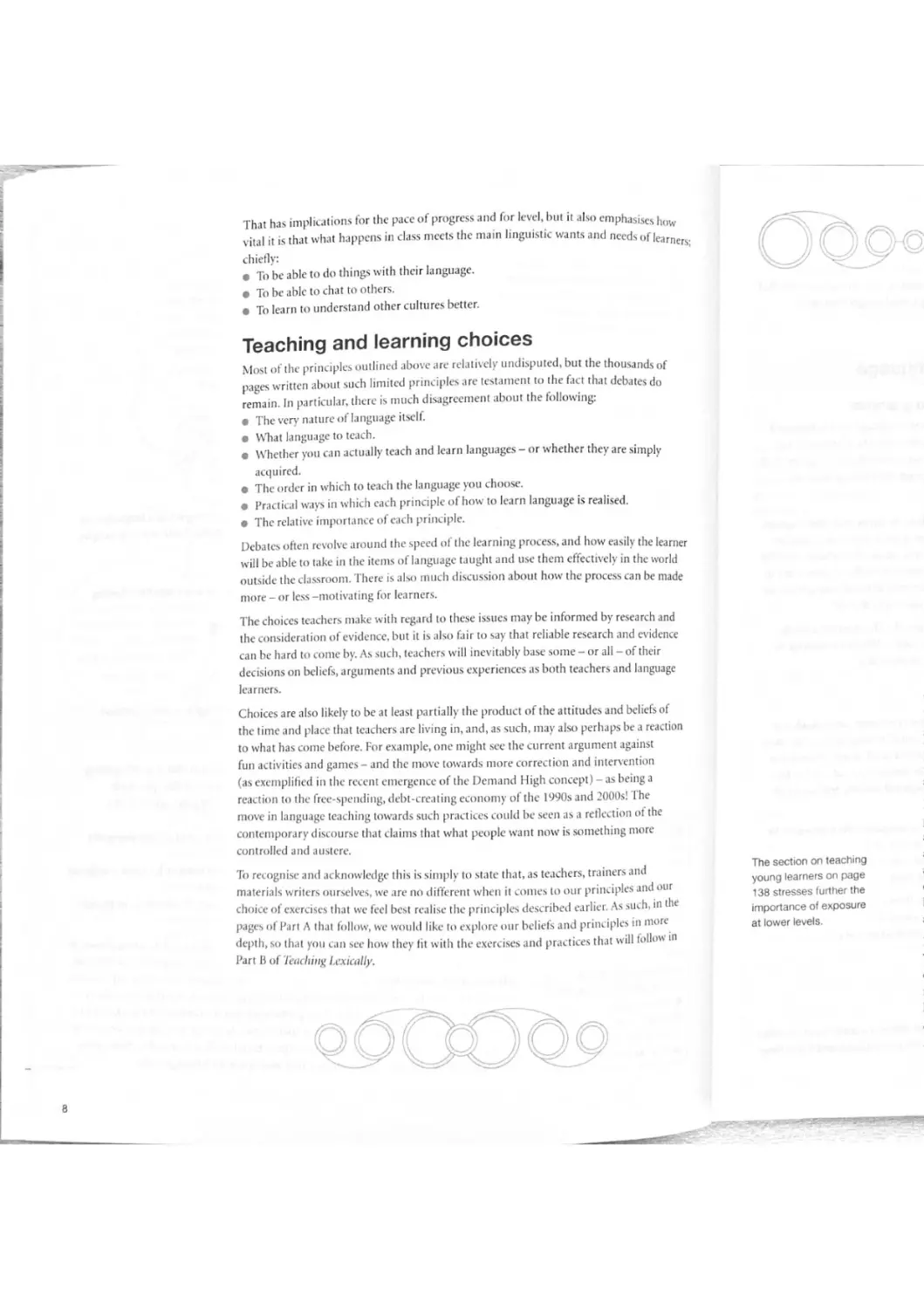
The section on teaching
young learners on page
138 stresses further the
importance of exposure
at lower levels.
8
One view of language
Grammar plus words plus skills
Traditionally, the most dominant view in English Language Teaching is probably that
grammar + words = productive language.
In other words, there has long been a belief that language can be reduced to a list of
grammar structures that you can drop single words into. You may perhaps have seen this
described as something along the lines of‘grammar providing the order into which you
slot words’.
The section on teaching
young learners on page
138 stresses further the
importance of exposure
at lower levels.
This is a view of language that we disagree with.
There are a number of implications that follow from this more traditional view of
language - some of which may sometimes be explicitly voiced by teachers, and some
which may not. Firstly, grammar is seen as being the most important area of language. If
words are there to slot into the spaces which grammar presents, then it is grammar which
must come first, and it is grammar which will help students do all the things that they
want to do. It also follows that the examples used to illustrate grammar rules are relatively
unimportant.
Seen from this perspective, these examples don’t necessarily have to represent what
is actually said because understanding the rule will enable students to create all the
sentences they could ever possibly want - in accordance with the rule. It therefore doesn’t
matter if an example used to illustrate a rule could not easily (or ever) be used in daily life.
Similarly, if words are to fit in the slots provided by grammar, it follows that learning lists
of single words is all that is required, and that any word can effectively be used if it fits a
particular slot. Seen from this point of view, Dracula didnVdoesn’t/couldn't/mustn't/wont
live in Brazil/Spain/the UK are all equally possible and grammatically correct, as are Гт
studying English, Гт not studying English and Лт I studying English?
Naturalness, or the probable usage of vocabulary, is basically regarded as an irrelevance;
students just need to grasp core meanings. At the same time, synonyms* - words that
have very similar meanings - such as murder and assassinate - are seen as being more or
less interchangeable and, if on occasion they are not, then this is a choice based purely on
subtle shades of difference in meaning rather than anything else.
In addition to this, an associated belief has developed: that grammar is acquired in a
particular order - the so-called ‘building blocks’ approach that sees students start by
attempting to master what are seen as more basic structures, before moving on to more
advanced ones. When following this approach, students do not get to see, let alone use,
a structure before they have been formally taught it. For this reason, beginner- and
elementary-level coursebooks do not generally have any past or future forms in the first
half of the book, and may exclude other common tenses and grammatical structures
altogether.
Finally, over the last thirty years, another layer has been added to this view of learning.
This looks to address skills - speaking, listening, reading and writing. If content is
essentially catered for by the presentation of grammar rules plus words, then where there
is a deficit in fluency or writing or reading, the claim is that this may be connected to a
lack of appropriate skills.
These skills are seen as existing independently of language, and a lack of them is thought
to result in such problems as not being sufficiently confident, not planning, not making
For an exercise on
the limits of grammar
- see page 61.
use of dues such as pictures to deduce meaning, not thinking about the context of a
conversation, and so on.
As a result, many courses will claim to teach these skills, and you will typically find
coursebooks with sections on grammar, sections on vocabulary, and then sections labelled
as speaking, listening, writing or reading. The prevailing formula might then read:
‘grammar + words + skills = productive language*
A lexical view of language
From words with words to grammar
In some sectors, the‘grammar + words + skills = productive language* view is presented
as the only option, but in fact there are countries and institutions which organise their
language syllabuses differently, and there is also an alternative view of how language itself
works that is supported by research, observation of language and logical arguments.
This alternative view is one we both share.
If we return to the principle that learners want to be able to do things with their language
and to communicate, then communication almost always depends more on vocabulary
than on grammar, even if we assume the ‘grammar + words’ model. For example, take the
sentence ‘I’ve been wanting to see that film for ages’. Saying want see film is more likely to
achieve the intended communicative message in a conversation than only using what can
be regarded as the grammar and function words: ‘I’ve been -ing to that for’.
From this point of view, we should see words as more valuable. This does not entirely
exclude the‘grammar + words’ model, but it does undermine it. Would the message be
less clear if the order of those words were changed? Not dramatically:
Jilin want see see want film
see film want	want film see
Actually, the division between vocabulary and grammar is rarely clear-cut; instead, it is
rather fuzzy. Grammar is restricted by the words we use, and vice versa. In daily life, there
are not infinite variations of each and every structure, and we don’t accept synonyms in
all cases. For example, we may say I've been wanting to see that for ages, but not I've been
fancying seeing that for ages. Similarly, we may say it's a high/tall building, but not a high
man or a tall temperature.
Furthermore, we often make use of phrases, or chunks* of language, which appear to be
stored and recalled as wholes, rather than constructed from an underlying knowledge of
grammar + single words. To put it another way, we consistently choose one particular way
of saying something grammatical, rather than any of the many other possibilities.
In their seminal 1983 article-1 Two puzzles for linguistic theory: native-like selection
and native-like fluency’ - Pawley and Syder cite the way we tell the time as an example
of this. All of the following are grammatically possible, yet most are not chosen by fluent
speakers:
It's six less twenty.
It's forty past Jive.
It's a third to six.
Most competent users of English - including you, almost certainly - tend to opt for either
It's twenty to six or It's Jive forty. There are thousands of similar instances, and it was these
For more on some of
the problems caused by
focusing on synonyms -
and how to tackle them -
see page 54.
It s two thirds past Jive.
It exceeds Jive by forty.
It's ten after halffive.
10
Idr an among //th/ г», that |/d M)/Wl (/ fnAwftte m ///# />/?//// ///p//////hz '/>'/;
that language VAH yjAffitOAlif alioed |/ zr»* f4lh*f fh^ff V/M ab»*4 ?J4miO4f / : 4 /4y7i*
he ft /a ted the idea that we ohordd (onHmn wdb a »/11а>/п» !,a&A on *rtA*l*A
yoimmAf olrm luff » aiiA, m»f/ ad, aA iot aUA syllabi», HMtelMk 4hA о 4/ юЧ*А
around collor atimi* ahA (himks Aiffti^iAf hftf Amo/mteof iftyiA forth te/>±
17<НП fhh input, A of ^fAtflfflAf ndM* 4flA thff^f t ША'/f rt'rtM	tty*/ A
the mpul were mediated by the ^iiiAaii^ of 1м/ hers hHpmg tfuA*frtb to rw^> brttt, *tA
meaning»,
More rc< ently, Mie had I (ory ha» yynm ihrorrii/ al support for 0ns appro*/? In h,-, v//z
/cxior//7imn/g QOO^n he diows hr/w 7/ords whic h apparently vinotrfitem x>;‘- 4\
rem// and /o/mv/i/rnrr typh ally fun/ Hon iff qi/ib Aifteote на/?,	>,»*,/ ally, or>  >, r,v/f*
common than the other m most situations, aiiA often the»* ddferen/*» ao /ег/ пмС/^Л
I hr way synonyms are used differs not only in terms of the /4 her v/ord» .mm"' *o у
around them that they co I lot ate with, hut also in terms of thr ног Az A,a1 <0 t// of t. Os
wider surrounding text Near synonyms may alno ос / nr in different parts'/ tz n v r,/> or
in different genres*, or may he followed by different y/ammatp al yaftm;;
I lory argues that these stalistir al differences must come about be/ aUU 7dz r 7/e ' rv
encounler these words (hr f alls su< h encounters primings*'/, our brains У/Яиh//w
silbconsc loiisly record some or all of thio kmA of information about the way о о ////г4г are
U.ord,()ur iM'zt rmoiinfer may ff Affinn fit p</ooibjy r/mtra/h/1 thio mil d primmg, ao
will the next cn< ountrr, and the one after that and у/ on,
If thio wao not the ( ay*. then ri'tidt апА f/Hioy/iu'Ho' 7/fiiilA ^ihaII/ fir^/ itetA 4.. ' a 7
or one would be uoed more (onoiotrntly in all undezto I fo^/ ougxrot^ А,а1 ttiAf// o>
wr might fluid of a<j bring our grammafi/ al < hokeo are 4/ tually /leterrnined by th/ //ordo
thrmoclvco and by our ezprrirncc of ho// they are uoed and the pattern» that atfa/ h
thrmoelvro to the word» rather than by any underlying kn/o/Je/jgr /,f grarnrr>ar r ar,A
an ability to then dot in word»,
I Joey hao ah,о i itrd rvirlrnr r from i^/f holmftiiM< ofudie» io support hio r lairno about
OIK li pru< rone», and fo help rzpiam v/hy language u»e wr/rto m tin» way f ‘ f ; fA
hr mention» ohowo how word» arr retogmoed /pm her when they are related u* u a than
when they are not So, for example, от г a fe»f »ub)e/ f hao been given the word oz>*/, the
word» im/Z or /zr/г/ might then be rrcognioed more qukkly than, oay, the word Htrport
In anothrr experiment, imrrlatrd pair» of word» ouch ao ziarh'i mnmi v/^r^ tauglif After a
day during win/ li thr le»f oubjrr to were rzpooed to a lot more languag/, parfr ipanl» were
then troted on n • oyyihon of wonln baord on prompt word» When tin prompt word wa ,
mnmr the word m fit hi wan rc< ailed more qiih Uy than other word»
I hrne experiment» oiigg/ ol, hrnfly, that wr do indeed remember word» in pairing» ari/l in
group», and that doing 00 allow» lor (|ulckrr and more at 411 rale рпнcooing of the IjnyyAy/
wr hear and waul fo prodm• <)nu kri, that 1», than < oiiotantly conotrm tmg new and
creative nnitcua’»,
II you ai < 4 pl thin, thru It'» not loo great a leap to believe that opoken flucrir y, the opced af
wlu< h w» read and tin eaoc and at < mac у with wIih h we holen may all <h /clop an a reoult
of lauguagr in, < in b< 111g mon familiar with grouping» ol word» 1111» i • r I a ml у »/ em» io
be a more hl r|y »mm 1 of devi lopimnl than relying mi count rue 1 mg »cnlcnu'» from the
bottom up, unmg grammar and word»
Seen like thin, problem* < omir< nd to nkilh < w mi ally come bac к io bring more about
11
The sections on teaching
EAP (page 139) and
exam classes (page 140)
emphasise how essential
it is for students to
broaden their lexicons.
problems with language: students not only don’t know enough words, but they also lack
experience of how words are used or how they might sound in a group of words.
Some academics, such as Nick Ellis (2013), have suggested that what allows us to acquire
new language is our encounters with vocabulary intimately intertwined with grammar.
Ellis gives the example of the sentence He mandubled across the floor. We can work out
what mandublcd might mean, more or less, because we know many other *x + verb across
the floor patterns (walk across the floor, stroll across the floor, go across the floor, slither
across the floor, crawl across the floor, and so on).
Of all these possible examples, the vast majority of actual uses will consist of a very
small number of words, with go across the floor and walk across the floor being the most
probable. Ellis argues that it is repeated hearings of the frequent combinations that
establish these base patterns in the mind and that, once we have these patterns, we are
then able to understand and to slot in new words.
This shows how patterns can be generative. It also shows how grammar can work, but
we need to be very clear that this isn’t the kind of grammar which is generally taught in
coursebooks. Instead, it is what we could call Mexico-grammatical* patterns.
Now, for the sake of clarity, let us state that, in keeping with these ideas, we believe that:
• words have more value than grammar.
•	language is essentially lexically driven, and words generally come with their own
connected grammar.
•	our own usage is determined by our experience of how language is used.
•	there’s a huge number of patterns that can be generative to at least some degree (and
this includes the traditional grammar patterns taught in ELT).
•	the vast majority of the examples of any one pattern will be made up of a small
percentage of all the possible words that could be used with the pattern.
•	collocations and patterns will be primed to go with other collocations and patterns in
similarly limited ways.
For more on ways
of working with
spontaneous speech
- see page 80.
See page 7
for the list of
principles.
A lexical view of teaching
Towards a practical lexical pedagogy
Setting out these principles about language is one thing. There still remains the issue of
choosing what to teach, the order things might be taught in, and how we can guide students
through the six steps necessary for learning that we outlined at the beginning of Part A.
Over the last thirty years, some researchers who have seen flaws in the ‘grammar +
words + skills’ model have argued that what learners learn, and the order they learn it
in, can only be determined by the learners themselves. They have also suggested that the
conscious teaching/learning of grammar is useless, or at best of only marginal benefit.
Stephen Krashen’s and Tracy Merrell’s The Natural Approach (1982) and other methods
based on extensive reading* have emphasised the hearing/seeing stage. According to these
perspectives, students do not explicitly learn language; rather, they are thought to acquire
the language by seeing or hearing things which are comprehensible, but which contain
linguistic features just beyond what they are capable of producing themselves.
1 he order in which this acquisition occurs is seen as being fairly fixed. From this point
of view, instruction - particularly at lower levels - has very little purpose, apart from to
provide comprehensible input, though it is claimed that, at later stages, some instruction
12
For more on ways
of working with
spontaneous speech
- see page 80.
about rules may help with noticing and may help learners to monitor what they are saying
for errors.
There are other models that also take the idea that language can t be pre-taught as such,
but can only be taken on board when students are ready to receive it. These approaches
have tended to focus on the stage at which learners use language, when participants
are also able to learn through hearing other speakers’ language, comprehending it and
incorporating it into their own usage.
This idea is at the heart of Task-Based Learning (TBL) and Michael Long’s Interaction
Hypothesis (1996), which suggests that new language is learnt through interaction with,
and input from, others at the point that communication breaks down. Long and other
TBL advocates have increasingly recognised that teachers may have a role to play when it
comes to helping students notice forms as they arise during the process of doing tasks*,
provided this is not based on a pre-set grammar syllabus of the type usually found in
coursebooks.
More recently, so-called Dogme teachers (see Teaching Unplugged (2009) in the Delta
Teacher Development series) have advocated a similar process - with a somewhat stronger
teacher role that involves identifying and working with what has been dubbed 'emergent
language’ from student conversations. This may lead to a spontaneous teaching focus
on - and practice of- a structure or structures as well as of vocabulary. This approach
emphasises conversation over task, but again strongly rejects a pre-set syllabus applied to
a whole class, and is (sometimes vehemently) opposed to coursebook use.
All these approaches to the practices of teaching can be seen as responses to observations
that all teachers must surely have made at one time or another:
•	We teach a structure.
•	Students practise it, and seem to understand and be able to use it in controlled
conditions.
•	Then, in freer, more meaning-focused communication, the students revert to making
mistakes with the very same structure.
These approaches also have roots in influential research that suggested that foreign
language students acquire structures in a similar order to native speakers, and that this
order can’t be changed - so there is no point teaching grammar if students are not ready
for it.
This line of thought was then reinforced by the logical argument that students in any one
class will all be at different states of readiness, so teaching the same thing to everyone,
without knowing whether they are ready, will not optimise classroom teaching. Finally,
there is the belief that we learn best from experience and from our own mistakes.
However, there is also an irony here. These theories have emerged from a questioning of
the traditional grammar syllabus, but the validity of the new theories is effectively based
on how successfully grammar is learnt! This is then generalised out to all language. It is
claimed that lots of reading or listening is the most efficient way to acquire all language,
because that’s the way grammar seems to be acquired. Here are some similar diktats that
seem to have emerged from all of this:
•	Don’t pre-set any part of the syllabus, because grammar isn’t acquired block by block
and students are all individuals.
•	Don’t explain or teach anything, because students can’t make active use of explicit
grammar teaching.
•	Don’t use any coursebooks, because grammar can't be cut up into the kind of nuggets
that most books offer up and, anyway, coursebooks stop proper interaction.
13
The section on teaching
low-level learners on
page 137 gives further
guidance on presenting
grammar as chunks.
The chapter on speaking -
and in particular the focus
on cheating (page 76) -
explores ways of predicting
what students might say.
It is obviously worth asking if this is really true for lexis in the way that it is supposedly
true for grammar. We believe words clearly can be learnt consciously - and can be learnt
very efficiently. For example, there have been several experiments looking at the use of
flashcards to learn words, with one side of the card being in the target language and the
other side containing a mother tongue translation. These tests have shown that students
using such an approach are able to acquire and retain large amounts of vocabulary,
especially when these words arc revisited over time.
We would suggest that this is likely to be equally true if those words were collocations or
grammaticalised chunks, such as Have you been here before?, instead of just single words.
Of course, we’re not suggesting that if students were to learn such chunks, they would
then be able to use the present perfect tense more generally. They may adapt the chunk
incorrectly, saying Have you been here yesterday? for example, but in the greater scheme of
things, we feel this is a relatively minor problem.
One major problem with the‘grammar plus words’ building block model is that, as
students adhering to it set out to learn the language, they are not even permitted to see a
sentence such as Have you been here before? for weeks or even months, as mastery of the
basics is demanded first.
However, the answer to the very real problem of learners not being able to take on board
structures in one or two lessons should not be to simply wait around for things to somehow
come up in class and then be acquired, because here’s the thing: most studies suggest that
extensive reading (and, we must assume, extensive listening also) is actually a very slow
and inefficient way of acquiring new vocabulary, when compared to active study.
And if vocabulary can be efficiently learnt through study, we might then consider why
we shouldn’t also pre-set a vocabulary syllabus in courses and materials. When students
have a particular task to do, or a conversation to take part in, we can predict a good part
of what might be said. Thornbury and Meddings say as much in their book Teaching
Unplugged:
'The activities in Teaching Unplugged aren't designed to generate specific exponents, but you
can ask yourself what language areas are likely to be generated. Revise these in advance if it
helps you feel more confident - but be prepared for all the other language that will emerge.'
For them, this predicting of language is a way for teachers to give better post-conversation
feedback - and we certainly wouldn’t disagree that this is a good thing to do. Note,
though, that they refer to language areas, which, while they may not intend it to, suggests
‘grammar + words’ (in lexical sets). If this is what is implied by the phrase‘language areas’,
we would obviously see this as unhelpful. Instead:
•	We would urge teachers to think of whole phrases, sentences or even ‘texts’ that
students might want to say when attempting a particular task or conversation.
•	We would then argue that at least some of those lexical items are learnable, and some
of that learning could be done with the assistance of materials before students try to
have particular kinds of conversation.
Conversations or tasks then become not only an opportunity for teachers to develop
emergent language, but also serve as a rehearsal space for previously studied items.
Finally, we would absolutely agree that, while students are talking, teachers should
listen to them and be prepared to help them with the new things they want to say. For
us, the study of potentially new items, and the teacher providing help towards better
communication, can come before, during and after conversation and, as we shall see,
coursebook materials can play a vital role in all of this.
The tasks on page 36
aim to develop the
way you think about
frequency.
14
Teaching lexically: some problems
The difficulty of thinking fast
In a way, the above comment by Thornbury and Meddings highlights a very important
and practical problem inherent in any approach that requires teachers to react to what
learners arc saying, and to then notice emergent language, focus on form, and possibly get
the students practising any new input that arises out of this. The truth is, it’s very difficult
to do all these things simultaneously in the heat of the classroom - let alone to do them
well and to do them consistently!
Just think for a moment about what is involved. To react and then teach, teachers have to:
•	hear what students say.
•	understand what they say.
•	notice problems or gaps as they speak.
•	decide what the new or emergent language is.
•	make judgements about the students’ level, the frequency or usefulness of any possible
new language and whether or not the students are ready for it.
•	note the language, or write it on the board.
•	remember the context for the new language to be explained.
•	(ideally) be prepared to give other examples.
•	(ideally) have questions ready that check and expand on the students’ knowledge of the
new language - or that relate to other connected items of language.
•	(ideally) think of some kind of further practice.
•	keep a record of new language, so that it can be revised or referred to again in future
lessons.
The tasks on page 36
aim to develop the
way you think about
frequency.
At all stages of this process, teachers’judgements may be affected by what Daniel
Kahneman (2011) has described as ‘biases in our decision-making’. For example, a
teacher’s interpretation of what is a mistake or a gap in the students’ language - and of
how it may best be corrected or improved on - may be governed less by what is relevant
to that student and more by the teacher having been encouraged during their training to
notice particular kinds of errors. Following on from this, whether the teacher then decides
to develop a perceived mistake into a focus on form may depend on whether or not they
have successfully taught that particular form before.
In terms of deciding what vocabulary needs to be taught at any given moment, teachers
may also have an ‘availability’ or ‘representational’ bias.
The availability bias may make teachers prioritise less frequent words simply because
mental images of them are more readily available. So, for example, we may think the
words blonde or banana are far more common than arise or whereby, because we can
picture the former words, and can think of many people who are blonde or imagine
eating bananas. 1 lowever, in their overall usage, as measured by corpora such as the
British National Corpus, blonde is actually around nine times less common than arise,
and whereby twice as frequent as bananal
We may also be influenced here by the most basic representative sentences of English
grammar. Very simple sentences are of the‘noun ... is ... adjective’or‘subject ... does ...
object’ variety. Words such as arise and whereby do not fit into these simple representations,
and this may contribute to them being ignored or under-taught in the classroom.
Similarly, the examples of new language that we come up with in class are more likely to
reflect this relatively straightforward representational nature than actual common usage.
15
The tasks on pages
40-43 will help you
think more about how
to provide good
examples
when asked to give an example of the word rise, people may well produce
For instance, w	r|S(>} w д rjJfs< rather than I saw an article the
,ha< directors’ pay h,ui risen ten times foster tlmn everyone else’s.
. ,1, • G. t th it often, this kind of decision-making has to be done while
Now cons. er e	)iaUy vcry |argc dass, and y„u begin to
of approad.es such-
^gmTho^ever much you may sympathise with their underlying principles and views of
language.
Kahneman suggests that sonic of the biases that conic to the fore in what he describes as
‘fast thinking' - the kind of on the-spot thinking that teachers engage in in class - can be
overcome through slower, more analytical thought, and that large amounts of practice
can lead to more successful spontaneous judgments. He cites the example of chess grand
masters, who become capable of creative, spontaneous and successful moves only through
hours and hours of analysis and the practice of particular gambits.
The section on
assessing matenals
(page 135) gives
examples of the
kinds of questions
you can use to
critically evaluate your
classroom material.
The tasks on pages 56
ana 58 will help you
get better at noticing
patterns
To apply this analogy to the classroom, if teachers want to get better at drawing attention
to the most frequent language, then they need to practise noticing language.
We think examples such as I saw an article the other day which said that directors' pay had
risen ten times faster than everyone rise's or We got up at five to go and see the sun rise are
better than The sun rises, because they are a more realistic reflection of how the word‘rise’
is actually used. They also show other grammar patterns: I saw an article the other day
which said, said that... had risen, risen x times faster than ...; get up at x to ... see the sun
rise.
However, most teachers (native and non-native) are unlikely to be able to produce such
examples, or draw attention to such patterns, without a considerable amount of planning
and study.
In order to plan efficiently, most teachers need coursebooks or other materials.
We would suggest, then, that coursebooks can play an important role, not only in
presenting language to students but also in enabling teachers to become better lexical
practitioners and, in the long run, perhaps better spontaneous and reactive teachers in a
Dogme or Task-Based Learning mould. The question you may then want to ask is: What
kind of coursebooks?
Teaching lexically: some practicalities
Pragmatism in a grammar-dominated world
Most coursebooks that are produced for a global audience are organised according to the
grammar 4 words ♦ skills’ approach. There are certainly some books which incorporate
more aspects of a lexical view than others. They may contain more lexis, have a greater
focus on collocation and chunks, but few, if any, break the building block taboo: the
unspoken rule that you can’t expose students to aspects of grammar that have not already
been presented and practised remains.
dr r C ,UfM-hooks almost never present phrases such as What are you doing later?
I ‘	11,11 s where the grammar is left unanalysed. As writers, we have made an
this through our own General English series Innovations and, more
II I p ‘ nU ^1CSC hooks have been written against a backdrop of pressure front
u dishers continue to offer teachers and schools books based on the unpacking
The section on
assessing materials
(page 135) gives
examples of the
kinds of questions
you can use to
critically evaluate your
classroom material.
of discrete grammatical structures. Frequently» feedback from users then picks up on the
desire for more grammar - and a vicious circle of expectation and fulfillment develops.
Naturally, we would like to see this change, and we hope that we might make some small
kind of progress towards this goal by influencing you, the readers of Teaching Lexically. Part
of this change could come from teachers and other decision-makers within their institutions
taking a more lexical view of language and looking more critically at coursebooks.
Teachers themselves can also, of course, write more lexical materials or take more Dogme-
like approaches, but the reality is that most teachers just don’t have enough time - and
aren't paid enough - to do this. Plus, as we have seen, Dogme lessons can end up, at least
in part, simply being materials-free replays of old lessons which teachers have delivered
before with the use of coursebooks.
For this reason, what we hope to show you is how you can apply a lexical view of language
to any coursebook. All books contain plenty of language, plenty of collocations, chunks
and non-tense-focused grammar, but much of this may not be highlighted by the book
because of its ‘grammar 4- words + skills’ focus. Even where, for example, single words
dominate, there is still real potential for lexical teaching in your preparation and in the
interaction between you and your learners.
However, to get to this stage, you will need to approach coursebook materials in a
different way, perhaps plan differently, and, above all, you will need to think about
language lexically, and ask new and different questions about the language you’re
planning to teach.
As such, Part A will present a brief overview of vocabulary and grammar, as seen
from a lexical point of view, and consider how we might lead students through the
aforementioned six stages of learning new language.
Then, in Part B, you will find:
•	tasks to train yourself to notice language in your coursebook in this lexical way.
•	tasks to train yourself to predict language the students might use.
•	tasks to develop teaching techniques.
e tasks to develop ways of applying these techniques to exercises* you will see in
coursebooks.
•	tasks to deal with correction.
•	tasks to build up repertoires of‘spontaneous’ teaching within your class.
•	a limited number of activities to revise and practise language.
In other words, Teaching Lexically, the book, is less about recipes and activities for lessons,
and more about training for preparing lexical lessons with whatever materials you are
using. Il is less about changing or replacing materials with something new, and more
about the better exploitation of what is there already. To this degree:
•	For those who have read The Lexical Approach, to which we are much indebted, we
hope you will find something new and useful here.
•	For those of you who are more ‘grammar + words’ inclined, we hope you will like the
rigorous focus on language.
•	For those who are TBLers or Dogmeticians, we hope you will appreciate the
importance placed on the role of the student, and find the focus on planning for
language valuable.
So before you apply the tasks found in Teaching Lexically to your own coursebook, let’s
just consider in more detail, and from a lexical point of view:
•	what vocabulary is; what grammar is; what skills are.
17
Vocabulary: a lexical view
Units of meaning
For tasks to help
you think in more
depth about units of
meaning, see page 35.
Asking what vocabulary is may seem rather strange. Surely vocabulary is just words and
their meanings:
•	We can match the word table to the thing, or call up a picture in our heads.
•	The word pull can go with the action of pulling, or on a sign on a door.
•	The word out can be dealt with using a visual of an arrow coming out of a box, or a
sign giving directions.
•	The word absolutely has a simple definition of‘very’ or‘completely’.
However, what are the ‘words’ in They pulled out of the deal? Here, pulled and out are part
of the same unit of meaning*, even though they are two separate words. And what about
He pulled out without looking? Again, pulled out is one unit of meaning, but its meaning
here is different to the example above.
In each of these cases, we must then say that ‘deal* and ‘without looking’ - what we can
describe as collocates* of pull out- are also contributing to the meaning. Collocations
are pairs or groups of words which commonly go together - eg a long day, score twice, go
home. The extent to which a collocate determines the meaning of its partner will vary,
but it is especially true of the most common verbs like have or take. In many languages,
combinations such as have dinner, have a rest, take it easy or take advantage of may be
translated with just one word in each case.
And what if someone tells you to lay your cards on the table? With idioms like this, we have
six words, but really only one meaning: ‘show me your position or what you’re thinking’.
Furthermore, changing what we often think of as the‘grammar’ words within this idiom
would change the meaning. Saying either‘lay a card on the table’ or‘lay your cards on
a table’ would suggest that you’re really playing cards, while ‘lay some card on the table’
would change the meaning of card. In other words, collocation and connected patterns
allow us to distinguish different meanings of the same form of a word (cardllay).
So when we think about vocabulary, we may want to first think in terms of‘units of
meaning’ - rather than individual words.
Paul Nation (1993,2001) suggests that, in most cases, the simplest way to get to
meaning is through translation. However, if this is not an option, then we may resort to
explanations, drawings and the like. The key is to keep things simple, because, from a
lexical teaching point of view, meaning is almost the least of a learner’s problems it they
want to use an item well!
For tasks to help you
get better at asking the
kinds of questions that
draw attention to specific
grammatical features,
see pages 68-70.
Once we have established meaning, we should be aware of the other connections to those
words that allow us to use them or to recognise meaning accurately and quickly. For
example, with any item we are comfortable with, we know about its:
•	со-text* (other words that are likely to occur within a text containing the item).
•	register* (appropriate levels of formality or politeness).
•	genre (the kind of text the item will generally be used in).
•	contextual opposites (antonyms*).
•	other words in related lexical sets.
•	word form and related words within the same word family.
•	function and pragmatic use (how the item can be used to do different things in
discourse*).
•	connotation* (negative or positive shades of meaning).
18
For tasks to help you
get better at asking the
kinds of questions that
draw attention to specific
grammatical features,
see pages 68-70.
•	synonyms (words of the same or similar meaning).
•	other words in a connected group (hyponymy*).
We will now explore a number of connected areas in more detail.
•	How words work with other words and with grammar
Let s take the word argument. If you think of collocations, you might come up with have
an argument or present an argument.
Most of us would think of having an argument as being connected to angry’ words’, while
presenting an argument gives a different meaning of argument as a series of connected
ideas or evidence. Now think of the grammar connected to these two units of meaning.
You are more likely to ‘have an argument’ with someone about something, but ‘present an
argument’ to someone for or against something.
Some would characterise this as collocation, rather than grammar.
Other features might be that a word/collocation may more commonly occur in one
grammatical structure than another. So present an argument might be more common as a
passive than have an argument, say, and less common in the present continuous.
We can ask questions to draw attention to these grammatical features, such as ‘What
preposition follows have an argument?"
•	Collocation
We might then recognise that if you have an argument about something, it’s likely that
this something will be different to the something that you might present an argument for
or against. This difference extends to the use of pronouns, as‘presenting an argument for
it or against him" are both unusual. We might say:
•	have an argument about it/him/some thing stupid/money/her spending so much timeout
e present an argument for a change (in the law)/a (adjective) approach/using the CEFR
as a basis for course design
We can also look at the collocations and grammar that might precede each chunk. For
example, we are more likely to say 'want to present an argument’ than to say 'want to have
an argument’.
The adjective collocates are also likely to be different:
•	have a terrible/furious argument
•	present a convincing/compelling argument
We can also draw students’ attention to collocation by asking questions. The answers may
vary quite considerably. Some may even be meant as jokes by students, and they might
not always be correct, in which case you may need to change or correct them. We could
ask, for instance:
•	What verbs can go with argument? (have)
•	Who has an argument? (girlfriend/boyfriend, husband/wife, footballers, countries)
•	What might a husband and wife have an argument about? (money / having an affair /
drinking too much)
You can plan the examples that you want to give in class by thinking about collocation in
this way. Thinking like this before teaching can also make it easier for you to respond to,
and to use, student answers to the questions above. You might end up with an example
like this one:
•	My friend Maria had a terrible argument with her boyfriend last night.
or
•	My friend Maria had a terrible argument with her boyfriend last night about his drinking.
19
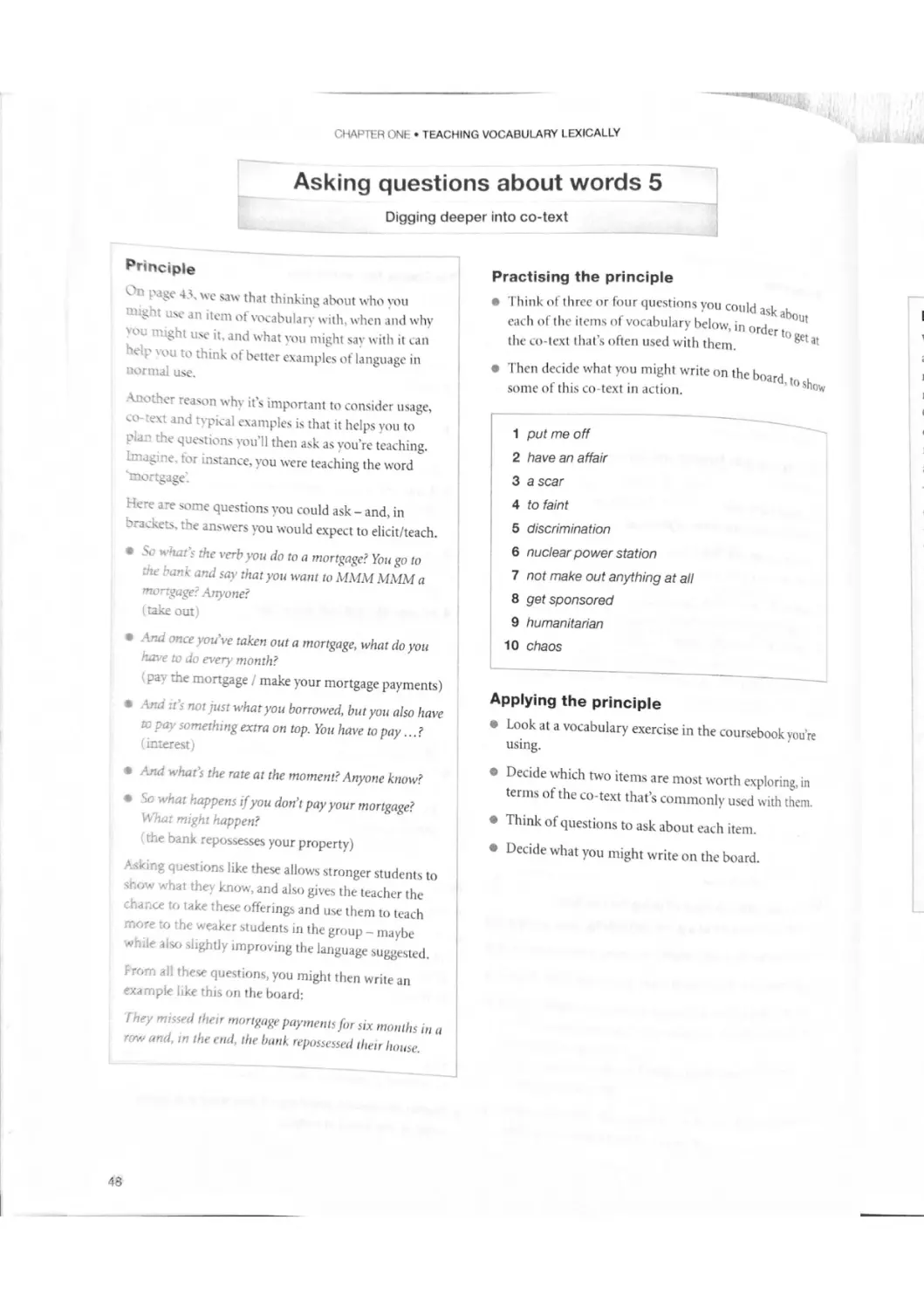
For more on how to ask
questions that allow
exploration of co-text,
see page 48.
• Co-text
With an example like the one above, you might also start to think about how the whole
sentence might be used in a conversation. Alongside the sentence about Maria’s terrible
argument with her boyfriend, we might also expect to hear things such as W7im about?
She phoned me, she was really upset, calm down, came round to my house, crying, floods
of tears, screaming at her/eaclt other... and so on. This is the co-text. There may also be
words connected to the reason for the argument - perhaps alcoholic, out of control, drunk,
etc.
Of course, when we think about present an argument, the co-text would be quite different.
We might expect, for example, things like suggest, go on, question, show, conclude, etc.
Again, we can ask students questions to access some of this language. For instance:
•	How might you feel if you have an argument?
•	And when you have an argument, what might you do?
•	And what might happen afterwards?
•	What might you say - or ask - if someone tells you that they had an argument with their
boyfriend last night?
•	Genre and register
The different kinds of co-text that will occur with the different collocations featuring
arguments also reflect the kinds of texts we are likely to meet these collocations in.
Have an argument is far more common in spoken texts than present an argument is, so
we might also expect to hear responses from a listener in a conversation such as Really?
or That's awful. We might expect to find present an argument more commonly used in
academic texts, and perhaps even in the introductions or abstracts for academic articles -
ie within very specific genres.
Some words, such as sir or crap, might be seen as belonging to a formal culture or to
a very colloquial one (ie to different registers). We might ask our students questions
about this kind of thing, in order to find out how aware of register they are. We could
ask what kind of texts you present an argument in. However, note that while these kinds
of questions do allow a brief focus on register, they are not very productive in terms of
getting at connected language.
You may think of other questions that are more useful.
• Lexical sets
I he chunk have an argument could be seen as belonging to a lexical set of different
kinds of talk - chat, talk, exchange, disagreement, gossip, discussion, laugh, row, speech,
interview, conflab, and so on. However, argument, in present an argument, might be seen
as belonging to a different lexical set, that of ‘kinds of statement’ — suggestion, explanation
advice, opinion, apology, etc.
Some words in lexical sets might occur as co-text. For instance:
We were just having a chat and I mentioned that she could've done things differently, and
ended up having an argument.
I iowever, note that not all words in any given lexical set will be of equal frequency
(conjlab, for instance, is very infrequently used) nor are they all likely to occur in the same
ши an argumtm, for example, is not very likely to be used in the same conversati*’11
as have an interview).
fmmo^ nJ ,°r ПЮге 'а,ПЖаГ ,exical Sets: cal’ ^^affe, elephant and aardvark may
m part of the lexical set ’kinds of animals’, but some are far more common and not all
20
	would normally feature in the same conversation or text. We might explore other words in lexical sets by asking What other kinds of talk can you think of? To be honest, though, for have an argument this is perhaps not the best question. Students may not immediately be able to think of other examples in the way they would if they were asked What other kinds of animal can you think of? This is something to bear in mind.
For more on what kind of questions best explore which aspects of word knowledge, see page 46.	Not all questions about aspects of word knowledge work for all words. Some will generate a lot of language, and others will not. Learning to be selective about which questions to ask when takes time - and requires plenty of both forward planning and retrospective reflection. •	Antonyms We most commonly think of opposites in terms of adjectives or certain verbs: strong/ weak; lose/win, etc. However, when we think about collocations, we can see that opposites of single words often vary, so: •	The opposite of a strong cheese might be a mild cheese, while the opposite of a strong wind might be a light wind (or even a light breeze). •	Similarly, the opposite of lose weight is gain/put on weight, but the opposite of lose your keys is find your keys. This means that, rather than thinking of opposites as being connected to single words, we would be better off thinking of them in terms of the contexts they’re being used in. These contextual opposites are known as antonyms. However, we might also consider less common opposites, such as in the case of have an argument and present an argument. Again, the opposites will vary: have an argument	have a chat / have a laugh present an argument	challenge / respond to an argument have a terrible argument	have a little argument / a slight disagreement present a compelling argument	present a weak / unconvincing argument Furthermore, the opposites of individual words change when we put them in new collocations: have terrible weather	have great weather present an award	receive an award Obviously, there may also be other alternatives to the opposites above. These things aren’t fixed and, on occasion, the opposites we opt for may be determined by our own experience of language - or simply on what we see as the opposite at the time. For instance: •	You could <|u ite easily see the opposite of present an award not as receive an award but, rather, as give a punishment. •	In the same way, you could see the opposite of have an argument as not say anything. Sometimes, there just won’t be any fixed direct opposites, but this doesn’t mean the idea of opposites should not still be of interest. Opposites will also often occur within texts. For example: What were you two arguing about? >We weren't having an argument. We were just having a laugh. •	Word form As we saw in the last example, we may also use different forms of a word within
21
1О1ПТ1М110ПМП.1 tc«h (nrgur/orgiitwni). SornrtlrrM-x.d.ffrrmi
,s dctivcl from one r<«" w,,,‘l wl11 luvc t,,ffcrem	*•« he IKt4

contexts
r*nr
For taske to help you
explore //hat might
come before and after
particular iterna of
language, eee page 67.
For example, argumentative la aawKialcd with have an argument, but the ^r,nt
arguable and the adverb arguably are more connated with pre^nt a„ WVtnVri,
^ewHI Ik usd In quite different amtexte, depending ш th	.
•	With hrtiT an argument, we might expect the co text to include phrwet iudi
they’re always arguing, we/lhey never aryne, we/lhey aryue a Im
•	With present tot argument, we re more likely to cee things such ** //he aryuf .
he goes on to aryue. or it is argued that... in the co-text.
** **4/
In class, you might ask the students:
What's the verb form of'argument'? And the adjective form?
Once they have provided the answers, you may then also want to giv* extra exarr-
and ask extra questions about collocations that are connected to these differs- .. r *
because these will all be used differently.
• Pragmatic meanings
Sometimes, using a phrase such as The kettle $ boiled in the L К at least -as гё «ссгецд
meaning of a request ‘to make tea. It s easier to imagine a pr«igmax-c •
for have an argument than for present an argument. For example, we cihJc	e
someone waiting outside an office when another person appears anc zs ixx_z x extx
The waiting person says:
They're having an argument.
Clearly, this is not a simple description. Pragmatically speaking, it's an «рлзкхс -
they are waiting, and advice to the other person not to knock. So we msghz ±йа ехгелх
response such as:
Oh right. Thanks. I'll come back later.
For most people, these leaps of understanding are clear, and we don't re£h need .
such aspects of the language. However, there may be some common рЬгьо «*л± гч
more culturally bound, where we might want to emphasise this aspect \\< axlc
in class by asking for different responses to the statement, which might e sccxrjig
like this:
Fcr 'ЧТ? cn zcrcscr
ensexng s=e re -зжз
cr	S2 - з nz rose
cr rd^e S? xr -xie зт
елрапзтег.
A:	t hey're having an argument.
B:	What about?
A:	They're having an argument.
В Why?
A: They're having <in argument.
B:	Again!
A: / hey ie having an utgumeitl.
В ГН < oinr Ikii к latei.
• Synonym»
I m.dl>. »< in.iy know synonyms ot wolds. I his is one ot the most umdwn
Wind knowledge
In, l,i»>. омну ic.k |u-|, i,nrh uw jyiKim in, .is ,i w,i\ io jiiw iiusmm$ >S*'4
.....IlMlb* ..... >.t>.W.K..I |чЧ„ ,|U	.	..
vciy lew. Il .my.,4K„K„b V(. MV Ih () )Vtt u л ,MKsmm,d - x*'-'- '
have an aiyuiunii. |цц no) рш’щ .ш .ugHwm whim w (hmk ol the imsxm\<
an argument, row may share some collocations, but not others, so someone is much more
likely to be at the centre of a growing row than at the centre of a growing argument.
Row may also be more common with certain genres, such as political journalism. It is also
used by native speakers far less frequently than argument) and so, in class with students
who have a limited amount of time, rather than asking‘What’s another way of saying
have an argument? - a question which might generate words with similar (but slightly
different) meanings, we would probably be better off teaching something different and
more frequent - or else simply exploring the word they have just learnt in more detail.
Grammar: a lexical view
A broader, more nuanced perspective
One of the most common misconceptions about teaching grammar from a lexical
perspective is that it somehow means a ban on the use of grammar terms such as noun,
verb, preposition, the present continuous, and so on - or, worse, that it means no explicit
focus on grammar whatsoever.
Certainly, there are plenty of people who have acquired a second language without having
learned this kind of metalanguage*, but we believe that if students are familiar with these
terms, it makes it easier for teachers to draw attention to language and to encourage the
students to notice salient features. We have already seen one small example of this earlier,
when we looked at how we might expand on students’ knowledge of words that are part
of the same word family.
For more on concept
checking, see the tasks
on page 62 - and those
on page 63 for more on
explanation.
We have also seen that a central part of the process of learning has to be noticing, and
many theorists - even those like Krashen and Long, who emphasise a more‘natural’ kind
of acquisition that mirrors the way children acquire their own first language - suggest that
some knowledge of rules may contribute to the learning process.
We very firmly believe that the kind of basics that you might have learned on initial
training courses, such as explaining rules and checking concepts with questions, are good
things to have in your repertoire.
However, as we have already seen, taking a lexical view of language means realising that what
can be described as‘grammar’ is much broader than traditional ELT coursebooks suggest:
• A traditional coursebook will typically have between 20-30 grammar points, many of
which will be repeated and expanded upon at different levels. This means probably no
more than about a hundred items altogether.
• In contrast, a lexica] view of language might reveal, and make explicit to learners,
several hundred patterns - if not thousands.
At the same time, though, having a lexical view of language also means seeing the
restrictions on creativity and the limitations on variations that occur within patterns,
because, as mentioned earlier, a small number of possible words tend to dominate in any
given pattern.
When tackling the meaning of verb tenses (which still tend to dominate courses), a lexical
teacher might not want to spend much more time on them than they would on teaching
a comparable number of words. For example, the meaning of present tenses is essentially
now I the future - the present simple signifies one of the following: habit I at a particular
moment I timetabled I fact I always; while the present continuous form simply means
temporary / in progress / incomplete or emphasis.
23
For more on exploring
natural usage, see the
tasks on page 66
24
a to spend hour after hour teach.ng and re-teachim,.
N„„, it Ж.М be X, upon h“'of Pred0US C'a,“X8“"8 "’"««T
words. Ye, when « uaurp». <M »•	7 "Ч-Ч.
°"'Г"f ,hese г“‘и 8 *”'*
_ m the s	fluently.
C°mm	lexically is, then, about teaching a greater variety of patterns and
Teaching grammar lextc у	but not lim,ting) because the
exploring them m more fra lexica, view is that we pay attention to actual Usa&
thin8abouyea^sethinking more about usage beyond the sentence level.
Ж Chunks as grammar and in discourse
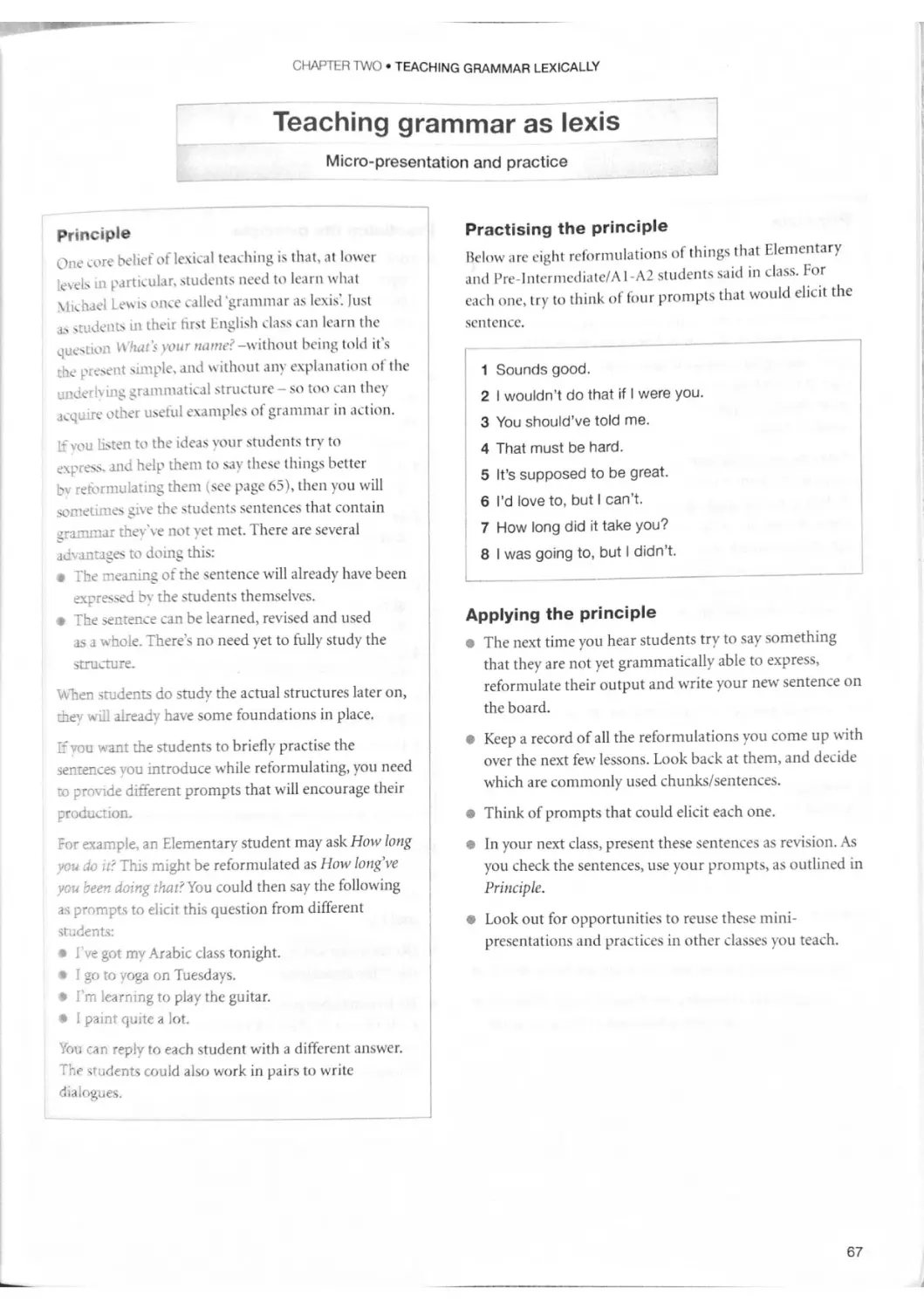
• cnuntc 3	best to restrict students exposure t
Adower,^X^
:an be presented and learned as individual items, rather than being treated
s examples of a particular structure (in this instance, the present perfect simple) that
then has to be taught in its entirety - with examples of positive sentences, negatives and
question forms, all filled with a wide range of different verbs.
It’s worth pointing out here that ‘Have you ever been to + place?’ is a generative pattern,
just as "have + subject + past participle' is. It may be less creative and limited, but it is also
grounded in common usage. Furthermore, when looking at such a pattern, the lexical
teacher might focus more on exploring language that might be used alongside it - and less
on the many different possible ways that the structure itself could be lexicalised.
We might be less concerned, for example, with using auxiliaries in short answers (Yes,
I have I No, I haven't) and more concerned with what follows a particular structure in
everyday conversation. This might means considering the range of possible responses to
the question above:
•	Yes.
•	No.
•	No never. Have you?
•	No, never, but I'd love to.
•	Yeah, quite a few times, actually
•	No but I’m thinking of going there this summer, actually.
And so on.
the grammar in on^go m°K °” d*SCOUrSe than on trYingto <cover> a11 aSpeCK°'
can be lexicalised °bV‘°Usly exPand on the range of different ways a structure
etc), but we would still nu'b>T	’H<W У°Ц eWr tr'ed it? 1 HaWy0U ever^lle" °'
structure, and continue to 1, т°Ге °П dle most common verbs used within the
explored.	° at how discourse around examples of the structure can be
In this way, a lexically
with other grammatical structW*" PerbaPs ‘endto show a structure’s interad11’1
‘hat students have already met. °ЙеП> wUI more frequently recycle structure
•Words defining
1 J'lexical teacher mayals„ d USa3e °»er rules
теПвд? аЬ°“‘’°meand “л/оГаБ* !Om'lradi,ional rules (for ™mPle'*"%
»™»ти fM1 the „eed "«rabout a)„„tabi|ity) are over ,m fiK|, jnd «
8 W “,ra «tuples th.t elarily such Otters for •"**
For more on
to draw stud<
attention to s
see pages 56
	- XSe -г a“^ —— «hen w. also use ,.w L Z T. u'""’P d"n'’ "* and verbs necessitate th.	" h 'lhe conK«“al meanings of certain nouns «ZX. Л" '"'"T ’r,idB' 'Ы1 lto " bur / dnff, i, different!. (-1 have d f "	CM”in“°us fo,ms -'	=“" drnr. 1 see (. stZingthem) °₽		 bU’ S,K'S	»' * "»™ Lexical teachers will also be aware of the fact that individual words and items tend to be frequently used with particular grammatical patterns - the phenomenon known as co ligation* - and that this has more impact on discourse than has perhaps been generally rea ised. This means we need to be aware of grammatical features such as the patterns around verbs. Гаке these sentences, for example: I expected it to be quicker. I didn't expect it to take so long. W hen we use ‘expect’ to recount surprise or disappointment, we could say that in positive sentences it tends to colligate with comparative forms, while in negative sentences it often colligates with so (or such).
For more on how to draw students’ attention to syntax, see pages 56 and 58.	A lexical view of language might mean limiting the amount of time we devote to tense- based grammar, but increasing the amount of time spent on the grammar around words, with more attention being paid to areas such as noun phrases* and to what might be described as syntax* and discourse. • Grammar is all around Finally, teaching lexically means we will often focus on all the language that’s present in exercises, and on everything that the students are trying to say. This means that in grammar exercises, we may draw attention to vocabulary, but also that we may draw attention to grammar - both ‘traditional’ and ‘lexical’ - in vocabulary exercises. It may also mean that we sometimes correct and draw attention to grammatical structures that students are trying to produce, before they have been formally taught them via their traditional grammar syllabus. Finally, teaching lexically may involve a conscious decision not to devote whole lessons to any one particular grammar structure, but it may also mean that we end up providing the students with many more encounters with grammar and many more opportunities to notice patterns than traditional approaches - where grammar and vocabulary are generally parceled up and separated - allow for. Skills: a lexical view The central importance of language We noted earlier that, over recent decades, there had been a trend in ELT towards treating reading and listening as skills that are somehow separate from language but that the X of lexical views of language suggest that poor skihs are ia.gelv the result ci SX- who can ahead, read in their own hrs. Un^be«. :::: SSSS				 words.
25
For exercises on
sound shapes and
hearing language -
see Chapter 5.
.... , he additional problems of not being able
• When listening in English, there wi	iireidv know when they are used in
to hear sounds, or not recognising words they alrc. у
connected speech.	written forms of the language, students
. If their studies have predominantly focused оw
may also just not know about more spoken form..
 .„ritren texts and can have differing grammar
Conversations are organised di cant y <	^cjent number of the kind of
» .„„у *. b< .ta.Ю ю ,Ы'.
native-like choices that Pawley and Syder refer to,
, Г •. . 1  .а П Itive speaker will not be necessary in most
Speaking like some kind о i ea is	natjve-speaker usage is still something to
situations that students wi encoun c , reading native-user texts, whether they be
consider where students may be hstenmg to °r^^g
newspapers and academic articles, or films or songs Eng
Listening and reading
, U a ,i,.Jt cimnlv doing lots of extensive reading and listening is an
»y X,	'“*• “•vo“'bulary canhb‘ “ nscfo“7 "7ei"
therefore follows tba. learning more lexis in combination with other words and gran™.,
will help improve reading and listening.
If that lexis is based on things learners may need to say while going about the business of
everyday life, or while expressing their thoughts and feelings, then there is a better chance
it will improve speaking as well as listening.
Given this, we see the way we approach all language tasks in Part В of Teaching Lexically as
an important - albeit covert, on occasion - way of improving skills. However, we do also
see a role for the kind of stages and activities that most coursebooks include in their skills
lessons. We just believe they need to include a greater focus on language.
• Pre-reading/listening
Typically, pre-text tasks are based on the idea of activating schemata*: that is, the idea that
if we somehow spark the reader's or listener s existing knowledge of a subject or language,
they will then be better able to interpret the text.
Seen from a skills perspective, such activation is enough - so, for example, if we had a
text about crime, we might get the students to think about connected ideas and language.
This could be things like bad, dangerous, stealing, murder, police, court, prison, etc. The
argument is that doing this would then allow the students to better process a text such as
this one:
A:	Did I tell you about having my bag stolen?
B:	No. What happened?
A. Well, I was er hanging about outside college waiting for a friend ... you know Jean?
B: Yeah.
A:	It was his birthday and we were going for a drink.
B:	Oh right. How old was he?
A:	23.
B:	Really? How come he's only in his first year, then?
outsi/lp и ’’	l<" '°nS s a story. Anyway, I was, I was waiting for him
directions. HH^thisbignmp У™''’	“P ‘°
^^^eheariUhis^ndof...
For more on how to
ensure language from
texts comes up during
prediction activities,
see page 87.
В: Yeah. I hey have the map to distract you and then someone else comes up and grabs your
bag.
A:	Exactly, exactly. God, I feel like such an idiot. I like put my bag down to look properly and
show him, and he makes this big show of thanking me ... and then he runs off!
B:	Oh no!
A:	Exactly. And Em like that's odd and I look down and my bag's gone.
B:	a bastard!
A:	And it was all just done in a couple of seconds, you know. I just hesitated, but he was gone.
B:	Did you tell the police?
A: Nah. It's not worth it. They can't do anything.
B:	True. Sad... but true.
A:	And even if they did catch them, they probably wouldn't do much. It doesn't even go to
court half the time.
B:	They should string them up if you ask me!
The conversation is about stealing and crime. The situation was obviously bad, and might
be seen as dangerous. They even mention ‘court’ at some point. However, we would argue
that knowing all of these words does not allow you to genuinely understand the text. To
do that, what you need is to understand and be able to hear much more of the language
and the forms used in the conversation.
Given this, at a simple level, we would say that teachers need to ‘push’ language more
during these pre-text stages and effectively pre-teach more, so, instead of simply accepting
the word stealing when students suggest it, we might then ask what people might steal
from you, and say/write something like I had my bag stolen or Did I tell you I had my bag
stolen?
For more on how to
focus on language when
checking the answers to
comprehension tasks,
see page 89.
We might also ask where and how you might have your bag stolen and (knowing the
content of the listening that’s to come) guide the students to, for example, He grabbed
my bag in the street. In other words, lexical teachers will tend to see pre-listening tasks
primarily as language teaching opportunities.
• Comprehension-checking tasks
While they read or listen, students are typically asked to try to find the answers to
comprehension questions. Often, this involves first tackling a simpler gist* task, such as
one that asks what crime happened. This may then be followed by a second task, with
more detailed questions (eg Where was he? Why was he there? How many people carried out
the robbery? and so on).
We see nothing wrong with such questions, but worry that the skills-focused teacher
will tend to mainly be concerned just with meaning. As such, in this case, the following
answers may be seen as sufficient: stole a bag I (outside) college I to meet a friend I two.
As lexical teachers, we see meaning as just a starting point. Learners need to notice and,
over time, remember the actual word combinations that were used to express meanings,
and so we might elicit answers from the students such as those above, but then rephrase
them as:
He had his bag stolen I He was hanging around outside the college, waiting for a friend /
He was meeting a friend to go for a drink I two - one who distracted him with the map and
another one who grabbed his bag.
This way, students hear the key lexis with the grammar it was used with again. Of course,
it may be the case that many of you already do this kind of more thorough focus on whole
sentences when checking answers.
27
•	Language focus	jn way> there WIn then often be some kind()f
After comprehension has bee	in many cases, th.s w,ll be a grammar
f0CUs on language used n th -donc} or a foxtcal set (maybe differeni
(in this t.ase. pe^ps that mng*	exemplified. However, there may also be an
exercise looking at words imthHexL	students to match single words with
•	The ‘grammar + words teac <•
For more on the way
words sound different
when spoken in isolation
and in streams of
speech, see page 101.
meanings.	,	,	...
•	The skills teacher might also pick out unusual words or more idiomatic items, sUch
string them up, and encourage the students to guess meanings from context.
From a lexical point of view, the problem with this is that, in asking students to guess
unusual words, paradoxically more time and energy is spent on infrequent language that
learners may never hear again - when it could be used to explore something more useful’
This is also often the case with matching words to meanings, which has the additional
problem of not drawing attention to the combinations that words are often used in.
Finally, insufficient time might be spent on how the words sounded in context, when
rapid speech might change what Richard Cauldwell (2013) has called their sound shape’
Lexical teaching tasks that focus on language are, therefore, more concerned with frequent
words and how they work in context, reusable chunks and the sounds of words in chunks.
For more on ways
of deepening the
connections that
students have with
key lexis in texts, see
pages 93 and 94.
•	Post-text talk
A skills view of reading or listening may actually lead to little interaction between
students, because the lesson is seen to be about reading or listening. Where there is
a speaking task, it will often be about the reading, or simply some kind of further
comprehension check.
A lexical view of texts would involve thinking about how texts are talked about, which
would encourage the teaching of language that the students could use to talk about texts.
It also suggests that texts should be used to encourage the students to talk about their
thoughts and feelings, and to understand more about culture.
However, because the use of texts in the classroom is also about learning language, we
need to get students to do something with that language. In this case, it might be a good
idea to get the students to do some post-text speaking, based on some of the language
from the text that may already have been focused on.
For mon
advanta
for spes
and 73.
Speaking
words and mm Г°7 T" IWS tended t0 view speaking in class as a chance to practise
Zlnal Sks "г Г a'S0 ‘°,he Cread0n of a di^< -d karate class of
particular things - advisr comphin ^b'”8 °f S°"le ChUnkS tha‘ Ыр ,earnersd°
speaking has tended to distingukh ЬегЗ™’ “ °"’	‘°
• Accuracy is focused	" ассигасУ a,ld fluency activities:
grammar - and correcting 'the !‘tU<ie"U ‘° produce particular language - words or
or pronunciation	' CP t0 USe 1Ьет' particularly in terms of form
• With fluency, the idea is to f ~
about mistakes. As such tea h mCan^ or on a tas^> and not t0 worry too much
during fluency-oriented activitT^ eiK°Ura^c^ not t0 interrupt or correct students
no connection between thp rolt^a>'s’ П has often been the case that there’s little or
B!l“ dl,“ <	«nd Ike kinds of conversions rhe
28
will have outside of class. Nor has there necessarily been much emphasis on explicitly pre-
teaching much language that may be useful during fluency activities.
Taking a more lexical view would mean seeing fluency as generally coming from knowing,
and being able to recall, appropriate language automatically. Ideally, this would involve
doing more to provide students with models* of conversations that are closer to the kinds
of discourse they may actually wish to participate in.
Unfortunately, in coursebooks that are based on a grammar + words’ view of language,
listening texts in particular are often cither thinly-disguised grammar presentations, or
else interviews/lectures that arc there just to give the students practice in listening.
As a result, lexical teachers need to be more aware of other opportunities for showing how
conversation works. One way is to consider how conversations develop vertically* and
horizontally*:
•	Vertical development can be seen in the way in which a sentence such as Гт going
to the States next month might then develop as an A-B-A-B conversation. If a sentence
such as this is present in classroom materials, teachers can explore this kind of
development by asking students for examples of typical questions or comments they
might come up with in response to it - things such as:
Really? I Why? I Where exactly? / How long are you going for? I That’ll be nice, and so on.
•	Horizontal development involves exploring the variety of ways we might add to
a comment or answer. Imagine that the following sentence appears in classroom
materials: Гт just fed up with my job. To develop this horizontally, we could elicit
ideas on what might be said next, to expand upon this statement - and then accept or
reformulate* student offerings in order to come up with things like:
It’s not going anywhere I It’s the same thing every day I My boss is awful I The atmosphere
at work is just terrible, and so on.
Each of these different comments may then lead to a different kind of A-B-A-B vertical
development. There are many opportunities for this kind of work outside of formal
speaking activities, and these can lead to students practising similar conversations, even
when not doing an explicit speaking lesson or task.
For more on how to take
advantage of opportunities
for speaking, see pages 72
and 73.
A lexical view would also see all speaking activities, including casual conversations with
students and warmers, as opportunities for teaching. This means all classroom speaking
moments should result in the teacher engaging in some kind of correction or focus on
form or reformulating language.
In this sense, we share a lot with Dogme or Task-Based Learning approaches but, as we
have already suggested, we differ in that we’re suggesting that some of the language the
students will need should be explicitly pre-taught - and not just anticipated.
Writing
Writing, from a skills perspective, primarily involves processes that good writers may go
through. For example, in a writing lesson, there is often an emphasis on some or all of the
following:
•	brainstorming ideas.
e planning what to write.
•	drafting, reading and editing.
•	getting comments from others and then redrafting.
•	(possibly) starting from scratch again!
Working through these processes is often seen as being separate from the teaching of new
29
For more on the value
of non-genre-based
approaches to writing,
see page 123.
language, with even correction being done through a system of codes aimed
students to work with their existing resources in order to create a better text
As with other skills, we would say that teaching writing lexically has less to do
abandoning these processes, and more to do with ensuring that at each stage w^
teaching and highlighting language:	e are also
•	When students are attempting a particular kind of writing, they need to see
that kind of writing. We can then highlight and draw attention to lexis and m°delsof
within the models.	^atterns
•	When brainstorming ideas, we need to try to provide phrases the students • u
rather than just single words that summarise ideas.	S 1 Use>
•	When correcting students’ work, we might reformulate and show new langua e t
will help them express their feelings and ideas more succinctly. We might ask them1
rewrite a text, as a way of doing something with this new language.
Finally, in this last respect, writing also has a more general role to play in lexical teachin
Students need to do something with the language they encounter, and this may include^
writing. Traditional teaching has often involved getting students to write their own
examples of new grammar structures or of words. We would diverge from this, in that we
tend more towards getting students to write examples based on collocations, phrases or
lexical patterns. We would also suggest the kind of texting* activities described by George
Woollard in his excellent work Messaging (2013), where students think about - and write
- what goes before and after sentences.
Naturalness, priming and non-native speakers
In terms of why and what students learn, teaching lexically means thinking about the
naturalness of what we might teach, and always teaching words with other words. It is
important to note that we talk about ‘naturalness’ - not ‘correctness’ or ‘native-like language.
Focusing on naturalness involves thinking about the reasons students learn - the
aforementioned needs to deal with the business of everyday life, and to express thoughts
and feelings. As such, it also involves thinking about why we would say something, who to
and when - or about where we would read something, or what we might write before and
after a phrase, etc.
This kind of thinking means that lexical teachers are more likely to generate additional
language that could be useful to students than to offer up rules or single words or
examples that suggest no со-text or use. Examples, therefore, may well be‘natural withov
being exactly‘correct’, in terms of what we or other native speakers might say.
This is in keeping with theories such as Lexical Priming. If our language is primed by oU
experience of how language is used, by definition everyone’s experience is unique and
everyone s English is unique: native and non native alike.
How far you want to experience native-speaker primings (including pronunciation)
converge with native-speaker usage is basically up to you and your students. We wou
simply remind you that all students want to express real meanings connected to the
lives.
I о summarise, then, lexical teaching is much more to do with how we think about
teach and what to notice than it is about activities or techniques that are right orv
30
For activities to
revise language -
see Chapter 7.
The process
Of the six stages we started with, a lexical teacher will place the greatest emphasis on
paving attention and noticing - and on repeated encounters. However, all six steps might
be summarised like this:
1	Understand meaning.
Meaning is a relatively small part of priming or how words are used, and grammar
meanings arc generally quite limited and basic, so it’s best to tackle meanings in the
quickest and simplest way possible. That is almost always translation, if it is a possible
option in your context. The key thing is to translate the whole unit of meaning, rather
than just single words.
2	Hear/see examples of the language in context.
Lots of input is vital. Learners need to hear and see longer examples, which may well
mean teachers saying examples or providing words in context and in anecdotes; extensive
reading and listening can be good, but it needs to be combined with noticing and
conscious learning.
3	Approximate the sounds of the language.
Lexical teachers will get students to repeat language in chunks or collocations, where
sound shapes might change. We will also primarily drill* things that we think the students
may hear or may want to say.
4	Pay attention to the language and notice its features.
Students need to be trained to look beyond single words. This means, as teachers:
•	We need to ask questions to generate related words.
•	We need to get students to underline or highlight words that go together.
•	We need to highlight and drill variations of chunks.
•	We need to encourage conscious memorisation of collocations and phrases.
•	We need to correct and reformulate spoken and written output, in such a way that
students become more aware of the language.
5	Do something with the new language - use it in some way.
Lexical teachers working in the General English field tend towards emphasising speaking,
as most of our students will have that as their main goal, but practice of new items could
mean drills, extended writing, the writing of dialogues, inventing examples, and so on;
and students doing something with the new language may also occur when answering
teacher-led questions.
6	Repeat these steps over time when encountering the item again in other
contexts.
We can help to ensure this happens:
•	by giving more grammaticalised and natural examples.
•	by asking about со-text and other aspects of word knowledge.
•	by drawing attention to grammar outside grammar lessons.
•	by encouraging conscious memorising and learning.
•	by repeating speaking tasks you have done in previous classes.
•	by revisiting texts you have read before.
•	by regularly doing revision activities in class.

31
Progress
Obviously, in writing this book, we are advocating a way of teaching that
quicker, that learners can more easily put to use, and that is also more moHv
However, we need to be clear that we are not claiming this is a magic bullet'^'"181
The reality of becoming a language user, whether fluent or not, is that it takes
years, if learners want to achieve anything above an A1 level! It also inevitabJS
a certain amount of somewhat boring work, particularly if accuracv is a i
• The learner
requires
we think you will see a positive change in your own classroom practice if you
more lexical style of teaching, don't expect miracles!	SWltc^ to a
• The teacher
In a similar way, we mustn't expect the change in teaching practice to be that easy
to lead to a new perfection. In his book on motivation, Zoltan Dornyei (2001) look<
the model of the ‘good enough' parent, which psychologists suggest makes for a happ°
family. He argues that for a happier working life and classroom, we too should aim to b
‘good enough’ teachers.
You may sometimes find yourself short of preparation time and fall back on old ways We
all have off-days! Maybe it’s best to try to apply one new principle every week, or every
other week, rather than every day.
You may start to notice all the things you aren’t teaching. Don’t beat yourself up about
it! None of us can teach everything. Focus on one new thing that you did teach. After a
lesson, you may sometimes think that you gave an example which was a bit weird - or just
plain wrong. It doesn’t matter: we all do it. Just think about what would be better for next
time.
Many of you will be using a coursebook which is not completely geared towards a lexical
approach, and so you may sometimes feel that your opportunities to apply the principles
we present in Part В of Teaching Lexically are somewhat limited. This might be frustrating.
We hope that this might lead you to reassess the materials you are using, and maybe seek
out something different. However, we are also realistic, and we recognise that many of
you will not have that choice. If that’s the case, just try to put a different principle into
practice: you don’t have to do them all!
And remember that, in the end, a small change may be good enough!
32
Variety out of regularity
This section is intended less as a recipe book of activities
and more as a way to develop lexical approaches to
commonly used exercises and tasks.
For us, interest comes less from using a wide variety of tasks
or teaching techniques and more from the language, and the
variety of students. Using the same material and asking the
same questions can often result in quite different responses
from different students. Following those responses can lead
to more unexpected language, which may, in turn, lead to
new teaching, new questions ... and variety!
Organisation
The chapters that follow are organised according to
traditional divisions of language and skills. There’s then a
final extra chapter on recycling and revision. Each chapter
consists of a set of key principles, and each page follows a
three-part structure: Principle, Practising the principle and
Applying the principle.
Principle
The principles often recap points made in Part A and add
some thoughts related to particular aspects of language, or
typical exercise types and tasks.
Both the chapters and principles build on each other. We
aim to cater for a variety of teachers and you may find
some are too basic. We have, therefore, also tried to present
principles so that they can be looked at in a different order,
allowing you to reference related exercises in Part В in case
you want to skip to what is most relevant to you.
Practising the principle
Here, you have a task to help you think more about the
principle in question, and to discuss how it may affect your
teaching. The reading, listening and writing sections are
accompanied by texts in an appendix. These allow us to give
examples in the Principle section, while also giving you a
new text to practise with.
There is no answer key to this section. There are often many
possibilities - and no definitive right answers. We want you
to explore what the principles mean to you and to decide
whether they suit you and your teaching context.
Applying the principle
This often repeats the task in Practising the principle, but
encourages you to apply it to your own teaching. In
addition, it may provide comments on when to try applying
particular principles in class, alongside some teaching tips
and techniques.
While we often refer to materials, these do not have to be
published materials. As you will see in Part C, we strongly
believe that writing materials is great for teacher development.
Although the task itself applies to one lesson, we hope you
will incorporate some principles as an everyday part of your
teaching. It’s up to you how this works. You might:
•	Take one principle and apply it until you’re comfortable
with it - or decide it’s not for you!
•	Try each principle in turn and see what works best for
you, before applying the best ones more consistently.
•	Only try principles that sound more relevant to your
teaching context.
•	Randomly try out a principle and work from that to
other principles that are referred to. Ultimately, you will
find that all the tasks are interrelated.
An exception to the rule
You will find an exception to the three-part approach in the
chapter on recycling and revision. Here, there are a small
number of activities that we regularly use to revise language.
33
Chapter One
Teaching vocabulary lexically
Page			Page
What’s the ‘word’?	35	Asking questions about words 5	48
Identifying units of meaning Choosing words to teach	36	Digging deeper into co-text Asking questions about words 6	49
Considering frequency Giving explanations 1	37	Ensuring your planning adds to student priming Using vocabulary exercises 1	sq
Using the target language Giving explanations 2	38	Purpose and procedures Using vocabulary exercises 2	51
Different ways of conveying meaning Giving explanations 3	39	Providing extra support Using vocabulary exercises 3	52
Going beyond the immediate context Giving good examples 1	40	Questions to practise vocabulary Using vocabulary exercises 4	53
From words to collocations Giving good examples 2	41	Other simple ways to practise Single-word exercises	54
Collocates of collocations Giving good examples 3	42	Going beyond meaning Collocation exercises	55
Stories and co-text Giving good examples 4	43	Developing both words and collocations Whole-sentence exercises	56
Words in conversation Asking questions about words 1	44	Making full use of examples Sentence-matching exercises	57
Why some questions go further than others Asking questions about words 2	45	Horizontal and vertical development Memorisation tasks	58
Matching questions to purposes Asking questions about words 3	46	Noticing and learning usage Grammar exercises	59
Exploring different aspects of word knowledge Asking questions about words 4 Asking extra questions about useful items	47	Opportunities to explore vocabulary
34
CHAPTER ONE • TEACHING VOCABULARY LEXICALLY
What’s the ‘word’?
Identifying units of meaning
Principle
As teachers, we need to give meanings of words to
students, but first we need to decide what the ‘word*
or ‘unit of meaning* actually is. Obviously, we can
confidently translate or explain some single words
like x^r/ic or dolphin. However, as we saw on page 19,
word meanings are often dependent on the other
surrounding words. Despite this, we often focus on
single words because of:
•	the word lists for a unit in a book.
•	vocabulary exercises that are based on single words.
• students asking about single words.
So, for instance, in one Pre-intermediate word list
we have the words: charity, close, coach, gang, tram
and shake. In the contexts below, we might consider
the underlined parts as the whole‘unit of meaning’
which will be relevant when translating or explaining
these words:
•	run a marathon for charity
•	my closest friend
•	Гт going to meet lohn and the gang
•	I shook his hand
•	train for the marathon
Whereas, here, we might consider the units of meaning
as follows - which may result in different translations
of the keywords:
•	1 work for a charity.
•	Our companies have a close relationship.
•	He got involved with a gang.
•	Shake the box and guess what's inside.
•	Гт training to become a teacher
By only focusing on single words, our translations or
explanations can, at worst, provide the wrong meaning.
We also feel this practice discourages our students
from noticing connected words and discourages
teachers from giving good further examples for
students to build on.
Practising the principle
•	How would you normally respond to students who ask
what the items below mean?
apply	dog	harm	come across
crash	ice	queue	miserable
•	Now look at the pairs of examples below. Decide:
О what ‘unit of meaning you would include for each
translation or explanation.
О if you think the meaning or translation of each
keyword is different to what you suggested above.
1a He’s applied for several jobs without success.
1b You need to apply the principle to your context.
2a There was a car crash on the motorway.
2b She was injured quite badly in a crash.
3a There’s no harm asking if you can go as well.
3b I think too much TV can cause harm to children.
4a The weather’s been miserable for the last week.
4b He was miserable all weekend because they lost.
5a I had to queue for ages in the bank.
5b Sorry. Are you in the queue?
6a She came across as quite weak in her interview.
6b We came across it when we were walking round
the town.
7a I usually take the dog for a walk in the evening.
7b Can you feed the dog?
8a I could really do with an ice-cold drink.
8b Careful you don’t slip on the ice.
Applying the principle
•	Look at the word list for the next unit you are going to
teach, and choose ten words you think the students may
want to know.
•	Look through the unit. Find the context each word is
used in. Then decide the best unit of meaning for each of
the words - and how you’d explain or translate them.
•	Think of one more example you could give the students
that shows the same meaning of the ‘word’. Alternatively,
do the same for vocabulary' in one or two exercises in the
coursebook you are teaching.
35
Ж»
Practising the principle
• Decide which word in each pair below is more freqUent.
1 government / apple
2 fun / serious
3 store / supermarket
4 kilo / weight
5 photography / perspective
6 sweat / dispose
7 million / football
8 regime / nest
CHAPTER ONE • TEACHING VOCABULARY
Choosing words to teach
Considering frequency

Any material will include some word^a'
frequent in corpora of general usage.
need to know these less frequent words because.
• they’re important to a particular topic.
•	they’re needed for comprehension of a story о
•	they Just happen to come up in conversation -
they’re what a student wants to say at a particular
moment.
However, it makes sense to prioritise the teaching of
more frequent words where we can, because the students
are more likely to encounter and need these words
outside the class. Over time, we may also want to:
•	test more than just the meaning.
•	ensure the students see a range of examples.
9 explore the grammar and connected language.
Nevertheless, as we saw in Part A, writers, teachers and
students may be poor judges of frequency (see page 15).
We may overestimate the frequency of words that:
•	we can easily picture/recall, but which are actually
used in fairly narrow ways.
•	fit into an easy ‘X is Y’ pattern.
We may underestimate the frequency of words that:
•	are a bit more abstract and less easily ‘pictured’.
•	don’t fall into neat lexical sets.
•	are typically used in more complex sentences and in
writing.
More frequent words will also tend to:
•	be applicable in a wide variety of settings and topics.
•	have multiple meanings.
We also need to be aware that when words have
multiple meanings, some meanings will be relatively
infrequent. We will look at how we might deal with
this in our explanations on page 39. However, for
the moment, let’s Just focus on a simple measure of
frequency.
I__________________________________________________—J
•	Check your ideas by looking up each word in a good
online learner’s dictionary. For example:
The Macmillan Dictionary:
http://www.macmillandictionary.com/ uses a star system:
*** words are the most common 2,500 words in the
language.
*	* words are the next most common (2,500-5,000).
*	words are the next most common (5,000-7,500).
The British National Corpus;
http://www.phrasesinenglish.org/searchBNC.html
Match ‘search the word/phrase’ and match by‘same
lemma’ (this counts all examples: singular and plural,
past and present, etc). This will give a frequency per
million. Anything with over about 40 matches per
million would usually be a three-starred word in the
Macmillan dictionary mentioned above.
Applying the principle
• Choose ten words from the word list of a unit or a
vocabulary exercise that you are going to teach.
• Fry to put the words in order of frequency and then
check your ideas.
Challenge an interested colleague with queries about
frequency, and keep a record of who wins!
You can also test yourself online, using the Macmillan
<hctionary’sredwordgame:
^P^^^macmillandictionary.com/red-word'gtitn^
36
CHAPTER ONE • TEACHING VOCABULARY LEXICALLY
Giving explanations 1
Using the target language
Principle
When vou provide the meaning of a word, be clear
about the context you’re dealing with. (See the activity
‘What's the ‘word’?’ on page 35.)
As discussed in Part A, the most effective way of
getting basic meaning across is translation. However,
if translation isn't possible in your context, it’s worth
thinking about other ways to explain each item.
When planning explanations, learner dictionaries are
a great aid, because the definitions use fairly simple
words. The Collins Cobuild Advanced Dictionary (2006)
has a particularly interesting way of giving definitions,
as it often uses the target word with its most common
collocations or grammar. Definitions like those below
may encourage students to notice usage. For example,
within the entry for fine,we have:
When the weather is fine, the sun is shining and it is not
raining.
A fine is a punishment in which a person is ordered to
pay a sum of money because they have done something
illegal or broken a rule.
If someone is fined, they are punished by being ordered
to pay a sum of money because they have done something
illegal or broken a rule.
As a teacher, you can improve these definitions by:
•	making use of the context of the material you are
using, or what a student has said.
•	further simplifying the definition - depending on
the level of your students.
•	giving an additional example.
For example:
If it's going to be a fine day, then the weather is going to
be nice. No rain, sunny, not loo hot.
If a company is fined, they have to pay a lot of money
because they broke some rules or a law. For example,
some UK banks have been fined millions for selling
products to people who didn't need them.
Practising the principle
•	Look at the examples from classroom material below,
and imagine a student asks What does ... mean? about
the words in bold.
•	Decide the full units of meaning for each of the words in
bold.
•	Write explanations in the ‘Cobuild’ style we used earlier.
•	Think of additional examples to clarify things, if you
think they are relevant or needed.
1	We met through a mutual friend.
2	They were accused of stealing paintings worth
over £2 million.
3	Your clothes stink of smoke.
4	We got ripped off by a taxi driver, coming in from
the airport.
5	There’s no point worrying about it now.
6	It’s just another example of people poking their
noses into things that have nothing whatsoever to
do with them!
7	He’s training to become a teacher.
8	I applied for 30 jobs before I got an interview.
Applying the principle
•	Choose 8-10 items of vocabulary that you are going to
teach. They could be from:
О the word list for the next unit in your coursebook.
О a vocabulary exercise you plan to use.
О a text you plan to use.
•	Decide the full unit of meaning for each of the words
you have chosen. If the words are taken from a word list,
you’ll need to find the examples in the unit.
•	Write explanations, in the style of the Collins Cobuild
dictionary.
•	Think of an additional example that matches the context
you would explain each word in.
37
I-----------------------------------------
Principle
Remember that when you’re conveying meaning to
your students:
• the most efficient way is generally to translate the
word or chunk in the context in which the students
are seeing it.
• If this is not possible, a simple explanation based on
the context in which the students have encountered
the word is the next best option.
However, some language can be hard to explain
through formal definitions, because the words in the
definitions will also be unknown to the student, or will
be insufficiently’ precise. For example:
She smiled at me
a chair
He left me in the lurch
Mackerel's very'good for you
In these cases, it would be better to:
•	draw the word, (smile / chair)
•	mime the word, (smile)
•	point at or show the thing, (chair)
•	show a photo from the internet, (mackerel)
< tell a (short) story or example to explain, (left me in
the lurch)
Note that:
• We can include the mime as part of the kind of
explanation we suggested on page 37:
If you smile at someone, you do this (mime).
• If the internet isn’t available and the word is too
difficult to draw, settle for a more basic explanation:
Mackerel? Ids a sea fish. It has strong taste. Ids this
shape (draw).
• An example story for left in the lurch might be:
I had to go to an important meeting one evening, and
a friend said he'd look after my three-year-old boy,
because my wife is away. The meeting was at 7 and at
6.45 he phoned to say he couldn't come. I had no time
to find anyone else. He really left me in the lurch.
CHAPTER ONE • TEACHING VOCABULARY LEXICALLY
Giving explanations 2
Different ways of conveying meaning
Practising the principle
•	Look at the examples from classroom material below,
and imagine a student asks what the words in bold
mean.
•	Decide the best units of meaning for each of the words in
bold:
О Which ones would you just give a definition for?
О Write your explanations for each.
•	For the ones you wouldn’t explain in this way, how
would you convey meaning?
О Use the ideas outlined earlier.
1	They postponed the meeting until the following
week.
2	Did you have to fill in an application form before
you started?
3	You should never click your fingers if you want to
attract the attention of the bar staff.
4	We rented a lovely little cottage out in the
countryside.
5	He was stabbed in a fight.
6	They offered me a strange drink made from
avocado juice and chocolate.
7	It’s a no-win situation.
8	I usually wear fairly casual clothes.
Applying the principle
• Choose 8-10 items of vocabulary that you are going to
teach. These could be from:
О the word list for the next unit in your coursebook.
О a vocabulary exercise you plan to use.
О a text you plan to use.
Uecide the full unit of meaning for each of the words
you have chosen. If the words are taken from a word list»
you 11 need to find the examples in the unit:
О Which of the items would you just explain?
° VVhich could be more easily drawn/mimed/pointed
to/shown in a photo/exemplified through a story’?
Think of an additional example that matches thecont^1
you would explain each word in.
38
CHAPTER ONE • TEACHING VOCABULARY LEXICALLY
Giving explanations 3
Going beyond the immediate context
Principle
So far, we have suggested that explanations or
translations should focus on the examples the students
are dealing with at that time. This usually ensures that
meaning is conveyed more clearly. 1 lowever, there
are times when you may go beyond this immediate
context. For instance, if:
• the word form your students encounter is less
frequent than another form in the same word
family.
• the usage of the frequent word they encounter is less
usual than another usage.
• different uses of a word are clearly and closely
related, even though the dictionary presents them as
separate meanings.
• you think your students will know another meaning
of the word, and you want to link them.
Look at these situations in class:
Text: You eat the core! Don't you find it a bit tough?
Student: What does core mean?
Text: Hattie analysed 60,000 studies ...
Student: What does analyse mean?
The following explanations go beyond the initial
context,but clearly connect the different uses.
The core is this (draws). It's the central, most important
part - because it has the seed (draws in). We often use
core to talk about the central, most important thing. For
example, we talk about their core business or the core
ideas or your core values.
When you analyse things or do an analysis, you do
maths or a test to find information to explain a situation.
So if you analyse studies, you might do some maths. You
might do a statistical analysis to see if a drug or policy
is effective. If you analyse blood, the analysis might
show what's causing a disease.
However, if don't you feel a single, simple connected
meaning is possible, then stick to the immediate
context. Simplicity remains the key when conveying
meaning. A grasp of complexity and subtlety will come
with exposure to words in context over lime.
Practising the principle
•	Look at the pairs of sentences below, and decide how
closely the words in bold are connected in meaning.
•	Decide which is the more frequent use (see page 36).
•	If the meanings are suitably close, think of an
explanation that clearly links the two forms or uses.
•	If you think the words aren’t connected closely enough,
just think of two separate explanations.
1a The country consumes over 50% of the world’s
aluminium.
1b After his death, I was consumed by guilt.
2a He’s clearly very ambitious and keen to get on.
2b They’ve unveiled an ambitious new plan for the
north of the country.
За I bet you were angry when you heard.
3b I’ll bet you £20 they lose.
4a They need to act fast if they want to restore
confidence in the police.
4b She’s restoring one of my old paintings at the
moment.
5a The whole administration is totally corrupt and
needs to go.
5c I don’t let them watch TV. It corrupts kids’ minds!
6a I’m the manager of three gyms in the centre of
town.
6b Don’t worry about me. I’ll manage.
7a The whole project was a miserable failure.
7b The city was great, but the weather was
miserable!
Applying the principle
•	Look at a word list for the unit you are going to study
next - or a vocabulary exercise you plan to use.
•	Find three words that have multiple meanings, and then
find collocations that illustrate them.
• Find three words that have other common forms, and
then find collocations that illustrate them.
• Think how you could give explanations that can link
meanings or forms.
39
CHAPTER ONE • TEACHING VOCABULARY LEXICALLY
Giving good examples 1
From words to collocations
_____________________________
Principle
We have already suggested that after you give an
explanation, it may help the students if you provide a
further example in order to:
•	reinforce the meaning.
•	develop the students’ awareness of other aspects of
word knowledge.
This is especially important if you are working from a
word list, or have a vocabulary exercise that’s based on
single words. A good starting point in these situations
is to provide some collocations.
You may find it helpful to look in an online learner’s
dictionary or a specialist collocation dictionary.
For instance, using these sources, we might give some
of these collocations for the word ‘efficient’:
an efficient service
an efficient way
efficient methods
extremely efficient
an efficient use of
Note that dictionaries often only present collocations
that strongly associate with another word, such as those
on the left below, and exclude words that ‘collocate
with everything’ - such as those on the right. However,
this second set is actually more frequent, and certainly
more useful at lower levels:
violent storm
storm brews
storm blows
storm lashes s.t.
a big storm
there [be] a storm
hear the storm
be damaged in the storm
Finally, note that the list of collocations we come up
with may affect the explanation we give, because we
may want to provide a very general meaning of an
item to cover all uses (see page 39). Here, for instance,
‘ambitious’ shows these things really want success - or
need effort to make them successful.
an ambitious
politician
plan
project
collocations for each of the
Practising the principle
•	Write down six common
words in the box below.
•	To get ideas, you could do a Google search:
О Put the keyword and a * for the collocate within
quotation marks. For example: “I * a crash” or “
core * .
•	Check your ideas by looking in a dictionary - or a
collocation dictionary if you have one.
О Did you miss any obvious collocates?
•	Try and find out which collocations are more frequent
by:
О doing a Google search, where you now put the actual
collocation in quotation marks. For example,“have a
crash” vs “cause a crash” vs “cause the crash”.
О using www.phrasesinenglish.org, or a different online
corpus or concordance. If you match by‘same Iemma’
rather than ‘exact word’, it will count all forms of the
words.
1 a crash 2 core	5 formal 6 government
3 provide	7 restore
4 adjust	8 virus 	I
Applying the principle
•	Choose six keywords you are going to teach in your next
lesson.
•	Think of some collocations for each keyword.
•	Try to show the students some of these collocations in
your lesson. You might do this orally, or by writing then
on the board:
О while students are doing exercises.
О when you’re going through the answers.
О when you explain a word that the students ask the
meaning of.
You might also incorporate collocations in a frequent)
challenge’ that you do with an interested colleague
(see page 36).
CHAPTER ONE • TEACHING VOCABULARY LEXICALLY
Giving good examples 2
Collocates of collocations
Principle
Many exercises in coursebooks now teach pairs of
words as collocations. This is good, but, as lexical
teachers, our aim should ideally be to give examples
that go beyond simple collocations. As we saw in Part
A, a collocational pair of words can be seen to have
collocates themselves. So if we take the collocation
efficient sendee, we could add to it the collocates:
provide an efficient service
have an extremely efficient service
introduce a more efficient service
The examples above build on an adjective-noun
collocation. Look at these other kinds of collocations:
senior staff
a car crash
blissfully happy
drive dangerously
raise taxes
the economy grows
(adjective-noun)
(noun-noun)
(adverb-adjective)
(adverb-verb)
(verb-noun)
(noun-verb)
We can add to these collocations, by thinking about
collocates to the left and right of the collocation:
retain senior staff
senior staff take responsibility for
be involved in a serious car crash
be fined for driving dangerously
raise airport taxes
The government raises taxes
the French economy grows fast
Once you have thought of your additions, you might
turn them into an example sentence. To make these
sound natural, you may have to:
•	change the tense.
•	add to the verb phrases.
You might then end up with sentences like these:
We retain senior staff well.
We're struggling to retain senior staff
The French economy has grown dramatically in the last
year.
Practising the principle
•	Look at the basic collocations that focus on two-word
combinations:
О Think of two more collocates for each collocation.
О Think of collocates that are used on the left and the
right of the collocation.
e Write a sentence based on each collocational phrase that
you come up with.
•	Check your sentences sound natural, in the sense that
you can imagine when, why and by whom they might be
used - or ask a colleague what they think.
1	deep depression
2	ceasefire agreement
3	bitterly disappointed
4	flatlyrefuse
5	take a photo
6	plants grow
7	burst into tears
8	come to terms with
Applying the principle
•	Find an exercise based on collocations that you are going
to teach.
•	Try to think of at least one collocate for each collocation:
О Some may not have any obvious or useful ones, in
which case leave them as they are.
•	Think about how you could present these on the board.
This could be:
О by using an infinitive (eg retain senior staff).
О as a fully grammaticalised sentence.
•	Try to show the students some of these collocations and
sentences in your lesson. You might do this orally, or by
writing them on the board:
О while the students are doing exercises.
о when you’re going through the answers.
О when you explain a word that the students ask the
meaning of.
You might also write an additional exercise to focus on
these other collocates, either for use in the same lesson or
for use as revision in a later lesson.
41
CHAPTER ONE • TEACHING VOCABULARY LEXICALLY
Giving good examples 3
Stories and co-text
Principle
In Part A, we saw that when keywords are used within
texts, they will not only have direct collocates, but may
often also be more loosely associated with other words.
We termed these words ‘co-text'. We can access and
draw attention to co-text by thinking of‘stories' based
on the key collocations. These stories may be true for
you, or things that happened in the news, or they may
simply be imagined.
For instance, tor the collocation efficient service, we
might follow our translation/explanation with an
example from our own experience. We might tell the
students (depending on their level) something like this:
The other day, I went to a government office to register
as a self-employed person and I expected it to take ages,
but in fact the)’ were really efficient. I was given a ticket
and told to wait in a queue, but I only had to wait ten
minutes and then the registration took five minutes. It
was great.
Through this story; the students may:
•	see how efficient is used about a service.
•	revise other language they’ (half) know.
•	hear new language.
•	make associations between the old and new.
•	be better prepared to tell/understand similar stories.
In terms of how you highlight some of this language
for the students, you might:
•	just tell the story at a natural speed.
•	tell the story, and emphasise bits by raising your
voice and talking more slowly.
•	write a reduced part of the story on the board.
Here are some possibilities of what you might write:
I expected it to take ages, but they were very efficient.
The service was very efficient. I only had to wait 10
minutes.
The service was very efficient. You get a ticket instead of
having to stand in a queue.
It's very efficient now to register as a self-employed
person. It only takes five minutes.
See also page 57: ‘Horizontal and vertical development’.
Practising the principle
Look below at the collocations from various
Think of an experience you have had that’s
each of these collocations.
ex^rcises.
connectedt0
•	Write or record how you would tell each anecdote-
О They shouldn't be more than four of five lines each
or take more than 30 seconds to say.
•	Write shorter one- or two-line examples from each
anecdote that you might write on the board.
1	give a hand
2	go on a diet
3	waste money
4	a bunch of flowers
5	a training course
6	feel guilty
7	let someone down
8	overlook the river
Applying the principle
• Look at an exercise you are going to teach, and choose
two or three words that you can think of an anecdote
for - and that you think the students might have stories
about.
• Think about how you will tell your anecdotes.
• For each word or collocation, write an example with
some co-text that comes out of your story.
• Tell your anecdotes to the class. You could do this:
О when pre-teaching the words before an exercise/text
(see page 85).
о when you get to these words, while you’re checking
the answers to the exercise.
О as a model, before you ask the students to share their
own experiences based on the words/collocations.
• Try to write at least one of your examples on the board as
you tell the anecdote, or immediately afterwards.
«и* *
42
CHAPTER ONE • TEACHING VOCABULARY LEXICALLY
Giving good examples 4
Words in conversation
Principle
Words and collocations are often used differently in
conversation and in texts. For example, in a text or a
vocabulary exercise, you might see something like this:
lose the match
Sweden lost the match 3-0.
In conversation, the same item might be expressed like
this:
A:	How was the match?
B:	Oh, we lost 3-0!
Here, the collocation is spread across the exchange. We
don't say which match, and we replace the team the
person supports with a pronoun (we/you) because in
real conversation these things are usually known.
One wav to get to examples that are more typical of
spoken language is to think about paired exchanges.
Think about:
•	when you would say something.
•	who you’d say it to.
•	why you’d say it.
•	how the other person might respond.
Even for words that aren’t obviously‘conversational’,
like whale or take notes, we can still encourage the
students to think about how conversations around
them might work. There are obviously many possible
examples, but here are two:
A:	We went whale watching one day.
B:	Really? Did you see any?
A:	Did you go to class yesterday?
B:	Yeah. I took some notes. Do you want to see them?
Ask the students how they would reply:
* You might just listen to their replies.
•	You can correct their ideas and write them up.
•	You can write several possible replies.
If a keyword is in the first part of your dialogue, you
might only write the first line on the board:
A: We went whale watching one day.
See also page 57: ‘Horizontal and vertical development’.
Practising the principle
•	Look at the words in the box below.
О Think of typical two-line examples, showing how they
are each used in spoken language.
•	In the case of a collocation, remember:
О you don’t have to use all the words together.
О the collocates may be split across the exchange.
О you may even replace one with a pronoun.
1	the economy
2	efficient
3	injure
4	a blissfully happy couple
5	sort out a problem
6	restore an old motorbike
7	take sides
8	pick your brain
Applying the principle
•	Look at a vocabulary exercises in the next unit of your
coursebook:
О Are there examples given?
О Are they ones that might be used in conversation?
•	Choose three or four words from the exercise,and write
your own two-line examples following the principles
outlined earlier.
® Write these examples on the board when you teach the
words to the students.
•	Try to involve your students, in some cases by writing a
first line that contains the keyword and then asking them
for possible responses.
•	You could write one or more of these responses on the
board - or just listen to the students’ ideas.
43
! • а/
CHAPTER ONE • TEACHING VOCABULARY LEXICALLY
Asking questions about words 1
Why some questions go further than others
Principle
As wc have seen, if students are to be able to use a
word fluently, they need to know far more than just the
pronunciation, spelling and meaning. Once you have
explained and exemplified a word, a key skill is to then
ask questions about the vocabulary item being looked
at. In essence, you can't really know how much the
students are already aware of without asking questions.
Questions can:
•	test students' awareness of these aspects.
•	provide opportunities for you to teach more about
an item.
•	involve the students more in the learning process.
•	create space for student stories, queries, jokes, and
so on.
Learning to ask good questions about vocabulary items
takes time - and the next activities are dedicated to
the development of this skill. Some possible questions
about an item are better than others, as they ‘go
further’ in class:
•	Open questions* * are usually better than closed* ones
that can be answered with a simple yes or no.
•	Open questions also often allow for a degree of
surprise, in terms of the ways they can be answered.
Good questions for checking what students know/
understand about vocabulary:
•	usually include the keyword(s).
•	are impersonal and can potentially be answered by
all the students in the class.
•	aren’t about personal experiences (based on the
words) the students may have had.
•	ask about possibility, and about the most typical
usage and co-text.
•	explore different aspects of word knowledge.
•	generate connected language.
•	elicit feedback that allows you to extend learning.
Practising the principle
•	Look at live possible questions you could ask about the
vocabulary items in bold below. Decide:
О which are more open, and which are more closed.
О what answers you imagine each question would
generally elicit.
о which questions would elicit the largest amount of
connected language.
О which ones only students with specific experience
could answer.
The bus drivers are all on strike at the moment, so
you’d better get a taxi to the airport.
A If you are on strike, are you happy with your job?
В Have you ever been on strike?
C Can you think of three different reasons why
people might sometimes go on strike?
D If you are on strike, do you go to work or not?
E How might things end when workers go on strike?
We have years of experience in managing and
resolving conflicts.
A What do you think is involved in the process of
resolving conflicts?
В Are any of you any good at resolving conflicts?
C Can you think of three different situations in which
it might be necessary to resolve a conflict?
D If you need to resolve a conflict, does it mean
there’s a problem?
E What kind of skills might you have, if you’re good
at resolving conflicts?
Applying the principle
• Look at the next vocabulary exercise you're going to
teach. Try to think of one question you could ask abou
each item in the answers.
hen you teach the lesson, try asking your questions.
ecord yourself and your students if you can.
rwards, think about which questions worked best, in
terms ot generating connected language - and why.
44
CHAPTER ONE • TEACHING VOCABULARY LEXICALLY
Asking questions about words 2
Matching questions to purposes
Principle
As we saw on page 44, asking questions about the
vocabulary we're looking at can make our lessons more
interactive, and gives us the chance to see how much
our students already know about particular items. It
also allows us to then add to that knowledge, either by
working with ideas that the class come up with or else
by simply giving extra information.
Certain kinds of questions can be used time and time
again, in order to explore certain aspects of word
knowledge. We can find out about:
•	Word class*
What kind o f word is X here?
•	Word family/word formation
Do you know the verb / noun / adjective form of X?
•	Word grammar/verb patterns
Which preposition goes with X here?
What kind of verb form is X followed by?
Can you see any particular pattern connected to X?
•	Collocation
Which verb/adjective/noun/adverb goes with X here?
•	Synonyms
Can you think of another way of saying X here?
•	Antonyms
What do you think the opposite ofX is in this context?
•	Homophones*/pronunciation
How do you pronounce X in this context?
•	Connotation
Does X have a positive meaning, or a negative one?
Is X a good thing or a bad thing?
•	Register
Is X formal or informal here?
What’s a more/less formal way of saying X?
•	Co-hyponyms*
Can you think of any other (vehicles/ways of looking,
etc)?
•	Co-text
What does X involve?
Can you think of three different reasons why you
might X?
Practising the principle
•	Look at the questions that a teacher might ask about
each item in bold below.
•	Decide which aspect/s of word knowledge each question
is testing/exploring (eg: collocation, pronunciation,
antonyms, synonyms, homonyms*, homophones, word
class, register, connotation, co-text, etc).
1	Is safety an adjective or a noun?
2	So what other things can you break?
3	What other word could we use instead of go up
here?
4	What’s the opposite of losing your key? And
losing a match?
5	So is skinny a positive or negative thing to say
about someone?
6	Would you usually say moreover? What might we
say instead, then?
7	How could you finish this sentence? She’s just
popped out to ...
8	So this noun here - river bank. Anything to do
with money, do you think?
Applying the principle
•	Next time you use a vocabulary exercise in class, try to
record yourself. If you have a smartphone, this should be
easy to do.
•	Later, listen to the way you go through the answers.
О Did you ask questions as you were checking the
answers?
О What kind?
О Which aspects of word knowledge are the questions
you asked testing?
•	Look again at the exercise you taught.
О Can you now see any other questions you could have
asked?
45
CHAPTER ONE • TEACHING VOCABULARY LEXICALLY
Asking questions about words 3
Exploring different aspects of word knowledge
farM ---------- -----------------------------------------------------
Principle
As we saw on page 45, one of the key skills a lexical
teacher needs to develop is the ability to ask good
questions about vocabulary. Most typically, this will be
done whilst checking answers to vocabulary exercises
- possibly as you elicit each answer from the group.
It can also be done after you've explained, and maybe
given an extra example of, any particularly problematic
items.
For example, if we have the collocation heavy suitcase
in an exercise, we might ask some of the questions
below. Possible answers are given in brackets:
What’s the opposite of a heavy suitcase?
(a light suitcase I a light bag)
Why other things might be heavy?
(a bag / a book(s) / a box)
How else can you describe a suitcase?
(big I small I light I nice I strong)
Why might a suitcase be heavy?
I (It’s very big I It has a lot in it)
What might be the problem if you have a heavy
suitcase?
(You can’t carry it I You have to pay for excess baggage)
What might you ask someone if you have a heavy
suitcase?
(Could you help me with this? It’s very heavy)
What do you have to do with a suitcase?
(pack it I check it in I carry it)
These questions explore antonyms, collocations and
со-text. For other words, we might explore aspects
such as word form and so on.
Practising the principle
•	Think of a suitable question to ask about each t
bold below.	eni ’n
•	Write questions that test/explore how much the
know about the aspects of word knowledge mention^
in brackets after each example.
•	Think of the answers you'd expect to each question
For example:
Can I get a glass of dry white wine, please? (antonym)
What’s the opposite of dry white wine?
Expected answer: sweet white wine.
1	They’re going to elect a new leader.
(word family I word formation)
2	He’s accused of murdering seven people,
(word grammar / verb pattern)
3	Many experts contend that being fit and fat is
the exception, not the rule, (register)
4	They’re a very talkative class, (connotation)
5	We fell out last year and haven’t spoken since,
(co-text)
6	How much money does she make? (synonym)
7	I’ve read it three times.
(homophones / pronunciation)
8	The criticism dented my confidence, (collocation)
9	Put the bag in the boot of the car. (co-hyponyms)
10	It’s not like him to say a thing like that.
(word class)
Applying the principle
•	Find a vocabulary exercise you're going to use in class.
•	Decide what aspects of word knowledge it focuses on.
•	Decide which aspects are neglected, and think ot three
or four questions that you could ask about some ot the
items in the exercise:
О The questions should test/explore some of these
neglected aspects.
•	When you teach the exercise, try to ask these question,
while you're checking the answers.
46
CHAPTER ONE • TEACHING VOCABULARY LEXICALLY
Asking questions about words 4
Asking extra questions about useful items
—:  —   -----------------------—-------- ~ ”
Principle
If an item of vocabulary is worth exploring, it s often
good to ask more than one question about it. A lexical
teacher will sometimes ask connected strings of two
or three questions, in order to fully explore the way in
which an item is usually used.
For example, imagine you have elicited the answer
shown in bold below:
I did my degree in Finance and Marketing at Newcastle
University.
You might first ask:
WTiar’s the adjective form of finance?
Once you have the word financial^ you could then ask:
Which nouns go with the adjective financial?
Listen to the ideas that the students come up with:
•	Accept the ones you think are correct.
•	Reject the ones that aren’t - and, if you can, explain
why they’re wrong, by giving better ways of saying
the meanings that the students have tried to express.
You may then want to add one or two extra noun
collocates yourself - and maybe write them on the
board like this:
financial
aid
support
adviser
scandal
difficulties
problems
You can plan for this kind of thing, by checking
possible collocations in a good dictionary.
Practising the principle
•	Look at the items of vocabulary in bold below and the
examples in italics that the teacher wrote on the board,
after asking connected questions about each item.
•	Decide which questions were asked to produce each
example.
1	He’s very fit. He goes running every day.
I'm really unfit at the moment. I get out of breath
just walking upstairs.
2	It was the toughest decision I’ve ever made.
I'm so indecisive. I can never make up my mind
what to buy or wear!
3	I took out a loan to buy a horse for my daughter.
I’m still paying off my mortgage. I’ve got twelve
more years to go.
4	He was kicked out of the team because he was
always late for training.
He was kicked out of the house after his wife found
out he'd been cheating on her!
5	My dad was operated on four days ago, but he’s
already back on his feet.
She's suing the plastic surgeon who carried out the
operation.
6	I don’t really enjoy listening to recorded music on
CDs. I prefer live music.
I saw them live in Sofia last year. It was a great
concert. The support band were really good as well.
Applying the principle
•	Look at a vocabulary exercise you plan to use.
•	Choose two items that you think are worth exploring.
This might be:
О because there’s predictable connected co-text.
О because other forms of the word collocate widely.
о because synonyms/antonyms work in slightly different
ways to the items themselves.
•	Once you’ve decided on two items, think of two or three
connected questions to ask about each.
•	Predict the answers you’d expect, and what you might
write on the board as a result.
47
CHAPTER ONE • TEACHING VOCABULARY LEXICALLY
Asking questions about words 4
Asking extra questions about useful items
Principle
If an item of vocabulary is worth exploring, it’s often
good to ask more than one question about it. A lexical
teacher will sometimes ask connected strings of two
or three questions, in order to fully explore the way in
which an item is usually used.
For example, imagine you have elicited the answer
shown in bold below:
I did my degree in Finance and Marketing at Newcastle
University.
You might first ask:
What’s the adjective form of finance?
Once vou have the word financial, you could then ask:
Which nouns go with the adjective financial?
Listen to the ideas that the students come up with:
•	Accept the ones you think are correct.
•	Reject the ones that aren’t - and, if you can, explain
why they’re wrong, by giving better ways of saying
the meanings that the students have tried to express.
You may then want to add one or two extra noun
collocates yourself - and maybe write them on the
board like this:
financial	aid support adviser scandal difficulties problems
You can plan for this kind of thing, by checking
possible collocations in a good dictionary.
Practising the principle
•	Look at the items of vocabulary in bold below and the
examples in italics that the teacher wrote on the board,
after asking connected questions about each item.
•	Decide which questions were asked to produce each
example.
1	He’s very fit. He goes running every day.
I'm really unfit at the moment. I get out of breath
just walking upstairs.
2	It was the toughest decision I’ve ever made.
I’m so indecisive. I can never make up my mind
what to buy or wear!
3	I took out a loan to buy a horse for my daughter.
I’m still paying off my mortgage. I’ve got twelve
more years to go.
4	He was kicked out of the team because he was
always late for training.
He was kicked out of the house after his wife found
out he’d been cheating on her!
5	My dad was operated on four days ago, but he’s
already back on his feet.
She's suing the plastic surgeon who carried out the
operation.
6	I don’t really enjoy listening to recorded music on
CDs. I prefer live music.
I saw them live in Sofia last year. It was a great
concert. The support band were really good as well.
Applying the principle
•	Look at a vocabulary exercise you plan to use.
•	Choose two items that you think are worth exploring.
This might be:
О because there’s predictable connected co-text.
о because other forms of the word collocate widely.
о because synonyms/antonyms work in slightly different
ways to the items themselves.
•	Once you’ve decided on two items, think of two or three
connected questions to ask about each.
•	Predict the answers you’d expect, and what you might
write on the board as a result.
47
CHAPTER ONE • TEACHING VOCABULARY LEXICALLY
Asking questions about words 5
Digging deeper into co-text
Principle
On page 45, we saw that thinking about who you
might use an item of vocabulary with, when and why
you might use it, and what you might say with it can
help vou to think of better examples of language in
normal use.
Another reason why it's important to consider usage,
со-text and typical examples is that it helps you to
plan the questions you’ll then ask as you're teaching.
Imagine, for instance, you were teaching the word
"mortgage'.
Here are some questions you could ask - and, in
brackets, the answers you would expect to elicit/teach.
• So what's the verb you do to a mortgage? You go to
the bank and say that you want to МММ МММ a
mortgage? Anyone?
(take out)
• And once you've taken out a mortgage, what do you
have to do every month?
pay the mortgage / make your mortgage payments)
• And it's not just what you borrowed, but you also have
to pay something extra on top. You have to pay... ?
(interest)
• And what's the rate at the moment? Anyone know?
• So what happens if you don't pay your mortgage?
What might happen?
(the bank repossesses your property)
Asking questions like these allows stronger students to
show what they know, and also gives the teacher the
chance to take these offerings and use them to teach
more to the weaker students in the group - maybe
while also slightly improving the language suggested.
From all these questions, you might then write an
example like this on the board:
They missed their mortgage payments for six months in a
row and, m the end, the bank repossessed their house.
Practising the principle
Think of three or four questions you could ask about
each of the items of vocabulary below, in order to get
the со-text that’s often used with them.
Then decide what you might write on the board,
some of this со-text in action.
to show
1	put me off
2	have an affair
3	a scar
4	to faint
5	discrimination
6	nuclear power station
7	not make out anything at all
8	get sponsored
9	humanitarian
10	chaos
Applying the principle
• Look at a vocabulary exercise in the coursebook you’re
using.
• Decide which two items are most worth exploring, in
terms of the со-text that’s commonly used with them.
♦ Think of questions to ask about each item.
• Decide what you might write on the board.
48
CHAPTER ONE • TEACHING VOCABULARY LEXICALLY
Asking questions about words 6
Ensuring your planning adds to student priming
Principle
When planning, look at the vocabulary exercises you
are ^oing to teach. Think about which items will be
most difficult for your students - and which will be
most worth exploring, in terms of usage and co-text.
Once vou have decided this, you can decide how you’ll
explain these items, and what extra examples you
might give. You can also decide what questions you will
ask, and what co-text- extra language around the items
- vou might then teach as well.
Obviously, vou wont have time to teach everything
that the students will need to know about all the items.
This is why it’s important to be selective, and to focus
on the items which go furthest in terms of being open
to exploration.
It's also wise not to worry too much about not being
able to cover everything. Remember, one of the
ideas at the heart of the lexical priming theory is
that knowledge is always provisional - and can only
develop over time and as a result of repeated exposure.
If you can, write explanations, extra examples and
questions to ask on the actual pages of the book that
you’re using - or on copies of the material. This will
help you to remember what you planned to do, and
will allow you to get some examples up on the board
that you can then explore in more detail, when you’re
checking answers and giving feedback.
The best time to get your boardwork up is while the
students are trying to do vocabulary exercises on their
own.
Practising the principle
•	Choose the two or three items from this Intermediate
level exercise (about work and training) that you think
are most worth spending time on.
•	For each item, write explanations, extra examples and
questions to ask.
1	I sometimes have to work shifts.
2	It’s not very well-paid.
3	You have to have good people skills to do it.
4	I have a lot of responsibility.
5	You get special training as part of the job.
6	It can be very stressful sometimes.
7	It’s very physically demanding.
8	There are plenty of opportunities.
9	I basically sit at a desk all day doing paperwork.
10	He gets £60,000 a year and a bonus at Xmas.
Applying the principle
•	Look at a vocabulary exercise in the coursebook you’re
using.
•	Choose the two or three items that you think are most
worth spending time on.
•	For each item, wrrite explanations, extra examples and
questions to ask.
49
CHAPTER ONE • TEACHING VOCABULARY LEXICALLY
Using vocabulary exercises 1
Purpose and procedures
Principle
Wт iters ot material with a stated level make
mdgements about what vocabulary they think:
♦ students know» and can use in a variety of ways.
• students may partially know (perhaps the students
will know meanings, but few other aspects of word
knowledge).
•	what students won’t know at all.
The material should contain all these levels of
vocabulary knowledge. However, even then, different
students will have picked up different words, and,
while all the students may know the meaning of some
words, they will use them with varying abilities.
One of our fundamental jobs as teachers, then, is to
hnd out the limits of students’ word knowledge, so we
don't waste time simply re-teaching things the students
alreadv know. We can do this by:
•	setting speaking or writing tasks, and noticing
where communication breaks down.
•	setting reading tasks, and noticing what the students
underline or check
•	setting listening or reading tasks, and noticing
wrhich parts students misunderstand.
•	setting vocabulary exercises, and noticing the words
that students check and the items they get wrong.
•	asking questions about vocabulary, such as those we
explored on pages 44-49.
•	providing fuller examples, which may in turn
generate new language or new meanings.
e allowing the students themselves to ask us questions
about language.
We will look in more detail at the first three techniques
listed above in later chapters. In the rest of this chapter,
the focus is on exploiting formal vocabulary exercises.
We will look at different kinds of vocabulary exercises,
because different exercises allow you to find out
different aspects of the students’ word knowledge.
Practising the principle
• Bearing in mind the principle outlined opposite, think
about why you might not do each of the following
things, when running a vocabulary exercise:
-------—.
1	Spend 10 minutes introducing the exercise, and/or
eliciting words connected with the vocabulary area
2	Explain all the words in the exercise before
students do it.
3	Ask different individual students to answer each
question in the exercise in turn.
4	Sit at your desk while the students do the exercise.
5	Tell the students not to use a dictionary.
6	Make the students do the whole exercise
individually, and not allow any work in pairs or
groups.
7	Elicit or give each answer, and then move on to the
next task in the lesson.
8	Not bother doing the further practice exercise in
the book.
________________________________________________________J
• Are there any circumstances where you think it would be
good to do any of these things? Why?
Applying the principle
Next time you use a vocabulary exercise in class, do one
of the following - from when you first introduce the
vocabulary exercise to when you start the next task:
•	record yourself.
•	get a colleague to observe you.
After the lesson, think about:
•	what words or aspects of word knowledge your students
didn’t know, and how you found out.
•	how much you taught that was new to the students.
•	whether each and every student in the class was taught
something new.
•	how long the whole exercise took.
•	things you think were effective, and things you d do
differently - and why.
50

CHAPTER ONE • TEACHING VOCABULARY LEXICALLY
Using vocabulary exercises 2
Providing extra support
Principle
Essentially» vocabulary exercises are written as tests to
nnd out what students know - and don't know - about
words see page 50: 'Purpose and procedures’).
If teachers explain all the words in an exercise before
the students do the exercise, they run the risk of
spending valuable time telling some or all of their
students things that they already know.
However, as vou get to know a group, there may be
times that vou feel that some vocabulary7 exercises
have so many new words in them that it will make the
exercise difficult or very’ slow for the students to do.
One option is, of course, not to do the exercise at all, in
which case vou need to:
•	think about how this impacts on other tasks.
•	focus on other language in the texts in the book (see
chapters 4 and 5).
•	choose some other language focus, based on your
students' needs or wants.
However, if vou feel the language is useful, or for
institutional reasons you have to teach the content of
the exercise, you will need to provide help such as:
•	pre-teaching some words.
•	encouraging the students to work together, to share
knowledge.
•	allowing them additional time, so that they can use
dictionaries.
As vou go through the answers, you may also limit:
•	the words you focus on in detail (see page 49).
•	the aspects of word knowledge you explore beyond
the basic meanings (eg only focus on collocation).
Practising the principle
•	Look at the possible ways to support the students with
difficult exercises below. These are alternatives to simply
explaining the task and getting the students to do it
individually. In each case, decide:
О how much extra support the technique provides.
О how much extra time it will take.
О how easy it would be to set up and do in your context.
1	Ask the students to do the tasks in pairs or groups.
2	Explain each word in turn, and give an example.
Then ask the students to do the task on their own.
3	Demonstrate the task with the group. Give two
examples for the words you think the students
won’t know. Give the answers if they don’t know
them! Then get them to do the rest on their own.
4	Put the students in groups, and tell them to find
words in the exercise that none of them know -
and then look up the meanings in a dictionary.
5	Tell the students you’re going to say the words and
their translations. They should note any they didn’t
know. Then set the task for them to do on their own.
6	The students do as much as they can do, and then
compare their ideas in pairs.
7	Ask the students to mark words in the exercise
with a 1 (/ know and use), 2 (/ think I know),
3 (/ don’t know). Get them to compare ideas. See
which words are mainly 3s. Explain those words
only. Then set the task.
8	Set a speaking task connected to the vocabulary.
During feedback, pre-teach some of the vocabulary
in the exercise through correction.
Applying the principle
•	If you often use the techniques in Practising the principle,
next time try going straight into the exercise without
pre-teaching/support Explain the task, and then get the
students to do it on their own.
•	If you generally just go straight into an exercise:
О Choose a different technique from the list - and try it.
•	After class, consider how things went, compared to other
lessons, and if you will repeat what you did.
51
CHAPTER ONE • TEACHING
VOCABULARY LEXICALLY
Using vocabulary exercises 3
Questions to practise vocabulary
Principle
You will often find that vocabulary exercises - whether
in a coursebook or from other sources - don t provide
students with an opportunity to integrate the new
language with their existing knowledge. As we saw in
Part A, this is an essential part of learning language,
and will have to take place at some point.
We have also suggested that freer tasks - whether
directly connected to a vocabulary exercise or not -
offer you the chance to get feedback from the students
on the limits of their knowledge, so you can then
teach something new (see page 50: ‘Procedures and
purpose’).
For both of these reasons, after a vocabulary exercise it
is good to provide some kind of freer further practice,
where the students make use of the vocabulary in some
meaningful way.
One of the easiest ways to do this is to write questions
containing words from the exercise, in order to
generate a personal response. When doing this, bear in
mind these principles:
• Make the questions open or have a follow-up
question, so the students don’t just say yes or no.
For ver}' frequent words, you could base several
questions on different collocations of the word.
• Have several questions, so everyone is able to answer
at least one. Don’t expect all questions to work with
every student in every class.
• Try to make the questions about people's
experiences, thoughts or feelings - or allow them
to talk about their culture (see ‘Principles of why
people learn'on page 7).
•	If you think the questions may be too sensitive
or that your students won’t have sufficient life
experience to answer them, use starters* such as
О Do you know anyone who ...?
О Have you heard of stories in the news where...?
•	If a word is too specific - such as ‘a whale’ - give the
students an option or follow-up question that allows
them to talk about co-hyponyms (in this case,‘other
animals’)
Practising the principle
•	Look at the practice questions below, based on the words
in bold. The words are at a variety of levels.
•	Try to answer them, either with a colleague or just by
thinking about what you’d say in response to each one.
• Then decide:
о how much language each produces.
О if they follow the criteria in Principle.
О if you could improve any of the questions in any way
- or think of completely different questions that
would be more productive.
1	Do you often put things off?
2	Do you know anyone who could do better for
themselves? In what way?
3	What improvements could be made in your
education system? Explain why and how.
4	When did you last see a play?
5	Have you ever given a presentation? Where?
Who to? What about? How did it go?
6	Have you ever been treated by a paramedic?
What happened?
7	When did your favourite team last win?
8	Do you think sending people to prison is always the
best punishment for crimes? Why? / Why not?
Applying the principle
•	Either choose a vocabulary exercise from your
coursebook, or choose 8 words from a unit word list.
•	Write questions to help the students practise the
language.
• Do them in class. You can:
О write them on a IWB/Powerpoint before class.
О copy the questions, and hand them out in class.
О dictate the questions to the students in class.
52
CHAPTER ONE • TEACHING VOCABULARY LEXICALLY
Using vocabulary exercises 4
Other simple ways to practise
Principle
We have already seen that getting students to discuss
questions is one wax to practise vocabulary in a
personal» meaningful way. There may be more, but we
personally use a limited number in our teaching. We
often ask students:
• To say which of the things in the exercise they do/use.
•	To use the words to talk about, for example, cuisine
in their country or an accident they had.
•	Which of the things in the exercise are good/bad.
Why?
•	Which thev like/don t like. Why?
•	Which ot the things in the exercise have happened
to them.
•	To give real examples of the things in the exercise -
and say something more about each.
•	To write examples sentences that are true for them.
•	To describe X with these words. Their partners
should guess what X is - or draw it.
•	To roleplay one or more particular situations, using
the phrases.
•	To look at the statements using the vocabulary, and
say if they agree/disagree.
Whatever practice activity you choose, check:
•	you can do it yourself!
•	what specific words are being focused on - or which
items you think will generate more language.
•	what other language is being generated.
This should give you a better idea about what words to
spend more time on during the feedback. For example,
if the exercise is "names of foods’ and the practice is to
‘talk about foods you like or dislike’, you might ask
‘concept-checking questions*’ such as ‘ Why might
someone not eat pork?’ or ‘ Why might someone like
oranges?’ or give examples such as 7 love oranges -
I love anything sweet’. These will support the students
when they do the practice and talk about themselves.
Thinking about what language you would use in the
practice activity will also help prepare you to give
feedback on what your students actually say (see the
chapter on ‘Teaching speaking lexically’ on pages
71-81).
Practising the principle
•	Look at the words and phrases in the box below. Choose
two different activities you might set to practise them
(including asking practice questions - see page 52).
•	Try to do the task you thought of yourself - either in
your head or with a colleague - to check it works.
•	Note what additional language is generated.
•	Think about the concept-checking questions and/or
examples you might use during feedback on the exercise
that presents this language (see pages 44-49).
competitive	have responsibility
be under pressure	creative
rewarding	work in a team
do paperwork	dull
insecure	be involved in planning
Applying the principle
•	Look at the next vocabulary exercise that you are going
to use.
•	Decide if you will use the follow-up practice task, if there
is one, or, alternatively, if you’ll write your own (see the
questions on page 52, or choose a task from this page).
•	Think about the language that might be generated.
•	When you do the feedback to the initial exercise, try to
ask two or three questions or give examples that will help
your students to do the practice.
53
CHAPTER ONE
TEACHING VOCABULARY LEXICALLY
Single-word exercises
Going beyond meaning
Principle
Coursebooks often feature exercises that focus on
single words. For example:
•	Match the word to the definition/translation.
•	Match the word to a picture (or label the picture).
•	Sort the words into different groups (eg transport or
clothes).
• Decide if the words are X or Y (eg for men or
women/positive or negative).
•	Choose the odd word out in each group.
•	Change the verbs into nouns (or some variation on
word-building or word families).
•	Match the words to synonyms.
•	Match the words to their opposites.
The majority of these exercises only focus on meaning.
Even where exercises do focus on other aspects of word
knowledge, the students don’t get to see examples of
usage and, in the case of opposites and synonyms,
they’ may not realise these will vary, depending on
collocations, and context (see page 21). As the old joke
puts it:
I bought a new thesaurus the other day. It’s OK, but
nothing to write house about!
As we have seen in Part A, there’s a lot more to
knowing a word than the meaning, so single-word
exercises require more work from the teacher!
When checking answers to single word exercises, you
will want to at least give some collocations. You may
also want to:
•	ask checking questions (see pages 44-49).
•	give examples (see pages 40-43).
As we mentioned in ‘Other simple ways to practise’
(page 53), when going through answers, you might
spend more time on words that come up again in any
follow-up practice activity. Alternatively, if time is short,
you may focus on the most frequent items, or on the
ones that you think are most useful to your students.
Practising the principle
•	Look at the single-word exercise below. It’s aimed at pre
Intermediate/A2 students.
•	Plan the extra information you would write on the board
for each item:
О Which items can you list collocations for?
О Which can you write a whole sentence for?
О Which can you write a two-line exchange for?
О Which items would you spend most time on?
О Which would you want to practise - and how?
Match the pictures to a word:
1	scream
2	to fine
3	a raffle ticket
4	to snore
5	a scar
6	to arrest
7	angry
8	amazed
Applying the principle
• Look at the coursebook you’re using:
О How often does it have exercises that focus on single
words?
О Is this the main type of vocabulary exercise?
•	Choose a single-word exercise, and:
О decide which items are most worth spending time on.
О plan any questions you’d ask.
О plan what you’d write on the board.
О do it in class.
•	If you have longer examples, you might just say these
during the lesson and then, later, you can:
О email them to the students, so they can study them at
home.
О provide them on a printed handout.
О use them to make a revision task (see page 56 on
‘whole-sentence exercises’).
CHAPTER ONE • TEACHING VOCABULARY LEXICALLY
Collocation exercises
Developing both words and collocations
Principle
Many vocabulary materials and coursebooks now have
exercises focusing on paired collocations. Some are
similar to single-word exercises, and simply have single
collocations instead of single words. This is still an
improvement, as more words get recycled and because
opposites and synonyms work better at the level of
collocation.Other exercises have the students match
words to one or more collocates, so you get answers
like tills:
watch IV / turn the ~ on / turn the - off
a tail man ! a~ building / He '$ over six feet ~
have an argument / cause an ~1 settle the ~
With exercises that result in single paired collocations,
we can assume the students understand the basic
meaning if they have the correct answer, and we can
check bv asking for further collocates.
•	When doing this, you can ask about either word in
the collocation. It depends what you think might be
new or what is more relevant.
•	As such, we could ask:
What other things can you watch?
What other things can you do to a TV?
and / or draw on the board something like:
watch TV or watch I TV
?	?
?	?
Where there are multiple collocates, you may have to
check the students understand ones you think are new.
So, above, we might ask: Do you know what settle an
argument means? or What happens when you settle an
argument? followed by an explanation, if necessary.
As we saw in Part A, different collocations of the same
word can have quite different opposites, synonyms
and co text. It is therefore often better to ask concept
checking questions and give examples based on the
collocation rather than the single word:
What's the opposite of heavy rain?
What's the verb form of heavy rain?
What might you do if it's raining heavily?
What might happen if it's rained very heavily?
Practising the principle
•	Look at the collocation exercise below. It’s aimed at
Intermediate/Bl students.
Match the words in 1-8 with the best endings in
a-h.
1 the light	a the TV on
2 the phone	b crashes
3 the screen	c a button
4 the computer	d rings
5 press	e freezes
6 switch	f flashes
7 plug	g the machine in
8 dial	h the number
•	What other collocates can you think for each word?
•	Write a checking question for each collocation (like those
on this page, and on pages 44-49)
•	Choose the three items you would spend most time on.
•	Write sentences or exchanges (see pages 41-43) for those
collocations.
Applying the principle
Find the next exercise in your coursebook that is based on
collocation - or find a collocation exercise from elsewhere.
Do one of the following:
•	As you go through each answer in class, ask for other
collocates of one word in the collocation.
•	Then write the students’ ideas on the board in the style
you saw depicted in Principle.
Alternatively,
•	Before class, write two checking questions for each
answer in the exercise.
•	As you go through each answer in class, ask one of these
questions.
•	Write up some language you think is useful, or that will
help the students during the practice phase.
•	Give the other questions, either on a handout or written
on the board, as a revision exercise in a future lesson.
55
CHAPTER ONE • TEACHING VOCABULARY LEXICALLY
Whole-sentence exercises
Making full use of examples
Principle
Many self-study vocabulary’ exercises and a few
coursebook exercises feature whole sentences.
Most commonly, you have to complete sentences by
choosing from limited options or by finding words in a
text i see the chapters on reading and listening).
Other tasks may have the keywords in bold in the
sentences. Students then have to check the meaning
and do things such as:
•	put the sentences in the order they happen.
•	agree or disagree with the statements.
•	answer the questions.
•	match questions to answers or statements and
follow-up comments (see also page 57).
Whole-sentence exercises like this:
Сап I come in late on Friday? I've got an appointment
with the doctor.
are generally better than single-word (appointment)
or single-collocation exercises (have an appointment)
because there is usually more information about the
keyword including collocation, but also co-text and
grammar, and sometimes opposites, synonyms or
related word-forms in context.
However, while we can assume that if the students get
the correct answer to a gap-fill, they understand the
basic meaning of the keyword, they often don’t pay
full attention to this surrounding context. We would
suggest that students need to actively notice it if they
want to produce this language accurately later.
When checking the item above, you could point out:
• what kind of people you have appointments with,
and elicit other examples (dentist/accountant, etc).
•	the pattern I’ve got a... on Friday-and ask/tell the
students other nouns that could fill this slot.
•	that I've got here refers to the future.
•	that come in here means come to work, and give
more examples of the verb or of other reasons to
come in late.
We will look at other ways to exploit examples in the
rest of this chapter.
Practising the principle
• Look at the exercise below on doctor-related vocabul
It’s aimed at Upper-intermediate/B2 students. The
answers have been added and underlined
As with c
to draw a
They can
could be d
This idea c
examples tl
give yourse.
more open i
connected t<
yOU WOUld Si
1	That’s a nasty cough you’ve got. You really ought
to stop smoking.
2	Гт allergic to seafood. I get a rash on my arm after
eating it.
3	I need to pop into the chemist’s later to pick up
that prescription.
4	Are you having any trouble swallowing at all?
5	I’ll give you something to relieve the pain.
6	There’s a really nasty virus going round at the
moment.
7	I was jogging and I fell over and sprained my ankle.
8	I’m feeling so stiff today. I think I overdid it at the
gym.
• What interesting features/patterns/chunks/collocations
do you notice in each sentence?
• Plan what you’d say/ask about each item - and what you
might write on the board for each item.
•	If you were short of time, which items would you spend
most time on? Why?
Applying the principle
• Look at the coursebook you’re using, and find an exercise
that features whole sentences.
• Check the answers, and see what interesting features/
patterns/chunks/collocations you notice.
• Decide which items you’ll spend most time on.
• Plan what you’ll say/ask
will write on the board.
The
deve
turn
explc
These
• pre
don
sets.
• help
conv
• treat
instea
about those items, and what you
56
CHAPTER ONE • TEACHING VOCABULARY LEXICALLY
Sentence-matching exercises
Horizontal and vertical development
Principle
Ln the previous task on page 56, we noted that some
whole-sentence exercises actually go beyond single
sentences. In some vocabulary materials, you will find
examples of matching exercises. The matched item is
generally one of two choices:
•	A follow-up comment by the same speaker:
1 She's very' bright.
1 She's in a rush.
1 It'll be a great do.
a Everyone's going.
b She got straight As.
c The train leaves at 10.
• A response by another speaker:
1	She's very bright.
2	She's in a rush.
3	It'll be a great do.
a I can drive her to the airport.
b Is Selima going?
c So why did she fail?
These kinds of exercises fit with the idea of horizontal
development - the way one person builds a longer
turn or argument - and vertical development, which
explores how two people build a conversation.
These kinds of exercises are good, because they:
•	present со-text that the students need, but often
don’t see because they don’t fit into typical lexical
sets.
•	help the students develop awareness of
conversational and discoursal norms.
•	treat coursebook sentences as plausible messages
instead of simply discrete unconnected items.
As with other whole-sentence tasks, teachers will need
to draw attention to features within the sentences.
They can also elicit alternative ways each sentence
could be developed horizontally or vertically.
This idea can also be applied to single-sentence
examples that either appear in an exercise or that you
give yourself. You will find that some sentences are
more open to such development. This may well be
connected to how natural the sentences are, and who
you would say them to and why (see also page 43).
Practising the principle
•	Look at the single-sentence vocabulary exercise below.
It is connected to job applications and interviews. The
gap-fill element focuses on prepositions. Answers are
underlined.
1	I’m familiar with most kinds of design software.
2	I am quite knowledgeable about the history of art.
3	I’m serious about acting and drama.
4	I’m not keen on sitting behind a desk all day.
5	I’m well suited to research roles.
6	I specialised in employment law.
7	I’m very good with people.
8	I’m good at negotiating the best deals possible.
•	For each sentence, try to think of a horizontal
development - what the same speaker might say next
- and a vertical development - the response by the
interviewer and how the conversation might continue.
•	Decide which sentences were easier to develop, and how.
•	For the easier examples, try to think of one or two more
possible follow-up sentences or responses.
Applying the principle
Ф Either find a matching exercise based on horizontal or
vertical development that you are going to teach, and
then:
О think of alternative phrases to develop the initial
sentence.
О elicit alternative ideas for each item from your
students, as you go through the answers
О correct the language, and write up some of their ideas.
Alternatively,
•	Look at the next single-sentence vocabulary exercise you
want to teach, and:
o decide for which sentences you can think of several
ways they could develop horizontally or vertically.
О for those sentences only, elicit alternatives from your
students during feedback. You may need to prompt
the students with one of your own ideas.
57
CHAPERONE • TEACHING VOCABULARY LEXICALLY
Memorisation tasks
Noticing and learning usage
------------------------——_ .
Principle
Sentence or text-based vocabulary exercises are
potentially better for students, because they feature
more information about how words work. However,
as we have already suggested, students may not
actually notice the surrounding language or think
about learning it because they are so focused on the
‘gapped’ word and the whole meaning of the sentence/
text - rather than on the specific construction of the
sentence, and how it might differ from their own LI.
Teachers can help to overcome this, by:
•	asking questions about other items in the sentence
(page 48).
•	showing the chunks and giving more examples
(page 56).
•	drawing attention to grammar (page 59).
•	eliciting alternative ways to develop a sentence
horizontally and vertically (page 57).
However, we can also get the students to pay attention I
to language by asking them to spend a few minutes
trying to memorise whole sentences, or even a whole ।
exchange or text. Then, in pairs, either:
•	one student tests the other, and corrects any errors. |
• both students work together to write down what
they remember, and then compare with the original. ।
Some students may initially complain that it is
impossible to remember everything, but do persist
because:
•	there’s no learning or speaking a foreign language ।
without remembering.
•	the aim in this first instance is to make the students I
notice, rather than produce fully correct answers.
•	the exercise gives you another chance to see what
the students don’t fully know. So, for example, a
student will not need to memorise ‘depend on' if
they already know that depend goes with on.
•	you can (re-)teach points when the students finish.
*	There is more information and a variety of activities	'
on memorising language in Nick Bilbrough’s excellent
book Memory Activities for Language Learning
(Cambridge University Press).
Practising the principle
9 Look at the exercise below, connected to comparison and
contrast. The answers have been added and underlined
1	He bears very little resemblance to his brother.
2	I’m learning to appreciate the subtle differences
between the various meats.
3	Any attempt to draw a comparison between the
two situations is dangerous!
4	There’s a growing disparity between rich and poor.
5	It can be hard to strike the right balance between
technology and respect for human rights.
6	We ended up achieving the exact opposite of what
we set out to achieve!
•	Spend two or three minutes trying to memorise the
sentences.
•	Then cover the exercise, and write what you remember.
Check your ideas, and:
О note what you forgot and why.
О consider what was easier to remember.
О decide if you had enough time to memorise.
О think of hints you could give your students, as
prompts to remember or reduce the memory load.
Applying the principle
•	The next time you use a vocabulary exercise that contains
whole sentences or more, go through the answers and
give the students time to memorise the language. Then
tell them to close their books, and:
О put them in pairs to write what they remember.
О monitor and notice problems/give hints.
О get them to compare with the original.
О give feedback on any common errors.
• Alternatively, you could:
О get weaker students (with their books open) to test
stronger students.
О set the memorisation as homework and test in the
following lesson.
О do it all as a revision task later in the course.
Principle
The vast mi
strong divis
may reinfor
• vocabula
single wc
• grammai
focus on
As lexical te
down by pn
words and,'
to grammar
vocabulary t
chapter on ‘
We also wan
more about
• There ma;
new.
• Morelikel
known, ar
knowledge
this chapte
For example,
earthquakes h
the present p<
meaning of tl
ask questions
What happen
How does the.
What other pl<
What adjeetm
What other ‘nt
In feedback to
first check the
vocabulary •
• as you goth
♦ as a separat
have finishe
58

CHAPTER ONE • TEACHING VOCABULARY LEXICALLY
Grammar exercises
Opportunities to explore vocabulary
Principle
The vast majority of classroom materials maintain a
strong division between vocabulary and grammar, and
may reinforce this by ensuring that:
• • vocabulary exercises avoid grammar, by focusing on
single words or collocations.
•	grammar exercises avoid 'new’ words, and only
focus on grammar rules or forms.
As lexical teachers, we want to break these divisions
down by providing grammaticalised examples of
words and, when they do appear, drawing attention
to grammar and other features in sentence-based
vocabulary exercises. We will look further at this in the
chapter on 'Teaching grammar lexically’.
We also want to be alive to the possibilities of teaching
more about words in grammar exercise:
•	There may occasionally be words that are entirely
new.
•	More likely, there will be words that are partially
known, and we might want to extend the students’
knowledge of these - in the ways we have seen in
this chapter.
For example, in the sentence There have been many
earthquakes in California over the years, which tests
the present perfect, the students may already know the
meaning of the word earthquake. However, we can still
ask questions such as:
What happens when there's an earthquake?
How does the government usually respond?
What other places often experience earthquakes?
What adjectives describe earthquakes?
What other 'natural disaster' words do you know?
In feedback to a grammar exercise, you will obviously
first check the grammar, and then explore the
vocabulary:
•	as you go through the exercise item by item.
•	as a separate focus on two or three words, after you
have finished checking all the items.
Practising the principle
• Look at this grammar exercise below aimed at
Intermediate/Bl students. It practises the use of the
present perfect. The answers are in bold.
1	I haven’t mastered Arabic yet, but I can
communicate.
2	Have you met his parents yet?
3	I’ve seen that movie three times.
4	The army has attacked that city five times.
5	Have you ever slept in a cave?
6	She’s talked to several specialists, but nobody
knows what’s wrong.
7	You’ve been late for work too many times. You’re
fired!
8	We’ve known each other for fifteen years now.
•	Decide which vocabulary you would explore.
© Decide if you think you’ll need to explain the meaning of
any of items - and how you’ll do it.
•	Decide what other examples you might give.
© Decide what questions you’d ask about the vocabulary,
and what additional language it might generate.
© Decide what you would put on the board.
© Decide how you could practise that language.
Applying the principle
© Look at the next few grammar exercises that you plan to
use:
О Do they include any vocabulary that you could
explore?
О Remember that there may not be much.
•	Decide which items you will cover and how.
•	Focus on these words in your feedback to the exercises
when you teach them.
59
Chapter Two
Teaching grammar lexically
Page
When? Why? Who to?	61
Teaching the probable, not just the possible
Checking answers to grammar exercises 1	62
From explanations to concept checking
Checking answers to grammar exercises 2	63
Drawing attention to co-text
Getting more from exercises 1	64
Same grammar, different co-text
Getting more from exercises 2	65
Reformulating students’ ideas
Getting more from exercises 3	66
From messages to mini-texts
Teaching grammar as lexis	67
Micro-presentation and practice
Grammar in vocabulary exercises 1	68
Asking about tense usage in example sentences
Grammar in vocabulary exercises 2	69
Drawing attention to syntax
Translation and grammar	70
Overcoming the objections
60
CHAPTER TWO • TEACHING GRAMMAR LEXICALLY
When? Why? Who to?
Teaching the probable, not just the possible
Principle
As we saw in Part A, most coursebooks are still based
on a ‘grammar + words' view of language. When it
comes to giving examples of how structures work, we
believe this can cause problems because:
•	the examples won't necessarily reflect the way the
structures are actually used.
•	little or no attention is paid to the language
or patterns often used around the structure in
question.
•	the focus is generally on sentence-level
communication, while real communication occurs
mostly at discourse level.
Lexical teachers would hopefully:
•	ensure that examples of particular structures can be
used in everyday life.
•	provide examples that reflect the way the words
contained in them generally colligate or pattern.
•	recognise that grammar structures are often
restricted by lexis or by meaning.
•	think about usage beyond sentence level.
•	be aware of connected patterns and co-text.
One of the first steps towards teaching grammar
from a more lexical perspective is to be critical of the
examples given, and to try and improve them.It is
useful to consider how many of the example sentences
provided are likely to be used. To do this, we can ask:
• When would we say these sentences?
• Why - and who to?
If we are unable to easily answer one or more of these
questions, we may well need to provide different
examples. Once we have better examples, we can:
• add them as alternatives when checking answers.
• focus more on the sentences in exercises that didn't
need to be improved on, and less on those that did.
Practising the principle
Below is a table of the kind often found in the back of
coursebooks. It shows examples of many of the structures
most commonly taught at lower levels. It includes active
and passive sentences, as well as negatives and questions.
Decide:
•	which sentences — if any - seem probable to you.
•	who you would say them to. When? Why?
Add to, or change in some way, the sentences that didn’t
seem probable to you. Ensure your new examples still
illustrate the same grammatical structures, but are more
likely to actually be used in day-to-day speech.
He drives cars.	He drove cars.
Cars are driven.	Cars were driven.
He is driving cars.	He was driving cars.
Cars are being driven.	Cars were being driven.
He has driven cars.	He had driven cars.
Cars have been driven.^	Cars had been driven.
He has been driving cars.	Cars had been
	being driven.
I/You/We/They	drive.
l/You/We/They	don't drive.
Do l/you/we/they	drive?
He/She /It	drives.
He/She/lt	doesn’t drive.
Does he/she/it	drive?
Applying the principle
•	Look at the grammar tables and examples in the
reference section of the last coursebook you used.
•	Think about how many of the examples are re-useable:
о How many of them do you think your students might
actually want to say, or might hear said by others?
О Can you think of a context for them?
О Who would you say them to? Why? When?
О Can you think of any better examples?
61
CHAPTER TWO • TEACHING GRAMMAR LEXICALLY
f Checking answers to grammar exercises 1
From explanations to concept checking
Principle
When going through the answers to a grammar
exercise, it is obviously important to make sure we
elicit - or give - the correct answers. However, we need
to do more than this. If we don't, students who failed
to get the answers right may be left not understanding
why their efforts were wrong - and the class as a whole
won't get the chance to have key concepts checked and
clarified.
Given this, we need to ask questions in order to check
whether the students know why an answer is right and
whether they understand the underlying meanings of
the structures. The questions we ask when checking:
• may sometimes require a simple Yes/No response.
• may also give options (Is it x ory?).
For example, if an answer is:
It said it might rain tomorrow.
We could ask:
‘Is it certain to rain tomorrow?’
or
‘Is rain a 100% chance, or more like a 60% chance?’
The correct responses would be something like:
‘No. Only maybe.’ ‘A 60% chance.’
Many teachers learn this technique on initial training
courses, but it’s something that requires ongoing
practice to get good at, and to be able to use with ease
in the classroom.
One way to develop your ability to do this is to look at
grammar explanations in a coursebook, and turn each
one- or each part of each one- into questions.
Practising the principle
Look at the explanations below.
Write questions you could ask when going through the
answers to any connected exercises. Your questions should
check whether the students understand the basic concepts
behind each piece of grammar:
• Use Yes/No questions or Is it x ory? questions.
Explanation 1
Use comparatives (-er/more) to compare two things-
•	Add -er to one-syllable adjectives.
•	Change -y to-ier with two-syllable adjectives that
end in -y.
•	Use more before other adjectives of two syllables
or more.
Explanation 2
Use the present continuous to show that an action,
feeling or event:
•	is temporary and unfinished.
or
•	is arranged for the future.
Applying the principle
•	Look at the next grammar exercise you are going to
teach.
•	Write concept-checking questions based on the
explanations that accompany the exercise.
•	Look at the answers to the practice exercise, and decide:
О the concept-checking questions you will ask the
students.
О when you will ask them.
•	Try to remember your questions.
•	As you go through the exercise in class, elicit answers and
write the correct answers on the board.
Ask your concept question(s) as you are doing so.
62
CHAPTER TWO • TEACHING GRAMMAR LEXICALLY
Checking answers to grammar exercises 2
Drawing attention to co-text
Principle
In order to ensure that only one answer to a particular
grammar question is possible, materials writers often
(consciously or otherwise) include phrases that restrict
the possible options.
For example, the only thing in the following sentence
that forces the use of the present perfect simple
- rather than, say, the present continuous - is the
addition of the time adverbial over recent months.
Prices .... dramatically over recent months.(rise)
To take advantage of this, and to draw the students’
attention to the co-text that often goes with particular
grammar structures, a good follow-up question to ask,
once you've asked the kind of basic concept-checking
questions we looked at on page 62, is:
‘Which words or phrases show ... (the concept/rule)?’
Look at the examples below. They are taken from an
exercise aimed at Pre-Intermediate/A2-level students.
The exercise contains ten examples of the present
continuous. The students decide which refer to the
time around now and which refer to the future,
1	Гт working really hard at the moment.
‘So is this one temporary, or is it a future
arrangement?’
(temporary)
‘Good. OK. And which phrase shows Гт working
hard is temporary here?’
(at the moment)
2	Sorry I can't come tomorrow. Гт working.
And is this one temporary, or a future
arrangement?’
(a future arrangement)
‘Which phrase shows Гт working is in the future
here?’
(tomorrow)
Practising the principle
•	Match the questions (1-5) you might ask when checking
answers with the words in bold in the completed
sentences from various grammar exercises (a-e).
•	Decide what probable answers to questions 1—5 you
would expect the students to come up with.
1	What words show it’s a rule or obligation?
2	What words show it’s an opinion?
3	What phrase shows there’s a present result?
4	What word shows it’s uncertain?
5	What phrase shows that it was before getting
home?
a I might go out later. It depends if I finish my essay.
b I don’t think people should keep dogs here.
c You’re out of breath. Have you been running?
d You mustn’t bring dogs into the flats. You can be
fined, if you do.
e I don’t know the final score. The match had
finished by the time I got home.
Applying the principle
•	Look at your coursebook / classroom material, and
choose two gap-fill or multiple-choice exercises focusing
on tense or modal verbs that you will teach soon.
•	Write concept-checking questions like those outlined on
page 62.
•	Identify any words or phrases in the exercises that
reinforce the underlying grammatical concepts.
•	Write follow-up questions, where appropriate:
О Start each: What words or phrases show... ?
•	Try to remember these questions and/or write them on
your plan or in your coursebook.
•	After eliciting a correct answer to a particular question,
check the concept.
•	Then ask What words or phrases show ...?
•	You could then write the words/phrases on the board -
or ask the students to repeat them.
63
CHAPTER TWO • TEACHING GRAMMAR LEXICALLY
Getting more from exercises 1
Same grammar, different co-text
Principle
Many grammar exercises use a fairly wide range of
words to illustrate the form of a structure, and don't
usually use each of those words more than once. While
this may be good, in terms of showing how the form
is constructed, it ignores the fact that some words are
actually far more common with certain structures than
others are.
For instance, an exercise on superlatives may have only
one example of best, despite it being more commonly
used with this structure than other adjectives.
This is problematic because, as we saw in Part A when
discussing the work of Nick Ellis:
•	basic patterns may well become established in
the mind through repeated hearings of the most
frequent combinations.
•	once these patterns have been established, we are
then able to both receptively understand new words
we meet in the slots and add new items in them
ourselves.
To tackle this issue, at the end of an exercise, once
you’ve checked all the answers, you could take one
or two sentences and look at how the co-text around
them could be changed. Let’s say an exercise includes
the sentence below:
I’ve known Ben for 20 years. We were at school together.
Possible variations include the following:
•	I’ve known Rebecca for 15 years. We met when she
started working here.
•	I’ve known Karim for twenty-five years. We were in
the same class at university.
•	My friend John has known his girlfriend for six
months. They met on the internet.
Practising the principle
•	Look at the exercise below, h’s aimed at Inter mediate/^
level students, and focuses on ‘should’ve + past pank-
The answers are in italics.
•	Decide which of the examples of the structure are d\e
most common and might be exploited best.
•	Think of some extra examples. Make sure your example
keep the same grammar, but add different co-text.
Principle
A. lot of grammar v
от short responses
discourse. One w a
is to ask the stude
discourse may d<
development by.
giving the studci
gr ammar with \
• allowing the tea
understood the
1	It rained. We should’ve put up a shelter over the
barbecue.
2	You should’ve seen him. He looked ridiculous.
3	I should’ve written a shopping list. I’m sure there’s
something else we need.
4	You should’ve told me it was your birthday. I
would’ve bought you a present.
5	They didn’t do anything about him missing school.
They should’ve given him a punishment.
6	It was really hot in there. They should’ve opened a
window.
7	It’s my own fault. I should’ve listened to you when
you warned me about him.
8	I never learnl I should’ve known better after what
happened last time'.
Obviously, when
struggie to ex
broken Engli
• try to expres
which need
aren't nece
-or that Y
suggest i<?
bizarre, <
context.
This meai
• check
to say
parai
• say I’
• use
yet
id
• n
Applying the principle
•	Look at a grammar exercise you plan to teach soon.
•	Choose two examples of the structure you think are
more common and whose co-text could be varied:
О If there are no good examples, you could change one
or add your own.
If’
‘d
a
• In class, write the example(s) on the board and:
О give an example of a possible change, and show the
students the pattern.
О elicit other ideas/examples from the students.
О set up a short pair work practice where the students
have to come up with more examples, or have
conversations around the examples.
64
CHAPTER TWO • TEACHING GRAMMAR LEXICALLY
Getting more from exercises 2
Reformulating students’ ideas
Principle
A lot of grammar exercises focus on single sentences
or short responses, rather than longer stretches of
discourse. One way we can overcome these limitations
is to ask the students for their own ideas about how the
discourse may develop. Doing this also helps language
development by:
•	giving the students the chance to integrate new
grammar with what they already know.
•	allowing the teacher to see how far the students have
understood the grammar and its contexts of use.
Obviously, when you ask students for ideas, they may:
• struggle to express their ideas, and either use very
broken English or fall back on LI.
•	try to express ideas which you understand, but
which need to be rephrased using structures that
aren't necessarily being looked at at the present time
- or that haven't yet been formally studied.
•	suggest ideas which are either wrong or rather
bizarre, and unlikely to be said about the given
context
This means that you may well need to:
•	check you understand what the students are trying
to say. Use LI if possible, or ask questions in L2 and
paraphrase*.
•	say/write improved versions of the students’ ideas.
•	use some structures/lexis that the students have not
yet formally studied, if they express the students’
ideas.
•	make judgments about naturalness or probability.
♦	reject some suggestions.
If your reformulation does lead to you introducing
difficult’ grammar or vocabulary, it’s really not
a problem because the students themselves have
already provided the meanings, and can then learn
the sentences/chunks you provide without having to
analyse the underlying grammar structures (yet).
Practising the principle
Look at two examples that teachers have decided to explore.
In each case, you can also see students responses. For each
response, decide:
•	if you would accept it as it is, reformulate it, ask
questions about it (if so, which questions?) or reject it.
•	what - if anything - you would write on the board as
part of your reformulation.
1
A:	Have you ever been to the UK?
B:	No, I haven’t.
The teacher asks: ‘What could you say here after No,
I haven’t? Any ideas?’
Student 1: Have you been?
Student 2: It’s great.
Student 3: How is it like?
Student 4: It’s a place not my taste.
2
I can’t come on Thursday. I’m going to Liverpool.
The teacher asks: ‘What else could you say here,
apart from I’m going to Liverpool? Anyone?’
Student 1: I’m having an exam.
Student 2:1 make appointment my friend.
Student 3: I’m sleeping.
Student 4:1 must to work lately.
Applying the principle
•	Look at a grammar exercise you plan to teach soon.
♦	Choose two sentences you think could be developed.
•	In class, give an example of a possible development, and
then ask the students what could be said instead.
•	Listen to students’ ideas and accept, reformulate or reject,
as appropriate. Remember that you may sometimes need
to seek clarification.
65
J
cl4APreB™o-’»“,NO GRAM“*" LEX'CALiy
Getting more from exercises 3
From messages to mini-texts
Principle
As we have seen, grammar exercises often tend to focus
on single-sentence‘messages. On page 57, we lookc at
how we can encourage students to add comments after
example sentences. However, we can also think about
broader contexts for sentences.
In his book Messaging: Beyond a Lexical Approach in
ELT (2013), George Woolard suggests a central role for
an activity that he calls ‘texting’. Woolard claims that
the main goal for learners is to be able to create texts,
which he defines as series of linked messages. He adds
that ‘we are more likely to remember a message as part
of a larger text just as we are more likely to remember
a word when it is contextualised in an appropriate
example of use’.
To ‘text’the messages that grammar exercises provide,
take a sentence, and write what you think was said
both immediately before and after. This may mean
embedding the sentence within a longer turn by one
speaker, or treating it as part of a dialogue between two
people.
Note that you will find it difficult to do this with
some sentences, as they may have been written solely
to exemplify a grammar structure - with no thought
being paid to whether or not they could potentially be
used in everyday discourse.
practising the principle
I ,ok at the exercise on the use of articles below. Deci(lc
which sentences best lend themselves to being texted. in
other words, for which ones can you most easily think what
was said before and after?
F >r the sentences you do choose, write examples of what
y‘u think could be said before and after:
•	To make your texts sound natural, you may find that yo<1
need to make small changes to the original sentences
(such as replacing a word with a pronoun).
•	This is something you can draw your students’ attention
to when they write their own texts.
1	My sister is married to a German. He’s a doctor.
2	We go to the cinema about once a week.
3	Who’s the guy by the door?
4	Did you remember to lock the door?
5	I usually leave work around 6.00 and get home at
7.30.
6	Women are normally less aggressive than men.
7	He has a beard and lovely blue eyes.
8	What a lovely day! We should go to the park.
If you find you’re struggling to add before and after
messages to sentences in an exercise:
• either choose the sentences which seem easiest to
you.
• or, in class, put the students in pairs and encourage
them to choose two or three sentences to text.
Go round and help the students:
•	Let them use dictionaries.
•	As they are writing, correct any errors and
reformulate their ideas into better English.
Applying the principle
♦ Look at the next grammar exercise you plan to teach that
is based on single sentences.
•	Look at each sentence, and decide which could most
easily be turned into a text by adding‘before’and‘after
sentences:
о If you feel only a few are easy to use, then choose those
lor the students to do in class.
° И all the sentences can be ‘texted’, let the students
choose the two or three they’d most like to use.
•	Put the students in pairs and get them to write their
before/after sentences. Go round and help.
When the students have finished, they can read out
their texts to each other, or act them in pairs if theyare
dialogues.
66
CHAPTER TWO • TEACHING GRAMMAR LEXICALLY
Teaching grammar as lexis
Micro-presentation and practice
Principle
One core belief of lexical teaching is that, at lower
levels in particular, students need to learn what
Michael Lewis once called grammar as lexis'. Just
as students in their first English class can learn the
question What's your name? -without being told it's
the present simple, and without any explanation of the
underlying grammatical structure - so too can they
acquire other useful examples of grammar in action.
If vou listen to the ideas your students try to
express, and help them to say these things better
bv reformulating them (see page 65), then you will
sometimes give the students sentences that contain
grammar they've not yet met. There are several
advantages to doing this:
•	The meaning of the sentence will already have been
expressed by the students themselves.
•	The sentence can be learned, revised and used
as a whole. There’s no need yet to fully study the
structure.
When students do study the actual structures later on,
they will already have some foundations in place.
If vou want the students to briefly practise the
sentences vou introduce while reformulating, you need
to provide different prompts that will encourage their
production.
For example, an Elementary student may ask How long
you do it? This might be reformulated as How long've
you been doing that? You could then say the following
as prompts to elicit this question from different
students:
• I've got my Arabic class tonight.
* I go to yoga on Tuesdays.
•	Tm learning to play the guitar.
•	I paint quite a lot.
You can reply to each student with a different answer.
The students could also work in pairs to write
dialogues.
Practising the principle
Below are eight reformulations of things that Elementary
and Pre-1 ntermediate/A 1-A2 students said in class. For
each one, try to think of four prompts that would elicit the
sentence.
1	Sounds good.
2	I wouldn’t do that if I were you.
3	You should’ve told me.
4	That must be hard.
5	It’s supposed to be great.
6	I’d love to, but I can’t.
7	How long did it take you?
8	I was going to, but I didn’t.
Applying the principle
•	The next time you hear students try to say something
that they are not yet grammatically able to express,
reformulate their output and write your new sentence on
the board.
•	Keep a record of all the reformulations you come up with
over the next few lessons. Look back at them, and decide
which are commonly used chunks/sentences.
•	Think of prompts that could elicit each one.
•	In your next class, present these sentences as revision. As
you check the sentences, use your prompts, as outlined in
Principle.
•	Look out for opportunities to reuse these mini-
presentations and practices in other classes you teach.
CHAPTER TWO • TEACHING GRAMMAR LEXICALLY
Grammar in vocabulary exercises 1
Asking about tense usage in example sentences
---------------------------------------------
Principle
As we saw in Part A, one of the problems with a more
traditional ‘grammar + words + skills’ approach to
materials writing is the tact that when words are
presented, there’s often little attention paid to contexts
of use or the typical co-text that occurs around the
words. As a result, students are not always given the
chance to see how words colligate: they tail to learn
more about the typical grammar that often connects to
words in texts.
Nevertheless, an increasing number of vocabulary
exercises do feature whole sentences or even short
dialogues for the students to complete with specific
items. Where this is the case, teachers have the
opportunity to ask questions about what tense
particular sentences are in - and why:
• This helps to keep the basic underlying meanings of
many of the core structures of the language fresh in
the students' heads.
• It also ensures they’re still studying grammar, even
when the main focus is on vocabulary.
In some instances, there may only be one or two tenses
featured in an exercise, but it’s still worth asking about
each of these at least once.
When going through the answers to exercises, you can
just ask What tense is this here? Why? Alternatively, you
could ask the kind of concept-checking questions we
saw on page 62. This may work better with lower levels.
Practising the principle
• Look at the vocabulary exercise below. It’s aimed at
Upper-Intermediate/B2-level students, and focuses on
adverbs and adverbial phrases. The answers have been
added in bold. Decide which sentences would be best to
ask the questions Which tense is used here? Why? about
• Think about the answers you'd expect from your
students - and any (brief) explanation you might give to
explain why particular tenses are used.
1 As he was coming round the corner, he was hit by
a car. I immediately ran over to see if he was OK
2 My friend Robert really loves Italian food and
culture. Surprisingly, though, he has never been
to Italy.
3	I looked into my bag and realised I’d left my wallet
at home. Fortunately. I had my cash card with
me.
4	Detectives searched the area for ages. Eventually
they found the evidence they were looking for.
5	I found out today that I didn't get that job I applied
for Obviously, it was a big disappointment.
6	I was called into the boss’s office and was told that
I'd lost my job. Weirdly enough. I didn’t feel that
upset about it!
Applying the principle
• Look at a vocabulary exercise that you plan to use soon.
Does it include any examples of different tenses that you
could ask about? Remember that there may not be many.
• Decide which sentences you will ask about, and think
about the answers/explanations you would expect.
• Try to remember your concept-checking questions and
explanations. In class, ask why each particular tense is
used, and then give your explanations if you feel further
clarification is needed.
CHAPTER TWO • TEACHING GRAMMAR LEXICALLY
Grammar in vocabulary exercises 2
Drawing attention to syntax
Principle
In the 'Teaching vocabulary lexically' chapter,we
suggested ways of asking questions that both checked
meaning of vocabulary and generated connected
language (see pages 44-49). You can also encourage
students to notice more, and to pay more attention
to, aspects of grammar around words by asking more
closed and directed questions. For example:
•	What preposition follows X?
•	What verb form follows X? -ing or infinitive?
•	Why do we use much - not many - here?
•	Why do we use were here - not was?
•	Is X a noun or a verb here? How do you know?
As you are asking questions like this, you might want
to tell the students not to look at their books. You
can also read out some sentences from an exercise,
but leave out key grammatical words. These may be
prepositions connected to particular adjectives or
nouns, auxiliary verbs or modal verbs, or particular
forms of certain words - noun forms, adjective forms,
etc.
Instead of saying the words you're leaving out, simply
say МММ - or say one МММ for each missing
syllable.
For example, if two of the sentences are these:
We go back quite a long way.
They’re always there for each other.
You can say:
We go back МММ a long way.
They're always therefor МММ MMM-MMM.
See if the students can say the missing words.
You can also use one of the memorisation tasks that we
looked at on page 58.
Practising the principle
•	Look at the completed vocabulary exercise below. It’s
aimed at Upper-Intermediate/B2-level students, and
explores the meanings and uses of some words that have
the same form in different word classes. The answers
have been added in bold.
•	Decide which syntactical features you would ask about
or replace with МММ - and what questions you’d ask
about each one. Don’t choose the words in bold!
1	I can’t bear him! He never stops talking about
football.
2	My daughter carries her teddy bear with her
wherever she goes.
3	Ask her. I’m sure she won’t mind if you leave a bit
early.
4	You paid £300 for that? You must be out of your
mind.
5	That shirt doesn’t fit you very well. It’s a bit too
small for you.
6	She goes to the gym five times a week. She’s really
fit.
7	Of course I’ll be there. I wouldn’t miss it for the
world.
8	I’d give it a miss if I were you. It’s not very good.
Applying the principle
•	Look at a vocabulary exercise you plan to use soon.
•	Decide which syntactical features in which sentences you
want to ask about or replace with МММ.
•	Think about the questions you will ask about each one.
•	As you’re going through the answers to the exercise,
focus on some of these other features.
69
CHAPTER TWO • TEACHING GRAMMAR LEXICALLY
Translation and grammar
Overcoming the objections
Principle
Some people object to the use of translation in EFL
classes. They claim:
•	students need to learn to ‘think in English’.
•	ideas can be translated in too many different ways.
•	it encourages word-for-word translation, which
doesn’t work.
•	it can't be done if the teacher doesn’t speak the LI of
all the students in the class.
However, all of these objections can be countered:
•	All learners refer to LI in their heads, and it can be
useful to make this process visible and to discuss it.
•	A range of possible translations is often normal,
and may simply reflect personal choices. Teachers j
can usually tell whether or not meaning has been
grasped.
•	Translating word for word from English can help
the students appreciate how English sounds in their
LI.
•	Translation can make students more aware of the
way grammar and words operate differently in LI
and L2.
•	Even where you don’t know students’ LI, if you see
them struggling or debating translations, it can alert
you to the fact that further explanation/examples
may be needed.
•	Where the students have translated from LI into
English, the discussion is about how correct the
English is, meaning knowledge of their LI is not
absolutely necessary.
Practising the principle
Think about why you you might do each of the folloy^
things:
1	Ask the students to translate a grammaticalised
chunk (e.g. How long’ve you been doing that?) into
I their LA.
2	In a multi-lingual class, get the students who share
an L1 to translate some sentences together. Ask
them about any disagreements they may have.
3	Ask the students to translate sentences into LA and
to then translate back into English, possibly after
a period of time. The students then compare their
English sentences with the originals, and discuss
the reason for any differences.
4	In multi-lingual classes, ask the students to translate
sentences from a grammar exercise into LA on a
separate piece of paper. They should number the
! sentences. In pairs:
I о Student A then asks for a sentence from the
। I exercise.
о Student В tries to say the English, using their
translation.
о Student A corrects, where necessary.
5	Ask the students to translate sentences word for
word into LA. Tell them these translations will sound
strange and that, if there’s no direct equivalent, they
can simply use the English word.
6	In a monolingual group where you speak the
students’ LA, put students in pairs and tell them to
decide on the best translations of certain sentences.
Then check the ideas with the whole class.
7	Put the students with others who share their LA
and get them to do a speaking task in LA first, and
to then translate some of the things they were trying
to say.
Applying the principle
•	Either look at an exercise that you plan to use soon, or
write a collection of between hve and 10 sentences taken
from exercises you have taught recently.
•	Then use one of the techniques outlined above inyoW
next class.
70
Chapter Three
Teaching speaking lexically
’L
Page
Before students speak	72
Understanding exercises by clarifying goals
Preparation	73
Ensuring the students speak
Scaffolding speaking tasks 1	74
Predicting language
Scaffolding speaking tasks 2	75
Modelling tasks
Feedback on speaking 1	76
Cheating!
Feedback on speaking 2	77
Engaging the students
Feedback on speaking 3	78
Correcting students’ mistakes
Beyond correction	79
Putting emergent language to use
Chat	80
Further opportunities to develop speaking
From speaking to materials:	81
Backward design
71
CHAPTER THREE • TEACHING SPEAKING LEXICALLY
Before students speak
Understanding exercises by clarifying goals
Principle
In general, speaking tasks in classroom materials aim
to get students to do at least one of the following:
•	Break the ice at the start of a course, or warm up at
the start of a lesson.
•	Practise a specific grammar point.
•	Practise specific vocabulary.
•	Practise a specific interaction - usually functional -
containing a mix of specific phrases and grammar.
•	Generate interest in - and ideas about - the content
of a reading or listening text.
•	Share opin ions/responses to texts.
•	Simply practise speaking, and develop fluency.
To achieve these different aims, tasks vary a lot in terms
of how much they allow the students to bring their
own messages to the task and to use whatever language
they want.
As lexical teachers, we feel all speaking has the
additional purpose of providing teachers with feedback
on what the students know/don’t know, and gives us
the opportunity to teach something new. So the more
controlled a task is, the narrower the range of feedback
we receive from the students.
We also believe speaking tasks should relate to the
reasons the students learn English, as discussed in Part
A: dealing with everyday life, exchanging ideas and
feelings and understanding others’ cultures.
It is good to look at all the speaking tasks, not just in
one lesson but in a whole unit, and to understand their
purpose, their content and how controlled they are.
This can help you make decisions about how to model
tasks, how to exploit feedback and whether to change
anything. You may ask questions like these:
•	Can I teach some language that will be useful later?
•	If I teach some language now, will there be later
opportunities to recycle and expand on it?
•	Are there enough less-controlled tasks? How could I
change a task, or where could I add freer tasks?
•	Are there enough tasks that ask about the students
themselves? If not, how could I change this?
•	Where tasks are freer, what would I say here? What
language might my students want to use?
Practising the principle
• Look at the speaking tasks from a unit on work '
Pre-intermediate/A2 students. For each task, decid^^
О i .	.i_-._i_.t_--
О
what you think the purpose of the task is.
how controlled the tasks are - and what kind of
feedback you might get from the students.
О how far the tasks relate to the reasons for studyi
outlined in Principle.
•	What is your overall opinion of the balance of the tasks?
Would you want to change anything?
1	The students discuss what they think is the worst
thing about a job they read about.
2	Students say sentences about a job using phrases
just taught (/ work in a hospital, I have to get up
early, etc). Their partner tries to guess the job.
3	Using prompts to help them, the students ask
Do you have to ...? questions about their lives.
They then decide who has the easiest life.
4	The students listen to a recording, and discuss
if the speakers used their time well or badly -
and how good the students themselves are at
managing their time.
5	In pairs, the students read different information
about a job. They then ask each other present
simple/continuous questions, based on prompts.
6	The students discuss some questions, such as
Have you ever had an interview?, based on have
collocations (have ...an argument I a party I a
qualification I lunch break, etc).
7	At the start of the lesson, the students discuss
three questions about when they work and study.
8	In pairs, the students read four scenarios where
they need to apologise, give reasons or promises.
They then act out the scenarios.
Applying the principle
•	Look at the next unit in your coursebook.
♦	Find all the speaking activities, and do the same as in
Practising the principle.
•	Discuss your ideas with a colleague if you can.
72
CHAPTER THREE • TEACHING SPEAKING LEXICALLY
Preparation
Ensuring the students speak

Principle
As we have seen, there are a number of reasons for
students to speak in class - the primary one being to
provide opportunities for new teaching and learning.
Sometimes, a traditional 'grammar + words 4- skills’
approach fails to provide enough opportunities for
interaction, as speaking is seen as separate to the
teaching and the learning of language and is often
just the final task in a lesson. In more traditional
classrooms, teachers may lecture, and only allow
speaking to take place through them - and often only
via 'display' questions* that check the students have
been listening.
A lexically taught lesson would aim for more frequent
speaking opportunities, both between the students
and in interactions with the teacher. Also, there would
ideallv be more chances for students to add their own
ideas.
Providing more opportunities is one thing, but
students still need to be able to take advantage of
them. Some students from very traditional learning
backgrounds may not see the point of a speaking
task - especially when done in pairs or groups. They
mav want to move on to 'learning tasks as quickly as
possible. It is also possible that the occasional student
mav simply refuse to speak for personal reasons.
However, far more often, the failure lies in the material
and/or the preparation for speaking. For example:
• There are too few' questions and/or:
О they are all yes/по questions.
О they are too obvious (eg ‘Say whafs in the picture").
О The students don’t have sufficient life or cultural
knowledge to be able to answer the questions.
•	The task is too open, and the students are unclear
what they are supposed to say.
•	The task requires too much language the students
don’t know, so they give up.
<	The task requires too much imagination and/or
knowledge to be done spontaneously.
•	The students don’t see the point of the task, because
it doesn’t relate to their lives and/or the language
they are learning.
Practising the principle
•	Look at the ways below that teachers may ensure
speaking activities'work’ and that the students use the
opportunity to produce language. Decide:
О which you do regularly.
О how they tackle the problems mentioned in Principle.
О if you have any other ideas.
•	The teacher models the task by giving their own
answers to some or all of the questions.
•	The teacher writes extra questions on the board.
•	The teacher gets the students to do the roleplay
in L1 first, and then helps with some translations
before they do it again in English.
•	The teacher explains the purpose of the task.
•	Before starting the task, the students write notes
and look up words they want to use in a dictionary.
•	The teacher corrects some language or teaches
something new, based on the students’ speaking.
•	The teacher does a quick tour of the class, to check
the students are doing the task.
•	Depending on the demands of the task, the teacher
encourages the students to also talk about people
they know - and not just about themselves.
•	The teacher asks questions as they go through the
answers to a vocabulary exercise. The questions
generate related language (see pages 44-49).
•	The students repeat the task with a new partner.
Applying the principle
•	Over two or three lessons with the same group, record
the learners and/or keep track of:
О how many times they get the chance to speak with
each other (in pairs or groups).
О how long they speak before you stop them, before the
first group stops, or before they go off-task.
О what language is produced.
О how open the interaction was, between you and the
whole class.
•	Decide if you would change anything next time. Would
you use a different technique from Practising the principle?
73
CHAPTER THREE • TEACHING SPEAKING LEXICALLY
Scaffolding speaking tasks 1
r--------	--------
Predicting language
Principle
We saw on page 73 that speaking tasks can fail for
various reasons. Failure is usually to do with:
• what the students are asked to do/discuss.
• the clarity of the instructions, in terms of what the
teacher expects.
•	the language the students need, to do the task.
We suggested that we could help prevent failure by,
among other things:
•	changing aspects of the task.
•	modelling the task.
•	allowing the students to plan what they want to say.
•	doing the task in LI first, and then offering help
with translation.
Finally, we suggested that it’s good to use speaking
tasks to notice what students don’t know, and to then
teach them something new so they can improve.
In order to do these things effectively, the starting
point should be thinking about exactly what you’d
say when doing the task - and what you can imagine
others (including your students) might want to say.
It is easy to assume that a task will produce lots of
language, or that the language will be what students
know or have just been taught, but then when you
actually do the task yourself, you may find that you
can’t think of much to say, and thus realise you’ll need
to change it in some way.
Alternatively, you might find that potentially there’s a
lot to say, but the students will probably be unable to
express very much in an accurate way. You might then
be able to:
• elicit or highlight some useful new language, as you
go through the answers of a language exercise or
comprehension task.
•	highlight some language, as part of a model.
•	be ready to help the students when they prepare.
•	be more attuned to what the students try and say,
and the mistakes they make.
Practising the principle
•	Look at the tasks below. Think what might be said about
each. Remember: we want at least phrases, not just single
words and a list of structures.
•	Try one or two of these methods:
О Write a list of sentences/phrases.
О Write a dialogue of‘students’ doing the task.
О Do the task with a colleague.
О Record yourself/colleagues doing the task.
•	If you don’t have much to say, how could you change the
task? Check what you would say then.
Discuss these questions:
1	Where did you grow up?
2	How do you get on with the rest of your family?
3	Has anyone ever fallen out in your family? Why?
4	How often do you eat out? Where do you go?
5	What are you looking forward to doing at the
moment? Why?
Prine
We ha
studei
is easi
quest
or pn
you r
of th<
Mod
• It
ai
b
• It
e
1:
• I
i
(
In pairs, tell stories about bad journeys you’ve had.
Explain what jobs are needed to get the tea from the
fields to your home, where it can be drunk
Applying the principle
•	Find two tasks you plan to do that should generate a
good amount of speaking.
•	Think of language that might be used to do the tasks.
Use a method from Practising the principle.
•	Notice any language that might be useful, but:
о hasn’t been taught in the lesson.
О the students probably won't know.
•	Introduce some of this language during the lesson,
through one or more of the methods in Principle (see
also page 73).
Y(
о
c
t’
t
c
(
74
CHAPTER THREE • TEACHING SPEAKING LEXICALLY
Scaffolding speaking tasks 2
Modelling tasks
We have suggested that one way we can support
students with speaking tasks is by modelling. It
is easiest to model a task that involves answering
questions, commenting on statements, telling a story
or producing some other longer stretch of speech, but
vou may also be able to model a conversation with one
of the stronger students in your class.
Modelling a task can help in a number of ways:
•	It shows the students how you expect them to
answer - for example, that you want them to go
bevond simple yes/по responses.
•	It can reinforce the purpose of the task - for
example, by emphasising the fact that you are using
language that has just been taught.
•	It can allow you to feed in some new language or
remind the students of useful language, by:
О writing key phrases on the board.
О saying key phrases with additional emphasis
(slower and/or slightly louder).
•	It gives the students some time to start thinking
about their own responses.
•	It shows you are willing to share ideas and personal
experiences, which may make the students feel more
comfortable about doing the same.
You might support your students further by asking
one or two of them for their ideas in front of the whole
class, and then helping them with any new language
they need. You can write some of this up on the board,
too.
See also "Teaching low-level classes’ in Part C
on page 137.
Practising the principle
What follows is based on a task called ‘Scars in Vocabulary
(Morgan and Rinvolucri, 1986). The task is best done with
students, but could also be done with colleagues. It helps
develop the skills of modelling, as well as responding to
students (see page 78):
•	Think of a story about a scar you have, or an accident
you once had.
•	Write down the story, and underline words/phrases
that you think would be useful for others telling similar
stories.
•	Tell the story in class. As you do, emphasise the key
language orally and/or write the language on the board
(or on a piece of paper, if working with colleagues).
•	Get one or two students to tell their own stories, and
write on the board useful words they say - or language
they could have used, but didn’t. If you’re working with
colleagues, write this language on your piece of paper.
•	If you’re doing this as a class activity, put the students in
pairs and ask them to tell their own stories.
Applying the principle
•	Find the next two speaking tasks that you plan to do in
class.
•	Write down or record the models you will give. If the
task is a series of questions, choose two or three.
•	Think about the language you will highlight, and how.
•	In class, model the task and, if appropriate, ask one or
two students for their ideas, as in ‘Scars’ above.
75
CHAPTER THREE • TEACHING SPEAKING LEXICALLY
Feedback on speaking 1
Cheating!
Principle
A central purpose of speaking activities (apart
from practising speaking for speaking’s sake) is the
opportunity it affords teachers to teach new language
or new aspects of language that the students half know.
Ideally, this teaching will come in response to specific
things that your students try to say. However, the
reality is that when students are talking in class, it
can be hard to hear much of what is being said. Even
when you are able to hear things that the students are
saying, as we suggested in Part A (page 15), noticing
gaps in their knowledge and turning this into new
input can be very difficult. Sometimes, correcting
on the spot is tricky even when listening to just one
student, and being able to note gaps in student output
and then write the language on the board in a way
that will potentially involve the whole class is a further
difficulty.
For these reasons, you might want to cheat! Rather
than using your students’ output, you can use some of
the language you predicted the students might use (see
page 74) as the basis for the feedback you give.
We would suggest that this is justifiable - and better
than giving no feedback at all on speaking tasks - for
the following reasons:
•	It allows you to revisit and check aspects of
grammar and lexis more frequently (see page 31).
•	It allows you to focus on new aspects of words you
have taught before.
•	It may allow you to reflect on more complex
language.
•	It can still provide some ‘negative evidence’, which
some say helps the learners acquire correct usage.
•	The language chosen may have actually been an
issue for some students, and thus is a response!
•	It reinforces the value of doing speaking tasks and
so, over time, perhaps encourages participation.
•	It allows you to practise writing on the board and
involving the students in feedback.
•	It may help you relax and be more able to hear the
students, if you know you already have something to
give as feedback.
Practising the principle
•	Look again at the task below (aimed at Interniediate/B 1
students) and at a possible list of things people may want
to say. Decide:
О which sentences would be best for these students
О which aspects you would focus on, and how (think
about frequency and wider use).
О any other language you would prefer to use.
------
Explain what jobs are needed to get the tea in the
fields to your home, where it can be drunk.
It could be almost any job.
Everybody connects to someone else in some way.
If you didn’t have doctors to keep everyone healthy,
there’d be no-one to work.
What about people who are directly involved?
Obviously, you need people to pick the tea.
What do you call the thing that you put the tea in?
Isn’t it all done automatically?
Don’t they have machines to do that?
You need factory workers to process the tea.
Who does that? Is it a tea company like Lipton’s, or
do you think there is another stage/a middle man?
You’d need someone to design the packaging.
You need a marketing manager to promote the
product and sales people to sell it.
You’d need truck drivers and people to transport it.
Applying the principle
•	Before your next lesson, write down some language that
you plan to introduce as feedback on the speaking tasks.
•	In class, write some of this language on the board, tor
feedback. Spread this out by writing one or two items.
О immediately after checking the students are on task.
О between listening to the students.
О just before you start feedback.
О after finishing feedback on the language you had
written up so far.
•	You can introduce this language by saying 7 heard
someone trying to say...
76
CHAPTER THREE • TEACHING SPEAKING LEXICALLY
Feedback on speaking 2
Engaging the students
principle
While we may sometimes partially ‘cheat’ by preparing
language that we are going to look at during feedback
on a speaking task, if we want that language to be taken
in we still want to check that the students:
e have understood the meaning.
<	have noticed aspects of form and structure.
•	try and relate it to their existing knowledge.
We might initially do this by:
•	gapping words in sentences we write up.
•	writing incorrect sentences for the students to
correct.
With these techniques, you can focus on different
aspects of language:
•	You can focus on grammar:
He must had something to do with it.
I haven't seen him ages.
X The economy booms. You see cranes everywhere.
In these cases, you can simply ask your students to
say the missing word or correct the mistake- and give
them the answers if they can t. You may also explain
words that some students may not know (eg crane).
•	You can focus on aspects of vocabulary:
The economy is really b. You see cranes
everywhere.
You see a lot of people smoking marijuana, but the
police turn a to it.
X Were going to make a party on Sunday.
With vocabulary, if you think the word/phrase may be
new, you will need to prompt the students by giving
the translation or some other kind of explanation.
For example: 'The economy is doing very well, it's ... ’
or 'Thepolice ignore it, they turn a (See pages 37
and 38.)
Practising the principle
•	Look at the sentences below that were prepared as
feedback on speaking done by Intermediate students
who roleplay conversations sharing good and bad news.
•	Decide how you will present them on the board — turn at
least one into an error to correct.
•	Think of the explanations (if any) you would use as a
prompt, to elicit words and corrections.
Are you OK? You look a bit upset.
My brother has got to have an operation.
I’m pregnant.
Congratulations! When’s it due?
Did I tell you I’m going to Mexico in the summer?
Did I tell you X and Y are splitting up?
Did I tell you I’ve got an interview for that job I applied
for?
My girlfriend’s dumped me.
I failed my exams.
I’ve got a scholarship to study at X.
Wow! That's great!
Applying the principle
•	Before your lesson, write down some language you plan
to introduce as feedback to the speaking tasks you’ll set.
•	Decide what aspect of the language you want to focus on:
О and how you will gap it, or what mistake to include.
О what explanation (if any) you will give.
•	In class, write some of this language on the board.(Make
sure to add an X to indicate mistakes.)
•	Introduce this language by saying: 7 heard someone trying
to say...’, and explain the part of the task it relates to.
•	Elicit corrections and language as you see fit:
о by asking the class and letting students shout out ideas,
о by nominating specific students.
(Make sure you give the students enough time to answer
before you decide to provide the answers/explanations.)
77
CHAPTER THREE • TEACHING SPEAKING LEXICALLY
Feedback on speaking 3
Correcting students’ mistakes
Principle
Anticipating things the students may want to say, and
mistakes thev might make during a task, can help
you to extend their knowledge of words, to revisit
and to encourage noticing of grammar, and to maybe
present new forms and meanings. 1 lowever, as we
discussed in Part A, there is evidence that some of
the most effective teaching and learning takes place
during communication - and in particular when
communication becomes difficult or breaks down
altogether (see page 13).
Firstly, this principle may mean that you ought to
reconsider the kinds of errors you focus on. Primarily,
try to notice when communication becomes difficult.
You can see this happening when a student:
• reaches for a dictionary.
•	asks you/а classmate How do you say ...?.
• makes use of LI to do the task (not for chit-chat).
• hesitates, and says something in a different way.
• looks confused, or asks What do you mean?
•	says something you don’t understand, or you think a
non-EFL teacher wouldn’t understand.
You may also notice other aspects of student language
that are ‘incorrect’ - particularly in terms of what you
have taught - but if it doesn’t cause problems, then
the above should take priority. This should be the case,
even if the grammar required has not been taught yet.
Secondly, this principle implies a different response to
error than in a ‘skills-based’ fluency task. Rather than
letting the students get on with it and perhaps only
listening‘from the outside’ to note errors, you should
listen to intervene when communication becomes
difficult, because that’s the best moment to teach the
language to help your students say what they want.
You can still make a note of errors to write on the
board and then deal with them, as you would do with
prepared sentences (see page 76). You might also refer
to the student who asked for the language or who
made the errors - they may even explain the correction
or give the missing language to the other students.
Practising the principle
•	Look at these things students said in differ
tasks. Decide:	sPeaking
О which you would intervene in when listen
О what you would change the language to.
what you would write on the board,
how you would engage the students.
О
О
Sorry. Underground problem. Horrible. Horrible
A: How long is it taking you to get here?
B: About 25 minutes. I come by bike.
A:	Oh, I think you are very healthy.
A: Does ‘montar’... is making IKEA furniture DIY?
B:	Yeah, I think so.
A:	/ make the IKEA furniture. It’s awful, because the
instructions - sometimes they’re really difficult
follow.
B:	Yes ... I bought a bike - those fixed bikes for
exercise and I couldn’t... How do you say ‘montar’?
A: Have you been to America?
B: No, I haven’t. ...er... Have you been to America?
A: Yes I have. I... it was good. Have you been ...
have you been to ... somewhere not Europe?
/ did some volunteer work -1 was younger - a long
time ago. It was with prisoners and they were going to
... urn ... quit prison. They were going to become...
There was a forest and they were sent there to help
deal with the forest fires. So they needed to be very fit
and we were there to make them to be fitter.
Applying the principle
• For the next lesson you plan to teach, look at how nun
freer speaking tasks there are.
• In class, as you listen to the students talk, notice an> &
of difficulty.
•	Engage with one or two students, and correct then
moment they have difficulty.
•	Include this language in your post-task feedback.
•	In the different speaking tasks in your lesson, try
engage with different students.
78
CHAPTER THREE • TEACHING SPEAKING LEXICALLY
Beyond correction
Putting emergent language to use
.rprvene in a student's communication and
If vou intervo
> ev ide the language they need, you are addressing
r 11 of the steps involved in learning mentioned in
X It can be assumed that the learner you help:
^understands the meaning of the language,because
they generated that meaning.
t hears or sees‘correct’ language when you give it.
*	will probably use it as they continue speaking. (If, of
course, thev don't just say 'Yeah - that!'.)
e Wly pronounce it accurately enough if they do use it.
However, when we highlight that language for other
students during feedback, only the first two steps may
take place, and none of the students will have:
•	repeated these steps over time by encountering/
using the item again in other contexts.
If we think about this ‘emergent’ language in the
same wav as the prepared language we teach through
materials, we should want to do the same things
that we do with vocabulary and grammar exercises.
We have already suggested using gap-fills and error
correction with sentences on the board, but you could
also:
•	give additional examples.
•	draw attention to chunks or patterns.
•	ask questions about vocabulary/grammar (see pages
44 and 62).
•	elicit additional comments or responses (page 57).
You also want the students to (re)-use the language.
If you know it will re-appear in a text or language
exercise in your book, you might leave it till then.
Otherwise, you could:
* get the students to repeat the task they just did with
a new partner or in a shorter time.
• set a new task.
Expanding on the language and inventing a task
1113 ' difficult to do on the spot. However, you
plan to do it at the start of your next lesson. If a
Slrnilar language point comes up with a different set
°f students after this, you may also be prepared to deal
with it on the spot then.
Practising the principle
•	Look at the language below that was corrected during
feedback on the language in the previous task (page 78).
Decide:
О what questions you might ask about vocabulary here.
О if there are any patterns you would highlight with
additional examples.
О if there are any responses/additional comments you
could elicit.
•	Think of ways that the students could practise some of
this language (see pages 52 and 67).
Sorry I’m late. There was a problem on the
underground...
... The train was stuck in the tunnel for 30 minutes.
It was really crowded and I could hardly breathe. I
thought I was going to die. (This came from further
discussion with a student - and reformulation.)
A:	I usually cycle to work.
В:	I think you are You must be very fit.
(montar)
put together IKEA furniture
I did volunteer work once.
Quit prison be released from prison
They were going to become fire fighters.
They were going to be sent to fight forest fires.
Have you been to America?
Ф No. I’ve never really wanted to.
Have you been anywhere outside America?
Applying the principle
•	In your next lesson, record all the language that you put
on the board during feedback. Take a photo of your
boardwork if you can.
•	Prepare the sentences that you wrote on the board as a
handout or on an IWB. You might want to gap different
parts.
•	Prepare ways in which you will expand on the language
and practise it - as outlined in Practising the principle.
79
CHAPTER THREE • TEACHING SPEAKING LEXICALLY
Chat
Further opportunities to develop speaking
________________________________________________________d
Principle
As lexical teachers, we would argue that all speaking
is an opportunity to get feedback from students
and to teach something new. We would argue that
this includes speaking that goes on in and around a
class, but which is not explicitly ‘a speaking task’. For
instance:
। • Chatting as the lesson starts or ends - and in breaks.
• Students asking you questions or asking permission
to do things.
I • Jokes, banter and side-tracks in LI.
However, teachers can sometimes be reluctant to
correct errors or engage with language during such
speaking, as it is often a one-to-one exchange and:
• they feel they may be ignoring other students.
• • they feel it is a distraction from their lesson aims.
• they feel it might be rude or discouraging to turn a
personal comment into a learning opportunity.
On this last point, teachers might have been put off by
stories of crude exchanges like this:
Ss: Sorry I didn't come to class last week. My mum
breaked her leg and I must help her.
T: Breaked? It's broke. My mum broke her leg.
Obviously, the best thing is to respond as you would to
a friend outside of class:
Oh no! Is she OK? and/or How did she do that?
Of course, most chat isn’t sensitive in this way, but,
even here, the student would normally just answer and,
at this point, the teacher may need to supply language
to help. In our experience, when you do this, the
students themselves often ask for items to be written on
the board. You can do this and still continue to chat.
So, to exploit these moments, you need to:
•	be prepared to see them as teaching opportunities.
•	respond first as an interested person.
•	continue the conversation beyond basic responses.
•	reformulate/help the students when communication
breaks down, rather than ‘correct’ the grammar.
•	write new language on the board (if appropriate).
•	perhaps get all the students to practise similar
conversations (depending on the language and
scenario).
Practising the principle
Look below at the
class:
common ways we may start
a chat in
О Decide which you’ve had or taught in your classes.
О Did you teach any language during them?
О Did you get any other students to practise it?
For any situation you haven’t taught language for
О Think of two or three ways the conversations
develop over four turns (A-B-A-B).
might
О Decide what language could come up.
Chat starters
•	What did you do last weekend?
•	Are you going away in the holiday?
•	Sorry Гт late.
•	Oh dear. What have you done to your leg?
•	Are you OK? You look tired.
•	I can ’t come to the class next week.
•	Teacher, can you open the window?
•	Did you see the game last night?
•	Гт afraid (teacher’s name) isn’t here today.
•	You’ve had your hair cut!
•	You’re back! I was starting to wonder what had
happened to you!
Applying the principle
•	Next time you chat with a student, see if you can teach
something!
•	Either within the same lesson, or in a follow-up class:
О expand on the language point.
О get all the students to practise.
80
CHAPTER THREE • TEACHING SPEAKING LEXICALLY
From speaking to materials
Backward design
principle
Most of the tasks in this chapter relate to the different
|<inds of speaking tasks that you'll find in coursebooks
- and how to deal with them.
However, there are serious questions about the degree
to which speaking tasks in coursebooks reflect real life
and. as a consequence, whether the things the students
end up saving will be of use to them outside of class.
For example, the classic task of describing a picture for
someone else to draw could produce this:
A There's a man in a chair. He's wearing a red jumper.
В What's he wearing ... on his legs?
A: leans - and he has brown shoes and green socks. He's
reading a paper. Opposite the man, there's a woman
sitting in an armchair, etc.
It’s hard to imagine this conversation happening
outside class. It’s even hard to imagine some of the
individual sentences being said in other contexts.
So one thing you might consider is setting tasks and
conversations that reflect the kinds of conversations
vour students might have:
♦	Think about common conversations you have.
•	Ask the students for ideas.
♦	Look in books such as Teaching Unplugged
'Thornbury and Meddings, 2009).
In the first instance, you might set up a scenario and
see what students come up with, perhaps allowing
them to have the conversation in LI first (see page 73).
lou will probably also want to brainstorm some
language that you might say and feed this in during
and after the task (see pages 76-78). You can then
re-do the task.
^ou can later turn this language into formal exercises
llidl you can use to present language in future classes,
fou may use these exercises in ways we discussed
Ul Chapters 1 and 2, and then end with the original
conversation.
Another interesting take on conversation and materials
ьGeorge Woolards Messaging (2013). He suggests
aiding translated dialogues - which the students
dunk about how to vary, with their teachers help.
Practising the principle
Look at the six speaking scenarios below. Choose one, and
work backwards:
•	Write the language you’d use in it (see page 73).
•	Write a vocabulary exercise. Bear in mind ways the
vocabulary could vary within each conversation.
•	Think of a speaking task to focus on the vocab.
•	See if there is any grammar or structure worth teaching?
•	Write a task in keeping with the final conversation.
•	Add a messaging type of task (see page 66).
•	See if there are any other opportunities for speaking?
Scenarios
•	You and one other person are waiting for a lift.
Have a conversation till you arrive at where you
want to get to.
•	Take a taxi ride from the airport to your home/hotel.
Have the conversation from start to finish.
•	Someone knocks over a drink in your home/а cafe/
the classroom. Have the conversation.
•	You are reading a lifestyle magazine/a newspaper/a
book. Have a conversation around it.
•	You have a problem with your landlord. Try to
resolve it.
•	You’re going to have a staff meeting at a student’s
place of work. They should allocate a role and
explain what each person does. Write the agenda.
Have the meeting.
Applying the principle
•	Use your material in a lesson.
•	Get some feedback from the students about the task -
and any other material you used.
•	Change aspects of the task/material that didn't work, or
add more language and exercises based on feedback.
•	Try it out on another class and see if it works better.
•	Revise it again - or write material for a different task!
81
Chapter Four
Teaching reading lexically
Reading lessons
Stages and procedures
Preparing for a reading lesson
What language is there?
Before the text 1
Vocabulary exercises and feedback
Before the text 2
Speaking tasks and feedback
Before the text 3
Prediction and using language from the text
Reading aloud
The pros and cons
Comprehension tasks
Feedback focusing on language
Talking about reading texts
Encouraging and scaffolding natural responses
Page
83
84
85
86
87
88
89
90
Page
Retelling texts	91
Getting more from a limited language focus
Mining texts for language	92
Setting and checking noticing tasks
Exploiting and expanding on lexis	93
Deepening connections with key items
Other kinds of speaking around texts	94
Exploiting new lexis, roleplays - and more
Encouraging further responses	95
Allowing space for open questions
The benefits of extensive reading	96
In-class ways of encouraging out-of-class reading
Appendix	97
82
CHAPTER FOUR . TEACHING READING LEXICALLY
Reading lessons
Stages and procedures
principle
In many‘traditional’ classrooms, reading lessons
involved students taking turns to read a text aloud, the
teacher then asking a few comprehension questions or
explaining unknown words, and finally some grammar
exercises or translation.
With communicative language teaching, the focus
shifted to skills. Tasks now reflected the different ways
we read real texts (eg skimming and scanning) and
how schema theory explained comprehension (eg
prediction tasks).
As we saw in Part A, the ‘top-down’* approach of
schema theory has been largely discredited as the
primary way that readers process texts. Most recent
research reasserts ‘bottom-up’ processing* - essentially
moving from letters to words to chunks - and the
importance of automaticity* in how readers:
• hear language in their head.
•	recall meaning.
•	retain this language and meaning in the memory.
William Grabe’s Reading in a Second Language: Moving
from Theory to Practice (2008) gives a very thorough
review of current thinking. As well as emphasising
language knowledge, Grabe also stresses the value of:
• extensive reading beyond the class.
•	repeated readings of texts (he suggests up to ten!).
•	encouraging faster reading.
•	developing motivation for reading.
Teaching reading lexically does not necessarily mean
changing the stages or tasks in coursebooks that are
based on ‘skills’ teaching. Rather, as lexical teachers, we
also want to ensure these stages and tasks help:
• us to pre-teach words and phrases.
*	us to get feedback from students about what they
know/don’t know, thus enabling further teaching.
*	our students to notice other aspects of words they
already know the meaning of (increase‘primings’).
*	our students to recognise chunks more
automatically.
*	us to teach language to talk about texts.
•	our students to be motivated to read and reread.
Practising the principle
•	Look at the tasks below, and use the criteria presented in
Principle to decide:
О how each one might help develop reading.
О what a teacher could do, beyond simply getting the
students to do the task.
О how many tasks you might do in a reading lesson.
•	Think of other tasks that fit the criteria in Principle.
1	Set a vocabulary exercise to begin a reading
lesson.
2	Get the students to discuss the general topic of
the text before they read.
3	Predict the content of the text, based on a photo.
4	Give a glossary of some words in the text.
5	Get the students to read the text a second time
and answer true/false questions.
6	Ask the students to match some words in the text
to their meanings.
7	Get the students to share their opinions about
the text and/or discuss how it relates to their
experience.
8	Get the students to find words in the text to
complete some sentences.
9	Ask the students if they have any other questions
about the text, after tasks about a reading.
10	Ask the students to find out more about the
issues raised in the text for homework, and to
report back.
Applying the principle
•	When you next do a reading lesson, record yourself and
the language that you teach.
•	After the lesson, consider:
О how many of the activities (or similar ones) in
Practising the Principle you did.
О what language you highlighted and how.
О how much of that language was in the text.
О how many times the students looked at the text - or at
parts of the text.
О if you would change anything about the lesson.
83
CHAPTER FOUR • TEACHING READING LEXICALLY
Preparing for a reading lesson
What language is there?
I Principle
We have suggested that, for lexical teachers, reading
lessons should be primarily language-focused, he
starting point for planning should, therefore, be to
read the text and notice the language it contains.
Analysing the text on page 97 using a grammar l
words' focus might result in us saying the text contains.
• many examples of the present perfect.
•	contrasts between different present tenses.
•	new words: elite, notorious, undergo, wounds, etc.
•	a lexical set around economics and politics.
A lexical view of language would lead to the analysis
you see on page 97. You can start from single words
that your students may not yet fully know (shown in
bold), but then look beyond the single words to the
whole chunks that include these words and that have
been highlighted. Finally, notice how words that
should be familiar to students at this level combine
(highlighted only - no bold items).
We would suggest this highlighting of chunks offers a
better analysis for a reading lesson because:
•	it reflects the way fluent readers process texts.
•	it will enable you to highlight some of these chunks
at different stages in the lesson.
•	it may highlight grammar and syntax common in
reading texts, but not often taught.
• it often highlights frequent words that do not fall
into lexical sets, and are thus not often taught.
Word frequency in corpora like the British National
Corpus is generally more biased towards written
language. It is reasonable to assume that the more
frequent a word is in such corpora, the more likely it is
that it will help students with their future reading.
While coursebook materials may fail to focus fully on
this language, we do not suggest teaching all of it. How
much time we focus on individual items depends on:
• which words your students ‘know’, what they know
about them, and how many there are.
•	the frequency of words (see page 36).
•	how far chunks can be varied (page 64).
•	if your students need them for speaking and writing.
Practising the principle
•	Look at the text on page 98. It is aimed at Intermedia
B1-B2 level. Divide it into chunks, as demonstrated i^
Principle:
Circle what you think might be new or only parti ..
known words.
Highlight the whole chunks they are part of.
Next, look between these chunks and highlight
phrases containing words you think students at this
level will know well.
If you have a very long single chunk, think about how
it could be split into two pieces.
•	Check how frequent the keywords you circled are.
•	Look at the ‘known chunks:
О
О
О
О
О
Are you sure the students will know these
combinations?
If not, are they frequent?
Can any of the chunks be varied easily?
Would they help your students get better at speaking/
writing?
•	Choose the ten words/chunks you would spend most
time on:
o At what stages of the lesson do you think you could
draw attention to these different chunks, and how?
•	Compare your analysis with a colleague, if possible.
Applying the principle
•	Look at the next two or three reading texts you plan to
use in class.
•	Chunk the texts in the way you have practiced:
О It there is a high proportion of unknown words, you
may want to consider replacing the text or doing more
intensive language work.
О If there are exercises that go with the text, consider
how many of your chunks are focused on in them.
• Decide what chunks you might spend extra time on (if
any).
Principle
One of the in
reluctance to
argument go
able to deal w.
will not haw
know before
supposedly n
• get the gist
about the
• get the gi .'
• ignore or
This goes c<
depends on I
and much n\.|
interesting coil
practice can J
In the case of
grammar or \
-or earlier ir
reappears in
If we have ai
as we go thr
enable us t<
appear in t
extra recoj
items cam
The econo
undergo c
For the t
question
bracket.'
What's
(econo
How n
attrac
How ।
(soci;
Why
(Th<
beet
84
E R FOUR • TEACHING READING LEXICALLY
 Before the text 1
Vocabulary exercises and feedback
Principle
One of the impacts of a focus on skills can be a
reluctance to pre-teach language in the text. The
argument goes that we are preparing students to be
able to deal with texts outside of the class, where they
will not have someone to pick out words they do not
know before they read, and, therefore, the students
supposedly need to learn how to:
> get the gist by predicting - based on what they know
about the text (where it is found, titles, photos, etc).
•	get the gist by making use of words they do know.
• ignore or guess the meaning of unknown words.
This goes counter to the view that improving reading
depends on'the massive over-learning of words
and much recognition practice in transferable and
interesting contexts' (Alderson, 2000). Some of this
practice can come before the texts we read in class.
In the case of coursebook materials, you may find
grammar or vocabulary exercises earlier in the lesson
-or earlier in the unit - that include language that
reappears in the text. This is a good thing.
If we have analysed texts well, we can ask questions
as we go through the answers to these exercises that
enable us to show more language that we know will
appear in the text later. In other words, we can provide
extra recognition practice. For example, imagine these
items came up in pre-text exercises:
The economy has grown by 5% over the last year,
undergo changes I a transformation
For the text on Rwanda on page 97, we might ask
questions and guide the students to the language in
brackets:
that's a noun phrase for The economy has grown"?
(economic growth)
might you get economic growth? (encourage/
attract/bring in foreign investment, boost tourism)
^low can you describe changes a country undergoes?
fsocial/political/significant/remarkable)
^hy might a country need to undergo a transformation?
' here’s a lot of corruption, it's politically unstable, it s
been hit by floods, there are inter-ethnic tensions, etc).
Practising the principle
•	Look at this language exercise that comes before the text
on pets on page 98.
Say if the animals in the box are normally:
a) pets b) farm animals c) wildlife
dog	donkey	snake	goat
eagle	hamster	rabbit	mouse
bear	horse	fox	cattle
Which animal(s) are being talked about?
1 Can you take it for a walk?
2 We went for a ride.
3 It killed some of our chickens.
4 I keep them in a cage in my room.
5 You can see them flying in the sky near here.
6 It’s not poisonous.
•	Identify any language from this exercise that already
appears in the text.
•	Notice any connected language in the text:
О What questions could you ask to generate some of this
associated language when checking answers?
e Try out your questions with a colleague. See how easily
you can reformulate or guide their responses to language
you want.
Applying the principle
•	Look at the next reading text you plan to use in class and
analyse the language, as on page 97.
•	Look at language exercises that come before the text in
the unit. Notice the language in the exercise(s) that will
be in the text, and think of questions to ask, as above.
•	Ask the questions in class. Remember that when you
guide students you may need to help by:
О giving the first letter of the word you want.
О reformulating (‘Yes - we also/usually say ... ’)
•	If you are using your own text, decide the language in it
that could be pre-taught in a vocabulary’ exercise.
85
CHAPTER FOUR
TEACHING READING LEXICALLY
Before the text 2
Speaking tasks and feedback
Principle
Most reading texts in published materials will have a
speaking before the text. This is a product of the view
that we rarely read a text without motivation or some
prior knowledge. The speaking, therefore, is to:
• generate interest.
• activate schemata.
The task will typically involve such things as:
•	generalised questions around the ‘topic’ of the text.
•	getting the students to say what they know about a
topic.
•	a prediction task (see page 87).
We feel that these kinds of tasks can motivate students
to read. However, remember that they are also speaking
tasks in their own right, providing opportunities to
teach new aspects of language (see page 76).
To some degree, as with other speaking tasks, you will
want to respond to what the students say, and that can
van* wildly. However, as the focus is on developing
reading, we would suggest you should aim to introduce
at least some of the ‘new’ language that the students
will see in the text. As with other speaking tasks, you
can do this by:
•	preparing sentences beforehand (see page 76).
•	reformulating what the students say (page 78).
Below are examples of pre-reading tasks and some
things from the text that we might be able to highlight:
•	Do you know any economies that are doing well?
Why?
the economy is booming, good leadership, etc
• Why might people go to these places on holiday and
why might some not want to? Which would you
visit?
the Greek islands	Egypt	Rwanda
Iceland	Nepal	Peru
gorillas I protected I unstable I reputation for... /
notorious (+ lexis describing the history of Rwanda)
•	In groups, list everything you know about Rwanda.
tiny state I east Africa I a wave of killings I Tutsi I
ethnic minority / have a growing reputation, etc
Practising the principle
•	Analyse the language in Text 2 on page 98, if you have
not done so already (see also page 85).
•	Do the pre-reading speaking task below in your head or
with a colleague, and:
О write a list of things the students may want to say.
О note opportunities to teach language in the text.
How far do you agree with the statements below?
1 Owning a pet is like being a parent.
2 Pets take a lot more than they give in return.
3 The only easy relationship is man and dog.
•	Think of two more pre-reading speaking tasks that you
could do to generate language found in the text.
•	Make sure you do the task (ideally with a colleague) to
check it produces a good range of language.
Applying the principle
•	Take a text you plan to teach, and analyse the language in
it.
•	If it is part of published material:
О Check what language has been taught earlier in the
lesson and the unit.
о Look at the pre-reading speaking task and see what
language from the text could be generated.
О Replace it with a new task if you want.
• If it is your own text or from an ‘authentic’ source:
О Think of a pre-reading task, and check what language
it produces.
• In class, introduce some of the language in the text
during feedback to the speaking (see pages 76-78 in the
‘Teaching speaking lexically’ chapter).
86
CHAPTER FOUR
TEACHING READING LEXICALLY
Before the text 3
Prediction and using language from the text
principle
Asking students to predict from photos and so on what
they will read has been criticised using evidence from
exams, where discussing pre-reading prediction tasks
had no positive effects on reading comprehension (see
Alderson, 2000). Given this, you might wonder what
the value of doing prediction tasks is.
As with the tasks on page 86. we feel they provide
a strong motivation to read in class, and can have
a positive effect on readers and class dynamics.
However, more importantly from a lexical teacher’s
point of view, they offer a more focused way to pre-
teach language and to help the students develop the
automaticity of recognising words/chunks that helps
reading.
As well as predicting based on photos and headlines,
tasks often give single words from the text that the
students then use to guess the story or how they may
be connected to the photo, etc. For example, for Text 1
- on Rwanda:
killings	booming	leadership	gorillas
minority	tourism	equality	start-ups
As lexical teachers, we could also ask questions
about the words, as we do in vocabulary exercises.
In addition, we may get the students to generate
other language they expect to see, which we can then
reformulate.
If we are choosing the words ourselves, we might start
off with collocations rather than single words, to help
the students process texts in chunks:
wave of killings economy is booming
ethnic minority tourism brings in cash
You might even use whole sentences (perhaps edited):
Most people will probably associate Rwanda with the
terrible wave of killings that swept the country.
Л significant factor in development has been leadership.
In all cases, feedback should focus on understanding
of the vocabulary rather than correct predictions.
You may also get the students to re-use the words you
selected when re telling the text at a later point (see
Page 91).
Practising the principle
•	Find a colleague or colleagues to do this task with.
•	You should each find a text. It does not need to be
graded or from an ELT source. Analyse the language.
Alternatively, use Text 2 on page 96. Compare the words
you chose.
•	Choose the words or collocations that you would use for
a prediction task.
•	Give your collcague/s your list of words, and get them
to make predictions. You may give additional photos,
headlines, a general introduction about the text - or
nothing!
•	Ask two or three supplementary language-generating
questions about your list of words.
•	As your colleague/s make predictions, write some down
- especially those containing language which is in the
text or which can be reformulated to match what is in
the text.
•	Swap roles. Then read each other’s texts.
•	Discuss how easy/difficult the prediction task was to do,
and help each other with suggestions.
Applying the principle
•	Look at the coursebook you use - or one you have used.
See how it gets the students to predict content. Find out:
О how many tasks explicitly pre-teach language.
О how many are based on single words, and how many
on larger chunks.
•	When you next use a text in class, set a prediction task
based on language in the text. Remember:
О Give yourself sufficient space on the board to write
student language/your reformulations.
О The focus is not the correctness of the predictions -
accept all ideas that use language well.
•	Your first reading task should then be telling the students
to read and see if they were right / if their language was
used.
87
CHAPTER FOUR • TEACHING READING LEXICALLY
Reading aloud
The pros and cons
Principle
Reading aloud in class has been strongly criticised,
and it has been almost totally abandoned in many
1 1 1 settings. There are some good reasons for this,
principally that:
•	most reading is silent.
•	reading aloud may discourage reading fluency
because it is often a slower, word-by-word process.
•	some students find it embarrassing.
•	many students find it boring and/or may switch off
when they are not reading themselves.
However, hearing students read aloud does shed light
on such student internal processes as:
•	pronunciation difficulties they may have.
♦	omissions or replacements of words.
•	a lack of chunking or mis-chunking of the text.
Catherine Walter (2008) has argued that issues with
pronunciation are still important, even when reading
silently. Poor pronunciation can hinder a student’s
ability to retain short amounts of text in the short-
term memory. This leads to the student having to
reread sections or making mistakes when decoding* *
the text.
Walter suggests that spending time on ‘increasing
exposure to the spoken language, and improving
receptive and productive phonology’ might be better
than trying to improve reading skills that students
already possess in their own language, but cannot fully
employ because of problems with phonology.
So there is clearly a place for reading aloud, if the
students are also getting plenty of practice in reading
silently at speed. Furthermore, we would suggest any
reading aloud:
•	needs a pronunciation focus.
•	does not have to focus on the whole text.
•	does not have to involve the whole class.
•	does not have to only happen in ‘reading’ lessons.
A number of activities in the chapter on ‘Teaching
listening lexically’ will also make use of reading aloud.
Practising the principle
Look at the reading aloud activities below. Consid
following:
the
О How many do you do already?
О How might they prevent some of the problems
associated with reading aloud in Principle?
• Can you think of any other reading aloud tasks?
1	Only do reading aloud for the first paragraph of a
text. Use the paragraph for a prediction task (see
page 87).
2	Set a reading task. Read out the text - or play a
recording of it - as the students read.
3	The students mark a dialogue they have listened to
for some feature of phonology (eg word stress) and
they then read it out in pairs.
4	Make the students read out whole sentences when
eliciting answers to a vocabulary exercise.
5	Give half the students a text with underlined words.
They read the text to a partner, but stop before
each underlined word and see if their partner can
say what it is.
6	At the end of a reading lesson, the students work in
pairs. They read the text out, taking turns to say a
sentence at a time.
Applying the principle
• If you normally ask your students to read texts aloud:
О Do a few reading lessons with no reading aloud.
О Then consider how you and the students felt about
this change.
• Next, try doing a few of the activities above and see how
you and your students feel about them.
• If you would not normally do any reading aloud, try to
include some of the activities above in your next few
lessons. Then think about these questions:
О Did you have any of the problems discussed in
Principle?
О How did you and your students feel about the classes.
О What aspects of phonology did you look at?
88
IAPTER FOUR . TEACHING READING LEXICALLY
Comprehension tasks
Feedback focusing on language
principle
Many coursebooks and exams feature a variety of
question types that aim to facilitate different ways
of reading, such as skimming and scanning, making
inferences, etc. While we have raised questions as to
how far different skills can be separated and developed,
it is also clear that only using the type of open
comprehension questions of old (Why? Who? Where?
and so on) might get boring and demotivating.
Also, a variety of different question and task types can
motivate students to reread texts several times, which
can be highly beneficial (see page 83).
However, also interesting from a lexical teacher’s point
of view is how often comprehension tasks essentially
draw’ attention to words, phrases and aspects of word
knowledge. In many cases, when going through
answers, the teacher can treat feedback as a ‘reading
aloud' task and vocabulary exercise.
for example, for the text on Rwanda on page 97,
students might answer true/false questions like this:
Only one region was affected by the problems in 1994.
Rather than simply eliciting the correct answer (false),
we might ask a student to read out the relevant part:
T: Why? Read the bit that shows it's false.
S: The wave of killings swept the country.
T: OK. Exactly ...so all over the country, not just in one
part - and listen how we say it: 'swepft) the country".
You don t really hear the
We can then also explore this language further:
I: Often stories in the media talk about things sweeping
the nation. Maybe a craze for something has swept the
country, or a storm has swept the country or a wave of
protests. OK. Number 2 anyone?
You may feel that this distracts from the reading lesson,
but, in doing the task, the students practise their
reading‘skills’. We suggest that the best way to improve
reading is to work on the language.
You might also write questions about this language for
the students to discuss later in the lesson (sec page 52):
What things have swept the country? When? Why?
Practising the principle
• Look at Text 2 on page 98, and do the comprehension
exercise in the box below. Note that, unlike normal
coursebook exercises, we have used a variety of question
types to show how the principle can apply to different
exercises.
1	Which person:
a was persuaded to get a dog?
b is worried about the effect of dogs on the
environment?
c doesn’t like the character of dogs?
2	Are these statements true or false?
a Piper doesn’t think pet rabbits know who you are.
b Justin’s kids never help to look after their pets.
c Having a pet can be bad for wildlife.
3	Answer the questions:
a What does Piper like about Dizzy?
b What arguments does Justin give for not getting
a pet?
c Why does Asher mention driving?
•	Decide what language you would focus on when the
students (finally) give the correct answer. Think of one
or more of the following:
О A further example you’d give.
О How the chunk might be varied.
О Questions you might ask to generate related language.
О Questions you might write to practise this language
later in the lesson.
Applying the principle
•	Look at the next text you are going to use.
•	If it is a text in a coursebook, plan your feedback for the
comprehension questions as in Practising the principle.
•	If you are using your own material, write some questions
that will allow you to focus on some useful language, and
prepare feedback as above.
89
CHAPTER FOUR
TEACHING READING LEXICALLY
Talking about reading texts
Encouraging and scaffolding natural responses
I------------------------------------------—
Principle
As outlined in Part A, we believe that the reading texts
we use in class should be treated as real messages.
This means that part of our planning should involve
thinking about the kinds of things the students might
want to say in response to what they read.
Ideally, the kinds of speaking activities about reading
texts that are set should provide your students with
opportunities to:
• explain their thoughts and/or describe their feelings
about what they've read.
• discuss and debate any cross-cultural issues that the
text may have raised.
• think more critically about what they’ve read - and
analyse and explore factual claims made in the text.
It may sometimes be the case that the best way to
encourage this is to have the students discuss in pairs/
groups questions related to the general topic they’ve
read about. For example, we might give the questions
below after the text on Rwanda on page 97:
• What surprised/shocked you the most in the article?
• What do you think has been the most important
factor in Rwanda’s development? Why?
•	Would you now consider a holiday there?
•	Can you think of any other countries/places that
have changed dramatically over recent years?
Alternatively, you could ask the students to complete as
many sentence starters* as they can. For example:
•	What surprised/shocked me most about this was ...
•	I’d like to know a bit more about how/why/what...
•	I didn’t understand the bit about...
•	What I found most incredible was the fact that...
The advantage of this approach is that it provides
models of how texts are often discussed outside of
class. At very low levels, you may want to provide
whole responses, and simply ask the students to say
whether or not they agree with them. For example:
/t’s great when lots of women are in parliament.
Practising the principle
Look at Text 2 on pets on page 98. Write five questiOns
about the general theme of the text that the students
could discuss in pairs/groups. Use the ideas outlined in
Principle.
• Compare your questions with a colleague:
О Try to answer each one together.
О Decide which questions work best.
• Now write four or five sentence starters (or whole
sentences) the students could complete to express their
ideas, opinions and questions about the text. To help
you, think about how you would complete each one.
•	Decide which approach - questions or sentence starters
you think works best with the text, given its content and
level.
Applying the principle
•	Look at a reading text you plan to use in class soon. If it
has a speaking task following it, decide:
О if the task allows for the genuine exchange of thoughts
and feelings - or if it is more of an extended check of
comprehension.
О if you’re happy with the focus. Could it be adapted to
encourage more meaningful speaking?
• If there is no speaking task, create your own - using one
of the three formats we have looked at:
О Try answering them yourself - or answer them with
a colleague - to check they work, and note what
language comes out of your answers.
• When the students are engaged in your post-text
speaking task, listen and try to teach some new language
during your round-up. Ideally, some of this new
language might be taken from the text itself
90
----i f, li ‘i&
CHAPTER FOUR • TEACHING READING LEXICALLY
Retelling texts
Getting more from a limited language focus
M inv coursebooks have post-reading language-focused
,erjses that require students to guess the meaning of
eX>rds from a text, or to match the words to meanings.
You may well want to go beyond this. One way you can
do this is by encouraging retelling of parts of the text,
using items in the exercises.
alternatively, you may want to choose items from a
text vourself and get the students to retell parts of what
they read, using them. When choosing items, the
priority is to choose language that is central to the
story/argument, even though some of this language
will already be at least partially familiar to the majority
of the students in the class. It’s also usually easier for
students to tell the story of what they’ve read if we give
collocations or larger chunks instead of single words.
For the text on Rwanda page 97, for example, we might
take chunks like these:
elite ethnic minority groups
become more notorious
attracted international attention
the main source of income
The students can be given these key chunks and asked
to say as much as they can about how the items were
used. This involves considerable retelling and
reconstruction. They can then reread the text to check
their ideas before we explore ‘new’ language around
these items when eliciting ideas from the class,
highlighting overlooked features or uses.
The dialogue scaffolds and extends what the students
can produce. It may work something like this:
T:
Ss:
T:
Ss:
T:
OK, so elite ethnic minority group?
The Tutsis.
Yeah, and what happened to them?
Yhey were killed.
Yeah, and whafs the adjective to describe the murder
of LOTS of people?
Mass.
Liyht. And the mass murder of huge numbers of the
elite ethnic minority group, the Tutsi, did what?
Ss:
T:
Practising the principle
•	Look at Text 2 on page 98, and choose three items from
each section - Piper’s, Justin’s and Asher’s. Remember
that retelling works best if the items are:
О a central part of the message in the text.
О more than just single words.
•	Decide which approach to retelling would work best with
these items:
О Asking the students to say as much as they can about
how each item was used.
О Asking them to decide which person used each item -
and why.
•	If you can, get a colleague who has read the text to
retell key parts of the text using your items and task.
Alternatively, return to the task yourself after a few days.
See how much you can recall, and then check your ideas
by looking at the text again. Think about:
О what you forgot- and why you forgot it.
О how you could ask questions and elicit from a class, to
get at the language you forgot.
Applying the principle
•	Look at the next reading text you’re going to use in
class. If there is a ‘guessing words’ or ‘matching words to
meaning’ exercise after it, decide:
О if the items in the exercise are all central to the text
and will work well in a retelling task.
О if there are any items you want to take out, or replace
with other items from the text.
•	If there isn’t a language-focused exercise, choose between
6-10 items as prompts for retelling, as you did in
Practising the principle.
•	After the students have done the ‘matching/guessing
meaning’ exercise in the book - or after you have given
the students your words:
О put them in pairs to retell the text.
О monitor and help with any problems.
О ask them to reread the text quickly. Set a time limit.
О go through the answers with the whole class (with
books closed), eliciting as in Principle.
91
Principle
We have already noted that the best readers know
most language - and automatically recognize and
process it in different contexts. Given this, we need to
view texts not only as genuine messages, but also as a
rich source of both new’ lexis and extra information
about items already studied.
However, there are a number of reasons why students
often tail to pay much attention to the lexis in texts:
•	They are focused solely on processing meaning and
being able to show comprehension.
•	They're so keen to discuss the content of the text,
they fail to notice much about the language.
•	They’re too busy dealing with single words - often
less frequent ones that they’ve not met before.
•	None of the post-text tasks encourage them to.
As such, you may need to make exercises that check
how much the students notice about language in texts
they read. Here are some of the many types of exercises
you can use to do this, based on the text on page 97:
• Complete these sentences from the text by adding
the missing w'ords/prepositions.
(eg Coffee is one of the main sources of....)
•	Match verbs with the nouns they went with in the
text.
(eg (1) hold (2) heal 11 (a) wounds (b) a seat)
9 Look at these adjectives from the text. Can you
remember what they described?
(eg (1) elite (2) adventurous (3) average)
•	Complete the sentences with words/phrases from
the text. The definitions in brackets will help you.
(eg The economy is.........(growing quickly))
•	Correct the words in italics in the sentences below,
using words from the text.
(eg Rwanda has sustained a major transformation).
There are three main aims to these tasks:
•	To make students more aware of the fact that
understanding meaning is not the same as noticing
and being able to re-use language;
•	To get them to reread the text with this in mind;
•	To highlight and to then further explore the more
frequent/useful new language in the text.
CHAPTER FOUR • TEACHING READING LEXICALLY
Mining texts for language
Setting and checking noticing tasks
Practising the principle
• Look again at the list of ten words/chunks that yOu
picked out of the text on page 98.
•	Decide which of the exercise types outlined in
you think best checks how much readers noticed аЬОщ
the language on your list. You may:
о decide the exercise type would work better if you
discarded some items from the list, and added some
others from the text.
о feel a completely different exercise type is required.
•	Write the exercise. Ideally, it should focus on 6-10 items.
•	If you can, ask a colleague to try it and see how well they
get on. Alternatively, return to it in a few days’ time and
- without looking back at the text on page 98 - see how
well you can do it.
о You will almost certainly find it impossible to
remember everything, and will need to reread. The
students will probably remember even less than you
do. Raising awareness of this fact is one of the points
of the exercise.
о
о
Applying the principle
•	Look at a reading text that you plan to use in class soon.
If there is a post-text exercise that focuses on language,
decide:
if it focuses on the most useful/frequent language in
the text.
what aspect/s of word knowledge the exercise
explores.
the questions you could ask and extra examples you
could give, as part of your feedback.
•	If there’s no post-text exercise that focuses on language
- or if you want to replace what’s there already - then
you’ll need to write one yourself. Select the language
want to focus on, and decide which exercise type best
allows exploration of this language.
о
к
92
CHAPTER FOUR • TEACHING READING LEXICALLY
Exploiting and expanding on lexis
Deepening connections with key items
principle
we've previously said, one of the main values of
A" the classroom is that they can potentially serve
4 excellent ways of bringing new high-frequency
lex'is or items that may well be relevant to a particular
area, to students. We may just decide to focus the
'uidents'attention on the way language was actually
used in the text they've just read (see page 92).
However, we may also want to take some of the most
useful language from the text and further develop
the students' knowledge of how these items are used.
There are several ways we can do this, offering varying
decrees of expansion. Here are three examples, based
on the text on page 97:
• Write pairs of sentences/phrases, and ask the
students to complete the second phrase with the
correct form of the word in bold. It’s easier if the
missing words are from the text.
1	invest in property encourage........
2	a corrupt system deal with..........
• Select 6-8 key nouns, verbs or adjectives. Most
should be words the students are already familiar
with. Get the students to match them to groups of
possible collocates. You may want to make some of
the collocates match those used in the text. To make
the exercise harder, you could not give the items
selected but, instead, ask the students to find words
in the text that go with each group of collocates.
1 a lack of social ~1 enforce workplace ~ I gender ~
2 deal with ~ I expose ~ I face ~ charges I is rife
* Highlight or pull out 6-8 collocations/chunks from
the text. Then write sentences featuring a slightly
different use of one word from each chunk. Ask the
students to complete each sentence with one word
from each collocation/chunk.
1 He stayed in hospital overnight and is now in a.
condition.
Practising the principle
•	Analyse the language in the text on page 98, if you have
not done so already (see also page 85).
•	Choose 8-10 items that you want to focus on.
•	Choose which of the ways outlined in Principle you
want to use, in order to expand on them. Note that you
may then need to discard some items and add others,
depending on the exercise type you decide to go for.
•	Write your exercise. Remember that you can increase the
level of difficulty, by:
О not including the items you’re focusing on, but,
instead, highlighting them in the text.
О not even highlighting them in the text, but telling the
students to find the missing items.
О not including any collocations/co-text from the
reading text in the exercise at all.
Applying the principle
•	Find a text you plan to use sometime soon that doesn’t
have a post-reading focus on language.
•	Choose 8-10 words, collocations or chunks that you
want to explore in more depth.
•	Write a relevant exercise. Decide what aspect of
knowledge about your items to explore, and how difficult
you want the exercise to be.
•	When checking the answers to the exercise, be sure to
explore, explain and exemplify new collocations, chunks
or uses.
Orders came in from all over the country.
^en through exercises like these, make sure
y°u don t just check the answers. Also explore, explain
nd exemplify any new collocations, chunks or uses.
93
CHAPTER FOUR • TEACHING READING LEXICALLY
Other kinds of speaking around texts
Exploiting new lexis, roleplays - and more
Principle
If we have mined a text for lexis (see page 92) or taken
lexis from a text and explored broader uses and other
meanings  page 93), we may also want to provide
further opportunities for students to speak. As with
language that students meet in vocabulary exercises,
language that emerges from texts needs to be practised
and students need to have the chance to connect it to
their lives - and to the language they already know - in
some wav.
There are several ways this can be done. For example,
the students can:
•	discuss questions that use some of the new lexis.
These questions may be personal, they may involve
some broader world knowledge, and they may not
always be directly connected to the original theme
of the text. A mix usually works best.
(eg What’re the biggest ethnic minority groups in
your country? Can you think of any films set in your
home town/city?)
•	discuss how far they agree with statements that
contain some of the new language - and explain
why.
'eg The world would be a better place if more women
held seats in parliament.)
•	choose three or four of the new items that they feel
they will use most, and explain in pairs when and
how they think they'll use them.
Practising the principle
Look back at the list of language from the text on
that you have previously decided would be worth
focusing on. Also, look at any connected post-r^a-
vocabulary exercises you have written.
e Write 6-8 questions/statements that use some
you’ve selected. Try to ensure:
О they encourage discussion of personal experiences
opinions, world knowledge and topic areas not
directly connected to the theme of pets.
О They are generally quite open, rather than being
closed yes/по questions.
О that at least some of them encourage the students to
try and produce further language connected to the
language being practised.
of the lex
•	Next, look again at the text on page 98. See if you can
think of any other speaking tasks connected to it that
could be done, once the students have finished reading.
These might be:
О roleplays involving one or more of the characters in
the text.
О prediction tasks of some kind.
О debates based around issues raised in the text.
•	Finally, decide which of the possible speaking activities
you’ve thought of would work best, in terms of
encouraging speaking and generating language.
Other kinds of speaking are also possible. You could
get students to:
♦ roleplay scenarios mentioned in/suggested by the
text.
^eg Student A — you re a Rwandan government
official. Explain to Student В -a foreign business
person - why they should invest in your country.)
•	predict what happens next. This works particularly
well with more narrative-driven/literary texts, where
the students can read to find out real answers.
•	watch a film version of what they've read (or a film
that’s connected in some way) and then compare
and contrast similarities and differences.
Applying the principle
•	Look at a text you plan to use in class sometime soon.
Analyse the language in the text, and in any exercises
based on the text. Then:
О Decide which items work best in questions/statements
for discussion.
О Write a short exercise using these items. Within it»
highlight the lexis you're focusing on.
•	Decide if any other possible connected speaking
activities, such as roleplays, might work better - or could
even be used as additional tasks.
•	Set your speaking activity in class, and use your feedback
on the speaking as an opportunity to teach some
language and recycle some you have previously taught-
94
L «фН
CHAPTER FOUR • TEACHING READING LEXICALLY
Encouraging further responses
Allowing space for open questions
Ona students have read a text, tackled a gist task,
discussed what they’ve read and explored in more
detail some of the lexis that's been pulled out, they may
have had enough and be ready to move on. However,
it mav also be the case there are still things they’re
curious to learn more about. These could be related to:
• new lexis. They may have underlined individual
words, collocations or larger chunks.
r grammar. There may be particular uses of
structures/patterns the students are curious about.
•	content. They may have questions about things they
read about, aspects of the text that still puzzle or
bemuse them.
•	aspects of discourse. The students may not grasp
what a reference word such as this relates to.
Near the end of a lesson based around a reading text,
giving the students a few minutes to look back one last
tune and decide whether they have anything they’d like
to ask about usually ensures at least a few interesting
questions from the class as a whole. For instance,
students who’ve read the text on Rwanda on page 97
mav come up with questions such as these:
<	What does advance mean here, at the end of the fifth
paragraph?
•	Can 1 say make a transformation here, instead of
undergo?
♦	Why is it an -ing form here-With so many more
people passing through it’t
' Hou were these killings allowed to happen?
* How long has Paul Kagame been in power?
When dealing with such questions, you may want to.
• make it clear they’re asking about single words,
when the issue is a larger chunk (eg it s not advance
it’s book trips up to a year in advance).
*	give/elicit answers, and add extra examples.
*	simply say its a good question and that you re not
sure of the answer, but will find out.
•	give your own opinions about content-related
questions. Then ask the rest of the class for theirs.
*	encourage the students to research some content-
related questions on their own at home.
Practising the principle
• Look at the questions below that students have asked
about the text on page 98. Decide:
О if the focus of the question is OK or if it’d be better to
broaden the focus to larger chunks of language.
О if you could answer the question on the spot. If so,
how? Would you give any extra examples? Would you
write anything on the board? Would you involve the
class in the answer in any way? How?
О which you’d admit to not being able to answer on the
spot, but would find answers to at home.
О which are best answered via a whole-class chat.
О which would be best dealt with by telling the students
to read around the topic more at home.
1	What does company mean here, where Piper uses
it?
2	Why is it mice coming here - not mice to come?
3	Justin says we’d say no. Is this we had or we did?
4	When do British kids start getting pocket money?
5	Is the wild the same as the countryside?
6	How can a dog produce so much greenhouse gas?
Applying the principle
•	Look at the next text you plan to use in class. Bearing in
mind how you’ll already be exploiting it, can you think
of any other questions the students may try to ask about
it? How would you answer them?
•	In class, try to leave time at the end of the lesson. Tell the
students to look at the text one last time and see whether
they have any final questions they’d like to ask - about
the language or the content.
•	If you don’t have time for this, ask the students to reread
the text at home and think of at least one question they’d
like to ask about it. You could then begin the next lesson
with their questions:
О Encourage the students to ask their questions. You
may want to give them a few minutes to discuss in
groups first, and then ask each group for one question.
О Try to answer the questions as best you can.
95
CHAPTER FOUR • TEACHING READING LEXICALLY
The benefits of extensive reading
In-class ways of encouraging out-of-class reading
Principle
Extensive reading involves students reading primarily
for their own enjoyment. It can be done in class
time, but more usually it’s something that teachers
encourage students to do at home. There's a growing
body of research that outlines the manv benefits of
extensive reading, and there seems to be at least some
evidence to suggest it can, among other things:
• consolidate and extend knowledge ot vocabulary;
and develop primings.
•	enhance general language competence.
•	help reading fluency; and develop automaticity.
•	result in improved writing capabilities.
•	encourage students to take more responsibility for
their own learning.
•	help develop general world knowledge.
•	foster a love of and enthusiasm for reading.
Given all of this, it is perhaps surprising that there isn’t
more of a drive to encourage extensive reading outside
the classroom. It’s worth considering some of the
factors that mav explain the relatively’ low uptake:
• The students may’ not see how reading outside of
class connects to their in-class learning.
•	They may struggle to find texts that interest them.
•	They’ mav struggle to understand much of the texts
they do choose, and this may reduce motivation.
•	They may not have much time to read outside of
class.
•	Teachers may not encourage it, as they see no way of
testing or assessing its value.
•	Teachers may not be happy accepting the more
hands-off role that extensive reading usually
requires of them.
However, even if all of these obstacles can be overcome,
it remains a fact that the purpose of extensive reading
is not explicit learning of new words. As lexical
teachers, if we want to ensure that students not only
read for enjoyment, but also consciously use reading
texts as an aid for vocabulary development, we may
well need to provide advice and guidance on how this
can be done.
Practising the principle
•	Look at the ways below that teachers can support and
encourage extensive reading. In each case, decide:
О if you’ve ever tried anything similar.
О what particular problems are being addressed.
О how much time is needed to create and implement it
О what issues might arise in class.
О how easy it would be to set up in your own context.
•	Think of any other things that could be done to
encourage extensive reading.
1	Set up a class blog, and encourage the students to
write short reviews of everything they read there -
and to comment on other reviews as well.
2	List websites that contain excellent graded reading
practice, and that can be accessed remotely
(eg h ttp://www. bbc. co. uk/leamingenghsh/english).
3	Set aside time at the start/end of class for the
students to discuss what they’ve been reading.
4	Encourage the students to use Twitter or WhatsApp
to send examples of English they particularly enjoy
- or items of lexis they have enjoyed learning.
5	Begin a lesson by getting the students to work
in groups and explain three or four new bits of
vocabulary they’ve learned from their reading texts.
6	Ask the students to bring an interesting text to
class. Give them time to read the first couple of
paragraphs, and then ask them to explain in groups
whether the article is worth finishing.
7	Persuade your school to invest in a range of
graded readers. Make sure these include a range of
non-fiction works, as well as fiction.
Applying the principle
It \ our students already read extensively outside of class
c oose one ot the above that’s new for you - and see how
it works with your students.
you don t yet encourage extensive reading, think
out whats stopping you from doing so, and howy°u
u d maj be overcome those hurdles.
96
CHAPTER FOUR • TEACHING READING LEXICALLY
Appendix
Chapter Four
Text 1
From hell on earth to holiday resort
if they've heard of Rwanda at all. then most people will
ptoOaWy associate this tiny state in central east Africa
wth the tembie wave of killings that swept the country in
1994. eaving between five hundred thousand and a
million people - almost 20% of the population as a whole
, dead. The mass murder of huge numbers of the elite
minority group, the Tutsi, shocked the world and
me countrv became even more notorious with the
^ease of films such as Shooting Dogs and Hotel
Rwanaa that were set during that terrible time.
However, in the two decades since those dark days,
Rwanaa nas undergone a remarkable transformation
ana today the country is politically stable and united -
and the economy is booming. While China has attracted
memanonai attention for its growth over recent years,
lie tact that the Rwandan economy has grown by around
9% oer year since 2000 is far less recognised. The main
source of income for the country is the coffee and tea
ttiax s grown locally and then exported, but tourism is
also starting to bring in huge amounts of foreign cash.
Hew nas this been possible? And what does the country
nave to offer the adventurous tourist?
Sack from the brink
Perhaps the most significant factor in Rwanda s
development has been good leadership. The recent
period of growth has happened during the time that
President Paul Kagame, who is a Tutsi, has been in power.
Kagame has worked hard to help the country heal its
rounds ne’s encouraged investment and has used
the aid that’s poured in wisely, dealing with corruption
п the process he’s fought hard for greater equality
between the main ethnic groups, the Tutsi and the Hutu,
ar)d he has also fought for gender equality, with Rv^ar
today having the highest percentage of women holding
in parliament - a massive 68%.
Some of the worst killers of the 1990s have been sent
to jail. However, by learning to live with the horrors of
the past, the Rwandan people have achieved incredible
things, and it is this, along with recent social changes,
that has enabled the country to move forward to a
brighter future for all. Rwanda is also a young country:
the average age is just 18, so many of the adults of today
were not even alive during the terrible times. The large
number of educated young people may also help to
explain the country’s growing reputation as a centre for
new technology.
Gorillas and five-star hotels
As a result of this economic growth and social stability,
tourists have started flooding in to the country, which is
sometimes referred to as the land of a thousand hills. The
main attraction is the mountain gorillas and a lot of work
has been done to make sure the animals are protected
from hunters. In addition, only a limited number of
visitors are allowed each day, so some people book their
trips up to a year in advance.
With so many more people passing through it. the
capital Kigali is growing fast and is now home to a number
of luxury hotels. It’s also very well connected to the Web,
with great Wi-Fi and many new start-ups. all part of the
country’s dream of moving from an economy dependent
on farming to a knowledge-based one. So if you feel like
exploring somewhere different this year, maybe it’s time to
give Rwanda a try.
97
CHAPTER FOUR
TEACHING READING LEXICALLY
Appendix
Chapter Four
к-------------------
Text 2
Good pet, bad pet
Our readers talk about their views on pets.
Piper
When it comes to pets, I’m very much a cat person.
They’re just easier to look after than dogs, and they’re
also more interesting than something like fish or rabbits. I
mean, they recognize you and you can have a relationship
with them, but they’re not as needy as dogs. Dogs
demand that either you take them out for a walk and give
them attention or they’ll make a lot of noise. They’re like
little kids who scream and shout when they don’t get what
they want. I’ve had my cat Dizzy since I was five years
old. She’s lovely. She sleeps on my bed and keeps me
company, but she’s also useful because she stops mice
coming into our house.
Justin
We bought all kinds of pets for our kids when they were
growing up. It always followed the same pattern. One of
them would ask us if they could have this or that kind of
pet and we’d say no, but then they’d keep asking and
I’d say, ‘we can’t afford it’ or ‘who’s going to take care of
it?’ and they’d say, 'Well, I can pay for some of it from my
pocket money. You won’t have to do anything. I’ll feed it
and keep it clean’. I’d then say, ‘you said that last time’,
which was followed by denials or promises to do better.
Eventually, I gave in and we got a hamster or rabbit or dog
or whatever. There was always some initial excitement and
enthusiasm when they kept their promises, but six months
later unless there was a huge argument, it was always us
cleaning the cage or taking the dog for a walk.
Asher
I love wildlife. I often go out in the countryside and go
bird watching or see if I can take photos of animals in
the natural habitat. I don’t want to have a pet, though.
Pets are actually bad for nature and the environment. For
example, cats kill thousands of birds each year and just
think of the damage and mess dogs cause! Then there’s
all the meat they eat, which takes up a lot of space we
could use to grow food for people and it also creates a
lot of greenhouse gases: a dog creates twice as much as
driving a large family vehicle does! And there are eleven
million dogs in the UK. That's one for every six people!
Chapter Five
Teaching listening lexically
Page
Similarities and differences with reading	100
Starting points for planning
Analysing language	101
Soundshapes in the greenhouse,
the garden and the jungle
Highlighting the stream of speech	102
Using the board and drilling
Generating appropriate language:	103
Pre-listening tasks for conversational texts
Withholding the correct answer	104
Checking hearing in comprehension tasks
Gapping texts	105
Focusing on chunks and pronunciation
Using scripts	106
Purposes and feedback
Beyond the listening lesson	1	107
Focusing on individual sounds
Beyond the listening lesson	2	108
Focusing on sound-spelling
Beyond the listening lesson	3	Ю9
Dictation, dictogloss and grammaring
Beyond the listening lesson 4	110
Receptive and productive drills
Appendix	111
99
CHAPTER FIVE • TEACHING LISTENING LEXICALLY
Similarities and differences with reading
—
Starting points for planning
————————- -----------------------
Principle
In part A, we discussed listening and reading in
the same section. This is, in part, because in most
coursebooks, both reading and listening lessons tend to
follow a very similar pattern. There are usually:
• pre-text tasks, including prediction.
•	comprehension tasks, to be done while tackling the
text.
•	responses to the text, or some other speaking task.
• language development exercises related to the text.
As we also made clear in Part A, as lexical teachers,
much of our approach to reading and listening texts
is the same, because we believe that students' abilities
in both areas are primarily based on ‘bottom-up’
processing. With listening, this involves:
• knowing more language (especially words and
chunks).
•	automaticity of hearing words and recalling
meaning.
Implicit in ±at last statement, of course, is a
fundamental way in which listening does differ from
reading: when listening, students need to be able to
hear the language before they can recall its meaning.
Helping students hear language, and the different
approach to analysis, tasks and feedback that this
requires, will be the major focus of this chapter.
However, as a starting point for planning a listening
lesson, we suggest doing something similar to what you
would do with a reading lesson:
•	Analyse language in the listening in the same way.
•	Use pre-listening tasks to pre-teach language.
•	Use feedback to comprehension tasks to focus on
language.
>	Ensure the students get repeated opportunities to
hear the text.
•	Use other speaking around the listening as a chance
to notice gaps in your students’ knowledge. You may
then correct or teach new connected language.
It is probably best to make sure you have read the
chapter on ‘Teaching reading lexically’ before starting
this chapter.
Practising the principle
•	Look at listening Script 1 on page 111. It is a
conversation in a language school between the director
of studies and some teachers at a staff meeting. It js
aimed at Upper-Intermediate/B2 students.
•	Analyse the language, as you did with the reading text
(page 84):
О Underline words or phrases that students at this level
may not know.
О Highlight the full chunks.
О Highlight other chunks of familiar words.
•	Think about a pre-listening task, and how it could
generate both interest and language from the text.
•	Think of a comprehension task and what language it
might allow you to focus on.
•	Think about questions that will encourage the students
to respond to the text. (See pages 94-95.)
Applying the principle
•	Look at the coursebook you are using and at the listening
lessons it contains. Ask yourself:
О if they follow the same stages as the reading lessons.
О if there are any additional stages or tasks - for
example, a focus on hearing language or phonologs-.
О if the scripts are conversational, or if they are more of
a monologue.
О if the language in them sounds natural.
О how much of the language contained in the scripts is
explicitly focused on during the different stages of the
lesson.
О if the focus is on single words or chunks.
О if there is a focus on frequent words.
If you normally create your own lessons using other kind'
of listening materials or videos, review your recent Ie»*
and ask yourself the same questions as above.
100
CHAPTE R IIVE • TEACHING LISTENING LEXICALLY
Analysing language
Soundshapes in the greenhouse, the garden and the jungle
principle
Richard Cauldwell, in his superb book Phonology for
Listening (2013), talks about the varied ‘soundshapes’
of words as they occur'in the greenhouse, the garden
and the jungle'.
In what he calls the greenhouse, soundshapes follow the
phonetic transcriptions you see in a dictionary.
The garden represents controlled connected speech,
where there are features such as:
•	weak forms: when 'grammar' words (to, for, me) are
unstressed, they include a weak sound - /э/ or /1/.
•	elision: sounds disappear across word boundaries
in formal contractions (I’m), double consonants
(bigguns) or, for example, when a /t/ falls between
consonants (last night).
•	linking: where final consonants ‘move’ to the start of
a word beginning with a vowel, or a consonant (/г/,
/w/ or /j/) is inserted between a final vowel and a
beginning vowel (to (w) Andrew).
•	assimilation: a sound changes due to surrounding
sounds, so handbag sounds like ‘hambag’.
The jungle is normal everyday speech, where strings
of words are in fact one continuous stream of speech.
Here, the neat rules of connected speech above
combine and are stretched further, depending on speed
of speech, how phrases are chunked and how words are
stressed at the moment of speaking.
So the words in ‘Guy’s just speaking to a student’ could
have these soundshapes:
* greenhouse gai iz djAst spi:kiq tu: at stju:dant
* garden	gaiz djAspiikiq tu:wa stjturdant
* jungle	gaid^aspikantwastjoidant
As fluent speakers, we become deaf to these changes
because we have learnt to understand that /d^a/, /djAs/
and /d}ASt/ are all sound representations of‘just’, so a
key step towards helping our students is to re-sensitise
ourselves to how words really sound in natural speech.
Practising the principle
• Try one or more of the following, to become more aware
of varied soundshapes.
• Watch Richard Cauldwell’s videos on Cool Speech:
http://www.speechinaction.org/cool-speechhot-
listening-fluent-pronunciation/videos/
• Read Richard’s blog posts on the stream of speech
that start at:
http://www.speechinaction.org/2015/02/
•	Find an authentic piece of listening material.
A good source is the BBC/British Library Listening
project:
http: //www. bbc. co. uk/programmes/articles/
MrHK9VQvVkc6Jc8m2CzL7k/find-a-conversation
•	Within the piece you chose, find a section you think
is very fast, but you can write down the words for.
» Record the section, using an audio editor such as
Audacity (available free at http://audacityteam.org/).
•	Play around with the short recording, isolating
individual words and their soundshapes.
•	Choose 4-6 chunks that you identified in the audio
scripts on pages 111 and 112.
•	Record yourself, or a non-teaching fluent speaker,
saying them fast and then more carefully.
•	Can you identify any features of connected speech
from ‘the garden’, or any crushed soundshapes
from ‘the jungle’, that are discussed in Principle?
Applying the principle
•	Listen to several examples of listening material you have
used in recent weeks:
О How varied is the speed of speech?
О Do you notice any examples of faster speech with
elements of the garden or the jungle?
О Does the material focus on these, or help the students
deal with them in any way?
О Did you focus on this or help the students with it?
How?
101
L_
a„™«-^“»usiE"iNGue,<'“LLV
Highlighting the stream of speech
Using the board and drilling
Principle
In the previous task, we saw how students often
struggle with decoding what they hear because of the
variation in the soundshapes of words. Many teachers
and writers ignore the reality of the stream of speech
and the extreme variations of soundshapes that
Richard Cauldwell highlights (see page 101).
Course materials will often focus on weak forms of
grammar words, such as IwqzI and /waz/ for was, but
won’t mention /wa/ as a possibility. This avoidance is
partly because we are unaware of the sounds we make
when speaking naturally, but may also be due to a view
that reduced forms are a sign of laziness or of slang,
and may be used ‘inappropriately’ by students. This
can be seen in the often disgusted reaction to teaching
‘gonna’
There has also been some resistance to presenting
reduced forms because of the idea that, in the context
of English as a Lingua Franca, native-speaker norms
are no longer the best models for students.
While teachers may not want to use ‘jungle’
soundshapes as productive models, Cauldwell suggests
that getting students to try to reproduce these sounds
is an important way to develop their ability to decode.
Before students get to that stage, however, there are
other ways we can show aspects of the stream of speech
‘in the garden’ and ‘in the jungle’ (see page 101). We can:
• give several models of chunks and sentences we
teach (greenhouse, garden and jungle versions).
•	focus on fast speech in listening texts.
•	say fast speech slowly while retaining the same
soundshapes.
•	mark features of connected speech on the chunks
we write on the board. For example:
О Cross out elided sounds.
О Draw lines between words that link, and add in
extra sounds.
О Circle prominent sounds.
О Mark /э/ or /1/ to indicate weak forms.
•	write versions of what the students hear in phonetic
script or Latin script.
Practising the principle
•	Choose 6-8 of the chunks that you identified in the
audio scripts on pages 111 and 112.
•	Mark each chunk with the features of connected speech
(‘the garden’) that you might expect to hear. Remember
that there may be knock-on effects. For example, in ‘just
speaking’ we first elide the‘t’, as it comes between two
consonants, but then we also elide an ‘s’, because we don’t
pronounce double consonants. Thus, we get ‘juspeaking’.
• Record yourself saying each chunk, as in:
О the greenhouse (carefully).
О the garden (fairly slowly, but using your marked-up
version above).
О the jungle (as fast as you can).
•	Is the ‘jungle’ version different to your ‘garden’ one?
•	Try to write a phonetic or Latin script version of the
jungle form.
e Practise saying the fastest form slowly, while still
retaining the soundshapes. Record it and listen.
• Practise backchaining* - where you drill the chunk
section by section from the end, to help the students say
it better. Try it with the garden and jungle versions. For
example:
now
doinow
chadoiaow
wotchadoinow?
Applying the principle
Do one or more of the following:
• Photograph your bo a rd work over a series of lessons:
О Are you highlighting aspects of phonology?
О Were there opportunities to highlight features of
connected speech that you missed?
О Can you try to use more phonology in each lesson?
• Write down common chunks or examples of traditional
grammar you plan to teach:
О 1 hink about phonological features to highlight.
° In c^ass* highlight on the board and/or drill the
language fast and slowly.
11 I' t IVI . TEACHING LISTENING LEXICALLY
Generating appropriate language
Pre-hstenmg tasks for conversational texts
principle
One kev way in which conversational listening texts
differ from most reading texts is that, in conversations,
I innage is often used to do things in the here and
now. while reading texts more often describe what was
-or will be-done.
Also, in conversations, we rarely describe everything
that took place or will take place in much detail. This
difference is important when it comes to pre-text tasks
in listening lessons, because, as lexical teachers, we then
aim to pre-teach language as it will be heard.
Manv pre-text tasks that we saw in the chapter on
‘Teaching reading lexically’ encourage students to come
up with descriptions, opinions and stories, whereas,
in listening lessons, we want the students to generate
some of the actual language they will hear. Take, for
example, these two pre-listening tasks for Script 1 on
page 111:
1	Do vou ever go to meetings? When? What for?
What do you think makes a good/bad meeting?
2	Can you think of eight things that might be
discussed at a teachers’ staff meeting?
When doing these tasks, the students may well:
1 talk about starting on time or people arriving late,
but probably won’t come up with language used to
start the meeting on time, such as: Are we all ready?
Can we start? We\e got quite a lot to pack in in quite
a short time, so maybe we should just get started and
the)' can catch up.
2 try to say words like assessment and parents9 meeting
that appear in the text, but not the kinds of things
said about these words in a conversation.
VVe can try to take account of these gaps between
description and language used in conversation, by:
1 giving pre-listening tasks that encourage output
more like conversations the students will hear.
• asking the students to predict what will be said, and
how the conversation will develop - rather than just
asking for predictions about content.
4 lowing exchanges, rather than just sentences, when
reformulating students’ ideas and suggestions.
Practising the principle
•	First, look at Script 2 on page 112.
•	Below arc short examples of different tasks that could be
used before playing this recording in class. Do them in
your head or with a colleague, and note:
О what language each task generates.
О how much of the language generated appears in -
or could be reformulated into language from - the
audioscript.
1	Work in pairs. Discuss these questions:
о How often do you eat out?
о Where do you usually go? Why?
о What’s your favourite foreign food? Why?
2	In pairs, roleplay a conversation starting:
A:	Are you hungry?
B:	Yeah, a bit. And you?
3	The questions below come from the listening:
(a)	Put them in the order you expect to hear them.
(b)	Decide two possible ways each might be
answered.
1	Have you got anywhere in mind?
2	Are you hungry?
3	Shall we walk, or do you want to get a cab?
4	Do you want to get something to eat, then?
4 Look at the keywords from the first four lines of
the listening. Predict what you think will be said:
A: hungry?
B: bit I you?
A:	am I want I get I eat?
В:	OK I anywhere I mind?
Applying the principle
• Look at the next listening you plan to do in class and the
task/s that precede it. Decide:
О if the language it generates appears in the listening.
О if anything potentially generated could be
reformulated into language in the audioscript.
О if there are any other tasks you could do instead,
which might generate more featured language.
103

CHAPTER FIVE • TEACHING LISTENING LEXICALLY
Withholding the correct answer
Checking hearing in comprehension tasks
Principle
nless they have particular literacy problems or are
unfamiliar with Latin script, the difficulty most
students have when reading is not strictly one of
decoding. Instead what makes reading hard comes
dow n to the meaning of the words they see. They may:
• not know the meaning of the words.
•	choose the wrong meaning for the context.
•	take too long to recall or work out the meaning.
As such, in reading lessons, it is reasonable to move
straight from comprehension tasks to work on
vocabulary meaning and usage (see page 89).
In addition to these problems, with listenings, the
students will have problems because they cannot
decode what they hear. This includes words they
actually know the meaning of. As a result, when
checking answers to comprehension questions, we
need to know whether the mistakes that the students
have made are due to not having heard the correct
word or are, rather, the result of not having got the
meaning, as outlined above for reading.
If the problem is decoding, we can help students by:
• letting them hear key parts several times.
•	providing a choice of words to listen for as a guide.
•	highlighting pronunciation features in difficult
sections.
•	drilling the language as it sounds, or giving
examples of fast and slow versions (see page 102).
The temptation can be to accept the first correct
answer we hear, or to give the correct answer when a
student gets things wrong. Neither action provides us
with information on what the students heard. Instead,
it may be better to withhold the correct answer, and
ask the students to say what they heard. Even if this is
correct, we might then ask other students if they agree.
If there are disagreements, we need to find out what
those students heard, and to then replay the recording
to check who is right.
Once everyone has the right answer, we may then focus
on other examples or on asking about aspects of word
knowledge, as suggested for reading comprehension.
Practising the principle
The task below is adapted from John Field’s excellent b
Listening in the Language Classroom (2009). We suggest i°
a way of developing the skill of withholding correct ans^3S
and guiding comprehension in a ‘bottom-up’ way. You S
do it as a comprehension task with any listening text
However, it will be more effective if you choose a
challenging listening for some/most of your students.
•	Briefly introduce the text students will hear. For
example: You are going to hear...
о a school staff meeting.
о two people deciding where to have dinner.
•	Divide the board in half:
Completely sure Not completely sure
•	Play the recording. Tell the students to note down
what they hear.
•	Ask the students to compare their ideas in pairs.
Monitor, to find out what they all seem to agree on.
•	Ask different students to say what they heard, and
whether they are completely sure or not.
•	If there are disagreements, both ideas should go on
the ‘Not completely sure’ side, perhaps with a 7’.
•	Play the recording again, Ask the students to:
о add more details.
о move anything from not sure to completely sure.
•	After comparing again, check ideas on the board.
Some of the new information may need to go
under ‘Not sure’, and some previously not sure
information will be moved to ‘Completely sure’.
•	Repeat these last two stages once or twice more.
You may stop the recording and repeat a short
extract, to resolve disputes
Applying the principle
•	The next time you do a listening in class that has a
comprehension task such as true/false statements, try to
withhold the correct answers.
•	Before confirming the answers, use disagreements as
a lead in to replaying the listening and as a way of
establishing what the students heard. Then move on to
focus more on meaning and word knowledge.
104
CHAPTER FIVE • TEACHING LISTENING LEXICALLY
Gapping texts
Focusing on chunks and pronunciation
principle
ln the chapter on ‘Teaching reading’, we noted that
students may sometimes get the gist of what they have
1<?ad without paying close attention to the language,
U1J thus soon forget it. This is equally true of listening,
but. rather than asking the students to reread a written
text to check what they remembered, it is better to
replay the recording. It is good to gap two-to-four
word chunks in the audioscript to help the students to
notice language. This encourages students to process
language in chunks, but also gives practice in hearing
how words sound together (see page 101).
Apart from fast connected speech, your gaps may also
focus on things such as these (see the audio script on
page 111):
Traditional grammar
Present continuous: Guy's just speaking
Reported speech:	said he might be...
• New words/keywords
a lot to pack in they can catch up
t Chunks
on her way	up to date with
‘ Other features and patterns of spoken
language
Uses of just	we should just get started
you'll just have to miss
Persuading	But if I could sort it out?
What if I made sure ...
Talking to a group Any other issues with anyone?
You may be able to have a single focus, but more likely
it will be a mixture. Because of the practicalities of
listening and writing answers, you will need to:
• limit the size of the chunk (eg two to four words).
1 limit the number of chunks.
* spread the chunks evenly over the whole text.
As well as drawing attention to phonology, when
necking the answers to the gapfill, we can:
* check grammatical concepts.
я ask questions about the vocabulary.
* exemplify and vary chunks and patterns.
Practising the principle
• Look at the two audio scripts on pages 111 and 112.
For each, select a number of‘gaps’. Either number and
underline each gap, or write the gapped words on a fresh
piece of paper. As you choose them, consider:
О the number of gaps you have (Are there too many?
Are they too close together?).
О the features of phonology you could emphasise, and
how you will highlight them (see page 102).
О what other ways you could exploit the phrases you
gapped as you go through the answers.
• If you can, work with a colleague. Swap your ‘gapped
texts and roleplay being teacher and student:
О Elicit each ‘gapped’ phrase.
О When your partner says each gap, drill the group of
words and draw attention to features of phonology,
as appropriate.
О Ask a further question about the language or give
further examples, as suggested in Principle.
9 When you have both tried this, discuss your choices and
the way you did the feedback.
Applying the principle
•	Copy the audioscript for the next listening you plan to
do, and gap any language you want to focus on.
•	Hand out the gapped audioscript after you have played
the recording at least once and done at least one
comprehension task.
© Give the students a few minutes to read the script and to
discuss in pairs what they think is missing. Don't expect
them to remember much!
•	Play the recording all the way through again. Ask the
students to try to complete the script and compare ideas.
•	Play the recording again to just after the first gap, and
elicit the answer.
•	If the students don’t have the answers or disagree, replay
the gapped section (repeatedly if necessary).
•	Elicit the answer. Drill it and highlight connected speech,
and/or ask your question(s) about the language.
•	Play the recording up to the next gap. Repeat the steps
above.
105
CHAPTER FIVE • TEACHING LISTENING LEXICALLY
Using scripts
Purposes and feedback
Principle
We have already looked at using audio scripts by
gapping words. We can use scripts in other ways to:
• practise pronunciation.
• encourage students to memorise and recall language.
• adapt conversations in creative ways.
It is worth reiterating at this point that we are referring
to two kinds of pronunciation here - productive and
receptive - and that this will impact on the kinds of
feedback we give during and after tasks using scripts.
With productive pronunciation, we are talking about
the ability to produce individual sounds and words in
a broadly intelligible way, rather than be‘native-like’.
This ability is also important for the ‘internal voice’
that can impact on reading (see page 88). Acting out
scripts in pairs offers the teacher opportunities to
notice problems in these areas and work on them.
Tasks on connected speech, however, should be seen
as essentially receptive. While there are ‘rules’ for
connected speech, we do not make use of them when
we speak. The tasks, therefore, aim to raise students’
awareness of changing soundshapes (useful for
listening), but any active correction of pronunciation
would still best focus on individual sounds and words.
An exception to this may be very common chunks and
collocations, where practising what Richard Cauldwell
(2013) calls ‘garden’ or ‘jungle’ versions for productive
use is good because:
•	they are typically said faster than non-formulaic
language (see Alison Wray, 2008) so the students
need to develop automaticity in decoding.
•	they are actually easier for students to say than the
‘greenhouse’ version (las night I gonna).
We may memorise and adapt scripts for the same
reasons we outlined previously (page 91). However, to
make it worthwhile, the script should contain lots of
re-usable chunks. In feedback, focus on:
•	re noticing grammar students misremembered.
•	(in Jeffective changes to the audio script.
•	pronunciation, as above.
Practising the principle
Look at the listening script on page 112 Do
tasks in the box below yourself or with a partn^ °^е
Notice the process involved in each
О what the purpose of the task is.
one. and decide.
О
о
any problems there may be.
how the task could be made either
challenging.
simPler or more
о
what feedback you might give.
•	Can you think of any other ways to use the script?
•	Would all the tasks work with the script on page 1ц?
1	Listen and mark the script with stressed sounds
2	Underline any chunk in the text you could often re-
use. Practise saying the chunks as fast as you can
Then read out the dialogue in pairs.
3	Read out the dialogue in pairs, but only speak
when you are looking up at each other.
4	In pairs, each memorise one role. Write one word in
each line as a reminder. Then act out the script.
5	In pairs, mark words in the script that link together.
6	Read out the script in pairs, but refer to real places
you know.
7	Play the recording or read it out while the students
whisper along.
8	Tell the students to number the lines. Then ask
them to practise reading out the text, but, when
they reach a particular line (eg line 6), they must
say something different to the script and continue
the conversation, based on this new line.
Applying the principle
•	Look through the audio script in your coursebook, a
identify a dialogue that the students could read out.
•	Alternatively, find a suitable conversation from am
source, or write your own and record it.
•	Do one or more of the tasks above when you do th
listening in class.
^fid tb^
•	Consider what pronunciation issues came up
feedback you gave and how to improve it.
106
CHAPTER FIVE • TEACHING LISTENING LEXICALLY
Beyond the listening lesson 1
Focusing on individual sounds
fo  ——---------------------------------------~
principle
jdents often struggle with sounds in English that
SUK do not have in their mother tongue. This is not
i productive problem, as students are also often
’U" ui tn hear these sounds correctly, which can affect
unable w
their ability to comprehend texts.
perh ips the most common solution to this problem is to
students to repeat the individual sounds, sometimes
as part of a ‘minimal pair’* - a pair of words with only
one different sound (eg very-berry> ship-sheep).
However, in order to improve, students need to
actually see and understand how the sounds they find
hard are produced. Robin Walker’s excellent book
Teaching the Pronunciation of English as a Lingua
Franca (2010) provides advice on how to tackle this
in class.
While working on individual sounds is important, it
is worth remembering that the students are less likely
to confuse words if they learn, hear and process them
as part of collocations, rather than as single items.
For a Japanese student, say, the individual words lock
and rock may sound the same, but they share few
collocations or colligations:
lock the door rock from side to side
fit a new lock listen to rock music
Students in multilingual classes struggle with different
sounds, so a focus on collocations means some
students will find some sounds easy to produce/hear,
but others won’t. Such a focus is more relevant to
everyone, and avoids any explicit focus on discrete
minimal pairs.
Coursebooks often have word lists, but rarely include
common collocations. You can choose words from the
lists that include problematic sounds for your learners.
Think of collocates that go with these words. These
be given as a dictation (see page 109). It is good if
problem sounds appear in different positions in words.
^Tien checking answers, you can also help with the
Productive side of pronunciation, working with either
ndividuals or with the class as a whole.
Practising the principle
•	Make a list of phonemes* that you think the students you
teach struggle with:
О If you teach monolingual students and share your
students’ first language, you probably already know
which English sounds are tricky for your learners.
О If you teach monolingual students but don t speak
their LI, you may still have noticed problems with
particular sounds. You could also use a reference
source such as the Robin Walker book mentioned
earlier, or Learner English (2001).
О If you have multilingual classes, choose different
sounds that are hard for two or three of the main
language groups you teach.
•	Look at the audio script on page 112. Find as many
words as you can that include the phonemes you have
chosen. From this, make a smaller list of 6—10 items.
To help you choose, try to find:
О words that may well be new - for learners at Pre-
Intermediate/А2-В1 level.
О words that feature problem sounds in different places
(as initial, middle, final sounds, etc).
О words for which you can easily think of frequent,
natural-sounding collocates.
•	Write a list of collocations using the words you selected.
Choose more than one collocation per item.
•	If you don’t know already, find out exactly how the
problem phonemes you have selected are made.
Applying the principle
•	Either look at an audio script for a listening you have
recently done, or at the word list for a unit you have
recently finished teaching.
•	Make a list of 8-12 words from the audio script/list that
contain tricky phonemes for your students.
•	Write collocations based on these words, and dictate
them in your next lesson.
•	Let the students compare ideas in pairs. Then elicit
answers from the whole class. Write the answers on the
board and drill the collocations. Help the students with
tricky sounds, by showing them how they are made.
107
|^||^^* *'**^!***4	‘-':'г М
CHAPTER FIVE
. TEACHING LISTENING LEXICALLY
Beyond the listening lesson 2
Focusing on sound-spelling
Principle
The relationship between spelling and pronunciation
in English is very inconsistent. Sound—spelling
problems mostly involve vowel sounds, but also occur
with certain combinations ot letters, such as -ongh.
Students often only see words written down, and so
may be unable to hear them when listening.
Given this, practising pronunciation through spelling
is necessary. It also provides opportunities to revise
language, especially if followed by pronunciation
exercises with new questions about the language
being practised (see pages 44-49). When revising,
you should be able to ask questions without any extra
explanation or examples.
-Many coursebooks have word lists you can use to focus
on sound-spelling. For example, with the list below,
you might explore ways the letter ‘a’ is pronounced in
the words that include it:
access	original	original	search
advantage	essay	pretend	save
affect	finance	promise	straight
appear	harm	quote
assume	law	recognise
create	mix	retake
make part around
said
* In class, give some keywords containing a as
examples of the different ways the letter is said:
cat walk
mountain
9 The students can then match the ways ‘a’ is
pronounced in the words in the list to these
keywords.
•	When checking answers, you may sometimes need
to correct the students’pronunciation. You might
also give examples of usage (thus ensuring the
students hear the sounds in context) and ask extra
questions.
•	Note that the main key to ensuring vowel sounds are
comprehensible is maintaining the difference
between long and short vowel sounds such as /i.7
and /I/ and between ‘monophthongs’* (single vowel
sounds like /е/ or Zu/) and ‘diphthongs’*
(compounds of two sounds such as ZeiZ).
practising the principle
, ook at the word list below based on а B2-C1/U
* Mediate lesson. Decide what to focus on:
П Choose a vowel and a consonant sound that are
° pronounced in a range of different ways within the
selected words.
boiling	discovery	mosquito
bomb	effect	occasion
boost	evidence	pet
cancer	environment	protect
cage	fund	rare
conduct	investigate	rocket
detect	insect	snow
storm
sense
smeii
terrorist
term
• Think of other words that students at this level should
already know, to show the sounds you want them to find,
practise (see Principle).
• Finally, decide:
О what questions you would ask about the words above
that you focus on.
О what examples might result from these questions.
Applying the principle
• Look at the word list from a unit you have recently
completed in your coursebook.
О If you don t have a word list, make your own.
• Choose one or two key sounds/spellings that you want to
focus on.
• Choose some lower-level parallel words that illustrate the
different sounds connected to your particular letters or
combinations of letters.
• Write them on the board.
• Ask the students to go through their word list and nutih
words with the same sound to your list of sinipkf
on the board.
• Elicit answers from the whole class.	,f
° ^Eike sure that the students say the words, and ^’r
pronunciation when necessary.
• At this point, you may also ask questions about the
words and give extra examples.
108
CHAPTER FIVE • TEACHING LISTENING LEXICALLY
Beyond the listening lesson 3
Dictation, dictogloss and grammaring
nictation was once popular in language teaching,
K tell out of favour during the Communicative
^uage Teaching era. It came to be seen as a relic of
Grammar Translation, and was condemned for not
beiiw in line with the way fluent users utilise language.
However, it has since been reappraised and today there
is increased awareness of its many advantages, namely:
« It practises ‘bottom-up’ processing. When students
listen and try to write down what they hear, they
need to process individual sounds and sound
combinations, and then also use lexical, syntactical,
discoursal and contextual knowledge.
•	It provides listening practice, but also involves
writing, reading and speaking (when the students
check/compare texts).
•	It can raise awareness of words the students are
not hearing/noticing when listening - and of any
sound-spelling issues.
•	It gives students a chance to notice such features of
spoken English as weak forms, linking, elision, etc.
•	It can be used at any level.
•	The focus can be shifted more towards lexis,
grammar or texts.
At this stage, it’s worth noting the difference between a
dictation, which usually focuses on phrases/sentences
that can be held in the short-term working memory,
and a dictogloss*, which focuses on longer stretches of
text and involves more of what Diane Larsen-Freeman
(2003) called grammaring* - adding knowledge of
grammar to the key verbs and nouns that are heard.
In class, it’s good to:
hrst read out your phrases/sentences/text at a
relatively fast natural speed, with weak forms, etc.
give the students time to complete their notes on
fheir own, and to then compare ideas with a partner,
bear the phrases/sentences/text again, this time
Perhaps said slightly more slowly.
di<it ideas from the whole class. Write up the
eorrect version/s on the board, highlighting - and
«drilling _ relevant features of connected speech or
Pr°blematic sound-spelling issues.
Practising the principle
•	Look at the classroom activities in the box below. Ihink
about:
О when each one might be done - and why.
О what aspect/s of phonology each one might test.
О if any other lexical, syntactical, discoursal or
contextual knowledge may be required.
О what problems the students may have in each case.
1	Dictate the first two lines of a conversation that the
students are going to listen to later.
2	Dictate a range of sentences based around a
particular structural pattern (eg How long have you
been doing that? How long have you been waiting?)
3	Give the students eight keywords and then dictate
eight sentences, each of which features one of the
words.
4	Dictate eight minimal pairs (eg vest-best).
5	Dictate a short text of between 50-60 words based
on a topic that has been - or will be - studied.
6	Give the students eight key nouns or verbs. Dictate
a range of collocations/chunks containing each
one. These should be things you have previously
covered. The students then write whole sentences
for each item.
7	Dictate pairs of sentences that feature different
meanings of words (eg The roots go a long way
down I We need to get to the root of the problem).
8	Dictate 8-10 sentences previously covered in class,
but, before each one, say how many words the
sentence contains. The students then compare in
pairs.
Applying the principle
•	Choose one of the activities above that you have not
done. Include it in your next lesson. Think about:
О the lexical or grammatical areas you want to focus on.
О the phonological aspect/s of the language you want to
dictate that will cause most problems.
•	Before class, practise saying the phrases/sentences/text
that you are going to dictate, first fast and then more
slowly. Try to keep the features of connected speech.
109
CHAPTER FIVE • TEACHING LISTENING LEXICALLY
Beyond the listening lesson 4
Receptive and productive drills
Principle
In the past, drilling was often used as a way of
encouraging students to produce grammatical
structures. However, it is now widely recognised that
being able to hear and reproduce particular examples
of a structure over a short period of time is in no way
guaranteed to result in an ability to use the structure in
any broader sense. There has also been criticism of the
fact that many of the examples of structures that were
drilled lacked any real meaning for the learners.
However, as lexical teachers, we believe that drilling
collocations, chunks and whole sentences can have
value, as it:
• provides intensive exposure to features of connected
speech - and encourages practice of these.
• gives the students a chance to get their tongues
round potentially tricky bits of language.
• may help develop both receptive and productive
automaticity, with regard to particular chunks.
• can be used in a meaningful way.
•	can be energising, motivating and fun!
In class, you might:
•	drill new language both chorally - with the whole
class - and individually, listening for problems and
then remodelling or slowing down accordingly.
•	break down longer sentences like You'll just have to
wait and see down by backchaining them - starting
from the end and working back, so the students
repeat see, wait and see, have to wait and see, etc.
• start by drilling slowly, and then speed up.
• ask several individual students the same question, so
they hear it repeated and have a chance to get used
to the way it sounds. However, instead of repetition,
encourage natural/true answers.
(eg How long ve you been learning English, Andreas?
I For six months. / And Mika, how long ve you been
learning English? / Too long!)
• use sentences as prompts, to elicit recently taught
responses (eg I work in a bank I That must be tough 11
1 work in a bank I That must be well-paid 111 work in
a shop / You must work long hours).
practising the principle
. ll)k at the language in the box below. Decide:
* n which phonological aspects of each sentence the
students might find hard to hear/reproduce - and
how this will change, depending on whether the
students hear a ‘greenhouse, garden or jungle’ versiOn
(see page Ю1)-
О at which level you might drill each sentence.
о which might need to be backchained - and where
you’d break those ones for drilling.
o which could be varied.
О which could be used receptively to prompt natural/
true answers or responses from the students.
1	Unfortunately - Unfortunately I couldn ’t.
2	Toothpaste - Have you got any toothpaste?
3	So how often do you go running, then?
4	Why did you decide to study here?
5	It’s a waste of time.
6	There’s no pleasing some people.
7	/ wouldn’t eat that if you paid me.
8	/ haven’t made up my mind yet.
9	What have you been doing since the last time we
met?
10	I’d been thinking about doing it forages, and in
the end I just decided to give it a try
Applying the principle
• Look at the language in the next unit you of your
coursebook - or in the next lesson you plan to give.
Choose 6-8 collocations, chunks or whole sentences that
you think would be good to drill. Think about theissues
outlined above in Practising the principle.
• Decide at what exact point in your lesson you aregoi^
to drill each item - and how you are going to do it.
• Try to implement your plan in class.
• Afterwards, think about what went well and what
anything - you might do differently in the future.
110
CHAPTER FIVE • TEACHING LISTENING LEXICALLY
Appendix
Chapter Five
Scrip* 1
Ana:
Ben:
Cal:
OK. OK. Are we all ready? Can we start?
Maya’s on her way. She’ll be here in a second.
Guy’s just speaking to a student. He said he might
be five or ten minutes.
Ana:
OK well, we’ve got quite a lot to pack in in quite
a short time, so maybe we should just get started
and they can catch up. Anyone else not here?
No? ••• No? Good. OK then well, we’re getting to
the end of term so we need to make sure we’re
all up to date with tutorials and paperwork. And
make sure ... er... you need to have completed
all the assessments in time to write the reports.
Remember, the parents’ evening is on the 9th.
Dan: The 9th! I thought it was the 16th?
Ana: Er... no. I think it was fairly clear.
Dan: It’s a Tuesday, isn’t it?
Ana: Yeah. I did send an email about it a while ago -
and it's on the staff noticeboard. Did anyone else
have it down wrongly?
Cal: No. No. I have it down as the 9th.
Dan: OK. Sorry. It's my fault.
Ana: Is it going to be a problem?
Dan: Well, someone offered me a ticket for the
Champions League game.
Ana: Right. What time does it start?
Dan: | need to be there by half seven really.
Ana: Well, there’s not much we can do. You’ll just have
to miss the start of the game.
Dan: What if I made sure all my appointments finished
by, say, 7.15?
Ana’ l m not sure you’ll be able to fit them all in and
some parents might not be able to make it before
then.
^an- But if | could sort it out...
Listen, I’m not saying no, but I think we need to
discuss it.
Dan: QK
Ana: I can’t promise anything - it’s not me who’s
double-booked, but catch me after the meeting.
Dan: OK.
Maya: Hi. Sorry I’m late. Have I missed anything?
Ben: Not really. End of term, paperwork, parents’
evening and all that.
Maya: OK.
Ana: Any other issues with anyone about the run up to
the end of term?
Cal: Well, kind of yeah, I mean I know I’ve mentioned
it before ... and er I don’t know if I’m speaking for
everyone, but I do find - especially this term with
the parents’ evening and also the bank holidays
interrupting things and the extra assessment, that
it’s just, well, it’s all a bit too much coming at the
same time and, you know, well, I was wondering
whether it was possible to, you know, either cut
out some things or spread things out a bit more.
Dan: Yeah, it IS difficult getting everything done.
Ana: OK - what does everyone else think?
Guy: Hi, sorry. I was just dealing with a student.
Ana: Yeah, Cal said - no problem, I er I was just. Well,
Cal was just saying she finds the end of this term a
bit much, with all the assessments and everything
and was asking if we could change things and I
was just wondering how everyone else felt.
Guy: Right, yeah. Yeah. I mean, personally, yes I find
it is a lot to do, ’cos, for example with the bank
holiday, I was supposed to do an assessment that
day and because we were off I had to put it off
to this week and now I’ll be struggling to get it all
marked and the reports done.
Maya: Yeah, the same thing’s happened to me.
Ben: The reports are a bit of a pain, to be honest. I
mean, they take ages to do and I’m not sure how
useful they are - especially when we’re going to
meet the parents anyway.
Ana: ... er right. Well... [fade out]
111
CHAPTER FIVE • TEACHING LISTENING LEXICALLY
Appendix
Chapter Five
Script 2
A:	Are you hungry?
B:	Yeah, a bit. And you?
A:	Yeah, I am - quite. Do you want to get something to
eat, then?
B:	Yeah, OK. Have you got anywhere in mind?
A:	Well, there’s a good Turkish place just round the
corner.
B:	Ah, to be honest, I don’t really feel like Turkish. I had a
big kebab on my way home last night, so ...
A: Oh. right. OK.
B: So if it’s alright with you, I’d rather have something
different. Do you know anywhere else good round
here?
A:	Well, there’s an Indonesian place up in Hendon.
B:	Is it very spicy? I can’t take it if it’s too hot
A: It’s not too bad, no, and anyway, there are loads
of dishes to choose from, so you’re bound to find
something you’ll like.
B: Well, if you’re sure.
A:	And the food was great last time I was there.
B:	OK. Go on, then. You’ve talked me into it
A:	Cool. So shall we walk or do you want to get a cab?
B:	Let’s just walk. It’s such a lovely evening. It won’t take
long, will it?
A: No, half an hour at most.
112
Chapter Six
Teaching writing lexically
ХкаИИ	Page
Issues around writing Finding the right focus for your students	114
Assessing written texts Genre and a lexical view of language	115
Helping students organise written work Macro-structures and micro-structures	116
Linking words and phrases Moving beyond function	117
Exploiting model texts Tasks focusing on aspects of text construction	118
Process writing Brainstorming and planning to focus on language	119
Completing the process Encouraging drafting and redrafting	120
Using criteria for feedback Linking teaching, evaluation and learning	121
Providing language-focused feedback Correction codes, reformulation and explanations	122
Other reasons for writing The value of non-genre-based practice	123
Appendix	124
113
Princi
Genres
feature
texts wit
extracts
CHAPTER SIX • TEACHING WRITING LEXICALLY
Issues around writing
Finding the right focus for your students
Principle
It could be argued that the dominant model of
language in ELT is a written one, as grammar is c
presented via written texts, and practice frequent у
involves students writing whole sentences. As
previously discussed, such sentences can often seem
quite unnatural in conversational contexts.
Furthermore, if you start by thinking about whole
conversations and examples, you may also find that
students need quite different language to what you
expected or have taught. We believe it is mainly this
language gap that causes difficulties when speaking -
rather than any lack of skills.
In reality, though, some of these same issues apply
to writing, particularly when students tackle specific
genres (kinds of texts). They may not know:
• the specific language common to texts within the
genre (see page 115).
•	±e way texts are normally structured (page 116).
•	how parts are linked and made cohesive (page 117).
You can, therefore, help students by starting with a
generic text, then drawing attention to the aspects
above and providing focused practice to help the
students use these aspects in their own texts. Indeed,
this may be easier to do for writing than for speaking,
because students will usually want to write a restricted
set of texts in English.
Many cousebooks do have specific writing lessons
based around a model, but you may still consider if the
models:
•	reflect any writing that the students need to do.
•	are a decent representation of what they need to
write.
•	are analysed and exploited for language, structure
and linking as above.
If the students have no need for the writing, does the
lesson offer any benefit - or could you do somethine
different?
Practising the principle
•	Make a list of the different kinds of texts that y0Ur
students may need to write in English in their lives
outside of class. Work with a colleague if possible.
•	From your list, choose two types of text - and, ideally,
find one or more models of each text. Alternatively,
imagine their typical features. Then discuss:
any specific language connected to each text,
the way each text is normally structured,
how the parts are linked.
how you might focus on these things in class.
о
о
о
о
о
•	If you think your students do not need to learn how to
write any specific genres of writing, discuss:
whether you think writing might have any other value
for the students.
what writing you might ask them to do.
what it might be better for them to do instead of
writing - particularly for homework.
о
о
Applying the principle
•	Interview your students or give them a short
questionnaire, to find out:
О what they write in English outside the class (not
including set homeworks).
О if they intend to do an exam in English in the next
couple of years and, if so, which one.
•	Look through the coursebook you are using, or the
writing lessons you have previously given, and decide:
О if any of the models reflect the needs of your students.
О if the models are fully exploited and, if not, how you
might improve on this.
•	Finally, consider how you might cope if the students have
very differing needs:
О Would you help all the students with all the text typ^
needed?
О Could the students somehow work on different texts-
from t
an ideal
This is
but it’s
\is liter
well1
• fc
114
CHAPTER SIX • TEACHING WRITING LEXICALLY
Analysing written texts
Genre and a lexical view of language
princip*6
re tvpes of writing marked by consistent
Genre?ot organisation, lexis and patterns across
the genre. For example, the following two
" 1 .Less similar meanings in different genres:
eXtracts exp
;	in the heart of the city, just a two-minute walk
 ^wrada Familia, the four-star Neptune Hotel is
iase <- exploring Barcelona.
.< the link for the hotel we stayed in. It's a bit pricey,
f \ worth it just to be so central. The Sagrada Familia
fliterally just round the corner.
x ‘grammar + words’ view of the 'guide’ genre could
weU lead to teaching and practice of such areas as:
•
♦
rormality eg no contractions in more formal texts),
long noun phrases (eg a two-minute walk from the
Sagrada Familia).
participle clauses (eg Situated in
positive adjectives (eg ideal, etc).
However, as lexical teachers, we would argue that
writers do not write generic texts from rules in this
way. We prefer to focus first on the specific chunks and
then on limited variations - if the chunks can be varied
at all:
Situated in the heart of..., [the place] is...
a two-minute walk from / a ten-minute bus ride from ...
This is the link for... the hotel we stayed in
the gallery I mentioned
can also draw attention to grammar, by asking
concept questions such as‘Why is it two-minute and
ot two minutes? (see also page 62). Where you do
'pand on grammar, practice is best restricted to
npies the students might use in their own writing
л J in the same genre.
Practising the principle
• Look at the extracts below. Decide:
О what each genre is.
О what chunks or patterns could be highlighted and
exploited.
О whether you would concept check any grammar.
О what vocabulary you would use if you were going to
practise that grammar further.
1	I am writing to enquire about the possibility of
doing an internship with your company.
2	Man on Wire is a gripping documentary recounting
Philippe Petit’s 1977 high-wire act between the
World Trade Center’s twin towers.
3	In terms of transport links, more could be done to
coordinate the different services.
4	Just a quick one to let you know there’ll be six of
us coming later.
5	Recent theory suggests that accuracy in face
recognition is influenced by motivation, with people
being particularly motivated to remember in-group
faces, as opposed to those ‘out of group’. The
study sought to examine whether multicultural
experience moderated this effect.
6	A two-bedroom, first-floor flat situated on St.
John’s Way in the sought-after area of Lower
Highgate. Consisting of 16’ 8 reception room with
bay windows, separate kitchen, two bedrooms and
bathroom.
7	Gone to shops. Back 10-ish.
8	The snow had been falling all night and it lay thick
on the ground.
Applying the principle
•	Look at a model of a text you plan to teach, and
underline any chunks or patterns.
•	Decide how you will exploit these in class.
115
CHAPTER six . TEACHING WRITING LEXICALLY
Helping students organise written work
Macro-structures and micro-structures
Principle
We have already seen how a ‘grammar + words
view of language can lead to the study of specific
examples of'written' grammar, not all of which will
necessarily be useful when practising a given genre.
In addition to this, ELT materials often emphasise the
importance of paragraphs and topic sentences* - the
opening sentences of paragraphs that summarise
the content to come. The advice given is often quite
general. The students may be told, for example, that
‘an essay consists of an introduction, a discussion and
a conclusion’, or that it s best to ‘start a new paragraph
for each big new idea within your essay’.
This is a start, but it overlooks the fact that many
genres of writing not only have relatively fixed
macro-structures*, but also contain fairly predictable
micro-structures: parts of the whole will often pattern
in similar ways. This is why certain chunks often
perform particular functions within genres.
Take, for instance, the kind of short ‘for and against’
essays featured in the IELTS exam. The macro-
structure of such pieces is often:
I Introduction.
2	Explore a ‘weak’ point of view you disagree with.
3	Explain why you disagree, and present ‘stronger’
views.
4	Conclusion.
However, within this, there are other micro-structures
that students benefit from seeing. For example, as can
be seen in Text 1 in the Appendix on page 124, we
often begin such introductions by describing current
trends or problems connected to the title. This shows
we grasp the importance of the issue. To do this, we
tend to use the present perfect or present continuous.
We may well then use As such to introduce a question
connected to the essay title, before making it clear what
our own opinion about the issue in the title is.
Practising the principle
• Look al the writing tasks in the box below. D
you would expect each of the different kinds
be structured. Think about:
О
о
о
Decid«how
-iof‘exts t0
the number of paragraphs - and what the funcf
each paragraph typically is.	10n°f
whether any particular paragraphs pattern in re|at-
pred ictable ways. I f so, how?	a 4
any chunks that might be commonly used to perfOrni
particular functions at particular points within the
texts.
1	You are on holiday. Write a postcard to a good
friend.
2	You recently had a bad experience with an airline
company. Decide what problems you had. Then
write a short letter of complaint.
3	Write a short email making a request to a hotel or
company.
4	You are applying for a summer job as a youth camp
leader. Write a covering letter to accompany your
CV.
5	Write a story beginning with the sentence:
I felt angry as I got off the bus.
6	Write a review of a book, film or exhibition you have
enjoyed recently.
7	Write a report of between 250 and 300 words on
the topic of public transport where you live.
8	Write a short essay on the problems of global
obesity. Suggest some ways of tackling the
problem.
Applying the principle
Look at the writing lessons in the coursebook you arc
us,ng> or at writing lessons you have given. Decide:
о how much information is given about the general
structure of each text type the students have to write
if any information is given on micro-structures.
° if any structural aspects of the texts have been
overlooked, and how they could be focused on.
,Л| 11 R SIX . TEACHING Writing LEXICALLY
Linking words and phrases
Moving beyond function
principle
Given that they are among the few pieces of language
that generally recur across a range of different genres,
it is no surprise that linking words* and phrases
often feature in writing lessons. They are frequently
presented in groups that have shared functions, such
as contrasting (Although, Despite, In spite of, etc) or
addition (In addition, Furthermore, Not only ... but
also, etc).
While such items are obviously worth spending time
on, looking at them in groups or as synonyms can be
problematic. There are several reasons for this:
• No two items ever function as exact synonyms, and
linking words are no exception. Each item tends to
be used with particular grammatical patterns, and
may well also frequently occur with specific chunks.
•	Items may also either link ideas within sentences
or across them - and appear in particular parts of
texts.
•	One linking word or phrase may occur more
commonly in a certain genre than another with a
similar function.
Even when students learn a range of linking words
and phrases, they still need sufficient language within
which to embed them. For example, in many ways,
knowing the words Firstly, Secondly, etc, is the easy
part. Filling the gaps between these words is more
challenging.
All of the above suggests that when we tackle linking
words in class, we need to pay attention to more than
just their meanings and functions. We also need to
focus on:
•	grammatical patterns that often go with particular
linkers - and their locations in sentences/texts.
•	whether some linkers are more common in certain
genres.
*	any chunks that frequently co-occur with the
linkers.
*	additional language that will help the students
integrate the linking words and phrases into specific
texts.
Practising the principle
• Look at the groups of linking words/phrases in the box
below. Use your own knowledge, a learners’ dictionary or
sites that allow access to corpora - such as
www.phrnsesincnglish.org- to find out whether.
О the grammatical patterns connected to the words/
phrases, in each group differ at all.
О the words/phrases more commonly link ideas within
sentences or across them.
О certain words/phrases are commonly used in
particular kinds of texts.
О any items recur with particular chunks.
1	despite, whilst, that notwithstanding, on the other
hand (contrast)
2	otherwise, unless, as long as, in case (conditions)
3	subsequently, during, the second, afterwards
(time/order)
4	so as to, so that, consequently, thus
(purpose/result)
5	thanks to, on account of, due to, a result of (cause)
•	Next, try to write one example for each linking word/
phrase in order to illustrate how it might be used in
a short Tor and against’ lELTS-style essay of the kind
shown in Text 1 on page 124. When you have finished,
decide:
О if some linking words/phrases within each group were
easier to think of examples for. If so, why?
О if there were any items you found it very hard to think
of examples for. If so, why?
Applying the principle
•	Find a writing lesson you have done or want to do that
includes a focus on linking words/phrases. Decide:
О to what degree the lesson looks at the areas mentioned
in Principle.
О how it could be improved.
О which items are most relevant to the genre being
looked at - and why.
117
CHAPTER SIX • TEACHING WRITING LEXICALLY
Exploiting model texts
Tasks focusing on aspects of text construction
Principle
If you have a model text illustrating the kind of 8
that vou want your students to try and produce, )<. t
can initially use it in similar ways to a reading text.
You may have some kind of pre-reading discussion
and then set a gist task (see pages 86-87). However,
it is unlikely that you will want to have more detailed
comprehension questions or to use the text for practice
of such ‘skills' as skimming and scanning. Instead,
greater attention ought to be paid to the features
of text construction that we have already looked at.
Certain kinds of tasks are particularly well suited to
focusing on certain aspects.
To focus on chunks relevant to the genre, you can:
• remove them from the model and present them in a
box. The students then fill the gaps.
•	highlight in some way key verbs or nouns, and ask
the students to find collocates in the text.
•	highlight chunks. Ask the students to cover the text
after reading and do a vocabulary exercise based on
them.
When checking answers, repeat some of the techniques
from the ‘Teaching vocabulary lexically’ chapter.
To focus on macro- and micro-structure*, you can:
•	ask the students to discuss the function of
individual paragraphs or of specific parts within
paragraphs.
•	present the text as one long paragraph, and ask the
students to split it up. They then discuss their ideas.
To focus on linking words and phrases, you can:
•	include pairs of similar linkers in the text, and let
the students choose the correct one by focusing on
surrounding patterns, etc.
•	remove the linkers and either give them to students
in a box and ask them to gap-fill the text, or else
simply let them decide what they think the missing
items are.
Practising the principle
•	Look at the model Text 1 on page 124, and write an
exercise or task focusing on each of the areas below.you
may want to use some of the task types given in Principle,
or you may have other ideas:
О The macro-structure of the piece.
О Any micro-structures you can see within individual
paragraphs.
О 6-10 collocations/chunks typical of this kind of
writing.
Linking words or phrases.
Grammatical features or patterns that you think are
typical of the genre.
Finally, think what kind of feedback you would give on
each task - and if there are any additional examples you
would give, or questions you might ask.
Applying the principle
•	Find a writing lesson you have done or want to do that
includes a model text. Look at the exercises directly
connected to the text and decide:
О which features of text construction (chunks, structure,
grammar, linking words/phrases) are looked at.
О if you think the exercises that are there already exploit
these areas to a sufficient degree. If they don’t, what's
missing? How could they be improved?
о on one extra exercise or task that could be added to
focus more on an area currently overlooked.
•	Add the extra exercise or task to the material. Think
about where in the lesson it would make most sense
to include it - and how you will set it up and then give
feedback on it in class.
•	When you (next) teach the lesson, include the
improvements and additions that you came up with.
As discussed in Part
is often described a
which emphasises
writer:
• Brainstorming
Planning and <
> Drafting and
again!)
» Final editing
As professiona
are important
when we do t
knowledge o'
some of this
via model t<
language fo
For examp
what to in
‘centre' 01
as suffici
example
। minute <
also be
I to com
are ke
Whet
can э
argu
to к
I inti
his
118
CHAPTER SIX • TEACHING WRITING LEXICALLY
Process writing
Brainstorming and planning to focus on language
j in Part many teachers advocate what
described as a process approach to writing,
^hich emphasises developing the skills of being a good
ф Brainstorming ideas and doing research.
* punning and ordering ideas.
*	Drafting and rewriting (and sometimes starting
again!)
t Final editing.
Vs professional writers ourselves, we agree that these
are important skills. However, we also know that
when we do the things above, we do so with our prior
knowledge of language and genre. As we have seen,
some of this knowledge can be presented to students
via model texts. However, ‘skills’ tasks can also have a
language focus.
For example, if the students brainstorm ideas about
what to include in a hotel advert, they may say
centre’ or‘near the airport’. A skills view may see this
as sufficient, but lexical teachers would also feed in
examples like it's in the heart of the city, it's a ten-
mmute drive from the airport, etc. Brainstorming can
also be more language focused: eg the students can try
to come up with synonyms or collocates of words that
are key to the genre.
When the students do research to write a text, you
can ask them to find key quotes to support their
arguments, but you can then also encourage them
to look at ways of paraphrasing these quotes or
introducing them within a text (As Smith notes/states in
his article..., etc).
hen the students plan, they could suggest phrases
for starting emails, for example, or write initial topic
^ntences for each paragraph. These can be corrected
and discussed before they write a complete first draft.
^ег ln chapter, we will look at editing and
drafting.
Practising the principle
•	Look at the model Text 1 on page 124, and underline any
collocations or phrases that you think are more common
in written English than spoken English.
•	Look in the box below at different brainstorming and
planning ideas for the essay 'Some sports stars earn far too
much money'. How far do you agree?
О Make a list of the responses you think might be
generated. If you can, check your ideas by doing some
or all of the tasks with your own students.
О Reformulate the responses you or your students came
up with as they might be written.
1	Discuss in pairs your own opinions on the question.
2	Think of six reasons to support the statement and
six reasons to oppose it.
3	Discuss which you think are the most persuasive
arguments for and against the statement. What
evidence could you give to support these
arguments?
5	Think of reasons why sports stars’ pay might be
an issue. What examples of high earnings can you
think of?
4 Underline the keywords in the essay question.
What other words/phrases are connected with
those keywords?
6	Imagine you agree with this statement. Discuss
how you might start each paragraph in your essay.
Applying the principle
•	For the next writing task you plan to do, decide:
О what brainstorming or planning tasks you will do.
О the written language you hope to generate.
•	In class, provide some of this language as you monitor,
and do feedback to the task(s).
•	Use some of the techniques discussed in the chapter on
‘Teaching speaking lexically'.
119
CHAPTER SIX • TEACHING WRITING LEXICALLY
Completing the process
Encouraging drafting and redrafting
______________________________—--
Principle
Hopefully, students will write their texts after studying
an appropriate model and some relevant language.
Ideally, they should also have brainstormed ideas and
planned what to write. Typically, the writing is then
done at home, the teacher grades the texts and then
hands them back. In many cases, that is the end of the
process.
From a process writing point of view, this is bad
because the students are not learning to develop such
good writing strategies as making corrections and
writing multiple drafts of a text. It should be noted,
though, that students may already be ‘good writers and
max have corrected and rewritten parts or all of the
text before submitting it as their ‘best’ version.
This may not always be clear, as the text may be
hand-written. Nevertheless, it is still clear that good
writers rewrite in response to feedback as well, and this
probably should be encouraged.
From our point of view, there is the additional
issue that the students may be missing out on an
opportunity to learn language from the errors they
make. As we saw in Part A, for learning to take place,
students need to:
•	pay attention to items and notice their features.
•	do something with the items - use them in some
way.
Evidence suggests that students don’t pay close
attention to corrections if they don’t have to rewrite
texts. This is especially true when texts are graded:
the grade becomes all that counts. A simple way
to encourage students to pay more attention is to
get them to rewrite their texts, taking account of
suggestions and corrections you make.
Learning can then be further stimulated by
encouraging the students to revisit previous mistakes
and language fed in during the redrafting stages
when they attempt fttture writing tasks. This may be
part.cularly effective if the students are writing within
the same genre.
Practising the principle
M irk Text 2 in the Appendix on page 124 as you would if
* it had been written by a student of yours at Bl level.
•	Compare your marking with a colleague and discuss:
О if you normally get students to rewrite their texts.
о how far the way you mark may help them rewrite.
•	Discuss how the strategies below might encourage:
О self-correction before handing in the‘first’draft,
o redrafting in response to your feedback.
•	Can you think of any other strategies?
1	Ask the students to word process their essays.
2	Show them how to use a spell checker.
3	Ask them to use the track changes feature when
writing in Word or a web-based processor such as
Google Docs.
4	Withhold grades until the students do a second
draft.
5	Ask the students to read their text aloud to
themselves or to each other before handing it in.
6	Tell them to read for one particular error, then read
for a second kind of error, etc.
7	Limit the number of comments you give, focusing
first on structure and then on language.
8	Ask the students to grade their own and each
other’s texts.
Applying the principle
•	The next time you do a writing with your students, make
sure they redraft their texts before handing them in, and
again in response to your feedback.
•	Try strategies from Practising the principle.
•	Reflect on how you feel about the process.
•	Ask your students how they felt about it.
120
CHAPTER SIX • TEACHING WRITING LEXICALLY
Using criteria for feedback
Linking teaching, evaluation and learning
S tor writing may be necessary, and students may
LГ ь 4’rate to see how they have done; hut grades can
be fairly meaningless and have little to do with
mg performance. This is because students often
1114 ню real idea about what is being graded, and while
tochers may have a general idea of what they want,
thev mav also vary grades based on other factors - such
mood, attitude to the students, or comparisons with
, Kr texts. Grades also offer little or no information
about how texts can be improved. As such, they just
end up reinforcing the students' existing beliefs about
their abilities.
Professional testing bodies try to overcome this
bv using criteria against which texts are evaluated.
Markers compare marks to develop consistency. While
‘double marking may be impractical in your context,
using criteria should make grading more consistent
and provide a framework that shows:
•	what you are expecting before the students write.
•	how they might improve their writing in their
redraft.
You could just use an exam board’s criteria for an
exam at your students’ level. These are generally freely
available on the web. However, the feedback derived
from these criteria are quite general. If we write criteria
based on a genre, it can make teaching and learning
more visible’ (see Hattie, 2011) by highlighting:
• structure and features, such as titles and
subheadings.
1 specific examples of grammar/patterns in the genre,
specific examples of the kind of vocabulary used in
the genre.
an error you are working on.
e criteria should still reflect the level of the students,
fai t! ^Га<^€ at f°r example, would not be
ess and may still contain pointers as to how the
^ent may develop.
Practising the principle
•	Look at (he criteria below for the writing in Text 2 on
page 124. Consider:
О how they reinforce genre.
О what the criteria for a lower grade would be.
О how you would grade the writing and what feedback
you could give using the criteria.
8-10
The story is of interest and includes a clear ending
with a comment on the whole story. We learn the
background to the story and the main events are
clearly described using two or three past tenses -
mainly correctly - and sentences are linked with
words such as while, as and just then. Other errors
don’t confuse the reader. The writer uses a variety of
vocabulary, including some examples of expressive
words such as rush, crunch, terrifying or fortunately.
There are no errors with verb-person agreement.
6-7
The writer clearly describes the events story, but
there is no comment on the whole story. The writer
uses one or two past tenses, with some errors, and
only basic linkers such as and, then, after. Other
errors only cause slight confusion. The vocabulary
is generally simple, such as go, run, make a noise,
scared, etc, with one or two exceptions. There are
errors with verb-person agreement.
Applying the principle
•	Before you set your next writing task, write criteria.
•	Explain the criteria to the students before they write.
•	Write feedback on the students' first draft, based on the
criteria and showing how they can improve the text.
•	Get the students to rewrite, and then look at the text
again and give a final grade (no comments or
corrections).
CHAPTER SIX • TEACHING WRITING LEXICALLY
Providing language-focused feedback
Correction codes, reformulation and explanations
Principle
As previously stated, the first thing to do when
looking at a piece of student writing is read it all
the wav through, to see how well it conforms to our
expectations about genre and structure. If the text fails
to meet these expectations, then the accuracy of the
language is basically irrelevant. Providing feedback on
such work (and redrafting it) is made easier if we have
written and shared the criteria by which the work is
judged.
However, as lexical teachers, when we deal with student
writing that broadly meets expectations, we also want
to use feedback to tackle error and to teach new things.
One common way of tackling language errors is to use
a code, where, for example, GR signifies a grammar
error, and SP a wrong spelling. Codes can highlight
errors that students then correct. These will basically
be signs of a failure to correctly use items already
studied. However:
• codes work less well with most errors, which occur
simply because students do not know any better
ways of expressing particular ideas.
• they are also problematic as they stem from a
grammar + words’ view of language, and thus fail to
recognise how grammar and vocabulary impact on
each other.
Consider this sentence: The area has been deserted
after a huge flooding three years ago. The issue here is
both lexical and grammatical, and if we assume this
is the best version a student could produce, then a
code approach won’t result in much improvement.
Given this, we need to reformulate and provide further
explanations/examples. We may also need to ask
questions and give options. For example:
Do you mean the area was evacuated during the terrible
floods three years ago? Or that it has been uninhabitable
since then? Or something else?
Note, by the way, that we use the past simple with 'three
years ago and the present perfect with 'since then9.
practising the principle
Look at Text 2 in the Appendix on page 124 again. First,
* hoose one type of mistake (ideally a recurring one) that
C think В1 -level students would be able to correct on
their own if you told them to look for it, underlined itOr
marked it with a code in some way.
•	Next, find all the other things in the text that you think
are wrong in some way. (Remember that many of these
errors will be down to the fact the writer did not know
a better/more accurate way of expressing their ideas.)
Choose three to focus on.
•	Reformulate these three errors and add explanations,
where relevant. You may want to:
О clarify why the use of particular words or structures
was wrong.
О give examples of more correct uses of items that were
used wrongly.
О explain and give examples of how to use any new
items/structures from your reformulation.
•	If you can, compare your reformulations and
explanations/examples with a colleague. Discuss:
О the similarities and differences in the way you
approached the text.
О whose feedback you think is better - and why.
Applying the principle
•	Next time you look at a piece of student writing that
meets your expectations in terms of genre and structure,
highlight one (recurring) error that the students should
be able to correct themselves.
•	Then choose 3-5 parts of the text to reformulate. You
may also want to explain why the students’ efforts were
wrong, and add extra information/examples.
•	After you have returned the writing, ask the students
how they feel about this kind of feedback, and discuss
your rationale for trying it.
122
CHAPTER SIX • TEACHING WRITING LEXICALLY
Other reasons for writing
The value of non-genre-based practice
—-----------------------.  ’ -• ' 3
orinciPle	. .	•
. have discussed teaching writing in terms
So far.	on of texts within genres - for reasons
ofthe at the start of this chapter (see page 114).
nli,de' tested there, many students have little
'Trite in English and are more concerned
ПТ developing their general language and speaking
ies However, while we believe that improving
tX r«luires plenty °f praCti“’Writing "
$P ,iiv as a homework activity - may still have a role
especially лэ
to play, even with these students.
Writing may help language development, because
when students write, they:
•	have more time to use a dictionary to find words.
•	have more time to pay attention to various aspects
of any‘new’ language they may be practising.
•	are doing something with the new language, and
trying to integrate it with what they already know.
Writing may also allow teachers more time to:
•	consider student errors and gaps in their knowledge.
•	get to know more about the students as individuals,
and build better relationships with them.
If vou take the goals of general learning rather than
genre practice into consideration, your feedback
on writing may also change. You may just choose
to respond as an individual, and ask questions or
comment as you might in conversation. Where we do
give feedback on language, as lexical teachers, we will
Mnt to maintain a focus on collocation and other
chunks - not just surface grammar.
Asthis kind of writing is a purely formative exercise,
* no lc^ea' answer, grading seems unnecessary. If
w ?еГе 10 8га^е such tasks, however, the students
still need clear criteria, perhaps based on a
^rement of effort.
Practising the principle
•	Look at the non-genre tasks below. Consider:
О what the main goal of each one is.
О what feedback - if any - you might give.
О what you like/do not like about each one.
О what the criteria would be for a top grade, if you were
to grade each one.
•	Discuss with a colleague which of these kinds of writing
task you have done - and explain any other tasks that
you think would be good for this purpose.
1	Keep a personal diary.
2	Write a summary of a speaking task you did in
class.
3	Write a conversation based on a topic you have
studied.
4	Write sentences showing how to use ten new
collocations.
5	Write a story including 8-10 words you learnt this
week.
6	Write your thoughts about a text you studied this
term. Include any extra information you have found
out about it since.
7	Write about something you read this week (in
English or L1), why you read it and what you
thought of it.
8	Write all the new vocabulary you learnt this week in
a vocabulary notebook or on cards. Add examples.
Applying the principle
•	Present the writing tasks above to your students, along
with any others that you came up with.
•	Talk about why these tasks may be useful to do.
•	Get the students to choose one task (individually or as a
group) to do for homework.
•	Explain what feedback you will give (if any) - and the
criteria for grades, if relevant.
123
CHAPTER да. TEACHS W™™=LEX'CALLV
Appendix
Chapter Six
Text 1
Sample piece of generic writing.
An IELTS ‘for and against’ essay.
•Some sports stars earn far too much money.
How far do you agree with this statement?
The amount of money that top footballers and other
sports stars earn has increased dramatically over recent
years. The stars of today earn more in a week than most
fans can dream of earning in a year. As such, it is worth
asking if they are paid too much and whether action now
needs to be taken. Personally, I think there are good
reason why wages should remain high.
There are several arguments against maintaining the
current high level of pay. Firstly, such wages seem
disproportionate when compared to the far smaller
amounts earned by public sector workers such as
nurses or fire fighters. Secondly, many claim that having
access to so much money at such a young age inevitably
corrupts and encourages poor behaviour in people who
are role models around the world.
However, despite this, the current situation still seems
the best option to me. The fact is that sport generates
huge amounts of revenue and it is only fair that a decent
proportion of this goes to the stars themselves. In
addition, top athletes can change the course of sporting
events, and this, in turn, can bring in large sums to the
teams they represent.
In conclusion, while it may seem unjust that top sports
stars earn the amounts they do, it is wrong to claim that
they are overpaid. Their high wages merely reflect their
market value.
Text 2
Sample piece of student writing:
The following piece of writing was written by a student at
Bl level in response to this task:
Write a short story that starts with the line:
It was three in the morning and the phone rang.
It was three in the morning when the phone rang, it was
my best friend Lorena, and she told me she needs help
because her car was broken. Inmediately, I dress up and
I get my car quickly, and I went to see her. When I arrived
there she was crying, she had an accident and smashed
the windscreen She was really worried because the was
her father’s car. we didn’t know what to do, so we decided
to call a friend. Ten minutes later the police appears and
we called my friend’s parent and we explained to them all.
We though that her father would be really furious, but he
was really calmed, and he understand everything. They
stay there, and I went home at 5 о clock.
124
Chapter Seven
Recycling and revising
Page
Recycling	126
Teacher-centred ways of ensuring
repeated exposure
Revising	127
Student-centred ways of ensuring
active remembering
Revision activity 1	128
Gapped sentences and dialogues
Revision activity 2	128
Language-generating questions
Revision activity 3	129
Personal questions
Revision activity 4	129
Using translations
Revision activity 5	130
Student-to-student elicitation
Revision activity 6	130
Choose three expressions
Revision activity 7	131
Text reconstruction
Revision activity 8	131
Repeat (and extend) activities
Revision activity 9	132
Test and remember
Revision activity 10	132
Team games
125
Recycling
Teacher-centred ways of ensuring repeated exposure
Principle
Recycling involves ensuring informal re-encounters
with 'taught' language, as opposed to formal revision
exercises that test it and encourage reproduction of it.
A lexical view of language stresses that knowing an
item is complex, and learners cannot learn everything
about a word or a grammatical structure in their first
encounter. As such, learners will only ever have a
provisional knowledge of language they have ‘learnt*,
which will then be consolidated or altered as they
learn more language or experience the restrictions that
grammar and vocabulary place on each other.
This means that, for language to become useable, we
need to repeat the process of learning over time in new
contexts. If we only focus, say, on meaning in repeat
encounters, students do not deepen their knowledge.
By definition, recycling places language in new’
contexts.
Ideally, class material will recycle language in texts and
other exercises. However, the teacher can also recycle
language when:
•	modelling speaking tasks - models can include
previously taught items, and you can use stress and
volume to draw attention to them (see page 75).
•	giving explanations and examples of new language,
such as an ‘old’ collocate with a new word.
•	reformulating student output - particularly
grammar words and forms that you write up and
gap on the board (see page 77).
•	writing your own exercises, or adapting published
ones, to include items you have already explored.
Recycling is often quite passive, so, to be most effective,
we may need to actively draw attention to new features.
• In class, try to recycle the items as planned. Also,be
aware of opportunities to include items on your list
when reformulating student output - either orally oron
the board.
Principle
On the previous page.wx
language in multiple cow
knowledge of the item. It
are also necessary to re’.v
memory. There is plent \
trving to recall language
can speed up this proc<
revising words with (las
learning of words than у
extensive reading.
In the rest of this chap’
tasks that we frequent!',
far more comprehcnsv
extra examples of acth
Memory Activities for f
Of course, the hrst st a.
language to revise. Co
• often focus more o’
• may only focus on s
» rarely revise langu ’
As teachers, we may <t
some language that ca
on the board. This lai
infrequent items that
student's need in a p
may have been good
this with the whole ..
something more freq
While revision tasks
language as the stud*,
still explore other aq
feedback. Indeed, th<
the more we should
knowledge.
Applying the principle
• Write a list of 20-30 items that you have taught in recent
classes.
Practising the principle
• Think about how often you consciously include
grammar or vocabulary items you know you
previously taught when you are:
О modelling speaking tasks.
О reformulating student output.
О explaining or exemplifying new language.
o writing on the board examples of how new it₽^
used.
О writing your own worksheets/lessons.
•	Try to think of five examples of particular items you h
recycled recently. Then consider whether:
О the inclusion of the items was planned or
spontaneous.
О you did anything to draw attention to the recycled
items or to check understanding.
О you drew attention to any new features, such as a nev<
collocation or aspect of grammar.
•	Finally, examine the coursebook or materials you are
using in class in order to see if you can find examples of
items being recycled within a unit, across the whole book
- or even across the series.
•	Look at the material you are planning to use in your next
two or three classes, and decide:
О what opportunities there might be to recycle some of
the items on your list.
О how you will include particular items in your teacher
talk and/or boardwork.
CHAPTER SEVEN • RECYCLING AND REVISING
Revising
Student-centred ways of ensuring active remembering
Pr‘n<?'₽|e s page we stressed the need to see
00 ** t rTniultipl« contexts in order to deepen
’ 'f the item. However, multiple encounters
lu*’*led^ retain |angUage in our long-term
ne^ ,s ^nty of evidence that consciously
\ recaM language (not just passively seeing it)
up this process. Perhaps this is why actively
<3<> words with flashcards enables the quicker
Of words than passive recycling within
^«sive reading-
rest of this chapter, we will look at ten revision
we frequently use in class ourselves. For a
7 nere comprehensive discussion on memory, and
i examples of activities, see Nick Bilbrough’s book
.fcnvznes tor Language Learning (CUP).
?r jourse. the first stage of revision is choosing the
Шлетте to revise. Coursebook review units:
• oiien focus more on grammar than lexis.
•	mav oniv focus on single words and meaning.
•	rareiv revise language from reading/listening texts.
As teachers, we may do the same, perhaps adding in
same language that came up in class and that we wrote
(Ш'the board. This language may include relatively
infrequent items that were a response to a particular
student’s need in a particular conversation. While that
mav have been good to do, you may not want to revise
this with the whole class, and might instead choose
something more frequent or generally useful.
n' e revision tasks may start from looking at
1 as the students first encountered it, you can
I мЛоге other aspects of word knowledge during
• й Indeed, the more easily words are recalled,
A»e should try to go beyond students’ current
Pledge.
Practising the principle
•	Do you keep a record of language you have covered in
class? If not, why not?
•	If you do keep a record, does your list include:
О language you have taught spontaneously and given
examples of on the board?
О language from vocabulary exercises in any classroom
material you have used?
О language from any listening/reading texts that you
have explained or given examples of?
О grammar? Just the name of the structures looked at,
or actual example sentences?
•	How do you decide which language - from your list or
from the classroom materials you use - to revise?
•	How often do you do revision in class?
•	How long do you spend on revision in any given lesson -
and at what point in a lesson do you do it?
•	What feedback do you give? How far do you explore
other aspects of word knowledge or new examples of
grammar?
•	Look at the activities on the next pages, and decide:
О which you do already.
О what aspect of the language is tested.
О if there are any problems with the task.
Applying the principle
•	Decide what language you want to revise in your next
lesson.
•	Decide if you want to test the same aspect of word
knowledge you taught before, or a new one.
•	Choose one of the revision activities on the following
pages that you think fits best.
•	Consider the feedback you will give, to expand on the
items.
•	Do the task.
127
CHAPTER SEVEN • RECYCLING AND REVISING
Revision activity 1
Gapped sentences and dialogues

Revision activity 2
Language-generating ques,ions
Choose 10-15 items you have previously taught. Look at
the contexts in which the students met them and either
use the same sentences or write new sentences where the
items retain the same meaning.
Gap one or two words in each sentence. Once you have
decided on your gaps, look again to check that the only
possible answers are those you expect. For instance, for
an Elementary/A2-level class that has recently looked
at how to talk about experience, you might include
something like this:
Have you ever................to	Japan?
> Ho, never...............you?
Yeah. 1...............there	on holiday a few years
• In class, give out your handout and let the students see
what they can remember on their own. When some have
finished, put the students in pairs to check their ideas
and help each other. Then elicit the answers from the
whole class.
•	Write the correct answers on the board, so that all the
students can see them. You may also want to:
О elicit the pronunciation of certain items, and mark the
stress and the number of syllables.
О drill certain items - both as individual words and as
part of the wider chunk they appear in (eg ago - a few
years ago -1 went there on holiday a few years ago).
О concept check any grammar that comes up in the
exercise (eg What tense do we use here? Why? Yes, right
- because of ‘a few years ago*).
О elicit - or give - extra examples/variations of
particular items (eg last year, a couple of years ago,
years and years ago, etc).
e There are two ways you can vary the task to make it
easier for the students:
О You could provide the first letter of each missing
word.
О You could also give the missing words in a box at the
top of the page, and simply ask the students to use
them to fill in the gaps.
•	Choose 10-15 items you have taught in
asked extra questions about - or that - C t,1at Уоц
could have asked extra questions about
these will be questions exploring:	°St tyP'cally
collocation.
о
О co-text.
O contextual opposites (antonyms).
•	Write questions about each item for the stud
discuss in class. These should not be personal '°
Rather, they should be questions that allow f 4^S,ions.
exploration of different aspects of usage Th ”
be questions you already asked the class in a
lesson, or questions exploring slightly different а
of usage (see page 45). Here are several sentenced
you can use:
О What does X-ing involve?
О Where might/would you X?
О Is X-ing good or bad? Why?
О What's the opposite of X in this situation?
О What kind of things can you X?
О Say three different ways you could X.
О What happens when you X?
О What might you need to do if something X-es?
О Say three things you could describe as beingX.
О Say two possible ways you could respond if someone
said X.
•	In class, put the students in pairs, hand out the questions,
and allow time for discussion. You may want to ask one
question to the whole group and elicit answers in order
to model the task.
•	As the students talk, monitor and help with any
questions they particularly struggle with.
•	Round up by eliciting answers from the group. Reieit
any plainly incorrect ideas.
•	Try to add some boardwork that expands on what
О For instance, if one question is What do you я
if your car breaks down? and a student repl* са||й
you might write My car broke down and ! ha
garage. They sent a mechanic out to repair it.
128
I *. *—------- ---------------------------------------------
CHAPTER SEVEN • RECYCLING AND REVISING
Revision activity 3
Personal questions
Revision activity 4
Using translations
l5 items you have taught in class that you
Choosf	ht ab]e to connect to their own
|Ons for the students to discuss, using each
Writ<?v'u inmht want to highlight each item you are
iiel" marking it in bold. It is important to make
r£VI--ne questions are open rather than closed.
Hcre are some starters you can use:
• »	What was it like?
\ vou ever been/felt X? When? What happened?
o Have you got an X?
0 Have you ever used an X?
0 Have vou ever been to an X?
~ Would vou like to X? Why? Why not?
О лп vju think of an example ofX? When did it happen?
How much do you know about it?
> With questions that could be seen as personal, it’s better
to ask, for example, Do you know anyone who has ... ? or
Have vou heard of anyone who has ... ? - rather than Have
you ever This allows for a broader range of responses,
and vet still allows the students to talk about themselves,
if thev want to.
• In class, put the students in small groups, hand out
your questions and allow 10-15 minutes for discussion.
Jou mav want to answer one question yourself - before
the students start talking - in order to model what you
expect, bu could choose the question yourself or let the
students pick one to ask you.
he students talk, monitor and help by sorting out
n ‘m munication breakdowns and providing any
41 ^uage the students require to express their ideas.
- his time, you should also be looking to get some
ns language onto the board.
' У looking at some of the things the students
found • • ^eaHy, while the students were talking, you
foebcHrd ° Л Г^е Wh°'e sentences/short dialogues on
the m Пlf*t0 c^oose which words to gap. Elicit/give
Ле hissing words.
•	Choose 10-15 items you have recently covered in class
and enter them into a grid like the one shown below.
О Note that, as lexical teachers, we use collocations or
whole expressions with this particular activity, rather
than just single words.
English	Your language
I had to take out a loan.
Someone hacked into my account.
Inflation rocketed.
•	Once you have completed your grid, with monolingual
classes you can:
О add translations yourself if you share the same first
language as your students.
О give the grid out and ask the students to work in pairs
and agree on the best translations for each item. If
you share the students’ LI, elicit ideas to check. If you
don’t, ask for translations and if the students seem to
agree, accept them.
•	With multilingual classes, you can:
О still get any students who share an LI to help each
other with translations.
О get the students to translate on their own, asking for
clarification of any items they are unsure of.
•	The students can later use the grid to revise. They can
work in pairs and take turns to cover the grid. One
student says - or points to - the LI expressions, the other
tries to remember the exact words in English.
•	With monolingual groups, the teacher (or a student)
could read the LI sentences and elicit the English from
the whole group.
•	Online sites can be used to make bilingual flashcards for
students to revise from at home. See:
www.quizlet.corn
mnv. memrise.com
129
•	Choose 12-16 items from recent classes. These mig t
single words, collocations or short phrases. For examp e,
with an Upper-Intermediate class who recently studied
language connected to the economy, items might include
the following:
in recession	cut bureaucracy
go bankrupt	boost the economy
•	Type the items out and then divide them into two equal
lists of 6-8. Print the lists, and cut out enough copies so
everyone can eventually get both lists.
•	In class, divide the students into two equal groups. Give
one group one set of cards, the other group the second
set. Give the students time to check with other members
of their group that they remember the words. They
may need to ask you, check in dictionaries or ask other
students for translations.
Explain that each student will talk to a member of the
other group, who has different words. They should
not show their words or say them - even in their own
language. Instead, they should take turns to explain their
words and see if their partner can remember them. They
should only say the words after they have tried and failed
to elicit them. You may well want to do one example (not
from the list) with the whole class to model the task.
In lower-level classes, the students can act or draw the
words rather than explain them.
О
О
•	Either compile a list of 20-30 items you hav
in class in recent lessons, or else simply as/
to look through their own vocabulary rec»/S,U<14
the students to choose three items, using $ Ге11
following criteria:	ne°fthe
You like them and think they’ll be useful
You have used them recently- or have h
being used.	ar° ^ern
You have forgotten what they mean and/„ L
them.	nd/°r^toUse
They remind you of a time or experience „
your life.	rPersonin
You think they are good words for three nth
in the class.	Г
О
О
О
< Read
that
end
to a
they
the 1
О r«
tl
F
v
О I
t
1
О You don’t like them - for whatever reason’
О You could use them all in one short story.
•	To model the task give one or two examples yourself
before the students choose.
•	The students work in small groups or mingle and share
their choices with their partners, explaining as much
about each item as they can.
•	While the students are talking, monitor and help out
where necessary. Note problem words you may need to
re-explain and write gapped examples on the board, to
explore other aspects of word knowledge once students
have finished.
•	Pair the students with partners from the other group.
As they explain their words, help out where necessary,
monitor and write up some gapped examples, exploring
other ways in which some of the better known items are
used.
•	Stop the activity. Send the students back to their seats
and give out the lists of words their partners from the
other group had. Give the students a few more minutes
to check they understand all the items.
•	Round up by looking at the boardwork. Elicit/give the
missing words.
•	A more thorough alternative to this exercise involves
encouraging the students to look at the whole list and to
forge new connections with all the items. To do this, you
could:
О give out your list, ask the students to tick any items
they can’t remember and to then mingle in order to
find someone who can explain them.
ask the students to organise all the items on the list
into groups. Either provide the groups yourself (eg
rooms in a house, countries, people in the class) or
the students decide on their own groups.
Noi
lan
pus
CHAPTER SEVEN • RECYCLING AND REVISING
ReVjSion activity 7
Text reconstruction
Revision activity 8
Repeat (and extend) activities
0
(listening texts are great sources of language
Heading aIK don4 revjsit frequently enough, so, at the
that Perhapi>^n which the students have read or listened
eI)J of '	to try to remember as much of it as
to a text te * make it c]ear you will come back to
'Taaain. Ш the next lesson, you can:
th<? tC ,Ti the text (or selected parts of it), stopping in
middle of particular sentences, collocations or
llH / rhe students then shout out or write down
what follows.
, ,) selection of gapped sentences/phrases from the
° • / ind ask the students to complete them with the
missing words they saw/heard used.
- select 6-10 verbs or adjectives from the text and print
them along with the nouns they were used with,
with the order mixed up. The students then match
them and try to re-tell as much of the text as they can
remember, using these items.
0 set the students to discuss in pairs what they
remember about the text. Then elicit ideas from
the whole group reformulating where necessary to
ensure recycling of the language that was actually
used in the text. For instance, if in one lesson you
played a listening about an accident, the conversation
next lesson with the whole group might include the
following:
Ss: They went round a corner.
•: Yeah, OK. So the accident happened when they were
going round a ... not a corner, but a ...?
Ss: bend.
1 A bend, yeah, and if it’s the kind of bend you can’t
** round, it’s very MMMMM ...
Ss: tight?
T A tight bend, yes.
Iwgiia >e . 'n<* rete^’n8 forces the students to meet
pushes the ^°m W^at currently produce, and
start taking on some of this new language.
•	Choose an exercise from a previous class that you want
to revisit, it should include a clear speaking task and
(ideally) some language linked to and practised in this
speaking. It could be from any class earlier in the course,
recent or not.
•	In class, tell the students they are going to repeat a
speaking activity that they have done before, but this
time they are going to do it better! Allow the students
time to look at the language connected to the speaking
task, marking anything they had forgotten.
•	Put the students into groups to help each other with
any language that has been forgotten. Monitor and give
feedback.
•	(If relevant) tell the students to close their books and to
then repeat the speaking task. You might:
О write up basic errors involving language from recent
classes. Then encourage self-correction.
О write gapped sentences featuring new items the
students need, and then elicit the missing words.
О add a further practice/extension where students
personalise the task/language more.
Note: There is often a fear of repetition in language
teaching, a sense that students will be bored if asked to
revisit language or activities. Nevertheless, it remains
true that repetition is central to the development of
automaticity. It is also true that, for many students,
repeating activities is reassuring, as it allows for the
consolidation (and development) of language already
studied - and avoids the extra level of challenge that occurs
when a task requires practice of new language.
Asking the students to revisit exercises studied in previous
lessons, to check how much of the language they remember
and to repeat any connected speaking activity gives them
the chance to perform better second time around - and
can also give the teacher the chance to address any issues
that may arise and to add in any new language that may
be needed, thus also ensuring a level of challenge for the
stronger students in the class.
131
CHAPTER SEVEN
Revision activity 9
Test and remember
Revision activity ю
Team games
11 .nrks best if done at least twice -
•	This activity usually work. _	exercise, and
once iust after students have hm. ‘	. that focus
on matching:
о
о
о
о
о
questions with answers.
statements with txissible follow-up r«pon^
the beginnings ot sentences wit 11 t ei
verbs, nouns or adjectives with•collocat^	(
descnptions or definitions ot things with the
names of the things described.
•	in class, ao through the answers to the exercise, work on
an, language that has caused problems, asking questions
about it. providing extra examples and maybe writing up
some extra boardwork.
•	Next, give the students a minute or two to try and
remember the language from the exercise.
•	Put the students into pairs (A and B) and tell the Bs to
dose their books. The As read out their sentences, the Bs
try to sav the correct responses, with the As correcting
rhem if necessary; After a few minutes, stop the students
and change the pairs round, so that, this time, В is testing
and A is trying to remember.
•	ft is often a good idea to make the stronger student of
each pair a B. This means the weaker student - A - gets
more time and more opportunities to see and hear
the language before they are tested and required to
reproduce the language.
•	The students can be encouraged to repeat the exercise
at home as a way of revising, and you can then repeat it
in a subsequent class - either by putting the students in
pairs or simply by playing the role of Student A, with the
whole class then shouting out the responses that В said
the lesson before.
Note: Encouraging memorisation of the language in
exercises and repeating the testing task is a covert way of
reminding the students that it is not enough to simply do
exercises, practise them in class and then move on. Instead
they need to notice and try to remember the language in ’
exercises, and extend this process over time (see also
page 58).
•	Either make a list of at least 25 items you want to re •
or in class ask the students to tear out a piece of V1*
rip into two or three pieces and, on each, write an
from their notebooks or the coursebook. If you
the latter option, collect each piece of paper as the *
students write, rejecting duplicates and checking that the
words are legible!
•	Once you have your items, divide the class into two equa,
teams. Put one team on one side of the room, the othV
team on the other, and place two chairs at the front of
the room, each facing one of the teams.
•	One person from each team comes and sits at the front
of the class with their back to the board.
•	Write an item from the list on the board.
•	Each team should then explain the item to their team
member at the front of the class. Tell the class not to say
any part of the item or to use LI.
•	The first person to guess gets a point for their team.
Record the scores on the board and bring another pair
of students to the front of the class. Continue until you
have covered all the items on the list.
Ф As the students compete, note down phrases that caused
problems. You might ask extra language-generating
checking questions for bonus points.
@ A quicker (but less fun) way of doing this activity is
for the teacher to provide the explanations for the
competing pairs.
•	Another variation is to write words on the board and
tell the students to only shout out collocates rather than
explanations.
Note: Due to their competitive nature and the fact they
can end up being quite raucous, these particular activity
often work well at the end of a course. If trying them,'1
may also want to ensure that you are not teaching in ar
next door to a quiet class who won’t appreciate the n°*se
they may generate!
132
TC3Ching lexicdlly has so far approached lessons largely from the point of view
ot a general English course where classroom materials are used. Teachers in different
contexts may sometimes wonder whether this is relevant to their situation.
The short answer to this is that lexical teaching is fundamentally about a way of thinking
about language, so the kinds of things you do in the classroom - and the techniques
suggested in Part В - should predominantly stay the same; what changes is the language
that different types of students will need.
Developing lexical teachers
However, there are certain areas, such as low-level classes, exam classes and EAP, where a
‘grammar + words + skills’ view has come to have a particularly strong hold. In Part C, we
address some of the specific concerns about a lexical approach in these kinds of classes.
When it comes to one-to-one classes and young learners, many teachers (consciously or
not) already teach quite lexically. We look at why this may be the case, and suggest some
adaptations to the methodology we have so far put forward.
The rest of the sections in Part C address how lexical teaching may be encouraged through
teacher training and through development in schools. Obviously, we hope that this book
will play a part in this and form the basis for formal training sessions, but the emphasis
here is on heightening awareness of the structures and conversations that may implicitly
reinforce the ‘grammar -I- words + skills’ view of ELT. We suggest different conversations
and approaches to lesson observation and training that may be more supportive of lexical
teachers.
From lexical teachers to lexical writers
Central to this is, on the one hand, adopting a lexical view of published materials that
may encourage a greater demand for these, but perhaps, more importantly, we suggest
that teachers should start to write more material themselves. We believe there is a very
positive symbiotic relationship between teaching and writing, when materials are written
by teachers themselves.
We hope that you will enjoy the writing process and that you will learn as much from it as
we have over the years — and we look forward to perhaps seeing the fruits ot some of your
labour in the future.
133
134
Assessing materials
discussion on how coursebooks can have a
j„ of ,h<?, ('n teaching and learning, there is often an
ne^ umption that coursebooks are essentially all
u^Tblishers can exacerbate this by demanding that
theMnlC-111 i|rfS are COvered at certain levels and that, at
certain strlK'’'rri<lcnires should be presented in a particular
lower lc''c,s (or whoever chooses the book) can also
order	assumption, by distinguishing books
a thf visual impact.
h- topics of the texts.
extras (v-ideo/website/testing pack).
i all these aspects may well have some value, we would
«t that clearer differences appear if you look in detail
at the language and the activities.
the following questions of your coursebook or the
materials you use:
Grammar exercises
•	Are the examples of structures natural-sounding, or are
they unlikelvto be said?
•	Are thev mainly spoken examples, or mainly written?
•	If spoken examples, how many show exchanges, and
how many are just single sentences?
•	If wntten, are they within a text or just single sentences?
•	Do they exclude other grammar structures, apart from
the new structure being explicitly looked at?
•	How much recycling or extra vocabulary is included?
•	Do freer practice activities allow the students to
produce a variety of grammar (ie to integrate the new
with their existing knowledge), or not?
•	How much is vocabulary recycled in the texts and other
exercises, both within and across units?
•	Do tests and formal revision exercises deepen
knowledge of words, or only look at meaning?
Speaking
•	How many speaking opportunities are provided?
•	How open are they? How many allow the students to
push the boundaries of their language?
Listening
•	How many of the listening texts are based on
conversations you might hear or have? How many are
interviews or monologues?
•	What is driving the listening texts - the topic and
discussion they generate, the kinds of conversations we
want to ‘teach’, or a grammar presentation?
•	How many exercises focus on ‘hearing language?
If you have read the rest of Teaching Lexically, you should
now have a clear idea of what answers to these questions a
lexical teacher may hope for. In doing the tasks in Part B,
you may have already found limitations in some materials
for more lexically-minded teachers.
These more language-focused questions about materials
(you may want to think of some for reading and writing)
offer new insights into coursebooks. They may also make
you more aware of:
•	what aspects of your coursebook to supplement.
•	how you can ensure language is recycled if you replace
activities or texts.
9 how to approach writing your own material.
Vocabulary exercises
lhc' ma*nly focus on matching single words to
word’^’0Г devel°P deeper knowledge of a
on’ 1 UCh Var*e^r ^ere *n the vocabulary focused
*	киш I lnaillb based on familiar lexical sets?
•hesiudi/ l*K 'аП^иа^с *n texts focused on, or not? Are
•	Are frp, KS asked to do anything with this language?
•lsvot|7UWOrd!>Pri0ritized’ornot?
*	PraCt*Sed and Persona^se<*-
in what ways?0*1 Var*ed rev’s*on encouraged? If so,
135
Teaching one-to-one
The lexical teaching described in this book attempts to
bring some of the responsiveness and language focus of
one-to-one classes into group situations. Indeed, you
can sec ideas from The Lexical Approach by Michel Lewis
(1993) in Peter Wilberg’s book One to One, published six
years earlier. One-to-one classes or small groups offer
a great opportunity to develop as a lexical teacher. For
example, as you get to know your student, you should
get better at predicting what they might say about topics;
and it is easier to hear what they say and to spend time
correcting and reformulating their output, especially if you
know their Ll.
Speaking
Being able to work directly with student language means
you can be less reliant on published materials. You can
repeatedly use and develop the typical conversation starters
and scenarios discussed on page 80, which may in turn
lead to some more intensive practice based on chunks,
grammar, or lexical sets.
Similarly, you might start with activities that reflect what
your student actually does in English (see also page 81).
If they work in business and have to make a presentation,
or are going to go out for dinner with a client, it would be
best to use the lessons to do the actual presentation or to
roleplay a conversation in the kind of restaurant they are
going to, with you taking the role of client. Out of these
activities, you might first focus on simply reformulating
and producing phrases that are correct for the situation
and your student’s meaning, but you may then draw
attention to patterns (including traditional grammar) and
vocabulary. You may find it easier to do this over two or
more lessons.
• In the first lesson:
О Dothetask.
Make initial comments about overall success.
Repeat the task, recording or writing it together.
> In the second lesson*.
О Go through these corrections.
О Get your student to repeat them.
О Re-do/re-record the task.
• In later lessons*.
C Repeat the task.
c Use the examples you highlightedl.
on particular language areas.

^4
Lex и
I В
ho
m<.
w i ^^B
bey.
। ^^B
be,
the M
in
В
On В
co
T 1
P' J
en
bedding and listening
In one-to-one classes, it is easier to work with tnu^
student brings to ciass. it you share anU.thehest ^
comprehension check may be to do a timed wadi^
listen to the text and ask your student to eqlain,^^
understood, using Ll .They can them
•	read the text aloud to you, and stop where they
or are unclear about what they have read.
•	listen and stop where they are unclear about whatis
said.
M these points, you obviously need to explain, евдДОв
and maybe ask questions. With listenings, you may m
to show how the soundshapes of words change infeta
speech. Finally, you can ask the student to discuss ihm
in more detail.
You may then use the text in a Vater lesson, and:
• do a revision activity such as those in Chapter 7.
• do tasks focused on vocabulary (see pages 91-93).
w<

Published materials
This does not mean you should never use published
materials. Some students won’t have specific needs,Ы
may like the comfort that a coursebook offers.Xou can
still personalise examples of language to a greater degree,
and will be able to spend more time asking questions mJ
getting feedback. You may also bypass topics the student
does not like.

• At home:
О Analyse the language you wrote or recorded in the
lesson.
Notice correct language to highlight and perhaps
expand on (including what you said).
C Notice errors and gaps that you can then correct and
can provide additional examples for.
136
Teaching low-level learners
»
f l insuage probably have most impact on
LeXical flower levels. At Starter and Elementary
th^^ltional ‘grammar plus words' syllabus
1^’Фе nphasises controlling the grammar-
prin’ar,,y ,|V and productively. Most mainstream
both recep11 <oursebooks have the first example of
Blenie'’tarv 1 4. and the hrst example of went a few
^arou'1U h^ma’y not occur until page 100 or beyond,
pages later- < ‘	wQrds are among the 200
< jnd went appear in all Starter courses (which
V/hile ” of why they are then left until later units
nnV'tarv-level books!), been generally does not. This
'П ClC"?n)dents will not encounter the questions Have you
before? or How long have you been here? within
Lt ’00 or so hours of study, yet are likely to be asked
The restrictions imposed on grammar also have an impact
on the vocabulary taught, as some frequent words are
commonly used with forms other than the present simple,
lb avoid unknown’ grammar, these items are either
presented as single words - or not taught. There is also an
emphasis on lists of nouns that fit basic patterns: There is
anX.I am an X, I have an X, I play X, etc. This may be one
reason why a word like living room gets taught far earlier
than a verb such as cause. even though it is 30 times less
common in the British National Corpus (BNC).
This is not to say that frequency is everything. Students
ravelling abroad may want to know a range of foods, for
example, some of which are infrequent in a corpus such as
he BNC, but we should be aware of frequency and teach
rt,gb frequency words (see page 36).
। w all this is only true if the teacher follows the
< , and restricts their own input in similar ways.
- ]nt] Ca eac^ers> we may do the following:
such UC€ m°re £ramniar through chunks and phrases
Have you (ever) been to (Russia)? What are you
2^eeken^
conversa^ ^а*°^ие8 starting from common
in the а °П Start€rs (see Page 80) or common phrases
T^quX7do(page66)-
restricted f°r receptive understanding and
• did °^Uctive answers. For example: What time
Уи/d0es * 'shall we/will you. etc?
•	Do more interaction, and help the students to produce
what they want to say - especially with the aid of LI.
•	Do additional vocabulary work, particularly on high-
frequency words, to rapidly develop a reading level of
500-1000 word families.
•	Use and teach memory techniques, such as using mime/
actions (Total Physical Response) and flashcards.
•	Give full, natural examples of words, whether the
students have studied the grammar in them or not.
Teacher expectations
Supporters of a more restricted grammar + words’ syllabus
tend to pose these kinds of objections:
•	Students can't just learn chunks. They will get lost.
•	Students get confused if they see unknown grammar.
•	Students are not ready to learn 'higher level' grammar.
•	Students will get it wrong. They will make mistakes.
These comments say more about teacher expectations than
about low-level students:
•	Students can’t just learn chunks - of course. Our view is
that chunks enable communication, and may help later
when focusing and expanding on phrases as grammar
patterns.
•	Students may ask about grammar they don’t know, but
the answers do not have to be detailed or confusing -
'it's the past', 'it's an adjective', 'it's X in L2'. etc, are all that
is needed at this stage.
© Students may indeed not be ‘ready’ for any additional
practice: it is the repeated noticing over time that is
crucial.
•	Low-level students make mistakes, with grammar
and with chunks. These are steps to learning - not an
excuse for more grammar practice, or for avoiding real
communication.
137
Teaching young learners
We should make it clear that our experience of young
learners is mainly based on parenting (in bilingual
contexts) and reading, though we do have experience of
teaching young learners from four to sixteen.
We feel that most techniques in this book are usable with
teenagers and any child who has essentially mastered
their own LI, and grasps broad concepts of language such
as:
•	Words have different meanings in different contexts.
•	Units of meaning may consist of more than one word.
•	Idiomaticity - some ways of saying things are accepted
in a speech communit); others are not.
•	Ideas such as time, hypotheticality or ftmetion can be
realised using language forms and patterns.
In addition, these older learners will usually have
developed cognitive abilities that enable them to:
• read and write.
•	pay conscious attention to patterns.
•	talk about language (not just use it).
•	use learning strategies.
•	motivate themselves.
Where this is not the case, as with many very young
learners, approaches that make use of this knowledge and
these skills, whether based on grammar + words' or a more
lexical new, are constrained by this lack of knowledge.
As lexical teachers, for example, we might be unable to
ask some of the questions we suggested in the chapter
‘Teaching vocabulary lexically’ (eg What's the noun of
‘sad'?), but could ask some others using LI (eg How do you
know when someone is sad? I Why do people get sad?). The
answers to these questions will also be in LI, but we can
translate some ideas into English.
Give plenty of exposure to language.
Because young learners may not be able to understand
grammatical concepts, we must inevitably rely more on
exposure to language and on teaching routines. This is one
reason why - contrary to popular myth - we should expect
slower progress for children learning in a classroom setting
than for adults. As well as the ideas that follow, we may also
tell stories, teach songs and rhymes-just as we would do
in LI, in fact.
ж words and collocations.
qtart from
benefit of starting young may be the head start you
A key C f wortJs yve can teach a lot through flashcards
get learning;	iexjcai teachers, we want to move
and пите/11 '<•AS
I ’ )iid single words by.
h iving word combinations or phrases for the flashcards/
* firnes (want an apple - not Just apple-, I played tennis
'^ithtny friend- not Just play tennis).
|lg examples (perhaps with some translation) after
* the students remember the basic words.
Make use of routines to teach chunks and
patterns.
We can ask routine questions at the beginning or end of
each lesson -	d/dyou do at the weekend? What are
you doing tomorrow? - which the students can answer in
LI to begin with. We can then teach English answers over
time. We can present class rules in English (Don't shout,
Share nicely} or familiar routines that parents and teachers
may use in LI (Have you washed your hands? Did you use
soap? Have you brushed your teeth?). English can be used
to reinforce other learning in, say, Maths (What's 6 times
6?). Again, we can accept answers in LI. We may also retell
stories over a term, especially where there are drill-like
responses the children can learn, like Who's been sleepingin
my bed?
Tasks and teacher-student chat
Many books and tasks that are provided for young learners
involve colouring, drawing and the like. These tasks
"practise’ words, but, more importantly, provide a change
of pace and a way to maintain motivation. Clearly, learners
are unlikely to do these tasks in English, but teacherscan
provide further exposure to English by making comments
on what the learners are doing, or by asking simple
questions (What's this? etc). Again, we might translate
some responses into English, or encourage the students to
use English words they know.
Increas
studen
course;
reading
have se
and tea
as strat
progra
reading
Unde
One sti
typical
word fr
the leve
confide
student
15,000
crucial
Upper-
What
Many a
by focu
(AWL)
commo
is a use)
and use
drop in
Further
they wil
(eg adu
then ne
co-text,
areas. T
Explorii
this way
a proble
at least i
as they i
how use
student*
fememb
Teaching EAP
. re are many courses aimed at preparing
X focus on developing academu al.
ical thinking, presentations, etc. As we
approach emphasises word knowledge
hnveя '^;;г1;ае thr0Ugh skills, rather than skills
and ^ch,ns ' ,'ratc to language. It also supports
strategy s^‘( tbcus on specific subject areas and the
^aX'riungthat students actually do.
standing the vocabulary deficit
Un6 1 ingests that it you want to understand 97% of
0П1 П LieniK. texts,you need to know around 15,000
ПТЧ nnho. This 97% is an important figure, as it is
. hichyou can deal with unknown words
’^enth and accurately. While non-native-speaker
.,pt' mav cope with a level of word knowledge below
, word families, vocabulary acquisition is obviously
.... ..a a kev reason it takes so long to advance from
v oper-lntermediate level to Advanced.
What language to focus on
л,an' academic English courses deal with this deficit
tv rocusmg on Coxhead’s (2005) Academic Word List
At _ or something similar. Coxhead’s list focuses on 570
.ommon word families across a range of subject areas. This
be useful resource, but it is vital to recognise its limits
ano use it appropriately. Firstly, 600 word families are a
drop in the ocean, compared to the deficit noted above.
jrtnermore, if students really are Upper-Intermediate,
'• " ill already know the meanings of many basic words
eu udult, area, concentrate, design, economy, etc). They
to learn how to use these words: their collocates,
pposites, synonyms, etc, within their subject
also true of other word forms within families.
' ’	"< language around the items in the AWL in
U|u wav U'lii i^.. □ , u , .
apIOiJ c d ° teaching infrequent words. This is not
a least IU| indwd’We stl11 need to encourage students to
«j tht, will	lnean*nSof many infrequent words,
how Useful 6 *□ llb 1'1еУ 'aC^' can he*P by considering
elnaSUb'K,areaand,ral1'1^
дПс| w C^ces about what vocabulary to actively
We may also want to spend time on how to express similar
meanings in different ways - using synonyms in context
more, or different word forms from the same family
to paraphrase and show understanding. This is vital in
academic writing and discussion.
Grammar
The main thing to note is that, in academic texts, verb
phrases tend to be quite simple, while noun phrases are far
more complex. One way to develop this area is to use items
from the AWL and explore how information is added to
these nouns in particular subject areas. You could take, for
example, the word emergence and come up with:
the emergence of alternative finance and funding models
the emergence of a civil rights movement during WWII
You can then explore how these noun phrases might be
used or might collocate with verbs and adjectives, etc.
Writing
Writing clearly plays a key role in any EAP programme
and, as we saw in Chapter 6, providing models and
analysing genre is key. Genre analysis has a long history
in EAP, but the focus is often on professional academic
writing, which differs from the writing students do.
Students may need to write short paragraphs, summaries
or reflective reports. Even where essays are required, these
may vary wildly across subject areas.
Critical thinking
Many EAP courses also claim to develop critical thinking
skills. While critical thinking is valuable, as lexical teachers,
we would start by teaching the language we use to express
critical judgements. That does not just mean functional
phrases to express disagreement, but phrases such as
biased in favour of or small sample size. Again, this kind of
language may vary across subject areas.
Teaching exam classes
Rather than testing discrete items, many exams have
become increasingly skills-based (listening, reading,
speaking, writing). This is positive, in that there is a locus
on outcomes that reflect real life: what you can do with
your language, rather than just your knowledge of words
and grammar rules. There may also be a washback, as
teachers prepare students for exams by doing similar tasks.
However, while it is good to practise skills, the primary
route to better reading, listening, writing and speaking
involves learning more language - particularly lexis - and,
at higher levels, the lexical load increases massively.
Don't believe in shortcuts!
In the high-stakes world of testing, it is unsurprising that
students and teachers believe they can beat the system and
improve test scores by learning exam strategies and tricks,
or bv doing exam practice. To some extent, exam boards
also have a vested interest in this, as they can sell past
papers and preparation books.
However, bv definition, proficiency exams are a reliable
guide to language level. In most cases, they also use
familiar task types - or ones that have been tested for
transparency and effectiveness with students who do not
know the exam. If this were not the case, and the exams
could be ‘cheated’ through use of strategies, then the exam
would not be fit for purpose.
The role of exam practice
We would suggest starting your course with a practice
exam under timed conditions. This will:
• give you a clear idea of students’ current levels.
• raise any problems in terms of how to do tasks.
•	illustrate what language is tested, what is focused on,
and how much needs to be learned to achieve a pass.
at the language from the whole text in mOrc .
where the exam task focuses on gist, or wher e*ai1’ %
only focus on narrow parts of the text. We <1Uestions
the texts before and after the exam task, to
on other areas of language (see Chapters 4 and f(4
Analysing language
Where proficiency exams do have tests of discrete langUa
items, it is also valuable for you, as a teacher, to lookbaciT
over a series of previous exams and see whether there ate
any language areas or writing genres that are common|y
tested. In exams such as the Cambridge FCE, these
language areas are generally not the tenses and aspects that
dominate most coursebooks, but, instead, are based on
vocabulary and what it means to know a word, aspects of
svntax noun phrases and discourse such as linking words,
m other words, the exam shares a more lexical view of
language than you might expect! The kind of questions
suggested in Chapter 1, and our approach to writing, focus
attention on what is tested.
Speaking feedback that matches exam
tasks
Finally, the approach to feedback suggested in Chapter 3
also allows repeated practice for the exam, via:
• provision of full examples, including grammar.
•	gapped words and grammar items as they may be seen
in cloze tests.
•	the exploration of different words in word families,
which may be needed in sentence completions.
•	reformulated language and the provision of synonyms,
which may appear in skills questions.
However, beyond this, doing past papers has limited value
and is a slow way of acquiring new vocabulary - unless
we use the practice texts and tasks to deliberately focus on
language. In this case, we need to be aware that language
items in past papers are unlikely to be directly tested again
in future tests (especially at higher levels). As such, if there
is a multiple-choice item, we might want to explore the
vocabulary and usage related to the wrong answers as
much as the correct ones! In texts, we might want to look
140
Teacher training
• , on training courses having learned a
„I	to Jc8rec' ™S a”KI
l,nP	and how >o do h. For many,
И* based on the 'grammar ♦ words' view of
’eneounrenxl a, school. A further indue,,«
Isnp’8^!ht I ,bates about young people's supposed lack
‘ own experience of international training
ot?r;,ninia' \olirses is that they tend to reinforce a
яГ  dip>onia " rJs. ^cw of language, while adding an extra
’Wski,,strainin8’
hVfl I'1
nscious messages for trainees
UnC°	-pment of‘grammar + words’, and the primacy
' be more or less explicit:
n1i1f be divided into vocabulary and grammar,
* X . larger proportion of time devoted to grammar.
- nee> have to teach specific grammar points and sets
' of single words, and are evaluated on completing those
( Trainees are discouraged from going off topic or
responding to students, because their time is restricted
and the completion of aims is graded highly.
• Assessors comment that trainees ‘haven’t done a
grammar lesson vet’ or ‘were weak on their grammar
lesson. These become key decisions on grading, in a way
that does not apply to vocabulary.
t Trainees are told to put grammar models/substitutions
on one side of the board, words on the other.
t Aavice on supplementing or replacing the coursebook
might focus on:
a different/extra grammar practice.
a fun way to present words or grammar.
a more interesting or ‘authentic’ text.
bus is instead of:
Reusing on the naturalness of the language,
deepening word knowledge.
thinking about the language in texts, and how it
LOuId be exploited and recycled.
Of) t 1< I d grammar 4- words’ view are considered
wbetitf И 1 l( ather development courses more, but
of |tx ( f	based Learning, Dogme or some kind
Ore*piTU/ l*leSC are о^еп presented as marginal
against t|u, td*‘ 1 hrou&h being marginalised, they are set
ainstream approach that is taught - which,
in turn, can create a disconnect for teachers who align
themselves with these marginal methods, especially when it
comes to assessment.
This also leaves trainees short-changed in terms of how
they can develop as the kinds of teacher they want to be -
whether task-based, lexical or whatever, lust one example
of this is the way in which teachers may be discouraged
from using translation in assessed lessons, rather than
learning how to integrate LI and make use of it in
consistent and principled ways.
Trainers affect change
These issues also affect trainers who may adopt some kind
of lexical approach to language, but feel:
•	constrained by their training syllabus.
e that a simplified version of language and teaching needs
to be presented first.
e they need to prepare students for the ‘real world’ of
coursebooks with a ‘grammar + words + skills’ model.
We hope that Teaching Lexically will already have given
some ideas about how to tackle these issues. However, for
those who are sympathetic to lexical teaching, there are
further things that might be considered:
© Make sure you clarify your beliefs about language and
learning to your trainees.
© Be aware of unconscious messages that support a
‘grammar + words’ view (see above) and see if you can
reverse some of them.
e See how far lexical teaching fits with the existing criteria
on your teacher-training programme.
•	Review assessment and criteria, where possible. For
example:
О Could at least one assessment be based on teaching
something new without materials?
О Could effective LI use be incorporated?
141
Schools and teacher development
Teachers and managers may find existing structures and
attitudes within a school make adopting a more lexical
approach difficult. As with teacher training, observations
nuv emphasise completing narrow aims and following a
tight lesson plan, which may in turn discourage freer and
more student-centred approaches.
School and management observations
It may be that broad criteria such as the following would
offer more scope for different approaches:
•	Teach some new useful language.
•	Provide the students with a chance to integrate new
language with old.
•	Ensure some exchange of thoughts and feelings.
Criteria such as these are more likely to lead to discussions
about what is useful, how you know something is new, and
the kinds of practice provided.
School structures and teacher
conversations
Course structures and staffroom conversations may also
covertly reinforce a grammar + words + skills’ view, even
where a manager wants to shift direction. For example, the
school may sell ‘grammar’ courses or ‘speaking’ courses.
They may have supplementary material on grammar,
vocabulary or listening, or offer development sessions
focusing on activities. Staffroom conversations may reflect
and reinforce these ideas:
Have you got anything on conditionals?
We did articles, so you can do quantifiers next.
There's a crossword on family words in book X.
I need a listening.
This is a good speaking task - it took half an hour.
They seemed to enjoy it. They talked a lot.
We are not saying these conversations are bad per se, or
that it is wrong to replace a coursebook or to not use one.
What we are saying is that such conversations often fail
to sufficiently engage with language - and how it can be
integrated with what has come before and will come after.
Questions for lexical teachers
Lexically speaking, we prefer the following questions:
•	What did I learn about my students today?
What did they learn about each other?
These questions sec the students as individuals, and may
encourage more personalised practice of language and
genuine interactions.
•	What new language did they learn?
What language did I teach that I haven't before?
Was it useful? Will they be able to use it outside class?
These encourage teachers to push their students’ language
and explore areas beyond basic EFL grammar, while
keeping in mind the naturalness of examples and their
utility.
•	Could I write material based on that?
It may be that you can develop new language by writing
material. Writing gives you time to consider more natural
examples. In turn, this can help you respond more
spontaneously to students in class.
• Were there any/better questions I could have asked?
What questions did my students ask?
Did I answer them well? How could I do better?
We want to develop our ability to ask about language. This
is difficult, and is an ongoing (lifelong!) process.
Teacher development within a school
Questions like those above can be asked every day and
cost nothing, but can have a major impact. We also believe
teacher growth develops best when teachers plan together
and talk about materials they are actually using, what
language is best exploited, and how.
Again, this applies to materials in their broadest sense -
not just to coursebooks, but also to conversations you plan
to teach (for example, see page 81) or materials you plan
to write collaboratively. Obviously, we hope this book will
provide a valuable guide to this process.
Organising courses
incL№ealApproach	MM
.	J < no syllabus. It might be more
iS th‘U " thaMhere are too many possible lexical
^rate to say *	grammar syllabus we are
syUab^^h, ‘espedally at low levels.
all И*' * , that even where courses are
w th‘U 'Zr and lexical sets, there are still many
Jr)vea by gt‘*n . more lexical view of language through
Xever, here are some alternative
'ourtea ,rilulples that have been suggested - and some
frequency and word grammar
1980s, I he Cobuild English Course organised its
",L js Lund the most frequent words in English. Scott
LXrv’s grammar book Natural Grammar (2004)
Lnpted something similar. It took high-frequency
vlldS such as a, all and any and explored grammatical
Lems around them. Neither had great commercial
success, perhaps because of the issues that arise in terms
,u .ammumcative outcomes when a course is organised
marniv around frequency. The most frequent words - and
the most frequent collocations (eg think that) - form a
reianveiv small part of any message, so, just as we limit
what students can say by only teaching the present simple
at Starter level, we restrict students by only teaching them
the most frequent words. However, Thornbury’s book may
tie particularly helpful for raising awareness of patterns
hat teachers can draw attention to, and we would see
eaching frequent words as a good strand in a syllabus -
JPI taps introduced mainly as part of reading and listening
lessons.
and word networks
r 1 ’ be to adapt the frequency model,
selec'' '4rd'S КеУ Wor(lsfor fluency (2004, 2005)
collocate '-P|' n°uns at different levels and explores
are 'ometL n°UnS аГе m°Stly ‘contcnt’-based, and
approach nr^an'se^ ar°und related themes. This
^cabolaj.,, .,. enab'es communication, and recycles
’od example у "°Cates ^at recur with different nouns
'bolard jn ^rrtv'	consider different choices to
actives °^ra<^'ng, or perhaps in using verbs or
as ,,„uns_
A further consideration is how much information you
give about one word. You may feel Woolard’s book has too
much for one sitting. You might focus on fewer medium-
strength collocations (see suggestions by Timmis, 2015).
Another option is to explore more the networks of related
words by thinking about the texts that may come out of
a collocation, rather than only the collocations of the
individual word (see page 42).
Texts, stories and messages
Keith Folse (2004) suggests that vocabulary might be best
learnt by starting from texts and stories, rather than words
and lexical sets. Stories can be about anything: losing
something, going to a shop, etc. Folse argues that words in
stories are less confusing, more memorable and learned
more quickly. Stories may also allow you to integrate and
revisit grammar more easily and lead fairly directly to
students telling their own stories (see also page 75: the
‘Scar’stories).
Texts don’t have to be stories, though. They could be
dialogues. For example, with our own coursebook
Innovations Elementary, we based the syllabus around
common conversations and questions taught with a small
range of replies (including‘unmastered’ grammar taught
as phrases) on one spread and texts on another.
George Woolard’s Messaging (2014) also suggests
organising a course around all kinds of texts. He suggests
grading them in three broad levels. From a lexical point
of view, we would also argue that grading should not
unnaturally restrict grammar, as many graded readers do.
Start by finding or writing the texts. Compared to higher
levels, lower-level texts will tend to:
© have a higher proportion of high-frequency words to
low frequency.
•	have a higher proportion of reuseable chunks
(irrespective of grammar).
•	have a lower range of grammar structures (though not
so the text is unnatural).
•	use very high-frequency words (belgolhave, etc) with
unmastered grammar.
143

Writing your own materials
were lucky enough to have been able to write two series
ot coursebooks while teaching regularly. A lot of ideas for
lessons that we have written came out of conversations
that emerged in classes we taught without materials. These
classes without materials were engaging and dynamic, but
they were also hard work - and it was sometimes difficult
to ensure repetition of language and coherence over a
number ot lessons. Writing materials helped us overcome
these issues.
• The publisher:
This role involves deciding the overall '
product, or helping the writers hone th'"1 •**
‘publisher’ writes a brief or outline for aU 'J*51'*
follow. In a school, this may mean a Direct
setting out guidelines for specific projects °f Stu4
to-day materials - perhaps based on the °' *USl daV'
which we began Part C.	4UestiOns
• The writers:
I
'' I
Ail
B1J
All
a J
Writing and developing as a teacher
Writing materials forces you to be more critical and
considered than if you teach something on the spur of
the moment. In any lesson, you can teach something
that students want to say at a particular point and feel
it has relevance — without considering whether such
circumstances will recur, or if the language will be relevant
in the future. When language is written down - when
it will be kept, and might be used by other teachers and
students — you have to think more carefully about long-
We feel writers work best in pairs - not necessa ,
writing side by side, but checking each others’
bouncing ideas off each other or offering heV
might pair teacher-writers by level.	°u
® The developmental editor:
They are a link between publisher and writer. Thev
check answers and ensure the work complies with th
brief or discuss exceptions. They may also challenge the
writers assumptions from the point of view of other
kinds of teachers.
Al
U
В
I
1
term goals, and what others may want. You also need to
be able to justify your choices about what to teach. That
inevitably leads you to think about what you do in the
classroom.
• The reader or pilot:
A teacher outside the writing team should, ideally, try
out the material - and comment.
• Teacher’s book writer:
However, there is no doubt that, with materials, a lesson
can lose some of the dynamism of no-materials teaching.
This led us to think more about how to make the language
on a page more dynamic and vital. In our case, that led
us to develop the kind of techniques explored in Teaching
Lexically. That, in turn, has affected the way we write
material, as now we may choose some words and examples
with a view to how exploitable they are.
Finally, spending time thinking how to exploit the
language has often led to us being able to‘spontaneously*
react to our students more, as well as generating more
new language and conversation in class. So we would
recommend that any teacher writes material for their class.
Process and collaboration
While writing materials may be good for development
in itself, we also benefited hugely from working with a
publisher. Obviously, this is not an option that will be
available to everyone, but the whole process of in-house
materials development can benefit from school staff taking
on roles found within publishing houses:
They check the answer key, and provide ideas on howto
exploit the material.
Clearly, in a school, all this could also be done as a group.
Possible individual and group projects
To finish, here are some ideas on how you can start to turn
the ideas behind lexical teaching into material of your own.
• Write revision activities (see Chapter 7).
•	Rewrite a published language exercise, to include more
re-usable chunks (see page 64).
•	Make lists of core words to be taught at different leve
Write exercises around these words (see Chapter !)•
•	Write and record meaningful drills (page 1 Ю).
•	Write dialogues around situations or topics (page
•	Write several model texts for the writing genres \
students are doing.
•	Instead of finding a text or video on a topic on
internet, write your own.	.
Discuss how texts (published or self-written)n
exploited, and turn them into lessons.
Review and write teachers* notes of existing
materia'10
your staffroom.
144
Bibliography
................*"•
И1’"'	p) ^iH/VteM/W^EtoWiley-
Ai^,(
»|зЛ"е	। and Urquhart, A.H.(1984) Reading in
a -h,rles (2000) Assessing Reading Cambridge
ddefStin’
•rsity
4 . ,ou) Memory Activities for Language
Vniversi.y Pre»»
ation for Advanced Learners of
	, University I’-
1995) A Grammar of Speech Oxford University
Brazil, IM i
press
jnd Hatch, C. (1995). Vocabulary, Semantics and
Education. Cambridge University Press
grown, E.
LtngMge
gruton \ Garcia Lopez, Dr. M. and Esquiliche Mesa, Dr.
; incidental L2 Vocabulary Learning: An Impractical Term?
TESOL Quarterly Vol 45 Issue 4: 759-768
CauldweU, R. (2013) Phonology for Listening Speech in
.Action
Collins Cobuild Advanced Learner's Dictionary (2006)
Heinle ELT
The Common European Framework of Reference is
available free online: http://www.coe.int/t/dg4/Iinguistic/
$ource/Fmmework_EN.pdf
Coxhead, A. (2005) Essentials of Teaching Academic
Vocabulary Houghton Mifflin
>«head,A. (2012) A New Academic Word List TESOL
Quarterly Vol. 34 Issue 2:213-238
/ ; Dictation: New Methods, New Possibilities
abridge University Press
>'ttp-"‘iman(ihighelt.wordpress.com
Interm? г ' Walkley, A (2004) Innovations Student’s Book
Mediate Heinle ELT
Memory НеИ ^005) Innovations Student’s Book
^entarv и • a^e^’ (2010) Outcomes Student’s Book
^HemleCengage
Dornyei, Z. (2001) Motivational Strategies in the Language
Classroom Cambridge University Press
Ellis, R. (2003) Task-based Language Learning and Teaching
Oxford University Press
Ellis, N (2013) Usage-based Language: Investigating the
Latent Structures that Underpin Acquisition
hltps://www.youtube.com/watch?v=7cKaX57tEXc
Field, J. (2009) Listening in the Language Classroom
Cambridge University Press
Folse, K. (2004) Vocabulary Myths: Applying Second
Language Research to Classroom Teaching University of
Michigan Press
Grabe, W. (2008) Reading in a Second Language: Moving
from Theory to Practice Cambridge University Press
Hanks, P. (2013) Lexical Analysis: Norms and Exploitations
MIT Press
Hattie, J. (2011) Visible Learning for Teachers: Maximizing
Impact on Learning Routledge
Hattie, J. and Yates, G. (2013) Visible Learning and the
Science of How We Learn Routledge
Hoey, M. (1991) Patterns of Lexis in Text Oxford University
Press
Hoey, M. (2005) Lexical Priming: A New Theory of Words
and Language Routledge
Kahneman, D. (2011) Thinking, Fast and Slow Farrar,
Straus and Giroux
Keller, E and Warner, S. T. (1988) Conversation Gambits:
Real English Conversation Practices Language Teaching
Publications
Kornell, N. (2009) Optimizing learning using flashcards:
Spacing is more effective than cramming Applied Cognitive
Psychology 23: 1297-1317
Krashen, S.D. and Terrell, T.D. (1982) The Natural
Approach: Language Acquisition in the Classroom Elsevier
Larsen-Freeman, D. (2003) Teaching Language: From
Grammar to Grammaring Heinle ELT
Laufer, B. (1997) ‘The lexical plight in second language
reading” in Coady, J. and Huckin, T. (eds.) Second
Language Vocabulary Acquisition: A Rationale for Pedagogy.
Cambridge University Press.
145
л
Lewis, M. (1993) The Lexical Approach: The State of ELL
and a IVrtr Forward Language Teaching Publications
Lewis, M. (1997) Implementing the Lexical Approach:
Putting Theory into Practice Language Teaching
Publications
Long, M. (1996) The role of the linguistic environment in
second language acquisition in Ritchie, W and Bhatia, T.
Handbook of second language acquisition. San Diego:
Academic Press. pp. 413-468.
Long, M. (2006) Problems in Second Language Acquisition
Routledge
Long, M (2014) Second Language Acquisition and Task-
Based Language Teaching Wiley-Blackwell
http://www.macmillandictionary.com/
http://www.macmillandictionary.com/red-word-game/
Morgan, J. and Rinvolucri, M. (1986) Vocabulary Oxford
Universit}- Press
http://www. natcorp. ox. ас. и к/
Nation, I.S.P (2001) Learning Vocabulary in Another
Language Cambridge University Press
Nation, I.S.P (1993) Teaching and Learning Vocabulary
Longman
Oxford, R. (1990). Language learning strategies: What every
teacher should know. Newbury House
Pawley, A. and Syder, F.H. (1983) Two puzzles for linguistic
theory: nativelike selection and nativelike fluency in
Richards, J.C. and Schmidt, R.W., eds. Language and
Communication Longman.
http://www. ph rasesinenglish. org/searchBNC.html
Ross, C. (2002) Tunnel Visions: Journeys of an Underground
Philosopher Fourth Estate
Swales, John M. (1990) Genre Analysis: English in Academic
and Research Settings Cambridge University Press
Swan, M. and Smith, B. (1987) Learner English: A Teacher's
Guide to Interference and other Problems Cambridge
University Press
Swan, M. (1996) Hornby Lecture delivered at the 1996
1ATEFL conference retrieved from http://www.mikeswan.
co. uk/eli-apphed-li nguistics/language- teaching, h t m
Thornbury, S. (2004) Natural Grammar: The keywords of
English and how they work Oxford University Press
Thornbury, S and Meddings, L (2009) Teaching Unpinned
Delta Publishing
•	15) The Lexical Approach and Natural
Timm,S’ lhioe post) retrieved from http://www.lexicallab.
l^p://wvxv.victoria.ac.nz/lals/resources/acadeniicwordlist/
..	,, f2010) Teaching the Pronunciation of English asa
...oxbrd «««shy Press
. c (2008) Reading in a Second Language Subject
Centre for Languages Linguistics and Area Studies Guide
to Good Practice from https://www.llas.ac.uk/resources/
gpg/1420
Wajnryb, R. and Maley, A. (1990) Grammar Dictation
Oxford University Press
Wilberg, P. (1987) One to One: A Teacher’s Handbook
Language Teaching Publications
Wilberg, P- (1988) quoted in Lewis, M. (1993) The Lexical
Approach: The State of ELT and a Way Forward Language
Teaching Publications
Willis, J. and Willis, D. (1988) Collins Cobuild English
Course Collins Cobuild
Woolard, G. (2004) Key Words for Fluency Upper-
Intermediate Heinle ELT
Woolard, G. (2005) Key Words for Fluency Pre-Intermediate
Heinle ELT
Woolard, G. (2005) Key Words for Fluency Intermediate
Heinle ELT
Woolard, G. (2013) Messaging: Beyond a Lexical Approach
in ELT e-book published by The Round
Wray, A. (2008) Formulaic Language: Pushing the
Boundaries Oxford University Press
Glossary
that help us organise
mats *irC ,1H	• ind experiences. Take, for
’"" ' “„ran N* « "<’,Ы,,«-SChen” ,heOry
a»"-"'', . link new informalion to extsio.g
-	«information will he understood more
uhenia»' ’ E1T materiai often including activities
^|V-Th'or listening texts in the hope they would
gctiva^
antonym^re words that have opposites meanings in
Anwn*'ns ^fexts For instance, we may think of soft and
partKlll :?vsites, but the antonym of a really hard exam
not a soft exam. You can also think of whole
’S	being antonyms, so an antonym of I messed it up
л'цт be I dui my best or 1 made a really good job of it.
automaticity
Automaticity - the ability to do specific things
automatically - is developed over time and allows us to
perform tasks without having to focus attention on them.
backchaining
Backchaining is a technique used when drilling longer
phrases or sentences. It helps students produce longer
stretches of sound by starting with the last sound and then
building up backwards from there. It is easier as it requires
students to say the new elements first, where they are
harder to forget. So if we were to backchain the phrase
wouldn't do that if I were you, we might drill:
и ’e you; if I were you; do that if I were you; I wouldn't do
that if I were you.
bottom-up processing
up processing is a way of decoding texts that
or ,	1 "‘й with the individual letters (when reading)
intosvll L|<S when listening) and then combining these
-ords, and then clauses, etc.
chunks
There’s no in8ro,,p <>f words that often occur together.
'Sn,‘ a chunk attePted definition of what is - and
i'*'01115'sentence Ut *nt'u^e c°U°cations, fixed phrases,
lllUnks: Cioinv h St,artCrS and so °n. All of the following are
Cr°Ss	bridge^i t<>whaty°u were saying earlier, Well
w en we conic to it, pouring with rain, a bit
of a nightmare, I'll do it later, I haven't got a clue, a pain in
the neck, a bleak forecast. We usually say chunks in a certain
way, sometimes referred to as the phonological envelope
the chunk comes in.
closed questions
Closed questions are those which can be answered with a
simple yes or no response, or questions typically answered
by a single word / short phrase.
co-hyponym
Co-hyponyms are words that are all examples of a
particular kind of thing. For example, coach, scooter, train,
truck and van are co-hyponyms as they are all kinds of
vehicles.
colligation
Colligation refers to the grammatical patterns that
individual words are often used with. We can say, for
instance, that the verb to fine often colligates with the past
simple passive -1 was fined £150 for speeding, They were
fined £180 for littering, etc. From these examples, you can
also see that to fine often colligates with the preposition for.
collocation
Collocation refers to the way in which words often occur
together with other words. For instance, certain verbs and
adjectives often collocate with certain nouns. Make a
terrible mess, have a good time and have a narrow escape are
all common collocations. We can also say that narrow is a
collocate of escape - as, of course, are lucky, miraculous,
attempted, arrange and bid. In the same way, streets, range,
view and definition are collocates of narrow.
concept checking questions
Concept checking questions (sometimes known as CCQs)
are closed questions asked by teachers to check if learners
understand the meaning of a new item. A teacher looking
to check I managed to pass my exam might ask the following
concept checking questions:
Was it difficult? (yes)
Did I try to do it? (yes)
Did 1 succeed? (yes)
connotation
The connotation of a word is the emotional associations
connected to it. These connotations may be personal or
part of a broader cultural meaning. For instance, for many
people the word liberal has a positive connotation and
they use it to describe themselves. However, for others, it
147
аы
may have negative connotation and suggest someone who
is weak and has no morals. Many words have different
connotations in different contexts.
co-text
Co-text is language that often occur around a particular
item in a certain kind of text. Co-text doesn't necessarily
have to come next a particular item, but may well often
be found somewhere in the text. For instance, take the
collocation to be found guilty of murder. In a written text,
we might expect some of the following items to appear as
co-text: court, stabbed during a fight, considering the verdict,
sentenced to life, cheers from the public gallery, etc.
decoding
Decoding plays a central role in the way we process written
and spoken texts. When we read, we decode by recognising
alphabetic letters and then the words that these letters
form. When we listen, we decode by recognizing the
individual phonemes and the words or phrases that these
make up.
discourse
Discourse is simply any piece of connected written or
spoken language. Studying discourse is vital if we want to
know how language is actually used beyond sentence level.
dictogloss
A dictogloss is a kind of dictation. Students hear a short
text and then try to reconstruct the whole. Usually, they
note down key words they hear and then work on their
own and/or with other students before comparing their
ideas with the original.
diphthong
A diphthong is a one-syllable vowel that involve a
movement of tongue and/or lips. There are eight
diphthongs in standard English - /хэ/, /ха/, /иэ/, /эх/, /эи/,
/еэ/, /ах/ and /аи/.
display questions
Display questions are questions such as What's the past
of swim'' The teacher knows the answer to these questions,
but asks students to show their knowledge.
drill
If a teacher drills a piece of language, they say - or model
- the item and then get students to repeat it as a group
(choral drilling) or as individuals. You can drill everything
from single words to whole sentences.
elicit
When you elicit, you prompt a class - or an individual
student - in order to get a particular answer from them.
This enables the teacher to check what students know,
to encourage them to recall language a
knowledge of the whole class.	to Pool
exercise
JI
Exercises often appear in coursebooks
classroom material and are written to al^ °^er
exploration and practice of particular it )WteSt4>
Common types of exercises include °f ,anguar.
and correct the error.
extensive reading
Extensive reading is the relaxed reading of ]
for pleasure, for general understanding and
development.	n&Uage
genre
A genre is a kind of spoken or written discourse
recognised and used by members of a particular
Texts produced within a genre usually share certa^0^
grammatical and structural similarities. Written
include postcards, conference abstracts and CVsT^
genres include news reports and jokes.
gist
If you get the gist of something you’ve heard or read vou
understand the most important points without paying
attention or understanding everything. In class, we often
ask gist questions to find out how much of the general
meaning of texts students have grasped.
grammaring
Diane Larsen-Freeman (2003) came up with the idea of
grammaring to describe the skill of‘doing grammar’-
applying our knowledge of grammatical structures
“accurately, meaningfully and appropriately” when
speaking or writing. Grammaring is seen as a dynamic
process, as opposed to grammar, which is seen as a system
of rules.
homonyms
Homonyms are words that are spelled the same or that
sound the same as each other, but which have different
meanings. For instance, write and right are homonym*
homophones	hother
Homophones are words that sound the same as eat
but which have different spellings and meanings- F
example, there, their and they're.
horizontal development
We can develop an item or sentence horizonta -
thinking about what a writer I speaker might a
For instance, if we wanted to develop the phrase
late horizontally, we might consider the reason
would add, such as I got stuck in traffic.
148
.	...his an example of a more general
ИХУ , is» word' i4 a hyponym of fruit, cricket is a
.................'....................
ЬУР	-Michael Lewis (1993) called
Infers to what • lll)lls” of meaning. These
M”1'* vsancti‘,ned 5 allocations, multi-word items
i it>dividUal "‘V We often use it interchangeably
fl(t"\abulary-
«i,h -и
king w°rdS . hrases connect ideas both within
.......................................*
И *"T№'”"rds and express
Ы*“"‘ reiliforang ana sequencme-
contrasting,
nt8Cr0'S^Ur^en texts within particular genres often
Sp^el,aJ’d ", ^ro-structure, which shapes the general
h^ag^T
torm of the whole.
^апдиаде^е language such as verb,adverb,or the
X perfect that we use to talk about language
micro-structure
S ecihc parts of generic written or spoken texts often have
micro-structure. In other words, particular sections of
texts such as introductions or conclusions often pattern
in similar ways and often use similar - and predictable -
language to achieve particular functions.
minimal pairs
Minimal pairs are pairs of words that contain only one
different phoneme, but which have two distinct meaning.
Examples include: ship I sheep, pair / bear, think / thing and
back /bag.
model
Lachers can model the pronunciation of an item by
mg a loudly and clearly so the class can hear it - and
teacht0P' " 1П tlle Same WayF’ teac^*ng material - or
that st а СаП Pr°V de motle's particular conversations
what th₽ таУ Want tO 'lave: 1Ь1еУ can sh°w examples of
"'^conversations look and sound like.
"^ophthong
'^tonguest 9 'S ' S'n^e vowel sound produced while
<*°'*n towards ° °ne Р°Х’1’О1К h does n°t glide up or
ЗП(1/ае/ 'v Pos*tion of articulation. For example:
> Erases
^°Un Phrases
a<ie up of a main noun and additional
elements that can be added to the noun. Noun phrases can
be built in a range of different ways and are often used as
either the subjects or objects of sentences. For example:
- the man over there
- the man over there in the black suit
- the tall man over there standing next to the blond
women with the fur coat
open questions
Open questions are those which are likely to elicit more
than single-word answers. For example, Why is this so
important to you? is a more open question than Is this
bothering you?
paraphrase
If you paraphrase something, you express it again using
different words. Teachers often paraphrase in order to
correct student errors or to explain new items.
phoneme
Phonemes are the smallest units of meaningful sound in
a language. For example, /г/ and /I/ are both phonemes
in English - and this ensures we hear the meaning of the
word rice as separate from and distinct to the word licel
priming
According to Michael Hoey, our experiences of meeting
language in context prime - or condition - us. Our
encounters - or primings - lead to us somehow
subconsciously recording information about the way
words are used and our next encounters add extra layers
of information, thus deepening our understanding of the
word and the way it can work. In this book, we sometimes
use priming as a shorthand way of talking about typical
uses of words or about our experience of language.
reformulation
If a teacher reformulates what a student has said or
written, they present it back to the student with errors
corrected - or rephrase it in a more linguistically
sophisticated way in order to present new language. The
teacher may explain the changes - or may not.
register
Register can refer to the degree of formality and / or
politeness involved in language use. Seen like this,
exchanges can be seen as more formal, neutral or informal.
Register can also refer to the kind of language that's a
common feature of particular areas of language use such as
journalism.
sentence frames
A sentence frame consists of words that often occur
together at the beginning and then at a subsequent point

in sentences - and that can be filled in a range of ditkre
ways. For example: One of the main causes of»• •ts fh
and I'd like to live in a place where you can... and и here you
don't have to....
sentences starters
Sentence starters are groups of word*? frequenth used
together and found at the beginning of sentences. Sentence
starters can remain the same while what follows can be
varied in a range of different ways. For example: 7 he main
goal of this report is to ..., One thing that really annoys me is
... and If you ask me, there's no point....
synonyms
Synonyms are words / units of meaning that have very
similar meanings. For example, frightened and scared аге
syTnonjins - and we can talk about being really frightened
- or scared - at a particular point in a movie or of being
scared / frightened of the dark. Remember, however, that
two words rarely, if ever, share all the same collocations
and usages.
syntax
Syntax refers to rules that govern the ways in which words
can be combined to make phrases and sentences. What is
possible or acceptable syntax will change from language to
language. An example of English syntax is the way in which
we invert subjects and verbs when we make questions.
In the traditional sense of the word, a task is a classroom
activity with a communicative outcome of some sort.
These kinds of tasks are generally supposed to be open-
ended and completed using a range of structures and
lexical items. However, there is no real consensus on what
exactly a task is - or isn’t - and the word is also often used
to describe all manner of classroom activity: everything
from pre- and post-listening tasks to practise tasks and
translation tasks.
texting
In his 2013 book Messaging: Beyond a Lexical Approach,
George Woolard introduces the idea of texting to describe
the process of encouraging students to produce their own
short texts around particular chunks such as One of the
most pressing problems facing
today is...From such
frameworks - and with assistance - students may go on
to text larger messages such as One of the most pressing
problems facing major corporations today is how to motivate
employees to work more productively and to increase workers'
feelings of satisfaction, involvement and commitment.
world knowledge such as knowledge about the
“p“ йл*>*Г »i.b Л» ' “ri№ Senre ,«
Xxcual d“« »nd 50 °"	₽ y°“ Sn,Seof *1
you are hearing or reading.
topic sentence
Л .OPIC sen.enee is a sentence m a paragraph - usua||y
V one - that helps to organise the structure of the
paragraph by summarising the main thoughts contained
it in.
unit of meaning
“ unit of meaning is «»<'	SrouP °f “»'ds
ther that form one distinct meaning. For example, the
tOgC, fire is in itself ambiguous in meaning. However, in
Г, collocation	« forms °ne "h"1'
“ biguous unit of meaning - shots arc,dentally 6„d „
b ' members of your own army. Similarly, a raging fire
Itaifes something burning out of control, while a ™,Mg
is something yon might sit in front of in your living
room in the winter.
vertical development
We describe developing an item or sentence vertically as
thinking about the conversation: what might be said by a
second person involved in the dialogue. For instance, if we
wanted to develop the phrase Sorry I'm late vertically, we
might consider typical replies: There you are, I was starting
to get worried, It's OK. I haven't been here long myself and
the reply to the reply: Sorry, I would've rung, but my phone
was dead or The traffic's mad, isn't it?
word class
A word class is a group of words that serve a particular
grammatical feature and that behave in the same way,
grammatically speaking. For instance, the words hot, cold,
big, small, inedible and spotless all belong to the adjective
word class. Lots of words belong to more than one class.
For instance, up can be a verb (up your offer), a noun
(We're on the up), an adverb (She looked up) or a
preposition (He lives just up the road).
top-down processing
Top-down processing is a way of decoding texts that
150
From the editors
Teaching Lexically is essential reading for any language teacher wishing to incorporate
a more lexical approach to their classes. It has been written by two authors who have
extensive experience as teachers, trainers and materials writers.
Hugh Dellar and Andrew Walkley both discovered a lexical approach as language learners,
and then more formally as language teachers. The materials they have written have an
explicit lexical focus and they have trained teachers from all over the world in this approach.
The authors discuss principles of how and why people learn foreign
languages and discuss choices that teachers, curriculum designers and
materials writers make when they approach language and teaching.
They go on to look at two major views of language: ‘Grammar plus
words plus skills’ and ‘From words with words to grammar’. This
leads to the call for a practical lexical pedagogy with a clear and
concise exploration of problems and practicalities of teaching in this
way; especially as language teaching operates ‘in a grammar-
dominated world’.
The authors provide handy and accessible definitions for many
terms associated with vocabulary, and they situate grammar and the
four skills firmly within this lexical view of teaching.
Seven chapters offer over a hundred techniques for teaching lexically
through not only grammar and vocabulary but also the four skills.
They also show teachers how to recycle and review their teaching
with a lexical focus.
Each technique begins with a principle, followed by simple tips on
how to practise this principle before finally applying the principle in
different teaching situations.
For teachers who want to develop as a fully lexical teacher, Teaching
Lexically encourages the exploration of this kind of approach and
shows how it can be adapted and used in a variety of contexts.
Sections on teaching low-level learners, one-to-one, academic English
and exam classes all give practical tips on how these circumstances
needn’t prove a barrier to teaching in a more lexical way.
There is valuable advice for teachers who wish to create their own,
more lexically-focused, materials as well. The authors believe there is
a positive relationship between teaching and writing, when teachers
are writing materials themselves.
1 his book is much more than a simple collection of activities for vocabulary lessons, or
the vocabulary focus part of a lesson. It is really a tool for development and change, based
on firm principles yet rooted in the pragmatic reality of day-to-day classroom teaching.
Mike Burghall
Lindsay Clandfield
151
№|i  K<
ii
vx
a
d
DELTA TEACHER DEVELOPMENT SERIES
A pioneering award-winning series of books for English Language Teachers with professio
да Teaching
Lexically
in Action
Film in Action
by Kieran Donaghy
ISBN 978-1-909783-07-2
Па1 deVe|0Dm

M
Teaching Lexically
by Hugh Dellar and
Andrew Walkley
ISBN 978-1-909-78322-5
Teaching children
how to learn
by Gail Ellis and Nayr Ibrahim
ISBN 978-1-905085-86-6
1O Gavin Duden ® '
Storytelling
With Our Students
by David Heathfield
ISBN 978-1-905085-87-3
The Autonomy Approach
by Brian Morrison and
Diego Navarro
ISBN 978-1-909783-05-8
Spotlight on Learning Styles
by Marjorie Rosenberg
ISBN 978-1-905085-71-2
The Book of Pronunci;
by Jonathan Marks ai
Tim Bowen
ISBN 978-1-905085-70-
Digital Play
by Kyle Mawer and
Graham Stanley
ISBN 978-1-905085-55-2
да Teaching
Online
Teaching Online
by Nicky Hockly with
Lindsay Clandfield
ISBN 978-1-905085-35-4
The Company Words Keep
by Paul Davis and
Hanna Kryszewska
ISBN 978-1-905085-20-0
SB Culture m our
Classrooms
Teaching Unplugge
by Luke Meddmgs ar
Scott Thornbury
ISBN 978-1-905085-19-
Culture in our Classrooms
by Gill Johnson and
Mario Rinvolucri
ISBN 978-1-905085-21-7
The Developing Teacher
by Duncan Foord
ISBN 978-1-905085-22-4
Being Creative
by Chaz Pugliese
ISBN 978-1 905085-33-0
The Business English Те
by Debbie Barton,
Jennifer Burkart and
Caireen Sever
ISBN 978-1-905085-34-
For details of these and future titles in the series, please contact the publisher: E-mail info@deltapublishing c° uk
Or visit the DTDS website at www.deltapublishing.co.uk/titles/methodology
152
Teact ig
Lexically
Principles and practice
what a lexical view of language looks like,
 -ditional ‘grammar + words’
л/ might have for
• '.ally are three main
xically shows
iow it differs from a more trad....
onsiders what implications such
At the heart of Teachi r
ictice.
nd vocabulary are tv
ibsolutely central.
; need to be input ic
xically contains •
•r in combination.
eeds to be useful.
parts which focus in turn
otice and develop
es a detailed exploration of the core ideas behind lexical
authors begin with the principles that explain how and
arn, before presenting two competing views of language -
ords’ (and skills) and a lexical view. They close with an
nation of how language looks when seen from a lexical
ms a bank of activities that puts into practice the particular
ted to such areas of teaching as vocabulary, grammar,
ing, and so on. These activities are designed to be applied
cm material, and to help teachers build up their own
sxically-rooted techniques.
isses some of the issues and implications involved in where
al teaching may be applied. It also considers how teacher
levelopment can become more lexically-oriented, finally
ays to develop as a lexical materials writer.
-HER DEVELOPMENT SERIES is a pioneering award-winninc
<s for English Language Teachers with professional development
ting theory, practice and development.
Series editors Mike Burghall and Lind
www.deltapublishing.co.uk
ISBN 978-1-909783-22-5
ELTA TEACHER DEVELOPMENT SER ' S