/



Text
                    DARK HAMMER
Written by Brian David Johnson • Creative Direction: Sandy Winkelman
Illustration: Matt Haley • Brought to you by the Army Cyber Institute at West Point

The views in this graphic novel are those of the author and do not reflect the official policy or
position of the Department of the Army, DOD, or the U.S. Government.
© 2018 Department of the Army
Science Fiction Prototypes are science fiction stories based on
future trends, technologies, economics and cultural change. The story
you are about to read is based on threatcasting research from the Army
Cyber Institute at West Point and Arizona State University. Our story does
not shy away from a dystopian vision of tomorrow. Exploring these dark
regions inspires us to build a better, stronger and more secure future
for our Armed Forces.
We re-defined how the Army operated after Vietnam to fight the Cold
War. We shifted from Cold War thinking to more than a decade of
counterinsurgency operations. Maybe it is time to redefine how we fight
the next generation of adversaries – both on the ground, in the air, and
in cyberspace.
Cyber and Electronic Warfare effects must become just another option
that a commander can employ to meet their objectives. Our adversaries
think like this. Our adversaries are embracing change. Our adversaries
are evolving. What happens if we are left behind?
Lt. Col. Natalie Vanatta
U.S. Army, Cyber
BUILDING A BETTER, STRONGER AND MORE
SECURE FUTURE FOR OUR ARMED FORCES

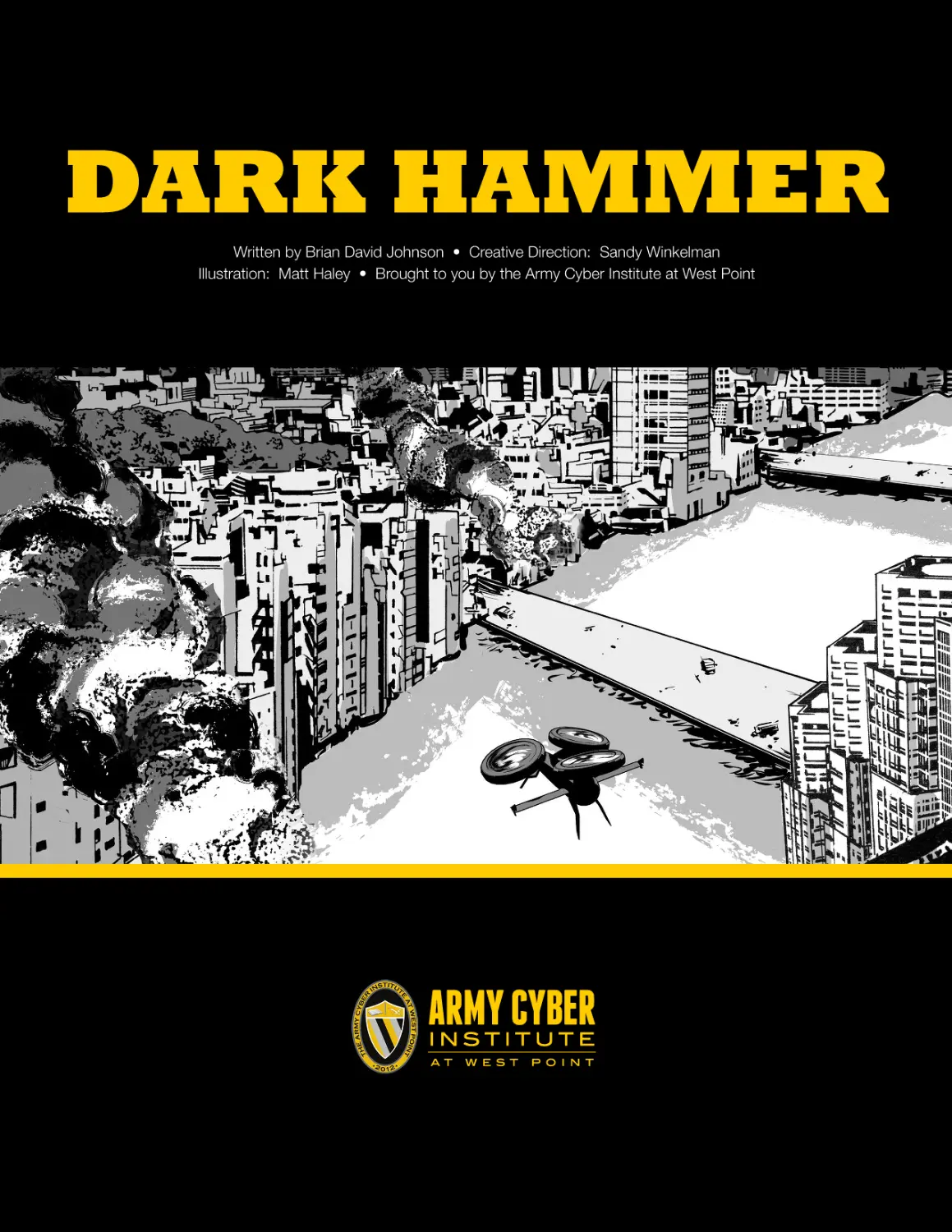
Our Science Fiction Prototype will take us to the year 2027. Things have gone from bad to
worse on the Korean Peninsula. Seoul is under attack. While the north of the city falls quickly,
the US and South Korean forces hold their ground on the south banks of the Han River. The
combined ground forces must hold back the onslaught.
Reinforcements will not make it in time. The fight is about to begin... With no option but to
battle it out on the ground, casualties are sure to be high.
There is another hope.
The Dark Hammer... a cyber offensive capability that might turn the tables and win the day.
DARK HAMMER

“Bytes travel farther and faster than bullets. In the near
future, they will be just as deadly.”
Dr. George Cybenko
Dartmouth College
In battle, a ground commander might employ multiple effects, both lethal
and non-lethal. While the authorization to use weapons like a mortar lies
with a lower level commander, like a squad or platoon leader, others, like a
Hellfire missile, might lie with decision-makers up the chain of command.
Cyber is designed in a similar manner. It is a scalable non-lethal effect
that, if used properly, can set battlefield conditions for the commander to
pursue their objectives.
What supported Lt. Reed’s push through the enemy lines? First, we had
cyber capabilities developed to support the ground scheme of maneuver.
Second, we had a secure, actively defended network to ensure that the
enemy could not have a similar effect on our troops in contact. Third,
our forces successfully operated simultaneously in multiple contested
domains—in the air, on the ground, and in cyber.
How do we ensure that these three factors will be commonplace on the
battlefield? Not only do we need to think about what capabilities our forces
will need but also the authorities they should have.
We need to educate the force about how technical capabilities can support
the fight. How do we tackle cyber literacy in our formations?
We need to think about how everyday actions we take in garrison can
affect our defensive posture. How should we rethink our plays and game
plan to change the culture and mindset of our forces?
AFTERWARD

First Edition: 2018