/
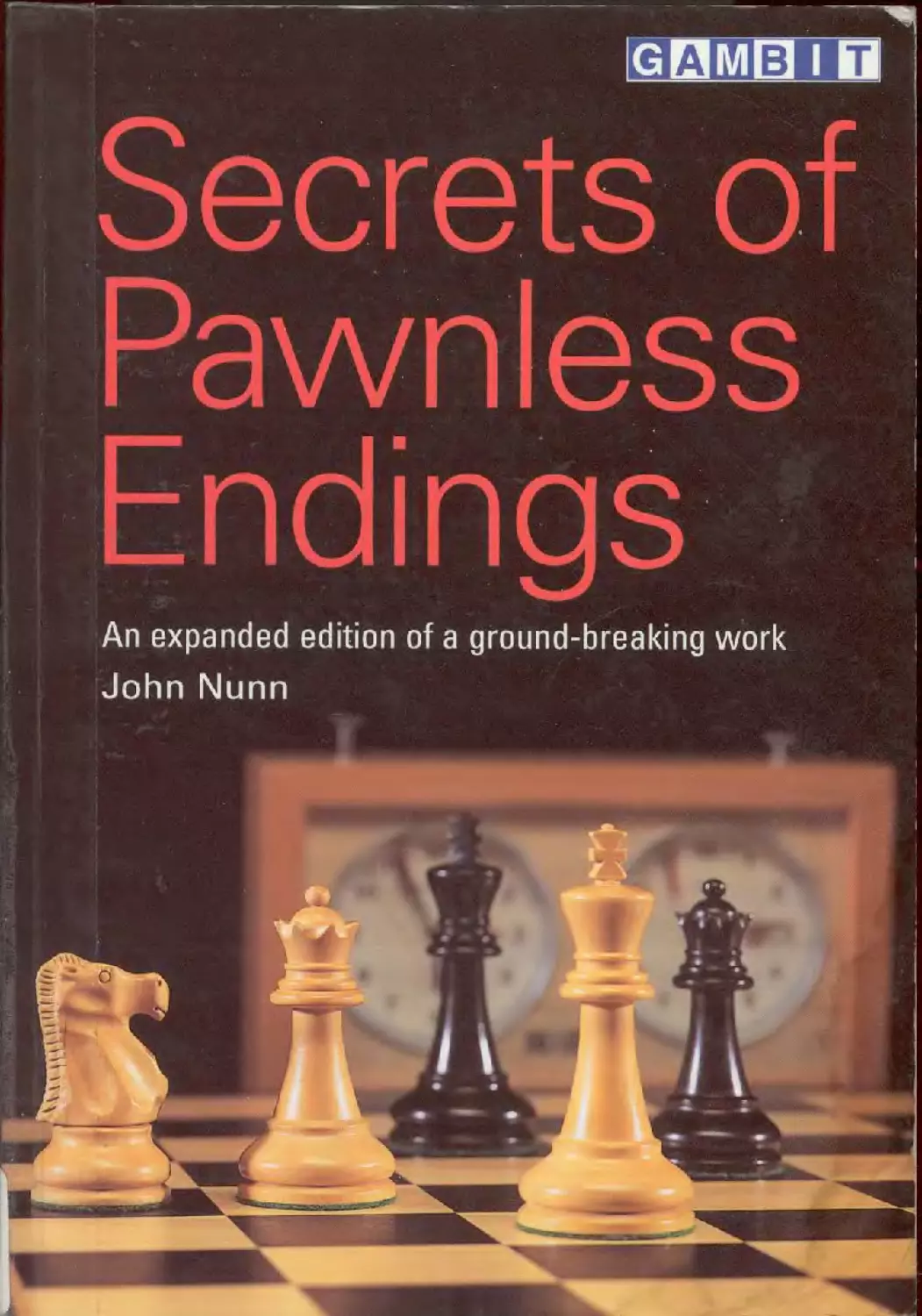


Author: Nunn J.
Tags: chess board games chess combinations chess creativity
ISBN: 1-901983-65-Х
Year: 2002



Text
                    IGHMB I П
Secrets of
Pawnless
Endings
An expanded edition of a ground-breaking work
John Nunn
Secrets of
Pawn less Endings
Revised and expanded edition
John Nunn
GHMBl
This edition first published by Gambit Publications Ltd 2002
First edition published by B.T. Batsford 1994
Copyright © John Nunn 1994, 2002
The right of John Nunn to be identified as the author of this work has been as-
serted in accordance with the Copyright, Designs and Patents Act 1988.
All rights reserved. This book is sold subject to the condition that it shall not,
by way of trade or otherwise, be lent, re-sold, hired out or otherwise circulated
in any form of binding or cover other than that in which it is published and
without a similar condition including this condition being imposed on the
subsequent purchaser.
A copy of the British Library Cataloguing in Publication data is available
from the British Library.
ISBN 1 901983 65 X
Distribution:
Worldwide (except USA): Central Books Ltd, 99 Wallis Rd, London E9 5LN.
Tel +44 (0)20 8986 4854 Fax +44 (0)20 8533 5821.
E-mail: orders@Centralbooks.com
USA: BHB International, Inc., 41 Monroe Turnpike, Trumbull, CT 06611,
USA.
For all other enquiries (including a full list of all Gambit Chess titles) please
contact the publishers, Gambit Publications Ltd, P.O. Box 32640, London
W14 OJN. E-mail Murray@gambitchess.freeserve.co.uk
Or visit the GAMBIT web site at http://www.gambitbooks.com
Edited by Graham Burgess
Typeset by John Nunn
Printed in Great Britain by The Cromwell Press, Wiltshire.
10 987654321
Gambit Publications Ltd
Managing Director: GM Murray Chandler
Chess Director: GM John Nunn
Editorial Director: FM Graham Burgess
German Editor: WFM Petra Nunn
Contents
Explanation of Symbols	4
Introduction to the First Edition	5
Introduction to the Second Edition	7
1	Rook v Knight	9
2	Rook v Bishop	31
3	Queen v Rook	49
4	Queen and Knight v Queen	70
5	Queen and Bishop v Queen	123
6	Rook and Knight v Rook	155
7	Rook and Bishop v Rook	173
8	Queen v Rook and Bishop	235
9	Queen v Rook and Knight	266
10	Queen v Bishop and Knight	284
11	Queen v Two Bishops	290
12	Queen v Two Knights	300
13	Other Five-Man Endings	311
14	Six-Man Endings	323
Explanation of Symbols
Important note: Readers should devote particular attention to this page, be-
cause throughout the book I will use two common chess symbols in a non-
standard way. The symbols concerned are the exclamation mark ! and the
question mark ?. These symbols are normally bestowed in an arbitrary way by
authors; some scatter them lavishly through the text, while others dole them
out sparingly. However, in this book these two symbols have precise defini-
tions which depend only very slightly on the author’s whim.
The exclamation mark ‘! ’ after a move means that this move is the only one
not to change the result of the position. For example, in a position which is
winning for White, ‘ 1 Ha3!’ implies that Ha3 is the only move to preserve the
win.
The use of the word ‘only’ needs to be clarified. I consider a move to be
unique (and therefore deserving of an exclamation mark), even if there are
other moves that lose time by repeating the position.
If there is only one legal move, 1 usually do not award it an *!’, except if I
wish to emphasize a particular point, for example that there is a long sequence
of ‘only’ moves.
The use of '?’ is easier to explain: a move receives a question mark if it
changes the result of the position. Of course a move can only change the result
of a position for the worse.
The symbols ‘!?’ and “?!’ refer to a move that doesn’t change the result of
the position, but is a respectively good or bad idea from a practical viewpoint.
One other point deserves explanation. Beneath each diagram you will find
symbols such as ‘+/-’. Once again this is a method of displaying information
compactly. The symbol before the slash 7’ gives the result of the position with
White to move. This result is given from White’s point of view, so that a plus
before the slash means that White to play wins, an equals sign means White to
play draws and a minus means that White to play loses. The symbol after the
slash gives the result with Black to move, from Black’s point of view. Thus the
symbol above, *+/-’, means that White wins whoever moves first. To take an-
other example, *=/-’ means that White to play draws, but with Black to play
White wins. Sometimes we only give the result with one player to move, for
example 4= means that Black to play draws. Normally this is because the po-
sition makes no real sense with the other player to move, for example Black’s
king might be in check.
Introduction to the First Edition
This book is the sequel to Secrets of Rook Endings, and is a continuation of the
theme of that book. Secrets of Rook Endings represented an innovation in the
world of chess literature; for the first time, the power of the computer was
linked to a human interpreter to produce a book in which every move was
guaranteed to be accurate, but at the same time the moves were explained in a
way comprehensible to average players. Secrets of Rook Endings provoked
some strong responses; these were mostly positive, but there were a few play-
ers who viewed the production of such a ‘Final Encyclopaedia’ with dismay,
because it meant that a part of chess was forever frozen in silicon. As was in-
evitable, a very few misprints crept into Secrets of Rook Endings, but basically
the promise of the book was kept.
This second volume deals in the same way with four- and five-piece end-
ings without pawns. These include such important over-the-board endings as
H+JL v E and W+JL v W. Only two significant endings are missing, namely
_£+£> v and 2JL v Qs. These have been left out due to space limitations, but
the good news is that they will appear in the third and final volume of this se-
ries, Secrets of Minor-Piece Endings, which will appear during 1995.
This book contains a higher percentage of composed positions than the first
volume, and some readers may be slightly confused by the terminology of the
endgame study world, so here is a summary. Composed positions of the
‘White to play and win’ or ‘White to play and draw’ type are called ‘studies’.
The solution of a study should be essentially unique; if there is no solution, or
multiple solutions, then the study is said to be ‘unsound’. In the latter case, an
extra solution unintended by the composer is called a ‘cook’. A ‘try’ is a trap
for the solver, a tempting line which appears to solve the study, but which in
reality succumbs to a hidden refutation. A composer may well enter his study
in a composing competition, or ‘tourney’, (abbreviated to ‘Tny.’ in this book).
Some of the studies in such a tourney receive awards when the tourney is
judged. These awards fall into three categories; the highest category is the
‘Prize’, abbreviated to ‘Pr.’; the second is the ‘Honourable Mention’, abbrevi-
ated to ‘HM’; the lowest is the ‘Commendation’, abbreviated to ‘Comm.’. A
final pair of abbreviations is the use of ‘ECE’ for the Encyclopaedia of Chess
Endings and ‘BCE’ for Batsford Chess Endings.
Readers should note that a few positions start with more than five men, but
lead to a database position after a few moves. These introductory moves have
not been checked using a database. However, I have examined these moves
carefully myself.
6
Secrets of Pawnless Endings
At times, readers may be slightly exasperated by the many cross-references
in the analysis. It is always irritating when an interesting variation is inter-
rupted with the remark ‘and we have transposed to line 4a of diagram 29 Г. In
this book such references can involve a little thought, as the position may have
to be rotated and/or reflected in order to match up with the reference. There-
fore, whenever possible, I have continued variations to the end rather than
give a cross-reference, but if the win is fairly complex I have had no choice but
to refer the reader to another page; if I had not done this, the book would have
been far larger (and therefore more expensive).
One special type of position deserves a more detailed explanation, namely
the reciprocal zugzwang. In a normal zugzwang, it doesn’t matter much who
is to move, because the superior side usually has a waiting move with which
he can pass if it is his turn to move. This is not so in a reciprocal zugzwang,
which may be defined as a position in which whoever moves first has to
weaken his position. In an ending such as E+JL v Б, where only one side has
winning chances, we may be even more precise. Assuming that White has the
rook and bishop, a reciprocal zugzwang is a position in which Black to play
loses, but White to play can only draw. In other words, not only is Black in
zugzwang if it is his turn to move, but White to play has no waiting move to
maintain the zugzwang, so he is also in zugzwang if it is his turn to move. Re-
ciprocal zugzwang positions often have an importance far out of proportion to
their small numbers.
Many of the endings in this book would, if they arose in a game, be pro-
foundly influenced by the 50-move rule. Despite this, I have largely ignored
the consequences of this rule other than to point out the general areas which
are affected. A discussion of exactly which positions take more than 50 moves
to win would take far too long, and would be of little importance in an over-
the-board situation where optimal play is the exception rather than the rule.
Moreover, FIDE has modified this rule a number of times in the recent past,
and a lengthy discussion of such a mutable rule has little point.
Finally, I would like to acknowledge the help I have received in writing this
book, and the various products I have used during the past eight months.
First of all there are the three CD-ROMs created by Ken Thompson, who
not only constructed the databases but also responded to various requests for
further information. Next comes Lars Rasmussen’s interface program for ac-
cessing the data on the CD-ROMs. Thirdly, the van der Heijden study data-
base proved invaluable.
1 would also like to offer a collective thank you to all the people at Chess-
Base, who have been unfailingly helpful in making sure I received all the nec-
essary material. The products mentioned above are available from ChessBase.
Finally, I would like to thank Graham Burgess and my mother, for all their
help with proof-reading this book.
Introduction to the
Second Edition
The first edition of this book, which was published in 1994, was the second
volume in my trilogy exploring 5-man endgames (the first was Secrets of
Rook Endings, now also available in a revised and expanded version from
Gambit Publications; the third was Secrets of Minor-Piece Endgames). After
some years Secrets of Pawnless Endings went out of print, but now I am de-
lighted to be able to offer this new edition. The main changes are the 62 pages
of extra material covering 6-man endgames and the lower price.
The original endgame trilogy was a huge step forward in endgame litera-
ture because it used the perfect knowledge of computer-generated databases
to ensure the accuracy of the analysis. This was an innovative and, at the time,
controversial step. However, over the intervening years the use of endgame
databases has become an accepted feature of endgame writing and today it
would be a brave (and probably foolhardy) author who would write about
5-man endgames without checking his analysis against the database.
Endgame databases are having a gradually increasing effect on endgame
theory. Over the past few years two main developments have served to empha-
size this point. The first is the integration of the databases into normal
chess-playing programs. Access to the databases of 1994 was based on simply
looking up the positions in the database. The result was that even if you had a
position in which a simple piece exchange would lead to a winning 5-man
endgame, the interface to the database would simply report ‘position not
found’. However, manufacturers of chess-playing software saw that the end-
game play of their programs could be enhanced by a relatively simple step.
When constructing the analysis tree for a given position, if a node in the tree
was a five-man endgame, the node would be evaluated by looking up the re-
sult in the database rather than analysing any deeper. Thus huge swaths of
analysis could be eliminated, replaced by a simple look-up. The effect of
this technique on endgame analysis is dramatic. If you have a position which
is not in the database (because it contains 6 or 7 men, for example), but in
which a winning database position can be forced within the normal search
depth of the playing engine, then the program will announce a forced mate.
The ‘normal search depth’ can be quite large; 30 ply (15 white and 15 black
moves) is quite feasible. The only problem with this technique is that it only
gives an upper bound for the distance to mate and the true figure is often sub-
stantially less.
8
Secrets of Pawnless Endings
The second main development is the construction of a large number of
pawnless 6-man databases. Although other researchers have made such data-
bases, Ken Thompson took the further step of making his available on the
Internet, using an ingenious interface which allows anyone with a web
browser to access them. The construction of the databases is only the first step
since the task of extracting useful information is formidable, but I have made a
first attempt in the lengthy chapter dealing with 6-man endgames (see p.323).
In this chapter there are a number of surprises which upset existing endgame
theory. In all cases where existing theory has been shown to be incorrect by
the new databases, the error has been to underestimate the superior side’s win-
ning chances. Two particular cases are W+JL v 2E and E+JL v with op-
posite-coloured bishops. Although the superior side is only two ‘points’ of
material up, both these endings are generally winning. There are some very
long wins in this chapter, with the 242-move win on p.336 being the record.
As to the future, doubtless further efforts will go into understanding the da-
tabases which already exist, and into the construction of further six-man data-
bases. The next major step will probably be the construction of six-man
databases with pawns, which will undoubtedly revolutionize many areas of
endgame theory. There are many exciting developments to look forward to,
but I hope that readers will enjoy the current ‘start of the art’ as described in
this book.
Finally, I would like to thank Graham Burgess, Guy Haworth and Helen
Milligan for their help with proof-reading this book. Of course, I accept re-
sponsibility for any errors which have crept through.
John Nunn
Chertsey, January 2002
1 Rook v Knight
In general, this ending is a draw. However, there are many situations in which
the rook has winning chances. The first, and most obvious, is when the king
and the knight are separated. If the knight cannot quickly return to safety, then
it may be cornered and eventually captured. The second main possibility is
when the defender’s king is badly placed. However, this is usually not suffi-
cient by itself to cause a loss; it must be combined with a poor knight placing.
We divide our analysis of this ending into four sections. The first section
covers the standard drawing positions, and will be of particular value to over-
the-board players who want to refresh their memory on the drawing tech-
niques. The second section deals with the case in which the defender’s king is
poorly placed. The third section analyses positions in which the king and knight
are separated. The fourth section consists of more complex examples; some
are taken from endgame studies while others are from over-the-board play.
Although many players might imagine that a four-man ending cannot be all
that complicated, the errors in section four should serve to convince them oth-
erwise. Even Anatoly Karpov incorrectly evaluated a position in his Informa-
tor analysis.
1.1:	Standard drawing positions	9
1.2:	King in the comer	10
1.3:	Black’s knight is cut off	14
1.4:	Practical examples	18
1.1:	Standard drawing
positions
(1): If Black’s king is in the mid-
dle of the board with the knight
nearby, then there is nothing to say
because the position is completely
drawn. However, if Black’s king
starts off on the edge of the board
then he is in more danger. Neverthe-
less, most positions are drawn. The
situation with the king on the edge of
the board frequently arises after a
pawn promotion. For example, with
10
Secrets of Pawnless Endings
\УФе4,ПЬ2 v ВФе1,А<12, the moves
ФеЗ dl£w- lead to diagram 1. Black
has no trouble drawing this position:
1Ф13 (after 1 ФdЗ £>f2+! White can-
not make progress) £k3! 2 Ec2 “Ski 1!
3 Ee2+ ФП 4 Ed2 (4 Be8 2>f2)
Фе1! 5 Ec2 (5 Bh2 £k3! is also a
draw) ФП! 6 Ea2 Фе1! and White is
unable to improve his position.
If we move the two kings and the
knight to the left, the result remains
unchanged when the kings are on
the d- and c-files, with identical anal-
ysis. However, the result is changed
if the kings are on the b-file
^ФЬЗ,ЕЬ2 v ВФЫ,2>а1). In this
case White can win the knight imme-
diately by 1 ФсЗ.
The basic rule is that if Black’s
king is on the edge of the board with
the knight on a laterally adjacent
square, then almost all positions are
drawn. Black only loses if his king is
very near a comer, or if White can
win the knight immediately with a
pin or a check.
2	=/=
Kling and Horwitz, 1851
(2): This is a variation on the same
theme. Even though Black’s king is
near the comer, there is just enough
space to hold the draw. In this case
accurate defensive play is required.
Play might continue 1 Ф16 £lh7+! 2
Фg6 2>f8+! 3 ФЬ6 ФЬ8! 4 Ef7 (4
Eg7 4&e6! 5 Ef7 Фg8! draws) Фg8!
5 Eg7+ ФЬ8 6 Egl (this is the key
moment; Black must play carefully)
and now:
1)	6...2>h7? 7 Фg6! Фg8 (alter-
natively, 7...^)f8+ 8 Фf7) 8 Eg2 (a
waiting move) £lf8+ 9 stfe+l ФЬ8
10 Ф(7 wins.
2)	6...£ie6? 7 Фg6! 2>f4+ (after
7...4)f8+, 8 Фf7 wins) 8 Ф(7 wins.
3)	6...£)d7! (the drawing move,
because it allows Black to answer
Фё6 by ...Ф88) 7 Фg6 (7 Edl 2>f8!)
Фg8! 8 Efl (8 Eg2 *f8) 2>f8+! 9
ФГ6 &h7+! 10 Фе7 Фg7! and Black
draws.
Not surprisingly, if all the pieces
in the above position are moved to
the left, giving Wфf5,Ed7 v BФf8,
?3e8, then the same drawing method
works, i.e. 1 Фg6 Фg8! 2 Ee7 Фf8! 3
Ef7+ Фg8 4 Efl 4ic7 as above. We
will consider this position more
carefully in diagram 19 below.
1.2:	King in the corner
Not all positions with the king and
knight together are drawn; indeed,
when Black’s king is stuck in the
comer White has good winning
chances.
(3): With White to play 1 ФГ6! (1
ФЬб? Фg8! is diagram 2) £lh7+ (or
1 ...*g8 2 Ea8) 2 *f7 2>g5+ (2...&f8
Rook v Knight
11
Berger, 1890
3 Ea8, but not 3 ФхГ8?? stalemate) 3
&g6 wins the knight. Black to play
draws by 1 ...i’gS! 2 ФЬб ФЬ8, as in
diagram 2.
If the knight is in the comer, then
Black may be unable to save the game.
4	+/-
Moravec, 1913 (end of study)
La Strategic
(4): We mentioned above that
White to play wins immediately by 1
ФТЗ, but in fact White wins even if
Black moves first. After l...^f2+
(1...ФП 2 ФГЗ Фgl 3 Ed2 is much
faster) 2 ФВ 2kl3 (2...£>h3 3 ФgЗ)
Black’s knight escapes from the cor-
ner, but it is cut off from the king and
White wins by 3 Ea4 and now:
1)	3...£>el+ (or З...ФП 4 Eal+
£lel+ 5 ФеЗ) 4 Фе2 £lg2 5 Eg4
ФЬ2 6 ФТ2! ФЫ 7 Eg8 wins.
2)	3...2>e5+ 4 ФgЗ ФП 5 Ef4+
Фgl 6 Ee4 £k!3 7 Ee3! picks up the
knight.
3)	3...2>c5 4 Bal+ ФЬ2 5 Ea2+
Фgl 6 Ed2 21e6 (6...ФЫ 7 Ed5 and
8 Ф12, or 6...2>b3 7 Ed5 ФЬ2 8 ФТ2)
7 ФgЗ Фf 1 8 Ed5 (a typical winning
position) £te7 9 Ee5 (zugzwang)
2>a8 (9...2>a6 ЮФТЗ! Фgl 11 Eg5+
ФЬ2 12 Eg2+ ФЬ 1 13 ФgЗ followed
by Ee2, another characteristic ma-
noeuvre) 10 ФГЗ Фgl 11 Eg5+ ФЬ2
12 Bg2+ ФЬ 1 13 ФgЗ forcing mate.
4)	З...Ф112 4 Eh4+ Фgl 5 Ed4
£k5 (5...£lel+ 6 Фе2! transposes to
line 1, while 5...£ie5+ 6 ФgЗ ФП 7
Ef4+ transposes to line 2) 6 Ed2,
transposing to line 3.
So far we have discussed the case
in which the knight is adjacent to,
and on the same rank as, Black’s
king. This is normally the best defen-
sive arrangement. Other situations
are more risky.
(5): White to play can win in vari-
ous ways. ECE gives three methods,
but Minev’s route is the fastest: 1
Фf6 2>h6 (1...ФТ8 2 Ed7!) 2 Bd8+
ФЬ7 3 Bd7+ ФЬ8 (З..Ф^8 4 Фg6) 4
Фg6 £>g8 5 Eh7 mate. Black to play
cannot save the game, for example
1...21e5+ (1...2>h8+ 2 Фf6 2>f7 3
Ed4 and as in the White to play anal-
ysis) 2 Фf6 £lg4+ (2...£te4 3 Ed7
12
Secrets of Pawnless endings
5	+/-
ECE, 1986 (version)
transposes to line 3 of diagram 4) 3
*f5 21e3+ (3...£>h6+ 4 *g6 2>f7 5
si?f6 transposes to the White to play
analysis) 4 i’gb ФГ8 5 Bf2+ i’gS 6
Be2 wins.
One of the worst arrangements for
Black is to have his king on a7 or b8,
and his knight on b7. Such positions
were analysed by the Arabs as early
as the 12th century. Here is an exam-
ple.
(6): White to play wins immedi-
ately by 1 Bh7 Фа8 2 ФЬб, so we
take Black to play: l...£ia5+ 2 ФЬ5
2>b7 (2...£fo3 3 Ed8 ФЬ7 4 Bdl
traps the knight) 3 Ef8 (ECE gives 3
Bh5, which is just as good) £ki6+ 4
Феб 2k4 (or 4...4ie4 5 Hf7+ ФЬ8 6
Bb7+ Фа8 7 Bb4 5)f6 8 Ef4 2)h5 9
Ef5 £)g3 10 Bf3, followed by ФЬ6
or Фс7, forcing mate) 5 Ef4 5)a5+
(5...&d2 6 Ea4+ ФЬ8 7 ФЬб Фс8 8
Bf4 2>b3 9 Ef3 &d2 10 ВсЗ+ ФЬ8
11 Есб 5)b3 12 Bc4 and the knight is
lost) 6 ФЬ5 2>b7 (6...2>b3 7 Bf7+
ФЬ8 8 Bd7 £kl 9 ФЬб wins) 7 Bd4
ФЬ8 8 Фаб! (a tricky moment, be-
cause 8 ФЬб? Фс8! is a draw) Фс7
(8...&С5+ 9 ФЬб £»e6 10 Ed6!) 9
Ec4+! ФЬ8 10 Eb4! Фа8 11 ФЬб
ФЬ8 (11...2>d6 12 Eh4 ФЬ8 13
Bh8+ £te8+ 14 Феб wins) 12 Феб
Фа8 13 Eh4 ФЬ8 14 Eh8+ Фа7 and
we return to the initial position, but
with White to move; 15 Bh7 Фа8 16
ФЬб finishes Black off exactly as
above.
6	+/-
Arab manuscript, 1257
7	+/-
Arab manuscript, 1140
Rook v Knight
13
(7): Firstly we suppose that White
is to play. The quickest win is by 1
Edl ФЬ8 2 Фаб 2c5+ (2...Фс7 3
Bcl+! ФЬ8 4 Ebl! wins as in dia-
gram 6) 3 ФЬб 2a4+ 4 Феб 2)c3 5
Eel Фа7 (5...2a2 6 Bbl+ Фс8 7
Фd6 is zugzwang) 6 ЕеЗ 2kll (or
6...2Ы 7 Bd3) 7 Bd3 2f2 8 Bd7+
ФЬ8 9 Eb7+ Фа8 10 ФЬб forcing
mate. This analysis is reprinted in al-
most all endgame books. However, it
is a new discovery that White wins
even if Black moves first. Because
the analysis is very complicated we
need to analyse a preliminary posi-
tion:
8	+/-
(8): White wins even if his rook is
in a less favourable position. White
to play wins as in diagram 6, so sup-
pose that Black is to play: 1...2d8+
(1...2a5+ 2 ФЬ5 2b7 3 Edl is dia-
gram 7) 2 Фс7! 2еб+ 3 Фd7 and
now:
1)	3...2)с5+4Фс6! 2e6 (4...2)b3
5 Bh4 2ia5+ 6 ФЬ5 ^b7 7 Bd4 is di-
agram 6 after White’s 7th move) 5
Bh7+ ФЬ8 (5...Фаб 6 Eh6 ^g5 7
Фс7+ Фа7 8 Есб 2f7 9 Ееб wins;
the lining up of White’s rook and
king to form a battery is another
standard manoeuvre which we will
see time and time again) 6 Eh5 is di-
agram 4 after White’s third move.
2)	3...2)d4 4 Bh4! and now:
2a) 4...2T3 5 Ef4 2d2 (5...2g5
6 Фе7 ^h3 7 Bf3 ^>g5 8 ЕеЗ ФЬб 9
Фf6 2h7+ 10 Фg7 ^>g5 11 Фё6
wins) 6 Феб ФЬ8 7 Ф<15 Фс7 8
Ef7+ Фd8 (8...ФЬ6 9 Bf2) 9 Ef2
2b3 10 Bb2 2c 1 11 Феб wins.
2b) 4...2f5 5 Bf4 2e3 6 Феб
ФЬ8 (6...2c2 7 Be4 ФЬ8 8 ФЬб
wins) 7 ВЬ4+ Фа7 8 Ве4 2f5 (or
8...2с2 9 Фс5) 9 Фс7 Фаб 10 Веб+
Фа7 11 Ве5 wins.
2с) 4...2с2 5 Феб 2el (5...2еЗ
6 Ве4 is line 2b) 6 Еа4+ ФЬ8 7 Ес4
2f3 8 ФЬб 2е5 9 Ве4 2d7+ 10
Феб! <52»f6 11 Ef4 2h5 12 Bf5 2g3
13 Bb5+ Фа7 14 ВЬ7+ Фа8 15 ФЬб
wins.
3)	3...2g5 4 Феб 2еб (4...2f3 5
Фс15 ФЬб 6 Bfl 2g5 7 Bf5 2h3 8
Фе4 wins) 5 Bal+ФЬ8 6 Bel 2d8+
(6...2g5 7 Be8+ Фа7 8 Фс7 Фаб 9
ЕеЗ 2f7 10 Bf3 2g5 11 Bf6+ Фа7
12 Веб 2f7 13 Веб) 7 Фd7 2b7 8
Be5 leading to the position after
White’s 7th move in diagram 6.
4)	3...2f44 Феб 2d3 (4...2e6 is
line 3) 5 Edl 2f4 6 Bd7+ ФЬ8 7
Be7 2d3 8 ФЬб Фс8 9 Be4 with
zugzwang.
Now we return to diagram 7 with
Black to move. Black may try:
1)	1...ФЬ8 2 Феб! is diagram 8.
2)	1...2d8 2 Edl 2e6 (2...2b7 3
Bd7) 3 Феб ФЬ8 (3...2f4 4 Bd7+ is
line 4 above) 4 Eel is line 3 above.
14
Secrets of Pawnless Endings
3)	1.Л&16+ 2 Феб (2...£te4
3 Sdl is diagram 4) 3 Eal+ ФЬ8 4
Eel Фа7 (4...^h4 5 Ee8+ Фа7 6
Веб when both 6...£>f3 and 6...^f5
are met by 7 Фс7 £)d4 8 Ee4 £)b5+
9 Феб! 4k:3 10 Ee3, reaching dia-
gram 7 after White’s 6th move) 5
Фс7 Фаб 6 Деб+ Фа7 7 Ее5 and
wins.
Mandler, 1924
Osterreichische Schachrundschau
(9): This is a more complicated
example. Black to play draws by
l...^a5, so we take White to play.
The winning line runs 1 Eg6+! Фа7
2 Феб! and now:
1)	2.J&18+ 3 Фd6! 2>b7+ 4 Фс15!
and now:
la) 4...ФЪ8 5 Феб! £la5+ (after
5...2kl8+ 6 Фd7 2>b7 7 Eg5 Фа7 8
Фс8, White wins as in diagram 7) 6
ФЬб £te4+ 7 ФЬ5 (White has a fa-
vourable version of diagram 8) 4k5
(7...2>e3 8 Феб 2k4 9 Eg5) 8 Ee6
2>f3 9 Ee3 £ig5 10 Феб Фа7 11
Фс15 and the knight cannot escape.
lb) 4...£ri8 5 Eg8 2>b7 6 Феб
£la5+ 7 ФЬ5 £lb7 8 Ef8 transposes
to diagram 6.
1c) 4...£ia5 5 Фс5! 2>b7+ 6 ФЬ5
ФЬ8 7 Феб! transposes to line la.
2)	2...£ia5+ 3 ФЬ5 £>b7 4 Eg5
?ki6+ (4...2kl8 5 Ed5 2>e6 6 Феб
ФЬ8 7 Ee5 2rf4 8 Ee4 ?ki3 9 ФЬб
wins) 5 Феб! £te4 6 Ec5 £te3 7
Ha5+ ФЬ8 8 Eb5+ Фа7 9 Eb4 2>f5
10 Фс7 Фаб 11 Ee4 wins.
3)	2...ФабЗЕЬ6&а5+4Фс5+!
Фа7 5 ФЬ5 £1Ь7 6 Eh8 is diagram 6.
It is interesting to change the ini-
tial position slightly by moving
White’s rook along the second rank.
When the rook is on c2 White can-
not play Ec6+ followed by Феб be-
cause the rook is blocking c6, while
if the rook is on d2 White cannot
even give a check on d6. Therefore
White has no winning chances in
these cases.
WEe2: This position is a draw.
After 1 Ee6+ Фа7! White cannot
play 2 Феб because of 2...£kl8+.
WEf2: White to play wins by 1
Ef6+! Фа7 2 Феб! 2kl8+ 3 Фd6!
£lb7+ 4 Фс15! &а5 5 Фс5!, as in line
1c above.
WEh2: The position is again a
draw, because after 1 Eh6+ Фа7 2
Феб £k!8+! White cannot play 3
Фd6 on account of the check at f7.
1.3: Black’s knight is cut off
We have already seen this motif in
some of the above positions, but now
we take a closer look.
(10): Even though Black’s king is
not trapped on the edge of the board,
White can win because the knight
Rook v Knight
15
10	+/=
Arab manuscript, 1257
11 +/=
Arab manuscript, 1257
cannot regain contact with Black’s
king. White to play wins by 1 Фдб
and now:
1)	1...2>f4 2 Ed2 Фс8 (2...ФЬ6 3
Фе5 2>g6+ 4 *f6 &f4 5 *f5 2)h5 6
Bg2 wins) 3 Hf2 £kd3 4 Hf3 2>b2 5
Ec3+ *d8 6 Bc2 «М3 7 Bd2 £>el 8
Фсб+ Фс8 9 Be2 wins.
2)	1...ФЫ» 2 Bd4 ФЬ5 3 Bg4 ?)f8
4 Фе7 wins.
3)	1...2>h82Ef5£>g6 3Ef6£>h4
4 Ef4 2ig6 (4...£>g2 5 Ee4) 5 Bg4
and wins.
4)	1...2>h4 2 Ed3 ФЬб 3 Eb3+
Фа5 4 Фс5 Фаб 5 Феб Фа5 (5...Фа7
6 ВЬ7+ Фа8 7 Фс7) 6 Bg3 wins the
knight.
Black to play draws by 1...Фс7.
If we move the knight to g4, then
White still wins, although the pro-
cess is more complicated:
(11): 1 Фd6 and now:
1)	1...4)f6 2 Ed4 (this is faster
than ECE's 2 Be5) and now:
la) 2...£ih7 (2...£>h5 3 Фе5 and
2...$k8+ 3 Фd7! 2>f6+ 4 Фе7 are
worse) 3 Ef4 £lg5 4 Фс15 Фс7 5 Ef5
£lh3 6 Фе4 Фd6 7 ФеЗ followed by
Eh5.
lb) 2...ФЫ» 3 Eb4+! Фаб 4 Ef4
£lh5 5 Eg4 £)f6 6 Bg6 (again this
typical manoeuvre) 5)h5 7 Фе5+
and wins the knight.
1c) 2...Фс8 3 Фе7! 2)h5 4 Eg4
wins the knight immediately.
2)	l...£ih6 2 Bb5+ Фаб (2...Фс8
3 Феб 2>g4 4 Bb2 Фс7 5 Eg2 ^еЗ 6
Ве2 wins after 6...£kll 7 Фе5 or
6...£)g4 7 Фf5 £lh6+ 8 Фg6) 3 Феб
2>g4 (3...2rf7 4 Bd5 2)h6 5 Ed4 Фа7
6 Фс7 wins) 4 Ef5 5^еЗ (4...Фа7 5
Ef4 ^e3 6 Ee4 2tf5 7 Фс7 Фаб 8
Be6+ and 9 Be5) 5 Bf2 Фа5 (5...Фа7
6 Ее2 £)f5 7 Фс7 as above) 6 Фс5!
Фаб (6...Фа4 7 Bf4+) 7 Фd4 2>g4 8
Eg2 wins the knight.
3)	l...£ih2 2 Ef5 (threatening
Bf4) 2>g4 3 Bf3 ФЬб 4 Eg3 £tf2 5
Фd5 ФЬ5 6 Фd4 ФЬ4 7 Eg2 2)h3 8
ФеЗ wins the knight.
4)	1..АГ2 2 Ed4 ФЬб 3 Феб (not
3 Фе5? Фс5!, reaching a position of
reciprocal zugzwang with White to
move) Фс5 (3...£lh3 4 Фf5 £lgl 5
16
Secrets of Pawnless Endings
Ee4 £rf3 6 si?f4 £k!2 7 Bd4! wins) 4
Фе5! 2>h3 5 Bd2 £>g5 6 Bf2 Фс4 7
Ef5 £>h3 8 Фе4 £lgl 9 ФеЗ and the
knight cannot escape.
5)	1...2>e3 2 Bb5+ Фаб (2..Фс8
3 Феб Фс7 4 ЕЬЗ £kll 5 Фе5 wins)
3 Фс5 2>d5 (З...Фа7 4 ЕЬЗ 5
Ef3 and 3...2>f5 4 ЕЬЗ Ste7 5 Bb6+
Фа7 6 Веб £k8 7 Феб! ^Ьб 8 Ве4
£к8 9 Bel are also hopeless for
Black) 4 Bb3 £>f4 (for 4...4ie7 see
the last bracket) 5 Феб Фа5 6 ВеЗ
£lg6 7 Веб £lf4 8 Ee5+ and 9 Ee4
wins.
6)	1...ФЫ» 2 Bd3 &f2 3 Bd4 ФЬ5
4 Фd5 (Black is in zugzwang) ФЬб
(4...£lh3 5 Eh4 wins after 5...£lg5 6
Eh5, 5...£>f2 6 Фd4 or 5...2>gl 6
Eh2 2>f3 7 Eg2 2>el 8 Eb2+ Фа4 9
Фе4) 5 Фс4 Феб (5...2>h3 6 Bg4
2rf2 7 Eh4) 6 Eh4 Фd6 7 Фd4! Феб
8 ФеЗ! £kl 1+9 Фd2 and White traps
the knight.
Black to play draws by l...£rf6.
The above analysis shows why the
ending of В v £ is harder than one
might expect. The winning proce-
dure often involves apparently ran-
dom tactical points which exploit the
position of Black’s king, either by a
fork, or by making a battery with
White’s rook and king. Moving
Black’s king one square can change
the winning plan dramatically, be-
cause the tactics are different. Here
are a couple of examples in which
White makes direct use of Black’s
king position.
(12): Black’s knight is far away
from the king, but White’s own king
is on the edge of the board. However,
White can win the knight by force: 1
12	+/=
Pevit, 1862
Pr., ‘London’ 1862
Ea2! (not 1 Фg6? £le3!, nor 1 Ba3?
£ld2!, and the knight makes its way
to safety) Фе7 (after 1 ...£lg3 2 Ea3
£lh5 3 Bf3+! followed by 4 Фg6
White wins the knight) 2 Ef2! £lg3 3
Bf3! £lhl (the knight has no choice)
4 Фg6 Феб 5 Фg5 Фе5 6 Фg4 Фе4 7
Efl and takes the knight.
Black to play draws by l...£le3.
13	+/=
Bondarenko, 1949
Trud
Rook v Knight
17
(13): In this position White can
combine mating threats with trap-
ping the knight. 1 Ф12 ФбЗ (Black’s
reply is forced, or else White wins
with a rook move attacking the
knight and threatening mate) 2 ФГЗ
(2 Ed4 also wins quite easily) ФИ4
(2...Ф112 3 Hd2+ i’gl 4 Eg2+ wins)
3 Ф44 (simpler than Bondarenko’s 3
Ed4+) ФбЗ (З...ФЬ5 4 Hd5+ *g6 5
Ed6+ wins after 5...Ф115 6 Нсб or
5...ФГ7 6 Наб) 4 Ebl Sk7 5 Фе5
Фg4 6 Eb7 and the knight cannot es-
cape.
Black to play draws by l..^g3,
removing his king from the danger
zone.
In certain positions, White can
only win by losing a tempo.
Reti, 1929
Tidskrift for Schack
(14): It is harder to win when
White is to move: 1 Ф44! Ski3+ 2
Ф13! (threatening 3 Hg6, and not 2
Фе4? Ф<12! drawing) S)g5+ 3 ФеЗ!
(now Black must weaken his posi-
tion) Фс4 (after 3...SW7 4 Hf5 and
3...Ski3 4 Eg6 the knight is trapped,
while З...Фс2 4 Eg6 Sif7 5 Фd4 ФЬЗ
6 Фd5 ФсЗ 7 Hg7 wins easily) 4 Фf4
Sih3+ 5 Фе4 S)g5+ (or else Hf5
wins) 6 Фе5 Ski3 (after other moves
White wins by Hf5) 7 Hfl (not 7
Ef5? Sigi! drawing) Sig5 (or else
ФГ5) 8 Ef5 Sih3 9 Фе4 Sigi 10 ФеЗ
and wins.
The following position makes use
of Rdti’s analysis.
Averbakh, 1948
(15): Averbakh made a number of
contributions to the theory of E v Si.
This is one of his most interesting
positions. White wins by 1 ЕеЗ! and
now:
1)	l„.Sib2 2 Феб (Averbakh gave
2 Hc3?, but then 2...Ф46! 3 Фч16
ФГ5! 4 Фс15 ФГ4! 5 ФсИ 2kll! al-
lows Black to reach a draw) Sic4 3
Ee4! Sia5+ (3...Sid2 4 He2) 4 Фс7
Sib3 5 Фd6 Ф^б 6 Ф<15! Фg5
(6...Фf5 7 ЕеЗ Sid2 8 Hd3! exploits
Black’s bad king position) 7 Ee2
Ski 8 He3! Ф14 9 *d4! (this is a po-
sition of reciprocal zugzwang) Sia2
18
Secrets of Pawnless Endings
10 Eel 2>b4 11 Ecl *f5 12 Ec4
£la6 13 Ф<15 and White rounds up
the black knight.
2)	I.jab42*d6&c2(2...*f6 3
Ec3 is Rdti’s position) 3 Be4 Ф16
(3...2>a3 4 Фс5) 4 Фс5 *f5 5 *d5,
transposing to line 4 of diagram 11.
3)	l.JZ)c5+2*d6!2fo7+3*c6
^а5+ 4 i’d?! (threatening Ec3) £te4
5 Ef3+! i’gb 6 Феб! and now:
3a) 6...£k12 7 Ef4 *g5 8 Фе5!
(once again this is reciprocal zug-
zwang) £)b3 9 Bf2 £te5 10 Ed2 i’gb
11 Ed5 2>b3 12 Фе4 *f6 13 ФеЗ
Феб 14 Eb5 and wins.
3b) 6...Фй5 7 Ed3 (this is one of
those positions which is easier to win
when Black is to move) Фg6 8 Bg3+
ФЬ5 9 Фd5 2>b6+ (9...£kl2 10 Ed3!
2>fl 11 Ef3! 2kl2 12 Ef2 2>b3 13
Eb2 traps the knight) 10 Фе5 £)c4+
(10...£ld7+ 11 Фf5! is winning for
White after П...ФЬ4 12 ЕсЗ 2>b6
13 Bc6 £id5 14 Фе4 2>b4 15 Ec4 or
Н...ФЬ6 12Eg6-^h7 13Ed6 2k5
14 Фе5 Фg7 15 Фd4 2>b3+ 16 Фс4)
11 Фf4 2kl6 12 Eg7 ФЬб 13 Ee7!
£>c4 14 Ec7 £k!2 15 Eb7 Фg6 (or
15...£k4 16 Eb4) 16 Eb2 ?k4 17
Eb4 2>d2 18 ФеЗ 2>fl+ 19 ФТ2 and
wins.
Other positions involve a true re-
ciprocal zugzwang.
(16): Black to play loses after
1...Фе5 2 Фс2 followed by Ea4,
while White to play can only draw
because after 1 Ea4 (1 Eh4 Фс5)
£tel+! 2 Фс2 ?1е2! 3 Фч13 £lcl+ (or
3...£>g3) White cannot avoid the rep-
etition without allowing Black’s
knight into the neighbourhood of his
king.
16	=/-
Amelung 1900
In 1936 Chekhover discovered the
reciprocal zugzwang WФcЗ,Ed4 v
ВФе5,£1Ь2, which is unusual in be-
ing symmetrical about a diagonal.
The position is straightforward and
no analysis is necessary. This recip-
rocal zugzwang is preserved if it is
moved one or two squares to the right,
or one or two squares up the board.
1.4: Practical examples
In earlier times, even strong players
did not seem to be aware that the
knight should stay close to the
king.
(17): This is the drawing position
of diagram 1. However, the game
continued 1 £lh6! Eh7 2 £lg4? (2
£)g8! draws) Eh4 (Black could have
won the knight immediately by
2...Eh3!) 3 21e3 Be4 4 2kll (4 £k2
Фf6 5 Фg8 Ee8+ 6 ФЬ7 Be7+ 7
Фg8 Eg7+ 8 ФЬ8 Фg6 wins) Ef4+ 5
Фg7 Ef3 6 Фg6 (6 £>Ь2 Фс15 7 Фg6
Фd4 8 Фg5 ЕаЗ 9 Фf4 Ea2 10 2>dl
Ed2! wins) Фе5 7 Фg5 Фd4 8 Фg4
Rook v Knight
19
17	=/=
Neumann - Steinitz
Baden-Baden 1870
(8 £>Ь2 Ba3) Efl 9 2>b2 Ebl 10
&a4 Eb4 and wins.
However, one should not laugh
too much at such play, because mod-
em players are quite capable of mak-
ing similar mistakes.
18	-/
Holzl - Barbero
Graz 1991
(18): We start at an earlier stage,
in order not to miss some interesting
play. 1 <S?f6 Фс5 2 g4 Eh4 (this
doesn’t throw away the win, but it
does make it more complicated;
Black could have won easily by
2...ВЫ 3 g5 *d6 4 g6 Efl+! 5 *g7
Фе7 6 i>g8 Egl 7 g7 Bg2 8 ФЬ7
Ф(7) 3 g5 <4)d6? (but this move
should have cost half a point; the
winning line was 3...Bf4+! 4 Феб
Bg4! 5 Ф16 Фd6 6 g6 Фd7! 7 ФТ7
Ef4+! 8 Фg8 Фе7 and wins as above)
4 g6! Bf4+ 5 Фg5! (this is why Black
should have given the check on f4
earlier; now White doesn’t have to
block the pawn with his king) Efl 6
g7! Фе7 7 g8£i+! Феб 8 £ih6
(White has a simple draw) Фе5 9
2>g4+ Фе4 10 2>f6+ Фd4 11 ^g4
Bf3 12 Фе5 13 2>g4+ Феб 14
2>h2Ef2 15 ^g4! Bf5+ 1бФЬ4Еа5
17 ФgЗ ФГ5 18 21еЗ+ Фе4 19 ^g4
(of course the position is still drawn,
but after 19 £lg2 Black would not
have been able to drive White’s king
to the edge of the board) Bg5 20 ФЬ4
ф£4 21 2>f2 Bg2 22 2kl3+? (White
makes the same error as in Neu-
mann-Steinitz; 22 £lh3+! was the
drawing move) Фе4 23 £te5+ (23
ФЬЗ would have offered greater re-
sistance, when Black would have
been forced to find either 23...Ee2
or 23...Egl in order to win) Фf5 24
£ki3 Л&2 (24...Bc2 is quicker) 25
2>c5 Be3 26 2>b7 Bd3 27 5)c5 Bd5
28 2>b3 Фе4 29 Фg4 ФеЗ 30 5)c 1
Фd2 0-l.
The defender was only slightly
more successful in the following ex-
ample. He eventually gained the
half-point, but only after allowing
his opponent unnecessary chances to
win.
20
Secrets of Pawnless Endings
19	/=
Geller - A.Rodriguez
Amsterdam II1987
(19): Black starts in a relatively
unfavourable position, because his
knight will soon have to retreat to the
poor square g7. Nevertheless, the po-
sition is drawn with accurate play.
I...*f8! (not 1...2>g7? 2 *g6!) 2
Ed7 £lg7! (2...£>g3? 3 Ed4 *f7 4
<4)g4 £te2 5 Ec4! wins) 3 i’gb £>e8!
4 Ef7+ *g8 5 Ee7 *f8! 6 Ed7 *g8!
7 Ef7 2kl6! 8 Ef6 Ste8! (8...£k4? 9
Ee6 *f8 10 *f6! *g8 11 Ee8+ ФЬ7
12 Ee7+ *g8 13 Ed7 2>e3 14 *g6
ФГ8 15 Ed4 wins) 9 Efl (the options
open to Black depend crucially on
where White retreats his rook; how-
ever, we saw in diagram 2 that the
safest move is 9...£lc7, because this
draws wherever White retreats his
rook) 5)g7 (if White had played 9
Ef2, then Black would have been
able to choose between 9.,.£te7 and
9...£)d6, but not 9...£lg7? losing to
10 Ф16, as in diagram 9; with the
rook on fl Black must avoid
9...5)d6?, when 10 <S?f6! wins as in
line 1 of diagram 8) 10 stfG £lh5+!
(not 10...£>e8+? 11 Фе7 £lg7 and
now 12 Eal would transpose to dia-
gram 7, although 12 Eel is substan-
tially faster; also not 10...i>f8? 11
Ef2) 11 <4)g5 (if White’s rook were
on f2, then 11 stfS would win, as in
the discussion after diagram 9) 5)g7!
12 <S?g6 £>e8! 13 Ef3 (this is die best
winning chance) £lg7? (Black’s ob-
session with playing the knight to g7
should have cost him the game, be-
cause here 13...£k7! is the only draw-
ing move; the players overlooked the
win during the game, Amador Rodri-
guez missed it in his Informator an-
notations, and BCE overlooked it) 14
Ef2? (the chance disappears; after 14
stf6! £)h5+ 15 ФЙ! there is no
knight fork on g3, so White wins as
in diagram 9) 4Se8! 15 Efl £lg7 16
Фf6 2>h5+! 17 Фе7 Фg7 18 Egl+
ФЬб 19 Феб 2>g7+! 20 Фе5 2>h5 21
Eg8 2>g7 22 Фf6 2>h5+! 23 Фf7
2>f4 24 Eg4 2>h5 25 Eg6+ ФЬ7 26
Еаб £ig7 27 Фf6 2>e8+! 28 Фе7
fog! 29 Фf7 2>h5! 30 Ec6 2>g7?
(Black makes the same mistake a
second time; 30...£lg3! was correct)
31 Фf6! (this time White finds the
correct response...) £>e8+ 32 Фf5?
(...only to give the win away a move
later; 32 Феб! was correct) Фg7! 33
Феб £rf6! (the danger has passed) 34
Ecl 2>h5 35 ФГ5 Фf8 Vz-Vz.
Even World Champions can make
mistakes in analysis:
(20): White to play would win by
1 Eb7 2>c4 2 Eb3+! Фg2 3 Фс15, but
in the game it was Black to move.
1	...	$k4
Karpov annotated this game in In-
formator, and he claimed that Black
Rook v Knight
21
Karpov - Ftafnik
Thessaloniki OL1988
missed a draw by l...£g3 2 Ec7 (or
2 Фе5 £k4+) Ф13, but in fact White
can win after l...'4’g3,by 2Ec7! Ф(3
(2...£>a4 3 *d5 £Мэ2 4 Пс1! 2>a4 5
l4>d4 wins) 3 Hc3+! (a surprising
winning move) Фе2 (З...Фе4 4 Есб!
£1а8 5 4?d6 followed by Паб) 4 Псб!
&a4 5 Пс4! ^Ь6 6 ПЬ4 ?к8 7 *d7
and the knight is trapped.
2	Hf3+!	*g4
Or 2...4>g2 3 Ec3! 2>a5 4 *d5
£lb7 5 ПаЗ £k!8 6 Ha7 followed by
Ed7.
3	Ed3! *g5
Black cannot touch the knight, for
example 3...&a5 4 Фс15, 3...£lb6 4
ПЬЗ ?k8 5 Eb7 or 3...£>b2 4 Ed2!,
so the king must move.
4	Фд5! ^b6+
The alternative is 4...£lb2 5 Ed4
Фf5 6 Феб! (not 6 Фс5? Фе5! with
reciprocal zugzwang) Фе5 7 Фс5!
(this is similar to line 4 of diagram
11) Феб 8 ФЬ4 Фf5 9 ФЬЗ! (not 9
ФеЗ? Фе5 - reciprocal zugzwang
time again) Фе5 10 Hd8 and wins.
5	Фе5 4k4+
Once again Black has little choice,
for example 5..^g4 6 Феб Фg5 7
Ed4 Фg6 8 Eb4, 5...2й4 6 ПЬЗ &c5
7 Eb5 2>аб 8 Фd6+ Ф« 9 Eb6 or
5...£te8 6 Феб £1Ь6 7 Hd4 winning
just as after 5,.Ag4.
6	Фе4
Karpov could have won more
quickly by 6 Феб, transposing to line
3b of diagram 15.
6	...	2>b6
Black collapses. He could have
offered more resistance by б...ФЛ>,
with the continuation 7 Hd4! £la5 8
Ha4! 2>b7 9 Ea6+! Фg5 10 Фе5!
£d8 (10...2>c5 11 Ea5 2>b3 12 Ed5
Фg4 13 Фе4 £tel 14 ФеЗ wins) 11
Ef6! (this is another reciprocal zug-
zwang) £lb7 (11 ..Ф^4 12 Фс15 £lb7
13 Паб wins) 12 Ef8 (threatening
Фс15) ?k5 (12...£>a5 13 Фс15 2>b3
14 Efl Фg4 15 Edl ФТ4 16 Фс4
&a5+ 17 ФЬ5 wins the knight) 13
Ed8 Фg4 14 Ed5 (this is also the re-
ply to most other moves) £lb3 15
Фе4 £tel 16 ФеЗ and wins. It might
not have been so easy for Karpov to
find the five consecutive ‘only moves’
at the start of the line (especially as
this last round game was played to a
finish and it was already almost mid-
night!).
7	Ed8 5k4
Now the end is close. White
threatens 8 Фd4, and 7...&a4 loses
after 8 Фd4 £>b6 9 Фс5 £la4+ 10
ФЬ4.
8	Ed4 2ib6
Or 8...£>b2 (8...2>a3 9 ФdЗ) 9
ФеЗ Фf5 10 Фd2 Фе5 11 Eb4 win-
ning.
22
Secrets of Pawnless Endings
The game concluded 9 Фе5 $)c8
10 Феб ^a7 11 *d7 1-0
21	=/=
Pandavos - Delithanasis
Greece 1991
(21): In the game White decided
to liquidate the last pawns. It turns
out that this is inadequate to win, but
the position was almost certainly a
draw in any case.
1	f3 grf3+
Not l...g3? 2 Eg4 2tf4+ 3 ФеЗ
<2)115 (3...4Й5+ 4 Фd2 wins the pawn
immediately) 4 Eg8 ФГ6 5 f4 (threat-
ening Eg5) £)g7 6 ФГЗ Ф17 (or
6...<£>f5 7 Eg5 Феб 8 Фg4 g2 9 Eg6+
followed by 10 ФхГ5) 7 Eb8 £rf5 8
Фg4 g2 9 Ebl Фg6 10 Egl Ф16 11
ФГЗ £)h4+ 12 ФgЗ and White
rounds up the pawn.
However, l...£rf4+ is possible,
transposing to the game after 2 ФеЗ
£)g2+ 3 Ф12 gxf3 (but not 3...£rf4? 4
fxg4+ Фxg4 5 ФеЗ) 4 ФхГЗ.
2	ФхП Фе5!
Not 2...£tel+? 3 ФТ2! 5к2 4 Ес4!
21аЗ 5 ЕеЗ! 2>Ы 6 Ed3!, when 7
Фе2 and 8 ЕЬЗ wins the knight.
3	Ec4
After 3 Be4+ Black has the choice
between З...Ф<15 and З...ФГ5. Both
moves lead to reciprocal zugzwang
positions with White to move, and
therefore both draw.
з ... Фаз?
Black has failed to understand that
one must take care when reciprocal
zugzwangs are nearby! He could
have drawn by 3...£)el+! 4 Ф12 (4
Фе2 may be answered by 4...Ф<15 or
4...<£>g2) Фd5! (not 4...S)d3+? 5
ФеЗ!, when 5...£)b2 6 Ed4 is recip-
rocal zugzwang number three, while
5...£)el 6 Ee4+ Фс15 7 Ed4+! Фс5 8
Ed2! Фс4 9 Be2! 4hd3 10 Ec2+!
wins the knight) 5 Ec3 Фd4! and
Black rescues his knight.
4	Ee4! 1-0
Now it is Black who has fallen
into the zugzwang.
22	=/+
Geselschap - Claesen
World Student Ch., Antwerp 1992
(22): White to play draws by 1
2k3+! Фd4 (1...Фе5 2 Фg4! Ef2 3
£kll! draws) 2 <5)e2+! ФеЗ 3 £)g3!
Rook v Knight
23
Ф13 4 Фg6, followed by £rf5. In the
game Black was to move, and the
game continued:
1 ...	Bg7
This move maintains the win, but
makes it considerably harder. The
simplest solution was 1...Фе5 2 Фg4
(2 5k3 Bf3 3 2>e2 Hf2 4 2k3 Bc2 5
£lb5 Bc5 6 4ia3 Фd4+ 7 Фg4 ФсЗ)
Bf4+ 3 ФgЗ (3 Фg5 Bc4 4 Фg6 Ec5
5 2>a3 Фd4 6 ФГ6 ФсЗ 7 Феб Ea5)
Bb4 4 2>a7 (4 ?k7 Eb7) Фd6 and
wins.
2 2>c3+
Undoubtedly the best defence. 2
ФЬб (2 ФЬ4 Фе5 wins as in the pre-
vious note) Eg8 3 £lc3+ (3 £1c7+
Фе5 4 2>b5 Bb8 5 2кЗ ЕЬЗ 6 £te2
ЕеЗ wins easily) Фе5 4 ФЬ5 Eg2 5
ФЬ4 Ec2 and again we reach the pre-
vious note.
2 ... Фе5?
Throwing away the win. In the
above lines we saw that e5 is a good
square for the king, but here ...Фе5 is
too slow. The winning variation runs
2..Фч14! 3 2>e2+ (3 2>b5+ Фе5
transposes into the note to Black’s
first move) ФеЗ! 4 £te3 (4 ФЬб Eg2
5 2>c3 Фd4 6 2>b5+ Фе5 7 2k7
Eg8 8 £>Ь5 Eb8 9 &сЗ ЕЬЗ wins as
above) Ea7! (a really tough move to
find; 4...Bb7? 5 Фё6 and 4...Bd7? 5
Фg6 are draws) and now there are
two possibilities:
1) 5 Фg6 Ba5! (this is the key
square; the rook cuts off the knight,
and at the same time is too far away
to be harassed by White’s king) 6
2kll+ (6 Фf6 ФdЗ 7 2>dl Ba2) Фе2
7 2>b2 (7 2кЗ+ ФdЗ) Eb5 8 2й4 (8
£k4 ФdЗ) ФdЗ 9 Фf6 Фс4 wins.
2) 5 Фg4 Ed7! (now this square
is correct; the reason is that the fifth
rank is a danger zone for White’s
king, because of the reply ...Ed3; if
the king could cross the mined area
then White would draw, but the re-
treat to g4 has put his king on the
wrong side of the fifth rank) 6 Фf5
(relatively best; 6 ФgЗ Ed3 7 £lb5
Фе4+ 8 ФТ2 Фс15 9 2>c7+ Фе5 10
Фе2 ЕаЗ followed by ...Ea7 wins)
Ed3! 7 £la4 (b5 is out of bounds, and
7 £1а2 ЕЬЗ is simple) ЕаЗ! (the sixth
‘only move’ in a row) 8 £lb6 (8 £>Ь2
Фd4) Ba5+! 9 Фg4 Фе4! 10 2kl7
(White’s alternatives are 10 £1c8
Баб 11 Фё5 Веб! 12 Фg4 Фd4 13
ФГ5 Ф<15! with a familiar reciprocal
zugzwang, or 10 £te4 Ba4 11 £>Ь6
Bd4 12 2>c8 Фе5+ 13 ФfЗ Феб 14
ФеЗ Eb4 and wins the knight) Bf5!
(reciprocal zugzwang, and the ninth
‘only move’) 11 £lb6 (11 £lb8 Bf7
wins after 12 Bb7 or 12 £)a6
Фd4 13 £>b4 Bc7 14 ф£5 Bc4 15
2>a6 Фd5) Bf7 12 2k4 Bd7 13 ФgЗ
Bd4 14 2>b6 Фе5 15 Ф13 Феб 16
ФеЗ Eb4 and the knight is finally
trapped.
3 Gfe2?
White returns the favour. He could
have saved the game by 3 £kll! Ф44
(3...Bg2 4 21e3! or 3...Bg3 4 2>f2!
ФГ4 5 ФЬ4!) 4 2rf2! ФfЗ 5 <2jd3!
Be7 6 Фg6! (the situation is similar
to that above; White must avoid the
fifth rank because 6 Фg5? Be3! 7
£1Ь4 ЕЬЗ! is winning) Фе4 7 Фf6
Bc7 8 4ie5 draws.
3 ...	Bg2!
Of course; now the knight is rap-
idly cornered.
24
Secrets of Pawnless endings
The game ended 4 4)c3 Sc2 5
£a4 Фдб 6 2>Ьб Феб 7 ^c8 Se2 8
21a7+ ФЬ7 0-1.
We take as our final over-the-
board example one of the game
endings from ECE which was incor-
rectly analysed therein.
23	=/+
Gosh - Gipslis
Calcutta 1979
(23): White to play draws by 1
Фgl! ФgЗ 2 5)el, so we take Black
to move, as in the game.
1	... Sh3+
The simplest line is l...Ed4 2
£le3+ (2 £lel Ee4 wins after 3 £>g2
Ee2 or 3 £k!3 ФfЗ 4 Фgl Sa4 trans-
posing to diagram 4, while 2 Фgl
ФТЗ! 3 £tel+ Фе2! 4 ^g2 Eg4 is al-
ready over) ФТЗ! 3 £)f5 Bf4, trans-
posing into line 2 of diagram 9.
However, the move played is also
good and has the merit of leading di-
rectly into one of the standard ‘Arab
manuscript’ wins.
2	Фgl	ФП!
3	£>el+	Фе2!
4	2>g2	Sh6
Now we have transposed exactly
into diagram 6.
5	2>f4+	ФП
6	^d3	Eh4
This was the move played in the
game. It is a significant inaccuracy
and makes the win more compli-
cated, but contrary to ECE it does not
make the win impossible. 6...Ed6 is
best, as in diagram 6.
7	2>e5+
The most resilient defence. 7 5)c5
(7 £tel+ Фе2! loses immediately)
Sd4 8 ФЬ2 2d2+ 9 Фgl Ed5 10
ФgЗ 11 ФП Ef5+ wins more
easily.
7	... ФеЗ
The most accurate continuation;
after 7..^g3 8 £k!3 Black can only
win by repeating the position with
8...Ф13!.
8	Фя2 Ee4!
Otherwise White draws by ФgЗ
and £>g4.
9
The game continuation. ECE gives
9 £ki7 Фf4 10 £lc5 as leading to a
draw, but Black can win by 10...Ee2+
11 ФП (or 11 ФЬЗ ФГ5 12 ФgЗ Ec2
13 £1а4 Фе4 14 £lb6 Ec7 15 Фg4
Eg7+ 16 ФЬ5 Фd4 winning) ФеЗ
transposing to line 5 of diagram 11.
The rest of the game was accurately
played by both sides:
9...ФТ410 2>d6 Ed411 ^b5 Ed3
12 Фл7 Eb3 13 £k6 Фе4 14 5k7
ЕЬб 15 ФgЗ Ееб 16 2>с8 Ф<15 17
2>а7 Фс5 18 ФТ4 Ее8 19 ФТ5 Еа8
0-1
It is curious that in this example
and in Karpov-Ftadnik, the endings
were conducted fairly accurately by
Rook v knight
25
both players, but the notes errone-
ously indicated poor play by the an-
notator’s opponent.
Our final practical example is
correctly played, but the analysis in
Batsford Chess Endings contained
some inaccuracies.
Welin - Benjamin
Reykjavik Open 1986
(26): White may continue:
1)	1 Bb3 (the fastest win) and
now:
la) l...£ke4+ 2 Фс15 £>f6+ (after
2...£>f2 3 Bf3 2>g4 4 Bg3 2>f6+ 5
Феб! White wins by 5...ФЬ8 6 Eg6
&e4 7 Bg8+ Фа7 8 Eg7+ ФЬ8 9
Bb7+ Фс8 10 Be7 2>f6 11 Веб! or
5...£}e4 6 Bg7+ transposing to the
last line, or finally 5...£lh5 6 Bf3
ФЬ8 7 Bf5 2>g3 8 Bb5+ Фа7 9 Bb7+
Фа8 10 ФЬб) 3 Феб 2>g4 4 Bg3 2>f6
(4...£le5+ 5 Фс15) 5 Bgl and wins
just as in the line after 2...£rf2.
lb) l.JZ)e2 2 ВеЗ 2if4 3 Be7+
ФЬ8 (З...Фаб 4 Феб Фа5 5 Ве5+) 4
Феб £kd3 5 ФЬб Фс8 6 Ве4 2>f2 7
Bd4 £>h3 8 Феб ФЬ8 9 ВЬ4+ Фа7
10 ЕЬ7+ Фа8 11 ФЬб followed by
mate.
1с) 1...&а4+ 2 ФЬ5! 2>b6 3 Bf3
?к8 (3...2>d5 4 Фс5 ?к7 5 Bf7
ФЬ8 6 Ее7 wins) 4 Феб! 4ie7+ 5
Фd6 £lg6 6 Bf6 4ih4 7 Фс7 wins.
2)	1 Eb4 (the move played in the
game, which is the only other move
to preserve the win) Фаб (l...£kll 2
Феб 2*3 3 Be4 2>f5 4 Фс7 Фаб 5
Ееб+ wins) 2 Ec4! £le2 (2...£kll 3
Ba4+ ФЬ7 4 Фd4 2>f2 5 ФеЗ 2kll+
6 Фd2 £rf2 7 Eh4 traps the knight) 3
Ea4+ ФЬ7 and now:
2a) 4 Ba3 2>f4 5 ВеЗ? (BCE
gives this as an alternative win, but it
allows Black to escape; the win can
be preserved only by 5 Фd6! ФЬб and
now 6 Bc3, while not the fastest win,
does transpose into line 3 of diagram
15) Фс7! (the only move) 6 Be7+
Фd8! (6...Фс8 7 Фч16 wins) 7 Фd6
and now instead of BCE’s 7...Фс8?,
Black can draw by 7...£>g6! 8 Ef7 (8
Bg7 £lf8!) Фе8! when the knight
and king become connected.
2b) 4 Be4 (the move played in the
game is the most accurate) £>g3 (the
line 4...£k3 5 ВеЗ 2>dl 6 Bf3 Фаб 7
Фс4 is hopeless) 5 Bg4 £lf5 (5...4ie2
6 Фс4 and 5...2>h5 6 Фd6 £rf6 7 Bf4
£lh5 8 Bf3 are also lost) 6 Bg5 £lh4
(6...21e3 7 Фd4) 7 Фс15 <£»f3 8 Bg2
2>h4 9 Bg7+ Фс8 10 Фе4 Фd8 11
Bg4 1-0.
Apart from a minor inaccuracy at
move one, Welin conducted the end-
game flawlessly.
So much for over-the-board play-
ers. How about the study compos-
ers? Surprisingly, several of them
have tripped up on this apparently
26
Secrets of Pawnless Endings
simple ending, including some fa-
mous names.
3)	7 2>g4 Ed7 8 *f8 Ef7+ 9 *g8
Ef4 and wins as in line 2.
25	/+
Comay, 1981 (end of study)
3rd Comm., Israel Ring Tny.
26
Rinck, 1952
1414 Fins de Partie
(25): This is the end of a White to
play and draw study. Black is to
move, and the composer’s analysis
continued 1...Фе7 2 g8£l+ Феб 3
£lxh6 Ea7 4 Фg8 Фf6 5 £lg4+; here
he stopped.
However, 3...Ea7 is inaccurate.
Black has a simple win by 3...Ed7 4
Фg8 (4 2>g8 Ф45) Фf6! 5 2>g4+ Ф?5
6 ^e3+ (6 ^h2 ФГ4 or 6 2rf2 Ed2)
Фg6 7 ФчГ8 Ed4 8 £lg2 Ee4 winning
the knight.
The second point is that the com-
poser’s final position is still winning
for Black. After 5 £lg4+, Black may
play 5...Фf5 6 £ie3+ Феб and now:
1) 7 2>g2 Ea4 8 2>e3 Be4 9 2kll
Фе5 10 £^f2 Bd4 11 Фg7 ФГ5 12
Ф(7 Ed2 wins.
2) 7Фf8Ec7 8 2>g4Ef7+9Фg8
Ef4 10 21e3 (10 2>h6 Фf6! 11 2>f7
Ed4) Фе5 11 Фg7 Фd4 12 ?k2+
ФdЗ traps the knight.
(26): Rinck was one of the most
careful analysts amongst study com-
posers, but even he was capable of
making a mistake in a E v $5 ending.
The analysis runs 1 JLb5+ ФхЬ5 2
03сТ+ Фс5 3 £1хе8 Фd4 and now
there are three lines:
1) 4 2>g7 Ea5 5 ФТ2 (5 21e6+
Фе5 6 2>g5 Фf4! 7 2>e6+ ФgЗ 8 ФЛ
Bf5+ 9 Фgl Be5) Фе4! 6 21e6 Ee5 7
2k7 Фd4 8 ФfЗ Фс4 9 Фf4 Be7
wins.
2) 4 £<16 Ea5 5 Фg2 Ed5 6 2>f7
Фе4! 7 ФgЗ Фf5! 8 ФfЗ (8 2)h6+
Фg5! 9 2>f7+ Фg6) Ed3+! 9 ФТ2
Ed7 wins.
3)4 £>f6 (Rinck claimed that this
move leads to a draw) Ea6! 5 £lh5
and now:
За) 5..Ла5 (Rinck did not con-
sider this move, but it is the simplest
win) 6 2>g3 (6 2>f6 Ef5 7 2kl7 Ef7 is
hopeless, while 6 £>f4 Фе4 7 £lg2
Rook v Knight
27
Ф13! 8 £tel+ Фе2! 9 £lg2 Ba4 wins
as in diagram 7) ФеЗ! 7 £rfl+ (7
Фg2 Bg5! transposes to the main
line) Фе2! 8 Фg2 Eg5+! 9 £lg3+
ФеЗ! 10ФЬ2 (ЮФЬЗ ФВ)ФГЗ 11
£lfl Ф£2 wins.
3b) 5...ФеЗ (Rinck’s move pre-
serves the win, but is slower) 6 Фg2
(6 £lg3 Bg6 wins at once) Ba5!
(Rinck only gave 6...Bh6?, and after
7 £lg3! Bg6 8 ФЬЗ! ФТЗ White has
the h5-square available and can draw
by 9 £ih5!) 7 2>f6 (7 £ig3 Eg5! wins
as in line 3a, precisely because the
rook controls h5) ФГ4! 8 ФЬЗ Ef5 9
2>d7 Ef7 10 ?k5 (10 2>b6 Фе4 11
£lc4 Фd4 12 £k!6 Bf6 wins after 13
£1е8 Ee6 14 £lg7 Eh6+, or 13 £lb5+
Фс5 14 &c7 Феб) ФГЗ 11 ФЬ4 (11
ФЬ2 Ее7 12 2к13 ЕеЗ 13 ^с5 Ве2+
14 Фgl Bd2 15 ^еб ФgЗ 16 ФП
Bd5) Ве7 12 2к13 ФеЗ 13 ?к5 Фd4
14 ^Ь3+ ФеЗ 15 £1с5 Фс4 and the
knight is cornered.
Kasparian was another famous
name to fall victim to the intricacies
ofBv£.
(27): After some introductory
moves, Kasparian reaches the above
position. White has to move his
rook, but where? Kasparian gives the
solution 1 Eg8 Фха7 2 Eg6 £k!2+
(2...£tf2 3 Фd4 and 2...ФЬ7 3 Фd4!
&d2 4 Bg3 Феб 5 Bd3 2rfl 6 Фе4
are hopeless) 3 ФеЗ £rf3 (3...&Ы+
4 Фd4 2>a3 5 Фс5 2>bl 6 Eg3 2kl2 7
Фd4) 4 Bf6 ^>g5 5 Фd4 ФЬ7 6 ФеЗ
Фс7 7 ФТ4 and wins. This is indeed
winning, but 1 Ed8,1 Ef8 and 1 Eh8
also win. One of the quickest wins
runs 1 Eh8 Фха7 2 Ф<15 £1сЗ+ (the
alternative lines 2...^g5 3 Bh5 £rf3
27
Kasparian, 1935 (end of study)
‘64’
4 Фе4 2kl2+ 5 ФdЗ ^b3 6 Eb5,
2,..£>g3 3 Eh2 ФЬб 4 Фе5 2>fl 5
Bb2+ Фс5 6 ФГ4 and 7 Ec2,2...£rf2
3 Фd4 2>g4 4 Bg8 £if6 5 Bg7+ ФЬ8
6 Фе5 and 2...£kl2 3 Bh2 2>f3 4 Ef2
£lg5 5 Bf5 are even worse) 3 Феб
£te2 (3...2Ы 4 Eh7+ ФЬ8 5 Bb7+
Фа8 6 Be7 2k3 7 ЕеЗ ?kll 8 Bd3
wins) 4 Bh4 £te3 5 Bd4 £le2 (or
5...ФЬ8 6 ФЬб) 6 Bc4 2>g3 7 Ba4+
ФЬ8 8 ВЬ4+ Фа7 9 ВЬ7+ Фа8 10
ФЬб leading to mate.
Here are a couple of first prize
winning studies which are demol-
ished by a mistake in a В v end-
ing.
(28): Gasparian’s ‘White to play
and win’ study eventually reduces to
this position. He gave 1 Bc3 Фg5 2
ФГЗ 2>a4 3 Bc6 Фf5 4 Bc4! ^b2 5
Ed4! as winning for White, but the
position is drawn. Black should play
the obvious 2...Фf5!, when 3 ФеЗ is
impossible, while 3 Фе2 Фе5 (but
not З...Фе4? 4 Bc2! winning) 4 Bc2
£la4! 5 Bc4 £lb6! and 3 Bc5+ Феб!
28
Secrets of Pawnless Endings
Gasparian, 1990 (end of study)
1st Pr., Bulletin of Central Chess
Club USSR
4 ФеЗ Ф<16 5 Ec8 Ф<15 are comfort-
able draws.
29	+/
Pogosiants and Tolstoi, 1974
(end of study)
1st Pr., Pionyrske Noviny
(29): The composers gave 1 £lxb2
£te3 2 Фс5 Фа2 3 Eel 2k2 4 Ee2
ФхЬ2 5 Фс4 ФЫ 6 ФеЗ 2>аЗ 7 ФЬЗ
as the winning line, analysing 1
Exb2+ to a draw as follows: 1 ...Фха4
2Ee2ФЬЗ! 3 ФебФеЗ! 4Фf5Ф<13.
However, White can win by 2 Фс15
(the position is very similar to dia-
gram 22) and now:
1)	2...£>f6+ 3 Фс4 (3 Фе5 trans-
poses to diagram 22, but is much
slower) ФаЗ (З...Фа5 4 Bd2 4ie4 5
Ed4 2>f2 6 ФеЗ ФЬ5 7 Фd2 Фс5 8
Ef4 £ih3 9 Ef3) 4 Eb6 5 Ееб
2>g5 6 ЕеЗ+ ФЬ2 7 Фс15 Фс2 8 Bg3
wins.
2)	2...£3e3+ 3 Фс5 ФаЗ 4 Ed2!
2>f5 (4...2>g4 5 Bd4 2>f2 6 Фс4
wins) 5 Eg2 Фа4 6 Bg4+ ФЬЗ (or
6...Фа5 7 Eg5) 7 Eg5 £h4 8 Фс15
ФеЗ 9 Bg3+ Фd2 10 Фе4! Фе2 11
Eg4! and wins.
3)	2...ФаЗ 3 Ee2 ФЬЗ 4 Фd4!
ФЬ4 5 Eg2 2>f6 6 Eg7 2>h5 7 Eg6
£rf4 8 Bg4 (once again we see this
characteristic manoeuvre) £)h3 9
ФеЗ+ picks up the knight.
4)	2...Фа5 3 Фd4 2>f6 4 Bb7!
Фа4 5 Bf7 £lg4 6 Bf4 and wins in
the usual manner.
Having given so many examples
of poor play and analysis in this end-
ing, readers may be wondering just
how hard a В v & position can be.
Posed this way, the question is en-
tirely subjective, but it is possible to
ask quantitative questions which
shed light on this subject. One such
question is to ask how many consec-
utive ‘only moves’ the superior side
may need to find in order to win a po-
sition. This question was investi-
gated by Bernhard Walter, and he
discovered that the maximum num-
ber is 11. However, his definition of
‘only move’ was not the same as that
given in the introduction to this
Rook v Knight
29
book. Walter did not permit any
White alternatives, even ones that
lead only to repetitions. Therefore,
the answer with our definition is still
not known.
30
Walter, 1989
(30): Black to play draws easily by
l...£le3, so we suppose that White is
to play. 1 i’dS! (preventing ...£le3)
and now:
1)	1...2>g3 (1...2kl6 2 Eb6 loses
more quickly) 2 ЕаЗ! (a tricky move;
Black is not threatening 2...£rfl, be-
cause of the reply 3 Фе2!, but if
White moves his rook up the b-file,
then Black can draw with 2...£)fl 3
Фе2 2>g3+) 2>f5 (2...£>fl 3 Eal+) 3
Ea7 2kl6 4 Ec7+ ФЬ2 (4...*dl 5
Ed7) 5 Ed7 2>f5 6 Фе4 and White
wins.
2)	l...£)h4 2 Фе2! (White must
prevent 2...£rf3, but 2 Фе4? £lg2!
followed by ...£)el draws) £)g6 (af-
ter 2.. .Фс2 3 Eb6 £lf5 4 Ec6+ ФЬЗ 5
ФdЗ! ФЬ4 6 Веб we reach one of
those positions in which White to
play can only win by losing a tempo;
here Black is to play, so White wins
more easily after 6...ФЬЗ 7 Bb6+
Фа4 8 Фе4 £ig3+ 9 Фd4 2>f5+ 10
Фс5 £te3 11 Bb2 and so on, as we
have seen before) 3 ФеЗ! Фс2
(3...$ie5 4 Eb4! Фс2 5 Ee4! 2>f7 6
Ф^4 £lg5 7 Ee7 Фd2 8 Ee3! with a
familiar position of reciprocal zug-
zwang - see line 3a of diagram 15) 4
Eb5! (not 4 Eb4? ФсЗ! nor 4 Eb6?
21e5!) ФсЗ 5 Фе4! 2>f8 (5...Фс4 6
Eb7 Фс5 7 Ef7) 6 Ed5! (another
hard move; 6 Eb6? £kl7! and 6 Eb7?
£te6! are only draws) 5^e6 7 Ee5!
£k!8 8 Ee8! 2>b7 9 Ec8+! Фd2 10
Фd4! &a5 11 Ec3! and White ar-
rives at the familiar reciprocal zug-
zwang, but only after 11 consecutive
unique moves.
There are 18 reciprocal zugzwangs
in the ending of E v £1. They fall nat-
urally into four families.
In the first family, the pieces are
arranged in a line:
zzl: WФcЗ,Ed4 v ВФе5,£>Ь2
zz2: WФdЗ,Ee4 v ВФ?5,?к2
zz3: WФd4,Ee5 v ВФ1'6,€кЗ
zz4: WФc5,Ed6 v ВФе7,£Л>4
zz5: WФd5,Ee6 v ВФГ7,^с4
In the second family, the pieces
form a ‘V’-formation:
zz6: WФcЗ,Ed4 v ВФс5,^Ь2
zz7: WФc4,Ed5 v ВФс6,£1ЬЗ
zz8: WФc5,Ed6 v ВФс7,2>Ь4
The third family consists of posi-
tions in which the pieces assume the
shape of a ‘y’:
zz9: WФc4,EdЗ v ВФе4,2>Ы
zzlO: WФd4,EeЗ v BФf4,2>cl
rail: WФe4,EfЗ v BФg4,‘5)dl
zzl2: WФc5Дd4 v ВФе5,£)Ь2
ral3: WФd5,Ee4 v ВФГ5,€к2
30
Secrets of Pawnless Endings
zzl4: W’4)e5,Hf4 v B’4)g5,‘5kl2
zzlS: W'4’f5,Hg4 v ВФЬ5,21е2
Finally, there are three more posi-
tions in which Black’s king is on the
edge of the board:
zzl6: W’4)d6,Ec6 v B’4)d8,^a8
zzl7: V/Феб,Ed6 v ВФе8,2Ь8
zzl8: У/ФГ6,Ее6 v ВФ1'8,2к8
These positions are sufficiently
straightforward that we do not have
to give detailed explanations. In any
case, many of them have arisen in the
course of earlier analysis, for exam-
ple in diagrams 11,15,16,20 and 21.
We conclude with the longest win
in the ending of E v 2k There are two
positions which require 27 moves in
order to capture the knight or deliver
mate. One of them is Фdl,Ehl v
ФЫ,2^4, with White to play (1
Eh4!). The other is given in the fol-
lowing diagram:
(31): The main line runs 1 Фd2!
(1 Фс2? ФЬ4!) 2>d4 2 ФеЗ! 2>b5+
(2...2xs2+ 3 ФdЗ) 3 Фс4! 2x16+ 4
Фс5! (4 Фс15 2b5 loses time, be-
cause White has to reply 5 Фс4 in or-
der to preserve the win) 2b7+
(4...2>e4+ 5 Фd4! 2>d2 6 ФеЗ!
2>e4+ 7 ФdЗ! 2k5+ 8 Фс4! 21e4 9
31	+/
Ed8 wins, although the position is
still not straightforward) 5 ФЬб!
2>d6 6 Hf4! ФЬЗ 7 Фс5! 2>b7+ 8
Феб! 2x18+ 9 ФЬ5! 2й6 10 Ef3+!
Фс2 11 Фс4! Фd2 12 Ef5! Фс2 13
Bf2+ Фdl 14 ФdЗ 2к5+ 15 Фd4!
2>ЬЗ+ 1бФсЗ! Фе1 17ЕЬ2!2к518
Фd4! 21е6+ 19 ФеЗ ФП 20 ЕЬ6
2х:7 21 Фе4 Ф£2 22 ЕЬ2+ ФgЗ 23
Фе5 *f3 24 ЕЬ7 2>а8 25 Фd6 Фе4
26 Eb8 and captures the knight on
move 27.
This sequence includes 12 con-
secutive ‘only moves’, according to
the definition given in the introduc-
tion.
2 Rook v Bishop
This ending is generally drawn; indeed, there are even fewer winning chances
than in the endgame of rook v knight. Whereas a knight can easily become
disconnected from the king, the same fate cannot readily befall the long-range
bishop. White only has winning chances against a bishop when the defender’s
king is badly placed. It turns out that if the defender’s king is in a comer of the
opposite colour to the bishop, then the position is normally drawn. However,
if the defender’s king is trapped in or near to one of the other two comers, then
the side with the rook has winning chances. Although it might seem that these
few winning prospects do not deserve a detailed treatment, players should
bear in mind that such positions often arise from endings of rook and pawn
against bishop. Often the only way to make progress is to sacrifice the pawn,
and then it is essential to be able to evaluate the ensuing rook v bishop positions.
We will divide this chapter into four sections.
2.1:	Black’s	king	is in the centre	31
2.2:	Black’s	king	is in a good comer	32
2.3:	Black’s	king	is in a bad comer	37
2.4:	Black’s	king	is on the edge of the board	43
The first section is just a curiosity; when Black’s king is in the centre, it is
possible for his bishop to be trapped, but it is hardly likely to occur in practice.
The word ‘good’ in the title of the second section is taken from Black’s point
of view; in other words this refers to the situation in which, for example, the
king is on h8 and Black has a light-squared bishop. White can win only if the
bishop starts off in an unfavourable position. The third section has the greatest
practical importance, and there are several tricky positions. Finally, the last
section covers the most complex positions, in which White seeks to herd
Black’s king into the ‘bad’ comer.
2.1:	Black’s king is in the centre
In this case White can only win in the
most exceptional circumstances.
(32): The composer gave 1 Sa3
trapping the bishop, but in fact 1 Sh3
is equally effective because l...JLa5
loses to 2 Hh4+ followed by 3 Hh5+.
Some other examples are equally
straightforward:
(33): After 1 *d4! JLa2 2 Eb2!
JLd5 3 Hb6+! White picks up the
bishop.
A very similar position was pub-
lished by Richter in 1931. His ver-
sion was W'4’g4,Hb7 v B'4’d4,JLf6
32
Secrets of Pawnless Endings
32	+/=
Bent, 1951 (end of study)
British Chess Magazine
+/=
Herlin, 1861
London
with the winning line 1 ФГ5! Ah8 2
Hh7! Ae5 3 Ed7+!.
2.2:	Black’s king is in a good
corner
If Black’s king is in a comer which is
the opposite colour to his bishop,
then the position is generally drawn.
34
(34): This is the typical drawing
position. It makes no difference who
moves first. Even in this favourable
situation White has no winning
chances. The problem is that after 1
Bb8+ Ag8 White has to lift the stale-
mate, and this means freeing either
the bishop or the king. Nor does it
help for White to try improving his
king position; e.g., 1 Фg6 Ac4 2
Bb8+ (2 Bh7+ *g8 3 Bc7 Ad3+
draws) Ag8 3 si?f6 ФИ7 4 Bb7+
ФЬ8! (but not 4...ФЬ6? 5 Bb2 ФЬ5 6
Sh2+! and Black loses his bishop) 5
Bb4 Ah7 and White is not making
progress. However, it is often impor-
tant that Black has a bishop check, so
1 Фg6 Ae6? is a mistake, as 2 Bh7+!
Фg8 3 Se7 leaves Black without a
saving check on the bl-g6 diagonal,
and this costs his bishop. Otherwise
Black can hardly go wrong.
It follows that if Black’s bishop is
well posted and ready to interpose in
response to a rook check, then White
cannot win. If the bishop is initially
poorly placed, then White can some-
times win.
rook v Bishop
33
The following diagram is the fun-
damental position for understanding
such endings:
Original
(35): Black to play draws only if
his bishop stands on one of the maiked
(dark) squares. On every other dark
square he loses. In all the drawing
positions Black has the same unique
drawing move, namely 1...ФЬ8!.
The first point to make is that
Black cannot leave his king on c8,
because then White starts attacking
the bishop with his rook, and in most
cases White wins within a few
moves by both attacking the bishop
and threatening mate. Suppose, for
example, that the bishop starts on h4
(with Black’s king on c8). Then
White wins by 1 Ed4 (1 Eh5 also
wins, but more slowly) JLf6 (l...JLe7
2 Sg4) 2 Ef4 JLe7 3 Eg4! and Black
loses his bishop. However, there are
some more complex cases, for exam-
ple, if the bishop starts on c3 (with
ВФс8), then White wins by 1 Ed3
and now:
1)	l..JLb4 2 Eb3 (while the
bishop is on the b-, c- and d-files,
White cannot attack the bishop and
threaten mate at the same time, so his
first job is to dislodge the bishop
from this safe area) JLd2 3 Sb2 JLc3
(3... JLc 1 4 Ec2 is similar) 4 Ec2 (this
tactic is typical for E v JL endings in
general; because of the discovered
check, Black’s bishop cannot move
to b4 or d4, and so must abandon the
safe zone) and wins after 4...JLa5 5
Ea2 JLc7 6 Ea8+ JLb8 7 ФЬб or
4..JLf6 5 Sf2! ±e7 6 Eg2.
2)	l...JLb2 2 Ed2 approaches the
same position from the other side;
both 2...JLcl 3 Ec2 and 2...JLc3 3
Ec2 transpose to line 1.
Other squares tend to lead to the
same variations, for example if the
bishop starts on f6 (with ВФс8), then
White plays 1 Ed6 (1 Ef5 also wins)
JLal (1...ДсЗ 2 Ed3 as above, while
l...JLe7 2 Eg6 wins at once) 2 Edl
JLc3 3 Ed3 just as before.
It follows that the apparent safety
of the b-, c- and d-files is an illusion;
Black cannot maintain his bishop in
the safe area and so White always
wins when Black’s king is on c8 and
it is White to move.
This explains why Black to play
must start his defence with the move
1 ...ФЬ8. Whether White can win de-
pends on the presence or absence of
a tactical manoeuvre which leads to
the forced win of the bishop; in other
words the default situation is a draw,
but if the bishop is badly placed
Black loses. Therefore, we have to
explain why Black loses after 1 ...ФЬ8
for each dark square which is not
34
Secrets of Pawnless Endings
marked in the above diagram. The
most trivial cases occur when Black’s
bishop is under attack in the dia-
gram, thereby automatically exclud-
ing the 1...ФЬ8 defence. Several
other squares lose to an immediate
fork, leaving just five squares to be
analysed, namely c7, e7, g7, a3 and
al. With the bishop on c7, 1...ФЬ8
loses to 2 Eb5+! Фс8 3 Bg5, while
with the bishop on e7 White wins by
1...ФЬ8 (l...JLf6 is analysed above)
2 Eb5+! Фс8 (2...Фа8 3 Фс7) 3 Eb7
JLf8 4 Ef7 JLb4 5 Ef4 i.e7 (5...±a3
6 Ea4) 6 Eg4!. The other cases are
easy; the bishop on g7 loses after
1...ФЬ8 2 Ed8+, while a3 and al fail
to 1...ФЬ8 2 Eb5+ and 3 Ea5.
Finally, we take the example of
the bishop on f6 to show how Black
defends when his bishop is on one of
the drawing squares. Black plays
1 ...ФЬ8 2 Eb5+ (2 Bf5 JLh4 is harm-
less) Фа7 (or 2...Фа8, but not
2...Фс8? 3 Ef5! i.e7 4 Ea5! ФЬ8 5
Eb5+! transposing to the analysis
given above with the bishop on e7) 3
Фс7 JLc3! 4 Ec5 JLel and Black de-
fends.
It is worth mentioning that the
squares e5 and g5 are, in a sense, also
drawing squares for Black’s bishop.
They do not appear in the above dia-
gram because of the coincidence that
White’s rook happens to occupy the
fifth rank, but if the rook starts on an-
other square, such as d3, then e5 and
g5 become drawing squares (and by
the same token c3, e3 and g3 become
losing squares).
Using the results from this dia-
gram, we can solve most positions
with the black king in the good cor-
ner.
36	+/=
Dehler, 1909
Berliner Lokal-Anzeiger
(36): If White moves his rook
along the seventh rank, then Black
can draw provided he can play
l...JLd6, ready to meet a back-rank
rook check by ...Jlb8. Therefore,
White must start with 1 Ed7! ФЬ8 2
ФЬб! (2 Bd3? JLc5 is an easy draw)
Фс8 3 Bd5 (the composer gave 3
Ed3, which is also effective albeit
slightly slower) and now White wins
because Black needs to be able to
meet Феб by ...ФЬ8 (or else White
can threaten mate with his rook and
attack the bishop), but a quick check
of the marked squares in diagram 35
shows that Black cannot reach any of
them in one move from a3, so he
loses. One line runs 3...JLb4 4 Феб!
i.c3 (4...±e7 5 Ba5 ФЬ8 6 Eb5+! is
a familiar win from diagram 35) 5
Ed3 winning as above.
Black to play draws by l...JLd6,
amongst other moves.
Rook v Bishop
35
The following position is closely
related to those given above.
37
Maestre, 1939
(37): White has two winning
methods. The first is 1 Bd8+ Фа7 2
Sd7+! ФЬ8 (2...Фаб 3 Sd3 ±e7 4
ДеЗ Ab4 5 Пе2! is a winning line
which we saw earlier) 3 ФЬб Фс8 4
Bd5, transposing to the previous dia-
gram. However, White can win more
quickly by 1 Пе4! JLcl (every other
move loses the bishop at once) 2
ФЬб! Фс8 3 Hc4+! picking up the
bishop. Black to play can draw by
l...Acl and then he can transfer his
bishop to the drawing zone of dia-
gram 35, because 2 ®b6 fails after
2...Ae3.
One further example should con-
vince readers of the importance of
diagrams 35 and 36.
(38): White can transpose into di-
agram 36 by force, and this is the
only way to win: 1 He8+! (1 Фg6?
Ad7! defends) Фg7 2 Se7+! ФТ8
(2..^g8 3 Фg6! transposes to the
main line) 3 Йб (3 ПеЗ JLd7 4 ФТ6
Molien, 1895
also wins; both lines embody the
same basic plan) Фg8 (as explained
in diagram 35, Black cannot leave
his king on f8) 4 Фg6! ФТ8 5 He5
with an exact transposition. Black to
play draws by l...Afl, heading for
the safe area.
The following position appears
similar, but introduces a small fi-
nesse.
39	+/=
Olmutsky, 1963
Radiansky Sport
36
Secrets of Pawnless Endings
(39): Once again we need to con-
sult diagram 35 to solve the position.
Black’s bishop is in range of the
drawing square h6 (and with Black
to play l...Ah6 does draw), but can-
not reach any other drawing square in
one move. Therefore White should
play 1 Eh4! (after 1 Ee4? or 1 Eg4?,
the reply 1... Ah6! is the only draw-
ing move, but after 1 Bf4? Black can
play either l...JLh6 or l...Ae7, be-
cause the position of White’s rook
means that the latter cannot be met
by a check on the b-file) JLg7 (after
l...JLa3 2 Shi the bishop is trapped
immediately) 2 Sb4+! Фа8 (2...Фс8
3 Bg4) 3 Be4 JLf6 (3...±c3 4 ФЬб!
also wins for White) 4 Фс7! and the
bishop is lo&.
The following position shows
how a knowledge of В v JL can help
with the common practical ending of
B+A v JL, even though this particular
example is composed rather than
taken from a game.
(40): First of all. Black to play can
draw by l...JLa3+ 2 Феб JLcl! and
now Black’s bishop is in the safety
zone of diagram 35 (the position is
reflected, so the cl-square here is
equivalent to the h6-square in dia-
gram 35), and White cannot win, for
example 3 Be8 Фха7 4 Be7+ Фа8!
(not 4...ФЬ8? 5 ФЬб!, nor 4...Фаб? 5
Sei! JLb2 6 Se2 winning in both
cases) 5 ФЬб Af4!, or 3 Ef8 Фха7 4
Zf7+ ФЬ8 5 ФЬб ЛеЗ+.
However, White to play can use
the extra tempo to good effect: 1 Sb8!
(1 Sd8? Фха7 2 Феб JLcl draws)
JLa3+ 2 Феб! Фха7 3 Ebl! JLf8
(forced) 4 Ehl! Jlb4 (the bishop is
totally dominated) 5 Eal+! ФЬ8 6
Ebl! nets the bishop. It is surprising
that White can only win by transfer-
ring his rook from a8 to hl!
The final group of positions deals
with some miscellaneous tactical
points.
Isenegger, 1950 (version)
Basel Landschaftl. Zeitung
41	+/=
Mikhailov, 1951
Ceskoslovensky Sach
Rook v Bishop
37
(41): This might appear to be an-
other position derived from diagram
35, but in fact it depends on a tactical
point which we have not seen so far.
Black to play draws by l...’£’g3, so
we take White to move. The obvious
1 Eb2? is a mistake, because after
1...ФЫ! 2 *f2 JLf4 3 ЕЫ+ Ф112 4
Eb4 JLg3+ Black has no problems.
The winning continuation runs 1
ФГ2! ФЬЗ 2 Фе2! (a very surprising
move; Black’s bishop cannot move
to f4 because White’s king occupies
f3 with gain of tempo; 2 s2?f3? ФЬ4!
only draws) JLcl (2...Jlf4 3 Ф13!
loses, so this is forced) 3 Bbl! (now
Black’s bishop really is forced to oc-
cupy a bad square) JLg5 (this blocks
the king, but 3...JLf4 4 stf3! JLg3 5
Ehl+ Jlh2 6 ФТ2 was no better) 4
ФТЗ1 ФЬ2 (now we have arrived in a
familiar situation) 5 Eb2+! ФЬЗ (or
5...ФЫ 6 ФgЗ) 6 Eb7 and Black
loses his bishop. This is one of the
most attractive E v JL positions ever
discovered; White’s first five moves
are all absolutely unique and by no
means easy to find.
(42): In this example White has to
defend accurately to hold the draw.
The threat of immediate mate forces
the first move 1 JLc8! and, perhaps
surprisingly. Black cannot make
progress. If the rook leaves the sixth
rank then 2 JLe6 draws, while a rook
move along the rank allows 2 JLf5+.
The variation l...Efl+ 2 Фа2 Bf8 3
JLb7! XLf4 (or else JLe4+) 4 JLc6! is
totally safe, and this only leaves
1...ФЬЗ which is met by 2 JLh3! and
the position has simply been re-
flected.
Kovalenko, 1976 (end of study)
Comm., Bulletin Central
Chess Club USSR
2.3:	Black’s king is in a bad
corner
In this case White’s winning chances
are greatly improved. The fundamen-
tal winning position is the following:
(43): The position of Black’s
bishop is completely irrelevant; it
can be on any light square on the
38
Secrets of Pawnless Endings
board, with either side to move, and
White wins regardless. We take the
bishop on b3 with White to play be-
cause this is one of the most difficult
cases. The plan is one we have seen
before; White would like to simul-
taneously attack the bishop and
threaten mate, but if Black keeps his
bishop on the a-, b- and c-files this is
impossible. White can use the dis-
covered check motif from diagram
35 to expel the bishop: 1 Bel Ла2
(1...Ла4 2 Ec3 Ле8 3 Ec4 forces the
bishop to a bad square, winning after
3 ...±d7 4 Eh4 or 3...JLg6 4 Eg4 JLf7
5 Ef4) 2 Ec2 ЛЬЗ (2...ЛЫ 3 Eb2
also forces the bishop into the open)
3 Eb2 Леб (З...Ла4 and З...Лс4 are
impossible) 4 Ee2 Ad7 5 Eh2 and
White captures the bishop.
Knowing that the formation of di-
agram 43 always wins for White can
simplify a lot of other endgames:
Bei\janun - Tseshkovsky
Somerset Open 1986
(44): White won easily by 1 Фе7
JLg7 (after l...±g5+ 2 Феб Black
must allow either Фf6 or h6) 2 h6 (by
far the simplest; after 2 Феб ФЬ7
Black can struggle on) ЛхЬб (or else
h7+ followed by Фе6Т5^6 leads to
mate) 3 Ф46! (Black cannot prevent
Фg6, when White reaches the win-
ning formation from the previous di-
agram) JLg5+ (Black’s moves make
little difference) 4 Фg6! ЛЬ4 5 Ef4
JLg3 6 Eg4 1-0 because the lines
6...£h2 7 Ф46+ Фга 8 Eh4, 6„.±f2
7 Ea4 ФТ8 8 Bf4+! and 6...JLd6 7
Ed4! Ле7 8 Ea4 are all easily win-
ning for White.
However, one should not assume
that all positions with the king in the
bad comer are lost. The following
practical example shows that if the
attacker cannot reach the set-up of
diagram 43, then the result is usually
a draw.
Ki.Georgiev - H.Olafsson
Saint John Open 1988
(45): White is to play and perhaps
the simplest draw is by running with
the king to the good comer, for ex-
ample 1 Фе1 ФеЗ 2 Фdl ФdЗ 3 Фс1
Rook v Bishop
39
Ec2+ 4 ФЫ ФсЗ 5 Фе4. White
chose to keep his king in the bad cor-
ner, and this plan is also sufficient.
The game continued 1 Феб ФеЗ 2
Фgl (provided White maintains his
bishop on the long diagonal Black
cannot move his king to f3; the dan-
ger of allowing ...Ф13 is illustrated
by the line 2 Фа4? Ef2+! when 3
Фе1 Ea2 loses the bishop, while 3
Фgl Ф13! leads to diagram 43) Ef2
3 JLg2 (or any other square on the
long diagonal except for f3) Фе2 4
ФЬ2 (White could also have marked
time with his bishop) Ef8 5 ФЬ7
Eg8 6 ФИЗ (the safest, although
again White could have played
Фс6М5/е4) ФеЗ 7 ФЬ2 Eg7 8 Фа8
Ф(2 Vi-Vi. Black is not making prog-
ress.
In this example, White’s defence
was eased because his bishop was
optimally posted on the long diago-
nal. However, the key point is that
the bishop has to prevent the move
...ФТЗ; if it starts on the long diago-
nal then the draw is simple, but it
turns out that it is normally also suf-
ficient for the bishop to occupy the
short diagonal.
(46): In the game it was Black to
play and 1 ...Ф44 already posed White
with an awkward problem. After 2
Феб? Eg3+ 3 ФЬ2 (3 ФЬ4 Eg6) *f3
followed by ..^g3 Black wins, so
the bishop must stay on the dl-h5 di-
agonal to cover f3. The game contin-
ued 2 Фе2 (2 JLdl is also adequate,
but not 2 ФЬ5? Eh8!) Eg3+ 3 ФЬ2!
(3 ФЬ4? Eg2 wins) Ee3 4 ФЬ5 (al-
though this diagonal is relatively
short, it is long enough for White’s
46	=/=
Khuzman - Shmuter
Ukrainian Ch. 1990
purpose) Ee5 5 JLdl Ed5 (Black fi-
nally succeeds in driving the bishop
off the dl-h5 diagonal, but now his
rook is poorly placed) 6 Фа4 Ec5
(Black cannot play 6...ФТЗ because
of 7 Феб, so White gains time to re-
lease his king) 7 Фg2 Уг-Уг.
In most of the critical cases the
bishop starts on a bad square. The at-
tacker has to confine the enemy king,
while at the same time restricting the
bishop to passive squares. In many
cases it is not easy to tell at a glance
whether this is possible, and the po-
sition can only be evaluated by pre-
cise calculation.
In the following position Black
defends using the short diagonal, but
in this case White can drive the
bishop away.
(47): Black to play draws by
1...ФЬ8 2 Фс5 Фс8 3 Фd6 ФЬ5,
drawing much as in diagram 46. White
to play wins by 1 Фс5! (threatening
2 ФЬб) ФЬ8 (1...ФЬЗ 2 Ef3 ФШ 3
Efl Фе2 4 Ef2, followed by ФЬб) 2
40
Secrets of Pawnless Endings
47	+/=
Halberstadt, 1968
Schakend Nederland
Ef4! (the rook appears to be well
placed on the seventh rank, but it is
more important to displace the
bishop) Adi (2...Ad7 3 ФЬб! and
2...Ac2 3 ФЬб are hopeless) 3 ФЬб!
Фс8 4 Ec4+ ФЬ8 (Black cannot
move to the d-file) 5 Bd4 and the
bishop is lost.
In the next two diagrams it ap-
pears unlikely that Black will lose,
because White’s king is relatively far
away. However, in both cases Black
finds that his bishop runs out of
squares.
(48): Black to play can draw by
l..^?g7, so we take White to move.
At the moment Black's king is rela-
tively free, but it turns out that White
can win with precise play: 1 Фf5!
(White must restrict Black’s king,
but he must also prevent ...Ae5, so
the first move is forced) and now:
1)	l..^g7 2 Ebl Ah2 (2...Ad6 3
Eb7+! transposes to the main line) 3
Eb2 Ad6 (the only square) 4 Eb7+!
Ф^8 (4..^g8 5 if6! wins because
48	+/=
Dehler, 1909
Black cannot prevent Ef7 followed
by Фg6) 5 Феб! (5 Фf6? is met by
5...Ag3! and Black is saved by the
check on h4) with the similar lines
5...Ag3 6 Ef7+! Фе8 (6..^g8 7
Фf6 and 8 Фg6) 7 Eg7, 5...Ah2 6
Ef7+ Фе8 7 Eh7, 5...Ac5 6 Ef7+
Фе8 7 Ec7 and 5...Aa3 6 Ef7+! Фе8
7 Ea7.
2)	1...ФЬ6 2 Ea8 Ag3 (2...Ac7 3
Ваб+ ФЬ5 4 Ea7) 3 Eg8! and now
the variations 3...Af2 4 Eg6+! ФЬ5
(4...ФЬ7 5 Фf6! as in diagram 43) 5
Eg2,3...Ael 4Eg6-i^h5 5 Egl and
3...Ac7 4 Eg6+ ФЬ5 5 Eg7 all lead
to the loss of Black’s bishop.
3)	l...Ad6 2 Ea7+! Фg8 3 Фg6
A>f8 (or else 4 Ef7, with the win of
diagram 43) 4 Фf6! Фе8 (4..^g8 5
Ef7 and 6 Фg6) 5 Феб! wins the
bishop.
(49): White must operate with di-
rect threats, or else Black has time to
improve his king position. At the
same time White must prevent
Black’s bishop occupying the long
diagonal, for example 1 Ee7? (after
rook v Bishop
41
49	+/=
Liburkin, 1933 (end of study)
‘64’
1 Ef6? JLh5! White cannot prevent
...ФЬ7) Ah5 2 Фс5 ФЬ8! 3 Феб
JLf3+ draws easily. The only win-
ning move is 1 Sh6! Ab3 (Black’s
bishop is dominated, and this is the
only move not to lose immediately) 2
Eb6! (the hunt continues; 2 Фс5?
Фа7! draws after 3 Феб Фаб! or 3
Eb6 JLd5) Af7 (or any other square;
Black cannot cover c6 since 2...Jla4
fails to 3 Еаб+) 3 Фс5! and Black
cannot prevent the king reaching c7
via c6 or d6.
In other situations, Black’s bishop
may appear to be reasonably placed,
but by making accurate rook moves
White can keep the bishop out of
play.
(50): From the above discussion it
is obvious that White cannot allow
Black to play ...Ag2. Since 1 Фс7
Фаб! leads to nothing, the first move
must be 1 Ed2! (1 Eg5? Фаб draws)
and now:
1)	1...ФЬ8 2 Eb2+ Фа7 (2...Фс8
3 Ef2! wins) 3 Eb6 followed by Фс7.
50	+/=
J.Enevoldsen, 1949
2)	l...JLh3 2 Eb2 followed by
Eb6 and Фс7.
3)	l..JLc4 2 Eb2 Фаб (or else
Eb6) 3 Eb4 wins.
51	+/=
VPlatov, 1906
Deutsche Schachzeitung
(51): Black to move draws by
1...ФЬЗ, so we take White to move. 1
ФеЗ! (this move both confines the
black king and prevents ...JLd4; 1
Фс2? is less effective and allows
Black to escape after 1...ФаЗ! 2 ФеЗ
42
Secrets of Pawn less endings
Фа4! 3 Фс4 Фа5!) and now:
1)	1...Л12 2 Веб! (this prevents
...±el+) ФЫ (2...±c5 3 Ea6+ ФЫ
4 ФЬЗ followed by Bc6 and Bc2) 3
Be2! followed by Sc2 and ФЬЗ.
2)	1...Л112 (l...±e3 2 Фс2) 2
Ваб+ ФЫ 3 ФЬЗ and once again
Black is unable to play ...Фс1 (be-
cause of Eal+ and Ea2+), so Ec6
and Ec2 cannot be prevented.
3)	1...ФЫ 2 Bf6 Фа2 (2...ДеЗ 3
Bfl+ Фа2 4 Фс2 followed by Bf3
and Bb3 wins, while 2...Ла7 3 Bfl+
Фа2 4 Фс2 again prevents ...ФаЗ, so
ensuring that the rook can reach b3)
3 Ea6+ ФЫ 4 ФЬЗ with the mirror
image of the line after 2...Ла7.
In the following position, an accu-
rate king move is the key to White’s
win.
52	+/=
Amelung, 1902
Dunazeitung
(52): Black to play draws by
l..^?g2, amongst many others, so
we take White to move. The only
winning move is 1 Фе1! (1 Фе2? is
the most obvious choice, but after
l..^?g2! White has no check along
the second rank, while after 2 Bg7+
ФЬЗ! 3 ФГЗ Black escapes with a
bishop check) Фg2 (1...Ф112 2 ФТ2
prevents 2...ФЬЗ, so White will play
Bd3-g3, while l..^gl 2 Ed3 fol-
lowed by Bg3+ wins) 2 Ed2+! (forc-
ing the king onto the first rank) Фgl
3 Ed3!, followed by 4 Bg3+ and 5
Ф12, with the usual winning pattern.
Finally, we examine a couple of
positions in which accurate defence
is required to draw.
Mugnos and Carlsson, 1991
Schakend Nederland
(53): White to play draws easily,
for example by 1 Фс7, so we take
Black to play. After 1...ФЬ6 2 Фс8!
White escapes, so 1...Фс6 is the most
dangerous move, and now:
1)	2 ЛЬЗ? Bf2! 3 Леб (3 Фа7
Bb2 followed by ...Eb6, and 3 JLg4
Ef7 followed by ...Ec7, both lead to
the standard win) Ef8+ 4 Фа7 Фс7,
and now 5 Фаб is impossible, so
Black can continue with ...Bf6 and
...Bb6.
Rook v Bishop
43
2)	2 JLe2? Ef7! intending ...Ec7.
3)	2 JLhS? Ef8+! 3 Фа7 Фс7 4
Фаб (or else ...Ef6 and ...Eb6) Ef6+
and now the king cannot move to the
fifth rank.
4)	2 Фа7? loses to 2...Фс7 fol-
lowed by 3...Eb6.
5)	2 JLdl! (the check on a4 is the
saving resource) Ef4 (2...Ef7 3
JLa4+! ФЬб 4 Фс8! escapes, but the
move played threatens З...ФЬ6 4 Фс7
Ec4+) 3 Фа7! (not 3 JLe2? Ef7!, nor
3 JLh5? Ef8+!, as in the lines above)
and now White has no problems be-
cause the rook must cover the checks
on f3 and a4, while З...Фс7 4 Фаб is
an easy draw.
2.4: Black’s king is on the edge
of the board
White may also have winning pros-
pects in this case. He has two main
ideas; the first is simply to drive the
black king towards the bad comer,
aiming for diagram 43. The second is
to hunt down Black’s bishop directly,
using the same methods as in the
winning line of diagram 43.
(54): Black cannot save the game,
no matter which way he moves his
king. The two different winning
methods are instructive:
1)	1...ФП (moving towards the
good comer, but Black will never get
there) 2 ФfЗ! JLf4 (there is no safe
spot for the bishop; 2...Jlh4 loses to
3 Eh2) 3 Eb2 and the bishop falls.
2)	1...Ф<11 2 ФdЗ! JLd6 (Black’s
bishop tries to hide in the safe zone;
2...Фс1 loses to 3 Ec2+!, when
З..Фч11 4 Eg2 sheds the bishop,
54	/-
Kling and Horwitz, 1851
Chess Studies and Endgames
while З...ФЫ 4 ФсЗ! leads to dia-
gram 43) 3 Ee6 (the winning plan is
just as in diagram 43; the bishop is
driven out of the safe zone behind
White’s king using the discovered
check tactic) JLc5 (3...JLc7 4 Ee7
JLd6 5 Ed7 transposes) 4 Ec6 JLe7
(4...±gl 5 Eg6 i.c5 6 Eg5 JLf2 7
Eh5 Фс1 8 Hhl+ and 9 Eh2) 5 Ec7
JLd6 6 Ed7 (the key position; Black
cannot move to c5 or e5, so the bishop
must leave the safe zone) JLa3 7
Ea7! JLb2 8 Bh7 Фе1 9 Hhl+ fol-
lowed by 10 Eh2+, and White wins
the bishop.
The same method of hunting
down the bishop also works when
the kings are on the f-file.
(55): Black to play draws by
1 ...Фе8! 2 Феб Фd8! 3 Фd6 Фе8 (or
З...Фс8), so we take White to move.
The winning line is 1 Eg3! (note that
the situation differs from diagram 43
in that White cannot take his time; if
he does not take advantage of his
momentary chance, Black will move
44
Secrets of Pawnless Endings
56	+/=
Gazoni, 1933
Ceskoslovensky Sach
Kling and Horwitz, 1851
Chess Studies and Endgames
his king and draw) JLe4 (l...JLe2 2
Eg2 JLf3 3 Ef2 is the same) 2 ЕеЗ
JLg2 3 Ee2 JLf3 4 Bf2 (the standard
manoeuvre) JLh5 (4...JLc6 5 Ec2!
JLd7 6 Eb2) 5 Eh2 i.f7 6 Eh8+ i.g8
7 4^6 wins.
The conclusion is that Black
should avoid a situation in which the
kings are facing each other and White
is to play. It follows that he must put
his bishop on a square which allows
him to sidestep an opposition of
kings by moving his own king (i.e.
he should avoid forks).
The following position shows how
White can sometimes win by chas-
ing Black’s king.
(56): Although Black’s king is
near the good comer on hl, White
can drive him up the board to h8: 1
413! ФЬ4 (forced, or else White wins
as in the previous diagram, for exam-
ple l...JLd4 2 Ec2 and the bishop
must leave the safe zone immedi-
ately) 2 Eg4+! 4>h5 (2...4>h3 3 Bg7)
3 414! and now:
1)	3...i.b8+ 4 *f5! 4>h6 (or else
White wins as in diagram 54) 5
Eg6+ 4>h7 (5...4>h5 6 Bg8) 6 si?f6
followed by 7 417.
2)	3...JLf2 4 415! transposes to
line 2 of diagram 54.
3)	3...i.e3+ 4 <4f5! 4>h6 (after
other moves White wins as in dia-
gram 54) 5 Eg6+! 4>h7 6416! wins.
4)	3...4116 4 <4f5! 4>h7 (bishop
moves transpose to lines 1-3) 5 416!
followed by Eg6 and 417.
However, this win is exceptional,
and it only works because Black’s
bishop is on such a miserable square.
Suppose, for example, that it starts
on b6 instead of a7; then the result is
a draw after 1 4?f3 4b4! 2 Eg4+
4>h5! 3 414 JLd8 4 415 4>h6! 5
Eg6+ 4b7! and, as we saw in dia-
gram 46, control of f6 along the short
diagonal is enough to draw.
We finish with a few miscella-
neous examples.
(57): This is a position of recipro-
cal zugzwang. I am not sure what to
Rook v Bishop
45
Original (?)
put under the diagram, because al-
though the diagram position arises in
various studies, no earlier composer
appears to have made an explicit
claim of reciprocal zugzwang.
First of all suppose that Black is to
move: l...JLbl (l...JLa4 2 ФТЗ! ФЬ2
3 Ф12 ФЬЗ 4 Ed3+ and 5 Ed4 wins)
2 Sdl JLc2 (2...JLg6 3 Egl! trans-
poses) 3 Eel JLg6 (3...JLa4 4 ФГЗ!)
4 Egl! JLe8 (other squares are simi-
lar) 5 Eg3+! and wins after 5...ФЬ4 6
Bg8, or 5...Ф112 6 ФfЗ and 7 ФgЗ.
However, White to play cannot
maintain the bind. 1 Ф13 is met by
1...Ф114!. If the rook moves off the
d-file, then Black can gain control of
f3, for example 1 Ea6 JLdl!, draw-
ing as in diagram 46. Most rook
moves along the d-file fail in a
similar way, for example 1 Ed8 al-
lows l...JLa4! followed by ...JLc6.
Finally 1 Ed4 prevents l...Jla4, but
allows l..Jtg6! (threatening 2...Ф^2)
2Sd8 (2 Sd7 JLe8, again heading for
c6) JLf7! (but not 2...JLc2 3 Ed6!)
and now Black’s bishop is free, for
example 3 Bd7 may be answered by
3...±e8.
58	+/=
Missiaen, 1959 (end of study)
1st HM, Tijdschrift v. d. KNSB
(58): It is worth giving two differ-
ent winning lines for White:
1) 1 Eb6 (the composer’s inten-
tion) JLc2 (l..^?g2 is Missiaen’s
main line, but then White can win
most quickly by 2 Eb7 transposing
to line 2; the composer’s 2 Ed6 also
wins) 2 Ed6! (preventing the check
on dl) reaching diagram 57 with
Black to move.
2) 1 Eb3+ Фg2 (1...Ф112 2 ФТЗ
and 3 Ф12) 2 Eb7 JLd3 3 Eb2+!
transposes to line 1 of diagram 48.
(59): Black to play can draw most
simply by 1...Фе8 2 Феб Ф18, head-
ing for the good comer. With White
to play, every move must be with
tempo in order to exploit the advan-
tageous opposition of kings: f Eal!
JLb7 (after l...JLe4 2 Ea4 the bishop
has no decent square, for example
2...±b7 3 Eh4!) 2 Eel! (a tricky
move; if hl were accessible, then
46
Secrets of Pawnless Endings
59
Missiaen, 1952
Tijdschrift v. d. KNSB
playing the rook there would win at
once, but the bishop covers hl; 2
Egl is too close to Black’s king and
allows the drawing reply 2...Фе8!)
Лаб (thanks to the bad position of
the bishop on b7, Black cannot play
...Фс8; 2...Ла8 loses to 3 Egl Фс8 4
Eg8+! ФЬ7 5 Ee8 Фа7 6 Фс7! fol-
lowed by Ee6) 3 Ee7! (threatening
Ea7) Фс8 (or 3... Ad3 4 Ee3, winning
as in diagram 54) 4 Ec7+! ФЬ8 5
Феб! and 6 ФЬб, with the usual win.
(60): l..^?g6 is a simple draw
with Black to move, so suppose that
White is to play. The win is surpris-
ingly complex: 1 Фf5! and now:
1)	l...'4’g7 2 Ed4! (not an obvi-
ous move, but it prepares Ed7+ with-
out allowing Black’s king to escape,
for example 2 Ea4? ФП! 3 Ea7+
Фе8! 4 Феб Фd8! lets Black off the
hook) ФТ8 (2...ЛЬ8 3 Ed7+ ФЬб 4
Ed8 transposes to the analysis of di-
agram 57, while 2...Фf7 3 Ed7+!
Фе8 4 Феб! ФГ8 5 Ef7+ Фё8 6 ФГ6
is the standard win) 3 Феб! (not 3
Sackmann, 1898
Фf6? Лс7!) £g3 (3..J?g7 4 Eg4+
ФТ8 5 Eh4 is diagram 57 again) 4
Ec4! and we have reached the recip-
rocal zugzwang of diagram 57, with
Black to play.
2)	l...JLg3 2 Eg4! and after a
bishop move White plays 3 Eg6+,
when З...Ф115 fails to a rook move at-
tacking the bishop and threatening
mate, while З...ФЬ7 4 ФТб and 5 ФТ7
wins as in diagram 43.
3)	1...ЛЬ8 2 Eg4 followed by 3
Eg6+, winning as in line 2.
4)	1...ФЬ5 2 Ed4 JLg3 3 Edl
wins.
A splendid composition.
(61): In this typical practical ex-
ample, the position should be a draw
but in the game Tseitlin made a fatal
mistake. The game continued 1 ФТ1!
(not 1 Ab3? Eb2) ФТЗ and now:
1) 2 Фе1? (the game continua-
tion loses) ФеЗ! 3 ФП (the king has
to move or else White loses as in dia-
gram 54) Sf2+! 4 Фgl (4 Фе1 Hc2)
ФТЗ 0-1, because Black has reached
the standard win of diagram 43.
Rook v Bishop
47
61	=/
M.S.Tseitlin -1.Zaitsev
Bucharest 1993
2) 2 JLb3! (the correct moment
for this move, because Black’s rook
has to stay on the d-file to prevent
Ad5+) Hf2+ (2...Ed3 3 Aa4 threat-
ens to check, and after 3...Hd6 White
draws by 4 Ab3 and Black cannot
make progress) 3 Фе1! ФеЗ 4 i’dl!
(remember that whenever Black op-
poses kings, White must sidestep)
*d3 5 Фе1! (5 Фс1? ФеЗ! wins)
Ee2+ 6 ФП! ФеЗ 7 JLd5 controlling
f3, and now the draw is simple.
There are five reciprocal zug-
zwangs in the ending of E v JL. Two
of them are trivial:
zzl: WФc8,Ea8 v ВФЬ6,Да7
zz2: WФc6,Ea8 v ВФе7,.&Л8
In the first, White wins the bishop
after 1...Фа6 2 Фс7!, while in the
second 1...Фе8 2 Фd6 is similar.
White to play cannot maintain the
bind and must free either king or
bishop.
zz3: Wфf4,Бd6 v ВФЬЗ,Дс2
This is diagram 57.
zz4: WФc6,Ef2 v ВФЬ8 ДЬЗ
This position arose after 2...Bf2!
in line 1 of diagram 53, and we
proved there that it is a loss with
Black to play. With White to move, 1
Be2 Ag4! 2 ЕеЗ JLh5! and 1 Eh2
Ag4! defend by threatening to check
on the long diagonal.
zz5: W<£)c6,Eel v BФd8,Aa6
This is related to diagram 59.
With Black to play, 1...JLc4 (l...JLc8
2 Фd6! JLa6 3 Ee7 transposes to the
main line) 2 Фd6 JLa6 (2...JLd3 3
ЕеЗ JLc4 4 Ec3 JLe2 5 Ec2 JLd3 6
Ed2 is a standard win) 3 Ee7! (we
have transposed to diagram 59) Фс8
(the threat was 4 Ea7, and 3...JLd3 4
ЕеЗ wins as in the previous note) 4
Ec7+! ФЬ8 5 Феб!, followed by 6
ФЬб, and we again have a standard
win.
62
We finish with the longest win in
the ending of E v JL.
(62): Black to play draws by
1...ФЬ7. Readers will recognize that
Black’s king is in the bad comer,
but White has to manoeuvre with
great accuracy to exploit this. The
48
Secrets of Pawnless Endings
key position arises after the moves
1 Фа5! ФЬ7 (1...Фа7 2 Hf3 trans-
poses to the main line, while 1 ...Jlb7
2 ФЬ6+ ФЬ8 3 ДЬЗ wins immedi-
ately) 2 ДЬЗ+! (after 2 flf3? Ae2
White is unable to force Black’s king
onto the back rank) Фа7. Now White
must move his rook along the third
rank, but which square should it go
to?
The idea is that White must try to
prevent Black’s bishop from occupy-
ing the long diagonal. There is no
need to worry about the immediate
...Ab7, because after 3 ДеЗ Jlb7 4
Де7, for example, White’s king pen-
etrates to b6 with an easy win. But 3
ДеЗ? doesn’t win, because Black has
the defence 3 ДеЗ? JLfl! (heading
for g2) 4 He7+ ФЬ8! 5 ФЬб Фс8! 6
Феб JLg2+! and Black escapes. The
only winning move is 3 Hf3!, which
is best because it covers fl and d3
directly, while after Hf7+ the square
f3 will also be defended, preventing
the manoeuvre ...Jle2-f3. Astonish-
ingly, the position after 3 fif3! arose
in a study by V.Platov, published in
‘64’ during 1925 (the position was
WФb4,ДfЗ v ВФа7,Аа6, when
White wins by 1 Фа5!). After 3flf3!,
play continues 3...JLe2 (3...Ac4 4
ДеЗ!, followed by Дс7+ and ФЬб) 4
Sf7+! ФЬ8 5 ФЬб! Фс8 6 Феб!
(there is no check on f3) Фd8
(б...ФЬ8 7 Дс7 and 8 ФЬб) 7 Фd6!
Фс8 (the position of Black’s bishop
is unfortunate, preventing ...Фе8) 8
Дс7+! ФЬ8 (8..Ф^8 loses to 9 Дс2,
as in line 2 of diagram 54) 9 Феб!
(the eighth consecutive only move
reaches the standard win) Jlc4 10
ФЬб Ab3 11 Дс1 Aa2 12 Sal Ab3
13 ДаЗ ±еб 14 ДеЗ JLd7 15 fif3
and captures the bishop in 3 more
moves.
3 Queen v Rook
This endgame is always winning for the queen, except if the side with the rook
has the possibility of an immediate perpetual check or stalemate. However,
the win is by no means easy against accurate defence. The winning nature of
this ending has been known for at least 200 years, and it had always been con-
sidered relatively easy to drive the defender’s king to the edge of the board and
then either deliver mate or win the rook. But in 1978 it suddenly became obvi-
ous that the difficulties had been underestimated.
In the early days of endgame databases, only four-man endings could be
analysed, and the W v H database was one of the first to be constructed by Ken
Thompson. A match took place in December 1978 between BELLE, Ken
Thompson’s program, and Grandmaster Walter Browne. The initial position
was a difficult iF v В win, with Browne handling the queen and the computer
accessing its database to defend with the rook. With perfect play, Browne
could have won in 31 moves, but although the game was played at a tourna-
ment time-limit, Browne was not only unable to win in 31 moves, he even
overstepped the 50-move limit and the game was drawn. A rematch took place
later in the month, and this time Browne was more successful; he managed to
capture BELLE’s rook in the nick of time on move 50! It was obvious that,
even with time to prepare, W v H is far from simple to play. Later experiments
reinforced this view, and proved that even the world’s top players have prob-
lems with this ending if they have not specially prepared.
From the over-the-board player’s point of view, all of this might seem irrel-
evant, because in a tournament you are playing another human being and not a
database. Conducting an accurate defence is also very hard for a human, so
one can argue that no special study is required, because the mistakes by both
sides will tend to cancel each other out, leaving the endgame the same ‘easy
win’ that people believed in pre-computer days. However, I think that there are
valid reasons why it is worthwhile for over-the-board players to study this
ending. First of all, the ready availability of databases for home computers
means that your opponent might very well have made a special study of W v H
(or he might have read this book!) and then it may not be so easy to win with
the queen. Secondly, even in the case of an ignorant opponent, it makes little
sense to continue planlessly, just hoping that your opponent will allow a fork
picking up the rook. Having an idea of the correct plan will at least give direc-
tion and purpose to your moves. Now that more and more games have
quickplay finishes, this argument becomes even stronger because there may
be no time to work out a detailed strategy; if you do not have a general idea of
50
Secrets of Pawnless Endings
the main plans, then you are liable to flounder around helplessly. Finally, the
arguments can be reversed. Knowing the right defensive plans will enable you
to create problems for your opponent if you have the rook; in a quickplay fin-
ish this might make a difference of half a point.
We will not divide up this chapter into sections, but instead concentrate on
the various stages of the winning process. The first step is to analyse the win-
ning method when the defender’s king is trapped on or near the edge of the
board, and then see how to lift the blockade when the defender tries to cut off
the attacker’s king with his rook. At the same time we will mention possible
defensive ideas. Finally we will examine a number of practical examples to
show how the theoretical discussion can be applied over-the-board. Finally,
we consider the few drawing possibilities available. These are more important
than they might seem, because they can arise from the common ending of W v
E+A.
One ominous development for human beings is that some researchers have
been developing ways to program computers to be ‘human-unfriendly’. In the
past, computers have normally been programmed to defend such endings by
playing optimally, i.e. by playing the move which delays the end for as long as
possible. This tends to result in programs that follow the same losing paths in
game after game, making it easy for human opponents to memorize a rela-
tively small number of winning paths. However, Peter Jansen of Carnegie-
Mellon University has developed ways to make the computer defend more
imaginatively by making moves which, although possibly losing more
quickly, nevertheless can only be refuted by following a narrow path to vic-
tory.
Readers who check the analysis I give below against a database will some-
times find that I have not given the optimal continuation for White. The reason
is that if there are several routes to victory, I usually prefer a clear-cut and sys-
tematic win over a more complex but marginally shorter path. The former
lends itself much better to human understanding and that is what this book is
all about.
The first step is to consider positions near the end of the winning process.
These are the basic building blocks which form the foundation for the rest of
the chapter.
(63): If Black is to play then he
loses his rook to a fork within a few
moves, for example 1...ЕЫ 2 Wd8+
Фа7 3 Wd4+ Фа8 (or b8) 4 Wh8+
Фа7 5 Wh7+, or l...Eb3 2 Wd8+
Фа7 3 Ж14+ ФЬ8 4 W4+ followed
by 5 Wa4+, or l...Ef7 2 We5+ Фа7 3
We3+ and 4 We8+, or finally 1 ...Eh7
2 We5+ Фа7 3 Wal+ ФЬ8 4 «Ы+.
If White is to move then the win is
slower because White needs to trans-
fer the move to Black by playing 1
We5+ Фа8 2 Wal+ ФЬ8 3 Wa5, and
then as above. This position is so
Queen v Rook
51
Philidor, 1777
important that henceforth we will call
it Philidor’s position.
Starting from a ‘near-terminal’
position, it is normally quite easy for
White to force Philidor’s position,
and therefore reach a known win,
even if this is not the quickest
method. The main danger is to care-
lessly allow a stalemate trick:
Berger, 1889
(64): This position is deceptive
because with White to play the most
obvious move is 1 Wc6+, but this ac-
tually delays the win by four moves.
The reason is that after 1 i&c6+ ФЬ8,
White cannot play 2 ФЬб? because
of 2...Ea6+ forcing stalemate. The
quickest method is 1 We5 with the
lines 1...Фс8 2 ФЬб Eb7+ 3 Феб,
1...Фа8 2 Ш5+ ФЬ8 3 ФЬб and
1...Еа8 2 We7+ Фс8 3 ФЬб ЕЬ8+ 4
Феб. In all cases White solves the
problem of penetrating to the sixth
rank with his king without allowing
stalemate.
It is worth noting that 1 Ж14 also
wins quickly, for example 1...ФЬ8
(1...Фа8 2 Ж15+ wins as before) 2
ФЬб Eb7+ 3 Фаб Ec7 4 Ш8+. This
provides the key when Black is to
move, since White wins by 1...ФЬ8 2
W8+ Фс7 3 We7+ ФЬ8 4 Ж18+
ФЬ7 5 Wd4.
The position of Black’s rook in di-
agram 64 is unusual, because it is
very passively placed. Black’s nor-
mal strategy is to use his rook to cut
off White’s king by operating along
the third rank. If Black plays opti-
mally, then almost any starting posi-
tion eventually leads to this type of
defence. However, Black can also
adopt a defence based on having his
rook on the second rank; we unimag-
inatively call this the ‘second-rank
defence’. It has particular impor-
tance because in practical examples
Black usually chooses this defence.
In this case Black’s king must also be
on the second rank or else White can
quickly penetrate to the sixth rank
with his own king. We consider this
defence first, and the next group of po-
sitions forms a systematic exploration
52
Secrets of Pawnless Endings
of the important situation in which
Black’s rook occupies the second
rank.
When Black’s king is near the cor-
ner of the board, then he is also near
to defeat, so we take these positions
first.
65	+/-
(65): If it is Black to move then he
loses quickly. Here are the two varia-
tions:
1)	1..ЛП2«е5+ФП(2...Ф«3
«c5+ *g7 4 «d4+ *f8 5 *g6;
readers should note this characteris-
tic manoeuvre which occurs time
and time again - White gives a series
of queen checks designed to cover
Black’s rear checking square, gl in
this case, and then advances his king
to the sixth rank) 3 «еЗ (such moves
are typical if, for some reason, the
rook cannot rejoin Black’s king; in
this case it is often better for White to
stop Black’s check than to continue
his own checks) i’g? (З...ВЫ 4
«f3+ *g8 5 «d5+ *g7 6 «e5+
*g8 7 «e8+ and 8 «g6+) 4 «d4+
ФГ8 5 i’gb wins.
2)	l..JZf2 2 «e5+ *g8 3 Ш5+
ФЬ7 4«е4+ Фg8 5 Wc4+wins.
3)	l..JZa7 2 «g6+ ФЬ8 (2...Ф^
3 «d6+ ФТ7 4 «f4+ wins the rook)
3 ФЬб Bf7 (a good try, but it makes
no difference in the end; once again,
such stalemate defences are typical)
4 «e4 Bf6+ 5 Фg5 Hf8 (or 5...Hf 1 6
«d4+ Фg8 7 «c4+) 6 Фg6 Bg8+ 7
ФЬб wins.
With White to play 1 «d8 ФЬ7
(1 ...Bf3 2 «d4+ Ф1В 3 «d6+ Фё7 4
«е5+ Ф^ 5 Фg6) 2 W'd4 (this move
is worth knowing, because it is not so
obvious; by covering g7, White pre-
pares the line 2...Bg7+ 3 Фf6 Bg6+
4 ФТ7 when Black runs out of checks)
Bg7+ (2...Be7 3 Фf6 Bg7 4 Wh4+
Фg8 5 «h5 is Philidor’s position) 3
ФГ6 Фё8 4 «d8+ ФЬ7 5 «е8 is
again Philidor’s position.
66
(66): Moving everything one
square to the left does not add much
to the difficulty of the win. Black to
play loses after l...Bel (l...Be2 2
«d5+ Фе7 3 «с5+ Фd8 4 ФГ6 Be8
5 ФГ7) 2 «d5+ ФГ8 3 «с5+ Фе8 4
Queen v Rook
53
Wb5+ ФП 5 Wc4+ Фе 8 6 *f6 *d7
7 W3+ Фе8 8 Wb5+ and wins.
As before, it is slightly harder
when White moves first, but he can
finish Black off by 1 Ж15+ i’g?
(1...Фе8 2 Wg8+ *d7 3 *f6 Be8 4
W7+ *d8 5 Wb7 Eel 6 Ш5+ Фс8
7 Wc5+ *d7 8 Wd4+ Фе8 9 Wa4+
and wins) 2 Wd4+ *f8 (2...ФП 3
Ж18 transfers the move to Black) 3
*f6 Bf7+ 4 *g6 Фе8 5 Wh8+ Bf8 6
Wg7 Bfl 7 We5+ *d8 8 Wd5+ Фе7
91йге4+ Ф18 10 Wb4+ and wins.
The next step would be to move
all the pieces to the left by one more
square, but first we look at two posi-
tions in which Black’s rook is on the
other side of his king.
67
(67): Suppose that Black is to
play. Then White wins after l...Bg7
(1...ВП 2 Wc5+ *d8 3 Wb6+ Фе7 4
Wb4+ *d8 5 Феб) 2 Wc7+ Фf8 3
Wd8+ ФТ7 4 Фf5 (another typical
idea; forcing the whole position
across the board) Bh7 5 Ж17+ Фg8
6 WeS-t- Фg7 7 'A’gS (the same idea
again) Ehl 8 Ж17+ followed by
Ж:8+ and Wb7+, winning the rook.
With White to play the win takes a
little longer; the simplest route is 1
Wb8 Фd7 (for l...Bg7 2 Wc7+ see
the Black to play analysis) 2 Wg8
Be7+ (2...Фе7 3 Ж:8 transfers the
move to Black) 3 Ф16 (this position
also arose in die previous diagram)
Be8 (3...Bel 4 Wg4+ Фd8 5 Wd4+
Фе8 6 Wa4+ wins the rook) 4 Wf7+
Фd8 5 Wb7 Bel 6 Wd5+ Фс8 7
Wc4+ Фd7 8 Ш4+ Фе8 9 Bt4+ and
wins the rook.
White also wins comfortably if the
queen starts on g8.
68	+/-
Ей we, 1958
(68): White to play wins by 1
WcS, reaching diagram 67. Black to
play loses after:
1) 1..ЛП 2	Ф18 (2..^d8
3 Wb6+ Фе7 4 Wb4+ Фd8 5 Феб) 3
Wc8+ Фg7 (З...Фе7 4 Wc5+ Фd8 5
Wb6+ as in the last bracket) 4 Wg4+
Ф18 5 Феб Bel+ 6 Ф16 Bfl+ 7 Фg6
and Black loses his rook.
2) l..Jtf2(l...Ef3 г^еб+ФТв 3
Wc8+ and 4 Wb7+) 2 Wg5+ (2 Wc4
54
Secrets of Pawnless Endings
is faster, but who would find this
move?) ФТ7 (2...ФГ8 3 Феб Ea2 4
Wc5+ i’g? 5 ФГ5 wins after 5...Hg2
6 Wc3+ *g8 7 Wb3+ *f8 8 Wb8+
or 5...Наб 6 Wc7+ ФЬб 7 Wh2+ *g7
8 Wb2+ *f8 9 Wb8+ and 10 Wb7+)
3Wh5+ *g7 (or 3...*g8 4 Феб Hg2
5 Фе7 and now 5...Hg7+ 6 Фf6 is
Philidor’s position, while 5...Egl 6
Wf7+ ФЬ8 7 Фf8 Hg6 8 Ж15 wins
quickly as in line 3 of diagram 65) 4
Феб Hf6+ 5 Фе7 Hg6 6 We5+ trans-
posing to diagram 65.
Now we shift diagram 66 one file
to the left.
69
(69): When Black is to play White
wins by l...Hd2 (l...Edl 2 We6+
wins after 2..^d8 3 Wg8+ Фс7 4
Wc4+ Фd8 5 Феб Hel+ 6 Фd6
Edl+ 7 Феб or 2...Ф^8 3 Wh6+ Фё8
4 Wg5+ Фf8 5 Ш+ Фе7 6 Wh4+
Ф^ 7 Феб) 2 Wc5+ Фd7 3 Wb5+
Фс8 4 Феб Ec2 (4...Hd8 5 Фе7 Eh8
6 Wc5+ ФЬ7 7 Wb4+ Фаб 8 Wa3+
and 9 Wb2+) 5 Фd6 Eh2 (this ‘diag-
onal motif’ is a typical defensive
idea; Black plays his rook to the
same diagonal as White’s king,
which very often makes it impossi-
ble for White to pick up the rook
with a fork; 5...Hcl 6 Wg5 Edl+ 7
Феб wins much more quickly) 6
W5+ ФЬ7 7 Фс5 (this is line 2 of
diagram 68) Eb2 (7...Hh6 8 Wf7+
Фаб 9 Ш2+ ФЬ7 10 Wg2+ ФЬ8
11 Wg8+ and 12 Wg7+) 8 W3+
Фс7 9 Wg3+ Фс8 10 Wg8+ and 11
Wg7+.
White to play wins by 1 Wg8 and
now l...Ec7 is practically forced
(l...Edl 2 Wg5+ Ф^ 3 Wf4+ Фе7 4
1ЙГЬ4+ wins the rook), and then 2
Wg7+ Фd8 3 W8+ Фd7 4 Фс15
reaches diagram 67.
70	+/-
Berger, 1889
(70): White to play wins by 1 We8
giving diagram 66, so we need only
take Black to move:
1) 1..Ле7 2 Ж15 Ed7 (2...Eel 3
Ж16+ Фс8 4 Wa6+ ФЬ8 5 Wb5+
Фс8 and now 6 Wc4 is very strong
because it prevents Black’s rook re-
joining the king; White wins after
6...Фс7 7 Wf4+ Фс8 8 Wg4+ Фd8 9
Queen v Rook
55
Wh4+) 3 ^5+ and we have diagram
66 with White to move.
2)	2 Wc6+ *d8 (2...ФЬ8
3 We4 Ed7 4 Феб Eb7 5 We8+ Фа7
6 Ж18 is Philidor’s position) 3 W6+
*d7 4 W5+ Фе7 5 We4+ *d8 6
Wh4+ Фс7 7 Wf4+ *d8 8 Феб Фе7
9 We3+ Фd8 10 Wg5+ and wins.
The following position completes
the systematic analysis of positions
with Black’s rook and king occupy-
ing the second rank.
Berger, 1889
(71): This is diagram 64 shifted
one square to the right. Although the
analysis of these U v E positions
may appear complicated, the impor-
tant points recur time and time again.
Just as in diagram 64, White has to
be careful because 1 Ж16+ Фс8 2
Феб? Eb6+! draws. The fastest win
is exactly analogous to diagram 64,
i.e. 1 Wf5 ФЬ8 (l...Ha7 2 We5+ ФЬ7
3 ФЬ5 is diagram 64 exactly) 2 i&e5+
Фа7 (2...Фа8 3 Феб Eb6+ 4 Фс7 is
even worse) 3 Феб Фа8 (З...ЕЬ6+ 4
Фс7 Eb7+ 5 Фс8 also loses) 4 Ж1+
ФЬ8 5 WaS with Philidor’s position.
The other conclusions are the same
as in diagram 64; White can also win
quickly by 1 We4 Фс8 2 Феб Ec7+ 3
ФЬб Фd8 4 Wa8+ Ec8 5 Wb7, and
with Black to move 1...Фс8 2 WgS-t-
Фd7 (2...Фс7 3 We8) 3 Wf7+ Фс8 4
i&e8+ Фс7 5 ^64 transposes into
this line.
Using these basic positions, we
can tackle related situations:
72
(72): Black to play cannot hold
out for long. The main lines run:
1)	1..ЛЬ6 2 ФаЗ is diagram 67.
2)	1..Af7 2 i&c6+ and now:
2a) 2...Ф&5 3 Фс4 Ef4+ 4 ФсЗ
Eh4 (after 4...Ea4, White can win
quickly by 5 Ж17 Ea3+ 6 Фс4, but
he must not fall into a stalemate trap,
for example transferring the move to
Black by 5 Wa8+ ФЬ7 6 Wb7+ Фа5
7 ^сб allows 7...Ha3+ and 8 Фс4?
Ec3+! is impossible, so White has to
start the winning procedure from an
earlier stage, which costs him 16
moves) 5 Wc5+ Фаб 6 W'd6-t- ФЬ5 7
WeS-t- Фа4 8 WeS-t- and wins.
56
Secrets of Pawnless endings
2b) 2...ФМ 3 Wb6+ ФеЗ (or
З...Фа4 4 'Неб and White wins the
rook after 4...Eg7 5 'йкаб-ь ФЬЗ 6
Wc4+, 4...Bf4 5 We8+ Фа5 6 Wa8+
or 4...Bf8 5 Wa6+ ФЬЗ 6 Wc4+,
while З...ФаЗ 4 Фс4 Ef4+ 5 ФеЗ
Ef3+ 6 Фс2 loses at once) 4 'Неб
Bh7 (4...Hf8 5 Bj3+ ФЬ2 6 Ж14+
Фа2 7 1й,а4+ and 8 wins,
while 4...Ef3 5 Wel-t- drops the rook
immediately) 5 ^еЗ-ь ФЬ2 6 Ж12+
Фа1 7 Ж:1+ wins the rook.
3)	1..ЛЬ7 2 Wc6+ Фа5 (2...ФЬ4
3 Wc4+ Фа5 4 Wa2+) 3 Wc3+ ФЬб
4 Wb2+ Фа7 5 Феб Eh6+ 6 Фс7
Eh7+ 7 Фс8 Фаб 8 Ж2+ and 9
Wbl+ wins.
4)	1...Ф&5 2 Фс4 Bh7 3 Ж12+
ФЬб 4 Wd4+ Фа5 5 Ш+ and 6
Wbl+.
Euwe, 1958
(73): In this position Black is al-
ready committed to the second-rank
defence. The winning plan is to drive
Black’s king into the h8 comer: 1
W5+ Фd8 2 Фс5 (the practical
choice; the computer tells us that 2
Феб wins in precisely the same num-
ber of moves, but this allows Black to
play 2...Be6+, switching to the
third-rank defence, which is harder
to break down) Фе8 (2...Фс7 3 Ш15
is line 1 of diagram 70, while 2...Eel
3 ШЗ+ Фе7 4 Фс15 Фf7 5 W3+
Фе7 6 Wg4 ФП 7 Ш+ Фе8 8 Фd6
Edl+ 9 Феб Ее1+ 10 ФЛ> wins the
rook) 3 Wc8+ Ф(7 4 Фd6 Ba7
(4...Be8 5 Wd7+ Фf8 6 Wh7 Bel 7
Wh6+ Фе8 8 Wg5+ ФТ7 9 Wf4+
Фе8 10 Wg3 wins) 5 Wc4+ ФТ8 6
Феб Bf7 (after 6...Bh7 7 Wc8+ White
can transfer his queen to f7 using
checks; this forces ...ФЬб, where-
upon W6+ followed by Ф45 wins) 7
Wc5+ Фg8 8 Ж15 (this lining-up
against the black king is a fairly
common theme) Bg7 (8..^?g7 9
Wg5+ Ф?8 10 Wh5) 9 ФГ6 ФЬ7 10
Whl+ Фg8 11 WhS with Philidor’s
position.
Having developed the theory of
the second-rank defence in great de-
tail, it is time to examine a number of
practical examples.
(74): The game continued 1 Ж18+
(in fact 1 WeS-b Фg8 2 WeS-t- Фg7 3
Фg5 is the simplest, immediately
reaching diagram 65) ФЬ7 (l..^?g7
2 Фg5 is diagram 65 with White to
play) 2 Фg5 Bg7+ (2..^g7 3 We8 is
diagram 65) 3 ФЛ> Bg6+ 4 Фf5 Bg7
(4...Bg2 5 Wh4+ Фg7 6 Ж14+ ФЬ7
7 Ф^б Bg7 8 Wh4+ Фg8 9 Wh5 is
Philidor’s position) 5 Wh4+ (5 Ж15
is slightly simpler, when Black can-
not avoid Philidor’s position, for ex-
ample 5...Bg6 6 W7+ Bg7 7 Wh5+
Фg8 8 ФГ6) Фg8 6 Ж14 ФЬ7
(б...Ф?8 7 Фf6 Bf7+ 8 Фg6 Фе8 9
QUEEN V ROOK
57
Knelevic - Suetin
Olomouc 1975
Wh8+ Sf8 10 Wg7 wins) 7 *f6 *g8
8 Wd5+ (8 Wd8+ and 9 We8 is a
move faster) ФЬ7 9 Whl+ i’gS 10
Wh5 1-0.
75	-/
Delaney - Leow
Novi Sad OL1990
(75): White’s king is already unfa-
vourably placed near the h8 comer.
The result is that he is unable to set
up a third-rank defence, because af-
ter 1 Hf6 i>g5 White can only avoid
the immediate loss of the rook by 2
Sf7, with play similar to the main
line. The game continued 1 Hf7
Wd8+ (this loses two tempi, but it is
not a bad move because it is forcing;
l...We5 2 ФЬ7 i’gS is the quickest)
2 *h7 (2 flf8 We7 3 Sf7 We8+ 4
<S?g7 Si?g5 is diagram 65 with Black
to move, while 2 &g7 i’gS is dia-
gram 65 with White to move) <&g5
(we have transposed to the main
line of diagram 74) 3 <&g7 (for 3
Bg7+ see diagram 74) Wd6 (Black
loses the thread for several moves;
3...We8 was correct, with diagram
65) 4 *g8 (not 4 ФЬ7 Wg6+ 5 *h8
ФЬб with an instant win) Wd5 5 <&gl
Wd8 6 ФЬ7 Wd4 (suddenly Black is
back on track; this move was given in
the White to play analysis of dia-
gram 65) 7 Sg7+ *f6 8 *g8 Wd8+
9 ФЬ7 We8 (Philidor) 10 Ha7 Wh5+
0-1.
Gutierrez - Belli
Thessaloniki OL 1988
(76): Here we start with a tricky
position to win, requiring 23 moves
58
Secrets of Pawnless Endings
if played perfectly. Both sides con-
ducted the endgame reasonably
well, with only minor inaccuracies,
and White was soon forced into a
second-rank defence: 1 Ee4 <4)d3 2
Ee5 (this costs two moves; 2 Ee6
was the best) <4)d4+ 3 Ф^б WbfH-
(this returns the two moves; 3...Wb8
4 Ee7 W4+ 5 Феб Фе4 was a faster
way to push White back) 4 Веб 'He!
5 Ee7 Ж16+ 6 ФП *d5 7 Фе8
Wgb-l- 8 Фd7 (8 Ф4"8 would have
caused more practical difficulties,
because 8..^d6 9 Ed7+ sends Black
into reverse gear, and the superior
line 8..>h5 9 Eg7 Фе5 10 Ec7
Wh8+ 11 Фе7 Wg7+ 12 *d8 W8+
13 i’d? Фс15, giving diagram 67, is
not entirely obvious) i&c6+ (the
shortest route was 8...Wg4+ 9 Фс7
W4+ 10 Фd7 W8, and we have dia-
gram 67 again) 9 Фd8 Wa8+ (cer-
tainly not 9...Фч16? 10 Ee6+!) 10
Фd7 (10 Фс7 would have spun the
game out by two more moves, be-
cause Black would have to check on
a7 and b8 to force the king to d7)
W8 (Black has the right idea) 11
Ee8 (loses instantly; 11 Ee2 would
have forced Black to find the win-
ning line of diagram 67) Ж16+ 12
Фс8Фс6 0-1.
(77): This example is a good illus-
tration of how easy it is to go round
in circles if you do not have a clear
idea of the right plan. Black is only
14 moves from victory, but initially
he makes little progress. The analy-
sis runs:
1) 1Ве4+Фс12(1...Ф<13 is slightly
faster, but this line is simpler) 2
Ee2+ (2 Ea4 Wb3 soon wins the
Zapata - J.Diaz
Cienfuegos 1988
rook) ФdЗ 3 Eg2 W3 4 ФЬ2 Wh5+
5 Фgl ФеЗ 6 Eg3+ Ф44 7 Eg2 Ш5
and wins as in the White to play anal-
ysis of diagram 65.
2) 1 Eg2+ (the game continua-
tion) ФеЗ 2 Ef2 (this should have
cost six moves; I am sure that if
White had noticed 2 Ee2+, then he
would have played it) 1B,g4+ (miss-
ing 2...1Brg3+, when 3 Eg2 Wel-b 4
ФЬ2 Ф13 is Philidor’s position while
3 ФЫ Wh4+ 4 Eh2 Wel+ 5 Фё2
«Т2+ 6 ФЬЗ W3+ 7 ФЬ4 ФГ4 leads
to mate) 3 Eg2 Ш1+ 4 ФЬ2 Wh5+
(Black should play the standard
move 4...Ш15, as seen in the White
to play analysis of diagram 65 and
several other places) 5 Фgl (5 ФgЗ
gives a position from the main line of
diagram 67) ФdЗ (an extraordinary
move which leaves Black 14 moves
from victory, exactly the same as in
the initial position; 5..We5 and
5...Ж15 are much better) 6 Eg3+
Фе2 7 Hg2+ Фе1 8 Eg3 #h6 9 ®g2
(9 Ef3 was more resilient) Фе2 10
Queen v rook
59
i’gl Wh4 11 i’g? Wh6 (the win of
diagram 65 still eludes Black) 12
*gl Ш 13 *g2 (13 ФЫ was a
slight improvement) Wh4 (finally,
after much fumbling about. Black
hits on an effective move) 14 Eh3
(White collapses instantly; 14 Ea3
would still have given Black some-
thing to think about) We4+ 15 ФgЗ
ФеЗ 0-1.
The next part of the chapter covers
the ‘third-rank defence’, character-
ized by diagram 78 below. If you
don’t study any other position in this
chapter, then you should at least look
at this one. In the above positions, a
strong player could probably calcu-
late the win over-the-board, but in di-
agram 78 you need to know the
winning method. Moreover, the de-
fence is quite easy for Black to play,
because he just shuffles his rook up
and down the third rank, so if you
don’t know what to do then you will
probably be stuck.
(78): 1 W4. This is the paradoxi-
cal move which provides the key to
success. Moving the queen away
from its dominating position is so
unexpected that you just have to
know it. To be sure, there are other
winning methods, but all of them re-
quire at least one counter-intuitive
move, so why not get it over with at
the beginning? After 1 W4 the anal-
ysis runs:
1) l...’4)d7 2 1B,a4+ (the point of
White’s play is that his queen can
switch sides with gain of tempo)
Фс7 (2...Фс8 3 Фс5 Bb7 4 Wa8+
Фс7 5 WeS transposes to the main
line of diagram 67) 3 Wa7+ Bb7 4
Wc5+ (the third-rank defence has
been broken and Black has been
reduced to a rather feeble second-
rank defence) ФЬ8 (4..^d8 5 Феб
Ebl 6 Wg5+ Фс7 7 WeS-t- wins the
rook) 5 Фч16 Bh7 (or f7 or g7 - it
makes no difference) 6 WeS (6 W'd4
is one move quicker, but this is sim-
pler) Bc7 (6...Фа7 7 Феб Bb7 8
Wal-t- ФЬ8 9 WaS is Philidor’s posi-
tion; 6...Фа8 and 6...Bb7 are also
met by 7 Феб with similar play) 7
We8+ Bc8 (7...ФЬ7 8 Wb5+ Фс8 9
Wa5 wins) 8 Wb5+ Фа7 (8...Фа8 9
Фd7) 9 Фd7 Bb8 10 Wa5+ ФЬ7 11
WeS winning just as after 1 W'd4 in
diagram 64.
2) 1...Фс8 2 Фс5 Еаб (2...ФЬ7 3
Wf7+ Фаб 4 Wd7 Bb8 5 Wa4+
ФЬ7 6 Wb5+ Фа7 7 W5+ ФЬ7 8
Wb6+ Фс8 9 Wc6+ and 10 Фd6) 3
We4 Фс7 (3...Ba3 4 Wc4 Фd7 5 ФЬ4
Eg3 6 Ж15+ Фс8 7 ^сб-Ь wins the
rook) 4 We7+ ФЬ8 5 ФЬ5 Ea7 6
W8+ ФЬ7 7 Ж14 with the same po-
sition from diagram 64 that arose in
line 1.
60
Secrets of Pawnless Endings
79
80	/-
(79): Shifting the rook from b6 to
a6 is a small change, but it signifi-
cantly simplifies the winning pro-
cess. In this case 1 Фс5 Фс8 (1...ЕаЗ
2 ФЬб ЕеЗ 3 Ж15+ Фе8 4 Wh5+
*d7 5 1ЙЪ5+ Ф(18 6 Wg5+ Не7 7
Феб wins) 2 We7 ФЬ8 (2...ЕаЗ 3
ФЬб ЕЬЗ+ 4 Фа7 wins after 4...Ed3
5 Wc5+ Фd8 6 Wg5+ Фс7 7 Wa5+
or 4...ЕЫ 5 'йкеб-ь picking up the
rook in a couple of moves) 3 ФЬ5
Ba7 4 Wd8+ ФЬ7 5 Wd4 with the
win from diagram 64 which we have
already referred to in the previous di-
agram.
These two positions provide the
necessary information to break the
third-rank defence, whatever the ini-
tial situation.
(80): In this relatively unfavour-
able case, suppose that Black is to
play. In the event of l...Bc6 2 Фс15
Еаб 3 W7 Bb6 we reach diagram
78, while l...Bb5+ 2 Фd6 Eb6+ 3
Фс15 Фе8 4 Wcl Bf6 5 Фе5 leads to
diagram 78 after 5...Bg6, diagram
79 after 5...Bh6 or diagram 67 after
5...Ef7 (switching to the second-rank
defence) 6 Wb8+ Фd7 (6...Фе7 7
Wc8 is also diagram 67).
Knowing about the third-rank de-
fence allows us to tackle a wider
range of positions.
81	+/-
(81): After 1 Фс5 White threatens
2 Феб, which would lead to Phili-
dor’s position. Black’s main defences
are:
1)	1..Лс7+ 2 Фd6 ФЬ8 (2...Eb7
3 Wa5+ ФЬ8 4 Феб is Philidor’s po-
sition) 3 We5 wins as in diagram 73
after 8 Ж15.
queen v Rook
61
2)	1..ЛЬ6 2 Wd4 with the same
position as after 3 We5 in line 1.
3)	1...ФЬ8 2 Wd8+Фа7 3 Феб is
Philidor’s position.
4)	l..JZg7 (l...Eh7 2 Wa2+ wins
the rook) 2 Феб Eg6+ (2...Eb7 3
Wd8 is... yes, you guessed it) 3 Фс7
Eg7+ 4 Фс8 wins.
5)	1„ЛЬ2 2 Феб Ec2+ (2...Eb7
3 Wd8) 3 Фd7 and Black cannot save
his rook.
The position is somewhat harder
when Black is to move, but it is
worth giving detailed analysis be-
cause the ideas are so typical:
1)	1..Лс7 (Black switches to a
third-rank defence) 2 Фе5 ФЬб 3
Фd6 Ec8 (after 3...Eb7 White wins
by 4 Wd3, which is exactly analo-
gous to the move 1 We5 in diagram
64, for example 4...Фа7 5 Wd4+
ФЬ8 6 Феб Фа8 7 Wai+ФЬ8 8 Wa5,
with Philidor’s position) 4 Wb3+
Фа5 (4...Фаб 5 Wb4 is diagram 79)
5 Фс15 is diagram 78.
2)	1...ФЬ6 2 Wd6+Фа7 (2...ФЬ5
3 Фс15 is diagram 72) 3 Фс5 trans-
poses to line 1 of diagram 78.
3)	1...Фаб 2 Wc6+ Фа7 (2...Eb6
3 Wa8+ ФЬ5 4 Фd5 ФЬ4 5 Wa7 is
diagram 67 with White to play) 3
Фс5 ФЬ8 (З...ЕЬ2 4 Wa4+ ФЬ7 5
We4+ Фа7 6 Феб Eb7 7 Wa4+ ФЬ8
8 Wa5 and 3...Eg7 4 Wa4+ ФЬ7 5
We4+ Фа7 6 Феб Eb7 7 Wa4+ both
lead to Philidor’s position) 4 We4
Фс8 5 Феб winning as in diagram
71.
4)	1...ФЬ8 2 Фс5 Фс8 (2...Фс7
is diagram 71) 3 Wg8+ Фd7 4 Wa8
Дс7+ (4...Фс7 5 We8) 5 ФЬб Ec8 6
Wb7+ Фd8 7 Wf7 wins.
5)	l..JIg7 2 Фс5 Ec7+ is line 1
with Black to play.
6)	l...Eb8 2 Фс5 Ec8+ 3 ФЬ5
Ec7 (3...Hb8+ 4 Фа5 Ebl 5 Wd4+
ФЬ8 6 Фаб) 4 Фа5 Eh7 5 Wd4+
ФЬ8 6 We5+ Фа7 7 We3+ ФЬ8 8
Wg3+ ФЬ7 9 Wg2+ Фа7 10 Wgl+
winning the rook with an attractive
staircase manoeuvre.
We now look at the third-rank de-
fence in practice.
И И И И
82	-/
Seirawan - Kir.Georgiev
Dubai OL 1986
(82): This is a 15-move win, so it
rates a ‘medium’ on the scale of diffi-
culty. After 1 Ef6+ Фg5 (inaccurate;
the correct way to break down White’s
defence was by 1 ...Фе5 2 Есб Wg4+
3 Eg6 Wh4 when 4 ФП Wh7+ 5
Eg7 Wf5+ 6 Фg8 transposes to dia-
gram 81, while 4 Ea6 Wd8 5 Eg6
ФГ5 6 ФЬ7 Wh4+ 7 Eh6 We7+ 8
Фg8 Фg5 is a familiar manoeuvre) 2
Ee6 Wh4 3 Ee5+ (unnecessarily
abandoning the third rank; 3 Ed6
would have maintained the defence
for the moment, when the position
62
Secrets of pawnless Endings
would be a 16-move win) ФГ4 4 Ee8
(4 Неб ФГ5 breaks White’s defence
immediately) Wg5+ 5 ФТ7 Ф45 (an-
other slight inaccuracy, which allows
White to restore his defence;
5...W5+ 6 i’g? i’gS was obvious
and best) 6 Ef8 (6 Неб or 6 He7 was
slightly more resilient) Wg6+ 7 Фе7+
Фе5 8 Hf7 WgS (now Black is on
track, since we have arrived at dia-
gram 68) 9 Hfl We6+ 10 Фf8 Wc8+
11 Фg7 Wg4+ 12 Ф?8 Феб 13 Hf7
Wh5 0-1.
83	/-
Salov - Short
Barcelona World Cup 1989
(83): A difficult position, requir-
ing 20 moves to win. The game con-
tinued 1...Фе7 2 Wg3 Ef6 (Black
settles immediately into the third-
rank defence) 3 ^4 Неб 4 Wg7+
Фе8 5 Фd5 Eb6 6 Wc7 Eg6 (in-
stead 6...Eh6 7 Фе5 Eg6 was the
most accurate defence, leading ex-
actly into diagram 78) 7 Фе5 ФГ8
(7...Eh6 is diagram 79) 8 Фf5 Hg7
(thanks to Black’s inferior sixth
move, the third-rank defence has
been broken without any special ef-
fort by White; 8...Eh6 9 Ж17 would
lose more quickly, as in diagram 79)
9 Wd8+ Ф47 10 Wh8 (10 Ж14 trans-
poses into the analysis of diagram
71, but Salov’s move is also good)
Eg2 11 WfS-l- (11 Ж14 is one move
faster) Фg8 12 Феб Egl 13 Ф^б Eg7
14 Wa8+ ФЬ7 15 We8 (Philidor)
Ea7 16 Wh5+ Фg8 17 Wg4+ (17
Ж15+ was faster, but this is good
enough) ФЬ7 18 Wh3+ Фg8 19
Wg3+ ФЬ7 20 Wh2+ Фg8 21 Wb8+
ФЬ7 22 Wxa7+ ФЬ8 23 Wg7 mate.
An excellent display of technique
by Salov, but it would have been in-
teresting to see how he would have
met the tougher defence 6...Eh6.
84	/-
Kamsky - Ljubojevic
Linares 1993
(84): This is a relatively simple
position, requiring just 12 moves in
order to win, but Kamsky soon runs
into difficulties. After l...Eel+ 2
Ф?6 Efl+ 3 Фg6 Egl+ 4 ФЬб Eel
Black’s rook is disconnected from
his king and White could win by 5
Queen v Rook
63
>15+ *f8 6 >5+ Фе8 (6...*g8 7
ig5 wins аЛег7...ФЬ7 8 >2+ &g8
9 >4+ or 7...He8 8 *f6 Bf8+ 9
*g6) 7 *g7 *d7 8 >5+ Фс8 9
>4+ *d7 10 >g4+ *d8 (or else 11
>4+) 11 >h4+ picking up the
rook. But Kamsky played the infe-
rior 5 >g4+ (this costs six moves)
ФП (but Black returns four at once!
5...Ф1Б was best) 6 >4+ (and this
costs a further eight moves; 6 >h5+
Фg8 7 >15+ would still have won as
above) Be6+ 7 Фg5 Фе7 8 Фf5 Eh6
(Black has set up the standard third-
rank defence) 9 >7+ Фе8 10 >4
(an odd-looking move, which costs
four more moves; 10 Фе5 reaches di-
agram 78) Bc6 11 >4 Фd7 12 Фе5
Фс7 13 >7+ Фс8 (once again an
inaccurate choice prevents us seeing
whether a top grandmaster can find
the win of diagram 78; 13..^d8 was
correct) 14 Фс15 (White is now 12
moves from victory, just as he was in
the initial position) Sh6 15 >g7 Ba6
16 >7 (White makes the win un-
necessarily complicated; 16 Фс5
Фd8 17 >7 is quickest, transposing
to diagram 79) Ba2 (a good defence;
Black abandons the third-rank de-
fence and tries the diagonal motif,
because after 16...Bb6 17 Фс5 he
would have to leave the third rank in
any case) 17 >8+ (17 >5+ Фd7
18 >4 was the fastest route to vic-
tory, but it is quite complex, for ex-
ample 18...Bd2+ 19 Фс5 Фе7 20
«Ъ4+ Фd7 21 >17+ Фе8 22 Феб
Sd8 23 Фс7 or 18...Bg2 19 >4 Ea2
20 Фс5 Ba5+ 21 ФЬ4 Eg5 22 Фс4
and Black is in a painful zugzwang)
Фс7 18 >6+ Фd8 19 >4 (here
this is ineffective, because Black
can set up a reasonable second-rank
defence) Eh2 (an unfortunate error,
which loses forthwith; after 19...fla7
White would still be 14 moves from
victory, two more than in the start-
ing position) 20 >14 (this costs
White six moves; 20 >4 wins after
2O...Eg2 21 Фс5 and the rook goes,
or 2O...Ba2 21 Фс5 with a similar
outcome) Eh6 (loses instantly; after
2O...Eh7 White would still be 11
moves from victory) 21 Фс5+ Фс8
22>g4+ 1-0.
85	/-
Korchnoi - Kasparov
London Ct (6) 1983
(85): Another position in the diffi-
cult category, requiring 21 moves to
win. The game continued 1 Ee6+
Фf5 2 Bd6 >7+ 3 Фd8 (unneces-
sarily passive, since the defender
should not retreat to the back rank
unless this is really forced; 3 Феб
>4+ 4 Фс7 Фе5 5 Eg6 >7+ 6
Фd8 >7 7 Ваб would have led to
the same conclusion, but two moves
slower) Фе5 4 Bg6 >5+ (4...>f7 5
64
Secrets of Pawnless Endings
Баб Ф<15 6 Eb6 would have led di-
rectly to diagram 78) 5 i’d? ^4+ 6
Фе? (yet again, poor defence allows
a relatively easy win; we saw in dia-
gram 78 that the key strategy for the
attacker is to switch his queen from
one side to the other with gain of
tempo, and 6 Фс7 would have pre-
vented this) Wh4+ (of course; now it
is easy) 7 ФТ8 Ж18+ (7...Ф15 was
three moves faster) 8 ФТ7 ФТ5 9 Eh6
Ж17+ 0-1 because 10 i’gS i’gS 11
Bh7 We8+ 12 Фg7 We4 is diagram
64.
In all these practical examples,
poor defence relieved the attacker of
the task of finding the win in diagram
78. This supports the theory that
even a small amount of knowledge
(diagrams 78 and 79) might be
enough to confuse the opponent.
Now we move on to the early
stages of the winning process. Just as
there are second-rank and third-rank
defences, so Black can try to set up
a fourth-rank defence. Readers will
be pleased to know that it is rela-
tively easy to break down this de-
fence.
(86): I have chosen this starting
position, because it contains a kind
of trap. If White plays the obvious 1
<4)d4, then Black can use the diago-
nal motif and play l...Eal. White
should avoid this defence if at all
possible, because once Black threat-
ens checks from two different direc-
tions, the attacker is normally forced
to play very accurately in order to get
back on the winning track. In this
case not only does 1 li>d4 lose a
move for White, but after l...Eal he
86	+/
has to find the difficult sequence 2
Wf7+ i’db 3 Wb3 (covering dl and
a4) Фе7 4 Wc3 Ea6 5 Wc7+ *f6 6
Ж18+ (6 Ф<15 allows a second diago-
nal motif with 6...Ea2) followed by 7
Фе5, before Black can be forced
back into a third-rank defence. It is
much better to avoid this altogether
and play 1 W7+ with two possibili-
ties:
1) l...*d8 2 We6 Фс7 3 *d3
(when the king arrives on b4, Black’s
rook will have to abandon the fourth
rank; note that White avoids 3 <4)d4
Eal, which creates extra practical
problems) Bc5 (3...Ba4 4 'Hel+
ФЬб 5 Ж16+ ФЬ5 6 Ш5+ Фаб 7
Wc5 Ea5 8 Wc6+ Фа7 9 Фс4 Ea2 is
a sort of mini-diagonal motif, but
here White wins by 10 W6 Ea5 11
ФЬ4 Еаб 12 Wd4+ followed by
ФЬ5) 4 Фd4 Ecl (4...Ec6 5 Bj7+
ФЬ6 6 Фс15 moves into the third-
rank defence) 5 We3 Ec6 (5...Bdl+
6 Фс5 Ed7 is the second-rank de-
fence) 6 ^7+ ФЬб 7 Фс15 and we
have arrived at the third-rank de-
fence.
Queen v Rook
65
2) 1...Ф<16 2 We8 (covering a4)
Фс7 (2...Фс5 3 We5+ ФЬб 4 Wd6+
ФЬ7 5 ФдЗ, heading for b4, wins as
in line 1, while 2...Bc5 3 W'dS-t- Феб
4 Фd4 Bb5 5 Wc8+ ФЬб 6 Фс4 Фа7
7 Ж17+ Bb7 8 Ж14+ ФЬ8 9 Фс5 is
already the second-rank defence) 3
^еб (the key idea is to force Black’s
king one file to the left and play
White’s king to b4; then Black’s rook
will have no safe square on the fourth
rank and will have to move away)
Eb5 (3...Bc5 4 Фd4 is line 1) 4 Фd4
(this is the trickiest moment, because
Black can use the diagonal motif, but
White could hardly avoid this be-
cause 4 Ф<13 is met by 4...Ebl) Eb2
(the threat was 5 Фс4, and 4...Bb6 5
We7+ Феб 6 Фс4 Bb7 7 Bj6+
reaches the second-rank defence) 5
ФеЗ (the diagonal motif is only ef-
fective when Black’s rook is at least
three squares away from White’s
king; here the distance is too short
and White easily forces Black back)
Bb7 6 Фс4 Фd8 7 Wg8+ Фd7 8 Фс5
Ec7+ 9 Фс15 transposing to diagram
67 (with White to play).
We may summarize the winning
process thus:
1)	White activates his king and
tries to drive Black’s king to the edge
of the board.
2)	If Black sets up a fourth-rank
defence, then White breaks it using
diagram 86. Black will have to fall
back to a third-rank or second-rank
defence.
3)	If Black sets up a third-rank
defence, then White uses diagrams
78 and 79 to destroy it.
4)	Finally, Black will be forced to
retreat to the second rank. Then
White wins using diagrams 64-71,
leading almost inevitably to Phili-
dor’s position (diagram 63).
Conversely, the defender should
try to force White through all the var-
ious stages of the wining process,
and in particular oblige him to find
the win in diagram 78. One of the
most common mistakes in practice is
for the defender to set up a perfectly
good third- or fourth-rank defence
and then give it up for no valid rea-
son.
There are two things that White
should avoid (and conversely, that
Black should aim for).
Firstly, stalemate. If White over-
looks a stalemate possibility, the
worst that can happen is an immedi-
ate draw, but even if this isn’t possi-
ble, the winning process can be set
back by several moves.
87	+/
(87): White to play can win in 13
moves by 1 W'd3 4- Фс8 2Ж:4+ ФЬ8
(2...Ec7 3 Wa4 ФЬ7 4 Wb5+ Фа7 5
<S?d6 also wins quickly) 3 Фd6 Ea6+
66
Secrets of pawnless Endings
4 Ф<17 Ba7+ 5 Ф<18 Eb7 6 Wc5 and
so on, but it is a mistake to be tempted
by 1 Wc6, because after l...Be7+ 2
<£>f6 (2 <4>d6? Be6+! is a draw) Bf7+
White has to play 3 ^g6 and start the
winning process again from an ear-
lier stage. This error would set White
back 10 moves.
Similar errors can occur when
Black’s king is in the comer, al-
though these are generally less seri-
ous, costing just two or three moves.
The second main error is to allow
the diagonal motif unnecessarily (see
diagram 86 for an example).
Now we will examine a few prac-
tical examples of the whole winning
process.
88	/-
Gheorghiu - Bisguier
Buenos Aires 1970
(88): This position needs 18 moves
to win, so it has medium difficulty.
The game continued l...Ec5+ 2 ^4
Ec4+ (not the most effective move,
because it chases White’s king into a
more active position; since Black al-
ready has a reasonable fourth-rank
defence, he should have attempted to
centralize his king by 2...Ф^6) 3 Фе5
Bc5+ 4 Феб Eg5 (Black settles in-
stead for the less effective second-
rank defence) 5 We4 Bg6+ 6 ФГ5
Ef6+ 7 Фё5 Ef7 8 IfeS (White has
arrived at diagram 65 with relatively
little effort) Ef8 (8...Efl and 8...Ea7
are the most resilient) 9 W'g6-t- ФЬ8
10 ФЬб (not the fastest, but this
method is fully adequate) Bf7 11
We4 (this is line 3 of diagram 65)
Bf6+ 12 Фg5 Bf7 13 Фg6 Bg7+ 14
ФЬб 1-0.
89	-/
O’Donnell - Hurelbator
Novi Sad OL 1990
(89): The most difficult practical
example in this chapter, needing 27
moves to win, close to the theoretical
maximum of 31. Play continued 1
Bf4+ Фё3 2 Ec4 We3+ 3 Ф<15 ФГЗ 4
Ed4 Wb3+ (the first non-optimal
move by either player, costing an in-
significant one move) 5 Фе5 Wb2 6
Фс15 Wb5+ 7 Фd6 ФеЗ 8 Ed5 Wb4+
9 Феб Wc4 10 Фd6 Фе4 (this is the
first non-optimal move wasting more
Queen v Rook
67
than a single move; lO—WcS is two
moves quicker, although this is far
from obvious) 11 Ee5+ Ф<14 12 Eg5
^абч-13 Фе7 (White has settled into
a fourth-rank defence) Фе4 14 Bh5
Wc6 (the play up to this point has
been reasonably accurate, but now
the standard drops) 15 Bh4+ (as so
often in practical examples, the
weaker side abandons a good defen-
sive position for no reason; 15 Bg5
would have been the second-best de-
fence, but the best of all would have
been to play 15 Bhl, using the diago-
nal motif, exactly as given in dia-
gram 86) si?f5 (White’s rook has
become disconnected from his king,
so he is unable to set up any reason-
able defensive position) 16 Bh3
Wc7+ 17 Фе8 *g6 18 Bd3 Wc6+ (a
serious error, which costs an enor-
mous 12 moves; Black can easily
pick up the rook with a series of
checks, for example 18...^5+ 19
4>d8 Ш5+ 20 Фе7 Wg5+ 21 Фе8
Wb5+ 22 Bd7 *f6) 19 *d8 (return-
ing the compliment; 19 Ed7 was cor-
rect, putting the win up to 17 moves;
perhaps both sides had overlooked
that 19 Ed7 ФЛ> 20 i’dS Феб is pre-
cisely the stalemate situation of dia-
gram 87) ФТб (the same mistake
again; 19..>a8+ 20 *d7 Wa4+ 21
*d8 Wa5+ 22 Фе7 Wg5+ 23 Фе8
Wb5+ wins as before) 20 Ed7 (this
time White takes his chance) WcS
(relatively the best) 21 Eh7 (a blun-
der leading to an instant disaster; 21
Bc7 was best) Wa5+ (of course) 22
Вс7Фе6 0-1.
The final practical example fea-
tures fairly accurate play.
Stefansson - Ka.Miiller
Altensteig 1992
(90): This rates a ‘hard’. White
needs 22 moves to win with best
play. The game went on 1 1B,b4+
Ф<15 2 *g4 Bf6 3 We7 (this costs
four moves; after 3 ^bS-t- i’dfi 4
*g5 Веб 5 *f5 Be 7 6 Wb6+ *d7 7
ФТ6 Фс8 8 ^аб-ь Bb7 9 Феб we are
well into the second-rank defence)
Веб 4 Wb7+ Фd4 5 Wd7+ Фе5 6
Фg5 (setting White back again, this
time by 3 moves; 6 Wb5+ Фd4 7
Фf5 ЕеЗ 8 Wb4+ ФdЗ 9 Фf4 is the
same as in the previous note, but with
Black being chased down the board
rather than up) Ed6 7 Wel+ Фd5 8
Фf5 (although White’s play is not
optimal, it is systematic and much
more accurate than in some of the
other practical examples) Ec6 9
Wd7+ Фс5 10 Фе5 ФЬб (Black de-
cides on the third-rank defence) 11
Ж14+ ФЬ7 (an error which costs
five moves; if Black has the choice
between having his king on the edge
or having his king in a comer, he
should definitely choose the edge.
68
Secrets of Pawnless Endings
thus 11...ФЬ5 was best) 12 Ф<15 Дс7
13 Wb4+ Фс8 (Black is already in a
second-rank defence) 14 Wb5 (14
Ш4 Sd7+ 15 Феб Sc7+ 16 Фd6
ФЬ8 17 We8+ Sc8 18 Wb5+ Фа7 19
Фd7 wins more quickly) Hh7 15
We8+ ФЬ7 16 Фс5 Hc7+ 17 ФЬ5
(this is diagram 65 with White to
play) Фа7 18 We4 (an excellent
move) ДЬ7+ 19 Феб Фа8 20 WeS-t-
Фа7 21 Ш8 (Philidor) Sbl 22 We7+
(22 Wd4+ is faster) ФЬ8 23 Wf8+
Фа7 24 Wf2+ ФЬ8 25 Wh2+ Фа7 26
Wa2+ ФЬ8 27 Wxb 1+Фс8 28 Wb7+
Фd8 29 Wd7 mate.
We end with a few circumstances
in which the side with the rook can
draw, usually through a combination
of perpetual check and stalemate.
First of all we consider the situa-
tion in which White’s queen is on f7
and Black’s king is on h8. Under
what conditions can Black draw if it
is his turn to move?
(91): Black to move can draw by
simply checking up and down the g-
file. White cannot capture the rook
on the squares gl-g6, either with his
king or his queen. If White’s king
ventures to die seventh rank, then
...Sg7 pins the queen.
Where else can Black’s rook start
in order to draw? If Black’s rook can
start checking on the first rank, then
White has no escape. However, these
are the only situations in which
Black can draw. If, for example, the
rook starts on e5 then the position is
lost after l...He3+ 2 ФЬ4 Пе4+ 3
Фс5 He5+ 4 Фd6 and the checks
come to an end, whereupon White
can win in the normal way.
These results also apply to other
white king positions in diagram 91.
Berger, 1889
(92): Black to play draws by
checking on the g- and h-files. If the
king moves to the f-file there is a pin,
while if the king advances to h5 and
g6 Black will be able to force stale-
mate with ...Bh6+. The same draw
(but without the stalemate) works if
White’s queen starts on fl, f2, f3 or
f4, but with the queen on f5 White is
Queen v Rook
69
able to win by advancing his king to
h6.
(93): This is perhaps the most sur-
prising drawing possibility. Black
can give perpetual check from f7, g7
and h7. The rook cannot be taken on
h7 because of stalemate, nor can
White’s king advance to g5 and f6
because of ...Bg6+. Since the e-file
is also out of bounds, there is no es-
cape.
The last position, of course, is the
longest win in the ending of W v Д,
together with an optimal line of play.
94	+/
(94): 1 ФЬ7 He7+ 2 Феб Де6+ 3
*d7 Se7+ 4 *d8 Se4 5 Wd5 Se5
6 Wf3+ Sf5 7 Wb3 Фе5 8 Фе7 Sf4
9 We6+ *d4 10 *d6 Se4 11 Wb3
He3 12 Wd5+ ФсЗ 13 Фс5 fld3 14
Wg5 Фс2 15 Wg2+ Фdl (White
must break the third-rank defence)
16 Фс4 ДеЗ 17 Фd4 НаЗ 18 Wfl+
Ф<12 19 Wf2+ Фс1 20 We2 ДЬЗ 21
Фс4 ДЬ2 22 Wfl+ Фd2 23 Wai
Дс2+ 24 ФЬЗ Дс1 25 Wb2+ Фdl 26
Wf2 Пс8 27 Wf5 Hcl 28 ФЬ2 Дс7
29 Wf3+ Ф<12 30 Wf4+ and 31
Wxc7.
Not the most exciting chapter, but
useful for over-the-board players.
4 Queen and Knight v Queen
The ending of queen and knight against queen has not been at the forefront of
endgame theory; it very rarely occurs in practice and as the overwhelming
majority of positions are drawn there are few interesting practical examples.
Nevertheless, as we shall see below, it does turn up occasionally, particularly
from knight and pawn endings in which both sides promote.
On the other hand, study composers have devoted a lot of energy to finding
winning v W positions. In the early 20th century, Rinck and Troitsky
produced many interesting studies, although without any great complexity.
The Dutch composer C.Mann created some ambitious compositions, but al-
though he produced some complex analysis which was later vindicated by the
computer, many of his efforts were unsound. More recently Vandiest has un-
covered ideas overlooked by earlier composers. Chekhover also deserves spe-
cial mention because he wrote an article for Shakhmaty v SSSR in 1962 which
contained several interesting positions. In the weeks I have been using the
'ЙЧ-Ф v W database I have uncovered many astonishing new ideas. It turns out
that over a hundred years of human analysis have left many secrets in this end-
ing and there are numerous winning positions which have remained hidden
until brought to light by the machine.
In the main part of this chapter we analyse some of the many endgame stud-
ies based on 'ЙЧ-Ф v №. Most such studies involve a limited range of ideas, so
we concentrate on those which have some attractive features. Certain motifs
recur time and time again in these studies, so I will attempt to provide a rough
classification using them, although inevitably there is some overlap. The first
five sections below deal with these study themes. In the second main part of
the chapter, I will give all 38 reciprocal zugzwangs with this material. Al-
though some are straightforward, many are astonishingly complex. This is
section 4.6. In the third and final part of the chapter, I will give some of the
more complex positions which I discovered while I was working with the da-
tabase.
4.1:	The unguarded pivot	71
4.2:	The staircase	75
4.3:	Stalemate avoidance	76
4.4:	Zugzwang	81
4.5:	Quiet moves and other themes	82
4.6:	The 38 reciprocal zugzwangs	97
4.7:	Complex examples	110
Queen and Knight v Queen
71
4.1: The unguarded pivot
The first theme is that of the un-
guarded pivot. The following study
clarifies the idea.
95
Chekhover, 1945
14th USSR Ch. Bulletin
(95): In this case the knight on e4
is the pivot around which the white
queen can turn, all the time checking
Black’s king. Although it is un-
guarded it may not be captured be-
cause it lies on the same diagonal as
Black’s queen.
The solution runs 1 Ж:5+! <S?d3 2
Wc3+! Фе2 3 Ж12+! *f3 4 Wf2+!
*g4 5 Wg3+! *f5 6 2kl6+! *f6 7
2te8+! *f5 8 2ig7+! *f6 9 Wf4+
and mates. White gives five checks
using the pivot, three of them offer-
ing the knight.
In the following study there is
some interesting introductory play
before the pivot appears:
(96): 1 2>c4! Wb5+ (l..>el 2
Wd4+ Фе2 3 We3+) 2 ФеЗ! Фе2 3
Wh2+! *f3 4 Ste5+! Фе4 5 Wg2+!
96	+/
Schaffgotsch, 1908
Deutsche Schachzeitung
Фf5 6 WgG+l '444 7 W'g4-t-! winning
the queen or mating.
The Soviet endgame analyst and
composer Chekhover produced a
number of studies with a pivot. Here
are two more:
97	+/
Chekhover, 1962
Shakhmaty v SSSR
(97): 1 2>b3+! *dl (or 1...Фс2 2
2kl4+! *d3 3 Wb3+ *d2 4 Wc2+
ФеЗ 5 1B,e2+ winning using the
72
Secrets of Pawnless Endings
pivot) 2 Wg4+! Фе1 (2...Фс2 3
®d4+! wins after З...Фс1 4 W4+
ФЫ 5 ^64+ with a quick mate or
З...ФЬ2 4 We2+ ФаЗ 5 Wd3+ Фа2 6
Wb3+) 3 Wgl+! Фе2 4 2kl4+! ФдЗ
5 Wd 1+! Фе4 6 ^(3+! with the usual
fate for Black’s queen.
98	+/
Chekhover, 1962
Shakhmaty v SSSR
(98): 1 Ste5+! ФеЗ (1..ФТ5 2
Wi3+! ф£4 3 W3+! Фё5 4 Wg4+ is
similar) 2 Bj1+! Ф44 3 Wf2+! Фg5
4 Wg3+ wins.
The composer Vandiest has pro-
duced a large number of '!&+£> v W
studies. Here he uses the pivot, first
at long range and later at short range.
It is a neat touch that the initial 'ЙЧ-Ф
battery doesn’t actually fire.
(99): 1 Wcl+! Фе4 (1...ФГ5 2
W1+ Феб 3 Wa6+ transposes to the
main line) 2 Wel+! Фс15 (similarly
2...Фf5 3 W1+ leads to the same
thing) 3 Wa5+! Феб (3..^d4/e4 4
Wb4+ Фс15 5 Wc4+ transposes) 4
Ш6+! Ф» 5 W6+! Фе4 6 Wh4+!
(White must take some care because
99	+/
Vandiest, 1949
Volksgazet
the tempting 6 W3+ Фd4 allows
Black to escape; the move played
uses the point that 6...ФеЗ loses to 7
Wel+ to keep Black’s king out of
both d4 and еЗ) Фс15 7 Wc4+! Фd6 8
^f7+! Фd7 (after 8...Фе7 White
may transpose by 9 1B,e4+ Фd7 10
Ж14+, but there is another win by 9
Ж:7+ Феб 10 Ж16+ as in the main
line) 9 Ж14+! Феб 10 Ж16+! Фf5
11 W6+! Фg4 12 Ste5+! Фё3 13
W3+! and mates.
In the following study Vandiest
combines the pivot with a quiet
move by White. We shall often see
such combinations of the main
themes in the remainder of the chap-
ter.
(100): 1 W8+! Феб 2 Wf7+!
Фd6 3 Wd7+! Фс5 4 Wc6+! Фd4 (or
4...ФЬ4 5 2kl3+ ФЬЗ 6 Ж15+ Фс2 7
&Ь4+! Фс1 8 Wc4+ ФЬ2 9 2kl3+
ФЫ 10 Wb3+ and mate) 5 Фf4!
Wa2 6 2>f3+! ФdЗ 7 21el+! Фd4 8
£te2+! Ф(13 9 £lb4+ winning the
queen.
Queen and Knight v Queen
73
100	+/
Vandiest, 1952
(end of study)
Although the next study does not
feature a pivot, it belongs here be-
cause it forms the basis of the two
succeeding studies.
101
Neistadt, 1926
Shakhmaty
(101): 1 2кЗ+! ФЬ4 (1...Фс5 2
«d5+ differs only in being one move
faster) 2 Wb3+ (or 2 «e4+, when
2...Фс5 is forced because 2...ФаЗ 3
«е7+ leads to mate) Фс5 3 «d5+!
ФЬб 4 «d8+! Фаб 5 «а8+! ФЬб 6
£>а4+! ФЬ5 7 Wd5+! Фаб 8 5)с5+!
ФЬб 9 2к17+! Фаб 10 Wa8+! ФЬ5
11 «Ь7+! Фс4 12 Wb3+! mating
next move.
In 1962 Chekhover published an
elaboration of Neistadt’s composi-
tion in which he added the pivot ele-
ment:
Chekhover, 1962
Shakhmaty v SSSR
(102): The first two moves set up
the pivot.
1	Wh2+!	Фв5
2	«е5+!	Фв6
Or 2...ФЬ4 3 Wf4+ ФЬЗ 4 «f3+
mating.
3	«115+!	фв7
4	«h7+!	Ф«
5	«g8+!	Фе7
6	£>d5+!	Ф07
7	£ib<>+!	Фе7
The alternative 7...Фс7 8 «с4+
Фd6 9 «d5+ (now we are in Nei-
stadt’s study) Фе7 10 «g5+ Фе8 11
«g8+ Фе7 12 £>c8+ transposes to
the main line. However as this holds
74
Secrets of Pawnless Endings
out four moves longer we may ask
why Chekhover did not give this as
the main line. The answer may be that
there is a minor dual after 7,..Фс7
(White may play either 8 Фс4+ or 8
ФТ7+ Феб 9 Фс4+) and Chekhover
wanted his main line to be absolutely
free of alternative White moves.
The finish of the study is 8 £>c8+!
Фd7 9 Ф<15+! Фе8 10 £ri6+! Фе7
11 &f5+! Фе8 12 ®g8+! *d7 13
ФТ7+! Феб 14 ФЬ7+! Фс5 15 Wb5
mate.
Producing a study with 15 consec-
utive accurate White moves is no
mean achievement with this mate-
rial.
There is a curious sequel to Chekh-
over’s composition.
Kabiev, 1974
4th Pr., Hdskriftfor Schack
(103): Kabiev’s solution runs 1
Ж15+! ФЬ4 2 Wb5+ ФаЗ 3 Фа4+!
and then as in Chekhover’s study.
For changing the first two moves
Kabiev was awarded fourth prize, but
curiously enough Kabiev’s version is
inferior because it introduces the
dual 2 Ф14+ which did not exist in
Chekhover’s original.
This finish arises in many other
studies. Here is a recent example
which adds an initial quiet move and
some complicated secondary varia-
tions.
104	+/
Smit, 1981
Schackend Nederland
(104): The first move is spectacu-
lar.
1	ФеЗ! Фа4
White’s first move threatens Фе2+
so Black must move his queen. The
other lines are:
1)	l...Wb5 2 Ш+! Фс15 (2...ФсЗ
3 Фс1+) 3 Ж14+! Феб 4 Ж16+! ФГ7
5 ?к5+! followed by mate.
2)	1...Фа8 (this square appears
dreadful, but winning still requires
accurate play) 2 ^е5+! ФЬ4 (or
2...ФЬ5 3 Wb3+) 3 Фе1+! with three
possibilities:
2a) З...Фс5 4 ФсЗ+ ФЬ5 5 Wb3+.
2b) З...ФЬЗ 4 ФЫ+! ФеЗ 5
Ж13+! ФЬ4 6 5кб+! Фа4 (6...Фс5 7
Queen and Knight v queen
75
Wd4+ ФЬ5 8 Wb4+ mates) 7 fdl+
ФЬ5 8 Ш5+.
2c) З...ФЬ5 4 We2+ ФЬ4 5 Wb2+
Фс5 6 Wc3+.
3)	l...®al 2 We6+! Фс5 (White
wins after 2...'4>d3 3 £lb4+! I4>d2 4
Ж15+! Фс1 5 Ж:4+ and now 5...'4>d2
6 Wd3+ or 5...ФЬ2 6 2kl3+) 3 Wf5+
(faster and simpler than the com-
poser’s 3 Шб+) Фс4 4 £1а5+ ФЬ4
5 1B,e4+ and now 5...ФЬ5 6 ^4+
Фха5 7 Wc5+ or 5...ФаЗ 6 Wd3+
ФЬ2 7 &c4+.
2	®d4+! ФЬЗ
Or 2...ФЬ5 3 2>a7+ Фа5 4 Wb6
mate.
The rest is standard: 3 Wdl+J
ФаЗ 4 ®al+! ФЬЗ 5 £\a5+! ФЬ4 6
Ш4+! ФаЗ 7 5k4+! ФЬЗ 8 21d2+!
ФаЗ 9 ®al+! ФЬ4 10 Wb2+! Фс5
111Ъ6+! Фd5 12 Wd6 mate.
4.2:	The staircase
The second basic theme is the stair-
case, which is shown in the follow-
ing study. Most studies purporting to
show the staircase theme are un-
sound because of a possibility over-
looked by at least two composers.
(105): 1 Wh8+! Фg2 2 2>f4+!
Фgl 3 £te2+! Фg2 4 Wa8+! ФЬ2
(the basic staircase position is set up
and the white queen can approach
along a zigzag path) 5 Wb8+! Фg2 6
Wb7+! ФЬ2 7 Wc7+! Фё2 8 Wc6+!
ФЬ2 9 td6+ (what could be more
natural than repeating the same idea
to bring the queen to e4, when the
knight can join in the attack? The
queen’s movements must have had a
hypnotic effect on composers and
105	+/
Reichhelm, 1904
Lasker’s Chess Magazine
solvers alike, because all missed the
simple win 9 Wh6+ Фg2 10 £lf4+!
Фgl 11 Wb6+ picking up Black’s
queen) Фg2 10 Ш5+ ФЬ2 11 We5+
Фё2 12 We4+ ФЬ2 13 Wh4+ Фё2
14 2if4+ Фgl 15 Wel+ Ф112 16
W2+ and mate next move.
For some reason Galushko was
awarded an Honourable Mention in a
recent study tourney for modifying
the first move of Reichhelm’s com-
position.
(106): In view of the identical po-
sition readers will deduce that it has
the same flaw: 1 £ld3+! ФЫ 2
Wh 1+! Фа2 3 2>b4+! ФЬ2 4 W18+!
ФЫ 5 W7+! ФЬ2 6 Wg7+! ФЫ 7
Wg6+! ФЬ2 8 Ш6+! ФЫ 9 Wf5+
(missing the same quicker win by 9
W1+ ФЬ2 10 2kl3+ Фа2 11 Wf7+)
ФЬ2 10 Bj5+ ФЫ 11 We4+ ФЬ2 12
Wd4+ ФЫ 13 Wdl+ ФЬ2 14 2kl3+
Фа2 15 Wa4+ ФЫ 16 Wb3+ and
mate.
It is time for a more or less correct
staircase study:
76
Secrets of Pawnless Endings
106	+/
Galushko, 1985
HM, Bimov Memorial Tny.
It is curious that Horwitz and
Kling found a valid setting for the
staircase idea whereas later compos-
ers did not. However, the alternative
win at move eight is unfortunate and
it seems that a perfect setting for this
theme remains to be discovered.
4.3:	Stalemate avoidance
The third theme is stalemate avoid-
ance. Typically Black offers his
queen, but immediate capture leads
to stalemate. White has to give fur-
ther checks, aiming for a better op-
portunity to take the queen.
Here is an early example:
107	+/
Kling and Horwitz, 1851
Chess Studies and Endgames
(107): 1 Wal+! Wa5 2 W1+! Фа7
3 W2+! Фаб 4 We2+! Фа7 5 We3+!
Фаб 6 ШЗ+! Фа7 7 Wd4+! Фаб 8
Ж:4+ (as given by Kling and Hor-
witz; they overlooked a quicker win
by 8 Феб Ж18 9 Ш1+ Wa5 10 Ш1+
Фа7 11 Wf7+) Фа7 9 £>Ь5+ Фаб 10
Wc6+ Wb6 11 2k7+ Фа5 12 Ш8+
ФЬ4 13 £id5+ and wins.
108
Dehler, 1908
Akademisches Monatsschrift
fur Schach
(108): 1 &c6+! Фf5 (1...Фе4 2
We3+ and 1...Ф<15 2 Wb3+! trans-
pose) 2 Wf2+! Фе4 3 We3+! (spum-
ing the queen for the moment) Фс15 4
Wb3+! Фе4 5 Ж13+! (second refus-
al) ФГ4 6 We3+! Фf5 7 Wf3+! Фg6
(or 7...Феб 8 £ki8+) 8 £le5+ and
Queen and Knight v Queen
77
now the queen can be safely cap-
tured.
Moving the position up a rank
turns it into a draw because the move
8 4)d8+ is now off the board. This
observation is the basis of the follow-
ing White to play and draw study:
109
Bmn, 1926
2ndHM, USSR All-Union Ch.
(109): 1 f7 (1 4)f2 £>xf6 2 4kl3+
ФсЗ 3 4k 1 i>d2 wins after 4 4ff3+
Фб1 followed by ...4)g4-h2 or 4
2>g2 4)h5 5 *d4 4)f4 6 4)h4 *dl 7
4tf3 4ih3 and ...2>gl) 4k7 2 4)f2 (2
Фс4 elW 3 fSW Ж:3 mate) Фс2 (or
ФеЗ) 3 4kl3 *xd3 4 *d6 elW
(4...4k6 5 Фхеб elt+ 6 *f6 Wal+
7 Фе7 Wg7 8 Фе8 We5+ 9 *d7 ®f6
10 Фе8 We6+ 11 *f8 Фе4 12 *g7
W'd7 13 ФЬ8! also leads to stale-
mate, but not 13 <S?g8? sfcfS 14 f8W-t-
i’gb and Black wins) 5 f8W Wb4+ 6
Фе5! Wd4+ 7 *f5! W2+ 8 Фе5!
and Black cannot make progress.
Rinck produced a number of
studies with this theme, but most of
them were less sophisticated than
Dehler’s prototype and contained
only one refusal.
110
Rinck, 1909
Revue Suisse des Echecs
(110): The solution runs 1 Whl+I
*g4 2 Wg2+! *f5 3 We4+! <4>f6
(3..^g5 4 4k6+) 4 4k8+ and wins.
The following study is Rinck’s
best achievement in this area and
contains two refusals.
Ill	+/
Rinck, 1925
Basler Nachrichten
78
Secrets of Pawnless Endings
(111): 1 2>b4+! Фс4 (l...*d2 2
We3+ *dl 3 We2+ Фс1 4 2id3+
mates) 2 Wcl+! *d4 3 Wd2+! Фс4 4
Wc2+! *d4 5 We4+! ФеЗ (5...Фс5 6
&a6+) 6 £id5+ and wins.
In 1926 Dehler discovered a new
stalemate avoidance position featur-
ing significantly more complex play
than in other studies with this theme.
Dehler’s position was W^ffi^eS,
£>b6 v ВФЬ4,'ИЪ7, and the solution
starts with 11ЙЪ2+. In 1955 Diez del
Corral found a slightly better setting,
adding one move and an interesting
side variation. This single move
earned him a 3rd Prize:
Diez del Corral, 1955
3rd Pr„ Schach-Echo
(112): The solution runs
1 Wal+!
Not 1 £te4+? Фа2 with a draw.
1	... ФЬ4
The side-variation after 1...ФЬЗ
also features stalemate avoidance: 2
Wbl+! ФаЗ 3 ?k4+! Фа4 4 Ш2+
ФЬ4 5 Wb2+! Фа4 6 Wa3+! ФЬ5 7
£к16+.
2	Wb2+!
Now, on the other hand, 2 Wbl+?
is wrong and leads to stalemate after
2...Фс5! 3 £>a4+ *d6! 4 Wxb7.
2	... Фс5
2...	Фа5 3 ?k4+! Фа4 4 Wa3+!
wins as in the note to Black’s first
move.
3	&a4+! Фдб
After З...Ф’с6 4 Ж:3+ Фс15 (the
continuations 4...ФЬ5 51ЙЪЗ+! Феб
6 Wc4+! Фd6 7 Wc5+ and 4..^d6 5
Wc5+ Фd7 6 £>b6+ transpose to the
main line) 5 Ж13+! Феб 6 1B,c4+!
Фd6 7 Wc5+! Фd7 8 2>b6+! we have
reached the main line, but two moves
more slowly. Strictly speaking this
variation should perhaps be the prin-
cipal line, but it is understandable
that the composer wanted to em-
phasize Black’s queen sacrifice.
4	®e5+!	Феб
5	Wc5+!	Фд7
6	ftb6+!	Фе8
After 6,.^d8 White should trans-
pose to the main line by 7 Wd6+! (7
W8+? Фс7 8 £>a8+ Феб is bad be-
cause White’s king prevents Wf8-
f3+).
7	We5+!
White must take care because 7
We3+? Фd8 (7...Ф1В also draws) 8
W'd4-t- Фс7 9 £id5+ Феб is only a
draw.
7	... Фае
White neatly refutes 7...Ф18 by 8
2kl7+! Wxd7 9 Wb8+ We810 Wb4+
Фg8 11 Wg4+.
8	td6+!	Фе8
9	®еб+!	Фд8
10	Wg8+!	Фс7
11	&a8+!	Фдб
QUEEN AND KNIGHT V QUEEN
79
ll...*d7 (11...Феб 12 Wg2+) 12
Wg7+! Фс8 13 W8+! *d7 14 Bj7+!
finishes Black off.
The conclusion is 12 Wg3+! Фс5
(12...*d7 13 Wg7+ or 12...Феб 13
W3+) 13 Wc3+! Фдб (13...ФЬ5 14
Wb3+ Феб 15 ШЗ+) 14 We5+ (14
Wa3+ leads to the same conclusion)
Ф<Г7 15 We7+ Фс8 (15...Фсб 16
We4+) 16 ®e8 mate.
In the following study White twice
refuses to capture the queen.
eventually arrive at the same posi-
tion: 8 Ж17+ (the alternative 8 WcT+
Фg6 9 Wb6+ ФП 10 Wb7+ Фg6 11
1B,e4+ leads to the same basic posi-
tion) Фg6 9 Ж13+ (or 9 ^еб-»-) ФЬб
10 We3+ Фg6 11 We4+ ФЬб 12
W4+ (or Wh4+) Фё6 13 W6+ ФЬ5
14 2>g7+ Фg4 15 W3+ Фg5 16
£ie6+! ФЬб 17 ^ЬЗ-ь and wins.
Vandiest had the idea of combin-
ing stalemate avoidance with the
pivot:
113
Sackmann, 1909
Akademisches Monatsschrift
fur Schach
(113): 1 2>d6+! Фd8 (or 1...Ф18 2
Wa8+ Фg7 3 21e8+!, when З..ФЯ7 4
Wb7+ Фg6 5 1B,e4+ and З...ФЬ6 4
Whl+! Фg6 5 We4+ ФЬб 6 Wh4+
lead into the main line of the study) 2
Wa8+! Фd7 3 Wb7+! Фd8 4 Wc8+!
Фе7 5 Wc7+! ФГ8 6 Wd8+! Фg7 7
3)e8+! ФТ7 (other moves let White
gain time, for example 7...ФЬ6 8
Wh4+ or 7..^g6 8 Wfe+l and from
tills point on White has a number of
possible winning paths, although all
114	+/
Vandiest, 1978
Schakend Nederland
(114): 1 d7 e2 2 d8W elW 3
Wg5+! Ф17 4 W5+! Фе7 (or Фе8) 5
Wf8+! Фd7 6 Wd8+! Феб 7 Wc7+!
Фс15 (7...ФЬ5 8 2kl4+! Фаб 9 Wc6+!
leads to a quick mate) 8 £rf4+! Фd4
9 Ж16+ (White can also play 9
Wb6+ Фс4 10 Wc6/b3+ Фd4 11
Ж15+ transposing to the main line)
Фс4 10 Wd5+ ФеЗ 11 Wc5+! (not
11 Wa5+? Фd4! when 12 Wxel is
stalemate, whilst otherwise White
cannot return to a winning position)
Фd2 12 ФЬ2! (avoiding a second
80
Secrets of Pawnless Endings
stalemate after 12 Ж14+? Фс2! 13
ШЗ+ Фс1 14 £«2+ Wxe2 15 Wxe2)
Wgl (a rather frivolous third stale-
mate) 13 Wc3+ followed by mate.
Mann composed a study based on
an interesting stalemate avoidance,
but unfortunately he didn’t make the
most of his idea.
(115): Mann’s solution runs 1
We4+ *g5 2 Wg2+ *f5 3 2>g3+
*g6 (or 3...*f6 4 £«4+ ФГ7 5 2kl6+
*f8 6 W3+ and now 6...Фе7 7
2>f5+ *d7 8 Wb7+ or 6...*g7 7
2>f5+ ФЬ8 8 Ш5+ Wh7 9 We8+
Wg8 10 We5+ ФЬ7 11 Wh2+ *g6
12 2te7+ and wins in both cases) 4
2>f5+ ФЬ5 5 Wh3+ *g5 6 Wg3+
ФЬ5 7 Wh4+ i>g6 8 2>e7+ and wins.
There are two problems with this
study. The minor problem is that
White may play 1 Ж:2+ instead of 1
We4+, which also forces l...'4’g5.
The second problem is more serious.
Mann wanted a second stalemate
avoidance after 3...<d?g6, but White
can play 4 2ie4+ instead of 4 2f5+.
Then 4...ФТ7 is forced, and White
can win exactly as after З...Ф^6. This
dual destroys the second stalemate
avoidance and much of the value of
the study.
Almost 40 years later Bron found
a much more satisfactory setting for
Mann’s idea:
116
Bron, 1951
Shakhmaty v SSSR
(116): After 1 Ш+ *d3 2 Wxf5+
Фс4 3 W7+! ФЬ4 4 Wb7+ Фс4 5
2b6+ ФсЗ (Bron also gave the spu-
rious stalemate avoidance variation
5...ФЬЗ 6 2k4+ Фа4 - the tempta-
tion seems to have been too much for
composers!) the solution runs as in
Mann’s study.
However, the addition of a pawn
simply to provide the initial two
checks is unfortunate. Perhaps the
best solution is to take Mann’s posi-
tion and move White’s queen to f2
and Black’s king to e6, when the
solution runs 1 Wa2+! Ф15 2 Wc2+!
Фg5 and so on.
Queen and Knight v Queen
81
4.4: Zugzwang
The fourth and last of the major
themes is zugzwang. Remember that
in this book we distinguish between
two types of zugzwang. The first is
what over-the-board players normally
mean by zugzwang, i.e. a position in
which Black to move is forced to
weaken his position. That is not to
say that White to move cannot win,
indeed he can usually do so by losing
a tempo in some way. The second
type of zugzwang is what we call re-
ciprocal zugzwang; in the case of
W+Ф v W this means that the posi-
tion is lost with Black to move but
drawn with White to move. Positions
of reciprocal zugzwang are often very
interesting. In the ending of 'ЙЧ-Ф v
W there are 38 positions of recipro-
cal zugzwang. So far as I know
Rinck was the only composer to dis-
cover any of these positions. Rinck
was certainly aware that the two po-
sitions he discovered were true re-
ciprocal zugzwangs, even though the
fact that the positions are drawn with
White to move plays no part in his
studies.
(117): The solution is 1 £le5+!
Фе8 2 ФЬ8! (this is a position of re-
ciprocal zugzwang, given as zz26 on
page 106; other king moves allow
Black to draw by checking on h7 and
thenb7) Wh7 3 We6+! *f8 (3..>e7
4 Wc6+ *f8 5 &g6+) 4 2kl7+! *g7
5 Wf6+ *g8 6 Ш mate.
(118): This study runs 1 likc7+!
Фа8 2 Wa5+! ФЬ7 3 2k5+! ФЬ8 4
#b6f! Фс8 5 Wb7+! *d8 6 *d2!
and we have reached zz5 on page 97.
117	+/
Rinck, 1937
Basler Nachrichten
118
Rinck, 1917
1st Pr„ L’Eco Degli Scacchi
It would be more artistic if White
had a ‘try’ in which he ends up at the
critical position with himself to play,
and therefore only draws. This would
emphasize that the zugzwang is re-
ciprocal. Ruszczynski has composed
two studies, based on Rinck’s zug-
zwang, in which this happens. This
is the better of the two:
82
Secrets of Pawnless Endings
119	+/
Ruszczynski, 1976
Comm., L’Italia Scacchistica
120	+/
Heller, 1873
Osterreichische Schachzeitung
(119): 1 JLa4 *d2 2 JLxb3 i.b6+
3 Фс8! (here is the thematic try; if
White plays 3 Фд7?, then later on he
lacks a waiting move) ФеЗ 4 £ki5+
ФхЬЗ 5 £lxb6 e3 6 a7 e2 7 a8W elW 8
Ш4+!ФЬ29?к4+!ФЬ1 1О1ЪЗ+!
Фс1 11Wb2+! *dl 12 *d7! and we
have reached zz5 on page 97 with
Black to move.
4.5: Quiet moves and other
themes
Having dealt with the four major
themes, we now move on to other
ideas. Some studies are nothing more
than a boring series of checks, so we
will concentrate on more appealing
compositions. The following study is
one of the oldest in this chapter.
(120): The solution is 1 £te7+!
Фе5 2 Bj8+! *f5 3 Wh5+! Фе4 4
1ЙГЬ7+! and wins. Alternatives lose
Black’s queen even more quickly.
The change of sides by the white
queen is undeniably attractive.
The geometry continues in the
next study in which the white queen
visits three comers of the board.
121
Rumiantsev, 1984
2nd Comm., Shakhmaty v SSSR
(121): 1 еб+ Фе7 2 £ih6 Wa8 (af-
ter 2...'i&d8, 3 g8^H- Фе8 4 £lf5 cre-
ates decisive threats) 3 <4)g6 WxdS 4
2>f5+ Фхеб 5 g8W+ Фе5 6 Wh8+!
Фе4 (6...ФТ4 7 Wh2+ Фе4 8 We2+
mates) 7 Whl+! Фе5 8 Ш1+! Феб
Queen and Knight v queen
83
(after 8...*f4 9 Wcl+ Фе5 10 Wb2+
or 10 Wc3+ Black is forced to play
1О...Фе6, or 8...Фе49 Wel-t^d3 10
Wdl+ Фе4 11 We2+ followed by
mate) 9 Wf6+! *d7 10 Wg7+! *d8
11 We7+! Фс8 12 2>d6+! ФЬ8 13
Wd8+ Фа7 14 ?к8+ Фаб 15 Wb6
mate.
Unfortunately this fine study ap-
pears to be unsound, although the al-
ternative solution is also interesting.
The move 3 i’gfi appears natural, be-
cause White avoids the check when
Black takes on d5. But 3 i’g5 is also
good after 3...Wxd5+ (3...Wd8 4
2>f5+ Фе 8+ 5 *g6) 4 2>f5+ Фхеб 5
g8W+ Фе5 6 We8+! We6 7 Wb8+
Фе4 (7...Фс15 loses a move) 8Wbl+!
Фс15 (8...Фе5 9Wb2+ will transpose
to the main line) 9 Wb5+ Фе4 10
We2+ Фс15 11 Wd2+ Фе4 (11...Фс5
12 Wa5+) 12 Wd4+ ФfЗ 13 Wf4+
Фg2 14 £te3+ and mates.
Interesting play can result when
there is a white queen and king bat-
tery, because in this case White need
not be so fearful of Black’s queen
checks.
(122): White has two ways to
form the battery, but only one leads
to a win.
1 Wh8!
Not 1 Wg7? Wb6+! 2 ФеЗ ФЫ! 3
Wh7 Фа2! 4 2>b4+ (4 Wf7+ ФаЗ! is
also drawn) ФаЗ, while after 1 Wa8+
Wa2 2 Whl+ Wbl 3 Wc6 Wb3 (ECE
says ‘only move’ here, but 3...Wc2 is
also a draw) 4 Wc5 ФЫ 5 Wa5 ECE
gives a complicated draw by playing
5...Фс2, but it is simpler to continue
5...Wa4+.
1	... Фа2
122	+/
Makarev, 1969
Shakhmatny Byulleten
Curiously enough ECE makes no
mention of the defence 1...Wb7,
even though White must then con-
tinue accurately by 2 We5! and now:
1)	2...Фа2 3 Wa5+! ФЫ 4
Wel+! Фа2 5 2>b4+ ФЬЗ 6 Wdl+!
wins the queen.
2)	2...Wb6+ 3 ФеЗ (3 Фс4+ is
also good) Фа2 4 Wd5+ Фа1 5
Wa8+ ФЫ 6 Whl+ followed by
2>b4+.
3)	2...ФЫ 3 Wel-ь! Фа2 4£>Ь4+
as in line 1.
4)	2...Wg2 3 ФеЗ (by far the
quickest, but 3 Wa5+ ФЫ 4 Wb6+
followed by ФеЗ also wins) Wa2 4
ФЬ4+ ФЫ 5 Wel+! Фс2 6 We2+
and mates.
2	Wa8+!	ФЬЗ
3	Wd5+!	Фс2
Or З...Фа4 4 ФеЗ Wb6 5 £>Ь2+
ФаЗ 6 Wa8+ with mate.
After З...Фс2 Makarev gives 4
Wc5+ Фd2 (or 4..Фч11 5 ФеЗ Wai 6
2>f2+ Фе1 7 Wb4+ ФП 8 Wc4+
Фgl 9 Wg4+ winning) 5 Wa5+ Фе2
84
Secrets of Pawnless Endings
6 Wh5+ *d2 7 Wh2+ *dl 8 £>b2+
Фс1 9 ФсЗ and mates, but there is a
faster win by 4 Wc6+ ФЬЗ (4.^dl
5 ФеЗ and 4...Ф<12 5 Wg2+ Фdl 6
5k2+ Фс1 7 ФсЗ are no better) 5
5k 1+ФаЗ 6 W3+ Фа4 7 Wa8+ and
8 Wb7+.
Eleven years later Vandiest pub-
lished a version of this study, adding
four extra moves at the start, includ-
ing a stalemate defence, but giving
up the try 1 Wg7? of Makarev’s
study. Readers may judge for them-
selves whether this addition was
worth an Honourable Mention.
124	+/
Joseph, 1978
EG50
123	+/
Vandiest, 1980
4th HM, Armenia Jubilee Tny.
(123): 1 5k8+! ФЬ7 2 5kl6+!
Фа8 3 Wal+! Wa7 4 Wh8+! Wb8 5
«hl! and now everything is as in
Makarev.
Occasionally a composer comes
up with a new idea which makes one
wonder why nobody had thought of
it before. The following study, which
features a wide-ranging tour by
White’s queen, is one such case:
(124): 1 Wg2+! Wb7 2 «g8+!
Фа7 3 Wgl+! Фа8 4 Wal+! Wa7 5
«hl+! Wb7 6 «h8+! Фа7 7 Wal+!
Wa6 8 Wgl+ (or 8 Wd4+ Фа8 9
Wh8+) Фа8 9 Wg8+! winning the
queen.
Studies in which White plays
quiet (i.e. non-checking) moves have
an undeniable attraction and so have
always been popular with compos-
ers. We take some time to look at a
selection of studies featuring quiet
moves.
(125): White wins by:
1 «e7!
A neat winning move. Checks only
serve to drive Black’s king to safety,
so White first restricts the king’s mo-
bility. Black has no checks and he
must deal with the threat of 2 We3+
Фс15 3 «с5+.
1	... Wh8
l...	«f5 2 «а7+! Ф<13 3 «еЗ+! is
an easy win, but there are two other
reasonable moves. After l...«h2,
Chdron and ECE give a fairly lengthy
QUEEN AND KNIGHT V QUEEN
85
125	+/
Kleindinst, 1913
La Strategic
win starting with 2 'йкеЗч- <S?d5 3
ФЬ5, but 2 Ж17+ Фе4 3 £k!2+ is far
quicker as it picks up the queen im-
mediately. This leaves l...Wh6, when
White does need to play a quiet king
move: l...Wh62We5+!*d3 3*b3!
Wcl 4 £ib2+.
2	Wd7+
All sources give this inaccurate
move, which simply loses a tempo.
White can reach the main line one
move more quickly by 2 We3+ Ф<15
3fB+.
2	...	Фе4
3	Wg4+	ф<15
4	Wf3+	Феб
5	We4+!	ФГ7
Black is mated after 5..^d7 6
Фс7 7 Wc6+.
After 5...Фf7 White wins by 6
£>d6+! Фй7 7 ®e5+ фв8 8 ®e8+
ФЬ7 9 Wh5+ Ф87 10 ЗД5+ Фв8 11
We8+ ФЬ712 Wf7+ and mates next
move.
Although the first move of Klein-
dinst’s study is noteworthy, the
remaining moves are brutal checks
and there are a number of alternative
continuations.
126
Rinck, 1914
Deutsche Schachzeitung
(126): Just as in the previous
study White starts with a quiet move,
although it comes as little surprise
since the knight has to be brought
into the attack if White is to win.
1	4V5!	®a2
The main alternative is l.-.^aS,
when White wins by 2 £ki7+! Фе8 3
2tf6+! ФГ8 4 Шб+! ФТ7 5 Wd7+!
ФГ8 6 €3d5! Wa3 (or 6..>e8 7
Ш6+ Фё7 8 Wf6+ ФЬ7 9 Wh6+
Фg8 10 £lf6+) 7 Ж:7 (other winning
methods exist, but this is the quick-
est) Фg8 8 2>f6+ Ф^ 9 Ж18+ and
mates.
2	2Я7+! Фg7
Other moves go down more rap-
idly, for example 2...Фе8 3 £rf6+!
Ф18 4 Wd8+ Фg7 5 £>h5+ ФП 6
Wd7+ ФТ8 7 Wg7+ Фе8 8 2>f6+ or
2...Фе7 3 Фе8 4 Wd7+ ФТ8 5
2>g6+ Фй8 6 Ш+.
86
Secrets of Pawnless Endings
3	£>e5+!	*g8
White mates after З...ФТ8 4 £lg6+
*g8 5 Ж18+ <4>f7 6 We7+.
4	®c8+
4 Wb8+ amounts to the same
thing, but not 4 Ж18+ which loses
time because the white queen must
end up on b7 in order to control the
key square f3.
4 5	Wb7+	*g7 *g8
6	ФТ6!	Wf2+
7	«М3!	Wg3
8	®c8+	ФЬ7
9 2>gS+ and White wins the		queen.
In this particularly fine study,
Rinck manages a total of three quiet
moves and there are no significant
dual continuations. When I checked
Rinck’s studies against the database,
I found that his analysis holds up un-
usually well. One of the few detect-
able flaws lies in the following
study:
127	'	+/
Rinck, 1905
Deutsche Schachzeitung
(127): 1 Wb3+! Фе4 2 Фе2! *f4
3 W3+! (3 ^еЗ-ь is one move
slower) <S?g5 4 W5+! ФЬ4 5 £>g6+!
i’gS 6 W3+ (the flaw is that White
has alternative wins here, for exam-
ple 6 W4+ ФЬЗ 7 £ie5, although
Rinck’s move is the fastest) ФЬ2 7
We7 (7...*gl 8 Wg3+) 8 ФП!
and wins.
That other great early 20th-century
composer, Troitsky, fared less well,
however, since he frequently over-
looked alternative wins. Here is one
case:
128	+/
Troitsky, 1924
500 Endspielstudien
(128): White’s only chance to win
is with a knight move, and the
choice of square is forced in order
to be ready to meet Black’s queen
checks.
1	&e6! ®cl
Troitsky’s main line. There are
two minor alternatives in 1...Wb5 2
«М4+ ФЬ4 3 Wi3+ and l„>h7+ 2
£lg7+ ФИ6 3 ФТ6. That leaves
1 ...Wb4+ when Troitsky gives 2 ФТ7
Queen and Knight v queen
87
Wg4 3 Wh2+ Wh4 4 We5+ *g4 5
W4+ ФЬЗ 6 £lg5+. As a point of
accuracy 2 ФГ6 is faster, e.g. 2...Wg4
3 5)g7+! ФЬ4 4 &f5+ or 2..>c3+ 3
<±>f7! We3 (Black no longer has
,.>g4) 4 2»g7+!.
2	Wh3+
White has another winning move,
which is in fact one move faster,
namely 2 Wg3! ФЬб 3 Wh4+ trans-
posing to the main line.
2	...	*g6
and after 3 1B,g4+ ФЬб 4 Wh4+
4>g6 5 £>f4+ *f5 6 Wh7+ *g4 7
1П15+ the queen falls.
The quiet move has more impact
if it arrives after a preliminary series
of checks, as in these two studies.
129	+/
Troitsky, 1910
Shakhmatnoe Obozrenie
(129): The Troitsky solution is 1
We7+! *g6 2 2rf8+! *f5 3 W7+!
£f4 4Wd3! winning.
(130): Chekhover’s study runs 1
Wc8+! ФЬ7 (1...ФГ7 2 21h8+ Фе7 3
Wc7+ wins) 2 2if8+! ФЬ8 3 ^e6+!
Wg8 4Wc3+! ФЬ7 5 W6! and wins.
130	+/
Chekhover, 1962
Shakhmaty v SSSH
Chekhover uses a similar mecha-
nism in the next composition, but
here W6 doesn’t end the struggle as
Black can survive temporarily by
means of a queen check.
131
Chekhover, 1962
Shakhmaty v SSSH
(131): 1 Wh3+! W7 2 Wc3+!
*g8 3 W6! W7+ 4 ФП! ФЬ7 5
1ЙГЬ4+! Фg6 (5..^g8 is also met by
£ie7+) 6 Ste7+! Фf7 7 Wh5+! ФГ8
88
Secrets of Pawnless Endings
8 Wh8+! *f7 9 Wg8+! *f6 10
Wg6+! Фе5 И £кб+ and Black fi-
nally loses his queen.
In the next study White’s quiet
move is well-hidden, since it isn’t
immediately clear why the queen is
better placed on a5 than on b6.
132	+/
Rinck, 1909
150 Fins de Partie
(132): 1 2kl3+! ФаЗ 2 Wa7+!
ФЬЗ 3 Wb6+! Фс4 4 Ж5! Wf8
(4...Wb7 5 Wc5+! ФЬЗ 6 Wc3+ Фа4
7 ?k5+ and 4..>h8 5 Wc5+ ФЬЗ 6
Wb4+ Фа2 7 £kl+ are no better) 5
Ш4+! Фс15 6 2if4+! Фе5 7 2>g6+
winning the queen.
(133): We take the position after
the introductory play.
1 2>g3!
This move creates various threats,
for example 2 £lf5+ Фg6 3 W6+
ФЬ5 4 Wh6+.
1	... Wgl
The alternatives are 1 ...ФЬ7 2 £ih5
ФЬб (2..>gl 3 2if6+! Фg7 4 2>g4+
Фё6 5 W6+ ФЬ5 6 Wh6+) 3 £tf4!
ФЬ7 (most other moves are met by 4
133
Graetzer, 1959 (end of study)
Magyar Sakkelet
Wh5+ or 4 W6+, except for S.-.Wgl
which loses to 4 Wh8+) 4 Wf5+ ФЬ8
5 Wf8+ followed by mate, l..^?g6 2
Wf6+ ФЬ7 3 4ie4 Фg8 (or else the
threats of 4 5)g5+ and 4 Фf8 decide
the game) 4 Wgfi-l- followed by mate,
or finally l...1Skg4 2 Wh8+!.
2	Wh5+!
Avoiding the trap 2 Wh8+ Фg6 3
WgS-b ФЬб and now White must
return to the main fine by 4 Wh8+
Фg6 5 Wh5+ because the alternative
4 §)f5+? ФЬ5 would actually throw
the win away.
2	...	Фg7
3	£>f5+!	Фg8
4	Фе8!
White threatens mate in five by 5
W7+ ФЬ8 6 Wf6+ Фё8 7 Ш+
ФЬ7 8 Wh6+ Фg8 9 21e7, and Black
cannot defend against the threat
without allowing mate by Wg5+ or
Wgfi-l-.
The following study is a very am-
bitious attempt to show quiet moves
in a W+Ф v  ending. Although the
QUEEN AND KNIGHT V QUEEN
89
study is correct, the published solu-
tion was riddled with errors. It turns
out that the main line is even more
attractive than that proposed by the
composer, but in this case can one
say that the study has been ‘com-
posed’ at all?
134
Saren, 1968
4th Pl., Stella Polaris
(134): 1 We8+! Ж18 2 We6+!
ФЬ8 (not 2...Фс7 3 W7+ Феб 4
Wf3+ winning immediately) 3 Ж:6!
Wg8+ 4 ФЬ4! Wg4+ 5 Фа5! Wc8 6
4)аб+! Фа7 7 5)c7! Wb7 (incredibly
we have already seen four quiet
moves by White and a queen sacri-
fice by Black!) 8 Ж16 (White may
invert the order of this move and the
next, i.e. 8 ^Ь5+ ФЬ8 9 Ж16+, but
this involves extra work since White
must find a reply to 8 £1Ь5+ Фа8, so
we prefer the line that gives Black
flie least choice) ФЬ8 9 4Sb5+! Фа8.
Up to this point the composer’s solu-
tion is more or less accurate (he only
overlooked the dual at move 8). Un-
fortunately he now starts to lose the
thread. White is aiming for a position
with his queen on e6, Black’s queen
on b8 and Black to move. This can
be achieved most simply by 10
Ж18+ (there are other methods) Wb8
И Ш5+ Wb7 12 Wg8+ Wb8 13
We6 when Black is helpless. The fin-
ish might be 13...Ш8 (13..>b7 14
ФЬ4! is the star line) 14 Фаб! ФЬ8
15 We5+ Фс8 16 Wc5+ Фd7 17
Wd6+. The position after 9...Фа8
arises again below (see zz22 on page
101) and we will look at it in more
detail there.
The remaining studies are perhaps
less interesting. In each case White
wins with a series of checks, and al-
though he must be precise the play is
often too brutal to be artistic.
Rinck, 1904
Deutsche Schachzeitung
(135): 1 Wb3+! ФГ4 (1...Фе2 2
Wb2+ Фе1 3 1ВТ2+ transposes to the
main line) 2 1ЙЪ8+! Фg5 (2..^f5 3
Ш+! Феб 4 Bj8+! Ф?5 5 Wf7+!
Фg5 6 W6+! ФЬ5 7 Wh6 mate) 3
Wd8+! Ф44 4 Ж16+! ФfЗ 5 Wg3+!
90
Secrets of Pawnless Endings
Фе2 6 Wh2+! Фе1 7 Wf2+! *dl 8
2>e3+! Фс1 9 Wel+i ФЬ2 102kll+!
winning the queen.
136	+/
Rinck, 1911
Deutsche Schachzeitung
(136): 1 WeS+J (White spurns the
discovered and double checks) <£)g5
(1.. .ФИ4 2 Wh8+ either transposes to
the main line by 2...i>g5 3 ^7+ or
loses more quickly after 2...<£^4 3
£ie3+, while l...&g4 loses after 2
Ste3+ *g5 3 Wg8+ *f4 4 W7+
*g5 5 Wg7+ *f4 6 Ш6+, although
2Ж17+ is also possible, transposing
into the main line) 2 Wg8+ (2 Ж18+
£>g4 3 Ж17+ is another way to ap-
proach the black king, but it takes
one move longer) ФЬ4 3 ^117+ (3
Wh8+ is just as good) *g5 (the alter-
native 3...'£>g4 4 ^еЗ-t- loses more
quickly) 4 Wg7+! ФЬ4 5 Wh6-l-!
*g4 6 Ste3+! *f3 7 1Ъ5+! ФТ2 8
^2+! £?gl 9 Ж11+ with mate or
win of the queen.
The next two studies embody the
same queen-winning manoeuvre by
White.
137	+/
Prokei, 1941
(137): This is solved by 1 £te3+!
Фе5 2 Wb5+! Феб 3 Bj8+! ФГ5 4
WcS+J, winning.
The second position is similar
hence we give it without a diagram:
WФh7,Wh4,^f7, ВФ<15ЖЗ (Kor-
ski, 2nd HM, Szachy, 1957), with the
solution 1 Ж18+! Фс5 2 Wa5+! Фd4
3 ^7+! winning.
As seems to have happened quite
often with 'ЙЧ-Ф v W studies, the
later version was given an award in a
tourney, with composer, solvers and
judge presumably unaware of the
precursor.
(138): 1 S)d4+! Фd7 2 Wh7+
Фс8 3 Wg8+ (or 3 Wf5+) ФЬ7 (or
З...Фс7 4 £»е6+ ФЬ7 5 2k5+ Фа8 6
Ж15+ Фа7 7 1йга2+ and wins) 4
Wd5+ Фс7 (4...Фс8 5 We6+ wins
the queen after 5...ФЬ7 6 Wc6-l- or
transposes to the main line after
5...Фс7 6 Wf7+) 5 W7+! ФЬб (or
5...Фс8 6 We8+ Фс7 7 2>еб+ ФЬ7 8
£te5+ Фа8 9 ^сбч- mating) 61ЙЪЗ+!
Фс7 7 21е6+! Фс8 8 Wc4+ (8 Wc3+
and 8 ^2+ are the same) Фd7
QUEEN AND KNIGHT V QUEEN
91
138
Chekhover, 1962
Shakhmaty v SSSR
(8...ФЬ7 9 £>c5+! Фа8 10 Wd5+) 9
5k5+! Фе7 10 We6+ and White
wins.
139	+/
Prokop, 1928
Narodni Listy
(139): 1 £tel+! Фе2 2 Wg4+!
ФеЗ (2...ФП 31ЪЗ+! *gl 4 2>f3+!
ФГ2 5 Wh2+! Ф-fl 6 Wgl+ wins) 3
Wf3+! *d4 4 W4+! ФеЗ (4...Фс5 5
Qd3+! ФЬб 6 Wb8+!) 5 We3+! (not
5 We5+? ФЬЗ!) ФЬ2 (5...ФЬ4 is also
met by 6 £ki3+!) 6 £ki3+! Фа1 7
Wgl-t- Wbl 8 Ж14+ with mate.
In the next study the composer
found a remarkably long sequence of
absolutely forced White moves, end-
ing with a neat knight sacrifice.
140	+/
Olympiev, 1978
Roycroft Jubilee
(140): White continues
1 £f3+
Not 1 g7? b2 2 g8W blW nor 1
2>fl+ Фс1 2 g7 b2 3 g8W blW and
in both cases the ending is only a
draw.
1	... ФеЗ
Black has no choice because
l...<3?dl 2 2kl4 Ь2 3 2>b5 Фс2 (or
else £la3) 4 g7 and 1...ФеЗ (1...Ф<13
2 g7) 2 21e5 Фd4 3 2kl3 Фх<13 4 g7
are easy wins for White.
2	g7	b2
3	g8®	bl'S
4	Wh8+!
Not 4 Wg7+? Фс2! 5 Wg2+ ФеЗ!
with a draw.
4	...	Фс2
5	Wh2+!	ФеЗ
92
Secrets of Pawnless Endings
6	®e5+! Фс2
6...ФЬ4 7 Wc5+! Фа4 8 W7+!
picks up the queen.
7 2>d4+!	Ф<12
Or 7„.*dl (7...ФсЗ 8 «3b5+!
transposes to the main line after
8...ФЬЗ 9 We3+ or 8...ФЬ4 9 Wc5+)
8 We2+! Фс1 9 We3+ ФЬ2 10
Wb3+! Фа1 11 Wa3+ and mate.
8 ®g5+!	ФсЗ
9 2>b5+!	ФЬ2
9...ФЬЗ 10 We3+ and 9...ФЬ4 10
Wc5+! ФЬЗ 11 ЖЗ+ lead into the
main line.
After 9...ФЬ2 White wins by 10
®e5+! ФЬЗ (1О...Фс1 11 Ш+) 11
We3+! ФЬ4 12 Wc5+! ФЬЗ 13
«аЗ+!Фс4(13...Фс2 14Wc3-^dl
15 Ж14+ Фс1 16 'йкеЗч- wins) 14
Wc3+! ФхЬ5 15 Wc6+! Фа5 16
Фа8+! and at last White picks up the
queen.
We have already met a number of
flawed studies. In the next section
we cover some studies which have
been proved unsound by the data-
base (although in many cases the
database was hardly necessary). Nat-
urally this section could be extended
almost indefinitely so we content
ourselves with a few interesting
cases.
(141): This study runs 1 Wg4+!
ФdЗ 2 W5+! Фс4 3 £id2+ (unfortu-
nately 3 £le3+ also wins, for exam-
ple З...ФЬЗ 4 Wb5+ Фа2 5 Wa4+
ФЬ2 6 ?k4+ ФЫ 7 Ж11+) ФЬ4 4
'ЙЫ-ь! ФаЗ 5 Wa8+ (5 Wd3+ is one
move shorter) ФЬ2 6 ^Зс4+ ФЫ 7
We4+ winning the queen.
(142): The next case is more com-
plex:
141	+/
Troitsky, 1908 (end of study)
Deutsche Schachzeitung
142	+/
Troitsky, 1911
Niva
1	£л4+! Фс4
The best defence, since 1...Фс15 2
£>Ь6+ Фе4 3 Wf3+ wins the queen
straight away.
2	Wc3+ Ф05
3	Wf3+
Troitsky unwisely commented that
‘of all checks available for White
only this one leads to victory’, since
Queen and Knight v Queen
93
White has a speedier alternative win
by 3 Wd3+ Феб (З...Феб 4 ?k5+!
Фе7/17 5 Wh7+ wins the queen) 4
Wc4+! *d7 (4...ФЬ7 5 2k5+! Фа8
6 Wa2+ Wa7 7 Wd5+) 5 &c5+! with
an easy win after 5...Фе7 6 We6+ or
5..^d8 6 Wg8+.
3	...	Феб
З...Фс4 is met by 4 Wd3+.
4	£ic5+	Фе7
5	We4+	Фд8
Only slightly slower than 5...ФТ7
6Wh7+.
6 Wh4+	Фс8
7 Wh8+	Фс7
8 ^аб+
and wins.
143
Vandiest, 1986
Schakend Nederland
(143): This study is in any case
unsound at the very start because
White can win by 1 We4+ Фgl 2
We3+ Фg2 3 Wf2+ ФЬЗ 4 Wf3+
ФЬ4 5 &e3 (threatening both 6 Wg4
mate and 6 £>g2+ Фg5 7 Wf4+)
Wa2+ (5...Wgl 6 ftg2+ or 5...Wa4 6
Фвб) 6 ФГ6 Wai + (or Wb2+) 7 Фg6
and Black cannot meet the mating
threats. This line is interesting be-
cause it shows that the сб-pawn helps
White by both blocking queen checks
and preventing stalemate.
If we follow Vandiest’s line we ar-
rive at an interesting position after 1
We2 Wa7+ 2 Фg6 Wgl 3 Фё5 Wg2 4
Wel+ Wgl 5 We4+ Wg2 6 Wh7+
Фgl 7 Wbl+ Wfl 8 Wb6+ c5 9
Wxc5+ ФЫ. Now White has three
distinct ways to win:
1)	Do it with checks: 10 Wc6+
Wg2 11 Wh6+ Фgl 12 Wb6+! ФЫ
13 Wbl+! Wgl 14 We4(b7)+ Wg2
15 Wh7+ Фgl 16 Wbl+ Wfl 17
Wb6+! ФЫ 18 Wh6+.
2)	White can save three moves
over line 1 by starting with 10 Wc2
Wgl (10...Wg2 11 Wh7+) 11 We4+.
3)	The fastest win of all is by 10
Wd5+ Wg2 11 Wd3 Фё1 (ll...Wg3
12 Wfl+) 12 Wbl+, and in this case
White saves a total of four moves
over line 1.
144	+/
Vandiest, 1990
ARVES
94
Secrets of Pawnless Endings
(144): After a long period of look-
ing at queens and knights, it is easy
to become confused. This must have
happened in diagrams 144-147. Af-
ter 1 Wh8+! Wf8 2 Wh5+! *d8 3
Wdl+! Фс7, the composer gave 4
Wcl+ ФЬ7 5 Wc6+ Фа7 6 Wc7+
Фаб 7 Wa5+ ФЬ7 8 Wb5+ Фа7 9
£>c6+. Firstly, 6...Фаб is a mistake,
because 7 mates at once, so
Black should have played 6...Фа8,
when 7 Wa5+ really is best. However,
there is a much more fundamental
defect, because White can play 4
Wd7+ ФЬб 5 Wb5+, saving three
moves over the main line.
145	+/
Vandiest, 1990
ARVES
(145): The composer’s idea was
that 1 h8W elW and 1 &c4+ Фdl 2
Ste3+ Фd2 3 2tfl+ Фdl 4 h8W el W
lead to drawn W+Ф v W positions,
while 1 &e4+ ФеЗ 2 h8W elW 3
18116+ ФdЗ 4 Wa6+ leads to a long
and complex win after another 17
moves. Unfortunately the composer’s
‘winning’ line is refuted by 3..^d4!
with a draw, while 1 £te4+ Фdl 2
£le3+ (2 h8W also wins) Фd2 3
£lfl+ Фч11 4 h8W elW is an easy
win after 5 Wai+! Фе2 6 Wa6+ Фdl
7 Wa4+! Фе2 8 Wc2+ and mate next
move.
Vandiest, 1970
EG
(146): After 1 g6 h3 2 g7 h2 3
g8W h 1W we reach a position which
closely resembles that of Kleindinst’s
diagram 125 (page 85). The com-
poser gave a win starting with 4
Wg4+ We4 5 Wdl+, but it turns out
that White can win much more
quickly without allowing the black
queen out of the comer by 4 Wg7+
ФdЗ 5 Wd7+ (5 Wc3+ and 5 Wg3+
are also effective) Фе2 6 Wd2+! ФП
7 £»e3+ Фgl 8 Wel+ ФЬ2 9 Wh4+
Фgl 10Wg3+.
(147): The composer gave a 16-
move win starting with 1 ФЬ5+,
even though 1 Wa8+ Wf8 2 Wd5+
ФЬ8 3 Whl+ wins at once. Moreover
the same win is available at various
points in the composer’s solution.
Queen and Knight v Queen
95
147	+/
Vandiest, 1965
Volksgazet
Once in a while the cook is just as
interesting as the actual solution, as
in the following case.
148	+/
Mann, 1918
Groene Amsterdammer
(148): The intended solution is 1
Wd3+ ФЬ4 2 5k6+! Фа4 3 Wc4+
ФаЗ 4 <2jd4! Wb8 5 2>b5+ (here
there is another unintended win by 5
4k2+ ФЬ2 6 Ж14+ ФЬЗ 7 Ж13+
with mate or win of the queen) ФЬ2
6 Wb4+ and mate in two more moves.
The alternative win is even more at-
tractive and runs 1 Wc4+ ФЬ2 2
£k!3+! ФаЗ 3 Wc6! (abeautiful move,
lifting the stalemate and threatening
4 Фс2) and now:
1)	3..>е7(3..>П+4Фс2«е2+
is the same) 4 Фс2 l&e2+ 5 ФсЗ!
Wdl 6 Ш6+ Фа2 7 Wh2+ mates.
2)	3...Wb8 4 Фс1! Wb3 (4...W8
5 Фс2 or 4..>g8/h8 5 Wc5+) 5 Ш6+
Wa4 6 Ш6+! Фа2 7 Wh2+ wins.
3)	3...®g7/h8 4 Wc5+ ФЬЗ 5
Wb4+ Фа2 6 £tel+ mates.
4)	З...ФЬ34£к5+ФЬ2(4,..ФЬ4
5 Wa4+ ФсЗ 6 Wb3+) 5 Wb5+ with
mate or win of the queen.
As I mentioned at the beginning,
interesting game endings with
v t are very rare. However, I did
find one example.
149	+/
Lengyel - Levy
Cienfuegos 1972
(149): I have reversed the colours
(i.e. Levy had the queen and knight).
Levy analysed this position in
CHESS (May 1972), later correcting
96
Secrets of Pawnless Endings
his analysis in the August 1972 issue
of the magazine. However, even with
this correction he missed many im-
portant points. We follow the game
continuation.
1 ®f4+! Феб
Certainly not l...'4’g6 2 lead-
ing to mate.
2 Wh6+?
Throwing away the win. At first
Levy thought that the position was a
draw after any move, but later he and
Dr. Aitken independently proved that
2 £te5+! is decisive. The shortest
method is 2 £te5+! Фе7 3 1ЙЪ4+!
ФП (З..ФМ6 4 Wg3+ Фе7 5 Wg7+)
4 Wh7+! ФТб 5 &e4+! Феб 6 Wg6+
Фе7 7 W6+ Фd7 8 W7+ Фс8 9
Wg8+ ФЬ7 10 ?к5+ Фа7 11 Wa2+
ФЬ8 121ЙЪ2+ picking up the queen.
2 ... Фд7?
In his original analysis, Levy pro-
posed that this move loses but
2...ФГ5 draws. Since he later proved
that 2..^f5 3 W4+! is a win, he
presumably then thought that 2
Wh6+? preserved the win, but lost
time. In fact 2 Wh6+? throws away
the win entirely because of the reply
2...Фе7!, not mentioned by Levy.
The point is simple enough; Black
prevents White’s knight entering the
attack with check, and after 3 'HHg7+
Феб a knight check allows the king
to slip out via f5, while 4 likg6+ Фе7
makes no progress.
3 Wg7+?
The half-point continues to be
passed back and forth. White could
have won by 3 £te5+ (3 4ie5+ wins,
but is much slower - see later on in
the game) Фс7 4 Wh2+ ФЬб 5 £ld7+
ФЬ7 6 Wg2+ Фа7 7 Wa2+! ФЬ7 8
£te5+ ФЬ8 9 Wh2+, the same finish
as after 2 £te5+ above.
3 ... Фс8?
And again! Those who have read
the note to Black’s 2nd move will
have realized that З...Феб! draws.
From this point on White is always
winning, but to begin with Levy
moves further away from his goal.
4 Wf8+
Losing six moves. 4 Wg8+ ФЬ7 5
®c5+ Фа7 6 Ш2+ ФЬ8 7 Wh2+
would have won directly.
4 ...	ФЬ7
5 2>c5+!	Фа7
6 We7+
This extends the win by a further
seven moves. 6 W7+ ФЬб 7 Wb3+
Фс7 8 Wg3+ ФЬб 9 2kl7+ ФЬ7 10
Wg2+ wins as in the note to White’s
3rd move.
The remainder of the game was
handled much more accurately by
Levy: 6...ФЬ6 7 2>d7+! Фс7 8
£1е5+! ФЬ8 91Brd8+ (loses 1 move)
ФЬ7 101Brd7+ ФЬб (loses 3 moves)
11 £)c4+ Фаб 12 l&d6+ (criticized
by Levy, but actually it wins just as
quickly as his recommended 12
Wa4+) ФЬ7131Brd7+ (Levy decides
to repeat the position, having seen a
winning line after 13...Фаб 14
Wa4+; 13 Ш5+ and 13 Wb4+ are
two moves faster, but it is the win
which is important, not the odd move
or two) ФЬ8 (making it easy) 14
®d8+ ФЬ715 ^d6+ Фа7 16 ®a5+
ФЬ8 17 Wb6+ and Black resigned.
This ending is interesting because
it shows that the best moves are not
necessarily obvious to a player of IM
QUEEN AND KNIGHT V QUEEN
97
strength, even in situations where the
win requires nothing more than a se-
ries of checks.
4.6: The 38 reciprocal
zugzwangs
We now move on to the new discov-
eries made with the aid of the com-
puter. I mentioned earlier that there
are 38 positions of reciprocal zug-
zwang in the ending of 'ЙЧ-Ф v ;
we saw two of them earlier in the
Rinck studies, and we will now look
at all 38. It turns out that many of the
resulting variations arise frequently
in the analysis of general v W
positions, so these 38 positions form
a library of pre-analysed positions,
greatly simplifying later work. Here
are the 38 positions, with the number
of moves needed to win when Black
is to move. I will give the Black to
move analysis of all the non-trivial
positions.
I have classified similar positions
together to emphasize the patterns
which exist amongst the 38 positions.
Having said that, there are many po-
sitions unrelated to any other.
(150): In zzl, the black queen
must stay on the 7th rank to defend
d7, so we have (...Wc? 2 We6+,
l...We7 2 Wc4+ Wc7 3 Bj6+ or
l...Wh7 2 £lf7 (there are other win-
ning lines for White) and mates be-
cause the queen can no longer move
to al.
zz2: W*b8>e5,2tf5 v B*d8,
Wh7 (3 moves). This is identical,
except that Black doesn’t have the
...Wh7 defence.
zzl (3 moves)
zz3 (1 move)
(151): zz3 is trivial. A number of
other zugzwangs are derived from
this one.
zz4: W*a8,Wb7,21c5 v B*d8,
We8 (1 move).
zz5: W*d2,Wb7,5k5 v B*d8,
We8 (1 move). This is one of the
Rinck positions.
zz6: W*b8,Wc7,£ki5 v B*e8,
Ш8 (5 moves). Т-.^аЗ is the only
move to avoid immediate mate and
98
Secrets of Pawnless Endings
then 2 Wc6+ <i>f7 (or *f8) 3 Wf6+!
and White wins after З...Фе8 4 GScl+
or 3..^g8 4 £te7+.
zz7: Wi>a4>c7,^d5 v ВФе8,
Wf8 (1 move).
zz8: W*d8>e7,fcf5 v B*g8,
1П18 (5 moves). Here l...Wc3/b2/al
2 We6+ ФЬ7Л18 3 Wh6+ *g8 4
&е7+ ФТ7 5 Wg6+ mates.
152	=/-
zz9 (6 moves)
(152): In zz9 the black queen
must control d7, and 1 ...Wd5 2 We8+
mates after 2...Фс7 3 Wb8+! or
2„>d8 3 We6+!. Therefore Black
must play l...Wg4 or l...Wh3:
1) l...Wg4 2 Wf6 Wdl (2...Wh3
is the only other reasonable move,
but then 3 ФЬб ФЬ8 4 Wf4+ mates) 3
We6+ Фd8 4 2>b7+! Фс7 5 Wb6+!
and wins the queen or mates.
2) l...Wh3 2 2>b7 Wd3 (2...Wd7
3 Wf8+ Фс7 4 Wf4+ leads to mate) 3
We6+ Wd7 (З...Фс7 4 Wb6+ wins
the queen or mates) 4 We4 (quickest,
but it is also possible to win with
checks: 4 Wg8+ Фс7 5 Wc4+! Wc6 6
Wf7+ and now 6...Wd7 7 Wf4+ or
6...Фс8 7 Wf8+ Фd7 8 2k5+) and
now 4...Фс7 5 Wf4+, or 4...We7/f7/
g7/h7 5 Wc6+ Wc7 6 We8+.
zzlO: WФb7,Wf7,2>d5 v BФd8,
Wg5 (6 moves) is just zz9 shifted to
the right.
zzll: WФb7,Wg6,2>d5 v BФd8,
Wh4 (5 moves).
zzl2: WФc7,Wg7,2>e5 v ВФе8,
Wh5 (3 moves).
In zzlO, l...Wh4 (l...We5 2 Wf8+
is mate after 2..^d7 3 Wc8+ or
2...We8 3 Wf6+) 2 Wg6! (this is now
zzll) Wei (other moves lead to mate
by Wf6+ or Wd6+) 3 Wf6+ Фе8
(3..^d7 4 Wc6+ and Wc8 mate) 4
2>c7+ Фd7 5 Wc6+. Inzzl2, l...Wf5
2 Wg8+ is the only variation.
It is natural to ask why zz9 isn’t
linked to a second zugzwang posi-
tion in the same way that zzlO is
linked to zzll. The answer is that
the position arising from zz9 after
l...Wg4 2 Wf6 is not reciprocal zug-
zwang because White has the threat
of 3 ФЬб Wb4+ 4 Феб Wa5 5 Wh8+
Wd8 6 Wh3+ ФЬ8 7 Wb3+. With the
position shifted one square to the
right there is no such threat because
the extra file on the left means that
Black can meet Феб by ...Wa4+.
(153): This position is linked to
zzl4: WФc7,Wd6,?k2 v ВФа7,
We3 (4 moves).
In both cases l...Wb3 is forced, or
else Black is mated by Wa3+ or
Wd6+. This is met by 2 Wc5+ in
zzl3 and by 2 Wd4+! Фаб 3 Wal+!
ФЬ5 4 £k!4+! in zzl4.
zzl5: WФc8,We6,^c7 v ВФа7,
Wd3 (3 moves).
In zz!5, l...Wg6 is the only move,
QUEEN AND KNIGHT V QUEEN
99
153
zzl3 (2 moves)
otherwise losing control of a6, b5 or
e3 is fatal, but then 2 ^3+ Wb6 3
Wa3+ mates.
154
zzl6 (8 moves)
(154): zzl6 is more complicated:
1 ...	Фаб
Or 1...Фа7 (1..>а6 2 Wf2+! Фа5
3 Wd2+ ФЬб 4 Wb4+ Фа7 5 Фс7!
wins, as does l...Wg2 2 Wb5+ Фа7 3
4k8+ Фа8 4 Ж6+) 2 Фс7 We7+
(2...Фаб 3 Wbl wins after З...Фа5 4
4)b7+ Фа4 5 2k5+ or 3..>e7+ 4
Феб!) 3 Феб! Wg7 (3..>e2 4 Wc5+)
4 Wa5+ ФЬ8 5 Wd8+ Фа7 6 2>b5+.
2 Фд8
The quickest win, although 2 Феб
also wins, reaching zz34 with Black
to move.
2 ... ФЬб
Or 2...Wb2 (2...Фа7 3 Фс7 wins
as in the note to Black’s first move,
while 2..Wg2 3 Wb5+ and 4 £k8+
is similar to 2...Wb2) 3 Ж13+ Фа7 4
?k8+! ФЬ8 5 Ж16+'. ФЬ7 6 Wd7+
with mate or loss of the queen.
After 2...ФЬ6 White wins by 3
Ж15 (3 Фd7 loses time after З...Фаб)
Фаб (З..Ж1 4 ?k4+! Фаб/а7 5
Wa5+ ФЬ7 6 Wc7+ and mate) 4
Wb7+ Фа5 5 Wb3! Фаб б Фс7
We7+ 7 Феб and wins.
zz.17 (14 moves)
(155): zzl7 is more complicated
still:
1 ... Фа5
The alternatives are	2
W1+! Фа4 3 Wdl+! ФЬ5 4 Wb3+!
Фаб 5 Феб!, l.-.^gl 21ЙЪ4+ Фаб
3 £к7+ Фа7 4 ^35+ mating and
100
Secrets of Pawnless endings
1...Фаб 2 Wa4+! Wa5 3 4)c7+! ФЬб
4 Wc6+! Фа7 5 Wa8+! and mate.
2 *d7! ФЬ5
Or2...Wbl (2...Wgl 3 Wb4+ is as
above, while 2...Фаб 3 Wa4+ Wa5 4
£te7+ ФЬб 5 Wc6+ Фа7 is now fin-
ished by 6 £1Ь5+) 3 Wd2+! Фаб 4
?k7+! ФЬ7 5 Wd5+ ФЬб 6 Wd6+
winning the queen or mating.
3 Wd4! Фа5
Black’s queen must control b4, so
this is the only move.
4 Wb6+!
Other moves only lose time.
4 ...	Фа4
5 Wb2!	Фа5
6 Wd4
The quickest win, completing a
triangulation by the white queen, al-
though 6 £lc3 is also sufficient.
6	...	ФЬ5
7	£кЗ+	Фаб
7...Фа5 8 Wa4+ ФЬб 9 Wc6+.
8	Wc4+	ФЬ7
9	Wd5+	Фа7
9...ФЬ8 10 Wb3+ Фа8 (1О...Фа7
11 2>b5+ ФЬ6/а6 12 ?к7+ Фа7 13
Фс8) 11 £1Ь5 and now most moves
lose to either Wa4+ or Wd5+, while
ll...Wd2+ 12 Фс8 and ll...Wa5 12
Wg8+ are also the end.
10 2>b5+ ФЬб
10...	Фаб 11 ^cl+ mates.
11 £kl6
with a quick win by £1c4+ or
Wb5+, except for ll...Wb4, which
fails to 12 Wc6+.
The following group consists of
four positions; the first two are
straightforward.
zzl8: V^b7,Wd4,?k6 v ВФЬ5,
Wei (2 moves).
zzl9: ХУФс7>е4,2к16 v ВФс5,
Wfl (3 moves).
zzl8 is trivial, while in zzl9 the
only variation is l...Wa6 2 ^b7+
ФЬ5 3 Wd3+.
zz20 (10 moves)
(156): zz20runs l...Wal 2 Wf5+!
Фс4 3 We4+! ФЬЗ (З...ФЬ5 4
2>d4+ ФЬб 5 Wc6+) 4 2>c5+! ФЬ2
(4...Фа25 Wa4-^bl 6Wdl-^b27
£kd3+ Фа2 8 Wa4+ wins) 5 Wd4+
transposing into the last note after
5...Фа2 6 Wa4+ or 5...ФЫ 6 Wdl+.
(157): Only zz21 presents real
problems:
1	... Wbl
l...	Wc6 (or Wb7/a8) 2 2kl7+! and
Wf3+ wins the queen.
2	Wg5+!
2 Wg3+ wastes time.
2	...	Ф<14
3	Wf4+! ФеЗ
З...	Фс5 4 &e4+! Феб 5 Wd6+!
ФЬ7 6 ?k5+! Фа7/а8 7 Wa6+! ФЬ8
8 £k!7+! Фс7 9 Wd6+! winning the
queen or mating.
4	£ld5+! ФЬ2
QUEEN AND KNIGHT V QUEEN
101
157	=/-
zz27 (13 moves)
158
zz22 (16 moves)
4...	Фс2 5 #f2+ ФЬЗ (5...*cl 6
#el+ *c2 7 2>еЗ+ ФЬ2 8 £к4+
Фа2 9 #a5+ wins) 6 Wb6+! Фс2 7
2>еЗ+ Фс1 8 #c5+ *d2 (8...ФЬ2 9
5k4+! Фа1 10 Wa7+ Wa2 11 Wd4+)
9£к4+!Фе2 10#e3+.
5	Wd4+! Фс1
5...	Фс2 6 Wf2+ as in the last note,
or 5...ФаЗ 6 #c5+ ФЬЗ 7 Wb4+
Фс2 8 2te3+.
6	#еЗ+! Фс2
7	#f2+
winning as in the note to Black’s
4th move.
Apart from one pair of positions,
which we will consider presently, the
other zugzwangs do not form any
groups and need to be dealt with in-
dividually.
(158): This zugzwang is very im-
portant, because the positions arising
in the analysis seem to occur in the
analysis of many other positions.
1	... ФГ7
l.	..^g7 2 #g3+ transposes to the
main line, but Black has a range of
other moves:
1)	l...Wg7 (l...#f7 2 Wh6+ is
the same) 2 Wf4+! #f7 3 Wh6+!
#g7 4 Wh4! #c3/b2/al (4...#h7 5
#f6+) 5 #f4+ Фg7 6 #g5+ mates.
2)	l...Wa6 2 Wf4+ Фg7 3 #g4+
ФЬ7 (З...ФЬ6 4 2>f5+) 4 Wh4+ i>g7
5 2if5+ *f7 6 Wh7+! wins.
3)	l...Wb2/al 2 Wf4+ Ф87 3
#g5+.
2	Wb3+!	*g7
3	#g3+!	ФЬ7
4	Wh3+!
4 #112+ and 4 #d3+ maintain the
win, but lose two moves because
White has nothing better than return-
ing to g3 next move.
4	... Фg7
4...	#h6 5 #f5+ ФЬ8 (5...*g7 6
#g4+ *f7 7 #c4+) 6 #e5+ #g7
(6...Ф117 7 #e4+ ФЬ8 8 #a8+) 7
#f4 transposes to the main line after
12 Фd7.
5	#g4+! ФЬ7
6	Фе8!
Checking on h5 only loses time,
because White has to return to g4
next move.
102
Secrets of Pawnless Endings
6	...	Wb6/a6
Or 6..>g7 (6...1Ъ8+ 7 *f7 loses
at once) 7 We4+ *h8 8 Wh4+ Wh7 9
W4, as in the main line after 11W4.
7	Wh5+
Checking on h4 or h3 is also pos-
sible, followed by the same ma-
noeuvre ending with 11 W4.
7	...	Wh6
8	®f5+	ФЬ8
9	We5+
9 Wg4 Wg7 10 Wh4+ Wh7 11
1ЙТ4 is an alternative way of reaching
the position after White’s 11th move
in the main line. White has an alter-
native, but slower, winning method
starting with 9 Ж15 (see Mann’s
analysis below).
9	...	Wg7
10	Wh2+	Wh7
11	Wf4	Wg7
Or П...1Ъ5+ 12 *f8! *h7 13
We4+ ФЬб 14 We6+ *g5 15 Wf5+!
and White picks up the queen.
12	*d7!!
White can lose time by checking
again, but unless he finds this move
he is unable to win.
12	...	*h7
Or 12...W7 13 Wh6+! Wh7 14
W8+.
13	Wh4+	Wh6
14	®e4+!	ФЬ8
15	®a8+	*g7
16	2>fS+
winning.
It is interesting to note that Mann
discovered some of this analysis, and
made two attempts to compose a
study based on it.
(159): His first attempt, in 1922,
was incorrect:
159	+/
Mann, 1922
Haarlemsch Dagblad
1	®c4+! ФЬ8
l...	*g7 2 Wc7+! *g8 3 Wd7!
transposes.
2	Wc7?
Mann’s move is wrong. The right
path is 2 Wc8+ i>g7 3 Wb7/c7+ *g8
4 Ж17! Wf1/2, reaching the position
after Black’s 6th move in the analysis
of zz22. Mann arrives at the correct
position by an inaccurate route.
2	...	*g8?
Missing the drawing continuation
2...Ш5!.
3	®c8+	®f8
This should make the solution
three moves shorter. It is more accu-
rate to play 3...£^7, when White can
win with the Wb7(c7)+ and Ж17 ma-
noeuvre.
4	®d7
This move maintains the win, but
against Black’s inaccurate defence
White could win more quickly by 4
^еб-ь reaching the analysis of zz22
after White’s 8th move.
4	... Wfl
Queen and Knight v Queen
103
Once again a poor move. Black
should play 4... Wf6, when White can
only win by passing the move to
Black with the sequence 5 Wc8+
*g7 6 Wb7(c7)+ and 7 Wd7. We
have now reached the position after
Black’s 6th move in the analysis of
zz22. From now on Mann’s analysis
is very good. He does not win by the
optimal route, but he does win, and
in such a complex position this is a
considerable achievement.
5	We8+	Wf8
6	We6+	ФЬ8
7	We4
We know from the above analysis
that 7 We5+ Wg7 8 Wb8+ Wg8 9
Wd6 is quickest, but Mann’s analysis
follows an alternative winning path.
7	...	Wg7
7...W	g8 8 Whl is one move faster.
8	Wa8+	Wg8
9	Whl	Wa2
The best defence. After 9...Wg7
(Mann doesn’t mention 9...We8+,
even though the winning line 10
ФЬб! *g8 11 Wd5+! *f8 12 Wf5+
Фе7 13 We6+! is quite attractive) 10
*g4+! *g8 11 Wa8+ Wf8 12 Wd5+
ФЬ8 13 Whl+ Black loses more
quickly.
10	Фg6+!	Фй8
11	We4!	Wa6+
12	^еб!	Wa7
Not the best defence. The main
line runs 12...Wa2 13 Wg4! Wf2 14
£lf4! Wb6+ 15 ФЬ5+! and wins with
checks. For more detail see the anal-
ysis of diagram 185.
13	Wg2
Again Mann maintains the win,
but misses the faster 13 ФЬб.
13	... Wai
A very weak defence. 13...ФЬ8
(13...Wh7+ 14 Ф46+ ФЬ8 15 Wa8+
Wg8 16 Wai Wg2 was all correctly
given by Mann, but now he missed
the win of the queen by 17 Фf7+
ФЬ7 18 2>f8+ ФЬб 19 Wh8+, giving
instead the slower line 17 Wd4) 14
Wh2(h3)+ Фё8 15 Wg3 Wh7+ 16
Фf6-l- Ф118 and now 17 £rf4 is the
fastest win.
After 13...Wai White can win im-
mediately by 14 Wg5, but Mann’s
line 14 ФТ5+ ФЬ7 15 Wh2+ Фg8 16
Wb8+ ФЬ7 17 Wc7+ Фg8 18 Wd8+
ФЬ7 19 We7+ ФЬ8 20 Wf8+ ФН7 21
£lg5+ is also adequate.
By 1923 Mann seems to have done
a better job of analysing this position
and he produced the following very
fine study:
160	+/
Mann, 1923
L’Italia Scacchistica
(160): 1 2>b4+! ФеЗ (1...ФЫ 2
Whl+ ФЬ2 3 2>d3+! Фа2 4 Wa8+!
ФЬЗ 5 Wb8+! wins) 2 Wa3+! Wb3
(2..J?d4 3 2>c6+! Фс15 4 Wb3+ Фе4
104
Secrets of Pawnless Endings
5 Wd3+ *f4 6 Wf3+) 3 2>d5+! Фс4
(or Фс2) 4 21еЗ+! ФеЗ 5 Wc5+!
ФЬ2 6 ^Sc4+! and now:
1) 6...Фс17 <^2+! Wc2 8 ШЗ+!
Wb2 9 Wa5! (a hard move to find)
and wins after 9...W6/g7/h8 10
Wc5+or 9..>a2 10Wc3+.
2) 6.„*c2 7^d2+!Wc3 8 Wf5+!
ФЬ2 9 Wb5+! Фа2 10 *dl! reach-
ing the key position after White’s
6th move in zz22. Mann then gave
1О...1Ъ2 (10..>g3/h3 are best) 11
Ж15+ (11 WaS-t- is quickest) Фа1 12
Фа8+ Фа2 13 Whl, just as he had
done in his 1922 study. At this point,
he then failed to mention IS.-.'i&gS,
his main line in 1922, giving only the
weak defence 13,..Wb2 (refuted by
14 Фе2+).
zz23 (6 moves)
(161): In zz23 there are two main
lines:
1) 1...Фа5 2 Фс7! Wg4 (2...Фа4
3 W'd4-t- ФЬ5 4 ^04+, while other
queen moves are met by 3 £k4+
Фа4 4 ЖЗ+ ФЬ5 5 2ki6+) 3 2>b3+!
ФЬ4/Ь5 (or else £te5+ and Wb6
mate) 4 £k!4+! Фс4 5 1ЙЪЗ+! win-
ning the queen.
2) l...Wgl (other queen moves
fail to 1ЙЪЗ+, £te4+ and Wb6 mate)
2 Wb3+! Фа5 3 ?k4+! Фаб 4 Wa4+!
ФЬ7 5 £ki6+! followed by Wb5+
and mate.
Note that with White to move 1
Фс7 Wg4 (or 1...1йге2) is a draw be-
cause of the stalemate after 2 Wb3+
Фа5 3 £k4+ 1B,xc4 41йгхс4.
zz24 (24 moves)
(162): zz24 is the most compli-
cated of the 38 zugzwang positions,
and the analysis contains some as-
tonishingly paradoxical moves:
1	... Wg2
The only sensible defence. After
1...	Фа6 (other moves allow a deadly
Wb4+) 2 Фс8! Wg5 (most moves are
met by Wb7+, Wb4+ and £te5+, but
2...Фа5 is different: that is refuted
by 3 Ш5+ ФЬб 4 Wc5+) 3 2>b4+!
ФЬ5/Ь6 4 £id5+! Фс5 5 Wb4-»-!
Black’s queen is lost.
2	Wb4+!	Фаб
3	Фс5+!	Фа7
Queen and Knight v Queen
105
4	Wa5+’.
Other checks are possible, but
simply waste time.
4	... ФЬ8
5	Wc7+!
Again, after other checks White
can only repeat the position.
5	... Фа8
6 We5I!
The only move to win, apart from
checks losing time. White covers the
dangerous check on g7 and threat-
ens an immediate catastrophe by 7
Фс7 (6...Wd2/g4+ 7 Фс7 provide no
help).
6	... Wf3
This proves the most resilient de-
fence. Other lines:
1)	6,..Whl7*d8!Wc6(forother
moves see line 3 below) 8 Wal+ (8
£k!7 Фа7 9 Wal+ is also possible)
ФЬ8 9 2kl7+ ФЬ7 10 Wbl/b2+ Фа7
11 1ИГЬ4! (a zugzwang position in
which White to play can only win
by passing the move to Black) and
we transpose to the position after
White’s 6th move in the analysis of
zz22.
2)	6...Ф&7 7 Фс7 (threatening
Wal+) and now:
2a) 7...Wgl 8 We7! Wg6 (the al-
ternatives 8...Whl/g2 lose to 9 Wd7,
while 8...Wbl 9 Wf7 is winning after
9...Wb8+ 10 Фс6+ Фа8 11 2>e6
Wc8+ 12 ?к7+ or 9...Wb2 10 Фс8+
Фа8 11 Wd5+ Фа7 12 Wd7+ Фа8 13
Wc6+) 9 2>е6! Wc2+ (9...Фаб 10
Wd6+ Фа5 11 Wb6+) 10 Фd8+ ФЬб
(1О...Фаб/а8 11 ?к7+ Фа5/а7 12
Wa3+ ФЬб 13 Wb4+ mates, while
10...ФЬ8 is the same as the main
line) 11 Wb4-t-! Фа7 12 ?k5 Wh7
(12...Wg2 13 Wa5+ ФЬ8 14 Wb6+
mates) 13 Wa5+ ФЬ8 14 2>d7+ ФЬ7
15 Wb6+ and mate.
2b) 7...Wa2 8 Wd4 Wh2+ (or
8...Wa5+ 9 Фс8 Wb5 10 Wg7+ mat-
ing) 9 Феб Whl/g2+ (9...Wh6+ 10
£ie6+) 10 £ie4+ mates.
2с) 7... Whl 8 Wb2 Wh7+ 9
wins.
2d) 7...Wfl 8 Wd4 with a quick
mate.
3)	6...Wh3+ 7 Фd8! Whl (the
other moves are 7...Wh7 8 Wal+
ФЬ8 9 2kl7+! ФЬ7 10 Wb2+! Феб
11 Wb6+ and 2>f6+, 7...Wf3 8 Wal+
ФЬ8 9 2kl7+ ФЬ7 10 Wb2+ and
Ste5+, and 7...Wh4+ 8 Фс8 Wg4+ 9
Фс7) 8 We8 (by far the quickest win)
Фа7 9 Wa4+! ФЬб 10 2kl7+ ФЬ7 11
Wb5+ and wins.
7	Фе7!!
With the threat of 8 Wal+ ФЬ8 9
2kl7+ Фс8 10 Wcl+ ФЬ7 11 Wbl+
and c6 is out of bounds for Black’s
king.
7	... Web
Or 7...Whl 8 Фd8!, as in the last
note. The reply 7...Wg2 doesn’t meet
the threat, because although White
doesn’t have 4ie5+ as in the last note
there is an alternative win of Black’s
queen by Wb6+ and Wb7+. Finally
7...Фа7 8 Wc7+! Фа8 9 Wc8+ Фа7
10 Wa6+ ФЬ8 11 2kl7+ leads to a
quick mate.
8	Wal+!	ФЬ8
9	2tf7+!	Фс8
9...ФЬ7 10 Wb2+! Фа7 11 Wa3+!
wins as in the analysis of zz22.
10 Wh8+! ФЬ7
11 Wb2+!
and again we have zz22.
106
Secrets of Pawnless Endings
zz25: W*b8,Wb7,2rf5 v B<4>e8,
Wa3 (4 moves).
The only line runs 1...ФГ8 (l.-.WfS
and l...l&c5 are met by 2 £lg7+) 2
Wg7+! Фе8 3 Wg8+ Wf8 4 Bj6+
and mate next move.
zz26: W*b8>f6,5)e5 v B*e8,
1ЙЪ5 (4 moves).
This is the other Rinck position.
The black queen must control f7, or
else W7+ followed by 'Udi or W8
mates, so l...Wh7 is forced, when 2
We6+ We7 (or 2...*f8 3 2>d7+) 3
Чй'сб-Ь! picks up the queen.
163	=/-
zz27 (3 moves)
(163): Black must control moves
like l&a5+, Фс7+ and <£)d7+, so the
queen must stay on the 7th rank. It
turns out that f7 is the only safe
square because the queen must also
cover d5, for example L.^e? 2
Ж15+! Фа7 3 Ш2+ ФЬб 4 Wa6+ or
l..>g7 (1...W7 2 We8 leads to the
same win) 2 WeS! and Black has no
answer to the threats of Wc6+ and
Wa4+, for example 2...Фа7 3 Wa4+
and 4 £ki7+.
zz28: W*c8>d7,2k5 v B<4>a8,
We4 (2 moves).
zz28 is unusual in that Black’s
queen is attacked in the initial posi-
tion. White to play cannot take the
queen because of stalemate, nor can
he strengthen his position in any
other way. Black to play cannot keep
control of Ь7, c6 and a4.
zz29: W*c8>c3,£k2 v ВФа4,
Wbl (6 moves).
In zz29 the only line is l...Wb6
(l...Wb3 2 Ш1+) 2 Wa3+! ФЬ5 3
Wb4-t-! Фаб (З...Фс6 4 2ki4+) 4
Wa4+! Wa5 5 2>b4+! ФЬб 6 Wc6+
and mate.
zz30: W$c7,Wd3,4)e3 v ВФс5,
Wcl (4 moves).
1...ФЬ4+ 2 ?k2+! Фс5 3 Wd4+
mates.
zz31: W*c7>c3,^d3 v ВФЫ,
1ЙЪ5 (3 moves).
1...Фа2 2 2>b4+.
164	=/-
zz32 (12 moves)
(164): This is one of the most in-
teresting of the individual zugzwang
positions:
Queen and Knight v Queen
107
1 ...	«f2
There are other lines:
1)	1...ФЬ7 (1...Фа8 may be met
the same way, while 1 ...ФЬ8 2 Wb6+
is a move shorter) 2 «сб+! ФЬ8 3
Wb6+ Фа8 4 «а5+! followed by 5
Wb4+ and 6 Фс7.
2)	I...«b3/a2 2 &с8+! ФЬ8 3
«d6+! ФЬ7 4 «с6+! ФЬ8 5 «с7+
and mates by «a7 or £)b6 according
to whether the black queen is on b3
or a2.
3)	l...«f3/fl 2 ?k8+ also leads
to a quick mate by Vii&l.
2 ^c8+
White has another method of
reaching the position at move 5,
namely 2 «d6 ФЬ7 3 «с6+ Фа7 4
5k8+ ФЬ8.
2	...	ФЬ8
3	®d6+!	ФЬ7
4	®сб+
4 «d5+ followed by Wb5+ is the
same.
4	... ФЬ8
5	Wb5+!
The direct 5 «с7+ Фа8 6 £lb6+
fails because of stalemate.
5	...	Фа8
6	^d6!	®a7+
6...«g2/f3 (6...Wb6 7 «d5+ ФЬ8
8 «g8+) 7 «а5+ ФЬ8 8 «d8+ Фа7
9 &c8+ mates.
7 Феб! «g7/h7
7...Wb8 8 «a4+ «a7 9 «e4 and
Black is totally helpless, e.g. 9...Wb8
10 Фс5+, or 7...«e7 8 «а4+ ФЬ8
(8...«a7 9 «e4 as above) 9 «Ь3+
Фа8 10 «g8+ winning the queen.
After 7...«g7/h7 White wins by 8
®a5+ ®a7 (8...ФЬ8 9 «d8+) 9 ®d5
«g7/h7 (to defend g8; 9...«e7 10
ФЬ6+ ФЬ8 11 «g8+ wins) 10 2>f7
and mates in a few moves.
165
zz33 (8 moves)
(165): 1 ,.^d8 (the other lines are
1...W7 2 ФЬ6+! Фd8 3 21e6+! Фе8
4 «с8+! Фе7 5 «с7+! Фе8 6 «d8+!
ФТ7 7 £>g5+ and wins, l...«g5 2
«h8+ «d8 3 «h3+ ФЬ8 4 Wb3+
and l...«f8 2 Wh3+ followed by 3
Wb3+) 2 W6+ (other second moves,
such as 2 «a5+, also win, but all lead
to the position after 3 £id5, albeit
more slowly) Фе8 (2...Фс8 3 «f5+)
3 £id5 «f7 (or 3...Wh7 4 «е6+ ФТ8
5 «d6+ ФТ7 6 «e7+ Фg6 7 Ш+
ФЬ6 8 «f6+ and wins) 4 «d6 «a7
(forced, because 4...«g7 5 ^cl+
wins) 5 «e5+! Фf7 6 »f6+ Фg8 7
£le7+ and wins.
(166): This is slightly more com-
plex:
1	... Wg2+
Or 1 ,.>g7 (1 ...ФЬ8 2 2kl7+ Фс8
3 2>b6+) 2 1ЪЗ+! ФЬ8 3 2ia6+!
Фа7 4 «еЗ+! Фа8 5 «е8+! and
mate in two more moves.
2	®e4!	«Ъ2
108
Secrets of Pawnless Endings
166
zz34 (9 moves)
167
zz35 (9 moves)
Or 2..>g7 (2..>g4 3 2kl6+ *d8
4 2if5+! Фе8 5 Ж17+ *f8 6 ®e7+
wins simply, although the quiet 3
Ж14 is actually one move quicker) 3
&d6+'. ФЬ8 4 Wbl+ Фа8 (4...*a7 5
Wb6+ Фа8 6 Ж18+) 5 We4 Wa7
(5...ФЬ8 6 We8+) 6 ФЬ5+ ФЬ8 7
WeS+J Фс7 8 ®e7+ winning.
3	^d6+
The quickest win, although 3
Ж17+ also does the job.
3	... ФЬ8
and now 4 Wg3! Фа7 (4...Фа8 5
Wg8+ is a transposition) 5 Wgl+l
Фа8 (or 5...Фа6 6 Wfl+! Фа7 7
Sk8+ ФЬ8 8 Ш+! Фа8 9 Ш4+!
and mates) 6 ®g8+! Wb8 7 ®d5
®a7 (7...Wb4 8 Фс7+) 8 ®e4 mates
quickly.
(167): The main line runs
1	... Wf2
Or 1...Фс8 (1..>а4 2 2k6+ Фс8
3 Фс5 wins after 3...'ЙТ4 4 Wd8+
ФЬ7 5 21a5+ or 3...1Ъ4 4 «Т5+
Фс7 5 W7+ Фс8 6 ФЬб, while
1...Фе8 2 Wg6+ Фd8 3 2k6+ leads
to an early end) 2 ^3+ ФЬ7 3 Ж:7+
Фаб (З...Фа8 4 Ж:8+ and 5 £1с6+) 4
Wc8+ ФЬ5 5 Wc6+! ФЬ4 6 2kl3+
ФаЗ 7 Wc5+ winning.
2	Феб+! Фс7
Or 2...Фе8 3 Wb5+ Ф48 4 5ki7+
Фg7/g8 5 Wg5+ winning.
3	Wd7+!	ФЬб
4	4k4+!	Фаб
and now 5 Wa4+! ФЬ7 6 £kl6+!
Фс7 7 Wc4+ (or Wd7+) ФЬб 8 Wb5+
mates.
zz36: V^d6,'Bg5,‘5V5 v ВФе8,
#117 (3 moves).
1...	ФГ8 2 2kl7+ ФП 3 W6+
mates.
(168): With Black to play White
wins after
1	...	Wbl/b2
The only possible moves, because
1...Фа8 fails to 2 ^4+.
2	®d8+
In fact White can win one move
more quickly against l—Wbl by
playing 2 Ж16+, using the fact that
Black cannot flee to the kingside in
the line 2 Шб+ Фс8 3 Шб+ Фd8 4
£1е6+, when аЙег4...Фе8 5 ^8+ or
Queen and Knight v queen
109
168
zz37 (10 moves)
169
zz38 (8 moves)
4...Фе7 5 Ж16+ Black’s king is
forced to f5, leading to mate by WgS.
After l...Wb2 this line doesn’t work
because g7 is covered. However, 2
Ж18+ works equally well against
both moves, so to simplify matters
we will only analyse this possibility.
After 2 Wd8+ Black loses by
2...Фа7 3 ®c7+! Фа8 4 ®c8+ Фа7
5 Ш6+ ФЬ8 6 £кГ7+ Фс7 7 ®d6+!
Фс8 (7...*d8 8 21e5+ Фс8 9 Wd7+)
8 ftb6+! ФЬ7 9 ®c6+! Фаб and
with the queen on b2 White wins by
10 5)c4+, while if it is on bl, 10
Зк8+ Фа5 11 Фа8+ suffices.
(169): 1..>а7 (I..>el/e2/e3/h4
lose to 2 Ж16+, while 1...Фс8 fails
to 2 Wc6+! Wc7 3 We6+! Фd8 4
Wg8+ Фе7 5 Wg7+) 2 Wg8+ Фс7 3
Wf7+ ФЬб (З...ФЬ8 4 We8+ Фс7 5
Wd7+ ФЬб 6 Wc6+ Фа5 7 Wa4+
ФЬб 8 ?ki7+ ФЬ7 9 Wc6 mate) 4
Wf6+ ФЬ5 (4...Фс7 loses as in the
last note) 5 Wb2+ Фа5 6 ^67+ Фаб
7 Феб wins.
Knowledge of the above zug-
zwang positions can greatly simplify
the analysis of 'ЙЧ-Ф v W endings.
The following two positions provide
good examples.
170	+/
Vandiest, 1975
‘EG’
(170): Ih7b2(l...g64^g5b2 3
h8W blW 4 W6+) 2 h8W blW 3
Wxg7+ Феб 4 Wg6+! Фе5 (4..^?d7 5
Wh7+! Фd8 6 Bj7+! Фс8 7 2>d6+!
ФЬ8 8 Bj8+ ! Фс7/а7 9 2>b5+! ФЬб
{9...ФЬ7 10 Ж17+} 10 Ж18+! Фаб
11 Wa8+! ФЬб 12 Wa7+! Феб 13
по
Secrets of Pawnless Endings
Wc7+ *d5 14 ?k3+) 5 Wd6+! Фе4
6 *g4! Wai (6...Wb2 7 2>g3+! ФеЗ
8 £rfl+! Фе4 9 £kl2+) and now we
have reached zz20 after Black’s first
move. The accurate play and quiet
move make this one of Vandiest’s
best studies.
The following study is undoubt-
edly one of the best W+Ф v W studies
ever composed. A very long series
of accurate moves is combined with
an unexpected quiet move:
171	+/
Prokop, 1953
3/4 Pr., Bulletin Ouvrier
des Echecs
(171): 1 Wh2+ *g5 2 2>xe6+
*f6 (2...*g4 3 Wg2+) 3 Wf4+! Wf5
4 Wh6+! Wg6 5 Wf8+! Wf7 6
Wd8+! stfS (6...Ф^6 7 Wg5+ trans-
poses to the main line after White’s
17th move) 7 Wg5+! Фе4 8 Wd5+!
ФеЗ 9 Wd4+! Фе2 10 2>f4+! *f3
(10...ФП 11 Wd3+ *f2 12 We2+
comes to the same thing) 11 Wd3+
(or 11 Wdl+) Ф(2 (ll...*g4 12
Wh3+ loses two moves) 12 We2+
(12 Wd2+/c2+ are the same) i’g3 13
Wg2+ (or 13 We3+) ФЬ4 14 Wh3+
i’gS 15 £te6+! <S?f6 (15..^g6 is one
move shorter) 16 Wf3+ (16 Wh4+ is
just as good; White has returned to
the position at move 5, but with his
queen on a better square) i’gb 17
Wg4+ ФЬб 18 Wg5+! ФЬ7 19 Фе5!
reaching zz37 with Black to move.
White wins in a further 10 moves.
4.7: Complex examples
I have ‘composed’ a number of end-
game studies using the database, in
order to show hitherto unknown
ideas in the ending of W+Ф v W.
Some of these endings are derived
from the zugzwang positions given
above.
172	+/
Nunn, 1991
2nd Pr., Sakkelet
(172): The solution is
1 Wf2+!
After 1 We7+? ФЬб! 2 Wc7+ ФЬ5!
3 Wb7+ Фс5! 4 Wb4+ Феб! 5 2kl4+
Фd5! 6 Wb5+ Фе4! Black succeeds
in drawing.
Queen and knight v Queen
111
1	...	Фаб
2	Фс7!	®bl
The only move, as 2...ФЬ5 costs
Black his queen after 3 Wb6+.
3	®f6+!
Not 3 We2+? Фа5! 4 Wd2+ (4
WeS-f- Фа4! is the same) Фа4! 5
Wc3, when Black has the unique de-
fence 5...1ЙГЬ6+!. The move played,
returning to f6, gains an important
tempo since З...Фа7 fails to the reply
4 Wd4+.
3	...	Фа5
4	Wc3+!
4 Wc6? would win were it not for
the reply 4...'ЙЪ8+!.
4 ... Фа4
Not 4...Фаб 5 Wc6+ Фа5 6 Wa8+
winning the queen. After the move
played White has the position above
with White to play, and this gives
him time to prevent the stalemate de-
fence.
5 Фс8!
White can maintain the win with 5
^аЗ-ь or 5 'Sfc4+, but these moves
lose time as White has to return to c3
the move after. The position after 5
Фс8! is zz29 with Black to move.
The main line runs 5...Wb6 6 WaS+J
ФЬ5 7 Wb4-t-! Фаб 8 Wa4+! Wa5 9
£ib4+! ФЬб 10 Wc6+! Фа7 11 Wb7
mate.
(173): By playing
1 Ф<18!
White sidesteps the dangerous
check on g4. Approaching the black
king immediately fails to a stalemate
defence: 1 Фс7? Wg4 (or 1...1йге2) 2
Wb3+ Фа5 3 £te4+ 1йгхс4!. However,
the move played puts Black into
zugzwang (indeed the position is one
Nunn, 1991
Comm., Die Schwalbe
of reciprocal zugzwang). It isn’t im-
mediately clear why 1 Фd6? doesn’t
work just as well; the answer is that
after 1 ,.>gl! 2 Wb3+ Фа5 3 5k4+
Фаб 4 Wa4+ ФЬ7 White cannot win
without the knight check on d6, for
example 5 £1а5+ ФЬб!. The obvious
1 Ж14+? may be met by 1...ФЬ5 or
1...ФаЗ, the latter move relying on
the stalemate defence 2 £te4+ Фа2.
The position after 1 Фd8! is zz23
with Black to move. In the main
line 1...Фа5 2 Фс7! Wg4 3 2>b3+!
ФЬ4/Ь5 4 2>d4+! Фс4 5 Wb3+!
White’s king moves to c7 only after
Black’s has occupied the inferior
square a5.
(174): White starts with a quiet
move:
1 &d5!
The only serious winning try, be-
cause White’s knight needs to enter
the attack while at the same time
White must arrange to counter the
threat of ...1B,h6+.
i ... Фае
112
Secrets of Pawnless Endings
Nunn, 1991
175
Nunn, 1991
Forced as l...Wh6+ and l...We5
are both met by 2 £lb6+.
2 ФЬ7!
White also needs his king to make
a serious threat. 2 ФЬ7 is the most
obvious move, but 2 ФЬ5? is a close
try, met only by 2...We5!. After 2
ФЬ7! we have reached zzlO with
Black to move, so White wins after
2...Wh4 3 Wg6! Wei 4 Wf6+ Фе8 5
^c7+ <4)d7 6 Wc6+ with mate or win
of the queen.
(175): In this diagram White’s
queen and knight are already on ex-
cellent central squares and if it were
Black to move, he would have to
make a concession. Therefore White
must transfer the move to Black; this
can only be done with the king.
1 ФЬ7!
Checking is pointless as it only
drives Black’s king to safety on the
kingside.
1	... Wh7+
Forced as l...£d7 2 £rf6+ is an
immediate disaster.
2	Фа8!
White cannot even waste time by
playing ФЬ8 because of the check
on bl. Once again Black’s choice is
limited because he must control the
e7-square while meeting the threat
ofWb8+.
2	... Wh4
Or 2...Wf7 (2...Wd7 3 Wg5+) 3
Wd6+ Wd7 4 Wb6+.
3	ФЬ8!
Mission complete. 3...Wh7 4 Wg5+
drops the queen so Black is forced to
move his king and allow the knight
to enter the attack with check.
After the text-move White wins
by 3,..*d7 4 £if6+! Феб 5 Wd5+!
ФЬб б 2tf7+! Фаб 7 Wc6+ (or
Wb7+) Фа5 8 Wb6+! Фа4 9 21c5+!
and White mates next move.
(176): This position is based on
zz22.
1 Wh3+!
White can only make progress by
retreating. After 1 Wh5+? Фg8 2
Фf8! White has no way to de-
fend his knight and prevent ...Wd4+,
while 3 We8+ Фg7 leads to nothing.
Queen and Knight v Queen
113
176	+/
Nunn, 1991
The Problemist
1	...	*g8
2	^e7+	ФГ8
This is the toughest defence, since
2...*g7 (2...ФП 3 Wh7+ Wg7 4
1ЙЪ5+ loses at once) 3 1Brg4+ trans-
poses to the main line after White’s
7th move. The move played leaves
White without a check, but there is
a reply which defends both e7 and
d4.
3	We3!
Now we have reached zz22 with
Black to move. The main line runs
З...ФП 4 Wb3+! *g7 5 Wg3+! ФЬ7
6 Wh3+! *g7 7 Wg4+! ФЬ7 8 Фе8!
Wb6/a6 9 Wh5+ Wh610 ®f5+ ФЬ8
11 ®e5+ ®g7 12 Wh2+ W7 13
WT4 ®g7 14 Ф<17! ФЬ7 15 Wh4+
Wh6 16 ®e4+! ФЬ8 17 Wa8+ *g7
18 £if5+ winning.
(177): The first move is forced.
1	£te7+! ФГ8
Playing for stalemate is the tough-
est defence. The main alternative is
1...ФЬ8 (l...'4’g7 2 W3! transposes
to the main line after 4 Wf3) 2 Ж14+!
177	+/
Nunn, 1991
Wg7 3 W4! (a surprising quiet move
which is the only way to win) ФЬ7
(or 3..>f7 4 Wh6+! Wh7 5 W8+) 4
Wh4+ Wh6 5 We4+! ФЬ8 6 Wa8+
Фg7 7 #)f5+ wins.
2	®d6!
White has no useful checks be-
cause 2 W3+? 1ЙТ7! followed by
...1&e8+ draws. However, the move
played threatens to mate starting
with 1ЙТ6+.
2	... Ф^
Or 2..>g7 (2..^7 3 W4+ trans-
poses to the main line, 2...1ЙТ7 3
1ЙЪ6+ transposes into this note and
2...18113+ 3 £lf5+ forces mate) 3
Wf4+! W7 4 Wh6+! Wg7 5 Wh4!
(see Mann’s analysis of diagram 159)
Wc3/b2/al (5..>h7 6 W6+ mates)
6 W4+ Фg7 71&g5+ and mate.
3	®d4+
White is aiming to transfer his
queen to the f-file with gain of tempo.
There are other possible routes start-
ing with 1&e5+ or 1&g3+, but all end
up in the same position at move 5.
3	... ФГ7
114
Secrets of Pawnless endings
Or З...ФЬ6 4 Wf4+ with the same
result.
4	Wf4/f2+	*g7
5	Wf3!
Whichever queen checks White
chooses, he has to find this quiet
move in order to win. Black is in zug-
zwang, but it is not a true reciprocal
zugzwang because White to play can
give some queen checks to transfer
the move to Black.
5	... Wbl
After this White can win with a
series of checks. Other moves lose
more quickly, for example 5...Ф116 6
Феб! Wc2/bl 7 £lf5+! with a quick
mate, or 5...Wh8 6 Wg4+ Ф16 7
We6+ (7 Wd4+ ФТ7 wastes time)
Фё7 (7..^g5 8 Wf5+) 8 2>f5+ ФЬ7
9 Wf7+, or finally 5...Wh2 6 Wg4+
Ф^б 7 Wf5+ and mate.
The finish runs 6 Wg3/g4+ ФТ6 7
Wf4+ (or Wh4+) Фg7 8 Wg5+! ФГ7
(8...ФЬ7 9 Wh5+ is the same) 9
Wh5+! Фg7 (9..ФЯ6 10 Wh6+ and
now 1О...ФТ711 «еб+Ф87 12 2rf5+
or 1О...Фе5 11Wd6+) 10 <£f5+! ФТ6
11 Wh8+! Фg5 12 Wh4+! Фв6 13
Wh6+ and wins the queen.
(178): This study is based on
zzl6.
1 2x16+!
1 2ic5+? ФЬб! and 1 Фd6+? Фа8
lead to nothing, in the latter case be-
cause White cannot introduce his
knight into the attack with gain of
tempo.
1	... Фаб
Of the other king moves 1 ...Фа7 is
refuted by 2 Фd8+ ФЬб 3 Wc7+!
Фаб 4 Wb7+! Фа5 5 Wb3! Фаб 6
Фс7 We7+ 7 Феб! winning, while
178
Nunn, 1991
Special Hon. Men.,
Schakend Nederland
1...	ФЬ6 2 Wf5! reaches zzl6 with
Black to move.
2	Wh3!
Not 2 Wf5? when the only draw-
ing move is 2...ФЬ6!, reaching the
reciprocal zugzwang position with
White to move. In this case White is
unable to win, for example 3 2ic8+
Фаб!, 3 Фd8 Феб or 3 Wd5 Wg4+!.
2	... Фа7
Black must still avoid 2...ФЬ6 3
Wf5!. The other lines are 2...Фа5 3
Wa3+ ФЬб transposing to the main
line at move 5,2...Wb2 3 Wd3+ Фа7
4 2k8+! ФЬ7 5 Wd5+ ФЬ8 6 Wd6+!
with a mate on a7, 2...Wei 3 Wd3+
Фа7 4 2k8+, 2...Wd2 3 Wfl+ Фа7 4
Wb5 Wg2 5 2>c8+ and 2...Wa2 3
Wd3+ Фа7 4 Wb5.
3	4k8+!
White wants to transfer his queen
to the а-file with gain of time, but the
immediate 3 Wa3+? Wa6 4 Wc5+
Фа8 is only a draw.
3	... Фаб
Queen and Knight v Queen
115
Other moves lead to an immediate
mate.
4	®аЗ+!	ФЬ5
5	2d6+!	ФЬб
6	Wb4+!	Фаб
7	®c3!
This move is a big surprise, since
it not only allows Black’s king more
freedom but also gives Black a check
on g4. However, it is the only way to
win. The point of ^сЗ is to prevent
Black giving a check on the c-file af-
ter the white king moves to c7. There
is an immediate threat of 8 Фс7
Bj7+ 9 Феб.
7	... ФЬб
Black has nothing better than to
keep White’s king out. The other
lines are 7...1ЙЪ5 8 Wa3+ Wa5 (or
8...ФЬб 9 2c4+ ФЬ7 10 Wb4+
Фа8 11 2>b6+ and 12 2k8+) 9
Wd3+ Фа7 10 Wd4+ Фаб 11 Феб,
7..>g4+ 8 Фс7 Wa4 9 Wd3+ Фа5
10 Ж15+ ФЬ4 11 Wc4+ and 7..>f2
8 Wc4+ Фа7 9 Wa4+ and 10 Wb5+
mates. 7...Фа7 and 7...W1 are both
met by the threat (8 Фс7).
8	Фд8!
Another difficult quiet move
which cuts out Black’s queen check
on g4 and so threatens 9 'HcT+ Фаб
10 Wb7+ Фа5 11 Wb3. Apart from
wasting time by repeating moves
with 8 Wb4+ or 8 Wc7+ this is the
only move to win.
8	...	®h5
There are few reasonable moves.
8...Фаб and 8...Фа7 are both met by
9 Фс7, as above, while if the queen
moves it must cover b5 or b7 (to
prevent Wc7-b7-b5). That leaves
8..>g2 9 Wb4+ Фаб 10 Wb5+ Фа7
11 2>c8+ and 8...W1 9 2>с4+ (now
Black’s king cannot move to the c-
file) ФЬ7 (9...ФЬ5 10 Wa5+ Феб 11
Wb6+) 10 Wb4+ Фа7/а8 11 Wa5+
and mates.
9	2>c4+!
The vulnerable position of Black’s
queen allows White to launch the fi-
nal assault.
9	... Феб
Or 9...Фаб/а7 10 Wa3+ ФЬ7 11
Wb4+ Фа8 12 2>b6+ Фа7 13 2>c8+!
Фа8 14 Wa4+ ФЬ7 15 W7+ Феб 16
Wb6+ and the queen proves to be
badly placed on h5.
10	£te5+! ФЬ5
Other moves to the b-file are met
by Wb4+, with play as in later stages
of the main line.
11	Wb3+! Фс5
Or И...Фаб 12Wa4+ as at move
14 in the main line.
After П...Фс5 White wins the
queen by 12 ®c4+! ФЬб 13 *Ь4+!
Фаб 14 Wa4+! ФЬб 15 2x17+ (or 15
2k4+) ФЬ716 ®Ь4+ Феб 17#Ьб+.
179	+/
Nunn, 1991
116
Secrets of Pawnless Endings
(179): At least the first move isn’t
too hard!
1 a8®!
Knight checks allow Black to
draw, for example 1 £1ЬЗ+? Фе1 or 1
&е4+?Фе2!.
1	... glW
2	®d5+!
Not 2 ®a2+? ФеЗ! nor 2 ®d8+?
Фе1 (or 2...Фс1) with a draw.
2	... Фс1
This lasts longest. Other moves:
1)	2...Фс2 3 ®e4+ Фс1 (З...ФЬ2
4 5)d3+ ФЫ 5 £1Ь4+ leads to mate)
4 £>ЬЗ+ ФЬ2 5 ®e5+ transposes to
the main line.
2)	2...Фе1 3 2kl3+! Фdl/d2 (or
З...Фе2 4 2tf4+! Фе1 5 We4+) 4
2>f4+! Фс2 5 We4+ ФЬ2 6 2kl3+ as
inline 1.
3)	2...Фе2 3 Wd3+! Фе1 (or
З...ФТ2 4 2>e4+! Фg2 5 ®g3+! ФЫ
6 #113+! Wh2 7 2>g3+ mating) 4
Wbl+! ФТ2 5 2>d3+! Фё2 6 2>f4+
ФЬ1 7 Wh7+ Wh2 8 #e4+ mates.
3 2>b3+!
Not 3 2kl3+? Фс2! 4 2>b4+ Фс1!
and White cannot make progress.
3	... ФМ
З...	ФЬ2 (З...Фс2 4 2kl4+ ФЫ/Ь2
5 Wb5+) 4 #e5+! transposes to the
main line.
4	®f5+!
White can only win if his queen
can reach e5 with gain of tempo.
Therefore 4 #d3+? Фа2! 5 #d2+
ФЫ! and 4 #e4+? Фа2! 5 #a8+
ФЬ2! not only lose time, but even
throw away the win entirely.
4	... Фа2
4...	ФЬ2 5 #e5+ transposes back
into the main line.
5	®a5+!	ФЬ2
6	®e5+!	ФаЗ
After 6...Фа2 (6...Фс2 7 #сЗ+) 7
ФеЗ Wb6 (7...ФЫ 8 #e4+ mates) 8
#e2+ (8 #d5 also wins) ФаЗ 9
#e7+ White wins as in the main
line.
7	ФеЗ!
This is the reason White’s queen
had to be on e5; it is the only square
which covers all Black’s potential
queen checks.
Now White wins easily, for exam-
ple 7...#b6 (7...#a7 8 ®d6+ Фа2 9
#d2+ or 7...#g4 8 #c5+) 8 #e7+!
Фа2 (or 8...Фа4 9 #e4+) 9 $kl+!
ФЫ 10 ®e4+! and mates in a few
moves.
The following study features an
unusual staircase manoeuvre.
180
Nunn, 1991
(180): The most complex study in
this section.
1	b8®! hl®
2	®g8+!
White’s aim is to bring his queen
to e6 with gain of tempo, so 2 ®ЪЗ+?
QUEEN AND KNIGHT V QUEEN
117
Фа1! 3 Wa4+ ФЫ! 4 Wc2+ Фа1!
and 2 Wa7+? ФЫ lead to a dead
end.
2 ... Фа1
After 2...ФЫ 3 Wg6+! Фа1 4
W6! White achieves his aim more
quickly.
3 ®g7! Фа2
Black has a wide range of queen
checks, but these are all answered by
a king or knight move, setting up a
deadly discovered check a move later.
The variations are:
1)	З...ФЫ 4 Wg6+ as in the last
note.
2)	3...Wel+ 4 ФЬЗ! ФЫ 5 Wg6+
Фа1 6 ^аб-ь ФЫ 7 ^2+ wins.
3)	З..>с1+4ФЬЗ!,
4)	3...W3+ 4 £к13! Фа2 5 Ж7+
mates.
5)	3..>сб+ 4 £к4! is the same.
6)	3...Wh3+ 4 2>d3! Wh2 5 Wf6
Wg2 (play is very similar to that aris-
ing later in the main line; 5. ..We 2 6
Wg5 Wdl/fl 7 Wa5+ is the alterna-
tive) 6 We5 Wa2 7 ФЬ4+ and mates.
7)	3...Wh2 4 ?ki3! ФЫ 5 Wb7+!
Фа1 6 Wa7+ ФЫ (6...Wa2 7 Wd4
transposes to the main line at move
15) 7 Wb6+ Фа1 8 Wf6 and wins as
in line 6 above.
4 Wf7+! Фа1
4...	ФЫ 5 Wg6/f5+ Фа1 6 Wf6!
transposes to the main line.
5 Wf6! Фа2
Black once again has a choice of
checks, but the analysis is no differ-
ent to that at move 3.
6 We6+! ФЫ
6...Фа1 is very similar, e.g. 7
2ki3! Wh8+ (7...Wbl 8 We5 Wa2 9
ФЬ4+) 8 Фс4! Wh2 9 Wel+ etc.
7 2ЛЗ! Wh8+
The queen has to be on e6 when
White plays £kl3 or else Black can
play ...Wc6+ which, unlike many of
his other checks, is genuinely dan-
gerous for White. Since 7...Wg2/h2 8
Wb3+ Фа1 9 Wdl+ mates, Black is
forced to defend by way of a less
troublesome check.
8 Фс4! Wh2
White has already played four
quiet moves and there are more to
come later. Black has no better de-
fence than 8...Wh2, for example
8...Wh4+ (or 8...Фс2 9 We2+ ФЫ
10 Wdl+ Фа2 11 2>b4+ or 8...Фа2 9
2>b4+ ФЫ 10 Wel+ ФЬ2 11 Wd2+)
9 ФЬЗ Whl (after 9...Wg3 10 We4
Wg8+ 11 ФсЗ White delivers a fatal
discovered check) 10 Wb6 Wg2 (the
line 10...Wh2 11 ФсЗ+ Фа1 12 Wf6
wins just as in line 6 of the note to
Black’s third move) 11 ФаЗ+ Фа1
(П...Фс2 12 £tel+) 12 Wd4+ ФЫ
13 Wb4+ and now Black has to allow
the knight fork.
9	Wel+! Фа2
10 Wa5+
White has several ways to waste
time, but they all eventually lead
back into the same path, for exam-
ple 10 2>b4+ ФЬ2 11 Wc3+ ФЫ 12
Wb3+ Фа1 13 fdl+ (13 2>c2+
Wxc2) ФЬ2 14 2kl3+ Фа2 15 Wa4+
ФЫ 16 Wb4+ and we have arrived
back in the main line, having lost five
moves.
10	...	ФЫ
11	Wb4+!	Фа1
The lines П...Фс2 12 Wc3+ (not
12Wb2+?Фdl withadraw^dl 13
Wel+and П...Фа2 12£к1+Фа1 13
118
Secrets of Pawn less Endings
2>b3+! ФЫ/Ь2 14 2>d2+ lose more
quickly.
12	ФЬЗ!	Wa2+
13	ФеЗ!	Wg2/h2
The alternative 13...We2 loses af-
ter 14 Wa5+ ФЫ (14...Wa2 15 We5)
15 Wb6+ Фа1 16Wgl+.
14	Wa4+
There are now various ways to
win.
14	...	Wa2
15	Wd4!	Wg2/h2
16	&f2
and mates in a few moves.
The next study continues to ex-
plore the theme of Black checks.
Nunn, 1991
(181): White starts with a quiet
move.
1 Wd5! Wb6+
The best of Black’s four available
checks. l...Wf6+ 2 4кб+! Фе8 3
Wh5+! Wf7 4 Wh8+ mates, while
both 1...#Ь2+ and l...Wb8+ are met
by 2 Феб+.
2 Фе5+!	Фс8/с7
3 Wd7+!	ФЬ8
4 *d5!
and we have reached zz37 with
Black to move.
182
Nunn, 1992
(182): White must bring his knight
into play.
1	^g3!	Wf2+
l...	Wd4 is met by 2 Wc2+.
2	Фе8+!	<ig6
2...	ФЬ6 (2...*g8 3 Wc4+! ФЬ7/8
4 Wh4+ and 2...ФЬ8 3 We5+ ФЬ7 4
Wh5+ lead to the same thing) 3
Wc6+ ФЬ7 (3...*g7 4 2>h5+ ФЬ7 5
2>f6+ *g7 6 Wd7+ *g6 7 Wh7+
wins) 4 We4+ i’g? (4...Ф116 5 Wh4+
transposes) 5 Wg4+ ФЬ8 (or Ф117) 6
£lf5! Wa7 (6...Wb2 7 Wh4+ *g8 8
21e7+) 7 Wh4+ *g8 8	*g7 9
Wg5+ mates.
3	Wc6+! Wf6
З...	Ф117 4 We4+ and 3...*g7 4
£lh5+ are as in the last note.
4	Wc2+!
Not 4 We4+? i’gS drawing.
4	...	ФЬб
5	Wh2+!	Фв6
6	Wh5+!	Фё7
QUEEN AND KNIGHT V QUEEN
119
7	^f5+!	*g8
8	Wg4+
White is aiming for a position
with on e7 and W on g4 against Ф
on h7 with Black to move, which is
the position after White’s 6th move
in the analysis of zz22. There is more
than one way of reaching this goal,
for example 8 £ie7+ i’g? 9 Wg4+
ФЬ7 10 Wh3+ *g7 11 Wg2/g3+
Ф117 12Wg4 leads to the same con-
clusion.
After 8 Wg4+ play continues
8...ФЬ8 9 Wh3+ *g810 £>e7+! *g7
11 Wg3+ (or Wg2+) ФЬ7 12 Wg4!
and White wins very much as before.
My next study is based on an idea
which had already been shown by
two Soviet composers:
183	/=
Kondratiev and Umnov, 1978
(end of study)
3rdPr., All-Union USSR Team Ch.
(183): The position given (with
Black to move) arises after some
spectacular introductory play. The
point is that after 1 ...Wgl White can
force a draw by playing 2 Wh 1! Wg5
3 Wh4! Wg2 4 Whl! Wg3 5 Wh2!, an
attractive fourfold defensive queen
sacrifice. I had the idea of turning
this draw into a try:
184
Nunn, 1991
(184): Clearly the knight should
move so as to open up the W-ьФ bat-
tery, but which is the correct square?
1 2>f4!
The try is 1 Ste3? Wh8! (l...Wf2+
and l...Wb2 lose to 2 ФЬЗ+, while
l...Wc6 fails to 2 Wg4) and Black
draws exactly as in the previous dia-
gram.
1	... Wb2
White threatens mate by ФТЗ+, so
there isn’t much choice. The other
lines are l...We7 2 ФТЗ+! ФЛ 3
Wc4+! Фgl 4 Wcl+, l...We5 2 ФГЗ+
ФЛ 3 Wg2+ Фе1 4 2>d3+ and
l...Wc3+ 2 ФЬ4+! ФТ2 3 Wg2+!.
2	Wg6!
Surprisingly the immediate 2
ФГЗ+? ФП! 3 Wc4+ Фgl! 4 2>h3+
(4 £1е2+ ФЛ! also leads to nothing)
ФЬ2! doesn’t work because after 5
Wf4+ (5 Wc7+ ФЫ is the same)
120
Secrets of Pawn less Endings
ФЬ1 6 £lf2+ (the white queen cannot
check on the first rank from f4 or c7)
Wxf2+ 7 Фх12 Black is stalemated.
On the other hand with the queen on
g6 White threatens 3 Ф(3+! ФП 4
Шб+! Фё1 5 £h3+! ФЬ2 6 Шб+!
ФЫ 7 Wdl+i. It turns out that there
is nothing Black can do to improve
his position.
2 ... Wf2+
There are two other continuations,
2„>h2+ 3 ФТЗ+ ФЫ 4 We4 Wgl 5
Wd5 and 2..>a2 3 ^e2+ ФП (or
3..>xe2 4 Wbl+ Wfl 5 Wb6+ mat-
ing) 4 W5+ Фе1 5 Wf2+, with a win
for White in both cases.
After 2...1ЙТ2+ White wins by 3
ФЬЗ+! ФП (З...ФЫ 4 Wbl+) 4
Wbl+ ®el 5 Wb5+ Фgl 6 ®g5+
with a speedy mate.
The next study is unusual in that
six of White’s first seven moves are
non-checking.
185
Nunn, 1992
(185): White plays
1 21d5!
The alternative 1 £ie6? 18117! 2
Wal+ Фg8 3 Wgl+ ФЬ8 4 Ш4+
Фg8 appears dangerous, but in fact
White cannot make progress.
1 ... Wh7
This is our main line, but l.-Wg?
(l...Wd6 loses to 2 Фf7+! ФЬ7 3
Wg8+ ФЬб 4 Wg7+! ФЬ5 5 2>f6+
and other queen moves lose to ФТ7+
in a similar way) 2 4ie7! is also inter-
esting:
1)	2...W63 #М+Ф874'й^1/2+
ФЬ7 5 1&g4 leads to the position af-
ter White’s 6th move in the analysis
of zz22.
2)	2...W7 3 Фd7+ Фё7 4 W3
transposes to the analysis of diagram
177 after White’s 5th move.
3)	2...ФЬ7 3 We4+ ФЬ8 4 Wh4+
Wh7 5 W4 is the position after
White’s 11th move in zz22.
4)	Other queen moves lose after 3
ФТ7+ followed by 4 Whl+ or 41&е4+.
2 2>e7!
2 £rf6? is tempting, failing only to
2...ИЪ7!. The position after 2 l$Se7!
arises in Mann’s analysis given after
zz22. Here we present the shortest
win.
2	...	Wbl
The only move to put up a genuine
fight. 2..>h5+ 3 ФТ8! ФЬ7 4 Bj4+!
ФЬб 5 Bj6+ Фё5 6 W5+, 2..>g7 3
Фd7+ ФЬ7 4 Whl+ Wh6 5 Wbl+
ФЬ8 6 Wb8+ and 2...Ф87 3 Wal+
ФЬб 4 Wcl+ Фg7 5 Wg5+ ФЬ8 6
Ф18 all lose quickly.
3	ФТ7+! ФЬ7
4	®d5!
The black queen covers hl and e4,
while the check at g8 only drives
Black to safety, so White has to re-
sort to another quiet move.
QUEEN AND KNIGHT V QUEEN
121
4 ... Wfl+
5 4bfS!
Threatening 6 ^еб with decisive
mating threats.
5 ...	Wbl
Other moves:
1)	5..Jikgl 6 ФГ8 (threatening 7
Wf7+) *g6 (6...ФЬ8 7 Wc4 Wg5 8
Wc3+! ФЬ7 9 Wc7+! mates) 7
21e7+! (not 7 Wg8+? ФЬ5! and the
stalemate defence leads to a draw)
ФЬб 8 2>g8+! *g6 9 W7+ *g5 10
1Brg7+ safely winning the queen.
2)	5...Wh3 6 2g3 ФЬб (other-
wise a check on the d3-h7 diagonal
wins) 7 Ж12+ ФЬ7 8 Ж13+ and
mates.
3)	5...Ш1 6 Wg2 Ш7+ 7 ^e7!
and wins.
4)	S...Wcl 6 We4 and there is no
defence.
6 ®d7! Wb6
Or 6„>gl 7 *f6+ ФЬ8 8 We8+
WgS 9 WeS Wg2/gl 10 2g3, a ma-
noeuvre we have seen many times
before.
7 2x16!
The move 7 Well is tempting and
Black has to find a series of forced
moves in order to refute it: 7...Ж18!
8 Wb7 Wa8! 9 It 7 Wb8!, with a
threefold defensive queen sacrifice.
After 7 2d6! White wins by
7..Ж2+ (7...ФЬ6 8 Bj6+ ФЬ5 9
^6+ wins at once) 8 Фе8+! i’gfi
(S—i’gS is also met by 9 Wg4+,
while 8...ФЬ6/Ь8 lose to 9 2f7+
ФЬ5/Ъ7 10 Wh3+ Фё6 11 Wg4+ and
mates) 9 ®g4+ ФЬ7 10 2if5 ®a7
(10...Wb2 is met the same way) 11
«Ъ5+ Ф28 12 2>e7+ winning the
queen or mating.
We finish with the longest possi-
ble win in the ending of W+2i v W:
186	/-
The longest win (35 moves)
(186): Of course Black is to play.
1	...	Фе8
2	2d8+!	Ф18
3	2te6+!	ФП
3..^	g8 4 WeS+J ФЬ7 transposes
to the main line after Black’s 15th
move.
4	Ш7+! ФТ6
4..^	g8 5 Ж18+ is the same as the
last note.
5	We7+!	ФТ5
6	Wf7+!	Фе4
7	Wb7+
White can play the next phase in
two different ways, according to
whether he plays 2c5+ now or later.
In the former case the continuation 7
2k5+ Фd4 8 Ж15+ ФсЗ 9 Wb3+!
Фd2 10 Wb2+! ФеЗ 11 Wc3+ trans-
poses into the main line.
7	... Фаз
7...	Фf5 8 Wb5+ transposes to the
main line after White’s 14th move.
8	Wb3+!	Ф<12
122
Secrets of Pawnless Endings
8...	Фе4 9 Ж15+ and 8...Фе2 9
£lf4+! lose much more quickly.
9	Wb2+! Фаз
Likewise 9...Фе1 is answered by
102>f4!.
10	2>c5+!	ФеЗ
11	®c3+!	ФТ4
Here there is an important branch.
Black may also try:
1) 11...Ф12 12 2>d3+! *f3/g3 (or
12...ФП 13 Wel+ Фg2 14 2rf4+!
ФЫ 15 ^4+ and wins) 13 £le5+!
Ф42 (13...Фе2 meets with the same
reply, while 13...ФГ4 14 Wc4+! wins
after 14...ФГ5 15 Wf7+ or 14..^g3
15 Wg4+ *f2 16 2kl3+) 14 Wc2+
ФgЗ (14...ФП 15 Ш1+ ФТ2 16
£к13+ Фё2 17 2>f4+) 15 Wg6+ *f2
16 2kl3+ ФП 17 Wf5+ Фе2 (or
17...<ig2 18 Ш+ ФЫ 19 Wh7+)
18 2>f4+ Фd2 19 Wd3+ wins.
2) И...Фе2 12 Wd3+! Фе1 (or
12...ФТ2 13 2>e4+! Фg2 14 Wg3+!
ФЫ 15 #h3+!) 13 Wbl+! ФТ2 14
2kl3+! Фg2 15 2>f4+! ФЬ2/М 16
Wh7+.
12	£te6+!	Фе4
13	Wc6+!	ФТ5
Or 13..ФМЗ 14 2rf4+! Фd2 15
Wd5+! Фе1 (15...Фс2 16 Wa2+!) 16
We44^d2 17 ШЗ+.
14	Wb5+! Фg6
14...	*f6 fails to 15We5+!i>f7 16
2>g5+ Фg6 17 Bj8+!.
15	®e8+! ФЬ7
15..^	f5 16 Wh5+ *f617«Ъ8+.
16	Wf7(e7)+ ФЬб
16...	Ф118 17 W6+ Фе8 18 Wd8+
ФЬ7 19 2>g5+ Фg6 20 We8+l.
17	®f6+!	®g6
Or 17...ФЬ5 18 Wh8+.
After 17...1Brg6 we have reached
the Saren study (diagram 134 on page
89) analysed earlier.
The finish is
18	Wh4+!	Wh5
19	®f4+	ФЬ7
20	®f6!	Wh2+
21	Фд7!	Wd2+
22	Фе8!	Wh6
23	2>f8+!	Фв8
24	^g6!	>g7
25	Wf5	ФЬ7
26	21e7+!	ФЬ8
27	®h5+	Wh7
28	We5+	Wg7
29	Wh2+	Wh7
30		Wg7
31	Фа7!	ФЬ7
32	Wh4+	Wh6
33	®e4+!	ФЬ8
34	Ш8+	Ф87
35	&f5+
and wins.
5 Queen and Bishop v Queen
In general this ending is a draw. Normally Black’s queen can annoy White
with checks, or pin the bishop, and White is unable to make progress. How-
ever, in the right circumstances the queen and bishop can form a powerful at-
tacking force, and if White’s pieces are active and Black’s king is in a
vulnerable position then he may be in serious trouble. In one respect White’s
chances are better than in the ending of 'ЙЧ-Ф v 'H, in that a bishop can rapidly
reach an active position from any square on the board, whilst a badly placed
knight can only limp slowly into the action. Therefore, if the defender does
make an oversight, it is more likely to have serious consequences with a
bishop than with a knight. Nevertheless, I would not regard the ending as be-
ing worth continuing in practice except with a favourable initial position.
All the examples in this chapter are composed positions. Endgame study
composers have been even more enthusiastic about this material balance than
that of'ЙЧ-Ф v W, and I have found hundreds of studies which either start with
W+± v < or reduce to it during the course of the solution. There is less sub-
tlety in this ending than in 'ЙЧ-Ф v W. If the position is winning, White can
usually win by a barrage of checks which hound the black king to its death.
Sometimes there are ‘quiet’ moves, but their mildness is usually only relative,
because they often carry the brutal threat of mate in one. The delicate king
moves and zugzwangs of chapter four are largely absent here. That is not to
say that all the positions are easy, indeed the fact that so many checks are pos-
sible from a combination of queen and bishop can itself be a source of confu-
sion, as in some cases only one precise sequence of checks leads to victory.
Some of the composers from chapter four reappear here, with H.Rinck,
C.Mann and J.Vandiest once again playing a prominent role.
I have attempted a rough classification based on the most common ideas in
the ending. Themes such as the pivot and staircase are less important here;
readers will find them in section 5.4. However, there is a special section on
hunting the king, because Black’s king can be chased all over the board by the
queen and bishop. Over-the-board players should enjoy this section.
5.1:	King in the comer	124
5.2:	Stalemate and stalemate avoidance	130
5.3:	Hunting the king	135
5.4:	Quiet moves and other themes	141
5.5:	The 25 reciprocal zugzwangs	148
5.6:	Original compositions	151
124
Secrets of pawnless Endings
5.1: King in the comer
The title is perhaps slightly mislead-
ing, because I will cover only one
precise formation with Black’s king
in the comer. This is the situation in
which Black’s king is on h8 and his
queen on g8, with White’s bishop on
the bl-h7 diagonal. If you add the
white queen somewhere on the sev-
enth rank, then Black’s pieces are
virtually paralysed; the only moves
he can make without allowing im-
mediate mate are ...Wg? and ...W7
(the latter is based on the stalemate
after Wxf7). Of course, White’s king
must also be on the board some-
where, and it is the necessity of en-
suring that Black does not free
himself with a queen check which
gives this configuration special inter-
est. It is a useful introduction to the
ending of W+JL v W, because many
of the ideas which recur throughout
the chapter appear here in a simpli-
fied form.
In this highly restricted situation,
it is possible to give a more or less
complete classification based on the
position of White’s bishop. We will
start with the bishop on d3 and grad-
ually move it up the diagonal.
Readers should note that in this sec-
tion I have rotated and/or reflected
all the positions so that Black’s king
is on h8 and his queen on g8. This fa-
cilitates the comparison of many
very similar positions.
In the first case White’s bishop is
on d3:
(187): This position has been re-
discovered by various composers
187
Kling and Horwitz, 1851
over the years, for example Centur-
ini (1853) and Berger (1890). If the
white king were not blocking the
square h4, then White could win by 1
Wd4+ l'g7 2 Wh4+ 4>g8 3 JLc4+
ФТ8 4 ijjiyg mate. Black is so tied up
that White can afford to play 1 ФЬЗ!,
clearing the vital square and win-
ning after l..>g7 (1...W7 2 Ж14+!
either wins the queen after 2...i>g8 3
JLc4! or transposes after 2...1&g7 3
Wh4+!) 2 Ж18+! Wg8 3 W6+ (or 3
Ш14+) Wg7 4 Wh4+! *g8 5 JLc4+!
<S?f8 6 Ж18 mate. Black to move
draws by 1...W7! (but not l...l&g7?,
losing as in diagram 188) 2 Ж14+
Wg?! and White cannot make prog-
ress because he has no access to h4.
(188): This study shows that dia-
gram 187 remains a win if White’s
queen is moved from d7 to e7, but
the winning method is totally differ-
ent. Incredibly, this discovery was
not made until 1983. White may
play:
1) 1 Wb8+ (not 1 Wxgl? stale-
mate) Wg8 (l...<S?g7 2 We5+! wins
Queen and Bishop v Queen
125
188
lead to variations already analysed) 7
JLc4+! ФЬ7 (7..^g7 8 We5+) 8
Wf7+! Wg7 (8...Ф116 9 W15+! Фё7
10 We5-t-! and wins as before) 9
JLd3+! ФЬ8 10 1ЙГЬ5+ transposes to
line 1.
It is worth noting that moving
White’s queen to c7 or b7 maintains
the win in diagram 187 (because 1
We5+ or 1 Wb2+ Wg7 2 Wb8+ Wg8
3 We5+ lead into diagram 188), but
if the queen starts on a7, then the po-
sition is a draw.
Missiaen, 1983
4th Comm., Schakend Nederland
after 2...*f7 3 i.c4+! *g6 4 Bj6+
ФЬ7 5 JLd3+ *g7 6 We7+ *g8 7
i.c4+ ФЬ8 8 Wf8+, or 2...ФГ8 3
Wf6+! *g8 4 Wd8+ *g7 5 We7+
with the same conclusion) 2 WeS-t-
Wg7 3 Wh5+ *g8 4 i.c4+! *f8 5
W3+! Фе8 (5...Фе7 6 W7+ is one
move faster) 6 WaS-f- Фе7 7 1й,а7+
*f6 (7...*f8 8 Wb8+ Фе7 9 Wc7+)
8 Wb6+! *f5 (8...Фе7 9 Wc7+) 9
JLd3+! *f4 10W2+! Фе5 11 Wb2+
wins the queen.
2) 1 Wb2+ (this leads to a similar
win, although more slowly) <S?g8
(l...1Brg7 21iihj8+! winsasin line 1)2
Wb8+ (Missiaen only gave 2 JLc4+
ФЬ7, when White has to return by 3
JLd3+ in order to maintain the win)
*f7 (2...*g7 3 We5+ as in line 1) 3
JLc4+! Фе7 (3...*f6 4 Ж16+ *g7 5
WeS-h, and now both 5...Ф117 6
JLd3+ Фg8 7 We8+ Фё7 8 We7+
and 5..^g6 6 ^ебч- win as in line 1)
4 Wc7+! Фе8 5 JLb5+! ФГ8 6 Ш+
Фё8 (6...Фе7 7 Bj5+! ФГ8 8 W6+
Фg8 9 JLc4+ and 6..^g7 7 Bj5+!
189
Koppelomaki, 1969
Stella Polaris
(189): In this case the main inter-
est lies in White’s precise king
moves: 1..>а8+ (1...1Ъ2+ 2 ФЬЗ!
wins after 2...'i&g7 3 Ш18+ as in dia-
gram 187, or 2..^?g8 3 WeS-b Фg7 4
Bj7+! Фё8 5 i.c4+ ФЬ8 6 Ш+) 2
ФgЗ! (2 ФЬ2? Wa2+! 3 ФЬЗ Фg8!
draws since Black’s queen covers the
bishop check on c4) Wg8+ (2...1ЙЫ
3 We8+ Фg7 4 We7+ and 2..>b8+
3 ФЬЗ are also hopeless) 3 ФЬЗ! (3
ФЬ4? Wf7 ’ draws as in diagram 187)
126
Secrets of Pawnless Endings
and we have transposed to diagram
187.
Now suppose that White’s bishop
is on e4. If h4 is free, then White can
still win by W6+, Wh4+ and JLd5+,
but moving the bishop from d3 to e4
in diagram 187 destroys the win, be-
cause after 1 ФЬЗ Black has a check
on b3. However, some positions
which were drawn with the bishop
on d3 are wins when the bishop is
moved to e4. Here is one example:
190	+/=
Mann, 1913
Utrechts Dagblad
(190): White to play wins by 1
Wa8+! Wg8 2 W7! (2 Wb7? is met
by 2...W7!) Wgl (now Black has no
choice, because 2...W7 loses to 3
Wd4+! Wg7 4 Wd8+! Wg8 5 W6+
Wg7 6 Wh4+ and so on; note that
with the bishop on d3 Black would
have a check on d5) 3 1ЙЪ8+! WgS 4
We5+ Wg7 5 We8+ Wg8 6 Wd7
(White’s queen should stay in con-
tact with d4, in order to inhibit the re-
ply ...ЧИП; in fact 6 We7 maintains
the win, but White has to repeat the
position after 7 We5+! Wg7
8 We8+ and so on) W7 (6..>g7 7
Ж18+ wins as in the main line) 7
Ж14+! Wg7 8 Ж18+ Wg8 9 W6+
Wg7 10 Wh4+ *g8 11 JLd5+! *f8
12 Wd8 mate.
191
Halberstadt, 1967
Problem
(191): Halberstadt’s refined ver-
sion adds two black queen sacrifices
and a subtle king move to the main
line. White wins by 1 JLe4+! ФЬ8 2
^7! (not 2 WxgS? stalemate, nor 2
W8+? when Black can interpose
with check) Wg8+ (2...i>g8 3 JLd5+
ФЬ8 4 Ш+) 3 ФЬ4! (3 Фс5? Wg5+)
W7 (the second sacrifice; 3...Wt>8-»-
loses after 4 Фа5 WgS 5 W6+) 4
We5+! Wg7 5 Bj8+! Wg8 6 Wd7!
(White makes contact with the key
square d4; this position was discov-
ered by Mann in 1913, but Halber-
stadt’s version is far superior) W'f8-t-
(the other lines are b-WhS-b 7 Фа4!
Wg8 8 Ж14+! Wg7 9 Ж18+! Wg8 10
Wb+ and 6...W7 7 Ж14+! Wg7 8
Wd8+! Wg8 9 Wb+) 7 ФЬ5! (7
Queen and Bishop v Queen
127
Фа4? appears similar, but then Black
can draw by 7...1ЙЪ6! 8 ^8+ <S?g7!
9 We7+ ФЬ8!, and the move Jlf5,
which works in the main line, fails
here since Black has queen checks)
Wh6 (7...Wb8+ 8 Фа4 and 7...W1+
8 JLd3! Wil 9 We8+ *g7 10 W7+!
<4)g8 11 JLc4+ win comfortably) 8
Ш8/е8+ *g7 9 We7+! ФИ8 (alter-
natively, 9...i>g8 10 JLd5+! Ф118 11
We8+! Фg7 12 Wf7+! mates) 10
JLf5! and we have reached a position
of reciprocal zugzwang (zzl8 on page
150). Black loses after 10..^g8
(10...1^7 11 Wh4+) 11 Ле6+! ФЬ8
12 W8+ mating. A wonderful com-
position.
We finish with one original posi-
tion:
192
Original
(192): White to play cannot win
directly, because he has no way to
transfer his queen to h4 using checks,
and other lines don’t work:
1)	1 W17? Wa8+! 2 ФЬ2 Ш2+!
3 ФЬЗ Фg8! draws because there is
no check on c4.
2)	lW5+?Wg7 2Wi5-^g8!3
i.c4+ Ф1В! 4 W3+ Фе7 5 Wb7+
ФГ6 6 W6+ and, unlike diagram
188, White’s king is too far away to
help in the attack.
The winning line is:
3)	1Ле4! Wf7 2W5+!andwins
as in diagram 190.
This is one of the few situations in
which White wins by moving his
bishop along the bl-h7 diagonal.
Now we progress to the case with
the bishop on f5.
193	+/=
Centurini, 1858
Bakinski Rabochi
(193): Once again the problem is
that White’s king is blocking the
important square h4. Nevertheless,
White to play can win by 1 W5+
Wg7 2 We8+ Wg8 3 Wh5+ Фё7 4
Wg6+ Ф18 5 Wd6+! Фg7 (after
5...ФГ7 6 JLe6+ Фе8 White must be
careful to give a queen check before
taking on g8) 6 Фg5! (this move only
wins when the bishop is on c2 or f5)
ФЬ8+ (f5 is a good square because
after 6...1йга2, for example, White
128
Secrets of Pawn less Endings
wins by 7 Ш6+ *g8 8 JLe6+ ФЬ7 9
Wh6 mate using the fact that e6 is
covered by the queen) 7 JLg6! (7
ФЬ5? is met by 7...'й,е8+! drawing,
and not 7..>f7+? 8 *g5! when White
gets a second bite at the cherry) Wc4
8 W8+! and mates. Black to play
draws by l..>c4+! 2 ФИ5 Wf7+!
forcing stalemate.
However, it is worth noting that
White has a second winning method,
hitherto unknown, in Centurini’s po-
sition. This plan runs 1 Ж:7! (White
must cover c4), when both 1...W7 2
Bj5+! and l..>g7 2 Wb8+ Wg8 3
WeS-b transpose to the first winning
method. The importance of this line
is that it proves White (to play) wins
no matter where his queen starts on
the seventh rank.
With the bishop on g6, the win-
ning lines given above don’t work,
but an important new attacking idea
appears. Because it depends on zug-
zwang positions, the location of
White’s king is critical.
(194): The surprising feature of
the new plan is that it involves driv-
ing Black’s king out of the comer,
where it is apparently most vulnera-
ble. White continues 1 Ж:8+! (the
first step is to transfer White’s queen
to d8 with gain of tempo) Wg8 2
Wc3+! Wg7 3 1ЪЗ+! *g8 4 Bj6+!
(this characteristic manoeuvre first
brings the queen to e8) ФЬ8 5 We8+!
Wg8 6 Bj5+! Wg7 7 Wh5+! Фg8 8
Ж15+! (Black still cannot meet this
check by ...ФТ8, so the queen inevi-
tably reaches d8) ФЬ8 9 Ж18+! WgS
10 1ЙЪ4+! (the old winning plan of
Wf6+ followed by 1ЙГЬ4+ doesn’t
Mann, 1913
litrechts Dagblad
work when the bishop is on g6) Фg7
11 l&g5! (this is a zugzwang position
but, as we shall see below, it is not a
position of reciprocal zugzwang) and
now:
1)	H...Wh8+ 12 JLh5+! Фf8 13
»с5+Ф87(13..^8 14Wd5+isthe
same) 141Sire54^g8 (or 14...ФЬ7 15
W5+) 15 We6+ Фё7 16 Wg6+ and
mate next move.
2)	H...Wb8 12 JLe8+ Фf8 (or
12...ФЬ7 13 Wh5+ Фg7 14 Wf7+
ФЬ8 15 W8+ ФЬ7 16 JLg6+ wins
the queen) 13 W6+ Фg8 14 W7+,
followed by W8+ and JLg6+ as be-
fore.
3)	11...Ш8 12 JLf5+! ФЬ8 (or
12...ФП 13 Wg6+ Фе7 14 Ш+
and mate) 13 ^115+ Фg7 14 Wgb-t-
and 15 Wh7 mate.
The key to the above position is the
situation after White’s 11th move, so
we will examine this in more detail.
(195): If Black is to play, then
White wins only if his king occupies
dl or one of the marked squares. The
Queen and Bishop v Queen
129
195
reason is that the variations from
diagram 194 guarantee a win pro-
vided Black has no annoying queen
checks. When the king is on g 1 or d7,
Black has no check at all, while on fl
the lines 1...1йгс4+ 2 JLd3+ and
l...W8+ 2 JLf5+ win for White; fi-
nally, on dl the only additional line
is l...Wb3+ 2 JLc2+. Readers may
check that these are the only safe
squares. Since the squares fl, gl and
hl are connected these cannot give
rise to positions of reciprocal zug-
zwang, because if, for example, the
king is on fl with White to move,
then 1 i’gl still leaves Black in zug-
zwang. On the other hand dl is an
isolated square, and the position with
the king on dl is reciprocal zug-
zwang (Mann discovered this posi-
tion; see zz22 on page 150). When
the king is on d7 White has the
crushing threat of 1 JLf5+ (or any-
where else on the same diagonal, ex-
cept for h7), so this is not zugzwang
at all. When White is to play, he can
of course win if his king is within
one square of any of the zugzwang
squares (i.e. if his king is on cl, el,
fl, gl, hl, c2, d2, e2, f2, g2, h2, c6,
d6, e6, c7, d7, e7, c8, d8 or e8). He
can also win if his king starts on f4,
h4, e5, f5 or h5. The squares e5 and
f5 are clear enough, because they al-
low 1 W6+, and with the king on h5
White can play 1 JLh7+, amongst
many other moves. This leaves f4
and h4 to be explained. For this, we
need a separate diagram.
196
Original
(196): Black to play draws by
1...1йгс4+. White to play wins by 1
JLc2+! (only this square wins; 1
JLf5+? *f8! 2 Ш8+ *g7! 3 Wd4+
Ф116! 4 W6+ ФЬ5! is drawn because
the bishop has not moved far enough
to provide a check on the dl-h5 diag-
onal) *f8 2 Wc5+ *g7 (if 2...Фе8,
then 3 Wc8+) 3 We5+ *f8 (З...ФЬ6
4 W6+) 4 Ш6+! *g7 5 *g5!. Now
5...Ф118+ loses to 6 JLg6! as in dia-
gram 193, and 5...W7 fails after 6
±f5!, when Black is helpless against
the threat of Wh6+ followed by Ae6
(with or without check!). Therefore
130
Secrets of Pawnless Endings
Black has to move his queen to c4 or
a2. Against this, White intends to
play Wf6+ followed by Фбб, but
now the position of his bishop be-
comes important. On c2 it is ideally
posted, as it both prevents 5...Wb3
directly and blocks the second rank,
thereby preventing queen checks af-
ter 5..>a2 6 Wf6+! *g8 7 ФЬб!.
Finally, 5..>c4 6 Wf6+! *g8 7 ФЬб!
is again winning, this time because
the bishop prevents ...Wcl+. Had
White started with 1 JLbl+?, Black
would defend by 5...Wb3 or 5...Wc4,
while 1 JLd3+? would leave the sec-
ond rank open and allow a draw by
5„>a2!.
Exactly the same line wins if
White’s king starts on h4, so we have
now covered all the possible winning
squares mentioned above.
5.2: Stalemate and stalemate
avoidance
We have already seen a couple of
cases of stalemate avoidance in the
above section (after ...'Hfl by Black,
for example). In this section we ex-
amine such ideas more systemati-
cally. The combined force of queen
and bishop can cover a lot of squares,
and it is not surprising that stalemate
ideas arise when Black’s king is
trapped on the edge of the board. Cu-
riously, study composers do not have
a particularly good record when it
comes to finding a correct setting for
stalemate ideas, because they often
overlook a stalemate avoidance by
Black which allows him to secure the
win!
In the first two examples the stale-
mate arises after a long period of ac-
curate defence.
197	=/=
Kozirev, 1976
10th Special Comm.,
Sportivnaya Gazeta
(197): This position (with Black
to play) arises after the first three
moves of Kozirev’s study. Black can
hound the white king as far as g8, but
in the end he is frustrated by stale-
mate: l..>dl+2*e3!Wd3+3*f4!
Wf3+ (this is a typical king-hunting
idea; White’s moves are forced be-
cause the long diagonal is off limits)
4 *g5! Wg4+ 5 ФЬб! Wh5+ 6 *g7!
We5+ 7 *g8 (7 ФИ7 leads to the
same conclusion) JLc4+ 8 ФЬ7!
JLd3+ 9 i’gS (Black cannot win this
position because his king is too far
away) We 8+ 10 i’g?! We7+ (Black
forces White’s king towards his own
king) И ФЬб! ФЬЗ (curiously
enough, Black could not win this po-
sition even if it were his turn to
move, but this is irrelevant because
White has no waiting move) 12
Queen and Bishop v Queen
131
Wc8+! (12 Wd4? Wh7+ 13 *g6
Wg6+ 14 ФГ4 Wg3 mate) ФЬ4 (the
reply is forced, because otherwise
there are too many mating threats)
13 Wg4+! <£)xg4 stalemate.
198	/=
Vandiest, 1977
Schakend Nederland
(198): Only the most accurate
defence enables White to save the
game: l...We6+ 2 <S?g3! (2 Ф114?
We4+ wins White’s queen) Wd6+ 3
*f3! (not 3 *g4? Wf4+!) Wf4+
(3...1Brd341iirg7+draws)4,4>e2! We4
5 Wal+! (the only move, since 5
Wh3? JLh6+ 6 *dl Wd5+ wins
after 7 Фс2 Wa2+! or 7 Фе2 Wd2+
8 Ф13 We3+ 9 i>g4 Wf4+ and mate)
ФЬ2 (5..^?g2 is met by 6Wa2! ФgЗ
7 Wb3 Wg2+ 8 ФdЗ! Wd2+ and now
White can draw with either 9 Фс4 or
9 Фе4) 6 Wa6! (the only safe light
square on the board; 618118+ Фg2! 7
Wg7+ JLg5+ 8 Фdl Wd3+ and 6
Wfl JLf4+ 7 Фdl Wbl+ 8 Фе2
Wb5+ 9 Фе1 JLg3+ lose quickly)
JLg5+ 7 ФП (White can also draw
with 7 Фdl, which transposes after
7...	Wbl+ 8 Фе2! Wc2+ 9 Фf 1!
Wg2+) Wg2+ (7...Wf3+ 8 Фе1! ФgЗ
may be met by 9 Wd3 or 9 Wd6+
Фg2 10 Wh2+, with stalemate in ei-
ther case) 8 Фе1 Wd2+ 9 ФА ФgЗ
10 Wa3+! (not 10 We2? Wf4+! 11
Фе1 Wcl+ 12 Wdl Wc3+ 13 ФП
Wf6+ and mates) JLe3 11 Wxe3+!
Wxe3 stalemate.
In the following two examples,
the play is not deep but the stalemate
is unusual and could easily be over-
looked in a game.
199	=/
Tkachenko and Mansarliisky, 1983
(end of study)
HM, Chervoni Gimik
(199): Play starts 1 ФГ6! (not 1
ФЬб? Wcl+ 2 Фё7 Wg5+ 3 ФЬ7
JLd3+ 4 ФЬ8 Wh6+! 5 Фg8 Wh7+! 6
Фf8 Wh8+!, nor 1 Фё7? Wgl+ 2
ФЬ7 JLd3+ 3 ФЬ8 Wd4+! 4 Фg8
JLc4+! 5 ФЬ7 Фg5, with the threat of
6...Wh4+ 7 Фg7 Wh6 mate, and if 6
Wc6 then 6...Wa7+ 7 ФЬ8 Wb8+ 8
Фg7 Wg8 mate) Wb2+ and now:
1)	2 Ф^? Wg2+ 3 ФЬ7 (3 ФЬб
Wg5+ 4 ФЬ7 JLd3+ transposes into 1
132
Secrets of Pawnless Endings
ФЬб?) Wc2+ 4 *g7 (4 ФЬб Wcl+
transposes to the main line) Ж:3+ 5
ФЬб Wcl+ 6 i>g7 Wg5+ again leads
into the analysis of 1 ФЬб?.
2)	2 ФТ5? Wb5+! 3 Ф44 (3 Фе4
Ж15+ transposes) Wg5+ 4 ФГЗ (4
Фе4 Ж15+ leads to the same thing)
Wd5+ 5 ФеЗ (5 ФГ4 Wd4+ trans-
poses) Wd3+ 6 Ф44 Wd4+ 7 ФГЗ
JLd5+! 8 Фе2 Фё3! 9 Wc7+ (9 Wf5
JLc4+! 10 Фе1 Bj3+! and 9 Wb8+
Фg2! 10 W8 JLc4+! lose more
quickly) Фg2! 10 Wc2 JLf3+! 11
Фе1+ igl! 12 WgfH- (what else?)
Jlg4 13 Wc2 We3+ and mates next
move.
3)	2 Фе7! We5+ 3 Фd8 i.b5 (the
deadly threat of 4...Ж16+ cannot be
met by 4 WcT, because of mate on
e8) 4 Wc5! (a surprising defence,
which solves all White’s problems)
Wxc5 stalemate.
200	/=
Yakimchik, 1969
5th Comm., ‘64’
(200): The solution is short but
sharp: l„>e5+ 2 Фа2 (2 ФЫ?
1ЙЪ5+! 3 Фа2 Фс2! wins after 4
«Т2+ JLd2! or 4 Wc8+ i.c3!) Фс2
with the threat of mate in one. 3
^12+? is no defence, due to 3...JLd2!
4 Wb6 Wd5+! 5 ФаЗ Wa8+ and
mate, but astonishingly 3 Wb4! saves
the game, for example after З...Ж15+
4 Фа1! Whl+ 5 Фа2! Black cannot
relieve the stalemate.
Not all attempts to compose stale-
mate studies have been as successful
as the above examples.
201
Maniakin, 1985
3rd HM, Schach
(201): This was intended to be a
‘White to play and draw’ study, but it
is unsound because the initial posi-
tion is a win for Black. After the in-
tended 1 Фе1 We3+ 2 Фdl, Black
has an attractive win by 2...We 2+
(Maniakin analysed 2...Wd3+ 3 Фс1
Wbl+ 4 Ф<12 Wb2+ 5 Фdl Фё2? 6
Фе1! JLf3 7 Wc2+! Wxc2 stalemate,
even though Black could win as late
as move five by 5...We2+) 3 Фс1
Wel+! 4 ФЬ2 Wb4-t-! 5 Фс1 (5 Фа2
i.d5+ 6 Фа1 Wa3+) JLf5! 6 Фdl (af-
ter 6 Wc6+ Ф12 White is helpless
Queen and Bishop v Queen
133
against the threat of ...Wbl+, while
other moves lose to simple checking
sequences such as ..3i6bl-c2-e2 or
,.>c3-c2-e2) Wbl+ 7 *d2 (7 Wcl
Wb3+ 8 Фе1 ^еб-Ь mates) 1ЙЪ2+ 8
Ф<11 JLg4! and there is no defence to
the discovered checks.
Vandiest tried to turn Maniakin’s
idea into a ‘White to play and win’
study, but his position W'4’c4,JLd5,
Ac7 v ВФа4,1й^7, published in
EBUR (1993), was also unsound. By
moving Maniakin’s position one
square sideways, he introduced a new
flaw, because after 1 св® Фа5 2
Wc5+ Фаб 3 Wb5+ Фа7 4 Wa5+
ФЬ8 there is no need for any subtle-
ties (Vandiest gave a complicated
win starting with 5 Ж18+), since 5
Wb6+ Фс8 6 JLe6+ finishes Black
immediately.
Perhaps the simplest correction
is to modify Maniakin’s position
slightly to WФfЗЛiiЪЗ,±dЗ v ВФе1,
Wc7, with White to play and win (1
Bj6+! Фdl 2 Bj2+! Фс1 3 Bj1+!
ФЬ2 4Wb4+! Фс1 5 JLf5! etc.).
In the following position, a failed
stalemate study became a sound
stalemate avoidance.
(202): An identical position arose
in a ‘White to play and draw’ study
by Fritz (1939). His analysis contin-
ued 1 Фс4+ Фс1! 2 Wbl+ Фd2! 3
Wxgl stalemate. But it turns out that
1 Фс4+? is a mistake, and Maksim-
ovskikh and Supletsov used this fact
to create a new, sound study. The so-
lution runs 1 Фа4+! (White must
avoid defending the bishop and
thereby setting up a stalemate) Фа1
(1...ФсЗ 2 Wb3+! Фd2 3 Wc2+!
Maksimovskikh and Supletsov, 1985
(end of study)
1st HM, Ceskoslovensky Sach
ФеЗ 4 Ж:5+ wins) 2 WeS+J (a sec-
ond stalemate avoidance; 2 WaS? is
answered only by 2...^2!, and not
2...1ЙЪ6? 3 Af5 Фа2/Ь2 4 Wg2+
Фа1 5 Wfl+ Фа2 6 Wc4+ ФЬ2 7
^2+ Фа1 8 Wcl-t- with mate next
move) Фа2 and now:
1) 3 ФЬ4? 1ЙЪ6+! (amusingly
enough, the composers gave the spu-
rious third stalemate З...Ж14+?,
overlooking that White wins with 4
JLc4+!) 4 i.b5 Wf2! 5 JLc4+ ФЫ! 6
JLd3+ Фс1! and Black escapes.
2) 3 Wd5+ Фа1 4 Wa5 ФЬ2 (this
loses immediately, but there is noth-
ing else) 5 Wb4+ winning the queen.
Now we consider a few positions
in which stalemate avoidance is the
main theme. The first example is
straightforward.
(203): On two occasions White
turns down the offer of Black’s
queen: 1 WgS+i ФЬб 2 ^ебч-! (2
Wxg2? stalemate) Фg5 (2...1Brg6 3
^7! wins, because immediate mate
134
SECRETS OF PAWNLESS ENDINGS
Halberstadt, 1927 (end of study)
Shakhmatny Listok
204	+/=
Neustadtl, 1890
Chess Magazine
can only be avoided by playing the
queen to gl, g2 or g3, and then 4
W6+ Wgb 5 Wh4+ mates in any
case) 3 We5+! (after 3 Wg8+? *h4!
Black’s queen sacrifice really does
lead to a draw) Sfrh4 (3...&g6 4
Wg7+) 4 1ВТ4+! ФЬЗ 5 i.fl! and
now the black queen can be safely
captured.
The next two studies employ the
same basic stalemate mechanism, but
the play is somewhat different. Other
composers, such as Rinck (1925)
and Bernhardt (1948), have used this
pattern, but here we give only the
prototype and one modem interpre-
tation.
(204): White has various checking
sequences which lead to the same
finish. The composer’s solution runs
1 Ш15+ (1 Wg5+ is just as good)
ФеЗ (1...Фс1 2 Wc4+ ФЬ2 3 Wb4+
transposes into the main line) 2 j&c5+
(the quickest win; after 2 We5+ &d2
White cannot capture the queen, and
must go into reverse gear) ФЬЗ (or
2...ФЬ2 3 Wb4+) 3 JLd5+ ФЬ2 4
fd4+ ФЫ 5 i.e4+ Фа2 6 Wa4+
ФЬ2 7 Wb4+ Фс1 8 Фе1 and Black
has no way to avoid mate.
205	+/
Pogosiants, 1983
Shakhmaty v SSSR
(205): It is difficult to compose a
W+JL v W study in which all the
moves are strictly unique, because
there are often various sequences of
checks leading to the target position.
Queen and bishop v Queen
135
This example is a case in point.
White wins by 1 JLf5+! Фd2 (or
1...ФсЗ 2 Wh8+ *d2 3 Wh2+ ФеЗ 4
We5+! transposing into the main line)
2 Wg5+ (2 ’®g2+ is just as good, as
2...ФсЗ is forced, and then 3 Wg7+
transposes) ФеЗ (2..Фч11 3 Wgl+!
Фd2 4 We3+ Фdl 5 We2+ Фс1 6
Wc2 mate) 3 Wg7+ (3 W6+ Фd2 4
Wh6+ is identical) Фd2 (4 Wxal ? is
the stalemate motif) 4 Wh6+! (White’s
target is e5; the only route is via h2)
ФеЗ (4..^dl 5 Whl+! Фd2 6 Wh2+
transposes into the main line) 5
Wh8+! Фd2 6 Wh2+! (the second re-
fusal) ФеЗ 7 We5+! Фd2 8 We3+!
(for the third time White declines the
queen) Фdl 9 We2+ Фс1 10 Wc2
mate.
We don’t omit Rinck entirely,
though, because he composed our
final example of stalemate avoid-
ance.
206	+/=
Rinck, 1917
British Chess Magazine
(206): On three occasions White
refuses the offer of Black’s queen:
1 Wg4+! Фd6 2 tdl+! (2 Wxc8?
stalemate) Фс5 (other moves allow
White to mate in one) 3 Ж:1/с2+
Фd6 4 W2/d3+ (once again Wxc8?
is impossible) Фс5 5 Wc3+! Фd6 6
Ж14+! and mate next move by 7
Wd5#.
5.3: Hunting the king
The combination of queen and bishop
is usually unable to deliver mate by a
series of checks, but if no other
pieces interfere it is capable of chas-
ing Black’s king all over the board.
The distinguishing feature of the dia-
grams in this section is the passive
position of Black’s queen, which al-
lows the white pieces a free hand in
hunting Black’s king. A second fea-
ture is that White’s own king is also
exposed, which means that White
cannot afford a quiet move which
would allow Black’s queen to start
checking. One might imagine that if
White can only consider checking
moves, then calculation would be
easy, but this is not so. The large
number of alternative checks and the
depth of the variations mean that
these positions are not at all simple.
Vandiest is the master of such po-
sitions, and we will see a number of
his compositions in this section.
(207): In 1978, Vandiest com-
posed a slight elaboration of Halber-
stadt’s study, but I have preferred to
take the original. White wins by 1
Wb4-»-! Фс7 (1...Фа6 2 Wb7+ Фа5
transposes) 2 We7+! (during the first
phase of the solution White arranges
a W+JL battery, which allows him to
136
Secrets of Pawnless Endings
207
Halberstadt, 1956
=lstPr., UPF
improve the position of his bishop
with gain of tempo) ФЬб 3 Wb7+!
Фа5 4 Wc7+! (readers should note
this typical checking idea - White
gives a queen check at a diagonal
distance of two squares from Black’s
king, enabling the bishop to check
on the next move; this occurs so
often we give it a name, the ‘two-
step’) ФЬ5 (4...Фаб 5 JLb7+ mates
in two more moves) 5 JLc6+! Фс4
(5...Фс5 6 JLf3+ Фd4 7 W4+! ФdЗ
8 1&е4+ ФсЗ 9 ^еЗ-ь wins after
9...Фс4 10 Wb3+ or 9...Фс2 10
^2+) 6 JLg2+! (a fantastic move,
and the only one to win; after 6
JLb7+? ФdЗ! 7 Wg3+ Фd2! 8 Wf4+
Фе1! 9 We3+ Фf 1! 10 JLa6+ Фg2!
11 Wg5+ Ф13! 12 ЛЬ7+ Фе2 White
can give a lot of checks, but he can’t
force Black’s king into a comer)
ФdЗ (6..^d4 7 W4+ wins after
7...ФсЗ 8 We3+ Фс4 9 Wb3+ or
7..ФМ3 8±А+Фс291Т2-^110
We2+ Фс1 11 We3+ Фс2 12 JLd3+
ФсЗ 13 JLe2+ and mates) 7 Wg3+!
Фе2 (7..^d2 transposes, 7...Фс2 8
JLe4+ Фdl 9 JLf3+ Фd2 10 Wf2+
ФdЗ 11 We2+! wins the queen and
finally 7..^d4 8 ФЬЗ Фс5 9 Wc7+!
wins) 8 W3+ (8 1&g4+ comes to the
same thing) Фd2 (8...Фе1 9 We3+
Фdl 10 JLf3+ Фс2 11 We2+ wins)
9 1ЙТ4+! (the two-step again) Фе2
(9..^d3 10 JLfl+ Фс2 11 Ш2+
wins as in the note to Black’s sixth
move, 9..^dl 10 JLf3+ Фс2 11
1&е4+ ФсЗ 12 18^3+ is familiar, and
9...Фс2 10 JLe4+ Фdl 11 Wfl+ Фd2
12 W2+ Фdl 13 JLf3+ leads to
mate) 10 JLf3+! Ф12 (a repeat of the
situation at move 5) 11 JLg4+! (now
Black is trapped in the hl comer)
Фё2 12 Wf3+ Фgl 13 We3+! (two-
step) Фg2 14 JLf3+! ФgЗ (the W+JL
battery fires for the third time) 15
JLe4+ (JLd5+ and JLc6+ are equally
good) Фg4 (or 15,..ФЬ4 16 W4+
ФЬЗ 17 W3+) 16 W3+ Фg5 17
1ikg3+ Ф16 18 1&сЗ+! and Black fi-
nally loses his queen. A remarkable
position.
Although the following position is
completely different, many of the
ideas in it are similar.
(208): Vandiest originally used
this idea in 1987, but his original
study proved unsound and he cor-
rected it in 1990. Play continues
1...ФГ7 (1...ФГ8 2 Ш6+! Фё8 3
Wg6-b Фf8 transposes) 2 We6+! (2
JLe6+? Фg6! 3 W5+ ФЬб! 4 W6+
ФЬ5! defends) Фg7 (2...Ф^8 3Wh6+!
is one move faster) 3 ^6+! Ф^8 4
18116-1-! (the two-step) Ф(7 (4...Фе8
5 JLg6+ Фd8 6 Wh8+! Фе7 7 We5+
Фf8 8 W6+! mates) 5 JLg6+! Феб
(just as in the previous diagram,
Queen and Bishop v Queen
137
208	/-
Vandiest, 1990 (end of study)
Schach
White has to select the correct square
for the bishop) 6 JLh7+! (6 JLh5+?
*f5 7 Wg6+ Фе5! 8 Wg7+ *f5! and
6 i.d3+? Фе5 7 Wg5+ *d4! 8 Wh4+
ФсЗ! 9 Wel+ ФЬЗ! draw, although
it is worth noting that 6 JLd3+? can
also be safely met by 6...Фе7) and
now:
1) 6...ФП (6...Фе7 7 Wg5+ trans-
poses) 7 Wg6+ Фе7 8 Wg5+! (the
two-step) Фf7 (8...Фе8 9 JLg6+) 9
JLg6+ <S?g7 10 JLh5+ (a similar ma-
noeuvre to that near the end of dia-
gram 207) ФЬ7 11 Wg6+ ФЬ8 12
Wf6+ (the final two-step) ФЬ7 13
JLg6+ ФЬб 14 JLe4+ followed by 15
JLf3+.
2) 6...Фе5 7 Wg5+ (7 Wh5+ also
wins, although it gives Black the ex-
tra possibility of transposing back
into line 1) Фd4 8 Wh4+! ФеЗ 9
We 1+! (this line wins if the bishop is
sufficiently far away) ФЬЗ 10 JLg8+!
Фа4 11 Wal+ Wa3 12 Wdl+ ФЬ4
(12...Фа5 13 Wd5+) 13 Wd4+ Фа5
14 Wb6+ and mate next move.
Another common idea is the for-
mation of a queen and bishop battery
against Black’s queen, so that Black’s
king movements are restricted by the
possibility of a discovered attack.
The following diagram clarifies this
point.
Prokop, 1949
Tidskriftfor Schack
(209): 1 JLbl+! (perhaps the most
unexpected square on the board, but
the idea is that later White can give a
queen check on the first rank) ФТ2
(the variations l...ФfЗ 2 We4+! Ф12
3 Wg2+, l..J?d2 2 Wg5+! Фе2 3
Wg2+ and 1...ФГ4 2 Wh4+! ФТЗ {or
2...ФеЗ 3 Wel+ Фd4 4 Wgl+ win-
ning the black queen} 3 We4+ all
transpose into the main line) 2 Wh4+
(2 Wc5+ is also possible; as so often
happens, there are different ways of
reaching the same position) Фе2 3
We4+ ФТ2 (З...Ф<12 4 Wc2+ ФеЗ 5
Wcl+ Фd4 6 Wgl+!) 4 Wg2+ ФеЗ
(4...Фе1 is also met by 5 Wgl+) 5
Wgl+! (this is the key idea; when
White checks on the first rank,
138
Secrets of Pawnless Endings
Black’s king cannot move to a light
square) Фд2 (5...ФТ4 6 WgS mate) 6
Wf2+!*dl 7«с2+Фе1 8 Wcl-h! (a
repetition of the same theme) Ф12 9
Wgl+ and now the king cannot move
to a dark square, so Black loses his
queen.
In the next example, the two-step
manoeuvre occurs no fewer than
four times in succession.
210	+/=
Vandiest, 1970
(end of study; version)
1st Pr., Halberstadt Mem. Tny.
(210): The win involves a lengthy
series of checks, with two-step ma-
noeuvres alternating with the forma-
tion of W+JL batteries: 1 'ЙЪЗ-ь!
i’db (or 1...Фсб/с5 2 Wb5+ and now
2...Фс7 loses to 3 Ж:5+ Фч17 4
JLb5+, so Black has to transpose into
the main line by 2...i>d6 3 Wb4+) 2
Wb4+! (the first two-step; 2 Wb6+
i’dS loses time) Феб (2..^d7 3
JLb5+ Фс7 4 Wc5+ ФЬ8 5 Ж16+
transposes into line 1 below) 3 JLb5+!
ФЬ7 (З...Фс7 4 Wc5+ ФЬ8 5 Ж16+
is line 1, while З...Ф<15 4 1B,c4+ Фd6
5 Wc6+ Фе7 6 Wd7+ Ф18 7 We8+
Фg7 8 ^7+ forces mate) 4 JLc4+!
(not 4 JLd3+? Фс7!, when Black sur-
prisingly escapes after 5 Ж:5+ ФЬ7!
6 Ле4+ Фаб! 7 Wc4+ Фа5! or 5
Wa5+ Фd6! 6 Wb6+ Фd5!) Феб
(4...Фс7 5 Wa5+ transposes to the
main line, as does 4...®c8 5 WcS-t-
ФЬ7 6 Wb5+ Фс7 7 Wa5+) 5 Wb5+
Фс7 (5..^d6 6 Wb6+ Фd7 7 JLe6+
Фе7 8 ЧИс1+ mates) 6 WaS-t-! (the
second two-step) Феб (6..^d7 7
JLb5+ Фd6 8 Wb6+ mates just as in
the analysis оГЗ...Ф<15)7 JLb5+! and
now:
1) 7„.ФЬ7 8 Wa6+! ФЬ8 (alter-
natively, 8...Фс7 9 ЧИа.Т+ Фd6 10
Wb6+ mates just as after 3.. .Фс15) 9
Wde+J (two-step) ФЬ7 10 JLc6+!
Фаб 11 Ad7+! (each time the bat-
tery is formed, White has to choose
exactly the right destination for the
bishop) ФЬ7 12 Wc6+ Фа7 13 Wc5+
(and again) ФЬ7 14 JLc6+ Фс7 15
JLd5+ (finally the black king is forced
back) Фd8 16 Ж16+ Фс8 17 Wc6+
followed by Wa8+, winning Black’s
queen.
2) 7„.Фё5 8 JLa4+! (in this varia-
tion, Black’s king is forced to the
first rank rather than the eighth) Фс4
(8..^d4 9 Wb4+ ФdЗ 10 Wbl+
Фd2 11 Ж11+ transposes) 9 Wb5+!
ФеЗ 10 Wb3+! Фd2 11 Ж11+ (11
1B,c2+ is also good) ФеЗ 12 Wcl-t-
(two-step) Ф12 (12...Ф^ 13 JLc6+
ФТ2 14 Ж12+ ФП 15 JLb5+ Фgl 16
Wel+ Фg2 17 i.c6+ and 18 Whl+
wins the queen) 13 Ж12+! ФgЗ
(13..^gl is also met by 14 Wel-t-)
14 Wel+ ФЬ2 15 Wf2+! ФЬЗ 16
JLd7! (this quiet move is all the more
QUEEN AND BISHOP V QUEEN
139
surprising because it comes at the
end of a lengthy barrage of checks)
Wh7+ (Black is helpless) 17 Ф14+
1Skxd7 18 WgS mate.
However, not every study featur-
ing a king-hunt is correct. There are
two possible mistakes; either the
composer can overlook a defence in
a ‘White to play and win’ study, or he
can overlook an attacking line in a
‘White to play and draw’ study. We
give examples of both.
211
N.Zaitsev, 1978
Roycmft Jubilee
(211): The critical position arises
after 1 Wh7+ *f6! 2 Wf7+ *g5
(2...Фе5 loses after 3 ^еб-ь si?f4 4
ЧЙ'Ьб-ь, as below) 3 ^7+ with the
following lines:
1)	З...ФГ4? (astonishingly, this
was the only move analysed by the
composer) 4 W6+! <4)g4 (4...<4)g3 5
Wg5+ transposes) 5 Wg6+ Ф44 (or
5...Ф114 6 1ihi6+) 6 ^116+ (the two-
step again) <S?g3 (6...^3 7 JLd5+
*g3 8 Wg5+ ФЬЗ 9 i.e6+ ФЬ2 10
«Ъ6+ *g2 11 Wh3+ *gl 12 We3+
i>g2 13 JLd5+ leads to mate) 7
Wg5+ *f2 (7...Ф112 8 Wh4+ *gl 9
Wel+ transposes) 8 We3+ ФП 9
We2+ Фgl 10 Wel+ Фё2 11 JLd5+
ФЬЗ 12 JLe6+ Фg2 13 We2+ ФgЗ
14 We3+ ФЬ4 15 Wh6+ Фё3 16
Wh3+ winning just as after 6...Ф(3
above.
2)	З...ФГ5? (3..^g6? 4 Jkf7+!
transposes to this line) 4 JLe6+! Фg6
5 JLf7+ Фf5 (5..Ф^7 6 JLe8+ is a
quick mate) 6 We6+ Фg5 7 Wg6+
Фf4/h4 8 ^66+ winning exactly as
in line 1, since it makes no difference
whether the bishop is on g8 or f7.
3)	З...ФЬ6? 4 W6+! ФЬ5 5
JLf7+! Фg4 6 Wg6-l- and as in line 2.
4)	З...ФЬ5? 4 JLf7+! Фg4 5
We6+ ФgЗ (5...ФТЗ 6 We4+ Фё3 7
Wg6+ is the same) 6 Wg6+ Фf2 (for
6..^f4 and 6...Ф114, see line 1) 7
Wf5+ Фgl 8 Wg5+ Ф* 1 9 Wc 1 + Ф12
10 ^еЗ-ь transposing to line 1.
5)	3,.^g4! (incredibly, this move
holds the draw) 4 JLe6+ (after 4
We6+ Ф^5! or 4 Wg7+ ФГ5! 5 JLh7+
Феб White cannot make progress)
ФfЗ! 5 JLd5+ (5 W7+ W4!) Фё4! 6
^7+ ФГ5! and White is unable to
reach the winning positions given in
the first four lines.
The success of the two-step de-
pends largely on whether or not the
bishop is guaranteed to enter the
game with check.
(212): Black may play:
1) 1...Фа5? 2 Wc5+ (2 Wd8+ is
equally good) Фаб 3 JLb5+! ФЬ7 4
^сбч- ФЬ8 5 Ж16+ (here the two-
step is effective, because the king
cannot move to a7, and otherwise
White has a bishop check) ФЬ7 6
140
Secrets of Pawnless Endings
212	/=
Vandiest, 1987 (end of study)
4th HM, Mugnos Mem. Tny.
Dobrescu, 1980 (end of study)
2nd HM, Ban Mem. Tny.
Лс6+ ФЬб 7 JLd5+ (Ae4+ or JLd3+
lead to the same conclusion) ФЬ5
(7...Фа5 8 Wc5+ Фаб 9 Wa6+) 8
Wc6+ ФЬ4 9 Wb6+ and White wins
the queen or mates.
2) 1...Фа7! (this move draws, so
Vandiest’s study is unsound) 2 Ж:5+
(at first sight Black cannot avoid
transposing into line 1) ФЬ8! (side-
stepping a fatal bishop check) 3
Wb6+ Фс8! 4 Wa6+ ФЬ8! 5 Wd6+
Фа7! 6 Wc7+ Фаб! 7 Wc8+ Фа7!
and White is unable to win, because
he can never activate his bishop with
check.
We end this section with an inter-
esting case in which a composer
overlooked the strength of a sequence
of checks.
(213): Dobrescu gave some very
complicated analysis supporting his
claim that White can draw this posi-
tion, but in fact Black’s win is quite
easy. 1 Фg7 (1 ФЬ5 loses to either
l..>c5+ 2 ФЬб We3+ 3 Фg7 We7+
4 Фg8 1ЙЪ7+ winning the queen, or
alternatively L.-Wcb 2 WgS 1ЙТЗ+! 3
ФЬб Ш6+ mating) Wg5+! 2 Фf8 (2
ФП JLc4+!) W6+! 3 Фg8 JLc4+! 4
ФЬ7 We7+! with two possibilities:
1)	5 ФЬб Фё4! 6 Wbl (both 6
Wc8+ Леб! 7 Wc3 Wg5+ 8 ФЬ7
i.f5+ and 6 Wa8 Wg5+ 7 ФЬ7 JLd3+
8 ФЬ8 Wh6+ lead to mate) Ш+ 7
ФЬ7 Jlg8+! 8 Фg6 ЛП+! 9 ФЬ7
Wg8+! 10ФЬбШЬ8+! 11 Wh7 Ш6+!
and mate.
2)	5 ФЬ8 and now:
2a) 5...Wh4+! (Dobrescu only
analysed 5...JLd3 - see line 2b) 6
Фg7 WgS-b 7 ФЬ7 JLd3+ and mate in
two more moves.
2b) S..JLd3? 6 Wc8+! ФЬ4 and
now Dobrescu gave 7 Wg8 as draw-
ing, but we know from diagram 188
that Black can win by chasing
White’s king out of the comer. Oddly
enough, the position is indeed a
draw, by means of the simple 7
Фс4+! Ae4 8 Фg8 and Black has no
winning chances with his bishop
pinned.
QUEEN AND BISHOP V QUEEN
141
5.4: Quiet moves and other
themes
In contrast to the previous chapter,
themes such as the pivot and stair-
case manoeuvres occur rarely in
W+JL v W studies. Although there
have been several pivot studies, they
have all been based on the same ar-
rangement of pieces, so we will make
do with a single example (see also
diagram 236 on page 153):
214
Mann, 1913 (version by Vandiest)
Utrechts Dagblad
(214): The bishop lies on the same
line as Black’s queen, so White can
afford to leave the bishop unde-
fended: 1 Ш8+! ФЬ2 2 Ш2+ (White
can also force the king to c3 by zig-
zagging down the a- and b-files) ФеЗ
3 Wb3+! *d4 4 ШЗ+! (first White
pivots around the bishop anticlock-
wise) Фс5 5 Ж15+! ФЬ4 (5...ФЬ6 6
Wb5+ Фс7 7 Wc5+ *d8 8 Ж16+
Фе8 9 Wb8+ wins after 9...'4’d7 10
ЛЬ5+ог9...Фе7 10Wc7+) 6Wb7+!
(this is the key moment; White can
chase Black round and round the
bishop, but he must reverse the di-
rection in order to win) ФеЗ (6...Фс5
7 Wb5+ transposes into the main
line) 7 W3+! Wd4 (7...ФЬ4 8 Wb3+
loses two moves sooner) 8 Ж15+
ФсЗ (8...ФеЗ 9 We4+ ФТ2 10 Wh4+
ФТЗ 11 «ЬЗ+ФТ2 121Ъ2+Ф« 13
JLd5+ wins Black’s queen) 9 Ж13+!
ФЬ4 101ЙЪЗ+! (and now White piv-
ots clockwise) Фс5 11 Wb5+! ®d6
(11 ...Ф<14 12 We5+! Фхс4 13 Wc7+!
wins the queen, so Black is finally
forced away from the bishop) 12
Ш5+ Фе7 (12...Фс7 13 Wc5+ trans-
poses into the note to Black’s fifth
move) 13 WcS-f- Фd8 14 Ж16+ Фе8
15Wb8+ and wins.
Greater variety is possible with
staircase manoeuvres.
215	+/=
Rinck, 1902
Deutsche Schachzeitung
(215): After 1 JLh3+! Black may
play:
1)	1...ФТ4 2 Wb8+! (the start of
the staircase) ФТЗ 3 ^1)7+ (White
has an alternative route by 3 Wb3+
142
Secrets of Pawnless Endings
Ф44 4 Wf7+ *g5 5 Wg7+ ФТ4 6
'Hc7+, transposing back into the
main line) ФЙ (З...Ф12 4 Wb6+ and
5 We3 mate) 4 Wc7+! *f3 5 Wc6+!
Ф44 6 Wd6+! *f3 7 Wd3+ with mate
next move by Wfl or Wf5.
2)	l...*g5 2Wg8+*h4(2...*f4
3 Wb8+ is line 1) 3 fh7+ *g5 4
Wg7+ and now 4...ФГ4 is forced,
when 5 Wc7+ transposes to line 1.
3)	1...ФТ6 2 Wf8+! *g5 3 Wg7+
is the same as line 2.
The next study is the best staircase
composition in this chapter.
216
Petrov, 1965 (end of study; version)
5th HM, Komsomolskaya Iskra
(216): White wins by 1 Wb8+!
ФЬЗ 2 Wc8+! ФЬ2 (2...*g3 3 Wg4+
transposes to the main line) 3 Wc7+!
ФЬЗ 4 Wd7+! ФЬ2 5 Wd6+! ФЬЗ 6
We6+! ФЬ2 7 We5+! (thus far, every
White move has been absolutely
unique) ФЬЗ 8 Wh5+ (8 Wf5+ is just
as good) ФgЗ 9Wg4+! Ф12 10 Wf4!
(this quiet move provides an attrac-
tive finale) Wei (alternatives lose
even more quickly) 11 JLe4+ (other
squares on the long diagonal lead to
the same conclusion) Фgl 12 Wg4+
Ф12 13 Wf3+ and mate next move.
The initial position of Petrov’s
study was W'4’c2,JLg4,JLc7,&b6 v
ВФМ,£к8,Д£2. The intended solu-
tion was 1 JLf3+ Фgl 2 Ah2+ ФхЬ2
3 b7 flW 4 b8W+ ФЬЗ 5 Wxc8+,
leading into the above analysis.
However, there is a simple alterna-
tive win by 1 JLe2 £lxb6 2 JLf3+
Фgl 3 JLxb6. My version removes
this flaw and adds one more step to
the staircase.
As with the W+Ф v W positions, it
isn’t easy to construct a successful
staircase study. Here is one idea
which doesn’t work:
Pogosiants, 1974
Voenni Vestnik
(217): The composer gave the so-
lution 1...ФТ2 2 Wa7+ Фе2 3 Wa6+
Ф12 4 Wb6+ Фе2 5 Wb5+ ФТ2 6
Wc5+ Ф13 7 We3+ Фё4 8 Wg5+
ФТЗ 9 Wf4+ Фе2 10 Wc4+ ФТ2 11
Wg4 Wd3 12 Wg2 mate. But White
has various alternative wins. First of
QUEEN AND BISHOP V QUEEN
143
all 1...Ф12 loses directly after 2 1&g8
(it is odd that Pogosiants overlooked
this, because he uses the same idea at
move 11 in his own solution) Ф13
(2...Фе2 3 Wc4+! ФТ2 4 Wg4) 3
W7+ Фе2 4 Wc4+ ФТ2 5 Wg4. This
saves five moves over the com-
poser’s line. Therefore, Black should
play 1...Фе2 2 18^6+! ФТ2 instead,
transposing to the composer’s line,
although at this point there is an al-
ternative win for White by 3 JLe3+
Фе1 4 Wa5+ Фе2 5 Wb5+ Фе1 6
Wb4+ Фе2 7 Wc4+ Фе1 8 JLd2+
ФТ2 9 18rg4. Finally after 6...ФТЗ in
the composer’s line, 7 Ж15+ works
just as well as 7 1ike3+.
We now progress to quiet moves,
the main theme of this section. This
is one of the most popular ideas
amongst study composers and they
have produced dozens of examples,
far too many to quote here. On exam-
ination, many of these proved to be
unsound and others were only
slightly modified versions of earlier
compositions. I have made a per-
sonal selection of the remainder, and
present them here.
The first example is not only a
magnificent study, it also has a small
story attached to it.
(218): The solution runs 1 JLd2+!
and now:
1) 1...Фе5 2 JLc3+! Фf4 (alterna-
tively, 2..^d6 3 Ж13+!) 3 Bj3+!
(we will return to this position on
page 144) Фf5 (3..^g4 4 i&e6+!
transposes) 4 We5+! Фg4 (after
4..^?g6 5 1&e6+, Black cannot play
5...Ф117 because of 6 W7+, so he
has the choice between 5..^g5 and
218	+/=
Halberstadt, 1959
4th Pr., Problem
5...Ф115, in both cases transposing
into later analysis) 5 1&е6+! and now:
la) 5...Ф115 6 JLd2! (an attractive
quiet move) Wf8 (б...ФЬ4 7 1вЪ6+
ФgЗ/g4 8 W4+ ФЬЗ 9 W5+ ФgЗ
10 JLel+ Фё2 11 W3+ ФЬ2 12
Wg3-+ ФЫ 13 Wh3+ and mates) 7
JLe3! (a fantastic move reaching a
position of reciprocal zugzwang,
given as zzlO on page 149) ФЬ4
(forced, because if the queen moves,
it cannot retain control of f5) 8
i&e4+! ФЬЗ (8...Ф115 is also met by 9
18117+) 918b7+ ФgЗ (the other king
moves meet with the same reply) 10
Wg6+! ФЬЗ (1О...ФЬ2 11 Wg4 wins
comfortably for White) 11 Wh5-+!
ФgЗ (П..Ф^2 12 Wg4+) 12 JLd4!
(unbelievable; this is already the
third quiet move by the bishop) Фg2
(or else JLe5+) 13 1&g4+ ФЬ2 14
JLe5+ ФЫ 15 Wh3+ and White de-
livers mate.
lb) 5...ФТ4 6 JLd2+ ФgЗ 7 Wg6+
ФЬЗ 8 W5+ ФgЗ 9 JLel+ Фg2 10
W3+ leads to a quick mate.
144
Secrets of Pawnless Endings
lc) S.-.'A’gS 6 JLd2+ ФЬ4 trans-
poses to the position after 6...Ф114 in
line 1.
Id) 5...&g3 6 JLe5+ leads to a
quick mate.
2) 1...Фе4 (incorrectly given as
the main line by Chdron) 2 WetH-
(White may also play 2 JLc3, forcing
2...Ф44 and thereby transposing into
line 1, but the alternative win is well
worth looking at) i>d4 3 ЛеЗ+! ФеЗ
4 Wc6+ ФЬЗ/Ь2 5 Wb5+! ФеЗ (or
5...Фс2 6 Wc4+ ФЬ2 7 JLd4+ ФаЗ 8
JLc5+! ФЬ2 9 Wb4+ Фс2 10 Ш4+
ФсЗ 11 JLb4+ ФЬ2 12 Wa3+ mat-
ing) 6 JLf4! (an echo of 12 JLd4! in
line la) Фс2 7 1B,a4+ and mate fol-
lows in a few moves.
However, the story does not end
there. Let us return to the position af-
ter 2...Ф14 in line 1. As we saw
above, White can win by 3 WeS+i,
but the question arises as to whether
or not there is a second win starting
with 3 We6.
219
(219): Chdron claimed that
l...	Wb8 leads to a draw, and he was
so pleased with this move that he
awarded it two exclamation marks.
However, as Vandiest pointed out in
EBUR (1993), White can win by 2
JLd2+! ФgЗ 3 ^еЗ-ь (Vandiest’s 3
Wgb-i- is also good) Фg4 (З...ФЬ2 4
WfZ+l ФЬЗ 5 W5+ transposes to the
main line) 4 Wg5+ ФЬЗ 5 W5+!
ФgЗ (5..^g2 6 W3+) 6 ФП! and
Black is helpless against the threat
of 7 JLel+. However, Halberstadt’s
study is saved because the move
1...1Йгс7, which Chdron gave as los-
ing, does in fact draw. Curiously
enough, Vandiest evaluated 1...Ж:7
correctly, but gave faulty analysis!
The main line runs 1. ..Wc7! 2 JLd2+
ФgЗ! 3 WgfH- and now:
1)	З...Ф114? 4 JLg5+ФЬЗ 5 Wf5+
Фg2 6 Wf3+ Фgl 7 Ae3+ and 8
i.f4+.
2)	З...Ф112? (Vandiest thought
this move draws) 4 ФТЗ! Wb7+ 5
Ф12! Wa7+ 6 ФП!	(6...ФЬЗ 7
W5+ mates) 7 JLel! and wins.
3)	З-ФЬЗ! 4 Wh5+ ФgЗ! 5 ±el+
Фg2! 6 Wg4+ and now Black has
two drawing lines with a common
motif: 6...ФЫ 7 ФП W4+! and
6...ФЬ2 7 ФН Wf7+! 8 JLf2 Wf3!
with stalemate in both cases.
Vandiest then went on to compose
a study based on this draw. The posi-
tion was WФe4,Дd7 v ВФе2,1йга6,
JLg7 (.EBUR, 1993). White to play
and draw. After 1 dSW WetH- 2 ФТ4,
Vandiest’s main variation continued
2...JLc3 3 Wc7, drawing as in the
above analysis. However, Black can
win by 2...JLh6+! 3 ФgЗ Jle3! and
now the following lines are all win-
ning for Black:
QUEEN AND BISHOP V QUEEN
145
1)	4 Wb8 Wg6+ 5 ФЬ2 Wh5+ 6
*g3 Wg5+ 7 ФЬЗ W5+ 8 *g3 *f 1.
2)	4 ®c7 Wg6+ 5 ФЬЗ (5 ФИ2
*f2) Wh5+ 6 *g3 JLf2+ 7 *g2
Wg4+ 8 ФЬ2 ФП 9 Wcl+ Фе1.
3)	4 WI8 Wg6+ 5 ФЬЗ Wh5+ 6
ФgЗ JLd4! 7 Фg2 Wg4+ 8 ФЬ2
Фе5+.
4)	4 ФЬ4 Bj4+ 5 ФЬЗ 1Т5+ 6
ФgЗ JLf2+ 7 ФЬ2 Wf4+.
The next example is relatively
simple, but it is a good introduction
to the compositions of Henri Rinck,
who was a master of this type of
study.
221	+/=
Rinck, 1912
1st Pr„ La Strategic
220	+/=
Rinck, 1943
Basler Nachrichten
(220): White wins by 1 Wh6+!
Фё8 2 Wg6+! Wg7 3 Wf5!, and
when the queen moves away White
wins by 4 Wf7+ and 5 JLf6+ (3...Wh7
allows mate in one). Although this
study is very easy, it is noteworthy
because Rinck correctly claimed
that the position arising after 3 Wf5!
is reciprocal zugzwang (see zzl6 on
page 150).
(221): This example is more com-
plex. After 1 Wc5! (threatening 2
JLd5+) Black is helpless against
White’s active pieces: 1...Фе6 (or
l...Wal 2 i.d5+ Фе8 3 Wc8+ Фе7 4
Wc7+ Фе8 5 Фс6+ ФГ8 6 Ж18+
Фg7 7 We7+ Фg8 8 JLd5+ mating;
other moves are also met by 2 JLd5+)
2 JLc8+! (not 2 JLd5+? Фd7!) *f7 3
JLf5! (the threat is the relatively slow
4 'VHcl+, but once again Black lacks
any really useful move) and now:
1)	3...1iihi241iiirc7+^g8 51iiird8+
ФТ7 6 Ш7+ ФТ8 7 Ж16+ ФТ7 8
ФЬб! (the third quiet move) and
Black cannot prevent 9 Феб+.
2)	З...Фе8 4 Wc8+ Фе7 5 Wc7+
Фf8 6 Ж16+ ФТ7 7 JLg6+ Фg8 8
Ж18+ Фg7 9 Wf6+ and mates.
3)	З...Шб41'с7+Ф^5>18+!
ФТ7 6 Фе4! (we saw this move in
line 1 of diagram 218) Фg7 7 1B,e7+
and mates.
The following composition leads
to a quiet move which has formed the
basis of several studies.
146
Secrets of Pawnless endings
222	+/=
223
Rinck, 1902
Deutsche Schachzeitung
(222): Here White wins by 1
Wc5+! (1 ШЗ+? *d2! is a draw)
*d2 (1 ...ФЬ2 2 Wb4+! Фа2 3 JLd5+!
followed by mate) 2 Wd4+! Фе1 3
Ж:3+! ФТ2 4 ФГ4! (this important
move is a little surprising, because it
allows Black to deliver discovered
check; 4 ФИ4? may be answered by
4..>el 5 1T3+ *gl+! 6 *g4 We2!,
in addition to the more mundane
4..>b5 or 4„>a6) *gl+ (4..>dl
5 1Brg3+ wins) 5 JLf3! ^(2 (there is
nothing better) 6 Wal-b W1 7 Wg7+
and mate next move.
The next two studies feature two
closely related quiet moves. The crit-
ical positions differ only in the loca-
tion of White’s bishop.
(223): White wins by 1 Ж17+!
Фаб (1 ...Фа5 2 i.c7+! Фаб 3 Wc8+!
Фа7 4 «Ъ8+! Фаб 5 Ш+! ФЬ5 6
Wa4+ wins) 2 Wc8+! ФЬ5 (2...ФЬ6
still fails to 3 i.c7+) 3 Wb7+! Wb6 4
Ж15+! (Black is forced to deliver
check, but it doesn’t help him) Фа6+
5 Фа4! (this is zugzwang, but it is not
Rinck, 1911
Deutsche Schachzeitung
reciprocal zugzwang because White
can pass the move to Black by play-
ing Wa8+, ^сб-ь and then Ж15)
Ж18 (other moves are also met by
Wb5+) 6 Wb5+! Фа7 7 Лс5+! Фа8
8 Wab+J and now Black loses his
queen.
Returning to the crucial position
after 5 Фа4!, if we move the bishop
from d6 to e5 the position is still win-
ning for White, even with Black to
move (see the following study).
However, if the bishop is moved one
square further, to f4, then Black to
play can draw by 1...Фа7!.
(224): White wins by 1 JLd5+!
Фf8 (or 1...ФЬ8 2 We5+! Wg7 3
We8+) 2 Wd8+! Фg7 3 We7+! ФЬб
4 We5! (this is the position men-
tioned above) Wbl (4...Wd3 5 WgS-t-
ФЬ7 6 Wel+ ФЬб 7 JLe4 loses even
more quickly) 5 Wh5+ (now there
are many routes to victory) Фg7 6
1Т7+ ФЬб 7 Ш8+ Фg6 8 JLf7+
ФЬ7 9 Wg8+ ФЬб 10 Wh8+ and
mate.
QUEEN AND BISHOP V QUEEN
147
224
Troitsky, 1917
Tidskriftfor Schack
I have left three particular favour-
ites for last.
225	+/=
Maniakin, 1985 (version)
1st Pr., Schach
(225): I have slightly improved
Maniakin’s setting by adding an at-
tractive introductory quiet move. The
solution is 1 JLg4! and now:
1)	1...Фй8 2 Ae6+! (now we are
in Maniakin’s solution) Ф18 3 We3!
(not 3 Wc5+? We7! 4 W5+ Фе8! 5
We5 Wd6! with stalemate) with a
further branch:
la) З...Фе7 4 We5! Фе8 5 Ag4+
We7 6 Wb8+ Wd8 7 Wb5+ Фе7 8
WeS-b mating.
lb) З...Фе8 4 We5! Wb4 (alter-
natively, 4..Wei 5 WhS+l W8 6
JLf7+! Фе7 7 W6+! *d7 8 JLe6+!
Фе8 9 JLd7+! wins) 5 W18+ Фе7 6
Wfb+J and wins the queen.
1c) З...Ш4 4 Wc5+! Фе8 5 *g7!
Ш1+ 6 *g8! W1 7 Wc8+ Фе7 8
Ж17+! ФТ6 9 ^(7+! and once again
the queen falls.
Id) 3...®e74Wh6+<ie85Wh8+!
wins as in line lb.
2)	l...We7 2 Ш1+! Фе8 (2...*g8
3 Wc4+! *f8 4 W4+! Фе8 5 Wb8+!
Wd8 6 Wb5+ Фе7 7 We5+ leads to
mate) 3 Wb5+! Фf8 4 W5+! Фе8 5
Wc8+! Ш8 6 Wc6+ ФТ8 7 Wf3+
wins.
3)	1...Фе8 2 Ж14 We7 3 Wh8+
Wf8 4 We5+We7 51ЙЪ5+ wins as in
line 2.
226	+/=
V.Zaitsev, 1977 (end of study)
2nd Pr., Sovietskaya Kuban
148
Secrets of Pawnless Endings
(226): At first sight this appears
to be a staircase study, but in fact the
play is much more complex: 1 Wa7+!
^2 2 Jlf3+! (White must restrict
Black’s king; after 2 Wg7+? ФЬ2!
the queen can check its way down
to g4 and h4, but further progress
proves impossible) ФЬ2 (2...ФН 3
Wal+! ФТ2 4 Wd4+! transposes) 3
Wh7+! *g3 4 Wg7+! (4 Wg6+? and
4 Wg8+? throw away the win after
4...ФТ2!) *f2 (4...ФЬ2 5Wh6+ *g3
6 Wg5+ wins at once) 5 Wd4+! ФП
6 Wc4! (an incredible quiet move)
Wg5 (6...Wf2 7 Wc 1+! Wei 8 Фе2+!
ФТ2 9 We3+! *g2 10 JLf3+! leads to
the win of the queen, as does 6...Wg6
7 ФеЗ+ *gl 8 Wcl+ ФЬ2 9 Whl+
and 10 Wg2+) 7 Фе4+! *gl (or
7...*f2 8 We2+ *gl 9 Wel+ mating
in three more moves) 8 Wd4+! ФЬ2
(8...ФП 9 Wdl+ ФТ2 10 We2+ *gl
11 Wel+ again) 9 Wf2+! ФЬЗ 10
Wfl+! ФЬ4 11 Whl+! and mate in
two more moves.
227	+/=
Mansarliisky, 1986
=3rd Pr„ All-Union Team Ch. USSR
(227): White wins by 1 Wh6+!
Фе5 (1...Фс15 2 Wc6+! transposes) 2
Wf6+! Фс15 3 Wc6+! Фd4 (З...Фе5 4
Wc5+ transposes) 4 Wc4+! Фе5 5
Wc5+! Феб 6 JLc4+! Фd7 7 Фf6! (it
is always hard to spot quiet moves
after a long checking sequence, es-
pecially as this one allows Black to
give check himself) Wb2+ (7...Wal+
8 ФТ7! Wei 9 JLb5+! mates in two
more moves) 8 ФТ7! Wb7 9 Феб+!
Фd8+ 10 Ф1В! Wf3+ (Black’s third
check) 11 JLf5! and Black cannot
meet the many mating threats.
5.5: The 25 reciprocal
zugzwangs
The reciprocal zugzwangs with W+JL
v W are considerably less interesting
than those in the W+Ф v W chapter.
Many are completely trivial, and
even the longest is only nine moves
deep. One similarity is that some of
the positions fall into families, while
others are individual. First of all we
deal with the 13 positions which fall
into five families.
(228): Black to move has no use-
ful check, and his queen must cover
both gl (to prevent Wgl mate) and fl
(to stop Wfl+ followed by JLe5+).
Therefore the main line runs l...Wcl
(l...Wbl is met similarly) 2 Wh4+!
Фё2 3 Wg4+! ФЬ2 4 ±e5+! ФЫ 5
Wh3+ and mates in two more moves.
The position remains reciprocal
zugzwang if the white king is moved
to f6 (zz2), d8 (zz3) or f8 (zz4). The
analysis is identical in each case.
zz5: WФd6,We7,Фc6 v ВФЬ8,
Wc8 (1 move).
Queen and Bishop v Queen
149
228	=/-
zzl (6 moves)
229
zz8 (6 moves)
zz5 is trivial, because Black to
move must allow immediate mate or
give up his queen. The position re-
mains reciprocal zugzwang if it is
shifted to the right by one file (zz6)
or two files (zz7). However, if the po-
sition is shifted to the right by three
files (W*g6,Wh7, Af6 v B*e8,Wf8)
then White to play wins by 1 Wb7!
Wg8+ (there is no check on i8!) 2
ФГ5!, destroying the reciprocal zug-
zwang.
(229): Black’s first move is forced,
but after 1 ...ФЬ6+ 2 АсЗ! there are a
number of possibilities:
1)	2...Фс5 3 Wd4+! ФЬ5 4 Wb4+
Фсб 5 Wc4+! wins the queen.
2)	2...Wf43Ad4+!*a5(3...*c6
4 Wc4+! *d6 5 Wc7+) 4 ЖЗ+ ФЬ5
5 Ж:5+ Фа4 6 Ж:4+ is similar.
3)	2..>g5 3 Ad4+ Фа5 (З...Фсб
4 Wa6+) 4 Wa3+ ФЬ5 5 Wb3+! Фа5
6 JLc3+ and mate.
4)	2^Wh63Ad4+!*a54Wa3+!
ФЬ5 5 1ЙЪЗ+! wins.
5)	2..>hl 3 Ad4+ Фа5 4 ШЗ+
ФЬ5 5 Wb3+ Фа5 6 АсЗ+ Фаб 7
Wa4+ (b7 is covered) ФЬб 8 JLd4
mate.
The position remains reciprocal
zugzwang if it is shifted one square
to the left (zz9). The analysis is virtu-
ally identical.
230	=/-
zzlO (9 moves)
(230): This is the longest of all 25
reciprocal zugzwangs. The analysis
runs 1...Фа5 (l...Wb2 2 Wc4+!) 2
Wd5+! Фаб (2...Фа4 is also met by 3
Wa2+) 3 Ш2+ ФЬб 3 Wb3+! Фаб 4
150
Secrets of Pawnless Endings
Wa4+! ФЬб 5 Фе5! ФЬ7 6 Wb5+
Фа7 7 JLd4+ followed by mate. We
saw this reciprocal zugzwang ear-
lier, in the analysis of diagram 218.
If the diagram is shifted up by one
square we get WФd8,Wd4,Фd7 v
ВФа5^с2. This is again reciprocal
zugzwang (zzll), the only new vari-
ation being l...Wcl 2 Wa4+! ФЬб 3
Wb5+ Фа7 4 Wa5+ ФЬ7 5 Леб Wc6
6 JLd5! ФЬ8 7 Wb4+! and wins.
zzl2: WФd8Дb4,WcЗ v BФdl,
We2 (3 moves).
Black to play must keep control
of d2, but moving the queen along the
rank allows Wd3+ followed by Aa3+.
A second reciprocal zugzwang can
be derived by reflecting the position
of certain pieces:
zz!3: W*d8,We3,Af4 v BФdl,
Wc2 (3 moves).
The remaining twelve positions
fall into no families, so we will tackle
them in order of increasing diffi-
culty. The first few are completely
trivial.
zzl4: WФd8,Wf6,Фd4 v ВФё8,
Wh7 (2 moves).
zzlS: WФd6,WbЗ,Фb6 v ВФа1,
Wa6 (2 moves).
zzl6: W*d8,Wc5,±d7 v ВФЬ8,
Wb7 (3 moves).
This is Rinck’s zugzwang (see di-
agram 220).
zzl7: W*d7,We5,±h7 v B*f7,
Wf8 (3 moves).
Black to play must move his
queen to b4 or a3, but then White
mates in three by 1 Wf5+, followed
by 2 Wg6+ and 3 Wg8 mate.
zzl8: WФd7,Wb4ДdЗ v ВФа1,
Wcl (4 moves).
Black loses after 1 ...Фа2 (l...Wb2
2 Wel+) 2 Фс4+! Фа1 3 Wa4+ ФЬ2
4 Wb3+ and 5 Wa2 mate. This is
Halberstadt’s zugzwang (see diagram
191).
zz!9: W*d7,Wb5,±d3 v ВФа7,
Wa3 (4 moves).
After l...Wc3 (l...Wa2 2 Wc5+
ФЬ7 3 Wc7+) 2 Wa6+ ФЬ8 3 Wb6+
Black is mated forthwith.
zz20: W*d8>e4,Jle5 v ВФП,
Wfl (4 moves).
Black to play loses after l...Wgl
(l...Wdl+ 2 JLd4! Wa4 3 Wf5+ and
mates) 2 Wf5+ Фg8 3 Фе8 and there
is no defence.
zz21: WФc7,Wh4,фe6 v ВФе8,
Wdl (4 moves).
Both l...Wcl+ and l...Wc2+ are
answered by 2 Ac4!, and in either
case Black has nothing better than
2... Wdl, when White mates by 3
Wh8+! Фе7 4 Wg7+.
zz22: W*d8,Wg4,±g3 v BФg2,
Wgl (5 moves).
This is Mann’s reciprocal zug-
zwang (see diagram 195 on page
129). Black to play loses following
l...Whl 2 JLel+ ФП 3 Wf4+ Фе2 4
Wd2+, l...Wbl 2 JLel+ ФП 3 Wf3+
Фё1 4 i.f2+, or l...Wfl 2 JLf4+!
ФТ2 (2...ФЫ 3 Wh4+!) 3 Wg3+!
Фe2 4WeЗ+!.
zz23: W*b7,Wf5,±d6 v ВФе8,
We2 (5 moves).
Here the main lines are l..Wg2+
2 Фс7! Wg7+ 3 Фс8! Wc3+ 4 Фс5!
Wg7 5 We6+, l...Wel (l...We3 is the
same) 2 Фс8! Wc3+ 3 JLc5! and
l...Wb2+ 2 Фс8! Wc3+ 3 JLc5!.
(231): There are several possible
moves, but all of them allow White
Queen and Bishop v Queen
151
zz24 (6 moves)
232	=/-
zz25 (8 moves)
to launch a decisive attack:
1)	l...i>g72We5+! *f8 3>e7+!
i’gS 4 Ae6+! ФЬ8 5 Wf8+! wins the
queen.
2)	l...Whl 2 Wg5+ ФЬ8 (2...*f8
3 We7+ *g8 4 Ae6+) 3 Wd8+ *g7
4 We7+ *g8 5 Ae6+ mates.
3)	l...Wdl+ 2 Фе7! Wel+ 3
Ae6+! i>g7 4 Wf6+ ФЬ7 5 ФП!
Wg3 6 Af5+! mating.
4)	l...We2 2 Wg5+ ФП 3 JLg6+
*f8 4 W6+.
(232): This is one of the most in-
teresting zugzwang positions. Black
may play:
1)	l^Wa*+-2*b64-!*d7 3Wc7+
Феб 4 Wf7+! *d6 (4...Фе5 5 We7+
transposes) 5 Wf6+! *d7 (5...*d5 6
Af7+) 6 Af5+ Фе8 7 Ad3 and there
is no defence against the threat of 8
Jlb5+.
2)	1.„1Ъ62ФЬ6+! *d7 3 Wc7+!
Феб 4 W7+! Фе5 5 Wf5+! Фd6 6
Wf6+! wins Black’s queen.
3)	1™'ИЫ+2ФЬ6+! Фд7 3 JLf5+
Фе8 4 'Ugl and Black has no answer
to 5 Ag6+.
5.6: Original compositions
As usual, working with the database
led to a number of new discoveries,
and I would like to end the chapter
with three of these.
233
Original
(233): 1 Фd6+! Wg7 (now White’s
queen undertakes a lengthy tour in
order to reach the destination c3!) 2
Wc8+! Wg8 3 Wh3+! Ф87 4 Wg4+!
152
Secrets of Pawnless Endings
(4 Wg3+? $fcf8! draws) $fcf8 (4...*f6
5 «f4+ *g7 6 «g5+ and 4...ФЬ8 5
«h5+ <4)g7 6 «g5+ lead to the same
mate) 5 «c8+! *g7 6 Wc3+! (the
difference is that Black’s king is on
g7 and not h8; the reply is forced)
Ф^8 7 Лс4! «g6+ (the only move,
or else White wins by «f6+ or
Wh8+) 8 Леб! W7 (8...«h6 9
«f3+ mates) 9 «f3+! *g7 10
«f7+! ФЬб 11 «f4+! *g7 12 Фе7!
ФЬ8+ 13 Af7! «d3 14 Wh6+! Wh7
15 «f8+! and mate next move. A
«+Л v « study with 15 absolutely
accurate White moves and four quiet
moves is an exceptional occurrence.
234	+/
Original
(234): 1 Wc3! (not 1 Wd4?«c6! 2
«d8+ *g7! 3 We7+ ФЬб! 4 «h4+
*g7! 5 Wh7+ *f8! and White can-
not make progress) and now:
1)	l...Wb8+ 2 Фе4+! (a surpris-
ing choice of check, but 2 Феб+?
i’gS! leaves White without a check,
while after 2 Фч15+? i’gS! 3 Ae6+
ФЬ7! 4 Wh3+ *g7 5 «g4+ ФЬб! 6
Wh4+ i>g6! White’s queen cannot
approach) i’gS 3 Ле6+! ФЬ7 4
Wh3+! *g7 5 «g4+! (not 5 «g2+?
*f6!) ФЬб (5...*f6 6 «f5+! wins) 6
«h4+! i’gfi 7 Af5+! (White must
cover f5, which is the reason why 2
Фе4+ is better than 2 Фс15+) ФГ7 8
Wh7+ Ф^б 9 «g6+! Фе7 10 «g7+
followed by mate or win of the
queen.
2)	l..^g8 2 Леб+ Ф^ (2...ФЬ7
3 Wh3+ Фё7 4 «g3+ ФЬб 5 Wh4+
Фg6 6 Af5+, followed by «h7+
and Wh8+) 3 Wb4+ Фе8 (З...Ф87 4
«g4+) 4 Wb5+! Ф^8 5 «f 1+! Фё7 6
«f6+ ФЬ7 7 Wh4+ Фё6 8 Af5+,
winning as before.
3)	I...«a7/b7 2 «h3+! Фё8 3
Аеб+! Фё7 4 «g4+ ФЬб 5 Wh4+
Фg7 (5..^g6 6 Af5+) 6 «g5+ ФЬ7
7 Af5+ Ф118 8 Wh6+ wins the black
queen.
4)	l...«g2 2 Фd6+! Фё8 (or
2...«g7 3 Wh3+) 3 «c8+! Фё7 4
«d7+! Фё8 (4...Ф*6 5 «еб+! is the
same) 5 «еб+ Фg7 (or 5...Ф^8 6
«е7+) 6 «е7+ Фg8 7 Леб+ ФЬ8 8
«f8+ wins.
5)	1.,.«аб 2 Фб5+Фё8 3 Аеб+!
ФЬ7 4 «с7+ ФЬб (4...Ф118 5 «е5+
ФЬ7 6 Wh5+ Фg7 7 «П+ as in the
main line) 5 «f4+ Фg6 6 «f5+ Фg7
7 «f7+ ФЬб 8 «f6+ and White wins
the queen.
6)	l..^g7 2 «с7+ Ф^ 3 «d6+
Фg8 4 «g6+ Ф^8 5 «h6+ wins eas-
ily.
(235): 1 «d6! (1 Af5? Wb8+!)
«а4+ (1	2 «е7+ ФЬ8 3 Wh4+
Фg7 4 «g5+, 1 ...«g2 2 Ag4+! Фg7
3 «e7+ Фg8 4 Аеб+ ФЬ8 5 «f8+
and l...«a7 2 Ad7+ Фg7 3 «e7+
ФЬб 4 «f8+ are all easy wins) 2
Queen and Bishop v Queen
153
Original
*f3! (2 *f5? Wc2+!) Wa7 (2...*g5
3 We7+ ФЬб 4 Wf8+ *g6 5 i.f7+
i’gS 6 Wg7+ wins, as does 2...Wai 3
JLf5+! *g7 4 We7+) 3 JLd7+! (cut-
ting off the black queen’s guard of
e7; other checks are met by 3. ..Фg7)
ФЬ7 (3..^g5 and 3..^g7 are also
met by 4 We7+) 4 We7+! ФЬб 5
Wf8+! (White can waste time giving
various checks, but in order to win he
must check on f8) Фg6 6 JLf5+! (the
same comment applies to this check)
Фё5 (6...ФЬ5 7 We8+ ФЬ4 8 We4+
Фё5 9 Wg4+! ФГ6 10 Wg6+! Фе5
11 We6+! wins the queen) 7 JLe4!
(threatening mate in two by 8 Wf5+;
Black has no checks) Wb6 (7...Wd7
8 Wf4+! ФЬ5 9 We5+ ФЬ4 10 Wf6+
ФЬ5 11 Wg6+ and 7...Wa6 8 ФgЗ
Wffi 9 Wg8+! ФЬ5 10 Wh7+! Wh6 11
Wf7+! both lead to mate next move)
8 Wf4+ (8 Wg7+ ФЬ5 9 Wg4+ is just
as good; White can also repeat
moves, but sooner or later he must
play Wg4+) ФЬ5 9 Wg4+! ФЬб 10
Wh4+! Фё7 11 We7+! ФЬб 12 Jtd3!
(stopping the check on b3) Wc6+
(12...ФЬ5 13 Wh7+ wins for White
after 13..Ф^5 14 Wg7+ ФЬ5 15
Фе2 or 13...Wh6 14 Wf7+ ФЬ4 15
Wc4+) 13 ФgЗ! and Black is de-
fenceless.
Finally, the longest win in the end-
ing of W+JL v W:
236	/-
(236): White wins in 30 moves af-
ter l...£d8 2 JLb6+ (White can also
play 2 Wa5+ Фе8 3 We5+ or 3
Wel+, since at move four White will
have to check on e7 in any case - in
the subsequent play it doesn’t matter
whether the bishop is on b6 or a7)
Фе8 3 We2+! ФТ7 4 We7+! Фё6 (or
4..^g8 5 We8+) 5 We8+! (the two-
step) ФЬ7 (this holds out longest;
5..Ф?6 6 JLd4+ and 5...*g5 6 ±e3+!
lose faster) 6 We4+! Фg7 (now Black
must move to a dark square because
6..^g8 7 Wg6+! Ф^В 8 Фс5 wins
immediately) 7 JLd4+! ФТ7 (7...ФЬ6
8 JLe3+! wins after 8...ФЬ5 9 We5+
Фё6 10 We8+ Ф46 11 Wf8+ Фg6 12
Wg8+ or 8..^g7 9 We7+ Фg6 10
We8+ as before) 8 We7+! (White re-
peats the earlier manoeuvre, but with
154
Secrets of Pawnless Endings
his bishop in a more active position)
&g6 9 We8+! *g5 10 ±e3+! ФЬ4
(10...*g4 11 We4+ ФЬ5 12 We5+
wins as in the note to Black’s 7th
move) 11 "Wel+ (11 Wh8+ is equally
good) *g3 (11 ...*g4 12 We4+ ФЬ5
13 We5+ and so on) 12 We5+! ,4>g2
(12...*f3 13 Wf4+! Фе2 14 Wf2+!
Ф(13 15 Wd2+! wins as in diagram
214) 13 Wb2+! ФЫ (12...ФТЗ 13
Wf6+! is another transposition into
diagram 214) 14 Wcl+ (or Wal/bl)
Фg2 15 Wgl+ (or Wc2/d2) Ф13 16
Wf2+! and we have reached diagram
214. The optimal line continues
16...Фе4 17 Wf4+! Ф(13 18 Wd4+!
Фе2 19 Wb2+! ФО 20 Wf6+! Фе4
21 Wd4+ ФО 22 Wf4+! Фе2 23
Wf2+! Ф<13 24 Wd2+! Фс4 25 Wd4+
ФЬ5 26 Wd3+ Фа4 27 Wc4+ Фа5 28
Wa2+ ФЬ5 29 «Ь3+ Фа5 30 i.d2+
and White finally wins the queen.
6 Rook and Knight v Rook
This ending is in general a draw. White has far fewer winning chances than in
the ending of E+JL v E and in practice the ending is often agreed drawn im-
mediately. Top-level wins are very rare, but there was one famous example in
J.Polgar-Kasparov, Dos Hermanas 1996.
If the defending king is not in a comer there are a few situations when the
rook and knight can win tactically within a few moves, usually by a combina-
tion of skewer and knight fork, but in general the rook and knight only have
winning chances when the defender’s king is very badly placed.
Most important positions had already been analysed by the end of the 19th
century. The 20th century theoreticians added relatively little, although with
the advent of the computer it is possible to give a more rigorous coverage and
detail a few positions which earlier analysts had missed.
We will divide this chapter into four sections.
6.1:	Direct attack	155
6.2:	King in the comer	160
6.3:	The rampant rook	163
6.4:	The 10 reciprocal zugzwangs	170
In the first section we will give a selection of positions in which a direct attack
succeeds. Most of these positions are of relatively little interest because such
ideas are so shallow that a player would have no trouble spotting them over-
the-board. However, a few situations require some finesse and we concentrate
on these. In section 6.2 we digest the real meat of the ending, including the
work of the 19th century analysts. The third section deals with the relatively
common case in which White has a rook on a7 and knight on f6, trapping
Black’s king in the h8 comer. If Black can sacrifice his rook the result is stale-
mate. When can he achieve this? In the final section we mention the ten posi-
tions of reciprocal zugzwang which have been discovered by the computer. Of
these six have some interest.
6.1: Direct attack
If Black’s king is in the centre of the
board, then White can win only in
the most exceptional circumstances.
Here are two examples.
(237): 1 Фе5! Ed8 (Black’s rook
is completely dominated) 2 Edl+
Фе2 3 2>c3+ picks up Black’s rook.
(238): 1 £lg8+! (Black’s king
stands on the edge of the board, but
the solution involves chasing him
156
Secrets of pawnless Endings
237	+/=
Rinck, 1950
Basler Nachrichten
238	+/=
Rinck, 1950
Basler Nachrichten
into the centre) Si?g5 (l...’4)g6 is the
same; other moves lose to 5)f6+ or
*f3+) 2 ФТЗ+! *f5 3 £jh6+! (the
knight moves to a better square with
gain of time) Фе5 4 5)g4+ (not 4
4)f7+? *d5!) *f5 5 21еЗ+! Фе5 6
Sg5+! ФГ6 (the king and rook must
part company) 7 Hf5+! and White
wins.
White has more chances when
Black’s king is on the edge of the
board, but normally White can only
win if his own king is close to the
enemy king. In the following posi-
tion the king starts far away, but ap-
proaches with gain of tempo.
239	+/=
Pogosiants, 1980
Shakhmaty v SSSR
(239): 1 *f5! Bg7 (l...Ha6 2
2»f6+! $fcf8 3 *g6! Ba7 4 £ih7+ and
White wins) 2 Bb8+! ФП (2...Ф117 3
5)f6+! Ф116 4 Bh8+ and mate) 3
£k5+! Фе7 4 Bb7+! sfcf8 5 5)g6+!
Фg8 6 Bb8+! and mate next move.
Black to play draws with almost any
sensible move.
The next position requires one
small finesse.
(240): 1 £*16! Sg8 2 Sei (a wait-
ing move designed to force Black’s
rook to the inferior square f8) Bf8 3
£b7+ Фс8 4 Bbl (threatening 5
£d6+ Фd8 6 Bb7; 4...Bf4 does not
prevent this line) Bf3 (4...Bf2 is met
the same way) 5 £d6+! Фd8 6
Sb8+! Фе7 7 Be8+! ФТ6 8 Bf8+!
rook and Knight v Rook
157
240	+/=
Centurini, 1850
and wins the rook. Black to play
draws by l...Sgl intending ...Дс1+.
The next two positions show use-
ful attacking ideas against a king
trapped on the edge of the board.
Centurini, 1850 (version)
La Regence
(241): The quickest win is by
transferring the move to Black,
which also proves that Black loses if
he moves first. 1 Hf7+ i’gS 2 Bg7+!
*f8 3 Ha7 Sd8 (3...<4>g8 4 *g6 ФЬ8
5 Sh7+ *g8 6 Sg7+ ФТ8 7 ФЬ7
wins) 4 5)f5 ДЬ8 (4...Пе8 5 Hf7+
<4>g8 6 <5)e7+ ФЬ8 7 £>g6+ <4>g8 8
Bg7 mate) 5 Hf7+ Фе8 (5...i>g8 6
?le7+ mates as before) 6 5)g7+ (or 6
2kl6+ *d8 7 Феб) Фd8 7 £ie6+
Фс8 8 Пс7 mate.
242
Benko, 1990 (end of study)
Inside Chess
(242): 1 Sa7! (not 1 21e7? Sh6+
2 2>g6+ Фе8 3 Феб Фd8! 4 Фd6
Фе8 and White is making no prog-
ress; 1 ПЬ7? is also bad because
1...Фе8! 2 Феб Фd8! 3 Фd6 Фс8!
gains an important tempo) Фе8 2
Феб! Фd8 3 Фd6! Фс8 (З...Фе8 4
5)f6+ Ф^ 5 Феб wins) 4 &е7+!
ФЬ8 5 5кб+! Фс8 6 Пс7 mate.
Sometimes White must take care
to avoid stalemating Black.
(243): 1 Sh8+! Фd7 2 Sh7+!
Фd6 3 5)f7+! (White cannot take the
rook immediately; first he must im-
prove his knight position, but not by
3 5)b7+? Феб!, which only draws)
Фс7 (З...Фсб 4 &e5+! is the same) 4
2>e5+! ФЬб 5 2k4+! Фаб 6 Sh6+!
158
Secrets of Pawnless endings
(244): 1 Ф?6! Eh5 (the best de-
fence; l...&f8 2 Sa2 i’gS 3 ^g6,
1 ...Eh4 2 0*5+ ФЬ7 3 Eg7+ ФЬ6 4
2>f7+ ФЬ5 5 Eg5 mate, l...Bh3 2
£lf2+ and l...Eh7 2 £lh6+ lose more
quickly) and now:
1) 2 Феб (the composer’s inten-
tion is the fastest win) ФЬ8 (2...ФТ8
3 £if6!) 3 ФТ7! Eh7+ 4 ФТ8! Ea7 5
Eh2+! Eh7 6 £lh6! and wins.
2) 2 £lh6+(the composer thought
that this led to a draw but in fact it is
an alternative win) ФЬ7 3 £>f5! (not
3 £>f7? Ef5+! 4 ФхГ5 stalemate)
Ehl 4 ФТ7 winning as in diagram
250 below.
Topche ev, 1927
‘64’
ФЬ7 (6...ФЬ5 7 Eb6+! Фа4 8 ФеЗ
ЕЬ7 9 £1Ь2+! also wins) 7 £к!6+!
ФЬ8 (7...Феб 8 2к8+! and 7...Фс7 8
£1Ь5+! are no better) 8 Eh8+! Фс7 9
£1Ь5+! and White can safely capture
the rook.
The composer of the next study
intended an attractive winning idea,
but he overlooked an alternative so-
lution.
244	+/=
Pogosiants, 1981
The 19th century composers also
had some attractive ideas.
245	+/-
Assalini, 1850
La Regence
(245): White to play wins com-
fortably by 1 Ef6 Ea8 2 £te7+ ФЬ8 3
ФЬб Eb8 4 Ef7, so we take Black to
move. The main line runs l...Фf8
(1 ...ФЬ8 2 Фf7,1 ...Bf8 2 21e7+ ФЬ8
3 Ea5 and l...Ed8 2 Ea7 Eb8 3 £k!6
ФЬ8 4 Eh7+ Фg8 5 Eg7+ ФТ8 6
Rook and Knight v Rook
159
Ф117 all lose quickly, while l...Bb8 2
Hf6! either transposes to the main
line after 2...Be8 3 £>h6+! or loses to
2...ФЬ8 3 ФЬб Ea8 4 £le7 Bb8 5
Bf7) 2 Bf6+! Фg8 3 £>h6+! ФЬ8 4
ФТ7! Ba8 5 £>f5! Ea7+ 6 Фg6! Ea8
7 ФЬб Be8 8 £le7 Ea8 9 Bf7 Ea6+
10 £g6+ and wins.
It is hard to imagine getting one of
these basic positions wrong, but it
sometimes happens, as in the two
following examples.
246	=/=
Berger, 1890
Theorie und Praxis der
Schachendspiele
(246): The critical position arises
after 1 £le6+ Фg6! 2 Bg2+ ФЬ7!
(2...ФЬ5? 3 Фf5 and 2..ФТ7? 3
Bg7+! Фе8 4 Фd6! Bh7 5 £k7+! are
lost) 3 £lf8+ ФЬ8! 4 £ld7 and now
Berger gives three lines which are
supposedly winning for White, but
in reality only one of these is lost for
Black:
1)	4..JU17? 5 £if6! Ee7+ 6 Фf4
(a lot faster than the composer’s 6
ФТ5) with immediate mate.
2)	4..JZhl 5 Феб and now 5...Efl
is the simplest draw. There are only
two real dangers, namely ФТ7 and
£lf6. The first is prevented directly,
while 6 £f6 Egl is safe. After 6 Фе7
Bf5 (but not 6...Bf3? 7 £if6! Bg3 8
Bh2+! Фg7 9 £ih5+!) White cannot
make progress.
3)	4..JIh5+ 5 Феб and now the
only move to draw is 5...Ehl!. From
line 2 we know that the rook is well
placed on the fifth rank because £rf6
can be met by ...Bg5, and in fact the
position after 5 Феб is drawn even
with White to play. However, the
rook cannot stay on the fifth rank be-
cause 5...Ea5 loses to 6 ФТ7!. The
third rank is bad because of the fork
by £lh5+ (see line 2 after 6...Ef3?),
so this leaves 5...Ehl ! as the only
waiting move.
247	+/=
Pogo siants, 1979
4th Comm., Revista Rornana de Sah
QAT): 1 ФЬ6+ ФЬ8 (l..J?d7 2
Bc7+!) and now the composer over-
looked an instant win by 2 Bd4.
Other winning moves are 2 Be4, 2
160
Secrets of pawnless Endings
Bg4 and 2 <5kl6, but the move Pogos-
iants gave, 2 £k!8?, allows a draw
by 2...ЕЫ (Pogosiants only analysed
2...Eh6+? 3 2>c6+! Фс8 4 Ed4! Ed6
5 Ee4! Eh6 6 Ee7! Eh7 7 2>a7+!) 3
&c6+ Фс8!.
6.2: King in the corner
The following position is fundamen-
tal to all such situations:
248
Centurini, 1887
La Regence
(248): White to play wins imme-
diately by 1 £lh7 Ea8 2 Ee7, so we
take Black to move.
Since this position is winning, it
follows that any position with White’s
rook on the e-file and Black’s rook
on the f-file is also a win. The reason
is that Black to play can only move
his rook along the f-file, whereupon
White can play 1 Ee8+ and 2 Eel,
reaching diagram 248.
1	... Ef2
This is the toughest defence. After
l...Ef4 (not 1...ФЬ8 2 2>f7+ *g8 3
£>h6+ ФЬ8 4 Ehl and White wins at
once) White can play 2 Eal immedi-
ately, exploiting the inferior position
of Black’s rook, which prevents the
important defence 2...Ф18.
2	Ee4
White’s plan is to use zugzwang
to force Black’s rook to f4. There are
various ways to achieve this, but we
choose the most forcing line even
though slightly quicker methods ex-
ist. Note that 2 Ee7? ФТ8! allows
Black to draw.
2	... Efl
Not 2...Ef8 3 £)h7 winning im-
mediately.
3	Ee2 Ef4
Mission accomplished. Note that
because Black cannot play ..ФТ8,
White is free to move his rook off the
e-file. As we shall see later, White
needs to play his knight to the e-file,
so he needs to move his rook to an-
other file to prevent obstruction by
the knight.
4	Ea2 Efl
After 4...Ef8 5 2>h7 Ec8 6 2>f6+
Фf8 7 Ea7 Ec7 8 2>h7+ White can
safely take Black’s rook.
5	Ea8+ Ef8
6	Eal
This manoeuvre is very impor-
tant. White’s plan is to improve the
position of his knight, and this can
only be achieved when Black’s rook
is on f2 or f4. The reason is that with
the rook on f4, White can play 4&e6,
meeting ...Eg4+ by Фf6 when Black
has no checks, while with the rook
on f2, the continuation 4ie4 Eg2+
ФТ6 is similar. Therefore White must
prevent ...Efl.
Rook and Knight v Rook
161
6	... Ef2
Or 6...Bf4 (6...Ec8 7 Bc6+ 8
2rf6+! *f8 9 Ba7 Bc7 10 2>h7+) 7
5)e6 Eg4+ 8 A?f6! (threatening 9
Ea8+ ФЬ7 10 2>g5+) ФЬ8 9 Ea8+
Eg8 10 Ш and Black’s rook must
move away, allowing White to mate
in two.
7	^ie4	Eg2+
8	ФГ6!	ФЬ8
The only move to meet the threat
of 9 Ea8+ and 10 £lg5+.
9	Ebl
Purely a waiting move. Black’s
pieces are on their best squares and
he must make a concession.
9	... Bg4
Everything else leads to an imme-
diate disaster, but now White can win
just as in the note to Black’s 6th
move: 10 2>g5 Bf4+ 11 S&g6! *g8
12 &e6 Bg4+13 AT6! ФЬ814 Bb8+
Eg8 15 5)f8 with a quick mate.
If we move White’s rook to the
left in the initial position, then White
wins even more quickly, because the
preliminary manoeuvre on moves
1-6 is no longer necessary.
We call this general class of posi-
tion ‘Centurini wins’ after the Italian
composer who first analysed this type
of ending.
(249): This superficially similar
position is drawn. If White moves his
rook along the first rank, then Black
can play ...£Т8. So White can only
try to improve his position by unpin-
ning the knight, but this doesn’t suc-
ceed against accurate defence: 1 ФГ6
Bg3 (l...Bg4? 2 Eal Bf4+ 3 *g6!
wins because 3...A?f8 is impossible,
so White forces a true Centurini win;
249	=/=
l...Ea2 is another good defence,
however, when 2 4ie6 can be met by
2...Eg2 or 2...Ea6) 2 £le6 Eg2! (not
2...Eg4? 3 Eal winning as there is
no check on f4) 3 Ef3 (3 Eal Bf2+!
4 A?g6 Bg2+! 5 £lg5 A?f8! draws)
Egl! and White cannot win so long
as Black stays away from the mined
square g4.
If White’s king is on f6 and his
knight on f5 there are also winning
chances. We first examine a prelimi-
nary position, which is important in
its own right.
(250): 1 A?g6 and now:
1)	l..JIg8+ 2 *h6 Egl (2...Ec8
3 2rf4 *g8 4 ^g6 Bc7 5 ^e7+) 3
Bb8+ Bg8 4 £)f8 and mates.
2)	1..Ле8 2 ШЕс8 3ФЬ6 win-
ning as in line 1.
3)	l...*g8 2 2k7 Bc8 (2...Bd8 3
£id5) 3 £id5 *f8 4 2>f6 wins.
4)	1..Лс8 2 Bb6 *g8 (2...Bg8+
3 *f7 Egl 4 Bb2 Bfl+ 5 *g6!
Egl + 6 5)g5 wins) 3 £lg5 (a favour-
able Centurini position in which
Black isn’t even able to set up a de-
fence with his rook on the f-file)
162
Secrets of Pawnless Endings
250	+/-
Centurini, 1850
La Regence
Livshits - Polak
Oakham 1992
ФЬ8 (З...ФТ8 4 Веб! *g8 5 2>h7
ФЬ8 6 2>f6 Bf8 7 Be7 Bf7 8 Be8+
mates, or 3...Bf8 4 £lh7 Ec8 5 £lf6+
ФЬ8 6 Ebl) 4 <S2»h7 Eg8+ 5 ФЬб!
Ea8 (5...Egl 6 Ea8+ Eg8 7 2>f8
mates) 6 2>f6 Bf8 7 Bc6 Ea8 8 Bc7
and mate. White also wins if Black is
to play. The only move to improve
Black’s position is l...Ea6, but this
transposes into line 2 of diagram 252
below.
Just to show that these endings do
sometimes arise in games:
(251): 1 Ea5 (1 Фа8 Bel 2 Ba7+
Фс8 3 Ba2 2kl7 4 Фа7 Фс7 5 Фаб
Bc5! 6 Фа7 £1Ь8 wins) Bel 2 Фа8
Вс2 (for the moment Black cannot
see how to make progress; from the
previous diagram we know that
2...3M7 is a simple Centurini win) 3
Ba7+ Фс8 (maintaining the win, but
З...ФЬ6 4 Bh7 Bg2 5 Bh6+ Фс7! 6
Bh7+ £k!7 is faster) 4 Ba5 Bc3
(4...£kl7 is quickest) 5 Фа7 Фс7! 6
Фа8 (making it easy; after 6 Eal
Black would still have to find a
winning line) ФЬб 0-1 in view of 7
Ba2 Bh3 8 Bb2+ £>b3 and mates.
252	+/=
Original
(252): If Black’s rook were on al,
for example, then the possibility of a
sideways check would be enough to
draw. However, if the rook starts on
hl, gl or dl there is no sideways
check and Black loses, although the
win is moderately complex: 1 Be8+!
(White’s first job is to transfer his
Rook and Knight v Rook
163
rook to a better position on the e-file
with gain of tempo) ФЬ7 2 Be2 and
now:
1)	2...ФЬ8 3 *g6 Bgl+ 4 *f7
Ehl 5 Ef2 ФЬ7 6 &еЯ winning as in
diagram 250.
2)	2...ВП 3 Bg2! ФЬ8 (3...Ef3 4
Eg5 followed by Ф47 is similar) 4
Bg5 Ehl 5 *f7 Bh7+ 6 *f8 Bh3
(6...ВЫ 7 2kl6 ФЬ7 8 Bg7+ ФЬб 9
£>f7+ ФЬ5 10 Eh7+ wins) 7 Bg4
(not 7 £kl6 ФЬ7 8 £lf7? Bg3! draw-
ing, but after 7 Eg4 White really
does threaten 8 £kl6 ФЬ7 9 Eg3
10 2>g5+) ФЬ7 8 ФТ7 Bh2 (8...ФЬ8
9 2>h4 Ehl 10 Bg8+ ФЬ7 11 Bg7+
ФЬб 12 2rf5+ ФЬ5 13 Bh7+ wins) 9
Ef4 Bh3 10 ?le7 and again we reach
diagram 250.
3)	2...Фв8 3 21e7+! ФЬ7 (З...Ф118
4 Bf2 Bh7 5 Bg2 Bh6+ 6 Фf7 is a
Centurini position) 4 Eg2 Bfl+
(4...Eh6+ 5 ФП Ea6 6 Eh2+! Eh6 7
Ea2 is exactly diagram 248) 5 £rf5!
ФЬ8 6 Eg5 winning as in line 2.
253
Assalini, 1850
La Regence
Knowledge of the above basic po-
sitions can be a big help in analysing
more general В+Ф v E situations.
(253): 1 Bg8+! ФЬб (1...ФЬ4 2
ФГ4! ФЬ5 3 ФГ5! ФЬб 4 2>g4+
mates) 2 Фf6! ФЬ7 3 Bg7+! (3 Bg3?
Eal draws) ФЬ8 4 Eg3! Eal 5 £lf5!
Efl (5...Ehl 6 Ф17 is similar) 6 Eg5
transposes to line 2 of the previous
diagram.
6.3: The rampant rook
We will consider the following basic
position. Where must Black’s rook
be in order to draw with Black to
play?
254	+/-
(254): It turns out that Black to
move draws if he can start by playing
l...Eb7, but otherwise he loses (we
ignore trivial cases such as taking
White’s rook on the first move!).
Firstly consider the diagram position.
White wins after l...Eel+ (l...Ec7
loses to 2 Ba8+ Фg7 3 4k8+, while
l...Bc6+ fails to 2 Ф15! Bc5+ 3 Фg4
Bc4+ 4 Фg5 Bc5+ 5 ФЬб and the
164
Secrets of Pawnless Endings
checks run out) 2 ФГ7! (not 2 ФГ5?
He5+! 3 i’gG Eg5+! 4 ФЬб Hg6+!)
Hal 3 Ee7! (forced, for otherwise
3...Ea7 draws) Hel (after 3...Ha7 4
5)d7! White threatens 5 i’ge, and
4...Ф117 loses to 5 £lf8+ Ф118 6
£>g6+) 4 4ie4! Hgl (4...Hfl+ 5 Фg6
and 4...Ф117 5 Ee5 Ehl 6 Eg5 ФЬб 7
Eg6+ win for White) 5 Ee5 Eg7+ 6
Фf6! Eg4 (alternatively, 6...Eg2 7
Ea5 Egl 8 Ea2 Eg4 9 ^>g5 Ef4+ 10
Фg6! Фg8 11 21e6 Eg4+ 12 Фf6! is
winning for White) 7 £lg5 Ef4+ 8
Фg6! Фg8 9 Ea5 Efl 10 Ea8+ Ef8
11 Eal winning exactly as in dia-
gram 248.
Now move the rook to bl. Then
l...Eb7! 2 Ea8+ Фg7 isn’t danger-
ous because the check on e8 doesn’t
win Black’s rook. The same basic rule
applies if the pieces are on slightly
different squares, for example if
White’s rook is on c7 then Black can
draw by l...Ea7 or l...Eb7, but if his
rook starts on dl, fl, gl or hl then
Black cannot save the game.
255	+/-
Original
Using the above ideas we can solve
the vast majority of ‘rampant rook’
positions.
(255): This diagram is based on
positions by Centurini (1878) and
Evreinov (1977). White wins after
l...Eg3+ (l...Ea2 2 Ef4 wins after
2...Eg2+ 3 Фf7! Eg7+ 4 Фе8 Eg6
5 Фf8 Eh6 6 Ef5 or 2...Ha4 3 Hf5
Ea5 4 £id5 Ea6+ 5 ФТ7 Eh6 6 2>f6)
2 ФП! Eg7+ (2...Eg2 3 Hf4 wins as
in the last bracket) 3 Фf8! (not 3
Фе8? Hg2! and 4..^g7) Ef7+ 4
Фе8! Ef8+ 5 Фе7 Ef7+ (or 5.. .Ha8
6 Eg2! Ea7+ 7 Феб Ea6+ 8 Фf5
Ea5+ 9 Фg6! and wins as in the pre-
vious diagram) 6 Феб! Ea7 (6...Ef8
7 Eh2+ Фg7 8 Hg2+! ФЬ8 9 Фf5
wins after 9...Ed8 10 Eh2+ Фg7 11
Eh7+ Ф18 12 Фg6 or 9...Ha8 10
Eh2+ Фg7 11 Hh7+ Фf8 12 Eh8+)
7 Eg2! Ea6+ 8 Фf5! Ha5+ 9 Ф^б!
and again we reach the previous dia-
gram.
If White’s king is further away
from the knight then the situation
can change.
(256): Black to play draws, either
by l...Eh6 2Hf7Eh34^d4fid3+!
4 Фс5 Ec3+ and there is no hiding
place when White’s rook is blocking
f7, or l...Hh4 2 ФеЗ Eh6! (now Black
has no choice; every other move cre-
ates a fatal weakness, so this position
is nearly zugzwang) 3 Ef7 Eh3+ as
above.
White to play can try:
1)	1 Фс4? (1 Фе4? Hel+! 2 Фf5
Ee7 draws) Eh6! 2 Ef7 Ehl (not
2...Eh4+? 3 Фd5! and now 3...Ed4+
loses to 4 Феб Ed6+ 5 Фf5!, so
Black must play З...ЕЫ, when 4
Rook and Knight v rook
165
256	+/=
Petrov (version)
Shakhmaty 1970
Ea7 wins as in diagram 254) 3 Ф<15
Hdl+! 4 Феб Де1+ and the king
cannot find shelter.
2)	1 *d4! Hh6 (l...Edl+ 2 Фс5
Дс1+ 3 Ф<15 Edl+ 4 Феб wins as in
diagram 254) 2 Фе5 Shi 3 Феб with
the familiar win again.
The above analysis applies to a
wide range of positions. We take a
few examples.
257	+/=
Original
(257): Black to play draws by
l...Sb6, so we suppose that White is
to move. 1 Zb7+! Фа8 2 Zb3 Zc6+
(this stalemate trick is the only de-
fence; after 2...Фа7 3 Фс7 Фа8 4
£кб Black is helpless) 3 Фd7! (3
Фd8? Sc5! 4 £kl7 Scl draws) Zc5
(3...Scl and 3...Sc2 are answered
the same way) 4 Фd6! (it is too early
for 4 2k6?, which is met by 4...Zb5!
drawing) Scl 5 Eb2 (this attractive
move puts Black in zugzwang) Sc8
(5...Sc3 loses to 6 £lc6 since 6...Sb3
7 Sa2+! ФЬ7 8 £la5+! wins the
rook, so Black is short of squares on
the c-file) 6 £k6! Sh8 7 Фс5 and
wins as in diagram 254.
The next two positions are inter-
esting in their own right, but they are
also necessary in order to understand
diagram 260.
Original
(258): In this curious position
White wins by transferring the move
to Black, and therefore Black is lost
whoever moves first: 1 Hc2 (1 Hc4 is
just as good; the aim is to force
166
SECRETS OF PAWNLESS ENDINGS
Black’s rook to one of the inferior
squares b2 or Ь4) Bb2 (after l...Eb4
2 £k!7 Black loses more quickly) 2
Ecl Ebl (2...Ba2+ 3 ФЬб Bb2+ 4
Фс7 Ea2 5 Bc3 wins as in diagram
250) 3 Ec3 Eb4 (3...Eb2 4 £>a4 wins
at once, while З...ВЫ 4 ФЬб! Ebl+
5 Фс7 wins as above) 4 £)d7 Ba4+
5 ФЬб! Ba6+ (5...ВЬ4+ 6 Фс7 Bb7+
7 Фс8 wins) 6 Фс7! Еа7+ 7 Фс8
Eal 8 2>Ь8 Фа7 9 Фс7 Фа8 10 £кб
Баб 11 Bh3 wins.
Original
(259): White wins by 1 Eh8+!
Eb8 2 Eh3! (the only way to win; af-
ter 2 Eh2, for example, Black replies
2...Eb2, and White has to return to
h8; however, on b3 White can escape
the attentions of Black’s rook be-
cause b3 is covered by the knight)
Eb4 3 Ec3! (this move is necessary
to prevent ...ФЬ8) and we have trans-
posed to the previous diagram. Black
to play draws by 1...ФЬ8.
(260): White wins by 1 £k7+!
Фа7 2 4k6+! Фа8 3 £1c5! with four
possibilities:
260	+/=
Original
1)	3..JZg3 4 Bh6! Bg7 (4...Bg8+
5 Фс7! Eg7+ 6 ФЬб Bg8 7 Ec6 Bh8
8 Фаб Ed8 9 £k!7 followed by Ec7
wins, as does 4...Ba3 5 Фа7 6
£k7! Ea5 7 Bc6 and Black is in zug-
zwang) 5 Ea6+ Ea7 6 Eb6 Eh7 7
2kl7 Bh8+ 8 Фс7! Фа7 9 Eb4! (other
rook moves on the b-file are met by
9...Фаб! drawing) Eh6 (9...Фаб 10
£lb8+! wins, thanks to the choice of
b4) 10 Ea4+! Ea6 11 Bh4 with a
Centurini win.
2)	3..JZc3 4 Bc7! Bh3 5 Bc6!
Eh7 6 Ea6+ transposes to line 1.
3)	З..ЛЬ8+ 4 Фс7! Bc8+ 5 ФЬб!
Bb8+ 6 Фаб Bbl 7 Eh8+ Bb8 8 Bh3
winning as in the previous diagram.
4)	З..ЛЬ5 4 Bh5! (this appears
passive, but now Black is in zug-
zwang) Ea5 (4...Eb2 5 Eh6 Ea2 6
£1а6 Фа7 7 ^Sc7! Ea5 8 Ec6 is zug-
zwang, and White wins after 8...Bal
9 £lb5+ Фа8 10 Bb6, while 4...Фа7
5 Фс7! leaves Black with nothing
better than 5...Ba5 transposing to the
main line) 5 Фс7 Фа7 (5...Bal 6
Bh3 Фа7 7 ВсЗ wins as in diagram
rook and Knight v rook
167
250) 6 Феб Sal 7 Eh2 transposes to
diagram 252.
261
Original
(261): 1 *d8! Веб (after 1...Фа7
2 Фс7 we are already in a Centurini
win) 2 5)b8! (this move appears very
strange, but 2 ^e5? Bc5! 3 ‘Ski7 Scl
draws) Scl (or any other square on
the c-file) 3 <4’d7! Sc2 (Black has
nothing better than to wait) 4 Фч16 (4
5k6? Sb2! draws) Scl 5 Sb2 (sud-
denly Black is in zugzwang; 5...Sc3
loses to 6 SY6 Sb3 7 Ea2+ ФЬ7 8
£la5+, so Black has no good square
on the c-file - this is similar to dia-
gram 257) Sc8 6 £k6! winning as in
diagram 254. Black to move draws
by l...Sh6.
The next position introduces an
exact king march.
(262): This study adds some extra
subtleties to the ‘rampant rook’ situ-
ation.
1	ФТ6! Sei
The position is basically symmet-
rical, so there are two echoed varia-
tions. The other line is 1 ...Sa5 2 Sb7
262	+/=
Kos, 1979
4th Pr., Revista Romana de Sah
(2 Sh2? Sa3 draws as in Petrov’s di-
agram 256) Bf5+ 3 Феб Se5+ 4
Фd6 Sei 5 Фс5 and is simply a re-
flection of the main line.
2	Sh2
Not2Sb7?Ecl.
2	... Ee6+
3	ФТ5!
Not 3 Фg5? (3 ФП? Bf6+ 4 Фg7
Ef7+ also draws) Bg6+ 4 ФГ4 Eg2
drawing.
3	... Ee5+
After 3...Ef6+ 4 Фе4 Bf2 White
wins by 5 Eh 1+! and 6 £kll+!. This
explains why it is safe to allow a rook
check on the f-file, but not on the g-
file.
4	ФТ4! EaS
Black loses much more quickly
after 4...Ef5+ 5 Фе4! (but not 5
ФеЗ? Bf3+! 6 Ф<12 Ed3+ 7 Фс2
Eh3! 8 Ed2 Ed3!) Ef4+ 6 ФdЗ!
Bf3+ 7 Фс4! Bf4+ 8 ФЬ5! Ef5+ 9
ФЬ4 Ef4+ 10 ФаЗ.
5	ФеЗ
and wins as in diagram 254.
168
Secrets of Pawnless Endings
Our final example adds a prelimi-
nary knight sacrifice to the standard
pattern.
263
Haiek, 1929
Ceskoslovensky Sach
(263): 1 £lh5! (the knight must
move because Black threatens to
play ...Efl+, but White must also
stop ...Bh7+) Bbl (1...ВП+ 2 2if6!
is diagram 254 and l...Bxh5 2 i’gb
wins at once) 2 Ea5! (threatening 3
Bd5 followed by 4 £lf6, when
3...Eb7+ can be met by 4 £kl7) Bb2
(Black cannot prevent White’s plan
as 2...Bb7+ 3 i’gb! Bb8 4 £lf6 wins
immediately) 3 Ed5 Eg2 4 Bdl
(threatening Ehl) Ba2 5 Ea7+
6 “5)d7 wins.
As usual, we include the longest
win in the given ending, but we must
first consider a preliminary position
which, as it happens, has a very sur-
prising solution.
(264): Black to play draws by
l...Bg6 2 Be7 (2 2k6 Bg7) Eh6 3
5)c6 Eh7, so suppose that White
moves first.
264	+/=
Nunn, 1993
Batsford Chess Endings
1	Eh4
It is incredible that White can only
win by removing his rook from the
seventh rank (1 Bhl/h2/h3 also win,
but more slowly). The idea is that
White wants to play either ФЬб or
£te6, but the immediate 1 5)c6? Eg7!
and 1 ФЬб Eb8+ 2 Фс7 Ec8+ allow
stalemating defences, so the first step
is the paradoxical retreat of White’s
rook.
The alternatives are:
1) 1 ФЬб Bb8+ 2 Фаб? (2 Фс7
Ec8+ loses time, so the best move is
2 Фс5! repeating) Bbl! (but not
2...ВЬ2? 3 Фс4! Ba2+ 4 ФЬб! win-
ning) 3 £te4 (3 £te6 BbfH-!) ФЬ8
and draws.
2) 1 Bh6?Bg2! (but not l...Bgl?
2 ФЬб! Bbl+ 3 Фс7! winning after
3...Bcl+ 4 2>c6! Ehl 5 Ee6 Bh7+
6 Qtel or З...Фа7 4 £te6+! Фаб 5
2>b8+! Фа5 6 Ba6+!) 2 ФЬб Eb2+!
3 Фс7 Фа7! 4 2кб+ Фаб! 5 2>Ь8+
(5 0*5+ Фа7!) Фа5! 6 Еа6+ ФЬ4!
and Black’s rook is close enough to
Rook and Knight v Rook
169
be defended by his king after White’s
7 Bb6+.
1	... Eb8
Other moves:
1)	l..JIg6 2 2>c6! Eg7 3 Ea4+
ФЬ7 4 Ba7+ Фс8 5	*d8
(5...ФЬ8 6 ФЬб) 6 *d6 Фе8 7 Феб!
Фd8 8 Ed7+ Фе8 9 Ec 7 wins.
2)	l..JIgl 2 ФЬб! ВЫ+ 3 Фс7!
Egl 4 Bh5 Bg2 (4...Bg7+ 5 ФЬб) 5
Be5 Bb2 (5...Eh2 6 2k6 Eh7+ 7
£te7) 6 Eel Фа7 7 Eal! (this works
now that Black’s rook is on the unfa-
vourable square Ь2) Фаб 8 £te4+!
wins.
3)	1..Лс8+2ФЬ6!ЕЬ8+ЗФс7!
(now there is no stalemate after
...Bc8+) Bg8 4 Bh6 Bg7+ 5 ФЬб!
Eg8 6 £>c6 wins.
4)	1...Фа7 (1.. ,ФЬ8 2 5k6+! Фс7
3 Eh7+! Фс8 4 ^e7+) 2 2кб+! Фаб
3 Ba4+! ФЬ7 4 Ea7+! Фс8 5 Ea8+!
wins the rook.
2	£k6	Ebl
3	Bh7!	Ecl+
and now 4 Фd6 Edl+ 5 Фс7! Ehl
6Bd7! wins as in diagram 254.
265
(265): This is the longest win in
the ending of В+Ф v E. White to
play wins in 33 moves by 1 Ea8+!
Фd7 2 Ba7+! Фс8 3 Фd6! Bd8+ 4
Феб! ФЬ8 5 Bb7+! Фа8 (5...Фс8 6
Ec7+ ФЬ8 7 ФЬб) and now White
must be careful:
1) 6 Eh7! with three possibili-
ties:
la) 6..JU1 7Фс7! Ecl+ 8 2k6!
Ehl is diagram 254.
lb) 6..JEg8 7 £te4 Eg6+ (alter-
natively, 7...Ec8+ 8 ФЬб! Ef8 9 Фаб
ФЬ8 10 2>b6 Bf7 11 and
wins) 8 £ki6! ФЬ8 9 Ed7 winning as
in diagram 252.
1c) 6...Ec8+ 7 ФЬб! Eb8+ 8
Фс5! (8 Фс7 Ec8+ loses time, while
8 Фаб? Ebl! is drawn after 9 &c4
Eal+ 10 ФЬб Bbl+! or 9 &c6
Eb6+!) Bg8 (8...Bbl 9 2>c6! Bcl+
is diagram 254) and we have reached
the previous diagram, so White wins
by 9 Bh4.
2) 6 Eg7? (it seems incredible
that the choice of g7 or h7 can
change the result of the game) Ec8+!
7 ФЬб Bb8+! 8 Фс5 Eh8! 9 Eg4
(White adopts the plan of line 1) and
now:
2a) 9..JZh6? (9...Eb8? loses as in
the previous diagram) 10 £te6! Eh7
11 Bb4 (11 Ba4+? ФЬ7! 12 Ba7+
Фс8! is a draw because Black has a
check on h6 after 13 &e7+ Фd8 14
Фd6) Eh5+ 12 ФЬб! Eh4 13 Eb5
wins as in diagram 254.
2b) 9...ФЬ8! 10 £кб+ Фс8! and
now the difference between 6 Eh7!
and 6 Eg7? is revealed; there is no
knight fork on e7 and Black draws.
170
Secrets of pawnless Endings
6.4: The 10 reciprocal
zugzwangs
There are ten positions of reciprocal
zugzwang with v E. Two are
trivial, namely Wi’c8,Ef6,£lg6 v
B<£’e8,Eg8 (zzl) and the same posi-
tion shifted one square to the right
(zz2). In zzl Black to play loses at
once, while with White to play 1
Фс7 Eg7+ 2 Фс8 Ec7+ is an imme-
diate draw. T\vo others are only
slightly more complicated; these are
Wi>d6,Bb6,2>a6 v ВФс8,Еа8 (zz3)
and the same position with White’s
knight on d5 instead of a6 (zz4).
With Black to play the only move is
1 ...*d8, but then 2 2>c7! Ec8 3 Eb7!
ends the game. It is also easy to see
that White to play can’t achieve any-
thing, for example with the knight on
аб, 1 Феб 4>d8! and 1 Фе7 Ea7+! 2
Фе8 Ee7+ both lead to a draw. This
leaves six positions of some interest,
which we give in ascending order of
winning length with Black to play.
zz5 (5 moves)
(266): With Black to move l...Ee8
(l...Eg8 2 £te6+! wins after 2...Фа8
3 4ie7 or 2...Фаб 3 &e7+l, while
1...ЕП 2Eb6! and l...Ba82Ehl are
easy wins) 2 £кб+! Фаб (2...Фа8 3
Ehl Ec8+ 4 ФЬб wins) 3 Eh5! wins
because the unfortunate position of
Black’s rook prevents a check on the
second rank. Thus e8 and g8 are bad
squares for Black’s rook while f8 and
h8 are good squares. It follows that
White to play cannot win, for exam-
ple 1 £te6+ Фаб! or 1 Eg6 Eh8!.
zz6 (7 moves)
(267): This is altogether more sur-
prising, since it isn’t immediately
clear why 1 Ec2 isn’t a waiting move.
Take Black to play:
Bl)	1...ФЬ7 2 Ec7+! ФЬ8 (the
alternative 2...Фаб 3 Фс5 transposes
to zz3 with Black to move) 3 £te7
Ea4 (or 3...Ea6+ 4 Фа8 5
Ec8+ mating) 4 £кб+! Фа8 5 Ec8+
ФЬ7 6 Eb8+! Фаб 7 Фс7 wins.
B2)	l..Лb82^al+!Фb7 3Фd7!
Ea8 4 2kl6+ ФЬ8 5 ЕЫ+! Фа7 6
Фс7 mates.
Rook and Knight v Rook
171
B3)	1...ФЬ5 2 Bbl+! Фаб 3 Фс7
and wins.
With White to play:
Wl) 1 Bc2 ФЬ5! 2 Eb2+ Фс4!
and suddenly everything is clear;
White’s rook is too close to Black’s
king, so 3 £>b6+ fails to З...ФсЗ!.
W2) 1 Bc5 Bb8! and Black’s
rook escapes.
W3) 1 Ф<15 Eb8! 2 Ва1+ФЬ7! 3
£k!6+ Фс7 4 Ea7+ ФЬб! and Black
escapes.
W4) 1 Ф07 ФЬ5! 2 Bbl + Фс5!
reaching safety.
The remaining four positions are
closely linked.
268	=/-
zz7 (15 moves)
(268): With Black to play 1 ...Eh8
2 Bc7 Bd8 (2...Bg8 3 Bf7 Bh8 4
Bf6 is diagram 250) 3 Феб Eh8 4
Bg7 wins as in diagram 252. When
White is to play 1 Фаб (1 £>Ь5 Edl
draws) Bh8 2 Bel (2 2>b5 Bhl)
Ed8! 3 £>Ь5 Eh8 draws.
(269): With Black to move 1 ...ФЬ8
(l...Bh8 2 Ste7+! ФЬ8 3 ФЬб! Фа8
4 Фс7 wins) 2 £>с7 is line 1 of the
269	=/-
zz8(18 moves)
next diagram. With White to move 1
Bh6 (1 ФЬб Eel) Фd8! 2 Фd6 Фс8
draws.
When diagram 268 is shifted to
the right, the play becomes more
complicated.
270	=/-
zz9 (22 moves)
(270): With Black to move:
1) 1...ФЬ8 2 5k7 Ec8 (2...Bh8 3
ФЬб Bg8 4 £>Ь5 Фа8 5 2kl4 Eb8+ 6
Фаб Bh8 7 ®c6 Ec8 8 Веб and 9
Be7 wins) 3 Ed7! Eh8 (З...Фа7 4
172
Secrets of Pawnless Endings
Zdl) 4 <£»Ь5! Hc8+ (4...Sh6+ 5
£ki6! Sg6 6 ФЬб is diagram 252) 5
ФЬб! Scl 6 Sd4 leads to a Centurini
win.
2) l..J2h8 2 Sd7! Se8 (2...Sg8 3
Sh7 is diagram 241) 3 Zc7+ ФЬ8 4
?k5 Фа8 5 Zh7! (not 5 Sg7?Sh8! 6
2>e6 Sh6! 7 Se7 ФЬ8! 8 ФЬб Фс8!
9 Фа7 Zh7! drawing) Sg8 (5...Sc8+
6 ФЬб is line 3 of diagram 260) 6
Sg6 7 Se7! Zg8 (7...ФЬ8 8
ФЬб! Фс8 9 Фа7 wins because after
9...Zg7 White can capture with the
knight) 8 ФЬб Sb8+ 9 Фаб Sh8 10
Sd7 ФЬ8 11 ФЬб! Фс8 12 Дс7+
ФЬ8 13 £ki4 wins.
White to play has no winning
chances, for example 1 ФЬб Sh8 2
Sd5Se8.
The play in the position WФd6,
Sd7,£ie6 v ВФс8,Де8 (zzlO) is vir-
tually identical. With Black to play
1 ...Zh8 (1 ...ФЬ8 2 £*14 Фс8 3 Ec7+
mates) 2 Феб! is line 2 above, while
with White to move 1 Zh7 (1 Sc7+
ФЬ8 2 2k5 Sh8 draws) ФЬ8! 2 2kl4
Zd8+! 3 Фс5 Фс8! followed by
...Zd7 draws.
7 Rook and Bishop v Rook
Of all the endings considered in this book, H+JL v H is probably of greatest in-
terest to over-the-board players. There are two main reasons for this. Firstly, it
is more marginal than most other five-man endings; the general result is a
draw, but there are significant practical winning chances, no matter what the
initial position. Secondly, it often arises in actual play. These two reasons are
not independent; because the superior side knows that real winning chances
exist, he may head for this ending rather than adopt an alternative line which
he perceives as offering even slimmer prospects of victory. In other words, a
clearly winning ending will be avoided at all costs by the inferior side, while a
clearly drawn ending will be avoided at all costs by the superior side, but both
sides may cooperate to reach a marginal ending.
There is no doubt that the general result is a draw. Out of 74 practical exam-
ples I have collected, there were only two cases in which the initial position
was winning (and in one of those the result was a draw!). How, then, can one
explain the large number of decisive results? One reason is simply fatigue.
The ending is genuinely tricky to defend, and requires constant alertness to
avoid falling into what I call a ‘marginal’ position, i.e. one which is still drawn
but requires very precise defence. The usual pattern in games which end deci-
sively is that the weaker side makes an initial inaccuracy which takes the posi-
tion from the realms of ‘drawn’ into marginal areas. High-class defensive play
could still save the game but, perhaps demoralized by the disappearance of a
relatively easy draw and exhausted by fatigue at the end of a long game, the
defender makes a further error reaching a lost position. Very few players have
saved the game from this situation, because the attacker’s side is much easier
to play. In the last stage, precise defence could still force the attacker to play
accurately, but the defender usually collapses completely at this point and the
game is rapidly concluded. Successful defence also follows a pattern; the in-
ferior side chooses his defensive plan and sticks to it consistently, always be-
ing careful never to let his opponent make progress.
Out of the 74 practical examples mentioned above, in 72 cases the initial
position was a draw and in two cases it was a win. Taking the 72 drawn posi-
tions, in 35 cases the superior side had a winning position at some stage, and
28 of them actually concluded decisively (and no, the side with the rook didn’t
win any). These figures may be biased by the fact that games are more likely
to be published, either in magazines or on disc, if something interesting
happens; a correctly played defence may not satisfy this condition! How-
ever, most of my database consists of complete tournaments, which should
174
Secrets of Pawnless Endings
substantially reduce such bias, and these figures include a number of endings
in which the superior side didn’t make any serious attempt to win the position.
Changes in the rules of the game and the format of tournaments have had an
effect on this ending, and this process will undoubtedly continue. FIDE has
made repeated alterations to the 50-move rule, perhaps being unduly influ-
enced by those who are no longer regular tournament players. Recently, how-
ever, FIDE has adopted the sensible practical policy of restricting all endings
to 50 moves. This means that a microscopic percentage of theoretically win-
ning H+JL v E positions cannot be won in practice because of the 50-move re-
striction. However, the chances of one of these positions arising in practice
must be minute, and in any case spinning the ending out beyond the 50 moves
would require superhuman (or at any rate electronic) defensive accuracy, un-
likely even for Kasparov. Some of the examples in this chapter were played
when the rules allowed the ending to be extended beyond 50 moves.
The introduction and spread of quickplay finishes is another influential fac-
tor, and one which is likely to become more important in the future. While it is
fair to point out that making a serious winning attempt requires some thought,
the main burden undoubtedly lies on the defender. Therefore, quickplay fin-
ishes tend to favour the attacking side. This makes it particularly important for
players to be aware of the basic drawing positions, because there will be no
chance to calculate them over-the-board. I would therefore recommend read-
ers to study sections 7.1 and 7.2 below, even if they have no time to absorb the
rest of the chapter. This should provide a sound basis for defending the vast
majority of positions.
7.1:	The general draw
7.2:	Basic winning and drawing positions
7.3:	Marginal positions
7.4:	Practical examples
7.5:	Tactical ideas
7.6:	The 17 reciprocal zugzwangs
7.1: The general draw
The defender’s main objective is to
avoid his position deteriorating into
one of the marginal cases, which
would require very exact defensive
play. This may not be forthcoming,
either due to exhaustion or lack of
time in a quickplay finish. There are
two basic defensive plans which are
174
178
186
202
220
222
fully adequate to avoid this fate. We
call these the ‘Cochrane defence’
and the ‘second-rank defence’. The
choice of which defence to adopt is
largely a matter of taste, since either
one provides a reliable drawing
method, but over-the-board players
should be familiar with both of them.
The reason is that one or other de-
fence may not be possible from a
rook and Bishop v rook
175
given initial position. For example, if
the defender’s king is already cut off
on the back rank by the enemy rook,
then a second-rank defence is usu-
ally impossible. Knowing both de-
fences also allows the defender to
switch from one to the other accord-
ing to circumstances. My collection
of practical examples shows that top-
level grandmasters tend to favour the
Cochrane defence, but it seems to me
that both methods have equal merit.
271	=/=
Budnikov - Novik
USSR Ch (Moscow) 1991
(271): This is the basic Cochrane
drawing position. Black’s king is
badly placed, being cut off on the
back rank, but in compensation his
rook occupies an active position. If
White could transfer his king to d6
and his bishop to d5 then he would
be winning (see diagram 275 below),
but the pin on the bishop makes this
impossible. Indeed, White can only
free himself by playing i’dS or ФТ5,
and then Black reacts by moving his
king in the opposite direction; in
other words he meets Ф<15 by ...ФТ8
and ФТ5 by ...<4’d8. Then, when the
unpinned bishop moves, Black’s rook
is again well posted, cutting off
White’s king from helping in an at-
tack on the enemy king. Black was
to play in the game, which continued
l...XLel (until White commits his
king, Black should simply wait; note
that l...i>d8? is a losing blunder, al-
lowing 2 i>d6! Фе8 3 JLd5!, and
White achieves his aim) 2 Ф<15 (2
Ea4 threatens to win by 3 Феб, but
the obvious 2...Фе7 is a good reply)
ФТ8 (the instant reaction) 3 JLf5 Be7
(Black takes the chance to improve
his position further by releasing his
king from the back rank; even if
White can later re-establish a partic-
ular formation, every delay brings
Black closer to the 50-move draw) 4
Ea8+ ФГ7 5 Bal ФТ6 (now White
must waste even more time) 6 JLc8
Ee5+ 7 Фd6 Ee2 8 Hf 1+ Фg5 9 i.b7
(White has a long way to go before
he can again force Black’s king to the
edge of the board; the plan is Ф<15ч14
and Ле4, followed by Фе5) ЕеЗ
(Black waits) 10 Фс15 Ee2 11 Фd4
Ee7 (forestalling White’s Ae4 and
Фе5 by switching to the other side of
the king) 12 i.d5 Ee8 13 Ef7 Eb8
(Black decides to repeat his Coch-
rane defence; 13..Ф^6 14 Ea7 Фg5
was also good) 14 Фе5 Eb5 15 Efl
Ea5 16 Egl+ ФЬ5 (certainly not
16...ФЬ4? 17 Ф14!, but after the move
played we have returned to the initial
position, rotated through 90°) 17
Ehl+ Фg5 18 Ebl ФЬ5 19 Egl Bb5
(once again, Black should not take
any action until he knows which way
176
Secrets of Pawnless endings
White will go with his king) 20 Ф<14
Ф116 (again moving in the opposite
direction) 21 Ae4 Eg5 (the outcome
is the same; Black frees his king) 22
Efl *g7 23 Af5 *f6 (Black’s king
is poorly placed near a comer, so he
moves it to a better position on the
edge of the board) 24 Фе4 Фе7 25
Edl (25 Фе5 Eg2 followed by ...He2+
repeats the Cochrane position) Sg2
(Black is quick to activate his rook,
ready for checks along the second
rank) 26 Ed7+ Фf6 27 Ed6+ Фе7 28
Be6+ Фf7 29 Ea6 Ee2+ 30 Фс15
Фе7 31 Ae4 Ed2+ 32 Фе5 Ee2 (for
the third time Black settles into the
Cochrane draw) 33 Be6+ Фd7 34
Eh6 Фе7 35 Eh7+ Фе8 36 Ea7 (re-
turning exactly to the original posi-
tion) Eel 37 Ф<15 Sfcf8 38 Af5 Be7
Ч1-Ч2.
There are several practical exam-
ples which are more or less identical;
in each case White was unable to
cause any serious problems. When
the Cochrane draw operates on the
central files, then Black does not face
any particular difficulties. More cau-
tion is required when the position is
shifted nearer a comer.
(272): This is still drawn, but after
1 Фс5 Фа8 (1...ЕЫ 2 Aa5 Ecl+ 3
ФЬб Фс8 is also safe for Black)
Black’s king is in the comer, a situa-
tion which requires more care. Play
might continue 2 Aa5 (2 АаЗ ЕЬЗ)
Eb7 3 Ac7 Фа7 (З...ЕЫ? 4 Феб!
Ecl+ 5 ФЬ5 Ec2 6 Ab6! Eel 7 Ac5
is losing for Black, because White
has activated his bishop while keep-
ing Black’s king trapped in the cor-
ner) 4 Феб Фаб! 5 Ehl Eb6+! 6
272	=/=
Фd7 Eg6 7 Ebl Eh6 and we have
reached the Kling and Kuiper draw
(see diagram 282).
The Cochrane draw does not work
if it is shifted onto a rook’s file. For
example, moving diagram 272 one
file to the left (WФa5,Bg7,Aa4 v
ВФа8,Еа2) allows White to win if
he moves first, by 1 ФЬб! Eb2+ 2
Ab5! with unavoidable mate. Black
to play draws by 1...ФЬ8 2 ФЬб
Eb2+ 3 Ab5 Ec2!, but this draw
(Lolli’s draw) requires very accurate
play by Black, and we will consider
it as diagram 294. It is impossible for
the superior side to force the a- or b-
file Cochrane positions starting from
a random initial situation.
Now we move on to the other reli-
able drawing method, the second-
rank defence. This method may be
unfamiliar to many readers, and is
not mentioned in any of the classical
endgame works (only Batsford Chess
Endings explicitly describes it).
(273): Ibis is the basic drawing
position of the second-rank defence.
It may appear rather alarming for
rook and Bishop v Rook
177
273	=/=
Espig - Ernst
Thessaloniki OL 1988
White, because all Black’s pieces are
actively posted, but it is based on the
theory that White’s king cannot be
permanently driven to the back rank.
The only way to force the king back
is by a rook check, but after the king
retreats, Black will have to move his
rook again in order to avoid an ex-
change of rooks. Then White simply
plays his king back to the second
rank. There is a bit more to it than
this, because by using zugzwang
Black can force White to retreat his
king to the back rank; Black cannot
take advantage of this because of a
stalemate possibility. To date no-
body has found a flaw in this reason-
ing. In the example White was to
play and the game continued: 1 Ec2
(White can also play 1 i’dl, but for
the moment he can keep his rook on
the second rank) Ac3 (this is the
zugzwang mentioned above; the king
has to go back) 2 i’dl (White in-
tends to play Фе2 next move, so
Black stops it) Фч13 3 Ed2+! (this is
the key idea; Black cannot take ad-
vantage of the temporary gap in
White’s defence) Фс4 4 Eg2 (threat-
ening Фе2 again) Ee3 5 Фс2 (the
king returns to the second rank, so
Black has not made progress) Cel
6 Eg4+ Ad4 7 Ф<12 (White could
also have played 7 Sg2 Sal 8 Se2,
returning to the second-rank defence)
Hal 8 Фе2 Ea2+ 9 ФТЗ (White’s
king is free and Black has to start
again from scratch) ФdЗ 10 Eg6
(White makes no effort to prevent
10...Ef2+, because he can immedi-
ately restore his second-rank defence)
Ef2+ 11 Фg4 JLe5 12 Bg5 Фе4 (we
are back in the initial position) 13
Eg6 Eg2+ 14 ФЬ5! JLg3 15 Eg4+
ФТЗ 16 Eg7 Ea2 17 Ef7+ JLf4 18
Фg6 (once again, White’s king is
free) Фе4 19 Ф16 Ea6+ 20 Фе7 Фе5
21 Ф^7 (White sets up his defence
for the third time) Ag5 22 Ef8 JLf6
23 Ef7 Фс15 24 Фе8 (repeating the
situation at move two; Black is not
getting anywhere) Ee6+ 25 Фd7
Ed6+ 26 Фс8 Феб 27 Ec7+! ФЬб 28
Eb7+ Фаб 29 Ed7 Ееб 30 Ef7 JLe5
31 Фd7 Ed6+ 32 Фе7 ФЬб 33 Ef5
JLh2 34 Ef6 Ч2-Ч2.
Perhaps the most flexible approach
is to be aware of both methods, using
the most appropriate one in any
given situation. The following game
is a good example:
(274): 1 Eb2 (not the only way to
make a draw, but it is important to
have a defensive plan in mind and
not just play from move to move;
here White goes straight for the sec-
ond-rank defence) Eal 2 ФЬЗ (2
Eb3 also draws, but every other
178
Secrets of Pawnless endings
274	=/=
Hodgson - Agdestein
Hastings 1991/2
move loses) JLc4+ 3 Фс2 (or 3 ФЬ4)
Egl 4 Ф62! (the only move to draw;
curiously enough, Black had no
threat, but White’s only alternative
would be to move the rook off the
second rank, which would be fatal)
Eg3 5 Фс2 Hh3 6 *d2 JLb3 7 Фс1
Фс4 (this situation is familiar from
diagram 273; 7...ФсЗ is met by 8
Bc2+!) 8 i>d2 i>d4 9 Фс1 ФеЗ 10
Bc2+! ФЬ4 11 Hf2 (not 11 Bb2?
Ehl+! 12 i>d2 ФаЗ! and the rook is
trapped) Ed3 12 Ed2 (or 12 ФЬ2)
Ec3+ 13 ФЬ2! (not 13 ФЫ? ФаЗ!
and wins) JLc4 14 Ed8 (White could
continue his second-rank defence by
14 Bh2 Ea3 15 Bd2 JLd3 16 Ef2, but
at the moment Black has no check on
the second rank, so White has time to
switch to a Cochrane defence) Eh3
15 Bb8+ Фс5 16 Фс2 Фd4 17 Ed8+
JLd5 18 Фd2 Eh2+ 19 Фdl (White
achieves his aim, and this is enough
to persuade Black to abandon his
winning attempts) Фс4 20 Фе1 Ea2
Ч2-Ч2.
7.2: Basic winning and drawing
positions
The preceding section deliberately
avoided a detailed discussion of the
basic winning and drawing positions
in this ending, because if the defence
is conducted correctly, there should
be no danger of falling into a mar-
ginal position. However, in practice
these positions arise frequently, be-
cause of either inferior defence or a
poor initial position. First of all, we
examine the most important winning
position, which was discovered by
Philidor more than two and a half
centuries ago.
275
Philidor, 1749
(275): Black to play draws by
l...Ed7+!, driving the king back, so
we assume that White is to play. Al-
though the winning procedure is not
difficult, the position is quite confus-
ing because it is easy to go round and
round in circles without making any
progress.
1 Ef8+! Ee8
Rook and Bishop v Rook
179
2 Hf7!
These two moves are easy to un-
derstand, because White improves
the position of his rook with gain of
tempo. Now Black must meet the
threat of 3 Ba7, and he cannot do this
by 2...Ee7.
2	...	Be2
It turns out that e2 is the best
square for Black’s rook and e3 is the
worst; el is somewhere in between.
The alternatives lose as follows:
1)	2..ЛеЗ 3 Bd7+ Фе8 (З...Фс8
4 Ea7 wins at once, because the de-
fence ...Bb3 is impossible) 4 Ba7
i’fS 5 Bf7+ Фе8 (White has forced
the king from d8 to e8 with gain of
tempo) 6 Bf4 (threatening 7 Лсб+)
i’dS (6...Bd3 fails to 7 Bg4 because
Black lacks the reply ...Bf3) 7 M4
(the final blow for Black; d3 is cov-
ered) Фе8 8 Лсб+ and mates in two
more moves.
2)	2..JZel 3 JLf3 (this variation is
simply a reflection of the main line,
so we just give the moves without
any explanation) ВеЗ (З...Фе8 4 Bf4
Фd8 5 M5 Фс8 6 Bb4 followed by
7 JLg4+) 4 Мб Bd3+ 5 M5! Be3 6
Ed7+ and wins as in line 1.
3)	2...Фс8 loses to 3 Ea7 Ed8+ 4
Феб ФЬ8 5 Bb7+ Фа8 6 Bbl Фа7 7
Фс7, with mate or win of the rook.
After 2...Be2 White’s ultimate aim
is to force Black’s rook to the third
rank.
3 Bh7
This is simply a waiting move de-
signed to force Black’s rook to the
slightly inferior square el. After
3...Be3 White wins as in line 1 of the
previous note.
3 ... Bel
4 Bb7
White’s winning line only works
when his rook is on f7 or b7. The
side-to-side oscillation is typical of
this ending; Black is forced to follow
suit and oscillate with his own rook
between el and cl, but this gives
White the chance to transfer his rook
from h7 to b7 with gain of tempo. It
is also possible to win by 4 Ea7 Ecl
5 Ef7 Eel 6 JLf3, as in line 2 of the
note to Black’s second move. Note
that the preliminary move 4 Bb7 is
necessary; had White played the im-
mediate 4 М3?, then Black would
draw by 4...Фе8! slipping out of the
net.
4 ... Bel
4...Фс8 loses to 5 Bb2 Edl 6 Eh2
ФЬ8 7 Ba2.
5 М3
This is the key idea, without which
White cannot make progress, and it
explains why el is inferior to e2.
This position is a genuine zugzwang;
indeed, if White were now to play,
his quickest win would be by 1 Мб
Bdl+ 2 JLd5 Ecl 3 М3, passing the
move to Black.
5 ... Bc3
The only other playable move is
5...Фс8, but then 6 Bb4 (threatening
7 M6+) Фd8 7 Bh4 Bel (7...Фс8 8
±d5) 8 M4 Фс8 9 Мб Bdl+ 10
Mi5! ФЬ8 11 Ea4wins.
6 Леб
Now that Black’s rook has been
forced onto the inferior third rank.
White transfers his bishop back to d5
with gain of tempo.
6 ... Bd3+
180
Secrets of Pawn less Endings
7 ±d5! Ec3
and now White wins by reflecting
the note to Black’s second move; the
main line runs 8 Hd7+ Фс8 9 Hh7
ФЬ8 10 Hb7+ Фс8 11 Hb4 *d8 12
Лс4 Фс8 13 JLe6+ and mates.
If Philidor’s position is shifted
one file to the left then it remains a
win for White, but the method is
slightly different, because switching
to the other side of the king is no lon-
ger so dangerous.
276	+/=
Lolli, 1763
(276): The winning line again
starts 1 He8+! (Black to move draws
as before) Ed8 2 Ee7! and now:
1)	2..JIg8 (this defence did not
exist before, because White could re-
ply Ha7, but now Black’s king is one
square closer, so 3 Ha7 may be met
by З...ФЬ8; in fact this line also
wins, but the text is simpler) 3 JLd6
i’dS 4 Неб! (this an awkward zug-
zwang position for Black; note that if
the rook moves to any other square
on the e-file, then Black draws by
4...Eg6) Eh8 (4...Фс8 5 Eel *d8 6
JLc7+ Фс8 7 Hal wins, while 4...Hg7
5 JLe5 Eg8 6 JLf6+ transposes) 5
JLe5 Hf8 (5...Eg8 6 JLf6+ trans-
poses) 6 Ag7 Hg8 7 JLf6+ Фс8 8
Hel Ef8 (8...ФЬ8 9 Ле5+ Фс8 10
Hal) 9 JLg7 Hg8 (9...Hd8 10 Hal)
10 Hal wins.
2)	2..ЛЬ8 3 JLd6 Ф68 4 Ha7
wins easily, because Black’s rook is
too far away from Black’s king, cut-
ting out the defence ...Фе8.
3)	2..JZd3 3 Ha7 (the winning
line differs from that in diagram 275;
the reason is that after 3 Hc7+ ФЬ8
White lacks the equivalent of Ea7)
ПЬЗ (З...ФЬ8 4 Hal НсЗ 5 Hhl) 4
Ec7+ ФЬ8 (4..^d8 5 Hf7) 5 Hh7
Фа8 6 Hh4 (on the other hand, this
line wouldn’t have worked with
everything one square to the right)
and there is no defence to the threat
of 7 Па4+ ФЬ8 8 i.d6+ Фс8 9
Ea8+.
4)	2..JZdl 3 Ea7 (here the win-
ning line is very similar to that in dia-
gram 275) Ebl (З...ФЬ8 4 Ha2 Ecl 5
Eh2) 4 ЛаЗ ПЬЗ (or 4...ФЬ8 5 Eh7
transposing into the main line) 5
JLd6 Ec3+ 6 JLc5! Eb3 7 Hc7+ ФЬ8
8 Hh7 Фа8 9 Hh4 Hb7 10 JLb6 and
there is no defence.
5)	2..JZd2 3 Hh7 (waiting) Hd8
(3...Hdl 4 Ea7 is line 4, while
3...Ed3 4 Ha7 is line 3) 4 JLe7 Eg8
(4...Ee8 5 JLd6 followed by Ea7) 5
Hhl ФЬ8 6 JLd6+ Фс8 7 Hal and
wins.
It is worth noting that the zug-
zwang position arising in line 1 is not
reciprocal zugzwang, in that White
to play can win by losing a tempo.
The method for doing this is not
Rook and Bishop v Rook
181
straightforward, and readers should
refer to line 3 of diagram 312 for de-
tails.
This example demonstrates that
White has problems if there is inade-
quate space for his rook to the left of
Black’s king. So it should not be a
surprise to discover that if Philidor’s
position is shifted one more file to
the left (W*b6,Edl,Ab5 v ВФЬ8,
Bc7), then it is a draw whoever
moves first. As this is a very complex
position, we discuss it as diagram
294 in section 7.3 on marginal posi-
tions. A further shift to the left re-
stores White’s win:
von der Lasa, 1843
(277): Cheron incorrectly gave this
position as a win with either player
to move, but Black to play draws by
l...Ba7+! 2 ФЬб ФЬ8! (СЬёгоп gave
only 2...Bb7+?, which does indeed
lose after 3 Феб! Bh7 4 JLc7! Bh6+
5 Ad6! Bh7 6 Eel followed by 7
Ee8+ and 8 JLc5+) 3 Ehl Ec7! (not
3...Bb7+? 4 Феб! Bg7 5 Bh8+ win-
ning), and now we reach a critical
position. To understand how Black
draws, we suppose that White plays
his rook to a random square on the
h-file, for example 4 Bh3. Because
4...Bb7+ loses as above, Black must
move his rook along the c-file.
Which squares are safe? Certainly
not cl, because 4...Ecl? 5 JLd2!
Bbl+ 6 Феб! Фа7 (what else?) 7
Ba3+! forces mate. Also not c8,
since 4...Bc8? 5 JLb4 Bg8 (5...Be8 6
JLd6+ Фс8 7 Феб! wins, as does
5...Bd8 6 Eg3, putting Black in zug-
zwang and winning after 6...Фс8 7
±e7 Ee8 8 Феб! or 6...Eh8 7 JLd6+
Фс8 8 Феб! Фd8 9 ЕаЗ) 6 Eh6!
(preventing ...Bg6+) Фс8 (6...Фа8 7
JLd6,6...Ee8 7 Есб Фа8 8 JLd6 and
6...Ed8 7 Есб lose immediately) 7
Феб! Фd8 (7...ФЬ8 8 i.c5 also
transposes to Lolli’s win from dia-
gram 276) 8 Веб! Фс8 9 JLe7 Bg2
(9...Eh8 1(^бФЬ8 И ^6+Фа8
^b6and9...Bgl 10^5ФЬ811
Be8+ lose quickly) 10 Eh6 Bc2+ 11
Лс5! Ed2 12 Eh7 and we have
transposed into diagram 276. How-
ever, c4 and c2 are safe squares for
Black’s rook, for example 4...Ec2 5
JLb4 Фс8! 6 Bd3 Eb2 7 Ed4 Eh2 8
Феб Bh7 followed by ...Bc7+ and
Black draws, or 4...Bc4 5 JLel Фс8!
6 Ed3 Ec7 and again Black threatens
annoying checks. It follows that
Black must meet 4 Bh2 by 4...fic4!
and 4 Eh4 by 4...Bc2!. If White
plays 4 Bh8+ Ec8 5 Bh7 then Black
can play either 5...Bc2 or 5...Bc4,
and 4 Eh8+ Ec8 5 Bh4 may be an-
swered by either 5...Bc2 or 5...Bc7,
because c7 is also a safe square for
Black’s rook.
182
Secrets of Pawnless Endings
Now suppose that White is to play
in diagram 277. The usual method of
improving White’s rook position
doesn’t work here, as Black has the
stalemate defence 1 Ec8+ Eb8 2
Ec7 Eb7, and White has only made
the winning process much more dif-
ficult. The correct line runs:
1	Efl Bbl
l...	Eb2 and l...Bb3 are met the
same way, while l...Eb8 2 JLc7 Ee8
3 i.d6 Bd8 4 Ef6 Bc8 5 ФЬб Bd8 6
Bh6 Bg8 7 Ehl and l...Ea7+ 2ФЬб
Bb7+ 3 Феб! Bb2 4 JLb6 Ec2+ 5
JLc5! lose much more quickly.
2	Ef6 Eb2
Black can only temporize on the
b-file. White intends to force a trans-
position to Lolli’s win (diagram 276),
and we already know that Black’s
rook is best posted on the second
rank in such Philidor-type positions,
so this is the most accurate move.
2...Bb7 3 i.b6 Ba7+ (3...Eb8 4 kcT
as in the last note) 4 ФЬ5! Eh7
(4...Bal 5 Феб Bcl+ 6 JLc5! Ebl 7
Bf4 also wins) 5 Феб Eh8 6 JLc7
Eg8 7 JLd6 Eh8 8 ФЬб Ed8 9 Eh6
(now Black must lift the attack on the
bishop) Eg8 10 Ehl wins.
3	ДЬб	Ba2+
4	ФЬ5	ФЬ7
Or 4...Bc2 5 i.c5 ФЬ7 6 Bf7+!
Фс8 7 Феб Ed2, transposing to dia-
gram 276.
5	Bf7+! Фс8
5...Фа8 6 Феб Ecl+ 7 JLc5! wins
as before.
6 Феб! Ec2+
7 ±c5! Ed2
and we have reached line 5 of dia-
gram 276.
If we imagine moving Black’s
rook in diagram 277, then he can
only draw if Black is to play and he
can check on a7 or the third rank on
his first move (in the latter case
1...B76+ 2 JLb6 ФЬ8! draws).
278
Kling and Kuiper, 1846
(278): White to play wins by 1
JLc7, as in the previous position, so
we take Black to move. Since Black
has no check, he loses by the rule
given above, but the win is quite
complex. The analysis runs l...Ee8
(l...Eb2 2 Eh6 is diagram 277) 2
JLc7 (2 JLb6? ФЬ8! draws) Ee6+ (or
else Ad6 wins) 3 JLb6! Ee8 4 Eh6
(the rook is heading for c6, where it
both imprisons Black’s king and pre-
vents a black rook check; then the
bishop will be free to manoeuvre)
Ef8 5 Ec6 Eb8 (Black sets a trap;
5...Bg8 6 JLd4 is the main line) 6
JLa7 (accuracy is vital; after the im-
mediate 6 JLd4? Black can draw by
6...Eb7! followed by ...Ea7+) Ed8 7
JLd4 Eb8 (Black must act; if he does
nothing, White wins by JLe5-d6,
Rook and Bishop v Rook
183
forcing ...Ed8, and then the waiting
move ФЬб drives the rook away
from d8, whereupon Ecl-al mates;
now, however, Black threatens to
draw by ...Bb7) 8 Веб (not 8 JLe5?
Eb6+! with stalemate; e6 is an accu-
rate choice of square, as we shall see)
Bc8 (8...Ebl 9 JLb6 is diagram 277,
and 8...Bb7 9 JLb6 Ea7+ 10 ФЬ5!
followed by Феб wins now that
White’s rook is not blocking c6) 9
JLc3 (this attractive move puts Black
in zugzwang; it is worth noting that
if White were to play, the quickest
win would be 1 JLf6 Eb8 2 Jld4 Ec8
3 JLc3, handing the move to Black;
the choice of c3 is necessary because
the bishop needs to go to a5 if Black
plays ...Bb8-b3 intending ...Ea3+)
Eb8 (Black is trying to prevent JLe5
by White, and for this he needs to
have the stalemate trick with ...Bc6+
or ...Eb6+; thanks to the position of
the rook on e6, Black is forced to the
inferior square b8, but if the rook had
been on f6, then Black could main-
tain the stalemate trick with ...Ee8;
finally 9...Eg8 10 Ле5 Eg6 11 JLf6!
Eg8 12 Be7 ФЬ8 13 ФЬб Фс8 14
Ec7+ ФЬ8 15 JLe5 Eg6+ 16 Ec6+!
Фа8 17 JLd6 wins more easily) 10
Ee2 (just at the moment when Black
cannot check on the sixth rank,
White moves his rook away; the
choice of square is again accurate,
for example 10 Ee5 Bg8 11 ФЬб?
Eg6+! 12 Фс7 Bg7+! gives Black
access to g7, while after 10 Eel Ebl
White loses time; however, 10 Ee4
is just as good as the text) and now:
1)	10..Jlbl 11 JLa5 is diagram
277.
2)	1О..ЛЬ7 11 JLa5 Ea7+ (or else
White wins as in diagram 277) 12
ФЬб Eb7+ 13 Феб Ebl 14 JLb6 with
a win which we have already seen
many times.
3)	10...Ed8 (10...Eg8 is met the
same way) 11 ФЬб ФЬ8 (П...ВЬ8+
12 Фс7 Bb7+ 13 Феб wins) 12 ЛЬ4
Фс8 (12...Bg8 13 i.d6+ Фс8 14
Феб! wins) 13 Феб! Ed7 14 Ве8+!
Bd8 15 Ее7 Bdl 16 Еа7 Ес1+ 17
JLc5! ВЫ 18 JLa3!, winning as in di-
agram 276.
We have seen typical winning po-
sitions in diagrams 275-278, and
now it is time to examine typical
drawing positions. Obviously, we are
only interested in those situations in
which Black’s position is already in-
ferior, and in all the following dia-
grams Black’s king is trapped on the
edge of the board. These positions
are very important in practice, be-
cause they may arise either from a
poor initial position, or, more com-
monly, as a result of inferior defence
from a general drawing position.
(279): Szen’s position is the most
important for over-the-board play-
ers. It has a superficial similarity to
Philidor’s position, but the main dif-
ference is that the kings are not op-
posite each other, but separated by a
knight’s move. Black’s rook is posi-
tioned to prevent the threatened
mate. White is unable to strengthen
his position, for example 1 Bb8+
Bc8 2 Bbl Bc2 3 Фd6 Bd2+ 4 Феб
Bc2! 5 Bb6 (5 Bb4 Bc6+ 6 JLd6
Ecl) Ecl (not 5...Ec5? 6 Фd6! Ec8
7 Bb7! Фе8 8 Eh7! Ec2 9 Феб! and
White reaches Philidor’s position)
184
Secrets of Pawnless Endings
279	=/=
Szen
280	=/=
Kling and Kuiper, 1846 (version)
6 Bb4 Bc6+ (or 6...Ec2 7 Ф<16 Bd2+
8 JLd4 Фс8! 9 Феб Hh2 10 i.c5
Bh7! followed by ...Bc7+, but this is
unnecessarily risky) 7 Ad6 Bel and
White is not making progress.
It is worth noting that Szen’s posi-
tion is only a draw if there is enough
space for Black’s king on the side oc-
cupied by the rooks. If the above po-
sition is moved one file to the left
(W^d6,Sa6,JLd5 v ВФс8,ЕЫ) then
White wins whoever moves first, for
example with Black to play l...Sb4 2
Hal Bb6+ 3 JLc6! Bb4 (or 3...Bb3 4
Shi ФЬ8 5 Sh8+ Фа7 6 Sa8+! ФЬб
7 Bb8+!) 4 Shi ФЬ8 5 Eh8+ Фа7 6
Фс5! Sb8 7 Bh7+ Фаб 8 Sh3 is de-
cisive. Diagram 279 remains drawn
if it is shifted to the right by any
number of files.
(280): There is a connection be-
tween this drawing position and the
previous one. Suppose White is to
play. Then 1 Eel (1 Ba7 Фе8! 2
Be7+ Фd8! repeats, while 1 Ef7
Веб! 2 Efl Ee2 3 JLc5 Ee6+ is
Szen’s draw) Eg6 2 Eal Фе8! 3 Efl
Eg8! 4 Ef6 Eh8! 5 i.c5 Eg8! may
appear passive, but Black can simply
oscillate between g8 and h8, where-
upon White cannot break down the
defence. This drawing position de-
pends on there being enough space
for Black to pass with his rook.
Therefore, moving the position one
file to the right (WФd6,Ef7,JLe6 v
ВФе8,ЕЬ6) turns it into a win, who-
ever moves first. For example, with
Black to play, White wins by 1...ВЫ
(l...Bg6 2 Efl Eh6 transposes) 2
Bf2 Bh6 (2...Eh7 3 Ba2 ФТ8 4 Bg2!
Bg7 5 Ef2+! Фе8 6 Bb2 also wins)
3 Ba2 Фта 4 Bg2! Bh8 5 Фd7 Bh7+
6 Фd8 Bh8 7 Egl and mate next
move. On the other hand, the posi-
tion remains drawn if it is shifted to
the left.
(281): This is another position of
great practical importance. In this
case the kings are diagonally sepa-
rated by two squares. Black’s king is
imprisoned by White’s rook and
bishop, but the dangerous check on
e7, which would force the king to d8,
Rook and Bishop v Rook
185
281	=/=
Kling and Kuiper, 1846
282	=/=
Kling and Kuiper, 1846
is covered by Black’s rook. White
may try 1 Фс15 (1 Bg7 Be2 doesn’t
make a difference, while after 1 Bb7
Be2 2 Ф<15 *d8 3 i.e5 Bc2 4 Феб
Ecl we reach the Szen draw) Фd8
(White was threatening to win by 2
JLe5! Efl 3 Феб! with Philidor’s
position) 2 JLe5 (2 Лс5 Фе8 and 2
Ea7 Ecl are no better) Ecl (but not
2...Фс8? - see diagram 295) 3 Феб
Фс8 and the original situation has
been restored. The diagram position
remains drawn if it is shifted to the
left, but the play is slightly different.
(282): After 1 Ba7 Ed2 2 Фс5
White again threatens to win by 3
Ad5 followed by Фd6, with Phili-
dor’s position. If Black plays 2...Фс8
(by analogy with the previous dia-
gram), then after 3 JLd5 he cannot
continue with 3...Bb2 since Szen’s
position is lost if it is shifted to the
left. Black can still draw by 3...Bh2,
but it is safer to avoid complications
by deviating earlier with 2...Bh2 3
JLd5 Bh6, and White cannot advance
his king to the sixth rank.
Moving diagram 281 one square
to the right (with the WE on h7) pre-
serves the draw, but moving it two
squares to the right is more complex;
we shall consider such situations in
the following section.
We end with a simple position
which we have not mentioned hith-
erto. This position is worth knowing
because it frequently arises in the
final stages of the winning process.
283	+/-
Charon 1952
186
Secrets of Pawnless Endings
(283): Pinning the bishop from
behind doesn’t work in this situation.
Black to play cannot improve his po-
sition, so we suppose that White is to
move. He wins easily by 1 Bd2 (put-
ting Black in zugzwang) Bb4 (or
l...Bb3 2 Se2 and Black cannot re-
ply ...Bd3) 2 Bc2+ ФЬ8 (2...*d8 3
Be2!) 3 Eh2 and Black cannot play
...Hc4.
7.3:	Marginal positions
In this section we deal with more
complex situations. The two posi-
tions of greatest practical importance
are Zytogorsky’s win and Lolli’s
draw (not to be confused with Lolli’s
win from diagram 276). Zytogor-
sky’s win is extremely difficult, and
it is virtually impossible to under-
stand it in isolation, so we must first
develop some general theory. Readers
will have to be patient while we work
through several preliminary posi-
tions, but this is the only way to un-
derstand the principles behind the
analysis (as opposed to just learning
a string of moves).
Many players, myself included,
were astounded to discover that there
are winning positions with B+JL v E
which require more than 50 moves,
and it turns out that Zytogorsky’s po-
sition lies at the heart of these very
long wins. In order to win Zyto-
gorsky’s position (which is itself re-
ciprocal zugzwang), it is necessary
to know a second position of recipro-
cal zugzwang; this once again under-
lines the remark that positions of
reciprocal zugzwang seem to have a
fundamental importance far beyond
their small numbers.
We start with a relatively simple
situation.
284	+/-
(284): This is a useful position to
know, and demonstrates how dan-
gerous the comer region can be for
Black’s king. We take Black to play:
1)	1.ЛЬ6 2 Ehl Ea6 (2...Ee6 3
i.d5 Be7 4 Eh8 Фаб 5 Ea8+ Ea7 6
Be8 Bc7+ 7 JLc6! Bf7 8 Eel Фа7 9
Bal+ ФЬ8 10 Ea8+! Фс7 11 Ea7+!
wins) 3 Eh8! Ea5+ 4 Феб! Ea4 (or
4...Eg5 5 Bh7+ Фаб 6 JLd5! and
now 6...Фа5 7 Фс5 Bg6 or 6...Bg6+
7 Фс5! Фа5, with Philidor’s position
in both cases) 5 JLd5 Eb4 6 Ehl
ФЬ8 (6...Bb7 7 Фс5 Bc7+ 8 Лсб!
ФЬ8 9 Фd6! Bg7 10 Bh8+! Фа7 11
Фс5! Фаб 12 Ehl wins) 7 Фd6
ВЬ6+ (7...Фа7 8 Фс5 ВЬ2 9 Ва1+
ФЬ8 10 Фd6 wins as in the previous
bracket) 8 JLc6! Фа7 9 Фс5! is just a
reflection of the note to Black’s 6th
move.
2)	l..JZa6 2 Eb7+! Фа8 (this is
harder to win than it might appear at
Rook and Bishop v Rook
187
first sight) 3 Eb3+! (as we have
noted many times, the f8 - or here a3
- square is the best for Black’s rook
when there is a danger of Eb8-a8, so
White makes sure he controls a3)
Фа7 4 JLd5! and now:
2a) 4..JIg6 5 Bb7+ Фаб 6 Eb8
Фа5 is Philidor’s position.
2b) 4..Ла5+ 5 Фбб Еаб+ 6 Лсб
Eb6 (if Black could play 6...ЕаЗ,
then he would draw, but after 6...Ea2
7 Фс7 Фаб 8 Eb8! the rook is too far
away to be defended by the king) 7
Ea3+! Ea6 8 Eh3 Eb6 (likewise
8...ЕаЗ would draw, if the white rook
were not on the third rank) 9 Фс5
with the same win as in line 1.
2c) 4,.ЛЬб 5 Eh3 Ebl 6 Ea3+
ФЬ8 7 Фбб Фс8 8 Eh3 ФЬ8 9 Eh8+
and wins.
3)	l...Eh5+ 2 JLd5 Eh6 3 Eb7+
Фаб 4 Eb8 Фа5 5 ЕЬЗ is Philidor’s
win.
4)	1,.Леб 2 i.c6 Ee5+ 3 JLd5!
Ee74Ehl (zugzwang)Bc7+ 5 Лев!
ФЬ8 6 Фd6! winning as in line 1.
However, it is interesting to note
that moving White’s rook from bl to
b4 turns diagram 284 into a draw:
(285): Black was to play in the
game, which continued 1...Фа7 (I
am not keen on this move, because
defending with the king near the
comer is quite tricky; the simple
1...Фа5 was sounder) 2 Eb4 (freeing
the king; now White threatens to win
by 3 Фс5! Eh5+ 4 JLd5! Eh6 5
Eb7+ Фаб 6 Eb8, with Philidor’s
position) Eh5+ (this does draw, but
2...Eh3 is safer, preparing to meet 3
Фс5 or 3 Феб by З...ЕсЗ+) 3 Феб
Eh6+! 4 Фс5 (4 Фс7 may be met by
285	=/=
DonCevic - Brito
Alicante Open 1989
4...Фаб, but now we have the previ-
ous diagram with the rook shifted to
b4) Eb6! (other moves lose as be-
fore) 5 Ed4 (there is nothing better;
the problem is that the bishop ob-
structs the rook) and now:
1)	5...Eb3? (the move played
loses quickly) 6 Ea4+ ФЬ8 7 Фбб
Eb6+ 8 Лсб Ea6 9 Ехав 1-0.
2)	5..Да6? 6 Ed8! Ea5+ 7 Феб!
Eh5 8 Eg8 Eh3 9 JLd5! (threatening
10 Eg7+ ФЬ8 11 ФЬб) Eh2 10 i.g2
Eh5 (10...Eh6+ 11 Фс5!) 11 Eg7+
Фаб 12 JLd5 and Philidor’s position
is inevitable.
3)	5.. Леб! (gaining time by tying
the rook down) 6 Лсб ФЬ8! (not
6...Ee5+? 7 JLd5! Eg5 8 Eb4 Eg6 9
Eb7+ Фаб 10 Eb8 with Philidor
again) 7 ФЬб Фс8! reaches the draw
of diagram 280.
It is clear from this analysis that
diagram 284 remains a win if White’s
rook is shifted to b2 or b3, because in
this case there is no obstruction by
the bishop.
188
Secrets of Pawnless Endings
(286): It is certainly not obvious
that this is reciprocal zugzwang.
Suppose firstly that Black is to play.
The lines are:
1)	1...Фа8 2 Ehl Bb2+ 3 Фаб
ФЬ8 4 Ecl! wins.
2)	l...Bc3 2 Ehl wins.
3)	l...Bc7 2 Фаб+! Фа8 3 JLd5+!
is decisive.
4)	l..JZf2 (l...Eg2 2 Ecl is im-
mediately decisive) 2 Ecl Ef8 3 Ec7
Eh8 4 Ee7 (zugzwang) Ef8 (4...Ed8
5 Bb7+ Фа8 6 Ea7+ ФЬ8 7 JLd7 and
8 JLc6) 5 JLd7 (zugzwang again; 6
JLc6 is no threat because of 6...Фс8!
7 Ea7 i’dS!, but the rook must move
to an inferior square) Eh8 6 JLc6,
followed by Ea7.
5)	l..JZh2 2 Ecl Eh8 3 Bfl
(keeping the rook away from the best
square f8) Ed8 4 JLd7 Eh8 5 JLc6,
followed by Eal.
This leaves the two most resilient
defences, l...Bd2 and l...Be2, which
have the merit of preventing Bel.
6)	l...Ed2 2 Фсб+! Фа7 (after
2...Фа8 White can transpose to the
main line by 3 Eal+, but in fact 3
JLf5 wins much more quickly after
З...Фа7 4 JLe4 Bh2 5 Eal+ ФЬ8 6
*d6 Eh6+ 7 *d7! Ea6 8 ВЫ+!
Фа79ВЬ7+!Фа8 10Фе8ог 3...Bd4
4 JLd7 Ea4 5 Bb3 Ea6+ 6 Фс7! Ea7+
7 Фс8 Bal 8 JLc6+ Фа7 9 Фс7, fol-
lowed by Bb8) 3 Bal+ ФЬ8 4 JLd5
(threatening Фч16) Eh2 (4...Bf2 5
Фd7 is instant mate) 5 ВЫ+ Фа7
(5...Фс8 6 Фd6) 6 JLe4 (the key
square for the bishop in several lines;
by covering c2, g6 and h7 Black’s
checks are nullified) Eh6+ (6...Eh4
7 Eal+ ФЬ8 8 Ea4! Bh5 9 Фd6
Eh6+ 10 Фd7! Баб 11 Eb4+! wins
as before) 7 Фс5! transposes to dia-
gram 284.
7)	1..Ле2 2 Фс6+! Фа7 3 Eal+
ФЬ8 4 JLd5 Ee7 (4...Eh2 transposes
to line 6) 5 Ehl transposes to the
analysis of diagram 284 (after 6
Ehl).
So Black to play loses because his
rook cannot stay on the c-file for tac-
tical reasons, and if the rook moves
away White wins by playing either
Bel or Фс6+.
White to play cannot maintain his
set-up, for example 1 Bb4 (1 JLf5
Ec4! 2 JLe6 Ec2! and 1 JLd7 Ec7
cause no problems, while 1 Bb3 and
1 Bb5 are met by l...Bcl!) Bel! 2
Eb2 Ehl (2...Eal also draws, an op-
tion which wasn’t available on the
second rank because the bishop con-
trolled a2) and from hl the rook has
checking possibilities on both the h-
file and the first rank, for example 3
Фс6+ (3 Bc2 ВЫ+!) Фа7! 4 Ba2+
(4 i.d5 Bcl+!) ФЬ8 5 JLd5 Bh6+!.
The next position provides the
foundation for Zytogorsky’s win.
Rook and Bishop v Rook
189
287	+/=
Original
(287): If we fix the white pieces
and Black’s king, where must the
black rook stand in order for the po-
sition to be a draw with White to
move? It turns out that only the six
marked squares suffice to hold the
game, but the reasons for this are not
obvious. We consider several black
rook positions, some in subsequent
diagrams.
BEfl: In common with many
other squares, this allows White to
win by 1 JLd5, for example l...Ecl+
(l...Ef6+ 2 Фс7 Фа7 3 Ee8 Фаб 4
JLc6! Ef7+ 5 JLd7! Фа7 6 Ee5 Ef6 7
JLe6 and 1...ФЬ8 2 Be8+ Фа7 3 Фс7
Фаб 4 JLc4+! lose more quickly) 2
Фd6-l-! ФЬ8 3 Eb7+ Фс8 4 Ea7 Фd8
(4...Ebl 5 Eh7) reaching Philidor’s
position.
Clearly, the key point in the above
analysis is the apparently random
tactical point that the rook on fl is
vulnerable to a bishop fork on c4.
However, it turns out that White
can often win by JLd5 even when
Black’s rook is on a better square.
BEal: After 1 JLd5 ФЬ8 2 Ee8+
Фа7 3 Фс7 Фаб, the rook falls to 4
Ea8+.
ВЕЫ: This time 1 JLd5 ФЬ8 2
Фd6 (threatening 3 Be8+, followed
by Ea8+ and Bb8+) Bb5 (2...Ecl
transposes to the Bflfl analysis) 3
Eh7 (waiting) Bb4 (3...Eb6+ 4 JLc6!
Eb4 5 Eh8+ Фа7 6 Фс5! wins) 4
Ehl (heading for al) Bb6+ (4...Фа7
5 Фс5 Eb2 6 Eal+ ФЬ8 7 Фd6 Фс8
8 Ehl wins) 5 JLc6! Фа7 6 Фс5!
Eb2 7 Eal+! ФЬ8 8 Фd6! Фс8 9
Ehl ФЬ8 10 Eh8+ Фа7 11 Ea8+!
and 12 Eb8+ wins.
BEcl: 1 Фd6! ФЬ8 (l...Ec2 2
JLd5+ transposes) 2 JLd5! and now
Black has nothing better than 2...Ec2,
when White wins as in the Bflfl
analysis.
The conclusion is that with the
black rook in the left-hand half of the
board, Black cannot avoid falling
into Philidor’s position. The only ex-
ceptions are when Black delivers
check from a6 (in this case 1 ФЬ5
Ea7 2 Ee8+ ФЬ7 defends), and when
the rook is on b7, exploiting the
stalemate possibility.
On the kingside, the squares f8,
h8, f6, g6, h6, e5, g5, h5, e3, f3 and
g3 may be eliminated directly be-
cause of 1 ФЬб, for example with
Bflra. 1 ФЬб Eb8+ 2 Фаб Ef8 3
Ea7+ ФЬ8 4 Eb7+! Фа8 5 JLd5 is
decisive.
This leaves ten squares to con-
sider, namely el, gl, hl, e2, f2, g2, h2,
e4, f4 and h4. Of these squares, four
lead to draws, but the others lose.
The following diagram disposes of
the three squares on the fourth rank.
190
Secrets of Pawnless Endings
288	+/=
Original
289
Original
(288): White to play wins by 1
ФЬб Bb4+ 2 Фс5! Ef4 (2...ВЬ2 3
JLd5+ ФЬ8 4 Ф<16 transposes to the
BEbl analysis above) 3 JLd5+ ФЬ8
4 ФЬб Фс8 (4...ВЪ4+ 5 Феб ВЬ2 6
Фдб leads to the previous bracket) 5
Феб! Bf6+ (5...Фд8 6 Фдб! trans-
poses to the main line) 6 JLe6+! Фд8
7 Фдб! Bf2 (the second rank is rela-
tively the best for the defender in
Philidor-type positions) 8 Bb7 Bd2+
9 JLd5! Ec2 and White wins as in di-
agram 275.
Black to play draws by l...Eel or
l...Ee2, as given in diagram 287. No
other move leads to a draw.
This leaves the puzzle as to why
el, e2, hl and h2 draw while gl, f2
and g2 lose (we already know that
Bflfl loses because of the ‘unlucky’
JLc4+). First of all we deal with the
gl-square.
(289): White to play wins by 1
JLf5 (by covering bl, White threat-
ens 2 ФЬб, and at the same time g6 is
controlled, nullifying Black’s check
on the sixth rank) Eg3 (l...Edl 2
JLe4 ФЬ8 3 Ee8+ Фа7 4 Фс5 Ecl+
5 ФЬ5! Ec8 6 Ee7+! ФЬ8 7 Eb7+!
Фа8 8 Фа4 wins) 2 Ле4 ФЬ8 (or
2...Ec3+ 3 Фd6+! ФЬ8 4 Bb7+ Фс8
5 Bbl wins) 3 Bb7+ Фс8 (З...Фа8 4
Bh7 ФЬ8 5 Фd6, threatening 6 Bb7+
Фс8 7 Bbl, and if 5...Eg8 then 6
Eb7+! Фс8 7 Ea7 Ed8+ 8 Феб ФЬ8
9 Bb7+ Фа8 10 Bb4 and White
wins) 4 JLf5+ Фd8 5 Фd6! Фе8 6
Леб Фf8 7 Ef7+! Фе8 8 Ef6 Ed3+
9 JLd5! Bdl 10 Bf2 Ed4 11 Ba2 and
wins.
Referring to diagram 287, we can
see that Black to play draws by
l...Eel or 1...Bhl. In fact, these are
the only drawing moves.
The last two remaining losing
squares, f2 and g2, are so compli-
cated that they deserve separate dia-
grams.
(290): As usual, Black to play can
draw by reference to diagram 287,
which demonstrates that l...Ee2 and
l...Eh2 draw, so now suppose that
White is to move. The winning line
runs 1 JLd5 ФЬ8 (for l...Ec2+ 2
Rook and Bishop v Rook
191
Original
Ф(16+!, see diagram 287) 2 Sb7+!
Фа8 (2...Фс8 3 JLe6+! *d8 4 *d6!
Ed2+ 5 JLd5! is Philidor’s position)
3 Bbl Ec2+ (3...Hf6+ is met by 4
Фс7) 4 ФЬ6+! ФЬ8 5 Ae6! and we
have reached the reciprocal zug-
zwang of diagram 286 with Black to
move.
291
Original
(291): Black to play draws by
l...Ee2 or l...Sh2. White to play
wins only with the very difficult move
1 JLf5! (there are several ways of go-
ing round in circles, but if White
wants to win he has to find this move;
1 JLd5 is less effective because after
l...Eg6+ White has to backtrack)
and now Black has various ways of
meeting the threat of 2 JLe4 Eb2 3
Фd6+ ФЬ8 4 Ee8+:
1)	1...ФЬ8 2 JLe4 Eb2 (2...Hg3 3
Eb7+ is diagram 289) 3 Фч16 Ed2+
(3...Bb4 4 i.c6 Ed4+ 5 JLd5! Eb4 6
Eel Eb6+ 7 Лсб! Фа7 8 Фс5! is a
familiar win) 4 JLd5 Ec2 5 Eb7+
Фс8 6 Ea7 is Philidor’s win.
2)	l..JZb2 2 Ле4 ФЬ8 transposes
into line 1.
3)	l..J2g3 transposes to diagram
289.
4)	l..JZf2 (the main line) 2 Ee5!
Ef3 (or 2...Eb2 3 Ae4 ФЬ8 4 Пе7
ЕЬЗ 5 JLd5 and now both 5...Eb2 6
Фd6 Ec2 7 Eb7+ and 5...Bc3+ 6
Фd6! Ec2 7 Hb7+ lead to line 1) 3
Ae6! (another tough move, threaten-
ing 4 Фс7 Ec3+ 5 ФЬб! Ec2 6 JLd7)
and now:
4a) З..ЛП 4 Ba5+ ФЬ8 5 JLd5!
Egl (5...Ebl 6 Фd6 Фс8 7 Ea4
Eb6+ 8 i.c6! Ebl 9 Eh4 ФЬ8 10
Eh8+ wins) 6 Eb5+! Фа7 7 Eb7+!
Фа8 (7...Фаб 8 Лс4+ Фа5 9 Фс5
Eg5+ 10 JLd5! is Philidor’s win) 8
Eh7 Eg6+ (8...ФЬ8 is line 6 of dia-
gram 286) 9 Фс7+! Фа7 10 Лс4! is
the reciprocal zugzwang of diagram
286 again.
4b) З...Фа7 (З...ФЬ8 4 Eb5+
transposes) 4 Ea5+ (White plays a
series of checks which allow him to
transfer his rook to the first rank with
gain of tempo) ФЬ8 5 Eb5+ Фа7
(5...Фа8 6 ФЬб wins after 6...ФЬ8
192
Secrets of Pawn less Endings
7 Eh5 Ef8 8 JLd7 Eg8 9 i.c6 or
6...Efl 7 i.c4 Eel 8 Eh5 Ee8 9
Ea5+ ФЬ8 10 JLd5) 6 Eb7+ Фа8
(6...Фаб 7 Лс4+ Фа5 8 Фс5! Ef5+
9 JLd5! transposes to an advanced
stage of Philidor’s win) 7 Bbl Фа7 8
Eal+ ФЬ8 9 JLd5 Eg3 10 JLe4 Eg7
(10...Eg4 11 ЕЫ+! Фа7 12 Bb4
Bg7 13 Фс5 Eg5+ 14 JLd5 Eg6 15
Eb7+ leads to Philidor’s position) 11
Ehl Фа7 (H...Ec7+ 12 *d6! is
line 1 of diagram 284) 12 Ebl Ee7
(12...Eg4 13 Eb4 transposes to
10...Eg4 just above) 13 JLd5 Eg7 14
Фс5 Eg6 15 Eb7+ leading yet again
to Philidor’s position.
4c) 3..JSf2 4 Ea5+ (4 JLc4 wins
five moves more quickly, but we pre-
fer a simple longer win to a shorter
but more complex line) ФЬ8 5 JLd5
Eh2 (5...Efl 6 Фd6 Ef6+ 7 Фd7!
Баб 8 Eb5+! Фа7 9 Eb7+! Фа8 10
Фе8 wins) 6 Eb5+ Фа7 7 Eb7+ Фа8
(7...Фаб 8 Лс4+ Фа5 9 Фс5! Eh5+
10 JLd5! leads to Philidor’s win) 8
Ebl is just a reflection of line 4a.
292	=/-
Zytogorsky, 1843
(292): Incredibly, this is aposition
of reciprocal zugzwang in which
White to play draws, but Black to
play loses in 45 moves. I do not know
if Zytogorsky claimed that the posi-
tion is drawn with White to play, but
later authors appear not to have ex-
plicitly stated this. Suppose firstly
that Black is to play:
1 ... Ea3
The best defence. Alternatives:
1)	l..JIg3 2 JLe6! and now:
la) 2.dfg6 3 Фсб+! Фа7 (З...Фа8
4 Фс7) 4 ВЬ7+ Фаб (4...Фа8 5 Ее7!
wins by diagram 287 because Black
cannot reach one of the drawing
squares) 5 Ee7! and now the two al-
ternatives, 5...Bg5 6 JLd5 Фа5 7 Фс5
and 5...Фа5 6 Фс5! Bg5+ 7 JLd5!,
both lead to Philidor’s win.
lb) 2..JZgl (2...Eg2 is met the
same way) 3 Фс6+ Фа7 (З...Фа8 4
Фс7 Ecl+ 5 Лс4!) 4 ЕЬ7+ Фа8
(4...Фаб 5 JLc4+! Фа5 6 Фс5! is
Philidor again) 5 Eh7 (not 5 Ee7?,
which may be met by 5...Eel or
5...Ehl - see diagram 287) and al-
though the win is still a long way off,
it follows the same patterns we have
seen before, for example 5.. JZg6 (the
threat was 6 JLf5 and 7 JLe4) 6 Ee7
again wins by diagram 287, 5..JZg2
6 JLf5 Ef2 7 Bh8+ Фа7 8 JLe4!
transposes to fine 4b of diagram 291
and 5...ФЬ8 6 JLf5 Eg3 7 JLe4 Ec3+
8 Фd6! is essentially diagram 284.
2)	l..JXf3 2 JLe6! leads to the
same lines as variation 1; Black still
cannot reach a diagram 287 drawing
square in one move from f6.
3)	l..JZe3 (this loses quickly be-
cause there is no check on e6) 2 JLd7
Rook and bishop v Rook
193
Bc3 3 Hh4 Bb3+ 4 JLb5! Bc3 5 i.c4
Фс8 6 Bd4 leads to mate.
4)	1...Фа8 2 JLd7 ФЬ8 3 Bh4
wins as in line 3.
5)	1..Лс12ЕЬ4 wins.
2 JLd7!
The threat is 3 Eh4 Eb3+ 4 JLb5!
Bc3 5 JLc4, winning because there is
no check on b3. Therefore, Black has
to move his rook off the inferior third
rank.
2	... Ea2
Or 2...Bal 3 Фсб+! Фа7 (З...Фа8
4 Фс7 Ва7+ 5 Фс8 ВаЗ 6 JLe6 ВсЗ+
7 Лс4! Фа7 8 ЕЬ7+ Фа8 9 Ес7
Ed3 10 JLb5 wins) 4 Фс7! Фаб 5
ЕЬ6+! Фа5 6 ВЬ5+! Фаб 7 Ес5 Ва2
(7...Фа7 8 ±f5 Ваб 9 JLd3 ВаЗ 10
Вс4 Фа8 11 ВЬ4 ВсЗ+ 12 Лс4!
leads into the previous bracket) 8
JLg4 ВаЗ 9 Ле2+ Фа7 10 Ec4 Фа8
11 Bb4 and wins as before.
3	Bh4
White is no longer able to win by
3 Фс6+?, because after З...Фа7! 4
Фс7 Фаб! 5 Bb6+ Фа5! 6 ВЬ5+
Фа4!, Black’s rook is one square
closer to his king and therefore 7
Bb2+ may be met by 7...ФаЗ!.
3	...	Bb2+
4	JLbS!	Bc2
This position would be drawn if
Black’s rook were on cl (we shall
see why later), but the tactical point
in the note to Black’s 2nd move pre-
vented him reaching such a position.
5	±c4 Bb2+
5...Фс8 6 Bd4 Bb2+ 7 JLb5 wins
by diagram 283.
6 Феб!
Now we can see the importance of
diagram 287. Black will move his
rook along the second rank, and
White will reply with 7 Eh8+ Фа7 8
Bh7+ ФЬ8 9 Bb7+ Фа8 10 Bb4,
when we have diagram 287. Black
will only be able to draw if he can oc-
cupy gl, hl, g4 or h4 with his rook.
White wins by this method against
6...Ec2 and 6...Bf2, and can also use
it against 6...Ed2 (although there is a
quicker win in this case), because in
these cases Black cannot reach one
of the drawing squares. White’s ac-
curate third move has excluded the
squares on the h-file, so Black can
only head for gl or g4. This suggests
that 6...Bg2 is the best defence, but
against this White can change his
plan.
Now we can see why the position
would be a draw with Black’s rook
on the first rank; if the rook were on
bl, then he could play 6...Bel 7
Bh8+ Фа7! 8 Bh7+ ФЬ8! 9 Bb7+
Фа8! 10 Bb4 Bhl (or ...Bgl). Al-
though this is interesting, it is irrele-
vant for diagram 292 because Black
cannot reach this position with his
rook on bl.
After 6 Феб!, we analyse a range
of defences:
1)	6..JZf2 7 Bh8+ Фа7 8 Bh7+
ФЬ8 (8...Фа8 9 ФЬб Bf6+ 10 Фс7!
Bf4 11 JLd5+ Фа7 12 Фсб+ Фаб 13
Фс5 wins) 9 ВЬ7+ Фа8 (9...Фс8 10
Леб+! Ф(18 11 Фd6! leads to Phil-
idor’s win) 10 Eb4 and Black cannot
reach one of the drawing squares of
diagram 287.
2)	6..JZg2 7 JLd3 Bg7 (7...Bf2 8
Bh8+ Фа7 9 JLe4 Eb2 is line 4b of
diagram 291) 8 Bh8+! Фа7 9 JLe4
and now both 9...fig4 10 JLd5 Egl
194
Secrets of pawnless Endings
11 Bh7+ ФЬ8 12 Ae4 Bcl+ 13 *d6!
Bc7 14 Shi and 9...Be7 10 JLd5!
Bb7 11 Ehl Bg7 12 JLe4 Bf7 13
Ebl Ef6+ 14 Фс5! lead to diagram
284.
3)	6...Фа77 Bh7+! ФЬ8 (the line
7...Фа8 8 JLd5 ФЬ8 9 *d6 Ec2 10
Bb7+ leads to Philidor’s position) 8
JLd5 Bf2 9 Bh8+ Фа7 10 JLe4 is line
4b of diagram 291.
4)	6...Фа8 7 Bh8+ Bb8 (7...Фа7
8 Eh7+! as in line 3) 8 Bh2 Ebl
(8...Bc8+ 9 ФЬб! Bb8+ 10 Фаб Ec8
11 JLb5 Ef8 12 Eh6 ФЬ8 13 ФЬб!
Фс8 14 Bd6! ФЬ8 15 i.c4 Bh8 16
Леб Ее8 17 Есб Ed8 18 JLf5 Ef8 19
JLd7 Фа8 20 Bc7 winning quickly) 9
Ba2+ ФЬ8 10 JLd5! Bb7 (10...Egl
11 JLg2 is line 2 of diagram 285) 11
Bh2 Bbl 12 Eh8+ Фа7 13 Bh7+
ФЬ8 14 Фd6 Bel 15 Bb7+ Фс8 16
Ba7 and again we arrive at Philidor’s
position.
5)	6..ДЫ 7Bh8+! Фа7 8 Bh7+!
ФЬ8 9 JLd5 Egl 10 JLe4 is line 6 of
diagram 286.
6)	6...Bb7 (this is basically the
same as line 5) 7 JLd5! Bb2 8 JLe4
Bb3 9 Bh7 Bc3+ 10 Фd6! and wins
as in line 5.
7)	6..ЛЬ4 7 Bh8+ Фа7 8 Bh7+!
ФЬ8 9 JLd5 Bb2 10 Фd6 with the fa-
miliar pattern.
Now suppose that White is to play
in diagram 292. The main reason
why Black to play loses is that he
cannot keep his rook on the c-file for
tactical reasons, but moving the rook
off the c-file allows White to head for
a winning position of the diagram
287 type. White to play cannot main-
tain the c-file grip, for example 1
Леб Bel! (see diagram 286 for a
more detailed discussion of this po-
sition). If White moves his rook, for
example by 1 Eb2, then Black has
two drawing methods. First of all, he
can make use of the c4-square and
simply play l...Bc4. Secondly, a vi-
tal element in the above analysis lay
in the move 5 Лс4 (line 3 in the note
to Black’s first move). When the
white rook is not on the fourth rank,
this possibility vanishes, so Black
can also draw by 1.. .ВеЗ 2 JLd7 Bc3!
3 Eh2 Bb3+! 4 JLb5 Bc3!. There is
no JLc4, so this is just Lolli’s draw
(see diagram 294).
We can now complete the discus-
sion of diagram 287. Earlier on, we
proved that the unmarked squares
lead to a win for White, and we used
this to prove the win in Zytogorsky’s
position with Black to move. But so
far we have carefully avoided dis-
cussing why the squares el, e2, hl
and h2 lead to draws (note that I have
been careful to avoid circular reason-
ing; logicians may check this for
themselves).
The squares el and e2 are fairly
simple. Suppose, for example, that
the rook is on e2 ^Фс6,Ве7,.£е6 v
ВФа8,Ве2); then the bishop is
pinned, and neither 1 Фс7 Фа7! nor
1 ФЬб Bb2+! 2 Фаб ФЬ8! causes se-
rious problems.
However, the h-file squares are
more subtle:
(293): White may try:
1)	1 i.d5 Bh6+! 2 Фс7+ Фа7! 3
Be8 Фаб! 4 Лсб Bh7+! 5 JLd7 Фа7!
6 Ве5 Bh6! leads to Lolli’s draw (see
diagram 294). However, if Black’s
Rook and Bishop v Rook
195
293	=/=
Original
rook were on the f-file instead, Black
would lose because of 7 Леб, forc-
ing almost immediate mate.
2)	1 ±f5 Eh6+! 2 Фс7 Фа7! 3
JLd3 Ef6! is Zytogorsky’s zugzwang,
but with White to move.
3)	1 Лс4ЕЬ6+! 2Фс7Фа7! and
White cannot reach the zugzwang of
diagram 286 because Black’s rook
already occupies the first rank (here
the h-file).
We can see how crucial the two re-
ciprocal zugzwangs are (diagrams
286 and 292). If Black’s rook started
on g2, then line 3 would be a win for
White because at the end White
could play 3 Eh7 putting Black in
zugzwang. Moreover, diagram 290
proves that with the rook on f2,
White’s winning line involves arriv-
ing at diagram 286 with Black to
play. The best way to look at it is that
the h-file squares are good for Black
because in neither diagram 286 nor
diagram 292 is Black’s rook on the
h-file, so if Black is ever forced (be-
cause of the lack of a tempo move) to
move his rook off the h-file (as in
line 2 above), he can choose which
square to move to, and thereby put
White in zugzwang. Tricky stuff!
(294): This is a position of great
complexity, requiring extremely pre-
cise defensive play. Black to move
can draw comfortably by l...Eb7+ 2
Фс5 Eh7, so we suppose that White
is to play.
1	Ed8+	Ec8
2	Ed7	Ec2
Black can also draw by 2...Ecl or
2...Ec3, but it is a mistake to keep the
rook on the eighth rank; this is too
passive and White wins by 2...Ef8?
(2...Bg8? 3 Eb7+ wins after З...Фс8
4 JLd7+! Фd8 5 Eb8+! or З...Фа8 4
Ea7+ ФЬ8 5 Лсб) 3 Лсб (threaten-
ing Ea7) Фс8 4 Ed6! (zugzwang)
Ef7 (4...Bg8 5 Ле4 Ef8 6 JLd3
transposes) 5 Ле4 Ef8 6 JLd3 ФЬ8
(6...Eg8 7 JLf5+ ФЬ8 8 Ef6 trans-
poses to the next bracket) 7 JLf5 Фа8
(7...Eg8 8 Ef6 Фа8 9 Ле4+ ФЬ8 10
Efl Фс8 11 Edl Eh8 12 ЛЬ7+ ФЬ8
196
Secrets of Pawnless Endings
13 Sal wins) 8 JLd7 Sb8+ (8...ФЬ8
9 Веб Eh8 10 Sei Sf8 11 Sgl puts
Black in zugzwang, and wins after
ll...Sh8 12 ЛсбФс8 13 Sal! when
Black’s rook is too far away) 9 Фаб!
Eb4 (the alternatives are 9...Sb3 10
Ла4, 9...Sb2 10 Леб! and 9...ВЫ
10 JLf5!) 10 ЛЬ5 ФЬ8 11 ФЬб! Фс8
12 Есб+ ФЬ8 13 Веб followed by
mate.
From the practical point of view, it
is worth noting that the most un-
pleasant situation for Black is when
White’s rook is on f7 and Black’s
rook is on the first rank. In this case
the winning try Лев forces abso-
lutely precise defence from Black,
but the question is whether White
can always force this optimum posi-
tion. The answer is yes. because if
Black plays 2..Лс2, as in the main
line, then 3 Sf7 reaches the optimum
position after 3...Scl 4 Лсб or
3...Bc3 4 Ла4 Ecl! 5 Лсб. If Black
plays 2..ЛсЗ then 3 Sb7+ Фс8 (or
З...Фа8 4 Bf7) 4 Bf7 ФЬ8! 5 Ла4 is
the same, and finally if Black plays
2..Лс1, then 3 Sh7 leads into one of
the above lines after 3...Sc2 4 Sf7 or
3...Sc3 4 Sb7+.
3	Sf7 Bc3
4	Ла4
White intends to play Лсб, forc-
ing a rook check, and then try to rear-
range his forces by Фс5, Фd6 and
Лс15, aiming for Philidor’s position.
First of all, however. White forces
the rook onto the unfavourable first
rank.
4	... Scl!
Not 4...Sc8? 5 Лd7 Bh8 6 Лсб
with a rapid win.
5	Лсб	Ebl+!
6	Фс5	Sb2!
Amazingly, this is the only move
to draw. The alternatives are:
1)	6...Sgl? 7 Ле4! (threatening
Фd6) and now:
la) 7..JIg3 8 Sh7 Ee3 9 Лс15!
Sg3 10 Sb7+! Фс8 11 Se7! Eg5
(И...ФЬ8 12 ФЬб wins since White
can meet ...Sg6+ by Леб) 12 Фd6!
Bg6+ 13 Леб+! ФЬ8 14 Феб! Egl
(14...Bg2 15 Sb7+ Фа8 16 Sh7 is
not significantly different) 15 Sb7+
(15 Лf5 wins slightly more quickly,
but this move soon leads us back into
familiar territory) Фа8 16 Sh7 and
now there are three lines:
lai) 16...Sg6 17 Se7 wins be-
cause Black cannot reach one of the
drawing squares from diagram 287.
Ia2) 16..JIg2 17 Лd5 Sg6+ 18
Фс7+! Фа7 19 Лс4! is the recipro-
cal zugzwang of diagram 286 with
Black to move.
1аЗ) 16...ФЬ8 17 Лf5 (threaten-
ing ФЬб) Sg3 18 Ле4 Sc3+ 19
Фd6! Sc7 wins by diagram 284.
lb) 7..Ле1 8 Лс15! Egl 9 Bb7+
Фс8 10Ee7! ФЬ8 (10...Eg5 11 Фd6!
is line la) 11 Феб Bg6+ 12 Леб!
Bg2 13 Bb7+ Фа8 transposes to line
lb of the note to Black’s first move in
diagram 292.
1c) 7..JZdl (7..Лс1+ 8 Фd6! is
the same) 8 Феб Bcl+ 9 Фd6! trans-
poses to diagram 284, with only an
insignificant difference in White’s
rook position.
Id) 7...Eal 8 Фd6 Ecl 9 Лd5
leads directly to Philidor’s position.
2)	6..Л<И? 7 Лс15 Egl (prepar-
ing to meet Фd6 by ...Eg6+; other
Rook and Bishop v Rook
197
moves lead to Philidor’s win) trans-
poses to line lb.
3)	6..ЛЬЗ? 7 JLd5 Eg3 trans-
poses to line la.
4)	6..ЛС1+? (6...Eal? 7 *d6 is
no Afferent) 7 Фч16! Egl 8 JLe4!
Edl+ 9 JLd5 is Philidor’s win again.
5)	6...Фс8? 7 *d6 Edl+ 8 JLd5!
ФЬ8 9 Eb7+ Фс8 10 Eb2 Ed4 11
Eh2 ФЬ8 12 Ea2 wins.
It is worth mentioning that Black’s
difficulties arise from the fact that
the hl-square is forbidden (explain-
ing why White drove the rook to cl
before starting this manoeuvre). If
White had not interpolated 4 JLa4,
then Black’s rook would be on b3 in
this position, and the move ...Eh3
(meeting JLd5 by ...Eh6) would give
Black an easy defence.
7	JLdS
White tries the move which won
against 6...Eb3.
7	... Ehl!
Once again, the only move. The
key point is that if Black had played
6...Eb3? 7 JLd5 Bh3, White could
have won by 8 ФЬб because there is
no check on the b-file.
8	Eb7+	Фс8!
9	Ee7	ФЬ8!
Black’s rook is already on the best
square, but he can’t afford to pass be-
cause White threatens 10 Феб! ФЬ8
11 Eb7+ Фа8 (11...Фс8 12 Леб+
i’dS 13 i>d6 is Philidor’s win) trans-
posing to line 4c of diagram 291.
White wins in precisely this way if
Black plays 9...Bf2?, for example.
10	Феб
There is a second critical line: 10
ФЬб Ec2! (after 10...Eb2+? 11 Феб!
Black has nothing better than to play
ll...Bf2 or ll...Eh2, when White
wins by 12 Eb7+ as in the last note)
11 JLb3 (11 JLe4 Ec7 draws) Ecl!
12 Ed7 Фс8! 13 Ed2 (other moves
on the d-file are also met by ...Ebl)
Ebl! (not 13...Eel? 14 Лс4! Ee8 15
Ed6 winning as in the note to
Black’s second move) 14 Ed3 (we
already know that this position is lost
when the bishop is on b5, but here it
is a draw) Eb2! 15 Феб (just at the
moment when Black has no check on
the c-file) and now:
1)	15..Л112? 16 ±е6+! ФЬ8 17
Eb3+ Фа7 18 Eb7+ Фа8 19 Bb4
transposes to line 1 of the note to
Black’s 11th move below; as in that
variation, the first rank is the right
place for Black’s rook.
2)	15..JIg2? 16 i.e6+ ФЬ8 17
Eb3+ is fine lb of diagram 292, with
the irrelevant difference that Black’s
rook is on g2 and not gl.
3)	15...ФЬ8? 16 Bd8+ Фа7 17
Ed7+! ФЬ8 (17...Фа8 18 JLd5 ФЬ8
19 Фd6 Ec2 20 Eb7+ leads to Phil-
idor’s win) 18 Eb7+ Фа8 19 Eb4!
Eh2 (19...Eg2 is met the same way)
20 JLd5 Ec2+ 21 JLc4 and once
again we arrive at a position in which
the drawing squares gl and hl are
out of Black’s reach.
4)	15..JIf2? 16 Ле6+! ФЬ8 17
Eb3+ Фа7 18 ЕаЗ+ ФЬ8 19 JLd5
Eh2 20 Bb3+ is line 6 of diagram
286, except for an insignificant dif-
ference in the position of White’s
rook.
5)	15..ЛЫ! 16 JLe6+ (16 JLd5
Ecl+ 17 Фd6 Ec7! 18 Ea3 Ed7+!
19 Феб Ed8! 20 Ea7 ФЬ8! draws)
198
Secrets of Pawnless endings
ФЬ8! 17Sd8+*a7! 18Ed7+*b8!
(18...Фа8? 19 JLd5 Bcl+ 20 *d6+!
is Philidor again) 19 JLd5 Bcl+! 20
i’db Bc7! and the 17th consecutive
‘only move’ by Black finally forces
the draw.
10 ...	Bh6+!
11 Леб	Ehl!
The only move to draw. The alter-
natives are:
1) ll..JIh2? 12 Bb7+! Фа8 13
Bb4! Фа7 (after 13...Bc2+ 14 Лс4
White wins by diagram 287, but in
this case there is a faster method by
14 ФЬб ФЬ8 15 Ebl, reaching the
reciprocal zugzwang of diagram 286
with Black to move) 14 JLd5 Bc2+
15 Лс4 is line lb in the note to
Black’s sixth move.
2) ll...Bh4? 12 Bb7+ Фа8 13
БЫ Фа7 (13...Bh7 14 JLd5 Фа7 15
Фс5 Bh6 16 Eb7+ is Philidor’s win)
14 i.d5 Bh2 (14...Bh3 fails to 15
Eal+ ФЬ8 16 ФЬб, while other
moves are met by 15 Фс5, leading to
Philidor’s position) transposes to
line 6 of diagram 276.
The reason why ...Ehl! draws is
that White has the option of 12 Bb7+
Фа8 13 Eb4 Ec(something)+ 14
Лс4, and we know from diagram
287 that Black can only draw if his
rook can reach gl or hl (since g4 and
h4, the other drawing squares, are
out of the question). Therefore the
first rank is the right choice.
12 Eb7+ Фа8!
13 Bb4
Other attempts are equally un-
availing:
1)	13 Eg7 Bh6 14 Ee7 and Black
can draw by 14...Ehl or 14...Eh2.
2)	13ВЬ2Вс1+14ФЬбФЬ8! 15
jLf5 Bc4! (not 15...Bc3? 16 Bb4!,
with Zytogorsky’s zugzwang) and
Black draws, as discussed under dia-
gram 286.
3)	13 JLdS Bh6+ 14 ФЬ5 (14
Фс5 Bc6+!)Bh5! 15Bd7-^b8! 16
ФЬб Bh6+! 17 Лсб Фс8! draws by
diagram 280.
13	...	Bcl+
13...	Фа7 also draws.
14	Лс4	Ehl
Or 14...Egl, and Black draws by
diagram 287.
The following position is not of
any great theoretical importance, but
it deserves a diagram because it often
arises in practice, particularly from
diagram 281 if the defence is con-
ducted inaccurately.
295	+/=
Original
(295): Black to play draws most
easily by l...Bcl, which stops the
dangerous check on c7. White to
play wins by a manoeuvre which, for
some reason, is frequently over-
looked: 1 Bc7+! Фd8 2 Фd6! (at first
Rook and Bishop v Rook
199
sight White has to move his rook, be-
cause of the threat of taking on e5,
but now 2...Exe5 can be met by 3
Ea7! winning the rook) and now:
1)	2..ЛП (2...Bdl+ 3 Феб! is the
same) 3 Феб! Edl 4 Ec2 Фе8 5
Ec8+ is Philidor’s win.
2)	2..ЛМ 3 JLf6+! Фе8 4 Феб!
Eel+ 5 JLe5! Sdl transposes into
line 1.
3)	2..JZe2 3 Sc 1 is also Philidor’s
win after З...Фе8 4 Феб or 3...Sd2+
4 Феб!.
Here is a practical example based
on Lolli’s draw.
296	=/=
Wahls - Ziiger
Munich 1989
(296): Although such a ‘third
rank’ defence is less reliable than the
defensive schemes outlined in sec-
tion 7.1, it is nevertheless usually
enough for a draw: 1 JLc3 Sh6 (a
perfectly reasonable defence, al-
though other moves were also possi-
ble, for example l...Sc5, since there
is no threat) 2 Фс2 Sh2+ 3 JLd2 Sh3
(but this move is risky, because now
White can force Lolli’s position;
3...Eh4 was safer, with the draw of
diagram 282) 4 Eb4+ ФаЗ! 5 Ef4
Фа2! (forced, since 5...fih2? loses to
6 Eg4 as in diagram 283) 6 Ea4+
Ea3! 7 Eb4 Eg3 8 Bb6 Ef3 9 JLel
Eh3! 10 i.c3 Eh2+! 11 ФdЗ Eg2!
12 Фс4 (as we know from the note to
move 7 in diagram 294, 12 JLd4 is
the best practical chance, but this
move also demands an accurate re-
ply) Eg8! (Ziiger finds the best move
every time) 13 Ea6+ (it is hard for
White to maintain the pressure after
his previous move, for example 13
i.d4 Ec8+!) ФЫ 14 Eal+ (after 14
ФЬЗ Eb8+! 15 JLb4 Lolli’s position
is repeated, for example 15...Eh8 16
Ee6 Ec8! 17 Ed6 and so on) Фс2 15
Ea2+ Фdl (Black’s king escapes
from the comer) 16 Ae5 Фе1 (the
main danger is over) 17 ФdЗ ФП
18 JLd4 Ef8 (the safest line; Black
reaches diagram 281) 19 JLe3 Ed8+
20 Фе4 Фе 121 JLd4 Фf 1 ? (a serious
error, which should have cost half a
point; 21...Ef8 was correct, as given
in diagram 281) 22 Eh2? (the chance
vanishes, never to come again; 22
Ef2+! Фе1 23 ФеЗ! would have
won, just as in diagram 295) Ee8+
(Black recovers from his momentary
lapse and defends accurately until
the end of the game) 23 Ф(13 Ef8!
(setting up diagram 281 again) 24
JLe3 Фе1 (Black could also have
waited by 24...Ef7) 25 Ag5 Ee8 26
i.d2+ ФП! 27 JLe3 Ed8+ 28 Фе4
(28 JLd4 Ef8!) Фе1! 29 JLf2+ Фdl
30 JLd4 Фе1 31 ФfЗ (setting a small
trap; if 31 ...Exd4, then 32 ФеЗ! wins)
Ef8+ 32 ФеЗ Ee8+ 33 ФdЗ Ef8!
200
Secrets of Pawn less Endings
(this is the Szen draw of diagram
279; White is not making progress,
and Wahls soon decides to call it a
day) 34 Ee2+ *f 1! 35 Ef2+ Exf2!
36 JLxf2 *xf2 Ч2-Ч2.
We will deal with one other gen-
eral class of positions before we
move on to the practical examples.
This is the situation in which Black’s
king is on a7 and White has a light-
squared bishop. Such positions often
arise in practice and they are very
complicated, which is enough to
justify paying special attention to
them.
In some of the positions above we
encountered the attacking formation
in which White has Фс5,ЕЬ4,Ле4
against a black king on a7. Although
we have already seen similar posi-
tions in diagrams 284 and 285, it is
worth looking at them more system-
atically.
297	+/=
Original
(297): Where must Black’s rook
stand in order for him to draw with
White to move? The answer is that
he draws only if his rook starts on
one of the seven marked squares.
We will examine various possibili-
ties:
BEc7: White wins by 1 JLc6! Ee7
2 Ea4+ ФЬ8 3 l4>d6! (if the rook
were on f7, then White would win by
Ea8+ and Ea7+) Ea7 4 Eb4+ Фс8 5
Ef4. If the rook is on c8, then White
wins the same way.
If Black’s rook is on the first rank,
then White wins by 1 Ea4+ and 2
ФЬб (or 2 Ea8+).
BEd7: White wins by 1 JLd5
(zugzwang) Ee7 2 Eh4 (threatening
3 Eh8) Ec7+ (2...ФЬ8 3 *d6 Eg7 4
Eh8+ Фа7 5 Фс5 Фаб 6 Ehl Фа7 7
Eal+ wins the rook by Ea8+ and
Ea7+) 3 i.c6! ФЬ8 4 Фd6! Eg7 5
Eh8+ Фа7 6 Фс5! wins just as after
2...ФЬ8.
BEe7: 1 JLd5 Ed7 2 Eb3 hands
the move to Black, and then White
wins as in the BEd7 analysis.
With the rook on f7, g7 or h7.
White wins by 1 Ea4+, followed by
Ea8+ and Ea7+.
BEa6: White wins by 1 Eb7+!
Фа8 2 Eb3+! Фа7 3 JLd5! as in line
2 of diagram 284.
BEb6: Black draws by diagram
285.
BEe6 (or h6): After 1 Eb7+ Фаб
2 JLd5, Black cannot avoid Philidor’s
position (with the rook on f6,1 Eb7+
Фаб 2 Eh7 wins at once).
BEa5: Black draws by 1 Феб
Ba6+ 2 Фс7 Eb6, but with the rook
on e5, g5 or h5 White wins by 1 JLd5
which, as usual, leads to Philidor’s
position.
Rook and Bishop v Rook
201
With Black’s rook on f4, g4 or h4
White wins by 1 Па4+ and 2 ФЬб,
while on e2, e3 and g3 White wins
by 1 Па4+ and 2 i’d6.
BHh3: White wins by 1 Па4+!
ФЬ8 2 *d6 Eh6+ 3 *d7! Паб 4
ПЬ4+! Фа7 5 ПЬ7+! Фа8 6 Фе8.
ВП<12 (or £2): White wins by 1
ПЬ7+ Фаб 2 Пс7 Edl 3 JLd5, fol-
lowed by Лс4+.
BHh2: 1 ПЬ7+ Фаб 2 Hg7 Hh5+
(2...ПЬЗ 3 JLd5) 3 JLd5! Hf5 4 Hg8
mates.
BHdl: White wins by 1 Па4+!
ФЬ8 2 Феб Hfl (2...Hd2 3 ПЬ4+
Фс8 4 JLd5! Фd8 5 Фd6 is Philidor’s
win) 3 JLd5! Hgl 4 ПЬ4+! Фа7 5
ПЬ7+ as in line la of diagram 292.
With Black’s rook on el or gl,
White wins by 1 Па4+ and 2 ФЬб.
This leaves the squares al, a2, a3,
cl, c3 and fl.
BHa2: White wins by 1 ПЬ7+!
Фаб 2 ПЬ8 Па5+ 3 Феб Фа7 4 ПЬ7+
Фа8 5 Пе7 with a quick mate.
However, the same method doesn’t
work when Black’s rook starts on al
or a3, because after 1 ПЬ7+ Фаб! 2
ПЬ8 Black has a check on the c-file.
Nor do the other winning methods
work, for example White’s Па4+ is
prevented, and other moves fail ei-
ther to a check on the c-file, or to the
manoeuvre 1...Па5+ 2 Феб Паб+ 3
Фс7 ПЬб.
The draws with the ВП on с 1 or сЗ
are clear enough, because there is no
good reply to the check, but the
Bfifl draw is perhaps less obvious.
The point is that Black has checks on
cl and f6, so that 1 ПЬ7+ Фаб! 2
ПЬ7 Пс1+! is a draw, as is 1 Па4+
ФЬ8 2 Фd6 Hf6+! 3 Фd7 Hf7+!.
Finally, 1 Па4+ ФЬ8 2 ФЬб Фс8! 3
Hd4 (3 JLc6 Фd8 4 Пе4 Hf8! draws)
Hf6+! reaches the draw of diagram
280.
How does the pattern of diagram
297 change if White’s rook starts on
bl? Then the draws with the black
rook on the first rank disappear, as
does the draw with ВНЬб (see line 1
of diagram 284). However, the draws
with the ВП on a3, a5 and c3 remain
the same, and there is an unsurpris-
ing additional draw with ВПа4. There
is only one noteworthy change, and
that is that there is a new draw with
ВПеЗ (namely WФc5,Пbl,Лe4 v
ВФа7ДеЗ). The reason is that White
cannot win by 1 Па1+ and 2 Фd6,
because his bishop is hanging, while
otherwise Black defends by ...ПсЗ+
or ...ПаЗ. This draw doesn’t work
when Black’s rook starts on e2
0¥Фс5,ПЫ,Де4 v ВФа7,Пе2) be-
cause White can win by 1 ПЬ7+ Фа8
(1.. .Фаб 2 Пе7 and now Black has no
check on c2, so 2...nd2 3 JLd5 is de-
cisive) 2 ПЬ4+ Фа7, and then as
above: 3 Па4+ ФЬ8 4 Фd6.
(298): White defended very weakly
in this example, but thanks to his er-
rors an unusually interesting position
was reached: 1 Hd7+ (a very poor
move; 1 Hd6 Фе 7 2 ПЬб was much
more sensible, when Black must play
2...JLe6 in order to free his king,
which allows White to play Фg2 and
Ф12, removing his own king from
the dangerous comer area) ФГ6 2
Hd6+ ФТ5 3 Hd7 (3 Hd8 ФТ4 4 Hf8+
Фg4 5 Hf6 was slightly easier, but
the position is already quite tricky to
202
Secrets of Pawnless Endings
298	=/=
Johnstone - H.Olafsson
Winnipeg Open 1986
play) ФГ4 4 Bd6! (by now White is
already reduced to ‘only moves’; 4
*gl? Ф13! 5 Bg7 Bd2 6 Bg6 JLe4
wins after 7 Bf6+ {7 Bg7 ФеЗ 8 Bf7
Bg2+ transposes} ФеЗ! 8 Bf7 Bg2+
9 ФП Bh2 with Philidor’s position,
while 4 Bg7? Bd2+! 5 Фgl ФеЗ 6
Be7+ JLe4 7 Bf7 Bg2+ leads to the
same position; finally, 4 Bd8? Edl 5
Bf8+ Фg4! 6 Efl Bd2+! 7 Фgl
Bg2+! 8 ФЫ ФЬ5 wins because
there was no check on g8 at move 6)
Bd2+ (after 4...Bdl 5 Bf6+! Фg4 6
Bg6+! the king is driven away) 5
Фgl! ФеЗ 6 Ef6? (we know from di-
agram 297 that the only drawing
squares are f2, el, al, cl, аЗ, c3 and
a6; therefore 6 Ba6! is the unique
drawing move) Bg2+ 7 ФП Bg4
0-1.
7.4 Practical examples
This section may appear to be over-
long, but it is extremely interesting
to see which ideas are especially rel-
evant to over-the-board play, and to
see which mistakes occur most often
under the pressure of tournament
play. Since we have already devel-
oped all the necessary theoretical
background, we do not need to de-
vote too much time to each position.
Readers may gain the impression
that the superior side very often wins
the ending of B+JL v E. This is de-
ceptive, because there were many
examples of accurate defence which
I have not included because they
only repeat the same themes over
and over again. Here we concentrate
more on the games which have
reached tricky or marginal positions,
and it is true that these are often won
in practice.
First of all we consider some
games in which the defender, for one
reason or another, has found himself
with a ‘third-rank defence’. As we
observed above, this is normally ade-
quate for a draw, but it is harder to
play than the standard draws of sec-
tion 7.1.
The following two examples are
typical:
(299): 1 Bg2 Eel+ (this defence
is perfectly adequate; l...Bf8 2 JLf5
ФЬб! 3 Bg6+ ФЬ7! also draws, but
this would be a poor practical choice
because Black’s king is driven nearer
the comer) 2 ФГ6 Bfl+ 3 i.f5 Bf4
(З...Ф114 4 Bg4+ ФЬ5! 5 Bg3 Bf4!
leads to a similar position) 4 Bg3
Ba4 (Black has settled into the Szen
draw of diagram 279) 5 Фе5 (this
move isn’t really dangerous, but
Black chooses one of the few losing
replies) Ba5+? (a terrible move;
Rook and Bishop v Rook
203
299
Krahenbiihl - Pergericht
Lugano Open 1989
5...Bb4 is safest, and if 6 JLe4, then
6...Eb6 7 Ф44 ФИ6 reaches diagram
281) 6 <S?f4! (after this Black can
only reach an inferior form of Phil-
idor’s position) Ea4+ 7 JLe4! ФЬб
(7...Ф114 8 Eg4+ wins after 8...Ф113
9 Egl Ea2 10 Sg8 ФЬ2 11 Eh8+
ФЙ1 12 Ehl+! ®f2 13 Bh2+! or
8...ФЬ5 9 Egl ФЬб 10 Eg6+! ФЬ5
11 Eb6Ed4 12 Ebl) 8 Bg6+! ФЬ5 9
Eb6 1-0.
(300): White was to play, and the
game continued 1 Феб Ecl! (estab-
lishing Szen’s draw) 2 Eb7 Ec2 3
Eb8+ Ec8 4 Ebl Ec2 5 i.f4 Ec3 6
Eb8+ Bc8 7 Eb3 Ec6+ (this is ade-
quate, but waiting with 7...Ec2 was a
good alternative, and then 8 Фd6
Фе8 draws) 8 Ф<15 Баб (Black shifts
to the third-rank defence; of course
the position is still a draw but, as we
have observed before, accurate play
is required) 9 JLd6 Ea2 (a good idea;
Black prepares to switch back be-
hind White’s king) 10 Eb7 Ed2+?
(this error is identical to that in the
300	=/=
J.Piket - Ninov
European Junior Ch
(Groningen), 1986/7
previous diagram; 10...Ec2 is safest,
when 11 JLc5 Ee2 12 Феб Фе8
reaches diagram 281) 11 Феб! Фе8
(H...Ec2+ 12 Ac5! Фс8 13 Ec7+
Фd8 14 Ea7 Фе8 15 Ee7+! Фd8 16
Eel is also lost) 12 Ee7+! Фd8 13
Eel Ec2+ 14i.c5'.Bc3 15 Efl 1-0.
The next example is more com-
plex:
(301): Black was to move in the
game, but in this case it makes little
difference who moves first: l...Ecl
2 Феб (we already have the Szen
draw) Bel+ (waiting by 2...Ec2 was
equally good) 3 JLe5 Ecl! 4 Eh7
Фс8 (now Black moves into the dia-
gram 281 draw) 5 Eh8+ (White
abandons any attempt to make some-
thing of this position and decides to
start again on the side of the board)
ФЬ7! 6 Bb8+ Фаб 7 Фс15 Edl+ (not
the most accurate; after 7...Фа5 8
JLd4 Фа4 9 JLc5 Ehl 10 Феб Eh4
we are back in diagram 281; for
7...Ec2, see diagram 304) 8 Jld4
204
Secrets of Pawnless Endings
301	=/=
Lobron - Spasov
Biel IZ1993
302	=/=
Madl - Koen
Hajduszoboszlo Z worn 1991
ПЫ? (Black could still have de-
fended by 8...Фа5 9 Фс4 Bcl+! 10
ЛсЗ+ Фаб! or 8..Лс1 9 Лс5 Фа5!
10 Феб Фа4!, the latter being the
draw of diagram 280) 9 Лс5! Фа5
(Black’s most resilient defence is
9...Bh6, but 10 JLd6! Bg6 11 Феб
leads to Philidor’s win) 10 JLb4+?
(10 Феб! is correct, when 1О...Фа4
И Bb4+! Фа5 12 Sc4 Sal 13 JLd4
wins quickly as in line 1 of diagram
276) Фа4! (10...Фаб? 11 Феб Bh6+
12 Ad6! is Philidor again) 11 JLc3
Eh7 (1 l...Eh6 12 JLd4 Фа5 is also a
solid draw) 12 Фс4 Ec7+! 13 ФdЗ
Eh7 14 Eb6 Eh3+? (just as in the
previous two diagrams, a stray check
proves fatal; 14...Eh4 15 JLd4 Фа5!
was the simplest) 15 Фс4! (White
doesn’t miss the second chance)
Eh4+ 16 JLd4! Фа5 (as so often hap-
pens, Black fails to put up the best
resistance; 16...Eh5 would have
forced White to find the Philidor
move 17 JLf6) 17 Eg6 Ee4 18 Egl
Фаб 19 Bg7 1-0.
(302): Once again Black’s rook is
operating on the third rank. Black
was to play in the game: l...Eb7 (a
poor choice, since Black must now
defend very accurately; the more
natural l...Ba7 was better, as was
1...ФЬ5 2 JLf4 Be7+ 3 ФfЗ Bf7
leading to diagram 280) 2 JLf6+ (2
Jlf4 Bb5 is safe) ФЬЗ! (not 2...ФЬ5?
3 ФГ5! Bb5+ 4 Ле5! with a Philidor
win) 3 ФГЗ Bb3+! 4 ФТ2 (had Black
played l...Ea7, there would now be a
check on the second rank) and now:
1)	4.. JId3? 5 Ag5! ЕаЗ 6 ЛеЗ
Ba2+ 7 ФfЗ! wins by diagram 276.
2)	4...Bb5? (as played in the
game) 5 Bg3+? (5 Bhl+! Фg4 6
Bh4+! Фf5 7 Bh5+! would have
won Black’s rook immediately) ФЬ2!
6 Bf3 Ba5? (6...Bc5 was the safest
move, preparing to check on c2 and
cl, and after 7 JLc3 Bd5 White has
no good reply; it is worth noting that
6...Bd5 also draws, but accurate play
is required, for example 7 JLc3 Bg5!
8 JLd4 Bg2+! 9 ФП ФЫ! and Black
Rook and Bishop v Rook
205
will check on gl and g2, driving
White’s king away) 7 JLd4! (threat-
ening 8 ФП) and now:
2a) 7..JId5 (the game continua-
tion loses directly) 8 JLe3! Eh5 (or
8...Bd3 9 Bf8) 9 JLf4+ ФЫ 10 ПаЗ
1-0.
2b) 7..Ла2+ 8 ФП! ФЫ 9 JLf2
Eal+ 10 JLel! and after 10...Ea2 11
Ef8 or 10...Ф112 11 Hf2+! ФЫ 12
Ef8 White wins as in diagram 277.
2c) 7..ЛЬ5 (this is the best de-
fence; White can win, but it is far
from easy) 8 Ef4 ФЬЗ (8...Eh5 9
JLf6 ФЬЗ transposes) 9 JLf6! Bh5
(this position - WФf2,Ef4,JLf6 v
ВФЬЗ,ЕЬ5 - is of independent inter-
est) 10 Ae7 Eh7 (other moves lose
more quickly) 11 JLg5 Eh5 12 JLf6
(this is a key zugzwang position;
White wants to play Ф^З, meeting
...ФЬ2 by JLe5, but this is only possi-
ble when Black’s rook is not on h5)
Eh6 (12...ФЬ2 13 JLe7 wins after
13...Bh7 14 JLg5 ФЬЗ 15 ФfЗ ФЬ2
16 Bg4 ФЬЗ 17 Bg3+ ФЬ2 18 Eg2+
ФЫ 19 JLf4flh3+20JLg3!Eh8 21
Ea2 Ef8+ 22 JLf4 Eg8 23 Ba5 mat-
ing, or 13...ФЬЗ 14 ФТЗ Eh7 15 Ef8
ФЬ2 16 JLd6+ ФЬЗ 17 JLf4 ФЬ4 18
Ef5! leading to line 1 of diagram
276) 13 ФТЗ ФЬ2 (13...ЕЬ5 14 JLe7
Eh7 15 Ef8 and 13...Eh7 14 i.g5
are the same as the last note) 14 JLe5
ФЬЗ(14...ФЬ1 15 Ea4Bg6 16flh4+
mates) 15 Ef5 Bh4 16 JLf6 Eh6 17
JLe7 Eh7 18 Ef8 winning as in the
note to Black’s 12th move.
3)	4..ДаЗ! 5 JLg5 Ea2+! 6 ФfЗ
Eg2! (Black is saved by this attrac-
tive stalemate defence) 7 Ehl+ Eh2!
8 Edl (White avoids the attention of
Black’s rook; 8 Eal Ea2! is also
drawn) Eg2! 9 JLf4 Bg3+! and the
second stalemate forces White’s king
away.
The remaining positions in this
section do not readily fall into cate-
gories, and indeed they are arranged
in no special order. However, all are
instructive and demonstrate that ar-
riving at a theoretically drawn posi-
tion does not necessarily mean that
the game will be a draw.
Sunthornpongsathorn - Manor
Thessaloniki OL 1988
(303): Black to play would win at
once by 1...Фс5!, but in the game
White was to move. Although White
has various ways to draw, the posi-
tion is a little tricky and he must take
care. Perhaps 1 Eh3 is the simplest,
when 1...Фс5 2 Фа4 is the Szen
draw. However, the game continued
1 ФЬ4 Bb2+ and now:
1)	2 ФаЗ? (rather surprisingly,
the game continuation loses) Eb3+!
3 Фа4 Фс4! (we have transposed
206
Secrets of Pawnless Endings
into diagram 295) 4 Eh4+ (see dia-
gram 295 for other defences) Фс5! 5
Фа5 БЬ7 6 Eh6 Ebl (initially Black
cannot see how to make progress, but
he gets back on track very quickly) 7
Eh4 Eb7 8 Eh6 JLf7 (the character-
istic Philidor move) 9 Ef6 JLc4 10
Ef5+ JLd5! 11 Ef6 Eb5+ 12 Фаб
Eb3 13 Фа7 Bb7+ 14 Фаб Ee7 0-1.
Accurate play by Black, who made
eight optimal moves in a row.
2)	2 Фа5? Фс5 leads directly to
Philidor’s position.
3)	2 Фа4! Фс5 3 Eh3! with
Szen’s draw.
304	=/=
Sellos - Chernin
Paris Ch 1989
(304): 1 Eel JLb4 2 ЕеЗ (White
adopts a sensible waiting policy; 2
Edl+? Феб! 3 Фе8 Ee7+! 4 Фd8
Ee2 5 Фс8 JLd2 would be a serious
error) Фd6 3 Фе8! (once again, not 3
Ed3+? Феб!) Феб (this is the draw
of diagram 281) 4 Ee4 JLd6 5 Ee2
Фd5 6 Eel (this is not really an error,
but as we pointed out before, 6 Фd8
is the simplest draw, waiting to see
which way Black goes with his king)
JLe5 7 Фd8 (a good move, since
Black was threatening to win by
7...Феб) Eh7 8 Фс8? (a serious er-
ror; 8 Ecl Феб 9 Фс8 is the way to
return to diagram 281) Феб? (Cher-
nin misses the win by 8...Ec7+! 9
Фd8 Фd6!, as in diagram 295) 9
Ecl! (diagram 281) Hh8+ (we have
transposed into diagram 301) 10 ФЬ7
Eb8+ 11 Фаб Фс15 12 Ec2 (for 12
Edl+, see diagram 301; as was
pointed out before, 12 Фа5 is the
easiest draw) Eb3 13 Фа5? (White
overlooks that the position of the
rook on b3 gives Black an extra at-
tacking idea; 13 Ecl was still a draw,
for example 13...JLc3 14 Ehl or
13...JLd6 14 Фа5 i.c5 15 Ehl Феб
16 Eh4) JLc3+! (suddenly Black’s
king penetrates to the c-file) 14 Фаб
(14 Фа4 Фс4 15 Eh2 Eb4+ 16 ФаЗ
Eb8 17fih4+ JLd4! 18Фа2ЕЬ2+ 19
ФаЗ Eg2 wins, much as in diagram
276) Феб! 15 Фа7 Фс7 16 Фаб (or
16 Еа2 JLd4+ 17 Фаб Eb6+ 18 Фа5
JLb2 19 Фа4 Eb8 and wins by zug-
zwang) Eb6+ 17 Фа7 Есб 18 Ea2
0-1 because 18...JLd4+ 19 Фа8 ФЬб
wins at once.
The next diagram illustrates the
dangers of moving one’s king too far
into the comer.
(305): Black has already set up the
Cochrane draw, but in only a few
moves she falls into difficulties.
White was to play and the game car-
ried on: 1 Фе4 ФЬ4 (this isn’t wrong,
but 1...Ф116 would be normal, mov-
ing the kings further apart, and if 2
JLf7 then 2...Eg5 frees the king) 2
Egl ФЬ5 3 i.f7+ ФЬб 4 Ф£4 ФЬ7 5
Rook and Bishop v Rook
207
305	=/=
Novikov - J.Polgar
Pamplona 1990/1
JLg6+ ФЬ8 (I don’t like this move
because the defence is always more
difficult when the king is in the cor-
ner; 5...ФЬ6 6 Ле4 Eb6 would have
transposed to diagram 281) 6 JLf5
Ea5 7 Bg6 (Black doesn’t realize
that this move threatens to win) and
now:
1)	7„ЛЬ5? (the move played in
the game) 8 Фg5! and now:
la) 8...Eb2 (the move played
shortens the win by 11 moves) 9 Фf6
Eh2 (9...Eb6+ 10 Леб! Eb7 11
Eg8+ ФЬ7 12 Egl ФЬ8 13 Edl
wins) 10 Eg3 (10 Фf7 Eh7+ 11 Фf8
was faster) Ef2 (10...Eh6+ 11 JLg6
Ehl 12 ЕаЗ Efl+ 13 JLf5! Egl 14
Eh3+ mates) 11 Eh3+ 1-0 because
1 l..^?g8 12 ЕаЗ ends the game.
lb) 8.ЛЬ89ЕЬ6ч^7(9..Ф^8
10 Ле6+ Фg7 11 Eg6+! ФЬ7 12
Фf6 Eb5 13 £g8+ ФЬ8 14 ±f7 and
White wins after 14...Eh5 15 Egl
Eh2 16 JLg6 Eh3 17 Bal Bf3+ 18
JLf5 or 14...Eb6+ 15 Леб! transpos-
ing to the note to Black’s 9th move in
line la) 10 Eh7+! Фg8 11 Ee7! (the
inferior 11 Ed7? Eb6 leads to a
draw) ФЬ8(11...ФТ8 12Фf6!Bb6+
13 Леб! Eb2 14 Ea7 Ef2+ 15 Af5!
wins as in diagram 276; ll...Eb6 12
Леб+! Ф4Б 13 Фf6! is exactly the
same) 12 ФЬб Фg8 13 Фg6 and now
both 13...Ф18 14 Фf6! Eb6+ 15
Леб! and 13...Eb6+ 14 Леб+! ФТ8
15 Фf6! lead into diagram 276 as be-
fore.
1c) 8...Eb7 9 Eh6+! Фg8 10
Ле6+! Фg7 (the alternative Ю...Ф18
11 Eh8+! Фе7 12 Eg8+! transposes)
11 Eg6+! ФЬ8 (П...ФЬ7 12 ФГ6
Eb5 transposes to the note to Black’s
9th move in line lb) 12 Bg8+! ФЬ7
13 Фf6! ФЬб and White wins as in
diagram 276.
2)	7.. ЛаЗ? 8 Фg5! Bg3+ 9 Лg4!
ЕаЗ 10 Фf6 Ea7 11 Eg5 ! reaches a
complex winning position which we
will consider later in line lb of dia-
gram 337.
3)	7..Ла7 (7...Eal 8 Фg5 Egl+!
9 Лg4 Efl! is also drawn; the reason
why 7...ЕаЗ? loses is that the square
f3 is not available when the rook is
on the third rank) 8 Фе5 Eg7 9 Ea6
(9 Eh6+ Фg8! 10 Ле6+ Ф4Б! is no
better, because 11 Ф46 is answered
by 1 l...Ef7+!) Фg8 10 Лg6 Ф4Б!
and Black escapes into the second-
rank defence.
(306): White’s king is unfavour-
ably placed near the comer, but even
so the position should be a draw.
White was to play: 1 Eg4 (1 Ea3+
ЛdЗ 2 Фg2 Bg8+ 3 ФЬЗ is simpler,
with a Cochrane position) Ле2 2
Bg7 Л13 (the bishop is ready to pro-
vide shelter if White should check
208
Secrets of Pawnless Endings
306
Kurtenkov - Tseshkovsky
Tmava 1986
on e7) 3 ФИ2 (the most obvious
move, so there is little need to ex-
plore alternatives, but it is worth not-
ing that the only other move to draw
is 3 Ea7, and that 3 Bc7? loses in 47
moves after 3...Eg8+! 4 ФЬ2 JLd5!,
transposing to line 1 below) ФТ4 4
i’gl (my feeling is that 4 Eh7 would
have been sounder, avoiding techni-
cally difficult positions) Eh8 5 Ec7
(5 ФТ2 Eh2+ is similar) Shl+ (Black
could have forced Lolli’s draw by
5..^g3 6 Eg7+! JLg4 followed by
...Ed8; as we know, this is extremely
hard to defend in practice) 6 Ф12
Eh2+ 7 i’gl (7 Фе1 is also possible;
7...ФеЗ 8 Ec3+ leads nowhere, while
7...JLe4 8 Фdl ФеЗ 9 Фс1 is dia-
gram 281) Ed2 8 Ec8 JLe4 9 Ec3
JLd3 (explaining Black’s choice of
d2 on move 7) 10 Ec8 (this and 10
Ec7 are the only drawing moves; 10
Ec5? loses to 10..^g3! 11 Eg5+
ФТЗ! 12 Eg7 JLe4 13 Ea7 Eg2+ as in
line 4a of diagram 291) ФеЗ 11 Ec7
Edl+ 12 ФЬ2 JLe4 13 Ef7 (White
goes for the third-rank defence) JLf3
and now:
1)	14 ФgЗ allows White to reach
a painless draw after the continuation
14...Egl+ 15 ФЬ4 Eg4+ 16 ФЬЗ!
Ф12 17 Ef8, which transposes into
diagram 280.
2)	14 Ea7 (if White touches his
rook, then this is the only move to
draw) JLd5 15 Ea6!. Why this square
and no other? For the answer look
back at diagram 297. This position is
basically the same, except that Black
has played a preliminary rook check.
In diagram 297 we saw that the only
safe square in the ‘far’ part of the
board is fl (here a6). Readers may
check that the ‘near’ drawing squares
cannot be reached safely by White’s
rook.
3)	14 Ec7? (the move played in
the game, but this is not a safe
square) JLd5! (the game continued
14...ЕЫ+? 15 ФgЗ Egl+ 16 ФЬ2
Eg2+ 17 ФЬЗ Eg5 18 ФЬ2 JLe4
Vz-Vz) 15 ФgЗ (everything else loses
quickly, for example 15 ФЬЗ Фf4!)
Egl-ь! 16 ФЬ2 (or 16 ФЬ4 Ф14! 17
ФЬ5 JLe6!, when 18 ФЬб Фf5! 19
Ec5+ Фf6! is diagram 276, and 18
Ec6Фf5! ^lv^6 20Ec2Eg4+!
21 ФЬ5 Ef4 22 Eh2 JLf5 wins as in
line 1 of diagram 276) Eg8 17 Ec5
(most moves fail to 17..^f4, head-
ing for Philidor’s win, while 17
Ec3+ Фf4! wins by diagram 284)
Ле4! (it is important to keep White’s
rook away from the f-file) 18 Ec7 (or
else ...Фf4; if White’s rook were on
the а-file, he could draw by playing
Ea6! here) Eg2+ 19 ФЬЗ Eg5! and
now we have transposed into line la
Rook and Bishop v Rook
209
in the note to Black’s 6th move in di-
agram 294.
307	=/
A.Rodriguez - Smagin
Sochi 1988
(307): Once again White’s king is
in an unfavourable position. Play
continued 1 Eg2 Ec7+ 2 i’gS JLe7 3
Ee2+ (after this White cannot avoid
Lolli’s position; 3 Фg7 JLf6+ 4 ФЬб!
was much safer) stfG 4 Ef2+ (it is
too late for 4 ФИ7?, when 4...JLc5+
wins after 5 i’gS Eg7+ 6 Ф118 Egl 7
ФЬ7 JLd4 8 Ea2 Bhl+ 9 *g8 Феб
10 Еаб+ Фе7! 11 Eh6 Egl+! 12
ФЬ7 Eg7+! 13 ФЬ8 Фd8 or 5 ФЬб
Фf5! 6 Ee8 JLd4) Фg6 5 Bg2+! i.g5
6 Bf2! JLf6 (White’s defence is made
easier because Black has not played
the preliminary moves to force
White’s rook onto the first rank; the
method for doing this is explained
in the note to Black’s 2nd move in di-
agram 294) 7 Eg2+! Фf5 8 Ea2
(White’s rook is already on the fa-
vourable second rank, so there are
other ways to draw, for example 8
Ef2+ Феб 9 Ea2! i.e5 10 Ea6+!)
Ed7 (this position is familiar from
the previous diagram after 7...Hd2;
the only difference is that White’s
rook is on a2 and not c2) 9 Ee2 JLe5
10 Ef2+? (10 Ec2 and 10 Ea2 were
the only drawing moves, for example
10 Ea2 Феб 11 Ea6+! JLd6 12 Ea2
and Black is not making progress)
Феб! (there is no check on the sixth
rank so White loses) 11 Ef7 (11 Hfl
Eg7+ 12 Фf8 Eh7 is Philidor’s win)
Edl 12 Ba7 Ed8+ 13 ФЬ7 Фf5 14
ФЬб Ed2 0-l.
308	=/=
K.Arkell - Gayson
British Ch 1989
(308): Keith Arkell is a specialist
in E+JL v E; this example and the
next demonstrate his skill. White
was to play and after 1 Фс5 Black’s
main problem is that although the
position appears quite harmless, the
poor position of his rook means that
a few accurate moves are required.
The game continued l..JZc3 (1 ...ЕеЗ
2 Ef7+ Фе8! is a safe defence be-
cause 3 Фd6 is met by 3...Ed3+!,
while 3 Ea7 Ee7 4 Ea8+ Фd7 5 Фс15
210
Secrets of Pawnless Endings
Фс7 is the second-rank defence) 2
Ef7+ Фе8! (not 2...*d8? 3 *d6!
Фс8 4 Ad5) 3 Bc7 and now we reach
a strange position. White’s idea is to
play i’dh, and the simplest way to
take the sting out of this is by 3...Bh3
(f3 and g3 are just as good) 4 i’db
Sh6+ 5 Леб ФТ8, reaching diagram
280. The only other move to draw is
З...ФТ8, with the point that after 4
<4)d6 Bf3! Black arrives at the draw
of diagram 281. The strange thing
about the position after 3 Sc7 is that
4 i’db is not a threat; indeed, the po-
sition is drawn even with White to
play. For example, White to move
might continue 4 Фч16 ФТ8! 5 Bf7+
Фё8! 6 Леб ФЬ8! 7 Фе7 Bg3! 8
Bf8+ ФЬ7! 9 Лf5+ and now Black is
able to free his king because the rook
is close enough to be defended after
9...ФЬ6 10 Bh8+ Фg5! 11 Bg8+
Фf4. If Black’s rook were on g2 or gl
then this line fails, so Black would
have to play his king into the comer,
which loses after 9..^g7 10 Ef7+!
ФЬ8 11 Bh7+! Фg8 12 Фf6!, as in
the conclusion of diagram 276, Now
we can see why the move played in
the game, 3..JIcl?, is a fatal error;
Black moves the rook too far away
from his king! The game continued 4
Фбб! and now:
1) 4..JIdl+ (the game continua-
tion accelerates the winning process
by 31 moves) 5 Лd5! Фf8 (5..^d8 6
Bd7+ Фе8 7 Ba7 ФТ8 8 Ef7+! only
lasts two moves longer) 6 Ef7+!
Фе8 7 Bf2 Bd4 8 Be2+ ФТ8 9 Bg2!
1-0.
2) 4..j4f8 5Ef7+^g8(5.^e8
6 Ef4 wins immediately) 6 Леб!
(not 6 Лс15? ФЬ8! and White cannot
play Фе7) ФЬ8 (6...Bdl+ 7 Фе7
ФЬ8 8 Фf6 Bfl+ 9 Л»! Egl 10
Bh7+ Фg8 11 Ea7 ФЬ8 12 Ea4
wins) 7 Фе7! Bc7+ (the toughest
defence; 7...Ehl and 7...Egl effec-
tively transpose to lines lb and 1c re-
spectively in diagram 305) 8 Лd7!
and we have transposed to line 2 of
diagram 305, which is a complex and
lengthy win in 35 moves.
(309): In this position Black’s
king is badly placed in the comer, but
the position is nevertheless drawn if
he moves first. The game continued
l...Bb3+! (after l...Ec8? 2 Лс4 Bb8+
3 ФсЗ! play transposes to line B2 of
diagram 335) 2 Фс4 Ec3+ 3 Фd4
and now:
1) 3...Ec8? (as played in the
game; having driven the king away,
it is tempting to try to prevent it
from returning, but here the bishop is
able to provide shelter; note that
3...Ec7? loses in the same way, while
Rook and Bishop v Rook
211
3...Bc6? 4 Bh2 Bb6 5 i.c4! Eb2 6
Ehl+! Ebl 7 Bh3 Edl+ 8 ФеЗ!
Bcl+ 9 ФЬЗ! Bbl+ 10 ФаЗ wins as
in diagram 278) and now:
1 a) 4 Ehl (moving to e2, f2 or g2
wins in the same way) Ea8 (4...Eb8
5 Ehl+ Фа2 6 JLc4+! ФаЗ 7 Bal+!
ФЬ2 8 Ba2+! Фс1 9 ФеЗ! wins as in
diagram 276, while 4...Ecl 5 Eg2
puts Black in zugzwang, and wins as
before after 5...Bc7 6 JLc4 Eb7 7
Ea2+ ФЫ 8 ФеЗ!) 5 Ehl+ ФЬ2
(5...Фа2 6 Лс4+ ФЬ2 7 Bh2+! Фс1
8 ФеЗ! wins by diagram 276) 6
Bbl+! Фа2 7 Eb7 and now:
lai) 7...Фа1 8 JLc4 Bb8 (8...Ea3
transposes to line la3) 9 Ba7+, when
ЬоЛ9...ФЬ210Ва2+!Фс1 11ФсЗ!
and 9...ФЫ 10 ФеЗ! Фс1 11 Ba2
lead to diagram 276.
1а2) 7...ФаЗ 8 Лс4! Фа4 (alter-
natively, 8...Bh8 9 ФеЗ Eh3+ 10
JLd3! is diagram 276) 9 JLb5+ ФЬЗ
10 i.c6+ Фа2 (10...ФаЗ И ФеЗ!
Фа2 12 JLd5+ Фа1 13 Bh7 wins) 11
JLd5+ Фа1 12 ФеЗ ВаЗ+ 13 ЛЬЗ!
Ва8 14 Eh7 Вс8+ 15 JLc4! mates in
a few moves.
Ia3) 7..JZa3 8 Лс4+ Фа1 9 Eb8
(Black is in zugzwang) Eg3 (this is
the note to Black’s 4th move, but
with the position reflected) 10 JLd3
Bg2 11 Bbl+ Фа2 12 ФеЗ! ФаЗ
with diagram 276 again.
lb) 4 JLc4? (for once Arkell errs;
this move should lead to a draw)
Ed8+! (the only move; 4...Bb8 5
Ba2+ ФЫ 6 ФеЗ! wins as before) 5
JLd5 Bc8! (not 5...Bb8? 6 ФеЗ! Eb2
7 Bdl+! Ebl 8 Bd4 Bcl+ 9 ФЬЗ!
ЕЬ1+10ФаЗ!Ес1 11 Ed3, winning
very much as in diagram 278) 6 Be2
(White is forced to move his rook
off the exposed d-file, but now he
threatens to win by 7 Лс4) Bd8!
(very accurate defence; the bishop
must be pinned to prevent JLc4, and
because White’s rook is no longer on
d2, the reply ФеЗ is impossible) 7
Bd2 Bc8! 8 ФdЗ Bd8? (a horrible
move allowing ФеЗ; in fact there
was no threat, so 8...Bc7 would have
drawn, and 8...ФЫ was also possi-
ble) 9 ФеЗ (now White wins easily)
Bb8 10 i.b3 Bc8+ 11 i.c4 Bb8 12
Bd5 1-0.
2) 3„JZb3! 4 JLc4 Ea3! (and not
4...Bb2?5Bdl+!Bbl 6Bd3!Bhl 7
Ed2 Ecl 8 Ea2+ ФЫ 9 Bh2 win-
ning as in line la3) 5 Фс5 (5 Bh2
ФЫ! 6 JLd3+ Фс1! 7 ФеЗ ВЬЗ
draws by diagram 280) ФЫ! (the
line 5...Ba4? 6 ФЬ5! Ba8 7 ФЬ4!
Eb8+ 8 ФеЗ! wins as in line 1 b of di-
agram 337) 6 ФЬ4 Фс1! 7 Bh2 Bg3
and Black maintains his control of
the third rank.
In the following example, the half-
point was handed backwards and
forwards.
(310): Just as in Novikov-J.Polgar
above (diagram 305), Black has al-
ready set up the Cochrane draw.
Once again, things start to go wrong
quite quickly: 1 Фс5 Bdl (1...Фе8 is
the most natural and safest move) 2
JLf6+ Фе8 3 Феб Bcl+ (there is no
reason to drive White’s king to a
better position; 3...Bd2 would have
avoided any danger) 4 Фd6 Bdl+?
(losing; 4...Bbl was the safest of
many drawing moves, when 5 Феб
Bb6+! 6 Ф45 Bbl and 5 i.e5 Bb6+ 6
Ф<15 Bh6 are relatively easy draws)
212
Secrets of Pawnless endings
310	=/=
Kiselev - Magomedov
Ljubljana Iskra 1992
5 Феб! Eel+ 6 JLe5! (White has
reached Philidor’s position, but the
adventure is only beginning) Sdl 7
Hh7 Efl 8 JLg3 (basically the right
idea, but it is only effective when
White’s rook is on g7) Ef3 (8...Ф1В
would have forced White to return
by 9 Ле5; if the rook were on g7,
then 8...ФТ8 would be met by 9 Eg4
Фе8 10 Ea4 Sdl 11 Jlh4, with an
easy win) 9 JLd6 (thanks to Black’s
inaccuracy, the win is again easy for
White, who has persuaded Black to
move his rook onto the unfavourable
third rank) Se3+ 10 JLe5! Sf3 11
Ze7+ ФТ8 12 Zh7 (even though the
win is quite close, for the moment
White does not know how to pro-
ceed) Фе8 13 Se7+ Ф18 14 Ha7
(better) Фg8 15 Zg7+ Ф18 (up to
here White has wasted a few moves,
but has not made any major errors;
now he could force mate by 16 Sg4
Фе8 17 JLf4, but instead he goes into
reverse gear) 16 Sb7 Фg8 17 JLf6?
(a serious mistake throwing away
the win) Ee3+? (Black returns the
compliment; 17...Sa3! was correct,
threatening to check from the side)
18 Ле5! Sf3 19 Sbl? (White finds a
second way to throw away the win)
Ef2? (Black seems oblivious to the
deadly threat; 19...ФЬ7! would have
switched to a third-rank defence
which, as we already know, is drawn
with accurate play) 20 Ehl 1-0.
Tiredness obviously played a fac-
tor in many of these examples, but
here there was little excuse because
the game was adjourned after 61
moves, and only 21 more moves had
been played when the diagram posi-
tion arose.
In the next two examples, the su-
perior side had a win for just one
fleeting moment, but once the oppor-
tunity was missed it never came
again.
311	=/=
H.Olafsson - Petursson
Akureyri 1988
(311): White (to play) is using the
second-rank defence, and at the
moment there is no danger: 1 Bc2
Rook and bishop v Rook
213
JLd3 2 Bf2 Ea8 3 Ed2 (this involves
a slight but unnecessary risk; White
could have played 3 Bh2, preparing
to meet З...Фс4 by 4 Eh4+) Фс4 and
now:
1)	4Eg2?Sb8+!5^al(5^clis
impossible because of 5...ЕЫ+! and
6...Eb2+!) Bbl+ 6 Фа2 ФсЗ 7 ФаЗ
wins as in diagram 276.
2)	4 Ef2! Eb8+ 5 Фс1! ЕЫ+
(5...ФсЗ 6 Bc2+!) 6 Фd2 Фd4 7
Bf4+ JLe4 8 Bf2 draws.
3)	4 Фс1? (the move played in
the game is a typical second-rank de-
fensive move, setting up 4...ФсЗ? 5
Ec2+!, but in this position it loses
because White’s king is too close to
the a-file) Фd4? (4...Hal+! 5 ФЬ2
Ehl wins after 6 ФаЗ ФсЗ or 6 Eg2
Ebl+! 7 Фа2 ФсЗ, with diagram 276
in both cases) 5 Bf2 and now the po-
sition is again drawn. Black tried to
win for a further 65 moves, before fi-
nally acquiescing to the draw on
move 163.
312	=/+
Chernin - Kupreichik
USSR Ch 1987
(312): This position, with White
to play, arose after 148 moves, so
some exhaustion is understandable!
The following moves are possible:
1)	1 ЕаЗ? (the move actually
played should lose instantly) JLd4?
(it is surprising that Black should
miss 1 ...Eb8+!, when 2 Фа5 Ea8+ 3
ФЬ4 JLd6+ and 2 Фа4 Фс4 force
resignation) 2 ЕЬЗ (White has estab-
lished a second-rank defence) Ec5+
3 Фаб Фс4 4 Ebl Ec6+ 5 ФЬ7! Фс15
6 Ehl Bc4 7 Eh5+ JLe5 8 ФЬб
Eb4+ 9 Фа5 Bb8 (Cochrane) 10
Bg5 (not 10 Фаб? Феб!) Фd4 11
Фаб JLd6 12 Eb5 Ef8 13 Eh5 Фс4
14 ФЬб Ef6 15 ФЬ7 Фd4 16 Ehl
JLf4 17 Eh5 Ле5 Vz-'/z, doubtless to
the relief of both players!
2)	1 Eh7? Bb8+! 2 Фа5 Фс5! 3
Фа4 Фс4! 4 Eh4+ JLd4! is Philidor’s
win.
3)	1 Ee7? (this move leads to a
very interesting win for Black) Eb8+!
2 Фа5 (2 Фа4 JLd4! transposes to the
main line) JLd6! 3 He2 (3 Ee3 Ac5!
4 Ee2 transposes) Ab4+! 4 Фа4 (4
Фаб Феб 5 Фа7 Eh8 6 Ееб+ JLd6
wins immediately) JLc3! 5 Ee7 (5
Eg2 Фс4! 6 Eg4+ JLd4! is Philidor’s
win) JLd4! 6 Фа5 (6 Ec7 JLc5! 7
Eg7 Фс4! is Philidor again) JLc5!
(the end of an extraordinary bishop
manoeuvre) 7 Ee2 Феб 8 Фа4
Eb4+! 9 Фа5 Ec4 10 Ea2 (10 Eb2
JLd4 11 Ea2 JLc3+ 12 Фаб Eh4 13
ЕаЗ JLb2 14 Ea2 Eh8 wins) and now
we have the zugzwang position from
line 1 of diagram 276, but with the
wrong player to move. If Black could
lose a tempo, he would win as in the
analysis of diagram 276. The method
214
Secrets of pawnless Endings
for doing this runs 10...JLb6+ 11
Фаб JLe3 (the idea is that if White
does not make threats, then Black
will win by ...Be4-e8-a8) 12 ЕаЗ (12
Ea5 JLd2 13 Ba2 is the same, while
after 12 Фа5 JLc5 Black reaches his
target) JLd2 13 Ba2 (13 Фа7 Bb4 14
Фа8 Be4 15 Ba6+ Фс7! 16 Ea7+
ФЬб 17 Eb7+ Феб and 13 Eal Ee4
14 Ea2 JLc3 15 Ea3 JLb2 win more
quickly) Ecl 14 Фа7 (14 ЕаЗ Eel)
JLe3+ 15 Фаб JLc5 16 Фа5 (16 Ba5
JLb4 17 Ea2 Eel) Ec4! and now
White is to play.
4)	1 Eb7 is perhaps the simplest
draw, with a standard second-rank
defence, although several other moves
are also sufficient.
313
Ehlvest - Hellers
Haninge 1990
(313): This game was played in
the last round of the tournament, and
it was already the early hours of the
morning...
The game continued (at move
150!) 1 Ea5+ (some sources incor-
rectly give this as the losing move;
while the move does not lose, I would
agree that it is unwise, and that head-
ing for the second-rank defence by 1
Ea6 and 2 Bg6 is more sensible)
Феб 2 Ea6+? (this really is fatal; 2
ФЬ5 i.e5 3 ФЬ4 Фf5 4 ЕаЗ! is the
Szen draw of diagram 279, while 2
ЕаЗ i.e5 3 Ef3 JLf6 4 ФЬ5 ФП 5
Ef2 reaching diagram 280 is equally
good) Фf5! 3 Ba5+ (a typical reac-
tion; having made one mistake, an-
other follows immediately after; 3
ФЬ7 Bg7+ 4 ФЬб Bg8 5 ФЬ5 would
at least force Black to win Philidor’s
position) Ae5! (now the end comes
quickly) 4 ФЬ7 Bg7+ 5 ФЬб Bg8 6
Ba7 Egl 0-1 (as 7 ФЬ7 Eh 1 + 8 Ф^8
Bh8+! 9 Фf7 Bh7+! wins the white
rook).
Hebden - Martinovsky
London 1986
(314): White’s pieces are actively
placed, but it is Black to move and
he can start by driving White’s king
back: l...Bb6+ (the only other draw-
ing move is 1 ...Bb7) 2 Фе5 Bb5+ (at
the moment there is little danger, but
Rook and Bishop v Rook
215
it pays to be accurate; 2...Eb7 was
safer, with a second-rank defence) 3
JLd5 (threatening to win by 4 &d6,
so Black must move his king off the
back rank) Фе7 (3...'4>d7 is the only
other drawing move) 4 Hf7+ Фе8! 5
Ef6 (5 Феб is met by 5...Eb6+!, but
not 5...Exd5? 6 Eh7! winning) Фе7
6 Паб (thanks to Black’s inferior sec-
ond move, the square b7 is covered
and Black cannot use the second-
rank defence) ПЫ 7 Па7+ Ф1В (not
7..Фч18? 8 Фd6! with Philidor’s
win) 8 JLe6 (threatening to win by 9
Фf6) Фе8 (a good defence, heading
for Szen’s draw; 8...Hhl was also
possible, to meet 9 Фf6 by 9...Hh6+!
and 9 JLf5 by 9...Hh6) 9 Фf6 Efl+
10 Jlf5 Фd8? (a serious error losing
immediately, and just when Black
could have reached the Szen draw by
10...Edl!) 11 Ed7+! Фе8 12 Ed2
Hf3 13Ec2 1-0.
315	=/=
Kohlweyer - Ostojic
Dortmund В 1987
(315): Although Black is not in
any real danger at the moment, he
nevertheless lost quickly. Play con-
tinued: 1 Фе5 ПЬ2 2 Hh7+ ’A’gS 3
Па7 and now White is threatening to
win by 4 JLf5! ПЬ8 5 Ле6+ Ф1В 6
Hh7! Eb2 7 ФГ6! Ef2+ 8 JLf5! with
diagram 276, so Black must improve
his position:
1)	З..ЛЬ5+? (leads to an inter-
esting win for White) 4 JLd5+! ФЬ8
(4...Ф1В 5 Ф1б!) 5 Hd7! (freeing the
king to move to f6) Ebl (to meet 6
Фf6? by 6...Efl+!) 6 JLe6 (preparing
shelter on the f-file by JLf5) and after
6...Hgl or 6...Hhl White wins as in
line la of diagram 309.
2)	3...Eb6 is perhaps the sim-
plest draw, but it is also reasonable
for Black to improve his king posi-
tion by З...ФГ8 4 JLf5 Фе8, which
leads to one of the standard draws.
3)	З..Ле2 (the move played in
the game) 4 ФГ5 Eel (another idea is
4...Ф1В running to the queenside) 5
i.d3 Ecl (5...Ф1В 6 ФГ6 Фе8! 7
JLf5 Edl! is Szen’s draw) 6 Феб
(this manoeuvre sets a clever trap)
Ec6+ 7 Фе5 and now Black didn’t
realize that it makes a big difference
if White’s king is on e5 instead of f5.
He simply returned to the first rank
by 7...ПС1? (7...Hb6 8 Ac4+ ФГ8! 9
Леб Фе8! 10 Фf6 Фd8 is diagram
280, while 7...Ф£8 8 JLf5 Hh6 9 Леб
Ehl is also adequate), but after 8
Jlf5! White made use of the vacant
f5-square to transfer his bishop to the
excellent post e6, and Black lost after
8...Ф118 (8...ф£8 9 Фf6! Eel at least
forces White to win diagram 276) 9
Фf6 Hc6+ 10 Леб! 1-0 (because
10...Eb6 11 Ea8+ ФЬ7 12 Hal leads
to mate).
216
Secrets of Pawnless Endings
In the following set of positions,
we correct several errors which crept
into ECE. In the first two examples,
the defender had already reached
Szen’s draw, but this didn’t prevent
loss of the game.
316	=/=
Van der Weide - Marovic
Netherlands 1967
(316): Since this is diagram 279,
White to play can draw by simply
keeping his rook on the c-file. To
hold the game he only needs to avoid
1 Zc4? Ф<13!. The game continued 1
Sc5 {ECE incorrectly claims that
this move loses; however, it is true
that it is not very sensible, because
there is no check on the d-file after
Black’s reply) *d3 2 Фе1 Zf7 3
Sc8? (this is the real losing move; 3
Sa5 would have drawn, because
З...ФеЗ may be met by 4 Sa2! Ad3 5
Se2+!) JLg2! (a very good move;
after З...ФеЗ? White can draw using
a stalemate trick: 4 Sc2! JLd3 5
Ze2+!) 4 Zd8+ ФеЗ! 5 Ze8+ (5
Фdl Де4 is no better) JLe4! (now
Black has Philidor’s position) 6 Sg8
Sc7 7 Sd8 Scl+ (Black makes no
mistakes in the remainder of the
game) 8 Sdl Sc2 9 Sd8 Sg2 10
Sf8 JLg6 11 Sf6 JLd3 12 Se6+
JLe4! 13 Zf6 Se2+ 14 ФП Zc2 15
Фgl Sg2+ 16 ФП Sg5 17 Фе1 £f5
0-1.
317	=/=
Mesiarik - Vaisman
Kikinda 1981
(317): 1 Zc5+ (once again White
needs to keep his rook on the 5th
rank; 1 Sg5 is the only other drawing
move) Фd4 2 Sh5 (in ECE, Timman
erroneously concludes that this move
loses; his recommendation is 2
Zc8, which is also good) Фс4 3 Sh4+
(3 Фа5 is a simpler draw, because
З...ФсЗ 4 Фа4 just restores the origi-
nal situation) JLe4 and now:
1) 4 ФаЗ? (the move played in
the game loses) ФеЗ! 5 Фа4 (this
loses immediately; 5 Sh3+ JLd3! 6
Sh4 would have forced Black to win
diagram 276) Ze5! 6 Zh3+ JLd3! 7
Sg3 Sh5 8 Ze3 Sh4+0-l.
2) 4 Фа5! Фс5 and now White
must play accurately:
Rook and Bishop v Rook
217
2a) 5 Фа4? (this is the only move
analysed by Timman) JLd5! 6 Фа5
Eb6 is Philidor’s win.
2b) 5 Bh8? (the rook must pre-
pare to give a check on the c-file, but
this is the wrong route) Ab7! (we
saw this idea in the previous dia-
gram) 6 Eh5+ JLd5! 7 Eh2 Eel and
again White falls into Philidor’s po-
sition.
2c) 5 Eh3! JLd5 (or else Ec3+) 6
Eb3! (this should be familiar from
the previous diagram) JLc4 7 Eb5+!
and Black’s king is pushed back.
318	=/=
Smyslov - Bronstein
USSR Ch 1949
(318): White is to play in this
drawn position: 1 Ae3 and now:
1) l..JIh5+? (the ‘careless check’
disease, which we already saw in di-
agrams 299-301, claims another vic-
tim) 2 Фс4! Eh4+ (after 2...Фаб 3
Bb6+! Фа5 4 Eg6 Фа4, White can
win by Philidor’s method, but here
there is a faster alternative: 5 JLg5
ФаЗ 6 JLf6 Фа4 7 Egl Eh3 8 JLe7
Фа5 9 i.c5 Фаб 10 Eg7!) 3 i.d4!
Фаб 4 Eb6+! Фа5 5 Eg6 Ee4 6 Egl
Фаб 7 Eg7! 1-0.
2) l..JZg6 (ECE's move is ade-
quate, but l...Eh8 2 Фс4 Ec8+! 3
JLc5 Фаб! leads to diagram 280 and
is therefore simpler) 2 Фс5 (2 JLf4
Eg4 3 JLd6 Eh4 4 Феб Eg4 is Szen’s
draw) Фаб! (2...Фа4? loses in an
amazing 48 moves; the main line
runs 3 Фс4! ФаЗ 4 Eal+! ФЬ2 5
JLd4+! Фс2 6 Ea2+! ФЫ 7 Eb2+!
Фс1 8 Ee2! and wins as in line lb of
the note to Black’s 6th move in dia-
gram 294) 3 JLf4 and now:
2a) 3...Eg4? (ECE's move loses)
4 JLd6 Eh4 5 Eb8 (ECE only analy-
ses 5 Феб, when 5...Фа5 is Szen’s
draw) Фа7 (the threat was 6 Феб,
winning as in diagram 276) 6 Eg8 (a
surprising move, temporarily allow-
ing Black’s king away from the edge
of the board) ФЬ7 (other moves are
met by Феб) 7 Eg7+ Фаб 8 JLb8
(by now this idea should be familiar;
not 8 Феб? Eb4!) Eh5+ 9 Феб!
Eh6+ 10 JLd6! Eh4 11 Eg8 Eh7 12
Eb8 and White wins as in diagram
276.
2b) 3..JLg2 (3...Bg8 is the only
other drawing move) and White can-
not avoid a check on the c-file.
Timman had better luck with his
analysis of the following position,
which contained only relatively mi-
nor inaccuracies.
(319): White was to play in this
position, which is basically the draw
of diagram 280 shifted sideways.
The game continued 1 Ef3 Eh4+ 2
Eh3 Ef4 and now:
1)	3 ФЫ? (the game continua-
tion should have led to a quick loss)
218
Secrets of Pawnless Endings
319
Kneievic - Vaganian
Erevan 1980
JLg3 4 Bh7 Ba4 (contrary to ECE,
this preserves the win, but of course
it would have been very much sim-
pler to play 4...Bg4, and after 5 Bf7+
JLf4 or 5 Bh3 Bg5 6 Eh8 JLf4 White
can resign) 5 Ef7+ and now:
la) 5...ФГ4? (only this mistake
throws away the win) 6 Ea7 (the
simplest, although some other moves
draw) Ed4 7 Ea4 Ч2-Ч2.
lb) 5,.JLf2! 6 Bh7 Bf4 and Black
wins as in diagram 278.
2)	3 Eh7? Bf3! 4 ФЫ JLd4 is di-
agram 278 again.
3)	3 Eb3 (in ECE, Timman cor-
rectly pointed out that this leads to a
draw) Фе2 and now:
3a) 4 Bb2+? *f3! 5 Eb3+ ФеЗ!
6 ФЬЗ Ef8 is diagram 276.
3b) 4 Eh3? Bg4! 5 Eb3 (after 5
ФЫ Timman gave a complex win,
but 5...ФП 6 Bh5 JLg3 wins simply
as in the note to Black’s 4th move
in line 1; 5 Bh8 JLg3+ 6 ФЬЗ ФfЗ!
7 Bh5 JLf4! 8 Bb5 Egl 9 Bb3+ ФеЗ!
is diagram 276) ФеЗ! 6 ФЬЗ Egl!
(Timman gave 6...Bg6, but this al-
lows 7 ФЬ4 Ф13 8 Bb5 with Szen’s
draw) 7 ФЬ2 (now 7 ФЬ4 fails to
7...ФТЗ! 8 ФЬ5 Bg5+! 9 ФЬ4 Ea5)
Eg6 (this does win when the king is
on h2) 8 ФЬЗ ФТЗ and wins as in dia-
gram 276.
3c) 4 Фё2 Bg4+ 5 ФЬЗ! Eg6 6
ЕаЗ ФеЗ 7 ФЬ4 *f3 8 Ba5! with
Szen’s draw.
Having given so many examples
of over-the-board players making a
mess of В+Ф v B, it is only fair to
end with a couple of study compos-
ers doing the same thing.
320
Frit, 1918
(320): This was intended to be a
White to play and win position, but
in fact it is drawn. Not only did the
composer get it wrong, but СЬёгоп
reprinted the position without notic-
ing the error. ECE not only repeated
the composer’s error, but added some
new ones! The composer intended 1
Фе4 (after 1 Eh8+ Ec8 2 Eh7 Ec7!
White cannot make progress) and
now:
Rook and Bishop v rook
219
1) 1..ЛЬ7+? (this does lose) 2
Феб! and now:
la) 2..,Фа7 3 Фс5 Be7 (З...ВЬ2
4 ЕаЗ+ ФЬ8 5 *d6 Фс8 6 Bh3 ФЬ8
7 Bh8+ Фа7 8 Еа8+ and White wins
the rook, but not 4 Eh8? Bb5+!
drawing) 4 JLd5 Bc7+ 5 Леб! ФЬ8 6
i>d6! Eg7 7 Eh8+! Фа7 8 Фс5! Фаб
9 Ehl Фа7 10 Bal+ ФЬ8 И Еа8+!
winning the rook.
lb) 2..ЛЬ4 and now the quickest
win is in 19 moves after 3 Eh8+ Фа7
4 Bh7+! ФЬ8 (4...Фа8 5 JLd5 ФЬ8 6
Фd6 Eb5 7 Bg7 is zugzwang; White
wins after 7...Eb4 8 Egl Bb6+ 9
JLc6! Фа7 10 Фс5! as in line la) 5
JLd5 Bb2 6 Фd6 Bc2 7 Eb7+ Фс8 8
Ea7 with Philidor’s position. In-
stead of this, Chdron gives the faulty
line 3 JLd5 (extending the win to 22
moves) Eb2 4 Bh7 (now up to 24
moves; 4 JLe4 is the correct move,
going into reverse gear) Bf2 5 Bb7+
(30 moves) Фа8 6 Bb4 (38 moves),
so in just four moves White has dou-
bled the length of the win. Now
Charon gives the blunder 6...fif6+? 7
Фс7+ Фа7 8 JLc4 followed by mate,
but after the correct 6...Bc2+ 7 JLc4,
we have to refer to diagram 287 in
order to win.
1c) 2..Лс7+ (Chdron did not
mention this move, which is the best
defence) 3 Фd6! Ef7 (ECE gives this
move, but the most resilient continu-
ation is 3...Bc8, when White wins by
4 Ba3! Bd8+ 5 Феб! Edl 6 Eb3+
Фс8 7 JLd5! Фd8 8 Фd6 with Phil-
idor’s position) and now ECE con-
tinues 4 JLd5? (4 Bh8+! Фа7 5 Фс5
Фаб 6 Ehl Фа7 7 Bal+ ФЬ8 8
Ba8+! is the correct line) Bf6+! 5
Фd7, with the evaluation +-, but
Black can draw by 5...Фа7 6 Фс7
Фаб, or even 5...Bg6.
2) 1..ЛсЗ! (this excellent stale-
mate trick activates the rook) 2 Bh8+
(or else Black checks on b3) Bc8 3
Bh7 Bc7 (in fact 3...Bc3 is also a
draw) 4 Eh8+ Bc8 5 Eh2 Bc7 and
White is not making progress.
321
D.Gurgenidze, 1987
Sp. Pr., Chavchavadze Mem. Tny.
(321): The composer intended
that White to play should win by 1 c7
Bh2! (after l...Bg2or l...Ee2, White
wins by 2 JLe6, removing the stale-
mate possibility, and the pawn pro-
motes) 2 c8B (not 2 c8W? Bc2+!,
and other moves allow Black to draw
by 2...Bh8) Фаб? 3 JLe4! Bh5+. 4
JLd5! Bh7 5 Bg8 (5 Be8 is one move
faster) Be7 6 Bh8 (zugzwang) Bc7+
7 i.c6! Bg7 (or 7...Be7 8 Ehl Фа7 9
Eal+ ФЬ8 10 Фd6 Ea7 11 Ebl+
Фс8 12 Bfl) 8 Ehl Фа7 9 Eal+
ФЬ8 10 Ea8+! picking up Black’s
rook. Unfortunately the whole study
collapses on move two, because
220
Secrets of Pawnless Endings
Black can draw by 2...Д116! 3 Да8+
(3 Ae4 Фа4! 4 Ad5 ФаЗ! 5 ДЬ8
ДЬЗ! is diagram 281, while 3 ДЬ8 is
met by З...Фа4!) Даб 4 ДЬ8 Фа4! 5
ДЬ1 (5 Ad3 Да7) ДЬ6 and Black es-
capes.
7.5: Tactical ideas
After so much heavy analysis, we
take a short break to look at a few
simple tactical ideas which may arise
in Д+Avfi. None of these are more
than a few moves deep, so readers
may temporarily put their headache
pills aside.
The formation of a JL+Д battery
against the opposing king is a com-
mon theme:
322
Bianchetti, 1925
L’Italia Schacchistica
(322): White wins by 1 Ab2! and
the only way Black can avoid imme-
diate loss of the rook is by 1... ДЬ6 or
l...flf8. Since the position is sym-
metrical we need only analyse one of
these: l...flf8 2 Дс7+! Фg8 3 fig7+!
ФЬ8 4 Фа2! and now we have a posi-
tion of reciprocal zugzwang. It is ob-
vious that Black to play loses his
rook at once. White to play cannot
win because any king or bishop
move exposes his king to checks,
for example JLc3 is met by ...flf2+!
and if then ФЬЗ, Black replies with
...ДЬ2+!.
This idea doesn’t always win,
however, because sometimes there is
a stalemate defence.
Pogosiants, 1967 (end of study)
5th Pr., Armenian Central
Chess Club
(323): Black to play cannot win,
even though l...JLh7 appears very
strong, because White can reply 2
fif2! ФеЗ (2...fig2+ 3 Фа1! and
2...ДЬ6+ 3 Фс1! ФсЗ 4 Дс2+! also
lead to stalemate) 3 ДЬ2! ДЬ6+ 4
Фа1! fixh2 stalemate.
Finally, it is possible to go one
layer deeper. The stalemate defence
itself may not work if the superior
side’s king is in a dominating posi-
tion.
rook and Bishop v Rook
221
324	+/=
Archakov, 1982
‘EG’
(324): Black to play draws by
l...Ee6+!, while White to play wins
by 1 Ec7+! ФЬ8 2 JLg3! (setting up
the battery) Ee6+ (the stalemate de-
fence) 3 Sc6+! Фа8 4 Ad6! (the
refutation; White can decline the of-
fered rook and launch a mating at-
tack) Se8 5 Ecl and Black’s king
perishes.
We have already seen many ways
in which the defender saves himself
by stalemate, but here is one which
we have not covered until now.
(325): Black is to play and after
1...Фс7 (1...Фсб 2 Eh6+! Фс7 3
Eb6 draws, although 3 Ef6 and 3
Фаб are equally effective) White can
only escape by 2 Фаб! Ea4+ (the
variations 2..Ad3+ 3 Фа5! Exh4
and 2...JLb7+ 3 Фа7! Exh4 also give
rise to stalemate) 3 ФЬ5! JLc6+ 4
Фс5! Exh4 stalemate.
The following study neatly com-
bines Gurgenidze’s underpromotion
(from the unsound diagram 321)
with stalemate avoidance.
325	=/=
Kuznetsov and Yakimchik, 1969
4th Pr., ‘64 ’ (end of study)
326
Kalandadze, 1970 (end of study)
3rd Pr., Magyar Sakk^let
(326): White to play wins by. 1
f8E! (not 1 f8W? Hf4+! forcing stale-
mate) Ee8 (the only chance, because
1 ...Eh 4 2 Af4 Sh3 3 i>f2 Bh4 4 Ef7
puts Black in zugzwang, and after
4...Bh3 5 Ee7 mate is unavoidable) 2
Ef2! (2 Ef5? and 2 Bf4? are met by
2...Ef8!, while 2 Ef3? ЕеЗ! 3 Ef4
Ef3+! is another stalemate) Ee5
222
Secrets of Pawnless Endings
(Black makes a second attempt to
force stalemate; 2...Bh8 3 fif3! Ef8
4 JLf4! Hh8 5 Eg3 is also decisive) 3
JLd6 (3 JLb8 is equally effective, but
there are no other winning moves)
Hh5 (3...Bf5 4 JLf4! Bh5 5 Eg2) 4
Ef3! (an important move; after 4
JLf4? Eh3! Black manages to play
...Ef3 himself) Ef5 (4...Ш16 5 JLf4
Eh4 6 *f2 Eh8 7 Ee3) 5 JLf4! Bh5
6 Eg3 with a speedy mate.
Finally, one shouldn’t overlook
the possibility of sacrificing the
bishop:
Original
(327): White to play wins only by
1 JLd4+! and now l...Exd4+ 2 Фс2!
Ea4 3 ФЬЗ! wins the rook, while
1...Фа2 2 Фс2! Ea5 3 i.c3 Баб 4
ЛЬ4 Фа1 5 ЕсЗ Фа2 6 Ec5 Ea8
(6...Фа1 7 ФЬЗ ФЫ 8 Ed5 Есб 9
Лс5) 7 ВЬ5 Ваб 8 ВЬ8 Еа7 9 ЛсЗ,
followed by Ebl, is a straightforward
line. This leaves 1...ФЫ, when the
variation 2 Ecl+! Фа2 3 ФсЗ! Bb4
(an ingenious defence, but ultimately
unavailing) 4 Ec2+! ФЫ 5 Eh2 Eb7
6 ФdЗ Bc7 7 Eb2+ Фс1 8 Ea2 leads
to Philidor’s win.
7.6 The 17 reciprocal zugzwangs
As usual, these positions range from
the mundane to the truly unbeliev-
able. So far as I know, only one of
these 17 positions had been explic-
itly claimed as reciprocal zugzwang
by a pre-computer analyst (see zz2
below), although it is possible Zyto-
gorsky was aware that zz 16 falls into
this category.
We will tackle them in order of in-
creasing length (with Black to play).
zzl: WФc4,Bc2,JLbЗ v ВФаЗ,
Eal (1 move)
Black to play must either allow
mate in one or give up the rook by
l...Bcl. When White is to play, a
rook move along the rank allows a
check on cl, while 1 ФсЗ also fails
after l...Ecl!.
zz2: WФa2,Bg7,±b2 v ВФЬ8,
Ef8 (2 moves)
This is Bianchetti’s zugzwang (see
diagram 322).
zz3: WФaЗ,Bb6,JLd8 v ВФа5,
Ec5 (2 moves)
Black to play loses his rook im-
mediately (l...Ec7 2 Eh6 or l...Ec8
2 Bb8+!). White to play has no rea-
sonable moves at all (1 ФЬЗ Eb5+!
or 1 Фа2 Фа4).
zz4: WФa2,Hb2,±d2 v ВФа4,
Edl (3 moves)
Once again, Black to move loses
his rook straight away, for example
1...ЕЫ 2 Bb4+! Фа5 3 Eh4+. With
White to play, 1 JLc3 is the only rea-
sonable move, but then l...Ed3! 2
Rook and bishop v Rook
223
Eb4+ Фа5 3 ФЬЗ Фаб! saves the
day for Black.
zzS: W<ic3,Sb7,±c8 v ВФаб,
Ea4 (4 moves)
Black to move loses after l...Ba5
(1...Фа5 2 Па7+! ФЬ5 3 Ad7+!) 2
Фс4! Еа4+ 3 Фс5 Еа5+ 4 Eb5+ and
the rook falls. With White to move,
the lines 1 ФЬЗ Sal! 2 ФЬ2 Sa5!
and 1 <S?d3 Фа5! are easy draws.
The remaining 12 positions are all
complicated enough to deserve a dia-
gram.
zz6 (8 moves)
(328): Suppose that Black is to
move. Then 1...Ва4 (l...Ea8 2 Фс2
Ea2+ 3 Фс1 Sb2 4 Sa3+! mates, as
does l...Bb2 2 НаЗ+! ФЫ 3 JLd3+!
Фс1 4 Eal+!) 2 Eb8 Sa3+ (2...Ea7
3 Фс2) 3 ЛЬЗ Па7 4 Eh8 Ec7+ 5
JLc4! Eb7 6 Ea8+ ФЫ 7 i.d3+
leads to mate.
With White to play:
1)	1 JLdS Ee2! (Black wants to
activate his rook, but he must prevent
2 Ea3+ followed by 3 JLe4+) 2 Ea3+
(2 Ac4 Ea2!) ФЫ! 3 Ac4 Ec2+!
draws.
2)	1 Jle6Ef2!, 1 JLf7Eg2! and 1
JLg8 Bh2! follow exactly the same
logic.
3)	1 JLd3 Eb2! and 1 JLb5 Eb2!
draw by perpetual attack against
White’s rook.
4)	1 Eb4 (or further up the b-file)
Ec2+! 2 ФdЗ Ec3+ draws as in dia-
gram 309.
329	=/-
zz7 (13 moves)
(329): Black to play can only
move his rook. The best defence is
l...Eh3 (to prevent JLd3; l...Eh2 2
i.d3 Ea2 3 JLb5 Ea3 4 Ec4 Eal 5
Eb4 Ea3 6 Ebl Ea2 7 Ac6 followed
by Eb8 wins more easily) 2 Ec5 Фаб
(2...Ea3 3 Jld3 wins as in the previ-
ous note) 3 Ae4 (threatening jLb7+)
Eb3 (3...Ea3 4 Af5 puts Black in
zugzwang; after 4...Фа7 or 4...fla2,
White plays his bishop to d3 and wins
as in the earlier note) 4 Ad5 (now
Black cannot prevent the bishop be-
ing transferred to the fl-аб diago-
nal) Ea3 5 Лс4+ Фа7 6 JLd3 Ea2 7
224
Secrets of Pawnless Endings
JLb5 and play transposes into the
first note.
With White to play the most test-
ing move is 1 Ed6 (other rook moves
can be met in the same way), which
covers d3 and so cuts out the possible
defence l...Eh3. The only way to
draw is by 1...ЕЫ! (l...Eh4?2 JLd3!
cuts out the check on c4), heading for
cl, and leading to Szen’s draw after 2
i.e4 Ecl+ 3 JLc6 Фаб 4 Ed4 Ec5! 5
Ee4 Eh5.
330
zz8 (16 moves)
(330): It is hard to imagine that
this innocuous position is really re-
ciprocal zugzwang. The logic gradu-
ally becomes apparent if we examine
the alternatives with Black to move:
Bl)	1...ФаЗ 2 JLd3! (threatening
to force Philidor’s position by ФеЗ)
Фа4 (2...Есб 3 JLc4! Eg6 4 ФеЗ
Eg3+ 5 JLd3! wins as in diagram
276) 3 JLc4 reaches the key position
for understanding this ending. White
intends to play either ФеЗ or Фс5,
depending on whether Black’s rook
is in the top or bottom half of the
board. Black’s defence will involve
trying to reach diagram 280, but we
know from the discussion after dia-
gram 280 that Black’s rook needs
sufficient space to draw by this
method. In fact, if Black’s rook ends
up in the lower half of the board then
he loses, but in the upper half there is
enough room to draw. This explains
why 3 JLc4 is so unpleasant, because
the only decent moves to stay in the
top half of the board, 3...Ec6 and
3...Ee8, both fail to JLb5+ (moving
elsewhere along the third rank loses
to Фс5). Therefore, White wins after
3...Eh6 4 Фс5 ФаЗ 5 Eb3+! Фа4 6
Eg3 or 3...Eel 4Фс5! ФаЗ 5 Eb3+!
Фа4 6 Eh3 Ecl 7 Eh8 ФаЗ 8 Eh2!
Eal 9 ФЬ5 Eb3+ 10 Фа5 Eal 11
Eg2.
B2)	1...Ф&5 2 Фс5! Фаб 3 Ad5
Eg6 4 Eb8 Фа5 with Philidor’s posi-
tion.
B3)	l..JIh6(l...Eg6, l...Ef6and
l...Ea6 lose the same way) 2 Фс4!
Фа5 (2...ФаЗ 3 ФеЗ! Eh3+ 4 JLd3!
as before) 3 Фс5! Фаб 4 Eb8 and we
have arrived at Philidor again.
In order to win, White must move
his king to the c-file with a mate
threat, thereby gaining time. At the
moment this is impossible, because
Фс4 can be met by ...Exe4+. But if
Black moves his rook off the e-file,
then Фс4 wins, and if Black’s king
moves, then White gets the chance to
do the same thing by ФеЗ or Фс5 at
some stage. The only way Black
could draw would be to maintain the
attack on White’s bishop, but 1 ...Ee8
fails to the tactical point 2 JLc6+,
forking king and rook.
Rook and Bishop v Rook
225
Now suppose that White is to
Play:
Wl) 1 Ad5 Sei! (not l...Hg6? 2
Фс5, and not l...He2? 2 Ac4 and
White wins because ...Hc2 is impos-
sible) 2 Ac4 (2 Фс5 Hcl+! 3 Ac4
ФаЗ! draws) Bel 3 Фс5 ФаЗ! 4
Hb3+ Фа2! (4...Фа4? 5 Hh3 wins
because there is not enough space for
Black’s rook - see the comments af-
ter diagram 280) and Black escapes.
W2) 1 Hb8 He7 (in fact, 1...ФаЗ
draws as well, because after 2 Ad3
Фа4! 3 Ac4 He7! Black has enough
space to stay in the top half of the
board) and Black has no problems.
It is possible to make an attractive
endgame study from this reciprocal
zugzwang.
Фа4 10 Ab7 Фа5 11 Hbl are hope-
less for Black; 1...Фа2 is even worse,
losing directly after 2 ФсЗ Фа1 3
Ad5 Ha3+ 4 Ab3! Па8 5 Hh5 Пс8+
6 Ас4!) and now:
1)2 Hbl? Hh6! (the only move;
after 2...Неб 3 Hb7! Black falls into
zz8, while 2...Hf6 loses since Black
cannot play his rook to the third rank
at move five) 3 Фс4 Фа5! 4 Фс5 Фа4!
5 Ad5 Hh3! and we have Szen’s
draw.
2) 2Hb7?He6!iszz8withWhite
to move.
3) 2 Hb8! Неб (2...Hh6 3 Фс4!
Фа5 4Фс5! Фа4 5 Ad5! Фа5 6 НЬЗ
is Philidor’s win) 3 Hb7! and the
tempo-losing rook manoeuvre has
passed the move to Black, so White
wins.
331	+/=
332	=/-
zz9 (17 moves)
Nunn, 1991
New in Chess
(331): The winning line is 1 Hb5+!
Фа4 (after 1...ФаЗ White wins by 2
ФсЗ! Ha7 3 Асб Наб 4 Ad7 Ha7 5
Hb6 Hc7+ 6 Асб! Фа2 7 Фс2 and
now both 7...ФаЗ 8 Sb3+ Фа2 9 НсЗ
and 7...Ha7 8 Ad5+ ФаЗ 9 Hb3+
(332): If Black is to play, there are
two alternatives:
1) 1...ФаЗ 2 Ad4 He2 (2...Фа4 3
Hh 1 Фа5 4 Hh6! Ha4+ 5 Фс5! ПаЗ 6
Hh8 wins) 3 Hal+ Ha2 4 Hel (this
manoeuvre prevents Black moving
226
Secrets of Pawnless endings
to e2, and later his rook will be too
far away from his king) Ec2+ (or
4...Ш12 5 Be8) 5 Ac3! Hh2 6 Be8
Фа2 7 Ea8+ ФЫ 8 Sal+! and wins
the rook.
2) l..JXa3 2 Ad4! Eb3 (2...Фа5 3
Shi) 3 Eal+! Ea3 4 Ebl with Phil-
idor’s win.
White to play can try 1 Ac7 (1
ВеЗ Sb2 2 Jlc5 Bb4+, 1 Фс5 Фа5!
and 1 Ad4 Фа5! 2 Sbl Sc2+! are
also drawn) Sa3! (1...ФаЗ? 2 Ae5!
Se2 3 Ad4 wins as in line 1 above) 2
Ad6 (after 2 Ae5 Фа5! the bishop
does not control b6, so White must
lose time by 3 Ad4, when 3...Sa2 4
Sbl Sc2+! draws) Sa2! 3 Ac5 (3
Ab4 Sc2+!) Фа5! 4 Ad4 Фаб! (not
4...Ea4+? 5 Фс5! Фаб 6 Феб! and
White will win) 5 Sbl Sc2+, but
Black escapes.
zzlO (18 moves)
(333): With Black to play, l...Sh8
(l...Sg8 is identical) 2 Ab4! Sh7+ 3
Феб! Sh6+ 4 Ad6! Sh4 5 Se8 Sh7
6 Sb8 reaches diagram 276. White
to play has no reasonable moves,
since he has no choice but to free
Black’s king.
zzll (21 moves)
(334): When Black is to move,
1...Фа4 (l...Eh8 2 Sc6! Eg8 3 i.d4
Ea8 4 Фс5 Eb8 5 Bc7 Ea8 6 Eh7
Фаб 7 ФЬ4 Eb8+ 8 Фа4 wins, as
does 1...Фаб 2 Ac5 Фа5 3 Eh7 as
before) 2 JLc5! Ea5 (2...Фа5 3 Eh7
is the last note) 3 Ab6! (3 Ad4?
Ea6! draws) Ea8 (3...Ea6 4 Bh7
ФаЗ 5 i.c5+ ФЬ2 6 Bh2+ Фс1 7
ФеЗ Фdl 8 ФdЗ! Фс1 9 Ad4 ЕаЗ+
10АсЗ!ФЫ 11 ЕЫ+Фа2 12Фс2
mates) 3 Eh7 ФаЗ 4 Bh2! Ва4+ 5
ФеЗ! Bg4 6 JLd4 Фа4 (6...Bg3+ 7
Фс4! Фа4 transposes) 7 Фс4 Bg3 8
Eh8 Eg5 9 Eb8 is Philidor’s win.
When White moves first, the lines
1 Eh7 Ec8+! 2 Ac5 Ec6! 3 Eg7
Eh6,1 ±c5 Ea6! and I ±d4 Ea6! all
lead to Szen’s draw, while 1 Фс5
Фа4 is safe for Black.
zzll: WФbЗ,Eb8,i.eЗ v ВФЫ,
Ec7 (26 moves)
We have already analysed this as
diagram 286.
rook and Bishop v Rook
227
zz!3 (32 moves)
(335): This is certainly one of the
more remarkable of the zugzwang
positions. All the pieces seem free to
move, but in fact they are held in
place by invisible shackles. Suppose
first that Black is to move:
Bl)	2 ФЬЗ Hf3+ (after
2...Bb6+ 3 ФеЗ, White wins by
3...Ha6 4 Ла4 Bb6 5 ЛЬЗ Bc6+ 6
Лс4 Bg5 7 Bd5 or З...ВЫ 4 Ла4
Bb2 5 Bd8 Bb7 6 ЛЬЗ Bc7+ 7 Лс4!
Bb7 8 Ba8+) 3 Фс2! and now:
Bia) З...Ф&24 ЛЬ5 ФаЗ (4...Ef5
5 ФсЗ+ ФаЗ 6 Edl Bf3+ 7 Л<13! is
similar) 5 Ed4! Bf2+ 6 ФеЗ! Ef3+ 7
JLd3 Bf8 8 Ed7 Ef4 9 Bb7 winning
as in diagram 276.
Bib) 3...Efl 4 Лсб Eel (or
4...Bcl+ 5 ФЬЗ! ВЫ+ 6ФаЗ Bb2 7
Bd7 and now 7...Ba2+ loses to 8
ФЬЗ! Bb2+ 9 ФеЗ !, so Black can
only pass on the b-file, when White
wins by diagram 277) 5 Л13 (threat-
ening Ed8) Ecl+ (5...Ee5 6 Ле2!
Фа2 7 ФсЗ+ ФаЗ 8 Лс4! ВеЗ+ 9
JLd3! Bh3 10 Edl is diagram 276,
while 5...Be8 6 Bd7 Bc8+ 7 ФЬЗ!
wins immediately) 6 ФЬЗ! Bbl+ 7
ФаЗ! Eb8 (other squares are the
same) 8 Edl + Bbl and now White’s
aim is to reach the analysis of dia-
gram 277 or diagram 278. This can
be achieved by 9 Bd4 (which pre-
vents Black opposing rooks on the
b-file because ...Bb4 allows ФхЬ4)
and now 9..JZb8 10 Лсб ФЫ 11
Ec4! Фа1 12 Ла4 is diagram 278
(although h2 Bc5 is faster), while
9..ЛЬ2 10 Лсб Bbl 11 Bd2 Bb2 12
Bd7 is the note to Black’s 4th move
above. 9..ЛЬ5 10 Лсб and 9..ЛЬ6
10 Лсб are no different.
Bic) З..ДГ44 Ac6 Bh4 (4..Фа2
5 ФсЗ+ ФаЗ 6 Bd8 wins) 5 Af3 Фа2
6 ФсЗ+ ФаЗ 7 Bd5! Bb4 8 Ea5+!
Ba4 9 Bb5 Bh4 10 Ле2 Eh3+ 11
Ad3! with diagram 276.
B2)	l..JXg8 2 Леб! Bg7 (2...Ef8
3 Лс4 is similar) 3 Лс4 Bb7+ 4
ФеЗ! Bb25 Bdl+! Bbl 6Bd3 Bcl+
(6...ВЫ 7 ЛЬЗ ФЫ 8 Лс2+ Фс1 9
Ed2 Eel 10 Ad3! Be7 11 Ba2 is dia-
gram 276) 7 ФЬЗ! Ehl 8 ФаЗ Bbl 9
Bh3 (Black is in zugzwang) Ecl
(9...Bb7 10 ЛЬЗ Ea7+ 11 ФЬ4 leads
to diagram 276 after ll...Bc7 12
Лс4 ФЬ2 13 Bh2+! Фс1 14 ФеЗ or
П...ФЬ2 12 Bh2+! Фс1 13 ФеЗ!)
10 ЕеЗ ВЫ 11 Лс15 Bel 12 Лсб is
the position after White’s 9th move
in diagram 278.
B3)	(l...Bg7 2 Леб! Egl
3 Лс4 is identical) 2 Ла4 Efl 3 ЛЬЗ
Eel 4 Лс4 Bel 5 ФЬЗ ВЫ+ 6 ФаЗ
Eb2 7 Edl+! Bbl 8 Ed3 Ecl 9 ЕеЗ
as in line B2.
B4)	l.dIg32Ab5!Bh3(theline
2...ФЫ 3 Ad3+! Фс1 4ФсЗ! Bg7 5
Bh2 is diagram 276) 3 ЛdЗ Bh2 4
228
Secrets of Pawnless Endings
Hdl+ Фа2 (4...ФЬ2 5 Ebl+! Фа2 6
ФсЗ! ФаЗ wins as in the latter stages
of diagram 276) 5 ФсЗ! ФаЗ is dia-
gram 276 yet again.
B5)	l..JXg5 2 i.b5 ФЫ (other-
wise White wins as in line B4) 3 JLc4
Фс 14 ФсЗ! Eg3+ 5 JLd3! as before.
B6)	1..Ла6 (l...Bb6+2 ФсЗ and
1 ...Eh6 2 ФсЗ Даб transpose) 2 ФЬЗ
Eb6+ 3 ФсЗ Еаб 4 i.a4 Eb6 5 ЛЬЗ
Ес6+ 6 JLc4 ЕЬ6 7 Ed5 wins.
We can see from this analysis that
there are three basic plans for White.
He can either try to play ФЬЗ (or
ФсЗ), but this only works if Black’s
rook is deprived of an important
check by White’s bishop. Secondly,
he can try to play Jkb5-c4, and thirdly
he can play JLe6-c4, both with the
aim of giving shelter to his king. It
turns out that Black’s rook is ideally
situated on g6 to counter all these
plans, and when he is to move some-
thing has to give (of course, Black
cannot move his king). When White
is to play:
Wl) 1 JLbS Eb6! (this is why
JLb5 was the reply to l...Eg5 and
l...Eg3 above; Black had forfeited
the pin from behind) and White can-
not continue his attack, since even 2
ФаЗ is impossible.
W2) 11а4ФЫ! 2 JLb3 (2 JLb5
Eb6! is still important, which ex-
plains why l...Sgl could be met by 2
JLa4) Eg3 3 ФаЗ ЕсЗ! with a stan-
dard draw by diagram 280.
W3) 1 ФЬЗ Eg3+! 2 Фс2 Eg5!
(the reason why 1 ...Hf6 lost to 1 Фс2
was because the square f5 was out of
bounds) 3 Ah3 (3 JLe6 Eg2! is an
immediate draw, while 3 JLc6 Фа2!
4 ФсЗ+ ФаЗ! is a draw because
White has to counter the threat of
...Ec5+, in contrast to line Bic above)
Фа2! 4 ФсЗ+ ФаЗ! 5 JLfl Eb5! 6
JLc4 Eb3+! draws.
W4) 1 Ee2 Eg3 2 JLb5 (2 JLf5
Eb3+) ФЫ! and White lacks the
crucial move JLd3+.
336	=/-
zzl4 (34 moves)
(336): Another puzzler! The Black
to play analysis runs:
Bl)	2 JLe3! Ef3 (2...Ef7
3 Ea5+ ФЫ 4 JLd4 Eh7 5 Eb5+
Фа2 6 Eb2+ transposes to line 4a of
diagram 291) 3 Eb2+! Фа1 (З...ФаЗ
4 Ee2 Eh3 5 Фс4 wins) 4 Ee2! wins
because Black’s rook cannot reach
any of the marked squares in dia-
gram 287.
B2)	1„Ле8 2 Ea5+! ФЫ 3 JLe5!
Hf8 (3...Ed8 4 Eb5+ Фс1 5 i.d4
Фdl 6 ФdЗ! is Philidor’s win) 4
JLd4! Eg8 5 Eb5+! Фа2 6 Eb2+!
leads to the same position as the pre-
vious line.
B3)	l..Jg22±e5Sf2(2...He23
Фс4 ЕеЗ 4 JLc3 Ee4+ 5 Jkd4! Ее2 6
Rook and Bishop v rook
229
Eh5 Bc2+ 7 ЛсЗ! ФЫ 8 *d3! Bg2
9 Bhl+! Фа2 10 Фс4! ФаЗ 11 Bh8
wins) 3 JLd4 and now both 3...Bf3+
4 Фс4! Bg3 5 Bb2+ and 3...Bg2 4
Фс4 Bg3 5 Bb2+ lead to Philidor’s
win.
B4)	1..Ле4 2 Ba5+! ФЫ 3 Ле5
Ве2 4 Bb5+! Фа2 5 Фс4 ВеЗ 6 АсЗ
Ве4+ 7 Ad4! winning as in line B3.
B5)	1..Ле6 2 Ba5+! ФЫ 3 Де5
Bb6 (3...Bh6 4 ФdЗ) 4 ФdЗ Фс1 5
ЛсЗ Eb8 6 Bh5 wins.
B6)	1..Ле7 2 Фс2 Ва7 3 ВЬ2+
Фа1 4 ВЬ1+ Фа2 5 Ле5, 1..Ле1 2
Фс2 ФаЗ 3 Ва5+! ФЬ4 4 JLd2+! and
1...Фа12 JLd2 Ее8 3 Фс2 are trivial.
So why do Black’s rook moves
weaken his position? White’s main
plan is to transfer his bishop to the
long diagonal. However, the straight-
forward 1 Ле5 doesn’t win because
l...Be3+! 2 Фс4 Eb3! transposes to
diagram 285. Nor does 1 Ha5+ ФЫ
2 Ae5 help, because when Black’s
rook is on the second rank he can
easily defend by 2...Ec2+ 3 ФЬЗ
Eb2+!. But if the rook goes to the
other side of e5, then Ea5+ and Ле5
does win, because Black no longer
has the ...Be3+ and ...Bb3 defence.
Rook moves along the rank are re-
stricted to ...Eg2 and ...Ef2. The for-
mer fails because there is no check
on g3, while the latter allows an intri-
cate win, based on diagram 287, in
which the rook proves to be poorly
placed on the f-file.
Other than the two lines given
above, there aren’t many choices for
White when he is to move. 1 JLd2
Be4 (or l...Bh2 2 Фс2 Eh3!, with
Lolli’s draw) 2 Фс2 ФаЗ is Szen’s
draw, 1 JLgS Ee6 activates the rook
and threatens 2...Есб+ (1 Ag7 Ee7
is similar), 1 Bh5 (or 1 Eg5) Eb2!
prepares checks on the b-file and fi-
nally 1 Eb6 Ee8 2 Ea6+ ФЫ de-
prives White of the move Ле5.
(337): Here the reciprocal zug-
zwang is a little less surprising, if
only because Black’s king is firmly
locked in a box. With Black to play:
1)	1..ЛЬ8 2 Ab7! (threatening
ФеЗ) Eh8 (2...Be8 may be met the
same way, but in this case White can
also win more quickly by 3 Ae4) 3
Лаб! (White has freed his pieces
from the attack of Black’s rook and
again threatens ФеЗ, with his bishop
ready to interpose on c4 or d3, de-
pending on Black’s check; the imme-
diate 3 ФеЗ? allows З...Ш13+! 4 Фс2
Bh2+! 5 Фс1 Фа2!, and Black es-
capes) Ehl (the only defence is to
find a check which is not shielded by
the bishop, so Black’s rook heads for
cl) 4 ФеЗ! Bcl+ (4...Sbl 5 Bh6
Bcl+ 6 ФЬЗ! ВЫ+ 7 Фс2 Eb2+ 8
230
Secrets of Pawnless Endings
ФеЗ! Ebl 9 Eh5 Bcl+ 10 ФЬЗ!
ВЫ+ 11 Фс2 Bb2+ 12 ФеЗ! and
wins) 5 Фд2! and now:
la) 5..Лс5 (even this inferior de-
fence forces a sequence of unique
moves by White) 6 Bb4! (preparing
JLc4) Фа2 7 JLc4+! ФаЗ 8 ФеЗ! Eg5
9 Ebl! Bg3+ 10 JLd3!, leading to di-
agram 276.
lb) 5..Лс4 (the second black
rook sacrifice is the best defence, not
because it blocks the bishop, but be-
cause it prevents White’s rook mov-
ing to the optimum square b4, which
would support a future JLc4) 6 Eb3!
(after 6 Ф<13 Ес 1 White has to return
by Фd2 in order to maintain the win;
the move played lifts the stalemate
and so threatens to take Black’s
rook) Bc6 (6...Ea4 7 Ad3 Ea2+ 8
JLc2! Bb2 9 Ba3+! Ea2 10 Bc3 Ba8
И Фс1! wins as in diagram 278,
while other moves on the c-file allow
White to continue with his plan of
Bb4 and JLc4) 7 JLb5! (gaining a vi-
tal tempo; now 7...Bc5 8 Bb4! Фа2 9
JLc4+! wins as in line la, so Black
has to move his rook along the rank)
Bh6 (7...Bg6 is the same) 8 ФеЗ (all
White’s .previous moves have been
absolutely unique, but here White
has a small degree of flexibility since
he can invert the order of this and the
following move) Eh2 (preparing a
stalemate defence) 9 Bb4! Bb2
(Black’s third rook sacrifice is the
only attempt to play on; 9...Ea2 10
i.a4 Bb2 11 Bh4 Bb8 12 JLb3 and
9...Bg2 10 Be4 are quickly decisive)
10 Ba4+! Ba2 11 Be4 (White’s win-
ning path is no longer unique; here
he may win with 11 Bd4,11 Be4,11
Bf4, 11 Bg4 or 11 Eh4 although, as
we shall see, only 11 Ed4 and 11 Be4
win in the minimum time) Ba3+ 12
Фс2! Ba2+ 13 Фс1! Bh2 (if White
had played 11 Bg4, for example,
then Black would be able to delay
the end by 13...Bg2, when White
would have to reply with 14 Ba4+
followed by Bd4/e4 in order to win,
because Black cannot oppose rooks
ond2ande2) 14Be3Bg2(14...Bhl+
15 Фс2! Eh2+ 16 ФеЗ Bb2 17 JLa4
Bb8 18 JLb3 wins much more
quickly) 15 JLa4 (the bishop is head-
ing for c2) Bb2 (the rook crosses the
c2-square to avoid being cut off;
15...Eh2 16 i.c2 Ehl+ 17 JLdl!
Фа2 18 Be2+ Фа1 19 Be5 wins as in
diagram 277, while 15...Be2 16 Ed3
doesn’t help) 16 Bd3 (if Black
moves his rook to the right, then it is
cut off by JLc2, while 16...Ba2 17
Ed4 Eb2 18 JLa4 leads to diagram
277, so Black moves his king) Фа2
17 JLc2! Фа1 18 ВаЗ+! Ea2 19 ВсЗ
Ba8 20 JLe4 and we have transposed
to the position after White’s 7th
move in diagram 278.
2)	l..JZh8 (l...Bc8 and l...Ee8
are also met by 2 Лс4) 2 Лс4! Ehl
(2...Eh2 3 Ba6+ ФЫ 4 JLd3+! Фс1
5 Bal+! ФЬ2 6 Bbl+! ФаЗ 7 ФеЗ! is
diagram 276) 3 Ba6+ ФЬ2 (З...ФЫ
4 JLd3+ ФЬ2 5 Bb6+! ФаЗ 6 ФеЗ!
leads to diagram 276) 4 Ba2+! ФЫ
5 Bf2 Bel (5...ФС1 6 i.d3! Egl 7
Ba2! Bg7 8 ФеЗ! Bc7+ 9 JLc4! is di-
agram 276 yet again) 6 Bg2 (putting
Black in zugzwang) Фа1 7 JLd3 Bc7
8 i.c4 Bb7 9 Ba2+ ФЫ 10 ФеЗ!
Фс 1 with that same old diagram 276
again.
Rook and Bishop v Rook
231
3)	l..JId7 2 Eb5! (White intends
ФсЗ, and Black has lost his stale-
mate defence because 2...Eb7 may
be answered by 3 ЛхЬ7) Eh7 (other
moves are also met by Лс4) 3 Лс4
Ehl 4 Ea5+ and White wins as in
line 2.
When White is to play, he has to
disturb the delicate balance which
enables him to win in line 1, for ex-
ample 1 Eb4 Bb8 2 ЛЬ7 Eh8! draws
because 3 Лаб allows ...Sh4+, and 1
Bb5 Bb8! 2 ЛЬ7 Bh8 3 Лаб Bh4+
draws because the rook obstructs the
bishop. 1 Eb7 and 1 Bb3 are like-
wise met by l...Eb8.
It is possible to construct a tricky
endgame study from zzl5, i.e. W'4’c4,
Eb6,Ad5 v ВФа2,Еб8 (Nunn, New
in Chess, 1991). White to play wins
by 1 Фс5+! (not 1 Фd4+? Фа1! and
White is in zugzwang) Фа1 (1...ФаЗ
loses immediately after 2 Eb3+! Фа4
3 Eh3) 2 Ф64!, and now Black is in
zugzwang.
zzl6: WФbЗ,Eb5,Лf4 v ВФЫ,
Ec6 (45 moves)
This is Zytogorsky’s zugzwang
(diagram 292).
(338): The final, longest, recipro-
cal zugzwang is also far from
straightforward. Suppose that Black
moves first:
Bl)	1...ФЬ2 2 Ad4+! ФЫ 3
Eh 1-t-! Фс2 4 Bh2+! ФЫ (4...Фд1 5
ФdЗ! is Philidor’s win) 5 Ф^З Ec7 6
Eb2+ Фс1 7 Ba2 is Philidor again.
B2)	l...Eb8 2 Лс5+! Фа2 (or
2...ФЬ2 3 Ad4+! and as in line 1)3
Ea6+! ФЫ (З...ФЬ2 4 Ad4+! is the
same) 4 Ad4! Фс2 (4...Eg8 5 Bb6+
Фс2 6 Eb2+! Фс1 7 Ee2! transposes
zzl7 (49 moves)
into the main line) 5 Ea2+! ФЫ
(5...Фб1 бФбЗ!) 6flf2! (as we shall
see, it is essential to prevent Black’s
rook occupying the f-file, so that 6
Bh2?, for example, is answered by
6...Ef8!) Eg8 (otherwise White wins
by playing ФdЗ) 7 Bb2+! Фс1 8
Ee2! (now White threatens 9 ФсЗ,
meeting 9...Eg3+ by 10 ЛеЗ+ Фdl
11 ФdЗ and 9...ФЫ by 10 Bb2+,
transposing to line 4a of diagram
291; therefore, Black has to improve
his position) Eg4 (8«..ФЬ1 9 ФсЗ!
Eg3+ 10 ЛеЗ! transposes in the same
way as the main line) 9 Ф<13! (9
ФсЗ? Фdl! draws) transposing into
line la to the note to Black’s 6th
move in diagram 294.
Now we can see why it was so im-
portant to prevent 6...Ef8 by Black.
The line from diagram 294 referred
to above continues 9...Eg3+ 10
ЛеЗ+! ФЫ 11 ФсЗ! Eg8 and now
White can win either by 12 Af4, or
(as given in diagram 294) 12 Eb2+
Фа1 13 Bh2 ФЫ 14 Af4. In both
cases the move Af4 is indispensable,
232
Secrets of Pawnless Endings
and so the position after Black’s 11 th
move would be a draw if his rook
were on f8 instead of g8.
B3)	l...*a22*c3!Eg7 3Sh2+!
ФЫ 4 Sb2+ Фа1 5 Ee2 wins in a
very similar way to line 2, for exam-
ple 5...ФЫ 6 JLd4 Eg3+ 7 ФеЗ!, or
immediately 5...Bg3+ 6 ФеЗ, with a
transposition in both cases.
Now suppose that White moves
first in the diagram:
Wl) 1 Фс5+Фа2! 2Еа6+ФЫ 3
JLd4 Фс2 4 Ea2+ ФЫ! 5 Ef2 Bh7!
(now we see the difference; h7 is
free, so Black can occupy the impor-
tant h-file, which gives him access to
the drawing squares in diagram 287)
6 Eb2+ Фс1! 7 Be2 ФЫ! 8 ФеЗ
Eh3+! 9 ФеЗ Eh8! 10 Eb2+ Фа1 11
Eb5 Ec8+ 12 Фс5 Eh8 and once
again Black is on one of the drawing
squares (this would have been im-
possible if Black had continued
9...Bh7?).
W2) 1 Eg6 (this line also' bears
out the importance of the h-file for
Black’s drawing manoeuvres; 1 Ef6
is met the same way) Фа2! 2 ФеЗ
Eh7! 3 Bg2+ ФЫ 4 Bb2+ Фа1! 5
Ee2 Eh3+ 6 ФеЗ Eh8 and again
Black has gained access to the draw-
ing squares.
We end, as usual, with one of the
longest wins in the ending. Although
there are 28 different positions
which require 59 moves to win, they
all transpose into a single variation
within a few moves, so we pick one
with an attractive first move.
(339): The winning line runs 1
Фf5! (even the first move is very
tricky; 1 Феб? Eh6+ 2 Феб ФЬ8 3
339	+/=
Thompson, 1985
Eb2+ Фа7! 4 Eb7+ Фа8! 5 Ee7 Eh 1
puts Black in the drawing zone of di-
agram 287, while 1 Eb2? Eh6+ 2
Фс7 Фа7! 3 Фd7 Eg6 is Lolli’s draw)
Eh4 (l...Eg7 2 Феб Eg3 3 Ba2+
ФЬ8 4 Фе4 Eg7 5 Eh2 Ec7+ 6
Фd6! Ec8 7 Ea2! Ed8+ 8 Феб! Edl
9 Eb2+ Фс8 10 Фс15 Ecl+ 11 Фd6!
Фd8 is Philidor’s win, as is l...Ef7 2
Феб Eg7 3 Фс15+ Фа7 4 Ea2+! ФЬб
5 Eb2+! Фа7 6 Фс5 Eg6 7 Eb7+
Фаб 8 Eb8) 2 ФdЗ! (another tough
move; ...Ec4 must be prevented, but
2 Феб? Фа7 3 Фс7 Eh7+! 4 Фd7
Eh6! is Lolli’s draw again, while 2
Фе4+? ФЬ8! 3 Eb2+ Фа7! 4 Фd5
Eh3! draws by activating the rook)
and now:
1)	2.ЛМ 3 Феб! ФЬ8 (З...ЕЬЗ
4 Ea2+ ФЬ8 5 Фе4 Bb7 6 Eh2 ЕЬЗ
7 Eh7 ЕсЗ+ 8 Фd6! Bc7 wins as in
diagram 284) 4 Ee7! Bh4 (4...Bb3 5
Фс4 ЕсЗ 6 Bb7+ Фа8 7 Eb4! wins
because Black’s rook cannot move to
one of the drawing squares in dia-
gram 287) 5 Ee8+ Фа7 6 Фе4 Eh3 7
Фd5! Eh2 8 Ee7+! ФЬ8 9 Eb7+!
Rook and Bishop v Rook
233
Фа8 10 Bbl is line 4a of diagram
291.
2)	2..JZg4 3 Феб Sg7 4 JLe4
ФЬ8 5 Eh2 is the note to Black’s first
move.
3)	2..JM4 3 i.e4+! Фа7 (now
З...ФЬ8 loses after 4 Bb2+! Фа7 5
JLd5!, because the reply ...Bf3 is
impossible, and so 5...Bf6+ 6 Фс5!
Bg6 7 Bb7+ Фаб 8 Bb8 leads to
Philidor’s win) 4 JLc6! and now:
За) 4..Д15 5Еа2+!ФЬббВЬ2+!
Фа7 7 JLd5! wins in the same way as
after З...ФЬ8 just above.
3b) 4..Лф»5Фс7^7+6.&17!
Eg6 (this is similar to Lolli’s draw,
but here White has the extra possibil-
ity of cutting off Black’s rook; it is
worth noting that if Black’s rook
were on h6 instead of g6, then the
position would be a draw, as after 2
Леб? above) 7 Леб! Eg7+ 8 Феб!
Egl (both 8...Eg6 and 8...Eg3 lose
to the sequence 9 Ea2+ ФЬ8 10
Bb2+ Фа7 И Bb7+ Фа8 12 Ee7,
since Black cannot reach one of the
marked squares in diagram 287; from
gl, however, the drawing square hl
is accessible, so White needs a dif-
ferent plan) 9 Ea2+! ФЬ8 10 Eb2+!
Фа8 (1О...Фа7 11 Eb7+ Фа8 12 Bh7
Bg6 13 Be7) 11 i.f5 (not 11 JLd5?
Bcl+!) Bcl+ (ll...Bg3 12 Ba2+
ФЬ8 13 JLe4 Eg7 14 Eh2 is line 4b
of diagram 291) 12 ФЬб! ВсЗ 13
Ebl (threatening JLe6) and now:
ЗЫ) 13...ФЬ8 14 Bb4! (this is
Zytogorsky’s zugzwang; for the sake
of completeness we give one maxi-
mal length line leading to the 59-
move win) ЕаЗ 15 JLd7! Ea2 16 Eh4
Bb2+ 17 Jlb5! Bc2 18 i.c4 (White
repeats the position at move 7, with
the difference that his rook is on h4
instead of g4, which represents a
gain of 12 moves) Eb2+ 19 Феб Ec2
(earlier on, Black played ...Eh2, but
now this defence has been ruled out)
20 Bh8+! Фа7 21 Eh7+! ФЬ8 22
Bb7+! Фа8 23 Eb4! (diagram 287)
Bg2 24 JLd3 Bg3 25 Bd4 Ef3 26
JLc4! Bh3 27 Ed8+ Фа7 28 JLd5
Bh2 29 Bd7+! ФЬ8 30 Eb7+ Фа8 31
Ebl Bc2+ 32 ФЬб! ФЬ8 33 Леб!
(now we have the reciprocal zug-
zwang of diagram 286) Ee2 34
Фсб+! Фа7 35 Bal+ ФЬ8 36 JLd5
Bh2 37 ВЫ+ Фа7 38 JLe4 Bh6+
39 Фс5! Eb6 40 Ehl Ea6 41 Eh8!
Ba5+ 42 Феб! Bg5 43 Bh7+ Фаб
44 JLd5! Bg6+ 45 Фс5! Фа5 46
Ehl Bg4 47 Bbl (Philidor) Bh4 48
Bb7 Bh6 49 JLf7 Bf6 50 i.c4 Ef5+
51 JLd5! Ef6 52 Bb5+ Фаб 53 Bbl
Фа7 54 Bb7+ Фаб 55 Be7 Фа5 56
JLe6 Фаб 57 JLc4+ Фа5 58 Ba7+
Ea6 59 Ехаб mate.
3b2) 13..JLa3 14 Леб Ba7 15
Ehl Bb7+ 16 Феб with one further
branch:	»
ЗЬ21) 16...ВЬ2 17Ва1+ФЬ8 18
JLd5! Bb7 (18...Bh2 19 ВЫ+ Фа7
20 JLe4 Bh6+ 21 Фс5! is diagram
284) 19 Ehl Bb2 20 Bh7 Bf2 21
Eh8+ Фа7 22 JLe4 Bb2 (this is line
4b of diagram 291) 23 Ehl Bb6+ 24 '
Фс5! Еаб 25 Bh8! Ba5+ 26 Феб!
Bg5 27 Bh7+ Фаб 28 JLd5! leads to
Philidor’s win.
3b22) 16..JIg7 17 JLf5 Bf7 (or
17...Bg3 18 Bal+ ФЬ8 19 JLe4 Bg7
20 Ehl winning as in the previous
note) 18 Bal+ Ba7 (18...ФЬ8 19
ВЫ+! Фа7 20 JLe4 Bf6+ 21 Фс5 is
234
Secrets of Pawnless Endings
again diagram 284) 19 Egl Bf7 20
Ae6 Bh7 21 Bg8+ Фа7 22 JLd5!
Sb7 (22...Bh2 23 Ag2 is line 2 in di-
agram 285) 23 Sgl Sh7 24 Bal+
ФЬ8 25 Bbl+! Фа7 26 Фс5 Bh6 27
ВЬ7+ Фаб 28 Bb8 is Philidor’s win.
ЗЬ23) 16...Фа7 (the continuation
16...ФЬ8 17 JLd5! is just a reflection
of this line) 17 JLd5! Eg7 18 JLe4
Bf7 19 Bbl Bf6+ 20 Фс5! with dia-
gram 284.
3c) 4„Лh4 5 Be7+ ФЬб 6 Bb7+!
ФА6 7 Bb3! (just as in line B2 of dia-
gram 338, it is essential to prevent
Black’s rook occupying the third
rank, which was the f-file in the pre-
vious diagram) Bh2 (7...Bh5 8 Ad5!
transposes) 8 JLe4! (stopping ...Bc2)
Bh5 (8...Bh4 is also met by 9 JLd5 -
White must deny Black access to the
c-file) 9 JLd5! Bh2 10 Bb4 trans-
poses to line B2 in diagram 338.
In summary, the 19th century ana-
lysts did an excellent job of laying
die groundwork for this ending.
Much of the old analysis is very ac-
curate, sometimes astonishingly so.
One example is the position pub-
lished by Croskill in 1864 (W<4)c6,
Eg7,JLc4 v ВФа8,ЗЫ), in which he
claimed a win for White in 57 moves.
The correct figure is 49 moves, and
the first few moves of his analysis
contain some inaccuracies, but after
6 moves he arrived at the position
WФc6,Eg4,JLc4 v ВФЬ8,ЗЬ2, in
which he gave a win in 51 moves -
exactly right! He then gave 17 moves
of very difficult optimal play by both
sides, and in the remainder of the so-
lution there are only minor flaws.
This and Zytogorsky’s work are two
of the high points of 19th century
endgame analysis.
B+JL v В will continue to frus-
trate over-the-board players for the
foreseeable future, although at least
the torture is now limited to 50
moves (always assuming that you
have kept a score in the quickplay
finish!). Reliable drawing methods
are known, but the ending is harder
to defend in the tournament hall than
in the quiet of the study.
8 Queen v Rook and Bishop
In general, this ending is drawn. If Black’s pieces are all defended and are on
reasonably active squares, then White’s winning chances are very slight. In
many cases it makes no difference where White’s pieces are, for example if
Black has ^g7, JLg6 and Hf5 the result is a draw no matter where White’s
king and queen start. There are winning chances only if the initial position is
very unfavourable for the defender. The simplest possibility is that one of
Black’s pieces is undefended and the queen can win it with a series of checks.
However, there are many other possibilities, for example the defender’s king
may be trapped in a comer, or his pieces may be defended but passively
placed.
Classifying the various winning possibilities for the queen is far from easy,
but we will attempt a rough division of the most important ideas for both at-
tacker and defender.
This ending very rarely occurs in practice, and if it did the odds would be
overwhelmingly in favour of a drawn result. Therefore, the contents of this
chapter will mainly be of interest to study composers, but even over-the-board
players may be surprised at the range of winning ideas for the queen.
It is just possible for the side with the queen to lose, and this situation is
covered in section 8.7. This sometimes arises quite naturally from an ending
of H+JL v Д, in which the winning method is to allow the pawn to promote,
and in the meantime set up a mating attack.
8.1:	Undefended pieces	235
8.2:	Stalemate	243
8.3:	Perpetual check	247
8.4:	Defender’s king is trapped in the comer	250
8.5:	Staircase manoeuvres	254
8.6:	Zugzwang	256
8.7:	The queen loses	264
8.1:	Undefended pieces
This is at once the simplest and the
most complex of the winning ideas.
It is simple in concept, but the execu-
tion may require great accuracy. The
reason is that the defender normally
needs only one tempo to coordinate
his forces, when all winning chances
will disappear. Therefore, White
needs to keep his opponent off bal-
ance and it often happens that every
move must be unique in order to win.
We start with a few simple examples.
236
Secrets of Pawnless Endings
Berger, 1889 (end of study)
Berliner Sonntagsblatt
(340): This study shows that some
composers started to investigate the
ending of W v B+JL during the 19th
century. Even with Black to play in
the diagram, he is doomed by the ex-
posed position of his bishop, for ex-
ample:
1)	2 Wfl+! ФЬ2 3 We2+
Bg2 (3...*gl 4 Wdl+ and 5 Wc2+) 4
Wh5+ *gl 5 Wc5+.
2)	1..ЛЬ2+ 2 Фс7 i.d5 (2...Jlb5
3 Wh8+ Eh2 4 Wal+! *g2 5 Wb2+)
3 Wfl+ ФЬ2 4 Wf4+ and the next
check wins a piece.
3)	l...±d5 2 Wh8+ Bh2 3 Wal+
*g2 4 Wb2+ ФЬЗ (4...ФЫ 5 Wcl+
Фg2 6 Wd2+) 5 Wc3+ followed by
Wd2+ or Wd4+.
However, one should not assume
that an exposed piece will necessar-
ily be captured by a simple checking
sequence. A small modification to
the previous position demonstrates
how tricky such situations can be.
(341): Black to play can draw in
many ways, for example by l...JLf3,
Original
so we take White to play. Despite the
exposed bishop in the middle of the
board. White can only win with very
accurate play: 1 Wh6+! (1 Wf4+?
Bg3! clears the way for the bishop
to interpose on g2) Фgl (l..^g3 2
Wg5+) 2 We3+! (2 Wb6+? Bf2!)
Ef2 (the three lines 2...ФП 3 Wd3+,
2...ФЬ2 3 We5+and 2...Ф111 3 We 1+
Egl 4 Wh4+! Фg2 5 Wg5+ win for
White) 3 Wcl+! ФЬ2 (З...ВП 4
Wc5+ or 3..J?g2 4 Wg5+) 4 Wc5!
(White has achieved as much as he
can with checks; now that both black
pieces are undefended, it is time for a
fork) Bb2+ (4...Bd2 5 Wc7+ Фg2 6
Wcl! wins because 6...Ed3 loses to 7
Wc2+, 6...Bd4 loses to 7 Wb2+ and
other rook moves allow Wg5+) 5
Фс8! (5 Фс7? Bb7+! 6 Фс8 ±g2 al-
lows Black to defend all his pieces)
Bd2 (forced, as most bishop moves
allow We5+, while 5...JLb7+ loses to
6 Фс7! Фg2 7 Wg5+ ФЬЗ 8 Wh6+
and 9 Wg7+) 6 We7! (a very hard
move to spot; 6 Wc7+? Фg2! 7 Wcl
no longer works due to 7...JLe6+! 8
queen v Rook and Bishop
237
Фс7 Ee2, and the obvious 6 We3
fails to 6...Sc2+ 7 Фб8 JLg2 and
White cannot win the stray rook)
Sc2+ (the only move; White threat-
ened Wh4+ followed by Wg5+, and
other defences allow an immediate
fork) 7 i’dS (thanks to White’s 6th
move, Black must meet the threat of
Wh7+) i’g 1 (or 7...JLb3 8 Wb4 win-
ning after 8...Sb2 9 Wf4+ l4>g2 10
Wg5+ ФИЗ 11 Wh6+ and Wg7+, or
8...JLc4 9 Wd6+! ФЬЗ 10 Wh6+ and
11 Wg6+) 8 We3+ Hf2 (8...ФЫ 9
Wd3 Bc5 10 Wh3+ and 11 We3+) 9
Wcl+! (repeating the position at
move 3, but with White’s king on the
safe square d8) ФИ2 10 Wc5! (the
same recipe as before) Sd2 11 We3
(now this really does win as Black
has no saving check) Edl (or else
We5+) 12 We2+! and wins.
Sometimes such positions can be
so confusing that errors have been
made, even in home analysis. Here
are two examples.
342	+/=
Roche, 1974
‘EG’
(342): After 1 Bh8+! ФхЬ8 2
a8W+! the question is whether or
not White can win. The composer
thought he could, based on the line
2...JLg8 (2...Ф117 3 Wb7+) 3 Wc6!
Edl+ (З...ФЬ7 4 We4+ *g7 5 Wg4+
ФЬ8 6 Wh3+ and 7 Wc3+) 4 ФТ2! (4
Фе2? Egl! draws) Ed2+ (4...Ed5 5
Wh6+! JLh7 6 Wf6+ *g8 7 We6+,
while 4...JLf7/d5/a2 all lose to 5
Wc8+ with the lines 5...JLg8 6 Wc3+,
5...*g7 6 Wg4+ and 5...ФЬ7 6 Wc2+)
5 ФеЗ Ba2 6 Wh6+! followed by 7
Wf6+ and 8 We6+ picking up the
rook.
Later the study was claimed to be
unsound because of the continuation
2...Ф87 3fa5? ±c4+! 4 Фе1 Ee2+!
5 Фdl Фg6! and White cannot win
the bishop. However, the composer
was correct, because after 2..^g7
White can win by 3 Wf3 Edl+ (or
3...JLc4+ 4 Фgl and wins after
4... JLd3 5 Wg3+ ФЬ7 6 Wh4+ Фg6 7
Wei followed by 8 Wg3+, or4...Bc2
5 Wdl Ab3 6 Wg4+ and 7 Wf3/h3+)
4 Фе2 Ebl 5 Wg4+ Фf6 (5...ФЬ6 6
Wh4+ is the same) 6 Wf4+ Фg7 7
. Wg5+ ФЬ8 8 Wh6+ and 9 Wg6+.
(343): The composer’s intention
was l...Wa2+? 2 Фе7! and Black is
unable to pick up one of the unde-
fended white pieces, but the study
was claimed to be unsound after
1 ...Wd2. Who was correct? This time
the composer was wrong; l...Wd2!
wins, as the following lines prove:
1)	2 Bb3 Wa2 3 JLdl Фё6 4 Фе7
Wa7+ 5 Феб (or 5 Фе8 Wf7+ and
6...Wd5+) Wf7+ 6 Фd6 (6 Фе5
We7+) Wf4+ 7 Фе7 (7 Феб We4+)
We5+ wins.
238
Secrets of Pawnless Endings
343	=/+
Olimpiev, 1990
Ceskoslovensky Sach
2)	2 Ec4 Wd3! 3 Hf4 (3 Ec6
<S?g5! wins at once and 3 Eb4 <S?g5!
is winning after 4 Фе5 'йксЗч- 5 Ed4
Wc5+! or 4 ФГ7 Wc3 5 Ee4 W6+
and 6...Wg6+) Фg5! 4 Eb4 ^сЗ 5
Be4 Wc6+! 6 Фе5 Wc5+! 7 Феб
Фg6! with a position of reciprocal
zugzwang; White is to move, so he
loses.
3)	2Ec^g5! 3 Ec4Wd3! 4flb4
is line 2.
4)	2 Eh3+ Фg5! 3 JLf3 Wf4 4
Eh5+ Фg6 5 JLe2 (5 JLdl Wf6+)
We4+ 6 Ee5 Wc6+ 7 Фе7 W6+
wins.
5)	2 Ec5 Ж14 3 Eh5+ Фё6! 4
JLe2 We4+ wins as in line 4.
Forks seem to be particularly easy
to overlook. In the next study we
meet the Romanian composer Do-
brescu for the first time. He has made
a speciality of W v E+JL endings and
has been analysing them for a quar-
ter of a century; we will see many of
his compositions in this chapter.
Readers will notice that quite a lot
of Dobrescu’s studies have been
proved unsound by the computer,
but there are few players or compos-
ers who would have avoided errors
in such difficult analysis. In compen-
sation, some of his best efforts have
been vindicated by the machine.
344	+/=
Dobrescu, 1987
3rd Sp. Pr., Chavchavadze
Mem. Tny.
(344): Black to move draws by
1 ...JLf5, amongst many other moves,
so we take White to play. After the
initial move 1 Wal-ь! ФГ7 (1...Фе6 2
Wa2+! Ф?6 3 Wb2+! Феб 4 We2+
and the next check will win a piece,
or 1 ...Ф85 2 Wgl+ Фf6 3 Wd4+) the
composer gave a lengthy winning
line starting with 2 Wa7+, but the
simple 2 Whl forks two pieces and
wins at once.
Sometimes the defender can draw
even though he has to put a piece on
an undefended square. It can be very
hard to judge whether or not the
loose piece can be won by a series of
checks. In the next position White
Queen v Rook and Bishop
239
uses a tactical device to defend his
bishop indirectly.
Dobrescu, 1971 (end of study)
1st Pr., Revista Romana de Sah
(345): Black to play wins by
1...Фс4 2 JLa7 (2 JLb6 Wh5+ and
3..>g6+) Wh5+ 3 *g2 Wg6+ 4
*f 1 Wbl+ 5 *g2 Wb7+ wins, so we
suppose that White moves first.
1 Jtb6!
The only move. 1 JLa7? loses to
1...Wh5+ 2 <4)g2 1Hrg6+ followed by
a check on a6, f7 or h7 winning the
bishop.
1 ...	ФЬ5
It looks suicidal to play the bishop
to an exposed square, but the draw-
ing idea is to keep the bishop on the
same file as Black’s king, so that
White has a skewer if Black captures
the bishop with a series of checks.
Other moves are:
1)	l...Wh5+2 *g2 Wg6+3 *h2
Wh6+ 4 *g2! Wc6+ 5 ФЬ2! and
Black is not making progress.
2)	1...ФсЗ 2 JLa5+ *d3 3 JLel!
draws.
3)	1...ФаЗ 2 JLa5 draws.
4)	1...Фа4 2 i’gl draws because
if Black wins the bishop. White can
play Sal+ and Sbl+.
5)	1...Фс4 2 JLc7! We2+ and now
any move draws.
2 Да7! Фс4
Or:
1)	2...Wh5+ 3 *g2 Wg6+ 4 *f 1!
1ЙЫ+ 5 <4)g2! draws.
2)	2,..Фс6 3 i.b8 Wh5+ 4 *g2
Wd5+ 5 ФЬ2! Wa2+ 6 ФЬЗ! We6+
7 ФЬ2 Wh6+ 8 *g2! Ж12+ 9 ФЬЗ!
(not 9 *g3? Wc3+! 10 *g4 Wg7+!
11 *f3 Wb7! 12 Sh8 Фс5+ 13 ФеЗ
Wb3+ 14 *f4 W7+! 15 ФеЗ We6+
16 Фс12 Ж15+ winning after 17 Фс2
Wa2+ 18 ФdЗ Wc4+ or 17 Фе1
We4+ 18 ФП Wbl+ and 19...1Ъ2+)
Wd7+ 10 Фg2 draws.
3)	2...Фа6 3 Jlb8! (not 3 JLgl?
ФЬ7) W2+ (3...1Ъ5+ 4 Фё1 Wc5+
5 ФЬ2 Wc2+ 6 ФgЗ! draws) 4 ФЬЗ
W5+ 5 ФgЗ! (not 5 Фё2? Bj4+! 6
Ф112 W7+! 7 Фgl Wbl+i 8 Фg2
i&b7+ and now Black can take the
bishop in safety) Ж13+ (or 5...'i&g6+
6 ФТ2! Wb6+ 7 Фе2! Wb2+ 8 ФеЗ
and now White is safe) 6 Ф12! (6
ФГ4? ФЬ7! 7 Ле5 Ж12+ 8 ФГ5
Ж:2+ 9 Ф44 i&f2+ wins the rook)
Wd4+ 7 ФgЗ We3+ 8 ФЬ2! Wf2+
and Black is making no progress.
3 Sei!
It may appear risky to put another
piece on an undefended square, but it
is the only drawing move:
1)	3 Egl? Wh5+4Фд2 ®86+! 5
ФП 1ЙЫ+! 6 Фg2 1ЙЪ7+! wins the
bishop.
2)	3 Sal? Wh5+ 4 Фg2 Wg6+ 5
ФЬ2 Wh7+ followed by ...^gl+.
240
Secrets of Pawnless Endings
3)	3 *gl? Wg4+ 4 *f2 Wf5+ 5
Фg2 Wg6+ 6	11ЙЫ+ as in line 1.
4)	3 JLb8? Wf2+ 4 ФЬЗ Wf5+ 5
*g3 (5 *g2 We4+ 6 ФЬ2 Wh7+)
Wg6+ 6 ФИЗ Wh7+ 7 *g2 Wb7+
wins.
3	... Wffi
3..>	f4+ 4 *g2 Wg4+ 5 ФП Wh3+
6 i’gl draws comfortably.
4	Ee4+! ФЬ5
Or4...*d3 (4...*d5 5 Eg4! Wb2+
6 ФЫ! Wa3 7 Eg5+! Феб 8 JLgl is
also a draw) 5 Ee3+ <4)d2 6 Eg3!
Wh8+ 7 Bh3! We5+ 8 Eg3 and White
draws.
After the move played White can
hold the game comfortably by 5 JLgl
Wh6+ (5...Ш6+ 6 ФЬЗ! draws) 6
*g3! ®g6+ 7 Eg4! and his pieces
are all defending each other.
This study and the following one
are closely linked.
346	+/-
Dobrescu, 1967 (end of study)
Rubinstein Mem. Tny.
(346): Black is to play in the dia-
gram (White to play wins by 1
W7+), which is one of Dobrescu’s
most complex compositions. He has
a number of playable moves:
1)	l..^g6 2 Bj6+ Фg7 3 Bj5+
Фg8 4 W6 JLbl (4...Jld3+ 5 Фgl
i.h7 6 Wd8+ Фg7 7 Ж14+ Фё8 8
W6 JLbl 9 Ж18+ Ф^7 10 Wc7+
wins) 5 Фg2! (astonishingly, this is
the only move to win; 5 Фе2? JLc2
draws as in the previous diagram,
and 5 Фgl Eh5! is also a draw, as
will become clear below) and now:
la) 5JZh5 6 Wd8+! Фё7 7 Wc7+!
ФЬб 8 Wcl-»-! Eg5+9ФhЗ! and now
we see why 5 Фgl? only draws; at
the end of this line, Black can safely
retreat his bishop because White’s
king is one square further away, so
he lacks the threat of ФЬ4.
lb) 5...i.a2 6 «^6-^8 7^16+
Фg7 8 Bj5+ ФЬ7 9 Wc7+ ФЬб
(9..^g8 10 Wb8+) 10 Wb6+ wins
for White.
1c) S..JLe4+ 6 ФgЗ! and now:
lei) 6..1Ы 7 Wg6+ ФГ8 8 Ф£4
Eh2 (8...±a8 9 Фе5 Ehl 10 W6+
Фе8 11 ^ебч- wins) 9 ФеЗ Bh3+
(9...Eh8 10 Фd4 is similar) 10 Фd4
Eh4+ 11 Фс5 Eh8 12 ФЬб JLa8 13
Фс7 (the white king approaches by a
devious route) JLhl 14 Фd7 JLb7 15
Феб and wins.
Ic2) 6...JLa8 7 Wg6+ Ф18 8 Фf4
JLhl 9 Фе5 Eh2 10 Фd4 Eh4+
transposing to line lei.
Ic3) 6.. JLh7 7 Фg4 JLbl 9 Wd8+
Фg7 10 4HcT+ and White wins the
bishop.
2)	l..JLg8 2 Wc2+! Фё5 (after
2..^f4 3 Wc7+ Фf5 4 Wc8+ Фg5/6
5 Фgl we have the main line) 3 Wc8!
(3 Wg2+? ФЬб! 4 Wh2+ Фй7! 5
Wb2+ ФЬ7! 6 Шб Лс4+! draws
Queen v Rook and Bishop
241
after 7 Ф12 JLa2! or 7 i’gl Eg8+! 8
ФТ2 JLa2! 9 Wh4+ Si?g6!) and now:
2a) З...ФЬ6 (3...*g6 4 *gl! *g5
5 WcS-t- i’gG 6 WfS is similar) 4
W8+ ФЬ7 5 Фgl! Фg6 (5...±a2 6
Wf5+ Фg8 7 Wg4+ ФГ8 8 Wb4+
wins) 6 Ж16+ ФГ5 (after 6...ФГ7 7
Ж15+ White also succeeds in forc-
ing Black’s king back to h7) 7 Ж13+
Фй5 8 Wg3+ ФЬб 9 Wh4+ Фg7 10
Ж14+ ФЬ7 11 W6 wins.
2b) З..ДМ+ 4 Ф12! (4 Фе2?
JLa2! 5 Wc5+ Фg4! 6 Ж14+ Фf5!
draws) Eh2+ (4...JLa2 5 Ж:5+ Фg4
6 Ж14+ ФГ5 7 Фg2 followed by 8
1Brf2+ wins) 5 Фgl Eh8 6 Ж:5+ Фg6
(6...ФЬ6 7 Ж16+ is line 2a) 7 Wf8
ФЬ5 8 Wf5+ ФЬб 9 Wh3+ Фg7 10
^сЗ-ь and 11W6 and White wins as
before.
3)	L.^gS 2 Wg2+ ФЬб 3 Wh3+
Фg6 (3..^g7 4 Wc3+ Фg8 5 W6 as
in line 1)4 ^еб-ь Ф^7 5 ^еб-ь and
again White wins as in line 1.
The next position is particularly
confusing, so much so that the com-
poser mis-evaluated the whole posi-
tion.
(347): After the introductory play
l...Egl+ 2 Фх12 Eg2+ we reach the
first critical position. The composer
intended that 3 Фе1 Exa2 4 ФеЗ
JLa8 should lead to a draw, whereas 3
Ф13 Exa2+ 4 Ф44 should be a win
for White. This would give rise to the
paradoxical consequence that White
would have to walk into a discovered
check in order to win. Let’s see what
really happens:
1) 3 ®el Exa2 4 Wc3 and now:
la) 4...JLa8? (Dobrescu’s move
loses) 5 Фdl! (the idea is Фс1-Ы,
347	/=
Dobrescu, 1973
1st HM, Szachy
disturbing Black’s rook) with two
lines:
lai) 5..JLg2 (5...Ф.Ы is met the
same way) 6 Ж:4+ ФаЗ 7 Фс1 JLfl
(or 7...JLa8 8 Wa6+ ФЬЗ 9 We6+
ФаЗ 10 We7+ Фа4 11 Wa7+ ФЬЗ 12
Wf7+ ФаЗ 13 Wf8+ ФЬЗ 14 Wg8+
and Black must part with his bishop)
8 Wc3+! Фа4 9 ФЫ! ЕаЗ 10 fd4+
Фа5 11 Ш2+ ФЬб 12 Шб+ Фа4
(12...ФЬ4 13 Ж16+ followed by
W4+ or tdl+) 13 We4+ Фа5 14
Wel-b and wins.
1а2) 5..ЛаЗ 6 Wc4+! Фа5 7
Wc5+! Фа4 8 Фс1 JLhl (8...Ea2 9
Wa.l+ as in line lai) 9 1В,с4+ Фа5 10
ФЬ2 Ea4 (10...Ef3 11 Wcl Eh3 12
Wc7+ ФЬ4 13 W4+ and Wf5+) 11
Wc5+ Фаб 12 Ж16+ ФЬб (12...Фа5
13 ФЬЗ Ee4 14 Wd2+ ФЬ5 15 Wg5+
and Wh6+) 13 We5+ Фаб (13...Фс4
14 Wf4+ ФЬб 15 W1+) 14 We2+
ФЬб 15 We3+ Фс7 16 Wg3+ Феб
(1б..Ф^8 17 Wg8+) 17>g6+ Фс5
18 Wgl+J wins.
lb) 4...JLg2 5 Фdl (5 Wc4+ ФаЗ
242
Secrets of Pawnless Endings
6 Ф<11 Afl is similar) Af 1! (Black
threatens to consolidate by ...Ab5) 6
Wd4+ ФЬЗ 7 We3+ ФЬ4 8 Wel+
ФЬЗ and White cannot capture the
bishop.
2) 3 ФП Exa2+ 4 Ф^4 with the
branch:
2a) 4...Aa8? (Dobrescu’s main
line does lose) 5 ФсЗ ЕаЗ (5...Bf2+
6 Фе5! Be2+ 7 &d6 Be8 8 Фч17 wins
material) 6 Wc4+! Фа5 7 Фе5! Ea4
(7...Ahl 8 Wc7+ Фа4 9 Wd7+ Фа5
10 Wd2+ ФЬ5 11 Wcl wins) 8 Wc5+!
Фаб 9 *d6! Ea5 (9...Ef4 10 Wa3+
ФЬ7 11 Фе5 Bf2 12 Wb4+ Фаб 13
Wa4+ ФЬ7 14 Wb5+ and wins) 10
Wc4+ ФЬб (10...Bb5 И Фс7 Ad5
12 Wa4+ Ea5 13 Wb4 Eb5 14 Wd6+
and wins) 11 Wb4+ Eb5 12 Wd4+!
Фаб (or 12...ФЬ7 13 We4+!) 13 Фс7
Bb7+ 14 Фс8 ФЬ5 (14...ЕЬ5 15
Wd6+) 15 Wb2+ Феб 16 Wc3+ ФЬ5
17 Wb3+ followed by a check on the
а-file winning the bishop.
2b) 4.. ЛЬ2 (this draws very sim-
ply; White cannot pick up the bishop
with checks, while otherwise Black
consolidates by ...Eb4+ and ...Ab7)
5 Wa7+ ФЬЗ! (5...ФЬ4? loses in a
rather complicated way after 6 Wai!,
but there is absolutely no need for
Black to leave his rook undefended)
6 ФеЗ (further checks do not im-
prove White’s position) Ag2 and
Black can check White’s king away
if it moves to the d-file.
Thus the position is drawn and the
study is unsound.
The most common error in ana-
lysing endings of W v E+A is to
underestimate the queen’s winning
chances. Even if there is no instant
forced win, the defender can be
doomed by passively placed pieces
which allow the attacking side to in-
crease the pressure gradually.
348	=/+
Dobrescu, 1954
Revista Romana de Sah
(348): Black was to play in the
study (White to play draws by 1 Ef3)
and the intended line was l...Wb7+
2 ФЬ2 Wc7+ 3 ФЫ Wh7 4 Bf2
Фg4+? 5 Ah2 We4+ 6 Фgl ФЬЗ 7
ФП, when White draws. However,
in the initial position Black has at
least two simple wins:
1) l...Wg8+ 2 ФЬ2 (2 ФП Wc4+!
3 Фё2 Wd5+ 4 ФП Wb5+ and 2
Ф12 Wa2+ 3 ФеЗ Wb3+ 4 Фе4
Wbl+ 5 Ф44 Wfl+ lose more rap-
idly) Фg4 3 Bb6 (3 Фg2 Wd5+ 4 ФП
Wd3+ 5 Фg2 Wh3+ 6 ФТ2 Wh4+
and 3 Efl Wb8+ 4 ФЫ Wb3 5 Ah2
ФЬЗ are also lost) Wf7 (threatening
...ФТЗ) 4 Eb2 (4 Eb4+ ФfЗ! wins)
Wf4+ 5 ФЫ Wf3+ mating.
2) l...Wg3+ 2 ФЫ (2 ФП Wd3+
3 Фё2 Wd5+ as in line 1) Wh3+! 3
Ah2 We3 (threatening ...ФЬЗ) 4 Ef8
Queen v Rook and Bishop
243
(4 Ef2 ФЬЗ! 5 *gl Wcl+ and 4 JLf4
^сЗ win easily) ^сЗ (renewing the
threat of ...ФЬЗ) 5 Eg8 WctH- 6 Фgl
Wc5+ 7 ФЫ Ж15+ and wins.
In fact the first few moves of Do-
brescu’s line maintain the win, but
after 1...1Ъ7+ 2 ФЬ2 Wc7+ 3 ФЫ
Wh7 4 Ef2 Black must continue with
4...Wb7+ (4...Фg4+? really is a draw)
5 ФЬ2 We4 6 Efl (6 Eg2 Wf4+ 7
ФЫ W3, while other rook moves
allow Black to win by picking up the
rook with checks) ^5+ 7 ФЫ Фg4
8 JLa7 We4+ 9 Фgl ФgЗ 10 Ef2 (or
10 ЛЬ8+ ФЬЗ! 11 Ф£2 Wc2+) Wbl+
11 Efl Wb7 and White has no de-
fence.
8.2: Stalemate
Firstly, we consider the situation in
which the stalemate does not involve
the participation of the attacker’s
king. This can only occur when the
defender’s king is in the comer. There
are two main ideas. The first is for
the defender to sacrifice his bishop in
order to create a position with, for
example, 1Brf2 v ФЫ, when a further
rook sacrifice forces stalemate. The
second idea reverses the order of the
sacrifices; in this case the rook is of-
fered first, and then the bishop pins
the queen, forcing the queen to take
the bishop and deliver stalemate.
The first idea appears in the fol-
lowing study.
(349): 1 JLg3! (the only move,
since 1 JLf4? Wh7+ 2 JLh2 Wb7+! 3
Фgl 4Hg,l+ wins the white rook)
^еЗ (Black cannot win the rook with
checks) 2 JLf2! (everything else
349	=/+
Henneberger, 1925
Chemnitzer Tageblatt
loses immediately) 1Brxf2 and now
White must play accurately:
1)3 Ee4+? Фd7! (the basic idea
is that if White checks along the
eighth rank he draws, but the seventh
rank isn’t good enough because
Black can play his king to a6, when
the check on a7 allows a queen cap-
ture; thus 3..^d8/f8? 4 Ee8+! leads
to line 2, while after З...ФТ7?4Ее7+!
Фg6 5 Eg7+ Black’s king is trapped
on the g- and h-files) 4 Ee7+ Феб 5
Ec7+ ФЬ5 6 Eb7+ Фаб and Black
wins.
2) 3 Ed8+! Фе7 4 Ee8+! with
perpetual check (see diagram 392 for
details).
In 1950 Halberstadt succeeded in
combining both stalemate ideas in
one study.
(350): 1 JLel! (1 Eb5? ШЗ+ 2
Фgl Фаб and Black wins material)
'йкеЗ (1 ...Wxc5 2 JLf2! is the second
stalemate idea) 2 JLg3! (2 Ea5+?
ФЬ7 3 JLg3 Wcl+ and 4..>d2+
wins the rook) Wxg3 (once again the
244
Secrets of pawnless Endings
350
351	+/=
Rinck, 1946
La Pre ns a
Halberstadt, 1950
lit Pr., Sachove Umini
rook is taboo) 3 Па5+! ФЬ8 4 Ha8+!
(4 Sb5+? Фс8 5 Sc5+ *d7 6 Hd5+
Феб wins) Фс7 5 Па7+! (5 Дс8+?
ФЬ7) Фдб 6 Паб+! Фе5 7 Да5+!
ФТ4 8 Па4+! Фg5 9 Па5+! ФЬ4 10
Ш15+! Фg4 11 Bg5+ Фxg5 stale-
mate.
It is often possible to turn a stale-
mating idea around and create a
‘White to play and win’ study based
on the theme of avoiding that partic-
ular stalemate. The following study
is an example:
(351): 1 Wf51 (at first sight Black
can resign, but he has a cunning de-
fence) ФЬ8 (White can’t capture the
rook with either piece, but there is an
alternative route which does lead to
success) 2 We5+! ФЬ7 3 We7+ Bg7
4 ^4+! (now a staircase manoeuvre
forces the win) ФЬ8 5 ^еб! ФЬ7 6
Ш5+! ФЬ8 7 W6! ФЬ7 8 #h6
mate.
We move on to the case in which
the stalemate involves the participa-
tion of the attacker’s king. In this
case the stalemated king need not oc-
cupy a comer square. Once again
Rinck composed some of the most
important examples.
352
Rinck, 1929 (end of study)
L’Echiquier
(352): 1 Sg2! Ш1+ 2 Ф112! Wh8+
3 igl! Wh3 (if Black does nothing
positive, White can simply maintain
the position by 4 Af2) 4 Ш2+!
(thanks to the position of Black’s
Queen v Rook and Bishop
245
queen, White can sacrifice both pieces
to force stalemate) l4>xg3 5 Ef3+!
ФхГЗ stalemate.
353
Rinck, 1946
Revue Suisse d’Echecs
(353): 1 Bb3+! (Black threatens
mate, so this is forced) Фа4 2 Фс2!
(not 2 Bg3? Wdl+ 3 ФЬ2 We2+ fol-
lowed by 4..>el+) Wf2+ 3 ФЫ!
Ж12 (at first sight this is zugzwang,
but there is a stalemate defence) 4
Фа1! (4 Bb7? Wel+ 5 ФЬ2 Wf2+
wins after 6 ФЫ W1+ followed by
7..>g2+, or 6 Фа1 Wd4+ 7 ФЫ
We4+; 4 Bb8? loses in a similar way)
Wcl+ 5 JLbl! (threatening 6 Ed3)
ФхЬЗ (there is nothing better, be-
cause 5...Ш1 6 Bd3 We2 7 Ed4+
ФЬЗ 8 Bd3+! ФЬ4 9 Bd4+ ФеЗ 10
Ed3+! Фс4 11 ВаЗ is also a draw)
stalemate.
(354): 1 Bh7+! (not 1 Ла2? Ш+
2 Фg8 Wg5+ 3 ФЬ8 We5+ 4 Фg8
Wb8+ 5 ФЬ7 Wai winning) Ф?8
(1...Фхе6 2 Ee7+! draws by check-
ing along the seventh rank) 2 Bf7+!
Фе8 and now:
354	=/+
Moreno Ramos, 1978
(end of study; version)
2nd Comm., Themes-64
1) 3 JLf5? Wh5+! (certainly not
4 JLg6! Wxg6 stalemate,
nor 3...Wh6+? 4 JLh7! drawing as in
diagram 353) 4 Ah7 We5+! 5 Фg8
WgS+I (the win is just as in diagram
351) 6 Bg7 Wd5+! 7 ФЬ8 We5! 8
Фg8 We6+! 9 ФЬ8 Wf6! 10 Фg8
W8 mate.
2) 3 JLd7+! (a spectacular and
unusual finale) Фxf7 4 JLe8+! Фхе8
stalemate.
Just as in diagram 351, it is possi-
ble to invert the situation and com-
pose a study based on avoiding the
stalemate.
(355): White wins, even with
Black to play: l...Bb2 (l...Bh7+ 2
Фg4! JLe3 3 Wd5+ Фё1 4 Wdl+ and
1 ...ФЬ2 2 Ж14 JLg3+ 3 Фg4! Ef7 4
WhS+J lose more quickly) 2 W'd4!
Bf2 (the best defence; 2...Bh2+ 3
Фg4! ±d2 4 Ш4+ Фgl 5 ФgЗ! Bf2
6 Wbl+! wins) 3 ФЬЗ! (not 3 Wxf2?
JLg3+! drawing) Ef3+ (3...Eh2+ 4
Фg4! wins as above) 4 Фg4! Efl 5
246
Secrets of Pawnless Endings
355
Dobrescu, 1974
1st HM, Bulletin Problemistic
Dobrescu, 1952
Revista Romana de Sah
We4+! *gl (5...ФЬ2 6 We2+! *gl
7 ФЬЗ! is the main line) 6 ФЬЗ! Ef2
7 Wel+ Efl 8 We2 Ef2 9 Wg4+ and
wins.
The over-the-board player regards
overlooking an alternative win as
less serious than throwing away the
win altogether. But to the study com-
poser a cook (alternative solution)
and a demolition (no solution at all)
are equally bad; in both cases the
composition is unsound and must be
either repaired or discarded.
(356): This position is indeed a
draw, but White has two different
ways of reaching his objective: 1
He8+! £d4(l...'4’xd3 2Ee3+ draws
at once and 1...Ф(12 2 Ee2+ ФеЗ 3
ЛЫ is safe) and now:
1) 2 Лс2 (Dobrescu’s intended
continuation) Wb7 (preventing Ea8,
which draws against most other
queen moves) 3 ЛЫ! (not 3 Eel?
ФеЗ! 4 ЛЬЗ Wa7+ 5 Ла2 Ш4 6
Sc 1+Фd2+ winning) ^абч- (3.. .Wg?
4 Ee2! ФеЗ 5 Eb2 draws) 4 Ла2!
W6 5 Eb8 ФеЗ 6 Eb2 and White
draws.
2) 2 Ee4+ (this is also enough for
a draw) ФеЗ 3 Ec4+! Sfcd2 4 Ec2+!
ФеЗ and now:
2a) 5 JLg6? We6 6 ЛЬ7 (6 Ec3+
Фd4 7 Ed3+ Фс4 8 ЛЬ7 Wa6+ and
9...Wb7+) Wh6 7 Ec3+ (7 Ec7 Wa6+)
Фd4 8 Ed3+ Фе5 9 Ed7 Wa6+ and
10...Wb5+.
2b) 5 ЛЬ7? Wf7 6 Eh2 (6 Ec3+
Фd4 7 Ed3+ Фс4 8 Ле4 W1+ and
9..>e2+) Wg7+ 7 Фа2 ФfЗ (with
the threat of 8...Ж7+ followed by
9..>gl+ or 9...1Ъ8+) 8 Eh4 (8
Eh3+ Фg4 9 Eh2 Wa7+) Wa7+ 9
ФЬЗ ФgЗ winning a piece.
2c) 5±f5!1ira3+(5..>d56±c8
defends everything, or 5..^f4 6
Hf2+) 6 Ea2! (6 ФЫ? Wb4-h! 7 Eb2
Wel+ and 8..>a5+) Wc3+ 7 ФЫ!
Wel-b and Dobrescu stops his analy-
sis here with the assumption that
Black is winning. However, after 8
ФЬ2! Black cannot make any prog-
ress.
Queen v Rook and Bishop
247
8.3: Perpetual check
Surprisingly enough, the defender
can sometimes give perpetual check
using only his rook. This can happen
when the enemy king is confined to a
certain area by the possibility of a
pin or skewer. The following simple
position is a good example.
357	=/=
Kordnyi, 1968 (end of study)
2nd Pr., New Statesman
(357): l..>hl+ 2 *g4! ФЬб 3
JLf7! (3 Eh3? Wg2+! wins) We4+
(Black can win the bishop, but the re-
sult is still a draw) 4 ФЬЗ! W5+ 5
*g2! Wxf7 6 Eh3+ *g6 7 Eg3+
drawing because Black’s king cannot
move to the f-file.
Since the basic idea is relatively
straightforward, composers have at-
tempted to introduce extra complexi-
ties. Unfortunately, the result of this
has often been unsoundness. If one
reversed the colours in the following
position, it could almost become a
study on the theme of avoiding per-
petual check.
Dobrescu, 1976 (end of study)
1st Comm., Bulletin Problemistic
(358): This position arises in the
main line of Dobrescu’s study. It
needs to be drawn for the study to be
sound. However, after 1 Eg2 wfl+ 2
<4)g3 Ж13+ 3 ФЬ2 Black need not
take the bishop (when White delivers
perpetual check). Instead he can win
by З...Ш6+! 4 ФЬЗ (4 Фgl Wb6+ 5
Ф112 Wb8+ wins the bishop safely,
while 4 ФЫ Wh6+! 5 Eh2 Wc6+ 6
Фgl Wb6+ is similar) i&h6+ 5 ФgЗ
We3+ 6 ФЬ2 Ш+ 7 ФЬЗ (7 Фgl
loses to 7...Ж14+ and 8...ФП, while
7 ФЫ Wb6-t- transposes to the last
note) ФП 8 Bg3 (8 Bg8 W3+ 9 ФЬ2
ФТ2 10 Леб Ш+! 11 ФЬЗ Wh6+
wins) 'ЙЫ (threatening 9...ФТ2) 9
£g8 (9 Ла2 Ш7+10 Фё4 Ж17+11
ФЬ5 Wb5+ wins) Wil-b! 10 Фg4
ФТ2! 11 ЛЬЗ/а2 We4+ 12 ФЬЗ Wh7+
picking up the rook.
Here is a second, rather similar,
example. Instead of playing for the
immediate win of material, Black
can improve his position with less
speed but more success.
248
Secrets of Pawnless Endings
Dobrescu, 1953
1st Pr., Revista Romana de Sah
(359): Black is to play. The com-
poser intended a spectacular draw af-
ter l...Wa4+ 2 ФЬ7 Wdl? 3 i.c5!
Wd5+ 4 Фаб! Wxc5 (4...Wc4+ 5
Bb5! Фс7 6 Фа5! Феб 7 Bb6+!
Фхс5 8 Всб+! Фхсб stalemate) 5
Bb8+ Фd7 6 ВЬ7+ Феб 7 Вс7+
Фхс7 with an echo stalemate. Alas,
the study is unsound because Black
can win by l...We2+ 2 Фа7 (2 Eb5
Фс7 3 Фа5 Wel+) We7+! 3 Фаб (3
Фа8 is also met by 3...Wa4+, while 3
Bb7 Wa3+! 4 ФЬб Wb2+ wins the
bishop) Wa3+ 4 ФЬ7 (4 ФЬ5 Wb2+)
Wcl! (the key point; Black must at-
tack the bishop at a moment when it
cannot move to c5) and now:
1) 5 Eg6 Wc7+! 6 Фа8 (6 Фаб
Wc4+! 7 ФЬб Wb3+ 8 Фа5 Wa2+
followed by ...Wbl+) Wh7 and now:
la) 7 Eg3 Фс8 8 Bc3+ Фd7!
(threats 9...Whl+ and 9...Wh8+) 9
Фа7 (9 Bg3 We4+ 10 Фа7 Wa4+ 11
ФЬб Wc6+ and 12...Wc7+) Wg7 10
Ecl Wb2 11 Eel (11 Efl Феб)
Wa3+ and 12...Wb4+.
lb) 7 Eg4 Wf7 8 Bg5 (8 Bg3
Wd5+ or 8 Bh4 Wa2+) Фс8 9 Bc5+
Фd7! 10 Bg5 (or 10 ФЬ7 Фd8+! 11
ФЬ8 Wb3+ 12 Фа7 Wa2+ and then
13...Wbl+) Wf6 11 Bd5+ (11 Bg8
Wf3+ 12 Фа7 Wa3+ and 13...Wb3+)
Феб 12 Edl (or else 12...Wh8+ and
13...Wg7+) Wf3+ and wins.
2) 5 i.f2 (5 i.d4 Wc8+ followed
by 6...Wd7+) Wc7+ 6 Фа8 (6 Фаб
Wc4+) Фс8! 7 i.d4 (7 i.gl Wg3 8
±c5 We5 9 Bc6+ Фd7! 10 Bd6+
Фс7 wins) Wf4 8 Bc6+ (8 Bb4
We4+) Фd7! 9 Bc4 Wf3+ 10 Фа7
Wb3 followed by ...Wa4+.
In a moment we will look at a
sound Dobrescu study, but in order
to appreciate it fully, we must first
tackle a preliminary position.
360
Original
(360): Black to play draws by
1 ...i.e2 2 Фd6 (checking is pointless
since White cannot take the bishop
even if he arranges a fork, while 2
Феб i.c4+! 3 Фе7 Bf7+! 4 Фе8
i.b5+ 5 Фх(7 i.e8+! forces stale-
mate) ±d3! 3 Wh6+ Фё8 4 Wg5+ (4
Queen v Rook and Bishop
249
Фе! Bf7+!) ФП! (4...ФЬ8 5 Фе7!
Efl 6 Wh4+ JLh7 7 Ж14+! *g8 8
Wc4+ wins) 5 Ж15+ Фg7 and White
cannot take the bishop.
White to play can win this po-
sition, but only by very exact play.
He must transfer his king to el to
dislodge Black’s rook from f8, but he
must achieve this without allowing
Black’s bishop to escape from the
bad square fl. Thus 1 i’db? (1 Ф<15?
is met the same way) is a mistake al-
lowing 1 ...JLd3! with a draw as in the
Black to play analysis. The correct
route is via b6: 1 l4,d4! Ef4+ (Black
has various moves with his rook, but
they amount to the same thing, for
example after l...Bd8+ 2 Фс5 he
must return to f8) 2 Фс5 Ef8 (2...Ef2
3 &d6 Ed2+ transposes to the main
line) 3 ФЬб Bf2 4 Фс7 Ag2 (4...flf8
5 ФШ is hopeless, while 4...Bg2 5
WhS-t- i’gS 6 Ж15+ i’g? 7 W5 wins
after 7...Egl 8 Wf2 Ehl 9 Wd4+
*f8 10 *d8 JLh3 11 W6+ *g8 12
W3 or 7...i.c4 8 Wf3 Bc2 9 Wg4+
*f6 10 W4+ *g7 11 Wg5+ ФЬ8 12
Wh6+) 5 *d8 Bd2+ 6 Фе! Be2+ 7
i’db Bd2+ (7...Bf2 8 Wg5 wins) 8
Фе5 Be2+ 9 *d4 Bf2 (9...Bb2 10
ФеЗ wins) 10 Wg5 and White wins.
In the final position of this sec-
tion, we see that it is even feasible
to create a perpetual attack on the
queen. It sounds impossible, but Do-
brescu found a sound expression of
the idea.
(361): White’s pieces are under
attack, but Black is unable to exploit
this.
1	...	Wb7
2	±a6!
Dobrescu, 1978 (end of study)
1st Pr., Revista Ro mana de Sah
The only move. Black wins after 2
Bf8? (2 Bh6? Wc8+ 3 Фй7 Wd7+ 4
Фg8 We8+ 5 Фg7 We7+ 6 Фg8
Wg5+ 7 ФЬ7 W5+ wins) We7! 3
Фg8 WgS-t-! and now:
1)4 ФЬ7 (4 ФЬ8 Феб is similar)
Феб (threatening ...Фе!) 5 JLa6 (5
JLc4+ Фе7! 6 Bf7+ Фе8! wins af-
ter 7 JLa2 Wa5 8 JLb3 Wb5 9 JLa2
Шб 10 Bf2 Wd3+ or 7 Bc7 Wh5+ 8
Фg8 Фd8 9 Bg7 We8+ 10 ФЬ7
We4+) Фе! 6 Efl (6 Eg8 Wh5+ 7
Фg7 Ж15 and Black wins after 8
ФЬ7 Фf7 9 Bg7+ Фf8! 10 Eg6
Wh5+ or 8 i.c8 W7+ 9 ФЬ8 W6+
10 ФЬ7 ФТ7 11 Bg4 We5 12 Eg6
Wh2+) Wh4+ 7 Фg7 Wg3+ 8 ФЬ7
Wg4 9 ФЬб (both 9 ФЬ8 Wg6 10
Bel+ Фd8 11 i.b7 Ж16 12 Efl
Wd4+ 13 Фg8 Wc4+ and 9 Bel+
Фf6 10 Efl+ Фg5 11 Фg7 Ж14+ 12
Фg8 Фg6 win for Black) 1B,e4 10
Фй7 (10 Фg5 Wc6 11 Bel+ Фf7 12
JLe2 Wg2+ 13 ФЬ5 Wh3+ followed
by 14...^3+ wins, as does 10 Jlb5
We3+ И ФЬ7 ®e6 12 Bf4 We5 13
250
Secrets of Pawnless Endings
Eb4 *f8) We6 11 JLd3 We5+! 12
ФЬ7 Wh2+ 13 *g7 Wg2+ and
14...Wh3+ is winning for Black.
2) 4 ФГ7 W6+ 5 *g8 (5 Фе8
Bj6+ 6 *d8 *d6) Wg6+ 6 ФЬ8
l4,d4! and wins as in the previous di-
agram.
2 ...	Wg2
3 ДП
The position has been reflected,
so 3 Eh6? loses just as in the last
note.
3 ...	Wb7
...with a peculiar draw by perpet-
ual attack.
8.4: Defender’s king is trapped
in the corner
If the defender’s king is badly placed
in the comer of the board, then a
small additional weakness may be
enough to cause defeat. In particular,
a combination of a passive bishop
and a king in the comer can prove
fatal.
Once again, the main analysis is
so complicated that we break up the
work by introducing a preliminary
diagram.
(362): White to play wins by 1
Wd4! i.c4+ 2 ФаЗ! Ec2 3 Ш1+
Ecl 4 Ж12 Ec2 5 Wb4+, so we take
Black to move. In this case Black
draws, but only by very accurate de-
1) 1..Лс8? 2 Wb6! (2 Wb7? Ec2!
3 Whl+ Ecl 4 Wh8 Ec2! and White
has nothing better than returning to
hl) i.c4+ (after 2...Ec2 3 Wgl+!
Ecl 4 W'd4 White wins as in the dia-
gram with White to play, while
362	+/=
Original
2..±f5 3 Wgl+ Ecl 4 Ш4 Ec2 5
Ш5 JLg6 6 fdl+ Ecl 7 Ш4 Ec2 8
Wgl-t- leads to mate) 3 Фа4+ and
now:
la) З...Фс1 4 Wb7 and White
wins in the five lines 4..JZh8 5 W3
Ec8 6 Wi3 Ea8+ 7 ФЬ4! JLd5 8
Ж:3+ followed by 9 Ж13+, 4...JLe6
5 Whl+ ФЬ2 6 Wh2+ ФЫ 7 Wgl+
Фа2 8 W2+ and 9 Wel+, 4..JIg8 5
ФЬ4 JLe2 6 Wc6+ ФЬ2 7 Wc3+,
4..Лс5 5 Whl+ i>d2 (or any other
square) 6 ФЬ4 Ec8 7 Wh3 winning
material and finally 4..JZd8 5 ФЬ4
Ed4 6 ФсЗ.
lb) З...Фс2 4 Wf2+! Фdl (or
4...ФсЗ 5 W6+! Фd2 6 Wh6+ Фс2 7
1B,h2+! and White wins after 7...ФЫ
8 ФаЗ Ea8+ 9 ФЬ4! Ec8 10 Whl+
followed by 11 WiS, or 7..Adi 8
1ЪЗ Eg8 9 ФЬ4 JLa2 10 ФсЗ Фе1
11 We3+ Afl 12 Wcl+!) 5 Wgl+
Фd2 6 Wg5+ Фе1 (6...ФсЗ 7 W6+
wins as in the note to Black’s fourth
move) 7 1ЙГЬ4+ Фd2 8 ’ЙЪб-ь and
again we transpose to the analysis of
4...ФсЗ.
Queen v rook and bishop
251
2) 1» Jk6! 2 ФаЗ+(2 Sd4 Ac2+!
and 2 Wb7 Bc2! also draw) Фс1!
and after 3 W4+ ФЫ! or 3 Wel-t-
Фс2! 4 ^12+ ФеЗ! White cannot
win the loose rook.
363	+/=
Dobrescu, 1968 (end of study)
Tidskriftfor Schack
(363): White is able to win this
position, but not by the composer’s
method!
1) 1 ^5+? (Dobrescu’s move
throws away the win) and now:
la) 1...Фа2? 2 Ш5+! Ec4+ (the
line 2...JLc4 3 Ж12+! ФЫ 4 ФаЗ!
also wins) 3 Фа5! JLfl 4 Wdl Ec5+
(4...JLh3 5 Wd3 Eh4 6 Wg6 Ag4 7
W7+ ФЫ 8 W1+ and 9 Wf2+) 5
ФЬб Eb5+ 6 Фс7! Ebl 7 Wc2+!
Фа1 8 Wd2 JLc4 9 Wc3+! Eb2 10
Wcl+! (10 1йгхс4? Ec2! draws) and
White can capture the bishop next
move.
lb) 1...ФЫ! 2 ФЬЗ Ec2! (the
composer only gave the faulty line
2...JLc4+? 3 ФаЗ! Фс2 4 Wb2+ Фdl
5 Ж14+ followed by ФЬ2) 3 Wel-t-
(other moves are met by ...JLc4+)
Ecl 4 Wb4 (4 Wd2 i.c2+! 5 ФаЗ
Edl! draws) Ec6!, defending as in
the previous diagram.
2) lWg3JLc4(l...Bdl 2 ФаЗ) 2
ФаЗ ФЫ 3 We5 Фс2 4 Wb2+! Фdl
5 Ж14+! and 6 ФЬ2 wins.
Dobrescu made a special study of
positions with White’s queen on f7,
Black’s king on h8 and his rook on
g8; Black’s bishop may be on d8 or
b8. Taking the case of the bishop on
b8 first, let us ignore White’s king
position and suppose that Black is to
move. Then the only move not to
lose material is l...JLg3. Dobrescu
believed that if White’s king is well
placed on f3, preventing l...JLg3 be-
cause of 2 Wh5+, then Black loses.
However, the analysis of the follow-
ing diagram shows that this is not so.
Dobrescu, 1960
4th HM, Revista Romana de Sah
(364): This study is also unsound
because the position is drawn. After
the moves 1 WgS Eh7! 2 W6+ Фg8!
3 Wg6+ ФЬ8! 4 Феб Ec7+! 5 Фс15
Ed7+! (not 5...Eh7? 6 Феб! i.c7 7
252
Secrets of Pawnless Endings
We8+ *g7 8 Wf7+ ФИ6 9 W6+
ФЬ5 10 Ф45 and White wins) 6 Фе4
there are two possibilities:
1) 6..JU17? 7 *f5 Ac7 (7...Bh3
8 *f6 Ef3+ 9 Фе7 Be3+ 10 *d7
Eh3 11 Wf6+ and White wins the
rook) 8 We8+ *g7 9 Wd7+ ФЬб 10
^сбч- wins.
2) 6..Ле7+! 7 *f5 i.c7! 8 *f6
(8 W6+ Bg7 9 Wh6+ *g8 10 *f6
JLd8+) Ad8! and White doesn’t even
have a check.
We shall return to this formation
below (see diagram 373).
The situation is much more com-
plicated when Black’s bishop is on
d8. We will analyse a few specific
positions before considering the gen-
eral case.
365	=/=
Dobrescu, 1970
2nd HM, Th£mes-64
(365): This study is unsound be-
cause the initial position is drawn.
1 Wf7 JLh4+!
Other moves lose:
1)	l...Eg8? 2 ФП JLg5 (2...Eg7
3 W8+) 3 Wh5+ wins.
2)	l...i.a5+? 2 *f 1 Eg5 3 Wf6+
Eg7 41ЙТ8+! ФЬ7 5 W5+ wins.
3)	l..Лgl+?2Фe2!Eg2+ЗФfЗ
Eg8 4 Фе4 Eg4+ 5 Фе5 Eg8 (or
5...Bg5+ 6 ФГ4 Bg8 7 ФfЗ) 6 ФГ5
JLa5 7 Wh5+ Фg7 8 Wg6+ Ф18 9
W6+ Фе8 10 Феб wins.
2	Фе2
Or 2 ФП Eg5! 3 Wf4 Bh5! and
Black escapes.
2	...	Eg2+!
Not 2...Eg5? (2...Ee4+? 3 ФТЗ!
Ee5 4 W4 Eh5 5 Фg4 also loses) 3
W8+ ФЬ7 4 Ш! Eg2+ (4...Eh5 5
W7+! ФЬб 6 ФТЗ! transposes to the
position after White’s 13th move in
line lb of the following diagram) 5
ФdЗ JLf2 6 Wf5+ Фg7 7 Wd7+ Фf8
8 Wc8+ and 9 Wb7+.
3	ФеЗ JLf2+!
Not 3...Eg3+? 4 Фе4! (4 ФГ4?
Eg5! draws) Eg4+ 5 Фf5! Bg5+ 6
Фf4! with a reciprocal zugzwang
position. Black to play loses after
6...Ea5 7 W8+ ФЬ7 8 Фg4 Ea4+
(8...±g5 9 Ж16 wins) 9 ФЬ5! Ed4
10 Wc5 JLf6 11 W5+ Ф^7 12 Wg6+
and Black loses all his pieces.
4	Ф13	Eg3+!
5	Фе2
After 5 Фх£2 Eg2+! 6 ФеЗ Bg3+!
Black gives perpetual check along
the g-file, but not 6...Ee2+? 7 Фd4
Ed2+ 8 Фс5 Ec2+ 9 ФЬб Ec6+ 10
ФЬ5 Eb6+ 11 Фс5 Eb5+ 12 Фd4
Bb4+ 13 ФеЗ and wins.
5	... JLgl!
This is the move that Dobrescu
overlooked. After 5...Ee3+? 6 Фd2
White does indeed win, but after the
move played White cannot win the
rook with checks, so Black manages
Queen v Rook and bishop
253
to play ...Bg7 with a straightforward
draw.
6	Wh5+	*g8!
7	Wd5+	ФЬ7
and White cannot make progress.
366	+/-
Dobrescu, 1974 (end of study)
1st Pr., Revista Romana de Sah
(366): White to move wins by 1
ФЬЗ Bb7+ 2 Фс2, transposing to
line la below. In the study Black was
to play, and after the forced move
l...Ba7+ Dobrescu claimed that 2
ФЫ wins whereas 2 ФЬЗ draws. In
fact both moves win. First let’s look
at Dobrescu’s win:
1)	2 ФЫ and now:
la) 2,ЛЬ7+(2...ПЬ7 3Фс2Пс7+
is the same) 3 Фс2 Ec7+ 4 ФdЗ
Bd7+ 5 Фс4 Ba7 (the continuation
5...Bc7+ 6 Фс15 Ed7+ 7 Фе5 wins
after 7...Be7+ 8 Фd6 Bh7 9 Феб or
7...Bh7 8 Феб JLel 9 We8+ Фg7 10
W7+ ФЬб 11 W6+ ФЬ5 12 Фf5) 6
ФЬ5 (White cannot take the bishop
because of the skewer) Bb7+ 7 Феб
Bh7 (now White must lose a tempo)
8 Фd5 Bd7+ 9 Фе5 and White
transposes into the note to Black’s
5th move.
lb) 2...i.e7 3 Wf7! Bb7+ 4 Фс2
Ea7 (4...Bc7+ 5 ФdЗ Bd7+ 6 Фс4
Ec7+ 7 Фс15 wins after 7...Ba7 8
Феб or 7...Ec5+ 8 Фе4 Ec7 91Hfh5-t-
Фg8 10 Wg4+ leading to the capture
of Black’s rook) 5 ФdЗ Ba3+ 6 Фе2
Ba7 7 Ф« Ea3+ 8 ФГ2 i.h4+ (or
8...Ba7 9 Фе2 Bb7 10 Wh5+ Фё7 11
1Brg4+ winning the rook) 9 Фе2! Ea5
10 Wf8+ ФЬ7 11 Wf4! Eh5 (after
ll...Ea2+ 12 Фdl Bal+ 13 Фс2,
material loss cannot be postponed
any longer) 12 W7+! ФЬб 13 Ф«!
Ba5 (13...Bg5 14 Wf6+! ФЬ7 15
Ш Eh5 16 Ш7+ ФЬб 17 Фё4 or
13...JLg5 14 We6+ Фё7 15 Фё4 Bh6
16 W7+!) 14 W8+! ФЬ7 15 Ш
Ea3+ (15...Bh5 16 Wf7+) 16 Фg4
Ag3 17 Wf7+ and 18 W8+.
2)	2 ФЬЗ Де7 (2...ЕЬ7+ 3 Фс4
wins as in line 1) 3 Wf7! Ea3+ 4
Фс4! (not 4 Фс2? ВеЗ! 5 Wh5+
Фg7! 6 1B,g4+ ФЬб! drawing) ВеЗ
(Dobrescu thought this move draws;
4...Ba4+ 5 ФdЗ Ba3+ transposes to
line lb) 5 Ф<15! (this finesse is hard
to see; 5 Фd4? Eel! 6 Ш Веб!
draws) Bel (5...JLd8 6 Феб wins af-
ter 6...Bc3+ 7 ФЬ5 Bd3 8 W8+ ФЬ7
9 W5+ or 6...JLe7 7 Ш Ee6+ 8
Фd7! Be2 9 Ж14+) 6 Ш (threaten-
ing 7 Wh2+ and 8 Wg3+) Bdl+ 7
Феб JLd8 8 Wh6+ followed by ^6+
and Wh5+, winning the rook,
Consider the starting position
W#f7 v ВФЬ8 Jlg8,JLd8. If we ig-
nore the white king then it becomes
clear that Black to play must lose
material. A rook move along the g-
file is decisively met by W8+, while
254
Secrets of Pawnless Endings
the bishop moves ...JLg5/a5/h4 lose
to Wh5+ and ...JLb6 loses to W6+.
Therefore Black’s only drawing
chance is to exploit White’s king.
Dobrescu systematically analysed
this family of positions, and his re-
sults indicated that the situation was
very complex. He claimed in 1973
that Black’to play can draw if White’s
king starts on e5 or bl. Both these
claims are false, and the situation is
much simpler than Dobrescu be-
lieved. In fact White to play wins
wherever his king starts, except on
the very unfavourable squares a8,
b8, c8, e8 and h5. White wins even
with Black to play if his king starts
on one of the starred squares (с 1 is
not starred):
367	+/=
In other words, White normally
wins except in the case that Black is
to play and he can give an immediate
bishop check to escape from his dif-
ficulties.
Many of these positions have al-
ready been analysed. For example,
with White’s king on al and Black to
play, l...Egl+ 2 Фа2! leads to line 1
of diagram 366. It is interesting to
note that Dobrescu’s evaluation of
this position changed between 1973
and 1974! The position with Wi’bl
and Black to play is given in ECE as
a draw, but we already know that it is
a win. From diagram 365 we can see
that the position with Wi’el is a draw
with Black to play after l...JLh4+! 2
Фе2 Eg2+, although 2...JLg3 is even
simpler. The only positions contain-
ing new ideas are those with WФe5,
WФh5 and WФc5. With WФe5 and
Black to play, White wins by l...JLa5
(or l...Eg5+ 2 ФГ4 Eg8 3 ФfЗ) 2
Wh5+ Фg7 3 Феб JLd2 (3...±d8 4
1Brf7+ ФЬ8 5 ФТ5 wins after 5...Eg5+
6 ФГ4 or 5...JLa5 6 Wh5+ Фg7 7
Wg6+ ФГ8 8 W6+ Фе8 9 Феб) 4
We5+ Фg6 5 We4+ ФЬб 6 Whl+
Фё6 7 W3 ФЬб 8 Wh3+ Фg6 9
Ж13+ picking up the bishop. With
WФh5 and Black to play l...JLg5 is
simplest (l..JLh4 also draws), while
White to play cannot improve his po-
sition. With WФc5 Black draws by
l...JLb6+! (not l...Eg5+? 2 Фс4 as
in line la of diagram 366) 2 Феб (2
ФхЬб Eg6+! draws) JLgl!.
8.5: Staircase manoeuvres
This occurs when the queen gradu-
ally approaches the enemy king
along a zigzag path. We have already
seen a limited staircase manoeuvre
in diagram 351, but Pogosiants man-
aged to extend it to cover the whole
board.
(368): White wins by 1 gSW and
now:
QUEEN V ROOK AND BISHOP
255
368	+/+
Pogo slants, 1980
Kizliarski Pravda
1)	1,.ЛЬ2 2 Wg7 Фа2 3 Wf7+
*al 4 Wf6 Фа2 5 We6+ *al 6 We5
Фа2 7 Wd5+sfcal 8 Wd4 *a2 9 Wc4+
Фа1 10 Wc3 Фа2 11 Wa3 mate.
2)	1„ЛЬ7 2Wh8+! Фа2 3 Wc8!
Eb3 (3...Bh7 4 ФЬ4! Bh4+ 5 ФеЗ!
Ea4 6 We6+ *al 7 We5 Ee4 8 Wf6
wins) 4 Wc4! Фа1 5 Wd4+! Фа2 6
Wd2+ Eb2 7 Wd5+! as in line 1.
3)	L.JIb32Wg7+!*a2 3Wg2+!
Eb2 4 Wd5+ Фа1 5 Wd4 and wins as
in line 1.
Such manoeuvres invariably in-
volve pinning the rook, but Black’s
king doesn’t necessarily have to be
in the comer.
(369): Here the solution is 1
Wc4+! and now:
1) l...*d8 2 Wc5 JLel (2...Bd3 3
Wf5 wins) 3 Wb6+ *d7 4 Wgl JLf2
(4...Be2 5 Wg4+) 5 Wg4+ Фе8 (or
5...Феб 6 Wa4+) 6 Wf5 i.d4 7 Wb5+
followed by a check on a5 or b4 win-
ning the rook.
2) l...Ac7 2 Wg4+! Ed7 3 *f8!
4>d8 4 Wg5+! Фс8 5 Wf5! *d8 6
369	+/=
Moreno Ramos, 1978
(end of study; version)
Roycroft Jubilee Tny.
Wf6+! Фс8 7 We6! *d8 8 We8
mate.
Just as with some of the other
ideas we have explored, some com-
posers have become carried away
with the theme and have strayed into
unsoundness. The following study is
one example.
370	+/+
Dobrescu, 1960
Revista Romana de Sah
256
Secrets of Pawnless endings
(370): After 1 h8W+ ФЫ 2 Wh7+!
Фа1, Dobrescu’s win involves bring-
ing the queen to d4 with a staircase
and then playing Ф<12. However, the
staircase isn’t necessary and White
can win much more quickly by 3
Фd2 and now:
1)	3..JIg3 4 Be4 ЕаЗ 5 Ж14+
ФЫ 6 1ЙЪ6+ winning after 6...JLb3
7 ФсЗ! or 6...Фа1 7 Фс2 JLb3+ 8
Фс1!.
2)	3...i.c4 4 Wh4 JLd3 (4...±a2 5
Ж14+ is line 1, while 4...JLa6 5Wb4
Фа2 6 Фс1 is clear) 5 Wb4 Фа2 6
Фс1! wins.
3)	З...Де6 4 Wg7+ Фа2 5 Фс1
ЕЬЗ 6 Wa7+! ЕаЗ 7 Wf2+ and 8
We3+.
4)	3...±d5 4 Wc7 Фа2 5 Wc2+!
Фа1 6 Wc5 Ba2+ 7 Фс1 wins.
5)	3..1Ы 4 Wg7+ Фа2 5 Фс1!
is easy.
8.6: Zugzwang
Of course, zugzwang is a popular
idea with study composers, and
Dobrescu in particular has tried to
discover positions of reciprocal zug-
zwang. However, the following ex-
amples show that he has only
achieved intermittent success.
(371): White to play wins easily
by 1 Фd6 JLh3 (1 ...Ea8 2 Wb5+ Фа7
3 Фс7) 2 Wb4+ and 3 ШЗ+. Do-
brescu claimed that Black to play can
draw by l...±d7 (l...JLh3 2 Wb6+
Фс8 3 Wc6+! Фd8 4 Фd6 Ec8 5
Wd5) 2 Фd6 i.c8 (2...±e8 3 Wc7+
Фа8 4 Фс5 is the WФe5 analysis
just above), in other words that the
position arising after 2...JLc8 is
371	+/-
Dobrescu, 1973
Compozitia Sahista in Romania
reciprocal zugzwang. However,
White to play can win by 3 1ЙЪ4+
Фа7 (З...Фа8 4 Wa4+ ФЬ7 5 Wa5) 4
Wd4+ ФЬ7 (4...Фаб 5 Фс7) 5 We3
(now Black is in zugzwang) Фа8
(5...Ea8 6 Wb3+) 6 ШЗ+! ФЬ7 7
Wa5 and White has transferred the
move to Black, with an easy win as
before.
372	+/-
Dobrescu, 1973
Compozitia Sahista in Romania
queen v Rook and Bishop
257
(372): This study was intended as
an example of winning by transfer-
ring the move to Black. It is true that
Black to play loses quickly in the di-
agram: 1...Ве2(1...Ла521Ъ8+ФТ7
3 W6+ *g8 4 *g6) 2 Wh8+! Фе7 3
Wh4+! *d7 4 Wa4+! Фе7 5 Wb4+
and the next check wins the rook.
White to play wins most quickly by 1
Wh6+! *f7 (or l...*g8 2 Wg6+!
<S?f8 and now 3 Wh7 wins as above,
or 3 transposing to the main
line) 2 Wg6+! Фе7 3 We6+! *f8 4
Wd6+ ФТ7 (4...*g8 5 *g6 and
4...±e7 5 Wh6+! *f7 6 Wh7+ *f8 7
i’gb win at once, while 4...'4’g7 5
Ж17+ leads into the main line) 5
Wd7+ *f8 (5...±e7 6 We6+! *g7 7
^6+! ’A’fS 8 ЧЙ^Ьб-ь! wins as in the
last note) and now Dobrescu gave 6
!ЙЪ7, returning to the starting posi-
tion with Black to move. Unfortu-
nately 6 i’gb wins instantly.
Dobrescu wasn’t always wrong;
the following two positions are in-
deed reciprocal zugzwang.
(373): Dobrescu correctly identi-
fied this position of reciprocal zug-
zwang. With Black to play l...Bb3+
2 Фа4! Bb8 3 Wc6+ Фа7 4 Фа5 БЫ
5 Wc7+ Bb7 6 Wc5+! ФЬ8 (6...Фа8
7 Ж:8+) 7 W8+ wins. But White to
play cannot win, for example 1 Фа4
Jlb3+ 2 Фа5 Bb7 and everything is
defended, or 1 Ж17 JLb3! and White
has no check on the а-file, or 1 Wc5
ФЬ7! 2 Фа4 Bc8! 3 Wb5+ Фс7! and
Black escapes.
(374): This position is one of the
more interesting reciprocal zug-
zwangs. White to play loses after 1
Bal e6+ 2 ФЬ7 W7+ 3 Фа8 (or
373	=/-
Dobrescu, 1973
Compozitia Sahista in Romania
374
Dobrescu, 1967 (end of study)
3rd Pr., Problem
else З...Ш8+ and 4..>g7+) Ш5+
and 4...1йге5+. Black to play cannot
win, but White must defend very
accurately. The main line’runs
l...We6+ 2 ФЬ7! Wd7+ 3 ФЬ8! (3
ФЬб? Wb5+) ФЬ5! 4 Bb6+! Фа5 5
Фа8! (5 Bb2? Wd8+ 6 ФЬ7 Ш5+ 7
Фс8 Wg8+ and 5 Bbl? We8+ 6 Фс7
^еб-ь 7 Фd8 Wh8+ win for Black)
258
Secrets of Pawnless Endings
Wc7 6 JLb8! (not 6 Eb8? Wc6+ 7
Bb7 Фаб) 'SFxbe 7 JLc7! Wxc? stale-
mate.
In the next position Dobrescu
missed an alternative win using a re-
ciprocal zugzwang. This particular
pbsition is one member of a large
family of reciprocal zugzwang posi-
tions.
375
Dobrescu, 1973
=lst Pr., Romanian Ch
(375): First of all, let’s follow
Dobrescu’s analysis. This runs 1
*g6 i.f8 (1 ...JLh8 2 Wb7+ wins af-
ter 2...*d8 3 ФТ7 or 2...*d6 3 *f7)
and now:
1) 2 ФГ5 (Dobrescu’s move is the
fastest) i.g7 (2...Ec8 3 Wb7+! *d8
4 Феб! Bc7 5 Wd5+ Фе8 6 Wa8+
mates) 3 Ж:5+ Фf7 (or 3..^d8 4
WaS-b Фе7 5 Фg6 followed by
Wc7+; in this line Dobrescu gave 4
Ж16+, which is much slower) 4
Wc4+ Фе7 (4..^f8 5 Фg6! Ee7 6
Wc8+ Ee8 7 Wf5+) 5 Фg6 i.e5 6
W7+ Фd8 7 >15+ followed by ФП
wins.
2) 2 Wb7+ (an alternative win)
Фd6 (2..^d8 3 >6 JLe7 4 >15+
followed by Фf7 wins) 3 Wb6+ Фd7
4 Фf7 Ed8 (Dobrescu thought this
was a draw, but White has a quick
win) 5 >j7+! Фd6 6 Фf6! reaching
a position of reciprocal zugzwang
with Black to play. The only move
not to lose at once is 6...Ee8, but then
7 Wb6+ Фd7 8 Wb5+ Фd8 9 Фf7
wins.
Now that we have seen the recip-
rocal zugzwang of line 2, it is possi-
ble to find another win from the
initial position: 1 >j7+ Фf6 (or
1..ФТ8 2 Wf3+! Фg8 3 >15+ and
now З...Ф117 is forced to prevent
Фg6, but White wins in any case af-
ter 4 >5+ Фg8 5 Фg6 Ee7 6 >15+
ФТ8 7 >8+ Be8 8 >3+) 2 >3+!
Фе7 (Dobrescu gave 2...Феб 3 Фg6
Ee7, but 4 >6+! Фе5 5 Фg5! is an
echo of the reciprocal zugzwang
given above) 3 Фg6 JLf8 (3...JLe5 4
W7+! Фd8 5 >15+! and 6 ФП) 4
Wb7+ winning as in line 2 above.
The position with WФg6,>7 v
ВФе6,Бе8,.£^8 may be modified in
various ways while preserving the
reciprocal zugzwang. For example,
it may be translated in the direction
of White’s first rank by one, two,
three, four or five ranks, moved to
the left by one or two files, or to the
right by one file.
The total number of reciprocal
zugzwang positions in f v E+JL is
very large, 372 in all, and we have no
space to attempt any kind of classifi-
cation here, even though many of
the positions do appear to fall into
families. In view of this, we content
Queen v Rook and Bishop
259
ourselves with a few interesting ex-
amples and leave the rest for future
authors.
The following position is one of
the best W v B+JL studies ever com-
posed, with 14 consecutive ‘only
moves’ for White, plus a staircase
and a reciprocal zugzwang!
376	+/=
Dobrescu, 1989
Hildebrand Jubilee Tny.
(376): White wins by a subtle ma-
noeuvre: 1 1ЙЪ2+! (and not 1 ^сб?
Bd3+! 2 ФЬ4 JLf7! 3 *g5 Bg3+, nor
1 ФЬ4? Bd4+ 2 *g5 Ed5+! 3 *f6
Bd6+ 4 Фе7 Ee6+ 5 <4)d7 ФЬ7, with
an easy draw) ФЬ7 2 1ЙЪ7+! ФЬ8 3
We7! (3 Wb6? Bd7 4 W6+ Eg7! 5
ФЬ4 JLf7 draws) Bd3+ (3...Ed5 4
W6+! ФЬ7 5 ФЬ4! transposes to the
main line) 4 ФЬ4! (not 4 i’g4? Edl!
5 We5+ ФЬ7! 6 Wc7+ ФЬб! 7 Wc6+
*g7! 8 Wc3+ ФЬб! 9 th8+ JLh7!
10 WS-t- Фg6! and, despite the ap-
parently passive position of Black’s
pieces, White is unable to make
progress) Ed5 (now 4...Edl fails to 5
We5+ ФЬ7 6 Wh5+, while 4...Eb3 5
Фg4! wins after 5...Bb5 6 Ж16 Bb7
7 We5+ Bg7+ 8 ФЬ5! ФЬ7 9 Wf5+!
ФЬ8 10 W6 or 5...JLc4 6 Wd6 JLf7 7
W8+! JLg8 8 Wh6+ JLh7 9 W6+) 5
W8! (a wonderful move; after 5
W6+? ФЬ7! the reciprocal zug-
zwang arrives with White to move,
and then neither 6 Фg4 Edl! nor 6
'&el+ Фg6! is any help to White)
ФЬ7 (5...Bb5 6 Wh6+ JLh7 7 W6+
Фg8 8 Wd8+ and 9 Wd7+) 6 W6!
(by losing a tempo, White has given
Black the move in the reciprocal zug-
zwang) Ea5 (6...Eb5 7 ^7+! ФЬ8 8
Шб wins as in the note to Black’s
fourth move, while 6...Bd2 7 W5+
ФЬ8 8 We5+ ФЬ7 9 Wh5+ and 10
Wg5+ wins the rook) 7 We7+! ФЬ8
(7..^g6 8 Ж16+) 8 Wd6! Ea7 9
Ш4+! Bg7 10 ФЬ5! ФЬ7 11 Bj4+!
ФЬ8 12»е5! ФЬ7 13Wf5+! ФЬ8 14
W6! and wins.
Timman, 1991 (end of study)
Schaakwerk II
(377): This position arises (with
Black to play) in the course of Tim-
man’s study. Even though the study
260
Secrets of pawnless endings
itself is unsound at an earlier stage,
this position is noteworthy because
White can only win by using a recip-
rocal zugzwang. The analysis runs:
1)	2 Wd7 Даб (2...JLh3 3
Ж15 *g7 4 Wb7+ ФЬ8 5 Wb2+
ФЬ7 '6 Wc2+ wins the bishop) 3
Ш5+ ФТ8 (З...ФЬ8 4 Wf7 Ea5+ 5
ФЬ4 i.g2 6 Wf4 Ea6 7 Ж14+ ФЬ7 8
Wd3+) 4 W3+ *g7 5 Wf5 (White
cannot take the bishop because of
perpetual check on g6 and h6) JLc4 6
Bj5+! *g8 7 Wb8+ *g7 8 Wb7+
and 9 Ж:8+.
2)	1...ФГ8 2 Wc8+ *f7 3 Wb7+
Фе8 4 Wa8+ *d7 5 Whl He5+
(5...He3 6 Wb7+ Фе8 7 Wb8+ wins
the rook) 6 ФТ4! Hf5+ 7 Фе4! JLg4 8
Wh4 and the bishop is trapped.
3)	l...JLg2 (the best defence) 2
Wd7! Hc6 (2...He3 3 Wg4 JLh3 4
Wc4+ Леб 5 Wf4 followed by *f6,
and Black is helpless) 3 'Hell (and
not 3 WeS-h? i’g?! 4 ^7+ i’gS! and
now White is in zugzwang, for ex-
ample 5 We2 *f7, 5 ФЬ5 JLf3+!, 5
ФЙ JLh3+! or 5 <S?f4 Eg6!) and now
we have a position of reciprocal zug-
zwang, with Black to move:
За) 3..1M 4 *f5 Eh6 (4...±f3
5 ФТ4 wins as in line 3b) 5 Wg5+
ФЬ7 6 We3 *g7 (6...Hh5+ 7 *f6
Eh6+ 8 Фе7 *g6 9 We5 Eh7+ 10
Феб! Hh6 11 Wg3+ ФЬ7+ 12 Фе7
Лев 13 Wd3+ Фg7 14 Wc3+ Фё8
15 Wc4+ ФЬ8 16 Фf7 wins) 7 Wgl+
Фf8 (7...Ф117 8 Wbl Фg8 9 Фg5
Eh7 10 Wd3 Фg7 11 Wc2 transposes
to the main line) 8 Фg5 Eh7 9 Ж14
ФТ7 10 Wc4+ Фg7 11 Wc2 JLf3
(ll..^?g8 12 Фg6 Hg7+ 13 ФЬб!
Hb7 14 Wc4+ ФГ8 15 W1+ Фg8 16
Wgl+ ФЬ8 17 Wd4+ Фg8 18 Фg6
wins) 12 Wc3+ Фё8 13 Wb3+ Hf7
14 Фg6! JLe4+ 15 ФЬб! JLf5 (after
15...ЛЫ 16 Wg3+ ФТ8 17 Wb8+
Фе7 18 Wb4+ Фd7 19 Ж12+, White
wins the bishop) 16 1ЙЪ8+! Hf8 17
Wg3+ ФТ7 18 Wg7+ Фе8 19 We5+!
and 20 Фg7 wins.
3b) 3...i.f3 4 ФГ4 JLhl 5 We8+
Фg7 (5...Ф117 6 Wh5+ Eh6 7 Wf7+
ФЬ8 8 Фg5 Eh2 9 Wf8+ ФЬ7 10
Wf5+ Фg8 11 Wc8+ and 12 Wc7+) 6
We5+ Фё8 (б...Ф86 7 Wg5+ ФЬ7 8
^115+ wins as after 5...Ф117) 7 WliS
Eel (7...Ef6+ 8 Фg5 Efl 9 We8+
Фй7 10 Bj7+ wins after 10...Ef7 11
We5+! Фg8 12 Фg6 or 10...Фй8 11
ФЬб) 8 ФgЗ Hfl (8...Hgl+ 9 Ф12
Eg2+ 10 sitf 1 Ea2 11 Wg6+ picks up
the rook) 9 ФЬ2 Фg7 (9...Eel 10
Wh4 Eal 11 Wg4+ ФЬ7 12 Wh5+
and the rook is lost) 101ЙЪ5 Eel 11
Wb2+ Фё8 12 Wb3+ ФЬ7 13 Wh3+
and 14Wg3+.
3c) 3...Ecl 4 We8+ ФЬ7 5 Ш7+
ФЬ8 6 Wd4+ Фg8 (6...Ф117 7 Wa7+
ФЬ8 8 Wb8+ ФЬ7 9 Wh2+) 7 Wg4
and the coming discovered check
will be fatal for Black.
3d) З...ФЬ84^7Ес5+(4,..Ес1
5 WeS-b as in line 3c) 5 Фf4 Hc6 6
W8+ ФЬ7 7 We7+ ФЬ8 8 Wg5
Ec4+ 9 ФgЗ and White wins mate-
rial.
These positions represent the
bounds of pre-database knowledge.
We now give a couple of computer-
generated positions for the reader to
puzzle over. The first is a lengthy re-
ciprocal zugzwang.
(378): White to play draws, but
with Black to play, White can win in
Queen v rook and Bishop
261
378	=/-
Original
38 moves. Here is the Black to move
analysis:
1)	1..JU4 2 Wd3 Bc4 3 Wd7+
ФЬ8 4 Wb5+ Фа7 5 *d7 Фа8 (or
5...Jlg8 6 Wf5 and White wins after
б...ФЬ7 7 Wbl+Фа8 8 Whl+ФЬ8 9
Wh2+ ФЬ7 10 Wg2+ or 6...Bd4+ 7
Фе7 Bd5 8 Wf2+ Фаб 9 Wf6+) 6
Фd6 Ecl (6...Ef4 7 Фс7 Ec4+ 8
ФЬб ФЬ8 9 We5+) 7 Wg5 Bdl+ 8
Фс7 Bd5 9 Wf6 and wins.
2)	1...ФЬ6 2 We4! JLh5 3 We6+
Фа7 4 Wd7+ ФЬб 5 Wd6+ wins the
bishop.
3)	1...ФЬ8 2 Wh2+ Фа8 3 We5
Ef2 4 Фс7 Ec2+ 5 ФЬб and wins.
4)	1„.Фа6 2 We4! ЕЬЗ 3 Фс7!
ЕсЗ+ (З...ФЬ5 4 Wf5+ Фаб 5 Wf6+)
4 Фd6! (4 Фd7? Фс4 draws) ФЬЗ
(4...±c4 5 Wei! Bc2 6 Wdl Ea2 7
Фс5 Фе2 8 Wd6+! Фа7 9 Wd7+
ФЬ8 10 We8+ and 11 Wf7+ wins the
rook, while 4...Ec4 5 Wa8+ ФЬб 6
Wd8+ Фаб 7 Wf6 Ag8 8 Wg6 Bc8 9
Фd7 picks up material) 5 WFt>4! Eh3
(5...Bg3 6 Фс7 Bg7+ 7 Фd8 Eg8+ 8
Фе7 Bg7+ 9 Ф16 Ef7+ 10 Фg5 Ef3
11 Wd2! Фс4 12 Wd6+! ФЬ5 13
Wb8+ Фс5 14 Wc8+ and the next
check will win something) 6 Фс7
(White can also play 6 Фd7, but not 6
Фе7? Ed3! drawing) Bh7+ 7 Фd8
Bh8+ (7...Bh3 8 Wd6+ Фа5 9 Wc7+
ФЬ4 10 We7+! Фа5 11 Wg5+ ФЬб
12 Wg6+ Фа7 13 Wgl+ ФЬ8 14
Wb6+ Фа8 15 Wa6+ ФЬ8 16 Wc8+
and 7...JLg8 8 We4 Ea7 9 Фс8 JLh7
10 Wc6+ Фа5 11 ФЬ8 Еаб 12 Wc7+
lose far more quickly) 8 Фе7! Bh7+
(8...Bh3 9 Wd6+ Фа5 10 Wd2+!
Фаб 11 We2+ Фа5 12 Фd6 Ehl 13
We5+! Фаб 14 Фс5 Bcl+ 15 ФЬ4!
Ebl 16 Wb5+ Фа7 17 ФеЗ wins) 9
Ф18 Bh8+ (9...Bh3 10 Wd6+ Фа5
11 Wc7+ ФЬ4 12 We7+! Фа5 13
Wg5+ Фаб 14 Wg6+ Фа7 15 Wgl+
ФЬ8 161Ъ6+Фс8 17 Wd4 Фс7 18
Фе8 Bf3 19 We4 Af7+ 20 Фе7!
Bf2 21 We3 Bf5 22 Wa7+ and 23
Wd7+ wins) 10 Фg7! (now Black re-
ally has to play ...Eh3, but in the
meantime he has forced White’s king
as far away from the queenside as
possible) Eh3 11 Wd6+! Фа5 12
Wd2+! Фаб 13 Фg6! (White’s king
is now too remote for the simplistic
winning lines given earlier) JLg8
(13...Bg3+ 14 Ф15 Bh3 15 Фg5
i.g8 16 Wd6+ Фа5 17 Фg4 Ehl 18
Wc5+ and 19 Wc6+) 14 We2+! ФЬб
(14...Фа5 15Фf6Bh716 Wel+Фаб
17 Wfl+ Фа5 18 Wf5+ ФЬ4 19 Фе5
Be7+ 20 Фd4 Фа4 21 Wc2+ ФЬЗ 22
Wc6+! wins the rook) 15 Wf2+! Фс7
16 Wc5+! ФЬ7 (16..^d7 17 Ф16!
Bf3+ 18 Фе5! ЕЬЗ 19 Wd6+! Фе8
20 Фf6! Bb7 21 Wc6+ Bd7 22 We4+
wins the bishop) 17 Фg7! (White
has improved his queen position,
262
Secrets of pawnless Endings
and now he goes on the attack with
his king) Eg3+ (17...JLb3 18 Wb5+
Фс7 19 Wf5! Eg3+ 20 *f6! *d8 21
Фе5 Фе7 22 *f4 Hg7 23 We5+ *f7
24 Wc7+ and the bishop is lost) 18
*f8! TXg2 19 Wb5+! Фс7 20 Фе7!
Eg7+ (2O...Eg6 21 Ж17+ ФЬб 22
Wd4+ ФЬ7 23 i>f8 JLb3 24 Ж17+!
ФЬб 25 Ж13 Ef6+ 26 Фg7 Ef7+ 27
Фg6 Фа2 28 Ш4+! wins) 21 Фе8!
Eg2 (21...Eg6 loses as in the last
note) 22 Wc5+ ФЬ7 23 Wc3 (not the
most obvious move) Eg6 (23...JLd5
24 Фd7! Eg6 25 Wc7+ Фаб 26 We5!
Фсб+ 27 Фс7! Фа4 28 Bj2+! Фа7
29 We3+ Фа8 30 We4+! Ec6+ 31
Фd8! ФЬ5 32 Ш5! wins) 24 Фd7!
Феб+ (24...i.h7 25 Wf3+ ФЬб 26
Wf7 Eh6 27 Wb3+ Фа5 28 Wc3+
Фа4 29 Ж14+ ФЬ5 30 We5+ Фаб 31
Фс7 JLd3 32 Bd+ФЬ5 33 Wb2+) 25
Фd8! JLg8 26 Wc7+ Фаб (2б...Фа8
is met the same way) 27 WcS ФЬ7
(27...Eb6 28 Фс7! Eb7+ 29 Феб!
ЕЬЗ 30 Wd4! ЕЬ5 31 Wal+ Ba5 32
W1+ Фа7 33 Wgl+) 28 We7+ ФЬб
(28...Фаб 29 Фс7 Фс4 30 We5 Eg8
31 Феб! Ес8+ 32 Фd7! Eg8 33 Фс7
Eg2 34 Шб+ Фа5 35 Wb6+ and 36
Wc6+) 29 Wb4+ Фаб 30 Фс7 Eg7+
31 ФЬ8 Bg5 32 Wa4+ ФЬб 33 Wd4+
ФЬ5 34 Bj3 Eg2 35 We5+ Фаб 36
Wal+ Ea2 (Зб...ФЬ6 37 Wa7+ and
38 Wb7+) 37 W6+ followed by 38
Wg5+.
With White to play, the most obvi-
ous move is 1 'й'еЯ (1 Wcl is also met
by l...Eb3!), but Black defends by
1 ...ЕЬЗ! 2 Фс7 Ec3+! 3 Фd6 ЕЬЗ!,
and his king is in a much better posi-
tion on a7, so he draws after 4 'ЙЫ-ь
ФЬ8!. The alternative 1 Wg? ФЬб! 2
Ж14+ Феб! also allows Black to es-
cape.
Secondly, as is traditional, this is
the longest win in the ending of W v
Б+Ф (42 moves).
(379): It is surprising that White
can win this position, since Black’s
pieces do not appear to be especially
badly coordinated and in addition
White is in check. The main line runs
1 Фd8! Bg5 2 Wc4! ФЬ5 3 Ш+!
Eg6 (the various king moves all
transpose into the main line at move
11) 4 We3+! ФЬ7 (4...Ф115 5 Wf3+
ФЬ4 6 W4+ ФЬ5 7 W5+ transposes
to the main line, while 4...Eg5 5 Фе7
ФЬ5 6 W3+ ФЬ4 7 Ш+ ФЬ5 8
Ф?6 Eg6+ 9 ФТ7! Eg5 10 We4 Даб
11 Whl+ Фg4 12 Ш1+ ФЬЗ 13
1ЙЪЗ+ loses much more quickly) 5
Bj7+! ФЬб (5..Ф^8 6 We4! Eg5 7
^ебч- ФЬ7 8 Фе7 leads into the
main line) 6 Wf8+! ФЬ7 (6...ФЬ5 7
W5+ transposes) 7 W,f7-t-! ФЬб 8
Wf4+! ФЬ5 (8...Ф117 9 W2+ Bh6
10 Wc2+ Eg6 11 Фе7 Лсб 12 ФП!
JLd5+ 13 Ф*8! Леб 14 Wh2+! Eh6
Queen v Rook and Bishop
263
15 Wc7+ *g6 16 Wg7+ ФЬ5 17
WeS-t- and 18 ’A’g? wins) 9 W5+!
Bg5 10 Wh3+! *g6 11 ^еб-ь! (White
returns to the position at move 3, but
having deprived Black of the de-
fence ...Bg6) and now:
1)	ll„.*g7 12 Фе7Пс5 131^4+
ФЬ7 14 We4+ *g8 15 Wg2+ ФЬ7
16 Wh2+ and White wins the enemy
rook.
2)	11...ФЬ5 12 Фе7 ФЬ4 13
Ш+! ФЬЗ (13...*g4 14 We4+!
ФЬЗ 15 W3+ transposes to the anal-
ysis of 4...Bg5 above) 14 Whl-b <S?g3
(14...i>g4 15 1B,e4+! is the last note)
15 We4 Лаб (15...Bh5 16 Wg6+
ФН4 17 Wd6 *g4 18 Ш1+ ФЬ4 19
W3 Bg5 20 W4+ is another trans-
position) 16 ^еЗ-ь ФЬ4 17 Ж14+
ФЬ5 18 *f6 Bg6+ (18...ЛЬ7 19
Wdl+! Eg4 20 Wd8! Bf4+ 21 Фе5!
Bb4 22 Wf8 Bb2 23 Wc5 *g6 24
*f4 ФЬ7 25 Wh5+ *g8 26 Wg6+)
19 ФТ7! Bg5 (19...ЛЬ7 20 #h8+!
Eh6 21 We5+ *g4 22 Ж14+ *f5 23
Wc5+ *g4 24 Wb4+ *f5 25 Wb5+
*g4 26 *g7 wins) 20 Ш1+ Eg4 21
Ш5+ ФЬ4 22 Wd8+ ФЬЗ (22...Bg5
23 *f6 Bg4 24 *f5+ ФЬЗ 25 Wh8+!
Eh4 26 Wc3+! ФЬ2 27 Wb2+) 23
Wi8+! Фё3 24 Wc3+! ФН2 25
Ж12+! ФgЗ 26 Ш6+ Ef4+ 27 Фg6!
and wins.
3)	11...Ф117 12 Фе7! Лсб (a fan-
tastic defence, based on the potential
perpetual check on g7 and g8) 13
#h3+! Фg6 (13...Фё7 14 Wc3+!
ФЬ7 15 Wc2+ Bg6 16 Ф(7! trans-
poses into the note to Black’s 8th
move) 14 Ж13+! Bf5 (14...ФЬ5 15
We2+ ФЬб 16 Wh2+ Фё7 17 Wb2+!
ФЬ7 18 Фс2+! Eg6 is the same as
the previous note) 15 Ж16+! Фg7
(once again the bishop is immune)
16 'йкеб! Ef3 17 WeS+J with the fur-
ther branch:
За) 17...ФЬ6 18 Фd6 ЛЬ7 19
'Hell Ла8 20 ^еб-ь and now both
2O..^g7 21 We5+ and 2О...ФЬ7 21
WeS transpose to line 3b of diagram
377.
3b) 17...ФЬ7 18 Фd6 Ла8 19
We8 is the same as line 3a.
3c) 17...Фй6 18 Ж16+ Фё7 19
Wd4+ ФЬб (19..Ф^6 20 Wgl+ ФЬ7
21 Wc5 and 19...Ф117 20 Wc5 both
transpose into the main line) 20Wb6
Фg7 (2O...Bc3 21 Фf7 Bf3+ 22 Фg8
Bg3+ 23 ФЬ8! Bg6 24 We3+! Bg5
25 We6+ Bg6 26 We5 Ла8 27 Ш+
ФЬ5 28 Wf5+ Bg5 29 Wh3+! Фg6
30 We6+ and 31 We8+ wins) 21
Wgl + ФЬ7 (21...ФЬ6 22 Wcl+ Фg7
23 Wg5+ ФЬ7 24 Фd6 is line 3b of
diagram 377 again) 22 Wc5 Ла8
(22..^g7 23 Wg5+ transposes to the
previous bracket, while 22...ЛЬ7 23
'Hg5 reaches the reciprocal zug-
zwang given in diagram 377) 23
Wh5+ Фg7 24 Wg5+ ФЬ7 25 Феб
Ef8 (alternatively, 25...Лсб 26 Фd6
is line 3b of diagram 377) 26 We7+
Фg8 27 Wc5 and now we have trans-
posed into line 3a of diagram 377.
For the sake of completeness, we
give a maximal length line leading to
the 42-move win: 27..^g7 28 Ш17+
Фg8 29 Wa2 ФЬ7 ЗО.Фе7 Eg8 31
Wc4 Фё7 32 Wb3 Лсб 33 Wc3+
ФЬ7 34 Wc2+ Bg6 35 Ф^7! Лd5+
36 Ф^! Леб 37 1Ъ2+! Bh6 38
Wc7+ Фg6 39 Wg7+ ФЬ5 40 Bj5+!
Фg4 41 Фg7, capturing a piece next
move.
264
Secrets of Pawnless Endings
8.7: The queen loses
A rook and bishop can only win
against a queen if there is an immedi-
ate tactical sequence forcing mate or
win of the qugen. This can only hap-
pen if the king and queen are both in
extremely b$d positions. We give a
couple of examples, which will serve
as light relief after the previous anal-
ysis.
380	+/+
Rinck, 1936
Basler Nachrichten
(380): White wins by playing 1
Sb7+! Фа8 2 Sc7l, and Black is
totally helpless against the deadly
threat of Ac6+.
(381): Here White to play finishes
Black off by 1 Ad6! Wd5 2 Bc6+!.
Curiously enough, the position is
also interesting with Black to play. In
this case Black wins by l...wd5! 2
Bc6 Wb3+! 3 Фа5 Ш2+ 4 ФЬ4
Wb2+! 5 Фа5 ФЬ7! 6 Bc5 (6 Ec4
Wb6+ 7 Фа4 We6) Ш1+ 7 ФЬ5
Wbl+ and now Black picks up the
bishop.
381	+/+
Rinck, 1936
Basler Nachrichten
However, the majority of winning
E+A v W positions arise after a
pawn promotion by Black, in which
case the newly created queen is ‘au-
tomatically’ in a bad position. The
following position is typical of such
cases:
382	+/=
Korolkov, 1931 (end of study)
=lst Pr., Roter Sportintem
(382): White cannot prevent the
pawn promoting, but in this position
Queen v Rook and Bishop
265
he can allow Black to make a queen
and still win: 1 ШЗ+ i>g2 2 Ae5
hlW 3 Sg3+! ФЬ2 4 ФТ2! and Black
is helpless since 4...Wd5 loses to 5
Se3+!.
The following position is the lon-
gest possible win with П+А v W.
(383): The immediate 1 JLc6+
Фа7 2 Да4+ leads nowhere because
Black may reply 2...Wa6; indeed
l...Wa6 is a threat which would
nullify all White’s attacking ideas.
Therefore White must play 1 Ab5!
and now:
1)	1...#а12Ас6+!Фа7 3ПЬ7+!
Фаб 4 Ab5+! Фа5 5 Ha7+! wins the
queen.
2)	l...Wf7+2 Ad7!Wa2 (forced)
3 Ac6+! Фа7 4 Sb7+! Фаб 5 Ab5+!
and again the queen falls.
383	+/=
3)	l...Wdl (Black prevents the
mate by covering a4) 2 ПЬ2! (a fan-
tastic move; there is no decent way to
defend a2) Wai 3 Асб+! Фа7 4
Sb7+! Фаб 5 Ab5+! Фа5 6 Па7+!
and takes the queen.
9 Queen v Rook and Knight
In general tjiis ending, like that of v H+JL, is drawn. Many of the comments
from the previous chapter also apply to this one. If Black’s pieces are all de-
fended and are on reasonably active squares, then White’s winning chances
are very slight. The most clear-cut defensive situation is when Black’s pieces
create a blockade, for example if Black has i’g?, £>g6 and Ee5, the result is a
draw no matter where White’s king and queen are. There are winning chances
only if the initial position is unfavourable for the defender. The simplest possi-
bility is that one of Black’s pieces is undefended and the queen can win it with
a series of checks. However, there are many other possibilities. One case
which often occurs with v Е+Ф but not with W v E+JL is that in which the
knight is defended by the rook at long range. In this case the knight is often
unable to rejoin the other pieces and the question is whether White can muster
sufficient pressure to break the link between rook and knight.
This ending has received much less attention than v E+JL, so we have
fewer categories in our classification.
9.1:	Undefended pieces	266
9.2:	Stalemate	270
9.3:	Zugzwang	273
9.4:	The queen loses	281
9.1: Undefended pieces
Sometimes all that is required is an
accurate series of checks which
eventually leads to the capture of a
black piece. However, even this may
not be so easy if there are several
possibilities on each move.
(384): 1 Wh7+! (not 1 Wa3+?
2>g3+!) *g2 (l...*g3 2 Wg7+! *f3
3 Wg4+! wins) 2 Wb7+! *h3 3
Wh 1+! *g3 4 ®gl+! *h3 5 Wg4+!
ФЬ2 6 Ш+! 2>g3+ 7 *g4! Egl 8
Wh6+! *g2 9 Wd2+ *hl (9...*f 1
10 Si?f3 is equally effective) 10 ФЬЗ
wins.
Halberstadt, 1958
Problem
Queen v Rook and knight
267
In the second example. White
starts with a quiet move and wins de-
spite his relatively poor king posi-
tion.
385	+/+
Rinck, 1948
1st Comm., Tijdschrift v.d. KNSB
(385): 1 Wd4! 2>b4 (l...Eg3 2
Wf2 wins) 2 We3+! Фа4 3 Wa7+ (3
We8+ leads to the same thing) ФЬЗ 4
Wf7+! Фа4 5 Wd7+! Фа5 (or else
Wh3+) 6 Wd8+! ФЬ5 7 Wb8+! Фс4
8Wf4+! Фс591ЙТ8+! ФЬ5 10 Wfl+
and wins the rook.
Moreover, it is quite easy to over-
look alternative wins in positions
where White already has a large po-
sitional superiority. The ending of W
v В+Ф is very hard to analyse cor-
rectly and even Rinck, normally a
careful analyst, was not immune to
oversights.
(386): 1 Wf4+! Фа5 and now:
1) 2 Wc7+(Rinck’s method) Eb6
(the alternative 2...Фа4 3 Wa7+ Ea5
4 Wd7+ 2>b5+ 5 Фс4! ФаЗ 6 Wd2
also wins for White) 3 Wa7+! Ea6 4
Wc5+! 2>b5+ 5 Фс4! Eb6 6 Wb4+!
386	+/=
Rinck, 1947
2nd Pr., Revista Romana de Sah
Фаб 7 Фс5! ФЬ7 8 Wa5 and White
wins the knight.
2) 2 Wd6 (slightly slower but
equally effective) 4Sbl+ 3 Фс4! Фа4
(3...Eb7 4 Wd8+ Фаб 5 Фс5 Фа7 6
Феб ЕЬЗ 7 Wd4+ ФЬ8 8 Wf4+ and
9 Wa4+) 4 Wdl+! ФаЗ (4...Фа5 5
Wd8+ Фа4 6 Wa8+ is the same) 5
Wf3+ Фа4 6 Wa8+ Ba5 7 We8+!
ФаЗ 8 Wei! Ba4+ 9 ФЬ5! Ea8 10
Wg3+ and 11 Wg2+.
The defender can sometimes save
an apparently hopeless position by
making use of the tactical abilities of
his pieces. In the next position the
rook is the hero, indirectly defending
the knight by means of a pin.
(387): At first glance it seems un-
likely that White can rescue his
widely scattered pieces, but he suc-
ceeds with precise play: 1 £rf5! Wb7
(l...Wc6 2 ФТ2! Wf6 3 Efl! demon-
strates the basic idea) 2 Фgl! (not 2
Ea5? Wf3+ 3 Фgl Wdl+ and then
4...Wd2+) Wb6+ 3 ФП (this was the
composer’s intention, but 3 ФЫ also
268
Secrets of Pawnless endings
387	=/+
Akerblom, 1978
1st Comm., Tidskrift for Schack
draws as 3...Wc6+ 4 ФЬ2! Wc2+ 5
i’gl! Wc5+ is the main line) Wb5+ 4
*gl! Wc5+ 5 *g2! Wd5+ 6 *gl!
and Black cannot make progress.
Where there is a knight, there are
often knight forks. In the next two
positions the knight performs an
amazing rescue job, saving the rook
from apparently certain capture.
(388): 1 ЕсЗ! Ш2 2 Ec5! (not 2
2if6+? *f5 3 Sf3+ *g6! and now 4
&e4 Wcl+ 5 ФЬ4 Wbl+ or 4 &g8
Wa5+ 5 ФЬ2 Wb5+ 6 Eb3 We5+ fol-
lowed by ...ФЬ7, winning the knight
in both cases) l4,d4 3 £te3! (3 Eb5?
Фс4! 4 $5c7 Ж16+ wins) Wcl+
(Black cannot take the rook because
of a knight fork) 4 ФЬ4! Wb2+ 5
Фа5! and the second knight fork al-
lows White to escape by means of 6
&a4.
389
388
Kasparian, 1955 (end of study)
Zvedza
Dobrescu, 1965
3rd Pr., Vechemi Leningrad
(389): 1 Sc4! (not 1 Eb5+? Фа7 2
Sa5+ ФЬб, nor 1 «кЗ? Ш1+! 2
5)bl Wa6-l-! and З...ШЬ6+, winning
material in both cases) ФЬб 2 Eb4+!
Фа5 3 Sa4+! ФЬ5 4 ФЬ2! We2+ 5
ФЬЗ! Ж11+ 6 ФЬ2! (a remarkable
position; the knight forks provide ex-
cellent indirect defence for the rook)
1B,e2+ 7 ФЬЗ and Black cannot make
headway.
The next example is far more
complex, but unfortunately the com-
poser overlooked an alternative draw
Queen v Rook and Knight
269
which takes much of the fun out of
the study.
390
Rumiantsev, 1979
2nd Pr., Revista Romana de Sah
(390): 1 2if4+! *f3 (1...ФП 2
Sbl+! Ф12 3 £)g6 draws) 2 Sc4!
(the only move, using a knight fork
to defend the rook indirectly) i’gS
(or 2...ff7+ 3 2>g6! Wxc4 4 21e5+)
and now there are two drawing con-
tinuations:
1) 3 Ed4 (the composer’s inten-
tion) and now:
la) З...1йке5+ 4 ФЬб! (White must
keep g6 clear for his knight; after 4
*g6? <d?f3! 5 Ec4 Wb5! 6 2kl3
1&e8+ 7 ФЬб ^ебч- the next check
wins the knight) &f3 5 Sc4! Wb5 6
£ig6! draws.
lb) 3..>g7 4 Ea4! We5+ (the
line 4..>d7 5 Ed4! Wf5+ 6 ФЬб!
if6+ 7 ФЬ5! is similar) 5 ФЬб!
We3! 6 ФЬ7 (the composer’s move,
but 6 Ec4 also draws; not, however, 6
Ed4? *g4! 7 Ec4 *f5! 8 *g7 Bj7+
9 <S?g8 We8+ 10 i’g? Wb5 winning)
We8 7 Bd4! W7+ 8 ФЬб (not 8
ФЬ8? ФТ2 9 Ed2+ Фе1 10 Be2+
*fl 11 Be4 Ш8+ and 12..Ж5+)
Ш6+ 9 ФЬ5 (9 ФЬ7? <±>f3! 10 Ea4
1ЙТ5+ followed by ...Wb5 wins) 1ikg7
10 Ea4! repeating the position at
move 4, and Black is unable to make
progress.
2) 3 i’ge (a much simpler route
to a draw, threatening <?5h5+ fol-
lowed by Ef4) We8+ (З...Ф13 4
ФЬ5, or 3..>d6+ 4 *f5) 4 *f6
1ikf8+ 5 Фе5! and White’s king es-
capes.
In the final example, White has to
tiptoe through a minefield and pro-
duce a whole string of accurate moves
in order to secure a draw.
391
Rinck, 1947
Dame centre Tour et Cavalier
(391): Black ty play wins by
1...1йгс6+ followed by 2...1ЙЪ6+, so
suppose that White moves first: 1
ФЬ2! (after other moves White soon
loses the rook to checks) 18114 2
Ed5! (not 2 Ed7? W6+ 3 ФаЗ Wa6+
4 ФЬ4 Wb6+ 5 ФаЗ Wa5+ followed
by 6...Wb5+) and now:
270
Secrets of pawnless Endings
1)	2...Ш18+ 3 ФЬЗ! (3 Фс2?
Wc8+! 4 ФЬЗ Wb7+ 5 Фс4 Wc6+! 6
Bc5 ^абч- 7 ФсЗ Wd3+ wins) WgS
(S.-.Whl and 3...1ЙЪ8+ are also met
by 4 Фс4, while З.-.'йкав 4 Ed4! ФеЗ
5 Ea4 draws easily) 4 Фс4 'Неб 5
Фс5 is safe for White.
2)	2...W6+ 3 ФаЗ! (3 ФЬЗ? We6
4 Фс4 Wc6+! wins as in line 1 after 3
Фс2?) and now:
2a) 3...W7+ 4 Фа4!«Ъ7 (the al-
ternatives 4...We6 5 Ed4! Wb6 6
2>b3!, 4„>e8+ 5 ФЬ4! 6 Фс5
and 4...1ЙТ7 5 £)bl! are no better) 5
4ie4! Wa8+ (5..>c6+ 6 ФЬ4! Wb6+
7 Фс4 is also a draw) 6 ФЬ4! and
Black still cannot take the rook.
2b) 3...W7 4 2>bl! (4 Ed6?
Wa7+! 5 ФЬ4 Wb8+! 6 Фс5 Wc7+!
wins) Wf3+ 5 ФЬ2! draws.
2c) 3...We6 4 Ed4 (4 £ibl is also
good) Wa6+ 5 ФЬ2 is safe.
2d) З...Ш6+ (3...1Ъ8 4 2>b3) 4
ФЬ4! Wb6+ 5 ФаЗ! Wc6 (5...W7
6 £te4! as in line 2a, or 5...УИа.1+ 6
ФЬ4! Wb7+ 7 Фс5!) 6 2>bl! Wc 1+ 7
Фа2! Wc2+ 8 Фа1! Wa4+ 9 ФЬ2!
and Black is unable to make prog-
ress.
9.2: Stalemate
Just as in the case of W v E+±, we
start by considering stalemates in
which only the queen plays an active
role. We give just one example of
this, because the ideas are very simi-
lar to those we have already exam-
ined in the previous chapter.
(392): White draws by 1 Eal+! (1
Bc5? We4+ 2 ФЬ2 We2+ 3 ФЫ
Wfl+ 4 ФЬ2 Wf2+, 1 Ec8+? ФЬ7 2
392
Rinck, 1946
Basler Nachrichten
Ec5 ^4+ and 1 £lg3? Wh6+! lose
at once) ФЬ8 2 £lg3! ®xg3 (Black
cannot win the rook) 3 Ea8+! (not 3
Ebl+? Фс8 4 Ecl+ Фd7 5 Bdl+
Феб running out of checks) Фс7 4
Ea7+! (4 Ec8+? ФЬ7) Фс8 5 Ea8+!
Фd7 6 Ba7+! Феб 7 Ea6+! Фf5 8
Ea5+! ФГ4 9 Ea4+! Фg5 10 Ea5+!
ФЬ4 11 Eh5+! Фg4 12 Eg5+! Фxg5
stalemate.
In the following positions, the at-
tacker’s king also participates in the
stalemate. The next example demon-
strates a characteristic pattern.
(393): 1 Bc7+! Фf6 and now:
1)	2 Ec6+? ФГ5! 3 2>g6 (3 £ie6
Фе5! 4 Фё8 Wb3! 5 Фё7 Wg3+ 6
ФЬ7 ^ЬЗ-ь followed by ...Wg2+
wins) Wd7! 4 2>h4+ Фg5 5 2>f3+
ФЬ5 6 Ef6 We7! 7 Ef4 We8+! 8 Фё7
Wge-l- and 9...'й,Ь6+ wins the rook.
2)	2 ФЬ7? Ж16 wins immedi-
ately.
3)	2 Eg7! #hl+ 3 Фg8! Wa8+ 4
ФЬ7! 1B,e4+ 5 £lg6! (and not 5 Фg8?
Ж:4+!) Whl+ 6 Фg8! Wh6 (the only
queen v Rook and Knight
271
393
Zinchuk, 1985 (end of study)
3rd Comm., Thames-64
winning try) 7 Bf7+! &xg6 8 Bf6+!
Фх(6 stalemate.
The next position is much more
complex, but as we shall see it even-
tually reduces to the same pattern.
394
Dolgov, 1987
2nd Sp. Pr., Chavchavadze
Mem. Tny.
(394): White may play:
1) 1 £>g8? Wc4+ 2 ФЬЗ We2 and
now:
la) 3 Sg3 *f4 4 Sg7 Wh5+ 5
*g2 Wd5+ 6 ФЬ2 We5 7 Sg2 (7
Sg3 Wh5+ 8 *g2 We2+ 9 ФЬЗ Wei
10 Sg4+ *f3) ФТЗ+ 8 ФЫ Wal+ 9
ФЬ2 Wei 10 Sg6 We5+ 11 £gl
Wc5+ and wins the rook.
lb) 3 Sg2 Wh5+ 4 *g3 Фе5 5
ФГ2 (5 Sgl *d4 6 ФТ2 Wf5+ 7 Фе2
We4+ 8 ФТ2 Wf4+ 9 *g2 Wf7 10
Bdl+ ФеЗ wins) ФГ4 6 &gl Wc5+
7 ФЬ1 ФТЗ 8 ФЬ2 Wh5+ 9 Фgl Wh4
10 Sg6 Wel+ 11 Ф112 We5+ 12 Фgl
Wc5+ and 13...Wh5+.
1c) 3 Sgl Wh5+ 4 Фg2 Wg4+ 5
Ф12 Wf4+ 6 Фе2 Фе4 7 Sg6 We5 8
Фd2 (8 Hg2 Wb2+ 9 ФП Wcl+ 10
Фе2 We3+ 11 Фdl Ф<13 wins) Фd4
9 Sg4+ Фс5 10 Sg6 Wd4+ 11 Фс1
Wc3+ and 12...Wd3+.
Id) 3 ДГ7+ Фg6 4 Sf4 Фg5 5
Sf6 We4 6 XLf8 Wg4+ 7 ФЬ2 ФЬ4 8
Se8 Wg3+ 9 ФЫ ФЬЗ 10 Se2 Wf3+
and wins.
le) 3 2Л6+ Ф16! 4 Дс7 Фg5 5
2>f7+ ФГ4 6 Sc3 We6+ 7 Фg2 Wa2+
wins.
2) 1 2Л7? Wc4+ 2 ФЬЗ Wfl+ 3
Ф112 Wf2+ 4 ФЫ (4 ФЬЗ We3+ 5
Фg2 Wd2+ is the same) Wel+ 5 Фg2
Wd2+ 6 ФП Wcl+ followed by
7...Wb2+.
3) 121h5!Wc44^h3!^g3?
Wd3+ 3 ФТ2 Wd2+ 4 ФgЗ Wel+
wins for Black) Wfl+ 3 Sg2! Whl+
4 Sh2! Wf3+ 5 2ig3+! Фf4 6 Sg2!
Wg4+ 7 ФЬ2! ФТЗ 8 Фgl (curiously
enough, 8 ФЫ is also good enough
for a draw because 8...Wh3+ 9 ПЬ2!
Wxg3 10 Ш2+! delivers perpetual
check along the second rank) Wh3 9
Sf2+! Фт^З 10 Hf3+! Фх13 stale-
mate.
272
Secrets of Pawnless endings
The following study by Dobrescu
is one of the finest ever composed
with this material.
395	=/+
Dobrescu, 1979
1st Pr., Revista Romana de Sah
(395): Every move must be exact
from beginning to end.
1 Ef3+!
Alternatives fail, for example:
1) 1 2x17+? *f5 2 Be3 (2 Ef3+
Фе4! 3 ВсЗ Wf4+ 4 Фе1 *d4 5 Bc2
*d3! 6 Be2 Wh4+ 7 *dl Wa4+ 8
Фе1 Wal+ 9 ФТ2 Wd4+ wins) Wd2!
3 Bf3+ (3 Be5+ *f4! 4 Be7 Ж16 5
Bf7+ *g5 6 2>f8 Ж11+ 7 ФТ2 Ж14+
8 *g3 Wgl+ 9 ФЬЗ Wg4+ followed
by 1О...11И15+ wins for Black) Фе4!
4 Ef7 Wcl+ 5 ФТ2 We3+ 6 *g2 (6
ФП *d3 7 2>f8 Bj2+ 8 *gl Wg4+
9 ФП Wh5 10 Bd7+ ФеЗ 11 Be7+
ФТЗ also wins) Wg5+ 7 Ф12 Wh4+ 8
Фg2 ФеЗ 9 Bg7 (9 2>f6 Wg5+ 10
ФЬ2 Фе2 with ...Wgb to follow)
Фе2 10 2>b8 We4+ 11 ФЬЗ 1Ы+
wins.
2) 1 ВсЗ? Wf4+ 2 Фg2 (2 Фе2
We4+ 3 ЕеЗ Wc2+ 4 ФТЗ Wc6+
wins) Wd2+ 3 ФП (3 ФЫ Ш4 is
similar) Ж14 4 Bc6+ (4 Bf3+ Фg5
and 4 Bh3 Фg5 are no better) Фg5 5
Веб (5 2k4 Ш+ 6 Фgl Wg3+
wins) W4+ 6 Фе1 W5 wins mate-
rial.
1 ... Фе5
2 2>c4+!
Not 2 2kl7+? Фе4! transposing
into line 1 of the previous note.
2 ... Фд4
3 2>e3!
After 3 2a3? Black wins by
З...Фе4 4 ЕЬЗ (4 ВсЗ Ш2 5 Bh3
Фf5 6 2>b5 Фg4 7 ВсЗ Wf4+ 8 Фё2
^64+ and the next check wins the
knight) Ж12 (4...1йга2 is faster but
more complicated) 5 2b 1 (5 Bh3
Фf5 is the previous bracket) Ж11+!
6 ФТ2 (6 ®g2 Фd4 7 Bb2 Фс5 8
Bb5+ Феб 9 Bb2 Ш5+ 10 ФЬЗ
We4 11 Bb8 Wf3+ wins) Фd4! 7
Bb4+ (7 Bb6 Wc2+ 8 ФfЗ We4+ 9
ФgЗ Фс5 10 Bb5+ Феб 11 ЕЬЗ
Wg6+ 12 ФЬ4 Wh7+ and 13..>g8+
wins) Фс5 8 Bb5+ Феб 9 Bb4 Фс7
10 Bc4+ Фd8 11 Bb4 Ш6 12 Bb5
Ж14+ 13 Фё2 Фс8 14 2ia3 Ж12+
and White loses the knight.
3	...	Фе4
4	Bf2!	Whl+
and now the main line continues 5
Фе2! Wh5+ 6 Ф<12! Ш5+ 7 Фе2!
®a2+ 8 Фе1! (not 8 ФЯ? Фаб+!
winning) Wa5+ 9 Фе2! ®аб+ (now
Black tries a different tack) 10 Ф<12!
®d3+ 11 Фе1! Wc3+ (Black cannot
take the knight because П...1йгхеЗ+
12 Be2 costs the queen, while the al-
ternative П...ФхеЗ 12EfЗ+ФxfЗ is
stalemate) 12 Ф01! ОД14+ (the knight
is still immune from capture) 13
Queen v Rook and Knight
273
Ed2! Ш1+ 14 Фе2! ®a6+15 ФП!
®f6+16 Фе2! Wf3+17 Фе1!
(the situation is just a reflection of
that at move 11) 18 ФП! W4+ 19
Ef2! and Black cannot make prog-
ress.
This is a remarkable composition,
with White drawing by echoed stale-
mates; moreover, he has to find 19
consecutive ‘only’ moves to hold the
game.
The same stalemate pattern can
arise with the pieces shifted two files
to the right. Dobrescu used this fact
to create a ‘twin’ study with match-
ing stalemates.
396
a)	Diagram b) Move B& to h4
Dobrescu, 1973
Sp. Pr., Shakhmaty v SSSR
(396): The two solutions run as
follows:
a) iat2!*xg3(l..>cl+2*g2!
Wc6+ 3 *h2! Wh6+ 4 Фе2! Wh3+ 5
i>gl! i’xgS 6 Ef3+! *xf3 stale-
mate) 2 Bg2+! ФЬЗ 3 Sh2+! Фg4 4
Eg2+! ФТЗ 5 Bg3+! ФxgЗ stale-
mate.
b)	1 Eh5+! (not 1 ^e2? #h3+!)
*g4 (1...Фх83 2 Eh3+!) 2 Bh2! (2
Bh4+? ФТЗ) Wcl+ 3 Фg2! (3 ФТ2?
Wf4+! 4 Фgl ФxgЗ! 5 Eg2+ ФЬЗ
wins) Wc6+ (3„>d2+ 4 Фgl! We3+
5 ФП! ФxgЗ 6 Eh3+) 4 ФТ2! Wf3+
5 Фgl! ФxgЗ 6 Eh3+ ФхЪЗ stale-
mate.
9.3: Zugzwang
As usual, we must distinguish be-
tween a normal zugzwang, in which
White can usually win by losing a
tempo and thereby passing the move
to Black, and a reciprocal zugzwang,
in which whoever moves first must
weaken his position.
The first example features a nor-
mal zugzwang, and White’s main
task is to lose a move.
397	+/=
Nestorescu, 1973
1st Pr., Romanian Ch.
(397): Black to play draws by
l...£id5+ followed by almost any-
thing, so we may suppose that White
is to move. Although Black’s pieces
274
Secrets of Pawnless Endings
appear very exposed, White cannot
win material directly.
1	®cl+!
The only move to win. 1 Wdl?
(the lines 1 Wb3? ДаЗ! and 1 Wf5+?
Фс7! 2 Wb5 ДаЗ+! 3 Фе4 2кб are
also drawn) Ea3+! 2 Фе4 3
Wcl Даб draws.
1	... ФЬ7
Better than 1...ФЬ8 2 Wc5 ДаЗ+ 3
*d4 ДЬЗ 4 Wf8+ and 5 Wf7+ win-
ning the rook.
2	Wc5! Фаб
Once again 2...ДаЗ+ 3 Фе4! ДЬЗ
4 We7+ wins the rook in short order.
3	Фе2!
There are other moves which
maintain the win, but this is the only
one to make progress. The idea is to
transfer White’s king to the queen-
side, when Black’s fortress will col-
lapse. However, it isn’t possible to
achieve this directly, for example af-
ter 3 Фd2 Да2+ White must return,
while 3 Фd4? £id5+ and 4...£lb6
throws the win away completely.
Therefore, White aims to transfer the
move to Black, which forces a con-
cession. There is no point in a move
such as 3 ФfЗ, because Black replies
3...4)a2 4 ФТ2 (hoping for 4...£lb4 5
ФеЗ) ДЬ4 (using the second-rank
skewer to defend the knight indi-
rectly) and White has made the win
significantly more complicated.
3	... Да2+
After 3...^a2 4 ФdЗ we transpose
into the main line.
4	ФЙ ПаЗ+
Or 4...Да4 5 ФеЗ, when White
reaches his objective one move more
quickly.
5	Фе4	Да4
6	ФеЗ!	£ia2
Black must give way and allow
the king to the queenside. The alter-
native is 6...ДаЗ+ 7 Фd4 Да4 8 ФеЗ
2>a2+ 9 ФЬЗ Да5 10 Wc6+ Фа7 11
Фс4, but this just transposes to the
main line.
7	Фаз ^b4+
7...	Ea5 8 Wc6+ Фа7 9 Фс4 loses
more quickly.
8	ФеЗ £)a2+
The main line continues 9 ФЬЗ
Ea5 10 Wc6+ Фа7 11 Фс4
(П...На612«с7+Фа8 13ФЬ5 ДаЗ
14 Wc8+ Фа7 15 Wc5+ wins) 12
ФЬ4 Eal 13 W7+ Фа8 (13..Фаб
14 Ш6+ ФЬ7 15 We7+ is the same)
14 ®d8+ ФЬ7 15 We7+ Фс8 16
®Г8+ and 17 Wg7+ winning the
rook.
The following study, although un-
sound, gives rise to a fascinating po-
sition in which White must pass the
move to Black in order to win.
398	+/=
Dobrescu, 1982 (end of study)
5th HM, Cheron Mem. Tny.
Queen v Rook and Knight
275
(398): This position arises (with
Black to move) after 16 moves of
Dobrescu’s study. It needs to be a
win for White if the study is to be
sound. However, in fact it is a draw:
1) 1...Ф01? (the only move con-
sidered by the composer) and now:
la) 2 Фаб? (Dobrescu’s move
gives away the win!) £le3! (but not
2...*d2? 3 Фа2+ Фс1 4 Фа1+ *d2
5 ФЬ2+ *dl 6 Wf2 and wins) 3
Ж13+ (3 *d3 £k2! draws) Фс1! 4
ФаЗ+ *dl! 5 *d3 (5 ФсЗ Фе2)
5)c2! with an easy draw.
lb) 2 Ф03+! Фс1 (2...£>d2 3
ФсЗ! Ee2 4 Фс2+! Фе1 5 ФdЗ!
wins) 3 Фс4+ Фdl (З..Фч12 4 Фа2+
wins as after 2..^d2? in line la) 4
ФЬ5! (White has transferred the
move to Black) Фс1 (4...£kl2 5 ФdЗ
Efl 6 Фа4+! Фе1 7 Фе8+ wins,
while 4...Фс2 5 Фа4+ is the same as
the main line) 5 Фа4 Фd2 6 Фа2+!
winning as before.
2) l.J£e3! 2 ФсЗ (2 ФdЗ £k2!)
£kll+! followed by 3...Ee3 with a
secure defence.
The above analysis shows that
White to play wins by 1 Фа4, trans-
posing to line lb.
A reciprocal zugzwang is even
more fascinating than a normal zug-
zwang, because it can only arise when
both players lack a waiting move. In
the following study, White manoeuv-
res into the zugzwang with a surpris-
ing king move.
(399): The introductory moves
l...Egl+ 2 Фе2! 2k5 (2...£>g3+ 3
ФdЗ wins after 3...Bal 4 Ф12+ Фа8
5 ФТ8+ Фа7 6 Фё7+ or З...ФЬ8 4
Wf2 Edl+ 5 Фс2) 3 Ф£2! Eg5 (or
399	+/-
Akerblom, 1959 (end of study)
Tidskriftfor Schack
3...Ecl 4 Фd2 Ec4 5 ФП+) 4 ФГ1!
lead to a remarkable position of re-
ciprocal zugzwang. Black to play
loses after 4...Ee5 (or 4...ФЬ7 5
«Т7+ Фа8 6 Фе8+ and 7 Фе7+) 5
Фа2+ 2>аб 6 W7+! Фа8 7 W6 Еа5
8 Ж18+!. However, if it were White
to play at move four then he couldn’t
win, for example 4 Фе1 Ee5+! 5
Фdl Ed5+! 6 Фс2 ФЬб, 4 ФеЗ Ed5,
4 Фа2+ ФЬб or 4 ®f7+ &Ь7!.
In the following position the re-
ciprocal zugzwang is less of a sur-
prise because Black’s king is already
caught in a box.
(400): White to play draws by 1
Фd7 Фс5 2 Bb7, an4 his rook can
oscillate between b7 and b8. Sup-
pose now that Black starts; after
1...Фс5 White can try:
1)	2 Eb8? ®d6+! 3 Фс8 Фсб+! 4
Фd8 Фа1! reaches a reciprocal zug-
zwang with White to play.
2)	2 EbS? Феб! is a second re-
ciprocal zugzwang; after 3 Eb8 Фа1
we are in line 1.
276
Secrets of Pawnless Endings
400	=/=
Dobrescu, 1965 (end of study)
1st Pr., Revista Romana de Sah
3)	2Bb7!Wc6 3Eb5!(nowBlack
is to play) Фа1 (there is nothing
better for Black; З...Ж16+ 4 Фс8!
Wc6+ 5 Ф<18! just repeats moves) 4
Eb8! (and again) Фа2 5 Sb5! and
Black cannot make progress.
In the following two studies Do-
brescu correctly identified new posi-
tions of reciprocal zugzwang, but in
both cases the introductory play was
flawed and the study unsound.
(401): Clearly we need only con-
sider White to move: 1 Wc3 Ed5!
(not l...Hf2+? 2 ФаЗ Hf3 3 Wc8+
фё7 4 1^4+, „or 1...&С5? 2 Wh3!
Eg5 3 Wh6+ Eg7 4 Ж16+) 2 W6+
Фе8! (2..J?g8? 3 ФЬЗ £kl+ 4 Фс2
£k!3 5 ФеЗ 6 Фс4 wins) 3
^ебч- Фf8! 4 Фа1 (if the study had
been sound, this would indeed have
been a brilliant winning move; after
4 ФЫ Ed8 we arrive at the recipro-
cal zugzwang with White to play,
and he cannot improve his position,
for example 5 Фс2 allows 5...^b4+!
6 ФЬЗ £ld5!, while after 5 Фа1
401	=/=
Dobrescu, 1966
2nd Pr., Kivi Jub. Tny.
Ea8+! 6ФЫ Ed8! Black repeats the
position) and now:
1) 4..JZd8? 5 ФЫ! (now Black is
in zugzwang) Eb8+ 6 Фс2! (6 Фа1?
Ea8+! 7 ФЫ Ed8!) 2>b4+ (or
6...Ed8 7 ФеЗ £kl 8 ФЬ4 Eb8+ 9
Фа4 Ea8+ 10 ФЬ5 ^ЬЗ 11 Ж16+
Фё7 12 Wg3+ ФЬ7 13 Wh3+ and 14
Wg2+) 7 ФеЗ Eb6 8 Wd7! 2k6
(8...£>a2+ 9 Фс4 Eb4+ 10 Фс5 Eb3
11 Wd8+ Фg7 12 We7+ ФЬ8 13
W8+ and 14 Wf7+) 9 Фd2! (9 Wc7?
£le7! draws) Eb2+ 10 Фс1 Eb6 11
Wc8+ and 12 Wc7+ wins.
2) 4„Ла5+!5ФЫЕЬ5+!бФс2
£le5! (Dobrescu only considered
6...Ed5?, when 7 ФеЗ! Ed8 8 Фс4
Ed7 9 ФЬ5 wins after 9...Eb7+ 10
Феб Ed7 11 Ш5+ or 9...Ed8 10 Феб
2>b4+ 11 Фс7! Ed5 12 Wb6 2kl3 13
W6+) 7 Wa6 (7 ФеЗ $517 draws)
Ec5+! 8 ФЬЗ Фе7 with a comfort-
able draw.
(402): This study is unsound be-
cause Black can win: 1 Eg3+ (1 Eh3
W4+ 2 ФЬ5 Фf7 wins after 3 Eg3
Queen v Rook and Knight
277
402
Dobrescu, 1979
5th HM, Revista Romana de Sah
Wfl or 3	*f6) ФЬ8! (1 ...*f8? 2
Ef3+! Фе7 3 <52»g3 draws) 2 Hh3 (2
ig5 We5+ 3 ФЬб Wei wins) and
now:
1) 2...Wc8? (the only move ana-
lysed by Dobrescu) 3 Eh4! Wg8 4
ФЬ5! (4 £if2? Wg3! 5 Be4 Wg7+ 6
ФЬ5 Wf7+ 7 ФЬб Wf6+ wins) Wg2
5 ФЬб! (this is a position of recipro-
cal zugzwang) Wgl (5..Ф^8 6 £>g3!
Wxg3 7 Bg4+! Wxg4 is stalemate) 6
ФЬ5! (6 Bh3? Wg4 wins) ФЬ7 7
Bh3! (White makes use of the h3-
square which became available after
5..Wgl) Wg6+ 8 ФЬ4! ФЬб 9 Eh2!
Wg5+ 10 ФЬЗ! and White draws.
2) 2...Wf4+! 3 Фg6+ (or 3 ФЬ5
Фg7 4 Eg3+ ФГ8 5 Bh3 ФГ7 and
Black wins) Фg8! 4 Bh5 (4 Eg3 Wfl
wins) Wg4+! 5 Bg5 We6+! 6 ФЬ5+
(White’s second discovered check,
but it doesn’t help) ФЬ7! 7 Eg3 (7
Egl Wh6+ and 8...Wg6+) Wf5+ 8
Ф114 We4+ wins.
Decades of human analysis have
only scratched the surface of this
ending. For example, only a handful
of reciprocal zugzwangs were un-
covered by pre-computer analysts,
but the machine has shown that there
are 455 in all. Some of these are deep
and mysterious, but here there is only
space for a single example, which
happens to be one of the longest re-
ciprocal zugzwangs.
403	=/-
zz (37 moves)
(403): It is clear that Black’s
knight is way out on a limb, and that
Black’s pieces are restricted by the
need to keep the e-file lifeline open.
What is not obvious is that e3 is the
only square for Black’s rook, and
that h2 is the only square for White’s
queen! In order for the following
variations to make sense, it is worth
emphasizing some general points.
White’s plan is to keep Black’s knight
fixed on e8 with the queen, while
moving his king into the attack either
via c8, b7 and b6 or, more directly,
via d7 and c6. But White must be
careful to keep Black bottled up; if
he plays Фd7 at a moment when
278
Secrets of Pawnless Endings
Black can reply with ...£lf6+ and
...£te4, then the position will be a
draw. In addition, Black’s king must
be restrained; if Black is allowed to
transfer his king to d3, then he will
have excellent drawing chances.
First of all suppose that Black is to
1)	1.„Фс1 2 >2! Be4 (2...Ee6 3
>5+) 3 >3 Eel 4 >3+ *dl 5
>13+ Фс1 6 Фс8 (this is a typical
ploy; the king must move without al-
lowing Black a saving check on f6)
Be4 7 ФЬ7 ФЬ2 (7...Bb4+ 8 Феб
Eb8 9 >1+ ФЬ2 10 >2+ ФЫ 11
Wgl-b followed by Wh2+ or >7+
wins the rook, while 7...Ee7+ 8 ФЬб
wins after 8...Ee6+ 9 Фа5 ФЬ2 10
Фа4 Фс7 11 Wb3+ Фс1 12 >3+ or
8...&C7 9 Феб ФЬ2 10 Wd2+ ФЬЗ
11 Wg5 Bf7 12 Wg8) 8 ФЬб 2>f6
(8...Eb4+ 9 Фа5 Bb8 10 >17 fol-
lowed by Фаб-а7 wins the knight, or
8...Be6+ 9 Фа5 2kl6 10 >15 Bg6 11
>12+ Фа1 12 >1+ and 13 >2+
picks up the rook) 9 >)5+ Фа2 10
Фа5 (threatening >5) Bf4 11 >2+
ФЫ 12Wdl+and 13 >12+wins the
rook.
2)	1..Ле6 (l...Ee4 is answered
the same way) 2 >11+ Eel (2...Фс2
3 Wg2+ Фс1 4 Wg5+ ФЬ2 5 Wg4
wins material) 3 >15+ Фс2 4 >4+
Фd2 (4..^dl 5 >13+ transposes to
line 1) 5 >j4+ Фdl 6 >3 Ee2
(6...£к16 7 W'd4+ Фе2 8 >5+ wins
the knight next move) 7 Фd7 Bel
(7...Ее4 8>13+Фс1 9 Фс8 wins af-
ter 9...Bel 10 ФЬ8 or 9...ФЬ2 10
Фd8 5)f6 11 >15+ and the next
check picks up the knight) 8 W'd3+
Фс1 9 Фс8 winning as in line 1.
3)	1...Фе1 (this creates no partic-
ular threat, because if Black were to
play then the only drawing move
would be ..Фч11, returning to the
reciprocal zugzwang; nevertheless,
White must find a constructive reply)
2 Фс8! (White’s queen cannot move
without either allowing Black’s king
off the first rank or permitting ...£kl6,
which would bring the knight back
to safety, so this is the way to make
progress) and now:
За) 2..Ле2 (2...Bc3+ 3 ФЬ7 ВеЗ
4 ФЬб Ee2 transposes) 3 >4 Ed2 4
>3+ Ee2 5 >1+ ФТ2 6 >4+ Фе1
(6..^gl 7 Фd7 Фg2 8 Феб Фgl 9
ФЬ5 Фg2 10 Фс4 Bel 11 ФсЗ Ee2
12 ФdЗ Eel 13 Фd2 wins) 7 ФЬ7
Bd2 8 Wg3+ ФА 9 >3+ Фе1 10
ФЬб Be2 11 Wg3+Фd2 12 Фс5 Be4
13 >3 Ee3 14 >4 ФdЗ 15 Фd5
(zugzwang) Фе2 16 Фс4 (16 Фd4?
Ed3+! draws) Ef3 17 >4+ Ee3 18
Wg2+ Фе1 19 Фd4 Be2 20 Wg3+
Фdl 21 >3 Фd2 22 >3+ Фdl 23
ФdЗ and wins.
3b) 2...Фд1 (2...Be4 3 ФЬ7 Ee2
4 Wgl+ transposes) 3 ФЬ7 He2 4
Wgl+Фd2 5 Wd4+ Фе1 6 ФЬб Bd2
7 >3+ Be2 8 >1+ ФТ2 9 >4+
Фе1 10 Фа5 (White’s route is differ-
ent from line 3a, but the basic idea is
the same) Ed2 11 ФЬ4 Ef2 12 >3+
Ee2 13 Wgl+ Фd2 14 >14+ Фе1 15
ФсЗ ФП 16 ФdЗ Bel 17 >4+ Фgl
18 Фd2 Bfl 19 Wg5+ and wins the
knight.
3c) 2...ФП 3 ФЬ7 Ee2 4 >4+
Фе1 5 ФЬб Bd2 6 >3+ transposes
into line 3b.
4)	1..Ле2 2 >tl+! (2 Wgl+?
Фс2! 3 >5+ Фdl! draws because
Queen v rook and knight
279
White has no more checks) Фс2 (or
2..Фч12 3 Wd5+! transposing) 3
Wc6+ Фд2 (З...Ф<11 4 Ф<17 is similar
but faster; note that the queen has to
be on c6 in order to prevent ...£rf6) 4
Wd5+! Фс1 5 Wc4+ Фд1 (5...Ф<12 6
Ж14+ transposes) 6 Wa4+ Фе1
(again, 6...Фд2 is met by 7 Wd4+) 7
Wh4+ Фd2 (7..^dl 8 Фd7 acceler-
ates the winning process) 8 Ж14+ (8
Фd7? ДеЗ improves the position of
Black’s pieces and draws) Фс2
(8...Фе1 9 Фс8 is similar to line 3) 9
Фс8 (now that d6 and f6 are under
control, the king can move) Фс1 10
Wgl-F Ф<12 11 ®b8 (White’s route is
necessarily circuitous because 11
ФЬ7? 5)d6+ draws; Black’s knight
cannot move when White’s king is
on b8, because it would be lost to an
immediate fork) and now:
4a) И..ЛеЗ 12 Wg2+ Де2 13
Wg5+ ФdЗ (Black’s king becomes
active, but White has already im-
proved his own king position suffi-
ciently to win) 14 ^bS-b Фс12 15
Wc4 ФеЗ 16 Фа7 ФfЗ 17 Wd3+ ДеЗ
18 Wf5+! Фе2 19 ФЬб Фd2 20 Ш
Фе2 21 ФЬ5 Д<13 22 We4+ ДеЗ 23
Wg2+ ФdЗ 24 Ш5+! Фе2 25 Фс4
ФТ2 26 Wc6 (26 Фd4? 2>f6! draws)
Де4+ 27 Ф<13 ДеЗ+ 28 Фd4 Де1 29
Wc2+ Ф^З 30 W5+ Фе2 31 ФеЗ
Дс1+ 32 ФЬ2 Де1 33 Фс2 ФеЗ 34
W8 Де2+ 35 ФеЗ and wins the
knight.
4b) 11..Ле4 12 Wg3! (after 12
Фа7? ФdЗ Black’s pieces are active
enough to draw) Фе2 (12...ДеЗ 13
Wg2+! transposes to line 4a) 13 Wb3
(this puts Black into non-reciprocal
zugzwang; if White were to play,
then he could pass the move to Black
by 1 Wc3 ФТ2 2 Wh3 Фе2 3 Wb3)
ДеЗ 14 Wc2+ ФТЗ 15 W5+! Фе2 16
Фа7 Ф<12 17 Wd5+ Фе1 18 Wc4
ФТ2 19 Wg4 Фе1 20 ФЬб ФТ2 21
Wf4+ Фе2 22 ФЬ5 transposes to line
4а.
This reciprocal zugzwang is one
of the most baffling in the whole
book, but we can understand it in
general terms as follows. The main
point is that White’s king is very
badly placed on d8. Imagine chang-
ing diagram 403 by moving the
white queen to various squares.
Where must the queen start, in order
for White to win if he moves first? If
we ignore the trivial case in which
White takes the rook on the first
move, then the following diagram
provides the answer:
404
With one and a half exceptions,
White can only win if he can play 1
Wh2! on his first move. The one ex-
ception is with W#c6; in this case
White’s queen is already ideally
placed covering c3, d6 and f6, so
280
Secrets of Pawnless Endings
that White can win by 1 Фс8!, and
Black cannot play any of the draw-
ing replies 1...4hd6, l...£lf6 and
l...Ec2+ followed by 2...£te7 (for
example, with W#g6, 1 Фс8 Ec3+!
2 Фd7 £k7! draws). The half-ex-
ception is with W#b2; in this case
the queen is again well-placed, cov-
ering c3 and f6, so that 1 i’d7 (which
prevents ...£kl6) wins much faster
than 1 Wh2.
But now suppose that White’s king
starts on c8; then White’s queen can
be almost anywhere, and White to
play wins. In other words, White’s
problem in diagram 403 is that of
freeing his king. With White to play
in diagram 403 there is no solution to
this problem: 1 Фс8 Ec3+! 2 ФЬ7
£te7! improves the position of the
knight, 1 Wb2 £k!6! 2 Wd4+ Фе2!
uses the d-file pin to bring the knight
to safety, and finally after 1 W4
Фе2 2 Фd7 Ф<13! 3 Феб Se4! 4
W3+ Ф(14! 5 Wb3 Фе5 Black’s king
comes to the rescue. Now we can see
why Black loses when he is to play.
1...Фс1 and l...Ee6 allow White to
drive the rook to a passive position
by forcing moves, when White gains
a tempo for a vital king move;
1 ...Be2 allows White to reach a posi-
tion with W1iird4 v ВФс2, when Фс8
is possible without allowing ...Ec2+
(and the queen on d4 prevents a
knight moVe) and finally 1...Фе1 2
Фс8! ВсЗ+ 3 ФЬ7 Фс7 4 Wb2 Bc4 5
Wb3 Bel 6 Ж13 exploits the absence
of the king from dl.
Finally, we present the longest
win in the ending of W v В+Ф (46
moves).
405
(405): Black is to play. The gen-
eral structure of the position is simi-
lar to the previous diagram, in that
Black’s rook is supporting the knight
from long range. Once again White’s
main task is to activate his king:
1.. Ad2 (1.. ^d3 may also be met by
2 Ж18+, although 2 Wg6+ is slightly
faster) 2 Ж18+! Фс2 (in the intro-
ductory play Black has various
squares for his king, but in every case
White’s queen eventually arrives on
c4, for example 2...Фс1 3 Wg5+!
Фdl 4 Wg4+ Ф<12 5 Ш+ Фс2 6
Wc4+) 3 Wc7+! Фdl (after З...ФЫ,
White starts his king march straight
away by 4 Фd8) 4 Ж16+! (now 4
Фd8? Bd2+! 5 Фе8 5)d7! improves
the position of the knight, and draws)
Фс2 (4...Фс1 5 W4+ transposes) 5
Wc5+ Фdl (5...Ф<12 6 Фd8 and Black
has no check on d2) 6 Ж14+ Фс1 7
Ш+ Фс2 (7..ФШ 8 W3+ Фс2 9
Фd8) 8 Wc4+ Фdl 9 Wa4+ Фd2
(Black is forced to block the check
on d2 because 9...Фс1 10 Фс7 im-
proves White’s king position even
faster) 10 Фd8 (not 10 Фс7? ФеЗ!
Queen v Rook and Knight
281
11 ШЗ+ ЕЬЗ! 12 Wc5+ *d2! 13
WciS-t- Фс2! and Black has improved
the position of his king and rook)
ФсЗ (Black tries the same idea) 11
Wa3+! ЕЬЗ 12 Wc5+! *d2 13 Wg5+
Фе2 (once again, the exact king
moves make little difference; eventu-
ally the white queen reaches d5) 14
Wg2+ *d3 15 Ш5+ ФсЗ (it is at
this point that the difference between
10 Ф^8 and 10 Фс7? becomes clear;
if White’s king were on c7, then
Black would play 15...Фс2! here
when, thanks to the d-file pin, White
has no reasonable king move; now,
however, 15...Фс2 is met by 16 Фе7
and the king escapes to continue his
journey) 16 Фе7 Bb4 (Black tries to
edge nearer the trapped knight, but
hopes of rescuing the steed come to
nothing) 17 ФТ7 (a very tricky move;
the threat was 17...Bd4 18 Wc5+
ФЬЗ, and surprisingly enough Black
draws; the king move eliminates the
fork on c6 and keeps Black tied up -
not, however, 17 Феб? Eb6+! 18
Фf5 ФЬ4! and Black really does get
the knight out) ФЬ2 18 Ж13 ЕЬЗ
(otherwise White just continues with
Феб) 19 Ш2+ ФаЗ 20 Wa5+! ФЬ2
21 Wc5 (21 Феб is also not bad, but
this is one move quicker) ФЫ 22
Феб Фа2 (Black can only wait; he
does not threaten 23...£>a6 because
of 24 W2+ ФаЗ 25 Wa7) 23 Wa5+
(not 23 Фf5? £>a6! 24 Wf2+ Bb2! 25
'Hal Bb5+! and 26...Ea5, nor 23
Фс15? £kl7!, drawing in both cases)
ФЬ2 24 Фf5 (24 Фс15? ^d7!) ЕсЗ
25 Wb4+ Bb3 26 Wc5 (this is safe
when Black’s king is on b2, because
26...&a6 may be met by 27 We5+
and the knight is lost) Фа2 (now
Black threatens ...£la6) 27 Ж15 ФЬ2
28 Фе4 (the king draws ever closer)
ЕсЗ 29 Wb5+ ЕЬЗ 30 Wc5 (Black is
in zugzwang) ФЫ (ЗО...Фа2 31 Ж16
ФЬ2 32 Фd4 is similar) 31 Wc8 (31
Фd4? £>аб! is still a mistake, so first
of all White must position his queen
to cover all the knight’s possible
moves) ФЬ2 32 Фd4 ФаЗ 33 Ж:5+
Фа2 34«а5+ФЫ 35«е1 + Фа2 36
Wd2+ ФаЗ (Зб...ЕЬ2 37 Wa5+! ФЫ
З8^е1+Фа2 39 ^еб-ь ФЫ 40 ФсЗ
Фа1 41 Wel+ БЫ 42 We2 Eb6 43
Ш1+ Фа2 44 Ш5+ ФЫ 45 W5+
and the rook falls) 37 Wa5+ ФЬ2 38
Фс4 Eb7 (38...2>сб 39 Wd2+! ФаЗ
40 Wd6+! 2>b4 41 Wc5 ФЬ2 42
We5+ Фа2 43 Wa5+! ФЬ2 44 Wa4!
wins) 39 We5+ Фа2 40 Wd5 Bb2 41
ФсЗ+ ФЫ 42 Whl+ Фа2 43 Wdl
(readers may recall that this position
arose in chapter 3, except that Black’s
knight was missing; here it is also an
effective zugzwang) Bb6 44 WdS-t-
ФЫ 45 W5+ Фа1 46 Wa5+ and
captures the rook next move.
9.4: The queen loses
The comments from section 8.7 ap-
ply here too; the rook and knight can
only win under the most exceptional
circumstances, although this can
sometimes happen after a pawn pro-
motion by Black: There are no deep
or subtle positions in this section; if
the rook and knight are able to win, it
can only be through a short-range
tactic.
The following three positions give
some idea of the possibilities.
282
Secrets of Pawnless Endings
406
Amelung, 1901
Deutsche Schachzeitung
(406): White wins by 1 £te5! ФЫ
(the queen cannot cover both b2 and
dl) 2 Bb2+! Фс1 3 2kl3+! *dl 4
£lf2-f! and Black loses his queen in
any case.
407	+/+
Rinck, 1936
Basler Nachrichten
(407): If White moves first, then
he wins by 1 Sb4! (cutting out the
checks on c4 and f4) Wa2 2 Eb8+!
Фа7 3 Bb7+! Фаб 4 (or 4
£lb8+) Фа5 5 Ha7+! picking up the
queen. If Black is to play, then he can
win by l...W4+ 2 Фd81Brg5+ 3 Фе8
(3 Фс7 Wcl+) Wh5+ 4 Фе7 Wh7+ 5
Фd6 (5 Феб Wh3+) Wd3+ 6 Феб
Wh3+ and the next check wins the
rook.
408	+/=
Rinck, 1945
Basler Nachrichten
(408): White to move wins by 1
threatening mate in two by 2
5)f3+. Black is strangely helpless,
for example 1...ФЫ 2 Bh2+! Фgl
3 £rf3+ leads to mate next move,
while 1...ФП 2 Ef2+! Фе1 3 2k2+
grabs the queen.
Perhaps the most satisfying exam-
ples are those in which Black’s un-
fortunate situation arises naturally
from a pawn promotion.
(409): White wins by 1 Ec2+!
ФЬЗ (1...ФЫ loses without a fight
after 2 £le2 alW 3 5)c3+! Wxc3+ 4
ФхсЗ! a2 5 Eb2+! Фа1 6 Eh2 fol-
lowed by mate) 2 Scl 1 alW (an ex-
cellent defence; 2...ФЬ2 3 Фd2 alW
4 2kl3+ Фа2 5 £>Ь4+ ФЬ2 6 Exal
Queen v rook and Knight
283
409	+/
Troitsky, 1910
Shakhmatnoe Obozrenie
Фха1 7 Фс1 a2 8 &c2 mate is sim-
pler) 3 Hxal! ФЬ2 (3...a2 4 Hfl
transposes) 4 Efl! (White’s knight is
too far away for 4 Ha2+? Фха2 5
Фс2 Фа1 or 4 4) moves? Фха1 5
Фс2 а2; the choice of fl as opposed
to el, gl or hl is dictated by the re-
sulting Н+Ф v W position) a2 5
Фс4! (now this is the right direction;
5 Ф<12? alt 6 2kl3+ Фа2! 7 £>b4+
ФЬ2! is only a draw) alW 6 4*)d3+!
Фа2 7 &Ь4+! ФЬ2 8 Ef2+! ФЫ
(8...ФаЗ 9 £te2+! and 8...Фс1 9
5)a2+! ФЫ 10 ФЬЗ! are also hope-
less, but if White had played 4 He 1 ?,
his rook would now be on e2 and
Black could draw by 8...Фс1! 9
4)a2+ Фdl!) 9 ФЬЗ! and Black can-
not cover fl with his queen. But if
White had played 4 Hg 1 ? or 4 Eh 1 ?,
then his rook would now be on g2
or h2, and Black would defend by
9...1йга7! or 9.-^8! respectively.
We end with the longest possible
win in the ending of Н+Ф v f (9
moves). After three moves this win
transposes into Troitsky’s win from
the previous diagram.
410	+/=
(410): White to play wins by 1
2k5+! ФЬб (1...Фа7 2 НаЗ+! ФЬ8 3
2к17+! and 1...ФЬ8 2 2к17+! Фа7 3
Ea2+! also transpose into Troitsky’s
win) 2 Eb3+! Фа7 3 Ea3+! (not 3
ФЬб? Wa7+! and Black forces stale-
mate) ФЬ8 (now we are in Troitsky’s
study) 4 ‘5M7+! ФЬ7 5 Hb3+! Фаб 6
4)b8+! Фа7 7 Фс7! and White either
captures the queen immediately, or
mates in two more moves.
10 Queen v Bishop and Knight
This chapter, and the two following, deal with endings in which a queen faces
two minor pieces. We start with the bishop and knight because it is by far the
simplest of the three; it is also the only one which pre-computer analysts eval-
uated correctly!
The ending of W v JL+Ф is generally
won for the queen, but there is one
important drawing fortress position.
Karstedt, 1903
(411): The positions of White’s
king and queen are irrelevant. The
combination of a bishop on g7 and a
knight on e5 covers the squares f8,
f7, f6, g6 and h6, creating an impass-
able barrier for White’s king. Nor
can Black be forced into zugzwang,
for example 1 Фе7 JLf8+ (waiting by
l...JLh8 is also good) 2 S$?f6 (or 2
<S?d8 JLg7! 3 Фе8, when Black may
reply 3...JLf6 or 3...JLh8) Jlg7+! 3
Феб i.h8 4 We8+ ФЬ7! 5 Фf5 i.g7!
and White cannot make progress.
The result of a W v JL+Ф position
normally depends only on whether
or not Black can set up Karstedt’s
draw. Here are a couple of examples.
412	=/+
Nadareishvili, 1964
lidskriftfor Schack
(412): White cannot prevent the
black pawn promoting, but knowing
Karstedt’s position enables him to
draw by 1 i.h4! dll' 2£te5+! Фе4 3
JLf6! Wh5+ 4 Фg8! (but not 4 Фg7?
Фf5 5 2kl7 Wg6+ 6 ФТ8 Феб and
wins) We8+ (4..^5 5 i.g7) 5 ФЬ7!
(5 Фg7? Фf5 6 £if7 Ж17 followed
by 7...Феб wins) and Black cannot
prevent JLg7 by White, leading to
Karstedt’s draw.
queen v Bishop and Knight
285
413	=/+
Pogosiants, 1969
‘64’
(413): Once again, it is a help to
know that the ideal formation con-
sists of having the knight on d5 and
the bishop on b7: 1 £k!5! elW 2
Ac6! (now White only needs to give
the check on b7 and he has reached
Karstedt’s draw; 2 JLd7? intends 3
Лс8+ and 4 ЛЬ7, but 2..>a5 3
Лс8+ ФЬ5+ 4 ФЬ7 Шб+ 5 ФЬ8
Ж16+! wins) Wbl (at first sight this
appears decisive) 3 ЛЬ5+! (a neat
tactical point saves the day) Фа5 4
Лсб! and the only way to prevent 5
ЛЬ7 is by 4...Фаб, with a draw by
repetition.
There is one alternative drawing
idea, but it is very unlikely to occur
in practice. It can arise when White’s
king is trapped in the comer; under
certain circumstances the king can-
not be released, and then White is
unable make progress.
(414): This position is distin-
guished by the fact that it is the one
and only reciprocal zugzwang in the
ending of W v Л+Ф. If Black could
414	=/-
zz (33 moves)
get his king to f4, for example, then
we would have the fortress draw
mentioned above. White’s king can
never move, and by itself the queen
cannot drive Black’s king away from
the defence of the knight. One exam-
ple of this is 1 Wc3 Фf4! 2 Wg7 ЛП!
3 Wg6 ЛЬЗ and it is obvious that
White cannot make progress. In a
similar way, playing ...ФеЗ is enough
to guarantee a draw. Therefore, if
White is to move then he must keep
his queen on the cl-h6 diagonal to
prevent ...Фf4 and ...ФеЗ, but after 1
Wh6 JLf 1! White has only reflected
the position, and the reciprocal zug-
zwang is maintained.
On the other hand if Black moves
first, then he cannot maintain the box
around White’s king. This raises the
question as to how hard it is to win
when Black cannot set up an imme-
diate draw? The answer is that it is
surprisingly easy. The bishop and
knight cannot create a permanent
barrier against White’s king while
they are being harried by the queen,
286
Secrets of Pawnless Endings
and the winning process involves
little more than gradually pushing
Black’s king to the edge of the board.
The variations are too numerous to
give in detail, but it is worth look-
ing at a typical line: 1...Ф<15 (after
l...'4’d3 2 Wh6!, Black cannot play
2...±fl because of 3 Wa6+, so again
the blockade is broken) 2 'ИеЗ JLf5 3
i,g2 4 i>g3 JLe4 5 i>g4 (5 Ф?4
is a little slower, because White has
to retreat after 5...£ie6+) 5)e6 (best,
as White threatened i’gS-fb) 6 ^сЗ
(now Black is in zugzwang) Фч16 (or
6...JLg6 7 *f3 i.h5+ 8 ФеЗ i.g6 9
W6 i.e8 10 Wf5+ Фd6 11 ШЗ+
Фе5 12 We4+ Фd6 13 Wb4+ Фс15
14 Wb3+ Фd6 15 Wb8+ 2>c7 16
Фd4 and White’s king advances) 7
Wa5 (again, zugzwang is the way to
force a concession from Black) JLg6
8 ФГЗ Фе7 (Black is trying to set up
a blockade with 4ie6, Ф^б and JLg6)
9 WeS Фf7 10 ФеЗ (the bishop and
knight create an impenetrable barrier
on the kingside, so White has to play
his king towards d5, via d2, c3 and
c4) Фе7 11 Wh8 (a key move; the
danger is that Black will meet 11
Фd2 by ll...JLe8 12 ФсЗ JLc6, set-
ting up a new barrier on the other
side of the board) ФТ7 12 Фd2 JLe4
(now 12...Фе7 is answered by 13
Wh4+ ФТ7 14 ФсЗ, and Black’s
bishop cannot be transferred to c6)
13 Wh4 JLf5 (Black has to decide
which way he is going with his
bishop; after 13...JLc6 14 ФеЗ Black
has little choice but to play 14...Фе8,
but then 15 Wh7 Фd8 16 Wf7 JLd7
17 ^16+ Фс7 18 Фе4 penetrates to
e5) 14 ФсЗ Фg6 15 Фс4 £lg5 (a
good move, because if White plays
the immediate 16 Фс15, then the re-
ply 16...JLe4+ 17 Фd6 Фf5 enables
Black to hold his defences for a
while) 16 Wg3 ФГ6 17 Wf4 2>e6 18
1Brf2 (Black’s barricade is down, and
he cannot keep White out of d5 for
long) Фе5 19 Wb2+ Фе4 (19..ФМ6
20 Wb8+) 20 We2+ ФГ4 21 Фс15
£>g5 22 Ж12+ (the end is not far off
once Black starts to retreat) Фg4 23
Wb4+ ФЬ5 24 Фе5 JLh7 25 Ш
Фg6 26 W6+ ФЬ5 27 Wc6 Фg4 (or
27...ФЬ4 28 Wc8, and White wins
after 28...JLg6 29Wcl JLh5 30Wel+
Фg4 31 Wgl+ ФЬ4 32 Ф£5 or
28... ЛЬ 129 Wc4+ JLe4 30 Ф16 2)h7+
31 Фg7 2>g5 32 ФЬб) 28 Wd7+ ФgЗ
(28...Ф114 29 Wc8 wins as before) 29
ФГ6 ФЬ4 30 Фg7 ФЬ5 31 Wdl+
ФЬ4 32 ФЬб and Black loses mate-
rial.
The above reciprocal zugzwang is
the basis for the following attractive
study:
415	=/+
Gurgenidze, 1980
5th Pr., Shakhmaty v SSSR
Queen v Bishop and Knight
287
(415): White to play draws by 1
£te3+! (after 1 £ted4? White threat-
ens mate in two, but l...Ee8+ 2 Фс15
ЕеЗ stops all the fun and promotes in
safety) Фа1 (1...Фс2 2 2>d5 Ee8 3
£te3+ and 4 Ф(3 draws) 2 £k!4!
Ee8+ 3 Фс15! (the only move to
avoid promotion with check) Ed8+ 4
Фе4! (4 Фе5 Exd4 5 Ф^4 loses as
below) Hxd4+ 5 ФеЗ! (a truly fan-
tastic move; after 5 Фxd4 f 1W, the
reciprocal zugzwang arrives with
White to play, so he loses) flW (there
is nothing better since 5...Ef4 loses
the pawn after 6 JLb2+ ФхЬ2 7
£kll+) 6 Фxd4 and now Black is to
move, so the position is a draw.
In the next diagram White is able
to draw by trapping his opponent’s
king in the comer.
416	=/+
Rinck, 1948
Sociedad Espanola de
Problemistas de Ajedrez
(416): White can draw by 1
2>b4+! Фа7 (after 1...Фа5 2 £кб+!
Black should give up his queen at
once) 2 £te6+! Фа8 3 JLe2! (not 3
Jlg4? Wg7, when 4 Лс8 fails to
4„>f8+!, nor 3 JLf3? Wc7 4 ФЬ5
Wg3, and Black’s king escapes from
the comer) Wc8 (the only move which
does not allow an immediate JLa6) 4
ФЬб! and JLa6 is again a threat, so
Black must play 4...1ЙЪ7+, repeating
moves.
Having dealt with the various
drawing resources available, we now
turn to the winning process in the
general situation of a win for the
queen. One of the most useful posi-
tions was already analysed in dia-
gram 414 above, where we showed
how to break down the barrier ВФЛ>,
JLg6. Here are a couple of ex-
amples along similar lines:
(417): Moving Karstedt’s draw
one square to the left destroys the
blockade. The reason is not that
White’s king can infiltrate along the
h-file; rather, it is because there are
extra checking squares available for
White’s queen. Suppose that Black is
to play: 1...ФГ8 (1...ФЬ7 2 Wf5+
288
Secrets of Pawnless Endings
*g7 3 Wg5+ ФЬ7 4 *d7 JLg8 5
Фе8 2>c7+ 6 Фе7 21e6 7 Wh4+ *g7
8 18115 puts Black in zugzwang) 2
*d8 *g8 (2...±g8 3 Wg5 Леб 4
Wg6 JLg8 5 *d7 JLf7 6 Wh6+ trans-
poses) 3 Wg5+ ФЬ7 (З...ФТ8 4 Wh6+
i’gS transposes) 4 ФИ ФЬ8 (for
4...JLg8 see.the note to Black’s first
move) 5 1UFh6-t- i’gS 6 i’dS and
Black is in zugzwang. The availabil-
ity of the h-file makes all the differ-
ence, because Black is paralysed
once the queen arrives on h6.
418	+/-
Original
(418): Once again the bishop and
knight cooperate to keep White’s
king at arm’s length, but again the
blockade can be broken. Suppose
that Black is to move: 1...ФЬ6 (after
l...^a5 2 «Т4+ ФЬб 3 Wd4+ ФЬ5
4 Фd6 White makes progress much
more quickly) 2 Wb4+ and now:
1) 2...Фаб 3 Феб Фа7 4 Фе5
(Black cannot play ...ФЬ8 because of
Wb6, so he can only wait) Фаб 5
Фd4 Фа7 6 Wb3 Фаб 7 Wb2 (zug-
zwang) Фа7 (or 7...ЛЬ5 8 Фс15 ФЬб
9 Wb4 Фаб 10 Ш4 i.d7 11 Фс4
2>а5+ 12 ФеЗ ЛЬ5 13 Шб+ £сб
14 Wc7 and Black collapses) 8 Фс4
ФЬ8 (8...Фаб 9 Ж14 is an immediate
win) 9 Wb6 JLd7 10 Фс15 Фс8 11
Фе5 (heading for e7) JLh3 12 Ф16
JLd7 13 Фе7 ЛЬЗ 14 We3 JLf5 15
Wc3+ and White wins the bishop.
2) 2,..Фс7 3 Wb3 (zugzwang)
Ле4 4 Wg3+ Феб 5 Фf6 (threaten-
ing Фе5) ФЬ5 (Black cannot restore
his blockade) 6 1ЙЪЗ+ Фс5 7 ^еЗ-ь
Фс15 8 Wb6 2>с5 9 Wd8+ (having
driven Black out of his defensive for-
mation in the comer, White must
now force Black’s king to the edge of
the board) Фс4 10 Фе5 ЛЬ7 11
Ж14+ ФЬ5 12 Фd6 2>аб 13 Wa7
JLf3 14 Wf7 Лсб 15 Wfl+ ФЬб 16
Wgl+ ФЬ5 17 Wbl+ 2Ы 18 Wfl+
Фа5 19 Фс5 and Black loses.
The winning process consists
mainly of natural moves, although
the analysis of diagram 414 shows
that care is needed at certain stages.
The pleasant aspect of playing the
winning side is that it is virtually
impossible to throw the win away
entirely; if Black cannot reach Kar-
stedt’s draw straight away, then only
extreme carelessness will allow him
to set it up at a later stage.
As usual, we finish with the lon-
gest win in the ending of W v Л+4)
(42 moves).
(419): White’s first task is to es-
cape from the barrage of checks: 1
ФЬ8! £k:6+ 2 ФЬ7! (it looks danger-
ous, but there is no perpetual) £lb4+
3 Фа7! 2кб+ 4 Фаб! Лс4+ 5 ФЬ7!
2к18+ 6 Фа7 (or 6 ФЬ8) 5кб+ 7
Фа8! (the checks are at an end) JLd3
Queen v Bishop and Knight
289
419
(or 7...Jld5 8 Wc5 Ste7+ 9 Фа7 i.f7
10 Фаб and White’s king escapes) 8
Wb7+ *d6 9 Wb3 JLe4 10 Wg3+
Фс5 11 ФЬ7 (White’s king is now
free and he can begin the process of
forcing Black back) £te7+ 12 Фс7
2>d5+ 13 Фd8 (13 Фd7 Af5+ loses
time) Феб 14 We5 JLd3 15 Фе8 (it is
still not easy for White to bring his
king into an active position) Ac4
(15...Ag6+ 16 Ф18 Ad3 17 ФТ7
Ac4 18 Wd4 is similar to the main
line) 16 Ф18 (the long way round)
JLfl 17 Wai JLc4 18 Wa3 (zug-
zwang) 5)b6 (Black must give way
and allow White’s king to approach)
19 Фе7 JLd5 (19...&d5+ 20 Феб fol-
lowed by Фе5 and the king is fully
centralized) 20 Wd6+ ФЬ5 21 Фf6
(21 Фd8 JLc4 22 Фс7 is heading in
the wrong direction; after 22...5M5+
23 ФЬ7 Ab3 it is hard for White to
make progress) Ab7 22 Феб Jlc8+
23 Фе7 Ab7 24 Wd3+ Фс5 25 Wc2+
ФЬ5 26 Феб (26 Фd6 ?k4+ 27 Фс7
Ad5 is much slower) JLd5+ 27 Фе5
JLb7 (27...£te4+ 28 Фd4 is worse)
28 Wc7 Jla8 29 Фd4 (Black’s king is
near the edge of the board, and the
final stage approaches) Ac6 30 WbS
Ad5 31 Wf8 Aa8 32 We8+ ФЬ4 33
We2 Фа5 34 Фс5 £1а4+ 35 Фd6
2>b6 36 We8 Фаб 37 Фс7 &d5+ 38
ФЬ8 (and certainly not 38 Фd6?
Фа7! with Karstedt’s draw) 5)b6 39
We2+ Фа5 40 Фа7 ±c6 41 Wa6+
and White captures the knight next
move.
11 Queen v Two Bishops
In this chapter we are at the bounds of current knowledge about the endgame.
The reason is that pre-computer analysts incorrectly assumed that this ending
is usually drawn, whereas in fact it is normally won for the queen. This means
that virtually all the work on this ending for the last 200 years can be thrown
away, because it was based on a false assumption. Rinck, for example, com-
posed several studies in which White had the two bishops and White was to
play and draw. By means of an accurate series of bishop moves, White could
prevent Black winning a bishop. Rinck always stopped his analysis as soon as
White’s bishops were safely defended, secure in the belief that this ending is
generally drawn. Unfortunately, all these studies are unsound because Black
can win, albeit rather slowly. There are many other studies, by various com-
posers including Rinck, in which the queen can only win a bishop by means of
a precise sequence of moves. All these studies are cooked, since the queen can
win even without an immediate tactical point.
In fact, the situation is remarkably similar to that of W v JL+Ф. There is
precisely one fortress position which is genuinely drawn, and there is pre-
cisely one reciprocal zugzwang.
As explained in the introduction, we make no special mention of the 50-
move rule in this book. It is worth pointing out, however, that in W v 2JL even
quite ordinary initial positions often require more than 50 moves. This is in
distinction to H+JL v E, for example, in which the percentage of positions
needing more than 50 moves is very small. In fact, certain of Rinck’s studies
may be regarded as sound after all, in that White (with the queen) can either
win a bishop quickly using Rinck’s solution, or take more than 50 moves win-
ning another way!
The most important position in
this ending was, curiously enough,
one of the first to be analysed and it
is one of the very few positions
which have been validated by the
computer.
(420): This position is indeed
drawn as Lolli claimed, but unlike
Karstedt’s straightforward draw with
W v .£.+£>, Lolli’s draw does require
careful defence. It is important that
Black avoids being stuck with one of
his bishops pinned. We may as well
suppose that White moves first. The
following analysis covers White’s
various winning attempts.
1	Фе7 Дс7
The simplest defence; Black erects
a barrier against White’s king.
2	Wb2+ Фа7
It is already possible for Black to
go wrong:
Queen v Two Bishops
291
420	=/=
Lolli, 1763
1) 2...Фс8? (this may appear safe,
but Black’s king is confined and he
immediately falls into zugzwang) 3
Wb3 Ла8 (З...ЛЬ8 4 Wb6! ЛЫ 5
Wh6 Ла8 6 Ш6+ ЛЬ7 7 We6+ and
mate in two more moves) 4 'Sfc4
ЛЫ (or 4...ФЬ7 5 *d7 ЛЬб 6 Wa4
JLgl 7 Wc6+ Фа7 8 Wc7+ ЛЬ7 9
Wa5+ Лаб 10 Феб ЛТ2 11 Wai ЛеЗ
12 Wb2 Лgl 13 Wg7+ picks up the
bishop) 5 Wg8+ ФЬ7 6 fb3+!
(White must act quickly, or Black re-
stores Lolli’s draw by ...Лсб) ЛЬб
(б...Фаб 7 Wa2+ Ла5 8 Фd6 ЛfЗ 9
Фс5 ЛЬ5 10 We6+ Фа7 11 Wd7+
and the next check will win a bishop)
7 Wbl Лсб 8 Фd6 Лg2 9 Wc2 ЛП
10 Wh7+ Фаб 11 Whl Ле2 12 Wa8+
Ла7 13 Фс7 and wins.
2) 2...ЛЬ6? 3 Фd6 Ле4 (З...Ла4
4 Wb4 Лсб 5 Wbl transposes into
line 1) 4 Wb4 ЛЫ (or 4...Лсб 5
Wbl with line 1 again) 5 Wbl Лg2 6
Wc2 and line 1 provides the rest of
the solution.
However, Black can also play
2...Фаб or 2...Фа8; the important
point is to avoid having a bishop
pinned.
3	Wb4 Фаб
The bishops must stay where they
are; З...Фа8 also draws, but every
other move loses.
4	WcS ФЬ71-
5	Феб ЛЬ8!
Not 5...ЛЬ6? 6 Wb4! Фс7 7 We7+
ФЬ8 8 Фd6 (Black is unable to de-
fend the position once the white king
has reached d6) Ла8 9 Wg7 Фс8
(9...ЛЬ7 10>Ь8+Фа711 Ш+ФЬ8
12 Фd7 is zugzwang, and White wins
after 12...Ла8 13 Wa6 Л12 14 Wf6
or 12...Лс8+ 13 Феб Ла7 14 Wb2+
Фа8 15 Фс7) 10 Wd7+ ФЬ8 11 Wa4
(threatening 1йгаб)ФЬ7 (11...ЛЫ 12
Wa6 Лс7+ 13 Фd7 ЛЬ7 14 Wb5
ЛЬ2 15 Wb4 Фа8 16 Wa3+ ФЬ8 17
Wf8+) 12 Фd7 (zugzwang) Agl 13
Wc6+ Фа7 14 Wc7+ and we have
transposed into the analysis of 4...ФЬ7
in line 1 above.
The move played avoids a pin and
at the same time keeps White’s king
out.
6	Wb4+ Фа7
6...Фс7 also draws, but it blocks
in the bishop and 6...Фа7 is simpler.
However, meeting Wb4+ by ...Фа7
is only possible when White’s king is
on e6, as we shall see later.
7	Ш5+	ФЬ7
8	Фе7	Лс7
9	Wc5	ЛЬ8
10	*b4+	Фс7!
Black must be careful; playing
...Фа7 only works when White’s king
is unable to move to d8. Now, for ex-
ample, 1О...Фа7? would lose after 11
Фd8! ЛЬ7 12 Wc5+ Фаб 13 Фd7
292
Secrets of pawnless Endings
±a7 14 Wa3+ ФЬб151ЙЪ4+ Фаб 16
Фс7 and White wins.
11 Wb3
After 11 Феб, the simplest reply
is 1 l...JLd7+ 12 Фе5 (12 Фс15 i.c6+!
13 Фе5 JLa7) JLc6, and White is not
making progress.
11 ...	JLa7!
This looks like the moment when
White should be able to make prog-
ress, but in fact it isn’t possible.
Black intends to play either ...JLc5+
or ...JLb6, restoring his blockade.
White would like to bring his king to
d6, but after 12 Wg3+ ФЬ7 White
cannot continue 13 Фd6 because of
13...JLb8+.
12 ®c4 ФЬ7!
Black must not leave a bishop
pinned. After 12...JLb6?, White would
win by 13 Феб (a useful position to
know; it is a win whoever moves
first) JLa7 (13...ФЬ7 141Ъ4Фс7 15
We7+ wins as in the note to Black’s
5th move) 14 ^аб! and now:
1) 14...JLc5 15 ®a5+ JLb6 16
We5+ Фс8 (1б...ФЬ7 17 Wb2!) 17
Wh8+ ФЬ7 18 Wb2! Фс7 19 Wg7+
ФЬ8 20 Фd6 wins as in the note to
Black’s 5th move.
2) 14..JLb6 15 ^аЗ (threatening
We7+) JLd7+ 16 Фе5 i.b5 17 Ж16+
ФЬ7 18 Фс15 (Black’s blockade has
broken down) JLa7 19 ЧИеТ+ ФЬб 20
Wc5+ Фаб 21 Wc7 JLb6 22 Wc8+
Фа7 (22...Фа5 23 Wa8+ ФЬ4 24
W8+ Фа4 25 ^7 is zugzwang, and
White wins after 25...JLa5 26 Wa?
JLe8 27 Фс5 i.b5 28 Wa8 JLd3 29
Ж15 JLb4+ 30 ФЬб picking up the
bishop) 23 Фd6 JLa6 24 Wd7+ JLb7
25 W4+ ФЬ8 26 Фd7 (now Black is
in zugzwang) JLc5 27 Wb5 JLd4 28
Wb4 JLg7 29 Ш6+ Фа7 30 Фс7 and
wins.
13 ®Ь4+
Black’s bishop on a7 is well
posted to check White’s king away
after either 13 Фd6 or 13 Фd8.
13	...	Фс7!
14	Wa5+	ФЬ7!
But not 14...JLb6? 15 Ш6! JLd7
(15...±c5+ 16 Феб JLb6 17 Wa3
transposes to line 2 in the previous
note) 16 Ж:4+ JLc6 17 Феб, again
leading to	the previous note.
15	Фдб	ДЬ8+!
16	Фс5	JLa7+!
17	Фс4	JLb6
and the blockade has been re-
stored.
White is tantalizingly close to a
win in this line, but with accurate de-
fence Lolli’s draw can be held. There
is no other known fortress position. I
say ‘known’ because until recently
having a fortress was thought redun-
dant, since even the general non-
fortress positions were believed to be
drawn. After having used the data-
base for some time, I am reasonably
confident that Lolli’s draw is the
only possible fortress, although I
suppose it is just possible that an-
other might turn up.
Readers who are hoping to find a
recipe for winning with W v 2JL will
be disappointed, because the bad
news is that the winning process is
enormously complicated. One day
somebody may explain it in detail,
but it would probably require a book
all to itself. The good news is that in
a practical game the defender will
Queen v two Bishops
293
probably also play inaccurately, so
you still have good chances to notch
up the full point!
Even though we are not able to
give a detailed description of the
winning procedure, we will look at a
number of examples which give the
general flavour of the winning tech-
nique. Since many of these positions
require more than 50 moves to win,
we will not be able to follow every
variation!
Some relatively favourable posi-
tions can be won considerably more
quickly:
421	+/-
Dedrle, 1940
3rd Pr., Tijdschrift v. d. KN SB
(421): This takes a mere 19 moves
with White to play: 1 Wgl (as given
by Dedrle; note that 1 ФТ4? actually
throws the win away, because after
1 ...JLg6! White is unable to prevent
2...i>g7 reaching Lolli’s draw) and
now:
1) l...£.g6 2 Wa7! (White must
prevent ...<4’g7) JLh5+ 3 ФТ4 Jlg5+ 4
Ф45 JLg6+ 5 Фе5 (this is a bit like
Lolli’s position, but with Black hav-
ing one less file to play with; the lack
of space proves fatal) JLh4 6 Wb6
JLg3+ 7 Феб i.h4 8 We3+ ФЬ5
(8...JLg5 9 Wh3+ transposes to the
main line of this note) 9 Wf4 JLg5 10
Wf3+ ФЬб (10...Ф114 1ГФе5 is
zugzwang, and White wins after
ll...±e8 12 Whl+ Фg4 13 Wdl+
ФgЗ 14 Фf5 JLe3 15 We2 JLd7+ 16
Фе4 followed by Wd3+) 11 Wh3+
Фg7 12 Wg3 ФЬб (12..JLh6 13
Wc7+ Фg8 14 ФТ6 JLh5 15 Wd7
ФЬ8 16 Wc8+ ФЬ7 17 Wf5+) 13
Wh2+ Фg7 14 We5+ ФЬб 15 Wh8+
(a typical manoeuvre) Ah7 16 ФТ7
and wins.
2) l...i.g5 2 Фg4 i.f6 3 Ф14
(zugzwang) JLg6 4 Wa7! JLd8 5 Фе5
JLg5 6 Wb7 (Black is in zugzwang
again) JLh4 7 Wb6 and White wins
as in line 1.
With Black to play, the win takes
35 moves; for reasons of space this is
omitted.
422	+/-
Dedrle, 1939
1st Pr., Sach
294
Secrets of Pawnless Endings
(422): In this case it makes no dif-
ference who moves first; White
needs 14 moves to win in either case.
The simplest win is 1 Wf3 JLg4
(l...i.d7 2 Wf6+ ФЬЗ 3 Wh6+ ФЬ4
4 Wd2 Феб 5 Wc3+) 2 Wf6+ ФЬ5
(2...Ф113 3 Wh6+ ФЬ4 4 Wc6 *g3 5
Wc7+ *f3 6 Wf7+ ФеЗ 7 *g2 puts
Black in zugzwang and wins after
7...JLg5 8 *g3 Фе2 9 We6+ *d3 10
Wf5+) 3 *g2 ФЬ4 4 Wg7 (Dedrle
gave 4 Wf4, gradually pushing Black
up the board, but 4 'Slgl is consider-
ably quicker) JLf5 (4...JLg5 5 Wh7+
ФЬб 6 <S?g3 wins) 5 Ф13 JLg5 (or
5...JLg6 6 Wh8+ *g5 7 We5+ ФЬб 8
*g4) 6 ФеЗ Фс2 7 Wh8+ Фg6
(7...ФЬ6 8 We5+ Фё6 9 Wd6+ picks
up the c2-bishop) 8 We8+ ФЬб (or
8..Ф^7 9 Wd7+ ФЬб 10 Фg4 Ag6
11 Wd6 ФеЗ 12 Wh2+ Фё7 13
We5+) 9 We6+ Фg7 (9...i.g6 10
Фg4 Фс1 11 Wd6 ФеЗ 12 Wh2+) 10
Wd7+ ФЬб 11 Фg4 JLg6 12 Wd6
ФеЗ 13 Wh2+ Фg7 14 We5+ wins.
423	+/-
Dedrle, 1940
2nd Pr., Schach
(423): White to play can win in
just 18 moves: 1 Wb2 (not 1 Wd3+?
ф(2! 2 Wg6 Фе2+ with Lolli’s draw
- see the position after White’s 11th
move in diagram 420) Фе2+ (every-
thing else loses immediately; curi-
ously, Dedrle’s main line continued
1 ...ФГ4 2 Wb8+ Фе4 3 Wb7+ Ф14 4
Wc7+ followed by a staircase ma-
noeuvre, but he overlooked that 3
Wbl+ wins a bishop straight away) 2
Фd5 and now:
1)	2...ФГЗ 3 Wf6+ Фё2 (3...*g3
4 Фе4 is very similar) 4 Фе4 ФgЗ
(4...JLf2 is similar to diagram 421) 5
Wg5+ Ф12 6 We3+ ФН 7 Wg3 Af2
8 Wh3+ Фё1 (8...Фе1 9 Whl+ Ф<12
10 Wh6+ Фdl 11 Wg5 Фе1 12 Wgl
ФЬ5 13 ФdЗ Фе2+ 14 ФеЗ ФЬ5 15
Wg4+ Фс 1 16 Wd4 wins) 9 Фf4 Afl
10 Wg4+ JLg2 11 Wdl+ ФЬ2 12
Фё4 ФеЗ 13 We2 JLgl 14 We5+
ФЫ 15 Wai followed by ФgЗ and
wins.
2)	2...Ф112 3 Wc3+ Ф12 4 Фе4
Фё4 5 Wd2+ Фё3 6 Wf4+ ФЬЗ 7
Wf2 JLg3 8 Wfl+ transposes into
line 1.
3)	2...ФТ2 3 Фе4 Ф11 4 Wd2 Ф(2
5 We3+ is line 1 again.
4)	2...ФГЗ+ 3 Фе5 JLf2 4 Wc3+
Фе2 5 Фf4 JLg2 6 Wc2+ Фе1 7 Wd3
ФЬ4 8 Wbl+ Ф12 9 Фg4 £d8 10
Wc2+ wins the loose bishop.
With Black to play, White needs
a massive 55 moves to win after
l...Фf4; again we omit this.
It wasn’t always necessary to use
a computer to prove Rinck’s studies
incorrect:
(424): This was intended to be
‘White to play and draw’, but Black
Queen v Two Bishops
295
424
425
Rinck, 1939
Revista Romana de Sah
wins after 1 Фе5+ ФИ7 and now
there are two lines:
1) 2 Фс8 We4 3 *d6 (3 *f6
Wh4+ 4 ФТ7 Wg5 wins a bishop)
Wb4+ 4 Ф<15 (4 Феб Wc4+ 5 Фd7
Wb5+ wins after 6 Фd6 Wb8+ or 6
Феб We8+) Wb5+ 5 Фd4 Wb6+ and
the next move forks king and bishop.
2) 2 Фдб (Rinck believed that
this move leads to a draw) We3+ 3
ФГ6 (3 ФГ8 We6 4 JLd3+ ФЬ8 wins)
W2+ (Rinck’s main line continued
3...Wb6, but this is an error pushing
the win up to 60 moves) 4 Фе5 Wel+
(Rinck overlooked this move) 5 Ф44
(otherwise Black wins by 5...1йга5+
or 5..>al+) Wd2+ 6 Фе5 Wa5+ and
the bishop falls.
The next two positions cover in-
termediate length wins, i.e. those be-
tween 30 and 40 moves long.
(425): White is to move in this
position, which arises in PospiSil’s
composition after a few introductory
moves. The main line runs 1 JLf6+ (1
Jlf7 Фе5 is line 1 of diagram 421)
PospiXil, 1970
=lst Pr., Moravec Mem. Tny.
Фс5! (the only move to win; after
1...Фе4? 2 JLg6+!, I...*d5 2 Jlf7+!
Фd6 3 Фg7 and 1...ФеЗ 2 JLg*6!
White reaches Lolli’s draw) 2 Jlf7 (2
JLg6 Фd6! 3 JLf7 1Skg2! is worse)
Wg2! (Black must prevent Фg7) 3
Фе7 (trying to keep Black’s king
out) !йке4+ 4 Фf8 (after 4 Феб Wb7+
Black’s king reaches d5 or d6) Wh7
(again preventing Фg7) 5 Фе7 Феб 6
Феб (6 JLg5 W5 7 ФЬб We5+ 8
Феб Фс7 is zugzwang; after 9 Фf7
Фd8 or 9 Фf8 Wg5+ 10 ФТ7 Ш+
11 Фе7 Wh4+ 12 ФТ7 Фd8 Black is
making progress) ^ЬЗ-ь 7 Фе5 Фd7
8 Фg5 (here PospiSil stopped, de-
claring the position a draw; in fact
the entire sequence of moves so far
has been optimal play for both sides
and now Black is only 24 moves
from victory) W'g3-t- 9 ФТ5 W3+ 10
ФГ4 Фе7 11 Фс4 Wc6 (this move in-
dicates how hard the winning pro-
cess is; after every other move the
win is extended beyond the 50-move
barrier) 12 Фg5+ Фч16 13 Фf4+ Фd7
296
Secrets of Pawnless Endings
14 ЛГ7 Фе7 15 Ah5 Wc5+ 16 *g6
(16 Ле5 1B,c2+ 17 i’gS Феб makes
progress) Ж15 (zugzwang) 17 Ag5+
Феб 18 Ag4+ Фе5 19 ЛЬб Ш6+
20 Фg5 1Т6+ 21 ФЬ5 Фе4 22 Ag5
«Т7+ 23 ФЬ4 (23 ФЬб Фе5 24
ЛеЗ Ш5 25 ФЬ5 ФГ6+ 26 ФЬ4
®е5 27 Ла7 Wel+ 28 ФЬЗ Фg5
wins) Wh7+ 24 ФgЗ Wc7+ 25 ФЬЗ
Wc3+ 26 ФЬ4 Wh8+ 27 ФgЗ We5+
28 ФЬ4 Wh2+ 29 ЛЬЗ ФТЗ wins.
426	-/+
Rinck, 1939
1st Pr., Magyar Sakkvilag
(426): After 1 Ab3 Ш+ (win-
ning in 36 moves; the next best
move, l...Wf4+, takes 55 moves) 2
Фе5 Wg7+ 3 Фе4 Wg6+ 4 Ф44 Феб
5 Ac4 Wc2 6 Леб (Rinck stopped
his analysis here, assuming the po-
sition to be drawn) Wh2+ 7 Фе4
Whl+ 8 Ф44 Wh4+ 9 Ag4 (9 Фе5
Wel+ 10 ФГ5 Фd6 11 Ac8 W1+ 12
Фе4 We2+ 13 ФГ4 Wc4 wins) Фс15
10 Ag7 Фс4 11 ФГ5 (11 Ле5 ФdЗ
12 Ag7 transposes) Ф<13 12 ФГ4 (12
Л16 W2+ 13 Фе5 Wc5+ 14 ФГ4
We3+ 15 ФГ5 We4+ 16 Фё5 ФеЗ
and White is driven back) ^12+ 13
Фg5 We3+ 14 Фg6 Wgl 15 Ф45
WgS (zugzwang) 16 Af6 (or 16 Ле5
W2+ 17 Феб Фе4 18 Ad6 We3 19
Af5+ Фd4+ 20 ФГ6 Фс15 and again
Black’s king advances) Ж16 17 ЛЬ5
Ш5+ 18 Ле5 We4+ 19 Феб Wc6+
20 ФГ5 Wc8+ 21 ФГ4 Ш8+ Black’s
king reaches e4, and the rest is simi-
lar to the previous positions. The fin-
ish might be 22 ®g5 Фе4 23 ЛЬ2
Wf5+ 24 ФЬ4 Wfl 25 Фё3 Ш+ 26
ФЬЗ We3+ 27 ФЬ4 ФГ5 28 Ag4+
Ф«5 29 Лс7 Ш2 30 ЛЬ8 Wel+ 31
Ag3 Whl+ 32 ЛЬЗ We4+ 33 Ag4
Wh7+ 34 Л115 Wh6 and wins.
So far we have not looked at the
most difficult winning positions, but
in the next two examples we cover
two long wins from start to finish.
427
Original
(427): This is a key position for
long wins. If Black cannot actually
reach Lolli’s position, then he should
adopt what we call a ‘pseudo-Lolli’
position instead. By this we mean a
position in which the two bishops
Queen v Two Bishops
297
stand next to each other, with the
king sheltering behind. This is gen-
erally the toughest defence to break
down.
In the diagram, if Black could
transfer his bishop from d6 to b6
then the result would be a draw, but
this is certainly impossible when
White’s king is so close. We take
White to play. The win runs 1 ^еб
JLb7 (l...±d7 2 Wf7 Феб 3 Ш5+
Фс7 4 WaS-t- forces White’s king in
to d5) 2 ФЬ5 i.c6+ 3 Фаб i.b7+ 4
Фа5 (White is making use of the ex-
tra file on the left which does not ex-
ist in Lolli’s position) JLc6 5 Ж:4
i.e7 (5...±e5 6 Wc5 i.f6 7 Wf8 i.d8
8 Wg7+ transposes to the main line)
6 Wd4 JLd8 7 Wg7+ Фd6+ 8 ФЬ4
with two lines:
1) 8...JLe7 9 Фс4 Феб (see line 2
for 9...JLd8) 10 Wg6+ Фd7 11 Wf7
Фd6 12 Фd4 (zugzwang) JLb7 13
Wg6+ Фd7 14 ®Ь6 Лсб 15 Фе5
JLd6+ 16 Фf6 JLd5 17 Wb5+ i.c6 18
Wa5 i.b8 19 ФТ7 i.c7 20 Wc5 i.d6
21 Ш7+ i.c7 22 Фf6 (this is the key
zugzwang position; Black’s king is
forced out into the centre of the
board) Фd6 23 ШЗ+ Фс15 (23..^d7
24 Wh3+ Фd6 25 Wg3+ Фd7 26
Wg4+ Фd6 27 Ш+ Фd7 28 W5+
Фd6 29 We5+ Фd7 30 Bj6+ wins)
24 Фе7 leading to the position at
move 7 in diagram 425.
2) 8..JLb6 9 Фс4 JLd8 10 Wg6+
Фd7 11 Фd4 JLb6+ 12 Фе5! (other-
wise 12...Фс7! reaches Lolli’s draw)
JLc7+ 13 Фf5 JLd5 14 Wa6 and now
both 14...JLd6 15 Wb5+ i.c6 16
Wb6 JLd5 17 ФТ6 Лсб 18 Wa5 and
14...Фе7 15 ЖЗ+ Фd7 16 Фf6 JLd6
17 ^сЗ JLc6 18 WaS transpose to
line 1.
428	+/=
Original
(428): Black to play draws by
l...JLb6 or 1...ФЬ7, setting up Lolli’s
draw, so suppose that White moves
first. To my mind, the most remark-
able thing about this ending is that
even if Black is very close to Lolli’s
draw, he can either reach it immedi-
ately or not at all. This applies re-
gardless of how far away White’s
king is, because White’s queen can
prevent Lolli’s draw all on its own,
giving the king time to approach.
Here White wins in 63 moves by 1
Wb2! (stopping both ...JLb6 and
...ФЬ7) Фd7 (Black’s pieces are cu-
riously helpless; he cannot get his
king to b7) 2 Wd4+ Фс8 (2...Фе6 3
ФЫ JLd5 4 Фс2 Ле5 5 Wg4+ Фd6 6
ФdЗ JLf6 7 W5 JLe5 8 Wg6+ Фе7 9
ФеЗ Фd7 10 W5+ Фd6 11 ФdЗ is a
crucial zugzwang for this particular
pseudo-Lolli position, which is sim-
ply diagram 427 shifted one square
diagonally; play continues ll...JLc6
298
Secrets of pawnless Endings
12 Wg6+ *d7 13 Фс4 JLd6 14 Шб
Фс7 15 We6 and now we have ar-
rived exactly at diagram 427) 3 Wb4
Фч17 4 ФЬ2 (the queen is actively
placed, so the king can approach)
Ле5+ 5 Фс2 Jld5 (Black’s king can-
not reach b7, so he tries to set up a
blockade in the centre) 6 ФdЗ Феб 7
Wa5 kcT 8 Wa4+ Фd6 9 ФеЗ JLb6
10 Wb5 JLc5 11 ФdЗ and now we
have a zugzwang which is the reflec-
tion of that in the note to Black’s 2nd
move. After the further ll...JLc6 12
Wb8+ Фd7 13 Фс4 JLd6 14 Wg8
Фс7 15 ^еб we have transposed to
diagram 427.
Starting from a comer position in
which Black has not achieved Lolli’s
draw, we may divide the winning
process into three phases. In the first
phase, Black sets up a pseudo-Lolli
position; White must break this down
by zugzwang, often passing through
diagram 427 in the process. The end
result is that Black’s king is driven
into the centre of the board. If the ini-
tial position is favourable for Black,
this phase can last up to 35 moves.
During the second phase. Black’s
king is forced towards the edge of
the board, but the attacker must be
careful to steer him away from a cor-
ner, where he may again threaten to
set up Lolli’s draw. He must also pre-
vent Black re-establishing a pseudo-
Lolli position, which would set the
clock back by up to 40 moves. In the
final phase, the king and queen coop-
erate against the sidelined king in
order to pin and win a bishop. Dia-
grams 427 and 428 concentrated on
the first phase, diagrams 425 and
426 covered the second phase and
diagrams 421, 422 and 423 dealt
with the third phase.
As described above, the winning
process perhaps doesn’t sound too
difficult, but the problem lies not in
the outline of the plan but in its exe-
cution. The first and second phases
demand extremely accurate play
from White, and a single slip can
send White sliding down the snake
to square one.
It is already time for the unique
reciprocal zugzwang in the ending
ofWv2JL:
429	=/-
zz (5 moves)
(429): Readers will be relieved to
know that this position is very sim-
ple. With Black to play, l...Jlb8 (or
1 ...Jlh2 2 Wb4+! followed by Wa3+
and Wb2+ winning the bishop) 2
1Ъ4+! Фа8 3 Фс8 Ла7 4 Фс7 fol-
lowed by WS-t- finishes Black im-
mediately. White to play has no king
moves and no checks; when he moves
his queen away Black just plays
...JLc7+ with Lolli’s draw.
Queen v Two Bishops
299
As always, we end with the lon-
gest win in the ending of W v 2Л (71
moves).
430
(430): Here Black already has a
good pseudo-Lolli defence and in
addition White’s king starts out in a
very bad position, which costs more
time. 1 ФЬ8 JLd6+ 2 Фа7 Лс5+ 3
Фаб! Лс4+ 4 Фа5! Ф^б (Black tries
to keep White’s king imprisoned as
long as possible) 5 W6+ Фс15 6 >4
(zugzwang) JLd3 7 >12 Фе4 8 >3
(displacing the bishops and liberat-
ing the king) JLd4 9 >1+ Фс15 10
ФЬ4 Ле4 11 Wg3 JLf5 12 >7 JLd3
13 >4 (zugzwang again) Ле4 14
Wg5+ Ле5 15 Wg8+ Фd4 16 >4+
ФеЗ 17 >6 Фd4 (after 17..Ф*4 18
Фс4 we are already in the pseudo-
Lolli zugzwang from the analysis of
diagram 428, while 17...JLg3 18 W'g4
i.f4 19 Фс4 Ле5 20 Wg5+ JLf4 21
Wgl+ Фе2 22 Фd4 JLf3 23 ФеЗ
Ле4 24 Фс4 Ле5 25 Wg5 JLd3+ 26
Фс15 ЛсЗ 27 >1 Ле1 28 Wb2+
ФеЗ 29 >5+ Фd2 30 Фс5 Л12+ 31
ФЬ4 Ле1 32 ФЬЗ Л(2 33 ФЬ2 ЛеЗ
34 Wh2+ Ле2 35 ФЬЗ Jld4 36 Wg3
transposes into the main line at move
36) 18 Wb6+ Фс15 19 Wb7+ Фd4 20
Wa7+ Фс15 21 >17+ JLd6+ 22 ФеЗ
£g6 23 Wb5+ Феб 24 Фd4 ЛП 25
Wg5 Фd7 26 Wg7 Фе7 27 Фе4 Феб
28 Wh7 Ле8 29 Wh6+ Фе7 30 Фf5
JLd7+ 31 Фg5 Ле5 32 Wb6 Леб 33
>5+ Лd6 34 >7+ Лd7 35 Фg6
Ле5 36 Wb6 Леб 37 >5+ Лd6 38
>7+ Лd7 39 >14 Ле8+ 40 Фg5
Лсб 41 W6+ Фd7 42 W7+ Фс8 43
>7 (any other move extends the .
winning process by at least 26 moves)
Лс7 44 Фf5 Фd7 45 Фf6 (we have
transposed to line 1 of diagram 427)
Фd6 46 Wa3+ Фс15 47 Фе7 ЛЬ5 48
Wb3+ Фс5 49 >3+ Лс4 50 Фd7
Лf4 (now we are in diagram 425) 51
>6 (any other move extends the
winning process by at least 31 moves)
ЛЬ5+ 52 Феб Лс4+ 53 Фе7 Лс7 54
Фd7 Ла5 55 >5+ ФЬб 56 >5
ЛЬ5+ 57 Фd6 ЛЬ4+ 58 Фс15 Лаб
59 >6+ ФЬ5 60 >6+ Фа5 61 Фd4
ЛЬ5 62 >7+ Фа4 63 >7+ ФЬЗ
64 Wf7+ ФаЗ 65 >3+ Фа4 66
Wa8+ ФЬЗ 67 >15+ Фа4 68 >2+
ЛаЗ 69 ФеЗ and Black cannot stop
70 Wb3+ followed by 71 Wxa3+.
12 Queen v Two Knights
Of the three endings with a queen against two minor pieces, this is the most
complex. The reason is that it is more marginal than the two other cases. They
were clearly won for the queen, except if Black already had a fortress,
whereas this ending is less clear-cut. The general result is undoubtedly a draw,
but there are many losing positions, some of them very lengthy.
This is another ending in which failure to understand the general situation
has led to a high percentage of faulty analysis; indeed there seems to have
been some confusion about the general result of W v 2£). СЬёгоп and Keres
both correctly stated that the general result is a draw, but then spoilt the effect
by giving a losing position (diagram 436 below) as an example of what Black
should aim for. On the other hand, study composers appear to have assumed
that the position is lost for the knights except if there is an immediate fortress.
This is not true, and so virtually every study ever composed with this material
is cooked. For example, the father and son combination of A. and S.Maniakin
have made a speciality of this material, but in all the studies they have pro-
duced, I have not yet succeeded in finding one which is sound. Rinck, Pogos-
iants, Zakhodiakin, Yakimchik, Nadareishvili and Kovalenko are also
amongst the computer’s victims.
Because of the great complexity of the ending and the inevitable space re-
strictions, my coverage is biased very much towards the over-the-board
player. We will even have to pass by the 229 reciprocal zugzwangs with barely
a glance.
The most paradoxical aspect of endings with a queen against two minor
pieces is that two knights make the best defensive combination, whereas (for
me, at any rate) intuition erroneously suggests that two bishops should offer
the best chance.
This chapter also provides the answer to the question ‘With which material
balance can you blunder away your queen, and yet the position remains a
draw?’.
The best defensive arrangement is
to have the two knights on laterally
adjacent squares, with the king ac-
tively posted between them and the
enemy king. This virtually guaran-
tees a draw against any arrangement
of White’s pieces.
(431): It doesn’t make any differ-
ence where White’s queen starts; the
result is always a draw. Here is a
sample winning attempt: 1 ^аб-ь
Фс15 (the safest; it is interesting to
note that l...£te6? 2 Фс4! £)e5+ 3
ФЬ5! Фс15 4 ЧИа2+ loses in a further
Queen v Two Knights
301
431	=/=
Original
41 moves; Black can easily lose once
the defensive arrangement with the
knights next to each other is broken)
2 Wc4+ Фаб 3 Фе4 5k5+ 4 ФТ4
£kl7 (this is a safe choice, although
there are many other drawing moves;
after 4...£te6+ 5 Фg4 Фе5 6 ^65+
Фаб 7 Wb4+ Фа7, for example, the
position remains drawn, but Black’s
king is in a less active position) 5
Фg5 (heading for f7) Фе5 6 ^2+
Фаб 7 Bj4 2кб 8 Фg6 (8 Ш+
Феб) &с5 and Black has set up a
new defensive formation, again with
his own king between the enemy
king and the knights.
It is worth noting that Lolli (who
discovered the v 2JL fortress) had
the right idea as long ago as 1763.
ECE quotes the position \\Ф^З,Ж15
v ВФсЗ,£)Ь4,с4; Lolli’s analysis
continued 1 Wdl “5)d2+ 2 Фе2 £)b3,
setting up the ideal defensive forma-
tion, which we therefore name after
him.
In Lolli’s defence, the two knights
form a solid barrier; Black’s king is
positioned between the knights and
the enemy king, which stops White’s
king slipping through the barrier if
Black has to move a knight. If White
advances his king, then it can be
driven away with checks. Note that
this is not a true fortress, because the
situation is not entirely static. Black
may be forced to reconstruct his bar-
rier in different positions as a re-
sponse to the manoeuvres of White’s
pieces.
Lolli’s drawing method is quite
universal in its application. Consider,
for example, the position WФe4 v
BФd7,£kl8,e8; one might expect
that lack of space would cause prob-
lems for Black, but no, the position is
still drawn no matter where White’s *
queen starts. Alternatively, suppose
we move the position towards the
edge of the board. The results are the
same with WФc2 v ВФс5,£)Ь6,сб,
i.e. it is invariably drawn. However,
if we move one square further then
Black can lose:
302
Secrets of Pawnless endings
(432): Black to play can activate
his pieces and draw comfortably,
for example l...£k5 2 Фс2 (2 ФеЗ
£lba4+ 3 Фс2 £lb6 doesn’t help)
2>c4 3 Wd8 (3 ФеЗ 2>a4+) ^b6 4
ФеЗ £lba4+ and 5 i>d4 is impossi-
ble.
But White to play can drive the
enemy king to the edge of the board:
1 Ш13+! Фа5 2 ФаЗ and now:
1)	2...2Л4 3 Wc3 2kl5 4 Wc5+
Фаб 5 Фа4 (once the king is sepa-
rated from the knights, only a mira-
cle can save Black) ФЬ7 6 Ж16 Фа7
(the exact moves make little differ-
ence; Black can only move his king
in any case) 7 ФЬ5 ФЬ7 8 Ж18 Фа7
9 Фс4 ФЬ7 (9...Фаб 10 Wb8) 10
Фс5 Фа7 11 Ж:8 and Black has to
move a knight.
2)	2„.^Ь8 3Ш5+Фа64«е4(Н
is important to prevent ...£te6; after
the move played, Black is in zug-
zwang - if White were to play, then it
would take him 8 moves longer to
win) 2>6d7 (4...&8d7 5 ФЬ4 2>b8 6
Фс5 is worse) 5 Wbl Фа7 6 WbS
£>b6 7 ФЬ4 (quick action Is essen-
tial, or else Black plays ...ФЬ7 fol-
lowed by ...5)c6) ФЬ7 8 Фс5! £ld7+
(8...£la6+ 9 Фd6 is similar) 9 Фd6
2>b8 10 Wb 1 2kl711 Bj4+ (the king
reaches сб) Фа7 12 Феб £)Ь8+ 13
ФЬ5 2>6d7 14 Ж15 2>b6 15 Wc5
£kl7 16 Ж:7+ Фа8 17 Фаб wins.
3)	2...£>c5 3 We2 (White must
prevent ...ФЬ5) £kd7 4 Wh5+ Фаб 5
ФЬ4 ФЬ7 6 ФЬ5 £ic8 (threatening to
draw by 7...£kl6+) 7 W3+ Фс7 8
Wc3+ Фd8 9 Ш5+ Фе8 (9...Фе7 10
Феб is worse) 10 WaS £lb6 (how-
ever Black plays, the knights are
quickly paralysed) 11 We4+ Фd7 12
Ж14+ Фс7 (otherwise Феб, and the
black king is gradually pushed to the
kingside) 13 Ж:5+ Фч17 14 Фаб
Фd8 15 ФЬ7 Фd7 16 Wc6+ Фе7 17
Фс7 ФТ7 18 Wh6 Фе7 19 Wg6 Фf8
20 Фd8 winning.
If the knights cannot be next to
each other, then another sound ar-
rangement arises when they are diag-
onally adjacent.
433	=/=
Original
(433): When Black’s pieces are
organized like this, White is better
off than in diagram 431, but never-
theless he can only win under very
favourable circumstances. For exam-
ple, suppose we move White’s queen
in the above position. Then White
only wins if the queen starts on ei-
ther a6 or b6, and it is his turn to
move.
In the diagram, Black threatens to
play ...£lf7, setting up Lolli’s draw;
indeed, if Black is to move, no fewer
than 9 of the 16 legal moves maintain
the draw. White to play cannot make
Queen v Two Knights
303
progress, for example 1 Ф(14 £)f7, 1
1Hrg4+ Фе5 2 Wg5+ Феб or 1 'йкеЗч-
ФГ6 (but not 1...ФП? 2 We5! 2>e8 3
1ЙГЬ5+! £)g6 4 Ж15+! and White can
win in a further 37 moves) 2 Wh6+
Фе5.
Suppose now that the queen starts
on b6. Then White wins by 1 Фд4!
£)f5+ 2 Фс5! Фе5 (threatening to
play ...£)e4+ followed by ...£)f6) 3
Wb2+ (White tries to force his own
king to d5) Феб 4 Фd7 (the
best defence; 4...Фf6 and 4...<i>f7
lose quickly after 5 Фс15, but now 5
Фd5 may be met by 5...£te7+, and
the win has become much more diffi-
cult) 5 W'g4 (a typical idea against
two knights which are defending
each other; pinning one immobilizes
both) Феб 6 Феб Фе5 (threatening
to draw by 7...3M4+ followed by
...41e4 or ...£)e6) 7 Wh5 £)e4 (now
the threat is ...£)f6) 8 We8+! Ф44 9
Wb8+ (this is the danger when the
knights are diagonally adjacent; a
check along the diagonal separating
them either pins a knight or drives
the defending king away) Ф13 (if ei-
ther knight moves to d6, then Фс15
wins easily) 10 W8! Фg4 (10...Фf4
11 Фd5) 11 Фd5 (White makes
progress) £rf2 12 WcS Фf4 13 VHcl+
Фg4 14 Wb6 2)h3 15 Wb4+ ФЬ5
(15..^g5 16 Фе4 is worse) 16 Фе4
2>h6 (16...2>h4 17 Wb5+ 2>g5+ 18
ФГ4 2>g6+ 19 ФgЗ 2>h8 20 Bj2+
Фg6 21 Wc2+ followed by Фg4, and
Black is driven back) 17 1B,c4 (zug-
zwang) #)g5+ 18 Фf4 £lh3+ 19 ФgЗ
£)g5 20 Ж13 (zugzwang) £lhf7 21
ФГ4 2)h6 22 Ж15 2>f7 23 Wf5 ФЬб
24 Фg4 Фg7 25 ФЬ5 Ф?8 26 Фg6
Фе7 27 W6+ Фе8 28 Ш4 Фе7 29
Wb6 Фе8 30 Ш7 Фd8 31 Ф?6 Фс8
32 Фе7 and wins.
This line shows how hard W v 2#)
can be. Because the general position
is a draw, a misstep by White may
very well throw the win away alto-
gether, rather than just set the win-
ning process back. There were four
‘only moves’ in the above line, and at
several other points White had only
two or three possibilities to preserve
the win.
The third reasonable defensive
position is when the knights are de-
fending each other, but this is defi-
nitely more risky and Black must
maintain a good king position.
Original
(434): Again it doesn’t matter
where White’s queen starts; the posi-
tion is drawn in any case. The opti-
mum square for Black’s king is e6,
but if the king really has to move
then d5 and e5 are the best choices.
After 1 We3+, for example, 1..Фч16?
loses to 2 Фd4! (in 26 moves) and
304
Secrets of Pawnless Endings
l...£le5? loses to 2 Ф(14! in 29 more
moves. The other replies all draw. 1
Фд4 is well met by 1 ...Фе7, and after
2 ФеЗ (heading for f5) Феб 3 W6+
ФГ5 Black is safe.
The problem when the knights de-
fend each other is not only that
knights on d7 and. f6, for example,
leave an entry path for White’s king
via f5, but also that if White pins one
knight then both may be immobi-
lized (e.g. with WltfdS v ВФ<15).
I mentioned above that if the
knights are separated from Black’s
king, then only a miracle can save
the game. One situation which might
be described as miraculous occurs
when the knights imprison White’s
king. This has been very popular
with study composers, but all you re-
ally need to know is the following
position:
Original
(435): If White can stalemate
Black’s king using only his queen,
then Black will have to move a
knight, which will inevitably allow a
fork. Suppose White is to play; how
would you stalemate Black’s king,
by 1 W7 or 1 W8? The variation 1
Wf7? Фё4? 2 W6! Фё3 3 Wf5 Фg2
4 Wf4 Фgl 5 W3 ФЬ2 6 Wg4 ФЫ 7
Wg3 looks plausible enough, but it
is wrong. The analysis runs:
1) 1 Wf7? £>e5! (surprisingly,
White cannot win the knight on a5) 2
Wd5 (2 We7+ ф£5) and now:
la) 2...£>c6? 3 ФЬ7! ФГ5 4 Фс7!
2>b4 (4...fte7 5 Wc5 2>g6 6 Фd6!
Ф«5 7 Wc3 ФГ5 8 Wc2+ ФТ6 9 Wb2
ФГ5 10 fbl+ ФГ6 11 W1+ and
White’s king penetrates to e6; note
that 10 W2+ Фё5 11 Феб? would
have been a mistake because of
H...£lf4+! drawing) 5 Wb? (not the
most obvious move; only three other
moves maintain the win, and all of
these set White back by 9 moves)
2>bd3 6 Фd6! 2>f4 7 >b5 2ki3 8
Wd5 Фё5 9 We4 2>f7+ 10 Ф<15
2>f4+ 11 Фd4! 2>h6 12 W5+ Фg4
13 Фе4 and White has a decisive ad-
vantage.
1 b) 2...£>c4! 3 ФЬ7 Фf5 4 Фс7 (4
Ш4 Феб 5 Фс7 ФТ5 and White is
not making progress) £le3 5 Ж14
£13g4 6 Фч16 4if3 and Black has
achieved a reasonable defensive po-
sition, adequate for a draw.
2) 1 Ш8! Фg4 (1...21e5 is im-
possible, because of 2 W18+, and
1...Ф86 2 W4 Фg7 3 Wf5 Фё8 4
W6 ФЬ7 5 WgS leads to zugzwang)
2 W6! and wins by the line given
above.
The position after 2 W6 is in fact
reciprocal zugzwang, a fact which
was discovered by Mendheim as long
ago as 1832.
Queen v two Knights
305
It is worth noting that the same sit-
uation holds if White’s queen starts
on e2. In this case 1 ^12! wins, be-
cause l...£le5 loses to 2 Ш12+, while
1 Wf3? and 1 Wfl? are both met by
l...^e5!, drawing.
436	+/=
von der Lasa, 1843
(436): This is the position given
by СЬёгоп and Keres as an example
of what Black should aim for. The
source of the position is rather un-
clear, as a version is often quoted
with the queen on e2 (which really is
drawn).
Diagram 436 is very instructive.
Black’s knights are well posted, but
his king is poorly placed; if it were
on g5 or h6, for example, then the
draw would be clear. If Black is to
move, then l.-.'i’g? is a comfortable
draw, so suppose that White is to
play:
1) 1 We6? (the only move con-
sidered by СЬёгоп and Keres) i’g?!
2 Ф13 and now:
la) 2...£>h7? (both СЬёгоп and
Keres give this move) 3 Wd7+ (the
quickest, although 3 <4)g4 also wins)
*g8 4 Wb7 (Keres gives 4 Wd8+?,
which throws the win away after
4...ФТ7!) ^f6 (or else the king ad-
vances) 5 ФеЗ (White can creep
round the side of the blockade) Фf8
6 Фd4 Фg8 7 Фс5 ^e8 8 Фс15 ^>g7
(Black sets up a new barrier, but it
will eventually be broken by zug-
zwang) 9 Фd6 ФЬ7 10 Whl+ Фg8
11 Wd5+ ФЬ8 12 Wg5 ФЬ7 13 Фd7
(now Black must give way) £lf8+ 14
Фе7 2>g6+ 15 Фf7 2ih8+ 16 ФГ6
^e8+ 17 Фе7 2>g7 18 Wh4+ Фg8
19 We4 2>h5 20 Wd5+ wins.
lb) 2...£>h8 (2...£lg8 is the only
other move to draw) 3 Ф14 £lf7! 4
Wc6 (Keres’ suggestion is the most
dangerous move; after 4 ФТ5 £lh6+! ‘
White is simply checked away)
2>h7! (not 4...^h5+? 5 Фе4 £lh6 6
Фс15 2>f4+ 7 Фе5 2>g6+ 8 Фе4!
2>g8 9 Wc3+! Фf7 10 Wc4+ Фg7 11
Wd4+ Ф(7 12 ФТ5 2>8e7+ 13 Фg5!
when White has made obvious prog-
ress and can win in a further 23
moves) 5 Wg2+ (or 5 ФТ5 £>h6+!
drawing) Фf6! 6 Wg8 £lhg5! and
Black reorganizes his defence.
2) 1 Wc7! (this obvious move is
also strongest; Black must either
move a knight, when the barrier is
breached, or allow his king to be per-
manently cut off from his knights)
and now:
2a) 1...Фе8 2 Wb7 2kl7 (Black
cannot simply wait, because White
will play his king to d6 as in line la)
3 Wb5 Фd8 4 Wa5+ Фе7 5 Фё4 Фd6
(threatening to draw with ...^e7) 6
Wb4+ Феб 7 Wc4+ Фd6 8 Wd3+
Фс5 9 Фf5 ^gf8 10 Wa6 Фс15 (this
306
Secrets of Pawnless Endings
is a zugzwang position, but it takes
White seven moves to lose a tempo)
11 Wh6 Фс5 12 Фе4 2>h7 13 Wg7
*d6 14 Wg6+ Фс5 15 *f5 2>hf8 16
Wh6 Ф<15 17 ^аб (now Black is in
trouble) Фс5 18 Фе4 £ih7 19 ШЗ+
Фсб 20 We7 Ш+ 21 *f5 *d5
(21.. ,£k15 fails io 22 We6+, a typical
tactical point) 22 Wb4 £h7 23 Wd2+
Феб 24 Wc2+ ФЬб 25 Феб ^df6
26 Фе5 ФЬ7 27 Wc4 ФЬб 28 Wc8
ФЬ5 29 Фd4 ФЬб 30 Фс4 Фа7 31
ФЬ5 winning by stalemating Black’s
king.
2b) 1...5)e7 2 Wb7 (this move
and 2 'Hal are the only ones to win)
£}fd5 (2...ФТ7 3 ФГ4! ^h7 4 Фе5!
£lf8 5 W3+ and the centralized king
is enough for victory) 3 Ф13 Фf7 4
Фе4 Феб 5 Wb3 Фd6 6 ШЗ+ Феб 7
Wh3+ Фd6 8 Wh6+ Фс5 9 Wf8 Фd6
10 Фd4 Феб 11 Wh6+! 2>f6 12
Bj3+! Фd7 (12..ФЯ7 13 Wb3+! is
the dangerous diagonal check men-
tioned above; after 13...Фе8 14 Фе5
White’s king advances as in the main
line) 13 Wd3 Фd6 14 Wa3+ Феб 15
Wa6+ Фf5 16 Ж13+ Феб 17 We2+
Фf7 (now that White’s queen is on
e2, 17..^d7 fails to 18 Фе5 and
there is no knight fork) 18 18^4+
Фе8 19 Фе5 2kl7+ 20 Фd6 21
We4 transposes into diagram 433 af-
ter White’s 22nd move.
Pre-computer analysts didn’t al-
ways err in favour of the queen. They
also tended to underestimate the im-
portance of Black’s king position.
His king should not be cowering pas-
sively behind the knights, but should
be either level with or in front of the
knights. The reason is that sooner or
later a knight will have to move, and
the king is needed to plug the result-
ing hole in the dike.
437
von der Lasa, 1843
(437): Chdron and ECE agree that
this position is a draw with Black to
play. In fact, Black’s king position is
so bad that if we exclude squares
where the queen is en prise, then the
position is a win wherever White’s
queen starts, with just two excep-
tions. These are W#e7, when Black
to play draws by l...$)c8+ forking
king and queen, and W#e6, when
l...£k8+! 2 ФЬ5 5)cd6+! 3 ФЬ4
Фс7! 4 ФсЗ ?k5 improves Black’s
position sufficiently to draw.
In the diagram position White
wins after l...£te8+ 2 ФЬ5 (2 Феб,
the only move considered in Cheron
and ECE, also wins, but more slowly)
and now:
1) 2...£>a7+ 3 ФЬ4 (it is strange
that the winning process involves
such an abrupt king retreat) £k8
(3...£kl8 4 Фс5 £ie6+ 5 Фd6 £к!4 6
Фd7 2klb5 7 We4 2>c7 8 We5 ^b5 9
Queen v Two Knights
307
Wc5 ФЬ7 10 Wc6+ ФЬ8 11 Wb6+
Фа8 12 Фс8 mates) 4 Wd7 £>cd6 5
ФеЗ (the long way round) £k8 6
*d4 2>b6 7 Wc6 2>a8 (7...Фа7 8
ФеЗ £k!8 9 We8 £)b7 10 We3 trans-
poses to the next bracket) 8 We8+
Фа7 9 We3 ?k7 (9...2>b6 10 ФеЗ
£к16 11 Wd3^dc8 12#Ь7+Фаб 13
ФЬ4 £k!6 14 Wd3+ ?klc4 15 Wd4
2>а5 16 Wai ?к4 17 Фс5 2>Ь6 18
Wa2 ?к4 19 Wa4 ФЬ7 20 Wd7+
ФЬ8 21 ФЬ5 wins) 10 Фс4+ Фаб 11
We5 ФЬб 12 Wf6+ Фа7 13 Wd4+
Фа8 14 Wd7 ФЬ8 15 ФЬ4 (zug-
zwang) £)аб+ 16 ФЬ5 £к7+ 17 ФЬб
&а8+ 18 Феб 2>а5+ 19 ФЬ5 2>Ь7
20 We8+ Фа7 21 We5 wins.
2) 2,..Фс7 3 Wc4+ Фd7 4 Wc6+
Фd8 5 We6 Фс7 6 Wf7+ Фd8 (or
6...ФЬ8 7 Wf4+ Фа8 8 Феб win-
ning) 7 Феб £)a5+ 8 Фс15 £)Ь6+ 9
Фd6 2>bc4+ 10 Фс5 2к12 11 ФЬ5
2>ас4 12 We6 Фс7 13 We7+ Фс8 14
Фаб and Black loses a knight.
We mentioned above that Mend-
heim discovered one of the simplest
reciprocal zugzwangs in 1832. Of
the remaining 228, only a handful
were known before the computer
lent a hand. Perhaps the best achieve-
ment by an unaided human is the fol-
lowing study:
(438): Suppose firstly that White
is to play:
Wl) 1 £)de6 ФЫ (a remarkable
move; White is in zugzwang) 2 Фс4
We5 3 ФdЗ Ф112! 4 Фс4 (4 Фd2 Фё3
5 £k2+ Ф« 6 S)2d4+ Фе4! 7 ФеЗ
Ф<15 8 ФdЗ We4+ 9 Фd2 Фс4 and
wins by stalemating the king) ФgЗ 5
ФЬЗ ФГЗ 6 Фс4 Wd6 7 ФеЗ Фе4 8
Фс4 Wc6+ 9 ФЬ4 Wc2 10 ФЬ5 Wc3
438
Vlasenko, 1990 (end of study)
Shakhmatnoe Obozrenie
and again Black can stalemate the
king.
W2) 1 2>fe6 Wd5+! (and not
1...Ф(2? 2 Фс4! drawing) 2 ФЬ4
ФТ2! 3 ФеЗ ФеЗ! 4 £te2+ (4 ФЬ4
Фе4 5 2>b3 Wd6+ 6 &ес5+ Фd5 7
ФеЗ We5+ 8 ФЬ4 Wel+ 9 ФЬ5 Wc3
10 ФЬб Wb4+ and the king is forced
away from the knights) Фе4 5 £ted4
Фе5 6 ФЬ4 Wd6+ 7 ФеЗ Wa3+ 8
Фс4 We3 9 Фс5 Wc3+ 10 ФЬ5 Фd6
with the usual win.
W3) 1 £ife2+ ФТ2! (not 1...ФП?
2 Фс4! Wc7+ 3 ФdЗ! Wh7+ 4 Фс4!
Ф(2 5 £кЗ! and draws) 2 Фс4 Wc7+
3 ФdЗ Wh7+ 4 Фс4 ФеЗ 5 Ф<15
We4+ 6 Фс5 We5+ 7 Феб ФdЗ fol-
lowed by 8...Фс4, driving White’s
king away.
W4) 1 £>de2+ ФТ2 2 2kl ФеЗ 3
^ke2 Фd2 4 Фс4 We5 5 ФЬ4 ФеЗ 6
Фс4 Wa5 7 ФЬЗ Wb5+ 8 ФеЗ Wa4 9
ФЬ2 Фd2 wins.
White’s problem in these lines is
that he is unable to avoid a situa-
tion in which his knights become
308
SECRETS OF PAWNLESS ENDINGS
paralysed. Now suppose that Black
moves first:
Bl) 1...ФП 2 <5)de6! and, incred-
ibly, this is a second position of re-
ciprocal zugzwang. Black to play
can only draw, for example 2...Фе1
(or 2...ФТ2) 3 £k5! utilizes a fork,
2...*gl 3 £k!4! restores the original
reciprocal zugzwang, 2...We5+ 3 Феб
Фgl 4 Фd7 followed by £)g6 res-
cues the knights and finally 2...Wd7+
3 Фс4 (not 3 Фс5? ФТ2) ФТ2 4 Фс5
is a comfortable draw.
В 2) 1.„ФС2£к13+!ФПЗФс4!
draws.
ВЗ) 1...ФЬ2 2 2>fe6 Wd5+ 3
ФЬ4! ФgЗ 4 ФеЗ! ФТ2 5 ФdЗ!, fol-
lowed by £rf4, and White escapes.
B4) l...We5+ 2 Феб! We4+ 3
Фс5! and the knights escape.
Anything that humans can do, the
computer can do better, at least in the
field of reciprocal zugzwangs.
(439): Not only is this a remark-
able position in itself, but in the main
line (with Black to play) White has
to find 12 consecutive absolutely
unique moves, a sobering thought in-
deed. Black to play:
1) 1...2>g8 2 Wa6+! (2 Wd4?
2>gf6! 3 Wd6 21e8! 4 Wc6+ Фd8! 5
ФЬ7 £lf8! threatens to draw by
...Фе7, with a Lolli formation, and 6
Wc5 is met by 6...21e6! 7 We5 Фd7!,
when Black is out of danger; the six
consecutive unique moves in this
line show that the defence is also far
from easy) Фd8 3 Wa5+! (3 Wd6?
Фе8! 4 Wg6+ Фf8! 5 ФЬ7 2>gf6 de-
fends) Фе7 (З...Фе8 4 Wg5! 21e7 5
Wh5+! transposes) 4 Wb4-t-l Фе8 5
Wg4! Ste7 (5...2>gf6 6 Wg7! 2>d5 7
ФЬ7! £le7 8 Wai - sometimes I
wonder if the computer is pulling my
leg, but this move really does seem to
work - 8...ФГ7 9 Wa2+ ФГ6 10 Фс7
21e5 11 Wa6+! Фg5 12 Фd6 £>5g6
13 Феб 2>f5 14 Wa5 2>f4+ 15 Фе5!
2>g6+ 16 Фе4 2>h4 17 Wd8+ Фё4
18 Wg8+ forcing the king to the edge
of the board, with a winning position
for White) 6 Wh5+! Фf8 (6..^d8 7
ФЬ7 is much worse) 7 Wf3+! Фе8 8
ФЬ7! Ste5 9 Wh5+! 2>5g6 10 Фс7!
ФГ7 И Фd6! Фf6 12 Wf3+! 2>f5+
13 Фс15! Фg5 14 Wg2+ (the first mo-
ment when White has a choice; 14
Wf2 also wins, albeit more slowly)
Ф^б 15 Wf2 and now:
la) 15.„2>e7+ 16 Фе4! Феб 17
Wa2+ Фf6 18 Wa6+ Фё5 19 Wb5
Ф?6 20 Wb6+ Фg5 21 Wd8 Фf6 22
ф£4 Феб 23 Wb6+! 2kl6 24 We3+!
Фd7 25 Wh3+ (again the dangerous
diagonal check, as mentioned in dia-
gram 433) Фс7 26 Wh7 £k8 27 Фе5
ФЬб 28 Wh6+ Фс7 29 Феб £кб 30
Wg7+ ФЬб 31 Фd7 2>8а7 32 Wgl+
Queen v Two Knights
309
ФЬ5 33 Фс7 and Black’s king is cut
off from the knights.
lb) 15...&g5 16 Wgl+ *f6 17
Wb6+ *f7 (17...*g5 18 Wd8+ is
again the check between two diago-
nally adjacent knights; after 18...&g4
19 Феб 2>f4+ 20 Фе5! 2>g3 21 Ж14
2>h5 22 fdl+ Фё5 23 Wgl+ the
king is forced to the edge of the
board) 18 Wf2 Ф*6 19 Фе4 21e7 20
Wb6+ transposes to line la.
2) 1...Фд8 2 ФЬ7 2>g6 3 Wd4
Фе8 4 Фс7 ?kle5 5 Wd8+ ФТ7 6
Фd6 ?k4+ 7 Фс15 2ke5 8 Wc7+
Фf6 9 Wc3 2>f4+ 10 Фе4 2>g6 11
Wd4 Фg5 12 Wf2 Фё4 13 W6 Фё3
14 Wg5+ ФТ2 15 We3+ Фё2 16
We2+ ФЬЗ 17 Фf5 ФgЗ 18 Фg5
ФЬЗ 19 Фf6 (faster than the immedi-
ate 19 Ж2, when Black can struggle
on for a few moves by 19...£>h8)
Фё3 20 Фf5 ФЬЗ 21 Wf2 wins.
White to play has no reasonable
winning attempt; 1 ^абч- Фс7! is
not dangerous, while 1 ^аЗ (or 1
^еЗ) £te6 is even less of a threat.
The following position is the lon-
gest win in the ending of W v 2£k It
is the only position requiring 63
moves to win.
(440): Black to play draws easily
by 1...4ihf7+ 2 Фе8 £>g5, when all
his pieces occupy active positions, so
we take White to move: 1 Ж11+! (1
Фе8? 2>hg6! and 1 Wh6+? 2>hg6!
are not dangerous) Феб 2 1ЙЪЗ+!
(White’s first task is to use his tem-
porary initiative to prevent Black
consolidating with ...£>hg6) Фf6 3
Wb6+! Фf5 (Black tries to keep his
king near the centre; З..ФТ7 4 Ж16
£lhg6 5 Фс7 puts Black in zugzwang,
440
and after 5..^g7 6 W'd4 Фf6 7 Фd6!
Black is tied up) 4 'BT2+ (4 Wbl+
Феб 5 Wa2+l transposes) Феб 5
Wa2+! Ф£6 6 Шб+! Ф£5 7 W1+!
Феб 8 ^63+! (this is why White
transferred his queen from f2 to f 1)
Фd6 (Black’s king is forced away
from the f-file) 9 Фе8! £lhg6 (after
9...2>hf7 10 Wf5 Фс15 11 Фе7! White
wins easily) 10 Wb3! (this is a posi-
tion of reciprocal zugzwang; Black
to move must allow his king to be cut
off from the knights) Феб (10...Фс5
11 Ж11! Фс4 12 Ж16 transposes) 11
Wdl! Фс5 12 W'd2! (this is simply a
waiting move; White must try to get
his king out of the box by Фd8-c7,
but the immediate 12 Фd8 is met by
12...Феб and White has to go back)
Фс4 13 Ж16! (a second position of
reciprocal zugzwang) ФсЗ 14 Ш15!
£k4 (Black cannot wait any longer
before rescuing his knights; the
threat was 15 We4, paralysing the
knights, and then White can advance
his king) 15 Wf3+! ФЬ4 16 Wb7+!
(once again, White must use his tem-
porary initiative before Black can
310
Secrets of Pawnless Endings
consolidate by means of ...£lge5)
ФеЗ 17 Wg7+! and now:
1) 17...2>ge5 18 Фе7! *d3 19
Wg3+ Фе4 20 Феб 5kl3 21 Wg6+
Фd4 22 Wg4+ ФеЗ 23 Wg7+ (once
again the dangerous diagonal check)
Фd2 24 Фd5 2>e3+ 25 Фе4! Фе2
26 'Hell (another-very tricky move)
5k2 27 We8 (heading for b5 or h5)
2rf2+ 28 Фf4+! Фd2 29 Wd7+
2kl3+ 30 Фе4! Ski 31 Wd4 Фе2 32
We3+ ФП (32..ФШ 33 Фс15 Ski
34 Wd4+ Фе2 35 Фс4 5kd3 36 ФеЗ
2>f2 37 We5+ ФП 38 Wb5+ Фё2 39
Фd2 2>f3+ 40 ФеЗ! Sk5 41 We2
2>g4+ 42 Фf4 ^h2 43 Wd2 ^g4 44
Wd5+ Фgl 45 ФgЗ and wins) 33
'Hal (other, more obvious, moves do
win, but more slowly; the point is to
permit a check on the second rank)
Фе2 34 Wa2+ Фdl 35 Wh2 Ski 36
Wd6+ Фе2 37 Фd4 Фd2 38 Wd5
(zugzwang) Skd3 39 Wg5+ Фе2 40
We3+ ФП 41 ФеЗ 2rf2 42 Фd2
Skd3 43 We2+ Фgl 44 ФеЗ Фg2 45
Wa2 Фё1 46 Wg8+ ФП 47 Wg3
(zugzwang) 5ihl 48 1Hfh3-t- Фgl 49
W'g4-t- ФЬ2 50 Wh4+ and White can
take the knight next move.
2) 17...4ke5 (this survives lon-
gest) 18 Фd8! Фd4 (18...Фс4 19
Фс7! is the same) 19 Фс7! Фс5
(19..^d5 20 Wg8+ Фd4 transposes)
20 Wg8! (threatening Wd8, cutting
off Black’s king) Фd4 21 Фd6!
Sk4+ 22 Феб! 2>f4+ 23 Фf5! Sk5
24 Wg7+ (White can also check on
g4, but it leads to the same position)
ФdЗ 25 Wg3+! Фd4 26 Wh4+! ФdЗ
27 Wd8! Фd4 28 Феб! Sk3 (during
the first 29 moves of the solution,
White’s moves were totally unique
except for two small transpositional
possibilities - chess is truly a diffi-
cult game!) 29 Wh4+ Фс5 30 Wf2
Фd4 31 Фd6 Фе4 32 Wei ФdЗ 33
Фе5 Sk3 34 Wg3! (or else ...Sk4+
draws) Фе2 35 Wg6 Фd2 36 Wd6+
Фс2 37 Wc5 Ski 38 Фd4 ФЬЗ
(38..Фч12 39 Wg5+ Фс2 40 Wg6+
transposes) 39 Wb6+ Фс2 40 Wg6+
Фd2 41 Wg2+ Sk2+ 42 Фе4! Sk3+
43 Ф13! ФdЗ 44 Wg6+ Фd2 45
Wd6+ Фе1 46 ФеЗ 5kl+ 47 ФdЗ
2>f2+ 48 Фс2 2>h3 49 Wh2 Stf2 50
Wh8 (with an obvious threat) 5ig4
51 Wh4+ S3f2 52 Wb4+ ФЛ 53 Wb5
Sk4 54 Wf5+ S3f2 55 Фd2 2>g3 56
Wf3 Sk4+ 57 ФеЗ! Фgl 58 We2
Фg2 59 Wei ФgЗ 60 Wgl+ ФЬЗ 61
Фf4 ФЬ4 62 Wh2+ and wins the
knight.
13 Other Five-Man Endings
In this penultimate chapter, we cover several relatively unimportant endings.
The first is W v 2E. Of course, this ending is almost always drawn, but it is un-
usual in that both sides have winning chances. The queen is at its best when at
least one of the rooks is undefended, giving chances of a fork. If the rooks are
very passively placed, then the side with the queen may even be able to launch
a direct mating attack. On the other hand, the rooks have chances when they^
can combine for an attack on the enemy king. In the less interesting cases, the
rooks give a series of checks leading either to mate or win of the queen. How-
ever, there are a few positions in which the rooks create mating threats which
paralyse the queen, and then they may be able to win by quietly stepping up
the pressure.
The next ending is W+H v W. This is normally a win for the queen and
rook, but there may be chances of a draw by perpetual check or by sacrificing
the queen to force stalemate. Surprisingly, there is even a reciprocal zugzwang.
With 'ЦЦ+'ЦЦ v W, the drawing chances are fewer still, but two queens may
sometimes be too powerful, giving rise to stalemate possibilities. This ending,
and that of W+H v Ж may arise by promotion from ’ЙЧ-Д v Sometimes it is
necessary to judge the pawn promotion carefully; it is possible for a second
queen to set up a stalemate, and then it may be necessary to choose a rook.
Finally, as a bit of light relief, we examine a selection of entertaining and
unusual positions with other material balances.
13.1:	Queen v Two Rooks
13.2:	Queen and Rook v Queen
13.3:	Two Queens v Queen
13.4:	Odds and Ends
13.1: Queen v Two Rooks
We firstly turn our attention to posi-
tions in which the queen has winning
chances.
If there is an undefended rook,
then the queen may be able to win
material by a series of brutal checks,
but such positions are usually easy to
calculate. If a quiet move is required,
311
317
319
320
then the situation becomes more
complex.
(441): Black’s rooks are very pas-
sively placed, and this gives White
the chance to start a direct attack: 1
Wgl+! (1 Wa2+? *f8! 2 Wa3+ Фе8
3 Wa4+ Фе7 allows the king to es-
cape) $f8 (the only move, since
1 ...*f7 2 Wg6+! Фе7 3 We6+! *f8
4 W6+! costs a rook) 2 WcS+J i’gS
312
Secrets of Pawnless Endings
441	+/=
Rinck, 1916
=lst Pr., La Strategic
(2...ФТ7 3 Wc7+! Фе 8 4 Wc6+! Ed7
5 ^еб-ь wins a rook) 3 ^7! and
now:
1)	3..JZd3 4 We8+ *g7 5 We5+!
ФЬ7 (5...*g8 6 *g6) 6 We4! Ehd8
(6...Bh3 7 Фйэ+!) 7 *f6+! ФЬ8 8
1ЙГЬ4+ followed by mate.
2)	3...Edl 4 We8+ *g7 5 We5+
ФЬ7 (5...*g8 6 Wg3+ *f8 7 ШЗ+
Фе8 8 Ш8+ Ed8 9 Wc6+! Ed7 10
We6+ wins) 6 Wcl+ i’gS (б...ФЬ6 7
Ш+ ФИ7 8 Wh4+ and 9 Wg4+) 7
Wc4+ Sfcf8 8 Wc8+ *g7 9 Wc3+
ФЬ7 10 Wh3+ and 11 Wg4+.
3)	3...Ea8 4 We6+ *g7 5 W6+
*g8 6 *g6 Eh7 7 Bj6+! *f8 (a
neat trap; the alternative 7...ФЬ8 8
We5+! 'i’gS 9 Ж15+! loses a rook) 8
W5+ (not 8 ФхЬ7? Ba7+! 9 ФЬб
Bh7+! with perpetual check or stale-
mate) Фg8 9 Ж15+! and again the
rook falls.
Such positions are not always
wins, however. If we slightly change
the position after White’s 3rd move
to АУФГ5,Ш17 v BФg8,Ee8,h8 then
Black to play can draw by forcing
stalemate: 1...Ф18! 2 Фg6 Ee6+! 3
®xe6 Bh6+! 4 ФхЪб.
442
Rinck, 1916
La Strategic
(442): In this study, the surprise
is the position after White’s second
move: 1 We7+! (1 We4+? Фё7+!
draws) Фg8+ 2 Фg5! (certainly not
2 Фg6? Ec6+! 3 Фg5 Bhh6) Ea8
(2...Ecl 3 We8+ Фё7 4 We5+ Фg8 5
Wb8+ ФЬ7 6 Ш2+ Фg8 7 Wa2+
and now Black cannot move to h7, so
the next check wins the rook on cl;
note also that 2...Ef8 loses to 3
Фg6! Ef6+ 4 Фх16!) 3 We6+! Фg7
(З...Фf8 4 W6+ is the same) 4 W6+
Фg8 5 Фg6 Eh7 6 'BWh-! transpos-
ing to line 3 of the previous diagram.
The following position is my fa-
vourite W v 2E study.
(443): Although both rooks are
undefended. White cannot win one of
them directly, for example 1 Ж12+?
Фс8! 2 Wd7+ ФЬ8 3 Ж16+ Ec7!.
The correct approach is 1 Wa8+!
Ec8 2 Wa5+! Фе8 (2...Bc7 3 Wd5+!
Other Five-Man Endings
313
443	+/=
Khortov, 1978
Shakhmaty v SSSR
and 4 Wa8+) 3 We5! Eg8 (Black
can’t castle because he has moved
his king, З...Ш16+ fails to 4 <S?d5-t-!
and 3...Eh7 loses to 4 'A’db+I i’dS 5
Wg5+) 4 Wh5+! (surprisingly, this is
a zugzwang position, so White must
transfer the move to Black) i’dS 5
'SkaS+J Фе8 (5...Bc7 still loses to 6
1Brd5+!) 6 WeS! Ea8 (there is nothing
better, for example 6...Ec6+ 7 Фё5+
*d7 8 W5+! Фс7 9 Wf7+) 7 Wb5+!
4>f8 8 *f6! Eh8 9 Wc5+ *g8 10
Wg5+ followed by mate.
Finally, the longest win for the
queen in the ending of W v 2E (20
moves):
(444): Black is to play, and White
wins by 1...Ф<15 (the only move to
avoid an immediate fork) 2 Wh5+!
and now:
1)	2.„*d4 3 Wh4+! *d5 4 Ж18+!
with two lines:
la) 4...Фсб 5 Wf6+! and here
there is a further branch:
lai) 5...ФЬ7 (or5...Фс7) 6Bj7+
Фаб (6...ФЬ8 7 Wd8+ ФЬ7 8 Ж17+
444	/-
transposes) 7 Ж16+ ФЬ7 (7...ФЬ5
8 Wd5+) 8 Wd7+ ФЬ8 (8...Фа6 9
Wc6+) 9 Wb5+ Eb7 (9...Фа8 10
Wc6+ Eb7 11 Wc8+ Фа7 12 Wc5+)
10 We8+! Фс7 11 We5+ Феб 12
Wc3+ ФЬ5 13 Wb3+ Феб (13...Фаб
14 1й,а4+) 14 1B,c4+ followed by 15
Wd4+.
1а2) 5...Фд5 6 W3+ Фd6 7
Wd3+ Фс7 (7...Фсб 8 Wc4+ ФЬ7 9
Wb5+ Фа8 10 Wc6+ Eb7 11 Wc8+)
8 Wc3+! ФЬ7 (8...ФЬ8 9 Wb4+ is
the same, since 9...Eb7 fails to 10
W8+ and 11 Wc5+) 9 Wb4+ Фа8
(9...Фаб 10 Wa4+ ФЬ7 11 Wb5+) 10
W8+ ФЬ7 11 Wel+ transposes to
line lai. Here is a maximal length
line: 11...Фаб 12 Ж16+ ФЬ7 13
Ш17+ ФЬ8 14 Wb5+ Bb7 15 We8+!
Фс7 16 We5+ Феб 171йгсЗ+ФЬ5 18
«Ъ3+ Феб 19 Wc4+ and 20 Ж14+
winning the rook..
1аЗ) 5..,ФЬ5 6 We5+ Феб (or
6...Фаб 7 Ж16+ leading into line
lai) 7 We6+ Фс7 8 We7+ ФЬ8 9
Ж18+ is line lai again.
lb) 4„.Фс5 5 Wc8+ Ф<15 (5...ФЬ6
61ЙЪ8+ and now 6...Фаб 7 Ж16+ is
314
Secrets of Pawnless endings
line lai, while 6...Eb7 7 Ж16+!
ФЬ5 8 ШЗ+ Фа5 9 Wa3+ ФЬ5 10
Wb3+ Феб 11 Ж:4+ picks up a rook
as above) 6 Wf5+ Феб (6...Фдб 7
1Brd3+ is line la2) 7 We6+ is line
la3.
2)	2...Феб 3 W3+! Фдб (the
continuation З...Фс7 4‘W7+ ФЬ8 5
Ш8+ ФЬ7 6 We7+ leads to line lai)
4 ШЗ+ is line la2.
3)	2...Феб (2...Фе4 3 We2+ is
the same) 3 We2+! Фд5 (З...Фд7 4
Wb5+! and the next check wins a
rook) 4 Wb5+ Фе4 5 Ж13+ followed
by 6 1B,e3+.
4)	2„.Фс4 3 Bj2+! ФЬ4 (З...Ф<15
is line 3) 4 We4+! ФЬ5 5 Ш5+ Фаб
6 Ж:6+ and 7 Ж:5+.
We move on to the case in which
the rooks have the winning chances.
Sometimes White can win with a se-
ries of checks; such positions are
generally too simple to merit inclu-
sion here, but the following ‘ladder’
study has a certain charm:
(445): After 1 Hg2+! Фf8, the
king descends the ladder, using his
left and right feet alternately (as is
normal, I suppose): 2 Фg5+! Фg7 3
Фf4+ (White can waste time by
playing 3 Фf5+, but he can’t stay up
the ladder forever) Фf6 4 ФgЗ+ Ф^5
5 ФГ2+! Фf4 6 Фgl +! followed by 7
Eel+, winning the queen.
White’s problem in the following
study is again that of getting his king
out of the way of his rooks.
445	+/+
Rinck, 1917
La Strategic
446	+/=
Kuriatnikov, 1979
3rd Pr., Shakhmaty v SSSR
(446): Although this is an attrac-
tive study, it has an unfortunate
blemish, as we shall see: 1 0-0-0+!
(in problems and studies, castling is
always assumed to be legal unless it
can be proved illegal, so however
unlikely it may appear, White is
allowed to start by castling) Фg2
(1...Ф112 2 Ed2+! Фё1 3 Hal! Wg7 4
ФЫ! wins) 2 Hd2+! ФП (2..Ф^1
loses as before) 3 Hal! Фе1 (S—WhS
fails to 4 ФЫ! Фе1 5 Ec2 Фdl 6
Eg2 and White’s discovered check
Other Five-Man Endings
315
cannot be prevented) 4 Eg2! (not 4
Ec2? Wb7! defending) ФП (4...Wh8
5 Фс2+ Wxal 6 Bgl+) 5 Ec2! Wb7
(5...Wg7 and 5...Wh8 are both met
by 6 ®bl!) 6 Bbl (the composer’s
intention, but the blemish is that 6
Eh2 *gl 7 Ee2! Wg7 8 ФЫ! ФП
9 Bc2 works just as well) Wg? 7
Фd2+! ФГ2 (7.^g2 8 ФеЗ+ also
loses the queen) 8 Ф<13+! ФГЗ 9
Efl+! followed by 10 Egl+.
Quiet moves are always attractive;
in the following study, Olmutsky ar-
ranges three in a row:
447
Olmutsky, 1967
Comm., Dniepropetrovsk
Chess Club
(447): White to play wins by 1
Ege5+! Фdl (1...Фё2 2 ФЬ2! only
shortens the solution) 2 ФЫ! (con-
tinuing to check allows Black’s king
out of the net) Фd2 (after 2...Wb8+ 3
Eb5! Black cannot prevent Ebd5+) 3
ФЬ2! ФdЗ 4 ФЬЗ! (now the trap has
shut and Black’s king has no escape)
Wb8+ 5 Eb5! and White wins by 6
Ebd5+.
The play is more complicated
when Black is allowed to have a cou-
ple of checks, because White usually
needs to be very precise with his
king moves.
448	+/+
Pogosiants, 1964
Shakhmaty v SSSR
(448): White wins by 1 Eh7+!
Фd8 2 Ea6! (stopping the check on
a4) 'ЙТв-ь 3 ФgЗ! (this is the only
square not to allow a check on b4 or
c5; White must keep the enemy
queen tied to the back rank if he is to
have any winning chances) Wg8+ 4
Ф£2! (the same logic again; this is
the only square to avoid a check from
h7, b3 or c4) Ш15 (Black cannot take
the rook because of Ea8+ followed
by Ea7+, while 4...Ш+ 5 Фе2!
WeS-t- 6 Фd2 stops the checks and
wins) 5 Ea8+! WxaS 6 Eh8+ and
wins the queen.
We end with the longest win for
the rooks in the ending of W v 2E (15
moves). During the solution we
transpose into a study by Rinck, so
he deserves a good deal of credit.
316
Secrets of Pawnless Endings
449	+/=
(449): The solution runs
1 Bbb7!
The threat is 2 Eh7+ <S?g8 3
Eag7+ *f8 4 Hh8+.
1	...	*g8
l...	Wf8+ (l...Wg8 2 Hf7 trans-
poses) 2 Ef7! (2 £g2? Wg7+ and
the queen escapes, or 2 Фе2? Wg8! 3
Ф12 Wf8+! and Black draws because
4 Ef7 may be met by 4...Wc5+) Wg8
3 4Т2 is the type of position White is
aiming for; Black is in zugzwang
and must move his queen along the
eighth rank, allowing the win with
Eh7+ as above.
2	Bg7+!
White cannot afford to wait; for
example 2 *f2? Wf8+! 3 *g2 We8!
and White has no time to improve the
position of his rooks because Black’s
threats are continuous. Nor can White
play 2 Bd7?, because of 2...W8+!
drawing as before.
2	...	*f8
3	Bgd7!
White must prevent 3...Wb5+, so
this move is more or less forced (it is
possible now that f8 is blocked by
the king). Note that 3 Bgb7? doesn’t
just waste time, it actually throws the
win away after 3...Wd8! 4 Фе2 We8+!
5 *d2 Wd8+! 6 Фс2 We8 and White
has to return.
3	...	*g8
White wins more easily after
3..>c8 4 Ef7+! *g8 5 Eg7+! ФЬ8
6 Bh7+! *g8 7 Bag7+ and 8 Eh8+.
4	Eab7!
A very subtle move. Black was
threatening to draw by 4...Wf8+! 5
Фе2 (5 Фе1 allows 5...Wb4+) We8+!
6 Ee7 and now Black can check on
h5 or b5. The move played not only
prevents this draw by covering b4,
but also threatens 5 Bg7+ ’ATS 6 Eh7
and there is no check on b5.
4	... Wf8+
5	Фе1!
White can waste time by 5 Фе2
We 8+ 6 A?d2 Wf8, for example, but
sooner or later he must play Фе1.
5	... ФЬ8
The alternative is 5...We8+ 6 Ee7!
Wf8, but then White wins by 7 Фе2
(there are other winning moves) Ф118
(now we are in Rinck’s study) 8
Bbc7! (the purpose of this move is to
cover c4 so that White’s king can go
to fl when Black’s queen is on g8; 8
Bbd7?, 8 Фе1? and 8 Ba7? are all
met by 8...Wg8!) *g8 (8...Wg8 9
*f 1! Wf8+ 10 Ef7 Wg8 11 ФТ2 puts
Black in zugzwang) 9 Ea7 (9 Bcd7 is
just as good) ФЬ8 10 Ef7 We8+ 11
ФТ2! *g8 (U...Wg8 12 ФП) 12
Bg7+! Ф18 13 Bh7 and wins.
6	Bh7+!	*g8
7	Ehe7!
White wants to play Bbc7 cover-
ing the vital c4-square, as in the above
Other Five-Man endings
317
analysis of 5...'й,е8+, but first of all
White must block the f8-b4 diagonal
to prevent ...Wb4+.
7	... ФЬ8
8	Sbc7!
Once again this is a key move,
covering c4.
8	...	*g8
Or S.-WgS 9 <S?f 1! transposing
into the note to Black’s 5th move.
9	Фе2!
White has achieved the optimal
formation, and now wins by 9...Ф118
10 Sf7 ®e8+ 11 sfcfZ! ®g8 12 ФП
®a8 13 Sh7+! *g814 Scg7+! Ф18
15 Hh8+!.
13.2:	Queen and Rook v Queen
This is almost invariably a win, and
the only interesting exceptions in-
volve either perpetual check or stale-
mate.
450	=/+
Gurgenidze, 1976
2nd Sp. Pr., Trud
(450): White to play draws by 1
a8W Bgl+ 2 ФЬ8! (White can only
give perpetual check if he can gain
some extra checking squares by us-
ing stalemate possibilities) flW 3
Ж15+! (not 3 Wb7+? Феб 4 We4+
Ф^б 5 Wc6+ Фg5 6 #h6+ Ф84 7
Wge-i- ФЬЗ and Black’s king will
hide on h2) Фс7 (there is no point
going the other way, because З...Фе7
4 Bj5+! Ф47 5 W5+! forces Black
back again) 4 Ж:5+! (4 We5+1 Феб!
5 We6+ Фс5! 6 We5+ Фс4! 7 We4+
ФсЗ! 8 We3+ Фс2! 9 Bj4+ Фd2 and
the king makes it across to h2) ФЬ7
5 Wd5+! (5 We7+? Феб! loses as
above; White must keep the black
king on the b-file) ФЬб 6 Ж16+!
ФЬ5 7 Wd5+! ФЬ4 8 Ж14+! ФЬЗ 9
Ж13+! (White uses stalemate for the
second time) ФЬ2 10Ж12+! ФЫ 11
Ж13+! (third) Фс1 12 Wc3+! Фdl
13 Wd3+! (fourth) Фе1 14 We3+!
and Black can go all the way back
again.
There is a unique position of re-
ciprocal zugzwang in the ending of
W+H v W. It arises in the following
study:
(451): The solution to this excel-
lent study runs 1 a7! Hb4+ (L.-elW
2 a8W+ Фd4 3 Ж18+ draws) 2 ФаЗ!
(2 Фа5? elt 3 а8Ш Фс4 4 Wc6+
ФdЗ! 5 !ЙТЗ+ Фс2! wins, but not
4...ФЬЗ? 5 ^еб-ь! forcing stalemate)
el® 3 a8®+ Фd4 (З...Фс4 4 ®сб+
ФdЗ 5 ®f3+! Фс2 6 ®g2+! trans-
poses into line 2 below, while
З...Фс5 4 ®f8+ Фс4 5 Ш+ is an
immediate draw) 4 ®h8+! (4 ®d8-t?
ФеЗ 5 ®c7+ ФdЗ! 6 Wh7+ Se4!
wins) and now:
1)	4...ФеЗ 51ЪЗ+! Ф44 61Ъ2+!
Фg4 (6...Фе4 7 Wh7+, б...Ф^5 7
318
Secrets of pawnless Endings
451	=/+
Tarasiuk, 1990
Shakhmatnoe Obozrenie
Wh7+ and 6...Ф*3 7 Wh3+! do not
make progress, while 6...Ф^5 7
Ж12+! is an instant draw) 7 1Brg2+!
ФЬ5 8 Wd5+! ФЬ4 9 fd8+! *g4
10 Wd7+! *g3 11 Wd3+! ФТ2 12
Ж12+! and White forces stalemate.
2)	4...*d3 5 Wh3+! Фс2 6 Wg2+!
(6 Wh2+? ФЫ 7 Wh7+ Ee4 8 Wb7+
Фс2 and Black’s king escapes to the
kingside) ФЫ 7 WfB! reaching the
position of reciprocal zugzwang, and
now 7...Ee4 (7...Bd4 8 1ЙЪЗ+! Фс1
9 1ЙЪ2+! loses the rook, 7...Фа1 8
W6+! ФЫ 9 Wal-b is stalemate,
7..>d2 8 W1+ Фс2 9 W5+! leads
to perpetual check or stalemate, and
7...Eb8 is met by 8 Ш1+) 8 Ж11+!
Wxdl stalemate.
But if White were to move after 7
W3! then he would lose, e.g. 1 Ж:6
Ee4 2 Wb5+ Фс2 or 1 Wf5+ Be4! 2
1ЙЪ5+ Фс2 and the king slips away,
or 1Ж13+ Фа1 and there is no check.
В+П v W may arise from quite
ordinary positions through under-
promotion:
452	+/-
Roycmft, 1957
(452): We can imagine this arising
from a lengthy over-the-board strug-
gle. White can force the promotion
of his pawn by 1 1ЙЪ8+, but after
1...Фа1 which piece should he pro-
mote to?
1)	2 g8W? Wc6+ 3 Wb5 (other-
wise Black has no trouble sacrificing
his queen) 1B,c2+! 4 WgbS (4 Фа5
Wc7+! 5 Wb6 Wc3+! draws after 6
Фаб Wc4+! or 6 ФЬ5 Wb3+!) Wc4+!
5 W3b4 (or 5 Фа5 Wxb3) Wa2+! 6
Wa3 Wxa3+ 7 ФхаЗ stalemate.
2)	2g8H (Black has no perpetual
check) and now:
2a) 2...1йгс2+ 3 Wb3 looks as if it
should lead to stalemate, but in fact
White wins after 3...'B,e4+ 4 1ib4!
Wc6+ 5 Wb5 Wc2+ 6 Фа5 Wc3+
(6..>c7+ 7 Фаб Ж16+ 8 Фа7 Bj7+
9 Wb7 ^еЗ-ь 10 Фа8 wins) 7 Фаб
W6+ 8 Wb6 W1+ 9 Фа5 Wf5+
(9..>el+ 10 Wb4 We5+ 11 Фа4) 10
Wb5 wins.
2b) 2...®a2+ 3 ФЬ4 Wb2+ (or
З...Ж12+ 4 Фс4 Wc2+ transposing)
4 Фс4 Wc2+ 5 Фd4 Wd2+ 6 Фе4
Other Five-Man Endings
319
We2+ 7 *f4 Ж2+ 8 *g4 Wg2+
(8...'й,е2+ 9 ФЬЗ is similar) 9 Wg3
We4+ 10 ФЬЗ Whl+ 11 Wh2 ШЗ+
12 Bg3 Wh5+ 13 Фg2 Ш5+ 14 Ef3
Ж12+ 15 ФЫ and wins.
Here is the longest win in the end-
ing of W+B v W (60 moves!):
453	+/-
(453): Black is to move: l.-.^aS-t-
(l..>d5+ 2 Bb7) 2 ФЬ7 Wb5+ 3
Фс7! Wc5+ 4 Фd7! Ш5+ 5 Фе7!
Wc5+ 6 Феб! Wc6+ 7 Фе5! Wc5+ 8
Фе4 Wc2+ 9 Фd4 Ж12+ (9..>f2+
10 Фс4 We2+ transposes) 10 Фс4
We2+ 11 ФЬ4 Wd2+ 12 ФаЗ (12
Wc3? Ш6+) Wd3+ 13 Фа4 (13
ЕЬЗ?Шб+! 14 ФЬ2 We2+! really is
a draw after 15 ФсЗ We3+ or 15 ФЫ
ffel+ 16 Фа2 Wa5+! 17 ЕаЗ Ж15+!)
Wa6+ (13..>c4+ 14 Bb4 Wa2+ 15
ФЬ5 Ж15+ 16 Фаб ШЗ+ 17 Фа5
Ш15+ 18 Bb5 transposes to the main
line) 14 ФЬ4 td6+ 15 ФсЗ Wg3+
16 ФЬ2 1Brf2+ (Black is forced to
give this more distant check) 17 ФЬЗ
Wf7+ 18 ФсЗ Wf3+ 19 ФЬ4 (com-
pared to the situation at move 11,
Black has no check on d2) W4+ 20
Фа5 Ж12+ 21 Bb4 Ж15+ (or
21..>a2+ 22 ФЬб We6+ 23 Фс5
We7+ 24 Фс4 W7+ 25 ФсЗ W3+
26 ФЬ2 W2+ 27 ФЬЗ W7+ 28 Bc4
1Ъ7+ 29 ФсЗ W3+ 30 ФЬ2 We2+
31 ФЬЗ Wdl+ 32 ФЬ4 Ж16+ 33
ФсЗ Wg3+ 34 ФЬ2 1Т2+ 35 ФЬЗ
Wb6+ 36 ВЬ4 Шб+ 37 ФсЗ We3+
38 Фс4 We6+ 39 ФdЗ W5+ 40 ФеЗ
Wg5+ 41 ФТЗ Ш5+ 42 Фё3 Ж16+
43 Bf4! Ж13+ 44 ФЬ4 and the
checks are finished) 22 Eb5 Wa2+
23 ФЬб We6+ 24 Фа7 Bj7+ 25 Bb7
Wa3+ 26 ФЬ8 Ж16+ 27 Ec7 Wb6+
28 Фс8 Wa6+ 29 Фd7 Wd3+ 30 Феб
Wc4+ 31 Фd6 Wd3+ 32 Фс5 Wa3+
33 Феб Ж6+ 34 Фс15 Wb5+ 35
Фd4 Wb6+ 36 Bc5! Ж16+ 37 Ed5
Wb4+ 38 Фе5! (38 ФdЗ? Wbl+! is a
draw) We7+ 39 Ф14! Wf7+ 40 Фе4!
W5+ (just checking that the reader
isn’t asleep by this stage) 41 Фd4!
Ш+ 42 ФсЗ Wc7+ 43 ФdЗ Wg3+
44 Фс4 Wc7+ 45 Ec5 W7+ 46 ФЬ4
Wb7+ 47 Bb5 We7+ 48 Фа4 W7+
49 ФЬЗ W7+ 50 ФсЗ W3+ 51 ФЬ4
Ш+ 52 Фа5 Ш2+ 53 Фаб Ш2+
54 ФЬ7<П+ 55 ФЬ8 Ш+ 56 We5
W8+ 57 Фс7 W7+ 58 Фd8 Wg8+
59 We8+ ФЬб 60 ЕЬ6+ and White
can take the queen next move.
This position also provides an af-
firmative answer to the question
(posed by Mestel) ‘is it possible to
give a series of checks from which
escape is possible, but requires more
than 50 moves?’.
13.3:	Two Queens v Queen
The basic themes of stalemate and
perpetual check are repeated here,
320
Secrets of Pawnless Endings
and it is not necessary to give further
examples. However, I would like to
give one illustration of how а
v W position can arise from a very
natural W+A v W situation.
454	=/+
Kordnyi, 1980 (version by Num)
4th Pr., Tungsram Tny.
(454): It turns out that White can-
not prevent Black promoting his
pawn, but he can arrange that the re-
sulting position is a draw: 1 Wc3+!
ФЬ2 2 Wh8+! *g2 3 Bt8+! (after 3
Wg7+? ФЫ! 4 Wb7+ Wg2! the pawn
promotes under more favourable cir-
cumstances) ФП (З...ФГ2 4 Wa7+
ФП 5 W1+ transposes) 4 Wal-b! (4
^аб? 'B,f2+ 5 Фе5 ^еЗ-ь wins after
6 Фс15 Ф12 7 Wa2 ФgЗ or 6 Фf5
Фgl 7 Wg6+ Ф12) elW 5 Wa6+!
ФГ2 (Black cannot avoid perpetual
check, e.g. 5..^g2 6 Ж:6+ ФЬЗ 7
Wd7+ ФЬ2 8 Wh7+! or 5..>e2 6
Wal-ь! Фg2 7 Wa8+!) 6 Wa2+! (6
Wb6+? Фе2! 7 Wb5+ Фd2 8 Wb2+
ФdЗ 9 Wb5+ ФеЗ 10 Wa5+ ФЬ2 11
Wb5+ ФаЗ 12 ШЗ+ ФЬ4 and the
fun’s over) We2 7 Wa7+! and so on.
And here’s the longest win in
W-bW v igjf (23 moves):
455	+/
(455): 1 Фdl! Wf 1 -ь 2 Фd2 W2+
3 ФdЗ! W3+ 4 Фd4! Wc3+ 5 Фе4
Wel+ 6 ФГ5 Wfl+ 7 Фg6 (heading
for g8...) Ж13+ (...which Black tries
to prevent) 8 i’gS W'g34- 9 Фf5
Ж13+ 10 Фе5 Bj2+ 11 Фf6 W3+
12 Феб Wc6+ 13 Фе5 Wb5+ 14
Фd4 Wb4+ 15 ФdЗ Wc4+ 16 ФеЗ
Wcl+17 Ф12 Ш2+ 18 Фё3 We3+19
ФЬ2 W2+ 20 Wg2 (end of checks)
Wc5 21 Wgb2+ Фс4 22 Wbc3+ and
wins.
13.4:	Odds and Ends
We end with some light relief: a col-
lection of entertaining positions in-
volving unusual material balances.
(456): This is the longest win with
22 v 2 (25 moves). It isn’t easy to
judge whether or not the king can es-
cape the checks in such ‘rampant
rook’ positions, but in the case of 22
v 2, escape is normally possible.
The exceptions are if there is an
Other Five-Man Endings
321
456	+/
457	+/=
immediate forced draw (for example
with WiM v BEh2) or if the king is
confined to the edge of the board
(e.g. Widl v BBd2). Here White
wins by 1 id2 Bd3+ (l...Bc2+ 2
ФдЗ Bc3+ 3 Фе4 Be3+ 4 Ф15 Be5+
5 Sfcg4 finishes the checks) 2 Фе2
Be3+ 3 ФТ2 Bf3+ 4 *g2 Bf2+ 5
ФЫ! (White is unable to win with-
out visiting hl, which forces Black’s
rook to start checking from behind
the king) Hh2+6Фgl!Hhl+7Фf2!
Efl+ 8 ФеЗ Bf3+ (8...Bel+ 9 *f4
Bfl+ 10 Фg5 Bf5+ 11 Фg4) 9 Фd4
Bf4+ 10 Фс5 Bf5+ 11 ФЬб Bf6+ 12
Фс7 Bc6+ 13 Фd8 Bc8+ 14 Фd7
Bd8+ 15 Феб Ed6+ 16 Фf5 Ef6+
(16...Bd5+ 17 Фg4 is the same) 17
<4)g4 (end of checks) Bfl 18 Ea4+
ФЬ8 19Фh5Ehl+20Фg6Bgl+21
ФЬ7 Bhl+ 22 Фg8 Bel 23 Bf4 and
wins.
It is curious that the winning pro-
cess involves visiting both the first
and eighth ranks.
The longest win with В v JL+Ф is
only 13 moves, but what it lacks in
length, it makes up for in difficulty:
(457): The solution runs 1 Bb6!
(not 1 Bb8+? Фа7 2 Фхс7 Фаб!, nor
1 ВаЗ? £>аб 2 Вха4 Фа7) £1Ь5 (the
knight has to move, because 2 Фхс7
is a threat - see diagram 43) 2 Ba6+!
£1а7+ 3 Фс7! Ae8 (the bishop must
stay on the a4-e8 diagonal in order to
meet 4 Bb6 by 4,..£)b5+ or 4...£te6,
but 3...JLb5 4 Bb6! £lc6 5 Bxb5! is
lost, while both 3...JLd7 and 3...JLc6
are met by 4 ФЬб! ФЬ8 5 Bxa7 fol-
lowed by Bc7, winning; it follows
that with Ba6 v Фе8, Black to play
would lose instantly) and now:
1)	4 Bal? JLg6! 5 ФЬб (White
cannot play Bbl, so this is the only
chance) ФЬ8! 6 Bxa7 Фс8! and the
king escapes.
2)	4 Ba2? JLa4! (this is aposition
of reciprocal zugzwang; here White
is to play, so it is a draw) 5 Bal (5
Ed2 £te6! 6 Ba2 £)a7! makes no
progress, while 5 Bf2 5)b5+! 6 ФЬб
2kl6! 7 Ba2 ФЬ8 8 Bxa4 2>c8+!
leads to chapter 1) 5)b5+! 6 ФЬб
£te3! 7 Bel (the point is that White
cannot go to dl, so he cannot prevent
...£id5+) £id5+! draws.
322
Secrets of Pawn less Endings
3)	4 ЕаЗ! (a really tough move to
find) JLa4 (after 4... Ah5 5 Eb3! 2k8
6 Eg3! Black has no reasonable
move, for example 6...£la7 7 Eg8+
&c8 8 Exc8+ Фа7 9 Eh8, followed
by Eh6, or 6...Ле8 7 Фхс8 Фа7 8
ЕеЗ Ah5 9 Фс7 Фаб 10 Ее6+ and
the king is forced back into the cor-
ner) 5 Ea2! (now Black is in recipro-
cal zugzwang) and now:
3a) 5..JLb3 6 Eb2! 2>b5+ 7
ФЬб! £k!4 (7...JLa4 and 7...JLc4 are
both met by 8 Ed2) 8 Eh2 £k6 9
Eh8+! 2>b8 10 Фс7 Фа7 11 Exb8,
followed by Eb6.
3b) 5...2Л5+ 6 ФЬб! 2k3 7 Ed2!
wins.
3c) 5...JLe8 6 Ea6 and Black,
who is in zugzwang, loses as in the
note to Black’s 3rd move.
3d) 5...Adl 6 Eb2! (not 6 Ef2?
JLg4! throwing the win away, while
after 6 Eg2 £k6 White loses time)
£k8 7 Eg2! (not 7 Фхс8? Фа7!
drawing, while after 7 Ef2? or 7
Eh2? Black draws by 7...JLg4!; the
move played threatens 8 Фхс8 Фа7
9 Eg6!, followed by Фс7, winning as
in diagram 43) JLf3 (7...&a7 8 Eg8+
£k8 9 Фхс8 still wins) 8 Eg3 (hith-
erto White’s moves have all been
unique, but at this point he has a
choice because 8 Egl also wins)
JLe4 (8...±b7 9 Ea3+! 2>a7 10 ФЬб
wins) 9 Eg5! (9 Ea3+? 2>a7 10 ФЬб
ФЬ8! draws, as does 9 Egl? JLf5!)
JLbl (Black has no safe square for
his bishop; after 9...JLc2 10 Ea5+
2>a7 11 ФЬб ФЬ8 12 Exa7! Black
cannot play 12...Фс8, while if the
bishop moves off the bl-h7 diagonal,
then White wins by 10 Фхс8 Фа7 11
Eg6) 10 Ea5+ 2>a7 11 Eh5! (11
ФЬб? ФЬ8! 12 Exa7 Фс8! is a draw,
as are 11 Ee5? JLg6! and 11 Ed5?
£k6!) JLc2 (or anywhere else) 12
Eh8+ 2k8 13 Фхс8! Фа7 14 Eh6
followed by Фс7, with the standard
win of diagram 43.
The following position is a curios-
ity, but it also makes a nice puzzle. It
is the longest win with E v 2JL (9
moves).
458	+/=
(458): Positions with two bishops
of the same colour don’t normally
arise in practical play, but neverthe-
less this position is a good test of
your analytical ability. 1 Фс7! JLd5 2
Eg4! (not 2 Eg3?, which leads to a
draw after 2...JLgf3 3 Egl JLa2 4
Eg3 JLad5) Асб (after 2...jLge4,
White wins more quickly by 3 Egl!
JLa2 4 Eg3!) 3 Eg3! JLdf3 (after
3...JLgf3 White wins by 4 Egl! Ла4
5 Eg5 !, a line which is similar to
the previous note) 4 ФЬб! JLd5 5
ЕеЗ! JLc6 and now both 6 Ed3 fol-
lowed by 7 Фс7 and 6 Фс7 JLa4 7
Ee5! lead to a win.
14 Six-Man Endings
Since the first edition of this book was published in 1994, the frontiers of end-
game database research have been pushed outwards. The most significant de-
velopment has been the construction of a number of six-man databases. While
several researchers have worked in this area (Eugene Nalimov deserves spe-
cial mention, with Peter Karrer, Lars Rasmussen, John Tamplin and Christoph
Wirth also having contributed), Ken Thompson was once again at the fore-
front of progress. Owing to the enormous size of six-man databases, they can-
not easily be distributed, but Ken Thompson provided access to them via the
Internet. Virtually all the information contained in this chapter was derived by
Internet access to Ken’s databases. Recently Ken has left Bell Laboratories,
where he was pursuing his chess research (amongst many other activities), but
other workers are carrying on and there will undoubtedly be further develop-
ments in years to come. The major pawnless six-man databases all exist, but
extracting useful data from them has scarcely begun.
The five-man endgames considered in this book were examined in consid-
erable detail, but such an exhaustive treatment is not possible in the case of
six-man databases. Not only are many six-man endgames far more complex
than any five-man endgame, but the number of permutations of six pieces
greatly exceeds that of five pieces, so there are far more endgames to consider.
Therefore, I have found it necessary to be selective. The bare information for
the new databases is presented in a large table, and I will then consider in more
detail the endgames of most interest for over-the-board play. These are:
14.1:	Rook and Minor Piece v Two Minor Pieces 330
14.2:	Two Rooks v Rook and Minor Piece	357
14.3:	Rook and Two Minor Pieces v Queen	359
14.4:	Queen	and Minor Piece v Two Rooks	367
14.5:	Queen	and Rook v Queen and Minor Piece	377
14.6:	Queen	and Rook v Queen and Rook	379
14.7:	Two Queens v Queen and Rook	382
14.8:	Two Queens v Two Queens	384
The following table contains a great deal of information, but readers are ad-
vised to read the following notes before looking at it:
1)	As is the case throughout the book, the number of moves given to a
‘win’ is based on a ‘win’ being defined as either mate or reduction to a win-
ning ending with fewer pieces by means of a capture (whichever is shorter).
324
Secrets of Pawnless Endings
2)	If there is more than one bishop in the position, we need to distinguish
between various cases:
2a) If there are two bishops on the board (which may or may not belong to
the same side):
‘Opp’ means opposite-coloured bishops.
‘Same’ means same-coloured bishops.
2b) If there are three bishops on the board, two on one side and one on the
other:
‘Opp’ means that the side with the two bishops has a light-squared bishop
and a dark-squared bishop.
‘Same’ means that the side with the two bishops has both moving on the
same-coloured squares, and the opponent’s bishop moves on opposite-
coloured squares.
‘All’ means all three bishops move on the same-coloured squares.
2c) If there are three bishops on the board, all belonging to the same side,
we assume that not all the bishops move on the same-coloured squares. The
only exception to this is queen v three bishops, where both the possible cases
are considered.
2d) There is only one case with four bishops on the board (three bishops v
one bishop). Here we assume that the three bishops do not all move on the
same-coloured squares. In fact there are two cases here, depending on
whether the black bishop moves on the same-coloured squares as the oppo-
nent’s bishop-pair, but the Ken Thompson data does not distinguish between
these cases.
3)	Note that White is always assumed to be playing for a win, and the data
only distinguish between White winning and White not winning. Thus for
some endings there are two entries for a particular material balance. For ex-
ample, the entry	gives the longest win when the side with the queen
and rook wins, while the entry WJL-WH gives the longest win in the case
where the queen and bishop win.
4)	The entry under ‘General Result’ is not part of the Ken Thompson data
and is entirely my responsibility. I derived this result not by looking at statis-
tics for winning percentages, which can be very misleading, but by personally
examining the endings concerned.
As an example of the interpretation of data in the table, here is a typical entry:
	W*c7,£fo8,a2,hl ВФЬ4,^7 (В,86)	W*d6,2)h8,g3,hl B*f4,21e5 (78)	Win
This means that the position Wi’c7,£lb8,a2,hl; ВФЬ4,£«7 with Black to
move is the longest win with this material, and that it takes 86 moves for
Six-Man endgames
325
White to win (i.e. mate or reduce to a winning simpler ending) with optimal
play by both sides. The position W&d6,€)h8,g3,lil; ВФГ4,4^е5 is the longest
reciprocal zugzwang with this material. This means that with White to play
the position is a draw and with Black to play the position is a win for White (in
78 moves). The general result of the ending is a win for White.
The entries in the table are ordered lexicographically, with the individual
symbols ordered by the familiar hierarchy of material values: £><JL<E<W.
Material	Longest win	Longest reciprocal zugzwang	General Result
	Wi>c7,2>g8,c5 B*a8,2>b8,hl (W,7)	W*d8,2>h6,g5 B*f8,2>g7,f6 (1)	Draw
	W*c7,£>b8,a2,h 1 B*b4,2>e7 (В,86)	W*d6,2)h8,g3,hl B*f4,21e5 (78)	Win
	W*a8,2>h8,b6,hl B*c7,JLgl (W,92)	W*a8,2>f6,e3,bl ВФсбДЬ4 (66)	Win
?^-E	W*d7,?k8,f7,c4 B*b7,Ef4 (W,12)	W*c8,2kl7,c4,d4 ВФа6,ЕЬ5 (5)	Draw
	W<£>c7,£>a3,i.c4 B<£>a7,£ih8,a4 (W,13)	W*c7,5)e5,JLc4 B*a8,2>h8,c3 (8)	Draw
	W*a8,2kl6,hl„£c8 B*d8,2>b3 (B,27)	W*a8,2>h8,e6„£g8 B*f6,£k6 (22)	Win
Same	W*a8,£g4,al,±h3 ВФе4ДЬ7 (В,38)	W*a8,^b8,g3,Jlh2 B*c7,JLd6 (27)	Win
Opp	W*b8,2kl3,fl„£cl B<4>d6,i.e8 (B,32)	W*b8,2>b7,hl„£a8 B*d7,JLb6 (25)	Win
£^-E	W*d6,?k6,e5,JLdl ВФа8,ЕсЗ (W,49)	W<£>d6,£>a6,e5,i.d3 ВФс8,Еа7 (37)	Draw
Opp	W*d5,JLf4,h3 B*c7,2>a8,h8 (B,38)	W*d6,JLd4,e4 B*b8,2>a6,g4 (25)	Draw
Same	W*c8,&cl,±b7,a6 B<£>a5,£if4(B,31)	W*a8,^a7,JLa2,bl B*c7,£k3 (26)	Win
Opp	Wi’c8,£lh8jLb5,f2 B*g8,2>g5 (B,13)	None	Win
All	W*b8,^k4,Jlh4,a3 B*e5,JLd8 (B,36)	W*d6,^hl,JLf2,gl Bi>f3,i.a5 (24)	Win
Same	W*a8,^h6,JLe8,c6 B<4>h8,i.g7 (W,21)	W<4>d7,^d5,i.d6,h4 B*f5,JLh7 (6)	Draw
326
Secrets of Pawnless Endings
ДД&-Д Opp	W*a8,£>g2^a5,hl ВФд6,Да2 (В,29)	ХУФс8,2>Ь7,Да8,Ь8 ВФЬ6,Да6(18)	Win
дд^-в Same	W*c6,£ld5jLc8,g2 ВФа8Де5 (W,66)	У/Фс7,&а6,ДП,с4 ВФа8,Ее5 (54)	Draw
ДД&-Е opp	W*a8,£>al^h6,g2 B*d7,Eb7 (В,68)	ХУФа8,2)Ь4,Да7,ГЗ ВФс7,ЕЬЗ (54)	Win
ДДМ Same	W*c7,£e5jlf3,g2 B*a6>e3 (W,7)	None	Draw
Opp	W*c7,2>g8,Ac4,c3 B*a8>dl (W,12)	W*d6,2>h5^c5,d5 B*f8,Wb5 (4)	Draw
ДДД-&	W*d6^c8Ji6,h3 B*f7,2>g5 (B,12)	None	Win
3l3l3l-3l	У/ФЬ7,ДЬ8Д7,Ь7 ВФ<15,ДГЗ (В,20)	None	Win if Black’s bishop is on the same colour as White’s pair of bishops; otherwise draw.
ДДД-В	W<4>a8^g8,h7,gl B<£>h6,Eg4 (W,69)	W*b7^g8,h7,d2 B*h8,Ec5 (61)	Win
E&-&&	W*c7,2>b8,Bb7 B*gl,2>f6,f2 (W.243)	W*d5,£k8,Ee6 B*g7,2>g4,h4 (226)	Draw (see p.330)
Е&-Д&	W*c8,2>al,Bcl ВФГ8,2>аЗ,ДЫ (W,190)	W*d8,2)li3,Be6 ВФГ8,£>с4,Да2 (180)	Draw (see p.338)
В^-ДД Same	W<£>a8,£ih4,Bh2 ВФе4,ДЬ8,еЗ (В, 140)	W*a8,^h7,Bd7 ВФГ5,ДЬ8Д6 (133)	Win
В4УДД Opp	W*f5,?k5,Bh2 B*cl,Ael,g8 (W,52)	W*d6,2>a4,Bg4 ВФЬ7,Да2Д2 (42)	Draw (see p.341)
B&-B&	W*c6,2kl3,Bg2 B*b8,&hl,Ba4 (W,21)	W*c6,^d6,Bg3 ВФа8,?к11,ВЬ4 (11)	Draw
В^-ВД	Wi>a8,2>h7,Bd7 ВФЬ8,ДЬ2,Ве1 (W,14)	W*c6,S)d7,Ea7 ВФс8,Де5,ВЬ8 (5)	Draw
B&&-W	W*c7,£>b3,a2,Eh2 ВФаб.ЖН (W,28)	W*c7,^d4,d3,Bd2 ВФа1,1Ы (14)	Draw (see p.359)
ВД-2&	W*b8,Af7,Bg7 B*f5,5k5,c6 (W,223)	ХУФа8,ДЬ8,Ве7 ВФс6,2>Ь5,с5 (213)	Win (see p.342)
ВД-Д& Same	W*d5^d3,Bb7 B*d7,£te2,Afl (B,64)	W*d8,Ag5,Ee7 B*f8,2>c5,Ag7 (50)	Draw (see p.345)
Six-Man Endgames
327
Opp	W<4>a8,i.al,Bb6 ВФс17,<£е7ДЬ1 (В,98)	W*a8,Jlc5,Ed2 B*c7,?)e5,JLd3 (79)	Win (see p.348)
Same	ХУФЬ8Де8,ДЬ5 ВФа1 ДЬ8,с5 (В,83)	W*c6,JLa5,Bc3 B*c8,±f7,c4 (73)	Draw
Opp	W*d6,JLh2,Be2 B*hl,JLg6,h6 (W,75)	W*d8,JLd4,Bb2 ВФЫ ,JLd6,a4 (68)	Draw (see p.354)
All	W<£>b8,i.b4,Bg6 ВФЬ8 ,JLf6,h4 (W,49)	W*d5,Jlh4,Eg2 B*d7,JLd4,e3 (36)	Draw
НД-Е&	W*d5,JLg3,Bd7 B*hl,S)a8,Bh2 (W,21)	ХУФс8Дс7,ЕсЗ B*a8,2>el,Eb7(13)	Draw
ЕД-ЕД Same	W<4>d6,i.el,Bf8 ВФа7ДЬ8,ЕЬ5 (W,12)	W*c6,Jlc5,Ef7 ВФа8ДсЗ,ЕЫ (7)	Draw
ЕД-ЕД Opp	W<4>d8,i.d2,Bg2 B*a8,JLg4,Edl (W,17)	W*c7,JLb4,Eb7 B*a8,±a4,Eb3 (5)	Draw
	W*d6,^)b4,JLel,Bal B*b8>g8 (W,99)	W*c8,5)e4,JLd5,Bfl ВФе8>е5 (92)	Draw (see p.36O)
ЕДЛ-Е Same	W*a8,JLg6,f3,Be4 ВФс7,ЕсЗ (W,36)	W*d7,JLf7,e4,Ee7 B*f8,flb5 (18)	Win
ЕДЛ-Е Opp	W*d8,Jlh8,h3,Bh2 B*f2,Ef3 (B,27)	W*d8,Jlg3,h3,Bh2 B*gl,Eh7(15)	Win
ЕДА-W Same	W<£>d6,i.e3,f4,Bc6 B*a7>el (B,15)	W*c6,Jlg4,f3,Bd7 B*c8>g3 (7)	Draw
ЕДЛ-W Opp	W<4>c8,i.f6,e2,Be5 В*а6>аЗ (В,44)	W*c7,JLd8,c6,Ee7 ВФа7,#Ь6 (36)	Draw (see p.366)
EB-^	W*d7,Bf7,e3 B*e5,S)h6,f2 (B,33)	W*d8,Ec3,e3 B*d4,2>d6,el (22)	Win
EB-iA	W<4>c7,Bg7,c3 B*bl,2>e8,.£c5 (W,26)	W*a8,Ee7,g7 B*f6,2>a6,le8 (17)	Win
Efi-JLi. Same	W*a8,Bg3,c7 B*d5,JLgl,e3 (B,26)	W*d8,Ef8,g7 B*e6,JLf7,g6 (21)	Win
EE-JLi. Opp	W*a8,Bh8,e5 B*f7,±e3,a2 (В,37)	W*d8,Ea7,a5 ВФЬбДс5,е2 (18)	Win
И-В&	W<4>c8,Bd7,e7 B*a7,2>g4,Eal (B,73)	W*c7,Ec4,cl Bi>d3,2>al,Eh6 (50)	Draw (see p.357)
ЕВ-ВД	W*c7,Eh5,fl B*b5,Jla8,Ed8 (B,54)	W*d5,Ef5,fl B*h8,Jlg3,Eh2 (41)	Draw (see p.358)
EE-Efi	W*d5,Ec7,d7 B*e8,Eg8,b5 (W,18)	W*c8,Ed8,b2 B*el,Efl,hl (6)	Draw
328
Secrets of Pawnless Endings
EE&-W	W*c8,2>hl,Eh3,fl B*h7>e4 (B.101)	W*c8,2>al,Ee5,f5 B*a6,Wb6 (86)	Win
EEA-W	W*c8,Jlh2,Bb8,b7 ВФа4,«Ъ5 (В,82)	W*c7,Jlb8,Ec8,bl B*a4>e3 (56)	Win
CHH-W	W*d8,Eh4,bl,gl B*f7,Wb3 (В,65)	W*d8,Eb8,h8,c7 B*g6>e6 (17)	Win
t-m	W*d6>c8 B*f6,2>a8,c7,h2 (В,35)	W<4>c7,Wb4 B*e8,2>f7,b3,cl (25)	Draw
	W*d7>cl B*c3,^g8,h7,Jlg7 (B.49)	W*d6>h4 B*f5,2>b8,c6,.£a6 (37)	Draw
Same	W*a8>cl B*d7,^fl,Jla6,g2 (W,63)	W*d8>fl B*h2,^k8,Jlh5,g4 (59)	Draw
Opp	W*b8>f3 В*е5,£к18Да2,Ь2 (B.51)	W*c8>g6 B*b6,?k6,JLg8,g7 (46)	Draw
Opp	W*a8>h5 BSi?h2,Af8,f5,c4 (B,39)	W*d5>g4 Bi>f7,Af8,h6,b5 (35)	Draw
All	W*b8>a8 ВФс6,Ла5,Ь4,а1 (В,51)	W*d8>c4 B*f5,Jlh5,g4,h3 (38)	Win, but there is a fortress with Black’s king in a comer controlled by the bishops.
W&-E&	W*c8,2)hl>a8 Bi>d6,2>f8,Eb6 (B,40)	W*d8,^g2>fl B*g3,^f3,Ee4 (20)	Win
«Ш	W*d7,&a8>g4 B*b7,Ad5,Ea2 (B,26)	W*c8,2>bl>dl B*d6,JLd5,Eb3 (18)	Win
W^-EE	W'4>d7,^g8,1iib8 B*a3,Eal,gl (B.153)	W*d6,^k2>g8 B*f6,Hf5,e4 (137)	Draw (see p.372)
	W*d5,£fo7>e4 B*d8,2>h8>e8 (B,29)	W*c8,^d7>c2 ВФа8,^Ь2,1Ы (11)	Draw
	W*c7,£k6>a7 B*a6,Ag6,1irh8 (B,32)	W*d5,^f5,Wh7 B*e8,JLd2>el (15)	Draw
Wi-WE	W*d5,£rf2>g2 B*f6,Ea2,Wh8 (W,27)	W*c8,^k6>e5 B*a8,Eb2>d2 (3)	Draw
	W*d8,£kl,fl>g8 B*e6>a6 (В,72)	W*b7,2>g3,hl>a8 B*d5>e5 (57)	Win
Six-Man Endgames
329
W±-E&	W*b8,Ad4>g8 B*d6,£id5,Ea3 (В,27)	W*a8,±c8,Wb7 B*d6,£)c6,Bd8 (15)	Win
«Л-ВД Same	W<£>a8,i.f8,Wb7 B*f4,Ad4,flf2 (B,22)	W*d6,JLa6>a3 ВФЬ6,ДЬ7,Еа8 (10)	Win
«Д-ВД Opp	W*d7,JLhl>c8 В<£Т6,Де5,ЕП (W,42)	W*a8,JLa7>e7 B*c6,JLg2,Eb5 (12)	Win
«д-вв	W*c7,±f3>g2 B*f6,Bd7,dl (W,85)	W*c8,±e7>c7 B*e6,Ed5,d4 (70)	Win (see p.367)
	W*d6,JLh5>c7 B*f7,2>bl>al (B,36) Note: Illegal position	W*d6,JLc7>c5 ВФс8,£Ы>Ь7 (10)	Draw
®Д-®Д Same	W<£>d8,i.cl,Wh5 B*d6^h2>hl (W,46)	W*c7,±e8>f4 B*d5,JLc4>b3 (4)	Draw
®Д-®Д Opp	W*d8,±cl>e2 B<£>a5,i.g4,Whl (W,30)	W*c6,±c4>g4 B*d8,JLg5>d2 (7)	Draw
^Д-^В	W*d5,JLd2>c5 B*h7,Eb2>al (W,32)	W*c6,Jld4>c4 B*c8,Ef8>a3 (4)	Draw
WB-ВД	W<4>a8,Bhl>g8 В*Ь6,ДЬ5,ВЬ6 (B,21)	W*c6,Ea2,Wc2 ВФЬ8,АаЗ,Ес1 (1)	Win
Wg-ДН	W*c8,Bg8>g5 ВФа7,ВЬ7,а1 (В,34)	W*b8,Ec8>a8 B*b3,Ed4,e3 (11)	Win
WE-W>	W*d8,Bg4>e6 В*а2фе2>£2 (B,71)	W*d8,Ed5>c8 B*d2,^)d4>d3 (48)	Draw (see p.379)
WE-<£	W*b8jhl>g8 ВФа4,Да8><15 (В,73)	W<4>b8,Bc7,Wb7 B*d4,Jlb5>a5 (56)	Draw (see p.377)
WB-WE	W*c8,Eh2,1irh3 B*e6,Ee4>el (В,92)	W<4>b8,Bc7,Wb4 B*e8,Ee5>g3 (40)	Draw (see p.379)
W-ЕД	W*a8>d3,bl ВФе5,Де4,Ва5 (W,14)	None	Win
	W*d6>d8,d7 B*hl,Ea6>a7 (W,48)	W*d5>f4,e3 B*b7,Bhl>a8 (15)	Win (see p.382)
	W*a8>f8,g8 B*g2>b4,d4 (B,44)	W*c7>c8,dl ВФсЗ,1Т6,Ь2 (14)	Draw (see p.384)
Note that there is a curiosity in this table. The position W<4>d6,W7,^h5;
which is the ‘longest win’ with v is actually ille-
gal. This odd situation arises because endgame databases are constructed by
working backwards from the terminal positions, and this procedure cannot
detect whether a position is illegal for retro-analytical reasons (as here).
330
Secrets of Pawnless Endings
14.1 Rook and Minor
Piece v Two Minor Pieces
This heading embodies seven distinct
endings:	v 2£), Е+Ф v JL+Ф,
Е+Ф v 2JL, E+JL v 2#), B+JL v
JL+Ф with same-coloured bishops,
E+JL v JL+Ф with opposite-coloured
bishops and E+JL v 2JL. A number
of these occur relatively frequently
in over-the-board play. Of the seven
possible material balances, only two
(E+JL v 2£) and E+JL v А+Ф with
opposite-coloured bishops) are gen-
erally won. However, although the
others are all drawn in general, many
of them offer quite good practical
winning chances. This applies espe-
cially to those endings in which the
defender has a knight. If the knight
becomes disconnected from the de-
fender’s other pieces, the winning
chances increase considerably. This
may occur either because the knight
is poorly placed initially, or because
the attacker is able to exploit some
other advantage (such as more active
pieces or an attack against the king)
to drive the knight to a poor position.
Rook and Knight v Two Knights
We start with Е+Ф v 2£), where the
defender labours under the handicap
of having two knights. While the de-
fender should draw if he starts off
with his pieces in a compact cluster,
it doesn’t require much to tilt the bal-
ance in the attacker’s favour. Starting
with one of the knights in a bad posi-
tion can be enough, as the following
example shows.
459	-/+
Zita - Kotov
Moscow-Prague match,
Moscow 1946
(459): It should come as no sur-
prise to learn that this position is
quite easily winning for Black since
one of White’s knights is hopelessly
disconnected from his other pieces.
It does not help that White’s king is
quite poorly placed on the edge of the
board. The game continued l...Ed7
2 £k3 (2 ЙЬ2 Ed4 imprisons the
knight) Ed6+ 3 *g7 (3 ФЬ5 *f5 4
2>b5 Eb6 5 2k3 Eb7 6 ФЬб 2k5 7
£)g5 £)g4+ 8 ФЬ5 Bg7 wins for
Black) iT5 4 2>f8 2>g5 (all White’s
pieces are now in difficulties) 5 £)b5
(5 Sk2 Ed3 6 ФЬб {6 *g8 *f6 7
2>f4 Bd8) 2k4 7 £kl ЕеЗ 8 *g7
2>f6 9 ФЬб {9 *f7 ЕсЗ} 2>g4+ 10
&gl Ee7+ wins for Black) Ed5 6
4k7 (6 £k3 Ea5 {threatening to play
...Ea7+} 7 *h6Ea6+ 8 *g7 {8 ФЬ5
ЕаЗ} Ea7+ 9 i’gS 5k6 10 £)xe6
Фхеб 11 Sk4 *f5 12 2rt6+ Фе5 13
2>f7+ &f6 14 Ea5 15 2>e8+
Фе7 16 £)g7 Eg5 is winning for
Black) Ed8 (zugzwang) 7 £)b5 (7
Six-Man Endgames
331
&аб 4кб+ 8 ^хеб Фхеб 9 £к5+
Фе5 10 ФГ7 Ed5 11 2>b3 *d6 12
ФГб Ed 1 13 Ф45 Ф<15 wins for Black,
as does 7 Фg8 ФГ6) £)e6+ (Black
liquidates to an easily winning rook
v knight ending) 8 £)xe6 Фхеб 9
£>c3 (9 ?k7+ Фе5 10 Фg6 Eb8 fol-
lowed by ,.^d6 is winning for Black)
Фе5 10 Фgб Ed3 11 2>b5 Eb3 12
&c7 Eb6+13 Фg5 Eb714 ^e8 Ee7
0-1.
A poor king position can be just as
fatal.
460	-/+
Knop - Scepanik
Bundesliga jr 1995/6
(460): In this position the white
knights are disconnected from White’s
king, which in addition is very badly
placed on the edge of the board. De-
spite these advantages, the game
continued l...£)f2+? 2 £)xf2 Ed2+ 3
Фе1 Exd6 V2-V2. Instead Black could
have won by l...£tf4 2 Фс1 (or 2
2>g3 ФdЗ 3 Фе1 2>g2+ 4 ФП 21e3+)
S)e2+ 3 ФЫ Еаб 4 ФЬ2 Есб 5 ФЬЗ
Фd4 6 ФЬ4 Фс15 7 ФЬ5 2к14+ 8 ФЬ4
£rf5 forcing a liquidation to a winning
Е v £) ending. The finish might be 9
2>xf5 Фхе4! 10 2>g3+ ФdЗ 11 2>f5
Ee6 12 ФЬЗ Bb6+ 13 Фа4 Фе4 14
2>g3+ Фd4 15 2tf5+ Фс5 16 21e3
Eb2 17 ФаЗ Ed2! 18 2>f5 Eg2 19
Фа4 Eg4+ 20 ФЬЗ Eg5 and the
knight is soon rounded up. This ex-
ample shows how it is often impor-
tant to be able to judge accurately
rook v knight endings which result
after an exchange of knights.
461
Landau - Abrahams
Bournemouth 1939
(461): With accurate play White
can win this position in 124 moves
against best defence. It might seem
surprising that White can win with
his king so far away, but it takes
Black several moves to coordinate
his knights, and in this time White
can bring his king to the centre. In
addition, Black’s king is badly
placed. However, the position is very
finely balanced and accurate play is
essential. Of course, in practice ac-
curate play is virtually impossible
332
Secrets of pawnless Endings
and in any case the 50-move rule
would intervene before White had
got very far, but this example shows
that very long wins do sometimes
arise in practical play.
1...2>bc7+ 2 ФЬ7?
Already a slip. This is the wrong
route for the king because Black’s
knights can mount an effective block-
ade. The more roundabout 2 Фа5! is
the unique winning move. Best play
continues 2...$k8 3 Ed7! £)df6 4
Ea7 £»d6 5 ФЬ4 £lfe4 (Black tries
to set up a barrier with his knights,
but it cannot be maintained) 6 £lg6
(Black’s king is stalemated and so
the barrier crumbles) 4t)f7 7 Фс4
i’g? 8 4ie5! 4ieg5 9 Фс15! (Black
has collected his pieces together, but
in the meantime White’s king has
marched up to a powerful central po-
sition; in marginal endings such as
E+£> v 2$S or v 2E even a
modest positional advantage can
tip the balance in the attacker’s fa-
vour - here, for example, White’s ac-
tive centralized pieces are enough)
*f6 10 2>g4+! ФТ5 11 £»e3+ *f4 12
£lfl ФТ5 (Black’s knights are well
placed to prevent White’s king from
penetrating so Black tries to avoid
moving them) 13 £lg3+ i>g4 14
£te2 *f3 15 ?ki4+ ФТ4 (White has
manoeuvred his knight to a different
position and can now seek to make
progress) 16 ЕаЗ ^Ьб 17 £ie2+ ФТ5
18 Ea4 ^h7 19 Ea5 2>f6+ 20 *d6+!
Фе4 21 Феб! £ifg4 22 2k3+ Фf4 23
Eh5 (Black’s knights are more or
less paralysed, but it is hard for White
to make progress) ФГЗ 24 £k!5 Фе4
25 Eh4 and only 100 further accurate
moves are necessary to ensure the
win!
2.~&e6!
Black finds the only drawing
move.
ЗВПФ^7
3...£кИ4 is the only other drawing
move.
4Фсб£1еЗ?
A serious error, allowing White to
drive Black’s king to the edge of the
board. Now the win is just 32 moves
deep. 4...£кИ4! 5 Фd6 Фf6! is the
correct approach, keeping White’s
king out.
5 Ef7+! Фв8
Compared to the initial position,
Black has achieved nothing while
White’s king is in a much more ac-
tive position.
бФд7
6 Ea7 is more accurate, saving 15
moves. The continuation might be
6...2>f4 7 Фd6 2>f5+ 8 Фс5 2ih6 9
2k6 ®f7 10 Фd4 ФТ8 11 Фе4 and
White’s king penetrates via f5.
6...2>c5+
6...£lg5 is a tougher defence. Af-
ter 7 Ef6 (the next best move, 7 Ef4,
is 86 moves slower) £te4 8 Ef4 £)g5
9 £)g4 White should still win, but
there is a lot of work to do.
7 Фе8
7 Феб is better, to return to the
quicker win given in the note to
White’s 6th move.
7...&e6
7...£ie4 holds out 8 moves longer.
8 Ef3 4bf5 (462)
Black employs a typical knight-
fork defence.
9 Фд7?!
Six-Man Endgames
333
Up to now White’s errors have
been understandable, but this unnat-
ural move makes the win 64 moves
longer. The quickest win is 9 Efl
21e3 10 Egl+ 2>g7+ 11 Фе7 2kl5+
12 *d7 2>f6+ 13 *d6 *f8 14 2k6
*f7 15 2kl8+ *f8 16 Efl *g8
(again utilizing a knight fork) 17
Фе5 2>d7+ 18 Ф<15 2>f8 19 *d6
£}g6 20 Egl ФЬ7 21 Ehl+ *g8 22
and in the main lines White can
liquidate to a winning Й v?j ending:
1) 22...^423*e5^gh5 24Eh2
ФТ7 25 ФТ5 2>e6 26 Ef2 ^eg7+ 27
Фе5+ *g6 28 ^e7+ ФЬб 29 Eg2
ФЬ7 30 Egl ФИ6 31 Eg4 ФЬ7 32
21e8 (32...£lxf5 33 *xf5 2>g7+
34 ФТ6 ^e8+ 35 *f7 2kl6+ 36 Фе7
2>f5+ 37 *f6! 2kl6 38 Eh4+ *g8
39 Ed4 2>e8+ 40 Фе7! 2>g7 41 Bd5
ФИ7 42 ФТ8! *g6 43 Ed6+ and
White wins) 33 Феб £lhf6 34 Egl
£)h5 35 ФТ7 with a quick mate.
2) 22...ФГ7 23 Efl+! Фе8 24 Ef6
2>f8 25 21e5 2>fe6 26 ^g6 *d8 27
Ef7 ?ki4 28 *d5 2>ge6 29 Efl *d7
30 Bel Фс8 31 Ee4 Фс7 32 £)e5
ФЬб (after 32...£>b3 33 Ec4+ 2>bc5
34 £k!3 White wins a knight) 33 £rf3
2ixf3 34 Exe6+ ФЬ5 35 ЕеЗ £jd2
36 Bd3! 2>fl 37 Фе5 Фс4 38 Фе4!
with a reciprocal zugzwang.
9...4V5+
This check shortens the win by 49
moves. 9...£ied4 followed by ...&gl
is a much better defence. Then 10
ЕаЗ! Фg7 11 Ea6! keeps the black
king confined and White can win in
the end, but only with considerable
difficulty.
10 Фе8 2>g7+?I
Black collapses and shortens the
win from 43 moves to 11 moves.
10...41e4 11 Ef4 Фg7 12 Eg4+ ФЬ7
is better. White can win after 13 Фd8
£te5 14 Фс7 but again it is not easy.
ii Фае?!
Up by 18 moves again; the obvi-
ous 11 Фе7 wins quickly.
11...4ke6+
17 moves are returned. The knight
still belongs on e4.
12 Фе7
Now Black is dead lost. The finish
was 12,..£k7 13 £k17 (13 £)g4 wins
at once, but this move was the last
significant slip) £id5+14 Ф06!
(knight-fork tricks cannot save Black
now; his pieces are too passively
placed for any substantial resistance)
15 Фе5 ^g4+ 16 ФТ4 ^h6 17 Фg5
2>f7+ 18 ФТ6 2x16 19 Efl 2>gf5 20
Egl+ ФЬ8 21	2>h6 22 Ehl
ФЬ7 23 2g4 1-0.
If the defender’s knights are pro-
tecting each other, but are far away
from their king, they can be com-
pletely paralysed by the attacker’s
king. Then the rook and knight can
334
Secrets of Pawnless Endings
drive the defender’s king into a poor
position, leading to a decisive liqui-
dation into a won E v ending. The
following example, although not very
accurately played by the attacker,
shows this winning method in ac-
tion.
463
Lukic - Kamenecki
Bosnjaci Open 2000
(463): This is a win in 25 moves.
The defender is handicapped by his
poor king position and inability to
coordinate his knights properly.
1 £lbd6+?!
Giving up without a struggle, since
now Black can paralyse the knights
with his king. The knights are at the
moment quite well placed for the de-
fence, since ...i>d3 can be met by
£ie5+, so the best defence is simply
to wait with 1 i’dl. The ensuing win
is very instructive: l...Eh2 2 Фс1 (2
Фе1 ?k5 3 Фdl transposes) £te5
(Black’s task is to manoeuvre with
his king and knight so as to disturb
the arrangement of White’s knights)
3 Фdl (after 3 2>b2 2>b3+ 4 ФЫ
Фd5 5 2k3+ Фd4 6 2>b5+ Фс5 7
2йЗ ФЬ4 8 ?к2+ ФеЗ 9 &а4+ Фd2
Black’s king has penetrated and the
end is quite close: 10 ФЬ2 £)a5 11
2>al Ф<13+ 12 ФаЗ Фс4 13 2>b6+
ФЬ5 14 £id5 Ed2 15 2кЗ+ Фс4! 16
£la4 Ed3+ 17 Фа2 ФЬ4 with a quick
finish) £lb3 4 Фе1 £tel 5 Фdl (after
5 2>ba3 Фd4 6 2kl2 ФdЗ 7 2>f3 Eh5
8 Фdl 2>b3 9 2>c2 Hhl+ 10 2>cel+
ФеЗ! 11 Фс2 £к5 12 2>h4 ФТ2 13
£leg2 £ld7 14 ФdЗ ФgЗ White’s
knights are paralysed and Black can
manoeuvre with his rook and knight
until he reaches a position where he
can force a decisive exchange of
knights: 15 Фе4 Eal 16 Фf5 Ea5+
17 Фе4 2>f6+ 18 ФеЗ Ea4 19 Фе2
ЕаЗ 20 Фd2 2kl5 21 Фе2 Ea2+ 22
ФП Ef2+ 23 Фе1 2>f4 24 £ixf4 Exf4
25 2>g6 Ef6) £te2 6 Фе1 (White
continues to wait, but Black’s knight
is nearing its destination) £)gl 7
Фdl £rf3 (now el is out of bounds
and the king must move towards the
comer) 8 Фс1 Фс15 9 ^Ь2 Фс5 10
£кЗ ФЬ4 11 ^4 Ее2 12 2к13+
Фс4! 13 £>Ь2+ Фd4 14 2>g3 (with
White’s knights separated and his
king still badly placed, there is no
hope for White) Eg2 15 £lf5+ ФеЗ
16 21e3 Ed2 17 &a4+ ФЬ4 18 £>Ь2
ФЬЗ 19 2>bdl Ее2 20 2>fl Еа2 21
ФЫ 2id4 22 2>fe3 Ed2 23 Фс1 Ed3
24 ФЫ £1е2 25 Фа1 £кЗ with а
quick mate.
1...	Фд4 2 Ф<11
2 £ki2 ФdЗ 3 £lf3 Ee2 wins for
Black.
2...4V5
2...Фс5 is the systematic way to
proceed. Black’s king paralyses the
Six-Man Endgames
335
knights and after 3 Фе1 £k3 4 ФП
Eh2 5 Фе1 £lb5 he liquidates to a
won Й v Й ending: 6 £>xb5 Фхс4 7
£к!6+ ФdЗ! 8 2tf5 Eg2! 9 ФГ1 Eg4!
10 2kl6 Eg7 11 2>b5 Ef7+ 12 Фg2
Ed7 and the knight is soon rounded
up. Black could also win with the
simple 2...£lb2+, when 3 £ixb2 Bxb2
4 £)f5+ ФdЗ! 5 Фе1 Eg2 transposes
to the analysis of 2...Фс5.
ЗФе1
3 £k!2 puts up more resistance, al-
though Black can still win by 3,.^d3
4 £lf3 ФеЗ 5 £lf5+ Фе4 6 £lel Eg6
7 2>h4 Ea6 8 £ihg2 ^b3 9 5k2 Eg6
10 £igel Ed6+11 Фе2 Ed2+ 12 ФП
Ф44 13 2>b4 £k!4 14 5W3+ (14
2>bd3+ ФеЗ) Фе4 15 2>f2+ (15 Stel
16^bd3 2>h2+ ^gl ФеЗ 18
^e5 Ф44 19 2k4 Па2) ФГЗ 16 2>bd3
ФеЗ 17 Фg2 Ec2 18 ФgЗ (18 ФП
2>b3 19 Фgl £2>d2) ^e2+ 19 Фg4
£kl 20 2>xcl Exf2! 21 ^b3 Ef4+
22 Фё5 Eb4.
3...£kl3+ 4 ФП Ea2
4...Hf2+ 5 Фgl Фс15 6 ФЫ 2>e5
is easier, but Black seems reluctant to
force the exchange of knights.
5Фв1
5 2>a3 is a little better.
5~.4)f4
Once again, the plan of ..^d5 fol-
lowed by ...4ie5 is an easy win.
бФП^ЬЗ
White is essentially paralysed, so
Black can afford to take his time.
However, it is clear that the knight
doesn’t really belong on h3 and if
Black is to win he will sooner or later
have to reposition it.
7 Фе1 Eh2 8 Ф-fl Ef2+ 9 Фе1
Ef6
But now Black starts to make
things genuinely hard for himself.
He should have returned with his
rook to h2.
10 Фе2 Ef8
Black’s inaccuracies have pushed
the length of the win up from 2(!)
moves to 22 moves.
11 Ф<12 Ef2+ (464)
464	-/
12 Фе1?!
As so often happens, inaccuracies
by the attacker do not change the
eventual result. Sooner or later the
defender makes a slip, and then it is
all over. White should have taken his
chance to play 12 Фс1.
12...Ea2 13 ФП
13 ‘5M2 was the last possibility for
any real resistance, although Black
wins by 13..^d3 14 £lb3 Ee2+, and
now:
1) 15 Ф012>f2+ 1бФс1 ФсЗ 17
2>b5+ Фс4 18 £>5d4 £к!3+ 19 ФЫ
(19 Фdl Ea2) Bf2 20 Фа1 ФсЗ 21
ФЫ £)Ь4 wins for Black.
2) 15 ФП Ес2 16 2>Ь7 (16 Фе1
ЕсЗ 17 2>b7 2>g5 18 Фdl 21е4) ^g5
336
Secrets of Pawnless Endings
17 2kl6 18 2>a5 £id2+ 19 *gl
Eb2 20 &ab7 4ie4 and Black wins.
13...2>g5 14 Фе1 2>f3+ 15 ФГ1
15 *dl ФеЗ 16 2>a3 Фаз 17 2>bl
Sal wins for Black.
15...Фд5 0-1
Zugzwang costs White a knight.
465	+/=
Longest win: S+& v 2^
White to play; 243 moves
(465): Of all the long wins given in
this chapter, this is the most incredi-
ble. S+Ф v is generally drawn,
so White has to keep Black off-
balance throughout the 243 moves of
the solution. The main line is notable
not only for its obscure manoeuvres
but also for the amazing total of 96
‘only’ moves. This is a good candi-
date for the most difficult known win
in chess. It seems almost impossible
to explain such wins using general
principles and in the end we may just
have to admit that such positions can
only be understood if you know the
whole database, which effectively
rules out human comprehension.
All the longest wins in this chap-
ter consist only of optimal moves.
Where there were several equally
good moves, I have chosen the move
that seems to me to make the most
sense from the human perspective. 1
Фдб! ^6g4 2 Фа 5! 2>e3+ 3 *d4!
5k2+ 4 ФеЗ! ^e3 5 Ф<12! £ifg4 6
ФаЗ! Фя2 7 Фе4! $к4 8 ФГ4 ^ge5
9 Еа7! 2>d3+ 10 Фе4! 2>f2+ 11
Фа4! £>аб 12 Фаз 2>Ь5 13 Еа5!
2>dl 14 Фс5! ^ЬсЗ 15 Фа4 £>е2+
16 ФаЗ! 2>g3 17 Sal! ЗД2+ 18
ФеЗ! ЗД1+ 19 Фа4 2>g3 20 ЕаЗ
£if5+ 21 Фа5! ^dl 22 ^сб! 2ЯеЗ+
23 Феб! 2>g7+ 24 ФГ7 2>gf5 25 Фйб
ФТ2 26 Еа2+! ФТЗ 27 Фе5! Фg4 28
Фе4 ^с4 29 Еа4! Фg5 30 £к!8!
2>g3+ 31 Фа4 ^Ь6 32 Па7! 2tf5+
33 Фе4 £к4 34 £te6+ ФТ6 35 Еаб!
2>g3+ 36 Фа4 2>d6 37 ФаЗ! ^de4
38 ЕаЗ! £15 39 ^f8 £if2 40 Ef3!
£g4 41 Фе4! £>gh6 42 Ef2! (but not
42 Efl? Ф17! 43 £id7 Фе7 and the
fork on g3 saves Black) Фе7 (here
42...ФП43 £id7! Фе7 442k5! wins
for White) 43 £>g6+ Феб 44 £14+
ФТ6 45 £к13 Феб 46 &c5+ Фаб 47
£>Ь7+ Фс7 48 £а5! £Я6+ 49 Фа5!
£>g4 50 Ed2! £еЗ+ 51 Фд4! £>g4
52 Eg2 ФЬб 53 £>ЬЗ! £b5+ 54
Фе4! £d6+ 55 ФТ4 £>Ь6 56 Ес2!
£>Ь5 57 Ecl! £17 58 £>d2! £к7 59
£>с4+! ФЬЗ 60 Фе4 £>g5+ 61 ФГЗ
£ge6 62 £>d6+ ФЬб 63 $к8+ ФЬЗ
64 Фе5 £к5 65 ЕЫ £>ЬЗ 66 ЕЬ7
£а6 67 ЕЬ7+! Фс4 68 £d6+! ФеЗ
69 Eg7 ^а5 70 Eg4! 5к6+ 71 Фе4!
^а5 72 ФеЗ £>Ь4 73 £>Ь5+! ФЬЗ
74 £d4+ Фа4 75 ЕЬ4! (466)
This is a not very obvious recipro-
cal zugzwang.
Six-Man Endgames
337
466	=/-
75...2>c4+ 76 Фе4! (a nice pic-
ture) 2d6+ 77 Фе5! 5k4+ 78 Феб
2a3 79 Eh8 2bc2 80 2>f5! ФЬ5 81
*d5! 2b4+ 82 Фе4! 2c4 83 2x14+!
ФЬб 84 ЕЬ6+! Фс5 85 Eh5+ Фаб
86 215+ Ф<17 87 Eh7+! Феб 88
ФО4! ФЬ5 89 Eh5! 2а5 90 2Л6+!
ФЬб 91 Eg5! Фс7 92 2>f5! Ф<17 93
Eg2! Феб 94 2>g7+! Ф<17 95 Eh2
2>Ь7 96 Ed2! Фе7 97 ЕЬ2! 2x18 98
Фс4! 2bc6 99 Фа5! Ф<17 100 Ed2!
Фе7 101 2h5 2>Ь4+ 102 Фс5!
2йб+103 ФЬб! 2Ь8104 2f4 2f7
105 Фс7! 2аб+106 Феб 2b8+107
Ф<15 2d7 108 Ее2+! ФТ6 109 Ef2!
2b6+ 110 Феб 2с4 111 2>d5+!
Фg5 112 2ie7! 2х:е5+ 113 Ф<15!
2Ь6 114 Efl! 2d7 115 Egl+ ФТ4
116 2>g6+ ФТ5 117 Фдб 2f6 118
2h4+! Фе4 119 Ее1+! Фаз 120
Фе5! 2>d7+ 121 Феб 2>с5+ 122
Ф<15! 2d7 123 Edl+ ФеЗ 124 Efl
2b6+ 125 Феб! 2с4 126 2>g2+!
Фе2 127 Ef4! 2b2 128 Eb4! 2dl
129 Фе5! 2>f2 130 2f4+! Ф13 131
Eb3+! Фg4 132 2d5 2>f7+ 133
Ф<14! 2h6 134 2e7 ФТ4 135 Eb5
Фg4 136 Eb2 2ЛЗ 137 Фе5 2>f7+
138 ФТ6! 2fg5 139 Eb4+ ФgЗ 140
ФГ5 2f3 141 Eg4+ ФГ2 142 2d5!
2hgl 143 Eg8! 2e2 144 Ef8! 2d2
145 Фе5+1 Фе1 146 2>b6 Ф<11147
Ec8 Фе1 148 Ed8 2gl 149 Фд4
Фе2 150 Ee8+! Ф(2 151 2d5 2h3
152 Ef8+ Ф&3 153 Фаз 2f3 154
ФеЗ! 2>h2 155 Eg8+ 2g4+ 156
Фе4 2hf2+157 Фа4! ФЬЗ 158 Ea8
ФЬ4159 Ef8 (467)
Zugzwang.
159„^g5 160 Ef3 2dl 1612c7
2h2162 Ef8 Фg4163 Фе4 Ф^ 164
Ea8 2f2+ 165 ФТ5 2fl 166 Ba3+
Фя2 167 2>e6 2g3+ 168 Фе5 2e2
169 2>g5 2>dl 170 Ф<15 2>ec3+171
Фс4 Ф(2 172 Фаз 2d5 173 ЕЬЗ
(zugzwang) Фg2 174 Фа4 215сЗ
175 Eb8 2>e2+ 176 Фе4 2>g3+ 177
Фе5 ФТ2 178 Фд4 2e2+ 179 Фе4
2g3+ 180 Фаз Фg2 181 фа2 2f2
182 ЕЬ2 ФП 183 Ec2 2f5184 Ec5
2h6 185 Ec3 2fg4 186 Eg3 2f2
187 Ef3 2>hg4 188 Ef4 (zugzwang)
Фg2 189 Фе2 ФgЗ 190 Ef5 Фй2
191 Bf3 2)hl 192 Ea3 2>g3+ 193
Фаз 2»5+194 Фа4! 2g4195 Ea2+
338
Secrets of Pawnless Endings
ФП 196 Фаз 2>f2+ 197 ФеЗ Stf5+
198 ФТ4 ^d4 199 Sd2 ^e2+ 200
ФО 2igl+ 201 ФеЗ! £lg4+ 202 ФТ4
£lf2 203 &еб Фё2 204 ФеЗ ^gh3
205 Eb2 ФйЗ 206 Sb3 Ф^2 207
2>g7 £lg4+ 208 Фе4 2>gl 209 ФГ4
0X2 210 «Л5 ^dl 211 Фе4 £>e2
212 2>h4+ ФП 213 Sf3+ Фе1 214
£lg2+ Ф<12 215 Ed3+ Фс1 216 Sd8
2>g3+ 217 Фга 2>fl 218 &el £>c3
219 ФТ2 2>d2 220 ФеЗ £3b3 221
Eh8 ^dl+ 222 Фе2 £)c5 223 Sc8
2>c3+ 224 ФеЗ ^5a4 225 Ф<13 ФЬ2
226 Eb8+ Фс1 227 Sb4 2>dl 228
Ec4+ ФЫ 229 Фа2 ^db2 230 Eh4
Фа2 231 5Ф2 ^c5 232 ФсЗ 2>dl+
233 Фс4 ^a4 234 ^Ь4+ ФЫ 235
Eh5 £ac3 236 Ehl Фс1 237 Eh2
ФЫ 238 ФЬЗ ^b5 239 Ed2 Фс1
240 Ed5 ^bc3 241 Sd3 ФЫ 242
£ld5 with a quick mate.
Rook and Knight v Bishop and
Knight
Moving on to Е+Ф v ф+£1, some of
the same principles apply. If the de-
fender has his knight cut off from his
remaining pieces, then he may not be
able to save the position.
(468): Even though Black cannot
win the badly-placed knight straight
away, this position is lost. The game
continued 1 Фс4 Eb2 (very wise, as
the next best move, l...Eb6, would
take 54 moves to win) 2 Фgl (2 0^c7
Фаб 3 £1е8+ {3 £>аб transposes to
the game} Фе5 does not help as the
knight is still unable to reach a de-
cent square; Black wins after 4 JLf7
Eb7 5 Фс4 Ee7 6 ФЬ5 2ki5 7 Феб
£te3 8 Фg2 Фа4 followed by ...Фс5,
and the knight falls) Фаб (Black’s
468	-/+
Grishchuk - Burmakin
Linares (Anibal Open) 1999
simplest plan is to play the king to-
wards White’s trapped knight) 3 ФП
Феб 4 Фgl (White can only wait; af-
ter 4 JLf7 ФЬб 5 2>b8 Ed2 6 Фе8
£к13 7 2k6 {7	Фс7 8 Фgl Фа8
9 ^6 Фе7 is winning for Black}
Ef2+ 8 Фgl Ee2 9 JLd7 ?k5 10 *fl
Ee4 11 ФЬЗ Ef4+ the knight falls)
£id5 (4...ФЬ6 is quicker; for exam-
ple, 5 ФП 2>g6 6 ФЫ 7 2>b8
£lf3) 5 JLd3 (5 Ф.П is no better; e.g.,
5...21e3 6 JLd3 Eg2+ 7 ФЫ Ed2 8
Фе4+ ФЬб 9 2>b8 Ed4 10 ФfЗ Ed8
11 2кб Ef8 12 Фе4 Ef4) ^e3 (this
wins, but returning by 5...£lf4 is
quicker) 6 Фе4+ Фаб 7 ФГЗ (still
White can only wait) Ed2 8 ФЬ7 (8
Фе4Ea2 9 ФЬ7 {9 ФбЗ Фе5 102>b4
Ed2 followed by ...&f4-g3 is easy}
ЕаЗ 10 ФТ2 2kl5 И Фе2 ЕЬЗ 12
Фс8 Eb6 followed by ...&e7 is a win
for Black, while 8 £1Ь4 Фе5 fol-
lowed by ...ФГ4 and ..^g3 is also
winning for Black) £k!5 (the sim-
plest; White’s knight is totally con-
fined and any exchange on d5 would
Six-Man Endgames
339
lead to a lost rook v knight ending) 9
£lb8 (9 Лс8 Eb2 followed by ...Bb6
and ...4ie7 wins for Black) Фс7 10
JLxdS ExdS 11 5)a6+ ФЬб 12 ^b4
Ed4 0-l.
The following example shows that
even if the knight can link up with the
other pieces, the defender may still
be doomed by a poor king position.
Stocek - Morovic
Pula Open 2000
(469): At first sight Black’s posi-
tion doesn’t appear too bad, but a
number of small advantages serve to
give White a forced win. Firstly, all
White’s pieces are actively placed,
with king and knight occupying dom-
inating central positions; secondly,
Black’s bishop is caught in an awk-
ward pin and finally Black has to
spend time connecting his knight
with his other pieces. There are two
main lines:
1) 1...4)c5 2 Ea7 2>e6 3 21e3
(threatening 4 £lf5+ i’gb 5 Eal)
2>f8 4 2>f5+ *g6 5 2>h4+ *g7 6
Ф15 (this manoeuvre looks odd, but
it restricts Black considerably; White
prevents ...£)g6 and offers Black a
choice: either to allow s2?f6, or to
permit #M3-e5 under favourable cir-
cumstances) £)h7 (6..^g8 7 Ф16
2>h7+ 8 Фе7 JLd5 9 Ea5 Ле4 10
Ee5 Лсб {1О...Ла8 11 2>f5 2>f8 12
ЕеЗ £lg6+ 13 i’fb wins for White}
11 ЕеЗ ФЬ8 12 £Т5 with decisive
threats) 7 £>f3 Фg8 (Black must un-
pin or he will lose the bishop) 8 £le5
JLd5 9 Ec7 2>f8 10 Фf6 2>h7+ 11
Фg6 2>f8+ 12 ФЬб Леб 13 Eb7
JLd5 14 Eb8 and White wins.
2) l..,^)g5 (the game continua-
tion) 2 (preventing ,..^e6) 5)f3+
(Black tries to prevent White’s king
from settling on f5, but this proves
impossible) 3 ФТ5 £lh4+ (3...£kl4+
4 Фе4 drives the knight far away;
White wins after 4...^b3 5 Фе5
6 Ec7 2>b3 7 ^еб+ Фё6 8 Ec4 ?ki2
9 Eg4+) 4 Фg5 £lf3+ 5 Фg4 £>eS+ 6
ФТ5 (with every white piece in a su-
perb position, the end is not far off)
4k4 (or 6...£lf3 7 £)e6+ Фg8 8 £ld8
Лс4 {8...Лс15 9 Ed7 Лс4 10 Фf6
£lh2 11 £k6 £lg4+ 12 Фg6 wins for
White} 9 Фf6 2>h2 10 Eg7+ ФГ8
{10...Ф118 11 Eg5 2>f3 12 Ec5 Ла2
13 £rf7+ mates) 11 Eg2 Фе8 {or
ll...£lf3 12 &еб+Фе8 transposing}
12 2>e6 2tf3 13 Eg3 Лхеб 14 Фхеб
£к!4+ 15 Фе5 2кб+ 16 Фd6 2к14
17 Eg5 ФП 18 Ed5 £te2 19 Ed2!
2k3 20 Ef2+ Фg6 21 Фе5 and White
wins) 7 Ed7 (7 &e6+ ФЬб 8 Eb8
Лхеб+ 9 Фхеб also wins) 5)e3+ 8
Фg5 ФГ8 9 Ed3 1-0, in view of
9...&C4 10ФГбФе8 11 Ed4^a5 12
Ее4+Ф18 13Ee7.
340
Secrets of Pawnless Endings
Longest win: Е+Ф v Л+Ф
White to play; 190 moves
(470): This ending is in general a
draw, so White has to start off with a
positional advantage in order to win.
In the diagram position the offside
location of Black’s knight is the key
factor. 1 Ф08! Ле4 2 Cel! JLg2 3
Ee2! ЛЫ 4 Ee7! Лсб 5 ФЬЗ ФЬ5 6
Sh7! Ле4 7 Eh5 ^)d6 8 ^)d4! ФГ7
9 Ee5! ЛЫ 10 Ee7+! *g8 11 Ec7!
ФБ 12 ФО! *f8 13 2>g5 Ла2 14
Ec2! ЛМ 15 Ecl JLd316 Ec7! *g8
17 ФЬЗ! Ле218 Ec5! JLd3 19 ФГ4!
ЛЫ 20 Ecl! Ле4 21 Ec7 Ла8 22
ФйЗ JldS 23 Фе5! *f8 24 Ed7
ЛЬЗ 25 Eb7! JLd5 26 Ec7 Ла2 27
Ec6 ЛЫ 28 *d7! ФеЗ 29 Ecl
ЛГ5+ 30 *d8! Лс2 31 Eel ФГ5 32
&d7! ФЬб 33 Феб! ЛЬЗ+ 34 ФТб!
^g8+ 35 *g6! Лс2+ 36 *g5! Фе7
37 Eal! Феб 38 £>g4! (although
Black is constantly on the verge of
coordinating his pieces, he never
quite manages it) Ле4 39 Eel! Фd5
40 ФТ4 JLg6 41 ФеЗ+! Фd4 42
Фg5! Ле4 43 ФП! Фd5 44 Ф<12
ЛЬ7 45 ЕеЗ Фd6 46 Eh3! Лс2 47
Фс4+! Фс5 48 ЕсЗ! ЛЬ7 49 Ecl
Ф05 50 ФЬ6+ Фd6 51 Edl+ Феб
52 Фd5 Ле4 53 ФГ4! Jtf3 54 Efl
Ле4 55 Eel ЛЬ7 56 Ecl+ Фd6 57
Edl+ Феб 58 Ed8 Фс7 59 Фе6+
Фсб 60 ‘£d4+ Фс7 61 Ef8 Фd6 62
ФЬ5+! Фе5 63 Фа7 Фd6 64 Фс8+
Фсб 65 ЕЛ Ле4 66 ФТ4 JLd3 67
Egl! ФГ6 (Black finally gets his
knight away from g8, but runs into
fresh trouble) 68 Фе5! Фd7+ 69
Фd4! ФЬ7 70 Фе7 Ле2 71 Eg3 Фс7
72 Фd5+ Феб 73 Eg6+ ФЬ7 74 ФГ4
ЛГЗ 75 Eg3! Лсб 76 Феб! ЛЫ 77
Eh3 JLg2 78 ЕЬЗ+ Феб 79 ФГ4!
ЛП 80 ЕеЗ ФЬб 81 Ее6+! Фс7 82
Eh6 83 Ehl ЛЬ5 84 Фd5+!
Фс8 85 Eal Ле2 86 ФГ4 JLg4 87
Egl Л« 88 Eg3 ЛЫ 89 Eh3 Лсб
90 Феб! JLg2 91 ЕсЗ+ ФЬ8 92 Eel
±f3 93 ФеЗ JLd5 94 Фс7! JLf7 95
ФЬ5! Леб 96 Фd6 ФЬб 97 Фd4
jLd7 98 Фе5 Фа7 99 Ес7+ Фаб 100
Фd4 Фа5 101 Фе4 ФЬ5 102 Ес5+
Фаб 103 Фd6 Фа4 (471)
471
Black’s king is trapped on the
edge of the board with White’s king
Six-Man Endgames
341
occupying a good central position -
clear signs of progress. Neverthe-
less, there is still a long way to go be-
fore White can claim victory.
104 Eg5 ФЬб 105 4>c4+ Фаб 106
Sg6+ ФЬ5 107 Sd6 Мб 108 Se6
M7 109 Be7 Мб 110 Sei JLd7
111 Sal M6 112 Sgl M7 113
4«5 M5 114 Efl Леб 115 Sbl+
Фаб 116 Shi ФЬ5 117 Sh8 4)b6
118 Sh5 4x15 119 4)f3 Феб 120
Sh6 5k7 121 4}g5! Фd7 122 4te4
JLf5123 4k5+ Фd8124 4)b7+ Фе7
125 Фе5 JLd3 126 Sh3 JLg6 127
4\a5 4)b5 128 Sh8 JLd3 129 4)b7
Ml 130 Sh2 5k7 131 4)c5 JLg6
132 Sd2 M8 133 4)e4 4)e6 134
4)f6 Мб 135 Sd6 4)d8 136 4)g8+!
Фе8 137 Sdl 4)b7 138 Sd2 4)d8
139 ФТ6 4)b7 140 4)h6 4k5 141
Фе5 4)b7 142 ^g4 Фе7 143 *ЪеЗ
Фе8 144 Sd3 (zugzwang) JLb5 145
Sd4 Фе7 146 Sd2 Фе8 147 ФТ6
4ic5 148 Sc2 4kl7+ 149 Феб! 4)b6
150 Sb2 M7+ 151 Фе5 4)c8 152
4и15 Мб 153 4if4 4ui7 154 Фd6
Id7 155 4x15 Фd8156 4)b6 4}b5+
157 Фс5 4k3 158 Eb4 M8 159
Sc4 4}b5 160 Sc2 161 Фd6
4)b5+ 162 Фе5 4)a7 163 Фd5 4)b5
164 Sc8+ Фе7 165 Фе5 M7 166
Sc2 M8 167 Sc5 Фd8 168 Sc8+
Фе7 169 4и15+ Фd7 170 Scl Фd8
171 4if6 4k7 172 Ebl JLg6 173
Edl+ Фс8 174 Sgl ±f7 175 Ehl
Фd8 176 Sh7 М3 177 Eh8+ Фе7
178 Sc8 4)e6179 Sc3 М2180 ЕаЗ
M4 181 Ea7+ ФТ8 182 4tf7+ Фе8
183 Фd6 М3 184 4>e5 ФГ8 185
4)g6+ Фg8 186 Eb7 M4 187 4}e5
M6 188 Eb8+ 4}f8 189 Фе7 and
the knight is lost.
Rook and Knight v Two Bishops
The ending 5+4} v 2JL offers few
winning chances unless the attacker
starts with a very favourable initial
position. I could not find any relevant
over-the-board examples of this ma-
terial balance, so I will move straight
on to the longest win.
472	+/=
Longest win: 5+4) v 2JL (Opp)
White to play; 52 moves
(472): 1 Ehl! Фdl 2 Фе4! Фе2 3
Sh8! М3 4 Eh2+! ФП 5 4>g4!
Фgl 6 Se2! М3 7 4ie3! ±f7 8 Ф<13!
M8 9 Sg2+! ФЫ 10 Sg5! M6 11
Sb5! M8 12 Sb7! JLg6+ 13 Фе2!
ФЬ2 14 ФГЗ! AgS 15 4)fl+! ФЬЗ
16 4)g3! М2 17 Sd7! ФЬ418 Sd5
М3 19 Sd4+ ФЬЗ 20 4)e4 M4 21
Sd6! M7 22 ФТ4! Фй2 23 Ed2+!
ФЬЗ 24 Sdl Фg2 25 Фg4 JLg6 26
4)сЗ! M6 27 4)d5 M5 28 Ed2+!
Фgl 29 ФТЗ! M5+ 30 Фе4! ±g3
3141f6! Ml 32 Sb2! Ml 33 4id5!
M4 34 ФеЗ! M4 35 4)f4 Мб 36
4)h3+ Ml 37 Sc2 M8 38 Sc8 Ml
39 Scl+! Ф^2 40 ФТ4! ±g3+ 41
Фg4! M6 42 Sdl JLb4 43 4)f4+
342
Secrets of Pawnless Endings
ФЬ2 44 £>d3 JLa5 45 Sal! JLb6 46
Ea2+ *gl 47 *g3 JLc7+ 48 ФЬЗ!
ФП 49 Ef2+! Фgl 50 Ec2 and Black
must give up a bishop to avoid mate.
Rook and Bishop v Two Knights
Now we consider the case in which
White has a rook and bishop. It turns
out that two knights is one of the
worst combinations of minor pieces
for the defender. While this might
seem natural, one must bear in mind
that against a queen, two knights is
the best combination of two minor
pieces; indeed, it is the only one which
draws against a queen in general. It is
a paradox that W v is generally
drawn, while E+JL v 2$X which is a
smaller material advantage on a
‘points’ basis, is generally won. Hav-
ing said this, the win can be enor-
mously difficult if the defender starts
with his pieces in a compact group.
473	+/
Longest win: E+JL v 2&
White to play; 223 moves
(473): The win is very long and
complex. Two knights are especially
effective at creating barriers and these
barriers have to be broken down one
after another, in most cases using
zugzwang as the key weapon. In the
diagram, White’s first task is to parry
Black’s initiative.
1 Фс8!
1 Фс7? Фе5! draws.
1...	£>е7+ 2 Фд8! ^к6+ 3 Фе8!
White cannot allow an exchange
of minor pieces, so this is the only
way to make progress.
3...^e6 4 Egl! Sk7+ 5 ФГ8!
2>e6+ 6 Фg8! ^e7+ 7 ФЬ8! ^d4 8
*g7!
It might seem odd that this is
marked with the ‘only move’ sym-
bol, as Black has no obvious threats.
However, it is important to bear in
mind that even though E+JL v 2£1 is
generally won, there are classes of
drawn positions. Black was threaten-
ing to reach a draw by playing ...ФГ6
followed by ...£klf5, when the two
knights would control g8, g7, g6 and
h6, imprisoning White’s king. Then
Black’s king would still be relatively
free, so White could not remove this
barrier by zugzwang. Without his
king, White has no chance of win-
ning so this would be a positional
draw. Over the next few moves White
struggles to release his king without
allowing a similar positional draw.
8...®e6+ 9 ФЬб! ФТ6 10 AhS!
10 JLe8? 2>f5+ 11 ФЬ7 2>g5+ 12
ФЬ8 2>f7+ 13 Фg8 £«7+ 14 ФЬ7
£lg5+ is a draw.
10„.‘?Af5+11ФЬ7! 2>g5+12 ФЬ8!
The king is back in the comer, but
the arrangement of Black’s knights
precludes a positional draw.
Six-Man Endgames
343
12,..£>f7+13 *g8 2>e7+14 *f8!
Thanks to the choice of square at
move 10, there is no perpetual check.
14...£ri6 15 Efl+ S)ef5
Black has set up a useful barrier
running e8-e7-f7-g7, but it is not wa-
tertight as White’s king can creep
round the edge via g8, h7 and g6.
16 JLdl *g5 17 JLa4 *g6 18
±c2 ФГ6 19 i'gS &g6
Black obstructs the king’s exit for
as long as possible.
20 £bl *g5 21ФЬ7 ФГб 22 Scl
i>g5 23 Egl+ ФТ6 24 JLa2
Now Black must either move a
knight or allow the king to reach g6.
24...£>e4 25 Eg6+ Фе5 26 Даб
2>сЗ 27 ДЬЗ £>e4 28 *g6 £>e7+ 29
ФП ^5 (474)
After a tough struggle, White has
released his king and now we have a
‘normal’ position. The winning pro-
cess is in many ways mystifying, as
White goes round and round, often
reaching positions superficially sim-
ilar to those arising much earlier in
the main line. The notion of ‘progress’
is particularly subtle in this ending,
and human minds struggle to com-
prehend its essence. I mention some
key zugzwang positions, which help
to undermine Black’s barriers, but
otherwise it is hard to explain what is
going on.
30 Да5 &ec3 31 Дс5 Ф04 32
Ec4+ Фе5 33 М2 Ф06 34 <ig6
2>b5 35 M4 Фе5 36 JLf3 2>d6 37
Ea4 £>e7+ 38 *g5 2>d5 39 ihl
(zugzwang) £)f7+ 40 &g4 £)h6+ 41
ФГЗ 2)g8 42 Да5 Ф04 43 4,g4 2)ge7
44 &g5 (zugzwang) Фе5 45 Hal
Ф04 46 Eel Фс5 47 ФЬб Ф04 48
*g7 2>f5+ 49 ФГ7 2>fe3 50 Hal
4k7 51 Ea4+ Фс5 52 *g6 $kd5 53
Ee4 5k4 54 ^g5 ФЬ5 55 Де8 Фс5
56 Ec8+ Ф04 57 Ed8 5кеЗ 58 *g6
Фе5 59 Ее8+ Ф04 60 ФГ7 Фс5 61
Ed8 214 62 ФГ6 2fd5+ 63 Феб
2b4 64 JLf3 2с4 65 М2 2>b6 66
Edl £)4d5 67 JLf3 2b4 68 Ehl
2ia2 69 Eh5+ Ф04 70 Eh4+ Фс5 71
Ml 2c3 72 М3 2b5 73 Eh5+
ФЬ4 74 Ml 2c3 75 М3 5k4 76
ihl 2dl 77 M7 2c3 78 Eh4 ФЬ5
79 M8 2dl 80 Eh5+ ФЬ4 81 Даб
2de3 82 Ф07 2>g2 83 Eb5+ ФеЗ 84
Феб 2ge3 85 Eh5 (475)
Comparing this to the position af-
ter White’s 45th move, the effects of
40 moves of ‘progress’ are not that
obvious.
85„.2b2 86 Eh3 Ф04 87 Eh8
5k2 88 ФЬ5 2e3 89 Ed8+ Фе5 90
Ed7 2d5 91 M7 2f4 92 Ed2
2ifd3 93 Ee2+ Ф04 94 Ee4+ ФеЗ
95 M8 2if2 96 Eh4 fibdl 97 M5
^e3 98 JLg6 ^)eg4 99 JLbl ^e3100
Ea4 ^edl 101 Ec4+ Ф02 102 JLh7
2>c3+103 Феб G5e2104 Ф05 2>c3+
344
Secrets of pawn less Endings
475	+/-
476
105 Фе5 £>e2 106 Ec8 ФеЗ 107
Фд5 ^gl 108 Ee8+ ФТ4 109 Ea8
2>f3 110 Ag6 ^g5 111 Ef8+ ФеЗ
112 Ah5 2>fh3 113 Фе5 ЗД2 114
Ee8 ^ge4 115 Ф05 ФТ4 116 Ф<14
Ф§5 117 JLdl ^d6 118 Eg8+! ФТ4
119 Ac2 2>b5+ 120 Фс5 £>сЗ 121
Sf8+ ФеЗ 122 Ее8+ ф<12 123 Af5
2>е2 124 Фс4 2>g3 125 Леб 21е2
126 Ее7 £)g3 127 Ad7 (zugzwang)
2>е2 128 Ab5 ^d3 129 Ed7 ^ef4
130 Лсб ФеЗ 131 Ee7+ Фа2 132
Af3 4kl 133 Ле4 2>h3 134 Ed7+
ФеЗ 135 ЛаЗ ^f2 136 Ee7+ Фа2
137 Afl Фс2 138 Ееб (zugzwang)
Фа2 139 Фаз &fd3 140 Ее8 ЗД2
141 ЛЬ5 4kd3 142 Фд4 (at last it
seems obvious that White is making
progress, but take a look at the posi-
tion after White’s 154th move; just
looking at the positions, which one
would you guess to be nearer the end
of the solution?) £kl 143 Лс4 £)fd3
144 Ed8 ®f2145 Afl Фе1146 Ag2
Ф02 147 Ла8 (zugzwang) £te2+
148 Фс4+ (476)
It is interesting to compare this
with the position after White’s 124th
move. Nothing much appears to have
changed...
148...ФеЗ 149 Ef8 ^gl 150 ЛЬ7
^g4 151 Ee8+ ФТ4 152 Ee4+ ФgЗ
153 Фс5 2>f3 154 Ea4 ^ge5 155
Фдб Af2 156 Ae4 <5)g4 157 Ag6
£)e3 158 Феб ФgЗ (it almost ap-
pears that White is back to square
one, with the knights having set up a
new barrier) 159 Ле8 £)c2 160 ФГ5
2>d2161 Лсб &e3+ 162 Фе5 2>f3+
163 Фе4 ^c4 164 Eb4 ^d6+ 165
Фаз 2if7 166 Aa4 2>7g5 167 Adi
ФГ2168 Ef4 Ag3169 Sf5 Ag4170
Ef6 Ag3 171 Ae2 Ag4 172 Фс4
Ag3173 Ef5 Ag4174 Ef8 Ag3175
Фаз &e5+ 176 Фа2 2>g4 177 Ef5
2>h3 178 Ef3+ ФЬ4 179 Adi 2>e5
180 Ef8 ^g4 181 Ea8 ^hf2 182
Ac2 Ag5 183 Фе2 ^h3 184 Sal
ФТ4 185 Ebl ^g5 186 Eb4+ Ag3
187 Af5 ^h6 188 Ac8 ^gf7 189
ФеЗ 2>d6190 Ad7 ^hf5+191 Фаз
192 Ea4 ФТЗ 193 Ag4+ ФgЗ
194 Adi Ф12 195 Ef4+ Ag3 196
Eg4+ ФВ 197 Eg5 ^)c6 198 Ec5
Qtel 199 Фа4 $)ef5+ 200 Фе5 ^)e3
201 Ab3 ^df5 202 Ec8 ^g3 203
Six-Man Endgames
345
И8+ Фе1 204 *f4 ^gfl 205 JLf7
Фе2 206 ±h5+ *d2 207 Ed8+ Фе1
208 Фе4 ^c4 209 *d3 &e5+ 210
ФсЗ *f2 211 Sf8+ *gl 212 Ef5
213 Sg5+ ФТ2 214 JLe8 ^b6
215 Sf5+ Фе1 216 AbS £>e3 217
Ef8 ^bd5+ 218 *d4 *d2 219 Ef2+
*dl 220 ±a4+ Фс1 221 М3 2>g4
222 Sfl+ and Black loses a knight.
Rook and Bishop v Bishop and
Knight
When the attacker has H+JL and the
defender JL+Ф, the result depends
on the relationship between the bish-
ops. The attacker generally wins if
the bishops are of opposite colours,
while with bishops of the same col-
our the general result is a draw. The
former is probably more surprising
than the latter, since the material dif-
ference is only two ‘points’, which is
not usually considered enough for a
win without pawns. However, the
opposite-coloured bishops increase
the attacker’s chances of driving the
enemy king to the edge of the board
and starting a mating attack, and they
limit the defender’s possibilities for
reaching a draw by means of an ex-
change of pieces. Curiously, there are
many examples of players agreeing
to a draw immediately on entering a
H+JL v JL+Ф ending with opposite-
coloured bishops. This is surprising,
since although it was only recently
proved to be a win, even without this
knowledge it seems clear that the at-
tacker has good practical chances.
Taking the same-coloured bishop
case first, here is an example of accu-
rate defence.
Szuk - Belotelov
Budapest 1999
(477): This ending is drawn, but it
is quite easy for the defender to go
wrong. In the diagram Black starts in
a relatively favourable position. His
pieces form a compact group, his
king is near the centre and the attack-
ing king is still far away. Black’s task
is not to make any concession; in such
an ending, even a relatively small
concession can easily prove fatal.
1...Фе5 2 JLc4 JLd3 (with Black’s
pieces so well placed, he need not
fear any exchange of minor pieces) 3
М3 М2 (slowing White down by
imprisoning his rook) 4 Sh2 <4)d4 5
Sh4 Фе5 6 ФЬ4 2и15+ 7 Фс5 ЗД4
(for the moment there is no need for
Black to take any special action; his
pieces are well placed and White has
no specific threats) 8 Sh8 £)d3+
(Black takes the chance to check
White’s king away) 9 ФЬб £>f4 10
JLc2 Ad3 11 M4 JLg6 (Black’s
bishop settles on a new diagonal, in-
cidentally stopping the check on e8)
12 M5 £*15+ 13 Фс5 $k714 M4
346
Secrets of Pawnless Endings
^>e6+ 15 ФЬ4 £rf4 (the knight re-
turns) 16 Eg8 (White tries to tie
Black’s knight to the defence of his
bishop before coming in with his
king again) Фё4 (Black counters this
by forcing White to check on d8 if he
wants to advance his king; however,
this removes the attack on Black’s
bishop) 17 Ed8+ Фе5 18 ФеЗ JLhS
19 Ф<12 JLg4 20 ФеЗ JLe6 (Black is
happy to offer the exchange of bish-
ops; if White declines, he must re-
treat his bishop to an inferior square)
21 Ee8 (this allows Black to force an
exchange of minor pieces, but in any
case White has made no progress over
the previous 20 moves so the draw
would have been very likely) 5^d5+
(if White moves his king, then ...£te7
follows, meeting Ee7 by ,.^d6) 22
JLxdS Фх05 (White continues for a
while but without any real hope of
success) 23 ФГ4 Ф<16 24 Eh8 Фс5
25 Фе5 Дс4 26 Ec8+ ФЬ4 27 Ф<14
Деб 28 Есб JLf7 29 Ef6 JLg8 30
Bf2 ФЬЗ 31 Ef3+ V2-V2. This game
provides a good example of how to
defend such positions. Black was
very careful not to make any conces-
sion, and his accurate play earned
him a well-deserved draw.
(478): It is interesting to see how a
computer game compares with hu-
man efforts in similar endings. Of
course, the computers did not have
access to the six-man databases, so
in a way they faced the same difficul-
ties as a human. The computers did
not shine in this example; I doubt if a
human would have made the decisive
errors which cost Black the game.
478	=/=
Gambit Tiger 1.0— Gandalf 4.32g
Cadaques 2001
l...£ia2
l...JLe2 is a slightly more natural
defence, not making any concessions.
2 Ee4+ Ф<12 3 Bd4+ Фс2
Black’s king has moved slightly
nearer the comer, but there are no se-
rious problems yet.
4	Фе4 4k 1
Although not yet tipping the posi-
tion into a loss, this move is hard to
understand. 4...4k3+ 5 ФеЗ JLh5,
keeping Black’s pieces flexible and
active, is much sounder.
5	ФеЗ JLhS?
This error allows White to force
Black’s king to the edge of the board,
and should lose in 27 moves. 5...4ЛЗ!
6 Ec4+ ФЬ2 7 JLe4 4ia5 would have
preserved the draw.
6	JLe4+! ФЬ2
6...	ФсЗ 7 Ed5 costs Black a piece
straight away.
7	Bd5?
This lets Black off the hook. The
computers turn out to be even more
out of their depth than human beings.
Six-Man Endgames
347
7 Ed2+! was the winning move, and
now the win might run 7...ФаЗ 8
Лс15! JLg4 9 JLf7 i.f5 10 Ef2! JLd3
11 JLd5 ЛЬ5 12 Ec2! 2kl3 13 Ea2+!
ФЬ4 14 i>d4! (a typical picture of the
defender in trouble: the attacker’s
pieces are occupying dominant cen-
tral positions, and the resulting lack
of space makes it impossible for the
defender to coordinate his pieces ef-
fectively) £tel 15 Eb2+! Фа4 16
Ле4 2>b3+ 17 ФеЗ! £kl 18 Лс2+!
Фа5 19 <4)d4! (the knight is stuck
offside, so White can move his king
towards c5) ФЬб 20 <4)d5 (threaten-
ing to play Ла4) £le2 21 Eb4 Фс7
(21 ...2k3+ 22 *d6 Фаб 23 Фс5 Ле2
24 ЕЬ6+ Фа7 25 Веб JLg4 26 ЕеЗ
£kll 27 Ее7+ wins for White) 22
Фс5 Jld7 23 Ec4 (Black’s knight
has no way back) Ле8 24 Ee4 ЛЬ5
25 Be5 JLg4 26 Ee7+ Фd8 27 Eg7
JLf3 28 Фd6 Фс8 29 Jlf5+ ФЬ8 30
JLg4 with a won H v ft ending.
7...	ЛГ7 8 Ec5 &a2 9 Ec2+ Фа1?
Moving into the comer both looks
wrong and is wrong. After this White
can win in a mere nine moves. Ei-
ther 9...ФЬЗ or 9...ФаЗ would have
drawn.
10Ф<14
Now the win is within the com-
puter’s search depth and White closes
in for the kill. Black didn’t spot it be-
fore making his last move because he
had to analyse one ply deeper (his
own move) and this put it just beyond
the machine’s search depth.
1О...ЛЬЗ11 Bf2 ±g812 Ef8 ЛЬЗ
13 Eb8
Pinning the bishop against the mate
on bl.
13...ftkl
Black has no choice but to let
White’s king in.
14 ФеЗ Ла215 Eb2 2>b316 Be2
ftkl 17 Eel ЛЬЗ 18 Excl+ Фа219
Egl Леб 20 Лс2 Лс4 21 Фхс4 ФЬ2
22 Ле4 Фа2 23 ФеЗ ФаЗ 24 Eal#
(1-0)
Longest win: Е+Л v Л+4) (Same)
Black to play; 64 moves
(479): This ending is generally
drawn, but the diagram position is
certainly very favourable for White.
Black’s king is badly placed and his
pieces are clumsily positioned. It is
in fact quite surprising that it takes
White as long as 64 moves to win.
1...Фс8 2 Hf7! ftk3+ 3 Феб! Лg2+
4 Фс5! 2>e4+ 5 Ф<14! £ri6 6 Eg7!
ЛГЗ 7 Фс5! 2>e4+ 8 ФЬ4 Ф<18 9
ЛЬ5 ЛЬ5 10 Ed7+! (a typical ma-
noeuvre which occurs a number of
times in the main line: White checks
the king towards the comer and then
gains time by attacking one of
Black’s minor pieces with his rook)
348
Secrets of Pawnless Endings
Фс8 11 Ed4! £16 12 Ed6! £e4 13
Ee6 М3 14 Ee7! *d8 15 Sd7+!
(the same idea again) Фс8 16 Eg7!
M5 17 М3! М3 18 М2 *d8 19
M4 JLhS 20 Ed7+! (White checks
on d7 a third time; the only difference
between this position and the one at
move 10 is that White’s bishop is on
a4 and not b5 - it isn’t easy to say
why this small difference represents
such a significant advantage) Фс8 21
Sd4! 2>f6 22 Ed6! ^e4 23 Se6 JLf3
24 Ee7! *d8 25 Ed7+ (a fourth
time) Фс8 26 Bf7 M15 27 Sf5! JLg6
28 Ed5! Фс7 29 Ed7+! ФЬб 30 Ed4
(threatening М2) JLh7 31 Ec4 M5
32 M8 (here Black’s position doesn’t
appear too bad, but appearances are
deceptive; White has taken care not
to allow the knight to rejoin Black’s
king {here the check on c6 prevents
...£ld6} so Black has very limited
options) Фа7 33 Ec7+ ФЬб 34 Ec6+
ФЬ7 35 Фа5! (with the rook domi-
nating the knight, White is ready to
advance his king) М3 36 Ec2 4^d6
37 Мб+! ФЬ8 38 JLf3 (Black’s king
is firmly caught in the comer, and
White’s advantage is so great that it
doesn’t matter if Black’s knight links
up with the king) M8 39 ФЬб M7
40 Ecl Sk8+ 41 Фа5 £>e7 42 М2
ФЬ7 43 M6+! ФЬ8 44 ФЬб M8 45
М5 Мз 46 Ehl £te8+ 47 Фс5
Jtf5 48 Efl 2ie7 49 Eel 2>с8 50
Ее5 М3 51 Eh5 JLg4 52 Eg5 Jtf3
53 M7 2>a7 54 Деб ФЬ7 55 Eg7+
ФЬ8 56 ФЬб 5к8+ 57 Фаб М2+
58 Фа5 2>а7 59 М5 2>Ь5 60 ФЬб
2>d6 61 Ed7 5к8+ 62 Фа5 £а7 63
Eb7+ and White picks up the enemy
knight.
Moving on to the case of E+JL v
JL+Ф with opposite-coloured bish-
ops, although this is a general win
the route to victory can be long and
complex. We start with a case in
which the attacker is initially in a fa-
vourable position.
480	+/-
P. Nikolic - Korchnoi
Tilburg 1987
(480): This position is unfavour-
able for the defender thanks to his
poor king position, so it is no surprise
that the win is as short as 29 moves.
The game continued l...JLd4, Now:
1) The most accurate win is 2
Eg2 M5 3 M7 M4 4 Ec2 Фdl 5
М3 Фе1 (White would like to lose a
move and put Black in zugzwang) 6
Фf4 7 Фе4 Фdl 8 ФfЗ 2>gl+
9 Фf4 Фе 1 10 Фе4 M7 11 Мб (the
frequent changes of direction by the
white bishop are an interesting fea-
ture of the winning process; earlier
White played M5-f7-b3 and now
conducts the reverse tour M3-e6-
h3) M6 12 ФdЗ 13 М3 #te5+
14 Фе4 £if7 15 Eg2 M8 16 i.g4
Six-Man Endgames
349
ЛЬ6 17 Леб ?ki6+ 18 *d3 Л(2 19
Bh2 ЛЬ6 20 ЛИЗ (Black’s knight is
now cut off from the defence, so
White can move into the final phase)
JLd8 21 Eg2 2>f7 22 Ee2+ *dl 23
JLg4 Фс1 24 ФеЗ JLf6+ 25 ФЬЗ
21h6 26 Ec2+ ФЫ 27 Ed2 and White
mates.
2) 2 Eb8 (the game continuation
- this move is White’s only signifi-
cant slip in the ending, slowing the
winning process by 13 moves; the
rest of the game is played very accu-
rately by White) Ф<12 3 JLg6 Фс1 4
ЕЬЗ JLg7 (4...Ф(12 is a better de-
fence; after 5 Eb2+ Фс1 6 Ec2+
Фа1 7 Eg2 we reach a position simi-
lar to line ‘1’) 5 ФеЗ (exploiting
Black’s slip, White’s king moves to a
more active position) ЛГ6 (5...£id5+
6 Фе4 £k3+ 7 Ф(13 ‘SMS only delays
matters slightly) 6 ФаЗ £k!5 7 Ле4
2>c3 8 ЛГ5 £kl5 9 EbS 2>c3 10 Ebb
ЛЬ8 11 ЛЬ7 £ia2 (11 ...2>bl lasts a
bit longer; then White wins by 12
Eb8 Ле5 13 Ee8 JLf6 14 Ee6 JLg7
15 Eel+ ФЬ2 16 Ee2+ ФаЗ 17 Ee7
ЛЬ8 18 Ee8 £g7 19 Bb8 2k3 20
Фс4 ЛГ6 21 Eb3+ Фа2 22 JLg8 2>bl
23 ФаЗ ЛЬ2 24 Eb8+ Фа1 25 Фс2
2>аЗ+ 26 ФЬЗ 2>Ы 27 Еа8+ ^аЗ 28
ЛЬ7 Лс1 29 Еа7 ЛЬ2 30 Hf7) 12
£g8 £сЗ 13 Eh6 Ле5 14 Eh5
15 Eh2 Ле5 16 Eg2 (16 Ec2+ is a
little more accurate) Л118 (this short-
ens the winning process slightly, but
the alternatives are not much better:
16...£й417Ес2+ФЫ 18Ee2^b2+
19 Фе4 JLd6 20 ЛЬЗ Фс1 21 Ес2+
ФЫ 22 Есб Ле7 23 Лс2+ Фс1 24
ФеЗ wins for White, while 16...ФЫ
17 Ec2 &a4 is the same) 17 Ec2+
ФЫ 18 ЛЪ7 £ia2 19 Ф<12 Фа1 20
Ec8 Лд4 21 Фс21-0.
The following example illustrates
the practical difficulties involved in
winning this ending.
Z. Nilsson - Martens
Swedish Ch 1967
(481): This position is a win in 49
moves. The winning process in this
ending is both complex and lengthy.
It typically involves frequent switches
of lines of attack by both pieces (for
example ...Ef2-f8-a8).
1 ФЬЗ Фаб 2 2>b5+ Феб 3 £к!4+
Фа5 4 2>Ь5 Лс2+ 5 ФЬ4 Ef4+ б
2>а4
Black has played very well up to
now and, aided by a couple of small
inaccuracies from White, has re-
duced the winning distance to 36
moves.
б...лаз
6...ЛЬ7 is slightly more accurate,
although such small slips are of little
practical importance. What is impor-
tant is that Black hits on the general
350
Secrets of Pawnless Endings
plan of switching the rook round to
attack along the queenside files. The
main line runs 7 ЛсЗ Ef7 8 Ла1 Ea7
9 ЛЬ2 Eb7+ 10 ФеЗ Ec7+ 11 *d2
(11 ФЬЗ JLg8 12 ФЬ4 Ec4+ 13 ФаЗ
Фе4 14 Ла1 ФdЗ and White cannot
maintain his position; e.g., 15 ЛЬ2
Ec8) Ec8 12 ФеЗ Eb8 13 Ла1 Ee8+
14 Фd2 Ea8 15 ЛЬ2 Фс4 (Black has
broken the ‘fortress’; the winning
procedure now consists of standard
elements, such as driving White’s
pieces away from each other and
forcing the white king to the edge of
the board; accurate play is still re-
quired, but the main line of resis-
tance has been demolished) 16 £k6
Ea2 17 Фс1 Ле4 18 £»е5+ ФЬЗ 19
Jld4 JLf5 20 Фdl (White has formed
a new line of defence in which he
prevents Black’s king from moving
to the centre by controlling the
squares along the c-file; however,
this barrier crumbles straight away)
Ba4 21 ЛЬ6 ФеЗ 22 Лс7 Ea2 23
Фе1 Фd4 (threatening to win apiece
by chasing away the bishop with
...Ec2, meeting ЛЬ8 with ...Ec8) 24
2>f7 Леб 25 2>g5 JLg4 (White’s
poorly-coordinated pieces cannot put
up much more resistance) 26 Л14
(the last chance is a further barrier
along the e-file) ФdЗ 27 ФН Ec2 28
JLd6 (White voluntarily gives up the
e-file blockade, but after 28 Фgl
Ec4 29 ЛЬ8 Фе2 30 ФЬ2 Лс8 31
JLg3 Eg4 32 £lf7 Фf 1 the end comes
in any case) ФеЗ 29 ЛЬ4 Фf4 30
2>f7 Леб 31 Лd6+ Фf5 32 £k!8
Лd5 (totally imprisoning the knight;
Black just has to bring his king back
again to create deadly threats against
White’s king) 33 Фе1 Фе4 34 Ле7
Ф(3 35 Лf6 ЛЬЗ (Black can afford
to let the knight out since his threats
are so strong) 36 £lb7 Ee2+ 37 ФП
Леб with a quick mate.
7 ФЬЗ Bf2 8 Ла1 Лс4+
8...Ef8 is still the correct plan.
9 ФеЗ Eh2 10 ЛЬ2 Ла2 11 Ла1
ЛЫ 12 ЛЬ2 Eh8
Black finally hits on the right idea.
13 ФЬ4 Ec814 ФЬЗ Фе4
However, this move is wrong. The
bishop is inflexibly placed on bl
with the result that White can repel
Black’s attempt to penetrate with his
king. 14..JLg6 15 ФЬ4Ес4+ 1бФЬЗ
ЛЬ5 17 ЛсЗ Ес8 is the right path,
with play similar to the note to
Black’s 6th move.
15 2>e6 (482)
482	-/+
A very good defence.
15..^d3
A further step down the wrong
path. 15.. .Ad3 1бФЬ4Ес4+ 17ФЬЗ
Фd5 18 £k!4 Лg6 19 ЛсЗ Ec8 still
wins as in the note to Black’s 6th
move.
Six-Man Endgames
351
1бЗД4+Ф<12
Extending the win by 18 moves.
Black could still have turned back by
16...Фе4.
17 Ле5
This is the problem. White has
found a new defensive plan based on
running up the board with his king.
Black’s own king is too decentral-
ized to combat this plan effectively.
Now the win has increased to 54
moves, so in practical play Black’s
only hope lies in a major error by
White.
17...Ae4
17...ФеЗ 18 £id5+ is awkward as
Black cannot play ...Фе4.
18 ФЬ4 ФеЗ 19 2>h5
19 £te6 would spin the win out by
a further 12 moves, but by this stage
it doesn’t really matter.
19...Ad3 20 2>f6 Bc4+ 21 ФЬЗ
Ec5 22 ФЬ4 Ec6 23 Ла1 Ф<12 24
Фс2 25 £®3+ Фс1 V2-V2
With the win now 63 moves away
(and only 25 moves left before the
50-move limit is reached), Black de-
cided to cease his efforts.
However, it is quite unusual for it
to be the attacker who throws away
half a point by inaccurate play. More
often the defender greatly shortens
the winning process by a series of
small slips.
(483): Here the defender is in a
relatively favourable situation thanks
to his well-centralized pieces. There-
fore the win is quite long at 65 moves.
1 Л« Ea5+ 2 Феб Ee5+ 3 ФГб
White’s pieces create an effec-
tive barrier against the enemy king.
Scerbo - Nurkic
Cutm 1997
Black’s first task is to break down
this barrier.
З...Фс4 4 ЛЬ5 Eel 5 Л« Ф<13 6
Лсб Ле5+ 7 ФГ7 АсЗ 8 Ad5 Ее5
Up to here play has been fairly ac-
curate on both sides, but now White’s
defence starts to weaken.
9 Леб
This move allows Black’s king to
approach straight away and shortens
the winning process by 11 moves. 9
£te7 was better, keeping Black’s king
out because ...Фд4 is impossible.
However, even after this defence
Black can break the barrier down
eventually, but it takes some accurate
manoeuvring to achieve this: 9...Eg5
10 Феб Фd4 11 2>f5+ Фс5 12 ЛfЗ
Bg6+ 13 Фе7 Ea6 14 Ле4 Af6+ 15
Фd7 Ag5 16 ЛЫ Eal 17 Ле4 Eel
18 Ag2 Ee2 19 Af3 Hf2 and after 20
Ag4 Ф65 or 20 Ae4 Ef4 21 ЛЬ1 Ф<15
the first barrier has been breached.
9„.Фе4?!
Not the most accurate move. The
rook is poorly placed on e5, since
352
Secrets of Pawnless Endings
that is the square which should be
occupied by Black’s king. Therefore
9...Ea5 is correct, preventing Ad5
and so ensuring that Black can play
...Фе4-е5.
10 2>d6+ ФТ411 £15?!
This weak move cuts 20 moves
from the winning process. 11 Фе7 is
much better, since now that Black’s
king has reached f4, White can re-
spond by switching his own king to
the queenside. After 11...ЛЬ4 12 i’d?
Ee2 13 2k4 Фе4 14 ЛП Hf2 15
Леб *d4 16 2kl6 Sfl 17 2>f5+ Фе5
18 2>e3 Sal 19 Sk4+ *d4 Black is
making slow progress, but hasn’t yet
even managed to break down the first
line of defence.
H.JZaS
Black corrects his error at move 9
and clears e5 for his king. However,
he should have put his rook on c5 in-
stead, as the next note makes clear.
12Ad7
Now Black’s king can reach e5
under favourable circumstances. 12
?k7 was better, preventing ...Фе5
for the moment.
12...Фе5 13 £>еЗ Sa7 14 Фе8
Black’s position has improved
dramatically as a result of White’s
faulty 11th move. Black’s king con-
trols the centre while White’s king
has been driven to the edge of the
board.
14...Ad4 15 415 Ac5 16 ^e7
Sal 17ФГ7
This blunder costs White a piece
immediately. 17 £lg8 is best; then
Black wins by 17...Sfl 18 £le7 Sei
19 4k8 Ehl 20 Фd8 Ad6 21 Ag4
Eh4 22 Adi Sh8+ 23 Фd7 Eh7+ 24
Фе8 Ac5 25 Фd8 Eg7 26 Фе8 Ф?6
27 ЛЬЗ ЛЬ4 28 Ла4 Ла5 29 ЛЬЗ
Вс7 30 £к!6 Ее7+ 31 Ф18 ЛЬ4.
17...Ad6
If the bishop moves, then ...Sa7
wins a piece.
18 Фе8 Sei 0-1
Longest win: Е+Л v A+4) (Opp)
Black to play; 98 moves
(484): This material balance is
generally a win and White’s first task
is to disentangle his pieces. This is
easier said than done as his king is
badly placed. l.~Ae4+ 2 ФЬ8! £к6+
3 ФЬ7! (White is forced to brave the
discovered checks, but none of them
do any real damage) 4)b4+ 4 Фа7!
4k6+ 5 Фаб! (a tempo-gaining ma-
noeuvre which occurs repeatedly as
White tries to activate his bishop)
Ad3+ 6 ФЬ7 Ле4 (now White has a
free move with the bishop, but he
has to stay out of range of possible
knight attacks; the best route is Ag7-
h6, keeping a safe distance away
from the knight) 7 Ag7 (7 Ac3?
Six-Man Endgames
353
£ie7+ 8 Фаб £id5 draws) £lb4+ 8
Фа7 4k6+ 9 Фаб! (the second time
round) Д03+ 10 ФЬ7! &a5+ (after
1О...Де4 11 Bb2 White can free his
rook right away) 11 Фа7 £)c6+ 12
Фа8! Де4 (now White has a second
free tempo to improve the position of
his bishop) 13 ДЬ6 (13 Bb2? Фс7 is
no good; White must be ready to
check with his bishop on f4 before he
moves the rook) £te7+14 ФЬ8! £)c6+
15 ФЬ7! 2>b4+ 16 Фа7! 2>c6+ 17
Фаб! Д03+ 18 ФЬ7! 19 Фа7
^сб+ 20 Фа8 Де4 21 Eb2 (finally,
everything is ready and the rook can
be activated) Ф06 22 ФЬ7 £te5+ 23
Фа7 5k4 24 Д f8+ Ф<15 25 Sh2 ДГ5
(White has freed his pieces so now
we have a ‘normal’ position; the
winning technique is lengthy and
difficult, but the basic plan is famil-
iar: Black’s king must be forced to
the edge of the board and the coordi-
nation between his pieces destroyed)
26 ФЬ7 Дв6 27 Фс7 Де4 28 Eh5+
Феб 29 JLg7 ДВ 30 Eh4 £ie3 31
Eh3 ^f5 32 ДЬ2 Де4 33 ЕаЗ Фд5
34 Ba5+ Фс4 35 ДГ6 JLd5 (a typical
defensive set-up: Black’s knight and
bishop set up a barrier consisting of
the squares c6, d6, e6 and e7; if
White wants to approach with his
king he must either disturb Black’s
minor pieces or creep round the edge
of the barrier with his king) 36 ФЬб
(White decides on the latter strategy)
Де4 37 Bc5+ ФдЗ 38 ВсЗ+ ф<12 39
Фс5 JLd3 40 ЕаЗ Де4 (now the bar-
rier consists of the squares on the d-
file from d3 to d6) 41 Jlg5+ Фе2 42
Ea2+ ФВ 43 Ea4 Фg4 44 Дс1 ФВ
45 Вс4 (485)
This is a key zugzwang; Black
cannot maintain the barrier.
45,..JLd3 46 Ef4+ Фе2 47 Eb4
ФВ 48 Ф<15 ®e3+ 49 Фе5 (White’s
king occupies a powerful central
square) £ig2 50 Eb2 JLg6 51 Bb3+
Фе2 52 Eg3 ^el 53 ДеЗ ДЬ5 54
ДЬ6 ДВ 55 Eh3 2>c2 56 ФТ4 ^el
57 Eh2+ £lg2+ 58 Фе5 ФdЗ 59
Да5 ФеЗ 60 Eh8 Ф<13 61 Eb8 Фе2
62 Eb2+ ФеЗ 63 ДЬ6+ ф<13 64
Bb3+ Фе2 65 Фd4 (another step for-
wards) Дсб 66 Eg3 ФТ2 67 ЕеЗ
Ab7 68 Eh3 ^el 69 ФсЗ+ Фg2 70
ЕеЗ 2>B 71 Be7 Даб 72 Eg7+ ФП
73 Еа7 ДЬ5 74 Еа5 Дсб 75 Ф<13
Фg2 76 ФеЗ (Black’s king is gradu-
ally driven to the edge of the board)
ФgЗ 77 Bc5 Да8 78 Ec4 Д<15 79
Дс7+ ФЮ 80 Sb4 Да8 81 Sb8
Д<15 82 Bd8 ДЬ7 83 Eg8 (the final
phase starts) £)el 84 Д08 Д05 85
Bg5 ДЬ7 86 Eg7 JLd5 87 Ed7 £g2+
88 ФТ2 &Г4 89 Дс7 Деб 90 Ee7
2x13+ 91 ФеЗ ДГ5 92 Eg7 2>b4 93
ФВ 5k2 94 Eg3+ ФЬ4 95 ФТ4
2x14 96 Дd8+ ФЬ5 97 Фе5 2e2 98
Bg5+ winning the bishop.
354
Secrets of Pawnless Endings
Rook and Bishop v Two Bishops
Finally we consider Д+JL v 2JL. In
this case the attacker requires a fa-
vourable initial position in order to
have any real winning chances. If the
defender’s king is trapped in the cor-
ner, then the position may be a win.
486	-/+
Grokhotov - Lutikov
USSR Ch, Frunze 1973
(486): The diagram position is
very much in the attacker’s favour:
White’s king is trapped in the comer,
and Black’s pieces are all actively
placed. According to the database, it
can be won in 23 moves. However,
the analysis shows that despite the
relatively short distance to the win, it
requires complex and somewhat
mystifying manoeuvres by Black to
achieve success. I cannot claim to
understand the winning process fully,
but perhaps readers will make more
sense of it.
1 ±c8
1 JLe5 is the most resilient contin-
uation, although Black can win by
l...JLb6 (one of Black’s main ideas is
to transfer his bishop to the b8-h2
diagonal under favourable circum-
stances; this transfer is usually ac-
complished by means of ...JLf2-g3,
but it can only be carried out once
White has been deprived of annoy-
ing bishop checks; note that White
cannot allow the exchange of dark-
squared bishops since his king is in
the ‘wrong’ comer with respect to
the remaining bishop) 2 JLa6 JLa7 (a
waiting move, but it is hard to see
why White’s replies damage his po-
sition) and now:
1)	3 i.f4Ec2 4 JLe5*g4 5 JLd6
Jld4 6 Jlh2 Hb2 (by covering b7,
Black threatens ...stf3) 7 JLc4 Hd2
(now the threat is ...JLf2 followed by
either ...JLg3 or ...4?f3) 8 JLb8 JLf2 9
JLb5 (preventing ...413 because of
the reply JLc6+) Hb2 10 JLd7+ ФЬ4
11 JLe5 Se2 12 JLc7 Ec2 (it turns out
that there is no good square for the
c7-bishop) 13 JLf4 (13 JLe5 JLb6 fol-
lowed by ...JLc7 wins for Black; this
is decisive in the current position be-
cause there is no check on c6, so
Black can evade checks from the
dark-squared bishop by hiding on f3;
13 JLb8 loses to 13...JLg3) JLg3 (here
White has no checks with his dark-
squared bishop, so this wins) 14 JLe3
JLd6 15*gl 4>g3! 16 411 413! and
Black wins.
2)	3 JLc4 4g4 4 JLa6 Ec2 trans-
poses to line ‘Г.
3)	34.h24.c5 (3...4.f2 4 4.e5 de-
lays matters since 4...4.g3? may be
answered by 5 4.f6+!; Black must be
more subtle and break down White’s
coordination before playing ...4.f2-
g3; it is this phase which is hard to
Six-Man Endgames
355
understand) 4 Лс4 ^g4 5 Лаб (en-
suring that ...Ф13 can be met by
ЛЬ7+) JLd4 6 ЛЬ7 Л12 7 Лс8+
ФЬ4 8 JLf4 Ee2 9 Лаб Ea2 10 ЛЬ7
Eb2 11 Лсб Ec2 12 ЛЬ7 ЛgЗ 13
ЛеЗ ЛЬ2 (this odd-looking move is
designed to prevent i’gl; Black’s
threat of ...Si?g3 is more dangerous
than it might appear) 14 Лаб (14
Лd4 loses at once to 14...ФЬЗ as the
dark-squared bishop no longer cov-
ers cl, so White is unable to reposi-
tion his bishop to meet...<S?g3 with a
check along the b8-h2 diagonal)
*g3! (14...Лс7? 15 *gl! draws) 15
ЛЬ5 Bb2! 16 ЛdЗ *f3! 17 Лd4
Ed2! 18 ЛЬб ЛГ4 19 ЛП Ed6 20
Лс5 Bh6+ mates.
1...ЛГ2
The most accurate move.
2Ле5
2 Л14 transposes to the position
after 8 ЛГ4 in line ‘3’ above.
2... ЛеЗ (487)
This error sets the winning clock
back by 24 moves. 2...Be2 is the
correct continuation, since White is
unable to move the e5-bishop to a
square on the h2-b8 diagonal which
allows him to give a check after
..^g3. Black wins by 3 Лd6 (3 Лс7
loses at once to З...Ес2; 3 ЛЬ2 ЛgЗ
4 Лgl Ле5 5 Лаб Ec2 followed by
..ФТЗ wins for Black) ЛgЗ 4 ЛЬ4
Ле5 5 *gl *g3! 6 ЛЬ7 Eb2! 7
Ле1+ *g4! 8 Лс8+ &f3! 9 *fl
Ebl.
ЗЛЬ2
This slip costs 18 moves. These
errors are hardly surprising in view
of the extremely complex nature of
the position. The toughest defence
487	-/+
runs 3 Лf6+ ФЬ5 (3...*g3 4 Ле5+
ФГЗ 5 ЛЬ7+ Фg4! 6 Лс8+ is a little
slower) 4 Ле7 Лd4 5 ЛЬ7 Фg4 6
Лс8+ ФfЗ 7 ЛЬ7+ ФГ4 8 Лd6+
Фg5 (it takes some time but Black
can eventually restore the excellent
piece coordination which he enjoyed
in the initial position) 9 Ле7+ Фf5
10 Лd6 Eb2 11 Лс15 ЛЬб 12 ЛЬ7
Ла7 13 Лg2 Фg4 14 ФЬ2 Лd4 15
Лс7 Лс5 16 Ле5 Вс2 17 ЛЬ8 Л12
18 ЛЬЗ+ (18 Лd6 Ле1 transposes to
the main line) Ф114 19 Лg2 Ле1 20
Лd6 Фg4 21 ЛЬ8 Ea2 22 Ле5 Bd2
23 ЛЬ8 Ec2 24 Ле5 Ec5 (the time
has come to make a decisive move;
the rook is to be transferred to the h-
file) 25 ЛЬЗ+ ФТЗ! 26 Лg2+ Фе2!
27 Лd4 Ec4 28 ЛЬб Л(2 29 Лd8
Ed4! 30 Af6 Ef4 31 Ле7 Hf7! 32
Лd6 Eh7+ (the rook finally reaches
its target) 33 ЛЬЗ ФТЗ 34 Ле5 Eh6
35 Лс7 Лс5 followed by ..^d6+
and Black reaches a won E v Л end-
ing.
З..Лс2
З...Л12, repeating, is best. The
move played costs 12 moves.
356
Secrets of Pawnless Endings
4 Леб EC 5 Лс8 Ed2 6 Леб Ee2
It is clear from these meandering
manoeuvres that Black does not know
how to proceed. However, the usual
scenario is played out: eventually the
defender makes a serious error, which
shortens the winning process so much
that the attacker is able to see his way
to victory.
7	Лев
This costs 15 moves. 7 JLd6 is
better, although Black can still win
by 7...Ла7 8 JLf5 *g5 9 ЛЬЗ ЛеЗ
10 Лс8 Ec2 И ЛЬЗ Ed2 12 ЛЬ4
Ее2 13 Лс8 Ес2 14 Ле7+ ФТ4 15
Лd6+ *f3 16 ЛЬ7+ *g4 17 Лаб
Лd4, transposing to the position af-
ter Black’s 5th move in line * Г of the
note to White’s 1st move.
7...	ЛС
The weakness of White’s previous
move is revealed. Here ,.^f2-g3 is
very strong.
8	лаб
This transposes to the position af-
ter White’s 3rd move in the note to
Black’s 2nd move.
8..^	g3 9 ЛЬ4 Ле510 *gl *g3!
11 ЛЬ7 Eb2! 12 Ле1+ *g4! 13
Лс8+ <£13! 14 Af5 Eg2+ 15 ФЫ
Eh2+ 16 &gl Eh5 0-1
We conclude this section with the
longest Е+Л v 2Л win. The position
somewhat resembles the previous
example and the play is rather simi-
lar, although more protracted.
(488): 1 Ле5! ЛГ8+ 2 Ф05! ЛП+
3 Феб! (not 3 Фе4? Лс5!) Ле8+ 4
ФЬб! ЛЬ4 5 Ее4! ЛаЗ б ЕеЗ ЛЬ4 7
ЕЬЗ Ле7 8 Eg3! ЛЬ4 9 Eg4 ЛаЗ 10
ЛЬ8 Лд711 Eg7! ЛГ512 ФЬ5 ЛГ8
488	+/=
Longest win: Е+Л v 2Л
White to play; 75 moves
13 Eg3! Ле7 14 Ле5 Леб 15 Феб
Лс4 16 Eg6 ЛаЗ 17 Лс7 ЛЬ2 18
Eg5! Леб 19 Фс5! ЛЬЗ 20 Eg3 ЛП
21 Лаб Ла1 22 ФЬ4 Ла4 23 Eg4!
Лgl 24 ФсЗ ЛЬЗ 25 Eg3! Лев 26
Eg5 ЛЬЗ 27 Фаз ЛЬ2 28 Лс5! ЛГ4
29 Eg7! Ле5 30 Eg8 ФЬ2 31 Лgl+!
ФЫ 32 Ла Ла7 33 Фе4! Лс7 34
Eg7 Лсб+ 35 ФеЗ! Лав 36 ЛgЗ
ЛЬ6+ 37 Фаз ЛЬ5+ 38 Фс2 ЛеЗ
39 ЛЬ8 ЛП 40 Фа1 Ла4 41 Eg4
Ла 42 Фа2 Лаб 43 ЛГ4 ЛЬ5 44
Eg8 Лс4 45 Eg6 (this puts Black in
zugzwang) Ла4 46 Eg4 Лаб 47
ЛgЗ Лс5 48 Eg5 Ла4 49 Фе1
Лсз+ so Фа ла4+ si Фтз Ль7+
52 Фе2! Лаб+ 53 Фа2 Лев 54 Фе1
ЛсЗ+ 55 Фе2 ЛЬ2 56 ЛЬ8 Ла4 57
Eg6 ЛВ 58 ЕЬ6+ Фй2 59 ЕЬ2+!
Фgl 60 ЕЬ4! ЛЬб 61 ЕЬ4 Лс5 62
Ес4! ЛаЗ 63 Ef4 Лев 64 ЕП+ Фё2
65 Еа+! Фgl 66 ФВ ЛЬ7+ 67
ФgЗ! ЛЬ4 68 ЕЬ2! Ле1+ 69 Фg4!
Лс8+ 70 ФВ! Лй 71 Ла7+ ФЫ
72 ЕЬ5 Лg6 73 Eg5 and White wins
a bishop.
Six-Man Endgames
357
14.2 Two Rooks v Rook
and Minor Piece
If the minor piece is a knight, much
depends on its position. If it is close
to the defender’s king, then he has
good drawing chances. On the other
hand, if it is distant then the attacker
has excellent chances, because two
rooks control so many squares that
the knight is unlikely to make it back.
489	+/=
Sepp - Lehtinen
Heart of Finland Open 1997
(489): Even though Black’s king
is quite well placed, he is doomed by
his poor knight position. The white
pieces cooperate very well in pre-
venting the knight from joining up
with Black’s other forces. 1 Bb6+
ФГ7 2 Ec6 (a good move, keeping
the knight imprisoned and intending
ВсЗ, forcing the knight to the dread-
ful square fl; there is nothing Black
can do to prevent this) £lfl (the
knight goes to its doom voluntarily)
3 Ed3 (threatening to play 4 Bel)
Ee2 (3...Eb7 4 Bc2 intends Bf2 or
Ef3; White wins after 4...ЕЫ 5 Bf3
i’gb 6 Ecf2) 4 Bd7+ 1-0 because
4...Фе8 5 Ea7 *d8 6 Bh6 Ef2+ 7
Фе4 £>g3+ 8 Фе5 is the end. Note
that Black to play draws by 1.. .£lf5!.
Longest win: 2B v Е+Ф
Black to play; 73 moves
(490): 1...ФЬ6 2 Ed6+! ФЬ5 3
Ee4! 2>f2 4 Bf4! ?)h3 5 Bf 7 Egl 6
ФЬ7! Eg5 7 Bdl! Bgl 8 Ed4! Bg5 9
ФЬ8! (threatening 10 Edl Eg8+ 11
Фа7 Egl 12 Eb7+ Феб 13 Edd7)
Eg3 10 Edl Фс4 11 Ec7+! ФЬЗ 12
ЕЫ+! Фа213 Ecb7! Bf314 Elb2+
ФаЗ 15 В2Ь6 Фа216 Ba7+ Ba317
Bf7 Ba418 Bf3 Ba319 Efl 2>g5 20
Bfbl Ba4 21 В6Ь2+ ФаЗ 22 Bb3+
Фа2 23 Blb2+ Фа124 Be2 &e4 25
Bh3 Eb4+ 26 Фа8 £ri6 27 Bhl+
Bbl 28 Bhh2! Edl 29 Ba2+! ФЫ
30 Bhb2+ Фс1 31 Ec2+ ФЫ 32
Bab2+ Фа1 33 Eb4 Ed5 34 Есб!
Ba5+ 35 ФЬ8! £if5 36 Веб Фа2 37
ФЬ7! ФаЗ 38 Bf4! ФЬЗ 39 ФЬб!
Bd5 40 Феб! Ва5 41 Вее4 ФеЗ 42
358
Secrets of Pawnless Endings
Ef3+! Ф<12 43 Sb3! Ea6+ 44 Ф<15!
Eg6 45 Фе5! ^g3 46 Ea4 Фс2 47
Bf3 Eg8 48 Ea2+! Ф<11 49 Sb3!
Ee8+ 50 Фдб 2ie2 51 ВЫ+ 52
Eh2! Ec8 53 ЕЫ+ Ф<12 54 Bb2+!
ФеЗ 55 Eh3+! ФТ4 56 Eb4+ Фй5
57 Eg3+ ФТ5 58 Ef3+ Фg5 59 Ee4
Bd8+ 60 Феб Ee8+ 61 Ф<15! Ed8+
62 Фс4 Ec8+ 63 Фд4 Eb8 64 Ee5+
Ф84 65 Efl Eb4+ 66 ФеЗ Eb3+ 67
Ф<12 &a2 68 Ee8 Eb2+ 69 ФдЗ
ФgЗ 70 Ef7 ФЬЗ 71 Eg8 Eb3+ 72
Фс2 winning the knight.
If the defender has a bishop, his
drawing chances are excellent. Even
quite unfavourable positions can be
held with accurate play.
491	=/=
Duong Thanh Nha - Gofshtein
Quebec Open 1997
(491): This position is awkward
for the defender. His king is about to
be driven to the edge of the board,
and his pieces are far away from the
king. Nevertheless, it is a draw with
accurate play. White is up to the task
and makes no mistake. l„JIg2+ 2
ФЬб! Ef6+ 3 ФЬ7! Ef4 4 Ea6+!
Фе7 (the rook is now effectively
placed, stopping the mate on the h-
file, so the next task is to improve
the position of the bishop; White’s
king is near the ‘right’ comer, so he
should normally not be afraid of an
exchange of rooks) 5 JLdl Bh4+ 6
Eh6! Ed4 7 Ehl (7 JLb3 is the only
other drawing move) Ef4 8 JLh5 (the
crisis is now over; White’s pieces
have been switched from ineffective
positions on the а-file to effective
ones on the h-file) ФГ8 9 Eal Eg7+
10 ФЬ8! Eg5 11 Ea8+! Фе7 12
Па7+! ФТ6 13 Ea6+! Фе7 14 Ea7+
Фd6 15 Ea6+ Фс7 16 JLg6 Vi-Vi.
In some cases the extra pair of
rooks affords defensive possibilities
which do not exist in a pure E v JL
ending.
492	=/=
Torre - Speehnan
London (P&D) 1984
(492): Black might appear to be in
trouble here: his king is trapped in
the comer, White’s pieces are poised
Six-Man Endgames
359
menacingly and an exchange of rooks
would doom Black as his king is in
the ‘wrong’ comer. Nevertheless,
Speelman demonstrates that the end-
ing is a dead draw thanks to stale-
mate ideas. 1 Фе8 Hf5 2 Eg4 (2 Ef7
Ee5+! shows one stalemate possibil-
ity) JLg7 (this is the point; if White
takes the bishop, then Black draws
with ...Ef8+, while otherwise White
can do little) 3 ИГ7 Ea5 (the bishop
is an effective shield and makes both
g8 and h7 available in case of rook
checks) 4 Ee7 Наб Vi-Vz as White
can make absolutely no progress.
Longest win: 2H v E+JL
Black to play; 54 moves
(493): l„JId5 2 Ebl+! Фс4 3
Ecl+! *d3 4 Eh3+! Фа2 5 Eal!
Ec5+ 6 Фдб! Hd5+ 7 Феб Ed8 8
Ha2+ Фс1 9 Фе7! Eb8 10 Ehh2!
ФЫ 11 Eaf2 Bc8 12 Eb2+ Фс113
Ha2 ФЫ 14 Hhb2+ Фс1 15 Hf2
ФЫ 16 Hab2+ Фс1 17 Ebe2 ФЫ
18 Фдб Есб+ 19 Фе5 Ec8 20 Hfl+
Ecl 21 Hf8! JLhl 22 Hfi2! Egl 23
Eb2+! Фс1 24 ФТ4 Eg8 25 Hfc2+
Фа126 Hh2 Hf8+ 27 ФеЗ Ee8+28
Фа4 Ed8+ 29 Фс5 Ec8+ 30 Фаб
Фс1 31 Ea2! ФЫ 32 Hhb2+ Фс1
33 Hf2 ФЫ 34 Eab2+ Фс135 Ebe2
Ed8+ 36 Фс5! Edl 37 Ec2+ ФЫ
38 Eb2+! Фа1 39 Ea2+ ФЫ 40
Efb2+ Фс1 41 Ие2 ФЫ 42 Eab2+
Фа143 Eb6 Ecl+ 44 Фа4 Edl+ 45
ФсЗ Ecl+ 46 Фа2 Есб 47 Eb5!
Фа2 48 ФаЗ+ ФаЗ 49 Eel Ed6+ 50
ФсЗ Есб+ 51 Фа4 Фа4 52 Eb8
Ed6+ 53 Фе5 winning material.
14.3 Rook and Two
Minor Pieces v Queen
This ending occurs relatively often
in practice. If the attacker has two
knights, then winning chances are
minimal since the queen can be given
up for the rook. However, there are a
few study-like wins, including the
following position, which is the lon-
gest win with this material.
494	+/+
Longest win: E+2£) v W
White to play; 28 moves
360
Secrets of Pawnless Endings
(494): White’s pieces are well
placed and he can drive Black’s king
into the a8-comer. 1 ^с5+! Фа5
(1...Фа7 2 Eh3) 2 2>b7+! Фаб 3
Sk3! Wai 4 Фс5+! Фа7 5 2>b5+!
Фа8 6 l5^d4! (this surprising move
allows Black a check on a7) Wa7+
(6...Wa5+ 7 Феб Wa7 8 Bf2 trans-
poses to the main line) 7 Феб! Wb8
(7...Wg7 8 £de6 Wai 9 Eh4 puts
Black in zugzwang, and White wins
after 9...ФЬ8 102kl4 Wa5 11 2>d7+)
8 Ea2+! Wa7 9 Ef2! We710 £rie6!
ФЬ8 (10...We8+ 11 Фd6) 11 Ehl!
We8+ 12 ФЫ>! Wg8 (while White’s
rook is on the h-file, Black can only
play ...Фс8 and ...ФЬ8; White’s next
task is to transfer the move to Black)
13 Eh4 Фс8 14 Ehl ФЬ8 15 Eh2
(zugzwang) Фс8 (with the rook on
h2, White can undertake the decisive
manoeuvre) 16 Феб (this only works
when the rook is on h2 to prevent
...Wg2+) We8+17 Фдб Wg818 Eh3
(to prevent ...Wg3+) We8 (18...ФЬ8
19 Eb3+ Фс8 20 2kl7) 19 Eh4 (a
further zugzwang) Wg8 20 Фе7 (and
yet another; Black can only move his
king) ФЬ8 (now White can win with
a series of checks) 21 l5^d7+ Фс8 22
Ec4+ ФЬ7 23 Eb4+! Фа7 24 Ea4+
ФЬ7 25 ^8+ Фс7 26 Ea7+! Фс8
27 £lb6+ and mate next move.
The ending E+JL+Ф v W is the
most interesting in this section. It is
the combination of minor pieces
which offers the most winning possi-
bilities and is also the one which arises
most often in practice. Although the
result should be a draw, it is by no
means easy to defend, especially if
the initial position is unfavourable
for the defender.
First of all, here is an example of
how the defence should be con-
ducted.
Hrafek - Hiibner
Polanica Zdroj
(Rubinstein mem) 1996
(495): This position is relatively
unfavourable for White. His king is
confined near the comer, and the en-
emy pieces form a compact group.
Nevertheless, the position is drawn,
although accurate play is required to
prove this. Hiibner makes determined
efforts to win, but Hradek doesn’t put
a foot wrong. 1..1Н5 2^1+ФЬ5 3
Whl+ Фв5 4 Wh6+ Ф^4 5 We6
(pinning one of the attacking pieces
is a typical defensive theme; given
the choice, it is better to immobilize
the rook as this is the attacker’s most
powerful piece) JLg5 6 Фg8 JLf6 7
ФТ8 (White takes the opportunity to
extract his king from the comer) ФТ4
(Black unpins the rook, but there is
no immediate threat) 8 Фе8 Фе4 9
Six-Man Endgames
361
Wai (it is more difficult to block the
queen’s checks if they are delivered
from long range) Hf3 10 Wg2 (once
again, pinning the rook restricts
Black’s freedom of movement) ФГ5
11 Wc2+ Ed3 (although the poten-
tial mate on d8 looks dangerous,
White can hang on by maintaining
the pin) 12 Wbl *g5 13 ®gl+ ФЬб
14 Wh2+ *g6 15 Wg2+ JLg5 16
Wc2 (Black cannot release this pin
without exposing his king to disrup-
tive queen checks) ФТ617 Ф12+ BI3
18Wb6+ sfcf519 «Ь1+ Hd3 20 ®c2
(the same strategy again) Jlf6 21
Wbl *g6 22 Wgl+ ±g5 23 Wbl
Ф115 24 Whl+ Ah4 25 Ф18 (now
that the bishop has gone from f6,
White’s king can escape from the
box) Ed8+ 26 Ed7+ 27 ФГ8
£lg4 28 Wbl (threatening W5+; in
fact the 50-move rule had already
been reached by this point, and Black
abandoned his winning attempts)
4}f6 Vi-1/». 29 Wg6+ forces a stale-
mate draw.
The following example shows how
easy it is to lose a drawn position in
this ending, and illustrates typical
ideas for the attacking side when a
winning position has been reached.
(496): The position is still a draw,
but it is relatively uncomfortable for
White. Black’s pieces form a well-
coordinated group, and White’s king
will probably be forced to the edge
of the board.
I®a3
White tries the strategy of pinning
the rook.
l...JLc7+ 2 Фаб <id8
496	=/+
Sanna - lannacone
Italian Ch, Naples 1981
The attacker often prefers to have
his king on or near the edge of board,
because it reduces the number of di-
rections the queen can check (or pin)
from. It follows that it is doubly bad
for the defender to have his king
caught near a comer. Not only is it
easier to mate, but the attacker can use
his king in the assault while keeping
it relatively safe near the edge of the
board. We saw in Hradek-Hiibner
that if the defender’s king is in a
mid-edge position, then the attacker
finds it hard to use his king in the at-
tack without having it subjected to
awkward queen checks.
3№
White can no longer draw using
the straightforward methods of check-
ing and pinning, and must already
play very precisely. 3 We3 is the only
other drawing move.
3.. Ле5 4 ФЬ7 Bb5+
The king is forced back to the
edge since 5 Феб allows an attractive
mate in one.
362
Secrets of Pawnless Endings
5 Фаб Eb6+ 6 Фа7! Ed6 7 Wh8+
Ф<17 8 Wh7+ Фс8 9 ®g8+?
An error, since after Black’s reply
White has no more checks and must
rely on pinning the knight. However,
pinning the knight restricts Black far
less than pinning the rook, and this
method of defence is unreliable. 9
Iffh8+! is the only drawing move; af-
ter 9...JLd8 10 Wc3+! *d7 White
has no more checks, but can draw by
11 ФЬ7.
9...jLd8! 10 ®g4 Фс7?
Black is eager to unpin the knight,
but his chosen method blocks in the
bishop and allows White a possible
draw. 10...Ec6! is the unique winning
move, threatening ...JLe7-c5. Then
the main line runs 11 Wb4 (threaten-
ing mate) (stopping the mate on
b7 and threatening mate on a6) 12
Wg4+ Ee6 13 Фа8 (13 Wf5 ±e7! 14
Фа8 transposes) JLe7 (White’s king
is firmly trapped in the comer, so
Black can afford to take his time
freeing his pieces) 14 18T5 Фd7 (the
plan is ...JLd6 and then ...Фс7; there
is little White can do to prevent this)
15 Ufd5+ JLd6 16 Ufg2 Фс7 (now the
threat is ...Ae5) 17 Itfgl Ee8+ 18
Фа7 Феб (threatening 19...JLb8+,
followed by ...JLc7+ and ...JLb6#) 19
Wbl Ee7+ 20 Фа8 (although White’s
king is clearly very badly placed,
Black must watch out for stalemate
tricks) ЕеЗ 21 1tfb6+ (the best de-
fence, driving Black’s king away for
the moment) Фс15 22 Wb2 Eg3 (a
very flexible square for the rook; it
can move to a3 or g8, and at the same
time prevents the check on g2) 23
Фа7 JLe5 (claiming the g7-square
for the rook) 24 Ukcl (White would
like to leave his queen on the b-file,
so as to meet...Феб by Wb6+, but 24
Wb4 loses to 24...Hg7+ 25 Фа8 Egl
26 Фа7 i.d4 27 Wb5 Eg2) Феб
(threatening mate in five by means
of 25...Eg7+, etc.) 25 Whl+ Фс7 26
18117+ Hg7 (the checks have dried
up) 27 Wh6 Ad4 (Black’s pieces are
now in optimal positions, with two
batteries directed at White’s king) 28
Wb6+ Фd7 29 Wb8 (29 Wh6 Eg3 30
18117+ Феб and Black wins) Hg6 30
18b5+ Hc6 (the rook is pinned again,
but this is purely temporary - Black
can easily free the rook by ,.^d6) 31
Фа8 Фd6 32 18Ъ8+ Фе7 (although
Black’s king has been driven further
away, White finds it hard to cope
with the possibilities of ...Ea6+ and
...Ec8+) 33 Wh2 (moving outside
the range of the discovered check
that arises after ...Ec8+) Фd8 (there
is no immediate kill, so Black moves
in again with his king) 34 Wh4+ Фс7
35 Wh2+ (35 Ufe7+ 4)d7 and 35
18117+ 2kl7 36 Wh2+ JLe5 37 Uh2
£lb6+ 38 Фа7 Hc4 are also hopeless
for White) Ed6 (once again Black’s
plans are temporarily delayed by the
pin on his rook; however, the threat
of ...£kl7 followed by ...£lb6+ means
that White cannot maintain the pin)
3618T4 ‘5M7 37 Ufcl+ (waiting with
37 Wh2 fails to 37...2>b6+ 38 Фа7
£1c4+ 39 Фа8 ФЬб) JLc5 (a nice pic-
ture: Black’s three pieces block all
the checking lines leading to his king,
while at the same time threatening
...Ea6+ or ...2>b6+) 38 Ш 2>b6+
39 Фа7 JLd4 (there is no real defence
to the threat of ...£)c4+ followed by
Six-Man Endgames
363
...ФЬб) 40 Wh2 ?k4+ 41 Фа8 ФЬб
42 Wh4 Фаб (now there are too
many threats) 43 ФЬ8 Bd7 44 Wh6+
^Ьб mating.
11 Wc4+? (497)
This check allows Black to restore
the coordination of his pieces and ex-
tract his bishop from d8. The best
line is 11 Wb4, threatening mate on
b7 (11 Wf5 is the only other drawing
move). After 11 ,.^d7 12 ФЬ7 White
has repulsed the immediate attack.
11..Лс6! 12 Wd5?!
This makes it easy as it allows
Black to transfer his bishop to d4
straight away. 12 Wfl is more resil-
ient, preventing ...JLf6. However,
Black can still win by methods simi-
lar to those given in the note to
Black’s 10th move: 12...±e7! 13 Wf7
(this pin allows White to slow Black’s
plans down considerably) Фd7 14
Фа8 ?к5 15 ФЬ8 Bb6+ 16 Фа7 Веб
17 ФЬ8 Феб 18 Фа7 Фс7 19 Wf4+
Фd8 20 Wb8+ Фd7 21 Wb5+ Есб
22 Wc4 Фс7 23 Wb5 JLf6 24 Wb8+
Фd7 25 Wf4 Bd6 26 ФЬ8 Феб 27
Wcl Bd8+ 28 Фа7 Ed7+ 29 Фа8
Bd3 30 Whl+ Фс7 31 Wcl Ed8+ 32
Фа7 JLd4 (just as in the note to
Black’s 10th move, the arrival of the
bishop on d4 signals the beginning of
the end) 33 Wc4 Ed6 34 Фа8 Bb6 35
Wf7+ ?ki7 36 Wc4+ i.c5 37 Wb5 (a
neat try, but unavailing; Black must
now transfer the move to White) Фс8
38 Wc6+ (forced) Фd8 39 Wb5
(there is nothing better than to re-
turn) Фс7 (putting White in zug-
zwang) 40 Wa5 JLb4 41 Wa7+ Фd8
(once again, White is in zugzwang)
42 Wa2 Bb8+ 43 Фа7 JLc5+ and
White loses his queen.
12...jlf6
Threatening immediate mate by
...JLd4+ and ...Ea6+, so the reply is
forced.
13 Wb5
The continuations 13 Wa5+ Фс8
and 13 Wa2 Фс8 are both hopeless
for White.
13...±d4+14 Фа8 Bb615 Wc4+
15 Wa5 i.c5 16 Wa7+ Фd8 and
Black wins.
15.. -±c5 16 Wb5
Here too White resorts to stale-
mate ideas, but Black easily counters
this last effort.
16...Фд8
The coming check on c7 will be
deadly.
17 Wc4 5k7+ 18 Фа7 Eb5+ 0-1
In the following example a couple
of inaccuracies suffice to doom White.
However, the note to his 16th move
shows how even quite unpleasant po-
sitions can be saved by good de-
fence.
364
Secrets of Pawnless Endings
498	=/+
Pascua - Servat
Santa Fe 1992
(498): At the moment it is a draw.
1	Wg8+
There seems little reason to give
this and the following checks, which
drive Black’s king into a more ag-
gressive position. However, no seri-
ous damage has been done as yet.
1„,Фе5 2 ®e8+ ФТ4 3 *g2 ФеЗ 4
ФЬЗ ФТ4 5 *g2 HfS 6Wb8+ JLe5 7
Wb4 JLd6 8 ®c4 JLc5 9 W1+ JLe3
10 ®c7+ Ф^4 11 ®d7
The traditional method of defence:
pinning the rook.
11	...2>f6 12 Wg7+ JLg5 13 ®c7
2x15 14 Wg3+?!
With this move White starts to
make life difficult for himself. 14
W4+ is a much more natural check,
since Black lacks a good reply. After
14...2rf4+ (if Black plays 14...ФЬ5
White can happily continue check-
ing with 15 W2+) 15 Ф12 White can
simply run with his king, escaping
from the slightly awkward position
near the h 1 -comer.
14...ФЬ5 15 ®h2+ JLh4
Now White’s king and queen are
both badly placed and accurate play
is necessary to maintain the draw.
16 ®d6?
White’s desire to extract his queen
is understandable, but now the posi-
tion is winning for Black. There were
two drawing moves. The first is 16
Фgl, opening the rank for a useful
check on e2. Then 16...2>f4 17 Ж12
JLg3 confines White’s king, but there
are enough checks to hold the bal-
ance; e.g., 18 Ж11+ ФЬ4 19 Ж18+
Фg4 20 Ж11+. The second is 16
Wil, similarly preparing a queen
check, this time on dl. Then White’s
pieces look awkward, but Black is
unable to exploit the situation; e.g.,
16...21e3+ 17 ФЬЗ.
16...2te3+
16..^g4 also wins but more
slowly.
17 ФЬЗ?!
This mistake loses at once. 17
ФЬ2 lasts longest, and forces Black
to play accurately: 17...Hf2+ 18Фgl
Hfl+ 19 ФЬ2 JLg5! 20 W6 Фg4! 21
Wc8+ (21 Wg6 Ef5 22 Wg8 trans-
poses to line ‘Г below) Hf5! (for
the moment the rook is pinned, but
Black threatens to improve his posi-
tion by transferring his bishop to the
b8-h2 diagonal), and now:
1) 22 WgS (White plays to pre-
vent Black’s bishop manoeuvre, but
he frees the rook) Hf2+ 23 Фgl
Hg2+ 24 ФЬ1 Де2 25 Wg6 ФЬ4 (now
the bishop is also free) 26 W17+
ФgЗ 27 W>7+ i.f4 28 Wg7+ 2>g4 29
W3+ ДеЗ 30 W12 ФЬ4 (clearing the
way for ...Eh3+) 31 W18+ ФЬЗ 32
W12 (White’s position looks dreadful
Six-Man Endgames
365
and it is surprising that the win still
presents some obstacles) ЕаЗ 33 Wb2
Ed3 34 Wg2+ ФЬ4 35 Wa8 Ed2 36
18118+ JLh6 37 1&c3 Ef2 (intending
...JLe3 with decisive threats) 38 i’g 1
JLf4 39 ФЫ JLe3 40 Wc2 *g3 41
Wc7+ Hf4 42 Ufe5 2>f2+ 43 *gl
JLd4 441&d6 transposes to the posi-
tion after White’s 44th move in line
*2c’ below.
2) 22 Wd7 JLf4+ 23 *gl JLe5 24
'Неб Jld4 (Black’s pieces are very
active, but the win still requires some
manoeuvring) 25 ФМ ФГЗ 26 18116
Фе2 (threatening ...Efl+) 27 1&a6+
Ф12 28 1tfa2+ ФГЗ 29 1вЪ2 Ае5 30
Wd2 Ef6 31 1&а2 (now the quickest
win is by transferring the move to
White) Eh6+ 32 Фgl Eg6+ 33 ФЫ
Ef6 (499) and now White is in zug-
zwang:
499	-/+
2a) 34 Ш2 Ec6 35 1812+ Фе4!
36 Ufel Ec7 (stopping a queen check
on b7) 37 Wd2 (37 18Ъ4+ ФО, 37
18Ы+ ФО and 371вЪ4+ ФdЗ are all
hopeless for White) Ef7 38 18Ъ4+
Ф13 39 Wh4 Ef5 40 1вЪ6 ФТ2 41
Wg5 Фе2 with a deadly check on el
to come.
2b) 34 ®a8+ Фё3 35 Wg8+ ^g4
36 Wc4 Ef3 37 ®a6 JLf4 38 Ufc4
JLd2 (threatening ...ЕсЗ) 3918fe2 Ef2
40 Ukd3+ Ae3 and Black wins.
2c) 34 Фgl JLd4 35 1812+ Фg4
36 Ufe2+ ФЬ4 3718112+ Фё5 3818Ъ8
Фg4 39 Wg8+ ФfЗ 40 Wa8+ Фё3 41
18Ъ8+ Ef4 42 ФЫ £2>g4 43 1&d6
2rf2+ 44 Фgl ?ki3+ 45 ФЫ Ф12 46
18Ъ6 JLf6 47 18112+ Фе1 48 Wg3+
£12+ 49 ФЬ2 Eh4+ wins the queen.
17..if3+ 18 Ф112 JLg3+ 0-1
500	+/=
Longest win: E+JL+4) v W
White to play; 99 moves
(500): Bearing in mind that this
ending is generally drawn, 99 moves
is an amazingly long win. 1 £ia6+!
Фс8 2 Ecl+! ФЬ7 3 £c5+! ФЬб 4
Ebl+! Фа7 5 Eal+! ФЬ8 6 £d7+!
ФЬ7 7 ЕЫ+! Фа7 8 ±£2+! Фаб 9
£ю5+! Фа7 10 ЕЬ41818+ 11 Фс7!
«Ъ8+12 Феб! Wc8+13 ФЬ5 ®е8+
14 Фа5! 1818 (White’s position al-
ready looks very good, and it seems
366
Secrets of Pawnless Endings
that if White is going to win then he
will do so quite quickly; in fact White
has to go through some remarkable
manoeuvres to win, including play-
ing his king to b2 and later f3) 15
jLd4! Wd8+16 ФЬ5! We8+17 Фс4!
Wg8+ 18 ФеЗ Wg3+ 19 ФЬ2 Wg2+
20 ФаЗ Wf3+ 21 Sb3 Wf4 22 S)e6+
Фа8 23 Eb6 (a typical motif in this
ending: White’s pieces form a mutu-
ally defensive cluster, freeing the
king to undertake the main ma-
noeuvres) Wcl+ 24 ФЬ4 Wbl+ 25
Фс5 Wf5+ 26 Фдб Wg6 27 Фе5
Wh5+ 28 ФТ4 Wh4+ 29 ФТЗ Wh3+
30 Фе2 Wg2+ 31 ФеЗ Wc2 32 «Ф5
Wf5 33 Sf6 Wh5 34 Фе4 Whl+ 35
Фе5 Фа7 36 ФеЗ Wdl (White now
seems worse off than at move 14, but
as so often with these database posi-
tions, intuition is a poor guide) 37
Фе4 Wc2+ 38 Фд4! ФЬ8 39 Веб
Wf2+ 40 Фс4 Wfl+ 41ФЬ4 Фс7 42
Фе5+ Фд8 43 JLg3 Wgl 44 ФЬ4+!
Фс8 45 Jtf6! Фс7 46 Фе5+! Фд8 47
ФеЗ! Wbl+ 48 Фа5 Wcl 49 ФГ6+
Фс7 50 Фе5+! Фав 51 Фаб! Wb2
(setting up a potential back-rank
mate somewhat similar to that in
Hradek-Hubner) 52 Ee4 Wbl 53
Ef4 Wa2+ 54 ФЬб Wb2+ 55 Феб
Wg2+ 56 Ee4 Wg6 57 ФЬ5 Фс8 58
ФЬ2 Wf7 59 ФГ4 Wg6 60 Eel Wf7
61 Фа2 Фс7 62 ФеЗ Wf5 63 Edl
Фс8 64 Фа5 Wf6 65 Eel Wf7 66
Веб ФЬ8 67 ФеЗ Wfl+ 68 Феб
Whl+ 69 ‘5Ф4 Wcl 70 Be8+ Фа7 71
Be7+ ФЬ8 72 Eb7+ Фа8 73 Eb5
Wc2 74 Фс7 Wh2+ 75 2>d6 Wh7+
76 Феб Whl+ 77 ФЬб Wh7 78 Ec5
Wa7+ 79 ФЬ5 Wd7+ 80 Есб! Фа7
81 Фа4+ Фа8 (finally things start to
look quite unpleasant for Black) 82
ФГ6 ФЬ8 83 Фе5 Фа8 84 Фс5 Wa7+
85 ФЬ4 Wgl 86 Фа5 Wel+ 87 ФЬб
We3+ 88 Ес5 Wb3+ 89 2>b5 We6+
90 Фаб! We3 91 £Ф7+ ФЬ8 92 Фе5
Wgl 93 &еб+ Фа8 94 Фс7 Wei 95
Фс8 Фа7 96 Bb5 Wcl+ 97 &с7
mating.
Curiously, Е+2Ф v W offers fewer
winning chances than Е+Ф+Ф v W.
The rook and bishops do not cooper-
ate very well to prevent queen checks
and cannot form a mutually defensive
cluster. In the following example
Black did not defend very precisely,
but still had little trouble securing the
half-point.
501	=/=
Jelling - P. Jakobsen
Arhus 1989
(501): This position is relatively
unfavourable for the defender, as
Black’s king is about to be forced to
the edge of the board. Nevertheless,
he draws without any undue difficul-
ties. 1 Eg5+ ФЬЗ 2 ФеЗ Wbl (for
the moment there are no threats) 3
Six-Man Endgames
367
Eh5+ Ф82 4 Eg5+ ФЫ (I am not
sure why Black voluntarily retreated
to the comer, but in this particular
position it does no harm) 5 Sc5
(hoping for Фе2 and JLc2 to activate
the dl-bishop) &g2 6 Ec2+ ФЬЗ 7
Sd2 Фе4 (an active square for the
queen) 8 Ee2 «Ы+ 9 ФЬ2 ®d5+10
Фс1 ®c4+ 11 Ec2 Wb4 (White’s
king has been driven back by the
checks, so Black is content to make
sure his queen stays on an active
and flexible square) 12 Ec5 &g2 13
Фс2 We4+ 14 *d2 *b4+ 15 *d3
Wbl+?I (Black gets in a slight tan-
gle after this move) 16 JLc2 W1+17
Ф<12 ^f3 18 EeS (all White’s pieces
are now active and he has the threat
of Ле4, but even so Black is able to
defend) Wfl 19 JLe4+ *g3 20 Eg5+
ФЬ4 21 Egl ®c4 (this position
shows the problems faced by the at-
tacker: because the pieces do not
easily defend one another, Black can
often gain time by attacking an unde-
fended piece) 22 JLf2+ ФЬЗ 23 Eg3+
ФЬ2 24 Eg2+ ФЬЗ 25 Eg3+ ФЬ2
Vi-Vz. This was a draw by the 50-
move rule.
(502): Here is the longest win
with this material. 1...Фа7 2 JLe7!
®c3+ 3 jLc5+! Фа8 4 Jtg4! Wb3 5
Ee8! Wb7+ 6 Фd8! ФЬ8 7 ±d6+!
Фа8 8 Jtf5! Wb6+ 9 JLc7! ®d4+10
Фс8! ®g7 11 Ле4+ Фа7 12 Ee5!
®h8+13 Фd7! Wh3+14 Фе8 ®e6+
15 Фd8! ®g8+ 16 Фd7 ®g7+ 17
Феб Wh6+18 JLd6 ®cl+19 Ac5+
Фаб 20 JLd3+! Фа5 21 Ee2! Whl+
22 Ee4! ®cl 23 Ec4! Wb2 24 JLd6!
®b5+ 25 Фс7! Wb6+ 26 Фd7!
Longest win: E+2£. v W
Black to play; 44 moves
W7+ 27 Дс7+ ФЬ5 28 JLfl! ®a8
29 Eh4+ Фс5 30 JLd6+ ФЬб 31
Eb4+ Фа5 32 Ec4 ®a7+ 33 JLc7+
ФЬ5 34 Фе7 ®a8 35 Де5 Whl 36
Ecl+! Фа5 37 Лс7+! ФЬ4 38
JLd6+! Фа5 39 Eal+! ФЬб 40
Ebl+! Фа7 41 Лс5+! Фа8 42
Eal+! ФЬ8 43 JLd6+ winning the
queen.
14.4 Queen and Minor
Piece v Two Rooks
This ending is particularly interesting
because the general result depends
on which minor piece the attacker
has. Based on the general principle
that queen and knight cooperate
better than queen and bishop, one
might expect the knight to be the pre-
ferred minor piece. In fact, it is the
queen and bishop that win, with the
queen and knight proving less effec-
tive. Note that pre-database endgame
theory considered both these endings
368
Secrets of Pawnless Endings
to be drawn, so almost all endgame
studies based on W+JL v 2E are un-
sound.
The main defensive idea in both
endgames is to double the rooks on
the third rank, with the king hiding
behind the rooks on the first or sec-
ond rank. Against the queen and
knight this plan just holds out (al-
though accurate defence is required),
but the queen and bishop can break
through using a combination of di-
rect threats and zugzwang. It should
be noted that although the queen and
bishop normally win, drawn posi-
tions can arise when the rooks are
able to trap the attacker’s king on the
edge of the board.
The following practical example
is an excellent illustration of the gen-
eral winning technique with queen
and bishop.
Rios - Miguel Lago
World U-20 Ch, Tunja 1989
(503): The ending of W+JL v 2E
is generally won, but it is by no
means easy. In this position Black
has already set up the basic defence,
which involves doubling his rooks
on the third rank. This ‘third-rank
defence’ is quite resilient, and can
only be broken down by rather subtle
manoeuvres. White’s first task is to
activate his queen and bishop, and
drive Black’s king onto the back rank.
Then White can try to force his king
towards the key central square e5.
l..JZcd6
It is worth noting that two rooks
are easily capable of giving perpet-
ual check, so here it is important that
White’s bishop retains control of e6.
If Black were to check on g6, then he
would only impel White’s king to-
wards the target square e5.
2®c3*f8
2...Ec6 3 WeS ФТ8 4 <S?g3 is simi-
lar.
3 ®c8+ Фе7
Black does best to keep his king
on the first two ranks. is in-
ferior, since Black’s king is driven
out from behind the defensive line
afforded by the doubled rooks and so
White’s king can join in the attack: 4
Wg8+ ФЬб 5 Wh8+ *g6 6 We8+
*h6 7 Bj3+ *g7 8 We7+ ФЬб
(8...Ф118 9 Лс2 i’gS 10 <S?g3 paraly-
ses Black, and White wins after
10...Eb6 11 *g4 Ebd6 12 *g5 Eb6
13 JLb3+) 9 JLc2 Bfe6 10 Wh7+
*g5 11 *f3 Баб 12 Wg7+ ФЬ5 13
Wf7+ *g5 14 Ш+ *h5 15 JLb3
and Black loses material.
4 W7+ Фе8 5 ±c4
White takes a safety-first attitude
and prevents the check on d3 before
advancing his king.
5...ФГ8
Six-Man Endgames
369
5...Bd2+ 6 ФЬЗ doesn’t help Black
as the rooks soon have to defend one
another.
6 ФйЗ Bg6+
Black decides to check on g6 and
allow the white king to e5. The alter-
native and somewhat tougher defence
is 6...Ed2, trying to maintain a rook
on the f-file to cut off White’s king.
In this case White resorts to zug-
zwang in order to make progress.
The main line runs 7 ФЬ8+ i’g? 8
Wg8+ ФЬб 9 Ф118+ *g6 10 Фе8+
i’g? 11 Фе7+ i’gfi (now that the
rooks are disconnected, Black has no
choice but to advance his king) 12
Фа7 (note how the bishop and queen
are employed to prevent the maxi-
mum number of rook checks: d3, d4
and gl are all covered, which means
that if Black abandons the potential
check on g2, White will be able to
advance his king to g4) and now
Black is in zugzwang:
1)	12.. Jtf5 13 ФеЗ (thanks to the
threat of JLd3, Black is now forced to
check on g5, but then his third-rank
defence has completely broken down)
Eg5+ 14 sfcfS Egg2 (with Black’s
rooks cut off from his king, White
can move his own king up the board
to join the attack) 15 JLd3+ ФТ6 16
Фе4 Eh2 17 *d5 *f7 18 *d6 Ehe2
19 Wg3 Eg2 20 W4+ *g7 21 Фе7
Edf2 22 Ж16 Ef7+ 23 Фе8 Eff2 24
Фе7+ and White wins.
2)	12..JZdd6 13 &g4 (making use
of the fact that d4 is covered) Ed2
(Black returns to set up a check on
g2, but the extra tempo gives White
new attacking possibilities) 14 JLg8
Eg2+ and now:
2a) Care is still necessary, since
15 *h4?, for example, would allow
Black to draw. This is an instructive
mistake because allowing a perpet-
ual check is a typical error in this
ending. In this case Black even has
two ways to draw. 15...Eh2+ 16 i’gS
Eh5 ! is the simplest method, threat-
ening perpetual check. 17 ФеЗ is the
only move to stop the immediate
draw, but after 17...Eff5 Black re-
news the threat, and this time there is
no defence since White has only one
check. In this line Black was able to
exploit the odd position of White’s
bishop. The second drawing line is
15...Ef4+ 16 ФЬЗ Efg4!; Black sets
up two possible perpetual checks,
one with each rook, and White can-
not counter both.
2b) 15 ФЬЗ wins, however. After
15...Hgf2 16 JLh7+ ФЬб 17 i.e4
White sets up decisive threats against
Black’s king. One line runs 17...Ef7
18 ®d4 E7f6 19 ®d7 Ef7 20 ®g4
E7f6 21 ®g8 E2f4 (covering the
mate on h4, but the attack is too
strong) 22 ФЬ7+ *g5 23 ®g7+ ФЬ5
24 JLg6+ i’gS 25 Xd3+ and White
wins.
3)	12..JZd8 13 £g4 Ed2 trans-
poses to line ‘2’.
4)	12..J3fd6 connects the rooks,
but they are too far away from Black’s
king to be really effective. White
wins by 13 JLa2 (the bishop moves to
a more flexible square on the a2-g8
diagonal, which permits a switch to
bl; note that checking does not help
Black, as once the white king arrives
on e5 he has no more checks) Ed7 14
ФеЗ Edl (Black cannot pin the queen
370
Secrets of Pawnless Endings
because of the counter-pin) 15 ЛЬЗ
Bld4 16 We6+ *g7 17 Wf5 (White
closes in for the kill) Bd3+ 18 ФГ4
Bd2 19 Фе4 (threatening, for exam-
ple, 20 Леб) Be2+ (19...Be7+ 20
Ф(3 Eee2 transposes) 20 ФГЗ Eed2
(2O...Bdd2 21 Wg5+ ФЬ7 22 JLg8+
ФЬ8 23 Лс4 Bf2+ 24 ФеЗ) 21 Wg5+
*f8 (21...ФЬ7 22 Лс2+ ФЬ8 23
Wh6+) 22 W6+ Фе8 23 Лс2 win-
ning material.
7 ФТ4 (504)
504	+/-
7..JIgf6+
7...Edf6+ is more resilient, but
White wins by 8 Фе5 Фе8 9 ЛЬ5+
Фf8 10 JLd7 Bd6 (or 10...Bh6 11
Wd8+ Фg7 12 ЛГ5 ФТ7 13 Ле4
Bh5+ 14 Фd4 Фg7 15 Wc7+ *f8 16
Wd7 Bhh6 17 Л<15 Ef4+ 18 Фе5
Ehf6 19 Леб Efl 20 Wh7 Фе8 21
Wg8+ Фе7 22 Wg7+ Фе8 23 Лd7+
Фd8 24 ЛЬЗ) 11 Wd8+ ФП 12
We8+ Фg7 13 Bj7+ Фg8 14 Лс8
Bb6 (14...Egf6 15 Лf5 is essentially
the same) 15 Лf5 Bgf6 16 Фd4 (this
looks odd, but White wants to play
ЛЬ7+ followed by Ле4 and Л<15,
and first he must prevent annoying
rook checks by Black on e6 and d6)
Bbd6+ 17 ФеЗ Bb6 18 ЛЬ7+ (now
White can execute the decisive ma-
noeuvre) ФЬ8 19 Ле4 Фg8 20 Лс15+
ФЬ8 21 Фе4 (with his bishop better
placed, the king returns to e5) Ea6 22
Фе5 Bad6 23 We8+ Фё7 24 Wg8+
ФЬб 25 Лf7 with the decisive threat
of Wh8+ and Wh5#.
8Фе5
Now Black is placed in immediate
zugzwang.
8...Фе8
8...Bb6 9 Wd8+ Фg7 10 Wg8+
ФЬ6 11 Лf7 and White wins.
9 ЛЬ5+ ФТ8 10 ®c8+ Ф87
10...ФТ7 11 We8+ Фg7 12 Лс4
ФЬб 13 Wg8 ФЬ5 14 Wg3 ФЬб 15
ЛГ7 Bb6 16 Wg8 wins for White.
11 Лс4 Фg6 12 ®g4+ ФЬб 13
ЛП ВЬб 14 ®g8
The threat of WhS-t- and WhS# is
also decisive here.
14..JIg6 15 Лxg6 Exg6 16 ®d8
Фg7 17 ФТ5 ФЬ7 18 ®e8 Bg7 19
ФТ6 Egl 20 ®d7+ ФЬ8 21 ®c8+
1-0
An extremely instructive ending
which was very well conducted by
White.
The following study is one of the
few sound compositions with 'Й'+Л
v2E and explores the possibility of
the rooks achieving a positional draw
by confining the attacking king to the
edge of the board.
(505): Although Black’s position
looks very promising, it turns out
that he cannot effectively release his
king from the а-file. Note, however,
Six-Man Endgames
371
505	=/+
Prokop, 1943
212 Endgames
that this problem is largely due to the
poor position of Black’s bishop. If
the bishop starts on d6, for example,
Black wins quite quickly.
1 БесЗ!
The key square for this rook, set-
ting up a later perpetual check with
the other rook on a3 and ЬЗ. 1 Eed3?
is wrong owing to l...Wg2+! 2 ФЫ
Wfl + 3 Фа2 We2+ 4 ФЫ JLb2 5
Eh3 JLd4 (now Black has transferred
his bishop to an active square and so
wins) 6 Ehd3 Ле5 (zugzwang) 7
Фс1 i.f4+ 8 ФЫ Wel+ 9 Фа2 JLe5
10 ЕаЗ+ ФЬ4 with a quick win.
l...Wd2+
After l...JLb4 2 Ed3! Wc4 3 Eh3
ФЬ5 (3...We2+ 4 ФЫ), 4 Ehc3! is
the key move. Black can get his king
to the b-file but no further. White
cannot be forced into zugzwang be-
cause his king always has a move,
and Black can’t achieve anything
while his bishop is pinned. After
4...We2+ 5 ФЫ Wd2 6 Фа1! Black
has not made progress.
2 ФЫ! jLd6
If Black could transfer his bishop
to the long diagonal then he would
win, but this is impossible because
White gives perpetual check on a3
and b3. Both 2...±cl 3 Ed3! Wei 4
Фс2! Wfl 5 Hd4+ and 2...JLb2 3
Exb2 Wxc3 4 Ea2+ are drawn.
ЗФа1!
The only move. White’s rooks are
perfectly placed and he should not
touch them. Black wins after 3 Ed3?
Wel+! 4 Фс2 Wf2+ 5 Фdl (5 Ed2
Wf5+ 6 Edd3 JLe5 7 ЕаЗ+ ФЬ5 8
Eab3+ Феб is a standard win) Wfl+
6 Фс2 i.e5 7 ЕаЗ+ ФЬ5 8 Edb3+
Фсб! 9 Ed3 Wf2+.
3...±b4 4Ed3
When the bishop is on b4 there are
no direct threats, so White can afford
to move this rook away.
4...Wcl+ 5 Фа2! Wc2+ 6 Фа1!
Де7 7 Edc3 ±f6
This allows an immediate draw
but Black cannot make progress in
any case. If 7...Wdl+, then 8 Фа2!.
8Ea3+
8 Eb4+ also draws.
8...ФЬ4 9 Eab3+ Wxb3
With a draw.
(506): 1 ФЬб! E7d2 2 Wg8! Eb2+
3 Фс5! Ec2+ 4 ФЬ4! Ebl+ 5 ФаЗ!
Ec3+ (Black is aiming to cut off
White’s king by doubling rooks on
the b-file; in general, such a defence
is sufficient to draw, but there are
certain cases in which White can
win) 6 Фа4! (6 Фа2? ЕсЬЗ! is an im-
mediate draw as 7 JLe4 is forced to
prevent perpetual checks from the
bl-rook, but then 7...E3b2+ 8 ФаЗ
372
Secrets of Pawnless Endings
506	+/
Longest win: ФчА. v 2E
White to play; 85 moves
Eb3+ 9 Фа4 Eb4+ 10 Фа5 Exe4 is
safe as White cannot pick up a rook)
Ecb3 (this is an unusual situation in
which White can win in spite of
Black’s second-rank cut-off; how-
ever, he has to give precisely the
right checks) 7 ФЪ8+! (7 Ш8+?
Фе5 is a draw; White has to give his
checks from the right-hand side of
Black’s king) Феб 8 ФЪ6+ (because
of the various forking possibilities,
Black’s king is essentially confined
to dark squares and so can be driven
towards the queenside) Фе5 9®g5+
Фд410 ®f4+ ФсЗ 11 ФеЗ+ Фс412
Ae2+Фд513 ®g5+(the same strat-
egy again, forcing Black’s king to
the left) Фд414 ®f4+ Фс515 Фе5+
Фсб 16 Af3+ Ф07 (White has im-
proved the position of his queen and
bishop with gain of time) 17 Ф05+
Фе718 Фс5+ ФТ619 ®d6+ ФГ5 20
Adi Sb4+ 21 ФаЗ! Slb2 22 Ac2+!
Фg4 23 Фе5 ФЬ4 24 Adi Sbl 25
®g7 Slb2 26 ФЬ6+ Ag3 27 Wg5+
Af2 28 Фе5 Sbl 29 ФЪ2+ ФеЗ 30
Ac2 Elb2 31 ®g3+ Ad4 32 ФГ4+
ФсЗ 33 ФГ5 Ad4 34 Фе4+ Фс5 35
Фе5+ Фс4 36 ФеЗ Sb6 37 Фе4+!
Фс5 38 Фе5+! Феб 39 Аа4+ ФЬ7
40 Фе7+ Фаб 41 Adi Eb7 42 ФеЗ
S7b6 43 Ае2+ Фа7 44 Ас4! Sbl 45
Ф04 ФЬ7 46 Ф07+ ФЬ8 47 ®d8+!
Фа7 48 Фс7+ Sb7 49 Фа5+! ФЬ8
50 Фd8+ Фа7 51 Ad5 (now Black is
forced to release his bind on the b-
file) Sal+ 52 Aa2 Scl 53 Фд4+
ФЬ8 54 ФЬ8+ Фа7 55 Ad5 Sbc7
(Black instead opts for the standard
third-rank defence, but we already
know that this defence is not suffi-
cient to draw) 56 Фа4 Фаб 57 Фа8+
Sa7 58 Фе8 ФЬ6+ 59 ФЬ4 Sbl+ 60
ФсЗ Scl+ 61 Фд4 Sac7 62 Фа4
S7c5 63 ФЬ4+ Фаб 64 Фе4 Slc2
65 ФТ4 Е2сЗ 66 ФЬ7+ Фа5 67
Фа7+ ФЬ5 68 Af7 Sc7 69 Ае8+
ФЬ4 70 Фа4+ Фс5 71 ФЬ5+ Ad4
72 Ad7 S3c5 73 Фаб Ес4 74 Аеб
Е4с6 75 Фа4+ ФсЗ 76 ФЬЗ+ Ad2
77 ФЬ2+ Ес2 78 ®d4+ Фс1 79
ФеЗ+ ФЬ2 80 ФЬЗ+ Фс1 81 ФаЗ+
ЕЬ2 82 Af5 ЕсЬ7 83 ФсЗ+ and
White wins.
The following example shows how
to defend with two rooks against a
queen and knight.
(507): The ending Ф+Ф v 2S is
in general a draw. The basic method
of defence is to double the rooks on
the third rank and keep the king on
the first two ranks. In Ф+А v 2S,
this ‘third-rank’ defence can eventu-
ally be broken down, but with a
knight it holds out. However, accu-
rate play is required; in particular,
the defender must make sure that his
Six-Man Endgames
373
507	=/=
Nouro - P.H. Nielsen
Copenhagen (Politiken Cup) 1996
king is not forced towards one of the
comers. If the defender is unable to
set up a third-rank defence, then he
generally loses. In the diagram posi-
tion, the attacker has quite a favour-
able set-up because his king has
advanced as far as possible, and his
remaining pieces are in active posi-
tions. However, with correct defence
it should still be a draw.
1 Edc3?
This is a mistake because it allows
a check on d2, which forces White’s
king towards the al-comer. White
must try to keep his king in the rect-
angle cl-c2-f2-fl, hence 1 Ebc3! is
the only drawing move, when White
need not fear the check on b2 as it
drives his king towards the centre.
After 1 ,.>al+ (1...2>e5 2 Ee3+ *d4
3 Eh3) 2 Фс2 Wa4+ 3 Фс1 Wa2
White must find the unique drawing
move 4 Eb3! but then Black cannot
make progress.
1...	Ш2+ 2 ФЫ ®dl+ 3 Фа2
<5M2?I
This error lengthens the win by 35
moves. 3..>e2+ 4 Фа1 Wel+ 5 Фа2
W2+ 6 Фа1 '&&!+ would have been
immediately decisive.
4Eb4+
The toughest defence.
4...Ф<15?!
And this costs a further 48 moves.
4...Фе5 5 Ee3+ *f6 6 Ec3 Wgl 7
Ed3 Wf2 8 Eb5 Ste4+ 9 ФаЗ Wc2 10
ЕЬЬЗ Фе5 eventually wins as White
does not have a true third-rank de-
fence (in which the king is on the
first or second ranks and somewhere
near the middle of the edge). In this
position White would draw if his
king were on el, but on al he again
loses.
5 Eb2?!
A really bad move, reducing the
winning length from 87 moves to 9.
5 Ed3+ Феб 6 Edd4 We2 7 ФаЗ
We5 8 Фа2 Wa5+ 9 ФЬ2 £}f3 10
Ee4+ Фd6 eventually wins for Black
(in 82 more moves). In this case
White has a ‘fourth-rank defence’,
but such a defence can be broken
down, although it requires a great
deal of time and accurate play by the
attacker.
5...Ш4+ 6 ЕаЗ ®c4+! 7 Фа1
White’s defence has been reduced
to a shambles. His rooks are discon-
nected and his king is trapped in the
comer.
7..,Фе4 8 Ea7 2>b3+
This wastes some time. 8...Ж14 9
Ee7+ Фf5 is a bit quicker.
9 Фа2 (508)
After 9 Exb3 Wxb3 10 Ee7+ Фf5
11 Ee5+ Фf6 12 Ef5+ Фе7 13 Ee5+
Фd6 there is no perpetual check.
374
Secrets of Pawnless Endings
508
9...4V5+
It would have been better to return
to d2 and win as in the note to
Black’s 8th move.
10 ФаЗ
10 ФЫ lasts somewhat longer,
but loses to 10...£ki3 11 Ee7+ i>d4
12 Ebb7 2>b4 13 Eed7+ ФеЗ 14
Bdc7 2k6 15 Фа1 Wa6+ 16 ФЫ
Wa4, when White is in zugzwang.
10...Wcl
Each time Black has a quick kill
he misses it. 10...Wc3+11 Фа2 £k!3
is instantly decisive.
11 Фа2 Фд4
A further five moves down the
drain.
12 Bb4+ ФеЗ 13 Eb3+ Фд4
13...Фс4 is correct since the con-
tinuation 14 Eb2 Wdl 15 Bc7 Wd5
16 ФЫ ФdЗ 17 Eh7 Wf5 18 Ebh2
ФсЗ+ 19 Фа2 Wd5+ 20 ФЫ 2kl3 is
decisive.
14 Eb4+ Фаз
Black should have repeated. By
now the winning length has crept up
to 21 moves.
15 ЕаЗ
15 Ea8 is tougher, but Black can
win by 15...Wc2+ 16 Eb2 Wc4+.
Now:
1) 17 ФаЗ £kl3 18 Ed8+Фе4 19
Ee8+ ФГЗ 20 Ef8+ ФgЗ 21 Ebb8
(an ‘eighth-rank’ defence is not very
effective!) Wc3+ 22 Фа4 (White’s
king is too exposed) &c5+ 23 ФЬ5
2ki7 24 Bg8+ ФГ4 25 Bbc8 Wb3+
26 Феб 21e5+ 27 Фd6 Wd3+ 28 Фс5
Wc4+ 29 ФЬб Wb4+ 30 Фа7 (30
Фаб 2ki7) Wa5+ 31 ФЬ7 Wb5+ 32
Фа8 £k!7 and Black wins.
2) 17 ФЫ We4+ 18 Ec2 Фd4 19
Ed8+ ФеЗ! 20 Eb8 Whl+ 21 ФЬ2
Wd5 (Black’s pieces are all well cen-
tralized and White’s rooks lack coor-
dination, so the end is not far off) 22
ФЫ We4 23 Ebb2 Ф44 (threatening
...2kl3) 24 Bb8 Ste6 25 Bh8 Ф15
(Black only has to avoid random tac-
tics and the threat of ...£kl4 will be
decisive) 26 Be8 Фf6 (threatening
...Ф(7 followed by ...£kl4) 27 Фс1
Wel+ 28 ФЬ2 We5+ 29 Фс1 Wg5+
30 Ed2 Wgl+ 31 ФЬ2 Wb6+ and the
e8-rook falls.
15...Wc2+
Now Black makes no mistake.
16 Eb2 Wc4+ 17 Фа1
Or 17 ФЫ 2kl3 18 Eb7 Wcl+ 19
Фа2 Wd2+ 20 ФЫ Фс4 21 Ea4+
Фс5.
17...£kl3 18 Ebb3 Wcl+ 19 Фа2
Wd2+ 20 ФЫ
Alternatively, 20 Фа1 £1Ь4 21 Ea8
Wcl+ 22 Ebl Wc3+ 23 Eb2 2kl3.
2O...Wdl+ 0-1
(509): Given that this material
balance generally leads to a draw, it
is perhaps surprising that White is
Six-Man Endgames
375
509	+/-
Longest win: 'ЙЧ-Ф v 2E
Black to play; 153 moves
winning in the diagram position. His
king and knight are far away, and it is
Black’s turn to move. However,
Black’s rooks should be doubled on
the third rank and not the first, and
this position only emphasizes the
fact that if Black is unable to reach a
‘third-rank’ defence then he usually
loses. The winning process is long
and fairly mystifying. l..JZadl+ 2
Феб! (for the moment Black cannot
switch a rook onto the third rank)
Egel+ (2...Sd3 3 Bt7+) 3 ФГ5!
Ed5+ 4 i>g6! Egl+ 5 ФГ7! Efl+ 6
Феб! Ed3 (Black has removed his
gl-rook from its exposed square and
now tries to set up a third-rank de-
fence) 7 ®a8+ ФЬЗ 8 Wb7+! ФсЗ 9
®сб+ id210 ®g2+! Фе111 ®e4+!
id2 12 *Ь4+ Фе2 13 Wb2+! Ed2
(White’s series of checks finally
forces Black to abandon his plans to
double rooks on the third rank; if
13...Фе1 then 14 Wbl+ Фе2 15
i&c2+ is similar, but even less fa-
vourable for Black) 14 We5+ Фdl
15 Wh5+ Фс116 Wg5 Eel+17 ФП
Efl+ 18 Фg7 Фс2 19 2>h6 (White
finally starts to activate his knight)
Edf2 (this might seem an ideal time
to set about doubling rooks on the
third rank, but 19...Ef3 20 2rf5! Bdd3
fails to 21 2kl4+ Exd4 22 Wg2+) 20
^g4! Bf7+ 21 Фgб Ef8 (Black has
managed to double his rooks, but this
is not a true third-rank defence be-
cause the kings are the wrong way
round; however, this set-up is quite
resilient since it is very difficult for
White to activate his king; it is ex-
tremely hard to decide precisely when
White can win, since this depends on
the exact position of the other pieces;
on top of this, reciprocal zugzwangs
make an appearance) 22 WcS+I ФЬЗ
23 ®d5+ ФЬ2 24 ®d4+ ФЬЗ 25
ФЬ5 Elf5+ 26 ФЬ4! Ef4 27 ®c5
E8f7 28 ФgЗ Hf3+ 29 Фg2! E3f5
30 Wb6+ ФсЗ 31 ®d6 Ef8 (570)
510	+/=
32 Ф112! (incredibly, this mysteri-
ous move, which gives rise to a re-
ciprocal zugzwang, is the only one to
win; the main point is that Black was
376
Secrets of Pawnless Endings
threatening to draw by 32...E5f7 33
Фс5+ *d2 34 Ж14+ Фе2 35 Wb2+
Фе1 and now White cannot move his
knight because of ...Ef2+) ФЬЗ (now
32...Е5П 33 Фс5+ *d2 34 Wd4+
Фе2 35 ФЬ2+ Фе1 36 Фс1+ Фе2 37
Фс2+ Фе1 fails because after 38
£le3 Ef2+ White has 39 £lg2+, win-
ning) 33 ®d3+ ФЬ4 34 ФеЗ! Bf2+
35 *gl E2f7 36 Фс4+ ФаЗ 37
ФсЗ+ Фа4 38 ФЬ2 (once again the
king moves to h2, but this time the
reason is more transparent - White
had to counter Black’s threat of
...Eg8+) Ef2+ 39 ФЫ E2f7 40 Wb2
(Black is now in zugzwang, although
this one is not reciprocal) Ef6 41
Фа2+ ФЬ5 42 Фс4+ Фа5 43 Фс5+
Фа4 44 2>g4 Ef5 45 ФЬб Eh8+ 46
Фg2 Ehf8 (White has made some
progress in driving Black’s king to
the edge of the board, but he has still
not solved the fundamental problem
of bringing his knight into the attack
without being mated by Black’s
rooks; further subtle manoeuvring is
required to achieve this) 47 ФЬ2
Eh8+ 48 ФgЗ Ehf8 49 Wb7 (the
threat is to nullify Black’s rooks by
VUgl and then play 4ie5) E5f7 50
Wb2 an 51 ФЬ2 (a reaction to
Black’s threat of ...Egl+; it is aston-
ishing how often White’s king visits
h2) Elf7 52 Фg2 (Black is again in
zugzwang) Фа5 53 ФЬЗ Eh7+ 54
ФgЗ Ehf7 55 ФЬ4 Efl 56 Wb3
Elf4 57 ФаЗ+ ФЬ5 58 ®d6 Фа4 59
ФЬ5 E4f5+ 60 ФЬб ФЬЗ 61 Ш2!
Eh8+ 62 Фg7 ЕЫ8 63 2>е5 (at last
the knight joins the attack) E5f6 64
ФЬ7 Ef4 65	E8f7+ 66 Фg6
ФаЗ 67 Фс2 Ef2 68 ФсЗ+! Фа2 69
2ie5! Ef8 70 Фа5+ ФЫ 71 Wb6+
Фа2 72 Фаб+ ФЫ 73 ШЪ7+ Фс2
74 Фе4+ ф<12 75 ®d4+ Фе2 76
Ф03+ Фе1 77 Wbl+ Фе2 78 Фс2+
ФП 79 Ж11+ Ф^2 (it might seem
odd to give this series of checks driv-
ing Black’s king to the kingside, but
one must bear in mind that the nor-
mal third-rank defence draws pre-
cisely because it prevents the white
king from penetrating to aid in the at-
tack; here White’s king is already be-
yond the barrier formed by Black’s
rooks; once again the precise details
are rather complex) 80 £lg4! E2f3
81 Wd4! ФgЗ 82 ФеЗ! E3f7 83 Фе4
ФГ2 84 ®d3 Ef6+ 85 ФЬ5 Ef4 86
Фg5 E4f7 87 £lg4+ Фе1 88 Wbl+
Ф<12 89 Wb2+ Фdl 90 £*3+ Фе191
Фе5 Ф<12 92 $k4+! ф<13 93 ®d5+!
Фс2 (Black’s king has been forced
back to the queenside, and now both
queen and knight are well placed to
continue the hunt) 941Brd2+ ФЬЗ 95
ШЗ+ ФЬ4 96 £«5! ЕЛ 97 ФеЗ
E8f5+ 98 Фg6 ФЬ5 99 ®d3+ Фс5
100 ®d8 Ef6+ 101 ФЬ7 E6f5 102
Ф<12 (this is a key zugzwang posi-
tion; Black’s rooks are dominated on
the f-file by the possible knight forks
on d3 and d7, and so Black switches
to a fourth-rank defence) Eh5+ 103
Фg6 Eff5104 ФсЗ+ ФЬ5105 ФЪЗ+
Фаб 106 Фа4+ ФЬб 107 ФЬ7
108 ФЬ4+ Феб 109 ЗД6 Ehg5+ ПО
ФГ7 (the king tries to make its way to
the queenside to help with the attack)
Ee5 (Black strives to prevent this)
111 Фс4+ ФЬ7112 чЛе4 Egf5+113
Фg6 Eh5114 ^d6+ ФЬб 115 $k8+
Фа5 116 2ie7 Eb5 117 ФсЗ+ Фа4
118 5к6 Ebg5+ 119 ФТ7 ФЬ5 120
Six-Man Endgames
377
Фл7 (now White’s king has been
definitely released from its kingside
cage and is free to move across) Фа4
121 Wb2 Ec5 122 Феб Bce5+ 123
Фдб Eb5 124 ®c2+ ФаЗ 125 Wc3+
Фа2126 4кб (threatening ^Ь4+, so
Black has to abandon his fourth-rank
defence) Bh6+ 127 Фе7 Bh7+ 128
ФТ6 Ehb7 (now Black has a sec-
ond-rank defence, but as we know,
this can eventually be broken down)
129 &e5 Eb8 130 Фе7 E8b7+ 131
Феб Eb8 132 5k4 Ee8+ 133 Фдб
Ed8+134 Феб Ebb8135 ®c2+ Фа1
136 Фс5 ЕЬЗ (a neat stalemate at-
tempt) 137 W5 (threatening W6+;
137 Wxb3? Ed5+! only leads to a
draw) Ebb8 138 ®e5+ Фа2 139
®e2+ Фа1 140 ^b6 Ee8 141 ®f2
Ef8 142 ®d4+ ФЫ 143 Фс4 Eh8
144 ®gl+ ФЬ2 145 ®g2+ ФаЗ 146
®e2 Ebe8147 ®d3+ ФЬ2148
Фс1149 £>c3 Ec8+ 150 ФЬЗ Eb8+
151 ^b5 Ebc8 152 ФеЗ+ Ф<11 153
£te3+ winning the exchange, after
which White ‘only’ has to win W v
E.
14.5 Queen and Rook v
Queen and Minor Piece
In this case it doesn’t make much dif-
ference which minor piece the de-
fender has - either case is generally
drawn. Taking the bishop first, the
main danger is that the defender’s
king is exposed.
(511): Although it is Black to play,
his position is very poor. White’s
pieces are all actively placed, he is
threatening an immediate discovered
511	+/-
tabrilo - Savon
Belgrade (GMA Open) 1988
check (a king battery often nullifies
the opponent’s checks), and Black’s
queen is hiding in the comer. l..Jifc3
(after к-.^аб 2 Фf5+ White’s king
moves out of the line of fire of
Black’s battery, and he wins after
2...ФсЗ 3 Wg7+ Фс2 4 Ef2+! ФdЗ 5
Wg3+! Фс4 6 Ec2+) 2 Фдб+! (by
attacking the bishop with his king,
White effectively nullifies any queen
checks Black might give) ФаЗ (this
example demonstrates that such end-
ings do not have to be ‘check, check,
check, mate’; quiet moves are often
essential to the winning process) 3
Ec4 (3 also wins, threatening
Wa7+ followed by Wb6+) Ш+ 4
Фс5! (any further checks cost the
bishop, so Black is reduced to des-
perate measures) ШЗ 5 WgS (this
second quiet move finishes Black; he
still has no checks, while White’s
queen threatens to enter the attack at
cl) ФЬЗ 6 Eb4+ Фс2 7 Ef4 (the fi-
nal quiet move wins Black’s bishop)
Whl 8 ®g6+ 1-0
378
Secrets of Pawnless Endings
In the hunt for a mate with the
queen and rook, it is quite easy to
overlook the possibility of exchang-
ing queens to a winning E v Л end-
ing.
512	=/+
Neininger - Lacrosse
Cannes 1997
(512): Here Black can win quite
easily, provided the idea of exchang-
ing queens enters his head. l...Wb7+
2 Фе8 ®c6+ (2..>a8+ 3 Фе7 Wxf8+
4 <4)xf8 si?f6! is a win; for example, 5
Jld7 Sb 1,5 ЛП Eal or 5 Лс4 Ес 1 6
Лаб Eal 7 ЛЬ7 Ebl; White’s king is
near the right comer, but owing to
the unfortunate initial position Black
can immediately win the bishop) 3
Фе7 and here a draw was agreed
(Vi-Vi), although Black can still win
by exchanging queens.
(513): 1...ФЬЗ 2 Wg3+! Wf3 3
Egl! Фа4 4 ®g4+! Ле4 5 ®d7+!
ФЬЗ 6 ®еб+! ФеЗ 7 ®e5+! Фс4 8
®c7+! ФЬ5 9 ®d7+! Фс410 ®a4+!
ФеЗ 11 ®a3+! Фд4 12 *Ь4+ Фе5
13 Фс5+ Феб 14 ®с4+ £d5 15
513	/-
Longest win: 'ЙЧ-Е v 'ЙФЛ
Black to play; 73 moves
Eel+! ФП 16 W7+! Фg6 17 Egl+
ФТ5 18 Wh7+! Фе5 19 Wg7+! Фдб
20 ®c7+! Феб 21 Eel+ Ле4 22
®сб+ Фе5 23 Wb5+ Фдб 24 *Ь4+
Фд5 25 Wb7+ Фд4 26 ®a7+ Ф<13
27 ШЗ+ Фд4 28 ®al+ Фд5 29
Edl+ Феб 30 ®аб+! Фе7 31 ®d6+
ФП 32 Ш7+ Ф18 33 Wd8+ ФТ 7 34
Ed7+ Фg6 35 ®g8+ ФЬб 36 ®g7+
ФЬ5 37 ®е5+ ФЬб 38 Wh2+ Фgб 39
Wh7+! Фg5 40 Eg7+ *f6 41 «Ъ6+!
Фе5 42 Ее7+! Фd5 43 Феб+! Фd4
44 ОД16+! Л<15 45 Eb7! (after a very
long sequence of checks, a neat
move to activate the rook while stop-
ping any queen checks by Black)
®c3 46 ®f4+ ФdЗ 47 ®g3+ Фс2 48
Wg6+ Фdl 49 ®g4+ ®f3 50 ®gl+
Ф<12 51 Eb2+ ФеЗ 52 ®cl+! Фd4
53 Eb4+! Фе5 54 ®c7+ ФТ5 55
WH7-I-! Фе5 56 Wg7+ Фd6 57 ®c7+!
Феб 58 Eb6+! ФТ5 59 ®h7+ Фе5
60 Wg7+ Фе4 61 Eb4+! ФТ5 62
Фс7 (the king finally joins in) We3
63 Фd8 Лсб 64 ®f7+ Ф85 65 ®c4
ЛГЗ 66 Eb5+! ФТ6 67 Wh4+! Фg6
Six-Man Endgames
379
68 Wg3+! ФЬб 69 Wd6+ ФЬ7 70
Be5 Wc3 71 Ee7+ ФИ8 72 Wh6+
<S?g8 73 Wh7+ with mate next move.
The defender has slightly more
problems with queen and knight, but
again the result is a draw in the vast
majority of cases. Since interesting
practical examples are lacking, I will
just give the longest win.
514	/-
Longest win: W+E v W+£
Black to play; 71 moves
(514): 1.„ФаЗ 2 We7+! ФЬЗ 3
Eb4+! ФсЗ 4 Eb7! (a surprising
move which allows Black a fair de-
gree of counterplay) Wd4+ 5 Ed7!
Wh8+ 6 Фс7! Wh2+ 7 ФЬ7 Whl+ 8
ФЬ8 Wh2+ 9 Ed6 Wh8+ 10 Фа7
£d411 Ea6! (another difficult quiet
move) Ф<13 12 ЕаЗ+! Фс413 'Hc7+
Ф<15 14 Wa5+ Фе4 15 Wel+! Ф<15
16 Ea5+ Фс4 17 Wcl+ Ф<13 18
ЕаЗ+ Фе4 19 We3+ Фd5 20 Ea5+
Фс4 21 Ea4+ Фd5 22 Wg5+ Фd6 23
Wg6+ Фс5 24 Wb6+ Фd5 25 Ea5+
Фс4 26 Wc7+ ФЬЗ 27 Wd6 ФЬ2 28
Wa3+! Фс2 29 Wa2+ ф<13 30 ЕаЗ+
Фе4 31 Wg2+ ФТ4 32 Wg3+ Фе4 33
Wg6+ Фd5 34 ФЬ7 Wh2 35 Wf7+
Фе4 36 We8+ ф<15 37 Еа5+ Фс4 38
Wa4+ ф<13 39 Wdl+ Фе4 40 Wei+!
Ф<13 41 ЕаЗ+ Фс4 42 Еа4+ Ф<15 43
Wa5+ Фе4 44 Wb6 Wh7+ 45 Фаб!
Wh8 46 Wc6+ ФТ4 47 Wcl+ Фе4 48
Wc2+ ФТ4 49 Wd2+ Фе4 50 Wg2+
Фе5 51 Еа5+ ФТ6 52 Wg5+! ФП 53
Wd5+! Фg6 54 We4+ ФТ7 55 Wb7+
Фg6 56 Фа7 Wf6 57 Еаб! 0*6 58
Wd7! Wf2+ 59 ЕЬ6! Wa2+ 60 ФЬ8!
ФТ6 61 Wd4+ ФТ5 62 ЕЬ5+ Фg6 63
Wg4+ ФТ7 64 ЕЬ7+ ФТ6 65 Wf3+
Фе5 661«Ъ54^6671»Ъ5£с568
#Ь6+ Ф<15 69 Wd8+ Фе5 70 Wg5+
Фd6 71 Eb6+ winning the knight.
14.6 Queen and Rook v
Queen and Rook
The last three sections deal with end-
ings which in practical play usually
arise after both sides have promoted
pawns. Players are well aware of the
rule of thumb which governs endings
such as W+E v W+E and 2W v 2W,
namely “Whoever checks first wins”.
In many cases this is a valid principle,
and certainly if the attacking force is
well-coordinated, it can usually force
mate or win of material by a series of
checks. However, there are many
cases in which the win is not so easy
as one might imagine. The sequence
of checks must be quite precise, and
the sheer number of checks at each
move can easily cause confusion.
(515): This position is typically
deceptive. White’s queen and rook
380
Secrets of Pawnless Endings
515	/-
Goormachtigh - Peelen
Sas van Gent 1990
are quite active, and the black king is
wide open, so it might seem an easy
win. However, Black’s queen and
rook are well placed, controlling many
potential checking squares. In fact
the win is there, but it requires accu-
rate play by the attacker and in the
game this task proved too difficult.
1...ФаЗ
1...Фа5 lasts slightly longer, but
transposes to the game after 2 W5+
*d4 3 W6+ *d3 4 Ж16+ ФеЗ
(4...ФсЗ 5 Wa3+) 5 We5+ ФdЗ.
2 ®e2+ ФеЗ 3 ®e5+! Фаз 4
®d5+ ФеЗ 5 Wb3+?
Throwing away the win. Up to
here White has played only optimal
moves, but this queen check is from
the wrong side of Black’s king.
Checks on the b-file give Black the
additional possibility of interposing
his rook, and this allows Black to
draw. The winning line is 5 Bb3+
ЕсЗ 6 WgS+J Фе2 7 Eb2+ (this rook
sacrifice is a typical idea in the end-
ing of W+E v W+E, especially when
queen and rook are checking from
opposite sides of the enemy king; of
course, it presupposes that you know
how to win ЧК v Й) ФdЗ (7...ФТЗ 8
W5+ ФеЗ 9 We5+ transposes) 8
Ш5+ ФеЗ 9 We5+ *f3 10 We2+
ФgЗ 11 W2+ Фg4 12 Eb4+ Фё5 13
Wh4+ Фg6 14 Bg4+ mating.
5...Фа4!
The only drawing move, because
5...Ec3? loses to 6 ^еб-ь Фd4 7
Wg4+ Фе5 8 We2+ Ф?6 9 Eb6+
Фg5 10 Bb5+ ФЬ4 11 Wh5+ ФgЗ
12 Eg5+!, while 5...Фе4? 6 We6+!
Фd4 transposes to the note to Black’s
1st move.
6#b6+
Since a check on the fourth rank
can be answered by ...1йгс4+, this is
White’s only check.
б...Фаз?
6...Ф<15! 7 Eb5+ Ec5! is the draw-
ing line.
7®g6+
Now White is able to start the
winning process again. 7 Ж16+ is
similar but faster.
7...ФсЗ 8 Ш+! ФаЗ 9 Wf3+
9 Ж16+ is still the right idea.
9...Фа4 io ®g4+ Фаз ii ®g3+
Фа4 12 ®d6+
White is finally back on the cor-
rect path again.
12...ФеЗ 13 Eb3+ Ec314 Wh6+!
Фе2
White has made considerable prog-
ress over the last few moves, but at
the critical moment he fails.
15 Wh5+?
15 Eb2+! is the winning move,
analogous to the note to White’s 5th
move. Note that Black is unable to
Six-Man Endgames
381
interpose his rook as then his queen
would be en prise.
15,..Ф<13!
Black finds the only drawing move
and makes no further mistake.
16 ®g6+ Фс4 17 ®e6+ Фаз 18
Ш5+ Фс419 Wb5+ *d4! 20 Eb4+
Ec4! 21 ®d7+ Фе4 22 ®g4+ ФЬЗ
23 Eb3+ Ec3! 24 ®g6+ Фс4 25
®e6+ Фаз 26 ®d5+ Фс2! Ч2-Ч2
Some positions can only be won
using quiet moves.
516	+/+
Szyle - Karsten
Kassel 1999
(516): In this case having the first
check really does win, but the proce-
dure is not at all simple. l...1lh)l+
(the first step is to zigzag the queen
closer to White’s king) 2 ФТ6 (2 Фg5
Wcl-t- amounts to the same thing)
Wb2+ 3 Фg6 ®c2+ 4 ФТ6 (once
again, 4 Фg5 Ж12+ makes no real
difference) ^сЗ-ь 5 Фg6 ^<13+ 6
ФТ6 ®d4+ 7 Фg6 ®d6+ 8 ФТ5 (8
Фg5 We5+ transposes to the next
note; after the text-move, a critical
moment arises - how does Black
make progress?) Eb8 (this quiet
move enables Black to switch his
rook to f8; there was a second win-
ning line with 8...Ж15+ 9 Фg6 Web-t-
10 Фg5 We5+ 11 Фё6 Ed7 12 Ш
Ed6+! 13 ФЬ7 Wh5+ 14 Ф28 Ж15+!
15 Wf7 (15 ФЬ7 ШЗ+ 16 ®g8 Ed8}
Wa8+ 16 ФЬ7 Whl+ 17 Фg8 Ed8+
and White loses his queen) 9 Wh7
Hf8+! (now Black’s attack is irresist-
ible) 10 Bf7 ШЗ+! 0-1. Rather an
early resignation as there were still a
couple of tough moves to find: 11
Фg5 (11 Феб He8+! 12 Ф16 Wc3+
13 ФГ5 W3+ 14 Фё5 Wg3+ 15 ФЬб
Ee6+! 16 ФЬ5 Ee5+ 17 Ef5 Wh3+)
Eg8+! (this is the same rook-sacrifice
motif as in the previous example) 12
Фй Ж16+ 13 ФГ5 Egl (a second
quiet move finishes White) 14 Фе4
(14 Eb7+ Феб doesn’t help) ^ебч-
15 ФdЗ Edl+ mating.
The longest win with this material
only emphasizes the importance of
quiet moves in this ending, as several
occur in the main line.
(517): This is a very difficult win
in which White alternates bursts of
checks with some unexpected quiet
moves: 1...Фе5 2 Wh5+! Ф04 3
Wh8+! Фс4 4 ®g8+! ФЬ4 5 ®f8+!
ФЬ5 6 Eb2+ Фа4 7 Ea2+! ФЬ5 8
Wf5+ ФЬб 9 Eb2+ Eb4 10 Wg6+
Фа511 Ea2+ ФЬ512 ®f5+ Фс413
Ec2+! Фд4 14 ®d7+ ФеЗ 15 Ec7!
(a really difficult move, which seems
to withdraw White’s rook from an
active position to a passive one; the
point is to threaten 16 ^ебч- Ee4 17
Wxe4+) Ee4 16 Wh3+! Фд2 17
382
Secrets of Pawnless Endings
Longest win W+E v W+E
Black to play; 92 moves
Wc3+! Фе2 18 Wb3! ЕеЗ 19 Ec2+!
ФГЗ 20 ®f7+! *g4 21 ®g6+ ФТ4
22 ®f6+ *g4 23 Ec5 ФЬЗ 24
Eh5+! *g2 25 ®сб+! Ф12 26 Eh2+
*g3 27 ®d6+! *g4 28 *d7 Ee2 29
®g6+! ФТ4 30 Wh6+ ФО 31 ®h5+
ФеЗ 32 ®e5+ ф<13 33 ®d5+ Фс2 34
®сб+ Ф<12 35 Eh3 Ee7+ 36 Фд8!
ЕеЗ 37 Wd5+ Фс2 38 Wf5+ ФсЗ 39
Wc5+ Фаз 40 Wb5+ Фа2 41 Фа5+
Фа1 42 ®а1+ Фс2 43 Eh2+ Фаз
44 ®а6+ Фе4 45 W4+ ФП 46
®d5+ Фg3 47 Eh8! Ее4 48 ®g8+
ФТ4 49 ®f7+ фв3 50 ®g6+ ФТ4 51
®d6+ ФО 52 Eh5 ФО 53 Ш+
Фе2 54 Eh2+ Фаз 55 ®а6+ Фа4
56 Ш6+ ФсЗ 57 Фс5+ Фаз 58
Wb5+ ФсЗ 59 Eh3+ ЕеЗ 60 Фс8
Фс2 61 Eh2+ ФсЗ 62 Wb2+ Фс4 63
Ш2+! Фа4 64 ®а4+ Фаз 65 ®с2+
Фа4 66 ЕЬ4+ Ее4 67 ®а4+ Фе5 68
®е8+ Фа4 69 Ш7+ Фс4 70 ®с6+
Фа4 71 Eh8 ®е2 72 ФЬ8 ®g4 73
Фа8 Фаз 74 Ш6+ ФеЗ 75 Eh3+!
ФО 76 Ш2+! Фgl 77 Фс1+ Ф12
78 Eh2+ Фё3 79 Wgl+ ФТ4 80
Фа+ Фе5 81 ®с5+ ФТ6 82 ®f8+
Феб 83 ЕЬ6+ Фа5 84 ®d8+ Фс5 85
Фа5+ Фа4 86 Ed6+ Фс4 87 Ес6+
Фаз 88 ЕсЗ+ Фе2 89 Вс2+ ФО 90
®сЗ+ ЕеЗ 91 ®f6+ winning queen
for rook.
14.7 Two Queens v
Queen and Rook
This ending is normally a win for the
two queens, although if the side with
the queen and rook gives the first
check, the result may be perpetual
check or even a win for the materi-
ally inferior force. In the next exam-
ple White tries to avoid such a fate.
Gutman - Stisis
Israeli Team Ch 1996
(518): White can give a series of
checks and then promote his g-pawn,
but which checks should he give and
how should Black respond?
lWh6+
The position is in fact drawn, and
White can only hope that Black goes
Six-Man Endgames
383
wrong. 1 Wh2+ is a good try and
forces a precise response:
1)	l...*d3? 2 g8W wins.
2)	l...*e3?2Wg3+*d4(2...*d2
3 i&£2+ Фс1 4 gSW is winning for
White, while 2...Фе2 loses at once to
3 ^£3+) 3 i&f2+ and all Black’s king
moves lose to 4 gSW.
3)	1 ...ФеЗ! 2 Wg3+ (2 g8W? even
loses to 2...Ж11+, while 2 Wcl+
Фd4 3 W4+ Фс5 is again a draw)
ФЬ4 is drawn.
1...Фе2?
Black loses contact with the draw-
ing сЗ-square and now the check on
h2 is decisive. He could have drawn
by either l..^d3 2 Wh3+ (2 Wg6+
Фd2) Фd4 or 1...ФсЗ 2 We3+ Ed3 3
Wc5+ Фd2 4 Wf2+ ФеЗ 5 g8W
Wa4+ 6 W4 Ш7+.
2®h2+
The analysis of 1 1ЙГЬ2+ shows
that Black has no defence.
2..^d3 3 g8® Ed4+ 4 ФЬЗ?
A serious error just when White
had the win within his grasp. 4 ФgЗ
Wel-b 5 i&f2 WeS-b 6 Фg2 brings the
checks to an end.
4...Wfl+!
Now Black can secure the draw.
5 Whg2 ®f5+! 6 ФЬ2 Eh4+! 7
Фgl ®c5+! 8 ®f2
8 ФП? Ef4+ would even lose.
8..ЛЫ+! */2-‘/2
(519): 1 Ф05! (White first has to
march down the long light-square di-
agonal to prevent Black’s queen from
jumping in with check too soon)
Ea5+ 2 Фе4! Ea4+ 3 Ф£3! Ea3+ 4
Фg4! Ea4+ (after 4...1Brgl+ 5 ФЬ5
White wins at once) 5 ФЬ5! Ea5+ 6
519	+/
Longest win: 2Hif v W+E
White to play; 48 moves
Фg6! ®gl+ 7 ФГ7! ®f2+ 8 Ш! (it
might seem to be the end when one
of White’s queens interposes, but
Black still has a lot of fight left)
Фа2+ 9 We6 ^f2+ (here the main
problem is the possibility of a pin by
...Ea7, which severely limits White’s
options) 10 Фg6 ®c2+11 Фё7 Wb2+
12 ФЬ7 ®c2+ 13 ®g6 Eh5+ 14
Ф8?! ®c3+ 15 ФГ7! ®f3+ 16 Фg8!
Ш8+ 17 ®de8 ®d5+ 18 Wee6
Wa8+ 19 ФГ7 Wb7+ 20 W7 Wf3+
21 ®ef6 ®d5+ 22 Фg7 Wb7+ 23
ФТ8 #b8+ (23..>a8+ 24 We8
^аЗ-ь 25 Фg7 Wg3+ transposes to
the main line) 24 Фе8 Wb4+ 25 Фg8
Wb3+ 26 Фg7 Wg3+ 27 ФП ®c7+
28 ФТ8! ®c5+ 29 Фg8 ®d5+ 30
Фg7 Wb7+ 31 ®ee7 ®g2+ 32 ®g6
Wb2+ 33 ФГ7 Wf2+ 34 Фе8 Eh8+
35 Фd7! ®d4+ 36 Wed6! W7+ 37
Феб ®e3+ 38 Ф<15 Wb3+ 39 Фе5
Wc3+ 40 ®d4 ®c7+ 41 Феб ®c8+
42 ®d7 Ш6+ 43 ®d6! ®c8+ 44
Фd5 Фа8+ 45 Феб (setting up a bat-
tery finally brings the checks to an
384
Secrets of Pawnless Endings
end) Wa2+ 46 *d6+ ФЬ2 47 Wcc2+
exchanges queens and wins Black’s
rook in a couple of moves.
14.8 Two Queens v Two
Queens
Here we are almost always in a ‘first
check wins’ situation, although once
again accuracy may well be required.
520	+/+
Comte - Le Roy
French U-18 Team Ch 1997
(520): The diagram is rather an
exceptional case since one of White’s
queens is pinned. After a few per-
ftmctory checks the game was agreed
drawn, but there was a win:
1) 1 Wh4+? was the game con-
tinuation, and the finish was 1...ФЬ5!
2 Whg5+ Феб 3 Wg2+ Ф06 4 Wg6+
Фс7! 5 Wg7+ ФЬ8! У1-У1.
2) 1 Wf8+! and now:
2a) 1...Фс4 2 Wg8+ ФЬ5 (2...ФЬ4
3 Wgb3+ interrupts the mutual de-
fence of Black’s queens) 3 Wd5+
Фаб 4 Wc6+ mates.
2b) 1...ФЬ5 2 Wfe8+! ФЬ4 (or
2...Фс4 3 W8e6+ ФЬ5 4 Wd5+) 3
W8e4+! ФЬ5 4 Wd5+! Фаб 5 Wc6+
with the same win as in line ‘2a’.
521	/-
Longest win: 2W v 2W
Black to play; 44 moves
(521): 1...Ф112 2 Wh7+! Фgl 3
Wfg8+! Wg4 4 Wa7+! ФП 5 Wal+!
ФП 6 Wga2+! ФеЗ 7 Wcl+ Ф04 8
Wa7+ Ф05 9 Wf7+ Ф04 10 Wf6+
Фаз 11 Wa6+ Ф04 12 Wcal+ ФеЗ
13 Wh6+ ФИ 14 Wa2+ ФП 15
Whl+ ФеЗ 16 Wa7+ Фе2 17 Wa6*
Wbc4 18 Wh2+! Ф03 19 Wh7+!
Ф<12 20 Wa5+ Wb4 21 Wd5+ Фе1
22 Whirl* ФП 23 Wf7+ ФеЗ 24
Wh6* Фе4 25 Wfh7+ Ф04 26 Wa7+!
Ф<15 27 Wa2+ Ф04 28 Wf6+ Ф<13
29 Wfl* Ф04 30 Wa7+ Фе5 31
Wc7+ Фе4 32 Wh7* Фе5 33 Wh8*
Фе4 34 We8+ Ф04 35 Wf2+ Ф<15 36
Wd8* Фе4 37 Wc2+ Фе5 38 Wh8+
Ф<15 39 Wd3* Wgd4 40 Wd8+ Фе5
41 We8+ Ф05 42 Wf5+ Фс4 43
We2+ ФЬЗ 44 Wfc2+ and mate next
move.
384
Secrets of Pawnless Endings
end) Wa2+ 46 *d6+ ФЬ2 47 Wcc2+
exchanges queens and wins Black’s
rook in a couple of moves.
14.8 Two Queens v Two
Queens
Here we are almost always in a ‘first
check wins’ situation, although once
again accuracy may well be required.
520	+/+
Comte - Le Roy
French U-18 Team Ch 1997
(520): The diagram is rather an
exceptional case since one of White’s
queens is pinned. After a few per-
ftmctory checks the game was agreed
drawn, but there was a win:
1) 1 Wh4+? was the game con-
tinuation, and the finish was 1...ФЬ5!
2 Whg5+ Феб 3 Wg2+ Ф06 4 Wg6+
Фс7! 5 Wg7+ ФЬ8! У1-У1.
2) 1 Wf8+! and now:
2a) 1...Фс4 2 Wg8+ ФЬ5 (2...ФЬ4
3 Wgb3+ interrupts the mutual de-
fence of Black’s queens) 3 Wd5+
Фаб 4 Wc6+ mates.
2b) 1...ФЬ5 2 Wfe8+! ФЬ4 (or
2...Фс4 3 W8e6+ ФЬ5 4 Wd5+) 3
W8e4+! ФЬ5 4 Wd5+! Фаб 5 Wc6+
with the same win as in line ‘2a’.
521	/-
Longest win: 2W v 2W
Black to play; 44 moves
(521): 1...Ф112 2 Wh7+! Фgl 3
Wfg8+! Wg4 4 Wa7+! ФП 5 Wal+!
ФП 6 Wga2+! ФеЗ 7 Wcl+ Ф04 8
Wa7+ Ф05 9 Wf7+ Ф04 10 Wf6+
Фаз 11 Wa6+ Ф04 12 Wcal+ ФеЗ
13 Wh6+ ФИ 14 Wa2+ ФП 15
Whl+ ФеЗ 16 Wa7+ Фе2 17 Wa6*
Wbc4 18 Wh2+! Ф03 19 Wh7+!
Ф<12 20 Wa5+ Wb4 21 Wd5+ Фе1
22 Whirl* ФП 23 Wf7+ ФеЗ 24
Wh6* Фе4 25 Wfh7+ Ф04 26 Wa7+!
Ф<15 27 Wa2+ Ф04 28 Wf6+ Ф<13
29 Wfl* Ф04 30 Wa7+ Фе5 31
Wc7+ Фе4 32 Wh7* Фе5 33 Wh8*
Фе4 34 We8+ Ф04 35 Wf2+ Ф<15 36
Wd8* Фе4 37 Wc2+ Фе5 38 Wh8+
Ф<15 39 Wd3* Wgd4 40 Wd8+ Фе5
41 We8+ Ф05 42 Wf5+ Фс4 43
We2+ ФЬЗ 44 Wfc2+ and mate next
move.
GMM
Following on from his successful book Secrets of Rook Endings. John Nunn turns his
attention towards endgames without pawns. These occur surprisingly often in practice and
are extremely tactical in nature.
This book unites man and machine in the search for ultimate answers. The computer
databases created by Ken Thompson, formerly of Bell Laboratories, can state with
certainty the correct result of any position with five pieces or fewer. John Nunn has
extracted the most important information from these databases and presented it in the
form of guidelines and specific key positions, which can be more readily digested by the
human mind. With most competitive games nowadays being played to a finish in a
single session, this knowledge may prove invaluable over the board.
Since the first edition of this book was published, the databases for many six-man endings
have been created, resulting in some surprising and paradoxical discoveries. The coverage
has therefore been expanded to include the most interesting features of these endings.
John Nunn is a grandmaster from England. He has won four individual gold medals and
three team silver medals at Chess Olympiads. In the Chess World Cup of 1988/9, he
finished sixth overall, ahead of several former World Champions. He is arguably the most
highly acclaimed chess writer in the world, with two of his books receiving the prestigious
British Chess Federation Book of the Year Award.
Other titles from Gambit Publications include:
Fundamental Chess Endings
Karsten Muller and Frank Lamprecht
Secrets of Rook Endings
John Nunn
Understanding Chess Move by Move
John Nunn
Secrets of Modern Chess Strategy
John Watson
The Road to Chess Improvement
Alex Yermolinsky
The Seven Deadly Chess Sins
Jonathan Rowson
Gambit Publications Ltd is:
Managing Director: Murray Chandler GM
Chess Director: Dr John Nunn GM
Editorial Director: Graham Burgess FM
For further Information about Gambit Publications write to us at:
Gambit Puolicatione I Id, HO, Box 32640. London W14 OJN, England.
Or send an e-Tall to: i00617.2702@compLserve.com
httpi/Avww.gambitbooks.com
£14.99	S19.95