/
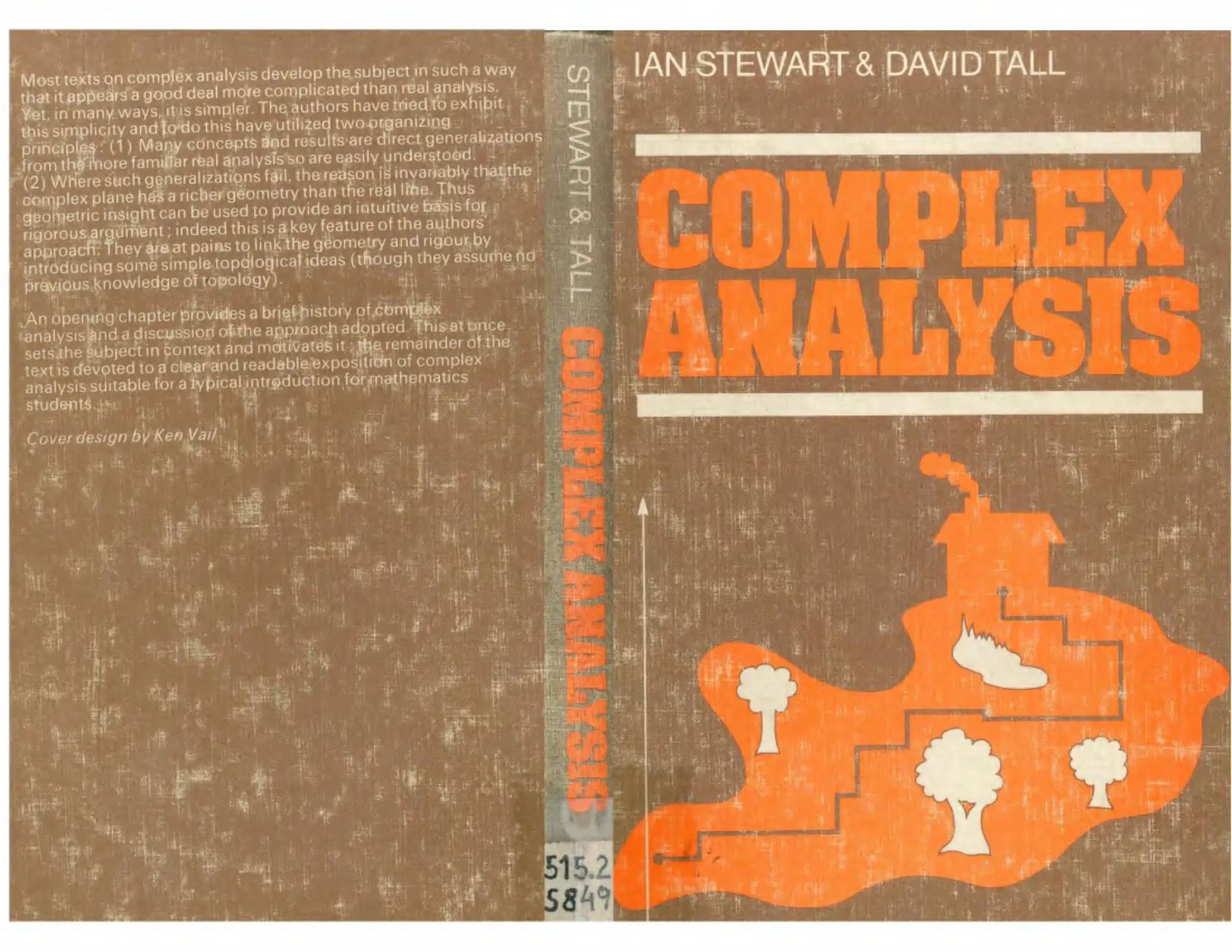


Author: Stewart I. Tall D.
Tags: mathematics mathematical analysis natural sciences complex analysis
ISBN: 0-521-24513-3
Year: 1983
Text
                    IAN STEWART & DAVID TALL
twoprganiziog
ANAL
Most texts on complex analysis develop thesubject in such a way
that it appears a good deal more complicated than real analysis.
VeT in man*waysjus simple. The. authors have med to exU,t,
this simplicity and to^io this have utilised twoprganiziog
principles ’ (1) Many concepts and results are direct generalisations
from thMiore famiffar real analysfsso are easily understood.
"(2) Wrfere such generalizations f^l,	T?uVs ^ hf *:
complex plane has a richer geometry than the real ithejhus
geometric insight can be used to provide an intuitive basis for .
nqorous argument; indeed this isa key featurei of-the abhors„
prMOus knowledge ortopwiuyyr.	..	.
An onemnq chapter provides а bri^t history of -сЬтЙ^х
analysisLnd a discussion' of. the approach adopted Thisat tapce
setsithe Subject in Context and motivates it  ^remainder of the
text is devoted to a clearand readableexposdidn of complex
analysis suitable for a ityhicalmtrftduction for^athematics
students.^-.	’ ! $	.	J#*
Cover design by Ken Vath ' ц F

Complex Analysis
(THE HITCHHIKER’S GUIDE TO THE PLANE)
IAN .STEWART,
Lecturer in Mathematics. University of Warwick
DAVID TALL
Senior Lecturer in Mathematics Education, University of Warwick
CAMBRIDGE UNIVERSITY PRESS
Cambridge ’
London New York New Rochelle
Melbourne Sydney
Published by the Press Syndicate of the University of Cambridge
The Pitt Building. Trumpington Street. Cambridge CB2 IRP
32 East 57th Street, New York, NY 10022, USA
296 Beaconsfield Parade, Middle Park, Melbourne 3206, Australia
© Cambridge University Press 1983
First published 1983
Printed in Great Britain at the University Press, Cambridge
Library of Congress catalogue card number: 82-4351
British Library cataloguing in publication data
Stewart, Ian, 1945-
Complex analysis,
I. Mathematics
1. Title II. Tall. David
520 QA36
ISBN 0 521 24513 3 hard covers
ISBN 0521 28763 4 paperback
t
f*'	/	Д
/	0	, -2 i ?-4 3- 4
Contents
Preface	•	ix
Acknowledgement	ix
0	The origins of complex analysis,	and a modem viewpoint	1
I.	The origins of complex numbers	1
2.	The origins of complex analysis	5
3.	The puzzle	7
4.	A modern view	8
1	Algebra of the complex plane	Ю
1.	Construction of the complex numbers	10
2.	The x + iy notation	12
3.	A geometric interpretation	13
4.	Real and imaginary parts	14
5.	The modulus	14
6.	The complex conjugate	1 8
7.	Polar coordinates	12
8.	The complex numbers cannot be ordered	18
Exercises 1	*8
2	Topology of the complex plane	32
1.	Open and closed sets	24
2.	Limits of functions	25
3.	Continuity	28
4.	Paths	33
5.	The Paving Lemma	37
6.	Connectedness	40
Exercises 2	45
3	Power series	48	•
1.	Sequences	48
2.	Scries	52
3.	Power series	56
4.	Manipulating power series	58
5.	Appendix	60
Exercises 3	61
vi	Contents
4	Differentiation	64
I.	Basic results	64
2.	The Cauchy-Riemann equations	67
3.	Connected sets and differentiability	71
4.	Hybrid functions	77
5.	Power series	73
6.	A glimpse into the future	76
Exercises 4	79
5	The exponential function	82
1.	The exponential function	82
2.	Real exponentials and logarithms	84
3.	Trigonometric functions	84
4.	The analytic definition of я	86
5.	The behaviour of real trigonometric functions	86
6.	Complex exponential and trigonometric functions are periodic	88
7.	Other trigonometric functions	90
8.	Hyperbolic functions	91
Exercises 5	92
6	Integration	95
1.	The real case	96
2,	Complex integration along smooth paths	97
3.	The length of a smooth path	100
4.	Contour integration	Ю5
5.	The Fundamental Theorem of Contour Integration	108
6.	The Estimation Lemma	111
7.	Consequences of the Fundamental Theorem	114
Exercises 6	1I7
7	Angies, logarithms, and the winding number	120
1.	Radian measure of angles	120
2.	The argument of a complex number	122
3.	The complex logarithm	125
4.	The winding number	126
5.	The winding number as an integral	130
6,	The winding number round an arbitrary point	131
7.	Components of the complement of a path	132
8.	Computing the winding number by eye	133
Exercises 7	137
8	Cauchy’s Theorem	1 ’1
1.	The Cauchy Theorem for a	triangle	143
2.	Existence of an antiderivative in a star-domain	146
3.	An example - the logarithm	148
Contents	vii
4.	Local existence of an antiderivative	149
5.	Cauchy's Theorem	149
6.	Applications of Cauchy's Theorem	153
7.	Simply connected domains
Exercises 8	1$7
9	Homotopy versieras of Cauchy’s Theorem	159
1.	Integration along arbitrary paths	159
2.	The Cauchy Theorem for a boundary	162
3.	Homotopy	165
4.	Fixed end point homotopy	167
5.	Closed path homotopy	169
6.	The Cauchy Theorems compared	172
Exercises 9	175
10	Taylor series	177
1.	Cauchy's integral formula	178
2.	Taylor series	1"
3.	Morera’s Theorem	183
4.	Cauchy’s Estimate	184
5.	Zeros	185
6.	Extension functions	188
7.	Local maxima and minima	189
8.	The Maximum Modulus Theorem	191
Exercises 10	192
11	Ijurent series	195
195
1.	Series involving negative powers
2.	Isolated singularities
3.	Behaviour near an isolated singularity
4.	The extended complex plane, or Riemann sphere
5.	Behaviour of a differentiable function at oo	~
6.	Meromorphic functions
Exercises 11	ЭД9
12	Residues	212
1.	Cauchy’s residue theorem	212
2.	Calculating residues	215
3.	Evaluation of definite integrals	217
4.	Summation of series	228
5.	Counting zeros	231
Exercises 12	234
vliJ	Contents
13	Conformal transformations	238
1.	Real numbers modulo 2я	238
2.	Conformal transformations	241
3.	Mobius mappings	246
4.	Potential theory	249
Exercises 13	252
14	Analytic continuaticxi	257
1.	The limitations of power series	257
2.	Comparing power scries	260
3.	Analytic continuation	261
4.	Multiform functions	265
5.	Riemann surfaces	268
6.	Complex powers	271
7.	Conformal mapping using multiform functions	273
8.	Contour integration of multiform functions	274
9.	The road goes ever on...	281
Exercises 14	282
Index
287
Preface
Students faced with a course on ‘Complex Analysis’ often find it to be
just that - complex. In the sense oPcomplicatccT.
It is true, of course, that the proofs of some of the major theorems in the
subject can demand a certain technical versatility. But in many ways, on a
conceptual level, complex analysis is actually easier than real analysis; it
just isn’t always taught that way.
This book is intended for use at the level of second or third year under-
graduates, and it is based on experience accumulated from such courses
over the past decade. To exhibit this inherent simplicity of complex
analysis we have organized the material around two basic principles:
(1) generalize from the real case; (2) when that reveals new phenomena,
use the rich geometry of the plane to understand them. Our aim through-
out is to encourage geometric thinking, with the proviso that it must be
adequately backed up by analytic rigour.
The opening chapter sets the work in its historical context; and the
history is often alluded to later as partial motivation. However, we feel
that cultural changes often affect the status of conceptual problems: what
was once an important difficulty can become a triviality when viewed with
hindsight. It is not always necessary to drag today’s students through
yesterday’s hang-ups. We argue the point at greater length below: it is
fundamental to our entire approach.
INS & DO I
Barby and Kenilworth
October 1981
Acknowledgement
Parts of Chapters 11, 12, 13 have appeared in the Handbook of Applicable Mathematics,
vol. 4, chapter 9, published by Wiley and Sons Ltd., 1982. They are here reprinted with
permission.

о
The origins of complex analysis,
and a modern viewpoint
If, as Kronecker asserted, the integers are made by God and all the rest
is the work of Man, then complex numbers are certainly one of Man’s
most intriguing mathematical artefacts. For centuries they have been a
wonder to mathematicians and philosophers alike. It took nearly 300 years
from their first appearance in Cardano’s /trs Magna to the publication
of a formal definition which satisfies our modern standards of rigour.
Building on such foundations the uninitiated reader might be forgiven for
thinking that complex analysis must be an incredibly complicated theory.
Yet here we come to a historical puzzle. Although it took nearly three
centuries to obtain a satisfactory treatment of complex numbers, it then
took less than a tenth of that time to complete a major part of complex
analysis.
Obviously the numbers must come first, or there is nothing to do
analysis with, but the timescale is surprising. A possible explanation is that
setting up the foundations adequately involved deep problems of a
philosophical nature: it took a long time to come to grips with them, but
once the ‘breakthrough’ had occurred, the further development was easy
by comparison.
History suggests otherwise.
1.	The origins of complex numbers
The celebrated 4rs Magna of Girolamo Cardano in 1545 treated the
simultaneous equations
x+)'» 10
xy=40,
obtaining a solution (in modern notation) of the form
x=5 + v''-15 y = 5-vz-15.
Cardano gave no interpretation for the square root of a negative number.
1
2	0. Origins, and a modem viewpoint
but he did observe that, on the assumption that the quantities obey the
usual algebraic rules, one may check that they do satisfy the equations.
His attitude to this discovery was dismissive: ‘So progresses arithmetic
subtlety, the end of which... is as refined as it is useless.’
In the same book he noted that the application of the Tartaglia formula
for solving cubic equations to
15x + 4
leads to the expression
x= ^2 + 7-121 + ^2-v/-121
in contrast to the obvious answer x=4.
Raphael Bombelli (1526-73) suggested a way to reconcile the two
solutions by manipulating the ‘impossible’ roots as if they were ordinary
numbers: since
(2±>/—1)3 = 2 + 4/^T2T,
Cardano’s expression becomes
x=(2 + >/^T)+(2->/~l)=4.
The ‘impossible’ root is just the familiar root in a complex disguise.
Bombelli’s work was the first hint that complex numbers could prove
useful in solving real mathematical problems.
In La Geometrie (1637), Rene Descartes made the distinction between
‘real’ and ‘imaginary’ numbers, interpreting the occurrence of imaginaries
as a sign that the problem concerned was insoluble, an opinion shared by
Newton at a later date.
John Wallis represented a complex number geometrically in his Algebra
of 1673. On a fixed line the real part of the number was measured off (in
the direction given by its sign); then the imaginary part was measured off
at right angles (Fig. 0.1).
For some reason this proposal seems to have been subsequently ignored.
Fig. 0.1
1. The origins of complex numbers
3
In 1702 John Bernoulli was evaluating integrals of the form
f____________________________________
J ax2+bx+c
by partial fractions. Using the philosophy that complex numbers could
be manipulated like real ones, he wrote the integrand In the form
_____1________A В
ax^ + bx+x x—a x—fi
fusing modern notation) w here a, fi are the roots of the quadratic denomi-
nator and found the integral in the form
A log (x —a)+В log (x - fi).
His bold decision to use the same method when the quadratic had no real
solutions led to logarithms of complex numbers. But what were they?
Both Bernoulli and Leibniz used the method and by 1712 were engaged in
controversy; Leibniz asserted that the logarithm of a negative number was
complex whilst Bernoulli insisted it was real.
Bernoulli argued that, since
d( — x) dx
-x x ’
it follows by integration that log(—x)=log(x). Leibniz, on the other
hand, insisted that the integration was only correct for positive x.
Leonhard Euler resolved the controversy in favour of Leibniz in 1749,
pointing out that the integration required an arbitrary constant,
log(—x)=log (x)+c,
a point which Bernoulli had ignored.
By formally manipulating expressions involving complex numbers,
Euler derived a host of theoretical relations, including the famous formula
of 1748:
e’*=cos0+isin0.
(As if to emphasize that there’s nothing totally new in this world, it should
be noted that an equivalent formula was known to Roger Cotes in 1714!)
Putting 0=n we find
e”=-l,
a fantastic relation that blends the three mathematical symbols e, i and я
in one surprising equation.
Extending the theory of logarithms to the complex case by defining
logz=w if and only if eM = z,
4
0. Origins, and a modern viewpoint
we find more intriguing results. Formal manipulation gives
closa*ime _elos«^eid)iw = z . ( __ jyn
For an even integer m = 2n this gives
glogs + llffl =z
and so log z+2mti is also a logarithm of 2; the complex logarithm is
many-valued. For an odd integer m=2n +1, we have
plofz+(2r+1И'____________________________	_
v	— —
whence
log (-z)=logz+(2n + l)iri.
This gives the resolution of the Leibniz-Bernoulli controversy: for real
positive x, log (—x) must be complex.
The theory of complex numbers was beginning to grow more and more
fascinating. What was lacking was a concrete interpretation that ex-
plained precisely what these entities were.
In 1797 Caspar Wessel published a paper in Danish describing the
representation of a complex number as a point in the plane. It went
almost totally unnoticed until a French translation was published a
hundred years later. Meanwhile the idea was attributed to Jean-Robert
Argand who wrote it up independently in 1806. Since that time the geo-
metric interpretation of complex numbers has become known as the
Argand diagram.
Another pioneer in the theory of complex numbers was Carl Friedrich
Gauss. In his doctoral dissertation of 1799, he addressed himself to a
problem which had concerned mathematicians since the early eighteenth
century. Initially it had been widely believed that, just as the solutions
of real quadratic equations could lead to new ‘complex’ numbers, so
would solutions of equations with complex coefficients lead to even more
kinds of new numbers. Jean D'Alembert (1717-83) conjectured that
complex numbers alone would suffice. Gauss confirmed this in the
‘fundamental theorem of algebra’ - every polynomial equation has a
complex root At first he proved it in the purely ‘real’ form that any real
polynomial factorizes into linear and quadratic factors, avoiding explicit
use of imaginaries; later he treated the general case. By 1811 he viewed
the complex numbers as points in the plane, saying so in a letter to Bessel.
In 1831 he published full details of the geometric representation of com-
plex numbers, which had begun to acquire an air of respectability.
In 1837, nearly three centuries after Cardan’s use of‘imaginary numbers’,
William Rowan Hamilton published the definition of complex numbers
2. The origins of complex analysis
5
as ordered pairs of real numbers subject to certain explicit rules of manipu-
lation. (In the same year Gauss wrote to Wolfgang Bolyai that he had
developed the same idea in 1831.) At last this placed the complex numbers
on a firm algebraic basis.
2.	The origins of complex analysis
Unlike the gradual emergence of the complex number concept, the develop-
ment of complex analysis seems to have been the direct result of the
mathematician’s urge to generalize. It was sought deliberately, by analogy
with real analysis.
As noted above, there are early traces of analytic operations on complex
functions in the work of Bernoulli, Leibniz, Euler, and their con-
temporaries.
In his 1811 letter to Bessel, Gauss shows that he knew the basic theorem
on complex integration around which complex analysis was subsequently
built. In real analysis, when one integrates a function f between limits
a and b,
j /(x)dx.
the limits fully specify the integral. But in the complex case, with a and b
represented as points in the plane, it is also necessary to specify a definite
curve from a to b, and to ‘integrate along the curve’. The question is, to
what extent does the value of the integral depend on the curve chosen?
Gauss says the following. T affirm now that the integral J /(x)dx has
only one value even if taken over different paths provided /(x)...does
not become infinite in the space enclosed by the two paths. This is a very
beautiful theorem whose proof... I shall give on a convenient occasion.’
It seems that the occasion never arose. The crucial step of publishing
a proof of this result was taken in 1825 by the man who was to occupy
centre stage during the first flowering of complex analysis: Augustin-
Louis Cauchy. After him it is called ‘Cauchy’s Theorem’. In Cauchy’s
hands the basic ideas of complex analysis rapidly emerged. For a complex
function to be differentiable it had to be very specialized in nature; its
real and imaginary parts had to satisfy certain properties called the
Cauchy-Riemann equations. Contour integrals of differentiable functions
wrere seen to have the property noted privately by Gauss. Furthermore, if
an integral was computed along a path which wound round points where
the function became infinite, then Cauchy showed how this integral could
6
0. Origins, and a modern viewpoint
be computed using the ‘theory of residues’. The latter simply required the
calculation of a constant, called the ‘residue’ of the function, at each
exceptional point; and the knowledge of how many times the path wound
round it The precise route of the path did not actually matter at all!
Power series proved to be important in the theory and other workers
extended the ideas. Pierre-Alphonse Laurent introduced ‘Laurent series’
involving negative powers in 1843. In this formulation, near an exceptional
point z0, a differentiable function was expressed in the form of a sum of
two series
/(z)=[a0+fll(z-z,)+”+a,(z-z.r+”-J
+ [b i (z - z.)“1 + •"+b„(z -z.)’*...].
The residue of the function at z„ was then just the coefficient bt. Using the
theory of residues the computation of complex integrals often proved to
be far simpler than one could ever have dreamed.
Cauchy’s definitions of analytic ideas such as continuity, limits, deriva-
tives and so on, were not the same as we use today. He based them on
infinitesimal notions which subsequently fell into disrepute. A rigorous
treatment was then developed by Karl Weierstrass (1815-97) using
definitions which are still regarded as fundamental (though recent develop-
ments in ‘non-standard analysis’, which legitimize infinitesimals, show us
that we may have been over-hasty in judging Cauchy’s ideas). Weierstrass
founded his whole approach on power series. However, the geometric
viewpoint was sorely lacking in his work (at least as published); this
deficiency was remedied by far-reaching ideas introduced by Bernhard
Riemann (1826 66). In particular the concept known as a ‘Riemann
surface’, which dates from 1851, treats many-valued functions by making
the complex plane have multiple layers, on each of which the function is
single-valued. The topological way in which the layers join up is the
crucial thing.
From the mid-nineteenth century onwards the progress of complex
analysis has been strong and steady with many far-reaching developments.
The fundamental ideas of Cauchy remain, now refined and clothed in
more recent topological language. The abstruse invention of complex
numbers, once described by our mathematical forbears as ‘impossible’
and ‘useless’, has become part of an aesthetically satisfying theory with
eminently practical applications in aerodynamics, fluid mechanics and
many other areas.
3. The puzzle
7
3.	The puzzle
We return to our ‘historical puzzle’. Why was the development of complex
numbers so laboured and hesitant, whereas that of complex analysis was
explosive'!
We shall suggest a possible answer (it is of course only personal opinion
and thus open to argument), somewhat different from the foundations +
breakthrough’ explanation suggested earlier.
Looking at the early history of complex numbers, the overall impression
is of countless generations of mathematicians beating out their brains
against a brick wall in search of - what? A triviality. The definition of
complex numbers as ordered pairs (x, y), or as points of the plane, was
obtained over and over and over again. It is even implicit in Bombelli’s
work; it is there for all to see in Wallis’s; it crops up again by way of
Wessel, Argand, Gauss. Morris Kline once remarked: ‘That many men -
Cotes, de Moivre, Euler, and Vandermonde - really thought of complex
numbers as points in the plane follows from the fact that all, in attempting
to solve xn — 1 = 0, thought of the solutions... as the vertices of a regular
polygon.’
If the problem has such a simple solution, why was this not recognized
sooner?
The early mathematicians were not so much seeking a construction for
complex numbers as a meaning, in the philosophical sense: ‘What are
complex numbers? However, the development of complex analysis
showed that the complex number concept was so useful that no mathe-
matician in his right mind could possibly ignore it The unspoken question
became ‘what can we do with complex numbers?, and once that had a
satisfactory answer, the original philosophical question evaporated.
There wras no jubilation at Hamilton’s incisive answer to the three-
hundred year old foundation problem - it was ‘old hat’. Once mathe-
maticians had woven the notion of complex numbers into a powerful
coherent theory, the fears that they had concerning the existence of
complex numbers became unimportant and mathematicians lost interest
in them.
There are other cases of this nature in the history of mathematics but
perhaps none more clear-cut. As time passes, the cultural world-view
changes. What one generation sees as a problem or a solution is not
interpreted in the same way by another generation. We would do well to
bear this in mind when we view the historical development of mathe-
matics. To view history solely from the viewpoint of the current generation
may easily lead to distortion and misinterpretation.
8
0. Origins, and a modern viewpoint
4.	A modern view
The conclusion which we have just enunciated has implications for those
studying complex analysis for the first time. Though sometimes it is useful
to see the development of the theory in its historical context, it is not
always necessary to fight the historical battles again. In this text we give
honour where we can to those pioneers who carved their way through
virgin mathematical territory. But more recent developments allow us to
see the theory itself in a new light. To the modern ear the very name
‘complex analysis’ carries misleading overtones: it suggests complexity
in the sense of complication. The older meaning, ‘composite’, was perhaps
appropriate when the ‘real part’ of a complex number had a quite different
status from the ‘imaginary part’. But nowadays a complex number is a
perfectly integrated whole: to think of complex analysis as if it were, so
to speak, two copies of real analysis, is to place undue emphasis on the
algebra at the expense of the geometry, which in the long run is far more
influential. And in fact complex numbers are not more complicated than
reals: in some ways they are simpler. For instance, polynomials always
have roots. Likewise complex analysis is often simpler than real analysis:
for example, every differentiable function is differentiable as often as we
please and has a power scries expansion.
In preparing our approach to the subject we have adopted two basic
organizing principles. The first is the direct generalization to the complex
case of real analysis. Definitions of limits, continuity, differentiation and
integration arc the natural extension of the real notions, provided that we
view them in suitable terms. Since nowadays any student taking a course
in complex analysis may be assumed to have made a lengthy study of the
real counterpart, many battles have already been won: we can refer students
to their accumulated knowledge, pausing only to phrase it in a form
appropriate for our use. This saves time as well as energy and allows us to
proceed to the heart of the subject where the interesting differences occur.
Invariably this happens because the plane has a richer geometry than the
line, and this brings us to our second major organizing principle: geo-
metric insight is valuable and should be cultivated. Of course, this insight
must be translated into sound formal arguments; this can be done using
modem topological notions.
Using these two principles, a straightforward approach to complex
analysis emerges. First, complex numbers are defined formally as ordered
pairs of real numbers, giving them an interpretation as points in the plane.
The topology of complex numbers is then given in terms of plane topology.
In quick succession it is possible to derive complex generalizations of the
4. A modem view
9
notions of continuity, limits, and differentiation, with particular emphasis
on power series which will occupy a central role later on. A study of the
complex exponential function, given in terms of the usual power series,
reveals the intimate connection between this function and the trigo-
nometric functions (also considered as power series). After generalizing
the notion of integration, the logarithm can be viewed cither as the inverse
function of the exponential, or as the integral
log z= J 1/zdz,
suitably interpreted. This interpretation yields intimate links between
geometric intuition and formal analysis.
At this stage Cauchy’s Theorem is presented in various guises and the
use of integration arguments leads to a proof that every differentiable
function can be expressed as a power series. More generally, Laurent
series (using positive and negative powers) take care of isolated points
where functions become infinite and lead to the powerful “theory of
residues’ for the calculation of complex integrals.
Returning to geometric ideas, complex analysis proves invaluable in
two-dimensional potential theory. Finally the geometric ideas of Riemann
can be viewed in terms of modem topology to give a global insight into
‘many-valued’ functions (such as the logarithm) and open up new areas
of progress.
Algebra of the complex plane
‘The Divine Spirit found a sublime outlet in that wonder of analysis, that
portent of the ideal world, that amphibian between being and not-being,
which we call the imaginary root of negative unity.’ So said Gottfried
Leibniz in 1702 - though he may have let his eloquence run away with him.
The current view of is a little more prosaic, though the uses made of
it are at least as inspiring. The logical status of complex numbers, which
caused so much distress during the eighteenth century, is now seen to be
very much on a par with that of the ‘real’ numbers. What puzzled the
ancients was the obvious artificiality and abstraction of the complex
number system, in contrast to the apparently natural and concrete real
number system; but the mathematician of today sees even the real numbers
as possessing a similar artificiality and abstraction.
In this chapter we shall discuss the construction of a system of numbers,
containing the familiar real numbers, and also permitting the solution
of the equation x2= — 1. This system is known as the complex numbers.
Many readers will already know the contents of this chapter: they should
read it through rapidly to check such items as notation, and pass on at
once to the next.
There is a natural geometric representation of complex numbers as a
plane, analogous to that of the reals as a line. The extra freedom inherent
in the plane gives the whole subject a very geometric flavour, which it is
our intention to keep to the fore in the development of the theory.
1.	Construction of the complex numbers
Wc define a complex number to be an ordered pair (x, y) of real numbers.
Addition and multiplication of complex numbers are defined by.
(Xi, У1) + (x* У1)=(*1 +X* >’l + Ы	(1)
(xt, яХх2, У1)=(Х1Х2 -y,y2, xty2+У1Х2).	(2)
10
1. Construction of the complex numbers
11
For example,
(3, 5X2,7)=(3.2—5.7, 3.7+5.2)=(-29, 31).
This definition is the culmination of several centuries of struggle to under-
stand complex numbers, and it shows how elusive a simple idea can be.
Before we see what these pairs have to do with however, let us
establish some simple properties.
THEOREM 1.1. The set of complex numbers, with the operations defined
above, is a field That is, the following axioms hold: if zt=(xi, уД z2 =
(x2, У1\ and z3=(x3, y3) are complex numbers, then
Addition and multiplication are commutative:
z1 + z2=z2 + z1	|
ZjZ2 = Z2Zj.	J
Addition and multiplication are associative:
(zI+z2)+z3=z1 + (z2 + z3)	|
(zJz2)z3 = z1(z2z3).	J
There is an additive identity (0,0):
Z1+(0,0)=z,.	(5)
There is a multiplicative identity (1,0):
z1(l,0)=zI.	(6)
Each element has an additive inverse:
(x,y)+(-x, —y)=(0,0).	(?)
Each element other than (0,0) has a
multiplicative inverse:
(8)
Multiplication distributes over addition:
Zi(z2 + z3)=z1z2+zIz3.	(9)
Proof. All assertions (3)-(8) are direct consequences of (I) and (2), using
only the field properties of the set R of real numbers. For example in (9)
we have
z1(z2+z3)=(x1, yiXxa+Хз, y2 + y3)
=(xt(x2+х3)-у,(у2+y3X Xj(y2+y3)+У1(х2 + x3))
= (X|X2 + X|X3-y1y2-yly3,X1y2 + X1y3 + y1X2+y1X3),
12
1. Algebra of the complex plane
and
2iZ1+z1zJ=(xi,y1Xxi> Уа)+(*1.>1Х*э»Уэ)
=(x,X2 “ЯЛ» *1У2 + У1*2)+(Х1ХЗ-У1Уз. *1№ + У1*з)
= (XtX2-yty-2 + *1X3-У1Уз. *1Ъ +Ь*2 + *1Уз + У1 *з)
which, by real algebra, is the same ordered pair.
The reader should provide similar proofs for the remaining assertions. □
The symbol C is used for the field of complex numbers.
2.	The x+iy notation
The symbol commonly used for a complex number is not (x, y) but x+iy.
This goes back to Euler, who used i to denote J in 1777, though the
notation was first used consistently by Gauss.
To recover this notation, we proceed as follows. First note that since
(x1,0)+(x2,0)=(xI+x2,0),
(x„ 0Xx2,0)=(x1x2,0),
we may identify a complex number (x2,0) with the real number x2. More
pedantically, the map (xb 0)-*Xj defines an isomorphism between the
set of complex numbers of the form (хь 0) and the field R of real numbers
Now define
i=(0,1).
Then
x + iy=(x, 0)+(0, 1 Xy, 0)
= (x, y) (by (1) and (2) above).
Finally, observe that
i2 = (0,1X0,1)
= (0-0-11,0-1 +10)
=(-1,0)
= — 1.
In this sense we may say that i=
The x+iy notation is more convenient, and will be used henceforth.
Algebraic computations with it are easy. They use all the normal algebraic
rules, plus the rule i2 = — 1. So to multiply, we work out
(xi+iyiXx2 + iyI)=xlx2 + x1iy2 + iy1x2 + iyiiy2
=X|X2 + i(x,y2+yix2)+ i2yiy2.
3.	A geometric interpretation
13
But i2= -1, so this becomes
XiXi-yiJi+Kxiyj+yiXj)-
This computation, of course, explains the choice of the multiplication
formula (2); the addition formula (1) comes the same way but is easier.
The definition by (1) and (2) is thus a very sneaky piece of hindsight.
The formula (8) for inverses may also be derived as follows:
1	1 x—iy_ x- iy
x+iy x+iy x-iy x2 + y2
EXAMPLE
2+3i_(2+3iXl-2i) 2—6 + i(—4+3)	4 i
1 + 2i (i + 2iXl— 2i)	5	“ 5 5’
3.	A geometric interpretation
Since ordered pairs (x, y) provide coordinates on the plane R2 we can
visualize C as a plane, with the number x + iy corresponding to the point
(x, y) as in Figure 1.1.

" i = (0.D
Fig. 1.	1
14
1. Algebra of the complex plane
Fig. 1.	2
The identification of (x, 0) with x then amounts to considering the
real numbers as forming the real axis on the plane, as in Figure 1.2.
The v-axis, at right angles to this, is the imaginary axis.
This geometric representation is often called the Argand Diagram or
the Gauss Plane. Since so many other mathematicians have justifiable
claims on it, we shall avoid the danger of giving undue credit to any of
them and simply refer to it as the complex plane. In purely geometric
terms, of course, it is just the real plane R2; but interpreted as C it has the
additional algebraic structure of a field, and it is this that gives the complex
plane its special qualities.
4.	Real and imaginary parts
Given a complex number z=x+iy, we call x the real part of z and у the
imaginary part, using the notation
x=re(z)
y=im(z).
Both of these are real numbers: the coordinates of z in the complex plane.
5.	The modulus
The modulus, or absolute value, of a real number x is defined to be
. x ifxs»0
|X,= l-x ifx<0.
As it stands there is no obvious generalization to complex numbers,
because (see §8 below) there is no useful ordering on C. However, we can
interpret |xj geometrically as the distance from x to the origin of the real
line. This translates to the complex plane and leads us to make the
definition
И = J(x1+y2)
for the modulus of the complex number z = x+iy. Here we mean the posi-
5. The modulus
15
tive square root: note that x2+y2 is a positive real number so the formula
makes sense.
The modulus has the following properties:
|ii+za|<|zi|+|z2|,	(10)
k1z2|=|zl||za|-	(11)
Property (11) follows at once from the definitions. The triangle inequality
(10) is a little harder to prove directly, although its geometric interpretation
(Fig. 1.3) is the obvious fact that one side of a triangle is no longer than the
sum of the lengths of the other two sides.
To prove (10) we note that since both sides are positive, it is equivalent to
l^i + Zip^dzJ + lzjl)2
which takes the form
(*i + x2)2+(yi + y2)2 < |z, |2+2\zi | |z2|+|z2|2
where z1=Xi+iyi, z2=x2+iy2. Simplifying, this holds if and only if
X|X2+y1y2<|z1||z2|.
Since the right-hand side of this Is positive, the desired inequality is equi-
valent to
(xix2+yty2)2<|zj|2|z2|2.
But
|zi|2|z2|2-(x1x2 + yly2)2=(x?+xl)(y?+yl)-(xlx2+y1y2)2
-(Х1У1~Х2У1)*
which is positive. This completes the proof.
16	1. Algebra of the complex plane
6.	The complex conjugate
If z=x+iy, then its complex conjugate is
z=x—ly.
Geometrically, this is obtained by reflecting z in the x-axis (Fig. 1.4).
The following properties arc easy to verify directly:
z1+z2«zI+z2	(12)
Z1Z2 = Z!Z2	(13)
re(z)=|(z+z)	(14)
lm(z)=*(z—z)	(15)
|z|2 = H	(16)
z is real if and only if z=z.	(17)
Properties (12) and (13) have the important implication that the complex
conjugate of any polynomial expression in complex numbers zt,..., zB
may be obtained by writing a bar over each individual coefficient or vari-
able in the expression. For example,
5ziz2— Z} + 2zt = 5ziz1—Zi+2zl
= 5z1z2-z? + 2zi
since 5, 2 are real, hence 5=5, 2 = 2.
• z=x + iy
Fig. 1.4
• i -x -jy
7. Polar coordinates
17
7.	Polar coordinates
The expression x+iy for a complex number is intimately related to
Cartesian coordinates (x, y) in the plane. It turns out often to be useful to
work with polar coordinates (r, 0), which we recall correspond to a point
distance r from the origin along a ray making an angle 0 measured from
the positive x-axis in an anticlockwise direction (Fig. 1.5). Of course we
measure 0 in radians. The coordinate systems are related as follows:
x=r cos 0
y=r sin 0.	(18)
It follows that
r=7x2 + ? = |z|
where z=x+iy.
Any value of 0 for which (18) holds is called an argument of z. The article
‘an’ is used because 0 is not unique: if 0 is an argument so is 0+2kn for
any integer k. With the understanding that 0 is unique only up to multiples
of 2я, we may use the notation
0=arg(z).
Often the choice of 0 is rendered unique by some convention: for example,
we may insist that 0 is chosen in the interval [0, 2it\ or in (—я, я]. The
unique value of 0 in the interval (—я, л] is known as the principal value
of the argument. (We follow standard practice in taking this particular
Fig. 1.5
18
1. Algebra of the complex plane
interval. Its main advantage is that в then behaves nicely near the positive
real axis, where 0=0. But this is a technical point that only acquires
importance much later. The non-uniqueness of 0 is a phenomenon with
tremendous ramifications in the theory, as we shall see.)
With г, в defined as above, we have
z=x + iy=r(cos 0 + i sin 0).
The expression cos 0 + i sin 0 is of considerable importance in complex
analysis. In Chapter 5 wc relate it to the complex exponential function.
8.	The complex numbers cannot be ordered
The real numbers may be given an ordering (the usual one, <) which has
among its properties the following:
If x^=0 then either x>0 or —x>0, but not both. (19)
If x, y>0 then xy>0, x+y>0.	(20)
No such ordering can be defined on the complex numbers. Suppose for a
contradiction that one can. Then since i =£ 0 it follows from (19) that either
l>0or — i>0. Then (20) implies that -l = i«i>0or -1 =(-iX—i)>0.
At the same time, 1 = (-1)2 > 0. But then both 1 and -1 are greater than 0,
contrary to (19).
It is therefore not possible to use inequalities, analogous to those for
reals, when discussing complex numbers. Any inequality that occurs must
involve only real numbers, possibly related to the given complex numbers
For example, if z e C, then
z> 1
makes no sense; but either of
|2|>1
or
re (z)> 1
is acceptable. (They do not mean the same thing!) As a convention, if wc
write a statement such as
e>0
this will automatically imply that £ is a real number.
Exercises I
1.	Check in full detail that the complex numbers C form a field under the operations
of addition and multiplication defined above.
Exercises 1
19
2.	If Z|, z2 eC prove that
(1)	|zt + z2[«|z,|+|z2|.
(u)	~*»l-
3.	In Figure 1.6 tbeblack dots represent three complex numbers u, o. w (as marked)
The circle is the unit circle |z|= 1. The open dots a, b, c, d, e, /, g, h represent
(in some order) the numbers и+v, и + w, t? + w. и + c + uv, iw, w, utw Which
is which?
4.	By writing z in the form г-а + Ы, find all solutions z of the following equations:
(i)	?=-5+12i
(li)	r2=2 + i
(iii)	(7 + 24i)z=375
(iv)	z2—(3 + i)z+(2 + 2i)=O
(v)	z2-3z+l+i-0.
5.	If A is a positive real number, show that
{z 6 314=21,-11}
is a circle, unless A takes one particular value (which?).
6.	Draw the set of points
{z€C|re(z+l)-|z-lJ}
by substituting z=x+iy and computing tbe real equation relating x and y.
Now note that re(z+1) is the distance from z to tbe line y— — I; and |z—1| is
the distance between z and 1. Compare with the classical ‘focus directrix’
definition of a parabola: the locus of a point equidistant from a fixed line (here
y= —1) and a fixed point ((x, y)=(l, 01).
7.	Draw the set of all z eC satisfying the following conditions:
(1)	rez>2	(ii) l<imz<2
(iii) l<im(z—i)<2	(iv) |z|<2
20
I. Algebra of the complex plane
(v)|z|>l	(vi) l<|z|<2
(vii) |z-1|< 1	(viii) |z-l|<|z+l|.
Interpret the expressions |z -1|, |z+1| as the distances between certain points,
and explain (p) and (Л) tn terms of the distances from z to 1 and — 1.
8.	Draw the set of all z e C satisfying the following conditions:
(l)zz-l	(ii) z+lz+1+1=0
(iii)	z+z+2=0	(iv) z+z+2I»0.
9.	Let r, s, 0, ф be real. Let
/	z=r(cos 0+1 sin 0)
w=s(cos ф+i sin ф).
Form the product zw and use the formulae for cos (0+ф\ sin (0 + Ф) to show that
arg (zw)=arg (z)+arg (w).
By induction on n, derive De Moivre’s Theorem
(cos 0+isin 0)"=cos n0+i sin nO
for all natural numbers n.
Specialize to the case n=3 and recover the usual formulae for cos 30 and sin
30 In terms of cos 0 and sin 0.
10.	Use De Moivrc’s Theorem (ex. 9) and the substitution z=r(cos 0+i sin 0) to
show that the equation z3 = I has three distinct complex roots. Find them.
Compute the square roots of 1 + >/31, /3 - i, and 1 + i; and the cube roots of
/З + i, 1 —i, i. Sketch these points in the complex plane.
11.	In earlier textbooks, multiplication of complex numbers is often defined as
follows. Given two complex numbers zlt z2, represent them by points A and В
in the complex plane; and let 0, U be the points z=0, z= I respectively (see
Exercises 1
21
Fig. 1.7). Draw triangle OBC similar to triangle США (where ZBOC=ZUOA,
ZOBC=ZOUA). Then ztz2 is represented by the point C so constructed.
Using the fact that |z,zj|= |zi||z2|, and the result of exercise 6, show that this
agrees with the formula definition given in this text.
12.	Define a square root s/z of a complex number z to be any complex number w
such that w2=z. Prove that every non-zero complex number has exactly two
complex square roots, and give formulae for them in terms of re z and im z.
If a, b, с 6 C, with a ^0, show that the solutions of the quadratic equation
az1 + bz+c=0
are precisely
_ -b±yj\b2— 4uc)
2a
13.	Use De Moivre’s Theorem (exercise 9) to compute cos 50 and sin 50 in terms of
cos 0 and sin 0.
14.	Prove that De Moivre’s Theorem remains true if n is a negative integer.
15.	Define a к th root $z to be any w such that =z. Use De Moivre’s Theorem to
find an expression for ^(r(cos 0+i sin 01).
16.	Let a, fl, y,<5 e C with у ^0, fly. Define Ф by
az+ 8
ф(2)=—?
yz+b
Prove that ф defines a bijection between C\{ -6/y} and C\{«/y}. Show that
it takes circles into circles. What about circles through — 0/y?
2
Topology of the complex plane
in this chapter we collect together all the basic topological ideas we require
for our study of complex analysis. The list is not very demanding. Some
items are needed to handle differentiation neatly, and some are needed
for integration. Differentiation is naturally set against a background of
limits and continuity and these are best dealt with on open sets. On the
other hand, an integral from one complex number to another is computed
along a specified path between them. Л set within which any two points
can be joined by a path is said to be connected. To be able to cope with both
integration and differentiation in the simplest possible manner later on,
we shall restrict our complex functions to those defined on open connected
sets. Such a set is called a domain.
Domains can have exotic shapes and paths can wiggle around a great
deal. To be able to appeal to geometric intuition without our imagination
having to work overtime thinking about complications like this, we use a
carefully conceived technical device called the Paving Lemma. We show
in this lemma that a path in an open set (in particular in a domain) can be
subdivided into a finite number of smaller pieces in such a way that each
piece is contained in a disc within the open set (thus ‘paving’ the path with
discs). (Fig 2.1) Now a disc is geometrically very simple; for instance any
two points in it can be joined by a straight line. Joining the endpoints of
the pieces of the original path in each disc paving it, we obtain a new path
made up of straight line segments, still lying in the open set and joining
the ends of the original path. We see, therefore, that given any path what-
soever between two points in an open set, no matter how much the path
twists and turns, there is an alternative path between the points in the open
set which is just made up of a finite number of straight segments. W’e can
even insist that the segments are parallel to the real or imaginary axes,
giving a step-path in the open set (just by taking a step-path in each
paving disc). (Fig. 2.2).
By techniques such as this we can use the Paving Lemma to illuminate
22
1. Open and dosed sets
23
24
2. Topology of the complex plane
complex analysis, yielding fully rigorous analytic proofs linked firmly
to geometric intuition.
1.	Open and closed sets
For a complex number z0 and a positive real number e, wc define the
e-neighhourhood of z0 to be (see Fig. 2.3)
N«(z0)={zeC||z-z0|<£}.
Fig. 2.3
Geometrically Nfz0) is just the disc centre z0 consisting of all points less
than e from z0.
A subset S =C is said to be open if every z0 6 S has a corresponding real
number e > 0 such that N/z0) SS. We emphasize the fact that e may depend
ОП Zq.
EXAMPLE.The disc Ne(z0) is itself open, for if Zj e Nfz0) then |z, —z0| <£.
Choose £>0 such that 5— |zi —z0|; then N/zJ GA’Jz0). (Fig. 2.4).
The complement of a subset S is г <£s
C\S={zeC|zCS}.
A subset S is said to be closed if C\ S is open.
There is another way of characterizing closed sets using the notion of a
limit point of a subset S. A complex number z0 is a limit point if every
N/z0) contains a point of S other than z0- In this definition z0 docs not
Fig. 2.4
o
2. Limits of functions
25
have to be a member of S, though it may be. The essential feature of a
limit point is that it has points of S arbitrarily close to it. In fact each
Njzo) must contain an infinite number of points of S (for if some A'e(z0)
contained only a finite number of elements zb..., z„ in S distinct from z0,
by taking £| to be the smallest of the distances |z0 -z,|, then A’E,(z0) would
contain no points of S).
As an alternative characterization of a closed set we have:
PROPOSITION 2.1. S is closed if and only if S contains all its limit points.
Proof. Suppose S is closed and z0 is a limit point. If z0 e C\ S, which is
open, then Nfz0) £C\ S for some e>0 and so Nfz0) would contain no
points of S, contrary to the fact that z0 is a limit point. Hence z0 € 5.
Conversely, suppose that S contains all its limit points. Then z0 € C\ S
is not a limit point of S, so there exists Nfz0) containing no point of S
and NJfz0) SC\ S. Thus C\ S is open and S is closed.	□
Of course, not every point of a closed set need be a limit point of that set.
For instance, if
T= {z e C|z=0 or z= 1/n for a positive integer n},
then the only limit point of T is 0, which is in T, so T is closed.
Points in S which are not limit points are said to be isolated points of 5.
All the other points of T except 0 are therefore isolated points of T An
isolated point z0 of S has a neighbourhood N,(z0) which contains no other
points of 5. For instance, in the set T just described, if £= 1/n-!/(«+1),
then Nfl/n) contains no other points of T. On the other hand, it is clear
from the definitions that every element of an open set is a limit point
2.	Limits of functions
The notion of a limit lim,_»lle/(z) is analogous to the real case and its
properties follow by similar arguments.
DEFINITION. If f :S-»C is an arbitrary complex function and z0 is a
limit point of S, then lim...„/(*)=/ if, given 8>0, there exists <5>0 such
that
for all z eS, 0<|z—z0| <6 implies l/(z)-/|<«.	(1)
Two points should be made about this definition:
(a)	z0 need not be a point of S and so/(z0) need not be defined; and even
if z0 e S, we may havef(z0)=fl.
26
2. Topology of the complex plane
For example, if
n,_JO (z^O)
{1 (2=0)
then lim^o/(z)=0^/(0).
(b)	It is essential that z0 is a limit point of 5, or else there would exist
<5>0 such that {z|0<|z—z0| <£} contains no point of 5. In this case the
condition (1) would be vacuously true for any / e C.
As in the real case, however, if z0 is a limit point of S and lim,^^ /(z)=/,
then the limit is unique. For if Г is another candidate for the limit,
take е=Ц/—f| to find 6,>0, 52>0 such that
z eS, 0<|z-z0|<5, implies |/(z)-(|<c,
zeS,0<|z-z0|<^i implies |/(г)-Г|<£.
Because z0 is a limit point, there exists z* eS, where 0<|z-z*|<min
{<5Ь й2}. Then
|Z—Г|»|/—/(z*)+/(z*)—Г|
<e+s
= 2«,
contradicting the choice of 6.
Standard properties of complex limits may be proved by using methods
analogous to the real case:
PROPOSITION 2.2. if lim,..l0 f(z)=l, lim2_.og(z)=k, then
(i)	lim (f(z)+g(z))=l+k,
(ii)	hm(/(z)-0(z))=/-k
(iii)	lim (f(z)g(z))=lk
(iv)	lim (f(z)/g(z))=l/k (for k*0).
x-10
Proof. Parts (iX (ii) are routine. So is part (iii\ but a little trickier. We write
|/(z)g(z) - lk\- |/(z)g(z)-lg(z) + lg(z)-lk\
Since lim,<teg(z)=Jc, given e>0, there exists <50 > 0 such that
zeS and 0<|z-zo|<<50 implies |^(z)-/c|<£
2. Limits of functions	27
and so |g(z)| <|fc| 4- 8, which means that |#| is bounded above near z0 by
M=|k|+£.
By continuity off there exists >0 such that
z eS and 0<|z—z0|<<5x implies |/(z)-/|<e/(2M).
Let N be any real number exceeding |/| (in particular, N>0f then by the
continuity of g there exists <52 > 0 such that
z eS and 0<|z—z0|<£2 implies |p(z)—/|<e/(2N).
For 6=min &2}, we then have
z eSand 0<|z-zo|<<5 implies
g	p
|/(z) - / W + и |$(*) - k| < 2X7 м+N 2N=£
Hence, for z eS and 0<|z-zo|<<5 we have |/(z)g(z)-/k|<8.
The proof of (iv) only requires us to show that limz_I()(l/fl(z))= 1/k, for
we then may appeal to (iii) for the functions f, \/g to give the full force of
(iv). Because g{z)-*k^0, we know that for some >0,
zeS and0<|z-zo|<<5i implies |^(z)-k|<||k|,
hence |g(z)| >^/c|.
We now find <52>O such that
zeS and 0<|z—z0|<<52 implies (^(z)-Jc|<j|k|2,
then for 6=min {5t, <52),
zeS and0<|z-zo|<£ implies
D
The real and imaginary parts of a complex function,
J(z)=re(/(z))+iim(/(z)),
may be considered separately. If
lim/(z)=/=a+i/? MsR)	(2)
г->г0
then, because
|re (/(z))-«| = |re (/(z) -/)| < |/(z) -f|,
we deduce from the definition that
lim re(/(z))=a.	(3)
Similarly
lim im (f(z))=p.	(4)
28
2. Topology of the complex plane
Conversely, if (3) and (4) both hold, from proposition 2.2(1) we deduce (2).
We can rephrase the preceding argument by recalling that the limit of
a real function 0:S-»R of two variables, ф(х, у) for (x, y)eSsR2 is
defined as follows:
ф(х, у)_»Я as (x, y)-»(a, b) if, given c>0, there exists <5>0 such that
forall (x,y)eS, 0<7{(х-а)г + (у-Ь)г}<^ implies |0(x,y)-2|<s.
Identifying (x, y) with x + iy, as in Chapter 1, for z=x+iy, z0=a+ib,
this may be written as
zeS and 0<|z—z0|<3 implies |ф(х, y)-x|<E.
If we now write
/(z)=u(x,y)+ip(x,y)
where the real and imaginary parts off are considered as real functions и
and v of two real variables x, y, then we have proved:
PROPOSITION 23. lim f(z)=l=a + iP if and only if
Г
и(х,у)-»а, i’(x, у)-»Д as (x, y)-»(a, b)
where f (z)=u(x, y) + iu(x, y)(z=x + iy) and z0=a + ib.	□
In this way limits of complex functions arc equivalent to limits of real
functions of two real variables (but the notation in the complex case is
usually much simpler).
3.	Continuity
A function/: S-»C is said to be continuous at z0 e S if, given e>0 there
exists 6 >0 such that
for all z eS, |z-z0|«5 implies |/(z)-/(zo)|<e-
If z0 is a limit point this is equivalent to saying that llmr^Ie /(z) exists and
lim /(z)=/(z0).
f-xo
If z0 is an isolated point then there is a neighbourhood NJiz0) which
contains no other points of S apart from z0, so
for allzeS, |z-z0|<5 implies z=z0
which in turn implies
|/U)-/(zo)| = 0,
so a complex function is always deemed to be continuous at an isolated
3. Continuity
29
point according to the given definition. Actually, this latter remark will
not trouble us at all, for we shall consider only functions where all the
points in S are limit points; in particular, S will usually be open. The
remark about isolated points is simply made to tidy up a loose end.
We can rephrase the definition of continuity in terms of open discs:
f is continuous at z0 e 5 if, given c > 0, there exists 8 > 0 such that
for all z € 5, z e A'*(z0) implies f (z) e NJ/(zol);
or, more succinctly,
/(NXzolnSlsN^Kzo)).
A function f : S-»C is said to be continuous if it is continuous at every
point z0 in S. We can develop an alternative way of defining continuous
functions in terms of open sets. First we need a generalization: a subset
V ZS is said to be relatively open in S, or just open in S, for short, if every
zoeS has a corresponding <r>0 such that N„(z0)r>SQV. A relatively
open set need not be open.
EXAMPLE. The interval (a, b)= {x eR|a<x<b} is open in R, but not in
C. For x e(a, t>), let <r=min {a— x, x—b}, then
N„(x)nR = {y e R|x-о <у <x + a} S(a, b),
but no open disc N„(x) in C is contained in the real interval (a, b), so (a, b)
is not open in C. (Fig. 2.5)
Using the standard set-theoretical notation
/-1(U)={z6S|/(z)eU}
we get an alternative characterization of a continuous function:
Fig- 2.5
30
2. Topology of the complex plane
PROPOSITION 2.4. A complex function f : S-»C is continuous if, and only
if, for every open set U, tbe inverse image is open in S.
Proof. Suppose that f is continuous and U is open. Let z0 € f~1 (17). Then
/(z0) g U and so there exists £>0 such that N,(f(z0))sU. By continuity
off there exists <5 > 0 such that
hence
NXzo)nS£/-‘(l7)
and/”’(17) is open.
Conversely, suppose that/-l(U) is open in S for every open set U.
Given z0 € 5 and £>0, then set NJ/(z0)) is open, so/ “x(WX/(zo))is °Pen
in S and there exists <5 >0 such that
NXz0)nS£/-‘(Nt(/(z0)).
Hence
/(N,(zo)HS)eA7/(2o))
and/ is continuous.	□
Proposition 2.4 is favoured by topologists as the definition of continuity
in terms of open sets.
It is particularly useful when S is itself an open set For then, given a
subset V sS open in S and z0 e V, we have
AXz0) SS (because S is open)
N„(z0)r\S £ V (because V is open in S),
hence, taking b to be the smaller of £ and a, we find
and V is a genuine open set. Thus we have:
COROLLARY 1Л. If S is an open set, then /: S-»C is continuous if, and
only if, for every open set U, the inverse image/ “ *(£?) is open. (Fig. 2.6
illustrates this.)	□
The composite of two functions is defined in the usual manner: if/ :S-*C
and g: T-»C where/(S)ST then gaf: S-»C is given by
g°f(z)=g(f(z)).
3. Continuity
31
PROPOSITION 2.6. If f is continuous at zoeS and g is continuous at
f(z0) then gaf is continuous at z0.
Proof. Easy exercise.
We add and multiply complex functions/i: S-»C and f2: S-»C on a given
set S to get
fx+f2'S-*C where (Л+/2Xz)=/i(z)+/2(z) (zeX)
ft -f2: $->C where (/, -f2\z)=fx(z) -f2(z) (z e S)
/,-J2: S-C where (fx(z e S)
ft/fz-S’-С where (/1//2Xz)=/,(z)//2(z) (z e S').
Here S' = {z eS| f2(z)^0).
PROPOSITION 2.7. If fx and f2 are continuous, then so are fxf2a fx —f2,
ft fz, ft/fz-
Proof. This is a direct consequence of Proposition 2.2.
This result allows us to show very quickly that certain functions built
up from continuous functions are themselves continuous. For instance
the constant function k(z)=c, and the identity function /(z)=z, are clearly
continuous. (To show this let «>0. For a constant function take any
positive 5, and for the identity function take 5=a, to obtain
|z—z0|<5 implies |k(z)—k(zo)|=0<e,
32
2. Topology of the complex plane
and
|z-z0|<£ implies |f(z)-/(z0)|<e.)
Immediately Proposition 2.7 shows that ф(г)=сг is continuous and, by
induction on n, ф/гУ^а^* is continuous for any a„ eC. Once more, by
induction on n, any polynomial p(z)=a0-t----is continuous; then
any rational function r(z)=p(z)/q(z) (where p and q are polynomials) is
continuous wherever q(z)^0.
By using methods such as these we shall rarely have to perform very
intricate e—6 computations.
EXAMPLE 1. m(z)=|z| is continuous for all z. Given any e>0, take
then, for |z — z0|<<5,
|m(z) - m(z0)| = | |z| - |z0| | < |z -z0| <a
EXAMPLE 2. /(z)=(|z|2 + 17z3 + 1066z)/(l +z) is continuous for zf — 1.
We could show this by explicit computation, but far quicker is to note
that |z|2 = |z||z| is a product of continuous functions, hence continuous,
17z3 + 1066z is a polynomial, hence continuous, thus the sum |z|2 + 17z3
+ 1066z is continuous. Finally 1 + z is continuous and non-zero for
z£ -l,so.thequotient/(z) is continuous for zf= —1.
Writing f(z)=u(x, у) + к<х, у) for z=x+ly eS, where и and v arc real
functions of the real variables x, y, then Proposition 2.3 gives
PROPOSITION L8. f(z)=u(x, y) + io(x, y) is continuous at Zo=xo + iyo if
and only if и and v are continuous at (x0) y0).	□
EXAMPLES. If /(z)=z2, then /(z)=(x + iy)2 = x2 — y2 + 2ixy. Hence
u(x, y)=x2—y2 and o(x, y)=2xy. The function f is continuous for all
z 6 C, just as the real functions и and v arc continuous functions of x
and у for all (x, y) e N2.
An interesting case occurs when S is the real interval
[a, b] = {x 6 R|a^x<b},
considered as a subset of C. For z e [a, b], z=x+iO, so here we may sim-
plify our notation and write f(z)=f(x)=u(x) + w(x). Thus a function
/:[a, b]-»C is continuous if and only if both и and г are continuous.
4. Paths
33
EXAMPLE4. f: [0, 1]-»C, where /(x)=x2 + ix3, is continuous, since
u(x)=x2 and b(x)=x3 are both continuous.
4.	Paths
A path in the complex plane is a continuous function y: [a, b]->C. Its
initial point is y(a) and final point is y(b). Sometimes we speak of a ‘path in
C from zl to z2’ if Z| is the initial point and z2 the final point. We shall
also refer to the point z=y(t) as a ‘point on the path y’, although, strictly
speaking, z is on the image of the function y. If we think of t as ‘time’ and
imagine r increasing from a to b then the point y(t) traces out a curve in the
plane from y(a) to y(b). In drawing a diagram we often indicate the direction
of this motion by an arrow, though it is to be emphasized that this is a
makeshift device since the curve may cross itself and the picture may get
quite complicated. (Fig. 2.7).
In theory the path could be even more complicated: for instance it
could be a ‘space-filling’ curve. We should therefore beware of representing
the general case by a simplistic geometric picture. In even simple cases
it is possible for two different paths to have the same image curve. For
example
yi(t)=2(t + it)
yj(0=t2+h2
traverse the same set of points
{x+iyeC|x=y, 0<x<l}.
as in Figure 2.8.
To simplify matters, when we speak of line segments and circles, con-
sidered as paths, we shall assume them to be given by the following stan-
dard functions:
UNIVERSIDAD T- CNICA
FEDERICO SANTA MARIA
31BL10TECA CENTRAL
34
2. Topology of the complex plane
Fig. 2.8
(i)	The line segment L from to zI:L(l)=z1(l—t)+zzt (0<r<l).
In this case we shall denote L by [zb zj]. When Zj=e, z2 = b are real
numbers, then the image of the path [zl( z2] is just the closed interval
[a,b]
(ii)	The 'unit circle’, C(t)=cos t + i sin t (0 < t С 2л). And, more generally,
(ill)	The circle S, centre z0, radius r>0,
S(t)=z0+r(cos t + i sin t)	(0 < К 2n).
(Fig. 2.9).
For an arbitrary path y: [a, b]-»C, a subpath is found by restricting to a
subintcrval [c, </] where a^c^d^b. If a=x0<*i<	<x„=b and yr
is the subpath given by restricting у to [xr- b x,]. we write
y = yt+ ••• +y„.
In doing so, we think of у being made up by tracing along the subpaths
yb..., y„ taken in order. (Fig. 2.10).
If the final point of a path y! coincides with the initial point of y2, then
4. Paths
35
it is useful on occasion to put them together to get a combined path found
first by tracing along yb then along y2. There is a minor technicality here,
in that Vi may be defined on [a, b]. then y2 defined on [c, d] where b/c.
EXAMPLE, у! (t) = t (0 < t < 1 x'/j(0 = COS t + i sin t (0 < t < л). (Fig. 2.11).
In such a case we extend our notation a little and define the combination
of у2: [a, b]->C with y2: [c, d]-»C (provided yi(b)=y2(c)) to beу=y2 +y2,
where y: [a, b+d — c]-»C is given by
Wrtef7tW (a«t«h)
' Vzd+c-b) (b<t<d+b-cX
In effect, all we have done is to shift the parametric interval of the second
part from [c, d] to [b, d+b —c], moving it along by adding b-c to all
points in [c, d].
Fig. 2.11
36
2. Topology of the complex plane
In the example above, for instance, we have
ft	(0Ct<l)
' (cos (t-l)+i sin (t — 1) (1<Г<1+я),
so that у consists of the line segment yt followed by the semicircle y2.
The path yj +y2 is defined only when the final point of yt is the same
as the initial point of y2, so this is, perhaps, not a fully appropriate use of
the “+’ sign. However, we do have (y2 + У2) + Уз = У1 + (Уг + Уз) whenever
the appropriate endpoints coincide, so we may omit the brackets in such a
‘sum’ and use the more general notation y»7i + ••• +уя to indicate the
path made up by successively tracing yb..., y„ whenever the final point
of y,_ i coincides with the initial point of у, (1 <r^n).
Another useful concept, given a path y: [e, b]-»C, is the opposite path
-y: [a, defined by
(-y)(0=7(a+b-t) (a^t^b).
As t increases from a to b, so —у describes the same curve as y, but it does
so in the reverse order. If у is a path from z> to z2 then —у is a path from
z2 to zt.
For example, if L is the line segment [zb z2] given by
L(t)=z,(l-r)+z2t (OCt<l)
then - L is given by
(-LXi)=z1l+z2(l-t) (0<t«l)
which is, of course, [z2, zj.
If S is the circle centre z0, radius r>0, then
S(t)=z0+r(cos r + i sin t) (0<t<2n)
describes the point set of the circle once, anticlockwise, whilst the opposite
path
(- SXO=Zo+r(cos (2я—t) + i sin (2я -t))
= z0+r(cos t—i sin t) (0сК2я)
describes it once, clockwise.
In a sum such as y, +(—y2)+y3 we shall omit the brackets and write
yj -y2+y3. This is simply the path which traces first along y,, then back
along the opposite path of y2, then along y3 (provided that the appropriate
endpoints match up). (Fig. 2.12).
For instance, if 0<c<R and
Ся(г)=K(cos r + i sin t) (0 $ t <
G(0=£(cos t+i sin i) (О^г^я),
5. The Paving Lemma
37
[-R, -e](t)=t	(-RctC-e)>
[£,R](O=t	(eCtcR),
then CK + [ -R, -e] -Cc+ [s, R] is the path describing the curve in Figure
2.13 once, anticlockwise.
5.	The Paving Lemma
A path y; [a, b]-*C is said to be a path in S if
{y(t)|aCt«b} £$.
This will be signified by the notation y: [a, b]-»S.
EXAMPLE 1. The unit circle C(t)=cos t + i sin t (0ctC2?r) is a path in
S={z 6 C||c|x|c2}. (Fig. 2.14).
This example is a simple one. It must not lull us into a false sense of
security, for much more intricate paths are possible.
EXAMPLE 2. If F= {z e C|z=^ 1/n for a non-zero integer n) and
ff(t)=t + it cos (л/l) (—ICtCl)
38
2. Topology of the complex plane
Fig. 2.14
(where a(0)=0), then в is a path in V. (Fig. 2.15). Here о winds in between the
points 1/n where n is a non-zero integer, crossing the real axis when
t= l/(n +j) for n a non-zero integer
It does not take much imagination to realize that an open set S can be very
complicated and a path у can be intertwined in S in a very intricate manner.
Rather than trying to imagine all the possible intricacies, we side-step
the issue, as follows. If S is an open set, we can cover у with a finite number
of open discs within S in the following fashion:
5. The Paving Lemma
39
THE PAVING LEMMA (Lemma 2.9)
Let у: [a, b]—S be a path in an open set S. Then there exists a subdivision
a = t0<ti< ... <t„=b such that each subpath y„ given by restricting
у to [t,_ b tr], lies inside an open disc D, QS.
Proof. Because S is open, there exists «>0 such that Nfy(a))^S. The con-
tinuity of у implies that there exists <5 > 0 such that
a^t<a + 6 implies y(t) g Nr(y(a)).
Let (,=0+^, Di =Nt(y(a)). then the path y,(i)=y(t) (actctj lies in the
disc Di SS.
We now try to move along the path, covering it bit by bit with discs, as
in Figure 2.16. Our only fear is that we may not progress all the way; for
instance the discs might decrease dramatically in size and we might never
reach the end.
This fear is unjustified. Say that у restricted to [a, x] ‘can be paved’
if it can be subdivided into a finite number of subpaths ylt..., y„ where
each y, lies in a disc Dr SS (1 <r<m). Let C be the set of x c [a, b] such
that у restricted to [o, x] can be paved. Then we know that [a, a+|5] g C,
so C is non-empty; also C is bounded above by b. This means that C
has a least upper bo und c where a+< b.
Because S is open, there is an open disc jNJy(c)) SS, and by the con-
tinuity of y, for some k>0
te[a,b] and...c—K<t<c+к implies y(t) g N,(y(c)).
The least upper bound property gives and x g C where c-k<x^c and,
by covering y([a, b]) with j = Nfy(a)), we have c eC.
a
Fig. 216
40
2. Topology of the complex plane
Fig. 2.17
We cannot have c<b, for in that case we could cover y([c, </]) by
D„+l — Nfy(c)) for d in c<d<c + K, giving d eC, contradicting the fact
that c is the least upper bound. Hence c=b, so b eC and the whole of
[a, t>] can be paved in the desired manner,	□
In Example 1 (p. 37), for any point z on the unit circle C, we have	£S.
Clearly a finite number of such circles will pave C within S. (Fig. 2.17).
The path о in Example 2 cannot be paved by a finite number of discs
in V. Any disc covering the origin (which lies on a) includes points of the
form 1/n lying outside V. But this also means that V is not open, so the
conditions necessary for the Paving Lemma arc not satisfied.
6. Connectedness
A subset 5 SC is said to be path connected if given zlt z2 e 5 there exists a
path у in S from zt to z2.
EXAMPLE 1. Any open disc Nr(z0) is path connected. For, given zH
z2 6N,(z0), let L(t)=Z!(l -t)+z2t(O<i$l);then
|L(t)-z0| = |{zi(l-t) -z0(l -0} + {2,t -zot}|
«(1 -t)|z, -Zo| +	-ZO| (for t< 1)
<(1 — l)r+tr
=r,
so the line segment L lies in N,(z0). (Fig. 2-18).
6. Connectedness
41
Fig. 2.18
EXAMPLE2. S={z eC|z=t + ilJ, l eR} is path connected, for if ti+llj,
t2 + it 1 6 S where 11 < t2, then y(t)=t + it2 (t (< t C t2) is a path in S between
the given points. (Fig. 2.19).
Fig. 2.19
Sometimes it is more convenient to use a simpler type of path. A step path
is S is a path y: [a, b]-»S together with a subdivision a=t0< t,... <t„=b
such that in each subinterval t,] cither re у or im у is constant. This
means that the image of у consists of a finite number of straight line seg-
ments, each parallel to the real or imaginary axis. (Fig. 2.20).
42
2. Topology of the complex plane
A subset S SC is said to be step connected if for any zit z2 6 S there is a
step path in S from z( to z2.
Evidently a step connected set is path connected. The converse, how-
ever, is not in general true, as can be seen from Example 2 which is path
connected but not step-connected. A path connected open set may be
shown to be step connected; this proves to be the first success (albeit a
minor one) for the Paving Lemma.
We first note that an open disc Ndzf) is step connected. This is pictorially
obvious and may be proved formally by joining any point Zj e N,(z0) step-
wise to z0 (from whence another stepwise path can take us to any other
z2 e Nr(zoi):
If z0=x0 + iyo, Zi—Xi + iylt we let w=X|+iyo, then
|h>-z0| = 7{Ui -Хо)2 + (Уо-Уо)2} = |х1 ~xo| «ф| -Zo|<r
and w e /Vr(z0). The line segments [zlt w], [w, z0] then provide a step
connection from zt to z0-
We can now prove:
PROPOSITION 2.10. A path connected open set is step connected.
Proof. Given zlt z2 eS, there is a path y: [a, from zt to z2. By the
Paving Umma there is a subdivision a=t0 < G ... <t,=b and open discs
Di,...,D„sS such that y(£tr_,, t,])££>,. Since an open disc is step
connected, we have a step connection n, from y(t,-i) to y(tr) in and
hence in 5. Piecing together these step connections gives a step path
я=Л1+•••+a„from zt to z2 inS.	□
Arbitrary steps need not be connected. However, for any set S whatsoever
wc may define the relation zt~z2 (zlf z2 e S) to mean that there is a path
in S from zt to z2. It is easy to see that this gives an equivalence relation
(Exercise 7) and that the equivalence classes are path connected. These
equivalence classes are called the connected components of S. For instance,
the connected components of
A = {zeC||z|^l}
are clearly
41 = {zeC||z|<l}, X2-{zeC||z|>l}.
If S is open then its connected components are all open. (Given z0 in a
connected component So, since some Nr(z0)sS and Nfz0) is connected,
we must have N,(z0) SS0, whence So is open.)
6. Connectedness
43
A particularly interesting case is the complement of a path y: [a. b]-»C,
by which we mean
{z e C | z/y(t) for any t € [a, b]}.
The complement of у may be connected, for instance
М=Г (0<t«l)i
On the other hand it may have two or more components. (Fig. 2.21).
one component	two components	three components
Fig. 2.21
The complement of У=У1 - y2, where
У1(0)=0, y1(t)=t + it sin (tt/t) (0<t< 1)
у 2(0)=0, у 2(r)=t - it sin (n/t) (0 < Г < 1),
has an infinite number of components. (Fig. 2.22).
However complicated a path is, we may show:
PROPOSITION 2.11. (i) The image of a path in the complex plane is closed
and bounded.
(ii) The complement of a path is open and has precisely one unbounded
component.
44
2. Topology of the complex plane
Proof (i) Let y: [a, b]-+C be a path. Then m(t)=|y(t)|, being the composite
of continuous functions, gives a continuous function m: [a, b]-»R. From
real analysis it is bounded, say whence |y(r)| СК for all t 6 [a, b]
and the image of у lies inside the disc centre the origin, radius K.
It only remains to prove (ii), since this implies the image of the path
must be closed. Suppose that z0 lies in the complement of y. Then
p(t)=|y(O-Zo|
is a positive real number for all t e [a, b]. But p is continuous, so it is
bounded and attains its bounds:
/40 < к for all t e [a, b], where к = /i(toMio e b]).
In particular we have k>0 and iV4(z0) contains no points on y; thus the
complement of у is open.
Finally, since the image of у lies inside
X = {z6C||z|$K}
and since
B = {zeC||z|>K}
is clearly connected, the only unbounded component must be the one
containing B; all other components are bounded within A.	□
Remark. A closed, bounded set in R", in particular in the complex plane
(let n = 2), is said to be compact. Compactness is a very important property
in point-set topology (where the definition is given in a more general
form). In this text we do not need to set up the full machinery of compact-
ness because the simple cases w'hich arise can be tackled bare-handed
using real analysis, as in Proposition 2.11.
We now define the particular type of set which is fundamental to the
theory in this text A domain is a non-empty, path connected, open set in
the complex plane. Using Proposition 2.10, a domain is also step connected
and this property will be most useful later. This means that we can refer
to a domain as being connected, meaning either path or step connected,
as appropriate.
As the theory of complex analysis unfolds, the reader will see the
immense importance of this definition. Complex functions f will be re-
stricted to those of the form f:D-*C where D is a domain. The fact that
D is open will allow us to deal neatly with limits, continuity and differen-
tiability because zoeD implies NJ,z0)QD (for some positive a) and so
/(z) is defined for all z near z0. The connectedness of D guarantees a
Exercises 2
45
(step) path between any two points in D and this in turn will allow us to
define the integral from one point to another along such a path.
However, restricting complex functions to those defined on domains
has far more subtle consequences than merely providing a platform for the
appropriate definition. Those who have studied the intricacies of real
analysis in depth will find untold riches quite unlike the real case. For
instance, if two differentiable complex functions are defined on the same
domain D and they happen to be equal in a small disc in D, then they are
equal throughout D! No such result holds for general differentiable
functions in the real case, and this result is just one of many to come that
illustrate the beauty and simplicity of complex analysis. We shall not
reach it until Chapter 10; we mention it here to underline the funda-
mental importance of establishing the correct topological foundations
for the subject.
Exercises 2
1.	Let Zq e C and a, b e R be arbitrary. Draw the set consisting of all z e C satisfying
the following conditions. In each case, slate whether the set is open, dosed, or
neither.
(I)	1 <|z|<2
(ii)	rez>Oandimz<rez
(iii)	imz>0and 1 <|z|<2
(iv)	re(zz0)>0
(v)	a<arg(z-z0)<b (where -к<а<Ь^,я)
(vi)	|z—z<>|=|z—z0|
(vii)	|z—z0| < —z0|
(viU) |z-z0|«|z-z0|
(ix)	re(z2)>0
(x)	re(z2)<0
(xi)	re (z2)> I
(xii)	re(z2)< 1.
2.	Prove Proposition 2.2 parts (e) and (b).
3.	Find the following limits, if they exist:
(i)	lim3^0|z|/z
(ii)	limI_0|r|I/2
(iii)	lim,_oz/|z|2
(iv)	linij^o(z-rez)/im z.
4.	Prove, from first principles, that the following functions are continuous:
(i)	rez	(ii) imz
(iii)	z + |z|	(Iv) l/z(z^0)
(V) |x|J.
46
2. Topology of the complex plane
5.	Prove Proposition 2.6.
6.	For each of the following sets and pairs of points, define (if possible) (i) a path in
the set joining the two points, (ii) a step path in the set joining the two points
(I)	|z|<2; l + l, l-L
(il)	|z|=l;-Li.
(iii)	1<|г|<2;Д
(iv)	jrez|>5; —9+37L 1066+Цх + ^/5)/17.
(v)	|l—|z||>^; 1/3.49(1 + 1).
7.	Let S be a subset of C. If z, w e S define z~ w if and only if there is a path in S
from z to w. Show that — is an equivalence relation. The equivalence classes
are called components If 5 is open and non-empty, show that each component of
S is a domain.
8.	Let S be a (path) connected subset of C, and let/: S-»C be a continuous function.
Prove that/(S) is connected.
9.	Give explicit functions for the paths which describe the curves of Figure 2.23
in the given direction. (All the subpaths are parts of circles or line segments;
0<e<R and xb хг. уг are positive reals.)
Fig. 2.23
Exercises 2
47
10.	ixt S be a subset of C. A point z e C is a boundary point of S if z is a limit point
of S and also a limit point of the complement C\S. The boundary 8S of S is the
set of all boundary points of S. In the following cases describe 8S, and state
whether 8S is (path) connected Draw a pict ure in each case.
(i)	S={zeC|l<|z|<2}
(ii)	S={zeC|z*0}
(iii)	S={z e C| z=x+iy where x and у are rational numbers}
(iv)	S-{zeC|0«Srez<1.0<imz<l}
(v)	S= the intersection of the sets S in (iii) and (iv)
(vl) 5={zeC|z^iy where у eK.y<0}
(vii) 5 = the intersection of the sets S in (vi) and (ii)
11.	In the following cases the boundary of S (Exercise 10) can be described as
the image of a path. Draw a picture of S and specify a function giving the path.
(i)	S={z6C||z|Cl, imz>0}
(ii)	S=(zeC| l<|z|<2, imzSO}
(iii)	5={z6C|0crez<l,0<imz< 1}
(iv)	S={zeC| l<|z]c2,0<imz<rez}.
3
Power series
Many of the more important functions studied in real analysis, such as the
exponential or trigonometric functions, are most conveniently defined
using power series. The familiar power series for the sine and cosine go
back at least to Newton in 1676: they were derived again by de Moivre
in 1698, by James Bernoulli in 1702, and were widely used by Euler in
the 1730s.
Power scries arc, if anything, even more important for the study of
complex functions. In the 1820s, Cauchy made considerable use of power
series E in a complex variable z. In particular any real function having
a power series development automatically gives rise to a complex function
with the corresponding complex power series, which provides a natural
method for generalizing functions from the real to the complex case. And
in the 1840s Weierstrass showed how to build up the whole of complex
function theory by using power series methods.
In this chapter we shall develop some elementary properties of sequences
and series of complex numbers, mostly by direct analogy with the real
case, and then specialize to a deeper study of power series.
1. Sequences
For our purposes, sequences are required only as a stepping-stone to-
wards series. A (complex) sequence is a function
/:N-C
where N denotes the natural numbers {0, 1, 2,...}. It is convenient to
write
Z.=/(n)
and to arrange the numbers z„, called the terms of the sequence, in a line
Zo, г1, Zj,....
48
1. Sequences
49
Alternative notation
{z„}(n>0)
or just
{*.}
are often useful for brevity, and it is sometimes helpful to start the sequence
at 1 instead of 0, thus:
zb Zi, z3,....
We say that a sequence {z„} tends to the limit z as n tends to oo if, given
any real £>0 there exists a natural number N(e) such that
n > N(e) implies |z„ —z| < e.
Note that this is identical with the usual definition for real sequences,
except that z„ and z are allowed to be complex, and the absolute value
|z„—z| is defined as in §1.5.
Wc write
lim z,=z
n-*«>
or
z„-»z asn-»co.
The geometric content of this definition is that for sufficiently large n,
the terms z„ all lie inside arbitrarily small circles centred on z, as in Figure
3.1. This again is reminiscent of the real case.
A sequence that tends to a limit is said to be convergent.
The problem of finding limits of complex sequences can be reduced
directly to the real case:
LEMMA 3.1. Let {z„} be a sequence, and let z„=x+iy„ where x„ y„ eR.
Let z=x+iy where x, у e R. Then
lim z„=z
50
3. Power series
if and only if
lim x„=x
Hm y,=y-
я-*со
Proof. Suppose that z„=z. Let e>0. There exists Ne N such
that |z„—z|<€ if n>N. For any H = u+iv e C we have
H^Vu2+v2=H, |t»|	+p2=M
so, taking w=z„-z, for n>N we have
|x„—x|<|zB-z|<e,
|у«-у|<к--г1<8-
Therefore x„-+x and y„-»y.
Conversely, suppose that x„-»x, y.->y. Given e>0 there exist M, N e N
such that
|xm—x| < e/2 for all m > M
|уя-у|<еД foralln>N.
Let R=max (M, N). If n > R then
|z„ -z| < |x„-x| + |y„ -y| <6/2 + 8/2=8.
Hence z,->z.	□
Note that {x„} and {>>„} arc real sequences, so their limits may be found
using the techniques of real analysis.
EXAMPLE. Let гя=(л + ш2 + 1)_1. Docs z. converge? If so, to what?
Separate into real and imaginary parts, thus:
ze=((n + l)+in2)-,=(n+l)[(n+ l)2+n*]“1-in2[(n+l)2+»i4]
using equation (1.8). Then
n +1	_
x.=-----Tv?--x-’O asn-»oo,
(n+l)2 + n4
and
—л2
v.=-----=----г -»0 asn-»oo.
Уя [n + lY+n*
So
z„-»0 + i0=0.
A similar idea gives us the complex version of the General Principle of
Convergence:
1. Sequences
51
THEOREM 3.2. A sequence {z„} tends to a limit z as n-»oo if and only if
for all £>0 there exists N(e) e N such that
m,n>N(e) implies |zm—z„|<£.	(1)
Proof First let z„-»z. There exists N=N(«) such that |zB—z|<«/2 for all
n > N. If m, n > N then
|zm-z.|<|zm-z| + |z-zj<E/2 + £/2=e.
So (1) holds.
Conversely, assume (1) holds. Let x.=re(z,), y,=im(z.). If m, n>N(e)
then
|xm-xR|<|z.-z.|<«,
By the General Principle of Convergence for real series (that is, the fact
that Cauchy sequences are convergent), it follows that x„-*x and y„-*y
for some x, у eR. By Lemma 3.1, we have z„-»z=x+iy.	□
EXAMPLE. Use the General Principle of Convergence to show that the
sequence defined by
г.-Ц/2+(Ц^)
converges.
We compute
=(ir+(|r
<2(|r
where r=min (m, n). Since |< 1 we can make this less than any given e
by taking r large enough.
Note that try ing to tackle this question using Lemma 3.1 directly docs
not work out very easily (although the intrepid reader who converts
(3 -4i)/6 to polar coordinates stands a better chance). It may of course be
shown from the definition that
52
3. Power series
2. Series
Given a sequence {z„} we can form another sequence of partial sums
defined by
s„= £ z, = z0 + zj+ ••• + z„.
r’O
If s„ tends to a limit s € C then we define
X zr=s= lim £ zr«
r = 0	r = 0
and say that the series
converges to s. A series that converges to some s is called convergent. We
may also write
S = zo + Zj + ...
where this is convenient (but note that this is a definition of the expression
z0+Z]+ ... since infinite additions do not have any meaning until wc
give them one).
A scries that is not convergent is called divergent.
By way of this definition, any question about the convergence of a
series can be turned into one about the sequence {s„} of partial sums. For
example, Theorem 3.2 applied to {s„} yields:
LEMMA 33. A series Zf=ozr converges if and only if, for all 8>0, there
exists N(s) e M such that
m, n > N(v) implies
Proof. Note that Z"=1B EXAMPLE. Letz,= | We have " /3-4Р 6 >	+ i z,=s«—Now use Theorem 3.2.	□ <3 —4 A" — |. Does X,x= i z, converge? v 6 ) f	A /3— 4iV , . , . 1 «S X (	(triangle inequality!) \ ^ / * /5V
2. Series
53
Now this series is a (finite) geometric progression, whose sum is known
to be
which obviously may be made less than a given e by taking m, n large
enough, because |< 1.
WARNING. There Is an ancient and venerable joke about two country
yokels who each bought horses and wanted to distinguish them. So they
cut the tail off one. Next day, someone had cut the tail off the other. So
they tried again with an ear... with the same result Finally, in desperation,
one said to the other: ‘I’ll tell you what; you take the black one and I’ll
take the white one.’
For some reason, many students become confused between sequences
and series. There is no reason to fall into this trap, because:
00
series are the ones that begin with £ .
r = 0
Actually this observation does not eliminate all sources of confusion,
but it’s a good start.
As with sequences, it is sometimes preferable to start at 1 rather than 0.
This gives series of the form
OD
r-1
or
z,+z2+ ...
whose precise definition is left to the reader. Variations, such as
CO
r=3
are also feasible. However, this is no more than £?-oz, where z0=Zi =
zj=O. To simplify notation we shall often write
instead of E*=o z,.
The summation of complex series may, if desired, be reduced to
equivalent real series. Applying Lemma 3.1 to the partial sums, we obtain
an immediate proof of:
54
3. Power series
LEMMA 3.4. Let zr=x, + iyr where x„ yr e R. Then X z, converges if and
only if both the real series X x„ X y, converge, in which case
£zr=£x,+i£y,
EXAMPLE. Let	Docs X z, converge?
We have
0
x„-re(zj= (- If'2
if n is odd,
if n is even.
Now Xx, is an alternating series (ignoring the zero terms) whose nth
term tends to zero, so it converges.
Similarly y,= im(zj leads to a convergent series Xy,. Hence Xz,
converges.
In the same way, considering real and imaginary parts, or by mimicking
the proof for real series directly, we get:
LEMMA 3.5. Let X ar and X b, be convergent series, and let c be a com-
plex number. Then X (ar + br) and X (car) converge and their sums arc
given by
£(fl,+br)=£a,+£b„
£(ся,)=с£я,-
When verifying that a complex series converges without computing its
actual sum, it is often better to concentrate on the modulus rather than
the real and imaginary parts. By analogy with the real case, we say that а
series X z, is absolutely convergent if and only if the series X |z,| is con-
vergent.
THEOREM 3.6. An absolutely convergent series is convergent.
Proof. Let X zr be absolutely convergent and let z,=xr + iy,. Then |xr| < |z,|
and [y,| < |z,|. But X |z,| is convergent, so the comparison test for real
series implies X |xr| and X |y,| are convergent. Since absolute convergence
implies convergence in the real case, X x, and X y, are convergent. The
result follows by Lemma 3.4.	□
EXAMPLE. X z,=X (i"/n2) converges because X |zj = X l/л2 is convergent.
(Compare this proof with the previous example.)
2. Series
55
Theorem 3.6 is useful because it allows us to verify the convergence of
many complex series Z z, by reference to the real series Z |zr|. Since the
latter has positive terms there is a complex version of:
THE COMPARISON TEST. Let Z a„ Z b, be complex series with Z a,
absolutely convergent If
|Ы<КШ (r>N)
for some positive К and integer N, then Z br is absolutely convergent, and
hence convergent.	□
Proof. Z |ur| converges so, by the real comparison test L |br| converges
and, by Theorem 3.6, Z b, is convergent.
There is also a complex version of:
THE RATIO TEST. Let Z a, be a complex series with non-zero terms such
that
lim J^L=1
If A< 1, the series Z a, is absolutely convergent; if Л> 1, it is divergent;
and for A=1» it may be convergent or divergent.
Proof. For л < 1, let p=+1), then z < p < 1 and there exists N such that
for r>N.
Hence
|or|<p|a,_1|<p2|ar_2|< •••
and Z ar converges by comparison with Z p' for real p> 1.
In the case z> I, we see that for some N:
|6t-|/|z2,_l|> 1 (r>N)
so
|ar|>|e,_,|>|<J,_2|... >|a.v| (r>N)
and Z a, cannot converge because the terms {ar} do not tend to zero.
The proof is completed by noting that Z 1/n and Z 1/n2 both have
A= 1, but the former diverges and the latter converges.	□
56
3. Power series
3. Power series
Let z0 eC. A series of the form
f a.(z-zor
я-0
with coefficients a„ 6 C Is called a power series about z0. By the change of
variable z*=z—z0 wc may usually consider only the case zo=0. Here,
convergence is governed by the following results:
LEMMA 3.7. (i) If a power series Za„z" converges for z=zt^0, then it
converges absolutely for all z with |z|<|zt|. (ii) If Z a.z" diverges at z=z2
then it diverges for all z such that |z| > |z2|.
Proof, (i) If Ea^ converges then	as n-»co, by the General
Principle of Convergence. Thus there exists К e R such that |a„z" | < К for
all n. If |z| <|zj then q^z/zjc 1. Now
|a„^,'| = |awz';| |z/z1["<K4"
so, by the comparison test, E |a«z"| converges, (ii) If |z| > |z2| and Z a„z"
converges then by (i), Z oRzl also converges, a contradiction. So Z a„z* is
divergent	□
These results lead to an important concept. If wre let K=sup{|z|| there
exists z such that Z a„z“ converges} (allowing R = co if no real supremum
exists) then it follows at once that
„ я converges for |z|<R
a"~ diverges for |z| > R.
(We cannot say yet what happens when |z| = R.) We call R the radius of
convergence of the series, and the set
{zeC| |z|<R}
is its disc of convergence. Geometrically this is the interior of a circle
(which may be just the origin, or all of C, in extreme cases).
EXAMPLE. The scries l + z + z2 + ...is convergent for |zj< 1, since it is
absolutely convergent in that case; it diverges for z = 1 and hence for all
z such that |z|> 1. Therefore its radius of convergence is 1.
When larl/ler-il tends to a limit as r tends to infinity, then the radius of
convergence may be computed as follows. Let
lim i|w^-
3. Power series
57
Then
lim |arz'|/|a1.-izr-l| = |z|/.
r-»ec
By the ratio test we have the series convergent for |z|/< 1 and divergent for
|z|/> 1. Hence the radius of convergence is 1//. Put another way, the
radius of convergence of E a,z' is
lim |a,_ j/aJ,
provided that the latter exists.
EXAMPLE. If Ea,z"=E z"/n, then
lim |аг_!/аг|в 1»
r-»ao
so the radius of convergence is 1.
In general the ratio may not tend to a limit. Sometimes it is
possible to spot the radius of convergence by native wit, but when all
else fails we may use a powerful technique which works in all cases:
THEOREM 3.8. The radius of convergence of E a„z" is given by
1/R = lim sup|aj1M.	(2)
Here by convention l/0=ao, 1/ao =0.
Proof. Define R by the formula (2).
Suppose first that |z|<R. Then we may choose p such that |z| < p < R.
By the definition of lim sup, we have l/p>|aj,,n for all n larger than
some N. Hence |a„| < 1/p", so
|aHz"| = |aJp"|z/p|"<|z/p|''.
Now |z/p| < 1 so E“„N |z/p|" converges. By the comparison test, E“wN a^z"
converges, hence E*=o a„z" also converges.
Next suppose |z)>R. Choose p such that |z|>p>R. Then 1/p<|a„|u"
for all n larger than some N. As above, it follows by comparison with
E |z/p|" that E a„z* diverges.	□
EXAMPLE. The series £ —j has radius of convergence R where
1/R=lim 5ир(п!),/л=0.
so R = oo and the series is absolutely convergent for all z. Its sum is defined
to be the complex exponential function exp (z) or e‘.
58
3. Power series
Z1"	z2» + i
Tbe series £(-1)" —and £ (~ ^ (^ +^, similarly have K = co.
They define the cosine and sine functions (see Chapter 5 for more details).
2*
The scries У — has radius of convergence given by
n
1/K = limsup -) =1,
\n/
so R = 1. It converges for |z|< 1, diverges for |z| > 1. When |z|= 1, further
analysis is required for which we do not yet have the technique. □
In the next chapter we shall use power series to define complex exponential
and trigonometric functions. In order to derive some of their basic proper-
ties rapidly, we shall make use of a theorem on the multiplication of series
which says, roughly, that if we multiply ‘term-by-term’ and collect terms
together in the right way, we get a series converging to the product. More
precisely:
THEOREM 3.9. Suppose that E a, and E b„ are absolutely convergent, and
that their sums are a and b respectively. Let
cr=aobr+aibr_l+a2br-2+ ”• +a,b0.
Then E c„ is convergent, and its sum is ab.
Proof. This is a direct extension of the corresponding result in real analysis.
For students unfamiliar with this, we give details in the appendix to this
chapter, §5.	□
We use Theorem 3.9 once only, in the next section, to show by a com-
binatorial argument that exp(z+H’)=exp(z)exp(w). A more elegant
proof of the latter, not depending on results established by its use (that is,
avoiding circular reasoning) is given in §5.1. 4
4. Manipulating power series
Our results so far permit us to calculate with power series ‘as if they are
infinite polynomials’, provided they are absolutely convergent. To see this,
let Ea„z" and Eb.z* be power series with radiDof convergence Ra. Rb
respectively, and let |z|<mln(£«, R>). Then, by Lemma 3.5 we have
£ aj" + £ b,,z”=£ (u. +b„)z".
4. Manipulating power series
59
And by Theorem 3.9,
^~Z(aob„ uaib,-x + ••• + o^>0)z".
Note that if we replace the sum to infinity Z by a finite sum, say Z'(, these
formulae become the usual ones for adding and multiplying polynomials.
It is this feature that makes power series so useful: it is (relatively) easy
to calculate with them.
We shall take advantage of this to exhibit some important features of
the complex exponential and trigonometric functions. These are defined
by the power series
cxp(z)=^-4z"
ИI
cos (z)= У -—- z2"
’ 41 (2л)!
sin (z) = y ——z2"+l
W Д(2л+1)!
These particular series are of course motivated by the real case. We know
(§3.3) that they are absolutely convergent for all z e C.
We begin with the expression cos0+isin0 of §1.7. By adding the
power series, we have
cos 0+i sin 0 = £c,0'
where
(-1Г
r!
if r is even
K-ir,w
c,=-----;--- if r IS odd.
r!
Now i2 = —1, i3= -i, i4= 1, so we have
(— l)r/2 = i' (r even)
i(-l)<,_,v2 = ir (rodd).
Hence
Г ГI
We thus have the important formula
cos0+isin0=exp(iO).
Hence the polar coordinate form r(cos 0 4- i sin 0) for a complex number
may be written as r • exp (i0), or, more briefly, re*’.
60
3. Power series
Now we apply the formula for the product of two series to evaluate
exp (z) exp (w)
where z, w 6 C. We find that
By the Binomial Theorem this is
X I
x — (z + H-)"=exp(z + w).
.-on!
Therefore
exp (z) exp (w)=exp (z + w).
5. Appendix
We sketch a proof of:
THEOREM 3.9. Suppose that 1 a„ and E b„ are absolutely convergent, and
that their sums are a and b respectively. Let
cr=aobr + uibr-i+a2b,_2+ ••• +аД>0.
Then E c„ is convergent, and its sum is ab.
Proof. The proof may be easier to follow using Figure 3.2, which represents
all possible cross-products aj>t on a square grid. The idea is that a partial
sum of E c„ is the sum of terms in a right-angled triangular region; whereas
partial sums of E a„ or E b„, when multiplied together, give rectangular
regions. Our main task is to estimate the sum of terms in certain triangular
regions by approximating with rectangles. Here are the details:
Let E |«J = A, E |b„\ - B. Given £>0 we can choose N large enough so
that all of the following conditions hold. (To do this, choose an N for each
condition, then take the maximum of the three N’s chosen.)
N H
£ a„ £ b„-ab
я = 0	n*0
<г/(Л + В + 1).
IN
(n) £ |a.|<6/(A + B + l).
n=N+l
Exercises 3
61
IN
О») £ |М<£/(Л + В+1).
л-Л+1
Then
2N
£ c„-ab
»«o
IN	N N
< £	£ а» £
я-0	» = 0	n-0
+
N N
£ an £ b„—ab
a=0	n-0
which, from Figure 3.2, is less than or equal to
2N	N	N 2N
£ lflJ£W+£W £ |ь«|+£/(л+в+1)
-N+l я=0	я=0 n-X+l
<	E& As E
<	Л+В+l+ Л+B+l+ Л + В+1
= £.
Therefore E c„ converges to ab.
□
Exercises 3
1. Determine whether the following sequences converge, and find the limits of
those which are convergent:
(i) {(l+iD	(ii) {{l + ir/n}	(Ш) {(1 + if/n!}
(iv) {(1Д14-1Г}	(v) {n/d + if}	(vi) {nW+i)"}.
62
1
3.
4.
5.
6.
7.
8.
9.
10.
3. Power series
For what values of z e C do each of the following sequences converge?
(1) {^}	(H) (?*/«}	(Ш) {"И
(iv) {z*/n!}	(v) {z7n*} (where к is a positive integer)
(vl) (a(a — l)...(a —n + ljz'/n!} (wherca is a fixed complex number).
Let a 6 R have the decimal expansion
a=a0.atai...a....
where each is an integer and 0<a»<9 for nS 1. Find all values of a for which
the sequence {a,} converges.
Let z,=|(i*+(—!)*). Write down the first few terms of the sequence {z.}. Derive
similar expressions for the nth term of sequences which begin as follows:
(i)	1,0,0,0,1,0,0.0,1,...
(ii)	1,0,0,0,-1,0,0,0,1,0,0.0, -1,...
(ill)	1,0, -I0,1.0, -J,0,...
(iv) 1,0,11 0,1 0, 110,1,0,11...
Let {u„} be aconvcrgent sequence in C. Let v,-(X"_, ur)/n. By writing
where
show that {».} converges to the same limit as {«,}.
Find the radius of convergence of the following scries:
(i) 'Ll?In	(ii) £z"/n!	(iii) £n!z"
(iv) L nk? for a positive integer к	(v) L ?\
The Oth order Bessel function J^z) is defined by the power scries
*	1 z*
AW-I
»o	("*) 2
Find its radius of convergence.
Find the radius of convergence of the following:
,. , , , a(n-l) ,	n(a-l).-(a-n + l)
(iv) t+az-i-----—z1+---4------------------z"+... (foraeC).
2!	n!
(Remark: in part (iv), the radius of convergence is different for certain values of л)
Show that E®w) z"! converges for all |z| < 1. but diverges for infinitely many z
with |z|— I.
Suppose that La,? has radius of convergence R and let C be the circle
Exercises 3
63
(z e C| |z| = R}. Prove or disprove the following (which may or may not be true):
(1) If X a^" converges at some point z on C then it converges everywhere on C.
(ii) If I a„z" converges absolutely at one point z on C then it converges absolutely
everywhere on C.
(iii)	If X a,z" converges at every point z on C, except possibly one. then it con-
verges at all points on C.
(Hint: The series X i^n could prove useful in this question.)
11. If la/ has radius of convergence R. use the formula 1/K»lim sup to
find the radius of convergence of
(i)	Xn’a„z"	(ii) Xa^J"	(iii) Xa’z*.
12	Prove that if each of the series X a„z", X b„z" and X ajb„z’ has radius of con-
vergence equal to I, then so have the series Xa„bjjz" and Xa*b„z".
13.	For |a„l< 1. show that Хе/ is absolutely convergent for all |z|< 1. If Xa/=
/(z) for |a„| < I. |z| < I. show that
|/u)l«i/(i-k|>.
14.	Prove that, for zy= 1,
L «7"=t—(Z 1/Wn+l))-J z7(n(n+l))+i—
л = 1	l“Z\a«l	Л=1	* f
Show that the series X’., z"/n and X*_, z"/Hn +1)) have radius of convergence
I; that the latter series converges everywhere on |z| = 1 whilst the former con-
verges everywhere on |z|  1 except z “ 1.
15.	Suppose that the power scries X*_o a^" has a recurring sequence of coefficients,
say a„=a,+t for all it, where к is a fixed positive integer. Prove that the series
converges for |z|< I to a rational function p(z)/<j(z) where p. q arc polynomials,
and that the roots of q are all on the unit circle.
What happens iia„^^ajk instead?
4
Differentiation
The derivative of a real function is defined by a limiting process, which
generalizes without difficulty to complex functions now that we have
developed the necessary concept of limits. There are few surprises in this
chapter: the results on differentiation of sums, products, composites of
functions, and power series parallel the real case and even the proofs are
essentially unchanged. One minor surprise is that the condition of differ-
entiability implies certain relations between the real and imaginary parts
of a complex function, known as the Cauchy-Riemann Equations. We
apply these immediately to prove that if a function with connected domain
has zero derivative, it must be constant. While the result is analogous to
the real case, the proof is not. The idea of differentiation can also be
extended to hybrid functions Й-»С ог€-»Я, still without surprises.
To counter the impression that the results of real analysis go through
without change, the final section gives a preview of a dramatic difference
between the two theories: every differentiable complex function can be
differentiated arbitrarily many times.
1.	Basic results
If f is a complex function defined on an open set S, then, by analogy
with the real case, / is said to be differentiable at a point z0 eS with
derivative f'(z0) 6 C if
lim------------=/ (z0).
Z Zq
If f is differentiable at every point of S then f is said to be a differentiable
function. In this case the derivative may also be considered as a function
/':S->C. If
lim------------
2-* So	Z“Zq
64
1. Basic results
65
exists then we define this limit to be f"(z0), and by a repetition of this pro-
cess we obtain the usual notion of higher derivatives /"(z0), /"'(z0),...,
/|n)(z0),... where /,л>(г0) denotes the nth derivative of f at z0-
EXAMPLE. /(z)=z2.
Hence /'(zo)=2zo for all zoeC. Similarly /’(z0)=2 and	for
и>3.
Several alternative notations are used for differentiation, the two most
popular being D/(z) or d/(z)/dz in place of f'(z). The second derivatives
are then denoted by D2/(z) and d2/(zydz2 respectively. Sometimes /(z) is
denoted by w and its derivative by dw/dz. In this text the notations most
frequently used will be /'(z) and d/(z) because, when we think of the
derivative as a function, we can denote it by f or Df.
In many ways results concerning complex differentiation follow
naturally by analogy with the real case:
PROPOSITION 4.1. If / is differentiable at z0, then f is continuous at z0.
Proof.
lim (J(z)-/(z0))= lim /(z)-/(*o)(z-zo)
«-so	»-«o z —Zo
=/'(xo)0
=0,
hence differentiability at z0 implies
lim /(z)=f(z0).	□
Recall (from Chapter 2 section 4) that the sum f+g, difference f-g,
product f-g and quotient f/g of two functions f:S-*C and g:S->C are
defined in the usual manner:
(/+ffXz)=/(z)+^) zeS
(/-S)(z)=/(z)-g(z) zeS
(fgM=f(z)g(z)	zeS
(f	zeS,g(z)/0.
We obtain the expected rules for differentiation:
66
4. Differentiation
PROPOSITION 4.2. If f and g arc differentiable at z0, then so are f+g,
f—g, f'9 and fid (*n the latter case provided that g(zo)^0) and the
derivatives arc
0) (f+g)’ ^f'+g'
(ii) (f-g)’=f'-g'
(iii) (/• gf=f- д'+g f
(iv) W=(g/'-W.
Proof. The computations are analogous to the real case; for instance,
llm/(z)»(z)-/(zo)9(zo)
(f ’ 0) Uo) = lim----—---------
«-•«C	Z —Zq
,. /(z)g(z) -f (z)g(z0) +/(z)0(zo) -/(Zo)g(Zo)
= ii m-------------------------------------
x-zo	Z^Zq
i-	г/м. gW-gko), , 41t_ /(z)-/(2o)
= lim f(z) lim --------+g(z0)--------------
s->zo	Z—Zq	X-»IO z—Zq
(using the algebra of limits)
=/(ZoV(Zo) + 0(Zo)/'(Zo)
(since f differentiable implies f continuous, by the previous proposition).
The other cases follow after the same fashion.	□
If as usual we denote the composite of /:S-+C and g:T-*C where /(S)sT
by g°f
(0°/Xz)=g(/(z)X
then we obtain...
PROPOSITION 4.3 (IT* Chain Rule). If f is differentiable at z0 and g is
differentiable at f(z0\ then g ° f is differentiable at z0 and
(S°fy(zo)=g'(f(zo))f'(zo).
Proof. A common method of attempting to demonstrate the chain rule
is to write
g(/(z))-fl(/(z0))=g(/(z))-g(/(z0)) g(z)-g(z0)	(t
z-z0 g(z)-0(z<>)	z—z0
(provided that g(z)^g(z0)). Since g is differentiable at zp, it is continuous
(by Proposition 3.1k so z-+z0 implies g(z)-*g(z0) and this gives
lim
g(/(z))-g(/(zo))
0(z)-g(zo)
= g'(/(z0)).
Letting z-*z0 in (1) then gives (g°/)'(zo)=f'(g(zo))g'(zo).
2. The Cauchy-Riemann equations
67
Unfortunately, this demonstration has a nasty gap in it, because
g(z)—g(zo) might be zero. If it were known to be non-zero in some neigh-
bourhood of z0, for z=f=z0, we could work in that neighbourhood and the
proof would then be valid. In fact Theorem 10.11 below shows that in the
complex case such a neighbourhood always exists; an interesting example
of the extra simplicity of complex analysis, since in the real case no such
statement holds.
However, the proof commonly used in the real case to patch up the
hole also works in the complex case, and is more elementary than Theorem
10.11. It goes like this.
Let u=f(z0). Define
A(h’)=------------g\u) ifwru
w-u
h(u)=0.
Clearly h is continuous and defined near u. Also, as z-»z0 we see that
h° f{z)-*h(f(zo))=h(u)=O. Now the definition of/i, applied w'hen w=f(z\
can be written in the shape
g(/&) -g(u)=(4f(z))+?'(«)X/(z)-u)
when /(z)^u. It is also obviously true when f(z)=u. Let z=^z0, divide
both sides by z—2b, let z-»z0... Voila!	□
2.	The Cauchy-Riemann equations
If we write a complex function f in terms of two real functions u, v of
two real variables
f(z)=u[x, y)+\v(x, y)
where z=x + iy, then the differentiability of f imposes restrictions on the
partial derivatives of и and v. We will use the notation
Dx *-o	h
Du	u(x, у+к)-м(х,у)
— (x, y)= lim--------—---------
ex t-o	к
and abbreviate these to Dujcx and du/dy where no confusion can occur.
Then we have
PROPOSITION 4.4. If f is differentiable at z=x + iy, then DutCx, Dv/cx,
DulDy, DvjDy all exist at (x, y) and
Du Dv dv	du
Dx Dy ’ Dx	Dy
68
4. Differentiation
Proof. We calculate /'(z) in two different ways. First we take a point near
z in the form z+h=(x + h)+iy where h is real and compute
Лг).,|го№-ь^>
h—О Л
,, u(x+h, y)+iv(x+h,y}-u(x, y) - Hx, y)
fc-o	h
,. u(x + h, y) - u(x, y) t	i(p(x+A, y) - i<x, y))
s—o h	»-o	h
ou .Sv
= —+ i — •
ox Sx
Next we take a point in the form z + ik = x + i(y+k) where к is real; as this
point tends to z, к tends to zero, so that
.. u(x, у+k)+lv(x, у+k)-u(JC. y)- iv(x, y)
hm-----------------------------------
*->o	ik
Sv . du.
The proof is completed by equating real and imaginary parts. □
The equations
du _ Sv Sv	du
dx Sy ’ Sx	Sy
are called the Cauchy Riemann equations after Cauchy (1789-1852) and
Riemann (1826-66). They were known to D’Alembert who noted them
in 1752.
The converse of Proposition 4.4 is false, as the following example shows:
Let fix + iy)=0 if one or both of x, у is zero,
f(x+iy)= 1 if neither of x, у is zero.
For this function the partial derivatives of и and v all exist at the origin
and all are zero, so the Cauchy-Riemann equations are certainly satisfied.
But f is not even continuous at the origin, which means that it cannot be
differentiable there.
Once again we find that the introduction of real analysis leads to com-
plications. However, in this case it is a relatively easy matter to patch
things up. It is rather like starting a well-tuned vintage car on an icy
morning. Once it is going, it will run smoothly. Complex analysis will
prove to be a well-oiled machine; but taking real analysis as a point of
2. The Cauchy-Riemann equations
69
departure requires adequate starting conditions. In this piece of mathe-
matics suitable conditions are that the partial derivatives be continuous.
With these conditions satisfied, the machine runs well, but to verify this,
we have to take a very close look at the mechanics. We begin with a
technical lemma.
LEMMA 4.5. If ди/dx, dujdy exist at (x, y) and dujdx is continuous there,
then
(du	\	(du	\
— (x, у)+e( А, к) + к — (x, у)+f?(A, к)
Ох	)	\ру	1
where в, q-»0 as h, к->0.
Proof. Write u(x+h, y+k)-u(x, у) as
wfx + Л, y + k) — u(x, y+k) + u(x, y+k)—u(x, y).
By the Mean Value Theorem for one real variable applied to </>(z)=
u(x+t, y + k), there exists в in 0<0< 1 such that
du
u(x + h, y+k)-u(x, y+k)=h — (x + 0A, y+k).
By continuity of duldx,
du	5u
— (x + 0h,y+k)- — (x, y) = r(A, k)
dx	dx
where e(A, k)->0 as A, k-»0. Hence
/ du	\
u(x+h, y+k)—u(x, y+k)-h I — (x, y)+«(A, k) j.	(2)
It is an easier matter to use the fact that k-*0 implies
ufx, y+k)—«(x, y) du
--------------------------i---------
to deduce that if
,, .. m(x, y+k)—ufx, y) du
rj{h, k)=----—J----------t-(x, y)
к	dy
then
/ Su	\
и(х, у+к) - u(x, у)=к I—;+q(h, кН	(3)
where q(h, k)-+0 as A, k-»0. (In fact r) depends only on k.)
Adding (2) and (3) gives the required result.	□
70
4. Differentiation
niF.ORE.M46. If /(z)=u(x, y)+Mx, y) where f is a complex function
defined on an open set S and at some point z0=x0 + iyo e$ the partial
derivatives dujdx, dujdy, dvfdx, dvjdy all exist, are continuous and satisfy
the Cauchy-Riemann equations
du do	dv	du
dx dy' dx	dy'
then f is differentiable at z0.
Proof. Using Lemma 4.5, we can write
/(z) -/(z0) = ufx0 + h, y0 + к) + ii<x0 + h, y0 + k) - ufxo, y0) - wfxo, y0)
, (du \ . (du \ . .. (dv , \..,(dv	\
— h I — + «! l + k I -T—I-Hl ) + 1Л I a~ + £2 )+*k ( X—I
\cx / \dy ) \cx / \oy	/
where «i, e2, tjt, as A, k-»0.
/(z)-/(z0)=(h + ik)
Using the Cauchy-Riemann equations we have
du . dv
<dx +' dx
where p=hr-i + kth + hej+krh, and so
ia^4+>+M2-2.),
z-z0 dx dx
+A£l+M1+A£2 + b|j
But
p IpI ^W|6»l+IMh»l+W_kzhWN
Z-Zo|=7 (A2 + k1)''	^(A2 + k2)
^|£i| +1^1| + |£i| + hz|.
Let A, k-*0, then |p/(z -zo)|-»O, and so
lim
z-*zo
f(z)-f(z0)_du ।
z-z0 dx dx
as required.
□
EXAMPLE. The function /(z)=|z|2 is differentiable at the origin and
nowhere else, since
w(x,y)=x2 + y2, iXx, y)=0
Hence du[dx=2x, du/dy=2y, dv/dx = 0=dv/dy, and the Cauchy-R iemann
equations are satisfied only at x=y=0, at which point the partial deriva-
tives are all continuous.
3. Connected sets and differentiability	71
3.	Connected sets and differentiability
If f{z) = constant, then /'(z)=0, but what of the converse? When the
derivative is zero, does this imply that the function is constant? The
answer is in the affirmative when f is defined on a connected set. We recall
that a connected, open set is called a domain and now prove:
THEOREM 4.7. If f is differentiable in a domain D and /'(z)=0 through-
out D, then f is constant on D.
Proof. f'(z)—du/dx+idv/dx=dv/dy—idu/dy,andso f'(z)=0 implies that
all the partial derivatives of и and v are zero.
From real analysis, if <j>‘=0 on a closed interval [a, b], then ф is constant
on [a, b].
If L = {t+iy0|fl< t^b} is a line segment in D, let ^(t)=u(t, y0X then
ди/ох=ф'=0 and so и is constant on L. By a similar argument, и and v
are both constant on any horizontal or vertical line segment in D. Hence
f (z)=u(x, y)+ic(x, y) is constant on any step path in D. But any two points
in a connected set can be joined by a step path, so f is constant through-
out D.	□
The same technique proves
PROPOSITION 4.8. If f is differentiable in a domain D and any one of
re/ im/or |/| is constant, then f is constant
Proof. If f-u+iv and rc f-u is constant, then ди/дх=ёи/ду=О; the
Cauchy-Riemann equations give dv/dx=dv/dy=O and by the argument
in the previous proof, f—u+iv is constant in the domain D. The case
when im f is constant is similar.
If f is constant, then u2+v2=c. For c=0, we have /=0, so we may
suppose that c=fO. Differentiating we have
du dv
2mt- + 2v —=0
dx dx
. du dv
2u—+2c —=0
dy dy
and the Cauchy-Riemann equations give
du	du _
du	du .
u—+i’—=0.
dy dx
72
4. Differentiation
Adding и times the first equation to v times the second, we get
ox
and, because u1 + r2 = c/0, wc have du/Sx=0. Similarly the other partial
derivatives of и and v are zero and it follows that f—u + iv is constant
in the domain D.	□
4.	Hybrid functions
At this point we may briefly consider hybrid functions, by which we mean
real-valued functions of a complex variable or complex-valued functions
of a real variable. There are evident notions of differentiation in both cases.
For instance, a real-valued function of a complex variable where
D is an open subset of the complex plane may be regarded merely as a
complex function with imaginary part zero. Such a hybrid function is a
very dull fellow, for if it is differentiable, its constant imaginary part
implies that it must be constant (by Proposition 4.8).
We fare a little better with complex functions of a real variable. The
most interesting case is /:[a, b]-»C, which (when continuous) is a path
in the complex plane. Defining the derivative at t0 e [a, b] to be
•	lim
<—'o	t — to
in the obvious way (and allowing appropriate one-sided derivatives at
a and b) we obtain the expected generalizations of the properties of
differentiation:
PROPOSITION 4.9. If /:[«, b]-»C, 0:[a, b]-»C are differentiable at
t g [a, b]. then
(/±9)'W=/'«±s'(t)
(/•9)'(t)=/(t)0'(t)+9(t)/'(t)
WW=(flW/'(t)-9(f)ff'(tW(f))2 WW	□
The chain rule involving a complex function f of a real variable appears in
two guises. We may either precede f by a real function h, or follow it by a
complex function g to obtain
PROPOSITION 4.10. If Л:[с, 0—[a, b], f :[a, b]-»D and g:D-*C, then
(/’ br(s)=/Ws))A'(s)
(5»/)'(t)=0'(/W)/'W
f(t)-f(t0)
5. Power series
73
wherever the derivatives on the right-hand side of the equations are
defined.	□
The proofs of 4.9 and 4.10 follow the same patterns as the real or complex
case. These results will prove to be of great value later when we consider
paths in the domain of a complex function and w'e get a blend of the
hybrid function (the path) and the complex function itself.
5.	Power scries
More exciting creatures are power series, for they will later prove to be the
foundation for all differentiable complex functions. The derivative of a
polynomial
p{z)=a0+a1z+ ••• +a^”
is known to be
p'(z)=ai + 2a2z+ - - na^~l.
This suggests that for a power series
_f(z)=£e^*
we should have
/'(г)=£лпя/“1.
If this is the case wc say that f(z) may be differentiated term by term. When
is this the case? Certainly f(z) must be convergent. The next two results
show that this is almost sufficient; in fact term by term integration is
always possible within the disc of convergence of /(z).
LEMMA4.il. Let /(z)=Ea,z” converge absolutely for |z|<R; then
ff(z)=^naez"‘‘
converges for |z| < R.
Proof. For |z|<R, choose r such that |z|<r<R. Then la/ converges
absolutely, so, as in Lemma 3.7, there exists К e R such that
M<K
for all n. Now q=|z|/r is less than 1, so
|na^"-1|=n|e.||z/r|*-,r"'1
74
4. Differentiation
But for 0^q< 1 the real scries
Sn/GT1
converges to K( 1 -q)-2. By the comparison test Z |ra„z"-1| converges, so
(by Theorem 3.6) the series X 1 is convergent.	□
THEOREM 4.12. A power series f(z)=£a„z" may be differentiated term
by term within its disc of convergence, so that
/'(z)=XnaBz"‘1.
Proof From Lemma 4.11 we know that
q(z)=£na«z"-1
is absolutely convergent for |zj < R. We must show that for |z0|<R,
/ (z) = hm <--------->=q(z0)
I-Io ( z — Zq )
or, equivalently, that
.. //W-/(z0) , Л n
hm ---------------q(z0) 1=0
r-*zo у Z“Zq	J
Taking our courage in both hands we compute
/(z)-/(z0)	. , £ / z'-z’o Л
------—- -q(z0)= I I a.-------— -na«Zo
z—Zo--------------------------/
(since power series may be added and subtracted term by term, by Lemma
3.5)
= f o,{z"-1+z0z' 2+ ••• +zj l-nz-0-‘}
H«1
N
= X a„{zfl"1+zoz”'2 +	+ 4’1-л4'1}
=i
+ E a.{z""* + zoz"-1 + ••• +zK0~1-nz"0'1}
=E+L sa>-
1	2
Given any e>0, we first choose any г such that |z0| <r < R. Then E naz” 1
is convergent and (as in Lemma 3.3) there must exist N=N(t) such that
»=« + !
5. Power series
IS
Since |z0| < r, if z is close enough to z0 to ensure that |z| <r also, then
I 2n[a„|r"”1 <e/2.
2 n=W+l
Furthermore, Zj is a polynomial in z and so Zj-^0 as z-»z0. We can
therefore find <5 > 0 such that
(4)
|z-z0|<<5
implies £ < s/2.
i
(5)
We now ensure that z is close enough to z0 to ensure (4) and (5) both hold
and then
/(z)-/(2q)
Z —Zo
£ e
2 + 2
and so f’(z0)=g(z0\ as claimed
□
Theorem 4.12 is immensely important, for it tells us not only about first
derivatives, but about higher derivatives as well; we just repeat it as often
as we want to get:
COROLLARY 4.13. All the higher derivatives ff"........... of a
power series /(z)=S exist for z within the disc of convergence and
/,w(z)= I n(n-l)...(n-k+l)a,z"-‘
V n!
“R?*(n-k)!aZ '
Proof. Use induction on k.	□
Replacing z by z-z0 in Corollary 4.13, we find that if the power series
/(z)=ZoJz-z0)n has disc of convergence |z—z0|<R, then inside this
disc of convergence, all the higher derivatives off exist and
Putting z=z0 in this series we get
f*\z0)=k\ak
which gives yet another important corollary:
COROLLARY 4.14.If/(z)=Za.(z-z0)" for |z-z0|<R. then
ak=f™(z0)/kl
76
4 Differentiation
and we can express f as a Taylor series
f(z)=Y^~(z-zor (|z-z0|<K).	□
Л!
EXAMPLE. /(z)=l/(l+z)=l+z + z2 + ••• +z"+ • • - for |z|< 1.
Hence we know that
/'(z)= 1/(1 —z)2= 1+2z+   +nzJ,“1 +
/"(z)=2/(l-z)3 = 2 + 6z + ••• + л(л —l)z*-2+ •••.
and so on. Wc also have /("’(0)=n! and /(z)=E/("’(0)z7n!-
6. A glimpse into the future
In the real case there exist functions which are differentiable n times but
not n+1 times. A simple example in which n=2 is given by
fo
x<0
x>0.
Trivially
x<0
x>0,
and an easy calculation gives
.. <Мх)-ф(0)
ф (0)= lim----------=0
x-*O X
Hence ф' exists and is even continuous at 0. But ф"(0) does not exist
because
ф’{х)-ф'(0)_ [0 forx<0
x |2 forx>0.
More generally, the function 4>(x)=xJ1 + l for x>0 and </>(x)=0 for
x <0 is differentiable n times everywhere, but not л +1 times at the origin.
We shall see later that there is no way in which we can piece together
functions in the complex case to yield this type of behaviour. A real
function only has tw'o ways in which a limit point x0 can be approached,
from the left and from the right. We can piece real functions together quite
happily, provided that we see that the right and left derivatives arc the
same to whatever extent we deem necessary. As well as the above cases,
where we piece together the zero function on the left to the function
x" ‘1 on the right to give a patched up function that can be differentiated
л times, wc can even find functions like F(x)=0 for x<0 and F(x)=e-1M
for x > 0 which have all derivatives equal to the right and left at the origin
6. A glimpse into the future
77
(and all equal to zero at that: see exercise 16). This Frankenstein-like
creation is patched up well, but there is something unnatural about it:
because all its derivatives are zero, its Taylor series at the origin is
f F("’(0)x"/n! = 0+0x + • • • + Ox’ • -0
it — 0
which is clearly convergent for all real x. But this Taylor series does not
equal F(x), because the latter is non-zero for positive x. In the real case we
can find functions whose Taylor series exist but which do not equal the
function. (There is nothing mysterious about this; it simply means that
the remainder term Rn(x) in
F(x)=eo+eix+ •• + n„x" + R„(x)
does not tend to zero. In the case just mentioned, we always have R„(x)=
F(x)-)
Real analysis has even more grey areas, inhabited by functions which
are continuous everywhere yet differentiable nowhere. Let G(x) be the
distance from the real number x to the nearest integer. This has a graph
like the teeth of a saw; G(x)=x(0< G(x)=l —x(|<x<l) and G is
periodic with G(n+x)=G(x) for any integer n. It is not differentiable at
x=|n for any integer n, and 0 < G(x) < J for all real x. The function Gfx)=
(i)"G(4"x) is not differentiable at x = for any integer m and satisfies
0 G„(x) If we form the sum
b(x)= £ GJx),
л = 0
then wc get a very bad function indeed. We find
л-0	*4
and it may be shown that b is continuous everywhere (relatively easy) but
is differentiable nowhere (a little more intricate). A sketch of the latter
is as follows. If y(x)=(fe(x) - b(at))/(x—a), then for b to be differentiable at a,
as x tends to a, y(x) tends to the derivative. We construct a sequence a„
tending to a such that y(a„) cannot tend to any limit. To do this, note that
under each straight line segment (a half-tooth), there are two identical
teeth of G„+1 of length ({Г, so it is possible to find Oa=a+(*)" such that
Gm(a„) = Gm(a) (form>n + l),
but the gradient of the straight bit of the tooth of G„ and larger teeth is
GJad-Gm(a)
-------------= 1 for m < n.
a,—a
78
4. Differentiation
Hence
. v b^-biff) i GJaJ-GJa)
Я*л)---------------------
a„—a „-o	®«—a
is a sum of n +1 terms, each +1. So y(a„) is an odd integer when n is even
and an even integer when n is odd: the sequence y(a„) cannot tend to a
finite limit as л tends to infinity.
Having created the bad function b, its antiderivative
M*)=
b(t) dr
о
is such that bj is differentiable once everywhere (with derivative b), but is
not twice differentiable anywhere. By induction on n, the function b„ given
by ba(x)=J$b>_l(t)dt, is differentiable everywhere precisely n times, but
differentiable nowhere n 4-1 times.
Real analysis is a very hairy subject indeed. But what is the relevance
of such bizarre functions in complex analysis? The answer is: none
whatsoever They have been mentioned once only to be dismissed.
We shall find that no such animals live in the complex world; as we have
said in Chapter 0, complex analysis is simple (relative to the real case).
In the complex case there are very easy functions which are continuous
everywhere but differentiable nowhere. An example is /(z)=i|z|, where
continuity is easy to prove and non-differentiability follows from a con-
sideration of the Cauchy-Riemann equations. There are also functions,
such as /(z)=|z|2 at the origin, which are differentiable only at isolated
points, and are therefore not differentiable twice. But that is the end of the
line. If a complex function is differentiable in a domain, then, as we demon-
strate in a later chapter, it is differentiable again and again, it has a Taylor
series, and it is equal to its Taylor series.
In computing the derivative
J (z0)== lim-----------
z—Zo
z can approach z0 from any direction whatsoever. The existence of such a
limit is such a strong condition that it precludes any possibility of patching
together functions as in the real case.
The key to the whole theory is the fact that every differentiable real
function can be shown to have a power series expansion, whence it is
equal to its own Taylor series as in Corollary 4.14. This will be established
by a roundabout route in Chapter 10, but it is worth waiting for, and it
underlines our emphasis on power series. They are not just good examples
Exercises 4
79
of differentiable functions; in a very genuine sense they will prove to be the
only examples.
Exercises 4
1.	From first principles differentiate:
(l)/(z)-z2 + 2z (ii)/(z)=l/z (zitO) (iii)/(z)=zJ+?.
2.	Show that /(z)=|z| is continuous every where and differentiable nowhere. Show
that /(z)=|z|2 is differentiable at the origin but nowhere else.
3.	Differentiate (i)(z2 + 3)/(4z,+5)2 (ii) (z2+3)’(z* + 26z)”.
4.	Let C,={z € C|z x for x e R, x <0) be the ‘cut plane’ with the negative real axis
removed. Define г:С«-»С by
(i)	(Hz))2  z,	(ii) re (Hz))> 0.
Prove that r is continuous in C, and hence show from first principles that r'(z)=
1/H4	___
5.	Let /(z) be a polynomial in z € C. Prove that the function given by j(z)«/(z) is
differentiable everywhere, but that A(z)=/(z) is differentiable at 0 if, and only
iC/'(0)-0.
6.	In each of the following cases, for f defined on the domain D, find explicit
formulae for u(x, y), Hx,y) where /(z)=u(x, y)+iv(x, у), z=x+iy, and u, r, x, у
are all real,
(i)/(z)-l/z, D = {zeC|z^0},
(ii)/(z)=H. O = C
(iii)	/{z)=z, D»C
Show that u, и satisfy the Cauchy-Riemann equations everywhere in (i) and
nowhere in (ii), (iii).
7.	Verify the Cauchy-Ricmann equations for the functions u(x, у), Их, у) defined
in the given domains by:
(1)	i4x, y)=x3 - Зху2, Их, у) = Зх2у - у3,
(ii)	u(x, y)=sin x cosh у, i\x, y)=cos x sinh y,
(Ш)г4х,у)—хДх2+у2), Hx,y)--y/(x2+y2) (x2+y2^0),
(iv)i4x,y)=Jlog(x2+y2), Hx,y)=sin'1 (уДх’+у2)*) (x>0).
In each case, verify that u(x, y) and Hx, y) arc the real and imaginary parts of a
differentiable complex function.
8.	For z=x + iy, let
„ 4 xJ(l+i)-y3(l-i)
/W----------------
(z^OX /(0)=0.
Show that f is continuous at the origin, the Cauchy-Riemann equations are
satisfied there, yet /'(0) does not exist. Why does this not contradict Theorem 4.6?
9.	Let /(z)=^|xy| for z=x+iy. Show that the Cauchy-Riemann equations are
satisfied at the origin yet /(0) does not exist.
xv’fx+iv)
10.	Consider /(z)—f (z=x+iy^0), /(0)-0.
x’+y1
80
4. Differentiation
Verify that lim (/(z) -/(0))/z=0 as г->0 along any straight line z=(e+ ih)t, t e R.
This docs not prove that /'(0)=0, however; by considering z-»0 along the
path zft)Kt+it, show that f is not differentiable at 0.
(This shows that in computing it is not sufficient to consider the limit taken
along certain paths.)
11.	For each of the following, compute f'{y(t}\ /(t), (Jy)'(r) and verify that
(i)	/(z)=z2, M=f’+it4 (z e C, t e [0,1]),
(ii)	/(z)= 1/z, y(t)=cos t + i sin i (z=£0, t e [0,2я]),
(iii)	/(z)=l+z+z2 + z’+•••+z*+•••.ytfW+h2 (|z| < 1, t e [0, Ц).
12.	Suppose that /(z)=I“l0 ayz" is convergent for all z e C and satisfies /'—/ and
/(0)= 1. Find a. for all n>0. Consider the derivative of у where
9(z)=/(c-z)/(z)
for c 6 C and deduce that
f(a+b)=f(a)f(b)
for all a, b e C. Compute /(1) to 5 decimal places. (A calculator may be used,
but isn’t necessary I)
13.	Show that the powrer series
® a(a —l)--(a—и + 1)
/.(*)=!+ L	?
» = l	n!
is convergent (for all a) for |z| < 1 and that in this domain its derivative is
ff&W +z).
Is the radius of convergence 1 for all a e C?
By differentiating	or otherwise, show that
Hence deduce that for |z| < 1,
/Jz)=(l + z)"
for every integer (positive or negative) and
(/!,w(z)r=l + Z
for a positive integer n.
(The power series for fjff may be used as a definition of (1 +z)" for complex a
and any z in the domain [z| < 1.)
14.	The two power series s(z)=£*„oa,z” and c{z)=1^^ob^‘ arc given to be con-
vergent for all complex z. They satisfy the relations s'(z)«c(z), c'(z)“ -s(z).
Deduce the identities
fl.- -а.-Лф-Ш b„= -b.^!(n(n-\)\
Given that s(0)=0, c(0)« 1, determine s(z) and c(z) completely. By differentiation,
or otherwise, prove that
(s(z))2+(c(z))2 = l.
Exercises 4
81
15.	For a positive integer n the Bessel function of order n is defined by
jm- i
»-0
(-inkr*
r!(n+r)!
Show that this converges for all complex z and satisfies the differential equation
?^+ау+(?-л2)у-0.
az dz
Verify the following:
(i)	J,_ ,(z) +J.+ ,(z)=— JJiz),
z
(ii)JUz)="^z)-J.+I(zl
(iii)jaz)=iu.-i(z)-j.tl(z)),
(iv)J^z)=J,_,(z)--Jj(z),
z
d
(vl-fz-JJzJl-z’J.-JzX
(vi)J2(z)-J0(z)-2J5(z).
16.	(Frankenstein's Monster.) Define /:R-»Rby
/(л)=0	(x<0)
(x>0).
Show that f is differentiable arbitrarily many times, and that /t"’(0)=0 for all n.
5
The exponential function
An abstract theory of functions may be intellectually diverting, but it
pays its way by its more concrete applications: studies of certain ‘special’
functions of particular interest. As a step in this direction we now study
the complex versions of the usual (real) exponential and trigonometric
functions exp, sin, and cos (together with simple variants such as tan and
cosec), defining them as power scries. From this definition we develop
some of the more basic properties of these functions.
Euler’s famous formula
ew=cos0+isinfl
follows at once from these definitions, and shows that the fundamental
function here is exp: all of the others may be defined in terms of it.
Most of the material generalizes directly from the real case, and will be
presented in a compact form. In addition to deriving the standard for-
mulae, we place some emphasis on convincing the reader that the power
series do indeed represent the usual functions, and that in particular the
geometric interpretations of sin and cos hold good.
The complex version of the logarithm requires a deeper analysis, and
is held over to Chapter 7.
1.	The exponential function
We have already defined this by the power series
exp(z)=f^	(1)
which is absolutely convergent for all 2 e C. We may therefore differentiate
term by term: the result is the identical series, so we know that
—-exp (z)=exp(z).	(2)
az
82
1. The exponential function	83
With a little ingenuity we can use (2) to prove the formula
exp(zi + z2)=exp(z1)exp(z2)	(3)
obtained in a cumbersome way in Chapter 3. Consider
/(z)=cxp(z)exp(c-z)
where с 6 C. Differentiating, we get
/'(z)=exp' (z) exp (c -z) + exp (z) exp' (c—z) • (—1)=0.
By Theorem 4.7 this implies that /(z) is constant: the constant must equal
/(0)=c. So exp(z)exp(z—c)=exp(c). Putting c»z1+z2, z=zb we
obtain (3).
We wish to use the customary notation e2 for exp (z). To avoid ambiguity
we must show that for rational numbers z this agrees with the usual real
exponential e"'n = ^e". We do this as follows.
Define the real number
c=exp(l)=2.7182818....	(4)
Using (3) and induction on n we find that
exp(nz)=(exp (z))"
for any positive integer n. Therefore
exp (n)=(exp (!))"« e".
Clearly
exp (0)= 1.
Then
exp (n) exp (—и)=exp (n—n)=exp (0)=1
so that
exp (-n)=(exp (n))_*.
Now, for a rational number m/n (n>0) we have
(exp (т/п)У=exp (nm/n)=exp (m)=e"
so that
exp(m/n)»(e"),',"-eM/’.
Thus the notation
e2=exp (z)
does not conflict with the standard notation for powers of e, so we may
(and do) use it henceforth. Note that (3) now takes the form *
ez‘*!»=e’1 e’1.
(5)
84
5. The exponential function
If z=x+iy then it follows that
ez=exei'.
Now ex is just the real exponential function; so we know how es behaves
if we understand e*, and the complex function of a real y. We study
these in the next two sections.
2.	Real exponentials and logarithms
We briefly recall the standard properties.
Clearly ex > 1 + x for x > 0, which implies that 0х > 0 for x >0 and ex-»co
as x-»oo. Also e"x=l/cx so ex>0 for all x and cx-»0 as x-»—co. The
derivative of cx is ex>0, so ex is monotonic increasing for all x.
By the Intermediate Value Theorem ex defines a strictly increasing
continuous function from R onto R + = {x eR|x>0}. It therefore has a
continuous strictly increasing inverse function called the natural logarithm
log:R + -R
w ith the property
y=logxe>x=e’’ (x>0).
From (5) we obtain
10g(x1X2)=10gX1+10gX2 (Xj,X2>0).	(6)
Let у=log x, y0=l°g *o (x. x0 e R +). Since log is continuous,
logx-logxo y-y0	,,
lim —-------5-^=lim	1/6*°= l/x0-
x-xo x—xo	y-yoe,-ero
, d ,	1
Therefore — log x=-.
dx	x
3.	Trigonometric functions
We have already defined the sine and cosine for complex numbers by
the power series
“”“Д(_,гй	(7)
We knowr these are absolutely convergent for all z € C.
Putting —z for z in (7), (8), we see that cos is an even function and sin an
3. Trigonometric functions
85
odd function, that is,
cos(—z)=cos(z)
sin(-z)= -sin(z).
Also
cos 0=1
sin 0=0.
Differentiating term by term,
d
— cosz= -sinz	(9)
dz
d
—sinz=cosz.	(10)
By term-by-term addition, as in Chapter 3, we have Euler's Formula
ei’=cosz+islnz.	(11)
Since (eil)"=ei"r for any integer и, (11) implies De Moivre’s Formula
(cosz+isinz)"=cosnz + isinnz.	(12)
This may be used to obtain rapid derivations of formulae for cos пв and
sin nO in terms of cos 0 and sin 0 when 0 e R, by equating real and imagi-
nary parts of both sides (exercise 6).
Replacing z by —z in (11) gives
e-,*=cos(— z)+i sin (—z)=cosz—i sinz.	(13)
From (11) and (13) we find
cosz=2(e’’+e-i’)	(14)
sinz=i(ei*—e	(15)
From (14), (15), and (5) wc obtain the usual addition formulae for sin and
cos, now valid for all complex numbers zb z2:
sin (Zj+z2)=sin z( cosz2 + cosz| sinz2	(16)
sin (zI -z2)=sin Z| cos z2 -cos Zt sin z2	(17)
cos (zt +z2)=cos Zj cos zj—sin zi sin z2	(18)
cos(zi— z2)=coszi cosz2 + sinzi sinz2.	(19)
Putting zj=z2=z in (19) gives
cos2z+sin2z= I.	(20)
86
5. The exponential function
4.	The analytic definition of я
Historically the real number n was defined as the ratio of the circumference
of a circle to its diameter, and only later did its importance for trigo-
nometric functions emerge. We shall reverse the process, defining it
analytically and eventually showing (§7.1) that our definition agrees with
the geometric one.
The idea is to define n/2 as the first positive solution of the equation
cos x=0: the problem is to show that there is such a thing.
We know that cos and sin are continuous functions. Also,
21 24	24.-2	24.
cos(2)-1-21+4!	••• (4n_2)! + (4n)!
2	2«л-2
= 1-2 + 3“"	•
<1—2+?
<0.
But cos 0=1. By the intermediate value theorem, cosro=0 for some
t0 e(0,2). Let к be the greatest lower bound of {t eR|t>0, cost=0}. By
continuity,
cos k=0.
By the definition of k, if 0<x<k then cos x>0
We define
к—2k.
Then я has been defined by the property cos(n/2)=0, and 0<х<я/2
implies cosx>0. Since cos(2)<0 it follows that 0<я<4. This is a crude
estimate: we shall improve it in exercises 17 and 18.
5.	The behaviour of real trigonometric functions
We know that cos x is positive for 0<х<я/2. Since Dsinx=cosx, it
follows that sin is strictly increasing in [0, я/2]. Since
, я , я ,
sin-+cos-=l
and cosx/2=0, we must have sinn/2=±l; but since sin is increasing
from 0 in [0, я/2] it follows that
. n ,
5. The behaviour of real trigonometric functions
87
By (17) it now follows that
(я \
-- xl=cosx.	(21)
Hence cos decreases monotonically from 1 to 0 in [0, я/2]. Using (16) and
(18) repeatedly, wre can deduce the behaviour of sin and cos in the intervals
[я/2, л], [я, Зя/2], and [Зя/2, 2я]. We have
(я \
-+х 1= -sin х
sin \2+X/=COSX
sin(n+x)= -sin x
and so on. We can tabulate the results as follows, where a^b means
‘strictly increasing from a to b' and a^*b means ‘strictly decreasing from
a to b'.
interval cos sin
From the table we have
sin 2л=0
cos 2л = 1.
Therefore
cos (x + 2я) = cos x cos 2я - sin x sin 2я=cos x
sin (x + 2л)=sin x cos 2я+cos x sin 2 л=sin x.
It follows that
cos (x+2пя)=cos x
sin (x+2nx)=sinx
88
5. The exponential function
for all integers. So the behaviour shown in the table repeats in each
interval [2ля, (2л + 2)л].
In this way purely formal considerations show that sin x, cos x have
the usual geometric properties for real x, at least in outline. More precise
computations of the values of these functions may be performed to any
desired degree of accuracy. By inspection it may be seen that for real
x (positive or negative) the power series for sin x and cos x always have
terms which alternate in sign. From the standard theory for alternating
series, the sum of the first n terms alternately overestimates and under-
estimates the actual limit, allowing us to make very precise estimates of
the trigonometric functions.
EXAMPLE, e" = sin 1 + i cos 1
=(1-1/21+1/41-1/6!+ •••)
+ i (1/11-1/31 +1/5!-1/71+ •••)•
Considering partial sums gives
cos 1 < 1
cos 1> 1 — 1/2!	=0.5
cos 1 < 1 -1/21 + 1/4!	=0.54166...
cos 1> 1 — 1/2! + 1/4!-1/6!	=054027...
cos 1 <1 —1/21 + 1/4! —l/6! + l/8! = 054030...
and so
cos 1 = 0.5403 (to 4 decimal places).
A similar argument gives
sin 1=0.8415 (to 4 decimal places)
and so
e' ===0.5430 + 0.84151.
6.	Complex exponential and trigonometric functions are periodic
A complex function f.S-*C is said to have period p e C if
f(z + p)=f(z) totalizes.
(This requires that z+p e S whenever z e S.) Obviously if p is a period of
f so is np for any positive integer n. (If, further, z e S implies z—p e S,
then np is a period for any integer л.)
6. Periodicity of exponential functions
89
For the complex exponential, we find that
e2” = cos 2л+i sin 2л = 1
so that
e’ + 2e=eze2wl=e1, l=e*.
Therefore 2iti is a period for exp. So is 2nm for any integer n.
PROPOSITION 5.1. The complex number p is a period for exp if and only
if р=2лл1 (и e Z).
Proof. If p is a period then c*’=el+*’/e, = 1. Therefore Я p=u+w we have
1=e“+l ’=e” (cos v + i sin a).
Taking the modulus, we get
1 = |e“| |cosv+isinv|=e“.
By properties of the real exponential function established in section 2
this implies w=0. So now
cos v+i sin psi.
Taking real and imaginary parts, cos v = 1, sin p=0. By the table in section
5, these imply v=2nn (n e Z).	□
We now investigate sin and cos for periodicity. Certainly 2лл is a period
for both sin and cos: the calculation at the end of section 5 works if we
replace x by any complex z.
PROPOSITION 5.2. The complex number p is a period for sin or cos if and
only if p = 2nn (л 6 Z).
Proof. Since sin(n/2+z)=cosz by (16) it follows that p is a period for
sin Я and only if p is a period for cos. Then
cos (z + p) = cos z
sin (z+p)=sinz
for all complex z. But then
e"*1+= cos (z+p)+i sin (z+p)=cos z+1 sin z=e”
so that
Hence —ip is a period for exp. By Proposition 5.1, — ip=2nn, so
p=2mti.	□
90
5. The exponential function
We can easily find the zeros of the functions sin and cos.
PROPOSITION 5.3. Let z € C. Then
cosz=0 if and only if z=(n+|)n
sin z=0 if and only if z= nn,
where n e Z.
Proof. Since cos z=sin(rr/2 + z) the second implies the first. Now sin z=0
if and only if (eis-e‘“)/(2i)=0. Multiplying by 21c11 (which is non-zero)
we find that this holds if and only if e21i= 1, so 2iz=2nni. Therefore z=nn
as claimed.	□
7.	Other trigonometric functions
If z^=(n + 2)jt we have cos z^O, so we may define
sinz
tanz =-----.
cosz
If 5={z 6 C|z^(n+^)a, n e Z} then S is a domain, and
tan:S-»C
is a differentiable function. Its derivative is given by
~ cos z D sin z-sin z D cos z
D tan z=--------------3-----------
cosz
cos2z+sin2z
=---------1---
COS 2
= 14- tan2z.
Similarly wc define
cos z , , .
cot z=—— (z/ля)	(22)
sinz
secz=—— (z=£(a+jW	(23)
cos z	1
cosec z=-~— (z=fnit\	(24)
sinz
These are all differentiable functions (on the obvious domains) whose
derivative may be calculated in the usual manner. All of the standard
formulae relating trigonometric functions may be deduced from properties
of sin and cos, and hence may also be derived for complex values of the
8. Hyperbolic functions
91
variables. For example, using (16) and (18) we find that
tan (z1 + z2)=
tan z( + tan z2
1 —tan Z] tan z2
(provided that zb z2, Zt+z2 eS). This implies that tan(z + 7c)-tanz, so
it is a period for tan. It is easy to see that the only periods for tan are the
numbers nn (n e Z).
The reader is encouraged to develop all of his favourite trigonometric
formulae for complex functions, including the basic properties of cot,
sec, and cosec.
8.	Hyperbolic functions
As in the real case, we define
sinh z=|(e’-e-x)
cosh z=|(e’+c-*)
for z e C. Differentiating, wc find
D sinh z=cosh z
D cosh z=sinh z.
Properties of the hyperbolic functions, analogous to those of trigonometric
functions (such as addition formulae for sinh (z2 + z2)) follow either by
direct computation or by using the identities
sin iz = i sinh z
cos iz — cosh z.
For example,
cosh2 z—sinh2 z=cos2 iz—(—i sin iz)2
=cos2 iz+sin2 iz
= 1.
The functions tanh, coth, sech, cosech are defined in the obvious way:
we leave it to the reader to discover their properties, including zeros and
periods.
The hyperbolic functions appear in expressions for the real and imagi-
nary parts of sin z and cos z. Thus, let z = x + iy. Then
sin z=sin (x+iy)
= sin x cos iy+cos x sin iy
=sin x cosh y+i cos x sinh y.	(25)
92
5. The exponential function
Similarly
cos z=cos x cosh у—1 sin x sinh y.
(26)
Exercises 5
I.	Express the following in the form a+ih for real a, b:
(i)cxp(i) (ii)eJ+‘" (iii) 1/ехр(2+1я)
2.	Express the following in the form a + ife for real a, b:
(i)sini (ii)cosi (iii) sinh i (iv) coshi (v)cos(x/4—i) (vi) tan(l + i).
3.	Differentiate the functions given by the following formulae:
(i)	exp (z2 + 2z) (ii) 1/exp (z) (iii) exp (z2)/exp (z+1).
4.	Differentiate the functions given by the following formulae:
(i)	tan (z2)	(ii) sinh (z+2)/exp (zs)	(iii) sin z cosh z exp z.
5.	Use the identity с’’ ei*=el<*+*1 to derive the usual formulae for sin (в+ф) and
cos(0+d>). By a similar method, show that
l/(cos 0+i sin 0)=cos в -i sin 6.
6.	Use the identity (e‘*)3=ciM to give formulae for cos Зв, sin 30 in terms of cos0,
sin в. Derive similar formulae for cos 40, sin 40, cos 50, sin 50.
7	Draw the following paths:
(i)z(i)«e‘" (0<г«лк
(Н)гЮ-1 + 1+2с“ (0сг«2я),
(iii) z(r)=z0 + re'’ (0^гс2я), where z0 e C and r>0,
(iv)z(r)=r+icosht (-l£idl
(v) z(t)=cosh r+isinh t (— K1<1).
8.	‘Osborne’s Rule’ states that any formula involving sine and cosine has an anal-
ogous formula involving sinh and cosh which is the same in every way except
that a product of two sines must be replaced by minus the product of corre-
sponding sinhs. Eor each of the following formulae, write down the correspond-
ing formula using Osborne’s Rule and verify it from first principles.
(1)	sin2 Л+cos2 8=1,
(ii)	sin (A - 8)=sin A cos В - cos A sin 8,
(iii) cos (Л + 8) = cos A cos В - sin A sin 8.
Comment on the basis of Osborne’s Rule in the light of the formulae
cos lz=cosh z, sin iz = i sinh z.
9.	Show that the complex conjugate of cos z is cos z and of sin z is sin z. Verify the
relations
|sin z|2 = ‘(cosh 2y—cos Zx)=sinh2y+sin2 x=cosh2 y—cos2 x
|cos z|2 = 2(cosh 2y+cos 2x)=sinh2 у+cos2 x=cosh2 у —sin2 x.
10.	Show that |cos z|2 + |sin z’2= I if and only if z is real; and that cos z is unbounded
on C (Le. no К exists such that |cos z| < K).
Exercises 5
93
11.	Derive formulae for the real and imaginary parts of the following and check
that they satisfy the Cauchy-Riemann equations:
(i)sinz (ii)cosz (iii) exp z (iv)sinhz (v)coshz.
12.	Derive the formulae for the real and imaginary parts of the following, specify ing
the domain on which they arc defined and check that they satisfy the Cauchy-
Riemann equations:
(i)	tan r (ii) tanh z (iii) cosec z (iv) cosech z (v) cot z (vi) coth z,
13.	Write tanh(x+iy) as real and imaginary parts and show that if tanh(x+iy) is
real, then у^нк/2.
14.	For each of the functions exp, cos, sin, tan, cosh, sinh, tanh, find the set of points
on which it assumes
(i)	real values, (ii) purely imaginary values.
15.	By considering the real and imaginary parts of
1+I+Z*+	+z'=(l—z*+,)/(l—z),
find the sums:
(i)	l+cosx+cos2x+ ••• +cosnx,
(U)sinx+sin2x+ ••• +sinnx.
By similar methods, find
(iii)cosx+cos3x + ••• +coe(2n — l)x,
(iv)sinx + sin3x+ ••• +sin(2n —l)x,
(v) sin x-sin 2x+	+(—If”’ sinnx,
(vi)cos0 + cos(0+<^)+ ••• +cos(0+n<£),
(vii) sin 0+sin (0+$)+ ••• +sin (0+лф).
16.	If z(t)=x(t)+iy(t) is a solution of
d2z
-?+Az=koe,“' (A,ko,<u6R),	(1)
dr
show that x=x(t)=re (z(i)) is a solution of
d2x
—r+Ax=koCost.	(2)
dr
By considering solutions of (1) of the form z = ke"“', find a solution of (2).
If k0 is complex, say k0 = kl<i‘(ki, t. e R), and л, co are real, write down the real
part of equation (1) to obtain
d2x
—-+2x=k0cos(wt+e)-	(3)
dr
Show that a solution of (3) may be taken in the form
x(t)=ki cos(<ot+e)/(2-a>2).
17.	By using the sum of the geometric progression
l+z+z2+--- +z"=(l-z”+,)/(l-zk
94
5. The exponential function
find AJ^x] such that
l/U+xb-l-^+x*----------+(-l)"x2*+AM
Verify that the derivative of tan'1 x is 1/(1+ x2) where tan_|:R-»(-x/2, я/2)
is the inverse function of tan:(—я/2, Jt/2)-»R. Hence deduce that
tan"‘r= ( l/(l + x2)dx=t-t’/3 + f’/5-+ I AXx)dx.
j0	Jo
By estimating the size of the last named integral, show that the power series
converges to tan -11 for |r|< 1.
Deduce Gregory's Series.
n 111
4=1~3+5’7+‘”-
18.	Gregory’s series converges very slowly. Better methods for calculating n may
be obtained using the identities:
x	1	1
(1) --tan”' -+tan"1
4	2	3
Я	1	1
(2) -=4tan-1—tan l—.
4	5	239
Verify (1) and (2) using the addition formula for tan. Use (2) to compute я correct
to 5 decimal places. (This only requires one term of the expansion of tan-’
(1/239) and five terms of tan”1 (1/5).)
6
Integration
The next part of the grand plan is to define complex integration by analogy
with the real case and establish the inverse relation between differentiation
and integration.
Consider a complex function /:D-*C in a domain D and let z0, zt e D
The real integral Sb f(t) dt does not generalize immediately to the complex
case /(z)dz because we must specify how to get from z0 to z>. We do
so by selecting a path у between them. A sensible notation for the integral
of f along у is then J, /(z) dz, or /for short
To define J, / the reader has a choice of two approaches. The first is to
build up the theory of complex Riemann sums by mimicking the real case.
This will be done in § §1 and 2. It leads to tbe result
f /= [/MW	(1)
Jy Ja
when y:[a, b]-*D has a continuous derivative y'. In §3 the length L of
such a path is computed to be
|y'«|(k-	(2)
These equations lead to a second possible approach, in which the
reader is assumed to be familiar with real integration. Why not use (1)
and (2) to define and L? The integrand /(y(:))y'(t) in (1) happens to
be complex, but by writing it as I7(t) + i
from two real integrals:
<•	(•»	pi
U(t)dt + i	V(t) dr.
Jy	Ja	Ja
This method is adopted in §4 as an alternative, allowing §1-3 to be
omitted. Such a short cut has its price. It means that a couple of proofs
later in the chapter must be given in a slightly more technical and less
intuitive manner. But this price is not very great and it leaves the reader
И(г) the integral J / can be found
95
96
6. Integration
with a genuine choice: work through the theory of complex Riemann
integration to sec the full analogy with the real case, or bypass the next
three sections and start at §4.
1. The real case
For the reader who has chosen to build up the analog)' between the real
and complex integral, we begin by recalling the real case.
The Riemann integral Jb ф(г) dt of a real function ф :[a, b] -»R is defined
in stages. First take a partition Pof [a, b] given by a^t0<t] <’
and choose intermediate points sr in each subinterval t,-i <sr<tr Then
form the sum
S(P,^)= i
r" I
The points t0,...,t„ are called the division points of P and another partition
Q is said to be finer than P if the division points of P are all included in
those of Q.
The following result is well known from real analysis; we quote it
without proof.
LEMMA 6.1. Let </>:[a, b]-*R be continuous. Then there exists a real
number A such that for any e> 0 there is a partition Pc of [a, b] with every
partition P finer than P, giving
|S(P, ф)-Л|<£.
The real number A is denoted by fb <£(t) dt.	□
The actual computation of Sb,4>(t)dt is usually performed by antidiffer-
entiation using:
LEMMA 6.2 (The Fundamental lheora» of ( atculiw)
(i) If ф is continuous on [a, b] and F' — Ф, then
Гь
I ф(0 dr = F(b)-F(a).
(ii) If /(x)=W)dt (e<x<b), then F = 0.
□
2. Complex integration along smooth paths
97
EXAMPLE. To compute Sba t5 dt, we do not need to calculate sums S(P, ф)
where $(t)=ts. Because F(t)=|t6 satisfies F'=<t>, Lemma 6.2(i) immedi-
ately gives
Pts dt=|b6—|a6.
I	О 0
In general we compute f* 0(t) dt by seeking an antiderivative F of ф and
using Lemma 6.2(i).
Before passing to the complex case, it will be helpful to consider a slight
generalization: the Riemann-Stieltjes integral J* $<t)dO where 0 is a
second real function. Here, given a partition P of [a, b], as above, we form
the sum
5(Р,Ф,0)= £
r=l
From real analysis we have a generalization of Lemma 6.1:
LEMMA 6.3. Let ф, 0 be real functions defined on [a, b] such that ф is
continuous and 0 has continuous derivative в'. Then the real number
B=/j<^(t)0'(t)dt satisfies the following condition:
Given к > 0, there exists a partition Pt such that for any finer partition P,
\S(P, ф,в)—В\<Е.	□
The limit of the sum S(P, ф, ff) in Lemma 6.3 is also denoted by <£(t) df).
What Lemma 6.3 tells us is that (for differentiable 0) the Riemann-
Stieltjes integral TJ</>(i)dO is equal to the Riemann integral 0(i)^(t) df.
The conditions of the lemma merely ensure that the integrand $(t)6'(t)
exists and is continuous. Of course the Riemann Stieltjes integral (and
the Riemann integral) exist under far more general conditions on ф, 0
than we have mentioned, but those in Lemma 6.3 will prove to be all
that is necessary for our generalization to the complex case.
2	. Complex integration along smooth paths
The Riemann integral of a complex function f is defined by analogy with
the limit of the sum X <^(sr)(t,-t,- J. We simply consider X /(CXzr-zr. J
where and z, are complex. We select £r and zr along a path у in the domain
of f as in Figure 6.1.
For these purposes we suppose that
(i) f:D-*C is continuous,
(ii) y:[a, b]-»D is a path such that y' exists and is continuous throughout
98
6. Integration
[a, b]. (This means that if y(t)=x(t)+iy(t), then x' and y' are continuous
on [a, b], including the endpoints.)
A path satisfying condition (ii) is said to be smooth.
For any partition P given by a — t0<li< ••• <t,=b and
form the sum
Ж/,у)=£ /(yWW-yfc-i))-
r=l
By writing z,^yftr), C=y(sr)» this Riemann-Stieltjes sum becomes
s(p,/,y)= t mzr-zr-i)
r“ 1
which exhibits the direct analogy with the real case.
We define the integral of f along у to be the complex number К for
which the following condition is satisfied:
Given £>0, there exists a partition P, such that for any finer partition P,
\S(P,f,y)-K\<'.
We define
/(z)dz=K
and usually abbreviate to J\ /.
As in the real case, we rarely calculate the integral by this summation
process. One method is to reduce it to two real integrals by writing the
complex function of a real variable t/c[a, b]-»C as
M=U(t)+iF(f) (a^t^b)
2. Complex integration along smooth paths
99
whence we may define
rt>	рь	ль
M)dr = U(r)dt+i F(r)dz.
'«	Ja	Ja
With this convention we derive a complex version of Lemma 6.3:
THEOREM 6.4. For a continuous complex function / defined on a domain
D and a smooth path y:[a, b]-»D,
/MObXOdt.
Proof. Let y(t)=x(r)+iy(£) (a^t^b) and /(z)=u(x, y)+to(x, y) (z=x +
iy e D). If we denote u(x(t), >(r)k t(x(0. y(r)X x'(f), У(0 by u, v, x', y' for
short, then our convention for complex integrals gives
fb	ph
/(l’(l))y’(Odt= (u + wXx' + iy')d/
Ja	Ja
rb
= (ux'-ijy' + i(ux' + t>y'))dt
ph	rb	ph	ph
= ux'dt- uy'dr + 1 Mx’dt+i u/dt.
Ja Ja	Ja	Ja
If we write /(y(sr)) as ur + it’r and y(tr) as x, + iy„ then
S(P,/?/)= £ («r + tor)[(xr+iy,)-(xr-i+iyr_1)]
**1
= £иДхг-хг_1)-£вХу,-уг_1)+1£«Ххг-Хг-1)
+ iE»r(y,-yr-i)-
We now match the four integrals and four sums in pairs and use Lemma
5.3. For instance,
£ц(хг-хг-))= £ iXx&XyMWrJ-xfrr-O)
where both 0(t)=u(x(t), y(r)) and x'(t) are continuous on [a, b]. So given
£>0, we can find a partition Pfe) such that any partition P finer than
Pt(e) implies
ph
EurUr-x,-!)- ux'df
<fi/4.
We then find partitions P2(e), Pfe), P^e) such that finer partitions give
corresponding inequalities between corresponding pairs of integrals and
sums. Taking P, to have as division points all those of Fife), P2^\ P3(e)
100
6. Integration
and P*(e), for P finer than P„ the four inequalities all hold and then
S(P,/,7)-J /W)M)di <|с+^+^+^=с.
Hence
f /= f/(7(t))y'(0dt.	□
EXAMPLE. f(z)=z2, y(t)=t2 + it (OsStsS 1). (Fig. 6.2)
f f= [’
Jy Jo
Г1
-	(t2 + it)2(2r + i)dt
Jo
= [ (t4 + 2it3-t2X2t + i)dr
Jo
Л1	f1
=	(2? - 4?) dr + i	(S^-Hdt
Jo	Jo
= Qt6-«*]i+i[ts-|f3]o
3. The length of a smooth path
For an arbitrary path y.[a, b]-*C, we can take a subdivision P of [a. bj
given by a=t0<ti< <t„=b and calculate the length
Ш)= E |y(L)-Xl-i)|
3. T he length of a smooth path
101
of the approximating polygonal curve n with vertices yUoK y(tiX • • •. yfU-
(Fig. 6.3) The length L(y) of у is defined to be the supremum (least upper
bound) of the lengths L(rr) of all such approximating polygons. For an
arbitrary path the length need not be finite.
Fig. 6.3
EXAMPLE 1. Suppose y(t) (0<t 1) is defined as follows: let be the
midpoint of [1/(л + Ц 1/n] (so that т„=|(1/(п + 1)+1/и)=(2л + 1)/
(2л(л +1))) and draw the graph of y=A(t) over [l/(n + l), l/л] as two
straight line segments from (1/(л + 1), 0) up to (m„ l/л) then down to
(1/л, 0). Define
y(t)=
t+U(t)
0
(0<t«U)
(t=0).
The graph of у is drawn in Figure 6.4. The length of the graph from t=
l/(n+1) to г = 1/л exceeds 2/n. Let P be the partition 0<1/(л+1)<т„
< l/л < •• <|<m1<l, then the length of the polygonal path exceeds
Fig. 6.4
102
6. Integration
Since the latter is twice the harmonic series, it increases without limit as
n increases, so Ц}') is infinite.
EXAMPLE 2. A ‘nearly smooth path’ is
ft+U sin (я/t) (0sU<l)
*’“to	(.-0)
as in Figure 6.5. A calculation shows that although
Fig. 6.5
y'(t)=1 + i (sin (1/r)+1 cos (rr/tX -n/'t1))
is continuous for 0 < t $ 1, the limit of
as t tends down to 0 does not exist. Hence / is not continuous on the
closed interval [0,1] and so is not smooth on [0, 1] (though it is smooth
on any subinterval [к, 1] where 0<k< 1).
Let P, be the partition 0 < 1/n < l/(n -|)< l/(n — 1) < •  • < 1/2 < 1/1| < 1.
Since
у(1/л)= l/n+(i/n)sin ял = 1/л
and
yfl/(»-i»=V(«4)+i
sin(n-|)
"4
=1/(л-|)+ц-1Г'>4),
the distance from y(l/n) to у<1/(л — ^)) exceeds 1Дп-|) which exceeds 1/n.
3. The length of a smooth path	103
We need only compute the lengths of alternate segments of the polygonal
approximation y„ given by P„ to find
£(yB)>l/n+l/(n—1)+•••+1
which again increases without limit.
If a path is smooth, then its length is finite and can be calculated by an
integral:
PROPOSITION 6.5 The length of a smooth path y:[a, h]-»C is
U?)=j |y'(t)|df.
Before we prove this result, we first note that the integrand |y'(t)| is
continuous on [a, />], so the real integral
L= f |y'(l)| dt
Ja
certainly exists. We must show that L is the supremum of the lengths L(n)
of approximating polygons it.
Now L can be closely approximated by sums
r-1
where P is the partition a=t0<h<	<^=b, er-i<3r<er, and
1/(4
The proof of Proposition 6.5 is greatly facilitated by
LEMMA 6.6. With the preceding notation, given any g>0, there exists a
partition Qt such that for any partition P finer than Qc, the length Цп)
of the approximating polygon n corresponding to P satisfies
Proof By definition, ^(F’ Ф}<C
5(Л<^)= Z	and
r=l
M«)= £ |y(tr)—y(tr-i)|-
r = l
Writing y(t)=x(t)+iy(t), then the mean value theorem of real analysis
gives
x(tr)-x(t,_t)=x'(ffrXtr~tr-i) for some a, in tr^l<ar<t,
y(t,)—y(tr-i)=y'(t,)(tr— t,_j) for some t, in t,-t <tr<tr
104
6. Integration
so
?(t,) -fit, - 1) = U’^r) + iyWXL - tr - 1 )•
Now x', y' are continuous on [a, b] and (from real analysis) they are
uniformly continuous, which means that for any s>0, there exists <5>0
such that
s, t e [a, b] and |s—1| < « implies
|x'(s) -x'(t)| <fi/2(b-a) and |/(s) -/(t)|<c/2(b-a).
If we choose Q, to be any partition such that each subintcrval t,]
has length less than d, then any partition P finer than Qt has the same
property. Because s„ a„ r, fr], they are all within a distance b
of each other, so
||/(s,)|(r, —1,_ J - |y(tr)-y(tr-1)| I
= I |/(sr)| - |x'(<rr)+iy (rr)| |(tr - lr _ i)
< |(x'(sr)+iy(s,))-(x'(<7r)+i/(tr))|(tr -t, _,)
(using ||w|-|z||sS|h>-z|)
<	(|x'(S,) - X'M + |yter) -	- «г -1)
<	(s/2(b - a)+s/2(b - e)Xt, - tr -1)
=s(t,-tr_1)/(b-a).
Thus
\8(р,ф)-цп)\^ £ ||y(sr)Ktr-«r-»)-li<t,)-xtr-I)||
r- 1
Д c .	.
< Z 77-----Jtr-G-l)
1 (b -a)
= E,
as required.	□
We arc now prepared for the
Proof of Proposition 6.5. By the definition of L=J^(t)dt where ф = |у'|,
there exists a partition Pt such that for any partition P finer than
|S(P, ф)-Ь|<а	(3)
Adding more division points to Pt as necessary to obtain a finer partition
Qt with each subinterval of length less than b, then for P finer than Qt,
Lemma 6.6 gives
|S(P, ф)-Ц^<г.
(4)
4. Contour integration
105
Putting this with (1) gives
L-2z<Un)<L+2e.	(5)
Hence for any positive к wc can find an approximating polygon n where
L-k<L(n).	(6)
Given any partition Q of [o, b] with approximating polygon к, the addition
of further vertices to к can only increase its length; if P is finer than Q,
then Ь(к)<Ь(я). We choose P finer than Qc so that (5) holds, then
L(K)j£L0r)<L+2E,
and so
Uk)<L+2e.
But 8 is any positive number, hence for any approximating polygon k,
Uk)ZL.	(7)
The inequalities (6) and (7) exhibit L as the supremum of the lengths
of all approximating polygons, completing the proof.	□
EXAMPLE 1. The standard straight line path у = [z1( z2]
y(t) = Zi(l-£)+z2t (0<t<l)
has length
W)=[ |/(l)|dt=f |z2-z1|dt=|z2-z1|,
Jo	Jo
as expected.
EXAMPLE 2. The circle S(r)=z0 + rcl( (0^К2п), centre z^ radius r>0,
has length
Г2	Г2'
L(S) = I |re*‘|dt=	rdt = 2itr.
Jo	Jo
4. Contour integration
Some readers at this stage will have read the previous three sections and
some will not. For the latter we define a path y:[a, b]->C to be smooth
if y' exists and is continuous on the closed interval [a, b]. The integral
of a continuous function f:D->C along a smooth path у in a domain
D is defined to be
f /= f /(’WWdt
Ja
106
6. Integration
and the length of у is defined to be
U?)= j |y'U)|dt-
(Note that the integrands /(y(t))y'(t) and |y'(/)| are both continuous. The
latter is real; the former may be written in real and imaginary parts
lf(t)+iV(t) and the integral calculated using two real integrals:
f	Гь
U(t) dt + i	R(t)dt.
J?	Ja	Ja
Since all the integrals concerned are continuous, the real integrals all
exist.)
For all readers we now generalize these integrals to paths made up of a
finite number of smooth pieces. Using the notation of §2.4, we define a
contour to be
y = y,+ ••• +y.
where уare smooth paths with the final point of y, coinciding
with the initial point of yr+I for r=l.n —1.
EXAMPLE.If y1(t)=i(e<t«M y2(t)=cos t + isin l (OsStsS л), y3(t)=r
(—-c), y4(t)= -cost + isin t	then y=yx +y2 + y3+y4 is
the (closed) contour in Figure 6.6. Given a continuous function /:D-»C
and a contour у=yt + •  • +y„ in the domain D, we define
and
Цу)=ДУ1)+" +Цуя).
Fig. 6.6
4. Contour integration
107
It is trivially obvious that if a smooth path о is subdivided о=+ a2, then
[ /= [ f+ f /.
Ja Jat Jat
so further subdivisions of the contours crj,..., a„ in the above definitions
will not affect the value of the integrals. The contour integrals are there-
fore well-defined.
The following standard properties hold, analogous to the real case:
/=[/+[/	W
Л1 + П -hi Jn
[(/1+Л)= f fi + f fl	(9)
J,	Jy Jy
| cf=c f / forceC.	(10)
*» Jy
The first follows trivially from the definitions. The proofs of (9) and (10)
depend on whether the reader has read § §1-3. From §2 we have
S(P, Л +f2, 7)=S(P, Л, y)+S(P, f2, y)
S(P, cf,y)=cS(P, f,y)
for any partition P, from which (9) and (10) follow easily.
The reader who has omitted that section may base his verification on
known properties of real integrals as follows. First note that it is sufficient
to verify them for a smooth path. Formula (8) is given by
[ (ft+fi)= [b(/i(y(i))+/2(y(t)Mt)dt
Jy	J a
= Г/1(у«)у'(1)<11+ f /2(W(0d/
(using the additivity property for real integrals on the real and imaginary
parts) so
I* (/i+/i)= [ /i+ I fi-
у	Jy Jy
Formula (9) is slightly longer (a minor penalty for skipping § §1 -3). Let
c= i + iP, f(y(tW(t) =17(0+1 F(r), then
(a+l/IXU(0+iV(0)<k
([а1Д0-Ж0] + i[aV(0+/W(t)]) dt
108
6. Integration
Гь	Cb
= 1 [aU(t)-£Ht)]dt + i I [aK(O+0U(t)]dt
сь	cb	cb	cb
= a U(t)dt-fi K(t)dt+ia V(t)dt + ip U(t)dt
Ja	Ja	da	Ja
(using lhe corresponding property for real integrals)
=(a+i/0 f(U(t)+ iF(t))dt,
as required.
Finally note that if y:[n, b]-*D is a contour, then the opposite path
-y:[a, b]-»D, defined by
(-y)(t)=y(e+b-t) (a<t€b),
is also a contour. Computing the integral of f along — y,
r	f»	d
/=	/(y(a+b-t))-j-y(a+b-t)dt
J-y	J a
= -f f(y(a+b—i))y'(a+b—t)dt
and substituting s=a+b—t, this becomes
- [ /OWUM-ds)
Jb
= ~J /(y(s))7'(s)ds
= -[/
Hence we have
5. The Fundamental Theorem of Contour Integration
Integrals of complex functions are only occasionally computed by break-
ing them down into real and imaginary parts and calculating two real
integrals as in the last section. This does prove to be necessary on occasion,
but a far more efficient method is available for J7 f if we can find an
antiderivative F ofby which wc mean a function F:D-»C such
that F=f An antiderivative, if it exists, is unique up to an added constant,
for if F'=G'=-f in a domain D, then (F — G)' = F' — G'=0 and F—G is
5. The Fundamental Theorem
109
constant by Theorem 4.7. If we can find an antiderivative, then the integral
can be computed immediately using
THEOREM 6.7 (The Fundamental Theorem of Contour Integration).
If f:D-*C is continuous, F:D->C satisfies F’=f and у is a contour in D
from z0 to zt, then
[ /=FUi)-F(z0).
•h
Proof. If и<г)=и(0+т(£), Hz(t)= U(i)+IF(t) (aCt<h) and W' = w, then
U' = u, V'=v and
fb	pb	pb
H<l)dt= u(0dt+ u(£)dt
= U(b)~ U(a)+iV(!»)-iF(a)
=Hb)-W
Given F'~f let w(t)= /(y(O)/(t)> then
w(t)=F(W(t)=H"(t)
where Wz(t)=F(y(t)). Hence
pb
/= I H<r)dr=Hz(b)-IF(a)
= F(y(b))-F(y(a))
=F(zj)—F(z0\
as required.	□
EXAMPLE 1.If /(z)=z2 and у is any contour from zo=0 to z( = l + i,
then F(z)=|z3 is an antiderivative of f and
z2dz=jz?-|z$
-fw+o3
= -L+lj
3T ji.
This example is a visibly easier calculation than that performed at the
end of §2 for the particular contour y(t)=t2 + ir (0<t< 1).
However, any euphoria we feel over this phenomenon must be tempered
with the realization that, unlike the real case where a continuous function
always has an antiderivative (Lemma 6.2 (ii)), in the complex case there
are functions for which no antiderivatives exist whatever.
110
6. Integration
Wc shall prove later (Chapter 10) that a function differentiable once
in a domain must be differentiable an infinite number of times. Granted
this we see that an antiderivative F, being differentiable once, must be
differentiable twice. So its derivative F=f must be differentiable. If wc
have a non-differentiable function f then it is futile to seek an antideriva-
tive, for none can exist.
EXAMPLE!. /(z)=|z|2 is differentiable only at the origin, so it is useless
to search for an antiderivative in computing |z|2 dz along y(t)=t2 + it
(0<t<l). In this case we return to the basic formula
Fortunately, many functions do have antiderivatives. For instance, a
polynomial p(z)=a0 + uiz + ••• +«»z" has an obvious antiderivative
P(z)=aoz+|a1z2 +	+a„z7(n+l).
More generally, a power scries has an antiderivative everywhere inside its
disc of convergence.
THEOREM && If /(z)=X*.o aj,z-zof converges for |z—z0|<K, then
® a
„-о и + 1
also converges for |z—z0|<A and F=/.
Proof. It is sufficient to show that F(z) converges for |z—z0| <R, for then
we may differentiate it term by term (Theorem 4.12) to obtain F'=f
The power series £aB(z-z0)" converges absolutely for |z-z0|<K
(Lemma 3.7) and
|a,(z-z0)"+7(n+ l)|/K(z-zor| = |z-zol/(n+1)
tends to zero as n-»oo so, by the comparison test, I a„(z-z0)"+1/("+1)
converges.	□
6. The Estimation Lemma
111
If /(z)=Xa„(z-20)1’ has disc of convergence D, then
for any contour у in D from to z2,
[ /= E a«(z2 ~ zoY+‘/(л +1) - £ аЛ* i - ZoF+1/(" +1 )
Jy
In particular, for any contour у from z0 to z in £),
I f=XaAz~zoY*'/(n + l).	□
Jy
6.	The Estimation Lemina
Some results in mathematics arc the handmaidens of the theory, of little
intrinsic interest in themselves, perhaps even a little dull, yet quietly
figuring in important decisions all the time. 'Always a bridesmaid, never a
bride’ here takes the form ‘always a lemma, never a theorem’. One such
result is the lemma we are about to prove. It is a simple idea, giving an
upper bound for the size of an integral |jy f\ in terms of an upper bound
on |/| and the length of y, but it arises time and again in the theory, applying
subtle pressure at critical points in the proofs of important theorems.
Perhaps not a theorem of great stature, it is certainly worthy of a name
We call it
THE ESTIMATION LEMMA (Lemma 6.10). If f:D—»C is continuous, у is a
contour in D of length L and |/(z)|< M for all z on y, then
| f ^ML.
Proof. It is poetic justice that we find it necessary to give two different
versions, depending whether the reader has studied § §1-3 or not. Version
A is the more natural, but it requires a knowledge of § § 2-3. For readers
who have taken the shortcut, version В is provided.
Version A. It is sufficient to prove the result for a smooth path у :[a,
Let P be the partition a = t0<ti< ••• <t„=b with <tr Then
|S(P,/,y)|= f JWXy(D-y(L-i))
< Ё |/(XSr))|b0r)-7(‘r-l)|
r«l
СЛЩя)
where n is the polygonal approximation to у with vertices y(t0), y(t(),...,
112
6. Integration
y(t„). But L(rt)<L(y), so
|S(P,/,y|<ML(y)
for all partitions P.
Given any 8>0, we can find a partition Pr such that
S(P„/,?)-[ f <e
(11)
so
and (11) gives
for all positive £. Hence
<МЦу)+е
Version B. First we establish
(u(t)+w(t))dt
dt
(12)
for continuous real functions u, v.
Let J* i4t) dt = X, i<t) dt = У Then
040+lift)) dt=X + ir
and
Cb
X2 + Y2=(X - i У)(Х + i У)=J (X - i У )(u(t) + ii<t)) dt
[Xu(r)+ Lift)] dt + i
[Xc(0-yi4r)]dr.
But X* + y2eR,so
[XtW- У140] dt=0.
and
Х2 + У2 = Г [Xu(0- W)] dt
Ja
6. The Estimation Lemma
113
where the integrand Xu(t) — %(t) is the real part of (X—iY)040+ HO)- So
Xu(t)—ft(0<|(*-iW0+to(f))|
=7(№+Г’)|«(г)+И)|.
From real analysis,
pb	fb
[Xufl)- W)] dr< 7(X2 + y2)|i4t)+w(r)|dt
Ja	Ja
which gives
X2+r47(X2+y2)f |M(t)+Ht)|dr
and this implies
7(Х2 + У2)С Г |w(t)+if(0| dt.
Ja
(13)
But
J(X2+Y
u(t)+it(t)dt
and, with (13), this gives (12), as required.
We then have
I /(7W)y'(t)dt
Ja
{ |/M0)||/(0|dt by (12)
sg M|y'(t)| dt from real analysis
= ML,
completing the proof.
□
This result will be used in a variety of ways. For instance, suppose that у
is a fixed contour and f varies. If the maximum value of |/| on у tends to
zero, then |J., f\^ML tends to zero. Wrhen f tends to zero we shall find
JT/-»0. More generally, if /-»/o> then /—/o-»O, so I7(/-/o)-»0 and
L/-4,/o-
On the other hand, if |/| remains bounded and the length of у tends to
zero, then f, /->0. In particular, if / is continuous at z0, then |/| is bounded
in a neighbourhood of z0. So, if the contour у shrinks down to z0 with
the length of у tending to zero, then J, /-*0.
114
6. Integration
7.	Consequences of the Fundamental Theorem
If f is continuous and has an antiderivative F in a domain D, then we
saw in §5 that, for any contour у in D from z0 to zIt
f /-F(zi)-F(z0).
This has interesting consequences. For instance, if у is a closed contour,
then zo=zi and J’T/=0. On the other hand, for general z0 and zt In D,
it does not matter which contour we use to go from z0 to ; the integral
will always be the same. These properties also characterize the existence
of an antiderivative:
THEOREM 6.11. Let f be a continuous complex function defined on a
domain D. Then the following conditions are equivalent:
(i)	f has an antiderivative F in D,
(ii)	J, f= 0 for every closed contour у in D,
(iii)	Jr f depends only on the endpoints of у for any contour у In D.
Proof. We have already established that (i) implies (ii) and (iii). To show
(ii) implies (iii), suppose that ylt y2 are any two contours in D from z0
to zt. (Fig. 6.7)
Then yt — у2 is a closed contour, hence (ii) gives In-n/=0. But
7. Consequences of the Fundamental Theorem
115
and so
f /-[ f
A,
which is (ii).
Finally, to show that (iii) implies (i), wc fix z0 in D and for any z in D
we choose a contour у in D from z0 to zt and define
Hz,)- f f
Ji
Because D is open, for some e,>0, if |Л|<£, then the line segment A(t)-
Zj +ht (0«t« 1) lies in D and
Hz,+*)= f f+ f f.
Ji Ji
Thus
F(z1+A)-F(z,) 1 f
h h}J-
Now we know that, for any constant c and contour у from zt to z2,
cdz=c(z2-Z|),
A
so
[ (/(z,)/A)dz=/(z,).
A
We therefore have
F(z,+A)-F(z,)	f/(z)-/(z,).
—h--------------—i—
Now we use the Estimation Lemma. We know from the continuity of
f that, given e>0, there exists <5 >0 (which we may take to be less than sj
such that
|z-Zj|«5 implies |/(z)-/(zi)| <e,
so that, when pi| <<5, for any z on the line segment i. the integrand satisfies
|(/(z)-/(Z1)VA|<e/|h|.
The length of A is |/i|, so, whenever |Л| <d,
f 7(2)-/(z.) . г
1—*—
116
6. Integration
which implies
|F(f,+A)-Ffri)	(|А|<г>
n
But e is arbitrary, so
F(zl+h)-F(zi)
lim--------------=/(zi)
t-o Л
and F(zi)=/(z1) for Zi in D, as required.	□
EXAMPLE./(z)=|z| is not differentiable, so f will depend on the choice
of contour у between points. For instance, consider у, о from 0 to i given by
XO=if(o<f<i)
and
O = +ff2
where
ff,(r)=t(O$r^l),
ff2(t)=ei'(O<t<27r).
(Fig. 6.8). Then
| |z| dz = |it| • 1 dr
7	*0
= [U2/2]i
=H
Fig. 6.8
Exercises 6
117
but
J-1	p/2
|r|-ldt +	|ei,|(ic,')dt
0
-[ед+кТУ1
-t+l-1
While complex functions that are merely continuous may be integrated
using the basic formula, they offer little of interest. From now on differenti-
able functions, and methods for integrating them will occupy centre stage.
The resulting theory of integration has no natural real counterpart,
because the real line lacks the flexible choice of path between points that
occurs in the complex plane.
With minor exceptions, this chapter completes the natural analogies
between the real and complex theories of differentiation and integration.
From now on, new possibilities will unfold.
Exercises 6
1.	Draw the contours •/=[0, i], <r= [0,1] + [1,1]. Evaluate
I rezdz, rezdz.
2.	Draw the contours у = [—i, I] and a where
eftl-e*' (-х/2<1<х/2).
Evaluate S, |z| dz, f„ |z| dz.
3.	Compute f r z“ dz for y(t)=(1 + i)t (0 $ t 1) using the formula
[ /(z)dz= f /(y(t)h'(t) dt,
Jr Jo
multiplying out the right-hand side and integrating the real and imaginary
parts. If y=[0,1]+[1,1 + 1], what Isf, J(z)dz?
4.	Let n be a positive integer. If y( t)»z0 +re" (0^г«2ля), describe the contours
у and —у geometrically. Compute
l/(z-z0)dz and | l/(z-z0)dz.
Jy	J_y
5.	For y(t)=c’'(0<t<x), evaluate f, f for each of the following functions:
(i)	1/z2 (ii) l/z (iii) cos z (iv) sinh z (v) tan z (vi) (exp (z))J.
118
6. Integration
6.	Given two smooth paths y;[e, h]-»C, <r:[c, d]-*C, we say у may be obtained
from a by a differentiable change in parameter if there exists a differentiable
function q: [a, b]-»[c, d] such that y=oq. For the purposes of this definition,
q need not have an inverse. With this in mind, explain the geometric meaning
of a differentiable change in parameter.
Show that if a lies in the domain of a continuous function / then
7.	Verify that the length L(y) of a contour у satisfies
(i)	Ц-у)=Цу) (li)L(y + a)=L(y)+L(<7).
8.	Let y(r)=zo + rei,(O<t<0) be the arc centre z<>, radius r>0 with parameter 6.
Verify that
O-UWr,
which is the usual definition of ‘angle in radian measure'.
9.	Show that the length of the parabolic arc y(t)=«t1+2ait(O<r<l) is
<j(V2+log (1 + 72)).
10.	Let rr:[-2, 2]-*C be any contour. Let ?:[—2, 2]-»[-2, 2] be given by <j(t)=
t1—3t and let y=oq be the composite of q followed by o. Show that
for any continuous f with a in its domain, but that Lfy)=3L(<r). Explain the
geometrical significance of this result
11.	If у is obtained from a by a differentiable change in parameter as defined in
exercise 6, specify general conditions on q which imply 1.(у)«Д<г). Justify your
answer.
12.	If у is a closed contour in C, the signed area enclosed by у is defined to be
By writing out the integral explicitly in the form J* (u —ivXu* + iv') dr, or otherwise,
show that S is real. Show that its value for circular and triangular contours is
+ the usual area and that both signs can occur. What is the geometric significance
of the sign? What docs the signed area represent for a contour such as Figure 6.9?
Fig 6.9
Exercises б
119
13.	Show that the signed area of exercise 12 may also be given by
(i)S₽-fimzdz (ii)S=-
1
Write down the value of the integral!, im z dz where у is the square у» [0,1] +
[1,1+ !]+[! +1, i] + [i, 0].
14.	Integration by parts. Suppose that /, g have continuous derivatives in the domain
D and у is a contour in D from Zj to z2. Prove that
( /9'=/(zj)9(z1)-/(zi)9(z1)- ( f'g.
If (OCKJt/2), compute
(i)I,zsinzdz	(ii)J,zcoszdz
(iii)J,zc*'dz	(iv) z2 sin z dz.
15.	Let Qt)=zo + ret'(0^t<2ir) be the circle centre z0, radius r>0. If / is con-
tinuous in the domain D and z0 e D, use the Estimation Lemma to prove
(i)	lim,..ofc</(z)dz=0, (ii) lim,_.o Jc,/(z)/(z-z0)dz=2jn/’(zo).
16.	For each of the following functions /:D-»C, cither state an antiderivative
F:D-»C or specify’ why an antiderivative cannot exist,
(i)/(z)=z2, D=C,
(iii)/(z)»l/z, D=C\{0},
(v)/(z)=|z|2,D=C,
(ii) /(z)=l/zJ, D=C\{0},
(iv) J(z)=zsinz,D=C,
(vi)/(z)-J,D-C.
7
Angles, logarithms, and the
winding number
If we attempt to define the logarithm of a complex number as some kind
of ‘inverse’ to the exponential function, we have to face the fact that the
latter is not a bijection, hence does not have an inverse in the technical
sense. Unlike the real case, there is no very natural way to restrict its
domain and codomain in such a way that it becomes a bijection - although
a variety of more or less artificial such choices exist (such as the ‘cut plane’
C„ below) and are indeed useful.
In classical terms, the logarithm has to be ‘multivalued’. The way in
which its multiplicity of values fit together is closely analogous to the
way that the measurement of an angle by radians gives not a single real
number, but an infinite list differing only by multiples of 2я.
We shall discuss these ideas below, and apply them to a topological
invariant known as the winding number of a curve relative to a point In
essence the total angle traversed by a point on the curve is measured as it
moves continuously from one end to the other: if divided by 2n this gives
the number of times that the curve winds around the point in question.
This concept is extremely useful in the deeper parts of the subsequent
theory.
1. Radian measure of angles
We first relate the ‘power scries’ definition of sine to the usual geometric
one, with the angle being measured in radians.
Let O^zeC, and write z in polar coordinates, z=re'e where r>0.
Since cle = cos0+isin0, the table in §5.5 implies that for fixed r, as ff
increases from 0 to n/2, the real part of z decreases from r to 0 while the
imaginary part increases from 0 to r. Since r1 2 cos2 0 + r2 sin2 0—r2, it
follows that z traces out the first quadrant of a circle of radius r as 0 moves
from 0 to я/2. (Fig. 7.1)
120
1. Radian measure of angles
121
Fig. 72
Fig. 7.1
Similarly, as 0 moves from n/2 to n, the point z traces out the second
quadrant of the circle; from к to 3n/2 it traces out the third quadrant;
from Зл/2 to 2я the fourth: thereafter it continues to go round the circle.
(Fig. 7.2)
We now compute the arc length from 1 to z along the circle. For 0^0,
let y(t)=rc“(O<K0). Then у is a contour running along the relevant
arc. The length of у is given by
L(y)= f |y'(O|dt= I |rie"|dz= I rdt=r6.
Jo Jo Jo
Thus 0=L(y)/r which is the standard definition of ‘angle measured in
radians’. Figure 7.3 thus shows that the geometric definitions of sin 0 and
122
7. Angles, logarithms, and the winding number
Fig. 7.3
cos 0 in terms of an angle of 0 radians, agrees with our analytic definition
via power series.
The established-periodicity of sin and cos shows that this agreement
extends to angles greater than 2л, and to negative angles (which are of
course measured in the opposite sense round the circle).
2.	The argument of a complex number
We now look in more detail at the expression of a complex number z in
the form rtf*. Here r=|z|, so r is unique. However, there are infinitely
many possible values of 0, differing only by integer multiples of 1л. Recall
that the unique value in the range -я<0<я is called the principal value
of the argument of z and is denoted by
argz.
This defines a function
arg:C\{0}-+R.
This function is not continuous on the negative real axis. This is a result
of the need to choose 0 uniquely: just above the axis 0 is close to л, just
below it is close to —я.
We can sidestep this problem (inelegantly) by defining the cut plane
(Fig. 7.4)
Cx=C\{x+iy e C|y=0, x<0}.
Then arg is continuous in the cut plane. This is plausible geometrically,
but we must provide a rigorous proof. There is one technical difficulty:
the bad behaviour of inverse trigonometric functions. We circumvent it
by using several overlapping domains, on each of which the behaviour
is sufficiently good. The proof that follows is an inelegant ‘bare hands’
2. T he argument of a complex number
123
Fig. 7.4
reduction to properties of real functions: for a more elegant approach
see §8.4.
Let
Di = {x + iy GC|y>0}
02 = {x + iy eC|x>0}
D3 = {x+ly eC|y<0}.
Then
Cn ~ Dy Dy
(draw a picture!), and in each of these three domains we have an easy
way to find the desired value of arg z.
If
z=x+iy=rei*
and we wish to solve for г, в, we find that
124	7. Angles, logarithms, and the winding number
From the properties of sin and cos it follows that in Dy there is a unique
solution for 0 with 0<0<it. In this range, cos is monotonic strictly
decreasing and continuous; so it has a continuous inverse function
cos”*:(—1, 1Н(0, zr).
Now for z 6 Dy we have
arg z=cos “1 re (z)/|z|)
which, being a composite of continuous functions, is continuous.
Similarly in D2 we have -я/2<0<я/2. In this range sin increases
from — 1 to 1, so has a continuous inverse
sin"‘:(-l, 1)-»
Then
arg z=sin "* (im (z)/|z|)
is continuous on D2.
Finally on Di we can use
cos“‘:(—1, !)-♦(—«, 0)
(a different choice of an inverse cosine from that used in Dy, because we
are inverting the restriction of cos to a different interval) and again arg is
continuous.
Since arg is continuous on each of Dy, D2, D2 it is continuous on their
union, which is C„.
It is sometimes convenient to proceed more generally. Let a e R, and
let R, be the ray
Ra = {re"" g C|r>0}.
Let
C,=C\R. (Fig. 7.5)
and choose
d=arg,z (zeC)
by the rule
z=re19, r>0, a —2zr<0<x
Then, by a similar method, it may be shown that arga is continuous in C„.
3. The complex logarithm
125
Fig. 7.5
3.	The complex logarithm
This poses similar problems, because the exponential function is not
one-one.
We wish to define log z, for O^z G C, by
w=logz ifz=ew.
Let z=reu>, z=n + iv. (The mixture of polar and Cartesian coordinates
is deliberate!) We assume r>0, — it<9$itso that $=argz. Then z=e*
becomes
rei,=e*+i*.	(1)
Taking moduli,
r=C.	(2)
Since r>0 and г, и e R this has the unique solution
w=logr
where log is the real natural logarithm. Then (1) and (2) imply that
ei*=ei’
so that
с=0 + 2ля (neZ).
Hence
logz = w=log r+i(0 + 2nn\
126
7. Angles, logarithms, and the winding number
or
logz=log|z|+i(argz + 2nn).	(3)
The complex logarithm is thus ‘multivalued’ and therefore not a function
in the set-theoretic sense. To obtain a genuine (single-valued) function we
define the principal value of the logarithm by
Logz=log|z|+iargz (0=£zeC).
(Note the capital ‘L’ for the principal value.) This is not continuous on the
negative real axis. However, for z e C, the real and imaginary parts of
Log are clearly continuous, so Log is continuous in the cut plane.
Now we can compute the derivative of the logarithm. We have
Logz-Logz0
D Log z0 = lim-------------
t—xo Z—Zq
.. W-WO
- “m s—~
~-ное"-е 41
by setting z=ew, z0=ew° and using the continuity of exp,
= l/e““
= l/zo-
So in general
DLogz=l/z (zeCJ.
In the same way, in the cut plane C„ we can define
log, z=Log |z|+iarg,z
and this is continuous, with derivative
Dlogaz=l/z.
Once the logarithm is defined, powers z“ where z, a € C can also be
defined, in a cut plane. The principal value of z“, when z^O, is
2*=exp (aLogz).
Exercises 9, 10, 11, 12, 13, 14 below explore this function. For a more
global view' of z“ see Chapter 14.
4.	The winding number
Suppose that y:[a, b]-»C\{0} is a closed path. Note that the choice of
codomain here implies that the path does not pass through the origin.
If we imagine t, the parameter, to be time increasing from a to b, and
choose the argument 0(t) of y(0 to уагУ continuously with t, then as yfr)
4. The winding number
127
moves round the path, the total change in argument will be the number
of times that у winds around the origin, multiplied by 2k. We wish, of
course, to make this idea precise.
To do so, define a continuous choice of argument along a path y:[a, b]-»
C\ {0} (which for full generality, we no longer require to be a closed path)
to be a continuous map 0:[a, b]-»R such that
(4)
for all t e [a, b]. The condition (4) say's merely that 0(z) is one of the possible
values for the argument of y(t).
EXAMPLE 1. Let y(t)= rtf' (0< Г <я). (Fig. 7.6)
A continuous choice of argument is given by G(t)=t, because then
rc‘7|re"|=el'=ete<‘). This is not the only possible choice: 0(t)=t + 2n
would work equally well; or 0(t)=r+2nn for a fixed integer n.
What we cannot do is ‘change horses in midstream’, say by letting
0(t) be t for 0^г$я/2, but 0(t)=t+2n for я/2<Г<я. This G makes con-
dition (4) hold, but в is of course not continuous.
The difficulty (though it does not take much getting used to) in handling
continuous choices of argument is that it does not in general suffice to
insist on some simple recipe for' choosing a value of the argument, such
as using only angles between 0 and 2л. Such a choice becomes discon-
tinuous if wc arc dealing with a curve that has wound nearly once clock-
wise, so that the argument gets near to 2л, and then carries on clockwise
across the real axis, forcing a jump in argument to something near 0.
In such a case we wrould, to retain continuity, need to let the argument take
a value a little larger than 2л.
W’hat happens is that we can choose the argument at the starting point
a to be whatever we w'ish from among the infinity of possible values; but
Fig. 7.6
128
7. Angles, logarithms, and the winding number
this choice determines all the rest uniquely - and they need not stay within
any predetermined range. This is intuitively obvious, but its proof is a
little tricky: it uses the Paving Lemma.
THEOREM 7.1. Let y:[a, b]-»C\{0} be a path not passing through the
origin. Then there exists a continuous choice of argument for y. Any
other continuous choice of argument differs from this by a constant
integer multiple of 2n.
Proof. By the Paving Lemma (Lemma 2.9) we can subdivide у into finitely
many subpaths y,(r= 1,..., n) such that each yr lies inside a disc D, in
C\ {0}. If the centre of D, is at p,e?e', then taking ar=Or+rt, we find that
Dr SClr, so arg,, is continuous in Dr. (Fig. 7.7)
This gives a continuous choice of argument across yr, for each r; but of
course these choices may not fit together continuously. However, any
choice of argument can be obtained from any other by adding a suitable
integer multiple of 2jt. We can adjust these arg, s by adding suitable
multiples 2лгя, as follows.
Let y, be defined on the parametric interval [tr-i, tj. There is an
integer n2 such that
arge,(l1)=argej(t1)+2n2a.
Fig. 7.7
4. The winding number
129
Then there is an integer n3 such that
ar&,2(t2)+ 2и2л=argjt2)+2л3я,
and so on inductively, choosing n,+1 so that
argjtj+2лгя = arg^Jt,)+2nr+2я.
Then we define
е0)=ага,г(0+2лгя iff e[f,_btr]
(with Л) conventionally defined to be 0), and 0 is continuous. This proves
that a continuous choice of argument exists.
Next, suppose 0* is another continuous choice of argument Then we
must have
0*(t)-0(t)+2n(t)n
for n(t) an integer, possibly depending on t. But then n(r) is a continuous
function of i (since it equals (0*(t)-0(t))/2a) taking only integer values;
so n(t) is constant. This completes the proof.	□
Note that a continuous choice of argument is defined on the parametric
interval [a, b], not on the image of y. This means that, if the curve returns
to the same point y(ti)=y(t2), with ti^t2, the arguments O'(t1) and 0(t2)
may be different. (Intuitively it is clear that this will happen if the path
winds round the origin between t, and r2.)
EXAMPLE 2.
A continuous choice of argument is given by 0(t)=4nt + 2nn, for an
integer n, with t e [0, 1]. Although y(t) = y(t + J) for t e [0, *], the choices
of argument 0(t) and 6(t+|) differ by 2 л, because the path has travelled
once round the origin (in an anticlockwise direction) between t and t+|.
More significantly, y(0)=y(l) but the difference in arguments is 4л, because
the path has travelled twice round the origin in total.
We can take advantage of this idea by defining the winding number
w(y, 0) of a path y:[a, b]-»C\ {0} round the origin, to be
[0(Ь)-0(а)]/2л
where 0 is a continuous choice of argument along y.
By the second part of Theorem 7.1 the winding number is well defined.
For arbitrary paths y, w(y, 0) is a real number; for closed paths у it is an
integer, since 0(b)-0(a) is an integer multiple of 2л.
The winding number takes the sense of the path into account, in that
anticlockwise turns are counted positive, clockwise turns negative.
130	7. Angles, logarithms, and the winding number
EXAMPLE! И0 = е"“(0<1$6я).
A continuous choice of argument is 0(t)= — t. Then
н<у, 0)=[0(6я) - 0(O)]/2 n = - 3,
and у winds round the origin three times in the clockwise direction.
The winding number is additive in the following sense:
THEOREM 7.1 Let yj and y2 be two paths in C\ {0} such that the end
point of ?! is the start of y2. Then
+Уг. 0)=МУь 0)+w(y2,0).
Proof. We may assume that yb y2, and yj +y2 have the parametric inter-
vals [a, b]. [b, c], and [a, c] respectively. Let 0 be a continuous choice of
argument on yt +y2. Then
w(yi + 7i, О)«[0(с)-0(о)]/2я,
Hb,0)4W)-fle)]/2n,
»<У2,О) = [0(с)-0(Ь)]/2л.
The result follows.	□
|
This is an extremely useful result, because it lets us compute the winding
number of a complicated path by breaking it up into nicer pieces and
adding the contributions. It extends easily to show that
*'(y> +	+y„ 0)=w(y1,0)4- ••• + w(yn0)
and that
w(-y,0)=-w(y, 0).
5.	The winding number as an integral
First let у be a closed contour. Then the winding number w(y, 0) is given by
the integral
w(y,0)=-^ f-dz.	(5)
2jti J, z
To see this, subdivide у into subpaths y(.y, as in §7.1, whose notation
we now use. Each yr lies in a cut-plane C„r. If y, is defined on the interval
[г,_ь t,] then
6. The winding number round an arbitrary point
131
- dz=log., y(f,) - log., y(r, _ J
=log.b(rr)|-loga,.,|y(tr-i)|
+ i(arg., y(t,) - arg,, .Jft,- j)).
As in Theorem 7.1 we make sure that argI,(z,)=arge,,1(tr), that is, the
choices of argument agree where the subpaths join together. Then sum-
ming the integrals for r = 1,...,n, we find that the real parts cancel out
(because у is closed) and the imaginary parts add up to 2тф, 0), as re-
quired.
If у is not closed, a similar formula holds:
. I
»v(y,0)=—im
2Я
The proof is the same, except that the real parts do not cancel: they are
removed by taking only the imaginary part of the integral.
6.	The winding number round an arbitrary point
There is nothing very special about the origin. If y:[a, b]-+C is a path,
and if z0 e C does not lie on y, we can define the winding number of у
around zq. The easiest way to do this is to translate the origin, setting
r(t)~y(t)-z0 (fe[a, t>]),
and defining
w(y, z0)=w(r, 0).
Exactly as above, if у is closed then
**<y.zo)=i [	(6)
Ziti Jy z “ Zq
a formula proved most readily by substituting z=y(t) and using (5), as
follows:
1 f 1 . 1 Г У(0 л,
— --------dz=— -/г---------dz
2m Jrz-z0 2m J„ y(t)—z0
1 rno.
=—	---dt
2zri J. Г(г)
1 f 1
=— I - dz
2ni J, z
-цг.о)
= w'(y,z0).
132
7. Angles, logarithms, and the winding number
7. Components of the complement of a path
We consider how the winding number w(y, z0) of a given closed path у can
vary as z0 varies.
By Proposition 2.11, the complement S of the image of у is open, and
also each connected component of S is open. For any zoeS wc can define
w(y, z0), thereby obtaining an integer-valued function on S. It is geometric-
ally obvious that this function is constant on each connected component
of S: wc prove this analytically by showing that w(y, z0) is a continuous
function of z0. The desired result will then follow, since an integer-valued
continuous function is constant on any connected set.
The proof that w(y, z0) is continuous in z0 is obtained by a direct estimate.
Fix z0 e S. Since S is open there exists k>0 such that |z> — z0|<k implies
zt eS. It follows from this that if z is on the image of у then |z—z0[>k;
hence if |z( —z0|<k/2, we have [z-z^k/2. Now
Iwfy.ZoJ-wfosOH f	dz
|Jj|_Z— Zp	z —ZjJ
=s f —zt-z0	dz
Jy (z-ZoXz-zJ
by the Estimation Lemma (6.10).
Given any e>0, take <5 = min (k/2, k2s/2L(y)). Then |zt -z0|<<5 implies
|w(y, Zo)-*<y, zJl <£. Hence w(y, z0) is continuous in z0.
For example, the path in Figure 7.8 has the winding numbers shown,
around points z0 in the components to which those numbers are assigned.
Fig. 7.8
8. Computing the winding number by eye
133
The complement S has only one unbounded component (Proposition
2.11), which we denote by U(y).
As Figure 7.8 shows, if z0 e U(y) then My, z0) should be zero. This is
easily proved from the integral formula (6), as follows. Let z0 be ‘far from
the track of y’, that is, assume |z—z0| Ж for all z on the track of y. Then
the Estimation Lemma (6.10) shows that
Му. г0)^Цу)/2яК
which tends to zero for large K. But the left-hand side is an integer; so it
is equal to zero for large K.
8. Computing the winding number by eye
The somewhat complicated definition of the winding number may give the
impression that it is complicated to calculate. This is not so, at least for
the paths usually encountered. It is usually obvious on geometric grounds
what the winding number is (run your finger round the path and count
turns). The point of this section is that this process can easily be turned
into a rigorous proof (and hence that in practice the proof is unnecessary:
that which is ‘obvious’ is in this case also, true!).
Consider, as a simple example, the case where the track of у is a rec-
tangle with vertices ±2+1. (Fig. 7.9) If you want a formula, it’s not hard
to give one: for example let t e [0, 4] and set
y(0=2-i+2it
y(0=2+i-4(t-l)
y(d--2+i-2i(t-2)
y(t)= —2—i+4(t—3)
(0«t«l)
(l<f<2)
(2<t<3)
(3«t<4).
Fig. 7.9
7s	7n
' 7s	7«
134
7. Angles, logarithms, and the winding number
First, here Is how not to do the calculation.
Break 7 up in the most natural way, into the subpaths yt,..., y4 defined
by 7r=y|(r-i,r)- Then use the integral formula:
1	Г 1	1 * Г 1
2	- 71I J у Z	7t 1  j J у r 2
Now (to take just one subpath)
f	Г 2i Hr
Jn Z Jo y(0 Jo 2-1+21Г
= [log (2 - i+2if )30  Log (2+i) - Log (2 -1)
since ?! lies in C„ so the principal value Log is continuous on Then
Log(2 + i)=log|2±i| + iarg(2±i)	(7)
= logT5±isin-‘(l/V5)
so
[ -dz=2isin~,(l/>/5)
Jn2
where the inverse sine is chosen between —it/2 and tt/2.
You now have three similar integrals to evaluate. Add them, divide by
2ni...and do some very careful book-keeping on the domains of the
inverse trigonometric functions that occur. It can be done; in a sense it is
not even difficult; but it is hardly to be recommended!
It is a little better (but not much) to work from the ‘continuous choice of
argument’ definition: this starts you at stage (7) above for each subpath,
with the same book-keeping problems at the end.
Here is a more civilized method. Divide у into subpaths <3i and 62 as
shown. (Fig. 7.10)
Now w<y, 0)=w(<51, O) + h<<52. 0). Since lies entirely within the cut
plane C„ the principal value arg is continuous on <5(. Hence, dotting all is
		я

8. Computing the winding number by eye
135
and crossing all ts,
1,0)=[arg (i) - arg (- i)]/2n
= [n/2—(—к/2)]/2я
= 1/2.
Similarly 62 lies inside Cq, so arg0 is continuous on 52; so
w(£2, 0)= [argo( -i)-argo(i)]/2n
= [-я/2-(-Зя/2)]/2я
= 1/2.
Adding, we see that iv(y, 0)= 1.
Clearly this process can be telescoped: the arg calculations merely
confirm, in a predictable way, the obvious.
We summarize this method as follows:
(1)	Break у into convenient pieces, each lying in some cut plane.
(2)	For each piece, compute the contribution to the winding number as
the difference between the arguments of the endpoints (using the relevant
continuous arg) or, geometrically, find the angle subtended at the origin
by the subpath, with the appropriate sign.
(3)	Add the contributions.
It helps if the dissection of у into subpaths is performed by drawing a
single line through the origin, because then the contributions are always
0 or ± 1/2. Thus, for the path у which the line L divides into four segments
AB, BC, CD, DA, we have (Fig. 7.11)
w(y, 0)=н<АВ, 0)+w(BC, 0)+w(CD, 0)+w(DA, 0)
=1+1+1+1
2^2^2T2
= 2.
Similarly, for the path in Figure 7.12, we have
w(y, 0)=w(AB, 0)+w(BC, 0)+w(CD, 0)+w(DE, 0)4-w(EF, 0)4-w(FA, 0)
= 2+1 + ° + (-|) + 0 + 2
= 1.
This method is essentially the mathematical equivalent of 'run your
finger round the curve and count half-turns’. The ingredients needed to
make it fully rigorous are not complicated evaluations of args: the real
crunch comes in showing that the path really does cross the chosen line
L at the points А, В, C, etc., that it passes through these points in the
stated order, and that the sense (clockwise or anticlockwise) of each
subpath is as in the diagram. But whenever (as in the sequel) у is specified
136
7. Angles, logarithms, and the winding number
Fig. 7.11
in a straightforward way (e.g. by a simple formula, or as a polygon, or a
mixture of straight lines and circular arcs), these ingredients are easily
supplied: we shall then make no further fuss when we assert that a certain
winding number takes a certain value.
Comparison of the first ‘bad’ method shown with the final ‘good’ one
gives a striking illustration of the dangers of blind ‘formula-crunching’
analysis. Complex analysis is a highly geometric subject, and the geometry
should not be despised.
Exercises 7
137
Exercises 7
1.	Compute the principal values of tbe arguments of tbe following complex num-
bers: 1 + I. (V3/2)+i, (1 + i)3, ((V3/2)+I)243, (1 + lf(Q3/2 +1)3.
2.	Let arg z denote the principal value of the argument of z + 0, l.e. — я < arg z < я.
For real x, y, where x<0, show
(i)lim,_oarg(x+i|y|)=n (ii) lim,_0 arg (x - i|y|)= -я.
Compute the corresponding limits when x=0 and when x>0.
3.	Compute the following principal logarithms:
Log(3i), Log (—2i), Log(l+1), Log(-l), Log(z10) where z=2c”v3,Log(x)for
real x^O.
4.	For Z| y=0, z2 =£0, show that
Log (z,z2)=Log (z0+ Log (z2)+2nxi
where n is an integer which need not be zero. Specify the values which n may take.
Show that a logarithm of z2z2 is of the form
log (z2)+log (z2)
provided that appropriate values of the logarithms arc taken.
5.	The 'Bernoulli Paradox’ is as follows:
(-z)2=z2,
hence
2log(-z)=21og(z)
and so	......
log (- z)=log (z).
What is the fallacy?
6.	Let be given by /(z)—e'*z for constant real 0. Show that f rotates the
complex plane through an angle в.
Show that the transformation /(z)=iz rotates the complex plane through a
right angle and describe the transformations /(z)= —z, /(z)= —iz as rotations.
For any complex number X=rtie, describe the transformation /(z)=az in
geometrical terms.
7.	In each of the following cases, for z=re*4, draw z and 1/z:
(i)3ei*J2	(ii)2e*"'4	(Ш)^**3	(tv)3e-i*.
Describe the transformation /(z)«» 1/z (z/0) in geometrical terms.
8.	Let n be a positive integer. A complex number a> is said to be an nth root of unity
if <a"= 1.
(i)	Find all nth roots of unity in polar coordinates and draw a picture.
(ii)	For л=2,3,4, express the nth roots of unity in the form x + iy.
(iii)	If cu2 arc nth roots of unity, show that the following are also:
o>t/a)2.
(iv)	For given r, 0 e R, r>0, find all z e C such that
z*=«f*
(v)	If z"i =Zj, show Z|=oz2 where to is an nth root of unity
138	7. Angles, logarithms, and the winding number
9.	For z, P e C, z^O, define the principal value of z* to be
z<r=exp(^ Log z).
Compute the principal values of the following powers:
1*», (—2)V3. f, 2*. Г*. (3-4i)'+l, (3+41)’.
10.	Using the notation of question 9, for zeC„ show dj/j/dz»/?/-1. For fixed
a c C„ what is dfo'Vdz?
11.	Let a e R, 0 e C. For z € C„ define
(/),» exp [fi log, z).
Compute all the possible values of (i'y, (2% ((3 -4i)* *'), for various values of a.
For fixed z, show that, as a varies, (z#)„ takes on only a finite number of values
when p is a rational number.
If P—m/n where m, л are integers, л>0, show that
((2-ЧГ-Л
What is ((?H?
11 Using the notation of question 11, for z £ C,. compute d((z*U/dz and d((o,),)/dz.
Describe a relation between (z*+y)B (z"), and (z’K-
13.	Describe the image of the functions /:C,-»C geometrically where /(z) is given
by the principal values of the following:
(i)z* (ii)z* (iii) z*-
14.	Let a eR, p eC, z eC, By writing p=u + it, find
|(A|. arg((z*L).
Show that |(z*),| is independent of a if and only if p Is real. For positive integers
m, n, let /(z) be the principal value of z"1'*. Describe f:C,~»C geometrically
15.	Express Log(l + z) as a power series in z of the form
Log(l+z)=£o»z" |z|<R,
specifying the coefficients a„ and the radius of convergence R.
16.	Show:
(i)	cos (- i Log (z+Vfz2 -1))  r,
(ii)	sin (- i Log (Kz+7U2 ~ 1))) - z.
(iii)	tan ((i/2) Log ((1 + z)/(i- z)))=z.
Use these properties to express cos-1 z, sin "1 z, tan ‘1 z in terms of the logarithm.
17.	Show that all the values of cosh "1 z are given in the form
cosh"1 z=log (z+7(z2 -1))
where all possible values of the logarithm and square root are taken. In the same
sense, show
sinh-1 z= log (z+7(z2 +1)).
tanh-1 z-^log((l + z)Al-z)).
18.	Let D={z e C|(i+z)/(i-z) e C,}. Describe D geometrically Define the principal
value of the inverse tangent tan-1 :D-»C to be
Exercises 7
139
tan-1 (z)=ji Log((i+z)/(i-z))
(taking the principal value of Log). Show that tan"1 is differentiable in D with
derivative 1/(1+z2).
19.	Draw the following paths and specify all the continuous choices of argument
along them:
(i)y(0=2e-" (0CK4«k
(ii)y(t)-t + i(l-t) (0<tCl),
(hi) y(t)=t—1+it2 (-KtCl),
Je+Kl-X) (0<t«l)
(iv) 7(r) = 5
11+1(1-1) (l<t<2).
In each case compute to winding number of the path round the origin.
20.	Find the winding number w(y, z0) for each of the following choices of y, z0:
(1)Х1)=2е-“ (0<г£2я),	z0=l,3i,
(ii)y(r)=t+i(l-t) (0«t«l),	z0=l+i,-i,10i.
21.	In each of the following, draw a picture of the path and use a sensible method to
compute l/(z -z0) dz:
(i)yO)=te” (ir<t<5n), zo=0,
(ii)y(i)>it (0«:«l), z0=l,
(iii)7(t)=it (-ictci), ZO=1,
(iv)y=<r+[l,2] + S+[-2,-1], zo=0,
wherea(t) = ci|,',> (ОСКя), and S(t)=2e’1 (0<r<it).
22.	Compute (by eye) the winding number of the given closed paths round a point
in the domains А, В, C,... (Fig 7.13)
140
7. Angles, logarithms, and the winding number
8
Cauchy’s Theorem
The Fundamental Theorem of Contour Integration tells us that if f has
an antiderivative in D, then we may evaluate the integral of f along a
path in D from z0 to z, by the formula
f /=F(Z1)-F(zo).
Jy
In particular, if у is closed, then
[ /=0-
Jy
Cauchy’s Theorem puts forward conditions under which Srf=O when
there is no initial reason for f to have an antiderivative. There are many
different versions of Cauchy’s Theorem or, to be precise, many different
theorems of this type due to Cauchy, who was first to publish such a
result, announcing it in 1813 and getting it into print in 1825. Gauss was
aware of the basic idea in 1811, but the accolade goes to Cauchy because
he was the first to make it public.
Both Gauss and Cauchy realized the basic fact that if у does not wind
round points outside D, then fz/=0. For instance, /(z)=l/z has the
single point 0 outside its domain D, so if the closed contour у does not
wind round the origin, then J, l/zdz=0. (Fig. 8.1)
Our main aim in this chapter is to establish Cauchy’s Theorem in the
following form:
If f is differentiable in D and н'(у, z)=0 for all z outside D, then
I /=<>•
О
We start the theory rolling by proving the special case where the contour
is a triangle. Then we prove a theorem that requires a restriction on the
domain D rather than the contour y. We say that D is a star-domain if it
contains a point z„ such that for every other point z e D the line segment
141
142
8. Cauchy’s Theorem
[z„, z] is in D. (Fig. 8.2) We then define F(z)=J1,„!) f and use the triangle
version of the theorem to show that F is an antiderivative of f. This means
that J, /=0 for any closed contour in a star-domain. In particular a disc
is a star-domain and this gives a very significant result. For a differentiable
function f in a general domain D, we may not be able to find an anti-
derivative F:D-»C, but if we restrict our attention to any disc A in D,
then there is an antiderivative F:A-+C. Thus an antiderivative may not
exist globally throughout D but it does exist locally in any neighbourhood
Nr(z0) sD for any z0 e D.
1. The Cauchy Theorem for a triangle
143
Using the Paving Lemma, any contour у in an arbitrary domain D can
be written as y=y,+ + y„ where each subcontour y, lies in a disc
DrQD. In the (star-domain) Dr we can choose a step path a, with the
same endpoints as y, and (by the existence of an antiderivative in ВД
If a=al+ ••• +ct„, then /. (Fig. 8.3)
This reduces the investigation of J, f to the case of an integral along a
step path a, which may be attacked by geometrically inspired methods
1. Tbe Cauchy Theorem for a triangle
At the end of the nineteenth century, amongst many different versions of
the Cauchy Theorem, a most ingenious proof for a triangular contour was
conceived by E. II. Moore. Earlier proofs usually insisted that the function
f had a continuous derivative By restricting the contour to a triangle,
Moore’s proof requires only that f exists throughout D. It will thus pro-
vide the basis for the theory for all differentiable functions.
For ?i, z2, z3 e C, let T(zlt z2, z3) be the set of points inside and on the
triangle with vertices z>, z2, z3. (Formally T(zu z2, z3) is the set of points
i.iZi+X3zi+i.3z3 for non-negative real numbers л(, 12, A3 satisfying
Ii +12 +A3 = 1). Let ST(zit z2> z3) be the boundary contour composed of
the three line segments [zb z2], [z21 z3], [z3, zj. Wherever there is no
cause for confusion we shall denote the triangle by T and its boundary
by ат
THEOREM 8.1 (The Cauchy Theorem for a triangle).
Let f be a differentiable function in a domain D. If the triangle T lies
in D, then J3T /=0. (Fig. 8.4)
Proof. Let /|=c>0.
Wc will show that c=0 by an indirect argument First wc subdivide T into
144
8. Cauchy's Theorem
Fig. 8.5
Fig. 8.4
four triangles T***, T(2\ T(3), 744) by joining the midpoints of the sides.
(Fig. 8.5)
Then J fj- f— X, _ । Sifr) f
and we must be able to choose r such that
(If more than one r satisfies this inequality, choose the least.)
Define Tt = Tir\ then we have
(where, as usual, L(y) denotes the length of y).
Wc repeat the process of subdivision to give a sequence of triangles
1. The Cauchy Theorem for a triangle
145
T 2Ti 3T2 2 • •  2T„2  •  satisfying
f />(|Гс and Ц8Т^ГЦдТя).
J»T.
(1)
Next we get another estimate for /|, using the fact that / is dif-
ferentiable.
The nested sequence T2T1 2 ••• 2ТЯ2 •••contains a point z0. Here
f is differentiable, so, given e>0, there exists <5 > 0 such that
0<|z—z0|<£
implies
/(z)-Z(zo) ,,, . p
------------/ (z0) <8.
z-z0
Hence
|z-z0|<6 implies |/(z)-/(zo)-/'(zoXz-zo)|^e|z-Zo|.
For some integer N, every point in T„ is within e of z0 for n^N. Thus
|/(z)-/(z0)-/'(zoXz-z0)|«e|z-zo| for zeTm n>N.
For z e T„ we trivially have |z—z0|$L(cTB), so the Estimation Lemma
gives
{/(z)-/(zo)-/'(zoXz-zo)} dz ^UdT„)-L(dTJ.
(2)
But -/(z0) -^/’(z0Xz - z0) is of the form a+bz where a and b are constants.
This has an antiderivative az+2bz2, so J^Ja+bz) dz=0, and (2) reduces
to
<Щ8Т„)2.
Comparing this with the earlier estimate in (1), we find

^гЦдТ^^гЦдТ)2
and this gives
с^гЦдТ)2.
But £ is arbitrary and c^O, so wc must have c=0, that is
This proof deserves a commentary, because its analytic presentation
obscures the fact that the basic idea is very simple and very geometric.
It uses two facts. One is that the integral of /(z) is additive on contours -
that is, the contributions from the subdivided contours add up to that
146
8. Cauchy's Theorem
for the original one. The other is that a differentiable function is approxi-
mately linear (that is, of the form a+bz) near to any given point.
If it were possible for f to be exactly linear, locally, then we could take a
fine subdivision making it linear on each subcontour; get zero for the
integral on each subcontour by explicit computation using the anti-
derivative az+bz2/!', and add all these zeros to get zero for the original
integral.
Unfortunately this can’t happen, and we are faced with adding a larger
and larger number of contributions, each getting closer and closer to zero.
By estimating the rate of growth or shrinkage we show that the errors In
assuming approximate linearity tend to zero fast enough to compensate
for the increasing number of subcontours.
It is an interesting exercise to rewrite the proof in such a way that this
informal description becomes a formal argument which keeps the
geometry to the fore.
2. Existence of an antiderivative in a star-domain
Recall that D is a star-domain if there exists z*eD (called a star-centre)
such that the straight line [i*, z] lies in D for all z e D. In a star-domain
there is an obvious candidate for the antiderivative of a function f, namely
the integral F(z)=f.
THEOREM 8.2. If f is differentiable in a star-domain D with star-centre
z,, then F(z)=J[lo-1)y is an antiderivative for f in D.
Proof. D is open, so for Zj eD there exists e^O such that Ntl(zt)sD.
For |Л| < 6t, the triangle with vertices z0, zb z, 4- h lies entirely in D. (Fig. 8.6)
Fig 8.6
2.	Antiderivatives in star-domains
Theorem 8. 1 gives
This can be written as
F(zt)+ /-Г(г1+й)=0
or
F(2t4-/.)-F(Z1) 1 Г
The proof now proceeds in the same manner as Theorem 5.11.
For a constant с e C,
cdz-c/i,
hence
F^+AJ-FUj) f
-------7--------J (Z,)=	----------dz
n n
From the continuity of f given oO there exists £>0 such that
Iz-zJcfJ implies |/(z)—/(z1)|<£.
For z on the line segment [zlf zt +Л],
|Л|<<5 implies |z-zj|<<5 and so |/(z)-/(z1)| <b.
The Estimation Lemma gives
147
(3)
f /(z)-/Ui).
—T~dz
and from (3\ if |Л| <<5, then
F(z,+A)-F(z,)
h
Since £ is arbitrary, we have
lim
k-0
F(z1-bh)-F(z1)
h
=/(z,)
so F'=/. as required.
COROLLARY 8.3. If f is differentiable in a star-domain D, then J,/=0
for all closed contours у in D, and the integral of f between any two points
in D is independent of the choice of contour between the points.
148	8. Cauchy's Theorem
Proof. This is an immediate deduction from Theorems 8.2 and 6.11. □
3.	An example - the logarithm
The function /(z)= 1/z is differentiable in the domain C\ {0}. The latter
is not a star-domain, but if wc restrict the function to a star-domain
DcC\{0}, then the results of the last section apply in D.
The cut plane C,=C\N where N={x+iy e C|y=0, x^O} is a star-
domain with 1 as a star-centre. (Fig. 8.7)
Because 1/z is differentiable in C„ it has an antiderivative, which we
denote by Log, given by
Log z, =	1/z dz (Zj 6 C„).
We exploit the fact that the integral is independent of the path and
integrate along a specially chosen contour. Let zl = re'° where r>0 and
-n<6<it, then define y = y( + y2 where yj is the line segment [1, r] and
y2(t) = rei'(0<t<0). (For r<l, then [1, r] is the directed line segment
from 1 back to r, and for 0<0, we take y2(t)=re"' (Oct < -n).) (Fig. 8.8)
5. Cauchy's Theorem
149
Then
Logre‘*= l/zdz + 1/zdz
J Vi
Г	fs 1
=	1/r dr+	—jj ire** dz
Ji	Jo re
= logr+10.
This gives an alternative approach to the complex logarithm if we so
desire. In particular it affords a much more satisfying proof of the con-
tinuity of the argument in the cut plane C„ than the prosaic version given
in §7.2. Because the function Log is differentiable in Сж, hence continuous,
so its imaginary part, the argument of z, is also continuous there.
4.	Local existence of an antiderivative
Let f be differentiable in an arbitrary domain D. Then f may not have
an antiderivative which works throughout D. But D is open, so for any
z0 e D there is a disc Nr(z0) sD. A function F:N,(z0)-»C such that F(z)=
/(z) for all z e N,(?o)is called a local antiderivative of f Because a disc is a
star-domain, Theorem 8.2 tells us that there is a local antiderivative of f
in every disc in D.
This immediately simplifies integration of a differentiable function
along an arbitrary contour because we can integrate along a step path
instead:
LEMMA 8.4. If у is a contour in a domain D from z0 to zb then there exists
a step path a in £> from z0 to zt such that	for every function f
differentiable in D.
Proof. By the Paving Lemma we have y='/i + • •  +y„ where each y, lies
in a disc D, &D. Let a, be a step path in Dr from the initial point of yr to
its final point, then in the star-domain D„ !,,/=!erf (Corollary 8.3).
Ifff=ff!-i- + a„ then <j is a step path from z0 to Zj in D as in Figure 8.3
and
5. Cauchy’s Theorem
We build up to Cauchy’s Theorem in stages. First we consider a rectangle
R = {x+iy eC|a^x^b, c^y^d}
150
8. Cauchy's Theorem
with boundary contour
SR = [z„ zJ + [z2, z3] + [z3, z4] + [z4, z,]
where z{ «= a + ic, z2 = b 4- ic, z3 = b + id, zt = a + W. (Fig. 8.9)
Fig. 8.9
LEMMA 8.6. If R QD and f is differentiable in D, then !iK f=0.
Proof. Insert the opposite contours [zb z3], [z3, zj and use the Cauchy
Theorem for a Triangle twice. (Fig. 8. 10)	□
Fig. 8.10
Now we take an arbitrary closed step path a and Insert extra line
segments to make up a collection of rectangles. To do this we extend all
the horizontal and vertical line segments of a ad infinitum, breaking the
plane up into a finite number of rectangles: some finite, ..., and
some infinite, Rk+l,...,Rm. (An example is drawn in Figure 8.11, where
k=9, m=25.)
5. Cauchy’s Theorem
151
In the interior of each Ra, we choose a point z„ and define
(This is independent of the particular choice of z„ inside R„.)
Wc say that R„ is relevant if v„=^0. Thus R„ is only relevant if a winds
round it In particular the infinite rectangles Rk>i,... Rm are all irrelevant
because they lie outside a. (In Figure 8.11, the only relevant rectangles
are Rit R7, R8.)
We now demonstrate that we may express <r in terms of the boundaries
of relevant rectangles by taking v„ copies of each boundary 0R„. (If v„ is
negative, we take -v, copies of the opposite contour -cR„)
For instance, in Figure 8.11, we take —R3, R}, R7, R8; cancelling the
opposite segments common to R5, Rs and to R?, R8, we finish up with the
step contour a.
To show that this works for an arbitrary closed step contour a, it is
convenient to use the notation ny to represent n copies of у for n>0 and
-n copies of — у for n<0. The most straightforward process is then to
start with the set of contours
A={vidRlf v2cR2,..., VkSRb -<r}
and show that the cancelling of opposite line segments L, — L, wherever
they occur, removes them all.
Suppose that at the end there are q copies of some line segment L.
Then L is a side of at least one finite rectangle Rs and, by allowing q to be
negative if necessary, we may suppose that L is traced in the same direction
152
8. Cauchy's Theorem
as dRf. Let R, be the rectangle on the other side of L (where Rr may be
finite or infinite). (Fig. 8.12)
Fig. 8.12
The set of closed contours
В=Ли{- qSR,}
then simplifies to have no copies of L. If we compute the winding numbers
of the contours in В round z, (inside RJ and zr (inside R,), then the absence
of L from the simplified set of contours tells us that the two winding
numbers are the same. But the winding number around z, is
v(MdR|, z,)+  • • + vkw(dRk, z,)—Mo, z,)-qw((JRB z.J= -q
and around z, it is
Vjh^R,, zr)+ • • • + VjH’frRb zr)-w(tf, zr)-qM3R> zJ=0.
Hence q=0, as required. This confirms that a may be obtained by taking
v„ copies of each relevant rectangular contour dR„ and deleting opposite
line segments wherever they occur.	□
LEMMA 8.7. Let a be a closed step path in a domain D such that M<L z)=0
for all z t D. Then, for any function f differentiable in D, f=0.
Proof We express a in terms of relevant rectangles and show that every
relevant rectangle R„ must lie entirely in D. Certainly, for z in the interior
of RK Mff, z)=v„^0 and so z must be in D. On the other hand, a point z
on the boundary cR„ either lies on о (and hence In D) or it is in the same
component of the complement of a as points in the interior of R„ whence
Mo, z)=v„=40 and, again, zeD.
By cancelling contributions along opposite contours,
6. Applications of Cauchy's Theorem
153
Integrals on the right need only be considered when v„^0; the relevant
rectangle R„ then lies completely in D and (by Lemma 7.6),
f /=o.
Hence f a f= 0, as required.	□
We now reach the focal point of the chapter:
CAUCHY’S THEOREM (Theorem 8.8).
Let f be differentiable in a domain D and у a closed contour in D which
does not wind round any points outside D (meaning w(y, z)=0 for z ? D).
ThenJr/=0.
Proof. There exists a step path a in D such that f „ф=1гф for any function
ф differentiable in D (using Lemma 8.4). In particular Je f=iyf
For z0 i D, the function ф(г)= l/(z -z0) is also differentiable in D, so
1 f If
H’(^z0)=— </>=— Ф = М.У, zo)=0.
2л i	2m J,
From Lemma 8.7 we have S„f~O Hence
f/=J/=o.	□
6. Applications of Cauchy’s Theorem
The Cauchy Theorem we have just given has far w ider applications than
simply showing that the integral round certain closed contours is zero. It
enables us to calculate non-zero integrals too. For example, suppose that
y( and y2 have the same winding number round all points outside D, (that
is w(yb z)=w(y2, z) for all z f D). Let zt be the point where y( begins and
ends and z2 the point where y2 begins and ends. Take any contour a from
z, to z2. (Fig. 8.13)
Then y=fi + u-y2-a (round along a, round —y2 and back along
-a) is a closed contour in D and w(y, z)=0 for z £ D. Using Cauchy’s
Theorem, J y /=0, hence
f f+ f f-f /- f /=0
and	’	’ n '
154
8. Cauchy's Theorem
If we desire to compute J v f then we may be able to find another contour
у2, as above, where the integral f is easier to calculate. We shall exploit
this fact with telling effect later in the text.
The technique of introducing opposite contours a, —a whose con-
tributions eventually cancel is also a useful one. It enables us to prove a
much more powerful theorem.
THEOREM 8.9 (The generalized version of Cauchy's Theorem).
Suppose that y1(.... y„ are closed contours in a domain D such that
?)+•••+	z)=0 for all z f D.
Then, for f differentiable in D,
f /+••• + [ /=o.
Proof. Suppose that y, begins and ends at zr л). Choose any z0 e D
and contours a........d„ in D which join z0 to z1F...,z« respectively.
(Fig 8.14) Then
7=^1+^-®!+-” +<rn + )'.-ff.
6. Applications of Cauchy's Theorem
155
is a closed contour beginning and ending at z0 and
w(y, z)=0 for all z < D.
By Cauchy’s Theorem, J y f= 0, so
i (f /+ f /+ f /)=o.
r=i \j»r Jfr J-”r )
that is
i f /=o.
Г-l
□
Given two closed contours у lt y2 in D and a contour a in D from a point on
У1 to a point on y2 (Fig. 8.13), then the pair of contours a, —a is called a
cut from ?! to y2. There is a historical reason for this. Earlier versions of
Cauchy’s Theorem were invariably proved for Jordan contours. A closed
Jordan contour is a closed contour y:[a, h]-»C which does not cross
itself, that is,
a<tl<t1^b implies yOiHyftzK
It is intuitively obvious, but analytically difficult to prove, that every
closed Jordan contour separates the plane into two components, the
points Of?) outside у and the points J(y) inside y, and that O(y) and J(y)
are both connected sets. (Fig. 8.15)
Earlier versions of Cauchy’s Theorem stated that if у and J(y) were in
D, then 7=0. In applications it was then necessary to introduce ‘cuts’
to manufacture Jordan contours. For instance, suppose that f is differenti-
able everywhere except at z0 and two Jordan contours yb y2 both wind
once round z0, as in Figure 8.16a Two cuts are made in the picture to give
Fig. 8.15
0(7)
156
8. Cauchy's Theorem
two Jordan contours so that f is differentiable inside each of them (Fig.
8.16b). The integral round each Jordan contour is then known to be zero
and on cancelling the contributions due to the cuts, the result f ъ f=Sl2 f
is obtained. Such methods usually relied on geometrical intuition, some-
times unsupported by analytic proof. By introducing the winding number
to link analysis and geometric intuition such pitfalls may be avoided,
and with them the necessity to restrict the theory to Jordan contours.
Instead we can define the inside of any closed contour у to be
Ду) = {геС|н’(у,г)^О}
and the outside to be
O(y)= {z e C | w(y, z)=0}.
In general J(y) and O(y) need not be connected. (In Figure 8.17, 0(y) has
two components 0t and O2, whilst J(y) has three, flt J2, J5.)
Fig. 8.17
Exercises 8
157
The Jordan Contour Theorem (which we do not prove), then says that
the outside and inside of a closed Jordan contour are both connected.
For an arbitrary closed contour у we can rephrase Cauchy’s Theorem
as given in Theorem 8.8 to get
THEOREM 8.10. Let f be differentiable in a domain D. If a closed contour
у and its inside /(y) lie in D then f, /= 0.	□
7. Simply connected domains
We have known for some time (Theorem 6.11) that J /=0 for all closed
contours in a domain D precisely when f has an antiderivative. We can
now state the precise conditions under which this happens for all functions
differentiable in a given domain D. We say that a domain D is simply
connected if и(у, z)=0 for every closed contour у in D and z < D. Equiv-
alently, if у is a closed contour in D, then the inside /(y) lies in D. We then
have
THEOREM 8.11. For a given domain D, f /=0 for all closed contours у
in D and all functions f differentiable in D if and only if D is simply con-
nected.
Proof. If D is simply connected, then Cauchy’s Theorem implies J,/=0
for all у in D and f differentiable in D. Conversely, if D is not simply
connected, then there exists a closed contour y0 in D and z0 t D such that
«(Уо, zo)=£0. Let ф(г)= l/2m(z-z0X then ф is differentiable in D and
= "fro. ZoHO.	□
Exercises 8
1.	State which of the following are star-domains, specifying a star-centre for those
which are and justifying your response for those which are not:
(i){z6C|z^x + i0 whcrcx<-l orx>l},
(ii)	{zeC||z|>i},
(iii)	{z eCj z^e*' forO<t<n),
(iv)	{z e C | |z|> 1 and either imz>0 orrez>0}.
2.	Let D= C\{0). For z0 eD, specify a local antiderivative in some neighbourhood
of z0 for each of the following functions:
(i)l/z (ii) 1/z* (Uiltz+lJ/z1 (iv)(cosz)/z (v)(sinz)/z,
158
8. Cauchy’s Theorem
3.	Let
у,(0«-1+^' (0«гс2я)
y2(t)=l+|e" (0<t«£2it)
И0-2е-“ (0<t<2it).
If /(z)= l/(z2 — IX use Theorem 8-9 to deduce
f/=f /+f f
'л
Interpret this statement in terms of winding numbers of y, yu y2 around 1, — 1.
4.	Show that D-{’ e C |	± 1} is not simply connected. Let
L1 = {x + iyeC|y=0, x«-l},
£2={x+iyeC|y«0, x>l},
D0=D\(£,u£2).
Show that Do is simply connected. Is it a star-domain? Does /(z)= l/(z2 —1)
have an antiderivative in D or Dof In each case, justify your response
5.	Let D »{z e C | z ± i} and let у be a closed contour in D. Find all the possible
values off, l/(z2 + l)dz. If a is a contour from 0 to 1, find all the possible values
off, l/(z2 + l)dz.
6.	Let y1=S|+L-SJ~L,y2-S1 + L+Sj-L where
(0«t«2xX
SM-M (0<t<M
L=[l, 2].
Describe the inside and outside of 7i and y2.
Let /(z)=(cos z)/z. By writing cos z as a power series and considering f(i)=
(l/z)+g(z), or otherwise, compute fT( f, f„ f. Compare these computations with
Theorem 8.10.
7.	Let D«{zeC|z^z1,z^z2,...,ZTtzl} and suppose that f is differentiable in D.
Show that for any closed contour у in D
f/=bj f
Л r-1 Js,
where S, is a circle centre z, and nr is an Integer.
If lim,,1(.(z—z,)/(z)=e, eC for r=l,...,k, show that
J /= £ 2xin^r
r-1
Homotopy versions of Cauchy's
Theorem
In this chapter we consider what happens to f when we allow у to
vary. This is not essential for any later work in the text, so the whole
chapter may be omitted. However, it gives precise conditions under which
we may vary у continuously and yet leave f unchanged. There are two
ways in which this will be done. One is to fix the endpoints zt, z2 and
allow the contour from z, to z2 to be continuously deformed. The other
is to allow a continuous deformation of a closed contour. In both cases
the deformations must occur in the domain D w'here f is differentiable.
(Fig. 9.1)
Both of these are special cases of a single result (the Cauchy Theorem
for a boundary) proved in §2. Before this, in §1, we show how the con-
ditions on у can be relaxed when f is differentiable to define Jy f along
an arbitrary path. This allows us to vary у freely in J. f without the need
to worry whether the intermediate variations are always contours.
1. Integration along arbitrary paths
Suppose that f is differentiable in a domain D. Up to now we have always
insisted that integration is performed along a contour in D However, for a
differentiable function, the precise path taken is not so important. We
159
160	9. Homotopy versions of Cauchy's Theorem
saw this in Lemma 7.4 where we were able to replace a contour by a step
path and get the same result. We can use the same technique to define the
notion of an integral along an arbitrary path. Let л:[«, b] -»D be an
arbitrary path in D. Then the Paving Lemma gives a subdivision a=
t0<tt< <tK=b such that each subpath я, defined on tr] lies
in a disc Dr£D. Let A be the approximating polygon A=At + ••• +A„
where A, is the line segment from Jt(tr ,) to n(t,). Then A is a contour in
D and we can define J* f by
(See Fig. 9.2)
This definition may be seen to be independent of the choice of A, pro-
vided that it is chosen using the Paving Lemma in the manner described.
For if extra division points are introduced between tr_, and t,
<sk<l„
then n(si),...»Jt(s>) e D„ so the integral of f along A, has the same value
as that along the polygon with vertices n(si).Я(-Ч), ML)-
(Fig. 9.3)
Thus a finer partition of [a, bj does not change the integral. Given any
two polygonal approximations A, p of it found by different applications of
the Paving Lemma, let v be the polygon whose vertices are all of those of
A, p taken together. Then /=/,/=/„/ and the definition of is
independent of the choice of polygonal approximation in the manner
described.
An arbitrary polygonal approximation to n will not do. In Figure 9.4
we assume that D = C\{z0}. The polygon A with vertices zb z2, z3, z4,
161
1. Integration along arbitrary paths
Zj,, z7 is an approximation to n found using the Paving Lemma but the
polygon p with vertices z(, z6, z7 is not. If /= l/(z -z0), then J\ f f=
2^,80^/^^/
It is a straightforward matter to check that the theorems of Chapter 8
hold also for arbitrary paths, however wild (even ‘space-filling curves).
For instance, if f is differentiable in D and я does not wind round points
outside D, then /=0. With such results at our disposal we can widen
the scope of our ideas and introduce general notions from topology.
162
9. Homotopy versions of Cauchy's Theorem
2. The Cauchy Theorem for a boundary
Let R be the rectangle
{x+iy 6 C | a^x^b, c^y^d}
with boundary contour dR. (Fig. 9.5) We shall suppose that £R:[0, p]-»C
is parametrized by arc length where p=2(b-a)+2(d—c) is the perimeter
of R. (Fig. 9.6)
Given a continuous map (f>:R-*C, we define the boundary of ф to be
бф:[0, p]-»C where
дф(1)=4>(dR(t)) (0 C t < p).
EXAMPLE 1. If </>(x +iy)=xe,,IJ (a^x^b, 0<y<l) then г?ф = Г1 + Г2+
Г3+Г4 as in Figure 9.7.
EXAMPLELLet R = {x+iy|0^x^2,0<y^2}. For x+iyeR and
x+y>l, define 0(x+iy)=x+iy, and for x+iy eR and x+y<l, define
ф(х+1у) to be the reflection of x+iy in the line x+y= 1. Then the effect
2. The Cauchy Theorem for a boundary
163
of ф is to fold over the bottom left-hand corner of R. (Fig. 9.8). This shows
that сф need not be the boundary of the image ф(К).
However Figure 9.8 gives the clue that all points inside дф lie in the
image </>(K). We now prove this is true.
LEMMA9.1. If ф-.R-^C is continuous, then 1(ёф)£ф(Р) where /(сф)=
{z €C| п(дф, z)^0}.
Proof. Suppose, to the contrary, that there exists z0 e 1(дф\ z0 ( <t>(R).
Let D = C\{z0}, then D is a domain and </>(R)£D. If /(z)= l/2iri(z—z0)
then f is differentiable in D and
Zo)
is a non-zcro integer.
Subdivide the rectangle R into four equal rectangles R(l), R{1\ R(3’, R(t)
and let ф,г} be the restriction of ф to Rtr). Then for r= 1,2,3,4 the boundaries
164	9. Homotopy versions of Cauchy's Theorem
дф^ are all closed paths in D. Because
[ /= E [ f and I /= zq),
•'a* z=i
at least one of the four integrals is a non-zero integer. Denote the corre-
sponding rectangle R1'1 by Кi and the restriction of ф to Rt by ф1. Dividing
Rt into four equal rectangles and repeating the process gives a nested
sequence of rectangles
R^Ri a— aR.= -"
where each f is a non-zero integer.
The sequence of rectangles contains a point zt e R. For £=|$(zi)—z0|,
we have N,(0(Z|))£D. By the continuity of ф there exists 6>0 such that
ф^^пК^НАф^У).
For suitably large N, R^eA'^Zi), so дф„ is a closed path in the disc
ATf(</>(zi)). But f is differentiable in (the star-domain) lYe(<Wz()), so J w f= 0.
(Corollary 8.3), contradicting the fact that Jf is a non-zero integer. □
THEOREM 9.2 (The Cauchy Theorem for a boundary ).
If ф-.R-^D is a continuous map from a rectangle R into a domain D
(Fig 9.9) and f is differentiable in D, then
f /=0.
Proof. Cut R up into rectangles {RM} such that 0(R„) is contained in a
disc Dn^D. (Fig 9.10) Let ф„ be the restriction of ф to Rw then iLs
Fig 9.9
3. Homotopy
165
boundary дфм is a closed path in the disc DM, so
/=0.
Adding up all the integrals for Kg£m, and cancelling integrals
along opposite paths, we are left with
[ /=0.	□
3.	Homotopy
A homotopy between two paths y0:[a, t>]-+D and y( :[a, b]-»D is, roughly
speaking, a continuously varying family of paths у,:[а, b]-»D, where s runs
over the interval [0,1]. At the start, s=0 and ys=y0; at the end s = 1 and
yf=7i-
How do wc make this precise? Notice that the whole family depends on
two variables: the parameter s, and the original variable t giving the
position on the path. We can combine everything into a single function у
of ft, s) if we set
У(М)=ys(t)-
It is then natural to insist that y, as a function of tw*o real variables, be
continuous. This will ensure that every intermediate ys defines a continuous
path, and that these paths themselves vary continuously with s.
We are thus led to the following definition. A homotopy between y0 and
y1? as above, is a continuous map
y:[a, b] x [0,1]-*D
166
9. Homotopy versions of Cauchy's Theorem
such that
y(t, 0) = y0( t) for all t e [я» h]
y(t, l)=7i(0 for all г 6 [a, 6].
We illustrate the idea in Figure 9.11.
It will prove convenient to think of [a, t>] x [0, 1] as a subset of C, by
identifying (t, s) with t + is.
Figure 9.11 captures well the continuous variation in y„ but it is mis-
leadingly nice in that у is one-to-one. There is no reason for this to be true
in general, and a perfectly reasonable homotopy might well resemble
Figure 9.12.
4. Fixed end point homotopy
167
Geometrically, of course, [a, b] x [0,1] is a rectangle, and its boundary
is a closed path (with corners!). If we parametrize the four edges of the
rectangle in some way, and then use у to map the result into D, we obtain
paths in D that join up to give a closed path, as for example in Figure 9.12.
Our aim is to apply Cauchy’s Theorem for a boundary to this set of
paths. Now, there is a problem: the two edges that give y0 and yi are
obviously useful to us, but the other two edges (marked p, r in Figure 9.11)
are going to be a nuisance. Wc therefore add conditions that eliminate
them. There are two obvious ways to do this:
(a)	Insist that each of p and r goes to a single point in D.
(b)	Insist that p and r cancel each other out.
These two conditions yield two more restricted types of homotopy:
fixed end point homotopy, and closed path homotopy. We describe these
in detail in the next two sections.
4.	Fixed end point homotopy
Let the rectangle R denote {t+is e C | a<tCb, O^s^l). Two paths
Уо:[а, b]->D, 7i:[a, b]-*D are said to be fixed end point homotopic in D
if there is a continuous map <j>:R->D such that (Fig. 9.13)
$(t, O)=yo(r)
l)-yi(t)
4>(a,s)=z0
d>(b,s)=zt
(a^t^b),
(0Cs<l),
(OCsCl).
168	9. Homotopy versions of Cauchy's Theorem
If we let уМ=ф(1, s) (a<t <t>), then y, is a path in D from z0 to Zj. and
ass is increased from Oto l,y, is ‘deformed continuously’ inD from y<j toyt.
EXAMPLE. If D= {z e C | |z|< 2}, y0(t)=l(-l<t<l), y1(t)=ew-1) (-1
1), then y0 and У] are fixed end point homotopic in D where ф(!)=
(1 -sh-o(t)+syi(0(-1	0=Ss« D- (Fig- 914)
As a corollary of Theorem 9.2, we deduce:
THEOREM 93. If f is differentiable in a domain D and y0 is fixed end
point homotopic to у b then f ,/o f=Sfl f
Proof. We have a continuous map where
0(1.О)=Уо(О
ф(1, l)=yi(t) (a£t<b),
ф(а, s)=z0	(O«S<1X
ф(Ь, s)=zi (O^s^l),
(as in Figure 9.13).
If p,:[0. 1]-»D is the point path pM=z, for r= 1,2, then J,r/=0 and
<?<А=Уо+Р1 — +Po- Sy Cauchy’s Theorem for a Boundary,
[ /=( /-[ /=o,
Jlo
Fig. 9.14
5. Closed path homotopy
169
so
□
5.	Closed path homotopy
Once more we take the rectangle R to be {t + is 6 C | a^t^b, 0<s<l).
Two paths y0:[a,	7i:[«, b]-»P are said to be homotopic via closed
paths in D if there exists a continuous map <j> :R->D such that
d>(t, O)=yo(t)	(a^t^b)
ФЬ, l)=7i(0	(e<t<b)
Ф(а, s)= ф(Ь, s) (0 < s < 1).
(Fig. 9.15)
Again, if we define уМ=ф(1, s)(a^t<b) then y, is a closed path In D
and as s increases from 0 to 1, ys is ‘deformed continuously’ from y0 to yt.
EXAMPLE.For |z0|<K, let D= [z e C | |z|<K, z^z0}- For |z0|<p<K,
let 7о(0=Re"(0<t<2tiX for 0<£<K-|z0|, let yj =z0+a"(0СК2л).
(Fig. 9.16) Then y0 is homotopic to 74 through closed paths in D where
ф(1, s)=(l -sWO+syiW (0<t<2n, 0<sCl).
THEOREM 9.4. If f is differentiable in D and y0, У1 are closed paths which
are homotopic via closed paths in D, then	f =f? f.
170
9. Homotopy versions of Cauchy's Theorem
Proof. We have a continuous map <t>:R-*D such that
ф(г, 0)=7o(0
Ф(1,1)=У1(0	(a<t<b)
ф(а, s)=ф(Ь, s) (0<s< 1).
Let a(t)=ф(а, t) (0«£ t < 1), then 8ф = y0+с-у t - о (which means that a is
cut from y0 Ю 7iin the sense of §8.7). By Cauchy’s Theorem for a boundary,
so
f /=[ f	□
•bo -bi
We say that a path у in D is homotopic to zero If it is homotopic to a
path P:[a, b]-»D such that p(t) is constant for all t e [a, b] (so that the
image of P is a single point in D). We immediately deduce:
COROLLARY 9.5. Let / be differentiable in D and let у be a path in D
which is homotopic to zero. Then J\ /=0.	□
5. Closed path homotopy
171
The geometric significance of being homotopic to zero is that у can be
continuously deformed into a single point (or rather, to a path whose
image is a single point z, e D) as in Figure 9.17.
Starting with Cauchy’s Theorem for a boundary wc have deduced first
the homotopy-invariance of the integral (for fixed end point or closed
path homotopies) and hence that the integral is zero for a path homotopic
to zero. However, we can also start with Corollary 9.5 and argue the other
way if we wish, by virtue of
PROPOSITION 9.6. A closed contour у in D is ^a boundary дф, up to
parametrization, if and only if у is homotopic to zero.
Proof. Note first that the possible need to reparametrize the interval on
which у is defined arises because of the way wc have chosen a specific
parametrization for a boundary дф. We can adjust the parameter provided
the image of у and the image of дф coincide. This reduces the proof to a
geometric argument. We now give the essence of the proof in a series of
pictures, leaving to the reader the (routine) analytic definitions and
verifications required to make it rigorous.
Wc define a map H:R-*R, where R is a rectangle, as shown in Figure
9.18. The definition proceeds in stages:
(1)	Identify opposite vertical edges, to get a cylinder.
(2)	Squash the top rim to a point, to get a cone.
(3)	Open the cone out flat to get a disc.
(4)	Stretch the disc to get a square.
Suppose that у is a boundary, say у=дф, where </>:R->D. Then
ф° H :R-*D is a homotopy. The lower edge of D, marked by the heavy
line in the first diagram, maps to (the image under ф of) дф. The top edge
maps to a point. So у is homotopic to zero.
Now suppose that у is a closed curve, homotopic to zero. Then we can
define a map of the cone into D such that the base circle goes to (the image
172
9. Homotopy versions of Cauchy's Theorem
stretch to a rectangle
of) y. Therefore (reversing the last two steps in the definition of H) we can
map R into D so that its perimeter goes to y. Hence (up to parametriza-
tion) у=дф.	□
6. The Cauchy Theorems compared
A common cause of distress for students of complex analysis is the sudden
appearance of a plague of Cauchy Theorems, having several variant
hypotheses and a similar variety of conclusions, but all being derivable
from each other. At times like this it may be advisable to seek consolation
elsewhere than mathematics: perhaps among the poets. Rudyard Kipling,
6. The Cauchy Theorems compared
173
in In the Neolithic Age, made the point admirably:
There are nine and sixty ways of constructing tribal lays,
And - every - single - one - of - them - is - right!
And it is much the same with the Cauchy Theorems: all of the different
versions are essentially the same.
At the heart of all Cauchy-type theorems is the local existence of an
antiderivative (§8.5). The theorems themselves supply, as hypotheses,
conditions which permit this local result to be globalized in some way.
For example, in Chapter 8 the local result led to the central Cauchy
Theorem, that if J is differentiable in D and a closed contour у does not
wind round points outside D, then Srf=O. This ‘non-winding' condition
in fact ensures that the ‘local pieces’ of antiderivative fit together well on
the global level. The generalized version, with several contours yb..., ym
was a simple corollary found by making cuts between the contours.
In this chapter we studied what happens when a contour is deformed.
Again the local existence of an antiderivative is involved: it lets us define
the integral of f along an arbitrary path, and it gives the main result of that
chapter, that the integral of f along a boundary is zero. This is also a
globalization: associated with any boundary is a map of an entire rec-
tangle, and the local antiderivatives all fit together properly across the
image of this rectangle. Moreover, we saw that a path is a boundary if
and only if it is homotopic to zero. Since homotopy leaves the integral
round a closed contour invariant, this makes the reason why J, f= 0
transparently clear.
We therefore have two main variants of the Cauchy Theorem: one for
curves that don’t wind round points outside D, and another for curves that
are homotopic to zero. But, like the Colonel’s Lady and Judy O’Grady,
these are ‘sisters under their skins’.
Obviously, if у is homotopic to zero and z0 ? D, then
I —— dz=0,
2m JyZ-Zo
since l/(z-z0) is differentiable in D. So the ‘non-winding’ version of
Cauchy's Theorem easily implies the ‘homotopy1 version.
It is in fact strictly stronger, in the following sense: the curve of Figure
9.19 does not wind round any z0 £ D, but it is manifestly not homotopic
to zero. (Though this is harder to prove than it may appear.) So the ‘non-
winding’ hypothesis is weaker, hence applies directly to more cases.
This surface difference vanishes when we look more deeply, however,
because every curve that does not wind round any z0 i D can be trans-
174
9 Homotopy versions of Cauchy’s Theorem
formed, by a series of cuts whose contributions to the integral cancel, into a
closed path (or set of paths) homotopic to zero. For example, Figure 9.19
is so transformed in Figure 9.20. This fact is also not trivial to prove, but
it shows that the practical consequences of the extra generality are largely
spurious. (The theoretical consequences are more important: the ‘non-
winding’ condition is part of‘homology theory and what we have here is
the relation between homotopy and homology. But that’s another story.)
Fig. 9.20
Exercises 9
175
Exercises 9
1.	Let D = {z eC| z^O} and S4t)=re“(0ct<2x) for r= 1, 2. Define a continuous
map <f>:R-*D where R is a rectangle such that
j /-/ /
*S| JS1
for any function f differentiable in D. Hence use Theorem 9.2 to deduce that
f /= [ f
Ml •'Si
Describe a homotopy via closed paths in D from St to S2.
2.	Let уи y2 be closed paths in D which are homotopic via dosed paths in D. By
making a suitable cut a from yt to y2, describe a fixed endpoint homotopy in
D from yt to <r+y2 —a Draw a picture to illustrate the continuous deformation.
3.	Let the boundary сф of a continuous map ф -R—D be subdivided into two sub-
paths 5-yt+yj. Describe a fixed endpoint homotopy from y, to —ft in D
and draw a picture to illustrate the deformation from ft to ft.
4.	Draw the semicircle y(t)=el’( — in D=C\{0). Define two explicit
polygonal paths Alt i2 from — i to i in D such that
f /-[/
is true for all f differentiable in D when л»Л, but not when z=A2.
5.	Let y:[0,1]->C be given by y(O)=y(l)=O and
h+ilsln(x/t) forO<t<|
*t = 1(1 -0-K1 -t)«in(Ml-»)) for
Show that у is a closed path but not a contour and draw a sketch.
Integrate the following functions around y;
(i) cos’ (z2)	(U) ZS,, Г/л	(Ш) 1Дг -f V2).
7. Let f be a function differentiable in D. For a closed path у in D, beginning and
ending at z0, the integral value /, is the complex number
Show that the set of integral values forms a commutative group KJ, D) under
the operation
I yF /a— f y*a*
Determine the group of integral values in the following cases:
(l)/(z)-l/z,D«C\{0},
(ii) /(z)»cosz, £>=C\{0},
(iii) /(z)=2/(z—l)+3/(z+Ik D-C\{ ± 1},
(iv) /(z) - l/(z -1) + 2Дг + Ik D- C\ { ± 1}.
176	9. Homotopy versions of Cauchy's Theorem
8. The Fundamental Group. Let D be a domain and z0 e D. For dosed paths y, 6
in D which begin and end at z0, define у =n5 to mean that 7, <5 are fixed endpoint
homotopic in D Show that es is an equivalence relation. Let [y] denote the
equivalence class containing 7 and let я(0, z0) be the set of equivalence classes.
Define the operation * on it(D, z0) by
[уГИ-[у+4
Check that * is well-defined and show that afD, z0) is a group under *, specifying
the identity element and the inverse of [7].
For any other point z, e C and any path <7 in D from z0 to zt, define g :s(D, z0)-»
a(D, Zi) by
9(M)-[-ff+7+e]
Show that g is an isomorphism of groups and hence deduce that it(D, z0) is
independent of the choice of z0 s D. (For this reason the group k(D. z0) is usually
denoted by n(D). It is called the fundamental group of D.)
Describe (without formal proof) the fundamental groups of the following
domains:
(i)C (ii)|z|<l (iii)lc|z|<2 (iv)C\{0} (v)C\{±l} (vi)C\Z.
10. Let f be differentiable in the domain D, and let y, <5 be closed contours in D
beginning and ending at the same point z0. Show that if у±:<5 in the sense of
question 9, then the integral values f,, I, are the same. Prove that the map
h:*(D)-*i(f, D) where Л([у])=/, is a well-defined group homorphism. Describe
the homomorphism h for each f, D given in question 7.
11. Integrals along arbitrary paths. For fixed zb z2 € D, suppose that y0 is a fixed
path, and у is a variable path, in D from zt to z2. Show that
for some a e l(f, D) and that if у is deformed continuously in a homotopy via
closed paths in D, then 1„ remains constant For zt “ —i, z2=i, determine all
the possible values of f, f for each f, Din question 7.
10
Taylor series
We now reach a stage of the theory where we can take a great leap forward
and show, as promised repeatedly, that any differentiable complex function
has a local power series expansion. On the slim assumption that the
derivative of f exists throughout a domain D, we find that near any point
z0 in D we have a power series expansion
/(z0+Л) = £ ajf for z0+h e hUzo) SD,
«=o
valid in any disc N,(z0) within D. (Fig. 10.1)
This releases a tidal wave of results. For instance, wc know that a
power series can be differentiated term by term as many times as we like
and that
/(z0+Л) = £ ------h" for z0+Л e N,(z0)
«-о n!
Thus if we only insist that the first derivative f exists in D, and no more,
it follows that all the higher derivatives exist and the function is equal to
its Taylor series inside Nr(z0). More subtle consequences follow in this
and subsequent chapters. It is this sequence of results that gives complex
analysis its own special flavour.
177
178
10. Taylor series
1.	Cauchy’s Integral Formula
The proof that any differentiable complex function can be expressed as
a power series depends on a result of Cauchy, itself of intrinsic interest:
LEMMA 10.1 (Cauchy’s Integral Formula for a circle).
Let f be differentiable in the disc Nr(z0)= {z e C | |z —z0| <R}- For
0<r<R, let C, be the disc
C,(t)=zo+reh
then for |w—z0| < r we have
, 1 f /U) .
----dz.-
2ju JC'Z—w
Proof. Fix w such that |w—z0|<r. The function F(z)=(/(z)—— w)
is differentiable in the domain
D = {z eC| |z-z0|<R, z^w}
Let 0<£<r—|w—z0|. Then the circle S„ centre w, radius £,
St(t)=w+£e" (0<t<2n)
lies in D, as do all the points inside C, and outside S,. (Fig. 10.2)
By the Generalized Cauchy Theorem (Theorem 8.9),
I F(z)dz= | F(z) dz.	(1)
Jc, Jst
Fig. 10.2
2. Taylor series
179
Now lim^^ F(z)= f\w), so for some d>0, M^O, we have
0<|z-Hi<5=>|F(z)|<M.
Thus for e<3 we have
F(z)dz
se
 2m
by the Estimation Lemma (Lemma 6.10). From (IX
F(z)dz^2Mnc
Jc,
and, since £ is arbitrary, this implies
Therefore
f f(z)	f f(w)
I -----dz= --------d;
Jc,z — H'	Jc,z — w
=/(w) - 2я1.
In other words,
fM=—
2m
Г /<г>я
I ----dz.
Jc,Z-W
□
2.	Taylor series
Using the Cauchy Integral Formula we can now expand /(z0+A) as a
power series expansion (in powers of A) with coefficients expressed as
integrals.
LEMMA 10.2. Let f be differentiable in N*(z0). Then
/Uo+A)= t aji"
n»0
where the series converges absolutely for |A|<R. Further, if 0<r<R,
CrW = z0 + re“ (0^t<2n),
180
10. Taylor series
then
1
/(z)
2tri Jcjz-Zof41
Proof. Fix h such that 0<|A|<R and initially suppose that r satisfies
|A|<r<R. (Fig. 10.3)
Then Cauchy’s Integral Formula gives
/(Zo+A)=^7 f
2m Jc,z—(zo+л)
1 f Л J 1 h hm
— 2iti Jc/(’,lz-z0+(z-z0)2+  ' +(z-zor+T
+(z-z0)"" ‘(z-Zo-A))
я-0
where
„_± f	d.
a" 2ni Jc,(z—z0F+1
and
1
"~2iri
f /(z)A"+l
Jcr(z-Zo)"+,(z-Zo-A)
Fig. 103
2. Taylor series
181
We demonstrate that limm_x Am=0. First we note that f is differentiable,
hence continuous, so d(t) = |/(C,(t))| is a continuous real function on
[О, 2я]. From real analysis, we know that ф is bounded, say d>(t)<M, so
|/(z)|<M for z on
Now |Л| <r, |z—z0| = r and
|z-z0-A|> | |z—z0|—|Л] |=r—|Л|.
Therefore the Estimation Lemma gives
1
^2яГ+,(г-|Л|)
and since we chose |Л| <r, this tends to zero as m tends to infinity. Thus
lim (/(zo+Л)- f aJi")=0,
"'•*	11=0
which means that
/(z0 + /i) = £ aji".
n = 0
This expansion is valid for |Л| <R, and
n -_L f M d
" 2я1 Jcr(z-zoy+1
for |Л|<r. The latter restriction can now be seen to be unnecessary, for
the integrand is differentiable for 0<|z-zo|<K so the integral is un-
changed if r is varied in the range 0 < r < R. This completes the proof of
the lemma.	□
Once we know that a power series expansion exists, we can then use our
knowledge of pow'er series to deduce:
THEOREM 10.3 (Taylor series).
If f is differentiable in a domain D, then all the higher derivatives of f
exist throughout D and in any disc NK(z0) QD the Taylor series expansion
/(zo+A)= S
i» = 0
TVo)
n!
h"
is valid. Furthermore, ifO<r<R and C,(t)=zo+re‘'(0<t<2n), then
/W(z0)=
182
10. Taylor series
Proof. From Lemma 10.2,
J(z0+A)= £ ajt° for|A|<K.
n-O
In other words, putting +
f(z)= £ a„(z-zor for[z-z0|<«.
»=0
Now a power series may be differentiated as often as we please and, by
Corollary 4.14, we have
/‘-Xzo)-nle.=^ f
This gives the desired integral expression for /’“Vo) and substituting
o,=/<e)(zo)/n! in the power series gives the Taylor expansion.	□
Theorem 10.3 was first proved by Cauchy in 1831 by the method given
here. The series is named after Brooke Taylor who was the first to publish
the idea that a function can be expanded as a power scries of the form
f(x+n)= L —\~h
n=0 n!
in 1715. The theory of Taylor was restricted to real functions and it will
come as no surprise to the reader to know that the idea was known to
others before Taylor’s publication, specifically to Gregory who was
aware of it some 45 years earlier, and to Isaac Newton in 1691. During the
eighteenth century there were various attempts at basing the theory of
real analysis on power series, of which the most famous was that of
Lagrange in 1797. Cauchy used power series extensively in complex
analysis. It is a curious quirk of fate that he quoted the counterexample
/(x)=e-l/x* to show that not all infinitely differentiable real functions
are equal to their Taylor series in 1829, and just two years later went on to
show that differentiable complex functions all have power series ex-
pansions.
A real function /:D->R (where DsR) or a complex function f :D-*C
(where D SC) is said to be analytic if for each a e D it has a power series
expansion
/(«+Л)= £ ajt"
=o
valid in some neighbourhood of a. Cauchy demonstrated that in the
real case there are functions which are infinitely differentiable but not
3. Morera's Theorem
183
analytic. But in the complex case he showed that any function which is
differentiable once in a domain is necessarily an analytic function. At a
stroke he showed that complex analysis is simpler than real analysis by
reducing the general study of differentiable complex functions to par-
ticular computations with power series, giving the sequence of theorems
which unfold in the next few sections.
Note that a complex function f is differentiable if and only if it is
analytic. The two words just emphasize different points of view, and may
be used interchangeably.
3.	Morera’s Theorem
First we have a partial converse of Cauchy’s Theorem, due to Morera
(1889):
THEOREM 10.4. If f is continuous in a domain D and JT/=0 for all
closed contours у in D, then f is differentiable.
Proof. We already know (Theorem 6.11) that if for all closed
contours in D, then there exists a differentiable function F in D whose
derivative is f. But F is now known to be infinitely differentiable and
F" =f’, so f is differentiable.	□
This theorem explains why the reader was warned in Chapter 6 that it is
futile to attempt to find an antiderivative F for a non-differentiable
function f It cannot have one. There is a class of functions, including
/(z)=|z|, which are continuous but not differentiable. For such functions
integration can be performed by using the formula
f f= Г/МОИО*
J-, Ja
but the Fundamental Theorem of Contour Integration is no use whatso-
ever because f has no antiderivative (in stark contrast to the real case,
where all continuous functions have an antiderivative.)
Summarizing our knowledge of the existence of derivatives and anti-
derivatives, we have the following:
If f is differentiable in a domain D, then all the higher derivatives of
f exist. The function f can only have an antiderivative when f is itself
differentiable and, even then, only local antiderivatives can be guaranteed.
By the latter we mean that if Dj SD is simply connected, then f must have
an antiderivative in Dj (Theorem 8.11). In particular we can guarantee the
184	70. Taylor series
existence of an antiderivative for a differentiable function in any disc in
its domain D.
4.	Cauchy’s estimate
Included in Theorem 10.3 is a generalization of Cauchy’s Integral Formula
to the higher derivatives of a differentiable function:
/W(Zo)=M 1Сг(гДг1<к
where NK(z0)zD and 0<r<R. With the standard conventions that
/*0,(z)=/U) and 0! = l, this formula is true for all integers n>0. Using
it we can give an upper bound for |/w(zo)|-
LEMMA 10.5 (Cauchy’s Estimate).
If f is differentiable for |z-z0|<R, 0<r<R and |/(z)|M for |z-z0|=r,
then

for all integers n>0.
Proof.
/*W-£
dz
л! M
<------TT
2n г”*1
• 2nr
Mn\
~Pr'
□
Cauchy’s Estimate yields an important theorem of Lionville, which has
unexpected applications to a purely algebraic problem. First the theorem:
THEOREM 10.6 (Lfouvilk’s Theorem).
If f is differentiable and bounded in the whole complex plane, then f is
a constant.
Proof. Suppose that |/(z)|< M. Then Cauchy’s Estimate for the derivative
gives

5. Zeros
185
Since f is differentiable in C, we may let r->cc, then M/r may be made as
small as we please and, because /'(z) is independent of r, we obtain
l/'(z)| = 0.
Thus f'=0 throughout C and f is constant.	□
Now the application:
THEOREM 10.7 (The ‘Fundamental Theorem of Algebra’).
Let P(z)=z" + aiz"-,+ ••• +a„ be a polynomial where n>l and
a„ e C. Then there exists w e C such that P(h)=0.
Proof. If P(z)^0 for all z e C, then 1/P(z) is differentiable throughout C.
For z^O
P(z)/z"=l+(al/z)+ ••• +(a,/z*)-*l as |z|-»oo
So there exists k>0 such that
Thus
for |z| > k.

for |z| > k.
The same bound works for 1/P(z) throughout the complex plane. For
|zo|s£k we simply take a circle CK, centre Zq, radius R. which is so large
that |z| > к for all z on CR, then
|l/P(z)|<2/k" for all z on CR,
and Cauchy’s Estimate gives
|l/P(z0)|«2/k’.
By Liouville’s Theorem, 1/P(z) is constant; hence P(z) is constant. But
this contradicts 1. Hence P(w)=0 for some w e C.	□
It follows in the usual way that any polynomial P(z) with complex co-
efficients can be expressed as a product of terms of degree 1
P(z)=(z—«iXz—«2)  • - (z-aj.
5.	Zeros
We now broaden our perspective from polynomials and look at the zeros
of arbitrary differentiable functions. A zero of a differentiable function
186
10 Taylor series
f :D-*C is a point z0 e D Гог which f(zo)=0.
Expanding f in a Taylor series about the zero z0, we have
/(z)= E сф-гоУ for |z -z0| < R
n = 0
where A\(z0)cD. Then a0=f(z0) is zero and two distinctly different
things can occur; either all the other a, are zero, in which case /(z)=0
in Nx(z0\ or there exists m such that
a0-ai= ••• =aM_1=0, but a.^0.
In the latter case we say that z0 is a zero of (finite) order m. It is easy to see
that a zero of order m may also be characterized by the conditions
/Uo)=/'(2O)= ••• =/<"-‘>(zo)=0, r>(zo)^0.
Another useful expression for such a zero is to write
f(z)=(z-z0Tg(z) (|z-z0|<K)
where y(z)=E".oa„+„(z —z0)" is differentiable for |z-z0| <R and g(z0)=
a„fO.
This leads to a fundamentally important idea. A zero of a differentiable
function f is said to be isolated if some disc centred upon it contains no
other zeros, that is there exists 6 >0 such that
0<|z—z0|<6 implies /(z)#=0.
LEMMA 10.8. A zero of finite order is isolated.
Proof. Write /(z)=3(zXz-z0)“ for |z-z0|<R where g is differentiable
and g(zo)^0. Then g is certainly continuous at z0, so, taking c=||0(zo)|,
there exists <5 >0 such that
|z - z0| < 5 implies |g(z) -g(z0)| < s.
Therefore when |z—z0|<<5, we have
|tf(z)| > | Hzo)| - |0<zo) -»(z)| I > 2a -8-8.
In particular, we have g(z)f0. But if 0<|z—z0|<<5 then [z-Zq^^O,
so f(z)=g(z)(z—zof t 0, as required.	О
COROLLARY 10.9. Let S be a set of zeros of a differentiable function f in
D, having a limit point z0 e D. Then in any disc NK(z0) SD, f is identically
zero.
Proof. Because z0 is a limit point of S, we can select a sequence {z„}„>i
in S which tends to z0- Then /(zo)—lim,-«, /(zB)=0. So z0 is a zero off
5. Zeros
187
which is not isolated; hence it does not have finite order and
/(zo+A)- X «nA"
»=o
in any disc NK(z0) SD with all the coefficients a„ are zero.	□
From this we deduce:
PROPOSITION 10.10. If f is differentiable in a domain D and S is a set
of zeros of F with a limit point z0 in D, then f is identically zero in D.
Proof. Corollary 10.9 gives f(z)=0 for all z in any disc N^z0)sD.
For any other zeD, choose a path y:[a, b]->£> from z0 to z. (Figure
10.4) We show f(y(t))=O for all t e [a, b]. Certainly we can find 3>0
such that
+ implies y(t) e Njt(zo),
w'hence /(y(i))=0 for а^г<а+3. Let s be the least upper bound of those
x e [a, b] such that /(y(t))=O for a^t<x. Then a+.3<s<b.
By continuity, /(y(s))=0. If s were strictly less than b, then y(s) would
be a non-isolated zero, so f would be identically zero in a neighbourhood
of y(s) and we would find an interval [s, s + к] in which /(y(t)) is zero,
contradicting the definition of s. Hence s=b and /(z)=/(y(b))=0, as
required.	□
As an important consequence, we have
THEOREM 10.11 (The Identity Theorem).
If f and g are analytic in a domain D and f(z)=g(z) for all z e S SD where
S has a limit point in D, then f=g throughout D.	□
188
10. Taylor series
Proof. Apply Proposition 10.9 to f-g.
□
It is essential that the relevant limit point of S be in D: if not the theorem is
false. For consider
/(z)=sin(l/z)
0(z)»O
in D = C\{0}. Then f(z)=g(z) for z= ±l/(nn); zo = O is a limit point of
S={±l/(mt)}, but ffg in D.
6.	Extension functions
A function f : D-»C is said to be an extension function of h:S->C if S sD
and f(z)=h(z) for all zgS.
EXAMPLE l.	/(z)= 1/(1-z) on D=C\{1} is an extension function of
A(z)=E“_0 z" on S={z e C | |z|< 1).
Suppose that D is a domain and S is a subset with a limit point in D.
Then the Identity Theorem shows that if a function f :S->C has an ex-
tension function /:D-»C which is differentiable then tbe extension is
unique.
As an application, suppose that f:D-*C is differentiable and consider
the Taylor expansion /(z)=Ea„(z-z0)" of f in a disc Nfz0)QD. Then
/is the only possible differentiable extension of the Taylor expansion
to the whole of D. This means that the Taylor expansion of / about any
point in its domain contains all the information required to determine f
throughout the domain. (We will employ this fact to great advantage in
Chapter 14.)
EXAMPLE 2.	Consider the power series
z-iz2+”-4-(-ir+1z"/n+”-
on the small disc S={z eC | |z|<1/1000000}. Then we can certainly
extend this function to a larger disc because the power series is convergent
for |z|< 1. We can extend beyond this, for instance, if K = {t eR|t< -1}
and £> = C\X. then /(z)=log (1 +z) is the (only) differentiable extension
of the power series to D. (Fig. 10.5)
The set S does not need to be a domain, in particular it may be a subset
ofR.
7. Local maxima and minima
189
EXAMPLE 3.	/(z)=sinz for zeC is the unique differentiable extension
of/(x)=sinxforx eS=R.
Of course, if D is a domain, then it is an open set, so DnR is open in W.
A differentiable function /:D-»C has a power series expansion in a
neighbdurhood of any x0 eDnR. So if a real function A:S-»R extends
to a differentiable complex function on a domain, it must already have a
power series expansion about any point in SsDnR, Thus the only real
functions which extend to differentiable complex functions are real
analytic functions.
We may take the set S to be even more restricted still, provided that
it has at least one limit point in D.
EXAMPLE 4. If f(l/n)=l/n2 for all positive integers n, then J(z)=z2 is
the unique analytic extension of f to the whole complex plane because
S={1/n| n is a positive integer}
has the limit point 0 e C.
Because the Taylor expansion is valid on discs (Theorem 10.3), and
may therefore be used to define extension functions, it is easy to see that
the radius of convergence of the Taylor series expansion of a function f
about a point z0 is equal to the distance from z0 to the nearest point
at which no differentiable extension function of f may be defined. Such
a point is called a singularity of f and we discuss singularities further
below. You should think of singularities as the obstacles which determine
the size of the disc of convergence of Taylor series.
7.	Local maxima and minima
Because the complex numbers are not ordered, we cannot speak about
the maxima and minima of a complex function f. Wc can, however,
consider the maximum and minimum values of the modulus |/|.
190
10. Taylor series
For a function f :D-*C, we say that |/| has a local maximum at z0 e D if
there exists e>0 such that N-j.z0)sD and |/(z)|<|/(z0)| for all zeNfz0).
It is called a strict local maximum if
0<|z-zo|<e implies |/(z)|<|/(z0)|.
The problem of finding maxima of \f | in a domain turns out to be easy
(or impossible, depending how you look at it: there aren’t any!
PROPOSITION 10.11 A differentiable function has no strict local
maxima of its modulus in a domain. If it has a local maximum, then the
function is constant.
Proof. Suppose that Nfz0)QD and |/(z)|<|/(z0)| for all z eNt(z0\ For
0<r<c, the circle С,(0=го+геи (0<t«j2n) lies inside A'/zo), so
|/(z0+rei')|^|/(z0){ for all te[0, 2л]. The Cauchy Integral Formula
gives
/(z0)=
1
2m
—— dz
'c,z-z0
о
1 Г2’
v /(z0 + re‘')df
Jq
and so
|/(zo)|<r f*,|/(zo + re1')|dr«^- f2|/(z0)|dt<|/(z0)|.
2Л Jo	Jo
Hence
|/(z0)|=y-[2'|/(го+ге'')| dt.	(2)
2Д Jo
If the strict inequality |/(z0 + re*r)| < |/(z0)| were to hold for any t € [0,2 л],
by continuity it would hold in a small interval and give the strict inequality
Л [ |/(zo + re“)| df <|/(z0)|
2Я Jo
which wrould contradict (2). Hence |/(zo+rei,)| = |/(zo)| for all t e [0,2л].
This holds for any r smaller than £, so |/j is constant in 2V,(z0). By Proposi-
tion 4.8, f is constant in A't(z0) and the Identity Theorem shows f to be
constant throughout D.	□
8. The Maximum Modulus Theorem
191
If we consider the complementary notion of local minima of |/|, then
it is clear that where a non-constant function has a zero then the zero is
isolated and |/| has a strict local minimum there. However, if f is non-
zero, then applying Proposition 10.12 to the function \[f, we get
PROPOSITION 10.13. A non-zero differentiable function has no strict
local minima of its modulus in a domain. If it has a local minimum then
the function is constant.	□
8.	The Maximum Modulus Theorem
The question of maxima or minima of |/| on an arbitrary subset in its
domain is somewhat different. We say that |/| has a local maximum on
S SD at the point z0 e S if
(i) z0 is a limit point of S
(ii) for some e>0, |/(z)[<|/(z0)| whenever z e N(z0)r>S.
Condition (i) is essential, for otherwise some neighbourhood N«(z0)
contains no points of S other than z0 and then condition (ii) would be
vacuously true.
EXAMPLE 1. If /(z)=e’ and S={z e C | |z|< 1}, then |/(x+iy)|=c* and
|/1 has a local maximum on S at the point z0= 1.	□
Using Proposition 10.12, wre see that if A'e(z0) SS, then |/| cannot have a
Maximum at z0. We define z0 to be a boundary point of S if every neigh-
bourhood of z0 contains points in S and points not in S, other than z0
itself. In other words, a boundary point is a limit point both of S and its
complement C\ S. We define the boundary of S to be its set of boundary
points.
EXAMPLE 2. The boundary of S={z e C | [z|< 1} and of its complement
{z 6 C| |z|> 1} is the circle {z 6 C| |z|= 1}.
We can now rephrase Proposition 10.12 to give:
THEOREM 10.14 (The Maximum Modulus Theorem).
If a differentiable function is not constant, then the maximum value of
its modulus on an arbitrary set occurs on the boundary of that set. □
We also have from Proposition 10.13
192
10. Taylor series
THEOREM 10.15 (Tbe Minimum Modulus Theorem).
If a differentiable function is not constant, then the minimum value of
its modulus on an arbitrary set occur either where the function is zero
or on the boundary of the set.	□
EXAMPLE3. If f(z)=z2 on the set S={z e C | |z|< 1}, then the maximum
value of |/(x+iy)|=xJ + y2 occur all round the boundary of S whilst the
minimum value of |/| occurs at the origin.
Exercises 10
1.	Find the Taylor scries at 0 of /(z)=Log(l + z\ where Log is the principal
value. What is the disc of convergence? Answer the same questions for s?(z)=
exp (« Log (1 + z)), where a e C.
2.	Find the first three terms and radius of convergence for the Taylor series at
0of/(z)-[l + Log(l- г)]"1.
3.	Taylor expand the following around 0, and find the radius of convergence:
(i)	sin1 (z)
OOz’tz+l)1
(iiilfoz + b)-1 (a.heC, fe^O)
(iv)J’ew’dw
(v)(sinztfz (z^0),l(z=0)
(vi) Jo (sin wVw dw.
4.	Define the numbers c, by the Taylor series
sec(z)= I (-If^-z1*.
n=0
Prove that
c0= I
Show that c. is always rational, and calculate it for л <8.
5.	Let
(1-г-?)“1=£Е,/.
Prove that
(This is the recursive definition of the Fibonacci numbers 1,1,2, 3, 5,8,....) By
expanding (1 — z—z1)"1 in partial fractions, show that
F=’
• 5L\ 2)	\ 2 J J
Exercises 10
193
6.	Investigate analogous results to question 5 on the expansion of (1 -az-bz1)'1,
for a, b 6 C.
7.	If
«Ply—)=Za"2"
prove that
8.	Let /(z) have Taylor series I a,z“ for |z| < R. Let a>=e2**/3 and define
e(z)=|(/(z)+/(^)+/^,x)).
Show that
f?W=Ees.z3"
for |z|<R. Find similar expressions for Xa3,+ 1z,"+I and Sa3>+2z3"+2.
[Hint: l + cu-!-u?=0].
9.	Define three functions by
Лг)“^(Зл4-2)!’ ^“Е(3и+п!.
Prove the series converge for ail z. Using question 8, prove the following:
(i)s'(z)=/S(z); Лг)=?(г); y'(z)=a(z).
(ii)a(z)“|[eJ+2e",/2 cosfz^/3/2)] (find similar expressions for 0(z\y(z))
(iii)	afz+w)=	+Piztfw)+yUW)
(iv)	a3(z) + 03(z) + у 3(z) - 3tt(z)/l(z)y(z) = 1
\ (v)«(z)=/l(z)e>z=(3n —1)-2я/3,/3 (neZ).
10.	Generalize question 8 to give an expression for £	(p- 2,3,...) and (harder)
for£a|B,+^+i(p=Z3,...;L=0,1..........р-Ц
11.	Show that the Cauchy estimate is an equality if and only if f(z)=Kz" for some
KeC,n = l,2,3.........
12.	Let D be a disc centre z0, and let / be analytic in a domain containing D. Prove
that the ‘mean value’ of /(z) as z runs over ID (defined by a suitable integral)
is equal to f(z0\
13.	Let f be analytic throughout C, and suppose that |/(z)|<K|z|' for a real constant
К and positive integer c. Prove that f is a polynomial function of degree <c.
What if c is not an integer?
14.	Let f and g be analytic on {z e C| -2<im z<2}. Suppose that f(z)=g(z) for
all z such that |z| <0.01. By considering Taylor expansions first about 0, then 1,
and so on by induction, prove that f(z)=g(z) in the whole strip.
15.	Suppose that /(z)=£e„(z-z0)" in adiscD centre z& radius R. lf0<r<R, show
that
1 f2
- |/Uo + re**)|2 d0 = £ |a,|2r2"
jq
194
10. Taylor series
(ParsevaTs Equality). Hence show that
X |a.|2r2,<M(r)=sup |/(ro+re*|
From this, give an alternative proof of the Maximum Modulus Theorem.
16.	If p(z) is a polynomial of degree л, show that for each R>0 the ‘level curve’ of
|p(z)|, defined to be {z e C| |p(z)| = R}, has at most n connected components.
17.	Suppose that х2-Ууг<а2. Prove that (l+x)2 + y2 attains its maximum value
when x=a, y=0. [Hint: apply the Maximum Modulus Theorem to 1+z on
the disc |z|<a]
18.	Suppose that x2+y2Cl. Prove that (x2— y2 - l)2+4x2y2 attains its maximum
value when x«0, y— +1.
19.	If/ is differentiable in a domain D, prove that the zeros of f are either all of
finite order and isolated, or f is identically zero in D.
20.	Let
'	/(x)= J t-,e*"'dt
where x is real and positive. By repeated integration by parts, show that if
Л„(х)=(-1Гп!х-«-*,>
then
f(x)-hM+hl{x)+ +A,-t(x)+( —Ifn! j e-,r<"+1,dr.
Show that the series
Z hM	(3)
If "0
diverges for all x. Show also that
x	I
/W-Z A.(xl|<N!x-,N+,),
n=O	1
so that for large enough x the scries (3) provides a good approximation to /(x),
even though it diverges. (The catch is that, the better the approximation required,
the larger x has to be: no particular choice of x gives an arbitrarily good approxi-
mation if we take N large enough. A scries with this property is called an
asymptotic scries.)
11
Laurent series
The Taylor series expansion is too limited for many applications. A useful
generalization was given by Laurent, who considered ‘power series’ in-
volving negative powers as well as positive. The benefits which accrue are
hinted at by the following example. The function f(z)=e~l/2‘ is very
badly behaved as regards Taylor series expansion. We have seen that,
restricted to the real line, its Taylor series about the origin, is 0+0.x
+0x2 + ... which does not converge to f(x); and on the whole complex
plane it is, if such a statement makes sense, even less capable of being
represented by a Taylor scries! The natural series representation is ob-
tained by starting with the series for ег and replacing z by — 1/z2, which
gives
/(z)=l-z"2+^z’*-^z*6+•••
and this is a series of the ‘negative powers’ type. It converges for all z
for which —1/z2 is defined, namely z^O.
1. Series involving negative powers
The general series of this type can be written in the form
X a/z-zof,
И= - CD
where this is to be thought of as a compact notation for
f a„(z-z0)") + ( £ a_,(z-z0) "
1-0	/	Ч-1
and hence converges if and only if the two bracketed series converge.
We know that power series converge inside a disc. Consequently power
series with negative powers alone should, converge outside a disc (for
instance, that for e'1'’* converges outside the disc |zj=O) and those with
195
196
11. Laurent series
both positive and negative powers should converge in the region between
two concentric circles. Such a region is called an annulus: more precisely,
if R! and R2 are real numbers or <x>, with 0<Rj <R2<co, and if z0 e C,
then
{zeC:R,«S|z-Zo|<R2}
is an annulus.
We begin with an existence theorem for series expansions of the above
kind.
THEOREM 11.1 (Laurent’s Theorem).
If / is differentiable in the annulus R^jz—z0|	where Rt <R2C 00
then
/(z0+A)=£ atf + X bjt-
я-O *=1
where ^aji" converges for |A|<R2, Z W" converges for |A|>Ri, and
in particular both series converge on the interior of the given annulus.
Further, if Cr(t) = z0 + rei' where	<r<R2,0С(<2я, then
1 f	Д
a.=—	-------г dz.
2ai Jc,(z-z0)" 1
/(zMz-Zof’dz.
2tti Jc,
{Remark: in the more compact notation, we set св=ал(л>0) and
c_„=b„, л>1) and then
/(zo+A)= Z cjf
H = — CO
which converges on the interior of the annulus where
1 f /w
c.-— I--------—
2я1 JCr(z-z0)"
for all n e Z.}
Proof. If R2 <|A| <R2 we choose r2 such that
Rl<r1<|A|<r2<R2
and let (Fig. 11.1)
Cri(t) = z0 + r1ci'
Crft)=z0+r2dl.
(0<Srig2n)
I. Series involving negative powers
197
Fig. 11.1
Wc show first that
/(zo+Л)-
z-(z0+A)
'To do this, enclose z0+A in a small circle
S,(t)=(z0 +A)+ee" (0<1<2я).
/(z) dz.
z—(z0 + A)
(1)
Then the function
F(z)«—i—z;
z-(z0 + A)
is differentiable in
S={z 6C:K|<|z-z0|<K2, z^Zq + A}
and the contours -Ctl, Crp S, satisfy the hypotheses of Theorem 8.9.
Therefore
I F(z)dz + F(z)dz+ [ F(z)dz=0.
J~c4	Jc',	\
Hence
| F(z)dz= F(z)dz—
S.	Jc„
F(z) dz.
198
11. Laurent series
But by Cauchy’s integral formula
| F(z)dz = 2ni /(zo+Л)
4
and so we get (1).
(Alternatively, we can make cuts and integrate round the two halves,
as shown in Figure 11.2. The parts of the contours along the cuts cancel
in pairs when integrated.)
All we now need to do is to work out the two integrals in (1) as power
series, and calculate the coefficients. Unfortunately this is the longer part
of the proof, although the calculations are routine in nature.
First we choose pi and p2 with
г, <px <|Л|<р2<г2
which enforces the conditions
(1) |z- (z0+A)|>r2- p2 for zonC,,,
(ii) jz—(z0+A)j>Pi —Г1 forzonC,,.
As in the proof of the Taylor series expansion (Lemma 10.2) we get
1 f № A v p.
—	----------dz= ) a Jr
2n\JCriz-(z0+h)
for |Л| < p2, w'hcre
1 f /(z) я
a„ = — I --------— dz.
2wi ^(z—X0)"
The treatment of the second integral is similar, but will be given in full.
Since
1 z—z0 (	, (z-z0)"-1 (z-zor
h + ~hr + '+ Л" h^z-zo-h)
-1
z-Zq-Л
1. Series involving negative powers
199
(summing a geometric progression) we have
1 f /(?)
- —	-------dz
zra JCii z-z0-h
=-—	f(z) < —h • • • 4------------------> dz
2itiJc,, 1й	A" A"(z-z0-A)J
= i bji--Ba
1
where
1 Г
b»=— /(zXz-Zof^dz,
2Л1 JQr
1 f /(zXz-zor
o«“—I --------------dz.
2m Jc^ ^"(г—z0—/i)
Finally wc estimate the size of B„. There exists M > 0 such that | f (z)| < M
on Cr, by compactness, and by (ii) above we have Iz-Zq-A^Pj —rt.
Also |A| >Pi, |z—z0|Oi. Hence
, , 1 Mr]
~ x2nr'
inpKpt-rt)
I	Mr,
(Pi-n)
which —>0 as n->oo since rjpi < 1. It follows that
1 f f(z) “
--------------------I ———dz= У bJrm.
2«iJCriz-(z0+A) Д
To finish the proof we have to replace Cr, and С,г by C, in the expres-
sions for a„ and b„. Since all three paths are homotopic inside the annulus,
or by using cuts, this is immediate; and the theorem is proved. □
Note that wc can no longer assert that a„=fln\z0)/nl since /(z) need
not be differentiable for |z—z0| <Ri under our hypotheses.
The Laurent series of f(z) about z0 is the series
X cjt"
where A=z - z0 and c„ is as defined above. We also refer to it as the Laurent
expansion of/(z). The Laurent expansion is unique, for suppose we have
200
11. Laurent series
any series
/(z)= f diz-z0Y-
Я= ~ 00
Then
(z-z0)—’/(z)= E d«(z-Zor-”‘
— 00
=/l(z)+—+b(z)
z-z0
where	ni_1
/,(z)= E d.(z-zor’"’1
H® — 00
/z(z)= i ^z-Zor"' *•
Л»Я«+ 1
But each of fa and fa has an antiderivative in |z—z0| <K2. To see this, put
F.(z)= У'
F2(z)= £ —rf,(z-zor-’.
w-«+l П—tn
Then it is easy to check that the scries converge absolutely for Rt <
|z -z0| < R2 and that F\(z)-fa(z\ F2(z)=fa(z\ Hence
[ /(zXz-z0)-"-‘dz= f -^-dz=2nid„
Jc,	Jc,z~zo
and so dm=cm as defined above.
EXAMPLE l.Let /(z)=e‘+eVl. We have
e* = E	z" for all z
eu‘= У " forz=£0
--on!
and so
/(z)= E
na= - ao
where
c«=l/m!	(тЭ>1)
c0=2
c„=!/(-«)! (m< —1)
and tbe expansion is valid for zy=O.
2. Isolated singularities
201
EXAMPLE2./(z)=- + -—_ In a similar way, we have /(z)=Ecmz”
E cnz" where
|0 (m<—1)
Cm=(1 (m> —1)
and the series converges absolutely for 0< |z| < 1.
EXAMPLE 3. /(z)=—Ц- -	 Writing this as
we obtain an expansion E c„z" w’herc
fl
C"— |2-"" + 1>
(m»0)
valid in the (genuinely annular !) annulus 1 <|z| < 2.
2.	Isolated singularities
If / is differentiable in a punctured disc
0<|z—z0|<R
we say that z0 is an isolated singularity off. We can use the Laurent ex-
pansion to study such singularities. There is a Laurent series
/(?)= £ a„(z-z0)"+ £ Mz-z0)_"
я-0	it’l
valid for 0<|z—z0|</?; and this scries can behave in three radically
different ways.
(1)	All b„=0. By defining f(z0)=a0 we obtain a function which is
differentiable on the whole disc |z—z0|<R, with Taylor series
f дДз-Со)".
=o
In this case z0 is said to be a removable singularity. It arises more from our
domain of definition of f than from any intrinsic feature of f.
For example, consider
(z^O).
z
Around zo=0 we have
z1 z*
/(z-zo)=I- 37+57
and so by defining /(0)= 1 we get a function differentiable for all z € C.
202
11. Laurent series
(2)	Only finitely many b„ non-zero. Then
/(2)=r-^-=+ •" +ff+ a’(z-Zo)"
(z — zff	Z-Zo a>-0
where bmf 0. In this case we say that f has a pole of order m. For example
/(z)=z~4sin(z) (z=£0)
1 I , v/ .« z2"+1
“? 31г+2Д Г(2л+5)!
has a pole of order 3 at zo=0.
Poles of orders 1,2,3,... are often called simple, double, triple,... poles.
(3)	Infinitely many b„ non-zero. Then we say that z0 is an isolated essential
singularity.
For example, /(z)=sin (1/z) (z^O)
1 1 1
"z	3!? + 5!z5
has an isolated essential singularity at zo=O.
We shall investigate the behaviour of an analytic function near an
isolated singularity, according to the three possibilities.
3.	Behaviour near an isolated singularity
Removable singularities are trivial and uninteresting - w'hich makes it
all the more important to be able to recognize them. The next lemma is
usually sufficient for this purpose.
LEMMA 11.2. The following are equivalent for a function f differentiable
in0<|z—z0|<R:
(i)	z0 is a removable singularity,
(ii)	lims-l0 f(z) exists and is finite,
(iii)	There exist M > 0,5 > 0 such that \f (z)| < M for 0 < |z - z0| < 6.
Proof. Trivially (i)^(ii)^(iii), so we need prove only that (iii)=>(i). Suppose
(iii) holds, and take a Laurent expansion
/(z)= £o.(z- z0)"+ f h.(z-z0)‘".
» = 0	«•!
Now
/(zXz-zof’dz
2ni jCi
3. Behaviour near an isolated singularity
203
where Cr(t)=zo+re’'(05gt«2jr) for 0<r<R. So
If we let r-»0 it follows that |b„| = 0 for all n> 1. Thus z0 is a removable
singularity and (i) holds.	□
Wc immediately deduce the useful
COROLLARY 11Л If any coefficient b„fO (n > 1) then f is unbounded on
every open disc with centre z0.	□
For example, if
/(z)=z2/((ex -1) sin z) (z±0)
then
lim f(z)=lim(—-——)
j-o »-o \e — 1/ \sin z/
(	2	(	z2.
= lim 1+—+•••) (1-T7+-")
r-о V 2! J \	3!	/
= 1,
SO| that zo=0 is a removable singularity.
There is a similar, slightly more complicated, criterion for poles.
PROPOSITION 11.4. If f is differentiable in 0<|z—z0|<R, then f has a
pole of order m at z0 if and only if
lim (z—го)т/(г)=/^0.
Proof If f has a pole of order m then
(z-zor/(z)=h.+ ••• +Mz-z0)""4 £ a.(z-zor+"
л-0
so that
lim (z-zo)mf(z)=bm=*0.
ж-»г0
Conversely if the limit is l=£0, then g(z)=(z-z0F/(z) has a removable
singularity at z0 by Lemma 10.2, and hence there is a series
g(z)= £ a,(z-zof
R = 0
204
11. Laurent series
valid for |z-20|<R, and ao=l^0. But now,
/(*)=,	° у,+ "‘
(Z Zq”	2 Zq „ = 0
where a0 y= 0; so f has a pole of order m at z0.	□
For example, consider
/(z)=	5г+3— (0<|z|<l).
J (1-z) sin2z
Then lim.^0 z2/’(z) = 3 + 0, so there is a double pole at the origin. Also,
limI_l (z-l)J/(z)= -8/(sin2(l))=/=0, so there is a triple pole at z0=l.
COROLLARY 115. The function f(z) has a pole of order m at z0 if and only
if l//(z) has a zero of order m at z0 (or more accurately if l//(z) has a re-
movable singularity at z0 which, when removed, gives rise to a zero of
order m).
Proof. If/(z) has a pole of order m then g(z)=(z-z0Tf(z) has a removable
singularity at z0. Further there exists <5 > 0 such that g(z) / 0 for |z - z0| < d-
So
l//(z)=(z-zorMz)
and l/gfz) is differentiable for |z —z0)<<!i. Therefore l//(z) has a zero of
order m at z0. The converse implication is proved by an almost identical
argument.	□
COROLLARY 11.6. If /(z) has a pole of order m at z0 then
lim |/(z)|= +oo.
Proof, lim |/(z)|-lim |^(z)/(z-zor|
Z~»ZO	Z-*Z<j
= |/|-lim |l/(z-zor|
= +oc.	□
Thus near a pole the behaviour of f is really quite good. However, near
an isolated essential singularity the behaviour is much wilder. The follow-
ing result is classical:
THEOREM 11.7 (Weierstrass—Casorati).
In every neighbourhood of an isolated essential singularity z0 a differenti-
able function f takes values arbitrarily close to any assigned complex
4. The extended complex plane
205
number. Specifically, given r>0, e>0, and weC, then there exists z(
such that 0<|z1-zo|<r and |/(zt)-H'| <£.
Proof. We have /(z)=I’=oan(z-zo)" + E“_1 &„(z-z0)~" where infinitely
many b„±O. If we define 4>(z)—f(z) — w then the Laurent series of ф(г)
differs from that of f(z) only in the coefficient a0. which is decreased by an
amount w. Hence 0(z) also has an isolated essential singularity at z0,
and we need prove only that ф{г^ can be made arbitrarily small in any
neighbourhood of zo, i.e. that there exists zj with
0<|zI-zo|<r, |</KZ1)|<8.
If z0 is a limit of zeros of ф this is trivial. Failing this, there exists p>0
such that </>(z)^0 for 0 < |z—z0| < p. Either there exists z{ with 0< |z —zj <
r and 11/$(Z|)| > 1/e, or else l/<£(z) is bounded for |z—z0| <r. If the former,
then the theorem is proved. If the latter, then l/tf>(z) has a removable
singularity at z0 by Theorem 11.2, and so by Corollary 11.5 <£(z) has at
worst a pole at z0, which contradicts z0 being essential. Thus the latter
case cannot occur, and this completes the proof.	□
In point of fact a stronger and more satisfying result is true. Picard (1856—
1941) proved that in every neighbourhood of an Isolated essential singu-
larity a differentiable function takes every value, with at most one exception.
For instance, sin(l/z) takes every value in 0<|z| <r for any r>0, as can
easily be verified. The exception can occur: el,x misses the value 0 but
attains all others in 0<|z|<r for any r>0. But the proof of Picard’s
theorem requires machinery (elliptic modular functions) considerably
beyond the reach of this text.
4.	The extended complex plane, or Riemann sphere
We now consider a way of describing the behaviour of a complex function
‘at infinity’ by adjoining to the complex plane C an extra point ‘oo’, much
as we extended the real line R by adjoining + oo and -co. That a single
point is required is due to the geometry of the plane: the distinction
between the two ‘ends’ of the line becomes blurred when we deal with the
whole plane. The idea is due to Riemann and has a good geometric
realization.
We think of C as being embedded as the (x, y)-plane in R3, so that a
point x + iy 6 C is identified with (x, y, 0) 6 R3. Let
S2={(U. C)eR3:<2 + ^ + C2 = l}
206
11. Laurent series
be the ‘unit sphere’. A line joining the ‘North pole’ (0,0,1) to (x, y, 0) cuts
S2 in a unique point (£, rj, 0, so we have a one-to-one correspondence
between C and the points of S2 other than the North pole. (Fig. 11.3) As
the reader may verify,
(£, q, 0 corresponds to +i •
As (J, t], J) gets near to (0,0,1) it follows (as is obvious geometrically) that
|x + iy] becomes very large: thus it is reasonable to introduce the symbol
00
to correspond to (0,0,1) e S2. Then we have a one-to-one correspondence
between S2 and Си {oo}, which latter we call the extended complex plane.
It may be identified with S2 which is then known as the Riemann Sphere.
We can now think of Си {oo} either as a plane plus an extra point, or as a
sphere: correspondingly wc think of C as a plane, or as a sphere without
a North pole. Both viewpoints are valuable, depending on the problem
in hand.
Since {x + iy:|x+iy|> R} corresponds to a ‘cap’ between a line of
latitude and the North pole (Fig. 11.4) it makes sense to think of {z:|z| > R}
as a ‘neighbourhood of oo’. Such neighbourhoods get smaller as R gets
larger. Doing this leads to a concept of continuity on S2 agreeing with
one’s geometrical intuition. (Those familiar with topology can render this
in more precise terms: we obtain a topology on the Riemann sphere
identical to its usual topology as a subspace of R3.)
5. Behaviour of a differentiable function at co
207
5.	Behaviour of a differentiable function at oo
Suppose that f(z) is differentiable in (z e C:|z| > R). Then we can define
ff(z)=/(l/z) (0<|z|<l/R).
Since g'(z) = ~z~2f'( 1/z) it follows that g(z) is differentiable for 0 < |z| < 1/R,
and therefore has an isolated singularity at 0. We shall say that f has a
removable singularity, pole of order m, or isolated essential singularity at oo
if and only if g(z) has the corresponding singularity at 0. (Note that this
is a^efinition, not a theorem.)
EXAMPLE L/(z)= 1/z (|z|>0). Then g(z)=z (|z|>0) so that f has a re-
movable singularity at oo.
EXAMPLE 2.	/(z)=z. Then ^(z)=l/z(|z|>0) so that f has a simple pole
at co.
EXAMPLE 3.	f(z)=e*. Then gfz)=ev’(|z|>0) and f has an isolated
essential singularity at oo.
EXAMPLE 4. /(z)= 1 /sin (z) (z/rnt, n e Z). Then g(z)= 1/sin (i/z). We can’t
say that f has an isolated essential singularity at oo, because f is not
differentiable in {z:|z| > R} for any R>0. However, f certainly has some
sort of singularity at oo! In general if /(z) has a sequence of isolated
singularities zlt z2,... such that z„-»oo then we say that / has an essential
(but not isolated) singularity at oo.
If f has a removable singularity at oo then g has a removable singularity
at 0, so may be considered differentiable in |z|< 1/R. Thus wc may say
that f is differentiable (or analytic) at oo, and define /(oo)=g(0)=lim!_o
208
11. Laurent series
g(z), so that /(oo)=lim,^t0 f(z). For instance if /(z)=l/z then g(0)=0
so /(co)=0.
Further we say that f has a zero of order m at <x> if g has a zero of order
m at 0. Thus if f(z)= l/z"*(|z|>0, me I, m>0) then p(z) = zm and f has a
zero of order m at co.
In general any statement about the behaviour of f at oo can be
translated into one about that of g at 0 - and this is how to prove such a
statement.
6.	Meromorpfetc functions
Poles are not, as singularities go, particularly nasty, and it is of interest to
consider a class of functions more general than differentiable ones. If f is
differentiable every where in a domain S except for points at which f has
poles, then f is said to be meromorphic.
For instance, /(z)=l/z is differentiable in C\{0}, and hence mero-
morphic in C because the singularity at 0 is a pole. Or /(z)=l/sin(z),
differentiable in С\{ля;п e Z}, is meromorphic in C.
Wc might go further, and consider functions meromorphic in the
extended complex plane - by which wre mean that the only singularities
of f, Including oo if necessary, arc poles. It is not necessary to introduce a
special term for such functions, because they turn out to have a simple
description. Recall that a rational function is one of the form
ДгМШ
where $(z) and i^(z) arc polynomial functions. Then we have
PROPOSITION 11.8. A function is meromorphic in the extended complex
plane if and only if it is rational.
Proof. Clearly a rational function is meromorphic. Suppose conversely
that f is meromorphic in Си {oo}. Since f is differentiable at oo or has a
pole at oo there exists R>0 such that f is differentiable in
{z e C:|zj>R}.
So the poles, other than oo of f occur inside the closed disc
{Z6C:|z|«R}.
Since poles arc isolated singularities each pole has a neighbourhood which
contains no other poles, so by compactness this closed disc contains only
finitely many poles, say zt, z2,..., zk. Let the orders of these poles be
Exercises 11
209
nlt n2, Define
5(г) = (2-21Г>...(г-г1)"‘/(2)
which is differentiable throughout C, hence analytic, having a Taylor
series
g(z)= £ (z € C).
H-0
Now the polynomial
(2-2l)"‘...(2-2Jkr‘=^(2)
has a pole of order nt + • • • + nk at 00, since
,	/1 Y* /1 Y‘

and since f has at worst a pole of order N at oo for some N it follows that
g(z) has a pole of order
M = «i+ ••• +nk+N
at 00. Now
»(l/z)= £ a„z~" (|z|>0)
я = О
and since this has a pole of order M at 0 we must have a„=0 for n> M.
Therefore
g(z)=a0+
which is a polynomial; consequently f(z)=g(z)№(z) is a rational
function.	□
A function meromorphic only in C need not be rational, as the example
l/sin(z) shows: it is not rational since it has infinitely many poles, but we
have already noted that it is meromorphic in C.
Exercises 11
1. Find Laurent expansions for the following around z=0:
01(2-3)-'	(Н)(2-аГ‘ (eeC.k-1,2,3,...)
(iii) l/z(l -z)	(iv) 1/(г-аХг -b) (a, b e C)
(v)z3e,f*	(vi) exp (2+ I/2)
(vii) cos 1 /2	(vlii) exp (2 - s).
In each case, say in what annulus the expansion is valid.
210
11. Laurent series
2 Find Laurent expansions for the given functions on the stated annuli:
(i)(z —l)*2(z—2)-1 on0<|z|<l
(ii)(z-l)“2(z-2)-‘ onl<|z|<2
(iii)(z —l)*2(z—2)*1 on2<jz|<3
(iv) exp(-z"2) on|z|>0
(v)(l—z+z2)*1 in powers of (z —1) on0<|z-l]<l
(vi)e7U+z2) on|z|>L
3. Which of the following functions have (branches with) Laurent expansions
around the given point z0? (That is, in powers of z — zo.)
(i) y[z, z0 = 1	(ii) >/2> го=0
(iii) Log z,zy=0 (iv) Log z, z0 •= 3
(v) 71+72,  °	fro tan~? °
(vil) sin "1 (z), z0=0	(viii) 7(*/2)-sin~2 (z), z0=1
(ix) z2 cotec (1/z), zo—0 (x) 7(x/4)—sin*1 (z), z0=i/j2.
4.	Prove the validity of the Laurent expansion
V 2"<"*'>z-+ V z-".
(z-lX2-z)	.-i
5.	Find Laurent series for (z2 - I)*1 and (z2 +1)’1 in powers of z+i and z-i, and
say in what annuli these are valid.
6.	Let a, b € C. Show that
exp (az+bz*‘)= £ a»z"
- so
where
1 t2*
a,=— I e*“+w°“*cos[(a—b)sin0-n0]dfl.
2л J„
7.	Let a e C. Show that
OO
sin(a(z+z*'))” £ <v"
- oo
where
1 f2”
a,«=— sin (2a cos 0) cos nO AD.
2л Jo
8. Find the poles of the functions
(i)l/(z2 + l)	(ii)l/(z4 + 16)
(iii)l/(z* + 2z2+l)	(iv)l/(z2+z-l).
9 Describe the type of singularity at 0 of each of the following functions:
(i) sin (1/z) (z?=0)
(iii) z cot z (г^ля)
(ii)z"Jsin2z
(iv) coscc2 z—z"2 (z^ns)
(v)(cosz-l)/z2
(vi) (sin z - z+z’/6)/z7.
Exercises 11
211
10.	Let D be a disc centre z<>, let / be the differentiable on D except at zo, and suppose
that |/(z)| is bounded on D\{zo}. Then show that z0 is a removable singularity
off. (Hint: negative Laurent terms are 0 - why?)
11.	Find all singularities of the following functions, and say which arc poles:
(i)(z + z-')-‘	(iii) cxp(z+z-1).
1 -4z
12.	Construct a function defined on Си {oo} having only the following singularities:
(i) A pole of order 2 at oo
(ii)	A simple pole at each of the points e2"’*''”, fc=0,1,..., p-1, p an integer >2
(iii) A simple pole at z=2, and a pole of order 5 at
13.	Let p(z) and <?(z) be polynomials of degrees m, n respectively. Describe the
behaviour at infinity of:
(i)	p(z)+q(z) (ii) p(z)g(z) (ill) p(z)/<j(z).
14.	Find all singularities, and the behaviour at infinity, of:
(i)(z-z’)-2
(ill) (e*-1)*1—1/z
(v)(cosz)z_2
(vii) cot (1/z)—1/z
(iDz^-z2)2
(iv)cot 1/z
(vii) [(cosz)—l]z-2
(viii) sin (1/cos (l/z)X
15.	Let Г be a circle in the complex plane, or a straight line. Is its image in the
Riemann sphere also a circle?
/L6. Find the poles and zeros of tan z. Show that tan z Is meromorphic in C, but is
not a rational function.
17.	Show that (z+l + z"*)"’ has a removable singularity at z^O. Find its Taylor
expansion, and the radius of convergence of this.
18.	Verify Picard's Theorem directly for the functions
(De1
(iii)z2
(v)e[,w
(vii) tan z
(ii) tan2 z
(iv) sin z
(vi) cosz
(viii) a function of your own choice.
19.	Let /(z) have a pole of order n at z=a. Define the principal part ф(г) of /(z) to be
the sum of the negative-power terms in the Laurent expansion of /(z) in powers
of (z—я). Prove that /(z)—$(z) is differentiable at z=a.
20.	Show that, in the neighbourhood of a pole, a complex function is the sum of a
rational function and a differentiable one.
21.	Suppose f is analytic on C except at poles, and that oo Is either a pole or a
removable singularity of f. Show that
(i)	f has only finitely many poles.
(ii)	/—EjPj is constant, where the poles of f are at points and the pj are the
corresponding principal parts of f (question 19).
(iii)	f is a rational function, and EjPj is its ‘partial fraction’ decomposition.
22.	Let J:C-»C be differentiable, with /(z)^0 for all z e C. Suppose lim,JE /(z)
exists and is non-zero. Prove that / is constant.
12
Residues
The tasks to which complex analysis may be set include the explicit
computation of definite integrals and the summation of series. Although
such problems are not as important a part of pure mathematics as they
once were, they are still very useful In practical applications. Further,
the power of the method and its wide applicability demonstrate the
advantage of general principles and deep theorems over any amount of
manipulative ingenuity. The techniques developed for these purposes also
have theoretical applications, as we shall see in the later part of the chapter.
The basic idea is to use Cauchy’s theorem to exploit the exceptional
nature of the term bt/(z-z0) in the Laurent expansion of an analytic
function.
1. Cauchy’s residue theorem
If f has an isolated singularity at z0 and Laurent expansion
f(z0+h)- £	(0<|Л|<К)
«=0	R-l
we define the residue of f at z0 to be
res(/, z0)=b|.
From Theorem 11.1 we immediately deduce that
res(/,Zo)-rM /(z)dz	(1)
ZTti
where C,(t)=z0+re'' (0<t<2n) and 0<r<R. This shows the relevance
of residues to integration.
Л closed path у will be called a simple loop if every point z not on у has
wfy, z)=0 or w(y, z)= 1. As usual, the set of points satisfying vv(y, z)^0,
which now means w(y, z)= 1, are said to be inside y. In the applications the
simple loops used will all be made up of straight line segments and parts
212
1. Cauchy's residue theorem
213
of circles. (Fig. 12.1) All the simple loops encountered will be Jordan con-
tours (that is, they don’t self-intersect), but that is not essential for the
theory. (Figure 12.2 shows a simple loop according to our definition which
is not a Jordan contour.) What matters is that the points inside у all have
w(y, z)« + 1.
In such cases, we have
THEOREM 12.1 (Cauchy’s Residue Theorem).
Let S be a domain containing a simple loop у and the points inside y.
If f is differentiable in S except for finitely many isolated singularities at
z(,..., z„ inside y, then
f /(z)dz=2rri £ res(/,zr).
h	r=l
Proof. Since S is open we can find circles S,(t)=zr+8reiI (O^t ^2тг) round
zr (r=!,...,«) such that Sr and points inside it lie within S, and such that
Sr contains no singularity other than zr. (Fig. 12.3)
Let
z	S’=S\{z1,...,zII}.
Fig. 12.2
214
12. Residues
Fig. 12.3
Then the collection of paths
-7, Si..............................S„
satisfies the hypothesis of Theorem 8.9. For
•И-y, z)=w(S„z)=0 (z « S)
w( - y, z,) = - wfy, z,) n 1 since zr is inside у
w(Sw,z,)=0 if lifm = r.
Therefore
w(-y, z)+w(Si, z)+ ••• +w(Sloz)=0
for all z e S.
Now by the generalized Cauchy theorem,
so that
= 2ni • res (/, z0+ • • • + 2m  res (/, z„)
from (1). This is the required result.
□
Alternative proof. Instead of the generalized Cauchy theorem we can use
Laurent scries: the proof is instructive but less elegant. Around z, we
have a Laurent expansion of f which we split into three parts:
(2)
Z-Zj
2. Calculating residues
215
where
Q/z) = £ Mz-Zj)-"
n = 2
P/z)= £ a„(z-z/.
n“0
Now P/z) is differentiable in a neighbourhood of Zj, and Qj(z)+ res (/, zJ/
(z—zj) is differentiable for z^zj since all but a finite number of b„ are zero.
It follows that
A(z)=/(z) — £ fij(z)- £ res(/, z;)
;=1 ®
is differentiable on S, except perhaps at Zj.z„. But from (2) it is also
differentiable in a neighbourhood of each Zj. Hence A(z) is differentiable
in S, so by Cauchy’s theorem
| ft(z)dz=0.	(4)
J»
But Q/z)= Tj(z) where
“ b
w-1
w-2
so that
fexz)dz=o	(5)
as well. Hence integrating (3) round у and using (4) and (5) we get
0= f /(z)dz-0- £ res(/,Zj) f (z-z>)-1 dz
J?	J=1	Jy
= f /(z)dz—2tri £ res (/.Z;)
Jy	J=1
which finishes the alternative proof.	□
2. Calculating residues
The residue theorem can be used to calculate integrals (and not just
integrals round simple loops). For it to be of much use we must find ways
of calculating residues. The following two lemmas are very useful in this
respect.
216
12. Residues
LEMMA 12.2. If z0 is a simple pole of f then
res (/. *o)= lun (z -z0)/(z).
If f(z)=p(z)/q(z) where p(zo)^O, q(z0)=0, «'(zo)^0, then
res(/, z0)=p(z0)/<j'(z0).
Proof. We’ve already done the first part in the previous chapter (Proposi-
tion 11.4), but to recap: we have
/(z)=-^-+ f a/z-zof
z—Zo „-o
and so
(z-z0)/(z)»bi+ £ a^z-Zof*1
л = 0
which tends to bt as z-*z0.
For the second part, note that
»-чо (](Z) s-ю |
q(z)-q(zoy
z-z0
since g(zo)=0, and this is equal to p(z0)/<f(z0).
For example, if
cos(jiz)
then
rcs(/, 1) _976.1»m 976-
LEMMA 113. If z0 is a pole of f of order m then
( 1 d” 1	I
Proof. Wc have
so that
(z-zor/(z)=bm+"-+b)(z-zo)"-,+ f a.(z-zor+"
я»0
3. Evaluation of definite integrals
217
and therefore
I	* (m + nV
«г “ zor/(z))=(m -1) lb, + Д	- z0)"+1
and the result follows on taking limits.
For example, consider
which has a triple pole at z0 = 1. Then
(z-l)3/(z)=(z+l)3
and so
7ia?((z~1)3/(z))=5T(z+1)
which-»3-2=6 as z-»l.Sorcs(/, 1)=6.
On occasion another technique may be brought into play: working
out the appropriate part of the Laurent series. (It is a waste of time to work
out the whole thing, because the whole point about residues is that wre
don’t need the whole thing, but only />,.) For instance,
f(z)=l/(z2 sin(z))
so that res (f, 0)=1/6.
3. Evaluation of definite integrals
Wc now consider a number of techniques for the calculation of various
kinds of definite integral.
(D
Q (cos (tX sin (t)) dt
о
218
12. Residues
Let С(1)=е“(0<К2я), the unit circle. If
z = C(t)=e"
then
COS(t) = Hz + ;J
Z \ Z J
. ,, 1 / 1\
•“W-aV’iJ
from which we get
f /1 ( 1\ 1 (	1\\ dz
Jo e(coswsinwx,t=Jcc^v+z/’2iV"z))iF
= 2niZ
where 1 is the sum of the residues of
7>L+1\ >(,_!))	(«)
iz \2\ z) 2i\ z//
inside C.
For example, consider
|*2я
(cos3 (t)+sin2 (t))dt.
Jo
Then (6) becomes
1/1/ 1M 1/ 1Y\
s(«V+i)
1,1.31.3	11
-8iZ 4iZ+l+21z iz2 4iz3 iz*
which has just a pole inside C, of residue l/2i. So the integral is equal to
2я1/21=я.
If Q is at all complicated the computations can become very tedious.
Sometimes integrals of this kind can be found from the real and imaginary
parts of an integral
g(z)dz
Jc
with a suitable choice of g. For instance,
f -dz=2Ki
Jcz
3. Evaluation of definite integrals
219
since ex/z has residue 1 at z=0. Therefore
«вот (0 + l»ln (I)
I ------------------------------П7-----^'=2m
Jo	e"
so
J>2*
e«“«+w»(i)dtw2n,
0
so
c®*(,) (cos (sin (t))+ isin (sin (t))) dr = 2n
Jo
and equating real and imaginary parts yields
Г2х
e®’(r> cos (sin (t)) dt - 2n
'	flic
ccm (0 sjn (sjn ДО) Jj _ fl
Jo
(П)	f /(x)dx
J — co
The real integral
Г f(x)dx	(7)
J - OO
is defined to be equal to
lim f /(x) dx	(8)
Ж1-» Jj,
JC|-*-QO 1
provided the limit exists. The techniques wc are about to discuss allow
the calculation of
lim f(x) dx	(9)
J-к
which is known as the Cauchy principal value of the integral, and will be
written
P /(x)dx.
V - «•
If (8) exists then so does (9) and the two are equal. But the Cauchy principal
value may exist when (8) does not. For example
x dx=[x2/2]_K=0
J-K
220
12. Residues
so that
P f xdx=0.
J — co
But clearly (8) docs not exist when f(x)=x.
It follows that when wc use the technique below, we must take into
account the convergence of (8). This, in part, leads to condition (ii) of the
following.
Suppose (i) f is differentiable in the upper half-plane im (z)> 0 except
for a finite number of poles, none of which lies on the real axis.
(ii) If SK(t)= Re“ (0 К я) then for large R there is a constant A such that
|/U)|< Л/R1
when z lies on SR.
Then
f /(x)dx=2xiE
J - oo
where E is the sum of the residues at the poles of f in the upper half-plane.
Proof. Choose R large enough for (ii) to be satisfied, and so that all the
poles lie inside SR + [—R, R] (Fig. 12.4)
Then by Cauchy’s theorem
I /(x)dx+ [ /(z)dz=2aiE
J-B	JSf
with E as stated. Now let R-»oo. Then
/(z)dz
< pj JtR = лЛ/R
which -»0 as R-><x>. Hence
lim	/(x)dx = 2aiE,
R-ю J - R
3. Evaluation of definite integrals
221
that is,
P I /(x)dx=2niE.
J - 00
However, (ii) tells us that |/(х)|<Л/х2 for |x| large, and so it follows
from real analysts that
f /(x)dx
J — ®
exists. It is therefore equal to the Cauchy principal value, and so to 2nE
as claimed.
Note A. Condition (ii) is certainly satisfied if /(z)=p(z)/q(z) where p and
q are polynomials such that q has no real zeros and the degree of q is
greater than or equal to 2 + the degree of p.
For example, consider
p dx
J-a (x2+eXx2+b)
for a>0, b > 0, a=£b. By Note A this satisfies (ii), and (i) is obviously true.
Now the only poles of l/(z2 4-a\z2 + b) in the upper half-plane are simple
poles at in, ib. The residue at ia is
z—ia	1
»-»!« (z2 + a2)(z2 + b2) 2ia(b2 —a2)
and similarly that at ib is
1
2ib(a2 —b2)
Hence the value of the integral is
э 7 1	1 A
Kl \2ia(b2 - a2)+ 2ib(a2 -b2)J
я
ab(a+b)
Note B. In the proof we did not require /(z) to be real for z on the real axis.
For Instance, let
f(z)=d'/lz2 + a2Xz2 + b2).
Wc sec that on we have |e'‘| = |e-,+i’|=e_,< 1 for y>0, so that (ii)
holds. As before we have simple poles at in, ib; but now the residues are
e"°/2ia(b2-a2) and e"*/2ib(a2-b2).
222
12. Residues
Hence
Г® e'*	/ e_*	e"* \
J - «, (j^+f^Xx’+b2) d* * \a(b2-e2j+b(a2 - b2))
and equating real and imaginary parts we obtain
Г® cos(x) _ n (e~* e~b\
J_Qt!(x2 + a2Xx2+b2) X~b2-o2\a b )
Г sin(x) <t — n
J_c0(x2 + a2Xx2+b2) X
Of these, the second is actually obvious (why?), but the first is not.
We can try to generalize this method in (at least) two ways: by getting a
better estimate for JSjl/(z)dz; or by allowing f to have poles on the real
axis. The first we deal with in (III), the second in (IV).
(Ill)	Г /(x)eixdx
J - oo
Suppose (1) f is differentiable in a domain containing the upper half-
plane, except for a finite number of poles, none on the real axis.
(ii)	For large R there exists a constant A such that
\f(z)\^A/R for|z| = K.
Then
I /(x^’dx=2iriZ'
J — 00
where £' is the sum of the residues of f(z)dz at poles in the upper half-
plane.
Proof. It is possible to use the same contour as in (П) and prove that
lim I /(z)elldz=O,
«-«> Js,
but this only calculates the Cauchy principal value; and the convergence
problem raised thereby is much harder because all wc know is that f
behaves like 1/x for large x, which on its own does not imply the existence
of
f /(x)e’xdx.
J- co
By more delicate arguments this obstacle may be overcome, but it is
easier to sidestep the whole question by using a different contour, as
shown in Figure 12.5.
3. Evaluation of definite integrals
223
Xi+ir
Fig. 12.5
Wc prove that as Xt, X2, Y-x, each of
for r=2,3,4, tends to zero. It will then follow as before that
lim
f(xWxdx=2niE'
which is what we want.
Now
r
/(z)eildz =

Jo
Г A _
— e d*
о X2
<A/X2
for X2 large; and similarly
I /(zle^dz ^A/Xi for Xi large.
Jr4
Also
/(z)e”dz
^e'rdr
лу-^-Чх.+хд
Now for fixed Xt and X2 this -»0 as У-»оо. Then letting X,, Хг-»со we
obtain the desired result.
224
12. Residues
As an example, take
f® x3e‘xdx
И Li	(«. b > 0, a * b)
J-UxM-a X*2+b )
which does not satisfy the conditions for (II), but docs for (III). The
integrand has simple poles in the upper half-plane at ia and ib. Calculating
the residues in the usual way, applying the above result, and equating
imaginary parts yields
x3 sin x dx it
(x^aV+fcT?3"1
(b2e-‘-a2e-*).
(Equating real parts shows that the corresponding cosine integral is zero,
but once more this is obvious on other grounds.)
(IV)	Poles on the real axis
If /(z) has poles on the real axis we make ‘indentations’ in the contour;
i.e. draw small semicircles as in Figure 12.6. Suppose these semicircles
have radii eb e2, .... Then we proceed as above, but letting r.b e2,.. .->0 at
the same time as R, X,, X2, У-» oo. There is a problem here similar to that
in case (II): all we calculate is a Cauchy principal value
J-ь	/	r*	\
/(x)dx = liml /(x)dx+ /(x)dxj
for a pole at x0. This again may exist even though
f	/(x)dx=lim f	/(x)dx+lim f /(x)dx
Ja	<1-0 Ja	«1-0 Jxo»e2
does not. Thus
Г1 dx
J-j x
3. Evaluation of definite integrals
225
Consequently we have a convergence problem to discuss, once the Cauchy
principal value has been obtained. Apart from this, the hypotheses and
conclusions of (II) and (III) remain valid even when poles occur on the
real axis, provided that X and X' are summed only over the non-real poles
in the upper half-plane. Rather than state a cumbersome general theorem
we content ourselves with a typical example:
Г
— dx.
There is a real pole at 0, so we take a contour as in Figure 12.7. As before,
the integrals along Г2, T3, and Г. tend to zero. Since there are no poles
inside the contour,
lim
XbXj-0
e
•x2 J*
— dx +
t x
Г e"
— dz>=0.
>c, z J
But
e'1 1 Д :
=-+</>(z)
z
where Ф is differentiable. Hence |</>(z)| < M in a neighbourhood of 0, and so
г e1 г fi , \
lim I —dz = lim	I—F^(z) Idz
—о Jc, z <-o JCt \z )
и!
Therefore
P
lim <
«-o (
-la.
Г’ I I
—f;i£e’,di>+limjVfn£
'о «e*
t-0
c* . •
— dx = ia.
x
Fig. 12.7
226
12. Residues
Equating real and imaginary parts,
P Г ^Wdx-O.
J-® X
sin (x)
------dx=7t.
X
The first integral exists only as a principal value, since cos (x)/x behaves
like 1/x for small x. But for the second we have
Г”° sin(x) / f"'sin(x) r®sin(x) \
P --------dx = hm| -----------dx+ —dx
J-«, x	x J, x /
f ю sin (x) ,
= 2 lim	——dx
«-o Jt x
and this limit does exist, and hence by definition equals
f"sin(x)
2	-----dx
Jo x
because sin (x)/x-» 1 as x-»0. Hence wc can remove the P from the second
expression above. Further, we have proved that
f* sin (x) . n
--------dx=-.
Jo x 2
(V)	J-.«e’)dx
For integrals of this type we integrate around a contour of the form of
Figure 12.8.
X,+ 2xi	X,+ 2iri
Fig 12.8	Г» . Г«	Г1 Г,
-J	Г1	r	J
3. Evaluation of definite integrals
227
Now on Г3, if we substitute 2= —t + 2ai, then — Х2<г$Х„ and so
f e**	("** e-a,+2ri“
Jr3<Me’)d* = J-x, Ф^"1) ( ')dl
f-Xj e-«
which, putting t= —x, is equal to
If ф is such that
Г eax
-77-Е<1г-*0 asXb X2-»oo (forj=2,4)
Jr, <P(e)
/then we obtain
а-е2“) Г ^djc=2,iir
where 1" is the sum of the residues of е“/ф(г) at poles between the lines
im(z)=0, im (z)=2n.
For example, consider
i*a> ax
-j—dx (0<a<l).
J-00 v ' 1
The relevant singularities arc at 1я/2, 3iir/2, with corresponding residues
Hence the value of the integral is
Putting к=^ы!2 this is easily seen to be equal to
n
2 sin (na/2)'
(VI)	Short cuts
The student should always be on the lookout for quick methods, other
than those given above. For example, an integral of great importance in
applied mathematics is
f e^c’^dx, леЯ.
228
12. Residues
The function e"s> is differentiable throughout C. If у is the rectangle
with vertices at - R, R, R —(U)/2, - R — (i2)/2 then
e ’’ dz=0.
As R-»oo, the integrals over the vertical edges of the rectangle tend to
zero; the other two converge. Hence
I ex’dx = f e-<x-('i,,2,J dx
J - 00	J-CD
= f e-x’e|AxeA1/4 dx.
v - co
Therefore
eiAxe"x2dx=e 22/4
e X’dx.
The latter integral is just a constant: it may in fact be evaluated by other
methods, and is equal to 1/^/a. So
е-Л’/4.
e1Axe“x’dx=—
4. Summaticfl of series
Let f be a function which is differentiable al z = n for an integer n. The
functions cot (az) and cosec (az) have simple poles at z=n, n e 2; and
one may check that
res (f (z) cot (az), n)=,
a
res (f(z) cosec (az), n)=----—.
a
This suggests a method for summing certain series, as follows. We let
CN be the square whose vertices are
(N+iX+l + i)
parametrized, as usual, in the clockwise direction as shown. (Fig. 12.9)
We claim that cosec (az) and cot (az) arc bounded on CN, wrhere the bound
is independent о/N. First note that on the two sides parallel to the real axis
4. Summation of series
229
Fig. 12.9
we have 2=x+iy where |y|^ 1/2. In this case
|cosec (kz)|	e-l"|)_ 1
<(}|е'’»-е’»|)-1
=(sinh |rcy|)_*
Cfsinh (тг/2))-1.
And
IIH+le-1"!
|e'“|-|e_''“|
e-’’’+е”’
- е-«г_с«г
= coth |ny|
<coth (тг/2).
On the other two sides, we have z = ±N+|+ii, and so
jcosec (nz)| = |sin (nz)| "1
= | cos (int)| ‘1
= (cosh |nt|)_ *
230
12. Residues
and
|cot (nz)| = |tan (it)|
1 —e-2’
= T+F2'
<1.
Hence there is a constant M such that |cot (яг)| < M, |cosec (яг)| =£ M,
for z on any CN.
Suppose now that for large enough |z| wc have
|/(z)|<X/|z|2.
Then we claim that
E*=0
where E* is the sum of the residues of /(z) cot (яг). By Cauchy’s theorem
we have
f (z) cot (яг) dz = 2я!Е£
Jc.v
where E* is the sum of the residues of /(z) cot (яг) inside CN. As A'-»oo,
E*-»E*, so it is sufficient to show that the integral -»0. But
/(z) cot (яг) dz
Jcn
<*M(SN+4)
N
for large enough N, by the Estimation Lemma. As N-* oo, this tends to 0
as claimed.
Now E* usually forms an infinite series: the fact that it is zero allows
us to sum certain related series. This is best illustrated by an example;
and the obvious one to try is
/(z)=l/z2.
At an integer n^O the function z-2 cot (яг) has a simple pole with residue
l/(n2n), whereas at the origin it has a triple pole with residue - я/3. Hence
0=Е*=-я/3+ f 1/(л2я)
a=-co
(where n *0 in the infinite sum)
2 00
= -я/3 + - X l/n2-
Л - 1
Hence
Y l/n2 = K2/6,
a theorem originally proved by Euler by a different method.
5. Counting zeros
231
If we use cosec (az) instead of cot (яг) a similar theorem applies, and
allows us to sum series of the form X ( - l)"/(n). For instance, using /(z)=
z~2 and arguing much as above, we can prove that
I (-1)"+1/п2=я2/12.
5. Counting zeros
A rather different use for residues is the calculation of the number of
zeros of a function analytic inside a simple loop. Wc begin with
THEOREM 12<4. Suppose that f is differentiable in a domain S containing
a simple loop у and all points inside y, apart from a finite set of poles. If
f has no zeros or poles on у then
1
2ni
f ^dz=N-P
'z /(z)
where N is the number of zeros of f inside у and P the number of poles
of f inside y, each counted according to multiplicity.
Proof. The integral is equal to the sum of the residues of f'(z)/f(z) at poles
inside y. Now if z0 is neither a zero nor a pole of f then f'/f is differentiable
at z0. We show that
(i) If f has a zero of order к at zx then f'/f has a pole with residue k,
(ii) If f has a pole of order m at z2 then f'/f has a pole with residue —m.
To prove (i) note that in that case
/(z)=(z-z1)‘</>(z)
where ^(zO^O and ф is differentiable in a neighbourhood of z,. Therefore
f\z) - k(z - Zt f ~ 10(z) + (z - 21 )*<f>'(z)
and hence
/'(z) к ф'(г)
f(z) Z-Zt ф(г)
which has a simple pole with residue к at Zj because ф'/ф is differentiable
at Zp This proves (i).
Similarly in case (ii)
/(z)=t/'(z)/(z-z2r
where \j/(z2)f0 and ф is differentiable in a neighbourhood of z2. Hence
-тф(г) ф'(г)
232
12 Residues
and so
Дг) ~m iA'(z)
/(z) z-z2 ^(z)
which has a simple pole with residue — m at z2.
The theorem follows at once from (i) and (ii) by summing over all poles
of/7/	□
COROLLARY 12.5. Let у be a simple loop in a domain S such that all
points inside у are within S. If f is differentiable in S and has no zeros on у
then the number of zeros of f inside у is
5^f/W(z)dz.	□
ZTtt j.
From this we deduce another important theorem:
THEOREM 12.6 (Rouche’s Theorem).
Suppose that f and g are differentiable in a domain S which contains a
simple loop у and all points inside y. If
|/(2)-fl(2)|<l/(z)|	(1°)
for all z=y(t) (a=St$b) then f and g have the same number of zeros
inside y.
Proof. Let F(z)-g(z)/f(z\, so that from (10) we have
|l-F(Xt))|<l	(И)
Fig. 12.10
5. Counting zeros
233
for a^t^b. Inside S,
F has a zero « g has a zero,
F has a pole « / has a zero.
So to show that f and g have the same number of zeros inside y, by
Theorem 11.4 it is enough to prove that
f F'(z)/F(z)dz=0.
J-/
Let F(t) = F(y(t)). By (11) 11 — F(i)| < 1 for a^t^b, so that Г lies inside the
circle centre 1 radius 1. (Fig. 12.10) Now
Г	r*F'(y(t))
F(z)/F(z)dz=Kg^y'(r)dr
Jr	Ju пм)
= £r(tyT(0dt
f dz
Jr z
= и(Г,0)
= 0
from the diagram.
□
As an example of Rouche’s theorem in action, we shall give a second
proof of the ‘Fundamental Theorem of Algebra’ (Theorem 10.7). Let
Then
and for z^0
^(z)=zm+fl1z” l+--*+aM
/(z)=z-.
|/(z)-0(z)j = |atz" 1 +  •  +a„|
|/(z)-g(z)|= — + •••	.
z"	1 г z"
Since the right-hand side -»0 as |z|-»oo it follows that there exists R>0
such that if |z| > R then
and then
Oil
z
a.
z’
|/(z)-0(z)|<|z"| = |/(z)|
234
12. Residues
so by Rouche’s theorem f and g have the same number of zeros inside
{zeC:|z|<R}. Since / has m zeros (counting multiplicities) so docs g.
Hence every polynomial of degree m over C has m zeros, and this is the
‘Fundamental Theorem of Algebra’.
Exercises 12
1.	Find the residue of f at z0 in the following cases:
(l)/(z)-z-,sinz(z^0),zo=0
(ii)	/(z)=e* z"’_ 1 (z,tO), zo=0
(iii)	/(z)-exp(l/z)(z^0), zo-0
(iv)/(z)=z2(?+a2)‘5(z^±ia),z0 = ia, -in
(v) f(z)  (1 + z1 + z4)-1 (z ± exp (rni/3\ r «1, 2,4, 5), z0=exp (tti/3).
2.	Find the residue of the given function at each of its isolated singular points,
including infinity (provided this is not the limit of a sequence of finite singularities,
i.e, is isolated):
(ijl/tz5-/)
(iii)e’/z2(z2 + 5)
(vMstoz"1)"1
3.	If f has a pole of order 2 at z0, show that the residue off at z0 is h\z0\ where
Mz)=(z-z0)2/(z).
4.	Let y(t)=e,,(0<t<2n) Find, by residues, the value of
f dz
---------- (ol)-
J,z2 — 2az+l
(ii) sin (г) sin (1/z)
(iv) cot5 z
(vi) (zcozz*2)"1.
Hence calculate
Г2* dt
Jo a-cost
What happens if a < — 1? If -!<«<!?
5.	Verify the following:
Г” dt я
(I)		-=-= (Ь>-Ц
Jo 1+ b cos21 jb+l
Г® dx
<«>
J о 1 T-A
f® log X
»J.
M Г
1-x2
,, P0W.
w J, TT? *
Exercises 12
235
6.	Show that
f® (IQx)2
J_e(x2+4)2(x2+9),dX~*
7.	Show that fa> .	.	.
[ cos 5x . я	.	15a я\
-j—jdx=—e"3** 2sin(—+-) (a>0).
Jo * +a*	2a3	V/2 4/
8.	Evaluate:
(1)	[ cos4r+sin4tdt
f2’
(ii)	sin31  cos t+cos31 sin t dt
•'o
- 2«
(iii)	I 2cos3t+3cos2rdr.
9.	Prove:
(1)	f exp(cost)cos(nr-sint)dt=2a/n! (neZ,n>0)
Jo
Г1*
(ii)	exp (cost) sin (nt-sin t) dr=0
Jo
10.	Evaluate, by integrating suitable functions round a semicircle,
... Г® dx	fxcosmx
W I 7T i  «	~—Jdx (a m>°)
Jo l+x2 + x4	Jo x2+a2
11.	Prove that
J. i?T?Fdx-”/l6”’ to>0>
12.	By integrating round a rectangle whose vertices lie at R, R + i, - R + i, - R, and
letting R-»oo, show that
Г30 cosh (ex)
—г—-dx=sec(c/2) (-я<с<я).
•t - „ cosh (лх)
13.	Prove that
I t'-,(t+l)-,dr—— (0<fl<l)
'0	sin xa
by making the substitution t=e* and integrating er^e’ + l)"1 around the rec-
tangle with vertices ±R, +R + 2xi
14.	(Inversion formula for the Laplace Transform.) Suppose that F is differentiable
in C except for a finite number of poles, of which zt,..., z, satisfy re z, <a, and
none Uc on the line re z = a.
236
12. Residues
If there exist M>0, b>0, c>0 such that |f(z)|<M/|z|c for |z|<b, show that
/(z)= lim I eMF(z)dz=2ai £ res (e*F(zX z,).
Я->« *e-iK	t- 1
IfF(z)=a(z2 + a2)-* (a >0), show that /(t)-sin az.
15.	Use real analysis to prove Jordan’s Inequality; sin t/l 2/n for 0 < t < x/2. Hence
show that И$л0)=Ке"(0<Г<ж) then
lim I e""7zdz=0 (m>0).
к-® JSk
By integrating jm4i along the contours Гь C„ Г2, defined by
Г|(0-1 (-R«t<-e)
€,(:)=«?'*-'’ (0<е<я)
r2(z)=z (s<r«RX
prove Dirichlet's Discontinuous Factor:
ifm>0
if m=0
if m<0.
16.	Show that
z ®	2z2
I Л (-1)”
(ii) cosec z=-+ X -j--5-7 2z
Z ..|Z- n*1T
x 1
(iii) coscc2z= X ;----a-
17.	Sum the following scries, where я f Z,
(i) X ("+a)-:
- 00
(Ш) £(2n+ l)-
0
18. By integrating
(ii) £(n2+ <?)-'
0
(iv)X (-l)“(2n + l)-3.
0
zeiM
(a1 -z2) sin (az)
round a suitable contour, show that
•	n sin bn n sin ba
L (-D--2—r=r-—
,=i	<r-n 2 stnzta
(|Ь|<я).
19.	By considering /(z)= l/(z—^)+ 1/z, show that when 4 Z,
acotn{=j + X 2<J/({2-n2).
C
Exercises 12
237
20.	Using the result of Exercise 19, Integrate я cot яг along a suitable contour to
show that
log sin az=log £ log(l—z2/n2)
where the log is chosen to make log (l)=0 in each term. Taking exponentials,
obtain the infinite product expansion of the sine function (defined as the limit
of suitable partial products, by analogy with infinite sums)
sin Kz=m [J (1—z2/n2).
21.	If |«| > e, use RouchS’s Theorem to prove that the equation
e’=oz"
lias n roots in |z| < 1.
_J2. Find the number of zeros of the following polynomials lying inside the unit circle;
(i)r*-2z*+H-te-2
(ii)2z’-z’ + 3z2-z+8
(iii)z*—5z+l.
23.	How many zeros of z*+4z3+6c2 — 4z+3 lie inside the circle |z—1| < 1 ?
24.	Prove that however small c>0 is chosen, for all large enough n the function
l+z-1+(2!?)-t+(3!z3)-,+ ••• +(n!zTl
has all of its zeros inside the circle |z| <e.
25.	Let p(z) be a polynomial of degree n, and suppose that p(Zi)=p(z2)=0. Show
that there exists a zero of p'(z) within the circle centre |(z!+z2) and radius
i|zl—z2|cot («)/«.
26.	(Residues in Reverse.) Show that the residue of tanp~1 kz at z=* is (- If '2»'1,
for integer p>0. [Hint: integrate it round the rectangle with vertices at —LR,
1 —LR, 1+iR. iR; let R-юс and estimate sizes.]
27.	Show that
dx-0
(11)
f “ log.x	я
(1 + x2)2 '	4
13
Conformal transformations
Often in mathematics one encounters functions which preserve some
structure in which one is interested. For example, in Euclidean geometry
all rigid motions preserve lengths and angles; changes of scale preserve the
shape (but not the size) of geometrical figures; homomorphisms of groups
preserve the group multiplication. Conversely, given an interesting class
of functions, one may ask what structure such functions preserve. This
chapter deals with a property preserved by all analytic (i.e. differentiable)
functions, namely: angles between curves. Functions with this property
are called ‘conformal’. The conformal property can be used in two direc-
tions. By studying differentiable functions one may prove theorems about
curves; by studying curves one may prove theorems about differentiable
functions. The latter technique is of great importance in the advanced
‘geometrical’ theory of differentiable functions, but only the former falls
within our present scope. The method has interesting applications to
potential theory and fluid dynamics, and we shall outline the beginnings
of these. We also consider in moderate detail several interesting special
conformal functions, in particular the ‘Mobius mappings’ which have the
remarkable property of mapping circles into circles.
1. Real numbers modulo 2rt
The use of a real number to measure an angle is not entirely satisfactory,
in that the same angle corresponds to many different real numbers. How-
ever, if в and ф are reals representing the same angle, then в-ф is an
integer multiple of 2n, and conversely: hence the ambiguity is not too great.
For many purposes it can be avoided by making some artificial conven-
tion, such as our requirement that -7t<arg(z)Ca. For other purposes
it is more convenient to measure angles in a natural and unambiguous
way, though less familiar than real numbers.
238
1. Real numbers modulo 2n
239
If x, у e R we say that x and у are congruent modulo 2k, and write
xsy (mod 2л),
if there is an integer n such that x-y=2nn. Congruence modulo 2n is an
equivalence relation, and hence partitions R into mutually disjoint equival-
ence classes. We denote the set of all such equivalence classes by
R/2n.
For each x eR we let p(x) be the equivalence class to which x belongs,
thereby defining a function
p:R-»R/2n.
Then we have
р(х)={х+2лл:л e Z}.
XHven an angle, measured by a real number 0, then the same angle is
measured by all 0+2лл(л e Z), and by these real numbers only. Instead
of picking one of them, we can represent the angle by the whole collection,
namely p(0). In other words, the natural measure of an angle is not an
clement of R, but of R/2n.
For instance, the real numbers
..., -11 л/3, - 5я/3, я/3, 7я/3, l Зл/З,...
all represent the same angle, whereas the set
1 lx/3, -5л/3, я/3, 7я/3,13я/3,...}
is the unique element of R/2n corresponding to this angle.
The best way to think of R/2n geometrically is as a circle. To see this,
let us define
q:R-»C
by
q(x)=e'* (xeR).
Then the image of q is the unit circle 5 SC. Since e2” = 1, it is easy to see
that q(x)=q(y) if and only if x=y (mod 2л), and so
<?(*)=9<>')«>pW=p(y)-	(1)
Hence we may define
j:R/2k->S
as follows: if r eR/2n then r=p(x) for some x 6 R, and we set
j(r)=q(x).
By (1) this is independent of the choice of x e R, and j is a bijection. Hence
the elements of R/2a are in natural one-to-one correspondence with the
points of a circle.
240
13. Conformal transformations
We say that a function /:Х-»й/2л, where X SC, is continuous if and
only if the composite function jf:X-*S is continuous in the usual sense.
This accords with the intuitive idea of geometrical continuity if we think
of Н/2л as a circle. (In topological terms: we can use q to transfer the usual
topology from S to R/2rr, saying that G cR/2k is open if and only if q(G)
is open in S. Continuity of maps f-.X-^Rfln in this topolog)' is equivalent
to what we have just defined.)
We can also define addition and subtraction of elements of й/2я, corre-
sponding to geometrical addition and subtraction of angles. Let r,s e R/2n.
Pick x, у e R such that p(x)=r, p(y)=s, and define
r+s=p(x+y),
r-s=p(x-y).
One verifies as usual that these definitions do not depend on the choice of
x and y. (In group-theoretic terms: the set G= {2ил:п 6 Z} is a subgroup
of the additive group of real numbers, hence a normal subgroup since the
latter is abelian. The quotient group R/G is what we have called R/2n.
As an analogy, consider the definition of the integers modulo n, Z„, as a
quotient group Z/H where H = {kn:kel}. In Z„ we can also define
multiplication: the reader should verify that this does not work for R/2n
since In is not an integer.)
For z eC\{0) we can now define a ‘mod 2 л’ version of arg (z), namely
arc (z)=p (arg (z)) e Я/2л.
The notation is deliberately chosen to resemble ‘arg’ and further reminds
one that angles are involved. The advantage of ‘arc’ over ‘arg’ is twofold.
First, there is no ambiguity. Second, and more important, is the fact that
arc:C\{0}-»R/2n
is a continuous function. This is false for arg, for as z moves across the
negative real axis arg (z) jumps from near n to near —л, because of our
convention that -jr<arg(z)<7t. However, since р(-л)=р(л), the defect
is not shared by arc. In fact, if z=rc'e, r >0, then j(arc (z))=eie. Using this,
or directly, it is not hard to verify that
arc(z1z2)=arc(z1)-l-arc(z2)	(2)
for all Zi, z2 6 C\ {0}. Again if we use arg this is true only up to integer
multiples of 2n.
Thus we have two distinct ways of representing an angle: as a uniquely
defined element of R/2n, namely an equivalence class of reals modulo
2л; or as a real number, selected from the equivalence class, unique only
up to integer multiples of 2л. It is advantageous to pass from one to the
other at will, as we do in the proof of the next result.
2. Conformal transformations
241
LEMMA 13.1. If y:[a, h]-»C is a path and y'(to) exists and is non-zero for
some r0 e [a, b], then у has a tangent at z0 = t0 making an angle arc y'(t0)
with the real axis.
Proof Let y(r)=x(t)+iy(t). Then the required angle в belongs to the
congruence class modulo 2n of
tan ‘ 1 (/(lo)/x'0o))
= arg (x'(t0)+i/(to))
= arg/(t0)
and hence, on taking congruence classes, wc get
0=arc/(t0).
(In future wc shall be less explicit in our passage from R to й/2л or
back again.)
If у! and y2 are two paths meeting at z0=у i(t 0=у 2(t 2) having derivatives
y'i(ti)^0> /talr^X then we define the angle between yj and Уг (tit z0) to
be (Fig. 13.1)
0=arc y'2(t2) - arc у 2 (t 2) e Я/2я.
2. Conformal transformations
In this section we shall consider functions f: S-> C where 5 S C is a domain.
It is convenient to distinguish the two copies of C by using (jc, y) as co-
ordinates in S, and (u, u) as coordinates in the image C. As usual wc let
z=x+iy, and we put w=u + iv. Then if / is differentiable on S we have
f(x + iy)=m(x, y) + it>(x, y)
242	13. Conformal transformalions
where и and v are real-valued functions of two real variables x, y. Hence
f defines a function from the subset S of the (x, y)-plane to the (u, v)-
plane. A path у in S, with
y(t)=x(t)+iy(r) (a«t<b)
is mapped by f to a path
f'M=u(x(t), y(t))+ir(x(t), XO) (a <»C b)
in the (u, p)-plane.
Suppose that z0=y(t0) and y'(to)=£0, for some choice of t0 e [a, b]. Then
=/'(z0)y'(to)
and hence
arc ((/y)'(t0))=arc (/'(zoh'(to))
= arc(/'(z0))+arc(y'(t0))	(3)
by (2). Hence if y, and y2 are two paths through z0, say y1(ti)=z0=y2(t2),
it follows that fyt and /y2 meet at the same angle as yt and y2. Geometric-
ally, this is clear because (3) says that the tangents are both turned through
an angle arc (f’(z0)). Alternatively, wc compute
arc ((/yJUiB-arc (fyjf(t2)
= arc(/'(z0)) + arc(y'1(t1))
- arc (/'(z0)) - arc (y’2(t2))
= arc(y'I(t1))-arc(y'2(t2)).
A function /:S-»C which preserves angles between paths at a point z0
is said to be conformal at z0; if it is conformal at all z0 e S we say f is
conformal. The terms conformal function, conformal mapping, and conformal
transformation all mean the same thing: the third is traditional, the second
convenient, and the first agrees with current terminology. The advantage
of the third is that it focusses attention on the way in w'hich paths, and
other geometrical figures, transform under the function f. We have proved:
THEOREM 13.1. Let f:S->C be differentiable. Then f is conformal at all
z0 eS such that/'(zo) 5^0-	□
If /'(zo)=O it is not true that f is conformal at z0. For example if /(z)=z2
then the positive half of the real axis and the ‘positive’ half (from 0 through
i and outwards) of the imaginary axis transform, respectively, into the
positive and negative halves of the real axis. Originally they met at an
2. Conformal transformations	243
angle of n/2, but after transformation they meet at n. In fact, if z0 is a
zero of f of order m, then the angles between paths meeting at z0 is multi-
plied by m+1 on transforming by f
We can find out a little about how f affects lengths. If z0, z 6 C and f is
differentiable at z0 then the ratio of the distances between f(z) and /(z0),
and z and Zq, is
|/U)-/(z0)| /(z)-/(z0)
|z-z0| г-Zo
which -»|/'(z0)| as z-»z0. Hence near to z0 the distances are multiplied by
l/'M-
Some special cases may help to make the preceding analysis clearer.
EXAMPLE L/(z) = z3
We have
u(x, У)+i»(x» y)=(x + iy)3
=(x3-3xy2)+i(3x2y-y3)
and so
ufx, y)=x3-3xy2
t(x, y)=3x2y- y3.
Consider the paths
yi(t)=l+k
y2(t)=ir+l
which are, respectively, the lines x = 1, у = 1, and hence meet at right angles.
The paths Г, -fy, and Г2 =/y2 are given by
ri(t)=(l-3r2)+i(3t-t3)
r2(t)=(t3-3t)+K3tJ-i).
If we sketch these curves we get Figure 13.2.
Now Г, and Г2 meet at right angles at (—2, 2).
EXAMPLE 2. /(z)= 1/z
This time we have
u(x, y)=x/(x2+y2)
c(x,y)=-y/(x2+y2).
If c is real and positive the circle
уДг)=се*' (OCtClit)	(4)
244
13. Conformal transformations
transforms into
ГДг)=с-,е~‘‘ (0«U<2n).	(5)
Hence the system of concentric circles (4), as c varies, maps into the system
of concentric circles (5). However, points inside the circles of (4) map to
points outside circles of (5). (Fig. 13.3) Further, the lines x=ky(/ceR)
through the origin are given by
i*(t)=t+i|dt
and transform to
^>-ft+ttr'-rs?G)+bS?G)
2. Conformal transformations
245
which also represents lines through the origin. Now Гс and A* meet at
right angles, as do yf and (Fig. 13.4)
EXAMPLE 3. /(z)=Sin (z)
We have
u(x, у)=sin (x) cosh (y)
v(x, y)=cos (x) sinh (y).
Corresponding to the lines x=c (c e R) wc obtain the confocal hyperbolae
246
13. Corrformal transformations
and corresponding to the lines y=d(d e R) the confocal ellipses (Fig. 13.5)
u2 v2 _
cosh2 (d)+sinh2 (d)
The two systems of straight lines meet at right angles, hence so do the two
systems of conics (except at points where /'(z)=0, namely f(z)= ± 1).
3. Mobius mappings
For fixed a, b, c, d e C, subject to the condition ad—bc/0, the function
.. , az+b
is known as a Mobius mapping (or bilinear mapping). These mappings
have a number of Important properties, some of which we shall indicate.
First note that f(z) is differentiable for z=£ —d/c, and f'(z)=(ad-be)/
(cz+d)2f=0 because of the condition on ad-be, also provided -d/c.
Hence f is conformal throughout the domain C\{-d/c} on which it is
defined.
Now suppose that
*>“575 <л°-вс*(”
is a second Mobius mapping. Then the composite
(ЛаьВс)с+(ЛЬ + В</)
(z)“ (Ca + Dc)z+(Cb + Dd)
is another Mobius mapping, since
(A a+Bc)(Cb + Dd)-(Ab + BdHCa + De)=(AD- BCKad -bc)fO.
So composing two Mobius mappings always gives a third.
A remarkable, and useful, property of such mappings is that they map
circles (or straight lines) into circles (or straight lines). To save breath,
let us agree that in this section a ‘circle’ may be either a circle or a straight
line. Now suppose p, q e C, with pfq, and let k>0. The equation
(6)
i—i=*
is satisfied by those points z whose distances from p and q are in the ratio k.
It is well known from Euclidean geometry, and can easily be checked using
coordinates, that if к f 1 such points lie on a circle, and if к = 1 they lie on
a straight line.
3. Mobius mappings
247
Here is a quick proof We may choose coordinates in the plane so that
p is (0,0) and g is (1,0). If (x, y) is distance kd from p, d from q, then
Jx1+y1 = kyj(x — I)2 + y2.
Hence
x2+y2=k2(x2+y2-2x+1)
which implies
'	/ lr2 \2	U / P \2
which is the equation of a circle.
If we put
ж=Лг)=^^ (ad-bc/0)
then it is easy to verify that
—dw+b
z—-------—.
cw+a
Now (6) takes the form
-dw+b
---------P
cw—a
—;---;---=k
—dw+b
---------Я
cw — a
which simplifies to give
where
P=(b + pa)/(d+pc)
Q = (b+qa)/(d+qc)
К = k|d + qc|/|4 4-	.
Hence (7) also represents a circle. This proves that the Mobius mapping f
transforms circles into circles.
The above calculation, while it verifies this assertion, is not as instructive
as one might hope, and the following approach has its advantages. We
consider several special kinds of Mobius mappings, taking especially
simple forms; and show that a general Mobius mapping can be obtained
by composing mappings of these special types. This is perhaps not so
surprising in view of the composition property of Mobius mappings
248
13. Conformal transformations
mentioned above, and is analogous to the well-known fact that every rigid
motion of Euclidean space (of two dimensions) can be obtained by com-
posing a translation, a rotation, and a reflection. We begin with the
special types.
(a)	Translation: w-z+к (к e C). This corresponds geometrically to moving
points re (k) to the right and im (k) upwards, and clearly preserves the
shape of geometrical figures.
(b)	Rotation: w=e'°z(0 eR). All points rotate around the origin through
an angle 0.
(c)	Magnification: w=hz(h>0). This produces a change of scale (if Л < 1
it shrinks rather than magnifies, but such pedantry is irrelevant), and so
maps geometric figures to similar figures.
(d)	Inversion: w= 1/z. Devotees of ‘inversive geometry’, now largely out
of fashion, will recognize this as corresponding to ‘geometrical inversion’,
which it is well-known preserves circles. However circles can map to
straight lines, or straight lines to circles. Non-devotees must check this
by a calculation similar to the more general one above.
We can now state:
THEOREM 13.2. Every Mobius mapping can be obtained by composing a
translation, an inversion, a magnification, a rotation, and another transla-
tion (missing some out if necessary).
Proof If a, b,c,d e C, ad—bcfO, c=rO, define
tfiz)=z+d/'c
j(z}=l/z
(translation)
(inversion)
m(z) =
ad —be
(magnification)
z (rotation)
t2(z)=z+a/c (translation).
It is routine to verify that
hrm/til
az+b
4. Potential theory
249
If c=0 define
tt(z)=z+b/a (translation)
, - a
m(z)= - 2
a
/ \ a d
г(г)=й;
a a
2
(magnification)
(reflection)
(noting that ad-bcfO implies adfO since c=0, and hence a/0, d^O).
Now we have
. . az+b
D
COROLLARY 133. Every Mobius mapping transforms circles into circles.
Proof. Obviously each of the four special types transforms circles into
circles. Now apply Theorem 13.2.	□
There are other functions /:C-*C preserving circularity, for instance
complex conjugation (of course not analytic). A theorem of Carath&odory
asserts that every such function is either a Mobius mapping or a Mobius
mapping composed with complex conjugation. No differentiability
assumptions are needed for this theorem.
4. Potential theory
The two-dimensional Laplace equation
dx2
for a function ф(х, у) is important in potential theory, with applications
in particular to fluid dynamics. It is closely connected with complex
function theory, as the following demonstrates. Let f:S->C be differenti-
able, with z=x+iy,
/(z)=u(x,y)+w(x,y).
Then we have
. cu dv dv . du
250
13. Conformal transformations
as in §4.2. By Theorem 10.3 f“ exists throughout S. If wc let f'(z)~ U+ iV
then the Cauchy-Riemann equations (§4.2) show that
eu_dv av_ au
dx dv ’ dx dy
Now
dv	dv	du
dx dy’	dx	dy’
and so wc get
a1u a (du\ au av a (du\ a2u
" a?
and therefore u(x, y) satisfies the Laplace equation. Similarly u(x, y) does.
For instance, consider /(z)=z e*. Then
u(x, y)=xc* cos (y) - ye’ sin (y)
v(x, y)=ye* cos (y)+xe’ sin (y)
and it may be verified directly that these functions satisfy Laplace’s
equation.
Solutions of Laplace’s equation are called harmonic or potential func-
tions. Pairs of functions u, v obtained from a differentiable function f as
above are called harmonic conjugates.
Now the lines u=constant, e=constant are orthogonal (mutually
perpendicular) in the (и, u)-planc, and so by conformality the lines
u(x, у)=constant
c(x, y)=constant
in the (x, y)-plane are orthogonal. In potential theory, if и is harmonic,
the lines u(x, y)=constant arc called equipotential lines, and the set of
orthogonal curves t>(x, y)=constant are called stream-lines. In the case of
fluid flow described by the Laplace equation the stream-lines represent
the paths along which the fluid flows. If we are given и in a domain 5 and
wish to find the stream-lines given by v, we can often use complex integra-
tion. We have, for a fixed point z0 € S, and for any z( e S,
/Ut)= P/'Wdz
f*’ (du . 3tA
1, \3x * dy)
4. Potential theory
251
For example, if we take w(x, y)=x2 — y2, which is harmonic, then picking
zo=0 for convenience we have
f(z,)
(2x+2iy)dz
о
2zdz
Hence /'(x + iy)=(x + iy)2, so that t>(x, y)=im(/(x + iy))=2xy. So the
streamlines arc given by the equations 2xy=constant, or equivalently
xy=constant.
Often, as in this case, one can guess what r(x, y) ought to be - a process
dignified by the name ‘inspection’.
Conformal mapping and complex function theory played a part in the
design of aircraft in the early days of aviation (and, in a more sophisticated
way, still do). In particular the transformation from the z-plane to the
w-plane given by
w—2_/z-l\2
w + 2 \z+l
maps a circle in the z-plane, passing through — 1 and containing +1 in
its interior, into a ‘bent teardrop’ shape (Fig. 13.6k resembling the cross-
section of an aeroplane’s wing, and known as a Joukowski aerofoil after
the discoverer of the transformation. This is used in the following way.
It is quite easy to solve the Laplace equation and find stream-lines for the
flow of a fluid around a circular disc. Now apply the Joukowski trans-
formation: the disc maps to an aerofoil, the stream-lines round the disc
Fig. 13.6
252
13. Conformal transformations
map to stream-lines around the aerofoil. From this one may calculate
properties of the flow, in particular the amount of ‘lift’ imparted to the
aircraft. More subtle transformations give more accurate information.
Exercises 13
1.	Sketch the image of tbe set D={z e C| rez>0, imz>0, |z|< 1} under the con-
formal map z—• 1/z. Draw the images of the lines in D parallel to the coordinate
axes.
2.	Show that the mapping

transforms the strip between the lines y=kx, y=kx+b, into that between x=0
andx = l.
3.	Find a conformal mapping f oftheannulus2<|z|<5ontotheannulus4<|z|<
10, such that/(-5)= 10.
Find another one with f(5)*> —4.
4.	With a suitable choice of the square root, show that
f(z)=jz-p-ljp
maps the exterior of the parabola y2=4px(p>0) onto the right-hand half-
plane x>0. (Fig. 13.7)
Fig. 13.7
5.	Find a conformal mapping that sends the interior of the right hand branch of the
hyperbola

to the upper half-plane y>0. (Fig. 13.8) (Hint: What is re(z2)7)
6.	Show that the semicircle |z| < 1, re (z)>0, is mapped by
/(z)=?+z
to the region bounded by the parabola x= —y2 and the curve (in polar co-
ordinates) r=2cos (9/3). |9|<3x/4. (Fig. 13.9)
Exercises 13
253
7. Show that (with suitably defined square roots)
/(«)-

maps the plane with the .segments between —a and b, —ic and ic, removed to the
upper half-plane, when a, b, c>0. (Fig. 13.10)
Fig 13.10
8.	Show that
/(z) - -_L_ (V(V?+ 4 + 2) + JQz* + 4 - X/S))
5/2+^5
maps Figure 13.11 to the exterior of the unit circle Figure 13.12.
254
13. Conformal transformations
Fig. 13.12
Fig. 13.11
9.	Find a conformal mapping from Figure 13.13 to the upper half-plane.
(Hint: Compare question 7.)
10.	Show that
cos та—cos яЛ
1 + cos nz
maps Figure 13.14 to the upper half-plane.
11.	Find a conformal map sending Figure 13.15 to the upper half-plane.
12.	Find the Mobius transformation which sends — 1, oo, i respectively to:
0)11.1+1 (ii) 00,1,1 (iii) 0, oo, 1.
Exercises 13
255
Fig, 13.14
Fig. 13.13
13.	Find the general form of a Mobius transformation which:
(i)	Sends the upper half-plane to itself.
(ii)	Sends the upper half-plane to the lower half-plane.
(iii)	Sends the upper half-plane to the right half-plane.
(iv)	Preserves the unit circle.
(v)	Preserves the coordinate axes.
(vi)	Sends the upper half-plane to the interior of the unit circle.
256
13. Conformal transformations
14.	Let f be a Mobius transformation. A fixed point of f is a point z such that
/(z)=z. If f has a unique fixed point (including oo) it is said to be parabolic.
Prove it can be written in the form
7-7----=—!—+Л (zo^a>)
/(z)-z0 z-z0
or
f(z)=z+h (a translation).
If f has two distinct fixed points, show that it can be written in the form
/(z)-z, z-zi
-------«к------
/(z)-z2 z-z2
(21,22^00)
or
/(z)-Z|-k(2-Zi) (z2-oo).
Such a transformation is said to be hyperbolic if k>0, elliptic if k^e"(afO),
loxodromic if k—a ti* where af-1 is real, a^O.
15.	With the definitions of question 14, prove the following.
(i)	Any Mobius transformation (az -I- b)/(cz+d) is equal to one for which ad - be =
= 1.
(ii)	Having ensured this, if a+d is real then the transformation is elliptic if
|a+d|<2, hyperbolic if |a + d|>2, and parabolic if |a+d| = 2.
(iii)	If a+d is not real, the transformation is loxodromic.
16.	Show that
iz(x, y)—x3- 3xy2
is harmonic. Find a harmonic function v :R2-»R such that
/(x+ly)=u(x,y)+Hx, y)
is an analytic complex function. Prove that u is unique up to addition of a
constant.
17.	For /(z)=l/z, write /(z)«=u(x, y)+iu(x, y). Sketch the level curves u(x, y)=
constant, p(x, y)=constant. If two level curves of и and p meet, what is the angle
between them? Is there an easy way to see this?
18.	Find the most genera) cubic polynom ial u(x, y) - ax1+bx2y+cxy2+dy3 (a, b, c, d
real) that is harmonic. Find an analytic function of z with и as its real part.
19.	Verify that the Joukowski transformation docs, as claimed above, give rise to
an aerofoil shape. Look up pp 131 -4 of A. Kyrala, Applied Functions of a Complex
Variable, Wiley-lnterscience, New York 1972, and see how to compute flow-
lines round it.
14
Analytic continuation
When Wcierstrass started his programme to rigorize analysis he based it
upon power series. Because these have well-behaved convergence pro-
perties, and can be differentiated or integrated term by term, they con-
stitute a tool of great technical value. However, the tool has limitations,
which we shall illustrate in the first section: many important functions
cannot be represented by a single power series. This limitation can be
overcome by the method of ‘analytic continuation’ which allow’s us,
under the right conditions, to extend the domain of a given complex
function. It turns out that such an extension is not always unique, and
the problem of describing the different possibilities and the relations
between them leads to a remarkable geometrical concept, known as a
Riemann surface after its inventor. In this chapter we shall discuss these,
and related topics. Here we prefer the term ‘analytic1 to ‘differentiable’,
because we are emphasizing power series.
1. The limitations of power series
We illustrate the problem on the function
/(z)=l/(l-z2 * * *).
(It would be possible to use a simpler example, such as 1/z; but it is more
appropriate to work with something a little less special where the general
problem is more sharply defined.)
This function is analytic in C\{-1, 1}, and has simple poles at -1
and 1. Its power series expansion about zo=0 is
l+z2+z*+z6+ •••	(1)
which diverges for |z|> 1. Thus if we wish our functions to be defined on
domains, the series (1) at best represents /(z) on the open unit disc
Si = {zeC:|z|<l}.
Thus (1) tells us about only a small part of f.
257
258
14. Analytic continuation
We might make a different choice of zq, say z0=i. To find the Taylor
series for /(z) around z0=i it helps to note that
1 V 1	1 \
-^(Z) 1-z2 2\l+z+l-z)'
Let w=z —i, so that z=w+i. Then
.. . 1 / ! 1 \
2\1 + н’ + 1+1— h— 1/
1 ( 1 / W V1 1 / w
-2[T+lv + i+V +Tziv i-v J
‘я^Г.,_,г(гп)+ЙГ»
The series (2) has radius of convergence because that is the distance
from z0=i to the nearest pole of f and hence it converges on
S2 = {zeC:|z—i|<72}.
From Figure 14.1 we see that (2) converges for some values of z for which
(1) diverges, and conversely: thus not only do (1) and (2) represent small
parts of f (namely the restrictions of f to and S2) but they represent
different parts.
I. The Imitations of power series
259
Similarly if we take z0 = 2 we obtain a third series
/(z)=f	(3)
m«0
convergent on the disc
S3 = {zeC:|z-2|<l}
which represents still another part of f. And something of this kind will
happen for any choice of z0: the Taylor scries
/(z)= f a„(z-zor	(4)
я-0
converges for
|z -z0| < К=min (|z0 -11, |z0 + 11)
by Theorem 10.3. Thus no single choice of z0 will give a power series
expansion of /(z) valid for all z eC\{ —1, 1} even though f is analytic
on this set. (The reader may verify that using Laurent series does not
improve the situation.) This is more in the nature of a limitation of the
tool - power series - than of analytic functions: it is no fault of /(z) that
our clumsy attempt to express it as a power series has apparently failed.
The fact that a power series converges on a disc, so often a help, becomes a
hindrance when we look at functions defined on domains other than a
disc. We could give up at this stage and ignore power series, but this
would hardly be enterprising: it is a cardinal principle in mathematics
not to throw away a good idea just because it doesn’t work. If a single
power scries is no good, why not try a whole collection of power series?
This solves part of the problem: we can certainly find, for each
z0 e C\ {— 1,1}, a power series expansion (4) around z0, which converges
to /(z0) for z=z0. Thus using several power series gives us information
about the whole of f
But it raises another, more serious problem. In the discussion so far wc
started with f and worked out the pow'er series. Weierstrass needed to
work the other «'ay: to use power series to define f. In the above example
we know that the series (1), (2), (3) represent the same analytic function f,
because of the way they were constructed. If we are given two power
series expansions around different points, how can we tell whether they
represent the same analytic function, without knowing a priori what that
function is? This is the central problem in Weierstrass’s approach.
260
14. Analytic continuation
2. Comparing power series
We wish to compare two power series
P(z)= f P,fc-zoy
n = O
q(z)= f q/z-ZiY
n = 0
around z0, Zi respectively, and convergent on open discs P, Q. Everything
is easy if P and Q overlap (Le. PnQ^0), as in the case of (1) and (2), or
(2) and (3) above. (Fig. 14.2) Suppose for all z e Pr\Q we have p(z) = q(z).
and that f and g are analytic functions defined on a domain S containing
Pc\Q, such that /(z)=p(z) for z eP, and g(z)=q(z) for zeQ. Then for z
in the non-empty open set PrxQ we have
/(z)=p(z)=4(2)=^(z)
and so by Theorem 10.11 we have /(z)=^(z) for all z eS. In this sense,
then, p and q represent the same analytic function. Obviously the con-
verse applies: if p and q represent the same analytic function on 5 then
they must agree on the overlap.
The existence of a non-empty overlap allows direct comparison of the
two series: all we have to do is look at their values. In general to compare
power series defined on non-overlapping discs (such as (1) and (3) above)
wc have to construct a chain of overlapping discs from one to the other,
on each of which a power series converges, and such that the power series
agree on overlaps. Thus and S2 overlap, and (1) agrees with (2) on
SjHSjJ and S2 and S3 overlap, and (2) agrees with (3) on S2 nS3.
It is fairly clear that for f(z) as above we can get from Si to any point
z0/ ± 1 by a chain of at most three discs (two unless z0 is real and z0| > 1).
For a more complicated function with more poles (or other singularities)
Fig. 14.2
3. Analytic continuation
261
we may need more discs in a chain (Fig. 14.3), because the discs have to
‘push between’ the singularities. In a sense this is the limitation of power
series: discs are too blunt an instrument to penetrate efficiently beyond
the singularities into virgin territory.
If one formalizes these ideas (as in the next section) it becomes clear
that the restriction to power series and discs is inessential. This is often
the way in mathematics: the solution to a special problem turns out to
apply in a much more general setting. The special problem fulfils the
invaluable function of a psychological springboard, hurling our thoughts
into higher realms.
If fi is analytic on a domain S( and f2 is analytic on a domain S2, where
Si	and /l(z)=/2(z) for all z e nS2 (Fig. 14.4) then we say that
f2 is a direct analytic continuation of fi to the domain S2. As we remarked
Fig. 14.4
262
14. Analytic continuation
before, such an f2 must be unique, for if g is also analytic on S2 and if
g(z)=/i(z) for all z eS( nS2 then /2(z)=g(z) for all z in the non-empty
open set S t n S2, and so /2(z)=g(z) for all z € S2 by Theorem 10.1.
As a simpler example than that in the previous section, take
(|z|<l)
» = 0
/2(z)=l/(l-z) (zeC\{l}).
Then f2 is a direct analytic continuation of /(. Whereas is defined only
on the interior of the unit disc, f2 is defined on the whole of C\{1}.
Before going on to the general case, corresponding to a series of over-
lapping domains, it is worth dealing with another phenomenon. Some-
times Si may be such that ft has no direct analytic continuation to any
S2 not contained in Sx. In this case the boundary of Sj is called a natural
boundary for f2. The limitation now does not stem from our choice of
tools, but from intrinsic properties of fx : it so happens that Si is the end
of the line as far as analytic continuation of J\ is concerned.
The standard example of this phenomenon is
/(z)= X
»=o
which converges (and so is analytic) for |z|< 1. Wc shall prove that the
circumference of the unit disc,
{z€C:|z|=l}
is a natural boundary for f
If z0=e”Pl'* for p, q e I, q 1, then zq = 1 for all n > q. We show first
that as z-»z0 we have /(z)-»oo. Let z=rz0 where 0<r< 1. Then
/(?)= I («оГ!
я*О
=(l+rz0+-••+rM-,>!zr,”)+ f r"’
=g(r)+h(r), say.
(Note that A(r) has the above form, because z% = 1 for n^q.) Now for any
fixed integer N>0,
t + K
as r-»l. So for some oO, if l-£<r<l, then
£ r" ^N.
3. Analytic continuation
263
Then
« Ч + Н
h(r)= Y. r"'> £
and hence Л(г)-»сс as r-»l, so that Л(г)->оо as z-»z0. On the other hand,
g(z)-»l +z0+	+z^_|,! as z-»z0. Therefore
(5)
lim f[z)~ oo.
Fig. 14.5
Now suppose that F is a direct analytic continuation of / to a domain
S2 not contained in Sl = {z e C:|z| < 1}. Then cS| riS2 is open in dSt, and
so contains some point z0 = e”M for p, q e Z and q^ 1, since such points
are dense on the unit circle. There is a small disc S, round z0 such that
SrsS2. Now for 1 >r> 1 — £ we have rz0 eS„ so that
F(rz0)=f(rz0).
As r-»l we have
F(rzo)-*oo
by (5). But F is analytic in S2, so that
F(rz0)-*F(z0)
as r-»l, by continuity. This is a contradiction; and it shows that no
direct analytic continuation outside S1 is possible.
(Informally the point is this: the singularities e”*F ’ are so close together
that there is no room to squeeze a disc between them onto which f might
be analytically continued.)
Wc now return to the question of performing a sequence of direct
analytic continuations, one after the other. Let Slt...,SK be domains
264
14 Analytic continuation
such that (Fig. 14.6)
Str\Sr+i^0 (r=l,...,n-l).
If wc have a sequence of analytic functions fr defined on Sr such that
/,+ t is a direct analytic continuation of f, to Sr+t (r=l,...,n — 1), then
wc say that fB is an analytic continuation of J\ from S! to S, An analytic
continuation which is not direct wc shall call an indirect analytic con-
tinuation.
Unlike the direct case, we may obtain different results by using different
sequences of domains. (Fig. 14.7) Indeed we can even have a sequence of
domains for which S„=Sl, and yet so that on returning to our
starting point we end up with a different function from the original. We
shall illustrate this by an example in the next section. But first we apply
the above ideas to define a broadened concept of an analytic function.
4. Multiform functions
265
If f is analytic in a domain S we call the pair (f S) a function element.
We define a relation ~ on the set of all function elements, by
(ЛЛ|)~(ЛЛа)
if f2 is an analytic continuation of /i from St to S2. Since indirect con-
tinuations are allowed, it follows easily that ~ is an equivalence relation.
Л complete analytic function is an equivalence class (under ~) of function
elements.
In other words, a complete analytic function in the new sense is an
analytic function in the old sense, together with all of its analytic con-
tinuations. It is clearly more convenient to have the continuations ‘built
in’ than to have to fit them together as the occasion warrants.
If there exist function elements (flt SJ and (f2, S2) of the complete
analytic function F such that for some zeSjCiSj we have fi(z)^=f2(z)
then we say that F is multiform. If not, then F is uniform. All of the examples
we have considered so far in this chapter are uniform, and so we shall
give some multiform examples in the next section. A multiform F is a
formalized version of the idea of a ‘multi-valued function’ with the advan-
tage that it is broken down into pieces on each of which it is a genuine
single-valued function. The multiformity comes from the manner in which
the pieces fit together. A geometric approach to this leads to the concept
of a Riemann surface, and an informal discussion of this may be found in
§5.
4. Multiform functions
A simple instance of a multiform function is
/(z)=7z.
If z=re?* then we can choose for <fz cither
fre'1'2 or ^/r e’ (Sj'J+’*
(where yfr is real and positive.) With the old concept of an analytic func-
tion we must choose arbitrarily one of these, and then f(z) is analytic
only if we make a cut in the complex plane. From the present viewpoint,
we can do better. We introduce four domains
H! = {z€C:re(z)>0}
II2 = {z 6 C:im (z)>0)
H3 = {z e C:re(z)<0}
//4 = {z e C:im (z)<0)
266
14. Analytic continuation
which are the open half-planes to the right, top, left and bottom of the
complex plane. Let z=re*e where r>0, —я<0<я. Define
/i(2)=Vrci*/2
f<(z)=Jre*l2*K>
/s(z)=7rei<e/2 + ’'’
f6(z)~Jr<M2+K'
/.Й-
for z e Sj =Ht
for zeS2 = H2
for z eS3-H3, im(z)>0
for z eS3 = H3, im (z) <0
for Z GSt = Ht
for z eS5 = #t
for z e S6 = H2
for z eS2 = H3, im(z)>0
for z e S2=H3, im (z)<0
for z eSB = H4.
Each of these eight functions is analytic in its domain of definition: this
is why for f3 and /7 we have to change our choice of Jz as we cross the
imaginary axis, because our choice of в as lying between —я and n would
otherwise introduce a discontinuity. Further, /r+i is a direct analytic
continuation of f, (r = 1,..., 7) and J\ is a direct analytic continuation of
fa. For each zeC\{0} the values /Дг), where defined, will be one or
other of the two possible square roots. Further, for each г, /Дг) will take
one of the two values and /r+4(z) the other (where r+4 is to be interpreted
mod 8, of course).
Thus we have a multiform function, taking two values at each z^O.
Going around the origin once, from S] to S2 to S3 to S4 to S$=Sb we
reach a different value of f(z) from the original. However in this case
going round again returns us to the original value on the_second tour
round the origin. This last effect is a special property of Jz, as the next
example shows.
An immensely important multiform function is
/(z)=log(z).
The multiformity of this was Euler’s great discovery, arising from the
Bernouilli/Leibniz controversy mentioned in Chapter 0. In terms of the
present discussion we introduce domains
S^r=Hr (k e Z, r= 1,2, 3,4).
4. Multiform junctions
267
To avoid the kind of two-piece definition which occurred for /3 and /?
above, we proceed as follows: for z eS„ and z=re‘* where
n—2	n
----ясб^-п
2	2
we define
/4z)=log(r)+ift
Then f„ is analytic on S„. On St we have
/t(z)=Log(z),
the principal value of the logarithm; on S5
/s(z)=Log (z)+2ni,
on $4* +1
/u+i(z)=Log(z)+2kjti.
It is not hard to check that f1+1 is a direct analytic continuation of f, from
S, to S,+1 for all s e Z. For each r = 1,2,3,4 and к 6 I the values of /4к+,(г)
(z e H,);give all the infinitely many possible values
log |z|4-(2kn + arg (z))i
of the logarithm.
We can now give a general definition of a singularity. If no analytic
continuation of f can be defined at a point z0 then we say that z0 is a
singularity of the corresponding complete analytic function. We have met
several kinds of singularity before: poles, isolated essential singularities.
Removable singularities are not really singularities at all according to
the new definition. For E z"' every point with |z)> 1 is a singularity. For
4/z and log (z) wc encounter a new kind of singularity, known as a branch-
point : analytic continuation around such a point leads to changes in value.
Notice that for v/z there is even a natural definition of /(z) at the branch-
point, namely 0, and yet f is not analytic there.
Multiform functions make an appearance In contour integration when-
ever a different choice of paths from z0 to zt leads to a different value of the
integral
F(*i)= Г' /(z)dz
(as may occur, for instance, if f has a pole in the region between the two
paths). Hence quite nice singularities of /, such as poles, give rise to much
268
14. Analytic continuation
nastier singularities of F, namely branch-points. This can occur even
though f is uniform: thus 1/z is uniform but its integral log(z) is multi-
form, and the pole of f at 0 has become a branch-point of F.
5. Riemann surfaces
Riemann invented a geometrical way to envisage multiform functions,
much more intuitively appealing than an equivalence class of function
elements, which involves replacing C by a more complicated ‘Riemann
surface’. In the case of the logarithm we can describe it informally in the
following terms, which should not be subjected to too deep scrutiny of a
logic-chopping kind. We are not attempting a rigorous definition at this
point: the informal description, though it may sound far-fetched, is in
fact capable of a precise and rigorous rendering.
Consider a collection of copies C* of C, one for each к e 1. Slit each
C* along the negative real axis from 0 to — oo. For each к join the top
left-hand quadrant of Ck to the bottom left-hand quadrant of Ct+1 along
the slit. The resulting surface (Fig. 14.8) resembles a spiral staircase or a
concertina, with the planes stacked on top of each other in order relative
to k, and with a continuous spiral path from any C* to any other Cv going
up the ‘steps’ where the slits were made. These planes Ct are the sheets
of the Riemann surface, and it is convenient to imagine the whole col-
lection to be stacked on top of C as shown in the picture.
We define the logarithm for points on the Riemann surface by
log (z)=log |z| + i(ar g (z)+2kit)
5. Riemann surfaces
269
where z is the point of Ct lying directly above the point z 6 C. This is a
sm^/e-valued function on the Riemann surface, and it is continuous in the
/ sense that the values join up correctly across the cuts. (In a similar sense
we can even say that it is differentiable: the derivatives join up correctly
as well.)
Now we shall see how to relate analytic continuation on C to the corre-
sponding operation on the Riemann surface. Corresponding to domains
Si,, S„=Si £C, we have Si,..., S'„ on the surface. In C the values of
the functions /ьagree on the relevant overlaps S(nS2,
S„_ i nS„ but because of the multiformity they do not agree on S( and S,.
On the Riemann surface we find that if we make Sj and S'2 overlap, then
S'2 and Sj, and so on, then by the time we get to Sj it is one sheet further
up the staircase than S’p (Fig. 14.9) Hence Sj and Sj do not overlap, and
the fact that fx and /„ are different is only to be expected. The multiform
nature of analytic continuation is automatically taken care of by the
multiplicity of sheets in the Riemann surface. Even the nature of the
singularity at 0 is apparent from the geometry of the surface, because here
all the levels meet.
Similarly for Jz we obtain the Riemann surface by taking two copies
Cj and C2, slit from 0 to —oo; joining the top left-hand quadrant of C,
to the bottom left-hand quadrant of C2; and the top left-hand quadrant
of C2 to the bottom left-hand quadrant of Cj. (To do this in three-
dimensional space involves allowing the surface to intersect itself, but
there is no conceptual problem here.) (Fig. 14.10) Again the phenomena
noted above are clear from the geometry of the Riemann surface: the
270
14. Analytic continuation
two values of f(z), the fact that going round once changes the value but
going round twice does not, the branch-point at 0.
Obviously one cannot rely on such ad hoc methods for constructing the
Riemann surface in general. Wc can approach the general method through
the same example of the logarithm, but building up the surface in a different
way. Consider the sequence of half-planes Ss and functions f, used for
analytic continuation above. Suppose we take half-planes SJ correspond-
ing to the Sj, but pairwise disjoint. (The S, are not, in the sense that St =Ss,
and so on.) Suppose we ‘glue’ the S', together in the following way: S, and
SJ+l overlap in a quadrant on which f,=f,*i, and wc glue together the
corresponding quadrants of Si and SJ+|. Then S'2 glues on top of S\ at
the top right-hand quadrant, S'3 glues on to the top left of Si, S’4 glues on
to the bottom left of S'3, S'5 glues to the bottom right of SV At this point
S's is lying directly over Si, but we do not glue them together since
and fs are different. (Fig. 14.11) Continuing with S'6, S'lt ...(and, in the
downward direction, SV S'_lt S*_2l...) we build up the Riemann surface
again. (As a practical exercise, try this with real pieces of paper and real
glue: the result will bring home the idea far more vividly than a written
explanation.)
The general method for constructing a Riemann surface of a complete
analytic function F follows the same lines. Recall that F is an equivalence
class of pairs (/, S) where f is analytic on the domain S, and (/b S2)~
(/2,S2)if /j and f2 are equal on the non-empty set S(nS2. We take disjoint
copies Si of all the domains S2 occurring in pairs (/2, S2) belonging to F.
If S2nS„/0 and fi=f, on it, then we glue Si to SJ, at the points corre-
sponding to the overlap S2nS„.
Let’s make this more rigorous. First, the question of ‘copies’ Si of S*.
One way to describe this is to define
Si=S2x{A}.
Then if it is clear that SinSi=j2T. and there is a natural bijection
j\:S2-*Si
6. Complex powers
271
defined by
A(s)=(s,A) (seSJ.
Now that ‘gluing5: this is accomplished by a simple trick, using yet another
equivalence relation; which however requires a certain sophistication on
of the part of the reader to be appreciated. We let
(2ь А) p)
for 2i 6 Si, x* e S„, if
. (i)21=2JB
(ii) Л(*а) =/,(*,)•
Then the set of equivalence classes under i of points in the union of all
the Si is defined to be the Riemann surface of F. The equivalence relation a
acts as the glue. The definition is quite elegant, but not the sort of thing
that appeals at first meeting.
The advantage of this apparently esoteric construction is that one can
now think of an analytic function as a genuine function, defined on the
Riemann surface and taking complex values, and not as an equivalence
class of function elements; and yet still deal satisfactorily with multiform
functions. We get a ‘global’ view of the function, instead of having to take
it to pieces. The last few sections of this book explore the kinds of insight
that may be gained in this way, in relation to material already discussed.
6.	Complex powers
So far we have considered powers z“ of a complex number z only for
rational a, where z1*'* is a gth root of zr. We shall now define it for arbitrary
a 6 C. We would like to do this in such a way that the laws ze+*=z,’zb,
(z*)i = z“‘', (2и,Г=2лн'в, continue to hold. It turns out that we can ‘almost’
do this: however z“ is in general multiform, and the formulae hold only
if we choose the values appropriately.
A natural approach is to write
z=rei*=elo«,+ie	(6)
where log r e R, and let
a=a+ip.
We then, on the assumption that the above laws hold, have
z*=(re'er
_	- <l«ei < Plot' + ««)
(7)
272
14. Analytic continuation
Accordingly, we define z“ by (7). This makes sense for all z40, and for all
a e C. It amounts to requiring that
z'=ealot‘	(8)
which is an equally natural way to define z". It follows that in any domain
for which we may define a unique branch of log (such as the cut plane
Cp for any p) we may also define z" as a single-valued differentiable
function.
In general, however, since log is multiform, so is z“. To see what the
possibilities are, choose a particular value 0o for 6 (the principal value of
argz is the obvious choice). Then the possible 0 that make (1) hold are
of the form
в = 0O + 2ля (л e Z).	(9)
Write
_ e«<lo# > +J(«o * 2««>l
which is the ‘nth branch’ of z°, obtained by substituting 0 as defined by
(9) into (7). The question now is: how does (z")n depend on n?
From (7) we have
(2-).=(e-2“'e2“aXze)0	(10)
where (za)0 is the “Olh branch’. From (10) we may answer the question
above: there arc three cases.
(a)	If 040 then z“has infinitely many values, one for each n. For
|(zW%|=(e'2n<’r
which takes distinct values for distinct n. The Riemann surface for z* in
this case is the same as that for the logarithm: an ‘infinite staircase’ on
whose nth layer the function is given by the branch (zX
(b)	If 0=0, so a=aeR, and a is irrational, then z”=z* is infinitely-
valued, with distinct values for distinct n. For if
(П.МА.
then
so that
c(nt-_ j
This implies that
(m-n)a£Z (§5.6)
which implies m = n since a is irrational.
7. Conformal mapping using multiform Junctions
273
The Riemann surface is the same as for case 1. But, unlike case 1, the
moduli of distinct branches are now equal: only the arguments vary,
(c)	Let /1=0, and suppose that a=a is rational. Write u.=plq in lowest
terms, p, q e Z. Then z*=^'(zp).
Following the discussion in (b), two branches give the same values if
and only if
(m—n)- e Z.
Я
This happens if and only if q divides m—n. To see this, let m — n = qd + k
(O^k<q). Then Z э(т— nfy>)/q=pd+kp/q, so kp/q e Z. If kfO then
kp/<j = 16 Z, so p/q=l/k, contrary to p/q being in lowest terms.
It follows that the value of (?”)„ depends only on n mod q. The branches
(Аь (A,--, (A-1
are distinct, but the qth branch repeats
(Л=(Но
and thereafter, repetitions continue.
The Riemann surface, of course, is a q-sheeted spiral, with its top
identified with its bottom (as in our discussion of z,?2). See Figure 14.12,
for the case q = 5.
7.	Conformal mapping using multiform functions
Conformal mapping with multiform functions requires careful attention
to the way values are specified; again the simplest approach is to put
everything on to a Riemann surface. Here we shall avoid the issue by-
considering only one case, of practical importance: the map z-»z“. Further,
we shall assume that the domain is the cut-plane on which the map is
single-valued.
274
14 Analytic continuation
The great virtue of this map is that it transforms a half-plane into a
wedge, as in Figure 14.13. The vertex angle of the wedge is an, so we have
to assume a < 2 to prevent the image from overlapping itself. The result
is conformal except at the origin.
For example, uniform fluid flow, given by re (z)=constant, transforms
to the flow round a comer of angle a, as in Figure 14.14.
If we take a= 1/2, the corner is right-angled. Then z=x-t-iy, and zl/2=
w=w+w; the flow-lines are x=constant. Now z=w2 so x=u2-v2, y=
2uv; so the flow-lines in the transformed и-plane are given by u2—v2=
constant: they are branches of rectangular hyperbolae.
In combination with other ‘standard’ conformal maps, z“ provides a
useful weapon for the applied mathematician.
Fig. 14.13
8.	Contour integration of multiform functions
It is conventional to interpret a contour integral f of a multiform f by
choosing the values of /(z) so that they vary continuously as z traverses
the contour. (This still leaves an arbitrary initial choice to be made, which
must be specified.) A more civilized approach is to break the contour у
up as a sum у=yt + • • • +’/„ such that
(a) Each y} lies inside a domain Dj on which f may be defined as a single-
valued function,
8. Contour integration of multiform functions	275
(t>) On each Dj we choose branches of f so that the values agree at the
joining point ofyjandy>+1.
In terms of Riemann surfaces we may interpret this process as the
definition of a contour integral when the contour lies on the Riemann
surface. The way the contour wanders up and down the staircases on the
surface automatically takes care of the choice of values of the multiform
function. (Fig. 14.15) In practice this is all much more straightforward
than it may sound, and the computations are no harder than in the uniform
case - provided you use your head!
EXAMPLE 1. Let у be the contour
y(t)=(l +1) c*' (0^t$6a).
Find
z1/s dz.
Method 1 (Stupid). Defining z1'5 by (y(t))1,s=(l + t)l/5 e**/s makes it vary
continuously with t. By Theorem 6.4 we have
I /(z)dz= [ f(y(t)tf(t)dt
J, Jo
276
14. Analytic continuation
which leads the hopeful calculator along some fascinating byways in-
habited by integrals such as
6n
t(l + t),/5 cos (6t/5) dr.
>
A wise man should know when to cut his losses.
Method 2 (Sound but pedestrian). Cover the contour у by domains in which
z115 may be given a unique value for each z, and is then differentiable.
For example, we can find six such domains Dlt...,D6; one for each of the
intervals AB, BC, CD, DE, EF, FG shown on Figure 14.16. To make the
values match on overlaps we choose the definition of z1/s as follows.
Write z in the form re19 where the choice of 0 is given by the table below.
Domain	0 chosen in interval
Di	[—я/4, 5я/4]
Di	[Зя/4,9я/4]
D3	[7я/4, 13я/4]
DA	[11я/4, 17я/4]
d5	[15я/4, 21я/4]
Db	[19я/4, 25я/4].
Fig. 14.16
8. Contour integration of multiform functions
277
On each domain choose the branch of zll> given by r1/s ei*/s. The choices
of 6 make these agree on overlaps.
Break up the integral as
= + +| + +1 + .
Jy JAB JBC Jcd Jde JEf JEG
In each domain D, the function zl/i has an antiderivative |z6''5 where the
latter is given by the corresponding branch ze'5=r6/5e6ie'5. By Theorem
6.7, if PQ is any of the arcs AB, BC, etc., then we have
f z,/s dz=|26/5 - jp6/s.
JPQ
When we add the six expressions of this type, all terms but two cancel;
so the integral is
О	о
Here A = y(0)=l, G = y(6n)= 1+6n. Wc must evaluate the 6/5th power
according to the above prescription: we find that
'A6IS=(1 ei0)e/s = l, *
G6/S=((l +6я)е’6")б',5=(1 + 6л)6/5е36',‘/5= —(1 + 6я)6,!с'',/5.
Therefore the integral is equal to
- 3((1+6я)6'5 e>";5 + 1).
Method 3 (Slicker). In terms of the parameter t we can define the required
branch of z1,s to vary continuously along the contour у if we put
zi«=(X0),/s=(i+t)I/stf,/s.
There is a local antiderivative
5-6/5
64
whose value varies continuously along the path у if we choose branches
so that
(y(t))6l5=(l+t)6l5e6>,/5.
Now pave у by a finite number of domains, on each of which zl/5 may be
rendered single-valued, choosing the branches to agree with those already
chosen on the path. The integral, as above, may be expressed as a sum of
terms of the form |((1 + tj+	_q+t;j6/se6i»l/5)> wbere the tj sub.
divide the interval over which t runs. All but two terms cancel, leaving
the answer
|((1+6я)6'5е36ж’1'5 —1)
as before.
278
14. Analytic continuation
The advantage of this approach is that by choosing branches in an
obvious way for y(0 we may leave the prescription of the domains, and the
branches on those domains, implicit.
Method 4 (Smart). Let the Riemann surface do the work. The above
analysis easily generalizes to give a version of Theorem 6.7 for multiform
functions, integrated along a contour in the Riemann surface. Given a
global antiderivative F for f on the Riemann surface, wc have
f /=F(z,)-F(z0)
where zQ is the initial point, zt the final point, and the branches are chosen
with reference to the end points of у on the surface (cf. Fig. 14.15). This
gives the above result immediately on noting that у winds three times
anticlockwise, so the 6/5th power winds 3-6/5 = 18/5 times, giving for
F(zj) the argument 2n • 18/5=36я/5, if we choose the argument 0 for z0.
We leave it to the reader, as an exercise, to formulate and prove general-
izations of Cauchy’s theorem for integrals along contours in the Riemann
surface of a multiform function. For those who prefer not to use the
insight that the Riemann surface can provide, however, we recommend
Method 3 above as a relatively direct and simple technique. The above
example is of course a little artificial, and its main interest is pedagogical.
More typical of the integrals likely to be encountered in practice is the
following:
EXAMPLE 2. Suppose that a is real, with 1 <a < 2. Find
First, we should point out that the restrictions on a make this integral
converge, so the question is a sensible one. We begin with the complex
function
/(z)=z“d+z2)-‘
which is differentiable for all z^O, i, — i, and is multiform for all a in the
given range.
We make a cut along the positive real axis and work in the cut plane
Co (in the notation of §7.2). On this domain z* may be rendered single-
valued: we set (re"’)“=roe‘,i* where O$0<2n. Now we integrate /(z) along
a contour у shown in Figure 14.17. This runs from the real point p to the
real point R, then once anticlockwise round the circle of radius R, then
back to p, then once clockwise round the circle radius p.
8. Contour integration of multiform functions
279
Fig. 14.17
By the ‘residue’ version of Cauchy’s Theorem, we have
f = 2ni(E residues inside y).
We intend to let p->0 and R-»oo; so wc may as well assume that pci,
R>1. Then the singularities inside у are z=i, z= — i. The residues at
these points are found as follows:
At z=i the residue is lim,_t za/(z+i)=(l)/2itf‘ra,2 = a, say.
At z= —i the residue is lim,__t z*/(z—i)= —(l)/2iei‘,3''|l2=j8, say. Let
the circle radius R be y(, that radius p be y2- Then
Г* x* , Г z' Г(хе2**Г f z*
------dx +	----?dz+ -------------— dx+ ---------=2ni(a+P).
J, 1+x2	•’„l+z2	1+x2 Jwl+z2
Note that in the third integral we have to choose the branch of z“ corre-
sponding to argument 2n, because we must retain continuity. Now let p
and R tend to 0, oo respectively. Easy estimates show that the first and
third integrals tend to zero. The first tends to
and the third to
280
14. Analytic continuation
So we have
(l-e2rie) f -^-dx=2ni(-eu,x/2--ei*-1x'2
Jo 1+x2	\2i 2i
which, after some manipulation, yields the result:
f” X* . я
--------x dx=	.
Jo 1+x2	2 cos (a)/z
Did you spot the nifty footwork? The chosen contour docs not actually
lie in the domain Co! Nonetheless, the result is correct. There are several
ways to justify it rigorously; for example:
(1)	Replace у by a contour which starts just above p, say at p + is, runs
horizontally to just above R, at R + ie, circles у t to just below' R at R - ie,
runs back to below p at p-ic, and then goes back round y2. (Fig. 14.18)
Now, as p and R tend to 0 and oo, make the width 2z of the channel tend
to zero and use continuity arguments.
(2)	The choice of Co causes problems, so reject it Work in two over-
lapping domains, say C_x/4 and Сж/4> and switch from one to the other
when you come to define the integral from R back to p (and bits of f ri, J,2).
(3)	Put it all on a Riemann surface: the contour у then winds round the
staircase and up one step, and then winds back down one step to get back
to the start Everything generalizes to such contours, because they arc
9 The road goes ever on...
281
obviously boundaries of rectangles in the Riemann surface, as in Figure
14.19.
These are rigorous justifications of the given method of computation.
In actually using the method, of course, it is not necessary to trot out the
justification every time - provided you understand how it would go. In
fact, everything will work out fine provided you follow the golden rule:
make the multiform function vary continuously as you walk round the
contour.
9. The road goes ever on...
The end of this book is fast upon us, but there is as yet no discernible end
to complex analysis itself. It remains a vigorous and growing part of
mainstream mathematics.
The Riemann surface alone has opened up broad vistas, by capturing
the essential structure of a complex function in a single geometric object.
All kinds of information, such as the presence of branch-points and
singularities, can be read from it; and the ‘rigidity’ of analytic functions
means that they are essentially determined by the position and nature of
their singularities. Many questions which are quite baffling without
Riemann surfaces become transparent when this extra geometry is in-
voked.
282	14. Analytic continuation
Extending the idea of periodic functions (such as exp) leads to doubly
periodic functions, which satisfy /(z)+/(z+p)=/(z+q) for two different
(rationally independent) complex numbers p and q. Generalizing further,
one obtains the notion of an automorphic function, which preoccupied a
great many mathematicians around the turn of the century, uniting in one
package group theory, differential equations, algebraic function theory,
topology, and complex analysis. This is still an important field of research.
Functions of several complex variables may be studied; they turn out
to be much trickier to handle than one might imagine, and there arc
startling new phenomena. By combining ideas from Riemann surfaces
and several complex variables, the notion of a complex manifold may be
derived.
Much of this work was until recently viewed by most non-
mathematicians (among those aware of its existence) as merely general-
ization for its own sake: pretty, intellectually clever, but far too wild to
have sensible applications outside pure mathematics. Such judgments
are usually superficial and premature when they refer to the mathematical
mainstream, and so it has proved here. As an example, very recently
complex manifolds and automorphic functions have turned out to be
important in Quantum Field Theory, in the study of ‘Gauge Fields’.
In its early days, complex analysis was (almost) a branch of physics:
for example, the connection with potential theory and fluid mechanics
w'as widely exploited. Towards the end of the nineteenth century Felix
Klein offered a ‘proof of a theorem along the following lines: think of the
Riemann surface as being made of thin metal, and an electric current flowing
through it.... It would not, today, be considered a logically convincing
argument; but the physical intuition certainly revealed some important
mathematical ideas. Today we arc seeing the converse process, with
mathematical intuition providing important concepts for physics. It is a
two-way trade. And, whatever the attractions of beauty for its own sake,
it is vital to the health of both mathematics and science that this trade
be maintained.
Exercises 14
1. Define three power series by
а(г)=1+х+? + ?+	- £ z",
 -0
Exercises 14
283
b^) = i-(z-i-i)-i(z-i-l)J + (z-i-l)3-"- = £и*‘(х-1-1Г,
n=0
c(z)= -l+(z-2)-(z-2)’ + - - f
«=0
Find their discs of convergence, and sketch them. Prove that a(z)=t>(z) on the
overlap of their discs of convergence, and similarly Mz)=c(z) on the corre-
sponding overlap. Do the discs of convergence of a(z) and c(z) intersect?
2.	let /(z)=E“=oaj(z-z1),,,p(z)=E”=obJz—z2)" be two power series, and assume
that their discs of convergence have non-empty intersection. Prove that g is a
direct analytic continuation of f if and only if there exists z0 in both discs of
convergence, such that for m=0,1,2,3,... the equations
Z л(л -1).. (n -m)[aw(z0 - ZiX* " -bjzo - trf *"]=0
•-o
hold.
3.	A certain function has singularities at precisely the points z such that re (z) and
im (z) are integers. You are given its Taylor expansion around the point |+|i.
What is the smallest number of stages needed to find an indirect analytic con-
tinuation, by power series, to a domain that contains |+fi?
4.	Show tAat the functions defined by
(i)	/(z)=l+zJ + z*+z»+ ••• +z2'+ •••
(ii)fl(z)=l + z’ + z* + zI’+	+z3'+ •••
have natural boundaries at |z| = 1.
5.	Suppose that /(z)=l<i(zn has radius of convergence 1. Set
z=w/(l+w)=(w-w2 + w3—w*+”)
and transform /(z) to a power scries in w, say I i>.w"=F(w).
Prove that this latter series has radius of convergence > and if — 1 is a singular
point of f, the radius is exactly
If this radius is strictly between | and 1, show that the equation /(z)=
F(z/(1 -z)) defines an analytic continuation of f beyond the disc |z|< 1.
6.	Show that the scries
I ((l-z>+‘)-‘-(l-*T‘)
converges either for |z| < 1, or for |z| > 1; but that the two functions so represented
are лог analytic continuations of each other.
7.	Suppose that f and g are defined, and have no singularities, on the whole of C.
Define
* /1-z*
Z T-;
284
14. Analytic continuation
Show that
j(/(z)+0<z))+j<X:X/(z) -g(z))
is equal to /(z) when |z| < 1, and to gfz) when |z| > 1.
8.	Let /(z) be the (multiform) function zjz. Show that at z=0 there exists a first
derivative which is the same for all branches, but a finite second derivative docs
not exist. What about z2 log z?
9.	Describe the Riemann surfaces for the multiform functions
(i)^z+43
(il)V(l-z’)
(iii)	cos-1 (z)
(iv)	tan”1 (z).
10.	Describe the Riemann surface of
((r—IXz—2)"2),,J+(z—3),/a.
11.	Let cu= C. Show that the values of 1“ form a subgroup Ua of the multiplicative
group of non-zero complex numbers: Show that U„ is cyclic of order q if «о is a
rational number p/q in lowest terms; otherwise 1/ш is infinite cyclic.
Show that Ua is a subset of the unit circle if and only if w is real; lies on the
positive real axis if and only if re(<u) is an integer; and otherwise lies on an
Archimedean spiral parametrized by t e R in the form e" (a e C some fixed
number).
Also show that for any z/O, the values of z“ form a coset of in C\{0).
12. Show that the function
/(z)-=e””'*>/(z-i)
defines a conformal mapping from the domain in Figure 14.20 to the upper half-
13. Show that the function
/(z)-e**s
defines a conformal mapping of the domain in Figure 14.21 onto the upper
half-plane.
Exercises 14
285
I
Fig. 14.21
14.	Find the image of the sector — ir/n<arge<jt/n, |zj< 1 (Fig. 14.22) under the
conformal transformation
where л is a positive integer.
Fig. 14.22
15.	Let y(t)=ei', 0<t<4n Calculate f,Jzdz where at t=0 wc take Jl — 1.
16.	Using the contour illustrated in Figure 14.23, show that
Jo x'M+x)'1 dx=s cosec (lot) (0<k<l).
Fig. 14.23
286
Exercises 14
17.	Show by contour integration that
f1 dx	я
I -----, i——«=—:-------- (a>0).
Jo (1 + ax2)^ 1 —x2 2j{ 1 + e)
18.	Using the contour of question 16, show that
,	я(1-в)
xM+x^Hdx-	if — l<a<3.
Jo	4 cos * xa
19.	Let y(t)=(l+£cos t + isin r)5,0<r2я Find
J z" log (z) - Jz+(z - i)s/17 dz.
20.	Describe the Riemann surface of the function
f{z)=yfc+zl+?+ ••• +z2"+ •••).
21.	(Schwartz Reflection Principle.) Let U be a domain in C which is symmetric
about the real axis (that is, ifz e U then z € U). Let U+ — {z eU|im z>0}, U~ -
{z e U|im z<0}, U°= (z e U|imz=0}. (Fig. 14.24)Suppose that
is continuous, analytic on (Г, and takes real values for all z e U°. Then there
is an analytic function F:U-»C such that F(z)=/(z) for all z e U+ и U°. (Hint:
define F(z)= /(z) for z e U~, and use Morcra's Theorem.)
Index
absolute convergence 54
algebra 10
analytic function 182
angle 121
modulo 2л 258
between two contours 241
antiderivative 108
existence in a star domain 146
local 149
arc 240
analytic continuation 257, 261, 264, 265
direct 261
indirect 264
multiform 265
uniform 265
annulus 196
Argand 4,7
Argand diagram 14
argument 17, 122
principal value 17,122
continuous choice 127
Ars Magna 1
axis
imaginary 14
real 14
Bernoulli 3,5, 266
Bernoulli Paradox 137
Bessel 4, 5
Bessel function 62
bilinear mapping 246
Bolyai 5
Bombelli 2,7
boundary 47, 162, 191
boundary, natural 262
boundary point 47,191
branch point 267
Brooke Taylor 182
Cardano 1
calculus, fundamental theorem of 96
Cartesian coordinates 17
Cauchy 5,68,141,182
Cauchy principal value 219,224
Cauchy-Riemann equations 5,67, 68, 70
Cauchy's Estimate 184
Cauchy’s Integral Formula 178
Cauchy's Residue Theorem 213
Cauchy’s Theorem 5, 141, 153
comparison of versions 172
for a boundary 162,164
for a triangle 143
generalized version 154
homotopy versions 168,169
chain rule 66
dosed set 24
compact set 44
comparison test 55
complete analytic function 256
complex conjugate 16
complex manifold 282
complex numbers 10
construction 10
geometry 13
complex powers 271
complex plane 14
conjugate, complex 16
harmonic 250
connected component 42,46
connected set 22,40
continuity 22, 28, 29, 30
contour 106
Jordan 155
inside 156
outside 156
contour integral 5,106
of multiform function 274
convergence, general principle 50-1
radius of 56
disc of 56
convergent sequence 49
series 52
cut plane 122
D’Alembert 4,68
De Moivre 7
287
288
Index
De Moivre's formula (theorem) 20,21,85
derivative 64
Descartes 2
differentiable function 64
differentiation 64
direct analytic continuation 261
Dirichlet's discontinuous factor 236
disc of convergence 56
divergent series 52
domain 22,44
simply connected 157
star 141
doubly periodic function 282
equipotential lines 250
essential singularity 202,207
estimation lemma 111
Euler 3,5,7,12, 266
Euler’s formula 85
exponential function 82
extended complex plane 206
extension function 188
Fibonacci numbers 192
field 11
fixed point 256
Frankenstein’s monster 81
function.
analytic 182
complete analytic 265
conformal 242
continuous 29
differentiable 64
exponential 82
extension 188
harmonic 250
hybrid 72
hyperbolic 91
meromorphic 208
multiform 265,273,274
periodic 88
potential 250
rational 208
trigonometric 84
uniform 264
fundamental group 176
Fundamental Theorem
of Algebra 185,233
of Calculus 96
of Contour Integration 109
Gauss 4, 5,7,12, 141
Gauss plane 14
general principle of convergence 50-1
Gregory 182
Gregory's series 94
Hamilton 4, 7
harmonic conjugate 250
harmonic function 250
homology 174
homotopic to zero 170
homotopy 159,165
fixed endpoint 167
closed path 169
Identity theorem 187
infinite product 237
infinity 205
integral value 175
integral, complex 99
contour 106
Riemann 96
Riemann-Stieltjes 97
integration 95
along an arbitrary path 160
contour 105
by parts 119
inversion 248
isolated singularity 201
Joke 53
Jordan contour 155
Jordan contour theorem 157
Jordan's inequality 236
Joukowski aerofoil 251
Kipling 172
Klein 282
Kline 7
Kronccker 11
Lagrange 182
Laplace equation 249
Laplace transform 235
Laurent 6,195
Laurent expansion 199
series 6, 195, 199
Laurent's Theorem 196
Leibniz 3,5, 10,266
limit 22
of function 25
of sequence 49
of scries 52
limit point 24
Liouville 184
Liouvllle’s theorem 184
local antiderivative 149
local maximum 190
local minimum 191
logarithm 3,9.120, 125, 148
natural 84
loop, simple 212
Index
289
magnification 248 maximum, local 190 ^aximum modulus theorem 191 meromorphic function 208 minimum, local 191 minimum modulus theorem 192 Mobius mapping 238, 246 modulus 14 Moivre, De see De Moivre Moore 143 Morcra 183 Morcra’s theorem	radian measure of angle 120 radius of convergence 56 ratio test 55 rational function 208 relevant rectangle 151 removable singularity 201 residue 212 calculations 215 Riemann 5,6, 68, 205, 268 Riemann integral 96 Riemann sphere 205 Riemann surface 257, 268 Riemann-Stieltjes integral 97
natural boundary 262 natural logarithm 84 neighbourhood 24 Newton 182	root of unity 137 rotation 248 Rouche's theorem 232 Schwartz reflection principle 286
order 18 order of pole 202 of zero 186 Osborne's Rule 92	sequence 48 convergent 49 series 52 absolutely convergent 54 convergent 52 divergent 52 Laurent 199
Parseval's Inequality 194 partial sum 52 path 33 in 5 37 length 100 path, opposite 36 smooth 98 step 22 sub 34 path connected set 40 paving lemma 22, 37,39 Picard 204 plane. complex 14 cut 122 Gauss 14 point, boundary 47 final 33 fixed 256 initial 33 isolated 25 limit 24 pole 202	power 48, 56,73 Taylor 76, 177,179,181 set, closed 24 compact 44 connected 22 open 24 relatively open 29 step connected 42 signed area 118 simple loop 212 simply connected domain 157 singularity 189.267 essential 207 isolated 201 isolated essential 202 removable 201 singularity at infinity 207 star-centre 146 star-domain 141,146 stream lines 250 sub path 34 sum, partial 52 summation of series by integration 228
simple 202 double 202 triple 202 pole of order m 202 potential function 250 potential theory 249	Tartaglia 2 Taylor 182 Taylor series 76, 177, 179, 181 test, comparison 55 ratio 55
290
Index
transformation, conformal 238
elliptic 256
hyperbolic 256
loxodromic 256
translation 248
triangle inequality 15
unity, root of 137
Vandermonde 7
Wallis 2, 7
Wcicrstrass 259
Weierstrass-Casorati theorem 204
Wessdl4,7
winding number 120,126
as an integral 130
computed by eye 133
round an arbitrary point 131
zero 185
isolated 186
of order m 186