/





















































































Author: Davies R.W. Wheatcroft S.G.
Tags: history ussr soviet union agriculture famine
ISBN: 0-333-31107-8
Year: 2004



Text
                    THE INDUSTRIALISATION OF SOVIET RUSSIA 5
THE YEARS OF HUNGER:
SOVIET AGRICULTURE,
1931-1933
R. W. DAVIES
Emeritus Professor of Soviet Economic Studies
University of Birmingham
and
STEPHEN G. WHEATCROFT
Associate Professor of Russian and Soviet History
University of Melbourne
pa I grave
macmiUan

HD
© R.W. Davies and Stephen G.Wheatcroft 2004
AH rights reserved. No reproduction, copy or transmission of this
publication may be made without written permission.
No paragraph of this publication may be reproduced, copied or transmitted
save with written permission or in accordance with the provisions of the
Copyright Designs and Patents Act 1988, or under the terms of any licence
//, O J) permitting limited copying issued by the Copyright Licensing Agency, 90
'"7* Tottenham C™ irt BnaH I urlnn W1T 41 P
Tottenham Court Road. London W1T 4LP.
Any person who does any unauthorised act in relation to this publication
may be liable to criminal prosecution and civil claims for damages.
The authors have asserted their rights to be identified
as the authors of this work in accordance with the Copyright,
Designs and Patents Act 1988.
First published 2004 by
PALGRAVE MACMILLAN
Houndmills, Basingstoke, Hampshire RG21 6XS and
175 Fifth Avenue, New York, N.Y. 10010
Companies and representatives throughout the world
PALGRAVE MACMiLLAN is the global academic imprint of the Palgrave
Macmillan division of St. Martin's Press, LLC and of Palgrave Macmillan Ltd.
Macmillan* is a registered trademark in the United States, United Kingdom
and other countries. Palgrave is a registered trademark in the European
Union and other countries.
ISBN 0-333-31107-8
This book is printed on paper suitable for recycling and made from fully
managed and sustained forest sources.
A catalogue record for this book is available from the British Library.
Library of Congress Cataloging-in-Publication Data
The years of hunger: Soviet agriculture, 1931-1933 / by R. W. Davies and
Stephen G.Wheatcroft. — 1st ed.
p. cm. — (The Industrialisation of Soviet Russsia; 5)
Includes bibliographical references and index.
ISBN 0-333-31 107-8 (cloth : alk. paper)
1, Collectivization of agriculture — Soviet Union — History. 2. Collective
farms — Soviet Union — History. 3. Famines — Soviet Union — History.
4. Soviet Union — Economic policy — 1928-1932. 5. Soviet Union —
Economic policy— 1933-1937. 1. Davies, R.W. (Robert William), 1925-
II. Wheatcroft, Stephen G.
HD1492.R9Y4 2003
338.1 '0947'09043—dc21 2003050925
10 987654321
13 12 11 10 09 08 07 06 05 04
Printed and bound in Great Britain by
Antony Rowe Ltd, Chippenham and Eastbourne

By R. W Davies
THE INDUSTRIALISATION OF SOVIET RUSSIA 1: THE
COLLECTIVISATION OF SOVIET AGRICULTURE,
1929-1930
THE INDUSTRIALISATION OF SOVIET RUSSIA 2: THE
SOVIET COLLECTIVE FARM, 1929-1930
THE INDUSTRIALISATION OF SOVIET RUSSIA 3: THE
SOVIET ECONOMY IN TURMOIL, 1929-1930
THE INDUSTRIALISATION OF SOVIET RUSSIA 4: CRISIS
AND PROGRESS IN THE SOVIET ECONOMY, 1931-1933
THE DEVELOPMENT OF THE SOVIET BUDGETARY
SYSTEM
FOUNDATIONS OF A PLANNED ECONOMY, 1926-1929,
VOLUME 1 {with. E. H. Can)
THE SOVIET UNION [editor)
SCIENCE POLICY IN THE USSR [with E. Z^ski and others)
THE TECHNOLOGICAL LEVEL OF SOVIET INDUSTRY
{editor with R. Amann and J. M. Cooper)
FROM TSARISM TO THE NEW ECONOMIC POLICY:
CONTINUITY AND CHANGE IN THE ECONOMY
OF THE USSR {editor)
SOVIET HISTORY IN THE GORBACHEV REVOLUTION
SOVIET HISTORY IN THE YELTSIN ERA
SOVIET ECONOMIC DEVELOPMENT FROM LENIN TO
KHRUSHCHEV
By Stephen G. Wheatcrofi
CHALLENGING TRADITIONAL VIEWS OF RUSSIAN
HISTORY {editor)
MATERIALS FOR A BALANCE OF THE NATIONAL
ECONOMY OF THE USSR, 1928-1930 {editor witk R. W. Dams)
THE ECONOMIC TRANSFORMATION OF THE SOVIET
UNION, 1913-1945 {editor with R. W. Davies and Mark Harrison)
SOVIET GOVERNMENT OFFICIALS, 1922-1941:
A HANDLIST {compiler with R. W. Davies and others)

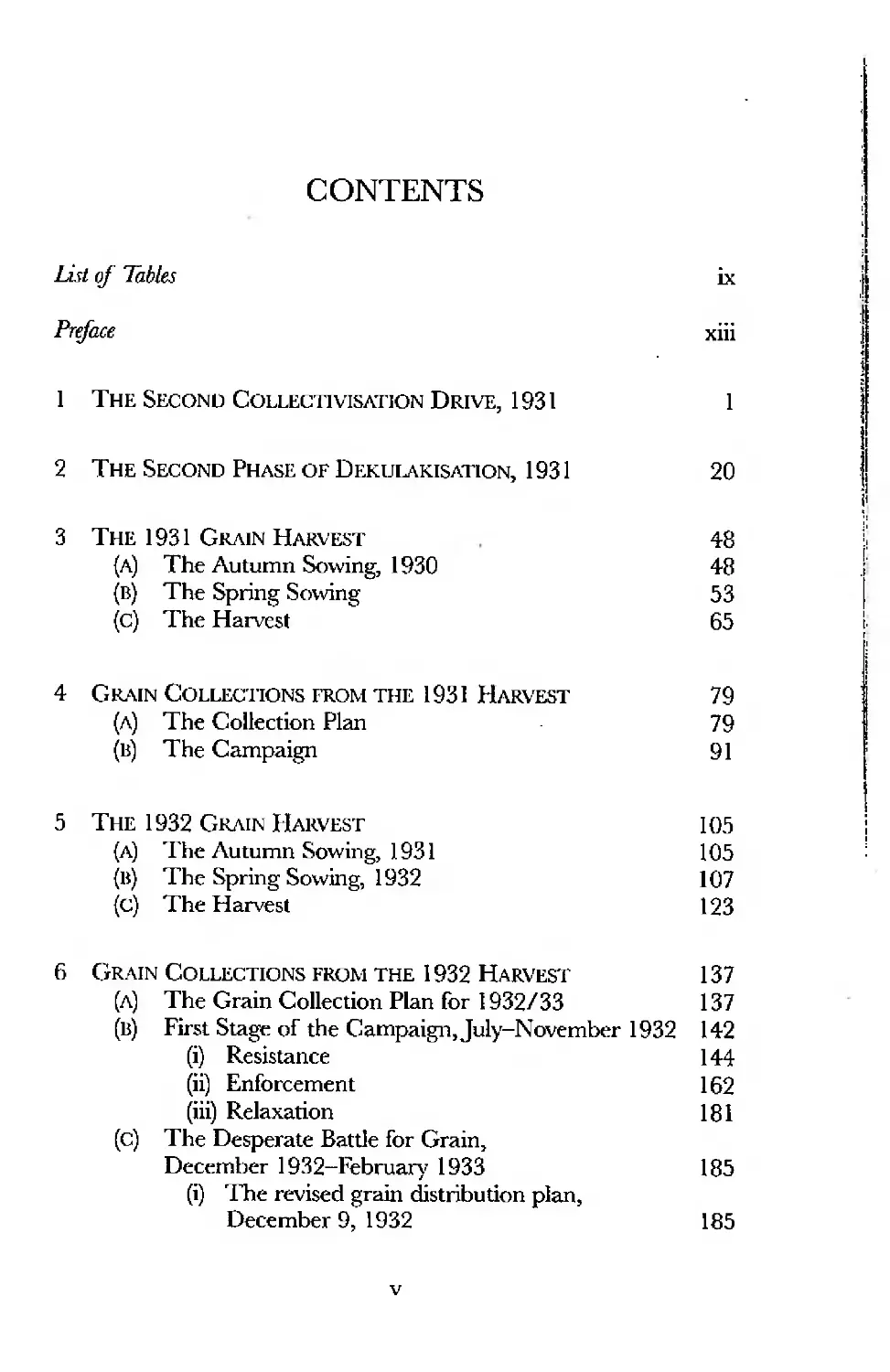
CONTENTS
List of Tables ix
Preface xiii
1 The Second Collectivisation Drive, 1931 1
2 The Second Phase of Dekulakisation, 1931 20
3 The 1931 Grain Harvest 48
(a) The Autumn Sowing, 1930 48
(b) The Spring Sowing 53
(C) The Harvest 65
4 Grain Collections from the 1931 Harvest 79
(a) The Collection Plan 79
(b) The Campaign 91
5 The 1932 Grain Harvest 105
(a) The Autumn Sowing, 1931 105
(B) The Spring Sowing, 1932 107
(c) The Harvest 123
6 Grain Collections from the 1932 Harvest 137
(A) The Grain Collection Plan for 1932/33 137
(b) First Stage of the Campaign, July-November 1932 142
(i) Resistance 144
(ii) Enforcement 1 62
(iii) Relaxation 181
(c) The Desperate Battle for Grain,
December 1932-February 1933 185
(i) The revised grain distribution plan,
December 9, 1932 185

vi Contents
(ii) The December collections 187
(iii) The January 1933 collections 197
(iv) The grain collections and the January
plenum 20 1
(D) Grain in the Time of Famine, February-July 1933 204
(i) Famine 204
(ii) The First All-Union Congress of
Kolkhoz Shock Workers 207
(iii) The grain collections 209
(iv) Relaxation and repression 211
(v) The grain budget 224
7 The 1933 Grain Harvest 231
(a) The Autumn Sowing, 1932 231
(B) The Spring Sowing, 1933 233
(C) The Harvest 239
(d) Measuring the Harvest 243
8 Grain Collections from the 1933 Harvest 250
(a) The Law on Compulsory Deliveries 250
(B) The Grain Plan 259
(C) The Collections 262
9 Crops Other than Grain 268
(a) Food Crops 269
(i) Sugar beet 269
(ii) Potatoes and vegetables 274
(iii) Vegetable oils 283
A note on 'decentralised collections' of food 288
(B) Industrial Crops 291
(i) Cotton 291
(ii) Flax 298
10 The Livestock Disaster 301
(a) The Drive for Socialisation, Autumn 1930
to December 1931 301
(b) The Retreat from Socialisation, 1932/33 309
(c) The Kazakh Catastrophe 321
(D) The Outcome 326

Contents vii
1 1 The Sovkhozy 332
12 The Kolkhozy 348 \
(a) State Control of the Kolkhoz 35 1
(b) The Structure of the Kolkhoz 364
(c) The Kolkhoz Brigade 370
(d) The Income of the Collective Farmer 375
(i) Remuneration from the kolkhoz:
the problem of the labour day 375
(ii) Remuneration from the kolkhoz:
payment in money 382
(iii) Remuneration from the kolkhoz:
payment in kind 384
(iv) The household plot 389
(v) Earnings from otkhodnichestvo 392
(E) Money Income as a Whole 397
1 3 The Famine in Perspective 400
(a) Famines before 1930 402
(i) 1891/92 402
(ii) The double famine of 1918-22 403
(B) The Urban Food Crisis of 1928-33 406
(c) The Famine in Kazakhstan 408
(D) The Rural Famine of 1932-33 409
(i) Areas affected by the famine 409
(ii) Deaths from the famine 412
(iii) Excess deaths by region 415
(iv) Excess deaths by social group 417
(v) Use of food substitutes 42 1
(vi) Cannibalism 42 1
(vii) Food assistance 424
(viii) Movement control 426
(ix) Disease 429
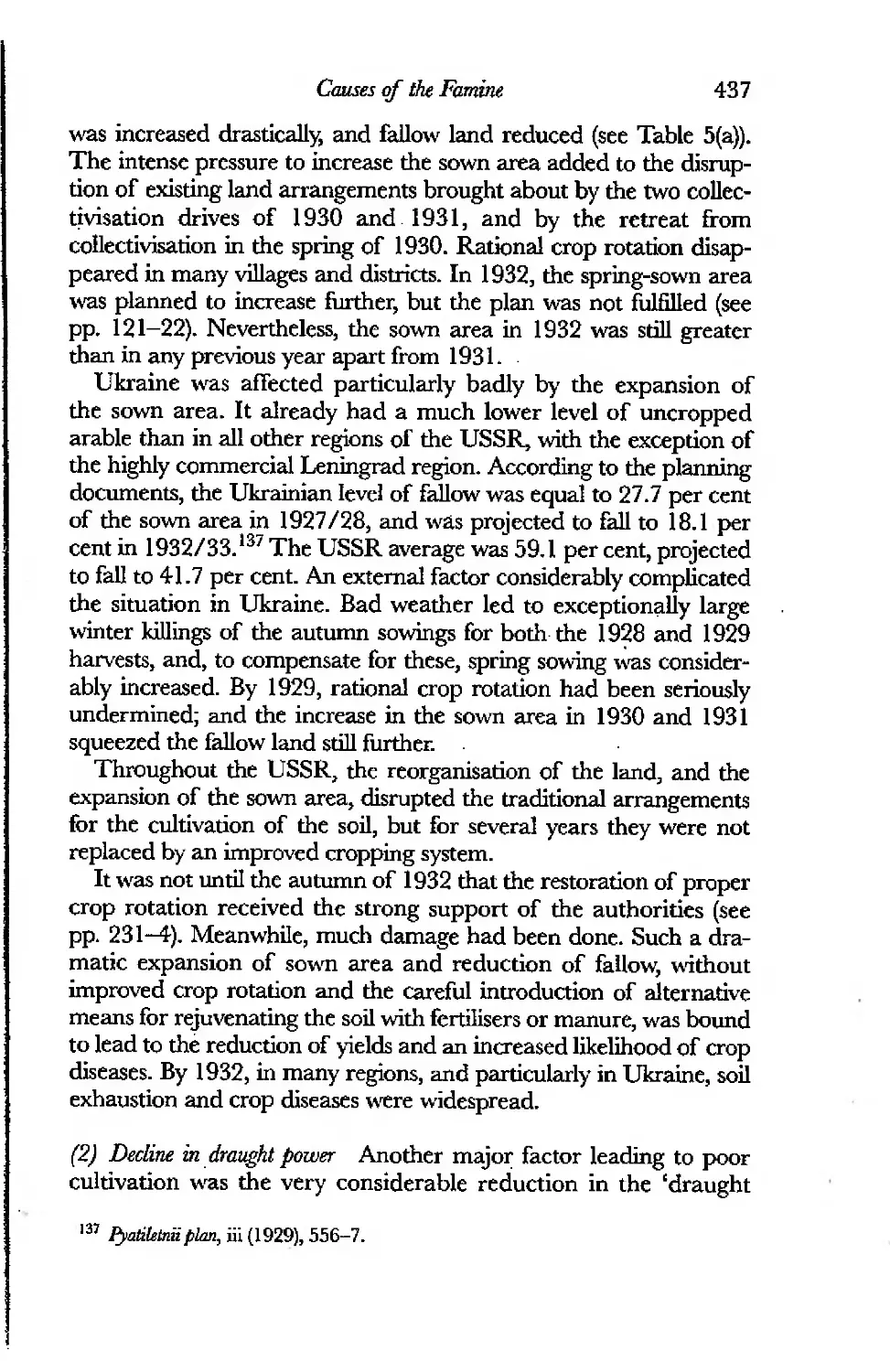
(e) Causes of the Famine 431
(i) Background 43 1
(ii) Why did agricultural production
decline so precipitately? 434
(iii) Coping with the famine crisis 440

viii Contents
Appendix: A Note on the Grain Harvests 442
Tables 448
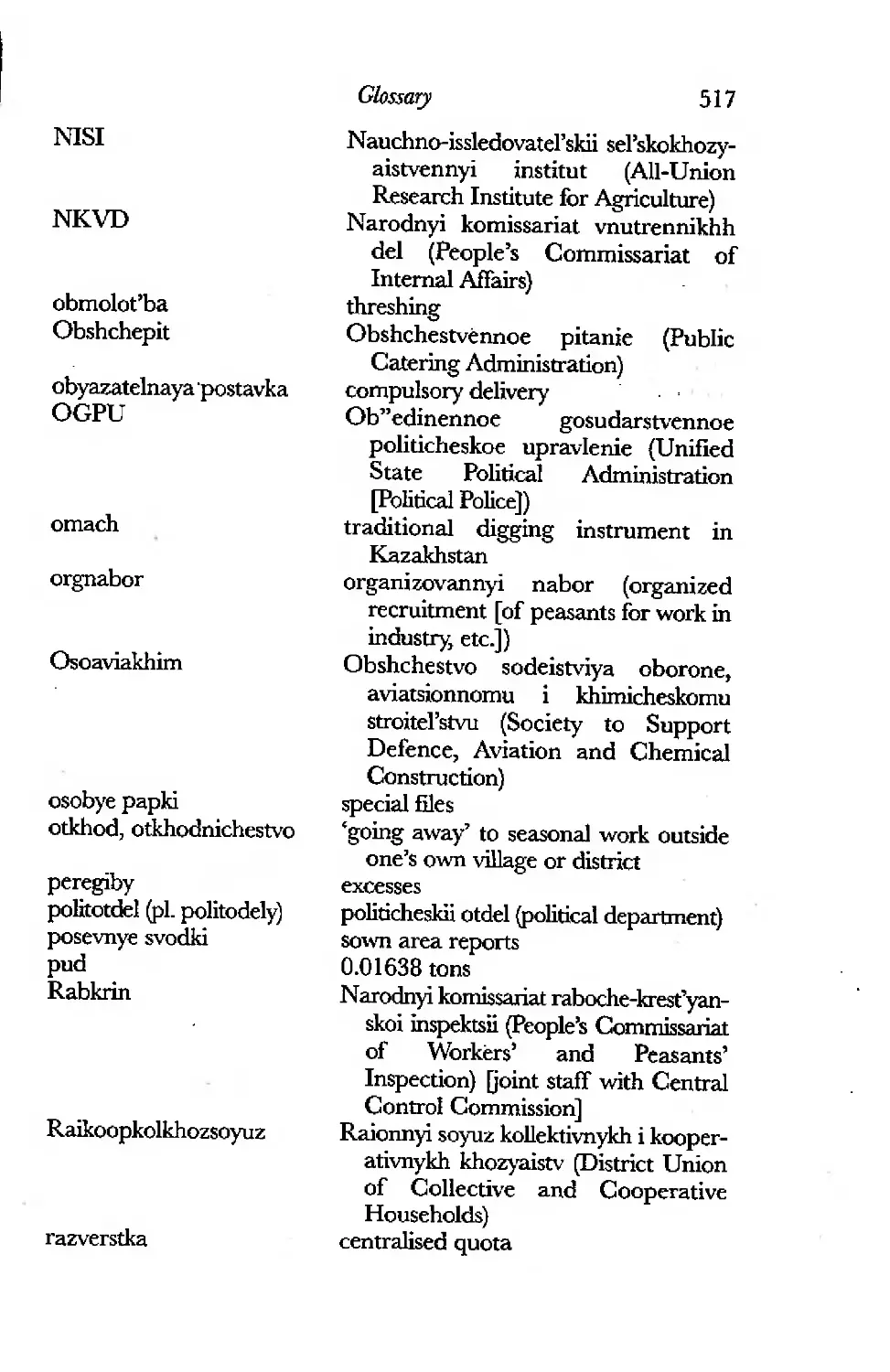
Glossary of Terms and Abbreviations used in Text 514
Abbreviations of Titles of Books and Periodical Publications, etc.,
used in Footnotes 52 1
Bibliography 522
Name Index 533
Subject Index 538

LIST OF TABLES
1 Grain production and collections, 1930-33 448
2 Number of animals by social sector, 1931-34 449
(a) Absolute numbers 449
(b) Percentage decline in number of livestock 451
3 Number of cattle by regionjuly 1928 and July 1933 451
4 Production of fodder, 1928-33 452
5 Area sown to all crops, 1928, 1930-33 452
(a) By type of crop 452
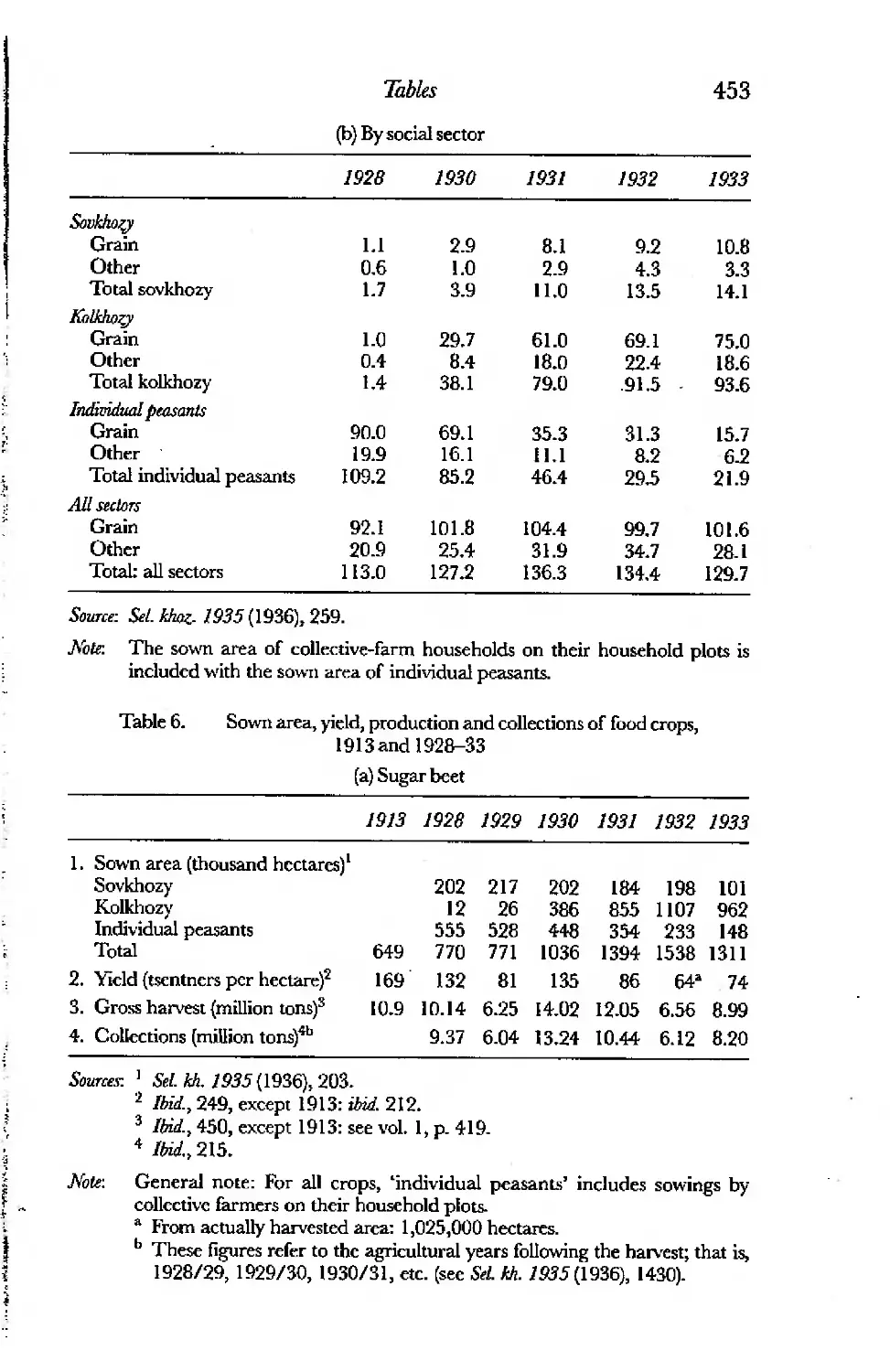
(b) By social sector 453
6 Sown area, yield, production and collections of
food crops, 1913 and 1928-33 453
(a) Sugar beet 453
(b) Potatoes 454
(c) Vegetables 454
(d) Melons and other cucurbits 455
(e) Vegetable oil seeds 455
7 Sown area, yield, gross harvest and collections
of industrial crops, 1928-33 456
(a) Raw cotton 456
(b) Flax 457
8 Ten-daily average temperature and accumulated
rainfall, Kiev (Ukraine) and Saratov (Lower Volga),
March to August, 1930-33 458
(a) Kiev 458
(b) Saratov {Lower Volga) 459
9 Main agricultural operations by five-daily periods,
1931-33 harvests 460
(a) Autumn sowing: all crops 460
(b) Autumn ploughing all crops 460
(c) Spring sowing: all crops 46 1
(d) Spring and summer ploughing of fallow: all crops 462
(e) Reaping grain crops 463
(f) Stacking: grain crops 463
(g) Threshing: grain crops 464

x List of Tables
10 Some agronomic and technical indicators in
1 932 and 1 93 3 compared 465
(a) Traction power 465
(b) Seed 465
(c) Preparation of land 466
1 1 Capital investment in socialised sector of agriculture,
by sector, 1930-33 466
1 2 Allocations to agriculture from Union budget,
by sector, 1931-33 466
1 3 Stock of machinery in agriculture, by social sector 467
14 Grain collections, 1930/31-1933/34 467
(a) By type of grain 467
(b) By social sector 468
(c) By months 469
(d) By area supplying grain 470
15 Grain allocation, 1930/31-1933/34 470
(a) All planned allocations by main uses 470
(b) Allocations to the population for special purposes 472
16 State collections of livestock and dairy products,
1928-34 474
17 Collections of wool, hides and skins, 1928-34 474
18 Grain collections, 1931/32 475
(a) By social sector 475
(b) By area supplying grain 476
19 Grain collections, 1931: Politburo and Sovnarkom
decisions 47 7
20 Grain collections from the 1932 harvest: plans by
social sector 478
21 Grain collections, peasant sector, July 1932-June 1933 478
22 State seed loans and aid, February-July 1933 479
23 State food loans and aid, February-July 1933 481
24 State fodder loans and aid, February-July 1933 485
25 Grain collection plans and results for the 1933 harvest 486
26 Number of households collectivised, 1928-33 487
27 Percentage of households collectivised, in selected
regions January 1931-June 1933 488
28 Number of households exiled in Category II, 1 930-3 1 490
(a) By republics and regions from which exiled 490
(b) By republics and regions to which exiled 49 1
29 Number of households exiled in Category II,
by sub-periods, 1931 492

Lisi of Tables xi
30 Sovkhoz three-year plan of 1 93 1 , and performance,
1931-33 493
3 1 Sovkhoz grain production and collections,
1930-33 494
32 Money income and expenditure per household of
individual peasants and collective farmers,
July 1930-June 1931 495
(a) Income 495
(b) Expenditure 496
33 Money income and expenditure of kolkhozy, 1930-32 496
(a) Income 496
(b) Expenditure 497
34 Money income per household of kolkhozy, 1932
and 1933 498
35 Money income per household of collective farmers,
1930/31-1933 498
36 Money expenditure per person of collective farmers,
1933: sample survey of seven regions 499
37 Non-agricultural money income per household of
agricultural population, 1930/31 and 1931/32 500
38 Number of labour days per collective farmer per year
recorded in kolkhoz reports, 1931-33 500
39 Percentage of able-bodied collective farmers engaged
in otkhodnichestvo, by regions, 1930-33 501
40 Distribution of kolkhoz grain as percentage of
gross harvest, 1931-33 502
4 1 Grain issued by kolkhoz per able-bodied collective
farmer, 1931-33 503
42 Grain received and consumed per adult person,
by region: sample survey of seven regions, 1933-34 503
(a) Received from all sources 503
(b) Used for personal consumption 504
43 Agricultural products per person received and
utilised by collective-farm households: sample survey
of seven regions, 1933 504
(a) Entering households 504
(b) Utilised by households 505
44 Food consumption per collective farmer per day in
Odessa region, September and December 1932 506

xii List of Tables
45 Officials of politotdely of MTS, by number and
type of official, 1933 507
(a) Education 507
(b) Year of joining party 508
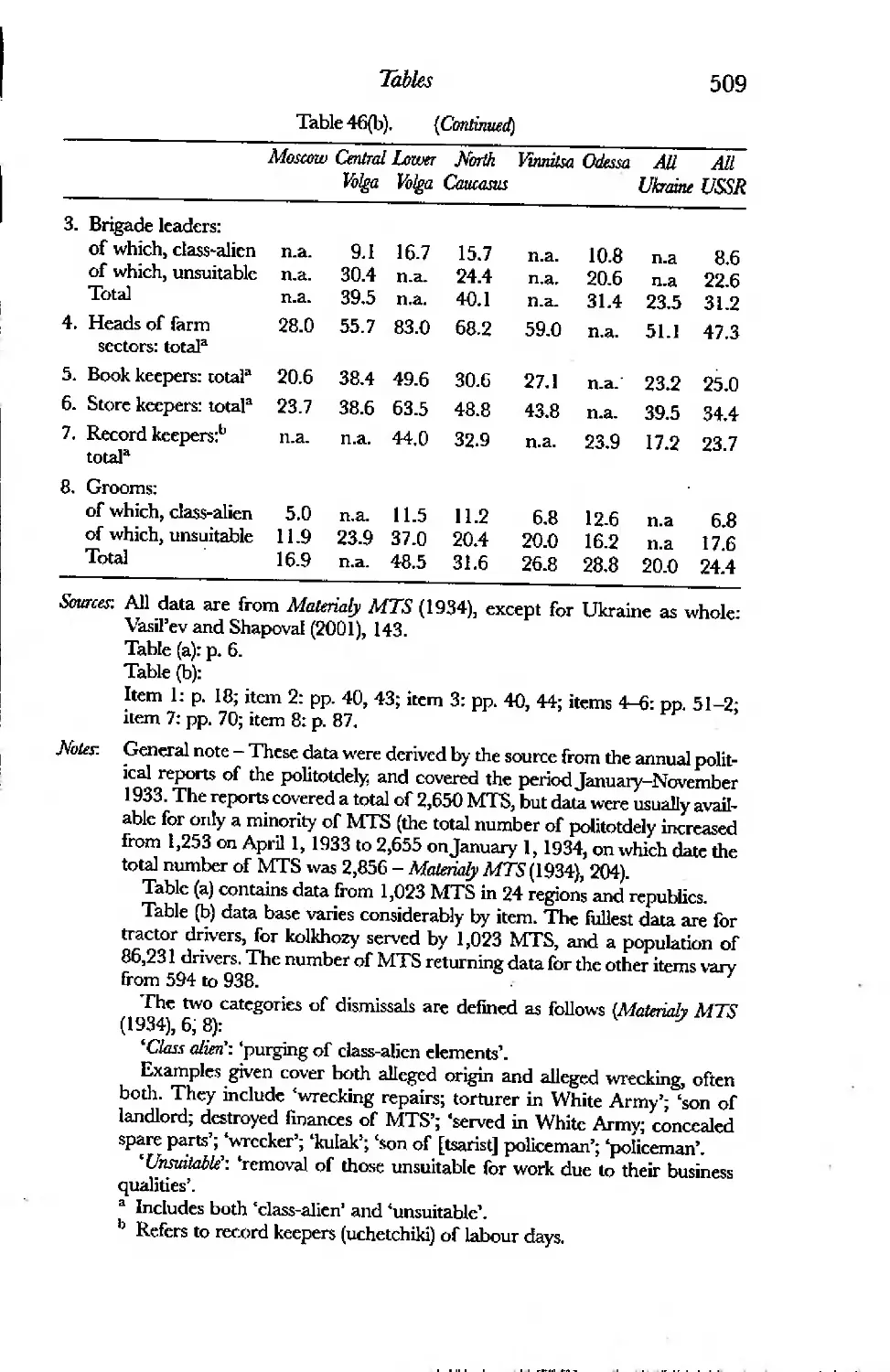
46 Dismissals from MTS and kolkhozy, 1933 508
(a) From MTS by occupation 508
(b) From kolkhozy by occupation and region 508
47 Bazaar prices for rye flour, by region, 1926/27,
1929-34 510
48 Registered rural annualised monthly crude death
rate, by region, 1 932-34 5 1 1
49 Incidence of disease 5 1 2
(a) Cases of infectious diseases in the
Russian Empire and the Soviet Union,
1913, 1918-22, 1929-36 512
(b) Cases of infectious diseases in Ukraine,
1933-36 512
(c) Monthly incidence of cases of typhus on
the railways, 1933-34 513

PREFACE
The first two volumes in this series, The Socialist Offensive and The
Soviet Collective Farm, both published in 1980, dealt with developments
in Soviet agriculture up to the end of 1930. When they were written,
Soviet archives for this period were completely closed to foreigners.
However, the Soviet press was still fairly frank at that time, and for-
eign journalists and diplomats were able to travel about the country.
In the Khrushchev years, Soviet historians were given some access to
the party archives for 1929 and 1930, and their publications told us
a great deal about decision-making at the top.
For the years 1931-33, covered by the present volume, which cul-
minated in the severe famine of 1933, our knowledge without the
archives was far more limited. E. H. Carr wrote in 1969 that the fog
obscuring Soviet policy-making 'in spite of a few piecemeal observa-
tions, envelopes all Soviet policy in the nineteen-thirties'.' In the
famine years the fog descended not only on policy-making but also
on what was happening in the villages.
In 1932, foreign correspondents had published accounts of hunger
in town and country, but in February 1933 Stalin wrote to Molotov
and Kaganovich denouncing American Moscow correspondents who
had travelled to the Kuban' in the North Caucasus and 'cooked up
calumnies' about the situation. He insisted that their travel about the
USSR should be prevented ('there are already enough spies in the
USSR'). 2 On February 23, the Politburo ruled that foreign corre-
spondents could travel about the USSR and visit particular places
only with the permission of the Chief Administration of the civil
police (the militia) - Prokof'ev, its head, and a senior OGPU official
of long standing, was responsible for carrying out this decision. 3 This
restriction was not lifted until after the 1933 harvest.
By this time the Soviet media, for both home and foreign con-
sumption, presented an image of the USSR in which the standard of
living was growing continuously as a result of the successes of the
1 Carr and Davics (!%9), xii.
2 RGASPI, 558/1 1/741, 3, published in TSD, iii, 644-5.
3 RGASPI, 17/3/916, 25 (decision by poll).
Xlll

xiv Preface
socialist transformation. In 1930 a modest attempt to indicate that
real wages had declined was firmly suppressed (see vol. 3, pp. 307-9,
356-7). In this context the press was, of course, banned from making
any mention of the famine.
These restrictions did not prevent a considerable amount of infor-
mation about the famine reaching the outside world. In his classic
study, The Harvest of Sorrow, published in 1986, Dr Robert Conquest
used contemporary emigre memoirs and reports by diplomats, and
more recent dissident writings, to present a vivid account of what
happened in the Soviet countryside.
Since 1990, the opening of the former Soviet archives has given
us access to secret reports about the famine written at the time. At
first local officials were inhibited from reporting the famine. As late
as April 1, 1933, a doctor in the Central Black-Earth region was
reported by the GPU as remarking that 'we do not write memoranda
about death from famine because we are afraid that we doctors may
be accused of some kind of wrecking'. 4 At the height of the famine,
however, local GPU and political officials described the famine in
great detail in secret reports to the regions and the republics, and
these reports were conveyed in summaries to Moscow. 5 We have
made extensive use of these reports in this volume. They modify and
supplement Dr Conquest's presentation of the famine, but do not
change it fundamentally.
Access to such secret reports is still not complete. Those held in
the archives of the FSB (the Federal Security Service) - the former
OGPU archives - are released at the discretion of the FSB, and his-
torians are not allowed to consult their catalogues. Our knowledge of
what GPU officials and agents wrote about the famine in Ukraine
would be much more limited if the Ukrainian authorities had not
published a valuable collection of documents from their archives,
Golod 1932-1933 (Kiev, 1990).
We also have access to the decisions of the Politburo in these
years, including the top-secret 'special papers' (osobye papki), and
to many private letters and telegrams exchanged between mem-
bers of the Politburo, and between the Politburo and key govern-
ment departments and regional authorities. Some material still
resides in the Presidential Archive, and is very difficult to access,
though much has been transferred to the normal archives in recent
4 TSD, iii, 661; see also pp. 412-13 below.
s See pp. 421-4; and the selection of documents in TSD, iii, G54-78.

Preface
xv
years. Our knowledge of policy-making is also incomplete,
because even in the most secret documents the key Soviet leaders,
Stalin, Molotov and Kaganovich, had little to say about the rea-
sons for their decisions, or even about the famine itself. Stalin was
fully informed about the famine, but he displayed a Victorian ret-
icence about it, even in his private communications to other
Politburo members. The only occasion so far uncovered on which
Stalin used the term 'famine' at this time was in a letter to the
Politburo on June 18, 1932. Referring to the results of the 1931
harvest, he claimed that in Ukraine, as a result of the poor organ-
isation of the collections, 'a number of districts with good harvests
were in a state of ruin and famine '. 6 He apparently failed to use
the word 'famine' in 1933.
The focus of the present volume is different from Dr Conquest's.
We have devoted particular attention to the economic and social
background to the famine; and have also examined in detail the new
documents of the Politburo and other central Soviet agencies. While
we would criticise Dr Conquest's description of the famine only in
points of emphasis and detail, we find his interpretation of Soviet
policies to be one-sided {see pp. 431-41 below).
The opening of the archives has not changed in any major respect
the account of collectivisation given in Volumes 1 and 2 of this
series, but it has modified it in a number of respects. Two points are
particularly worth mentioning. First, access to the OGPU archives
has given us a much fuller account of dekulakisation. In particular, it
has revealed that in 1 930 far more peasants were dekulakised in
Category I than was previously believed. Peasants placed in Category 1
were exiled to remote regions without their families, and in some
cases executed. The plan approved at the beginning of 1930
included 60,000 Category I peasants. In fact, 283,7 1 7 persons were
arrested in Category I between January 1 and October 1, 1930,
about half of them after Stalin's Dizzy from Success. And less than half
of these were classified as kulaks by the OGPU; the rest were
described as church officials, former landowners and factory owners,
or simply categorised as 'other anti-Soviet element'. 7 Secondly,
we now have a more nuanced understanding of the role of the
" SKP, 179.
7 This document is published in TSD, ii, 704 (dated November 17, 1930); it is
discussed in Viola (2002), 21 and 43, note 82 - this is a very dill account of
dekulakisation in 1930 based on the recent archival material.

xvi Preface
Red Army in collectivisation and dekulakisation. 8 But we still lack a
clear understanding of how the decision to retreat from collectivisa-
tion at the end of February 1930 was reached.
We would like to draw the reader's attention to the Technical Note
in Volume 1, which explains the conventions used in this series, and
outlines the Soviet administrative structure in this period. The most
important development in regional administration in 1931-33 was
the formation of seven regions (oblasti) in Ukraine. Between 1930
and the beginning of 1932, with the abolition of the okrugs, the
Ukrainian republican administration was directly responsible for
the Ukrainian districts (raiony), a Herculean and ridiculous task. The
Khar'kov, Kiev, Odessa and Vinnitsa regions were established in
February 1932; the Donetsk region in July; and the Chernigov region
in October 1932. At the USSR level, important changes in agricul-
tural administration included the abolition of the agricultural coop-
eratives and of Kolkhozstentr USSR and RSFSR and the local
kolkhoz unions (see pp. 351-6); these changes resulted in the direct
subordination of the kolkhozy to Narkomzem.
Additional tables will be found on the web site for this volume:
http://www.soviet-archives-research.co.uk/hunger
Topics covered include: calculation of grain harvest from kolkhoz
reports of 1932 and 1933 (see Appendix); the grain collection plans
of 1932/33 (additional details) (see Chapter 6); the grain utilisation
budgets for 1932/33 (including plan of June 2, 1932) (see Chapter 6);
the grain-fodder budgets for 1929/30-1933/34 (see Appendix); reg-
istered excess births by regions (see Chapter 13); the 'Lorimer' cor-
rections to the number of excess deaths, as estimated by the present
authors (see Chapter 1 3); weather data by region (see Chapter 1 3).
We have been fortunate in receiving advice and assistance from many
colleagues. Valerii Vasil'ev and Oleg Khlevnyuk, who have been
working closely with us for many years, have been indispensable to
our work. We have benefited greatly from collaborating with
Viktor P. Daniloy, Roberta Manning and Lynne Viola on their
mammoth series of archival documents, Trageiiya sovetskoi derevni, four
volumes of which have already appeared. The third volume deals with
8 See Pons and Romano, cds (2000), 1 13-19 (Romano). Romano and Tarkova, eds
(1996), 262-71, publishes an illuminating correspondence between Gamarnik, head
of the political administration of the Red Army, and local commanders, in which
he urges them not to engage in socialist emulation about collectivisation because it
is distracting the soldiers from their military training.

Preface
xvn
the period covered by the present book. Davies collaborated with
Khlevnyuk, Arfon Rees, Lyudmilla Kosheleva and Larissa Rogovaya
on Slalin-Kaganovkh: perepiska, 1931-1936, which also proved to be a
rich source of information. Vol. 2 of The Tragedy of the Soviet Countryside,
edited by Wheatcroft and Davies, with I. E. Zelenin, will provide key
documents from the Russian collection in English translation, and thus
enable readers of the present volume who do not know Russian to
consult the full version of major documents we have used here. The
Stalin-Kaganovich Correspondence, 1931-1936, containing the most
important items from the Russian edition, has already been published.
Stanislas Kul'chitskii and Olga Movchan provided valuable
assistance to Wheatcroft during his research in Ukraine.
Other colleagues who have generously provided advice and
assistance include R. Arnott, N. Baron, A. Blum, J. Bone, J. Elkner,
M. Ellman, R. Horvath, M. Ilic, G. Kessler, B. Kiernan,
V Kondrashin, J. MaasJ. Montgomerie, C. O' Grada, E. A. Rees,
A. Romano, M. Tauger, Yu. Tsyganov, D. Watson J. C. Zadoks and
A. Zerger.
Dr Christopher Joyce prepared the bibliography and provided
other research assistance. A. Clark, J. Clarke and N. Melchior
assisted the preparation of the indexes.
We are also most grateful for the assistance we have received from
Russian archivists, notably from E. A. Tyurina and A. Minyuk,
director and deputy director of RGAE, S. V Somonova (GARF) and
L. A. Rogovaya and L. P. Kosheleva (RGASPI).
Our colleagues in the Centre for Russian and East European
Studies of the University of Birmingham, and in the History
Department of the University of Melbourne, have, as usual, given us
much support; we would particularly like to thank Marea Arries,
secretary to the project.
We would also like to thank Luciana O' Flaherty and her colleagues
at Palgrave Macmillan, and Keith Povey, for editorial assistance.
Our wives, Frances and Ragini, again provided much support and
encouragement.
Our research would have been much less effective if we had not
received financial support from the British Economic and Social
Research Council and the Australian Research Council; they have
provided money for research assistance and collaboration, for travel
to Moscow and for library purchases.
March 2003 R. W . DAVIES
Stephen G. Wheatcroft

CHAPTER ONE
THE SECOND COLLECTIVISATION
DRIVE, 1931
The precipitate retreat from mass collectivisation in the spring of 1930
temporarily delayed the efforts of the Politburo to incorporate the vast
majority of the peasants into collective farms. But this was only a
pause in the collectivisation drive. In July 1930, the XVI party congress,
while acknowledging the 'errors and distortions' of the spring, insisted
that 'the rates of collectivisation foreseen by the central committee
decision of January 5' were 'fully confirmed by experience'. 1
Twelve days after the end of the congress, on July 25, 1930, a
secret Politburo decision transformed this general policy declaration
into the specific statement that in the economic year 1930/31 (that
is, by the end of September 1931) the percentage of households col-
lectivised could reach 'up to' 65-70 per cent in the main grain areas,
up to 35Hr0 per cent in other grain areas, and up to 15-20 per cent
in grain-deficit areas. The decision described the targets cautiously
as a 'possible growth' of collectivisation. 2 The dates proposed were
more modest than those in the decision of January 5, 1930, which
declared that the major grain areas should be collectivised 'in the
main' by the autumn of 1930 or the spring of 1931, and the remain-
ing grain areas 'in the main' by the autumn of 1931 or the spring of
1932 (see vol. 1, pp. 201-2).
During the autumn of 1930, the collectivisation campaign was
pursued with some circumspection, but steadily and consistently:
the total number of households collectivised increased from 5.5 to
6.6 million in the last four months of the year, reaching 26 per cent of
all households by January 1, 1931 (see vol. 1 , Chapter 9 and pp. 441-4).
This cautious pace was temporary. The December 1930 plenum
of the central committee approved plans for collectivisation which
were even more ambitious than those of July 25, and announced
them in the press. During 1931, 80 per cent of households would be
collectivised in the main grain areas; that is, the Ukrainian steppe,
! Direktisy, li (1957), 201-7; see also vol. 1, pp. 330-5.
2 RGASPI, 17/3/790 (item 13); this is part of the resolution on the 1930/31
control figures.

2 The Second Collectivisation Drive, 1931
North Caucasus, the Lower Volga, and the Trans-Volga areas of
the Central Volga; this was widely referred to as the 'first category'.
Fifty per cent of households would be collectivised in the remaining
grain areas (known as the second category) - the Central Black-Earth
region, Siberia, the Urals, the Forest-Steppe areas of Ukraine, and
the grain areas of Kazakhstan. In a third category, 20-25 per cent of
households would be collectivised in the grain kolkhozy of the grain-
deficit areas; and at least 50 per cent in the cotton and sugar-beet
areas. In the first category, the elimination of the kulaks as a class
would also be, in the main, completed. The cautious reference in the
decision of July 25 to a 'possible growth' of collectivisation was not
repeated. Instead the collectivisation of at least 50 per cent of all
households was announced boldly as a firm target for 1931. (See
vol. 1, pp. 380-1.)
In this spirit, on January 10 the Politburo discussed the experience
of collectivisation in the North Caucasus, where a higher percentage
of households had been collectivised than in any other region. In its
subsequent resolution, which was published in the newspapers, the
Politburo claimed that kolkhozy had proved more efficient than indi-
vidual peasant farming; moreover, the material position of the poor
peasants and the batraks (agricultural labourers) who had joined the
kolkhozy had improved, as had the incomes of the middle peasants.
The Politburo ruled that in the North Caucasus the campaign to sign
contracts with the Machine-Tractor Stations (MTS) for the spring
sowing should aim at the 'mass inclusion of new poor-peasant
and middle-peasant masses in the kolkhozy and the completion of
comprehensive collectivisation'.
Siberia and some of the other regions listed in the resolution of
the December plenum were huge areas covering a variety of types
of agricultural production and levels of development; yet they
were given a comprehensive target covering the whole region.
The instructions of Narkomzem and the exhortations in the press
interpreted the decision of the plenum literally. On February 26,
however, the bureau of the East-Siberian regional committee
requested the party central committee to authorise the application of
the 50 per cent target only to the main grain districts of Eastern
Siberia. The bureau requested that 'national minority districts con-
cerned with livestock, hunting in the north, and gold prospecting',
together with other districts outside the main grain areas, should be
3 SZe, January 12, 1931.

T/ie Second Collectivisation Drive, 1931 3
placed in the third category. 4 Stalin replied with a firm rebuff:
Explain to the secretary of the East-Siberian regional committee
[Leonov] that the decision of the C[entral] C[ommittee] on the
percentage of collectivisation is a minimum target and local party
organisations should not only not forbid, on the contrary they should recom-
mend the overfulfilment of the target, taking into account the features of
particular districts.
On March 17, Leonov addressed a further telegram to Stalin
which was remarkably, and perhaps deliberately, opaque. He argued
that two interpretations of these targets were possible. On the one
hand 'we [the regional party] are wrongly guiding the East Siberian
organisation' in proposing that some districts should be collectivised
50 per cent but most only 30 per cent. This would be a 'major polit-
ical mistake'. Alternatively, 'we are acting correctly when we handle
different parts of the region with different standards', in which case
Narkomzem was 'misleading itself, the CC and the whole party by
adopting an undifferentiated approach'. Leonov artfully suggested to
Stalin that 'your telegram could be understood as placing our region
in the third category' (Stalin's telegram provided no basis for
drawing such a conclusion). Stalin thought again, and wrote on the
telegram 'Discuss with Yakovlev [the People's Commissar for
Agriculture]. Leonov is right. St[alin].' But he then crossed out this
remark! The broad-brush targets remained as they were.
The certainty of the authorities that comprehensive collectivisa-
tion would soon triumph was reflected in a remarkable resolu-
tion of the collegium of Narkomzem about Kazakhstan approved
on February 1, 1931. The whole of southern Kazakhstan, a region
dominated by Kazakh nomadic and semi-nomadic sheep farmers,
clearly came into the category of regions where collectivisation was
expected to proceed at a slower pace. Yet Narkomzem resolved that
the land consolidation plan for Kazakhstan in 1931 should assume
that this was a period of 'reinforced sovkhoz and kolkhoz construc-
tion' which would 'narrow the basis for nomadic and semi-nomadic
land utilisation to an increasing extent'. The resolution expressed the
pious hope that, if care was taken, the number of animals on the
Ivnitskii (1994), 154-5. The bureau request was based on a decision of the
I regional party conference, and was sent to Stalin in a telegram from the regional
party secretary, V G. Leonov, dated March 4.

4 The Second Collectivisation Drive, 1931
territory would not fall; and insisted that the land consolidation
measures, embracing 55.7 million hectares, would result in substan-
tial progress in the settlement of the population. 5
During the first five months of 1931, the second collectivisation
drive proceeded without hesitation or interruption throughout the
USSR. The agricultural newspaper carried ten-daily reports for every
region and republic, announcing the number of households joining
the kolkhozy; the reports appeared a mere five days after the end of
the accounting period. They showed that the number of households
newly joining the kolkhozy reached a peak in the last ten days of
March and the first ten days of April; in each ten-day period, over
600,000 households joined. This was not the breakneck drive of the
first few weeks of 1 930, when nearly ten million households were dra-
gooned into kolkhozy during January and February. But the pace of
collectivisation greatly exceeded that in the last three months of 1929,
when about three million households joined the kolkhozy, and was
nearly five times as rapid as in the last few months of 1930. Nearly
four million households joined the kolkhozy in the first three months
of 1931, and a further 2.5 million in April and May. (See Table 26.)
The authorities were careful not to blunt the pressure of the
campaign by proclaiming a triumph too soon. They took as their
principal criterion of success the 50 per cent collectivisation of all
households in the Soviet Union announced as a target by the
December 1930 central committee plenum. By May 1, 48.6 per cent
of households had been collectivised (see Table 27), and in the
agricultural newspaper five days later a banner headline above
the regular report for the previous ten days declared, 'We are on the
Edge of Fulfilling the Programme of Collectivisation for 1 93 1 . The
following report, referring to the results achieved by May 10, was
headed triumphantly: '50.4 per cent Collectivisation: a Decisive
Stage in the Foundation of a Socialist Economy. The Directive of
the Party has been Achieved Ahead of Time'; 12.5 million house-
holds now belonged to kolkhozy. For the moment, collectivisation in
Siberia, the subject of Stalin's inconclusive exchange with Leonoy
was less precipitate, reaching 40.3 per cent in West Siberia and only
33.8 per cent in East Siberia. But in Kazakhstan as a whole the pro-
portion of households collectivised had reached the USSR average
5 RGAE, 7486/19/130,6-7.
H SZe,May6, 1931.

The Second Collectivisation Drive, 1931 5
of 50 per cent, compared with 24 per cent at the beginning of the
year, even though the 50 per cent target was supposed to apply only
to its grain areas. 7
The level of collectivisation in the USSR as a whole had thus
returned almost to the peak figure of March 1930. This time, how-
ever, in contrast to the previous year, the vast majority of households
remained in the kolkhozy. When the plenum of the party central
committee assembled in June 1931, Yakovlev vigorously rejected
M. Kaganovich's claim that agriculture was lagging behind industry
in the fulfilment of the plan, pointing out that the kolkhozy now
included 60 per cent of all households. 8 On June 15, the plenum
resolution firmly stated that collectivisation plans were being fulfilled
ahead of schedule. More than 80 per cent of households had been
collectivised in the main grain areas (the first category), and 50 per
cent in the remaining grain areas and the most important cotton and
sugar-beet areas (the second category). But it also declared that the
campaign must continue, so that collectivisation would be completed
in the second-category areas by the end of 1 93 1 or no later than the
spring of 1932. 9
Official pronouncements frequently asserted that all recruitment
to the kolkhozy must be strictly voluntary in nature. From time to
time the press criticised the local authorities for the use of 'adminis-
trative methods'. 10 At one point a mini-campaign in the agricultural
newspaper strongly criticised 'Leftists' for their use of compulsion in
Ukraine, and reported that the delinquents had been put on trial. 11
But the general thrust of the press campaign was to stress the
urgent necessity of reaching the targets. On December 29,1930,
Kolkhoztsentr launched a movement of '20,000-ers' - collective
farmers who would be transferred permanently to less advanced
villages, thus playing an analogous role to the '25,000-ers', the urban
workers who descended on the countryside in the course of 1930
(see vol. 1, pp. 208, 210-11); the decision was endorsed by the
Politburo. 12 On January 20, a central committee decision insisted
7 SZe, May 15, 1931.
* RGASPI, 17/2/479,74.
!l KPSS v re Z ., ii ( 1 954), 637-8; sec also p. 1 7.
"' Sec, for example, SZe, March 29, 1931 (Tatar ASSR).
11 Sec SZe, April 25, 28; June 15, 1931.
12 Sec Oskol'kov (Rostov, 1973), 258. For the Politburo endorsement, see Ivnitskii
;i994), 153. The '20,000-er' initiative was proclaimed a great success. By the

6 The Second Collectivisation Drive, 1931
that collectivisation was a crucial part of the spring sowing campaign,
and called for the formation of 'initiative groups', which would
organise kolkhozy in all grain and industrial crop districts and then
themselves be transformed into kolkhozy. At the same time 'brigades
of old collective farmers' would help to create new kolkhozy, and
would show individual peasants how to organise them. 13 These
devices for cajoling the peasants into the kolkhozy had already
featured prominently in the first cautious stages of re-collectivisation
during the previous autumn (see vol. 1, p. 379).
The press strongly emphasised the role to be played by established
collective farmers, reporting that at village meetings collective farmers
held forth to individual peasants about the merits of collectivisation. 14
Collective farmers were calling systematically on reluctant peasants
in their homes. The visits occasionally culminated in a symbolic 'red
marriage 1 (krasnyi svat), when the individual peasant household
eventually signed up. 15 In the Central Volga region, the authorities
called for the recruitment of three peasants by each collective
farmer. 16 In the Central Black-Earth region collective farmers were
organised into 'raid columns', which descended on 'backward'
villages, ejecting the kulaks in the course of their activities. 17
But even the press reports acknowledged that the authorities did not
rely solely on the activities of the collective farmers themselves. Every
region reported that many thousands of industrial workers, party and
government officials and others had descended on the villages for
shorter or longer periods. 18
middle of February, 21,500 collective farmers had already been recruited (SZe,
February 16, 1931). Eventually the number rose to 38,400 (Oskol'kov (Rostov,
1 973), 258-9). In September, a proposal was mooted that a further 50,000 collective
farmers should be sent to lagging villages in brigades of 3-5 persons, but this time
for only one month (SZc, September 5, 193 1).
13 SZe, January 20, 1931.
14 SZe, January 18, 1931 (Central Black-Earth region).
15 SZe, January 18, February 19, April 25, May 1, 1931.
16 SZe, January 26, 1931.
17 RJanuary21, 1931.
18 See, for example, Oskol'kov (Rostov, 1973), 260 (North Caucasus - 12,000
before and 30,000 during the spring sowing). In Ukraine at the beginning of the
campaign the Politburo resolved to despatch 2,000 students to the countryside from
the large towns (GAVO, 51/1/447, 37 (decision of January 13)); SZc, February 27,
1931 reported that in Ukraine large numbers of party workers with literature and
leaflets went to the countryside from Krivoi Rog.

The Second Collectivisation Drive, 1931 7
The campaign in the Central Black-Earth region was particularly
vigorous. This was one of the three regions which Stalin criticised by
name for excessive zeal in his 'Answers to Collective-Farm
Comrades' of April 3, 1930 (see vol. 1, p. 311). But in the 1931 cam-
paign the region pressed ahead uninhibitedly. It had been placed in
the second category ('other grain areas'), and therefore expected to
achieve 50 per cent collectivisation in the course of 1931 . In fact, the
percentage of households collectivised increased from 20 per cent on
December 1, 1930, to 55 per cent on June 1; by June 20 it had
reached nearly 60 per cent.
Vareikis, the regional party secretary, opened the campaign with a
firm declaration that collectivisation must not be left to 'spontaneity'
(samotek). 20 The regional committee called for a 'month of collec-
tivisation', so that the main drive would be completed before the
spring sowing. 21 This special month was soon named a 'Lenin enrol-
ment' (Leninskii prizyv) 22 - the name given to the campaign which
recruited a quarter of a million workers at the bench to the
Communist Party in the months after Lenin's death in 1924. In the
last ten days of January, 57,000 households joined the kolkhozy;
2.7 per cent of all households in the region. 23 In mid-February
Vareikis called for further collectivisation, supported by 'revolutionary
action' against kulaks and other enemies of the kolkhozy. 24 In the
previous autumn, such impetuosity would have been admonished by
the superior authorities, but now Kolkhoztsentr sent a telegram prais-
ing the growth of collective-farm households in the region. 25 At the
beginning of March the region announced a further collectivisation
recruitment month - this time named after Stalin instead of Lenin. 26
Compared with the fairly realistic press reports about the first
collectivisation drive in 1930, in 1931 these newspaper accounts
were bland and unconvincing. Behind the propaganda, the pressures
on individual peasant households to join the kolkhozy were
compelling, as is clear from reports about collectivisation in Russian
I!l See Table 27 and SZcJunc 27, 1931.
20 SZe, December 30, 1930.
21 SZe, January 5, 1931.
12 SZe, January 15, 1931.
23 SZe, January 26, February 2, 1931. For reports of the drive and the announce-
ment of its success, see ibid., January 13, 20; February 7, 1931
24 SZe, February 17, 1931.
' a SZe, February 19, 1931.
* ; SZe, March 5, 1931.

8 The Second Collectivisation Drive, 1931
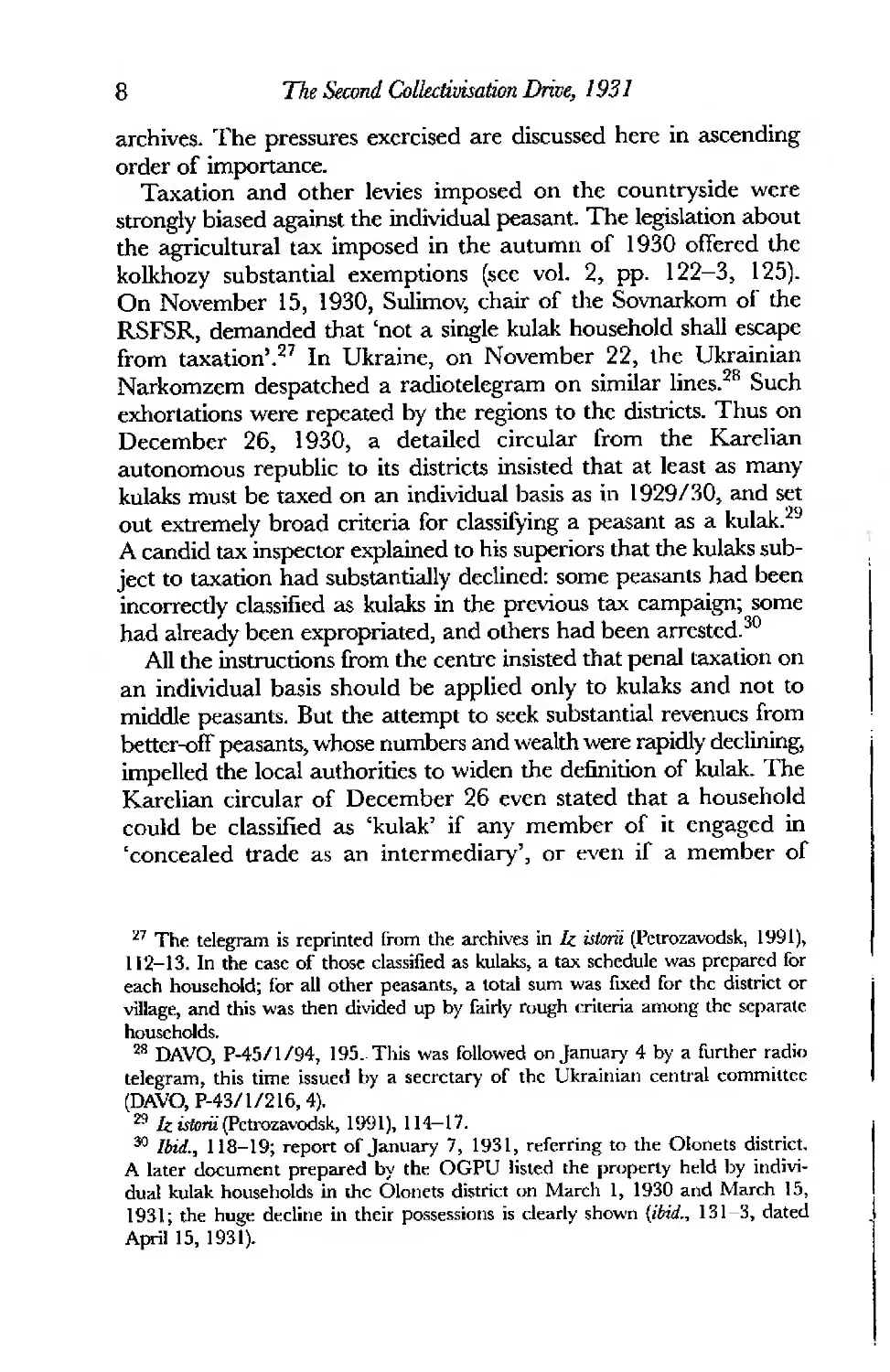
archives. The pressures exercised are discussed here in ascending
order of importance.
Taxation and other levies imposed on the countryside were
strongly biased against the individual peasant. The legislation about
the agricultural tax imposed in the autumn of 1930 offered the
kolkhozy substantial exemptions (see vol. 2, pp. 122-3, 125).
On November 15, 1930, Sulimov, chair of the Sovnarkom of the
RSFSR, demanded that 'not a single kulak household shall escape
from taxation'. 27 In Ukraine, on November 22, the Ukrainian
Narkomzem despatched a radiotelegram on similar lines. 28 Such
exhortations were repeated by the regions to the districts. Thus on
December 26, 1930, a detailed circular from the Karelian
autonomous republic to its districts insisted that at least as many
kulaks must be taxed on an individual basis as in 1929/30, and set
out extremely broad criteria for classifying a peasant as a kulak. 9
A candid tax inspector explained to his superiors that the kulaks sub-
ject to taxation had substantially declined: some peasants had been
incorrectly classified as kulaks in the previous tax campaign; some
had already been expropriated, and others had been arrested. 30
All the instructions from the centre insisted that penal taxation on
an individual basis should be applied only to kulaks and not to
middle peasants. But the attempt to seek substantial revenues from
better-off peasants, whose numbers and wealth were rapidly declining,
impelled the local authorities to widen the definition of kulak. The
Karelian circular of December 26 even stated that a household
could be classified as 'kulak' if any member of it engaged in
'concealed trade as an intermediary', or even if a member of
27 The telegram is reprinted from the archives in U. istorii (Petrozavodsk, 1991),
112-13. In the case of those classified as kulaks, a tax schedule was prepared for
each household; for all other peasants, a total sum was fixed for the district or
village, and this was then divided up by fairly rough criteria among the separate
households.
28 DAVO, P-45/1/94, 195. This was followed on January 4 by a further radio
telegram, this time issued by a secretary of the Ukrainian central committee
(DAVO, P-43/1/216, 4).
29 k istorii (Petrozavodsk, 1991), 114-17.
30 Ibid., 118-19; report of January 7, 1931, referring to the Olonets district.
A later document prepared by the OGPU listed the property held by indivi-
dual kulak households in the Olonets district on March 1, 1930 and March 15,
1931; the huge decline in their possessions is clearly shown (ibid., 131-3, dated
April 15, 1931).

The Second Collectivisation Drive, 1931 9
the family kept a village tea-house. Many peasants complained that
they had been unjustifiably classified as kulaks. A peasant submitted
a petition to Stalin, signed by all nineteen members of his settlement,
insisting that he was a working peasant who had to earn his living
from fishing and carting goods and firewood, because he had only
0.95 hectares of land. His household had nevertheless been classified
as kulak, and the sewing machine, clock, samovar, mirror, divan and
two fishing nets had been sold in order to pay the tax. The petition
was rejected by the central executive committee of the Karelian
republic on the grounds that he had exploited (that is, employed)
labour on fishing and agriculture. 31
While the collection of the agricultural tax was proceeding,
a cultural levy was imposed on the peasants, to be paid in full by
March 15. The levy followed the usual class principles. Kulaks were to
pay a sum equal to the amount levied on them for the 1930/31
agricultural tax. Middle peasants were to pay an amount equal to
65 per cent of the agricultural tax, but a minimum of six rubles per
household. Poor peasants who were freed from agricultural tax were to
pay five rubles. Collective farmers were to pay only four rubles, and
only if they received 'non-socialised income' (that is, income from
selling the produce of their household plot, or from otkhodnichestvo). 32
The authorities also continued to seek 'voluntary' payments for
mass loans. The loans launched in 1930, and collected in the first
months of 1931, yielded 488 million rubles in the countryside, com-
pared with the 418 million rubles planned, much more than the
amount collected in the economic year 1929/30. 33
How successful were these various fiscal measures in persuading
the individual peasants to join the kolkhoz? A survey of rural money
income and expenditure in the agricultural year 1930/31 showed
that obligatory payments per household were 74 per cent higher for
individual peasants than for collective farmers. 34 On the other hand,
: " h istorii (Petrozavodsk, 1991), 134, 266; the petition was dated April 29, 1931.
m SZ, 1931, art. 34 (decree of TsIK and Sovnarkom dated January 9, 1931); the
levy was officially entitled a 'single levy on for economic and cultural construction
in rural districts'.
33 Okhet... 1931 (Leningrad, 1932), 166-7.
M The survey, Denezjmye dokkoiy ... 1930/31 (1932), was carried out in July 1931,
and therefore included agricultural tax and self-taxation imposed in the autumn
of 1930 rather than the tax levied in the spring-summer legislation for the
autumn of 1931. The survey covered 1 1,600 households in Ukraine, the North
Caucasus, Lower Volga, Central Black-Earth, Urals, West Siberian and Moscow

10 The Second Collectivisation Drive, 1931
'voluntary' payments, including the state loans, were substantially
higher for collective farmers, who were under strong pressure to
behave as model citizens. In all, the two kinds of households paid
almost identical amounts in 1930/31. (See Table 32(b).) The survey
also showed that individual peasant households earned higher
money incomes than collective farmers, especially from 'non-
agricultural incomes' from wages, and from the timber and artisan
industries. 35 (See Table 32(a).) In monetary terms, therefore, fiscal
measures as such were an ineffective means of cajoling individual
peasants to join the kolkhozy. It was the constant threat of being clas-
sified as kulaks, and therefore subjected to crippling taxation, which
undoubtedly led many middle peasants to conclude that it would be
unwise to remain outside the kolkhozy.
The reduction of the land cultivated by the individual peasants
was a far more important means of applying pressure on individual
peasants. In 1930, individual peasants cultivated much less land per
household than collective farmers, and the grain produced per
household was also much less. Their position was worsened by the
collections from the 1930 harvest, which left them with even less
grain (see vol. 1 , p. 440).
These pressures were reinforced by the land consolidation
measures before the spring sowing of 1931. A directive of
Narkomzem of the RSFSR, dated January 17, ruled both that
the kolkhozy must get the best land and that this must not be 'at the
expense of the absolute worsening of the land utilised by middle
peasant and poor peasant households'. 30 This contradiction in terms
was almost invariably interpreted to the disadvantage of the individ-
ual peasant. A second directive, dated March 19, ruled that land
consolidation for individual households could take place only when
land was being allocated to sovkhozy and kolkhozy. Middle peasants,
except 'weak (malomoshchnye) middle peasants', would be required
to pay the cost of the marking-up of their land. 37 A third document,
dated April 30, appears at first sight to assist the individual peasant.
regions, and in the Belorussian republic; in addition it incorporated data collected
by 'expert evaluation' in the Central Volga region. The regions and republics
covered by the survey included 78 million rural citizens.
35 The difference was reported to be entirely due to the higher incomes of the
remaining kulak households.
36 SZo, 1, 1931,89,87.
17 SZo, 4, 1931, 75-7.

The Second Collectivisation Drive, 1931 1 1
It ruled that, contrary to the practice in a number of regions, the
amount of land allocated to collective farmers, and to poor and
middle individual peasants, should be the same. However, it added
that kolkhozy should also receive both the land of any households
which had ceased to exist, and the land taken from the kulaks.
Moreover, 'if the kolkhozy are able to use additional land, the lands of
the land society and of individual households which have been used
barbarously (khishchnicheski) or not for the direct purpose intended
may be transferred to them if the village Soviets establish that the use
of these categories of land by individual farms is not being carried
out in accordance with the main requirements of the land agencies on
the conduct of agriculture'. 38 These provisions enabled the local
authorities to seize the land of individual peasants on flimsy pretexts,
resuming the practice of the spring of 1930. Those individual peas-
ants who had failed to join the kolkhozy in the spring of 1931 found
that the land available was even less than in the previous year. 39
In extreme cases, individual peasants were left without land. In the
national regions of the North Caucasus, according to an OGPU
report:
In order to stimulate collectivisation in the villages [auly], partic-
ularly in the recent period, in carrying out land consolidation
some organisations did not allocate land to individual peasants.
; ( SZo, 5, 1931, 59; this circular was also issued by Narkomzem of the RSFSR.
lW The sown area per household in the USSR as a whole was as follows
A Kolkhozy +
B Individual peasants
B as )
btrcenta
collective farmers
Spring-sown grain
1930
3.88
1.94
50.0
1931
3.16
1.54
48.7
All grain
1930
5.07
3.57
70.4
1931
5.00
2.67
53.4
Sown area for all
crops
1930
G.55
4.30
65.6
1931
6.52
3.45
52.9
Source. Calculated from data on sown areas in Sots. sir. (1936), 286-9, on basis of
data on number of households collectivised and total number of households
on June 1, 1930, and June 1, 1931 (approximately 25 million and
24.7 million on the respective dates - see vol. 1 , p. 442, and Table 27).

12 The Second Collectivisation Drive, 1931
This is most true of districts in which the most significant results
in collectivisation were obtained - Adyga, Ossetia and Kabarda. 40
In the majority of villages some land was allocated to the individual
peasants, but it was allocated belatedly, and it was usually land of
poor quality. Thus, in Chechnya, even by April 20, when the main
sowing period had already begun, in three okrugs 'the land indica-
tions for the individual peasants HAVE NOT YET BEEN COM-
PLETED'. Where they had been completed 'as a rule individual
peasants are allocated the worst scrub land'. Disturbances resulted,
and in one case individual peasants seized the kolkhoz land and
started to plough it themselves. 41
Many other forms of pressure were used against the individual
peasants. In districts where collectivisation was well advanced, they
were inveigled or forced to hand over their seed grain and their fod-
der to the local authorities. Thus the Ukrainian Politburo resolved
that in districts where more than 75 per cent of households were
collectivised, a general meeting of individual peasants could decide
'to socialise the seed material of the individual peasant sector with
the object of organised sowing'. 42 The OGPU reported that
peasants feared that 'the state is collecting seed stocks in order to
drive the peasants into the kolkhozy'. 43 In Kabarda 'the collection of
seed stocks and fodder is in most cases carried out by administrative
methods, and accordingly distortions occur - the imposition on indi-
vidual peasants was too large, and they were compelled to buy grain
on the private market'. 44 These measures, together with the high
grain collections, meant that individual peasants often lacked seed
grain for the spring sowing, received no assistance from the authori-
ties, and were unable to sow their land. 4
40 RGAE, 7486/37/194, 218 (report of secret political department of OGPU
dated May 18, 1931, covering information received up to May 8). In these three
autonomous regions, by April 14 collectivisation had reached, respectively, 99, 95
and 85 per cent of all households {ibid., 238).
41 RGAE, 7486/37/194, 243. The situation was similar in Kabarda and
Cherkessiya, where hasty and inexpert land allocation resulted in 'a mass of
misunderstandings between the kolkhozy and the individual peasants' {ibid.,
255-254, 239-238).
42 DAVO, P-51/ 1/447, 14 (decision of January 2).
43 RGAE, 7486/37/193, 98 (OGPU report of February 9, 1931).
44 RGAE, 7486/37/194, 266 (OGPU report dated May 18).
45 See ibid., 244, 239.

The Second Collectivisation Drive, 1931 13
Other measures of compulsion familiar from the first collectivisa-
tion drive were repeated in 1931. According to a OGPU report on
the North Caucasus:
The recruitment of new households into the kolkhozy, as last year,
was accompanied by considerable distortions: the use of compulsion
against individual peasants, and of economic boycott (i.e. refusing to
allocate land or supply goods, or any kind of help), and threatening
them with repression if they refuse to join the kolkhoz. 46
As in the first few weeks of 1930, the most serious threat which
menaced the individual peasant was to be classified as a kulak, with
the consequence that, on his own or with his family, he would be
despatched to a remote region of the USSR. Every peasant house-
hold had acquaintances or relatives who had been summarily treated
in the first collectivisation drive. In the Lower Volga and Central
Black-Earth regions, the OGPU reported triumphantly that interest
in joining the kolkhozy had increased following the expulsion of
kulaks in March and April 1931. 47 (For the second dekulakisation
campaign, see Chapter 2.)
OGPU reports nevertheless acknowledged that collectivisation
was not entirely a matter of compulsion. On the eve of the spring
sowing, some poor peasants, lacking horses or implements of their
own, volunteered to join the kolkhozy. The reports also claimed that
some middle peasants now wanted to join the kolkhozy in the expec-
tation that the kolkhozy might obtain the use of tractors. 48 But in
spite of the larger amount of land per household allocated to collec-
tive farmers, many peasants remained reluctant to join. They
believed that as individual peasants they had greater opportunities
to work outside agriculture and to take their produce to the market.
This even applied to poor peasants. 'We are not kulaks,' they said,
'We don't have to fear dekulakisation - let the kulaks go into the
kolkhoz.' 49
Above all, individual peasants were not impressed by the per-
formance of the kolkhozy. "The main cause of the anti-kolkhoz sentiments
413 Sec ibid., 231 {referring to Kabarda region).
47 TsAFSB, 2/9/45, 12-18 (dated April 3), and 28-33 (dated April 14) (published
inTSD, iii, 103-6, 118-20).
4 j* RGAIi), 7486/37/194, 231-230, 226.
4y RGAE, 7486/37/193, 105 (report from Lower Volga region, dated February 8).

1 4 The Second Collectivisation Drive, 1 931
of the poor peasant,' one report emphasised, 'is the poor example set by
existing kolkhozy.' 50 According to another report: 'A delay in paying the
collective farmers for the previous economic year has occurred in
some districts and had an extremely negative influence on the rate of
collectivisation.' 51
Large numbers of individual peasants rejected collectivisation
simply by abandoning their land and village, and moving to the
towns. The 'depeasantisation' of poor and middle peasants in 1931
followed the pattern of the so-called 'self-dekulakisation' widespread
among better-off peasants in 1929 and 1930. Peasants were reported
as saying:
It is better to go off for wages, because agriculture is unprofitable.'
'They value labour more highly in production; here the authorities
grab taxes and impose agricultural collections.' (Central Black-
Earth Region) ... 'We should go before it is too late, or they will put
us down as kulaks and exile us.' {North Caucasus). 52
In spite of the penalties incurred by disobedience, some peasants
actively resisted collectivisation. 33 Even in the newspapers an occa-
sional report acknowledged that attempts had been made to break
up meetings of poor peasants in order to prevent further collectivi-
sation. 54 The press also reported that once kolkhozy were formed or
expanded they were frequendy subject to attack, 55 and claimed that
great efforts were made by their enemies to disrupt them from
within. 56 Alleged 'disrupters' of the kolkhozy were put on trial. 57
Hostility to the collectivisers was almost universally attributed to the
machinations of the kulaks, though occasional references to the neg-
ative role of 'unenlightened women' {temnye baby) 58 indicated that
hostility was not confined to the better-off peasants.
50 RGAE, 7486/37/193, 20-14 (report from Ivanovo Industrial region dated
January 15, 1931).
51 RGAE, 7486/37/193, 105.
52 RGAE, 7486/37/193, 99 (referring also to the Ivanovo Industrial region). For
other examples see RGAE, 7486/37/194, 245.
53 See, for example, SZe, April 16 (on Central Black-Earth region), May 15
(Central Volga, Ukraine).
54 See, for example, SZe, January 12, 1931.
55 Oskol'kov (Rostov, 1973), 286 (North Caucasus).
56 See (for the Central Black-Earth region), SZe, February 9, March 5 and April 5,
1931.
57 SZe, February 24, Severnyi rabockii, February 27, 193 1 .
58 SZe, March 21, 1931 (Central Black-Earth region).

The Second Collectivisation Drive, 1931 15
Statistics assembled at the time and available in the Russian
archives show that 15.8 per cent of all kolkhozy were subjected to
'hostile disturbances' in the first six months of 1931; nearly half of
these were subjected to two or more attacks. The term 'disturbance'
(vystuplenie) is vague. It included the poisoning of animals and dam-
age to machines (22.3 per cent of all disturbances), which may have
been a result of simple incompetence, and 'arson' (21.9 per cent),
which may have been a dramatic interpretation of the accidental
burning-down of wooden cottages and farm buildings which took
place frequently in the Russian countryside. But the statistics also
showed that 35.1 per cent of all disturbances were 'attacks on
activists'. 59 In the Moscow region alone there were eighty such attacks
between the end of 1930 and mid-May 1931, while in the Central
Volga Region there were thirty cases of murder between January and
March. 00 y
The OGPU reports, while usually attributing the disturbances to
the machinations of kulaks, claimed that they were widespread, and
that they had continued throughout the months of collectivisation.
A report from the Ivanovo Industrial region noted thirty-eight
'anti-kolkhoz disturbances' which took place at the moment of car-
rying out collectivisation, and acknowledged that three of these were
by poor peasants. 61 The disturbances in the traditionally anti-Soviet
and anti-Russian regions of the North Caucasus were among the
fiercest. In Chechnya, 'kulaks and mullahs openly convene meetings
of collective farmers (often with more people present than any Soviet
official has achieved) and openly engage in anti-kolkhoz agitation'.
In consequence, orders had been issued for the arrest of the 'most
malicious and active elements disrupting collectivisation'. 62 The
land consolidation measures also aroused great indignation in
many areas, and were sometimes brought to an end by peasant
resistance. 63
The unrest did not cease once mass collectivisation was achieved,
although the number of disturbances diminished. An OGPU report
surveying the situation at the end of 1931 claimed that the threat of
war with Japan had enlivened 'kulak' activities. In the Moscow
'■>'' Dohmunly svideteVstouyul (1989), 491-3.
60 Ibid., 38.
'>' RGAE, 7486/37/193, 1 9 (cklcd January 15, 1931)
1.2 RGAE, 7486/37/194, 229 (dated May 18, 1931).
1.3 Sec, for example, ibid., 218.

16 The Second Collectivisation Drive, 1931
region, for example, the kulaks were alleged to assert that 'the
kolkhozy are a second serfdom [barshchina] , but we must put up
with it for a time, soon Japan will attack Soviet power and we shall
free ourselves'. The OGPU report claimed that such feelings
were widespread in view of the deprivations suffered by the new
collective farmers: 'there are unhealthy tendencies among fairly con-
siderable groups of collective farmers. In places the negative attitudes
of the collective farmers are a result of the tense financial and food
situation in some kolkhozy (Lower Volga, Bashkiria, Central Volga).' 6
The instability of the kolkhozy was reflected in the large number
of expulsions. Between October 1, 1930 and June 1, 1931, 27 per
cent of those kolkhozy which returned reports stated that they had
expelled kulak households, and 32 per cent that they had expelled
members who were 'violators of the [kolkhoz] Statute or of labour
discipline'. Those kolkhozy which had expelled members on average
expelled 3.7 households classified as 'kulak' and 3.8 as non-kulak
guilty of violations of discipline and other such faults. The percent-
age of expulsions was much higher among kolkhozy which had
existed throughout the period, the so-called 'old' kolkhozy. 65
Collectivisation in the form it took from the end of 1929 onwards
presupposed that the main fields (the nadely) of the individual peas-
ants would be socialised; grain and other major crops would be
grown in common by the kolkhoz as a whole. The kolkhozy could
not be considered to be properly established even at the crudest
level - if the horses and agricultural implements formerly in private
possession were not taken over by the kolkhoz. As in 1930, the
instructions of Narkomzem and Kolkhoztsentr treated the surrender
of this property - and the supply of fodder for the horses and seed
54 RGAE, 7486/37/235, 12-10 (Special Report No. 4 on Kolkhoz Construction,
dated January 19, 1932).
65 Kblkhozy vesnoi 1931g(\9Z2), 164-6:
Old kolkhozy New kolklwzy All kolkhozy
Percentage reporting 88.1 80.4 84.0
Percentage expelling kulaks 40.4 13.8 26.8
Percentage expelling violators 46.3 18.4 31.8
of labour discipline
Total number of households 169.0 67.2 141.7
per kolkhoz, June 1, 1931
Kulak households expelled 4.1 2.3 3.7
Violator households expelled 4.4 2.5 3.8

The Second Collectivisation Drive, 1931 17
for the spring sowing - as an imperative requirement for entry. 66
The press frequently complained that individual peasants had
entered the kolkhoz without their horses, seed or fodder. 67
Nevertheless, a very high proportion of the horses of the individual
peasants were transferred to the kolkhozy. The partial survey of
kolkhozy in June 1931 reported that the new kolkhozy organised
since the autumn of 1930 possessed as many socialised working
animals per household as the old kolkhozy, and more working
animals per hectare of sown area. 68 And although many kolkhozy
lacked horses when compared with the remaining individual pea-
sants, the substantial supply of tractors in the months before the
spring sowing meant that 39 per cent of the kolkhoz land ploughed
in the spring for the sowing was ploughed by tractors. 69
Following the vast expansion in the number of collectivised house-
holds in the first six months of 1931, the authorities decided on a
period of consolidation. On August 2, 1931, the Politburo approved
by poll a resolution 'On the Rates of Further Collectivisation and
the Tasks of Strengthening the Kolkhozy'. 70 Eight months earlier,
in December 1930, the central committee plenum had declared that
■the completion of comprehensive collectivisation in the main'
required the collectivisation of 'on average not less than 80%
of peasant households' in a region {see vol. 1, p. 1 14n). By August
1931 the term 'comprehensive' was rarely used; and the definition of
'completion of collectivisation in the main' in the Politburo resolu-
tion was much weaker than the previous definition of 'comprehen-
sive collectivisation':
The measure of the completion of collectivisation in the main in a
particular district or region is not the obligatory inclusion of all
100% of poor and middle-peasant households, but the recruitment
for the kolkhozy of at least 68-70% per cent of peasant households
and of at least 75-80% of the area sown by peasant households.
' See Nikulikhin in SZe, January 4, 1931
66
67 SZe, February 15, 16, March 25, 1931
08 Kolkliozy sesnoi 193 lg (1932), 54-6.
w Kolkhozy vesnoi 1931g(\M2), 51--3; this includes ploughing both by MTS tractors
and by the fairly small number of tractors which remained in the possession of the
kolkhozy.
RGASPI, 1 7/3/840; the resolution was included in the normal protocols of the
Politburo, not the particularly secret special papers (osobye papki); it was confirmed
at the Politburo session of August 5. It is published in Kblkktiv&atsiya (1957), 398.

18 The Second Collectivisation Drive, 1931
On this basis the Politburo announced that collectivisation was
complete in the main, not only in the grain regions listed in the first
category in the plenum resolution of December 1930 but also in Left-
Bank Ukraine, the Crimea, the grain areas of the Urals, and Moldavia.
In all these areas the party should concentrate on improving the organ-
isation of the kolkhozy In the other grain areas in the Central Black-
Earth region, West and East Siberia, Kazakhstan, Bashkiria and the
Far East, and in the cotton and sugar-beet areas, the aim should be to
complete collectivisation in the main (obviously in terms of the new
definition) in 1932. It will be noted that the resolution, unlike that of
December 1930, now referred only to the grain areas of these regions,
and it added that even here 'party organisations must in no circum-
stances permit the struggle to recruit peasants for the kolkhozy to turn
into an unhealthy drive for inflated percentages of collectivisation'.
Everywhere else, including the grain-deficit belt, collectivisation should
be completed in the main only in the year 1932/33.
This resolution may be seen as a mild version of Stalin's 'Dizzy
from Success' article of March 1930. But, unlike Stalin's dramatic
intervention, its effect was merely to slow down, and not to reverse,
the process of collectivisation. In the remaining months of 1931 the
number of households in kolkhozy increased by a further 1 ,200,000,
from 57.7 per cent to 62.5 per cent of all peasant households. 71 The
main increases now took place in the second-category grain regions,
such as Siberia, the Central Black-Earth region and Kazakhstan,
and in Uzbekistan, the cotton-growing republic. Many households
were also collectivised in the grain-deficit regions, including Moscow
and Ivanovo (see Table 27).
Kolkhoztsentr, in a report prepared at the end of 1931, claimed
with pride that 'the overwhelming majority of districts in the Soviet
Union have been involved in comprehensive collectivisation, and in
a very large proportion of them comprehensive collectivisation may
be considered completed in the main'. It asserted optimistically that,
as a result of collectivisation and the development of the sovkhozy,
'the grain problem and the problem of the development of industrial
crops' had largely been resolved. But it also warned of the dangerous
machinations of the kulaks:
The efforts of the kulaks were directed towards counterposing the
internal interests of the collective farm to the interests of the state,
71 See Table 26 and Ezkegodnik po sel. kk. 1931 (193 1), 442-3; we have assumed that
the number of peasant households amounted to 24.7 million.

The Second Collectivisation Drive, 1931 19
and towards inducing in the mass of collective farmers a thirst for
private-economic accumulation. In this way they would secure the
disruption of the kolkhoz movement from within. In some places
the kulaks succeeded in dragging some kolkhozy along with
them - this was assisted to no small extent by the presence of
Right-wing opportunist attitudes among part of the local leader-
ship. But we can today already assert that this manoeuvre has in
the main been defeated. 72
Within a few months this optimism would be swept aside by agricul-
tural crisis. The successful collectivisation drive had not led to a
viable agricultural economy.
Kolklwznoe stroiul'stvo (1931), 4-9.

CHAPTER TWO
THE SECOND PHASE OF
DEKULAKISATION, 1931
The Politburo decision on dekulakisation on January 30, 1930, divided
the kulaks into three categories. Kulaks in Category I, the 'counter-
revolutionary kulak aktiv\ were to be confined in concentration camps;
those within this Category who were organisers of terrorist acts, of
counter-revolutionary disturbances and of insurrectionary organisa-
tions were to be executed. Category II consisted of 'the remaining ele-
ments of the kulak aktiv, especially from the richest kulaks and
semi-landowners'. Category II households were to be exiled to remote
localities in the USSR and remote districts within their own region.
The decision stated that 60,000 kulaks were to be exiled in Category I
and 150,000 in Category II. A further category, Category III, consisted
of kulaks who were to remain within their own district, and were to be
resetded on new land areas outside the boundaries of the kolkhozy.
Regional targets for Category I were listed within ranges which
added up to between 49,000 and 60,000 persons. The families of
Category I kulaks were to be exiled to the northern districts of the
USSR, together with the kulaks and their families in Category II. In
Category II, regional targets for exile from the main regions were also
fixed, amounting to between 129,000 and 154,000 households. All
these were to be ready for dispatch from the assembly points by
March 1. These actions were to be related to the rate of collectivisa-
tion in each region, and to be completed between February and
May; at least half the total was to be dealt with by April 15. Nothing
was said in the Politburo decision about the number to be included
in Category III, or to be executed within Category l. 1
Great confusion followed. On February 2, 1930, the OGPU, in an
order signed by Yagoda, instructed its agencies to arrest, and where
necessary execute, kulaks in Category I. The OGPU order greatly
extended the definition of Category I kulaks compared with the
1 RGASP1, 17/162/8, 60, 64-69; the decision is printed in hloricheskii arkliiv, 4,
1994, 147-52. The term 'kontslager" (concentration camp) was still used in official
documents at this time; it was later replaced by the blander term 'labour camp'. The
version of this decision in vol. 1, pp. 234-6, was pieced together before the
document was available, and has some inaccuracies.
20

Tlie Second Phase of Dekulakisation, 1931 21
Politburo order issued only two days earlier. It now included active
Whiteguards, former bandits, former White officers, emigrants who
had returned to the USSR, and 'active members of church councils
and of religious and sectarian societies and groups', as well as 'the
richest peasants, usurers, speculators and former landowners'. All
these sub-categories were classified as 'kulaks'. This order also estab-
lished a USSR-wide network of troth (triumvirates) to handle the
arrests made under Category I and the exiling of Category II house-
holds. 2 Two days later, on February 4, a secret instruction of TsIK and
Sovnarkom on dekulakisation failed to provide a timetable or specific
figures. It merely stated that 'on average in all districts' approximately
3-5 per cent of households should be exiled or resetded, and that
these measures 'should be carried out immediately in districts of com-
prehensive collectivisation, and in the remaining districts to the extent
that genuine mass development of collectivisation takes place'. 3
Dekulakisation had two main objectives. First, it sought to remove
from the villages those peasants who, from their economic position
or their political and social outlook, might be expected to resist
collectivisation. The economic definition was extended far beyond
the criterion that a kulak was an exploiter of other peasants;
any reasonably prosperous peasant might be treated as a kulak.
Recalcitrance was also treated as a criterion for defining a kulak, and
so 'podkulachniki' (hangers-on of the kulaks) were also subject to
2 RGAF, 9414/1/1944, 17-25, published in Mzoesbiaya Rossiya: XX tiek, i (1992),
237-45. On troiki see also vol. I, p. 243. Later OGPU documents distinguished
between 'kulaks' as such and the remaining sub-categories (church officials, White
officers, etc.), but treated them all as part of Category I. For a careful study of the
role of the OGPU in the countryside in 1930, see Viola (2000).
J The instruction is printed in Sfielspereselentsji ... 1930-vesna 1931 (Novosibirsk,
1992), 21 -6. The anti-kulak action was ill-prepared. Thus the decision of January
30 appeared to refer to the exile of persons, not whole families; it stated that 'mem-
bers of families of kulaks exiled or imprisoned in concentration camps, if they wish
it and if the local district executive committees agree, may remain temporarily or
permanently in the former district'. The OGPU order of February 2, however,
specifically stated that, in Category I, 'families of those arrested, imprisoned in a
concentration camp, or sentenced to the supreme measure of punishment [i.e. exe-
cution], must be exiled to the northern regions of the USSR, together with kulaks
and their families exiled during the mass campaign [i.e. Category n]'. The secret
instruction of February 4 took an intermediate position. While including the clause
about the rights or members of families, it discussed dekulakisation in terms of
households (khozyaislva). In practice it was almost always families rather than indi-
vidual kutaks which were exiled under Category n, including the remaining mem-
bers of the families of male kulaks imprisoned under Category I.

22 The Second Phase of Dekulakisation, 1931
repression. 4 In accordance with the order of February 2, the cam-
paign was used extensively to remove from the countryside those
looked on as enemies of the regime.
The second objective of dekulakisation was to persuade reluctant
peasants to join the kolkhozy, whatever their social category. The
urban officials and workers who descended on the countryside were
taught that peasants who opposed collectivisation were agents of the
class enemy, and that the wrath of the proletariat should be meted
out to them; they soon found that the threat of exile was a very
effective means of recruitment.
According to a later OGPU memorandum, as many as 140,724
persons were arrested under Category I by April 15, far more than the
60,000 required by the Politburo decision of January 30. Of these,
79,330 were kulaks; the rest were church officials, landowners and
'the anti-Soviet element'. 5 But the proposal in the Politburo decision
of January 30 that some 150,000 households in Category II should be
exiled by May proved to be impracticable. By May 20, 67,895 house-
holds (332,400 persons) were exiled beyond their own regions, and
32,253 households (163,184 persons) within their own regions. 6
Following the halting of the collectivisation drive in March, the
exiling of Category II families for the time being largely ceased. But
large-scale arrests under Category I continued, possibly because of
the large number of peasant disturbances at this time. The OGPU
memorandum already cited states that between April 15 and
October 1 a further 142,993 persons were arrested under Category I,
45,559 of them kulaks as such. Thus the total arrested under
Category I by October 1 930 was apparently as many as 284,000, and
included 125,000 categorised as kulaks. 7 The total number of death
sentences approved by OGPU twite in 1930 was 18,966. 8
4 For a discussion of these issues, see vol. 1, pp. 228-37, 243-52.
5 TsAFSB, 2/8/329, 198-212 (dated November 17, 1930), published in TSD,
ii (2000), 702-9.
6 See n. 5 above. According to Ivnitskii (1994), 131-6, the 66,445 families he gives
as having been exiled in Category II by May 1930 include families which were later
released. This is evidently generally the case with the figures for the number of
exiles given in this chapter.
7 See n. 5 above. For anomalies in these Category ! figures, see Viola (2000), 20-1 ,
and 43, n. 82.
8 TsAFSB, 2/9/539, 224-225 (OGPU memorandum dated July 31, 1931) (pub-
lished in TSD, ii, 809-10); these figures exclude Central Asia, and the figures for
Kazakhstan and Eastern Siberia are incomplete.

The Second Phase of Dekulakisakon, 1931 23
Many of the more prosperous peasants who were not dispossessed
by the authorities 'self-dekulakised' by migrating to the towns. If they
remained in the villages, most or all of them had sold up much of
their property to pay taxes, or had distributed their wealth among
relatives or friends within the village. 9 Plenipotentiaries sent to the
villages often reported that no kulaks remained, and 'found' the 'lost'
kulaks only after pressure from higher authority. 10 OGPU reports
complained that kulaks had engaged in 'middle-peasantisation'
(podserednyach ivanie) :
As well as selling up their property and reducing the size of their
farm, kulaks and well-to-do peasants engage in the fictitious division
of property between members of the family, and hide property
'until better times' with relatives and acquaintances. The tendencies
to self-elimination, as a basic method of 'middle-peasantisation',
are especially increasing in connection with the current economic
and political campaign in the village. ' '
The OGPU sought to impress on the authorities that kulaks, or
former kulaks, remaining in the countryside were a source of great dan-
ger to the regime. Thus a memorandum of August 28, 1930, insisted:
more than 200,000 dekulakised households (about 1 million per-
sons) have so far not been exiled anywhere and have not been
resettled (ustroeny).
This class enemy, enraged to the utmost extent, is carrying on
increasingly active counter-revolutionary work in the countryside,
aimed at disrupting all the actions of Soviet power, and at the
same time it augments the membership of counter-revolutionary
organisations and gangs.
It is therefore high time to raise the question of the most rapid
possible removal of all dekulakised kulak households to special
settlements, and of establishing them there. 12
• On the decline in the number of kulaks eligible to pay tax on an individual basis,
sec p. 8 above.
10 Sec, for example, RGAE, 7486/37/193, 74 (report from West Siberia dated
January 31, 1931).
1 ' RGAE, 7480/37/ 193, 61 (report of the Information Department of the OGPU
dated January 30, 1931). For examples of kulaks selling up their property and
moving to the towns in 1931, sec Fit/.patrick (1994), 84.
12 TsAFSB, 2/8/329, 138-141, published in TSD, ii, 596.

24 The Second Phase of Dekulakisatwn, 1 931
A further memorandum, dated December 10, 1930, listed by regions
the total number of kulak families which had been dekulakised but
had not been exiled: the number for the USSR as a whole amounted
to 203,68 1. 13
In the second dekulakisation drive, 'kulaks' could therefore be found
only by making the definition of 'kulak' even less precise. 'Kulak and
well-to-do (zazhitochnye)' were often treated as a single category, and
the 'well-to-do' subjected to the same penalties as kulaks. It was further
claimed that peasants should still be classified as kulaks even though
they could no longer engage in the exploitative activities of the past.
Thus the Karelian regional party committee admitted that 'kulaks' no
longer fitted their conventional attributes. The present-day kulaks
were said to obtain their incomes primarily from selling and reselling
agricultural and craft products, money-lending, and so on. When these
peasants were classified as kulaks, the number would be no smaller
than in the previous year. 14 The criteria for expropriating and exiling
kulak households approved by the Karelian commission for the elimi-
nation of the kulaks were very broad:
(a) those taxed in 1930/31 on an individual basis;
(b) those who had eliminated themselves during the 1930/31
agricultural campaign; and
(c) those who at present, or 'in recent years', had earned their
living as traders, subcontractors, or large householders, even if
not taxed on an individual basis.
Moreover, peasants who used to have the characteristics of kulaks,
and had now lost them altogether, were frequently still treated as
kulaks. Thus the bureau of the party committee of the Western
region resolved that a person could be included in the lists of those
being exiled not only as a result of his present situation but because
in 1928/29, before the drive against the kulaks got seriously under
way, he had exploited others, or been taxed as a kulak, or deprived
of electoral rights. 56
In 1 93 1 , peasants who lacked the economic criteria of a kulak but
had counter-revolutionary pasts, or were recalcitrant, were treated as
13 TsAFSB, 2/8/329, 274, published in TSD, ii, 745-6.
14 Iz istorii (Petrozavodsk, 1991), 135 (dated May 7, 1931).
15 Iz istorii (Petrozavodsk, 1991), 1 38-9 (dated June 15, 1931).
,IS Kollektivizatsiya (Smolensk, 1968), 358 (decision of March 10, 1931).

T/ie Second Phase of Dekulakisation, 1931 25
kulaks even more frankly than in 1930. Families were exiled as
kulaks because the head of the family had participated in counter-
revolutionary actions at the end of the civil war. Documents on
dekulakisation now referred to 'economic and political kulaks' as
distinct categories, and described 'kulaks and unreliable elements' as
equally liable to exile. Some attempt was made to allow for poverty
and loyalty. 'Economically poor-peasant households' which had been
included in a list of those to be exiled were removed because
'the political reasons are not significant'. 19 Some peasants who had
been taxed individually or deprived of their electoral rights were not
exiled because they had been loyal to Soviet power. 20
When collectivisation was resumed in the autumn of 1930, both
the central and local authorities took it for granted that dekulakisa-
tion was a necessary corollary. On September 24, 1930, the directive
letter from the Politburo, 'On Collectivisation', in calling for a 'new
powerful development of the kolkhoz movement 3 , complained that
'it is obvious that in a number of places the offensive against the
kulak has been weaker'. 21 During the autumn of 1930, kulaks in
every area were harassed by a variety of devices. Thus on September 1 9,
when additional grain collection plans were imposed by Moscow,
the Ukrainian Politburo resolved that between 3 per cent and 7 per
cent of all households, depending on the extent of collectivisation,
should be designated as 'kulak and well-to-do', and had to provide
between 6 per cent and 14 per cent, as a minimum, of the additional
collections. 22 A month later, on October 17, the Ukrainian
Narkomzem announced that, if kulaks failed to fulfil the autumn
sowing plan, their land, horses and ploughs should be confiscated.
Moreover, if other individual peasants 'maliciously' failed to fulfil the
sowing plan, their land could also be confiscated. The confiscated
17 Iz istorii (Petrozavodsk, 1991), 140-1 {protocol of troika for elimination of the
kulaks, Oloitds district, Karelia, June 27, 1931).
"' Iz islorii (Petrozavodsk, 1991), 165 (protocol of a district troika, dated July 23,
1931).
l '' Iz istorii (Petrozavodsk, 1991), 171-5 (decision of republican commission on
dekulakisation, dated July 29, 1931).
' M Iz istorii (Petrozavodsk, 1991), 145, clause 10 (protocol of Kandalaksha district
troika, dated July 1, 1931).
21 RGASPI, 17/3/798,28-29.
DAVO, P-5 1/1/352, 39-40; villages with a greater percentage of households
collecli vised were assumed to have a smaller percentage of 'kulaks and well-to-do'
in the village.

26 The Second Phase of Dekulakisation, 1 931
land was to be transferred to the kolkhozy. 23 Then, on November 24,
a Ukrainian radiotelegram reported that 'with the objective of stim-
ulating the struggle against kulaks who conceal property, we fix the
reward to policemen and other citizens at 5 per cent of the value of
the property disclosed'. 24 Throughout the autumn the anti-kulak
campaign was closely associated with the seasonal agricultural
campaigns, and offered both threats and blandishments to other
peasants.
In the autumn of 1930, the central authorities in Moscow did not
issue any formal instructions about the resumption of the deporta-
tion of kulaks. But a number of regional party committees decided
to remove kulaks from their villages - and duly reported their deci-
sions to the central authorities, who raised no objection to them.
They did not attempt to exile kulaks beyond their region. But they
frequently went further than the provision in the Politburo decision
of January 30, 1930, that 'Category m' kulaks should be deported
within their own district, and were often deported to remote parts of
their region - in large remote regions like Siberia and the Urals the
distinction between intra-regional and inter-regional deportation
was of little benefit to those deported.
The first of these regional deportations was enacted as early as
August 1930, when the North Caucasian regional party committee
decided to exile a further 15-20,000 families from the Kuban' to
Eastern parts of the region. They would be replaced by poor and
middle peasants, former partisans and collective farmers from
drought-ridden districts of the region. It is not clear what action was
taken immediately. On January 7, 1931, the Politburo, in its resolu-
tion on collectivisation in the North Caucasus, belatedly approved
the regional decision to exile the kulaks, and instructed that it was to
be completed by the time of the spring sowing. 2b In what seems to
have been a separate operation, a further 1 1,854 households were
exiled to various districts within the North Caucasus. 26 Meanwhile,
on October 19, the Ukrainian Sovnarkom ruled that in districts of
comprehensive collectivisation peasant households registered as
Category III kulaks should be located in settlements (vyselki) of
10-20 households on land outside the area used by sovkhozy and
23 DAVO, P-45/1/94, 130; radiotelegram reporting decree of October 15.
2+ DAVO,P-45/l/94, 197.
25 See-Ivnkskii(1994), 167.
26 Ivnitskii (1994), 219-20, citing GARF, 9414/1/1943, 136-137.

The Second Phase of Dekulakisation, 1931 27
kolkhozy, 'far from railways and economic centres and the least
suitable for agricultural use'. The amount of land per household
should be fixed at the 'lowest consumption norm'. 27 And on
December 25, 1930, the West-Siberian region resolved that in its
21 districts with the highest percentage of collectivisation, kulak
property should be confiscated and the kulaks should be exiled to
uninhabited districts of the region. Within a month, 7 14 households
(2,802 persons) were exiled from nineteen districts. 28
In most regions where such legislation was adopted, the authori-
ties decided to locate the exiled kulaks in separate settlements, so
they would be isolated from, and unable to exercise influence on, the
mass of the peasantry. But in the Central Black-Earth region and
elsewhere, exiled kulaks were sent to work in kolkhozy in other dis-
tricts within the region without being placed in special settlements.
The OGPU condemned this practice as failing to 'render them
harmless'. 23
The results of these piecemeal decisions were chaotic. A typical
OGPU report, dated September 12, 1930, complained that no
adequate preparation had been made for the exile of Category III
peasants in the Lower Volga region. Village Soviets often failed to do
anything, and moves to exile kulaks often met with mass opposition,
particularly from women. 30 A further report in December noted that
in Ukraine very little provision had been made for housing the exiled
kulaks: they were frequently 'taken out into the field and left to their
fate'. 31
Large numbers of Category III kulaks fled from their place of
exile. According to an OGPU report, 5 1,889 Category III kulaks had
been exiled in the first wave of dekulakisation. 32 But in spite of the
'" TsDAGOU, 1/20/4277, 3-4 (decree of October 19).
28 RGAF, 7480/37/ 193, 76-69 (OGPU report dated February 4, 1931). The
decision of December 25 was adopted by the regional party bureau and the 'fraction'
of the regional executive committee. The figures for exiles are for the period to
January 18.
w TsAFSB, 2/8/329, 262-273 (dated December 8, 1930), published in TSD, ii
(2000), 738-44.
311 TsAFSB, 2/8/780, 63-70.
Sl Ivnitskii (1994), 220-1, citing GARF, 9414/1/1943, 144 (dated December 8).
: " Ivnitskii (2000), 153-4, citing GARF, 9414/1/1943, 75. However, another
report dated December 10, 1930, noted that 22,319 households had been exiled in
Category II! in certain regions, and claimed to have no data from the other regions
(TsAFSB, 2/8/329, 274, published in TSD, ii, 745-6).

2 8 The Second Phase of Dekulatdsation, 1931
new wave of intra-regional deportations in the autumn of 1930, only
44,990 Category III families remained nominally in exile by February
1931, and of these large numbers had fled, particularly with the
onset of the cold weather. This total included, for example, 8,561
Ukrainian families, 4,227 of which had already fled. 33
The treatment of Category III kulaks varied in different regions.
In Ukraine, the Volga regions and Siberia they were usually settled on
remote lands within their own district, with the intention of employ-
ing them in agriculture - sometimes they were simply dumped in
camps (tabory) in the open air. In the North Caucasus, they were
transferred to districts with poor harvests, and the peasants in these
districts were offered the opportunity of moving into the kulak
homes in the richer districts. Nearly ten thousand kulak households
were setded in a single 'unbroken kulak zone'. In the Central Black-
Earth region, they were setded in poor peasant homes outside their
own village or district. In the Urals, they were despatched to the
northern districts and employed on peat and limestone workings, in
quarries, on brick production and on building work. In the Nizhnii-
Novgorod region, they were settled in a single remote district to work
on timber cutting.
In February 1931 the secret political department of the OGPU
proposed 'the establishment of a unified system of settling Category in
kulaks in special settlements'. These would be located so that the
exiles could not influence the surrounding peasantry, following the
example of the North Caucasus. We have been unable to establish
how far the proposed arrangement was introduced.
When the central committee plenum in December 1930 publicly
launched the new general drive for collectivisation, it insisted that in
the main grain areas, where collectivisation was to reach 80 per cent
in 1931, 'the elimination of the kulak as a class shall in the main
be completed' (see vol. 1, p. 381). In the new year, demands for the
repression of kulaks, and reports of dekulakisation, appeared more
frequently in the press. On January 6, Pravda demanded 'Sweep
the Kulaks out of the Kolkhozy with an Iron Broom'. Two days later,
the agricultural newspaper, reporting that the famous Shevchenko
district (see vol. 2, pp. 16-19) had achieved 95 per cent collectivisa-
tion, noted that in this connection 306 kulaks had been exiled. 34
33 The information in this and the next two paragraphs is taken from an OGPU
memorandum in TsAFSB, 2/9/761, 16-30 (dated February 9, 1931).
34 SZc, January 8, 1931.

The Second Phase of Dekulakisation, 1931 29
Later in the month, kulaks in the Lower Volga region were accused
of attempting to restrict the sown area of their kolkhoz, and in the
Central Volga region attempts to bring them into the kolkhozy
were roundly condemned. 35 In the following month, Vareikis, party
secretary in the Central Black-Earth region, denounced the failure to
support dekulakisation as 'right-wing opportunism'. 36
The regional and republican authorities sought to enforce
dekulakisation together with collectivisation. On January 13, the
Ukrainian Politburo complained that 'the offensive against the kulak in
a number of districts has not been sufficiently developed'. 37
On January 26, in a further resolution calling for 'the doubling of the
level of collectivisation in the coming spring', it claimed that 'the kulak,
who is not yet defeated, will try to disrupt the fulfilment of the
programme of the Bolshevik spring', and uncompromisingly insisted:
the central task of mass work is to organise the landless peasants
(batrachestvo), collective farmers and poor and middle individual
peasants for a decisive offensive against the remnants of the
capitalist elements, and for the struggle to carry out comprehensive
collectivisation, and on this basis eliminate the kulaks as a class. 38
A week later, on February 2, the Ukrainian Sovnarkom called for
greater efforts to impose the agricultural tax on kulaks: kulaks who
had joined kolkhozy should be expelled and taxed on an individual
basis. 39 On the same day the Ukrainian Politburo instructed the head
of the republican GPU to issue a directive 'to strengthen the strug-
gle against counter-revolutionary and kulak elements in districts
which lag in carrying out the grain collection plan'. 40
The campaign was launched with great vigour in many districts and
villages of Ukraine. Thus, on February 3, a village in Vinnitsa region
adopted a naively-worded and ferocious resolution against the kulak:
the struggle for collectivisation is primarily against the kulak, the
main inveterate enemy of collectivisation, and therefore the
:r> SZc, January 29 and 30, 1931.
:,l> SZc, February 17, 1931.
37 DAVO, 51/1 /447, 37 (resolution on spring sowing campaign).
;w DAVO, P-51/ 1/447, 4-7.
3y DAVO, P-43/1/216, 49-50 (radiotclcgram).
4 "TsDAGOU, 1/6/35,8.

3 The Second Phase of Dekulakisation, 1931
merciless offensive against the kulak along the whole front of grain
collections, financial measures, the elimination of the kulak in
districts of comprehensive collectivisation, the resettlement of the
dekulakised outside the boundaries of the village - [these] must
become a constituent part of the struggle of the masses of collec-
tive farmers and poor and middle peasants to achieve comprehen-
sive collectivisation in conformity with the resolution of the
December plenum of the Ukrainian central committee. 41
Kulaks were deprived of their land and. property by the collec-
tivisers sent in from the towns, supported by those peasants which
could be persuaded to take their side. The central authorities in
Moscow were confronted by a process of dekulakisation inspired by
their own decisions, but for which they had made no clear provision.
On February 1 1 , the Ukrainian Politburo drew Moscow's attention
to the problem in remarkably sharp terms:
In a number of districts where comprehensive collectivisation has
reached a significant scale (50-70 per cent), dekulakisation is
being carried out, and the question of the necessity to exile the
kulaks is being raised by local organisations. Bearing this in mind,
the central committee of the All-Union Communist Party
(Bolsheviks) is requested to issue appropriate directives on this
question.
In the meantime, the Chief Administration of the Ukrainian police
was instructed to record the places in which the evicted dekulakised
peasants had been settled, and keep them under constant
surveillance. 42
The amassing of dekulakised peasants in the villages did not lessen
the determination of the Ukrainian Politburo to press ahead with
further dekulakisation. On February 18 it insisted that those districts
which had still failed to supply their full quota of grain from the 1930
harvest should seek out 'hidden kulak grain', and obtain the support
of the village Soviets for the immediate expropriation of '3-4 house-
holds per village, in order to induce the remainder to surrender
grain'. The Politburo - still lacking instructions from Moscow - added
41 DAVO, P-51/ 1/452, 3.
4 ' 2 TsDAGOU, 1/6/204, 61. The terms used in the resolution are vysylka (exile) and
vystUd (places of resettlement within the local area).

The Second Phase of Dekulakisation, 1931 31
unhelpfully that 'directives on the application of decisions about exile
will be issued later'. 43
Similar actions were undertaken elsewhere. On February 1 1 , the
Northern regional party committee resolved to exile kulaks from its
southern districts to the Far North, and on February 21 the Central
Volga regional committee decided that district committees should be
sent directives about dekulakisation within two weeks. 44
It was not until February 20, 1931, that the USSR Politburo, on
an item presented to the secretariat by Stalin, Menzhinsky and
Yagoda, adopted its first specific decision since the spring of 1930
about dekulakisation on a national scale. The decision, 'On the
Kulaks', provided that during the next six months the OGPU should
prepare 1,000 kulak settlements, each for 200-300 families (that is,
200,000-300,000 families would be exiled). The setdements were to
be under special komendanty, and were to be located 'mainly' in
Kazakhstan, south of Karaganda. Andreev, in his capacity as a vice-
chair of Sovnarkom, was instructed to supervise all questions related
to this matter. 45 This decision meant that in 1931 dekulakisation
would be carried out on the vast scale which had been provided for
in the original decision of January 30, 1930, but later reduced. If the
new decision was put fully into practice, 280,000-380,000 house-
holds altogether would have been exiled between the beginning of
1930 and the summer of 1931, plus the large number of male kulaks
executed or sent to concentration camps in 1 930 under Category I.
Following this vague but dramatic decision, some weeks elapsed
before more specific plans were adopted. By the middle of March,
the USSR Politburo and OGPU had not yet made practical arrange-
ments for the preparation of settlements in remote areas, or for the
transport of the expropriated kulaks to them. The Ukrainian
Politburo was forced to reverse, at least in part, the local expropria-
tion of kulaks which had already taken place. On March 12, in
response to what its agenda listed as 'Questions of a Number of
RPK [district party committees] about the Procedure for Exiling
Kulaks,' it resolved: 'Propose to local party organisations not to
4S TsDAGOU, 1/6/204,74.
44 Sec Ivnitskii (1994), 168.
45 RGASPI, 17/162/9, 138; this decision was then reported to the full Politburo
meeting on February 25 (the term 'decision' implied that the matter was decided at
a sitting of the Politburo at which observers were not present). Motolov would
replace Andreev when the latter was absent.

3 2 The Second Phase of Dekulakisation, 1931
undertake any preparatory measures to exile kulaks to the North
until instructions have been received from the [USSR] central
committee.' 46 Three days later the Ukrainian Politburo retreated
further:
In connection with the fact that a number of districts have carried
out arrests of kulaks for exile, it is proposed ... to these districts:
kulaks which are under arrest in village Soviets and district execu-
tive committees shall be released from arrest, and resettled in
settlements (vyselki) within the frontiers of the districts. 4
The confusion added to the suffering of the victims, and upset
their neighbours and relatives. The available statistics about rural
disturbances (see p. 15) do not distinguish those which were a protest
against dekulakisation. But secret OGPU reports described hostility
to the expropriations and deportations. A report on West Siberia,
while claiming that 'the attitude of collective farmers, poor peasants
and most middle peasants to the dekulakisation and exiling of the
kulaks is in the main positive', also acknowledged that 'negative'
reactions were found among peasants 'connected with the kulaks as
relatives or as neighbours on friendly terms, etc.' Some village Sovi-
ets had voted against or hindered the deportations. In one case a
female collective farmer gathered twenty-five signatures to a petition
objecting to the exile of a kulak whose wife was a landless peasant.
In three districts of West Siberia, mass disturbances took place:
In Petrovka hamlet, Cherkask district, on January 15, when two
kulaks were evicted a crowd of 40 women, including many
collective farmers, led by relatives of the kulaks, did not allow the
plenipotentiary of the district committee to evict the kulaks, and
took the kulak children into their own homes.
In another village, when a kulak refused to be evicted, a crowd of
women intervened; and a middle peasant struck the chair of the
village soviet in the face and shouted 'We will not give up Lyakhov.'
On the second attempt a crowd of seventy people assembled, mainly
46 TsDAGOU, 1/20/4277, 20; DAVO, P-43/ 1/202, 80.
47 TsDAGOU, 1/20/4277, 24; DAVO, P-43/ 1/202, 89; this was a directive to
urban and district party committees. The item was entitled 'On the Kxiling of
Kulaks'.

The Second Phase of Dekulakisation, 1931 33
women, and prevented the eviction, while another group collected
signatures to a petition. The disturbance was only brought to an end
when the regional commission on dekulakisation arrived. 4 "
Such examples could be multiplied. But the authorities were
better prepared; and the unrest was evidently not on the scale
experienced during the previous year (see vol. 1, pp. 255-61).
On March 1 1 , the USSR Politburo at last adopted more specific
decisions. It confirmed Andreev's position as the politician responsi-
ble for dekulakisation by establishing a three-man commission on the
kulaks with Andreev in the chair and Yagoda and Postyshev as mem-
bers. 49 The commission met on March 1 8, and its elaborate protocols
were adopted by the Politburo as its own decision on March 20. 50 Its
most far-reaching provision was that 1 50,000 households should be
exiled to Kazakhstan in 1931 (50,000 less than the lower limit in the
Politburo decision of February 20). To prepare housing and other
facilities for the transfer, at least 10,000 heads of families should be
sent in advance on their own by April 15 at the latest. The 150,000
families would work primarily in coal, copper and iron-ore mining, in
railway construction and in agriculture. The commission also
approved retrospectively an OGPU plan to exile a further 25,000
kulak households outside their own regions, which was already being
put into effect. The commission also agreed that 40,000 kulak
households should be exiled to the northern districts of West Siberia
in the course of May-July (evidently this was to be a transfer within
the region); they would be used for agricultural development and for
timber cutting and hauling. A similar scheme would be worked out
for Eastern Siberia. The commission ruled, however, that resettle-
ment of kulaks within regions must henceforth be undertaken only
with the approval of the commission itself. It also proposed that the
OGPU should work out, together with Mikoyan (as People's
Commissar for Supply) and Zelenskii (head of Tsentrosoyuz), a 'plan
for the temporary minimum necessary food supply of kulak
48 RGAE, 7486/37/193, 73-71 (daled January 31).
451 RGASPI, 17/162/9, 161; decision confirmed by Politburo on March 15.
3(1 RGASPI, 17/162/9, 174, 176-178; decision confirmed by Politburo on
March 20; this decision is printed in hlorkheskii arkhiv, 4, 1 994, 152-5. The approval
of the minutes of the commission as a Politburo decision and the subsequent
confirmation of the decision by a full meeting of the Politburo became a regular
{and unusual) practice with this commission.
51 '1'hc text of the OGPU plan has not been traced.

34 The Second Phase of Dekulakisation, 1931
settlements'. Finally, it agreed in principle to a major change in the
administration of the kulak settlements. Previously this was the
responsibility of the NKVD of the RSFSR, and its local Command
(komendantnye) departments; henceforth all servicing and staff
would be the responsibility of the OGPU.
The deportations were carried out by the OGPU with the some-
times reluctant cooperation of the district and village authorities,
and were preceded by the preparation of local lists of kulak house-
holds. The lists were checked and finalised by a plenipotentiary of
the district soviet. The plenipotentiary, when descending on a village,
was required 'not to inform anyone why he had come', but to behave
as if he was making a normal visit in connection with sowing,
collectivisation and other campaigns. 52
Following the decisions of March 20, many kulaks were dispos-
sessed in the course of March and April. As early as April 3, the
OGPU reported that 14,638 households had already been exiled,
out of the 25,000 in its plan. 53 A further report, dated April 14,
showed that the plan had been exceeded in at least four of the seven
regions it covered. 54 The OGPU reports claimed that in most
regions the operation had been carried out 'without excesses', and
sometimes 'with the active support of the poor peasants and collec-
tive farmers'. But they also noted mass protest in three of the
regions, and complained that local officials had on occasion claimed
that there were 'no kulaks in our district'.
The USSR Politburo and OGPU failed to complete the arrange-
ments for the relocation of large numbers of dispossessed kulaks from
the Russian and Ukrainian republics in special settlements in
Kazakhstan and elsewhere. This continued to cause great difficulties
in Ukraine and in regions of the RSFSR where free land for relocat-
ing the kulaks was in short supply. On April 7, the secretary of a dis-
trict party committee in Vinnitsa region wrote to the Ukrainian
central committee asking for prompt instructions on how to resettle
the dispossessed kulaks. He pointed out that 'the district does not have
enough appropriate (inconvenient) land to settle them', and suggested
52 See, for example, the document dated April 1931 reprinted from the local
archives in Vozvrashchenie k pravde (Tver' , 1995), 38^-0.
53 TsAFSB, 2/9/45, 12-18 (published in TSD, iii, 105); the regions covered
included the North Caucasus, the Far East, and the Central Black-Earth, Western,
Nizhnii-Novgorod, Moscow and Lower Volga regions.
54 TsAFSB, 2/9/45, 28-33 (published in TSD, iii, 1 18-20).

The Second Phase of Dekulakisation, 1931 35
that perhaps 'the dekulakised kulaks might be settled in other villages
within the district 20-25 versts [15-18 kilometres] from their present
residence, but without establishing a settlement'. 5 This proposal evi-
dently meant that the kulaks of one village would become normal
peasants within another village. This was a less inhumane arrange-
ment which hardly accorded with the spirit of current policy towards
the kulaks; the Ukrainian authorities failed to endorse it.
By April, the spring sowing was well under way in Ukraine, and
its Politburo, conscious of the harm caused by the uncertainty and
confusion, established a commission which prepared a lengthy reso-
lution which was duly adopted intact by the Ukrainian Politburo on
April 1 8. It called on district party committees to carry out dekulak-
isation as a component part of collectivisation, but continued to
express anxiety about what should be done with the expropriated
kulaks. It requested the Moscow Politburo to 'consider the question
of allowing Ukraine to exile 40,000 dekulakised households beyond
its borders'. A further clause stated that 'it is considered expedient to
carry out the exiling of dekulakised households from Ukraine when
the spring sowing is completed (po okonchanii vesennogo seva) -
June'. The resolution asked the USSR Politburo to confirm this date,
and added that the detailed preparation of arrangements for exile
should await confirmation of the numbers to be exiled and the date
of exile. The resolution also outlined preparations for the resettle-
ment of Category in kulaks within the district, but added cautiously
that resettlement should not proceed until a special decision had
been taken by the Ukrainian Politburo. 56
These Ukrainian decisions all indicated that dekulakisation
awaited firmer instructions from Moscow. In Moscow, however, the
Andreev commission did not take a further major decision about
the resettlement of the kulaks until May 15, nearly two months
after its decision of March 18. The new decision was approved by
the Politburo on May 20, and drastically modified the previous
^ DAVO, P-45/1/119, 2.
■* TsDAGOU, 1/6/214, 74-76; resolution adopted by poll. The commission was
headed by R Lyubchenko, a Ukrainian central committee secretary. A revised ver-
sion or the resolution adopted on April 23 stated somewhat more firmly that the
advance of collectivisation in the Steppe and Forest-Steppe meant that 'it is possi-
ble to carry out dekulakisation insofar as particular villages have gone over to com-
prehensive collectivisation' (TsDAGOU, 1/6/205, 33-34; DAVO, P-87/1/96,
130 ■•■131),

36 The Second Phase of Dekulaldsation, 1931
arrangements. It acknowledged 'the technical impossibility of setding
150,000 kulak families in Kazakhstan districts' (a proposal which was
a watered-down version of the Politburo decision of February 20).
Instead, during 1931, only 56,000 households should be settled in
Kazakhstan and 55,000 in the Urals. In the case of Kazakhstan, as
many as 20,000-25,000 heads of families would be transferred in
May/June, followed later by their families, and the remaining 35,000
in July and August. (This meant that all the heads of households
would be sent on first, rather than the one in fifteen allowed for in the
decision of March 18.) In the Urals, the 55,000 families were to be
sent between May 25 and July 10 to the timber workings in the north-
ern districts. Within Eastern Siberia, 12,000 families were to be trans-
ferred from the southern frontier districts to the northern districts, and
within the Urals a further 5,000 families were to be transferred to the
northern districts in addition to the 7,000 already transferred. "
These arrangements meant that the Politburo decision of
February 20 to exile 200,000-300,000 households beyond their own
region had now been reduced to 1 10,000, only half of which would
be sent to Kazakhstan.
The Andreev commission savagely criticised 'the outrageous
utilisation of the labour force of the special settlers and the disorder
in their maintenance by the economic agencies', and decided that
'the maintenance, administrative and organisational management of
the special settlers, and all the allocations in money and kind, shall be
wholly transferred to the OGPU'. Food supply should henceforth be
transferred by Narkomsnab to the new Administration of the OGPU
concerned with the special settlers, which would distribute the food
allocations centrally.
Nearly all previous statements about the kulaks displayed no con-
cern about their future. They were irreconcilable enemies. But the
57 The protocol of May 15 appears in RGASPI, 17/120/26, 121-127, with a
corrected version on 128-135; the Politburo decision of May 20 is in RGASPI,
17/162/10, 46, 51-54. The decision is published in htoricheskii arkliiv, 4, 1994,
155-8. , ,
58 RGASPI, 17/162/10, 51-54. The administration of the settlements had
already been transferred to the OGPU by the decision of March 20, 1931 (sec p. 34
above). Some weeks later, on July 1 , 1 93 1 , a decree of Sovnarkom provided that (lie
OGPU should manage the special settlers 'both by contracts with industrial and
agricultural organisations and by direct organisation of various sites'; the wages
paid by the organisations should be equal to those received by other workers, but
the OGPU should receive up to 25 per cent of wages, and all additional

The Second Phase of Dekulakisation, 1931 37
decisions of May 15 and 20 for the first time offered a shadowy
prospect of their reincorporation into Soviet society - though with
no favourable effect on their present treatment. The commission,
with the approval of the Politburo, resolved that 'if a given special
settler carries out all the decrees of Sov. power, and conducts himself
as an honest worker, after 5 years have expired from the time of
resettlement he shall receive the right to vote, and all civil rights'.
Moreover, the OGPU was requested to take special care of young
people, 'developing collective methods of work among them and not
imposing the strict regime which is imposed on the head of the
family'. 5 The restoration of rights after five years was enacted in a
more detailed decree of the presidium of TsIK, promulgated on
July 3, which was published in the press; this was the only central
decision about the kulaks to be published in the course of 1931.
Following these decisions in Moscow, the Ukrainian Politburo was
at last able to adopt a firm decision 'On the Exiling of Kulaks':
The directive of the OGPU [USSR] is noted. Districts are to be
informed about the exiling of kulaks, 61
Between June 1 and June 29, in the USSR as a whole, a total of
101,184 families were exiled to remote areas; this was probably the
highest figure for a single month in the whole dekulakisation cam-
paign. It included 42,581 families sent to the Urals, and 14,070 (plus
20,396 unaccompanied heads of families) exiled to Kazakhstan, a
total of 56,651 families (271,056 people). In addition, 44,533 families
(201 ,336 people) plus 9,45 1 unaccompanied heads of households were
exiled within regions, mainly West Siberia. The West Siberian kulaks
payments (nachislcniya), and use these sums for providing schools, land, etc. for the
settlers {GARF, 5446/1/461, 81-83 - art. 130ss). In explanation of the decision to
centralise food supplies under its own control, the central OGPU told its local agen-
cies there was a danger of excessive food supply through both the OGPUs and the
economic agency's line of supply, and even complained that as a result 'in some
places' special settlers had received double the ration of free workers (see
Spelspereselentsy, ii (1993), 49, 54). There is no confirmation of this OGPU legend,
however.
■ w RGASPI, 17/162/10, 51-54.
(1 ° SZ, 1931, an. 298.
(;: TsDAGOU, 1/6/205, 49 {dated May 18).
<" RGASPI, 17/120/26, 175 (report as of June 29, 1931).

38 The Second Phase of Dekulafcisation, 1931
were exiled to the largely uninhabited and undeveloped Narym
territory, the population of which increased in the course of a couple
of months from the 120,000 original inhabitants to over 300,000. 63
This was a new phase in the dekulakisation campaign, apparently
adopted on the initiative of the West Siberian regional authorities: the
movement of large masses of people - on the pretext that they were
enemies or potential enemies of the system - in order to develop an
area where few people would have been willing to move voluntarily.
A retrospective report by the Siberian Camps Administration Siblag
referred frankly to these developments as undertaking 'the colonisa-
tion of Narym territory by the kulaks', a policy which had 'solved the
historic problem' of the territory: 'The Narym territory underwent
colonisation by the Tsarist government over a period of 350 years, and
during that time it received about 40,000 settlers. Now it has doubled
the number of inhabitants in 65-70 days.' 64
There were important features in common between the 1930 and
1931 operations against the kulaks. In both years, some actions
against the kulaks, including expulsion from their villages, were
undertaken on the initiative of the local authorities. In both years the
mass expulsions took place when the collectivisation drive was well
under way. And in both years the mass exiling of kulaks to distant
areas was a police operation conducted by the OGPU and planned
from Moscow. In 1931, as in 1930, large numbers of kulaks and other
'counter-revolutionaries' were arrested, and many were exiled. 65
63 For the initial population of 1 19,942 persons see Spetsperesekntsy, ii (1993), 237.
The number of exiles increased from 50,687 on June I, 1931, to 215,261 on
September 1 {ibid., 289); 182,237 persons were exiled to Narym between May 10 and
June 30, most of them by June 10 (sec ibid., 237 and RGASPI, 17/120/2C, 175).
64 Spetsperesekntsy, ii (1993), 236-7 (undated report covering May 1931 -June 1932,
completed not later than August 7, 1932).
65 The number sentenced by the security agencies in these years was as follows:
All sentences
Deatlt sentences
Of which,
death sentences by ti
1926
17,80.4
990
1929
56,220
2,109
1930
208,069
20,201
18,966
1931
180,696
10,651
9,170
1932
141,919
2,728
1933
239,664
2,154
For sources,
see Wheatcrofl, ed
(2002), 1 18, 125 (article by Whcatcroft).

The Second Phase of Dekulakisation, 1931 39
There were also striking differences between the two operations.
In 1930, the OGPU began its preparations for mass exile in January,
and on January 30 the Politburo authorised the OGPU to organise
the mass exile of kulaks to remote areas; the OGPU rail transport
plan was in place by February 6, several weeks before the first col-
lectivisation drive had reached its peak. In contrast, in 1931 no firm
practical decisions to exile the kulaks to remote areas were approved
by the Politburo, and put into force by the OGPU, until May. But in
1931 the collectivisation drive passed its peak two months earlier, in
the second half of March. From the second week in April, the rate
of collectivisation slowed down (see Tables 26 and 27), In June, when
the expulsions of kulaks reached their peak, recruitment to the
kolkhozy had almost ceased. The mass exiling of dispossessed peas-
ants in 1931 was less firmly connected to the collectivisation drive
than it had been in 1930, and should rather be seen as an operation
designed to stabilise the kolkhozy by cleansing the countryside of
enemies and potential enemies. This was brought out clearly by
regional legislation, which often provided that kulaks should be
exiled not during the collectivisation drive but only when collectivi-
sation was complete. 06
The other obvious contrast between 1930 and 1931 is the degree
of secrecy. In 1930, dekulakisation was carried out semi-publicly: the
press frequently reported the positive effects of the actions against
the kulaks on the rate of collectivisation. In 1931 the decisions to
arrest and expel kulaks were adopted in complete secrecy, and never
referred to in the press.
Dekulakisation was not directed solely against peasants who had
not yet joined the kolkhozy. Throughout the first six months of 1931,
strenuous efforts were made to seek out kulaks who had concealed
themselves in the kolkhozy, expel them, and then exile them from
their villages together with those kulaks who had remained individ-
ual peasants. At the end of January 1931, an OGPU report 'On the
Gt ' Thus the Karelian regional party committee ruled that 'kulak households shall
be exiled only when comprehensive collectivisation has been completed within a
[whole] administrative district'; this was later modified so that kulaks were exiled
when comprehensive collectivisation of a village was complete. See, for example,
Iz istorii (Petrozavodsk, 1991), 135, dated May 7, 1931, and 140-1, dated June 17,
!931; the latter was a district decision, presumably authorised at republican
level.

40 The Second Phase of Dekulakisation, 1931
Contamination of Kolkhozy with Class-Alien Elements' declared
ferociously:
Among the collective farmers in many cases on closer examination we
find big kulaks, landowners, active Whiteguards, factory owners, priests,
policemen, members of punitive expeditions, former chiefs (in national
areas), double-dealing counter-revolutionaries, etc. 67
No doubt in the vast upheaval of collectivisation some peasants
regarded as belonging to socially undesirable groups had found their
way into the kolkhozy. But frequently peasants who objected to the
conditions in the kolkhozy were promptly labelled as 'kulaks',
although they had none of the economic characteristics of a kulak,
and no anti-revolutionary past. Many alleged kulaks were expelled
from the kolkhozy in the second phase of dekulakisation (see p. 16).
The hasty exile of hundreds of thousands of people, including
many children, to remote parts of the USSR which lacked any infra-
structure had appalling consequences. In June and July reports were
submitted to the authorities complaining about the bad conditions in
the settlements. Lack of food was the most serious problem. Even offi-
cially, family members were allocated a mere 300 grams of flour and
30 grams of groats per day - a starvation ration. 68 But the official
ration was often not forthcoming. A memorandum to Molotov dated
July 13 complained that 'reports from the localities (the Urals,
Kazakhstan) state that allocations are not available locally to feed the
special settlers who are arriving'. 69 In the Urals the famine conditions
among the settlers sometimes led to suicides. 70 In East Siberia a
report complained that 'the overwhelming majority' of unaccompa-
nied heads of families exiled to Siberia had fled, as had women and
children whose husbands were exiled to other regions of the USSR.
It referred to 'difficult living and food conditions', for which it blamed
the economic agencies which had received the exiles. These condi-
tions had given rise to epidemic illnesses and to mortality among
67 RGAE, 7486/37/193, 62-61 (report of OGPU Information Department dated
January 30, 1931).
68 Memorandum of July 9, 1931, signed by Kogan, head of Gulag, published in
Nekpestnqpa Rossiya, i (1992), 230-1; no precise archival reference is given.
69 Mzvestnaya Rossiya, i (1992), 234 (signed by Fushman, a deputy chair of
Vesenkha); no precise archival reference is given.
70 TsAFSB, 2/9/45, 45-54 (dated July 20).

The Second Phase of Dekulakisation, 1931 41
children, no record of which was kept. Barracks were filled to
overflowing, filthy and louse-ridden. 71 Many cases of typhus and
typhoid fever were reported from Kazakhstan. 72 In the course of the
upheaval many children were separated from their families and class-
ified as 'homeless (bezprizornye)', the term in vogue after the civil
war; they were sent to children's homes if there was room. 73 In the
Urals, only 26 of the 4,5 1 1 children of school age were attending
school. 74 Further OGPU reports prepared in September 1931
described similar appalling conditions. 75
On July 20, 1931, the Politburo endorsed a further shift in policy.
It adopted a proposal of the Andreev commission which claimed
that 'the target of the Politburo for the mass exiling of kulaks has in
the main been fulfilled'; hence 'in future the exiling of kulaks from
districts of comprehensive collectivisation shall be on an individual
basis'. This decision formed part of a general temporary relaxation
in repressive policies at this time, involving some restriction of the
power of the OGPU. 7f> Regional data indicate that the number of
persons arrested and executed fell sharply in the second half of
1931. 77 The bringing to a halt of mass dekulakisation was also nec-
essary because preparation to receive the exiles in the major regions
of resettlement was hopelessly inadequate. The proposal of the
Andreev commission adopted by the Politburo described in clear
terms the bad conditions in which the exiles were living:
The position in which the special settlers find themselves in regard
to their material support creates the threat that it will be impossi-
ble to use them during the period of winter work, particularly in
timber areas. Cde. Mikoyan in person is instructed to check thor-
oughly the state of supply for the special settlers and to take all
necessary measures to secure the supply. Cde. Ordzhonikidze is
71 Mizvestnajia Rossiya, i (1992), 235-6 (report sent to the central OGPU Camp
Administration, dated July 17); no precise archival reference is given.
72 TsAKSB, 2/9/45, 34-37 (dated June 21), 42-46 (dated July 10).
7 ' ! k istorii (Petrozavodsk, 1991), 159-60 (instruction of Karelian dekulakisation
commission, dated July 16, 1931).
74 TsAFSB, 2/9/45, 45-50 (dated July 20).
" TsAFSB, 2/9/45, 100-103 (dated September 16, on conditions in South
Kazakhstan), 104—107 (dated September 22, on health conditions generally).
K See vol. 4, pp. 77-9, and Wheateroft, cd. (2002), 122-3 (Wheatcroft).
77 Sec the monthly data in ibid., 118-19.

42 The Second Phase of Dekulakisation, 1931
instructed to check the economic utilisation of the special settlers
and the state of their housing and living conditions.
On July 28, the Politburo adopted a resolution by poll requiring
five members of TsIK, each accompanied by an OGPU official, to
visit the main regions in which the settlers were located; their remit
was to take every possible step to regularise the utilisation of the
settlers in the economy, and their conditions (ustroistvo). 9 On
August 2, the day on which it resolved to slow down the rate of
collectivisation (see p. 17), the Politburo also approved by poll a
further series of decisions recommended by the Andreev commis-
sion. These strongly criticised the timber, gold and fishing industries
for failing to provide the settlers with wages, clothing and permanent
housing; Narkomsnab for failing to provide food rations; and
Narkomzdrav of the RSFSR for 'not taking any serious measures' to
provide medical services. Both Zakovsky, the OGPU plenipotentiary
in Siberia, and the West Siberian regional party committee were
officially 'reproved' for exiling kulaks to the north without adequate
preparation, 'in consequence of which there was a number of
serious faults in the process of exile, children died, and there were
poor preparations locally'. 80
The intolerable conditions of the exiles were dramatically empha-
sised by the outbreak on July 29 of a revolt of special settlers in
several districts of 'the Parbig OGPU Command on Narym territory.
According to official accounts it lasted about a week and involved
1,500-2,000 settlers. The local party bureau claimed that the revolt
aimed at 'the overthrow of Soviet power'. But one of the leaders of
the detachments organised to repress the revolt convened several
'meetings of kulaks' in settlements which had supported the revolt,
and reported that the peasants denied that they aimed at insurrec-
tion. They complained of the lack of horses and implements (even
of axes and spades), that there had been no salt for a month, that
78 RGASPI, 17/162/10, 123, 126, published in hloricheskii arkhb, no. 4, 1994,
159-60.
79 RGASPI, 17/162/10. 132-133. Unlike almost all Politburo decisions about the
kulaks at this time, this was not apparently a recommendation of the Andreev
commission but a decision taken separately.
m RGASPI, 17/162/10, 141, 144-148, published in Istoricheskii arkhiv, 4, 1994,
161—4. These decisions were adopted by the Andreev commission on July 28
and 30.

The Second Phase of Dekulakisaiwn, 1931 43
bread rations were inadequate, and that no safe drinking water was
available. 8 '
The Politburo decisions of August 2 outlined a number of positive
steps to improve the lot of the special settlers. They should be
provided with agricultural implements, animals, land and seed, and
with the possibility of undertaking various crafts. In the state indus-
tries in which they working, their output norms were to be reduced
to the same level as those for free workers. The deduction made from
their wages to the OGPU was to be reduced from 25 per cent to
1 5 per cent. Finally, in the spirit of the former head of the OGPU,
Dzerzhinsky, who established OGPU homes for homeless children,
the Politburo approved 'measures taken by the OGPU to remove
from the settlements, and transfer to children's homes, children who
were orphans following the death or flight of their parents'. 82 On
August 10, following a further meeting of the Andreev commission,
the Politburo approved a more specific draft decree, which called for
the allocation of land and implements to the settlers, and the provi-
sion of doctors and Feldshers, and other services. It also agreed to
the establishment of sovkhozy in which the settlers were the main
labour force, and of 'kolkhozy without Statutes' (neustavnye arteli) to
which implements and horses would be made available by contract.
As a rule, settlers were to be exempt from all taxes and agricultural
collections for a period of two years. The responsibility for the spe-
cial settlers was transferred to the Camp Administration of the
OGPU, which was instructed to 'reconstruct all its work' so as to
cope with this function. 83 The draft decree also announced, as a fur-
ther measure to encourage young people to take a different path from
their parents, that when they reached the age of eighteen their rights
could be restored even before a five-year term of exile had expired,
'when they gave a positive impression' (poyavili sebya s polozhitePnoi
f!1 OGPU and local party memoranda from the Novosibirsk regional and Tomsk
archives, published in Istoric/ieskii arkliiv, no. 3, 1994, 128-38.
H2 RGASPI, 1 7/162/ 10, 141, 144-148; these decisions, recommended by meet-
ings of the Andreev commission on July 28 and 30, were endorsed by the Politburo
on August 5; they are published in htoricheskii arkhiv, no. 4, 1994, 161—4.
" : * RGASPI, (7/162/10, 151, 154-159; the decision was adopted by the Andreev
commission on August 7; it is published in Istorkheskii arkkw, no. 4, 1994, 164-9. Its
provisions were enacted by the government in a Sovnarkom decree dated August 16,
1931 (G ARF, 5446/1/460, 165-174 -art. 174ss).

44 The Second Phase of Dekukkisation, 1931
storony). This clause was included in the final decree approved by
Sovnarkom. But on August 30 Stalin wrote critically and almost con-
temptuously to Kaganovich about this clause from his vacation
retreat:
No law of TsIK about the restoration before the due date of the
rights of former kulaks is needed. I knew that petty-bourgeois
asses and philistines would certainly want to crawl through this
tiny chink (myshinuyu shchel'). 84
On September 8 the Politburo rescinded the offending clause, and
ruled that release should be permitted only at the end of the
five-year period. 85 Concessions to the kulaks must not go too far.
The Politburo approved a further instruction of the Andreev
commission on August 30, which put into effect the decision of July 20
that the further exiling of kulak families was to take place 'in small
groups of families . . . after strict checking and a preliminary precise
determination of the possibility of establishing them in the places
in which they are settled'. The instruction added, with the clear
implication that some of the expulsions had been unjustified, that in
future it was essential that only 'the real kulak element' in the villages
was exiled. 86
These measures resulted in some amelioration of the appalling
conditions in the kulak settlements. But shortages of every kind of
facility continued, even in the Parbig Command. Many weeks after
the suppression of the revolt, the local party, fearing a fresh outbreak,
complained to the West Siberian regional party committee that
36,000 kulaks were starving: they received only 100 grams of bread
per day per family between September 15 and 19, and in the
following days received no bread a.t all. 87 And on October 1 , address-
ing a conference at the regional party committee on the general
84 SKP, 72.
85 RGASPI, 17/162/11, 5; Sovnarkom in turn changed the offending clause on
September 10 (Spetspereselentsy, ii (1993), 311).
8b RGASPI, 17/162/10, 176, 180-181; the instruction was adopted by the com-
mission on August 23 - Andreev was absent, so the only members attending were
Postyshev (in the chair) and Yagoda. The instruction is published in Isloricheskii arkldv,
no. 4, 1994, 170-2.
87 Letter dated September 22, 1931, published in Istoricheskii arkhiv, no. 3, 1994,
135.

The Second Phase of Dekulakisation, 1931 45
problem of supplies to the West Siberian special settlements, Eikhe
complained bitterly: 'There is no food supply, and as for the supply
of footwear and clothing . . . the picture is extremely unfortunate. You
have received nothing from the centre, and no-one locally will supply
anything.' He blamed the central government departments for fail-
ing to carry out central instructions: 'What can we do about money
locally, if the centre does not supply anything? We can't issue our
own rubles.' The position was the same with clothing and food:
'I can take a pair of trousers from each of the [local representatives
of central agencies], but I can't tear 10,000 pairs of trousers from
them for the special settlers, because they haven't received any.' 88
The developments in August 1931 followed the pattern familiar
from Stalin's 'Dizzy from Success' article of March 2, 1930.
Economic agencies, local authorities and to some extent to the
OGPU itself were blamed for the inhuman consequences of the
Politburo's own decisions. On February 20, the Politburo, with
the active support of Stalin, had decided that hundreds of thousands
of kulaks and their families should be transferred to remote areas in
the course of a few months, but made very little preparation for
them to be received in their places of exile. The suffering and chaos
which resulted were inevitable. The hypocrisy of the scapegoating of
the lower agencies was all the more remarkable in 1931 because both
the dekulakisation decisions and their modification were pursued in
strict secrecy.
In the remaining months of 1 93 1 no major plans for the exiling of
kulaks appear in the minutes of the commission. For dekulakisation,
as for collectivisation, the summer and autumn were a period of con-
solidation, under both Andreev and. his successor, Rudzutak, who
replaced him in October. 89 The known numbers exiled in 1931,
including those exiled within their region, were stated in an OGPU
memorandum to amount to 268,345, of which 160,515 were exiled
beyond their own regions (see Table 29). From the available statistics
it is not possible to apportion the number of exiles between different
months, but it is clear that the process was concentrated into the
period from March to September 1931. (See Table 29.)
m Speech of October 1, 1931, published in Spetipereselentsy, ii (1993), 157-8.
B ' ! On October 5 the Politburo accepted Andreev's request to resign and replaced
him by Rudzutak (sec Spetspereselenlsy, ii (1993), 31 1). At this time Andreev was
appointed People's Commissar for Transport and was replaced as head of Rabkrin
and the party central control commission (see vol. 4, p. 101) by Rudzutak.

46 The Second Phase of Dekulakisation, 1931
To sum up. In the course of 1930 and 1931, 381,000 households
were exiled - 1,803,000 persons. Of these households, 241,000
were exiled beyond their own region. Of the total number exiled,
70 per cent - 268,000 households, including 1 ,252,000 persons -
were exiled during the second dekulakisation drive of 1931, mainly
in the months May-July. (See Table 29.) In spite of all the shifts in
policy since the Politburo decision of February 20, 1931, the upper
limit (300,000 households) had virtually been reached. The expul-
sions in 1931 were undertaken both from the main grain-surplus
regions - in which the percentage of households collectivised was
already high - and also from other regions. The three major grain
regions of the Russian republic - the two Volga regions and the
North Caucasus - were responsible for 21.6 per cent of Category u
expulsions in 1930, and 25.3 per cent in 1931. Although expulsions
in Ukraine in 1931 declined as a percentage of total expulsions in
the USSR, in absolute terms the number of households exiled from
Ukraine slightly increased. (See Table 28(a).)
By the summer of 1931, Kazakhstan was suffering from severe
famine (see pp. 408-9), and the scheme to exile most kulaks to
Kazakhstan was abandoned. Kazakhstan received only 50,929
households in the course of 1 930 and 1 93 1 (1 3 per cent of the total).
But places were found for the exiles in the Urals, Siberia and the
Northern region, which between them accommodated 292,716
families (77 per cent of the total). In 1930, the Northern region took
41.3 per cent of all exiles, but this fell to a mere 4.3 per cent in 1931.
The place of the Northern region was taken in 1931 by the Urals
and Siberia: in 1931 they absorbed 65.9 per cent of all exiled house-
holds, compared with 51.7 per cent in 1930. (See Table 28(b).)
In 1930-31 about a third of all exiles were transferred within their
own regions (see Table 29). But the vast majority of these were trans-
ported over vast distances within extensive regions such as West and
East Siberia and the Urals. Such 'intra-regional' exiling was more
decentralised in its management, but similar in its consequences
both for the kulaks and for those who remained behind in the
villages.
The 1,800,000 people expelled from their lands do not include
Category III kulaks. Tens of thousands of Category III families were
deported within the regions by February 1931. It is not clear how far
this category continued to be used after this date. When in Marcli
1931 the Baskhir regional party committee asked to resettle 5,000
households within the region, the Andreev commission resolved that it

The Second Pliase of Dekulakisation, 1931 47
'did not object' to this, but insisted that the OGPU should decide on
the places of settlement and should also 'entirely take the operation
on itself'. 90 No doubt many peasants displaced locally in 1930 were
caught up in the second wave of dekulakisation in 1931 as Category II
kulaks, and sent to remote areas. But a clear understanding of the
fate and size of Category III must await regional studies based on
local archives.
According to the OGPU files, while 1 ,803,392 persons were exiled
in the course of 1930 and 1931, on January 1, 1932, only 1,317,022
were located in the special settlements. 91 No precise information is
available on what happened to the missing people - some 27 per cent
of the total. There were three main sources of loss: many peasants
escaped; many peasants, especially children, died prematurely; and
some, after investigation, were officially released and returned to
their villages. On the Narym territory the net decline in the number
of special settlers (excluding any new arrivals) in the seven months
from June 1, 1931, to January 1, 1932, amounted to 35,464 persons
(about 16 per cent of the total number of special settlers). This
decline was comprised as follows: net deaths 15,712 (44 per cent); net
escapes 12,756 (36 per cent); and 7,146 'returned home' (presum-
ably legally) (20 per cent). Death rates of those settled in other
areas have not been available. They were undoubtedly lower than in
the particularly harsh conditions of Narym. But all the evidence
indicates that they were very high.
9(1 RGASPI, 17/120/26, 51-52 (dated March 31).
01 For the latter figure, sec GARF, 9479/1/89, 206.
" 2 Births 2,321; deaths 18,033; so net decline 15,712. Escapes 16,4-34; returnees
3,828; so net escapes 12,606. See data in S/>els/>emetenty, ii (1993), 289.

CHAPTER THREE
THE 1931 GRAIN HARVEST
(A) THE AUTUMN SOWING, 1930
About 40 per cent of all grain was sown in the autumn: virtually all
the rye, about one third of the wheat and a small amount of barley.
These grains germinated during the winter and were harvested in the
following summer, shortly before the spring-sown grain. The yield
per hectare of autumn-sown wheat is generally higher. But wheat is a
less hardy crop than rye, and autumn sowing tended to be confined
to the warmer regions of Ukraine, North Caucasus and the Central
Black-Earth region - as well as the whole of the Transcaucasus and
Central Asia. Rye predominated in the northern regions and was
responsible for some 70 per cent of autumn sowings. The central
authorities were less interested in rye, which was traditionally a peas-
ant subsistence crop, and concentrated their attention on the south,
where the more commercially significant winter wheat predominated
in the autumn sowings. Autumn-sown wheat was liable to perish if an
early thaw was followed by a late frost. These 'winter killings' of the
autumn-sown wheat were a major problem in Ukraine in the winters
of 1927-8 and 1928-9 (see vol. 1 , pp. 42, 63, 104).
Preparations for the autumn sowing of 1930 began well in
advance. The authorities believed that, with the growth of state plan-
ning generally and of collectivisation in particular, their instructions
and advice must in large part replace the spontaneous decisions of the
peasants about agricultural processes. Moreover, the growth of mech-
anisation meant that the supply of agricultural machinery by the state
must be coordinated with developments in agriculture. The long-
established rules of good husbandry had, of course, to be obeyed.
Sowing in the autumn must be preceded in the spring by ploughing
up as much as possible of the fallow land intended for autumn sowing
- the yield was likely to increase substantially if the fallow was
ploughed early and to greater depth.
The disruption caused by the first wave of collectivisation and
dekulakisation in 1930 delayed specific decisions about the autumn
1 See Pryanishnikov, ii (1965), 249-50 (a reprint of the 1931 edition).
48

The Autumn Sowing, 1930 49
sowing. No one knew which land would be collective and which
individual. In the previous year much importance had been attached
to the timely signing of the contracts between peasants and the state.
But in the winter of 1 929-30 legislation providing for the renewed
signing of contracts was deferred. It was not until May that the divi-
sion of land between kolkhozy and individual peasants became -
temporarily - more or less stable. Consequently, the initial draft
decree on the autumn sowings was not discussed in Narkomzem
until May 6. 2 The Politburo belatedly approved the autumn sowing
plan on May 25. 3 By this time the ploughing of the fallow was - or
should have been — well under way.
The initial draft was relatively modest: it proposed that the autumn
grain sowings should amount to 41.5 million hectares, 6 per cent more
than in 1929. The Sovnarkom decree increased this to 43 million
hectares, a small increase in itself, but this brought the plan to nearly
10 per cent above the 1929 level. 4 More than half the sowings,
22.5 million hectares, were to be planted on fallow ploughed in the
spring, and 9 million hectares of the total were to be planted with
improved seed. 5 Prudently, the Sovnarkom decree did not specify what
proportion of the sowing was to be undertaken by the kolkhozy.
Kolkhoztsentr proposed 36 per cent - a 'minimum' of 15.6 million
hectares. This was a reasonable figure in view of the fact that about
25 per cent of peasant households remained in the kolkhozy at this time;
kolkhozy occupied more land per household than individual peasants.
On June 16 STO belatedly approved the plan for the autumn
sowing contracts with the kolkhozy and the individual peasants; 7
these were to include 26 million of the total 43 million hectares. This
was nearly all the land to which contracts were applicable - they were
signed only in the grain-surplus regions, and kolkhozy working with
MTS were excluded. Kulaks were also excluded. Instead, they were
assigned firm quotas (tverdye zadaniya) by the village Soviets on an
' 2 Kor the initial draft, sec RGAE, 7486/1/6, 169-170.
:i RGASPI, 17/3/827 (item 21). This led to a Sovnarkom decree on May 28
(SZ, 1930, art. 332).
4 The autumn-sown area of 1929 was estimated in May 1930 at 39.24 million
hectares (RGAE, 7486/1/106, 109).
J The Narkomzem draft proposed that improved seed should be planted on
1 1.4 million hectares.
'' SKhIB, 12-1 3,Junc 1930, 26-32, dated May 21. The final plan was 15.7 million
hectares (sec n. 20 below).
7 SZ, 1930, art. 375.

50 The 1931 Grain Harvest
individual basis. Following a discussion at the Politburo on June 20, 8
a Sovnarkom decree ruled that, for individual peasants, contracts
approved by the majority of poor and middle peasants in a land
society were 'obligatory for all members of the society'.
During July, a vigorous campaign secured the signing of the
contracts (see vol. 1, pp. 343-4). But the contracts were now almost
entirely one-sided. They no longer provided substantial advance
payments by the state to the peasants, or the guaranteed supplies
of consumer goods which had been a prominent feature of earlier
contracts. They were not much more than a legal cover for the impo-
sition of the grain collections with no adequate return.
Strenuous efforts were made by the state to secure the supply of
tractors, and of tractor-drawn and horse-drawn implements, for the
raising of the fallow in the later spring, and for the autumn sowing.
During 1929/30, 33,000 tractors were supplied to Soviet agriculture,
over two-thirds of them imported, but owing to the death of many
horses the total draught-power available in the autumn of 1 930 was
less than in the previous autumn (see vol. 1, Tables 20(a) and 20(c)).
Government pronouncements at this time frequendy insisted that in
the USSR tractors would work for twenty hours a day during the
sowing season; but this reflected the optimistic desperation of the
authorities rather than any practical possibility. With tractors respon-
sible for no more than one -twelfth of all draught-power even by
the end of 1930, the raising of the fallow in the later spring, and the
autumn sowing itself, had to be conducted by traditional methods.
The sowing itself, as distinct from the ploughing, was rarely carried
out with the aid of tractors even as late as the mid- 1930s.
During the confusion consequent upon the retreat from collectivi-
sation only 12.1 million hectares of fallow were ploughed in prepa-
ration for the sowing -just over half the plan." This was only half
the amount ploughed in 1929 for the 1930 harvest. 12 Seed was in
8 RGASPI, 17/3/830 (item 14, dated June 15, 1930).
9 SZ, 1930, art. 374 (dated June 28); this decree of Sovnarkom reiterated the
provisions of the October 7, 1929, decree (see vol. 1 , pp. 342-3). For a supplementary
order from Kolkhoztsentr, see SZe, July 1, 1930.
10 See, for example, the decrees on the production of agricultural machinery and
spare parts, dated June 1 and 16, 1930 (GARF, 5446/1/55, 2, 35-6, 106-7, 109).
11 Sei.kh.1935 (1936), 329.
12 In 1929, 25.3 million hectares were ploughed, 64 per cent of the autumn
sowing in 1929 for 1930. The 12.1 million hectares ploughed in 1930 were only

The Autumn Sowing, 1930 51
general available without too much trouble, as the sowing took place
when the grain from the 1930 harvest was already available.
The land sown with improved seed, 6.7 million hectares, was more
than twice as large as in the autumn of 1929, though far less than
planned. 13
The autumn sowing was extended over a much longer period than
normal. 14 During August and September, Narkomzem issued a
series of impatient and threatening orders. It demanded the dis-
missal and prosecution of local officials for 'criminal' delay in
preparing the sowing plans. 15 It called upon industry to facilitate the
repair of tractors. It sent out plenipotentiaries to regions to check
performance. 115 In October, a number of local officials were dis-
missed, including the heads of the agricultural departments in the
Nizhnii-Novgorod and Northern regions. 1 7
Eventually some 40.2 million hectares were sown - 93.3 per cent
of the plan; of these 38.8 million survived the winter. This was
virtually the same area as in 1 929-30. 18 But the delay in sowing,
together with the inadequate ploughing, reduced the potential yield.
A careful calculation for each region by the emigre research institute
in Prague concluded that only 35.36 million hectares were planted
before the end of the normal sowing season. 19 This lag was particu-
larly harmful in the Volga regions, where the potential sowing season
was shortened by exceptionally cold weather. In Ukraine, the
weather was a little warmer than usual, thus extending the season in
which satisfactory sowing could be undertaken.
about 30 per cent of the autumn sowings for the 1931 harvest (see RGASPI,
17/2/547, 19-20 - statement by Osinsky at June 1935 central committee
plenum).
1:1 Set. kit. 7955(1936), 368-9.
14 Comprehensive five-daily returns were not made before 1930, but the data for
1 930-4 show that the area sown by September 15 was less in 1 930 than in any other
year except 1932 (see Table 9).
15 Resolution of Narkomzem collegium, dated August 23 (SKhIB, 28, September 5,
1930,9).
Ih Resolutions of Narkomzem collegium, dated August 28 and September 8
(SKhIB, 31, September 1(3-20, 1930, 5 and 5-6).
17 Resolutions of Narkomzem collegium, dated October 8 and 9 in SKhIB, 37,
October 16-20, 1930, 2-3, and 39, October 26-31, 1930, 4-6.
1(1 For total sowings see SKhB, 34, November 1931, 13; for sowings net of winter
killings, sec Sel. kit. 1935 (1936), 249.
''■' BP (Prague), lxxxiv (December 1930), 10-11; this article was written by
A. M. Baykov.

52 The 1931 Grain Harvest
The share of the socialised sector in the autumn sowing was
remarkably small. While sovkhozy surpassed their plan, this was a
very small proportion of the total. The kolkhozy had sown only
about one-third of their plan by November 15, when the sowing was
almost complete. Sowing by individual peasants, however, exceeded
the plan. 20
What happened to the autumn sowings by individual peasants
who joined the kolkhozy before the 1931 harvest? All peasants join-
ing kolkhozy were supposed to transfer not only their horse and
plough but also their individual sowings to the kolkhoz, for amalga-
mation and joint working with the land already collectivised. Only
the usad'ba - the personal plot next to the cottage - was exempted.
The annual report on the kolkhozy for 1931, based on returns
in June of that year, and sent to press early in 1932, noted that
'all kolkhozy without exception showed the autumn sowings as
socialised'. 21 Later Soviet statistical handbooks accordingly show as
part of the collectively-sown land the individual sowings by peasants
who joined the kolkhozy in 1931. 22
In practice, however, the autumn sowings by peasants who joined
the kolkhozy in 1930/31 were a source of much conflict and diffi-
culty. A report from Ukraine in June 1931 noted that 'only a small
section' of the new collective farmers had socialised their autumn
sowings, which 'consist of the smallest and most minute wedges of land (kli-
nushki) and are scattered in dozens and hundreds of places'. In a number of
villages, general meetings of collective farmers, convened to discuss
the socialisation of autumn sowings, had been broken up.
20 The division by social sector was as follows (million hectares):
Plan Actual by November 15
Sovkhozy
1.45
1.68
Kolkhozy
15.67
9.87
Individual sowing
25.88
27.63
Total
43.00
39.18
Source: BP (Prague), lxxxiv, December 1930, 1-15
(obtained from the five-day returns in SZe).
21 Kolkhozy vesnoi 1931 (1932), 4.
22 Thus.Afo: kh. (1932), 154, reports that, of the 38.0 million hectares sown by the
peasant sector in the autumn (excluding winter killings), as much as 21 .2 million was
sown by kolkhozy and only 16.8 by individual peasants.
23 SZe, June 25, 1931 (D. Rud').

The Spring Sowing
(B) THE SPRING SOWING
53
The spring-sown grains, which comprised two-thirds of all spring
sowing, were generally more vulnerable to drought than the autumn-
sown grains. Their shorter growing season meant that the timing of
the sowing was crucial: yields were normally much higher if the
grain was sown within a definite period of two or three weeks,
determined by the weather, the region and the type of grain. 24 The
sowing of early grains normally began as early as March 1 1-20 in
the Crimea, but not until May 1-20 in the Leningrad region, the
Urals and the Far East. 25 Early sowings in early warm weather would
normally allow early ripening of the grain, before the dangerous hot
and dry weather came. But the onset of the hot weather was, as we
shall see, highly variable.
The spring sowing was preceded by ploughing the area harvested
in the previous year. This ploughing took place in the previous
autumn, usually between the end of September and the middle of
November. The greater the area ploughed in the autumn, the less
that needed to be ploughed before sowing in the spring. The
Sovnarkom decree of May 28, 1930 (see p. 49) stipulated that as
24 See Pryanishnikov, ii (1931), 272; and the data on the sown area in 1922-26 and
1926-28 in SO, 3, 1928, Mi 22 (M. S-skii) and 6, 1928, 15-19 (M. Yurtsevskii).
These estimates arc summarised in BP (Prague), Ixxx, June-July 1930, 5.
2,1 The average dates in 1922-26 were:
Start
Completion:
Completion:
Length of
early grains
late grains
campaign (days)
Crimea
March 1 1 -20
April 1-10
-
—
Ukraine: steppe
March 21-31
April 1 1-20
May 11-20
47
Right Bank
April 1-10
April 21-30
May 21-31
48
Left Bank
April 1 1-20
April 21-30
May 1 1-20
36
North Caucasus
March 21-31
April 11-20
May 1-10
43
Lower Volga
April 1 1-20
May I — 10
25
Central Black-
April 21-30
May 1-10
May 1 1-20
28
Earth
Central Volga
May 1-10
May 11-20
May 21-31
20
Belorussia
May 1-10
May 2 1-31
May 21-31
20
Siberia
May 1-10
May 21-31
June 1-10
24
Far East
May 1-10
May 21-31
June 1-10
-
North-East
May 11-20
May 2 1-31
June 1-10
21
Urals
May 11-20
May 21-31
June 1-10
23

54 The 1931 Grain Harvest
much as 60 million hectares should be ploughed in the autumn
of 1930. On October 8, with ploughing already under way, the
Narkomzem collegium expressed grave concern about its progress; and
a few weeks later Kolkhoztsentr stressed that the continued lag behind
the plan threatened major problems with the sowing. 26 The eventual
results were extremely unsatisfactory. Only 24 million hectares were
ploughed, a mere 40 per cent of the plan (see Table 9(b)).
Meanwhile, Narkomzem proceeded with the spring sowing plans.
On September 23 it issued a decree requiring republican, regional and
district agricultural departments, and the local kolkhoz agencies and
village Soviets, to disaggregate the spring sowing plan by stages
through the hierarchy, so that kolkhozy and individual households
received their sowing plan by January 1. Plans for the collection of
seed were to be prepared in a similar fashion. 27 This was one of the
many occasions in these years in which bureaucratic arrangements
were far ahead of reality, and almost independent of it. No specific
figures for the land area to be sown were yet available, apart from a gen-
eral statement by Kolkhoztsentr that the sown area of kolkhozy should
amount to 55 million hectares. 28 Narkomzem did not approve a plan
disaggregated by republics and regions until the end of December; and
sowing plans for specific crops, while approved in December 1930,
were not published until towards the end of April 1931.
These Narkomzem figures, revised and somewhat reduced, formed
the basis for the sowing plan approved by TsIK on January 10, 193 1 ,
as part of the 1931 national-economic plan. 30 Total spring sowing
was planned at 100 million hectares, including 67-68 million sown to
grain. 31 The total sown area, including the autumn sowings, was to be
10.5 per cent greater than in 1930, and the area sown to grain
' K SKhlB, 37, October 20, 1930, 2-3; SKhIB, 41-2, November 10-30, 1930,
22-3 (Kolkhoztsentr decree dated October 31).
v SKhIB, 36, October 15, 1930, 2; SZe, October 4, 1930.
28 SZe, October 7, 1930.
29 SKhB, 1, January 5, 1931, 13-14 (the decree has no date, but was presumably
approved on December 24); !3, April 20, 1931, 2-3 (decree dated December 24).
These were preceded by an RSFSR plan on December 14 (SKhIB, 5 1 , December 30,
1930, 1-4).
30 Mr. kk.pkn 1931 (1931), 31, 124; the TsIK resolution, which contains the mam
figures, is reprinted in Kollekiimzmlsiya (1957), 350.
3' According to Mr. kh. plan 1931 (1931), 31, total sowings were planned at
143 million hectares, including 43 million for the autumn sowing (the plan
figure; the lower actual sowing does not seem to have been taken into account).

The Spring Sowing 55
6.5 per cent greater. For kolkhozy, the spring-sown area was planned
to be 'at least 50 million hectares', half of all spring sowings.
The extent to which the sowing plans had been adopted was pub-
lished every ten days in the agricultural newspaper, together with the
reports on collectivisation. Not surprisingly, kolkhozy received their
plans earlier than the individual peasants. On January 1, one-third
of all kolkhozy had already received their plans, but only 7 per cent
of individual peasants. During the next three months a determined
effort was made to incorporate the diminishing number of individ-
ual peasants in the plan. By April 1, the last date for which the
information appeared, 86 per cent of kolkhozy and 79 per cent of
individual peasants had received their plans. 33
While the adoption of the sowing plans was proceeding, a decree
of Sovnarkom and the party central committee launched the now
almost traditional contracts campaign. The contracts were to cover
51 million hectares of the grain sowing by peasants and kolkhozy, as
well as all the sowings of cotton and sugar-beet. The decree provided
that 18 million hectares should be sown by the MTS, as compared
with only 4 million in 1930. 34 Behind the scenes, Narkomzem and the
agricultural cooperatives attempted to persuade the Politburo to make
the contracts more attractive. They proposed that the state should
resume the practice of making advance payments as part of the con-
tracts; but this proposal was rejected. 35 After a protracted campaign,
the grain contracts eventually covered the full amount planned,
5 1 million hectares, as much as 77 per cent of the spring grain sowing. 36
The grain area harvested was to amount to 108.7 million hectares out of a total
1 4 1 .5 million (th is evidently assumes that winter kill ings would amount to 1 .5 million).
108.7 minus 41 .5 = 67.2. The Narkomzem plan of December 24 had proposed a total
spring-sown area of 1 05.5 million hectares.
' la KolieklivizaLsiya (1957), 350. The area sown to grain by kolkhozy was to be
45 million hectares (Air. kit. plan 1931 (1931), 124). As autumn sowings by kolkhozy
were assumed at this time to be about 1 million hectares, their spring-sown grain
area was planned at about 35 million hectares.
s:\
■ For sources, sec Table 27; the reports include regional figures.
■" KoLlektivizalsiya (1957), 356-61; SZc, January 22, 1931. In the case of the spring
sowing (unlike the autumn sowing) kolkhozy served by MTS were also covered by
the contracts.
3S Moshkov (1966), 160, citing the archives.
v ' Moshkov ( 1 966), 203. The ten-daily reports in the agricultural newspaper showed
that most contracts were agreed during April (for sources, see Table 27); on May 1, the
last day Tor which information appeared, 56 million hectares were contracted, 96.3 per
cent of the plan, including 47 million hectares sown to grain (SZe, May 6, 1930).

56 The 1931 Grain Harvest
But, as in the autumn of 1930, they carried no specific advantage for
the peasants signing them, and remained a device for legalising the
transfer of peasant grain to the state at nominal prices.
In the practical preparation for the spring sowing, the authorities
and the peasants had to grapple with three major problems: land
allocation; the shortage of draught power (horses and tractors) and
fodder; and the shortage of seed.
(1) Land allocation In January-May 1931, 7.5 million households
joined the kolkhozy, and this meant than in most villages the land had
to be redivided between the enlarged or newly-established kolkhozy
and the remaining individual peasants. On January 17, Narkomzem
of the RSFSR instructed land consolidation officials to complete
their work two weeks before the spring sowing. As in 1930, they were
to use 'land indications (zemleukazaniya)' or even 'simplified land
indications' rather than the more thorough 'land consolidation
(zemleustroistvo)'. 37 A week later Kolkhoztsentr optimistically
instructed all kolkhozy to introduce multi-field crop rotation on an
extensive scale, together with other improvements to the land.
The following weeks and months saw a replay on a larger scale of
the practice and paradoxes of land rearrangement in the spring of
1930 (for which see vol. 1, pp. 291-7). Some 15,000 land consolida-
tors, many of them poorly trained, descended on the villages. 39 The
land agency claimed that the plan for the RSFSR had been consid-
erably exceeded by May 20, and that in most districts kolkhozy had
been provided with a continuous land area separate from the land of
the individual peasants. 40 A later report, however, described
the process as 'only a matter of allocation of land to the newly-
organised kolkhozy (the old ones, as they grow, allocate the land
themselves), with a primitive decision on crop rotation'. The work
was often undertaken by people who did not know the kolkhoz
or even the district. In the words of the land consolidation journal:
'He came, he allocated, he prepared a protocol, and he left.'
37 SZo, 1, 1931, 89, and the accompanying instruction of Goszemtrest (the State
Land Trust), the agency responsible for land consolidation in the RSFSR (p. 87).
38 SKhB, 7, February 15, 193 1 , 24-5 (circular of January 25). The total sown area,
including the autumn sowing, was given as 69.25 million hectares, 39 million of
which were to introduce multi-field crop rotation.
39 SZo, 10, 1931, 2.
40 SZo, 6, 1931, 13-16, and inside front cover.
41 SZo, 12, 1931,30-2.

The Spring Sowing 57
A Narkomzem commission headed by Markevich frankly concluded
that for this simplified task a land specialist was not required. Land
arrangements within the kolkhozy could be left to the kolkhozy
themselves; and as the kolkhozy were expanding continuously, a
more elaborate land allocation, 'essentially unnecessary to anyone,
would have to be carried out an infinite number of times'. 42
These land arrangements retained strong traces of their past history.
Yakovlev admitted:
Our 'comprehensive' land masses so far have little resemblance to
'comprehensive'. They are rather land masses glued together
from peasant parcels of land. Go through any kolkhoz field at the
moment of the harvest, especially after rain, and you will read the
history of each parcel. 43
Markevich, after touring MTS in Ukraine, noted that the strips had
disappeared, but the former boundaries between strips were indi-
cated by the presence of weeds, and by the type of weed. And as for
crop rotation, supposedly introduced in parallel with the rearrange-
ment of the land, it was noticeable by its absence: At present the
kolkhoz does not know what it will sow in the following year. Often
the land and the crop to be sown are a matter of chance (chto popalo
i gde popalo).' 44
During 1930 and 1931, the boundaries of the kolkhozy under-
went many changes during the formation, expansion, contraction
and re-expansion of every kolkhoz. Sometimes there were several
kolkhozy in one large village; and in other cases one kolkhoz
combined several settlements. All this added to the confusion in
land allocation. According to a well-informed article in the party
journal:
Depersonalisation of the land, and difficulties in managing a
cultured economy, have resulted from many cases of the follow-
ing: land used by kolkhozy has been cut off for use by sovkhozy;
boundaries between kolkhozy have been changed arbitrarily by
enlarging the kolkhozy or dividing them up; land has been cut
V1 SZc,Junc 8, 1931, reporting meeting of Narkomzem collegium on June 7.
' u Yakovlev (1933), 159; report to conference on problems of increasing yields,
September 1931.
14 SZe,July 2, 1931 (report to board of Traktorotsentr).

58 The 1931 Grain Harvest
off from kolkhozy in connection with the departure of their
45
members; land has been redivided between kolkhozy.
A permanent result of the land allocation in 1931, repeating the
experience of 1930, was that individual peasants were deprived of
the best land and were allocated much less land than the collective
farmers. In the USSR as a whole, the spring-sown area per house-
hold was twice as high in kolkhozy as in individual peasant holdings
(see note 45 of Chapter 1).
(2) Draught power and fodder The total number of work horses in the
USSR fell from 20.9 million in July 1930 to 19.5 million in July 1931,
having already fallen by about 1 .8 million in the previous year, a
decline of nearly 15 per cent over two years. 46 In areas where the
shortage was particularly acute, desperate remedies were proposed.
Kolkhoztsentr proposed that tractors should be transferred from some
districts in the North Caucasus to others, and even from the Northern
region. 47 At the end of February it despatched senior officials to the
main grain areas to investigate the reasons for the death of horses. 48
The Central Volga kolkhozsoyuz claimed that it was essential for its
kolkhozy to acquire 15,000 horses from the livestock deliveries to the
state, and to transfer 16,000 others between districts. 49
Many of the horses which had survived were in a deplorable
state. Fodder was in short supply; in many cases kolkhozy had used
up their fodder in the autumn without planning for the spring. And
peasants who joined the kolkhozy in the spring frequently sold off
their fodder before joining, or used it for their privately-owned
animals. 50 By April, some kolkhozy in the Lower Volga were using
the straw roofs of sheds as fodder, poisoning the horses in the
process. 51
45 B, 22, November 30, 1932, 70 (A. Shteingart).
46 See Sots.str. (1934), 267, and Table 2(a).
47 RGASPI, 631/5/66, 38 (conference on February 1).
48 RGASPI, 631/5/66, 41, published in TSD, iii, 93-4.
49 RGAE, 7446/2/547, 125 (report to Kolkhoztsentr dated March 3).
50 See, for example, RGAE, 7446/5/97, 244-242 (report of Kolkhoztsentr
brigade, end of March 1931, referring to North Caucasus and Ukraine). Sec also
RGAE, 7446/37/193, 126-114 (OGPU report dated February 23), and SZe,
March 26, 1931 (report from Melitopol', Ukraine).
51 RGAE, 7446/5/97, 313-312 (report of group of instructors to Kolkhoztsentr
dated April 1 9).

The Spring Sowing 59
The horses were often badly treated. In the kolkhozy, those
transferred to common stables were often looked after by temporary
grooms who took little interest in their work. 52 As a result of the
neglect, and the lack of fodder, illnesses were widespread, including
ringworm, mange, foot and mouth disease, and glanders; the sick
were often not isolated from the healthy. 53 Frequently there was no
room for the horses in the common stables, and they remained in the
stables of their former owners. 54 These horses may have been better
treated; but they were often not available to the kolkhoz, being used
by their former owners for their own purposes. 55
Individual peasants who were determined to remain outside the
kolkhoz frequently decided to abandon agriculture, or were forced to
do so by the heavy disincentives. They sold up their horses, handed
them to the livestock collection agencies as part of their quota, or
simply left them behind. In many districts the price of horses was
very low in the spring of 1931, but the kolkhozy lacked the financial
resources to purchase them. According to one account, possibly
apocryphal, in the Mordovian ASSR a horse could be obtained for
the price of two packets of makhorka. 56
After the second wave of collectivisation was more or less
concluded, the kolkhozy had fewer horses per household than the
individual peasants, and far fewer per hectare of sown area. 57 Some
individual peasants had disposed of their horses before they joined
the kolkhoz, though this practice was strictly forbidden. Some had
w SZc, March 26, 1931 (report from Melitopol').
" RGAE, 7486/37/193, 125-122 (OGPU report dated February 23).
j4 Only 1 6 per cent of the kolkhozy in the June 1 93 1 survey reported that they had
common stables, and in these kolkhozy the capacity available was sufficient only for
69.4 per cent of the socialised work-animals (Kolkhozy vemoi 1 93 1 (1932), 64-5).
There is no indication of how many of those kolkhozy which did not answer this
question had common stables.
5r ' See, for example, RGASPI, 63 1 /5/63, 53 (report from Moscow regional execu-
tive committee, dated April 18).
5( ' RGAE, 7446/37/193 (OGPU report from Ukraine and East Siberia, dated
February 23); RGAE, 7446/2/547, 105 (speech by delegate from Mordovian ASSR
to regional kolkhoz congress, March 1931).
On July 1, 1931, of the 18.6 million work horses in the peasant sector,
9.3 million, exactly 50 per cent, were owned by the kolkhozy, and the same number
by individual peasants and collective-farm households taken together (Sols. sir.
(1935), 367); unfortunately separate figures are not available for the latter two cate-
gories. On July 1 , 56 per cent of all households belonged to kolkhozy (see Table 27).

60 The 1931 Grain Harvest
not yet transferred their horses to the kolkhoz. And in general,
peasants joining the kolkhozy tended to own fewer horses per house-
hold than those who remained outside.
The state made great efforts to increase the supply of agricultural
machinery. Between January 1 and June 1, 1931, the total stock of
tractors in the MTS and the kolkhozy increased from 520,000 to about
800,000 horse-power. 58 Nearly half the new tractors in 1931 were
imported, and Soviet production also increased rapidly. 59 Agricultural
machinery factories switched a considerable part of their capacity
from horse-drawn to tractor-drawn ploughs and other implements.
At the end of April 1931 the Fulfilment Commission of Sovnarkom,
chaired by Molotov, usually primarily concerned with pointing out
deficiencies, noted that the programme for the production of agricul-
tural machinery for the spring sowing was 'fulfilled in the main'.
A vigorous campaign sought to ensure that tractors were in good
working order. As early as October 20, 1930, Narkomzem launched
an extensive programme for the repair of existing tractors. 62 Later
decrees sought to maintain the pace of repair. 63 In the same month,
Vesenkha placed orders with its factories for the production of spare
parts. But at the beginning of 1931 it noted the 'criminal' delay of
its factories, pointing out that the production of spare parts in
October-December 1930 had been minute. 64 A crash programme
followed during the next few months.
(3) Seed After the good harvest of 1 930, in many areas the kolkhozy
were able to set aside substantial stocks of seed {'Seed Funds'). On
January 1, 1931, according to a Narkomzem report, kolkhozy had
already collected 1.82 million tons, 46.6 per cent of requirements h5
65
58 The number of kolkhoz tractors on January 1 was 1 3,000, averaging 1 1 .2 horse-
power per tractor; and had probably fallen to about 10,000 by June 1 .
3y The output of Soviet tractors was as follows (units): October-December 1930:
5204; January-March 1931: 5171; April-June 1931: 9594. The previous highest
production in a quarter was in April-June 1930: 3220. See vol. 4, Tabic 7(f).
w See production figures in Sel. kh. 1935 (1936), 198, and (lie decree of the Fulfilment
Commission of Sovnarkom in SZ, 1931, art. 141 (dated February 25, 1931).
IS1 SZ, 1931, art. 198 (dated April 29).
62 SKhIB, 40, November 5, 1930, 6-7.
03 See, for example, I, March 29, 193 1 (decree of Sovnarkom of the RSFSR, dated
March 21).
64 SP VSNKh, 1931, art. 4 (dated January 3); see also the decree of the Fulfilment
Commission of Sovnarkom, SZ, 1931, art. 83 (dated January 28).
65 For the source of these reports, sec Table 27.

The Spring Sowing 6 1
But the expansion of the kolkhozy brought its own difficulties. Before
they joined, peasants often sold their seed on the market, or fed it to
their animals, or consumed it; and failed to provide it for collective
use, ee Moreover, the accuracy of the reports was questionable.
According to one report, some 'collective' seed, like the collective
horses, was retained temporarily in charge of the collective-farm
household, and was then disposed of before the sowing. 67
In February, a Narkomzem memorandum reported that, in spite
of the good harvest in 1930, bad weather in a number of districts
had led to harvest failure and seed shortage. The regions had
submitted requests for seed for these districts amounting to
3,645,000 tons; Narkomzem recommended the allocation to
them of somewhat more than two million tons. A handwritten note
on the memorandum stated that Mikoyan was 'categorically
opposed' to the proposal. 08 On March 5, the Politburo resolved
that no substantial seed assistance would be given in 1931 because
of the difficult position of the reserve grain stocks (the so-called
'Untouchable Fund' - Nepfond). The Politburo allocated a mere five
million puds (81,000 tons) to the bad harvest areas as an 'extreme
concession .
Only 67 per cent of the required seed had been collected by the
kolkhozy by April 10. 70 In May, in the course of the spring sowing,
the Politburo made up some of the deficiency by providing seed loans
on no fewer than five occasions, to eleven different regions. 71 But
the amounts supplied were small, amounting in all to 452,000 tons in
the agricultural year 1930/31 as compared with 1,263,000 tons in the
same period of 1929/30 (see Table 15(a) and vol. 1, p. 432).
In spite of all the earlier worries, and with many exceptions, the
availability of seed turned out not to be a major problem. The state
had to economise in grain in the months immediately before and
lifi Sec, for example, RGAE, 7446/2/547, 124 (report from Central Volga kolkhoz-
soyuz to Kolkhoztscntr, dated March 3); RGAE, 7446/5/97, 313-312 (report from
Lower Volga by Kolkhozlsenlr instructors, dalcd April 20).
'' 7 RGAE, 7446/37/ 1 94, 24 1 (report from Ingushia, North Caucasus, by the secret
political department of the OGPU, dated May 18).
m RGAE, 7486/37/269, 6 (memorandum from Odintsev to STO, dated
February 19; the note is dated February 23).
''" RGASPI, 1 7/3/815, 7 (item 38); Kuibyshev, Yakovlev and Molotov all reported
on this item.
(l For source sec Table 27; no reports on seed collected appeared after this date.
?l RGASPI, 17/162/10, 36 (May 8), 44 (May 11 and 12), 61 (May 24), 67 (May 27).

62 The 1931 Grain Harvest
during the 1931 harvest. 72 But after the good harvest of 1930, peas-
ants still had some grain in store. In the outcome the total stock of
grain in state hands, (planners' stocks) on July 1, 1931, was nearly
250,000 tons greater than a year previously. 73
The efforts over many years to improve the quality of the seed
were particularly successful in 1931. The total grain area sown to
improved seed doubled, reaching 25.4 million hectares - 24.3 per
cent of the total. 74 This seed was nearly all made available from the
grain harvested in the previous year at special seed cooperatives and
seed kolkhozy. 75
The spring sowing was considerably delayed. Virtually no sowing
took place in March, and in April it was delayed by nearly three
weeks as compared with 1930. On May 1, the total sown area
amounted to 13.7 million hectares, the level reached before April 15
in the previous year (see Table 9(c)). Sowing took place earlier than
in 1930 only in the Urals and West Siberia. 76 Sowing accelerated
during May, and equalled the 1930 level by May 20.
The delay, at least in Ukraine and the Lower Volga region, was
caused primarily by the unusually cold weather. 77 In other areas,
excessive rain also added to the problems and made it difficult to catch
up. A report from the Lower Volga noted: 'After a short improvement
another rainy spell has begun. Mass sowing in the southern districts of
the region is taking place in a struggle with the weather. Literally every
hour and every day have to be grabbed for sowing.' 78 On June 1 1,
12 On June 10, 1931, the Politburo adopted a special grain monthly budget for the
period May 1 to August 31 (RGASPI, 17/162/10, 76-77).
73 See SR, liv (1995), 644 {Davies, Taugcr and Whcatcroft).
74 Set. kh. 1935 (1936), 367-70; 26.3 per cent of the total was autumn-sown rye and
wheat.
75 The area sown to high-grade seed increased as follows (million hectares):
1929 1930 1931
Kolkhozy and cooperatives 1.20 2.04 3.27
Sovkhozy 0.27 0.21 0.36
Total 1.46 2.25 3.64
Source. Set. kit. 1935 {[936), 370.
76 EzJiegodnikpo set. kli. 1931 (1933), 388-9.
77 See Table 8 and the central committee circular in SZc, April 5, 1931.
78 SZe, April 19,1931.

The Spring Sowing 63
with the sowing nearly complete, Yakovlev stated that the delay of
two-three weeks had been caused by the 'very difficult meteorologi-
cal and climatic conditions of the spring', and claimed that it was the
new social forms in agriculture which had enabled these conditions
to be overcome: 'Our country proved strong enough not only to
paralyse completely, but also to rebuff, the strong blow which the
spring wanted to inflict on us.' 7<J
The emigre economic bulletin concurred that the delay resulted
from 'unfavourable meteorological conditions'. 80 But this was not the
whole story. Reports from many areas noted delays caused by the late
collection of seed and the shortage of draught power in kolkhozy. 8 '
Sheboldaev, speaking at the June plenum of the party central com-
mittee, explained that the condition of the horses in the North
Caucasus had been 'hopelessly bad', and 'the bottleneck in our
work'. 82 Another reason for the delay was the failure of the autumn
ploughing: Yurkin pointed out that, for this reason, sowing in the
Central Volga region, where autumn ploughing was extensive, had
been less subject to delay than in the North Caucasus and Ukraine. 83
Individual peasants were furthest behind. By May 1 , kolkhozy had
sown 10.8 million hectares, but individual peasants, who constituted
half of all peasant households, had sown a mere 1.7 million. 84 The
allocation of land to individual peasants was frequently delayed, and
the subject of much dispute. 85 The kolkhozy and the state tended to
offer them no help, even in villages where it was traditional to sow in
informal work teams (supryagi) which pooled horse, implements and
labour. 80 Even in the Ivanovo region, where 66 per cent of the peas-
ants had not joined the kolkhozy at the time of the spring sowing, the
individual peasant had 'fallen out of tliefield of vision of our Soviet agencies'. 61
m Yakovtcv (1933), 175-G; RGASPI, 17/2/473, 4. This was his report to the
centra! committee plenum.
"" BP (Prague), lxxxix, June-July 1931, 9.
8] Sec, for example, the report (ram Melitopol', Ukraine, in SZe, March 26, 1931.
K2 RGASPI, 17/2/473, 23 (speech on June 12).
,a RGASPI, 17/2/473, 26 (speech on June 12).
M Sec Moshkov (19(>6), 1 10, piling the archives.
ia See, for example, OGPU report of May 18 in RGAE, 7486/37/194, 243-238;
and p. 58 above.
!Mi RGAE, 7486/37/194, 241 (referring to Ingushia).
m Severnyi rabochii, June II, 1931; statement by Kubyak, the recently-appointed
head of the regional executive committee, who had been Narkomzcm of the
RSFSR in 1928.

64 The 1931 Grain Harvest
But the individual peasants, as in 1930, sometimes formed their own
supryagi of a few households.
The lag was particularly serious in Ukraine. On June 17, the
Politburo despatched a telegram to Ukraine complaining of its
'completely intolerable lag in sowing in most districts, especially the
Right bank and the forest areas', and called for the areas which had
not been sown to be planted with late grain crops, including millet
and buckwheat, as well as potatoes, silage and makhorka. Millet and
buckwheat were particularly hardy grains and were relatively less
sensitive to the heat and drought.
In spite of the delays and difficulties, the total spring sowing reached
97.5 million hectares, nine million more than in 1930. Of this total,
60. 1 per cent were sown by kolkhozy, 9.4 per cent by sovkhozy and
only 30.4 per cent by individual peasants. As many as 18 million
hectares (30 per cent) of the kolkhoz sown area was ploughed by MTS,
as compared with a mere two million in 1930. 91 For the first time,
socialised agriculture dominated the countryside, and tractor plough-
ing was beginning to replace horses in kolkhozy as well as sovkhozy.
Stalin, in an exultant message to Markevich as head of Traktorotsentr,
and to all MTS, congratulated them on their success:
This is the path - from the wooden plough (sokha) to the tractor -
which the Red economy of our country has followed.
Further expansion during 1931 would 'create the basis for including
the overwhelming majority of the kolkhozy' in the MTS in 1932.
The June plenum of the central committee declared that 'the 1931
sowing has provided new models of the high productivity of a unified
collective economy'. 93
Most of the expansion of the sown area was because of the
increased sowing of industrial crops, vegetables and fodder grass.
Grain sowing increased by less than three million hectares, and was
four million hectares less than planned. The whole increase was
ss SZe, April 13, 1931 (referring to the North Caucasus).
89 RGASPI, 17/3/831, 6 (decision 31/8 dated June 17).
90 Sots. sir. 1934(1935), 180-5.
91 SZe, May 29, 1930.
92 P, May 28, SZe, May 29, 1931. In Sock., xiii, 48-9, Markevich 's name is omitted.
See also Kalinin in SZe, May 30, 1931.
93 KolUtwkalsiya(\951), 385-6 (dated June 12).

The Harvest 65
a result of the expansion of the sovkhozy. Moreover, the aggregate
figures concealed the fact that all the additional sowing took place
very late in the season. At the June plenum, this issue led to a clash
between Stalin and Markevich:
Stalin. They say that what we sow, we reap. (Laughter.)
Markevich. This is not entirely correct. Results are connected not
only with what you sow, but when you sow.
The lateness of the sowing meant that it had to be rushed in order
to achieve the plan. The authorities even recommended that plough-
ing preceding the sowing should be accelerated by ploughing shallow
rather than deep. 95 In retrospect, Yakovlev conceded that in both
sovkhozy and kolkhozy the quality of the sowing was often unsatis-
factory. In sovkhozy, the land at the moment of sowing had often
been 'steppe on which wild grass has flourished, and consisted
entirely of tussocks and deep ruts'. 96
(G) THE HARVEST
The 1931 plan, prepared at the end of 1930, estimated that the
grain harvest would be 98.59 million tons. In the plan approved by
TsIK on January 10, 1931, it was revised downwards slightly to
97 million tons. 97 This was far larger than the biggest pre-revolutionary
harvest, 13 per cent greater than the presumed harvest of 1930, and
a couple of million tons higher than the estimate for 1931 in the
five-year plan adopted in the spring of 1929, 98
The planned harvest was obtained simply by multiplying the
planned sown area by the planned yield. The 1931 plan proposed
that the total area sown to grain should amount to 108.65 million
hectares, and estimated that the grain yield in 1931 would be
■ H RGASPI, 17/2/473, 3 lob (speech on June 12).
1)5 Sec BP (Prague), Ixxxix, June -July 1931, 1 1.
!X ' Yakovlev (1 933), I57--8 (report to conference on increasing yield,
September 1931).
'" Kotleklivizahija (1957), 350.
!!<l Wc say 'presumed harvest in 1930' because the 1930 harvest was estimated
at that time at 87.4 million tons; the published figure was later revised to
83.5 million, but the contemporary figure in the archives was only 77.2 million (see
vol. l,p. 349).

66 The 1931 Grain Harvest
9.1 tsentners (0.91 tons) per hectare, 6 per cent greater than in
1930." The plan explained that the improved organisation of
sovkhozy and kolkhozy in 1931 would be sufficient to overcome the
deterioration in the weather; the weather was 'better than average'
in 1930, and was expected to be 'average' in 1931. 100 VolT, respon-
sible for agriculture in Gosplan, later engagingly admitted that
'everyone who has had to work on determining standard yields when
compiling the control Figures of the national economy . . . knows the
disillusioned feeling which results when neither the person setting the
targets nor the person who objects to them can suggest any serious
data to justify their opinion'. 101 The 1931 plan nevertheless treated
the expected increase in yield as a firm plan.
Behind the scenes, Nemchinov suggested at a Gosplan commission
the somewhat lower figure of 92.7 million tons. 1 *" But the official
plan remained 97 million tons until the eve of the harvesting in June.
Harvesting was a more complex and sensitive process than
ploughing, sowing or weeding. It involved up to seven processes:
(i) reaping (kos'ba);
(ii) drying and ripening the reaped grain {this could be in the
form of bound and stooked sheaves, but it could also be by
leaving it in rows and heaps);
(iii) binding and stacking the crop (skirdovanie) (partly as security
from rain, pests and theft, and partly to ease further
transportation);
(iv) transporting the crop to the place of threshing;
(v) threshing (obmolot'ba);
(vi) bagging the threshed grain; and
(vii) storing it.
Following these stages, the grain not retained by the kolkhoz or the
peasants was transported to the state or cooperative collection point.
In 1931, for the first time, most grain was produced by the collective
lands of the kolkhozy, and by sovkhozy. Harvesting, like sowing, could not
99 Nar. kh. plan 1931 (1 93 1), 1 24. The plan of 98.59 million is taken from ibid., 1 25;
strictly 108.65 X 0.91 = 98.87.
100 Ibid., 48.
101 SZe,June7, 1931.
102 RGAE, 1562/1/663, 80-83 (first session of commission to determine marketed
production of grain, January 23, 1931).

The Harvest 67
be left to the discretion of peasant households, but was organised by
socialised agricultural enterprises. The central authorities sought to
compensate for lack of experience in the kolkhozy by bombarding
them with instructions about every phase in the campaign.
Instructions from Narkomzem and the party were transmitted through
regional and district agricultural departments and through the party
hierarchy, to village Soviets, kolkhozy and party cells. Reports flowed
back to the centre not only from the agricultural departments and
party officials but also from the local GPUs and their informers.
In the second half of April, in the midst of the spring sowing,
quite elaborate decrees on the harvest were issued by the
Sovnarkoms of the RSFSR and USSR. 103 They contained instruc-
tions about weeding the fields during the pre-harvest period, and on
preventing insects and other pests. Dates were proposed for harvest-
ing and threshing, and great emphasis was placed on stooking and
stacking the grain. A further Narkomzem decree gave quite precise
instructions on the best practices in these respects, and on the han-
dling of particular grains so as to minimise losses, as well as the
sequence of the operations. 104 Narkomzem also proposed a vast
short-term training programme for 1 00,000 kolkhoz officials and as
many as 395,000 brigade leaders (200,000 of these for grain har-
vesting brigades), and called for the provision of short courses for
kolkhoz record keepers. 105
As in the sowing campaign, further decrees called for the provision
of machinery, and of spare parts for tractors. In Vesenkha, the old
arrangements in which orders were placed with 1 47 factories in dif-
ferent industrial corporations were abandoned in favour of assigning
the main responsibility for placing orders to VATO (the Automobile
and Tractor Corporation), to which a number of factories were trans-
ferred. 100 At this time, the MTS included only a few hundred lorries
and a handful of motor cars. 107 On June 5 the Politburo accepted
1,13 SKhB, 15, May 10, 1931, 1-4 {RSFSR decree dated April 19); P, April 28,
1931 (Narkomzem USSR decree, approved by STO on April 26).
11)4 SKhB, 20, June 30, 1931, 26-9.
m P, April 28, 1931 (decree of April 16); SZe, June 1, 1931 (decree of
Narkomzem and Kolkhoztscntr dated May 31).
""' SZ, 1931, art. 198 (decree of Commission of Fulfilment of Sovnarkom on agri-
cultural machinery dated April 29); RGAE, 3429/1/5246, 23-24 (art. 457 - decree
of Vesenkha presidium on spare parts dated July 2).
107 Sec Ato. ate (1935), 2%.

68 The 1931 Grain Harvest
a hopelessly belated report from Molotov which recommended that
an additional 2,500-3,000 lorries should be ordered in the USA and
Europe for the harvest campaign, in addition to the 4,000 already
ordered. 108 Most of the lorries failed to arrive at all during 1 93 1 , and
those which did arrive were allocated primarily to the sovkhozy. ' ° 9
The weeding campaign was launched as early as mid-May, and con-
tinued for some weeks. Kolkhoztsentr called for the transfer by as early
as June 1 of 30,000 kolkhoz shock workers from the old to the newly-
established kolkhozy. 110 Simultaneously, the harvesting plans were dis-
aggregated by the agricultural departments. But neither of these
processes was very successful. A report on the Lower Volga region from
a Kolkhoztsentr official complained that weeding had been 'criminally
weak'. 111 A secret OGPU report addressed to Stalin and the principal
government and Politburo officials concerned with agriculture com-
plained that 'by the end of May, in most regions, the plans for the har-
vest campaigns had been issued only to the districts'; the preparation of
machinery and buildings for the harvest was also belated.
In the main grain regions it was already clear before the harvesting
began that the weather was unfavourable. Russia and parts of
Ukraine suffered from fairly regular serious droughts, which signifi-
cantly reduced crop yields. In 1925-29 the weather was favourable;
the only break in the years of fine weather came in 1927. Then the
weather in the first year of the new decade was excellent, and con-
founded those statisticians who argued that a good harvest was
improbable. In 193 1 , however, this run of good luck came to an end.
The spring weather was much colder than usual; and June was
warmer, and July much hotter than usual (see Table 8). The cold
spring and the hot July were a deadly combination. The cold spring
delayed the sowing (see p. 62) and hence the whole development of
grain. The grain reached its vulnerable flowering stage later than
normal, coinciding with the hot July weather. And from June the
10tt RGASPI, 17/162/10, 66, item 2/11.
!(l! > See Sols. str. (1935), 296-7. Between December 31, 1930 and December 31,
1931, the number of lorries in MTS increased from 200 to 1,000, while the num-
ber in sovkhozy increased from 2,100 to 3,700.
110 For the weeding campaign, see SZe, May 21, 1931, and subsequent issues.
111 RGAE, 7446/2/479, 149-153 (dated July 28).
m RGAE, 7486/37/194, 273-253, dated June 10. Reports of this kind to Stalin
were always marked 'to Poskrebyshev (for Stalin)' while Kaganovich, Molotov,
Mikoyan and other leaders received their reports direct.

The Harvest 69
south-east suffered what is known as a sukkovei (literally, 'dry wind').
In May-July, the normal weather pattern in the Volga and Black-
Earth regions and on the Ukrainian steppe was that the warm, dry,
south-easterly winds from Kazakhstan gave way to colder and wet-
ter winds from the north-west. But about once in every ten or twelve
years the south-easterlies predominated throughout these months,
the winds became scorching, no rain fell and the earth became
parched. At these times, grain yields fell significantly and there was
a risk of famine, if reserve stocks of grain were not available. The
sukliovei of 1 89 1 and 1 92 1 brought famine. In 1 906 massive govern-
ment assistance largely alleviated the problem. The effect of the
sukhovei was so strong that it could easily be identified with relatively
primitive meteorological measurements. The drought, which had
begun in West Siberia in May, spread to the Volga regions in June
and July. A huge deficit in rainfall was accompanied by temperatures
much higher than average in these three regions and part of
Ukraine. (See Table 8.) North Caucasus and the grain-deficit regions
were much less affected.
A further complication was the severe infestation of the crops with
insect pests in 1931. On June 30 the Politburo called for further inves-
tigation of the infestation, particularly by locusts in the northern
region." 3
In spite of these problems, the political leaders remained
optimistic. Mikoyan later recalled that, at this time, 'we awaited the
season of the grain collections with rainbow perspectives'. 114 The
drastic steps taken by the authorities in 1930 and 1931 had estab-
lished an institutional framework from which optimistic assessments
of the harvest would emerge. In 1930, the district statisticians and
voluntary correspondents of the former Central Statistical
Administration were replaced by village plenipotentiaries for statis-
tics, and by district expert commissions (see vol. 1, p. 349). In May
1931 several of the most prominent experts on grain statistics,
including Mikhailovskii, Dubenetskii and Obukhov, were accused
publicly of having assisted Groman in his 'wrecking' work on harvest
evaluations, of opposing the new system of harvest evaluations and
supporting the former 'kulak' network of voluntary correspondents.
113 RGASPI, 17/3/833, 3 (art. 15/43).
114 RGASPI, 17/3/484, 60 (speech to central rommittec plenum, October 31,
1931).

70 The 1931 Grain Harvest
They were dismissed from Gosplan and expelled from the trade
union. 115
This public accusation, supported by the veteran communist stat-
istician M. N. Smit, was followed on June 16 by a STO decision
appointing an Expert Interdepartmental Council on harvest evalua-
tion. Previous councils had included several statisticians, and repre-
sentatives of government departments concerned with agriculture
predominated. But statisticians were excluded from the new council,
and several OGPU officials were appointed to it. It was chaired by
Chernov, who was responsible for grain collections and therefore had
a vested interest in showing that the harvest had been large. 1 16
The earliest estimates of the grain yield in 1931 were made on
May 15 and June 1, before the harvesting began, but after the first
effects of the sukhovei had become obvious. In spite of the efforts of
the political leaders, the yield estimates were quite cautious. The bul-
letin in which they appeared reported that warm, dry weather had
set in from mid-May, and that exceptionally high temperatures were
recorded for May 20-31 in many parts of Ukraine, North Caucasus,
Lower Volga and Kazakhstan. For the USSR as a whole they were
slightly higher than average, but they were slightly lower than the
equivalent evaluation for June 1, 1930. 117 This did not bode well for
a harvest planned to be considerably larger than in 1930, and the
harvest estimate was drastically reduced from the planned 97 million
tons to 85.2 million. 118 This first estimate for 1931 made it clear that
hopes for a bumper harvest had been destroyed by the weather.
115 EZh, May 14, 1931. For Mikhailovskh's handwritten statements on these
charges, see RGAE, 1562/3/434, 20-23; these are followed in the file by typewrit-
ten copies of grain budgets for 1928-30 and several earlier memoranda from
Mikhailovskii (11. 40-49, 53-78). Groman was condemned to imprisonment in the
'Menshevik Trial' of March 1931 (see vol. 4, pp. 38-9).
1 Iti For details of the new council and the previous one, see SZ, 1929, art. 230 and
RGAE, 1562/1/672, 6.
117 For details, see Byuiieten' no. 5, June 1, 1931, of the harvest statistics group of
the agricultural sector of Gosplan, located in RGAE, 1562/1/672, 22-27. The
estimates were made by the 5-point system, with 3 points being taken as average.
The average for the USSR was 3.1 points, compared with 3.2 in 1930; the equiva-
lent figures for the RSFSR were 3.1 and 3.0 (an increase) and for Ukraine 2.9 and
3.6 (a considerable decrease).
118 Reported in RGAE, 1562/1/672, 137 (Nemchinov's memorandum dated
August 2, 1931, summarising the series of harvest estimates up to July 25). At this
time, the official figure for the 1930 harvest was in process of being reduced from
87.4 to 83.5 million tons, following a downward correction to the Narkomzcm
estimates for sown area (RGAE, 1562/ 1 /672, 1 39).

The Harvest 7 1
The June 1 estimate, like all the later estimates at the time of the
harvest, was secret, and reached only a handful of high officials. In
public, the golden prospects for the harvest were loudly proclaimed.
Even six weeks later, in mid-July, an editorial in the party journal
boldly announced that 'in the current year, on the basis of the
growth of the sovkhozy and kolkhozy, we are approaching the final
solution of the grain problem', and predicted 'a large increase in the
harvest in comparison with 1930'. 119
By this time harvesting was in progress. In 1931 the authorities
adopted for the first time the system of five-daily reports which had
been introduced for sowing in 1930. The harvest reporting covered
only three of the seven stages (see p. 66): reaping; binding and
stacking; and threshing. The first report of grain reaping was dated
July 10, 1931, by which time only 2.3 million hectares had been
harvested, 2.6 per cent of the plan. 120 The first reports for threshing
and stacking appeared at the end of the month. l2i The reports,
published in the daily newspapers, were accompanied by recommen-
dations on how to cope with defects in the work.
At the end of July, a certain O. Ya. Boresyuk complained in a
telegram to Stalin that in Ukraine reaped grain which had not been
stacked was becoming weedy and was being trampled down by ani-
mals. ni This situation was widespread. By August 15, 62 million
hectares had been reaped but only 31.5 million had been stacked or
threshed. On August 1 8, the Politburo noted that the delay in stack-
ing threatened huge losses in the North Caucasus and the Volga
regions, and decided that stacking should be 'the central economic
task of the next ten days'. li3 Throughout, the harvest reports in the
newspapers drew attention to the large amount of unthreshed grain
remaining in the fields.
The sukhovei continued throughout the early stages of the harvest.
Khataevich reported that in the Central Volga it had lasted thirty-five
days, and had been worse than in the famine year 1921. 124 This led to
further reductions in the harvest estimate. By July 15 it had been cut to
119 B, 13,July 15, 1931, 1,8.
120 SZeJuly 15, 1931.
121 SZcjuly 30, 1931.
vn RGAE, 7480/37/ 151, 78-77; for related material, see ibid., 11. 92-73.
m RGASPI, 17/3/843, 6 (art. 28/5).
m RGASPI, 17/2/484, 54 (speech to central committee plenum, October 31,
1931).

72 The 1931 Grain Harvest
79.21 million tons, much less than the harvest still presumed for 1930
(see Table 1); the Ukrainian harvest was estimated at 20.4 million tons,
compared with 23.17 in 1930. 125 These estimates were certainly still
too high. In his report to the Expert Council, prepared on August 2,
Nemchinov stated frankly that 'it is undeniable that harvest evaluations
made up to July 15 are always considerably overestimated: in the USSR
the critical period in the vegetation of grain crops in the south begins
at this time, not to mention the [later] east'. According to Nemchinov,
'the data available on July 15 in the south still did not take the results of
the first threshings sufficiendy into account', and these results were
bringing 'a certain disillusionment, because the grain is often frail and
under weight'. Consequently the August 1 estimate, which was not yet
available, was likely to be still lower than that for July 15. 12G
In fact, the Expert Council, on the basis of the August 1 data, made
only a modest reduction in the estimate, to 77.99 million tons. The
estimates by the local agencies at this time were far more pessimistic. In
Ukraine, the regional date for August 1 resulted in an estimate of only
1 7.6 million tons, nearly 2.8 million tons lower than the estimate by the
Expert Council in Moscow. 127 Kosior, on a visit to Moscow, raised the
question of the Ukrainian harvest with Kaganovich, who was deputis-
ing for Stalin. On August 12, Kaganovich reported to Stalin that
Kosior (evidendy using the same Ukrainian regional data) had empha-
sised that there had been a deterioration in the harvest in a number of
grain districts, which would reduce the Ukrainian total by 1 70 million
puds [2.78 million tons]. 128 The discussion about the Ukrainian har-
vest continued in September. On September 9, a representative of
Ukrainian Gosplan complained that the Expert Council in Moscow
was still using the Ukrainian estimate based on data for July I , whereas
data from 1 35 Ukrainian districts showed that the harvest was actually
about 13 per cent lower (this again implied a harvest of about 17.5 mil-
lion tons).' 29 The Expert Council in reply called for more detailed
information, and stated uncompromisingly that until it received these
data it would continue to use the old estimates of yield. ' 30
125 RGAE, 1562/1/672, 148, 151-150.
126 RGAE, 1562/1/672, 137-136, 140.
127 Reported in a retrospective memorandum by Aronov In May 1932 (RGAE,
1562/1/712,562-5).
128 SKR41.
129 RGAE, 1562/1/672, 233-232 (handwritten note).
l3l> RGAE, 1562/1/672,231.

The Harvest 73
Meanwhile, further natural calamities had descended on other
regions, particularly the Central and Lower Volga. In August, the
agricultural newspaper published numerous references to the excep-
tionally rainy weather which had delayed harvesting and damaged
harvested grain which had not been stacked. 131 Khataevich later
reported that in the Central Volga the burning of the ripening grain
by the hot drought had been followed during the weeks of harvest-
ing by enough rain for three harvests. On the Right bank of the
Volga, where there were few railways, large quantities of wet grain
had been spoiled:
The rain poured down endlessly, the roads were turned into a sea
of mud, potatoes could not be dug, hemp could not be harvested,
the hemp and the sunflower seeds were drowned in the fields. 132
In spite of such conditions, after August 1 no reduction was made
in the harvest estimate during the crucial months when the grain col-
lections were taking place. The Politburo was determined to deprive
the republican and regional authorities, and the sovkhozy, of a cru-
cial argument against their grain collection plan. The sovkhozy
performed unsatisfactorily in 1931, and provided the Politburo with
a test case. On October 15, Adamovich, who was in charge of the
organisation responsible for the sugar-beet sovkhozy, Soyuzsakhar,
presented to the Politburo drastically reduced estimates of the grain
production of its sovkhozy. ' 33 In response, the Politburo despatched
telegrams to the relevant party secretaries in Ukraine, North
Caucasus, the Central Black-Earth region and the Moscow region
criticising the data supplied by Soyuzsakhar, and establishing a 'ver-
ification commission' headed by Yakovlev, and including
representatives of the OGPU. On October 1 7 it sent out high-level
representatives of the central committee to the regions to check the
'real amount' of grain production in sovkhozy more generally, and
warned the regional secretaries that the commissions had been given
131 See, for example, SZe, August 1 1 and 15, 1931.
va RGASPI, 17/2/484, 53ob. (speech to central committee plenum, October 31,
1931).
l-, ' t According to a Politburo resolution of October 25, Soyuzsakhar had in effect
reduced its grain collection plan from 30 million to 8 million puds in the course of
September and October (SPR, viii (1934), 716-7; for this resolution see
p. 74 below).

74 The 1931 Grain Harvest
'extraordinary authority and maximum rights to immediately
eliminate outrages in the form of underestimating the amount of
gross and marketed (tovarnoe) grain, the concealment of stocks and
over-estimation of norms of grain expenditure'. 134
The findings of these commissions were, of course, a foregone
conclusion. The next meeting of the Politburo, on October 25,
accepted most of the proposals of the Yakovlev commission and
replaced Adamovich. The Politburo resolution, which was
published, bluntly declared that the evaluation of the harvest in
Soyuzsakhar had been a 'malicious underestimation'; the sovkhozy
had perpetrated a 'mass concealment of marketed grain from the
state 1 . 13 ^
This frontal assault by the Politburo immediately preceded the
general discussion of the grain collections at the central committee
plenum, which met from October 28-31. The Politburo did not seek
to deny that there had been bad weather, and that it had caused trou-
ble with the harvest. Narkomzem convened a conference on the role
of drought and how to overcome it, which met between October 26
and 3 1 (thus continuing while the central committee plenum was in
progress). 137 But the Politburo resisted specific attempts to reduce the
harvest estimates, insisted on the widespread presence of deception
about them, and emphasised strongly that Bolshevik organisation
and determination could overcome the difficulties.
At the plenum, in a departure from normal practice, the discus-
sion which began on the evening of October 30 was not opened with
a general report by a senior party figure from Moscow, Instead, it
consisted of 'communications' from republican and regional party
leaders, beginning with Kosior and Sheboldaev. On the previous
evening, the members of the Politburo, including Kosior, met in
Stalin's Kremlin office. 138 Kosior, who in August had favoured the
134 RGASPI, 17/3/854, 2 (item 5); 17/3/855, item 27/3 (dated October 17) and
appendix telegram (dated October 15).
135 RGASPI, 17/3/856, item 30. The Politburo did not accept the proposal of the
commission to expel the former head of Soyuzsakhar from the party, but declared
that he was not to hold a responsible post for two years, and would be expelled from
the party if any further violations occurred.
136 SPR, viii (1934), 716-17.
137 See SZe, October 27-November 2, 1931.
138 Istorkheskii arkhiv, 6, 1994, 38. Kosior (with Postyshev) was with Stalin from
22.30 to 23.50; the other Politburo members, and Pyatakov and Yakovlev, entered
the office between 21.15 and 21.50, and remained until midnight.

Tiie Harvest 75
reduction of the harvest estimate for Ukraine, now came to heel. In
a long speech, he insisted that the grain sovkhozy had not included
in their records either the grain which remained in the fields, or the
grain they had concealed; their figures had nothing to do with the
real yields. As for the kolkhozy, it at first appeared that the main
cause of the trouble with the Ukrainian harvest was the drought, but
it was now clear that this had not been particularly significant. The
main trouble had been the 'extremely abominable cultivation of the
land'. Kosior cited numerous examples of theft and concealment of
grain, and claimed that the yield figures returned by the MTS for
their kolkhozy, which were considerably lower than the expert
evaluations, were gross underestimates. Only a fool would accept
them. l3y
At the morning session of the plenum on the following day,
October 31, events took an unexpected turn. Khataevich and
Ptukha, speaking on behalf of the hard-pressed Volga regions,
emphasised strongly that climatic conditions had resulted in a very
poor harvest. Ptukha clashed sharply with Stalin and Molotov:
Ptukha. Last year the yield for all grain crops was 6 tsentners, this
year, including an addition of 20 per cent to the expert data, it
was only 3.8.
Stalin. What precision!
Ptukha. Cde. Stalin, there is no precision, because we added
20 per cent. Of course there is no precision. But, cde. Stalin, we
do not know in which direction we have erred.
Molotov. You see, you don't know.
Stalin. How precise you have become recently.
Ptukha. I think there is no basis to be surprised by such a low yield
in the Lower Volga, because we remember the zone affected by
drought and the sukhovd.
Ptukha continued by pointing out that the yield varied from 0.5 of a
tsentner to 9 tsentners.
Molotov. Figures ranging from 1/2 to 9 tsentners tell us nothing.
They are figures without stating to what areas they relate, and do
not give any indication of the result of the harvest. 140
I3!l RGASPI, 17/2/479, 266-262 (typewritten record with handwritten correc-
tions), 17/2/484, 43-45ob (printed stenographic report).
140
RGASPI, 17/2/484,53-55.

76 The 1931 Grain Harvest
The dispute about the size of the harvest was followed by an even
more tense dispute about the size of the state grain collections (see
pp. 88-91).
At the time of the October plenum, it seemed clear that the
conflict between Narkomzem, with its higher estimates of yield and
sown area, and Gosplan, with its lower estimates, had been resolved
in favour of Narkomzem. But the size of the harvest continued to be
debated in secret for some time. In May 1932, local commissions
were established on grain evaluation, and a broadly-based Special
Conference on grain distribution. Two months later, with the 1932
harvest already under way, and long after the figure had any opera-
tional significance, Osinsky announced in the press that the yield in
1931 had been less than 6.8 tsentners per hectare. For those in the
know, this implied that the 1931 harvest had been only about 70 mil-
lion tons. 141 Behind the scenes, a report presented to TsUNKhU in
the same month showed that both the TsUNKhU and the
Narkomzem estimates were well below the official evaluation used
for the grain collections in the 1931/32 agricultural year, for both
sown area and yield: 142
Sown area Yield Grain harvest
(million hectares) per hectare (million tons)
Narkomzem 104.4 0.67 70.3 a
TsUNKhU 102.5 0.67 68.2 a
JVote: B These figures are miscalculated in the source, and should be 69.9 and 68.7.
It is not possible to make a precise estimate of the 1931 harvest
(see Appendix). The weather was extremely bad, available horse
power declined, and grain cultivation was in disarray under
the impact of the second phase of collectivisation. It is certain that
the 1931 harvest was 10-15 million tons less than the 1930 harvest,
and substantially lower than the 1 929 harvest.
Throughout the period of the harvest and after, the authorities
were troubled by the relatively poor performance of the socialised
141 SZeJuly 5, 1932. For the grain agencies, see SZ, 1932, arts. 192, 199 (May 3
and 7).
142 RGAE, 1562/1/672, 174-175. The figure of 68.2 million tons, including 17.6
for Ukraine (the amount advocated by Kosior in August 1931), was repeated in the
confidential TsUNKhU bulletin, Osnovnye pokazateli, August 1932, 72-3 {sent to press
on September 23).

The Harvest 77
sector as measured by yield per hectare. By yield is an uncertain
measure of performance. The kolkhozy and sovkhozy had more
land per working person than the individual households, but the
kolkhozy lacked draught power, and the sovkhozy were short of
labour, especially at the key periods in the agricultural season. And
yields vary so much according to the type and quality of the soil that
a comparison between sectors is meaningful only if the land factor is
taken into account. But the communists believed that the socialised
sector, with its economies of scale and lack of exploitation, was so
superior to private agriculture that it would overcome any disadvan-
tages. The scale of yields would be related to the degree of progress of
the form of ownership: sovkhozy at the top, followed by kolkhozy
served by MTS and kolkhozy not served by MTS, and with individual
peasant agriculture at the bottom.
The yield estimates made for June 1, 1931, before the harvesting
began, neatly corresponded to this pattern. But in July, the first
returns from the Central Volga, Crimea, Ukraine and the Urals
showed that the socialised sector had lower yields. A special com-
mission, chaired by Gegechkori, who was responsible for agricultural
records in Narkomzem, concluded that this was simply because
sovkhozy and kolkhozy in these regions tended to be located on less
favourable land. 143 But two weeks later Nemchinov reported that in
the USSR as a whole the yield per hectare was higher in the indi-
vidual sector. Regional data indicated that the tendency for the yield
to be lower applied to kolkhozy served by MTS as well as to kolkhozy
in general, and to the autumn as well as the spring sowing. 144
After the harvest was completed, an extended collegium of
Narkomzem met to discuss the improvement of the yield, and was
addressed by Yakovlev. He claimed that the yield in kolkhozy was
10-20 per cent higher than in individual peasant economies, and
that the yield in sovkhozy was slightly higher than in kolkhozy - and
insisted that the difference should have been much greater. 145 If his
data deserve any credence, they must have been based on calcula-
tions which allowed for the alleged inferiority of kolkhoz and
sovkhoz land. The final official results for 1931, which assumed a
143 RGAE, 1562/75/19, 6; the commission met on July 20.
144 RGAE, 1562/ 1/672, 140, 138 (memorandum dated August 2); in the North
Caucasus, however, the yield of the spring sowing in kolkhozy served by MTS was
somewhat higher than average.
I4 "' SZe, October 6, 1931. '

78
The 1931 Grain Harvest
harvest of 69.48 million tons, show that the yield was consistently
higher in the individual sector. The gap was greater than in
Nemchinov's preliminary estimates:
Percentage of total sown area Percentage of total harvest
Nemchinov Final published Nemchinov Final published
July 1931 figure July 1931 figure
Sovkhozy
7.5
7.7
7.4
6.8
Kolkhozy
58.0
58.4
56.4
55.2
Individual
34.5
33.9
36.3
38.0
peasants
Total
100.0
100.0
100.0
100.0
It is not surprising that the Soviet statistical handbooks left it to
their readers to make the calculations which reveal these results. In
terms of yield, the superiority of socialised agriculture had not been
proved.
146 Nemchinov's figures appear in RGAE, 1562/1/672, 140. The final figures are in
Set. kh. 1935 (1936), 267; the individual sector has to be estimated as a residual.

CHAPTER FOUR
GRAIN COLLECTIONS FROM
THE 1931 HARVEST
(A) THE COLLECTION PLAN
On April 13, 1930, Sovnarkom decreed that the 'delivery norms' for
kolkhozy would amount to one-quarter to one-third of the harvest in
grain areas, and no more than one-eighth of the harvest elsewhere.
The remainder would be 'at the full disposal of the kolkhozy' (see
vol. 1, p. 343). During the collections from the 1930 harvest these
relatively benevolent provisions were almost entirely disregarded.
Other, more effective, decrees insisted that all 'marketed production'
(tovarnaya produktsiya) of grain should be transferred to the state. In
practice, kolkhozy were required to deliver the state grain quota
imposed on them, irrespective of the size of their harvest.
For the 1 93 1 harvest, the decree of April 1 3, 1 930, remained in legal
force. In February 1931, a directive from Mikoyan declared that these
proportions of the harvest must not be departed from (Mikoyan as
People's Commissar for Trade was responsible to the Politburo and
Sovnarkom for the grain collections). 1 As late as July 16, after harvesting
had begun, an order of Kolkhoztsentr cited the same norms as apply-
ing to all kolkhozy in the grain regions not served by MTS. But it also
made two significant qualifications: first, kolkhozy outside the grain
areas should supply 'not less than' one-eighth of the harvest (emphasis
added); second, the amount of grain to be supplied by kolkhozy served
by MTS was to be determined in the contract between the MTS and
the kolkhoz. 2 But diese provisions had little practical influence. As in the
previous year, the collection plans were made operational by disaggre-
gating a total figure for the USSR among republics, regions and districts,
with separate quotas for sovkhozy, kolkhozy and individual peasants.
Narkomtorg, which was primarily responsible for the collections,
approved the provisional grain collection plan for the 1931 harvest
as early as November 13, 1930. It amounted to 29.485 million tons. 3
1 SZe, February 13, 1931.
2 RGAE, 7446/1/263, 36-40.
:t See Table 18(a) and RGAE, 5240/9/499, 12; decision of Narkomtorg collegium.
The plan was prepared by a group headed by Bagdasarov.
79

80 Grain Collections from the 1931 Harvest
This excluded the milling levy and the state quality-seed fund, and
corresponded to a grand total of some 33 million tons. 4 This was ten
million tons more than the collection from the record 1930 harvest,
and almost double the amount of marketed grain projected for
1931/32 in the five-year plan adopted in the spring of 1929. 5
Narkomtorg frankly admitted that as much as 30 per cent of the
gross harvest would be transferred to the state, compared to 25 per
cent in 1930.
This fantastic plan seemed at all plausible only in the context of
the extremely optimistic plan for the 1931 harvest. The harvest was
expected to be some 1 1 million tons larger than in 1930, so agricul-
ture would retain at least as much grain for its own use as in the pre-
vious year (see Table 1). Narkomtorg noted that the high level of
collections it had proposed depended on the achievement of the
sown area, yield and gross output planned by Narkomzem. But in
the current spirit of optimism it also insisted that the Narkomzem
plans for agricultural expansion 'must be regarded as a minimum'. b
By this time, the grain collection plans were based on the assump-
tion that almost all marketed (tovarnoe) grain would be taken by the
state collection agencies. A memorandum prepared in TsUNKhU in
February 1931 estimated sales of grain on the private market in
1930/31 at only 1.187 million tons, and predicted that in 1931/32
this amount would be halved (that is, to about 590,000 tons). The
author pointed out that 'the term "marketed production" is taken to
mean the state collections plus the grain alienated to the private mar-
ket, so that it is more accurate to use the term "otchuzhdaemaya"
[alienated] production', 7 In this volume we often refer to this 'alien-
ated' production as 'ofF-farm' production.
On December 16, 1930, estimates both of the grain harvest and
of off-farm grain were somewhat reduced. In what was described as
a 'corrected variant', total collections, including the milling levy,
* A memorandum drawn up in Gosplan by A. Mikhailovskii on November 30, 1930,
estimated that collections in the calendar year 1931 (nearly all of which would have
corresponded to collections from the 1 93 1 harvest) would amount to 32.4 million tons,
including the milling levy (RGAE, 1562/3/133, 15).
5 PyaAletnii plan, ii, i (1930), 332.
fi RGAE, 5240/1/499, 2.
7 RGAE, 1562/1/663, 89, 92; the memorandum was variously dated March 25
and February 2 1 , but the February date seems to be the right one. It was based on
data up to January 20.

The Collection Plan 8 1
were planned at 30.69 million tons; in addition, sales on the
'unplanned market' would amount to 1.12 million tons. 8 The mem-
orandum of February 1931 estimated the 1931 harvest at 97.8
million tons and grain collections including the milling levy at about
30.7 million tons, significantly less than the estimates at the end
of 1930. 9
The next major change in the collections plan resulted from the
second collectivisation drive. The amount of grain to be obtained
from the kolkhozy was increased, and the amount to be obtained
from individual peasants was reduced. The February 1931 estimates
of the collections assumed that 57 per cent of the grain from the
peasant sector would come from kolkhozy, compared with only 47 per
cent in the November 1930 estimates (see Table 18(a)). The pace of
collectivisation and its uncertain scope disrupted agricultural plan-
ning. In January, Nemchinov, who had prepared estimates of the
likely availability of marketed grain, complained that 'unfortunately
the size of the kolkhoz population is not fixed (ustavleno), either
in the control Figures or in the draft preliminary materials'; estimates
of the percentage of all peasant households which would be members
of kolkhozy by the spring of 1931 varied from thirty-five to fifty.
Nemchinov pointed out that the increase in the number of peasants
in kolkhozy affected the quota for the grain collections which could
be imposed per household. With the increase in the number of col-
lective farmers, the amount of agricultural land per household
would decline (on this, see Chapter 1); as there would be more
'eaters' per hectare in the kolkhozy, the marketed grain per hectare
would decline. 10
As the time for the harvest drew near, top-level decisions about
the collections were remarkably indecisive. By the beginning of June,
the harvest estimate had been reduced by some 12 million tons
(see p. 70). On June 7, the inter-departmental Central Grain
Commission complained that Gosplan had not yet prepared a
a RGAE, 1562/3/133, 1-4.
!> Sec Table 18(a) (including note '>) and RGAE, 1562/1/663, 93; this was the
'Commission to Determine the Marketed Output of Agriculture in 1 931', chaired by
Mendel 'son. The memorandum, apparently prepared by Loshchenov, stated that
'the milling levy has been included with the collections' (1. 89).
111 RGAE, 1562/1/663, 81-82 (attached to document dated January 22). In fact,
the percentage of households in kolkhozy increased from 35.3 on March 1 to 52-7
on June 1 (see Table 27).

82 Grain Collections from the 1931 Harvest
precise grain budget which had been agreed with the relevant
government departments. 11 On June 2, a preliminary grain utilisa-
tion budget had been prepared, but it was never officially approved.
On June 10, the Politburo, rather than approving a grain collection
plan for 1930/31 as a whole, confined itself to approving monthly
collection plans for food grains covering the period to the end of
August. 12
At the June 1931 plenum of the party central committee, the
discussion on spring sowing and the harvest, which took place on
June 11 and 12, ignored almost completely the forthcoming grain
collections (see pp. 63-5). But on the following day, June 13, while the
plenum was still proceeding, a conference 'to review the control
figures for the grain collection plan' was convened in Narkomsnab, the
successor body to Narkomtorg. The conference was chaired by
Chernov, who, under Mikoyan, had been administratively responsible
for the collections since 1928. On June 13 and 15, the conference
approved grain collection plans for most regions and republics.
These plans were provisional. Numerous changes were made when, in
a document dated June 25, Narkomsnab consolidated the regional
plans into a provisional collections plan for the whole USSR. The
grand total amounted to 28,079,000 tons (see Table 18). !4 This evi-
dendy excluded the milling levy; so the complete total must still have
been over 30 million tons, in spite of the reduced harvest expectations.
These provisional plans were not announced in public or
approved by the Politburo, but the authorities proceeded as if they
were in force. On June 18, a well-publicised All-Union Grain
Conference met in Moscow. In an article published on the eve of the
conference, Sarkis, a prominent official in Narkomsnab, uncompro-
misingly reiterated the familiar slogan of 1930:
Not one kilogram of kolkhoz grain and the grain of the collective farmer to the
private market for speculation.
This implied that all the off-farm grain of the kolkhozy should be
sold to the state at very low prices, and it destroyed their economic
incentive to develop grain production. Individual peasants were also
11 RGAE, 8043/ 1/47, 20.
12 RGASPI, 17/162/10,89.
13 RGAE, 8043/1/46, 31-32, 34.
14 RGAE, 8043/ 1/5 10, 17.

The Collection Plan 83
to be managed with a firm hand. Sarkis insisted that both kulaks and
the much vaguer category of 'well-to-do' peasants should be
allocated firm personal quotas (on these, see vol. 1, pp. 13-16, 350),
and that the quotas for the remaining individual peasants must not
be lower than those for the collective farmers. Mikoyan, who
delivered the main report to the conference, reiterated Sarkis's
prescriptions. In spite of the first warnings of a bad harvest, he was
in an optimistic mood. He declared that the success of collectivisa-
tion and the good harvest prospects were 'already solving the grain
problem, not just in principle, but finally' } Q
However, soon after Narkomsnab had prepared its collection plan
of June 25, the Politburo and Sovnarkom evidently decided that the
lower harvest estimates meant that the plan must be reduced signifi-
cantly. On July 1, the Politburo approved a plan for Ukraine, includ-
ing the milling levy, which corresponded to the figure in the June 25
plan. But the clear evidence of bad weather and poor yields in
crucial areas led to a further reduction of the harvest estimate by six
million tons on July 15 (see pp. 71-2). Between July 4 and 25 the
Politburo and Sovnarkom approved regional grain collection plans
which assumed the total collection would be only 27.6 million tons.
This figure included the milling levy, so the reduction amounted to
nearly three million tons. No plan for the USSR as a whole was
formally approved, but a revised Narkomsnab plan incorporated
all the regional plans approved by the Politburo during July (see
Table 18(b)). The plans for the four main grain regions (Ukraine,
North Caucasus and the two Volga regions) together amounted to
16.3 million tons, more than 60 per cent of the USSR total. The
extent of the forthcoming harvest failure in the Volga regions was
not yet known, and the quota for the Lower Volga was in fact
increased compared with June 25. But the plans for Siberia and the
Urals were reduced by a total of well over 1 million tons.
The July collection plan by social sector was also considerably
modified as compared with previous estimates. The quota for indi-
vidual peasants was drastically reduced, in view of the decline in
their numbers. The plans for the sovkhozy were also substantially
reduced, so that the kolkhozy were now to be responsible for 59 per
cent of all collections, compared with only 40 per cent in the original
estimate of November 1930 (see Table 18 (a)).
15 SZcJune 17, 1931.
10 P,J un c 20, SZcJunc 21, 1931.

84 Grain Collections from the 1931 Harvest
These reductions soon proved to be insufficient. In his memoran-
dum of August 2, Nemchinov pointed out that the poor harvest in
the Volga steppes, Siberia and Kazakhstan meant that the worst-
affected villages in these regions would need additional supplies of
grain for seed, fodder and food. He accordingly proposed that,
within the plan for the USSR, the grain collected from the so-called
'consumer' (grain-deficit) regions should be increased. 17 The silent
implication of the memorandum was that the collection plans for the
stricken areas should be reduced.
When the collection plans were sent out to the districts by the
republics and regions, they were met with hostility. Kosior described
how, after the plans had been distributed in Ukraine in late July and
August, 'a general clamour began, that the plan could not be
achieved and was unrealistic'. According to Kosior, the main con-
cern of the local Ukrainian authorities was to secure the reduction
of the plan for their region. 18
Stalin departed on vacation at the beginning of August, and his
correspondence with Kaganovich, who was deputising for him in
Moscow, reveals the intensity of the pressures from regional and
republican secretaries for a reduction in their quotas. Stalin left an
aide-memoire for Kaganovich which included as item 2: 'about
80 million p[uds] (for collections) to Kabakov' (the Urals party secre-
tary), a reduction of 1 1 per cent. 19 Then in his letter of August 12,
Kaganovich summarised his troublesome conversation with Kosior
about the harvest (see p. 72), and continued: 'They [the Ukrainians]
are not now posing the question of re-examining the plan, but are
evidently preparing the foundation for this.' He also reported requests
from the Bashkir and Tatar ASSRs for reductions in their plans, and
proposed that the Bashkir request should be rejected: 'we are think-
ing of decisively rejecting Bashkiria and issuing a firm directive. In
general we must adopt a firm tone, that we will not re-examine any
more plans, otherwise the collections will cool off (poidet razmag-
nichivan'e)'. 20 The request from Bashkiria was refused, and they were
ordered to 'cease any discussion about the grain collection plan and
undertake energetic work to fulfil the plan'. '
17 RGAE, 1562/1/672, 129; for other aspects of this memorandum, see p. 72
above.
18 RGASPI, 17/2/484, 43-45ob.
19 SKP, 37.
20 SKP,41.
21 RGASPI, 17/3/843, 6 (dated August 18).

The Collection Plan 85
Not all requests were refused. In a letter to Stalin dated August 20,
Kaganovich reported that 'Eikhe has come and is again raising the
question of re-examining the plan'. In spite of Kaganovich's 'strong
criticism', Eikhe insisted that the question should be discussed by the
Politburo. The Siberian plan had already been reduced in July, but
Eikhe wanted the plan to be further reduced from 1 00 to 63 million
puds. In his letter of August 20, Kaganovich reported that the
Central Volga region had also sent a telegram requesting a further
reduction, and commenting 'they can certainly be refused'. 22 On
August 22, Stalin, in a telegram, proposed 100 million puds for the
Central Volga region and 85 for Western Siberia, and these figures
were agreed by the Politburo on August 25. 23
These are striking examples of occasions on which the Politburo
yielded to pressure from the regions, albeit with concessions that did
not respond adequately to the severity of the harvest failure.
Between July 24 and August 25 the Politburo, in response to the over-
whelming evidence about the very low harvest in the Volga regions,
reduced their collection plans by a total of 1.65 million tons (see
Table 19). In reducing the plans, the Politburo on every occasion
firmly insisted that its decision was final. Thus each of the three
decisions of July 24 were accompanied by the clause:
Any discussions about the grain-fodder budget and the plan of the
grain collections is forbidden. The approved plan is to be consid-
ered final, and any talk about re-examining the plan is forbidden. 24
But these edicts were not cast in stone. For example, the plan for the
Urals adopted on July 24 was reduced on August 8. 25
These reductions in the grain plan were made at a time when
employment in industry and other sectors in which employees received
food rations was expanding rapidly. This confronted the Soviet leaders
with the need for great caution in the distribution of grain. A crucial
issue was the size of grain exports. Grain shortages within the USSR
at the end of the 1930/3 1 agricultural year impelled the authorities to
reduce exports. On June 8, the Politburo decided to release 30,000 tons
of wheat and rye which had been earmarked for export, and despatch
22 SKP, 56.
' a SKP, 60; RGASPI, 17/162/10, 170-171.
J+ For source, see Table 19.
" RGASPI, 17/162/10, 128 (item 36/2); 17/162/10, 153.

86 Grain Collections from the 1931 Harvest
the grain to the favoured cities, Moscow and Leningrad. 26 Two days
later the Politburo plan for grain distribution in May-August 1931
envisaged that only 4.3 million puds (60,000 tons) would be exported
in this period. 27 However, on June 25, the amount to be exported by
August 1 was substantially increased, to 246,000 tons. 8
By July, the decision about grain exports in the forthcoming 1931/32
agricultural year as a whole could no longer be postponed. By this time
the seriousness of the foreign trade deficit was becoming obvious to the
Soviet leaders, and the fall' in the price of grain and other agricultural
products made it even more difficult to cover the deficit. On July 1 5,
the Politburo, in an uneasy compromise, resolved to reduce the amount
exported in 1931/32 to 4.5 million tons, compared with the 5.8 million
tons exported in the previous year. 29 Six weeks later, Stalin indicated
some unease about grain exports. He wrote to Kaganovich from Sochi,
'You are putting on every kind of pressure for the export of grain when
they pay pennies for grain', and suggested that it would be better to
increase the export of butter, or of both butter and grain. 30 This equiv-
ocal comment did not lead to any modification in the grain export
plan, and the continued high level of grain exports was a major factor
in the grain shortages which led to the food crisis in the spring of 1932.
In spite of the bad harvest, grain collections proceeded successfully
at first. Kaganovich wrote to Stalin about the Ukrainians: 'so far their
collections are not going badly, in general the south is not going
badly'. 31 In both July and August, substantially more food grain was col-
lected than required by the Politburo plan of June 10, and considerably
more than in the same months of the previous year (thousand tons): 32
Food grains All grains
1931/32 1931/32 1930/31 1931/32
Politburo plan, Actual Actual Actual
June 10, 1931
July 437 901 425 . 949
August 2860 4655 2915 5233
26 RGASPI, 17/162/10,80.
27 RGASPI, 17/162/10,81.
28 RGASPI, 17/162/10,96.
29 RGASPI, 17/162/10, 119.
30 SKP, 80, dated September 4.
31 SKP, 41 (letter of August 12).
32 For Politburo plan, see RGASPI, 1 7/162/10, 89; for the amounts collected, sec
sources to Table 1 4(a).

The Collection Plan 87
Nevertheless, Kaganovich reported to Stalin that the results for the
first half of August gave rise to 'some anxieties', because of the lag in
the Lower Volga and the North Caucasus. But the Politburo had
decided to 'let the localities show their own mettle'. 33 This approach
seemed at first to have been successful. On September 6, following a
discussion at the Politburo on the previous day, Kaganovich reported
to Stalin that a total of 374 million puds (6. 123 million tons) had been
collected by the end of August, 23.7 per cent of the annual plan, and
that this was 85 per cent more than on September 1 , 1 930: 'Inasmuch
as the grain collections' business is so far not going badly, we have not
taken any special measures.' 34 Stalin accepted this judgment: his
letters do not mention the grain collections.
Enthused by this success, the authorities decided to collect at least
30 per cent of the annual plan in September, as much as 7.46 million
tons. 35 In the outcome, although the amount collected was greater
than in September 1930, it was only 5.07 million tons; and
Kaganovich's letters express increasing disquiet during September.
On September 1 1 , he informed Stalin that between September 1
and 5 only 45.5 million puds (737,000 tons) were collected, compared
with nearly 80 million (1 ,3 10,000 tons) in the last five days of August -
he commented that 'our leadership must be strengthened'. 36 And on
September 16 he also reported an 'alarming reduction' in the collec-
tions. 37 But at this stage only a few second-level central committee
members were sent to the regions, and Stalin apparently continued to
be unconcerned. On September 26, Kaganovich again reported that
the collections had declined. He told Stalin in this connection that it
had been proposed at the Politburo that a conference of regional
party secretaries should be convened on September 30, but the
Politburo had decided to postpone this until Stalin's return. 38 In
response, Stalin proposed by telegram that a plenum of the party cen-
tral committee should be convened by the end of October, and this
was duly agreed by the Politburo. 39 One of the three items on the
S3 SKP, 45 (letter probably written on August 15).
M SKP, 83.
a EZh, October 5, 1931 (editorial), gives the plan as at least 30 per cent of the
annual total, and also states that the amount collected (which was 5.07 million tons)
was 68 per cent of the plan [5.07 -f- 0.68 = 7.46].
' M SKP, 96.
J7 SKP, 106.
™ SKP, 119.
*' SKP, 121; RGASPI, 17/3/851, item 25.

88 Grain Collections from the 1931 Harvest
agenda of the plenum was to consider reports from regional party
secretaries on the progress of the grain collections and methods of
improving them.
Meanwhile, the regions which had suffered drought imperatively
demanded an improvement in their grain plans. Thus the Central
Volga region requested a reduction in its grain plan from 120 to
80 million puds, and asked for seed loans.* It also called for the
allocation of concentrated fodder for its starving horses, many of
which were afflicted with meningitis. 41 The Politburo did not accede
to these requests, and on October 2 it rejected Khataevich's request
to report to the Politburo on the Central Volga grain plan. It also
refused to permit him to use 50 per cent rather than 10 per cent of
the milling levy within the region. 42 A week later, it decided to post-
pone the question of the grain collections to the plenum, and in the
meantime condemned as 'completely impermissible' the 'unautho-
rised quitting of the regions by some members of regional party
committees in order to travel to Moscow'.
During October, the grain campaign moved from difficulties into
crisis. October 1930 had been the peak month of the collections. In
October 193 1 , 1 .2 million tons less grain was collected than in the pre-
vious month, only three-fifths of the amount in 1930 (see Table 19(c)).
The lag met with a flurry of instructions from the centre (see pp. 96-7).
After Stalin resumed his duties in Moscow, the grain collections
were one of his main concerns. In preparation for the plenum, on
October 20 the Politburo considered the annual grain collection
plan, and instructed Narkomsnab to prepare a draft within five
days. 44 On October 25, the Politburo at last adopted the annual plan
of 25.8 million tons, which had been in use since the end of August.
The plan repeated the reduced quotas which had been agreed for
the regions by Politburo meetings in July and August, and made little
change in the division by social sectors (see Tables 18 and 19).
At the central committee plenum, which met from October 28
to 31, the only party secretary who unambiguously defended the
40 RGASPI, 82/6/660, U3-125, dated September 19.
41 RGAE, 7486/37/151, 93-96 (memorandum to Narkomsnab and Narkomzcm
dated August 26).
42 RGASPI, 17/3/852,7-8.
43 RGASPI, 17/3/853, 5 (item 30, sitting of October 10).
44 RGASPI, 17/3/855. The draft was to be accepted within two days if no
Politburo member objected.

The Collection Plan 89
Politburo grain collection plan for his area was Kosior. Kosior
opened the debate, and while his report was formally simply a com-
munication from Ukraine, it was obviously intended to set the tone
of the discussion. Kosior was a full member of the Politburo, and no
doubt felt obliged to defend the Politburo plan for Ukraine in front
of the mass of central committee members - with disastrous long-
term consequences for Ukraine. In his report, he claimed that
'significant amounts' of marketable grain remained in the villages
from the previous year: 'this plan is realistic and can be fulfilled
without any such sufferings and sacrifices on the part of the kolkhoz
peasantry and our Ukrainian countryside'. 45
The other speakers from the main grain regions all expressed con-
siderable anxiety, even when they accepted their plan. Sheboldaev,
while stating that 'we shall fulfil our obligations for grain', neverthe-
less declared that in providing the outstanding 16 million puds
(262,000 tons) of food grain 'we are engaging directly with the food
requirements of the kolkhozy - to take wheat will present us with sig-
nificant difficulties'. Khataevich frankly stated that the Central
Volga region could not promise to meet its quota of 1 00 million puds
(1.638 million tons). In view of the bad harvest on the Left Bank of
the Volga, the Right Bank would have to supply 53 million puds,
whereas previously it had not supplied more than 18 million. The
maximum which could be supplied was 77-78 million puds, but
this would lead to shortages of both food and seed in the spring.
He accordingly proposed that the plan should be reduced to
only 57-58 million puds. In this case, the Central Volga could be
supplied with seed, fodder and food in the spring of 1932 from local
resources - but even then the state would have to provide wheat seed
for the Left Bank in exchange for rye from the Right Bank.
Moreover, the need to set aside grain for the spring sowing meant
that, in areas with a bad harvest, 'undoubtedly the collective farmer
himself will not eat his fill' {'sam ne doest'). This phrase echoed the
tsarist Minister Vyshnegradsky's famous remark 'we shall not eat our
fill but we shall export' ('ne doedim, a vyvozim'). If the collective
43 RGASPI, 17/2/479, 267. This text is taken from the typewritten stenogram. In
the printed version, Kosior has altered the wording, particularly by adding 'uncon-
ditionally': 'the plan ... is unconditionally realistic and can be fulfilled without any
special sacrifices on the part of the kolkhoz peasantry and our Ukrainian country-
side' (RGASPI, 17/2/484,43).
4(i RGASPI, 17/2/484, 47ob, 45.

90 Grain Collections from the 1931 Harvest
farmers ate more than 6-8 puds per head (100-1 30 kgs), they would
have no seed:
We consciously took the approach: let them to some extent not eat
their fill, and give more to the collections, so as to mobilise some
resources to enable us to provide seed assistance.
This grim account was followed by Ptukha's equally determined
speech. In spite of barracking from Stalin and Molotov (see p. 75),
he reported frankly that in the Lower Volga region collections had
virtually ceased in October (they amounted to only 120,000 tons,
compared with 411,000 tons in the previous month). The grain
collections had met with 'considerable opposition' from collective
farmers and rural leaders, 'and the opposition is growing':
Like cde. Khataevich, I must declare directly at this plenum that
in view of the bad harvest resulting from the drought in the Lower
Volga we cannot fulfil the plan issued to us.
He requested that the plan should be reduced from 1 20 million puds
(1.97 million tons) to 85 million, 12 million less than in the previous
48
year.
Following this stand by prominent regional secretaries, Stalin
made an unexpected proposal:
Stalin. It will be necessary to call together all the secretaries of the
regions collecting grain. We must agree when to meet, three or
four?
Voices. At three. At four.
Stalin. We will finish the question in an hour or even less.
Voices. At three.
Stalin. At three. All secretaries of all regions collecting grain. 49
The printed version of the report softened Stalin's announcement to
'We should call all the secretaries of the regions collecting grain for
a talk (beseda).' 50
47 Ibid., 53, 53ob, 54.
48 Ibid., 54, 55, 55ob.
49 RGASPI, 17/2/481, 123; this is a typed version.
50 RGASPI, 17/2/484, 55ob.

The Campaign 9 1
The 'talk' duly took place, and at the evening session Mikoyan
reported that the Politburo had listened to all the regional secretaries
and had agreed to reduce the plans of some regions by 123 million
puds (2,0 15,000 tons) and increase others by 30 million (491,000 tons). 51
The resolution presented to the plenum showed that, following
Kosior's compliant speech, the quota for Ukraine remained the
same, but those for the two Volga regions, and for the Urals, Siberia
and Kazakhstan had been reduced substantially (see Table 18(b)). 52
The quotas for the Central Black-Earth region and the traditionally
grain-deficit regions were increased; and so was the quota for the
North Caucasus, in spite of Sheboldaev's anxious speech.
In his statement, Mikoyan again insisted: 'no further
re-examinations, no discussions, every area is obliged to carry out in
full the approved plan', 53 But this did not end the rebellion at the
plenum. When the new quotas were read out, the secretary for
Kazakhstan objected, and was sharply rebuffed by Mikoyan:
Goloshchekin. In any case, I must say that 55 million [900,000 tons]
is impossible.
Mikoyan. Cde. Goloshchekin, I have read out to you an official
document, a decision of the Politburo, 55 million without
rice. This is absolutely precise, and I don't know why you are
confusing things.
(B) THE CAMPAIGN
The grain campaign for the 1931 harvest was launched before the
Politburo had approved either the total plan for the collections, or the
plans for the regions. At the Grain Conference on June 18 (see
pp. 82-3), Mikoyan warned the delegates that, in spite of what he
believed would be a favourable situation, the grain collections would
require a great deal of effort. They would meet kulak opposition to 'the
stormy growth of our requirements' of grain for industrial workers, the tim-
ber industry, peasants in the specialised agricultural areas, and other
51 Ibid., 61.
M The Central Votga asked for 57-8, or at best 77-8, and got 78; the lower Volga
asked for 85 and got 88.
53 RGASPI, 17/2/484,61.
™ Ibid., 61.

92 Grain Collections from the 1931 Harvest
needs. Nevertheless, he optimistically anticipated that the difficulties of
collection would be 'somewhat softened' compared to 1 930.
In a further report Chernov stressed the urgent need to prepare
specific plans: quotas must reach the regions and the districts within
ten days, and the villages and the kolkhozy within a further five
days. 56 Then Sarkis called for the involvement of collective farmers
and individual peasants in the campaign, and of 'tens of thousands'
of plenipotentiaries seconded from the agencies in charge of the
kolkhozy, together with activists sent from the large towns. 57 This
was the familiar combination of coercion and exhortation pursued
in the three previous campaigns.
The grain collections of 1931 were administered along roughly
the same lines as in the previous year. The agricultural cooperatives
collected grain from individual peasants and from kolkhozy which
were not served by the MTS. 58 The MTS were responsible for the
collection of grain from the kolkhozy which they served. All this
grain was then transferred to Soyuzkhleb, the grain collecting agency
of Narkomsnab. Soyuzkhleb was itself responsible for collecting
grain from the sovkhozy, and for collecting the milling levy from all
agricultural units. 59
In 193 1 , the authorities made considerable efforts to tighten up the
administrative structure for collecting the grain. On July 15, a widely-
publicised resolution of the central committee 'On the Organisation
of the Grain Collections in the Campaign of 1931/32', launched the
drive for the collections in earnest. The resolution announced an
ambitious scheme for the establishment of local responsibility for the
enforcement of the collections. Plenipotentiaries from the staff of the
grain cooperatives were to be despatched to every village soviet, and
were to be supported by village commissions to assist the collections.
In addition, in every kolkhoz, a member of the kolkhoz board was to
be designated responsible for the collections; in areas served by MTS,
55 PJune 20, SZeJune 21, 1931.
56 SZe,June25, 1931.
57 PJune 22, 25, 1931.
58 Following a Politburo decision of February 15, 1931, the grain and livestock
cooperatives were combined into a single organisation, Khlcbzhivtsentr (RGASPI,
17/3/813, 6, 25 -item 24}.
5fl See Sprwochnik khlebnogo dela (1932), 31. As in previous years, some grain in
regions where grain was not of major importance was collected by the consumer
cooperatives under Tsentrosoyuz.

The Campaign 93
the collections were to be the responsibility of one of the MTS
deputy directors. 60
Behind the scenes, following the Grain Conference in June, the
agricultural cooperatives had already embarked on the appointment
of rural plenipotentiaries. 61 By the end of July, 21,117 of the 44,1 16
plenipotentiaries planned for the USSR as a whole had already been
appointed. But only 27 per cent of these had been through even a
short training course. 62 In 1931, as in previous years, the collections
were enforced by sending into the countryside a vast number of
urban officials, often backed by the OGPU. According to incomplete
data, 27,000 people were mobilised for the grain collections in the
North Caucasus alone. 63
The published resolution said nothing about the size of the
collections. The district and village authorities, and the peasants
themselves, normally remained in utter ignorance about the general
framework of the campaign. They knew their own quota, which
came down from above as a prescriptive order, but had no idea how
it related to the general plan.
To an even greater extent than in the previous campaigns, the peas-
ants lacked an economic incentive to transfer their grain to the state.
In 1926/27 peasants obtained on the market an average price of
7r53k for a tsentner of rye, compared with the state collection price of
4r3 1 . This disparity was sufficient to constitute a major factor in
peasant reluctance to supply grain in the autumn of 1927. But by 193 1
the market price of rye had risen to 61r35, while the state collection
price was only 5r50. The disparity was even greater for wheat.
In partial compensation for the extremely low collection prices,
Narkomsnab was instructed to supply scarce consumer goods at
fixed prices in a definite ratio (usually one-third) to the amount paid
by the state for the grain supplied (see vol. 1, p. 353). But in 1931
these provisions proved an even more dismal failure than in the
previous year. Before the end of August, Mikoyan had denounced
the ' shameful situation 1 : in the first 20 days of the month supplies of
industrial consumer goods to the countryside amounted to only
1,(1 SPR.viii (1934), 616-7.
B1 See RGAE, 4109/1/34, 216 (report covcringjune 1931).
(,a RGAE, 4109/1/34, 271, 281-282 (report of Khlcbozhivotnovodtsentr for July
1931); later figures have not been traced.
< i:t See Moshkov (1966), 167,
M Tmmaoboral (Wi2), 140, 144-5.

94 Grain Collections from the 1931 Harvest
37 per cent of the plan. 65 But no significant improvement followed.
Throughout the campaign, newspapers carried reports of the failure
of the rural trade plans. In one case, the only commodity supplied
to the villages was eau-de-cologne. 67 At the end of October,
Sheboldaev reported that in the North Caucasus less goods had been
supplied in 1931 than in 1930, even though the amount of grain and
other products supplied by agriculture to the state had increased by
50 per cent. He commented that 'this greatly increases the difficul-
ties with the grain collections, because the main complaint in the
countryside and in the kolkhoz is about industrial goods'. 68 In
Kazakhstan, supplies were planned at only 12 kopeks per ruble of
collections, far less than required by the legislation, but only 45 per
cent of this had been supplied: in the Kazakh-inhabited areas 'peo-
ple are naked and barefoot, and we receive nothing'. 69 In West
Siberia no consumer goods at all were allocated for the countryside
in July-September, and no supplies were expected until December
(when the grain collections would be largely complete). 70
These accounts corresponded to the returns for the USSR as a
whole. Supplies to the countryside of the five groups of industrial con-
sumer goods for which comparable information is available declined
from 1,181 million rubles in 1929/30 to 908 million in 1931. 71
In these conditions, the peasants naturally sought to take as much
grain as possible to the market. Nevertheless, in July and August, the
reaping of the grain went ahead quite rapidly (see Table 8(f)), and
the newly-cut and threshed grain was temporarily abundant. It was
relatively easy for the state collectors to obtain grain. The agricul-
tural newspaper reported that until September grain was received in
a 'spontaneous flow'. 72 And Mikoyan even declared:
The grain collections in July and August this year were the maxi-
mum achieved in any year. They stormed ahead, and it must be
said without any great organisational efforts. 73
65 SZc, September 9, 1931.
66 See, for example, SZe, September 15, 17; EZh,June 23 (A. L'vov), 1931.
67 EZh, October 5, 1931 (editorial).
M RGASPI, 17/2/484, 46ob, 47.
69 RGASPI, 17/2/484, 58 (Goloshchekin).
70 RGASPI, 17/2/484, 56ob (Eikhe).
71 Tbvarooborot ( 1 932), 16-17 (data in 1926/27 prices); rural sales also declined as a
proportion of total sales. Data for the agricultural years 1930/3 1 and 1931/32 have
not been available.
72 SZe, October 5, 1931.
73 RGASPI, 17/2/484, 60 (reply to the discussion on the grain collections).

The Campaign 95
But even in these first two months the campaign was not as
trouble-free as Mikoyan had depicted it. When members of the
Ukrainian Politburo were sent to the countryside in August, their
reports of theft and concealment of grain led the Ukrainian Politburo
to summon a meeting of MTS directors, followed at the beginning
of September by a conference of secretaries of district party
committees designed 'to finish once and for all with opportunist
vacillations and attitudes'. 74 And even in these first two months, large
numbers of activists were sent out in every region to enforce the
campaign.
During September, with the continuous fall in the amount
collected, the regional authorities undertook extensive investigations
of the feasibility of the plan for particular districts, kolkhozy and
villages. The regional officials complained that the exceptional
degree of variability of the harvest within each region meant that
some districts and villages had easy plans, while others had impossi-
ble plans. In the North Caucasus, after the investigation, the plans
for some districts were reduced by a total of 10 million puds, the
plans for others increased. According to Sheboldaev, in order to
persuade districts and kolkhozy to accept the revised plans, 'we had
to wage a stubborn and protracted struggle', which involved the
dismissal of a number of district party secretaries. 75
The amount collected in each five-day period continued to decline
in October, so that by October 25 the total amount of grain col-
lected since the beginning of the campaign was only 5 per cent
greater than on the same date in 1930. The danger was obvious
that the 1931/32 grain plan, which was four million tons greater
than the amount collected in 1930/31, would not be achieved.
And the districts, the kolkhozy and the villages continued to object
stubbornly to the quotas imposed on them. At the October plenum,
Kosior reported that the officials sent to the countryside themselves
'often became prisoners of notions about the absence of grain', and
'literally flooded us with figures, balances and calculations which
were supposed to prove that there is no grain and the plan cannot be
fulfilled'. 'Even our communists and often the 25,000-ers are not
merely prisoners of those who are concealing grain, but themselves
stand at their head'. Speaking at the end of October, he admitted
74 RGASPI, 17/2/484, 43ob (Kosior).
75 RGASPI, 17/2/484, 46. For similar revisions of the plan in Ukraine, sec ibid.,
45, 45ol).
1{ ' RGASPI, 17/2/484, 60 (Mikoyan).

96 Grain Collections from the 1931 Harvest
that it 'cannot yet be said that we have completely and finally broken
these attitudes'. 77
The case that the collection plan was too large was frequently
justified by reference to the 'grain balance' (the grain budget) for the
kolkhoz or the village, and sometimes for the district. The grain budget
showed the proposed oudays of grain, calculated on the basis of the
standard amount of grain to be consumed in the agricultural year per
animal and per human soul, for seed, and for 'insurance' (the emer-
gency stock of grain). In many districts and villages, perhaps in most
of them, the total of these different outlays, plus the grain collection
quota, was greater than the amount of grain harvested. The grain
budget thus demonstrated that if animals or peasants were not to go
hungry, the amount of grain supplied to the state would have to be
reduced. The practice of preparing such grain budgets, accepted and
even encouraged in previous years, was now fiercely denounced in the
press. An editorial in the agricultural newspaper thundered that 'the
kulak comes forward as a defender of the compilation of "balances",
of hiding the grain from the state by deliberately underestimating
surpluses'. 78 The economic newspaper insisted that the grain budgets
were in effect treating the needs of the state as a residual. 79
The authorities took firm action to ensure that the collection plans
were afforded absolute priority. On October 18, a decree of
Kolkhoztsentr complained that kolkhozy had been reserving grains in
notional Funds for livestock, insurance, seed and food rather than
giving top priority to the state collections. These practices were 'in
effect conniving at kulak wrecking'. The kolkhoz 'Funds' must no
longer be treated as especially protected ('iron-clad' - bronirovannye).
Kolkhoztsentr cancelled the earlier instructions which had encour-
aged or tolerated them. Priority must be given to the state collections,
and the various Funds must be established in addition to the state grain
plan. 80 Thus it was the needs of the peasants and the kolkhoz which
must be treated as a residual. A further decision recommended that
no further grain should be distributed to collective farmers until the
grain collection plan for the kolkhoz was completed. 81
77 RGASPI, 17/2/484, 43ob, 44ob.
78 SZe, October 9, 193! (editorial).
79 EZh, October 23, 1931 (A. LVov).
80 EZh, October 19, 1931 ; this decree was endorsed by Sovnarkom on October 19
(SZ, 1931, art. 411}.
81 Slin'ko (1961), 289-90.

The Campaign 97
On October 24, the Fulfilment Commission of Sovnarkom
endorsed a report it had received from the OGPU showing that
grain data collected locally was often delayed, inaccurate and even
'deliberately false', and proposed measures to improve both the
system of data collection and the storing of grain. This unusual
public reference to the role of the OGPU was obviously designed to
bring home to local officials the dangers of failing to reveal what
grain was available.
From October 18, coincident with the Kolkhoztsentr decree, a
fierce press campaign was launched to enforce the plan, which con-
tinued during and after the party plenum. The responsibility for the
lag in the collections was firmly attributed to kulaks and their agents.
The economic newspaper insisted that they were 'exercising their full
strength' and 'utilising the petty-bourgeois psychology of yesterday's
individual peasant, which has not yet died out'. 83 The role of the
kulak played a major part, not only in the public press campaign but
also in the deliberations behind the scenes. An instructive exchange
took place at the plenum:
Eikhe. . . . the kulak is not yet fully eliminated and even at the
present day continues to oppose all our measures.
Stalin. That is correct.
Eikhe. This is what we have met with in some kolkhozy during the
grain collections. 84
The kolkhozy were now responsible for the bulk of the grain, and
the authorities insisted increasingly that enough grain would be col-
lected only if kolkhozy were handled firmly, as well as the remaining
individual peasants. Vareikis complained to the plenum that all the
districts in the Central Black-Earth region which he had visited
emphasised the need to squeeze the individual peasants. According
to Vareikis, the kolkhozy tended to be idealised, whereas it was essen-
tial 'to overcome attempts to counterpose the interests of a particular
kolkhoz to the interests of the proletarian state'. 85 Kaganovich
characteristically went even further, and roundly condemned
'liberalism towards kolkhozy, which has a special kind of "narodnik"
"* SZ, 1931, art. 434.
113 liZh, October 20, 1931 (editorial).
" 4 RGASH, 17/2/484,56.
i!5 RGASPI, 17/2/484, 49; sec also Vareikis (1932), 1 19.

98 Grain Collections fiom the 1931 Harvest
character': if kolkhozy were defended against the state, they would
turn into their opposite. 86
In November, the collections were enforced by despatching larger
numbers of activists to the countryside and augmenting the repres-
sive measures. Directors of MTS were dismissed. 87 Kolkhozy were
dissolved and their officials prosecuted. 88 In 146 of the 400 districts
of Ukraine, 250 boards of kolkhozy were dissolved and 355 heads of
kolkhozy were removed; over 300 of the latter were prosecuted. 89 In
West Siberia alone, 6,000 people were prosecuted on criminal
charges for 'deliberately violating' the grain collections. 90
As a result of this relentless pressure, substantial quantities of
grain were obtained by the state in the last three months of 193 1 (see
Table 14(c)). By this time, the peasants in many areas hit by drought
or excessive rain were suffering from an absolute shortage of food.
For example, at the end of November, a trade union official, sent as
a grain plenipotentiary to kolkhozy served by MTS in the Lower
Volga region, reported the grim situation in his district:
In order to fulfil the grain collection plan in full by 75 per cent [sk]
for the whole Petrovskii district their seed has beenfidly taken away, and
their food grain. In some places collective farmers are issued with
400 grams of bread each, and as for their families, they are literally
starving.
All the kolkhoz offices were packed every day with collective farm-
ers, especially women, 'who make an uproar, cry out to the point of
hysterics, and ask for bread'. He also reported mass flights from the
kolkhozy. Whole families had left, locking up their homes, resulting
in great overcrowding on the railways. Even the staff of the MTS
lacked food for themselves and fodder for their horses. 91
In spite of such conditions, pressure from the state for more grain
continued. On December 5, Stalin and Molotov sent a telegram to the
regional party committees proposing that if a kolkhoz had not handed
over its full grain quota, its outstanding loans should be called in early,
aB RGASPI, 17/2/484, 52, 52ob.
87 See, for example, SZe, November 4, 1931.
88 SZe, December 5, 1931.
89 Slin'ko (1961), 290; these figures cover the period up to January 10, 1932.
90 Gushchin (1973), 443.
91 RGASPI, 108/1/3, 66-67, dated November 28 (report sent to the trade union).

The Campaign 99
the MTS should cease to serve it, and if necessary all its Funds,
including the Seed Fund, should be transferred to the state. Individual
peasant households should be treated in a similar manner. 92
By the end of 1 93 1 , 21.13 million tons had been collected, so over
three million tons were outstanding. The most serious deficit was in
Ukraine, where only 6.7 out of 8.36 million tons had been collected.
The grain not yet collected was desperately needed by the state.
On January 1 , 1 932, the stock of grain was 600,000 tons less than on
January 1, 1931, but the demand from the growing urban popula-
tion and from industry was considerably higher than in the previous
year. 93 Ukraine was crucial; and the USSR Politburo sent Molotov to
Khar'kov to stiffen the Ukrainian resolve. The Ukrainian Politburo
promptly passed a resolution declaring that January 1932 was
'a shock month for the completion of the grain collections'. 94 In his
reports to the Ukrainian Politburo and to meetings of officials,
Molotov insisted that the Ukrainian lag was wholly a result of poor
mobilisation and inadequate organisation. To tighten up the organi-
sation, he announced the establishment of six territorial sectors
within Ukraine to manage the collections in its 400 districts. 95 He
emphasised strongly that the Ukrainian collections lagged behind
those in the RSFSR, and dismissed Ukrainian claims that the 1931
harvest had been poor: 'There is no district in Ukraine with a bad
harvest this year, but the RSFSR had a huge drought.' 96
Molotov visited kolkhozy in three districts. He castigated the
kolkhoz boards and chairs in poorly performing kolkhozy as 'agents of
the kulaks' and even as 'kulak swine 1 , arranged for the dismissal of dis-
trict and kolkhoz officials, and threatened to dissolve the kolkhozy, tax
the former members as individual peasants, and (where they existed)
■ a Oskol'kov(1991), 19.
■' 3 Sec Ediegodnik khlcboobomta, iv-v (1932), and [vi] (1934), 74-5. In October-
December 1931, grain supplied in food and fodder for industry and other internal
use amounted to 5,248,000 tons as compared with 3,857,000 tons in the same
period of 1930, an increase of over 35 per cent.
94 RGASPI, 17/26/42, 193^196 (dated December 29, 1931).
95 RGASPI, 82/2/137, 30-32. The abolition of the okrugs intermediate between
the regions and the districts (sec vol. 1, p. 351) was particularly inconvenient in
Ukraine, where there were no regional party or state agencies below the republican
level. As a result, the Ukrainian party central committee and Sovnarkom had to deal
directly with the large number of districts. The new sectors were precursors of the
regions into which Ukraine was soon divided (sec p. xvi above).
"" Ibid., 53.

100 Grain Collections from the 1931 Harvest
withdraw the MTS tractors. 97 He did not spare the grain plenipoten-
tiaries sent down from Khar'kov, claiming, 'I did not see one decent
plenipotentiary'. In a handwritten note he denounced one of them as
'not only not useful, but harmful ... he may be a good philosopher but
he is utterly unsuitable as a collection official in 1932'. 98 Shortly after
Molotov's visit, a kolkhoz party secretary was laid low with a heart
attack."
As usual, big sticks were accompanied by small carrots. Molotov
arranged for the collective farmers in districts lagging behind to be
offered substantial supplies of consumer goods in return for the
completion of their grain plans. l °
A few days after Molotov's return from Ukraine, Stalin and
Molotov despatched a particularly angry telegram to Kosior in Sochi,
which condemned as 'absolutely unacceptable and intolerable' a
situation in which Ukrainian officials were orienting themselves on
falling short of the plan by 70-80 million puds (1,147,000-1,318,000
tons). The total amount still due from Ukraine was only 1,660,000
tons, so the alarm in Moscow was understandable. Stalin and
Molotov insisted that Kosior should return to Khar'kov immediately
and 'take the whole matter into your own hands'. 1
The USSR Politburo also sought to obtain additional grain from
those regions which had already supplied their quota. On January 1 1 ,
it resolved that these regions should continue to collect grain, retain-
ing 40 per cent of the additional grain for their own use. 102
In January 1932, nearly a million tons of grain were collected,
one-third of the total amount needed to complete the annual plan;
as much as 40 per cent of this came from Ukraine. But this relative
success was not repeated. In February, the amount collected fell to
357,000 tons, and in March it declined even further. (See Table 14(c).)
On March 23, 1932, an alarmed Politburo noted that, at the end
of February, the shortfall in the annual collections for food grains
alone still amounted to 100 million puds (1,638,000 tons), but the
state had acquired a commitment not included in the annual grain
U7 Ibid., 70-80.
' JS Ibid., 111-112 (addressed to Stroganov, a republican parly secretary, dated
December 31, 1931).
99 Ibid., 94.
ion Ibid., 39-40; see also the decision of the Ukrainian Politburo, December 29,
mi: ibid., 2, &-7.
101 RGASPI, 558/1 1/42, 105 (dated January 7).
1(I2 RGASPI, 17/3/1981,5.

The Campaign 101
budget: it would need to allocate as much as 44.4 million puds
(737,000 tons) to kolkhozy and sovkhozy for seed and food. The
Politburo anticipated that only 34 million puds (557,000 tons) of the
missing 100 million puds would be collected. 103 Against this back-
ground of forthcoming extreme shortage it decided to reduce the
bread rations for the whole of ration Lists 2 and 3 - effectively
removing 20 million of the 38 million citizens receiving rations from
guaranteed central state supply (see vol. 4, pp. 182-3, 530). It also
drastically reduced other grain allocations due in March-June. The
same Politburo decision underlined the seriousness of the situation
by authorising Komzag to reduce its allocation to the regions by the
amount of grain they were due to collect in the form of the milling
levy. This meant that food supplies in each region would be depend-
ent on further grain collection within the region.
In spite of these decisions, grain collections did not recover. The
largest shortfall continued to be in Ukraine, and Ukraine was at the
same time in urgent need of grain to supply its urban population.
On April 22, Chernov reported to Molotov that Ukraine needed
410,000 tons of grain to cover its requirements to the end of June,
but had collected only a minute amount of grain as milling levy in
the first half of April. Chernov recommended that Ukraine should
not receive extra grain, but instead should be required to collect in
the whole of its milling levy. 104 This firm insistence had little effect:
Ukraine collected only 23,000 tons of grain in April-June, and the
total amount collected in the whole USSR was only 250,000 tons,
half of which was collected in April (see Table 14(c)).
The authorities faced up reluctantly to the necessity of managing
with the grain already available. On May 4, the Politburo, on a pro-
posal from Kuibyshev, resolved that until August 1 'all stocks of food
grain and its products, and of fodder grain, should be transferred to
the Committee of Reserves'. While grain would remain physically in
the existing supply network, it should henceforth be distributed 'exclu-
sively on the direct instructions of the Committee of Reserves and its
plenipotentiaries - i.e. the plenipotentiaries of the OGPU'. 105 Three
weeks later, on May 23, Kuibyshev reported to the Politburo that the
103 RGASPI, 17/3/877, 40-42; sec also GARF 5446/57/8, 20-16 (Sovnarkom
decree of March 26). The estimate of 34 million puds is referred to in RGASPI,
82/2/600, 13 (Chernov's memorandum of April 22).
m RGASPI, 82/2/600, 133.
1(15 RGASPI, 17/3/1996, 3, 20 (item no. 12).

102 Grain Collections from the 1931 Harvest
Committee of Reserves had now taken an inventory of all grain stocks.
On May 10, the total amount of food grain in centralised stocks in
the whole USSR was only 129.7 million puds (2,124,000 tons). The
plan of March 23 to collect a further 557,000 tons had failed: the
amount that could realistically be expected by the end of June was only
254,000 tons. Drastic further cuts in grain allocations to the population
and the army were required, and it would be necessary to use groats
and barley as well as wheat and rye in the manufacture of bread.
Kuibyshev even proposed that the bread ration of the top priority
groups - the Special List and List 1 - should be reduced by 100 grams
a day. He concluded the memorandum with the dramatic warning:
With every sense of responsibility I want to emphasise that last
year we had 88.8 million puds [1,455,000 tons] of food grains on
July 1, and this year we will have only 57.7 million [945,000 tons] .
What does this mean?
It means that we can cope with the supply of grain only with a
major and exceptional degree of organisation. 10
In a draft of this letter the above sentences were added in blue
pencil in Kuibyshev's handwriting (the rest of the draft is typed); and
the following additional sentence appears, but is crossed out:
I request you to grant the Committee of Reserves dictatorial
powers until the new harvest. 107
In its subsequent decision of May 25, the Politburo accepted
nearly all of Kuibyshev's proposals. But even at this time of crisis it
did not bring itself to reduce the rations of the Special List and
List 1, and accordingly estimated that the stocks of food grain on
July 1 would be only 54.9 million puds (899,000 tons). 108
On June 20, the Politburo reviewed the situation for the last time
in the agricultural year. It concluded that 'the May 25 plan of grain
supply, and the food grain budget, are being fulfilled in the main'.
But its specific decision belied this optimism. It instructed Molotov
and Kaganovich to send a joint telegram to the Volga regions,
obliging them to 'carry out unconditionally by July 1 the plan for the
106 RGASPI, 82/2/241,27-29.
107 The draft is in Kuibyshev's personal files: RGASPI, 79/1/375, 1-3.
m RGASPI, 17/162/12, 153-154, 164-166 (May 25).

The Campaign 103
despatch of grain from the region' and set out the grain collection
plan for July from the new harvest in terms which indicated the
disastrous food situation in Ukraine:
Cdes. Mikoyan and Chernov are requested joindy with the CC of
the Ukrainian [party] to work out an operational plan for the
utilisation of collections from Ukraine from the new harvest so
that, in addition to the supply of the Donbass, Khar'kov and
Dnepropetrovsk, special attention is given to the supply of grain to
Nikolaev, Odessa, Kiev and the South-Western railways.
Mikoyan and Chernov were also instructed to ensure the uninter-
rupted supply to Karaganda. 109
In 1931/32 as a whole, the state had collected from the poor
harvest some 700,000 tons more grain than from the good harvest of
1930 (see Table 14 (a)), and the state had considerably more grain at
its disposal for internal distribution than in the previous agricultural
year. The increase in the grain collections was supplemented by a
reduction in grain exports by 1 ,050,000 tons, so that resources avail-
able increased by some 1,750,000 tons. But this proved the utterly
insufficient to meet the increased demand. As the internal grain
market was greatly restricted, the state had to make grain available
for special agricultural purposes, particularly for fodder for the
expanding sovkhozy. Moreover, the shortage of grain in many agri-
cultural regions compelled the state to issue larger, unplanned quan-
tities of seed and food grain {these issues are discussed on pp. 114—16
and 1 1 9). Special allocations also had to be made available for the
workers in the expanding gold industry, and for the peat workings
and fisheries, which had previously found their own grain. Increased
amounts of grain were made available as raw material for industry.
During the agricultural year the number of manual and office
workers, railwaymen and building workers requiring bread rations
from so-called 'General Supply' greatly expanded. But the availabil-
ity of grain did not keep pace with this expansion, and rations for all
but the top-priority categories were drastically cut. In the final
quarter of 1931/32, April-June, 'general supply' was reduced by
over 200,000 tons. Grain exports and supplies to industry were also
drastically reduced: together they amounted to only 157,000 tons,
RGASPI, 17/162/12, 192-193.

104 Grain Collections from the 1931 Harvest
one-fifth of the amount allocated to these purposes both in the
previous quarter of 1932 and in April-June 1931. "°
In spite of all these restrictions, the additional grain supplied in
1931/32 for all internal needs amounted to over 2,500,000 tons,
considerably in excess of the 1,750,000 tons additional grain avail-
able. 111 In consequence, the stock of grain held by the state declined
by 972,000 tons. On July 1, 1932 the stocks amounted to only
1,362,000 tons, and on August 1 they had fallen to 792,000 tons.
This was 600,000 tons below the stocks on August 1 of the previous
year. 112 This level of stocks was barely sufficient to secure continuity
of bread supply even to the top-priority groups in the towns. It had
been achieved only by cuts in bread rations which had led to
widespread discontent and some unrest in the towns, and to workers
quitting their jobs in search of food. {See vol. 4, pp. 184-92.)
The high level of grain collection had stripped the villages in many
areas of essential grain. The unrelenting pressure on the peasants had
cut into the stocks of grain they carried over to the following year.
According to TsUNKhU estimates, they had declined from 7.5 mil-
lion tons on July 1, 1931 to 6 or 6.5 million tons on July 1, 1932.
But this almost certainly underestimates the decline. The grain short-
age in the countryside was offset in part by the state seed and food
loans and assistance. But only in part. Many imperative requests from
the districts and regions to supply additional grain for the countryside
were refused. While in some regions workers moved to the country-
side in search of food, in others hungry peasants moved to the towns.
Peasant hunger, which had already been reported in the previous
November, was now much more widespread (see pp. 117-19).
The Soviet Union had escaped catastrophe by a hair's breadth.
110 Ezkegpdnikkhlebooborota, iii-iv (1932), 144, 190-1; [vl] (1934), 66, 74-7.
! ' ' The increase in the supply of grain for internal use as compared with 1930/31
may be estimated from Table 15 approximately as follows (thousand tons):
Special agricultural purposes + 225
Seed and food loans +920
Peat, fisheries +260
Timber ~~ ' 20
Gold; distant areas +200
Industry +3eo
General supply +700
Net increase approx. +2565
112 Ezfogodnik khlebooborota, [vi] (1934), 64.
113 See TSD, iii, 855-6 (Wheatcroft).

CHAPTER FIVE
THE 1932 GRAIN HARVEST
In 1932 the Soviet Union experienced another poor harvest. The
drive to obtain grain - even in reduced amounts - led to widespread
deaths from famine in Ukraine, the North Caucasus and the Volga
regions, following the crisis in Kazakhstan which began in the previ-
ous year. The famine reached its climax in the spring and early sum-
mer of 1933. ' Its demographic, political and economic consequences
haunted the Soviet system throughout the 1930s - and long after.
(A) THE AUTUMN SOWING, 1931
Preparations for the autumn sowing began in the spring of 1931 in
the midst of the second wave of collectivisation and dekulakisation.
The first draft of the plan, presented to Narkomzem on May 1 8 and
23, 1931, appeared to be relatively modest, with 'only' 43 million
hectares of autumn sowings, the level that had been planned for the
previous year. 2 But in the autumn of 1930 only 40.2 million hectares
were actually sown; of this total, 4.8 million were sown after the end
of the normal sowing season and 1.4 million were destroyed by win-
ter killing (see p. 51 above). So, in fact, the plan for 1931 was opti-
mistic. 3 The plan proposed a significant change in the balance
between different crops and areas. The sowing of wheat was to
increase from 12.4 to 15 million hectares, and was to be extended
into more northerly areas, where it had not grown before. A special
allocation of 'acclimatised' grain was to be made available for these
areas. The final plan was approved by the Politburo on July 15, and
set out the contribution to be made by the different social sectors. 4
1 For the grain collections, sec Chapter 6; for the famine, see Chapter 13.
' 2 SKhB, 18, 1931,8.
' Moreover, the plan did not include sowings in livestock sovkhozy, which were
ordered to sow additional winter rye to supplement their fodder budget.
RGASPI, 17/3/836 (item 14). The plan was published as a Sovnarkom decree
on July 19 (SZ, 1931, art. 305). The sowing plan was given as 43.3 million hectares,
with 2.9 million by sovkhozy, 26 million by kolkhozy (including 9 million through
MTS), and 14.4 million by individual peasants.
105

106 The 1932 Grain Harvest
While these plans were being drawn up, the spring ploughing of
fallow land for the autumn sowing was under way. While the area
ploughed was far less than the plan, it amounted to 21.3 million
hectares, compared with 12.1 million in the previous year.
The sowing started well. In every five-day period up to September 1 0,
considerably more land was sown than in the previous year (see
Table 9(a)). After this, the rate of sowing declined; but until October 10
the total amount sown continued to be greater than in 1930. This
achievement was accompanied by the usual fierce and elaborate cam-
paign. On August 20, the Politburo set up a high-level commission
under Molotov to prepare recommendations on the course of the sow-
ing; 6 and heard progress reports on several occasions. 7 In Ukraine,
long-range weather forecasts warned of an early cold spell. Accordingly,
the agricultural newspaper insisted that it was necessary 'to decisively
force the development of the sowing campaign, otherwise the winter
grains in Ukraine will be insufficiently strong when they come in con-
tact with the frost'. 8 In order to advance the campaign, some sovkhozy
and MTS resorted to sowing at night, but with indifferent results. An
early cold spell occurred in Ukraine at the end of September and
beginning of October, and certainly hindered germination.
By the end of sowing on December 15, only 39.6 million hectares
had been sown, in comparison with 40.2 million in 1930 and the plan
of 43.3 million (see Table 9{a)). Sovkhozy and kolkhozy both failed
to meet their plans, and sowing by individual peasants reached only
60 per cent of the level anticipated by the authorities. The area sown
to wheat increased by a mere 0.5 million hectares. The one significant
achievement of the campaign was the increase in the proportion of
the land sown with improved seeds, which amounted to 24 per cent,
compared with 17.3 per cent in the autumn of 1930. 9 But the qual-
ity of the sowings failed to improve. Yakovlev reported in retrospect:
In a number of areas there was a drive to achieve a [maximum]
quantity of hectares sown, not taking into account the dates and
5 See Table 9(d) and SotsMr. 1935 (1936), 363. The spring ploughing took place
later than the optimum, however, with 86 per cent after June 15.
6 RGASPI, 17/3/843 (art. 21/47); the members were Rudzutak, Yakovlev and
Mikoyan.
7 See, for example, RGASPI, 17/3/848 (item 17, dated September 15).
8 SZe, September 15, 1931.
9 SeeSel.kk. 7955(1936), 367.

The Spring Sowing, 1 932 1 7
quality of the work. This harmed agricultural production, increased
the weeds in the fields and struck a blow at the grain yield. 10
Even if there were to be no winter killings in 1931-32, the autumn
sowings available to be harvested in 1932 would be slightly smaller
in area and of no better quality than in 1 93 1 .
(B) THE SPRING SOWING, 1932
The initial plan for the spring sowing was prepared in Narkomzem
as early as May 1931. It proposed that 106.7 million hectares should
be sown to all crops, and that 45 million hectares of this should be
ploughed in the autumn of I931. !1 These figures were a consider-
able increase on the previous year. Autumn ploughing in 1930
amounted to only 24 million hectares (see Table 9(b)). The final plan
for autumn ploughing in 1931, approved by Sovnarkom on July 19,
was for 'a minimum of 42 million hectares'. 12
As usual, the autumn ploughing competed with the harvesting
and the autumn sowing. On August 25, Yakovlev raised the matter
with the Politburo, which called on the local authorities to concen-
trate their attention on ploughing. 13 A few days later, Narkomzem
sent out an urgent order that not less than 25 per cent of all horses
and 90 per cent of tractors in the Urals, and in the Volga regions,
and between 65 per cent and 85 per cent of tractors elsewhere,
should be allocated to ploughing. To use them to the full, they should
work in two shifts throughout the season. 14 In later decisions,
Narkomzem criticised the 'inexcusable' delays in ploughing, and
the Politburo again called for the mobilisation of local party and
agricultural organisations to carry out the plan. 15
10 SZe, September 2, 1932.
11 SKhB, 18, 1931,8.
SKhB, 24, 1931, 3. Of this total, 9 million hectares was to be in sovkbozy, and
31 million in kolkhozy; the decree also indicated that a further six million hectares
of virgin land was to be ploughed.
'* RGASPI, 17/3/844 (item 10).
SKhB, 26, 1931, 10. Further tractors should be transferred to ploughing as soon
as the autumn sowing was complete.
lr ' For Narkomzem, see SKhB, 36, 20; lor the Politburo, sec RGASPI, 17/3/848
(item 17, September 15).

108 The 1932 Grain Harvest
As a result of these efforts, 35 million hectares were ploughed -
considerably less than planned, but 46 per cent more than in the
previous year (see Table 9(b)). The quality of the ploughing was
poor. In retrospect, Khataevich reported: 'I received many letters
from collective farmers which told me that in many places the land
was ploughed with . . . surface ploughs, they did not plough, but
merely scratched the land on the surface.' 16
Confronted with the shortfall in the autumn sowing and plough-
ing plans, the Politburo considered the spring sowing plan on several
occasions. On December 8 it agreed to Goloshche kin's proposal that
the sown area plan for Kazakhstan should be reduced. 1 On the
same day it referred the plan for the USSR to STO for 'preliminary
examination'. 18 Controversy evidently continued. On December 23,
immediately before the session of TsIK which approved the 1932
national-economic plan, the Politburo established a high-level
commission to consider the sowing plan: the commission, chaired by
Molotov, included Stalin as well as Yakovlev, Mezhlauk and
Chernov. 19 Two days later, on December 25, TsIK approved the
plan. Spring sowing was planned at 102 million hectares for all
crops, which, together with the 39.2 million hectares sown to grain
in the autumn of 1931, made a total of 14-1.2 million. 20 A surprising
feature of the published document on the plan was its failure to
include an explicit figure for either the spring-sown area for grain or
16 Kollektiuizalsiya (Kuibyshev, 1970), 328 (speech of August 16, 1932).
17 RGASPI, 17/3/864, 13 (art. 65/33).
18 RGASPI, 17/3/864, 14 (art. 68/36).
19 RGASPI, 17/3/866 (item I on the agenda),
20 SZ, 1931, art. 500. The document stated that 14 million hectares of the spring
sowing were to be planted by sovkhozy, and 108 million by kolkhozy (leaving only
19.2 million to be sown by individual peasants, of which 10.6 million had already
been sown in the autumn). The plans in force at the time of the spring sowing gave
a more prominent role to individual peasants:
July
1, 1932
Sovkhozy
Kolkhozy
Individual
10
70
peasants
Total
102
Source. SZe.July 14, 1932.

The Spring Sowing, 1 932 1 09
the planned grain harvest. In his report to TsIK, Molotov stated that
the total area sown to grain would be 95 per cent of the five-year
plan figure for 1932. This implied that the total plan for grain,
including the autumn sowing, was about 106 million hectares - less
than 2 per cent above the actual sowing in the previous year. 21
On January 19, 1932, the central sowing bureau of Narkomzem
stated that the spring-sown grain area would amount to 67. 1 million
hectares, a figure compatible with Molotov's statement. 22
Throughout the spring sowing and the subsequent harvesting, five
main problems complicated and hindered the achievement of the
plan: land; draught power; seeds; labour; and the weather. In at least
the first four respects conditions were far less favourable than in the
previous year.
(1) Land Since 1928, under pressure from the state, the sown area
had expanded inexorably. The area sown to crops other than grain
increased from 20 million hectares in 1928 to 32 million in 1931. 23
In the same period, the area sown to grain increased from 92 million
to 104 million. (See Table 5.) In consequence, much less land was
available for fallow, leading to the impoverishment of the soil. Regions
where a high proportion of the available land was already cultivated
were particularly badly affected. In 1 928, Ukraine already had a much
higher level of arable sown with crops than all other regions of the
USSR, with the exception of the highly commercial Leningrad
region. In Ukraine, fallow amounted to only 27.7 per cent of the sown
area in the economic year 1927/28, 24 while the USSR average was
59.1 per cent. By 1931, sowings in Ukraine had reached a record
28.9 million hectares, while Narkomzem estimated that the total stock
of arable land in Ukraine was only 29.5 million hectares. 25 Even allow-
ing for some exaggeration in the sown-area figure, the Narkomzem
estimate implies that fallow land had been almost totally eliminated.
J1 I, December 25, 1931. The five-year plan target for the area sown to grain in
1 932 was 1 1 1 .4/ 1 1 2. 1 million hectares (multiplied by 0.95 = 105.8/ 1 06.4). For the
sown area in 1 93 1 , see Table 5(a).
n SKhB, 6, 1932, 31. 67.1 million hectares plus the autumn-sown area, reported
in the 1932 plan (SZ, 1931, art. 500) as 39.2 million hectares =106.3 million.
1 The official statistics also showed that the area planted to fodder increased from 3.6
to 8.2 million hectares in die same period, but these figures may be misleading
' 2+ PyatMnu plan (1929), iii, 556-7.
' a Ezhegodnik po set. khoz. 1931 (1933), p. 234. This estimate (29.5 million hectares)
was much lower than the estimate previously accepted.

110 The 1932 Grain Harvest
Even more harmful to efficient land arrangements were the chaos
and confusion resulting from the two collectivisation drives and the
parallel uprooting of kulak and other households. The precipitate
and poorly considered combination of individual peasant holdings
into kolkhozy in many areas virtually destroyed the established crop
rotation (see pp. 56-8, and vol. 1, pp. 291-7). Moreover, the central
authorities issued plans for autumn sowing and ploughing, and
spring sowing and ploughing, as four separate directives at different
times. This inhibited the adoption of systematic local plans for crop
rotation. 26 An editorial on the spring sowing published in the party
journal in March complained that 'correct crop rotation ... the first
and main requirement of agrarian methods ... is developing very
slowly in sovkhozy as well as kolkhozy, and in very many cases is
completely forgotten'. 27
Matters did not improve later. Reports to a conference on the
1 932 harvest stated that in the North Caucasus 'there is no crop rota-
tion in the kolkhozy'; the collective farmers say 'previously there was
at least a three-field system, and now you can only dream about it'. 28
In some districts in the Lower Volga region, collective farmers com-
plained that 'if we do not introduce crop rotation we shall starve'.
The Central Volga report to the conference stated: 'there is no fal-
low. All the land in these districts has been ploughed up, no pasture
remains; the cows have nowhere to go to feed.' 29 In August, a Pravda
editorial complained of 'the complete ignorance of the rules of crop
rotation by district organisations, together with ignorance of the
lands and their special features, and unwillingness and inability to
make use of the long years of experience of the tillers of the soil'.
(2) Draught power The shortage of draught power for ploughing
and reaping was even more acute in 1932 than in the previous year.
The number of working horses declined from 19.5 million on July 1,
1931, to 16.2 million on July 1, 1932 (see Table 2(a)), a greater
decline than in either of the previous two years. The desperate
efforts to replace horses by tractors failed to compensate for this loss.
26 RGAE, 260/1/217, 6ob (report by Nikulikhin).
27 B, 4, February 29, 1932 (sent to press March 15-25).
28 RGAE, 260/ 1/217,4 (Tarakanov), 1 7 (Pluks). The conference took place under
the auspices of the Institute of Agricultural Economics (NISI).
29 RGAE, 260/1/217, 6ob (Nikulikhin).
30 P, August 4, 1932.

The Spring Sowing, 1932 1 1 1
The 1932 plan proposed that agriculture should be supplied with 'at
least 1 million horse-power of tractors produced in the USSR'. 31 Even
if we make a generous estimate of the ratio of tractor horse-power to
horses, this tractor power was entirely inadequate to cope with the
decline. Moreover, this figure for home production concealed the
unfortunate fact that the supply of tractors would not increase in 1932.
In 1 93 1 , the total supply of tractors to agriculture amounted to 964,000
h.p., 393,000 produced at home, and 578,000 imported. But in 1932,
because of the foreign trade crisis, no tractors at all were imported. 32
In fact, in the whole of 1932 only 679,000 tractor horse-power
were supplied to agriculture, considerably less than in 1931 . Only
about half became available in time for the harvest, and even less in
time for the spring sowing. 34 Moreover, many old tractors went out
of use during 1932, and about half the supply of new tractors went
to the sovkhozy. The total increase in the stock of tractors in
kolkhozy and MTS amounted to a mere 232,000 h.p. between
June 1, 1931 and June 1, 1932, and 175,000 between January 1 and
June 1, 1932, considerably less than in the previous year. 35
Animal draught power deteriorated in quality. Horses were fed and
maintained even more inadequately than in the previous year. In a
letter to Stalin dated April 26, 1932, Kosior claimed that very few
horses were being used in the sowing campaign and their productiv-
ity was very low - only half or one-third of normal. In the regions of
Ukraine which he had visited, about a quarter of the horses had died,
and the rest were very weak - 'just skin and bones'. According to
Kosior, both collective farmers and individual peasants fed their live-
stock only with left-overs. Horses were treated particularly badly
when peasants were forced to transport their grain and other crops to
collection points and were not paid for this service - the situation was
better in timber regions, where transport was paid for and fodder pro-
vided. 313 In July, Eikhe complained of the 'careless attitude to horses'
:11 SZ, 1931, art. 500 (dated December 25).
62 For tractors in 1931, sec Sots.str. 1934(1935), 166. For the foreign trade crisis, see
vol. 4, pp. (55-64.
: ™ Sots.str. 1934 (1935), 166. In the year July 1931 to June 1932 these were supple-
mented by 6,600 combine harvesters [Osnovnye pokazateli, 1933, 39).
,+ For monthly figures of tractor production, sec vol. 4, p. 524.
:r> Sols.str. J 93 4 (1935), 166; Osnomye pokazaleli, May 1932, 49.
M TsDAGOU, 1/1/2029, 67-71, published in Golod 1932-1933 (1990), 148-50.
Kosior acknowledged that horses in kolkhozy not served by MTS were generally in
a better situation than those served by MTS.

112 The 1932 Grain Harvest
in his region: in a number of districts of Siberia 'the kolkhoz horse is
distinguished by the fact that it has a sagging spine and shoulders, is
dirty and has not been cleaned, and its harness is torn'. 37 More gen-
erally, an OGPU report claimed that 'in most districts of the USSR,
as a result of inadequate fodder and absolutely unsatisfactory treat-
ment, working animals have been reduced to a non-working state'.
The authorities again made great efforts to ensure that tractors
were in a good state of repair and used efficiently. 39 But the OGPU
report already cited complained that 'in a number of districts lengthy
breakdowns of tractors in the first days of sowing have acquired a
mass character': up to 15-25 per cent of tractors were damaged, and
up to 20 per cent did not work because they lacked spare parts. 40 In
July 1932, Eikhe complained that, in Siberia, in both MTS and
sovkhozy, 'the maintenance of tractors is hellishly bad'. The tractor
drivers were poorly trained and low in skill, and placed in bad condi-
tions; as a result their attitude to tractors was 'barbarous'. It was
impossible to rely on centralised supply for spare parts, and Siberia
would have to make far more itself. ' A confidential report prepared
in Gosplan concluded that tractor utilisation was 'considerably worse
than last year', as a result of poor organisation, the lack of spare
parts, the poor equipment of repair shops and their insufficient
number, and the increasing obsolescence of the tractor stock. 42
(3) Seed The shortage of seed was a worry in the spring of 1 93 1 .
In the spring of 1932 it was almost a calamity. During the campaign
an item about seed appeared on the Politburo agenda on at least fifty
occasions.
From the outset the authorities recognised that the areas particu-
larly affected by drought in 1 93 1 could not find all their own seed.
On February 16, 1932, a decree of Sovnarkom and the party central
committee allocated 53.5 million puds (876,000 tons) for seed and
food to the stricken regions. The decree also issued instructions for
the collection of 5.74 million tons of seed by kolkhozy from their
37 Eikhe (1932), 5 (report of July 12).
38 RGAE, 7486/37/235, 134 (dated May 5).
39 See, for example, the plan for tractor repairs in the spring of 1 932 approved by
the collegium of Narkomzem on December 1, 1931 (SKhB, 2, 1932, 15).
40 RGAE, 7486/37/235, 135.
41 Eikhe (1932), 4.
42 Vypolmmk, June and January-June 1932, Sel'skoe khozyaistvo, p. 10.

The Spring Sowing, 1932 113
own resources in their Seed Funds. 43 Three weeks later, in a decision
of March 7, 1932, the Politburo acknowledged that 'it has become
clear recently that the drought in the East was more serious than
could have been predicted', and it ordered two further major
allocations of grain for seed, amounting to 22 million puds (360,000
tons). 44 These allocations again went to the regions which had
suffered drought in 1931, particularly the Urals. The decision of
March 7 ordered that grain collection should 'temporarily cease',
except for the milling levy, in all but four regions of the USSR. The
export of food grains should also cease. 45
Ukraine did not receive a seed loan from these decrees, but it
was clear to the Ukrainian authorities that it would be very difficult
to find enough grain. On February 17, the day after the first
Sovnarkom decree issuing seed loans, the Ukrainian Politburo issued
directives to local party committees emphasising that they must not
request grain for seed and food, as the stocks were needed for the
regions where the harvest had failed. 46 Behind the scenes, following
a meeting of the Ukrainian sowing commission, Petrovsky, a senior
member of the Ukrainian Politburo and president of Ukraine, wrote
to Kosior recommending that the Ukrainian Politburo should write
a 'detailed letter' to the USSR central committee. This should
explain that at the sowing commission, in the presence of the
regional party secretaries, there were frank and serious discussions
about the food and fodder shortages in Ukraine. Petrovsky recom-
mended that grain collections in Ukraine should be curtailed, and
there should be a move towards free trade, and he even proposed that
the regions affected should be opened up to famine relief operations
by the Red Cross and the Friends of the Children, 47
SZ, 1932, art. 63. The grain was allocated to the Volga and Ural regions, the
Tatar and Bashkir ASSRs, Siberia and Central Asia; 39 million puds were for
kolkhozy, 14.5 for sovkhozy. A preliminary plan to allocate 27.3 million puds was
discussed by the Politburo on February 4 (RGASPI, 17/3/872, 17). Various other
seed allocations were made to different regions at this time - for example, to the
Central Volga (RGASPI, 17/2/1 62, 1 93 - art. 38/ 1 , dated February 25) and to the
Far East (Ibid., 1 94 - art. 50/ 1 4, dated February 28).
44 RGASPI, 17/162/12 (art. 41/9) and 17/3/876, 12 (decisions of March 7 and 14).
4j The decision to cease exports of food grains, amounting to 85,000 tons, reversed
a decision of January 28 to undertake the supplementary export of 200,000 tons of
grain (excluding wheat) (RGASPI, 17/162/1 1, 159 - item 12).
4 " See directives, published in Golod 1932-1933 (1990), 1 19-20.
47 TsDAGOU, 1/101/1 107a, 1.

114 The 1 932 Grain Harvest
Kosior apparently did not inform the USSR Politburo about this
letter. But three weeks later, on March 6, which was the day after the offi-
cial date set for the completion of Ukrainian preparations for sowing,
the Ukrainian Politburo expressed alarm about the failure to collect
enough seed in the kolkhozy, which it attributed partly to 'the rumours
and fears among collective farmers that grain which is collected for seed
is being used for the grain collections'. It ordered several of its own
members, including Skrypnik, Petrovsky and Zatonsky, to travel to the
steppe and the Donbass to supervise the collection of seed grain. 48
They sent back harrowing accounts of the situation in the localities. On
March 15, Kosior sent a telegram to the USSR Politburo about the
Ukrainian situation. The normal minutes of the USSR Politburo for
March 16 recorded that 'the Politburo considers that the position in
Ukraine is many times worse than it appears in Kosior's telegram', and
accepted all the proposals of the Ukrainian Politburo. 49 On the follow-
ing day, the special papers of the USSR Politburo recorded that 'as an
exception', in view of Kosior's telegram, Ukraine should receive a seed
loan of 1 10,000 tons. 50
Part of the loan was intended to come from grain stored in
the better-off regions. In March, Kuibyshev sent a telegram to the
Nizhnii-Novgorod region complaining that 'in connection with
the mobilisation of internal resources of grain for the seed loan to the
Urals ...you were obliged to send Urals [in] March sixteen thousand
tons[;] you have sent almost nothing'. 51 How much was eventually
supplied from regional and republican resources is not known. But
most seed loans came from central allocations.
During the sowing the Politburo authorised the issue of further
loans in a series of ad hoc decisions. The situation in Ukraine
remained particularly acute. On April 29, the Politburo decided to
release further small seed loans to kolkhozy in Ukraine. 52 On May 5,
Kosior and Chubar' again warned local party committees that
progress in the sowing was unsatisfactory. 53 But the Ukrainian
sowing continued to lag, and on May 25 the USSR Politburo,
48 SeeTsDAGOU, 1/6/235, 112, 1 18, published in Golod 1932-1933 (1990), 123.
49 RGASPI, 17/3/876, 1. Kosior's telegram has not been available.
50 RGASPI, 17/162/12, 30 (art. 38/1).
51 RGAE, 8040/1/21, 233.
52 RGASPI.17/162/12, 115-116.
53 Similar warnings were sent out by Narkomzcm on May 1 7, when they proposed
that the East Siberian and Tatar ASSR sowing plans be reduced.

The Spring Sowing, 1932 115
'in response to the critical situation', ordered a high-level commission,
headed by Molotov, and including Yakovlev, Mikoyan, Markevich
and Odintsev, to leave for Ukraine on the same day, and 'take all the
necessary measures jointly with the Ukrainian central committee'. 54
On May 26, the day after their departure from Moscow, Molotov,
Yakovlev and Mikoyan sent a telegram to the USSR Politburo stat-
ing that 'the position is worse than we supposed . . . until recently the
authorities did not know the real position in the countryside', and
calling for the issue of further seed, fodder and food loans. 55
The Politburo urgently authorised the issue of a further seed loan of
4 1 ,000 tons, to be made available within three days from the stocks
of the Committee of Reserves which were located in Ukraine and
Belorussia. 56 This decision was forthwith carried out with the active
participation of the Ukrainian GPU. 57
The final seed loan to be recorded in the Politburo minutes was
dated June 8. 58 In a situation of general grain shortage, and of disaf-
fection and hunger in the towns, the seed grain actually distributed
was less than that provided for in the Politburo allocations. Thus, on
May 13, Molotov, on a mission to Chelyabinsk, sent a telegram to
Kuibyshev and Yakovlev pointing out that seed grain due to the Urals
had not been received; on the same day, Yakovlev replied 'in view of
the late date a further dispatch [of seed grain] is inexpedient'. 59
Eventually, the total amount provided from central funds was
1,267,000 tons (including 585,000 tons of wheat and rye seed com-
pared with the 727,000 tons anticipated on March 23). 60 This was
nearly three times the amount provided from central funds in the
spring of 1 93 1 , and slightly larger than the previous record allocation,
made during the chaos of the collapse of the first collectivisation
M RGASPI, 17/ 162/ la, 153 (art. 58/1).
55 RGASPI, 82/2/138, 124. In a later telegram, from Odessa, Molotov informed
Stalin and Kuibyshev that 'Yakovlev is right that the Ukrainians underestimated the
need to supply seeds' (ibid,, 1 47ob.).
™ RGASPI, 17/3/886, 11-12.
' 7 Sec the memoranda from Rcdens to Molotov dated May 28 and 29 {RGASPI
82/2/138, 150-153).
J() Loans to Baskhiria, the Central Black-Earth region, the Kiev region of Ukraine
and Central Asia: RGASPI, 17/162/12, 176-178.
5!l GARF, 5446/27/9, 99-98.
''" See Table 15(a) and Ezhegodnik khlebooborota [vi] (1934), 70-1. A document in the
Komzag files dated July 4, 1932, gives the total as 1,328,000 tons (RGAE
8040/6/2, 30).

116 The 1932 Grain Harvest
drive in the spring of 1930. The bulk of the seed went to the regions
which had suffered the drought of 1931. The Ural region alone
received 270,000 tons; and Ukraine eventually received a substantial
allocation. 61 The Politburo decided that the seed loans could be
returned from the 1932 harvest on a 'pud for pud' basis, without
additional payment, losses to be borne by the state budget. 6 This
decision was part of the 'neo-Nep' reform (see pp. 137-8). It was
taken at a Politburo sitting which also established the commission
which approved the reduced grain collections plan for 1932/33.
Confidential reports frankly acknowledged that the seed shortage
nevertheless remained a major problem in some areas. Gosplan
described the 'extremely tense position in Ukraine in obtaining
seeds'. 63 TsUNKhU reported that, in Ukraine, the Urals and
Siberia, seed was in particularly short supply, adding that Hhis group
of regions is farthest behind in fulfilling the sowing plan'.
Of the total seed planted for the 1932 harvest, improved
(high-quality) seed was used on an area of 27.5 million hectares, two
million hectares more than for the 1931 harvest. But this increase was
entirely a result of the use of more improved seed in autumn 1931
(see p. 106). In the spring of 1932 the area sown to improved seed
declined, after several years of rapid increase. 65 The official explanation
was that some seeds had reached mass levels of production and so
fil For the allocations in 1930/3! and 1931/32, see Table 15(a); for regional break-
down in 1931/32, see Ezhegodnik khlebooborola, [vi] (1934), 78-82; for previous years,
see vol. 1, p. 432. In 1931/32, 303,000 tons were allocated to sovkhozy, and 963,000
tons to kolkhozy and individual peasants (Ezhegodnik khkbooborola, [vi] (1934), 70).
62 RGASPI, 17/3/882, 5 (item 23, dated May 4); SZ 1932, art. 197 (dated May 7).
On the original text of this decree in the archives, the Narkomfin representative,
R Levin has written 'Against' on the form signed by members of Sovnarkom - a very
rare occurrence (GARF, 5446/1/68, 309 - art. 906 dated June 5). For the harsher
arrangements for grain loans from the 1932 and 1933 harvests, see p. 214.
S3 Vypotamk, June and January-June 1932, Sel'skoe khozyaistvo, p. 1.
64 Osnomye pokazateli, May 1932, 45.
65 The following figures for sowing with improved seed are estimated from the data
in Set kh. 1935 (1936), 367-72 (million hectares):
1931 1932
Autumn-sown:
Wheat
5.2
7.1
Rye
1.5
3.3
Spring-sown
(18.7)
(17.1)
Total
25.4
27.5

The Spring Sowing, 1932 117
there was less necessity to produce them on special farms. 66 But the
main reason for the decline seems to be that in 1931 the cooperatives
responsible for improved seed were closed down and transferred to
the kolkhoz system. 67 The amount of cleaned seed also declined in
1932. 68 But the amount of treated seed increased substantially 69 - a
development which protected the seed not only from insects but also
from the human beings who might be tempted to consume it.
(4) Labour Most collective farmers received very small returns in
kind and money for their labour days from the poor harvest in 1931;
sometimes they were not remunerated at all. By the spring of 1932,
famine threatened some villages; most peasants, like most urban
workers, were very short of food. An OGPU report for
January-March 1932 noted that in Belorussia many kolkhozy had
made no preparations for the sowing, and in Kazakhstan collective
farmers often refused to work, and some kolkhoz assemblies resolved
'to refrain from adopting the sowing plan until the final payments to
the collective farmers have been made for 1931'. In the Central
Black-Earth region, many individual peasants refused to sow their
land. The OGPU responded with large numbers of arrests. 70 Both
collective farmers and individual peasants left their villages without
authorisation to work in the towns and on building sites.
Food shortages continued to haunt the countryside throughout the
spring sowing. The five-daily reports of the grain sowing issued by
Narkomzem from the beginning of May in a bulletin 'for official
use only' gave striking examples. The first bulletin stated that the
'*' Ibid., 372.
1,7 Sec previous note.
b8 Osnovnye pokazakli, May 1932, 45. In the RSFSR it declined from 86 per cent to
74 per cent of the grain in the Seed Funds and Insurance Funds held by the
kolkhozy.
I>!l Sec previous note. It increased in the RSFSR from 1.02 million tons in 1931 to
1.97 in 1932.
70 TsAFSB, 2/10/53, 1-64, published in TSD, iii, 318-55, an exceptionally
informative report. There were many other reports about the recalcitrance of indi-
vidual peasants. Thus, on April 25 the OGPU reported that its sample
surveys indicated that in Kiev, Dnepropetrovsk and Vinnitsa regions 40,799 indi-
vidual peasant households had refused to sow land (TsAFSB, 2/1 1/1449, 144-146,
published in TSD, iii, 361-2).
71 The report published in TSD, iii, 318-54, concludes, from very patchy returns,
that at least 698,000 peasants left for 'unorganised otkhodnichestvo* between
October 1931 and March 1932.

118 The 1932 Grain Harvest
chair of a rural soviet in Dolinskii district, Dnepropetrovsk region,
had reported that 150 families were starving in his village, and men
refused to work unless they were given grain. Peasants demonstrated
and shouted 'Give us bread.' The bulletin naturally claimed that this
was caused by 'kulak influence', but left no doubt that the situation
was serious. In Korystenskii district in the Kiev region an accountant
told the village soviet that he was departing for Leningrad in search
of grain and would kill himself if anyone attempted to stop him. His
children were starving and his wife was famished, and only those
working in the fields were given grain. The report also described
widespread theft, and demonstrations demanding grain and seed
from the village barns. Starving Ukrainians who migrated to
Pavlovskii district, North Caucasus, spread stories that all their grain
had been taken and their livestock had died, and were reported to be
stealing from the fields, which consequently had to be guarded. 72
The confidential Narkomzem survey for May 1932 complained that
the kulaks and their hangers-on, making use of the food difficulties
and poor organisation, had 'sometimes created a straightforward
"boycotting" attitude to the sowing'. 73
The press acknowledged serious problems with labour discipline:
an editorial in Pravda frankly admitted that often 'collective farmers
have no interest in the sowing'. 74 But poor labour discipline was
generally attributed to poor organisation, and to the machinations of
kulaks and counter-revolutionaries. Petrovsky, taking a quite different
line in public from his private criticisms of state policy, blamed the
difficulties of the spring sowing on 'individualistic, private-property
interests of the backward section of the collective farmers', which
'hindered the correct organisation of draught power in the kolkhozy'.
A typical report in the local press castigated more crudely 'the blunting
of class vigilance, and the weaker pursuit of the class struggle in the
countryside by rural organisations, as a result of which in many village
Soviets we have kulak activities, wrecking acts and the failure to carry
out firm plans'. 76
72 See RGAE, 7486/3/5060, 1 10-1 50. The reports were produced on the author-
ity of Ishchenko, deputy People's Commissar for Agriculture, and the sowing
conference of Narkomzem.
73 RGAE, 7486/3/5059b, 117.
74 P, May 15, 1932.
75 P, April 22, 1932; his report was sent from Khar'kov.
76 Severnjii mbochii, July 22, 1932 (editorial)

The Spring Sowing, 1932 1 19
Hints about the damaging effects of rural food shortages some-
times appeared in the press. Thus, Molotov, in the published version
of his report to the Ukrainian party conference on July 8, acknowl-
edged the harm caused to the sowing by the 'difficult food situation'
in a number of Ukrainian districts. 7
The authorities sought to counter peasant reluctance to work not
only by repression, but also by supplying food to the worst-hit
districts. Many of the numerous Politburo decisions allocating seed
grain also provided much smaller loans of grain for food. The pub-
lished grain utilisation budget for 193 1 /32 for the first time included
a line 'food aid and loans to the sowers', amounting to a total of
107,000 tons. 78
(5) The weather Some years ago, when only average monthly
temperature and rainfall data were available, we estimated that the
fine weather conditions of 1930 were sufficient to increase grain
yields by 0.84 tsentners per hectare (about 10 per cent), while the
drought conditions of 1931 would have tended to reduce them by
1.75 tsentners {about 20 per cent). By contrast, the less severe
weather recorded by the monthly data for 1932 would have reduced
yields by 0.55 tsentners (about 6 per cent). Daily temperature data
are now available, and lead us to conclude that the weather in 1932
was much more unfavourable than we had previously realised.
In Ukraine, the temperature was considerably lower during the
whole of March than in the previous year. At the end of May and in
early June temperatures were even higher than in 1931. Then there
was a sudden further change: high rainfall was experienced in most
of the USSR, especially in the Kiev region. Temperatures were less
severe than in 1 93 1 , but the combination of high temperatures in the
initial flowering stage and great humidity during early flowering
greatly increased the vulnerability of the crop (see Table 8 and
also pp. 128, 130).
P, July 14, 1932. He attributed these difficulties to errors made during the grain
collections. Sec also B, 9, May 15, 1933, 15 (A. Krinitskii, referring back to the
spring sowing of 1 932).
" Ezjttgodmk kldebonbomta [vi] (1934), 70-1; a regional breakdown has not been
available. A document in the Komzag archives, dated July 4, 1932, states that the
total grain given in food aid in 1931/32 amounted to 425,000 tons, including
212,000 tons lo the kolkhozy (RGAE, 8040/6/2, 30); we cannot explain the
discrepancy.

1 20 The 1932 Grain Harvest
Throughout the spring sowing, villages, districts, regions and republics
continued to object to their sowing plans. Ukraine waged a protracted
skirmish, headed by Chubar' and the Ukrainian authorities. On
March 15, the plenipotentiary of Komzag in Ukraine reported to
Chernov that the Ukrainian government had made cuts in the sowing
plan sent down from Moscow, making it impossible to secure all the
planned contracts. 79 Six weeks later, on April 26, Chernov sent an
anguished letter to Kuibyshev explaining that Komzag in Moscow
had frequently urged its Ukrainian plenipotentiary to increase the
plan, and Narkomzem, urged on by Komzag, had instructed
Narkomzem of Ukraine not to permit the sowing plan to be reduced.
But 'until now our instructions have not produced any positive results'.
Chernov therefore asked Kuibyshev, as a deputy chair of Sovnarkom,
to instruct Sovnarkom of Ukraine to carry out the full contracts
plan. 80 Kuibyshev evidently did not respond immediately. As late as
May 10, the Ukrainian plenipotentiary wrote again to Chernov in
Moscow asking him to reduce the plan to the level approved by the
Ukrainian government. 81 Kuibyshev at last took action. On the same
day, he sent a telegram marked 'very urgent' to Chubar', requesting
him 'to review the decision of the Ukrainian government and increase
the sowing and contracts plan for spring grains and oil crops to the
level set by STO and by the Narkomzem of the USSR'. The
outcome is not known, and this demarche was in any case too late to
make any practical difference. But the stubbornness of Ukraine
during these events reflects the tension in its relations with Moscow.
As a result of the initially warm weather in most regions, the
spring sowing got off to a good start. Until April 25, more land was
sown in each five-day period than in the previous year. But at the
height of the sowing season the rate of sowing began to lag, and by
May 5 the lag behind 1931 was already nearly three million hectares.
79 RGAE, 8040/6/240, 225-228; this document may also be found in RGAE,
8040/1/21, 165. The USSR plan for the kolkhozy and individual peasants in
Ukraine, 11.33 million hectares, was cut by Ukraine to 10.64 million (from
Chernov's letter to Kuibyshev - see next footnote).
80 RGAE, 8040/6/241, 209. A draft of this letter in Bagdasarov's handwriting,
written in Chernov's name, is also in the files.
81 Ibid., 54. A document in another Hie reports the Kuibyshev telegram of May 10
as having been sent in response to Chernov's memorandum of April 26 (RGAE,
8040/1/21, 164).
82 Ibid., 122.

The Spring Sowing, 1 932 1 2 1
During May, the gap was reduced considerably, and at the end of the
month amounted to 0.8 million hectares.
Stalin went on vacation at the beginning of June; and
Kaganovich's letters and telegrams to him during the month
reflected the uncertainty in Moscow. On June 6, he informed Stalin
that the main problem was Ukraine: 'if it were not for Ukraine we
would be running 3 million hectares ahead of last year'. 83 Three days
later he was remarkably optimistic, informing Stalin that 'it seems to
me that we will get up to the area of last year ... we will not get back
what we have lost in wheat and oats, but this area will be occupied by
other crops'. 84 Following the next report from Narkomzem, however,
he told Stalin that, on June 10, the spring sowing was 1.9 million
hectares less than in 193 1. 85 In his last communication to Stalin
about this subject, he reported that 92 million hectares had been
sown by June 15. Sowing by kolkhozy served by MTS and by
sovkhozy was complete, though some sowing was continuing in the
Urals. He concluded optimistically that 'nevertheless I think we shall
reach the sown area of last year', failing to mention that the sown
area was still 1 .4 million less than on the same date of 1 93 1 , 86
By the end of sowing on July 1 , the total spring-sown area amounted
to only 96.5 million hectares, against 97.5 million in 1931 and the
planned figure of 102.5 million. The individual peasants lagged fur-
thest behind the plan; they sowed 19 million hectares as compared
with the planned 22 million, 37 Reports from the countryside
83 SKP, 145; he also reported that the Urals, the North Caucasus and the Nizhnii-
Novgorod region were tagging behind. Kaganovich was repeating a frequent charge
against Ukraine which appeared in the press. The text attached to the Narkomzem
sowing report published in SZe, May 30, 1932, stated that 'the main cause of the
lag in comparison with last year is the sowing in Ukraine, where on May 25,
4 million hectares less than last year had been sown'. It also referred to the lag in the
other regions.
m SKP, 155.
85 SKP, 168, dated June 14.
K(i SKP, 181, dated June 19.
SZe, July 14, 1932. The Stalin-Kaganovich correspondence raised the question
ol the measurement of the area sown by individual peasants. Kaganovich reminded
Stalin that in 1930 and 1931 they had added a 'correction' of 10-15 per cent to
their reported sowings. He claimed that the same kind of concealment was
continuing in 1932: 'there are even instances in which individual peasants sow at
night so that their sowing area should not be counted'. He therefore recommended
adding the same percentage in 1932, amounting to two million hectares (SKP, 164,
dated June 12). Stalin replied that ' it will be better ' not to add corrections, but that

1 22 The 1932 Grain Harvest
frequently complained that local authorities neglected the
individual peasants and underestimated their importance. The
land allocation to individual peasants was inadequate, and some
kolkhozy had even failed to allocate land to them by the beginning
of the sowing. Kolkhozy sometimes took the horses and ploughs of
individual peasants to cultivate kolkhoz land. 88 According to one
report, in the North Caucasus 'individual peasants in practice did
not sow - they have 0.17, 0.25 hectares'. 89 Individual peasants
continued to abandon their farms and move to the towns and
construction sites.
These figures are for the spring sowing of all crops. The area sown
to grain decreased by as much as 3.8 million hectares. Moreover,
winter killings reduced the autumn sowings of grain by a further
1.7 million hectares. According to Narkomzem, total grain sowings
amounted to 99.3 million hectares, 7 million less than the plan
drawn up in January, and 4.7 million less than in 193 1 . With an aver-
age yield, the lag behind 1931 corresponded to about 3.5 million
tons of grain. 90
The area sown to the key food grains, wheat and rye, declined
even more, by five million hectares for these crops alone, while the
area sown to the secondary crops, buckwheat and millet, increased -
this was usual in times of crisis.
he would accept a maximum of 5-8 per cent if Molotov and Kaganovich insisted
(SKP, 169, dated June 15) - i.e. about one million tons. Kaganovich replied 'wc will
decide in a couple of days what corrections to apply, when the final results of the
sowing are clear' (SKP, 171, dated June 17). In the Narkomzem reports, the sown
area of individual peasants increased from 16.8 million hectares on June 20 (SZe,
June 26, 1932) to 18.8 million hectares in the 'preliminary final results' for July 1
(SZe, July 14, 1932); this was also the final published figure. It seems likely, therefore,
that the published figure, 96.5 million hectares, includes the correction of about
1 million hectares, corresponding to 3 million added in 1931.
8D See, for example, RGAE, 7486/3/5059b, 118 (Narkomzem report for May
1932); ibid., 37 (Narkomzem report for July 1932).
89 RGAE, 260/1/217, Sob (Tarakanov).
90 These figures were rejected by TsUNKhU, which claimed that only 97 million
hectares were sown {Osnovnye pokazateli, August 1932, 71). This was partly because
TsUNKhU estimated that winter killings amounted lo 2.17 million hectares {ibid.,
25). Later, as a result of a decision by a commission headed by Molotov, TsUNKhU
increased its estimate to 99.7 million hectares. In the summer of 1933, however, it
reduced it again to 97.2 million (see Osinsky's memorandum to Molotov dated
August 28, 1933 - GARF, 5446/82/22, 210, 208). However, 99.7 million was
enshrined as the official figure.

The Harvest 1 23
The quality of the sowing was particularly poor. In the absence of
horses or tractors, the seed was often scattered by hand. 91 An article in
the agricultural newspaper frankly admitted that, as a result of the
pressure from the higher authorities to sow a certain amount every day
officials attached to the kolkhozy themselves pressed for sowing so that
they could 'show a definite quantity of hectares as sown in their reports
irrespective of the quality of the sowing'. In some cases, seed was even
scattered on soil which had already been sown. 92 But the crucial factor
was the delay in sowing, which inevitably led to a reduction of the yield.
(C) THE HARVEST
The plan for 1932, unlike previous plans, did not include a specific
figure for the grain harvest, but the planned harvest can be calculated
at approximately 90 million tons from the planned yield of 8.5 tsentners
per hectare and the planned sown area of 106 million hectares. 93
Ninety million tons was lower than the annual grain plans for 1930
and 1 93 1 ; and far lower than the harvests anticipated in the first five-
year plan approved in 1929 - an increase from 96.1 million tons in
1 93 1 to 1 05.8 million in 1 932. 94 The five-year plan had failed, which
may explain the concealment. But 90 million tons was considerably
higher than the official (but still unpublished) figure accepted at the
end of 1931 for the 1931 harvest - 78 million tons. 95 The proposed
yield of 8.5 tsentners was a full tsentner above the presumed yield for
1931-7.5 tsentners. The authorities later decided that the 1931 yield
had been only 6.7 tsentners (see p. 76) - this meant that the 1932 plan
in fact required an increase in yield of as much as 27 per cent.
Throughout the spring sowing, unpublished documents repeated
the harvest plan of 90.7 million tons. 96 But before the end of June
91 RGAE, 260/1/217, 6ob.
92 SZe, March 26, 1932 (referring to the Kuban').
w For the planned sown area, see p. 109. 106 million hectares X 8.5 tsentners
(0.85 tons) per hectare gives 90.1 million tons. Zalcski (1971), 337, in a rare slip,
states that the harvest was planned at 81.5 million tons.
'* lyaliktnii plan, ii, i (1929), 328-9, 330-1.
"' In his report to TsIK, Kuibyshev stated that the harvest in 1932 would be
12 million tons higher than the 1931 harvest, without sivine the 1931 fieure
(1> December 27, 1931). S
% See, for example, RGAR, 8040/6/2, 121, 128, dated June 26, 1932. Following
the collectivisation drive of the previous year, as much as 67.2 million tons

124 The 1 932 Grain Harvest
the preliminary results of the sowing campaign revealed that the
sown area would be lower than in the previous year. The achieve-
ment of a good harvest thus depended on a high yield: the final
Narkomzem report on the spring sowing insisted that weeding and
harvesting must be carried out 'on time and without losses'. 97
Stalin and the Politburo took great pains with the preparations for
the harvest campaign. On June 7, 1932, the Politburo established a
high-level commission on the harvesting. 98 On June 16, Kaganovich
reported to Stalin that the draft decree on the campaign, because of
its 'great importance', would be dispatched to Stalin before being
approved:
The harvest campaign this year [Kaganovich wrote] will be
particularly difficult, especially in Ukraine. Unfortunately
Ukraine is so far totally unprepared, and we risk there a prema-
ture, spontaneous and unorganised harvest, with theft of grain
from the fields. We have spoken to Chubar' about this, but it is not
of course a matter of Chubar', but of the timely mobilisation of
the whole organisation. And Kosior remains silent.
At this point it was decided to arrange a major conference on
the 1932 grain collections, which was held on June 28-29 (see
pp. 145-6). The approval of the harvesting decree was delayed
until the conference. Kaganovich reported to Stalin on June 23 that,
in connection with the decree, there had been two sharp disagree-
ments at the Politburo over the advances of grain to be issued to col-
lective farmers during the harvest (a particularly important matter in
view of the food shortage). First, should they be distributed at the
time of the harvest on a per capita ('per eater') principle, or accord-
ing to the number of labour days earned? Kaganovich supported the
latter arrangement. Secondly, when should distribution take place,
and how much should be given out? Part of the advance had
necessarily to be given out at the beginning of harvesting, but
in Kaganovich's opinion 60 per cent of the advance would be
was planned to come from the kolkhozy, compared with 38.3 million tons in the
previous year.
97 SZeJuly 14, 1932.
98 The commission included Molotov (chair), Kaganovich, Kalinin, Ordzhonikidze,
Mikoyan, Yakovlev, Mezhlauk and Krinitskii (RGASPI, 17/3/887, 7). For the grain
evaluation agencies, see p. 76.
5,9 SKP, 173.

The Harvest 125
too much. 100 On June 29, Stalin cautiously agreed to 'a small
advance of grain to the collective farmers'. 101
Two days later, on July 1, Kaganovich sent Stalin, by air, a fourth
version of the decree on harvesting, together with the decree on the
grain collection campaign (for the latter, see p. 131). 102 On July 3,
Stalin sent back the text with his own corrections; 103 it was published
on July 6. 104 Its most important clause provided for the grain
advances, which were intended to encourage collective farmers to
work in the fields:
It is necessary as early as the threshing process to issue advances to
collective farmers, from part of the income in kind, of 10-15 per cent
of the grain actually threshed; the distribution of this advance
and the distribution of the whole income is to be carried out solely
according to labour days.
The provision that the advances would be issued when the grain was
threshed, and not when it was reaped, was obviously intended to
ensure that they were made from the grain actually harvested in
1932. But if it had been enforced, hungry collective farmers would
not receive grain until after they had completed their work.
The party leaders firmly emphasised that the harvest prospects
were good. On July 1, Stalin told Kaganovich and Molotov by
telegram, in connection with the visit of the American businessman
Lancaster, to 'instruct Narkomzem or Gosplan to issue an official
communique or interview to the effect that our harvest prospects are
good and the harvest will be better than last year'. 105 In his letter to
Stalin on the same day, Kaganovich reported that, at the conference
on June 28, 'everyone pointed out that the harvest prospects are sat-
isfactory, and in some districts above average; judging by everything,
the harvest will be larger than last year.' 100
By the end of June, however, it was clear that the planned yield of
8.5 tsentners would not be reached. This was the right moment to
"*' SKP, 188 {Kaganovich to Stalin, dated June 23).
11)1 SKP, 203 (telegram).
" H SKP, 207.
1(13 SKP, 214.
HH SZ, 1932, art. 312, dated July 5.
m SKP, 205.
1(1,1 SKP, 207-8.

126 The 1 932 Grain Harvest
produce a more realistic figure for 1931, and TsUNKhU obliged by
suggesting a 1931 yield which was considerably lower than the
prevailing Narkomzem estimate of 7.8 tsentners. On July 4,
Kaganovich informed Stalin that 'Osinsky considers that last year's
harvest was lower than the Narkomzem estimate'. The data for
June 20, Kaganovich reported, indicated that the yield in 1932
would be about average, 46 puds (7.53 tsentners), compared with the
yield of 41 puds (6.71 tsentners) per hectare in 1931. Accordingly,
the 1932 harvest would be 380 million puds (6.22 million tons)
greater than in 1931. 107 These figures, given the sown area in 1931,
meant that the 1931 harvest was now estimated at only 70 million
tons, and the 1932 harvest at about 75 million.
The published TsUNKhU estimates at the end of June were more
optimistic. Osinsky, in an interview published on July 5 with
Kaganovich's approval, reported that the yield in 1932 was expected
to be 7.8 tsentners, 'more than a tsentner higher than in 1931'.
Accordingly, the 1932 harvest would be '500 million puds or more'
(8.2 million tons) higher than in 1931. Osinsky added that 'This sur-
plus [above 1931] will undoubtedly be [even] larger, as the delayed
reports on the sown area have not been taken into account.'
The interview continued:
To sum up - comrade Osinsky concluded - the harvest prospects
in the middle of the summer of 1932 promise us a considerable
increase in the Food and Fodder Fund for 1932 as compared with
the results of 1931. 108
At the time of these estimates, the reaping of the grain had begun
in the south. During July, official optimism continued. Molotov,
addressing the Ukrainian party conference on July 8, declared that
the prospects were more favourable than in 1931, citing Osinsky's
published forecast. 109 Then, on August 2, Kuibyshev, in a lengthy
report on agriculture, again cited the TsUNKhU estimate, with the
important proviso that its achievement depended on avoiding
107 SKP, 217 (telegram marked 'strictly secret'). For the revised 1931 harvest, sec
p. 76.
108 I, July 5, 1932; for Kaganovich's approval of this interview sec SKP, 217.
For the TsUNKhU estimate of the 193 1 harvest at 68.2 million tons see p. 76.
109 Published in P, July 14, 1932. Kosior took the same line at the conference
(P.July 9, 1932).

The Harvest 127
the huge losses of grain which occurred in the previous year. 110
The party leaders were almost equally optimistic in private. On
July 24 and 25, Stalin, in a telegram and letter to Kaganovich, while
acknowledging that certain districts in Ukraine were 'particularly
suffering', nevertheless insisted that by the second half of August 'the
prospects for the harvest will become clear (they have already become
clear!), that they are undoubtedly good for the USSR as a whole 1 . 115
At first, shrewd foreign observers also concluded that the harvest
would be better than in 1931. Andrew Cairns, the Scottish grain
specialist, travelled extensively in the major grain regions in May and
July, reported very bad conditions, and dismissed the official
(TsUNKhU) estimate that the yield would be 7.8 tsentners as
'absurdly too high'. He nevertheless concluded in a cable: 'do not
like to generalise about comparative size this and last years harvest
tentatively of opinion this years appreciably larger stop'. 112
During the first stages of the harvesting it soon became abundantly
clear that the harvest estimates at the beginning of July were far too
high. Reports to the centre from villages, districts and regions, and
accounts by Soviet visitors to the countryside, were bleak and alarming.
Draught power was in even greater disarray than during the spring
sowing. Horses, few in number and lacking fodder, were overworked,
and were often not adequately watered. 1 13 Glanders, a debilitating con-
tagion, was widespread, and cases of meningitis were reported, from
which horses suddenly died. 1 14 Tractors often worked at spring sowing
and ploughing until a few days before harvesting, leaving no time for
110 Kuibyshev (1932), 14; for the date of this report, see Kuibyshev (1937), 294.
111 SKP, 241,245.
112 Cable to Empire Marketing Board, August 2, published in Carynnyk et at.
(1988), 100-1. On August 16, William Strang, the well-informed but extremely crit-
ical Acting Counsellor in the British Embassy, wrote that the yield might equal or be
slightly better than in the poor year 1931, but added that the delayed harvesting,
negligence, pilfering and 'resisting mood' of the peasants 'do not promise well'
(Woodward and Butler, eds (1958), 243).
113 RGAE, 260/1/217, 1 (Tarakauov, on North Caucasus), 8ob. (Nikulikhin, from
Lower Volga). In the account which follows extensive use has been made of this doc-
ument, the verbatim report of a conference convened (probably in early August) by
the Research Institute for Agricultural Economics (NISI), at which specialists from
the institute reported on their observations in the regions.
114 RGAE, 260/1/21 7, 1 (North Caucasus); RGAE, 7446/20/45, 92-93 (Central
Black-Earth region). The latter file, 11. 84 96, is a collection of reports by
Narkomzcm inspectors, compiled by the grain sector of Narkomzem and dated
July 24:

128 The 1932 Grain Harvest
repairs. In the North Caucasus tractors were 'very bad and worn out',
and only 20-40 per cent were in order when harvesting began. 1 '
According to some reports from the regions, collective farmers
were working normally, and their morale at the beginning of har-
vesting was high.' 16 As the harvest proceeded, however, districts and
regions reported frequendy that the lack of food was disrupting the
harvesting. In a district in the North Caucasus 'collective farmers go
to work unwillingly and with great delay', and refused to begin work
until they received food: 'In all the brigades they complain of lack of
bread and groats, not to mention fats. Poor peasants in the kolkhozy
particularly suffer.' 117 In the Central Black-Earth region, 'the bottle-
neck in the kolkhozy is the severe lack of bread and the consequent
demoralised attitude of the collective farmers'. 118 In the Lower
Volga region, 'a number of kolkhozy fail to carry out the decision to
make [grain] advances to the collective farmers'. 119
The poor sowing and failure to weed had calamitous conse-
quences in major grain regions. In a large part of the Volga regions,
the drought and hot winds in late June and early July exacerbated the
damage. In the North Caucasus, in two of the three districts stud-
ied by the Agricultural Economics Institute, there were so many
weeds in the grain that even simple harvesters could not get through
the fields, and combine harvesters could not be used at all:
Weed infestation is a tremendous trouble in the North Caucasus,
and all other causes of the reduction in yield pale into
insignificance.
In both the North Caucasus and the Lower Volga regions, sunflowers
and wild oats grew up in the wheat; the sunflowers often dwarfed the
wheat and choked it.' 22 The German agricultural attache, Otto
Schiller, travelled from Moscow to Simferopol' before July 1 1 and
115 RGAE, 260/1/217, 1.
116 See reports from North Caucasus: RGAE, 260/1/217, 5ob.-6; RGAE,
7446/20/45, 86.
117 RGAE, 7446/20/45, 86, 89 (Timoshevskii district).
1 18 Ibid., 89 (Kantemirskii district).
119 Ibid., 85 (Mikhailovskii district).
120 Carynnyk et al. (1988), 190 (Cairns interview with the agricultural scientist
Tulaikov),
121 RGAE, 260/1/217, 2, 2ob. (Tarakanov).
122 Ibid., 6-7 (Nikulikhin), lOob.-l 1 (Kremer).

The Harvest 129
'gained the impression from watching the crops that they were mostly
weeds; the area of land recently in crops but now idle was very large';
and in Ukraine there was 'very little grain and a great deal of weeds
in the fields'. 123 Soviet specialists acknowledged that most of the late-
sown spring grain simply perished. 124 In Kazakhstan the harvest was
particularly poor. On July 27, in a telegram to Kaganovich and
Molotov, Goloshchekin estimated out that the dry vegetation period,
together with the July rains in Aktyubinsk region, had reduced the
yield to a mere 1.5—3 tsentners per hectare. 125
On July 26, Voroshiloy, touring the south, wrote a frank account
to Stalin of what he observed:
Dear Koba, Greetings!
(1)1 told you of my impressions of what I saw from the window of
my rail coach in the wheat fields of North Caucasus region. On the
return journey I once again verified the situation, and not just from
the window, but direcdy - at first hand. From Kushchevki I went by
car through Uman', Starominskaya and Staroshcherbinovskaya to
Eisk. Throughout the whole 1 10 kilometres you see a depressing
picture of the scandalous infestation of the grain with weeds. There
are separate cases, literally oases, with relatively small amounts of
weeds, but as a rule North Caucasus is experiencing the greatest of
disasters. I have only personal impressions, not figures or reliable
documentation, but nevertheless will risk the conclusion that weeds
have reduced output by 120-150 million puds, if not by 200.
He added that the Ukrainian fields, as seen from the train, displayed
'to a somewhat lesser extent, it is true, the same scandalous weedi-
ness of the grain'. In the Central Black-Earth region, however:
the picture is somewhat different, better and more appealing. The
hay has been collected, there are fallow fields in many places
which have been ploughed, and where the grain harvesting has
begun (still rarely), the sheaves are tied up and stooked, and in
general an economic and rational approach can be observed. 126
m Carynnykrta/. (1988), 135.
m For example, RGAIL, 260/ 1 /2 1 7, 6 (Nikulikhin). According to Tulaikov, in the
Volga areas 'all the grain sown after May 15 (which he thought constituted 25 to
30 per cent of the lolal) was a complete failure' (Carynnyk el al. (1 988), 191 - interview
with Cairns).
125 GARF, 5446/27/13, 124-123 (telegram to Kaganovich and Molotov).
VI1 ' RGASPI, 74/2/37, 54-9, published in Sovetskoe rukovodstvo { 1 999), 181-4.

130 The 1932 Grain Harvest
Stalin accepted Voroshilov's judgment about the North Caucasus,
replying on July 30, 'Concerning weeds and the poor cultivation of
the fields in the south (and not only in the south!), you are completely
right.' Characteristically, he blamed the failure on 'the bad work of
the MTS'. 127 A few days later, Kuibyshev, in his report on agricul-
ture, frankly acknowledged the considerable infestation of the fields
in the North Caucasus and Ukraine, attributing it to poor sowing
and ploughing as well as the weather conditions.' 28 On August 4, an
editorial in Pravda admitted 'the extreme weed, infestation in the
North Caucasus'.
By this time, the five-daily reports from the regions had demon-
strated that harvesting was extremely delayed. By July 15, one
million hectares less had been harvested than on the same date in
1931; by August 1, when about one-third of the harvesting was
complete, the gap had increased to over 8 million (see Table 9(e)).
In August and September the situation did not improve. In the
Volga regions and parts of the North Caucasus incessant rain during
the harvesting added to all the other difficulties. On August 1 , Ptukha,
Lower Volga party secretary, in a telegram to Kaganovich, stated
that, in view of" the slow progress of the harvest and the endless rains,
sufficient horses would not be available for both harvesting and trans-
porting the grain. 129 In mid-August, Cairns, who had embarked on
another tour of the grain areas, observed that in fields near
Stalingrad 'there were very few crops of any kind to see, most of the
land being uncultivated. What little grain there was had been cut for
some time. Some of it was still in the stook and had been very badly
discoloured by rains.' 130 Tulaikov reported to Cairns 'an extremely
heavy infestation of stem rust'. 131 In the Lower Volga region, accord-
ing to a Soviet report, the rye was affected by ergot 'on a threatening
scale', and had to be cleansed to prevent poisoning. 132 Cairns also vis-
ited the Black-Earth region in August, and saw 'the usual sight' - cut
crops as well as uncut crops were 'apparently full of weeds'. 33
In these miserable conditions, harvesting continued to lag. By
August 15, the area harvested was 10.6 million hectares less than
127 RGASPI, 74/2/38, 76-7, published in Sovelskoe rukovodslw (1999), 186.
128 Kuibyshev (1932), 10.
129 GARF, 5446/27/13, 148. For other aspects of his telegram, see p. 148.
I30 Carynnyk«(a/.(1988), 183.
131 Carynnyk ri «/. (1988), 190.
132 RGASPI, 631/5/75, 69 (dated August 20).
133 Carynnyk rf a/. (1988), 174.

The Harvest 1 3 1
in 1931. Even by September 20, the final date for which comparisons
are available, the lag was still 7.7 million hectares.
Threshing naturally also lagged: it was consistently 5-7 million
hectares behind 1931, a lag of 10-15 days. Reports from the regions
complained of low yield and poor work. An observer from the
Central Volga region, at a conference held in Narkomzem on
October 8, described the threshing as 'extremely dire' in both of the
districts he visited. The yield was extremely poor, and the threshing
was slow because of the shortage of labour. Young people had
almost all left for work outside the village; and the women were
engaged in collecting ears of grain from the harvested fields, and
threshing them at home in exchange for flour. 134
It was only in the five days October 6-10, well beyond the end of
the normal season, that in a heroic leap of nearly 1 3 million hectares,
the area threshed caught up with the previous year. The only
harvesting indicator which was significantly better than in 1 93 1 was
for the binding and stacking of grain (see Table 9(f)).
During the harvest of 1932, the poor weather, the lack of autumn
and spring ploughing, the shortage and poor quality of the seed,
the poor cultivation of the crop and the delay in harvesting all
combined to increase the incidence of fungal disease. Reports in the
Narkomzem archives complain that traditional campaigns to disin-
fect the fields, the storehouses and the sacks for the harvested grain,
were all carried out extremely badly in Ukraine. 135 Cairns found
that in the North Caucasus 'the winter wheat was extremely weedy
and looked as though it was badly rusted', and 'all the spring wheat
I saw was simply rotten with rust'. 13e
The prevalence of wheat rust was encouraged by the high
temperatures and rainfall in early June, and also by the spread of
spores from Eastern Europe, where there was an exceptionally severe
rust epidemic in 1932. Once the harvest has ripened, rust does not
develop further; but ergot and other diseases, and pests, caused
additional damage before the grain was harvested. 137
134 RGAE, 7446/8/322, 32 (Parfutin).
,;u RGAE, 7446/14/178, 10; 7446/20/67, 69; 7486/3/5086, 50.
m Carynnyk el at. (1988), 141, 145.
■ ( Mark Tauger has drawn attention to the rust epidemic and its spread from
Eastern Europe (see Tauger (2001 ), 1 3, 1 7). In our opinion, however, he exaggerates
its importance. He cites Soviet estimates of losses from rust and smut (another sig-
nificant disease) amounting to 8.9 million tons, but relates these not to the harvest on

132 The 1932 Grain Harvest
Against this sombre background, both Narkomzem and
TsUNKhU reduced their harvest estimates during July-September.
On the basis of the yield prospects returned by the regions for July 1 ,
Narkomzem, in its confidential bulletin for July, estimated that the
yield would be only 7.4 tsentners, and the harvest 73.3 million tons.
However, it proposed to add a further 5 per cent to this total, because
of the underestimation of the yield in North Caucasus, the Central
Black-Earth region and elsewhere - restoring the total to 76.9 mil-
lion tons. 138 This was evidently a time of great uncertainty and
divided counsels in Narkomzem. A postscript to a revision of this
document, dated July 27, and using yield estimates for July 10, sug-
gested that the harvest was likely after all to be only 74.4 million tons.
This was followed immediately, however, by a further postscript
reporting that 'yield estimates received at the very last minute' from
the regional commissions for supervising harvest records indicated
that yields were higher than had previously been supposed. 139
Further Narkomzem estimates were doubtless made during
August, but they have not been traced. In September, a memoran-
dum sent by the records department of Narkomzem to Yakovlev
reduced the yield to only 7.13 tsentners, while leaving the sown area
unchanged at 99.7 million hectares. This gave a harvest of only
71.07 million tons, less than any previous Narkomzem estimate. 140
This was slightly above the Narkomzem estimate for 1931, which
was now 70.4 million tons.
Meanwhile, TsUNKhU carried out an even more drastic series of
revisions, transforming its estimates from mildly optimistic to con-
siderably pessimistic. On August 2, using data for July 10, it reduced
the expected 1932 harvest to 70.6 million tons, 3.8 million less than
the Narkomzem estimate on the basis of the same data. As the
the root, from which they should be deducted, but to the barn harvest. He also docs
not pay sufficient attention to the normal losses from rust. According to a Soviet
agronomist, more grain was lost to rust in the good harvest year 1933 than in 1932:
15 per cent of spring and autumn-sown wheat were lost in Kursk and Voronezh
regions in 1932, and 20 per cent of spring and 26.5 per cent of autumn-sown wheat
in 1933 {see Naumov (1939), 5, citing Boevskii's data).
138 RGAE, 7446/3/5059b, 55. The sown area is given as 93,699,000 hectares, but
this is evidently a typing error; the correct figure, 99,699,000 hectares, appears in
the revised document (see next note).
139 Ibid., 1-4.
140 RGAE/37/230, 36-29 (written by Gcgechkori).

The Harvest 1 33
TsUNKhU estimate for the 1931 harvest, 68.2 million tons, was
lower than the Narkomzem estimate, TsUNKhU still concluded that
the 1932 harvest was larger than the 1931 harvest, though now by
only 2.4 rather than 8.2 million tons. 141
Then, on August 20, 1932, using the yield data for August 1, it
made a crucial further revision. It put the yield at only 6.9 tsentners,
which, with a sown area of 97 million hectares, meant that the har-
vest was only 67.1 million tons, 1.1 million tons /owrthan the 1931
harvest. 142
A month later, TsUNKhU rashly printed these estimates for
193 1 and 1932 in its monthly confidential bulletin, circulated in
700 copies. 143 The accompanying commentary was pessimistic in tone:
The harvest campaign is obviously proceeding unsatisfactorily. In
most regions the time for grain harvesting is approaching its end.
However, a number of regions are still far from completing the
reaping and are stacking the grain inadequately. Last year on
September 10 half of all regions had already harvested all the
autumn and early spring grains, but this year only 3 of the most
important regions were reaching the end of harvesting on
this date - Central Volga, Central Black-Earth region and Crimea.
In spite of the smaller area to be harvested than last year a num-
ber of other regions have not yet finished harvesting the autumn
and early spring grains, and have harvested a smaller proportion of
the total area to be harvested than on the same date of last year. 144
The conclusions of TsUNKhU about the size of the harvest were
challenged by both Narkomzem and Zagotserno. The September
Narkomzem memorandum to Yakovlev (see p. 132) vigorously
rejected the TsUNKhU estimate that the yield was 6.9 tsentners,
insisting that it was 'mechanically derived from the reports of local
organisations':
However, even a fleeting knowledge of the pattern of the reports
from the regions and the prospects for the gross harvest reveals
1+1 RGAE, 1562/1/672, 313 (prepared by Minaev).
l4a RGAE, 1562/1/672, 310, 308, 395 (prepared by Minaev). The Ukrainian
harvest was now given as only 14.1 million tons, compared with 17.6 in 1931 .
14 '' Osnavnye pokazaleli, August 1932, 72-4 (printed September 23).
144 Ibid., 21.

134 The 1 932 Grain Harvest
that from the middle of July, i.e. from the moment when the grain
collection plan is allocated, there is a unanimous reduction of the
harvest in all the districts.
On September 15 a detailed memorandum from Zagotzerno to
Chernov insisted that the yields were consistently higher than those
given by TsUNKhU, giving figures for every type of grain and every
region. It cited at length a letter from a Zagotzerno official in
Bashkiria who reported:
after conversations in the fields with brigade leaders . . . there is a
better impression of the real yield. In conversations with [party]
secretaries and chairs of village Soviets a definite wish to underes-
timate the harvest can be noticed.
Many of the plenipotentiaries sent by the district committees
have given way to the influence of the secretaries and chairs of
village Soviets and present an obviously underestimated yield.
In some cases, the yield was two or three times the stated yields, and
in general 'the lads insured themselves for all crops to the extent
of Ytsentner per hectare'. 145
The TsUNKhU monthly bulletin was of course sharply at
variance with the stance of the Politburo, which was engaged in a
fierce struggle to obtain grain. On September 23, the day on which
the bulletin was printed, the Politburo, in the name of Sovnarkom
and the party central committee, sent a telegram to republican and
regional party secretaries insisting that 'the harvest of the present
year is satisfactory'. Two weeks later, a sharp Politburo resolution
ordered that TsUNKhU and Narkomzem were to cease discussions
of the sown area, and were to publish as official the figures in the
sown area reports (posevnye svodki) of Narkomzem. 147
On November 13, a month after this rebuff to TsUNKhU, the
Politburo, after discussing reports by Osinsky and Yakovlev on 'grain
production and yields in the regions', issued an angry resolution.
145 RGAE, 8040/6/2, 1-5.
146 RGASPI, 17/3/901, 24; the decision was published the following day.
147 RGASPI, 17/3/902, 6 (item 16), adopted on statements by Yakovlev
and Mezhlauk (dated October 8). The resolution added thai TsUNKhU
and Narkomzem must present verified data on the sown area; if local agencies
gave incorrect data, the matter was to be raised with the central committee.

The Harvest 1 35
The question was to be handed over to a new commission under
Molotov which was 'to define methods and ways to establish yields
in general and in particular to determine the yields for the present
year'. The first part of the resolution revealed the approach the
commission was expected to take. It was ordered 'To work
out measures to punish the leaders of TsUNKhU who published
yield figures without the knowledge of Sovnarkom, and thus
released a bacchanalia of theft and trickery from anti-social
elements in the kolkhozy, in certain sovkhozy, and among the
individual peasants.' 148 This resolution was followed by the estab-
lishment of a State Commission to measure grain output, and
by a series of measures designed to reduce the authority of
TsUNKhU. 1 * 9
The size of the 1932 harvest continued to be discussed behind the
scenes. Narkomzem continued to support its September evaluation:
on January 2, 1933, Yakovlev, in an elaborate memorandum to the
Molotov commission, increased its estimate very slightly, from 7 1.07
to 7 1 . 1 2 million tons. 150 TsUNKhU, bound by the Politburo decision
of October 8 to give up its own sown area figure of 97 million
hectares in favour of the Narkomzem figure, also increased its yield
figure slightly, and gave a new harvest estimate of 69.87 rather than
67.1 1 million tons.
In the course of the spring and summer of 1933 the data were
thoroughly checked by the new apparatus of the state grain com-
mission (TsGK). Osinsky, in practical charge of the work under
Molotov, was unbowed; and, evidently with Molotov's agreement,
checked the sown area as well as the yield data. According to the
memorandum from Osinsky, dated August 28, 1933, the checks went
1411 RGASPI, 17/3/906, 6 (item 16, reported on by Osinsky and Yakovlev). The
other members of the Molotov commission were Kuibyshev, Yakovlev (representing
Narkomzem), Osinsky (TsUNKhU), Chernov (Narkomsnab), Gegechkori
(Narkomzem), Minaev (TsUNKhU), S. Odintsov (Narkomzem), Yurkin (Narkomzem)
and Ncmchinov (TsUNKhU); Gaister (Gosplan) and Krinitskii were added a few
weeks later.
I4 '' For the commission sec pp. 243-4; for the measures against TsUNKhU, see vol.
4, pp. 262-3, 339-43.
I5<l RGAE, S040/8/10, 16-29.
1 5 ' For the new TsUNKhU estimate, see Osinsky 's memorandum of August 1933
(n. 152) and Yakovlev's memorandum of January 3, 1933 (see previous note).
Old estimate: 97.0 X 6.9 = 67.1 1.
New estimate: 99.7 X 7.0 = 69.79 [given as 69.87].

136 The 1932 Grain Harvest
through the following stages: 152
Sown area Tield Harvest
(million hectares) (tsentners (million tons)
per hectare)
Primary data of inter- 93.86 a 6.4 60.02 [60.08]
district commissions
of TsGK
Regional 96.6 6.5 64.16 [62.79]
plenipotentiaries
Re-check by Osinsky 97.16 6.7 [65.10]
Mies: The figures in square brackets are the arithmetical result of multiplying
the sown area and yield figures given by Osinsky, who probably worked
with more detailed figures.
a Excludes some sowing by sovkhozy and state establishments.
The most remarkable feature of this table is that the yield estimates
of the new grain commissions were almost as low as those returned
by the local agencies in the summer of 1932, which were generally
taken to be biased downwards. In particular, the inter-regional com-
missions and the plenipotentiaries put the Ukrainian yield at 6.6 and
6.9 tsentners, compared with the 8.1 tsentners estimated by both
Narkomzem and TsUNKhU Osinsky concluded that the Ukrainian
harvest was only 12.1 million tons, compared with the 14.7 million
tons previously estimated by both TsUNKhU and Narkomzem.
Osinsky's latest estimate, while something of a compromise, was
politically unacceptable. It implied that the 1932 harvest for the USSR
as a whole was several million tons lower than the 1 93 1 harvest. On
September 23, 1933, exacdy one year after the printing of Osinsky's
scandalous estimate of 67.11 million tons, the Politburo implicitly
rejected all the reworking earlier in the year, and resolved that the 1932
harvest was 69.87 million tons, thus adopting the revised Osinsky esti-
mate made at the end of 1932. 153 This official figure, together with the
slightly lower 1931 harvest of 69.48 million tons, appeared in all
subsequent literature. It was accepted by Russian historians without
question even in the 1990s, after the fall of communism. 154
In fact, however, there is no doubt that the 1932 harvest was even
lower than the poor harvest of 1931, and that both harvests were
lower than these official figures (see Appendix, pp. 443-6).
lsa GARF, 5446/82/22, 210-197. Molotov's marks on this document show that he
had read it with great care, even noticing an arithmetical error about the sown area
in the Moscow region.
153 RGASPI, 17/3/931, 21 (art. 107/71); the resolution referred back to the reso-
lution of October 8, 1932.
154 See, for example, Sots. str. 1934 (1935), 203. The sown area was always given as
99.7 million hectares, and the yield as 7.0 tsentners.

CHAPTER SIX
GRAIN COLLECTIONS FROM
THE 1932 HARVEST
(A) THE GRAIN COLLECTION PLAN FOR 1932/33
The 1932 plan optimistically assumed that the harvest would be
about 90 million tons (see p. 123). Simultaneously, Narkomsnab
approved a grain collection plan of 29.5 million tons, over
five million tons greater than the planned grain collections from the
1 93 1 harvest (see vol. 4, p. 2 1 0). In conformity with this, the Politburo
agreed in January 1932 that as much as 6.235 million tons of grain
should be exported in 1932, including nearly 3 million tons of
wheat;' this would nearly all come from the 1932 harvest.
These plans continued the relentless state pressure for grain which
characterised the previous three years. In January 1932, the
Politburo ignored a proposal from Rudzutak that grain collection
plans 'should be issued at the beginning of the economic year, so that
the kolkhoz should be able to plan to sell part of its output on the
market after it had fulfilled the state target'. 2 And in March, at the
time of the drastic cuts in bread rations, it rejected Kosior's proposal
that the centre should announce that, in 1932, 'the bigger the
harvest obtained by the kolkhoz and the collective farmer, the larger
the amount which will be set aside and allocated to personal con-
sumption'. But eventually the severity of the grain crisis in the
spring of 1932 persuaded the Politburo that it could not hope to
obtain ever-increasing quantities of grain at nominal prices. Instead,
1 RGASPI, 17/162/1 1, 131-154 [January 16); Eksportkhlcb was to earn 168 of the
total 1932 export earnings amounting to 738 million rubles.
2 Memorandum to Stalin: sec Ivnitskii (2000), 252.
■* Kosior's telegram to Stalin, dated March 15,1 932, is cited from APRF in Ivnitskii
( 1 994), 1 9 1 . On the following day, the USSR Politburo resolved that 'it is inexpedient
to publish a decree of the central USSR agencies about the state share of the future
harvest, because a statement has already been issued to the effect that from 1 /3 to 1 /4
of the harvest will be transferred to the state'. It authorised Ukraine to issue 'an
appropriate decree', but in the absence of a grain plan for 1932/33 this was a very
vague concession, and no statement about the 1 932/33 collections seems to have been
issued by the Ukrainian authorities at this time. (RGASPI, 17/3/876, 1 - item 1 of
session of March !6.)
137

138 Grain Collections from the 1932 Harvest
in May 1932, it launched the far-reaching reforms which became
known unofficially as 'Neo-Nep' (see vol. 4, pp. 201-28).
At their heart was the decision to moderate the amount of grain
collected from the 1932 harvest. On May 4, 1932, on Stalin's proposal,
the Politburo established a high-level commission convened by Molotov
to prepare a decree on the grain collections 'in the name of the
Politburo, having asked the opinion of regional party secretaries by
telegram'. The commission, was, in effect, a meeting of the Politburo
expanded by including the principal individuals concerned with the
management of agriculture. 4 The groundwork had been well prepared.
As soon as the following day, May 5, the Politburo approved by poll the
decree prepared by the commission, and on May 6 it was promulgated
by TsIK. and Sovnarkom. 5 It announced that the grain collections from
the 'village sector' (kolkhozy and individual peasants) would be reduced
from the 1,367 million puds (22.391 million tons) planned from the
1931 harvest to only 1,103 million puds (18.067 million tons) from the
1932 harvest. This reduction by 4.3 million tons would be partly com-
pensated by increasing the collections from sovkhozy by 0.72 million
tons. The decline in state collections would be more than compensated
by the increase in the amount of grain sold on the market:
As a result of the success in achieving the five-year plan in industry, the
prospects ... of satisfying the production needs of kolkhozy and the
personal needs of rural working people are increasing. In view of
the uninterrupted growth of the quantity of industrial goods and of
the production of grain the prospects of developing kolkhoz trade are
unfolding. Kolkhoz trade is becoming increasingly important as a
supplementary source for supplying towns with agricultural produce.
Two weeks later, on May 20, the decree on kolkhoz trade made the
famous ruling that it 'is carried out at prices formed on the market'
(see vol. 4, p. 213).
4 RGASPI, 17/3/882, 3 (item 14). The commission contained 17 members: the
members and candidate members of the Politburo except those who worked out of
Moscow: Molotov (convenor), Stalin, Kuibyshev, Voroshilov, Ordzhonikidze,
Kaganovich, Kalinin, Mikoyan and Andreev; additionally, Rudzutak (head of
CCC/Rabkrin), Sulimov (chair of Sovnarkom RSFSR), Yakovlev, Yurkin and
Markevich (Narkomzem USSR), Menzhinskii (head of OGPU), Chernov and Sarkis
(Komzag).
5 For the Politburo decision, see RGASPI, 1 7/3/883, 9; for the decree, 'On the Plan
for Grain Collections from the Harvest of 1932 and the Development of Kolkhoz
Trade in Grain', see SZ, 1 932, art. 190.

The Grain Collection Plan for 1932/33 1 39
In both 1930 and 1931, the grain collection plans were revealed
publicly only after the campaign was over. In contrast, the decree of
May 6 was published, and its provision that the collections should be
reduced was widely publicised. Contrary to the claims of the decree,
however, both the production of grain and the supply of consumer
goods had declined in 1931/32, and there was no realistic prospect of
an immediate increase. Moreover, the proposed reduction in the
grain collections was far smaller than the decree pretended. It
compared the plan for 1932/33 not with the actual collections in
1931/32 but with the plan for that year. But actual collections were
three million tons less than the plan, as the compilers of the decree
were already aware. 6 The proposed reduction for the peasant sector
was in fact not 4.3 but only 1.3 million tons. In the regional distribu-
tion of the plan, a substantial reduction was proposed for Ukraine
and the North Caucasus. The poor harvest in these key grain regions
had led to great difficulties in collecting the planned grain in 1931/32,
and their sowings for the 1 932 harvest had also been poor. But for four
of the remaining major grain regions - the Urals, the Central and
Lower Volga regions and Western Siberia - the proposed collection in
1932/33 was in fact higher than in the previous year. (See Table 21.)
The plans for 1932/33 also included two items not mentioned in
the decree of May 6: the return of seed loans and the milling levy.
These were fixed by a Politburo resolution of July 7. 7 These sub-
stantial items were mainly the responsibility of what was variously
known as the village or peasant sector. Taking them into account, the
total obligations of the peasant sector to the state declined by only
206,000 tons, compared with the grain actually exacted in 1931/32: 8
(thousand tons) 1931 / 32 actual 1932/33 plan
Peasant sector 19373 18067
Return of seed loans, etc. 164 1147
Milling levy 1521 1638
Total of these items 21058 20852
(Continued)
'' On March 23, 1932, the grain budget showed that total collections, including those
from sovkhozy, would amount to only 22.7 million tons (RGAE, 8040/1/12, 74-82)
compared with the original plan of 25.8 million tons.
RGASPI, 17/3/891, 56-57 (this is the general decision on the grain campaign,
approved by poll). The milling levy refers to the 90 per cent of the total to be
transferred to the centre.
" Estimated from data in Tables 2 i and 22, and from the Politburo decision of July 7.

140 Grain Collections from the 1932 Harvest
(thousand tons) / 931 132 actual 1 932/33 plan
Sovkhozy 1774 2490
Return of seed loans by 1 64
sovkhozy
Total 22839 23505
The scope of kolkhoz trade in grain was severely restricted.
Kolkhozy and peasants gained the legal right to trade in agricultural
products other than grain. But the decree of May 6 insisted that they
could trade in grain only if they achieved completely both the grain
collection plan and the seed collection plan for the spring 1933 har-
vest. These tasks were not due to be completed until January 15,
1933. Later rulings stressed that the right to trade in grain would be
conceded only when the whole region had completed its grain col-
lection and seed plan. 9 Then, in its resolution of July 7, the Politburo
ruled that when the collection plan was disaggregated to districts and
kolkhozy, a 4-5 per cent 'safety margin' (strakhovaya nadbavka) must
be added to every plan, so that the regional plan would be met even
if some individual units failed. In many districts, the addition of the
safety margin meant that their collection plan was as high as in
1931, even though the plan for the region as a whole had been
reduced. Moreover, in its decision of July 7, the Politburo declared
uncompromisingly, 'Not a Single Tsentner of Kolkhoz Grain for the
Re-seller or the "Speculator" '. 10 This was even more restrictive than
the slogan of the 1931 campaign, 'Not a Tsentner of Grain to the
Private Trader'. 11
On June 2, Komzag approved an 'orienting budget' for grain
distribution in 1932/33. 12 Total grain collections would amount to
22.1 million tons compared with the 22.7 million expected in
1931/32 (these figures excluded the return of grain loans). In conse-
quence, supply to those entided to receive rations on the general Lists
9 See, for example, the decision on the Tatar ASSR and Moscow region, dated
December 2, 1932 (SPR, viii (1934), 622-3).
10 RGASPI, 17/3/891, 56-57. The 4-5 per cent margin was proposed by Stalin
in his letter of June 18 (see pp. 145-6). The Sovnarkom decree specifying the plan for
each region and republic followed onjuly 1 8 (GARF, 5446/ 1 /69, 285-287 (art. 1 1 20)).
11 For the 193! slogan, see Spravochnik partiinogo rabotnika, 616-7 (central committee
resolution datedjuly 15, 1931).
12 RGAE, 8040/ 1/12, 74-82; the comparison was with the revised grain budget for
1931/32 prepared on March 23, 1932, which underestimated grain consumption.
The budget of June 2 was not approved by the Politburo or Sovnarkom.

The Grain Collection Plan for 1 932/33 1 4 1
{so-called 'General Supply') would be substantially increased, and the
reserve Nepfond and Gosfond, which had been exhausted in the
course of the spring of 1932, would be re-established. The additional
commitments, amounting to nearly 4 million tons, would be met by
substantial reductions in grain exports, in the supply of food grain
for sovkhozy and fodder grain for livestock, and - for the first time in
three years - in the amount of grain used for the manufacture of
vodka and other spirits. And in 1 932/33, unlike the previous year, no
grain would be supplied for seed from central funds. 13
The grain export plan included in the June 1932 grain budget -
1.96 million tons - was only one-third of the ambitious plan
endorsed by the Politburo in the previous January. During the next
few months the amount of grain which could be spared for export in
1932/33 was the subject of considerable controversy. On April 16,
the Politburo merely 'noted' a memorandum from Rozengol'ts, the
People's Commissar for Foreign Trade, pointing out that he had
received no directives on the amount of grain to be exported in the
July-September quarter of 1932. !4 In June, the Commissariat
proposed to the Politburo that the quarterly plan should amount to
1.8 million tons in all, and exports in the whole of 1932/33 to
4 million tons. Kaganovich reported to Stalin 'the attitudes that
there is no need to export, formed on the basis of certain difficulties
in the past couple of months' (obviously a reference to the food
shortages). While observing that these attitudes 'must be refuted',
he also added 'I think that the figure of Vneshtorg [the People's
The main changes were as follows (million tons):
New commitments
General Supply*
+ 1.2
Additions to stocks
+2.7
Total
+3.9
Reduced commitments
Export
-2.8
Other-
-1.4
Total
-4.2
Includes increase in General Supply as such (including allocation for transition
period July 1 -August 15, 1933) (0.5 million tons); increased processing of fodder
and other grains into (lour and groats (0.5); 'fund to regulate grain market' (0.2).
** Allocation to Nepfond (2.1) + Gosfond (0.8), minus Decline in transitional
stocks (0.2).
Includes reductions in return of seed loan, food grain for sovkhozy, and grain
for alcohol.
H RGASPI, 17/162/12, 93 (item 14 on agenda).

142 Grain Collections from the 1932 Harvest
Commissariat of Foreign Trade] must be reduced somewhat.' 15
Stalin agreed; he replied to Kaganovich, 'I propose to reduce
substantially RozengoPts' plan (for the third quarter).' 16 The
Politburo postponed a decision on two occasions. 17 On July 16, with
the July-September quarter already under way, it approved the
export of 1 million tons during the quarter, 800,000 tons less than
the proposal of the People's Commissariat for Foreign Trade. 18
At this time the annual export plan was approved at 2.7 million
tons - 1.3 million tons lower than the Commissariat's proposal, but
0.74 million tons higher than in the grain budget of June 2. 19
(B) FIRST STAGE OF THE CAMPAIGN,
JULY-NOVEMBER 1932
Preparations began well in advance. Komzag, the powerful
Committee for Collections of Agricultural Products (Komzag)
attached to the Council of Labour and Defence, was established in
February 1932 (see vol. 4, p. 205). It was headed by Kuibyshev, a sen-
ior member of the Politburo, a deputy chair of Sovnarkom, and
head of Gosplan. Komzag, which appointed plenipotentiaries in the
republics and regions, took over responsibility for the grain collec-
tions from Narkomsnab. Chernov, who had been administratively
responsible under Mikoyan for grain collection ever since 1 928, was
now appointed deputy to Kuibyshev in Komzag. Major decisions
about agricultural collections were made by the Politburo on the
basis of proposals from Chernov and Kuibyshev, which were
13 SKP, 189 {letter dated June 23).
16 SKP, 197 (letter to Kaganovich and Molotov dated June 26).
17 RGASP1, 17/162/12, 192 (decision of June 17 reported to Politburo
June 23); 17/162/13 (item 27 on agenda of Juiy 10 - Politburo resolved to reduce the
proposal in the plan submitted by the People's Commissariat for Foreign Trade).
18 RGASPI, 1 7/162/13, 30 (item 45 on agenda of July 1 6 - half of this total was to
be exported, and the rest set aside for 'warranting' and for transitional stocks; all
export grain was to come from the top two classes of grain).
The date on which the plan of 2.7 million tons was approved has not been traced;
the figure was referred to in a later decision of the Politburo dated October 20, i 932,
which reduced the annual plan lo 2.46 million tons (RGASPI, 17/162/13, 133,
decision by poll). Actual exports in 1 932/33 were 1 .6 million tons, less than any of the
plans.

First Stage of the Campaign, July-November J 932 143
normally addressed to Stalin, Molotov as chair of Sovnarkom, and
Kaganovich as Stalin's deputy in the Politburo.
The establishment of Komzag involved further centralisation of
the grain collections. Responsibility had previously been divided
between Soyuzkhleb, Khlebzhivtsentr and Tsentrosoyuz {see p. 92).
The first two agencies were merged into Zagotzemo, the 'Unified
State Organisation for the Collection of Crops of Grains, Beans,
Groats, Oil-seeds and Fodder'; the grain cooperatives were abol-
ished. The functions of the consumer cooperatives were much
attenuated. For flax and cotton collections, parallel agencies to
Zagotzerno were established under Komzag. The grain, cotton and
flax agencies all controlled a network of republican, regional and
district sub-agencies. Other collection agencies remained under
Narkomsnab, including Zagotskot, responsible for animal and meat
collections. 20 The plenipotentiaries of the grain cooperatives
previously responsible for grain collection at the village level were to
be replaced by more regular district offices or 'collection points'
(zagotpunkty) of Komzag. 21
The anxiety of the authorities to maximise the grain collections,
and to collect the grain as early as possible, was tempered by the
knowledge that in many areas some grain from the new harvest must
be distributed to the collective farmers, or retained by the individual
peasants (see pp. 124-5). The authorities sought to accommodate
the peasants by increasing the supply of consumer goods to the
countryside. Even before the May 1932 reforms, the Politburo
resolved that the supply should be 20 per cent greater than in the
1932 plan (see vol. 4, p. 217). On June 5, Stalin insisted to
Kaganovich that 'the fate of the smychka [the alliance between town
and country]' depended on these supplies. 22 Kaganovich informed
Stalin that the value of the ten major consumer goods sent to the
countryside in April and May had been only 206 million rubles, and
a considerable part of these had in fact been made available not to
the villages but to the gold, fur, timber, fishing and other industries,
2(1
SZ, 1932, an. 53 (dated February 13, 1932). See also vol. 4, p. 205 and (on the
earlier organisation of the collections) vol. 1 , p. 72. A further decree dated April 16,
1 932, provided for the transfer of the administrative machinery of the agricultural
cooperatives to Komzag, Narkomsnab and other government departments (SZ, 1 932
art. 1 75).
21 Mfronte zagotovok, 3, 1932, 5.
w SKP, 141.

144 Grain Collections from the 1932 Harvest
which were all nominally classified under 'Village' before June 1.
Even the unrevised plan for 1932 was not so far being achieved:
'Tsentrosoyuz is completely cut off from the countryside.' 23
In a further reply, Stalin pointed out that the trade plans were
supposed to be monthly, not quarterly, and demanded:
in May. June and July send the maximum amount of mass
consumer goods to the grain, sugar (beet) and cotton areas, so that
goods will be there as early as Tulv and August . If this is not done,
the commission [on consumer goods] deserves to be buried alive. 24
The Politburo resolution of July 7 stipulated that, in July-September
1932, consumer goods valued at 690 million rubles should be sup-
plied to the countryside, compared with 335 million rubles in the
same months of 1931. 25
The towns were denuded of consumer goods during the summer,
but the plans for the countryside were not achieved. Retail turnover
in the countryside increased by only 19 per cent in the
July-September quarter, and in the inflationary conditions of 1932
the goods were bought up immediately. 26 In 1932, as in 1931, the
state had to rely on exhortation and coercion to obtain the grain.
(i) Resistance
As soon as the campaign began, the Politburo and Komzag in
Moscow were confronted by demands from the republics and regions
for the postponement and reduction of the collections. The grain
stocks in the peasant sector were low; 27 and the price for grain on
23 SKP, 154 (letter dated June 9); Kaganovich explained that precise figures for the
despatch of goods to the countryside had become available only in the current month.
The change of classification from June 1 explains the anomaly pointed out in vol. 4,
p. 180, n. 188.
24 SKP, 162 (letter dated June 12). For the commission see vol. 4, pp. 208-9.
Kaganovich and Postyshev were members of the commission, and Stalin told
Kaganovich that the blame for failure should lie with them, because they were
required to manage Tsentrosoyuz.
25 RGASPI, 17/3/891, 56-57. This referred to 11 particularly scarce 'planned' goods.
26 This campaign and its failure are discussed in vol. 4, pp. 2 1 7-22, 233-4.
27 Grain balances compiled in TsUNKhU indicated that stocks held by kolkhozy
and individual peasants had fallen from 7.416 million tons on July I, 1931 lo

First Stage of the Campaign, July-November 1932 1 45
the market was very high. Confronted with these stubborn facts, the
party secretaries in many republics and regions concluded that the
grain collection plan sent down from Moscow seemed ridiculously
large. On June 10, Chubar' and the veteran old Bolshevik, Petrovsky,
chair of the Ukrainian TsIK since 1919, sent letters to the Politburo.
Chubar' warned that 100 districts in Ukraine were in need of food
assistance. Petrovsky reported from personal observation that in the
suffering districts 'a considerable part of the village was seized with
famine', and he called for grain help amounting to 33,000 tons, and
criticised in retrospect the passive Ukrainian acceptance of the
1931/32 grain plan. 28 Kaganovich indignantly described Petrovsky's
letter as 'preparing the ground in practice for refusing to collect grain
this year, which is completely impermissible'. 29
On June 28, the Politburo summoned a conference on the grain
collections attended by regional party secretaries and heads of soviet
executive committees. The conference was evidently intended to
stress the importance of the collections and the inviolability of the
collection plans. In Stalin's absence on leave, it was addressed by
Molotov, who read out a letter from Stalin which had been endorsed
by the Politburo. 30 Stalin's letter, dated June 18, did not admit that
the 1931 grain harvest was poor and the collections far too large.
Instead he attributed the grain crisis to organisational deficiencies.
He strongly criticised the grain campaign of 1931/32, on the
grounds that the collection plan had been allocated to districts and
to individual kolkhozy 'according to the "principle" of equalisation ,
it was carried out mechanically, without taking into account the posi-
tion in each particular district and each particular kolkhoz'.
According to Stalin, this had very unfavourable results in Ukraine:
In spite of the harvest, which was not bad, a number of districts
which had a good harvest were in a state of ruin and famine .
5.997 million ions onjuty I, 1932 {RGAE, 1562/3/1 78, 49, 51, 53). These are the so-
called 'invisible stocks', as distinct from the 'visible stocks' of the grain collection
agencies, the Committee of Reserves and other organisations, which had also
declined in this period (see p. 104).
™ RGASPI, 82/2/139, 144-153, 162-165.
29 SKR 164 (letter to Stalin dated June 1 2). For Stalin's hostile reaction to the letters,
see SKR 169 (letter dated June 19).
■" RGASI'I, 17/3/890, 8 (decision of June 28). The conference was originally
scheduled for June 26 and 27 (see SKR 179); its proceedings have not been
available.

146 Grain Collections from the 1932 Harvest
In the forthcoming campaign (Stalin argued) the plan should take
into account the special features of every district and every kolkhoz.
Local plans should be prepared with an addition of 4—5 per cent
(see p. 140), to make sure that the plan was fulfilled at all costs.
Regional first party secretaries should be held personally responsible
for the successes and failures of the collections.
The conference failed to be a simple device for strengthening the
resolve of the local bosses. Letters written by Kaganovich after the
conference reveal the sharp clash between the Moscow authorities
and the representatives of the localities. On July 1 , he reported to
Stalin that the central committee representatives had 'particularly put
pressure on the Ukrainians', insisting that 'they must decisively aban-
don their capitulationist attitude to the grain collections and not allow
the Ukrainian organisation further deoxidisation (raskiselivanie) and
marshification (obolochenie)'. 32
Stalin viewed the Ukrainian attitude with even greater suspicion.
On July 1 , he sent a telegram to Kaganovich and Molotov insisting
that 'the main blow must be directed against the Ukrainian demo-
bilises'. 33 He followed this immediately by a letter to Kaganovich
and Molotov in preparation for the III Ukrainian party conference,
also convened to discuss the grain collections, which condemned
Chubar' for 'his degeneration and opportunist nature' and Kosior
for his 'rotten diplomacy (towards the CC) and criminally light-
hearted attitude to his work', and claimed that they would 'eventu-
ally destroy Ukraine': 'I have the impression (and really even the
conviction) that both of them should be removed from Ukraine.
Perhaps I am mistaken. But you will be able to check this at the con-
ference. Later, he again insisted that in due course Kosior should
be replaced by Kaganovich; the decision should be delayed merely
because it was 'inexpedient' to weaken the secretariat in Moscow. 35
The III Ukrainian party conference met in the Khar'kov opera
house during July 6-9. 36 Kosior condemned those who regarded the
31 SKP, 1 79-80 (letter to Kaganovich and Moiotov for members of the Politburo).
32 SKP, 207. For Kaganovich's handwritten letter to Kuibyshev about the
conference, see RGASPI, 79/ 1 /777.
33 SKP, 205.
34 SKP, 210 (letter of July 2). The til Ukrainian party conference was held on
July 6-9, 1932 (seen. 36).
35 SKP, 224 (written July 1 5 or earlier).
36 A somewhat bowdlerised version of its proceedings was published in Ukrainian as
Tretya konferentsiya KP(b)U, 6-9 linnya 1932 roku: stenograjicheskii suit (1932).

First Stage of t/ie Campaign, July-November 1932 1 47
grain collection plans as unrealistic as 'capitulationist elements',
holding 'kulak theories'. 37 Molotov, speaking on behalf of the USSR
central committee, attacked party members who argued that the
1931 collection plans had been too high, and that the 1932 plan
should be reduced. 38 The conference resolution insisted that the
collection plan for the peasant sector, 5.831 million tons, was 'uncon-
ditional', and could be achieved in spite of 'insufficient sowing of
grain, and a number of other difficulties'. 39 The Ukrainian central
committee nevertheless complained to the USSR central committee
that Komzag had failed to take the characteristics of the various
Ukrainian regions into account, and, in a most unusual step,
reported that it had sent out its own alternative plan to its regions
(evidently without any endorsement from Moscow). 40 Behind the
scenes, the Ukrainian leaders began to agitate against the grain plan.
On July 28, a memorandum from Chubar' to Molotov and
Kaganovich claimed that, in view of the failure of Komzag to
deliver the grain promised to Ukraine to cover the last weeks before
the new harvest, the grain collections planned for July would not
leave enough grain to provide the approved rations to consumers in
July, and probably also in August. 41
All the main grain regions protested. Sometimes they merely
called for a delay. More often they objected to the regional plan as a
whole. 42 On July 27, Goloshchekin, Kazakhstan party secretary,
called for a reduction in the collection plan and a delay in the return
of the seed loan. 43 At about this time Yakovlev, on behalf of
Narkomzem, proposed unsuccessfully that the September collection
plan for three key grain regions - North Caucasus, Ukraine and the
Central Black-Earth region - should be reduced to 50 per cent of
For an account of tin- conference based on the archives, sec Vasil'ev and Shapoval eds
(2001), 152-78 (Shapoval).
: " P, July 9, 1932.
3K P.July 14, 1932 (speech oi July 8).
:i!l P, July 15, 1932.
40 Golod 1932-1933 (1990), 21 1 (dated July 19, and signed by Lyubchenko and
Chubar').
41 TsDAGOU, 1 /20/5269, 53-55.
The documents in the archives sometimes do not make it clear whether the
complainant is referring to the monthly or the annual collection plan.
w GARF, 5446/27/ 1 3, 1 24-1 23 (telegram to Kaganovich and Molotov); he called
for a reduction in the basic grain collections of 622,000 tons by 66,000. For this
telegram, see also p. 1 29.

148 Grain Colkctionsjrom the 1932 Harvest
their August plan. 44 On August 1, Ptukha, Lower Volga party
secretary, insisted that the regional collection plan for August
(30 million puds - 491,000 tons) was 'impossible'. 45 The Central
Volga region complained: 'It is completely incomprehensible to us
why the C. Volga has a requirement greater than other regions, even
the Central Black-Earth region, although the population there is
5 million greater and the harvest is better.' 46
On August 14, Sheboldaev, the North Caucasian party secretary,
proposed in a letter to Stalin various measures to secure grain from
individual peasants; but the main purpose of his letter was to limit
the collections. He proposed to cancel the provision that district
plans should be increased by the 'safety margin' of 4-5 per cent, and
requested permission to replace 5 million puds (81,900 tons) of
wheat with rye or maize. 47 Stalin, in a letter to Kaganovich dated
August 1 7, wrote, 'it seems to me that cde. Sheboldaev is right and
his practical proposals should be accepted - the sooner the better'. 48
The Politburo approved Sheboldaev's proposals on August 20. 49 On
the same day, however, in another letter to Stalin, Sheboldaev went
much further, proposing substantial reduction in the grain collection
plan for the region. 50 Stalin reacted sharply. He wrote to Sheboldaev,
'I cannot support you in view of the bad work of the region in grain
collection ... the regional committee is either giving up in face of dif-
ficulties and surrendering its positions to the advocates of spontane-
ity, or it is behaving like a diplomat and trying to deceive the CC.' 51
Stalin wrote in similar terms to Kaganovich, half-apologising
44 GARF, 5446/27/8, 245. Yakovlev's proposal is discussed in a memorandum to
Kuibyshev from Chernov, dated August 2; Chernov strongly opposed the proposal,
arguing that it would lead 'literally to a breakdown' in the provision of grain for food,
export, distilleries, etc.
" GARF, 5446/27/13, 148 (telegram to Kaganovich). For this telegram, see also
p. 130.
46 GARF, 5446/27/ 1 0, 26 (unattributed message sent by direct wire from Samara to
Stalin and Molotov; no date, but from its position in the file was sent in summer 1932).
The complaint is odd, as the Central Volga plan was in fact lower than that for the
Central Black- Earth region.
47 The letter has not been available; it is cited in Ivnitskii (2000), 255, and in the
Politburo minutes (RGASPI, 1 7/ 1 62/ 1 3, art. 54/22, dated August 20).
48 cKp 285
49 RGASPI, 1 7/ 162/ 1 3 (art. 54/22).
50 The full text of his letter has not been available; it is cited in Ivnitskii (2000), 256.
51 See Ivnitskii (1994), 193 (dated August 22). Ivnitskii wrongly assumes that the
Politburo decision of August 20 also referred to the Sheboldaev letter of the same date.

First Stage of tiie Campaigi, July-November 1 932 1 49
for his earlier support of Sheboldaev. 52 On August 23, the Politburo
resolved 'to decisively reject all attempts to reduce the plan' for
the North Caucasus, and reproved Sheboldaev for his prediction
that the plan might be underfulfilled by 10-15 million puds
(164,000-246,000 tons). 53 The protests continued throughout the
autumn.
The regional authorities also adopted various expedients to guard
the peasants and their animals from starvation, and to protect future
agricultural operations. For example, they constructed the collections
plan so that the peasants were left with a minimum supply of grain.
In June, before the harvest began, Ptukha sent a telegram to Lower
Volga district party secretaries asking them to arrange the plan so
that peasants received 15-18 puds (245-295 kilograms) a head from
the harvest, plus seed and fodder, and that grain was set aside for vil-
lage teachers and other state employees working in the countryside.
On September 1 , a Politburo resolution declared that these directives
were 'completely incorrect' and summoned Ptukha to Moscow
to report to a commission of Stalin, Postyshev and Kuibyshev.
Four days later the Politburo again insisted that the first obligation
was to fulfil the collection plan completely, and that Ptukha's
telegram was 'absolutely incorrect and politically mistaken'. 55
The grain-fodder budget for a region or a district frequently
provided the basis for regional and local claims that the grain collec-
tion was excessive. It often showed that the collection plan did not
leave enough grain for food, fodder and seed. Thus an OGPU report
claimed that a district grain budget in the Lower Volga region under-
estimated the harvest and overestimated the number of inhabitants
and farm animals; in consequence, the region had set the collection
plan for the district too low. 56 The bulletin of Zagotzerno strongly crit-
icised its Kuban' branch for preparing budgets 'which "overbudgeted"
52 SKP, 294 (dated August 21).
RGASPI, 17/3/897, 19, art. 69/37. The resolution made minor concessions to
the North Caucasus region.
: ' 4 For examples, sec GAR1-, 5446/27/9, 108 (telegram from West Siberia
to Stalin and Kuibyshev dated November 13); and the rejection by the
Politburo of a request from (he Lower Volga (RGASPI, 17/162/14, 22, dated
November 29).
" RGASPI, 17/3/398 (silting of September 1, item 24), 17/3/899,6, 16 (decision
of September 5).
5,1 RGAE, 7486/37/237, 368-367 (report dated September 15, including data to
August 21). This was the Ilovlya district; there were similar reports on two other districts.

150 Grain Collections from the 1932 Harvest
to such an extent that a district collection plan which was only
two-thirds of that in the previous year was said to be "tense" \ 57
The extent to which peasants and kolkhozy had the right to retain
a minimum amount of their grain production was the subject of an
argument between Molotov and Khataevich. Khataevich was by this
time a party secretary in Ukraine, transferred from the Central Volga
in October 1932. 58 He wrote in a pamphlet that only 'commodity
grain' (tovarnyi khleb) was available for the agricultural collections,
and not grain in general. 59 Molotov objected. In reply Khataevich
conceded that his statement was untimely:
in order to feed the working class and the Red Army now, imme-
diately, we have to take any grain in the kolkhozy, wherever we
can, not taking into account whether it is commodity grain or not.
But he still insisted on the general principle that 'we must collect
commodity grain from the kolkhozy, not grain in general'.
He argued that 'we must take care that the main production and
consumer needs of the kolkhozy and the collective farmers are satis-
fied, otherwise they will not sow and increase production'. 6 Molotov
firmly rejected this argument:
Your position is fundamentally incorrect, non-Bolshevik,
A Bolshevik must not demote the satisfaction of the needs -
minimum needs, according to a strict and frequently tested decision
of the party - needs of the state - to tenth or even to second
priority, to satisfying these needs from kolkhoz and other 'residuals'
(ozadki).
A Bolshevik who has thought out and checked the scale, and
the situation as a whole, must place the satisfaction of the needs
of the proletarian state over and above all other priorities.
He added cautiously, however, that the attitude 'take any grain, wher-
ever we can', was also 'an opportunist extreme' and 'non-Bolshevik'. fa
57 Byulleten'pokhlebnomudelu, 55, August 15, 1932.
58 He was appointed by the USSR Politburo as second secretary to the Ukrainian
central committee on October 1 (RGASPI, 1 7/3/902, 9)
59 The pamphlet, marked 'Only for members of the VKP(b)' may be found in
RGASPI, 82/2/ 141, 81 AT.
60 RGASPI, 82/2/141, 75-76 (written before November 23).
til RGASPI, 82/2/ 141 , 74 (letter dated November 23).

First Stage of the Campaign, July-November 1 932 1 5 1
Subsequently, Khataevich himself proposed at the Ukrainian
Politburo that his pamphlet should be withdrawn and 'certain
unsatisfactory interpretations (formulirovki) corrected'. 62
In November, on Kosior's initiative, the Ukrainian Politburo made
a further attempt to limit the severity of the collections. Collective
farmers had long since been denied the right to retain a minimum
amount of grain for their own consumption. The concern of the
Ukrainian Politburo now was to protect from the depredations of
Moscow the seed collected by the kolkhozy for the spring sowing of
1933. On November 18, under strong pressure from Moscow to
collect more grain, it granted permission to district soviet executive
committees to respond to the 'completely unsatisfactory' grain col-
lection by confiscating the Seed Fund of the kolkhoz concerned, and
its other Funds held in grain. But, fearing that no seed would be left
for the spring, it qualified this severe provision by noting that in rela-
tion to Seed Funds it could be enforced 'only with the preliminary
agreement of the regional executive committee'. 63 On November 29,
it expressed this qualification even more emphatically:
To remove all Funds simply and mechanically is completely
wrong and impermissible. It is particularly wrong in relation to
the Seed Fund.
Hence the local authorities should secretly check the Funds without
telling the kolkhoz it was doing so, and should confiscate them only
if this would give 'serious results'; seed should be confiscated only in
'particularly exceptional circumstances'. 04
The USSR Politburo did not catch up with these Ukrainian moves
until Kaganovich and Chernov descended on Ukraine towards the
end of December. Following telegrams to Stalin from Kaganovich,
on December 23 the USSR Politburo brusquely cancelled the
Ukrainian Politburo decision of November 18. 65 The Ukrainian
Politburo itself cancelled its decision of November 29, and Kosior
Sec RGASPI, Si/2/140, 127; and Ivnitskii (2000), 269.
1,3 TsDAGOU, 1/6/237, 207-216, published in Golod 1932-1933(1390), 250-60.
<1+ TsDAGOU, 1/6/238, 32-36, published in Golod 1932-1933 (1990), 271-5;
another copy is in TsDAGOU, 1 Z6/269, 1 20- 1 24.
" RGASPI, 17/3/912, !6 (decision by poll); for Kaganovich's telegrams of
December 22 and 23, sec RGASPI, 81/3/232, 53-53ob. and 62. Awkwardly, the
November 1 8 decision was apparently approved by Molotov when he was in Ukraine
(see Vasil'cv and Shapoval, eds (200 1 ), 1 27).

152 Grain Collections from the 1932 Harvest
sent an apology to its members and candidate members for this
document, of which 'I was the main author'. Kosior now conceded
that the kulaks were counting on the party agreeing that there was
no more grain; if the Seed Funds were not confiscated, all the col-
lections that would be obtained would be a small amount from
rethreshing the straw or from disclosing concealed grain pits.
The real feelings of some, perhaps all, of the regional secretaries
about the grain plans were revealed in a later letter from Khataevich
to Stalin:
I consider it necessary to say that the grain collection plan of
425 million puds (315 after it was reduced) which Ukraine received
initially was not appropriate for achieving the mobilisation
required for the struggle for grain. Many were convinced that the
plan could not be fulfilled and did nothing. If Ukraine had been
given a plan of 350 million puds from the outset it would have
carried it out better.
Stalin wrote ironically on the letter 'Interesting', and Molotov added -
obviously referring to their quarrel about Khataevich's pamphlet -
'cde. Khataevich is entrenching himself in his wrong approach'. 67
The cautious and partial resistance of the regional and republican
party secretaries to the grain collection plans reflected the hostility
and resistance of the collective farmers and individual peasants.
Even before the 1932/33 collections began, Stalin complained that
'several tens of thousands of Ukrainian collective farmers are still
travelling about the whole of the European USSR and are disrupt-
ing the kolkhozy with their complaints and whining'. 68 Throughout
the grain campaign, reports from the collection agencies and party
members described this resistance, which was expressed even more
sharply in the secret OGPU reports which flowed up from local
informers and the local OGPU organisations to the regions and to
Moscow. Thus, in Ukraine in July, the OGPU reported disturbances
among the collective farmers, who were trying to leave the kolkhozy
66 Published from TsDAGOU archives in Gotod 1932-1933(1990), 298-9.
67 Goiod 1932-1933 (1990), 56-7 (letter of December 27 cited from APRF). The
two variants or the plan, 425 million puds (6.96 million tons) and 315 million
(5.16 million tons) evidently include the milling levy.
68 SKP, 1 79 (letter to Kaganovich and Molotov dated June 1 8; for this letter see p. 1 45).

First Stage of the Campaign, July-November 1932 153
and were stealing grain. 69 In many districts peasants who had left the
kolkhozy seized land and horses which they regarded as their own
and actively resisted the attempts of the police and the kolkhozy to
retain the land. 70 Sheboldaev, in his letter to Stalin dated August 14,
reported that, 'in spite of mass work on the grain collections, in the
individual peasant sector there has been great resistance and direct
refusal to fulfil the plan'. 71 Then, in his further letter of August 20
(see p. 148), he reported that the collective farmers were 'working
this summer better than last year, but display a more intense attitude
of caution in relation to the grain collections'; the collective farmers
criticised the bad leadership of agriculture and the high-handed atti-
tudes of officials, and almost everywhere they referred openly to the
danger of famine. 72 In September, the OGPU secret reports noted a
'despondent mood' among collective farmers in the Russian districts
of the North Caucasus. Under the influence of 'provocative
rumours' about forthcoming famine they had boycotted the grain
collections, refused to attend meetings, and fled from the country-
side. Forty demonstrations had taken place in the previous month
against the grain collections, including strikes involving whole
brigades and kolkhozy. 73 In September, the authorities in the North
Caucasus attempted to halt the issue of bread to those working in the
fields. This resulted in what Kaganovich later described in a
telegram to Stalin as 'a mass failure to appear for work' and a North
Caucasus official described more bluntly as 'almost a strike'. 74
According to the OGPU, 'despondent moods, disorientation and a
tendency to flee the district' were also found in Ukraine, the Central
Black-Earth region and the Lower Volga region. On occasion, party
members refused to impose the collection plan and relinquished
their party card. 75 By September 22, 446 village Soviets in Ukraine
"" TsDAGOU, 1/20/5480, 71 -80 (clatcdjuly 24, 1932).
7(1 Special report ol* the OGPU on tin- Central Volga region, July 1 7, 1 932 (RGAK,
7486/37/237, 216-215); see also GPU report for August 16(RGAE, 7486/37/237,
329-328), referring to the Central Black-Earth and Leningrad regions, and the
Bclorussian republic.
71 Cited by Ivnitskii( 1994), 192.
11 Cited by Ivnitskii (1994), 192-3.
™ TsAFSH, 2/10/514, 145-164 (dated September 22, referring to situation as of
September 16) (published in TSD, iii, 4-88-9).
74 RGASPI, 8 1 /3/232, 29 (telegram dated November l),81/3/214, l-3(Dorokhov
speech on same date).
" RGAE, 7486/37/237, 41 (dated September 26, data to September 22).

154 Grain Collections from the 1932 Harvest
had refused to accept their grain plans and, in July and August,
216 'mass demonstrations' were recorded:
If in July demonstrations mainly took the form of group and mass
protests, now they also take the form of strikes in which whole
brigades and kolkhozy prevent the transport of grain (North
Caucasus, Ukraine).
It should be noted that in Ukraine . . . the number of partici-
pants in some demonstrations has reached 1000, and the demon-
strations involve the beating-up of representatives of the district
and village authorities - in Kiev, Vinnitsa and Khar'kov regions. 76
As in 1930 and 1931, women were often in the forefront.
An OGPU report describes how, in the North Caucasus, fifty-six
women, summoned from two kilometres away by the hooter of the
steam thresher, joined with the threshing brigade to prevent
the despatch of grain to the elevator. Elsewhere in the region,
100 women prevented the despatch of grain from their village. 77
Similar resistance by women was reported from the Central Black-
Earth region. 78
At a conference on the 1932 harvest held in the Kolkhoz Research
Institute, a report on the North Caucasus graphically described the
impossible situation in one district:
The plan for the grain collections was distributed on the basis of
12,000 hectares [sown area], with a planned yield of 9.5 tsentners
per hectare. In fact after the final check in the district the average
yield turned out to be 6 tsentners per hectare . . . The collections
plan allocated to the district, in the conditions which have devel-
oped there, is unrealistic, and the question has been raised with
the district agencies of the need to revise it. 79
This situation was widespread.
The scepticism of the district party and state agencies, which were
most sensitive to peasant attitudes, about the prospects for grain col-
lections in their district was reinforced by the strong peasant hostility
76 Ibid., 41 1,405^04.
77 Ibid., 393-392.
78 Ibid., 391.
79 RGAE, 260/1/21 7, 11 (report by Krener).

First Stage of the Campaign, July-November 1932 1 55
to the collections. Sheboldaev reported in June or July that, taken
together, the district grain collection plans in the North Caucasus
amounted to only about half the regional target set by the Politburo;
he reproved the district authorities for underestimating the yield. 80
Then, in his letter of August 20, Sheboldaev reported that the dis-
trict authorities were refusing to impose the plans on individual
kolkhozy because they were too large, and would not leave enough
grain for fodder or food. 81 In August, Stalin complained bitterly to
Kaganovich that 'they say that in two Ukrainian regions (apparently
in Kiev and Dnepropetrovsk regions) about 50 district committees
have spoken out against the grain collection plan, describing it as
unrealistic ': 'instead of leading the districts, Kosior manoeuvres the
whole time between the directives of the CC CPSU(b) and the
demands of the districts and so - he has manoeuvred up to his
elbows (dolavirovalsya do ruchki)'. 82 In retrospect, Kosior, in a
speech published in the press, admitted apologetically that between
July and September the Ukrainian central committee had failed to
counteract the hostile mood in its districts and regions: 'When you
travelled to a district about the grain collections, they started to pull
out of every pocket statements and tables about the low yield; these
were entirely prepared by hostile elements.' These statements were
'kulak arithmetic', which ignored the question of the harvest on the
root, and would not have given half of the grain needed. 'Our
comrades' often became 'kulak advocates who defended these
figures'. The party secretary and chair of the district executive
committee in the district often participated, and were not contradicted
by the plenipotentiaries. 83
Ptukha later reported that, in the Lower Volga region, where in
1931 district party secretaries had been afraid to complain about the
collection plan, in 1932 there was 'a stream, a flood, of conversation
about the plan'. 84 In November, the district secretaries, at a conference
110 Sheboldaev (Rostov, 1934), 55; it is not clear whether this speech was made
between June 13 and 16 or on July 10. As we have seen {p. 148), behind the scenes
Sheboldaev himself sought the reduction of the collection plan for his region.
111 Ivnilskii(1994) : 132-3.
1,2 SKP, 273-4 (letter to Kaganovich dated August 1 1 ; for other aspects of this letter
see pp. 1 67-8 and 109-70).
w PI February 15,1 933 (speech at plenum of Ukrainian central committee, February 5,
1933). For a similar report from Ivanovo region, see Sevemyi rabochiijune 30, 1933.
84 Speech at plenum of regional party committee, January 1933, cited Kondrashin
(1991), 94-5.

1 56 Grain Collections from the 1932 Harvest
in the North Caucasus, all claimed that the yield had been so low
that the collections plan would leave them without seed, fodder or
food. 85 Chernov, in reply, insisted that the secretaries were acting
as petitioners for the peasants, who were poisoned with kulak atti-
tudes; 86 in the Kuban' their proposals to reduce the plan would effec-
tively bring the collections to a halt. 87 Sheboldaev later described the
'frantic resistance and frantic sabotage' which took place during
the collections, and described 'the pressure from below against the
grain collections, pressure from organisations trying to reduce the
grain collections and extend the timetable'. He acknowledged
that this pressure continued to influence the regional committee
until Stalin and Kaganovich intervened in November. 88 And in
December, at the height of the campaign, an OGPU report, pre-
sumably based on evidence from an informer, described graphically
the attitude of local officials in a Ukrainian district. Only 39 per cent
of the annual collection plan had been completed, but the party
secretary complained, 'What can I write about grain when there is
no grain, the kolkhozy have no grain.' The chair of the district soviet
executive committee pointed out that many kolkhozy lacked seed,
and believed that the December plan could not be fulfilled: 'Let
them come from the regional party committee, and begin to collect
the grain themselves.' And the chair of the district trade union even
more bluntly insisted:
The grain collection plan for the district is unrealistic, we will
starve this year and the kolkhozy as well; the kolkhozy have given
so much grain that they have nothing to mill. 89
Hardly a hint appeared in the press about the true situation in
the countryside, and attempts to draw public attention to it were
punished. In October, at a session of the Ukrainian bureau of the
Society of Old Bolsheviks, attended by active members of the society,
a member of the Moscow branch of the society, who had worked for
85 SeeOskol'kov(1991),32.
86 Ibid., 34.
87 RGASPI, 81/3/214, 8 (speech of November 2).
88 Sheboldaev (1934), 78-9 (speech to regional party committee plenum,
January 26, 1933).
89 TsDAGOU, 1/20/5481, 71.

First Stage of the Campaign, July-November 1932 157
fifty-seven days in a brigade of the USSR party central committee in
Khar'kov, reported frankly:
I had the opportunity to speak with leading workers in districts
and villages and as a result of the discussions with them it became
clear that the cause of the situation was the unrealistic grain
collection plans which they had received. Moreover, none of them
raised the issue of the lack of realism in the plans in a Bolshevik
manner with the appropriate people - they were afraid of being
expelled from the party. In my opinion the local officials are in
large part flatterers, self-seekers and cowards, afraid to lose their
jobs and concealing the true situation. We Old Bolsheviks should
not behave like that. Not to report that the plans are unrealistic is
worse than a Right-wing deviation ... There are strong com-
munists who send in reports of local scandals, but the central
committee and the regional committee do not react.
The Bureau responded to his outburst by declaring that it was 'anti-
party and impermissible', and reported it to the Ukrainian Politburo. 90
Collective farmers naturally took it for granted that they were
entitled to a minimum amount of kolkhoz grain. According to an
OGPU report, a collective farmer in West Siberia complained that
they were receiving less grain than before collectivisation:
Every household needs 100 puds [he insisted]; when we were
individual peasants, at the very least each household had 100-
150 puds and now with this plan we will just have a ration. 91
The same report noted that numerous individual peasants and
collective farmers had concluded, obviously referring to the
'neo-Nep' decrees of May 1932, that ' Soviet power had again deceived the
peasant with its decrees - tlie grain collections are being made in the old way',
and that 'this year we will again suffer from hunger '. And a collective
farmer in Achinskii district, West Siberia, commented:
This spring I believed that the government had reduced the grain
collections. They said it in spring, and now even before the grain
<M TsDAGOU, 1/20/5245, 25-27 (session of October 8-9, reported to Ukrainian
Politburo on October 25).
91 TsAFSB, 1 / 10/520, 704 (OGPU report from West Siberia dated September 1 5,
1 932, referring to Uglovskii district) (published in TSD, iii, 474).

158 Grain Collections from the 1932 Harvest
is harvested they are already beginning to squeeze us, that's the
way they make life easier.
The peasants reacted to the severity of the collections not merely
by indignation and demonstrations but also by the now-traditional
expedients for maintaining control over their own grain. From the
beginning of the harvest, many cases of the theft of grain from the
fields were listed in secret reports to the authorities. In the North
Caucasus, 'after the grain was raked up masses of collective farmers
and individual peasants collected the ears, and there were many
thefts of ears from the stooks'. 93 According to one report, whole
sheaves of grain were stolen from the fields in the North Caucasus,
and in one kolkhoz an attempt was made to steal fifty sacks of
threshed grain. 94 On July 25, an OGPU report noted 'the widespread
tendency' in Ukraine, the Central Volga region and Bashkiria to
harvest grain prematurely and distribute it on the spot, or to seize it
directly 'on the root' in the fields. For example:
On the night of July 9, 5 women were found in the fields cutting
the ears of wheat. When an attempt was made to detain the
women, they fled in different directions. The guard fired twice
from fowling pieces. One of the collective-farm women who fled
was severely wounded (she died several hours later), and an
individual peasant was slighdy wounded. [Report from a village
(stanitsa) in Krasnodar district, Central Volga region.]
In the same village there were cases of theft of grain by crowds
of 15-40 men and women, who went to the fields with scythes
and sickles. On July 9 a group of 5 watchmen (ob"ezdchiki) met a
crowd of 15 thieves on horseback, with sacks of stolen grain.
When they tried to detain them the crowd resisted and the watchmen fled.
In the Lower Volga region the whole village in one district, including
party members, engaged in the theft of grain from the fields 'on a
huge scale'. 96 Chernov complained that district party secretaries in
92 Ibid., 706-707.
93 RGAE, 7446/20/45, 93 (Timoshevskii district, report dated July 24).
94 RGAE, 2601/ 1/21 7, 5.
95 RGAE, 7486/37/237, 236-233 (referring to situation to July 22).
96 RGASPI, 108/1/17, 242 (Malyi Scrbinskii district, report dated August 20).
A similar report from West Siberia appears in TsAFSB, 2/10/520, 656-663 (dated
August 22).

First Stage of the Campaign, July-November 1 932 1 59
the North Caucasus were presenting balances based on the amount
of grain in the barns, ignoring the widespread theft of grain between
field and barn. 97 A report from the North Caucasus pointed out that
the straw should have been rethreshed when an appreciable amount
of grain remained, but instead peasants picked over the straw for the
grain. 98 Kaganovich referred in a telegram to Stalin to another device
for concealing grain - classifying it illegitimately as 'second-grade'. 99
Many reports also appeared of the illicit use of grain for barter
and of its sale on the black market. In the North Caucasus, a district
which had some wheat in store at the beginning of the harvest used
it in exchange for spare parts for tractors, and materials. 100 In the
Lower Volga region, collective farmers exchanged grain for clothes
and a sewing machine. 101
The seeping of grain into undesirable channels was frequently
reported in the press. In July, Sarkis claimed in Pravda:
Speculation in grain in Crimea and Central Asia is already devel-
oping now and has not so far met with adequate opposition from
the district and regional organisations. This makes the task of
grain collection more complicated this year, in a certain sense,
than in 193 1. 102
An article in the party journal claimed that the current 'kulak slogan'
was 'first to the market, then to the state'. m Kirov acknowledged that
many collective farmers wanted to sell grain simultaneously with the
state collections; they looked with envy on the remaining individual
peasants, who found it easier to sell secretly. 104 Kuibyshev claimed
even more bluntly:
In a number of places trade in grain is occurring independently
of the fulfilment of the grain collection plan, and the market is
flooded with repurchasers, who are not only engaged in the
1,7 RGASPI, 81/3/214, 8-9 (speech of November 2).
™ RGAE, 260/ 1/217, 2ob. - 3 (Tarakanov).
' J<) RGASPI, 81 73/232, 29 (dated November I).
00 RGAE, 260/ 1/2 1 7, iob. (Tarakanov).
'" RGASPI, 1 08/ 1 / 1 7, 242 (Malyi Serbinskii district, report dated August 201
11)2 P, July 20,1932.
m LS, HJuiy 15, 1932, 5 (sent to press August 16-22).
P, August 6, 1 932 (speech at conference of rural officials, I.cningrad region).
101
I(W

160 Grain Colkctionsjrom the 1932 Harvest
sale of grain on the market but also go out to other markets.
A huge quantity of grain has been observed which was brought
from the North Caucasus to Ukraine ... Speculation can be
observed in Central Asia, Ukraine and Crimea. 105
The unauthorised sale of grain was often noted in internal party
reports, and featured prominently in the secret reports of the
OGPU. Thus the Penza town party committee in the Central Volga
region complained in August that 'a considerable section of the
individual peasants are trying to throw grain onto the market'. 106 In
a memorandum to Kuibyshev, Chernov complained that 'in spite of
a number of measures adopted by the authorities, in all the southern
areas bazaar trade in grain has taken place on quite a large scale'.
Small traders were travelling round the villages to buy up grain in
small amounts in exchange for consumer goods they had acquired in
the towns. Chernov demanded that the OGPU should arrest such
speculators forthwith. 107
The authorities frequently complained that flour or bread was
being distributed too lavishly. In August, the Ukrainian Politburo
noted that bread was frequently being issued as part of the meals
supplied to collective farmers working in the fields, and that typically
they were allocated a kilogram or more per day, when the correct
advance in kind was only 200-400 grams. The Politburo ruled that
henceforth only tractor drivers should receive bread as part of their
meals; other peasants should take their own bread with them from
their advance in kind. 103
The persistent drive to repress the free sale of grain undoubtedly
limited its scale. In August, quite early in the collection campaign, a
report from Bashkiria complained that the struggle against specula-
tion in grain had created an 'extremely difficult position for manual
and clerical workers who have ceased to receive rations; we cannot
give them bread and they cannot buy it themselves in the bazaars'.
According to the report, one of the harmful consequences of this
was that workers were leaving work to go to the countryside to get
1 05 Kuibyshev { 1 932), 3 1-3 (according to Kuibyshev (1937), the speech was delivered
to rapporteurs of the Moscow party organisation on August 2). P, August 20, 1932,
reported speculation in grain in many Ukrainian districts.
106 Kolkktivizatsiya (Kuibyshev, 1970), 323 (dated August 10).
107 GARF, 5446/27/8, 228 (dated August ! 1).
m TsDAGOU, 1/6/237, 1 3 (decision of August 22).

First Stage of the Campaign, July-November 1932 161
bread. But trade in grain revived continuously in spite of the
frequent attempts to repress it. In September, an OGPU directive,
approved by the Politburo, claimed that 'the sale of grain and flour
from the new harvest is taking place at bazaars and markets almost
everywhere'. 110 Some weeks later, the Ukrainian OGPU reported
with pride that between October 1 and November 15 it had seized
450 tons of grain from 3,920 collective farmers, individual peasants,
kulaks and traders (996 of these were collective farmers);
862 persons had been brought to trial, and a further 2,312 re-sellers
of grain had been arrested. As a result the flow of grain had been
greatly reduced, though flour was still being sold in glasses. The
OGPU also claimed to have exposed 47 secret mills and 32 secret
bakeries. ' l ]
Throughout the autumn secret reports continued to complain that
peasants were stealing grain and selling it illegally. The practice was
widespread even in West Siberia, where the harvest was reasonably
good and the grain collection plans were eventually achieved in full.
In one district, grain had been sold on the private market in a
number of kolkhozy, and carters had stolen part of the grain they
transported to the collection agency. In another district, the chair of
a kolkhoz had sold a sack of flour belonging to the kolkhoz and got
drunk for three days on the proceeds. ' ' 2
It has not been possible to estimate either the amount of grain
stolen for personal consumption or the extent of illicit grain sales on
the market. The illegal market was probably not large. In June, Eikhe
reported to Stalin that, in Siberia, 'there is no grain market', merely
rare sales of grain. ' l3 In August, as we have seen, the Bashkir regional
party secretary, in a telegram to Kaganovich, reported the expec-
tional degree of scarity of grain in the bazaars. 1 14 Although Chernov
described the trade in his memorandum to Kuibyshev as 'on quite a
large scale' in terms of those participating, he also conceded that 'the
quantity of grain circulating on the markets is not so large'; his main
10!)
Ill)
RGASPI, 5446/27/ 1 3, 144 (report dated August 1 9 from Bykin to Kaganovich).
RGASPI, 1 7/3/900, 43-45 (directive signed by Akulov, approved by Politburo
by poll on September 1 5).
111 TsDAGOU, 1/20/5481, 3 1-32 (report from Redcns).
112 TsAKSB, 2/10/522, 931-935.
113 GARF, 5446/27/ 13, 1 39 (dated June 1).
111 Seen. 109.

162 Grain Collections from the 1932 Harvest
concern was that trade in grain would have 'a very negative effect on
the harvesting and on the grain collections'. An estimate of the
grain and fodder budget in the archives put grain sales on the
'kolkhoz market' at 810,000 tons. Of these sales, 393,000 tons had
taken place during July-December 1932; and of these, 1 16,000 tons
were barley and oats in the form of grain, and 277,000 tons rye and
other grains in the form of flour. 116
(ii) Enforcement
The optimistic spirit in which the grain campaign was launched
evaporated soon after the ripening of the harvest in the southern
areas of the USSR in July. The USSR grain collection plan for July
was 982,000 tons. 117 Because of the unprecedented reduction in
stocks in the last weeks of the previous agricultural year (see
p. 102-4), this grain from the new harvest was urgently needed for
towns and industrial sites in Ukraine and elsewhere. 118 But only
47 1 ,000 tons were, in fact, collected, less than half the amount
collected in July 1931 (see Table 14(c)).
Before the end of July, Stalin decided that only a policy of uncom-
promising harshness would enable the grain collections to succeed.
On July 20, in a long letter to Kaganovich and Molotov, he argued
strongly that a new law (zakon) on thefts of railway freight and
cooperative and kolkhoz property should impose drastic sentences
on the offenders:
The thefts are mainly organised by kulaks (the dekulakised) and
other anti-social elements, attempting to totter our new system .
1 15 GARF, 5446/27/8, 228 (dated August 1 i).
An alternative estimate put sales on the kolkhoz market at 780,000 tons: RGAE,
1 562/3/ 1 78, 53; 1 562/3/ 181,4; 1562/3/238, 7.
117 RGASPI, 17/162/12, 192-193 (decision of June 20); promulgated as
Sovnarkom decree on June 25 (GARF, 5446/57/19, 22 1-222, art. 1008/2 1 9s). The
sovkhozy were to supply 20.6 million puds (337 thousand tons).
On June 20, the Politburo resolved that 'Mikoyan and Chernov shall work out
jointly with the central committee of the Ukrainian SSR an operational plan for the
utilisation of collections within Ukraine from the new harvest so that, as well as
securing Donbass, Khar'kov and Dnepropetrovsk, special attention should be given (o
securing supply of grain to Nikolaev, Odessa, Kiev and the Soulh-western railway';
they were also to secure the uninterrupted supply of Karaganda (RGASPI,
17/162/12,192-193).

First Stage of the Campaign, July-November 1 932 1 6 3
By the present law these gentlemen are considered to be normal
thieves, they get two or three years in prison (formally!) and in
practice are amnestied after 6-8 months. This kind of regimen for
these gentlemen cannot be considered socialist ; it simply rewards
their 'work', which in essence is truly counter-revolutionary .
I propose to issue a law (as an exception to or replacing existing
laws) which would
(a) equate railway freight, kolkhoz property and cooperative
property to state property;
(b) impose for the misappropriation (theft) of property in these
cases a minimum sentence of ten years' confinement, and as
a rule - the death penalty;
(c) abolish the use of amnesty for criminals in these 'trades'.
Without these (and similar) draconic socialist measures a new
social discipline cannot be established, and without such a disci-
pline our new system cannot be defended and strengthened.
I think that the publication of such a law must not be delayed .
In the same letter, Stalin noted that the decree on kolkhoz trade had
'undoubtedly to a certain extent encouraged kulak elements and
speculator-resellers' and called for 'a close watch on the countryside
and on all those who propagandise actively against the new kolkhoz
system, and active supporters of the idea of leaving the kolkhozy -
remove them and send them to a concentration camp (on an individ-
ual basis)'. Stalin also called for 'a close watch on bazaars, markets and
all speculators and resellers if they are not collective farmers
(it would be better for collective farmer-speculators to be handed over
to a kolkhoz comradely court) - remove them, confiscate [their prop-
erty] and send them to a concentration camp '. Without such measures
'new Soviet trade' could not be strengthened. 1 19 A few days later, in a
further letter to Kaganovich, he set out the provisions of the proposed
law on property in more detail, and argued that it was important to
provide a legal basis for the actions of the OGPU in these matters:
I think that on all these three points [a reference to the proposed
three Sections of the law] it is necessary to act on the basis of law
{'the muzhik loves legality') and not merely on the basis of OGPU
SKR 235-6.

164 Grain Collections from the 1932 Harvest
practice . But of course the role of the OGPU will not merely not
be reduced by this, it will be strengthened and 'ennobled' (OGPU
agencies will operate 'on a legal basis' and not 'arbitrarily'). 120
Stalin seems to have anticipated that some members of the
Politburo would not like this proposal. A letter to Kaganovich and
Molotov instructed them how to defend the draft decree in the
Politburo:
If there are objections to my proposal about the issuing of a law
against misappropriation of cooperative and kolkhoz property
and of freight , give the following explanation. Capitalism could
not have beaten feudalism, it would not have developed and been
strengthened, if it had not declared that the principle of private
property was a foundation of capitalist society, if it had not made
private property into sacred property , the violation of the interests
of which was strictly punished and for the defence of which it cre-
ated its own state. Socialism could not defeat and bury capitalist
elements and individualistic self-seeking tendencies, habits
and traditions (which are the basis of theft) ... if it did not declare
that social property (cooperative, kolkhoz and state) is sacred and
inviolable .
Stalin's anticipation that there would be criticism within the
Politburo proved justified. A draft letter to Stalin in Kaganovich's
files, dated August 2, reported that when the decree was considered
by an informal meeting (beseda) on the previous day, one person
(evidently a Politburo member) objected to Section III of the decree
(this imposed long sentences of imprisonment for 'advocating
the use of threats and force' to compel collective farmers to leave the
kolkhozy). Another person (or persons? - the Russian is ambiguous)
expressed 'doubts and even objections' to Section n as well as
Section III (Section II imposed the death penalty for the theft of
kolkhoz property). Tantalisingly, the names were left blank in
Kaganovich's draft (it may never have been sent to Stalin), The
draft explained that, on August 2, the day on which Kaganovich
drafted his letter, the first objector was 'not here; he has gone away'.
m SKP, 286 (letter dated July 26).
121 SKP, 240-1 (letter written before July 24); the letter was marked 'in favour -
Molotov, Kuibyshev, Voroshilov, Kalinin'. Ordzhonikidze was on leave at the time.

First Stage of the Campaign, July-November 1932 1 65
The second objector evidently swallowed his doubts; as Kaganovich
put it, 'in the end we agreed to this text in the main'. I22
The decree was promulgated by TsIK and Sovnarkom on August 7
(see vol. 4, p. 242). It will be referred to in this volume as 'the decree
of August 7'; it became popularly known as the 'Seven-Eight' decree,
and was often officially referred to as a 'Law'. The preamble to the
decree attributed thefts of socialist property to 'hooligan and
generally anti-social elements' and attacked 'kulak elements' for
using 'violence and threats' in attempts to force collective farmers to
leave the kolkhozy. It declared that 'social property (state, kolkhoz
and cooperative) is a foundation of the Soviet system' and that those
who sought to plunder it must be looked on as 'enemies of the
people'. In its most important and savage clauses (Section II of the
decree), kolkhoz property was for the first time classified as of equal
status with state property:
1. Property of kolkhozy and cooperatives (harvest in the fields,
common stocks, animals, cooperative stores and shops, etc.)
shall be deemed equal in its significance to state property and
the defence of this property from depredation shall be
strengthened in every way.
2. As a measure of legal repression for depredation against (theft
of) kolkhoz and cooperative property there shall be applied the
highest measure of social defence - execution by shooting, with
the confiscation of all property; this shall be replaced in miti-
gating circumstances by deprivation of freedom for a period
not less than 10 years with the confiscation of all property.
3. An amnesty shall not be applied to criminals condemned in cases
of depredations against kolkhoz and cooperative property. 123
SKP, 25fi-7. The Politburo session on July 23 was attended by Molotov,
Kuibyshev, Voroshilov, Kalinin and Kirov; no candidate members were present. The
next regular meeting on August 1 was attended by the same full members, except
Kirov, and by Petrovsky (candidate member); the same persons attended the session on
August 8.
■^ SZ, 1932, art. 360. The Politburo session of August 8, which confirmed the
decision to adopt this decree, was held on the day of its publication, and attended by
only five full members of the Politburo: Voroshilov, Kaganovich, Kalinin, Kuibyshev
and Molotov. Section I of the decree imposed the same punishments for theft of rail or
water freight; Section III imposed '5-10 years deprivation of freedom with
confinement in a concentration camp' in 'cases concerned with the protection of
kolkhozy and collective farmers from the use of violence and threats from kulaks

166 Grain Collections from the 1932 Harvest
On the same day, August 2, on which the Politburo adopted
the decree on socialist property it also instructed the OGPU to pro-
pose within three days specific measures on 'Speculation and
Repurchase of Grain by Private Dealers (chastniki)'. 124 The decree,
entitled 'On the Struggle with Speculation', was promulgated by
TsIK and Sovnarkom on August 22, and applied to internal trade in
general as well as the grain trade. The decree referred back to the
decision of May 20 (see p. 138), which permitted kolkhoz trade at
market prices but banned the opening of shops and stalls by private
traders. The August 22 decree complained that speculation in con-
sumer goods had occurred, called upon the OGPU, the procuracy
and local Soviets to take measures to root out speculation, and ruled
that 'confinement in a concentration camp for 5-10 years shall be
applied to speculators and resellers without right of amnesty'.
Even after the adoption of the decree of August 7 there was
unease in high party circles about the public reaction to it. On
August 8, it was published inconspicuously in Pravda on an inside
page; Kaganovich later reported to Stalin that he had strongly
reproved Pravda for this. 12 On the following day, August 9, on
Kaganovich's instructions, it reappeared in a prominent position on
the first page, accompanied by a strongly-worded editorial 'Socialist
Property is Sacred and Inviolable'. It soon became apparent that a
major function of the decree - perhaps the major function - would
be to discourage peasants from unauthorised purloining of grain
from the kolkhoz fields. On August 2 1 , Pravda devoted a whole page
to the decree. It reported all kinds of theft in the kolkhozy at length;
but it claimed that the main form of theft was to remove 'the com-
pleted harvest' at night. An individual peasant who systematically
stole kolkhoz grain had been sentenced to death by shooting. On the
and other anti-social elements' (in his letter of July 26 Stalin proposed that the defence
of the kolkhozy should be dealt with in the same law as the law on socialist property).
It will be noted that the preamble to the decree blamed 'kulak elements' for the use of
violence and threats, but Section in imposed the punishment not only on kulaks but
also on 'other anti-social elements'.
124 RGASPI, 17/1 62/ 13,52; this decision appeared in the 'special papers', while the
decree on social property appeared in the normal Politburo protocols.
125 SZ, (932, art. 375. At the Politburo the decree (proposed by Kaganovich) was
adopted by poll on August 13 and confirmed by the full meeting on August 16
(RGASPI, 17/3/895,11).
1 26 SKP, 289 (letter dated August 1 9).

First Stage of the Campaign, July-November 1932 1 67
following day, August 22, a report from Khar'kov region claimed
that there were hardly any districts in which kolkhoz grain had not
been stolen, usually from the fields. The same issue carried a report
from Samara designed to intimidate hungry peasants who were
tempted to steal small amounts of grain:
To the Firing Squad -for Stealing Kolkhoz Grain!
Samara, 2 1 August. (Ourcorr) In Osinovka village, Samara district,
the female kulak Gribanova, who fled from exile, consistently
engaged in stealing grain from the fields of the 'Red Builder'
kolkhoz. When a search took place some threshed grain was
found, and some unthreshed. Stolen kolkhoz grain was also found
in the possession of female individual peasants Tereshkina and
Kolesnikova, and the artisan Osipov.
Collective farmers at a general meeting demanded severe
punishment from the proletarian court for these robbers of
kolkhoz property. The court sentenced the kulak Gribanova to be
shot. Tereshina and Osipov were sentenced to 10 years and
Kolesnikova to 5 years' deprivation of liberty. 127
The decree of August 7 was not only savage, but impracticably
savage. Interpreted literally, it would have required the imposition of
the death penalty on tens, or even hundreds, of thousands of minor
cases of theft by individuals. Historians, including the present
authors, have been puzzled that judges had imposed death sentences
as an exception rather than as the rule {see pp. 198 and 202); such
bravery was admirable - but how did they get away with it over the
months and years in which the decree was enforced?
The Politburo protocols reveal that secret decisions had modified
the original decree. On September I, Stalin, at the first Politburo ses-
sion after his return from vacation, proposed the establishment of a
commission to prepare an instruction on the carrying out of the
decree. 12 " The instruction - signed on September 13 by Vinokurov,
127 £ August 22, 1932.
RGASPI, 17/3/898, 1; this was item 2, high up the agenda. The commission
consisted of OGPU and legal notables, not politicians: Akulov, Vinokurov, Vyshinskii,
Bulat and Krasikov. The following Politburo session, on September 8, approved the
draft instruction 'in the main', but also resolved that 'the commission for the final
editing of the draft shall include Stalin' (RGASPI, 17/3/899, 2 - item 5). In a letter
sent to Kaganovich shortly after the publication of the decree of August 7,

168 Grain Collections from the 1932 Harvest
head of the Supreme Court; Krasikov, Procurator; and Akulov,
deputy head of the OGPU - was approved by the Politburo three
days later. 129 It was a printed document, circulated to courts down to
district level and to GPU plenipotentiaries and heads of 'operational
sectors'. This was certainly a savage instruction, but it specifically
exempted small-scale theft of socialist property from the death
penalty. It declared that 'organisations and groupings destroying
state, social and cooperative property in an organised way by fires,
explosions and mass destruction of property shall be sentenced to
execution without weakening (bez oslableniya)', and listed a number
of cases in which 'kulaks, former traders and other socially-alien
persons' should suffer the death penalty. Kulaks, whether members
of a kolkhoz or not, who 'organise or take part in the theft of kolkhoz
property and grain', should also be sentenced to 'VMN [the supreme
measure of social defence - that is, execution] without weakening'.
But 'working individual peasants and collective farmers' who stole
kolkhoz property and grain should be sentenced to ten years; the
death penalty should be imposed only for 'systematic theft of grain,
sugar beet, etc. and animals'.
The Politburo certainly still envisaged that a substantial number of
the less trivial cases would be subject to the death penalty.
On September 16, a further decision about the decree of August 7,
which appeared only in the special papers of the Politburo,
ruled that 'as an exception to the general arrangement for VMN',
sentences by republican courts could be confirmed by the republican
Supreme Court, rather than the Supreme Court of the USSR, and
must be confirmed within 24 hours of receiving the file, and that
decisions by the OGPU plenipotentiaries could be confirmed by the
OGPU collegium. Reports on court sittings and on sentences should
no longer be published, presumably because of the unfavourable
public reaction they had aroused. 130 Reports such as those published
in Pravda on August 22 no longer appeared.
Stalin proposed that a directive letter should be sent by the CC to party, legal and
punishment agencies about the application of the decree, and requested that a draft
should be prepared which he would look at when he returned to Moscow. This letter
gave no hint that this would involve a certain softening of the original decree. (RGASPI,
81/3/99, 144-152, dated August 11.)
129 RGASPI, 17/3/900, 33-34 (this was a Politburo decision confirmed by the full
Politburo on the same day).
1 30 RGASPI, 1 7 / 1 62/ 1 3, 99- 1 00 (decision dated September 1 6).

First Stage of llw Campaign, July-November 1932 169
In a similar spirit of feasible repression, an OGPU directive
approved by the Politburo on the same day insisted that village
assemblies should be told that all trade in grain and flour must cease,
and that grain placed on sale should be seized by the police and
Zagotzerno; 'speculators' should be repressed. But it also ruled that
grain seized from peasants should be paid for, and recorded as part
of the grain collections due from the kolkhoz or the individual
peasant. Moreover, only grain and flour should be seized, not other
products, and local GPU agencies should 'not dilute your efforts on
SO or 20 pounds' of grain or flour. Round-ups at the markets, and
detachments to prevent grain reaching the market (zagraditel'nye
otryady), and ambushes (zaslony), should not be permitted. 131
While these decisions were being taken in the centre, regional
authorities in turn took firm measures to bring in the grain. As early as
August 4, the Central Volga regional party committee warned kolkhozy
that if they failed to deliver the grain, the kolkhoz mills would be closed,
kolkhoz trade would cease completely, the supply of industrial con-
sumer goods to the kolkhoz would cease, and 'in special cases' all state
and cooperative trade in kolkhozy and in whole districts would be
brought to an end. 132 Such measures, known as 'boycotting' the
kolkhoz or placing it on a 'black list', were introduced as early as the
grain campaign of the autumn of 1929 (see vol. 1, p. 100). Kolkhozy
and districts where a boycott was imposed were no longer supplied with
consumer goods; and kolkhozy or villages placed on a 'black list' were
subject to even more severe penalties (see pp. 177, 178). In August 1932
such drastic action seems to have been rare, but within a few weeks it
became almost commonplace (sec pp. 1 75-6, 1 79).
The August grain collections proceeded with difficulty. In a letter
of August 1 1 Stalin complained bitterly about the state of the grain
collections in Ukraine, and about the activities of the Ukrainian
party ('not a party, but a parliament, a caricature of a parliament'),
Soviets and GPU:
If we do not undertake immediately to expose the position in
Ukraine, we may lose Ukraine. Bear in mind that Pilsudskii does
m RGASPI, 1 7/3/900, 1 1 , 43-45 (directive signed by Akulov, approved by poll on
September \ 5 and confirmed by the full Politburo on September 1 6).
vii RGASPI, 1 7/21/2550, 294ob. Later in the month the Politburo resolved that, in
the North Caucasus, peasants who did not fulfil the grain plan should be deprived of
industrial goods, and 'in particular cases' art. 6 1 should be applied to them (RGASPI,
1 7/ 162/ 1 3, art. 54/22 dated August 22).

170 Grain Collections from the 1932 Harvest
not sleep, and his agents in Ukraine are many times stronger than
Redens or Kosior think ... As soon as things become worse, these
elements will immediately open up the front within (and outside)
the party, against the party. The worst thing is that the Ukrainian
leadership does not see these dangers.
Stalin accordingly again proposed that Kosior should be replaced by
Kaganovich, Balitskii should be transferred to Ukraine to manage
the OGPU, and in a few months Chubar' should be replaced by
someone else, such as Grin'ko. 133 Balitskii was later transferred (see
p. 173); but no further action was taken on Stalin's other proposals.
On August 16, a Politburo session resolved that the grain collec-
tions were 'unsatisfactory, especially in Ukraine, the North Caucasus
and the Lower Volga'. It instructed Kaganovich, Kuibyshev and
Chernov to despatch a telegram 'stating specific facts and demand-
ing explanations'. 534 The August collections actually amounted to
only 3.19, against the planned 4.67 million tons.
After the slow start in July and August, the grain collection plan in
September 1932 was almost achieved. 136 But only 8.29 million
tons had been collected in the July-September quarter as a
whole, compared with 1 1 .26 million in the same months of 1931 (see
Table 14(c)). Even allowing for the lower total collection planned for
1932/33, this meant that, in the rest of the agricultural year, collec-
tions would have to be one million tons greater than in the same
period of 1931/32. 137
September proved to be the only month in which the collections
were reasonably successful. Nearly half the annual collections were
due in October and November, but less than 60 per cent of the plan
133 SKP, 273-4; for other aspects of this letter, see pp. 155 and 167-8.
134 RGASPI, 17/3/986, 7 (item 41).
135 See Table 14(c). For the monthly plan, see RGASPI, 17/3/894 (dated August 1),
and SKP, 257 (Kaganovich's letter dated August 2).
136 -phe plan adopted by the Politburo on August 28 amounted to 4.75 million tons,
including the milling levy (RGASPI, 17/3/898, 9 - decision confirmed by
Politburo session of September I); actual collections were 4.629 million tons (see
Table 14(c)).
137 At the end of September the revised collection plan amounted to 21 .15 million
tons, 1.86 million less than the grain actually collected in 1931/32 (see Table 14(c));
grain actually collected in July-September 1 932 amounted to 7.96 million tons, 2.88
million less than the 10.85 collected in the same period of 1931 {Erfugodnik
kiitebooborota, [vi] ( 1 934), 4, 1 5). All these figures exclude the milling levy.

First Stage of the Campaign, July-November 1932
was achieved:
Monthly grain collection plan and results,
October-November 1932 138
(thousand tons)
171
October
USSR
Ukraine
North Caucasus
Lower Volga
Central Volga
November
USSR
Ukraine
North Caucasus
Lower Volga
Central Volga
October-November
USSR
Ukraine
North Caucasus
Lower Volga
Central Volga
Plan
5733
1392
580
449
377
5352
1542
490
299
154
11085
2934
1070
748
531
Actual
3279
462
197
244
281
3305
695
476
256
228
6584
1157
673
500
501
Percentage
fulfilment
57.2
33.2
34.0
54.3
74.5
61.7
45.1
97.1
85.6
148.1
59.4
39.4
62.9
66.8
94.4
The figures for USSR and for October include the return of seed loan and 90 per
cent of the milling levy. The November (Plan) figures for the regions are for the
peasant sector only; the Actual figures are for all collections, excluding the milling levy.
The November figures therefore somewhat exaggerate the extent of the fulfilment.
Note that it is not strictly accurate to compare the joint October and November Plans
with the Actual figures, because the November figures were no doubt increased in
partial compensation of the underfulfilment in October.
Sources: October plan: RGASPI, 17/3/902, 7, 29-30 (agreed bypoll on September
29 and reported lo Politburo session of October 8); November plan: RGAE,
8040/6/244, 212 (Komzag draft decree dated October 26); Actual: see Table 14(c)
and Ezhegodnik klikboobomia, [vi] ( 1 934), 1 8- 1 9. In the above figures we have deducted
1 per cent of the milling levy from the figures in Table 14(c).

1 72 Grain Collections from the 1932 Harvest
The grain collections were hindered for a time in some regions by
the urgent need to collect seed for the autumn sowing. Thus the
regional authorities in the North Caucasus were reported to have
given 'insufficient attention to the collections, instead concentrating
on the sowing .
Throughout October, republican and regional authorities,
themselves badgered by the central committee apparatus in Moscow,
expressed their indignation at the failure of their subordinate organ-
isations in increasingly shrill terms. In Ukraine, following the failure
of the collections in the five-day period October 1-5, Kosior sent
a letter to the regions, and to all the districts in the three regions
which were furthest behind, attacking 'Right-wing opportunist
attitudes' which threatened both exports and food supplies to the
industrial centres. 140 On October 17, a conference summoned by
the Ukrainian party central committee reproved the regions for
'shameful' results in the five days, October 1 1-15. 141 Six days later,
on October 23, the Ukrainian Politburo sent a further telegram to the
regional party committees, complaining that during October 1 5 20
only 18 per cent of the monthly plan had been fulfilled. Noting that
'there is little time left', the Politburo called for 'a decisive rebuff to
kulak opposition to grain collections, and an end to the calm attitude
of party and state agencies to the growing pressure of petty-
bourgeois spontaneity in the villages'. After careful checks, repressive
measures should be carried out against party and soviet officials who
failed to carry out their obligations. 142
In view of the failure of the October campaign, the USSR Politburo
decided to take decisive measures. On October 22 it resolved:
In order to strengthen the grain collections, send for a period of
twenty days:
(a) to Ukraine: cde. Molotov with a group consisting of cdes.
Kalmanovich, Sarkis, Markevich and KrentseP;
(b) to North Caucasus: cde. Kaganovich with a group consisting
of cdes. Yurkin and Chernov. 143
139 GARF, 7446/20/31, 70-77 (report from Krebs, Koikhoztsentr USSR, October
1932).
140 TsDAGOU, 1/6/237,92.
141 TsDAGOU, 1/6/237, 126. The conference followed a plenum of the Ukrainian
central committee held on October 12.
142 TsDAGOU, 1/6/237, 130.
143 RGASPI, 17/3/904, 10-11 (decision by poll).

First Stage of the Campaign, July-November 1932 1 73
These were not solely punishment commissions: they included
members with considerable agricultural experience. Under instruc-
tion from Stalin, they were able to recommend reductions in the col-
lections plan (see p. 184). But their principal task was 'to struggle with
the class enemy who sabotaged the grain collection and the sowing'. 144
The session of the Ukrainian Politburo held on October 29 and
30, and attended by Molotov, resolved that the collections failed not
primarily as a result of objective factors but of 'the almost complete
cessation of the struggle for grain in the overwhelming majority of
districts of Ukraine'. It emphasised the need to struggle both against
'kulak opposition' to the grain collections, and against 'opportunist
elements in party organisations'. The members of the Ukrainian
Politburo were despatched to the regions, accompanied by at least a
hundred of the best-qualified officials. 145
A week later, on November 5, the Ukrainian Politburo resolved
that 5—10 special court sessions on circuit should be organised in
each region to tour the districts and apply 'severe repression', accom-
panied by a propaganda campaign to win public support. 146
As many as 98 court sessions were held in seven Ukrainian regions
by November 25. 147 Over 34,000 sentences were imposed for failure
to deliver grain and theft of grain. These included 480 death
sentences (26 on kolkhoz officials), and 19,535 sentences to forced
labour. 148 In the following ten days, from November 25 to December 5,
a further 8,000 kulaks and associates, individual peasants and
collective farmers were convicted for offences concerned with
grain. 149 Convictions were divided roughly equally between 'failure
144
Kaganovich's summary of Stalin's instructions in Material? ob"edinennogo plenuma
TsK{ 1 93 3), 1 44; sec also Acta Slaidca, i ( 1 983), 46 (Shimotomai).
I4j TsDAGOU, 1/6/237, 140-144, published in Gotod 1932-1933 (1990), 243-7.
Molotov also proposed to send 600 workers to the Ukrainian collections, but Stalin
ruled that they were to be sent only from party cells not connected with production
(telegrams of November 20: RGASPI, 558/ 1 1 /45, 39).
|* TsDAGOU, 1/6/237, 177, published in Gokd 1932-1933 (1990), 247-8.
TsDAGOU, 1 /20/5489, 76 (special report of Ukrainian People's Commissariat
of Justice dated November 25).
14li TsDAGOU, 1/20/5489, 79ff. (special report dated December 4); this report
covers the period to November 25. Another report {loceit. 1. 93, dated December 9)
con firms that the vast majority of all cases in the 1 932 grain campaign took place after
November 1.
14<>
IsDAGOU, 1 /20/5489, 93 (special report dated December 9); this is an estimate
m the report for the whole of Ukraine based on figures for 50 per cent of all Ukrainian
districts. In a verbal report to the Ukrainian Politburo on December 20,

174 Grain Collections from the 1932 Harvest
to deliver grain' and 'theft of grain'. Some 85-90 per cent of the
sentences in both categories imposed between two to ten years forced
labour.
In a further turn of the screw, the Ukrainian Politburo ruled on
November 18 that weighers, storekeepers and record keepers who
compiled false data to assist the theft of grain should be prosecuted
under the August 7 decree. 150
Individual peasants were treated particularly severely. On
November 1 1 , the Ukrainian Politburo ruled that individual peasants
who concealed their grain in pits were to be deprived of their lands
and exiled from the district or region. 151
Further repressive measures were ordered from Moscow.
On November 8, Stalin and Molotov insisted in a telegram to Kosior
that 'from today the despatch of goods for the villages of all regions
of Ukraine shall cease until kolkhozy and individual peasants begin
honestly and conscientiously to fulfil their duty to the working class
and the Red Army by the delivery of grain'. 152 Then on November 24
the USSR Politburo instructed the Ukrainian OGPU to remove
from Ukraine all those who had been sentenced to confinement for
three years or more, and despatch them to labour camps. 153 It also
decided to simplify further the procedure for confirming death
sentences in Ukraine: for the period of the grain collections, final
decisions were entrusted not to the republican Supreme Court but to
a special commission attached to the Ukrainian party centra!
committee. 154 In addition to arrests for grain offences, the OGPU
arrested 8,881 people during November for counter-revolutionary
offences; 1,623 of these were kolkhoz officials and 314 ordinary
Balitskii (on whom, see below) stated that, by November 15, 1 1,000 were arrested in
grain collection cases alone (excluding cases of theft), and a further 16,000 by
December 15 (RGASPI, 81/3/215, 1-24).
150 RGASPI, 17/26/54,260-269.
151 RGASPI, 17/26/54, 47-49.
152 RGASPI, 558/ 1 1/45,32. On November 20, Molotov complained in a telegram
to Kosior that matches, kerosene and salt were still being sold (RGASPI, 82/2/
141,46).
153 RGASPI, 17/162/14, 1 7 (decision by poll dated November 24).
IM RGASPI, 17/162/14, 17 (decision by poll dated November 22). The commission
consisted of Kosior, Redens, from the Ukrainian OGPU, and Kiselev, from the party
central control commission; the Ukrainian central committee was required to report
death sentences to the USSR central committee every ten days. For the earlier USSR
decision of September 16, see p. 168 above.

First Stage of the Campaign, July-November 1932 1 75
collective farmers. 155 The arrests included over 200 party
members. 156 On November 24 the USSR Politburo, adopting Stalin's
earlier proposal (see p. 1 70) also resolved that the OGPU should
despatch Balitskii to Ukraine for six months as a special OGPU
plenipotentiary, to whom Re dens and his staff would be subordi-
nate. 57 Balitskii's activities soon became notorious, and he is still
remembered for them in Ukraine.
Many other severe measures were adopted in Ukraine to enforce the
grain plan. On November 20, its Sovnarkom resolved that kolkhozy
which failing to meet the plan must not establish Funds in kind or dis-
tribute advances to collective farmers until the plan was fulfilled. The
USSR Sovnarkom ruled that district soviet executive committees could
seize such Funds from the kolkhozy, and remove from collective farm-
ers advances in kind which had already been distributed. 158 In a par-
ticularly severe series of measures, 88 whole Ukrainian districts were
'boycotted' by being deprived of all supplies, out of a total of 385. 159
In the North Caucasus only 34 per cent of the monthly grain plan
was collected in October. On October 29, the Politburo decided to
enlarge the membership and the scope of the Kaganovich commis-
sion, and instructed it in fierce terms to 'work out and carry out meas-
ures to break the sabotage of sowing and grain collections, organised
by counter-revolutionary elements in the Kuban' ' (the Kuban', inhab-
ited by Cossacks who had fought in large numbers against the
Bolsheviks during the civil war, was the major grain area in the North
Caucasus). 160 In the last week of October, Stalin received Sheboldaev
in Moscow, but firmly rejected his request that the plan should be
reduced, and insisted that all the difficulties were caused by the regional
authorities having 'permitted the kulaks to organise sabotage'. 161
155 TsAFSB, 2/10/514, 321-323 (report dated December 9); over 2,000 of those
arrested were allegedly former supporters of Pcdyura or Makhno.
15li TsAFSB, 2/10/514, 300-303 (report dated December 7, including data to
November 27).
157 RGASPI, 1 7/3/907, 20 (decision by poll of November 24); Balitskii was to report
to the USSR central committee every twenty days. The appointment of Balitskii was
justified on the grounds of his 'Ukrainian experience'.
1511 Slin'ko( 1961), 297.
lw SrePcnncr(1998),43.
"'" RGASPI, 17/3/905, 12 (decision by poll); the commission included Mikoyan,
Gamarnik (head or the political department of the Red Army), Shkiryatov (central
party control commission), Yagoda (OGPU) and Kosarcv (Komsomol).
1(11 Sec Oskol'kov (1 99 1), 28, citing Sheboldaev's speech given early in 1934.

176 Grain Collections from the 1932 Harvest
Kaganovich and Mikoyan arrived in Rostov-on-Don on November 1 ,
and reported to Stalin that members of the regional party bureau had
acknowledged the existence of a lack of faith in the plan and had
confirmed that 'a kulak attitude predominates' among a section of
the rural communists. The bookkeepers in many kolkhozy were
strongly infected by this attitude and were preparing kolkhoz
accounts accordingly. 162 On the following day, at a conference of dis-
trict party secretaries, mainly from the Kuban', Sheboldaev bluntly
insisted that opposition to the grain collections must be destroyed,
'beginning with you, the district secretaries, and finishing with the
collective farmers':
Repression must be taken to the limit, so that they should not
mock us for our impotence. 163
The Politburo agreed to a substantial reduction of the North
Caucasus grain plan (see p. 184). Following this concession, however,
Kaganovich pursued with unprecedented ferocity the campaign to
achieve the reduced plan. On November 3 and 4 the bureau of the
North Caucasus regional committee resolved 'to break the sabotage
of the grain collections and the sowings, organised by the kulak
counter-revolutionary element, and to smash the opposition of part
of the rural communists'. Retail trade was restricted in twenty dis-
tricts of the Kuban', and three of its stanitsy were placed on a 'black
list'. 564 Pilyar, the OGPU chief in the region, was recalled to
Moscow, and the formidable figure of Evdokimov was transferred
from Central Asia to his post. 165 Eleven thousand people were
mobilised to take the campaign to the villages, including 1,000 army
officers. 166 Before the end of November, 3,240 'counter-revolutionaries'
had been arrested in Kuban' alone, and 97 sentenced to death. 167
In the region as a whole, 13,803 people were arrested, and 285
sentenced to death. 168
162 RGASPI, 81/3/232, 29.
163 RGASPI, 81/3/214, 5; and see Oskol'kov(I991), 33^1.
164 -pjj^ resolutions were published in Molot, November 4 and 5, 1932; see
Koltektivizatsiya (Krasnodar, 1 972), 760 and Oskol'kov (1 99 1), 38-40.
165 RGASPI, 1 7/3/906 (session of November 1 3, item 2 on agenda).
166 RGASPI, 81/3/214, 13.
167 TsAFSB, 2/10/514, 285-287 (report of December 7, including data to
November 24).
m TsAFSB, 2/10/514, 324-327 (report dated December 15, with data to
December 9); these figures were said to exclude arrests by the covering troops.

First Stage of the Campaign, July-November 1 932 1 7 7
In the stanitsy placed on the 'black list' all goods were removed
from the shops, the OGPU removed 'counter-revolutionary
elements', and Rabkrin purged the kolkhozy, the cooperatives and
the state agencies. 169 At this time Stalin wrote on a document, 'Warn
the population of the stanitsy placed on the black list that they may
be exiled.' 170 In the North Caucasus, the population of the ten dis-
tricts which lagged most in the fulfilment of the plans were told that,
if resistance continued, they would be exiled and the land given to
others. 171 On November 12, Sheboldaev ferociously condemned
peasants who stole grain or failed to work for the kolkhoz:
We have explicitly made it public that malicious saboteurs,
accomplices of the kulaks, those who do not want to sow will be
exiled to the northern regions . . . The remnants of the kulaks are
trying to organise sabotage and opposing the demands of Soviet
power; it would be more just to hand over the rich land of the
Kuban' to collective farmers from another region who have poor
or barren land ... We must pose the problem of the deportation of
an entire village. In these circumstances kolkhozy, collective farm-
ers and really honest individual peasants will have to take respon-
sibility for their neighbours. 172
Peasants were exiled in substantial numbers. On November 21, the
Politburo approved a proposal from Sheboldaev and Kaganovich to
'exile from the Kuban' districts within 20 days 2 thousand kulak-
well-off families which maliciously disrupted the sowing'. 173
An exemplary case in the North Caucasus was given wide publicity.
In October a certain N. V Kotov, a stanitsa party secretary, was
expelled from the party and sentenced to ten years' imprisonment for
secretly advancing a kilogram of grain per labour day to collective
farmers, in excess of the 491 grams prescribed by the authorities.
He claimed that he had done this in order to provide additional
incentives. Speaking in the North Caucasus on November 2,
Mikoyan called the Kotov affair symptomatic, and characterised it as
1,9 RGASPI, 81/3/214, 82 (Kaganovich's speech to the extended Rostov regional
committee bureau, November 23).
170 SceOskol'kov(1991),53.
171 RGASPI, 8 1/3/2 14, 82.
m Sheboldaev (1934), 67.
173 RGASPI, 17/162/14, 16 (decision by poll).

1 78 Grain Collections from the 1932 Harvest
'a Kronstadt event, a sortie of the adherents of Kronstadt'; and
Kaganovich castigated Kotov as a 'provocateur', who caused the
peasants to quarrel with Soviet power in the interests of the
kulaks. 174 Following this onslaught, the bureau of the regional party
committee ruled that such cases brought under the August 7 decree
should be re-examined within five days, and specifically stated that
the regional court had 'underestimated the counter-revolutionary
significance of Kotov's crime'. The bureau ruled that the court
should re-examine his case and sentence him to death. The sentence
was duly carried out. Later accounts at the time claimed that he was
a member of a counter-revolutionary group. 175
On November 4, soon after the Kaganovich commission arrived
in the North Caucasus, the Politburo launched an initiative which
soon had repercussions throughout the USSR: a purge of party
members. It established a commission chaired by Shkiryatov which
was instructed to strengthen rural party organisations by ensuring a
satisfactory economic structure for the kolkhozy, the fulfilment of the
grain plans, and the purging (chistka) of rural party organisations,
especially in the Kuban':
Purge the party of people alien to the cause of communism, who
are carrying out kulak policy, degenerate (razlozhivshikh) people,
incapable of carrying out the policy of the party in the country-
side. Exile those purged as politically dangerous.
The commission should promote new cadres from the collective
farmers and shock workers, and unite masses against the kulaks. 176
The party purge which followed in the North Caucasus was very
extensive. In the Kuban', 358 out of 7 16 party secretaries were even-
tually expelled from the party, as were 43 per cent of the 25,000
party members. 177 Of the 1 15,000-120,000 rural party members in
the North Caucasus, as many as 40 per cent may have been expelled;
and in addition many thousands of party members left the region. 178
174 RGASPI.81/3/214, 10-11.
175 Oskol'kov (1991), 47-51 . For the decision of the regional bureau, see RGASPI,
17/21/3377, 84, 84ob. See also Sheboldaev's speech at the January 1933 central
committee plenum (RGASPI, 17/2/514, i, 82), and Ada Slavica, i (1983), 47-8
(Shimotomai).
m RGASPI, 17/3/906, 10; decision by poll dated November 4.
177 See Acta Slavica, i ( 1 983), 48 (Shimotomai).
1 78 See Oskol'kov ( 1 99 1 ), 58-9, 62.

First Stage of the Campaign, July-November 1 932 1 7 9
On November 22, the Politburo extended the party purge from
North Caucasus to Ukraine. ' 79
The very severe measures adopted in the North Caucasus yielded
more satisfactory results than in Ukraine. Kaganovich claimed a
'breakthrough', emphasising that the collections had increased in
each five-day period in November, even in the Kuban'. 180 In the
month as a whole, they amounted to 476,000 tons, more than
double the amount collected in October.
The aim of these severe measures was not simply to obtain the
grain due from the North Caucasus, but also to cajole and terrorise
party organisations and peasants in other regions. Early in
November, Stalin and Molotov sent a telegram to the Lower Volga
region threatening that 'if in a very short period of time a decisive
breakthrough is not organised in the region [we] will be compelled
to resort to measures analogous to the repression in the North
Caucasus'. 18 '
Within a few days the Lower Volga regional committee itself
imposed an 'economic boycott' on five entire districts, and
despatched plenipotentiaries to enforce the collections. 182 Ptukha
reported, in a telegram to Stalin and Molotov, that sixteen further
district committees had been instructed to warn their backward
kolkhozy that the same penalties could apply to them. Moreover,
art. 61 of the Criminal Code was being applied to individual peasants
who 'maliciously do not fulfil the plan', and they were being warned
that they could be deprived of their household plot (usad'ba). As in
Ukraine, storemen and record keepers in kolkhozy who concealed
grain were being put on trial for the theft of grain. All the members
of the regional party bureau and the presidium of the control com-
mission had been sent to the countryside to enforce the grain plan. 183
And at the end of the month the Politburo sent Pillyar to the region
as an OGPU plenipotentiary to whom the regional OGPU was
179 RGASPI, 17/3/907, 18 (proposal or USSR Central Control Commission
agreed by poll). The Politburo resolved 'not to oppose the purge in rural cells of those
most backward in fulfilling the plan, and where there are facts of bad conduct of
communists
i ill)
RGASPI, 81/3/214, 83 (report to the bureau of the North Caucasus regional
party committee, November 23, 1932).
181 Cited Kondrashin (1991), 102.
RGASPI, 17/21/3768, 105-105ob. (regional party committee protocol dated
November 10); and sec Kondrashin (1991), 102-3.
18S GARF, 5446/27/13, 194 (dated November 13).

180 Grain Collections from the 1932 Harvest
subordinate. His remit was 'to organise the work of the Lower- Volga
GPU on new lines, using recent experience in the struggle with
counter-revolution and with the sabotage of the grain collections in
the North Caucasus'. 184 It also despatched Postyshev to the region as
a plenipotentiary. 185
Repressive measures were the norm wherever the grain had not
been received in full. Thus, in Kazakhstan, one district reported that
the whole party aktiv had been sent out to cleanse the kolkhozy of the
'kulak and bai element'. The boards of six kolkhozy had been
dissolved; opportunists would be expelled from the Party and
Komsomol immediately; the head of the district trade union had
been expelled from the party because he refused to work on the grain
collections. The district also requested the regional party committee
to exile from six of its villages individual peasants who had system-
atically opposed the grain collections. 186
During November, the central authorities also sought other means
of accelerating the collections. On November 14, a telegram to all
regions from Stalin, Molotov and Kaganovich criticised the
Novosibirsk regional party committee for permitting 5 per cent of
grain to be used for kolkhoz trade. They reiterated that kolkhoz trade
in grain would not be permitted until the grain collection plan of a
region had been met in full. 187 On the following day, November 15,
the Politburo approved the introduction of internal passports in
certain towns (see vol. 4, p. 290). The procedures involved took some
weeks to complete, but once completed they made it more difficult
for hungry peasants to abandon their villages for work in the towns.
On November 25, the Politburo also adopted a decision on
'The Struggle with the Illegal Trade in Grain, Flour and Bread'.
This renewed the instruction to the OGPU (see p. 1 69) to confiscate
grain at urban markets when it was brought in by collective farmers
or individual peasants in 'large' quantities of 'more than a pud'
(16.4 kilograms), and again emphasised that until a region had
completed its grain collection quota in full, 'trade in grain, flour and
bread in large quantities is unconditionally forbidden and must be
184 RGASPI, 1 7/3/907, 20 (decision of November 24 by poll).
185 RGASPI, 17/3/909, 1 2 (decision by poll of November 29).
186 GARF, 5446/27/ 1 3, 2 ! 0-209 (sent from Tatdykkurgan, Alma-Ata region, dated
November 1 1). For a similar report from Kokpetov, East Kazakhstan, sec GARF,
5446/27/13,211 (dated November 12).
187 RGASPI, 558/1 1/45, 32.

First Stage of the Campaign, July-November 1932 181
punished as deliberate speculation'. 188 Then on November 29 it
issued an exemplary list of party secretaries and chairs of executive
committees in fourteen districts in Bashkiria, the Central and Lower
Volga and Black-Earth regions, and Kazakhstan, who had failed to
carry out urgent grain collection directives during the first half of
November. 185 The practice of boycotting was greatly extended.
The efforts to secure a high estimate of the harvest (see pp. 134-5)
were, of course, intimately connected with the grain campaign. In the
telegram that Stalin and Molotov sent to the Lower Volga region early
in November (see p. 1 79) they insisted that 'reference to figures about
the yield as a reason for not carrying out the approved plan cannot be
considered, as these figures were underestimated and aimed at deceiv-
ing the state'. Then, on November 13, the Politburo resolved to
punish the leaders of TsUNKhU who published yield figures without
the knowledge of Sovnarkom, and thus encouraged theft in kolkhozy
and among individual peasants. 190 At a further session the Politburo
expelled the director of the Ukraine-Crimea grain trust from the party
for providing falsified data. 1!>1
The total amount of grain collected by December 1 from
the beginning of the campaign amounted to only 14.9 million
tons, compared with 21.2 million tons in the same period of 1931.
The desperate drive of October and November had failed.
(Hi) Relaxation
Throughout these months, the Politburo impressed on the republics
and regions that it was uncompromisingly opposed to any reduction
of their plans. On August 23, it resolved to 'decisively reject
any attempts to reduce the plan' for the North Caucasus. 132
On September 23, it resolved that 'the harvest is satisfactory' and
that 'all proposals for a seed loan (including for the spring sowing) are
188 RGASPI, 17/3/907, I 1 (decision by poll).
1B<I RGASPI, 17/3/909, 1 2- 1 3 (decision by poll).
'■'" Seep. 135.
See p. 345. He was for the moment merely demoted to the directorship of a
sovkhoz.
m RGASPI, 17/3/897, 19.

182 Grain Collections from the 1932 Harvest
to be rejected'; this decision was published as a decree of Sovnarkom
and the party central committee. 193
These decisions were taken at normal sessions of the Politburo,
the papers of which were available to a large number of people.
Statements in the press also invariably took the firm line that the full
collections plan must be fulfilled at all costs. But Politburo decisions
recorded in the particularly secret 'special files' (osobye papki) mod-
ified this bland and ruthless front. Behind the scenes the Politburo
reluctantly, belatedly and incompletely came to terms with the grim
reality of the situation in the countryside. Stalin first proposed to
reduce the collections on July 25, when he wrote to Kaganovich from
vacation:
Yesterday I sent you a coded telegram about the partial reduction
of the grain collection plan for Ukrainian kolkhozy and individual
peasants which have particularly suffered. Perhaps after the
speeches at the conference of party secretaries (end of June) and
the Ukrainian party conference my proposal seemed strange to
you (and Molotov). But there is nothing strange in this. The end
of June . . . and beginning of July . . . were a period in which grain
collections were being organised ... To speak about reducing the
plan in this period (even by way of exception) in front of everyone
and in the presence of the regional secretaries would have finally
demoralised the Ukrainians (who are already demoralised
anyway) and disorganised the regional secretaries - disrupting the
grain collections . . . But the middle and end of August are another
matter. In this interval of time: first , the harvest prospects are
becoming known {are already known!) as definitely good for the
USSR; secondly , party and Soviet strengths are already mobilised
and designated to carry out the plan; thirdly , a closer knowledge
of Ukrainian matters in this period has revealed the necessity of
helping Ukrainian kolkhozy by partially reducing the plan;
fourthly , the end of August ... is the most suitable moment for
assisting the provision of incentives for the autumn sowing and for
autumn activities in general.
The Ukrainian plan could be reduced by 30 million puds, or at the
most 40 million [490-655,000 tons]. This reduction should not be
given to all kolkhozy, and should be less favourable to individual
1!B RGASPI, 17/3/90 1,24 published in P, September 24, 1932.

First Stage of the Campaign, July-November 1932 1 83
peasants: the plans for 'suffering kolkhozy' could be reduced by
50 per cent on average, the plans of individual peasants by one-third
or a quarter. 194
On August 17, after the delay recommended by Stalin, the
Politburo resolved, taking Stalin's upper limit: Accept the proposal
of cde. Stalin to reduce the grain collections plan in Ukraine by
40 million puds [655,000 tons], as an exception for the districts of
Ukraine which especially suffered.' Kosior was summoned to
Moscow, and a commission consisting of Kuibyshev, Kosior and
Kaganovich decided which districts to include. The familiar proviso
was made that no 'equalisation' in the distribution of the reductions
should be allowed. 1 * 55 On August 28, the Politburo approved the
reduction for each region; the sugar-beet areas were treated most
favourably. Within each region, the reduction should be concen-
trated on the districts which had suffered the most; and it should be
distributed among kolkhozy after discussion with local representa-
tives, or visiting the kolkhozy. The Politburo resolved specifically that
'the decision to reduce the plan should not be published'. 196 It was
evidently anxious not to encourage other districts and regions to
press for a reduction. This became a general practice.
On August 1 7, the date on which it approved the reductions in the
Ukrainian grain plan, the Politburo also approved a significant
concession to the peasant way of life. It agreed to a proposal
from Narkomtrud that in the villages, and in district towns, the five-
day week shouldbe abandoned, and Sunday should again become a
normal holiday. 197
The Politburo reduced the collection plans for all the main grain
regions except the Central Volga in a series of piecemeal decisions.
On September 17, a lengthy resolution about Kazakhstan reduced
the grain collection plan by 47,000 tons; postponed the return of
previous seed and food loans amounting to 98,000 tons by a year;
and advanced a further 33,000 tons of food assistance and seed loan
in the hope of encouraging settled livestock farming. Altogether,
these concessions, while reducing the grain collection as such
■ SKI', 244-5; see also his telegram sent on the previous day (SKP, 241-2).
■ >J RGASPI, 17/1 62/ 1 3, 70 (decision 47/4 of August 1 7 reported to full Politburo
or August 25). On the previous day, August 16, the Politburo resolved on a proposal
from Beria to reduce the Trans-Caucasian plan by 1 million puds instead of 43
million puds (RGASPI, 1 7/162/ 1 3, 62 - item 50).
""' RGASPI, 17/162/13, 85 (decision 46/4reported to full Politburoof September n
''' 7 RGASPI, [7/3/8<)0,27.

184 Grain Collections from the 1932 Harvest
by quite a small quantity, relieved Kazakhstan of obligations of
183,000 tons (over a quarter of its original collection plan). 198
At the end of September it was the turn of the North Caucasus.
The Politburo, noting 'extremely unfavourable conditions', reduced
the plan by 606,000 tons (21 per cent). 199 But even this reduced plan
was quite unattainable. After Kaganovich and Mikoyan arrived in
the North Caucasus on November 1 (see p. 1 76), they reported to
Stalin that the regional officials had proposed a further major reduc-
tion, amounting to 22 million puds (360,000 tons); they told Stalin
that they would take a final decision after a conference with twenty-
two district party secretaries from the Kuban' on the following
day. 200 At the conference, the emissaries from Moscow lambasted the
assembled secretaries (see p. 176), but accepted the regional propos-
als. The reduction by 360,000 tons was approved by the Politburo on
November 3. 201 The new plan was now only two-thirds of the
original; the performance of the sovkhozy had been particularly
poor, and their new plan was less than half the original.
Meanwhile, the failure to achieve the reduced Ukrainian collection
plan culminated in Molotov's protracted visit (see p. 1 72). Prior to his
arrival, both Kosior and Khataevich proposed that the Ukrainian
plan should be reduced. On October 29, Molotov reported to Stalin
that each of the seven regions had been asked to assess their
prospects; their proposals, added together, amounted to a reduction
of the collections by 77 million puds and the milling levy by
4.9 million, 81.9 million in all (1.34 million tons). On the same day,
Molotov proposed a reduction of 60-70 million puds (0.98-
1.15 million tons) to the Ukrainian Politburo. 202 On the following
day he recommended to the USSR Politburo that the Ukrainian
plan should be reduced by 70 million puds (1.15 million tons); and
this recommendation was approved. 203 The total collection plan for
m RGASPI, 17/162/13, 113-117. For other aspects of this resolution, sec
p. 324 below.
199 RGASPI, 17/162/13, 1 18 (decision by poll dated September 29); for a similar
decision about the Crimea on October 2, see ibid., 1 19.
' m RGASPI, 81/3/232, 29.
m RGASPI, 17/162/14, 2; on the same day the East Siberian plan was reduced
{he. cil.).
202 RGASPI, 82/2/241, 6 (telegram to Stalin).
203 RGASPI, 82/2/241, 7 (telegram to Stalin) and 17/162/13, 1 40 (decision by poll
dated October 30). The reduction was to be 39 million puds for the kolkhozy, 1 8.9 for
individual peasants and 12.1 for the state farms. For the Ukrainian Politburo
resolution of October 30, see p. 173.

The Desperate Battle for Grain 1 85
Ukraine now amounted to 4.56 1 million tons compared to the original
6.306 million, a reduction of 28 per cent. The sovkhoz target was now
only 63 per cent of the September plan.
Until the end of November, the Lower Volga region, in spite of
Ptukha's efforts, had been refused any easement. On November 29,
the Politburo firmly rejected Ptukha's new proposal to reduce the
plan by 262,000 tons (18 per cent) as 'completely unacceptable', but
now agreed to a reduction of 66,000 tons, and to postpone the
return of 33,000 tons of the seed loan. The net reduction was only
7 per cent. 2u+
In the USSR as a whole, by the end of November the initial plan
of 20.56 million tons had been reduced to 17.53 million.
(C) THE DESPERATE BATTLE FOR GRAIN,
DECEMBER 1932-FEBRUARY 1933
(i) The revised grain distribution plan, December 9, 1932
Drastic cuts were required in the original grain budget for 1932/33,
prepared on June 2. Grain collections were far less than planned;
and, as Komzag officials pointed out, the allocation for General
Supply was under great pressure because various governmental deci-
sions had authorised additional issues of grain. On December 9,
the revised 'plan for the utilisation of grain crops' was approved by
the Politburo. 21 "' Compared with the June budget, General Supply
was reduced by nearly 1 million tons. Exports, planned by Komzag
in June at 1.96 million tons, and later increased to 2.46 million tons
(see p. 142), were now reduced to 1.6 million tons. Other items cut
21)4 RGASPI, 17/162/14, 22. Kcmdrashin (1991), 2(56, suggests ihat, if Ptukha's
request had been accepted, this would have provided enough grain to feed 1 .2 million
people until the new harvest and 'not a single collective farmer or individual peasant
would have died from famine'. On December 8, the collections plan for the Central
Black- Karth region was also reduced by about 5 per cent (see RGASPI, 17/162/14
28 -art. 52/46).
RGAli, 8040/6/244, 34 (memorandum from Saakyan and Zykov to Kuibyshev,
dated November 20).
1 RGASPI, 17/162/14, 28-3H; the revised plan was considered together with a
plan for the utilisation of food grain from central funds in January-March 1933 and a
plan far the distribution of fodder and concentrated feed in October-December 1932
(items 55/49 and 56/50, both approved by poll and reported to the full Politburo on
December 10).

186 Grain Collections from the 1932 Harvest
included food and fodder for the timber industry, fodder for horse
transport, and even the food and fodder allocations to the Red Army
and the OGPU armies. Only three allocations were increased: to the
labour camps (primarily fodder grains) 207 , to the rapidly-growing gold
and non-ferrous metal industries, and to industry as raw material for
processing. The entire increase in the allocation to industry was for
the production of alcohol, primarily vodka. In the initial plan the
allocation to alcohol was lower than in the previous year; it was now
substantially higher. Sixty years later, Mr Yeltsin followed a Stalinist
precedent when he made vodka more widely available to an impov-
erished population.
By December 9, the grain allocated for July-December in
June 1932, the first six months of the agricultural year, had been
almost entirely distributed. The burden of the cuts in grain issues
therefore had to fall on the second six months, January-June 1933.
In the plan for the distribution of food grains in January-March
1933, also adopted by the Politburo on December 9, further
swingeing cuts were approved:
Food grain allocation for General Supply 208
(thousand tons grain equivalent)
October-December 1931 2358
January-March 1932 1944
October-December 1932 1950
January-March 1 933 (plan) 1510
The problems of the second half of 1931/32 recurred, but at a
lower level of supply.
So far, one important item in the grain budget has not been
discussed: stocks. The desperate effort to achieve a substantial,
'untouchable' Nepfond and Gosfond had failed in 1931/32. The
June 1932 grain budget relaunched the ambitious effort to build up
stocks (see p. 141, note 13 above). The December 9 grain budget
retained nearly the whole of the June plan: stocks on July 1, 1933,
207 Fodder grains allocated to special settlers in June (60,000 tons) do not appear in
the December 9 plan , but the allocation of fodder grains to the labour camps was now
66,000 tons, while previously they did not receive an allocation of fodder grain. We do
not know why this shift occurred.
208 The January-March 1933 plan is in RGASPI, 17/162/14, 37-8; the other
figures are from Ezhegodnik khkbooborota, [vi] (1934). The actual allocation in
January-March 1933 was 1 ,528,000 tons.

The Desperate Battle for Grain 1 8 7
were to amount to 3,608,000 tons. This hopeful estimate must have
been regarded with great scepticism by the few officials who knew
the fate of previous attempts to stockpile grain. And the situation
was worse than in the previous year: stocks on January 1, 1933
(8,499 000 tons), were over half a million tons less than on January 1,
1932. ' Kuibyshev evidently shared this scepticism. At the
beginning of 1 933, while insisting on the 'complete untouchability of
stocks', he also emphasised the flexibility - perhaps the touchability -
of the 'untouchable stocks':
The creation by the Committee of Reserves of grain and fodder
Funds and the careful (chetkoe) manoeuvring of them allowed
supply to be uninterrupted in the spring and summer of 1932 in
circumstances of pressure on grain resources. 210
Kuibyshev presented as a victory the 'manoeuvring' of grain stocks
to the point of eliminating them altogether.
The December 9 grain budget did not admit the full extent of the
crisis. It anticipated that total collections by the end of the agricul-
tural year would amount to 19. 16 million tons, including the milling
levy (see Table 20), so that an additional 4.26 million tons had to be
collected in December-June. This proved to be impossible.
(ii) The December collections
On November 27, Stalin made a speech to the Politburo which was
published in part a few weeks later. Claiming that the Smirnov-
Eismont-Tolmachev group was supported by Tomsky and Rykov, he
condemned its alleged belief that 'the policy of the party on ques-
tions of industrialisation and collectivisation has failed'. According
to Stalin, the grain collections were hindered by two familiar factors.
First: 'the penetration of anti-soviet elements into kolkhozy and
sovkhozy' to organise 'wrecking and sabotage'. Secondly, the 'non-
marxist attitude of a considerable section of our rural communists in
1HKI
210
See SR, I iv ( 1 995), 44 (Davies, Taugcr and Whcatcroft).
RGASPI, 79/1/617; this is the rough draft of a report, probably delivered to
Komzag. The word 'some' appears before 'pressure' but is crossed out in red pencil. In
a section or his speecli concerned with stocks in general, a sentence on the need for a
'flexible approach' is also crossed out in red pencil.

188 Grain Collections from the 1932 Harvest
sovkhozy and kolkhozy' - both rural and district communists had
idealised the kolkhozy. While the vast majority of collective farmers
were on the side of Soviet power, 'certain detachments' supported
sabotage of the grain collections:
It would be stupid if communists, on the basis that kolkhozy were
a socialist form of economy, failed to respond with a crushing blow
to this attack from particular collective farmers and kolkhozy. 211
On November 28, the Politburo adopted the collection plan
for December: 3.587 million tons. Over one-third of this was to
come from Ukraine; as a concession the Ukrainian plan need not be
completed until January 15. 2I2 In the battle to wrest the grain
needed to get through to the next harvest from an increasingly
hungry countryside, the December collections would be decisive,
and appeared on every Politburo agenda.
Postyshev, appointed the plenipotentiary for grain collections in
the Lower Volga region on November 29 (see p. 1 80), immediately
went into action. On December 2 the regional party bureau dis-
missed the party secretaries and heads of the soviet executive com-
mittees in four districts; the head of one of the executive committees
was arrested 'for arbitrarily ceasing grain collections in a number of
kolkhozy'. 213 On the following day the bureau resolved that, in each
of seven districts, including the five where an economic boycott had
been imposed (see p. 1 79), two or three villages were to be put on the
black list and their names published in the press. In these villages all
debts to the state were to be collected forthwith, the remaining 'anti-
Soviet and counter-revolutionary elements' should be removed, and
all milling was to be forbidden. 214 Postyshev attacked the 'liberal'
approach of the regional leadership, particularly criticising their
decision to advance 1-1.5 kilograms of grain per labour day to the
collective farmers. Soon after his arrival, a further nine district party
secretaries were dismissed. As elsewhere, the regional court travelled
on a circuit. It was given the right to impose ten-year sentences, plus
211 RGASP1, 17/163/1011, 9ob. - 15, published in part in Bol'slievik, 1-2,
January31, 1933, 19, and more recently in TSD, iii, 557-61.
' ' m RGASPI, 17/3/909, 12 (art. 40/12, decision by poll); the revised date also
applied to the Far Eastern region.
213 Kondrashin( 1991), 108-9.
214 RGASPI, 1 7/2 1/3768, 115.

The Desperate Battle for Grain \ 89
confiscation of all property, not only on those who deliberately failed
to hand over grain, but also on their 'allies' (posobniki). 215 On
December 17, the Politburo criticised the regional party committee
for having 'failed to organise a Bolshevik struggle for grain'.
According to the Politburo, the region had been too anxious to
ensure that the kolkhozy had enough grain to take part in trade, and
had ignored the 'real danger of the non-fulfilment of the state plan
of grain collections in conditions in which kolkhoz trade was devel-
oping'. The Politburo insisted that the annual collection plan in the
region must be completed by January l. 216
Following this decision, on December 21 the regional party bureau
declared that the collections in the previous five days had been
'shameful', and ordered ten lagging districts to report the amount col-
lected daily by direct wire. It ordered further expulsions and arrests. 217
On December 23, the Politburo approved a proposal from Ptukha to
exile to the Far North from the Lower Volga 300 or 400 families of the
'most malicious saboteurs of the grain deliveries'. 218 A further session
of the party bureau on December 27 condemned the results of the
previous five days as 'completely unsatisfactory' and again dismissed a
number of officials. 219 Then, on December 30, a resolution appeared
in the press in the name of the central committee which strongly
criticised the party leadership in two named Lower Volga districts. In
the Nizhne-Chirskii district 'colossal losses' had occurred in the 1932
harvest, and the state had received 'very poor quality grain... in a
criminally small quantity'. In the Kotel'nikovskii district, kolkhozy, vil-
lage Soviets and the district administration had been 'infested with
kulak, anti-Soviet and Whiteguard elements', and local officials had
engaged in 'hypocritical treacherous conduct in relation to the grain
collection plan', agreeing in private not to carry it out. The resolution
criticised party and state officials in each district by name. 220 A quar-
ter of the kolkhozy in the Nizhne-Chirskii district were blacklisted. 221
The crucial regions in the December plan were Ukraine and the
North Caucasus. The Ukrainian Sovnarkom and central committee
ais
211,
217
2IB
2I!I
'2-211
T2\
Kondrashin(!99l), 108-9.
RGASPI, 17/3/912,8,31-2.
RGASPI, 17/21/3768, 148-9.
RGASPI, 17/3/912, 15 (decision by poll).
RGASPI, 17/21/37(58, 158.
SPR,viii{ 1934), 573-4.
See Ivnitskii (1994), 202.

190 Grain Collections from the 1932 Harvest
blacklisted six villages for 'overt disruption of the grain collection
plan and malicious sabotage', applying the usual severe penalties. 222
In the Khar'kov region, Terekhov asserted in a confidential report
that in the Kobelyaskii district the party leadership had 'directly
betrayed the party', and the district secretary had consciously organ-
ised the sabotage of the grain collections. Although the amount
collected in the district was considerably less than in 1931, the sec-
retary had claimed that the plan was unrealistic, citing grain budgets
prepared in the kolkhozy, the villages, the MTS and by the district
itself; but these were based on the instruction of the district secretary
himself that the yield was only 2 or 3 tsentners per hectare. He was
expelled from the party and arrested. 223
Then, on December 14, the Politburo approved a particularly
scathing resolution:
In a considerable number of districts in Ukraine and the North
Caucasus counter-revolutionary elements — kulaks, former
officers, Pedyurians, supporters of the Kuban' Rada and others -
were able to penetrate into the kolkhozy as chairmen or influen-
tial members of the board, or as bookkeepers and storekeepers,
and as brigade leaders at the threshers, and were able to penetrate
into the village Soviets, land agencies and cooperatives. They
attempt to direct the work of these organisations against the
interests of the proletarian state and the policy of the party; they
try to organise a counter-revolutionary movement, the sabotage of
the grain collections, and the sabotage of the village.
They were to be 'rooted out decisively by means of arrest, imprison-
ment in a concentration camp for a long period; do not refrain from
VMN for the most malicious'. Delinquent party members, charac-
terised as 'saboteurs of the grain collections with a party card in their
hands' were to be sentenced to 5-10 years in a concentration camp,
and in certain cases to be executed by shooting.
The resolution linked these offences with the policy of
'Ukrainisation', describing it as 'mechanical'. It insisted that there
was a very clear connection between this long-established national
policy, now condemned by the Politburo for the first time, and
the failure of the grain collections. In the North Caucasus, what the
222 TsDAGOU, 1/6/238, 53-54 (decree dated December 6, 1932).
223 TsAFSB, 2/10/362, 3-5 (dated December 16), published in TSD, iii, 588-97.

The Desperate Battle for Grain 1 9 1
resolution called 'non-Bolshevik "Ukrainisation" ' had been carried
out in nearly half the districts, providing a 'legal form for the
enemies of Soviet power'. It ordered that all inhabitants of Poltava
district were to be exiled to the North except those really devoted to
Soviet power; and kolkhoz-Redarmy men were to be settled in their
place. Fifteen named party members from five Ukrainian districts
were to be sentenced to 5-10 years in a concentration camp.
Moreover, all communists expelled from the party for sabotage of
the grain collections were to be exiled to northern regions together
with the kulaks. 224
The resolution of December 14 outdid previous maledictions in
the extent of its fantasy about the influence of the kulaks. In fact,
while some peasants were richer than others, and in certain areas
had formed a social group which in marxist terms exploited the
majority of villagers, the kulaks had never been an easily recognis-
able socio-economic group or cohesive political class. By the end of
1932 a million families or more of the richer or less obedient
peasants had been expelled from their villages or had fled to the
towns. The 'kulak' class in the villages no longer existed as a social or
political group - though many peasants were disaffected because of
the way their 'kulak' relatives and acquaintances had been treated.
But party propaganda and action treated them as an influential and
sinister force which acted against Soviet interests under various
disguises, including that of party member, in every village and
kolkhoz. Moreover, failure to comply with the economic demands of
the state was regarded as a political action inspired by the kulaks, and
as part of a seamless web which incorporated the anti-Soviet nation-
alism of the non-Russian minorities. The desperate struggle of the
state to exploit the peasants to the point of death was depicted as a
righteous battle against counter-revolution.
On December 19, five days after this savage resolution, the
Politburo called for a 'fundamental breakthrough' in the Dnepr,
Odessa and Khar'kov regions of Ukraine in order to fulfil what was
described as the 'twice-reduced' grain collection plan (on the two
reductions, see pp. 183 and 184). It despatched Kaganovich,
RGASPI, 17/3/91 I, 42 (this resolution, unlike most Politburo decisions, was
printed, and therefore, while not published, obviously intended for wide circulation
within the party). See Martin (2001), ch. 7. A decision of the North Caucasus regional
party bureau confirming the expulsions from Poltava was published in the regional
newspaper, Motet, December 1 7, 1932 (see Oskol'kov (1991), 54).

192 Grain Collections from the 1932 Harvest
Postyshev and Chernov to Ukraine, together with other special
plenipotentiaries. 225
Kaganovich, Postyshev and Chernov spent December 20-29
in Ukraine. Kaganovich immediately demonstrated that he was
inexorably determined to secure the grain. He arrived in Khar'kov
at 10 p.m. on December 20, and immediately summoned a Politburo
meeting, which continued until 4 a.m., and was resumed the follow-
ing morning before his departure for Odessa in the after noon. llb
During the next ten days he travelled extensively in the Odessa
region with Chernov, visiting a number of districts, and some
sovkhozy and kolkhozy. Postyshev went to Dnepropetrovsk. Each
group was accompanied by a senior official of the OGPU.
No reduction in the Ukrainian grain target was conceded, unlike
the earlier visits to Ukraine and the North Caucasus. When the
plenipotentiary of the USSR party central committee in Chernigov
declared that the region would complete 85 per cent of its plan
by January 1, Kaganovich interrupted: 'For us the figure 85% does
not exist. We need 100%. Workers are fed on grain and not on
j227
percentages.
He addressed a conference of district secretaries in Odessa region
in even more uncompromising terms:
There is no need to give people a sock in the jaw. But carefully
organised searches of collective farmers, communists and workers
as well as individual peasants are not going too far. The village
must be given a shove, so that the peasants themselves reveal
the grain pits . . . When our spirit is not as hard as metal the grain
collections don't succeed. 228
Behind the scenes, the Ukrainian leaders had previously been
attempting to persuade Moscow to moderate its demands. But during
Kaganovich's visit, they strongly supported the official line, even at
the closed meetings of the Ukrainian Politburo. Kosior, for example,
who had tried to protect the seed grain, blandly reported that, in
223 RGASPI, 17/3/911,9, 1 1,54 {decisions by poll of December 19).
226 RGASPI, 81/3/215, 1-7. This account is taken from Kaganovich's diary of
his visit.
227 RGASPI, 81/3/215, 1-7 (speech by Stepanskii). Stepanskii replied that the
region would fulfil the whole plan by January 1 5; this was a good point, as the USSR
Politburo had agreed that Ukraine need not complete its plan until January 15
(seep. 188).
™ RGASPI, 8 1/3/2 15, 10-12 (speech of December 23).

The Desperate Battle for Grain 1 93
Dnepropetrovsk, a lot of grain was still available in the badly
threshed straw, and in secret stores. And Khataevich, who had
argued for a minimum allocation of grain to each household,
presented a similarly bland account of the situation in the Odessa
region. Terekhov was an exception: in spite of his uncompromising
treatment of subordinate officials (see p. 190), he was reproved by
Kaganovich for his failure to recognise the seriousness of the position
in the Khar'kov region. 229
All the Ukrainian leaders acknowledged the widespread hostility,
or at best passivity, towards the collections: 'in the main,' Kosior
reported, 'searches are carried out by our own people (nasha
publika), and the collective farmers stand aside'. 230 And even what
Kosior called 'our own people' were unreliable. Kaganovich com-
plained that many communists were of an 'idealist, SR persuasion',
idealising the collective farmers and ignoring the class struggle.
Many communists behaved like petty clerks; they engaged in
'go slow' or sat about doing nothing. They were 'bashful girls', like
the hero in Saltykov-Shchedrin, who said 'I would be pleased not to
curse you, but it is my superior's order.' 231 And Chubar' criticised
plenipotentiaries who 'quickly adapt themselves to the local officials
and protect them'. 232 Even the OGPU was not free of the prevailing
scepticism: a memorandum from the OGPU plenipotentiary
in a major grain sovkhoz claimed that at most 63 per cent of its
collection plan could be achieved. 233
Senior officials, party members and peasants were all subject to
the repression initiated during Kaganovich 's visit. Within 24 hours of
his arrival in Ukraine, four directors of sovkhozy were arrested, and
ten plenipotentiaries were removed. 234 Then, towards the end of his
visit, the USSR Politburo agreed to exile 500 families from the
Odessa region. 235 Kaganovich recorded in his diary that in addition
Terekhov defended the retention of seed grain, citing the Ukrainian deeision of
November 29 (sec p. 151); this was cancelled on the day after Tcrckhov's speech.
" These quotations from tile leaders are taken from Kaganoviclt's notes on the
Ukrainian Politburo meeting (RO AS PI, 8 1 /3/215, 1-6).
2: " RGASPI, 81/3/215, 1 3 (speech of December 24).
2: " RGASPI, 81/3/215, 1-6.
™ RGASPI, 81/3/215, 21.
m RGASPI, 81/3/215, 7.
n: ' RGASPI, 17/162/14, 43 (decision by poll or December 26). Kaganovich
complained in liis diary that decisions by the courts suffered from an insufficient
political thrust.

194 Grain Collections from the 1932 Harvest
500 heads of households were to be exiled without their families;
50 communists were to be expelled from the party and sent to
concentration camps; and 500 families were to be deprived of their
household plots and their property confiscated. A few show trials
would be held and reported in regional newspapers. The term
'concentration camp', which had been dropped in favour of 'labour
camp', was now often used, emphasising the harshness of the action.
The household plots of 1,000 households in Khar'kov region were
also seized, and 500 in Dnepropetrovsk region, and their property
confiscated; and 700 households from Dnepropetrovsk were exiled to
the Far North. 237
In Ukraine, the regional and local authorities, having failed to
obtain enough grain from the barns after the threshing, sought to
obtain it elsewhere. During Kaganovich's visit there were many
reports that the straw was being systematically rethreshed on
the assumption that grain had been left in the straw to be taken away
by the peasants. And, in many kolkhozy, collective farmers
were required to return some of the grain with which they
had already been issued as an advance payment for their labour days.
Kaganovich was doubtful about the effectiveness of these measures.
Rethreshing was too slow - it would take two to three months.
Kaganovich also argued that 'collective farmers will undertake more
willingly' the lengthy process of rethreshing the straw for seed rather
than for transfer to the state. And the compulsory return of part of
their grain advances by collective farmers risked 'creating a united
front against us, insulting the shock worker, and undermining the basis
of the labour days'. Instead, he advocated an intensive search for
stolen grain, particularly that held by the individual peasants; and
above all the removal from the barns of grain accumulated as seed,
and of other grain Funds: 'it is a mockery to take away half a pud
[8 kilograms] of the grain advance from each household and to
ignore the accumulated kolkhoz grain Funds'.
Kaganovich defended the seizure of seed on the grounds that it
could be assembled again after the grain collection was complete.
236 RGASPI, 81/3/215, 23 (entry for December 27-28).
237 Ibid., 24. For the Politburo decision on Dnepropetrovsk region see RGASPI,
17/162/14, 44-5 (decision of January 1, no. 49/29); 'up to 50' party members were
to be exiled from the region to a concentration camp. The Politburo decision on the
Khar'kov region approved the exile of 400 'malicious elements and kulaks' to the Far
North {ibid., 45).

The Desperate Battle for Grain 1 95
The decision was perverse, and was ultimately ineffective. Its conse-
quence was that the central authorities had to issue substantial seed
loans to Ukraine during the spring sowing. 238
In the North Caucasus, similar pressure continued. The Politburo
approved a proposal from Sheboldaev, following its resolution of
December 14, to exile 5,000 families from North Caucasus (including
2,000 from Poltava stanitsa)P 9
Three further measures were designed to strengthen political
control in the countryside. First, on December 10, the Politburo
extended the North Caucasus party purge to a general purge to be
carried out throughout the party in the course of 1933; in the mean-
time, all recruitment of party members and candidate members
should cease. 240 Secondly, it established an agricultural department
attached to the party central committee. 241 This was a return to the
rural department of the central committee, abolished in 1930 when
Narkomzem of the USSR was established. The new department,
headed by Kaganovich, was in practice in charge of Narkomzem
and all the other agencies concerned with agriculture. Thirdly, a
Politburo commission, established in November and also headed by
Kaganovich, began to appoint the senior staff for the new political
departments (politotdely), which were to be attached to the
Machine-Tractor Stations and the sovkhozy. 242
In spite of all these measures, the December collections fell short of
the plan by a million tons (see Table 14(c)). In Ukraine, only 650,000
tons were collected, compared with the plan of 1,207,000 tons. 243
To meet the December 9 grain budget, in the USSR as a whole a
' m For these remarks by Kaganovich, see RGASPI, 81/3/215, 10-17 (speeches of
December 23 and 24).
m RGASPI, 1 7/ 1 62/ 1 4, 42 (decisions by poll, dated December 23).
240 See vol. 4, pp. 329, 333-6, and RGASPI, 1 7/3/910, 2 (item 2). The purge was to
be carried out on the basis or the April 1929 decision about the previous mass purge
(see vol. 3, pp. 334-5 - this was mainly directed against recalcitrant urban party
members). But unlike the 1 929-30 purge, which was carried out by Rabkrin, it was
placed in charge of a Politburo commission. The members of the commission were
Kaganovich, Postyshcv, Rudzutak, Antipov, Shkiryatov and Yagoda.
2+1 RGASPI, 1 7/3/9 11,12 (decision by poll dated December 15).
m SceOI,6, 1992, 43, 59, citing RGAE, 7486/3/207, 1 7- 19, and pp. 358-9. The
establishment of the politotdely was not formally approved until the January 1933
plenum of the central committee.
' m Ezftegorlnik khUbooborola, [vi](!934), 16, 18; for the December plan, see RGASPI
17/21/3768, I 15 (dated December 3).

196 Grain Collections from the 1932 Harvest
further 1.81 million tons had to be collected in the remaining months
of the agricultural year.
By the beginning of December the Moscow region and the Tatar
Autonomous Republic had completed their annual grain collection
plan, and on December 2 free trade in grain at the kolkhoz markets
of the region was accordingly authorised. Other regions were assured
that they would be granted a similar right when their plan was ful-
filled 244 (this was a concession; earlier legislation implied that no region
could engage in kolkhoz trade in grain before January 15, 1933). The
Gor'kii region followed on December 22. However, the central
authorities, desperately short of grain, immediately treated these
regions as prime targets for obtaining extra grain. On December 20 a
new campaign was launched for the voluntary sale of grain to the
state - so-called 'purchases' (zakupki). The purchases were to be at the
low official collection prices, but, in return for the grain, kolkhozy, col-
lective farmers and individual peasants were entitled to purchase three
rubles of industrial consumer goods for every ruble's worth of grain
sold to the state. State purchases were facilitated by the strict ban on
'attempts to buy grain on the part of speculators and re-seller s'.^ 47
The scope of state grain purchases was soon extended. Kolkhoz
trade in grain was not permitted anywhere in Ukraine or the North
Caucasus because the collection plans for the republic or region as
a whole had not been completed. But the Politburo authorised
Zagotzerno to undertake purchases in those districts in which the
grain collection had been completed. This placed Zagotzerno in a
strong position, as the kolkhozy and the peasants had no alternative
legal means of marketing whatever grain they possessed. The state
purchases were supposed to be undertaken only on a voluntary basis.
But in North Caucasus the regional authorities, 'taking into consid-
eration the specific situation' were allowed to declare that they were
'obligatory' in particular districts in which the grain collections were
complete. 248
244 SPR,viii (1934), 622-3; SZ, 1932, art. 481 (decree of Sovnarkom and the central
committee).
245 GARF, 5446/1 /70b (art. 1891).
24li GARF, 5446/ 1 /70b (art. 1870, on the Moscow region and Tatar ASSR). The
decree of December 22 provided for state purchases in the Gor'kii region, but the
decree announcing publicly that the region had completed its grain collection and
seed plans was not promulgated until January 12, 1933 (seen. 267 below).
247 GARF, 5446/ 1/466, 184 (art. 1872/396s).
m RGASPI, 17/ 162/ 14, 40 (decision by poll of December 15).

The Desperate Battle for Grain 1 97
For the Gor'kii region, the decree went a stage further. It included
a specific 'orienting plan' for purchases of 49,000 tons, 249 and
similar plans were soon introduced for other regions. State purchases
provided some consumer goods in return for grain, but were
substantially a supplementary plan for compulsory grain collection
under a new name.
(Hi) The January 1933 collections
The Politburo set the plan for January 1933 at 1.753 million tons,
including the milling levy. 250 The achievement of this target would
have wiped out the backlog almost completely. The campaign was
extremely harsh, even by the standards of previous months. Stalin,
in his directive about the January plan, threatened that failure to
collect the milling levy would mean that 'General Supply will be
reduced by a corresponding amount'. 251
The authorities continued to concentrate their efforts on the major
grain regions. The USSR Politburo authorised the exile of more than
a thousand recalcitrant peasants from Ukraine. 252 Many reports in
the Ukrainian party archives indicate the severity of the measures
adopted by local authorities. In the Khar'kov region Terekhov
required blacklisted kolkhozy to pay both money fines and 'meat
fines' {fines in kind levied in meat), and ordered the seizure of animals
which had been transferred to them from the expropriated kulaks. 'In
no circumstances,' Terekhov instructed the local party committees,
'limit yourselves to half measures when applying repression.' 25 ^
Gorodishche, a large village of Old Believers, was blacklisted, and the
rations were cancelled of workers in industry who were members of
village families. The party committee proposed to impose a 'meat
fine' on the village, and to authorise the seizure of 'surplus' land and
the dismissal of 150 workers from local enterprises. 254
a49 GARF, 5446/1/701,, 240-241 (art. 1891; Sovnarkom decree dated
December 22).
™ RGASPI, 17/3/913, 1 2- 1 3 (decision by poll dated January f, 1933).
<■' TsDAGOU, 1/1/2261, 1-2, published in Cotod 1932-33 (1990), 310.
;' RGASPI, 1 7/102/ 1 4, 44-45 (decisions by poll dated January 1 and 4, 1933).
3 r - Published from local archives in Gotod 1932-33 (1990), 334-5 (dated January 14)
•'■ TsDAGOU, 1/1/2264, 38-40 (report of Voroshilov town party committee,
dated January 4), published in Gotod 1932-33 ( 1 990), 3 1 -4.

198 Grain Collections from the 1932 Harvest
In the North Caucasus, between November 1, 1932 and January 20,
1933, as many as 100,000 people were arrested in connection with
the grain collections: 26,000 were deported from the region and
70,000 imprisoned. The prisons were overcrowded, and Sheboldaev
proposed to establish a temporary concentration camp for the peas-
ants under arrest. The Politburo rejected this request, but instructed
the OGPU to remove to its camps within one month 30,000 of those
under sentence. By the middle of February about 50,000 people had
been resettled in the region from elsewhere, including 20,000 former
soldiers and their families. 255
In the Lower Volga region, the regional party bureau imposed
supplementary plans on districts which had already completed their
plan, as well as on any kolkhozy in the region which had already
fulfilled their plan. 256 Cases of extreme coercion were frequently
reported: on one occasion large numbers of villagers were locked up
in a shed while grain was seized from their cottages. 257
The decree of August 7 continued to be applied for the theft of
grain. According to a report of the head of the Supreme Court, by
January 15, 1933 as many as 103,000 people had been sentenced
under the provisions of the decree. Of the 79,000 whose sentences
were known to the Supreme Court, 4,880 had been sentenced to
death, 26,086 to ten years' imprisonment and 48,094 to other
sentences. Those sentenced to death were categorised primarily
as kulaks; many of those sentenced to ten years were individual
peasants who were not kulaks. 258
Throughout the USSR Komzag insisted that the grain plan must
be fulfilled unconditionally. On January 1 4, Kuibyshev, in a top-
secret telegram to the Lower Volga region, stressed the urgency of
the reduced export plan:
Situation fulfilment January foreign-currency plan exceptionally
tense involving foreign-currency losses and hold-up of ships in
255 See Oskol'kov (1991), 51, 56, and RGASPI, 17/162/14, 51 (Politburo
decision by poll, dated January 29).
25,i RGASPI, 1 7/21/3769, 13 (dated January 2 and 4).
*■" Kondrashin( 1991), 115.
' 25a GARF, 5446/71/174, 80-83 (memorandum signed by A. Vinokur, dated
March 7, 1933). The memorandum complained that the data supplied by the local
judicial agencies were inadequate. Firm data were available on only 2,773 of the
death sentences; 1,274 (45 per cent) of these had been confirmed by the Supreme
Courts of the republics.

Tlie Desperate Battle for Grain 1 99
ports Stop I order you as militant task to secure immediate break-
through Stop Plan export deliveries must be fulfilled uncondition-
ally by 20th January; high-quality grain only to be sent to ports;
also secure twenty-four hour operation elevators and reception
points Zagotzerno. 25y
The Lower Volga triumphantly replied:
January target twenty thousand tons rye export fulfilled Stop
Fifteenth Jan inclusive sent 20,213 tons.^
Chernov rejected a proposal from the Urals to include below-
standard grain in its collections, informed the region that only
the net weight of grain, excluding weeds and water, counted towards
the plan, and told Kazakhstan that the grain plan for its Southern
region could be reduced only if the total plan for Kazakhstan as a
whole remained unchanged.
The continued efforts of the authorities to seize grain when almost
no grain was present, together with the brutal methods used, had a
devastating effect on the morale of collective farmers and rural party
members. In one district in the Dnepropetrovsk region the surrender
of seed funds to the stale collection agencies resulted in the 'disori-
entation of a considerable section of the collective farmers, who do
not know what will happen to them'. Long-established collective
farmers claimed that the spring sowing would simply not take place
without help from the centre; others insisted that all their grain had
already been taken, including that set aside for teachers. 26 ^
The regional, republican and central authorities were not
ignorant of, or entirely indifferent to, the shortage of grain in the
major grain regions. Terekhov apparently told Stalin at the end of
1932 that there was large-scale famine in Ukraine. Stalin is said to
have replied uncompromisingly:
They have told us, Gde. Terekhov, that you are a good speaker,
and it seems that you tell a good tale. You have made up this fable
GAR]', 544G/27/50, 3; similar telegrams in the file are addressed to Ukraine and
North Caucasus.
2li(l GARJ', 5446/27/50, 8 (not dated).
' m GARF, 544G/27/29, 112 (dated January 23), 113 (dated January 23), 123(dated
January 2(>).
TsDAGOU, 1/101/1 244, 2-5 (report of agitation and propaganda department
of Ukrainian central committee dated January 8), published in Gokd 1932-33 (1990)
318-21.

200 Grain Collections from t/te 1932 Harvest
about famine, you thought you would frighten us, but it won't
happen! Wouldn't it be better for you to leave your post of
regional party secretary and central committee secretary and go
and work in the Union of Writers: you will write stories and fools
will read them. 263
The Politburo made one major concession. On January 1 2 it
reduced the annual grain plan for Ukraine by 457,000 tons, and
agreed to smaller reductions in the plans for other regions. 264 In a
bizarre application of the principle that any reduction in the grain
plan must be kept secret, the Ukrainian Politburo insisted to its
regions that 'this reduction in the regional plan . . . must not be sub-
divided among the districts and the districts must not be informed
about it; the present district plans shall remain in force'. 265 The
USSR Politburo, of course, insisted that the new reduced plan
should be met in full. On January 24, it criticised Ukrainian organi-
sations for failing to collect 'the thrice-reduced plan, which had in
any case already been reduced', and dismissed the secretaries of the
Khar'koy, Dnepropetrovsk and Odessa regional party committees
and replaced them with Postyshev, Khataevich and Veger (Terekhov
lost his Khar'kov post in spite of the firmness towards the peasants
which he displayed subsequent to his conversation with Stalin). 266
The delphic phrases about the Ukrainian plan were frequently
repeated. They referred to the original collection plan for Ukraine of
May 6, 1932, which was lower than the 1931/32 plan, and to the
subsequent reductions on August 17 and October 30, 1932, and
January 12, 1933 (see Table 21).
Eleven republics or regions, including the Central Volga, completed
their grain and seed plan during January, and were permitted to
resume the sale of grain and flour on the market within the region. 267
2r>3 Reported in P, May 26, 1964. It is not clear whether this story comes from the
archives, from memoirs or from hearsay.
264 RGASPI, 17/3/913, 15 (decision by poll).
2G5 RGAE, 8040/8/20, 25, 25ob. (decision of January 14).
' m RGASPI, 1 7/3/9 1 4, 1 5, 24 {decision by poll); Razumov was appointed Odessa
secretary on January 24, but replaced by Veger on January 3 1 .
267 SZ, 1933, art. 18 (dated January 12); art. 27 (dated January 23). The North
Caucasus completed its annual grain collection plan by January 15, but not its seed
plan - as in Ukraine, part of the regional seed fund had been surrendered in order to
reach the collection target (OskoPkov (1991), 63-4). On January 12, the Politburo
reduced the North Caucasian collection plan by 12,000 tons (RGASPI, 17/3/913, 15).

The Desperate Battle for Grain 20 1
But on the whole the January collections were again a failure. In the
USSR as a whole the total collected amounted to only 41 per cent of
the monthly plan (see Table 14(c)). Ukraine surrendered only
244,000 tons, and still needed to find some 300,000 tons during the
rest of the agricultural year if it was to reach its 'thrice-reduced
already reduced' annual plan. More than a million tons needed to be
collected from the USSR as a whole to obtain the amount antici-
pated in the revised grain budget of December 9. The impossibility
of this task was even then not acknowledged by the authorities.
(iv) The grain collections and the January plenum
The plenum of the party central committee met during January
7-12, 1933. It celebrated the achievements of the first five-year plan
and looked forward to the second (see vol. 4, pp. 317-30). But the
troubles in the countryside must have overshadowed the rejoicing in
most delegates' minds. At the plenum, republican and regional party
secretaries uncompromisingly supported the grain plans, in spite of
their resistance behind the scenes. Kosior praised the doubling of the
grain collections compared with the pre-collectivisation level, and
attributed difficulties in taking the grain to hostile 'nationalist and
counter-revolutionary elements', and to 'parasites and slackers' who
were 'devouring the kolkhoz grain'. 268 Sheboldaev criticised his own
region for failing to notice 'the infestation on a vast scale of party
cells, and of the leadership of kolkhozy and state farms, with these
Whiteguard bandit elements', and insisted that the seeds 'stolen' by
collective farmers and individual peasants must be collected back:
'this will be a vast and lengthy struggle and it must be carried on with
a firm hand to the end'. He even criticised Shkiryatov for his
estimate that 30 per cent of members should be expelled during the
Party purge - it should be 'up to 50% and sometimes more'. 269
On January 1 1 , the penultimate day of the plenum, Kaganovich
complained in his report on the politotdely (see p. 358) that many
local communists believed that 'when we speak about the kulak this
is for form's sake, we have eliminated the kulaks and long ago exiled
them', whereas in fact some kulaks had not been exiled, well-to-do
peasants remained who were close to the kulaks, and some kulaks
' Jwi RGASPI, 17/2/514,i, 34-35.
ar,! ' RGASl'I, 17/2/514,1,42-43.

202 Grain Collections from the 1932 Harvest
had fled from exile and were hidden with their relatives, or even with
party members. 270
Krylenko, People's Commissar for Justice of the Russian Republic,
complained that the law of August 7 had not been applied
adequately. By January 1, 1933, the death sentence had been carried
out in 'hardly more than a thousand cases'. Judges were supposed to
impose a minimum sentence of ten years' deprivation of liberty for
any theft; they had been instructed to use art. 51 of the Criminal
Code, which gave them the right to vary the law, only as an exception,
but they had in fact used it in 40 per cent of cases; the use of art. 51
had therefore been forbidden. The recent increase in theft of kolkhoz
property meant that 'repression must be strengthened'; People's Judges
[the lowest level of judge] must be given the right to impose the death
sentence. 271 Krylenko did not mention the instruction of September 16
which lessened the impact of the August 7 decree (see pp. 167-8).
This was an attempt to revert to the severity of the original decision.
Yakovlev presented an extended account of the three main lines
of struggle of the 'class enemy'. First, 'production wrecking', very
widespread in the Kuban' - stealing seeds, breaking machines and
killing horses. Secondly, the theft of kolkhoz property - which had
been anticipated by the August 7 decree - 'Cde. Stalin's prediction
was the act of a genius'. Thirdly, the inflation of various kolkhoz
Funds. Proper records and good labour discipline must be accompa-
nied by repression. Lenin had recommended that acts of repression
should be directed against whole enterprises; and this was trebly nec-
essary in kolkhozy, where people were 'tens of times less organised
and disciplined'. 2
Several speeches revealed almost inadvertently that rural dis-
affection was much more widely based than the kulaks. Gryadinskii,
party secretary in West Siberia, described theft in kolkhozy and
sovkhozy as 'a widespread phenomenon . . . they steal in every possi-
ble way'. Postyshev even remarked that in the new kolkhozy 'the
muzhiks have remained almost the same as they were'. 274
270 RGASPI, 17/2/514, ii, 3-10.
271 RGASPI, 17/2/514, Ii, 1 1-12. Krylenko's figures in his speech for the number
sentenced by the end of December (54,645) are much lower than those given
by the head of the Supreme Court (see p. 198).
272 RGASPI, 1 7/2/51 4, ii, 15-16.
' m RGASPI, 1 7/2/51 4, ii, 11.
2,4 RGASPI, 17/2/514, ii, 18.

The Desperate Battle for Grain 203
Stalin's lengthy speech which concluded the discussion was
published under the title 'On Work in the Countryside'. 275 It was
moderate in tone, but it conveyed the same message as the rest of the
proceedings. He again insisted that 'the gross harvest of grain in
1932 was not worse but better than in 1931', and 'in 1932 there was
more grain in our country than in 1931'. The greater difficulties in
collecting the grain from the 1932 harvest were therefore caused by
faults in their own work.
Stalin outlined five main deficiencies. First, 'our comrades in the
provinces' had misinterpreted the new situation resulting from the
introduction of kolkhoz trade. With the legalisation of a high mar-
ket price for grain, peasants concluded 'if I am not an idiot, I must
hold back the grain a bit, hand over less to the state'. Kolkhoz trade
was essential as a means of expanding urban-rural trade, as a
source of increased income for the collective farmer, and as a new
incentive. But rural officials should have realised that, in the new
environment, the grain campaign should have started earlier; and
they should have enforced the government decision that trade in
grain should begin only when the plans for the grain and seed col-
lections had been fully achieved. 'The Politburo and Sovnarkom,'
Stalin admitted, 'perhaps made a mistake in not emphasising this
aspect of the matter with sufficient Firmness.' This was the only
point on which Stalin referred to a possible fault on the part of the
central authorities; following the precedent of his article 'Dizzy
from Success' of March 1930, he otherwise heaped the blame on
the shoulders of local officials.
Secondly, it had been wrongly assumed that the kolkhozy in the
crucial grain areas could be left to themselves to carry out the plan.
Instead, the party must take their management firmly in hand.
Thirdly, 'many of our comrades have overestimated the kolkhozy
as a new form of economy, and turned them into an icon.' The
kolkhozy, while socialist in form, 'provide certain facilities for their
temporary use by counter-revolutionaries'. In the North Caucasus,
for example, counter-revolutionaries had called for 'kolkhozy
without communists', just as Milyukov [the leader in exile of the
Constitutional Democratic Party] had called during the Kronstadt
rising for 'soviets without communists'.
Fourthly, many local comrades had failed to realise that the
class enemy had gone over from a direct attack on the kolkhozy to
' m P, January 17, 1<>33; Socltineniya, xiii, 216-33.

204 Grain Collections from the 1932 Harvest
undermining them from within by 'silent disruption' (tikhaya
sapa), working in the kolkhozy as storekeepers, bookkeepers and
secretaries.
Finally, the crucial role of communists in the grain campaign had
been underestimated: 'The cause of the difficulties in the grain col-
lections must be sought not in the peasants but in our own ranks' -
'we are guilty'.
The plenum resolution on the politotdely, published widely in the
press, directed its Fire against the 'savage resistance of the anti-Soviet
elements in the village':
The kulak economy has been defeated but the kulak has not
finally lost his influence. Former White officers, former priests and
their sons, former managers for landowners and owners of sugar
factories, former policemen and other anti-Soviet elements from
the bourgeois-nationalist intelligentsia {including Socialist
Revolutionaries and followers of Petlyura), have settled in the
village, and seek in every way to disrupt the kolkhozy, they try to
undermine the measures of the party and the government in agri-
culture. For these purposes they use the lack of consciousness of a
section of the collective farmers against the interests of the social
kolkhoz economy, against the interests of the kolkhoz peasantry.
Penetrating into the kolkhozy as bookkeepers, managers, store-
keepers, brigade leaders, etc. and not infrequently as leading
members of kolkhoz boards, the anti-Soviet elements seek to
organise wrecking, damage machines, sow badly (s ogrekhami),
rob kolkhoz wealth, disrupt labour discipline, organise the theft of
seeds and secret grain-stores, and sabotage the grain collections -
and sometimes they succeed in disorganising the kolkhozy.
(D) GRAIN IN THE TIME OF FAMINE,
FEBRUARY-JULY 1933
(i) Famine
In 1931 and 1932 the centre received intermittent reports of hunger
from various rural districts, particularly in the last months before the
Kollektivkatsiya ( 1 957), 432-3.

Grain in the Time of Famine, February-July 1933 205
1932 harvest. From January 1933, hunger became more acute in
the countryside in Ukraine, the Volga regions, North Caucasus and
elsewhere. The number of deaths increased rapidly, reaching a peak
in June, immediately before the new harvest. (For the course and
nature of the famine, see Chapter 13.)
The famine was never reported in the press, apart from rare post
factum mentions of 'food difficulties'. Even behind the scenes, the
rural and district authorities were at first extremely reluctant to
report cases of hunger in the countryside to their superiors - even in
top-secret communications. They did not want to be accused of
being misled by kulaks and other counter-revolutionaries who were
out to sabotage the grain collections. Khataevich later commented:
It was not merely that until the middle of February no-one paid
any attention to ail these cases and facts of swelling from hunger
and deaths from hunger. It was considered anti-party and repre-
hensible to react to this. I have just personally established that the
secretary of the Verkhnetokmak village party cell cde. Zinchenko
(Bol'shetokmak district) swelled up from hunger and did not
inform the district party committee about this, fearing that he
might be accused of opportunism. 277
Even in February, district and regional party officials often worded
their reports about hunger in the countryside with nervous circum-
spection. 278 As late as February 23 the Lower Volga regional party
bureau still insisted that 'rumours about famine' were 'a new kulak
manoeuvre in the struggle against the seed collection', and
demanded that district committees should find the 'organisers and
inspirers' of these rumours and put them under arrest. 279
277 TsDAGOU, 1/101/1283, 105-111 (letter to USSR party central committee
dated March 3), published in Golod 1932-1933 (1990), 401-6. See also
the comments in a district report to the Dnepropetrovsk regional party committee
(TsDAGOU, 1/20/6277, 180 (March 1933)).
' m Thus, on February 18, a district party secretary, in a memorandum to
Khataevich about cases of famine, asserted that rumours of famine in his district were
exaggerated, and even claimed that a collective farmer who was swollen with hunger
possessed adequate slocks of grain. But in the same memorandum he cautiously
related an account of peasants swollen or dead from hunger, stating that 'this
communication, although extremely one-sided, nevertheless confirms the
information which I received personally'; and he then asked for 'some food assistance'
(TsDAGOU, 1/620/6277,56-8).
OT RGASPI, 17/21 /3769, 1 46 (appendix to protocol, dated February 23).

206 Grain Collections from the 1932 Harvest
Before the end of January, OGPU reports from Ukraine and the
North Caucasus were describing far more frankly cases of famine
both in small towns and in the countryside. On many matters OGPU
reports were quite unreliable. But we have already seen that, in the
difficult months before the 1932 harvest, these reports were quite
frank about hunger and starvation. In 1933, these reports, which
flowed up to the regions and to Moscow, evidently played a major role
in convincing sceptical authorities, including Stalin personally, that
they were confronted with genuine famine.
A series of such reports, all preserved within the same file of
Ukrainian central committee papers, evidently strongly influenced
the Ukrainian Politburo, particularly a striking account of famine
from the Kiev GPU received on February 6. On February 8, the
Ukrainian Politburo admitted the existence of famine for the first
time (albeit in a secret resolution):
In view of the cases of starvation which have taken place in
particular small towns and particular families of collective farmers,
regional party committees and soviet executive committees
are requested not to leave a single such case without immediately
taking measures to localise it.
Reports were to be sent to Chubar' within seven days, both about the
food resources which had been obtained from within the village,
district or region, and about 'additional help required through cen-
tralised channels'. The resolution did not fully recognise the extent
of the famine. It called cautiously on regional committees to 'devote
special attention to checking whether simulation or provocation have
occurred in a particular case' and insisted that 'it is forbidden to keep
an official record'. 280 And on February 9, Kosior circulated a report
to the Ukrainian Politburo listing cases where, he claimed, 'malicious
withholders of grain have brought their families to real hunger (the
children swell up)' even though they possessed several tsentners of
grain. 281 Nevertheless, from February 8, famine was a major feature
of the secret proceedings of the Ukrainian authorities.
Stalin and his immediate colleagues were certainly well informed
about the progress of the famine. Terekhov spoke to Stalin about
the famine; and Kosior and other local leaders sent him detailed
280 TsDAGOU, 1/16/9, 151-156, published in Golod 1932-1933 (1990), 375.
2f " TsDAGOU, 1/101 / 1282, 2, published in Golod 1932-1933 (\WQ), 375-6.

Grain in the Time of Famine, February-July 1933 207
messages about it (see pp. 199-200 and p. 216). Reports from the
Secret Political Department of the OGPU described famine not only
in the main grain areas but also in the Central Black-Earth region,
the Urals and the Far East.* 82
(li) The First All- Union Congress of Kolkhoz Shock Workers
Between February 15 and 19, the authorities, bombarded in secret
with grim reports of famine, offered the Soviet public a grotesque
morale-building spectacle: the First All-Union Congress of Kolkhoz
Shock Workers. It was presented as an assembly of hard-working
peasants of a new type. It was attended by 1,513 collective farmers;
890 of them did not hold any office, and less than half were mem-
bers of the party or the Komsomol. All of them had earned more
than 150 labour days in 1932. 283 The congress was an occasion both
for applauding the virtues of collective farming and for warning
about faults to be overcome. In his opening report, Kaganovich
depicted a capitalist world in crisis, with 'tens of millions of unem-
ployed dying of hunger' and 'tens of millions of poverty-stricken
peasant farmers ravaged by the crisis', and contrasted it with the
glorious future offered by the kolkhoz. The kolkhoz system would
eliminate the division between haves and have-nots, combine social
profit with personal interest, make work easier, promote the talented,
and bring electric light, theatres, cinemas, cars, parks, asphalt roads
and railway trains to the countryside. He acknowledged, however,
that 'in the kolkhoz movement we are still little Octobrists, not
even Pioneers'. To transform the economy would require 'stubborn
struggle and work, from day to day from hour to hour, on remaking
psychology'. 284
Yakovlev's description at the congress of a kolkhoz he had just
visited in Odessa region was a bleak contrast to Kaganovich's vision.
The kolkhoz had plenty of good land, and was served by a strong
MTS. But in 1932 it had failed to complete its grain collection plan,
even though it was only a quarter of the 1930 plan, and 'a number
m2 For examples sec TSD, iii, 66 1-8.
m P, February 22, 1933.
' m P, February 18, 1933 (report of February 16). The Octobrists belonged to the
organisation of children aged seven and upwards, preparing to enter the Pioneer
movement, aged ten to sixteen.

208 Grain Collections from the 1932 Harvest
of peasants, including those who had worked a large number
of labour days, had little grain'. Only a third of the men worked
properly in the field, and two-thirds of the horses had died in the
past two years.
Speakers from the kolkhozy, adhering strictly to conventional
wisdom, gave many examples of kulaks and counter-revolutionaries
who had sabotaged their farms by putting chunks of iron in the
thresher, nails and wire in the fodder, and so on. The chair of a
kolkhoz in the Central Volga region described with approval how
a father had denounced his twenty-year-old son for hiding grain.
The son was sentenced to ten years' deprivation of liberty. 2
On February 1 9, the last day of the congress, Stalin addressed the
delegates. He admitted that 'quite a number of people, including
collective farmers' were dubious about collective farming, but
insisted that this was not at all surprising, as peasants had been liv-
ing in the old way for hundreds of years. He rejected emphatically
'the third way' advocated by 'some comrades' - individual farming
without capitalists and landowners - because it would inevitably give
rise to a 'kulak-capitalist regime'. The main thrust of his speech,
delivered in the midst of the unacknowledged famine, was that 'the
main difficulties are already overcome'; honest work for two or three
years would 'make all collective farmers well-to-do' . This phrase, which
became famous, was particularly striking because on many occasions
in the past three years 'well-to-do (zazhitochnye)' peasants had been
coupled with kulaks as an object of suspicion (see, for example,
Kaganovich's report to the January 1933 plenum, on p. 201).
Stalin ended his address by praising a letter from collective farmers
attached to Bezenchuk MTS, Central Volga region, which set out
their problems and achievements in a positive tone, and had been
publicised enthusiastically in the daily press. But he permitted
himself to correct the Bezenchuk farmers on one point. They were
wrong to portray their work as 'modest':
Their 'modest' and 'insignificant' work is in fact great and creative,
and is deciding the fate of history. 287
In implicit contrast to the upbeat tone of Stalin's speech, the
declaration issued by the congress drew attention to the grim reality
ms P, February 19, 1933 (speech of February 16).
286 P, February 18, 19,20, 1933.
287 P, February 23, 1933, reprinted in Sodiineniya, xiii, 236-56.

Grain in the Time of Famine, February-July 1933 209
of the spring of 1933. It took a firm stand not only against kulaks
and wreckers, but also against 'backward' kolkhozy which demanded
seed grain from the state, and hence took it away from the best
kolkhozy: 'You want to receive from the state elevators grain which
we honestly gave to the state to feed the workers and the Red Army.
Why, by what right? How long will this scandal continue?' Regions
which had been subject to drought should be helped by the state, but
people must not be allowed to 'crawl into the pockets of the general
public':
Those kolkhozy which let the kulaks and their hangers-on steal
their grain, and did not fulfil their grain collection plan, and have
found themselves without seed, have only themselves to blame
(pust' penyayut na sebya). 288
(Hi) The grain collections
At the beginning of February, the drive to collect the remaining
grain due to the state continued unabated. In Ukraine on February 4,
just four days before the secret decision recognising the existence of
famine, a widely-publicised joint plenum of the Khar'kov regional
and town party committees, attended by the new regional secretary
Postyshey, blamed the shortfall in the grain collections on failures in
leadership, which had facilitated 'the anti-Soviet activity of Petlyura-
ite and kulak elements'. 289 On the following day, the plenum of the
Ukrainian party central committee assembled, and Kosior's report
took the same line. He claimed that there were no objective reasons
for the failure to achieve the grain collections, because even the
figures of the statisticians, which were 'underestimated', had shown
a grain yield of 7.3 tsentners per hectare from the 1932 harvest,
compared with 7 tsentners in 1931. 'No Bolshevik,' he brashly
insisted, 'can claim that even the initial plan was unrealistic.' 290
affi P, February 20, 1933 (declaration of" February 19).
m P, February 6, 1933. The February 4 plenum strongly criticised the Khar'kov
plenum held a week earlier on January 28-29 for its failure to discuss adequately the
critical USSR Politburo resolution of January 24 (for this resolution see p. 200).
m TsDAGOU, 1 / 1 /403, reprinted in Gokd 1932-1933 ( 1 990), 350-70; a fairly full
version of this report appeared in P, February 15, 1933. The yields quoted were
estimated after the harvest on October 1 of each of the two years.

210 Grain Collections from the 1932 Harvest
The remarkable claim that the original collection plan had been
realistic was repeated in the plenum resolution published in the
291
press.
Even after the central authorities were well aware of the
widespread existence of famine, the urgent need for grain impelled
them to continue the collections. Now, however, they were concen-
trated in the regions where there was no famine, or where famine
was less acute. Between February and June, only 123,000 tons were
collected, and only 30,000 tons of this came from the main famine
regions. In addition to the state collections, between February and
June, 316,000 tons were collected as milling levy, 68,000 of this from
the famine regions. The local authorities were everywhere under
extreme pressure to bring in the grain, because part of the bread
rations for Lists 2 and 3, particularly in the smaller towns, had to
come from the 10 per cent of the milling levy they retained.
Nevertheless, the amount collected was far less than planned. a9?
The central authorities also kept up the pressure to obtain grain
by state 'purchases' at nominal prices (see pp. 196-7). Even in May,
Chernov sought eagerly to secure additional purchases in regions
where famine was not prevalent. He proposed to Stalin and Molotov
that they should call upon six regions to launch a 'broadly-developed
campaign' to secure a planned amount from each region. Industrial
consumer goods in short supply were to be offered in return for
the grain. But by mid-May total purchases amounted to only
229,000 tons, compared with the plan of 554,000 tons, and the total
amount collected in 1932/33 was only 258,000 tons. 294
Repressive measures continued to be used against the peasants.
Between February and April, the Politburo authorised a number of
republican and regional authorities to confirm death sentences
2i)l P, February 10, 1933 (resolution of February 7); the text from the archives is
published in Golod 1932-1933(1990), 371-3.
w ' 2 As late as the beginning of March, Chernov estimated that food grains
amounting to 377,000-410,000 tons (23-25 million puds) would be collected via the
milling levy between February 15 and the end of June (GARF, 5446/27/29, 8); in fact,
only 246,000 tons of food grains were collected between the beginning of February
and the end of June (estimated from data in Edtegodnik khlebooborota, [vi] 1 934, 1 7).
£vi Memorandum from Chernov to Stalin, Molotov and Kuibyshev dated May 8,
1933; draft telegrams to six regions from Stalin and Molotov dated May 9 (GARF,
5446/27/33, 98-99, 93-98; RGAE, 8040/8/7, 123-124). It is not known whether
the telegrams from Stalin and Molotov drafted by Chernov were actually sent.
294 Set. khz- 1935 (1936), 266.

Grain in the Time of Famine, February-July 1933 2 1 1
without referring them to the Supreme Court in Moscow. 295 In the
same period the Politburo also approved the exile of over 15,000
households for refusing to collect in the seed, and to sow, and for much
vaguer reasons. 290 Other legislation restricted the attempts of peasants
to travel outside the famine areas in search of food (see pp. 426-7).
(iv) Relaxation and repression
At the beginning of February, the spring sowing was only a couple of
months away, and the collection of grain for seed was an urgent
necessity. In those areas where the state grain collections were com-
pleted, the seed campaign had already begun in earnest. As early as
December 3, 1932, the Lower Volga regional party committee, with
Postyshev present, resolved that seed for spring sowing by kolkhozy
and individual peasants should be collected by January I, except in
those districts where the grain collections had not been com-
pleted. 2<J7 On January 19, 1933, the Politburo authorised the North
Caucasus, and the Lower and Central Volga regions, where the grain
collections had already been completed, or almost completed, to
allocate to the seed fund any grain collected in excess of the annual
plan. 298 On January 23, a published decree of the party central com-
mittee and Sovnarkom insisted that seeds must be collected in full in
the North Caucasus, 'if necessary' using the methods of the grain
campaign. The decree warned that 'kulak sabotage and wrecking
may still recur in a number of districts during the seed collection'. 2 *
Sheboldaev, addressing the plenum of the regional party committee,
m: ' These included North Caucasus (RGASPI, 17/162/14, 52, art. 121/103 dated
February 1 - right or confirmation to regional Supreme Court); Belorussia (RGASPI,
17/162/14, 61, art. 52/17 dated February 9 - sentence by republican OGPU
triumvirate); Ukraine (RGASPI, 17/ 162/ 14, 90, art. 27/4, dated March 10-casesof
'insurrection and counter-revolution' - death sentences by triumvirate); Central Asia
and Leningrad (RGASPI, 17/162/14, 122, 123 - arts. 78/54 and 79/55, dated
April 1 6 - as for Ukraine).
mi For details see RGASPI, 17/162/14,52, 64- arts. 121/103, 91/56 and57/39,
dated February 2 and 20, and March 15 (referring to Lower Volga region); 1. 67 -
art. 129/94, dated February 26 (Baskhkiria); 1. 101 - art. 78/60, dated March 18
(Kiev sugar-growing districts); 11. 108 -109, dated April 1 (North Caucasus).
2117 RGASPI, 17/21/3768, 116.
™ RGASPI, 17/162/48 (art. 25/6, approved by poll).
2m SZ, 1933, art. 26.

212 Grain Collections from the 1932 Harvest
which met from January 26 to 28, reported that the amount of seed
collected had declined in the previous two weeks, and complained
that speakers at the plenum were 'calmly philosophising on general
themes'; the collection of seed must be the 'second command-
ment'. 300 The absolute shortage of grain was now so great in the
hungry countryside that the collection of seed was often physically
impossible.
Seed collection was particularly urgent in Ukraine, where some
kolkhozy had been denuded of their seed stores in view of their fail-
ure to meet their grain targets (see pp. 194—5). On January 27, the
USSR Politburo resolved that, in Ukraine, 'the main attention'
should now be directed towards the collection of seeds, 'while not
ceasing the [normal] collections'. 301 Then, on February 5, the USSR
Politburo ordered that Ukrainian grain collections should cease:
(a) From February 6 of this year grain collection throughout
Ukraine shall be considered to have ceased.
(b) All regions of Ukraine shall fully transfer all their efforts to
the collection of seed for the spring sowing, placing the seed
collected at the disposal of the region.
(c) The collection of the milling levy shall continue on the previ-
ous basis. 302
The local authorities sought to assemble seed grain from local
resources. They urged the kolkhozy and the rural authorities to
continue the practices of previous months (see p. 194): rethresh and
rewinnow in search of extra grain, and determinedly seek to recover
stolen grain. When these activities proved hopelessly inadequate,
collective farmers were often required to return the grain they had
been issued in payment for labour days. Thus, in the Volga German
republic, an instruction from the regional party bureau, dated
January 31, insisted that 'ALL THE SEED WHICH IS LACKING
SHALL BE PROVIDED BY THE COLLECTIVE FARMERS'
(it did not point out that most of the grain issued would have already
been eaten by the hungry peasants). But two weeks later the bureau
acknowledged that its instruction had led some canton (district)
:,M Sheboldacv (Rostov, 1934), 102-3 (speech of January 28); the grain collections
were, of course, the first commandment.
301 RGASPI, 17/3/914, 15 (art. 60/42, approved by poll).
302 RGASPI, 17/3/915, 16 (approved by poll).

Grain in the Time of Famine, February-July 1933 2 1 3
authorities to demand more grain from the collective farmers than
they had earlier received in payment, and condemned the canton
authorities for creating 'a united front of saboteurs of the seed
collection' and turning honest communists into thieves. 303 In spite of
this show of moderation, on February 27 the bureau, itself under
pressure from Moscow, accused the leaders of a canton, in which
only 48.4 per cent of the required seed grain had been collected, of
'surrendering its position to the class enemy' and taking the false line
that 'there is no seed in the canton, and seeds cannot be collected'.
The canton party secretary was expelled from the party and
arrested. 304
In the Lower Volga region, on February 19 the regional party
committee instructed party members and the local aktiv to set an
example by being the first to hand in grain for seed. Households
'maliciously failing to provide seed' would be listed in the press, and
the region would petition the government to expel them from the
305
region
All these efforts failed to yield enough seed. By mid-February, only
half the seed required in the North Caucasus had been collected,
and sowing was due to start in March. 300 The Politburo was faced
with urgent demands for seed grain. Other competing demands for
grain were also pressed on its attention. First, and most acute, were
the needs of tens of millions of peasants, hungry, starving or on
the point of death from hunger in vast areas of the countryside.
Secondly, fodder grains were needed by millions of emaciated
horses, which were essential for sowing, harvesting and transport.
Thirdly - and this was the main concern of the authorities - the
grain supplied centrally for the rations of the urban population,
the army and others was quite inadequate even before the famine hit
the countryside. They had been supplemented by local supplies, but
in the areas affected by famine local supplies of all kinds of food
attenuated to vanishing point. Industries, local authorities and others
responsible for the consumers on ration Lists 2 and 3 vociferously
demanded increased grain allocations.
Faced with the desperate situation in the countryside, the
Politburo abandoned its earlier firm decision not to issue grain from
:m RGASPI, 1 7/2 1/2 131, 63 (daicd February 16).
304 Ibid., 107-109.
' m RGASPI, 17/21/3769,94-95.
' M Oskol'kov (Rostov, 1991), 70.

2 1 4 Grain Collections from the 1932 Harvest
centralised funds for seed, or for food or fodder aid to the countryside.
Between February 1 1 and March 3, the Politburo authorised the
issue of over 800,000 tons of grain as seed to North Caucasus,
Ukraine, the Lower- Volga Region, Urals and Kazakhstan; and a
further 400,000 tons was issued before the end of the spring sowing
(see Table 22). The first Politburo decision, on February 11, stated
that 'seed assistance' was to be supplied to 'kolkhozy and sovkhozy in
need' in the North Caucasus as a loan; this was to be returned in
kind in the autumn of 1933, plus 10 per cent (also in kind) to cover
the cost of 'administration and transport'. 307 These arrangements
for the return of grain set the pattern for all later grain loans. A par-
allel decision on seed assistance for Ukraine, and a further decision
about the North Caucasus, followed on February 18, on the eve of
Stalin's address to the kolkhoz congress. 308 Stalin did not mention
these decisions in his speech, but they were promulgated as an open
decree of Sovnarkom and the central committee, published
in Pravda. The decree explained that steppe Ukraine and the
Kuban' districts of the North Caucasus were short of seed because
'unfavourable climatic conditions in a number of districts of
Ukraine and North Caucasus led to a loss of part of the harvest'. 309
This was the only occasion during the famine months on which the
provision of grain to the countryside from central funds was
announced openly in the press.
Some seed was also issued to regions where famine conditions
were somewhat less acute. Thus, on February 28, Vareikis appealed
urgently to Stalin to loan 49,000 tons to the Central Black-Earth
region, and, following a positive recommendation from Chernov, the
Politburo approved half this amount on March 3. 310
Grain for food was issued in much smaller quantities. Between
February and July no fewer than thirty-five Politburo decisions and
Sovnarkom decrees - all secret or top-secret - authorised in total the
issue of 320,000 tons of grain for food (see Table 23). The first three
decisions, all adopted on February 7, a few days before the first seed
307 RGASPI, 17/ 162/ 14, 62-63 -art. 52/ 17.
■ m RGASPI, 17/162/14, 64, 73-74 (aris. 80/45, 81/46). For ihc Komzag
instructions applying the decisions of February 18, sec RGAE, 8040/8/180, 26 and
27-28 (both dated February 1 9 and signed by Chernov).
309 P, February 26, 1933. The decree, dated February 25, was also published in SZ,
1933, art. 80.
310 For the memoranda, see RGAE, 8040/8/20, 42-46; for the Politburo decision,
see Table 22.

Grain in Ike Time of Famine, February-July 1933 2 1 5
loan, issued rye to the North Caucasus and to the Dnepropetrovsk
and Odessa regions of Ukraine. 311 The decisions of February II
and 18 advancing seed loans to North Caucasus and Ukraine also
incorporated food assistance to their sovkhozy and kolkhozy
(see Table 23).The published decrees were silent about the food
loans. In the North Caucasus, the initial food loan of half a million
puds (8,000 tons) made on February 11 was supplemented on
February 18 by a further loan of two million puds (32,000 tons), plus
1 1,000 tons for sovkhoz workers and rural specialists. 312
During the next few months regional party secretaries in Ukraine
frequently called on the republican leaders to obtain more grain.
Thus, on March 1 7, in a long memorandum to Postyshev about the
famine, Chernyavskii, first party secretary in Vinnitsa region,
conceded that some famine victims were irresponsible slackers, and
even claimed that "counter-revolutionary kulak agitation counts on creating a
famine psychosis in the villages' on the basis of the poor food conditions.
But he also stressed that other famine victims were conscientious
collective farmers with many labour days to their credit. He
described at length the steps taken locally to relieve the famine, but
concluded that the situation could be remedied only if the region
was allocated a grain loan and additional rations for starving chil-
dren, and could also retain all its decentralised grain collections, and
all the potatoes collected in the region, including those intended for
transfer to the centre. 313
Vinnitsa did not receive any immediate assistance from Moscow.
A month later, in a letter to Kosior marked 'Strictly Personal',
Chernyavskii reported that 'the situation in the region has consider-
ably worsened . . . particularly because of the incorrect view in
Khar'kov that the situation is favourable'. Individual peasant house-
holds were the worst affected, and were urgently in need of a state
grain loan. Chernyavskii reminded Kosior that Petrovsky, having
visited the region, had recommended Chernyavskii to go to Moscow
to urge his cause; but Kosior had thought this unwise. H
Similar appeals were sent to Kosior by other agencies, including
the Ukrainian People's Commissariat of Health and various political
sectors of the MTS (see pp. 425, 419).
31 ] RGASPI, 1 7/ 1 62/ 1 4, 60 - arts. 5 1 /24, 52/25, 53/26
"' RGASPI, 17/162/14,64,73.
M[i TsDAGOU, 1/20/6275,45-56.
:il4 TsDAGOU, 1/20/6275, 1 52-- 157, dated April 16.

216 Grain Collections from the 1932 Harvest
Although Kosior had prevented Chernyavskii from taking his case
to Moscow, he himself addressed urgent appeals for help to Stalin.
On March 1 7, Kosior and Postyshev wrote to Stalin stating, ' [in view
of the information they had received from reliable officials, the GPU
and the military] the situation in Kiev region is much worse and
more difficult than we thought'; 200,000 people were affected.
Kosior and Postyshev warned that 'if emergency measures are not
taken, the misfortune may grow to a very dangerous extent', and
called for a substantial grain loan. 315 A few weeks later, in May,
Kosior and Chubar' addressed a further urgent request to Stalin:
The particularly serious food situation developing in June will
undoubtedly require supplementary food assistance not only to
Odessa, Dnepropetrovsk and Donetsk regions but also to
Khar'kov, Vinnitsa and Kiev regions. Khar'kov region has about
20 particularly suffering districts which must have help, but there
are no resources. 316
The affected districts were also visited by teams from Moscow
which took up their cause. Thus Gaister (Gosplan USSR),
Aleksandrov and Odintsev (both from Narkomzem USSR) together
travelled to Vinnitsa region, reported the desperate famine conditions,
and demanded:
Help from centre needed. Gaister Aleksandrov travelled Moscow
intending provide information and raise question immediate
help via Molotov Kuibyshev Yakovlev. This connection I sent
memorandum Yakovlev.
Some Moscow decisions to issue grain were evidently made in
direct response to the requests of regional or republican party secre-
taries. Thus the initial loan for seed and food to the North Caucasus
was increased as a result of an appeal from the regional party
committee. 318 The food loan of May 31 was a response to Kosior's
and Chubar"s telegram requesting grain urgently. This specified that
315 TsDAGOU, 1/20/6377, 87-88; this is a typed draft with many handwritten
corrections. The phrases in square brackets above are crossed out, and presumably
were not incorporated in the final telegram.
316 TsDAGOU, 1 /20/6378, 36 (this is a draft of the telegram).
317 TsDAGOU, 1/20/6276, 103 (sent by Odintsev, and from internal evidence
probably sent in April).
' m Oskol'kov (Rostov, 1991), 77.

Grain in the Time of Famine, February-July 1933 2 1 7
Khar'kov region needed 200,000 puds; Kiev and Vinnitsa, 150,000
each; and Chernigov, 30,000 - a total of 530,000. 3 ' 9 The Politburo
decision of May 31 rounded down the total to 500,000 puds (8,200
tons), and granted the regions 200,000, 135,000, 135,000 and
30,000 puds, respectively (see Table 23). 320
The most famous case of a positive response by the Politburo -
or rather by Stalin - to a request for grain for food concerned
Veshenskii and Upper Don districts in the North Caucasus. On
April 6, Sholokhov, who lived in Veshenskii district, wrote at length
to Stalin describing the famine conditions and urging him to provide
grain. Stalin received the letter on April 15, and on April 16 the
Politburo granted 700 tons of grain to the district. Stalin sent a
telegram to Sholokhov 'We will do everything required. Inform size
of necessary help. State a figure.' Sholokhov replied on the same day,
and on April 22, the day on which Stalin received the second letter,
the Politburo agreed his claim in full. Stalin wrote to him, 'You
should have sent answer not by letter but by telegram. Time was
wasted.' In a further letter to Sholokhov, Stalin chided him for his
one-sided failure to realise that 'the respected grain-growers of your
district (and not only your district) have carried out a "go-slow"
(sabotage!), and would have been willing to leave the workers and the
Red Army without bread'. 321 Nevertheless he sent out a high-level
commission to the district, which found that Sholokhov's charges
were justified. 3 ' 22 This was the only occasion on which the Politburo
provided a specific amount of grain for a particular district.
None of these events was reported at the time. The press merely
published an anodyne telegram from Sholokhov complaining that
transport was not available to move grain from Veshenskii to another
3I! ' TsDAGOU, 1/20/6378,36 (a draft telegram).
In the draft of the telegram from Kosior and Chubar' a sentence was crossed
out: 'If it is not possible to grant this additional loan we ask to be able to
somewhat reallocate the 700,000 puds [11,500 tons] already issued'; this was
evidently a reference to the loan already granted oti May 29 (see Table 23). The
inclusion of this sentence would have seemed like an invitation not to grant a further
loan.
•' The Shoiokhov-Stalin correspondence is published in Voprosyistorii,3, 1994,3-25.
' a On July 4, the Politburo, after hearing a report from Shkiryatov, head of the
commission {and one of Stalin's cronies, usually employed to conduct purges of the kind
he was now condemning), resolved that 'the completely correct and absolutely necessary
policy ol pressure on collective farmers sabotaging the grain collections was distorted
and compromised in Veshenskii district' (RGASPI, 1 7/3/926, 6 - art. 20/ 1 1).

218 Grain Collections from the 1932 Harvest
district, but said nothing about the prevailing hunger, Stalin's
correspondence with Sholokhov was first mentioned in the Soviet
press in 1963, and was not published in full until 1994. 324
Other appeals met with a less favourable response. On March 4,
Chernov rejected an appeal from Sheboldaev requesting an addi-
tional seed loan. At the same time he sent a memorandum to Stalin,
Kaganovich, Molotov and Kuibyshev, insisting that no further seed
loans should be issued:
Seed assistance has been provided for a number of regions in
very large quantities; in my opinion they are entirely adequate to
enable the fulfilment of the spring sowing plan. The seed lacking
in some regions must be mobilised from the resources of the
kolkhozy and sovkhozy. Moreover, the situation with the state grain
resources does not permit any further issue of seed whatsoever.
Chernov enclosed a draft Politburo resolution to this efFect, proposing
that it should be sent to the regions. 325 But Chernov's firm stand was
not completely successful. Two weeks later, a small seed loan was
issued to the North Caucasus (see Table 22). In the following month,
Kosior requested that Ukraine should be allocated a further seed
loan of 19,000 tons, 326 with a similar result (see Table 22).
Desperate pleas for grain for food continued to be rejected or cut
back. On May 14, the secretary of the Bashkir regional party com-
mittee sent a memorandum to Stalin acknowledging that the food
help already received 'had enabled us to give grain to kolkhozy really
in need for public catering in the field during the sowing', but also
making an urgent request for 5,000 tons more grain for food, citing
telegrams from district officials. 327 But after two weeks' delay the
Politburo acceded to only 1,300 tons (see Table 23).
323 P, March 23, 1933.
324 Khrushchev cited one of Sholokhov's letters and Stalin's critical reply, but he was
so anxious to blacken Stalin's reputation that he did not reveal either that Stalin had
allocated extra grain in response to Sholokhov, or that a Politburo commission had
investigated the charges (P, March 10, 1 963).
325 RGAE, 8040/8/6, 1 72-1 70; we have not traced this resolution in the Politburo
protocols.
326 RGAE, 8040/8/22, 378-375 (memorandum to Stalin dated April 16).
A handwritten note on Chernov's copy of the memorandum from Dvinskii reads
'This does not disagree with what has been accepted?'
327 RGAE, 8040/8/22, 399-396.

Grain in the Time of Famine, February-July 1933 219
On March 16, Sulimov, chair of Sovnarkom of the RSFSR,
urgently asked Kuibyshev to supply 1 ,000 tons of grain to feed
67,000 nomad Kazakhs who had fled from Kazakhstan to West
Siberia and other neighbouring regions. On behalf of Komzag,
Chernov insisted that this grain should be made available from
'General Supply'. Eventually only 600 tons were allocated, for two
months - a mere 150 grams per person per day. 328
Most of the grain provided for food was not the main two food
grains (rye and wheat) but grains normally used for fodder or for spe-
cial purposes. Only 35.4 per cent of the food loans consisted of rye,
wheat and flour, compared with 83 per cent in the case of the
'General Supply' of grain and flour for rations to the non-agricultural
population. Starving peasants had to make do with the secondary
grains. 329
Central recommendations, and local practice, about who received
the food grain were by no means clear-cut. At first the Politburo deci-
sions sought to allocate grain aid only to the rural proletariat and the
politically-conscious. The decisions of February 7 all stated that the
grain was 'for the food needs of workers in sovkhozy, MTS and
MTM [Machine-Tractor Workshops], and also for the party and
non-party aktiv of kolkhozy in need'. 330 This distinction was not
maintained. Later decisions simply stated that the grain was 'for
kolkhozy and sovkhozy in need' (February 1 1, North Caucasus), and
even included individual peasants - thus the decision about
Veshenskii district stated that the grain was 'for food help to collec-
tive farmers in need and working individual peasants especially in
need' (April 19). Great efforts were made to ensure that conscien-
tious collective farmers were afforded priority. Thus a directive of
Dnepropetrovsk regional party committee stated that grain should
be provided to MTS and sovkhoz workers, and 'to collective farmers
who have earned a considerable number of labour days in those
kolkhozy in which there have been cases of swelling-up and death
from hunger'. 331
328
For Sulimov's memorandum, and Chernov's reply of March 26, see RGAE,
8040/8/ 1 0, 1 30- 1 32; For the allocation made on April 1 5, sec Table 23.
• ' J Ezhegodnik khtebooborola, [vi] { 1 934), 1 20- 1 . The other grains received as food
assistance included maize (24.2 per cent), oats (14.5 per cent), millet (13.0 per cent)
and vetch (6. 1 per cent).
For the sources of this and olhcr Politburo and Sovnarkom decisions, see
Table 23.
' il TsDAGOU, I /20/6277, 6 {directive to districts dated February 10).

220 Grain Collections from the 1932 Harvest
Both central and local authorities used the grain primarily in order
to secure the spring sowing. The secret decrees of February 18 stated
specifically that grain for food was advanced 'for the period of spring
field work'. On other occasions grain was allocated specifically to feed
collective farmers during the weeding period (May 5; June I,
Moldavia; June 23, Central Black-Earth region). Grain was also
allocated to particular activities, notably to kolkhozy and sovkhozy
responsible for sugar beet (April 26, July 4 - both to Ukraine).
During the sowing, bread and other food were frequently provided
on a daily basis for collective farmers out in the fields. The Vinnitsa
regional party committee instructed the district committees:
This assistance is provided for specific purposes, and is mainly
directed to securing the successful achievement of the spring
sowing. Therefore, among the collective farmers and individual
peasants who are really needy, this assistance must be provided
primarily to those who conscientiously participate in the spring
sowing campaign.
In issuing this assistance both to collective farmers and individual
peasants mainly be guided by how far they carry out their tasks in
sowing - and also to households which are not yet actively
engaged in sowing, but on receiving this help guarantee to carry
out the sowing successfully. 332
The last sentence refers to the peasants in many villages who were so
wasted by hunger that they would be incapable of work unless they
received food. A chilling decision of the Ukrainian party central com-
mittee on March 3 1 explained what was to be done with peasants in
the Kiev region who had been sent to hospital suffering from hunger:
Divide all those hospitalised into sick and improving, and consid-
erably increase the food of the latter so that they can be released
for work as quickly as possible.
A report about Kiev region dated June 3 recommended
organise the differential feeding of different groups, permitting
increased feeding of those who need to begin work, and supporting
332 TsDAGOU, 1/20/6275,21 1-2 15 (decision of bureau or Vinnitsa regional party
committee dated April 29, 1933).
333 TsDAGOU, 1/6/282, 107-1 10, published in Golod 1932-1933(1990), 471-4.

Grain in ilie Time of Famine, February-July 1933 221
those who have already started work for a certain time with an
increased ration in order to avoid recidivism; assistance should be
ceased for those who, after receiving state help, refuse to work. 334
Peasants unable to work in the fields were often left to die. An OGPU
report about a district in the Khar'kov region noted that 'food assis-
tance has been provided only for those working; those who give up,
swollen with hunger, receive help which is extremely insignificant 1 . 33 ^
Some attempts were made to relate the amount of grain issued to
the quality of the work in the fields. In April, the Volga German
regional party committee instructed its cantons that bread should be
issued only to collective farmers who fulfilled their work norm {meas-
ured in hectares sown). Those who exceeded their norm should
receive 50 per cent more than the standard amount, but those who
failed to complete it should receive only half the ration, and no
bread should be issued to those who fell a long way behind the norm.
On rest days, no bread should be issued to anyone. 336 Almost identi-
cal arrangements were proposed in the North Caucasus, 337 so these
decisions may have been based on a nation-wide instruction. Patchy
evidence indicates that, as a rule, bread was simply issued on a
standard daily basis to those who turned up for work.
This is not the whole story. Considerable efforts were made to
supply grain to hungry children, irrespective of their parents' roles
in society. 338 The Vinnitsa decision of April 29, insisting that most
grain should be distributed to those who were active in agriculture,
also allocated grain specifically to creches and children's institutions
in the badly-hit districts. 339 On May 20, the USSR Politburo issued
a grain loan to the Crimea specifically for children in need and aged
invalids. 340 The report of June 3, which recommended that food
should be withdrawn from those who did not work, also argued that
'the People's Commissariat of Education should be obliged to
decisively undertake and secure food assistance to the school and
;" + TsDAGOU, 1/20/6276, 8 (addressed to Kosior).
J TsDAGOU, 1/20/6276,31, reporting situation as onjune 10 (a further food loan
was given lo the region on June 1 3 - see Table 23).
M(i RGASPI, 17/21/3131.
J " RGASPI, 17/21/3770, 104, 106 (resolution of regional party bureau dated
May 3).
■ m For food supplied to children from local resources, see p 425
' m TsDAGOU, 1/20/6275, 21 1.
:,4I> RGASPI, 17/162/14, 142.

222 Grain Collections from the 1932 Harvest
pre-school child population, and immediately establish a sufficient
quantity of children's homes for the homeless (besprizornye)'. 341
In the North Caucasus, the, head of the food commission attached
to the regional soviet executive committee attempted to systematise
the issue of bread and flour. He prepared an eight-page printed
pamphlet, marked 'Secret', and entitled Instruction on the System for
Providing Food Help to Kolkhozy in Need?* 2 This provided that the
monthly allocation of food aid provided for each district should be
sub-divided by the district party secretary and the chair of the
district soviet executive committee between the MTS, kolkhozy and
village Soviets of the district 'in accordance with the needs of the
collective farmers, the progress of the preparation for sowing and the
fulfilment of sowing targets'. For each kolkhoz, a troika, consisting of
the chair of the soviet, the party secretary and the plenipotentiary
who had been sent from the district, should determine which collec-
tive farmers needed help, on the basis of a list provided by the board
of the kolkhoz; the decision should be checked at a meeting of the
aktiv. Distribution should take place every five days, and only on the
basis of the labour days worked. It should as a rule amount to
300-500 grams of flour per labour day; exceptionally, a five-to-ten
days' advance could be issued. No grain should be issued com-
munally (that is, to groups working in the field). Collective farmers
who were absent from work without due cause, or who did not work
conscientiously, should be deprived of food immediately. In the case
of individual peasants, bread should be provided 'only to those
especially greatly in need who have conscientiously fulfilled their
obligations in respect of the grain and seed collection'. Children at
school should be issued with bread as part of their hot meals, and
children below school age should also be issued with bread or flour,
at a rate of 100-150 grams per child per day.
The author of the pamphlet visited two districts in the North
Caucasus and sent Chernov a frank account of the food situation
341 TsDAGOU, 1/20/6276, 9-10; it added that in the case of older children,
'children's homes should be decisively transferred to the production principle,
involving the children in productive work'.
342 Instruktsiya o poryadke okazanvya prodovol'stomnoi pomoshchi nuzlidayushchim kolkliozwn
(Rostov on Don, 1933). This pamphlet may be found in the Komzag archives
(RGAE, 8040/8/25, 37-41). It was issued in late February or early March.
A handwritten note from the head of the food commission, Arotsker, dated March 22,
reads 'We were compelled to issue the instruction because in the localities they got very
muddled.'

Grain in the Time of Famine, February-July 1933 223
and the practice of distributing the grain loans. He explained that
hot meals in schools had been organised to save the children, and
that 'the districts with the greatest need (which includes practically
all districts in the Kuban')' were to be provided in March and April
with one pud (16 kilograms) per household per month. The kolkhozy
he had visited had been able to issue 400-600 grams of bread per
labour day, though in practice the poor records meant that bread
was issued very frequently simply on the basis of the number of days
worked. He further explained that, because collective farmers were
dependent on bread held by the state, 'refusal to work is a very rare
occurrence', and the attitude to work had changed. 343
It has not been possible to estimate the extent to which the food
aid prevented starvation. We do not know what amounts were
allocated to different districts, and to different kolkhozy within each
district. The records do not show what proportion of the food aid
was received by children, the sick and the aged, and what proportion
was reserved for those working in the fields.
While repressions continued throughout the famine, they were
also accompanied by a certain liberalisation. As early as February 1,
the Politburo approved a report from Krylenko which, in contrast to
his speech at the January 1933 plenum (see p. 202) sought to restrict
the application of the decrees of August 7 and 22, 1932. Henceforth,
the August 7 decree was to be applied 'mainly' in the case of organ-
ised groups, repeated thefts by one person, large-scale thefts, cases in
which kolkhoz or government officials were involved, and cases
involving forgery. 'Small one-off thefts by working people due to
need or lack of consciousness etc' were to be handled by republican
legislation (which was more lenient). The decree of August 22
against speculators should be applied to those 'systematically
engaged in the sale and resale of grain and other products', and
should not be used against working people engaged in petty trade at
kolkhoz markets. 344 Then, on March 15, black-listed areas in the
North Caucasus were returned to their normal legal status. 345
Some of the very large number of peasants arrested during the
winter of 1932-33 were exiled immediately, but many were confined
to prison awaiting trial. By May 1933, as many as 800,000 people
:wi
RGAE, 8040/8/25, 32-35, dated March 22. For other aspects of this report see
n. 342. '
344 RGASPI, I 7/3/914, 4-itcm 13.
' MS Sec Colliers dn Monde rtu.se, xxxix (1 998), 44, citing local archives (Penncr).

224 Grain Collections from the 1932 Harvest
were held in prisons, far more than normal. 346 Two months previ-
ously, on March 8, the Politburo had ruled that more than 150,000
persons in prisons should be sent to camps, colonies or special set-
tlements, and that those held 'illegally or inexpediently' should be
released. In future, only those accused of counter-revolutionary
activities, theft of state and socially-owned property and serious
crimes should be held in custody. 347 This decision had little result.
It was followed on May 8 by the famous instruction signed by
Stalin and Molotov which called for the removal of 400,000 per-
sons from the prisons, condemned 'the saturnalia of arrests', and
rejected mass arrests as 'outdated forms of work' in favour of polit-
ical and organisational work. 348 The Politburo also cancelled,
except in the Far East, the simplified procedures which entitled
republican and regional OGPU triumvirates to impose death
sentences.
(v) The grain budget
The grain budget adopted on December 9, 1932, was disrupted by
both the failure of the collection plan and the additional grain issues.
In consequence, the amounts made available to those receiving
rations were reduced compared to the plan for January-June 1933,
even though, throughout these months, Komzag, Narkomsnab
and the Politburo were inundated with memoranda complaining
about food difficulties in the towns {see vol. 4, pp. 368-70). But these
346 See Fainsod( 1958), 185-6, citing WKP 178, 134-5; this instruction of May 8 was
approved by the Politburo on the previous day (RGASPI, 1 7/3/922, 1 6, 58, 58ob. -
art. 76/63).
347 RGASPI, 17/162/14, 89-92 - item 22 ; this item was placed on the agenda by the
People's Commissariat of Justice and was introduced by Krylenko, Yagoda and
Mikoyan. A subsequent decision proposed the establishment of labour settlements
with a capacity of 500,000 people in both West Siberia and Kazakhstan (RGASPI,
17/162/14, 96 - art. 28/5, dated March 10).
348 See note 346 above. Two months later the Politburo authorised the OGPU to
increase the population of its labour settlements in West Siberia and Kazakhstan by
426,000 persons to a total of 550,000 in all (RGASPI, 1 7/162/15, 2, 14- art. 37/28;
more detailed provisions were adopted by Sovnarkom on August 21 - GARF,
5446/57/25, 161-166 - art. 1796/393ss). In practice, the number of people in the
labour settlements did not increase in 1 933.
m RGASPI, 17/3/922, 16 -art. 75/62, dated May 7.

Grain in tlie Time of Famine, February-July 1933 225
reductions did not close the gap. The officials responsible for grain
posed the problem to the higher authorities in a series of increasingly
anxious memoranda.
In an undated memorandum including information up to
February 5, 350 Kleiner pointed out that, in the first six months of the
agricultural year, the General Supply of food grains was overspent by
35,000 tons, compared with the December grain budget. Moreover,
stocks of food grains in hand on February 1 were apparently 200,000
tons less than anticipated. Kleiner's revised budget planned the issue
of food grains at 290,000 tons more than the December figure. 351 In
addition, the expected receipt of grain had declined by 485,000 tons
compared with the December budget. The total deficit there-
fore amounted to 775,000 tons. Kleiner dealt with this crisis by cut-
ting back the planned stocks for July 1, 1933 (food grains in
thousand tons):
Plan on
December 9, 1932
Plan in
February 1933
Gosfond
Nepfond
Transitional stocks
295
1638
519
295
1382
352
Total
2452
1677
A few weeks later, on March 3, a memorandum from Chernov
painted an even blacker picture. He estimated that the deficit in food
grains would amount to between 1,029,000 and 1,103,000 tons.
Moreover, the deficit in the main fodder crops would amount to
M " GARF, 5446/27/29,4-1 (Kleiner to Kuibyshev).
■ Ul Wc have estimated this figure by eomparing the December 9, 1932 grain
budget in respect of (bod grains with the table in GARF, 5446/27/29, 1. The
main increases (in thousand tons) are: General supply 100; commercial grain G5;
Gulags 1 2; Special settlements 9; gold and platinum 1 7; export 82; special needs 1 2;
mannaya 21; miscellaneous 30. Supplies to timber were reduced by 8 and to
industry by 29.
"'' A footnote in pencil commented that transitional stocks would increase by
160,000 to 200,000 tons as a result of purchases, as distinct from collections.

226 Grain Collections from the 1932 Harvest
262,000 tons in the case of oats and a similar amount for barley. 353
Another version of this memorandum stated that, by July 1, 1933,
total stocks of grains would be only 1,408,000-1,490,000 tons,
compared with 3,600,000 tons in the December budget. 354
This situation made it imperative to draw on the 'untouchable'
Nepfond and Gosfond. On April 1, a memorandum to Kuibyshev
from the Committee of Reserves estimated that the total stock of
food grains would amount to a mere 51.1 million puds (837,000 tons)
on July 1 , and even this figure would be achieved only if no
additional allocations were made for seed or food assistance. 355 On
April 20, the party authorities authorised the withdrawal of
69 million puds (1,136,000 tons) from the stocks of the Committee
of Reserves, leaving 106 million puds (1,736,000 tons). 356 This
belated decision was already implicit in the previous memoranda.
On the same day, April 20, Kuibyshev addressed a memorandum to
the Politburo in which he explained that the Nepfond and Gosfond
contained 119.5 million puds (1,957,000 tons) on April 15 rather
than the 107.5 million puds (1,761,000 tons) to which the Politburo
had agreed (these figures obviously assume that the withdrawal of
69 million puds had already been made). Accordingly, he reported,
'I am using this surplus [236,000 tons] to satisfy if necessary the needs
of current supply in the supply plan approved by the central committee.'
Stalin, faced with this further blow to his long-frustrated enthusiasm
for establishing a permanent grain reserve, reacted sharply.
He underlined the words in italics and wrote in the margin 'Why?
I, S.' He also recorded on Kuibyshev's memorandum a decision 'to
re-examine and reduce the grain supply plans of all regions in order
to reduce the number of persons supplied (kontingenty), on the basis
of the results of the introduction of internal passports'. 357 Two days
353 GARF, 5446/27/29, 8-5; this memorandum, addressed to Stalin, Kaganovich,
Molotov and Kuibyshev, is undated, but a similar memorandum in the same file
(11. 217-21 3) is dated March 3.
354 RGAE, 8040/ 8/6, 1 52- 1 5 7 . This excludes groats and beans, the stocks of which
had been planned at 240,000 tons on December 9. It is not known whether either of
these versions of the memorandum was sent to the party leaders.
355 RGAE, 8040/8/10, 159-161, signed by E. A. Zibrak; another copy of this
memorandum is in GARF, 5446/27/26, 295-292.
356 Thjg decision is referred to with its date in Chernov's memorandum of April 28
(GARF, 5446/27/33, 73), but has not been traced in the Politburo protocols.
357 RGASPI, 17/163/980, 133. The decision was promulgated as GARF,
5446/ 1 /469, 28 (Sovnarkom decree dated April 23, art. 811/1 56s).

Grain in the Time of Famine, February-July 1933 227
after Kuibyshev wrote his letter, the Politburo resolved that he should
in future concentrate on planning work; and he was replaced by
Chernov as head of Komzag. 358 Without further evidence, it would
be unsafe to conclude that Kuibyshev was removed from Komzag
because of this incident. He continued as head of the Committee of
Reserves, and all grain questions passed through his hands in his
capacity as a deputy chair of Sovnarkom. But the exchange between
Stalin and Kuibyshev reflected the general tension in high places
about the grain supplies.
On May 17, 1933, with two months still to be got through before
the new harvest began to be gathered in, Komzag prepared a budget
for May and June which revealed the full extent to which the stocks
had evaporated. 359 It showed the following total stocks for July 1,
1933, which are compared below with the earlier estimates:
Food grains Fodder grains Groats, beans Total
December 9, 1932 2492 915 240 3608
plan
February 1933 1677
(Kleiner)
May 17, 1933 1045 246 97 1388
These figures include both the two reserve Funds and the transitional
stocks at the disposal of Komzag.
The expected decline in stocks of of food grains by 632,000 tons
between February and May was almost entirely the result of the
authorisation of additional supplies. These were roughly as follows:
loans of food grains for food and seed (+391,000 tons), 'commercial'
grain allocated for sale on the free market at high prices (+ 131,000),
and grain for the increased numbers of special settlers and inhabi-
tants of the Gulag (+68,000). The allocation to general supplies to
the towns does not seem to have been increased.
358 RGASPI, 17/3/921, 28 (decision by poll dated April 22). The same decision
replaced Kuibyshev by Mezhlauk as head of the Fuel Committee.
™ GARF, 5446/27/33, 125, 130.
m) For February, sec GARF, 5446/27/29, 1 ; for May 17, see GARF, 5446/27/32,
125, 130.
■ '"' These figures were estimated from the February plan for January -June and the
May plan for May -June on the assumption that actual supplies in January - March
corresponded to the February plan and in April to the May plan.

228 Grain Collections from the 1932 Harvest
The situation revealed by the new grain budget led Komzag to
despatch two agonised memoranda to the Politburo. On May 17, the
day on which the revised grain estimate was prepared, Kleiner sent
a telegram to Stalin and Kuibyshev in response to one of many
urgent appeals for grain from Ukraine. Kleiner pointed out that
'the surpluses in the [allocation from] the Nepfond are now almost
completely exhausted', and the shortage of grain at the disposal of
Komzag had created 'a tense situation in a number of industrial
centres' because of the lack of available grain. Kleiner accordingly
proposed that a further 15 million puds {246,000 tons) should be
released by the Committee of Reserves from its remaining stocks.
Grain from this allocation should be released only with the permis-
sion of Kuibyshev on each occasion. 362 Two days later, the Politburo
accepted this proposal. 363
On June 4, a long memorandum from Chernov to Stalin,
Kaganovich, Molotov and Kuibyshev explained in some detail the
grain situation as revealed by the May-June grain budget. 364 He
warned the party leaders at some length that even the 1 ,300,000 tons
of stocks anticipated for July 1, 1933 could be achieved only if great
efforts were made by the Moscow, Gor'kii and West Siberian
regional party committees (regions where grain was less scarce) to
purchase grain supplementary to the collections; moreover, all
regional committees would need to transport available grain from
remote areas (glubinki) to the main collecting points. Nine days after
Chernov's memorandum, a Sovnarkom decree insisted that the
mi GARF, 5446/27/33, 1 1 7 (Kuibyshev files); the same memorandum will be found
in Narkomsnab files (RGAE, 8040/8s/7, 151).
363 RGASPI, 17/162/14, 142, art. 62/41. A preliminary version of this proposal
may be found in a draft decree of STO dated April 28; this decree proposed that
1 3 million puds (2 1 3,000 tons) should be made available by the Committee of Reserves;
an attached memorandum by Chernov sought to justify this allocation on the grounds
that the amount remaining in the funds of the Committee of Reserves was 1 ,949,000
tons instead of the planned 1,736,000 (1,949,000 - 1,736,000 = 213,000) - this
figure does not seem to be compatible with the 1 ,638,000 tons on May 1 given for the
Committee of Reserves in the Kleiner document of May 1 7, unless a further 3 1 1 ,000
tons, not referred to in either document, had been removed from the Committee of
Reserves between April 28 and May 10.
3!i * RGAE, 8040 / 8/ 7 , 2 1 3-2 1 9, repeated 255-2 58.

Grain in the Time of Famine, February-July 1933 229
plans for purchases additional to the collections must be carried out
in full, to achieve the necessary stocks on July l. 365
During June, further small, unplanned issues of food grain were
authorised by the Politburo, amounting to some 28,000 tons (see
Table 23); more than half of these were issued to Ukraine. But
Komzag apparently succeeded in keeping within the limits estimated
by Kleiner and Chernov in their memoranda of May 1 7 and June 4.
On July 4, Chernov reported to the Politburo that on July 1, 1933,
total stocks amounted to 1.392 million tons, including 1.045 million
tons of food grain. 306
In the outcome, the level of grain stocks was greater than Chernov
and the other officials had anticipated. When Chernov submitted
the grain plans for 1933/34 to Stalin, Kaganovich and Molotov, on
July 4, 1933, he stated, as he had a month previously, that the tran-
sitional stock on July 1, 1933 would be 1.392 million tons, including
1.045 million tons of food grains. 367 But the grain utilisation plan for
1933/34 approved a month later by the Politburo recorded the
'availability' of all grains, including the funds, on July 1, 1933 as
1.825 million tons, including 1.386 million tons of food grains. 368
The published figure is 1.997 million tons, including 1.397 million
tons of food grains. No explanation for this discrepancy has yet
been found.
The grain budget of June 2, 1932, was now a distant memory of a
far-off era. The grain actually available in 1932/33 was five million
tons (or 20 per cent) less than the original plan (see overleaf): 370
** GARF, 5446/57/24, 1 83-1 84 (art. !220/273s, dated June 13).
3W ' RGAE, 8040/8/7, 306-317; these were the same figures as in his June 4
memorandum. The Politburo decisions about the grain stocks at this time were
extremely odd. It resolved to release 15 million puds (246,000 tons) from the
Committee of Reserves on no Tcwer than four further occasions (June 6 and 28, and
July 8 and 27) without any reference to tiic previous decisions. If all these decisions had
been carried out, they would have reduced ihe grain held by the Committee of
Reserves from 100 million puds (1 ,638,000 tons) to a mere 25 million (410,000 tons)!
:wi7 RG AE, 8040/8s/ 7 , 306 -3 1 7 .
;™ ! RGASPI, ! 7/162/ 1 5, 24, 38-40 (decision of August 7, no. 53/39).
' M ' [> See Tabic 1 5(a) and SR, liv (1 995), 644, 654 (Davies, Tauger and Wheatcroft).
37l) For the budget, see RGAF, 8040/1 / 1 8, 64-82 June 2, 1932); for the ourcome,
sec Table 1 5(a) below. We have included (he item 'processed into goods and flour' with
General Supply.

230 Grain Collections from the 1932 Harvest
Comparison of actual grain distribution in 1932/33
with grain budget of June 2, 1932: main items
(million tons)
Reduction in available grain
Collections
3.2
Seed and food loans
1.9
Total
5.1
Reduction in allocations
General Supply
1.4
Urban horse transport
0.2
Peat and fishery industries
0.1
Lumber
0.2
Specialised agriculture, and livestock
0.5
Export
0.4
Reserves
2.2
Total
5.1
The missing five million tons were covered by drastic reductions in
the allocations. The reduction of General Supply by about 16 per
cent compared with the June 1932 budget brought most of the
urban population to the edge of famine, and beyond. Major cuts
were also made in the planned issue of grain for cotton, sugar beet
and other specialised agricultural areas. The export plan was
reduced. And it proved impossible to accumulate the reserve
Nepfond and Gosfond for which Stalin had been insistently
clamouring behind the scenes since 1929.

CHAPTER SEVEN
THE 1933 GRAIN HARVEST
The autumn and the spring sowing for the 1933 harvest took place
in most unpropitious circumstances. Nevertheless, the harvest - by
all measures - was considerably larger than in the previous two
years. This emergence from agricultural crisis, although incomplete,
enabled Stalin and the party leadership to consolidate their status in
the party and the country.
(A) THE AUTUMN SOWING, 1932
A year before the autumn sowing of 1932, following the bad weather
and poor harvest in 1931, Narkomzem had convened two major
meetings on the problems of agriculture. The first, an extended
session of the collegium of Narkomzem, met in September 1931, and
dealt with 'Questions of Increasing the Harvest'. The second, a
well-publicised 'All-Union Conference (konferentsiya) on the Struggle
with Drought', took place from October 26 to 31, 1931, simultane-
ously with the central committee plenum. On each of these occasions
Yakovlev raised sharply the need for proper crop rotation:
Where did the idea come from that Bolsheviks are against crop
rotation? ... his nonsense to say that crop rotation contradicts specialisation}
(September)
It is necessary to cease the drive for a maximum number of hectares . . .
It is necessary, beginning as soon as the spring of 1932, to embark
on the introduction of crop rotation throughout the sovkhoz and
kolkhoz system. 2
(October 31)
He repeated this call in February 1932. 3
1 Yakovlev (1933), 158. Sec also Rccs, ed. (1997), 157-8 (Tauger).
' 2 Yakovlev (1933) 165. The drought conference is extensively reported in SZe,
October 27-Novcmbcr 2, 1931.
• Ibid., 1 69 (letter to All-Union Komsomol Conference on Mastering Agrotechno-
logy, dated February 9).
231

232 The 1933 Grain Harvest
But the centre continued to press for increased specialisation, and
the planned sown area for the 1932 harvest also increased (see
Table 9(c)). Almost nothing was done to introduce crop rotation in the
spring of 1932. In July 1932, Moscow was bombarded with alarming
reports about the state of the harvest: a communication from
Voroshilov to the Politburo complained about the extreme weediness of
the sown area in the North Caucasus. 4 On July 17, Stalin launched a
ferocious criticism of Narkomzem. He accused it of wasting resources
by failing to devote sufficient attention to raising yields and selecting
suitable crops, and ignoring both 'past experience, and science'.
Contrary to previous practice, he insisted that 'it is necessary ... to
renounce the policy of wholesale extension of the sown area both of
kolkhozy and (particularly) of sovkhozy (especially in relation to
labour-intensive crops).' 5 On August 1, the Politburo belatedly
approved the autumn sowing plan. 6 Kaganovich wrote to Stalin on the
following day that 'our starting point was your completely correct
viewpoint that the sown area should not be increased'. 7 The total area
to be sown was only slightly greater than in 1931, and less than the
1931 plan (see Table 9(a)).
Meanwhile, the ploughing of fallow in the spring and summer of
1932, in preparation for the autumn sowing, was conspicuously
unsuccessful. The regular five-day reports in the agricultural news-
paper frankly revealed that, after a brief good start, the number of
hectares ploughed was consistendy less than in the previous year. 8 By
August 20, when ploughing should have been complete, it was still
2.6 million hectares less than on the same date in 1931. Even after
4 Voroshilov visited the North Caucasus military region between July 4 and 15 (see
RGASPI, 17/162/13, 6), and wrote two letters about the harvest. The first, which
has not been made available, was probably sent about July 16, and was discussed at
the Politburo on July 23 (RGASPI, 17/3/893, item 1 1). For the second, a personal
letter to Stalin dated July 26, see p. 1*29.
5 SKP, 232 (letter to Kaganovich dated July 17); for Stalin's views on the cotton-
sown area, see p. 296.
G RGASPI, 17/3/894, 16-17 (item 5). In 1931 the plan was approved on July 15
(seep. 105).
7 SKP, 257. However, Stalin, in a confused exchange of telegrams, proposed an
increase of 0.5 million hectares in the kolkhoz area sown to grain, indicating that he
did not want his enthusiasm for restricting the sown area to be taken too far (sec
SKP, 257, 261, 268 - telegrams dated August 5 and 6).
8 See, for example, SZe, July 10, 1932 (reporting results by July 5), July 22, 1932
(by July 15).

The Spring Sowing, 1933 233
the rushed belated ploughing in the last ten days of August it still
lagged by 2.1 million hectares (see Table 9(d)).
The autumn sowing was haunted by the troubles then endemic in
crop plantation. Early in the campaign, the Ukrainian Politburo
noted the harmful effects on the sowing of 'the extreme weediness of
the fields, the insects, the late spring sowing and the delay in har-
vesting'. J Moreover, while normally grain for sowing was easily avail-
able immediately after the harvest, in 1932 some districts lacked seed
and petitioned for grain loans. A typical report from a district in the
North Caucasus complained that many kolkhozy had no seed, and
that it could not seek the help of the neighbouring district, because
it was in a similar position. On September 23, a joint decree of
Sovnarkom and the party central committee, which was published in
the press, nevertheless insisted that 'neither sovkhozy nor kolkhozy
will receive any seed loan for the autumn or the spring sowing'. 11
Like the summer ploughing, the autumn sowing was far later, and
far less extensive, than in the previous year. On September 20, the
amount sown was 4.8 million hectares (18.6 per cent) less than in
1931. During the next four weeks, the gap was partly closed, but at
the end of the season the sown area still lagged behind the previous
year by 2.4 million hectares (see Table 9(a)). The delay inevitably
carried with it the danger of a reduced yield.
(B) THE SPRING SOWING, 1933
The decision of August 1 on the autumn sowing incorporated a
quite ambitious ploughing plan for the spring sowing, amounting to
43 million hectares compared with 36.7 million ploughed in 1931. 12
A few weeks later, before the ploughing was under way, the
Politburo embarked on a strenuous discussion about improving
the yield from the 1933 harvest. The question of the yield appeared
as an item in the Politburo minutes on five occasions, and was
!l TsDAGOU, l/<i/260, 95-99 (dated September 4).
10 RGAE, 7446/20/39, 70-71 (report to Kolkhoztsentr from Novoaleksandrovskii
district, dated October); it added that its kolkhozy lacked money to buy grain
elsewhere.
11 P, September 24, 1932 (approved by the Politburo on the previous day -
RGASPI, 17/3/901,24).
12 RGASPI, 17/3/894, Hi- 17.

234 The 1933 Grain Harvest
considered by a commission which in its final stages was chaired by
Molotov and included Stalin as well as the principal agricultural
officials. 13 On September 29, Sovnarkom and the party central com-
mittee published a joint decree 'On Measures to Increase Yields'.
The decree announced that 'sown areas have expanded sufficiently';
it was now 'necessary to turn to the struggle for the better cultivation
of the soil'. Consequently, the area sown to industrial and inter-tilled
crops should not increase in 1933. The total spring-sown area should
amount to 97.5 million hectares - one million more than in 1932.
The area sown to wheat, oats and barley should increase by 2.5 mil-
lion hectares, and the area sown to other crops would decrease. The
decree called for 'the introduction of crop rotation on all sovkhozy
and kolkhozy in the course of 1933', and the increase of the Fund of
improved seed to 100 million puds (1.638 million tons). The sown-
area plan was later reduced to about 95 million hectares, the same as
the actual spring sowing in 1932; the area sown to grain would
amount to 63.1 million hectares. 13
In principle, these decisions launched a major shift of agricultural
policy in the direction of greater realism. The sown-area plan was
adopted three months earlier than in the previous year (see p. 108);
and for the first time since the 1 920s it acknowledged that continuous
expansion of the sown area was incompatible with increased yield,
and with the elementary requirements of agronomy. However, when
this shift in policy was undertaken, in the main grain areas the regime
was entering upon its most bitter struggle with the peasants to collect
the grain from the previous harvest. As with the introduction of 'neo-
Nep' in the previous May, it could not be put into immediate effect.
The ploughing began late and the area ploughed was consistently
smaller than in the previous year (see Table 9(b)). By the end of the
campaign the gap had increased to over 1 million hectares, and the
total amount ploughed was 28 per cent less than in 1931. The results
were far worse in Ukraine.
In Ukraine, an elaborate report issued towards the end of the
autumn ploughing noted the deplorable state of the tractor stock.
13 See RGASPI, 17/3/897 (August 25), 17/3/899 (September 8), 17/3/900
{September 16), 17/3/901 (September 20 and 27).
14 SZ, 1932, art. 434.
13 SZ, 1933, art. 43 (decree of Sovnarkom and Central Committee, dated
February 1).
16 TsDAGOU, 1/6/270, 59-69 (dated November 25).

The Spring Sowing, 1933 235
Menzhinsky, reporting from the Central Volga region, attributed the
poor results of the ploughing to the decline in the number of horses
and the exhaustion of those which survived. He also pointed out
that the need to use horses in the spring to plough the land left
unploughed in the autumn would pose 'a real threat of failure to
achieve the spring sown area'. Moreover, in the conditions of the
Central Volga, sowing on land not ploughed until the spring would
reduce the yield and make the crop more liable to the effect of
drought. 17 A report sent to Kosior at this time noted that the decline
in the number of horses meant that the average horse would have to
plough 4.65 hectares in the spring, compared with 3.85 in 1932. 18
The republican and regional authorities sought to anticipate crisis
by thorough preparation. The Ukrainian Politburo established a
'Commission on the Preparation of the Spring Sowing Campaign',
attended by senior representatives of all the agricultural and indus-
trial agencies concerned with the sowing. Its session on November 27
made elaborate arrangements for tractor repair, including the
despatch of plenipotentiaries to the factories to arrange the transfer
of machine tools to the tractor repair shops. It also decided to send
a large number of agricultural specialists from the regional capitals
to the kolkhozy 'to assist them to introduce crop rotation and pre-
pare for the spring sowing'. 19 In the following month the Ukrainian
Politburo approved a 1 7-clause decree making equally elaborate
arrangements for protecting and grooming the horses. The decree
sought to establish a clear line of command for the management of
the horses, with one person in every kolkhoz responsible for the sta-
bles; Narkomzem and the GPU were to carry out 'a comprehensive
check of all persons responsible for horses, removing kulak and
unconscientious elements'. 20
Such continuous pressure from the authorities, and their more
careful attention to the details of agricultural activities, eventually
had some positive influence on the attitude and behaviour of
kolkhoz officials. But the struggle to cope with the lack of horse-
power was protracted and arduous. On February 8, Voroshilov
reported to the Politburo on the condition of work animals in
Ukraine. He stated that, during his visit to inspect tractor repairs, he
17 TsAFSB, 2/10/332, 1-7.
ln TsDAGOU, 1/6/270, 107-1 16.
111 TsDAGOU, 1/6/268, 51-59.
' 2I) TsDAGOU, 1/6/271, 182-187.

236 The 1933 Grain Harvest
had become aware of the serious position regarding horse traction
power, which 'still remains the main form of traction power in
the countryside'. The situation was 'very threatening, if not
catastrophic' - 'their treatment is outrageous, the stables are dirty,
the horses are neglected and beaten, lice-ridden and suffering from
mange and cruel exploitation'. 21 Two days later the Politburo
approved a draft decree proposed by Voroshilov, which was
published as a decree of Sovnarkom. All horses were to be classified
within ten days (!) as either ready for work or weak. Weak horses
were to be freed from work and given improved feed so that they
would be ready for the sowing. 22
These measures had some effect. By mid-March, the Ukrainian
GPU reported that 'the state of the horse stock has noticeably
improved', attributing this both to 'the implementation of the meas-
ures set out in the government decree' and to the 'decisive operational
blow' by the GPU against the 'kulak and wrecking element'. 23
Nevertheless, the total number of work horses in the USSR in the
spring of 1933 was 2 million less than in the previous spring. The addi-
tional tractors did not compensate for this (see Table 10(a)). In all
kolkhozy, only 22.8 per cent of the spring ploughing and a mere 7.7
per cent of the spring sowing was carried out with the use of tractors. 24
The acute shortage of horses led to the notorious decision to
employ cows as working animals. On February 23, the Lower Volga
party bureau decided to use 200,000 cows for spring field work. The
cows were mainly in the personal possession of collective farmers
and usually the responsibility of the women. Their use was to be
regulated by a contract between collective farmers and their kolkhoz.
This would stipulate that 'the kolkhoz is responsible for the integrity
and preservation of the cow', and the owners of the cows, or their
agents, would 'as a rule' themselves undertake the work themselves.
The kolkhoz would pay a small daily sum for the use of the cow, and
the collective farmer would be allocated 8-10 labour days for 'the
process of training the cow'. Explanatory work on 'the possibility
and necessity' of these arrangements would be directed towards
women collective farmers, and undertaken by women activists. 25
21 RGVA, 33987/3/451,42-48.
22 RGASPI, 17/3/915, 10, 62-64, published in SZ, 1933, art. 50 (dated February 10).
23 TsAFSB, 2/11/1043, 203-210, published in TSD, iii, 723-6.
' M Sel. kh. 7935 (1936), 201.
lb RGASPI, 17/3/3769, 131-133.

The Spring Sowing, 1933 237
The proposal met with resistance, and a month later the bureau
called for the convening of special meetings of women collective
farmers which would discuss the practical arrangements, and would
also expose the 'kulak agitation' which insisted that these measures
were a first step towards socialisation. As a concession, the bureau
agreed that the owners of the cows could be paid for the daily work
in labour days rather than in money. 26 In the Central Volga region,
150,000 cows were reported to have been used, involving 'a huge
number of women in the production life of the kolkhoz'. 2
The acute shortage of seed also threatened to disrupt the spring
sowing. By March, frantic efforts to force the kolkhozy to collect seed
in spite of widespread hunger had achieved some success. The
Ukrainian GPU confirmed that, by March 15, the kolkhozy had
collected 89.3 per cent of the seed (including the state seed loan). 28
But the collection of the remaining seed proved extremely difficult.
Kosior noted that 'the opinion is growing among district officials
that, OK, we won't collect any seeds, we ourselves are not getting
anything to eat'. 29 The kolkhozy received substantial loans from the
state (see pp. 214 and 218), and were reported to have more seed at
their disposal than in 1932 (see Table 10(b)). 30 Individual peasants,
however, were reported to have collected far less seed than required. 31
But it was virtually impossible to keep track of them; apparendy, they
had set aside more seed grain than the authorities realised. 32
The amount of cleaned and treated seed increased substantially in
1933. On the other hand, the amount of improved seed did not
increase (see Table 10(b)). Its quality was also uncertain. Even the
*' RGASPI, 17/3/3770, 18ob - 20 (dated March 30), published in TSD, iii
734-7.
11 B, 12,Junc 30, 1933 (Shubrikov).
m TSD, iii, 723-6; sec also letter to Stalin (by Kosior?): TsDAGOU, 1/20/5460,
11. For a similar report from the Central Black-Earth region, see TsAFSB,
2/1 1/1043, 148-50, published in TSD, iii, 721-2.
19 TsDAGOU, 1/20/5460, 11.
30 In 1932/33, 1 ,056,000 tons were loaned to kolkhozy and individual peasants, as
compared with 964,000 tons in 1931/32.
11 According to a report prepared in April, kolkhozy had collected 95.1 per cent
of the planned seed, individual peasants only 41.6 per cent (Osnovnye pokazaleli,
January-March 1933,42-3).
S2 Eventually the spring sowing by individual peasants (including the small area
sown to grain on the household plots of the collective farmers) amounted to as much
as 77 per cent of the plan (compare data in SZ, 1933, art. 43, and Sots. sir. (1934),
184-5).

238 The 1933 Grain Harvest
seed loans supplied by the state were reported to be weed-infested,
and to germinate poorly. 33
The spring sowing saw a dramatic improvement both in the
organisation of the kolkhozy and in the behaviour and performance
of the kolkhoz labour force. Famine was rampant in the main grain
areas, and a large number of collective farmers depended for their
survival on the small daily ration of bread or flour issued in the fields
(see pp. 220-1). In April, a memorandum sent to Stalin and Molotov
from the Dnepropetrovsk region by Feigin reported:
(1) The attitude of collective farmers this year (in the sense of
their readiness to struggle for the harvest) is incomparably better
not only than last year, but also than in preceding years. The
causes of this are a) the understanding that . . . bad work in the
kolkhoz leads to hunger; b) the law on compulsory deliveries
[see p. 250] - they believe in it and don't believe in it, but anyway
they have hopes of it; c) better organisation and leadership from
party organisations;
(2) Our levers of pressure on the village are immeasurably
stronger than last year: the politotdely, the better selection of lead-
ing officials both in the kolkhozy and in the districts, the greater
mobilisation of the whole party organisation. 34
A district party committee in the same region reported that it had
issued the grain loan to 'extremely needy collective farmers who are
working well', and had succeeded in 'almost ceasing the number of
cases of death and swelling up from hunger'; this had led to 'an
excellent outlook by the collective farmers of the whole district'. 35
In the following month an OGPU report from the Russian districts
of the North Caucasus noted that 'the increase in food assistance
and particularly the improved method of distribution, the greater
efficiency in the organisation of public catering, together with
some improvement in mass work (in kolkhozy and MTS in which
there are politotdely) and, finally, the good prospects for the harvest
33 Memorandum by Kabakov, referring to the seed loan to the Urals, dated
April 27 (RGAE, 9040/8/22, 391-390).
34 GARF, 5446/82/19, 66-68 (dated April 12).
35 Memorandum from Mezhurskii district, sent to Khataevich with copies to
Kosior, Postyshev and Kaganovich, dated April 15 (published in Golod, 1932-1933
(Kiev) (1990), 489-90).

The Harvest 239
have determined the further improvement in the attitude to the work
of sowing of the majority of collective farmers'. 36
While warmer weather arrived late over a large part of the USSR,
in Ukraine and the Lower Volga region the temperature in March
and early April was much higher than in the previous two years (see
Table 8). Spring sowing proceeded much more rapidly than in 1 93 1
and 1932. It was only after the beginning of June that the rate of
sowing declined. By the end of the season the amount sown to grain
amounted to 65.4 million hectares, over three million more than in
1932 and two million more than the plan (see Table 5(a)). 37
The quality of the sowing improved in 1932, but was still rather
poor as compared with normal practice. Feigin's report from the
Dnepropetrovsk region noted that 'with all its faults the quality of
the sowing this year is incomparably better than last year'. It added,
however, that both the autumn and the spring seed had been planted
mainly on lightly ploughed stubble which had been insufficiently
cleared of weeds. Feigin explained that in view of the shortage and
weakness of the work horses, deeper ploughing in the spring would
have greatly delayed sowing and presented an even greater threat to
the yield. 38
(C) THE HARVEST
The 1932 plan was silent about grain production; but the 1933 plan,
approved by a session of TsIK, and widely publicised in the press,
stated that the harvest would amount to 80.2 million tons. 39
This was lower than the ofFicial figure for 1930 (83 million tons), and
the lowest figure to appear in an annual plan since the launching of
collectivisation.
These figures implied that the grain yield would be 7.9 tsentners
per hectare. 40 In view of the poor condition of the land after the
3 " TsAFSB, 2/11/904, 466, 477-480 (dated May 17), published in TSD, iii,
750-2.
The amount sown to industrial crops potatoes, and especially to sown grasses
and other fodder crops, declined, so the total spring sowing was 3 million less than
in 1932 (sec Table 5).
1511 GARF, 5446/82/19, 60-68.
m SZ, 1933, art. 38 (dated January 26).
w The total area sown to grain implied by the plan was 101.6 million hectares.
The plan stated that the autumn sowing was 38.5 million hectares, though the

240 The 1933 Grain Harvest
1 932 harvest, the achievement of this yield - even if the weather was
favourable - would require a major effort. In his memorandum on
the Dnepropetrovsk region, Feigin proposed that both the autumn
and the spring sowing of grain should be weeded: 'this is a somewhat
unusual task, because as a rule we do not weed grain crops, but if we
do not carry out this task, huge losses in the grain crop are inevitable -
in the whole USSR I think it would be hundreds of millions of puds'.
Accordingly, he proposed that 'Sovnarkom and the party central
committee should pose this task to all party and Soviet organisations,
and to the collective farmers.' 41 A month later, on May 24, a decree
of Sovnarkom and the central committee pointed out that a number
of good kolkhozy in the North Caucasus, Ukraine and the Central
Volga had begun weeding the autumn and spring-sown crops, and
supported their initiative, particularly in the case of wheat. The
decree revived the earlier proposal that weak horses should receive
special treatment, including pasturage round the clock, and even
proposed that former cavalrymen should be brought in to assist the
grooms. It particularly emphasised the importance of speeding up
the reaping and the threshing to avoid losses and theft: stacking and
threshing should be carried out simultaneously, so that threshing
would be completed within 10-15 days. 42
The reaping of the grain began slowly, owing to weather condi-
tions, but from the beginning of August it went ahead much more
rapidly than in 1932. After a slow start in August, stacking also took
place rapidly; and throughout the season threshing was consistently
earlier than in 1932. From the beginning of September it exceeded
the 1931 level (see Table 9(e)-(g)).
Numerous reports, both published and secret, strongly criticised
the deficiencies of the harvesting. 43 Many individual peasants had
failed to sow or were unable to cultivate their land. In Ukraine, the
party central committee decided to transfer the land of individual
five-daily figures made it clear that this area would not be achieved, and the spring
sowing was planned at 63.1 million hectares: 80.2/101.6 = 0.79 ions. The plan
stated that the yield would be 13 per cent greater than in 1932, implying that the
1932 yield would be only 7 tsentners, and production only about 70 million tons —
a figure which was not published until much later (see p. 1 36).
41 GARF, 5446/82/19, 66-68.
42 SZ, 1933, art. 190.
43 See, for example, RGAE, 8040/8/22, 425 (memorandum from Vcgcr (Odessa
region), dated July 15).

The Harvest 241
peasants which was not being harvested properly to neighbouring
kolkhozy. 44 Western correspondents reported that the level of
harvest losses remained extremely high: 45 the high rainfall in June led
to a rust epidemic greater than in 1932 (see p. 132).
In general the weather was favourable, owing to the combination
of a warm spring and a cool summer (see Table 8). In spite of all the
deficiencies, it soon became clear that the harvest was remarkably
successful, particularly in North Caucasus and Ukraine. Before the
end of July, an OGPU report from the Russian districts of the North
Caucasus noted 'the considerable breakthrough in the attitudes of
the main mass of collective farmers, strengthened by the favourable
prospects for the harvest'. 46 Kleiner, having visited thirteen districts
of Ukraine and the Crimea, reported that the land was free of weeds
(except in the Crimea), and anticipated a yield of 12 tsentners (!),
greater than in 1925, or even than in the record year 1913. 47 Kosior
and Postyshev reported to Stalin 'the exceptionally rich harvest in
Ukraine, particularly leaping up in the past two weeks, particularly
in the steppe'. Indicating the success of the harvest, they asked to use
90,000 workers on the harvest in Ukraine, paying them in grain from
the kolkhoz allocation for internal needs of 1 5 per cent of the har-
vest; they were each to receive as much as 81 kilograms of grain for
two-three weeks' work. 48 Substantial numbers of conscripts were
sent in to work on the harvest, organised into their units. 49
Favourable reports on the progress of the harvest continued
throughout the season. A memorandum to Stalin, Kaganovich and
Kuibyshev concluded that 'the harvest in the Soviet Union this year,
in spite of unfavourable conditions for harvesting in the central belt,
is adequately high, and in any case higher than all the harvests we
have had since the revolution'. It added that the poor harvest in some
parts of the Volga regions, the Urals and Kazakhstan 'is explained
not by the poor cultivation of the land but solely by weather condi-
tions'. Most Western correspondents and emigre sources agreed
44 RGAE, 8040/8/20, 201 (memorandum from Postyshev to Chernov, dated July 16).
45 Both Schiller and Duranty suggested that losses were 30 per cent of the gross
harvest (for these reports, sec notes 5 1 and 54 below).
4U TsAFSB, 2/1 1/904, 147-164 (dated July 21).
47 GARF, 5446/27/33, 140-136 (dated July 16).
4,1 RGAE, 8040/8/4, 136-137 (dated July 16), published in TSD, iii, 775.
4 *' RGASPI, 17/3/927, 15, 66 (art. 61/47, approved by poll), dated July 27.
RGAE, 8040/8/8, 92-93; from internal evidence, this document was probably
written in September - and probably by Chernov.

242 The 1933 Grain Harvest
that the harvest was favourable. According to Schiller, 'conditions in
most districts favour the gathering of a harvest superior to that of
last year', though 'not substantially greater'. 51 Chamberlin, a shrewd
American correspondent, one of the first journalists admitted to the
southern USSR after the famine, reported that the crop in Ukraine
as a whole was good, but was poorer in the Kuban'. The emigre
Menshevik journal also reported a good harvest, and its clandestine
Moscow correspondent noted enthusiasm about the harvest, and talk
of resuming grain exports and abolishing rationing. 33 Surprisingly,
the American correspondent, Duranty, notorious for his evasiveness
about the famine earlier in the year, who also visited the southern
regions, was ambiguous about the overall result of the harvest.
Demonstrating that the harvest was in fact substantial, on
September 15 the Politburo decided that, in view of the size of the
harvest, the use of forty-three previously closed flour mills in the four
main grain regions would be resumed. 55 In many districts, in sharp
contrast to the previous year, the harvested fields were raked for
remaining ears of grain: in the Central Volga region the party
bureau organised a 'ten days of accepting the fields' after the
raking. 56 According to a Lower Volga journal, the harvested Fields
were raked by hand or by horse-drawn rakes at least once in every
kolkhoz, and two or three times in most kolkhozy. 57
Repressive measures were still used extensively to force through
the harvesting. Many reports were published, and still more were cir-
culated in secret, complaining of the waste and theft of grain. While
the use of milling equipment in the hands of the authorities was
expanded, at the beginning of the campaign Kleiner arranged for
51 BDFA, IIA, xi, 235 (despatch of Coote to Simon, August 29).
52 BDFA, IIA, xi (1 986), 291-3 (Strang to Simon, October 14). Ghamberlin's jour-
ney took place in late September and early October. He estimated the harvest at 75
million tons, compared with 60 million in 1932.
53 SV (Paris), 14-15, August 25, 1933, 10-11; 16-17, September 10, 1933.
The Moscow report assesses the harvest at 'nearly twice' the 1932 level (!).
M BDFA, IIA, xi (1986), 270 (Strang to Simon, September 26). The emigre
journal edited by Prokopovich did not make a specific assessment of the harvest at
this time; it stressed the high losses caused by late harvesting and the lack of trac-
tion power (BP (Prague), cvii (October 1933), 1-8).
55 RGASPI, 17/3/930, 5, 59 (item 11).
% RGASPI, 17/21/2552, 7 1-7 lob (dated September 21); the ten days were from
August 20 to September 1, and achieved 'definite results'.
57 Mzhnee Pbvol'z/ie, 6, November-December 1933, 6.

Measuring the Harvest 243
the removal of manual mills, and the sealing up of small local
mills. 58 Throughout the season the OGPU sent regular reports to the
centre on 'arrests' or 'repressions' imposed for the theft of grain.
Special groups of GPU officials and 'former Chekists' (the so-called
osobouchetchiki) were employed to guard the grain; sudden checks
were frequently carried out at night. 59 In September, Komsomol
members and former soldiers were employed as additional guards. 60
In the North Caucasus many of those stealing grain from the fields
were individual peasants who had no sown area of their own, par-
ticularly women, men who were unable to work, and children. 61
Many grain officials were dismissed for stealing grain. 62 The total
number arrested by December 20 amounted to 35,71 1. 63
(D) MEASURING THE HARVEST
The 'State Commission on Determining the Yield and the Size of
the Gross Harvest of All Grain Crops and Sunflower', attached to
Sovnarkom, was established by a Politburo decision on December 1 6,
is
1932.' The circumstances of the decision were surprising: th
was the same day on which the Politburo approved a series of
measures directed against TsUNKhU and Osinsky personally (see
vol. 4, pp. 262-3) - yet within a few days Osinsky was appointed
chair of the commission. 65 His deputy was Bryukhanov, a long-
standing party member who had been concerned with grain pro-
curements in the early Soviet period, and was People's Commissar of
Finance in 1925-30. The other members of the commission were
Yakovlev and Yurkin from Narkomzem, Chernov and Kleiner from
Komzag, Vermenichev from Rabkrin, and Gaister from Gosplan. 66
It was soon renamed the Central State Commission, TsGK.
'f RGAE, 8040/8/25, 67, 67ob (dated June 15).
iW RGAE, 8040/8/21, 95 (report received on September 5), 109-114 (dated
September 8).
w ' Ibid., 129 (dated September 19).
"' TsAFSB, 2/1 1/1047, 212-218 (dated July 15), published in TSD, iii, 771^-.
" 2 RGAE, 8040/8/21, 124-125.
I>: ' Ibid., 267; 20,216 were arrested by September 10, and 23,343 by September 23
[Ibid., 124-5, 146). For further reports on the struggle against theft, see TSD, iii,
788-9, 797-800.
I>4 RGASPI, 17/3/91 1, item 9. For the grain agencies of May 1932, see p. 76.
(a RGASPI, 17/3/912, art. 28/10 (decision by poll, dated December 19).
I>f ' See Soviet Government Officiate (1989), 96.

244 The 1933 Grain Harvest
The decree establishing the commission placed its work in
the hands of 'state inter-district commissions', which were in turn
supervised by a plenipotentiary for each region or republic.
Sovnarkom appointed the chairs of the commissions; the plenipo-
tentiaries were nominated by TsGK and confirmed by Sovnarkom.
Sovnarkom also ruled that the chairs of the commissions were
obliged to bring immediately a criminal charge against officials for
'attempts to deceive the Soviet state by presenting false data on
yields, sown area or gross production.
During the first few months of 1933, 282 inter-district commissions
were established, roughly one for every ten districts, together with
10,421 'supervisory and observation points', staffed by part-time
volunteer activists. 68
The object of this elaborate organisation, independent of local
party and soviet agencies, was obviously to break the normal line of
strong territorial control. The more detailed Statute approved on
March 3, 1933 ruled that the determination of the sown area as well
as the yield and the gross harvest 'belongs exclusively' to TsGK. 69
Before the completion of the 1933 harvest it would emerge whether
the new arrangements would instil realism into the assessment of the
harvest, or confirm the importance of political influence.
TsGK estimated the harvest partly by checking the results of the
traditional periodic assessments of the 'forecasts of the harvest (vidy
na urozhai}' submitted by kolkhozy, sovkhozy and the land agencies.
Its main activity was to work with the local commissions to estimate
the yield by means of sample measurements of the grain harvested.
These were undertaken in 20-25 per cent of the kolkhozy, and in
sample sovkhozy. They were made by l metrovkt', square frames with an
internal dimension of one metre, which were applied to the standing
crop at the moment of maximum ripeness. The ears situated within
the metrovka were carefully cut, using a sickle, and the grains were
separated out by hand and weighed. Several measurements were
made in each field, and the yield was calculated per hectare. 7
The metrovka system, if it worked properly, obviously measured the
maximum possible harvest (the 'biological harvest' or 'the harvest on
the root') rather than the 'barn harvest' - the harvest that remained
67 SZ, 1932, art. 521 (dated December 17).
68 I, September 21, 1933 (Osinsky); Urozhai v 1933 (1934), 5.
69 SZ, 1933, art. 97.
70 I, September 21, 1933.

Measuring the Harvest 245
after losses between field and barn (see Appendix). The losses
between biological and barn harvest varied greatly in different years
and regions; the barn harvest was normally 20-30 per cent less than
the biological harvest. In the late 1920s and early 1930s, however,
the barn harvest was increasingly exaggerated by the authorities,
especially in 1932 {see pp. 442-4).
Osinsky insisted that the biological harvest was not 'technically
achievable and economically realistic'. The TsGK sought instead to
measure the 'normal economic harvest' (also referred to as the 'opti-
mum harvest'), which was 'the grain standing on the root with the
deduction of technically inevitable losses', usually about 10 per cent.
Osinsky also claimed that the metrovki in practice in 1933 failed to
measure all the grain standing in the field: it was badly cut, and the
sacks containing the grain were not kept closed; so, in fact, these
measurements approximated to the normal economic harvest, or
were even lower than this. He also made the quite remarkable
acknowledgment that 'in past years the determination of the harvest
carried out in the autumn undoubtedly followed the line of determin-
ing the economic harvest, not the biological or the barn harvest 1 - this
was news to the Soviet public. He failed to point out, however, that the
degree of exaggeration of what was presented as the barn harvest
had increased in the course of recent years. 71
Following a series of preliminary meetings, TsGK summoned a
conference on June 1 9-20, the eve of the harvest, attended by regional
plenipotentiaries and presided over by Osinsky. On the morning of the
second day of the conference, as the delegates to the plenum read their
Pravda over breakfast, they must have got a shock. Prominently placed
on the top left-hand corner of the front page of Pravda was the text of
a telegram Molotov and Stalin had sent to Veger, secretary of the
Odessa regional party committee, and to Pakhomov, chair of the
regional soviet executive committee. Such telegrams were rarely, if
ever, publicised in this way. The telegram stated:
According to reliable data the leaders of the Odessa Grain Trust
have consciously reduced the harvest indicator for its sovkhozy
with the object of breaking the state law on the collection of state
grain, of deceiving the state and causing a break in the fulfilment
of the grain collection plan. Sovnarkom and the CC oblige you to
71 Osinskii (1934), 8 (ihis was the revised text of a report to the Agrarian Institute
of the Communist Academy on January 17, 1934); see also I, September 21, 1933.

246 The 1933 Grain Harvest
immediately verify this, to exclude from the party and bring to
criminal responsibility all those, without exception, who are guilty
of deceiving the state and attempting to ruin the grain collection,
as thieves and plunderers of state property. Inform us immediately
of what measures you have taken.
Since the law of August 7, 1932, theft of state property could result
in the death penalty, or, in mitigating circumstances, ten years'
imprisonment.
The telegram was obviously intended to influence the whole course
of the measurement of the harvest. The Odessa region, in the far
south, was the second (after the Crimea) to harvest the grain. The
results of this dramatic intervention were immediate and far-reaching.
In Odessa, on June 23, three days after the publication of the
telegram, a decree signed by Veger and Pakhomov fully approved the
Molotov-Stalin telegram, dismissed the director of the Grain Trust
and his deputies, and expelled them from the party. 72 Throughout
the country local party activists, the politotdely, and even the inter-
district grain commissions swung into action, emphasizing the gen-
eral significance of the Odessa affair, and it was publicised in several
successive issues of PravdaP Even greater emphasis was now placed
on the political reliability of the staff responsible for measuring the
harvest. On July 14, a Sovnarkom decree called for a 'decisive rebuff
to any localist anti-state attempts to conceal the harvest', and two
days later a further decree insisted that the boards of the kolkhozy
chosen for measuring the yield should be 'tested people, capable of
organising threshing so as not to permit concealment'. In the
10,000 observation points, 35 per cent of the volunteers were party
members and 14 per cent members of the Komsomol; 45 per cent
were demobilised soldiers (only 2.4 per cent were women). 75
In this atmosphere, local preliminary harvest forecasts were
suddenly increased by 20-30 per cent. The official report on the
1933 harvest stated that the initial forecasts displayed 'a tendency to
show the situation in the fields as worse than it really was', but the
Molotov-Stalin telegram and the subsequent decrees led to an 'espe-
cially sharp breakthrough'. The report presented a table showing
72 GARF, 7589/1/1, 23. This material was reproduced in the Byulkkn' of TsGK,
no. 5, July 1933, under the heading 'Greater Vigilance: Mercilessly Punish
Plunderers and Deceivers of the Proletarian State.'
73 June 23, 25, 28, 1933.
74 SZ, 1933, arts. 262, 279.
75 Umzhml933{[93i), 5.

Measuring the Harvest 247
that the estimates of the yield had increased in different regions in
the 'second period' of the estimates (that is, after the telegram) by
between 20 per cent and 50 per cent. 6
When TsGK convened on July 7, Osinsky argued that the date by
which the harvest could be estimated accurately would be at least a
month after threshing; earlier estimates would be 'highly subjective'.
However, Chernov, representing Komzag, insisted that 'one of the
main aims in establishing the commission was to determine the level
of the yield for each area right at the beginning of the collection
campaign, in such a way that no organisation could quarrel with it'.
Osinsky was voted down by three votes to one. 77 He raised the
dispute with the Politburo, 78 and on July 14 the Politburo, in a com-
promise decision, ruled that the final estimate of the yield should be
made between August 5 and September 10, depending on the
region. 79 But these dates were not achieved; and on September 10
Stalin commented in a telegram, casually but effectively, 'we do not
need to hurry with a final decision on these questions'. 80
Meanwhile TsGK, using preliminary materials relating to the end
of July and the beginning of August, estimated that the yield was 9.9
tsentners, so the harvest amounted to about 100 million tons. 81 This
estimate still prevailed at the end of August. 82 However, Stalin's ■ ';f
telegram of September 10 also instructed Kaganovich and .'i\
Kuibyshev: 'inform me by letter the proposals of Gosplan, '*{
Narkomzem and TsUNKhU about the yield per hectare in the south ■ » •
and in the USSR [as a whole] , and the gross harvest in the USSR'. 83 : ? [
On September 12, Gosplan, Narkomzem and TsGK promptly sent h
in their memoranda to Kaganovich and Kuibyshev. Surprisingly, ;■,
Narkomzem and Gosplan claimed that the TsGK estimate of ' V.
100 million tons, which they assumed was the biological harvest,
was too high, arguing that TsGK had wrongly increased the
yields obtained from the metrovki on the grounds that they were
7li Urozhai 1. 933 (1934), 13-14.
77 RGAE, 7589/1/1 la, 21 22.
7li Sec Chernov's reply to Osinsky, dated July 1 1 (RGAE, 8040/8/4, 125-126).
7 " RGASPI, 17/3/926, 18, 67-G8 (art. 83/74).
(l " SK1> 335 (telegram to Kaganovich and Kuibyshev).
111 Sec RGAE, 8040/8/5, 357 359 (memorandum from Bryukhanov dated
September 12, reporting this earlier estimate). The harvest was variously given as
6 milliard puds, 99.8 and 100.6 million tons.
tti SKR 321 (Kaganovich letter to Stalin dated August 30).
"- , SKP, 335. It is interesting to note that Stalin and others treated TsGK as part of
TsUNKhU
f ■

248 The 1933 Grain Harvest
underestimates. 84 On October 28, Sovnarkom at last approved yield
figures for every region and crop, except for a few distant regions
where the harvest came in late. 83 Sovnarkom did not approve a total
figure for the USSR harvest at this time. But these yields are the same
as those in the elaborate final report by TsGK on the 1 933 harvest, in
which the total harvest was given as 89.65 million tons. The same
figure was given by Osinsky in his public report of January 1 7, 1934,
with the delicate modification that the inclusion of sorgo and dzhugari
would increase the harvest to 89.8 million tons. 87 Without specifying
whether it was based on biological, normal economic or barn harvest,
89.8 million tons remained the official figure until after the dramatic
revisions launched by Khrushchev in 1 956. 88 It appeared in the same
row as the official figure for 1932 - 69.9 million tons.
In sum, the alternative estimates were as follows:
(a) Gross harvest (million tons)
Biobgical Normal economic Barn
TsGK, August
(110)
99.8/100.6
Narkomzem, Sept 12
(88)
Gosplan, Sept 12
93
TsGK, Sept 12
106
96.5
Official, final
89.8 a
Kolkhoz reports 13
86.5
68 c
Notes
a Whether the harvest was biological, normal economic or barn was not stated.
b RGAE, 1562/77/70, 39-41. For 12 regions of RSFSR, Belorussia and
Ukraine. These reports, based on a 7.5 per cent sample, were issued in 1934,
and roughly equalled the higher kolkhoz 'forecasts of the harvest' in July 1933
(see Urozkai 1933 (1934), 13).
c The regions in 1933, unlike in 1932, were representative; we have assumed
that the yield in other sectors was slightly higher than kolkhoz yield (given as
6.59 tsentners). See http://www.sovict-archives-research.co.uk/hunger/
for details.
84 RGAE, 8040/8/5, 352-352ob (Yakovlev), 353-356 (Gaistcr), 357-359
(Bryukhanov). These memoranda are published in TSD, iii, 789-94.
85 GARF, 5446/1/472, 36 (art. 2355).
86 Urozkai 1933 (1934), 20.
87 Osinskii (1 934), 16-25. This report was sent to the press on April 1 3 and signed
for the press on May 15, 1934).
88 See, for example, Sols. sir. (1933-1938) (1939), 98.

Measuring the Harvest 249
(b) Yield in certain regions (tsentners per hectare)
KoUdioz TsGK: Narkomzem: Gosplan: Sovnarkom:
reports* Augusf September^ September 1 final (October28)
Central
6.49
11.1
9-9.5
10.6
9.3
Black-Earth
Central Volga
5.16
6.5
6.9
Lower Volga
3.38 1 '
6.8
5.8
6.9
5.6
North Caucasus
6.19 c
11.6
9.7
10.6
9.1
Ukraine
8.07
12.7
11.5
11.8
11.2
USSR
6.59 d
9.9
8.8-8.9
9.2
8.8
Motes
a Barn harvest: prepared at end of year.
b Stalingrad region.
r Azov-Black Sea region.
d For 12 regions of RSFSR, Bclorussia and Ukraine - kolkhoz yield only.
r Normal economic harvest.
r Biological harvest.
The official figure for the 1933 harvest was certainly far too high.
But there is no doubt that the harvest was much larger than in 1 932.
The data available for the distribution of grain indicate that the
1933 harvest may have been as much as 10-15 million tons larger
than in 1932 (see Appendix). The agricultural crisis was not over; but
the end was in sight.

CHAPTER EIGHT
GRAIN COLLECTIONS FROM
THE 1933 HARVEST
(A) THE LAW ON COMPULSORY DELIVERIES
In October 1 932, in the midst of the grain crisis, the Soviet authorities
embarked on a major effort to reconstruct the grain collection sys-
tem in time for the harvest of 1933. The change in policy was
announced at a conference on the 1932 grain collections held at the
time of the central committee plenum of September 28-October 2,
1932. The conference was attended by regional party secretaries and
chairs of regional soviet executive committees.' In a later memoran-
dum, Chernov, deputy head of Komzag, wrote that 'during the
period of the previous plenum of the C[entral] C[ommittee], at a
conference, and then in the commission chaired by cde. Molotov, it
was already recognised as necessary to replace the existing system of
grain collections by a grain tax'. 2 The new system was adopted in a
joint decree of Sovnarkom and the party central committee dated
January 19, 1933, which was given wide publicity. 3 The decree was
somewhat unprepossessingly entitled 'On the Compulsory Delivery
of Grain to the State by Kolkhozy and Individual Households'.
Peasants learning about the reform could have been forgiven for
assuming that the move from 'zagotovka' (collection) to 'obyazatel-
naya postavka' (compulsory delivery) was a distinction without a
difference. But the text of the decree made it clear that the new
arrangements 'have the force of a tax', and strongly emphasised that
'all surpluses of grain after the fulfilment of the obligations to
relinquish grain to the state shall remain at the complete disposal of
the kolkhozy, collective farmers and individual peasants themselves'.
1 For other aspects of the plenum see n. 2 below.
2 RGAE, 8040/8/6, 214-224; this draft memorandum to Stalin, Molotov and
Kuibyshev is not dated or signed, but another version of it in GARF, 5446/27/29,
59-55, is signed by Chernov and dated January 5, 1933. For other aspects of the
plenum, see p. 279 and references indexed in vol. 4.
3 SZ, 1933, art. 25.
250

Tlie Law on Compulsory Deliveries 25 1
It added that 'local authorities and collection agencies are uncondi-
tionally forbidden to allow counter-plans or to impose on kolkhozy
and individual households grain obligations which exceed the norms
per hectare fixed by the present law'.
Many articles published at this time stressed that the new system
meant that the kolkhozy and the individual peasants would know
their obligations to the state before the spring sowing. They would
therefore have an incentive to extend the sown area and increase the
yield. 4 The session of TsIK which met at the end of January stressed
that the new arrangements 'will ensure the further increase of the
incentives to kolkhozy and collective farmers to increase yields'. 5
Kuibyshev, in an address to grain plenipotentiaries, contrasted the
old and new systems of obtaining grain. Under the old system, the
amount collected was a percentage of the harvest, and neither
the kolkhoz nor the individual peasant knew how much they would
be required to hand over until after the harvest. Under the new sys-
tem, the peasants would know the amount before the spring sowing: 6
if they worked better, they would retain more for their own needs.
Kuibyshev described the new legislation as 'a direct continuation' of the
decision to legalise kolkhoz trade. But, as in the spring of 1932, the
Soviet leaders tried to guard themselves against the accusation that
they were returning to NEE Kuibyshev condemned 'people who will
begin to compare the transition to compulsory deliveries of grain
with the transition to the tax in kind (prodnalog) in 1921 ...who
think there is some kind of "retreat" here'. He repeated the familiar
argument that the new legislation did not represent a return to the
1920s, because it was strengthening socialist rather than private
agriculture. 7
The way in which the grain to be delivered by the peasants should
be assessed was fiercely debated behind the scenes. Rival versions of
the new law were prepared by Narkomzem and Komzag; following
this, each region was asked to prepare 'zoned scales within the
region', which allowed for the intra-regional variation between agri-
cultural districts. In October and November 1932, the regions
* See, for example, P.January 21, 1933 (A. Gaisler).
5 SZ, 1933, art. 41 (dated January 30, 1933).
' Elsewhere in his speech lie commented more cautiously that they would know
the amount 'in the process of sowing and if possible before the beginning of
sowing' (p. 14).
7 Kuibyshev (1933), 9-12 (speech of March 23, 1933).

252 Grain Collections from ike 1933 Harvest
undertook this work, in many cases with the assistance of Komzag
staff sent in from Moscow; and the results were sent back to
Moscow. 8
The Narkomzem and the Komzag variants had two major princi-
ples in common. First, the centre fixed an amount of grain to be col-
lected from each region in terms of tsentners per hectare of sown
area. In the final decree of January 19, the amount varied by region
from 0.5 to 3.3 tsentners per hectare. 9 A leading Komzag official
estimated the collections in the previous three years in terms of the
new norms. He showed that they were greater than those for the
1930 harvest, much greater than those for 1932, and somewhat
lower than those for 193 1 . l0 Secondly, both variants assumed that
the area sown to grain should be calculated by adding the actual area
already sown in the autumn of 1932 to the planned spring sown area.
The planned spring sowings were taken as the basis of the grain
deliveries so that districts and kolkhozy were not tempted to reduce
the area sown to grain in the hope of reducing the deliveries.
Where the variants differed was in the way in which the obliga-
tions were assessed within each region. The Narkomzem variant pro-
posed that, within the region, the scale should vary according to the
amount of sown area per head of population and the actual yield,
thus allowing for the objective circumstances of each kolkhoz. Both
kolkhozy with more land per collective farmer and kolkhozy with
higher yields would pay more tax per hectare. The scale would be
arranged so that the average amount of grain delivered per hectare
of sown area in the region equalled the planned amount per hectare
fixed by the centre for the region as a whole.
8 See the account by Chernov in RGAE, 8040/8/6, 214-215.
9 SZ, 1933, art. 25.
10 RGAE, 8040/8/23, 1 7 (Bagdasarov).
" For the Narkomzem variant, see GARE 5446/27/29, 26. Thus, for example, a
regional scale might be constructed on the following lines (wc cite the extremes of
the scale):
Sown area per liead (hectares) Grain to be delivered per Iwctare (in tsentners)
Yield per hectare in tsentners Yield per hectare in tsentners
5-5.49 9.5+
Up to 0.49 0.82 1.4
2.5+ 2.97 3.55

The Law on Compulsory Deliveries 253
The Narkomzem variant was strongly opposed by Komzag. In his
memorandum of January 5, Chernov argued that the evidence from
the regions, and his own experience in visiting North Caucasus and
Ukraine, had convinced him that this variant carried the 'very great
danger' that the fulfilment of the grain collection plan could not be
guaranteed. Because of the provision that the tax was reduced for
kolkhozy with a larger number of 'eaters' per hectare, kolkhozy had
already begun to include in their membership people who had no
relation to the kolkhoz, and a great effort would be needed to remove
these 'dead souls'. Komzag also argued that, while it might seem that
the formation of the state commissions on yield (see p. 244) meant
that the yields could be determined accurately, 'it is not possible to
be sure that we can exclude the danger that deception of the state
and mistakes by the commissions will result in an underestimation of
the yield'. 12 In a memorandum to Chernov, a senior Komzag official
also argued that, even when no natural disasters occurred, the yield of
a region could vary 'very considerably from year to year - sometimes
as much as twofold', so that it was not possible to be certain of a
typical yield. ' 3
Instead, Komzag prepared its own scheme, which envisaged that
the district norms adopted by the regions should also simply show
the amount of grain to be delivered by the district per hectare of
planned sown area. The district norms could vary, but on average
should be at least equal to the norm for the region fixed by the
centre. Chernov conceded that this simpler arrangement had its dis-
advantages. It did not take into account variations in sown area per
head within each district, and it could lead to difficulties for a region
when bad weather resulted in a poor harvest. But these disadvan-
tages were outweighed by the certainty that the state would receive
the stipulated amount of grain, and by the incentives provided for
the kolkhoz. Chernov assured Stalin, Molotov and Kuibyshev:
[The Komzag variant] will give a clear and simple idea to every
kolkhoz of the size of its obligations to relinquish grain to the state
and the decree will thus invoke greater confidence from the
peasants than a decree which involves extremely complicated scales
and estimates.
12 RGAE, 8040/8/6, 214-216; GARF, 5446/27/29, 59-56.
RGAE, 8040/8/23, 12-14 (memorandum from Bagdasarov dated January 3,
1933); he also described the Narkomzem variant as 'very dangerous'.

254 Grain Collections from the 1933 Harvest
... It will switch over the attention of the kolkhozy from disputes
about the size of the grain harvest in the kolkhozy, and from the
concealment of grain from the state, to focus instead on a genuine
struggle to increase yields and extend sown areas. 14
It is hardly surprising that Stalin and his associates, warned that the
Narkomzem variant would not guarantee a sure supply of grain,
adopted the Komzag proposal with minor changes.' 5
Four further important issues were covered by the Komzag
proposals and the Sovnarkom decisions. First, the grain due from
individual peasant households was also fixed as an amount per
hectare of sown area. But the amount was determined not for the
district as a whole but for each separate household; the village soviet
was responsible for fixing the amount. Chernov's draft proposed that
the amount per hectare delivered by the individual peasant should
be 'no lower than the norm for the kolkhozy in the same district'; the
final decree stipulated that it should be '5-10% higher'. 16
Secondly, the central authorities decided that the norms should be
fixed so that in every region they included a reserve of grain in excess
of the quantity due to be received by the state - the so-called 'insur-
ance' (strakhovka), which was already a feature of the 1932 grain
plans. This would enable the region to reduce the obligations of
districts in which weather conditions were particularly bad. The
strakhovka was not mentioned in the published decree of January 19
or in the published instructions which followed it, but, as we shall see,
it played an important part throughout the grain campaign.
Thirdly, the new system assumed that in future kolkhozy serviced
by MTS should not pay for the MTS services in money but in grain -
a commodity much more valuable to the state than money. This
payment in kind (naturoplata), unlike the compulsory deliveries, was
not related to sown area; instead, it was to be fixed as a proportion
of the gross harvest obtained by the kolkhoz. 17 This arrangement
was designed to encourage the MTS to obtain a maximum harvest,
and to discourage them from rushing through their work in terms of
hectares ploughed, sown or reaped.
14 RGAE, 8040/8/6, 2 1 7 (memorandum of January [5]).
13 Compare Chernov's version in RGAE, 8040/8/6, 219-224, with the published
decree of January 19.
16 Clause 3 of the Chernov draft; clause 7 of the final decree.
17 RGAE, 8040/8/6, 217.

The Law on Compulsory Deliveries 255
Fourthly, all the grain obligations, except the milling levy, should
be completed soon after the harvest: after the 1932 harvest this long-
standing demand or hope of the authorities had been undermined
by the scarcity of grain and the resistance of the peasants. The
decree of January 19 laid down a schedule which required all the
obligations to be completed by the end of December.
Thus kolkhozy serviced by MTS made two grain payments to the
state - the compulsory deliveries and the MTS payment in kind, while
kolkhozy not serviced by MTS paid only the compulsory deliveries. So
that the MTS-kolkhozy did not have to hand over a disproportionate
amount of grain, the decree of January 19 fixed regional norms for
deliveries per hectare by MTS-kolkhozy which were appreciably
lower than those from non-MTS kolkhozy. 18
Komzag and Narkomzem also differed in the arrangements they
proposed for payment for the work of the MTS. On behalf of
Narkomzem, Yakovlev and Markevich (founder of the MTS system
and former head of Traktorotsentr) proposed in a memorandum of
January 1 3 that the MTS-kolkhozy should pay a percentage of their
harvest for each separate operation (ploughing, sowing, harvesting and
threshing). The charge for all operations would be between 25 per cent
and 35 per cent of the gross harvest. 19 At the end of January, ten
days after the promulgation of the decree on compulsory deliveries,
Chernov informed Stalin, Molotov and Kuibyshev:
jointly with cde. KLEINER I have again thought over the question
of the system for calculating the payment in kind by kolkhozy for
the work of MTS and we have come to the conclusion that the
system proposed by cdes. Yakovlev and Markevich is fraught with
great dangers in relation to the amount of the payment in kind, and
also threatens the receipt of grain from the compulsory deliveries.
According to Chernov, the main problem was that most kolkhozy
would use the MTS only for certain of the operations, so that
insufficient grain would be received to cover the gap between
the amounts paid by MTS-kolkhozy and the amounts paid by
111 Thus the regional norms were, for example, Leningrad region: MTS-kolkhozy
0.6 tsentners per hectare, others 0.8; North Caucasus 2.1 and 2.5; Ukraine 2.5
and 3.1.
111 RGAE, 8040/8/4, 22-26 (memorandum signed by Yakovlev to Stalin, Molotov
and Kuibyshev).

256 Grain Collections from the 1933 Harvest
other kolkhozy. He envisaged that kolkhozy would sign up for MTS
services and would then deliberately restrict their use of the MTS
so that they would have to relinquish less grain in total than the
equivalent non-MTS kolkhoz. He proposed a drastic solution:
it is necessary to concentrate all complex threshers and traction
engines in the MTS [hitherto many were owned by their
kolkhozy] and make it obligatory that the grain of kolkhozy
serviced by MTS shall be threshed by the MTS threshers, and
paid for at the rate of 9% of the harvest.
This compulsory payment would be enough to cover the gap
between the delivery norms for MTS-kolkhozy and the others even
if the MTS did not carry out other agricultural operations. 20
Narkomzem and Traktorotsentr disapproved of the proposed
transfer or sale of threshing equipment from the kolkhozy to the
MTS. 21 But, again faced with an alleged threat to the grain deliveries,
the Politburo endorsed the Komzag scheme. On February 5,
Sovnarkom approved a 'Model Contract of a Machine-Tractor
Station with a Kolkhoz', which provided that MTS 'shall buy from
the kolkhoz all complex threshers and traction engines'. The pay-
ment in kind for threshing was fixed at 8 per cent of the harvest.
When the MTS provided machinery for the four main agricultural
operations, the total payment was fixed at 20 per cent. The size of
the harvest in each kolkhoz was to be determined on the basis of the
yield as estimated by the inter-district state yield commission. 22
Following the decree of January 19, the authorities ruled that
grain sown by kolkhoz households on their household plot should be
added to the sown area of the kolkhoz, and bear obligatory deliver-
ies accordingly. Moreover, grain retained by the household would be
deducted from the earnings of its members from labour days. 23
20 Copies of this memorandum, dated January 29, may be found in RGAE,
8040/8/4, 19-22, and GARF, 5446/27/29, 147-144.
i] In a later memorandum to Stalin, Molotov and Kuibyshev, Chernov noted that
'Narkomzem and Traktorotsentr objected to our proposal to concentrate kolkhoz
threshers in the hands of the MTS' (RGAE, 8040/8/7, 108, dated May 8, 1933).
Ti SZ 1933, art. 47. Similar arrangements were approved for sunflowers, cotton,
potatoes and flax.
23 See, for example, the decision of the Ukrainian Politburo dated April 26:
RGAE, 8040/8/20, 118-22.

The Law on Compulsory Deliveries 257
If this regulation was successfully enforced, it would make it uneco-
nomic for the household to sow grain on its plot.
Important changes were also made in the administration of the
grain collections. In a further memorandum to Stalin, Molotov and
Kuibyshev, Chernov argued that the responsibility for implementing
as well as preparing the grain plan should be placed more firmly
with Komzag. It should acquire an administrative apparatus which
operated at district as well as regional level, and was 'stricdy cen-
tralised', so that 'all the decisions of Komzag are obligatory both for
its own local agencies and for the local agencies of government'. 24
Accordingly, on February 12, 1933, a decree of Sovnarkom trans-
ferred Komzag from STO to Sovnarkom, and authorised it to take
decisions which had the force of decisions of STO. 25 This was a for-
mal rather than an actual enhancement of its authority. It already
had the right in practice to report to Stalin without going through an
intermediary; and both before and after the decree of February 12
all its significant proposals, and many minor ones, had to be referred
to Stalin for final decision. But the actual power of Komzag was
greatly increased by the establishment of a network of its plenipo-
tentiaries at the district as well as regional and republican levels. The
district plenipotentiaries were responsible for allocating the grain
plans to each kolkhoz and to each individual peasant household, and
for enforcing the plans both directly and through the local soviet
authorities.
By appointing district plenipotentiaries directly subordinate to
Komzag, the authorities hoped to make the collection of grain an
ordered administrative process rather than a feverish campaign. In
previous years, urban workers and officials, parachuted into the
districts and villages, were crucial to the campaign. In 1 93 1 , the local
administrative network, including rural plenipotentiaries, was con-
trolled by the agricultural cooperatives (see p. 92). In 1932, the new
grain collection organisation, Zagotzerno, attached to the newly
established Komzag, assumed responsibility for the bulk of the
24 RGA1L, 8040/8/4, 34-35 (not dated, but evidently written between January 19
and February 12).
■' SZ, 1933, art. 58. A further decree reduced the powers of Zagotzerno, which
had been responsible for the day-to-day administration of the grain collections.
Previously it had been attached to Komzag (Zagotzerno pri Komzage), and was now
made a constituent part of Komzag (Zagotzerno Komzaga). Many of its staff were
transferred to Komzag. (SZ, 1933, art. 09, dated February 14.)

258 Grain Collections from the 1933 Harvest
collections. At the end of 1932, Zagotzerno included 1,877 inter-
district and district offices. 26 In 1933, during a period of three
months following the reorganisation of Komzag and Zagotzerno, the
Komzag district plenipotentiaries were selected by a high-level com-
mission headed by Kaganovich, who was also responsible for appoint-
ing the heads of the MTS politotdely. 27 The Politburo stipulated that
the plenipotentiaries should be 'chosen from those officials who in the
last two years were sent by both central and regional and republican
organisations as plenipotentiaries of various kinds of collection cam-
paigns . . . and from provincial food commissars [that is, from civil war
days], who were tested in practice in the struggle for grain'. 28
As in the case of the heads of the politotdely, a high proportion of
the district plenipotentiaries were party members of long standing.
In Ukraine, 266 of 373 plenipotentiaries had joined the party in
191 7-20, and about 60 per cent had a secondary or higher education.
During the summer of 1933, a further 1 ,500 party members were sent
to the districts as plenipotentiaries, 600 of them from Moscow and
Leningrad. 29 But the successive reorganisations of the grain collec-
tion apparatus, and the unpleasantness of the duties, must have
resulted in a severe haemorrhaging of grain officials at the regional
and district level. And the district units of Komzag were quite small,
being scheduled to include, in addition to the plenipotentiary, only
one or two assistants and one or two record-keepers. 3 " To supplement
the grain plan, they therefore had necessarily to rely at the village and
kolkhoz level on the cooperation of local party and soviet officials,
and of the numerous temporary plenipotentiaries who were again
sent in from the towns in 1933.
In the first three months of 1933 the regional delivery norms were
disaggregated to the districts, the kolkhozy and (for individual peas-
ants) to the village Soviets. By April, information about characteristic
deficiencies in the process had been collected in Moscow, and on
April 1 7 Stalin and Molotov sent a telegram to regional party secre-
taries and chairs of soviet executive committees complaining that
local organisations had adopted several devices to reduce the size of
26 RGAE, 8040/8/4, 34 (Chernov memorandum, n.d. [January 1933]).
27 ST, 4, 193, 12 (Chernov); B, 1 1, June 15, 1933, 27 (editorial).
28 Cited by Kuibyshev (1933), 20-1.
20 Fridberg(!973), 393.
30 SZ, 1933, art. 58.

The Grain Plan 259
their deliveries:
(1) they sought to underestimate the autumn sown area;
(2) they falsely attributed spring sowing plans to the individual sector
in order to reduce the burden on the kolkhozy;
(3) they exaggerated the number of kolkhozy serviced by MTS in
order to increase the weight of the reduced norms; and
(4) they continued to treat the spring sowing plans as a matter for
discussion rather than a firm plan.
Stalin and Molotov insisted that firm measures to deal with these
defects must be adopted by April 25 at the latest. 31 Following the
telegram, republican and regional agencies sent out instructions to
the districts.
(B) THE GRAIN PLAN
The grain deliveries' plan for the 1933 harvest had already been
outlined by Komzag and Zagotzerno before the reorganisation of the
collection system. In a document dated December 5, 1932, Zagotzerno
proposed that total collections, from a 1933 harvest planned at
85.8 million tons, should amount to 24.08 million tons/ 3 A month
later, on January 5, Chernov, on behalf of Komzag, proposed that
deliveries from the peasant sector (that is, from kolkhozy and indi-
vidual peasants) should amount to 18 million tons, plus 2.79 million
for payment in kind to the MTS: 20.8 million tons in all. 34 If the
milling levy and the deliveries from sovkhozy were added to this
total, it would amount approximately to the plan proposed by
Zagotzerno. (For these and later figures, see Table 25.)
The national-economic plan for 1933, adopted by TsIK on
January 26, reduced the harvest estimate to 80.2 million tons. 35
The grain deliveries' plan was reduced in about the same proportion.
31 RGAE, 8040/8/22, 402-401.
Ja See, for example, the Ukrainian Politburo decision in RGAE, 8040/8/20,
118-120. However, as this decision was not adopted until April 26, the
Stalin-Molotov deadline was not achieved.
33 RGAE, 8040/6/242, 8-9.
:14 GARI-, 544(5/27/29, 59-55.
lr> SZ, 19:33, art. 38.

260 Grain Collections from the 1933 Harvest
On January 14, Chernov proposed that the total from the peasant
sector, excluding the MTS payment in kind, should be reduced by
about a million tons. 36 This proposal formed the basis for the plan
approved by Spvnarkom on January 21. 37 This covered only the
peasant sector: no official figure for the rest of the grain collections
was approved at this time. But the Sovnarkom plan implied that all
collections would amount to 22-23 million tons.
In May 1932, the 'reformist' plan for the peasant sector from the
1932 harvest, 18.07 million tons, had been reported lavishly in the
press. In contrast, the plan approved on January 21, 1933 was clas-
sified as top secret. Only the regional norms per hectare of sown
area were published. Yet the 1933 plan for the peasant sector was
only slighdy higher than the 1932 'reformist' plan; and the total
deliveries plan for 1933 purportedly left substantially more grain in
the hands of the agricultural population than in the previous year. 38
But the plan relied on the assumption that the 1933 harvest would
equal the record harvest of 1930. Even if the weather proved to be
good, this hope was placed in jeopardy by the serious harvest failure
of 1932, and the subsequent extreme shortage of grain for seed and
fodder as well as food.
The grain deliveries' plan did not include the 'insurance' which
the regions were instructed to include in the district norms. The total
amount of the insurance is not known. On January 5, Chernov sug-
gested that the total for the USSR should amount to 80 million puds
(1.31 million tons); 39 and the figures for the regions indicate that the
amount was, in fact, about 4 per cent - that is, one million tons. 40
There was much uncertainty about the size of the payment in
kind to the MTS. In January 1933, it was variously estimated at
between 2.7 and 4.1 million tons. 41 By the beginning of July 1933,
on the eve of the harvest, the government had approved a more
36 GARF, 5446/27/29, 81-80.
37 GARF, 5446/57/23, 19-26.
38 In December 1933, Zagotzcrno anticipated that the gross grain harvest less
all collections would amount to 61.5 million tons from the 1933 harvest
(85.58 - 24.08), but only 49.31 million tons from the 1932 harvest (69.20 - 19.89).
39 RGAE, 8040/8/6,217.
40 See GARF, 5446/57/23, 19-20; and RGAE, 8040/8/6, 108, 1 !2.
41 170 or 250 million puds (see Chernov, January 5, in GARF, 5446/27/29,
59-55); 165 million (Narkomzem, cited in memorandum of January 13, in RGAE,
8040/8/4, 23); and 225-250 million puds (at end of January - RGAE, 8040/
8/6, 59).

The Grain Plan 261
modest plan -2.13 million tons. By this time, the obligatory deliveries
had been increased by approximately the same amount: the total
plan, at 23.4 million tons, was about the same as that envisaged the
previou s January.
Komzag was evidently sceptical about the prospects for obtaining
this amount of grain. On July 4, in submitting the grain utilisation
plan for the agricultural year 1933/34 to the Politburo, Chernov
stated that the total grain receipts were planned at 1,428 million
puds (23.39 million tons), but advised that 1 consider it necessary to
plan to use only 1,275 million puds' (20.08 million tons). Chernov's
plan for the utilisation of 20.08 million tons included the establishment
of reserve stocks in the Nep Fund and the State Fund amounting to
3.15 million tons. The reduction from 23.39 to 20.08 million tons
was evidently intended to allow for a likely shortfall in the grain
deliveries; and for possible unplanned use of grain {the plan did
not include any allowance for the loan of grain to the kolkhozy for
seed, food and fodder, which had been a substantial part of grain
expenditure in 1932/33).
Chernov's memorandum was complex and ambiguous; it is
tempting to think that it was designed to bewilder the Politburo. At
all events, on August 7, the Politburo adopted a grain utilisation plan
for 1933/34 which included state grain receipts from all sources
amounting to only 1,250 million puds (20.48 million tons). 43
The reduction in the plan for grain receipts, together with the
large allocation to reserve stocks, justified Chernov's description of
the plan in his memorandum of July 4 as 'quite tense'. He pointed
out that 'the scale of grain expenditure in the new year cannot be
increased and more likely should be reduced'. In the plan as adopted
by the Politburo on August 7, some small increases were incorpo-
rated, compared with 1932/33, in grain used for alcohol and grain
exports. 'Commercial sales' off" the ration at high prices were greatly
increased, but bread on the ration under the heading 'General
Supply' was reduced.
In the previous two years, the grain plan was reduced during and
after the harvest. But in 1933 it was at first increased, though the
K Sec RGAE, 8040/8/7, 306-310 (Chernov memorandum of July 4, 1933).
*'* The Politburo decision increased the actual reserve stock carried over from
1932/33 on July 1, 1933, from the 1.38 million tons in Chernov's memorandum of
July 4 to 1.83 million tons; we have not found a satisfactory explanation for this
increase (see SR !iv(1995), 654 - Davics, Taugcr and Wheatcroft).

262 Grain Collections from the 1933 Harvest
increases were much smaller than the reductions in 1931 and 1932.
There were two substantial increases. First, following the 'scandal' of
the Odessa Grain Trust (see p. 245-6), the plan for the sovkhozy was
increased from 1.8 to 2.6 million tons. Second, on August 7, the
Politburo established a commission headed by Kaganovich to consider
a possible increase in the novel and untested MTS payment in kind,
'in view of the high yield' of grain. 44 Three days later, the Politburo
accepted the proposal of the commission to increase the payment
from 2,129,000 to 2,785,000 tons {130 to 170 million puds). 4 * Regions
and politotdely complained that the increase was too big. In West
Siberia the new total was reported to be twice as large as the reduction
in the norms conceded to kolkhozy serviced by MTS.
On the other hand, between August and December, proposals to
reduce regional plans were authorised by the Politburo on more than
twenty occasions. These cuts were relatively small, and were normally
covered by the 'insurance 3 included in the regional plans. In
September, Komzag reported that, in the case of the two Volga
regions, the Urals and Kazakhstan, the available reserves in their
plans had all been utilised, but the gap could be met by transferring
the reserves available in regions with good harvests. Available reserves
were estimated at 639,000 tons, while the reductions proposed by
Komzag for the four regions amounted to only 495,000 tons. 4
(C) THE COLLECTIONS
The collections proceeded very rapidly; and their rapid pace carried
with it its own difficulties. On the eve of the collections, confronted
with plans concentrated into a few months, Khataevich complained
about the lack of horse transport in his region, and asked to be
44 RGASPI, 17/3/928 (decision no. 58/4, taken by poll).
43 RGASPI, 17/3/928, 25 (decision no. 105/91, taken by poll).
46 Telegram from Eikhe to Stalin and Molotov dated August 15 (RGAE,
8040/8/22, 443).
47 RGAE, 8040/8/8, 94 (n.d., but evidently prepared soon after the Politburo deci-
sion on September 1 6 to reduce the Kazakhstan plan). Komzag estimated that the
deliveries from the peasant sector were likely to amount to 1 ,1 29 million puds, com-
pared with the plan of 1 ,040 million, but 50 million of the 89 million puds to be col-
lected in excess of the plan were due from individual peasant households, and were
unlikely to be forthcoming. So an excess of 39 million puds (639,000 tons) would be
available.

The Collections 263
allocated more lorries, more oil fuel for the threshers, and more
petrol for the lorries. He also complained about the acute shortage
of sacks. 48 In September, a high-level OGPU report pointed out that
storage space for the grain was extremely scarce, which meant that
in many districts grain was left in the open air, and that some collec-
tion points were unable to cope with the influx of grain. 49 In spite of
these problems, however, 16.4 million tons were collected by
October 1. This was almost twice as much as in 1930 and 1932, and
5 million tons more than in 1931. (See Table 14(c).) To complete
the plan in full, however, nearly one-third of the total had still to be
collected. On October 3, Molotov, Kaganovich and Chernov
despatched a long telegram to Stalin proposing a quarterly plan for
October to December amounting to 7.07 million tons, so that the
collection would be completed apart from the. remainder of the
milling levy. 50 Stalin, with characteristic political acumen, replied by
telegram on the following day:
It is not a good idea to give the quarterly plan now, because with
a quarterly plan the work might be reduced in the first two
months, they will try to transfer the work to the last month, and
the annual plan will be dragged out to January or later.
He proposed instead that the annual plan should be completed by
the end of November, and monthly plans should be issued for
October and November. 51 Kaganovich and Molotov promptly drew
up the monthly plans, with the main weight on October. 32
In October, the plan failed badly for the first time in this agricultural
year: collections were 2 million tons less than planned. Some cuts were
made in the plan, in response to appeals from the regions that the
harvest had been poor in certain areas. 53 But these cuts accounted for
4B RGAE, 8040/8/20, 143-146 (letter to Chernov from Dnepropetrovsk region
dated June 11). 'i6
RGAE, 8040/8/2 1, 90-97 {report on situation by September 1 , sent by Yagoda
and Mironov to Poskrcbyshcv - fbr Stalin, Molotov, Kaeanovich and Chernov)
■"' SKP, 373-4.
51 SKP, 374.
52 SKP, 374-5 (dated October 4 or 5); 5.37 million tons would be collected in
October and 1.21 in November; these figures exclude the milling levy. They were
approved by Stalin; and by the Politburo on October 6 (RGASPI, 17/3/932, 14,
decision by poll).
M Sec, for example, RGASPI, 17/162/15, 99 (dated October 9); 17/3/933, 25
(dated October 2fi). Stalin agreed to these cuts without change (SKP, 378, 404).

264 Grain Collections from the 1933 Harvest
only a small part of the gap. Komzag evidently did not exercise the
pressure on the regions that had been characteristic of the previous
year; and Stalin and the Politburo were not sufficiently anxious about
the grain supply to adopt harsh measures. By the end of the year, only
5.2 million tons had been collected, compared with the plan of
7.07 millions; and little grain was collected in the remainder of the
agricultural year. The annual collection was over 2 million tons less
than the August 1933 plan of 24.8 million tons. The receipts from
kolkhozy, the grain loan repayment and the milling levy were all less
than planned. The sovkhozy provided only 73 per cent of their plan
as revised after the attack launched by Stalin and Molotov on the
Odessa Grain Trust (see pp. 245-6). This was only slightly greater than
their initial plan. Only collections from the individual peasants,
surprisingly, slighdy exceeded the plan. (See Table 25. 54 )
Chernov presented these results to the Politburo in favourable
terms. In a memorandum dated December 29, he announced that
'the annual plan of grain collection has been carried out in full'; the
grain budget for 1933/34 now exceeded the August 1933 budget by
as much as 2.75 million tons! He achieved this remarkable result by
the kind of sleight of hand with which we are already familiar in
Chernov's documents. He compared the grain collection not with
the total plan but with the reduced plan of only 20.48 million tons
which he had prudently used in drawing up the grain budget in his
document of July 4, 1933 (see pp. 245-6). He also added the pur-
chases (zakupki) to the grain receipts. These were estimated opti-
mistically at 620,000 tons. They had not been included in either his
reduced plan or the approved version of the plan. 35
Compared with previous years, the amount collected was never-
theless very substantial: it was 4 million tons greater than in the
previous year, and almost equalled the record collection of 1931/32.
Moreover, as the export of grain was considerably less than in
1 93 1 /32, an additional 24- million tons was available for internal use.
This did not solve the grain problem confronting the authorities. By
' 4 The gap was as follows (thousand tons): peasant sector - 960; payment in kind
to MTS - 70; sovkhozy - 700; loans - 300; milling levy - 300. A separate figure for
the individual peasants has not been available for the August plan; collections
exceeded the January plan approved by Sovnarkom by 160,000 tons.
s5 Compare RGAE, 8040/8/7, 306-316 (July 4) with 8040/8/8, 572-576
(December 29). The actual purchases amounted to 400,000 tons (Striliver el at.
(1935), 17).

The Collections 265
the end of 1933 the state had incurred substantial new grain com-
mitments compared with the August 1933 grain budget. The most
important of these were the seed and food loans, which were already
scheduled at 1 .26 million tons, and an additional half a million tons
committed to grain exports. Together with other smaller and unex-
pected increases in expenditure, the new commitments for 1933/34
amounted to nearly three million tons; and the revised grain utilisa-
tion balance reduced the allocation to reserve funds by 400,000
tons. 50
Moreover, the revised plan had major deficiencies. First, as Chernov
pointed out in his accompanying memorandum, the constraints were
much greater in the case of food grains than of fodder grains:
although two-thirds of grain expenditure consisted of food grains,
the estimated stock of food grains for July 1, 1934 amounted to only
55 per cent of all grain stocks. 57 Secondly, the revised grain budget on
December 29 took a very optimistic view of likely expenditures. An
attached table showed that in the first half of the agricultural year
(July-December), more than half the annual allocation on several
major items, including General Supply, had already been spent.
During the second six months of the agricultural year, the strain
on the grain budget increased. On February 28, 1934, the Politburo
reduced the plan for the total stock of food grains remaining on
July 1, 1934, from 2.01 to 1.51 million tons. This was an increase of
only 0.05 million over July 1, 1933. 58 Total grain stocks, including
fodder grains, were now planned at only 2.56 million tons compared
with 3.93 million tons planned on December 29, 1933, and the 1.95
million tons actually achieved on July 1, 1933. Then, on May 20, 1934,
a further Politburo resolution and Sovnarkom decree stated that the
stock of food grain on July 1, 1934 would be at the level of the previ-
ous year. 59 Stalin's hopes of accumulating a substantial reserve stock
of grain were still a long way from achievement at the end of the
agricultural year 1933/34.
Although the collections were 4 million tons greater than in the
previous year, the good harvest meant that the grain retained by the
'"' Sec RGAE, 8040/8/8, 572-576 (dated December 29).
57 See RGAE, 8040/8/8, 572-576.
M Calculated from the revised grain-fodder balance of 1933/34 in RGASPI
17/162/16, 7, 1 1-12 (decision by poll no. 99/82).
M RGASPI, 17/3/945, 40, no. 181/171; GARF, 5446/1/475, 230-231,
art. 1207 /206s.

266 Grain Collections from the 1933 Harvest
agricultural population also increased. The various versions of the
total budget for grain prepared in TsUNKhU all show an increase in
personal consumption by the agricultural population and (less con-
clusively) in the use of grain for fodder, as the following examples
show: 60
Grain consumption in agricultural sector (million tons)
Personal
Fodder
consumption
1931/32A
23.6
13.1
1931/32B
26.3
12.3
1932/33A
22.5
12.3
1932/33B
24.9
11.1
1932/33C
18.4
10.2
1933/34A
25.0
13.9
1933/34B
25.2
11.0
The estimates in 1932/33B are obviously too high, and were
evidently designed to fit in with an exaggerated estimate of the
harvest. Otherwise, the trend which is obvious from other evidence is
clear in the statistics. The kolkhoz annual reports and the peasant
household budgets from different districts and regions also show a
substantial decline in food consumption in 1932/33, followed by a
substantial dramatic increase in 1933/34. The kolkhoz reports show
that, in the calendar year, the grain issued per able-bodied collective
farmer increased by 27 per cent in Ukraine, 39 per cent in the Lower
Volga region and as much as 1 42 per cent (!) in the Azov-Black Sea
region (formerly part of the North Caucasus). The increase was sub-
stantial even in the Moscow and Leningrad regions, and purportedly
amounted to as much as 80 per cent in the USSR as a whole for these
selected regions (see Table 41), Somewhat less dramatically, the peas-
ant budgets show an increase in rural personal consumption per adult
in seven regions of the USSR of 26.3 per cent in January-June 1934,
compared with the same months of 1933 (see Table 42).
This general improvement did not end the rural food crisis every-
where in the USSR. By the autumn of 1933, an acute shortage of
grain was reported from a number of districts. As early as August,
the Bashkir ASSR reported that thirty kolkhozy had no grain left to
60 For sources, see Appendix.

The Collections 267
distribute after completing the deliveries to the state and setting grain
aside for seed. 61 In November, an MTS politotdel in the Volga-
German ASSR complained that two kolkhozy which had previously
been placed on the Board of Honour, and in which many people had
died of starvation in the previous winter, 'are now suffering from an
acute shortage of grain'. 02 In December, the North Caucasus GPU
reported that 'at least one-third' of the 2,082 kolkhozy it had inves-
tigated 'either have no grain to distribute for labour days', or the
available grain had already been distributed and consumed. 63
Reports of grain shortages in kolkhozy and of cases of famine
continued until July 1934 (see pp. 41 1-2).
fil RGAE, 8040/8/22, 435-434 (dated August 6).
w RGASPI, 1 12/29/9, 55 (received by Narkomzem on November 21), published
in TSD, iii, 677.
63 TsAFSB, 2/ 1 1/905, 10 (dated December 16), published in TSD, iii, 822-3.
ii i;
: . a i;
. .. <

CHAPTER NINE
CROPS OTHER THAN GRAIN
Grain was by far the most important Soviet crop. In 1913 it occupied
90 per cent of the sown area; and in the later 1920s and early 1930s its
share did not fall below 80 per cent. A higher proportion of grain was
marketed, and mobilised by the state, than of any other food crop apart
from sugar beet and vegetable oil. In 1933, about 40 per cent of grain
and sugar beet was carried by rail, compared with only 6.5 per cent of
potatoes; the railways carried eight times as much grain as potatoes.
But grain was not afforded absolute priority. Industrial crops
provided essential raw materials for the textile industry, and food
crops other than grain constituted an indispensable supplement to
the basic diet of bread. The authorities sought to advance the whole
of agriculture; and the sown area of almost all crops increased
between 1928 and 1932 at the expense of pasture and fallow. This
general tendency was reversed only after the 1932 harvest, when the
harmful consequences of the disruption and even destruction of
crop rotation had become extremely clear.
Food and industrial crops were far more labour-intensive than
grain, and yielded a much higher income per hectare. Between
them, they were responsible for about 45 per cent of the value of all
crops. Soviet agriculture cannot be understood without bringing
them into the picture:
Sown area and value of gross production, by type of crop
(in percentages of totals)
Percentage of sown area Percentage of value of gross
Grain
of all crops
production of all crops,
in 1926/27 prices
1929
85.3
56.5
1932
.80.6
52.2
1933
83.1
56.3
Potatoes and
vegetables
1929
6.8
29.5
1932
7.4
32.4
1933
7.1
30.2
(Continued)
268

Food Crops 269
3. Industrial crops
1929 8.0 13.9
1932 12.1 15.4
1933 9.8 13.5
Source: Calculated from data in Sel. kh. 7955(1936), 240-1.
Notes: These figures exclude grasses grown for fodder.
Sugar beet and sunflowers are classified as industrial crops in Soviet
sources, including the above table, but are treated in this chapter as food
crops.
The market price of grain increased relative to those of most other
crops during the years of extreme grain shortage, and so its value meas-
ured in later years than 1926/27 would be relatively higher.
(A) FOOD CROPS
(i) Sugar beet
Sugar beet was largely grown for the industrial production of sugar.
Beet tops were fed to cattle, and the producers retained some whole
beets for fodder. But 90 per cent or more of raw beet was sold to the
state sugar factories (see Table 6(a)).
For reasons of climate, production was concentrated in Ukraine
and the Central Black-Earth region. Before the revolution, beet was
mainly grown on landed estates. ! During the civil war, many estates
were taken over by the Soviet government and transformed into
sovkhozy - in 1928 they were responsible for 32 per cent of all beet.
Far more was grown on peasant farms than before the revolution,
but in 1930 and 1931 most joined the kolkhozy, and by 1932 the
socialised sector was responsible for 85 per cent of all sown area and
84 per cent of all production.^
The circumstances for beet production in the early 1930s were
particularly unfavourable. First, beet, like most other crops, was sold to
the state at low fixed prices. But, unlike potatoes or grain, it was rarely
sold on the market; so for both peasants and kolkhozy the market
incentive to grow beet was small. Secondly, it was a labour-intensive
1 According to Danilov (1977), 292-3, in 1914 only 21 per cent of sugar beet was
grown on peasant farms.
2 See Table 6(a) and Sel. khoz. 1935 (1936), 447.

270 Crops Other than Grain
crop. With labour scarce and lacking adequate incentives, planting,
cultivation and harvesting were all badly affected. Thirdly, beet was
grown in rotation with grain; and beet producers were confronted
with insistent demands from the state for both more grain and more
beet. With the expansion of the area sown to beet, the conflict
between the rival demands of beet and grain cultivation became
increasingly acute.
While the main instruments used by the state to influence the beet
growers were political pressure, sanctions and penalties, it also
offered them certain economic incentives. In 1931, the contracts
between the collection agencies and the beet growers provided
manufactured sugar and syrup to sovkhozy, kolkhozy and individual
peasants in specified amounts per tsentner of beet collected.
Industrial consumer goods were also made available to the
sugar-beet areas at fixed prices well below the market level. Both
kolkhozy and individual peasants growing sugar beet were freed
from agricultural tax.
The sugar-beet areas produced substantial amounts of grain; and
the collection of both grain and beet from these areas proved par-
ticularly difficult. In October 1931 Soyuzsakhar, in charge of the
sugar-beet sovkhozy, was castigated by the Politburo for allegedly
concealing the size of its grain harvest, and its managers were
dismissed (see pp. 73-4). Brigades sent out to the sovkhozy by the
Politburo were instructed to check the theft of beet as well as grain. 4
In November 1931, the Politburo bombarded the beet districts with
telegrams calling for the acceleration of the harvest, 'making up for
lost time'. It also ordered that control figures stating the amount of
beet to be collected were to be disaggregated to every sovkhoz and
kolkhoz, and to every individual peasant household. These arrange-
ments followed the example of grain, and the Politburo also decided
that the campaign for sugar beet was to be conducted with the
same priority as the grain collection campaign. 'Stolen millions of
tons'(!) were to be recovered from individual peasants, and the
stipulated amount of grain as well as sugar beet was to be collected
in full. Disobedient party members were to be expelled and put on
trial. 5 These fierce measures were followed in December by the
establishment of a sugar-beet commission of the Politburo chaired
3 RGASPI, 17/3/817, 12 (dated March 20, 1931}.
4 RGASPI, 17/3/857, 7-8 (dated October 30).
5 RGASPI, 17/3/859, 7, 9-10 (dated November 9).

Food Crops 271
by Kaganovich. 6 The campaign was extremely belated: the
optimum date for completing the harvest in 1931 was given as
October 15-20! 7
The 1931 beet harvest was larger than the average harvest in the
second half of the 1920s. But the average yield on the increased
sown area declined, and the harvest was lower than in 1930, and a
mere 53 per cent of the extremely ambitious plan. 8 Moreover,
according to official figures, the state collections declined from 94
per cent of the harvest in 1 930 to 87 per cent in 1 93 1 (see Table 6(a)).
This apparent decline may, however, partly result from the
exaggeration of the harvest by the statistical agencies in 1931 as a
result of pressure from the authorities.
The plan for the 1932 harvest was approved as early as August
1 93 1 . It again stipulated the sown area, the yield per hectare, and the
sugar, syrup and industrial goods to be provided to the beet growers
per tsentner of beet. 9 With customary optimism, the sown area was
planned at 1.65 million hectares, 12 per cent greater than the plan
for 1931. This expansion, together with an increase in the yield, was
planned to result in a harvest of 24.2 million tons, double the actual
harvest in 193 l. i0 The plan to increase sown area was almost
achieved. But the sowing took far longer than normal: 45 instead of
the normal 30-35 days. 11 In consequence, the planting of the
beet overlapped and competed for labour with hay-making, and with
the spring ploughing for the autumn sowing of grain. Labour for
weeding and processing the beet, already difficult to obtain in view
of the increased sown area, became increasingly scarce in the course
of the season. Ia
Early in June 1932, Vareikis, anxious to achieve a successful harvest
in the Central Black-Earth region, presented a memorandum to the
Politburo proposing that the amount of sugar supplied to collective
fi RGASP1, 17/3/864 (item no. 18, dated December 8).
For the optimum date (known as normal'nyi srok), which varied from year to year
depending on the weather, see Set. kh. 1935(1936), 456. In Ukraine, 77 per cent and
in the Central Black-Earth region, 67 per cent of the harvest eventually
produced had been harvested by this date.
8 See BP (Prague), c (November-December 1932), 10.
9 SZ, 1931, art. 341 (decree of STO dated August 17).
10 See Table 6(a) and SZ, 1931, art. 500 (dated December 25, 1931).
" Set. kh. 1935(1936), 453,455.
ri BP (Prague), c (November-December 1932), 10; for labour shortage and high
labour turnover in sugar-beet sovkhozy, see P, November 18, 1932.

272 Crops Other than Grain
farmers and individual peasants per tsentner of beet should be
doubled, and that the supply of industrial consumer goods should
equal 20 per cent of the value of the beet collections. 13 The
Politburo established a commission to consider this proposal. 14 On
July 1, Sovnarkom approved a decree incorporating most of
Vareikis' main proposals. 15 On July 15, a further decree called for
both the harvesting and the transport of beet to receive as much
attention as the grain collections, and condemned 'the bourgeois
tendencies and opportunist practices of Soyuzsakhar'. 15
By this time, as a result of bad weather, poor weeding and
overcropping, disaster had struck. 17 The TsUNKhU monthly report
for July 1932 noted that by July 19 as much as 975,000 hectares of the
sown area (60 per cent of the total) had been infested with caterpillars,
and 183,000 hectares of this had been destroyed. 18 On August 2,
Kaganovich reported to Stalin that 'the sugar-beet situation is bad,
particularly the weeding and the struggle with the second generation
of caterpillars'. Until this time no mention had been made in legisla-
tion of the need to supply grain to the beet growers. But Kaganovich
now reported sympathetically to Stalin a joint proposal from Ukraine
and the Central Black-Earth region that 'for every hectare of beet
weeded and protected from caterpillars, the peasant should receive
5-6 puds of grain'. 19 Apparently, nothing came of this immediately.
But on August 24, Kaganovich and Kuibyshev reported to Stalin and
Molotov that 20-25 million puds (0.33-0.41 million tons) of the
agreed reduction in the Ukrainian grain collection plan (which was to
be reduced by 40 million puds in all), was to be allocated to the
13 For Vareikis' memorandum, see Kaganovich 's exchange of telegrams with
Stalin dated June 8 and 9, 1932 (SKP, 150-1).
14 The commission consisted of Kaganovich, Mikoyan, Vareikis and Yakovlev, and
thus did not include a representative of Ukraine. Stalin commented, 'Why is
Ukraine silent, when it supplies three or four times as much sugar beet as the
Central Black-Earth region?' (he. cit.).
15 SZ, 1932, art. 308. On June 2 1 , Stalin rejected a point in the draft decree stating
that grain collections should be reduced when sugar beet occupied 5 per cent or
more of the sown area, and a further point which stated that 3 kilograms of sugar
should be supplied for every tsentner of beet collected in excess of the plan (the
normal allocation was a mere 200 grams per tsentner) (SKP, 1 85).
Lfi SZ, 1932, art. 336.
17 A Gosplan report noted that only 56.3 per cent of the plan for weeding had been
completed by July 10 {Vypolnenk, January-June 1932, Sel'skoe khozyaistw, p. 2).
18 Osnovnje pokazaUU,]\x\y 1932, 19.
19 SKP, 257.

Food Crops 273
sugar-beet districts. Half the reduction was to be used to stimulate
the beet harvest and collections. 20 The beet districts were frequently
mentioned specifically when the Politburo allocated seed, fodder and
food loans in grain to areas suffering from famine; and these districts
were also often (and sometimes simultaneously) singled out for
repressive measures. 21
On September 17, 1932, the authorities recognised belatedly that
the 1932 sugar-beet plan was unrealistic. A published Sovnarkom
decree reduced the planned harvest to 12.1 million tons, insisting
that this figure could be reached because a 'considerable reserve'
of beet was available on 'so-called perished and uncultivated areas'.
To encourage the harvesting, Sovnarkom allocated further amounts
of sugar per tsentner of beet delivered both to sovkhoz workers and
to carriers. At the same time, it also ruled that the notorious decree
of August 7, 1 932 was to be applied to the theft of sugar beet as well
as grain. 22 All these measures were in vain. One-third of the area
sown to beet - 5 1 3,000 hectares - entirely perished, and the yield of
the remaining areas was more than 25 per cent lower than the low
yield of the previous year (see Table 6(a)). 23 The 1932 harvest was a
mere 54 per cent of the revised lower plan of September, and of the
1931 harvest.
The sugar-beet plan for 1933 was approved by Sovnarkom on
February 1 6-1 7. 2i As with other industrial crops, the sown area for
sugar beet was reduced compared with the previous year. The decree
also insisted that the planting of beet should be spread more widely,
so that more kolkhozy were involved; the percentage of the sown
area devoted to beet was to be reduced in all kolkhozy, with the
intention of restoring proper crop rotations. As in previous years,
the 1933 plan assumed that the yield would increase substantially, so
that the total amount of sugar beet taken by the state would amount
' SKP, 297; for the reduction in the Ukrainian grain collection, see pp. 182-3 and
Tabic 21.
n Thus, on March 18, 1933, the Politburo allocated seed, fodder and oats to the
Kiev sugar-beet districts, as well as authorising the expulsion of 1,000 followers of
Petlyura from these districts (RGASPI, 17/162/14, 101, art. 78/60).
22 SZ, 1932, art. 413.
2i The size of the sown area which perished may be estimated from the figures
given in the source for the total crop and sown area, and for the yield on the
harvested area.
24 SZ, 1933, art. 68.

274 Crops Other than Grain
to some 13 million tons. 25 The decree offered more generous
allowances of sugar in return for beet than in the previous year. 2G
The 1933 harvest was spared a mass infestation of caterpillars,
and the authorities had great hopes of a major triumph. On
September 12, Molotov wrote to Kuibyshev, 'I am very pleased
about the good prospects for sugar beet', merely adding cautiously
'doesn't 13 million tons go too far?' 27 But in the event the yield
was only slightly higher than the 1932 yield in the areas on which the
crop had survived. The harvest amounted to only 9 million tons,
the second lowest in the 1930s (see Table 6(a)). At the xvil party
congress in January 1934, Yakovlev, reporting these unsatisfactory
results, called for improved crop rotation and the wider use of deep
ploughing in the autumn before the sowing. 2
(ii) Potatoes and vegetables
Grain and sugar beet were traditionally grown almost entirely in the
village fields (nadely) and formed part of the common crop rotation
of the village. Potatoes and vegetables, however, were grown partly
in the fields, and partly on the household plots (usad'by) of the peas-
ants. In 1913, according to a careful estimate, 32 per cent of the
potato harvest was grown on household plots. 29 An even higher
percentage of cabbages, onions, cucumbers, root crops, tomatoes
and other vegetables, known together as ovoshchi, was grown on the
household plots and in the emerging market gardens. 30 Melons and
2S As in the case of grain (see pp. 250-9), in 1933 the state collections were
replaced by compulsory deliveries (11.1 million tons) plus payment in kind to the
MTS. A further decree issued on September 1 7 announced the 'final plan' that the
total collection of beet, including the payment to the MTS, would amount to 13
million tons (SZ, 1933, art. 345).
2fi 300-350 grams per tsentner for kolkhozy, 200 grams for individual peasants;
newly sown areas were to receive a further 50 grams per tsentner (in 1932, the
allocation in all cases was 200 grams per tsentner). Contrary to Stalin's comment in
the previous June (see note 15 above), the decree also provided that beet supplied in
excess of the plan would receive an additional allocation of sugar.
27 RGASPI, 79/1/798, 3-4, tit. Stalinskoe Potilbyum (1995), 136.
28 XVII s"ezd (1934), 158. In the peasant sector, 52 per cent of the area sown to
sugar beet was deep ploughed for the 1931 harvest, and 70 per cent for the 1932
harvest, but the percentage was only 48 for 1933 (Set. kh. 1935 (1936), 452).
29 Gukhman (1925), 130-1.
30 Carrots, parsnips and other root crops were sometimes classified separately as
fodder crops (kormovye); and sometimes the part of the harvest which was consumed

Food Crops 275
related crops (known as bakhchesye- cucurbits), however, were mainly
grown in the rotation on the village fields.
A small part of the potato and vegetable crop was marketed for
processing, and a larger part for urban consumption. But the
marketed proportion of the crop was far smaller than for most other
industrial crops, and considerably smaller than for grain. Moreover,
before the First World War, 10 per cent of the grain crop was
exported, while the export of potatoes and vegetables was trivial.
The trade in potatoes and vegetables was very largely small-scale
trade for the local market: in 1913, only 443,000 tons of potatoes
were transported by rail, compared with 18.3 million tons of grain. 31
Potatoes require a moist, cool climate, and on the eve of the First
World War were grown primarily in the north-west, the Central
Black-Earth region, Belorussia and the north of Ukraine. By 1913,
they were still supplying only a fairly small part of the Russian
diet, at most one-eighth of the nutritional value from grain.
(The carbohydrate and protein content of grain was about four to
five times greater per unit weight, and measured by weight at least
twice as much grain as potatoes was used as food. 32 )
Nevertheless, potatoes were a valuable crop. Although they
required much more labour than grain, the yield by weight was some
ten times as high. The nutritional value of a hectare of the potato
harvest was roughly double that of a hectare of grain. They were
largely free of the exactions by the state and the local authorities
which characterised the grain trade in 1918-22, and intermittendy
later in the 1920s. Their cultivation therefore appealed to the peas-
ants, and production declined less than grain during the civil war,
and expanded more rapidly in the 1920s. Moreover, in the first post-
revolutionary decade, the production and consumption of potatoes
expanded to the east and south-east, continuing the pre-war trend.
The importance of the household plots was even greater than before
the war: by 1926 they occupied 39.6 per cent of the total sown area
of 5.23 million hectares. 33
by Lhe population was listed as 'fodder crops for the table'. We have included 'fodder
crops for the table' with vegetables wherever possible.
' M Sots. sir. 1935 (1936), 377.
For a Soviet estimate that one ton of grain was equivalent to four tons of pota-
toes, see SO, 3-4, 1930, 24. For a higher Western estimate, see Chambers's
Encyclopaedia (1967), v, 739.
33 See SO, 12, 1928,24.

276 Crops Other than Grain
By 1927/28 the harvest had increased to 41.5 million tons,
compared with 30 million tons on the eve of the war. It was estimated
that in 1927/28, 19.5 million tons of the crop were used for food
(including 2.1 million tons by the urban population) and 12.3 million
tons for fodder, mainly for pigs. 34 The potato market expanded
considerably during NEE But there continued to be a huge gap
between potato and grain marketing: in 1928, 16 million tons of
grain were carried by rail, but only 1.3 million tons of potatoes. 35
The data available on the production of vegetables and cucurbits,
both before and after the revolution, are particularly unreliable. The
production of vegetables evidently declined to a greater extent than
potatoes during the civil war, and recovered more slowly in the
1920s. It probably did not reach the pre-war level until 1928. 36
Cucurbits, grown in the village fields, recovered even more slowly.
The effects of collectivisation, food crisis and famine on the
production of potatoes and vegetables in the early 1930s were very
complicated. On the one hand, a high proportion of the potato and
vegetable crop continued to be grown on the household plots, and
was less subject to state collections than grain or the other industrial
crops. By 1933, the percentage of the area sown by individual peas-
ants and on the household plots of collective farmers still amounted
to 49.4 per cent for vegetables and 41.3 per cent for potatoes, com-
pared with 27.5 per cent for cucurbits and 25.5 per cent for grain
(nearly all of the latter amount was grown by individual peasants). 37
34 See SO, 3-4, 1930, 30. The remaining 10 million tons was used for seed
(7.1 million), and for manufacturing starch and other industrial uses (1 million);
wastage was estimated at 1.6 million.
' i5 Mr. kk. (1932), 206-7.
36 See Davies, ed. (1990), 274 (Wheatcroft).
37 In 1934, the following areas, by social sector, were sown to the crop concerned
(as percentages of the total crop):
Sovkhozy Collective farmers Individual
and on household plots peasants
koUdiozy
Potatoes 55.0 24.0 20.9
Vegetables 50.2 33.4 16.3
Cucurbits 72.1 17.5 10.4
Grain 88.3 0.7 11.0
(estimated from data in Sel. kh. 1935 (1936), 264). We have not traced separate
figures for collective farmers and individual peasants for previous years.

Food Crops 277
As in the case of grain, the huge increase in the market prices of
potatoes and vegetables at the end of the 1920s led to the introduc-
tion of compulsory collections by the state at low fixed prices,
designed to provide food for the population and raw materials for
industry. In 1929/30 the centralised collection of potatoes amounted
to 3.3 million tons (see Table 6(b)). This was equal to the combined
consumption of industry and the non-agricultural population in
1927/28. The collections increased to 5.7 million tons in the follow-
ing year. Most of the collections were distributed as food to the
urban population at low fixed prices. 38
In September 1931, the Politburo belatedly approved the 1931
collection plans for potatoes and the main vegetables. Following the
example of the grain collections, the potato plan was to be broken
down to village and kolkhoz level, and plenipotentiaries were
despatched to the main regions for \\-2 months. 39 The
collection plans for vegetables were not achieved: only 756,000 tons
of cabbage were collected, compared with the plan of 1.2 million
tons. 40 In terms of quantities, the potato collections almost reached
the plan of 7 million tons (see Table 6(b)). However, potatoes were
not graded; the kolkhozy and the peasants kept the best potatoes
for themselves. Many small potatoes were sent to the towns, and
when they were used in canteens half of them were wasted. 41
The initial plan for potato collection from the 1932 harvest was set
even higher than in 1931, at 10.85 million tons. However, following
the reduction of the grain collection plan and the legalisation of the
kolkhoz market in May 1932, in June the potato collection plan was
reduced to 6.9 million tons, with the specific intention of encourag-
ing trade on the kolkhoz market. 42 Six weeks later, the plan was
further reduced to 5.03 million tons, substantially less than the actual
collections in the previous year. The decree authorising this
reduction provided that kolkhozy, collective farmers and individual
peasants, once they had fulfilled their collection plan, could 'sell
ja According to the potato budget drawn up by TsUNKhU, potato consumption
by the non-agricultural population increased as follows (million tons): 1928 2 7-
1929, 3.5; 1930, 4.8; 1931, 5.8; 1932, 4.8. Industrial consumption increased
between 1928 and 1932 from 1.0 to 2.9 million tons (RGAE, 4372/30/881, 1 1)
39 RGASPI, 17/3/846, 16, 35-39 (dated September 5).
4<l Tekhnicheskie kul'tury, ii (1936), 85.
41 Sovelskaya torgovfya, 4-5, 1932, 199.
42 SZ, 1932, art. 286 (decree dated June 14).
(p.

278 Crops Other than Grain
potato surpluses at bazaars and via kolkhoz shops', and forbade local
organisations from restricting these activities. 43
But the production of potatoes, like that of grain, declined in 1932.
The decline was probably less than in the case of grain, but the extent
of the decline is uncertain. 44 The potato collections, like the grain
collections, were inhibited by the legalisation of the market. Before
the 1932 harvest the market price of potatoes had already reached
66 kopeks per kilogram (average for the first eight months of the
year), compared with the mere 3.5 kopeks paid by the state. 45 In the
remaining months of 1932 the market price increased still further. 40
Moreover, the provision of industrial consumer goods as a reward for
successful collections, which was of some importance in the case of
grain, applied only to the relatively small amount of potatoes
collected for industrial use. 47 Sanctions and administrative pressure
were in practice less severe for potatoes than for grain. As a result of
all these circumstances, the potato collections were considerably
lower in 1932 than in each of the previous two years (see Table 6(b)).
For vegetables, the reduction in the state collection plan in 1932
was even more dramatic. On April 8, STO issued a decree 'On the
Organisation of Fruit and Vegetable Collections from the Harvest of
1932'. 48 This was the first of the series of decrees which culminated
in the legalisation of the kolkhoz market. It declared that 'local organ-
isations shall be afforded a broad degree of independence in the
collection and supply of fruit and vegetables, and sovkhozy and
kolkhozy . . . [shall be afforded] a broad possibility of the independent
sale of their production'. The centralised collection plan for vegeta-
bles was accordingly reduced to 847,000 tons, a mere 48 per cent of
the actual collections in the previous year.
43 SZ, 1932, art. 354 (decree of STO dated July 28).
44 According to official figures, in 1932 potato production was 5 per cent less than
in 1929, and 13 per cent less than in 1930; the equivalent figures for grain arc 3 per
cent and 16 per cent (see Tables 6(b) and 1). The extent to which both the grain
and the potato harvests on socialised land were exaggerated increased annually,
but in the case of potatoes the amount grown on household plots may have been
underestimated.
45 7^roo*<w((!932), 148, 141.
46 In different regions it ranged from lr25 to 2r50 per kilogram as late as
September 1933, when prices were already falling (RGASPI, 17/3/970, 39, dated
September 12, 1933).
4 ' See SZ, 1932, art. 354.
48 SZ, 1932, art. 156.

Food Crops 279
The results for vegetables in 1932 were a refreshing contrast
to those for almost all other crops. According to official figures, the
harvest of vegetables, and of cucurbits, was somewhat higher than
in 1931, and the vegetable collections, while less than in 1931/32,
amounted to 1,400,000 tons, 58 per cent greater than the April plan
(see Tables 6(c) and (d)). 49 While the collections were taking place,
however, it became clear that, in conditions of general food shortage
and approaching famine, the planned level of collections was insuf-
ficient to meet the needs of even the main industrial centres. At the
September-October 1932 plenum of the party central committee,
Mikoyan, while claiming that 'the production of vegetables now is
sufficient', criticised the 'inflated prices for vegetables', which he
attributed to competition between rival collection agencies. Kosior
condemned the monopolistic position of kolkhozy situated near
markets, and the 'spontaneous organisation' by suppliers for the
large towns, which had resulted in big profits. 50 The resolution of the
plenum called for 'the expansion of decentralised collections by
cooperatives, canteens and other trading organisations, the develop-
ment of kolkhoz markets, and the creation of food production bases
attached to factories'. 51
A few days after the plenum, on October 5, the Politburo, in an
unpublished decision, resolved to strengthen the centralised collec-
tion system in the case of both potatoes and vegetables: in future,
annual amounts to be collected should be approved for each of the
main towns. The Politburo commented with some hyperbole that
'potatoes and vegetables, equally with bread and meat, will decide
the question of the supply of the workers'. 52 A further Politburo
decision on the same day resolved that the 'vegetable economy'
should be highly organised, with production areas specifically
attached to the main industrial centres. 53 Three days later, on
+fl These figures refer to the collections by the two main agencies
Tsentroplodovoshch' and Soyuzzagotplodovoshc.h' (sec Teklinkheslde bd'tmy, ii (1936),
174), and so do not include the decentralised collections (on which, sec note on
pp. 288-91).
j0 RGASPI, 17/2/500, 8, 50-51.
51 KPSSvrez., a ( 1954), 704.
52 RGASPI, 1 7/3/902, 14, 46-53 (art. 55/35, approved by poll). The allocation
for Moscow, for example, was set at 823,000 tons of potatoes, 165,000 tons of
cabbage, 1 7,500 of onions and 22,000 of carrots.
53 RGASPI, 17/3/902, 14, 55-56 (art. 56/36, also approved by poll).

280 Crops Other than Grain
October 8, a Sovnarkom decree announced these measures publicly,
and condemned 'the lack of preparedness of the regions, which is
repeated year after year'. 54 An unpublished Sovnarkom decree on the
same date instructed the OGPU, the procuracy and administrative
agencies to check wastage of potatoes and vegetables. 55
All these measures were a retreat from the reforms of the previous
spring. In preparation for the 1933 harvest, the Politburo systema-
tised the arrangements for managing the supply of potatoes and
vegetables. On February 20, 1933, Sovnarkom replaced the contract
system for potatoes by a system of compulsory deliveries, parallel to
that for grain. Kolkhozy, collective farmers and individual peasants
were required to hand over to the state a specific quantity of pota-
toes per hectare of planned sown area. Depending on the region,
kolkhozy had to deliver between 8 and 1 1 tsentners per hectare,
and individual peasants between 1 2 and 1 6 tsentners. 56 In physical
terms, the plan for the centralised potato collections was fixed at
5.78 million tons. 57
The size of the 1933 potato harvest is uncertain. The published
figure showed an increase of 14 per cent over 1932, but may have
been somewhat inflated. The collection plan was fulfilled almost
completely; the collections exceeded the previous year by 27.8 per cent
(see Table 6(b)). On October 1, 1933, the precedent of bread and
meat sales was followed by placing potatoes on so-called 'free sale' at
higher fixed prices in special state shops in large towns.
At first the price was fixed at lr20k a kilogram. 58 However, because
of the rapid fall in market prices, the price in the special shops was
reduced to 75k at the beginning of November. 59
54 SZ, 1932, art. 446.
55 GARF, 5446/1 /70a, 138-142 (art. 1540).
56 SZ, 1933, art. 74, and the subsequent Komzag instruction (SZ, 1933, art. 126,
dated March 16). Kolkhozy served by MTS paid a lower amount, but also, as in the
case of grain, made a payment in kind to the MTS.
57 Osnomye pokazateli, 1933, 190.
38 RGASPI, 17/3/930, 39 (Politburo decision dated September 13); SKP, 339
(letter dated September 1 2).
59 RGASPI, 17/3/933, 28 (art. 139/121, dated October 28). Previous to this deci-
sion, Kaganovich, Molotov and Kuibyshev, in a telegram to Stalin on the same day,
proposed this reduction, pointing out that 'the collection of potatoes and the for-
mation of stocks is complete in Moscow and will soon be finished in Leningrad;
market prices have fallen considerably' (SKP, 406).

Food Crops 281
In the case of vegetables, no compulsory delivery system was
introduced formally, but Komzag was instructed to fix the norms for
the state collections per hectare of sown area, as with grain and
potatoes. The collection plan was set at 1 .86 million tons, and provi-
sion was made to supply grain and industrial goods to economic units
fulfilling the plan. According to official figures, vegetables yielded a
record harvest in 1 933, 29 per cent higher than in 1932 (see Table 6(c)).
In a remarkable reversal of previous trends, the Politburo resolved
that, in view of the cucumber surplus in eleven regions, the amount
to be salted down was to be increased. 61 The collection plan for
vegetables was almost achieved {see Table 6(c)). 62 The greater general
availability of vegetables led to a decline in their market price by
December 1933, to 27.5 per cent of the peak level in May 1933, a
greater decline than for any other group of food products. 63
Considerable attention was devoted during these years to the
development of the koopkhozy of the retail cooperatives, to increase
the supply of potatoes and vegetables to factory workers and others.
A Sovnarkom decree of April 17, 1933 noted that the amount of
vegetables and potatoes supplied by the koopkhozy of the retail
cooperatives had increased from a mere 246,000 tons in 1930 to
2,460,000 tons in 1932, and proposed that in 1933 the supply should
be increased to 5,730,000 tons. This measure failed completely: the
amount produced for workers' supplies was only 1,650,000 tons
(960,000 tons of vegetables and 690,000 tons of potatoes). 63
In general, potatoes and vegetables made a significant contribution
to the rural diet during the stormy years of the first decade of indus-
trialisation, and their importance increased during the agricultural
m SZ, 1933, art. I 1 1 (STO decree dated March 1 1).
f;l RGASPI, 17/3/931,29, G2-70 (art. 156/127, dated September 29, 1933).
bi However, the collections of cucumbers amounted to only 207,000 tons, com-
pared with the planned 290,000 tons (for the plan, sec SZ, 1933, art. 1 1 1; for the
amount collected, see Teklinicheskk kal'lury, ii (1936)), 103.
Ii:i Kolkiwznaya kngavlya v 1932-34, i (1935), 132-3. The index is Tor the average
price obtained by collective farmers and individual peasants at the urban markets
of nineteen towns. The equivalent figures for other products were: flour,
38.3 (Junc-Dcccmber); meat, 62.0 (March-December); dairy products, 64.7
(March- December); eggs 62.7 (March- December).
Ii4 SZ, 1933, art. 162.
fis SeL kiwz- 1935 (1936), 1351; this figure includes the Departments of Workers'
Supply of the economic commissariats, to which many of the koopkhozy were
transferred at this time. This source gives the ouput of the koopkhozy of
Tsentrosoyuz in 1932 as 1,720,000 tons.

282 Crops Other than Grain
crisis. According to the Gosplan budgets in kind, they accounted for
between 14.5 and 18.6 per cent of the calories supplied by sown
crops in 1932, compared with 12.3 per cent in 1928:
1928 J932A 1932B
million
calories
calories
million calories calories
million calories calories
tons
x!0 is
as
percent
of total
tons
xlO"
as
percent
of total
tons xJO as
percent
of total
Grain
31.2
90.5
87.7
24.9
72.2
85.5
18.4 53.4 81.4
Potatoes
17.2
10.8
10.5
15.2
9.5
11.3
15.2 9.5 14.5
Vegetables
9.9
1.8
1.8
13.6
2.7
3.2
13.6 2.7 4.1
and cucurbits
Total 58.2 103.1 100.0 53.7 84.4 100.0 47.2 65.6 100.0
Sources: Grain: See table in TSD, iii (2001) (Wheatcroft), which gives two widely
different figures for rural grain consumption in 1932, shown here in
1932Aandl932B.
Other crops: consumption in tons estimated from budgets in kind in
RGAE, 4372/30/881; consumption in calories obtained by using ratios
implied by peasant budgets of 1930s: grain - 2,900 calories per kilo-
gram; potatoes - 630 calories per kilogram; vegetables and cucurbits -
200 calories per kilogram.
JVofer. These Figures in calories do not bring out the point that vegetables and
cucurbits are less valuable as sources of proteins and fats than grain and
potatoes, but more valuable as sources of vitamins. The data available do
not provide information on the role of meat and dairy produce in the
rural diet. As will be seen in the Ukrainian data for 1 932-33 below, meat
and dairy produce was not important in terms of calories, but quite
important as a source of protein, and very important as a source of fat.
Western norms give a rather higher calorific content per unit weight of
grain and potatoes, and a much higher calorific content per unit weight
of meat, than the Soviet sources (for the Western norms, see Chambers's
Encyclopaedia (1967), v, 739).
In the famine period of the winter and spring of 1932-33,
potatoes and vegetables were even more important as a source for
the diminished total amount of calories consumed. The summary
data for the peasant budgets in Kiev region in 1933 show that, in the
first six months, the most intense period of famine, potatoes and veg-
etables accounted for 25.3 per cent of calories consumed from crop
production, but in the second six months of the year, when the new
grain harvest relieved the desperate situation, the proportion fell to
the more normal 17.3 per cent. 66
66 Estimated from data in RGAE, 1562/77/19.

Food Crops
283
The monthly data for the Donetsk and Odessa regions in 1932
show equally striking results. The peasant budgets for these regions
show that, in the relatively favourable months of July or September,
potatoes, vegetables and cucurbits were much less important than in
December, when the famine was already biting:
Consumption by types of food, 1932
(in calories per person per day)
Grain Potatoes Vegetables Other food Meat and Total
and
products
dairy
cucurbits
produce
Donetsk region
July:
quantity
1536
320
71
191
666
2784
per cent
55.1
11.5
2.6
6.9
23.9
100.0
December:
quantity
857
207
108
35
166
1370
per cent
62.6
15.1
7.9
2.2
12.1
100.0
Odessa region
September:
quantity
1736
162
252
68
211
2495
per cent
69.6
6.5
10.1
2.7
11.1
100.0
December:
quantity
801
97
123
40
115
1176
per cent
68.1
8.2
10.5
3.4
9.8
100.0
Mies:
Donetsk region: estimated from data in RGAE, 1562/76/17; Odessa
region: estimated from data in RGAE, 1562/77/18.
See note to table in text above. See also data on Kiev region in Cahiers
du Monde rtuse (1997), 538, 557 (Wheatcroft).
(Hi) Vegetable oils
Before the revolution and in the 1920s, seeds for the production of
vegetable oil were grown mainly in the village fields as part of the
crop rotation. The most important by far were sunflower seeds: in
1928 sunflowers occupied 86 per cent of the area specifically sown
for oilseeds and accounted for 63 per cent of the total crop.

284 Crops Other than Grain
Sunflowers require moderate warmth, and are resistant to drought.
They were grown mainly in the North Caucasus, the Volga
regions, the Central Black-Earth region and part of Ukraine. 67 Like
potatoes, they required about twice as much labour per hectare as
grain, but generally resulted in a higher grain yield if included in the
rotation. 68 In the case of flax, some was grown specifically for the
production of seeds for linseed oil (len-kudrash), and seeds were also
grown for oil by flax which had been planted mainly for fibre (len-
dolgunets). Vegetable oil was also produced from hemp seeds and
various minor crops. 69 Some vegetable oil was used for industrial
purposes, but from the earliest times vegetable oils were an essential
ingredient of Russian and Ukrainian cooking and diet. Moreover, in
the years when meat and dairy products were particularly scarce,
vegetable oil provided a substantial proportion of the fat consumed
by peasants. In the Donetsk region, vegetable oil provided 22 per
cent of fat in July and 10 per cent in December 1932; the equivalent
figures in the Odessa region were 16 per cent in September and
18 per cent in December.
As with vegetables, the production of oil seeds, including
sunflower seeds, did not decline precipitately during the civil war, and
by 1928 it exceeded the 1913 level by 33 per cent. However, as with
cotton and other crops, the yield declined considerably: by 1928,
G7 For a regional breakdown see Set. kh. 1935 (1936), 397-8, 391.
m See Danilov (1977), 288-9.
w The total area sown to oil seeds as specialised crops was as follows (thousand
hectares):
1928 1932 1933
Sunflowers
3905
5306
3897
Flax for oil seeds
372
645
316
Mustard
83
318
265
Soya
49
300
164
Other
123
290
221
Total
4532
6859
4863
(Set. kit. 1935 (1936), 397). Hemp and flax for fibre were not grown specifically for
oil seeds, and their sown area is not included in these figures: the total area sown to
hemp was 9 1 3,000 hectares in 1928 and 755,000 in 1933 (&/. kli. 1935 (1936), 437).
For the sown area of flax grown mainly for fibre, see Table 7(b).
m For sources, see note to table on p. 283.
" According to Pyatiktniiplan, i (1930), 144, production amounted to 3,40 1 ,000 tons,
compared with 2,554,000 tons in 1913.

Food Crops 285
the area grown to sunflowers was stated to be nearly treble the
pre-war level. 72 By 1928, 50 per cent of the crop of sunflower seeds
was already collected by the state under contract with the growers, a
higher percentage than for most other food crops (see Table 6(e)).
Most of the state collections were processed by state-owned factories
in so-called 'large-scale' industry. But much sunflower oil was
produced by artisan enterprises. The personal consumption of
sunflower seeds was also high, as the streets and paths bore witness
in any village where sunflowers were grown. 73
The years 1929 and 1930 were particularly poor for sunflowers.
Sown area and yield declined, and state collections declined even
more rapidly (see Table 6{e)). In 1931, the authorities made consid-
erable efforts to secure the harvest, and to increase the share of the
harvest obtained by the state collections. The sown area in 1931 was
35 per cent higher than in 1930 (see Table 6(e)), increasingly partic-
ularly rapidly in the two Volga regions. 74 In August, the Politburo
decided that state collections of sunflower seed should amount to
1.7 million tons, more than twice as much as in 1930, and that the
seeds should be collected by the same dates as grain. 75 A later
Politburo decision stressed the 'special importance' of sunflower seed
collections in 1931, and called for the application to the sunflower
crop of the July 15 decree on the grain collections. 76 Then, on October
30, a further decision noted with alarm the 'direct threat of the
perishing of the crop in a number of areas', and ruled that a 'general
labour obligation (pogolovnaya povinnost')' should be imposed in
the areas concerned, so as to secure the harvest within a five-day
period. 77 Finally, as late as November 12, when the harvest should
72 For 1913, see BP (Prague), c (November-December 1932), 7; for 1928 see
Table 6(e).
73 In 1925/26, the uses of the crop of sunflower seeds were estimated as follows
(thousand tons): for sowing, 38; consumed as seed, 299; processed by large-scale
industry, 935; processed by small-scale industry, 740; exported, 110; increase in
stocks, 110; total 2,225 (I. Milyavskii in SO, 12, 1928, 19).
74 For the regional breakdown, see SeL kh. 1 935 (1936), 387-8. The rapid expan-
sion in sown area may have been because of the shortage of grain for seed:
a similar development occurred in 1926 (see SO, 12, 1928, 14).
75 RGASPI, 17/3/842, 3, 7 (session of August 15, item 8); similar provisions were
made for flax and hemp seed (loc. cil., item 25).
7<i RGASPI, 17/3/847, 8 (art. 46/1 1, dated September 8); for the decree of
July 1 5, see p. 92.
77 RGASPI, 17/3/857, 8 (art. 4C/20).

286 Crops Other than Grain
long since have been completely gathered, the Politburo resolved 'as
an exception' that 6,000-7,000 soldiers should be employed for a
maximum of ten days to get in the lagging crops of sunflowers, beet
and maize. 78
In the event, the yield per hectare as well as the sown area
increased, and a record harvest was achieved (see Table 6(e)).
Although collections were lower than planned, they were 8 1 per cent
greater than in 1930 (see Table 6(e)). Sunflower convincingly
demonstrated its ability to flourish in a time of drought.
This satisfactory performance did not continue. Although the
sown area continued to expand in 1932, the size of the crop
declined, and the state collections were a disaster. On October 3,
1932, Sovnarkom very belatedly set the collections at only
1.37 million tons, slighdy below the actual collection in 1931, and
much lower than the 1931 plan. The decree instructed that artisan
oil processing plants should not operate until the state collections had
been completed. 80 In the outcome, although the harvest declined by
less than 10 per cent, the collections amounted to only about 35 per
cent of the 1931 collections and the 1932 plan (see Table 6(e)).
There was only a slight improvement in 1933. Sunflowers still
failed to secure the careful tending they required: 29 per cent of their
sown area was not weeded at all, and only 19 per cent was weeded
twice. 81 The harvest was only slightly larger than in 1932, and the
collections, though an improvement on 1932, remained lower than
in 1931 (see Table 6(e)). The industrial production of vegetable oil
from all kinds of seed, which had amounted to only 490,000 tons in
1932, only slightly greater than the 448,000 tons produced in 1928,
declined in 1933 to a mere 320,000 tons. 82 This decline was
evidently due to the low level of collections in the two successive
years, 1932 and 1933. The Narkomzem report to the Vll Congress of
Soviets commented brusquely that 'the lack of attention to oil-seed
crops was shown by the low level and instability of their yield'. 83
78 RGASPI, 17/3/860, 9 (art. 37/5).
7!i The Voiga regions, where the expansion in sown area had been greatest, were
an exception: the yield here fell considerably (sec Set. kk. 1935 (1936), 387-8).
80 SZ, 1932, art. 439.
al SeL kk. 1935 (1936), 378, 396.
82 Promysklennost' (1964), 443; these figures exclude domestic production of oil by
peasants.
83 Sel.kh. Vl-Vli{ 1935), 70-1.

Food Crops 287
Thus the fate of the different food crops varied considerably in these
years. Sugar beet, grown in the village fields, produced almost
entirely for the state, sold to the state at low prices, and particularly
subject to infestation by insects, was an unsuccessful crop. By 1933,
output still amounted to only 64 per cent of the 1 930 level. Melons
and other cucurbits fared even worse. Production declined continu-
ally between 1930 and 1933, falling over the three years to only
55 per cent of the 1930 level. The decline does not seem to have
been caused by particularly heavy state collections. 84 These crops
were grown almost entirely on the kolkhoz or village fields, and the
decline may partly have been because they were squeezed out by
crops which were regarded as more important, or which required
less labour.
Potatoes and sunflower seeds just about held their own. In 1933,
the area sown to potatoes was about the same as in 1 930, and out-
put the same or somewhat lower. Potatoes were grown both in the
fields of the kolkhozy, and by individual peasants and collective
farmers. Both individual and collective sowings were subject to state
collections, but the percentage of the harvest collected was lower
than for grain, and far lower than for sugar beet. The incentives for
both kolkhozy and peasants to grow potatoes were by no means neg-
ligible. More potatoes were grown near large towns and industrial
areas, especially in Moscow, Leningrad, Nizhnii-Novgorod and
Ivanovo regions, as well as in Belorussia, where the climate was par-
ticularly favourable to potatoes. On the other hand, in certain
regions the authorities made considerable efforts to reduce the area
sown to potatoes, and increase the area sown to grain or sugar beet.
In Ukraine, the area sown to potatoes declined from 1,351,000
hectares to 797,000 hectares between 1928 and 1933, while the area
sown to sugar beet substantially increased. In the Central Black-
Earth region, the sown area of potatoes declined by almost
25 per cent, and the area sown to grain and industrial crops
increased. 85 But, in general, the vast increase in the marketing of
No data have been available for the state collections. Little importance was
attached to them: they clo not appear at all on the form returned from the districts
for the 1933 harvest, where as many as 28 items of state collections were listed
(including 10 which related to grain) (sec, for example, GARF RSFSR,
A-374/L6/41 1, 78ob.).
1,5 Sec Set. Ml 1935 (1936), 243-9, 479-80.

288 Crops Other than Grain
potatoes was reflected in the increase in the amount carried by rail
from 1.3 million tons in 1928 to 3.25 million tons in 1933. 86
Between 1928 and 1932, the area sown to sunflowers increased by
36 per cent, but the harvest increased by only 6.6 per cent; and it
remained at the same level in 1933. Sunflowers were a labour-
intensive crop, grown mainly in the kolkhoz fields; the incentives for
growing them were poor; and the main processes of cultivation were
badly performed. 87
Vegetables were the success story of the famine years. Grown
mainly on the household plots of the collective farmers and the indi-
vidual peasants, they were less subject to the state collections than
other crops. 88 A breakdown of the state vegetable collections by
social sector has not been available, but the amount collected from
the household plots was probably small. Between 1930 and 1933, the
area sown to vegetables almost doubled. This increase occurred
throughout the USSR, even in the Central Black-Earth region and
Ukraine, where the sown area of potatoes declined. Although the
yield of vegetables declined between 1930 and 1933, production
rose by as much as 57 per cent. According to Soviet data, the
consumption of potatoes as food increased by 14 per cent between
1927/28 and 1932, from 19.5 to 22.3 million tons, but the
consumption of vegetables and cucurbits, taken together, increased
by 36 per cent, from 12.4 to 16.9 million tons. 89
A note on 'decentralised collections' of food
By the end of the first five-year plan, the system by which grain was
obtained from the peasantry by the state and by individual consumers was
m Sots. sir. 7955(1936), 357.
87 Thus the percentage of the total sown area completed by May 1 5, 85.7 per cent
in 1 930, declined to 58.4 per cent in 1931, 46.3 per cent in 1932, and was still only
47.7 percent in 1933 (RGAE, 4372/32/6 17a, 69).
8H In 1933, for example, centralised collections absorbed 11.5 per cent of the
potato harvest, but only 8.6 per cent of the vegetable harvest.
89 For 1927/28, see SO, 3-4, 1930, 30; for 1932, sec Fioroi (1 934), i, 390. Separate
figures For vegetables and cucurbits have not been traced. A budget in kind in the
Gosplan archives gives even higher figures for vegetables and cucurbits: personal
consumption for food is given as increasing from 1 1.03 million tons in 1928 to
17.57 million tons in 1932-an improbable 59 per cent (RGAE, 4372/30/881, 11).
According to the same source, potato consumption for food in the same period
increased only slightly, from 19.86 to 19.96 million tons.

Food Crops 289
relatively simple. That part of grain and other products which was
transferred from the producers to other users by state compulsion or sale on
a market was known as 'commodity' or 'marketed' production (tovarnaya
produktsiya). The term 'commodity production' sometimes included trans-
fers within the countryside, and sometimes excluded them. The latter was
known as 'extra-rural' (vnederevenskaya) commodity production. Most
'commodity' grain was collected by the central authorities as state collec-
tions (zagotovki) (renamed 'obligatory deliveries' - obyazatel'nye postavki -
in 1933), paid for at low fixed prices. In addition, a 'milling levy' (garntsevyi
sbor, known in Ukraine as merchuk) was paid by grain producers; a
percentage of this was retained by the local authorities. From 1932,
additional 'purchases' (zakupki) were made by the central authorities at
somewhat higher prices - in practice these were also more-or-less compul-
sory. From 1 933, grain was also paid in kind (naturoplata) to the MTS by
those kolkhozy which used their services. All these sources of grain were
managed and distributed by Komzag, and its republican and local repre-
sentatives. A relatively small amount of grain and flour was sold by
kolkhozy and peasants on the market, at market prices {'bazaar' trade); the
'kolkhoz market' was legalised in May 1932, on condition that the annual
compulsory grain payments for the whole region had been made to the
state. Decentralised collection of grain was sometimes referred to in
the regional archives, but it does not appear to have had any legal status
after 1930.
With other agricultural products the situation was more complicated.
Take the case of potatoes. As with grain, part of the marketed
production was collected as 'centralised collections' (compulsory
deliveries), and another part was sold on the kolkhoz market. But there was
a large gap between these two items, and the total amount is given in the
statistics as 'marketed production'. Thus, in 1932, the marketed production
of potatoes was stated to be 8.98 million tons out of a total production of
43 million tons. 90 Marketed production was not defined precisely, but the
8.98 million tons almost equalled 'extra-rural' commodity production.
According to the Gosplan potato budget in kind, consumption of food
by the non-agricultural population (4.82 million) plus urban consumption
as fodder (0.11 million) plus industrial use (2.90 million) plus losses in
channels of communication (0.86 million tons) plus increased stocks
apart from agriculture (0.2 million) - a slightly smaller total of 8.89
million tons. 9 '
The breakdown of the 8.98 million tons in terms of the channels
by which potatoes were transferred from the producers is given as
!,<l Vloroi (I93i), i, 529.
31 For these figures sec the potato balance in kind in RGAli, 4372/30/881, 11.

290 Crops Other than Grain
follows (thousand tons): 92
Centralised state resources 4642
From suburban economies 343
Kolkhoz trade (including decentralised 3999
collections)
Total 8984
The third item is the ambiguous one. The first item corresponds to
'centralised collections', 4,451,000 tons in the agricultural year 1932/33
(see Table 6(b)). The second item evidently refers to potatoes grown on
allotments attached to factories and other organisations. But the third item
was presumably obtained as a residual from the data on extra-rural
consumption. Kolkhoz bazaar trade is only a small proportion of this
amount: even in the following year, 1933/34, when kolkhoz trade was much
more fully developed, it was estimated at only 1 .2 million tons. 93
So how large were 'decentralised collections'? One Soviet source gives
very high figures, nearly as high as for centralised collections: 94
Decentralised collections (thousand tons)
1930/31 1931/32 1932/33 1933/34
4296 5091 3592 4538
Apart from 1932/33, these figures plus centralised collections are too high
to correspond to extra-rural marketed production. 95
N, I. Popov, a specialist on kolkhoz trade, claimed that such high figures
for decentralised collections include simple purchases, as well as suffering
from duplication when potatoes were transferred from one administrative
unit to another. 96 He argues that a more reliable series is that for those
decentralised collections which were registered by the areas in which they
were purchased. From 1933, this registration was undertaken by the so-
called 'convention bureaux', which operated from 1932 at the central,
regional and district level. These bureaux were nominally a consortium of
collection agencies, but in practice were subordinate to a Central
Convention Bureau (TsKB) attached to Komzag. 97 This series is startlingly
92 £W{1934), i, 529.
93 Popov (1936), 128.
94 Selkh. vi-vu{\mb), 196.
95 Centralised plus decentralised equals 10,108,000 tons in 1930/31, and
1 1,970,000 in 1931/32, but urban consumption minus losses plus increase in stocks
equals only 8,430,000 in 1930/3!, and 9,1 10,000 in 1931/32.
96 Popov (1936), 75.
97 Ibid., 71.

Industrial Crops 291
lower than the one given above: 355,000 tons in 1932; 143,000 in 1933; and
355,000 in 1934, Popov acknowledges that the figures for 1933 and 1934
'suffer from a certain incompleteness', but claims that the figure for 1932,
which he assembled from various sources, includes 'a considerable number
of repurchases and sometimes centralised collections as well'. 98
Whichever series we take, the main question is left open. According to
Soviet estimates at the time, a large quantity of potatoes was consumed in
the towns, in addition to the centralised collections, the supplies from subur-
ban producers, and purchases at the bazaars. By what channels was the
transfer of these potatoes effected?
The breakdown of 'marketed production' is also available for vegetables
and cucurbits in 1 932 (thousand tons):""
i.99
Centralised state resources 1673
From suburban economies 1 546
Kolkhoz trade (including 968
decentralised collections)
Total 4187
'Marketed production' was a smaller proportion of total production - 17 per
cent compared to 21 per cent for potatoes - and the gap covered by decen-
tralised collections was much smaller. A large part of consumption by the
non-agricultural population, which amounted to some 3.9 million tons, was
covered by the extensive development of factory farms, urban allotments and
suburban koopkhozy; most of the rest was met by the centralised collections
and by kolkhoz trade. 100
(B) INDUSTRIAL CROPS
(i) Cotton
Cotton was the most important industrial crop, providing the raw
material for the main industrial consumer goods' industry. It was
thus a key factor in the exchange between town and country.
Two-thirds of all cotton fabrics were sold to the agricultural
population. 101
!1>f Ibid., 76-7.
!,n Vtoroi, i (1934), 529.
vtomi, i [liliy, 0^9.
I<K) For estimated consumption by the non-agriruttural population see RGAE
1/30/881.
4372/30/881.
1(11 Sec Materials (1985), 365-7

292 Crops Otlier than Grain
In the 1920s, as before the revolution, the cotton textile industry
was heavily dependent on imported cotton. In 1927/28 the home
production of raw cotton was substantially higher than in 1913, but
about 40 per cent of cotton was still imported. 102 In May 1929 a
lengthy resolution of the party central committee pointed out that
'during the five-year plan the raw material base of the textile
industry will be the main bottleneck determining the amount of its
production'. 103 Accordingly, the five-year plan proposed that the
production of raw cotton should increase from 718,000 tons in
1927/28 to 1,907,000 tons in 1932/33. To achieve this, the sown
area would double, and yield would increase by 30-35 per cent.
As a result, the USSR would be freed from dependence on cotton
imports, while at the same time the production of cotton textiles
would substantially increase.
In the two years 1928-30 cotton production increased by as
much as 36 per cent. This was entirely the result of the increase in
the sown area by over 60 per cent; yield, instead of increasing,
declined by over 20 per cent (see Table 7(a)). But cotton imports were
drastically reduced, resulting in a decline in both the total supply
of cotton, and the production of cotton textiles (see Table 7(a) and
vol. 3, p. 515).
In 1931 this general trend continued. The area sown to cotton
rose by a further 35 per cent, but as a result of a further decline in
yield, production increased by only 16 per cent. In 1932 and 1933,
cotton shared the problems of the rest of agriculture: sown area
declined slightly, and yield failed to increase. Cotton imports were
reduced still further, and by 1933 amounted to only 2.6 per cent of
the supply of cotton, i05 In the five-year period as a whole, sown area
increased to the extent planned, but yield, instead of increasing,
declined by 25 per cent. 106 At the same time, throughout the
five-year plan, the quality of raw cotton deteriorated: a report in
the archives notes 'the considerable reduction of higher grades of
raw cotton and fibre, and an increase in the medium and especially
102 Sd.kh. 7955(1936), 421.
103 Directive, ii (1957), 52 (dated May 3).
1(14 Pyatiktniiplan, i (1930), 141, 144-5.
105 ScLkh. 7955(1936), 421.
11)6 There was also a large increase in the area sown to cotton in areas where cotton
was not previously grown, not envisaged in the five-year plan: the amount of cotton
grown in these areas was minute.

Industrial Crops 293
the lower grades'. 107 The shortage of cotton frequently led to
stoppages in the textile industry. In June 1932, for example, Molotov
and Kaganovich sent a telegram to Stalin reporting that cotton
textile output would decline in July-September, and proposed
an increase in imports of cotton. Naturally Stalin promptly rejected
this proposal as 'adventurism in view of the present foreign trade
situation'. 108 Between 1928/29 and 1933, the output of cotton
textiles, planned to increase by 70 per cent, declined slightly in
quantity and considerably in quality (see vol. 3, p. 509; and vol. 4,
pp. 108,394-5,521).
Several factors contributed to the decline in yield. First, as
throughout agriculture, the collectivisation drive disrupted tradi-
tional methods of production. Until 1930, almost all cotton was pro-
duced by small individual holdings. In 1930, a quarter of all holdings
were collectivised in Uzbekistan, which was responsible for two-
thirds of all cotton production. The authorities believed that the
socialisation of agriculture would automatically carry with it higher
yields, and, in view of the importance of cotton production, they
hindered the mass withdrawal from the kolkhozy which prevailed in
most regions of the USSR. By the end of 1930, the proportion of
households collectivised in Uzbekistan had risen to 38 per cent (see
vol. 1, pp. 442-3). During 1931, collectivisation proceeded rapidly,
and by the end of the year, 76 per cent of households were collec-
tivised in Uzbekistan and 64 per cent in Central Asia as a whole
(approximately the same as in the rest of the USSR). 109
Collectivisation in the cotton areas met with considerable resist-
ance. Hostility to the overthrow of the traditional way of life was
universally attributed by the Soviet authorities, in both published
and secret reports, to the anti-Soviet activities of the richer cotton
growers, the bed. In April 1931, a headline in the agricultural news-
paper announced 'Fierce Attacks of the Bai (baistvo) on Cotton'.
The reported 'attacks' included the continued use of the traditional
digging instrument, the omack, instead of the plough: 'From many
districts,' the newspaper noted, 'alarming information is being
received that European implements lie in the snow and are not sold.'
To the indignation of the newspaper, the practice continued to be
107 RGAE, 4372/30/881, 53 (dated July 1932).
1(l " Telegrams of June 16 and 17 (SKP, 116-17).
m Sec Table 27; for Central Asia, see the source to the table.

294 Crops Other than Grain
widespread of 'toi (weddings) lasting several days'. 110 A few weeks
later, a feature article in Pravda reported even more starkly:
All the forces of town, kishlak and aul [village units] hostile to us,
from the traditional mullah in the kishlak, and the former official
of the emir, to the kulak and the bourgeois nationalist, are attack-
ing the socialist offensive in a united front. ' ' '
In the spring of 1932, an OGPU report claimed that 'in 1931, 388
counter-revolutionary bai groupings were disclosed and eliminated in
the kolkhozy of Uzbekistan alone'; in Central Asia as a whole 'vari-
ous anti-Soviet elements were eliminated - 22,584 persons'. The
report claimed that such activities were continuing in 1932, and
often involved rural officials. 1 12
A second and even more important factor inhibiting the peasants
from the energetic cultivation of cotton was the growing shortage of
food, particularly grain. The agricultural newspaper reported as
early as the spring of 1931 frequent cases when grain was sown on
irrigated land instead of cotton; the newspaper attributed this to the
malevolent influence of the bai, but also admitted that it was a result
of 'temporary grain difficulties'. 113 Pravda acknowledged that the
main slogan of the agitators, backed by quotations from the Koran,
was that the 'dekkany (peasants) will die of hunger if they sow the
irrigated lands with cotton', 114
The plans for vastly expanding cotton production presumed that
grain grown in Central Asia would be replaced by grain from Siberia
and elsewhere: this was one of the main arguments for constructing
the Turksib railway, completed in the spring of 1930. 115 In practice,
the amount of grain allocated to the cotton growers from central
supplies was far less than planned. Grain supplied 'to stimulate state
cotton collections' increased substantially in 1930/31; this no doubt
played a part in the increase in the 1931 cotton harvest. But in the
following two years the grain supplied was not only less than
110 SZe, April 14, 1931.
111 P, May 15,1931.
112 TsAFSB, 2/10/53, 1-64, published in TSD, iii (2001), 339-40.
113 SZe, April 14, 1931.
114 P, May 15, 1931.
"* See Carr and Davies (1969), 901; and vol. 3 of the present scries, p. 352.

Industrial Crops 295
planned, but even declined absolutely:
Grain to stimulate state cotton collections
(thousand tons) 116
1929/30* 1930/31* 1931/32 h 1931/3? 1932/33 h 1932/33 c
Actual Actual Plan Actual Plan Actual
503 728 800 524 800 582
The amount of grain supplied to Central Asia via Turksib was a
small proportion of this total. ' ' 7
A third factor militating against higher yields was the failure to
replace traditional methods by modern technology. The simultaneous
increase in yield and sown area stipulated in the five-year plan
required an enormous expansion in machinery and fertilisers. Some
progress was made: the stock of tractors increased from 2,000 in 1930
to over 10,000 in 1933. 118 By 1932, in kolkhozy served by MTS, 38 per
cent of ploughing was undertaken by tractors. But the level of mech-
anisation for other processes was small: at most 16 per cent of sowing,
only 1 per cent of pre-harvest cultivation, and only 0.5 per cent of har-
vesting." 9 Meanwhile, contrary to the original plan, the number of
horses available for cotton cultivation declined substantially. 120
The five-year plan was particularly optimistic about the prospects
for improving cotton yields by the application of mineral fertilisers:
'100 per cent of the area,' it declared, 'will be covered by chemical
fertilisers.' 121 The outcome was catastrophic. The amount of fer-
tiliser used on the cotton fields did increase, from 311,000 tons in
1930 to 369,000 in 1931, and this may have been a minor factor in
1 " ; Sources: a Sec vol. 1 , p. 483; '" RGAE, 8040/ 1 / 1 2, 75 (grain budget dated June 2,
1932);' See Tabic 15(b).
A handsome secret volume celebrating the tenth anniversary of the completion
of Turksib acknowledged that grain sent from Siberia to Central Asia via the rail-
way amounted to only 64,000 tons in 1931, 166,000 in 1932, and 131,000 in 1933
(RGAE, 1884/31/23, 46; the volume was prepared in 35 numbered copies; the
copy in the archives, no. 3, was for Kaganovich).
Ifli SeLkli. P7-w/(1935), 139.
Iln Vtoroi, i (1934), 227. These figures cover most of cotton production: in 1932
over 80 per cent of colton was grown in kolkhozy, and 92 per cent of cotton sown
in kolkhozy was sown in kolkhozy served by MTS {Sel. kh. 1935 (1936), 215-16, 657).
2 " In Central Asia as a whole, the number of work horses declined from 550,000
in July 1928 to 427,000 in July 1932, and 418,000 in July 1933 Sel. kh. 1935 (1936),
513-19; separate figures for the cotton areas have not been available.
121 Pfatliletnii plan, i (1930), 89.

296 Crops Other than Grain
the increased production in that year. But imports were then
drastically reduced, long before the fertiliser plant planned for
Central Asia was completed. The fertiliser available fell to a mere
82,000 tons in 1932 and 65,000 in 1933. 122
Against this background- a large increase in sown area coupled with
a slow improvement in technology and a decline in incentives - poor
cultivation inevitably resulted. Much of the new land was of poor qual-
ity, and the irrigation system was badly maintained, on both established
and new land. In a remarkable understatement, the published report
on agriculture presented to the vii Congress of Soviets in January 1935
acknowledged 'the unsatisfactory use of water, which is a most impor-
tant factor in the cultivation of cotton on irrigated land'. 123 A further
difficulty was that cotton seed set aside for sowing was poorly main-
tained and infested with weeds. 124 At the XVll party congress Stalin
complained that 'the seed arrangements for grain and cotton are so
confused that it will take a long time to untangle them'. 125
As with grain farming (see p. 109), the rapid expansion in sown
area, and the complications of combining the land allotments of the
individual peasants, disrupted crop rotation. By the end of the first
five-year plan, 72 per cent of the sown area in the cotton districts of
Central Asia was sown to cotton, far more than the optimum. 126 The
early drafts of the second five-year plan assumed that the area sown
to cotton would continue to increase. In the summer of 1 932, how-
ever, in a letter to Kaganovich, Stalin - belatedly convinced of the
need for proper crop rotation - castigated the resolution of the
USSR Cotton Conference for its proposal to increase the area sown
to cotton by the cotton sovkhozy as 'madness, a childish infatuation
with figures on the part of the petty officials in Narkomzem 1 . He
insisted that the total area planned for cotton in 1937 should be
reduced from 3.4 to ' at most ' three million hectares: 'The task now
is not to expand the area sown to cotton, but to increase the yield,
improve cultivation, and train up cadres.' 127 This still represented a
substantial increase: the sown area in 1932 was 2.2 million hectares
(see Table 7(a)). Ten weeks later, a joint decree of the party central
122 Selkh. w-ra(1935), 143.
123 SeLkh. w-w/{1935), 137.
124 Ibid., 137, 149.
125 xvns"ezd{\934), 23.
l2S SeLkh. r/-w(1935), 141.
127 SKP, 232 (dated July 17).

Industrial Crops 297
committee and Sovnarkom announced that the area sown to
industrial crops was not to increase at all in 1933. Further expansion
would overload the available labour and draught power, and cause a
fall in yield. 128 But a serious attempt to reintroduce crop rotation was
not undertaken until the preparations for the 1934 harvest in the
autumn of 1933. 129
The attempt to grow cotton without irrigation in areas of the
North Caucasus and Ukraine where it had not previously been
grown was a dismal failure. In 1932, the new areas occupied 20 per
cent of the area sown to cotton, but produced a mere 5 per cent of
the crop; and in 1933, the results were even worse.
At the XVII party congress in January 1934, Ikramov, party secre-
tary in Uzbekistan, held forth enthusiastically on the successes of the
cotton campaign. But he was brusquely interrupted by Stalin:
All the same, you don't give us much cotton! [General laughter.) 130
Nevertheless, in comparison with many other branches of agricul-
ture, cotton cultivation was a success - or less of a failure. The pro-
duction of cotton did not decline in the grim years of 1931-33.
Cotton was relatively favoured in several respects. The number of
households in kolkhozy remained relatively stable during the
upheaval of the spring of 1930. The percentage of peasant house-
holds expelled from their villages as kulaks or bai was far lower than
in the grain regions: 0.6 per cent of households in Central Asia were
exiled in 1930 and 1931, compared with 1.6 per cent in the USSR
as a whole. 131 The stock of tractors increased fivefold in the cotton
areas of Central Asia; while in the USSR as a whole the stock tre-
bled. And in Central Asia the number of horses declined less rapidly
than in the rest of the USSR. 132 Central Asia fared worse only in
respect of mineral fertilisers (see pp. 295-6). But the original intention
128 SZ, 1932, art. 436 (dated September 27).
m Set. kit. 17-|///(1935), 151; Vtoroi (\934-), i, 226. The final version of the second
five-year plan set the area sown to cotton in 1937 at 2.04 million hectares, 0. 1 3 mil-
lion less than in 1932 (Vtmoi (1934), i, 468).
130 ,YP7/j"«srf(1934),84.
''" See Table 28(a). 6,944 Central Asian households were exiled in Category n, out
of a total of 1 .2 million (the latter figure was estimated from data in Nar. kh. (1932),
130-5).
Ij2 The decline was 33 per cent in the USSR as a whole in 1928-33, compared
with 27 per cent in Central Asia (Set. kh. 1935 (1936), 515-19).

298 Crops Other than Grain
of reducing the area sown to grain in Central Asia was not carried
out. The Central Asian republics continued to grow a substantial
amount of grain for their own consumption. While, like all the other
regions of the USSR, Central Asia received less grain than planned,
the amount of grain available to the populations fell relatively less. 134
(ii) Flax
Flax for the production of linen cloth was grown from the earliest times
in the cool, moist climate of north-west, west and central Russia. 135
Flax was traditionally processed domestically by peasant households.
Factory production of linen textiles was established in the nineteenth
century. By the eve of the First World War, flax had been superseded
by cotton as the main raw material for textiles, though its production
was not diminished. Only about one-fifth of the crop was used for fac-
tory production of textiles. Over a quarter was still retained in the vil-
lage (so-called osedanie) for domestic use and artisan production.
About half the crop was exported in 1913: it was the fourth most
important item of export, after grain, timber and dairy produce. 13 * 5
133 See&f. kh. 1935 {\936), 249.
134 Net grain available in Central Asia and Kirgizia (million tons):
1930/31 1931/32 1932/33
Production 3
Grain supplied 1 '
less
State grain collections
Net grain available
Mies: a SeL kh. 1935 (1936), 270-1. b Ezhegodnik khlebooborota, [vi] (1934), 4-5,
16-17, and see vol. I, pp. 430-1.
135 Later some flax was also grown in the Urals and Siberia, but sowing was
reduced sharply in the early 1930s.
136 Different estimates give the following range of figures for the production and
use of flax fibre in 1909-13 (average) (thousand tons):
Production 387-405
Export 200
Large-scale industry 72-74
Artisan production 1 1
Domestic (osedanie) 99-105
(see SO, 6, 1930, 38-40 - N. Narbckov). In publications of the 1920s, production in
1913 (a good year for flax as well as grain) was given as 454,000 tons (see
vol. 1, table 1). In later Soviet textbooks it is given as only 260,000 tons in 1909-13
and 330,000 tons in 1913, without explanation.
2.07
2.38
1.70
1.04
0.78
0.81
0.38
0.41
0.35
2.73
2.72
2.16

Industrial Crops 299
Flax production declined dramatically during the civil war, but,
with much flax still being used domestically by the peasants, recov-
ery was rapid. By 1928/29 the sown area had reached the pre-war
level. Yield, however, was lower, and production reached only about
80 per cent of the 1909-13 average. Substantial changes took place
in the uses of the crop. In the agricultural year 1928/29, only about
one-fifth of the pre-war quantity was exported, but the amount of
flax used both in large-scale industry and by the peasants domesti-
cally increased. 137
During the first five-year plan, the area sown to flax for fibre
expanded rapidly: in 1932 it was 84 per cent greater than in 1928. In
each of the years 1 93 1 -33, however, the yield was lower than in 1 928,
and production increased by about 50-55 per cent. (See Table 7(b).)
As with other crops, the quality of the fibre declined. 138 The propor-
tion of the harvest transferred to the state did not increase: it
amounted to 53 per cent in 1928, and 50.1 in 1931-33 (average).
A large amount of flax continued to be retained by the peasants, and
the Narkomzem report to the VII congress of Soviets admitted that
there were also 'huge losses in harvesting and cultivation'. 139
In contrast to most other crops, some of the indicators of efficient
production improved in 1932-33. The dates of both sowing and
harvesting were earlier, and the amount of flax processed in factories
by mechanisation increased, 140 But in many other respects, the stan-
dard of cultivation deteriorated. Much of the newly sown land was
1,7 The breakdown for 1928/29 was estimated as follows (thousand tons):
Production 322
lixport 40
Large-scale industry 1 1 8
Artisan industry 1 2
Domestic (oscdanie) 118
Increase in peasant stocks 1 7
Unaccounted for [stocks with state (17)
organisations?]
(SO, 6, 1930, 160-1).
13,1 SeLkli. r/-w/(1935), 158.
m SeLkli. vi- vif (}935), 153.
14(1 For the dates, sec Sel. kli. 1935 (1936), 431, 433. The output of factory-
processed libre increased as follows (thousand tons):
1927/28 1931 1932 1933
5.7(3.5%) 31.1(12.5%) 70.8(27.6%) 96.0(36.1%)
{SeLkli. 1935 (1936), 436).

300 Crops Other than Grain
unsuitable. Most sowing was still done by hand. Too much flax was
sown per hectare of cultivated land; and proper rotation did not
begin to be restored until 1933. Although the amount of selected
seed increased, it reached only a mere 3.3 per cent of sown area in
1933. 141 Much of the seed sown, according to the Narkomzem
report, was 'overgrown, weedy and extremely infested'. The amount
of both manure and chemical fertiliser declined.
While the amount of state collections increased in absolute terms,
part of this was absorbed by an increase in exports, and the deterio-
ration in the flax count meant that linen textiles manufactured from
the fibre were cruder and heavier. 143 The production of linen tex-
tiles, measured by length, declined from 174 million metres in 1928
to 141 million in 1933. Consumers did not benefit from the increase
in flax production.
141 Sel.kh.1935 (1936), 433.
1+2 SeeSel.hh. vi-vn (1935), 158-62.
143
In 1927/28 23,000 tons were exported; 54,000 in 1929; 50,000 in 1 930; 54,000
in both 1931 and 1932; and 49,000 in 1933 {Vneshnyaya torgovlya 1918-40 (I960)).

CHAPTER TEN
THE LIVESTOCK DISASTER 1
(A) THE DRIVE FOR SOCIALISATION, AUTUMN 1930
TO DECEMBER 1931
In spite of the decline in the number of animals between 1928 and
1930, the Soviet authorities approached the livestock problem with
an air of great confidence. In the autumn of 1930 they used the
methods of the grain campaign to enforce the livestock collections.
In December, Mikoyan presented a report to the plenum of the cen-
tral committee 'On the Supply of Meat and Vegetables', which
attributed the decline in livestock to a kulak campaign to persuade
peasants to kill their animals, and again emphasised the need to solve
the meat problem by the methods used in the grain campaign: 'It is
clear [Mikoyan insisted] that in the sphere of meat we lagged about
2 years behind grain in all respects.' The report called for the rapid
expansion of livestock production. Animals could be made heavier
by the intensive use of grain and artificial fodder in 1 93 1 , and this
could be accompanied by the development of specialised livestock
kolkhozy and MTS. But the main emphasis in the report was its call
for the more efficient collection of animals by the state, which would
enable the meat problem to be solved by 1932. 2 The report soon
proved to be redolent with dramatic irony.
The resolution of the plenum, even more boldly, cited Stalin's
forecast at the XVI party congress in July 1930 that it should be
possible 'within a year to enable the supply of meat in full'. The
resolution praised 'the first successes in the organisation of socialised
livestock', and did not even mention the decline in the number of
animals. It strongly emphasised the role of 'wrecking' in the livestock
collection agency Soyuzmyaso (see vol. 1, p. 374). 3
The effort to develop socialised livestock continued throughout
1931. The specialised cattle-breeding sovkhozy were expanded, and
specialised cattle, sheep and pig jermy were established within the
This chapter deals primarily wilh animals raised for food. Horses are discussed
in the chapters on the grain harvests.
2 B, 1, January 15, 1931, 10-23 (abridged stenogram).
3 KPSSvrez., vii (1954), 625-7 (dated December 21, 1930).
301

302 The Livestock Disaster
kolkhozy. The use of the Western word 'farm' for the kolkhoz live-
stock unit rather than the Russian khozyaistvo reflected the hopes for
modernisation embodied in this policy. The first kolkhoz jermy
(referred to here as units) were established in the autumn of 1930. By
October, there were 95 units in the North Caucasus region, with a
total of 9,500 cows. In February 1931, the Politburo authorised the
region to transfer 30,000 cows to the units, with the aid of ear-
marked loans. 4 By July 1 , 193 1 , 8,925 cattle units and 6,494 pig units
had already been established. These units were not huge. On
average they contained 169 cows and 61 pigs, and the sheep units,
developed somewhat later, contained an average of 600-700 sheep. 5
On July 5, the Politburo established a commission under Molotov
to consider a draft decree on 'the socialised livestock sector'. The
Politburo instructed the commission to 'bear in mind that we must
put livestock on its feet [!] in the same way that we put grain farm-
ing on its feet in the past'. Four weeks later, on July 30, the Politburo
approved three major decisions. The first was a declaration of the
party central committee and Sovnarkom 'On the Development of
Socialised Livestock Farming', which was published the following
day. 7 According to the declaration, the establishment of livestock
sovkhozy and Hovarnye Jermy (market or commodity units)' in kolkhozy
was a 'central task for the near future':
1931 and 1932 must be years of a breakthrough in the sphere of
the development of livestock as decisive.as 1929 and 1930 were in
the organisation of grain farming.
The new units would be supported by the increased production of
silage and concentrated fodder, and by training a Variety of livestock
experts. This was an inherently impossible project. Bovine animals
(such as cows) have relatively long life-cycles of five to seven years, so
there is no physical way to increase numbers very quickly.
The main thrust of the declaration was revealed by the term
'market or commodity units'. It frankly admitted that the main
4 Oskot'kov (Rostov, 1973), 275; RGASPI, 17/3/814, 15 (decision by poll dated
February 17). The Politburo also authorised a similar transfer of 25,000 cows in
Siberia.
5 Sok. str. (1934), 236^-0.
6 RGASPI, 17/3/834, 2 (item 4).
7 RGASPI, 17/3/839, 5 (decision no. 11/4), published as SZ, 1931, art. 312, and
in the newspapers.

The Drive for Socialisation 303
advantage of the units was that up to 70 per cent of their output
would be marketed, compared with only 10—20 per cent in the case
of the livestock of individual peasants, and 10-30 per cent in the
case of the 'normal socialised kolkhoz herd'. To establish and
expand the units, kolkhoz boards, with the support of party organi-
sations and agricultural agencies, 'should buy young animals from
the kolkhoz members, and socialise part of the newly-born cattle of
collective farmers'.
Even before the promulgation of this declaration, further meas-
ures had been adopted to encourage the socialisation of livestock.
Livestock were usually tended by women, and on July 9 Rabkrin and
the party central control commission ruled that 25-30 per cent of
the membership of the kolkhoz boards should consist of women.
Where the work was mainly carried out by women, the boards
should consist mainly of women. 8 Three days later, a decree on the
distribution of kolkhoz income ruled that animal fodder should be
allocated to collective farmers according to the labour days they
earned, but only after the stipulated amount of fodder had been
transferred to the state, the kolkhoz livestock units, the other
socialised livestock in the kolkhozy, and the insurance Fodder Fund. 9
Following the declaration of July 30, Tsil'ko, responsible for live-
stock in Narkomzem, declared enthusiastically that the USSR must
complete in two or three years what it had taken capitalism 'decades
and centuries' to accomplish; and an editorial in the agricultural
newspaper, claiming that 'large-scale economy is decisive', insisted
that livestock as well as other branches of agriculture must be part of
this large-scale economy. 10 ,,'j
The second Politburo decision on July 30 approved an ambitious
programme to construct giant meat combines on the American
model. At the central committee plenum in December 1930,
Mikoyan had claimed improbably that the 'wreckers' in Soyuzmyaso
had sabotaged slaughter houses and adopted an expensive plan to
reconstruct the existing plant; this had been cut back in favour of the
construction of large meat combines in Moscow and Semipalatinsk,
8 P, July 16, 1931.
■ P, July 13, 1931 (a decree of Narkomzem and Kolkhoztsentr approved by
Sovnarkom). When collective farmers did not possess livestock, they were to be paid in
money in lieu of fodder. For other aspects of this decree, see p. 383.
10 B, 14, July 31, 1931, 35; SZo, August 2, 1931.
M

304 The Livestock Disaster
with American assistance." The decree now approved by the
Politburo, 'On the Development of the Meat and Preserves
Industry', planned to construct as many as eight large, fourteen
medium-sized and thirty-five small meat combines in the course of
1931-33, Meat canning shops associated with the combines would
produce 2,400 million tins of preserved food in 1933, including
450 million tins of meat, 12 For unknown reasons, the publication of
the decree was delayed until September 29 when, like the declara-
tion on socialised livestock, it was issued as a declaration of the cen-
tral committee and Sovnarkom. 13 In the event, four large combines
were built (see vol. 4, p. 481), but only 108 million tins of meat, and
329 million tins of all kinds of food, were produced in 1933. 14
The third major decision of July 30 dealt with the livestock
collections fromjuly 1, 1931 to December 31, 1932. It provided for
the collection of 1 ,669,000 tons in terms of live weight in the second
half of 1931, and 2,408,000 tons in 1932. The decision stipulated
the amount within these totals which was to be transferred to the
socialised animal herd. 13 These figures nodded slightly in the direc-
tion of realism. The existing Narkomsnab plan was reduced by small
amounts (71,000 tons in 1931 and 202,000 tons in 1932). The
version of the decision adopted by Sovnarkom on August 2 provided
that, in the period October 1, 1931 to December 31, 1932, peasants
should be supplied with industrial goods to the value of at least
25 per cent of the value of the cattle surrendered, and that 295,000
tons of grain should be set aside to supply as cattle feed. 1G The
arrangements for the collections had already been strengthened by a
decree ruling that contracts with the remaining 'kulaks and well-to-
do peasants' should include fixed collection plans along the lines of
the grain collections from kulaks, and that contracts by land societies
11 B, I, January 15, 1931,18-20.
12 RGASPI, 17/3/839, 26-35. The plan was submitted to the Politburo by
Narkomsnab on May 20 and accepted 'in the main' (RGASPI, 17/3/826, 3 -
no. 8/11). On July 10, the Politburo adopted a revised version of the plan which
proposed that as many as 3,000 million tins of preserved food, including 750 million tins
of meat, should be produced in 1933 (RGASPI, 1 7/3/835, 2. 9-24 -decision no. 6/10).
13 SZ, 1931, art. 395.
14 Sots. sir. (1935), 275; in addition, the industry produced 2 1 million jars of meat and
488 million jars of all kinds of food. Both the tins and the jars are measured in
standard 400-gram units.
15 RGASPI, 17/3/839, 23-25 (decision no. 23/16).
]<i GARF, 5446/57/ 15, 149-153 (art. 161s).

The Drive Jot Socialisation 305
(where they continued to exist) should be obligatory for all their
members. Slaughter houses not under the control of the state had
already been made illegal (in practice, peasants continued to kill their
own livestock). 18 A further decree ruled that hides and skins should
not be sold to private individuals, and that kolkhozy could not
rework them without special permission. 19
In spite of the optimism of the decisions of July 30, the authorities
were well aware of the poor state of livestock farming, and of the
deterioration of the meat supply to the towns. The decision on the
livestock collections instructed Mikoyan to recommend a reduction
in the meat ration. When Stalin departed on leave at the beginning
of August 1931, he left an aide-memoire for Kaganovich, item 10 of
which read 'Put pressure on poultry: there will not be enough meat
this year, and poultry can be brought in (and also rabbits)'. 20 This
was unhelpful advice. The poultry sector provided only a small
fraction of the meat consumed in the towns, and, like the rest of the
livestock sector, had greatly contracted. 21 In 1931, poultry collections
were estimated to have doubled, from 15 million to 31 million birds.
But this increase resulted from the shortage of fodder caused by the
drought and the general shortage of grain, which impelled the own-
ers to kill off their poultry. The total number of poultry in the USSR
was estimated roughly at 200-250 million in 1928, 135-140 million i; I
in 1930, and a mere 90-95 million in 1932. 22 A frantic drive to j
develop rabbit breeding yielded trivial results. 23 .t
.: -"f
17 SZ, 1931, art. 121, dated February 17. /]"•
" ! See Kolleklivizalsiya (Kuibyshev, 1970), 21 7, reporting the decision of TsIK and : 'j
Sovnarkom dated November 1. Slaughter outside official premises required the i ,i
permission of the village soviet. ..'.'■'!
1!1 SZ, 1931, art. 49, dated January 13.
20 SKP, 37.
' A table reporting the results of the livestock collections for October-December
1932 included a separate column on poultry collections in terms of meat, amounting
to only 10,000 tons compared with 399,700 tons from other animals (RGAE,
8040/3/17, 3, dated January 1, 1934). State egg collections declined from 17,859
railway wagon loads in 1 929 to 6, 1 52 in 1 930, and in spite of great efforts increased to
only 8,346 in 1931 (Sovetskaya torgo^a( 1935 [1936?], 15).
12 RGAE, 4372/30/881, 80-81 (dated August 1932). The report begins 'a record
(uchct) of the number of domestic poultry does not exist'.
a See the lively journalistic account in Urch (1939). The first of many decrees on
rabbit breeding was promulgated on August 3, 1932 (SZ, 1932, art. 364). Rabbits are
probably the most susceptible of all species to problems when managed intensively in
large numbers; and are extremely likely to succumb to respiratory diseases such as
pneumonia. Reduced growth rate resulting from morbidity and mortality arc major

306 The Livestock Disaster
The plans for socialised livestock meant - as the declaration of
July 30 acknowledged - that much of the livestock in the kolkhoz units
would be obtained by cajoling and forcing both individual peasants and
collective farmers to surrender their personal livestock. Six months
before the declaration, the OGPU had already reported that peasants
and collective farmers were slaughtering large numbers of animals ille-
gally because they believed they would be confiscated and transferred
either to the kolkhozy or to the livestock collection agency. 24 An inher-
ent difficulty of the collections in the case of catde was the one which
faced Shylock: the kolkhozy and the collection agency could not take
the collections in pounds of flesh. They had to take over whole animals
from peasant households, which normally owned only a single cow.
Complaints appeared very frequently that the kolkhoz or the state had
taken 'the last cow'. 25 At the June 1931 plenum of the party central
committee, Sheboldaev pointed out that this meant that the livestock
question was 'the sharpest in our whole economy 1 :
To take the last cow or the last pig from a collective farmer is very
difficult both politically and practically. We will meet with tremen-
dous opposition. 26
After the declaration of July 30, the pressure on the peasants to
surrender their livestock greatly increased. On August 15, Kaganovich
complained to Stalin that 'the meat situation is uniquely bad';
Mikoyan had failed to bring specific proposals to the Politburo about
the livestock collections. 27 On August 30, the Politburo approved pro-
posals from a chastened Mikoyan which required Narkomsnab to
intensify the collection campaign. The decision also allocated money,
industrial goods and concentrated fodder to the collection agencies. It
acknowledged that meat supplies from the livestock of the sovkhozy
and kolkhozy would be insufficient at first, but claimed that 1932
would be 'the last year of difficulties with meat supply'. 28
issues with rabbits. Even today, commercial rabbit feeds are laced with high levels of
antibiotics, which need to be changed every few weeks.
24 RGAE, 7486/37/193, 32-30, 24 (dated January 15, 1931).
25 See, for example, ibid., 29.
26 RGASPI, 1 7/2/473, 23ob. (morning session of June 12).
27 SKP, 46. Stalin, his attention concentrated on the grain collections, ignored these
comments.
28 RGASPI, 1 7/3/845, 2, 15-23 (decision no. 10/19). The Narkomsnab proposals
were made on August 19 - they obediently included a mention of the significance of
poultry

The Drive for Socialisation 307
The collection contracts for the new campaign suffered from the
usual defects. In extreme cases, they stipulated that peasants should
surrender more animals than they possessed. Fixed individual plans,
intended for well-to-do peasants, were sometimes imposed on poor
peasants. As in the grain campaigns, the plenipotentiaries sent to the
villages used threats and force to impose the plans: ! if you do not give
up your last cow and don't contract your calves,' one plenipotentiary
informed the peasants, 'you will be given fixed plans, and you will be
dekulakised and driven from your home'. 29
OGPU reports on the campaign frequently mentioned peasant
discontent. In the Central Volga region, for example, 'the sharp
dissatisfaction of individual peasants has led in some cases to
anti-Soviet actions'. A middle peasant complained: 'that's the
government for you, they take the last cow from the poor peasant, it
is not a Soviet government but a government of thieves and maraud-
ers'. 30 In the Central Black-Earth region, a collective farmer from
the middle peasants complained: 'they don't give peasants any
freedom, they mock us and take away our last cow'. 31
The autumn was the most propitious time for the collections.
Peasants were more willing (or less unwilling) to surrender their ani-
mals because of the difficulty of providing them with fodder during , ■;.
the long winter months. In the period July-December 1931, the col- <:.
lection plans were at first sight very successful. In terms of live '! i
weight, 1,504,000 tons were collected: this almost equalled the plan i
and was far higher than the amount collected in the same months of ' ™[|
1930 (1,027,000 tons); and total collections in 1931 exceeded those ;j|
in 1930 by 62 per cent. 32 The number of cattle held in kolkhoz units J
increased during the six-month period, from 1,516,000 to ' ■!
5,390,000. 33 In 1931, the state collection of milk and butter, meas-
ured in terms of butter, nearly doubled; over 60 per cent of the total
was collected in July— December. 34
These apparently encouraging figures misrepresent the success of
the collections. First, the collection of both livestock and butter had
29 Sec, among many others, the OGPU report from Kirgizia dated April 19, 1932
(RGAE, 7486/57/235, ! 19-117).
■ 10 RGAE, 7486/37/192, 423-422 (report covering period up to October 20).
; H RGAE, 7486/37/192, 383 (dated September 21), published in TSD, iii, 1 78-8 1 .
' 2 See vol. 1 , pp. 434-5; the figure for July- December has been derived as a residual.
;w Sots. sir. (1934), 238.
34 For the annual figure, see Table 16; forthe quarterly figures,see RGAE, 4372/30/
881,95.

308 The Livestock Disaster
declined greatly during the upheaval of 1 930, and collections were
only slightly higher in 1931 than in 1929. 35 Secondly, the conditions
under which the animals were kept in the kolkhoz units were
extremely poor, and this impaired the meat supply considerably.
A devastating OGPU report, prepared in February 1932, noted that
animals were often supplied with inadequate fodder and water, and
kept in dilapidated buildings. In some cases, buildings were lacking,
and animals were left without fodder to wander about at tempera-
tures down to — 30°C. They tended to 'lose weight, get sick, and
perish in large numbers'. Those which survived were killed in slaugh-
ter houses which were often unsanitary, and in any case provided less
meat than normal (34 per cent of the live weight, compared with the
normal 42 per cent). (Today, even a spent Holstein dairy cow
would yield about 50 per cent.) In the outcome, the amount of meat
and butter consumed per head of the Soviet population declined
substantially in 1931. 37
The state made considerable efforts to increase the supply of
fodder. According to the official figures, the supply of root crops
increased considerably, and the area sown to grass increased by
24 per cent without any decline in yield. The official series also showed
a substantial increase in the area of wild hay; however, if the improb-
able figure for Kazakhstan is omitted, the area declined. The pro-
duction of silage on a considerable scale took place for the first time
in 1931, and amounted to 10 million tons. (See Table 4.) Yakovlev,
proudly reporting this figure to TsIK, asked rhetorically: 'Two years
ago, when we began this business, were there many peasants who
understood what silage was?' 38 However, the supply of grain for the
production of cattle cakes and other concentrated fodder was greatly
reduced after the poor harvest of 1931, and the amount of mill feed
fell sharply because of the increased extraction rate from grain for
flour. The evidence about the total availability of fodder is inconclu-
sive. What is certain is that all sectors of livestock farming com-
plained about the lack of fodder. This was particularly the case for
animals owned personally by collective farmers and individual peas-
ants. The shortage of fodder was a necessary consequence of the
competition between human beings and animals for scarce grain and
other food in these years.
35 SctSomtskayatorgovlya(\Wi [?1936]), 15.
36 RGAE, 7486/37/235, 108-106.
37 See Moshkov (1966), 136, citing RGAE, 4372/30/88 1,9.
38 Yakovlev (1933), 148-9.

The Retreat from Socialisation, 1932/33 309
Sickness affected both socialised and personally-owned livestock,
no doubt encouraged by the mixing of animals from different house-
holds and farms. According to one report, while the number of
places in which sickness occurred was somewhat reduced in the first
six months of 1932 compared with the same period of 1931, the
number of animals affected by illness was high, and rising. Cases of
foot-and-mouth disease increased from 150,154 in January-June
1931 to 220,318 in January-June 1932. 39 In both 1931 and the first
six months of 1932, the number of deaths from sickness and poor
nourishment was far higher than normal. Peasants continued to
slaughter their livestock in large numbers. The high level of slaugh-
ter in 1 93 1/32 was reflected in the urban free market ('bazaar') price
of beef, which declined during the period July-November 1931, in
contrast to the experience of the previous and the following year. 4 *
Between the two livestock counts of July 1, 1931 and July 1, 1932,
the number of horses, cattle, sheep and pigs declined much more
rapidly than in the previous twelve months. Excessive slaughter also
played a part, together with administrative pressure, in the continu-
ing high level of wool and hide collections in 1931 (see Table 17).
(B) THE RETREAT FROM SOCIALISATION, 1932/33
The national-economic plan for 1932, approved by TsIK on
December 26, 1931, proposed a considerable increase in sovkhoz
and kolkhoz livestock, and failed to mention either the individual
peasants or the personal economies of collective farmers. 41 But
Narkomzcm, bombarded with reports about the continued decline
in the number of livestock, the mismanagement of socialised ani-
mals, and the discontent of the collective farmers, began to change
its attitude. Yakovlev addressed TsIK in support of the plan to
expand the kolkhoz livestock units, but nevertheless insisted:
This must be developed so as not to be harmful to the livestock of the collective
farmers tJiemselves, but together with it. The livestock unit must not be seen as
;i '' Sec RGAE, 4372/30/8702, 41 (Narkomzcm report dated August 1932). The
incidence of some diseases affecting only a small number of animals declined in the
same period.
4<l Prices declined by 16 per cent in July-December 193 1 , but over the same period
increased by 82 per cent in 1930 and 32 per cent in 1932 (calculated from data in
RGAE, 1562/12/2322, 33 -series compiled in mid-1933).
41 SZ, 1931, art. 600.

310 The Livestock Disaster
an enemy and rival of the pigs, hens and cows of collective farmers. On
the contrary ... in many cases the livestock units can and must
support the development of the livestock of collective farmers
(for example, with pedigree bulls, and by transferring calves). 42
A month later, Sovnarkom approved a decree on pig breeding which
planned optimistically to increase the number of pigs by 35 per cent
in 1932, and envisaged that, by the end of the year, several million
additional pigs would be owned by collective farmers and individual
peasants. The decree also ruled that peasants would be required to
provide only one or two piglets per litter to the state; they could
retain the others 'at their complete discretion'. It also rescinded in
the case of pigs the earlier decision that slaughter could take place
only in official slaughter houses. 43
This was the first move towards a major change. A district party
secretary in the Central Volga region later reported that at the
beginning of March he had met Yakovlev and had a telephone con-
versation with Khataevich in which they criticised 'leftist distortions'
and compulsory socialisation. 44 The change in policy was signalled
in the press. On March 5, an article in Pravda by A. Azizyan criticised
the excessive socialisation of livestock, and concluded that 'hasty
action can only slow down the movement forward'.
At about this time the results of the major livestock census held in
February 1 932 began to be received; these confirmed that the situa-
tion was deteriorating rapidly. In March, Yakovlev sent a memoran-
dum to Sovnarkom, drawing attention to the continued decline in
livestock, which had taken place entirely in the peasant sector. He
attributed the decline to 'compulsory socialisation', to 'distortions' in
the livestock collections (particularly the seizure of livestock by the
collection agencies), and to the inadequate provision of fodder.
A draft decree attached to the memorandum called for measures to
'assist the purchase and breeding of livestock by collective farmers'. 45
42 Yakovlev (1933), 149 (speech of December 26).
43 SZ, 1932, art. 38 {dated January 29).
44 Kolkklwizfltsiya (Kuibyshev, 1970), 294 (report delivered at the end of March).
45 RGAE, 7486/19/154,125-127, published in TSD, iii, 3 1 5-7; for other aspects of
the draft decree see p. 3 1 6. On April 28, Osinsky reported the results of the census to
Mototov in more detail, and at the end of May they were issued for official use in
200 copies (RGASPI, 82/2/536, l-38ob.).

The Retreat from Socialisation, 1932/33 31 1
Following this memorandum, on March 26, a dramatic short
resolution, 'On the Compulsory Socialisation of Livestock', was
promulgated in the name of the party central committee, and was
immediately widely publicised. +fi It strongly criticised existing prac-
tices which had previously been officially encouraged, and proposed
a dramatic shift in policy:
The practice may be observed in a number of districts of
socialising the cows and small animals of some collective farmers,
by what are actually compulsory methods. This violates in a most
crude fashion the frequent instructions of the central committee,
and the Statute of the agricultural artel.
Those who permitted this were 'enemies of the kolkhoz'; and
attempts at compulsory socialisation would be punished by expulsion
from the party. The aim of the party was to ensure that 'every
collective farmer has his own cow, small animals, and poultry'.
The resolution also ruled, contrary to the declaration of July 30,
1931 (see p. 303), that in future kolkhoz livestock units should expand
only by rearing animals themselves or by purchasing them.
In a subsequent decree, Kolkhoztsentr called for the collection of
seeds to enable the expansion of the area sown to fodder grains and
other fodder crops, and for additional manufacture of silage. In
addition, 'independent areas of pastureland' must be set aside for the
personal livestock of collective farmers, and it must be served by the
veterinary service of the kolkhoz system. 47
Following these decrees, many aggrieved collective farmers sent
petitions to the authorities seeking the return of their animals. 48 But
old attitudes die hard. In July; Yakovlev complained about the many
people in the provinces who 'keep in reserve the "little theory" that . . .
if a collective farmer has a cow or a pig this means the destruction of
the kolkhoz'. He also criticised those who argued that it would be
easier to administer the kolkhoz if all the animals were socialised. 49
40 KoMtivkatsifa (1957), 410-1; Yakovlev submitted the resolution to the Politburo,
which approved it on March 23 (RGASPI, 1 7/3/877, item 9).
Published in TSD, iii, 356 (dated April 8). For a typical regional decision along the
same lines, sec Kolleklkizalstya (Kuibyshev, 1 970), 29 1-2 (dated March 29).
4(5 See, for example, the letters written by peasants in June 1932 and deposited in the
Novosibirsk archive, published in TSD, iii, 392-4.
4!> P, July 15,1932.

3 1 2 The Livestock Disaster
The decrees implied a major change, as at this time the 1 4 million
kolkhoz households owned only about 8 million cows and 3 million
pigs. The large annual survey of kolkhozy in 1932 showed the per-
centage of kolkhoz households which owned their own animals was
57 per cent for cattle {including 53 per cent for cows), 28 per cent for
sheep and goats, and 1 6 per cent for pigs, with the percentage vary-
ing considerably by region. Personal ownership of a cow was most
widespread in the traditionally grain-deficit regions, rising to 83 per
cent in the Ivanovo region. In the grain-surplus regions, with the
important exceptions of Siberia and the Central Volga region, it
tended to be lower: in Ukraine it was a mere 37 per cent. 50 The over-
whelming majority of households with animals owned only one cow
or pig, and two or three sheep. In Kazakhstan and Central Asia,
however, the number of sheep per household was much higher. 51
The new approach to the peasants did not imply any slackening of
the drive to establish the livestock sovkhozy. On March 3 1 , five days
after the decree attacking compulsory socialisation, a decree on the
livestock sovkhozy strongly criticised their inefficient leadership,
which had led to excessive deaths and a very low birth rate of calves,
and complained that only 69 per cent of the plan to transfer meat to
the towns had been achieved. The decree ruled that, in future, all the
increase in sovkhoz livestock should be obtained from their existing
stock, rather than being obtained from the kolkhozy and elsewhere;
and it endorsed the full collection plan for 1932. 52
50 Kolkhozy v] 932 godu (1934), Table 13.
Percentage of households owning their own animals in 1 932, by region
Region/ republic
All cattle
Cows
Slieep and goats
Pigs
Moscow
71.8
69.9
48.0
17.3
Ivanovo
85.0
83.0
41.5
6.8
Central Volga
63.2
56.7
38.1
3.7
Lower Volga
52.8
50.2
27.9
15.2
North Caucasus
53.6
48.4
6.6
13.0
West Siberia
58.1
52.5
39.2
12.7
Ukraine
41.2
36.8
3.7
16.5
All USSR
57.0
52.6
28.1
16.2
51 Compare Table 13 with Tables Hand 15, in KbWwzyv 1932 godu {1934). The only
Central Asian region covered in this survey was Kirgizia, where the number of
personally-owned sheep amounted to 97 per household, but only 5.7 per cent of
households owned sheep.
52 SZ, 1931, art. 143. The importance of the decree was emphasised by issuing it
jointly from Sovnarkom, the party central committee, and Narkomzem.

The Retreat from Socialisation, 1932/33 3 1 3
The results of the February livestock census encouraged local
authorities to petition the centre for a reduction in the collections. 53
The defects in the collection system were by now cautiously admit-
ted in the press. An agricultural journal noted that 'plans are often
issued which do not take into account the specific circumstances and
possibilities of each household; and they are frequently changed'. 34
Then, on May 10, 1932, four days after the decree announcing lower
grain collections, Sovnarkom and the party central committee issued
a decree, 'On the Plan for Livestock Collection and on Meat Trade
by Collective Farmers and Individual Working Households'. 55 The
plan, covering April-December 1932, was reduced for kolkhozy,
collective farmers and individual peasants from 1,414,000 tons
(live weight) to a mere 716,000 tons, but increased for sovkhozy to
1 38,000 tons compared with the 90,000 tons collected in 1931. The
decree provided that, in future, the plan could be met with any kind
of animal, that all restrictions on the slaughter of animals for
personal consumption or for sale were abolished, and that kolkhozy,
collective farmers and individual peasants who were fulfilling the
plan were granted the right to sell livestock and meat 'without
restriction at bazaars, markets and kolkhoz stalls'. At the same time,
the local authorities were to root out private traders and speculators
who tried to profit by an increase in peasant trade.
The reductions in the livestock plan differed considerably by
region. They amounted to only about a quarter in the grain-deficit
regions, but as much as 50-60 per cent in most of the grain regions.
The reduction in Ukraine, where the number of livestock had by
1 93 1 declined less than in the other grain regions, was only 28 per
cent. The reduction for Kazakhstan, where the decline in livestock
had been catastrophic, was 78 per cent.
On May 1 1 , the day following the decree, Kuibyshev addressed a
conference of Komzag plenipotentiaries. His report was a powerful
and far-reaching indictment of existing practices, notable for the
complete absence of any reference to kulaks or the class struggle. 56
xi On April 26, for example, in spite of the decree of March 31, Sheboldacv
requested a 'considerable reduction' of the sovkhoz quota for the North Caucasus
(GARF, 5446/27/9, 109).
14 Solsialislicheskae rekonslruklsiya sel'skogo khozyaistm, 1, 1932, 133.
55 SZ, 1932, art. 1 95. Kor a similar decree for eggs and poultry, see SZ, 1932, art. 162,
dated April 7.
5li Kuibyshev (1 937), 289-93; the report was not published until 1 937.

3 1 4 The Livestock Disaster
Its key passages deserve quoting at length:
It would be laughable to think that the growing requirements of
our national economy for the products of agriculture can be
satisfied exclusively by state centralised collections. If this is correct
for 1932, it will be still more correct for 1933 and 1934, when the
requirements of the national economy, in view of its increased
size, will increase still more . . .
Take the livestock collections. If they are carried out by
methods which violate the interests of the kolkhoz and individual
peasantry, if they have the character of a centralised quota
(razverstka), it is entirely obvious that, in spite of the considerable
reduction of the livestock collection plan, these methods will
mean that there will be no kolkhoz trade, no incentive to develop
livestock farming, and animals will be killed for the personal
consumption of the peasant population ...
Extraordinary measures must be taken to stop the process of
the reduction in the number of livestock which took place in 193 1
and so far in 1932 ...
People little acquainted with the livestock situation in our
economy may think that the measures of the central committee
could have negative results for the growth of animals . . . Some
people fear that the removal of bans and restrictions on slaughter
may result in the increased slaughter of animals. Some think that
permission to trade in livestock products in bazaars, in shops, at
kolkhoz stalls, etc. before the completion of the collections will
have the result that the collection obligations will not be met, and
marketed output will be sold at higher prices via kolkhoz bazaars.
Evidently the sources of these doubts are ignorance of how
things are in practice. Practice demonstrates that, on the contrary,
precisely because the slaughter of animals was banned, it took
place in disordered, distorted forms ... If the economic interest of
a particular individual or collective farm household dictated the
necessity of slaughtering cattle, it is absolutely obvious that no
bans could in the last resort prevent the slaughter of cattle in one
form or another. The ban on slaughter led to illegal slaughter,
with the loss of leather and by-products.
Kuibyshev added that the lack of sales possibilities led to illegal
deals in which speculators profited, and merely resulted in the
decline of the number of animals. He called for a fresh approach to

The Retreat from Socialisation, 1 932 /33 3 1 5
the collections, which avoided 'all negative political consequences'.
Officials responsible for the collections were now faced with 'height-
ened requirements in the sense of their social feeling'; they must be
'politically literate, and exclude any possibility of going too far
(peregiby), and a bureaucratic and purely administrative attitude to
their work'.
By this time the market price of livestock had soared far above the
price paid by the state for the collections. A Gosplan report for
August 1932 pointed out that, in the North Caucasus, the market
price for cattle had reached 25CM-00 rubles per tsentner, compared
with the maximum collection price (the 'limit' price) of 25 rubles. 57
Under the new arrangements, the sale of grain was far more
restricted than the sale of livestock and meat. The sale of grain was
forbidden until the collection plan for the whole region for the year
had been completed. No similar restriction could be placed on
the sale of livestock, because it continued throughout the year. The
decree of May 1 merely stated that, to gain the right to sell on the
market, 'kolkhozy, collective farmers and individual peasants should
punctually (akkuratno) fulfil the centralised plan of livestock collec-
tions'. Sales on the market immediately greatly increased, and
collection and trading agencies complained forthwith about the
negative consequences which Kuibyshev had anticipated, but
discounted, in his report of May 1 1 . The TsUNKhU report for May
1932 already noted that 'in some places demobilisation attitudes
have appeared and collections have actually ceased'. 58 The report for
the First six months of 1 932 noted that during this period the amount
collected had declined, insisted that 'the sale of livestock on the
market has a negative influence on the collections', so that 'the question
of superuising the fulfilment of the collection plan has acquired a practical
and very major significance'. 59 In September, a further TsUNKhU
report concluded that 'it is completely obvious that a very consider-
able part of gross meat production has not been obtained this year
through the planned collections, but is being sold on the bazaars and
retained in the countryside'.* 30
At least in the short term, this alarm was justified. In June 1932, the
livestock collected amounted to only 49,000 tons, a mere 30 per cent
■" Vypolnenie, August and January-August 1932, Torgovlya i snabzheniye, p. 3.
58 Osrwvnyepokazaleli, May 1932, 103.
5!l Osnovnyepokazateli,Ja.nuiLry-June 1932, 140.
Hl) Tomrooborot (1932), 84.

3 1 6 The Livestock Disaster
of the amount collected in June 1931. This decline was only partly
caused by the decline in the number of livestock: in January-March
1932, before the regulations were relaxed, collections were
44 per cent of those in 1931. The amount collected in April-
December 1932 was 795,000 tons - 93 per cent of the revised
plan. 61 This apparent success reflected the modesty of the plan:
collections in 1932 were only 43 per cent of those in 1931. The
collections of butter and dairy produce also declined in 1932, but to
a lesser extent (see Table 16).
The decline in the collections meant that centralised meat supplies
at low prices to the non-agricultural population declined still further.
In July— September 1 932 only a minority of manual workers received
a meat ration, and this amounted to only 1,000 grams a month for
those on the Special List, and 500 grams for those on List 1 - at most
eleven million people in all, compared with the 40 million or so who
received bread rations. Dependants received no meat ration. Among
white-collar workers, only the 380,000 privileged 'commanding per-
sonnel' (nachsostav) received a meat ration. The position with butter
and milk was even worse. (See vol. 4, pp. 181-2, 452-4, 530-3.)
The reduction in the livestock collection plan was followed a few
months later by the reform of the collection system. This preceded,
and was a kind of trial run for, the reform of the grain system (on
which, see pp. 250-9). In March 1932, Yakovlev's memorandum to
Sovnarkom about the results of the livestock census was accompanied
by a draft decree proposing that 'the present system of livestock col-
lections should be changed fundamentally'. 62 In future, both kolkhozy
and peasant households should be given a 'state order (zakaz) for the
production and delivery of meat to the state for a number of years':
This order shall be firm and may not be increased by anyone. In
the present year, no later than November 1, the orders for live-
stock delivery shall be fixed for 1933, 1934 and 1935 ['1935' is
crossed out in the original] .
The kolkhoz itself should divide the plan between the livestock of
the kolkhoz and the collective farmers. Payment to the peasants
should be 'in a form stimulating [their] interest', and should include
concentrated fodder, industrial consumer goods and grain.
61 The above figures were calculated from the data in Osnovnye pokazateli,
January-June 1932, 144; and in Table 16.
w GARF, 7486/ 1 9/ 1 54, 1 28- 1 29. For other aspects of the memorandum and draft
decree see p. 310.

The Retreat from Socialisation, 1932/33 3 1 7
Yakovlev's draft did not specify how the amount to be collected
should be determined, and the revision of the system was not under-
taken until the autumn. On September 23, 1932, a decree of
Sovnarkom and the party central committee provided that, from
October 1, 1932, kolkhozy and peasant households should receive
'obligations for the delivery of meat to the state at fixed state prices,
having the form of a tax'. These should be fixed in kilograms of live
weight. The amounts should depend on both the geographical Zone
and the type of owner, and should cover the fifteen months October 1,
1932 to January 1, 1934. For example, in Zone 1 of the three Zones
individual peasants should deliver 50 kg, collective farm house-
holds in kolkhozy without livestock units should deliver 32 kg, and
collective farm households in kolkhozy with livestock units should
deliver 25 kg. The plan was divided into five periods of three months.
The decree explained that those delivering livestock 'may join
together in a group for the joint fulfilment of the obligation to supply
meat'. There was a sting in the tail. Those who failed to carry out the
plan would have to pay a fine in money 'up to the market price', and
their animals would be seized without right of appeal. 63
The decree also stipulated the amount to be delivered by
sovkhozy, which was further increased to 300,000 tons, compared
with 1 30,000 tons in the previous fifteen months. For the first time,
the total amount to be supplied by the peasant sector was kept secret.
A decree, which was not published, specified that the amount to be
collected in the fifteen months was 1 ,000,000 tons. 64 This continued
the moderation of the previous year: the total amount to be collected
from all sectors was 1 ,300,000 tons in fifteen months, compared with
the 1,21 1,000 tons collected in the calendar year 1932.
Similar arrangements were made for the delivery of other animal
products to the state. For dairy products, the 'contracts' with the
kolkhozy and with village Soviets had in practice been a more or less
arbitrary imposition, collected in the form of both butter and milk,
but by 1932 the capacity to manufacture butter had mainly been trans-
ferred to Narkomsnab or the sovkhozy. 65 On November 19, 1932, a
radical decree introduced a tax in litres of milk per cow per year.
ta SZ, 1932, art. 418.
Ii4 GARF, 5446/1 /70a, 36-39 (art. 4186). Kolkhozy would deliver 220,000 tons,
collective farmers 365,000 tons and individual peasants 415,000 tons.
'' r ' Ni Ton tov ( 1 93 7), 8 1 , states that collections were mainly in the form of butter in the
agricultural years 1926/27 to 193 1/32, but a small milk ration was issued in 1930-32,
mainly to children.

3 1 8 The Livestock Disaster
As with the livestock collections, the amount varied by region and by
type of owner. Those in Group I of the four geographical groups,
including the Northern region, West Siberia, the Urals and Ivanovo
region, had to deliver twice to three times as much as those in Group iv,
which included Crimea and the settled districts of Central Asia.
In Group I, individual households were required to deliver 280 litres
per cow, collective farmers in kolkhozy without dairy units 220 litres,
and those in kolkhozy with dairy units 180 litres. Kolkhozy were
required to deliver between twice and seven times as much milk per
cow from the socialised livestock: thus, in geographical Group I the
amount was as much as 580 litres. At this time the average annual,
milk yield per cow was less than 1,000 kilograms {that is, about 970
litres). The delivery was made in the form of milk, except in districts
where there were no butter or cheese factories. The decree included
an important concession: the butter factories were required to return
50 per cent of the weight of the milk collected to the kolkhozy from
'the by-products from the manufacture of butter' to the kolkhozy,
and 35 per cent to the collective farmers and individual peasants.**
The 1933 collections, measured in terms of butter, were fixed at
1 10,000 tons, 85,000 tons of which was to come from the peasant
sector, and 25,000 tons from the sovkhozy. 67 A further Sovnarkom
decree indicated the greater extent to which the Soviet authorities
were willing to use the market to encourage the sale of livestock and
its products. Industrial cooperatives were encouraged to collect
additional hides and wool, and were allocated specific areas for this
purpose. They were urged to call at households, buy up at bazaars
and kolkhoz stalls, offering industrial consumer goods 'not in deficit
supply' in exchange, as well as market prices. 68
The effort to expand the personal ownership of livestock continued
throughout 1933. Stalin, in his speech at the First Congress of
Kolkhoz Shock Workers (see p. 208) made one of his rare references
to livestock. In the section of his speech on 'women and women
( ' 6 The decree is SZ, 1932, art. 500, and includes many further details of the system.
For the average milk yield in the years 1926/27 to 1935, see Nifontov (1937), 52: in
1928/29 it was 1 ,000 kilograms, and by 1 93 1 /32 had fallen to 950.
67 RGASPI, 1 7/3/909, 5 (item 15, dated December 1). As in the case of livestock,
the collection plan from the peasant sector was not published. The sovkhoz plan was
announced in the decree of November 1 9 as 30, 1 00 tons (SZ, 1 932, art. 500), and then
revised on December 1 to 25,000 tons. On March 1 6, 1 933, the arrangements for the
collection of wool were similarly reformed (SZ, 1933, art. 127).
68 SZ, 1933, art. 146, dated March 29, 1933.

The Retreat from Socialisation, 1 932/33 3 1 9
collective farmers', insisting that 'the question of women is a major
question', and that 'women are a major force' and must be promoted,
he continued:
The Soviet government did of course have a small misunder-
standing with women collective farmers in the recent past. But the
question of the cow is now sorted out, and the misunderstanding
has vanished. {Prolonged applause.) We have achieved the situation
that most collective farmers have a cow in each household.
After a year - or a couple of years - you will not find a single
collective farmer who does not have his own cow. We Bolsheviks
will try to ensure that all our collective farmers have a cow.
(Prolonged applause.) m
On June 20, 1933, Sovnarkom approved a decision of Narkomzem
about the agricultural communes, where, traditionally, all livestock
was owned in common. This stipulated that 'in view of the demands
from members,' every member had the right to hold a cow, small ani-
mals and poultry in their individual economy, and must be assisted in
this by the kolkhoz board, and by the soviet organisations. All com-
mune members possessing animals must receive fodder as part of
their payment for labour days. 70 How far members of the small num-
ber of communes did wish to move towards the artel form of kolkhoz
is uncertain. A year or two later, in a remarkable demonstration of the
urge of the state towards conformity, most communes were cajoled
and compelled to apply to be reclassified as artels. 71
The annual livestock count on July 1, 1933, showed that, in spite
of the famine, the ownership of livestock by collective farmers had
increased substantially compared with the previous year. Since
July 1, 1932, the number of cows held by collective farmers had
increased by 860,000, the number of sheep by 1,712,000 and the
number of pigs by 812,000. This increase was partly at the expense
of the socialised livestock: the number of cows and pigs held by
kolkhozy somewhat declined. But the largest decline was in the live-
stock held by individual non-collectivised peasants - a further step
towards their eventual extinction. (See Table 2(a).) 72
m Stalin, Soch., xiii, 25! -2 (February 19, 1933).
SZ, 1933, art. 233. The Narkomzem decision was approved on June 15.
71 This development will be dealt with in vol. (>.
72 This evidence is contradicted by the results of a survey of 1 2,707 kolkhozy in 1932
and 1933, which was presumably unrepresentative. This purported to show that the

320 The Livestock Disaster
In 1932 and 1933, the authorities again made strenuous efforts to
overcome the fodder shortage. Following the livestock census of
February 1932, Gaister, in a memorandum to Kuibyshev, empha-
sised the chronic shortage of fodder, and proposed various measures
to rectify the situation. The Red Army should be employed to collect
hay which would otherwise be abandoned; collective farmers should
be paid in hay as well as money for hay-making; special plenipoten-
tiaries should be despatched to supervise hay cutting and the prepa-
ration of silage. 73 But in famine conditions these proposals were
largely ineffective. In 1932 and 1933, the amount of fodder available
was less than in 1931, and the amount of silage produced declined.
The situation was ameliorated only by the fact that fewer animals
needed to be fed.
Following Stalin's statement about the personal ownership of cows,
a decree of August 14, 1933, announced that collective farmers were
to be enabled to purchase one million calves at low 'convention'
prices - 228,000 from kolkhozy, and 772,000 from other collective
farmers and from individual peasants. In return, the livestock deliv-
eries due from the sellers were to be reduced. 74 A few months later,
another decree added a further 500,000 calves for regions where a
particularly larger number of households did not possess cows, and
allocated 15 million roubles to be issued to collective farmers as an
interest-free loan, 'if required 1 . 75 These decrees were acclaimed by
the emigre Menshevik journal as 'a very substantial step', 'a kind of
kolkhoz Nep', which meant that the Soviet leaders recognised that
private-property instincts had not been transformed. 76
These measures did not result in an immediate substantial
increase in the number of cows owned by collective farmers, which
rose by only 144,000 between July 1, 1933 and July 1, 1934. But the
number of cattle as a whole, including calves and heifers, increased
by 2,336,000 to a total of over 17 million. The summary kolkhoz
reports for 1934, covering 13.7 million households, showed that
8.0 million owned cows (58.3 per cent), 1.9 million owned calves, and
3.9 million (28.1 per cent) did not own any cattle. The percentage of
percentage of households owning cows and sheep declined slightly between 1 932 and
1933 (RGAE, 1562/77/70, 67-68, which also gives a breakdown by regions).
73 GARF, 5446/27/ 1 1, 62-58 (dated August 1932).
74 SZ, 1933, art. 303 (decree of Sovnarkom and central committee).
75 SZ, 1933, art. 395 (decree of Sovnarkom and central committee).
76 SV (Paris), 16-17, 1 933 (A. Yugov).

The Kazakh Catastrophe 321
households owning pigs or sheep was much smaller. 77 The percentage
of households owning cows had thus increased substantially com-
pared with 1932 (see Table 2(a)). These developments appeared to
indicate that the goal of a cow in every household could soon be
achieved. But by the eve of the war less than two-thirds of kolkhoz
households owned their own cow, and the percentage was even lower
in the 1960s. 7 "
The most satisfactory aspect of the July 1 , 1934, count was that for
the first time since 1928 the number of all types of animals (except
horses) had increased substantially (see Table 2(a)). The new policies
of the spring of 1932 were bearing fruit. The results of the livestock
and dairy collections were, however, ambiguous in the calendar year
1933. While the collection of milk and dairy products increased sub-
stantially, the collection of livestock in terms of live weight, though
it reached over 90 per cent of the plan, was still lower than in the
previous year. It was not until 1934 that livestock collections began
to increase, but, even including the decentralised collections, they
were still lower than in 1931. (See Table 16.)
(C) THE KAZAKH CATASTROPHE
Between 1928 and 1933 the number of livestock in Kazakhstan
declined far more rapidly than in the rest of the USSR. According
to TsUNKhU estimates, by July 1930 the number of cattle had
already declined by a third, and the number of sheep and goats by
nearly 40 per cent. The decline continued during the next three
years - by July 1933 the numbers of horses had declined by
87 per cent, cattle by 77 per cent, and sheep and goats by as much
as 89 per cent. 7D And between 1930 and 1933 the number of camels
fell, from 1,057,000 to a mere 73,000. At the end of 1933, a report
from the Kazakh MTS to the central authorities stated bluntly that
'the picture is plainly catastrophic'. 80
77 RGAE, 7486/3/4988, 65-70. 3.8 million households owned sheep or goats,
4.2 million owned pigs, and 2.5 million owned neither sheep nor pigs.
By January I, 1941, when there were 19 million kolkhoz households, collective
farmers owned 1 2.7 million cows, 31 .6 million sheep and goats, and 8.6 million sheep.
By 1970, 14.4 million households owned 8.6 million cows {Stl. khoz. (1971), 246-8,
488-9).
19 Sel.khoz.J'J35{\9'M),5\7.
m Published in TSD, iii, 687-9 1 .

322 The Livestock Disaster
The decline in livestock affected the nomadic and semi-nomadic
Kazakhs in particular, as they raised livestock in the semi-desert
central regions of the republic. The collapse of livestock farming was
accompanied by the devastation of the Kazakh way of life.
Five inter-related factors were responsible for the catastrophe, in
which all the negative features of the livestock policy pursued in the
rest of the Soviet Union were intensified.
First, collectivisation and dekulakisation clashed even more
harshly with the traditional Kazakh way of life than with peasant
agriculture elsewhere in the USSR. In 1928 a kind of dekulakisation
was initiated, with the dispossession of a small number of leading
households (the bed] in the vain hope of winning over the Kazakh
population as a whole (see vol. 1, pp. 140-1, 409). In the course of
1931, the percentage of households collectivised increased, from
37 per cent to 58 per cent, and reached 73 per cent on June 1 , 1 932,
higher than in the USSR as a whole. 81 The number of households
dekulakised amounted to 5,500, or over 5 per cent of the total
number of households at the beginning of the year.
Secondly, collectivisation was accompanied by a sustained attempt
to settle the Kazakh population. On June 30, 1931, the regional
party committee called for the establishment of permanent 'livestock
and farming artels' except in very backward districts. 82 Six months
later, on December 25, a joint decree of the regional committee and
Sovnarkom declared that the whole Kazakh population should be
settled by the end of 1933 in European-type settlements, each
including 500 households. 83 But in August 1932 the chair of the
Kazakh Sovnarkom informed Stalin bluntly that 'the administrative
transformation of semi-desert livestock districts into "agricultural"
districts has had a ruinous effect on livestock farming'.
Nevertheless, in the following month, the Politburo claimed that
200,000 households had already been settled, and that the area sown
by Kazakhs had increased from 31 per cent to 50 per cent of the
total area sown in Kazakhstan. 85 But Ryskulov, a deputy chair of
81 According to Kazakh figures, the percentage increased from 32 onjanuary 1 to 69
on December 1, 1931 (Nasil'stvennaya (Almaty, 1998), 184).
82 Reported in GARF, 5446/27/23, 250ob. (Ryskulov memorandum dated
March 9, 1933).
83 Reported in RGASPI, 82/2/670, !l-14ob. (Ryskulov memorandum dated
October 6, 1932).
84 Nasit'stvermaya (Almaty, 1998), 155.
85 RGASPI, 17/162/13, 116-1 17 (dated September 17); for this decision see p. 324.

T/ie Kazakfi Catastrophe 323
Sovnarkom of the RSFSR with special responsibility for Kazakh
affairs, insisted in a memorandum to Stalin that only 50,000 house-
holds had been settled, and that these were mainly households which
were settled, already; according to Ryskulov, the whole settlement
process displayed 'ignorance of the interests of livestock in districts
which were mainly livestock districts'. 86
Thirdly, collectivisation and compulsory resettlement were
accompanied by the compulsory socialisation of livestock. Tataev,
head of the labour and income department of Narkomzem,
reported in a memorandum to Yakovlev that in his visit to the
Karaganda and East Kazakhstan regions of Kazakhstan, 'I every-
where came across the complete socialisation of productive and
small animals (cows, sheep and calves)', and even of hens, which
promptly perished:
Not a single household where I visited had a cow, a heifer or
even a calf, or pigs, etc. . . . Collective farm men and women told
me: 'They ordered that all cows should be driven into the
kolkhozy, and we drove them in.' There was nothing voluntary
about the socialisation of animals. 87
Fourthly, the livestock areas had traditionally been supplied with
grain from the largely Russian grain-growing areas of Kazakhstan.
The high state collection of grain from Kazakhstan damaged the
livestock sector still further, especially when, in spite of the poor
harvest of 1931, the collections were pursued with great ruthlessness.
On November 26, 1 93 1 , the Politburo authorised the Kazakh procu-
rator, for the period of the collections, to impose the death penalty
without reference to the People's Commissar of Justice of the
RSFSR. 8<i By the spring of 1932, secret reports already described
large numbers of deaths from famine (see p. 408). In a memorandum
to Stalin prepared in August 1932, Isaev, chair of the Kazakh
Sovnarkom and a native of Kazakhstan, summed up the results of
the 1931/32 grain collections: 'the disorganised supply of bread to
the livestock producers, together with the complete seizure of mar-
keted grain by the state collections in the neighbouring agricultural
80 For this memorandum see note 83.
<" RGAE, 7486/37/202, 44-50 (dated September 1932), published in TSD
iii, 484-7.
™ RGASPI, 17/162/11,73.

324 The livestock Disaster
districts, resulted in a further increase in the consumption of meat by
the livestock farmers themselves'. 89
Following the 1 932 harvest, the situation deteriorated still further
under the impact of the grain collections, and deaths from famine
continued. 90 Nevertheless, on November 27, Stalin sent a telegram
to the Kazakh authorities complaining that grain collections in
Kazakhstan had 'ceased in practice in spite of the fact that the col-
lection plan has been reduced to the maximum', and insisting that
the Kazakh authorities 'must go over to repression', particularly of
reluctant communists. 91
Fifthly, the central authorities continued to impose livestock
collections on Kazakhstan, reducing the number of livestock still
further. In the prevailing chaos and hunger, these collections were
extremely inefficient. According to Ryskulov, between February 1 931
and the cattle census of February 1932, the number of animals of all
kinds declined by 4.14 million, but only 1.5 million were delivered to
the collection agencies - the rest were eaten by hungry peasants or
simply perished. 92
The central authorities in Moscow were slow to react to the
Kazakh catastrophe. In August 1932, Isaev, in his letter to Stalin,
condemned 'the administrative transformation of semi-desert
livestock districts into "agricultural" districts' and 'the compulsory
socialisation of all animals', and proposed that the party central
committee should hear a report about Kazakhstan. It was not until
September 17, when the number of cattle had fallen to less than
a quarter of the 1928 level, that Stalin, Kuibyshev and Goloshchekin
presented to the Politburo (by poll) a resolution, 'On Agriculture and
in particular on the Livestock of Kazakhstan'. In some respects this
proposed a major reform. It announced that, in the Kazakh districts,
the artel form of the kolkhoz should be replaced by the simpler TOZ
(tovarishchestvo po sovmestnoi obrabotke zemli), and that each
Kazakh household in livestock districts should be permitted to own
8-10 cattle, up to 100 sheep, and 3-5 camels. But the resolution also
claimed that the policy of 'gradual' settlement of the Kazakh popu-
lation in European-type settlements was correct. 93 It accordingly
89 Nasil'stvennaya (AJmaty, (998), 155.
90 See TSD, iii, 525-8; a further report, dated December 7, is published in ibid.,
564-6.
91 RGASPI, 558/ 1 1 /45, 45, published in TSD, iii, 548-9.
92 For his report, see note 83 above.
93 RGASPI, 17/162/13,113-117.

T/ie Kazakh Catastrophe 325
invoked the wrath of Ryskulov, whose 'memorandum-report' to
Stalin dated October 6, 1932, proposed more far-reaching
reforms. 94
Further changes soon took place. In his letter of August 1932,
Isaev commented 'I personally think that comrade Goloshchekin . . .
will not have the necessary strength for a decisive turn-round.' 95 The
Politburo eventually agreed. On January 21, 1933, it 'approved the
request' of Goloshchekin to relinquish his post, and replaced him
with Mirzoyan.™ Goloshchekin and the other party leaders in
Kazakhstan were held responsible: Throughout 1930, 1931 and
1932', Goloshchekin's successor declared at the XVii party congress,
'the Kazakh party organisation committed a number of the crudest
political mistakes in the management of agriculture, particularly
livestock.' 97 These strictures were an exaggeration. Goloshchekin
struggled hard to reduce the impossibly high grain collection plans
imposed on his republic: he was the only regional party secretary to
have objected to the grain plan at a plenum of the party central com-
mittee after it had already been approved by Stalin (see p. 91). On
the other hand, Goloshchekin himself acknowledged, when object-
ing to the recriminations against him, that the regional officials had
failed to defeat 'leftist distortions and arbitrariness in the districts',
and that 'we also made mistakes in resettlement, forcing it through
without an adequate material and organisational base'. 98
Goloshchekin was appointed Chief Arbitrator of the USSR,
and (perhaps on the pretext of his office) he was not re-elected to the
central committee at the XVI I party congress."
Mirzoyan pressed vigorously for the alleviation of the Kazakh
situation, for reforms in the structure of Kazakh agriculture, and - at '}■■ i
a time when nationalist deviations were being stamped out in Ukraine
and elsewhere (see pp. 190-1) - strongly encouraged Kazakh culture
and language. In a memorandum to Stalin and Kaganovich dated i
July 30, 1933, he complained that 'documents in the Kazakh village I
i
!
I
" 1 RGASPI, 82/2/670, 1 1- 1 4ob., published in TSD, iii, 503-9. Another copy of the j
letter is published in Nasil'slvermaya (Almaty, 1998), 183-93, dated September 29. ;
95 Nasil'stvennaya (Almaty, 1998), 162.
■ K RGASPI, 17/3/914,9.
! " XVII s"e Z d{\9M), 89 (Mirzoyan).
98 Appeal to Stalin and Kaganovich dated August 4, 1933, published in Sovelskoe i
rukovodstw (1999), 248. For his second protest letter, dated September 20, 1933, and
addressed to Kaganovich, sec ibid., 258-9. Sec also Rces, ed. (2002), 78 (Rees).
m See Xl'IIs"ezd ( 1 934), 680 - 1 .

326 The Livestock Disaster
Soviets [auls] and districts are written in Russian, and the posts and
telegraphs will not accept correspondence in the Kazakh lan-
guage'. 100 He was supported by Ryskulov, who in a further
memorandum to Stalin dated March 9, 1933, presented a very bleak
picture of the famine in Kazakhstan and condemned the deviations
in national policy. 101 Throughout 1933, numerous concessions were
made to Kazakhstan, including a considerable reduction in the grain
plan, and the artels in the Kazakh districts were duly transformed
into TOZy. 102 In July 1934, the livestock count already reported a
modest improvement in Kazakhstan, as elsewhere in the USSR. 103
(D) THE OUTCOME
In the four years from the summer of 1929 to the summer of 1933
the livestock sector collapsed. By 1933, there were only half as many
catde and pigs and a mere one-third as many sheep as in 1928. This
decline was unprecedented. The cattle and sheep population fell
much more precipitately than in either of the First or Second World
Wars, and did not recover to the 1914 level until about 1958. Only
pigs - quicker to rear and easier to kill - did slightly better.
Percentage decline in the number of livestock in the First World
War and civil war, collectivisation and the Second World War
Horses Cattle Sheep Pigs
1914-23
39.5
35.6
41.8
55.2
1928-33
50.4
45.2
65.8
53.5
1941-46
51.8
13.1
26.9
61.6
The only exception was the fishing industry, where the production of
raw fish increased from 864,000 tons in 1928 to 1,426,000 tons in
1 93 1 , entirely as a result of the expansion of the 'centralised' fish-
eries; this took place mainly in the North Caspian, Azov-Black Sea
100 UvonMirzoyan (Almaty, 2001), 46-50.
1Dl GARF, 5446/27/23, 245-253, published in Sovelskne rukovodstvo (1999), 204-25.
11)2 For details, see Msifstvennqya (Almaty, 1998), 220-3, 226-8, 228-32, and the
Politburo and Sovnarkom decisions of April 9, 15, and 23 {RGASPI, 17/162/14,
119; GARF, 5446/502/23 -art. 736/ 139s, and 5446/502/24 - art. 8 12/ 157s). See
also OUchestvennaya utonjia, 3, 1993, 50-1 (Zelenin).
103 Sec Set. kkoz. 1935 (\936), 517.

The Outcome 327
and Eastern fisheries. 104 However, even here production declined in
1932 and 1933, and did not return to a figure above the 1931 level
until I934. 105
These were years of a continuous decline, not only in numbers of
animals, but also in the average weight of the animals provided for
the state collections:
Average weight of grown animals slaughtered for
the state collections (kilograms) 106
1927/28 1932 1933
Cattle
335
223
231
Sheep and goats
41
32
29
Pigs
111
55
56
The weight of pigs killed by the collective farmers for home
consumption in 1932 was reported to have been 50 per cent greater
than those slaughtered for the collections, whereas in 1927/28 the
weight of pigs sold on the market, before state collections were effec-
tive, was 25^-30 per cent higher than the weight of those slaughtered
for home consumption. The same tendency probably applied to
other animals. 107
Another indication of the deterioration in the quality of livestock
was the decline in carcass weight as a proportion of live weight. In
the case of cattle, the proportion was 52 per cent in 1928/29, but in
1930/31-1933/34 it had fallen to 44-46 per cent. 108
Livestock statistics were not published in the Soviet press in 1932
and 1933. At the XVII party congress in January 1934, Stalin
acknowledged for the first time the extent of the crisis; his report
included a table showing that 'in the number of head of cattle in the
period reported [1930-34] we do not have a growth but a still
continuing decline in comparison with the pre-war level'. He attrib-
uted the decline to the 'very high level of saturation of the livestock
branches of farming with large-scale kulak elements, and the intensive
104 See RGAE, 4372/30/881, 1 13 (report on the first five-year plan dated August
1932).
105 Promyshlennosl' (1957), 381: 1,333,000 tons in 1932, 1,303,000 tons in 1933 and
1,547,000 tons in 1934. Production stagnated in the rest of the 1930s, and only
amounted to 1,404,000 tons in 1940.
" )K Nifontov(1937), 31.
107 Nifontov(l937), 31.
m Estimated from data in Nifontov (1937), 81.

328 The Livestock Disaster
kulak agitation for the slaughter of livestock'. He also complained
that agricultural agencies, instead of treating livestock as a priority
issue, 'sometimes in their reports even try to conceal the real position
with livestock from public opinion in the country, which is imper-
missible for Bolsheviks'. 109 Our account has shown that the pressure
for collections by the state and compulsory socialisation were both
major factors leading to the slaughter of animals and the high level
of deaths from poor maintenance and disease. In the case of cattle
and pigs, the shortage of fodder concentrates, in which grain was an
essential ingredient, was an further important factor.
There was an initial increase in the state collections of livestock
products in 1929, and a temporary increase in 1931. However, fol-
lowing the decline in the number of livestock, in spite of all the pres-
sures from the state, the collections sharply declined. In 1932, 1933
and 1934, they were less than half the 1929 level (see Table 16).
Moreover, they did not markedly increase as a proportion of gross
production, amounting to 24,8 per cent in 1928/29, 20.8 per cent in
1932/33, and 27.6 per cent in 1933/34. uo
With other livestock products - including wool and hides, and
milk and dairy products - pressure from the state succeeded in
increasing the amount collected as a proportion of the declining
gross production, and the amount retained by the peasants for their
own consumption, and for sale on the market, declined sharply.
Thus, between 1928 and 1933, the amount of wool collected
declined only slightly, from 41,000 to 38,300 tons, even though gross
production fell from 178,000 to 62,000 tons. The collection of
milk increased from 6.8 per cent of gross production in 1928/29 to
18.6 per cent in 1933/34. 111
Grain was always the agricultural commodity round which state
policy revolved, and the traditional grain-surplus regions (the Volga,
North Caucasus, Siberia and Ukraine) were the first to be subject not
only to collectivisation and dekulakisation but also to the hasty
socialisation of livestock. Moreover, the pressure on them to expand
the area sown to grain in years of poor harvests resulted in a short-
age of natural fodder as well as a particularly acute shortage of
109 Stalin, Sock, xiii, '321-2, 329-30.
110 Estimated From data in Nifontov (1937), 69, 81. The original data are in terms
of carcass weight.
111 For gross production of livestock products, sec Nifontov (1937), 69, 74, 76; for
state collections, see Table 16.

The Outcome 329
concentrated fodder. Between 1928 and 1932 the number of cattle
in these regions halved, while in the traditional grain-deficit regions,
and in the Transcaucasus, it declined by only about one quarter. The
percentage of cattle located in the grain-surplus regions declined
between 1928 and 1933 from 43.9 to 39.0 per cent {see Table 3).
The effect of these developments on the livestock collections, for
which the grain-surplus regions, together with Kazakhstan, were
primarily responsible, was even more marked. According to a report
on the results of the five-year plan preserved in the archives, the
share of 'the grain-surplus belt of the European USSR' in the col-
lections declined from 67.5 per cent in 1928 to 58.5 per cent in 1930,
47.7 per cent in 1 93 1 and 50 per cent in 1 932, while the share of the
grain-deficit regions increased from 9.4 to 16.9 per cent. 112
With milk and dairy products, the most important change was the
decline in the dominant position of Siberia, the traditional butter-
producing region, where state collections (measured in terms of
butter) declined from 43.7 per cent of the USSR total in 1928 to
29.2 per cent in 1931, while the proportion collected in the Lower
Volga, the North Caucasus and the Transcaucasus increased. 113
The effort to strengthen the socialised sector of livestock was a
permanent feature of Soviet policy. Even after the retreat in the
spring of 1932, the authorities gave priority to sovkhoz livestock, and
continued to support the kolkhoz livestock and dairy units.
Significantly, in his only recorded intervention at a conference on
the livestock collections in October 1932, Stalin emphasised not
the peasant ownership of livestock but the need to enhance livestock
in the sovkhozy. " 4 Socialisation was the long-term goal of the
regime; but the attention devoted to it in these stormy years was
primarily a result of the belief that socialised livestock would provide
a higher proportion of its output to the state collections than the
livestock of collective farmers and individual peasants. The share of
socialised cattle in the USSR total increased inexorably: it was a
mere 8.2 per cent in 1930, increased to 22.5 per cent in 1931, and
to 33.6 per cent in 1932. In spite of the new policy, it declined only
112 RGAE, 4372/30/881, 82 (dated August 4, 1932). The figures for 1932 are
preliminary, but must be close to the final outcome. We have not traced a regional
distribution for 1!>33.
lvi RGAE, 4372/30/881 , <J2. Regional data for later years have not been traced.
RGASPI, 17/165/25, 108 (conference under auspices of party central
committee, October 27, 1932).

330 The Livestock Disaster
slightly to 31.6 per cent in 1933, and returned to the 1932 propor-
tion in 1934. 115 The position was similar with other animals.
The wager that socialised livestock would provide a sound basis
for the state collections proved justified. In 1933, the livestock of
sovkhozy and kolkhozy provided a higher percentage of their output
for distribution off-farm than collective farmers and individual peas-
ants, as well as providing a higher proportion of their output to the
state collections than in the case of the collective farmers. The
socialised sector also provided a greater proportion of its output of
milk and dairy products than the individually-owned sector. In 1933,
23.7 per cent of the cows were socialised, and they provided 23.4 per
cent of the gross production of milk and dairy products (measured
in terms of milk). But they provided 42.3 per cent of off-farm
production and 50 per cent of the collections. 16
Individual peasants were an exception to this pattern. As a result
of the discrimination exercised against them both in taxation and in
the collections, their share of the collections was higher than their
share of gross production. The discrimination against individual
peasants resulted in many of them discarding their livestock, and
often moving out of the countryside altogether. At the XVII party
congress in February 1934, Yakovlev pointed out that, in 1933, 'the
growth of the number of livestock owned by collective farmers, for
all forms of livestock except pigs, did not compensate for the contin-
uing huge loss of animals held by individual peasants'. He called for
'especially vigilant supervision' of this livestock, the further decline
of which 'may reduce to nothing' the successful development of the
livestock of kolkhozy and collective farmers. ' ' 7
The Achilles' heel of all these arrangements was, of course, the
decline in the number and quality of all types of livestock. In 1930,
1931 and 1932, state pressure in all regions and on all sectors of the
livestock economy resulted in a declining absolute amount of meat;
and the amount of livestock collected by the state remained below
the 1929 level even on the eve of the Second World War. 1 18 By 1934,
however, the new policies had begun to reverse the decline in the
115 Calculated from data in Table 2(a).
U6 For gross and off-farm (tovarnoe) production, see RGAE, 1562/3/378, 27
(n.d. [? 1935]); for collections by sector see RGAE, 8040/3/24, 53 (n.d. [? 1937]); for
cows, see Table 2(a).
117 jto/j"«*i(1934), 156-7.
158 See Table 2(a); and, for 1940, Sel. khoz. (1971), 76.

The Outcome 331
number of livestock. At the XVII party congress, Stalin noted that
'in pig breeding a reverse process has already begun', and predicted
that this meant that '1934 must and can be a breakthrough year to
the growth of the whole livestock economy'. 119 The policy of
encouraging the livestock of collective farmers was not mentioned by
Stalin, and had undoubtedly played a major part in this reversal. But
the decline of the livestock held by individual peasants continued
unabated.
Sock., xiii, 322.

CHAPTER ELEVEN
THE SOVKHOZY
In July 1928, after much controversy, the plenum of the party
central committee decided that large, mechanised sovkhozy must
form a major element in the transformation of agriculture.
Specialised grain sovkhozy, managed by the grain trust Zernotrest,
were given top priority.' In 1930, spring sowing by the grain
sovkhozy was reasonably successful. After the harvest they provided
a useful 475,000 tons to the state. 2 The XVI party congress, which
convened in June-July 1930, envisaged a major expansion of the
sovkhoz programme. In his report to the congress, Stalin proclaimed
that, by 1931, all the sovkhozy taken together would produce over
7 million tons of grain. The new sovkhozy alone would provide the
state with 200 million puds (3.3 million tons). By the end of the first
five-year plan (then assumed to be 1932/33) the sovkhoz area sown
to grain would be as much as 20-25 million hectares, 'more than in
the whole of Canada'. 3 This was a very substantial figure: the total
area sown to grain in the USSR in 1930 was some 95 million
hectares.
A month after the party congress, a Sovnarkom decree provided for
the establishment of several hundred additional sovkhozy specialising
in pig, catde and sheep breeding. These specialised livestock sovkhozy
would be launched by transferring to them large numbers of animals
delivered to the state by kolkhozy and individual peasants. 4
By the spring of 1 93 1 , the total number of sovkhozy in the USSR,
both old and new, amounted to 5,383, compared with 3,125 in
the spring of 1928. 5 Most of these sovkhozy, in both years, were
relatively small enterprises, often established as auxiliary farms in the
! Sec Carr and Davies (1969), 186-91.
2 See vol. 1, pp. 339-40 and Table 3! in this volume. The total grain supplied
by all sovkhozy to the state amounted to 1.27 million tons, compared with only
0.39 million in the previous year (see vol. 1, p. 428).
3 jmj"«$/(1931),585.
4 SZ, 1930, art. 442 (dated August 1 1). On December 20, a STO decree ordered
the urgent supply to the livestock sovkhozy of building materials, fodder and labour,
and the provision of adequate drinking water, so that the animals would survive
during the winter months (SZ, 1931, art. 15).
5 Set. kh. 1935 (1936), 715, 728.
332

The Sovkhozy 333
retail cooperatives (the so-called koopkhozy). The bulk of resources
was concentrated in the 143 specialised grain sovkhozy. By the
beginning of 1 93 1 they had been allocated more than half the total
stock of tractors in kolkhozy, and all of the small supply of combine
harvesters. The pride of the sovkhoz system was the 'Gigant'
sovkhoz in the North Caucasus, which alone sowed 1 13,000 hectares
in 1930 and was praised by Gerchikov, the director of Zernotrest, as
having 'the largest harvested area in the world'. 6
The VI congress of Soviets, which assembled in March 1931,
approved a resolution, 'On Sovkhoz Construction', which
announced that by 1933 the area sown by sovkhozy would reach
19 million hectares (a slight reduction of the plan proposed in 1930)
and they would supply 6.5 million tons of grain to the state. This
plan also specified large increases in the number of animals held by
the sovkhozy, and the meat, milk and industrial crops to be supplied
to the state (see Table 30). 7
In the effort to achieve this programme, the area sown by
sovkhozy greatly increased, rising from 3.9 million hectares in 1930
to 11 million in 1931, and to 14.1 million in 1933. Throughout
these years, 70 per cent or more of the total sown area was sown to
grain. According to the official record, grain production increased
substantially, and by 1932 reached 250 per cent of the 1930 level (see
Table 30). But this increase was far less than planned, because the
yield declined from 8.9 to 7.2 tsentners per hectare. 8
Much of this increase was evidently used to feed the vastly
increased number of employees on the various types of sovkhozy,
and to provide fodder for their animals. The plans provided for a
huge increase in the grain available from the large grain sovkhozy,
nearly all of which was intended to be delivered to the state. But, in
fact, the grain produced by these sovkhozy increased between 1930
and 1932 by only 76 per cent - from 773,000 to 1,361,000 tons -
and the yield declined dramatically, from 6.7 to 3.8 tsentners per
hectare. The increase in production on the grain sovkhozy took place
almost entirely in the single year 1931. 9
15 XVU"ezd{ 1931), 613.
' Direktivy,n (1957), 251-5.
8 The high figure for production and yield of grain in 1933 is particularly not
comparable with those of earlier years (sec Appendix).
9 See Bogdcnko (1958), 175, 247 and Table 31.

334 The Sovkhozy
As a consequence of these developments the grain supplied to the
state by the sovkhozy as a whole increased by only 55 per cent
between 1930 and 1933, far more slowly than the stated grain
output of the sovkhozy. The plans approved in 1930 and 1931 had
failed utterly. In 1933, only 2.1 million tons of grain were supplied
to the state by all the sovkhozy, compared with the planned
6.5 million tons.
These failures occurred in spite of the huge resources supplied to
the sovkhozy. At the beginning of 1931 they held 48 per cent of all
tractors in the USSR in terms of horse-power. In the next three
years they continued to receive a substantial supply of the vastly
increased numbers of tractors, and on January 1, 1934, they still
held 44 per cent of all tractor horse-power in the USSR (see Table
1 3). 10 They received an even higher share of the combine harvesters:
on January 1, 1934, they held 56 per cent of the USSR total. 1 '
Investment in tractors, combine harvesters and other agricultural
machinery and implements amounted to about a quarter of all invest-
ment in sovkhozy. The other major items included the purchase and
growth of livestock, the construction of farm buildings, and the provi-
sion of housing. 13 In total, investment in sovkhozy amounted to
52.5 per cent of all investment in the socialised sector of agriculture in
1931, declining to 37.5 per cent in 1933 {see Table 11). The invest-
ment in sovkhozy was equal to the total investment in the fuel and
power industries in 1931-33, and nearly three times as large as invest-
ment in the armaments industries during the arms drive of 1932. ' 4
Although they were responsible for only a small share of agricultural
production, the sovkhozy placed a heavier burden on agriculture
than that of the kolkhozy. Virtually the whole of sovkhoz investment
was paid for by the state budget. In contrast, the kolkhozy were
10 The net addition to tractor horse-power in the sovkhozy amounted to +8.3 per
cent of all h.p. in 1931, 40.2 per cent in 1932, and 35.8 per cent in 1933 (estimated
from data in Tabic 1 3).
11 The net addition to the sovkhozy amounted to 97.8 per cent in 1931, and
72.2 per cent in 1932. In 1933, the MTS were given priority, and the sovkhozy
received only 15.7 per cent of the net addition (estimated from data in Tabic 11).
ri Sots. sir. 1935 (1936), 288. These investment figures and those in Table 1 1 are in
current prices, which somewhat underestimate the relative value of machinery.
13 In 1931, for example, the division was as follows (in percentages of the total):
machinery and implements 22.5; animals and poultry 25.6; farm buildings 18.0;
housing and some other items 12.9 (Sots. sir. 1935 (1936), 288).
14 For investment in these sectors, see vol. 4, tables 2 and 3 (pp. 506-10).

The Sovkhozy 335
responsible for the cost of nearly all of their own investment. Even in
the case of the state-owned MTS, while most of the cost of tractors
and other machinery was borne by the state budget, part of it was
defrayed by the shares of Traktorotsentr, purchased by the kolkhozy. 15
In the three years 1931-33, taken together, investment by the
sovkhozy amounted to 46.0 per cent of all investment in the socialised
sector of agriculture, and as much as 75.8 per cent of the expenditure
of the Union budget on agriculture was allocated to the sovkhozy. 16
The sovkhozy also received substantial subsidies from the state to
cover their current costs. Manual and white-collar workers in
sovkhozy all received a regular money wage. The sovkhozy trans-
ferred their production to the state at low fixed prices, and so always
worked at a loss. The gap between the earnings and costs of the
sovkhozy was covered by the state. In sharp contrast, collective farm-
ers received payments in kind and money which depended on the
earnings of the kolkhoz. The collective farmer, not the state, bore the
burden of balancing the kolkhoz accounts.
The gap between costs and earnings in the sovkhozy was very large.
In theory, the sovkhozy working on American lines, were supposed to
be capital-intensive, employing only a small number of workers. Wage
costs would be low. In 1930, Gerchikov denounced 'all the chatter
about costs and the unprofitability of large farms', and claimed that
the Gigant sovkhoz, and a number of others, were already producing
grain at a profit, for 49 rubles a ton. 17 In fact, grain grown by the
grain sovkhozy cost 84 rubles a ton in 1930, and this increased to
230 rubles a ton in I932. 18 The losses of Zernotrest alone amounted
to 242 million rubles in 1931, and 307 million in 1932. 19
A major reason for the high cost of sovkhoz production was that,
for many agricultural processes, modern machinery was not available.
Instead, the work had to be done manually, or with the use of
simple implements and machines. Gerchikov reported to the first con-
gress of workers of agricultural sovkhozy in June 1 93 1 that even in
the new grain sovkhozy the necessity of using simple harvesters rather
In 1932, 222 million rubles were received by Traktorotsentr in the form of these
shares (Olclut... 1932(1933), 183).
" ; Estimated from data in Olclut... 1931 (1932), 188-9; Okhel... 1932 (1933),
181-7; and Olclut... 1933 (1934), 182-8.
17 XVI s"«#/(1931), 613. The state paid an average of 59 rubles a ton for rye and
80 rubles for wheat in 1930/31 (sec Malafcev (1964), 393).
1H 15ogdenko(1958), 181-2.
lq Zclenin (1982), 39.

336 The Sovkhozy
than modern combine harvesters meant that huge numbers of
temporary workers would be required to stack and thresh the grain. 20
In 1932, even though the number of combines had increased consid-
erably, they harvested only 27 per cent of the grain in sovkhozy. And
when grain was harvested by combines, lack of transport often meant
that it was left in the open in l'/ 2 -ton piles and deteriorated rapidly -
thus reducing the yield and increasing the unit cost.
The sovkhozy specialising in livestock and industrial crops were
much more labour-intensive than the grain sovkhozy. The total
sovkhoz labour force expanded from 724,000 in 1930 to 1,411,000
in 1931, and to 2,208,000 in 1932. 22 And in these years of inflation
the money wage of sovkhoz workers, like that of other workers,
increased rapidly.
Consistent figures on the size of the state subsidies have not been
traced. They were provided through the State Bank and appeared
only in part in the accounts of the state budget, which were careful
not to reveal the total amount. In 1931, the bank allocated 1,001 mil-
lion rubles to agriculture in addition to the 1,787 million provided to
the state sector of agriculture by the Union budget. 23 In 1932 and
1 933, however, at least part of the subsidies appeared as part of budg-
etary expenditure. With regard to Narkomsovkhozov, while the total
Union budget allocation was approximately the same in both 1932
and 1933, the amount allocated to subsidies in 1933 increased greatly,
and the amount allocated to investment declined. 24 Similar increases
in subsidies undoubtedly took place in the other sovkhoz systems.
20 SZe,June2, 1931.
21 NAF, 3 (May-June), 1933, 16.
22 Sel. kh. 1935 (1936), 715. Workers in sovkhozy were nominally divided into
'permanent', 'seasonal', and 'temporary'. But in the first stages the distinction was
often blurred: many 'permanent' workers left at the end of the harvest season
because they had no work and received no pay (see Bogdenko (1958), 118).
23 Okhet... 1931 {1932), 184-5.
24 The amounts were as follows (million rubles):
1932 1933
Capital investment
1000
543
Working capital, etc.
573
1004
Total
1573
1547
Somas: Otchet...l932 (1933), 181, 186; Otclut ... 1933 (1934), 186. For
Narkomsovkhozov, see p. 345.

The Sovkhozy 337
From the outset, almost all the agricultural specialists had criticised ||
the sovkhoz programme as Utopian. Their objections were 'jj
temporarily silenced by denouncing them as reactionary and Right- ij
wing. At the XVI party congress, Stalin castigated 'bourgeois scrib- i;
biers and their opportunist yes-men' who had asserted that the f
five-year plan for the sovkhozy could not be achieved in three years. Ii
Gerchikov proudly announced that 'the forecasts of the Right-wing |
professors . . . and of the Right-wing deviation have been ground into !|
dust' - they were 'a completely unjustified fantasy of so-called I
"scientists", who tried to drag our country backwards'. 25 %
To justify their ambitious programme, the Soviet authorities cited
American experience, drawing on the support of the American
farmer, Thomas D. Campbell, and his 30,000-hectare farm in
Montana. 26 Campbell visited the USSR for three weeks in 1930, and
wrote about the new sovkhozy with considerable enthusiasm:
I have raised wheat throughout my life, I have driven through
grain fields in all portions of the American continent, but never
before had I seen such fields of grain as I saw on that night ride
across the Giant [Gigant] Farm . . .
The machine shop on the Giant Farm is undoubtedly the best
farm machine shop in the world. 27 :
His positive views were duly reported in the Soviet press. 28 '"
But the farmers who managed large-scale American farms and the ■!
mechanics who worked in them were experienced in the use of mod- '
ern machines; and the soil of the American farms was replenished by J
ample quantities of fertiliser. These conditions were absent in the '■■
USSR. Practically no one in the USSR had experience of mecha-
nised farming. And on the grain sovkhozy, the absence of horses and
other animals meant that natural fertiliser was not available, while
Soviet industry produced only a trickle of chemical fertiliser.
2:1 xvis"ezd(]93l), 31, 613; see also Carr and Davies (1969), 191.
2(1 For his visit in 1928, sec Carr and Davies ( 1 969), 188-91.
27 Campbell (1932), 96-105; he did, however, note that the stafT were afraid to
depart from their instructions for fear of being accused of sabotage. For his com-
ments on the 'Verblyud' (camel) experimental sovkhoz and the Simferopol and
Kherson grain sovkhozy see ibid., 1 14-16.
28 See, for example, SZeJuly 18, 1930. The American economist Knickerbocker,
visiting Gigant in the autumn of 1930, was far more critical, and claimed the direc-
tor gave him 'flagrantly inconsistent information' (Knickerbocker (1931), 108-1 1).

338 The Sovkhozy
Activists at every level in the sovkhoz system were enthusiastic and
hard-working; but this did not offset their lack of experience and
common sense. In Moscow, the Soviet leaders plunged into the
construction of the new grain sovkhozy with considerable naivete.
Yakovlev envisaged a spectacular increase in the average size of the
grain sovkhozy: they must each have 'not tens of thousands but hundreds
of thousands of hectares' - far more than the largest American farms.
He offered a prescription for their organisation based on an extreme
belief in monoculture:
Land consolidation must be extremely simple. The whole territory
must be divided by roads into sections to be sown. The roads must run from
nortli to south and west to east. Each section between the roads must be the
fundamental unit ...On the section there must be no additional buildings
except for tents for the workers. 29
The partial application of this scheme was a major factor in the
disastrous performance over the next three years. The new grain
sovkhozy generally planted wheat immediately following wheat, usu-
ally without a season of fallow. Even on virgin lands these practices
soon resulted in a fall in yield. By 1932, the fields were overgrown
with weeds. The combines harvested the grain only with great diffi-
culty, and the harvested grain had to be sifted several times to remove
the weeds. 30 In face of these difficulties, the amount of land ploughed
in the autumn of 1932 ready for sowing in the spring was reduced
drastically, and the spring seed had to be planted in the stubble. 31
29 XVI s"ezd (1931), 585. He acknowledged that much of the area sown would be
semi-arid, so that yields would vary considerably from year to year, but proposed
that this should be dealt with by sowing a larger area and establishing food and
fodder stocks to use when there was a bad harvest.
30 Zelenin (1982), 34-5, citing the archives.
3 ' Percentage of sown area previously ploughed:
Spring-sown grain Autumn-sown grain
ploughed previous
spring
62.2
62.0
50.4
69.5
Sowar. Set. kh. 7955(1936), 746.
JVofe: It will be observed that a recovery occurred only for the autumn sowings
of 1933.
ploughed previous
autumn
1930
80.4
1931
80.4
1932
70.8
1933
38.1

The Sovkhog 339
The livestock sovkhozy absorbed even larger investments than the
grain sovkhozy. Within the Narkomsovkhozov system, the estimated
increase in fixed capital in the livestock sovkhozy in the two years
1932-33 amounted to 715 million rubles, while the equivalent
increase in the grain sovkhozy was only 301 million. 32 Substantial
expenditure was required, not only for the purchase of animals and
machinery but also for the construction of farm buildings and hous-
ing. The shortage of food for the workers and fodder for the animals
impelled the sovkhozy to abandon their initial high degree of spe-
cialisation and undertake the production of food and fodder grains.
In spite of all efforts, the number of livestock and the supply of meat
to the state increased more slowly than the growth in grain, and was
far less than planned (see Table 30).
This poor performance was a striking example of the general
phenomenon that the investment available, though substantial, was
insufficient for the ambitious tasks imposed by the state. In 1930 and
1931, animals were readily available for purchase, though usually of
poor quality: peasants frequently sold off their animals before
joining the kolkhozy, or because they were unable to feed them. 33
But the sovkhozy could not cope with the increase in stock. Sheds for
wintering the animals were built hastily and in insufficient quantities.
'With the onset of winter,' the OGPU noted in a general survey in
January 1932, 'a considerable proportion of the livestock are not
supplied with the necessary buildings'; in some places they were even
left in the open. 34 A further OGPU report described cattlesheds
which were hastily built on a marsh, and were unusable. 35
Fodder was insufficient and of poor quality. The OGPU report of
January 1932 noted that 'the unsatisfactory realisation of the plan
for preparing silage, and the disorder and negligence of the admin-
istration of a number of sovkhozy has led in places to a tense situa-
tion with fodder'. As a result of the poor accommodation, the lack of
fodder, and the inadequacy of the veterinary services, 'mass epi-
demic illnesses are widespread and the percentage of deaths is high':
in the pig sovklwzy of the Lower- Volga region 89 per cent of the animals died
between January 1 and December 10, 193 A 36
: " Stl.kh. J 935 (1936), 72ft.
33 SccZelcnin(1982), 37.
M RGAE, 7486/37/235, 45 (report covering Ukraine, the Volga regions, Tataria
and the Transcaucasus, dated January 19, 1932).
M RGAE, 7486/37/192, 373-371 {dated September 2 1 , 1931).
Si RGAE, 7486/37/235, 44-42.

340 The Sovkhozy
Another OGPU report, covering all the sovkhozy of the pig-farm
trust Svinovod, described the situation as 'catastrophic': more than
59 per cent of all adult pigs and 38 per cent of piglets aged less than
two months died in the period January-November 1931. 37
The results for the sovkhozy specialising in industrial crops were
even less satisfactory. While the area sown to cotton by sovkhozy
greatly increased in 1931-33, the yield fell drastically. In all sectors
of agriculture these were difficult years for the cotton-growers, and
total output of raw cotton in 1932 and 1933 was only slightly higher
than in 1930 (see Table 7(a)). But the yield declined much more
rapidly in sovkhozy than in agriculture as a whole. The sugar-beet
sovkhozy were the longest-established sovkhoz system, and were
already responsible for nearly a quarter of all sugar-beet production
in 1930. But in the next three years, the sovkhoz area sown to sugar
beet declined, and, as with the cotton sovkhozy, the yield fell more
drastically than in the rest of agriculture. 39
In all the sovkhozy, performance was impaired by the failure to
establish a sufficiently large and skilled permanent labour force.
OGPU reports frequently stated that housing was very poor; workers
often had to live in dugouts and sheds. Wages were often delayed -
sometimes for several months. Food and clothing were inadequate.
37 RGAE, 7486/37/192, 429-128 (dated December 26, 1931).
38 Yield of raw cotton in tsentners per hectare:
Sovkhozy All
agriculture
1930 0.62 0.70
1932 0.36 0.59
1933 0.33 0.64
Source. Estimated from data in Sel. khoz- 1935 (1936), 399, 401.
39 Yield of raw sugar beet (for factory production) in tons per hectare:
Sovkhozy All
agriculture
1930
16.1
13.5
1932
5.9
4.3 J
1933
7.5
7.4
Sourer. Estimated from data in Sel. khoz. 1935 (1936), 447.
Note. a Estimated from sown area, not actual harvested area, from which the
yield was 8.6.

The Sovkhozy 34 1
An indignant Ukrainian worker, declaring 'Give us clothes and
footwear', took off his tattered boots and showed his wet feet to the
management. One of his companions commented: 'They treat us like
dogs under Soviet power, worse than under the old regime.' The
OGPU report of January 1932 noted 'the worsening of the political
attitude of some groups of workers', which led them to quit their jobs
or to a concerted failure to turn up to work. In extreme cases, workers
went on strike: the OGPU report noted three recent strikes of protest
in the Moscow region against wage delays, but these involved only
295 workers. 40
As in other sectors of the economy, the Soviet leaders gradually
modified their policies in the light of bitter experience. It soon
became clear that the large grain sovkhozy were unmanageable, and
that too great an emphasis on monoculture was unwise. On
August 25, 1931, the collegium of Narkomzem resolved that the
harvested area of each grain sovkhoz should be reduced to
40,000-50,000 hectares, that the size of the sections into which each
sovkhoz was divided should be reduced, and that crop rotation should
be compulsory. 41 Three months later, on November 27, these deci-
sions were reinforced by a decree of Sovnarkom and the party central
committee, which criticised the sovkhozy for 'senseless wastefulness
and an impermissibly criminal attitude to state property' and for fail-
ing to use machinery adequately to improve yields, and insisted that
the Narkomzem decisions should be carried out within a month.
Gerchikov was dismissed from his post as head of Zernotrest and
replaced by the veteran sovkhoz administrator, Yurkin, 42
These decrees were gradually put into effect. The average area of
a grain sovkhoz had almost trebled in 1930; it was substantially
reduced by the end of 1933. 43 The average size of the sections
into which the sovkhozy were divided was also reduced. 44 But the
40 RGAE, 7486/37/235, 38-36, 32-31.
41 I, August 28, 1931; Bogdcnko (1958), 65.
42 SZ, 1931 , art. 459; for other aspects of this decree see p. 344.
Average area occupied by a grain sovkhoz on January 1 (thousand hectares):
1931 1932 1933 1934 1935
All land
86.1
82.6
56.3
49.4
30.3
Sown area
8.3
23.9
19.9
13.8
9.2
Source: Sel. kli. /9J5 (1936), 728.
44 Sec Sel. kit. 1935 (1936), 728.

342 The Sovkhozy
authorities concluded that these decisions had not gone far enough.
On November 27, 1933, Sovnarkom approved a further decree on
the grain sovkhozy which stated that the land 'capable of being
ploughed' should be reduced to 20,000-25,000 hectares (this implies
that the sown area would be some 12,000-15,000 hectares). The
decree again insisted, repeating the decision of two years previously,
which had not been very effective, that 'crop rotation should be
introduced in every sovkhoz and in each of its sections, ensuring the
cleansing of the fields from weeds, especially fallow land'; this should
be put into effect 'in 1934 at the latest'. In a further move away from
monoculture, the decree provided that every grain sovkhoz should
include auxiliary livestock breeding. It also made elaborate
provisions for improving the housing, wages and food of sovkhoz
workers. 45 In 1934, the average size of grain sovkhoz was reduced
substantially. 46
In parallel to the decisions in the autumn of 1931 about grain
sovkhozy, a decree on livestock sovkhozy, dated March 31, 1932,
noted with approval the establishment of 1,480 livestock sovkhozy
with a substantial stock of animals, but condemned their poor man-
agement. It complained that the sovkhozy were relying too much on
the purchase of animals; in future they should expand solely by
breeding their own livestock. The decree ruled that the size of the
livestock sovkhozy should be reduced, stipulating the maximum
number of animals to be held by each sovkhoz. 47 This provision was
put into effect immediately. 48 But many faults of the livestock
sovkhozy were deeply rooted. On November 2, 1933, a lengthy
45 SZ, 1933, art. 453 (wrongly dated December 22, 1932, in Zclenin (1966), 43).
4fi See note 43 above.
47 SZ, 1932, art, 143 (joint decree of Sovnarkom, the parly central committee and
Narkomzem).
48 Within the Narkomsovkhoz system, the average number of animals held per
sovkhoz was as follows (thousands on January 1 of each year):
Type of
Type of
1931
1932
1933
1934
1935
sovkhoz
animal
Beef and
Cattle
dairy
6.5
7.0
2.6
2.5
2.2
Pig
Pigs
0.6
1.6
1.1
1.5
1.0
Sheep
Sheep
23.7
33.9
21.2
21.4
18.0
Source: Sel. kh. 1935 (1936), 723.

The Sovkhozy 343
decree from the Commission for Fulfilment of Sovnarkom strongly
criticised the failure of the livestock sovkhozy to prepare for the
1933-34 winter. New sheds for animals had not been built; and exist-
ing ones had not been repaired. In sovkhozy specialising in beef, but-
ter and sheep, the stock of fodder was enough only for one month
instead of the stipulated three months. Workers' wages were again in
arrears. 49
A further important compromise legalised the auxiliary personal
husbandry of sovkhoz workers. Until 1933, sovkhoz workers were
assumed to have the same status as industrial workers. Their remu-
neration was a money wage, enhanced by food rations at low prices.
However, the average permanent sovkhoz worker received a wage
which was only 60-65 per cent of the average wage in large-scale
industry; 50 and, as we have seen, living conditions were extremely
poor. The political departments (politotdely) established in the
sovkhozy in 1933 (see p. 345) sought to provide better incentives to
the workers. Previously, the doctrine had prevailed that sovkhoz
workers did not need a household plot on which to grow their own
food. The political departments called for the abandonment of this
doctrine, and by the autumn of 1933 almost all workers in Ukrainian
grain sovkhozy had their own small vegetable allotments. 51 The
decree on the grain sovkhozy, dated November 27, 1933, officially
permitted permanent sovkhoz workers to hold a small allotment:
'Set aside individual allotments not larger than \ hectare per family
for permanent family workers and specialists employed in grain
sovkhozy.' 52 Moreover, the same decree provided that a minority of
skilled workers should be allotted livestock for the use of the family.
These were promises for the future, an attempt to enable the
sovkhozy to advance after three years of failure. In the meantime,
repressive policies continued. The Soviet authorities had assumed
optimistically that the sovkhozy, the most progressive form of agri-
culture, would set an example to the rest of agriculture in delivering
their production to the state. But as late as July 1933, an agricultural
journal complained that 'many leaders of sovkhozy and trusts have
not yet understood and mastered ... the Bolshevik proposition that all
4<l HZ, 1933, art. 401.
50 Sec Tmd (1936), 96,276.
■'' Sec Zelenin (1966), 115.
SZ, 1033, art. 453. The term used was ogorod; the larger allotment of a
collective-farm household was called an usad'ba.

344 The Sovkhozy
the production of the sovkhoz, as a state enterprise, fully belongs to
the state'. 53 The sovkhozy, like the kolkhozy and the individual peas-
ants, were anxious to retain as much of their production as possible.
They needed food for their workers and fodder for their livestock.
And they used every opportunity to reduce their losses by selling their
output at higher prices on the free market and elsewhere. A typical
OGPU report, written in December 1931, complained that the pig-
breeding trust in the Central Black-Earth region, instead of transfer-
ring its pigs to Soyuzmyaso, the state meat-collection agency, at low
prices, sold them through the retail shop of the trust in Moscow; the
higher prices were profitable both to the trust and to the sovkhoz. 54
To counter these trends, the state subjected the sovkhozy to relentless
pressure, accusing them of underestimating their output and failing
to transfer it to the state. As usual, bourgeois and Right-wing
officials, and concealed kulaks, were blamed for these transgressions.
On at least two occasions these misdeeds acquired the dimensions
of a national scandal. In October 1931, the Politburo, in a widely-
publicised case, arraigned Soyuzsakhar for deliberately underesti-
mating its grain production (see pp. 73-4). Then, in June 1933 the
Politburo, in a similar blaze of publicity, condemned the Odessa
Grain Trust for underestimating its production in order to violate the
law on the compulsory delivery of grain (see pp. 246-7).
These notorious incidents were the most publicised moments in a
continuous campaign. Thus, following the decision on Soyuzsakhar
in October 1932, the decree of November 27 on the grain sovkhozy
(see p. 341) condemned the 'impermissibly criminal attitude to state
property'. The decree claimed that no proper record of grain was
kept in most sovkhozy; grain yields and stocks were underestimated;
and food grain was often consumed at twice the level permitted even
for top-priority factories. In every sovkhoz, a 'special supervisor from
Narkomzem' was to be appointed, independent of its director, in
order to check records, consumption and deliveries to the state. 55
The campaign continued unabated in 1932. In August, Voznesensky,
future head of Gosplan, at this time in charge of a Rabkrin brigade to
investigate the sovkhozy, condemned their 'bourgeois tendencies to
conceal marketable grain from the state', and of distributing too much
53 NAF, 3 (May-June), 1933, 14 (L. Ostrovskii, speech at the Agrarian Institute of
the Communist Academy, July 1, 1933).
34 RGAE, 7486/37/235, 128.
55 SZ, 1931, art. 459.

The Sovkhozy 345
grain to peasants who were working temporarily on the sovkhozy
during the harvest. 56 On September 1 , the Politburo rejected a pro-
posal from Narkomzem and Komzag to reduce the grain collection
from sovkhozy in the North Caucasus and the Lower Volga. At the
same time, it accepted their proposal to increase the collections from
sovkhozy in Ukraine, the Central Volga region and elsewhere. 57 As a
result, the collection plan for the sovkhozy increased from 2.49 to
2.6 million tons. It was presumably in order to reinforce the control
of the sovkhozy by the state that on October 1, 1932, the administra-
tion of the sovkhozy was separated from Narkomzem by a decree of
TsIK, which established a People's Commissariat for Grain and
Livestock Sovkhozy, Narkomsovkhozov, parallel to Narkomzem. 59
Seven weeks later, the Politburo expelled the director of the Ukraine-
Crimea Grain Trust from the party for 'presenting deliberately false
data which underestimated the grain resources of the grain
sovkhozy'.*' In January 1933, political departments were established
in the sovkhozy parallel to those in the MTS. The political depart-
ments in Narkomsovkhozov were managed by K. E Soms, a veteran
agricultural administrator. 01 In the next few months 70,000 officials of
Narkomsovkhozov and the other sovkhoz systems, and their compo-
nent trusts, were dismissed - 17.5 per cent of the total staff. 62 But the
sovkhozy failed utterly to reach the planned level of collections: the
total collected in 1932/33 amounted to only 1.7 million tons,
compared with the annual plan of 2.6 million (see Tables 20 and 30).
In the summer of 1933, the pressure on the sovkhozy again
continued throughout the harvest campaign. On June 21, Sovnarkom
decreed that in future grain collection should be the direct responsi-
bility of the directors of the sovkhozy, and not of their deputies. 63
In the grain plans for the 1933 harvest, the grain to be delivered to
s,i P, August 23, 1932.
'" RGASPI, I 7/3/898 (item 24).
'"' The grain collection plans of the sovkhozy, like those of the kolkhozy, were,
however, reduced piecemeal in the course of the winter of 1932/33 (sec Table 20).
■'" SZ, 1932, art. 435.
1,(1 RGASPI, 17/3/907, 5 (item 15, November 25 session), published in SPR,
viii (1934), 654.
1,1 Sec Zelenin (1 96u), 1 01-4, and Materialy, vii (1 959), reprinting from the archives
documents on the sovkhoz politotdely. In the sovkhozy, unlike the MTS, the
politotdcly continued until 1940.
02 VIK, 3, 1983,81.
w SZ, 1933, art. 229.

346 The Sovkhozy
the state by the sovkhozy was at first fixed quite modestly at
1,802,000 tons, compared with the 1,623,000 tons collected in
1932/33. 64 But the prospects for the harvest were reported to be
good, and in consequence Sovnarkom increased the plan for all the
major regions; the total increase amounted to 699,000 tons, making
a total of 2,501,000 tons. 65 In its effort to achieve this ambitious
plan, on August 1 5 the Politburo condemned as 'completely incor-
rect' 'the conduct of the top leadership of Narkomsovkhozov and its
officials, especially comrade Grushevskii [first deputy People's
Commissar], in relation to the determination of the yield 1 .
Grushevskii was dismissed, and suffered the humiliating penalty of
being sent to Kazakhstan as a plenipotentiary. 66 On the following
day, Kos'ko, director of the prestigious 'Gigant' sovkhoz, was also
dismissed. The initial decision by Narkomsovkhozov described his
departure as being due to ill-health. But Stalin, when he learned of
this while on vacation, wrote an indignant letter to Kaganovich
describing the Narkomsovkhozov order as ' a shameful bourgeois
diplomatic lie '; and on August 3 1 the Politburo announced publicly
that 'in fact comrade Kos'ko was removed for bad work on the
harvest and on the grain deliveries'. 67
In spite of these strenuous efforts, the increased plan was not
achieved. The total collected amounted to 1,906,000 tons - 100,000
tons in excess of the original plan (see Table 25). But this modest
achievement was far less than the revised plan, and only a fraction of
what had been anticipated in 1930 and 1931. At the XVII party con-
gress, which convened in January-February 1934, Stalin, who had
led the campaign to established huge mechanised sovkhozy at break-
neck speed, now dissociated himself from their failure:
It must be said about the sovkhozy that they have still failed to
achieve what is required of them. I do not at all underestimate the
64 RGAE, 8040/8/7, 306 (memorandum from Chernov to Stalin, Kaganovich
and Molotov, dated July 4, 1933).
65 SZ, 1933, art. 251 (dated July 13) and art. 300 (dated August 10); and see
NAF, 3 (May-June), 1933, 15 (L. Ostrovskii).
66 RGASPI, 17/3/928, 4 (item 10). For the dismissal of Grushevskii, officially
dated August 1 7, see Soviet Government Officials (1989), 289.
67 RGASPI, 17/3/930, 9, published in SPR, viii (1934), 655. For Stalin's letter of
August 27 and Kaganovich's replies, see SKP, 3 16, 3 1 9. The decision was published
in the newspapers on September I .

The Sovkhozy 347
revolutionary significance of our sovkhozy. But if the huge invest-
ments of the state in the sovkhozy are compared with the present
actual results of their work, there is a huge discrepancy in their
disfavour. The main cause of the discrepancy is that our grain
sovkhozy are too cumbersome; the directors cannot cope with
huge sovkhozy; the sovkhozy themselves are too specialised, and
do not have crop rotation including fallow, and do not have
livestock. Evidently the sovkhozy must be divided up, and their
extreme specialisation must be eliminated.
Characteristically, Stalin put the blame on Narkomsovkhozov for
failing to take the initiative in bringing about these changes. 68
XVU s"ezd (1934), 23.

CHAPTER TWELVE
THE KOLKHOZY
When the Soviet political leaders embarked on the mass collectivisation
of agriculture in the autumn of 1 929, their conception of the future
structure of a kolkhoz and how it would function was vague and
Utopian. They anticipated that, after a short transition, the kolkhozy
would become large, multi-village units modelled on the state farms.
All the capital used in production would be owned by the kolkhoz.
The household plots surrounding the cottage of each family would
soon be discontinued, and the peasant market would be entirely
superseded by planned socialist trade. The members of the kolkhozy
would be remunerated by wages paid along factory lines. '
By the end of 1930, greater realism had prevailed. The relation-
ship between the kolkhozy and the existing villages and settlements
was extremely complicated, but the typical kolkhoz, in conception as
well as in practice, was no longer a multi-village unit. The long-
established patterns of land settlement varied greatly by region.
Some peasants lived in scattered settlements containing just a few
households, while others lived in large nuclear villages containing
many hundreds of households. By 1931, the kolkhozy, the vast
majority of which had been established since 1929, were sometimes
contiguous with a settlement, and sometimes included several settle-
ments; a large settlement would often be divided into two or more
kolkhozy. But, after the ignominious collapse of gigantomania in the
spring of 1930 the general principle was followed that the kolkhoz
should be based on the settlement or village. Accordingly, the size of
the kolkhoz varied greatly by region. In the autumn of 1931 there
were on average 65 households per kolkhoz, but the average number
of households in the Leningrad region was 25, while in the North
Caucasus it was as many as 220. Within each region the kolkhozy
varied greatly in size: thus in the North Caucasus there were 794
households per kolkhoz in the Tikhoretskii district, but only 49 in the
Otradnenskii district. 2
1 For the development of the kolkhoz system to the beginning of 1931,
summarised below, see vol. 2.
2 Ezhegodmkpo set. hh. 1931 (1933), 442-3, 446-7, 467.
348

The Kolkhozy 349
Fully socialised farming remained the ultimate goal. But in the
immediate future the predominant form of kolkhoz would be the
artel. In the artel, the main fields (the nadel), often divided into strips
before collectivisation, were cultivated by the kolkhoz as a whole.
The kolkhoz was also responsible for the socialised livestock, and for
other forms of specialised production. In particular, the horses and
other draught animals used to cultivate the main fields, and the asso-
ciated agricultural implements, were owned collectively by the
kolkhoz. On the other hand, it was not the kolkhoz but the state
which owned the tractors and combine harvesters and their attach-
ments, and other more advanced agricultural machinery. These
were administered by the state Machine-Tractor Stations (MTS).
The kolkhoz paid the MTS for its services, and remunerated the
tractor drivers, who were themselves usually members of the
kolkhoz.
Even before mass collectivisation, collective labour in the kolkhozy
was normally organised in 'brigades' (brigady - a non-Russian term
for a novel activity). These were groups of peasants, varying in size;
some were temporary, others permanent. Some brigades were
so-called 'production brigades', each responsible for a particular
aspect of production. Others were 'territorial' or 'settlement'
brigades - groups of neighbouring households responsible for all the
agricultural activity on a part of the territory of the kolkhoz. By
1931, the authorities had come to favour the production brigades
over the territorial brigades, on the grounds that they were more
efficient. The switch to production brigades was also intended to
weaken traditional links between households. Within this broad
framework, the structure of the kolkhozy remained tentative and
experimental.
The most crucial issue was the payment of the collective farmers
for their work. By the end of 1930 the authorities were insisting
firmly - with certain minor modifications - that the collective farm-
ers were to be remunerated according to the quantity and quality of
their work. In this respect they would be no different from wage
earners in state industry. But the uncertainties of agricultural pro-
duction, and the immaturity of the kolkhoz system, made it impos-
sible to guarantee the kolkhoz members a wage rate determined in
advance. Instead, they were assigned 'labour days', the number of
which depended on the amount of time they worked and the skill
or intensity of the work. The annual net income of the kolkhoz
came in the form of both agricultural products and money.

350 The Kolkhozy
The remuneration for one labour day was determined at the end of
the agricultural year by dividing the available income by the total
number of labour days earned by the members of the kolkhoz in the
course of the year. Thus it was the kolkhoz and not the state which
appeared to be responsible for the level of earnings.
In addition to their collective work, each collective-farm household
was allocated a household plot (usually the usad'ba on which the cottage
was situated), on which the family grew food and reared its own ani-
mals. The collective farmers could consume the products of the plot, or
sell them, at their own discretion - with various important limitations.
Much of the production of the collective lands, and some of the
products of the household plot, were sold compulsorily to the state
at fixed low prices. But a small part of collective production, and a
substantial part of the production of the personal plot, were sold at
the 'bazaars', or local markets, at much higher market prices. The
local markets continued to exist throughout collectivisation; they
were legalised in May 1932, and officially named the 'collective-farm
market' (kolkhoznyi rynok).
In principle these arrangements provided a viable compromise
between the interests of the state and the interests of the peasants,
between the great potential advantages of large-scale mechanised
agriculture and the long-established traditions of farming in family
units. The collective organisation of labour, combined with individ-
ual remuneration for work, was intended to provide an incentive
structure within which former individual peasants would learn to
become socialist agricultural workers. At the same time, the house-
hold plot and the peasant market would satisfy peasant tradition and
supplement peasant income until the advantages of mechanised
agriculture predominated. The authorities confidently expected that
this would be a matter of only a year or two.
The 'collective -farm compromise' was an extremely ambitious
scheme. In the course of a few years, peasant family agriculture,
which had dominated the Russian economy for centuries, was to be
superseded by farming on factory lines, employing vast quantities of
machinery and requiring the training of many hundreds of thou-
sands of farm managers and foremen, agronomists, vets, technicians,
drivers, bookkeepers and record keepers. Above all, tens of millions
of former individual peasants would need to acquire fundamentally
new work habits, and a new psychology.
This scheme would have been inherently difficult to implement
even if adequate resources had been available to agriculture.

State Control of the Kolkhoz 35 1
But, from the first, the state sought to squeeze as much production as
possible from the kolkhozy, with the deleterious consequences
described in previous chapters. The removal of production from the
kolkhoz by the state meant that the products retained and the money
obtained by the kolkhoz were utterly inadequate to remunerate the
collective farmers for their work. They received far more income in
the form of the produce of their household plot, their earnings from
the sale of part of this produce on the market, and for their part-time
or seasonal work outside the farm. Throughout the famine years, the
low level of remuneration brought to nothing the heroic efforts to
introduce new forms of socialist labour in agriculture. Although con-
ditions improved after the 1933 harvest, the exploitation of agricul-
ture by the state, and the consequent poor return to the peasants for
their work on the kolkhoz, continued to be the Achilles' heel of
Soviet collective farming throughout the sixty years of its existence.
(A) STATE CONTROL OF THE KOLKHOZ
At the end of 1930, the agricultural cooperatives, the MTS and the
kolkhozy retained a certain degree of autonomy. Two years later,
they had all been firmly incorporated into the machinery of state.
The agricultural cooperatives were already subject to strong state
influence in the 1920s. From 1929 onwards, while they bore execu-
tive responsibility for the grain and other agricultural collections,
their activity was under the firm management of Narkomsnab and
the party plenipotentiaries despatched to the countryside. The coop-
eratives were often bypassed. During the collectivisation drive of
1930 their role in relation to kolkhoz production and organisation
almost disappeared. Moreover, with the rise of the kolkhozy, the less
socialised producer cooperatives (often known as 'settlement
societies'), which were the direct responsibility of the agricultural
cooperatives, declined in importance, and many of them were trans-
formed into kolkhozy. The supreme agricultural cooperative organi-
sation, the Union of Unions, planned that in 1931, in 'first-priority
districts', all producer cooperatives would be converted into the artel
form of kolkhoz. 3
When Narkomzem of the USSR was established in December
1929 {see vol. 1, p. 169), it was placed in charge of the 'management
:! Sec IZ, Ixxiv (1963), 34-5 (M. R Bogdcnko).

352 The Kblkkozy
and unification of the work of agricultural cooperation and the
system of agricultural credit'. 4 On January 5, 1 93 1 , Mikoyan, in a
memorandum to Stalin, pointed out that, in RSKs, 'agricultural
cooperation has ceased to be an elected organisation, turning in prac-
tice into a collection agency, working to the instructions and under the
leadership of the state'. He accordingly proposed that 'the general
management of the activities of agricultural cooperation should be
transferred from Narkomzem to Narkomsnab' {his own commis-
sariat). 3 Following this memorandum, a commission of the Politburo
was established under Kuibyshev, and the Politburo approved its pro-
posals on February 15. A large part of the agricultural cooperative
structure was swept away, and the rest was consolidated under tighter
state control. The Union of Unions and the equivalent republican
and regional agencies were abolished, and their staff transferred to
Narkomzem. The cooperative organisations responsible for the main
branches of agriculture were merged into a single grain and livestock
centre, Khlebozhivotnovodtsentr. This was responsible for the state
collections from all peasant households, including those in kolkhozy,
and for the 'production servicing' of individual peasants, including
the supply of seeds and simple implements. On the vexed question of
the management of the agricultural cooperatives, which was strongly
disputed between Narkomzem and Narkomsnab, the Politburo
approved an uneasy compromise. Khlebozhivotnovodtsentr was to be
controlled by Narkomsnab in respect of the collections, and by
Narkomzem for the production side of its activities. But the centre of
gravity had moved to Narkomsnab. The production activities of the
cooperatives were severely circumscribed by the large increase in
the number of peasant households which joined the kolkhozy, and by
the decision that 'simple production associations', which now came
under Khlebozhivotnovodtsentr, should no longer be established in
districts where more than 50 per cent of households were collec-
tivised. 6 These arrangements were confirmed by a Sovnarkom decree
dated March 11, 193 1. 7
4 SZ, 1929, art. 718 (decree of TsIK dated December 7).
5 RGASPI, 84/2/16, 1-3, published in TSD, iii, 59-61.
6 The Politburo decision is in RGASPI, 17/3/813, 6, 25 (item 24 on agenda).
For the accompanying Narkomzem orders, see IZ, lxxiv (1963), 35-6; the order
abolishing the Union of Unions was approved on February 1 , two weeks before the
Politburo decision.
7 SZ, 1931, art. 151.

State Control of the Kolkhoz 353
This was not quite the end of the agricultural cooperatives,
however. In June 1931, over 20,000 settlement societies still
remained under Khlebozhivotnovodstentr. But they were soon trans-
formed into kolkhozy. 8 Then, in February 1932, with the formation
of Komzag, Khlebozhivotnovodtsentr was merged with the other
organisations responsible for the collections. Henceforth all the agen-
cies responsible for grain and livestock collections were purely state
agencies, firmly subordinated to Komzag (see p. 143).
With the diminution of the role of the agricultural cooperatives,
the district collective farm unions (the kolkhozsoyuzy) emerged as the
main soviet authority responsible for the kolkhozy. The Sovnarkom
decree of March 11, 1931, provided that kolkhozsoyuzy should be
established in every district to manage the burgeoning kolkhoz
system. 9 These agencies had a nominal staff of ten, and were admin-
istratively subordinate to their regional and republican equivalents,
and to the Kolkhoztsentr of the USSR. They worked in parallel with
the land departments, which were subordinate to both Narkomzem
and the local Soviets. Where MTS had been established, they formed
a third line of control, responsible to their own chain of command
under Traktorotsentr.
When the kolkhoz structure emerged in the mid- and late 1 920s,
it had a certain autonomy from Narkomzem, but by 1931 it was
unambiguously subject to state and party control. But, for a state
determined to establish a firm hierarchy of subordination, the con-
tinued existence of the nominally autonomous kolkhozsoyuzy
remained an anomaly. While the collections were managed unam-
biguously, first by Narkomsnab and then by Komzag, the agricul-
tural activities of the increasing number of kolkhozy served by MTS
were managed by at least three agencies: the land departments, the
kolkhozsoyuzy, and the MTS of Traktorotsentr.
This gave rise to much confusion. A report on the 1932 spring
sowing campaign based on an investigation of a large number of
kolkhozy noted 'the extremely weak leadership by the district
kolkhozsoyuzy and the completely unsatisfactory leadership by the
H IZ, lxxiv(1963), 36.
9 SZ, 1931, art. 151. In districts with a low level of collectivisation, the kolkhoz-
soyuzy had been downgraded in the summer of 1930 to 'kolkhoz sections' of the
raikoopkolkhozsoyuzy (district unions of agricultural cooperatives and kolkhozy).
For the complex and rather baffling reorganisation of the cooperative and kolkhoz
system in the summer of 1930, see NFK, 24, 1930, 49-57.

354 The Kolkhozy
MTS'. All orders to kolkhozy served by MTS were supposed to be
issued via the MTS, but in practice both the kolkhozsoyuz and
the MTS issued instructions, resulting in 'depersonalisation 1 and 'the
irresponsibility of both organisations'. 10 The third controlling organ-
isation, the district land department, issued plans to both the district
kolkhozsoyuz and the MTS, but by the time they reached the
kolkhoz they Very frequently failed to coincide'. 1 '
The role of the MTS in the agricultural system naturally
increased as their number increased, and they acquired more
tractors and other machinery. The number of MTS increased by
171 per cent between June 1931 and June 1934. By June 1934, they
served 58 per cent of all kolkhoz households, and 64 per cent of the
sown area. Over 55 per cent of the MTS served kolkhozy in areas
designated as specialising in grain production. 12
In the interaction between the MTS and the kolkhozy, there was
no clear division of function between the MTS agronomists, the
heads of the MTS sectors, and the chairs of the kolkhozy. 13 On aver-
age, each MTS was responsible for 3CM-0 kolkhozy. The MTS were
divided into detachments, each of which provided services for
between eight and twelve kolkhozy. l4 These detachments were later
known as brigades (not to be confused with the brigades of the
kolkhozy). The number of tractors per MTS amounted to forty or
less in 1931-32 - some 450-550 h.p. By June 1934, the average
10 RGAE, 260/1/168, 100-101 (written in summer 1932). The decision that
orders should be issued via the MTS was made in a resolution of Rabkrin and the
central control commission dated February 16, 1932. For depersonalisation, see
vol. 4, p. 72.
11 RGAE, 260/1/186, 18-19 (report dated March 1932).
MTS on June 1 of each year
1930
1931
1932
1933
1934
Number of MTS
158 s
1228
2115
2660
3326
Number of kolkhozy served
11.6
51.7
71.8
92.5
106.7
(thousands) 1 *
Percentage of kolkhoz
24.5
35.3
45.8
53.3
58.4
households served b
Same. Sots. str. 1935 (1936), 310.
Notes: a In addition there were 479 cooperative MTS, later absorbed in the state
system. Includes cooperative MTS.
li See RGAE, 260/1/168, 105.
14 SZ, 1932, art. 205 (dated May 8); Miller (1970), 134.

State Control of the Kolkhoz 355
tractor h.p. per MTS was still only 652. 15 In 1933, on a Soviet
estimate, tractors and other machinery supplied only 30 per cent of
the energy resources used in kolkhozy, and horses and oxen supplied
the rest. Coordination between the machines of the MTS and the
horses of the kolkhozy was crucial to the success of semi-mechanised
agriculture, and was a prime task of the MTS. But a report on the
situation at the end of 1932 in kolkhozy attached to MTS complained
that horses 'were badly looked after; the feeding arrangements were
disgraceful; the horses were used destructively'. 17 While the MTS
were supposed to be responsible for all the economic activities of the
kolkhozy they serviced, in practice they concentrated on the tractors.
According to one observer, 'we have not seen the organisation of the
whole complex of production in even a single MTS'. 18
Towards the end of 1932, a drastic series of decisions, largely
unheralded and unsung, sought to remove most of the anomalies
and to bring to an end all the remaining autonomy. On October 1,
1932, the decree of TsIK. establishing Narkomsovkhozov (see p. 345)
inappropriately included a clause breaking up Traktorotsentr into
five specialised branch administrations of Narkomzem, with
corresponding regional agencies. 19 The unifying force of an undi-
vided Traktorotsentr, headed by the independent-minded Markevich,
founder of the MTS, was brusquely destroyed. Markevich was
placed in charge of the grain MTS, and appointed first deputy peo-
ple's commissar of Narkomzem, 20 But it soon emerged that a dark
cloud hung over the former leadership of Traktorotsentr. Yakovlev
informed the January 1933 plenum of the central committee that
a counter-revolutionary organisation had been discovered in
Traktorotsentr. 21 Extensive acts of sabotage by MTS officials were
described in the press. 22 Then, on February 26, 1933, Markevich was
15 Sots. sir. 7355(1936), 310.
16 MTS n vtoroi pj/alilelke (1934), 87.
17 Matmaty MTS (1934), 86; see also Postyshev's report in P, March 26, 1933.
m RGAE, 260/1/186, 32 (report or March 1932 from the North Caucasus).
ly SZ, 1932, art. 435; the administrations were for MTS responsible for grain,
cotton, sugar beet, vegetables and potatoes, and hay - each MTS was attached to
the administration responsible for its predominant activity,
m SZ, 1932, ii, art. 229 {dated October 17).
21 RGASPI, 17/2/514, ii, 15.
22 See, for example, the claim in Nikulikhin (1934), 52-3, that the use by saboteurs
of a too-rigid definition of 'moral depreciation' (obsolescence) had resulted in the
unnecessary scrapping of tractors.

356 The Kolkhozy
removed from his post in Narkomzem simultaneously with his fellow
deputy commissars Konar and Vol'f. 23 A week later, Pravda
announced than more than seventy agricultural officials had been
arrested. 24 After an OGPU hearing, thirty-five of them were
summarily executed, including Konar and Vol'f (see vol. 4, p. 337).
Markevich was not mentioned publicly in connection with the
Konar case, but he was evidendy under suspicion.
On November 27, 1932, soon after the abolition of Traktorotsentr,
the Politburo resolved to abolish Kolkhoztsentr. 25 Two days later, a
secret decree of Sovnarkom laconically ordered the abolition not
only of the Kolkhoztsentr of the USSR, but also of the republican
Kolkhoztsentry and the regional and district kolkhozsoyuzy. 26 Two
months elapsed before a decree of TsIK, dated February 23, 1933,
announced publicly that the staff numbers in district land depart-
ments were to be increased 'in connection with the abolition of the
district kolkhozsoyuzy'. 27
The land departments were now supposed to be responsible for both
the kolkhozy and the individual peasant households on their territory,
working via the MTS in the increasing number of districts where MTS
were established. But the land departments were a weak instrument.
Speaking at the XVII party congress in January 1934, Kaganovich
claimed that 'our land departments are at a low ebb', and 'as it were
cannot find their responsibility', and Yakovlev complained that infor-
mation about faults and difficulties in the countryside was received not
through Narkomzem and its agencies but through party channels. 28
The staff of the land departments of the 3,000 districts in the
USSR amounted, even when up to establishment, to only 34,800
persons, about twelve per district. The staff of a district generally
included no more than three agronomists, for an average of some
8,000 peasant households. 29 The total staff of the MTS was nearly
23 SZ, 1933, ii, arts. 80-2.
24 P, March 5, 1933.
25 RGASPI, 1 7/3/909, 7; unlike the decision to diminish the role of the agricultural
cooperatives in March 193 1 , this decision was made by poll, so was not discussed by
the Politburo as an item on its agenda.
2ii GARF, 5446/1/466, 97 (art. 1763/372s); the decree was classified as 'secret'
rather than 'not for publication'; it was signed by Kuibyshev as deputy chair of
Sovnarkom.
21 SZ, 1933, art. 129.
28 XVII s"ezd {1934), 522, 154.
29 SZ, 1933, art. 129. The total staff of district Soviets amounted to 260,500 on
April 1, 1935 (7rarf(1936), 30-1).

State Control of the Kolkhoz 357
nine times as numerous as the staff of the district land departments.
On average, there were seven agronomists in each MTS.
The district party committees exercised far more influence on the
kolkhozy than the district Soviets and their land departments; they
were linked directly to the regional party committees, and through
them to the Politburo. The full-time staff of the district party was
quite small. It has been estimated that it amounted on average to
about twenty people by 1932, covering all aspects of activity within
the district. But district party officials were able to issue instructions
to some 900,000 rural party members, some two-thirds of whom
were members of kolkhozy. 32 This was a large number. Even so,
most kolkhozy did not include enough party members to establish a
party cell, the minimum requirement for which was three members
and candidate members. There was considerable variation
between regions. In June 1932, there were party cells in 20 per cent
of all kolkhozy, and about the same percentage in Ukraine. In
North Caucasus and the Volga regions, on the other hand, there
were party cells in over 50 per cent of kolkhozy, while in the Western
region and Belorussia only about 6 per cent of kolkhozy had cells. 34
In contrast, virtually every MTS had a party cell. But the chairs of
kolkhozy were often party members, particularly in the main grain
regions. 35
In 1932, even the district party officials were an unreliable instru-
ment of the Politburo. Many district party committees objected
openly to their grain collection plans and were unwilling or unable to
enforce demands from the centre to obtain more grain from hungry
30 At the end of 1933, the total staff of the 2,916 MTS and MTM, excluding trac-
tor drivers, amounted to 310,000, including 23,500 agronomists (MTS vo vtoroi
(1937), 1 1, 90). There were thus more than twice as many agronomists in each MTS
as in each land department.
M Thorniley (1988), 59-60. For the earlier increase in the size of the district soviet
and parly staff, consequent upon the abolition of the okrugs, see vol. 1 , p. 35 1 .
'" Sec FUzpatrick (1994), 176, data for January 1, 1933.
33 The number of party cells in kolkhozy was as follows: January 1, 1931: 5,000;
January 1, 1932: 30,000; January 1, 1933: 36,200; July 1933: 44,000 (Thorniley
(1988), 202-3).
** Thorniley (1988), 86.
' J Sec p. 369, n. 75. Party members mainly worked as administrators. In October
1933 only 34.2 per cent of the total membership were ordinary collective farmers,
15.7 per cent were brigade leaders and 1 1 . 1 per cent were kolkhoz chairmen. Many
of the remainder headed branches of production. (See Thorniley (1988), 50.)

358 The KoUdiozy
peasants. Before the end of 1932, in the North Caucasus, the Lower
Volga region, Ukraine and elsewhere, many district party secretaries
were dismissed from their posts and expelled from the party; some
were summarily arrested. 36
The establishment of the politotdely (political departments) of the
MTS, modelled on the politotdely in the Red Army and on the
railways during the civil war, marked the climax of the desperate
endeavours to force grain out of the countryside and to bring about
an elementary order in agriculture and the countryside. 37 In
November 1932, a Politburo commission headed by Postyshev was
instructed to select 1,000 heads and 3,000 deputy heads of politot-
dely to be established in the North Caucasus and the Lower Volga
region. 38 "
The establishment of the politotdely in the whole of the USSR was
not authorised formally until January 11, 1933. A long resolution of
the central committee plenum, which dealt with the politotdely of the
sovkhozy as well as the MTS, made it abundantly clear that they
were being established in the context of 'fierce resistance from the
anti-soviet elements in the village'. It entrusted them with a dual
function. They were to 'apply administrative and punitive measures
to the organisers of the theft of social property and the sabotage of
the agricultural measures of the party and government'. At the same
II time, they would assist in the 'improvement of yields, better man-
■ t agement of livestock, timely organisation of the autumn and spring
tjj sowing, and the harvesting and threshing'. Every head of a political
department was to be simultaneously the deputy director for politi-
A cal work of the MTS. The heads were to be assisted by two deputies,
i j and by an assistant for work with the Komsomol. 40
The function of appointing the heads and deputy heads of the
politotdely and generally supervising their activities had already
passed from Postyshev to Kaganovich, who was appointed head of
36 For the material in this paragraph, see Chapter 6 above.
37 For the politotdely established in the sovkhozy in 1933, see p. 345; for the poli-
totdely established on the railways later in 1933, see vol. 4, pp. 389-90.
38 See OI, 6, 1992, 43 (Zelenin), citing RGAE, 7486/3/207, 17-19.
m KPSSvrez.., ii (1953), 730-41.
4 An assistant for work with women, and the editor of the mimeographed news-
paper, were later added to the basic establishment (Politburo resolution of June 15,
1933 - RGASPI, 17/3/924, item 17 - introduced by Kaganovich, published in
SPR, viii (1934), 673-4); the editors were also known as assistants for education.

Stale Control of the Kolkhoz 359
the agricultural department of the central committee when it was
established in December 1932. Within Narkomzem, Krinitskii, an
old Bolshevik, and for many years a senior party official, was
appointed as head of its newly-established political administration.
From the beginning, the politotdely were placed firmly under the
authority of the party.
Of the two deputy heads of the politotdely, one was to be respon-
sible for 'mass political work'. According to a top-secret order of the
OGPU, promulgated on January 25, 1933, the second deputy must
be 'a responsible official of our [that is, the OGPU's] agencies...
with long experience of operational work, and a fully-trained com-
munist'. The function of the deputy from the OGPU was to expose
and combat counter-revolutionary groups and activities, and to
defend socialist property; he was to inform and be informed by the
district GPU about political attitudes in the sovkhozy, the MTS and
the kolkhozy. 41 The relationship of the deputy from the OGPU with
the head of the politotdel was evidently a tense one. On February 3,
an OGPU circular, signed both by Yagoda on behalf of the OGPU
and Krinitskii on behalf of Narkomzem, stated that the deputy was
to be 'wholly subordinate' to the head of the politotdel, and was to
inform him about the political and economic situation in the MTS
and the kolkhozy. But it added the important proviso that the
deputies from the OGPU were to 'retain complete independence' in
their operational work and in their work with their agents. 42
By the end of 1933, politotdely had been established in 2,655 of
the 2,856 MTS, and heads and deputy heads, and assistants
for the Komsomol, had been appointed in almost all the politotdely. 43
The 1 2,550 officials who were appointed by Moscow in the course of
the year were far more senior and long-established in the party, and
far better educated, than the urban party members and others sent
to the countryside in previous campaigns. As many as 58 per cent of
the politotdel heads came from Moscow (38.2 per cent), Leningrad
(10.5 per cent) and the army (9.3 per cent); 44 76.9 per cent of them
41 TsAFSB, 66/1-1/56, 3-3ok, published in TSD, iii, 678-9.
K GANO, P- 175/ 1/1, 1, published in TSD, iii, 679.
Assistants for work with women were appointed in about two-thirds of MTS;
but assistants for education were appointed in only about one-third.
44 Materialy A/73 (1934), 205. By November 1934, the total number of politotdely
had reached 3,360 and the number of officials appointed amounted to 17 000
(R'PSSvrez., iii (1953), 804).

360 The Kolkhozy
joined the party before 1921, and 45.7 per cent had received higher
education, mainly in the party education system. Most of the
deputies and assistants were also of long standing in the party, and
had also received either higher or secondary education (63 per cent).
The deputies for the OGPU, however, were less well educated - only
1 per cent had received higher and 30 per cent secondary education.
(See Table 45(a).)
The most important immediate function of the politotdely was to
carry out a thorough purge of the staff of the MTS and the
kolkhozy. Yakovlev, in retrospect, claimed that before the politotdely
were established 'we had many directors of MTS, chairs of kolkhozy
and other leading rural communists who had carried out the spring
sowing campaign quite well, but when it came to the collections,
decided to act as "defenders" of the kolkhozy from the state', and as
a result proved to be 'the worst enemies of the kolkhozy'. According
to Yakovlev, it was 'in this connection that politotdely were created
on Stalin's initiative'. 45 About one-third of those removed during the
I 1933 purge were classified as 'class-alien'; about two-thirds as
V 'unsuitable' (for definitions see Table 46). Those removed as class-
i alien were accused inter alia of being 'heads of and participants in
I; wrecking groups; Whiteguards, kulaks and former traders sent to
l responsible posts on the staff of many MTS'. Such people 'confused
J the economy and the finances of the MTS, deliberately carried out
,i wrecking measures in agricultural processes and in the use of
|I tractors and machines and the organisation of production in the
\\ kolkhozy'. They included 'a torturer in the White army', and
i 'the son of a landlord who destroyed the finances of the MTS'.
\i Others were simply castigated as 'the kulak son of a tsarist police-
man', or just as a 'tsarist policeman'. 46 A typical OGPU memoran-
dum, based on the reports of politotdel deputies for the OGPU, gave
numerous examples of 'counter-revolutionary groupings' and
'individual counter-revolutionaries' who 'wrecked the repair of trac-
tors' by arson, and by the theft and concealment of spare parts and
materials. 47
45 Yakovlev (1933), 18 (report to training courses for directors and heads of poli-
totdely, senior agronomists and mechanics of new MTS, July 3, 1933).
46 Matmaly MTS (1934), 6, 8.
47 OGPU report 'On Counter-Revolutionary Phenomena in the Repair of the
Tractor Stock', signed by Agranov and dated December 27, 1933 (TsAFSB,
2/U/1050, 186-193, published in TSD, iii, 692-4).

Stale Control of the Kolkhoz 36 1
The purge proceeded rapidly. In the MTS, as many as half of
those dismissed had already been removed by the end of June. 48
Many MTS directors were dismissed, including 70 out of 1 1 2 direc-
tors in the Odessa region, and 37 out of 1 1 7 in the Dnepropetrovsk
region. 49 Very large numbers of the senior staff of MTS were also
removed, including 46 per cent of the heads of their production sec-
tions. In kolkhozy served by MTS, half of all chairs, 47 per cent of
the heads of sectors and 31 per cent of brigade leaders were
removed. Many minor kolkhoz officials, and a smaller but still signif-
icant percentage of tractor drivers, were also dismissed. The numbers
removed in the main grain regions were particularly high, including
an astonishing 84 per cent of kolkhoz chairs in the North Caucasus
and 64 per cent in the Central Volga region. {See Tables 46(a) and
(b).) Reviewing the situation at the end of 1933, the official report on
the MTS admitted that the purges had led to a great shortage of
qualified personnel. Nevertheless, it still insisted that 'wrecking and
class-alien elements have not been completely purged'. 50
Many of those dismissed were party members. In an endeavour to
strengthen the position of the party in the kolkhozy the Politburo
authorised a general switch from territorial ceils in the countryside to
'production cells', established in the kolkhozy themselves. In the
many kolkhozy where party membership was too small, joint
party-Komsomol cells, and cells of 'sympathisers' (supervised by a
designated party official) should be established. 51 By the end of
1933, party and party-Komsomol cells had been established in
72,000 kolkhozy, nearly one-third of the total, as compared with
35,000 at the beginning of the year. 52 But these unprecedented
initiatives were unsuccessful. The expulsion of rural party members
led to a net reduction in their numbers, from 832,000 in mid-1932 to
790,000 in October 1933. 53 This was the beginning of a decline which
led eventually to the virtual collapse of the party in the countryside.'
Although the establishment of the politotdely was inspired by
the failure of the grain collections, it came too late to influence the
4U Material? MTS {1934), 6.
w Matmaly Af7S(1934), 8, 18. Figures for the removal of directors of MTS in the
USSR as a whole have not been traced.
511 Matsrialy MTS (1934), 10.
For this decision sec n. 40 above.
52 See XVII *W (1934), 557, and OI, 6, 1992, 48 (Zelenin).
H Thorn iley (1988), 149; XW s"ezd {\<iU), 557.

362 The Kolkhozy
campaign. But, from the spring sowing onwards, many politotdely
made strenuous efforts to bring about elementary order in agricul-
ture. The official report on the MTS for 1933 claims that their staff
played an important role in such matters as determining the location
for and accelerating the sowing, organising weeding (and renewing
weeding where it had ceased), and arranging that horses were
washed regularly, and their hooves cleaned. The memoirs of the
head of a politotdel in Ukraine, who was a former army commissar
and a future famous journalist, relate that the staff of his politotdel
set an example by learning to repair tractors themselves, getting to the
fields at dawn; unlike previous party officials, they talked directly to
the collective farmers in the fields. 55 An experienced American jour-
nalist praised the competence and dedication of the politotdel offi-
cials, and detected a shift in their style of work from force to
assistance. 56
Further investigation is required to assess how far these efforts
overcame the fear inspired by the purges for which the politotdely
were responsible, and how far the endeavours of a small number of
officials made a substantial difference to agricultural practices.
There is no doubt that many politotdel officials appraised the
situation in the countryside realistically, and reported its sorry state
to their authorities. The political sector of the MTS for the
Dnepropetrovsk region, for example, reported widespread famine
and cases of cannibalism. The political sector in the Khar'kov region
noted the lack of seed, food and fodder, and 'the deaths of draught
animals on a catastrophic scale'. The Kazakhstan political sector
estimated that at least two million people had departed because of
hunger and illness. 57 At a higher level, Krinitskii, on behalf of the
political administration of Narkomzem, sent elaborate recommen-
dations to Stalin and Kaganovich about improving the payment
system for collective farmers, based on materials from the politotdely. 58
54 Matmaly MTS (1934), 79-82, 86-92.
55 D. I. Ortenberg, from the Sumskaya MTS, Khar'kov region (VIK, 3, 1983,
97-106). Although the politotdel officials got to the fields at dawn, the kolkhoz
officials failed to turn up .. ..
56 Fischer (1935), 203-5.
57 RGASPI, 1 12/26/9, 1 16; 1 12/9/4, 221-224; 1 12/47/7, 281-283, cited in OI,
6, 1992, 47 (Zetenin).
58 RGASPI, 112/25/4, 172-165, dated November 17, 1933, published in TSD, ill,
680-4.

State Control of the Kolkhoz 363
These representations, coming from experienced party members,
undoubtedly contributed to the more realistic assessment of agricul-
ture which prevailed increasingly in the Politburo.
The functions of the politotdely overlapped those of the district
party committee. Typically, there was one MTS per district; at most,
two or three. The politotdel was not subordinate to the district, how-
ever, but to the regional political sector for the MTS, to the political
administration of Narkomzem, and to Kaganovich and the agricul-
tural department of the central committee. The overlap between
district party committee and MTS politotdel was the source of
considerable friction.
At first the central authorities in Moscow strongly backed the
politotdely against the objections of the district party committee.
Kaganovich, addressing politotdel staff in March 1933, commented
that 'there is enough work for a hundred district committees and
politotdely in 1 district', and assured the politotdely that a 'really
Bolshevik' district committee would welcome them with open
arms. 59 Then, on June 15, the Politburo complained that district
committees did not have direct links with the leading officials of the
kolkhozy, and reproved 'a number' of them for their 'incorrect and
at times non-party attitude to the politotdely of the sovkhozy and
MTS'. It also authorised the politotdely to remove and transfer
secretaries of kolkhoz party cells within their MTS. But it also
instructed the politotdely to inform the district committees about
such measures, reiterated that the district committee was responsible
for 'soviet construction, finance, education and propaganda'
throughout the district, and that it would continue to be responsible
for territorial and production cells in villages not served by the MTS.
Disagreements between politotdel and district committee were to be
resolved by the first secretary of the regional party committee. 60
The tense relationship between the head of the politotdel and the
director of the MTS, and between politotdel and district committee,
was never satisfactorily resolved. At the XVII party congress in
February 1934, Kaganovich implicitly revealed a widespread unease
about the role of the politotdely when he insisted that 'it is harmful
to raise now the question of the elimination of the politotdely', and
that 'it is wrong to create around the politotdely an atmosphere
511 P, March 5, 1933.
w) For this resolution sec n. 40 above.

364 The KoWwzy
of abolition'. He also envisaged that, in the future, politotdely
would be transformed into district party committees (raikomy) or
sub-committees within the district (podraikomy). 61 The new party
Statute approved by the congress stated that the central committee
could establish politotdely in important 'backward sections of social-
ist construction', but added that 'insofar as they fulfil their shock
tasks', they should become 'normal party organs'. 62 The abolition of
the politotdely was already contemplated at the moment of their
greatest triumph; it followed ten months later.
(B) THE STRUCTURE OF THE KOLKHOZ
The second collectivisation drive reached its peak at the end of 1 93 1 .
During 1932, the number of collective farmers declined by 7 1 7,000.
Nearly the whole of the decline took place in the main grain regions.
Although the total number of collective farmers in the USSR
increased in the first three months of 1 933, it continued to decline in
the grain regions, apart from Ukraine and Siberia: 63
Number of households collectivised in main grain areas,
1932-33 (thousands)
Jan. 1,
April 1,
June 1,
Jan. 1,
April 1,
1932
1932
1932
1933
1933
Ukraine
3319
3314
3277
3135
3174
Central Volga
990
977
942
930
872
Lower Volga
769
728
711
661
650
North
1084
1042
1018
962
891
Caucasus
West Siberia
759
733
724
758
773
East Siberia
236
231
222
208
214
{Continued)
61 XVI! j*V#i (1934), 560. Earlier, Sheboldaev had argued that MTS must be trans-
formed into sub-districts and not districts, 'because MTS-districts are too small to
be able to manage all of them from the region' {ibid., 1 50).
62 Ibid., 677.
63 Source: January 1, 1932, and June 1, 1932: EzhegodnOc po sel. kh. (1933), 442-7;
April 1, 1932, January 1, 1933, and April 1, 1933: Osnovnyt pokazateli,
January-March 1933, 48-9. Ezhegodnik po sel. kh. (1933) also gives a series for April
1, 1932, with minor differences from the latter source.

The Structure of the Kolkhoz 365
Jan. 1,
1932
April 1,
1932
June 1,
1932
Jan. 1,
1933
April 1,
1933
Kazakhstan
Net reduction
733
656
217
663
161
615
430
558
96
over previous
date in these
areas
USSR
Net reduction
in USSR
15424
15144
280
14991
153
14707
284
15015
+ 308
Notts: Net reduction in above areas January ], 1932-April 1, 1933: 760,000; net
reduction in the USSR, January 1, 1932-April 1, 1933: 409,000.
The decline greatly alarmed the regional party authorities.
On June 25, 1932, a resolution of the Central Volga regional com-
mittee noted 'mass departures from kolkhozy and attempts to remove
horses' in a number of its districts (eight were named). According to
the committee, this reflected the 'increase in wavering among the most
unstable part of the middle peasants, which results from food difficul-
ties'. This wavering was encouraged by 'idiotic rumours' that the cen-
tral authorities intended to distribute the horses to the peasantry and
dissolve the kolkhozy. The committee ruled that horses which had
been removed must be returned, and that requests to leave the
kolkhozy should be refused until the end of the harvest. 'Disorganisers
and slackers' should be expelled, but the GPU should be used only
against 'class-alien kulak elements which are engaged in anti-kolkhoz
provocative activity'. The committee also called for the provision of
incentives to collective farmers to remain in the kolkhozy. Advances of
hay, vegetables and money should be issued against the remuneration
due for labour days worked, more consumer goods should be supplied,
and kolkhoz horses should be made available for the personal needs of
the collective farmers. However, the committee pointed out that it
could not supply food aid in the form of grain, because it had not
received any from the centre. At the beginning of the harvest, how-
ever, district committees should supply collective farmers with an
advance of one month's grain, plus additional grain for all members
of the families of collective farmers who had worked well. 64
In the following month, a plenipotentiary of Kolkhoztsentr in the
Central Black-Earth region reported that in a number of kolkhozy
(i4 RGASPI, 17/21/2550,294.

366 The Kolkhozy
many peasants had left, taking their horses with them, and field work
had ceased. The militia had seized the horses, and in order to force
the peasants to disperse, had fired on them, killing three and wound-
ing two; a considerable number of peasants had been arrested. 65
On July 17, Stalin, informed by Vareikis about the departures from
the kolkhozy, reacted with uncharacteristic complacency:
Vareikis' communication about the departures of peasants from
the kolkhozy need not be sent to our regional officials for the time
being. These departures are a temporary occurrence. It is not
worth shouting about them. 66
He had second thoughts. Three days later, he stated in a letter to
Kaganovich that, as a result of the legalisation of kolkhoz trade, kulak
elements 'will try to confuse the collective farmer and incite him to
leave the kolkhoz'. His solution now was entirely characteristic:
I propose to instruct the OGPU and its local agencies:
a) to place the countryside under strict surveillance and remove
and send to a concentration camp (on an individual basis) all
active propagandists of the idea of leaving the kolkhoz. 67
Two weeks later, in his capacity as Moscow regional party sec-
retary, Kaganovich reported to Stalin that, even in Moscow, 'in the
last month we have recently had noticeable departures from the
kolkhozy'. In one district the officials, adopting erroneous liberal
tactics, had permitted those who departed to take over land. But
party representatives in the district had exposed an 'SR-kulak
group', demanded the return of state loans, and forbidden the
division of kolkhoz land, which would have disorganised the har-
vest. As a result of such measures, the departures had ceased and
a considerable number of peasants had returned to the kolkhozy.
65 RGASPI, 631/5/75, 101-97 (report to Kolkhoztsentr).
66 SKP, 233.
67 SKP, 235-6. This is the letter in which Stalin first suggested the measures which
emerged as the notorious August 7 decree.
68 SKP, 264 (dated August 5). In the Central Black-Earth region the number of
collectivised households declined slightly between January 1 and May 1, but
increased slightly during May. In the Moscow region they declined from 7 1 7,000 on
January 2 to 683,000 on June 1. {Ezhegodnik po set. kit. 1931 (1933), 446-7, 442-3.)

T/te Structure of the Kolkhoz 367
But in the areas which suffered most from famine (with the notable
exception of Ukraine) it was not until the worst of the hungry
months had passed that the departures from the kolkhozy came to
an end.
During 1931-33 the size and type of the kolkhozy remained fairly
stable. Between January 1, 1931, and June 1, 1932, the average num-
ber of households per kolkhoz increased from 53 to 71 in the USSR
as a whole; by April 1, 1933, it had declined slightly to 68. In 1931,
when the total number of collective farmers expanded rapidly, sev-
eral different trends were in operation. On the one hand, existing
kolkhozy increased in size through the addition of new households. 6 ^
However, most new kolkhozy were established in the grain-
deficit regions, in which the average size of rural settlement, and the
average kolkhoz, tended to be smaller. The average number of
households in the new kolkhozy was only 36. In the major grain
regions, however, few new kolkhozy were established (in the Lower
Volga region the number of kolkhozy even declined, and the num-
ber of households per kolkhoz increased). 70 The net effect of these
changes in 1931 was that the average size of kolkhoz somewhat
increased.
After 1931, many small kolkhozy were amalgamated, in both the
grain-surplus and the grain-deficit regions; and some of the large
kolkhozy in the grain-surplus regions were divided up. The bureau
of the North Caucasus regional party committee resolved on
January 1, 1932, that 'in view of the serious defects which have been
disclosed in the work and organisation of particularly large giant
kolkhozy, kolkhozy with more than about 500-600 households shall
be divided up'. 71
In 1932, while the average size of the kolkhoz remained about the
same in the grain-deficit regions, and declined in most grain-surplus
regions, in Ukraine it increased, so that by April 1933 the average
kolkhoz in Ukraine contained 10 per cent more households than
'■ The incomplete 1931 survey recorded that the number of households per
kolkhoz existing in 1930 increased from 73.1 in autumn 1930 lo 1 13.5 in spring
1 93 1 (folk/tag, vesnoi 1931 (1 932), 24-5; the kolkhozy in this survey were larger than
the average for all existing kolkhozy).
7,1 Kolkhozy vesnoi 1 93 1 (1932), 18-9.
71 Koilektivizatsijia . . . Severnoga Kavhaza (Krasnodar, 1972), 492-3; the division was to
be completed by February 15.

368 The Kolkhozy
in March 1930:
Average number of households per kolkhoz (on 1 st of month)
March October January April January April April
1930 1930 1931 1931 1932 1932 1933
USSR
133
58
53
60
67
69
68
RSFSR
137
56
56
56
63
64
63
Central Volga
196
69
71
97
174
188
139
Lower Volga
481
110
140
187
240
227
203
North
262
169
162
189
226
213
182
Caucasus
-
Ivanovo
81
28
27
25
27
27
29
Moscow
97
29
28
30
38
38
39
Ukraine
123
123
77
109
107
109
137
Sources: Sel. hh. 1935 (1936), 442-3, and Osnovnye pokazateU, January-March 1933,
48-9.
In the USSR as a whole, the percentage of kolkhozy containing
15 households or fewer fell from 16.2 at the end of 1932 to 10.1 per
cent at the end of 1933, while the percentage of kolkhozy with more
than 500 households declined, from 0.9 to 0.5. But the difference in
size of kolkhoz between regions remained immense. 72
Between 1930 and 1933, the artel form of kolkhoz, already three-
quarters of the total number by the middle of 1930, became over-
whelmingly predominant. Communes, the most socialised form of
kolkhoz, remained significant in only a few regions. In the Ural
region they contained 3.7 per cent of kolkhoz households on June 1,
1932; in the Azov-Black Sea region, they still contained 9.5 per cent
of kolkhoz households at the end of 1933. In the Khar'kov,
Dnepropetrovsk and Donetsk regions of Ukraine the percentage was
also appreciably higher than average. The TOZy, the simplest form
of kolkhoz, in which all animals, including draught animals, nor-
mally remained in private possession, were numerous only in Central
Asia and some other national regions. In Kazakhstan, TOZy were
revived as part of the reforms following the disasters of 1931-32;
Tt For example: in the Ivanovo region at the end of 1933, 24.2 per cent of
kolkhozy included 15 households or fewer, and there were no kolkhozy with more
than 500 households; the equivalent percentages for the North Caucasus were
0.4 and 1.5. See Sel. kh. 1935 (1936), 644-6.

The Structure of the Kolkhoz 369
in the cotton-growing Uzbek republic, by contrast, they were
superseded by artels. 73
In 1931-33, as in 1930, the kolkhoz was managed by a chairman,
nominally elected, and a small executive board. In 1931, the average
board comprised 4.3 persons. 74 Great efforts were made to place
politically reliable individuals at the head of the kolkhoz. The per-
centages of party members who were chairs of kolkhozy were
remarkably high. 75 The chairs and board members were almost
invariably men: in the spring of 1931, only 1 1.3 per cent of board
members were women, and the percentage of women chairs was
certainly lower. 7(i
The kolkhoz chair was supported by kolkhoz members responsible
for different aspects of farm work, the most important of which was
the person in charge of field work. The crucial figure in the daily
administration of agriculture was the brigade leader. Following
lengthy discussions in 1930, on July 7, 1931, a party resolution reit-
erated an earlier decision that brigade leaders were to be appointed
by the kolkhoz board. 77 However, in some kolkhozy they continued
to be elected at general meetings of the kolkhoz. 78 More frequendy,
7S The percentages of the different forms of kolkhoz were as follows (June I of
each year):
1930
1931
1932
1933
Communes
8.8
3.6
2.0
1.8
Artels
73.9
91.7
95.9
96.3
TOZy
17.3
+.7
2.1
1.9
Sourer. Set. kit. 1935 (1936), 636-8; for earlier years, see vol. 2, p. 185.
On June !, 1933, the percentage of TOZy in the national republics were as follows:
Kazakhstan ASSR, 29.3 (an increase from 5.3 in 1931); Turkmen SSR, 33.5; Tadjik
SSR, 50.4; Uzbek SSR, 0.5.
74 Kolklwzy vesnoi 1931 ( 1 932), 1 24-6; comprehensive figures for later years have not
been traced.
7j In 1933, in the 605 kolkhozy served by MTS which returned information, the
percentage of kolkhoz chairs held by party members and candidate members in dif-
ferent regions was 28.6 (Moscow); 40.7 (Odessa); 51.9 (Central Black-Earth); 64.8
(Kiev); 70.5 (North Caucasus); 73.2 (Donetsk); 76.9 (Lower Volga); and 80.0
(Central Volga) - a crude average of 60.8 (Materialy MTS (1 934), 46).
76 Kolkhozy vesnoi 1931 (1932), 124-6.
77 RJuly 16, 1931 (resolution of party central control commission and Rabkrin).
78 See, for example, KotlMmzatsiya. . . , Gruzii (Tbilisi, 1970), 443 (report of labour
sector of Georgian Kolkhoztscntr dated August 25, 1932).

370 The KoUdiozy
the candidates were proposed by the board and then discussed at
kolkhoz or brigade meetings. 79
The turnover of kolkhoz officials was very high. Apart from the
large number leaving their posts voluntarily, a high percentage were
dismissed. In 1 933 alone, in kolkhozy served by MTS, 1 4.2 per cent
of chairs were dismissed as 'class-alien' and a further 35.8 per cent
as 'unsuitable'; the equivalent figures for brigade leaders were
8.6 and 22.6 (see Table 46(b)).
(C) THE KOLKHOZ BRIGADE
While production brigades were favoured by the party and agricul-
tural authorities, throughout 1931 territorial brigades based on con-
tiguous households (brigady-dvorki) were widespread in the Lower
Volga region, North Caucasus, Ukraine and other grain regions, and
even in the Central Black-Earth region. In the Lower Volga, they
were reported to be responsible for 64 per cent of the 1 93 1 kolkhoz
harvest. In Ukraine, some territorial brigades even established their
own crop rotation, independent of the rest of the kolkhoz. 81 In the
North Caucasus, according to another report, 'the mass of collective
farmers understand very little of the permanent brigade'. 82 In
the Central Volga region, groups of households which were located
together were allocated their own equipment, with the object of
transferring responsibility for farm work to the members them-
selves. 83 When production brigades did exist, they were often estab-
lished on a seasonal or temporary basis, 'an amorphous irresponsible
unit, distinguished by great instability'.
At the end of 1931, a Pravda editorial again criticised the brigade-
dvorka in strong terms, an indication that it was still widespread. 85
Then on February 4, 1932, a Politburo resolution, published in the
79 See, for example, NP, 9, 1 932, 84 (survey of 1 9 kolkhozy in Lower Volga region).
80 Report by Polovenko to the conference on production brigades of the Labour
Sector of NIKI, March 5, 1932, discussing the 1931 experience (RGAE,
260/1/158, 1); for the Central Black-Earth region, see also SZc, April 12, 1931.
81 SZe, March 19, 1931.
Ki RGAE, 260/1/158, 24 (report by Ershov).
83 RGAE, 260/1/70, 135-137 (report by Ulasevich to conference of brigades in
grain districts, September 8, 1931).
84 SZe, November 16, 1931 (A. Shushakov).
85 P, December 18, 1931.

The Kolkhoz Brigade 3 7 1
daily press as a decision of the party central committee, insisted on
'the establishment of brigades with a permanent staff of collective
farmers, so that as a rule they shall carry out all the main agricultural
work over the whole year on definite parcels (uchastki) of land'; the
brigade should be allocated machinery, implements and working
animals for which it would be entirely responsible. 86 Following this
decision, a confidential official report claimed that in the 1,491 MTS
surveyed, as many as 82 per cent had permanent brigades. 87 This
was certainly an exaggeration. A leading agricultural official noted in
1932 that the brigade based on households had 'deep social roots in
the strength of custom'. 88 Many reports from the regions stated that
territorial brigades were still widespread. 89 And in June 1932 a
prominent article in Pravda pointed out that, at the time of the spring
sowing, many kolkhozy had no annual plans, and made do with
hastily compiled plans for the spring sowing - new brigades had to
be organised for weeding and harvesting. 90 Even as late as February
1933 the Khar'kov regional party committee found it necessary to
call for the immediate establishment of 'permanent production
brigades, with specific land, implements and animals attached to
them'. 91
Nevertheless, in the course of 1932 the production brigade
came to prevail over the territorial brigade in most kolkhozy. On
January 30, 1933, a lengthy resolution of the TsIK session sought to
take the permanence of the brigades a stage further. It called upon
Narkomzem
to carry out, as a rule, in connection with the introduction of crop
rotation, the attachment of parcels of land in the fields of the rota-
tion to permanent kolkhoz field brigades for the period of the rota-
tion [that is, for several years instead of one agricultural year]. 92
But with crop rotation only just being re-established in many
kolkhozy, this was an expression of hope rather than a plan.
RGASPI, 17/3/871, art. 54/ 1 7 {approved by poll); P, February 6, 1932.
RGAE, 7486/3/5059b, 1 24, dated April 30, 1932.
B, 5-6, March 31, 1932, 60 (N. Anisimov).
Sec, for example, Gushchin (1973), 326, on West Siberia.
P.June 17, !932 (Bumbcr); for examples, sec RGASP1, 631/5/74, 51.
P, February 6, 1933 (plenum of February 4).
SZ, 1933, art. 41.

372 The Kolkhozy
The size of the brigades varied considerably. The larger brigades
tended to be established in the larger kolkhozy which prevailed in the
main grain regions. In 1931, there were 46 able-bodied people per
brigade in the USSR as a whole. But there were as many as 143 per
brigade in the North Caucasus, and 98 in the Lower Volga region,
compared with only 16 in the Leningrad region and 25 in the
Moscow region. 93 We obtained these figures by simply dividing the
average number of able-bodied persons per kolkhoz by the number
of brigades per kolkhoz. They exaggerate the number of people
actually working in each brigade. Many collective farmers did not
belong to brigades (they were in the labour reserve of the kolkhoz, or
away on otkhod, or they were housewives with children, or they sim-
ply failed to work on the collective lands). At first, brigades varied
considerably in size within each region, or even within each district,
even when the pattern of agricultural production was the same. In
the North Caucasus, a case was recorded of a brigade containing
500-600 persons. 94 But another kolkhoz in the same region estab-
lished twenty-four brigades with only three people in each brigade. 95
The normal field brigade in the grain regions included 40-60 per-
sons, 96 and was thus far larger than the total number of able-bodied
people in the average kolkhoz in the grain-deficit regions. Brigades
concerned with flax and cotton were smaller, comprising between
20 and 40 people. 97 The field brigades were supplemented by much
smaller 'specialised brigades', established for various kinds of animal
husbandry and market gardening. 98
In the North Caucasus the large brigades operated at first as a
single unit (known as 'skopom' - that is, en masse). Impressively large
columns of tractors or horses were displayed frequently in posters
and photographs. But any breakdown resulted in the whole column
being held up. 99 In any case, large, undivided brigades were difficult
to supervise. The practice elsewhere, eventually also adopted in the
93 Estimated from data in Kolkhozy vesnoi 1931 (1932), 18-9, 1 10-1 1. Comparable
figures for later years have not been traced.
94 SZe, April 27, 1931.
95 SZe, April 12, 1931.
96 RGAE, 260/1/158, 1, 30 (reports to conference of March 5, 1932, referring to
the Lower Volga and the North Caucasus).
97 P, April 11, 1932 (Bumber).
98 See, for example, B, 7, April 15, 1931, 93 (Tataev).
99 See, for example, P, May 18, 193! (report from Slavyanskii district in the
Kuban').

The Kolkkoz Brigade 373
North Caucasus, was to divide larger brigades into smaller 'links'
(zven'ya) or groups, responsible for specific agricultural processes or
particular areas. According to a survey undertaken in the spring of
1932, inverse economies of scale operated: the smaller the link, the
greater the amount of land harrowed or sown per implement. 100
Whether 'links' should exist, and how independent they should be,
continued to be disputed throughout the history of Soviet collective
agriculture. In the years we are examining, 1931-33, the appropri-
ate degree of autonomy for the brigade itself, and for the links where
these existed, was not resolved satisfactorily. At one extreme, some
kolkhozy, following the example of industry, established 'khozraschet
brigades', for both the territorial and production brigades. 10 ' Each
khozraschet brigade had its own earnings and paid for MTS and
other services from them. This arrangement was rejected as early as
the spring of 1931 by Tataev, the Kolkhoztsentr official responsible
for labour problems, on the grounds that each brigade would
become a separate small kolkhoz. 102 An article in the agricultural
newspaper was even headed 'Kulak "khozraschet": each brigade is a
kolkhoz for itself'. 103 Nevertheless, for a time these brigades contin-
ued to exist. In April 1932, an article in Pravda cited a remarkable
example of an attempt in Ukraine to equalise the position of each
khozraschet brigade by allocating the same amount of good, average
and poor land to each brigade. A kind of strip system re-emerged.
The composition of brigades was subject to much experimenta-
tion and argument. An OGPU report described a kolkhoz in which
'the brigades are composed according to class: well-to-do and mid-
dle peasants are included in one brigade, and poor peasants in
another, and the latter are given unprofitable work'. 105 Elsewhere,
brigades were divided into groups according to age, but the young-
sters were too inexperienced to cope. 106 For obvious reasons, 'good
and skilful workers try to get into the same brigade' - with the
RGAE, 260/1/168, 47-49 (this was a comprehensive survey of the activity of
brigades in several regions). See also Anisimov, ed. (1931), 65^6.
" For an example of khozraschet brigades in the North Caucasus and in the
Buryat ASSR, sec Anisimov, ed. (1931), 32.
11)2 B, 7, April 15, 1931,54.
m SZe, April 12, 1931.
m R April 4, 1932 (Bumber).
m RGAE, 7486/37/235, 25 (dated January 25, 1932, referring to Ivanovo
Industrial region).
m > SZe, April 27, 1931 (North Caucasus).

374 The Kolkhozy
inevitable result that other brigades worked badly and were poorly
remunerated. 107
Some brigades consisted entirely of women. 108 There were many
complaints, however, that women were not permitted to be members
of permanent brigades, and, together with adolescents, were
brought into field brigades only at peak periods. 109 Following tradi-
tion, women did the weeding and looked after the livestock. 110
Surprisingly, these anecdotal reports are contradicted by more
systematic data for kolkhozy served by MTS, relating to seventeen
regions, which show that, in 1933, women undertook a higher
proportion of field work than men. ' ' '
The most intractable problem in establishing permanent brigades
was the inherendy seasonal character of agriculture. While family
farms occasionally employed artisans or others as temporary labour
at peak periods, traditionally peasants simply worked longer hours
during the spring sowing and the harvest, and at other times took on
other tasks in the farm or outside it; they were all members of the
household as an economic unit. An agricultural specialist from the
North Caucasus pointed out that, in kolkhozy, 'brigades attempt to
retain reserves within the brigade in order to manoeuvre with them
during the peak periods', but added that this was undesirable from
the point of view of the management, because it meant that insuffi-
cient labour was available for other agricultural tasks or for
otkhod. 112 Experience favoured the establishment of a formal or
informal central labour reserve for the whole kolkhoz, available to
the brigades as required. Outside the peak periods, members of the
reserve would engage in building bridges or roads, or in repair work,
or simply 'just sat in the office'. 1 In practice, the 'reserve' tended to
be housewives, old people and schoolchildren, who did not generally
engage in agricultural work. 114 Whatever the administrative devices
107 P, July 3, 1932(Ka]inin).
108 Oskol'kov (Rostov, 1973), 280.
m B, 5-6, March 31, 1932, 68 (Anisimov); NP, 9, 1932, 79.
110 B, 7, April 15, 1931, 56 (Tataev); NP, 5-7, 1932, 164. See also p. 382.
1 " In these kolkhozy, women comprised 50 per eent of all workers, but 54 per cent of
field workers, while more men than women worked with farm animals {Maierialy MTS
(1934), 147). This may have been because more men were required to supplement the
reduced level of draught power and were described as working with farm animals.
112 RGAE, 260/1/158, 38-^0 (Ershov, conference of March 5, 1932).
113 RGAE, 260/1// 168, 19 (spring 1932 survey).
114 RGAE, 260/1/158,30,40.

The Income of the Collective Farmer 375
adopted, the huge migration of labour to the towns and the indus-
trial building sites, at its height in 1931, meant that in many areas the
problem of finding enough labour for the seasonal peaks would
always trouble the kolkhozy.
The decision that specific horses and implements should be
attached to each field brigade left open the question of the responsi-
bility for their upkeep. By 1932, horses were normally housed in col-
lective stables, where they were maintained by full-time grooms, with
roughly twelve horses for every groom. 115 In North Caucasus, how-
ever, grooms were abolished, and each horse was attached to a par-
ticular member of a field brigade, with the object of avoiding
'dcpersonalisation'. According to the 1932 survey, however, 'in fact
all you got was uniquely poor maintenance of the horse'. The
responsible collective farmer was too tired to look after the horse
when he returned from work, and at night the horses were left hun-
gry even when fodder was available. In some places, a small team
(supryaga) of a couple of collective farmers looked after each horse,
but apparently this led to them receiving too many labour days." 6
Eventually, on February 10, 1933, the Politburo approved a
compromise:
In order to eliminate depersonalisation in the use of horses, a col-
lective farmer shall be attached to each pair of horses, to work
with them during the whole period of agricultural work.
Responsibility for the preservation, careful maintenance and
prompt feeding of the horses entrusted to the collective farmer
shall rest on him, together with the groom.
(D) THE INCOME OF THE COLLECTIVE FARMER
(i) Remuneration from the koUdioz: the problem of the labour day
By the time of the VI Congress of Soviets in March 1931 the author-
ities had finally decided that collective farmers must be paid in
labour days (see vol. 2, pp. 158-9). But the labour-day system of
1 ls See RGAE, 260/ 1/158, 44.
" (i RGAE, 260/1/168, 60-64.
117 RGASPI, 17/3/916, art. 45/10 (approved by poll). For the corresponding
decree of Sovnarkom, promulgated on the same day, see SZ, 1933, art. 50.

376 The Kolkhozy
remuneration did not go entirely unchallenged. Some officials
hankered after a wage system. Immediately before the VI Congress
a certain Gushchin, in a memorandum to the central authorities,
argued that groups of collective farmers, or individual collective
farmers, should be remunerated on the basis of fixed production
prices - in effect, they would receive a wage. Gushchin argued that,
as the value of a labour day was not known in terms of money or
payment in kind, the collective farmer would lack incentives to work
better: the kulaks would argue that 'the collective farmer receives for his
work empty labour days which are worth nothing.
In reply to Gushchin, Yurkin, head of Kolkhoztsentr, in a memo-
randum dated March 7, 1931, bluntly stated:
The main danger in the organisation of labour would be to put
the kolkhozy in the position of sovkhozy. If piecework were eval-
uated in money, this would transfer the collective farmers on to a
firm wage, and would push them into becoming parasites who
make demands on the state.
Yurkin pointed out that, in 1930, piecework had in fact often been
evaluated in money, and as a result many kolkhozy had found
themselves in debt to their collective farmers. 118
The issue was raised again in a somewhat different form after the
1931 harvest. Vareikis proposed that every collective farmer should
be attached to a particular land area for the whole economic year,
whether working in a brigade or as an individual. The whole prod-
uct of each area should be sold to the state via the kolkhoz, and
payments by the state should be transferred entirely to the collective
farmers, who would themselves pay the kolkhoz for the machinery
and animals with which they were supplied. This would encourage
the initiative and independence of the collective farmers. Vareikis'
proposal was firmly rejected by Tataev in memoranda addressed to
Stalin on December 1 1 and 25, 1931. He claimed that the result
would be 'the strengthening of petty-bourgeois tendencies, the for-
mation of closed groups within the kolkhoz, and possible attempts of
118 For similar memoranda by Sheboldaev and Tataev, sec RGASPI, 631/5/60,
102, 102ob. (memorandum from Sheboldaev, dated February 28, 1931), 98-99ob.
(memorandum from Yurkin), 93-97 (memorandum from Tataev to Stalin and
Molotov, n.d.). Gushchin's memorandum has not been available, and is summarised
from the quotations given by his critics.

The Income of the Collective Farmer 377
separate groups of collective farmers to break away from the kolkhoz'.
The present system was correct in principle; the trouble lay in the fail-
ure to apply a piece-work system, or in the use of sham or spurious
piece work: 'there is no need to discover any new Americas'. '
A few weeks later, the North Caucasus regional party committee
prepared a draft resolution suggesting that, in the spring of 1932
'piece payments in kind should be assessed for each specific task'. It again fell
to Tataev to point out that this would mean that the amount of grain
to be paid out per labour day would be determined in advance,
before the size of the harvest or the amount of grain to be collected
by the state was known. 120
While no more was heard of these various proposals, they reveal
the extent to which, at this late date, prominent party officials were
dissatisfied with the labour-day system. Documents in the archives
frequently report cases in which the collective farmers themselves
called for a firm wage. A report on the results of the spring sowing
in 1932 asserted that 'kulak agitation against the sowing turned on
the demand for a firm wage'. 121 Another report noted that in the
Central Black-Earth region peasants demanded a minimum of one
ruble per labour day. ' 22 Such demands occasionally found their way
into the open press: the agricultural newspaper reported that in a
Belorussian kolkhoz a 'small group of peasants' had called for regu-
lar wages, complaining that piece work meant 'three or four days
work for one day's pay'. 123
Payment according to labour days was delayed by the lack of
printed labour books, or even forms for the use of brigade leaders
or their assistants. On March 19, 1931, the appropriate sectors of
Narkomzem and Kolkhoztsentr approved an extremely elaborate
set of forms for recording kolkhoz activities. 124 Group IV of the
forms, 'Labour Records', included Form No. 19, to be issued to every
brigade leader, designed to show the production instructions
"'' RGASPI, 631/5/60, 32 40, 27-31; Varcikis' memorandum has not been
available.
12(1 RGASPI, 631/5/60, 15-- 17 (dated January 2, 1932). The secretary of the
North Caucasian committee was Sheboldaev, who twelve months earlier had firmly
rejected Gushchin's somewhat more radical proposal (see n. 1 18 above).
m RGAK, 260/11/168, 107.
m RGASPI, 631/5/75, 70.
123 SZc, March 28, 1931.
ia4 The forms appear in full in SZc, March 23, 193!; they had been approved by
Rabkrin.

378 The Kolkkozy
(naryady) to the brigade, and their outcome. Group IV also included
the text of a 14-page Labour Book (or more elaborate Membership
Book), to be issued to every 'able-bodied male and female collective
farmer', in which the labour days were to be recorded. 125 At first, the
kolkhozy were supposed to prepare the forms themselves, but the
vast majority of kolkhozy lacked both expertise and paper. If work
for the kolkhoz was recorded at all, it was simply as the number of
hours or days worked. In May, however, with the spring sowing
almost over, the central printing presses worked in three shifts in
order to produce the vast number of Labour Books required. Not
surprisingly, the task was not completed until the end of the
month. 12 According to central records, Labour Books had been
issued to only 19.7 per cent of kolkhozy by June 20. Following a
five-day campaign which sought to secure the issue of Labour Books
to all collective farmers, the percentage reached 54.8 by July 10. 127
In remoter areas, the issue of the books lagged by many months, but
by June 1, 1932, over 90 per cent of collective farmers had received
them. 128
According to the regulations, the number of labour days earned
depended on both the type and the amount of work. At first the
scales were determined by the kolkhoz or the region. A more skilled
collective farmer, such as a ploughman, was typically allocated
1 .5 labour days for a standard day's work, while someone less skilled,
such as a watchman, received only 0.75 labour days. Where piece-
work was feasible, norms for a standard day's work were fixed (such
as 0.6 hectares of ploughland). Production in excess of the norm
earned additional fractions of labour days. 129
Labour records included a column for noting the 'quality 3 of
work, and provided for a reduction for bad quality. This provision
was ignored in practice. In December 1931, Tataev, in a trenchant
memorandum to Stalin, claimed that piece work 'has so far not yet been
applied correctly in practice and in many cases is inherendy false':
'The falsity results from the calculation of piece work according to
125 Although labour days were recorded for every individual, a monthly summary
for each household formed the basis for issuing remuneration.
126 See RGAE, 7486/2/501, 1-4 (report sent to Central Black-Earth region by
Narkomzem and Kolkhoztsentr, dated May 31).
127 P.July 18, 1931. For the campaign, see SZe.June 22 and 24, 1931.
128 RGAE, 7486/3/5059b, 124.
129 For examples, see Kollektivizatsiya . . . Severnogo Kavkaza (Krasnodar, 1 972), 485-9.
!3 ° SZe, March 23, 1931.

The Income of the Collective Farmer 379
the number of hectares, and not according to the quantity and
quality of production obtained per hectare.' Similarly, the piece rate
for milking was fixed in terms of the number of cows milked, not the
yield of milk. As a result, 'the collective farmer strives for area, and to serve
a large number of animals, and notforyield\ ' 3 '
This fundamental defect was not corrected, and it was only after
considerable exertions that labour days were recorded in terms of
hectares. In July 1931, a survey in Pravda claimed that 44.7 per cent
of kolkhozy had established 'piece-work norms', while the Lower
Volga region even claimed that piece work had been introduced in as
many as 93.3 per cent of its kolkhozy. In December, a further Pravda
article claimed that the 'main mass' of kolkhozy went over to piece
work after the June 1931 plenum of the party central committee, and
that labour days were properly recorded. 132 At best, these assertions
were a considerable exaggeration. An OGPU report at this time
stated bluntly: 'Many kolkhozy have not yet gone over to piece work.
Equalisation has not been eliminated.
In 1932, in conditions of mounting hunger and disillusionment,
record keeping failed to improve, at least in the main grain areas. On
January 30, 1933, a TsIK resolution complained that 'the recording
of labour and output, without which the kolkhoz economy cannot
exist, is in most cases organised in an unsatisfactory manner'. 134
After the politotdely of the MTS were established, they reported at
the end of 1933 that 'in many brigades record keepers were absent',
while
in a large number of kolkhozy served by MTS labour records
were disgracefully organised. The collective farmer did not know
how much he had worked, and as a result his interest in the labour
day dwindled, labour discipline was shattered and the productiv-
ity of labour declined.
Brigade leaders were at first instructed to record separately the
work undertaken by every individual within the brigade. Thus
131 PJuly 18, 1931; RGASPI, 631/5/60, 34-5, dated December U, 1931.
1:42 P, December 17, 1931 (V. Gailis).
m RGAE, 7486/37/235, 25 (report of secret political department, dated
January 19, 1932).
m Kolleklivizatsiya (1957), 44-G.
I3S Material? MTS (1934), 70.

380 The Kolkhozy
Ptukha insisted that 'to record piece work for the whole brigade, with-
out taking individual labour into account, is equalisation'. 136 Soon
after Ptukha's statement, however, the agricultural newspaper argued
that it was impracticable to record the piece work of individuals. 137
During the harvest of 1931 and the spring sowing of 1932, piece
work in most kolkhozy was recorded for the whole brigade, or for the
group within a brigade. This was the case even for such activities as
weeding, where it was easier to record piece work on an individual
basis. 1 On July 5, 1932, the resolution of Sovnarkom and the party
central committee officially decided that 'in all kolkhozy everywhere
brigade (or group) methods of piece work must be used'. 139
Norms for the amount of sowing, ploughing or harvesting which
could be undertaken in a day naturally varied according to the type
of soil and the implements used. There was much confusion about
who should prepare the norms. In Ukraine, they were prepared by
the Ukrainian Kolkhoztsentr, but an article in the Moscow party
journal argued that they should be the responsibility of the district
and of the kolkhoz itself. 140 In most of the USSR in 1931 the
kolkhozy prepared their own norms in accordance with local condi-
tions. Whether norms were prepared centrally or locally complaints
frequently appeared in the agricultural press that the norms were too
low, 'oriented on the slackers'. 141 In the Kuban', a kolkhoz based the
labour day on the norm for an adolescent working a six-hour day
and even after objections by visiting correspondents it increased the
norm only slighdy. 142
Following this experience, in the spring of 1932 the Ukrainian
authorities recommended that the norms should be increased. But
the new norms were fixed mechanically for all kolkhozy without
allowing for the quality of the soil. When a kolkhoz proposed to
reduce its norms, the district authorities insisted that the only revision
which could be made was upwards. Partly because of the poor
condition of the horses and partly because of the low morale of the
135 P.June 18, 1931.
137 SZe, July 6, 1931.
138 See the survey of 18 kolkhozy in various regions in spring 1932 in RGAE,
260/1/168,47-9.
I3! * SZ, 1932, art. 312. For collective piece work in the mining industry, sec vol. 4,
pp. 125-6.
140 B, 11, June 15, 1931, 60, 62 (A. Nikanorov).
141 See SZe, April 17, May 5, 1931 (both referring to Ukraine); SRSKh, 8, 1931,
90; P, May 12, 1931 (Yurkin).
142 SZe, May 17, 1931.

The Income of the Collective Farmer 381
collective farmers, labour productivity in Ukraine was greatly
reduced during the spring sowing, and the norms were not fulfilled. 143
This situation also prevailed more generally. In consequence,
collective farmers engaged in field work tended to earn less labour days
than watchmen or storekeepers, whose work was more regular. On
February 28, 1933, a Narkomzem order sought to remedy this
deficiency by increasing the ratio of labour days to calendar days for
field workers. But the results were unsatisfactory, for two main
reasons. First, auxiliary workers necessarily worked more calendar
days than basic field workers. A survey of 185 kolkhozy in various
regions conducted by the Political Administration of the MTS showed
that, at the height of the agricultural season, between March 1 and
July 1, 1933, watchmen worked on average 100 days out of the 122
calendar days available, as against 79 days for those engaged in basic
field work. Secondly, most of those engaged in field work failed to
reach the norms laid down by Narkomzem in the decree of February 28.
Those engaged in ploughing reached only 5 1 per cent of the norm,
and those engaged in sowing reached only 59 per cent. Auxiliary work-
ers, on the other hand, received the standard number of labour days.
In practice, kolkhozy adjusted the earnings of the field workers so that
they received somewhat more than one labour day per calendar day
worked. Nevertheless, the end result was that field workers earned less
labour days than dairymaids, and only slighdy more than watchmen. 144
The year 1931 was the first in which labour days - with many
exceptions - were the main method for recording collective farmers'
entitlement to remuneration from the kolkhoz. Throughout
1931-33, in every region the number of labour days earned by
the average able-bodied collective farmer in a calendar year was
less than half the number of calendar days (see Table 38). 145 Several
143 RGAE, 260/1/168, 37-8.
144 For details, see RGASPI, 112/25/4, 172-165 (dated November 17, 1933), and
46-32 (n.d.).
145 In 1933, ihc total number of labour days earned in the 141,000 kolkhozy for
which data were available (out of a total of 225,000) were distributed between
different activities as follows (percentages):
Field agriculture
54.3
Non-agricultural activities
6.8
Pasture
4.2
Administration and maintenance
5.7
Horticulture etc.
3.8
Cultural
1.3
Total agriculture
G2.3
Other
10.3
Livestock
13.6
Total labour days
100.0
Total farming
75.9
(Sel.kh. 1935(1936), 654).

382 The Kolkhozy
factors were involved. Agriculture was seasonal in character.
Peasants had been cajoled into joining the kolkhozy, and tried to
avoid working for them. Women earned far fewer labour days than
men: while men traditionally undertook the field work, women
looked after the children, the cottage, the land round the cottage
(the household plot) and the animals {usually privately owned) (see,
however, p. 374). In certain regions, land was abundant, and collec-
tive work was 'rationed': heads of households in large families were
allocated more collective work, to provide them with a fair amount
of food per head. Incomplete records indicate that the average num-
ber of labour days per year earned by an able-bodied person
increased by only just over 1 per cent in 1932. In 1933, on the other
hand, the collective farmers were much more aware that it was nec-
essary to work on the collective land if they were to receive grain to
feed their families. The number of labour days increased by between
23 and 34 per cent. 146
The kolkhoz management was remunerated by allocating them a
certain number of labour days. The legislation provided that there
must not be a 'large gap' between their labour-day scale and that for
skilled collective farmers. 147 However, as the allocation was in prac-
tice the responsibility of the management, the excessive number of
labour days they made available to themselves was a frequent source
of complaint. 148 At first, brigade leaders were often full-time
administrators, and received a specific number of labour days. 149
But by 1932 they normally worked as members of the brigade, and
their entitlement formed part of the entitlement of the brigade as a
whole.
(ii) Remuneration from the kolkhoz: payment in money
Part of the production of the collectively-worked land and from the
collectively-owned animals was transferred to the state as compulsory
140 These figures were estimated by us from the data in Table 38, weighting each
of the six regions and two republics by the number of households in the kolkhozy on
July 1, 1931, and June 1, 1932. These areas included 6.89 million of the 13.6 million
households collectivised on July 1, 1931.
147 Decree of Rabkrin and party central control commission dated July 9, 1931
(PJuly 10, 1931).
148 See, for example, the 1932 OGPU report (RGAE, 260/1/168, 84).
l4ft SZe, May 27, 1931.

The Income of the Collective Farmer 383
collections, paid for at low fixed prices. Various kinds of 'decentralised
collections' were sold to the state and other agencies at somewhat
higher prices. Part of the remaining production was sold on the market
at much higher prices. Part was retained by the kolkhoz for seed and
other collective uses (see below). The rest was distributed in kind to the
collective farmers, mainly in accordance with the number of labour
days worked. The money income of the kolkhoz from the sale of pro-
duction and other activities (on which, see below) was distributed in a
similar way
The available estimates of the money income of the kolkhoz are
rough and incomplete. The estimates by Narkomfm in Table 33(a)
show that an increasing proportion of kolkhoz income was obtained
from 'unplanned' sales on the market, and from non-agricultural
activities; according to these estimates, these two sources provided
48 per cent of kolkhoz money income in 1932.
The various channels through which kolkhoz money income was
distributed are shown in Table 33(b). A decree of July 12, 1931
provided that sums should be set aside to cover debts, taxes and cap-
ital construction, and for 'special social funds'. 150 The principal
monetary source of capital investment was the 'Indivisible Fund'.
The legislation of 1930 provided that 10 per cent of net income
should be allocated to the Indivisible Fund, and 5 per cent to the
Social-Cultural Fund (see vol. 2, p. 128). Subsequently, complicated
and confusing legislation was adopted about these percentages and
how they should be calculated. 151 In Table 33(b), the percentage
of kolkhoz money income actually allocated to the Indivisible Fund
is estimated at 10.7 per cent for 1930; 16.7 per cent for 1931; and
14.8 per cent for 1932.
In 1930 and 1931, collective farmers were supposed to be allocated
5 per cent of the gross harvest in proportion to the property they had
transferred to the kolkhozy (see vol. 2, pp. 1 43, 1 52-3). The 5 per cent
was reduced to 2 per cent in districts of comprehensive collectivisa-
tion, but this provision was sometimes applied illegitimately by
kolkhozy in other districts. 152 According to the Narkomfm estimates,
the money transferred to collective farmers in this way formed quite
a high proportion of the total money payments to collective farmers
V„ P '-' uly 13 > 1931 ( dccrc< ' of " Narkomzcm and Kolkhoztsentr of the USSR and
RSFSR, approved by Sovnarkom).
'■^ See, for example, the decree of Kolkhoztsentr in P, September 20, 1931.
' ' P, September 20, 1931 (decree of Kolkhoztsentr of the USSR and RSFSR).

384 The Kolkhozy
(27.2 per cent in 1930, and 13.9 per cent in 1931). 153 But as the
payment was made only in money, this was a trivial proportion of
the real income of the collective farmer. It was discontinued in 1932.
The residual money income was distributed to collective farmers
in proportion to the number of labour days earned. Remuneration
varied greatly by region. In 1933, for example, it amounted to
134 rubles per household in Moscow but only 25 rubles in the
Central Volga region. 154
(Hi) Remuneration from die kolkhoz: payment in kind
Payments in kind from the kolkhoz were far more important to the
collective-farm households than the money payments. The decree of
July 12, 1931 (see p. 383) provided that, after the requirements of the
state for grain and other products had been satisfied, the kolkhozy
should transfer a further part of their food production into a 'Seed
Fund', an 'Insurance Seed Fund', and a 'Special Food Fund' (also
known as a Social-Cultural Fund'). According to the decree, the
Seed Fund should be sufficient to enable the extension of the sown
area by 10-20 per cent in 1932. The Insurance Fund should amount
to 10-15 per cent of the Seed Fund. The Special Food Fund would
enable the supply of food to families with a small number of able-
bodied persons, or none, to village teachers, agronomists and vets,
and to otkhodnild and their families. 155 By a later provision, kolkhozy
were also supposed to supply a food ration to tractor drivers who
belonged to the kolkhoz and were also on the staff of the MTS, even
though the MTS worked for several kolkhozy.
153 According to Table 33(b), the payment amounted to 1 50 million rubles in 1 930,
and 179 in 1931, as compared with labour-day payments of 402 and 1,105 million
rubles. In Table 36, however, the percentage of earnings from the deduction is much
smaller.
154 Regional data will be found in the sources for Table 33.
155 P,July 13, 1931. The amount of food allocated to the Special Food Fund was
normally supposed to be 2 per cent of the gross harvest (P, September 20, 1931).
Village teachers were supposed to receive a ration from the kolkhoz or sovkhoz not
less than that received by industrial workers on List 2 (SZ, 1931, art. 425, daLcd
October 28).
lw RGAE, 7486/1/40, 72, dated January 15, 1933, stated, however, that the ration
was to be issued through the MTS and was to be provided by the kolkhoz in pro-
portion to the number of labour days the driver earned in the kolkhoz concerned.

The Income of the Collective Farmer 385
Our account of the annual sowing campaigns has shown the
extreme difficulties involved in enforcing the provision about
the Seed Fund. In March 1932, as a result of the lack of seed grain,
the areas which had suffered from drought in 1931 were permitted
to incorporate the Insurance Fund into the general Seed Fund. 157
But it seems doubtful whether anything like an Insurance Fund ever
existed in the kolkhozy. In any case, the use of the term 'Fund' for
any of these activities is misleading. At a time of acute shortage, the
setting aside of grain and other products for seed and fodder (except
perhaps in the autumn just after the harvest) was a makeshift affair.
After the Seed Fund had been set aside, a major difficulty in
arranging the remuneration of collective farmers in kind from the
remainder of the harvest was that the issue of some grain and other
products, as well as money, had to begin before the harvest was com-
plete and the accounts were settled. Advances in kind and money
had to be made to the collective farmers as incentives to work - and
in these grim years grain often had to be issued as soon as the har-
vest came in if the peasants were not to starve. In 1 93 1 , the decree
of July 1 2 provided that collective farmers would be issued with
advances dependent on the number of labour days they had earned,
and that 'up to two-thirds' of their entitlement should be distributed
to them by November 1, and the rest by January 15, 1932. But when
the advances were made, the kolkhoz management did not know the
size of the harvest or the proportion of it to which the collective
farmers would be entitled, and this incorporated an arbitrary ele-
ment into the proceedings. In the following year, the decree on the
harvest campaign, dated July 5, 1932, and referring specifically to
grain, provided austerely that the advances in kind should amount to
10-15 per cent of the grain actually threshed. The remainder of the
food and fodder grain should be issued when the collections had
been delivered to the state from the early grain crops, and the Seed
Funds had been set aside. 158
Advances inherently involved 'equalisation'. The collective farmers
normally remained in the fields all day during sowing and harvesting,
and when the field was a long way from the village they set up camp
('tabor') overnight. At this time they often received collective meals
(classified as 'public catering' - obshchestvennoe pitanie) from the
kolkhoz. The number of meals consumed in the fields during the
';" RGAE, 7486/19/132, 1 46 (Narkomzcm order of March 10).
'' For the advances, see also pp. 1 24-5 above.

386 The KoUdiozy
agricultural season was substantial. Thus the average adult received
26.9 meals in the Donetsk region in July 1932, and 43.9 meals in
Odessa region in September of the same year. 159 Meals were also
issued to children. 160 Crucially, the meals normally included a daily
allowance of bread.
According to the legislation, the food received in meals and
advances was ultimately deducted from the final settlement. 161 But
often this provision was not complied with. An order of
Kolkhoztsentr published towards the end of September 1931 com-
plained that in many districts advances were issued 'per eater', and
that even when food was issued in principle on the basis of labour
days, needy families frequently received grain in excessive quanti-
ties. 162 A few weeks later, a resolution published on October 19
condemned the issue of advances per eater as 'kulak equalisation',
and insisted that future food issues must be adjusted to correct
this. 163 However, during the spring sowing of 1932, those working in
the fields frequendy received 'chits (chekiy from the brigade leader
entitling them to bread. 164
Kaganovich reported to Stalin that when the Politburo discussed
the advances from the 1932 harvest, some members still proposed
that they should be issued per eater, but were overruled (see p. 124).
Nevertheless, advances were still frequently issued for each calendar
day worked. A resolution of the Lower Volga regional party com-
mittee, referring to the 'first few months' of the 1932 harvest,
referred to the 'predatory squandering of grain on public catering,
the self-seeking, disordered and chaotic issue of advances, grabbing
them straight form the threshing floor without recording the number
of labour days earned'. 165 In the spring of 1933, those taking part in
159 RGAE, 1562/76/17,28; 1562/77/18, 28. The monthly issue of meals fell to only
1.8 per adult in Odessa region in December 1932. These figures were obtained by
dividing the total number of meals issued during the month by the number of adults.
160 In September 1932, 6.8 meals were issued per child in Odessa region, but only
1.2 meals in the Donetsk region in July 1932.
161 See EZh, October 19, 1931 (resolution of presidium of party central control
commission and collegium of Rabkrin).
161 P, September 20, 1931.
1G3 EZh, October 19, 1931.
m RGAE, 260/1/168,28.
165 RGASPI, 17/27/2771, 9ob., dated July 7, 1933. For a similar Central Volga
decision, see RGASPI, 17/21/2552, 22, 22ob., 31-32; the decision approved the
practice of issuing food differentially according to the extent to which the brigade
had fulfilled the norms.

The Income of the Collective Farmer 387
the spring sowing in the famine areas often simply received a bread
ration on the days on which they worked (see p. 120).
A Central Volga resolution insisted that, in 1933, advances should be
issued only from kolkhoz stocks, and not from the current harvest. 166
But even after the 1933 harvest the practice of issuing bread or flour
as a daily ration continued. The party bureau of the Volga German
ASSR noted that a kolkhoz had 'issued 45 per cent of threshed grain
as an advance and retained the forbidden practice of using grain for
public catering in addition to the advance'. Moreover, a directive
from the district (kanton) had instructed kolkhozy to issue between
500 and 1 ,000 grams of grain as a daily advance, irrespective of the
state of the threshing. 167
The main distribution of food grain for the collective farmers and
fodder grain for their animals was supposed to take place only after
the state collections were complete and the Seed Funds had been set
aside. The higher authorities often complained that the grain for
labour days had been issued too early. After the 1932 harvest they
tried to claw some of it back from the collective farmers {see p. 194).
On the other hand, many complaints also appeared that kolkhozy
had unwarrantably delayed the final distribution in kind. 168
The decision that collective farmers should be remunerated only
according to labour days earned, and that labour days should be
recorded on the basis of piece work, was slow to take effect.
Narkomzem and Kolkhoztsentr themselves at first authorised a cer-
tain element of equalisation. Their order of July 12, 1931, provided
that, in every kolkhoz, an upper limit should be fixed for the amount
of food grain to be issued to the collective farmer who had earned
most labour days. Above that limit, payment should be in money,
and not in kind. According to an OGPU report, grain in 1931 was
in fact issued per eater in many kolkhozy. Even when labour days
were recorded, the record was often inaccurate, or simply coincided
with the number of calendar days worked. 170 The Sovnarkom and
party central committee decree of July 5, 1932, complained in ret-
rospect of the 'equalising approach in deciding the amount of issues in
kind per labour day' adopted in 1931 - and, in implicit criticism of
1,0 For this resolution, see previous note.
167 RGASPI, 17/21/3132,221-222, dated August 17, 1933.
" >s See, for example, I, February 26, 1934.
" i!l PJuly 13, 1931.
17(1 RGAE, 7486/37/235, 27-7 (report dated January 19, 1932).

388 The Kolkhozy
the order of July 12, 1931, it banned in future 'the restriction of the
amount issued in kind which occurred in the practice of last year'.
But in many kolkhozy the issue of grain from the 1932 harvest was
still a haphazard affair. When the politotdely were established at the
beginning of 1933, they complained that the records in the kolkhozy
were often so poor that the collective farmers did not know how
much work they had done. 171 It was only after the 1933 harvest that
Postyshev was able to claim with any truth that 'collective farmers
have learned to value the labour day'. 172
The proportion of the grain harvest distributed to the collective
farmers was quite small. All the available figures on grain distributed
to collective farmers for labour days include advances and 'public
catering' to those working in the fields. Even so, according to a sur-
vey of 12,707 kolkhozy, in the USSR as a whole, grain distributed
amounted to only 24.1 per cent of the gross harvest in 1932, and
26.8 per cent in 1933. In 1932 the amounts varied from 41-42 per
cent in the grain-deficit Moscow region to only 10 per cent in the
North Caucasus, and 13-18 per cent in Ukraine (see Table 40). 173
The absolute amount of grain recorded as having been distrib-
uted per labour day and per person in a year is shown in Table 4 1 . ' 7+
In 1931, the amount per person declined in nearly all the traditional
grain-surplus regions. The exception was the North Caucasus, which
was less affected by the drought - though the increase shown is
improbably large. Grain issue per person also increased in 1931 in
the Leningrad and Moscow regions, and in Siberia. In 1932 this
pattern continued, though now the North Caucasus was also badly
hit. The figure for the Lower Volga region, where the famine was
severe, cannot be representative: evidently, households and villages
destroyed by the famine were not included in the statistics. Following
the 1 933 harvest, however, grain issues increased everywhere.
The absolute amount of grain distributed to collective farmers
after both the 1931 and the 1932 harvests was extremely small.
171 MaterialyMTS {\934), 70.
172 P, November 24, 1933.
173 These are given as percentages of the 'barn harvest' in both years; for this
sample of kolkhozy, the yield in the USSR as a whole was stated to be 5. 14 tsentners
per hectare.
Most of the grain distribution from the harvest took place in the calendar year
concerned, but the lack of data on grain distribution by agricultural year somewhat
distorts the picture.

The Income of the Collective Farmer 389
In 1932, in the USSR as a whole it amounted to only 120-130
kilograms per person, or 330-340 grams a day, for all needs, includ-
ing the provision of grain as fodder to livestock owned by the house-
hold; and this fell to a mere 250-260 grams a day in the North
Caucasus and Ukraine. 175 But collective farmers depended on the
kolkhoz for their grain. They grew little grain themselves; and in
most districts their purchases on the market were also quite small.
These were starvation rations. Moreover, owing to the small amount
of grain received in many grain regions in two successive harvests,
the stocks of grain held by the kolkhozy and the collective farmers
fell drastically.
Potatoes, vegetables, meat and milk were also issued in return for
labour days, but most of these foods were obtained from the house-
hold plots (see Table 43, and pp. 276 and 390). In any case, bread
and other grain products were by far the most important item in the
diet of the peasants. The need for grain forced collective farmers to
work in the kolkhoz fields.
(iv) The household plot
Throughout the upheaval of collectivisation, most peasants, includ-
ing collective farmers, retained the household plot (usad'ba) round
their cottages. !7fi In 1933, the total area sown by collective farmers
amounted to 2.35 million hectares, or approximately 0.157 hectares
per household. The average size of the household plot, and of the
area sown by households individually, varied enormously from
district to district and region to region. A sample of 23 districts in six
regions in 1931-33 showed that the average area sown individually
per household was only 0.035 hectares in the Urals but as much as
0.305 hectares in the Central-Volga region. Within each region, the
average sown area per household also varied greatly from district to
1 75 These estimates are based on the amounts per able-bodied collective farmer in
Table 41.
I7t ' However, the annual survey of kolkhozy for 1932 reported that 60.4 per cent
of kolkhoz households engaged in 'individual sowing' in that year, the percentage
ranging from 82.6 in Belorussia to only 28.0 per cent in the Crimea (RGAE,
7486/3/4456, Table 1 3; our estimate above assumes that all 1 5 million collectivised
households had their own plot). This is a surprisingly low figure, even allowing for
the absence of collective farmers on olkhod, and for kolkhoz households engaged in
non-agricultural occupations. It has not been confirmed by any other source.

390 The Kolkhozy
district. In four districts in the North Caucasus, the sown area per
household ranged from 0.089 to 0.295 hectares. 177
Thirty per cent of the sown area of the household plots was sown
to grain, but the most important crop was the potato, in terms both
of sown area and the calories it supplied. In districts where the cli-
mate was favourable, melon crops planted by collective farm house-
holds were also significant. 178 Substantial amounts of cabbages,
tomatoes and cucumbers were also grown, as well as root crops for
both food and fodder. Hemp provided both raw material and oil.
The collective-farm household was responsible for 61.2 per cent of
the potatoes and 72 per cent of the vegetables sown in kolkhozy in
1933 (sample data for seven regions) (see Table 43).
Kolkhoz households also obtained almost all their meat and dairy
produce from their own livestock, which was accommodated as part of
the household plot, often in a shed adjacent to the cottage. Catde as
well as other animals grazed frequendy on pasture which formed part
of the household plot: the extent to which personally-owned animals
were permitted to graze on collective land was much disputed.
According to a sample survey of 9,384 kolkhozy in 1933, 54.4 per cent
of households owned their own cow, and a further 10.2 per cent their
own heifers. The percentage of households owning cows was much
higher in better-off regions such as Leningrad and West Siberia, and
much lower in Ukraine and the North Caucasus. The number of
households owning their own sheep and pigs was much lower. 179
Nearly all horses and oxen were owned by the kolkhozy (see Table 2(a)).
These figures were obtained from the annual district reports in the RSFSR
archives; they will be discussed in a forthcoming article.
Both potatoes and melons were grown quite frequently by individual collective
farmers in the general fields of the kolkhoz as well as on the household plots; these
sowings appear in our figures as part of the 'individual sowings' of collective farmers.
179 The percentage of households owning their own animals in different regions
was as follows:
USSR Leningrad Central Black- Central Azov- West Ukraine
Earth
Volga
Black
Siberia
Sea
Cows
54.4
84.3
54.6
53.5
43.8
58.0
42.7
Heifers without
10.2
3.3
8.3
9.2
12.6
12.4
11.3
cows
Pigs
19.2
25.9
9.9
4.1
17.5
24.6
25.0
Sheep and goats
21.4
54.8
23.4
26.7
3.2
40.6
2.6
Source. RGAE, 1562/77/70,67-8.

The Income of the Collective Farmer 39 1
Collective farmers depended primarily on the kolkhoz for grain, and
grain was overwhelmingly the most important source of calories. In
many districts, as much potato as grain was consumed in terms of
weight, but the nutrition available from the potato was small in relation
to weight: one unit weight of potatoes yielded less than a quarter as
many calories as one unit weight of grain. In Kiev in 1933, collective
farmers received nearly 70 per cent of their calories from grain and
26 per cent from potatoes. 180 However, collective farmers obtained much
of their fat intake, and some protein, from their own animals in the form
of dairy products and an occasional portion of meat (see Table 44).
While collective-farm households themselves consumed most of
the products of their household plot, they used about one-seventh of
their potatoes and a small amount of grain, vegetables and milk as
fodder. A further proportion of the produce of the household plot
had to be supplied to the state collections. The percentage of the
potato crop taken by the state varied from 16 per cent in the Moscow
region to only 4 per cent in the Odessa region, where very little
potato was grown. The average for the seven regions surveyed was
1 2 per cent. Twelve per cent of the milk and dairy products of the
household plot were also taken by the collections.
Part of the produce of the household plots was sold on the mar-
ket, including an average of 38 per cent of the small grain crop. In
the Moscow and Central Volga regions, where the collective farmers
received nearly all their grain from the kolkhoz, some of the grain
sold by collective farmers came from the remuneration they received
for their work on the kolkhoz. 181 A smaller proportion of the other
products of the household plot of collective farmers was sold on the
market. According to the sample survey of seven regions, it
amounted to 20 per cent of vegetables, 16 per cent of meat and fat,
10 per cent of milk and dairy products, and 9 per cent of potatoes.
(See Table 43(b).) The proportion varied considerably by region. 182
1150 Calorics received per collective farmer in 1933 (thousands): from grain
530 (68.6 per cent); potatoes 204 (26.4); vegetables 19 (2.5); meat and fat 21
(2.7 per cent) - estimated from monthly peasant budget statistics in RGAE, 1562/77/ 1 7.
"" In the Moscow region, the plots yielded 0.92 kilograms per person in 1933, and
grain sold amounted to 13.6 kilograms per person. The equivalent figures for the
Central Volga region were 3.4- and 1 1.7 kilograms (estimated from data in RGAE,
1562/77/5a, table 17(b)).
182 Estimates of the kolkhoz bazaar trade in the archives vary widely. The amount
of grain sold on the market is given in different sources as 374,000 and 142,000 tons
in 1932, and 31 1,000 and 1 7 f,000 tons in 1 933 (see RGAE, 1562/12/2322, 77; and
1562/12/2122,29).

392 The Kolkhozy
(v) Earnings from otkhodnichestvo
In 1930, the upheaval of collectivisation threatened to disrupt the
spontaneous movement of peasants from the villages to the tradi-
tional occupations of timber cutting and floating, building and arti-
san industry. Kolkhoz managements, anxious to retain labour, tried
to prevent peasants going away from the farms. The authorities
sought unsuccessfully to impose on the countryside a centralised
system for the recruitment of seasonal and permanent labour (see
vol. 2, pp. 162-7). In preparing for the 1931 season, labour officials
continued their efforts to plan labour recruitment. They announced
that the annual requirement had increased to 9-9.6 million, from
approximately 7 million in the previous year. Accordingly, they
proposed to secure a substantial proportion of the total requirement
by contracts between the clients and the kolkhozy; the contracts
would be based on labour budgets and control figures prepared at
regional and district levels. 183
In the first few months of 1931, little was done. In April, a report
in the agricultural newspaper complained that kolkhozy were hold-
ing on to their bricklayers, carpenters and painters in case a sudden
shortage occurred. 184 Most seasonal labour continued to appear
spontaneously from the countryside without either the kolkhozy or
the labour agencies being involved.
On June 23, 1931, Stalin, in his well-publicised speech on indus-
trial management, claimed that the improvement of rural conditions
was so considerable that in future no spontaneous migration to the
towns would take place. 'Organised recruitment (orgnabor)' through
contracts with the kolkhozy would be the only way to obtain labour
from the countryside (see vol. 4, pp. 70-1). This assessment proved
to be entirely mistaken. Its immediate consequence was the promul-
gation of a long decree 'On otkhodnichestvo' on June 30, a week
after Stalin's speech (and a week before it was published). The decree
was designed to provide further incentives for recruitment by con-
tract. To this end it abolished the charge which previously kolkhozy
had been entitled to impose on the wages of the otkhodniki, and
freed otkhodniki from the agricultural tax. It also insisted that
183 SZe, January 14, 1931, and January 17, 1931 (Barchuk). According to a joint
decree of Narkomtrud and Kolkhoztsentr, 2.66 million workers (over one-third of
the total) were to be supplied by the kolkhozy (SZe, February 14, 1931), which at this
time included about 30 per cent of peasant households.
le * SZe, April 18, 1931; see also report by Ptukha in PJune 18, 1931.

The Income of the Collective Farmer 393
otkhodniki should be given priority in the allocation of work in the
kolkhoz when they returned to the village. 185
In the following months, numerous labour contracts were signed
with the kolkhozy, but their practical results were small. 186 The spon-
taneous movement of labour from the villages predominated over-
whelmingly. In the Nizhnii-Novgorod region, for example, a plan of
August 1931 proposed to send 100,000 peasants to the seasonal
industries, but only about 30,000 were recruited through orgnabor;
the rest simply turned up at the job. 187 In 1932, a Narkomtrud
report, referring to the USSR as a whole, complained that 'the per-
centage of orgnabor is still insignificant; the demand for labour is
often met by spontaneous flow (samotek), on which the majority of
economic agencies continue to be oriented'. 188 In the same year, a
representative of the North Caucasus complained at a conference on
kolkhoz labour: ' [Otkhodnichestvo] is hardly regulated at all by any-
one; it is necessary to have planned order here, but at present there
is complete anarchy in the matter.' 189
In spite of the decree of June 30, in the transition years of 1931-32
the many peasant households which remained outside the kolkhoz
found it much easier than the collective farmers to go away on otkhod.
A survey of peasant money incomes in 1 930/3 1 and 193L/32 revealed
that non-agricultural incomes were a much higher proportion of total
money income for individual peasants than for collective farmers.
Individual peasants earned substantially more from wages, from artisan
production and from timber cutting and floating than did collective
farmers, and were sent more money from outside the village by otkhod-
niki working away from home (see Table 32). 190 A TsUNKhU report
for seven regions of the RSFSR, covering the period January-March
1932, confirmed this general picture. It showed that only 55 per cent
of otkhodniki in these regions came from kolkhozy; at this time,
64 per cent of peasant households in these regions were collectivised. 191
185 SZ, 1931, art. 286 (dated June 30). This was followed by a series of supple-
mentary decrees (see Panftlova (1964), 46-9).
186 See Panfiiova(1964), 106.
187 RGAE, 7446/2/479, 128-129.
188 Report for January-June, cited in Formirovame (1964), 10.
189 RGAE, 260/ 1/217, 24 (Pluks, Eisk district).
190 The gap between the average non-agricultural incomes of collective farmers
and individual peasants was narrower in 1931/32 than in 1930/31.
191 Estimated from data in Osnovnye pokazaieli, May 1932, 98. The total number of
households in each region was estimated from data in Sots. str. 1934 (1935), 159; for

394 TheKotthozy
A higher proportion of individual peasants participated in otkhod
in the USSR as a whole, partly because the main grain regions,
where collectivisation was well advanced, traditionally did not par-
ticipate in otkhod to the same extent as regions such as Moscow,
Leningrad and Ivanovo. But the tendency for a higher proportion of
individual peasants than collective farmers to take part in otkhod
prevailed in every region.
The total numbers of otkhodniki in 193 1-33, from both orgnabor
and uncontrolled movement, are not known at all accurately.
According to Soviet estimates, the annual number declined from
over 6.7 million in 1928/29 to 5.45 million in 1931, and to 3.64 mil-
lion in 1932. 192 These figures are almost certainly underestimates. In
the winter and spring of 1930-31 the total may have reached over
7 million. The 1931 spring survey of kolkhozy, which covered two-
thirds of all kolkhoz households, reported that 10.9 per cent of
able-bodied collective farmers were otkhodniki (see Table 39). If this
figure is applied to all able-bodied peasants in the USSR (about
60 million in total), the number of otkhodniki would be 6.6 million.
But even this is probably an underestimate, because the percentage
of collective farmers who were otkhodniki was certainly lower than
for the peasants as a whole (see below). In 1932, however, in contrast
to 1931, the total number of otkhodniki evidendy declined: the pro-
portion of collective households supplying otkhodniki fell in five of
the six regions of the RSFSR for which data are available, and in
Ukraine, and Belorussia (see Table 39). There was, however, no
reduction in the length of time during which otkhodniki worked out-
side the kolkhoz: it was estimated at an average of 5.4 months a year
in 1 932. In Ukraine and in six of the eight regions of the RSFSR for
which data are available, the period of departure was longer than in
1930, and comparable with the average in the 1920s. 193
Several trends influenced the scale of otkhodnichestvo. The dete-
riorating conditions in the villages impelled peasants to move to
the total number of households collectivised on March 1, 1932, see Table 26, and
Bzhgodmkpo sel. kk. 1931 (1933), 442-5. The proportion of collective farmers work-
ing outside their own region was somewhat higher, at 60 per cent (Leningrad region
is excluded From this calculation because the data are not comparable).
192 For 1928/29, see Industrializatsipa 1929-1932 (1970), 359, reprinting Godraboiy
pramtel'stm 1928/29 (1930). For 1931, see Sonin (1959), 182. For 1932, see Panfilova
(1964), 110-11.
193 For the USSR figure see RGAE, 7486/3/4456,8. For the regional figures, see
RGAE, 1562/76/158, 7ob.-8 (document dated 1934).

The Income of the Collective Farmer 395
whatever non-rural seasonal occupations were available. But rural
conditions also led them to move permanently from the countryside,
or to permanent work in the sovkhozy, thus reducing the need for
seasonal labour. The state encouraged this switch. In the building
industry, the winter decline in the number of workers was much less
in 1931 and 1932 than in previous years (see vol. 4, Table 17). In this
case, the permanent labour force relatively increased, and the sea-
sonal labour force relatively declined. In other industries, however,
the lack of food rations discouraged both seasonal and permanent
recruitment of labour. Timber cutting and hauling expanded rapidly
in 1928-30, but from 1931 the supply of labour stagnated, and may
have declined. In this industry much seasonal work was traditionally
undertaken by peasants, together with their horses and carts, and the
decline in the number of horses (and the absence of fodder for the
horses which were available) worsened the situation. 194 In 1931/32,
the average earnings of collective farm households from the timber
industry declined considerably, and the average earnings of individ-
ual peasant households from the industry remained constant in
nominal terms, but declined in real terms (see Table 32).
In 1932/33, the food crisis led to substantial reductions in the
number of rations, and the amount of food per ration, available to
workers and their dependants in almost every economic activity (see
vol. 4, pp. 530-3). In consequence, some peasants at first moved back
to the countryside in search of food. Then, as hunger mounted in the
countryside from the autumn of 1932, peasants fled from the
famine-stricken areas to the towns. The authorities, who until then
had acquiesced in the spontaneous drift to the towns, now sought to
curb it. The introduction of the internal passport in major towns
(see vol. 4, pp. 290-1) was accompanied by legislation which regu-
lated otkhodnichestvo more strictly. On March 17, 1933, a decree of
TsIK and Sovnarkom abrogated the legislation of June 30, 1931,
The available series for labour employed in timber cutting and floating in full-
time annual equivalents is not consistent. For 1929 and 1930, it excludes workers
accompanied by their own horses, and for 1931-33 it includes them (thousands):
1929 1930 1931 1932 1933
415 611 557 1140 1193
(7rwf(1936), 10-1 1; also in Sots. sir. (1934), 306-7 (for 1929-32) and Sols. *fr(1935),
474-5 (for 1933).) In 1928/29, the number of otkhodniki in the industry (seasonal
workers, not full-time equivalent), was over 2.2 million {Industrializatsiya 1929-1932
(1970), 359).

396 TheKolkhozy
and provided:
privileges for collective farmers shall henceforth be available only
to collective-farmer otkhodniki who have gone away on otkhod on
the basis of a special contract with economic agencies, registered
with the board of the kolkhoz.
Collective farmers who left on their own initiative must be expelled
from the kolkhoz, and 'flitters' must be deprived of the right to
income from the kolkhoz. l95
Once the worst of the famine was over, the authorities resumed
their attempts to plan the movement of labour from the countryside.
The timber industry remained the most serious problem. On
November 19, 1933, a Sovnarkom decree criticised the timber
commissariat and the local Soviets for the inadequacies of the orgna-
bor arrangements, and ruled that plans for the procurement and
transport of timber for October-December 1933 and the calendar
year 1934 should be drawn up centrally and disaggregated to 'every
district, village and kolkhoz'. Contracts with 'obligatory judicial
force' should be signed by the timber agencies and the kolkhoz by
December 15. All the earnings of the collective farmers and their
horses should go to the collective farmers themselves, unless the
general meeting of a kolkhoz decided to replace this by a labour-day
system administered by the kolkhoz. In any case, the board of the
kolkhoz was to be responsible for the procurement, transport and
delivery of timber in accordance with the plan. 196
In addition to voluntary departure and organised recruitment,
the peasants were also subject to compulsory labour. A decree of
Sovnarkom and TsIK, dated March 4, 1931, instructed republican
governments to issue legislation providing for the compulsory partic-
ipation of the rural population in the building of all roads in which
they were 'directly interested'. 197 The corresponding decree for the
RSFSR provided that road work and road repair should be carried
out without payment by all peasants aged 1 8 to 45 for six days a year.
During this period they should supply draught animals and carts.
The roads should not be more than 1 km from the place of resi-
dence. Peasants who were away on otkhod, and other peasants
195 SZ, 1933, art. 116.
196 SZ, 1933, art. 409.
197 SZ, 1931, art. 147.

Money Income as a Whole 397
excused by the village soviet, could pay a sum equal to the average
wage in the area for similar work. ™
Peasants were also frequently required to undertake other kinds of
compulsory work without supporting legislation. In the Moscow
region, they had to transport stone for the construction of the
Bobriki chemical combine, and were fined if they refused. In the
Western region, a peasant complained:
Fines and compulsory labour - that is our socialism. 199
In the Central Black-Earth region, peasants had to deliver bricks and
undertake other work for the defence society Osoaviakhim without
payment. 200
(E) MONEY INCOME AS A WHOLE
To sum up. The money income and expenditure of the collective-
farm household, and of the kolkhoz as a unit, included only part of
their total economic activity. Almost all agricultural products were
obtained by the household in kind, either from the kolkhoz or from
the household plot. 201 Sample surveys of seven regions in 1933
showed that collective farmers received 75 per cent of their vegeta-
bles, 90 per cent of their meat and fat, over 97 per cent of their grain
and potatoes, and as much as 99 per cent of their milk and dairy
products from these two sources (see Table 43). Only a small part of
the produce received by the households was transferred to the state
or sold on the market. The kolkhoz, on the other hand, transferred
a large part of its production to the state; in this respect, the practice
of serfdom was resumed, with the state taking the place of the serf
owner. And the kolkhoz and its members, taken together, continued
the tradition of pre-revolutionary peasant farms. They were partly
an economy working for the market, and pardy consumers of their
own produce.
198
SU, 1931, art. 362, dated August 10, 1931. 'Kulaks and other non-working
peasants' were subject to twelve days' labour.
199 RGASPI, 631/5/53, 79-78 (dated March 1931) - a summary of unpublished
letters sent to Sotsialisticheskoe zemiedelis.
200 f/j"«o/(1931),8~9.
201 State loans of grain for seed and food were also transmitted in kind, and were
normally received by the household via the kolkhoz.

398 TheKolkhozy
Money income and expenditure performed important economic
functions. The information available on both the household and the
kolkhoz is incomplete and confused: it is based primarily on peasant
budget surveys which, following the near-collapse of the rural statisti-
cal system in 1930, were not resumed on a large scale until 1933. But
certain major trends are clear. 202 First, the money income received by
households from the kolkhoz, primarily in return for labour days, was
only a small part of their total money income: some 19 per cent in
1931/32, and -14 per cent in 1933 (see Table 35). A much larger and
increasing proportion of the money income of the households was
obtained by selling a relatively small amount of the produce of the
household plot on the market: 29 per cent of all income in 1930/31,
and 45 per cent in 1933. Various non-agricultural activities also
provided a substantial proportion of money income. 203
Secondly, nearly all the money income of the kolkhoz household
was spent on purchases of industrial and agricultural commodities.
According to the peasant budgets, industrial goods were largely
obtained from state and cooperative trading agencies. The propor-
tion varied greatly by region, amounting in 1931/32 to 31 per cent
in the Moscow region, and as much as 72 per cent in North
Caucasus, West Siberia and Belorussia. 204 In 1933, the average spent
in the official agencies amounted to 57 per cent. 205 As the prices at
which industrial goods were purchased on the market were much
higher than the official prices, the share of industrial goods obtained
from the official agencies was much higher in real terms. On the
other hand, the market was the main source from which collective
farmers obtained agricultural products. In 1933, as much as 87 per
cent of collective-farm household expenditure on agricultural prod-
ucts took place on the market. But the large increases in expenditure
in money terms did not indicate a real increase in purchases.
A survey for 1931/32 noted that 'only an insignificant part of the
purchases [of agricultural products] takes place in the state sector; in
view of the great increase in market prices, it may be concluded that
202 Because these data came from different regions, and from different kolkhozy
within these regions, they should be taken as illustrative and not precise.
203 Only a small part of the earnings from otkhodnichestvo appears in Table 35: if
these figures are accurate, most of this income was retained by the otkhodniki
themselves and not sent back to the village.
204 RGAE, 7733/11/512, 11.
205 Estimated from data in RGAE, 1562/77/5a, tables 27a and 27b.

Money Income as a Whole 399
in real terms the purchase of agricultural products on the private
market . . . may even have declined' for certain products. 206
The money income of the kolkhoz, measured in per-household
terms, was less than half the money income of the collective-farm
households in both 1931/32 and 1933. Over 60 per cent of kolkhoz
income was obtained from the sale of agricultural products. In 193 1 ,
almost all this income was obtained from the compulsory state col-
lections at low prices. In both 1932 and 1933, with the legalisation of
the kolkhoz market, although sales on the market were small in real
terms, the income from them increased sharply, reaching over 40 per
cent of all sales in money terms. The remainder of the money
income of the kolkhoz was obtained from non-agricultural activities
of various kinds, and from bank loans.
About 40 per cent of the kolkhoz money income was paid out to
collective farmers, primarily in return for labour days. A further
25 per cent was paid to central and local state and other agencies as
taxes, for insurance, or as repayment and interest on loans. The
remainder of kolkhoz income was allocated to capital investment,
from bank loans, from kolkhoz general income, or via the Indivisible
Fund. A fixed, rather high, proportion of gross kolkhoz income was
allocated to the Indivisible Fund, and this allocation, and the amount
remaining in the Fund from previous years, were available for invest-
ment. 207 But net investment by the kolkhozy in these years was small.
About half of kolkhoz investment was allocated to livestock, but
illness and premature death of livestock cancelled out most of this
investment. The remaining investment, spent primarily on building
and agricultural implements, was largely devoted to repair and
replacement. Iitde new building took place on the kolkhozy in these
years, and investment in farm machinery took place overwhelmingly
in the state-owned MTS. Investment by the kolkhoz on resettlement
and land consolidation was also extremely small. 208
RGAE, 7733/11/512, 11-12. There is a considerable unexplained discrep-
ancy between the amounts shown for expenditure on agricultural products in the
two surveys. The survey for 1 93 1 / 32 reported, for example, that it amounted to only
127 rubles per household in Moscow region and 63 rubles in Belorussia (1. 1 1). The
1933 survey gives 590 rubles for Moscow and 257 for Belorussia; the discrepancy
cannot be explained entirely by price rises.
The proportion of gross income allocated to the Fund was 8 per cent in 1930
and 12 per cent in 1931 and 1932 - but this was from gross income, including an
estimate of the value of income in kind. The Fund also included a valuation of the
capital stock of the kolkhoz, including livestock, but only the allocations in money
were in practice available for investment.
■""■ See Sols. sir. (1934), 170; Sots. sir. (1935), 290.
20a

CHAPTER THIRTEEN
THE FAMINE IN PERSPECTIVE
In the nineteenth and twentieth centuries, large-scale famines took
place in Asia and Latin America as well as in the Russian Empire
and the Soviet Union. On very rough estimates, in the second half
of the nineteenth century, 12-29 million people died in major
famines in India, and between 20 and 30 million in China. 1 In the
twentieth century, India and China again suffered from major
famines. The loss of life in the Chinese famine of 1958-61 was
larger than in any other twentieth-century famine. In both India and
China, the very low level of grain or rice output per head of popu-
lation, and the small number of livestock providing meat and dairy
produce, placed their populations permanently on the edge of
famine. The lack of livestock in India and China meant that there
were no ready reserves to fall back on in times of shortage.
Grain production per head in the Russian Empire and the Soviet
Union was much higher than in Asia. 2 But the consumption of a
high proportion of the grain by livestock (particularly by horses
essential to grain cultivation) reduced the amount of grain available
as food. Together with the great annual variation in yield caused by
changing weather conditions, this provided conditions for the occur-
rence of famine if adequate steps were not taken to avoid it.
For the student of famines, the Russian Empire and the Soviet
Union have a major merit compared with twentieth-century Asia: a
well-developed statistical machinery at both national and local level
which registered births and deaths, and collected information on
agricultural production and consumption. This" advantage has
placed the study of famine on a firmer footing - although a very
wide range of error still remains in our conclusions.
. Serious famines occurred in the Russian Empire and the USSR in
1891/92, 1918-22, and throughout 1930-33. The 1891/92 famine
resulted in 400,000-500,000 excess deaths; and excess deaths in
the famines of 1918-22 are estimated at as many as 10-14 million.
The estimates of excess deaths in the Kazakh famine of 1930-33,
1 See Davis (2001), 7.
2 Grain production per head was one-third of the Soviet level in India, and half
the Soviet level in China of the 1950s (see vol. 1, pp. 9-10).
400

The Famine in Perspective 40 1
in the rural famine of 1932-33, and the accompanying urban food
shortages, range from 4.5 to 8 million. As we explain below, our own
view is that both these extreme estimates are implausible, and that
excess deaths probably amounted to 5.5 to 6.5 million.
The rural famine of 1932-33, which is the central concern of this
book, was not, of course, the last famine experienced on Soviet ter-
ritory. During the Second World War, famine conditions existed over
a large part of the USSR - the best-known famine taking place dur-
ing the siege of Leningrad. Civilian excess deaths, resulting mainly
from the deterioration in living conditions, may have amounted in all
to as many as 14 million. 3 In 1946^7 a further famine involved
1-1.5 million excess deaths, affecting the Moldavian republic,
Ukraine and a large part of the RSFSR. 4 It was only from 1948
onwards that the Soviet Union was free from large-scale famine.
All famines are to some extent culturally-constructed phenomena,
not intrinsically different from other food crises in their causation.
Their consequences are, however, strikingly different, involving mass
death to an extent qualitatively different from mere food shortages.
The use of the term 'famine' indicates that the food crisis has passed
a certain critical level and has taken on, or is threatening to take on,
extraordinary consequences. 5 The declaration of a famine is a call
for extraordinary measures of relief, in circumstances that are rec-
ognized as threatening to cause mass deaths. But often governments
fail to recognise famine, or recognise it half-heartedly.
When mortality is rising significantly as a result of food shortages,
we can, of course, make an external, 'objective' determination of
famine. Several indicators are used traditionally to indicate the pres-
ence of major food crises that are likely to take on famine propor-
tions. These include: sharp reductions in agricultural production; the
reduction of food exports; reduction in livestock numbers (though
this could have other causes); and rising food prices. Food consump-
tion surveys and anthropometric data provide an indication of food
3 See EAS, xlvi (1994), 21, 680 (Ellman and Maksudov). This very preliminary
figure does not include the 3 million Jews murdered by the Nazis, but does include
3 million deaths in labour camps and among the nations deported to the interior of
the USSR.
4 See Cambridge Journal of Economics, xxiv (2000), 603-30 (Ellman).
5 There is a linguistic complication in Russian, as 'golod' means both hunger and
famine - the distinction is made clear from the context. In Ukrainian, the term
'gplodomof, hunger involving death, is sometimes used to distinguish famine from
hunger.

402 The Famine in Perspective
strain. Amartya Sen has shown that famines are not caused
exclusively by a decline in the food available - inadequate 'entide-
ments' for certain groups (lacking purchasing power or access to
rations) can often be critical. 6 But Sen and others have counterposed
'FAD 5 (Food Availability Decline) too starkly to the non-availability of
entidements. Certainly in the Russian and Soviet cases, and perhaps
more generally, both aspects of famines have to be taken into account
in order to understand why and where they occurred, and what
sections of the population were involved.
(A) FAMINES BEFORE 1 930
(i) 1891/92
This famine affected about" 40 million people and resulted in
400,000-500,000 premature deaths. 7 It was concentrated in the
Volga region, where the death rate increased to 40 per cent above
normal, though provinces north and west of the Volga were also
affected. The disaster has often been attributed to the general back-
wardness of Russian agriculture, the immiserating effect of the
emancipation settlement, and in particular to the decline in per
capita production of grain. 8 One of the present authors has shown,
however, that this is a statistical illusion, and that in the European
part of the Russian Empire grain production per head of population
tended to increase between the 1870s and 1890s. 9
In fact, the famine was caused by a combination of factors. First,
poor weather in 1890 and severe drought in 1891 led to a dramatic
decline in grain output in the Volga and central agricultural
provinces. These were also provinces in which grain production had
significantly declined in the 1880s, while in Ukraine and the North
Caucasus it had risen sharply. Rural indebtedness was particularly
high in the areas where grain production had declined, and during
the famine it increased sharply. Simultaneously, because of the
6 Sen (1981).
1 See Edmondson and Waldron, eds (1992), 55-8 (Wheatcroft) for a review of the
different estimates. The range in values partly depends upon which years are
selected as 'normal' - a general problem in measuring deaths from famine.
8 See Cambridge Economic History of Europe, vi, pt 2 (!966), 776 (Gerschenkron).
9 Mann and Mixter, eds (1991), 131-6 (Wheatcroft).

Famines before 1930 403
decline in production, grain prices rose sharply in 1891, while rural
wages declined. Peasants in these provinces who were employed in
seasonal agricultural work were the most severely affected. The
famine was thus a regional phenomenon. Severe drought affected
the traditional areas of Russian agriculture, where rapid population
growth without improvement in methods of crop rotation was
already leading to a classic subsistence crisis. 10 Mortality was
increased at the time of the 1892 harvest by the outbreak of a
cholera epidemic. This was particularly severe because, as a result of
the famine, many people had moved to emergency, unsanitary
accommodation in the Astrakhan area, which was the epicentre of
the epidemic. 11
The famine was recognised publicly by the tsarist government soon
after its outbreak, and a committee for famine relief under the future
Nicholas II was established as early as October 1891. The effects of
the famine were reduced considerably by the efforts of the govern-
ment, supported by local agencies and charities. The number of peo-
ple receiving food aid increased during the agricultural year 1 89 1 / 92
from 573,000 in July 1891 to over 11 million in June 1892. In the
main Volga area, 40 per cent of the population received food aid. 12
(it) The double famine of 1918-22
A series of largely urban famines in 1918-20 was succeeded by a
largely rural famine in 1921/22. This sequence of troubles was
described by Lorimer as 'the most catastrophic . . . since the Mongol
invasion in the early thirteenth century'. 13 Estimates of the number
of excess deaths range from 10 million to 14 million. 14
The urban famines during the civil war reached their peak in the
spring of 1919, both in northern towns such as Petrograd and
Moscow, and in southern towns such as Saratov. The level of mor-
tality was between 2.5 and three times the normal. High mortality
recurred in the following year, and most of the identifiable deaths
10 For the information in this paragraph, see Mann and Mixter, eds (1991), 128-72
(Wheatcroft).
11 See Edmondson and Waldron, eds (1992), 58-60 (Wheatcroft).
12 See ibid., 60.
13 Lorimer (1946), 41-2.
14 See Davies, Harrison and Wheatcroft, eds (1994), 62-4 (Wheatcroft and
Davies).

404 The Famine in Perspective
were attributed to infectious diseases rather than starvation. A large
number of deaths was caused by the outbreak of cholera in 1918
and the world-wide influenza epidemic of 1918 and 1919.
Dysentery, gastroenteritis and typhus were also widespread. Severe
malnourishment was undoubtedly a major factor in the spread of
these diseases. 15
The urban food shortages began to emerge during the First World
War in 1916, and led to food riots in the spring of 1917. The short-
ages turned into a major crisis following the 1917 harvest. The
Soviet government succeeded in collecting only a fraction of the
grain which was transferred from village to town in normal years.
For most of the period, the main grain-surplus regions were under
anti-Communist control. In spite of harsh and often makeshift
requisitioning, grain collections by the Soviet state declined from
8.3 million tons in 1916/17 to 1.2 million in 1917/18, and to
1.8 million in 191 8/ 19. 16
The disintegration of the army in 191 7-18 was largely caused by
the food shortage. During the civil war, a high proportion of the
urban population emigrated to the countryside - otherwise deaths in
the towns would have been far higher. 17 The shortages particularly
affected sections of the population which were not entitled to rations.
Once the civil war was over, the situation temporarily improved. In
1920/21, the grain requisitions increased to 6 million tons, of which
4 million came from territory recently taken over by the Soviet govern-
ment. In the spring and summer of 1921, the decision to move away
from requisitioning and reintroduce the market looked as though it
would set the scene for economic recovery. But at this point a new food
crisis developed in the south and in the Volga regions. A severe
drought in 192 1, following poor weather and a poor harvest in 1920,
was the immediate background to the famine. According to Soviet
data, the grain harvest in 1 920 was only about 60 per cent of the pre-
war level, and it was even smaller in 1921. The decline was particu-
larly severe in the Volga regions and Ukraine. Grain cultivation was
15 See Wheatcroft, SIPS no. 21 (1981), appendix 10b, and Table 49 in this vol.;
and Cahiers du Monde russe, 38 (1997), 526-8, 544-6 (Wheatcroft).
16 See Cambridge Economic History of Europe, viii (1989), 993 (Davies).
17 See Wheatcroft, SIPS no. 21 (1981), appendix 2. The population of Petrograd
declined from 2.41 million in 1916 to 0.74 million in 1920. The total population of
towns and urban setdements is estimated to have declined by about one-fifth (see
Davies, Harrison and Wheatcroft, eds (1994), 335 (Wheatcroft and Davies)).

Famines before 1930 405
made extremely difficult by the huge decline in the number of horses,
to about 70 per cent of the pre-war level - a decline largely resulting
from the persistent grain shortage. 18
The League of Nations report on the 1921/22 famine described
it as 'the worst, both as regards the numbers affected and as regards
mortality from starvation and disease, which has occurred in Europe
in modern times'. 19 A total population of 20-24 million people was
affected, and in Saratov, one of the provinces worst hit by the
famine, mortality in February-April 1921 rose to over four times the
normal level. But available statistics do not enable us to make a reli-
able division of excess mortality in Soviet Russia as a whole between
the 1 9 1 8-20 and 1 92 1 /22 famines.
In these years, the Soviet government, like the tsarist government
in 1891, recognised publicly the existence of famine. Lenin, while
blaming 'the bourgeoisie and the wealthy' for the urban famine in
Petrograd and elsewhere, acknowledged its existence as early as May
1918. ' In 1919, the attempt of the Norwegian explorer Nansen to
provide international relief was accepted in principle by the Soviet
side, but came to nothing in the conditions of civil war and interna-
tional hostility to the new regime. Then, in June 1921, the Soviet
authorities acknowledged the existence of the second famine, and
accepted proposals from Nansen and others to organise international
food supplies. 32 In the spring of 1 922, the number of people provided
with food by international agencies reached more than 12 million,
and this prevented the further rise in mortality which would otherwise
have occurred in the months before the new harvest of 1922. 23
Poor harvests and food shortages occurred during the mid- 1920s, but a
new wave of chronic food shortage did not begin until 1928.
Throughout the years 1928-33 food shortages plagued the population,
18 See Davies, Harrison and Wheatcroft, eds {1994), 286-9 (Wheatcroft and
Davies).
1 9 League of Nations ( 1 92 3), p. x.
20 See CakUrs du Monde russe, 38 (1997), 544-6 (Wheatcroft).
21 P, May 24, 1918.
P, June 16, 1921. The Politburo decisions on international aid may be found
in RGASPI, 17/3/181, item 4 (session of June 29, 1921) and 17/3/188, item 2
(session of July 1 1).
23 See Carr (1950), 177-9, (1953), 341-3. Ten of the twelve million received food
from the American Relief Administration headed by future US President Herbert
Hoover, on which see Fisher (1 927); Patenaude (2003).

406 The Famine in Perspective
weakened its health and caused the peasantry to disinvest its wealth
{particularly in livestock). Starvation developed in different locations at
different times, and soon reached famine proportions. Three separate
famines can be distinguished:
(1) an urban food crisis which began in 1928, and turned in various
locations into a famine by the spring of 1932, which continued
till the harvest of 1933;
(2) the Kazakhstan famine, which began in the autumn of 1931,
before the rural famine elsewhere, and continued till 1933; and
(3) the devastating rural famine in the main grain areas, which
began in the spring of 1932, and then became much more
intense in the months before the 1933 harvest.
(B) THE URBAN FOOD CRISIS OF 1928-33
The crisis of the state grain collections in the autumn of 1927 soon led
to general urban food shortage. Rationing of major foods and some
consumer goods was introduced piecemeal in the course of 1928 and
1929. 24 By the end of 1930, over 30 million people were receiving
food from what had become an elaborate rationing system (see vol. 3,
pp. 289-300). The number of people receiving rations continued to
expand, and reached 38 million by the beginning of 1932. 25
However, as a result of the pressures on the state grain collections
from these increased numbers, and from the demands of industry
and export, it became increasingly difficult to honour the approved
rations. Some commodities were taken off the ration in 1931 (see
vol. 4, pp. 61-3). At the beginning of 1932, some foods were also de-
rationed. For all these goods, the urban as well as the rural population
had to fend for itself. On March 23, 1932, a fateful Politburo decision
substantially reduced the allocation of grain for 20 million people
on the lower-priority ration Lists 2 and 3. The local authorities were
supposed to make up the difference; but in practice the amount
24 See Carr and Davies (1969), 700-4.
23 The information in the following paragraphs is summarised from vol. 4,
pp. 1 76-92, 530-3. These figures for those receiving rations exclude servicemen, the
OGPTJ, those confined in prisons, camps and special settlements, the personnel of
some special industries and activities, and those engaged in agriculture who received
food allocations.

The Urban Food Crisis of 1928-33 407
of bread received by this huge segment of the non-agricultural
population was substantially reduced. In the months before the new
harvest, the urban death rate doubled in the Lower Volga region, the
North Caucasus and Ukraine {see vol. 4, p. 187n.). 26 Dissatisfaction
was widespread. Serious food riots took place in the textile areas; and
many workers who failed to receive food rations left their building
sites. With the exception of some regions of Ukraine, the death rate
in the towns was higher than in the countryside in the spring and
early summer of 1932.
The decline in urban rations threatened the whole industrialisation
and armament programme, and the authorities made considerable
efforts to maintain the supply of bread to the towns. In the famine
areas in the winter and spring of 1932-33 the urban population suf-
fered much less than the rural. But rations in many towns were
extremely low. In March 1933, Kosior reported to the USSR party
central committee that workers in factories in small towns in Ukraine
were supposed to receive List 3 rations, but these were 'not supplied
in practice 5 ; workers were swelling up from hunger, though local food
supplies had recently enabled some improvement. From the
Dnepropetrovsk region, Khataevich reported that 'there are in reality
no bazaars', so manual and office workers on List 3 had to manage
with a ration of 200 grams a day and nothing else. 28 The urban death
rate continued to rise until the 1933 harvest. In June and July 1933 it
was double the normal level in the RSFSR as a whole, and more than
double that level in Ukraine. Nevertheless, the urban food crisis in
these years was less devastating than in 1918-19. In those years, large
numbers of people left the major towns. In 1928-32, however, the
urban population expanded rapidly. During the famine period there
was no mass exodus from the towns. In the spring and summer of
1932, some workers returned to the countryside because of the lack
of food in the towns. But by the autumn of 1932 peasants were mov-
ing to the towns in search of food. The growth of the urban popula-
tion ceased, and was partly reversed, only as a result of restrictions on
movement and the introduction of an internal passport system. 29
26 For urban death rates, see RGAE, 1562/20/41. The monthly figures for
1932-34 are available on http://www.soviet-archives-research.co.uk/hunger.
27 See Golod J 932-33 (1990), 444 (dated March 15).
28 See Golod 1932-33 (1990), 465-7 (memorandum from Khataevich to Narkomsnab
of Ukraine, dated March 21).
29 See vol. 4, pp. 240-l(for the departure from the towns in the summer of 1932),
390-1 (for the passport system).

408 The Famine in Perspective
(C) THE FAMINE IN KAZAKHSTAN
In Kazakhstan m- 1929-31 livestock, a major source of food in the
nomad areas, had been devastated (see pp. 321-4). As a result of the
bad harvest in northern Kazakhstan in 1 93 1 , the nomad areas were
not supplied with grain, and food problems had spread to between
seven and ten districts by December. 30 In January 1932, the OGPU
reported that forty people from exiled bai families, mainly children,
had died from famine in a village in Pavlodar district. 31 In the fol-
lowing month, five political exiles in the district, in a statement to
TsIK of the USSR, reported:
for the last month and a half Pavlodar has been flooded by starving,
swollen people in rags, who are mainly Kazakhs.
The local health agencies are being overwhelmed by people
dying from famine. Famine is causing an epidemic.
Fifty thousand Kazakh refugees flooded into the Central Volga
region, which reported that they were 'famished, and suffering from
epidemic illnesses'. 33 By the end of February 1932, the famine had
spread to thirty-three districts, and, according to incomplete data for
the 232 places affected by 'sharp famine', 1,219 people died from
famine between December 1931 and March 10, 1932. 3i In August,
Isaev wrote direcdy to Stalin reporting that 10,000-15,000 Kazakhs
had died from famine in the spring of 1932, and that the number of
peasant households in the republic had declined by 23-25 per cent. 35
The severe famine continued until at least the summer of 1933.
A secret report by the Kazakh statistical agency claimed that the
rural population of Kazakhstan had declined from 5.87 million on
June 1, 1930 to 2.4-9 million on June 1, 1933; the decline was as
much as 1.9 million in the single year 1931-32. 36 An OGPU report
even claimed that the number of households had declined from
1.18 million to 0.84 million in the four months December 1, 1931,
30 TSD, iii, 335 (OGPU memorandum, April 1932).
31 Mtsil'stvermaya (Almaty, 1998), 98 (dated January 1 1).
32 Ibid., 107.
33 Ibid., 1 15M7 (decision of Central Volga regional party bureau dated March 8).
34 TSD, iii, 335 (OGPU memorandum, April 1932).
35 Nasil'smmnqpa (Almaty, 1998), 154.
36 RGAE, 1562/329/143 (dated January 14, 1937). According to the report, the
data, based on taxation estimates, were underestimated by 8-12 per cent, but
showed 'a more or less correct trend'.

The Rural Famine of 1932-33
409
to March 1, 1932. 37 Huge numbers of Kazakhs migrated to other
regions within Kazakhstan, and to other regions and republics, in
search of a livelihood, or simply seeking food, while others emigrated
to China. According to one report, 'half the Kazakh households have
migrated out of their own districts, and a considerable number have
remained in neighbouring regions; the majority live in the open,
without livelihood, and there is famine in a number of places'. 38
The 1937 and 1939 population censuses showed the following
changes in Kazakhstan as compared with the census of 1926
(thousands): 39
Total
population
6079
5120
6151
Of which,
Kazakhs
3465
2182
3101
Kazakhs outside
Kazakhstan
503
680
741
Total number
of Kazakhs in
whole USSR
3968
2862
3842
December 1926
January 1937
January 1939
If the Kazakh population had increased at a normal rate after 1 926,
it would have reached almost five million by 1939. The population
deficit as a result of the upheavals among the Kazakhs in the 1930s
amounted to some 1.2 million. In addition, many Russians and other
nationalities living in Kazakhstan also died from hunger. An unknown
number of people emigrated to China; the remainder of the deficit
resulted from premature deaths or the decline in the birth rate.
(D) THE RURAL FAMINE OF 1932-33
(i) Areas affected by the famine
Serious food difficulties developed in some villages and rural districts
in the winter of 1931—32.*° In the spring of 1932, unmistakable signs
37 Published in TSD, iii, 426-7 (dated July 1932).
38 Ryskulov's report of October 6, 1932; for this report see p. 325.
39 Estimated from data in Vsesoyuzmya perepis'... 1937 (1991), 46-7, 84, 96; and
Vsesoyuznaya perepis' ... 1939 (1992), 22. In this table, the number of Kazakhs in
Kazakhstan in December 1926, in the area comparable with 1937 and 1939 areas,
has been estimated by using the same proportion as given in the 1926 census;
that is, 3707/6503 = 57 per cent. Since the total number of Kazakhs in the whole
USSR remains the same, the number of Kazakhs outside Kazakhstan can be
derived as a residual.
40 See, for example, the report from Bashkir kolkhoz union: RGASPI, 631/5/75,
22-29 (February 1932), published in TSD, iii, 270-3.

4 1 The Famine in Perspective
of famine appeared in many villages in -Ukraine. In April, registered
rural mortality (the crude death rate) increased above its normal level
and remained high until August.* 1 At the beginning of July, in prepa-
ration for Molotov's visit to Ukraine for its party conference, a list
was prepared of the thirty-three 'heavily affected' districts requiring
food assistance in Ukraine as a whole. Simultaneously, the Khar'kov
region alone submitted a list of twenty-five districts which required
assistance. 42
Following the 1932 harvest, registered rural mortality in Ukraine
returned temporarily more or less to normal. By November 1932,
however, It was already 30 per cent above normal, and it continued
to increase. In June 1933, on the eve of the 1933 harvest, it was as
much as thirteen times as high as the normal level. All the Ukrainian
regions were affected. Kiev and Khar'kov regions suffered most.
Mortality in the more northerly districts of Ukraine, where food
other than grain was available in greater quantities, was somewhat
lower.
In North Caucasus, the harvest was reasonable in 1931, and the
region was much less affected by severe food shortages than Ukraine
in the spring of 1932. But the rural death rate increased sharply in
September 1932, two months before Ukraine. By June 1933, it
reached nearly seven times the normal. On February 23, 1933, the
bureau of the regional party committee prepared a list stating that
48 of the 75 grain districts in the region were suffering from famine,
including 20 of the 34 districts in the Kuban'. 43
The Lower and Central Volga regions, including the German
ASSR, together with the Bashkir ASSR to the east of these regions,
were also strongly affected by famine. The population of these
regions was about 14 million, and they covered an area equal to
the territory of Ukraine.* 4 The rural death rate rose to nine times the
normal level in the Lower Volga region, and to three times the
normal level in the Central Volga.
41 For the registered death rates cited in these paragraphs, see Table 48. Note that
they are considerably lower than the true rate, especially in 1933.
4 3 Published in Vasil'ev and Shapoval, eds (Kiev, 2001), 226-8.
43 GolodomoT (Kiev, 1995), 115-16 (Oskol'kov); thirteen of these districts were
classified as 'especially unfavourable', and twenty as 'unfavourable'. The list was
based on information supplied by the GPU. For the famine in the North Caucasus,
see Oskol'kov (Rostov, 1991), and Penner (1998).
44 Golodomor (Kiev, 1995), 123 (Kondrashin). For the Central Volga famine, see
Kondrashin (1991).

The Rural Famine of 1932-33 41 1
In the Central Black-Earth region, not generally listed as a famine
area, the rural death rate reached over four times the normal level by
July 1933. 45 Serious food difficulties were also reported from the
Ural region and the Far East. And the famine continued, and even
intensified, in Kazakhstan.
Even excluding the Urals, Siberia and the Far East, the famine
areas included over 70 million of the 160 million people in the
USSR. The mortality figures for these areas are so large that it is dif-
ficult to see them in perspective. Most countries in the world would
consider a rise in annual mortality of 10 per cent caused by food
problems to be a famine. All regions, even the urban districts of
Moscow region, experienced a rise in mortality of over 20 per cent
above the normal level for an extended period. For rural areas in the
Russian republic as a whole, including areas not greatly affected by
famine, there were eight months in 1933 (February-August, and
October) when mortality was more than 20 per cent above normal.
In rural areas of Ukraine, mortality more than 20 per cent above
normal was registered for April-July and November 1932, and for all
the first eight months of 1933.
The famine areas also experienced a sharp reduction in the birth
rate, occurring roughly nine months after the peak of the famine.
In Ukraine and the North Caucasus, the birth rate declined sharply
from November 1932 onwards, and by April 1934 it had fallen to
a mere 20 per cent of the normal level. It fell almost everywhere in
the USSR to a lesser extent. In the Russian republic as a whole it was
less than half the normal level in April and May 1934.
Famine conditions did not come to a complete end with the
harvest of 1933, however. Many reports of malnutrition, swelling up
and deaths from famine were compiled by local GPUs between
January and July 1934. Such reports referred to Ukraine, Gor'kii
(Nizhnii-Novgorod) region, the Urals, the Central Black-Earth
region, the Tatar and Bashkir ASSRs, the Far East and Central
Asia. 46 These reports referred to only a small number of villages,
45 For an OGPU report on famine in this region, dated April 1, 1933, see TSD,
iii, 661-2. For a general study of famine in the region, see Zagorovskii
(Voronezh, 1998).
40 See, for example, the reports published in TSD, iii, 838 (Gor'kii region, dated
January 15); and TSD, iv, 69 (Ukraine, dated February 19); %Z-A (Sverdlovsk region,
the Far East, the Tatar and Bashkir ASSRs and Central Asia (dated April 3); 1 18-9
(Azov-Black Sea region - formerly North Caucasus, dated May 19); 124-5 (Ukraine,

412 The Famine in Perspective
and, except in the Central Volga region, where a higher death rate
continued until October 1934, the registered death rate everywhere,
including Ukraine, returned to the normal level in 1934 (see Table 48).
(it) Deaths from the famine
The total number of deaths from the famine is extremely difficult to
estimate. The number of deaths officially registered in 1932 and
1933 was much higher than in a normal year. In the whole USSR,
with the exception of Kazakhstan, the total amounted to nearly
3 million, compared with deaths as an average of the two years 1926
and 1927. To this total must be added the deaths from famine in
Kazakhstan, where no registration system existed. The number of
Kazakhs who died from famine in 193 1-33 was probably more than
one million, and together with the deaths of Russians and other
nationalities inhabiting Kazakhstan, the total probably amounted to
1.3—1.5 million. Many exiles also died from famine in the labour
camps and the special settlements: the deaths in 1932-33 recorded
in the Gulag accounts exceeded the 1934 level by nearly 300,000.
The number of excess deaths in 1932-33 (plus the excess deaths in
Kazakhstan, which began a year earlier, and the deaths in the
OGPU system) therefore amounted to some 4.6 million (2.9 + 0.3 +
1.4 million).
Many deaths were not registered in the course of 1933, as both
the archival reports and oral testimony bear witness. Thus, on
March 12, 1933, the Kiev GPU reported that deaths were 'consid-
erably underestimated, because the district machinery of the GPU
does not record the number of people who are hungry and swollen
up, and often the village soviet also does not know the real number
dying from hunger'. ■ On June 3, the deputy Ukrainian people's
commissar for health reported to the Ukrainian party central com-
mittee that in the Kiev region 'the figures for death are considerably
underestimated'. He cited a district in which more than 3,000 people
had died by March 1, although the number of registered deaths was
dated May 28); 196-9 (various regions, dated July 8) and 201-4 (various regions,
dated July 8); Zagorovskii (Voronezh, 1998), 1 14-29 ( Central Black-Earth region,
first six months of 1934).
47 Golod, 1932-1933 (Kiev, 1990), 429-37.

The Rural Famine of 1932-33 413
only 742. 48 Two days later, the Khar'kov GPU reported to the
Ukrainian GPU that 'mortality has become so extensive that a num-
ber of villages ceased to register the dead'. 49 Similar reports were
submitted in regions outside Ukraine.
It is not generally realised, however, that the current monthly
mortality figures were revised substantially after the end of the year
(in mid- 1934). A document in the archives shows that the figures for
deaths in Ukraine and the RSFSR in 1933, which are normally cited
in the archive documents, and which we have used in this book, were
increased substantially compared with the earlier monthly figures. 30
The number of deaths was increased by 27 per cent in the RSFSR,
and 1 3 per cent in Ukraine.
These figures were nevertheless still too low, as emerged when the
annual revised data for deaths were compared with the results of the
1937 population census. The census gave the total population as
162 million, compared with 147 million in the previous census of
1926. However, if the net increase in population (that is, births minus
deaths) shown by the official registrations is added to the 1926
population, the 1937 total becomes not 162 but 168 million.
48 TsDAGOU, 1/20/6276, 2.
49 Golod, 1932-1933 (Kiev, 1990), 530-5.
These revisions were part of the normal seasonal reporting cycle, although the
incompleteness of the 1933 monthly data seems to have been much greater than
normal. The following table compares the current 1933 data with the later more
complete annual data (thousands):
Deaths Births
1933: current 1 933: revised 1933: current 1933: revised
registration registration* registration registration 3
RSFSR
Urban 635 796 447 549
Rural 1319 2131 1279 2164
All deaths 1954 2927 ,1726 2713
Ukraine
Urban 251 231 110 114
Rural 1058 1678 249 336
All deaths 1309 1909 359 450
Sources: The sum of the early monthly registration data received in the month
following the event: RGAE, 1562/329/107, 181. Revised annual series
produced in the year following: RGAE, 1562/329/108, 6.
Mote. a Excludes Kazakhstan. The internal discussions which took place in
connection with. this revision will be discussed in a forthcoming article
by Wheatcroft.

414 The Famine in Perspective
The difference between these two estimates is known as the 'Kurman
gap', and was given as 6.3 million. 51
Part of this gap must be attributed to the excess deaths in
Kazakhstan (1.4 million?) and part to the recorded excess deaths in
the OGPU system (0.3 million). What about the remaining
4.7 million of the Kurman gap (6.3 — 1.4 — 0.3)? 52 At one extreme,
three Russian demographers, known as ADK from the initials of
their surnames, concluded, after various adjustments, that these
unregistered deaths were concentrated in the years 1932 and 1933,
and their estimates lead to the conclusion that excess deaths in
1930-33 amounted to 8.5 million, of which as many as 7.3 million
occurred in 1933. 53
This estimate is implausibly high. Among other defects in their
calculations, ADK fail to take into account the two adjustments pro-
posed by Lorimer in his classic study of the Soviet population, writ-
ten long before the archives were opened. 54 Lorimer argued that
throughout the inter-censal period 1926-37 both deaths from infant
mortality throughout the USSR and all deaths in the non-European
republics of the USSR had been underestimated. Both factors are
likely to have been present, and estimating their extent can only be
a matter of intelligent guesswork. Using common-sense assumptions,
we have concluded that they may well have accounted for 3.6 million
of the 4.7 million gap. 53 But we should emphasise that this is a
guesstimate: the 3.6 million can be increased or decreased by using
51 Kurman was the head of the population department of TsUNKhU. For the
text of his memorandum of 1937, see Soisieloffckeskie issledovaniya 6, 1990, 22-4.
Kurman argued that the gap would increase to 8 million if births had also been
under-recorded.
52 The 4.7 million estimated remainder from the Kurman gap should not, of
course, be confused with our estimate of 4.6 million registered deaths (including an
estimate for Kazakhstan and the Gulag returns).
53 See Davies, Harrison and Wheatcroft, eds (1994), 76, and Vesinik staiistUd, 7,
1990, 41 (Andreev, Darskii and Khar'kova). According to ADK, excess deaths, tak-
ing deaths in 1929 as the norm, amounted (in thousands) to 152 (1930), 369 (193 1),
654 (1932) and 7,312 (1933).
54 Lorimer (1946). For a review of estimates of famine deaths, see Population and
Development Review, xix (1993), 743-66 (Livi-Bacci).
55 On these assumptions, infant mortality in 1926-37 was underestimated by
1.4 million, and deaths in the non-European USSR by 2.2 million. For details see
http//www.soviet-archives-researchxo.uk/hunger. A further allowance needs to be
made for excess deaths in the camps and special settlements in 1934—36, but this is
unlikely to have been very large.

The Rural Famine of 1 932-33 4 1 5
different assumptions. If the 'Lorimer corrections' are set sufficiently
high, the 4.7 million gap can disappear altogether.
Thus the outcome of these calculations is as follows:
Estimates of excess deaths from famine, 1930-33
(millions)
Kazakhstan famine: approximate: 1 .3-1 .5
Excess deaths in OGPU system 0.3+
Registered excess deaths, 1 932-33 2.9
Estimate 1 Low estimate (total of above), approx. 4.6
Estimate 2 ADK estimate of all excess deaths, 1 930-33 8.5
Estimate 3 Our estimate, after 'Lorimer corrections', 5 . 7
approx. (4.6 above +1.1 million from the
Kurman gap)
Whichever estimate we adopt, or even if we use only the officially
registered deaths, this is an enormous figure. In the twentieth cen-
tury, this number of deaths from a famine was exceeded only in
China after 1958.
(in) Excess deaths by region
What was the incidence of the famine deaths in the different regions
and republics? The registered excess deaths, excluding Kazakhstan
and the camps and special settlements, were distributed as follows
(millions): 56
1932 1933 1932-33
Ukraine
0.15
1.39
1.54
North Caucasus
0.04
0.27
0.31
Central Volga
0.03
0.22
0.25
Lower Volga

0.15
0.15
Central Black-
-0.03
0.13
0.10
Earth
Other regions
0.25
0.32
0.58
and republics
Total 0.44 2.48 2.93
For details, see http://www.soviet-archives-research.co.uk/hunger.

416 The Famine in Perspective
Using our estimate for the Lorimer corrections, the unregistered
deaths (excluding Kazakhstan, and the camps and special settle-
ments), amounted to about 1 million; on the ADK estimate, they
amounted to over 3 million. Some of these deaths certainly took
place in Ukraine, the North Caucasus and the Volga regions. But it
also seems likely that there were unregistered famine deaths in the
Central Asian and Transcaucasian republics. The registered crude
death rate increased in nearly all regions of the European USSR in
1933: even in the favoured Moscow region, for example, it increased
by 24 per cent. But in Uzbekistan it declined by nearly 15 per cent,
and in Azerbaijan by as much as 30 per cent. 57 This is implausible.
The extreme lack of food was reflected in the quite thorough sample
survey of the utilisation of grain in seven major regions in 1933. This
shows the disastrous position in January-June before the new harvest.
The grain consumed per person amounted to only 350 grams a day in
the seven regions as a whole, and a mere 210 grams in the Kiev region
and 1 60 in the Odessa region. 58 Monthly data for the Kiev region show
that grain consumption fell below the starvation level in May-July, and
then rose dramatically with the onset of the new harvest. 59
The famine conditions were also reflected in the dramatic rise of
prices on the kolkhoz market. In Kiev, the price of rye flour was
already sixty times higher than in 1926-27 by June 1932, and it more
than doubled by June 1933. In the Central Black-Earth region, prices
quadrupled between June 1932 and June 1933. They doubled even in
the better-off Moscow region, though there the absolute price
was only 58 per cent of the price in the Kiev region in June 1933. 60
57 See SS, xlii (1990), 361 (Wheatcroft), citing RGAE, 1562/20/42, 76.
58 The equivalent amount of bread is about 40 per cent higher than these figures,
or about 500 grams in the seven regions, 300 in Kiev region and only 220 in the
Odessa region.
Grain consumption per day in Kiev region per adult equivalent, by months, 1933
grams grams
January
' 243 July 221
February
242 August 439
March
208 September 528
April
236 October 482
May
226 November 467
June
233 December 446
(see Cakiers du Monde russe, xxxviii (October-December 1997), 557 (Wheatcroft)).
60 See Table 47
see also the urban bazaar prices for a group of food products in
the USSR as a w
lole in vol. 4, p. 556.

The Rural Famine of 1932-33
417
In large parts of the famine-stricken regions, grain or flour were not
available at all at the height of the famine.
(iv) Excess deaths by social group
During the famine, certain (mainly urban) sections of the population
were spared the harshest consequences of food shortage by their
entitlements through the rationing system. Some tens of thousands
of top officials and their families received special rations: 2 1 ,000 of
these were registered in Closed Shop No. 1 in Moscow (see vol. 4,
p. 453). Below this privileged stratum, at the beginning of 1932,
26 million people, including dependents, received adequate rations
on the Special List and Lists 1 and 2. The number of people regis-
tered on these lists increased by four million in the course of 1932
(see vol. 4, p. 530). For the remaining 120 million citizens, this was a
time of dearth. This was a FAD (food availability decline) famine,
modified by entitlements for a minority of the population.
The table below lists the social origins of the 5 million urban and
rural people whose deaths were registered in 1933. Only 3.5 million,
or 70 per cent, were classified according to social origins. The peas-
ants made up 2.5 million, or 71 per cent, of these, but there was no
indication of the split between kolkhoz and individual peasant. 61
The division of registered mortality between different
social groups (thousands)
Independent Dependent Total
Manual worker 170419 260204 430623
Clerical worker 55643 89024 144667
Auxiliary and domestic work 37479 25162 62641
Engaged in agriculture 1209219 1322698 2531917
(apart from workers)
Other independent 172134 • 62919 235053
Uncertain 41959 408295 450254
Total of above 1686853 2168302 3855155
Entirely uncertain 1099782
Total 4954937
61 Although the forms clearly provided space for collective farmers and individual
peasants to be listed, no figures were included in these categories in the tables that
we have seen.
w RGAE, 1562/329/16,30.

4 1 8 The Famine in Perspective
The evidence on which: groups of peasants suffered most from
famine is in some respects contradictory. On February 28, 1933, a
report prepared by the Ukrainian party apparatus claimed that the
victims of famine were mainly peasants who had not earned many
labour days. It even asserted that 'the overwhelming majority of
those suffering from hunger are lazy people, who disrupt the devel-
opment of the kolkhozy'. But other reports insisted that the famine
did not spare hard-working collective farmers. On the same day as
the report for Ukraine as a whole, February 28, the Dnepropetrovsk
regional soviet executive committee stated that 'a check of a number
of villages and districts by GPU staff has revealed that to a consid-
erable extent those suffering from lack of food are collective farmers
active in production who have earned 300-900 labour days' (this was
well above the average). 64 In the following month this view was con-
firmed by Khataevich, who informed the Ukrainian party central
committee that, in the Dnepropetrovsk region, 'a very high percent-
age of collective farmers who have earned a large number of labour
days have swelled up [from hunger], or completely lack grain'. 65
In other respects, a pattern of deprivation emerges fairly consistency
from the reports. Large families, old people and children were all
unable to earn enough labour days, and when these were the criteria
for the possession of food, they became victims of famine, 66 Data sup-
plied to the GPU of the Kiev region at the beginning of March indi-
cate that a large number of children suffered from hunger: 1 1 2,000
children as compared with 94,000 adults. 67 Children continued to pre-
dominate among the victims in March and April. 68 However, the exten-
sive food assistance supplied to hungry children may have changed this
63 Golod, 1932-1933 {Kiev, 1990), 390-1, 394 (report of information and sowing
group). See also a similar GPU report from Kiev region dated February 16, pub-
lished in TSD, iii, 642-3.
64 Golod, 1932-1933 (Kiev, 1990), 397
. 63 Golod, 1932-1933 (Kiev, 1990), 427 (dated March 12). He attributed this to the
'zealous removal' of the advances in kind issued to them during the harvest.
66 See Golod, 1932-1933 (Kiev, 1990), 390-1 (large families), 378-80 (old people),
427 (children); on children, see also Kaganovich's diary in the North Caucasus for
the end of January 1933, reporting information from Sheboldaev (RGASPI,
81/3/215, 74, published in TSD, iii, 639).
67 Golod, 1932-1933 (Kiev, 1990), 399-100.
63 TsDAGOU, 1/20/6276, 1 (dated June 3). In the Kiev region on March 25 there
were 178,000 starving children as against 220,000 adults; on April 14, the figures
reached 262,000 and 232,000, respectively.

The Rural Famine of 1932-33 419
pattern later (see pp. 22 1-2, 425). Moreover, according to some reports,
the pattern was changed by the actions of some of the hardworking, fit
people themselves. In the Lower Volga region, 'children, old people,
invalids and sick adults' received no grain, but collective farmers from
their families felt obliged 'to hand over part of their miserable bread
ration' to them. 69 In some cases, this sacrifice to the children resulted in
the deaths of collective farmers aged 2CM0. 70 Several reports claimed
that most of the adults who died were men rather than women. 7 '
The available data for the RSFSR show that the victims of the
famine by age were primarily children aged four and under, and
adults aged fifty or over. They also confirm that more men died than
women. However, we do need to note that infant mortality was
extremely high even in normal circumstances, and that, in percent-
age terms, there was a lower rise in infant mortality than in the
mortality rates for other ages.
Registered mortality in RSFSR in 1933 72
(a) by age (in per cent of total)
0-4
5-9
10-14
15^9
50+
Not known
Total
Urban
33.4
4.3
1.5
25.5
33.6
1.8
100.0
Rural
41.1
6.8
2.4
17.5
30.5
1.7
100.0
Total
population
39.0
6.1
2.1
19.7
31.3
1.7
100.0
(b) by sex (thousands)
Urban Percent Rural Percent Total population Percent
Thousands Thousands Thousands
Males
457.6
58.3
1164.8
55.6
1622.4
56.3
Females
327.1
41.7
930.5
44.4
1257.7
43.7
All
784.8
1 00.0
2095.2
100.0
2880.0
100.0
b9 Report from the head of an MTS politotdel, dated May 17, published in TSD,
iii, 674.
70 Report from a Lower Volga politotdel, dated June 4, published in TSD, iii, 676.
71 See, for example, report of the OGPU on the North Caucasus, dated April 7,
published in TSD, iii, 664-5; and report from politotdel in German ASSR dated
May 21, published in TSD, iii, 675.
72 GARF, 374/23/229.

420 The Famine in Perspective
The famine also hit individual peasants more severely than
collective farmers. In April, Chernyavskii reported to Kosior that, in
Vinnitsa, region, 'In its overwhelming majority [famine] affects
individual peasants, especially from the central and south-eastern
districts of our region, where the individual peasant is much weaker
than in the frontier districts'. 73 Similar reports were issued from
other regions. 74
In the North Caucasus region, the amount of bread issued from
food loans had proved inadequate, because the worst-off districts
had no other food; even cabbage, gourds and potatoes were rare.
Registered mortality in February and March, even in the best-placed
stanitsy, had been double that in the same period of 1932, and in the
worst-placed stanitsy it had trebled or quadrupled - without taking
account of unregistered deaths:
The sick die first . . . The children die, and barbarism has reached
the point where the parents eat, and do not feed the children . . .
Naturally individual peasants, and collective farmers with a
small number of labour days, die in larger numbers. The slogan
'he who does not work, neither shall he eat' is adopted by rural
organisations without any adjustment - let them perish.
Descriptions of the famine are amply available in emigre and other
memoirs. 76 OGPU and other reports now declassified in the former
Soviet archives differ from these primarily in their view of the causes
of the famine. While emigre memoirs tend to present it as being
deliberately organised for political reasons, the secret internal docu-
ments, like the Soviet publications, tend to attribute all the difficul-
ties in agriculture to the machinations of class enemies and to
inefficient organisation. Outstanding, features of the famine
described in these documents are summarised in sections (v) to (ix)
below.
73 TsDAGOU, 1/20/6275, 152-157 (dated April 16).
'* See, for example, TsDAGOU, 1/20/6277, 1 79 (report of district party secretary
in Dnepropetrovsk region-March 1933).
75 RGAE, 8040/8/25, 32-35, dated March 22. (report of food commission).
76 See especially Conquest (1986); Pidhainy, ed. (1953, 1955); Hearing (1984);
Commission (1988); Cakiers du Monde russe, xxx (January-June 1989), 5-106
(Graziosi-Italian diplomatic reports). See also the reports of Gareth Jones (adviser
to Lloyd George) at http://colley.co.uk/garethjones/soviet_articles.htm

The Rural Famine of 1932-33 42 1
(v) Use of food substitutes
In 1932-33, as in other times of acute food shortage, peasants
suffering from hunger sought out every kind of substitute. In the
Dnepropetrovsk region, for example, they ate cats and dogs, and dug
up the corpses of horses. In one district in the region, dogs for food
were sold for 12 rubles, and horses for 6-8 rubles per kilogram. 77 In
Vinnitsa region, as well as eating cats and dogs, they also ate 'carrion
and garbage . . . and concoctions from weeds and potato peelings'. 78
Sholokhov informed Stalin that, in the North Caucasus, peasants
had been eating boiled and grilled gophers, as well as horses which
had been shot because they were diseased, and dogs and cats. 79
When substitutes proved inadequate, or were no longer available,
peasants swollen with hunger travelled in search of work and food to
neighbouring villages and towns, and to other districts and regions.
Many who could not find work became beggars and tramps. The
North Caucasus regional party bureau reported as early as February
22, 1933, that railway stations were 'overcrowded with elements [of the
population] without homes, passports, or means of existence, a large
number of which are dying in the railway coaches and the stations'.
(vi) Cannibalism
As in 1921-22, there were many cases of cannibalism by peasants
desperate for food: both cannibalism in the strict sense - that is, mur-
der for food (known as lyudoedstvo - eating people) and corpse-eating
(trupoedstvo). On January 28, a dramatic 'special communication' pre-
pared by a deputy head of the Ukrainian GPU was entided 'Cases
of Cannibalism in Uman district, Kiev Region'. It described how, on
January 15, a 24-year-old peasant killed his wife and ate her. The
report carefully emphasised evidence that his action was due to des-
peration resulting from hunger. The culprit was a collective farmer
who was a poor peasant, and whose grain was used up. He claimed
77 Golod, 1932-1933 (Kiev, 1990), 409 (report of regional GPU to Ukrainian GPU,
March 5, 1933).
78 TsDAGOU, 1/20/6275, 45-56 (report by Ghernyavskii to Kosior, March 17,
1933).
79 OI, 3, 1994, 18 (letter of April 16, 1933).
80 See Gokdomm (Kiev, 1995), 1 15-16 (Oskol'kov).

422 The Famine in Perspective
to have been starving for a long time, and he looked 'extremely
wasted'. 81 In the North Caucasus, GPU reports described cases of
famine from January 29 onwards. 82 Cannibalism was also reported
from the Lower Volga region. 83 By March, the Kiev GPU was
receiving ten or more daily reports of cannibalism: in at least one
district 'in the majority of occurrences is even becoming "normal" ';
'in villages affected by cannibalism the opinion is growing every day
that human flesh can be used as food'. In a typical case: 'A mother or
father kill a child, the meat is used for food, and their own children
are fed with it. Many prepare "stocks" [of human flesh] and salt the
meat in barrels.' 8 * In a district in the Dnepropetrovsk region, the
flesh of two murdered people was put on sale. 8
Some secret reports displayed a grim fascination with these events.
For example:
A kulak woman aged about 50, dekulakised from Zelenka
village in Bogushev district [Kiev region] , who hid in the Kuban'
in 1932, returned home with her grown-up daughter. On the way
from Gorodishche station to Korsun' she ambushed a passing
12-year-old boy and killed him with a knife. She put the internal
organs and other body parts in a sack.
In Gorodishche village, citizen Sherstyuk, an inhabitant of this
place, allowed these citizens to stay the night By means of deceit, pre-
tending that the meat of the boy was meat of a calf, the old woman
gave the liver and heart to citizen Sherstyuk's family to boil and grill,
fed his family and [she and her daughter] ate the food themselves.
At night citizen Sherstyuk, intending to use some of the meat
from -the old woman's sack, found there the hacked-up body of
the boy. The criminals have been arrested. 86
81 TsDAGOU, 1/20/6274, 32 (report by Karlson). A brief account of this episode
appeared in a report dated January 22, sent by a divisional military commander to
i the political head of the Ukrainian military region (TsDAGOU, 1/20/6274, 6).
j 82 See Penner (1998), 44. An OGPU report about cannibalism in the region is
published in TSD, iii, 648-9.
83 See OGPU report published in TSD, iii, 648-9 (dated March 7), and report
from MTS politotdel in TSD, iii, 677 (dated August 5, 1933, but evidently referring
to earlier events).
84 Golod, 1932-1933 (Kiev, 1990), 433-7 (dated March 12). According to this
report, cannibalism had already taken place in the region in the spring of 1932.
8i Golod, 1932-1933 (Kiev, 1990), 409 (dated March 5).
86 Golod, 1932-1933 (Kiev, 1990), 480-1 (report of information and sowing group
of Ukrainian party central committee, dated April 1, 1933).

The Rural Famine of 1 932-33 423
No comprehensive record has been available of cases of cannibal-
ism, but instances continued to grow until the new harvest. In
Khar'kov region, 104 cases were reported in April, and 244 in
May. 87 In the Central Black-Earth region, numerous examples were
reported in May and June of starving peasants who murdered for
food both the children of beggars and their own children. 88 Not sur-
prisingly, scattered information indicates that these practices were
confined to a small minority of famine victims. In March, in a sur-
vey of 42 districts, the Kiev GPU listed seventy-two reported cases of
cannibalism and sixty-five of corpse-eating: in these districts, 12,801
people had already died from starvation. 89 In Vinnitsa region by
mid-May there were seventy-one reported cases of cannibalism, nine
of corpse-eating; at least 8,985 people there had died of starvation. 90
On May 22, 1933, the Ukrainian GPU, noting that cannibalism
was not covered by the criminal code, instructed GPU and legal
agencies to transfer these cases to the local GPU. 91
As the mortality figures indicate, the number of victims of famine
continued to expand until the new harvest. In Khar'kov region, for
example, out of 64 districts, 21 were recorded as suffering from 'food
difficulties' on March 1; 59 on June 1; and 61 on June 10. The
numbers of deaths even tended to increase at the end of the spring
sowing, because those previously engaged in sowing were no longer
receiving food rations. 92 At the height of the famine, from March
1933 onwards, the number of people dying was so great that in
many villages dead bodies were not buried, but left in the peasant
cottages or piled on graves or in the grounds of the cottages; they
were eventually buried in common pits for 10-15 corpses. 93
In a practice familiar from the plague years of the Middle Ages, in
many villages special carts went round to collect the corpses. 94 In the
87 TsDAGOU, 1/20/6276, 58 (report of head of Kiev MTS political sector, dated
June 14).
88 See Zagorovskii (Voronezh, 1998), 96-107.
89 Gobi, 1932^1933 (Kiev, 1990), 399-401; the cases of cannibalism and corpse-
eating occurred in 22 of these districts.
90 Ibid., 510-1 (report of health commission dated May 17).
91 This instruction is published in the emigre publication Pidhainy, i (1953), 230,
and appears to be genuine; see also Conquest (1986), 257. Cases involving murder^
though covered by the criminal code, were also to be transferred to the OGPU
" TsDAGOU, 1/20/6276, 48-50, 38 (OGPU report dated June 10, 1933).
Qrfod, 1932-1933 (Kiev, 1990), 434 (report of GPU of Kiev region to Ukrainian
GPU, dated March 12).
94 TsDAGOU, 1/20/6275, 225 (report of chair of Khar'kov soviet executive
committee, dated May 30).

424 The Famine in Perspective
worst-affected villages, 'many families sit without moving... not
leaving the house, awaiting death'; ' people are deadened, and
absolutely fail to react to death or cannibalism'. 95 Eventually, many
or all of the population of a village died, or the whole population
left, and the cottages were boarded up.
(vii) Food assistance
Republican, regional and district authorities made desperate but
quite inadequate efforts to seek out food for the hungry. They
appealed, sometimes successfully, sometimes unsuccessfully, to
Komzag'in Moscow, and to the Politburo and Stalin personally, for
grain and other food loans (these central loans are discussed on
pp. 214-23). When these proved insufficient, or were not forthcom-
ing, they hunted for untapped local sources of food. Here are a few
examples of their activities. In several districts of the Vinnitsa
region, grain and other food supplies were assembled to feed hungry
adults and children. The consumer cooperatives in the region organ-
ised 'decentralised collections' of grain, potatoes, meat and fat from
the better-off districts, but they 'were unable to secure even the min-
imum necessary assistance for districts in an extremely difficult posi-
tion with food'. 96 The Kiev GPU sent the republican GPU a list of
the quantities of bread, sugar, jam, vegetables and other foods which
had been 'mobilised' for the hungry. It also claimed that, in addition
to these local transfers, an average of 10-15 tsentners of grain had
been collected by each kolkhoz for redistribution within the
kolkhozy. 97 In Odessa region, the party committee complained to its
districts that 'decentralised collections have simply not been devel-
oped', and established troiM (including a representative of the GPU),
in the 'most unfavourable' districts to seek out food. The committee
also insisted that district health inspectors, and district staff con-
cerned with food supplies, should not be diverted to other activities. 98
95 TsDAGOU, 1/20/6276, 24 (OGPU report about Khar'kov region, dated
June 10); 1/20/6276, 55-57 (report of Kiev MTS political sector, dated June 14).
96 TsDAGOU, 1/20/6275, 51-54 (report from Chernyavskii to Postyshey, dated
March 17).
97 Golod, 1932-1933 (Kiev, 1990), 40! (early March 1933); this was the same report
as that which listed cases of cannibalism in the districts of the region. For another
report on the mobilisation of local resources in the region, see ibid., 459-63 (dated
March 20).
98 Golod, 1932-1933 (Kiev, 1990), 470 (dated March 27).

The Rural Famine of 1 932-33 425
The importance of feeding children was strongly emphasised in
distributing both the food loans from central supplies (on which, see
p. 221), and the local supplies. Food was distributed to children
through the schools; existing creches and children's homes were
greatly expanded; and emergency children's homes were established
to accommodate the large number of homeless children who had
been separated from, or been discarded by, their hungry parents."
Thus, in the Dnepropetrovsk region, following a 'sharp reduction in
school attendance' in many districts, the regional executive commit-
tee called for an increase of 70,000 in the number of children
attending creches, for the provision of food aid for 50,000 of the
250,000 children of pre-school age, and for 50,000 of the 450,000
children of school age. 100 In the Khar'kov region, the number of
children in creches run by the regional executive committee
increased by the end of May from 10,300 to 24,500; but 27,800
remained to be placed. 101 Special centres were established to feed
undernourished children. In the Kiev region, 317,000 children were
receiving food help by April 15 through feeding points, schools, hos-
pitals and creches. 102 But, for the same date, the Ukrainian People's
Commissar of Health reported that the number of children suffer-
ing from famine in the Kiev region had reached 262,000, and called
for further food assistance. 103 The creches in which hungry children
were placed in Khar'kov region lacked food, and they had to be fed
with substitutes including grasses, and illness and death resulted. 104
These various directives often had an air of unreality and desper-
ation. When the widespread nature of the famine became obvious,
the Ukrainian Politburo instructed the regions: 'do not leave a single
case of famine without immediate measures to localise it', and
required them to provide evidence within seven days that local
resources had been mobilised to this end. 105 Following this instruc-
tion, the Dnepropetrovsk regional party committee insisted that dis-
trict authorities should 'immediately take decisive measures so that
99 See Oskol'kov (Rostov, 1991), 74, 78 (North Caucasus).
100 Golod, 1932-1933 (Kiev, 1990), 397-8 (dated February 28).
101 TsDAGOU, 1/20/6275, 223-225 (report of chair of regional executive
committee).
102 TsDAGOU, 1/20/6276, 3.
103 TsDAGOU, 1/20/6276, 1-10 (dated June 3).
104 TsDAGOU, 1/20/6276, 48-50 (OGPU report dated June 10, 1933).
105 RGASPI, 1 7/42/80, 1 7-1 7ob. (dated February 8, signed by Kosior), published
in TSD, iii, 639-40.

426 The Famine in Perspective
our region does not continue to have even a single case of swelling
and death from hunger of conscientious collective farmers'.' 06 This
was in February, when the disaster was just beginning. A few weeks
later, the Kiev regional party committee ordered the courts and the
GPU to expose those officials in village Soviets and kolkhozy who
failed to mobilise resources to assist the hungry, and instructed
district party committees to arrange to supply every child with half a
glass of milk a day. It also decided that officials who failed to hospi-
talise people who were in a supine state be prosecuted. 107 But by
this time the resources available were hopelessly inadequate. The
number of starving peasants and their children continued to grow.
(mi) Movement control
The Moscow authorities imposed severe measures to restrict the
flood of refugees from the famine areas into other regions. On
January 22, Stalin and Molotov noted in a telegram to the key
regions that 'the party central committee and Sovnarkom have been
informed that in the Kuban' and Ukraine a mass movement of peas-
ants "for grain" has begun - to the Central Black-Earth region, the
Volga, the Moscow region, the Western region and Belorussia'. The
telegram claimed that a similar movement in the previous year had
been 'overlooked' by the authorities; this must not be repeated in
1933. Instead, the party and Soviet authorities in North Caucasus,
and Ukraine must prevent mass departures to other regions, includ-
ing movement from Ukraine to North Caucasus, and North
Caucasus to Ukraine. In the regions to which the peasants were
moving, such as Moscow and the Volga regions, the OGPU must
arrest those coming from Ukraine and the North Caucasus, take
away 'counter-revolutionary elements' and send the other peasants
back.
Characteristically, the telegram attributed the peasant movement
not to hunger but to an organised attempt of 'enemies of Soviet
power, SRs and Polish agents to agitate in the northern areas of the
106 RGASPI, 17/42/81, 103-105 (dated February 10, signed by Khataevich),
published in TSD, iii, 641-2.
107 Gotod, 1932-1933 (Kiev, 1990), 455-6 {dated March 19).
As in 1921-22, hungry peasants sometimes made their way from one famine
region to another.

The Rural Famine of 1 932-33 427
USSR "via the peasants" against the kolkhozy and more generally
against Soviet power'. To cast doubt on the authenticity of the peas-
ant refugees, the telegram even referred to them in inverted commas
as 'peasants'. 109
As a result of this telegram, by March 13, 220,000 people had
been arrested by the OGPU; 187,000 were sent back to their villages
and the remainder put on trial or located temporarily in 'filter
points'. 110 . .
The republican and regional authorities also sought to bring the
floods of hungry famine victims under control. On May 6, 1933, the
Ukrainian central committee adopted a resolution on tramps and
homeless children. It established a commission attached to the
Ukrainian Sovnarkom with a deputy head of the Ukrainian GPU in
the chair. The commission included representatives of the commis-
sariats for health, education, labour and railways. Similar commis-
sions were instituted at the regional level. The commission was
instructed 'to adopt within the next ten days decisive measures to
cleanse Khar'koy, Kiev, Odessa, Dnepropetrovsk and other towns
from tramps'. The tramps were to be organised into labour battal-
ions, which were directed obligatorily to road construction, stone
breaking and to the sovkhozy. Strict labour discipline and supervi-
sion would be imposed, to prevent 'wrecking actions', but those who
worked conscientiously would be transferred to the normal labour
force. Those in charge of them, who must be reliable party mem-
bers, young communists or shock workers, would receive 'increased
wages by reducing the wages of the members of the battalions'.
Children were dealt with less brusquely. The resolution claimed
that some district party and soviet executive committees were send-
ing homeless children to the large towns, and were failing to refute
provocative rumours to the effect that the large towns were admitting
children into children's homes without hindrance. Henceforth these
homeless children were forbidden to travel on the railways or to be
taken to the towns. Regions and districts were to organise food assis-
tance in the villages and the kolkhozy for abandoned and orphaned
children, both at school and, where necessary, after school.
109 RGASPI, 558/11/45, 109, 109ob. (signed personally by Stalin; Molotov's sig-
nature was missing), published in TSD, iii, 634-5. This was followed within a few
days by appropriate directives in Ukraine and the North Caucasus (published in
TSD, iii, 635-8).
1 10 Ivnitskii (2000), 313 (no source given).

428 The Famine in Perspective
The resolution allocated 6 million rubles, and specified amounts of
flour and other food, to maintain the children. The commission,
together with the education and health agencies, was instructed to
try to find the parents of the children and send them back to the
villages from which they came. [n
During and after the famine, people from other regions were
moved to the deserted villages to resume cultivation. Some of these
villages were those from which peasants had been exiled for failing to
complete the grain collections; in others, the whole population had
died, or had moved away in search of food. Between December
1932 and April 1933, 2,300 Red Army families were settled in
Poltava stanitsa in the North Caucasus, from which the population
had been exiled. The stanitsa was renamed 'Red Army village'
(Krasnoarmeiskoe selo). The operation was strictly controlled:
40 per cent of those settled were to be party members, and 20 per cent
members of the Komsomol; the settlers were not to include soldiers
who came from North Caucasus or Ukraine. 1 ' 2
At the end of August 1933, the Politburo and Sovnarkom began
the resetdement of the villages abandoned because of the famine.
They authorised the resettlement of 14,000 soldiers and junior offi-
cers in .the North Caucasus, including the Kuban'. 1 ' Then, in
October 1 933, they decided to resettle in Ukraine 2 1 ,000 collective
farmers from Ivanovo and other overpopulated regions. This was a
military and police operation. Plenipotentiaries from the party cen-
tral committee and from Sovnarkom were despatched to select the
collective farmers. Resettlement was supervised by the OGPU, and
in the charge of a senior army officer with experience of resetde-
ment in the North Caucasus. The groups (eshelony) of collective
farmers were in the charge of 250 OGPU staff from its transport
department, each with two assistants. Mobile kitchens were set up on
the trains, and food was supplied by the Military-Cooperative
111 Golod, 1932-1933 (Kiev, 1990), 505-8.
112 See the documents from the military archives published in Romano and
Tarkova, eds (1996), 468-84. The initial directive was signed by Tukhachevsky as
head of the Revolutionary Military Council.
113 RGASPI, 17/3/929, art. 154/133 (Politburo resolution, adopted by poll, dated
August 27); GARF, 5446/1/470, 179-180 (Sovnarkom decree, art. 1849/402s,
dated August 29). On October 1 1 , 1933, a further Politburo decision authorised the
resettlement of 14,000 demobilised soldiers in the North Caucasus; these were
presumably additional to those in the August resolution (RGASPI, 17/162/15,
100-101, art. 112/89).

The Rural Famine of 1932-33 429
Administration of Tsentrosoyuz. Once the immigrants arrived, those
short of food were supplied by a Fund under Sovnarkom of
Ukraine. 114 Other immigrants moved to Ukrainian villages of their
own accord, but Ukraine was refused permission to grant them the
same privileges as the official settlers. 1
(ix) Disease
Famine was accompanied by widespread sickness and disease.
As soon as people in the famine areas began to eat substitutes for
normal food, cases of food poisoning were reported by the GPU. In
Dnepropetrovsk region, for example, 354 cases were reported by
March 5, including forty-two deaths. The victims had used in their
food 'weeds, cotton seeds, byproducts from brewing beer, and apri-
cot and cherry stones'. Children died from eating poisonous weeds
within 24 hours, adults in 3-5 days. In one case, a village shoemaker
died after eating meat from the corpses of his mother and brother,
who had died from starvation. 1 ' 6 Cases of poisoning, illness
and death from eating treated grain seed, were also reported
frequently (eating grain set aside for seed was, of course, stricdy for-
bidden). Poisoning from eating infected horses was also frequent, 117
But perhaps the most common cause of food poisoning was eating
mouldy grain. In some cases, the mouldy grain could develop as full
blown ergotism, and there do appear to have been some cases of
that. 118 In other cases, mould and mildew would result in less spec-
tacular toxic illnesses.
All major types of disease, apart from cancer, tend to increase
during famine as a result of undernourishment resulting in lower
resistance to disease, and of insanitary conditions. As the famine
developed, the GPU and the political authorities frequendy reported
the spread of infectious and other diseases. In the Central Volga
114 RGASPI, 17/3/933, 15, 47-48 (art. 73/53, dated October 22, approved by
poll); GARF, 5446/1/471, 264-266 (art. 2323, dated October 25).
1 i5 RGASPI, 17/3/935 (art. 67/48, dated November 23, 1933, approved by poll).
I!6 Golod, 1932-1933 (Kiev, 1990), 408-9 (Dnepropetrovsk GPU to Ukrainian
GPU). See also ibid., 405 (report by Khataevich dated March 3).
117 See, for example, Golod, 1932-1933 (Kiev, 1990), 479-81 (report on Odessa
region from information and sowing group of Ukrainian party central committee,
dated April 1, 1933).
118 See Matossian (1939), 25; Sovetskaya botanika, 5, 1939, 77-87 (Vladimirskii).

430 The Famine in Perspective
region, cases of typhoid fever had already been reported in
February. 119 On March 12, Khataevich reported from Dnepropetrovsk
region that 'the widespread development of all kinds of diseases, and
of large-scale morbidity resulting from the increase of all kinds of
epidemic diseases'. 120 In April, cases of typhus were reported from
the Kiev region, and the growth of oedomatic diseases generally was
reported from the Khar'kov region. 121 In the same month, the
regional party secretary in Vinnitsa region reported 'an explosion of
epidemics in the region, which we have only limited resources to deal
with'. 1 ? 2 Many cases of typhus, typhoid fever, smallpox and scurvy
occurred in the Urals; these were 'to a considerable extent encour-
aged by undernourishment'. 123
In the years 1932-34, the largest rate of increase was recorded for
typhus (see Table 49(a)). Typhus is spread by lice. In conditions of
harvest failure and increased poverty, the number of lice is likely to
increase, and the herding together of refugees at railway stations, on
trains and elsewhere facilitates their spread. In 1933, the number of
recorded cases- was twenty times the 1929 level, which was the low-
est number of cases ever recorded in the Russian Empire and the
Soviet Union until that year. The number of cases per head of pop-
ulation recorded in Ukraine in 1933 was naturally considerably
higher than in the USSR as a whole (see Table 49(b)). Monthly fig-
ures for cases of typhus occurring on the railways show that Ukraine
had a lower incidence than the USSR as a whole at the beginning of
1933, but by June of that year, the incidence in Ukraine had
increased to nearly ten times the January level, and was higher than
in the rest of the USSR taken as a whole (see Table 49(c)).
The rate of increase in other recorded disease, except smallpox,
was lower than in the case of typhus (see Table 49(a) and (b)).
The cholera epidemics which broke out in the summer of 1892
(see p. 403), and to a lesser extent in 1918-20, do not appear to have
recurred during the 1930s.
Malaria was an exception to the general pattern. It is spread by
mosquitoes. In the early 1930s, the huge decline in the number of
119 Golodomor(Kiev, 1995), 115 (Kondrashin).
120 Golod, 1932-1933 (Kiev, 1990), 428 (report from the Dnepropetrovsk regional
party committee to the Ukrainian central committee).
121 Gobd, 1932-1933 (Kiev, 1990), 485-6 (report of Kiev regional party commit-
tee, dated April 1); 487-8 (report from a district in the Khar'kov region, also dated
April 1).
,a Golod, 1932-1933 (Kiev, 1990), 491 (Chernyavskii to Kosior, dated April 16).
123 OGPU report dated April 3, published in TSD, iii, 662^-.

Causes of the Famine 43 1
livestock led certain kinds of mosquitoes that fed on both cattle and
humans to feed more on humans. The malaria cycle takes a few years
to develop, and in the Soviet Union the peak was reached in 1924, fol-
lowing the 1922 famine, and in 1934, following the 1932-33 famine.
Disease played a smaller role in the early 1930s than in the 1918-22
famines. The annual number of cases of typhus was about a quarter
of those in 19 18-22, cases of typhoid fever were less frequent, and the
number of cases of relapsing fever was extremely small.
The lower incidence of disease during the 1932-33 famine seems
to have been to a considerable extent a result of improved medical
provision. By 1932, the number of doctors, hospital beds and other
facilities serving the countryside, though still small by later standards,
was much greater than in 1913, and very much greater than in the
period of chaos during and after the civil war. 1 ^ 4 The lower inci-
dence of disease during the famine also resulted from exogenous fac-
tors, such as the absence of a world pandemic of cholera, and from
the reduction in the uncontrolled movement of refugees.
The outbreak of epidemics was a frequent topic on the agenda of
the Politburo and Sovnarkom in the months after the famine. The
first item on the agenda of the Politburo session of August 1, 1933,
was 'Epidemic illnesses in the Urals'. 125 During the following
months, doctors and quinine were despatched to the areas worst
affected by malaria, and the Politburo authorised the import of
quinine. 126 Throughout 1934 the Politburo adopted a number of
decisions designed to prevent the spread of disease.
With respect to disease and epidemic illnesses, the 1932-33
famine thus followed the pattern of recent famines in other coun-
tries: sickness was less important than in earlier famines.
(E) CAUSES OF THE FAMINE
(i) Background
In the second half of the 1920s, the Soviet Union embarked on
rapid industrialisation, enforced through the consolidation of the
1 24 See Sots. sir. ( 1 934), 426-32.
l " RGASPI, 17/3/927, 1.
126 RGASPI, 17/2/929, 26 (art. 126/105), and RGASPI, 17/162/15, 14 (both
adopted on August 26, 1933); RGASPI, 17/162/15, 99 (dated October 9); GARE
5446/1/452, 158-160 (art. 2628/607s, dated December 5, 1933).

432 The Famine in Perspective
centralised planning system. In 1927, the first substantial increase in
investment upset the delicate balance of the New Economic Policy —
the market relationship between the state and the peasantry intro-
duced in 1 92 1 after the civil war. Peasants were unwilling to sell grain
to the state at the prices offered; and in January 1928 the state used
coercion to obtain the grain. Inflationary pressures originating pri-
marily from the investment programme soon spread throughout the
economy. To cope with them, the state reinforced price controls, and
introduced rationing of food and industrial consumer goods.
The first five-year plan, approved by the party and government in
the spring of 1929, sought to increase the production of food and
consumer goods pari passu with the growth of capital goods. This
would provide incentives for both peasants and workers. In agricul-
ture, the increased production would enable both the peasants and
the non-agricultural population to receive more food. This policy
failed completely, as the example of grain illustrates (million tons): 127
.1927/28 1932/33 1932/33 1932/33
Actual Plan Actual Actual
(from grain (from grain
budget iv)
budget m)
Grain production
73
106
56.8
62.6
Extra-rural grain
8
20
15.2 a
15.4 a
Remainder in
65
86
41.6 a
47. 2 a
countryside
The amount retained by the peasants for food in 1932/33 was
estimated from the grain-fodder budgets at between 20 million and
25 million tons, compared to 27 million tons in 1 927/28. 128
127 Sources: 1927/28 Actual and 1932/33 Plan: fyaHktnii plan, ii, i (1929), 133.
1932/33 Actual: see p. 447.
Note: a Grain collections plus sales on kolkhoz market amounted to 19.3 million
tons (19.5 in grain budget hi), but 4.1 million tons of this was returned to the coun-
tryside as seed and food loan, allocations to timber, peat and fisheries, and special
allocations to agriculture.
128 The grain budgets give grain consumed for food as 18.4 million tons (budget iv),
or 22.5 million tons (budget hi), but this figure excludes grain sent back to the
countryside from the grain collections; the allocation of food grains to the food loan,
allocations to timber, peat and fisheries, and special allocations to agriculture
amounted to 2.7 million tons (estimated from data in the grain allocation report for
1932/33: RGAE, 8040/8/8, 572-576, dated December 29, 1933).

Causes of the Famine 433
The lower figure is much more plausible, as is confirmed by the data,
on food consumption. The grain consumption per head of the rural
population declined substantially; and the consumption per head of
meat and dairy products declined even more rapidly. 129
The state also failed to secure adequate food for the towns. The
five-year plan had proposed that, as a result of the increased avail-
ability of grain, extra-rural sales would double between 1927/28
and 1932/33. The additional 10 million tons in the hands of the
state would be used for export (8 million tons) and for establishing
reserve stocks (2 million tons). State grain collections in 1932/33
were less than double the collections in 1927/28, but did increase by
about 7 million tons. But peasants in grain-deficit areas could no
longer obtain grain on the market. As a result, in 1932/33 about
3.5 million tons of the state collections were returned to the coun-
tryside as food for the peasants, fodder for the animals, and seed for
the 1933 harvest; a further 1 .6 million tons were exported; and about
half a million tons were allocated to reserve stocks. 130 The alloca-
tions to exports and stocks were far lower than the 8 million and
2 million tons proposed in the first five-year plan. The food grain
available to feed the non-agricultural population in 1932/33 from
central supplies amounted to about 8.3 million tons compared with
5 million tons in 1927/28, an increase of 66 per cent. 131 But during
this period the urban population had increased much more rapidly
129 The famous table reproduced from the archives in Moshkov (1966), 136, shows
average consumption per head per year by the agricultural population as follows
(in kilograms):
Grain in grain Potatoes Meat and Butter
equivalent lard
1928 250 141 . 25 1.55
1931 234 145 20 0.80
1932 (preliminary) 215 125 11 0.70
Figures revised by TsUNKhU show an even more disastrous position for grain:
1932 157
1933 192
Source: RGAE, 1562/3/147, 16; 1562/3/201,8-9.
These figures do not show consumption at the height of the famine in the first six
months of 1933: for this, see p. 416 and Tables 42 and 43.
130 Estimated from data in Table 15. The size of the allocation to stocks in
1932/33 is rather a mystery; see p. 229.
131 Estimated from the results for 1932/33 shown in the grain allocation budget
dated December 29, 1933 (see note 128 above).

434 The Famine in Perspective
than planned. 132 Grain per head of urban population remained the
same, or may even have declined, and the consumption of meat and
dairy products gready declined. 133
These are crude figures, and do not show the considerable
regional disparities which we have examined elsewhere in this vol-
ume. But they show that the absolute lack of food was the back-
ground to the famine. Shortage of grain and other foods in the towns
resulted in widespread malnourishment; the acute shortage of grain
in the countryside resulted in widespread starvation.
(ii) Why did agricultural production decline so precipitately?
The fundamental cause of the deterioration of agriculture in
1928733 was the unremitting state pressure on rural resources.
Following the grain crisis in the winter of 1927-28, investment in
industry, which already exceeded the pre-war level, approximately
doubled between 1927/28 and 1930 (see vol. 3, p. 490).
Simultaneously, state grain collections increased from 1 1 million tons
after the 1927 harvest to 16 million tons after the 1929 harvest,
even though the 1929 harvest was lower than the harvest of 1927
132 According to the five-year plan, the urban population would increase from
26 million in 1927/28 to about 32 million in 1932/33 {Pyatihtniiplan, ii, i (1929), 133);
in fact, the urban population in 1932/33 reached about 38 million (the official
estimate of the urban population on January 1, 1933 was 39.7 million {Vtoroi, i (1934),
427, but this assumed a figure for the total population which was far too high). The
number of gainfully-employed people in the non-agricultural sector increased from
1 1.8 million in 1927/28 to about 20 million in 1933 (see vol. 4, p. 539).
133 Moshkov's table shows the following consumption per urban person per year
(in kilograms):
Grain in grain
Potatoes
Meat ami Butter
equivalent
lard
1928 ' 174
88
52 2.97
1931 208
144
27 1.79
1932 (preliminary) 211
110
17 1.75
(Moshkov{1966), 136).
Revised figures in the TsUNKhU archives show
a more unfavourable situation with
grain:
1931 190*
1932 172V168 b
1933 169 b
Sources. a RGAE, 1562/3/148, 1-2.
b RGAE, 1562/3/147, 16; 1562/3/201, 8-9.

Causes of the Famine 435
(see vol. 1, pp. 419, 427). To obtain this increase, an elaborate system
of coercion was established. The removal of grain from the country-
side was a major factor in the decline in livestock, which began in
1 929 and continued until 1933.
While there is no doubt that the investment plans of 1 929-32 were
far too ambitious, how far forced industrialisation was 'necessary' for
the survival of the Soviet Union in a hostile capitalist world will
always be a matter of controversy. In our opinion, rapid industriali-
sation, even at a more feasible pace, was bound to strain the relation
between the state and the peasantry. In 1929, against the background
of the tension between peasant and state, the Soviet authorities con-
cluded that the implementation of the industrialisation programme
would be impossible if agriculture was not brought under firm con-
trol. Mikoyan, who was responsible for the grain collections, declared,
frankly and publicly, in June 1929: 'If grain were abundant, we would
not at the present time have set ourselves the problems of kolkhoz and
sovkhoz construction in such a broad way.'
Collectivisation, coupled with dekulakisation, brought agriculture
under state control. But its introduction brought with it enormous
difficulties. These were partly inherent in the huge operation of
moving 25 million individual peasant economies into a quarter of a
million socialised collective farms. The difficulties were made worse
by the inability of most communists, from Stalin to the party mem-
bers sent into the countryside, to understand agriculture and the
peasants, and offer sensible means of coping with the transformation
of the countryside. In 1930, collectivisation proceeded at a break-
neck pace, and impracticable schemes were enforced for the whole-
sale socialisation of livestock as well as grain. Even with a good
harvest, the collective farmers were not guaranteed a minimum
return for their work. Although some of the Utopian policies of
1930 were soon abandoned, in both 1931 and 1932 Stalin and the
Politburo overestimated the harvest and imposed collection plans
based on their misjudgment. Most agricultural difficulties were not
attributed to mistakes in policy, or even treated as a necessary cost of
industrialisation. Instead, the machinations of kulaks and other ene-
mies of the regime were blamed for the troubles, and the solution
was sought in a firmer organisation of agriculture by the state and its
agencies.
134
See vol. l,p. 120.

436 The Famine in Perspective
The chaos in administration and in agriculture, and the demorali-
sation of many peasants, were the context in which grain production
deteriorated. '
The first five-year plan proposed to achieve the expansion of crop
production, both by extending the sown area by 22.2 per cent and by
a more intensive use of the sown area, which would increase yields
by 25.4 per cent.
The plans for technical improvements which would raise yield
aimed to introduce in the course of five years changes which had
been introduced in Western Europe over five centuries. Some signif-
icant changes did take place. The use of artificial fertiliser supplied
by industry increased; but it remained at quite a low level, and was
far outweighed by the decline in the supply of manure caused by the
reduction in livestock.
The one technological improvement that was more or less
successful was the mass application of improved sorted seed. Within
five years, the proportion of the area sown to grain which was sown
with sorted seed had increased from 3 per cent to over 25 per cent,
roughly as envisaged in the plans. 135 This was a remarkable achieve-
ment, resulting from a considerable effort to build special seed farms
and to establish procedures to exchange seed on a mass scale. The
basis for such operations had been laid down by the pre-revolutionary
local authorities, and was extended in the 1920s before the onset of
mass collectivisation. The subsequent developments had a firm base.
But this achievement utterly failed to compensate for the agrotech-
nological failures.
Four groups of problems were ignored or underestimated by the
political authorities, who assumed that technological improvements
could easily be achieved.
(1) Over-extension of the sown area The sustained attempt to extend
the sown area was a major factor in the deterioration of agricultural
technology. The five-year plan intended to achieve part of the
increase in grain output through the development of sovkhozy on
virgin lands; and in terms of sown area a substantial increase was
achieved. 136 This was part of a general trend. In 1929, 1930 and
1931, in the hope of increasing grain production, the sown area
135 fymUtniiplan, ii, i (1929), 337; Set. kkoz. 1935 (1936), 367.
136 See data in Stl.hhoz. 1935 (1936), 715; this early virgin lands campaign is
discussed in OI, 2, 1996, 55-7 (Zelenin).

Causes of the Famine 437
was increased drastically, and fallow land reduced (see Table 5(a)).
The intense pressure to increase the sown area added to the disrup-
tion of existing land arrangements brought about by the two collec-
tivisation drives of 1930 and. 1931, and by the retreat from
collectivisation in the spring of 1 930. Rational crop rotation disap-
peared in many villages and districts. In 1932, the spring-sown area
was planned to increase further, but the plan was not fulfilled (see
pp. 121-22). Nevertheless, the sown area in 1932 was still greater
than in any previous year apart from 1931.
Ukraine was affected particularly badly by the expansion of
the sown area. It already had a much lower level of uncropped
arable than in all other regions of the USSR, with the exception of
the highly commercial Leningrad region. According to the planning
documents, the Ukrainian level of fallow was equal to 27.7 per cent
of the sown area in 1927/28, and was projected to fall to 18.1 per
cent in 1932/33. 137 The USSR average was 59.1 per cent, projected
to fall to 41.7 per cent. An external factor considerably complicated
the situation in Ukraine. Bad weather led to exceptionally large
winter killings of the autumn sowings for both the 1928 and 1929
harvests, and, to compensate for these, spring sowing was consider-
ably increased. By 1929, rational crop rotation had been seriously
undermined; and the increase in the sown area in 1930 and 1931
squeezed the fallow land still further.
Throughout the USSR, the reorganisation of the land, and the
expansion of the sown area, disrupted the traditional arrangements
for the cultivation of the soil, but for several years they were not
replaced by an improved cropping system.
It was not until the autumn of 1932 that the restoration of proper
crop rotation received the strong support of the authorities (see
pp. 231-4). Meanwhile, much damage had been done. Such a dra-
matic expansion of sown area and reduction of fallow, without
improved crop rotation and the careful introduction of alternative
means for rejuvenating the soil with fertilisers or manure, was bound
to lead to the reduction of yields and an increased likelihood of crop
diseases. By 1932, in many regions, and particularly in Ukraine, soil
exhaustion and crop diseases were widespread.
(2) Decline in draught power Another major factor leading to poor
cultivation was the very considerable reduction in the 'draught
137
fyatitsteii plan, iii (1929), 556-7.

438 The Famine in Perspective
power' available to agriculture between 1928 and 1933. The grain
collections removed both food from the peasantry and fodder from
the animals.
According to the grain-fodder budgets, the supply of grain
for fodder declined from 23.3 million tons in 1927/28 to only
10-12 million tons in 1932. This decline, and the poor mainte-
nance of the animals, were the main reasons for the reduction of the
number of work horses and oxen from 29.7 million in 1928 to 18.8 mil-
lion in 1932. 139 This was partly compensated by the rapid increase in
tractor horse-power, from 0.28 million to about 2 million between
1928 and 1932.' 40 One tractor horse-power provides more drawing
power than one horse. Even so, in 1932, total draught power
amounted to only some 23 million, compared with 30 million in 1 928.
All the main agricultural operations are greatly affected by the
availability of draught power: Table 9 shows that the ploughing up
of fallow: in preparation for the autumn sowing for the 1932 harvest,
and the spring sowing of 1932, were delayed, and both reaping and
threshing took place later than normal. These delays all tended to
reduce the yield, and increase harvest losses.
(3) • Quality of cultivation The quality of cultivation also deteriorated.
Great efforts were made to fulfill the plan in spite of the inadequacy
of draught power. But the peasants cultivating the soil were demor-
alised, and the drivers of the tractors and those concerned with their
maintenance were inexperienced. Ploughing, sowing and harvesting
were all carried out in a slip-shod manner. Shallow ploughing was
quicker and easier than deep ploughing, and was normally less
effective. Sowing was quicker and easier if you did not waste time
regulating the density of the spread of the seed and ensuring that
corners of fields and inaccessible areas were covered. Harvesting
would be less efficient if there was less concern about minimising
harvesting losses. Additional draught power would have allowed all
these operations to have been carried out more efficiendy and at the
most optimal time, resulting in larger yields and lower harvesting
losses.
138 For 1927/28, see Pyaliletnii plan, ii, i (1929), 333. In 1932/33, the amount of
grain for fodder was recorded as 10.2 million tons in budget III and 1 2.3 million tons
in budget IV (for these budgets, see p. 446).
139 Selkhoz.1935 (1936), 519.
m Sd.kkoz, 7935(1936), 199.

Causes of tike Famine 439
The lack of horses carried with it other troubles. Both collective
farmers and individual peasants had great difficulty in conveying the
grain to the collection points. And fewer horses meant less manure
and therefore poorer soil.
(4) The poor weather A further major factor in the poor harvests of
1931 and 1932 was the weather. We have shown that the harvest
of 1932 was probably harmed by the weather as much as the harvest
in the drought year of 1931 (see pp. 1 19, 128).
The fluctuations in the annual level of temperature and rainfall on
the territory of the USSR are greater than in major grain-producing
areas elsewhere in the world. The weather pattern is highly continen-
tal, and is complicated by the frequent but irregular dry winds (sukkovei)
which blow from Central Asia across the Volga region, North
Caucasus and Ukraine in the growing months of late spring and early
summer. Moreover, the critical insufficiency of humidity makes a large
territory particularly susceptible to drought, resulting in high
temperatures and low rainfall. In normal times, changes in the weather
are the main cause of the large annual fluctuations in yield per hectare.
In addition to general drought factors, the weather at the time of
the flowering of the grain in late May and early June seems to be
critical, and in this regard the hot weather in early June 1932, fol-
lowed by high rainfall, appears to have been particularly damaging.
It is often assumed that good-weather years tend to cancel out
bad-weather ones, so that over a five-year period fluctuations can be
ignored, but this is not the case. The weather was largely responsible
for the above-average yield over the whole five years 1909-13. In
1925-29 the weather was only slightly worse than average. But in
1930-34 the weather was poorer than usual over the five years, with
particularly bad conditions in 1931 and 1932. This was a factor
over which the Soviet government had no immediate control. But
the attitude to the weather of the political leaders and the principal
planning officials compounded what was already a serious problem.
Although the inevitability of fluctuations in the weather from year to
year was well known, every year the Soviet government gambled
on good weather - and was often unlucky. Official optimism was rein-
forced by the events of 1930. In 1930, the year in which collectivisa-
tion was launched, the weather - and the harvest - were particularly
favourable. The good harvest in a year of turmoil undoubtedly
strengthened the illusion among the political leaders that agricultural
difficulties would easily be overcome.

440 The Famine in Perspective
■ '(Hi) Coping with the famine crisis
Confronted by the poor harvest of 1932, the Soviet authorities were
in great difficulty. Even before the harvest, their partial recognition
of the parlous state of agriculture led in May 1932 to the introduc-
tion of the policies known as 'neo-Nep', including a reduction in the
grain collections below the amount planned for 1931. At this time
the Soviet leaders followed their usual practice of overestimating the
harvest. But as early as the end of June 1932 they already conceded
that it would amount to only about 75 million tons (see p. 126). This
was far below the 90 million tons planned in January 1932, and still
further below the five-year plan target of 106 million tons. This put
the reduced collection plan of May 1932 in jeopardy. Our work has
confirmed - if confirmation were needed - that the grain campaign
in 1932/33 was unprecedented^ harsh and repressive. Within this
dominant context, state policy was more ambiguous and confused
than is generally believed. In response to pressure from the local
authorities and the peasants, the Politburo reluctandy made large,
though insufficient, reductions in planned collections between
August 1932 and January 1933, amounting to as much as 4 million
tons. Eventually, 5 million tons less than planned were collected.
The reduced collections were 4 million tons less than in the previous
year, and this confronted the state with very considerable problems.
The plan to increase grain stocks by nearly 3 million tons was largely
abandoned. The annual export plan was reduced, though far from
sufficiently. From the beginning of 1933, grain exports were cur-
tailed drastically: in January-June 1933 far less grain was exported
than in the same months in the previous three years. 141
In spite of these cuts in planned distribution, the amount of grain
available for internal use was still substantially less in 1932/33 than
in the previous year. The Politburo decided that the grain must be
concentrated on the hungry towns, and ruled firmly that no alloca-
tions from the state collections would be made available to the coun-
tryside for seed, food or fodder. But, in fact, in a very large number
of piecemeal Politburo decisions, nearly 2 million tons were issued for
these purposes, including 330,000 tons for food (about 194,000 tons
of which was for Ukraine).
In spite of the reduction in the collections, and the issue of grain to
the countryside, the grain available in Ukraine, the North Caucasus
141 In thousand tons: 1930: 1,412; 1931: 1,353; 1932:613; 1933:223.

Causes of the Famine 441
and the Volga regions was not sufficient to prevent the deaths of
several million people from famine. In 1891/92 and in 1921/22 the
worst consequences of the grain shortage were avoided by publicising
the famine: food assistance was obtained from other parts of the coun-
try, and especially from abroad. In 1933, this escape route was closed.
The Soviet press was silent about, and even denied, the existence of
the famine: an appeal for foreign help was by this time unthinkable
(see pp. xiii-xiv).
Our study of the famine has led us to very different conclusions from
Dr Conquest's. He holds that Stalin 'wanted a famine', 142 that 'the
Soviets did not want the famine to be coped with successfully', 143 and
that the Ukrainian famine was 'deliberately inflicted for its own
sake'. 144 This leads him to the sweeping conclusion: 'The main lesson
seems to be that the Communist ideology provided the motivation for
an unprecedented massacre of men, women and children.' 145
We do not at all absolve Stalin from responsibility for the famine.
His policies towards the peasants were ruthless and brutal. But the
story which has emerged in this book is of a Soviet leadership which
was struggling with a famine crisis which had been caused partly by
their wrongheaded policies, but was unexpected and undesirable. The
background to the famine is not simply that Soviet agricultural poli-
cies were derived from Bolshevik ideology, though ideology played its
part. They were also shaped by the Russian pre-revolutionary past,
the experiences of the civil war, the international situation, the intran-
sigeant circumstances of geography and the weather, and the modus
operandi of the Soviet system as it was established under Stalin. They
were formulated by men with little formal education and limited
knowledge of agriculture. Above all, they were a consequence of the
decision to industrialise this peasant country at breakneck speed.
142 Hearing (1984), 45 (seminar at American Enterprise Institute).
m Hearing {1984), 61.
144 Conquest (1986), 196.
145 Conquest (1986), 344. In correspondence Dr Conquest has stated that it is not
his opinion that 'Stalin purposely inflicted the 1933 famine. No. What I argue is that
with resulting famine imminent, he could have prevented it, but put "Soviet inter-
est" other than feeding the starving first - thus consciously abetting it* (September
2003).

APPENDIX: A NOTE ON THE GRAIN
HARVESTS
The measurement of grain production is a difficult task in any
country - and particularly in peasant countries. What do we mean by
'the harvest', or by 'grain production'? The harvest standing in the
field at the moment of optimum ripeness {the 'biological' harvest or
the harvest 'on the root') is always much higher than the threshed har-
vest in the barn - the gap varies from year to year, but in pre-
revolutionary Russia and the Soviet Union it could be 20 or 30 per cent.
It is almost always the barn harvest with which we are concerned - or
perhaps the barn harvest plus the small amount of grain which is
actually consumed by the producers before the grain reaches the barn.
In assessing the harvest (that is, the barn harvest), the amount of
grain marketed outside the village can be assessed fairly accurately.
But, in peasant countries, most grain is consumed on farm as food or
animal feed; and can be measured only indirectly through peasant
budgets. The total harvest can be measured by taking samples in the
fields, and then deducting losses between field and barn, or by
the expert assessments of statisticians or agricultural specialists. The
local assessments then have to be multiplied up to produce a national
figure. An objective figure is difficult to obtain because peasants will
often provide low estimates of their production in order to minimise
the taxes they pay. '
In the Soviet case, political factors have made objective assessment
much more difficult, both for statisticians at the time and for histori-
ans today. In the 1920s, Gosplan strongly argued that grain was quite
plentiful, and applied high 'correction coefficients' to the raw data
from the peasants. The Gosplan estimates were opposed unsuccess-
fully by the Central Statistical Administration. 2 Then, at the end of
1 For the various methods used to measure the Soviet harvest in the 1920s, see
Wheatcroft (1980). For other papers on this topic by the present authors, see the bib-
liography in Davies, Harrison and Wheatcroft, eds {1994), 360-1, 373, and SS, xxi
(1969-70), 314-29 (Davies).
At this time an unwarrantedly high coefficient was also applied to pre-war
data — though afterwards this was quiedy dropped in order to show the superiority
of Soviet performance (see SS, xxvi (1974), 157-80 (Wheatcroft)).
442

Appendix 443
the 1920s and in the 1930s, grain collection agencies, supported by
the Politburo, made generous harvest estimates in the belief, hope
and pretence that the high level of grain collections imposed by the
state was feasible. From 1929, this additional mark-up was added to
any overestimate which had already appeared in the official harvest
figures since the mid- 1920s. A definite seasonal pattern appeared in
the estimates. In every year, the preliminary estimates of the harvest
made by the authorities were very high, and were used throughout
the grain collection period (from the end of June to the end of the
calendar years and the first months of the following year) to justify
the state grain plan. The final figure for the harvest was later reduced
considerably - without this reduction, the harvest in the following
year would have looked very unsatisfactory. But the final figure still
exceeded any reasonable estimate of the true figure.
In August 1929, the Central Statistical Administration estimated
the harvest as 76.5 million tons, 5.8 per cent greater than in 1928.
At this time, the non-party economists still felt able to challenge such
high estimates behind the scenes. In September, Molotov publicly
condemned the 'Menshevik-SR influences' in grain statistics, and in
October, Groman, the principal dissident, was removed from all
influence. Eventually, however, the August figure was revised to only
71.7 million tons, 2 per cent less than in 1928. 3
In 1 930, the harvest was at first announced as 88 million tons, and
was still officially given as 87.4 million tons in December. But this
figure, used to justify the record grain collections of 1930/31, was
reduced by 1932 to 83.5 million tons. However, two unpublished
grain-fodder budgets in the archives reveal that this figure included
losses, which in one case reduced the harvest to 77.2 million tons, and
in the other to only 74.6 million tons (see vol. 1, pp. 348-9, and Table
on p. 447 below). Even the lower figure is still a substantial 3 million
tons higher than the 1929 harvest; and there is no doubt that the 1930
harvest was a good one. But the increase was not large enough to
justify the increase in state grain collections by over 6 million tons.
In 193 1 , in contrast, the harvest was very poor. The initial estimate
which prevailed throughout the grain collections was 78 million tons.
Even on the basis of this figure, the collections, which were slighdy
larger than in 1930/31, were a much heavier burden on the
3 See vol. 1 , pp. 64-5, 7 1 . The figure of 76.5 million tons, from the archives,
appears in the 1989 reprint of this volume, but was not available for the original edi-
tion in 1980.

444 Appendix
peasants. 4 After the collections, the harvest Figure was eventually
reduced to 69.5 million tons. (See Table 1.)
The 1932 harvest has been the subject of the greatest controversy,
both behind the scenes at the time, and among historians today. In
July 1932, it was estimated at 76-78 million tons, considerably larger
than the figure for the 1 93 1 harvest, which was accepted by this time.
At the height of the grain collections, in September, both TsUNKhU
and Narkomzem reduced the estimate, giving a range of 67-
71 million tons, only slightly greater than the prevailing figure for
193 1 . Although these estimates were, as usual, well above any objec-
tive estimate, the circulation by key official agencies of such relatively
low estimates at the height of the grain collections indicated the pes-
simism and alarm which prevailed among knowledgeable officials. In
the first few months of 1933 a very elaborate re-examination of the
harvest estimates behind the scenes led to a range from 60-65 mil-
lion tons (see p. 136 and Table 1). However, on September 23, 1933,
the Politburo, officially approving a grain production figure for the
first time, declared, with Stalin's backing, that the 1932 harvest had
been 69.87 million tons, slightly larger than in 1931.
The enshrinement of this figure in party writ had the unfortunate
result that it was always accepted by Soviet historians, even during
the Khrushchev period, when the previous official account of col-
lectivisation was under critical scrutiny. Even as late as 1995, Russian
historians still firmly declared that the 1932 harvest was slightly
higher than the 1931 harvest, citing the official figures of 69.48 and
69.87 million tons. s
This favourable view of the 1932 harvest was accepted by many
Western historians. Robert Conquest, for example, wrote that 'the
USSR's total crop of 1 932' was 'no worse than that of 1 93 1 \ 6 At the
other extreme, Mark Tauger, on the basis of the unpublished
kolkhoz reports for 1932, claimed that the harvest was only
50.06 million tons, and might have been even lower. Tauger's esti-
mate is based on the mistaken assumption that the average kolkhoz
yield for the USSR given in the reports, 5.4 tsentners per hectare,
4 In 1931, with the 1930 harvest estimated at 87 million tons, the grain remaining
after the 1930/31 collections appeared to be 64 million tons, while only 54 million
tons remained from the 1931 collections (78 million minus 24 million).
5 See, for example, Golodomor v Ukraini (Kiev, 1995), 36, 46 (Ivnitskii, Zelenin).
6 Conquest (1986), 264.

Appendix 445
was representative. 7 In fact, however, regions with low yields tend to
be over-represented in the reports, and regions with high yields to be
under-represented. For example:
Percentage of Yield
kolkhozy (tsentners
covered by per hectare)
reports
Moscow 22.2 8 5
Gor'kii (Nizhnii-Novgorod) 25.9. 9.0 ■
North Caucasus 86.6 3.9
Ukraine 47,3 5 j
When the regions are re-weighted in terms of total sown area, the
average kolkhoz yield for the USSR rises to 6.2 tsenters per hectare
instead of 5.4. 8 If this figure is adjusted to allow for the higher yield
outside the kolkhoz sector, it becomes 6.4 tsenters for the sown' area
as a whole. On the basis of the official figure for the sown area this
would give a total harvest not of 50.06 but of 63 million tons.? If we
allow for some overestimate of the sown area in the official figure,
the total harvest emerging from the kolkhoz reports would be about
58-60 million tons.
The 1933 harvest has become notorious because it was the first to
be measured in terms of the so-called 'normal economic harvest',
which was taken to be the 'biological harvest 1 less a small amount
(10 per cent) for permissible losses between field and barn.
The approved figure used during the collections was as much as
100 million tons; the final figure, agreed as early as October 1933,
was 89.8 million tons (see Table 1 and p. 248).
This figure, and comparable figures for later years, were always
given in the official statistical handbooks in the same series as the
official barn harvests for previous years. The harvest for 1933 was
always stated to be 89.8 million tons until Khrushchev denounced
the harvest estimates based on biological yield. The 1933 harvest was
then reduced dramatically to a mere 68.4 million tons, and the
7 SR, vol. 1 [50] (1991), 80-1 (Tauger). In 1970 Soviet historians pointed out that
the kolkhoz reports before 1933 were likely to be unrepresentative {EJieeadmk 1965
(1970), 464-73 (Zelenin), 474-81 (Vyltsan)).
8 The detailed calculations are shown on the website for this ' volume:
http:\www.soviet-archives-research.co.uk/hunger.
9 6.4 X 99.7 million hectares = 63 million tons (630 million tsentners).

446 Appendix
figures for earlier years were left intact. This was certainly an error.
It assumed that the figures for 1932 and earlier years were a true
record of the barn harvest - but, as we have seen, they included an
element of exaggeration which increased substantially between the
mid-1920s and 1932. The 1933 harvest was certainly much better
than the 1932 harvest; yet in the post-Stalin publications it was given
as 1 .4 milUiKi tons lower.
Given the information available, and the complex factors involved,
it is not possible to establish firm 'true' harvest figures for these years.
Instead, we suggest a range for each year, as a more accurate repre-
sentation of our knowledge than any firm figure. Our suggested
ranges are compared here with the two series of official figures:
Soviet series of
Revised Soviet
Our
suggested range
1930s*
series h
1928
73.3
.73.3
63-70 ,
1929
,71.7
. 71.7
62-69
1930
83.5
83.5. .
. 73-77
1931
69.5
69.5
57-65
1932
69.8
69.8
55-60
1933
89.8
68.4
70-77
Sources: a Sotsjtr. (1935), 361-2.
b Jfar.khoz.v 1957 (1958), 208, gives the 1933-37 (average); the annual fig-
■ ures for 1 933 and later years may be estimated on the basis of the barn
. yield: biological yield ratios for the kolkhozy, given, for example in
Massovye (1979), 219 (Moshkov).
Neither of the Soviet official series corresponds to the true trend. The
series published in the 1 930s shows a harvest figure for 1 932 which is
far too high; and the revised post-Stalin series shows a figure for 1932
which is far too highland a figure for 1933 which is far too low. Our
suggested range, though rough, shows that there was a good harvest
in 1930, poor harvests in 1931 and 1932, and a reasonably good
harvest in 1933.
The grain harvests were also tackled from another angle by the
Soviet statisticians in the 1920s and 1930s. The post factum grain-
fodder budget showed the distribution of the harvest (plus stocks in
hand) for the agricultural year between different uses: seed, food and
fodder consumed on farm, sales on the market, and the state grain
collections. This provided a check of the harvest figure. In the 1930s,
the authors of the grain budgets made valiant efforts to reconcile the

Appendix 447
official figures with their knowledge or assumptions about the different
uses. But they were able to produce budgets which were at all realis-
tic only by deducting various kinds of 'losses' from the official figure,
plus an item known euphemistically as tievyazka (literally, 'not tied in').
Different attempts to compose the budgets produced the following
results for net production {production less losses and nevyazka):
1930/31 1931/32 1932/33 1933/34
Official figures 83.5 69.5 69.8 89.8
Series I 77.2 67.8 62.6
Series II 83.1
Series m 74.6* 66.5 60.6 80.6
Series IV 56.8 73.2
Sources: Series I: RGAE, 1562/3/178, 51,53. Another table in this file, on fo«45,
dealing with commodity grain in 1932/33, is dated March 15, 1934.
Series n: RGAE, 1562/3/239, 8, 10. This table is dated '19.vi', evi-
dently June 19, 1934.
Series Hi: RGAE, 1562/3/237, 50. This is a single handwritten sheet.
Series IV: RGAE, 1562/19/38, 37, 30. This table also appears in
RGAE, 1562/3/237, 32, and appears to have been prepared
later than Series III in the same file.
JVbfe: * Does not specifically include neisyazka, but has two items for losses:
'losses in storage and processing' and 'losses in harvesting'.
The various grain-fodder budgets are inadequately dated, but seem
to have been prepared either soon after the harvest or soon after the
agricultural year concerned. We have attempted to arrange them in
rough chronological order. The revised estimates for grain produc-
tion are, of course, still too high, apart from Series IV. But they show
the trend very clearly: the good harvest of 1930, the poor harvest of
1931, the worse harvest of 1932, and the substantial improvement in
1933. This is the irreducible minimum statement which can be made
about grain harvests in these years. These grain budgets can be com-
pared legitimately with the official figures for the late 1920s: the
grain budgets for those years show only quite small losses -
e.g. 184,000 tons in 1928, and 289,000 tons in 1929, and do not
make any deduction for nevy<izbi. i0
10 Moshkov (1966), 230-1, reproducing the grain-fodder budgets from RGAE,
4372/30/881, 9. This includes a preliminary budget for 1932, which assumes the
1932 harvest was 67.1 million tons.

TABLES
The metric ton (tonne) is used throughout the volume. Minor discrepancies in totals
are due to rounding.
Table 1 . Grain production and collections, 1930-33 (million tons)
Production
Collections
Remainder
Collections
as "A of
production
1930 harvest
July 1930
88.0
22.7
65.3
25.8
September 1930
88.0
24.6
63.4
28.0
December 1930 estimate
.87.4
23.0
64.0
26.3
1932: official estimate
83.5
22.1
61.4
26.5
1932: archive estimate
■'■' 77.2
22.1
55.1
28.6
Our estimate
73-77
22.1
51-55
30.2-28.7
1931 harvest
November/December 1930 plan
98.6
32.7
65.9
33.2
January 1931 plan
97.0
30.7 ;
66.3
31.6
June 1, 1931 estimate
85.2
30+
c.55
35.2+
July 15, 1931 estimate
79.2
26.5
52.7
33.5
October 31, 1931 estimate
78.0
24.3
53.7
31.2
July 1932 estimates
(a) Narkomzem
70.3
22.8
47.5
32.4
(b) TsUNKhU
68.2
22.8
45.4
33.4
Final official estimate
69.5
22.8
46.7
32.8
Our estimate
57-65
22.8
34-^2
40.0-35.1
1932harvest ■
January 1932 plan
90.7
29.5
61.2
32.5
July 1, 1932 estimates
(a) Narkomzem
78.0
23.3
54.7
29.4
(b) TsUNKhU
76.0
23.3
■ 52.7
30.7
September 1932 estimates
(a) Narkomzem
71.1
22.8
48.3
32.1
(b) TsUNKhU
67.1
22.8
44.3
34.0
January 1933 estimates
(a) Narkomzem
71.1
19.4
51.7
27.3
(b) TsUNKhU
69.9
19.4
50.5
27.8
Summer 1933: unofficial estimates
(a) TsGK local commissions
60.0 ,
18.5
41.5
30.8
(b) Regional plenipotentiaries
64.2
18.5
45.7
28.8
(c) TsUNKhU
65.1
18.5
46.6
28.4
448

Tables
449
Table I . {Continued)
Production
Collections
Remainder
Collections
as%of
production
September 23, 1933: Politburo
69.9
18.5
51.3
26.5
Our estimate
55-60
18.5
36.5-41.5
33.6-30.8
1933 harvest
January 1933 plan
80.2
26.1
56.1
32.6
August 1933 TsGK estimate
100.0
24.3
75.7
24.3
October 1933 Sovnarkom
89.7
22.7
67.0
25.3
Our estimate
70-77
22.7
47.3-54.3
32.4-29.5
Sources 4 . For 1930, see vol. I, pp. 345 and 349, and tables 12 and 13, except for
July 1930 collections plan and September 1930 plan, which are from
RGASPI, 17/3/796, 5 (item 25) - Politburo decision of September 15,
1930 (this source was not available when vol. 1 was published).
For 1931, see text of chs 3 and 4 of the present volume.
For 1932, see text of chs 5 and 6 of the present volume.
For 1933, see text of chs 7 and 8 of the present volume.
For our 1930-33 harvest estimates, see Appendix of the present volume.
Table 2. Number of animals by social sector, 1931-34
(a) Absolute numbers (thousands; July 1 of each year)
Working
All
Cows
All cattle
Sheep and
Pigs
horses
horses
goats
1930
Sovkhozy etc.
176
213
308
741
2649
190
Kolkhozy
3554
4437
1407
3568
5607
861
Collective farmers
16955
25372
24733
47812
100099
12458
and individual
peasants
Other
181
215
245
365
403
56
Total
20866
30237
26693
52486
108758
13559
1931
Sovkhozy etc.
557
622
1204
2516
4845
1230
Kolkhozy
9259
12117
3003
8265
12346
2521
Includingj£rm)>
-
-
n.a.
1516
n.a.
396
Collective farmers
9297
15000
19743
36462
59831
10565
and individual
peasants
Other
430
447
463
673
670
127
Total
19543
26247
24413
47916
77692
14443
(Contained overleaf ')

450
Tables
Table 2(a).
(Continued)
<
Wotting-
All
Cows
All cattle
Sheep and
Pigs
horses
horses
goats
1932
Sovkhozy etc.
745
893
1716
3526
7221
1918
Kolkhozy
8799
10770
3042
10113
12084
3222
. Includingj&rmji
-
-
n.a.
6111
4535
2468
Collective farmers
260
363
8141
12698
14564
2902
Individual peasants
5640
6792
7539
13432
17715
2873
Other
736
820
590
882
556
696
Total
16180
19638
21028
40651
52140
11611
1933
Sovkhozy etc.
640
816
1669
3689
7629
2536
Kolkhozy
8567
10123
2979
9174
12244
2971
Including^™);
-'
-
2070
5459
7214
2214
Collective farmers
252
427
9001
14878
17276
3765
Individual peasants
3832
4374
5200
9621
12293
2181
Other
776
839
702
1018
784
615
Total
14067
16579
19551
38380
50226
12068
1934
Sovkhozy etc.
728
956
1823
4435
8595
4192
Kolkhozy
8095
9934
3093
9855
14125
3696
Including^/ermy
-
-
2503
6608
9841
2930
Collective farmers
212
391
9145
17214
17510
5417
Individual peasants
2856
3367
4520
9325
10533
2733
Other
924
1016
974
1608
1196
1418
Total
12815
15664
19555
42437
51949
17456
Sourcer. Sots. str. (1935), 367, except:
fenny: 1 93 1 and 1 932: Sots. sir. { 1 934), 238-H);
. 1933 and 1935: Sots. str. (1935), 373.
Notes: 'Sovkhozy' includes koopkhozy and Orsy.
'Cattle' includes a small number of oxen. On July 1, 1933, the total was
2,420,000, including: sovkhozy etc. 212,000; kolkhozy 1,217,000; collective
farmers 99,000; individual peasants 894,000 - Seikhoz. 1935 (1936), 534-6.
(Sovkhozy etc. have been estimated from this source as a residual.)
For an account of methods of estimating number of livestock, see Nifontov
(1937), 102-3.

Tables
(b) Percentage decline in number of livestock
(as compared with July 1 of previous year; + = increase)
451
Horses
Cattle
Sheep
Pigs
1929-30
13.7
29.8
25.8
32.6
1930-31
13.2
8.8
28.6
+6.5
1931-32
25.2
15.0
32.9
19.4
1932-33
15.3
5.2
3.6
+4.3
1933-34
5.5
+ 10.0
+3.4
+44.6
Table 3. Number of cattle by region, July 1928 and July 1 933 (thousands)
1928
1933
1933:1928(1928=100)
Grain-deficit regions 11
11960
9166
76.6
Central Black-Earth
3793
2055
54.2
Urals
3879
1983
51.1
Central Volga
2858
1409
49.3
Lower Volga
3471
1425
41.1
North Caucasus' 5
5944
2913
49.1
Siberia c
10264
4906
47.8
Kazakhstan
7681
1737
22.6
Other grain-surplus
2252
1648
73.2
regions 51
All RSFSR
52102
27242
52.3
Ukraine
8605
4446
51.7
Belorussia
2218
1566
70.7
Transcaucasus
3883
3163
81.4
Central Asia (including
3733
1964
52.6
Kirgiz ASSR)
USSR
70542
38380
54.4
Source. Sel. khoz. 1935 {1 936), 513-19.
Notes: a Includes Northern region, Karelian ASSR., Leningrad, Moscow, Ivanovo
and Nizhnii-Novgorod regions.
b Includes Dagestan ASSR.
c Includes West and East Siberia, Far East and Buryat-Mongol ASSR.
Buryat-Mongol ASSR has been calculated as a residual.
d Bashkir and Tatar ASSRs and Crimean region.

452
Tables
Table 4.
Production of fodder, 1928-33 (million tons)
Hay
Hay excluding
Kazakhstan
Sown grasses
Root crops
1928
67.54
63.12
10.3
6.5
1930
47.07
40.71
13.7
6.1
1931
51.09
41.11
17.0
8.0
1932
41.92
37.22
14.9
7.6
1933
41.66
38.93
11.9
8.8
Source. Calculated from data on sown area and yield in Sd.khoz. 1935 (1936), 241,
487-8, 491.
Note. These figures exclude fodder made from grain, and nourishment obtained
from feeding on pasture. The high total figure for hay in 1931 is because
of an especially large and improbable figure for the area sown to hay
in Kazakhstan in that year. Silage amounted to 10 million tons in 1931,
7.2 million in 1932 and 9. 1 million in 1933.
Table 5. Area sown to all crops, 1 928, 1 930-33
(million hectares)
(a) By type of crop
1928 1930 1931 1932 1933
Autumn-sown grain 30.7 38.9 38.8 37.9 36.2
Spring-sown grain 61.5 62.9 65.6 61.8 65.4
Total grain 92.2 101.8 104.4 99.7 101.6
Other food crops" 8.0 8.3 9.7 10.0 9.4
Industrial crops' 3 8.6 10.5 14.0 14.9 12.0
Grasses and silage 3.6 6.2 8.2 10.0 6.6
Other 0.6 0.5 0.0 0.0 0.2
Total for all crops 113.0 127.2 136.3 134.4 129.7
Of which, spring-sown 82.3 88.3 97.5 96.5 93.5
Source. Sel. kkoz. 1935(1936), 241.
Notes: a Includes vegetables {including potatoes), cucurbits and fodder root
crops.
Includes sugar beet, sunflower, cotton and flax.

Tables
453
(b) By social sector
1928
1930
1931
1932
1933
Sovkhozy
Grain
1.1
2.9
8.1
9.2
10.8
Other
0.6
1.0
2.9
4.3
3.3
Total sovkhozy
1.7
3.9
11.0
13.5
14.1
Kolkhozy
Grain
1.0
29.7
61.0
69.1
75.0
Other
0.4
8.4
18.0
22.4
18.6
Total kolkhozy
1.4
38.1
79.0
.91.5
93.6
Individual peasants
Grain
90.0
69.1
35.3
31.3
15.7
Other
19.9
16.1
11. 1
8.2
6.2
Total individual peasants
109.2
85.2
46.4
29.5
21.9
All sectors
Grain
92.1
101.8
104.4
99.7
101.6
Other
20.9
25.4
31.9
34.7
28.1
Total: all sectors
113.0
127.2
136.3
134.4
129.7
Source: Sel. khoz. 7935(1936), 259.
Note: The sown area of collective-farm households on their household plots is
included with the sown area of individual peasants.
Table 6. Sown area, yield, production and collections of food crops,
191 3 and 1928-33
(a) Sugar beet
1913
1928
1929
1930
1931
1932
1933
1.
Sown area (thousand hectares) 1
Sovkhozy
Kolkhozy
Individual peasants
Total
649
202
12
555
770
217
26
528
771
202
386
448
1036
184
855
354
1394
198
1107
233
1538
101
962
148
1311
2.
Yield (tsentners per hectare) 2
169
132
81
135
86
64 a
74
3.
Gross harvest (million tons) 3
10.9
10.14
6.25
14.02
12.05
6.56
8.99
4.
Collections (million tons)*
9.37
6.04
13.24
10.44
6.12
8.20
Sources: ] Sel. kh.l935{ 1936), 203.
2 Ibid., 249, except 1913: ibid. 212.
3 Ibid., 450, except 1913: see vol. 1, p. 419.
4 Ibid., 215.
Note. General note: For all crops, 'individual peasants' includes sowings by
collective farmers on their household plots.
a From actually harvested area: 1 ,025,000 hectares.
These figures refer to the agricultural years following the harvest; that is,
1928/29, 1929/30, 1930/31, etc. (see Sel. kh. 1935 (1936), 1430).

454 Tables
(b) Potatoes
1913
1928
1929
1930
1931
1932
1933
1.
Sown area (million hectares)'
Sovkhozy
0.4
0.28
0.38
0.51
Kolkhozy
0.3
2.32
2.82
2.75
Individual peasants
5.61
3.57
2.92
2.34
Total
3.93
5.68
5.69
5.73
6.17
6.11
5.60
2.
Yield (tons per hectare) 2
7.61
8.18
8.92
8.63
7.27
7.06
8.71
3.
Gross harvest (million tons) 3
Sovkhozy
0.33
0.37
0.49
1.93
2.76
4.48
Kolkhozy
0.28
0.64
7.32
16.55
19.53
22.66
Individual peasants
45.83
44.62
41.64
26.37
20.83
22.11
Total
29.90
46.44
45.63
49.45
44.85
43.12
49.25
4.
Centralised collections
(million tons}* 1
3.25
5.72
6.89
4.45
5.68
Somas: ' Tekhnkheskie kul'twy, ii (1936), 4, 8-16, except 1913; Gukhman (1925),
130-1, and 1928; &/. kh.1935 (1936), 468-9.
2 SeL kh.1935 (1936), 470, except 1913; estimated from source in note 1.
3 StL kh.1935 (1936), 467, except 1 9 1 3; as note 1 .
4 Tekhnkheskie kul'twy, ii(\936),Zi.
Note. See General note under Table 6(a).
a These figures refer to the agricultural years following the harvest; that is,
1929/30, 1930/31, etc. They are simply described as 'Collection' in the
source in note 4, but StL kh. 1935 (1936), 467, describes them as 'state
collections' and adds 'only centralised collections are given'.
(c) Veget
ables
1928
1929
1930
1931
1932
1933
1. Sown area (thousand hectares) 1
Sovkhozy
8
9
41
306
355
400
Kolkhozy
8
19
360
755
997
773
Individual peasants
781
806
785
926
884
1146
Total
797
834
1183 b
1987
2236
2319
2. Yield (tons per hectare)'
13.2
12.7
11.7
8.5
7.9
9.4
3. Gross harvest (million tons)'
Sovkhozy
114
121
' 401
2494
2952
3859
Kolkhozy
106
259
4126
6288
7966
7458
Individual peasants
10278
10245
9327
8066
6659
10452
Total 10498 10624 13854 16848 17576 21759 c

Tables 455
Table 6(c). (Continued)
1928 1929 1930 1931 1932 1933
4, Centralised collections 1491 1775 1400 1777
(thousand tons) 2a
Source?. ' Tekhnkheskk kul'tury, ii(1936), 85, 93.
2 Tekhnuheskie kul'tury, \\(\^ZQ), 174.
Notes: See General note under Table 6(a).
a These figures refer to the agricultural years following the harvest, that is,
1930/31, 1931/32, etc. They are described as 'Collection' in the source
in note 2, but Set. kh. VI-VII (1935), 260, describes them as 'centralised
collections'.
b Adds to 1 186; 1 183 in original.
c Adds to 21769; 21759 in original.
(d) Melons and other cucurbits
1928 1929 1930 1931 1932 1933
1. Sown area (thousand hectares) 1
Sovkhozy 5 45 69 91
Kolkhozy 537 561 596 437
Individual peasants 516 297 203 172
Total 1058 903 868 700
2. Yield (tons per hectare) 1 7.67 7.84 8.20 6.31
3. Gross harvest (million tons) 2 5.50 6.09 8.11 7,08 7.12 4.42
Sources: ' SeL kh. VI-V1I ( 1 935), 26 1 .
2 As in note 1 , except for 1928 and 1929; derived by subtracting vegetable
harvest (Table (c) above) from total harvest of vegetables and cucurbits,
given in RGAE, 4372/30/881, 11 as 15.74 and 16.71 million tons,
respectively. But note that this source gives somewhat higher figures for
1930 and 1932 than those in the above Tables.
Note. See General note under Table 6(a).
(e) Vegetable oil seeds 3
1928 1929 1930 1931 1932 1933
Sunflower*
Sown area (thousand hectares) 3905 3620 3386 4575 5306 3897
Yield (tsentners per hectare) 5.4 4.9 4.8 5.5 4.3 6.0
{Continued overleaf)

456
Tables
Table 6(e).
(Continued)
1928
■ 1929
1930
1931
1932
1933
Gross harvest (thousand tons)
Collections (thousand tons)
2127
1072
1764
809
1629
748
2506
1351
2268
563
2354
797
Flo?
Sown area (thousand hectares) b
Yield (tsentners per hectare)
Gross harvest (thousand tons)
Collections (thousand tons)
1736
3.5
602
220
2054
3.5
713
322
2249
3.2
717
230
3138
2.7
844
313
3155
2.5
797
267
2711
2.7
744
253
Hem}?
Gross harvest (thousand tons)
561
409
366
320
284
277
Sources: ' Sel. kk. 1935 (1936), 326.
2 Ibid., 422.
3 Ibid., 442.
Notes: See General note under Table 6(a).
a The gross harvest of all vegetable oil seeds was given as 2,554,000 tons in
1913 and 3,401,000 tons in 1927/28 (Ppatiletnii plan, i (1930), 144).
b This is the total sown area for flax, including flax planted mainly for
fibre, and therefore overlaps with the sown area for flax in Table 7(b)
below.
Table 7. Sown area, yield, gross harvest and collections of industrial crops,
1928-33
(a) Raw cotton
1928 1929 1930 1931 1932 1933
1. Sown area (thousand hectares) 1
Irrigated 969
Non-irrigated 2
Total 971
1045 1436 1783 1743 1666
11 146 354 430 385
1056 1583 2137 2172 2052
. Yield (tsentners per hectare} 2
Irrigated
8.5
8.3
7.7
6.8
6.9
7.8
Non-irrigated
0.5
1.4
0.6
1.9
1.6
0.9
On all sown area
8.5
8.3
7.0
6.0
5.9
6.4
. Gross harvest (thousand tons) 3
Irrigated
821
863
1104
1212
1203
1294
Non-irrigated

2
9
78
68
21
Total
821
864
1113
1290
1271
1315

Tables 457
Table 7(a). {Continued)
1928 1929 1930 1931 1932 1933
59
41
41
860
973
1061
352
190
132
1270
1203
1291
4. Collections (thousand tons)*
Sovkhozy
Kolkhozy
Individual peasants
Total 788 825 1074
Sources: ' $el. kh. 7935(1936}, 400.
2 Ibid., 401.
3 Ibid., 402.
4 Ibid., 215-6.
Notr. General note: for all crops, 'individual peasants' includes sowings by
collective farmers on their household plots.
* 57,000 tons have not been included in the breakdown by sectors.
(b)Flax
1909-13 1928 1929 1930 1931 1932 1933
(outrage)
1. Sown area: flax for 923 1364 1631 1749 2391 2510 2395
fibre (thousand
hectares)
2. Yield (tsentners per 3.63 2.4 2.2 2.5 2.3 2.0 2.3
hectare)
3. Gross harvest: fibre
(thousand tons)
Sovkhozy
Kolkhozy
Individual peasants
Total ' 335
4. Collections: fibre 172 227 183 256 287 255
(thousand tons)
Sourer. All from Set. kh. 1935 (1936), 422 (breakdown by social sector estimated by
us from percentages), except 1909-13; Set. kh. F/-K//(1935), 158.
Note. See General note under Table 7(a).
1
1
4
10
11
2
2
7
63
282
320
404
321
354
368
260
167
142
324
361
436
553
498
548

458
Tables
Table 8. Ten-daily average temperature and accumulated rainfall,
Kiev (Ukraine) and Saratov (Lower Volga), March to August, 1930-33
(a) Kiev
1926-34
(average)
Deviations from 1926-
-34 average
1930
1931 1932
1933
Temperature (°C)
-1.2
-3.0
-1.4 -2.8
-1.8 -3.0
March 1-10
5.5
2.8
-2.1
March 1 1-20
1.8
March 20-31
0.4
8.1
7.2
16.1
15.9
17.5
22.8
3.2
1.2
4.3
1.9
-1.5
-4.3
1.4
0.5
April 1-10
-5.1
-4.1
2.7
1.6
April 1 1-20
-4.5
April 20-30
0.7
2.1
-4.2
-0.3
-6.4
May 1-10
-1.2
-1.6
0.8
-0.3
May 10-20
-0.5
-0.4
-1.0
May 20-31
3.4
4.1
-5.4
June 1-10
15.1
22.0
21.2
22.4
-2.6
1.8
0.0
0.9.
2.2
2.4
-6.4
June 1 1-20
1.4
2.7
-0.6
-0.6
June 21-30
0.1
1.2
-1.7
July 1-10 .
-2.6
-3.3
July 11-20
25.3
-2.0
2.0
2.1
-0.1
July 21-31
26.6
-0.7
2.6
0.5
0.0
August 1-10
22.5
1.9
2.4
0.1
-0.4
Rainfall (millimetres)
March 1-10
16.3
-16
14 14
5
March 1 1-20
10.9
21
-3 -5
-11
March 20-31
13.7
6
2 -13
-6
April 1-10
13.9
-5
-10 5
21
April 1 1-20
24.1
-8
31 -12
2
April 20-30
20.8
-18
18 | 34
15
May 1-10
21.8
-7
11 -2
-15
May 10-20
24.9
30
-14 | 21
21
May 20-31'
17.1
29.6
48.6
-12
-24
-45
8
-16

June 1-10
-1
-31
28
74
33
June 1 1-20
3
June 21-30
22.8
21.6
18.4
5
11
17
4
36
-8
July 1-10
-14
-21
76
July 11-20
-17 7
-14
July 21-31
23.1
-18
1 24
-12
August 1-10
20.7
-5
-8 4
-16

Tables
(b) Saratov (Lower Volga)
459
1926-34
Temperature (°C)
March 1— 10
-3.5
March 11-20
-1.3
March 20-31
1.0
April 1-10
5.4
April 11-20
9.7
April 20-30
11.5
May 1-10
10.3
May 10-20
21.0
May 20-31
20.8
June 1-10
13.1
June 1 1-20
17.8
June 2 1-30
17.9
July 1-10
5.3
July 11 -20
22.4
July 2 1-31
23.9
Rainfall (millimetres)
March 1-10
11.9
March 1 1-20
13.5
March 20-31
4.1
April I— 10
1.2
April 1 1-20
2.0
April 20-30
1.3
May 1-10
2.0
May 10-20
1.0
May 20-31
5.5
June 1-10
3.6
June 1 1-20
5.7
June 21-30
6.7
July 1-10
5.8
July 11-20
2.3
July 2 1-31
2.9
1930
Deviations from 1926-34 average
1931
-4.9
5.1
21.4
6.4
-3.0
-0.8
-1.6
-1.1
0.7
-0.6
-1.0
-1.2
-1.4
3.9
-0.9
-5.3
0.6
-2.6
-1.8
-5.3
-5.3
-2.9
-1.7
-2.6
2.0
-5.0
-5.2
1.3
-1.4
-2.6
1932
1933
7.9
6.3
6.4
6.8
6.0
0.2
1.0
-1.5
-1.3
-0.9
-7.5
2.4
3.9
6.0
2.2
3.5
0.5
0.8
2.3
0.8
4.1
1.4
-3.3
-0.2
2.4
3.2
-0.3
-3.2
-2.4
4.0
1.3
-3.0
-0.4
1.3
0.3
0.4
5.8
7.1
4.7
6.0
-0.5
0.0
0.4
1.9
-5.0
-2.3
3.0
5.4
2.4
-3.8
-1.0
-2.1
-1.6
-0.7
-0.9
-0.2
1.2
-0.9
4.4
1.1
Source:
The data are for Kiev and for Oktyabrskii gorodok, near Saratov, and were
prepared by the University of Melbourne-Russian GIS Research Project
(Wheatcroft, Zerger, O'Connor), The base series of meteorological data
were provided by D. P. Kaiser, the Carbon Dioxide Information Analysis
Centre, Oak Ridge National Laboratory. The Russian sources were
provided by V N. Razuvaev, E. B. Apasova and R. A. Marluganov of the
Ail-Russian Research Institute of Hydrometeorological Information World
Data Centre, Obninsk, Russia.

i!
i,
i
460 Tables
Table 9. Main agricultural operations by five-daily periods, 1 93 1-33 harvests
(cumulative totals in thousand hectares)
(a) Autumn sowing: all crops*
Plan
August
September
October
10
15
20
25
1
5
10
15
20
25
1
5
10
15
20
25
1
5
10
15
20
25
1
5
10
15
Total for year 1
November
December
1930
43000
1434
3612
7045
10340
14027
18266
21817
25156
27830
29637
31972
33921
35318
36732
37726
38181
38916
39222
39403
39514
39609
39735
39899
40169
40169
1931
43000
80
654
2306
5763
1 0000
14739
19930
22938
25823
27866
29680
31037
32423
33555
34920
35624
36547
37422
37606
38332
38487
38606
38663
38848
39247
39649
39649
1932
40948 a
254
96
866
2780
6633
11082
15208
18258
20979
23815
26476
28861
30538
31956
33469
34606
35398
36001
36308
36597
36782
36927
37054
37140
37212
1933
38010
1078
3704
7697
11764
14957
17553
20516
22412
24823
27054
28758
30333
31739
33070
37190
* Note that the autumn sowing is harvested in the following year (e,g. 1931 sowing
is for 1932 harvest).
Source andNotes: See page 464.
(b) Autumn ploughing all crops"
1930
1931
1932
1933
Plan
August
10
15
20
25
60000
42000
43000
36500
550
230
1051
219
318
1515
318
471
2789
528
696

September 1
5
10
15
20
25
October 1
5
10
15
20
25
November 1
5
to
15
20
25
December 1
5
10
Total for year
Tables
Table 9(b). (Continued)
461
1930
5572
6550
7819
8973
10135
11974
14763
16449
18585
20528
22129
22580
23156
23526
24080
23965
1931
3762
4560
5932
7314
8918
10664
13243
15207
17365
19788
22628
25177
27800
29490
31193
32492
33919
34374
34553
34657
36716
35266
1932
794
1227
1704
2198
4284
5476
7021
8680
10717
12754
14935
16891
18962
21297
22605
23929
24474
25175
25448
26351
24186
1933
1075
1592
2719
3917
5529
7039
8670
10288
12451
14657
16779
19265
21978 2
27560 2
30402
" Note that the autumn ploughing is for the spring sowing in the Mowing year
(e.g. 1931 ploughing is for 1932 harvest).
(c) Spring sowing: all crops
V
1930
1931
1932
1933
i
Plan
93044
100000
102350
95000
*■
March
15
523
14
154
344
* ■
20
1485
46
231
578
V-
25
2935
57
531
964
I'
April
1
6185
237
845
1897
i-s
5
7449
888
1368
3829
10
11341
1150
2089
6827
i
15
15333
1703
33S8/3358 3
10363
20
20552
3318
6443
13851
$
25
27518
6796
9994
18671
%
May
1
33083
13652
14976/14833 3
25320
5
37627
24557
21632
33915
10
44036
35760
31727
42498
r
15
50519
46166
43781 /43181 3
53075
(Continued overleaf }

462
Tables
Table 9(c).
(Continued)
1930
1931
1932
1933
20
56870
56591
54791
63120
25
64063
66733
64811
71299
June
1
70263
75959
75132/73261 3
78864/78864 3
5
74045
84672
82437
83760
10
81258
90020
87.717
87901
15
83815
93379
91962
90653
*
20
87537
96303
94493
91876
25
88329
97486
96500
93109
Total foi
year 3
88329
97486
93359 b
90860 1 '
{d) Spring and summer ploughing of fallow: all crops
1931
1932
1933
Annual plan
May
5
20
30
10
30
48
318
15
33
59
558
20
190
106
771
25
426
223
1266
June
1
859
453
2374
5
1334
770
3898
10
2122
1230
6048
15
3031
1621
8907
20
5582
3530
11619
25
6333
4039
14163
July
1
9304
6199
16518
5
10066
7273
18047
10
12284
10483
19445
20
15392
14391
21619
25
16591
15350
22212
August
1
17789
16309
22804
5
18579
16845
23032
10
19369
17380
23259
15
20335
18034
23429
20
21300
18687
23598
25
18942
September
1
19197
Total for year*
21300 d
19!97 c
23598 r
Note that the spring and summer ploughing is for the autumn and spring sowing
for the crop of the following year.

Tables
(e) Reaping grain crops
463
1931
1932
(f) Stacking: grain crops
1931
1932
1933
Plan
88988
82316
83431
June
20
25
65
179
>iy
I
5
233
333
10
2331
2473
643
15
6916
5987
2135
20
16389
12738
5945
25
29090
19690
12140
August
1
39027
30664
22092
5
49915
38186
33338
10
57046
44933
47500
15
62089
51445
55476
20
65523
56274
62071
25
68274
61002
66104
September
1
71657
64693
70251
5
74488
66901
73256
10
77344
69992
75531
15
79656
71729
77674
20
81414
73729
79479
25
75375
80681
October
1
77453
Total for year
8296 1 5
82562 s
1933
July
10
174
18
15
530
222
20
1322
683
25
2841
1645
August
1
5775
2976
5
9828
5827
to
10802
16475
11238
15
17779
22132
17602
20
21620
28527
23877
September
I
30969
39794
34272
5
33269
43407
47880
10
33643
48569
54426
15
34155
51942
61151
20
45098
55130
66047
25
57526
69223
October
1
58736
71957
5
60706
73132
10
64230
75854
Total for year
77488 6
80669 6

464
Tables
(g) Threshing: grain crops
1931
1932
1933
July
10
62
72
15
117
274
20
645
541
25
1446
1209
August
1
2313
2267
5
3576
4106
10
11406
5939
8665
15
13698
7959
12487
20
20083
12637
17738
25
. 24314
16871
22032
September
1
28072
19431
26412
5
29618
24266
31646
10
33107
28292
35231
15
. 36846
31580
41827
20
42294^
34604
46205
25
44416
37701
49699
October
1
46433
39045
53105
5
47425
41342
55294
10
50633
53942
57325
15
52112
60571
20
54111
63089
25
55277
November
1
5
10
15
62102
62107
62559
62749
Total for year
77470 6
80707 6
Sources: Except where stated otherwise, RGAE, 4372/52/61 7a ('Khod osnovnykh
sel'skokhozyaistvennykh kampanii za 1930-34gg', prepared by Narkomzem).
1 Sel.kkoz.1935. (1936), 347.
2 Ibid., 332. Why the annual totals in 1930-32 are smaller than the cumu-
lative totals is not explained, but it indicates that by 1935 it was believed
that the real level of autumn ploughing in these years was somewhat
lower than had been reported earlier.
Ibid., 352.
Ibid., 329.
Ibid., 381.
Ibid., 382.
Notey. General note: Most of these figures appeared in the daily newspapers a few
days after the date concerned. While these figures are referred to as five-day
totals, the final period for months which have 3 1 days is a 6-day period. The
cumulative totals for the year were given in a later statistical handbook, and
include operations after the final date in the five-day totals (see, however,
note 2 above).

Tables 465
Table 9(g). (Note continued)
1 Decision of Politburo on August 1, 1932, gave the plan as 41,795,
including 1,005 non-grain (RGASPI, 17/3/894, 16-17).
Excludes area sown to grass in previous years, included in the five-daily
figures.
c Parovaya vspaskka. This was 'mainly ploughing for winter crops but partly for
spring crops' {SeL khoz. 1935 (1936), 1430). In 1930, 12,052,000 hectares
were ploughed for winter crops, plus 6,052,000 hectares for spring crops.
d In addition, 1,450,000 hectares were ploughed for spring crops.
e Includes 1,948,000 for spring crops (see SeL khoz. 1935 (1936), 1430).
f Includes spring crops; separate data not available.
Table 1 0. Some agronomic and technical indicators in 1 932
and 1933 compared
(a) Traction power
1932 1933
Number of working horses (spring; million) 1
Tractor horse-power (January 1; million) 2
Tractors repaired (January-March;
thousands) 3
Tractors: average number of hours per day
working (April-September) 4
Total traction power (January 1): version A a
Total traction power (January 1): version B b
16.18
14.21
1.85
2.23
80.50
102.90
6.47
7.48
18.96
17.55
19.88
18.66
Sources: ' Osnovnye pokazateli, 1933, 85.
2 SeL khoz. 1935 (1936), 199.
3 Osnomtye pokazateli, January-March, 1933, 40.
4 Osnovnye pokazateli, 1933, 67.
Notes: a Estimated by us on assumption that 1 tractor h.p. = 1.5 animal h.p.
Estimated by us on assumption that 1 tractor h.p, = 2 animal h.p.
(b)Seed
1932 1933
Seed available in kolkhozy by April 1 4273 5198*
(thousand tons) 1
Seed cleaned (thousand tons) 2 3101 4560
Seed treated (thousand tons) 2 2380 3158
Sown with improved seed 27.5 27.6
(% of sown area) 3
Sources: ' Osnovnye pokazflteli, January-March, 1933, 40.
2 Osnovnye pokazateli, 1933, 77.
3 Set. khoz. 1 935 (1936), 367.
Note: a Includes insurance funds (218,000 tons).

466 Tables
(c) Preparation of land
1932 1933
Ploughed in previous autumn 35.3 25.2
(million hectares) 1
Fallow raised in spring (million hectares) 2 19.2 23.6
Grain area weeded (million hectares) 2 34.7
Chemical fertiliser used, January-March 575 438
(thousand tons) 3
Sources: ' See Table 9(b) and (d).
2 OsnomffepohazaUH, 1933, 70.
3 Osnovrrye fwkazflteli, January-March, 1933,41.
Table 1 1 . Capital investment in socialised sector of agriculture,
by sector, 1930-33 (million rubles at current prices)
1930
1931
1932
1933
Sovkhozy and koopkhazy
1258
2054
2194
1814
MTS
113
405
589
827
Kolkhozy
874
1034
1377
2090
Other
440
417
272
111
Total
2685
3910
4432
4842
Sown*: Set. kh. 1935(1936), 196.
i Table 12. Allocations to agriculture from Union budget, by sector, 1931-33
I (million rubles at current prices)
1929/30
1931
1932
1933
State sector
499
(787
2668
2308
Traktorotsentr
37
153
396
1236
Kolkhozy and cooperatives
n.a.
20
49
7
Other
176
213
51
32
Total
712
2173
3164
3583
Sourcer. 1929/30 and 1931: Otchet... 1931 (1932), 188-9.
1932: Otchet... 1932 (1933), 181-7.
1933: Otchet... 1933 (1934), 182-8.
Note: The figures for 1929/30 and 1931 do not include a substantial sum
(1001 million rubles in 1931) allocated to cover losses; but those for 1932
and 1933 include 573 million rubles for working capital in 1932 and
995 million in 1933, most (or nearly all) of which was to cover losses. See
p. 336 above.

Tables
Table 1 3. Stock of machinery in agriculture, by social sector
(January 1 of each year)
467
1931
1932
1933
1934
(a) Tractors {thousand h.p.)
Grain sovkhozy
251
474
511
598
Other sovkhozy
232
418
532
797
Total sovkhozy
483
892
1043
1395
MTS
401
789
1144
1774
Kolkhozy and other
120
169
38
40
Total
1004
1850
2225
3209
(b) Combine harvesters (number)
Grain sovkhozy
n.a.
6339
11477
12343
Other sovkhozy
n.a.
4
409
1091
Total sovkhozy
1741
6343
11886
13434
MTS
7
109
2244
10531
Total
1748
6452
14130
23965
Sources: Grain sovkhozy SsL kh. 1935 (1936), 758-63.
All other estimated from data in SeL kh. 1935 (1936), 199-200, 655, 715, 725.
Table 14. Grain collections, 1930/31-1933/34
(thousand tons of grain-equivalent units)
(a) By type of grain
1930/31
1931/32
1932/33
1933/34
Rye
5708
7543
6296
6533
Wheat
9000
8183
5823
8934
Total food grains
14708
15725
12119
15467
Other grains
7431
7114
6398
7249
Total grains
22139
22839
18517
22716
Source: Striliver et al. (1935), 168.
Note: General note: In 1933/34 collections (zagotovki) from kolkhozy and individ-
ual peasants were replaced by compulsory deliveries (obyazateFnye postavki).

468
Tables
(b) By social sector
1930/31
1931/32
1932/33
1933/34
Sovkhozy
Kolkhozy
Individual peasants
Return of seed loan
Milling levy
Total
1274
6708
11933

2224
22139
1774
13990
5373
164
1521
22839 s
1623
12238
2641
786
1230
18517
1906
16626 b
2290
504
1390
22717
Source. Striliver eld. (1935), 167-8.
Mies: General note - see under Table 14(a).
a Includes 17,000 tons of whigh origin not known.
b Includes 2,712,000 tons payment in kind for MTS services.

Tables
469
O
s
M
I
=§
IS
1
I 1
a
■a
=1
<3
1
CM
?1
?3.|
■a
a
S go
=3
-i co id id to— in
— ,— co — ~ cm m
COcOCNcocDTfoO
CMOOr-cocoocot--
— i 00 ID CO CO — to
CM
t^OCVCT^CTSCMiOtD— CT3C0--r-.CM'^*' — '
*«1E NCNBl t ON --O — c in
in* co mcomoi — od
r^OfjitDUjNcoto— cooch-<cocicno
***rt^co(DTHP1001NiOMO- CO
— — CO— < — . — * _ _ , CO — CM
■* — omcoioo - MNMDno- ■* r»
wincoio^cocoiNcoco — cocn cm co
'tOTt-CJJr-.— NiDtO CD CM
co ■* t— co co cm co r—
<ChcoeoininioCMCMCTir-~-in — co — co — CTi
T^r*in^CMSr>cjiONLDOitDtOiO(0
oi(NO«a*iococ f in-*-' cm co
U"J CO — CO CO CM CFl — CM
— CN
i'cniiKNOioiTj'iMr^ffi^ioinincNN-'
NtncorHioioinNcowiNcoifl^inmN
inONdcONCO — CN^OlDCOlD-^CJi©
i^coco*^ — cD^oaiMtfiNto-'^ci'-*
eooocor-Mnnf-N o co
in * o n pi cm oi — —
— cm
u1in^.^-cM<DeO — — O — • — CO CO O CO CT>
cj"-*BcN-iioonoto*a;[no>mosi
VCnCTlCMinCJllOC^^^COCN^H— iCMCO —
<N ■* CO ID CO — — — CN
— CN
Ol'tlDT^COCO'^NN^CNCOCNiOiOCV*
COrHrf^'^WCTHOCOrNtsNOCO^'COCN
cNCNiocNCNcvr^— • — i — 'in- 1 — — co cm
CM
ai — cor^-^coiN^aiuDcim-^coir}— id
eo©cx>cor^oocDCNr-*.cococococDCMCN —
COr-.<DI^-CN<DCMCVCMCM — it-. « (N Ol
cm ■* r— to co — — o!
u
,£3 03
S3 g cr.o .-
J E „ o p
h -°
M
•a e-s
§ § 3
er
.*• §> & 2 g s b s I £ s ^ ■= s- g
^< £ E O Z Q co !,£ S H < S M,
3 r
13
3
-D
en
cv
T3
ID
(D
5
C
o
■s
,9
o
— *H
a
V (N
<u —
«■> c;
§
J5
£2 . Ol
s a 2
C w
j3 5* r-I o"
■"S * "" "
"§ ■§ £ s
Cj a « CN
Mil a
ty [q
;SsS Be
— < CM CO ■*
CO CO CO CO
-v >s, -v. -v
O — i CN CO
CO CO CO CO
cn cy> cji cj>
H co
5 -n
3 r§
Its
u O c
S3 ^
4s

470
Tables
(d) By area supplying grain
1930/31"
1931/32
1932/33
1933/34
1. RSFSR
Grain-deficit regions 2
1355
1777
1630
2254
Central Black-Earth
2013
2394
2024
2044
Urals
1314
777
1051
1150
Central Volga
1419
1255
1593
1598
Lower Volga
1614
1401
1436
1475
North Caucasus
2310
3286
1916
2340
West Siberia
1335
1071
1484
1859
East Siberia
473
592
490
540 d
Far East
123
184
117
185
Kazakhstan
763
774
728
586
Other grain-surplus
1060
1336
1262
1670
regions' 1
Total RSFSR
13779
14847
13731
15701
2. Ukraine
7675
7253
4234
6261
3. Belorussia
167
173
133
252
4. Trans-Caucasus
128
106
57
122
5. Central Asia
392
460
362
382
Total USSR
22139
22839
18517
22717
Source: Striliver rf a/. (1935), 169.
Notes: General note - see under Table 14(a).
a Northern, Leningrad, Western, Moscow, Ivanovo and Nizhnii-Novgorod
regions.
b Bashkir, Tatar and Crimean ASSRs.
c There are minor discrepancies between these figures and those in vol. 1,
Table 8(c).
d Includes Yakut ASSR.
Table 15. Grain allocation, 1930/31-1933/34
(thousand tons of grain equivalent)
(a) All planned allocations by main uses
1930/
1931/
19321
19321
1933/34
19331
31
32
33A
33B
(December
1933
estimate/
34
(final)
1 . Supply of population
(including fodder)
General
Special purpose
Deductions from
milling levy
9085 a
2930
126
9776 b
3506
63
8306
2759
28
8778 d
2979
8376*
4933
7736 h
5157
157

Tables
471
Table 15{a). {Continued)
1930/
1931/
1932/
1932/
1933/34
1933/
31
32
33A
33B
(December
1933
estimate/
34
(final)
Other decentralised
81
849"
Total supply of
12141
13345
11174
11757
13309
13899
population
2. Army, industry, etc.
Array and OGPU
7
(818) c
(814)
814
, 1073
1160
Gulag and special
■>
(254f
(216)
216
255
234
settlers
Vodka and beer
820
1032
1203
1199
1441
1489
industries
Other industries
419
569
597
532
796
668
Total army,
1239+
(2673)
(2830)
2761
3565
3551
industry, etc.
3. Seed and food
1871'
Seed help and loans
452
1267
1274
855
1343
Food help and loans
107
330
406
598 k
Total seed and food
452
1374
1604
1261
1941
4. Exports
5832
4786
1607
1441
2129
2319
Total {1-4}
19664+
22178
17215
17830
20264
21750 k
Addition to (+) or
+248
-972
+637
+663
+2372
-366 m
deduction from (-)
stocks
All Collections
22139
22839
18517
18517
22717
22717
Unidentified gap
2227
1633
665
24
81
1333
(losses)
Unidentified gap as
10.1
7.2
3.6
0.1
0.4
5.9
percent of all
collections
Sources: See after Table (b)
Motes: Table 15(a):
General Note: The last three lines show that these planned allocations and
stock change data are up to 10 per cent lower than reported grain collec-
tions in the good harvest year of 1930/31 and significantly less in 1932/33
and 1933/34, The difference is presumably accounted for by grain losses in
the allocation mechanism, which are not otherwise listed, or by omitted
items (especially army, OGPU and Gulag in 1930/31. The presumption
that losses were reduced to less than 1 per cent in 1932/33 seems highly
unrealistic.
a 8754 thousand tons; +331 to urban population of Central Asia.
Includes 820 for horse transport {guzehvoi transport), apparently
included in 'General supply' in 1930/31.
(Continued overleaf)

472
Tables
Table 15(a). {Note continued)
c Preliminary figures from grain budget of March 23, 1932 (RGAE,
8040/1/92,72-82).
d Includes horse transport (464) plus supply of groats and kasha (manka).
1 Given as total - seed and food not given separately.
f As in memorandum of December 29,1933. These figures underestimate
the allocation of grain and considerably overestimate the addition to
stocks by July 1, 1934.
g Includes horse transport (491).
h Includes: 'food and fodder needs (6216); supply of transport (916); supply
of water transport workers (146); supply of resorts (68); Soyuznarpit (pub-
lic catering) (391).
J Includes '2 per cent deduction for [rural] teachers and medical personnel'
(193), 'deductions from [state] purchases (zakupki)' (203) and 'deductions
from extra collections' (452).
k Includes fodder loans and help.
1 Centralised allocation (excluding 'other decentralised') amounted to
20,755. The total 21,750 also includes an unallocated item.
ra In the original table in the archives, this item is given as 'From Funds'
(i.e. from 'Untouchable Fund' and 'State Fund'), and illegitimately
included in decentralised collections.
(b) Allocations to the population for special purposes
1930/
1931/
1932/
1932/
1933/34
1933/
31
32
33A
33B
(December
1933
estimate)^
34
(final)
1. Industries and commerce
Timber cutting and 1 265
1149
685
622
717
floating
Peat
79
76
62
61
1019
Fisheries
184
165
129
139
Gold and non-ferrous 115
200
326
285
346
345
metals
Distant areas/Far North
117
194
252
265
103
. Torgsin
?
193
210
295
. Commercial sales
?
, 115
1638
1619
Total industry and 1380
1729
1446
1658
3376
3381
commerce
2. Special agricultural purposes
Fodder for livestock and 336
715
388
378
328
606
poultry
Cotton 728 a
524
582
Flax and hemp 1 53
196
142
Fats and milk 62
68
31
Meat
91
12

Tables
473
Table 15(b). (Continued)
1930/
1931/
1932/
1932/
1933/34
1933/
31
32
33A
33B
(December
1933
estimate) 11
34
(final)
Wool
19
9
Other
271 b
164
149
943
1229
1170
Total special agricultural
1550
1777
1313
1321
1557
1776
Total all special purposes
2930
3506
2759
2979
4933
5157
Somas. Tables 15(a) and (b); 1930/31: See vol. 1, Tables 9 (a) and (b).
1931/32: Edugodnikpo khleboborotu, [vi] (1934), 70-1,
except: change in stocks, estimated from ibid., 64;
exports, ibid., 65. See also note c.
1932/33A: Ibid., 120-1, except: change in stocks,
estimated from ibid., 64; exports, ibid., 67. Army and
OGPU, and Gulag and special settlers, taken from
1932/33B.
1932/33B and 1933/34 (preliminary): RGAE,
8040/8/8, 572-576 (memorandum from Chernov to
Stalin, Kaganovich, Molotov and Kuibyshev dated
December 29, 1933).
1933/34 (final): RGAE, 1562/12/21 18, 141-146 (n.d.).
Mies: Table (b): a Includes 637 Central Asia; 91 other areas.
b Includes 69 Central Asia, to stimulate agriculture other than
cotton growing.
c As in memorandum of December 29,1933. See also note f to
Table (a).
d The first three items are evidently grouped as the single item 'For
industry and processing' (1,019 thousand tons). The individual
items for timber, peat, fisheries and gold in the source for
1932/33B, amounting to 1,252 thousand tons, are obviously
grouped as 'For industry and processing* in RGAE, 1562/
12/21 18, 147 - also 1,252 thousand tons. In the 1933/34 source,
gold is given as a separate item.

474 Tables
Table 1 6. State collections of livestock and dairy products, 1 928-34
(thousand tons)
■ Animals and meat
Dairy products
in terms of live
in terms of carcass
Milk and batter in
Milk and butter in
weight
weigkt c
terms of milk
terms of batter
1928
1778
954
1938
82.1
1929
2625*
1067"
1835
77.8
1930
1729*
1030*
974
41.0
1931
2819*
934*
1967
81.3
1932
1211
375
1934
68.0
1933
818 b
401
3515
119.3 d
1934
1068 b
3772
129.5 d
Source: Sovetskaya torgovlya v 1935 (1936), 32, except animals and meat in terms of
carcass weight {Nifontov (1937), 81); and milk and butter in terms of milk
(RGAE, 8040/3/24, 32). '
Notes'. a Includes animals allocated to socialist sector. In terms of live weight, these
amounted to 434,000 tons in 1930 and 705,000 tons in 1931 (Nifontov
(1932), 298-9).
b In addition, decentralised collections amounted to 138,000 tons in 1933
and 178,000 tons in 1934 [Sovetskaya torgovlyav 7935(1936), 33).
c Agricultural year (e.g. 1928=1928/29).
d In addition, decentralised collections amounted to 2,300 tons in 1933 and
3,100 tons in 1934 (Sovetskaya torgovlya v 1935 (1936), 33).
Table 1 7. Collections of wool, hides and skins, 1 928-34
Wool*
Hides (millions)
Pigskins
(millions)
(thousand tons)
Large
Small
1928
41.0.
11.5
21.4
0.0 C
1929
45.7
16.1
25.8
0.4
1930
50.5
15.9
34.1
1.2
1931
50.4
13.0
38.4
3.5
1932
40.6
11.9
26.5
4.1
1933
38.3 b
8.4
27.7
5.3
1934
42.2 b
6.9
26.4
7.8
Source: Wool: Nifontov (1937), 87.
Hides and skins: Sovetskaya torgovlya v 1935
(1936), 32.
Noter.
i
\
3 Sheep, goats and camels.
b Includes state purchases.
c 18,000.

Tables
475
c
o
-c
c
(a
VI
3
O
J3
O
~<3
CM
xSV
CO
>-. -1
"^
^
-&.S5
CO
o
^-
V
U3
3
.9
'0
o
u
Vi
u
^Ort
O
IS
a
'3
*-
*OlO CO — o
r- oi co i-» <M co
r-~ cr> — co ">co
— CO ID lO — CM
— CM
O m cm
cr> r*. co
— i to CO
cm co m
r*- co co
ID CO CO
<o — i co
cn tJ« irj
r^ co N
ID OtD
c£> r*. r^
ex ■* m
o r-
o co
cv m
i.SS.5 °2£

476
Tabks
S
c
§■
.a ""
■£■>
r- ^* r-- »n — iior^^iDtNnwaooi
r>-CTir--»noco-<t*r*-eo'*j-inr--ou3co
p-coi-»CN^-CNeor--!r)eo<M — - — ■^•eo
— £-( — i — CO — — if" f- <N
Nt^ - 00 — — CN — CflNm (NN - CM
©mor— •*©■ inocor--ini— eooeo
co-*enc-f-*cocoClcocNCO — ■ -*CM
— cm __ — co — < ^ in co -*
— cm
niooeoiDOKOinociificNMoora
MP- — BiuDtn^aj^oint^cccom
tOeocOLOd— --OiacOrt— cor-*
„CM — — — COCV— — tOCO "1
— CM
Or-mr-r- — cr> — coeoiot-eocNico
^toinnco — toMintDPi- in a
— CN — MNff) IN « — COCO f-
CO
°„
CO
CN
t"10WOS)(Jl«05t^ffiO*iONOl
+ mniNcoo^iNC-*o*ninf-
— ON — < CM — COCO— — <J> CO CO
— <N
u !3
W
ta
u
a!
J
«i
.5
6-
5 -
1!
3
«> 2
MS™
> ,P «
if
!<
o
•a
3
D.
Sh ■
3
f erf
S i/)
?Crf
<* c
e is
•S 5
< en
.... 5
3

Tables 477
Table 1 9. Grain collections, 1931: Politburo and Sovnarkom decisions
Region or Republic
Amount
million puds
000 tons
June 27 '
Central Asia"
372
June 28 2
North Caucasus b
190
3152
June 30 3
Ukraine
510
8135
July 4*
Transcaucasus
5
82
Crimea
16
262
July 10 5
Central Black-Earth
145
2375
Central Volga
145
2375
Lower Volga
145
2375
Kazakhstan
80
1278
Bashkiria
48
786
Tatar'ASSR
30
491
July 24 6
Urals
95 d
1556
Lower Volga
125 e
2048
West Siberia
100
1638
July 30 7
Kazakhstan
65
1065
August 8 8
Urals
80
1310
August 25 9
Central Volga
100
1638
West Siberia
85
1392
October 25
See Table 18(b)
October 31
See Table 18(b)
Sources: ' RGASPI,
17/3/833,6.
2 RGASPI,
17/3/833,7.
3 RGASPI,
17/3/833,4.
4 GARF, 5446/1/461, 208, art. 514s.
5 RGASPI,
17/3/835,2.
6 RGASPI,
17/162/10, 128-129.
7 RGASPI,
17/3/839,5.
8 RGASPI,
17/6/10, 153.
9 RGASPI,
17/162/10,170-171.
Notes: All these items include 90 per cent of milling levy and return to the State
Seed Fund unless stated otherwise. .
a Excludes rice and milling levy; given in tons in original.
To be increased if maize harvest is good.
c Evidently excludes milling levy and may exclude State Seed Fund.
d Given as 90 million puds (1,556,000 tons) in GARF, 5446/1/460, 110,
art. 140s, dated July 24.
c Given as 120 million puds (1,966,000 tons) in GARF, 5446/1/455, 126,
art. 1 52s, dated July 26.

478
Table 20.
Tables
Grain collections from the 1 932 harvest: plans by social sector
(thousand tons)
Peasant
Sovkhozy
Milling levy
Return of seed
Total
sector
and food loans
1. Plans
May/July 1932
18067
2490
1638
1310
23505
August 17
17412
2490
1638
1310
22951
September 1
17412
2602
1638
1310
23063
September 17
17363
2602
1638
1213
22816
September 29
1 692 1
2438
1638
1213
22210
October 2
16898
2395
1638
1213
22144
October 6
16898
2395
1638
935
21866
October 30
15958
2197
1638
935
20720
November 3
15695
2033
1638
935
20294
November 29
15629
2033
1638
902
20195
December 9
15514
2033
1638
902
20057
January 12, 1933
15455
2033
1638
902
19585
2. Actual collections
14878
1623
1230
786
18517
Sources: See text of Chapter 6.
Table 2 1 . Grain collections, peasant sector, 3 July 1 932-June 1933
(thousand tons)
Ukraine North Central Lower Central West Other Total
Caucasus Volga Volga Black- Siberia
Earth
1931/32 Plan
7109
2522
1736
1638
2097
1212
6077
22391
1931/32 Actual
6471
2506
1045
1138
2091
898
5227
19376
1932/33 Plan
5831
2228
1179
1261
1900
1016
4652
18067
(May 6 1932)
Main revisions to plan
by Politburo:
August 17
5171
September 17
4663
September 29
1786
4640
October 30
4223
November 3
1589
November 29
1195
4574
December 8
1785
January 12 1933
3766
1556
1932/33 Actual
3584
1593
1159
1185
1797
1054
4506
14878
Sources: 1931/32 Plan (as on July 15): see source in Table 18(a).
1931/32 Actual: see source in Table 18(b).
1932/33 Plan: see text of Chapter 6.
1932/33 Actual: Ezhegodnik khlebooborota, [vi], (1934), 24.
Note: a Kolkhozy and individual peasants.

Tables
479
c
o
C
IB
eft
3
O
C
6-
o
a
O
3
^
1 s"
l3
CO
3
>
ID
O i4
.2
2
O
O
1
a
J3
to
O
3
j3
"3
c
CO
c
o
3
3
J. Tt*
MON
m ■Z
— r^ -h
r- co
~ n *.
<» SI
E2E
to "
=2 "-- =2
< 1M <
^ a
a! 2
<M
lO _
t— • «
^ -^ i (3\
r~. r-~ co to — S f*
r-* — r~s ^ in ^ ~*
2" S" 2" *--*£*
v. CO ■v, W" S ■* GO
cv < cm OS ■* r <
Di~C5 ~2
© o
a) —
CM
o
to
CM
e2
to
1 — 1
00
^^
■ — ■
£*
b
rt
OS
3
5
-Q
J2
r4>
L>
tN
liH
o
o
p t> ^ *H
s s

480
Tables
o
•So
1
a
s
3
m Ay — i
o
is
— > CM
CO o
iO —
co in
Ol iM
<M CO
tO 03
■* CO
^g
t-» — 1
l£> Ol
CV C-J
OT
c
o
3 "3
o
m
e-Jut
alaU
ual ti
^5
a
<
>.
>*
s
,* *j *-i
Sow

Tables
481
3
O
J3
'a
T3
C
CS
c
o
T3
O
,9.
in
J3
e5
S <3
c3
o
Ok
G*4
CO
§
<
*-s.
a
3
9
r--
a
S
f"* <m **■*■ -^
™- 1X5 — (X)
B"fE"2"
Cfl -^ CO ^
■< <M < CM
Ok Pi
r- to
— i to
52 ""-
< cm
O 2
■v, S "-» (© -v. rv -^ en '
"^tvg ,_„„„,
S 2 S ^E 2f S"iTS*2f '
<^"S £-<S<<cm«;cmi
QktB~0k3g
©
CD
to
CD
CO
CM
—
CO
00
e-
&■
b
—
eo
ID
CM
CM
o
pa
3
3
m
J3
.c
J3
43
~*
3
tH
S
a
a
a
ra
?
-Q
J3
-Q
«
m
ca
Ck
<
bk
Eh
s
2
s
s

482
Tables
v 2
. -5 =g TS ■■« §
A> c .5 a oo
•g
c
o o
"5b tt!
K 12
c^ E
sj
o 1 -
> ja. 5 .5 | lb 9
g x; ■" t; ex e 5-
r p „ • ja -3 ;f U -a
^ « -s § J Eg
e * 3 ° (
Q<<S
U U 3 U
.-co
CO .
i g
3.S,
■S3
■o
c e to
&g CM-
1*2 -a s-s
-S SL-iJj
is 1. 5 "i B
a -a g-a?
a1|3|
It ga&
£ S & 8 .§
+-• 5 bo u
-^
g-M
'5b ui
fl rt w
S3 2 a
"V s ■ -
Oj> E
"8.1 E
r o & P
fcn JJ lis
fi-a E
£ u o
s c y
,a^
■^
3
^D co r»* ^
Hj to r- CO s
PS -* J < <N
(N CM
(Omiom
— > cm — ' cm
*~4 I — H
co S-co —
ps «4
Cv
CM
CO l£>
ID
— <M
■*
1 — ' -co
CX ^T
CW2
CO —
CO — . I
<--
< -S. CO
O 1 "-
(Jj Pv CO
Pi
a!
a
CO
o
CO
CO
m
01


CN
CN
rt
u
^3
u
■e
a
a
a
a
<
<C
<
<
CM
a.
<J3
CM
a,
<

Tables
483
CM
01
<»
■*
d
o
l£>
co
m
iO
CM
CM
CM
>>
>.
>~
>,
>,
cl
rt
tf
a
OS
S
s
s
s
s
5>
V
4J
V
rt
e
C
C
s
,3
,3
a

484
Tables
o
•So
-^"8
bo
.5
C
o
•a
£
u
£
CM
"5
c
o
t > o
Pi
.2 5)
6-*
'<- K
Is
eel ■
<^
CM
u
1
OS
cm
d
co
d
m
*
CO
d
3-S>
•3S
2.
o
CM
•2,
d
CO
'1 °
-a cm
Si co
"S en
la °">
frjj
-o <
E S =
J3 S "
S 513
■ — ■-'it.
f r~-» "^
•S | g
2^ «
■DUO
US 2 m
■il °
o
in m
isand
sand
CM
VI rJ ""1
S o o
CO
2-S.a
oi
8^o .
CO
o«o
~ ~ o
r-»
-(T)0
_ D -f
CM
J5 rt 13
d
u u <u
r*.
-S Q 4-1
j- « o
u- C =3 !
O 41 rt
in
>. u
" TJ -D
m
q rt (j
CO
co rt «
"cm
C d£
OJ -^ ^
5 \2 C
■&5 g
1 S3
^ -^H
Pi _D U
(0
"3
s
£
s

Tables
485
o
c
o
'So
a
o
-a
a
3
O
en
en
"3
"S
"3
e
us
co
15
T3
-e-
2
^! a
-a
a
bo
3
3
O
■a
3
a
u
E 2
c3
O
+ I (31 *
-^ CM CM — '
£* CM O) „fcH pj
co -X „ a &o —
o
c
o
2
§ 8
£<2
-^ -,-v, „-^ --v ^. „-v,
W(OW(nCM(nW(n^W(n
- ->■ t^ -^ PI rh N
in — -,, ,
J - . < -v, < "V. < '
< ^ < :
'a!'
o
T3
O
cm
to
en
lO
CO
CO
^h
CM
CM
CM
CM
E2
CM
CO
<J3
to
£■ -
,* -a
a.
<
<o
cm
a,
<
CM [3
J3 So

486
Tables
3
o
•5
.5
o
CM
jjj
15
I"
I
■1 a
►5 ^
o
CO
CM
— ■ en m o o e'-
en ■* co © O — ■
co cm CO © r-* r--~
n* ** wci
(N WWW W(N
r-* r-* io
©
o
co
cr> cx> rh
,— _ ©
co eo in
CM ©■© O
o to io en
SOlOlD'*
- IN W M
in ~h ™
to
o
en
mm «
o
co
o
CO
o
m
to
CM
CO
en
r^
lO
CM
CM
CM
© © CO
to m
■*
CO tO tO
to CO
o
co m —
m O
CM
to to r-
r— i^
to
- torn
m to cm
so oi —
-h — i CM
t— ■* — i
to — CO
— i ^h ^h
to ■* ■*
en
co
cm CO CO
CM CO CO
CO C7J Ol
en —i —i
m — cm en
U3 CO CO
CO CO n
co en en
©"co"
&" &" £" .«■»•-' "
rt re re ^ -i — i ~S
2 2 g >, & 5o2
G G E — 3 3 U
.Co
9 o-co i
El . CM "
IIIJ8
!->• CO CTl O
£
S

Tables 487
Table 26. Number of households collectivised, 1 928-33 (thousands)
June 1, 1929
1008
May 1,1931
12054
January 1,1930
5000?
May 10, 1931
12454
March 10, 1930
14980
May 20, 1931
12819
September 1,1930
5495
June 1, 1931
13033
January 1, 1931
6609/6657
June 10, 1931
13268
January 10, 1931
6777
June 20, 1931
13499
January 20, 1931
6986
July 1,1931
13595
February 1,1931
7315
August 1,1931
14281
February 20, 1931
8196
September 1, 1931
14744
March 1, 1931
8836/8816
October 1, 1931
15022
March 10, 1931
9343
January 1,1932
15428
March 20, 1931
9950
April 1, 1932
15106/15144
April 1,1931
10515
June 1,1932
14891
April 10, 1931
11188
January 1, 1933
14708
April 20, 1931
11672
April 1,1933
15014
Sources: June 1, 1929-January 1, 1931: see vol. 1, p. 441.
January 1, 193 1 (6,657), and subsequent figures for the first of the month to
June 1, 1932: Ezfcgodnik po sel. kk. 1931 (1933), 442-3.
Intermediate dates: from same date of SZe and Sots. sir. as in Table 27.
April 1, 1932 (15,144), January 1 and April 1, 1933: Osnowvyt pokazateli,
January-March, 1933, 48-9.

OJ
SS
~" . to en
JJ «— CM
S ""> ra ra
i> M N
co .. ..
J3
E
3
(3
ft.
CM
£ 6
£> CO
to r
— • CO CO
CO C) Cl
CI — —
. CO
— as _
CO -- co
us ^fS
i-JS *>
S -,a
„ i> ■
«JN<u
NmN
GO .. 00
-^ CO -U
CO Oi CO
Ol — Ol
<* a .
^ —
- o -
^- oft CM
CO "O CO
ai "o (?)
~ JS ~^
y y t= ra :a
3
— ^i oj c ,
u
g >,^ -
c * ., s
£ e c g
^ t> c .2
.S-S.9 ts
C &,<N 3
« £ O °
o o ** a
<M o Mi— i
£ -S =a §
.3 " -a! .2
2f o g
S S.b<n
45 -5b^ |
^ u C 5
o -g c 2
"C s .9 o
a. _ 3 f
c c M
u — " S 3
•±3 T3 Ol "
fc "3 * ■„
tfl g -o-9
c ■* <s S
» U u .
>-3 s -
"Si
(J g
^ 7,*>.
a
ij
i- E
3
C CO
1) Cf^
J3 -S
^ j2 "^ -S °^
« ^ J2 o ,.
I -a i*-a
-a 13 SP^"
-3 u
552
u ij _r^S3
oj «
« S «

490
Tables
Table 28. Number of households exiled in Category 11, 1 930-3 1 (thousands)
{a) By republics and regions from which exiled
Total in 1930-31**
Exiled by December
Exiled after December
10, 1930 2
10, 1930 3 ' b
Northern
3061
61
3000
Leningrad
8604
600
8004
Western
7308

7308
Moscow
10813

10813
Ivanovo-industrial
3655

3655
Nizhnii Novgorod
9169

9169
Central Black-Earth
26006
8237
17769
Urals
28394
14179
14215
Central Volga
23006
5873
17133
Lower Volga
30933
7931
23002
North Caucasus
38404
10595
27809
Siberia 1
68159
16025
52134
Far East
2922 '"
447
2475
Kazakhstan
6765
1265
5500
Bashkiria
12820

12820
Tatar ASSR
9424
1605
7819
Crimean ASSR
4325
3179
1146
Ukrainian SSR ,'
63720
31593
32127
Belorussian SSR
15724
11079
4645
Transcaucasian SSR
870

870
Central Asia
6944
159
6785
Total
381026
112828
268198
Sources: ' GARF, 9479/1/89, 202, dated January 11, 1932.
2 TsAFSB, 2/8/329, 274, dated December 10, 1930, published in TSD,
ii (2000), 745-6.
3 Residual.
Notes: * From internal evidence in the table cited, this column evidently excludes
97 households exiled to Yakutia from Ukraine and 50 exiled from Nizhnii
Novgorod region to Kazakhstan, which we have included in Table 28(b).
b An alternative series appears in GARF, 374/28/4055, 47, a document of
September 1931 (cited in Ivnitskii (2000), 169-70). This is specifically for
households exiled in 1931. The total given is 265,795. Nearly all the fig-
ures are the same. The main differences are: Nizhnii Novgorod: 8,657;
Urals: 12,000; Far East: 2,808.
c In the first column, West Siberia is given as 52,091, and East Siberia as
16,068. Data in the source for column 2 are not divided, because in 1930
Siberia was all one region. But the source referred to in note b gives (for
1931) 43,057 for West Siberia and 9,077 for East Siberia, a total of
52,134.

Tables
491
oooooocoocnmoooin
■<f to — — r- o —
CO -^ <M r--. CM ^ o
0*t"C/>CT>OOCOr-~00''t , CMcO
CO * — MMINCMNKUDCf)-" t-~
—i — in o
co^r-cno<M'*^-ioo-*'eom
-h^.— .rvN*Oioffiiom- co
-* cTi — - r^ -^ t£>
CM
CMOOCnOOCnuOOlOOOm
US Tf — 01 01 id f—
^1 in a co i^» ~- 10
ID — (D — CO O
■* — 1 — CO
^-Ootoooini--»io©©©co
ud o in cm -*f 10 10
10 05 O ■* CM CM
co uo — CM
— 1 —1 CO
CO O O -* O O **•■£, ■>*■ © O © CO
CM ■* r-~ CM CO <M
to — ' Tf cr> 3" T>-
to CM O r-. CM rt
■* CO CM "**
o
.2
1-- Ji
CM
©©©C^OcOOiiTiTt-OOO©
—•^1 r^ -o mo era
CMin to cm co r-~ •— o
m — 1 — cm Oi to ■+ — ■
lO O CM Tj- if-
—1 CM
«*r~ + oaioiMioo*com
(0*3linOOi0INlDO*«C0
ocothcoin^'-tcrir^o-* — ©
com— 'iDCMCMeooitoioco — o
or — CD ^>
r'-COOeOOCMtOC^CMO^CMr**
co co — icoN + tNOioion — 1—
in w - ci in co
— CO
T3

1
3
3 « <H
£ 3
ii so--
i3 u
-C C E
a -a
^> -S r-
ks c n
IS
c €
O u ■" >-
ZJZDUZ
<- Ui
3
8t3
ssi
iZfi^nDUP
©
o
o
o
CO
3
3
13
1
2 *
= ° 13
eg T)
"5
3
s

CT> O

■a
5
§ -§,
CO Ol
3
s

r-s *-h
-C
>.
'rt"
£<n
en
c
^
^ crT

'Eb
if
5 °°
s
^ .
3
b«"3
.0
< £2 -3
w
O < '3

an
5j
~F04
06^
u
X
CO CO CO
H
CTl CT! C)
'"" ' ""^ •"•
rt
id
fc
a
3
c?
^

492
Tables
Table 29. Number of households exiled in Category II, by sub-periods,
1931 (thousands)
Total
Beyond
region
Within
region
1930-1'
381173
241090
140083
1930 la
112828
80575
32253
1931 lb
268345
160515
107830
January-April, 1931 2
35467
28938
6529
May 1-July8, 1931 2
160836
99562
61274
July9-December31,
193I 3
72042
32015
40027
Sources: ' See Table 28.
2 TsAFSB, 2/9/539, 226-227 (dated July 1931).
3 Residual.
Notes: General note: The figure for the whole of 1930 is given in TsAFSB,
2/9/539, 226-227, as 113,013 (32,248 from within region, 80,575 from
outside region); and as 115,231 in GARF, 9479/1/89, 205. For 1931, the
total for January-May is given as 44,464 in TsAFSB, 2/9/20, 41; and for
January-September as 265,795, of which 103,208 were exiled within their
region (hence 162,587 were exiled beyond their region), in TsAFSB,
2/7/79.2, dated September 30, 1931.
a To December 10, 1930.
b From December 10, 1930.
Alternative series
1930-1 (1931 incomplete) 240757
Mar 20-Apr 25, May 1 0-Sept 1 8 1 93 1 1 62962
1930 77795
Source of alternative series: Memorandum from Yagoda to Stalin, dated
October 12, 1931, cited in Ivnitskii (1994), 181; the separate figure for 1930
is also given in ibid., 137. The memorandum stated that these figures were
for the exiling of kulaks 'from districts of comprehensive collectivisation';
1,158,986 persons had been exiled in 1930-1 and 787,241 in these dates of
1931 {hence 371,745 were exiled in 1930). It did not state specifically that
the figures excluded exiling within the same region, but that seems to be the
obvious explanation for the difference between the two sets of figures.
The availability of these two sets of figures appears to setde the long-
standing controversy between Ivnitskii, and Abramov and Kocharli, about
the number of exiled kulaks (see vol. 1, pp. 248n and 447n); the lower total
for 1930-1 excludes intra-regional exiling, while the higher figure includes it.

Tables 493
Table 30. Sovkhoz three-year plan of 1 93 1 , and performance, 1931-33
mo
1931
1931
1932
1932
1933
1933
(actual)
(plwi)
(actual)
(plan)
(actual)
(plan)
(actual)
Sown area (m.h.) 1
3.9
9.5
11.0
14.0
13.4
19.0
14.1
Grain production (m.t.)
2.6
4.73
6.66
9.19
Grain to state (m.t.)
1.33
3.11-3.19
1.80
4.75
1.70
6.53.
2.06
Cattle (stock) (m.) b
1.2
2.8
2.4
5.0
2.1
7.0
2.3
Pigs (stock) (m.) c
0.2
1.9
0.9
4.5
0.9
6.3
1.3
Sheep (stock) (m.) d
2.7
4.4
4.5
9.0
4.1
15.0
4.2
Meat (th.t.) c
36
98-106
121
328
171
737
129
Sugar beet (m.t.) f
3.16
3.77
1.80
5.24
1.00
6.55
0.74
Raw cotton (th.t.) r
34
33— *1
58
74
41
106
43
Wool (th.t.)*
5.2
6.5
7.9
10.6
10.0
21.2
9.1
Sources: Plans: Resolution of VI congress of Soviets, March 12, 1931: Direktivy,
ii (1957), 254-5.
Actual: Sel. kh. 1935(1936), 203, 216, 715-16, 723, 724.
Notes: General notes: In principle 'marketed production' and 'production supplied
to state (sdacha)' (or state collections) are supposed to be identical in case
of sovkhozy. (m.h. = million hectares; m.t. = million tons; m. = millions,
th.t. = thousand tons)
a All crops.
Plan: Skotovod; date in year not stated.
Actual: dairy and meat sovkhozy of Narkomsovkhozov at end of year.
c Plan: Svinovod; date in year not stated.
Actual: pig sovkhozy of Narkomsovkhozov at end of year.
d Plan: Ovtsevod; date in year not stated.
Actual: sheep sovkhozy of Narkomsovkhozov at end of year.
c Plan: marketed production.
Actual: Narkomsovkhozov and equivalent enterprises for period before
formation of Narkomsovkhozov. Production supplied to state.
r Plan: marketed production.
Actual: state collections.
E Plan: marketed production.
Actual: delivery to state from sheep sovkhozy of Narkomsovkhozov.

494 Tables
Table 3 1 . Sovkhoz grain production and collections, 1930-33 (million tons)
Production:
Production:
■ Collections:
Production:
Collections: grain
all seders
allsovkfcuy
■•■ all
sovkhoty
gram
sovkkoqi
(amount)
(amount)
sovkhozp
(amount)
(amount)
(percentage
of their
production)
(amount)
(percentage of)
their
production)
!930
83.5
2.589. •
1.335
51.6
0.773
0.475
61.4
1931
69.5
4.726
1.798
38.0
1.263
1.056
83.6
1932
69.9
6.641
1.699
25.6
1.361
1.204
88.5
1933
89.8
9.160
2.063
20.8
1.619
0.992
61.3
Sourer. SeL kh. 1935 ( 1 936), 2 1 3-^, 716.
Notes'. Grain collections exclude milling levy, and include grain loans repaid to state.
The figures for collections are slightly higher than those in Table 14 (b),
presumably because of different coverage.
Production figures are the official figures and are too high throughout (see
Appendix),
Table 32. Money income and expenditure per household of individual
peasants and collective farmers, July 1930-June 1931 (rubles)
(a) Income
Individual
Collective
peasants
farmers
1. Sale of agricultural goods to
state and cooperative agencies
Grain
40.1
39.8
Industrial crops
15.9
9.4
Livestock and meat
7.7.
6.6
Dairy products
11.2
7.2
Eggs
2.0
3.9
Other
48.6
38.0
Total
125.5
104.9
2. Sale of agricultural products
on private market
Grain
14.8
11.4
Industrial crops
13.5
11.3
Livestock and meat
16.7
22.7
Dairy products
48.9
40.8
Eggs
5.1
7.9
Other
113.9
112.1
Total
212.9
206.2

Tables
495
Table 32(a). (Continued}
Individual
Collective
peasants
farmers
3. Received from kolkhoz
83.9
4. Non-agricultural income
Wages
78.4
58.1
Sent from town
21.4
19.7
Timber and cartage
65.3
24.1
Artisan
45.1
27.9
Loans, etc.
5.9
7.5
Other
50.5
46.7
Total.
266.5
184.0
Total money income
604.9
579.0
(b) Expenditure
Individual
Collectwe
peasants
farmers
1. Obligatory payments
Agricultural tax
'Self-taxation'
Cultural levy
Insurance
Other
Total
2. Voluntary payments
Fees (pai) to cooperatives, etc.
Savings bank deposits
State loans
Other
Total
3. Other payments
Repayment of loans
Fines
Other
Total
4. Purchase of industrial goods
From state and cooperative agencies
On private market
Total
19.9
10.6
14.4
8.2
15.4
6.6
15.1
10.9
2.5
2.2
67.3
38.5
17.0
26.4
1.1
5.1
16.7
23.0
20.5
23.3
55.3
77.7
4.9
4.1
4.9
2.0
23.1
31.4
32.9
37.5
111.6
159.2
114.2
88.1
225.8
247.3
(Continued (aaUqf)

496 Tables
Table 32(b). (Continued)
Individual
Collective
peasant
farmers
5. Purchase of agricultural goods
From state and cooperative agencies
On private market
Total
12.9
92.6
105.5
10.6
69.0
79.6
6. Repair of buildings, implements, etc.
21.6
16.6
7: Non-material expenditure
22.6
22.3
Total money expenditure
(Net accumulation)
531.0
(73.9)
519.5
(59.5)
Source: Deneijtnye dokkody (1932), 70-1 (income), 92-5 (expenditure).
Note. This was a sample survey by Narkomfin covering seven regions, and the
Belorussian and Ukrainian republics.
Table 33. Money income and expenditure of kolkhozy, 1 930-32
(million rubles at current prices)
(a) Income
1930
1931
1932
1 . Total sales
1260
2400
4600
Planned sales 1
1230
2250
2000
Unplanned sales 1 *
30
150
2600
2. Total from collective farmers
30
189
218
Entrance fees
20
117
33
Other
10
72
185
3. Total from financial system
560
392
380 e
Bank loans
p
365
325
Budget allocations
p
27
55
4. Non-agricultural income
180
580
1250
5. Interest on current account
10
14
6. Insurance receipts
17
80
215
7, Other income
40
100
Total income
2047
3691 d
6778
Income per household 1
341
285
443

Tables
497
(b) Expenditure
1930
1931
1932
I. Total obligatory payments
57
230
390
Agricultural tax
24
90
135
Insurance payments
19
138
255
Self-taxation
8
2
2. Total voluntary payments
97
204
205
Shares of Traktorotsentr
20
130
100
Vehicle shares
33
30
Long-term production credit
18
40 •
50
Other voluntary payments
25
4
55
3. Loans: interest and
225
334
335
repayment
4. Total productive investment
600
735
800
Kolkhoz resources
40
343
423
Other
560
392
367
5. Total productive outlays
187
440
870
Payments to MTS
50
140
420
Other
137
300
450
6. Administration and
22
85
150
management
7. Total to Funds, etc.
479
1127
1250
Indivisible Fund
219
648
1000
Deduction for socialised
150
179

property (5 per cent)
Other
110
300
250
Total (1.-7.)
1661*
31558
4000«
Plus - Allocated to collective
402
1105
3230(!)
farmers for labour days r
Source. RGAE, 7733/12/194, n.d. (?early 1933).
Notes: These are estimates made in Narkomfin.
The figures for 1 932 are evidently preliminary, and from other sources are
evidently too high (see Table 34).
* i.e. state collections.
b i.e. sales on market.
c Estimated by us on assumption that there were 6 million collective-farm
households in 1930, 13 million in 1931, and 15 million in 1932 (as stated
in original table).
d Given as 3,891 in original.
c Given as 377 in original.
Appears to be derived as residual, so is very inaccurate if the total figures
given in the original for expenditure are arithmetical errors.
« Original gives the following totals: 1930-1,645; 1931-2,786; 1932-3,550.

498 Tables
Table 34. Money income per household of kolkhozy, 1932 and 1 933 (rubles)
■•
1932
1933
1. Sale of agricultural produce:
to state
64
84
on market
91
101
Total sale of agricultural produce
155
185
2. Sale of livestock and products:
to state
57
72
on market
18
17
Total sale of livestock and products
75
89
Sale of all farming produce (1+2):
to state
121
156
on market
109
118
Total sale of all farming produce
Other income
230
128
274
106
Total income
358
380
Sourer. RGAE, 1562/77/70, 75, 77, 81 (data for 12 regions of RSFSR, 7 regions
of Ukraine, and Belorussia).
Note: KoJkkey v Warm, (1938), 1 1 7-18, gives 3 1 1 rubles as a comprehensive figure
for USSR in 1932. Table 33 implies 443 rubles for 1932, but this is evidendy
a preliminary figure and is far too high.
Table 35. Money income per household of collective farmers,
1930/31-1933 (rubles)
1930/31
1931/32
1933
1 . Sales to state and cooperative
95.2
41.8
98.0 f
agencies 1
2. Sales on market
137.7
246.8
405.9
3. From kolkhoz:
for labour days
. ?
136.8 C
93.7 C
5 per cent deduction 11
. ?
2.5
-
other
?
. 30.9 d
32.8 d
Total from kolkhoz
90.4
170.2
126.5
4. Non-agricultural:
wages living in village
45.7
148.2
84.0
artisan activities
27.5
28.3
? g
timber and cartage
23.9
11.7
?8
sent from town
11.9
11.3
10.5
other
48.5
94.8 e
184.4
Total non-agricultural
157.5
294.5
278.9
Total
480.8
753.3
909.2

Tables 499
Table 35. (Continued)
Sources: 1930/31 and 1931/32: RGAE, 7733/1 1/512, 37, 85, 88, 96.
1933: RGAE, 1562/3/249, 22.
Nous: 1930/31 and 1931/32 are only roughly comparable with 1933.
1930/31 and 1931/32: based on data from Narkomfin survey covering
Moscow, North-Caucasus, Central Volga, Lower Volga and Ural regions,
and Belorussian and Ukrainian republics.
1933: estimated by us from gross data for whole USSR, assuming that there
were 15,259,000 collective-farm households on average in 1933.
a State and decentralised collections, etc.
b Amount paid to collective farm household based on the capital it
contributed to the kolkhoz on joining (see Vol. 2, p. 143).
c The authoritative report from Kraval' to Sovnarkom gives lower figures
for the whole USSR: 88 rubles in 1932 and 103 rubles in 1933 (GARF,
5446/82/31, 11-24).
d Primarily back payments from previous harvests.
e Consists of: sale of domestic items 41.6; fishing and hunting 36.4;
state loans, etc. 4.8; private loans 5.5; pensions 3.3; cartage of building
materials 3.4.
Includes: compulsory deliveries from household plot 30.5; decentralised
collections and state purchases (zakupki) 67.5,
E These items are evidendy included in 'other' below.
Table 36. Money expenditure per person of collective farmers,
1 933: sample survey of seven regions (rubles)
From staU and
On market
Total
cooperative agencies
1. Purchases
Industrial goods
32.40
24.31
56.71
Agricultural products
10.38
69.10
79.48
Livestock and livestock products
3.43
23.50
26.93
Other purchases
0.30
2.23
2.53
Total purchases
46.51
119.16
165.67
2. Services
0.89
4.09
4.96
3. Payments to kolkhoz
7
p
0.61
4. Payments to state, etc.
?
p
17.54
5. Other expenditure
?
?
5.42
Total expenditure
?
p
194.20
Source: Estimated from data in RGAE, 1 562/77/5a, Tables 27a, 27b and 30.
Noter. This survey by TsUNKhU included the Leningrad, Moscow, Central Black-
Earth, Central Volga, Kiev and Odessa regions and the Belorussian SSR.
The survey reports that there were as many as 5.3-5.4 persons per house-
hold (see Tables 1 and 1 4 of source), while other surveys at this time report
only about 4.2 persons per household. However, the other surveys cover

500
Tables
Table 36. {Note continued)
only those present in the household, but the above survey covers: 'Members
of the family of the collective farmer, both those living in the household,
and those absent but maintaining a regular link with the family (living part
of the time in the family, or regularly sending money). The number of
persons also includes all members of the family who are [away] studying or
in the Red Army.' It is probably safe to assume that the above figures should
be multiplied by about 4.5 to obtain the expenditure per household.
Table 37 . Non-agricultural money income per household of agricultural
population, 1930/31 and 1931/32 (rubles)
1930/31
1931/32
Collective
Individual
Collective Individual
farmers
peasants
farmers peasants
Wages while living in village
45.7
77.7
148.2 172.1
Artisan earnings
27.5
46.8
28.3 27.8
Timber (including carting)
23.9
68.1
11.7 68.2
Sent from town
11.9
15.8
11.3 14.5
Other 2
48.5
55.2
94.8 133.7
Total
157.5
263.6
294.5 416.6
Some. RGAE, 7733/11/512,
85.
Note. * The breakdown of '
Dther' is given
in ibid., 88, for 1931/32 as follows:
CoUeciaie farmers Individual peasants
Cartage of building
materials
3.4
18.6
Sale of domestic items
41.6
51.2
Fishing, hunting, etc
36.4
48.2
Loans, etc.
4.8
3.9
Private loans
5.5
9.5
Pensions
3.1
4.3
Total
94.8
133.7*
* The last column actually adds up to 1 35.7.
It will be observed that none of these items, except the first, forms part of
otkhodnichestvo.
Table 38. Number of labour days per collective farmer per year
recorded in kolkhoz reports, 1931-33
Region
1931
1932A
1932B
1933
Leningrad
115
133
130
175
Moscow
85
98
102
125
Lower Volga
111
104
140 a
183
North Caucasus
133
144
n.a.
157

Tc
bks
501
Table 38.
(Continued)
Region
1931
1932A
1932B
1933
West Siberia
146
151
162
197
East Siberia
140
180
n.a.
n.a.
Ukraine
112
113
115
144
Belorussia
103
165
156
199
USSR b
n.a.
n.a.
120
148
Sources: Except where otherwise stated:
1931 and 1932A:RGAE, 1562/76/158, 10, lOob.
1932B and 1933: RGAE, 1562/77/70, 29-30.
1933 (North Caucasus): SeL khoz. 1935(1936), 653.
Notes: a Stalingrad region.
b Alternative figures for USSR: 1932 116; 1933 156; (1934: 179): GARF,
5446/82/31, 11-24.
Table 39. Percentage of able-bodied collective farmers engaged in
otkhodnichestvo, by regions, 1930-33
1930 1
1931 2
193 l l
193$
1933*
(end of year)
(by spring
(end of year)
(end of year) (end of year)
sowing)
Leningrad
7.4
17.7
15.3
14.7
17.7
Western
n.a.
15.9
15.3
7.6
16.5
Moscow
12.1
23.6
23.1
13.7
22.1
Nizhnii-Novgorod
14.2
16.4
n.a.
8.0
11.8
Central Black-Earth
9.9
12.8
n.a.
10.6
16.4
Central Volga
3.9
9.5
n.a.
10.9
13.7
Lower Volga
4.5
8.8
20.2
14.6
7.6
West Siberia
3.4
11.7
11.0
11.1
8.3
North Caucasus
1.2
n.a.
7.9
6.6
n.a.
Ukraine
2.5
8.6
14.4
11. 5 a
n.a. b
Belorussia
1.2
8.5
9.0
5.3
7.1
All USSR
n.a.
10.9
n.a.
10.4
n.a.
Sources: ' RGAE/ 76/ 158, 7ob-8 (document entitled Dinamika koMozov za
1930-1932 (1934), covering 6.6 million hectares in 1932.
2 Koikhozy vesnoi 1931 goda (1932), 107-9 (covers two-thirds of kolkhoz
households).
3 Koikhozy v I932g (1934), 8 (covers 6.77 million hectares in 1932).
4 RGAE, 1562/77/69, 10, 24, 37, 48 (document entitled Dinamika
khozyaistvennogo sostqyaniya kolkhozov 1932 i 1933, iii (n.d.))
Notes: These figures were compiled by the Soviet statisticians from the annual or
seasonal reports submitted by koikhozy. They are only roughly comparable

502
Tables
Table 39. {Mte continued)
between years, as the regions covered, and the proportion of households
covered within each region, vary considerably. But they all cover a substan-
tial proportion of kolkhoz households, and indicate the general trend.
* The following percentages are given for different regions: Kiev 13.8;
Vinnitsa 8.3; Dnepropetrovsk 7.4.
b The following percentages are given for different regions: Kiev 16.0;
Vinnitsa 9.5; Dnepropetrovsk 9.6.
Table 40. Distribution of kolkhoz grain as percentage of gross harvest,
1931-33
% state
ToMTS Return
Seed and
Other
Fodder
To
Total
Tvdd
of seed Insurance
usef
Fund
collective
(tsenbws
and
Fund/
farmers
per
fodder
hectare)
loans
Moscow
1931
23.1
—
0.4
25.8
—
11.9
30.8
100.0
8.0
1932A
14.6
—
1.2
32.3
—
10.1
41,8
100.0
8.5
1932B
17.4
—
0.9
■■ 25.4
3.8
11.1
41.4
100.0
7.7
1933
19.6
1.7
1.3
23.8
2.5
12.1
39.0
100.0
8.4
North Caucasus
1931
55.3
—
0.2
16.6
—
9.5
18.4
100.0
7.0
1932A
60.7
—
0.8
22.1
—
6.4
10.0
100.0
3.9
1932B a
61.3
—
0.7
17.9
3.8
6.9
13.6
100.0
3.6
1933 1
41.8
13.0
0.3
16.8
3.9
7.5
19.2
100.0
6.2
West Siberia
1931
45.1
—
1.8
8.2
—
21. t
23.8
100.0
3.7
1932A
32.6
—
3.3
21.8
—
11.0
31.3
100.0
7.7
1932B
32.9
—
3.3
17.9
1.7
11.3
32.9
100.0
7.7
1933
29.1
6.9
0.8
16.8
t.7
13.9
30.8
100.0
8.0
Ukraine
1931
56.4
—
0.2
18.1
—
8.7
16.6
100.0
6.7
1932 A
38.8
—
2.9
37.0
—
7.8
13.7
100.0
5.1
1932B b
51.1
—
1.9
18.6
3.3
7.3
17.8
100.0
5.0
1933 b
33.6
9.6
0.5
16.8
2.5
10.4
25.6
100.0
8.1
All USSR*
1932B
.43.5
... . —
: 1.6
18.7
3.0
. 9.1
24.1
100.0
5.1
1933
33.4
7.8
0.9
18.0
2.5
10.6
26.8
100.0
6.6
Sources: 1931 and 1932A: RGAE, 1562/76/158, 21ob, 22.
1932B and 1933: RGAE, 1562/77/70, 84-85, and for yietd 11. 39-40.
Notes: These figures are stated to refer to barn harvest.
1 Azov-Black Sea region.
b Excludes Moldavian ASSR.
e Data for USSR in 1931 and 1932A not given in source.
d For 1931 and 1932A: estimated by us as a residual, so includes 'other uses'.
e Includes allocations to other Funds and sales on kolkhoz market.

Tables
503
Table 4 1 . Grain issued by kolkhoz per able-bodied collective farmer,
1931-33 (kilograms in year)
1930
1931
1932A
1932B
1933
Leningrad
180
230
280
270
350
Moscow
110
270
310
300
370
Lower- Volga
260
190
240
280 a
390 a
North Caucasus
210
360
190
190 b
460 b
West Siberia
210
240
610
660
720
East Siberia
230
330
440
Ukraine
370
180
170
180
470
Belorussia
210
200
260
260
330
USSR
240
282
USSR (B)
260
469
Sources: 1930, 1931, 1932A: RGAE, 1562/76/158, 23, 23ob, except I932A for
USSR, which is from Kolkhoy v 1932 (1934), Table 20 (which gives same
regional figures for 1 932).
1932B, 1933: RGAE, 1562/77/70, 95-96, except USSR (B): GARF,
5446/82/31, 11-24.
Notes: These figures include 'public catering' (meals served by the kolkhoz).
a Stalingrad region.
Azov-Black Sea region.
Table 42 . Grain received and consumed per adult person, by region: sample
survey of seven regions, 1 93 3-34 (kilograms)
(a) Received from all sources
Jan.— June
July-Dec.
All 1933
Jan.— June July— Dec.
All 1934
1933
1933
1934
1934
Leningrad
82.6
150.2
232.8
62.8
168.3
231.1
Moscow
58.7
159.6
218.3
76.4
158.7
235.1
Central Black-Earth
25.5
129.2
154.7
41.4
140.7
182.1
Central Volga
43.0
203.6
247.6
47.4
230.9
278.3
Kiev
21.0
184.0
205.0
52.2
162.1
214.3
Odessa
17.0
207.0
224.0
94.3
75.4
169.7
Belorussia
54.0
120.6
174.6
55.7
143.9
199.6
All 7 regions
40.2
159.8
200.0
56.4
160.6
217.0

504
Tables
(b) Used for personal consumption
Jan-Junt
July-Dec.
All 1933
Jan.~June July— Dec.
Alt 1934
1933
1933
1934
1934
Leningrad
92.2
87.4
179.6
87.4
90.8
178.2
Moscow
85.7
82.7
168.4
87,4
85.2
172.6
Central Black-Earth 57.0
58.2
115.2
72.8
68.8
141.6 t
Central Volga
74.8
77.3
152.1
85.6
82.7
168.3 '1
Kiev
38.2
75.7
113.9
86.6
76.8
163.4 i
Odessa
29.7
76.1
105.8
94.6
74.6
169.2
Belorussia
54.3
57.8
121.1
64.8
64.3
129.1 !
All 7 regions
64.2
71.4
135.6
81.1
76.8
157.9
Source. RGAE,
1562/77/5a, Tables 17a and 17b.
Notesr. In ordei
■ to obtain number of grar
ns consumed per da'
f, the figure
s in Table
42(b) should be divided by 0. 183 for the six-month periods, and by 0.365 for
the year. Thus the consumption per day in all seven regions averaged 372 in
1933 and 432 in 1934. This average consumption has been calculated per
adult, using coefficients to convert babies and children into the equivalent
adults (see Cahiers du Monde russe, xxxviii (October-December 1997), 530-2,
539 (Wheatcroft)). The grain was received mainly in the form of flour;
one gram of flour yields 1.4—1.5 grams of bread.
Table 43, Agricultural products per person received and utilised by
collective-farm households: sample survey of seven regions, 1933
(a) Entering households
Jan.-June 1933
July-Dec. 1933
Alt 1933
1. Grain (kg) 1
From kolkhoz
30.3
132.6
162.9
From household
plot

16.6
16.6
Other sources
9.9
10.6
20.5
Total
40.2
159.8
200.0
2. Potatoes (kg)
From kolkhoz
9.2
116.1
125.1
. From household
plot

197.6
197.6
Other sources
8.6
2.5
11.1
Total
17.8
316.2
334.0
3. Vegetables (kg)
From kolkhoz
0.1
20.8
20.9
From household
plot
0.6
53.7
54.3
Other sources
0.7
5.1
5.8
Total
1.4
79.6
81.0

Tables
505
Table 43(a). (Continued)
Jan.-June 1933
July-Dec 1933
All 1933
4. Meat and fat (kg)
From kolkhoz
0.1
0.2
0.3
From household plot
2.6
4.7
7.3
Other sources
0.4
0.4
0.8
Total
3.1
5.3
8.4
5. Milk and dairy products
(litres)"
From kolkhoz
0.6
0.8
1.4
From household plot
67.8
73.2
141.0
Other sources
0.7
1.0
1.7
Total
69.1
75.0
144.1
(b) Utilised by households
Jwi.-June 1933
July-Dec 1933 Ait 1933
1. Grain (kg) a
Personal consumption
64.2
71.4
135.6
Fodder
2.5
2.1
4.6
Sales
3.2
3.0
6.2
Other
n.o
12.5
23.5
Total
80.7
89.0
169.7
2. Potatoes (kg)
Personal consumption
87.5
106.3
193.8
Fodder
20.0
21.5
41.5
Sales
8.8
7.9
16.7
State collections
0.9
23.4
24.3
Other
25.9
3.7
29.6
Total
143.1
162.8
305.9
3. Vegetables (kg)
Personal consumption
22.1
29.7
51.8
Fodder
1.2
0.9
2.1
Sales
3.0
8.0
11.0
Other
2.5
0.7
3.2
Total
28.8
39.3
68.1
4. Meat and fat (kg)
Personal consumption
3.7
3.0
6.7
Sales
0.6
0.6
1.2
Other
0.2

0.2
Total
4.5
3.6
8.1
{Continued overleaf )

506
Tables
Table 43(b). (Continued)
Jan
-June 1933
Jutr-Dec.1933
All 1933
5. Milk and dairy products
(litres
) b
Personal consumption
46.0
60.0
106.0
Fodder
5.5
0.7
6.2
Sales
6.6
8.1
14.7
State collections
10.1
5.8
15.9
Other
0.8
0.4
1.2
Total
69.0
75.0
144.0
Source: RGAE, 1562/77/5a, Tables 17a and 17b.
Nole. General note: These are representative sample households from seven
regions (Leningrad, Moscow, Central Black-Earth, Central Volga,
Belorussian SSR. Kiev and Odessa). The survey covered 5,740 households.
'Other sources' received by households include purchases from state and
cooperative organisations and, on the market, and received in exchange.
Arable produce is harvested from July, so the amount entering households
in July — December will be much larger than the amount entering in
January— June. Hence there is a large surplus in July — December above the
amount utilised. This provides a carry over for January— June before the
next harvest.
a Grain is included 'in the form in which it entered the household of the
collective farmer or was consumed by him' (usually in the form of flour).
It does not include bran and husks.
b Dairy products have been converted into milk equivalent.
Table 44. Food consumption per collective farmer per day in Odessa region,
September and December 1932
Calories
Fats (grams)
Protein (grams)
September 1932
1. Vegetables
Grain
1736
7.3
50.0
Potatoes
162
0.3
2.8
Other vegetables
Total vegetables
320
2218
7.1
14.7
6.9
59.7
2. Animal products
Dairy products
Eggs
Meat and other animal
142
94
11.2
6.9
5.3
7.1
products
Total animal products
41
277
1.8
19.9
4.7
17.1
Total food consumption
2495
34.6
76.8

Tables
507
Table 44. (Continued}
Calories
Fats (grams)
Protein (grams)
December 1932
1. Vegetables
Grain
801
3.9
23.8
Potatoes
97
0.1
1.6
Other vegetables
163
4.6
3.0
Total vegetables
1061
8.6
28.4
2. Animal products
Dairy products
79 ■
5.2
3.9
Eggs
1
0.1
0.1
Meat and other animal
35
2.3
2.8
products
Total animal products
115
7.6
6.8
Total food consumption
1176
16.1
35.1
Some: September 1932: RGAE, 1562/77/18, 28.
December 1932: ibid., 31.
Mote: For similar figures for the Donetsk region, see RGAE, 1 562/76/ 1 7, 28 (July
1932), 23 (December 1932).
Table 45. Officials of politotdely of MTS, by number and
type of official, 1933 a
(a) Education
Higher
Secondary
Lower
Total number
covered
Heads
824
819
162
1805
Deputy: political work
762
779
392
1926
Deputy: OGPU
21
573
1354
1948
Assistant: Komsomol
125
674
750
1549
Assistant: women
379
396
741
1516
Assistant: education
257
292
256
805
Total
2368
3533
3532
9556

508
Tables
(b) Year of joining party
Before
1917-20
1921-23
1926-28
1929+
Total
1917
Heads
60
1894
218
290
1
2463
Deputy, political
8
891
241
1268
22
2430
work
Deputy: OGPU
3
684
134
1209
317
2347
Assistant:

2
2
1019
1451
2474
Komsomol
Assistant: women
4
418
110
969
154
1655
Assistant:

76
34
575
137
822
education
Total
75
3965
739
5342
2082
12203
Source: Materialy MTS {1934), 205-8.
Notes: The source also contains information on: previous posts, which were mainly
as party officials or in education. 203 of the 2328 heads of politotdely were
army commissars; social position: of the 12,281 covered, 6,961 had been
manual workers, 1,806 peasants and 3,445 white-collar.
a There are arithmetical discrepancies in the original tables.
Table 46. Dismissals from MTS andkolkhozy, 1933
(a) From MTS by occupation
Number of officials covered
Percentage removed*
Heads of production sections
3213
45.6
Bookkeepers
5418
36.8
Mechanics
4946
33.5
Agronomists
5613
30.6
Brigade leaders (tractor brigades)
8070
27.1
Repair workers
18622
19.6
(b) From kolkhozy by occupation and region
(percentage of total number of persons in numbered group)
Moscow Cental Lower
North
Vuaaisa Odessa
AU All
Volga
Volga
Caucasus
Ukraine USSR
1.
Tractor drivers:
total"
13.5
11.5
14.8
15.7
17.9
14.4
n.a 13.2
2.
Kolkhoz chairs:
of which, class-alien
8.7
14.3
21.9
26.5
n.a.
22.8
n.a 14.2
of which, unsuitable
27.7
50.1
n.a.
57.3
n.a.
38.9
n.a 35.8
Total
36.4
64.4
n.a.
83.8
n.a.
61.7
53.3 50.0

Tables 509
Table 46(b). {Continued)
Moscow Central Lower
North
Vinnitsa Odessa
All
All.
Brigade leaders:
Volga
Volga
Caucasus
Ukraau
USSR
3
of which, class-alien
n.a.
9.1
16.7
15.7
n.a.
10.8
n.a
8.6
of which, unsuitable
n.a.
30.4
n.a.
24.4
n.a.
20.6
n.a
22.6
Total
n.a.
39.5
n.a.
40.1
n.a.
31.4
23.5
31.2
4.
Heads of farm
sectors: total 3
28.0
55.7
83.0
68.2
59.0
n.a.
51.1
47.3
5.
Book keepers: total*
20.6
38.4
49.6
30.6
27.1
n.a.
23.2
25.0
6.
Store keepers: total*
23.7
38.6
63.5
48.8
43.8
n.a.
39.5
34.4
7.
Record keepers: b
total"
n.a.
n.a.
44.0
32.9
n.a.
23.9
17.2
23.7
8.
Grooms:
of which, class-alien
5.0
n.a.
11.5
11.2
6.8
12.6
n.a
6.8
of which, unsuitable
11.9
23.9
37.0
20.4
20.0
16.2
n.a
17.6
Total
16.9
n.a.
48.5
31.6
26.8
28.8
20.0
24.4
Sources: All data are from Materialy MTS (1934), except for Ukraine as whole-
Vasil'ev and Shapova! (2001), 143.
Table (a): p. 6.
Table (b):
Item 1: p. 18; item 2: pp. 40, 43; item 3: pp. 40, 44; items 4-6: pp. 51-2-
item 7: pp. 70; item 8: p. 87.
Notes: General note - These data were derived by the source from the annual polit-
ical reports of the politotdely, and covered the period January-November
1933. The reports covered a total of 2,650 MTS, but data were usually avail-
able for only a minority of MTS (the total number of politotdely increased
from 1,253 on April 1, 1933 to 2,655 on January 1 , 1934, on which date the
total number of MTS was 2,856 - Materialy MTS (1934), 204).
Table (a) contains data from 1,023 MTS in 24 regions and republics.
Table (b) data base varies considerably by item. The fullest data are for
tractor drivers, for kolkhozy served by 1,023 MTS, and a population of
86,23 1 drivers. The number of MTS returning data for the other items varv
from 594 to 938. . y
The two categories of dismissals are defined as follows {Materialy MTS
(lyd4), o, 8):
'Class alien': 'purging of class-alien elements'.
Examples given cover both alleged origin and alleged wrecking, often
both. They include 'wrecking repairs; torturer in White Army'; 'son of
landlord; destroyed finances of MTS'; 'served in White Army; concealed
spare parts'; 'wrecker'; 'kulak 1 ; 'son of [tsarist] policeman'; 'policeman'.
'Unsuitable': 'removal of those unsuitable for work due to their business
qualities'.
a Includes both 'class-alien' and 'unsuitable'.
b Refers to record keepers (uchetchiki) of labour days.

510
Tables
CO
c
o
•Eb
ir
fo
£-8.
«
$
t
I
to
P
t§
lO CO CI * CO CT>
Omi00)IC0J™ir)*O lO^-O
OOOOOO — (N»ir\ iO W * ■*
iO CM CM — Tf
CMCMTfTf^lOCOCTlCOCO
00--M-w*«m*
O CM (?)
CO 0-) CM
(O eo m n «
o w Oi in r^-^^^-^cn — co~— <
o o o o
O-WMNINOIOMCO
O CM O
en ■*
O CM
o iq <n — cm co — ■
CM — ' —I CM IT! if) ID
00 CM r-- r~-
CO CM — CO
o h-co r^
-iDoqq"t(JicMcqmiriqncsqq
6do<N™d----iNM*Ba3rim
bo u.
"81
co ^ to r^ n m
J,
_ Ol
CM CM
o> Ol
i) «
—
CO CO
01 Ol
CM
CO
Ol
■° .5
III
,1-1 1
CO
CO
en
3
cr
CO
4-1
J
X
(N
tap
CO
'ID
u-.
Ol
o
■ — '
CJ
^
bo
CM
n)
u
V.
£
CM
in
£
£2
S
CM
Ol
<§ s

Tables
511
Table 48. Registered rural annualised monthly crude death rate, by region,
1932-34 (per 1,000 of population}
All
Moscouf Lower Central
Central
Mrtk
Ail
W Xhariaf
RSFSR'
Volgi? Volga*
Black-Eartlr'
Caacaao 6 Ukraine 1
1932
January
17.9
16.5
11.8 17.4
15.2
16.4
15.1
16.1
15.0
February
20.6
19.9
12.9 20.1
18.2
16.5
18.1
19.6
18.4
March
20.4
19.3
13.7 19.9
18.0
16.1
20.6
24.1
20.5
April
20.0
17.2
15.2 18.9
18.6
16.7
23.0
29.8
22.3
May
17.0
13.6
15.3 15.9
15.2
15.7
24.1.
35.6
24.5
June
15.7
13.5
17.6 15.1
13.9
14.6
27.4
44.2
27.6
J«iy
19.1
15.8
21.0 18.4
17.2
18.3
25.2
35.3
24.6
August
25.1
20.2
17.9 22.0
17.6
22.1
22.9
28.0
25.1
September
20.2
16.2
17.7 17.2
15.5
30.4
21.4
25.3
23.1
October
17.1
14.6
14.9 14.6
15.7
29.2
22.4
27.5
22.0
November
16.7
15.4
13.2 13.9
16.5
25.4
19.1
20.1
19.7
December
16.5
15.7
12.9 14.4
16.5
22.7
16.6
17.5
18.0
1933
January
22.6
19.7
21.9 20.0
21.1
28.1
22.4
27.2
25.4
February
30.9
24.0
31.0 29.7
24.0
44.1
35.5
49.0
41.2
March
35.6
27.4
47.1 29.2
29.4
61.7
72.4
102.2
91.6
April
35.6
20.9
71.2 24.4
27.4
97.3
103.5
135.1
142.2
May
38.5
20.4
106.0 25.4
37.1
95.5
145.1
208.9
214.9
June
44.3
19.8
133.1 32.4
64.8
92.1
196.2
316.0
264.6
July
47.5
24.5
125.3 55.2
76.1
65.7
133.0
206.0
140.1
August
43.6
25.5
75.2 63.6
46.0
56.9
43.7
49.3
61.3
September
32. t
19.5
46.8 44.9
26.6
52.3
23.3
22.0
33.2
October
25.0
17.6
32.5 33.1
19.5
38.9
13.1
12.6
12.2
November
21.3
17.3
26.5 24.3
17.4
27.4
11.6
12.5
10.5
December
22.5
20.1
29.7 23.4
18.5
27.8
12.5
13.2
11.7
1934
January
20.9
19.2
18.1 20.4
18.4
26.9
17.4
15.5
16.9
February
21.5
20.2
14.6 22.3
17.1
25.8
15.3
16.6
15.1
March
21.7
21.3
15.7 22.5
17.3
21.8
18.6
18.1
14.2
April
21.2
18.2
15.8 22.9
17.3
19.2
15.6
15.7
13.4
May
18.3
15.9
15.4 18.8
14.6
15.2
13.6
14.5
11.2
June
18.7
16.4
14.7 20.3
15.1
13.5
15.0
15.4
11.3
July
24.3
18.4
17.5 26.3
17.4
16.5
15.7
13.2
13.6
August
29.2
18.8
20.5 33.4
21.1
25.4
21.9
22.9
17.5
September
27.0
21.1
23.2 32.4
20.4
24.8
25.1
27.6
18.2
October
20.5
18.9
20.6 24.3
18.3
20.4
23.1
25.7
16.5
November
18.4
16.1
15.8 19.5
17.1
15.2
14.6
14.4
11.8
December
20.5
16.3
16.9 21.5
19.3
16.4
15.5
16.7
12.3
Sourer. All figures are from RGAE, 1562/20/41, tisty: ' 15; 2 23; 3 37; 4 31; 5 36; 6 33;
7 16; * 39; 9 40.
{Continued overleaf)

512
Tables
Table 48. {Note continued)
Notr. These figures are all underestimates (see text of Chapter 1 3); but they convey
the trend. 'Annualised' monthly rates show the annual death rate as it would
be if the rate for the month continued through the whole year (i.e. the
monthly rate is roughly one-twelfth of the above figures). For urban crude
death rates, see http://www.sovjet-archives-research.co.uk/hunger
Table 49.
Incidence of disease
(a) Cases of infectious diseases in the Russian Empire and the Soviet Union, 1913,
1 9 1 8-22, 1 929-36 (thousands)
Typhus
Typhoid fever
Relapsing
fever
Smallpox
Malaria
1913
120
424 ■
30
67
3600
1918-22 {5-year
1300
293
639
106
2940b
average)
.r
1929
40
170
6
8
3000
1930
60
190
5
10
2700
1931
80
260
4
30
3200
1932
220
300
12
80
4500
1933
800
210
12
38
6500
1934
410
200
10
16
9477
1930-34 (5-year
314
232
9
35
5295
average)
1935
120
140
6
4
9924
1936
100
120 a
3
0.5
6500
Source: Estimated from graphs in Baroyan (1968), 49-143.
Notts. a 1937.
b The highest incidence in this period was in 1923: 5,700,000 cases; and
1924: 5,900,000 cases.
(b) Cases of infectious diseases in Ukraine, 1 933-36 (thousands)
1933
1934
1935
1936
Number Percentage Number Percentage Number Percentage Number Percentage
of all of all of all of all
USSR USSR USSR USSR
Typhus
213
26.6
66
16.1
14
11.7
12
12.0
Typhoid
51
24.3
65
32.5
31
22.1
16
13.3 t
fever
Dysentery 2
30
19.0
15
33.3
26
11.5
21
6.7
Malaria
767
11.8
1995
21.1
1837
18.5
1430
14.4

Tables
513
Table 49(b). (Continued)
Sourer, Total USSR, except dysentery: from Table (a) above.
Ukraine, and all figures for dysentery: RGAE, 1562/329/108, 5.
Notes: The population of Ukraine was approximately 19 per cent of the total pop-
ulation of the USSR.
a The total figures for dysentery are for the RSFSR, Ukraine and Belorussia.
The Ukrainian population was 21.6 per cent of the total population of the
three republics.
(c) Monthly incidence of cases of typhus on the railways, 1 933-34
Number
Number of cases per 1 0,000 population
of cases
USSR
RSFSR
Ukraine
Belorussia
1933
January
3121
2.3
1.0
2.2
February
5823
3.3
1.8
3.4
March
9481
5.3
3.3
5.4
April
14050
7.1
6.1
7.5
May
12522
8.1
8.8
8.5
June
8545
6.1
9.6
6.8
>iy
4901
2.6
7.7
3.7
August
1177
0.9
4.2
1.5
September
1194
1.0
4.0
1.6
October
1951
1.9
5.7
2.5
November
2915
3.3
6.5
3.8
December
5186
5.0
7.7
5.3
1934
January
5672
6.0
6.8
6.0
February
3993
5.0
4.2
4.8
March
2710
4.1
. 2.8
3.8
April
2261
3.2
2.5
3.1
May
1659
2.6
1.6
2.4
June
944
1.4
0.7
1.2
>iy
493
0.7
0.4
0.6
August
264
0.4
0.2
0.3
September
274
0.4
0.2
0.3
October
461
0.6
0.2
0.5
November
736
0.9
0.3
0.7
December
982
1.3
0.5
1.1
Source. RGAE, 1562/329/1 14, 103, 1 10, 1 1 1, 109 (letter and corrected tables from
deputy head of Chief Sanitary Department of Narkomput' to head of
department of population and health statistics of TsUNKhU, dated April 3,
1936).

GLOSSARY OF TERMS AND
ABBREVIATIONS USED IN TEXT
aktiv
ARA
art.
ASSR
aul
bai
besprizornye
brigada (pi. brigady)
brigady-dvorki
GC
CCC
cde.
chastnik (pi. chastniki)
Chekist
chistka
corn
dekkany
Donbass
Eksportkhleb
FAD
ferma (pi. fermy)
gigantomania
activists [politically active members of
a community]
American Relief Association
article (stat'ya)
Avtonomnaya Sovetskaya Sotsialis-
ticheskaya Respublika (Autonomous
Soviet Socialist Republic)
village units (in Kazakhstan)
rich peasants (in Kazakhstan)
orphans and abandoned children
brigade [form of labour organization
in a kolkhoz]
territorial brigades based on contigu-
ous households
Central Committee [of Communist
Party] (Tsentral'nyi komitet)
Central Control Commission [of
Communist Party] (Tsentral'naya
kontrol'naya komissiya - TsKK)
[joint staff with Rabkrin]
comrade
private dealer
Operative of the 'Cheka' (Chrezvy-
chainaya komissiya) (Extra ordinary
Commission [political police])
purge
correspondent
peasants (in Kazakhstan)
Donetskii ugol'nyi bassein (Donetsk
coial basin)
(State Grain Exporting Agency)
Food availability decline
farms
a policy of pursuing larger and larger
units
514

Glossary
515
glubinki
gosfond
Gosplan
Goszemtrest
GPU
Gulag
kanton
Khlebzhivtsentr or
Khlebzhivotnovodtsentr
khozraschet
kishlak
kolkhoz
kolkhoznyi rynok
Kolkhoztsentr
kolkhozsoyuz
Komsomol
Komzag
remote areas
gosudarstvennyi fond (state fund)
[reserves]
Gosudarstvennaya planovaya komis-
siya (State Planning Commission)
Gosudarstvennyi zemledelnyi trest
(State Land Trust)
Gosudarstvennoe politicheskoe upravle-
nie (State Political Administration
[Before 1924, all political police, there-
after a regional section of OGPU])
Glavnoe upravlenie lagerei OGPU
SSSR (Chief Administration of
[Labour] Camps of OGPU USSR)
a low-level territorial administrative unit
Vsesoyuznyi tsentr sel'skokhozy-
aistvennoi kooperatsii po kontraktat-
sii, zagotovke i pererabotke produktov
zernovoi i zhivotnovodcheskoi otraslei
sel'skogo khozyaistvo (All-Union
Centre for Agricultural Cooperatives,
for the contracting, collection and
processing of products of the grain
and livestock sectors of agriculture)
cost accounting
village unit (in Kazakhstan)
kollektivnoe khozyaistvo (collective
farm)
collective-farm market
Vsesoyuznyi soyuz sel'skokhozyaistven-
nykh kollektivov (All-Union Union
of Agricultural Collectives)
Soyuz sel'skokhozyaistvennykh
kollektivov (Union of Agricultural
Collectives)
Kommunisticheskii soyuz molodezhi
(Communist League of Youth)
Komitet po zagotovkam sel'skokhozy-
aistvennykh produktov (Committee
for the Collection of Agricultural
Products [attached to STO and
then SNK])

516
koopkhozy
kopek
kos'ba
metrovka
mobfond
MTS ..
nachsostav
Narkomfin
Narkomprod
Narkomsnab
Narkomsovkhozov
Narkomtorg
Narkomtrud
Narkomvneshtorg
Narkomzdrav
Narkomzem
naryady
naturoplata
NEP
nepfond
Glossary
auxiliary farms in the retail cooperatives
1/100 ruble
reaping
square frames for measuring yield of
grain standing in fields
mobilizatsionnyi fond (mobilisation
stocks or reserves)
Mashino-traktornaya stantsiya
(Machine-Tractor Station)
nachal'stvuyushchii sostav (command-
ing staff)
Narodnyi komissariat finansov (Peoples'
Commissariat of Finance)
Narodnyi komissariat prodovol'stviya
(Peoples' Commissariat of Food)
Narodnyi komissariat snabzheniya
(People's Commissariat of [Food]
Supply)
Narodnyi komissariat zernovykh i
zhivotnovodcheskikh sovkhozov
(Peoples' Commissariat of Grain
and Livestock State Farms)
Narodnyi komissariat torgovli (People's
Commissariat of Trade)
Narodnyi komissariat trud (People's
Commissariat of Labour)
Narodnyi komissariat vneshnei torgovli
(Peoples' Commissariat for Foreign
Trade)
Narodnyi komissariat zdravookhra-
neniya RSFSR (People's Commissariat
of Health of the RSFSR)
Narodnyi komissariat zemledeliya
SSSR (People's Commissariat of
Agriculture of USSR)
production instructions
payment in kind [for MTS services]
Novaya ekonomicheskaya politika
(New Economic Policy)
neprikosnovennyi fond (Untouchable
Fund) [of foodstuffs, reserves]

Glossary
517
NISI
NKVD
obmolot'ba
Obshchepit
obyazatelnaya postavka
OGPU
omach
orgnabor
Osoaviakhim
osobye papld
otkhod, otkhodnichestvo
peregiby
politotdel (pi. politodely)
posevnye svodki
pud
Rabkrin
Raikoopkolkhozsoyuz
razverstka
Nauchno-issledovatel'skii sel'skokhozy-
aistvennyi institut (Ail-Union
Research Institute for Agriculture)
Narodnyi komissariat vnutrennikhh
del (People's Commissariat of
Internal Affairs)
threshing
Obshchestvennoe pitanie (Public
Catering Administration)
compulsory delivery
Ob"edinennoe gosudarstvennoe
politicheskoe upravlenie (Unified
State Political Administration
[Political Police])
traditional digging instrument in
Kazakhstan
organizovannyi nabor (organized
recruitment [of peasants for work in
industry etc.])
Obshchestvo sodeistviya oborone,
aviatsionnomu i khirnicheskomu
stroitel'stvu (Society to Support
Defence, Aviation and Chemical
Construction)
special files
'going away' to seasonal work outside
one's own village or district
excesses
politicheskii otdel (political department)
sown area reports
0.01638 tons
Narodnyi komissariat raboche-krest'yan-
skoi inspektsii (People's Commissariat
of Workers' and Peasants'
Inspection) [joint staff with Central
Control Commission]
Raionnyi soyuz kollektivnykh i kooper-
ativnykh khozyaistv (District Union
of Collective and Cooperative
Households)
centralised quota

518
RPK
RSK
samotek
skirdovanie
smychka
SNK-:-
sokha
sovkhoz
Sovnarkom (SNK)
Soyuzkhleb
Soyuzsakhar
Soyuzzagotplodovoshch
SR
stanitsa
STO
strakhovka
sukhovei
supryagi
tabor
tovarnye fermy
tovarnyi khleb
TOZ
Glossary
Raionnyi partiinyi komitet (District
Party Committee)
Raion sploshnoi koUektivizatsyi (District
of Comprehensive Collectivisation)
spontaneous flow
binding and stacking the reaped crop
alliance [between town and country]
see Sovnarkom
wooden plough
sovetskoe khozyaistvo (Soviet [i.e. state]
farm)
Sovet narodnykh komissarov (Council
of People's Commissars)
Vsesoyuznoe ob"edinenie khlebnoi
promyshlennosti (All-Union Corpora-
tion for Grain Industry [Grain
• collection agency of Narkomsnab])
Vsesoyuznoe ob"edinenie sakharnoi
promyshlennosti (AU-Union Corpora-
tion for Sugar Industry [Sugar
collection agency of Narkomsnab])
Vsesoyuznoe ob"edinenie plodnoi i
ovoshchnoi promyshlennosti (All-
Union Corporation for Fruit and
Vegetables)
Sotsialist-revolyutsioner (Socialist
Revolutionary)
(large) village or settlement in North
Caucasus
Sovet truda i oborony (Council of
Labour and Defence [Economic
sub-committee of Sovnarkom])
insurance [safety margin]
dry scorching winds that produced
drought
informal work teams
temporary overnight work camp
commodity units [farms]
commodity or marketed grain
Tovarishchestvo po sovmestnoi
obrabotke zemli (Association

Glossary
519
Traktorotsentr
troika
Tsentroplodovoshch'
Tsentrosoyuz
TsGK
TsIK
TsUNKhU
Turksib
usad'ba
uchastki
VATO
for Mutual Working of Land)
[Collective farm with lowest form of
socialisation]
Vsesoyuznyi tsentr mashinno-
traktornykh stantsii (All-Union
Centre of Machine Tractor Stations)
committee or group of three persons
Vsesoyuznyi tsentr sel'skokhozyaistven-
noi kooperatsii po kontraktatsii,
zagotovke i pererabotke plodov i
ovoshchei (All-Union Centre for
Agricultural Cooperation for the
Contracting, Collection and
Processing of Fruit and Vegetables)
Vsesoyuznyi tsentral'nyi soyuz
potrebitel'skikh obshchestv
(All-Union Central Union of
Consumers' [Cooperative]
Societies)
Tsentral'naya gosudarstvennaya komis-
siya po opredeleniyu urozhainosti i
razmerov valovogo sbora zernovykh
kul'tur (Central State Commission
for Determining Yields and the Size
of the Gross Harvest of Grain Crops
[of SNK])
Tsentral'nyi Ispolnitel'nyi Komitet
(Central Executive Committee [of
Soviets of USSR])
Tsentral'noe upravlenie narod-
nokhozyaistvennogo ucheta (Central
Administration of National-
Economic Records [statistical agency,
formed in December 1931, attached
to Gosplan])
Turkestano-Sibirskaya zheleznaya
doroga (Turkestan-Siberian Railway)
household plot
parcels [of land]
Vsesoyuznoe ob"edinenie avto-trak-
tornoi promyshlennosti (All-Union

520
Glossary
Vesenkha (VSNKh)
VKP(b)
VMN
vnederevenskii oborot
Vneshtorg
VSNKh
zagotovka
Zagotzerno
Zagotskot
zagotpunkt
zagraditel'nye otryady
zakaz
zakupki
zemleukazaniya
zemleustroistvo
Zernotrest
zhatva
zven'ya
Corporation of the Automobile and
Tractor Industry)
Vysshii sovet narodnogo khozyaistva
- (Supreme Council of National
Economy [in charge of industry])
[until January 1932]
Vsesoyuznaya Kommunisticheskaya
Partiya (bol'shevikov) (All-Union
Communist Party (of Bolsheviks))
Vysshaya mera nakazaniya (highest
degree of punishment) [the death
penalty]
extra-rural marketing
see Narkomvneshtorg
see Vesenkha
[state] collection (usually of agricul-
tural products)
Vsesoyuznoe ob"edinenie po zagotovke
zernovykh, bobovykh, krupyanykh,
maslichnykh i furazhnykh kul'tur
(All-Union Corporation for the
Collection of Grain, Beans, Groats,
Oil-seeds and Fodder)
Vsesoyuznoe ob"edinenie po zagotovke
skota (All-Union Corporation for the
[state] Collection of Livestock)
zagotovitel'nyi punkt (collection point)
detachments to prevent grain reaching
the market
state order
purchases (state purchases of grain and
other agricultural products)
land indications [a simplified form of
land consolidation]
land consolidation
Gosudarstvennoe ob"edinenie zer-
novykh sovetskikh khozyaistv (State
Corporation for Grain State Farms)
[of Narkomzem]
drying and ripening the reaped grain
links [sub-units below brigade]

ABBREVIATIONS OF TITLES OF BOOKS
AND PERIODICAL PUBLICATIONS, ETC.,
USED IN FOOTNOTES
(For full tides, see appropriate section of Bibliography; items listed
below are periodical publications unless stated otherwise.)
B
Bol'shevik
BDFA
British Documents on Foreign Affairs
BP
Byulkten' ekonomickeskogo kabineta
prof. S. M Prokopovicha
EAS
Europe-Asia Studies (formerly Soviet Studies)
EZh
Ekonomkheskaya zhizn'
I
Izvestiya
IZ
Istoricheskk zapiski
KPSS v rez.
Kommunistkheskaya partiya Sovetskogo Soyuza v
rezolyutsiafch (books)
NAF
JVa agramomjronte
NFK
Najronte kolkktwizatsii
NP
Mzhnee Povol'zhe
OI
Otechestvennaya istoriya
P
Pravda
Selkhoz. 1935
Sel'skoe khozyaistvo SSSR: ezhegodnik 1935 (book)
SKhIB
Sel'skokhozyaistvennyi informatsionnyi byulleten'
SKP
Khlevnyuk et aL, eds Stalin i Kaganovich:
perepiska (book)
SO
Statisticheskoe obozrenie
Sots. str.
SotsiaUstkheskoe stroitel'stvo SSSR (books)
SPR
Spravochnik partiinogo rabotnika (series of books)
SP VSNKh
Sbornik postanovlenii iprikazov (VSNKh)
SR
Slavic Review
SRSKh
SotsiaHsticheskaya rekonstruktsiya sel'skogo khozyaistva
ss
Soviet Studies {later - Europe-Asia Studies)
ST
Sovetskaya torgovlya
su
Sobrank uzakonenii
sv
Sotsialisticheskii vestnik
sz
Sobrank zakonov
SZe
SotsiaUstkheskoe zemUdelk
SZo
SotsiaUstkheskoe zemleustroistvo
TSD
Tragediya sovetskoi derevni
VIK
Voprosy istorii KPSS
521

BIBLIOGRAPHY
Letters used as abbreviations for items in the bibliography are listed
on p. 521. All other books are referred to in the text footnotes either
by their author or editor, or by an abbreviated tide (always including
the first word or syllable) when there is no author or editor, and
by date of publication. The names of authors of articles in edited
volumes and periodicals are given in brackets.
Place of publication is Moscow or Moscow-Leningrad, unless
stated otherwise.
Only items referred to in the text are included in the bibliography.
SECTION 1 ARCHIVES, THESES AND OTHER
UNPUBLISHED MATERIALS
Russian and Ukrainian archives
(Referred to in footnotes by name of archive, followed by fond/
opis'/delo, list.)
Derzhavnii arkhiv Vmnits'koi oblasti (DAVO)
fond P-43 Voronovit'skii raikom KP(b)U
fond P-45 Gainsinskii raikom KP(b)U
fond P-5 1 Zhmerin'skii raikom KP(b)U
fond P-87 Vinnits'kii mis'kii komitet KP(b)U
Gosudarstvennyi arkhiv Rossiiskoi Federatsii (GARF, formerly
TsGAOR) 1
fond 374 (Narodnyi komissariat raboche-krest'yanskoi inspek-
tsiiSSSR)
fond 5446 (Sovet Narodnykh Komissarov SSSR)
fond 7589 (TsentraTnaya gosudarstvennaya komissiya po opre-
deleniyu urozhainosti i razmerov valovogo sbora zer-
novykh kul'tur pri Sovnarkome SSSR, 1932-1937)
1 In Russian sources, fomfy of the former USSR archive are given with the prefix
R. This has been omitted in these volumes. Foiufy of former RSFSR archives have
been indicated specifically.
522

Bibliography 523
fond 9414 (Glavnoe upravlenie mest zaklyucheniya Ministerstva
vnutrennikh del SSSR, 1930-1960)
fond 9479 (4-i spetsotdel Ministerstva vnutrennikh del SSSR,
1931-1959}
Rossiskii gosudarstvennyi arldiiv ekonomiki {RGAE, formerly
TsGANKh)
fond 260 (Vsesoyuznyi nauchno-issledovatel'skii institut
ekonomiki sel'skogo khozyaistva (VNIIESKh))
[including NISI]
fond 1562 (Tsentral'noe statisticheskoe upravlenie (TsSU) pri
Sovete Ministrov SSSR) [including TsUNKhU]
fond 1884 (Ministervstvo putei soobshcheniya SSSR (MPS))
[including Narkomput']
fond 3429 (Vysshie sovety narodnogo khozyaistva (VSNKh)
RSFSR i SSSR)
fond 4109 (Vsesoyuznyi tsentr sel'skokhozyaistvennoi kooperatsii)
fond 4372 (Gosudarstvennyi planovyi komitet SSSR (Gosplan
SSSR) Soveta Ministrov SSSR) [including
Gosudarstvennaya planovaya komissiya]
fond 5240 (Narodnyi komissariat vneshnei i vnutrennoi torgovli
(Narkomtorg) SSSR)
fond 7446 (Vsesoyuznyi soyuz sel'skokhozyaistvennykh kooper-
ativov SSSR i RSFSR (Kolkhoztsentr SSSR i RSFSR))
fond 7486 (Ministerstvo sel'skogo khozyaistva SSSR
(Minsel'khoz SSSR)) [includes Narkomzem SSSR]
fond 7 733 (Ministerstvo finansov SSSR (Minfin SSSR)) [includes
Narkomfin SSSR]
fond 8040 (Ministerstvo khleboproduktov SSSR) [includes
Komzag]
fond 8043 (Narodnyi komissariat snabzheniya SSSR
(NarkomsnabSSSR))
Rossiskii gosudarstvennyi arkhiv sotsial'no-politicheskoi istorii
(RGASPI, formerly RTsKhlDNI, formerly TsPA)
fond 1 7 (Tsentral'nyi komitet KPSS (TsK KPSS) )
fond 79 (Kuibyshev Valerian Vladimirovich (1888-1935))
fond 8 1 (Kaganovich Lazar Moiseevich ( 1 893- 1 99 1 ))
fond 82 (Molotov (nast. Skryabin) Vyacheslav Mikhailovich
(1890-1986))

524 Bibliography
fond 108 (Fraktsiya VKP(b) v TsK Vserossiskogo soyuza
rabotnikov mashinno-traktornykh stantsii i batra-
chestva (1931-1934))
fond 1 1 2 (Politicheskoe upravelnie Narkomata zemledeliya
SSSR (1933-1943))
fond 558 (Stalin (nast. Dzhugashvili) Iosif Vissarionovich
(1878-1953))
fond 63 1 (Fraktsiya VKP(b) v tsentrakh sel'skokhozyaistven-
noi kooperatsii sistemy Narkomata zemledeliya
SSSR (1923-1932))
Rossiskii gosudarstvennyi voennyi arkhiv (RGVA)
fond 33987
Tsentral'nyi arkhiv Federal'noi sluzhby bezopasnosti (TsAFSB)
fond 2 ■ ..
fond 3
fond 66/1
Tsentral'nii derzhavnii arkhiv gromads'kikh ob"ednan' Ukraini
(TsDAGOU)
fond 1
Unpublished theses and papers
Fridberg, L. Ya., 'Gosudarstvennye zagotovki i obrazovanie khleb-
nykh fondov v SSSR (1921-1940gg.)' (unpublished doktorskaya
dissertatsiya) (Moscow Financial Institute, 1973)
Kondrashin, V, 'Golod 1932-1933 godov v derevne Povolzh'ya'
(unpublished kandidatskaya dissertatsiya) (Institute of the History
of the USSR, 1991)
Penner, D'Ann, The Agrarian "Strike" of 1932-33' (Kennan
Institute Occasional Paper 269) (Woodrow Wilson Institute,
Washington DC, 1998)
Wheatcroft, S. G., 'Grain Production and Utilisation in the USSR
before Collectivisation' (Ph.D. thesis, Centre for Russian and East
European Studies, University of Birmingham, 1980)
Wheatcroft, S. G., 'Famine and Factors Affecting Mortality in the
USSR: The Demographic Crises of 1914-1922 and 1930-1933',
unpublished Discussion Papers SIPS 20 and 21 (Centre for
Russian and East European Studies (CREES), University of
Birmingham, 1981)

Bibliography 525
SECTION 2 NEWSPAPERS, JOURNALS AND OTHER
PERIODICAL PUBLICATIONS
Acta Slauonica hponica (Tokyo)
Bol'shevik
Byulleten' ekonomkheskogo kabineta prof. S. M Prokopovkha (Prague)
Cahiers du Monde russe (Paris) (formerly Cakiers du Monde russe et sovie&que)
Cambridge Journal of Economics (Cambridge)
Ekonomicheskaya zhizn'
Europe-Asia Studies, (formerly Soviet Studies)
Ezhegodnik khlebooborota
Istoricfieskie zapiski
Istoricheskii arkhiv
Izvestiya
Mobt
Na agrarnomfronte
Najronte kolkktivizatsii
Nafronte zagotovok
Mzhnee Povolrfi'e (Saratov)
Osnovye pokazateli vypokeniya narodno-kkozycdstoermogo plana (TsUNKhU)
Otechestvennaya istoriya
Population and Development Review
Pravda
Sbornik postanovlenii i prikazov po promyshlennosti (VSNKh SSSR)
Sel'skokhozyaistvennyi informatsionnyi byulleten'
Severnyi rabochii (Yaroslavl 1 )
Slavic Review (Urbana-Champaign)
Sobranie ukazonenii i rasporyazhenii RSFSR
Sobranie zakonov i rasporyazhenii SSSR
Sotsialistieheskaya rekonstruktsiya sel'skogo khozyaistca
Sotsialisticheskii vestnik (Paris)
Sotsiatisiicheskoe zemkdelie {Sel'skokhozyaistvennaya gazeta until January 28,
1930)
Sotsialisticheskoe zemleustroistvo
Sotswlogkhesku isskdovaniya
Sovetskaya botanika
Sovetskaya torgovlya
Soviet Studies (later - Europe-Asia Studies)
Statisticheskoe obozrenie
Voprosii istorii
Ifoprosy istorii KPSS
Jypolnenie narodno-khozyaistuennogo plana (Gosplan)

526 Bibliography
SECTION 3 BOOKS ETC., IN RUSSIAN AND
UKRAINIAN
Anisimov, N., ed., Brigadnaya sistema orgatdzatsii truda v kolkhozakh
(1931)
Baroyan, O. V, Itogi pokvekovoi bor'by s infektsiyami v SSSR (1968)
Bogdenko, M. L., Stroitel'stvo zernovykh sovkhozov v 1928-1932 gg. (1958)
Danilov, V E, Sovetskaya dokolkhoznaya derevnya: nasebnie, zemkpol'zovanie,
khozyaistvo (1977)
Danilov, V P., ed., Spetspereselentsy v zfipadnoi Sibiri 1930 - vesna 1931g.
(Novosibirsk, 1992)
Danilov, V P., ed., Spetsperesekntsy v zapadnoi Sibiri vesna 1931 - nachalo
1933g. (Novosibirsk, 1 993)
Denezhnye dokhody, raskhody i platezfri derevni v 1930/31 g. (po dannym
vyborochnogo obsledovaniya) (1931)
Direktivy KPSS i sovetskogo pravitel'stva po khozyaistuennym voprosam: sbornik
dokumentov, Vol. I, 1917-1928 gody (1957a)
Direktivy KPSSi sovetskogo pravitel'stva po khozyaistuennym voprosam: sbornik
dokumentov, Vol. II, 1 929-1 945 gody (1957b)
Dokumenty svidetel'stuuyut: iz istorii derevni nakanune i v khode kollektivizatsii,
1927-1 932 gg (1989)
Eikhe, R. I., Ocherednye zadachi zapadno-sibirskoipartorganizatsii v rabote na
sele (Novosibirsk, 1932)
Ezhegodnik khkbooborota za 1931-32, 1932-33, predvaritel'nye itogi
zagotovok 1933 [vi] (1934)
Ezhegodnikpo agrarnoi istorii vostochnoi Evropy 1965g (1970)
Ezhegodnik po sel'skomu khozyaistou Sovetskogo Soyuza za 1931 j-twf (1933)
Formirovanie i razvitie sovetskogo rabochego klassa (1917-1961 gg.): sbornik
statei{l964)
God raboty pravitel'stva: materialy k otchetu za 1928/29 g. pervyi god pyatiktki
(1930)
Gobi 1932-1933 rokiv na Ukraini: ochima istorUdv, movoyu dokumentov
(Kiev, 1990)
GobdomOT 1932-1933 rr. v Ukraini: prichini i naskdki (Kiev, 1995)
Gukhman, B. A., Produktsiya i potreblenie SSSR: k narodno-khozyaistvennomu
balansu (1922/23 khozyaistoemyi god) ( 1 925)
Gushchin, N. Ya., Sibirskaya derevnya na puti k sotsializmu (sotsial'no-
ekonomkheskoe razvitie sibirskoi derevni vgody sotsiaUstbheskoi rekonstruktsii
narodnogo khozyaistva, 1926-1937 gg.) (Novosibirisk, 1973)
Industrializatsiya SSSR, 1929-1932 gg.: dokumenty i materialy (1970)

Bibliography 527
Instruktsiya oporyadke okazaniya prodovol'stvennoi pomoshchi nuzhdayushchim
kolkhozam (Rostov on Don, 1933)
Istoriya kollektivizatsii sel'skogo khozyaistva Gruzkskoi SSR (1927-1937 gg.)
(Tbilisi, 1970)
Ivnitskii, N. A., Kolkktivizatsiya i raskulachivanie (nachalo 30-kh godov)
(1994)
Ivnitskii, N. A., Repressivnaya poMka sovetskoi vlasti v derevni (1928-1933 eg)
(2000)
Iz istorii raskukckivaniya v KareE, 1930-1931 gg (Petrozavodsk, 1991)
Khlevnyuk, O. V, Devis, R. U. [R. W. Davies] , Kosheleva, L. P.,
Ris, E. A. [E. A. Rees] and Rogovaya, L. A., eds, Stalin i Kaganovkh:
perepiska, 1931-1936 gg. (2001)
Khlevnyuk, O. V, Kvashonkin, A. V, Kosheleva, L. E, Rogovaya, L. A.,
eds, Stalinskoe Politbyuro v 30-e gody ( 1 995)
Kolkfwzwya torgovlya v 1932-34 g,g., vyp. 1 (1935)
Kolkhoznoe stroitel'stvo v SSSR: sbornik sostavlen sektorom ucheta i uchetnosti,
Kolkhoztsentra SSSR i RSFSR (1931)
Kolkhozy vesnoi 193 lg: statistkheskaya razrabotka otchetov kolkhozos ob itogakh
vesennego sew 1931 goda, 2nd edn (1932)
Kolkktivizatsiya sel'skogo khozyaistva na Severnom Kavkaze (1927-1937 gg.)
(Krasnodar, 1972)
Kolkktivizatsiya sel'skogo khozyaistva v Srednem povol'zhe (1927-1937 gg.)
(Kuibyshev, 1970)
Kolkktivizatsiya sel'skogo khozyaistva v ^apadnom raione RSFSR
(1927-1937 gg.) (Smolensk, 1968)
Kolkktivizatsiya sel'skogo khozyaistva: vazhneishie postanovleniya
Kommmistkheskoi partii i Sovetskogo pravitel'stva, 1927-1935 (1957)
Kommunistkheskaya partiya Sovetskogo Sqyuza v rezolyutsiyakh i resheniyakh
s"ezdov, konferentsii i pknumov TsK, 2nd edn, Vol. II, 1924-1930,
Vol. ill, 1930-1954(1954)
Kuibyshev, V, Uborka, khkbozagotovki i ukrepknie kolkhozov: rech' na
sobranii dokladchikov Moskovskoi partiinoi organizatsii (1932)
Kuibyshev, V, M bor'bu za khkb: rech' na sobranii raiupolnomochennykh
Komiteta zagotovok pri SNK SSSR, komandiruemykh na rabotu v raionu
23 mortal 933g. (1933)
Kuibyshev, V V, Stat'i i rechi, Vol. V, 1930-1935 (1937)
Levon Mirzoyan v Kazakhstane: sbornik dokumentov Imateriabv (1933-1938
^(Almaty^OOl)
Malafeev, A. N., Istoriya tsenoobrazovaniya v SSSR (1917-1963 gg.)

528 Bibliography
Massovye istochniki po sotsial'no-ekonomicheskoi istorii sovestskogo obshchestva
(1979)
Materialy ob"edinennogo pknuma 7sK(l933)
Material)/ o rabote poUtotdelov MTS za 1933 g. (1934)
Materialy po istorii SSSR, i (1955); vii (1959)
Moshkov, Yu. A., Z ernom y a problema v gody sphshnoi kollektivizatsii
sel'skogo khozyaistva SSSR (1929-32 gg.) (1966)
MTS vo vtoroi pyatiletke (1939)
Narodnoe khozyaistvo SSSR: statistkheskii spravochnik 1932 (1932)
Narodnoe khozyaistvo SSSR v 1957 godu: statisticheskii ezhegodnik (1958)
Narodno-khozyaistvennyi plan SSSR na 1931 god (1931)
Nasil'stvennaya kollektivizatsiya i golod v Kazakhstane, 1931—1933 gg:
dokumemy i materialy (Almaty, 1998)
Naumov, N. A., Rzhavchina khkbnykh zbdtov v SSSR: monogrqficheskaya
svodka (1939)
Neizvestnaya Rossiya: XX vek, i (1992)
Nifontov, V P., ^hivotnovodstvo SSSR v tsifrakh (1932)
Nifontov, V P., Produktsiya zhivotnovodstva SSSR (1937)
Nikulikhin, Ya., Sotsialistkheskaya rekonstruktsiya sel'skogo khozyaistva v
pervyi 5-ktie (1934)
Osinskii, N., Itogi urozhaya 1933 goda: pererabotannaya stenogramma dok-
lada i zaklyuchitel'nogo slova v Agrarnom institute Kommunisticheskoi
AkademU, 17 yarmarya 1934g. (1934)
Oskol'kov, E. N., Pobeda kolkhoznogo stroya v zernovykh rawnakh Severnogo
Kavkaza (ocherki istorii partiinogo rukovodstva koUektivizatsiyei krestyan-
skikh i kazach'ikh khozyaisto) (Rostov, 1973)
Oskol'kov, E. N., Golod 1932/33: khUbozagotovki i golod 1932/33 v
Severo-Kavkazskom krae (Rostov-on-Don, 1991)
Osokina, E., ^afasadom 'stalinskogo izobiliya': raspredelenie i rynok v
snabzhenii naseleniya v gody industrializatsii, 1927-1941 (1998)
Otchet Narodnogo Komissariata Finansov Soyuza SSR ob ispolnenii edinogo
gosudarstvennogo byudzheta Soyuza Sovetskikh Sotsialisticheskikh RespubHkh
za 193 lg. (Leningrad, 1932)
Otchet Narodnogo Komissariata Finansov Soyuza SSR ob ispolnenii edinogo
gosudarstoennogo byudzheta Soyuza Sovetskikh Sotsialisticheskikh Respublikh
za 1932g. (Leningrad, 1932? [1933])
Otchet Narodnogo Komissariata Finansov Soyuza SSR ob ispolnenii edinogo
gosudarstvennogo byudzheta Soyuza Sovetskikh Sotsialisticheskikh RespubHkh
za 1933g. (Leningrad, 1935)
Panfilova, A. M., Formirovanu rabochego klassa SSSR v gody pervoi
pyatiletke (1964)

Bibliography 529
Popov, N. I., Razvitie kolkhoznoi torgovli (1936)
Promyshlennost' SSSR: statisticheskii sbornik (1964)
Pryanishnikov, D. N., Izbrannye sochineniya, Vol. 2 (193 1; reprint, 1965)
Pyatiktnii plan narodno-khozyaistvennogo stroitel'stua SSSR, 1st edn, Vol. I
(1929); 3rd edn, Vols, i; II (i); n (ii); HI (1930)
Sel'skoe khozyaistvo ot VI k VII s"ezdu sovetov (1935)
Sel'skoe khozyaistvo SSSR: ezhegodnik 1935 (1936)
Sel'skoe khozyaistvo SSSR: statistickeskii sbornik (197 1)
Sheboldaev, B. E, Stat'i i rechi, 1932-1933 (Rostov, 1934)
XVII [Semnadtsatyi} s"ezd VsesqyuznoiKommunisticheskoipartii (b): stenogra-
Jkheskii otchet (1934)
XVI \Shesfmdtsatyi\ s"ezd Vsesoyuznoi Kormramisticheskoipartii (b): stenogra-
jicheskii otchet, 2nd edn (1931)
Slin'ko, I. I., Sotsialistichna perebudova i tekhnichna rekonstruktsiya sil'skogo
godpodarstvo Ukraini (1927-1932 rr.) (Kiev, 1961)
Sonin, M. Ya., Vosproizvodstvo rabochei sily v SSSR i balans truda
(1959)
Sotsialisticheskoe stroitel'stvo SSSR: statisticheskii ezhegodnik (1934)
Sotsialisticheskoe stroitel'stvo SSSR' statisticheskii ezhegodnik (1935)
Sotsialisticheskoe stroitel'stvo SSSR: statisticheskii ezhegodnik (1936)
Sotsialisticheskoe stroitel'stvo SSSR (1933-1938) (1939)
Sovetskaya torgovlya (1935 [? 1936])
Sovetskoe rukovodstvo: perepiska, 1928-1941 (1999)
Spravochnik partiinogo rabotnika, Vols. VII, i — ii (1930); vill (1934)
Spravochnik po khlebnomu debt (1932)
Stalin, I. V, Sochineniya, XIII (195 1)
Striliver, I. L., Khazanov, S. A. and Yampol'skii, L. S., Khkbooborot i
standarty (1935)
Tekhnicheskk kul'tury (statisticheskie spravochnik po posevnym phshchadyam,
urozhainosti, valovym sboram i zagotovkam k 1936g): kartofel', ovoshchi
(1936)
Tomrooborot zagody rekonstruktivnogo perioda (1932)
Tragediya sovetskoi derevni: kollektiuizatsiya i raskuhchivanie: dokumenty i
materialy v 5 tomakh, 1927-1939, V P. Danilov, R. Manning and
L. Viola, eds, Vol. n, noyabr' 1929-dekabr' 1930 (2000); Vol. HI,
konets 1930-1933 (2001)
Tretya konferentsiya KP(b)U, 6-9 linnya 1932 roku: stenograficheskii svit
(1932)
Trud v SSSR: statisticheskii spravochnik (1936)
Urozhai zernovkh khlebov ipodsolnukha po raionam i oblastyam SSSR v 1933
godu (1934)

530 Bibliography
Vasil'ev, V and Shapoval, Yu., eds, Komandiri velikogo golodu: poizdM
V. Molotova i L. Kaganovicha v Ukraini ta na Pivnichii Kavkaz,
1932-1933 rr. (Kiev, 2001)
Vneshnyaya torgovlya SSSR za 1918-1940 gg.: statisticheskii obzor (I960) .
Vozvraskchenie k pravde (iz istorii politickeskikh repressii v Tverskom krae v
20-40-3 i v nachak 50-kh godov): dokumenty i materialy (Tver', 1995)
Vsesoyuznqya perepis' nasekniya 1937 goda (1991)
Vsesoyuznaya perepis' nasekniya 1939 goda: osnovnye itogi (1992)
Vtoroi pyatiktnyi plan razvitiya narodnogo khozyaistoa SSSR, vol. I (1934)
Yakovlev, Ya. A., Voprosy organizatsii sotsicdisticheskogo sel'skogo khozyaistoa
(1933)
Zagorovskii, P. V, Sotsial'no-ekonomicheskie poshdstmya gobda v tsentral'nom
chernozem'e v penioi pokvine 193 '0-kh godov (Vorozezh, 1998)
Zelenin, I. E., J&rnooye sovkhozy SSSR (1933-1941gg.) (1 966)
Zelenin, I. E. f Sovkhozy v gody dovoermykh pyatiktok, 1928—1941 (1982)
SECTION 4 BOOKS, ETC., IN OTHER LANGUAGES
British Documents on Foreign Affairs. Reports and Papers from the Foreign Office
Confidential Print, Part n, From the First to the Second World War, Series A,
The Soviet Union, 1917-1939, vol. 1 1 (London, 1986)
Cambridge Economic History of Europe (Cambridge), vol. VI, part 2
(1966), vol. vin (1989)
Campbell, T. D., Russia: Market or Menace? (London, 1932)
Carr, E. H., The Bobhevik Revolution, 1917-1923, vol. I (1950); vol. ill
(1953)
Carr, E. H. and Davies, R. W., Foundations of a Planned Economy,
1926-1929, vol. I (London, 1969)
Carynnyk, M., Lucink, L. Y and Kordan, B. S., eds, The Foreign Office
and tile Famine: British Documents on Ukraine and the Great Famine of
1932-1 933 (New York, 1988)
Commission on the Ukraine Famine: Report to Congress (Washington, DC,
1988)
Conquest, R., The Harvest of Sorrow: Soviet Collectivization and the Terror-
Famine (London, 1986)
Davies, R. W., ed., From Tsarism to the New Economic Policy: Continuity
and Change in the Economy of the USSR (London and Basingstoke,
1990)
Davies, R. W., Harrison, M. and Wheatcroft, S. G., eds, The Economic
Transformation of the Soviet Union, 1913-1945 (Cambridge, 1994)

Bibliography 531
Davis, M., Late Victorian Holocausts: El Nino Famines and the Making of the
Third World (London and New York, 200 1)
Edmondson, L. and Waldron, P., Economy and Society in Russia and the
Soviet Union, 1860-1930: Essays for Olga Crisp (London and
Basingstoke, 1992)
Fainsod, M., Smolensk, under Soviet Rule (London, 1958)
Fischer, L., Soviet Journey (London, 1935) .
Fisher, H. H., The Famine in Soviet Russia, 1919-1923: The Operations of
the American Relief Administration (New York, 1927)
Fitzpatrick, S., Stalin's Peasants: Resistance and Survival in the Russian
Village after Collectivization (New York and Oxford, 1994)
Hearing before the Committee on Foreign Relations United States Senate, Ninety-
Eighth Congress, Second Session, on S. 2456: A Bill to Establish a
Commission to Study the 1932-33 Famine Caused by the Soviet Government
in Ukraine (Washington, DC, 1984)
Knickerbocker, H. R., The Soviet Five-Tear Plan and Its Effect on World
Trade (London, 1931)
League of Nations, Report on Economic Conditions in Russia with Special
Reference to the Famine of 1921-1922 and the State of Agriculture
(Geneva, 1922)
Lorimer, F., The Population of the Soviet Union: History and Prospects
(Geneva, 1946)
Mann, E. K. and Mixter, T, eds, Peasant Economy, Culture, and the
Politics of European Russia, 1800-1921 (Princeton, New Jersey, 1991)
Martin, T., The Affirmative Action Empire: Nations and Nationalism in the
Soviet Union, 1923-1939 (Ithaca and London, 2001)
Materials for a Balance of the Soviet National Economy, 1928-1930
Wheatcroft, S. G. and Davies, R. W, eds, (Cambridge, 1985)
Matossian, M. K., Poisons of the Past: Molds, Epidemics, and History
{New Haven, Conn., 1989)
Miller, R., One Hundred Thousand Tractors: the MTS and the Development
of Controls in Soviet Agriculture (Cambridge, Mass., 1970)
Patenaude, B. M., The Big Show in Bololand: the American Relief
Expedition to Soviet Russia in the Famine of 1921 (Stanford, Calif.,
2002)
Pidhainy, S. O., The Black Deeds of the Kremlin (Toronto), vol. I (1953),
vol. II (1955)
Pons, S. and Romano, A., eds, Russia in the Age of Wars 1914-1945
(Milan, 2000)
Rees, E. A., ed., Decision-making in the Stalinist Command Economy,
1932-37 (Basingstoke and London, 1997)

532 Bibliography
Rees, E. A., ed., Centre-Local Relations in the Stalinist State, 1928-1941
(Basingstoke, 2002)
Romano, A. and Tarkova, N., L'Armata rossa e la collektivizzazione delle
• campagna neU URSS (Naples, 1 996)
Sen, A. K., Poverty and Famines (Oxford and NY, 1 98 1)
Soviet Government Officials, 1922—1941: a Handlist, Davies,
R. W, Hie, M. J., Jenkins, H. P., Merridale, C. and Wheatcroft, S.
G.,eds (Birmingham, 1989)
Tauger, M. B., Natural Disaster and Human Actions in the Soviet Famine of
1 931-1 933 (Carl Beck Papers, University of Pittsburgh, No. 1 506,
Pittsburgh, Pa,, 2001a)
Tauger, M. B., Statistical Falsification in the Soviet Union: A Comparative
Case Study of Projections, Biases, and Trust (Donald W. Treadgold
Papers, No. 34, Jackson School of International Studies,
University of Washington, Seatde, Wash., 2001b)
Thorniley, D., The Rise and Fall of the Rural Communist Party, 1927-39
(1988)
Urch, R. G. , The Rabbit King of Russia (London, 1939)
Viola, L.; The Role of the OGPUin Dekulafrization, Mass Deportations and
Special Resettlement in 1930 (Carl Beck Papers, University of
Pittsburgh, No. 1400, Pittsburgh, Pa., 2000)
Wheatcroft, S. G., ed., Challenging Traditional Views of Russian History
(Basingstoke, 2002) '
Woodward, E. L. and Butler, R., Documents on British Foreign Policy
1919-1939, 2nd series, vol. vn 1929-32 (London, 1958)

NAME INDEX
Abramov,B.A. 492n
Adamovich, I.A. 73, 74
Agranov, Ya. S. 360
Akulov, I.A. 1 6 In, 1 67n, 1 68, 1 69n
Aleksandrov, I. G. 216
Andreev,AA. 31, 3 In, 33, 35, 44n, 45,
45n, 138n
Andreev, E.M. 414n
Anisimov, N 371n, 373n,374n
Antipcv, N.K. 195n
Apasova, E. B. 459n
Arotsker 222n
Azizyan,A. 310
Bagdasarov, V. Sh. 79n, 1 20n, 252n,
253n,486n
Balitskii, VA. 1 70, 1 74n, 1 75, 1 75n
Barchuk 392n
Baroyan.O.Y 5I2n
Baykov,A. M. 5 In
Beriya.L.P. 183n
172, 192, 199,210,210n,214n,
218-19, 218n, 219n, 225, 226n,
227-9, 228n, 24 In, 243, 247, 247n,
250, 250n, 252n, 253-4, 254n, 255,
256n, 257, 259-60, 260n, 261, 261n,
263-5, 263n, 346n, 473n, 486n
Chubar', VYa. 1 14, 1 20, 1 24, 145-6, 1 47,
147n, 193,206,2I6,217n
Conquest, R. xiv-xv, 420n, 441,441n,
444,444n
Coote, E. 242n
Danilov,VP. xvi, 269n, 284n
Darskii,L.E. 414n
Davis, M. 400n
Dorokhov,VP. 153n
Dubenetskii, N.E 69
Duranty,W. 24 In, 242
Dvinskii, B. A. 218n
Dzerzhinsky, EE. 43
Boevskii 132n
Edmondson, L. 402n, 403n
Bogdenko,M.L. 333n, 335n,
Eikhe,R.I. 45,85,94n, 97, 111-12, tl2n
336n,351n
161,262n
Boresyuk, O. Ya. 71
Eismont.N.B. 187
Bryukhanov, N.F. 243, 248n
Ellman,M. 401n
Bulat, IX. 167n
Ershov 370n, 374n
Bumber 371n,372n,373n
Evdokimov, E.G. 176
Butler, R. I27n
Byldn,Ya.B. 16 In
Feigin, VG. 238-40
Cairns, A. 127, 128n, 130-1
Campbell, T.D. 337,337n
Carr, E.H. xiii, 294n, 332n, 337n, 405n,
406n
Carynnyk,M. 127n, 128n, 129n, 130n,
131n
Chamberlin,W.H. 242,242n
Chernyavskii, VI. 215-16, 420,
421n,430n
Chernov,M.A. 70,82,92, 101, lOln, 103,
108, 120, 120n, 134, 135n, !38n, 142,
148n, 151, 156, 158-9, 161, 162n, 170,
. Fischer, X 362n
Fisher, H.H. . 405n
Htzpatrick, S. 23n, 357n
Fridberg, L.Ya. 258n
Fushman, A.M. 40n
Gaister, A.I. 1 35n, 2 1 6, 243, 248n, 25 1 n,
320
Gamarnik, Ya. B. 1 75n
Gegechkori, M.I. 77, 1 32n, 1 35n
George, D. Lloyd 420n
Gerchikov, M. G. 335-6, 34 1
Gerschcnkron, A. 402n
533

534
Name Index
Goloshchekin, EI. 91, 94n, 108, 129,
147, 324
Gribanova 167
Grin'ko.G.F. 170
Groman, VG. 69, 70n
Grushchcvskii, L, A. 346, 346n
Gryadinsii; F.P. 202
Gukhman, B. A. 454n
Gushchb.N.Ya. 98n,371n,376,
376n,377n
Harrison, U. 403n, 404n, 405n,
414n,442n
Hoover, H. 405n .
Ikramov,A.I, 297
Isaev,U.D. 323-5,408
Ishchenko, E N. 118n
Ivnitskii, N.A. 22n, 26n, 27n, 3 1 n, 1 37,
148n, 151n, 153n, 155n, I89n,427n,
444n,492n
Jones, G. 420n
Kabakov,I.D. 84,238n
Kaganovich, M. M. 5
Kaganovich, L. M. xiii, xv, 44, 68n, 72,
84-7,97-8, 102, 121, 121n-2n, 124-7,
124n, 125n, 126n, 129, 129n, 130,
138n, 141-2, 142n, 143, 144n, 145-6,
146n, 147n, 148-9, 148n, 151, 151n,
152n, 153, 155, 155n, 156, 159, 161-6,
161n, 165n, 166n, 167n, 170, 170n,
172, 173n, 175-6, 177, 177n, 178-80,
182, 183-4, 191-2, I92n, 193-5, 193n,
1 95n, 20 1 , 207, 208, 2 1 8, 226n, 228-9,
232, 232n, 238n, 241, 247, 247n, 262,
263, 263n, 27 1, 272, 272n, 280n, 293,
295n, 296, 305, 325, 325n, 346, 346n,
356, 358-9, 358n, 362, 363-4, 366, 386,
418n,473n,486n
Kaiser, D. P. 459n
Kalinin, M.I. 64n, 1 24n, 1 38n, ! 64n, 1 65n,
374n
Kalmanovich, ML 1 72
Karlson, K.M. 422n
Khar'kova, TX. 4 1 4n
Khataevich, M.M. 7 1-2, 75, 88-90, 108,
150-2, 184, 193, 200, 205, 205n, 238n,
262-3, 3 1 0, 407 , 407n, 4 1 8, 426n,
429n, 430
Khlevnyuk, O. xvi
Khrushchev, N. S. xiii, 2 18n, 248, 444, 445
Kirov, S.M. 159, 165n
Kiselev,A.S. 174n
Kleiner, I.ML 225, 225n, 227-9, 228n, 241,
242-3
Knickerbocker, H.R. 337n
Kocharli.T.K. 492n
Kogan, L.M. 40n
Kolesnikova, VZ. 167
Konar,EM. 356
Kondrashin,V 155n, 179n, 185n, 188n,
189n,410n,430n
Kosarev, A. V 1 75n
Kos'ko, G. K. 346
Kosior, S. V 72,74-5, 74n, 76n, 84, 89, 9 1 ,
95, 95n, 100, 1 1 1, 1 1 In, 1 1 3-14, 124,
126n, 137, 137n, 146, 151-2, 155, 170,
172, 174, !74n, 183-4, 192-3,201,206,
209, 215-16,217n, 218, 221n, 235,
237, 237n,-238n, 241, 279, 407, 420,
421n,425n,430n
Kotov,N.V 241
Krasikov,EA. 167n, 168
Kremer 128n, 154n
Krentsel',M.B. 172
Krinicskii, A.I. 1 1 9n, 1 24n, 1 35n, 359, 362
Krylenko, N.V 202, 202n, 223, 224n
Kubyak,N.A. 63n
Kuibyshev, VV 6 In, 101-2, 102n, 114,
1 15, 1 15n, 120, 120n, 123n, 130, 130n,
135n, 138n, 142, 146n, 148n, 149,
149n, 159-61, 164n, 165n, 170, 183,
185n, 187, 198-9, 210n, 216, 218-19,
225n, 226-8, 226n, 228n, 241 , 247,
247n, 250n, 251, 25 tn, 253, 255, 255n,
256n, 257, 258n, 272, 274, 280n, 305n,
310n, 31 In, 314-15, 320, 324, 352,
356n,473n
Kurman,M.V 4I4,414n
Lancaster, W. B. 125
Leonov, EG. 3
Levin, R. 116n
Livi-Bacci, M. 4 1 4n
Lorimer, E 4 1 4, 4 1 4n
Loshchenov, I.I. 8 1 n

Name Index
535
L'vov,A. 94n, 96n
Lyubchenko, P 35n, I47n
Makhno,N.I. 175n
Maksudov, S. 40 In
MaIafeev,A.N. 335ti
Mann, E.K. 402n, 403n
Manning, R. xvi
Markevich, A.M. 57, 64-5, 64n, 1 1 5, 1 38n,
172,255,355-6
Mariuganov, R. A, 459n
Matossian, M. 429n
Mendel'son, A.S. 81 n
Menzhinskii, VR. 31,1 38n, 235
Mezhlauk, VI. 108, 1 24n, 1 34n, 226n
Mikhailovskii, A.G. 69, 70n, 80n
Mikoyan, A.I. 33, 4 1 , 6 1 , 68n, 69, 82-3,
91,93-5, 95n, 103, 106n, 115, 124n,
138n, 142, 162, 175n, 176, 177-8, 184,
224n, 272n, 279, 30 1 , 303, 305, 306,
352, 435
Miller, R. 354n
Milyavskii,I. 285n
Milyukov, P. 203
Minaev,S.V !33n, 135n
Mironov, L.G. 263n
Mirzoyan, L.I. 325n
Mixter, T. 402n, 403n
Molotov, V. M. xiii.xv, 31n,40, 60, 61n,68,
68n, 75, 90, 98-100, 101, 102, 108-9,
1 15, 1 15n, 1 19, 122n, 124n, 125, 126,
129, 129n, 135, 136n, 138, 138n, 142n,
143, 145-7, 146n, 147n, 148n, 150, 151n,
152, 152n, 162, 164, 164n, 165n, 172,
173-4, 173n, 174n, 179-82, 184,210,
210n,216, 218, 224, 226n, 228-9, 234,
238, 245, 246, 250, 250n, 253, 255, 255n,
256n, 257, 258-9, 259n, 262n, 263-4,
263n, 274, 280n, 293, 301, 31 On, 346n,
376n, 410, 426, 427 n, 443, 473n
Moshkov, Yu.A. 55n, 63n, 93n, 308n, 447n
Narbekov,N. 298n
Naumov.N.A. 132n
Nemchioov,VS. 66, 70n, 72, 77-8,81,
84, 1 35n
Nicholas IT 403
Nifontov,VP 317n,318n,327n,328n,
450n, 474n
Nikanorov,A. 380n
Nikulikhin, Ya. P. 1 1 On, 1 27n, 128n,
129n,355n
O'Connor, A. 459n
Obukhov,VM. 69
Odintoev, A.V 61 n, 1 1 5, 2 1 6, 2 1 6n
Odintsov, S.S. 135n
Ordzhonikidze, G.K. 41, 124n, 138n, 164n
Ortenberg, P. I. 362n
Osinskii, VV 5 In, 76, 1 22n, 1 26, 1 34-6,
1 35n, 243, 244n, 245-6, 245n, 247 ,
247n,248,248n
Osipov 167
Oskol'kov, E.N. 99n, 1 56n, 1 75n, 1 76n,
177n, 178n, 19 In, 198n, 200n, 213n,
216n,302,410n,421n,425n
Ostiovskii, L. 344n, 346n
Pakhomov, N. I. 245
Panfdova, A. M. 393n, 394n
Parfutin 13 In
Patenaude, B. 405n
Penner,D'A. 175n,223n,410n,422n
Pedyura.S.V 175n
Petrovsky, G.I. 1 13, 1 14, 1 18, 145,
165n,215
Pidhainy, S.O. 420n
PUsudskii, Yu. 169
Pilyar,R.A. 176
Polovenko 370n
Pons, S. xvi
Popov, N. I. 290-9 1 , 290- In
Poskrebyshev, A. N. 263n
Postyshev, P.E 33, 44n, 74n, 144n, 149,
180, 188, 192, 195n, 200, 202, 209,
211,216, 238n, 24 1 , 24 In, 355n, 358
Prokof 'ev, G.Ya. xiii
Propokovich, S. 242n
Pryanishnikov, D.N. 48n, 53n
Ptukha,VV. 75,90,130,148,149,155,
179, 185, 185n, 189,380,392
Pyatakov, Yu. L. 74n
Razumov, M.O. 200n
Razuvaev, V N. 459n
Redens,S.F. 115n, 161n, 174n, 175
Rees,E.A. 231n,325n
Romano, A. xvin, 428n

536
Name Index
Rozengol'ts, .A.Ya. 141-2
Rud', D. 52n
Rudzutak,Ya.E. 45,45n, 106n, 138n, 195n
Rykov,A.I. 187
Ryskulov,T.R. 322-6, 322n, 409n
Saakyan, A. M. 1 85n
Sarkis, S.A. 82-3, 92, 1 38n, 159, 1 72
Schiller, O. 128-9, 241 n, 242
Sen, A. 402,40211
ShapovaJ.Yu. 147n, 151n,410n,509n
Sheboldaev, B.P. 74, 89, 9 1 , 94, 95, 1 48-9,
148n, 153, 155, 155n, 156, 156n,
175-6, 175n, 177, 177n, 178n, 195,
201, 212n, 218, 364n, 376n, 377n
Sherstyuk 422
Shimotomai, N. 178n
Shkiryatov, M.F. 175n, 178, 195n,201,
217n,218
Sholokhov.MA. 217,217n,218,218n,
421,482
Shteingart, A, 58n
Shubrikov,VP. 237n
Shushakov, A. 370n
SimonJ. 242n
Skrypnik, MA. 114
Slinlco, 1. 1. 96n,98n, !75n
Smimov,A.P. 187
Smit,M.N. 70
Soms,K.P. 345
S-skii, M. 53n
Stalin, I. V xiii, xv, 3, 7, 3 1 , 45, 64-5, 68,
68n, 7 1 , 72, 74n, 75, 84-8, 90, 97,
98-100, 108, 111, U5n, 121, 121n-2n,
124-7, 125n, 129-30, 137n, 138, 138n,
141-2, 143-4, 144n, 145-6, 145n,
148-9, 148n, 149n, 151-3, 155, 156,
159, 161, 162, 163-4, 166n, 167, 168n,
169-70, 173-4, 173n, 1 75-7, 1 79-84,
184n, 187, 199-200, 202, 203, 206-8,
210, 2I0n, 214, 216-18,217n, 218n,
224, 225n, 226-30, 231,232, 232n,
234, 237n, 238, 241, 245-7, 247n,
250n, 253-5, 255n, 256n, 257, 258-9,
259n, 262n, 263-4, 263n, 265, 272,
272n, 274n, 280n, 293, 296, 297, 30 1,
305, 306, 306n, 318-20, 322, 323-6,
327-8, 328n, 329, 331, 332, 337, 346-7,
346n, 352, 360, 362, 366, 366n, 376,
376n, 378-9, 386, 392, 408, 421, 424,
426, 427n, 435, 441 , 444, 473n, 482,
486n,492n
Stepanskii 192n
Strang, W. 127n,242n
Striliver, I. 264n, 467n, 468n, 469n, 470n
Stroganov, VA. lOOn
Sulimov, D.E. 8, 1 38n, 2 19, 2 1 9n
Tarakanov 1 lOn, 122n, 127n, 128n, 159n
Tarkova, N. 428n
Tataev, N.A. 323, 372n, 373, 374n, 376-7,
376n, 378-9
Tauger, M. 62n, 1 3 l-2n, 187n, 229n,
231n,261n,444,445n
Terekhov, R.Ya. 1 90, ! 93, 1 93n, 197,
199-200,206
Tereshina 167
Thorniley,D. 357n,361n
Tolmachev, G.G. 187
Tomsky,M.P. 187
Tukhachevsky, M.N. 428n
Tulaikov, N. M. 128n, 129n, 130
Ulasevich 370n
Vareikis, I.M. 7,29,97,214,271,272n,
366,376,377n
Vasil'ev, V xvi, I47n, 151n,410n,509n
Veger,E.I. 200, 200n, 240n, 245-6
Vcrmenichev, I.D. 243
Vmokur,A. 198n
Vinokurov,A.N. 167, 167n
Viola, L. xvi, 21 n
Vladimriskii, M.F. 429n
Vol'f,M.M. 66,356
Voroshilov, K.E. 1 29-30, 1 38n, 1 64n,
!65n, 232, 232n, 235-6
Voznesensky, NA. 344
Vyltsan, M.A. 445n
\^shinskii, A.Ya. 1 67n
Vyshnegradskii,I.A. 89-90
Waldron,P 402n,403n
Wheatcroft, S.G. 38n, 41n, 62n, 104n,
1 87n, 229n, 26 1 n, 276n, 282-83n,
402n, 403n, 404n, 405n, 4 1 3n, 41 4n,
416n,442n,459n,504n,
Woodward, E.L. 127n

Name Index
537
Yagoda, G.G. 20, 31, 33, 44n, 175n, 195n,
224n,263n,359,492n
Yakovlcv,Ya.A. 3,5,57,57.1,6111,6311,
65, 65n, 73, 74n, 77, 106-7, 106n, 108,
115, 124n, 132, 133, 134-5, 134n,
135n, 138n, 147, 148n, 202, 207, 216,
231 , 23 In, 243, 248n, 255, 255n, 272n,
274, 308, 308n, 309-1 0, 3 lOn, 3 1 1 ,
31 In, 316-17, 323, 330, 338, 355, 356,
360, 360n
Yeltsin, B.N. 186
Yugov.A. 320n
Yurkin,T.A. I35n, 138n, 172,243,341,
376, 376n, 380n
Yurtsevskii, M. 53n
Zagarovskii, P.V 411n,412n,423n
Zakovsky, LM. 42
Zaleski.E. 123n
Zatonskii, V.P. 1 14
Zelenin, I.E. 326n, 335n, 338n, 339n,
343n, 345n, 358n, 361 n, 362n,
436n, 444n, 445n
Zelenskii,I.A. 33
Zerger, A. 459n
Zibrak,E.A. 226n
Zinchenko 205
Zykov, A.A. 185n

SUBJECT INDEX
Achinskii district 157
Adyga district 12
Agrarian Institute 245n
Agricultural cooperatives 55, 92, 92n, 93,
117, 143n, 257, 351-3
Agricultural Economics Institute (NISI)
110, 127-8 .-.'..
Agricultural newspaper 4, 5, 28, 55n, 73,
96,106,123,232
Agricultural taxation 8-9, 250-4, 270, 3 1 7
Alcohol 141 n, 186,261
Alma-Ata region 180n
Andreev Commission 33-4-, 35, 36, 37, 38,
41 , 42, 42n, 43, 43n, 44, 44n, 45n, 46-7
Archives xiii, xiv, 7-8, 15
Army see Red Army
Arrests 161-3, 174-5, 188-9, 193, 198,
223-4, 243, 356
Artisans 10
Azov-Black Sea region 249n, 266
Bai 180,293,297,408
Balance of income and expenditure
494-500
Barley 48,162,225,234
see also Grain
Bashkir ASSR 84, 113n,266
collectivisation and 16,18
exile from 21 In
grain collection in 158, 160, 181, 477
kolkhozy of 266
regional party committee of 46,
161,218
seed loans to 115n
Batraks see Peasantry, classifications of
Bazaar see Kolkhoz market
Beans 226n, 227
Beer 471
Belorussian republic 115
agricultural survey in lOn
executions in 21 In
grain collection in 153n, 470, 476
grain harvest 248n, 249n
kolkhozy in 117, 357, 377, 389, 398,
399n
livestock in 45 1
Bezenchuk district 208
Births 400,413
Blacklist 169, 176-7, 189-90, 197, 223
Boi'shetomak district 205
Bread 128,180-1,217,220,221,222,316,
323, 386, 387, 389
set also Grain
Brigades see Kolkhozy, Machine-Tractor
Stations
Buckwheat 53n, 64, 122
see also Grain
Butter 86,307,308,316,317,343
production 318,329,474
Cannibalism 421-4
Cattle 328
numbers of 326, 329, 342n, 493
weight of 327
see also Cows; Livestock
Cavalrymen 240
Central Asia 48, 1 1 3n, 1 1 5n, 1 60, 1 76,
211n, 451, 470, 476-7,490-1
Central Black-Earth region 14n, 48, 1 1 7,
127n, 128,280,288,451
agricultural production in 73, 97, 237n
grain collection in 147-8, 148n,
153, 153n, 154, 181, 185n,214,
470, 476
grain plan 9 1
harvest 133,249, 27 1,27 In
livestock collection in 307
livestock in 344, 45 1
seed loans to 1 1 in
sowing in 53n
sugar beet 269, 272, 272n
territorial brigades in 370
weeds 130,220
yield 132,249
collectivisation and 2, 6, 7, 13, 18,
366n, 488
538

Subject Index
539
Central Black-Earth region - continued
dekulakisation in 28, 29, 34n, 490
famine in 207,411,415
food shortages in 128
kolkhozy in 357n,365,377
weather in 69, 7 1
Central Convention Bureau 290
Central Statistical Administration
69, 442-3
seealsoTsVNKtiU
Central Volga region 14n, 31, 169
agriculture
grain collection in 1 39, 1 48, 148n,
■ 150, 153n, 158, 160, 169, 171, 181,
183,200,208,211,470,476-8
grain plan 85, 88, 89, 9 In
harvests 77,131,133,235,249
horses 235
livestock in 236, 307, 3 1 2n, 45 1
sowing in 53n, 63
collectivisation and 2,6, 15, 16, 364,
488
dekulakisation in 29, 31, 490
exile in 27
kolkhozsoyuz in 58, 61n
kolkhozy in 240, 35 7n, 368, 384, 389,
391
MTS in 208
sovkhozyin 345
women in 236
see also Famine
Charities 1 13
Chechnya 12, 15
Chelyabinsk 115
Cherkassk district 32
Cherkessyia 1 2n
Chernigov xvi, 217
Child mortality 40-1,47,418-20,429
Children
and food assistance 221-3,425,427-8
and grain theft 243
see also Homeless children
China 400
Cholera 404,431
see also Diseases
Churches
officials xv, 2 In, 22
Civil war 25,41,175,269
Coal 33
Collectivisation 110
comprehensive, definition of 1 7
first collectivisation drive, 1 930 1 , 48—9,
115-16,348-51
number of households collectivized 7,
1 2, 1 7, 46, 364-5, 366n, 487-9
Red Army and xvi
reduction of (1932) 364-7
resistance to 14,21-2
second collectivization drive, 1931
Chapter 1 passim,^, 76, 81, 105,
123n,354
support for 13
see also Kolkhozy
Combine harvesters 1 1 1 n, 1 28, 334, 336,
349
Committee of Reserves 101-2, 1 1 5, 1 87,
226-8, 228n, 229n
Communist Party
activists 246
central committee 2-3, 73, 87, 1 12,
134, 134n, 146, 147, 167n-8n,
174n, 175n, 192, 192n, 196n,
205n, 2 14, 240, 245, 250, 304,
325, 359, 363
agricultural department 195
decisions: January 5, 1930 1;
July 25, 1930 1,2; July 15,
1931 140n; November 27,
1931 341; March 26, 1932 311;
May 10, 1932 3 13; July 5,
1932 380,385,387;
September 23, 1932 317; .
January 11, 1933 358;
August 14, 1933 320
plenums: July 1 928 332; December
1930 1,2,17-18,28,301,303;
June 1931 5,63,65,82,306,
379; October 1931 69n, 7 In, 73n,
74-6,88,95,97,231,476;
September 1932 250; January
1933 195n, 201-4, 223, 355;
June 1935 51n
central committee resolutions and 5-6,
62n, 102, 21 1,234, 234n
central control commission 45n,
174n, 175n, 179n,303,369n,
386n
commission on harvesting 1932 124

540
Subject Index
Communist Party - continued
commission on the kulaks see Andreev
Commission
congresses
XVI congress (June-July 1 930) 1 , 30 1 ,
332, 337
XVII congress [January-February 1 934)
296,297,325,331,356,363
district party committees 95, 113, 134,
154-5,238
Politburo xiii, xiv, xv, 1 , 2, 5, 1 7-18, 20,
31,34,35,37,41,44,50,55,61,69,
71, 73, 74, 79, 82-3, 85, 87, 88, 88n,
89,91,99,100,101,102,105,107,
108, 113, 113n, 114-15, 116, 119,
124, 134, 136, 137, 137n, 140n, 142,
143, 144, 145, 150n, 151, 155, 161n,
165n, 168, I69n, 170, 170n, I7ln,
174-5, 179n, 181-4, 183n, 185,
185n, 187, 189, 191, 195, 196, 198n,
200, 200n, 203, 209n, 210-1 1, 212,
213-14,217, 218, 218n, 221, 223,
224, 224n, 226, 227-9, 229n, 444,
448,476-8
commission on sowing 1931 106,108
commission on yields 233-4
sugar beet commission of 270, 272n
Politburo decisions and
resolutions 1 7n, 20-2, 26, 3 In, 33n, 35,
36n, 39, 42, 42n, 43, 45, 49, 61 , 62n,
64, 73n,82, 134, 138-40, 142n, 144,
148n, 149, 166n, 167-8, 168n, 182,
190-1, 191n, 194n, 195,214,214n,
2 1 8n, 2 1 9, 2 1 9n, 242, 243, 265,
302-4, 323, 325, 356, 363, 3 70- 1 , 375
January 1,1930 26,31,39
January 20, 1930 20-2
September 24, 1930 25
January 7, 1931 26 ■
February 15, 1931 92n
Febuary20, 1931 31,33,36,45
MarchS, 1931 61
March 11, 1931 33
March 20, 1931 33
March 20, 1931 36n,
March 29, 1931 35,36n
June 10, 1931 62n
July 28, 1931 42
July 30, 1931 302^.
August 2, 1931 17,42-3
August 10, 1931 43
October 25, 1931 73n, 74
November 26, 1931 323
February^ 1932 370-1
May 5, 1932 138
July 7, 1932 139, 139n, 140, 144
August 20, 1932 148n
September 1, 1932 149
September 16, 1932 168n
Octobers, 1932 134,136
October 20, 1932 142n
November 27, 1932 356
December 14, 1932 190-1, 191n, 195
December 16, 1932 243
January 2 1,1933 325
February 10, 1933 375
Febuaryl 1,1933 214
June 15, 1933 363
May 20, 1934 265
purge of party members 1 78-9, 1 95n,
201,360-1
regional party committees 26, 74, 98,
134, 258, 357, 363, 365, 371, 377,
386
see oho separate regions
Concentration camps (kontslageri) 20, 20n,
21n,31, 163, 165n-6n, 190, 191, 194,
198,224,366
see also Labour camps
Constitutional Democratic Party 203
Consumer goods 50, 144, 169, 196, 318
Contracts 2, 50, 55, 79, 120
Copper 33
Cotton 2, 1 8, 55, 230, 232n, 256, 29 1 -8,
369,372,456-7,472,493
Counter-revolutionaries 20, 23, 24-5, 29,
38,40, 1 76-8, 188, 191, 201, 203, 205,
215,355,359,360
Cows, cattle 236-7, 269, 302, 306, 310,
311,319,323,330,379
numbers of 319,320,449-51
ownershipof 312,319,321,390
used for ploughng 236
Crimea
agriculture 241
collectivisation and 18
grain collection in 160, 221,477
grain harvests 77,133

Subject Index
541
Crimea -continued
grain yield 241
kolkhozy in 389n
sowing in 53, 53n
Ukraine-Crimea grain trust 1 8 1
Crop rotation 56, 57, 1 10, 231-2,
234, 268
Cucurbits see Melons and cucurbits
Death penalty 167-8, 176, 178, 190, 198,
198n, 202,210-11, 224,246
for theft 167-8,173-4
Deaths 219,238,323,404,407,410,
412-24,511
see also Famine
Decentralised collections 288-9 1
Dekulakisation xv, 13, 14, Chapter 2passim,
48,105,110,490-2
death rates in 47
households and 2 1 n
objectives of 2 1
opposition to 32-3, 34, 42, 44
Red Army and xvi
tmika 21-2
Demonstrations 1 53—4
Diseases 40-1,403-5,429-31,512-13
see also Typhus and Typhoid
'Dizzy from Success' xv, 18, 45, 203
Dnepr region 191
Dnepropetrovsk region 1 1 7n, 1 1 8, 1 9 1 ,
192, 193, 194n, 238, 239, 240, 263
confiscation of land in 1 94
exile from 194
famine in 216
grain collection in 199, 215
regional party committee 200, 205n, 219
Doctors 43
Dolinskii district 1 18
Donetsk district xvi, 216
Draughtpower 58, 109, 110, 118, 127,465
see also Horses, Tractors
Drought 69, 7 1 , 74, 75, 90, 1 1 2, 1 1 6, 23 1 ,
235, 439
see also Weather
East Siberia region
collectivisation and 2, 488
dekulakisation and 36, 40, 46, 490
execution of kulaks in 22n
grain collection in 184n, 470
regional party committee of 2, 3
reports from 59n
see also Siberia
Eastern Europe 1 3 1
Economic newspaper 96
Emigres) 51,63,242,320
research institute, Prague 51,63
Empire Marketing Board 127n
Ergot 130
Exile see Dekulakisation; Kulaks; Settlements
Factory owners xv, 40
Famine xiii, 69, 105, 117, 145, 204-30
passim, 238,242,267,273,279,282,
288, 351, 362, 367, 379, 387, 388, 395
diplomatic reports xiv, 420n
dissident writings and emigri reports xiv,
420
famine of 1891-92 400,402-3
famine of 1 9 1 8-22 400, 403-5
famine of 1 930-33 in Kazakhstan 46,
105, 323, 324, 400, 408-9,41 1, 412,
414,415
faroineof 1931-33 in ruralareas 401,
409-41
areas affected 409-12
Bashkir ASSR 410,411
cannibalism 421^
causes 431-41
Central Asia 411,416
Central Black-Earth region 411,415,
423,426
Central Volga region 1 05, 205, 410,
412,415,416,426,429,440
children 1 1 3, 4 1 8-20, 423, 425-9
disease 429-31
excessdeaths 219,401,411,412-20
Far East 207,411
food assistance 403, 424—6
Lower Volga region 185n, 410,415,
416,419,422,426,440
North Caucasus 105, 205-6, 410,
411,415,416,420,421,422,426,
428, 440
OGPUand 414,415,419n,420,
423n,426,427
Politburo and 424,428,431,440
relief operations 1 1 3

542
Subject Index
Famine in rural areas - continued
response to famine 424,425,440-1
TatarASSR 411
Transcaucasia 415
Ukraine 145,410,411,412,413,415,
416,418,421-30,437,440
Urals 411 ;
use of food substitutes '42 1
famine of 1946-4-7 401
food crisis of 1928-33 in urban areas ■
406-7 ■ ■
Far East region 18, 34n, 53, 57, 188, 207,
324,470,488,490
Far North 472
exile to 31, 189, 194, 194n
Farm implements 42,43,242,335-6,371
Feldshers 43
Fertilisers 295-7,337
Fishing, fisheries 42, 103, 104n, 143, 230,
326,477,500
Five-year plan 1 09, 1 09n, 1 23, 288, 432-3
Flax 256n, 284n, 298-300, 456-7, 472
Flour 141n, 161, 162, 169, 180-1,200,
219,222,229n
Fodder 302, 308, 310, 320, 328, 391,
452,485
Food 84,99n, 102
consumption 266, 282-3, 288, 506-7
food loans and aid I04n, 115, 119, 1 19n,
214-17,261,424-6
hunger 115,118,237,238,267
shortagesof 89,98,112,115,117,118,
128
rations 85, 101, 103, 104, 238,
242,261
Freight, theft of 162-3, 165n-6n
Fuel oil 263
Fur 143
Gigantsovkhoz 333,337
Gold 2, 42, 103, 104n, 143, 186,
225n, 477
Gor'kii region 1 96-7, 228, 445
Gosfond 141, 141n, 186, 225-6, 230
Gosplan 66, 70, 70n, 72, 75, 80n, 81, 1 12,
1 16, 125, !35n, 142, 216, 243, 247, 248,
272n,315,442
Goszemttest (the State Land Trust) 56
GPU xiv, 29, 67, 1 53n, 1 68, 169, 2 1 6, 235
Grain 2, 6, 7, 10, 12, 16, 18, 25, 28, 29, 30,
46, 48, 53, 55, 62, 66, 67, 68, 7 1 , 72, 74,
75, 76,80, 108, 120, 122,241,243,255,
260, 26 1 , 268, 269, 308, 3 1 5, 328,
384-7,448-9
acclimatised grain 105
alcohol, for 141 n, 471
allocation and distribution of 85, 102-3,
113, 113n, 119, 186,266,470-2
AH-Union Grain Conference 193 1 82,
91,93
budgets 82, 95, 102, 119, 224-30,
264-6,446-7
June 2, 1932 140n, 185,230
December 9, 1 932 1 86-7 , 224-30
Central Grain Commission 81
collections Chapters 4, 6, 8 passim,
73, 105, 116, 1 19n, 125,134,
272, 272n, 306n, 323, 467-73,
475-8,486
compulsory delivery 250-9
for seed 114,260
commodity grain 150
consumption 265-6, 282-3, 4 1 6,
416n, 503-4
cooperatives 92n, 143
su also Khlebzhivtsentr
diseases and pests 130-1,1 3 l-2n
district grain commissions 246
Expert Council on grain evaluation 76
see also STO
exports 85-6, 89, 1 03, 1 1 3, 1 1 3n, 185,
230,242,261,264-5,471
fodder 64, 84, 88, 89, 98, 99n, 1 05n,
111,115,127,239,260-1,265-6,
273n,304,470
food and fodder fund 1932 1 26
guarding of 243
insurance (strakkooka) 254, 260
loans and aid 1 04n, 1 1 5, 1 16n, 1 1 9,
1 1 9n, 2 1 4-1 7, 233, 238, 264, 264n,
265,273,281,424-6
mills 242-3
prices 93,94,269,510
quality of 142n
sales and trade 80, 94n, 160, 169, 180-1,
200,315
shortages of 56, 58-9, 85, 103,112,233,
255, 260, 266-7, 362

Subject Index
543
Grain- con tinned
stocks 102, 104, 186-7, 225-8, 229n,
261,265,471
storage space 263
supplies of 84, 94, 99n, 1 04, 185, 264
tax 8-9,250,252-3
theft and concealment of 75, 95, 96,
1 58-9, 204, 240, 242, 243, 243n,
246, 254, 270
see also separate grains: Barley, Buckwheat,
Groats, Maize, Millet, Oats, Rye,
Wheat
see also Collections, Harvests, Seed,
Sowings
Groats 141n,226n,227
see also Grain
Groman, V G. 69, 70n
see also 'Menshevik Trial'
Gulag see Labour camps
Harvests
1929 443
1930 79,80,260,443,448
1931 Chapter 3 passim, 79-80, 1 26,
231,443,448,463-4
1932 Chapter 5 passim, 255,444-5,
448-9,463^1
1933 Chapter 7 passim, 251-2,263,
445-6, 450, 463-^
barn harvest 245-9,442,445
biological harvest 245-9, 442, 445
evaluations of scale of 65 , 69-74, 76,83,
105, 109n, 123, 126-7, 130, 132-4,
136, 231-3, 242n, 244-7, 247n, 253,
259, 260n, 442-8
Expert Interdepartmental Council 70,
72
rwtrovka system 244-5, 247
see also TsGK
stages of 50, 53,66, 7 1 , 1 3 1 , 240, 246,
255
winter killings 48, 5 1 n, 52n, 55n, 1 05,
107, 122, 122n
Hemp 284n, 456-7, 472
Homeless children (bezprizprnye) 41, 43, 222,
422
Horses 88, 107, 1 10, 122, 235-6, 262,
375, 465
allocation of 43, 58, 59n, 3 75
death of 58, 1 10-12, 127, 202, 208, 321,
362,437-8
disease 59,88,127,236
fodder for 11,58,186,230,236
numbers of 58, 1 10-12, 236, 326,
449-51,465
replacement by tractors 64, 438, 465
shortages of 42,50,56,58,63,76,77,
123,127,130,235-6,239,309,
337,439
treatment of 59, 98, 1 1 1-1 2, 1 27,
235-6,240
Household plot 9, 52, 343, 350, 382,
389-91,397-8
Hunting 2
Illness see Diseases
Iiovlya district 149n
Industrial crops 291-300, 333, 456-7
see also under individual crops
Industrial goods 138,196,271,318,398
Industrial workers 6,91
Industry 99n, 104n
set also Fisheries, Gold, Peat, Textiles,
Timber
Insects 67,69
Ingushetia 61 n
Institute of Agricultural Economics see
Agricultural Economics Institute
Insurance 254, 384-5
Inter-district commission 244
Investment in agriculture 334-5, 399, 466
Iron ore 33
Ivanovo region 1 4n, 1 8, 63, 1 55n, 3 1 2n,
368, 488, 490
Japan 15-16
Jews 401 n
Kabarda district 12, 12n, 13n,
Kaganovich, L. M. xiii, xv, 44, 68n, 72,
84-7, 97-8, 102, 121, 121n-2n, 124-7,
124n, 125n, 126n, 129, 129n, 130, 138n,
141-2, 142n, 143, 144n, 145-6, 146n,
147, 147n, 148-9, 148n, 151, 151n,
152n, 153, 155, 155n, 156, 159, 161-6,
I61n, 165n, 166n, 167n, 170, 170n,
172, 173n, 175-8, 180, 182-4, 192-5,
20 1 , 202, 208, 2 1 8, 226n, 228, 229,

544
Subject Index
Kaganovich, L. M. — contiiuttd
247, 247n, 258, 262, 263, 270-3, 27 2n,
280n, 295n,296, 305, 306, 325, 325n,
346, 346n, 356, 358, 358n, 359, 362,
363,386,473n
Chernov and 218,228,229,
346n,473n
Chubar'and 147
consumer goods, on 143-4, 144n
exports, on 141-2
famine, on xv
Goloshchekinand 129, 129n,
147n,325n
grain collections, on 84—7, 1 25, 1 45,
180,184,192,263
grain concealment, on 159
Kazakhstan and 325
kolkhozy, on 97-8
kulaks, on 201-2 '
land departments, on 356
Lower Volga region and 130, 148n
meat supply, on 306
North Caucasus and/on 153, 172, 173n,
175-8,184,192
Politburo and 68n, 1 02, 1 24n, 1 38n,
!65n, 166n, 170, 172, 195,258,262,
270-1, 386
politotdely and/on 201, 358-9, 358n,
362, 363
potato harvest, on 280n
Pravdaand 166
repression and 193-4
sown area, on 121,12 ln-2n
Stalin and xiii, 44, 84, 1 24-7, 1 25n,
142, I42n, 146, 148-9, 151, 151n,
152n, 155, 155n, 156, 162-5,
167n-8n, 182, 247, 247n, 272n,
296,305,346
Ukraine on/and 72, 84, 86, 1 2 1 , 1 2 1 n,
124, 146, 146n, 151, 183, 192-5,
272-3
Kandalaksha district 23n
Karaganda 31, 162n
Karelian ASSR 8,9,25n,
dekulakisation in 8-9, 24, 39n, 41n
regional party committee 24, 39n,
Kazakhstan 36-7, 46, 94
agriculture
area sown 1 08, 117
grain collection in 147, 147n, ISO,
180n, 181, 183-t, 199, 214, 323, 324,
325,470,476-7
grain plan 91,262,262n
harvest 84,129,241
livestock 312,313,321,323,324,
329,451
collectivisation and 2, 3, 4-5, 1 8, 322,
323, 365, 488
dekulakisation in 31,36,40,41,322,
323,490
execution of kulaks in 22n
exile to 33,37,49!
famine in 46, 323, 324, 326, 362, 408
flight from 219,362,408-9
goods shortage 94
kolkhozy of 117,368
labour settlements in 224n
party organisation in 1 47, 325
settlement of nomads 3, 322-3, 325
Sovnarkom in 322, 323
weather in 69,70,129
Kerosene 174n
Khar'kov region xvi, 1 1 8n, 1 54, 1 67, 1 90,
191-3, 197, 209, 209n
confiscation of land in 1 94
exile from 194n
famine in 215-17,221
regional party committee 200
Khlebozhivotnovodtsentr 93n, 352
Khlebzhivtsentr 92n
Kiev region xvi, 117n, 1 18, 154, 162n, 206,
216-17, 220-1
peasant budgets 282
seed loans to 115n
sugar beet districts 2 7 3n
weather in 119
KirgizASSR 298
Kobelyaskii district 190
Kolkhozy xvi, 3, 13-14, 26-7, 52, 54,57,
99, 1 17, 1 19n, 120, 238, 254, 259, 269,
270, Chapter 12 passim
accusations against 96, 1 35, 1 87-8, 203
agricultural taxation and 8
agriculture and 1 10, 242
advances of grain to 1 24-5
allocation of grain to 1 1 3n, 1 1 6n,
257,388,389,502-3
cotton 291-4

Subject Index
545
Kolkhozy - continued
crap rotation 23 1 , 234, 235
grain balances 1 44— 5n, 502—4
grain collections 79, 96, 138n, 140,
145,146,150,161,174,177,182,
184n, 187-8, 189, 190, 192, 196, 201,
203-4, 212, 214, 215, 218,250-1,
253,258,264,468,475,486
grain loans to 26 1
grain production 66-7, 7 1 , 75, 79, 82,
92, 95, 96, 124n, 137, 138, 256, 351,
354,357,380,383,385,391
harvests 24 1 , 244, 248n, 254, 256,
380, 383, 384n, 385, 386, 388
horsesin 16-17, 11 In, 112,355,362,
365,375,380,390,449-50
livestock 302, 303, 309, 3 1 1 , 330,
349,358,372,374,390,
399,449-50
livestock collection 306, 307 , 3 1 3, 3 1 6
seed and 1 14, 1 17n, 237, 237n
sowing 55, 55n, 63, 65, 105n, 106,
108n, 121, 123, 256, 362, 371, 380,
385,387,389,453^
sugar beet 273
All-Union Congress of Kolkhoz Shock
Workers, First 207-9
annual reports of 52, 266
artels 319,349,368,369
boundaries of 57-8
brigades 349,370-5
collectivisation and 2, 12, 16-17,52,81,
348,350,351,364,365
communes 368, 369n
dekulakisation in 28, 29, 32, 34
dissolution of 98
expulsions from 16, 16n, 29, 39, 40, 360,
361,508-9
hostility towards 14-15
income and expenditure 375-9,
494-500
instability of 1 6
Insurance Funds of 117
investment in 334, 335
kolkhozsoyuzy xvi, 353,354
Kolkhoztsentr xvi, 5,7,16, 1 8, 49, 50n,
54, 58, 58n, 61n, 68, 79, 96, 97, 233,
303, 31 1, 353, 356, 365, 373, 376,
377,383,387,392n '
'kolkhozy without Statutes' (imtstaunye
arteh) 43
kulaks in 2 7, 1 9 1 , 360, 365, 366,
376,377
labour organisation in 349, 350, 373,
374, 376, 377, 379, 382, 391, 393
land distribution to 10-11,49,77,122
land seized from 12,153
machinery 355
markets 162, I62n, 163, 279, 280, 289,
313-15,350-1,510
MTS and 254-6, 255n, 259, 349, 353-5,
362, 363, 37 1 , 373, 379, 381 , 384
number of households in 4, 5, 7, 9, 1 6n,
18, 18n,56,59n,61,81n,98, 163,
301,348,352,367,368
organisation of 6, 18, 66, 348, 352-5,
357, 369, 370-5
Politburo and 352, 357, 363, 370,
375, 386
recruitment for 18,39,68
remuneration 375-89
Research Institute !54
Sovnarkom and 352, 353, 356, 380,
387. 395
State control of 351-364,366,
395. 396
structure of 364-70
TOZy 368,369n
tractors in 60, 60n, 236, 349, 355
wages and incentives 348-5 1 , 362, 365,
375-97, 398
women and 236-7
Komsomol 1 75n, 1 80, 23 In, 243, 246, 358,
359,361
Komzag 1 1, 1 1 5n, 1 1 9n, 1 20, 138n, 142,
143, 143n, 144-5, 147, 171n,185,
187n, 198, 207, 214n, 219, 222n, 224,
227-9, 243, 247, 250, 251-5, 256-8,
259, 261 , 262, 262n, 264, 28 1 , 289, 290,
345, 353
Koran 294
Korystenskii district 118
KoteL'nikovskii district 1 89
Kotov affair 177-8
Krasnodar district 158
Krasnyi svat 6
Kronstadt uprising 1 78, 203
Kuban' 176-8,242

546
Subject Index
Kuibyshev, V V 61n, 101-2, 102n, 1 14,
1 15, 1 15n, 120, 120n, 123n, 126, 130,
130n, 135n, 138n, 142, 146n, 148n,
149, 149n, 159-61, 164n, 165n, 170,
183, 185n, 187, 198-9, 210n, 216,
218-19, 225n, 226-8, 226n, 228n, 241,
247, 247n, 250n, 25 1, 25 In, 253, 255,
255n, 256n, 257, 258n, 272, 274, 280n,
305n, 310n, 31 In, 314-15, 320, 324,
352,356n,473n
Chernov and 120, 120n, 142, 148n, 160,
161, 210n, 218,225n, 226, 228,241,
250n, 253, 255, 256n, 257, 473n
compulsory deliveries, on 251,251n
Gaisterand 320
Gosplan and 142, 247
grain collections and 183, 185n,241
grain plan, on 198,199,272
grain stocks, on 101, 102, 102n, 187
Kaganovich and 146n,272
Kazakhstan, on 324
livestock collections, on 313-5
Molotov and 1 15, 1 15n, 1 35n, 274
Potitburoand 101, !38n, 142, 149,
165n, 170, 183, 226, 226n, 324, 352
seed assistance, on 61n
seed loans, on 114
Sovnarkom and 120, 142, 219,
227,356n
speculation, on 159, 160, 160n
Stalin and 149n, 164n, 227, 247n,
280n, 324
Ukraine and 120,183,216
weeds, on 130, 130n
Yakovlev and 255n
. 1932 harvest, on 123n, 126, 127, 127n
Kulaks xv, 2, 6, 8,9, 13, : 14, 15-16, 18-19,
25,49,69,91,152,161,162-3,
165n-6n, 176, 177, 189, 197, 198,
201-2,205,208-9,215,301,304,327
accusations against 96—7, 99, 118, 235-7
definition of 2 1 n, 24
division into categories of 20- 1 , 25
executions of 20, 22, 31, 38n, 41
exileof 21n, 26-7, 31-2, 38, 40-1, 43,
45-6, 191, 194n
opposition to exile of 27,32
repression of 21-2
restoration of the rights of 42-3
sovkhozy and 344
taxation of 23n
see also Dekulakisation
Kursk region 132n
Labour problems 77,109,117-19,131,
270,271,394
see also Workers
Labour camps 20, 20n, 21n, 31, 163, 186n,
190, 191, 194, 198, 225n, 227, 306 40 In
Labour days 219, 256, 267, 349-50,
375-82, 386-7, 389,418, 500
Labour setdements see Settlements
Land 109-12,252
agencies 244
allocation 56,58,122
availability of 109
confiscation 25-26
consolidation (zemleustroistvo)
10-11,56
department 356-7
indications (zemleukazaniya) 56
Landowners xv, 22, 40, 204
Leather 474
Lenin, VI. 7
Leningrad region 53, 109, 153n, 159n,
2 1 1 n, 255n, 266, 500- 1 , 503-1
animal ownership in 390
brigades in 372
kolkhozyin 348
Listl 102,140-1,213,316
see also Rations
Livestock 2,71,183,235,301,313,
Chapter 10 passim, 400
census 313,316,319-21,324,326
collections 59, 143, 301, 304-6, 310,
313-16,321,328,329,474
confiscation of 25,197
cooperatives 92n
see also Khlebzhivtsentr
death and disease 339-40,399
fodder grain for 141 , 230, 30 1 , 308
individual peasants and 303, 330, 33 1
kolkhoz livestock units 302, 303,
309, 329
livestock sovkhozy 1 05n, 302, 342
numbers of 1 49, 30 1 , 307, 309, 3 1 4, 3 1 9,
320, 321, 324, 326, 328, 330, 449-51
ownership of 312,317,390

Subject Index
547
Livestock - continued
poisoning of 15
sale of 315
shortages of 42
slaughter 308-9,314,327-8
socialisation 16—17, 301-3, 306, 310—1 1,
323, 328, 329, 435
theft of 168
weight of 308,327
women and 303
Loans to state 1 04n
Lorries 262
Lower Volga region 1 3n,
agriculture
animal ownership in 3 1 2n
brigades in 372
crop rotation 110
grain allocation 266
grain collections 83, 87, 90, 91 n, 1 39,
148, 149-50, 149n, 153, 155-6, 158,
159,170-1,179,181,185,188,
198-9,211,214,470,476-85
kolkhozy 58, 98, 1 28, 35 7n, 367, 368,
379, 386
livestock in 339,451
sovkhozy in 345
sowing in 53n
territorial brigades 370
weeding in 68
yield 249
collectivisation and 2, 1 3, 1 6, 29, 364,
488
dekulakisation in 34n
exile and 27, 189, 21 In, 490
famine in 388
GPU/OGPUin 179-80
regional party committee of 1 55n, 1 88,
189,198,205,211,213
weather in 62, 70, 130, 239
weeding in 68'
Lumber see Timber
Machine-Tractor Stations (MTS) 2,
1 7n, 49, 55, 55n, 64, 67, 68n, 75,
77,79,92,93,98-9, 11!, llln,
112,190,195,207,208,219,
222, 238, 254-6, 259-60, 262,
264n, 274n, 295, 349, 351,353-5,
466-7,507-8
brigades and detachments 354-5
politodely of 195, 238, 258, 262, 266,
267, 343, 358-60, 363-4, 388, 507-8
in Ukraine 57,106,130
threshers of 256
see aba Tractors
Machine-Tractor Workshops (MTM) 219
Machinery, agricultural 60, 67, 256, 465 7
confiscation of 25
damaging of 1 5, 202
factories 60, 67
harvesters 128,467
socialisation of 16—17
threshers 256, 263
traction engines 256
see also Combine harvesters, Lorries,
Tractors
Makhorka 64
Maize 219n
see also grain
Malaria 430-1,512
see also Diseases
Malyi Serbinskii district 158n, 159n
Markevich,A.M. 57,64-5,64n, 1 15, 138n,
172,255,355-6
Matches 174n
Meat 1 97, 389, 397, 434, 505-8
collection of 143,317
combines 303, 304
supply of 305,306,308,316
see also Livestock
Media xiii, 39, 239, 260
central committee plenums and 2
famine and 204,218
grain collection and 155, 156, 182
harvest reporting and 7 1 , 76, 76n, 12 In
local press 118
press reports of collectivisation 4, 5, 6, 7,
14,52
Western correspondents xiii, 241-2
see also Agricultural newspaper, Pravda
Melitopol', Ukraine 58n, 59n, 63n
Melons and cucurbits 2 74—83, 455
Menshevik{s) 443
journal 242, 242n
trial (March 1931) 70n
Mezhurskii district 2 38n
Migration 1 53, 392, 407, 409, 426-8
otkhodnichestvo 392-5

548
Subject Index
Mikoyan,AJ. 33, 41, 61, 68n, 69, 79,
.82-3,91,93-5,9511, 103, 106n, 115,
I24n, 138n, 142, 162, 175n, 176,
1 7 7-8, 1 84, 224n, 272n, 279, 30 1, 303,
305,306,352,435
Milk 307,316,317,321,329,389,391,
'397,474,506-7
collection 307,316,321,328,474
production 318,330,474
Millet 64, 122,219n
Millinglevy 80-1,82,83,92,101,113,
255, 259, 263n, 264, 264n, 469-70,
476,478,486
Mining 33
Moldavia
collectivisation and 18
weeding period 220
Motet 191n
Molotov,VM. xiii, xv, 3 In, 40, 60, 6 In, 68,
68n, 75, 90, 98-100, 101, 102, 108-9,
115, 115n, 119, 122n, I24n,125, 126, '
129, 129n, 135, 136n, 138, 138n, 142n,
143, 145-7, I46n, 147n, 148n, 150,
151n, 152, 152n, 162, 164, 164n, 165n,
172, 173-4, 173n, 174n, 179-82, 184,
210, 210n, 216, 218, 224, 226n, 228-9,
234, 238, 245, 246, 250, 250n, 253,
255, 255n, 256n, 257, 258-9, 259n,
262n, 263-4, 263n, 274, 280n, 293,
302, 3 1 On, 346n, 376n, 4 1 0, 426,
427n,443,473n
Central Volga region and 148n
Chemovand 210,210n,218,225n,
228-9, 250r», 253, 255, 256n, 257,
346n,473n
dekulakisation and 31n
dissent, on 443
exile of kulaks and 40
famineand/on Xv, 119, 216
Goloshchekin and 129, I29n, 147n
grain collections, on 98, 145, 152, 180,
181,245,263
harvest evaluation, on 75
Kaganovich and 293
kolkhozy, on 150
Kuibyshev and 274
lorries, on 68, 68n
Lower Volga region and 179,181
mass arrests, on 224
Politburo and 99, 1 02, 1 08, 1 1 5, 1 24n,
135, 138, 138n, 145, I51n, 165n,
172, 234, 250, 263n, 302
seed assistance, on 6 In
sown area, on 1 09, 122n, 1 36n, 258, 259
Sovnarkom and 60, 143
Stalin and xiii, 90, 100, 125, 142n, 146,
146n, 152n, 162, 164, 164n, 174,
179, 182, 224, 258, 259, 259n, 262n,
293,376n,426
Ukraineand/on 99, 100, 101, 1 15,
l!5n, 119, 147, 151n, 152, 172-3,
1 73n, 1 74, 1 74n, 1 84, 238, 245-6,
264,410,426
1932 harvest, on 126,147
1933 harvest, on 274, 280n
Molotov Commission 1 35, 1 38, 1 38n
Mordovian ASSR 59,59n
Moscow region ■ 15, 140n, 303, 445, 500-4
agricultural production in 73
animal ownership in 3 1 2n
brigades in 372
dekulaldsation in 490
grain collection in 1 96, 1 96n
grain distribution in 266, 388
harvest 136,445
kolkhozy in 35 7n, 368, 384, 391,398,
399n, 488
sovkhozyin 341
agricultural survey in 9n
branch of Society of Old Bolsheviks
156-7
collectivisation and 1 8, 366n
dekulakisation in 34n
regional party committee 228 :
party organisation in 1 60n
Narkomfin 1 16n, 383
Narkompros 221-2
Narkomput' 45n
Narkomsnab 36, 42, 82-3, 88, 88n, 93,
135n, 137,' 142, 143, 143n, 224, 228n,
304,306,317,351,352,476
Narkomsovkhozov 345, 346, 355
Narkomtorg 79, 79n, 80
see also Narkomsnab
Narkomtrud 183, 393
Narkomvneshtorg 141-2, 142n

Subject Index
549
Narkomyust 224n
Narkomzem xvi, 2, 3, 1 6, 49, 49n, 5 1 , 54,
55, 56, 60, 61, 67, 67n, 88n, 105, 107,
107n, 114n, 120, 125, 138n, 147,216,
235, 243, 247, 251-2, 252n, 253, 255,
256, 256n, 260n, 267n, 296, 303,
309, 312n, 323, 351, 352, 359, 385n,
444,448
bulletin of 117-18,132
central sowing bureau of 109
collegia 51n,54,57n, 112n,231,
231n,341
commission 57,77
conference on drought 74
confidential survey, May 1 932 118
criticism of 232
decrees 303,319,383n
grain sector of 127n
harvest estimates 70n, 76, 1 26, 1 32,
133, 134n,135n, 136,248,
253^,444,448
inspectors 127n
land estimates 109
plans 55n, 67, 79, 80
reports 60, 121, 121n, 122n, 124
sovkhozy and 34 1 , 344, 345
sowing conference 118n
Narym territory
exile to 38, 38n, 47
opposition to dekulakisation in 42
National-economic plan
1931 54,65
1932 108,137,309
1933 239,259
Nationalism, national policy 190,191,
201,325-6
Neo-Ncp 116,157,234,251
NEP 251,320
Nepfond {'Untouchable Fund') 61,141,
14ln, 186, 225-6, 228, 230, 261
Nizhne-Ghirskii district 1 89
Nizhnii-Novgorod region 1 14
agricultural department 5 1
dekulakisation in 28, 34n,
sowing in 1 2 1 n
Non-ferrous metals 1 86
North Caucasus region xiii, 2, 1 4n, 48, 58,
58n,64n,71, 118, 128n,130,203,238,
255n, 284, 3 12, 390, 500-4
agriculture 73, 77n,87, 128, 129
brigades in 372,374
crop rotation 110
grain distribution in 266, 388, 389
grain collections in 83,91,93,94,
128, 139, 147-9, 149n, 153, 154-6,
158-60, I69n, 170-2, 175-80, 181,
184, 189-90, 195, 196, 199n, 200n,
21 1, 213, 214-15,219, 221, 223, 253,
255n, 470, 476-85
grain theft 243
harvest 128, 132, 232n, 241,445
livestock in 63, 302, 3 12n, 315,
329, 375
seed shortage 233
sowingin 53n, 63, 121 n, 130,328
weeds in 120,232.
yield 249
collective farmers in 128,241
resistance from 128
collectivisation and 2, 6n, 1 1 , 1 2, 328,
364,488
dekulakisation in 28, 34n, 46,
328,490
demonstrations and strikes in 5, 154
executions in 21 In
exilefrom 26,177,190-1,195,
198,491
famineand 205-6,216-18,222-3
individual peasants 122
kolkhozy in 1 10, 233, 240, 267,
348,357,367,368,374,375,
390, 398
purge of party members 1 78-9, 1 95
regional party committee of 26, 1 76,
179, 1 91 n, 216, 22 In, 377
tractors in 1 28
weather in 69,70,130
North-east
sowing dates, 1 922-6 53n
Northern region 58
agricultural department 5 1
deportations to 46
regional party committee of 3 1
Novosibirsk region 180
archives of 43n
Oats 121,162,219n,225,234,273n
set also Grain

550
Subject Index
Odessaregion xvi, 115n, 162n, 191-3,
240n, 245-6, 283
exile from 193-4
famine in 216 .
grain collection in 215
Grain Trust 245-6,262,264,344
kolkhozy in 207-8
regional party committee 200, 200n
sovkhozy 245
OGPU xiii,xv, 11,12, 13, 15, 16,20-1,
2 1 n, 22, 23, 27 , 3 1-4, 33n, 36-9, 4 1 , 42,
43,45,46-7,68,70,73,93,97,112,
138n, 149, 152, 153, 153n, 156, 157,
157n, 158, 161, 163-1, 167n, 168, 169,
170, 174-5, 175n, 176-7, 192, 193, 198,
206, 221, 224, 224n, 238, 241, 243, 294,
306, 308, 339, 341 , 344, 356, 366, 373,
379,387,471,507-8
administration of settlements by 36-7n
archives of xiv, xv
armies of 186
camp administration of 41n, 43
counter-revolutionary activity,
prosecution of 356, 359, 360
grain allocation to 471
Parbig command of 42, 44
plenipotentiaries of 101
prosecutions of 356,359,360
secret political department of 12n,28, 207
see also Labour camps
Okrugs 12
abolition of xvi,99n
Old Believers 197
Olonets district 8n, 25n,
Osoaviakhim 397
Ossetia district 12
Otkhodnichestvo '392-7
Partisans 26
Pavlovsldi district 118
Peasantry 259,262
abandoning farms 122, 131
classification of
kulaks 8-9,10,13,25,201
landless (batraks) 2,29,32
middle (serednyaks) 2, 9, 10, 13, 23,
26, 29, 32, 307, 373
poor (bednyaks) 2, 9, 10, 1 3, 25, 26,
28,29,32,34,307,373
well-to-do {zazhitochnye} 24,25,208,
307,373
collectivisation and Chapter 1 passim,
5,6,9,61,81,114,117,118,125,
128, 153, 236-7, 237n, 238, 240,
250-1,252,339.
demonstrations and disturbances
by 15,42-3,118,128,153^,
234,235
election rights of 25
household budgets 266
individual 6, 8, 10-14, 1 7, 25, 29,
49,52,54,55,56,58,59,
63,64,99, 105n, 11 7n, 120,
122, 144n-5n, 153, 158, 161,
174,177,179,192,198,250-51,.
259, 262n, 270, 330
area sown by 122n
land allocation to 11-12,122
livestock in 449-50
grain collection from 12,79,91,
1 38-40, 158, 250, 259-60, 468
seed collection from 12,237,237n,
264, 264n
land distribution to 77
nomadic and serai-nomadic 3
repression of 1 1 9
resistance by 128, 234, 255
theft by 127n, 135
Peat industry. 103, 104n, 230
Penza, town party committee 160
Petrovka hamlet 32
Petrovskii district 98
Pigs 302,310,328,339,343,344
numbersof 309,310,319,326, 342n,
449-51,493
ownership of 312,321, 390n
weight of 327
see also Livestock
Platinum 225n
Plenipotentiaries 5 1 , 69, 92, 93, 98,
100, 136, 235, 244, 245, 256, 257,
346,351
Houghing 107-8, 122, 131, 107, 460-2
Police xiii, 153, 169,204
Politburo see Communist Party
Politotdely see Machine-Tractor Stations;
Sovkhozy
Poltava district 191

Subject Index
551
Potatoes 64, 239n, 256n, 268, 269,
274-83, 287, 389, 390, 391, 397,
434n, 453, 506-7
Poultry 305,310,323
Brandt 28, 1 10, 1 18, 130, 159, 166-8,
214,245,246,310,356,370,371,
373,379
Priests 40, 204
Public catering 385-6, 388
Rabbits 305
Rabkrin 45n, 243, 303, 344, 354n, 369n,
377n
Rations 85, 10H-, 140-1, 147, 160,
185-7, 210, 213, 215, 224, 226, 238,
247, 26 1 , 3 1 6, 387 , 395, 404 406-7,
417-19
see also Grain allocations, Grain supplies,
Special list, List 1
Red Army xvi n, 102, 1 74, 1 75n, 1 86, 1 9 1 ,
209, 217, 241, 143, 246, 320, 428, 471
Repression 162-7, 173-4, 181, 205, 223,
242-3,246,324,343,360-1
Rostov-on-Don 155n, 176, 177n,212n,
2 1 3n, 21 6n, 302n, 374n, 410n, 425n
RSFSR
agriculture 34
collections 99,117
harvests 70n, 248n
Kolkhozstentrof xvi
Narkomzdrav of 42
Narkorazem of 10, 1 In, 56, 63n
NKVDof 34
People's Commisariat for Justice 202
Sovnarkom of 8, 60, 67 , 1 38n, 2 1 9
Rye 48, 62n, 85, 93, 1 05n, 1 1 6n, 1 22, 1 30,
162,215,219
see also Grain
Sabotage 175-6,187,189-1,204,217,
303, 355-6
see also Wrecking
Sacks 263
Salt 42, 174n
Seed 50, 54, 62, 84, 106, 109, 112-17,
266-7,465
collection of 63, 114, 140, 194 237
allocation and distribution of 1 1 5, 1 1 6n,
119,273n,471
Funds 60,99, 113, 151, 199, 200n, 211,
234, 385
loans 61,113, 114-16, 17 In, 183, 195,
218, 237-8, 237n, 261, 471, 478-84
quality of 62,116,131,237,465
shortage of 56, 6 1 , 89, 1 1 2, 1 1 6, 233,
237,362,385
special seed cooperatives 62
treatment of 117,237,465
ScmipaJatiti.sk 303
Settlements (of OGPU) Chapter 2 passim,
44,491
Sheep 3,302,312,323,327, 343, 390n
numbers of 309, 3 1 9, 32 1 , 326,
342n, 449-51, 493
see also Livestock
Shevchenko region 28
Show trials 194
Siberia 2
agriculture
butter production 329
grain allocation 1 1 3n
grain plan 83,91
harvest 84
livestock 328,329,451
seed supply 1 1 6
sowing 53n, 328
collectivisation and 2, 4, 1 8, 328
dekulakisation in 28, 328
deportations to 26, 46
grain collection 161,476
horsesin 112
OGPU in 42
Siberian Camps
Administration Sibtag 38
see also East Siberia, West Siberia
Silage 64,302,308,320
Slaughter houses 305, 308, 3 1
Society of Old Bolsheviks 1 56-7
Soldiers 241
see also Red Army, Cavalrymen
Soviets
VI congress (USSR, March 1931)
286,296,299,333,375,376
Sovkhoiy 3, 18, 26-7, 43, 52, 57, 64, 68,
68n, 74, 92, 1 10, 1 12, 135, 136,269,
270, 30 1 , 306, 3 1 7, 329, 330, Chapter
1 1 passim, 493^4
agriculture and

552
Subject Index
Sovkhozy- con toiiai
crop rotation 23 1 , 234
.. grain allocation l!3n, 11 6n
grain harvest 270
grain production 66-7, 7 1 , 73, 332,
333,336,339,344,494
industrial crop
production 333,340
livestock in 330, 333, 334, 336, 339,
342,449-50,493
plan 262,264 ■ ■ , .
sowing 106, 107n, 108n, 121, 332,
333,338,341,342,453^,493
combine harvesters in 334, 336, 338
foodgrainfor 141, 141n,219
Gigant 333, 335, 346
grain collection 138,140,181,183,
187-8, 192, 193, 214, 215, 259, 334,
345,346
grain sovkhozy 332, 333, 335,
337-9, 341-5
see also Zemotrest
investment in 334, 335, 339
kulaks and 344
labour force 2 73, 336, 340, 341 ,
343, 376
land distribution to 10,77
livestock sovkhozy 332, 339, 340,
342,343
Narkomsovkhozov and 345, 346, 347
Narkomzem and 34 1 , 344, 345
politodely 345,358-60
repression in 1 93
subsidies to 336
tractors in 333
Sovnarkom
dekulakisation and 2 1 , 3 1 , 36n, 43n,
44, 44n
of RSFSR 67
of Ukraine 99n
of USSR . 9n, 49, 76, 79, 83,
101,107, 116n, 134-5, 140n,
142-3, 165-6, 181-2, 196n,
197n 203,214, 219n, 224n, 227,
240,244,248,254,260,273,
280-1, 302-4, 310, 312n, 319,
341-3,345-6,449
Fulfilment Commission of 60, 60n,
67,97
Sowing
areasown 1 In, 64, 136, 147, 260,
452-3,460-2
autumn sowings
1 930 25, 48-52, 54, 63, 452, 460
1931 53-65,452,460
1932 105-7,122,231-3,452,460
1933 452,460
by individual peasants 52, 52n, 12 In,
211,453
concealment of 12 In
kolkhozy 52, 52n, 64, 2 1 1 , 385, 453
quality of 239
reports of 1 34
sovkhozy 52, 52n, 453
spring sowings
1922-6 dates 53n
1930 53-65,452,461-2
1931 2,6,12,16-17,25,35,48-52,
54,62-5,67,452,461-2
1 932 89, 1 20-1 , 1 22, 220, 353, 452,
461-2
1933 233-9, 250,251, 25 In,
452,461-2
Soyuzkhleb 92
Soyuzsakhar 73, 7 3n, 74, 74n, 270, 344-5
Soyuzmyaso 30 1 , 303
Special List 102,316
see also Rations
Stalin, I.V 65, 68n, 71, 72, 1 1 1, 11 5n, 129,
137n, 149, 159, 161, 210, 224, 226n,
227,231-2, 237n,238, 250n, 253, 256n,
262, 272, 274, 280n, 323, 325, 352, 376,
378,427n,473n
'Answers to Collective Farm
Comrades' 7
anti-Soviet elements, and 1 66n, 1 73, 1 87
decree of August 7, and 167, 168n,
202, 366n
collectivisation 3, 366
Congress of Communist Party XVI,
June-July 1930 332, 337
Congress of Communist Party XVII,
January 1934 327-8,331,346-7
Congress of Kolkhoz Shock Workers
208,318-19
cotton, and 293, 296-7
dekulakisation, on 31,45,97,163,492
'Dizzy from Success' xv, 18, 45, 203

Subject Index
553
Stalin, I.V - continued
exile, on 177,179
famine, on xv, 145, 199-200, 206-7,
216,326,408,421,441
grain advances, on 125, 386
grain exports, on 86, 141-2
grain collections, on 85-8, 90, 98, 1 00,
138, 143-4, 145-6, 148, 152-3,
155-6,162,169,173,175-6,
179-83,187,217,255,257-9,
263-5, 324, 486n
harvest campaign, on 1 24
harvest evaluation, on 75, 12 1 ,
121-2n, 126-7, 234, 241, 245, 247,
435,444
industrial management, on 392
kolkhoz trade, on 180
kulaks, on 1 63
livestock, and 30 1 , 305-6, 320, 322, 324,
327-8,329,331
loans, and 214,424
MTS,on 64
Politburo, and 74n, 1 24, 1 38n, 1 64, 435
politotdeiy, on 360, 362
press, on xiii
relief, on 217,482
Sholokhov, and 2 1 7- 1 8, 42 1 , 482
sowings, on 108,130
Ukraine, and 86,100,127,145-6,
151,155,169-70,182,216,
245, 426
weeds, and 1 30
work in the countryside, on 203-4
vacation, and 84,121,305
Stalingrad region 249n
State Fund 261
State industries 43
Steppe and Forest-Steppe 35n
STO 49, 61n, 70, 76, 108, 120, 142,
257,278 ■
Sugar beet 2,55,73, 168, 183,220,230,
268-74, 269n, 453, 493
see also Soyuzsakhar
Sunflowers 1 28, 256n, 269, 285-8, 455
Supryagi (informal work teams) 63,64
Tadjik SSR 369n
Tatar ASSR 84, 1 1 3n, 1 14n, 1 40n
grain collection in 1 96, 1 96n
Taxation 8-9,10,252,270
exemptions from 43
Textile industry 268
Timber, grain allocations for 10,36,41,42,
91, 104n, 143, 186, 225n, 230, 395,
395n,396,477
Tomsk archives 43n
Torgsin 477
Tractors 17n,50,58,60, 67, 100, 107,
U0-1 1, 1 1 In, 127, 333, 334, 335, 354,
438,465,466,467
condition and repair of .1 12, 1 12n, 128,
234,235
drivers 112,508
shortage of 56,123,236
Trade 113
foreign trade crisis 1 1 1 , 1 1 In
Traktorotsentr 57n, 64, 255, 256, 256n,
335,356,466
Transcaucasus 48
grain collection in 1 83n, 470, 476
livestock in 451
Tsentrosoyuz 33,92n, 144, 144n,281n
TsGK (Central State Commission for Yield
Determination) 1 34-6, 243-5, 246n,
247-8, 247n, 253, 256, 448-9
TsIK 9n,21, 37,42, 43, 54, 54n, 108-9,
!23n, 138, 165, 166, 239, 251, 259, 265,
308, 309, 345, 355, 356, 37 1 , 379, 395
TsUNKhU 76, 80, 104, 1 16, 122n,
126, 126n, 127, 132-5, 134n, 135n,
136, 144n, 181,243, 315, 321, 393,
444,448
Turkmen SSR 369n
Turksib 294-5
'Twenty thousanders' 5-6
Typhus 41,404,430-1,512-13
see also Diseases
Typhoid 41,430-1,512
see also Diseases
Uglovskii region 157n
Ukraine xvi, 1, !4n,48,58n,76n,99, 100,
114-15,501^
agriculture 48, 70n, 7 1 , 7 2, 7 3, 75, 89n,
113,129,380,381
collections 101, 113,253,272,27 3n
collectivisation and 1 , 2, 6n, 1 8, 52,
328,364,368,488

554
Subject Index
Ukraine - continued
grain collection in 99, 137n, 139,
145-6, 147-8, 150-1, 152-4, 155,
156, 158,160, 160n, 162, 162n,
169-73, I73n, 179, 182-3, 184-5,
189-90, 191-2, 194-6, 199n, 200-1,
200n, 209, 2 1 2, 2 1 4- 1 5, 255n,
470, 476-85
grain plan 83,84, 89, 9 1 , 95n
grain sovkhozy in 343
harvest 75, 76n, 77, 124, 126, 133n,
136, 233, 241, 248n, 249, 249n, 27 In
kolkhozy and 98, 1 14, 240, 357, 367,
373,380,381
land 109
livestock 235, 3 1 2n, 3 1 3, 328, 329, 390
MTS in 57
pests 233
ploughing 130,234
seed supply 1 1 5n, 1 1 6
sowing 63,64, 113, 114, 120, 12 In,
130,233,235,328
sovkhozy in 1 06, 34 1 , 345
sugar beet 269,272, 27 2n
tractors in 234, 235
weeds, weeding 7 1 , 233, 240
yields 83,136,241,249,445
branch of Society of Old Bolsheviks
156-7
Communist Party of 103,1 69-70
. central committee of 34, 35n, 99n,
115, 147, 150n, 155, 162n, 172, 174,
174n, 189-90, 199n, 206, 220, 240-1
central committee plenums; December
1930 30; October 1932 172n;
February 1933 155n,209
conferences 182;July 6-9, 1932
119, 126, 146-7, 146n
conference of party secretaries 1 82
district party committees 32n, 35
party archives 197
Politburo of 1 2, 25, 29, 30-2, 35, 37,
95,99,100,113,114,151-2,157,
157n, 160, 172, 173, I73n-4n,
184-5, 184n, 192, 197, 200, 206, 233,
235, 256n, 259
urban party committee 32n
dekulakisation in 34, 46, 328, 490
demonstrations and strikes in 1 1 8, 1 54
executions in 21 In
exile from 27-8, 34, 1 9 1 , 1 97, 490-1
famine and xiv, xv, 145, 362, 367, 410,
411,412,413,415,416,418,
421-30,437,440
food assistance for 1 45, 2 1 8, 228-9
food situation in 103,113,119,126
Gosplan 72
GPU 115,169-70,206,236
migrations from 118
Narkomyust 173n
Narkomzdrav 215
Narkomzemof 8,25,120
nationalism see Ukrainisation below
plenipotentiary of 1 20, 258
Sovnarkom of 26, 29, 1 20, 1 75, 189
steppe 53n, 69, 1 14, 241
supreme court of 1 74
TsIKof 145
Ukraine-Crimea grain trust 1 8 1 , 345
Ukrainisation 325
village Soviets in 1 53—4
weather in 51,62,68,69-70,75,83,
106,119,130,239
workers 241
Union of Unions 351,352
Upper Don district 2 1 7
Urals
agricultural survey in 9n
collectivisation and 2,18, 488
communes 368
dekulakisation in 28, 36, 40, 490
deportations to 26, 46, 49 1
drought in 1 1
famine and 207
grain collection in 139,199,214,470,
476-7
grain collection plan 83,85,91,262
harvests 77,241
horses 1 07
kolkhozy in 389
seed loan to 1 1 3b, 1 1 5, 1 1 6, 238n
sowing in 53, 53n, 62, 1 2 1 , 1 2 1 n
Urbanisation 14,23n,23
USA 68,304,337,362
Usad'ba see Household plot
Uzbekistan
collectivisation and 1 8, 488
cotton 293

Subject Index
555
Uzbekistan - continued
exile to 46
TOZy 369
VATO (Automobile and Tractor
Corporation) 67
Vegetable oil 283, 455-6
Vegetables 274-83,454-5,504-7
Verification commission 73,74
Verkhnetokmak village 205
Vescnkha 40n,60,67,67n
Vcshenskii district 217-18, 21 7n, 219
Vetch 219n
Village meetings 6
Village Soviets 54, 67, 92, 11 8, 258
Vinnitsa region xvi, 1 , 1 1 7n, 1 54, 2 1 5- 1 7 ,
220,220n,221
dekulakisation in 29-30, 34
Vneshtorg 141
see also Trade
Vodka 471
Volga German ASSR 212-13,221,266
Volga regions 7 1
collectivisation and 328
dekulakisation in 28, 46, 328
grain plan 83 , 85 , 9 1 , 1 02-3, 1 1 3n, 262
grain sowing in 328
harvest 84,85, 129n, 241
harvest failure 83
kolkhozyin 357
left bank 89
livestock in 107,328,329
right bank 89
sowing in 5 1
weather in 69,72,72,75,130
see also Central Volga, Lower Volga, Upper
Volga
Voronezh 132n,41 ln,412n,423n
Voroshilov town party committee 197n
Weather 51,53,61,62-3,66,68,70,
73,74,75,76,109, 119-23, 131,
231,239,260,269,271n,400,
439, 458-9
see also drought
Weeds 57,128-9,131,238,338
weeding, weeding campaign 67, 68, 68n,
124,128,240,272,466
West Siberian region
agricultural survey in 9n
animal ownership in 390
collectivisation and 364, 488
dekulakisation in 32, 46, 490
exile to 27,33,37-8,491
flight to 219
grain collection in 94, 98,
139, t49n, 157, I57n, 158n,
161,202,262
kolkhozy in 262, 398
labour settlements in 224n
regional executive committee of 27n
regional party committee of 42, 44-5
sowing in 62
special settlements in 45
weather in 69
Western region
bureau of the party committee of 24
dekulakisation in 34n, 490
kolkhozyin 357,488
Wheat 48, 62n, 85, 89, 1 05 , 1 1 6n, 1 2 1 ,
122, 131, 132n, 219, 240
area sown 105,106,234
rust 131
see also Grain
Whiteguards 2 1 n, 40, 1 89, 20 1 , 360
Wild oats 128
Women 40,246,369,373,507-8
and grain theft 243
collectivisation and 3 1 9
farmers 236-7
resistance from 98
opposition to exile of kulaks by
27, 32-3
opposition to grain collections
by 154
unenlightened (temnye baby) 1 4
working 131,235-6
Wool 328,473^,493
Workers 5,103-4,117,241,257
Wreckers 69-70
Zagotskot 143
Zagotzerno 1 33-4, 1 43, 149-50, 1 69,
196, 199, 257-8, 257n, 259, 260
Zakupki 196,264
Zernotrest 332,333,341