/
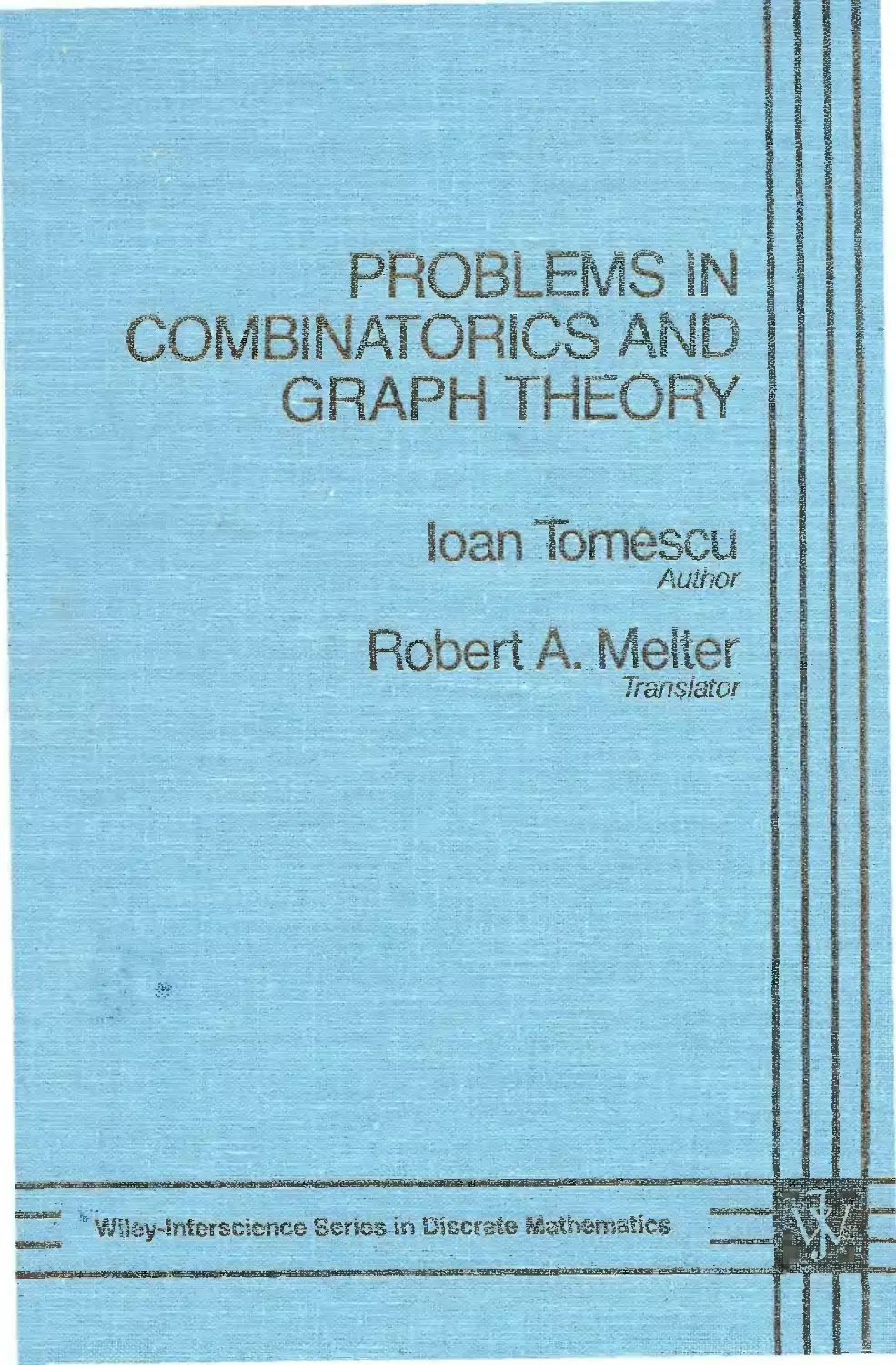


Author: Tomescu I. Melter R.A.
Tags: mathematics graph theory combinatorics natural sciences
ISBN: 0-471-80155-0
Year: 1985

Text
                    Translator
* Wiley-lnferscience Series-in .Discrete fcigthsmaties
rTJfflltlWlrt^g.™lHCrMMW3S=ia

PROBLEMS IN COMBINATORICS
AND GRAPH THEORY

WILEY-INTERSCIENCE
SERIES IN DISCRETE MATHEMATICS
ADVISORY EDITORS
Ronald L. Graham
AT&T Bell Laboratories, Murray Hill, New Jersey
Jan Karel Lenstra
Mathematisch Centrum, A msterdam, The Netherlands
Graham, Rothschild, and Spencer
RAMSEY THEORY
Tucker
APPLIED COMBINATORICS
Pless
INTRODUCTION TO THE THEORY OF ERROR-CORRECTING CODES
Nemirovsky and Yudin
PROBLEM COMPLEXITY AND METHOD EFFICIENCY IN OPTIMIZATION
(Translated by E.R. Dawson)
Goulden and Jackson
COMBINATORIAL ENUMERATION
Gondran and Minoux
GRAPHS AND ALGORITHMS
(Translated by S. Vajda)
Fishburn
INTERVAL ORDERS AND INTERVAL GRAPHS: A STUDY OF PARTIALLY
ORDERED SETS
Tomescu
PROBLEMS IN COMBINATORICS AND GRAPH THEORY
(Translated by Robert A. Melter)
Palmer
GRAPHICAL EVOLUTION: AN INTRODUCTION TO THE THEORY OF
RANDOM GRAPHS

PROBLEMS IN
COMBINATORICS AND
GRAPH THEORY
IOAN TOMESCU
Faculty of Mathematics
University of Bucharest
Bucharest, Romania
Translated from Romanian by
ROBERT A. MELTER
Department of Mathematics
Long Island University
Southampton, New York
A Wiley-Interscience Publication
JOHN WILEY & SONS
New York • Chichester • Brisbane • Toronto • Singapore

Copyright© 1985 by John Wiley & Sons, Inc.
All rights reserved. Published simultaneously in Canada.
Reproduction or translation of any part of I his work
beyond that permitted by Section 107 or 103 rf the
1976 United States Copyright Act without the permission
of the copyright owner is unlawful. Requests for
permission or further information should be addressed to
the Permissions Department, John Wiley & Sons, Inc.
Library of Congress Cataloging in Publication Data:
Tomescu, loan.
Problems in combinatorics and graph theory.
(Wiley-Interscience series in discrete mathematics)
Translation of: Probleme de combinatories §i teoria
grafurilor.
Bibliography: p.
1. Combinatorial analysis. 2. Graph theory.
I. Title. II. Series.
QA164.T6713 1985 511 .6 84-21701
ISBN 0-471-80155-0
Printed in the United States of America
10 987654321

Preface
This book is a translation of Probleme de Combinatories si Teoria Grafurilor,
which was published in Bucharest, Romania in 1981. In Romania, graph theory
is taught in the faculty of mathematics and in particular in what is known as the
chair of informatics ( = computer science). Students in preparatory schools
which specialize in mathematics and physics also receive instruction in this
subject. Thus the selection of problems presented includes some which are
quite elementary and self-contained and others which were previously
accessible only in research journals. The author has used the text to prepare
Romanian candidates for participation in International Mathematical
Olympiads.
Each problem is accompanied by a complete and detailed solution together
with appropriate references to the mathematical literature. This should enable
mature students to use the book independently. Teachers of courses in
combinatorics and graph theory will also find the text useful as a supplement,
since important concepts are developed in the problems themselves. Even in
the more elementary problems the reader will learn the important concepts
and structures in the field.
Revisions in the original Romanian edition have been made, and about 60
new problems and solutions have been added. The careful translation of this
material by Professor Melter will make available to users of English-language
texts a unique collection of problems in an expanding field of mathematics
which has many scientific applications.
The author and translator are grateful to Ms. Linda Kallansrude for her
professional typing and to the staff of John Wiley & Sons for their interest
and concern in the development of this book.
Ioan Tomescu
Bucharest. Romania
February 1985
v

Contents
GLOSSARY OF TERMS USED ix
PART I. STATEMENT OF PROBLEMS 1
1. COMBINATORIAL IDENTITIES 3
2. THE PRINCIPLE OF INCLUSION AND EXCLUSION;
INVERSION FORMULAS 10
3. STIRLING, BELL, FIBONACCI, AND CATALAN NUMBERS 15
4. PROBLEMS IN COMBINATORIAL SET THEORY 22
5. PARTITIONS OF INTEGERS 30
6. TREES 33
7. PARITY 39
8. CONNECTEDNESS 41
9. EXTREMAL PROBLEMS FOR GRAPHS AND NETWORKS 45
10. COLORING PROBLEMS 52
11. HAMILTONIAN PROBLEMS 56
12. PERMUTATIONS 58
13. THE NUMBER OF CLASSES OF CONFIGURATIONS
RELATIVE TO A GROUP OF PERMUTATIONS 62

viii Contents
14. PROBLEMS OF RAMSEY TYPE 65
PART II. SOLUTIONS 69
BIBLIOGRAPHY 335

Glossary of Terms Used
Abel's Identity: See Problem 1.29.
Arborescence with root a: A digraph with the property that for every point
xj=a there is a unique path from a to x.
Articulation point (or cut point): A point x of a connected graph G with the
property that the subgraph Gx obtained from G by removing the point x
is no longer connected.
Automorphism: An isomorphism of a graph G with itself.
Balanced incomplete block design (BIBD): See Problem 4.37.
Bell's number, denoted B„: The number of all partitions of a set with n elements;
thus Bn = S(n, \) + S(n, 2)4- • • • +S(n, n) (see Stirling number).
Bicovering of a set X: A family of nonempty subsets of X such that each element
of X is contained in exactly two subsets of the family.
Block of a graph G: A maximal 2-connected subgraph of G. Each two blocks
of a graph which is not itself 2-connected have in common at most one
point, which must be a point of articulation.
Burnside's lemma: See Problem 13.2.
Cardinal number of a finite set X: The number of elements in X; it is denoted 1^.
Catalan number, denoted C„: The number of ways in which parentheses can be
inserted in a nonassociative product of n factors. The numerical value of
the Catalan numbers is given by the formula C„ = (l/n)(2„"_"12).
Cauchy's formula: See Problem 12.6.
Cauchy's identities: See Problems 3.35 and 12.7.
Cayley's formula: The number of labeled trees with n vertices is equal to n"'2.
Center of a connected graph G: The set of vertices x0 of minimum eccentricity,
i.e., e(x0) = min e(x)=p(G) where p(G) is the radius of G.
Characteristic equation of a linear recurrence relation: See Problem 1.31.
Chromatic index q(G): The minimum number of colors with which the edges
of G can be colored if every two edges with a common endpoint are colored
with distinct colors.
Chromatic number x(G): The minimum number of colors with which the vertices
of G can be colored if every two adjacent vertices have distinct colors.
IX

X
Problems in Combinatorics and Graph Theory
Chromatic polynomial of a graph: See Problem 10.14.
Circuit: A path D = (x0, . . . , xr) in a digraph G such that x0=xr and the arcs
(x0, Xi), (xi, x2),. . . ,(xr..i, xr) are distinct. The circuit is said to be
elementary if all the vertices of the circuit, with the exception of the first
and last (which coincide), are pairwise distinct. The length of a circuit
is equal to the number of arcs it contains.
Clique: A complete subgraph of a graph.
fc-coloring of a graph: Let G = (A, If). A ^-coloring of G consists of a partition
X=Xi u • • • u Xk of the set of vertices, such that no vertices in the same
class are adjacent. It may also be defined as a function f: U-* {1, 2, . . . , k]
such that [i, j] e U implies f{i)i=f(j).
Combinations of n things taken k at a time, number of, (or simply n take k, or
binomial coefficient) Q = n(n — 1) • • • (n—k + 1 )jk!: The number of ways of
choosing k objects from a set of n objects. By definition 0=1 if fc=0 and
n^k. Likewise 0 = 0 if n<k. This notation is also utilized when n is
rational or n<0. Further detailn are given in the text. (See, e.g., Problem
1.22.)
Numbers of combinations of n things taken k at a time with replacement: The
number of increasing words of length k formed from an alphabet A with n
letters on which is defined a total order. The words are thus of the form
cxc2 . . . ck, where c^ ^c2^ ■ • • ^ckandcf e A for 1 ^/^&. The numerical
value of n take k with replacement is n(n+\) ■ ■ ■ (n+k— \)/kl. The number
of strictly increasing words of length k with letters in A is equal to Q).
Complement of a graph: Let G — (X, U). The complement of G is a graph
G=(X, U). It has the same set of vertices A'as G. Two vertices are adjacent
in G if and only if they are not adjacent in G.
(», k, ^-configuration: See Problem 4.38.
Covering of a set X: A family of pairwise distinct nonempty subsets, whose
union is X. A covering A of X which is made up of k subsets is said to be
irreducible if the union of every k — 1 subsets of A is a proper subset of X.
Cut of a network G=(X, U, c) with source a and sink b: The set of arcs a>~ (A) =
{(x, y)\x $ A, y e A} where AcX, at A, and b e A. The capacity of the
cut to~(A) is the sum of the capacities of the arcs of co~(A).
(a, fc)-cut of a digraph: A set C of arcs with the property that every path from
vertex a to vertex b (a^b) contains at least one arc of C.
Cycle in a graph: A walk W= [x0, xt, . . . , xr] with the property that x0 = xr
and all the edges [x0, x^], [x^, x2], . . . , [xr-1, xr] are pairwise distinct.
The cycle is said to be elementary if all its vertices (except the first and the
last) are distinct. The length of a cycle is equal to the number of edges in it.
Degree of a vertex x: (1) In a graph G, the degree of a vertex x, denoted d(x),
is the number of edges incident with x. (2) If G is a digraph, then the
indegree d~(x) of a vertex x is the number of arcs which terminate at x, i.e.,
of the form (y, x)\ its outdegree d+(x) is the number of arcs of the form

Glossary of Terms Used xi
(x, z), that is, which originate at x. It follows that d(x)=d+(x) + d~(x).
Diameter of a connected graph G: The maximum distance between a pair of
vertices of G, The diameter is denoted d(G).
Distance between vertices x and y: Let x and y be vertices of a connected graph
G. The distance d(x, y) is the length of a shortest walk in G from x to y.
Dixon's formula: See Problem 1.8.
Eccentricity of a vertex x of a connected graph: e(x)=maxy d(x, y), where
d{x, y) is the distance between x and 7.
Erdos-Ko-Rado theorem: See Problem 4.22.
Eulerian cycle (circuit): A cycle (circuit) in a graph G which passes through all
the edges (arcs) of G.
Eider's formula for a planar graph G: If G is connected and contains n vertices
and m edges, then every planar representation of G has m — n + 2 faces.
Eider's function <p(n): The number of positive integers smaller than n and prime
to n. If the decomposition of n into prime factors contains distinct prime
factors />!,. . . ,pq, then
Eider's identities: See Problems 1.37 (or 2.9) and 5.6.
Eulerian number: See Problem 12.22.
Eider's Pentagonal Theorem: The recurrence relation for the number P(ri) of
partitions of an integer n. See Problem 5.8.
Face of a planar representation of a planar graph G: A connected component
of the topological space obtained by removing from the plane the edges
and vertices of the planar representation of G. The boundary of each face
is a closed Jordan curve, consisting of the edges of an elementary cycle
of G. The infinite face is the unique unbounded connected component
obtained in this way.
Ferrers diagram: Let h=h1 + h2+ " • +nt be a partition of an integer n. A
Ferrers diagram is a table with n cells. In the first line there are nx cells,
in the second line n2 cells, etc. The cells are arranged beneath each other
and are aligned on the left. A Ferrers diagram is symmetric if there are the
same number of cells in line i and column i for every i^ 1. This symmetry
is with respect to the principal diagonal of the diagram.
Fibonacci numbers: Numbers defined by F0 = Fx-\ and F„+2 = F„+1 + F„ for
each n ^ 0.
Filter basis: A system S of nonempty subsets of a set Zwith the property that
for every A, B e S there exists C eS such that CcAnB.
Flow in a network: See Problem 9.18.
Ford-Fulkerson algorithm: See Problem 9.20.

XII
Problems in Combinatorics and Graph Theory
Ford-Fulkerson theorem: In every network the maximum value of the exit
flow is equal to the minimum capacity of a cut (see Problem 9.19).
Gauss's number Qq: The number of subspaces of dimension k of an n-
dimensional vector space over a field with q elements, where q is a power
of a prime. An expression for the value of Gauss's number is given in
Problem 3.33.
Generating function: Let (an) be a sequence of numbers. Its generating function
is the sum of the series £"=0 a„x". The expression £r=o anx"/n\ is called
the exponential generating function of the sequence (an). These series are
considered as formal series to v/hich algebraic operations can be applied,
without consideration of their convergence. In general the generating
functions in actual use are defined by means of series which are convergent
for all real numbers or for an interval of real numbers of positive length,
but the convergence of the series will not be established in this book. The
series representations which we use depend on the expansions of e* and
ln(l +x), on Newton's generalized binomial formula, and on the sum of
an infinite geometrical progression.
Girth of a graph G: The length, denoted g(G), of the shortest elementary cycle
in the graph G.
Graph: (1) a graph G is an ordered pair of sets (X, U), where X is a finite set
called the set of vertices or nodes, and U contains unordered pairs of
distinct elements of X called edges. If an edge is denoted [x, y], then x, y
are called its endpoints, the vertices x and y are said to be adjacent in the
graph G, and the vertices x and y are by definition incident with the edge
[x, y]. (2) A digraph (directed graph) G is an ordered pair of sets (X, U),
where X is called the set of vertices or nodes, and U contains ordered
pairs of distinct elements of X, called arcs. If an arc is denoted u=(x, y),
then x is called its initial vertex and y its terminal vertex; the arc is said to
be directed from x to y. One also says that the vertices x and y are adjacent
in G and incident with the arc (v, y). A spanning graph of a graph G=(X, U)
is a graph Gt = (Z, V) where Vc U. It is thus a graph Gt obtained from G
by suppressing certain edges (arcs). A subgraph of a graph G is a graph
H=(Y, V) where YcX; the edges (arcs) of Fare those edges (arcs) in U
which have both endpoints in the set of vertices Y. A subgraph H of G
induced, or generated, by the set of vertices Y is obtained from G by
suppressing all the vertices of X \Y and all the arcs incident with them.
Graph, bipartite A graph G=(X, U) for which there exists a partition of X
in the form X=A\jB, AnB==0, such that each edge u of the graph has
one endpoint in A and the other in B. A bipartite graph is said to be
complete if it contains all edges of the form [a, b] where a e A and b e B. If
|/1|=/? and |S| = <7, the complete bipartite graph is denoted Kp q.
Graph, /i-chromatic: A graph G with chromatic number x(G)=k.
Graph, fc-colorable: A graph G with chromatic number x(GKfc. It is thus a

Glossary of Terms Used
XIII
graph whose vertices can be colored with k colors so that each two adjacent
vertices have different colors.
Graph, complete, on n vertices: A graph, denoted Kn, in which every two vertices
are adjacent. It has (") edges. The complete graph on a denumerably
infinite set of vertices is denoted Kx. A digraph is complete if each two
distinct vertices x and y are adjacent with respect to either the arc (x, y),
the arc (y, x), or both. In the complete digraph, denoted K*, each two
distinct vertices x and y are joined by both the arcs (x, y) and (y, x). It has
n(n— 1) arcs.
Graph, connected: A graph G with the property that every two vertices are the
endpoints of a walk in G. If G is not connected, then it has at least two
connected components (maximal connected subgraphs, which are pairwise
disjoint with respect to vertices). A connected graph with at least k + l
vertices is fc-connected if the graph obtained by suppressing every set Y of
vertices of cardinality | Y| ^ k — 1 is connected.
Graph, strongly connected: A digraph G with the property that for every two
vertices x and y there is a path D {= (x, . . . , y) and a path D2 = (y, ■ ■ ■ , x)
in G.
Graph, Hamiltonian: A graph which contains a Hamiltonian cycle, or a directed
graph which has a Hamiltonian circuit.
Graph, multipartite: A graph G = (X, U) whose vertex set can be partitioned as
X=Ai\j- ■ -\jAk, so that each edge has its endpoints in two distinct sets
of the partition. A multipartite graph is complete if each pair of vertices
located in different partition sets is adjacent.
Graph, planar: A graph G whose vertices can be represented as points in the
plane; the edges become arcs of a Jordan curve which join points
corresponding to adjacent vertices. Two such arcs have in common at most
one endpoint.
Graph, fc-regular: A graph in which each vertex x has degree d(x)=k, or a
digraph with the property that d~(x) = d+(x) = k for every vertex x.
Graphs, isomorphic: The graphs G = (X, U) and H=(Y, V) are isomorphic
if there exists a bijection f :X-*Y such that [x, y] e U if and only if
[/(*), /(?)] e V.
Hamiltonian cycle (circuit): An elementary cycle (circuit) which contains all
the vertices of the graph.
Independence number a(G) of a graph G: The maximum number of vertices in
an independent set of G.
Independent (internally stable) set: A subset of vertices which induces a
subgraph consisting only of isolated vertices.
Inversion of a permutation p eS„: A pair {p(i), p(j)} with the property that
l^i<j^n andp(i)>p{j).
Konig's theorem: See Problem 9.23.

XIV
Problems in Combinatorics and Graph Theory
Li-Jen-Shu formula: See Problem 1.5(h).
Lucas numbers Ln: Defined by L0 = 2, L^ — X, and Ln+2 = Ln+i+Ln for every
Matching of a graph G: A set of edges such that no two have a common end
point. The maximum number of edges in a matching of G is denoted v(G).
Matroid: For a definition in terms of independent sets see Problem 6.30.
Moebius function: See Problem 2.20.
Moebius inversion formula: See Problem 2.22.
Multigraph: If in the definition of a graph G=(X, U) the set of edges is replaced
by a multiset, then a multigraph is obtained. A multigraph can contain
many edges having the same endpoints.
Multinomial formula: See Problem 1.16.
Multinomial number: A number of the form ( " „)=n\/n1\-■ ■ np\ where
«!,..., Wp^O and nx+ ■ ■ ■ +np-=n. For p=2 this reduces to the binomial
coefficients
\ni,n2J V"i/ \n2/
If «! + • • • +np=fcn, the multinomial number is by definition equal to zero.
Multiset X, or collection, of type l*1 2k-- • • • nkn: A set X together with a partition
of itself of type l*1 2kl ■ • ■ nk", that is, containing kj classes with j elements
for j = l, 2,..., n; the elements belonging to a class with p elements are
identified for 2^p^n.
Network: See Problem 9.18.
Newton's generalized binomial formula: (x+af=cf+ouf ~1 x + {a(a — 1 )/2!} x
(f~2x2+ ■ ■ ■ +Qa"~kxk+ ■ ■ ■, where a>0. This series is convergent
for every real number a and every real number x with |jc| < a. If a is a
positive integer one obtains Newton's binomial formula.
Norlund's formula: See Problem 3.2(b).
Orbit of a permutation group: If Gcz Sn is a group of permutations of the set
X= {1, . . . , n) and x, y eX, then x is equivalent to y with respect to the
group G if there exists a permutation / e G such that y=f(x). The
equivalence classes for this equivalence relation are called the orbits of the group
G.
Partition: (1) A partition of a set A' is a representation of X in the form X=
Ai\jA2\J- ■ -vAk where the nonvoid sets A1} . . . , Ak are pairwise
disjoint ; these sets are called the classes of the partition. The partition does
not depend on the order of writing the classes nor on the order of the
elements in each class. A partition has type 1*' 2kl ■ ■ ■ nkn if it contains
kj classes with j elements. (?.) A partition of an integer n is a
representation of n in the form n=n1+n2+ • • • +nk; the integers
n1,n2, . . . ,nk are called the parts of the partition and satisfy the

Glossary of Terms Used
xv
inequalities n1^n2^ ■ ■ ■ ^nk^l. The number of partitions of n into k
parts is denoted P(n, k); the total number of partitions of n is denoted P(ri).
Path: Let G = (X, U) be a digraph. A path is a sequence of vertices D—
(x0, *!,..., xr) such that (x0, xx), (xx, x2), . . . , (xr_i, xr) e U, i.e., are
arcs of the graph. The vertices x0 and xr are called endpoints of the path D.
The length of a path is equal to the number of arcs it contains. The path D
is said to be elementary if its vertices x0, xt, . . . , xr are pairwise distinct.
Permanent of a matrix A: Let A =(ay);, ;= 1 „■ The permanent of A is denoted
per(A) and is defined by perG4)='£peSn alm)a2p(2) ■ • • anp(n).
Permutation of a set X = {\,..., n}: A bijectionp:X-+X; it can be written either
as p(l) p(2) • • • p{n) or in the form
/I 2 - „\
\p(l) p(2) •■■ p(n))
A permutation is of the type 1*' 2kl ■ ■ ■ nk" if it contains k} cycles with j
elements, when kx + 2k2 + •■■ +nk„ = n. Every permutation has a unique
representation (if we ignore the order of the factors) as a product of cycles
which do not have any common elements; the product is composition
of functions.
Permutation, circular, or cycle with r elements: A permutation in S„ with a
unique cycle of length r, the remainder of the n — r cycles being of length
one. A cycle is thus a permutation of type l"_rr1.
Permutations, conjugate: Two permutations s, t in S„ are conjugate if there
exists g e S„ such that s—gtg'1, or equivalently if s and t have the same
cycle structure.
Petersen graph: See Figure 8.3.
Polya's theorem: See Problem 13.6.
Polynomial, cycle index of a permutation group GcS„: A polynomial in n
variables
V YA'<»> • • • y^-'te)
|Cj| geG
where Xt(g) is the number of cycles of length i of g for 1< i ^ n.
Principle of inclusion and exclusion: See Problem 2.2.
Projective plane, finite: A symmetric BIBD with parameters (v, v, k,k, 1) where
v^4. (See Problem 4.50.)
Priifer code associated with a tree: See Problem 6.15.
Radius of a connected graph: The smallest eccentricity of its vertices.
Ramsey number R(p, q) with two parameters: The smallest integer t with the
property that each graph with t vertices contains either a complete
subgraph with p vertices or an independent set with q vertices.

XVI
Problems in Combinatorics and Graph Theory
Schur number S(k): The largest number r with the property that the set {1,..., r}
can be partitioned into k possibly empty subsets, with the property that
none of them contains numbers x, y, z such that x+y = z.
Sperner's theorem: See Problem 4.21.
Star: A complete bipartite graph of the-form Kl>p.
Steiner triple system: If Xis a set with v^3 elements where v = 1 or v = 3 (mod 6),
a Steiner system of order v is a family of three-element sets of X, called
triples, such that each two-element subset of X is contained in a unique
triple.
Stirling number of the first kind, s{n, k): The coefficient of ** in the expansion
n
x(x- 1) • • • (jc-n-r-1)= £ s(n> k)^-
k = 0
Stirling number of the second kind, S(n, k): The number of partitions of a set
with n elements into k classes.
Support or transversal set of the edges of a graph: A set S of vertices with the
property that every edge has at least one endpoint in S. The smallest
cardinal number of a support for a graph G is denoted t(G).
Surjections, number of: The number of surjections / : X-* Y where \X\ = m and
|F| = n is denoted sm „.
Symmetric difference: Let A and B be sets. Their symmetric difference is denned
as A * B=(A\B)v(B\A).
System of distinct representatives (SDR) of a family of sets: A family of subsets
M(S)={S1, S2, . . . , Sm} of a set S has an SDR if there is an injective
function f :{SX,. . . , Sm}-*S such that f(St) e St for every i, 1 <i<w.
Tournament: A complete, antisymmetric, directed graph. Thus between each
two vertices x=f= y, there is one and only one arc (x, y) or (y, x).
Transposition: A permutation g e S„ which has n — 2 fixed points and is therefore
oftypel"-^1.
Tree: A connected graph without cycles.
Tree, spanning, of a connected graph G: A spanning graph of G which is a tree.
Triangulation: A planar representation of a planar graph in which each face
is a triangle (cycle with three vertices).
Triangulation of an elementary cycle with n vertices: The graph which consists
of the cycle and the n — 3 diagonals which do not intersect in the interior
of the cycle.
Turan's theorem and Turan's number M(n, k): See Problem 9.9.
Vandermonde's formula: See Problem 3.2(a).
Van der Waerden's number W{k, t): The smallest natural number n with the
property that if the set {1, ... , n) is partitioned into k classes, then there
exists a class of the partition which contains an arithmetic progression
with / +1 terms.

Glossary of Terms Used
xvu
Vertex, isolated: A vertex of degree zero in a graph.
Vertex, terminal: A vertex of degree one in a graph.
Vizing's theorem: The chromatic index of every graph G is equal to D or D+ 1,
where D is the maximum degree of the vertices of G. (See Problem 10.19.)
Walk: (1) In a graph G = (X, U) a walk is a sequence of vertices W=
[x0, xlt . . . , xr] with the property that each two successive vertices are
adjacent, that is [x0, xx], [xx, x2], ■ ■ ■ , [x,-1, xr] e U. The vertices x0 and
xr are called the endpoints of the walk, and r is the length of the walk. If
the vertices x0, xlf . . . , xr are pairwise distinct, then W is said to be
elementary. (2) If G is a directed graph, a walk W=[ulf u2, . . . , up] is a
sequence of arcs, with the property that for each i, each two successive
arcs w; and ui+1 have one common endpoint, 1 <i</?— 1. The endpoint
of «! which is not common to u2 and the endpoint of up which is not
common to wp_ x are called the endpoints of the walk.
Walk (path), Hamiltonian: An elementary walk (path) which contains all the
vertices of the graph.

Parti
STATEMENTS OF
PROBLEMS

1
Combinatorial Identities
1.1 Show that the following identities hold for every natural number n:
where [x] is the greatest integer <x;
«ii(":V-
1.2 Prove the equalities listed below:
(a) "l * P V"-^^ (n
p = k-3
1 for n=0(mod 3),
(b) £ (-l)pl~" "\ = \ 0 for n=l(mod3),
p'° V P ^ I 1 for n = 2(mod3);
1.3 Let Sk(ri) = lk + 2k+ ■■■ +nk, where k is a non-negative integer. Show
that
1+?Q^(«)=(«+ir
1.4 Prove that for natural numbers m and n, there exists a natural number p
such that the identity {yfm + Jm- If = Jp + y/p-1 holds.
1.5 Prove the following combinatorial identities:

Problems in Combinatorics and Graph Theory
(d> f r"v"+»'
k=0 V^
m
im*
<-»i(:X":4)-<-"-l.(:X"^<-*
fc=0
<\t(»;:Mx
' /^2
(h) £ U
'n + 2p— k
2p
1.6 Prove the identity
XT
(Li-Jen-Shu formula).
V ^ \l + k)\m + k)\n + k)
(i + m + w)!(2i)!(2m)!(2w)!
(H-m)!(m + n)!(n + 0!I!m!n!
for non-negative integers /, m, n, where the summation is taken over all integer
values of k.
1.7 Show that
PMI
.?..A* ■"'"-.U
P\(Q + i
{a-bY'V.
1.8 Prove Dixon's formula:
In
£,_.r-(*Y-,-ir£
„(3«)!
1)3
1.9 Given the expansion
(l+x + x2)" = a0-|-a1x-l-3:jX2-l- • • • +akxk +
show that:
n(n-l) n(n-lXn-2Xn-3)
+ a2„x2",
_v (2fc)!/w
(a)a"-1+H!?-+ w- ' -^(kvw
(b) a0ax-0x02 + 0203-•• -a2„_ia2„ = 0;
(c) ag-a2 + a22---- +(-l)"-1a2_1=i[a„ + (-ir-1a2];
+©*-.-■♦<-•>'(;)*
if p is not a multiple of 3,
(d) ap-\ 1 jap_x
(-l)k|fc) ifp=3A;
(e) a0 + a2 + a4 +
4(3"+ 1)

Combinatorial Identities 5
and
a1+a3 + a5+--- =i(3"-l);
(f) a0 + a3+a6 + ag+ ■ ■■ =a1 + a4 + a1+a10+ ■■■
= 02 + 05+08 + 0!!+ ••• =3"~1.
(g) With respect to the summations
«o + a4- + a8 + ■■■,a1+a5 + a9+ ...,
a2 + a6 + aio+ ...,03 + 07 + 0!!+ ...
show that three are equal and that the fourth differs from their value
by one.
(h) Verify the inequalities
1 =a0<Oi< • • • <a„ and a„>an+1> • • • >a2„=l
for every n ^ 2.
1.10 Suppose that
(l+x + x2+ ■■■ +xm)" = a0 + a1x + a2x2+ ■■■ +amnxmn,
and set
Si = ai + af + (m+2) + fli + 2(m+2)+ •••
for every i, 0 < i < m +1. Show that:
(m + l)" + (-l)"_1
S;= \ —+(-1)" for n + i=0(modm + 2)
m + 2
and in the opposite case,
c_(m+!)" + (-1)"-1
Si~ m + 2
1.11 What is the coefficient of xk in the expansion of
(l+x + x2+ ■■■ +X"-1)2?
1.12 Given positive integers n, and r show that there also exist r unique
integers
ai>a2> • • • >a,>0
such that
"-(■;K:\)+-+w
1.13 Show that
k =
= 1 V n — 1 / \x + y

6 Problems in Combinatorics and Graph Theory
1.14 Prove the identity
V (n~]\nn'1-k(k+l)\ = nn.
1.15 Show that the number of arrangements of a set of n objects in p boxes
such that theyth box contains itj objects, for 7 = 1,... ,p is equal to the
multinomial number
nx,n2,...,nv) n^\n2\--- np!'
where n,-^0 and nx + n2 + ■ • • +np = n.
1.16 Prove the multinomial formula
(a1+a2+ ••■+«/ = I ( " ) <K<f? ■ • • a"/,
ni "p?0 \»1» "2>- • •> "pj
«i+ ••■\-np~n
where at,..., ap are elements of a commutative ring.
1.17 Justify the identity
ni' .Mr.1'
k»i (si ii)\si iV \n—1
where the second summation is taken over all choices of the numbers
st,..., s^ 0 which satisfy the relations
Si+s2+ ••• +Sfc = fc;
st + 2s2 — • • • +ksk = m.
1.18 A function /: {1,..., n}-*{l...., r) is said to be increasing if /(i)< /(/)
for every i,j, l<i<j<i Show that the number of increasing functions denned
on the set {1,..., n} with values in the set {1,..., r} is equal to
[r]" = r(r+l)---(r + w-l)
n! n!
This number is also called the number of combinations with replacement of r
things taken k at a time.
1.19 In how many ways can a natural number m be written as the sum of n
non-negative integers
m = u{ + u2+ • •• +u„,
where two sums are considered to be different even if they differ only in the order
of their terms? What is the result if U:>0 for all 1?
1.20 Determine the number of monomials in the expansion of the
polynomial
(x1+x2+--- +x„f.

Combinatorial Identities 1
1.21 Let P{x) be a polynomial of degree n such that P(x) = 2X for every
x = 1, 2,..., n +1. Determine P(n + 2).
1.22 Verify the identity
v .. _«(n2-l2)---(n2-(fc-l)2)
/ C i C2 ' ' ' Ck Z •
Ci+c2+-" + Ck = n (2k— 1)!
c,»0
1.23 Prove the identity
(l+x + x2+ •••)"= Z ("^^V-
1.24 Show that
V f_iy.+J2+-+J-+i Q'i+J2+-"+J»-!)!_!
for every positive integer n, where the sum is taken over all partitions of n of
the form j^ + 2j2+ ■ ■ ■ + nj„ = n and7',^ 0 for 1 <i<n.
1.25 Show that for h ^ 2 the following relations hold:
, , ^ (n\ (n-k+l\
(a) max 2, , = , :
(«i "0 t=i W V " /
(b,(,mi"..,l,G)=('-f,(0+rC
"A ,, , / n / t+i
h
The maximum [minimum] is taken over all representations of n of the form
n = n1+---+nk and ni,...,nk^l, t =
and r is the remainder when n is divided by /c.
1.26 Evaluate:
(a) max max n1n2---nk;
(b) imf^„„1 + m+^k=„\2J\2) \2/'
1.27 If «i>3/i, n2^3h,h^l, where n1,n2,h are integers, show that for all
integers x, y such that 0<x</i, 0<y<fc, the following inequality holds:
ni-x\U2-y\{2h \
ni-hj\n2-h)^\x + yj'
1.28 For every p < k justify the identity
^ k\ /nV1 /nV" /nfc'
a, + 2a2+-+„a„=Pai!---a„!{^-(ai+"••+«n)}! \1/ W VP

8 Problems in Combinatorics and Graph Theory
1.29 Prove Abel's identities:
(a) t (nf)x(x + k)k-1(y + n-krk = (x + y + nT;
(b) t (n\x + k)k-\y + n-k)"-k-1=r-+%x+y + ny
,n-l.
»-l ,„
(c) I \kk-\n-k)n~k-1 = 2(n-\)ri'
k=l \k/
1.30 Show that
n"-l+"^ (n\kk-1(n-k)n'k = nn.
1.31 Given a recurrence relation of the form
f(n + 2) = af(n+l) + bf(n),
where a, b are real numbers with b<± 0 and n = 0,1,2,..., the quadratic equation
is called the characteristic equation of the given recurrence relation. Show that:
(a) If the characteristic equation has two distinct roots rx and r2, then the
general solution of the recurrence relation has the form
/(n)=C1r"1 + C2r"2,
where the constants Ct and C2 are determined from the initial conditions by
solving the system of equations
C, + C2 = /(0),
C1r1+C2r2 = /(1).
(b) If the characteristic equatior. has a double root equal to rt, the general
solution of the recurrence relation has the form
f(n) = r'](C1 + C2n),
where C1 = /(0) and C2 = [/(l)-r,/(0)]/r1.
1.32 A pupil has $n. Every day he buys exactly one of the following
products: a bun which costs $1, an ice cream which costs $2, or a pastry which costs
$2, until he has no more money. In how many ways can he use up these $n?
1.33 Let U(n) be the number of ways in which one can cover a 3-by-n
rectangle ABCD with dominoes (rectangles with sides 1 and 2). Show that
U{n)=0 if n is odd and that for n even U is given by the formula
l/(2m)=^={(V3 + l)(2 + V3r + (V3-l)(2-V3r}.

Combinatorial Identities
1.34 How many words of length n can be formed with letters of the alphabet
A = {a, b,c,d} so that the letters a and b are not adjacent?
1.35 Let
i f/i+>yi+4zV+i /i->yi+4zV+l
a„ =
Show that
for z^= — i, and a„ = (n + l)/2" for z= —5.
1.36 Consider the polynomial
/(x) = a0x" + a1x"~1 + ■ • • +a„.
Let
S„(x1,...,x„) = /(x1 + ••• + x„)-£/(x1 + ••• +xB_i)
+Z/(*i+••■+*-2)-•■■+(-ir/(o),
where the first summation is taken over the ^"J sums of n— 1 variables x,-,
the second summation is taken over the („"2) sums of n — 2 variables x}, etc.
Show that S„(x1;... ,x„) = a0n\x1x2 "x„.
137 Let p(Xi,..., x„) be a polynomial in n variables of degree m. Denote
by z*p the polynomial obtained by replacing k of the variables xt,..., x„ in p
with 0 in all possible ways and then summing the Q polynomials thus obtained.
Show that
. , fO ifm<n;
p-z1p + z2p- ■■■ =<
[c-x1 ■ ■ x„ 11 m = n,
where c is the coefficient of the monomial xt • • • x„ in the expansion
of the polynomial p. By taking p(xx,..., x„) = (x1+ ••• +x„f and setting
= x„ = 1, deduce Euler's identity:
^n\ .* [0 forO</c<n;
{{-l)nn\ for k = n.
1.38 Show that the following identity holds for all positive integers n, p with
n^p:
!<->*#=
p! = np-^j(n-l)p + ^j(n-2r----+(-ir(P )(n-p)".
1.39 Show that
0/ U/ , ,„ W n!
+ ■•■ +(-!)"■
x x+1 x + n x(x+l)---(x + n)

2
The Principle of Inclusion
and Exclusion;
Inversion Formulas
2.1 In a Romanian high-school class there are 40 students. Among them
14 like mathematics, 16 like physics, and 11 like chemistry. It is also known that
7 like mathematics and physics, 8 like physics and chemistry and 5 like
mathematics and chemistry. All three subjects are favored by 4 students. How many
students like neither mathematics, nor physics, nor chemistry?
2.2 Justify the following formula, known as the principle of inclusion and
exclusion:
1)4
= Il4|- I |.4,n^|+■■■+(-1)«+1
i=l 1 «i < j « «
0 4
2.3 If Ax, A2, ■ ■ ■, Aqcz X, prove that the number of elements in X which
belong to p of the sets At is equal to
X (-if-"
k=p
KCQ
\K\=k
0 4
(the sieve formula of C. Jordan).
2.4 Let n be a positive integer and q>{n) the value of Euler's function,
i.e., the number of positive integers less than or equal to and prime to n.
If n=p'l pli ■ ■ ■ p],' is the decomposition of n into q distinct prime factors, show
that
*)-.(i-l)fi-i)...fi-I
V pi A vi) \ pq/
2.5 Let p be a permutation of a set X = {1,..., n}. A fixed point of p is a
number i such that p(i) = i (K i < ri). Show that the number D{n) of permutations
of X without fixed points is given by
1 (-1V
3!
n\
10

The Principle of Inclusion and Exclusion; Inversion Formulas 11
How many permutations of a set of n objects have p fixed points?
2.6 Let X = {1,2,..., n), and let D(n) be the number of permutations of the
set X without fixed points. If E(ri) represents the number of even permutations
of X without fixed points, show that
£(n) = i{D(n) + (-l)"-1(«-l)}.
2.7 Show that ]Td|B q>{d) = n, where q> is Euler's function.
2.8 Show that the number of square matrices of order 3 with non-negative
integer elements for which every row sum and every column sum is equal to r
is given by
2.9 Verify that
„=o «! 1-*
D(n + l)=(n + l)D(n) + (-l)n+1,
D(n + l) = n{D(n) + D(n-l)}.
2.10 Show that the number s„-m of surjective functions f:X-*Y with
|X| = n and |YJ = m is given by the expression
s„,m = m"-W(m-l)" + (Y)(m-2r+ ••■ +(-1)"-^.
Deduce from this that if E(n, m) denotes the right side of this expression, then
E{n, n) = n\ and E{n, m) = 0 for n<m (Euler's identities).
2.11 Denote by sB>m>r the number of functions f:X-*Y which have the
property that f{X)=>Z, where |X| = n, |Y|=m, and ZcY, \Z\ = r. Verify the
formula
s„,m,r = m"-Q(m-l)" + K)(m-2)"-•••+(-ir(m-r)".
2.12 Let A be an alphabet formed of n pairs of identical letters a1; ax;
a2, a2l ■ ■', a„, a„. Different pairs contain different letters. Form all the words
which use all 2n letters of the alphabet A so that no adjoining letters are identical.
Show that the number of words formed in this way is equal to
Ij(2n)!-Q2(2n-l)! + Q22(2n-2)!- ••• +(-l)"2V'j.
2.13 Let a„ be the number of digraphs with n vertices which are labeled

12
Problems in Combinatorics and Graph Theory
with numbers from the set {1,..., «} and which do not contain a circuit. Show
that the numbers a„ satisfy the recurrence relation
fl-=Zi(-i-ri(^2k(-k)fl,,-*
if, by definition, a0 = 1.
2.14 A set X is said to be a collection of objects of type lAl 2Xl ■ ■ ■ nXn if
there exists a partition of the set X which contains A;- classes with j elements,
for j=l,..., n. Objects which belong to the same class of the partition are
identified. An arrangement of the objects in cells is a function f :X-*A, where
A is the set of cells. If /(x) = a;, we shall say that the object x e A is arranged in
cell a,-. By definition, two arrangements are equivalent if one can be obtained
from the other by a permutation of the objects in the same classes of the partition
of X. Classes of this equivalence relation are called arrangement schemes of
objects in cells.
Denote by A0(lx' 2*2 ■ ■ ■ nA"; 1") the number of arrangement schemes
of a collection of objects of type lAl 2Al • • • nA" in m distinct cells, and by
Ail'-1 2Al • • • nA"; lm) the number of arrangement schemes which leave no cell
empty. Show that
^...^-,=(:;(^..{*rT'
^^•■v.:1-,.f«-.r-(^yer)''-c+r1)'"
2.15 Find the number of possible ways of writing a natural number p as a
product of m factors different from one, for which two products are also
considered to be different if the order cf the factors is different; the decomposition
of the number p in prime factors contains At factors of exponent 1, A2 factors of
exponent 2,..., A„ factors of exponent n.
2.16 Let
M(p>q)=(2«-l)"-Q(2«-1-l)" + Q(2«-2-l)"---+(-l)«-1q.
Show that M{p, q) = M{q, p).
2.17 Prove the inverse binomial formula: If the numbers a0,alt. ..,a„ and
b0, bu . . . ,b„ satisfy the relations ftfc = X*=o (*)&; for fc = 0, 1, . . . , n, then the
numbers b0, bu ..., b„ are given by ihe relations
;=o \'/
2.18 Count in two different ways the number of representations of m as a
sum of n integers, m = u1 + u2+ ■ ■ • +u„, where u;^2for 1 ^i^n. Two sums are

The Principle of Inclusion and Exclusion; Inversion Formulas 13
also considered to be distinct if they differ only in the order of their terms. Use
this to obtain the identity
for any m^n + 1^2.
2.19 Let V= {*!,..., x„} be a finite set on which is defined a partial order
^ which, by definition, satisfies the following three properties:
(a) x;^Xi for every i = 1,..., n (reflexivity);
(b) Xj ^ Xj and xj ^ x, imply x{ = Xj (and thus i =j) for 1 ^ i, j ^ n
(antisymmetry);
(c) xt < Xj and Xj < xk imply x; ^ xk for 1 ^ i, j,k^n (transitivity).
A square matrix of order n whose elements are real numbers (a,j)iiJ= t „ will
be said to be compatible with the partial order defined on V, or simply
compatible, if a,7=^0 implies Xi^Xj for every i,j=l,...,n. Show that the sum and
the product of two compatible matrices is a compatible matrix, and show that
if a compatible matrix is nonsingular, then its inverse is compatible.
2.20 If V is the partially ordered set of the preceding problem, show that
there exists a function \x defined onFxF with the following properties:
(a) n(x, y) = 0 if x is not less than or equal to y;
(b) n(x, x) = l for every x eV;
(c) Xx«y«z M*> y) = 0 for every x<z if x, zeV.
The function n is called the Moebius function of the set V.
2.21 Evaluate the function n(x, y) introduced in the preceding problem if
Fis:
(a) the family of all subsets of a finite set S with respect to the partial
order relation of nonstrict inclusion, denoted X c Y;
(b) the set of integers 1,2,..., n where x^y is defined by x \ y (i.e., x
is a divisor of y);
(c) an arborescence, where the relation of partial order between
vertices is defined by x ^ y if the unique path which joins the root of
the arborescence with the vertex y passes through x.
2.22 Let f(x) be a real-valued function defined on a set V, and fi(x, y) the
Moebius function on V. Let
g(x)= £ /(z).
z«x
Show that
f(x)= Yj tiz,x)g{z).
(This is the Moebius inversion formula).

14
Problems in Combinatorics and Graph Theory
2.23 If p and q are two partitions of a set X with n elements, then define a
partial order relation by p^q if the partition q is a refinement of the partition p.
That is, every class of q is contained in some class of p. Denote by 0 the partition
with a single class consisting of X, and by 1 the partition with n classes each
formed by a singleton of X; it follows that 0^p< 1 for each partition p of X.
Show that
Ai(0,l)=(-ir1(n-l)!.
2.24 If the partially ordered set V contains a first element 0 and a last
element 1 such that 0 ^ x ^ 1 for each x eV, denote by pk the number of walks
of the form
a0 = 0 < a! < • • • < ak = 1.
Show that
H(0, l)=-P;+Pi-P3+ ■■■■
2.25 For n>2 subsets A1,..., A„czX let
Sfc = X \Ai,C]Ai2n ""' nAik\
for 1 ^ k ^ n, where £ denotes summation over all integers 1 ^ ix < i2 < • • • < ik =% «
and Sk=0if/c^n + l. Prove that for every p^ 1 the following inequalities hold:
s (-lp-^ u x^'fi-irx
fc = 1 i=l fc = 1
These inequalities are known as the Bonferroni inequalities.

3
Stirling, Bell,
Fibonacci, and
Catalan Numbers
3.1 For every real number x and every natural number n let
[x]„ = x(x-l)---(x-n+l),
[x]" = x(x+l)---(x + n-l),
where, by definition, [x]0 = [x]° = l. The Stirling number of the first kind,
s(n, k), is defined as the coefficient of xk in the expansion of [x]„, that is,
n
W„= X s(n,k)xk.
k=0
Show that
M"=£ \s(n,k)\xk.
k = 0
3.2 Show that the following equalities hold:
(a) [x + y]„= X f "A Wk[y]»-i, and
(b) [x + y]" = ^Q[x]k[y]"-k,
where [x] 0 = [x] ° = 1.
3.3 Prove the following identities:
n
(a) x"= X S{n,k)[x\ and
k-l
c)M-=tJ(::!)w..
where S{n, k) are Stirling numbers of the second kind.
15

16 Problems in Combinatorics and Graph Theory
3.4 Show that the Stirling numbers of the second kind can be expressed as a
function of the number of surjectivc functions by the relation
S(n,m)=—rs„,m.
m!
Show that the Stirling numbers also satisfy the recurrence relation
S(n+l, m) = S{n, m—l) + mS(n, m),
where S(n, l) = S(n, n)=l.
3.5 Justify the following recurrence relations for the Stirling numbers of
the second kind, S(n, m), and for the Bell numbers B„:
(a) S(n + l,m)= £ (?) S(k, m-1);
k=m-1W
(b) Bn+i=t LJB*> where B0 = l.
3.6 Show that the number of partitions of an n-element set of type
l*i 2*2 ■ • ■ nk" (i.e., which contain kj classes with j elements, j= 1,2,..., n) is
equal to
Part(l*' 2*2 •■• nk"\ n)== "'
(llf'fci! (2\pk2\ ■■■ (n\f"k„\'
Further, the number of permutations p e S„ of type \kl 2kl ■ ■ ■ nk" which contain
kj cycles with; elements for7 = 1, 2,..., n is equal to
Perm(l*' 2*' ■ ■ ■ nk- n)= "\ j—,
where fci +2fe2 + ''' +nk„ = n and /:,^0for j=l,..., n.
3.7 Establish the following recurrence relations for the Stirling numbers of
the first and second kinds:
. j s(n, i +j)=fJ f , ) s(k, i)s(n - k, j),
1+J \ S(n, i +j) ■=£ Q S(k, i)S(n - k, j).
3.8 Show that
n n
X s(n, k)S(k, m)=Y, S(n, k)s(k, m) = 8nm,
fc=0 k=0
where S„im is the Kronecker symbol.
3.9 Let M{n) = max{k\S{n, k) is maximum; l^k^n}. Show that the
sequence of Stirling numbers of the second kind is unimodal for every natural

Stirling, Bell, Fibonacci, and Catalan Numbers 17
number n, that is, they satisfy one of the following formulae:
(1) 1 = S(n, 1) < S(n, 2) < ■ ■ ■ < S(n, M(n)) > S(n, M(n) +1) > ■ ■ ■ > S(n, n) =
i;
(2) 1 =S{n, l)<S(n, 2)< - <S(n, M(n)- l) = S(n, M(n))> - >S{n, n) =
1,
andM(n + l) = M(n)orM(n+l) = M(n)+l.
3.10 Let a = (a0, ax, a2,...) be an infinite sequence of real numbers. The
generalized Stirling numbers are defined as follows:
(1) Stirling numbers of the first kind sa{n, k) by the identity
n
{x\a)„ = {x-a0){x-a1)---{x-a„-1)= £ sa{n, k)xk and (x|a)0 = l;
(2) Stirling numbers of the second kind by the identity
n n
x"= Z Sa(n,/c)(x-a0)(x-a1)---(x-ak-1)= X Sa(n,/c)(x|a)k.
Show that:
(a) sa(n,k) = sa(n-l,k-l)-a„-lsa(n-l,k);
(b) Sa(n, k) = S.(n- 1, fc- l) + akS„(n- 1, k);
n
(c) s„(n, k)= X sfl(n+l, r+l)a^k;
(d) Sa(n,k)=t Sa(r-l,k-l)arr;
r = k
(e) sJLn, k)=t (- l)""rsa(r-1, fc-1) "u aj;
n n
(f) X sa("> k)Sa(k,m)= X Sfl(n, fc)sfl(fc, m) = <5B>m
(Kronecker symbol).
3.11 Show that the generating function for the Stirling numbers of the
second kind associated with the sequence (a0,a1,a2,-..) can be expressed as
Z Stt(n, k)f =
(l-a0fXl-fli*)"-(l-M
3.12 Let S,(n, /c) denote the number of partitions of a set X with n elements
into k classes, each one of which contains at least i elements. Show that:
(a) S,(n, k) = kS,{n-U *) + (""! W»-i> *-l);

lg Problems in Combinatorics and Graph Theory
(b)S,(n,*) = -i X -- "!
k-(h jk)A! ■■■;*!'
where the sum is taken over all integral solutions of the equation
ji + " " +jk = n which satisfy js^i for s= 1,..., k.
3.13 Show that the Stirling numbers of the second kind satisfy the following
relations:
(a) S(n,2) = 2"-1-1;
(b) S(n,n-1) = Q;
(c) S(n, l)-l!S(n,2) + 2!S(n, 3)-3!S(n,4)+---+(-l)"-1(n-l)!=0
for n^2.
3.14 A bicovering with k classes of a set X with n elements is a family of k
nonempty subsets of X such that each element xelis contained in exactly
two subsets of the family. If c(n, k) denotes the number of bicoverings with k
classes of X, show that
c(n, 3)=i(3--1-l).
3.15 A partial partition of a set X is a partition of a subset:
y<=x, y#j2r.
Show that the number of partial partitions of a set X with n elements is equal
toB„+1-l.
3.16 Show that the exponential generating function for the Bell numbers
is given by
00 D
X -"rr" = exp(exp(0-l).
3.17 Show that the Bell numbers B„ satisfy
1 °° i-"
Bn== y -.
Also show that the difference between the number of partitions with an even
number of classes and the number of partitions with an odd number of classes
of a set with n elements is equal to
3.18 Let f(n,k) denote the number of subsets of the set X = {l,...,n}
which contain k elements, no two of which are consecutive integers. Show that
ft i\ fn-k+l
f(n,k)=i k

Stirling, Bell, Fibonacci, and Catalan Numbers 19
If Fn+l = Ytk>0f(n, k), then F0 = F1 = 1. Show that Fn = Fn-1+F„-2 for every
n ^ 2. The numbers F„ are called Fibonacci numbers.
3.19 Suppose that f*{n, k) denotes the number of /c-element subsets of
X = {l,...,n} which contain neither two consecutive integers nor 1 and n
simultaneously. Show that
n — k \ k
If L„ = Y,k>0 /*("»k) for n^l, then Ll = \, L2 = 3, and £„+! = £„ + £„_! for
every n ^ 2. The numbers L„ are called Lucas numbers.
3.20 Show that the Fibonacci numbers satisfy the identity
*n+l*n-l — *n =(— 1)
3.21 In how many ways u„ can one mount a staircase with n steps if every
movement involves one or two steps? Show that the generating function is
1
-x — x2
I unxn=-
n=0 * '
where, by definition, «0 = 1.
3.22 Show that every natural number n ^ 1 can be written as a sum of pair-
wise distinct Fibonacci numbers which are not consecutive numbers Fp and
Fp+1 of the Fibonacci sequence.
3.23 Show that the generating function of the Catalan numbers C„ satisfies
the equation
f(x) = ClX + C2x2+--- +C„x"+---=1 ^ 4-.
Use this fact to obtain an expression for the number C„.
3.24 Show that the number of sequences (x„ 2) such that
xt e {— 1, 1} for 1 = 1,2,..., 2n —2 and which satisfy
(1) x1+x2+ • • • -l-Xfc^Ofor every l^/c<2n —2, and
(2) xi+x2+ ••• +x2„-2 = 0
is equal to (l/nX2;^2).
3.25 A triangulation of a convex polygon AtA2 • • ■ An+l with n +1 vertices
is a set formed of n — 2 diagonals which do not intersect in the interior of the
polygon but only at vertices, and which divide the surface of the polygon into
n— 1 triangles. Show that the number of triangulations of a convex polygon with
n +1 vertices is equal to
n V n—1

20 Problems in Combinatorics and Graph Theory
3.26 Show that the number of increasing functions
/:{l,...,n}->{l,...,n}
which satisfy the condition f(x)^x for every l^x^n is equal to the Catalan
number
C -J-/™
C"+1"n+lVn
3.27 Let AlA2- ■ ■ An be a convex polygon. In how many ways can this
polygon be triangulated with n—'i diagonals which do not intersect in the
interior of the polygon, so that each triangle has one or two sides in common
with the convex polygon?
3.28 Show that the number of .sequences (at, a2,..., ak +1) formed of non-
negative integers with the properties
ax=0 and |a,-a1 + 1| = l for l<i<lc
is equal to ([t*2]).
3.29 Let g0(n+l) be the number of sequences (aly a2,
negative integers such that a1=0 and
, a„+1) of non-
Show that
where
|a,- — ai+1|<l for i=l,2,...,n.
g0(n+l)=c[n, n) + c(n, n+1),
(l+x + x2)m= X c(m,k)xk.
k>0
3.30 Show that the number of sequences {al,a2,.. .,a2n+l)oi nonnegative
integers with the property that a^ =a2„+i=0and \at — a1+1| = l for i'=l,..., 2n
is equal to the Catalan number
3.31 Show that the number of sequences
(*!,..., *r) with l^x;^n
which contain at most i— 1 terms smaller than or equal to i for i = 1,..., n is
equal to (n — r)nr ~1 for every 1 ^ r ^ n.
3.32 Let S„ be the number of functions f :{l,..., n}-*{\,...,n} with the
property that if / takes on the value i, then / takes on the value j for 1 ^_/< i.
Show that

Stirling, Bell, Fibonacci, and Catalan Numbers 21
and deduce that the exponential generating function of the numbers S„ is equal to
00 S 1
Z -1X" = ^, x> where S0 = l-
„=0n! 2-ex
3.33 Let [£]q be the number of subspaces of dimension k of an n-dimensional
vector space V over a finite field F with q elements, where q is a power of a
prime. This number is called the Gauss coefficient. Show that
(qn-lXq
n-l
■l)"-W
,n-lc + l
-1)
to'-lX^-1-!)- ■■(q-l) '
3.34 Demonstrate the following properties of the Gauss coefficients:
(a) lim
(b)
(c)
n
A
n
_/c_
i ■ i
?f 3
«
«
.=0
n
n — k
n-l
Jc-1_
«
n-l
3.35 Let q be a power of a prime number. Show that Cauchy's identity holds:
/=i+Z
)t = 0
(y-l)(y-q)---(y-qn-k-1).
3.36 For n ^ 2 let f(n, k) denote the number of sequences of k integers
l^La1<a2< ' •' <ak = n which satisfy
and
Show that:
a2 — a1=a3 — a2 = ■•• = ak-i — ak-2=\ (mod 2)
ak — ak_! = 0(mod 2).
(a) /(n,/c) =
n + k-3
2 _
Jfc-1
(b) £ /(n,/c) = F„_1.
*»i

4
Problems in Combinatorial
Set Theory
4.1 Let X be a collection of n objects (n^l) which are not necessarily
pairwise distinct. If n^a2 +1, where a is a non-negative integer, show that one
or more of the following two statemsnts is valid:
(1) At least a +1 objects are identical.
(2) At least a +1 objects are pairwise distinct.
4.2 In how many ways can one arrange k rooks on a chessboard with m
rows and n columns so that no rook can attack another?
4.3 Let A be a set formed from 19 pairwise distinct integers which belong
to the arithmetic progression 1, 4, 7,..., 100. Show that there are two distinct
integers in A whose sum is equal to 104.
4.4 Let k ^ 1 be a natural number. Determine the smallest natural number n
with the following property: For evsry choice of n integers there exist at least
two whose sum or difference is divisible by 2k +1.
4.5 Let A = (Ai)14i4n, B = (B,):.s;Ub, C=(C,)i«i«„ be three partitions of a
finite set M. If for each i,j, k the following inequality is satisfied:
|/4;nBj| 4- |^,-i"i Ck\ + \Bjn Ck\ >n,
show that \M\ ^n3/3, with equality holding if n=0 (mod 3).
4.6 A mapping f:X->X is said to be idempotent if f(f{x)) = f{x) for
every x e X. If |X| = n prove that:
(a) the number i(n) of idempotent mappings / :X->X is equal to
oo „n
(b) 1+ X i(n)-- = exp(xex).
»=i "!
4.7 Let P be a partially ordered set. A subset S of P is called a chain if every
two elements of S are comparable with respect to the order relation. If S is an
22

Problems in Combinatorial Set Theory
23
antichain, every two elements of S are noncomparable with respect to the order.
For a natural number m, show that if P does not contain a chain of cardinality
m+1, then P can be represented as a union of m antichains.
4.8 A chain of length n in the family of partitions of an n-element set X is a
sequence of pairwise distinct partitions which satisfy
P1<P2<---<PI1.
The partition Pt has a single class formed of X, while P„ has n classes which
each contain a single element of X.
Show that the number of chains of length n in the family of partitions of an
n-element set X is equal to
(n-l)!n!
2«- i
4.9 Let F = {Ey,..., Es] be a family of r-element subsets of a set X. If the
intersection of each r+1 subsets of F is nonempty, show that the intersection
of all the subsets of F is also nonempty.
4.10 Let S = (Xi)1^Ur be a family of pairwise distinct subsets of X with the
property that Xt n X^0 for every i, j = 1,..., r. If the set X has n elements,
show that max r = 2" ~ *.
4.11 Let X be a nonempty set and let F be a family of m distinct subsets of
X where m ^ 2. Show that the collection of subsets of the form A & B (symmetric
difference of A and B) where A, B e F contains at least m pairwise distinct sets.
4.12 A covering of a set S is a family of nonempty pairwise distinct subsets
of S whose union is equal to S. Show that the number A(ri) of coverings of an
n-element set is given by the formula
A(n)=i(-iy(n)22"-'-K
J=o \J/
4.13 A covering A of a set S by k nonempty subsets is said to be irreducible
if the union of every k — 1 subsets of A is a proper subset of S. If I(n, k) denotes
the number of irreducible coverings by k subsets of an n-element set, show that
/(*,*)=_£ f"W-*-ir's(u),
where S(i, k) is the Stirling number of the second kind. In particular verify that
I(n, n-l) = in(2"-n-l)
and
7(n,2) = S(n+l,3).
4.14 Let Av,...,An be a collection of n pairwise distinct sets, and

24 Problems in Combinatorics and Graph Theory
Ati,..., Air a subfamily of maximal cardinality with the property that it does
not contain the union of the sets, that is,
Ai\jAj^Ak
for each three pairwise distinct indices i,j, k e {i'x ,..., ir}. Let f(n) = min r, where
the minimum is taken over all families of n pairwise distinct sets. Show that
J2n-l<:f(n)^2jn+l.
4.15 Let Ay, A2,..., A„ be finite sets such that
MiH^h ••• =KI
and let [j"_ t A{ = S. Suppose that for fixed k (1 ^ k < n) the union of every k sets
of this family is equal to S, and the union of at most k — 1 sets of the family is a
proper subset of S. Show that |S|^Gc"i)- When equality holds, it follows that
Mi'l = C-i) f°r every i=l, • • • ,n.
4.16 Let (X;)l4i4k be a family of /c-element subsets of a set X. Show that
min |IJ*=1 X{\ is equal to the smallest integer m such that /c^Q.
4.17 Show that
X \AlKjA2Kj--KjAk\ = n{2k-\)2k("-l\
At Ak
where the sum is taken over all choices of subsets A1,...,Ak of an n-element
set X.
4.18 Show that
£Miu ••• uAk\=(2k-l)YJ\A1n ■■■ nAk\,
where the sum is taken over all choices of subsets Al,...,Ak of an n-element
set X.
4.19 A collection S of nonemply distinct subsets of an n-element set X is
called a filter basis if for every A, B eS there is a set C e S such that C<=AnB.
Show that the number of filter bases of X is equal to
4.20 Let (A()lsUm and (B,)ls:jSm be two families of sets with the property
that |^4i|= • •• =|Xm| = p, |Bi|= • • • ==|Bm| = qand At nBj=0 if and only if i =j.
Show that
mti P )■
4.21 Let X be an n-element set, and G={Al,..., Ap} a family of subsets
of X which are noncomparable with respect to inclusion; that is, A^Aj for

Problems in Combinatorial Set Theory
25
every i,j = l,... ,p with i^j. Show that
maxp"U:)'
This result is called Sperner's theorem.
4.22 Let X be an n-element set, and F = {At,..., Ap} a family of subsets
of X which satisfy the following conditions:
(1) \A;\ = r^n/2 for every i= 1,..., p;
(2) AtnAj j=0for every i,j=l,...,p.
Show that max p=("I J).
This result is known as the Erdos-Ko-Rado theorem.
4.23 Let X be a finite set, and Ey,..., Em a family of subsets of X with the
property that the intersection of two distinct sets £; and £,- never has cardinality
exactly equal to one. Further assume that |£;| ^ 2 for i = 1,..., m.
Show that under these circumstances one can color the elements of X with
two colors so that no subset E; has all its elements colored with the same color.
4.24 Let F = {£i,..., £„} be a family of r-element subsets of a set X, where
n^2r_1. Show that it is possible to color the elements of X with two colors so
that no subset in the family F has its elements colored with the same color.
4.25 Let M be a set with n ^ 5 elements and F, a family of pairwise distinct
three-element subsets of M. If F contains at least n+l subsets, show that there
are at least two distinct subsets which have exactly one element in common.
4.26 Consider two collections (multisets) of integers {a^,.. .,an}±
{bl,...,b„} such that an integer can appear several times in each collection.
Assume that the collections
{a; + aj|l^i<j^n} and {^-l-ft/ll <i<;'<n}
are equal. Show that n is a power of 2.
4.27 Let X be an n-element set (n^ 1). Suppose that F = {At,..., Am] is a
family of subsets of X with the property
1^(0^1 = 1 for every l^i.j^m and i±j.
Show that m ^ n.
4.28 One is given n distinct points in the plane. Show that there exist fewer
than n^fn pairs of these points which have their distance equal to 1.
4.29 One is given n points in space, no four of which are coplanar. Consider
the set of Q planes determined by each triple of points with the property that
no two planes are parallel. Determine the number of lines of intersection of
these planes.

26
Problems in Combinatorics and Graph Theory
4.30 How many triangles can be formed from the n vertices of a convex
polygon if no side of a triangle can be: a side of the polygon?
4.31 Consider a convex polygon with n vertices. There are n(n — 3)/2
diagonals of the polygon with the property that no two are parallel and no
three are concurrent other than at ver.ices of the polygon. Show that the number
of points of intersection located outside of the polygon is equal to
n(n-3)(n-4)(n-5)
12
4.32 Suppose there are n points on a circle with the property that no three
of the n(n — 1 )/2 chords they determine; are concurrent in the interior of the circle.
Show that in this case these chords delimit
regions in the interior of the circle.
4.33 A set of simple closed curves is drawn in the plane. They do not
intersect themselves, but each two curves intersect in at least two points. Let np be
the number of points in which exactly p of the curves intersect.
Show that the number of closed regions of the plane which are bounded by
arcs of these curves and which do not contain such an arc in their interior is
equal to
l+n2 + 2n;.+ ■■■ +(p-l)np+ •••.
4.34 Let S be a set, and denole by M(S) = (Sl, S2,... ,Sm) an ordered
family of its subset. A system of distinct representatives (SDR) for M(S) is an
m-tuple (a1,a2,...,am) such that a,-eS; for l<i<m and a^aj if ij=j for
l^i, j^m.
Show that M(S) has an SDR if and only if \ShKjSh\j ■ ■ ■ uS,J>fc for all
choices of pairwise distinct numbers
{i1,...,it}cz{l,...,,«}, where l^/c<m.
4.35 Let X be an n-element set, and F a family of /i-element subsets of X.
Denote by M(n, k, h) the minimal number of /i-element sets in F which has the
property that each /c-element subsel of X contains at least one set of the family
F(n^k^h>l). Show that:
(a) M(n, k,h)^-^—M(n-l, k,h);
n — h
(b) M(n,k,h)^M(n-\,k- \,h-\) + M{n-\,k,h);
<c)Q/(WMK("-r).

Problems in Combinatorial Set Theory
27
4.36 Show that
for every n^/c^2, where r=n (mod k— 1) and O^r^/c —2;
(b) M(n, n-h, k) = h+l for every n>/c(/i+l) and/c^l.
4.37 A balanced incomplete block design (BIBD) is a set B formed of v
objects (also called varieties) together with a family F of b subsets of B (called
blocks), such that:
(1) each block contains exactly k objects;
(2) each object belongs to exactly r blocks;
(3) each pair of distinct objects is contained in exactly X blocks.
Show that the parameters (b, v, r, k, X) of a BIBD satisfy the following relations:
bk = vr and r(k—l) = X(v—l).
4.38 Let X be a set with v elements, and let Xt, X2,..., Xv be a family of v
subsets of X. This family is called a (i;, k, /^-configuration if it satisfies the
following conditions:
(1) |X,| = Jfcfori=l,2,...,»;
(2) | Xt n Xj\ = X for every i j=j;
(3) 0<A<Jfc<»-l.
The incidence matrix A = (aij)liijtv of this configuration is a square matrix
defined as follows: aiS= 1 if the element i of X belongs to the set Xj, and a,7=0
otherwise. Show that
ATA = (k-X)I + Xj,
if and only if A is the incidence matrix of a (i;, k, /^-configuration where AT is
the transpose of A, and J is a square matrix of order v all of whose elements
are 1. The matrix / is the identity matrix of order i;.
4.39 Show that every (i;, k, /^-configuration is a BIBD with parameters
(i;, i;, k, k, X).
4.40 Let X be a oelement set, v^ 3. A Steiner triple system of order v is a
family of 3-element subsets of X called triples, such that each two element
subset of X is contained in a single triple.
Show that a necessary condition for the existence of a Steiner triple system
of order v is that v = 1 or 3 (mod 6).
4.41 A BIBD is said to be symmetric if v~b (and hence k = r). Show that
if a symmetric BIBD has parameters (i;, i;, k, k, X) where v is even, then k — X is a
perfect square.

28
Problems in Combinatorics and Graph Theory
4.42 Let X be an n-element set, and Y a /c-element subset of X. Show that
the maximal number of pairwise distinct subsets of X which are noncomparable
with respect to inclusion, and which contain exactly r elements of Y is equal to
\r)\\{n-k)l2-])-
4.43 Consider the functions J':X-+X such that f(f(x)) = a for every x e X,
where a is a fixed element of X. If \X\ = n~^2, prove that the set of all such
functions has cardinality
p=i \ P J
4.44 Consider the r-element subsets of the set {1,..., n}. Select the
minimum element of each subset. Show 'that the arithmetical mean of the numbers
obtained in this way is equal to (n +1 )/{r+1).
4.45 Let M = {1,2,...,2048}. Show that for any subset XcM, |X| = 15,
there are two disjoint subsets A, BczX such that
UA HB
Does this property hold for 12-element subsets of M?
4.46 Let x = (x1,. ..,x„) and y—\.yi, ■ ■ -,y„) be two vectors. It is said that
x covers y if x = y or xt = yt for n — 1 values of i. Let F denote the set of p" vectors
()>i,... ,y„) where l^y.-^pfor i'=l,.. .,n. A set H of vectors hly h2,.. .is called
a covering set if every vector y in F is covered by at least one vector h; in H. Let
<r(n, p) be the minimum number of vectors which such a covering set H can
contain.
Prove that <r(2, p) = p and a(n, p)>~p"I{n{p-1)+1}.
4.47 Given a set of n +1 positive integers, none of which exceeds 2n, show
that at least one member of the set must divide another member of the set.
4.48 Let X be a finite set containing at least four elements, and let
Ay,..., A100 be subsets of X which arc not necessarily distinct, and are such that
|X,-|>||X| for any i=l,...,100. Show that there exists Y<=X, \Y\^4, with
YnAfj=0 for every i'= 1,..., 100.
4.49 The digital plane D is the set of all points (digital points) in the
Euclidean plane which have integral coordinates. For any two points P^Xy, y^)
and P2{x2, y2) from D the city-block distance is defined by
d^(Pi, P2) = \x2-x1\ + \y2-y1\,
which yields a metric for D. For any FcDa subset BcF is said to be a metric
basis for F if for any x, y e F, x ± y, there exists b e B such that d4(x, b) ± dA{ y, b).

Problems in Combinatorial Set Theory
29
Prove that:
(a) D has no finite metric basis;
(b) for any natural number n^3, there exists £„<=£) such that the
minimum number of elements in a metric basis for E„ is equal to n.
4.50 A finite projective plane is a symmetric BIBD A with parameters
(i;, v, k, k, X) where i;>4 and A = l. It is traditional in this context to substitute
the terms point for object and line for block. From Problem 4.37 one can
deduce that
v = k2-k+l.
The number n = k ~ 1 is called the order of A. Thus for a finite projective plane
of order n it can be seen that
b = v = n2+n + l, r = k = n+\.
It is convenient to say that a set of points is collinear if it is contained in some line.
Show that a set system A = (V, E) where £ is a family of subsets of V is a finite
projective plane if and only if the following three conditions hold:
(1) Every pair of points is contained in exactly one line.
(2) Every pair of lines intersects in exactly one point.
(3) There exists a 4-subset of V no 3-subset of which is collinear.

5
Partitions of Integers
5.1 In how many ways can three numbers be selected from the set
{1, 2,..., 3n} so that their sum is divisible by 3?
5.2 Show that the number P{n, m) of partitions of an integer n into m parts
satisfies the recurrence relation
P(n + k,k) = P{n, 1) f P(n, 2) + ■ ■ ■ + P(n, k),
withf(n, l) = F(n, n)=l.
5.3 Show that the number of partitions of an integer n into pairwise distinct
parts is equal to the number of partitions of n into odd parts.
5.4 Verify that the number of partitions of a positive integer n into m
pairwise distinct parts is equal to
p(.-(").«).
5.5 For a positive integer n consider partitions of n such that every integer
between 1 and n can be uniquely represented as a partial sum of the partition.
For which numbers n is
n=\ + 1+-- +1
the unique partition with this property?
5.6 Prove Euler's identity:
00
(l-x)(l-x2)(l-x3)---(l-x")--- =1+ £ iM")*"
n= 1
= l-x-x2+x'~ +X1 -x12-x15+x22+ ■■-,
where i//(n)=(-lf if n = (3k2±k)/2 and i//(n) = 0 if n cannot be represented in
the form n = (3k2±k)/2 (k is an integer).
5.7 Justify the following expressions for generating functions:
(a) the generating function for the number P(n) of all partitions of an
integer n is
30

Partitions of Integers
31
„?oP(nK~(l-*)(l-x2)(l-x3)---'
where P(0)=1;
(b) the generating function of the number P(n, m) of partitions of an
integer n into m parts is
„?o (l-x)(l-x2)---(l-xm)
(c) the generating function for the number of partitions of n into odd
parts is
1
(l-x)(l-x3)(l-x5)---'
(d) the generating function for the number of partitions of n into pair-
wise distinct parts is (1 + x)(l + x2)(l +x3) • • • ;
(e) the generating function for the number of partitions of n into pair-
wise distinct odd parts is (1 +x)(l +x3)(l +x5) • • •.
5.8 Prove Euler's Pentagonal Theorem:
P(n) = P(n-l) + P(n-2)-P(n-5)-P(n-7)+---
, A ( 3/c2-/c\ / 3/c2+/c
for every n ^ 3.
L \ 2 7V 2
5.9 Show that the number of partitions of n such that no integer appears
more than twice as a part is equal to the number of partitions of n into parts
which are not divisible by 3. For example, for n = 6, these two sets of partitions
are, respectively {6, 5 + 1, 4 + 2, 4+1 + 1, 3 + 3, 3 + 2 + 1, 2 + 2 + 1 + 1} and
{5 + 1,4 + 2,4+1 + 1,2 + 2 + 2,2 + 2 + 1 + 1,2 + 1 + 1 + 1 + 1,1 + 1 + 1 + 1 + 1 + 1}.
5.10 Let P(n) and Q(n) be the number of partitions of n and the number of
partitions of n into odd parts, respectively. Show that the following recurrence
relations hold:
(a) Q(n)= X (-lM0e(2n-0, where g(0) = 1;
(b) P(n)=YJ P(i)Q(n-2i), where P(0)=Q(0)=1.
5.11 Show that P(n, m) = P(n - m) for m > n/2.
5.12 Consider the number of noncongruent triangles with pairwise distinct
integral sides and perimeter equal to In. Show that this number is equal to the
number Q(n, 3) of partitions of n into three pairwise distinct parts.
Also show that Q(n, 3) = [(n2-6n + 12)/12].

32 Problems in Combinatorics and Graph Theory
5.13 Justify the identity
(l+x)(l+x3)(l+x5)---==Z
k2
k^0(l-x2)(l-x*)---(l-x2k)
by counting symmetric Ferrers diagrams in two different ways. Use the same
method to prove Euler's identity:
5.14 Denote by B(n) the number of the partitions of n into parts which are
powers of two. For example B(6) = 6, and the corresponding partitions are the
following:
1+1+1+1+1+1-2+1+1+1+1=2+2+2
= 4 + 2 = 4+1 + 1.
Prove that:
(a) B(2n + l) = B(2n);
(b) B{2n) = B{2n-\) + B{n):
(c) B(n) is even for any n ^ 2.
5.15 Show that P(n)^2[Vn] for every n^2.

6
Trees
6.1 Let A=(X, U) be a tree and A, ={X,, I/,),..., Ap = (Xp, Up) a set of
subtrees of A. If B = Qf= j Xf =^^T, show that B is the set of vertices of a subtree
of A
6.2 Let Gj,..., Gk be a collection of subtrees of a tree G with the property
that each two subtrees have at least one vertex in common. Show that the entire
collection has at least one vertex in common.
6.3 Let dl,..., d„ be integers such that
0<d^ ■■■ ^dn.
Show that there exists a tree with n vertices of degrees di,...,dH,if and only if
dl + • • • + dn = 2n — 2.
6.4 Let Ax, A2 be two spanning trees of a connected graph G. Show that
there exists a sequence of trees
A1 = B1,B2,...,Br = A2
such that Bi+l is obtained from B, by suppressing an edge u and adjoining
another edge v between two nonadjacent vertices of Bt, for i= 1,..., r— 1.
6.5 For a connected graph G let d(x, y) denote the distance between vertices
x and y, that is, the number of edges contained in the shortest walk which joins
x and y. Further define the eccentricity of a vertex x by e(x) = max,, d(x, y). The
center of a graph G consists of those vertices x0 with the property that e(x0)=
minx e(x)=p(G). \_p(G) is called the radius of G.] The diameter of a connected
graph G, denoted d(G), is defined by d(G) = maxx e(x).
(a) Show that the center of a tree consists of a single vertex or two
adjacent vertices.
(b) If G is a tree show that e(x) is a convex function in the sense that if
y, z are adjacent to x, then
2e{x)^e{y) + e{z).
(c) Show that for every connected graph G,
d(G)^2p(G).
33

34 Problems in Combinatorics and Graph Theory
6.6 Show that every tree with n vertices and with diameter greater than or
equal to 2/c — 3 contains at least n — k walks of length equal to k.
6.7 Suppose that G is a tree with vertex set X. For x e X let
s(x)==X d(x,y).
(a) Show that the function .>(*) is strictly convex in the sense that if
y and z are two vertices adjacent to x, then
2s(x)<s(y) + s(z).
(b) Prove that the function s[x) attains its minimum for a single vertex
or two adjacent vertices of the tree G.
6.8 Determine the trees G on n vertices for which £ d(x, y) is minimal
(maximal).
6.9 Let xl,... ,xr be terminal vertices of a tree A, and set dlj=d(xi, Xj).
Show that:
(a) for every three indices i,;, k the following relations hold:
dij + djk-dik^0
and
dtj + djk — dik = 0 (mod 2).
(b) for every four indices i,j, k, I, two of the numbers dtj + dkl, dik + djt,
du + djk are equal, and the third is less than or equal to the two
equal numbers.
6.10 Let A and B be two trees whose terminal vertices are labeled with
numbers from the set {1, 2, ...,»•}. If the distances between these terminal
vertices are the same for A and B, that is,
dA(i,j) = dB(iJ)
for every l^i'^j^r, show that the trees A and B are isomorphic.
6.11 Let G = (X, U) be a tree and f:X->X a function with the property
that if [x, y] e U then /(*)= f(y) or 'J{x\ f(yj] e U. Show that / has a fixed
point or a fixed edge.
6.12 Let A be a tree with vertex set X such that |X| = 2n+l. An
automorphism of A is a bijection f:X-*X which preserves the adjacency of vertices,
that is, [x, y] is an edge of the tree A if and only if \_f(x), f{y)~\ is an edge of A.
Show that / has at least one fixed point.
6.13 Let A1 =(X, U^ and A2 = (X, U2) be two trees which have the same
vertex set A. Suppose that for every vertex x e X the subgraph obtained from
Ai by suppressing the vertex x and the edges incident with x is isomorphic to

Trees
35
the subgraph obtained from A2 by the same operation. Show that the trees At
and A 2 have the same diameter.
6.14 Let G be a tree with vertex set X = {x^,..., x„}, and set
D = (dij)iJ=l n,
where dij=d(xi, Xj) is the distance between x{ and xj in G. Show that
detD=(-l)"-1(n-l)2""2.
6.15 Let A be a tree with vertices Suppress the terminal vertex
(of degree 1) which has the smallest index, together with the edge incident with
it, and let An-i be the tree thus obtained and a^ the index of the vertex adjacent
to the suppressed vertex. Repeat this procedure for the tree An-^, and determine
the index a2 of the vertex adjacent to the terminal vertex of minimal index of
An_i and so forth, until one comes to a tree consisting of two adjacent vertices.
One thus obtains a sequence (ai,a2, ■ ■ ■, a„-2) of n —2 numbers 1 ^a,-^n for
1 <i^n —2, associated with the tree A. (It is called the Priifer code of A.)
Show that:
(a) the correspondence thus denned is a bijection between the set of
trees A with n vertices xl,..., xn and the set of n"~2 sequences
(al5... ,a„_2) which can be formed with numbers from the set
(b) there are n"~2 trees on n vertices Xj,..., x„ (this result is known
as Cayley's formula);
(c) the number of trees whose vertices x j,..., x„ have degrees d j,..., d„
which satisfy d{^\ and dx + • • • +d„ = 2n — 2 is equal to
n-2
^-1,...,^-^
6.16 Let tn denote the number of trees with n labeled vertices. Show that
'-=!?! *C-i)v"-"
and obtain Cayley's formula from this identity by using Abel's identity.
6.17 Find the number of trees with n labeled vertices and exactly p terminal
vertices.
6.18 Consider the ladder graph of Figure 6.1 with 2n vertices.
(a) In how many ways can n of its edges be chosen so that no two have
endpoints in common?
(b) Show that this graph has
-lr{(2 + j3Y-(2-j3Y}
2^/3
spanning trees.

36
Problems in Combinatorics and Graph Theory
o—
*2
—o—
—Q
yi
V2
yn
Fig. 6.1
6.19 The distance matrix of a connected graph with p vertices is a square
matrix D = (dij) with dij equal to the distance between vertices i and;. Show that
a square matrix D is a distance matrix if and only if it has the following properties:
(1) d^O for every 1 s$ i,;'<p and di} is an integer;
(2) dy=Oifandonlyifi=:;;
(3) D is symmetric;
(4) du ^ dik + dk) for every i,;', k and
(5) If dij> 1, there is an index kj=i,j such that dij=dik + dkj.
6.20 Prove that the following properties are equivalent for a graph G:
(1) G is a tree;
(2) G is connected, and the deletion of any edge of G results in a
graph Gj which is not connected;
(3) G has no cycle, and if x and y are any two nonadjacent vertices
of G, then the graph Gj obtained from G by inserting the edge
[x, y] contains cycles.
6.21 Prove that the number of arborescences having n labeled vertices is
equal to n""1.
6.22 Show that for n^3 there, are n"~3 different trees with n unlabeled
vertices and n — 1 edges labeled 1, 2, .., n— 1.
6.23 Let G denote a graph with n > 2 labeled vertices denoted 1,2,..., n and
m edges. Label the edges of G with ihe numbers 1, 2,..., m, and give each edge
an arbitrary direction. The incidence matrix of G is the n-by-m matrix A = (a^),
where 1 ^ i ^ n and 1 ^; ^ m, in which a,, equals +1 or — 1 if the edge; is directed
away from or towards the vertex /, and zero otherwise.
Prove that if the graph G has n vertices and is connected, then the rank of its
incidence matrix A is equal to n — 1.
6.24 Show that if B is any nonsingular square submatrix of A, then the
determinant of B is +1 or — 1.
6.25 The reduced incidence matrix Ar of a connected graph G with n
vertices is the matrix obtained from the incidence matrix A by deleting some
row, say the nth. Prove that a square submatrix B of order n— 1 of Ar is non-

Trees
37
singular if and only if the edges corresponding to the columns of B determine a
spanning tree of G.
6.26 Prove the Matrix Tree Theorem: If Ar is a reduced incidence matrix
of the graph G, then the number of spanning trees of G equals the determinant
of ArAj, where AT denotes the transpose of A.
6.27 Let G be a graph with n vertices, and let C = (ctj) for 1 ^ i,j^ n be a
matrix defined as follows: cu is equal to the number of vertices adjacent to i in G;
Cjj= — 1 if i^j and vertices i and j are adjacent in G; cy=0 if i^j and vertices
i and; are not adjacent in G.
Show that ArAj is the matrix obtained from the matrix C by deleting a row
(say the nth) and the column with the same index. Use this property to obtain
another proof of Cayley's formula, since the number t„ of trees with n labeled
vertices is equal to the number of spanning trees of the complete graph K„.
6.28 Let R„ be the tree with In vertices as illustrated in Figure 6.2. Show
that the number /„ of independent sets of vertices of this graph is equal to
n + 1 n + 2 2n
1 2 n
Fig. 6.2
6.29 Let T be a tree having vertex set {1,..., n} and edge set denoted by
E(T). If Ax,..., A„c X, prove that
n
l/iju ••• uxB|^ X Mil- Z M.-n^jl»
i=l U,ME(T)
where the last sum contains n — 1 terms.
6.30 A matroid M is a pair (£, J), where £ is a nonempty finite set, and J
is a nonempty collection of subsets of E, called independent sets, satisfying the
following properties:
(1) any subset of an independent set is independent;
(2) if / and J are independent sets containing k and k +1 elements
respectively, then there is an element e contained in J but not in
/, such that I\j {e} is independent.
A base is denned to be any maximal independent set, and the rank function p

38
Problems in Combinatorics and Graph Theory
is an integer-valued function defined on the set of subsets of E by
p(S)-=tnax 1/nSl.
For a connected graph G=(X, U) with n vertices let E be the set of edges of G
and take as independent sets the sets of edges /c[/ which are such that the
spanning graph of G with edge set I does not contain a cycle.
Show that M = (E,J) is a matroid [called the circuit matroid of G, and
denoted by M(G)~] whose bases are spanning trees of G. Prove that if Sc U,
then its rank p(S) = n — p, where p is the number of components in the spanning
graph (X, S) of G.

7
Parity
7.1 Let U be the set of edges of Kn, the complete graph on n vertices. Let
/: [/-»{ — 1, 1}. An edge u with f(u)= 1 will be said to be positive, and one with
f(u) = — 1 will be said to be negative. A triangle (elementary cycle with three
vertices) is positive if it contains an even number of negative edges; otherwise
it is negative.
If |/_1(— 1)| = P» that is, there exist p negative edges in U, show that the
number n(f) of negative triangles satisfies the relation
n(f)=np (mod 2).
7.2 Let G be a planar graph all of whose faces are triangular, and suppose
that the vertices of G are colored with three colors. Show that the number of
faces whose vertices are colored with all three colors is even.
7.3 An Eulerian circuit of a digraph G is a circuit which contains every
arc of G. Show that a graph G which does not contain isolated vertices has an
Eulerian circuit if and only if it is connected and for every vertex x the indegree
is equal to the outdegree, that is,
d-(x)=d+(x).
7.4 If the digraph G has at least one vertex x whose outdegree d+(x)~^3,
then the number of Eulerian circuits of G is even. (Two Eulerian circuits are
considered to be identical if they induce the same circular permutation of the
arcs of G.)
7.5 If a graph G is such that the degree of each of its vertices is even, then
the edges of G can be directed so that in the resulting directed graph each vertex x
satisfies
d-(x) = d+(x).
7.6 Show that a graph G has an Eulerian cycle if and only if it is connected
and each vertex has even degree. Prove that if G is connected and has 2/c vertices
of odd degree, then it is the union of k walks which are disjoint with respect to
edges and which do not contain the same edge twice.
7.7 If G=(X, U) is a directed graph, the complementary graph G = (X, U)
39

40
Problems in Combinatorics and Graph Theory
is denned as follows: The arc (x, y) € U if and only if (x, y)£U for every x,yeX
with x^y.
Let h(G) denote the number of Hamiltonian paths of the graph G. Show that
/i(G)iEfi(G)(mod2).
This property remains true in the case of a nondirected graph with n ^ 4 vertices.
7.8 Show that each tournament contains an odd number of Hamiltonian
paths.
7.9 Suppose that the graph G has all of its vertices of odd degree. Show
that each edge of G belongs to an even number of Hamiltonian cycles.
7.10 Let G = (X, U) be a connected graph with m edges and n vertices.
Show that the number of spanning graphs of G such that every vertex has even
degree is equal to 2m~"+1.
7.11 The set X of vertices of any graph can be partitioned into two classes
X1 and X2 (one of which may be empty) so that the subgraphs with vertex set
X1(X2) have all their vertices of even degree. Show that this property remains
true if the degrees of the vertices of the subgraph generated by X^ are even and
the degrees of the vertices of the subgraph generated by X2 are odd.
7.12 Let C be a collection of pairwise distinct subsets of a nonempty finite
set X with n ^ 2 elements. Show that the only collections C with the property
that every proper subset of X intersects an even number of sets from C are
P(X) and P(X)\{0}, where P(X) is the family of all subsets of X.

8
Connectedness
8.1 Let di ^d2^ " ' <d„ be the degrees of the vertices of a graph G, and
suppose that dk^k for every k^n — d„— 1. Show that G is connected.
8.2 Let G be a connected graph with n vertices and l^/c<n. Show that
G contains a connected subgraph with k vertices.
8.3 Let G be a graph with n vertices, m edges, and p connected components.
Show that
p + m^n.
8.4 Prove that in a connected graph G every two elementary walks of
maximal length have at least one vertex in common. If G is a tree, show that all
walks of maximal length of G have at least one vertex in common.
8.5 A graph G is said to be bipartite if there exists a partition of its set of
vertices,
X = AkjB,
such that each edge of the graph has one endpoint in A and the other in B.
Show that a graph is bipartite if and only if each elementary cycle in G has an
even number of vertices.
8.6 Does there exist a graph with 10 vertices whose vertices have the degree
sequence
1,1,1,3,3,3,4,6,7,9?
8.7 Let dx,..., d„ be integers such that
0^!< ••• ^dn.
Show that these numbers are the degrees of the vertices of a multigraph with n
vertices if and only if
(1) di + ■ ■ ■ + d„ is even and
(2) 4,^,+•••+</,,_,.
8.8 Which numbers can be the number of vertices of a regular graph of
degree /c?
41

42
Problems in Combinatorics and Graph Theory
8.9 Consider a graph G with n vertices which does not contain a complete
subgraph with three vertices. Suppose further that for every two nonadjacent
vertices x and y there are exactly two vertices which are adjacent to both x and y.
Show that there is an integer p^O such that n = 1 +(p\1). Also show that the
graph G is regular of degree p.
8.10 Given natural numbers r~$- 2 and g ^ 3, show that there exists a graph
G which is regular of degree r and v/ith girth g{G) = g.
8.11 Let G be a regular graph of degree r with n vertices and g(G)=g.
Show that
n>l+r + r(r-l)+-- +r(r-1)(^3)/2 forg odd
and
02{l+(r-l)+--- +(r-l)9/2-1} for g even.
8.12 Determine the regular graphs G of degree 3, with minimal number of
vertices, such that the smallest length of an elementary cycle is:
(a) g(G) = 4;
(b) 3(G) = 5.
8.13 Every connected graph G contains at least one vertex x which has the
property that the subgraph Gx obtained from G by suppressing the vertex x,
and the edges incident with x, is connected. Does this remain true if instead
of connectedness one considers strong connectedness?
8.14 A directed graph G is strongly connected if and only if for every subset
A of vertices, A =£0, there exists at least one arc of G of the form (x, y) where
x e A and y £ A. Show that this statement remains true if instead of the arc
(x, y) one takes (y, x) where y £ A and x e A.
8.15 Show that if a tournament G contains a circuit, then G contains a
circuit with three vertices.
8.16 For a tournament with n vertices, xlf.. .,x„, let r( denote the number
of arcs which enter xt, and let st denote the number of arcs which leave xt.
Show that:
(b) trf-isf.
1=1 1=1
8.17 Show that every tournament G contains a vertex x such that every
other vertex can be reached from x by a path with at most two arcs.
8.18 Every digraph G contains a set S of pairwise nonadjacent vertices such

Connectedness
43
that every vertex x £ S can be reached by leaving from a vertex y e S and
traversing a path of length at most equal to 2.
8.19 A tournament T is said to be transitive if, whenever (u, i;) and (i;, w)
are arcs of T, then (u, w) is also an arc of T. Show that an increasing sequence
S: Sj < s2 ^ • • • ^ sn of n > 1 non-negative integers is the sequence of outdegrees
of a transitive tournament with n vertices if and only if S is the sequence
0,l,...,n-l.
8.20 Show that the number C(n) of connected graphs with n labeled vertices
satisfies the recurrence relation
C(n) = 2<5-^?lfc(fc)2° Cik)
forn>2andC(l)=l.
8.21 Show that almost all graphs with n vertices have diameter equal to
2 for n-»oo. This means that if d2(n) denotes the number of graphs with n vertices
and with diameter equal to 2, then
,. d2{n)
lim_T(jr=1-
n-*oo Z2
8.22 Define a binary relation ~ on the set U of edges of a graph in the
following way: Let «,-~ u-, if i =j or if the edges Ui and us are found on the same
elementary cycle. Show that ~ is an equivalence relation on U.
8.23 An articulation point of a connected graph G is a vertex x such that
the subgraph Gx obtained from G by suppressing the vertex x and the edges
incident with x is not connected. A connected graph G which does not contain
an articulation point is said to be 2-connected.
Show that the following properties are equivalent for a graph G with n ^ 3
vertices:
(1) G is 2-connected;
(2) every two vertices of G belong to an elementary cycle;
(3) G does not have isolated vertices, and each two edges of G lie
on some elementary cycle.
8.24 Let G be a 2-connected graph. If G contains two elementary cycles of
maximal length, show that these cycles have at least two vertices in common.
8.25 Consider a graph G and two of its vertices x and y. Let G — x-y
denote the subgraph of G obtained by suppressing the vertices x and y. Suppose
that Gj and G2 are two graphs with the same vertex set X and that |X|>4.
If the graph Gj — x — y is isomorphic to G2 — x — y for all choices of vertices
x,yeX, show that the graphs Gl and G2 are identical.
8.26 Consider a chessboard with n rows and n columns (n odd). Can a

44
Problems in Combinatorics and Graph Theory
knight make a tour of the board by passing once and only once through each
of the n2 squares on the board and returning to the point of departure? (Euler).
8.27 Consider a graph G„ consisting of a zigzag line of n hexagons (as
illustrated in Figure 8.1 for n = 5). This graph has p = 4n + 2 vertices and q = 5n+1
edges and represents the molecular graph of a cata-condensed benzenoid
polycyclic hydrocarbon (a catafusene) with the molecular formula C4n+2H2n+4.
For n = 1,..., 5 these catafusenes an; called benzene, naphthalene, phenanthrene,
chrysene and picene.
A perfect matching of G„ is a matching which contains p/2 = In +1 edges.
Denote by K{n) the number of perfect matchings of G„ (in chemistry this
represents the number of Kekule structures of the catafusene).
Prove that for any n ^ 1
K(n) = FH+1.
<5&&
Fig. 8.1
8.28 Let G and G' be connected graphs. A set S of vertices of G is said to be
isometrically embeddable in G' if there is a set S' of vertices of G' and a bijection
f:S->S' which preserves distances, that is,
dG(x,y)=:dG{f(x),f(y))
for any x, y in S.
Prove that:
(a) if every subset of vertices S of a connected graph G with \S\ ^4 is
isometrically embeddable in a tree, then G itself is a tree;
(b) if G is a connected bipartite graph, then any set S of its points,
\S\ ^3, is isometrically embeddable in a tree;
(c) if every three points of a connected graph G are isometrically
embeddable in a bipartite graph, then G is bipartite.
8.29 The cities Cl,..., CN are served by n international airlines Alf..., An.
There is a direct line (without stops) between any two of these localities, and all
airlines provide service in both directions. If N^2" +1, prove that at least one
of the airlines can offer a round trip with an odd number of landings. Does this
property hold for N = 2"?

9
Extremal Problems
for Graphs and Networks
9.1 In a graph G it will be said that an edge u covers a vertex x if x is one
of the endpoints of u. A set of edges forms a matching if no two have a common
endpoint. We denote by v(G) the maximum number of edges in a matching, and
by p(G) the minimum number of edges of G which cover all the vertices of G.
Show that if G has n nonisolated vertices, then
v(G) + p(G) = n.
9.2 Show that:
(a) If G is regular of degree k and has n vertices, then the number of
triangles in G and G is equal to
(b) If a graph G has n vertices, then G and the complementary graph
G together contain at least
n(n-l)(n-5)
24
triangles.
9.3 Show that a graph G with n vertices and m edges contains at least
(4w/3n)(w — n2/4) triangles.
9.4 Show that a tournament with n vertices contains at most \C\1) circuits
with three vertices. Prove that this limit is attainable for n odd.
9.5 Show that a tournament with n vertices contains at least one
Hamiltonian path and at most n!/2"/2 Hamiltonian paths.
9.6 Show that every graph with n vertices and w>(n/4)(l +N/4n — 3) edges
contains at least one elementary cycle with four vertices.
9.7 Show that if a graph with n vertices does not contain a complete
subgraph with k vertices (/c^2) then it contains at least m = {n/{k— 1)} vertices of
45

46
Problems in Combinatorics and Graph Theory
degree less than or equal to p = [(k — 2)n/{k — 1)], where {x} is the least integer
^x.
9.8 In a set M containing 1001 people, each subset of 11 people contains at
least two individuals who know each other. Show that there exist at least 101
people each of whom knows at least 100 persons in the set M.
9.9 Let G be a graph with n vertices and without a complete subgraph with
k vertices. Show that the maximum number of edges in G is equal to
M(M)=-=T-I-+y
ifn = (/c-l)t + rand0^r^/c-2.
The graph G for which this maximum number of edges is attained is unique
up to isomorphism. G is made up of k — 1 classes of vertices. There are r classes
which contain t + l vertices; the remaining classes each contain t vertices.
Each vertex x is adjacent to all the vertices which do not belong to the class
which contains x. This result is called Turin's theorem.
9.10 Suppose that a set M contains 3n points in the plane and that the
maximal distance between the points is equal to 1. Show that at most 3n2 of
the distances between the points ars larger than
1
9.11 Given 2n points in the plane with no three collinear, show that the
maximum number of line segments which can be constructed with endpoints
in this set of points and so that no triangles are formed is equal to n2.
9.12 Find the maximum number of maximal complete subgraphs (with
respect to inclusion) in a graph with n vertices.
9.13 One wants to construct a telephone network connecting points in n
cities. Let c(u) be the cost of constructing the line for an edge u = [x,, Xj] in the
complete graph G thus denned. It is desired to minimize the total cost of
constructing the network. One must therefore find a spanning tree A of G such that
the sum of the costs associated with the edges of A is minimal.
Show that the following algorithm produces a minimal spanning tree of G:
(1) select the edge of G of minimal cost;
(2) among the unchosen edges, select an edge which does not form a
cycle with the edges already chosen and which has minimal cost.
Repeat step (2) of the algorithm until a set of edges of cardinality n— 1 has been
chosen.
9.14 Suppose that all the Q edges of the graph of the preceding problem
have different costs. Show that in this case the spanning tree of minimal cost is
unique.

Extremal Problems for Graphs and Networks
47
9.15 Denote by E the set of vectors x = (xls x2, . ■■ ■ , x„)e3t" such that
X;^0 for i=l,..., n and Xj + • • • +x„ = l. Show that if G = (X, U) is a graph
with n vertices then the following equality holds:
max X ^-of1-^)'
xeE [i,j]Et/ A \ V
where k is the maximum number of vertices of a complete subgraph of G.
9.16 Let G be a strongly connected graph. Associate with each arc u in G
a non-negative number c(u)>0. If a, h are two distinct vertices of G an (a, b)-cut
is a set C of arcs with the property that every path from a to b contains at least
one arc from C.
Show that
max min c(u) = min max c(u),
D ueD C ueC
where D runs through the set of all paths D = {a,...,b) and C includes the set
of all (a, h)-cuts of G.
9.17 For a digraph G=(X, U) let a, b be two distinct vertices of G, and c a
function c:U->$ such that c(u)^0 for every arc ueU. Suppose that g is a
function g:X->0t which satisfies the following two conditions:
(1) ff(a)=0;
(2) g(>>) — g(x) ^c(x, y) for every arc (x, y) e U.
The value of the function c for a path £> in the graph G is denned to be the sum
of the values of c for all the arcs of G, that is,
c(D)= X c(u\
ue/l(D)
where A(D) represents the set of arcs of the path D.
Show that
min c(£>) = max g(b),
D g
where D=(a,...,b) runs through the set of paths from a to b (we assume that
there exists at least one path from a to b).
9.18 A digraph G=(X, U) is said to be a network if it satisfies the following
conditions:
(1) There is a unique vertex a e X which no arc enters, i.e., co~(a)=0,
where co~(a) denotes the set of arcs which enter the vertex a.
(2) There is a unique vertex b e X which no arc leaves, that is,
a>+(b)=0. Here co+(b) denotes the set of arcs which leave the
vertex b.
(3) G is connected, and there is a path from a to b in G.
(4) Thereisafunctionc:l/->^suchthatc(u)^Oforeacharcue U.

48 Problems in Combinatorics and Graph Theory
Vertex a is called the source, vertex b the sink, and c(u) the capacity of the arc u.
A function f:U-*9t such that /(a)^0 for each arc u is called a flow in the
network G with capacity function c [denoted G=(X, U, c)] if the following two
conditions are satisfied:
(C) Condition of conservation of flow: For every vertex x=fca,b the
sum of the flows of the arcs which enter x is equal to the sum of
the flows of the arcs which leave x, that is,
Z /(")= Z /(") for every xeX\{a,h}.
uew (x) neco + ijc)
(B) Condition of boundedness of flow: The inequality f(u)^c(u)
holds for every arc u n U.
For every set of vertices AczX define a cut
co~(A)={(x,y)\x £A,y 6/1, (x, y) e [/};
a cut is thus the set of arcs which enter the set A of vertices. Further let
oi+(A) = {(x, y)\xe A,y$A, (x, y) e U}.
co+(a) is thus the set of arcs which leave the set A of vertices. The capacity of the
cut co_ (A) is defined by
Show that:
(a)
c(a>"(A))= £ c{u).
uew ~{A)
Henceforth the common value of these two sums will be denoted
ft-
(b) For each set of vertices AczX such that a$A and b e A, the flow
fb at the exit of the network satisfies
f„= 1 /(«)- Z /(«Hc(fiT(/l)).
ueco " (A) uew + (i4)
9.19 Prove the Ford-Fulkerson theorem: For every network G=(X, U, c)
with source a and sink b, the maximal value of the exit flow is equal to the
minimal capacity of a cut, that is,
max/fc= min c(co~(A)).
f A\aiA,beA
9.20 Consider the following algorithm for obtaining a maximal flow at the
exit b of a network G=(X, U, c). Assume that the capacity function c{u) ^0 takes
on only integer values:
(1) Define the initial How as having zero component on each arc of
the network, i.e., /(wl==0 for each ueU.

Extremal Problems for Graphs and Networks
49
(2) Determine the unsaturated walks from a to b on which the flow
can be augmented by the following labeling procedure:
(a) mark the entry a with [ + ];
(b) after marking a vertex x, proceed to mark
(i) with [ + x] each unmarked vertex y with the property
that the arc u = (x, y) is unsaturated, that is, f(u)<c(u);
(ii) with [ — x] each unmarked vertex y with the property that
the arc u = (y, x) has a nonzero flow, that is, /(m)>0.
If by this marking procedure the exit b is labeled, then the flow fb obtained
at the current step is not maximal. Now consider a walk v formed of labeled
vertices (with the sign + or — respectively) which joins a and b; it can easily
be found by following the labels of its vertices from b to a. Denote by v+ the set
of arcs (x, y) where the marking of y has the sign + ; the arcs are thus directed
from a to b. Denote by v ~ the set of arcs (x, y) where the marking of y has the
sign —, these arcs are directed from b to a.
Find the value of
e = min ( min {c{u) — /(«)}, min f{u) I.
From the method of labeling it follows that e > 0.
Increase by e the flow on each arc u ev+ and decrease by e the flow on each
arc u e v~. At the exit one therefore obtains a flow equal to fb+e. Now repeat
step (2) with the new flow.
If by using this labeling procedure the exit b cannot be marked, then prove
that the flow obtained has a maximal value fb at the exit; the set of arcs which
join the marked and unmarked vertices constitutes a cut of minimum capacity.
Show that this occurs after a finite number of steps.
9.21 The algorithm of the preceding problem does not have a finite number
of steps and does not lead to the maximum flow at the exit if the capacity function
for arcs c: [/->^ has irrational values. To see this, let
where r = (N/5 —1)/2 is an irrational number less than 1 which satisfies the
recurrence relation
an + 2 = an ~~ an + 1
for every n^O. Consider the network with 10 vertices illustrated in Figure 9.1.
It contains the arcs Ax =(xi, y^) of capacity a0, A2 = (x2, yi) of capacity als
A3 = {x3, y3) of capacity a2, and /l4 = (x4, y^) of capacity a2, together with the
arcs (y{, yj), (xt, yj), (yt, Xj) for i,j=l,...,4 and i=fcj, and the arcs (a, xt) and
(yt, b) for i= 1,..., 4. In order not to overcomplicate the figure, two arcs in the
opposite senses (xv y) and (y, x) have been represented by a single nondirected
edge [x, y].

50
Problems in Combinatorics and Graph Theory
loo) —yi
All the arcs of the network other than Ay, A2, A3 and A+ have a capacity
equal to
3 + V5,
■= Z an =
1-r
->2.
Apply the algorithm of the preceding problem, using the order of the walks
[a, *!,)>!,*>], [a, x2, y2, x3, y3, b], |>, x2, y2, )>i, *i> ys> x3, yA, b~], and so on—
that is, so that the flow fb always increases; it will be equal to a0 + ai + a2 +
a3+ • • •, and strictly less than the maximum flow maxf fb=4c.
9.22 For a graph G, denote by v(G) the maximum number of edges in a
matching (a set of edges which has no endpoints pairwise in common); let t(G)
be the minimum number of vertices of a support S of G (a set of vertices such that
every edge has at least one endpoint in S). If G is bipartite, show that v(G) = t(G)
by applying the Ford-Fulkerson theorem to a network constructed in a suitable
way from the graph G.
9.23 Let /4 = (fl|j)i=i „,j=i m be a binary matrix with n rows and m
columns. Show that the maximum number of elements equal to 1 which are
found in different rows and columns of the matrix is equal to the minimum
number of rows and columns which together contain all elements equal to 1
in the matrix. This result is called Konig's theorem.
9.24 For a graph G with n vertices define the following two operations:
(a) delete an edge between two adjacent vertices;
(j8) insert an edge between two nonadjacent vertices.
Let d2(G) denote the minimum number of operations (a) and/or (/?) needed to
transform G into the union of two disjoint cliques Kni u K„2, where nv+n2 = n
and nls n2^0 (by definition K0 is the empty graph).

Extremal Problems for Graphs and Networks 51
Show that for any graph G with n vertices the following relation holds:
^(G)^Ei(n-l)2],
and this inequality becomes an equality if and only if G is isomorphic to the
complete bipartite graph Kpq where p,q^0 and p + q = n.

10
Coloring Problems
10.1 Show that if each vertex of a graph G has degree at most equal to k,
then the chromatic number of the graph G satisfies the inequality
10.2 Let G be the complement of a graph G with n vertices. Prove that the
following inequalities are satisfied by the chromatic number:
2-Vn<x(G) + x(GKn+l,
n^/(G)/(GK
10.3 Suppose that a planar graph G has a Hamiltonian cycle. Show that
the faces of all representations of G in the plane can be colored with four colors
so that each two faces which have a. common edge are colored differently.
10.4 Draw an arbitrary number of lines in the plane so that no three of them
are concurrent. One can obtain a planar graph G by considering the points of
intersection of the lines as vertices of a graph and the segments between
neighboring intersections as edges of the graph. Show that
X(G)^3.
10.5 Show that in a connected planar graph with n vertices and m edges
there are m — n + 2 faces (including the infinite face) in every planar
representation (Euler's formula).
10.6 Show that every planar graph with n vertices has at most 3n — 6 edges
and every planar graph with n vertices which does not contain triangles has at
most In — 4 edges.
10.7 Show that the graphs K 5 and K3 3 are not planar.
10.8 Prove that every planar graph contains a vertex x with degree d(x) ^ 5.
Construct a planar graph with the property that d(x)^5 for every vertex x.
10.9 A planar graph G with n vertices and m edges has the smallest length
n+1
52

Coloring Problems
53
of its elementary cycles equal to g(G) = g^3. Show that
m*:-9-(n-2).
0-2
10.10 Show that each planar graph G has chromatic number /(G) ^5.
10.11 Construct a graph Gi with chromatic number /(G1) = 3, and a graph
G2 with chromatic number /(G2) = 4, which do not contain triangles.
10.12 Consider an infinite graph G denned as follows: The set of vertices
of G is {(a, b)\a, b€.2£ and a > 0, b > 0}; every vertex (a, b) is adjacent to all vertices
(a + b, 1), (a + b, 2), . . . , (a + b, n), . . . , and thus to all points having positive
integer coordinates on the line x = a + b.
Show that G does not contain triangles and that its chromatic number
/(G) =oo.
10.13 If G is a planar graph with n>4 vertices of degrees dl,d2,...,d„,
show that
t d^2(n + 3)2-62.
Verify that for every n>4 there is a planar graph with all faces triangular such
that the inequality becomes an equality.
10.14 Let G be a graph with vertex set X of cardinality n and set of edges U.
A 1-coloring of G is a function
f:X^{l,...,k}
where X^ 1 is a natural number such that if [x, y~] e U, then f(x)=fcf(y).
Show that the number of 1-colorings of the graph G can be expressed in the
form of a polynomial of degree n in X [called the chromatic polynomial of the
graph G and denoted PG(Xy\ in the following manner:
PgW= Z {-\)mX«v\
vcu
where c(V) represents the number of connected components of the spanning
graph (X, V) of G.
10.15 Let G be a graph and e = [x, y~] one of its edges. Denote by G — e the
graph obtained from G by suppressing the edge e and by G | e the graph obtained
from G by suppressing the vertices x and y and the edges incident with these
vertices; replace them with a new vertex z which will be adjacent to all vertices
of the graph G which were adjacent to either x or y. Show that
PG(l) = PG_eW-PGle(l).
10.16 Denote by K„ the complete graph on n vertices, by Tn a tree with n

54
Problems in Combinatorics and Graph Theory
vertices, and by C„ an elementary cycle with n vertices and n edges. Verify that:
(a) PKm(l)=M-l)-- (i-n+1);
(b) PT[(X)=X(X-IT-1;
(c) Pc.(A)=(A-ir + (-lW-l).
10.17 If G is a graph with n vertices, then its chromatic polynomial has the
form
PG(x) = x"-an_1xn-1-.3n_2x',-2----+(-ir'1a1x,
where af>0 for every i. If G is connected, then a^QZ^) for i = 1,..., n — 1.
10.18 Show that for every graph G it is the case that the chromatic
polynomial PG(X) has no roots in the interval (0, 1) and that
Pg(t + 1)^0, where r = ^y^.
10.19 The chromatic index of a graph G, denoted q(G), is the smallest
number of colors with which the edges of G can be colored so that each two
edges with common endpoints have different colors. If D denotes the maximum
degree of the vertices of the graph G. show that
q(G) = D or q(G) = D+l.
This result is Vizing's theorem.
10.20 Show that the chromatic index of the complete graph Kn is given by:
in for n odd,
n—1 lor n even.
10.21 There are n players participating in a chess tournament. Each player
must play one match against each of the other n— 1 players, and none plays
more than one match per day. Determine the minimum number of days
necessary to run the tournament.
10.22 A /c-coloring of the vertices of a graph G is a partition of the set of
vertices into k classes, such that each class contains only pairwise nonadjacent
vertices. Show that k"~k is the maximum number of /c-colorings of the n vertices
of a graph G with chromatic number /(G) = k. The graph which has this
maximum number of colorings is formed from the complete graph with k vertices
together with n — k isolated vertices.
10.23 Show that the number of /c-colorings of the vertices of a tree with n
vertices is equal to S(n— 1, k — 1) for every n^2 and /c^2.
10.24 Let G be a graph with vertex set X and which does not contain a
complete subgraph with /c + 1 vertices. Prove that there exists a /c-chromatic
graph H with the same vertex set such that
dH(x) ^ dc,{xX xeX.

Coloring Problems
55
Use this result to prove Turin's theorem.
10.25 Let G be a graph with n vertices, m edges, and chromatic number
x(G) = k(l^k^n). Prove that
m^M(n, k + l)
and that equality holds if and only if G is isomorphic to the Turan graph with n
vertices, k parts, and M(n, k + l) edges.
10.26 Let G be a graph and PG(X) its chromatic polynomial. G is said to be
chromatically unique if PH(A) = PG(A) implies that the graph H is isomorphic
to G. Prove that Turin's graph T(n, k), on n vertices and with a maximum
number M(n, k) of edges with respect to the property that it does not contain
any complete subgraph with k vertices, is chromatically unique for every
2^/c^n+l.
10.27 Prove that the number of /c-colorings of the vertices of a graph G
is given by
^.(-tftf)™-*
where PG(X) is the chromatic polynomial of G.
10.28 Let M(xt, yY) and N(x2, y2) be two points in the Euclidean plane E2.
It is known that the following definitions yield metrics for the Euclidean plane:
d4(M, N) = \xt — x2\ + \yi — y2\ (city-block distance),
d8(M, N) = max(|x1 — x2|, \yi — y2\) (chessboard distance).
Define the infinite graphs G4 and G8 as follows: The vertex set of these graphs
is the set of points of E2, two vertices being adjacent if and only if their city-
block or chessboard distance is equal to 1. Prove that the chromatic number of
these graphs is equal to 4, that is,
Z(G4)=Z(G8)=4.
10.29 If a graph G contains no clique Kp and /(G)=p^3, show that G
has at least p + 2 vertices. For any p^3 construct a graph G with p + 2 vertices
and without p-cliques such that /(G) = p.

11
Hamiltonian Problems
11.1 Show that the complete bipartite graph K„_„ contains
i>-l)!n!
Hamiltonian cycles.
11.2 Prove that the number of Hamiltonian cycles in the complete graph
K„ which use h given edges (which pairwise have no common vertices) is equal to
{n-h-iy.2"-1
for every 0 < h < n/2.
11.3 Show that for n odd, n> 3, the edges of the complete graph Kn can be
covered by (n —1)/2 Hamiltonian cycles without common edges.
11.4 Let G be a graph with n vertices xl,... ,x„ whose degrees satisfy the
inequality
d^d-,^ ■■• <d„.
Show that G contains a Hamiltonian cycle if any one of the following three
conditions is satisfied:
(a) rf!^n/2(Dirac);
(b) dp^p,dq<,q implies that dp + dq>nior every p=fcq (Bondy);
(c) dk ^ k < n/2 implies that dn_k^ n — k (Chvatal).
11.5 Let G be a graph with >i^2 vertices for which each vertex has degree
greater than n/2. Show that each two vertices of G can be joined by a Hamiltonian
walk.
11.6 If G is a regular graph of degree n with 2n + l vertices, show that G
has a Hamiltonian cycle.
11.7 Let G be a /c-connected graph which does not contain a subset formed
from k+1 pairwise nonadjacent vertices (/c^ 2). Show that G has a Hamiltonian
cycle.
11.8 Let G be a graph with n> 3 vertices and m edges. If the inequality
mKB21)+2
56

Hamiltonian Problems
57
is satisfied, then G contains a Hamiltonian cycle and there is a graph with
m = (n~21)+l edges which does not contain a Hamiltonian cycle.
11.9 Let G be a graph with n vertices of degree greater than or equal to k.
Show that:
(a) G contains an elementary cycle of length greater than or equal to
k + l;
(b) If G is 2-connected, then it contains either a Hamiltonian cycle
or an elementary cycle of length greater than or equal to 2k.
11.10 Let G be a graph with n vertices and more than (n — l)/c/2 edges where
k^2. Show that G contains an elementary cycle of length at least equal to k+1.
11.11 Let G be a digraph with n vertices such that the indegree d~{x)'and
the outdegree d+(x) of every vertex x satisfy the inequality
<T(x)2s" and d+(x)^.
Show that G contains a Hamiltonian circuit.
11.12 Show that a tournament is strongly connected if and only if it contains
a Hamiltonian circuit.
11.13 Let P/n, k) denote the number of ways of choosing k edges from the
set of the n — 1 edges of a walk P of length n, such that these k edges generate
exactly j connected components on P. Prove that the following relation holds:
'*"-c:.'xr)-
11.14 Denote by H{n, k) [DH(n, /c)] the number of Hamiltonian walks
[Hamiltonian paths] having k edges in common with a given Hamiltonian walk
[Hamiltonian path] in the complete graph Kn [complete digraph K*]. Show that
DHM-X^-ir'^Yjo.-oi.
11.15 The cube G3 of a graph G is defined as follows: G3 has the same vertex
set as G; two vertices are adjacent in G3 if and only if their distance in G is at
most 3. Show that if G is connected, then for any two distinct vertices x, y of G
there is a Hamiltonian walk in G3 having x, y as its endpoints.

12
Permutations
12.1 Let r be the smallest positive integer such that pr = e, where e is the
identity permutation. Show that r is equal to the least common multiple of
the lengths of the cycles of the permutation p.
12.2 Verify that the number of permutations of n elements which have k
cycles is \s{n, k)\.
12.3 For a permutation p eSm, let c(p) denote the number of cycles
(including the cycles of length 1) in the representation of p as a product of disjoint
cycles. Show that the following equalities hold for all positive integers m and n:
_!_ y nc^Jn + m-l\
-1 £ sgnO,)«*<"=("),
w! p*s„ \mj
where sgn(p) is the signature of the permutation p.
12.4 Show that
XiX2 ■■■xp n!'
where the sum is taken over all integral solutions of the equation
*i+ • ■ +xp = n
such that x^l for i= 1,..., p.
12.5 Let d(n, k) denote the number of permutations p e S„ without fixed
points and which contain k cycles. Show that:
(a) d{n + l,k) = n{d(n, k) + d(n-l,k- 1)), where d(0, 0) = 1;
(b) d(2k, /c)=lx3x5x--x (2/c- 1);
(c) d(n, k) = f (-1^ Q c(n -;, /c -j),
where c(n, k) = \s(n, k) ==(-l)n+ks(n, k) is the number of
permutations p e Sn which contain k cycles.
58

Permutations
59
12.6 Let S„ denote the symmetric group of order n, i.e., the group of
permutations of the set (1,..., n}. Two permutations s, t e S„ are said to be
conjugate if there exists a permutation g e S„ such that s = gtg~l. Show that:
(a) Conjugation is an equivalence relation.
(b) Two permutations s and t are conjugate if and only if they have the
same number m of cycles and their cycles have, respectively, the
same length nf for j'= 1,..., m.
(c) Suppose that the permutation t has in its representation as a
product of disjoint cycles: kY cycles of length \,...,kk cycles of
length fe(A1 + 2A2-l- ••• +kkk = n). Show that the number of
permutations conjugate to t, or the number of permutations with the
same cycle structure as t, is equal to
n!
h{Xu...,Xk) = ^^ ...v1ai2a2 .../ca4-
This is known as Cauchy's formula.
(d) The number of equivalence classes with respect to conjugation
of two permutations is equal to the number P(n) of partitions of
the integer n.
12.7 Prove Cauchy's identity:
-i.
„,2,H-.,<:,'- ci' ■■' '" 2" ■••
c,SO
12.8 Choose at random a permutation of the set {1,..., n}. What is the
probability that the cycle which contains the number 1 has length k! (Suppose
that all permutations of these n numbers have equal probability. This
assumption also holds for the following two problems.)
12.9 What is the probability that a permutation of the set {1,..., n} chosen
at random contains the numbers 1 and 2 in the same cycle?
12.10 Select a permutation of the set {1,...,n} at random. What is its
average number of cycles?
12.11 Denote by P„ the number of permutations p e S„ with the property
that p2 = e. Show that:
(a) Pn = Pn^+(n-l)Pn-2, where P0 = P1 = 1;
(b) P„ = n! X (iljWr1;
i+2j = n
(C) Z Pn^ = ™p(t+Q\.
12.12 Show that the minimum number of transpositions necessary for
writing a permutation peSn, p=fce, as a product of transpositions is equal to
n — c(p), where c(p) is the number of cycles in the permutation p (including the
cycles of length 1).

60
Problems in Combinatorics and Graph Theory
12.13 A set r = {tl5..., tn_t} consists of n-1 transpositions of the set
X = {1,..., n}. Associate with it a graph (X, T) with vertices 1,..., n whose
edges [i,j~] are transpositions in the set T.
Show that the product f = t1t2,-% t„-1 is a circular permutation of the set X
if and only if the graph (X, T) is a tree. Deduce from this that the number of
ways in which a circular permutation on n elements can be written as a product
of n — 1 transpositions is equal to n" ~ 2.
12.14 Denote by pin, /c) the number of permutations p e Sn of the set
{1, ...,n} which have I(p) = k inversions [pairs i<j for which p(0>P(/)]-
Show that:
(a) Z /(/>)=in!
peS„
(b)p(n,/c) = p(n,Q-/c);
(c) p(n, k) = p(n, k — l)+p[n—l, k) for /c<n;
(d) p(n +1, /c) = p(n, /c) + pfo fc — 1) + • • • + p(n, /c - n), where we define
pin, i) = 0 for i > Q or i < 0 and p(n, 0) = 1;
(e) X P(n,/c)x"=(l+j<)(l+x + x2)---(l+x + x2+•••+X"-1).
o«k«(j)
12.15 Show that the number of permutations p of the set {1,..., n} which
have the property that there exist k elements j for which pij)>pii) for every
i<j is equal to |s(n, k)\.
12.16 Show that the expression dif, gf) = maxi = 1 „\fii)-gii)\, where /
and g are two permutations of the set {1,..., n}, defines a distance on the set S„.
If one denotes by Fin, r) the number of permutations / with the property that
die,f)^r, where e is the identity permutation (i.e., |/(i) —'1^'" f°r Ui<4
show that
Fin, 1) = F„, the Fibonacci number.
12.17 Denote by an the number of permutations p of the set {1,..., n}
which satisfy | pii) — i\ < 2 for every i■■= 1,..., n. Show that a„ is the element in the
first row and first column of the matrix A", where
II 1 1 0 0\
1 1 0 0 01
0 1 0 1 0 I.
1 0-0 0 1 I
10 0 0 0/
12.18 Find the number A{n, p) of permutations of the set {1, 2,..., n} which
satisfy the inequality
pik)^k + p-l
for /c=l,..., n.

Permutations
61
12.19 An up-down permutation of the set {1,2,..., n} is a permutation
1 2 ••• n"
with the property
at <a2, a2>a3, a3<a4, a^>as,....
If A„ denotes the number of up-down permutations of the set {1, 2, . . . , n},
show that the exponential generating function of this number is
00 A x"
V —V- = sec x + tan x,
where A0 = Al = 1.
12.20 A permutation p(l)p(2)■ ■ ■ p(ri) of the set {l,...,n} is said to be
2-ordered if p(i)<p(i + 2) for every l<j<n —2, and 3-ordered if p(i)<p(i + 3)
for every Ui^n-3. Show that the number of permutations of the set {1,..., n}
which are both 2-ordered and 3-ordered is equal to the Fibonacci number F„
for every n^ 1 (F0 = Fi = 1 and F„+l =F„ + F„_l for n^ 1).
12.21 Let f(n) denote the number of sequences uu u2, . . . , un formed
from n numbers in the set {1,..., n} and which satisfy the following inequalities:
Ui<ui+2 for every i=l, ...,n —2,
Uj<ui + 3 for every i=l, ...,n— 3.
Determine f(6).
12.22 A permutation p( 1) p(2) ■ ■ ■ p(n) of the set {1,..., n} is said to have a
fall at p(i) if p(i)>p(i + l), where Ui<n-1; by definition, every permutation
has a fall at p(n). The Eulerian number A(n, k) is defined as the number of
permutations of the set {1,..., n} having exactly k falls. Show that:
(a) A(n,k) = kA(n-l,k) + (n-k+l)A(n-l,k-l) for n^2, and
A(n, n) = A(n, 1) = 1 for any n > 1;
(b) A(n, k) = A(n, n-k+l);
(c) x"=| A(n,k)(X + kn ^forn^l;
k~l /n+l\
(d) X(n,/c)=£ (-lW T Hk-jy.
12.23 Show that the number N(n) of permutations p e S„ such that
2 = /l 2 ••• «>
P \n n-1 ■■■ 1
satisfies Ar(4m) = AT(4m+l)=(2m)!/m! for m> 1, and Ar(4m + 2) = AT(4m + 3) = 0
for m ^ 0.

13
The Number of Classes
of Configurations
Relative to a Group
of Permutations
13.1 A ticket-punching machine of the Bucharest Transit System uses nine
perforation prongs arranged in a 3-by-3 array inside a rectangle ABCD. What
is the number of ways in which a ticket can be punched using all possible
patterns? The ticket can be put into the slot along edge AB with either of its
faces showing.
13.2 If G cz S„ is a permutation group on the set X = {1,..., n} and x,yeX,
let x~y(G) if there exists a permutation f eG such that y = f(x). The relation
thus defined is an equivalence relation, whose equivalence classes are called
orbits of the group G.
If X^g) is the number of cycles of length one of the permutation g or the
number of elements of X which are invariant under the permutation g, then the
number of orbits of a group G cz S„ is equal to
This theorem is due to W. Burnside.
13.3 How many convex polygons with k vertices can be formed from the
vertices of a regular polygon with n vertices? Two polygons with k vertices are
to be considered distinct if one cannot be obtained from the other by a rotation.
13.4 In how many ways can one color with k colors the vertices of a regular
polygon with n vertices? Two colorings are considered distinct if one is not
obtained from the other by a rotation.
13.5 Using Burnside's lemma (Problem 3.2) show that:
(a) The number of pairwise ncnisomorphic graphs on n vertices is given
by the formula
62

The Number of Classes of Configurations Relative to a Group of Permutations 63
2°<i
(d) lyd
where the sum is taken over all non-negative integer solutions (d) of the equation
dl+2d2 + ■■■ +nd„ = n, (1)
and
Gd=\\ t dMkJ)-^ dk\,
*■ lk,l=l kodd )
where (k, I) is the greatest common divisor of k and /, and
AW'^! 2d*d2\ ■■■ nd«dn\. (2)
(b) The number of nonisomorphic digraphs with n vertices is equal to
(d) lyd
where the sum is taken over all non-negative integer solutions (d) of equation (1).
Thus Dd = S,,= i dkdt(k, /)-££= t dk, where Nd is given by (2).
(c) A digraph is complete if every two distinct vertices x and y are joined
by an arc (x, y) or (y, x) or both arcs. The number of nonisomorphic complete
digraphs with n vertices is given by
3^
C" &"/
where Cd=^{YJ"k,i=i dkdi(Kl)~Yl=i dk~Y.k^endk}- The rest of the notation is
as above.
(d) The number of nonisomorphic complete antisymmetric digraphs
(tournaments) with n vertices is equal to
_v2^
f" ^ N '
(d) lyd
where Td=^{££,= 1(/c, l)dkdl-Y?k=ldk}, an(^ tne sum is taken over all non-
negative integer solutions (d) of the equation
^ + 3^3 + 5^5+ ••• =n. (3)
13.6. Let AT be a set of objects denoted 1,..., n, and A a set of colors, which
will be denoted at,...,am. Every function / :X->A is called a coloring of the
objects in X, the object i being colored by f(i) for i = 1,..., n. Let G be a group
of permutations of the set X. Set ft~f2 (where fx, f2 are two colorings) if there
exists a permutation g e G such that fig = f2.
Show that the binary relation thus defined is an equivalence relation and
the number of classes relative to this equivalence is equal to
P(G;m,m,...,m),

64
Problems in Combinatorics and Graph Theory
that is, to the numerical value of the cycle index polynomial of G for all variables
equal to m. The cycle index polynomial of the group G is defined by the equation
P(G; xl,...,xn) =— y x*-t(g) xa2<9) ... ^.(s)
\G\ geG
where X^g) represents the number of cycles of length i of the permutation
g e G for 1 <i^n. (G. Polya.)
13.7 The number of ways of coloring the six faces of a cube with m colors
(two colorings being considered distinct if and only if they cannot be obtained
from each other by a rotation of the cube) is equal to
^(m6 + 3m4+12m3 + 8m2).
13.8 Determine the cycle index polynomial for the group of rotations of a
regular polygon with n vertices. Use this result and Polya's theorem to obtain
another proof of the result of Problem 13.4.
In similar fashion, solve Problem 13.1 by using Polya's theorem.
13.9 Let / be a permutation of m objects which has order r, and let G =
{/, f2,..., f = e] denote the cyclic group generated by / Show that the cycle
index polynomial of G is
P(G;Xl,x2,. .)J-t [147
' (=1 k=1
13.10 Find the cycle index polynomial for the automorphism group of
the graph illustrated in Figure 13.1.
4 3
Fig. 13.1
13.11 Prove that the number of nonoriented, pairwise nonisomorphic
multigraphs having three vertices and m edges is equal to [(m + 3)2/12] if
m # 0 (mod 6) and to {(m + 3)2 + 3}/12 if m = 0 (mod 6).
13.12 A Boolean function of n variables is a mapping /:B"->B where
B = {0, 1}. A Boolean function is called symmetric if it is invariant under all
permutations of its variables, that is, f(x1 ,...,xn) = f(xp(l),..., xp(n)) for any
bijection p of the set {1,..., n} onto itself. Prove that the number of symmetric
Boolean functions of n variables is equal to 2"+'.

14
Problems of
Ramsey Type
14.1 If the points of the plane are colored with three colors, show that there
will always exist two points of the same color which are 1 unit apart.
14.2 Show that if the points of the plane are colored with two colors, there
will always exist an equilateral triangle with all its vertices of the same color.
There is, however, a coloring of the points of the plane with two colors for which
no equilateral triangle of side 1 has all of its vertices of the same color.
14.3 Show that whenever the points of the plane are colored with two
colors, there will always exist an equilateral triangle of side 1 or *J3 which has
all of its vertices of the same color.
14.4 Let T be a 30-60° right triangle with sides 1, N/3, and 2. Show that for
any 2-coloring of the points of the plane there is a triangle congruent to T
which has all vertices of the same color.
14.5 Let ABC be an equilateral triangle, and let E be the set of all points
contained in the three segments AB, BC, and CA (including A, B and C).
Determine whether, in every partition of E into two disjoint subsets, at least one of
the two subsets contains the vertices of a right triangle.
14.6 If three distinct integers are chosen, there will always be at least two,
say a and b, such that
a3b-ab3
is a multiple of 10.
14.7 Let at, a2, ■ ■ ■, cik2 + i be a sequence of numbers. Show that it contains a
monotone subsequence with k + 1 terms.
14.8 Let / be an integer-valued function defined on the set {1,.. ., 2"~*}
with the property that for i = 1,..., 2""1 one has l</(i)< i. Show that there
exists a sequence
l=at< ••• <a„<2"_1
65

66
Problems in Combinatorics and Graph Theory
for which /(ax)^ • ■ • ^ f(an). However, this is no longer true if 2" i is replaced
by2"-1-l.
14.9 Show that if nine points in the plane are selected so that no three are
collinear, then five of the points form the vertices of a convex polygon.
14.10 The graph G is formed from two odd cycles C„ and Cm having vertex
sets Ax,...,An and Bt,..., Bm, respectively. The graph also contains all edges
of the form [Xj, BJ for every 1 < i < n and 1 <j ^ m. Assume that the mn + m + n
edges of G are colored red and blue so that no triangle is monochromatic. Show
that the m + n edges of the cycles Cm and C„ are either all colored red or all
colored blue.
14.11 Show that if the edges of a complete graph with n0 = (p+pq) vertices
are colored either red or blue, then there is either a complete subgraph with
p +1 vertices all of whose edges are red, or a complete subgraph with q +1
vertices all of whose edges are blue.
The smallest number n^n0 with this property is called the Ramsey number
with parameters p +1 and q + 1 and it; denoted R(p+ 1, q +1) for every p, q^ 1
(p, q integers).
14.12 Show that R(3, 3) = 6.
14.13 Show that the Ramsey number R(k, k) satisfies the inequalities
2k/2^R(k, k)^22k'\
for every /c^2.
14.14 Let aY, a2,..., ak^ 1 be integers and k^2. Show that there exists a
smallest natural number n = Rk(a1,... ,ak) called the Ramsey number with
parameters al,...,ak with the following property: In any coloring with k
colors ct,..., ck of the edges of the complete graph K„, there exists an index
i, Ui^it, and a complete subgraph with a-t vertices which has all of its edges
of color c,-.
14.15 If Rk(3) = Rk(3,...,3) show that
where equality holds if k = 2 and k = 3.
14.16 Show that Rk(3)^2k+ 1.
14.17 Consider an arbitrary partition of the natural numbers 1, 2,..., n
into k classes. Show that if n^ekl, then one of the classes will contain three
integers x, y, z (not necessarily distinct) such that
x + y = z.
14.18 Consider a coloring with k colors of all the 2" - 1 nonempty subsets
of a set with n elements. Show that there exists a natural number n0(k) such that

Problems of Ramsey Type
67
for every n>n0(/c) there exist two nonvoid disjoint subsets X, Y, such that
X,Y, XkjY have the same color.
14.19 Denote by Kx the complete graph with a countably infinite number
of vertices; color its edges with r colors. Show that the graph Kx contains a
complete infinite monochromatic subgraph.
14.20 Let (a„)mN be an infinite sequence of real numbers. Show that it
contains an infinite subsequence which is either strictly increasing, strictly
decreasing, or constant.
14.21 Consider an infinite set A of points in space. Show that A contains:
(1) an infinite subset Ax of collinear points or
(2) an infinite subset A2 of coplanar points with the property that
no three points are collinear or
(3) an infinite subset A3 of points with the property that no four
points are coplanar.
14.22 Show that for every partition of the set of integers {1, 2,..., 9} into
two classes, at least one of the classes contains an arithmetic progression with
three terms.
14.23 Show that in every partition into two classes of the set M =
{1, 2,..., 256} there is a class containing a geometric progression with three
terms.
14.24 Prove or disprove: From the interval [1,(3" +1)/2] one can select a
set of 2" integers containing no arithmetic triple (three numbers in arithmetic
progression).
14.25 Show that the Ramsey numbers satisfy the inequality
for every positive integer t ^ 2.
14.26 Show that in any coloring with two colors of the edges of the complete
bipartite graph G = K2p+1 2p+1, there exists a monochromatic connected
spanning subgraph of G having 2p + 2 vertices.
14.27 Let fr(n) be the greatest integer m having the property that any
coloring with r colors of the edge set of the complete graph K„ induces a
monochromatic connected spanning subgraph with at least m vertices. Prove that:
(a) f2(n) = n;
~n + l~
(b) /,(«) =
ifn^2(mod4),
^+1 ifn = 2(mod4).

68
Problems in Combinatorics and Graph Theory
14.28 The Ramsey number R(F t, F2) for two graphs F1( F2 is the minimum
p such that every 2-coloring of the edges of Kp contains a green Ft or a red F2.
Prove that the Ramsey numbers for stars are given by the formula
(m + n if morn is odd,
R(K-l,m, Kln)=<
[m + n - 1 if m and n are both even.
14.29 Let Tm be a tree with m vertices where m — 1 divides n — 1. Show that
«(7,m,X1,„) = m + n-l.
14.30 Show that the Ramsey number R(Km, K1>n) is given by the formula
R(Km,K:J = (m-l)n+l
for any m, n ^ 1.
14.31 If m^3 is a fixed natural number, find the smallest natural
number r(m) with the property that every partition into two classes of the
set {1, 2,..., r(m)} contains a class v/ith m numbers (not necessarily distinct)
Xi,... ,xm such that
X i T" ~r Xm _ i Xm.

Part II
SOLUTIONS

Solutions
CHAPTER 1
1.1 (a) One must show that
Let
-i{(K-,)} - *-m-.>
Starting from the identity (x + l)"(x +1)" = (x +1)2" and taking note of standard
properties of binomial coefficients, it can be seen that for even n, A„ is the
coefficient of x" in the expansion of (x +1)2", and B„ is the coefficient of x"~x in this
expansion. In fact, for even n one can write
Thus in this case
and the identity is established. For n odd, An and B„ are different from these
binomial coefficients, and thus
-(2;)#) - K-.)^) •
Since
(4^(4)
71

72 Problems in Combinatorics and Graph Theory
/2«\
it follows that the value of A„ - B„ is the same, thatis,{l/(n + l)}(2„").
(b) Let
It follows that/(1) = 2 and
l" + 2/«+UA-l\ 1 /2n + 2\ 1
2£i\ k-l J2k~i \n+\)2n+2
= f(n)+{f(n+i).
Thus f(n+l) = 2f(n) for every n~->. 1, which implies that f(n) = 2". [D. Beverage,
H-283, Fibonacci Quarterly, 2 (1978), 16.]
1.2 (a) Recall that the number of strictly increasing words clc2--- ck
with cx<c2< ■ •■ <ck and q e {1, . . . , n} for every l^i^/c, is equal to Q. It
follows that cfc_2e{/c-2,/c-l,...,n-2}. Let Aq be the number of strictly
increasing words of this form with c,-2 = Q- One can then write
n-2
U A.
q = k-2
-j>G
Since cx c2 • • • ck-3 and ck-tck are strictly increasing words with letters from the
sets {l,...,q—l} and {q+l,...,n\, respectively, one can conclude that
*«
'a— l\/n — q
By setting p = q-l it is seen that fc-3<ps$n-3, and (a) follows from this
observation.
(b) The desired sum can be writlen
2n + l\ (2n\ (2n-\\ (2n-\\ (2n-2
2n+l\ (2n\ (2n-\
+
/2n-l\ /2n-2\ /2n-3\
(o M i M ^ >

Solutions 73
2n + 2\ /2n+l\ (2n\ (2n\ /2n-l\
o )-( ■ H0H2H . I+
2n\ /2n—l\ (2n — 2
+|.on 1 n 0 >+
— ^n + 1 + 2Sn + i„ _ x .
The numbers S„ are therefore seen to satisfy the recurrence relation
^n+l = — (^n + ^n-l)-
Since Sx =0, S2= — 1, S3 = 1, the proof of the proposition follows by induction
on n, and use of the recurrence relation last referred to above,
(c) Differentiate (with respect to x) both sides of the identity
The result is:
(i+x)"=i+xi"Wr)+
"(l+xr'='!M2r3"x2+
Multiplying term by term, one obtains
The proof of (c) is completed by equating the coefficients of x" i on both sides
of this equation and using standard properties of binomial coefficients.
1.3 One can write
u=o \kj k=o\k/ p=i P=i k = o\k/
= 1+ £ ((P+iy-p')=(n+iy.
P=i
1.4 Expand the expression (■Jm+^jm— 1)" by using Newton's binomial
formula. If n is even, grouping terms yields
(yfa + sfc^iy = An + Bjm(m - 1). (1)
where An, B„ are natural numbers. In the same way, one sees that
(y/m-Jin^y = A„- Bjm(m -1), (2)
and term-by-term multiplication then gives
\=A2n-m(m-\)Bl (3)
Thus be setting p = A* and recalling (3), it can be deduced from (1) that
(y/m + Jm-iy = Jp + Jp^l.

74
Problems in Combinatorics and Graph Theory
For n odd one has
(Jin + Jn~~--l)n = C„Jin + Djm-\, (4)
and thus C„ and D„ are related by
l=m€;;-(m-l)Dl (5)
The desired equality is obtained by setting p = mC\.
1.5 (a) To justify the first identity consider two disjoint sets U and V
such that |t/| = />, |^| = ^j UnV=jg. The number of /c-element subsets of U
is equal to (£), and the number oi" (m - /c)-element subsets of V is equal to (mq_ k).
Let /4cW=(/uKbea subset such that \A\ = m. Set \An U\ = k; it follows that
| A n V | = m — k, where 0 ^ k < m. All the m-element subsets A of W are obtained
without repetition by carrying out the following procedure for k = 0, 1,.. ., m.
Take the union of an arbitrary /c-element subset of U and an arbitrary (m — k)-
element subset of V. One finally obtains (J)(mIt) m-element subsets of W. Thus
Z"=o (DL-ic) represents the number of m-element subsets of W, that is, (p**),
and this establishes the validity of the first formula.
Another solution starts by expanding the identity
(l+x)p(l+x)« = (l + x)p+«.
Expand by Newton's binomial formula. Observe that identity (a) follows
from the identification of the coefficients of xm in both sides of this polynomial
equation.
(b) One can write
//c\/n\_ k\ n\ _n\ 1
\m)\k)~m\(k-my. ' /c"'.(n-/c)!_m7 ' (k-m)!(n-k)!
n! (n —m)! f n\fn — m\
= m\(n-m)i' (k-m)\(n-k)\ = \m)\n-kf
Thus the desired sum can be written
*?«UAv=*?«UA''-*-7 UJ*S,U-*J=UJ2" "■
(c) The identity is established by induction on m. For m = 0 both sides are
equal to 1. Assuming that (c) is true for m = 0, 1,..., p- 1, with p^ 1, it follows
that
L<-^KL<-<)+«-,'e)
It has thus been shown that (c) is true for m = p and hence it is valid for every
mStO.

Solutions 75
(d) It will be shown that both sides of the equation represent an enumeration
of the same quantity.
The left side can be interpreted in the following way: Choose k elements from a
set M with \M\ = m elements in Q distinct ways. Consider another set N (with
\N\ = n elements) disjoint from M. Choose m elements from the union of the set
N and the k elements previously chosen. One can do this in C^) distinct ways.
It follows that the number of ordered pairs of sets (X, y) where AT c M, Y czATu X
with \X\ = k, \Y\ = m is equal to (")("**). If the result is extended to k which
varies from 0 to m, the number of all pairs (X, Y) will be equal to
™ fm\/n + k\
io\kA m J
This problem can also be solved by first choosing the sets Y r\M and Y nN.
If \YnN\=j, then O^j^m and it follows that \YnM\ = m-j. Thus we can
choose y so that \YnN\=j and \YnM\ = m-j in ("Xm_y) different-ways. It
remains to choose the set X so as to satisfy
YnMcXcM,
since YcNuX and thus YnM^(NuX)nM = (Nn.M)u(XnM)=0uX
= X. But the set X can be chosen in 2J ways, because for each of the j elements
of the set M \( Y n M) there exist exactly two possibilities: it belongs or does not
belong to the set X. It follows that the number of pairs (AT, Y) with the stated
property is equal to
and this observation completes the proof of (d).
(e) One can write identity (d) as an equality between two polynomials in n
with rational coefficients. But (d) is valid for every natural number n, and hence
for a number of values greater than the degree m of either of the polynomials.
Thus the two polynomials in n are identical. It follows that equality results if one
replaces n by - n - 1 on both sides of (d). The left-hand side becomes
£(r)(-";1+'kt„(r>-'K"+r)
-(-irzf mtf+m-k)
The right-hand side is equal to
£(i)(T>-?^)<-'>tr)-?0(i)(T>-*
and this completes the proof of (e).

76 Problems in Combinatorics and Graph Theory
The notation Q = />(f>_l)" (p — q+l)/ql will also be used for negative
values of p.
(f) By using (a) it follows that
*?o WWVP + 9/ *!o WW ,?o {j)\P + q-J
~j7>\j> + q-j)£o\kAkh
A further use of (a) yields
p\{q\fk\ v fp\ Q-
')) k>0\
MW/ ">o \ k) (q~ k)\j\(k-j)\
Thus the left-hand side of the desired identity becomes
y ( n Yq)(p+q~'^- ^ n!
;>o("
= 1
j»0
-0
-p-
0
j»0
-q+jY-(q-
s
c:
(;;p)
t;:
■y)!(p-
i
)=c;
-y)'j!
0
again by the use of (a).
(g) Identity (f) is an equality between two polynomials in n, of degree p + q.
This equality holds for every natural number n, and hence the two polynomials
in n are identical. It follows that the two sides are equal if n is replaced by — 1 — n.
Since
l-n+k \ , t(n+p+q-U
and
=i'-iy
p+q J V p+q
=c-iy
-1-").=(_i).f»+«
one can deduce (g) from (f). Finally, (h) follows from (g) by setting q = p.
1.6 Let S(l, m, n) be the sum of the: left-hand side. By replacing
2nt\) with f^W2"'1

(1)
Solutions 77
one finds that
2m V 2n+l
-k)\m + k)\n + k+\
On the other hand, by using (1) it follows that
(/ + n+l)(2m+l)S(/, m,n+l)
2m+l V 2n+l
Km + k+\J\n + k+\
x(m + /c+l)(/-/c + n + /c+l)
S(l,m,n+l) = 2^(-lf(2^
-'?<-<X
-?«-.»'(,!';_11)U++l1)C2;:+1,)'—>
+j?<-"(i?X2r*++,.X.*++,i)<-+'+ix"+'+^
For />0, one has
2m+l V 2n+l
?-'(£-.
, 0,
m + /c+lAn + /c+l,
by replacing k with — k — 1 and observing that the terms of the sum can be
grouped in pairs with zero sum, and by using the standard formulas. In this
case the last representation of (l + n+ l)(2m+ 1)S(/, m, n + 1) is symmetric with
respect to m and n, which implies that
(l + n+ l)(2m+ 1)S(Z, m, n+ l) = (/ + m+ l)(2n+ 1)S(/, m+ 1, n). (2)
The proof is now completed by induction on n. For n = 0 both sides have the
value (2/)(2D- Assume the formula is true for all triples (/, m, q) with O^q^n.
It then follows that
^m,„+.)=;'+*;'»f:;> ■»/■„,+■.,■)
(/ + n+ l)(2m+ 1)
(/ + m + n+l)!(2/)!(2m)!(2n + 2)!
~(/ + m)!(m + n+l)!(n + /+l)!/!m!(n+l)!
[P. A. MacMahon, Quart. J. Pure and Appl. Math., 33 (1902), 274-288; J.
Dougall, Proc. Edinburgh Math. Soc, 25 (1906), 114-132]. The case l = m = n
is due to A. C. Dixon (Messenger of Math., 20 (1891), 79-80).
1.7 Consider the expansion
The coefficient of xp in the right-hand side is equal to
my-

78 Problems in Combinatorics and Graph Theory
But
(ax + b)"( \+xf= {x(a - b) + b( 1 + x)}"( 1 + xf
= t [P\a-br-ibix"-i(l+x)" + i,
and hence the coefficient of xp is alsic equal to
tMirh^b'
i = 0
which yields the desired equality.
1.8 First prove the identity
and thereby (for x= — 1) obtain Dixon's formula,
Equating the coefficients of xp in the identity which is to be proved, one finds
that for l<p<2n
/2n\3 (2n\ " (2i\(2n\(2n + i\(2n-2i\
But
'2i\(2n\(2n — 2i\ (p\(2n — p\(2n
ij\2ij\ p — i J \i/\ i J\p
and hence identity (1) reduces to
for every p= 1, . . . , 2n. In order tc prove (2) use the identity of the preceding
problem with respect to the following values:
(I) a = 0, b= — 1, and q = 2n,
(II) a = x, b = \+x, and q-=2n — p.
In case I it can be seen that
while in case II it follows that

Solutions 79
Multiplying both sides of (4) by (1 +x)2" and equating coefficients of xp, one
obtains
But
f2n - p + i\/2n + i\ _ fin + i\fln
and thus one can write
By using (3) it is seen that the right-hand side is (2p")2, which establishes (2) and
hence Dixon's formula. [See W. Ljunggren, Nordisk Mat. Tidskr., 29 (1947),
35-38.]
Another proof is based on Problem 1.6. By taking / = m = n it can be seen that
, xn + kJ (n!)3'
But
?<-<2;J=<-»-l-0'
from which Dixon's formula follows.
1.9 (a) First note that
(l+x + x2)"={(x+l) + x2}"
= (x+l)" + (")(x+l)"+1x2
+ (n2)(x+l)"~2x4+--- +x2".
This implies that the coefficient of x" is equal to
-K;)("tK)(vk-<;xv)+---
= 1 ■ "(w-D , w(*i-1Xw-2X*i-3)
(I!)2 (2!)2 +'"
n(n-l)---(n-2/c+l)
The exact form of the last term depends on the parity of n. This coefficient can

80 Problems in Combinatorics and Graph Theory
also be written in the form
_ v W-fn
(b) First show that ak = a2„-k- Then set x= l/y and multiply both sides of
the expansion by y2". It follows thai:
(y2+y+lT = a0y2" + aly2"-1+---+a2n.
Comparison with the first expansion yields ak = a2n-k for /c = 0, . . . , 2n. Now
substitute — x for x and obtain
(1 — x + x2)" = a0 — alx + a2x2— ••• +a2nx2".
By multiplying each side of this expansion by the corresponding side of the
expansion in the statement of the problem one sees that
(l+x2+x4)" = £ {-lf{a0ak-alak^l+--- +(-l)V"oK-
k = 0
The expansion of the right-hand side must contain only even powers of x,
because the left-hand side also has this property. Thus the coefficient of x2"-1
in the right-hand side is zero or:
-(a0a2n-l-ala2n-2 + a2a2n-3- ■■ • -a2„-ia0)
=-- -(a0fli-ala2 + a2a3- ■■■ -a2n^la2n) = 0,
which is (b).
(c) In order to prove (c) one substitutes x2 for x in the expansion of the
statement of the problem and obtains
(l+x2+x*)" = a0 + alx2 + a2x*+ ■■■ +a2nxAn.
The coefficient of x2" in this expansion is equal to an. Recalling the expansion
previously obtained for (1 +x2 ■+ x4)", it can be seen that this coefficient is also
equal to
a0a2n-aia2„-i+a2a2„-2- •■■ +a2na0 = 2al-2ai + 2a2- ■■■ +(-l)"a2,
from which (c) follows.
(d) Multiply both sides of the equation in the statement of the problem by
(1-x)" to obtain
(l-x3)" = (l-x)"{a0 + alx + a2x2+ ■•• +a2„x2"),
and hence
i-^y+(::V-----'-ivi',ii.3.
+ (-D" |")xJ
v'V
HM "WUF2- ■■■ +(-l)"(")x"Mflo + fli*+ •■• +a2nx2n).

Solutions 81
If p is not a multiple of 3, the coefficient of xp on the left-hand side is zero, but
if p = 3/c, this coefficient is equal to (— 1)*Q.
On the right-hand side this coefficient is equal to
l) ap~l +\2) ap-2~ ■■■+(- !)" LJ "o,
which establishes (d).
(e) By taking x = 1 and x = - 1 in the expansion of (1 + x + x 2)" one finds that
a0 + at + a2 + • • • + a2„ = 3"
and
a0-ai+a2- • • • +a2n=l.
Adding and subtracting term by term, (e) is obtained.
(f) Toprove(/),leta=(- 1 +*'V3)/2, one ofthecuberootsofunity.lt follows
that a2 = (-l-iN/3)/2 and l+a + a2 = 0. By replacing x with a one sees that
(l+a + a2)" = 0, and hence
a0 + ala. + a2tx1+ ■ • ■ +a2n<x2" = 0.
After equating the real and imaginary part of the left-hand side to zero and
using the notation
S1=a0 + a3 + a6+ ...,
52 = al+a4, + a7+ ...,
53 = a2 + as+a8 +
it can be shown that
Si-
V3
->
s2
(S2
■+s3
2
-s3y-
=o,
=o,
whence Sx = S2 = S3. But St+S2 + S3 = 3", and hence (f) holds,
(g) Set x = i in the given expansion to obtain
i" = Sl-S3 + i(S2-S4),
where
Sl=a0 + a4 + a8+ . .., S2 = at + as + a9 + ...,
S3 = a2 + a6 + al0+ ..., S4 = a3 + a1 + all +
By equating real and imaginary parts one obtains, by virtue of (e), the
following cases:
(1) n = 0(mod 4) when S2 = S3 = S4 = (3"- l)/4 and Sx=(3" + 3)/4;

82
Problems in Combinatorics and Graph Theory
(2) n=l(mod4)whenS1 = S2 = S3 = (3" + l)/4andS4 = (3"-3)/4;
(3) n = 2(mod4)whenS1=:S2 = S4 = (3"-l)/4andS3 = (3" + 3)/4;
(4) n = 3 (mod 4) when S, =S3 = S4 = (3"+l)/4 and S2 = (3"-3)/4.
Thus three sums are equal and the fourth differs from them by one.
(h) Use induction on n, recalling that ak = a2n-k for 0^/c<n. For n = 2,
it follows that a0 = a4 = l; ax—a^-— 2; a2 = 3 and the property is satisfied.
Suppose that the property is true for every exponent 2 ^ m ^ n (n > 2), and let
(l+x + x2)n+i=b0 + blx + b2x2+ ■•• +b2n+2x2n+2. Since (l + x + x2)"+1
= (a0 + alx+ •■'• +a2nx2n)(\+x+ .<■'■), it follows that bp = ap + ap-l +ap-2 for
every 0^p^2n + 2. Take a-1=a-2 = a2n + 1=a2n + 2 = 0. If p^n or p^n + 2,
one sees immediately that bp>b,,- t or bp>bp+l respectively, by using the
previously established recurrence relation and induction hypothesis. It remains
to show that
b„ + i>bn and b„+1>bn+2.
The first of these inequalities can also be written an + l + an + an-l>an + an-l +
a„-2 or a„+i>a„-2- But a„_2 = «„ + 2, and the inequality becomes a„+l>an + 2,
whose validity follows from the induction hypothesis. The second inequality is
true because bn+2 = b„.
1.10 Use induction on n. For n = 1 we note that S0 = Sl = ■ ■ ■ =Sm= 1 and
Sm +! = 0 and the formula is verified, since 1 + i = 0 (mod m + 2) and 0 ^ i ^ m +1
imply that i = m+l. Assume that the formula is true for every exponent
p^n — l. Consider the expansion
(l+x+ •■• +xT"'=»0 + ^x+ ■■• +bm(„_1)xm("-1).
It follows that
a0 + alx+ ■■■ +amnxmn = (b0 + blx+ ■■■ +bm(„_1)xm("~1))(l+x+ ■■• +xm),
from which the recurrence relation
ai = bi + bi_l+ ■■■ +b;_m (1)
is obtained. Here bj = 0 for j<0 or for j>m(n— 1).
By recalling the definition of the; sum Sh one is led to the recurrence relation
s,=7; + 7;_1+ ■■■ +7;_m, (2)
where
Ti = bi + hi + ,m + 2) + bi+2im + 2)+ ■ ■ ■
and in (2) the index of T is computed modulo m + 2. Two cases must be analyzed:
(a) n is even. It follows from ihe induction hypothesis that the expression
for the sum Sf is valid if p = n — 1, and hence if n - 1 + i = 0 (mod m + 2), the sum Tt
is smaller by 1 than the other sums, which have the same common value. Since
relation (2) holds, it follows that the sum S3 [where j=i— 1 (mod m + 2)] is one

Solutions
83
more than the other sums, which have a common value. Thus j = i — 1 = — n
(mod m + 2). This means that j + n = 0 (mod m + 2) and Sj = {(m + 1)"-1}/
(m + 2) + l. But the other sums are equal to {(m+1)"- l}/(m + 2), since S0 + Si +
■■■ + Sm+1=(l + l + ■■■ + l)" = (m+l)". It follows that the property is true
for n.
(b) If n is odd, then from the induction hypothesis one can conclude that
the sum 7] is greater by one than the sums with a common value. As in (a), one
can show that the sum Sj, where j+n = 0 (mod m + 2) is smaller by one than the
sums with a common value.
Thus
(^+ir+i_
1 m + 2
but the other sums are equal to
(wi + iy+1
m + 2
In both cases the expression for the sum S; is valid for n and hence the property
is true for every natural number n. If m=l, then Newton's binomial formula
yields
*-GMK)+--
'-(MM?)--
-@+(K)+--
The property just established implies that for every n, two of these sums are
equal, and the third differs by one. For m = 2 one obtains property (g) from the
previous problem.
1.11 Recalling the rules for removing parentheses, one sees that the desired
coefficient is equal to the number of ways in which k can be written as the sum
of two non-negative integers:
k = ai + a2
where 0^at, a2^n—l. Two representations will also be considered to be
distinct if they differ in the order of their terms. If 0^/c^n- 1, these k+ 1
representations are 0 + /c, l+(/c—1), . . . , /c+0. However, if n^k^ln — 2, the
representations 0 + k, 1 + (k — 1),..., (k — n) + n and those obtained by permuting
two terms do not satisfy the condition a u a2 ^ n — 1. Thus in this case the number
of representations is equal to
/c+l-2(/c-n+l) = 2n-/c-l.

84 Problems in Combinatorics and Graph Theory
Note that in both cases the coefficient of xk can be written in the form
n-\n-k-\\.
1.12 The values au . . . , ar an: obtained in the following manner: Let t^
be the largest integer x which satisfies the inequality
Denote by a2 the largest integer x such that
Finally, ar will represent the difference
flA+C-i)+,,,+(v* lar
i •=*•
It will be shown that a1>a2; the remaining inequalities a2>a3> ••• >ar
can be established similarly. The fact that ar ^ 0 follows from the definition of
ar_i. First note that
a, + l\ , . ., , /a A / a2
I > n and similarly n — I 1^1
Thus we can make:
>
r l \r
i) «*•* i:'H->)
This inequality implies that ar >a2 (by use of the definition of the binomial
coefficients).
Suppose that there exists a representation of n as a sum of binomial
coefficients different from that given in the statement of the problem
and with (a1;.. . , ar)^=(b1, .. ., br). One can suppose for example that ar >bu
since if at =bu the corresponding lerms can be reduced, and this procedure
can be repeated for a2 and b2.
Since b1>b2> ■ ■ ■ >br>0, it follows that b1~i^bi+1 for i'=l, . . . , r— 1
and hence
MJ »> V ... +^J».V^-.1V •■■ +^.-<r-K
r J \r—lj \l/\r/\r—1/ \ 1
In view of (1) this last inequality implies that
:0<0e1'+--+C,T,,i-

M>/bl + 1
Solutions
Since ax ^i»! +1, we see that
and thus inequality (2) implies that
\+X;+C;>
85
+
'&i-(r-l)
1
(3)
By applying the recurrence relation for binomial coefficients it follows that
r
'; + ,-'.
6;K;>
^tvt"
which contradicts inequality (3).
Thus the values ax,..., ar are uniquely determined and the result is proved.
1.13 The identity can also be written
" (in — k—\\
(x + y)2"= X )(xk + yk)(xyr-k(x + yf.
The coefficient of the term x2"~mym obtained by expanding (x + y)2" with the
help of Newton's binomial formula is equal to (^). On the right-hand side,
recalling the expansion of (x+y)k and the standard binomial formulas, one
finds that this coefficient is equal to
«,„,„,= £ (2"-\-'T(' W M'
*=i\ n-l J\_\n-mJ \m-nj
If n = m, then
a(n, n) = 2
-[CVMVMVM2";3)
+
n-l
n-l
+
+<thx:!
= 2
vmt:
and the equality of the coefficients is established.
If for example m^n-1, then (mt„) = 0 and it must be shown that
" /2n-Jt-lV Jfc \(2n\_f In
*= i \ n-l j\n-mj \m) \2n-m)
(1)

86 Problems in Combinatorics and Graph Theory
But (2„"m) is the number of strictly increasing words cxc2--- c2n-m(c1<c2< • • •
<c2„_m) formed with letters of the alphabet {1, 2, . . ., 2n}. Denote by Ak the
set of those words with the property that c„_m + 1 =k+ 1 for k= 1,.. ., n. Since
m^n- 1, we obtain n-m+l>2 and thus k+l^2, from which it follows that
Similarly 2n — m — (n — m+l) = n- 1, and thus the maximum value of k + 1 is
2n — m — (n— l) = n — m+l^n, since the word is strictly increasing and m>l.
But if m = 0, the coefficient of x2n in both sides is equal to 1 and the equality is
thus verified. It follows that the set of strictly increasing words c1c2' • • c2„-m
formed with letters of the alphabet \ 1, . . ., 2n] can be written UJ=1 Ak. Thus
(2.-.)-^, ^*
= I W, (2)
= 1
where the sets Ak are pairwise disjoint.
If c„_m+1=fc + l, then the letters cu . . . , c„_m are chosen smaller than
c„_m+1, and thus cx • • • c„_m is a strictly increasing word formed from letters
of the alphabet {1,..., k}. The word c„_m+2 • •' c2„-m is a strictly increasing
word of length n — 1 formed with the letters of the set {k+2,..., 2n} of
cardinality 2n — k — 1. Thus the word ct ■ • ■ c„_m can be chosen in („_m) ways, and the
word c„_m+2 • • • c2„_m can be chosen in ( V-f *) distinct ways, which implies
that
'2n-Jfc-lV k
Ak K
n—1 l\n — m
Identity (1) now follows by the application of (2).
If m^ n +1, one obtains („*„) = 0, and thus, by making the change of variable
p = 2n —m<n —1, (l)can be written
" /2n-/c--l\/ k \ ( 2n
*=i V
k=i\ n — \ J\n — p) \2n — pj
or
I
*=i
,2n
'2n-fc-iy Jfc \/2n'
n-1 )\m — nl \m
One also sees that <x(n, /n)=(^) in this case. [L. Toscano, Boll. Soc. Math.
Calabrese, 16 (1965), 1-8.]
1.14 One can write
(n-Jfc-1)! l " (n-Jfc-1)! (n-Jfc-2)!
for O^k^n — 2. The desired sum then becomes

Solutions 87
* = oV fc / ^oLfn-^1)1 (n-fc-2)!_
= y —n-—„»-i-*_y ln ij- H»-i-*
"^(n-jt-l)!" ^(n-jt-2)!"
= n".
[J. Riordan, /Inn. Matfi. Statist., 33 (1962), 178-185.]
1.15 The nx objects in the first box can be chosen in („") ways, the n2 objects
in the second box can be chosen from the n— n^ remaining objects in ("„"')
ways, etc. The total number of arrangements is equal to
( n\(n-n1\j'n-n1-n2\ fn-n1- ••• -"p-A "!
\niA n2 A "3 / V np ) "i!n2! • • • V
1.16 Consider the product
(a\+a2 + ■•• +alpta\ + al+ ••• +a2p) • • • {d[+a2 + ••• +a"p)
«1..... «p>0
«!+■■• +np~n
where the upper indices do not indicate powers, and
{'l, <2, • • • , 'n,}^ ' ' ' U{fc1; fc2, . . . , fc„,}
is an ordered partition of the set {1,..., n}, which may contain empty classes.
By taking note of the upper indices of each parenthesis in the last sum indicated,
one sees that it represents an arrangement of the set of objects {1,. . ., n} in p
boxes yl, y2,..., yp, such that yk contains nk objects for k = 1,..., p. In fact, if one
takes objects iu ..., ini in box yu ..., objects ku ..., k„p in box yp, then such
an arrangement is also obtained. By using the rules for removing parentheses,
it turns out that these are altogether
n!
ni!n2! ... np\
arrangements of n objects in p boxes which contain n1,...,np objects respectively.
Take aj — af= ■ ■ ■ =a" = a; for every l<i'^p; the sum under consideration
becomes
X ( n )<#<#... a;>,
«i,...,n,»0 \nl> • • • > npJ
«!+'■■ +np~ n
where the upper indices now indicate powers. This follows from the fact that

88
Problems in Combinatorics and Graph Theory
for each representation of n in the form n = nx+ • ■ • +np, there are
" )
nu...,npJ
terms equal to a\la"2* ■ ■ • a"/.
1.17 According to Problem 1.19 there are (™I J) representations of m as the
sum of h positive integers. Let s; denote the number of terms equal to i in a sum
of this type. It follows that sx + • • • +sk=h and S! + 2s2 + - • • +ksk = m, where
k represents the largest term of the sum.
If the numbers s, having this property are fixed, then the number of ways in
which m can be written as a sum of h positive terms such that s; terms are equal
to i for i^l is equal to the number of arrangements of a set of h objects into k
boxes, such that the kth box contains sk objects. This last number is given by
' )
s ,..., skj
Thus the proposed identity is true, since it has been shown that both sides are
equal to the number of different representations of m as the sum of h positive
integers.
1.18 Let N = {1, . . . , n}, R = {1,..., r], and C(N, R) the set of increasing
functions / :N->R. Identify the increasing function / with the increasing word
^1^2 " ' b«> where bt = f(i) for i= 1,..., n. Since / is increasing, it follows that
l^bx^b2^ •• ^b„<rfor l^i'<w.
Consider a mapping
F:C(N,R)^P„(X),
where Pn(X) is the family of n-eleme:ii: subsets of the setX = {l,2,...,r + n—1}.
The function F is denned by the equation
F(bib2 ■ ■ ■ bn)={bu b2 +1, ft,+ 2,..., b„ + (n-1)}.
Because b1^b2^ • • • ^bn, it follows that b1<b2 + l<b3 + 2< ■ ■ ■ <b„ +
(n — 1), and hence the image of a function / under F is in fact an n-element subset
ofX.
If bxb2- ■ ■ bnj=c1c2- • ■ c„ are both increasing words, then there is an index
i such that, for example, b1 = c1,.. ., b(_1 = cI-_1 and bi<ct where l^i'<n.
This implies that bi + (!-l)<ci + (i'-l) and fc; + (i-l) $ F(c1 ■ ■ ■ c„). One can
conclude that F(b1 ■ ■ ■ b^^Ficj^ ■ ■ ■ c„) and thus the mapping F is injective.
If YczX satisfies |^|=n, take Y={yu . . . , y„} and l<yi<y2< '' <y«<
r + n-l.
Let 4>£ = y,- — (i — 1) for every l«$i^n. Then b1^b2s£: • • • <fc„ and b; 6 R for
every 1 <i^n. Using the definition of the function F, one finds that F{b^ ■ ■ ■ b„)
= {yi> • • •, yn}> from which it follov/s that F is surjective.
Since F is bijective, it can be inferred that the number of increasing functions
j:N^R

Solutions
89
isequalto|P„(X)| = ("+r„-1) = [r]"/n!.
1.19 Define the partial sum
p
k= 1
for every Kp<n—1. Each representation of m as a sum of n integers
corresponds to a words1s2 •••*„_!, sinceu1=s1, u„ = m — s„-1, and t^ = ■$& — s^ _ x for
2<£<n-l.
If m,^ 0 for every i, it follows that
hence the desired number is equal to the number of increasing words of length
n — 1 formed from letters of the set {0,1,..., m} of cardinality m +1, that is, the
number of combinations of m +1 things taken n — 1 at a time with replacement
(see Problem 1.18), and hence to
[m+1]"-1 _/m + n-l\
(n-1)! V m /
If m,->0 for every i, then the word sr ■ • ■ s„_ x is strictly increasing, since
l^s1<s2< ••• <s„_1^m— 1.
It follows that the number of ways in which m can be expressed as a sum of n
positive integers is equal to the number of strictly increasing words formed from
n — 1 letters of the alphabet {1, 2, ...,m — 1} and thus has the numerical value
1.20 The multinomial formula implies that
(x1+x2+---+Xpr= X ( )x?...x;>.
«!+■■■ +n;=n
Hence the number of monomials in the expansion of the polynomial
(xx + ■ ■ ■ +xpf is equal to the number of representations of n in the form
n = n1+ ■ ■ ■ +np,
where each nt is a non-negative integer, and the representations are considered
different if they differ at least in the order of their terms. From the previous
problem, one can conclude that this number is also equal to the number of
combinations n +1 take p — 1 with replacement. It follows that the number of
terms is equal to
(w + lXw + 2) ■ ■ ■ (n + p-1) _/n + p-l\
(p-1)! ~V P-l /
For p = 2 there are ("+l1) = n + l terms; this can also be shown by using
Newton's binomial formula.

90 Problems in Combinatorics and Graph Theory
1.21 Let
If m<n, it is the case that O = 0. This, together with the formula for the sum of
binomial coefficients implies that fix) = 2* for every l^x^n+l,xan integer.
The highest-degree term of the polynomial f(x) is contained in the expansion
2(*~1) = 2{(x —1)-• ■ (x —n)}/n!, and thus has degree n. Since the polynomials
f(x) and P(x) are both of degree n and take the same values for n +1 distinct
values of x, it follows that they are identical. Thus
:+l\ fn+l\
H« + 2) = 2« H+nlVrt1 )+ ' ■ ■ +(T )H2(2"+1-D = 2«--2.
[M. Klamkin, Pi Mu Epsilon, 4 (19(4), 77, Problem 158.]
1.22 Let the left-hand side be denoted an. Then
|/-^(Io'"'-W'1(t^)[w='*<1->-2'
Expanding (1 — t) 2k by Newton's generalized binomial formula, one sees that
the coefficient of t" in the expression tk(l — i)~ 2k is equal to
(-1)'
„_k. 2k\ (n + k-l)\n + k-2)---(2k + l)2k (n + Jt-1)!
n-kj (n-k)\ (2Jt-l)!(n-Jt)!
_n(n2-l2)---{n2-(k-l)2}
(2k-l)\
1.23 The coefficient of xr in the expansion of (1+x + x2+ ■ ■ •)" will be
equal to the number of ways in wh:.ch r can be represented as a sum of n non-
negative integers:
r = r1+r2+ ■ ■ ■ +rn
It follows from Problem 1.19 that this number is equal to C+r~1).
1.24 The formula
1 x2 x"
log- = x+ — + ••• + —+ •■■
1—x 2 n
implies that 1/n is the coefficient of x" in this expansion. But log{l/(l —x)}
=log(l+x-l-x2-l- • • •), and hence the coefficient of x" in the expansion of this
logarithm coincides with the coefficient of x" in the expansion
log{l+(x + x2+ ■ • • +X")}=(x+x2+ • • • +x")- (X+ ' " +X")2+ • • •
+(_iri(*+-+*T+....

Solutions 91
Now consider powers smaller than or equal to n. It turns out that the
coefficient of x" in the expansion (—lf+1(x+ • • • +x")p/p is equal to
V (_ iy'i +■■■+./»+1 (J1+ " ' +J" 1 _
^ V Jw-Jn JP
p
where the sum is taken for7'i^0with71+ • • • +jn = pandj1 + 2j2+ • • • +njn = n.
(This deduction requires the use of the multinomial formula. See Problem 1.16.)
However, this coefficient is equal to
v( 1)/< + -+i.+ i0i+J2+ •••+■/«-!)
By substituting for p the values p = 1,..., n, the sum on the left-hand side of the
statement of the problem is obtained. [J. Sheehan, Amer. Math. Monthly, 11
(1970), 168.]
1.25 For natural numbers nt and ns such that nt ^ n} + 2, one can show that
or
':)-(V)>(\+1
The recurrence relation for binomial coefficients further implies that this is
equivalent to (jT11)>(hj'1). The last inequality follows from the fact that
n, — 1 >n}. It implies that the desired minimum is attained when the numbers
n!,..., nk satisfy the inequality —1< nt — ns ^ 1 for every i, j = 1,..., k, i.e., r
numbers are equal to t + 1 and k — r numbers are equal to t = \_n/k~]. Similarly,
in order to obtain the maximum one must show that there do not exist two
numbers n;, n,- which are both greater than 1, since, replacing them by n,- +1
and rij — 1 respectively, one would obtain a larger sum. Thus the maximum is
attained for a representation of n in the form n=(n — k+l)+l+ ••• +1.
1.26 Consider the parts mu m2,...,mk in the representation of n in the form
n = m1+ • ■ ■ +mk
which maximize (for fixed k) the products indicated in (a) and (b). We show
that these are as nearly equal as possible, that is,
-Kmr^l (1)
for every i, j = 1, . . . , k. In fact, if the contrary is assumed, then there are two
indices i and j such that m;^mJ + 2. In this case, one can write
(mt — 1 )(m;- +1) = mirrij + m; — (rnj +1) > mj/n,-,
which contradicts the maximality of the product mlm2 ... mk. In the same way

92
Problems in Combinatorics and Graph Theory
it can be shown that
m,- -1 Vra j + 1 \ fm-\(mj
and this is equivalent to (m; — 2){mj + l)>mi(mj— 1). By reducing terms in the
same way one sees that m; > ms +1 and the inequality is true by hypothesis.
Thus the product
'"'X?)"(?
cannot be a maximum, and this observation completes the proof of inequalities
Now consider the case (a) for an arbitrary value k. One finds that max
(/nl5..., mk)^4, since in the contrary case one obtains 5<3 x 2, and this
contradicts the maximality of the product under consideration. In the same way
one cannot have m; = mj=4 since 4x4 = 16<3x3x2 = 18. There do not exist
three numbers m; equal to 2, since 2x2x2 = 8<3x3 = 9. Note that 2x2=4,
and thus almost all numbers mu .. .. mk are equal to 3. It may be that a single
number m, = 2, two numbers are equal to 2, or a single number is equal to 4.
Thus, denoting by A(n) the maximum value in case (a), one can deduce that
3"/3 forn = 0(mod3),
A(n)=- 4 x 3<"-4|/3 for ns 1 (mod 3),
2x3<«-2>/3 forn = 2(mod3).
Now we proceed in a similar manner for case (b), by first showing that
max (m1;..., mt)<7. In fact, if there is an m;> 8, then
H
which is equivalent to m2-m<10(m-5)(m-6), or 9m2-109m + 300>0. This
trinomial has two real roots in the interval (3, 8), which establishes the given
inequality. Thus if there exists an m; 5= 8, then the product of the binomial
coefficients from (b) cannot be a maximum, since one can replace the part equal to
mt by two parts equal to 5 and m, — .5 respectively, and the product of the
binomial coefficients therefore increases. Since (52) > (jX2), (2) > (2K2)'an<^ (2) -* (2X2)'
it follows that forn < 7 the desired maximum is equal to (I).
If n>8, in the case of the maximum it follows that max (mi, . . . , mk)^6,
since in the opposite case there exists an m; = 7. But relation (1) implies that
there must exist at least one number ms which is equal to 6 or to 7. For mj=6,
«-»»*
Similarly one finds that
™-cmm-«*

Solutions
93
and thus the maximum cannot be obtained for (b).
Further observe that at most two of the numbers m; can be equal to 4 or to 6
in view of the inequalities
If n ^ 8, neither of the numbers m, can be equal to 2 or to 3. For example, suppose
that there exists an m, = 3. It follows from (1) that there must also exist a number
rrij g {2, 3, 4} and hence
In conclusion, almost all numbers m; are equal to 5, but at most two of them
are equal to 4 or to 6, so that relation (1) is satisfied.
Let B(n) denote the maximum in case (b). Then:
«n) = Q for n^7'
and forn^ 8 the following identities hold:
(1) B(n) = 10"/5forn = 0(mod5)andm1= ••• = mk = 5;
(2) B(n) = 15xl0("-6,/5 for «=1 (mod 5) and mi = 6, m2= • • •
=mk = 5;
(3) B(n) = 225 x 10("_ 12,/5forn = 2 (mod 5) and m1=m2 = 6, m3= ■•■
= mk = 5;
(4) B(n) = 36x 10("-8,/5 for n=3 (mod 5) and mi=m2=4, m3= • ■ •
= mk = 5;
(5) B(n) = 6xl0("_4,/5forn = 4(mod5)andm1=4,m2= ••• =mk = 5.
Consider
max max I 1 I . )•
It can be shown that for n sufficiently large, the maximum is attained for a
representation of n which satisfies (1). Also almost all the numbers m( are equal
to 2h + o(h). The function o(h) satisfies the relation
.. o(h) 1
"m;—r = ^-
/!-><» Inn 2

94 Problems in Combinatorics and Graph Theory
[I. Tomescu, Discrete Mathematics, 37 (1981), 263-277.]
For example, for h = 3 almost all numbers m; are equal to 7 for n sufficiently
large.
1.27 Using the standard formulas for binomial coefficients, the inequality
becomes
ni~x\f'l,l::~y\ ( 2fc
h — xj\h — yj \x + y
Since n1^3h and n2 ^ 3h, it is sufficient to show that
3h-x\/3h-y\/ 2h
h — x J\h — y / \x + y
Let x+y = k (constant) where 0< fc«c Ih. Then
3h - x\(3h - A _ (3h - x\(3h - y\
h-x)\h-y )\ 2h )\ 2h )
__(3h-x)(3h-y)(3h-x-l)(3^i-y-l) ■ ■ • jh-x+iyjh-y+l)
" WW
By grouping the factors two by two in the order in which they are written
it can be observed that their sum is constant and equal respectively to 6h — k,
6h — k — 2,..., 2h — k + 2. Thus the products become minimal when the factors
differ to the largest extent possible a.mong themselves.
One can distinguish two cases:
(a) k ^ h. In this case the products of the two factors become minimal
simultaneously for x=0, y = k or x = k, y = 0. Let x = 0, y = k. In this case it is sufficient
to show that
3h\/3h-k\(2h
But
?M?)-rC?M?
and hence the inequality is established in this case, since (3fc*_t*)^ 1.
(b) k>h. Here the products of the two factors become minimal
simultaneously for x = k — h, y = h (or x = h and y = k — h), when one shows that
'4h-k\(2ti
2k r\k
Recall the standard formulas for binomial coefficients. It suffices to verify that
4h-h\( 2h
2h-k.r\2h-k

Solutions
95
But Ah — k^-lh, so k<:2h, and the inequality follows from the monotonicity
of the binomial coefficients. The proof also establishes that equality holds
only when k = 2h, that is, for x = y = h.
1.28 Let X be a set with nk elements, and
X = Ar\j ■ ■ ■ \jAk
a partition of X in which the sets Au .. ., Ak each contain n elements. The
number of p-element subsets of X is equal to (*).
We show that the left-hand side of the equality under consideration also
represents the number of p-element subsets of X. Consider a p-element subset
YcX and the sets YnAu YnA2, .. ., YnAk. It follows that 0^|ynX;|<n
for every i=l,...,k. Let a; denote the cardinality of the set of numbers equal to i
in the sequence |Y nXj, \Y r\A2\,. ■ ■ ,\Yr\Ak\. It follows that
a1 + 2a2+ • • • +na„ = |y| = p.
If the numbers alt a2,..., a„>0 are fixed, then it is possible to select) elements
in olj sets among Au ..., Ak in (")a-i ways forj= 1, 2,..., n. The union of these
elements is the set Y. On the other hand, one can select at sets from among
A!,..., Ak, a2 sets from the remainder, and so on, in
k\fk — aA/fc — ax — a2\ fk—<xl—---—<xn.
«i/\ ^2 A a3 / \ a«
a^.^-ai)! a2!(A;—ai —a2)! aB!{fc —(a!+• • •+a„)}!
fc!
_a1!...a„!{^-(a1+ ■■■ +a„)}!
distinct ways.
Thus the number of p-element subsets of X can be written as the sum of the
numbers
Jfc!
u1]...a„\{k-(a1+ ■■■ +an)}l\lj \n
over all representations p~ol1 + 2ol2+ ■ • ■ +ntx„ where the a,- are non-negative
integers. If a1=p and a2= • • • =a„ = 0, then k^a.x+ ■ ■ ■ +a„, or k^p. For
p = k -1 one obtains an identity due to I. M. Voloshin (J. Combinatorial Theory,
A12 (1972), 202-216).
1.29 (a) We prove equality (a) by induction on n. For n = 1 both sides are
equal to x + y +1. Differentiating with respect to y, one sees that

96 Problems in Combinatorics and Graph Theory
— (x + y + nf = n(x + y + rif '1
dy
= n{x + (y+l) + (fl-l)}"-1
-Jx + kf-'iy + n-k)"-"
="l (l)x(x+ky'-1(n-kyiy+n-ky-k-1
=n"z (n~k]\xix+kf-'liy+v+in-v-ky"-"-''.
By the induction hypothesis the two right-hand members of these equalities
are equal.
In order to prove the first Abel identity it is sufficient to show that (a) holds
for a particular value of y, such thai: (y + n — kf ~k is defined for k=n, and hence
for y^k — n. Choose y= —x — n. The right-hand side vanishes, but the left-
hand side is equal to
£o(fcW+*)*~H-*-*r*=x £ ("l)(-irk{x+kr1
= zY"~1)x"_i»!S0",») = 0,
since the Stirling number of the second kind S(j, n)=0 forj=0,..., n— 1.
(b) The left-hand side of identity (a) can be written as follows:
to(l)x(x + kf-1(y + n-kr-k-1{y + n-k)
= 1 lr!)x(x + kf-1y(y + n-ky,-k-1
k = o \kj
~ £ ("A Xix + kf-^y + n-ky^-^n-k).
Again by using (a), the second term of this sum is seen to be equal to
»-i /n-l\
X nl ) xix + kf-iiiy + V + in-V-kf-1^
--^n(x + (y+l) + (n-l))"-1=n(x + y + n)"-1.

Solutions 9'
Thus
£ r/\x(x + k)k-1y{y + n-k)"-k-1==(x + y + n)"-n(x + y + nf-1
= (x + y)(x + y + n)"_1,
from which (b) follows by dividing both sides by xy.
(c) If (l/x)(y + nf~x + (l/y)(x + ri)"~1 is subtracted from both sides of identity
(b), then
V (i)(x + k)k~1(y + n-kr-k-1=-{(x + y + n)n-1-(y + nr-1}
+ 1 {(x + y + n)"-1-(x + n)"-1}.
By taking the limit on both sides as x-»0 and y->0, (c) is obtained.
1.30 Let y = 0 in the first Abel identity, and equate the coefficient of x
in both sides.
131 If /i(n) and f2(n) are solutions of the recurrence relation
f(n + 2) = af(n+l) + bf(n), (1)
it will follow that for every two real numbers C\ and C2 the function h(n)
= C1fi(n) + C2f2(n) is also a solution of equation (1). In fact, since /i(n) and
f2(n) satisfy (1), one can conclude that
CJ1(n + 2) + C2f2(n + 2) = C1{af1(n+l) + bf1(n)} + C2{af2(n + l) + bf2(n)}
= a{C1f1(n + l) + C2f2(n+l)} + b{C1f1{») + C2f2(n)},
or h(n + 2) = ah(n+l) + bh(n). This is equivalent to saying that h(ri) satisfies
relation (1).
Now we show that if rt is a root of the quadratic equation
r2 = ar + b, (2)
then the sequence 1, ru r\,..., r",... is a solution of equation (1). Let f(n) = rn1;
then /(n+l) = r"!+1 and f(n + 2) = rn1+2. Substituting these values in (1), one
sees that
rJ[+2 = arJ[+1+brJ[,
since a simplification of r"x yields r\ = ar1 + b. The assumption b^O implies
that rx j=0. If the characteristic equation (2) has two distinct roots rx ^r2, then
/1(n) = r" and f2(n) = r"2 are solutions of equation (1).
Recall that for all real numbers Cx and C2 the function /(n) = C1r" + C2r"2
is a solution of the recurrence relation (1). Now we show that every solution of
(1) has this form. First observe that every solution of (1) is uniquely determined

98
Problems in Combinatorics and Graph Theory
by its initial values /(0) and f(l). It is thus sufficient to show that the system
of equations
Ci + C2 = /(0),
C1r1 + C2r2 = f{l),
has a solution for every choice of /{0) = b0 and f(l) = bl. The solution of the
system, when r1^=r2, is given by
r ,./(l)-r2/(0) r ,_rif(0)-f(l)
Cj — , C2— ,
ri~r2 rx-r2
and thus the proof of case (a) is established.
However if rl = r2, then from the system of equations one finds that
C1 + C2 = /(0) and C1 + C2 = /(.l)/r1. This latter system is, in general,
incompatible. Now we show that in this case equation (1) also has the solution
/2(n) = nri in addition to /i(n) = r". In fact, if the quadratic equation
r2 = ar+b
has a double root, it follows from Viete's relations that a = 2ru b
thus equation (2) can also be written
r2 = 2rlr~-r\.
The recurrence relation (1) thus has the form
/(n + 2) = 2r1/(n+l)-r?/(n). (4)
Verify that f2(n) = nr" is a solution of (4). Observe that
/2(n + 2) = (n + 2M+2 and /2(n+l) = (n + l)f1+1>
and thus (4) becomes
(n + 2)r\+1 = 2(n + l)r1+2 - nr\+1,
which is an identity.
Thus f2(n) = nri is a solution of recurrence relation (4). One can conclude by
similar reasoning that f(n) = Cif1(n) + C2f2(n) = r"1(C1 + C2n) is a solution of
(4). The constants Cx and C2 can be chosen so that f(n) satisfies arbitrary initial
conditions for n=0 and n = 1. In fact one obtains the system
C!=/(0),
r1lC,+C2) = /(l)>
which has the solution Cl = f(0) and C2 = {/(l)-r1/(0)}/r1. Thus the general
solution in case (b) has the desired form. In general, for a linear recurrence
relation with constant coefficients of the form
— r\, and
(3)
/(n + Jt) = fl1/(R + Jt-l)+ ••• +akf(n)
(5)

Solutions
99
the characteristic equation can be written
rk = a1rk~1+ • • • +ak.
If the roots of this equation are r1,...,rs and their multiplicities are respectively
mu . ■ . , ms, where m1+ • • • +ms=k, one can show similarly that the general
solution of (5) has the form
/(«)= t (Cu + Ci>2n+ ••• +Ci>m,n""-1K.
The constants Cltl,..., Cim. for 1 ^i^s are uniquely determined by assuming
that the general solution f(n) satisfies the initial conditions f(0) = b0, . . . ,
/(fc-l) = fclt_1.
132 Let a„ equal the number of ways of making the purchases described
in the statement of the problem. In the first instance there are three possibilities:
the student buys a bun and thus there still exist a„_ r possible purchases with the
n — 1 remaining dollars. He buys an ice cream, and thus he can spend the rest
of the money in a„_2 ways. Similarly there are a„_2 ways of spending the rest
of the money if he has bought a pastry. It follows that
a« = a«-i+2a«-2
for initial values ar = 1, a2 = 3 (two buns on two consecutive days, an ice cream
or a pastry on the first day).
In order to solve this recurrence relation one must use the characteristic
equation (see Problem 1.31)
r2-r-2 = 0,
which has solutions rx = 2, r2 = — 1. The general solution has the form
an = C12n + C2(~lf,
where Cx and C2 are determined by the system
2C1-C2 = 1,
4d+C2 = 3.
Thus C1=|,C2=i and
a„ = i{2"+1+(-l)"}.
1.33 Cover the rectangle with dominoes by starting from the side AD of
length 3. One obtains one of the cases of Figure 1.1. In the last two cases, a
a Ar~wm
£>L
£>L
D
D
D
Fig. 1.1

100
Problems in Combinatorics and Graph Theory
A
DWA
Fig. 1.2
square with side 1 remains uncovered in the 3x3 square with side AD. It can
be covered in a unique way by the striped domino. Thus
U(2n + 2)=W(2n) + 2V(2n-2), (1)
where V(2n) denotes the number of ways in which one can cover the figure
consisting of a rectangle ABCD of sides 3 and 2n to which one has added a
rectangle with sides 2 and 1, by attaching its long side to the side AD of the
rectangle.
From Figure 1.2 it follows that the additional domino can be covered in two
ways, and hence
V(2n)--=U(2n)+V(2n-2). (2)
Now in (1) use the expression for V(2n-2) given by (2) to obtain U(2n + 2)
= 3 U(2n) + 2 U(2n - 2) + 2 V(2n - 4). From (1) it follows that 2 V(2n - 4) = U(2n) -
3U(2n-2), and thus the relation becomes U(2n + 2) = 3U(2n) + 2U(2n-2) +
U(2n) — 3U(2n — 2). This establishes the linear recurrence relation
U(2n + 2) = 4U(2n)-U(2n-2). (3)
By a simple argument one can deduce that [/(2) = 3 and 1/(4) =11. The
characteristic equation of the recurrence (3) is r2 —4r+l =0, with roots r12 = 2 + N/3,
and thus the solution of the recurrence (3) is
L/(2n)=:C1r"1+C2r"2
The constants Cx and C2 are determined by recalling the values 1/(2) and
1/(4):
U(2n) = C, (2 + J3Y + C2(2 - J3f,
where
c,=
V3 + 1
and
C2 =
>/3-l
2^3 "~ ~" 2^3
[I. Tomescu, E 2417, American Mathematical Monthly, 80(5) (1973), 559-560.]
1.34 Consider a word of length n - 1 formed from the letters of the alphabet
A, such that a and b are not adjacent letters. One can then form a word of length
n which satisfies this condition by placing in front of the word:
(1) the letter c or d or b if the first letter is a;
(2) the letter c or d or a if the first letter is b;
(3) any of the four letters a, b, c, d if the word begins with c or with d.

Solutions 101
Each word of length n which satisfies the conditions of the problem can be
obtained from a word of length n — 1 by performing these operations. Let x„
denote the number of words of length n which start with a or with b, and let y„
denote the number of words with first letter c or d which satisfy the given
conditions. The following recurrence relations hold:
xn~xn-1 +2y„_ j,
y„ = 2x„_1+2y„_1.
By adding the equations term by term one sees that
xn + y« = 3(x„_1+y„_1) + y„-i=3(x„_1+y„_1) + 2(x„_2 + y„_2).
Now calculate z„ = x„ + y„, which satisfies the recurrence relation
One obtains zx =4 and z2 = 14, since the words of length 2 which satisfy the
given conditions are precisely the 42 = 16 words of length 2 with the exception
of the words ab and ba.
We use the general method given in Problem 1.31 to solve this recurrence.
The characteristic equation r2 —3r—2 = 0 has roots rl2 = (2>±^J\l)l2, and
hence there is a solution of the form
zn = C1ri + C2r2,
where the constants C\ and C2 are determined by the initial conditions:
Zi=4 and z2 = 14.
Solving the system
yields
Cl^+c2^L4,
Cii3+3yn+C2i3-3Vn=H
r ^17 + 5 , _ VT7-5
Cl = \ r— and C2=-
2^17 2^17
Thus the solution of the problem can be written in the form
_>/l7 + 5/3 + >/l7\" yfn-5(3-y/if\H
2J17 V 2 / 2Jl7 V 2
1.35 By utilizing the recurrence relation for binomial coefficients and
-j
k
observing that ("t*) = 0 for k> [n/2] one can deduce that
a„= Z
n-/c-l\ fn-k-1
k )+[ /c-1
z*
^n^Ltvry''

102 Problems in Combinatorics and Graph Theory
This yields the recurrence relation
a„ = a.,-i +za„-2 (!)
with initial values a0 = ai = 1- The characteristic equation of this recurrence is
r2-r-z = 0
with solutions rx =(1 +^/l +4z)/2and r2=(l -N/l+4z)/2. If zf -£, the general
solution of recurrence relation (1) i:>
a»=Cir"i+C2rS (2)
where Cx and C2 are determined by the system
Cl+C2 = \,
*-l r h<-2 r — 1.
Therefore
l+VTT4z >/l+4z-l
C i = ^=--- and C2 =
2^1+4; 2^1+4z
and thus from (2) it follows that
1 [/l+Vr+4z\"+1 (l->/l+4z\H*
" JT^TzW 2 J \ 2
If z = — 5 one has rl — r2 = ^ and hence, according to Problem 1.31, the general
solution of recurrence relation (1) is
a^rKC. + C^), (3)
where Cr =a0 = 1 and C2 = («! — ria0)A-i = 1. After making these substitutions
together with r1=jm (3), one finds, that
n+1
a«=~^r for z=-i
1.36 Let S(n, /c; xl5 ..., x,) = (xi + • • • +xl)"-^(x1 + • • • + xt_i)" +
£ (*i + • • • +xfc_2)"- • • • ; then the desired sum is S„(x1;..., x„) = a0S(n, n;
xl5..., xj + a^n-l, n; xl5.. .. x„) + a2S(n-2, n; xl5..., x„)+• • • +
anS(0, n; x1;..., x„). Since ex = 1 + x/l ! + x2/2! + . . . , it can be seen that the
expression for the exponential generating function is
00 z"
X S(n,/c;x1? ..^x^-^e^^- ■ ^:',z-Xe<3C,+'"+3C^',z + Le<Xl + '"+x'"2,z
-(eJC>z-l)(,^z-l)---(eJC"z-l)
XXZ (X^)2 V*2Z (*2Z)2 \ /*lcz (*fcz)2
TT+^r+'-' iT+4r+'")- fr+Lir+'

Solutions
103
By equating the coefficients of z" on the two sides of this equation forn = 1,..., /c,
one can conclude that S(n, k; xu ..., x)c) = 0 for 0^n<k and S(n, n; xu .. . ,x„)
= n!x1---x„. Thus Sn(x1,... ,xn) = a0S(n, n; x1?.. .,xn) = a0n\x1 • • -x„. [L.
Carlitz, Fibonacci Quarterly, 18(1) (1980), 85.]
137 Let
Pi(Xi, . . . , Xj-j, Xj+ i, . . . , X„) = p(x1, . . . , Xj_ i, 0, Xj+ i, . . . , X„)
be the polynomial obtained from p by replacing the variable x, with 0. It follows
that the value of the polynomial ^p for x, = 0 is equal to
zkp\Xi = 0 = zk~1Pi + zkPi (1)
for k> 1, where z0/?, =pt by definition.
In fact, the Q combinations of the n variables taken k at a time can be
written as the union of the ("kZ\) combinations of the n variables taken k at a
time which contain xf, and those ("~x) combinations of n variables taken k at a
time which do not contain xt. Thus one can write
^p=Ap+Ap, (2)
where z\p is the sum of all the polynomials which can be obtained from p by
replacing k of the variables (including xf) xx,. ■., x„ with zero, and ^2P is the
sum of all those polynomials which can be obtained from p by replacing k of the
variables x1,...,xi-1, x, +1;..., x„ with zero, in all possible ways.
From (2) it follows that
Zkp\Xi=0 = Ap\Xi = 0 + Z2P\Xi=0 = ZklP + Z2Pi = Zk~1Pi + ZkPi,
which is equivalent to (1). Thus (p-z1p + z2p- • • •)|x, = o = Pi-(Pi + zlPi) +
(z1pi + z2pi)-(z2pi + z3Pi)+ ■■■ +(-ir1z"-2pj = 0,sincez"-1pi = znpi^ ■■■ =0.
Therefore the monomial X i X 2 ' ' ' Xn divides the polynomial p — z1p+---,
since the latter vanishes for Xj = 0 when Ui^n. Since p — z1p+ ■■ • has degree
at most equal to m, it follows that
. , f 0 for m < n
p-z^p + z'p- ■■■=■(
(cxx ... x„ lor m = n
However, the polynomial zfp with k ^ 1 does not contain any term of the form
from which it can be inferred that c is the coefficient of xt • • ■ x„ in
the representation of the polynomial p.
If p(xx,..,, x„) = (x1 + ■■ ■ +x„f, then the coefficient of Xi Xn for n = k is
equal to c = n!/(l !)" = n! by the multinomial formula (Problem 1.16). On the
other hand, the numerical value of the polynomial p — z1p+ • • • for Xi = • ■ •
= x„ = 1 is equal to
i (-ir-'f \Vm-i)-£ (-lyf"V-
„-%o Vn_I/ *=o W
Using the results previously obtained, one can show that this expression is

104 Problems in Combinatorics and Graph Theory
equal to 0 for 0</c<n and is equal to c = n\ for k = n, from which Euler's
identity follows.
1.38 Consider the left-hand side of the identity as a polynomial in n. The
constant term is then equal to
'p\, i« ■ (p\i ™ ... i i»(P\<_-v
i/(~1)P+V2J(~2)p~'"^(~1)pVpJ(_p)p
=Pp-(^(P-i)p+Q(P-2)P----+(-iri(pp1)=p!
(Use Euler's formula, Problem 1.37.)
Similarly it can be shown that the coefficient of rf is equal to
-(.MO--*-1"©-*
the coefficient of nk for 1 ^k^p — 1 is equal to:
,-ir,(0{-© + (2);!""*-(3)3'"+-+,-,)^"
If p — k = m, then 1 ^ m ^ p — 1 and t hus the coefficient of nk is equal to
«-"*(:)k-(i),p-ir+@,"-2r--+,-ir'C-.)}
.(-■)■; v,=o,
since m<p.
139 The identity will be established by mathematical induction on n.
For n = 1 it reduces to the identity l/x- l/(x +1) = l/x(x +1). Suppose that the
proposed identity is true. Replacing x by x +1 yields
n\ /n\ (n
0J ^+...+(-ir w n!
x + l x + 2 x + n + 1 (x+l)-•-(x + n + 1)'
Subtract this relation from the original equation to obtain
n+l\ /n+l\ /n+1
0 1 , nnH \n+\ n! (\ 1
x + l x + n + 1 (x+l) • • • (x + n) \x x + n+1
(n+1)!
x(x + l)- •■ (x + n + 1)
by virtue of the recurrence relation 1'or binomial coefficients, that is, the identity
in the statement of the problem for n +1.

Solutions 105
CHAPTER 2
2.1 Subtract from the total of 40 students the number who prefer
mathematics, physics, and chemistry respectively:
40-14-16-11.
The students who prefer mathematics and physics are subtracted twice, and
thus they must also be added once.
A similar procedure for the two other pairs of subjects yields the number
40-14-16-11 + 7 + 8 + 5
The students who prefer all three subjects were subtracted three times and after
were added three times. In order to obtain the number of students who did not
prefer any of the three subjects it is necessary to subtract once the four students
who had a preference for all three subjects. The final result is
40-14-16-11 + 7 + 8 + 5-4 = 15.
2.2 The proof uses induction on q ^ 2. For q = 2 the formula becomes
|i41Ui42| = |i41| + |42| — Min^2l>
which can easily be verified.
Suppose the formula is true for each union of at most q—l sets. It follows that
l^u ••• uAJH^u ••• u^-il + I^J-IUiU ••• uAq_1)nAq\.
Applying the distributive property for intersections of sets, one has
UiU ••• uAq.1)nAq=(A1nAq)u(A2nAq)u ••• u(Aq^1nAq),
and from the inductive hypothesis it follows that
MiU-'-u^h X Mil" X \AtnA}\+---(-iy
l«i<« l«i<j<«
+ K|- x \A^Aq\+--- +(-iy+1
lii<q
by using the idempotent property of intersection in the form
n *
f!4
;= i
«-i «
{Air\Aq)n(A}r\Aq) = Air\A!nAq,..., f] (A,r\Aq)= f] At.
i=l i=l
By regrouping terms, one obtains the formula of inclusion and exclusion for
unions of q sets. The formula is called the Principle of Inclusion and Exclusion
because of the alternating signs of the right-hand side.
2.3 Let P<=Q = {1, 2, . . . , q} be a fixed set with \P\ = P- The number of
elements which belong to all the sets At with i e P and do not belong to any of
the sets A-s with j eQ \P coincides with the set of elements which belong to the

106
Problems in Combinatorics and Graph Theory
set Oi6P Ai and do not belong to any set
AJn()Aiczf]Al for jeQ\P.
UP UP
By applying the Principle of Inclusion and Exclusion one finds that the number
of elements which belong to all At with i e P and do not belong to any Ai with
j e Q \P is equal to
f!4
UP
U Uj^Oa)
jeQ\P\ UP /
UP
- z
KDP
IKI =p+ 1
rv<
+ z
KDP
IKI=p + 2
UK
= Z (-D
IKI-IPI
n^
Sum these numbers with respect to all the subsets P<=Q with \P\ =p elements:
Z Z (-D,J
|P|=p KDP
n-4«
= Z Z (-i),K,-,PI
KCQ PCK
IKI»p|P|=p
UK
by changing the order of the summation.
The index set P<= K with \P\ =p and \K\ = k can be chosen in (*) ways for each
choice of K, and since \C\UK At\ does not depend on P, it follows that the desired
number is equal to
Z(-iMf) z
k=p \P/ KCQ
\K\=k
UK
2.4 Let Ai denote the set of natural numbers less than or equal to n which
are multiples of pf. It follows that
\A\-n ■ \A A \- n
Pi PiPj
since the numbers pf and pj being pirime are also relatively prime.
The natural numbers which are less than or equal to n and which are prime
to n are numbers in the set X = {1. . . . , n} which do not belong to any of the
sets Ai for K i ^ q. Thus
q>{n) = n — \Al\j • ■ ■ uXj
= »- Z KI+ Z \Ai^Ar +(-1)*
l«i<j««
1=1
1
f)Ai
i = l
-+ z —
i=l Pi Ui<j<9 PiPj
PlA Pi
+(-ir
PlP2 ■ • ■ Pq

Solutions
107
2.5 Let At denote the set of the (n — 1)! permutations which have i as a fixed
point, and apply the Principle of Inclusion and Exclusion to find the number of
permutations which have at least one fixed point. This number is equal to
MiU ■■■ uAn\= X \At\- X \AtnA}+ ■•■ +(-1)"
i=l l«i<jS»
fu«
But \Atl r\Atir\ • ■ ■ nAik\=(n — /c)!, since a permutation of the set Ahn ■ ■ ■ r\Aik
has fixed points in the positions i\, i2,. ■ ■, ik, and the other positions contain a
permutation of the n — k remaining elements. The latter set of permutations
has cardinality (n — k)\. But k positions iu . . . , ik can be chosen from the set
of n positions in Q) ways, and thus
IM
(n-l)!
D(n) = n\-
IM
2
= n!
(n-2)!+ ■■■ +(-!)"
(«-!)!+ ••■ +(-!)"
from which the given expression for D(n) follows.
Thus lim,,^ D(n)/n\ = l/e, and hence for large n the probability that a
permutation of n elements chosen at random has no fixed points is approximately
equal to 1/2.7.
Since the p fixed points (O^p^n) can be chosen in Q ways and the other
n — p points are no longer fixed, it follows that the number of permutations in
S„ with p fixed points is equal to Q D(n — p). One uses the fact that for every
choice of p fixed points there are D(n — p) permutations of the remaining objects
without fixed points, if, by definition, one takes D(0) = 1.
2.6 By Problem 2.5, D(n) can be expressed as
D(n) = n!(l-i+---+^f
In order to obtain the expression for E(n), let At be the set of even permutations
p bS„ such that p{i) = i. Since there are \ n! even permutations in S„, it follows
that
£(n) = in!
IM
i=l lii<jin
\AtnAj\- ■■•+(-!)"
n^
i=l
Using \AilnAiln ■ ■ • nAh\ = j{n — k)\, one can show analogously that
£(n) = in!-
"ji(n-l)!+^)i(n-2)!----+(-l)"-1^^1 ) + (-!)"
= i{Dt«) + (-l)"-1(n-l)}.

108
Problems in Combinatorics and Graph Theory
2.7 Let n = p'} p22 • •' p'q\ where pu ..., pq are pairwise distinct primes. The
result can be proved by induction on ii + i2 + ■ ■ ■ +»',. If i"i = 1 and i2= • ■ •
= iq=0, then n is a prime and the sum of the left hand side of the equation
becomes <p(l) + q>(n) = 1 + n — 1 = n, and the equality is satisfied if, by definition,
(p(l)=l. Suppose that the property is true for all numbers for which ij + ■ ■ ■
+ iq^r — 1, and let n be a natural number such that i\ + • • ■ + iq = r. Let
^{pi'pi2 • • -Pf \0^h ^«i-l,0<j2^i2, •.. ,0<j,<i,},
D2= {pV Pi2 • • • P^ | <K/: ^i2, ■ ■ ■, 0<j,<i,}-
It follows that Dt u D2 represents a partition of the set D of divisors of n. Thus,
using the inductive hypothesis, one can write
2>(<0= I «>(<*)+ E *w=-+p','4(i--W
din deD! <fei)2 Pi Pi \ Pi/
since, if a and fc are relatively prime, then q>(ab) = <p(a)(p(b). (Gauss).
2.8 Suppose that a square matrix of order 3 satisfies the given conditions.
By adding 1 to all its elements one obtains the matrix
/a, bi cA
I a.i b2 c2 I,
\a3 b3 cj
where a1+b1+c1=r + 3, a2 + fe2 + c2 = r + 3, and so on. Using the result of
Problem 1.19, r + 3 can be written as a sum of three positive numbers in (+2 )
ways. Thus by completing the first two rows of the matrix in all possible ways
one obtains ( +22)2 matrices. The elements of the third row are now determined
from the condition that the sum of the elements of each column must be equal
to r + 3. However, one must eliminate the case when there are negative or zero
i elements on the third line. Observe that the following relation holds:
b1+c1+b2 + c2 = r + 3 + a3. (1)
If a3<0, the minimum value for a;i is r + 3 — 2(r+l) = l — r, and thus by using
(1), it follows that the sum of any two of the numbers bu cu b2, c2 is smaller
than r + 3. It follows that the matrix will be completed correctly in row 3 (except
for the element a3), with elements thav. are greater than zero. Suppose that a3 <0.
In this case one can generate all matrices of the indicated form with row and
column sum equal to r+3, for which the unique nonpositive element is a3, by
writing the number r + 3 + a3 as a sum of four positive numbers. Again by using
Problem 1.19, it can be seen that for a3 = 0, — 1, . . . , — r+1, the number of
solutions of equation (1) is equal to
(TRr)-+(K:3)-C:2R:KV)

Solutions 109
Thus if one of a3) b3, c3 is negative or zero (in this case two of them cannot
be zero), the number of matrices which do not satisfy the given condition is equal
to C +43). Thus the desired number of matrices is equal to (' +22)2- 3(r+A3).
These matrices are also called magic squares. Sometimes one also requires
that the sum of the diagonal elements be equal to r. [P. A. MacMahon,
Combinatory Analysis II, Cambridge University Press, Cambridge, 1916.]
2.9 Since
D("Li-1+1 _...+-(-1)"
n! 1! 2! n!
it can be seen that this expression is the coefficient of t" in the expansion
e~' / t t2
= i-TT+^T--" \a+t+t2+---)
l-t \ 1! 2!
These two recurrence relations can be obtained by a straightforward calculation.
2.10 Let Y = {yu. ..,ym), and for every l^i<m let At be the set of functions
from X to Y for which yt is not the image of any element in X:
4= {/:X-->y|tt «/(X)}.
It follows that s„m = mn — \A1kjA2u • • • u Am\, since the total number of
functions from X to y is equal to m". By using the Principle of Inclusion and
Exclusion one can verify that
m m
sn,m = m"- X \A,\+ X \A,nAj\ +(-l)m f] A,
1=1 l«i<j<« '=1
But At is the set of functions denned on X with values in V \{y,-}, and thus
|/4j|=(m —1)", and AtnAj is the set of functions denned on X with values in
y\{y,-, yj}. Thus |/4jn/lj|=(m — 2)". In general,
lA^nA^n ■ ■ ■ nAik\=(m — kf, where 1 ^i\ <i2< ''' <ik^m.
Since there areQ subsets of indices K<={1,..., m} with |X| = /c, it follows that
each sum
z
1'eK
ru
KC{1.
contains (™) terms, each of which is equal to (m - k)n. This implies that
•T)(m_ir+Q(m_2r_...+(_ir-.(m!i
For m = n, s„m represents the number of bijections f :X->Y with \X\ = \Y\=n.
Hence s„t„ = n\, or
n\=nn-r\n-lT + (n\(n-2)" +(-ir1«.

110
Problems in Combinatorics and Graph Theory
If n < m, there does not exist a suijection from X to Y and thus s„m = 0.
2.11 Let Z={yu ..., yr). Then, in the notation of the preceding problem,
s„,m,r = m"-\A1Kj ■■• KjAr\
= m"-r)(m-l)" + (j(m-2r- ••• + {-iy{m-r)n.
For r = m one can conclude that s„inm = s„,m, since Z = Y
2.12 The number of words which use all 2n letters of the alphabet A is equal
to
(2w)!_(2w)!
(27)" ~ 2" '
[Identical letters can be permuted among themselves in (2!)" = 2" distinct ways,
to yield the same word formed with the 2n letters of A.~\ Let At denote the set of
words formed with the In letters of A for which the two letters denoted at are
adjacent. It follows that the desired number is equal to
(2n)!
2"
;,4j KjA2\J ■ ■ • \jAn\. (1)
In order to evaluate l^u • • • *jA„\, apply the Principle of Inclusion and
Exclusion:
n
l^u ■ • • va„\= X Mi|- Y, M"n^jl+'"
+(-l)"-1 X \AhnAhn--- nAh\+---
1 jji, < ••• <ikin
+ (-1)"
rv«
(2)
One proceeds to calculate in the general case the number of elements in
^i, n^i2n ''' n^it and show that this number does not depend on the choice
of indices l^i1<i2< • ■ ■ < ik ^ n. If a word belongs to this set, it means that it
belongs to each of the sets Ait, Au, . . . , Aik, and thus the letters atl, atl; ai2,
ai2; . . . ; aik, aik are adjacent. The words for which these k pairs of letters are
adjacent are obtained in the following manner: Form all words having In — k
letters taken from an alphabet obtained from A by suppressing one copy of each
letter from atl, ah, . . . , aik. Then in each word thus formed, repeat the letters
ctj,,..., aik by adding the letter ai: immediately after itself for j= 1,..., k. It
follows that
, . , , (2n-k)\ 2\2n-k)\
\Ah^ ■ ■ ■ ^iJ==-(2!}^f=-L-2^~-• (3)
Since the indices iu ..., ik satisfy
!<!'!< • • • <ik^n,

Solutions Hi
they can be chosen in Q) ways, and hence the number of words which do not
contain two identical adjacent letters can be written using (1), (2), and (3) as
(2w)! (n\2(2n-l)\ (n\2\2n-2)\ (-l)"2"n!
"I"- \1/ 2" +V2/ 2" '"+ 2"
2.13 Every digraph which does not contain a circuit has at least one vertex
x at which no arc begins [i.e., d+(x) = 0] and at least one vertex y in which no
arc terminates [i.e., d~(y) = 0']. Denote by Ai the set of digraphs with n vertices,
which have labels from the set {1,..., n} which do not contain a circuit, and
which have the property d+(i)=0. It follows that
a„ = \A1uA2u • •' U/4„|
= s Mil— z \^Aj\+ ■■■ +(-iri n At
i = 1 1 «i < j« n i = 1
But
X Kn-n4| = (J2«"-V».
<"i,...,it) W
since the number of subgraphs with n — k vertices labeled from the set {1,..., n} \
{i!,..., ik} and without circuits is equal to a„-k, and since the vertices iu ... ,ik
have the property d+(i1)= ■ ■ ■ = d+(ik) = 0, that is, they can be joined by arcs
having a uniquely determined orientation to the other n — k vertices in (2"~kf
= 2*<"-'t)ways.
Thus each term of the given sum is equal to 2k{n~k)a„-k, and the sum contains
Q such terms. This observation yields the recurrence relation for the numbers a„.
Using the given formula one finds that ax = 1, a2 = 3, a3 = 25. These values
can also be obtained by direct computation. [R. W. Robinson, New Directions
in the Theory of Graphs, Academic Press, New York-London, 1973, 239-273].
2.14 Let A0 (n; lm) denote the number of arrangement schemes of n identical
objects in m pairwise distinct cells; it follows that A0(n; lm) = ("+™~ ). In fact, if
the empty cell is included, this number represents the number of ways in which n
can be written as a sum of m non-negative integers. Using Problem 1.19 one
can show that this number is also equal to C+mn~ )■
In order to obtain the expression in the statement of the problem, one
should first arrange the At groups of one object, then the X2 groups of two
identical objects, and so on. The result is
A0(l^ 2A> • • • n\ lm) = A0{l; lm)AM0(2; l"f2 • • • A0(n; imf"
mV1 /m+lV2 (m + n-\xx"
V
In order to obtain the expression for the number of arrangement schemes
which do not leave any cell empty, apply the Principle of Inclusion and
Exclusion. Denoting by St the set of arrangement schemes which leave the cell i

112
Problems in Combinatorics and Graph Theory
empty, it follows that
A(lXl ■ ■ ■ nx"; \m) = A0{\Xl ■ ■ ■ nx"; lm)-
IU
=A0(i^---nx'-n-Y. \s>\+ I \s^sj\—
+(-lf
n st
i=i
= A0(lXl ■ ■ ■ nx"; P)-
m
A0dx
nx-,\m'1)
m
+ 1 2)A0(lx'- nAMm-2)-
This is equivalent to the expression sought, since n™=1 St=0 and (™) = (m-jc)-
[P. A. MacMahon, Combinatory Analysis I, Cambridge University Press,
Cambridge, 1915.]
2.15 The number under investigation is of the form A(lXl 2Xl ■ ■ ■ nXn; lm).
For example, for the number 150 = 2 x 3 x 52 one has
A{l22u,l3)- '3
X)"©-GDG
nmith*
factorizations as a product of three natural numbers. If some factors equal to 1
are allowed, then q admits A0(lXl • ■ ■ nx"; lm) factorizations as a product of
m factors.
2.16 We show that the number M(p, q) represents the number of edge
coverings of the set of vertices of ';he complete bipartite graph Kpq. Suppose
that the union of two sets which generate the graph Kpq is XuY where
Ar = {x1,..., xp} and Y = {yu ..., yq}. Denote by Ap the family of sets of edges
of the graph which cover the vertices of X, and by Ap the family of sets of edges
which cover the vertices of X and do not cover the vertex yt for i= 1,..., q.
Each vertex in X can be coverec. by edges in 2" — 1 ways, since the endpoints
of these edges in the set Y form a nonempty subset of Y. It follows that
\Ap\:=(2"-lY.
Thus M(p, q) = \Ap\ — |U*=1 A'p\. By using the Principle of Inclusion and
Exclusion it can be shown that
U4
= 1141- I
A'pnAp\ +
= Q(2«-1-l)'~(/^(2«-2-l)'+ ••• +(-D« (j\
and thus M(p, q) has the given meaning. Since the graphs Kpq and Kqp are

Solutions
113
isomorphic, it follows that M(p, q) = M(q, p). [I. Tomescu, J. Combinatorial
Theory, B28(2) (1980), 127-141.]
2.17 From Newton's binomial formula one obtains
x*=(x-i+i)*=i (k)(x-iy
and
(x-if=i(k)(-irixi.
It follows that for /c^ n one has
HxyH.§ *
■i]if'l!iw
;=o i' = o
J = 0
(-l)'-JxJ
Since the polynomials xk for /c = 0,..., n are of different degrees, it follows that
they are linearly independent and therefore the above representation is unique.
Thus
mv-«-'-^
a)
where the Kronecker symbol is denned by dkJ = 1 for k=j and SkJ=0 for k^j.
Hence the numbers aki = {k) and bki=(—lf~'(k), defined for O^i, k^n, form
two square matrices A and B of order n + 1. Let a denote the column vector
with n+1 components a0,...,a„, and b the column vector with n + 1 components
b0,...,b„. The problem states that a = Ab implies b = Ba. But (1) shows that the
matrices A and B are inverse to each other, that is, AB = In+1. Thus by left-
multiplying the equation a = Ab by B, one finds that Ba = {BA)b = I„+1b = b.
2.18 Ifm = u1+ ••• +u„ and Ui>2forKi'^n, it follows that m — n=(Ui — 1)
+ ••• +(u„-l)andui-l^l for l^i^n. Thus by the Problem 1.19 the number
of such representations is equal to C~l^ l). Let At denote the set of
representations m = Ui+ • • • +u„ where u{^\, . . . , ut-i^i, m(=1, ui + 1> 1, . . . , u„>l.
Because the number of representations for which us ^ 1 for 1 ^ s ^ n is equal to
("I}), it follows that
m — n—l
n-1
m-1
n-1
m-1
n-1
= 1
n
+ z
X (-i)(
i=l KC{1 n)
\K\=i
UK
by applying the Principle of Inclusion and Exclusion. Since C\UK At is the set

114
Problems in Combinatorics and Graph Theory
of representations of m as a sum of n parts uu . . ., u„ such that uk = 1 for any
k e K, it follows that
~ fm-i-l\
and the set K may be chosen in ("i ways such that \K\ = i. One thus finds that
|n,6K y4j|=0if K = {1,..., n}, because m^n + 1, and hence one can assume that
i^n—l. The last equality becomes
(m;rH<-"C)(::;:D-
2.19 Let A = (aij)ij=1 „ and B = (bij)iJ=li_ „ be two compatible n-by-n
matrices and suppose that atj + bu 4- 0. In this case at least one of the terms is
nonzero, say ais, and thus x;^x, for l^i, ;<n. It follows that A + B is a
compatible matrix.
Let AB = C = (Cij)iJ=1 „, and suppose that Cy^O. Since
n
k = l
there exists an index k such that aih^0 and bkj^0. Thus by definition xt^xk
and xk < Xj, and by transitivity xf < x,. It follows that the matrix C is compatible.
Let A be a compatible nonsingular matrix of order n. By renumbering the
elements of V one can assume that x^x,- implies i^j. Thus A is upper
triangular, which implies that det ,4 = J~["=1 au^0. It follows that au^0 for
i'=l,.. .,n.
Let B = (bij)ij=1 „ = A~i, and suppose that B is not compatible, that is,
there is an element xf which is not less than or equal to Xj and such that by^O.
Choose an index i which is maximal relative to this property for a fixed index ;'.
Since xt is not less than or equal to Xj, we have i >j and thus
n
k=l
But aubij^0, which implies the existence of an index k^i such that aikbkj^0
or aik^0 and bkj^0. Since /I is compatible, it follows that x^x* and thus
i<k. From the convention for choosing the index i, it follows that bkj =£ 0 implies
x^Xj. By transitivity one finds that x^Xj, which contradicts the hypothesis.
Thus B = A ~1 is compatible.
2.20 Let Z = (z^)u=1 „ be an n-by-n matrix such that
_Jl. ifx^Xj,
ij [0 otherwise.
The conditions imposed on the function /x can be written in matrix form as
MZ = l, where M = (m1J)lJ=1>, ,„ and mij = n{xh x}), and / is the identity
matrix of order n. In fact, one can write

Solutions
115
k=\
since mH = zu=l and mik±0 implies xf <xk, and hence zki = 0 for k =£ i.
Furthermore, Sij = Y2=i mikzkj = ® for X; which is not less than or equal to xjf since
mik^0 and zkj^0 imply that x^x* and x^x,-; thus Xt^Xj, which is contrary
to the hypothesis.
For Xi<Xj one has •su = Xxi<xt<xym','c = 0 by use of the third condition
imposed upon the Moebius function.
Since zu = l for i=l, . . . , n, it follows from the solution of the preceding
problem that the matrix Z is nonsingular and similarly that M = Z~l is a
compatible matrix. Thus the desired function ju(x, y) is denned by the matrix
Z~\
Since M is compatible with the partial order relation denned in V, it follows
that ju(x, y) = 0 if x is not less than or equal to y. Thus, from the fact that sH = 1
and Sjj = 0 for every i =£;', one can conclude that the function ju defined by the
matrix Z~1 satisfies the last two conditions imposed on the Moebius function.
2.21 Observe that the function /x can be obtained inductively as follows:
H(a, a)= 1, and if n(a, y) is denned for every y such that a^y<b, then from the
equation
X n(a,y) = 0
one obtains the value
H(a, b)=- X Ufay)-
a£y<b
Thus n{a, x) can be calculated for every x which satisfies a^x^b, using the
previously calculated values for elements which lie between a and x.
(a) Now we show that pt{X, Y) = {- l)m-|XI for every Xc YcS. By
definition set n(X, Y) = 0 if X <£ Y In fact, the function thus denned satisfies
ACYCB k=0 V K /
_fl for A = B,
(0 for B^/l and B =/=/!.
(b) We show that
fi(x, y) = n
where ju(x) is the number-theoretic Moebius function denned as follows: If
the decomposition of k into prime factors has the form k = p\x px22 • • • P?r, where

116 Problems in Combinatorics and Graph Theory
p!,..., pr are pair wise distinct primes, then
[(—!)'' il'a1 = a2= ''' =0£i = l>
u(/c) = <.
[0 otherwise.
We see that /u.(a, a) = (— 1)° = 1. If a i- b and a \ b it follows that
X n(a,y)= £ /if^= X n(d).
a\y\b c\y\b \a/ d I b/a
Let b/a = k = p"1i ■ ■ ■ p"/. Then
d\k 1 <i\< ■ ■ • <is«r
the rest of the terms are zero by definition of the function ju(/c). Thus
d\k s =0 W
Also, it follows from the definition of the function n(k) that n{a, b)=0 if a does
not divide b.
(c) In this case every interval of the form
[a, b~\--={z\a^z^b)
is a chain (totally ordered set). Now calculate n(a1, an) for the chain
al<a2< • ■ • <a„.
By definition n(au cti)=l. Considering the interval [au a2\ one sees that
fi{a1, a1) + fi{a1, a2) = 0 and thus fiiau a2) = — 1. For the interval [al5 a3] the
following equation is obtained:
lA<*u ai) + l*{au a2) + fi{au a3) = 0,
from which it follows that n{au a3)-= 0. For every i^ 3 one can write
H(au aj + nicij, a2)+ ■ ■ ■ +fi{au af) = 0,
and hence
H(aua3)= ■■ =fi{aua„) = 0.
Thus the values of the Moebius function are given by
1 if x = y,
H(x,y) =
— 1 if (x, y) is an arc,
0 otherwise.
2.22 If y<x, then Xy<z<;c M~7, *) = 0. It follows that
E*,^(2)=I IMU)/W=Z/W I H(Z,X)=/(X).
z^x z*ix y^z y^x y^z^x

Solutions
117
In fact, in terms of the matrices M and Z introduced in the solution of Problem
2.20, it remains to show that
ZM = I,
but this equation is satisfied because M = Z'1.
Another solution is the following: Let f = (f(x1), . . . , f(x„)) and g = (g(x1),
..., g(x„)). The definition of g can also be written
9=fZ\
this implies that f = gZ'1 =gM, which is the desired relation.
2.23 For every function / :B->C where \C\ =x and x is a natural number,
let the kernel of the function / be the partition p of B defined as follows: The
elements bt and bs of B belong to the same class of p if and only if /(fef) = f(bj).
The number f(p) of functions f :B->C which have the same kernel p is equal to
/(p) = x(x-l)---(x-/c+l) = [x]„
where k = c(p) is the number of classes in the partition p. In fact, from the
definition of the kernel it follows that the desired number is equal to the number of
injective functions denned on a set with k elements and taking its values in a
set with x elements, that is, [x]*.
Let
F(P)= Z /(«)•
It follows that F(p) represents the number of functions f :B->C which have as
their kernel a partition q of B such that q < p. Thus q can be obtained by taking
the union of some classes of p, which implies that
F{p) = x\
since the desired number is equal to the number of functions on a /c-element set
and with values in an x-element set. It is thus the case that
}_, LXlc(q) = X
q<p
By using the Moebius inversion formula one finds that
X xc<«>M4,p)=Mc(p).
Let p = l in this formula, for which the number of classes c(p)~n. This
equation can also be written
n
Z ** Z iM, i)=M„.
k=\ c(q) = k
For k= 1 the coefficient of x in the left-hand side is equal to ju(0,1), since the only

118 Problems in Combinatorics and Graph Theory
partition q with c(q)= 1 is the partition 0, while the coefficient of x in the
polynomial
[x]„ = x(x - 1) • • • (x — n + 1)
is equal to (—1)"_1("— !)'■ Since this identity holds for all positive integral
values of x, it follows that the two polynomials in x are equal and hence ju(0, 1)
= (-l)"_1("-l)!- [R- W. Frucht, Gian-Carlo Rota, Scientia, 122 (1963),
111-115.]
2.24 Let U = Z -1 = (wjj)u= i..... „, where
j] ifXj<Xj,
1J ] 0 otherwise.
The element in row i and column j of the matrix U" is of the form
Z "it, "fc,t2" ■■"t„_lj = °
<*i *.-i)
for every l^i, j^n, since a nonzero element in the given summation would
correspond to a walk of elements of V of the form
But V has only n elements, and hence such a walk does not exist. One thus
obtains the matrix identity
(I + U){I-U+U2-U3+ •■■ +(-l)""1l/"-1} = / + (-l)"-1l/" = 7,
and therefore
I-U+U2-U3+ ■ ■• =(/+[/)-1=Z-1=M,
that is, M is the matrix which defines the Moebius function of the set V. It follows
that
MO, l)==t (-l)s<\,
s=l
where u{o\ is the element of the matrix Us located in the row which corresponds
to 0 and in the column which corresponds to 1 of V. Finally one finds that
"O,^ Z "o.-.Wf,!,-" «(,-,!= Z 1=P*>
<'s."-.'s) 0<Xfl < ■ ■ ■ <*(,_, < 1
since the remaining terms are zero according to the definition of the matrix U.
2.25 Apply induction on n>2. If n = 2 then S1-S2^Miu^2|^'Si, or
Mil + M2I - Mi n.42| ^ Mi u A2\ ^Mil + \A2\.
The right-hand side of this relation is obvious, and the left-hand side is a
consequence of the Principle of Inclusion and Exclusion.

Solutions
119
Suppose that Bonferroni inequalities are valid for each n — 1 subsets of X.
One can see that
U i^An)
By the induction hypothesis, if h is even one can write
n
IM
i=l
=
n-1
U At
i= 1
+K.I-
U *,
n- 1
lc=l
^K-ir1 I
KC{1 n- 1)
and
- (J {AtnA„)
i<n
One can thus conclude
n-2
)c=l KC{1 n-1)
1=1
<x {-irisk.
k=l
If /i is odd one can deduce in a similar manner that
n-1
i= 1
^X (-1)*-%,
)c=l
which completes the proof.
CHAPTER 3
3.1 In order to obtain the terms which contain x* in the expansion of [x]„
one must multiply the factor x from k — 1 parentheses among (x — 1), (x — 2),...,
(x — n +1) by n — k constant terms in these parentheses.
Let K = {iu i2, ■ ■ ■, is} be a set of numbers, and use the notation
p(K)=n h.
j=i
It follows that the numbers s(n, k) can be written in the form
s(n,k)=(-!)'
,n-k
P(K),
PC{1 n- 1)
\P\=n-k
(1)
and this sum contains fnZl) terms.
In order to obtain the coefficient of x* in the expansion of [x]" one must
multiply n-k constant terms from the factors (x +1), (x + 2),..., (x + n- 1) and
add the numbers obtained from all (nnZl) choices of the constant terms. By using

120
Problems in Combinatorics and Graph Theory
(1) one finds that the coefficient of xk in the expansion of [x]" is equal to
I P(K),
KC{1.. ...n-lj
I PI = n - k
that is, it is \s(n, k)\.
3.2 Part (a) is called Vandermonde's formula. It can be proved by induction
on n. It is clear that the assertion is true forn= 1. If (a) holds forn^m— 1, where
m^2, then
[x+y]m = [x + y]m-1(x + j-m + l)
m~1 (m- l\
= M k )[x']*\.y]n-k-i(x-k+y-m + k + \)
V/™-l\r., r -. m-Wm-l\r __ _
= L I k [4+i[y]m-t-i+ L I k JWkiyu-k
™ 17m-l\ fm-l\~]r nr _
= Zo(")w»[3'L-*-
Part (b) is called Norlund's formula and can be proved analogously.
3.3 In order to prove (a) let X arid Y be two sets having n and m elements
respectively. Every function f \X-*Y can be considered to be surjective if one
changes the codomain, that is, if /: X->f(X)={f(x)\x e X}cz Y Thus the
total number m" of functions from X io Y is equal to the number of functions in
the union of the sets
Ak={f:X^Y\\f{X)\ = k}
for k= 1,..., m; these sets are pairwise disjoint. It can be seen that |^4fc| = Q)s„k
= Q)k! S(n, k) (Problem 3.4), since the set f(X) with k elements can be selected
from y in Q ways. Hence
m"= Z )klS(n,k)=}l m{m-l)---(m-k+l)S{n,k)
k= 1 V^/ k=a
I1
= Yj [rnikSin, k) for n^m,
k- 1
since [m]t = 0 for m+ K/c<n. It must be shown that the polynomial x"-^= ,
S{n, k)\_x~\k is identically zero.
But this polynomial has degree at most equal to n— 1, since \_x~]„S(n, n)
= x(x— 1) • ■ ■ (x — n+ 1) contains the term x", but the other terms in the sum
do not contain x". The resulting equality, which is valid for m = 1, 2,..., n, shows
that this polynomial of degree at most n— 1 has at least n distinct roots, and
hence is the zero polynomial.

Solutions
121
The same argument can also be used to prove (b) by considering monotone
functions f :X-*R where \X\ = n, \R\ = r, and the set R is totally ordered. Every
monotone function /: X->R is in one-to-one correspondence with an increasing
word of length n\ f(x1)f(x2)- - - f(xn), where X = {xu . . . , x„} and /(xj^
/(x2)< •'' </(x„), and the number of these increasing words—called
combinations with replacement of r take n—is given by the formula
[g_Kr+l)- (r + tl-l) ^
n! n!
If the number of distinct letters in the word /(xj ■ ■ ■ /(x„)is/c(l </c<n), then
these /c letters can be chosen from the set R in Q ways. The number of increasing
words of length n with exactly /c letters is equal to QZ x)- In fact, if these k letters
are a1<a2< ■■■ <«&, then the increasing words have the form clc2---c„
wherec!=c2= ■ ■ • =cll_1=a1,cll=cil+1= ■ ■ ■ =c,2_1=a2)...)c(4_,=c,4_1 + 1
= ■■ ■ =ak, and 2<i1<i2< ■■ ■ <i*-i^n. Thus the number of increasing
words of a length n with exactly k letters is equal to the number of sequences
2^i1<i2< • ■ • <ik-!^n, that is, it is equal to QZ{)- It follows that
n\ ^\k)\k-\)'
or
This equality is valid for every r^ 1, which implies (b).
3.4 To every surjection / of the set X = {xu . . . , x„} onto the set
Y = {yt,.. .,ym} there corresponds a partition of the set X into m classes, namely
/"1(yi)u/-1(y2)u---u/-1(3;m).
The order of writing the classes is not taken into consideration, and hence there
are m! surjective functions from X to Y which generate the same partition of
the set X. In other words, if the elements of Y are permuted in m! different ways,
then one obtains m\ different surjections by starting with the given surjection
/ However, all of them will generate the same partition of X into m classes.
Two surjections which differ by a permutation of the elements of Y cannot
generate different partitions, and furthermore every partition of X into m classes
can be obtained in this manner. It follows that
1 i m-i / \
S(n,m) = — s„,m = — X (-If [ )(m-kf.
ml ml *f<> W
Consider the set consisting of the S(n, m — 1) partitions into m — 1 classes of a
set with n elements xl5 . . . , x„. One can obtain S(n, m— 1) partitions into m
classes of a set with n +1 elements xt,..., x„+ x by adding to each partition a new
class consisting of only the element x„+1. The element xn-j-1 C3.n be added to

122
Problems in Combinatorics and Graph Theory
each of the already existing m classes of a partition of {xl5..., x„} in m distinct
ways. These two procedures yield, without repetitions, all the partitions of the
set {xi,..., x„} into m classes. It follows that S(n+1, m) = S(n, m — l) + mS(n, m).
This recurrence relation allows one to compute the numbers S(n, m) line by line,
by using the values S(n, l) = S(n, h)~ 1 for every n and S(n, m) = 0 for m>n. The
values for n<5 are given in the following table:
S(n, m)
n=\
2
3
4
5
m=\
1
1
1
1
1
2
0
1
3
7
15
3
0
0
1
6
25
4
0
0
0
1
10
3.5 Consider the set of the Si n+1, m) partitions of a set X with n + 1
elements into m classes. For every such partition suppress the class which
contains the (n +1 )st element. One thereby obtains a partition of a /c-element
set K into m — 1 classes where m— K/c<n. In fact k^m—l, since the m— 1
remaining classes each contain at least one element.
The partitions into m—\ classes thereby obtained are pairwise distinct,
since otherwise the partitions of the (n+1 )-element set X into m classes would
not be pairwise distinct. In this way one obtains all the partitions of all subsets
K <= X (\K\ ^ m- 1) into m - 1 classes. In fact the partition (K{)1 ^Um _ l of K was
obtained from the partition K1kj K2^> ''' uXm_xu (X\K) of X by
suppressing the class X\K which contains the (n+ l)st element.
The n — k elements which form a class, together with the (n+1 )st element, can
be chosen in („lk) = Q) different ways. It follows that the number of partitions
into m classes of an (n + l)-element set is equal to
S(n+l,m)= t (?Wm-l).
The recurrence relation for the numbers B„ can be obtained analogously by
suppressing the class which contains the (n+ l)st element in a partition of an
(n + 1 )-element set. One can find in the same manner a partition of a /c-element
set (0 < k < n). The n — k elements which are contained in the same class, together
with the (n+ l)st element, can be chosen from the set X \{x„+1} in Q) distinct
ways.
The term 1, corresponding to the case /c = 0, occurs when the partition of X
consists of a single class.
3.6 Starting from a partition of a set X of type lkl 2kl ■ ■ ■ nk\ one can obtain
a permutation of X by writing the dements of X in the order in which they
appear in the classes of the partition. One first writes the classes with one
element, then the classes with two elements, etc. Since the order of the elements

Solutions
123
in a class and the order of the classes in a partition are not significant, it follows
that the same partition generates (1 \)k' {2\)kl ■ ■ ■ (n\)k" different permutations of
the set X by permuting the elements in each class. For each of these permutations
one also obtains /q ! k2\ ■ ■. k„\ permutations by permuting the classes with the
same number of elements among themselves. It is easy to see that in this way
one generates without repetitions all the n! permutations of the set X, from which
it follows that
Part(l"' 2"2 • • • nk»; nHl!)*'^! • ■ ■ (n!)H„! = n!.
Let p be a permutation of the set X = {l,...,n} of type lkl • • • nkn written in
increasing order of the length of its cycles. By suppressing the parentheses which
enclose the cycles of p one obtains a word of length n formed from all the letters
of the alphabet {1,..., n}. The number of such words is n!.
But the same permutation generates kt! k2\ • • • k„\ lkl 2kl ■ ■ ■ nk" different
words, since the kt cycles of length i (K i<n) can be permuted in /cx! • • • k„\
different ways. On the other hand, a cycle of length i can be written in i different
ways by taking as the first element of the cycle each of its i elements. In this way
one obtains the lkt ■ ■ ■ nk" other possibilities of generating distinct words of
length n. One thus finds (without repetition) all n! words of length n formed
from the numbers 1,..., n. It follows that
Perm(lk' 2"2 ■ • • nk-, n) 1*%! ■ ■ ■ nk"k„\=n\.
3.7 Use the identities of Problems 3.2 and 3.3 to express the polynomial
[x + y]„ in two different ways:
Lx + }0,= t s(n,k)(x + y)k= £ s(n, k) £ f^x1/"1',
k=0 k=0 i=0 \1/
lx + y}„= t (l) Mk[A-t= £ (l) £ s(k, i)xl "£" s(n-k,j)yi.
k = 0 VV k=0 \KJ i=0 j=0
Equating the coefficients of x'y} in these two expressions yields the first identity.
In order to obtain the second recurrence relation one must expand (x + y)n:
(x + y)n= £ S(n,k)ix + y-]k= £ S(n,k) £ (*)[>],[>]*-„
k=0 k=0 i=0 V/
(x + y)"= £ (l)xky"-k= £ f") £ SffcOWi'l S{n-k,j)ly-]}.
k=0 \K/ k = 0 \K/ i = 0 j=0
In this case equating the coefficients of MO]; produces the desired result.
3.8
[x]„=£ s(n,/c)x"=£ s(n,k) £ S(k, m)[x]m
k=0 k=0 m=0

124
Problems in Combinatorics and Graph Theory
and
x" = t S(n,/c)[x]k== t S(n,k) £ s(k, m)xm.
k-0 k=0 m=0
Equating the coefficients of [x]„ and x" respectively in these expressions gives
the identities in the statement of the problem. One can equate these coefficients
since the families of polynomials (x")„ ^ 0 and (M«)« > o eacn form a basis for the
vector space of polynomials with real coefficients, and thus every polynomial
can be uniquely expressed as a linear combination of these polynomials.
3.9 The proof uses induction on n. For n = 1 the property is immediate.
From the table of Stirling numbers (Problem 3.4) it can be seen that the property
holds for small values of n, by referring to each line of the table.
Suppose that the property holds for every i'<n. Thus M(i)^M{j) for every
1 ^ i^j^n. Let k be an index such that 2^/c^M(n). It follows from the
recurrence relation
S(n+1, k) = S(n, k-l) + kS(n, k)
that
S(n +1, k) - S{n +1, k -1) = \S(n, k -1) - S(n, k - 2)}
+ k{S{n, k) - S{n, k-l)}+ S{n, k-l).
The right-hand side of this equation is positive by the induction hypothesis.
Suppose that M(n) + 2^/c^n +1. By using the recurrence relation
S(n+l,k)=t(n)s(j,k-l),
one can conclude that
S{n + l,k)-S(n+l,k-l)=tr\{S(j,k-l)-S(j,k-2)}.
The induction hypothesis now yields S(J, k—l)<S(j, k — 2), since M(J)^M(n)
for every;^n. It follows that S(n +1, k)<S(n +1, k — 1) for every M(n) + 2^k^n
+ 1. Thus the sequence {S(n, k))k-_-_u ..„ is unimodal, and M(n+l) = M(n) or
M(n+ l) = M(n)+1. No examples are known of sequences (S{n, k))k which have
two equal maxima for n> 3.
3.10 The proof of (a) follows from equating the coefficients of xk in the
expansions'.
n
X sa(n, k)xk = {x | a)„ = (x | a^.^x-a^i)
k=0
-»-l "I
Y, sa{n-l,k)xk (x-a„_i)-
Jt=o J
In the case of (b) one can equate the coefficients of (x | a)k in the expansions

Solutions 125
n n— 1
Z S«(n> k)(x \a)k = x" = xn~1 • x=^ Sa(n-1, /c)(x \ a)k{x-ak + ak),
k=0 k=0
in view of the fact that (x | a)k(x — ak) = (x \a)k+l.
For (c) equate the coefficients of xk in the expansion
I 1 fl an an \ I
(x \a)„ = (x a)„+1= -+-2+-J+ ••• (x a)„+1.
x —a„ \x x x /
The proof of (d) is obtained by iterating recurrence relation (b) for different
values of n.
Recurrence relation (e) follows from repeated application of (a) for decreasing
values of n.
In order to establish (f) one can write
x"=t Sa(n,k)(x\a)k=i Sa(n,k) £ sa(k, m)xm
k=0 k=0 m=0
= t(t sa(n, QsAk, m)) x".
m = 0 \k=0 J
[L. Comtet, C. R. Acad. Sci. Paris, A275 (1972), 747-750.]
3.11 Let fk = X„°°=k Sa{n, k)t" and observe that
fk= Z {Sa(n-l, k-l) + akSa(n-l, kYft^t/.^+a^
Thus
r _ fk-lt _ Jot , f _ ST ntn_
Jk-I^a-t-''-(l-a1t)--(l-akt) and h~ho"*' _ 1-«0t"
3.12 Let X = {x1; . . . , x„}. The set of partitions of X into k classes which
contain at least i elements can be written in the form Px u P2, where Px
represents the set of partitions of X into k classes which contain at least i elements
for which the element x„ belongs to a class with more than i elements, and P2
represents the set of partitions with the same property for which x„ belongs to a
class with exactly i elements.
It follows that Si(n,/c) = |P1|-l-|P2| = /cS1(n-l,/c)-l-(":i1)S1(n-i,/c-l), since
the partitions in P1 are generated, without repetition, by starting from the
partitions of the set {x1;..., x„_!} into k classes of cardinality greater than or
equal to i. One then adds, in turn, x„ in k ways to each class. The partitions in
P2 can be obtained by considering all the ("I J) subsets of X of cardinality /'
which contain x„ as a class of the partition. To this one adds, in turn, the
S;(n — i,k—l) partitions of the n — i remaining elements in k — 1 classes of
cardinality greater than or equal to i.
In order to justify (b), consider the set of all functions/:{x1; . . . , x„}->
{1,..., k} such that \f~1{s)\=js for every l^s^/c. It is clear that the number of
such functions is equal to the number of arrangements of a set of n objects in

126
Problems in Combinatorics and Graph Theory
k boxes such that the sth box contains;, objects for s = 1,..., k, which by Problem
1.15 is equal to n!//!! • • ■ jk\. By summing these numbers for all solutions of the
equation 7\ + • ■ • +jk = n with 7^1 for s = l,. .., k, one obtains the number of
surjections / which satisfy \f~ 1(s)\ > i for every s = 1,..., k. This number must
be divided by k\, since the order of classes in a partition of X is immaterial.
3.13 Every partition into two classes X = A\jB is completely determined
by the set A, which is taken to be different from X and 0. Thus the number of
choices for A is equal to the number of subsets of the n-element set X minus two.
It follows that S{n, 2) = (2"-2)/2 = 2"-1-l, since the order of the classes in a
partition is not taken into consideration.
Analogously, every partition of an n-element set X into n — 1 classes contains
a class with two elements and n — 2 classes with one element. The two elements
can be chosen in (") ways.
In order to prove (c), first show that the exponential generating function of
the Stirling numbers of the second kind is equal to
" S(n,k) „ 1
„% «! k\
In fact one has
and thus the coefficient of x" in this expansion is equal to
I V 1 **-P(k\P>_S{n,k)
*!pV \p)n\ n! '
in view of the known expression for the Stirling numbers of the second kind
(Problem 3.4).
Thus k\S{n, k) is the coefficient of x" in the expansion of (ex — 1)\ multiplied
by n\. It follows from this that (l/n!){l-l!S(n, 2) + 2!S(n, 3)-3!S(n, 4)+ ■ • • }
is the coefficient of x" in the expansion of the sum of the series
ex-l-^ex-l)2 + ^{ex-l)3-^ex-l)4+ ■■■. (1)
Since x—\x2 + \x3 — %x4+ ■ ■ • =ln(l +x), one can conclude that the sum (1)
is equal to ln(l +ex — l) = .x, which establishes the identity for n^2.
3.14 In order to obtain an expression for c(n, 3) one must determine the
number of ways in which one can express X = A\jB\jC where A, B, C are
nonempty and each element of X belongs to two of the sets A, B, C. In fact each
element xeX can belong to the sets A, B, or C in (32) = 3 ways. In this way one
obtains 3" expressions for X in the form AuBuC, three of which do not satisfy
the given conditions, since they correspond to situations in which either A, B
or C is empty. Thus the number of b [coverings of X with three classes is equal to
(3" — 3)/3! =i(3"-1 -1), since the order of the sets A, B, and C is not taken into
consideration. [L. Comtet, Studia Sci. Math. Hung., 3 (1968), 137-152.]

Solutions 127
3.15 Consider a new element z $ X, and in each partition of the set lu {z}
suppress the class which contains the element z. One obtains in this way all the
partial partitions of X without repetitions, except for the case in which the
partition of X u {z} consists of a single class. The desired number is thus equal to
3.16 Let (a„)„6N be a sequence of real numbers, and denote by f{x) the sum
of the series £"_ 0 a„[x]„ for those values of x for which the series is convergent.
Now define the operator L by the relation £(/(*))=Z"=o an, if this series is
convergent.
We show that if g(x) = £"= 0 a„x" and if the operator L is defined for the
function g, then L(g(x)) = Y,™=o a»B„, where B0 = 1. In fact, in view of Problem
3.3 one obtains the partial sums
m I m
sm= Z a»x"= Z a« Z Wks(«. k) = Z Z a«s("> fc)) Mk>
where [x]0 = l. Thus
m / m \ m / n
L(g(x))= lim X Z ^S(n, k) = lim X M Z S(n, fc)
m oo
= lim X «A = Z aA-
m->ao n=0 n = 0
In order to obtain the desired formula consider the Taylor series expansion
x) = etx=\+—+-~-+ ••• +—-+ •••.
1! 2! n!
Substituting e' = u+l and using Newton's generalized binomial formula
yields
etx = («+l)x= £ ^=u".
„=o «!
It follows that
*VX)=Z ^=cu = exp(e'-l)
^o"1
and it can be seen from the previous proof that
„=o n!
By equating the two expressions for L(etx) one obtains the expression for the
exponential generating function of the numbers B„.
3.17 The Bell number B„ represents, by definition, the total number of

128
Problems in Combinatorics and Graph Theory
partitions of an n-element set and thus can be written in the form
n oo
B„=X S(n,*)=£ S(n,k),
k=l k=l
since S(n, k) = 0 for k> n. In view of the expression for the Stirling number of the
second kind (Problem 3.4) it follows that
oo 1 k /i.\ oo n oo (_1\k-j i oo -n
««= Z r, Z (-I)"-' i"= Z L, Z tAt= X V
The difference between the number of partitions of an n-element set into an
even and an odd number of classes is equal to
X (-D"S(n,/c)= X (-If &'(«,*)= Z '"TT1 Z ("If (J"
= « (-j)'/ » 1 « (-iy>"
,4 7-r "&•(*-;)< %=i y! '
3.18 A subset ScX can be put into correspondence with a binary word
ala2 • • a„ with a; = 1 if i e S and «, = 0 otherwise. If S does not contain two
consecutive integers, then the binary word associated with the set S will not
contain two neighboring l's. In this; way a bijection has been defined between
the /c-element subsets of X which do not contain two consecutive integers and
the set of binary words of length n, k of whose letters are 1 and n — k of which are
0, and which do not contain two neighboring l's. In order to count the number
of elements in the latter set one can consider n — k digits equal to 0 and indexed
from 1 to n — k. To these one must add k digits equal to 1 so that no two l's are
adjacent. Each digit 1 can be characterized by the index of the 0 which precedes
it. Thus one must choose k pairwise distinct integers from the set {0, l,...,n — k}.
It is possible to do this in f(n, k) = ("" 'j+1) distinct ways. To the set {1,..., n — k}
of indices of digits equal to zero the number 0 has been added, which
corresponds to the case in which the digit 1 occurs in the first position of the word
at a2 •'' a„.
It follows that F„+1 represents the number of subsets of X which do not
contain two consecutive integers. This includes the empty set, which
corresponds to a word with n positions equal to 0. The summation which defines
Fn+1 contains nonzero terms for n- k+1 ^k or /c^ [(n+1)/2],
In order to prove the recurrence relation satisfied by the Fibonacci numbers,
observe that every binary word of length n which does not contain two
consecutive ones has 0 in its last position or 01 in the last two positions. The words
which remain after eliminating 0 or 01 have length n— 1 or n — 2 respectively
and do not contain two consecutive l's. Thus there exists a bijection from the
set of binary words of length n which do not contain two consecutive l's onto
the union of the disjoint sets formed from binary words of length n — 1 or n—2,
respectively, which do not contain Iwo consecutive l's. Thus F„ = F„_1 +F„_2
for every n^2, and F0 = F1 = 1.

Solutions
129
3.19 In order to find the expression for the number f*(n, k), observe that
the subsets which contain the number n cannot contain either n — \ or 1. The
number of such subsets is equal to f(n — 3, k -1), and there are f(n —l,k) which
do not contain n. In both cases it is assumed that the sets do not contain two
consecutive integers modulo n +1.
For example, the subsets which contain the number n are obtained from the
f{n — 3, k— 1) subsets of X\{1, n — 1, n} which have k— 1 elements and do not
contain two consecutive integers. In this case the number n is added. In view
of the fact that every /c-element subset of X which does not contain two
consecutive integers modulo n +1 belongs to the union of these two disjoint sets of
/c-element subsets which do not contain two consecutive integers, it follows that
f*(n,k) = f(n-3,k-l) + f(n-l,k) = ("~kJ~liy(n~k
k \fn — k\ n (n — k
—r+1
k J n—k\ k
The Lucas numbers can be expressed as a function of the Fibonacci numbers
as follows:
L„=£ /*(«,*)=£ {/(n-l,/c) + /(n-3,/c-l)}
= X f{n-\,k)+Y /(n-3,/c-l) = F„ + F„_2.
Thus one can write
L„+1 =Fn+ 1 +Fn_ 1 =Fn + Fn-1 +r„_2 +r„_3 =L„ + L„-1
forn^2. One finds that Li = 1 andL2 = 3. With L0 = 2, by definition, the
recurrence relation for the Lucas numbers yields the fact that L2 = 3.
3.20 First we show by induction on n that
for n^l. For n=l one finds that F0 = F1 = 1 and F2 = 2 and thus (1) is satisfied.
Supposing that (1) holds, one can show that
1 OJ \F„ Fn_J\l OJ \F„ +F„_1 F„ ) \Fm+1 Fn
and thus (1) is true for every n. By equating the determinants of the matrices in
both sides of (1) one obtains the desired recurrence relation.
3.21 It is clear that the number u„ is also equal to the number of
representations of n as a sum of the numbers 1 or 2. Two representations are considered

130 Problems in Combinatorics and Graph Theory
to be distinct even if they differ only in the order of their terms. For example:
2 = 1 + 1,
3 = 2 + 1 = 1+2 = 1 + 1 + 1,
4=2+2=2+1+1=1-2+1=1+1+2=1+1+1+1.
The first term is 1 or 2. In the first case the number of representations is equal
to u„_!, since the remainder of the terms are equal to 1 or 2, and their sum is
equal to n — 1. In the second case the number of representations is equal to
u„_2. It follows that
«« = «<-l+"n-2 (1)
with initial values u1 = 1, u2 = 2. If one takes u0 = 1, the result is the sequence of
Fibonacci numbers, and hence u„ = F„.
In order to solve equation (1) one can use the characteristic equation
r2 = r+l,
which has solutions rl=(l + y/5)/'2 and r2 = (l — y/5)/2, and thus the general
solution has the form
w„ = Cir"1 + C2r"2,
where the constants Ct and C2 are determined from the initial conditions
u0 = 1 and uy = 1. One thus obtains the system
Ci + C2 = l,
It follows that d =(V5 +1)/2>/5 and C2 = (j5-l)/2j5, and hence
r V5 + 1/V5+1V V5-1/1-V5V
i*n * n
2^5 V 2 7 2^5
for every n>0. If one sets /M = X„*1 0 J\,x", then it follows in turn that
00 00
*/(*)=£ F.-iX" and x2/fx)=If„./,
n=l n=2
and in view of (1) one has
00
f(x)-xf(x)-xif(x) = F0 + (F1-F,)x+ X (F„-F„-1-F„-2)x" = F0 = l,
«=2
from which it follows that
I —x — x

Solutions
131
3.22 Since the sequence of Fibonacci numbers contains arbitrarily large
terms, it follows that there exists an index m such that Fm ^ n < Fm +!. Continuing
in this way one finds that
0^n-Fm<Fm+1-Fm = Fm.1.
If n—Fm > 0, then in view of the fact that 1 is a term of the Fibonacci sequence,
one can find an index s^m — 2 such that
Fs<n-Fm<Fs+1.
As before, it follows that 0 ^ n — Fm — Fs < Fs_ 1.
If n — Fm — Fs = 0, the proof is finished. Otherwise repeat the same argument,
and after a finite number of steps the desired representation is obtained
n = Fm + F. + Fp+---+Fq,
where the indices of two consecutive terms of the sum differ by at least 2.
3.23 The Catalan number C„ is defined as the number of ways in which one
can insert parentheses into a nonassociative product of n factors written in the
order x1; x2, ■ ■ ■, x„. If there exists a unique pair of parentheses which is not
contained in other parentheses, then this pair contains in its interior the product
of the factors x2, .. ., x„ which remain outside of the factor xu or it contains
in its interior the product of the factors Xi,..., x„_ i, which remain outside of
the factor x„. If there are two pairs of parentheses which are not contained in
other parentheses, then these pairs contain the product of the factors x1;..., xk
and xk+i, .. . , x„, respectively where 2^/c^n —2.
In a product of k or n — k factors respectively one can insert parentheses in
Ck or C„-k ways respectively. This yields the following recurrence relation for
the Catalan numbers:
n-l
where C1 = l.
As in the statement of the problem, let
f(x)=C1x + C2x2+ •■■ +C„x"+ •••.
It follows that
f2(x)=CJx2+(C1C2 + C2C1)x3+ ■■■ +(V QC„_Jx"+ ••• =/(x)-x,
in view of the recurrence relation and the fact that CX = C2 = 1.
The solution of the quadratic equation
/2(x)-/(x) + x = 0
yields f(x) = (l±Jl-4x)/2. In the sequel let x<i Since /(0) = 0, one must
take the minus sign in front of the radical. Thus

132 Problems in Combinatorics and Graph Theory
Now expand the function JI — Ax in a power series in x, using the generalized
Newton binomial formula for real exponents, which has the form
a(a —1) , ,
(x + af = (f + ot.a°-1x + ~~j—-if 2x2+---
a(a-l)---(a-/c + l) k k _
-+- — a x -t-
where a > 0.
This series converges for every x which satisfies |x| <a. If a e U is a positive
integer, then only a finite number of terms of the series are different from zero
and the resulting expansion is precisely the binomial formula named for
Newton. (This formula was not actually discovered by Newton. Mathematicians
from Central Asia such as Omar Khayyam knew it much earlier. In western
Europe, Blaise Pascal also used the result before Newton. However, Newton
proposed the generalization to nonuiteger exponents.)
In order to expand (1 -4x)1/2 in a series of powers of x, let y= -Ax, a=-j,
and expand the binomial (y+l)1/2. It turns out that the coefficient of x" is
equal to
J(-*X-i)---(i-» + l), 4V, , ir,i lx3x--- x(2n-3)
(2n-2)! 2„
= -2
2"-\n-l)W
(2n-2)! 2{2n-2
n(n— l)!(n— 1)! n\n— 1
However, C„ is the coefficient of x" in the expansion of f(x), and hence one
obtains the coefficient of x" from the expansion of (1 —4x)1/2 by multiplying by
-i.ThusC^ll/nX2;^2).
3.24 Determine the number of sequences of letters which contain the letter
a k times and the letter b m times, and which have property (P): For every i,
1 ^ i^m + k the number of letters a among the first i letters of the sequence is
greater than or equal to the number of letters b. It is clear that the number of
these sequences is nonzero if and only if the condition k ^ m > 0 is satisfied. The
number of sequences of letters which contain the letter a k times and the letter
b m times is equal to P(m, k)--=(m + k)\/m\k\=(m* ). If one determines the
number of sequences which do noi; satisfy (P), then the desired number is
obtained by subtracting this number from ("**). It will be shown that the
number of sequences formed from m letters b and k letters a which do not satisfy
(P) is equal to P(m-1, k + l)=Ql\)- It is equal to the number of sequences
formed from m — 1 letters b and k + 1 letters a. The proof of this property follows.
Consider a sequence formed from m letters b and k letters a and which does
not satisfy (P). There exists a position numbered 2s +1, where s^O, such that

Solutions
133
the sequence under consideration contains the letter b in position 2s+ 1. In
front of this position there are an equal number s of the letters a and b.
Now consider the smallest index s with this property, and add the letter a
in front of the corresponding sequence to obtain a sequence of m letters b
and k + l letters a. The first letter of the sequence thus obtained is a, and among
the first 2s+ 2 letters there are an equal number of as and b's. Interchange the
letters a and b in the first 2s + 2 positions of the sequence. The total number of
letters of each kind does not change, and one obtains a sequence with m b's and
k + l a's whose first letter is now equal to b.
In this manner one has associated with each sequence of m b's and k a's
which does not satisfy (P) a sequence of m b's and k + l a's which begins with
the letter b. This mapping is injective, as follows immediately by considering
two different sequences which do not satisfy (P) and which differ in the pth
position, where p ^ 2s +1 or p > 2s +1.
It will be shown that in this manner it is possible to obtain every sequence
formed from m b's and k+l a's and which begins with b. Thus the mapping is
also surjective.
Now consider a sequence which begins with b. Since m^k and hence
m<k +1, it follows that there exists a position numbered 2s such that the first
2s positions of the sequence contain an equal number s of the letters a and b.
In front of the first position with this property interchange a and b and suppress
the first letter a. One obtains a sequence of k a's and m b's which does not satisfy
(P).
Now apply the indicated mapping to this sequence. The result is the
original sequence. Thus in virtue of this bijection the number of sequences
with m letters b and k letters a which do not satisfy (P) is equal to the number
of sequences with m letters b and k+l letters a which begin with b. If the first
letter b is suppressed, one obtains all sequences consisting of m — 1 letters b and
k + l letters a. The number of such sequences is equal to
P(m-l,k+l) = (m + k\
\m~lj
It follows that the number of sequences which satisfy (P) is equal to
m + k\ fm + k\_k-m + l /m + k\
m ) \m-\)~ k+l \ m )'
For k = m = n — 1 one has
c.-i(2"-2).
n\n—lJ
It is clear that this number represents the solution to the problem, since if 1
is replaced by a and — 1 by b, then condition (1) expresses the fact that the
number of a's is at least equal to the number of b's in the first k positions for
1 ^ k ^ 2n — 2. Condition (2) expresses the fact that the number of a's is equal to
the number of b's and both numbers are equal to n — 1.

134
Problems in Combinatorics and Graph Theory
3.25 It will be shown that there exists a bijection from the triangulations of
a convex polygon with n +1 vertices to the set of parenthesized products of n
factors in the order x1,x2,--,x„.
Let A1 A 2' • • An+! be a polygon with n+1 vertices, and traverse the sides
of the polygon from A1 to A2, and so on, until An+1 is reached. One obtains a
parenthesized product of n factors by using the following rules:
(1) When traversing a side, write a new factor x( in the order xu..., x„.
(2) When one arrives at a vertex which is incident to some diagonals
of the triangulation, write a number of closing parentheses equal
to the number of diagonals which have an endpoint at this
vertex and whose other endpoint has been traversed. Write a
number of opening parentheses equal to the number of diagonals
which are incident to this vertex and whose other endpoint has
not been visited.
In this manner it turns out that for the triangulation of the convex polygon
with eight vertices illustrated in Figure 3.1, one obtains the following product
of seven factors:
(xM(x2x3)xa)x5)x6))xt
It is clear that this correspondence is injective. In order to show that it is
surjective, consider a parenthesized product of n factors in the order xu... ,x„.
This product contains n — 2 opening parentheses and n — 2 closing parentheses.
Each opening parenthesis corresponds to a unique closing parenthesis. For
each pair of opening and closing parentheses consider the first letter xt which
occurs to the right of the opening parenthesis and the first letter Xj which occurs
to the left of the closing parenthesis. Draw the diagonal AtAj+ x.
Since each pair of parentheses contains two factors in its interior, and since
the parentheses are correctly placed, it follows that the n — 2 diagonals of the
polygon constitute a triangulation for it. Now apply the indicated
correspondence to this triangulation. The result is the original parenthesized product
of n factors, which establishes that the transformation is a bijection.
Thus the number of triangulations is equal to the Catalan number C„ (Euler).

Solutions
135
3.26 Consider the lines x = k, y = l in a rectangular coordinate system
where 0^ k, l^ n are integers. One now studies the points of intersection of these
lines in the first quadrant which occur on or beneath the line y = x.
For each increasing function / :{1,. .., n}->{l,.. ., n} construct a path in
this network as follows: Suppose that one is at the point M(i, f(i)). Go to the
point M1(i+1, f(i)) by a horizontal segment; then follow vertical segments until
one arrives at the point M2(i+1, f(i+l)). If f(i+l) = f(i), it follows that
M2 = M1. Otherwise the displacement involves an upward movement, since
/(i+l)>/(0.
By effecting this displacement for /= 1,..., n— 1 one obtains a rising path in
the network with endpoints (1, 0) and (n, f(n)). Also join the origin with the
point (1, 0) by a horizontal segment, and if f(n)<n, join the point (n, f{n)) to
the point A(n, n) by a sequence of vertical segments. This yields a path with
endpoints O(0, 0) and A(n, n).
For the example illustrated in Figure 3.2, the increasing function / is defined
as follows: f(l) = f(2) = l, /(3) = 2, /(4) = /(5)=4. The corresponding path is
indicated by a heavy line.
It is clear that in general this path consists of n horizontal and n vertical
segments. There are no descents from O to the point A(n, n), and the path is
situated beneath the line y = x. One has therefore defined a correspondence
between the set of increasing functions / :{1,..., n}->{l,..., n] which satisfy
the condition f(x)^x for every x = 1,..., n and the set of paths with endpoints
O and A with the given property. This mapping is a bijection. In fact, it is injec-
tive because distinct functions correspond to distinct paths.
In order to show that it is surjective, let d be a path with the given property
and endpoints O and A. Define an increasing function as follows:
fd{i) = ma\{j\{i,j)ed}
for every i = 1, .. . , n. In this case the image of the function /,, under the
correspondence is exactly the path d, which shows that the correspondence is a
surjection.
y
1:
/^
A
A\
u
i '-<
A
\
A
\ <
vl(5,5)
>
i =t~X
3 4 5
Fig. 3.2

136
Problems in Combinatorics and Graph Theory
To count the rising paths of length 2n with endpoints 0 and A{n, ri) which are
situated beneath the line y = x, obseive that there is a bijection from the set of
these paths to the set of sequences (x1, x2, ■ ■ ■ , x2n) with xt = 1 or x,= — 1 for
Ki<2n which satisfy the conditions
(1) x1 + ■ ■ ■ + xk^0for every k=\,..., 2n and
(2) *!+ ••• + x2„ = 0.
In order to define this correspondence one traverses a rising path d from 0
to A. The path d can be written as a sequence of segments of length 1, d=(sl, s2,
..., s2n), where the order of the indices indicates the order of displacement of the
segments from 0 to A. The sequence associated with the path is obtained from
the sequence (sl5. . ., s2„) by writing 1 in place of each horizontal segment and
— 1 in place of each vertical segment. In this way one obtains the following
sequence for the path illustrated in Figure 3.2:
(1,-1,1,1,-1,1,-1,-1,1,-1).
Condition (1) expresses precisely the fact that the path d cannot pass through
points which are located above the; diagonal, and condition (2) implies that
there are n horizontal and n vertical segments. The path must therefore
terminate in the point A.
It follows from Problem 3.24 that the number of sequences of l's and — l's
with the given properties is equal to
This observation ends the proof.
3.27 For n = 4 the number of solutions is equal to 2. Now let n ^ 5. A vertex
vx of the polygon can be chosen in n ways. Join the two vertices which are
adjacent to vx by a diagonal dx. Consider the triangle which has side d1 and a
vertex in common with the polygon which is different from vt. It must have a
side in common with the convex polygon. Thus the third side must be one of the
two diagonals which join a vertex located on dx with one of the neighbors of
another vertex on d1. Thus a second diagonal d2 can be chosen in two ways.
Similarly, if d1,..., dt (i< n — 3) have been chosen, then there are two possible
choices for di+1. There are thus n 2"~4 ways of selecting a vertex Xi and a
sequence d1; d2,..., d„- 3 of diagonal s with the desired property.
Each triangulation obtained in this manner has two triangles which contain
two adjacent sides of the polygon, and hence each is counted twice. It follows
that the desired number is n 2""5 for every n ^ 4.
3.28 Let fj(n+\) denote the number of sequences with n+1 terms and
ai =/. It follows that ffji+\) = j). i(n) + ^+1(n) forj^ 1 and f0(n+ l) = /i(n).
It will be shown by induction on /c> 1 that for every k<n the following
relation holds:

Solutions
137
fo(n)= Z Ajfk-2j(n-k),
(1)
jik/2
where AkJ={kj)-{jk:1) for 0s$2/s$/c. In fact, for /c = l relation (1)
becomes /0(n) = fi(n— 1), which has been seen to be true. Now under the
assumption that k<n — 1 and (1) holds, replace fk-2j(n — k) by ^_2j_i(n —/c—1)
+ fk- ij+1(" ~ k -1) m (!)• It follows that
where
fo(")= X A+ujfk+i-2j{n-(k+l)),
j«(k+l)/2
/c \ /M / k
/*k+l,j—Akj + Akj-1—^ .
-C;vi
i-i; \j-ij \j-2
k
k + l
J
and hence (1) is true for every 1 ^ k ^ n — 1.
Ifn = /c+l in (1), then
k+\
KAMA)]
for 0^2/^/c+l,
m=th^-iwv)-
[L. Carlitz, Mar/i. Nachr., 49 (1971), 125-147.]
3.29 Let ai =7 and I a; — fl; -1-11 s$ 1, and denote the corresponding number of
sequences by g,(n+1).
It is easy to show that g0(n+l) = g0(n) + g1(n) and gJ{n + l) = gj-1(n) + gJ{n) +
gj+ i(n) for7'^ 1. Similarly, the fact that
(1+x + x2)"
x= X c(m,/c)x"l
JtSO J
(1+x + x2),
yields
c(m + l, /c) = c(m, /c-2) + c(m, k- l) + c(m, /c),
where c(m, k) = 0 for /c<0. One thus finds that
9o(n) = go(n-l) + gi(n-l) = 2g0(n-2) + 2gi{n-2) + g2(n-2)
= 4g0(n-3) + 5g1(n-3) + 3g2(n-3) + g3(n-3)
= 9g0(n-4)+12gi(n-4) + 9g2(n-4) + 4g3(n-4) + g4(n-4)

138 Problems in Combinatorics and Graph Theory
In general,
k
0o(«)= £ Bk,j9k-j{n-k) (1)
for every 0^/c^n—1.
Relation (1) can be proved by induction on k. It has been seen that (1) is true
for k = 0,1, 2, 3,4. Supposing that (1) is true for all values k^p^n— 2, it will be
shown that
p+i
9o(n)= Z ^-i.^p+i-/"-?-1)- (2)
J'=0
In fact, if one replaces k by p in (1) and replaces gp_ j(n — p) by gp- x _ ;(n — p— 1) +
gp-j(n — p— l) + gp-j+ i(n —p— 1) forj = 0,..., p, then one obtains an expression
of form (2) where the coefficients Bp +. ltj are given by the recurrence relation
Bp +ij = Bt<j - 2 + Bpj -1 + Bpj • (3)
It will now be shown that Bkj=c(k,j) — c(k,j—2) for every 0<j^/c. In fact,
for k=l the equation is satisfied, since B10 = c(l, 0)=1 and Bltl=c(l, 1) = 1.
Suppose that the equation holds for every k ^ p and every 0< j ^ k. It follows that
BP+l.J = BP,J-2+BpJ-l+Bp,i
= c{p,j-2)-c(p,j-4) + dp,j-l)-c(p,j-3) + c(p,j)-c(p,j-2)
= c(p+l,j)-c(p+l,j-2),
in view of the induction hypothesis; and the recurrence relation satisfied by the
number c(m, k). One can thus write
k
9o(n)= Z {c(k,j)-c(k,j-2)}gk-j(n-k)
for every 0^/c^n—1. By taking n--= k +1, one finds that
k k
0o(/c+l)=I {c(k,j)-c{kJ-2)}gk-j(l)=YJ {c(k,j)-c(k,j-2)}
j=0 j=0
=c(k,k) + c(k,k+l)
for every k>0, since grfc_/l)=l. [L. Carlitz, Math. Nachr., 49 (1971), 125-147.]
3.30 It was shown in Problem 3.24 that the number of sequences (xl5 x2,
..., x2„) with terms equal to ± 1 which satisfy the conditions xx + • • • + xk^0
for every l^/c^2n and xx + • • • -x2„=0 is equal to {l/(n + l)}(2„")- Observe
that there exists a bijection from ths set of sequences x = (x1; x2,..., x2„) to the
set of sequences a = (au a2,..., a2n+1) which satisfy the given conditions. The
mapping is defined by f(x) = a if
a!=0, a2 = Xi = l, a3 = x1+x2,..., ak+1 = x1 +x2+ • ■ ■ +xk
for l^/c<2n, and hence a2„+1 =0.

Solutions
139
3.31 Consider a sequence which satisfies the condition of the problem, and
suppress all terms equal to n. One obtains a sequence of k terms, where O^k^r,
which satisfies the given condition. For i=n the condition implies that the
number of such sequences is zero for r=n. Start with a sequence consisting of
the numbers 1,..., n — 1, of length k, with the property that at most i— 1 terms
are less than or equal to i for i= 1,. . . , n— 1. One can insert r — k new terms
equal to n so as to obtain a sequence (xt,..., xr) with 1< xt ^ n which satisfies
the same property. However, the r — k terms which are equal to n can be inserted
in Q ways, which corresponds to the (rlk) = Q possible ways of choosing the
positions occupied by r—k terms equal to n in a sequence of r terms.
Now start with all the sequences of length k = 0, . . . , r composed of the
numbers 1,..., n— 1, which satisfy the given property. By inserting r — k terms
equal to n in all possible ways, one obtains, without repetitions, all the sequences
(x1; . . . , xr) with l^x^n which satisfy the same property. This implies the
recurrence relation
f(n,r)=i(ri)f(n-l,k) for l^r^n-1, (1)
where f(n, r) represents the desired number of sequences.
It will be shown by induction on n that
f{n,r) = {n-r)nf-\ (2)
If n = r it has been seen that f(n, r) = 0, and this coincides with the value given by
(2). Let n>r, and suppose that f(n—l, k)~(n — 1 — k)(n— if'1 for every
k = 0,..., n— 1. In view of (1) it follows that
/(".'••-^(^/("-l.^^tQf"-1-*-!)*"'
=,t(0,-i)'-.?o(0',"-i)"'
= nr — rnr~1 =(n — r)nr~1 for every r= 1,..., n— 1.
However, for r = n it has been seen that formula (2) is also true. Thus (2) is true
for every n^r. [H. E. Daniels, Proc. Roy. Soc, A183 (1945), 405-435.]
3.32 If |/_1(l)| = /c>l, then these k elements can be chosen in Q ways
and for the rest of the elements the function / can be defined in S„_k ways.
One thus obtains the recurrence relation
s,=liWs-b

140
Problems in Combinatorics and Graph Theory
or
2S„ v 1 S„~k r ..
n! kr?0 K\\n — k)\
Thus the exponential generating function is
2S„ . . . « /A 1 S„_k
oo ^o oo / n
2S(X)=Z^/==I+Wl
n=0 "• n = 0 \k = t
n = 0\k = 0kl (n-k)l
=i+(JoH(Ji
= l+s{x)ex,
and hence s(x)= 1/(2 —ex). Expand six) in a power series:
1 1 1 " fex\k " 1 « fc"x"
n\
n = 0
from which the expression for S„ follows by identifying the coefficients of x"
in the two sides.
3.33 First determine the number U„k of ordered systems consisting of k
linearly independent vectors from V. As the first component of such a system
one can choose any of the q"— 1 vectors other than 0 in the space V. Each vector
v=£0 generates a subspace of dimension one which contains q vectors. There
thus exist q" — q vectors, each of which together with v forms a system of two
linearly independent vectors and thus can be chosen as the second component
of the system. Let w be one of them. The pair {v, w} generates a two-dimensional
subspace which contains q2 vectors. Thus there exist q" — q2 vectors which are
linearly independent of v and w, and any of them can be chosen as the third
vector of the system. Continuing in this way, one has
un.k=(qn-mn-q)---(q"-qk'1)-
Each system consisting of k linearly independent vectors generates a k-
dimensional subspace of V. Conversely every /c-dimensional subspace has Ukk
ordered bases. Thus
Un,k
Uk,k
and the formula follows by simplification.
3.34 The properties can be oblained by a direct calculation. By passing
to the limit as q^\ in (b) and (o) the results are well-known properties of
binomial coefficients.
3.35 The given equality can be proved by counting in two distinct ways the
number of linear transformations of an n-dimensional vector space V„ over a
finite field GF(q) to a vector space Y over GF(q) with y vectors.

Solutions
141
Let {x1;..., x„} be a basis for Vn. The image of an arbitrary xt can be any
of the vectors in Y, and these n images uniquely determine a linear
transformation. There are thus y" such transformations.
• It will be shown that the right-hand side of Cauchy's identity counts the
number of linear transformations /: V„-> Y by taking into consideration the
dimension of the subspace Ker(/) consisting of the vectors in V„ whose image is
the zero vector in Y. By Problem 3.33 there exist [£], subspaces Vk of V„ of
dimension equal to k.
Let zu . . . , z„_k, z„_k + 1, ..., z„ be a basis for V„ such that z„_k+1,..., z„
generate the subspace Vk. A linear transformation f:V„->Y has Ker{f)=Vk
if and only if it maps the vectors zn-k+1,... , z„ into the zero vector in Y and
the n — k remaining vectors zu ..., z„_k into a linearly independent set of
vectors in Y. The vector zx can have as its image in Y any of these y vectors,
other than the zero vector, the vector z2 can have as its image any of the y
vectors which do not belong to the linear subspace with dimension 1 generated
by the image of z 1, and so on. One therefore obtains (y— 1)(y — q)' " {y — q"~k+1)
linear mappings f:Vn-+Y which have Ker(f)=Vk and dim{Vk) = k. Thus
0^/c<n. When k = 0 there are (y- l){y-q) • • • (y-q"'1) such transformations,
and when k = n there is a unique transformation which maps all vectors in Vn
onto the zero vector in Y.
For fixed y this establishes that the equality holds. Since y can take on an
infinite number of values, it follows that the equation is a polynomial identity
in the variable y. [J. Goldman, G.-C. Rota, Studies in Applied Mathematics,
XLIX(3) (1970), 239-258.]
3.36 For k=l one has f{n, 1) = 1; for k = 2, a2 = n and a2 — a^ is an even
number, and hence f(n, 2) = [(n—1)/2]. One can prove (a) by induction on n.
This formula is valid for n = 2 and n = 3 for all /c^l, if by definition (q)=1.
Suppose (a) is true for n^m— 1. It is clear that f(m, k) = N1(m, k) + N2(m, k),
where N^m, k) is the number of sequences, satisfying the same conditions, for
which ax = l and N2(m,k) is the number of such sequences with 0^2. It follows
that N2(m, k) = f(m— 1, k), since the sequence
1 <a\ <a'2< • •• <a'k = m—l,
where a'j = aj — 1 for l^j^k, satisfies the same conditions and this mapping
is one-to-one. For m-k = 0 (mod 2) it turns out that N^m, k) = 0, and for
m - k = 1 (mod 2) it can similarly be shown that N x (m, k) = f(m -1, k - 1). Now
consider two cases:
(al) m- k = 0 (mod 2). It follows that
/(W.,=/,m-1,«=([""+;_-4»/2])
by the induction hypothesis. If m-k = 0 (mod 2) then m + k = 0 (mod 2), and
hence

142
Problems in Combinatorics and Graph Theory
~m + k-3~
m + k-A
m + k-i
and f(m, k) =\
2
k-l
(a2) m — k = 1 (mod 2), whence m + k = 1 (mod 2). In this case
f(m, k) = f(m-l, k) + f(m-l,k-l)
X(m + k - 4)/2]\ (\_(m + k - 5)/2]\
k-l
+
k-2 J
(1)
[(m + k - 3)/2] -1 \ /[(m + k - 3)/2] -1
ife-1 / V k-2
Um + k-3)/2]
k-l
and hence (a) is also true for n = m. It is easy to see that the numbers f(n, k) for
k> 1 generate a zigzag line in the Pascal triangle of binomial coefficients. We
denote their sum for k > 1 by G„ and prove that
(■in+2 = G„+i+Gn
for any n>2. Suppose first that n = 2p, p integer. It follows that
+(?MprMpri+-—
+<prMpr>-+'-
c—k
2
^■wr-
+i.
But
p-1
0
VHV
2 n^c;

Solutions
143
P + l\ = (P) + (P
3 / \3J \2j
where (*) = 1 is the last term of G„+2, and so (1) is established in this case. For
n = 2p+ 1 one has
and (1) may be proved similarly.
Since G2 = 1=.F1 and G3 = 2 = F2, it follows that G„ = F„_j for any n>2.
Recurrence relation (1) may also be proved directly from Pascal's triangle in
both of the cases when n is even or odd.
CHAPTER 4
4.1 Suppose that neither (1) nor (2) holds. Then X contains at most a
pairwise distinct objects and there are at most a copies of each of these. Thus
X has at most a2 < n — 1, objects which is a contradiction.
4.2 The k rows and k columns on which the rooks are found can be chosen
in (™X£) distinct ways. The intersection of the k rows and k columns forms a
table with k1 squares, on which the k rooks can be situated in k! ways in positions
so that no rook can attack another.
In fact, the k rooks are found in k different columns, but the rook in the first
column can be arranged in k different ways on the k rows; the rook on the second
column can be arranged in k — 1 different ways in k — 1 rows other than the row
on which the rook in the first column is stationed, and so on. The result is that
there are k! possible arrangements.
Thus the total number of possible arrangements is k !QQ.
4.3 Each of the 19 numbers in A belongs to one of the following 18 pairwise
disjoint sets:
{1}, {52}, {4, 100}, {7, 97}, {10, 94},..., {49, 55}.
Thus there exist two distinct integers in A which belong to one of the pairs
{4,100},..., (49, 55} and which therefore have their sum equal to 104. [W. L.
Putnam Competition of 1978, American Math. Monthly 86(9) (1979), 752.]

144
Problems in Combinatorics and Graph Theory
4.4 Consider the set {k + l,k + 2.,..., 2/c + l}, which contains k+ 1 numbers.
The sum of each pair of distinct numbers selected from this set lies between
2k + 3 and 4k +1, and is therefore not divisible by 2k +1. The difference of each
two different numbers lies between 1 and k and is therefore not a multiple of
2k +1. Let the number sought be den oted n(k). It follows that n(k) > /c + 2.
Let A be a set which consists of k + 2 integers. If there are two numbers in A
which have the same residue modulo 2k+1, then their difference is divisible by
2k +1, and A satisfies the given condition.
In the opposite case, all the k ■+ 2 remainders of the numbers in A modulo
2/c + l, are pairwise distinct. Thus the set of remainders is a (k + 2)-element
subset of the set {0,1,..., 2k}. One can also consider the remainders as forming a
(k + 2)-element subset of the set M ■■= { - k, - (k -1),..., -1, 0,1,..., k], since
every integer p = (2k+ l)q + m, where q is an integer and meM. However, for
every choice of k + 2 numbers from M, there will exist two among them whose
sum is zero, since otherwise one would have |M|^2(/c +1)+1 = 2/c + 3. Thus A
contains two numbers whose sum is divisible by 2/c + l. But |/l| = /c + 2, from
which we deduce that n(/c)</c + 2. From the two opposite inequalities one can
conclude that n(k) = k + 2.
4.5 Sum the given inequality for 7= 1,..., n to obtain
\Ai\ + n\AnCk\ + \Ck\^n2.
If one further sums over i = 1,.. ., n, then
|M| + 2n|Q|>n3.
Finally by summing on k it is seen that n|M| + 2n|M|>n4 and thus |M|^n3/3.
The lower bound is attained if n = 0 (mod 3).
Suppose now that |'M| = n3/3, and define a partition of M,
M = A\\jA\kj ■■ ■ kjAIkjA\k> ■■ ■ \jA2„\j ■ ■■ \jA\\jA"2\j ■■ ■ \jA"„,
such that |i4/| = n/3 for every Ui, j^n. Let /4( = U"=1 A), Bi = \Jnj=1 A{, and
C, = U"=1 ^i+j-Kmodn)- The partitions (Ai), (£;)> and (Q), l^i<n, satisfy the
identity l/l.-nBj-l + l^jnQl + lBjn Ck\ = n, since for every i, j, k the following
relation holds:
1 11 11 1 n
\AinBj\=--\AlinCk\ = \Bjn Ck\ =-.
Thus in this case min \M\ = n3/3. [L Tomescu, E 2582, American Mathematical
Monthly, 83(3) (1976), 197.]
4.6 First we show that / is idempotent if and only if the function g-.Y^Y
is the identity function, where Y=f(X) and g(x)=f(x) for every x e Y In fact,
if / is idempotent, it follows that tf(x) = f(x) for x e Y, and thus there exists
z e X such that x = f(z), and one can write
g(x) = fix)=-f(f(z)) = f(z) = x,

Solutions
145
and thus g is the identity function. But if g is the identity function, then
f(f(x))=f(y)=g(y)=y = f(x)
for every x e X, and hence / is idempotent.
Let \Y\ = k. Then l<fc<n.
The set Y <=X can be chosen in Q ways; the restriction of the function /
to Y is the identity function, and the number of functions h: X \ Y -► Y is equal
to k"~k. Since / is the identity on Y, it follows that / is uniquely determined by
its restriction h to X\Y. This latter observation completes the proof of the
formula for i(n).
One can also show that the exponential generating function for the numbers
i(n) is exp(x e*).
Observe that
( x2 x3 x"+1 \
exp(xe*) = expl x+—+—+ • • • +—r+ '"I
/ x2 x3 \ 1 / x2 x3 \2
= 1HX+T<+^+' ;+^VC+T!+2!+•••)+•••
+^/ x2 x3 Y
Thus the coefficient of x" in the expansion
1 / x2 x3 Y 1 k kx 1 t / kx k2x2 \
is precisely
_J: kr-k=-(n\kr-k
k\(n-k)\ n\\kj
This implies that the coefficient of x" in the expansion of exp(xe*) is i(n)/n!.
4.7 The proof is carried out by induction on m. For m= 1 the statement is
obviously true. Let m^2, and suppose the property holds for m — 1, with the
antichains of the union being pairwise disjoint. Let P be a partially ordered set
which does not contain a chain of cardinality m +1.
A chain will be said to be maximal if its element set is not a proper subset
of the element set of another chain, and an element x of S will be said to be
maximal if y < x for every element y in S which is comparable with x.
The antichain M consisting of the maximal elements of P is nonempty, since
the maximal element of an arbitrary maximal chain is contained in M. It follows
that the partially ordered set P \M does not contain a chain of cardinality m.
Suppose that P\M contains a chain Xi<x2< ••• <xm of cardinality m.
Then there exists z eM such that z>xm, since otherwise one has xm eM and
this contradicts the fact that xmeP\M. Thus Xi<x2< ••• <xm<z is a

146
Problems in Combinatorics and Graph Theory
chain of cardinality m+1 in P, which contradicts the hypothesis. Since P\M
does not contain a chain of cardinality m, it follows from the induction
hypothesis that P \M is the union of m - 1 pairwise disjoint antichains. These, together
with M, provide a partition of P into m antichains. [L. Mirsky, American Math.
Monthly, 78(8) (1971), 876-877.]
The dual of this proposition also holds for any partially ordered set P. It is
called Dilworth's theorem: The smallest number of chains into which P can be
partitioned is equal to the maximal number of elements in an antichain.
4.8 Each partition Pk with I ^ k < n — 1 has k classes and is obtained from
Pk+1 by combining two classes into a single class. Thus, ifP„,PB_1).. .,Pk + 1 are
fixed, then the partition Pk can be chosen in (* +21) ways. The number of chains
of length n is equal to
FT (k+^\_(n-l)}n\
Ml 2 )- 2""1 •
4.9 Suppose that H*=1 £j=.0andletE1 = {x1,. ..,xr}. Since xf € H*=1 Eh
there exists a set F; e F such thai xf ?: F; for i = 1,..., r. It follows that E1nF1n
•■• nFr =0, which contradicts the hypothesis. In fact, if, for example, Xj€ Exn
Fin ■ ■ ■ nFr, then xjeF^ and Xj e F;-, but by construction Xj $Fj.
4.10 Let the family S1=(X\X,)1<iSr. It follows that all the sets of Sx are
pairwise distinct subsets which are distinct from subsets of S. In fact, if there
exists an index i such that X\X{ e S and Xt e S, then (X\Xi)nX{=0, which
contradicts the definition of the family S. One can thus conclude that 2r < \P(X)\
= 2", or rs%2"~\ and thus maxr^2"~1. The upper bound is attained if
Y = X \{x} for an element x e X and if Sis the family of sets {Y;u{x} | Yjc Y}.
In this case |S| = |P( Y)| =2"~x. If /I, P e S then An B=£0, since x e A and x e B
and hence x£/4nP."[G. Katona, Acta Math. Acad. Sci. Hung., 15 (1964),
329-337.]
4.11 Fix a subset CeF. The function /' :F^P(X) defined by f(A) = A a C
is injective. In fact, if Ax &C = A2&C, then from the properties of *> one can
infer that Al=(Al^C)^C = (A2^ C)^C = A2 and thus AX=A2. It follows
that the number of sets of the form A&C, where A runs through the family F,
is at least equal to \F\ = m.
4.12 Let S = {1, . . ., n}, and de:note by A-, the set of families of nonempty,
pairwise distinct subsets of S which do not contain the element i e S. Since the
number of families of nonempty pairwise distinct subsets of S is equal to
22"-1, it follows that
A(ri) = 22"-[-\A1\j ■■■ uAn\.
By applying the Principle of Inclusion and Exclusion one finds that
n
\Ax\j ■ ■ ■ U/4„|= £ \At\- X Min^jl+'"-
i= 1 1«i<j«n

Solutions
147
Since \C\UK A;\ = 22" k_1, where \K\ = k, the formula for A(ri) follows
immediately if one takes into account the fact that the set K can be selected in Q) ways
as a subset of S. [L. Comtet, C.R. Acad. Sci. Paris, A262 (1966), 1091-1094.]
4.13 Let A = (SJ)1£j£k be an irreducible covering of the set S. It follows
from the definition that each subset Sj contains a nonempty subset 7} of S,
consisting of elements which do not belong to the other subsets of the covering.
Let T = U*=! Tj. It follows that the subsets Tu...,Tk form a partition of the
set T. If |T| = i, one sees that k^i^n and all irreducible coverings of S can be
obtained without repetitions in the following way (for every i): For each of the
(") choices of T as a subset of S, consider the S(i, k) partitions Tx u • • • u Tk
of T. Each of the n — i remaining elements belong to a family of subsets chosen
from among Sx \Ti,..., Sk\Tk which contains at least two sets, and thus the
number of possibilities is 2k — (k1) — (k0) = 2k — k — l. From this observation the
formula for l(n, k) follows.
The expression for I(n, n — 1) is obtained by using the fact that S(n, n — 1) = Q.
In order to obtain the expression for l(n, 2), suppose that y $ S. Then there
exists a bijection from the set of partitions with three classes of Su{y} onto the
set of irreducible 2-set coverings of S, defined as follows: The partition Su {y}
= S1<uS2vS3 is associated with the irreducible covering of S whose sets are
S1u(S3\{y}) and S2u(S3\{y}), where S3 is the class of the partition which
contains y. It follows that l(n, 2) = S(n +1, 3). The same conclusion holds if one
applies the recurrence relation (a) of Problem 3.5. [T. Hearne, C. Wagner,
Discrete Mathematics, 5 (1973), 247-251.]
4.14 Let t be the smallest integer such that [f2/4] > n. Consider the
following [t2/4] sets of natural numbers:
Aij={x | i^x^j}, where l<i<-<7^t.
Let AikJk, l</c<m, denote a subfamily F of this family of sets, which is union-
free. Label the number ik (or jk) if there does not exist another set Aisth of this
family with m sets F with the property that ik = is and js < jk (orjk =js and is < ik).
At least one of the endpoints ik andjk of Aih jk must be labeled, since otherwise
AikJk would be the union of two sets in F, contrary to hypothesis. Since a
labeled integer can be an endpoint for only one set AikJk, it follows that m<f
and thus
f(nHf( j W or /(nX2Vn + l.
In order to obtain the lower bound, let {Au ..., A„) be an arbitrary family of
n distinct sets. Construct a subfamily which is union-free in the following way:
Let Ait denote a minimal Ah that is, one which does not contain another set as a
proper subset. If the sets Ait, . . . , Ais have been selected, then the set Ais+l
will be a minimal set in the family {Au ..., /4„}\{/4(l,.. ., Ais} which is not
the union of two distinct sets of the family {A{l,..., At}. One can select At

148
Problems in Combinatorics and Graph Theory
in this way if n — s>s(s—1)/2, since there are Q unions of two distinct sets in
the family {A-tl,. . ., Ais}. This construction defines a subfamily {Ah, . . ., Aif}
where r + r(r -1 )/2 > n, that is, r ^ Jin -1.
The equation Ai<uAj = Ak (where i, j, k e {iu . . . , ir} are pairwise distinct)
cannot hold, and thus the family {,4,,,..., Aif) is union-free. In fact, if Ak were
selected after At and Aj, this equaiky would also contradict the construction,
for otherwise it would follow that Ak was not minimal when it was selected,
which contradicts the definition of the family {Atl,..., Aif\. [P. Erdos, S. Shelah,
Graph Theory and Applications, Proceedings of the Conference at Western
Michigan University, 1972, Lecture; Notes in Mathematics, Springer-Verlag,
1972.]
4.15 For every x e S let M(x) — {i \ x e At}. It can be shown that for every
subset Tc{l,2,...,n} with \T\ = n-k + l, there exists x e S such that M(x) = T.
In fact, since \Ji(T At is a union of k — I subsets of the given family, it follows that
there is an element x e S which does: not belong to this union. One can show that
M(x)= T. By construction M(x)c T. If M(x) is a proper subset of T, it follows
that |M(x)|<n — k. Thus there exist k sets which do not contain the element x,
which contradicts the hypothesis that every union of k sets of this family is
equal to S. It follows that M(x)= T, and thus the function which associates with
each element x e S the subset M(x) has a surjective restriction defined on t/<= S,
with values in the set F„_k+1({l,..., n}). It follows that
n>iH-;+K:i)
If \S\ = (k" j), then one can conclude: from the hypothesis that
£ \At\ = n\Ai\ =(n-k+ 1)|S| =(n-k+1)
;=i
and it can be seen that
. . n-k+1 ( n \_(n-\\
\A*=—n~\k-\) = \k-\)
for every 1 < i < n. This deduction uses the fact that in this case \M(x)\ = n — k + l
for every x e S.
4.16 Let m0 be the smallest natural number with the property described in
the statement of the problem, and set Uj=1 Xt = Y. Since |Xi| = h for l^i^fe
and XjC y, it follows that/c^('h') and thus m0^|y|, or m0<min \Y\. In order to
prove the opposite inequality, let 1'cX with |y|=m0. Since (m£)^k, one can
choose h-element subsets X1,...,Xk such that Ui= x Xt = Y. In fact, this property
follows from the inequality m()^kh. Suppose, however, that m0>kh. Since
C°h )<k by the definition of m0, and since m0^kh+1, one can conclude that
n
lfc-1

Solutions 149
which is a contradiction. By construction |Uf=1 Xj| = |Y| = m0, and thus
min |U*=1 Xjl^mo, which establishes the identity in question.
4.17 Let y<= X with |Y| = p. The set Y may be written as the union of k
sets, y = A1 u • • • u Ak, in (2* — 1 )p different ways. I n fact, each of the p elements
of y can belong to 2k — 1 nonempty families of subsets Au ..., Ak. It follows
from the fact that Y can be chosen in (") different ways, that
H^u-'-u^hi p(n)(2k-iy = n(2k-l)i ("-jWir1
= n(2k-l)2k<n-u.
4.18 From the previous problem one can also conclude that J]^ n ■■■ nAk\
= n2kin~1) if |X | = n. Recall that the operation of complementation,
C(Axkj ■ ■ ■ \j Ak) = CAln • ■ ■ r,CAk,
determines a bijection between the family of subsets of the form Ax u • • • <uAk
and the family of subsets Atn ■■■ r\Ak. Furthermore \CAin ■ ■ ■ nCAk\
= n — \A1\j---\jAk\. One can thus write
XMin ••• nA| = Z(«-MiVJ ■■• vAk\) = n2nk-n(2k-l)2k(n-1)
= n2ki"~1\
which is the desired result. One should also note that each of the indicated sums
contains 2"k terms and each of the subsets A1,...,Ak can be selected from among
the subsets of X in 2" ways. [I. Tomescu, E 2764, American Math. Monthly, 86
(1979), 223.]
4.19 Suppose that a filter basis S contains the sets Au A2,... Ap. It follows
that there exists B1eS such that B1cA1rlA2. Similarly, there exists B2eS
such that B2cB1nA3, and so forth. Finally there is a Bp_! eS such that
£p_1c£p_2n/lp and B{^Ai+l for i = l, . . . , p— 1. It is also the case that
B1cA1. By construction,
Bp_lCBp_2c ••• <=B2<=BU
and hence there exists a set B = Bp _ x e S such that B c Ax for i = 1,..., p.
Thus every filter basis S has the following form: There exists B<=X, Bj=0,
such that
S = {B,BuCu...,BuCs}, (1)
where Cu ... ,CS are pairwise different nonempty subsets of X \B. Let \X \B\
= k. Then Bj=0 implies that 0</c<n— 1. Since {Cl5 . . . , Cs} is a family of
nonempty subsets of X\B, it follows that 0<s<2't— 1. But |B|=n — k, and
thus the set B can be chosen in (n"k) = Q) different ways. For every choice of
B the family {Cu . . . , Cs} of subsets of X \B [which may be empty (s = 0)]

150
Problems in Combinatorics and Graph Theory
can be chosen in a number of ways which is equal to the number of subsets of a
(2k — l)-element set, namely, 22 "l. (Note that X\B has 2k — 1 nonempty
subsets.) If \B\ = n — k, it follows ths.t the number of ways in which a filter basis
of form (1) can be selected is equal to
The number of filter bases for an arbitrary n-element set is obtained by summing
these numbers over k = 0,.. ., n — 1.
4.20 Let X be the union of all the elements of the sets At and Bj where
1 < i,j^ m. Suppose that X = {xl,..., x„}, and let (xp(1),..., xp(n)) be an arbitrary
permutation of X.
There exists at most one index i for which each element of the set Ax has an
index smaller than each element of the set B{. In fact, suppose that this is not the
case. Let i^j be two indices such that each element of A{ has an index smaller
than each element of B; and each element of Aj has an index smaller than each
element of Bj. By the hypothesis, there is an element xp(k) e B1r,A2 and an
element xm eB2nA1. Since xp(,., € Ax and xp(k) e Bu it follows that p(r)<p(k).
But xmeB2 and xp(k)eA2, and thus p(r)>p(k), which establishes a
contradiction.
Thus there exist at most n! pairs (.4;, B,) with the desired property. Let i be a
fixed index, and consider permutations of the indices of the elements of X such
that each element of A, has an index which is smaller than the index of every
element of B;. The number of such permutations is equal to
( n \ n\
\p+q/ (p q)
To see this, note that one can choose p + q elements from A^Bf in ( " ) ways.
The first p elements in increasing order of indices are taken from At, and the
remaining q elements (with indices larger than the elements of A{) are associated
with Bt. The indices of the elements from At can be permuted in p! ways, the
indices of the elements from Bt can be permuted in q! ways, and the remaining
elements' indices can be permuted in (n — p — q)\ ways. Thus in this way one
obtains all permutations of {1,..., n} with the property that each element of At
has an index which is smaller than each element of Bt.
Thus each pair (Ah BJ is calculated n\/(p+pq) times relative to all the
permutations of indices for which each element of A( has an index smaller than each
element ofB(. Thus the number of pairs (A,, Bt) satisfies the inequality
. ,/ n\ (p + q\

Solutions
151
4.21 A chain of length n formed from subsets of X is a sequence
such that |Mi| = ifor i=l,..., n — 1. The number of chains of length n which can
be formed from elements of the set X is equal to n\. If \A\ = r, then number of
chains of length n which contain A of the form
Ml cz • • • cMr-[ czA cMr+ ! cz • • • cX
is equal to r!(n — r)!.
If /4; and /l^ are noncomparable with respect to inclusion, then every chain
which contains A{ is different from every chain which contains A-y Thus one
can write
p
X nj!(n-n;)!<n!,
;= 1
where \A\ = nl. But this implies that
Un/2]J UJ
since max„.Q = ([n"2]). It follows that maxp^([n/"2]). The opposite inequality
is obtained by considering the family G of subsets of X which contain m = [n/2]
elements.
This proof is due to D. Lubell [J. Comb. Theory, 1 (1966), 299].
4.22 Let n = (x1, . . ., xn) be a cyclic permutation of the set X. Consider a
cycle C with n edges, and associate the symbols xu ..., x„ with the edges of C
(in the usual cyclic order). If an r-element subset A of X contains consecutive
elements in the permutation n, then it corresponds to a subwalk of the cycle C
of length r.
By condition (2) the subwalks which correspond to the sets Au ..., Ap have
at least one edge pairwise in common. Let x be a vertex of C. Associate the sub-
walk having the same symbols with the corresponding r-element subset of X.
It follows that x is a terminal vertex for at most one walk At. In fact, if Ai and A-s
have a terminal vertex in common and i^j (and thus Ai and A-s are distinct),
then they must leave x in opposite directions on the cycle C. Since n>2r, it
follows that these walks are disjoint relative to edges, which contradicts the
hypothesis. Now, since each walk A-s (j = 2,...,p) has at least one edge in common
with A1,it follows that one of the endpoints of Aj is an interior point of Ax. But
since two distinct walks cannot have a common endpoint, one can conclude
that there exist at most r—1 walks As with 2<j<p, and hence p— Kr— 1, or
p<r.
Finally, for each cyclic permutation n of X, there exist at most r r-element
subsets of X which consist of consecutive vertices relative to n and which

152
Problems in Combinatorics and Graph Theory
satisfy (2). Since there exist (n — 1)! cyclic permutations of X, one can in this
way obtain at most r(n — 1)! r-element subsets of X.
In order to determine a cyclic permutation for which an r-element set A
consists of consecutive elements, one must first order the sets A and X \A.
Since |.4| = r, it follows that each set A is counted r\(n — r)\ times. Thus the
number of subsets At is p<r(n-l)!/r!(n — r)!=("I J). In order to show that
max p^("Z 1), consider the r-element subsets of X which contain a fixed element
x; e X. There are ("I J) such subsets.
This proof is due to G. O. H. Katona [J. Comb. Theory, 13 (1972), 183-184].
4.23 Let X = {xi,..., x„}. Color these elements with one of the two colors
a or b, so no set £; is monochromatic. The element xx is assumed to be colored
with a.
Suppose that one has colored the elements xl5..., x; with 1 < i < n with a or
b so that no subset Ek is monochromatic, and consider the case which occurs
when this process cannot be continued. Thus one cannot color the element
xi+1 with the color a, since there exists a set E^{xl,. . ., xi+1} with xi + 1eE
which has all the elements other than x1 + 1 colored with a. The element xi+1
can also not be colored with b, since there is a set F<={xj, . . . , xi+1} with
xi+1 ef which has all elements distinct from xi + 1 colored with b. It follows
that E, F are distinct sets chosen from Eu . . . , Em with EnF = {xi+1}, which
contradicts the hypothesis. Thus one can color x1 + 1 with either a or b so that
no monochromatic set Ek is produced.
It has thus been proved by induction that the coloring process can continue
until one has colored X with two colors so that no set is monochromatic.
4.24 Color the elements of X randomly with red and blue. Assume that the
colorings are independent and that each color has probability \. Let At be the
event which consists in coloring all the elements of Et with a single color. It
follows that P(Ai) = l/2r~1 for every i = l, . . . , n, since there are 2' ways of
coloring £; with two colors and among these only two lead to a monochromatic
coloring. Thus the probability that a random coloring contains a
monochromatic subset is equal to
P(A1v-uAn)< J F(^)=^rT<l.
The first inequality is strict, since the events Au . . ., A„ are not independent;
they occur simultaneously when all the elements of X have the same color.
Thus the probability of the complementary event is strictly positive, which
shows that there exists a coloring with the desired property.
4.25 Assume that n^3 and the family F of three-element subsets of M
has the property that for each two distinct subsets A,BeF one has |/ln£| = 0
or \AnB\ = 2. In this case it will be shown that \F\^n, which establishes the
desired property.
Thus suppose that F contains only three-element sets which either are

Solutions
153
pairwise disjoint or have exactly two elements in common. In particular, let
A, B e F such that AnB—{a, b}, A = {a, b, c], and B={a, b, d}. Consider two
cases:
(I) The element c belongs to another set C eF. The set C cannot contain a
unique element in common with A, and hence C contains one of the elements
a or b. But C also cannot contain a unique element in common with B and hence
d eC.lt follows that Cc/luB. One can now show that if the elements a, b, or d
also belong to a set of F other than A, B, or C, then this set must be contained
in A\jB. If the element d is selected instead of c the same conclusion can be
obtained by an analogous argument. Suppose, for example, that aeC. Let
a e D and D e F. From the fact that \D n A\ = \D n B\ = \D n C\ = 2 (which holds
because {a} = /(nBnCnJ)) one can conclude that D is one of the sets A, B, or
C. However, if b e D, it follows from the fact that b e AnB that the pair D and
A and the pair D and £ each have two elements in common. One of these
common elements also belongs to C, and hence D and C have two elements in
common. It follows that if D is distinct from A, B, and C, then one must have
D = {b, c, (J}c/luB. On the other hand, consider a four-element set and its
four three-element subsets. They satisfy the condition that the intersection of
every two contains exactly two elements.
(II) The element a belongs to another set C e F. If C also contains one of the
elements c or d, it follows that CcA\jB and one again has case (I). Otherwise
it turns out that b e C and C also contains an element xt =^c, d. In this case the
elements c and d do not belong to another set of the family F. Suppose, for
example, that ceD and D^ A, B, C. It follows that aeD and hence d e D and
*! e D, which establishes a contradiction, since |D| = 3.
If one of the elements a or b belongs to another set D in F, then D does not
contain c or d. It follows that D contains both a and b and another element
x2^*i- From this observation one can deduce the structure of the family F
of three-element subsets of M which pairwise have an intersection of
cardinality zero or two.
The family F can contain three kinds of sets:
(a) three-element subsets which do not have an element in common
with another subset in F;
(b) two subsets A and B such that A n B = {a, b} and possibly subsets
Cl - {a, b, X!}, C2 = {a, b,x2},... ;
(c) two subsets A and B such that \A n B\ = 2 and at most two other
three-element subsets contained in A\jB, but with every subset
from (b) disjoint from the subsets from (c).
From this one can easily find the maximal cardinality of the family F as a
function of n. Let max \F\ = f(n). Thus if n = 4k, it follows that f(ri) = n, and this
maximum is attained when F is obtained by starting from a partition of M into n/4
four-element classes and considering all four subsets with three elements of each

154
Problems in Combinatorics and Graph Theory
class. For n = 4k +1 one sees that f(n) = n— 1, and this maximum is attained by
applying the preceding construction to the set M \{x}, where x is an arbitrary
element of M. The maximum is attained only in this case. For n=4k + 2 one
has f(n) = n — 2. The maximum is attained only in the following cases:
(1) The construction is applied for n-4k to the set M\{x, y},
where x, y are any two distinct elements of M.
(2) F contains n — 2 subsets of type (b):
C1 = {a,b,x1}, C2=--{a,b,x2},..., C„-2 = {a,b,x„-2}.
For n=4k + 3 it turns out that f(n) — n — 2 and the maximum occurs only in the
following two cases:
(3) The construction is applied for n=4k to the set M\{x, y, z),
where x, y, z are distinct elements of M, and the set {x, y, z]
is then added to the family thus obtained.
(4) F contains n - 2 subsefcs of type (b), as in case (2).
Since f(n)^n for n>3, the property in question has been established. One
considers n ^ 5 in the statement of the problem, because then there are n +1
pairwise distinct three-element subsets. One can also observe that the limit
n +1 can be reduced to n or n --1 when n = \ (mod 4) or n = 2 or 3 (mod 4)
respectively.
4.26 One can assume that ah b^i 0 for i = 1,..., n, since the problem remains
the same if an arbitrary constant is added to all the numbers at and bt. Define
the following polynomials:
/(*)= t x\ g(x)= t *"'•
i- 1 i- 1
Then
f2(x)=fj x2a' + 2 X xa' + a' = f(x2) + 2 X *a, + "J'
i=l Ki'<j«n l«i<j'«n
g2(x) = g(x2) + 2 X *?, + bj-
1 « i < J 6 n
Thus f2(x)-g2(x) = f(x2)-g(x2), or
f(x) + g(x)=—— —-,
f(x)-g(x)
but the polynomial f(x) — g(x) is not identically zero, since {au .. ., an}j=
{bu. ■■ ,b„}.
Further, since f(\) = g(\) = n, one: can write
f(x)-g(x) = (x-lfp(x)
where k^ 1 and p(l)f 0. It follows that

Solutions 155
f(x) + g(x)=—— ~— = (x + l)K
f(x)-g(x) p(x)
If one now sets x = 1, it follows that
2n = /(l)+Qr(l) = (l + l)k = 2k, or n = 2k~1.
For the case n a power of 2, one can construct an example of two collections
which satisfy the given conditions as follows: {au ..., a„) is formed from
( ^p1) copies of the integer 2p for 0< p< (k+1)/2. The set {bu ... ,bn} is formed
from (2p+\) copies of the integer 2p + l for 0^p^k/2, where n = 2k. For k = 2
these two collections are respectively {0, 2, 2, 2} and {1, 1, 1, 3}. [J. Selfridge,
E. G. Straus, Pacific J. Math., 8 (1958), 847-856.]
4.27 If 0eF, it is clear that F = {0}, m=\, and thus m^n. If X eF,
then it is possible that F = {X} and m = 1 and hence m^n. Otherwise it follows
that m = 2, Ax = X, and A2 = {x}, where x eX and n = \X\^2 because Ax ^A2.
Here too m^n.
Now consider the case in which neither 0 nor X is in the family F. If all the
sets A!,..., Am have an element x in common, then the sets Ax \{x},...,
^m\{^} are pairwise disjoint and they are subsets of the (n —l)-element set
X \{x}. It is easy to see that the maximum number of pairwise disjoint subsets
of a set Y = {y\,..., y„-i} is equal to n, and this maximum is attained for the
following sets: 0, {y^},..., {y„-i}. Thus in this case one again has m^n.
Otherwise, for every xeX there is a set A e F which does not contain the
element x. Let d(x) be the number of sets of the family F which contain the
element x.
For x e X, let A e F be a set with the property that x $ A, and \etAu...,Ad
[with d = d(xj] be the sets which contain x. By the hypothesis Au ..., Ad each
have an element in common with A. Let these elements be xu . . . , xd. If, for
example, xt = Xj, l<i,j<d and i^j, then it follows that {x, Xi}^AtnAj. Since
x £ A and x; e A, one can conclude that x^x; and thus \AirlAj\'^2, which
contradicts the hypothesis. The elements xu . . . , xd are therefore pairwise
distinct. From the fact that {x u..., xd} c A it follows that \A\^d = d(x).
Now suppose that m>n. Then m — d(x)>n — d(x)^n — \A\ for each pair
(x, A) with x £ /4, and hence
d(x) U|
m —d(x) n —1/4|
since 0 < \A\ < n. Now take the sum of the inequalities of form (1) for every pair
(x, A) with x $ A.
It has been assumed that for every x e X there is a set A e F such that
x $ A, and thus every element x eX belongs to at least one pair (x, A). Similarly,
for every A e F there exists an element x e X \A j=0 with the property that
x $ A, and hence each set A e F belongs to at least one pair (x, A).
For a fixed element x e X there exist exactly m - d(x) sets A with the property
that x $ A. For a fixed set A there are exactly n — \A\ elements x with the property

156
Problems in Combinatorics and Graph Theory
that x $ A. By summing the inequalities (1) and by grouping terms one obtains
I (m-d(x))-^--< £ (n-\A\)-^j
xlx m-d(x) a<lF n-\A\
or
I «*(*)< I 14 (2)
xeX AeF
It follows from the definition of d(x) that the two sides of inequality (2) are
equal, which establishes a contradiction. Thus the assumption that m>n is
false and hence m^n. [P. Crawley, R. P. Dilworth, Algebraic Theory of Lattices,
Prentice-Hall, 1973.]
4.28 Let {px, . . . , p„} denote a, set of n points in the plane. Let at be the
number of points at distance 1 from the point p; for 1 < i< n. The desired number
of pairs will be equal to
a1 +a2+ ''' +a„
m = .
Let Cf denote the unit circle with center at point p{. Each two such circles
have at most two points of intersection. Thus counting for each pair of circles
either 0,1, or 2 points of intersection and adding the numbers thus obtained, one
finds that the sum is less than or equiil to 2("2) = n(n — 1).
It is clear that one needs to consider only the case in which each number at is
at least equal to 1. Since each point pt is an intersection point for exactly ("j)
pairs of these circles, one can write
It follows from the Cauchy-Schwarz inequality that
f n \2 n
Vi=l / i=l
and thus from the preceding inequality one has
4m2 = ( X «.) <«(2n(n-l) + 2m),
or
4m2-2nm-2n2(n-lK0.
Thus m^(n + J&n3-7n2)/4<n^fn for n^l. This fact is immediate from the
observation that the inequality is equivalent to n>sfn— 1. [1978 W. L. Putnam
Competition, Amer. Math. Monthly, 86 (1979), 752.]
4.29 Each line of intersection is determined by two planes, but each plane
is determined by three points of the set M containing the n given points. The

Solutions
157
number of lines of intersection which contain no point of M is equal to M^K" 3 )>
since one can choose three points from n points in Q ways, and another plane
in the remaining set in ("~33) ways. The order of selection has no importance in
determining the lines of intersection.
The number of lines which contain a unique point of M is equal to fQ(" 2 ),
since one can choose three points in Q ways, and by considering each of the
three points to be a common point of two planes, in turn, the second plane can
be chosen in ("~3) ways since one must select the two other points from the
n — 3 remaining points.
In a similar manner, one can see that the number of lines which contain two
points of M is equal to Q. Each line of intersection can contain at most two
points of M, since no four points of M are coplanar.
The total number of lines of intersection is therefore equal to
4.30 One can choose a vertex of the triangle in n ways. The two other
vertices must be chosen from among the n — 3 vertices different from and not
adjacent to the vertex already selected. Thus there are ("~ ) = (n — 3)(n — 4)/2
possibilities, of which n — 4 must be eliminated, since they correspond to the
cases in which the two chosen vertices are joined by a side of the polygon.
There therefore remain (n — 4)(n — 5)/2 ways of choosing the two other vertices.
Since any one of the three vertices can be selected as the first vertex, it follows
that there are n(n — 4)(n — 5)/6 ways of choosing a triangle which satisfies the
given condition.
4.31 No three diagonals are concurrent in an interior point of the polygon.
It follows that each interior point of intersection is uniquely determined by the
two diagonals which meet on it and thus by the four vertices of the polygon
which are the endpoints of these diagonals. Thus the number of points of
intersection of the diagonals inside the polygon is equal to Q.
Each diagonal AB intersects all diagonals which join pairs of vertices, other
than A and B, in points other than the vertices of the polygon. It follows that the
number of points of intersection other than vertices of the diagonal AB with
other diagonals is equal to the number of diagonals which do not have an end-
point in common with AB. But this number is equal to
"^-2(„-3) + 1='"-3f-4'-M,
since in A and in B n — 3 diagonals intersect, but AB has been counted twice, as a
diagonal incident with A and with B.
Multiply this number by the total number of diagonals, n(n — 3)/2. Each
point of intersection will be counted twice, with respect to each diagonal on
which it is found. Thus the total number of points of intersection other than

158
Problems in Combinatorics and Graph Theory
vertices is equal to
n(n-3){(n-3)(n-4)+_2} _ n(n-3)(n2-7n + 14)
8 ~ 8
Subtract from this number the number of interior points of intersection. The
number of exterior points of intersection is thus equal to
n(n - 3)(n2 - In + 14] /n\ _ n(n - 3)(n - 4)(n - 5)
8 VV ~ 12
for every n>3.
4.32 Let A u..., A„ be n points on a circle. The order is the order in which
the points are encountered when the circle is traversed clockwise. It follows
that /4i A2 ■ ■ ■ A„ is a convex polygon If this polygon does not trace a diagonal,
then the sides of the polygon, together with the circumference, determine n +1
regions. Draw the n(n — 3)/2 diagonals, and number the new regions each time a
new diagonal is drawn.
Each new diagonal produces exactly as many regions as the number of
segments into which it is divided by already existing diagonals. But this number
is one greater than the number of points of intersection (in the interior of the
circle) of this diagonal with already existing diagonals. Observe that by this
procedure each point of intersection of two diagonals located in the interior
of the polygon is obtained once and only once. It follows that the total number
of new regions is equal to the sum of the number of diagonals and the number of
points of intersection located in the interior of the polygon. By hypothesis
there do not exist three diagonals which are concurrent in an interior point of
the polygon. Thus one can characterize as a bijection the mapping which
associates each interior point of intersection of two diagonals to the four
vertices of the polygon which are the endpoints of the two diagonals.
It follows that the total number of regions into which the interior of the circle
is divided is equal to
, n(n-3) (n\ (n\ (n\
n+1+"-+W=W+w+1'
since the number of interior points of intersection is equal to Q. The formula
is valid for every n> 1.
4.33 The property is established by induction on the number c of curves.
If c= 1, there are no points of intersection and hence the number of regions is
equal to 1. Suppose that the property holds for every family of c curves which
have np points of intersection having multiplicity p, for every p^2, where the
multiplicity of a point of intersection is defined as being the number of curves
which intersect in it. By the induction hypothesis these c curves bound
l+n2+ • • • + (p—l)np + • • • closed regions. Consider a new curve, and suppose
that it passes through kp points of intersection of multiplicity p with the first c
curves (p>2). The total number of points of intersection of the new curve is

Solutions
159
equal to k2 + k3 + • • • + kp + • • •, and hence the number of arcs induced on this
curve is equal to k2 + k3+ ■ ■ ■. Each portion corresponds to a new region with
respect to the family of c curves. Thus the total number of regions bounded by
the family of c +1 curves is equal to
l + n2 + 2n3+ • • • +(p-l)np+ • • • +k2 + k3+ ■ ■ ■ +kp+ ■■■. (1)
Let mp be the number of points of intersection of multiplicity p of the family
of c+1 closed curves. This number can be expressed as a function of np and kp
in the form
fnp = np — kp+1 + kp,
since the np points of intersection of multiplicity p of the c curves must be reduced
by the number /cp+1 of these points which become of multiplicity p +1 by being
located on the new curve. One must also add the number kp of points which have
multiplicity p — 1 and become of multiplicity p in the family of c +1 curves. It
follows that
l + m2 + 2m3+ • • • +(p-l)mp+ • ■ •
= l+(n2-/c3 + /c2) + 2(n3-/c4 + /c3)+ ■■■
+ (p-l)(np-kp+1+kp)+ ••■
= l+n2 + 2n3+ ••• +(p-l)np+ • • • +k2 + k3+ • • • +kp+ ■■■.
This is the number (1) of regions formed by the family of c +1 curves. The
property is thus established by induction.
4.34 Suppose that (Su..., Sm) has an SDR, denoted (au..., am). It follows
that Sflu • • • uSlk=>{a;i, . . . , ah}, and hence |S<,u • • • uS,J>/c for every
k and every choice of pairwise distinct numbers /l5..., i^.
The sufficiency will be established by induction on m. Suppose that the family
Su . . . , Sm satisfies the condition for the existence of an SDR. For m = 1 each
element of Sl forms an SDR.
Suppose further that the property is true for every rri <m, and let
M(S) = (SU ..., Sm). Two cases will be studied:
(1) S(lu ••• uS,-, contains at least k+l elements for 1^/c^m-l and
for each choice of distinct numbers jj,..., ik e {1,... ,m}. Let a^ e Sx. Suppress
ax each time it appears in the other sets of M(S), and denote the sets thus obtained
by S2, S'3,..., S'm. Thus M'(S) = (S'2, S'3,..., S'm) satisfies the necessary and
sufficient conditions for the existence of an SDR, since the set S,- u • • • u S,-
contains at least k+l elements and a single element aj has been suppressed.
By the induction hypothesis M'(S) has an SDR. The element ax together with an
SDR for M'(S) forms an SDR for M(S) in which ax is a representative of Sx
[a^ no longer appears in the sets of M'(S)].
(2) Suppose that 1^/c^m-l, and let {iu . . . , j'fc}c{l, . . . , m} such that
|Sflu • • • uSj = /c. Renumber the family Su ..., Sm so that Sh becomes Su

160
Problems in Combinatorics and Graph Theory
S;2 becomes S2,..., Sik becomes Sk. By the induction hypothesis (Su S2, ■ ■., Sk)
has an SDR. Denote it by D* = (au a:l,..., ak), and suppress the elements of D*
whenever they appear in the sets Sk + 1, Sk+2,.. ■, Sm. Denote the sets thus
obtained by S?+ j, Sjf + 2,..., S*. The system of m - k sets M*(S) = (St+1,...,S*)
satisfies necessary and sufficient conditions for the existence of an SDR. In
fact, if S,* u Sf2 u • • • uS*p, where {i1; i2,..., ip}c={fc + l,..., m} contains fewer
than p elements, then S1\jS2v • •■ uSkuS*u ■ ■ ■ uSfp will contain fewer
than k + p elements, since |Sju • • uSfc|=/c. By construction SjU • • • uSfc
= {alt..., ak}, and hence |Sj u • • • uSfcuStlu • • • uSip\ <k + p, which
contradicts the hypothesis that M(S) satisfies necessary and sufficient conditions for
the existence of an SDR.
By the induction hypothesis M*|S) has an SDR, which together with D*
forms an SDR for M(S), since M*[S) does not contain any element of D*.
[Phillip Hall, J. London Math. Soc, 10 (1935), 26-30.]
4.35 It will first be shown that if F is a minimal family of/i-element subsets
of X, then there exists an element x e X such that
\{E\EeF,xeE}\^-M(n,k,h). (1)
Suppose that the property is false, that is, for every element x e X the number
of sets in the family F which contains it is smaller than (h/n)M(n, k, h). In this
case, the number of occurrences of the elements of X in the sets of F
\_ = hM(n, k, h)~] is strictly smaller than the product of the number n of elements
of X and the number (h/n)M(n, k, h), which is an upper bound for the number
of occurrences of each element in the sets of X. It has thus been shown that
hM(n, k, h)<hM(n, k, h), and this contradiction establishes (1). It follows that if
G = {E\EeF, x$E}, then
\G\ = M(n, k, h)-\{E I E s F, x e£}k^- M(n, k, h).
n
Now it will be shown that M(n — \,k,h)^\G\, which will provide a proof of the
first inequality. For this it is sufficient to show that the family G has the property
that every /c-element subset of the set Y = X \{x} contains at least one /i-element
subset of G.
Let Zc Y with \Z\ = k. Since Z is a /c-element subset of X, it follows that there
exists an /i-element set T of F such that T<^Z. From the fact that Z does not
contain the element x, one can conclude that x $ T and hence the set T belongs
to the family G. This observation establishes inequality (a). [G. Katona, T.
Nemetz, M. Simonovits, Mat. Lapok, 15 (1964), 228-238.]
By iterating this inequality and using the fact that M(k, k,h)=l one can show
that

Solutions
161
where {x} denotes the smallest integer greater than or equal to x. [J. Schonheim,
Pacific J. Math., 14 (1964), 1405-1411.]
In order to prove (b) use the following construction: Consider an element
xeX, and let G be an extremal family composed of M(n— 1, k, h) /i-element
subsets of F = A'\{x}. Further let H be an extremal family made up of
M(n- 1, /c- 1, /i- 1) (h- l)-element subsets of Y such that every set consisting
of k — 1 elements of Y contains at least one subset of H.
Let E be the family obtained from H by adding the element x to every subset
of//. Then Gu£ is such that GnE=0 and hence \G\jE\ = M(n — 1, k, h) +
M(n — 1,/c—l,/i—1). It can now be shown that every /c-element subset Z of X
contains an /i-element subset of Gu E, and this establishes (b).
In fact, if x e Z, then Z \{x} is a (k— l)-element subset of Y, and hence it
contains an (h — l)-element subset A in H, and thus A u {x} cZ and A u {x} e £.
If x £ Z, then Z is a /c-element subset of F and thus contains a subset B e G.
[J. Kalbfleisch, R. Stanton, International Conference on Combinatorial
Mathematics, 1970; Ann. New York Acad. Sci., 175(1970), 366-369.]
In order to obtain the lower bound in (c), observe that an /i-element subset
A of X is contained in ("kZhh) /c-element subsets of X. For each of the M(n, k, h)
subsets of an extremal family F, construct all the (nkZh) /c-element subsets which
contain it. In this way, one obtains all the Q /c-element subsets of X, since every
/c-element set contains an /i-element set in F. It is thus possible to write M(n, k, h) x
CkZh)^Q, from which one may deduce
M(n,k,h)^
: :
n-h\ fk
k-hj \h
The upper bound is proved by induction on the index n and by using
inequality (b), the recurrence relation for binomial coefficients, and the fact that
one obtains an equality for n = k (and for k = h or h = 1). In fact
M(n, k, h)^M(n-l, k- l,h-l) + M(n- 1, k, h)
/n-k + h-l\ fn-k + h-\\(n-k + h
A h-l ) + { h ) = { h
[I. Tomescu, Cahiers du Centre d'Etudes de Recherche Operationnelle, 15(3)
(1973), 355-362.]
An expression for the number M(n, k, h) is not known in the general case.
It also represents the smallest number of tickets with h numbers needed to have
at least one winning lottery ticket if a single drawing of k numbers is made from
a total of n numbers. Turan's conjecture implies that
M(2n,5,3) = 2^

162
Problems in Combinatorics and Graph Theory
4.36 (a) In order to prove (a) consider the two-element subsets to be the
edges of a graph whose vertex set X contains n elements. One must find the
minimum number of edges of this graph, such that each set of k vertices contains
at least one edge. With respect to the complementary graph one must find the
maximum number of edges in a graph G with n vertices which does not contain a
complete subgraph with k vertices. Trie expression for M(n, k, 2) is thus obtained
in the form Q — M(n, k) where M(n, k) is given by Turan's theorem (see Problem
9.9).
(b) If k=l, it can be shown that M(n, n — h, l) = n — (n — h) + l=h + l. Now
let k^2 and ScX, \S\ = h. Suppose further that P^^XNS) is the family of
(k— l)-element subsets of X \S. Since n — h^h(k—l), one can define a function
/:S-.Pt_1(X\S)
such that the sets (f(x))XiS are pairwise disjoint. Let F be a family of h /c-element
subsets of X denned by
F--=({x}uf(x))xeS.
There exists an (n—/i)-element subset of X, namely X \S, which does not
contain any set in F. An analogous result can be obtained for a family consisting of
h /c-element subsets of X which are not pairwise disjoint, and hence M(n, n — h,k)
^h + l.
In order to prove the opposite inequality, let T be an (h + l)-element subset of
A'. There exists a function g:T--+Pk^1(x\T) such that the sets of the family
(g(x))XeT are pairwise disjoint. This follows from the fact that n—h—1^
(/i + l)(/c-l). Let
G==({x}ug(x))xeT.
One can at this point show that |{x}ug(x)| = /c for every x e T and also that G
contains h +1 subsets. Let Uc A*, | U =n — h, and suppose that there are indices
iu . . . , ir (0<r</i + l) such that U does not contain np elements of the set
f(xip) for every 1 ^p ^ r. It follows that one can write
n-h = \U\ = \Ur,T\ + \Un(X\T)\
f
<|t/n7| + n-fc-l-Z np,
p=i
and hence
r
\UnT\>, X np+l>r+l.
Thus U contains at least one element x e T such that x $ {xfl,.. ., xir} and
hence U => {x} u g(x) e G. It has in fact been shown that U contains at least one
/c-element subset of G, that is, M («, n — h,k)^h + l. One can finally conclude that
M(n, n—h, k) = h + l for every A>2 and n^k(h + l). [I. Tomescu, Cahiers du
Centre d'Etudes de Recherche Operationnelle, 15(3) (1973), 355-362.]

Solutions
163
It is also known that M(n, n-h, k) = h + 2 for k(h + l)-[k/2]^n<k(h + l)
and M(n, n-h, k) = h + 3 for h^2 and /c(/i + l)-[f/c]^n</c(/i + l)-[/c/2].
[N. N. Kuzyurin, A Collection of Papers in Mathematical Cybernetics, Akad.
Nauk USSR, Moscow, 1981, 143-152.]
4.37 The first identity is verified by counting in two ways the number of
occurrences of objects in the blocks. One can do this because each of the b
blocks contains k objects, and each of the v objects belongs to exactly r blocks.
With respect to the second identity one counts in two ways the occurrences in
the blocks of pairs which contain a fixed object av
The object ay occurs in r blocks, and in each of them it forms k— 1 pairs with
the other k— 1 objects. On the other hand the object at forms pairs with each of
the v — 1 remaining objects, and each pair is contained in X blocks.
4.38 The matrices (k — X)I + XJ are of the form
(k X ■■■ X\
X k ■■■ x\
X ■■■ X k]
that is, the elements on the main diagonal are equal to k and all the other
elements are equal to X. If A is the incidence matrix of a (v, k, ^-configuration, it
follows that each column of the matrix contains k elements equal to 1 and the
remaining v — k elements are equal to zero.
Let B = ATA. The element b^ of the matrix B is the scalar product of columns
i and j of the matrix A. Thus bu = k, that is, the number of l's in column i of the
matrix A. If i ±j, then columns i and j of A have a 1 in row t if and only if the
element t of X belongs to both of the sets Xt and Xj. Thus the off-diagonal
element fofj- is equal to \Xir\Xj\ = X. Analogously, if a u-by-u binary matrix A
satisfies ATA = (k-X)I + XJ where 0<X<k<v— 1, then define
Xj={i\aij=l}
for every Kj<t;. It follows that (1) and (2) are verified.
4.39 One first evaluates the determinant of the matrix ATA where A is the
incidence matrix of a (v, k, ^-configuration. Recall the form of the matrix
ATA obtained in the preceding problem; subtract the first row from rows 2
through v, and then add columns 2 through v to the first column. In this way one
obtains an upper triangular matrix with elements on the main diagonal equal
to k + X(v — l) = vX — X + k and the remaining v — l elements equal to k — X.
Thus det(ATA) = (k — Xf~i(vX — X + k)>0, that is, the matrix A is nonsingular,
since det (ATA)=(det A)2.
In order to prove that the (v, k, ^-configuration of the matrix A is a BIBD
with parameters (v, v, k, k, X) it is necessary to show that each element belongs to
exactly k blocks and each pair of distinct objects is contained in exactly X
blocks. These conditions hold if and only if the matrix A satisfies the equation
AAT=(k-X)l + XJ (1)

164
Problems in Combinatorics and Graph Theory
which is similar to the equation satisfied by the incidence matrix of a (v, k, X)-
configuration. The proof of relation (1) is analogous to that given in the
preceding problem, since if C = AAT, the element cfj- (of the matrix C) is the scalar
product of rows i and; of the matrix A. Thus cu = k if the number of l's in row i
of the matrix A is equal to k, and hence each object belongs to exactly k blocks.
If i^j, then rows i and j of the matrix A have a 1 in column t if and only if the
elements i and j both belong to block t. It follows that the number of blocks
which contain the pair {i, j} is equal to X.
One must finally show that if the matrix A satisfies the equation ATA=(k — X)I
+ XJ, then AAT=(k—X)I + XJ. Since each column of the matrix A contains k
elements equal to 1 and v — k O's, one can show that J A = kJ. A further
implication is that
(JA)A~1=(kJ)A-1.
Multiply both sides of the equation on the right by the matrix A A ~i. It follows
that
J = kJA'1AA-1=kJA~l,
and thus
k-\l = JA-\ (2)
But it follows from (2) that
AT=(ATA)A-1=((k-X)I + U)A-1=(k-X)A-1+UA-1
= (k-X)A-l+Xk~lJ
Thus
ATJ=(k-X)A-lJ + Xk'lJ2=(k-X)A-lJ + Xk~1vJ,
since J2 = vJ and the matrix J has order v.
On the other hand ATJ = (JA)T-=(kJ)T = kJ.
By identifying the two expressions for ATJ, one sees that
kJ = (k-l)A-1J + Xk-lvJ,
and hence,
A~1J = mJ, or J = mAJ,
where m = (k-Xk~lv)/(k-X). But vJ = J2=J(mAJ) = m(JA)J = mkJ2=mkvJ,
and hence v = mkv, or mk=l. Thus k — X = k2 — Xv, so that k2 — k = X(v— 1); and
A~1J = mJ = k~1J, that is,J = k" lAl, or
AJ = kJ
It has thus been shown that J A -- AJ; this property is essential to the
verification of identity (1). The proof proceeds as follows:
A AT = A(ATA)A ~l = A((k -/.)/ + U )A ~l
= (k-X)I + X(AJ)A"l^(k-X)I + XJ(AA-l) = (k-X)I + XJ.

Solutions 165
4.40 Observe that a Steiner triple system is a BIBD for which k = 3 and
A = l. By using the relations of Problem 4.37 one can show that r = (v—l)/2
and b = v(v — 1 )/6. Thus v = 1 or 3 (mod 6) because b must be an integer. Kirkman
showed in 1847 that this condition is also sufficient for the existence of a Steiner
triple system.
A simple proof was recently given by A. J. W. Hilton [J. Combinatorial
Theory, A13 (1972), 422-425.]
4.41 In the solution to Problem 4.39 it was shown that det (ATA) = (det A)2
= (k — Xf~l(yX — X + k), where A is the incidence matrix of a (v, k,
^-configuration or a BIBD with parameters (v, v, k, k, X). Since r = k and v = b, the relations
which the parameters of a BIBD must satisfy imply that k(k— l)=X(v — 1) and
hence vX — X + k = k2. Thus (k—X)v'lk2 is the square of an integer. Since v-l
is odd, it follows that k — X is a perfect square.
4.42 Let p be the maximum number of subsets with the desired property.
Then by considering the family of sets
{AuB\A<zY,\A\ = r;BcX\Y,\B\ = [{n-k)/2]},
one can show that
PK%(n-"/c)/2])
In order to obtain the opposite inequality, let F be a maximum family of
subsets with the desired property, and suppose that Ae F. Let
F1 = {B\BeF,Br\Y=Ar\Y},
and let F2 be the family obtained from Fx by suppressing all elements of A n Y
in the sets B of F^ It turns out that F2 is a family of subsets of X \Y which are
noncomparable with respect to inclusion. It then follows from Sperner's
theorem that
Ir^l ( H~k \
F, <
I 2l^\[_(n-k)/2-]J
which implies that
P<Wu(«-*)/2]/
since \Ar\ Y\ = r.
4.43 Let Ka(f) = {xeX\f(x) = a}. It will be shown that f(f(x)) = a for
every x e X if and only if f(X)<=Ka(f). In fact, if f(X)tzKJLf) it follows that
f(f(x)) = a, since f(x) e f(X), and hence f(x) e Ka(f). Suppose that f(f(x)) = a
for every xeX, and let y e f(X); it follows that there exists xye X such that
f(xy) = y. This implies that f(y) = f(f(Xy)) = a, and hence y e Ka(f) or /(X)c
Ka(f).

166
Problems in Combinatorics and Graph Theory
Since b = f(a)eX and f(f(a)) = a, it follows that f(f(f(a))) = f(a). But
f(f(f(a)))=f(f(b)) = a, or f(a)=-a, which implies that a e Ka(f).
Suppose that |K„(/)| = 1, so that Ka(f) = {a}. It follows that f(x) = a for every
x e X, or Ka(f) = X, which is a contradiction, since l = \Ka(f)\ = \X\ = n^2.
Hence|K„(/)|>2.
Let Ka(f) = {a, xh,...,xip) for i^p^n-l. This implies that f(a) = f(x,t) = ---
= f(xip) = a, and hence for any xnX\Ka(f) one has /(x) e {x,-,, . . . , xi(,}
because f(X)cKa(f).
Thus the number of functions / : X-+X such that f(f(x)) = a for any xeX
and |K„(/)| = p + l>2 is equal to("'„1)p""p"1, since elements xh,..., xj()can be
chosen from X \{a] in ("~x) ways. The number of functions / :X\Ka(f)-+
{xjj, ..., X; } is equal to p"~p~1. By summing these numbers for p = 1,..., n — 1
one obtains the expression in the statement of the problem.
4.44 There exist ("+|) subsets with r + 1 elements taken from the set
{0, 1, ... , n). Delete the smallest element of each subset X to obtain a subset
Y with r elements of the set {1,..., n]. In this manner, each subset Y is obtained
with multiplicity equal to its minimum element.
For example, if Y = {ylt . . . , y,} and l^yi<y2< ''' <yr, then Y is the
image of yt subsets X, namely {0. yu . . . , yr}, {1, yl5..., yr},..., {yy — 1,
>>!,..., yr}. It follows that the sum of the smallest elements is equal to ("+}),
and their arithmetical mean is (" | J )('■) ~x = (" +1)/('" +1 )•
(Problem proposed at the 22nd International Mathematical Olympiad,
Washington, 1981.)
4.45 The number of nonempty subsets of X is equal to 215 —1 =32,767.
The largest 15 elements of M have their sum equal to 2048 + 2047 + • • • + 2034
= 30,615. Hence for any XcM, |A'| = 15, it follows that ls=]T;£y i<30,615 for
any YcX,Y ±0. Using Dirichlet's principle it can be seen that there exist two
subsets U, VcX such that £i£iy i = Y,jiVJ- Now let A = U\(UnV) and
B=V\(UnV). This property does not hold for 12-element subsets of M.
To see this let Y = {\, 2, 22, . . . , 211 =2048}c=M. The existence of A, Be Y,
AnB=0 such that Y^ua 1 = Z;6Bi = n would imply that n has two distinct
representations in base 2, which is false.
4.46 The p vectors (1, 1), (2, 2). . . ., (p, p) constitute a covering set H, and
hence ct(2, p)^p. Since (a, b) is not covered by any vector in the set (au foj,...,
(ap-u fop_ J where a±at and b^bt for i=l,..., p-1, it follows that er(2, p)>p,
and hence ct(2, p) = p. The number of vectors which differ from a given vector
in at most one component is n(p — 1) + 1. Thus each vector of H covers n(p — 1)+1
vectors of F, and H contains at least p"/{n(p-1) + 1} vectors. [O. Taussky,
J. Todd, ,4nn. Soc. Polonaise Math., 21 (1948), 303-305.]
J. G. Kalbfleisch and R. G. Stanton [J. London Math. Soc, 44 (1969), 60-64]
showed that ct(3, p) = [(p2+ l)/2], and S. Zaremba \_ibid., 26 (1950), 71-72]
proved that if p is a prime or a prime power and n(p —1)+1 is a power of p,
theno-(n, p) = p"/{n(p-1) + 1}.

Solutions
167
4.47 Every positive integer can be written uniquely in the form 2pq where
p is a non-negative integer and q is a positive odd integer, called the odd part of
n. Therefore the odd part of an integer from the set M = {1, 2,..., 2n] must be
one of the n integers 1, 3, 5,. .., In — 1. Given n +1 integers in M, at least two
must have the same odd part; that is, they must be of the form 2Plq and 2Plq,
where Pij=p2- If> for example, Pi<p2 then 2p'q divides 2Plq. (W. L. Putnam
Math. Competition, 1958.)
4.48 Let X = {x1; . . ., xm}, and denote by nu . . . , nm the numbers of sets
among Au ..., A100 which contain xu...,xm respectively. Then
100
«!+••• +nm= ]T Mi|>lw x 100=75m,
i=i
which implies that there is an index i such that n;>76. Suppose for example
that £=1 or n,->76. If xy is deleted from X, one obtains a subset X^ with
m — 1 elements. Let Bu .. ., Bs be the sets among /ll5..., Al00 not containing
Xj. If s = 0 let y={xi}. Otherwise, it follows that s^ 100-76 = 24.
Since \Bt\ >%\X\ >||X1|, it can similarly be shown that there exists an element
x2 which belongs to more than %s of the sets Bt. Let Cu ..., Cp be the sets which
do not contain x2 (and hence not xt, by construction), where p<s — 3s/4 = s/4<6,
orp<5. If p = 0 let y = {x1; x2}. Otherwise, it follows that there exists x3 which
belongs to more than \p sets from Cu ..., Cp. Because p^5, it follows that
p/4<|, and hence at most one set from Cu ..., Cp does not include x3. If all the
sets Cj,..., Cp contain x3, the set y = {x1, x2, x3}. Otherwise, let x4 be an
element of the unique set Q which does not contain x3 (and hence not xx or
x2). In this case one can choose Y = {x1, x2, x3, x4}; Y has at least one element
in common with every set At for Ui< 100. A similar problem was proposed at
the W. L. Putnam Math. Competition in 1980 (Problem B-4).
4.49 Suppose that the digital plane has a finite metric basis B. Then there
exists a sufficiently large rectangle which contains B. Examination of Figure 4.1
shows that the digital points x and y have equal d4-distances from the rectangle.
<
1
<
<
y
p
i 1
\ I
• <
,
i 0
Fig. 4.1

168
Problems in Combinatorics and Graph Theory
Fig. 4.2
This contradicts the assertion that B is a metric basis, since any set which
contains a metric basis is clearly also a metric basis.
In order to show (b) consider the region in the plane bounded by the lines
x=0, y=Q, x + y = n— 1 and x + y=n +1. We shall choose E„ to be the rectangle
R, composed of all digital points i:i the region with the exception of the four
points having coordinates (0, n), (0, n+1), (n, 0), (n + 1, 0) (see Figure 4.2). It
follows that R contains 3n-l digital points. Denote the (digital) intersection
points of the opposite sides of R wkh lines of slope 1 by Au Bu A2, B2, ...,
A„, B„. It is clear that for l^i^n, c!A(Ah M) = dA(Bu M) for any digital point
M in R such that Mj=Ah B;. It follows that any 4-metric basis for R must contain
at least one point from every pair • A;, Bj for l<i<n. This implies that dim4
(R)^n, where dim4(i?) denotes the: number of elements in a minimal metric
basis for R (i.e., the metric dimension of R).
It will in fact be shown that B=--\CU . . . , C„), where C; = Ai or C; = Bj for
K i < n, is a 4-metric basis for R.
One observes that the pairs of digital points of R which have equal city-block
distances to At and Ai + 1 are {Bh Bl + 1} and the pairs of the form {Au Bj},...,
{/!;_!, Bj_i}, {Ai + 2, Bi + 2},..., {A,„ B„). Suppose now that B is not a4-metric
basis for R. Then there exist two distinct digital points M, N such that M,N $ B
and M and N have equal distances to all points of B. If B contains At and Ai+1,
it follows that {M, N} = {Bh B;.^}, since M and N do not belong to B. In a

Solutions
169
similar manner one can show that if Ah Bi+1 eB then {M, N} = {Bh Ai+1};
if B{, Ai+1 eB then {M, N} = {A{, Bi+1}; and if B{, Bi+leB then {M, N}
= {Ah Ai+1}. Since n>3, one can apply this argument to the pairs {Cl5 C2}
and {C2, C3}. It turns out that {M, N}^^, ,42, Bu B2}r\{A2, A3, B2, B3}
= {A2, B2}. This establishes a contradiction, since M and AT do not belong to B.
It follows that dim4(.R) = n and R has exactly 2" minimal 4-metric bases. [R. A.
Melter and I. Tomescu, Computer Vision, Graphics and Image Processing,
(25) (1984), 113-121].
4.50 Suppose first that A is a finite projective plane. Note that the condition
v^ 4 implies that the order n of A is at least 2 and that the block size k is at least
3. Condition (1) is satisfied, since X = 1. It will be shown that every two lines of A
intersect. Suppose that there exist two lines Ly and L2 such that Ly r\L2=0.
If Li = {x1,..\, xk], then by hypothesis xt belongs to exactly k lines L±, Lf,...,
L) for every i = l,..., k. Condition (1) implies that L^^U- for every l^ij^k,
i±j, and 2^m, p^k. In fact, if for example Lj" = LJ, then the pair {x;, Xj} is
contained in two lines L^ and LJ", which contradicts (1). In this case the number
of lines of A is at least
0/c(/c-l) + 2>/c2-/c+l,
which contradicts the hypothesis.
Since every two lines Ly and L2 intersect, it follows from (1) that \L^ r\L2\ = 1
and (2) holds. Since r = k^ 3, one may choose a point x0 and two lines Ly and
L2 containing it. Now choose xt and x3 on Lt distinct from x0, and choose
x2 and x4 on L2 distinct from x0. Since (1) holds, one easily verifies that {xy, x2,
x3, x4} satisfies condition (3).
Conversely, suppose A satisfies (1), (2), and (3). First it will be shown that
every two lines contain the same number of points; this involves choosing two
lines and establishing a bijection between them.
Given any two lines L and L, there exists a point x0?Lu£.To see this let
{xu x2, x3, x4} be a set whose existence is implied by (3), and let Lr\L={y}.
If {x1; . . . , x4}<£LvL, then clearly one may choose x0 e {xu . . . , x4}. If
{xu ..., x4}clu£, then condition (3) implies thaty $ {xl5..., x4}, and hence
one may assume that x1;x2 eL\£andx3, x4 e L\L.LetL1 be the line through
xy and x3, and let L2 be the line through x2 and x4 which exists by (1). Let
{x0} = L1nL2. By(2), x0^LuL.
Now define the function y :L-*L as follows. If x e L, let Lx denote the unique
line [in virtue of (2)] which contains x and x0, and let y(x) be the unique point
[in virtue of (1)] which is contained in Lxr\L. By (2), y is an injection, since
exactly one line contains both x0 and y(x). Thus |L| ^|L|, and equality holds by
symmetry.
Thus every line contains exactly k^2 points. Now suppose that /c = 2.
This leads to a contradiction since x1; x3eLl5 x2, x4eL2, L1r\L2 = {x0},
and (3) implies that x0 $ {xu . . . , x4}. It follows that k^ 3 and the number of
points v^4. Since x2, x4 £L1; one can also see that k^v — 2 or k<v — l. This

170 Problems in Combinatorics and Graph Theory
implies that A is a (v, k, ^-configuration. By Problem 4.39, A is a finite projective
plane of order k— 1.
It is not difficult to see that there exists only one projective plane of order 2
(up to isomorphism). It has point set V = {\,. . . ,1} and line set £ = ({1, 2, 3},
{1, 4, 5}, {1, 6, 7}, {2, 4, 6}, {2, 5, 7}, {3, 4, 7}, {3, 5, 6}). This plane is also the
unique Steiner triple system on seven vertices (up to isomorphism).
CHAPTER 5
5.1 Let
A = {m\\^mii2>n, m = 0(mod 3)},
B = {m\l$lmzi3n, m = l (mod 3)},
C = {m\l$im$i3n, m=2(mod 3)}.
It follows that |/4| = |jB| = |C| = n. The sum x + y + z = 0(mod 3) if and only if
x, y, z e A or x, y, z e B or x, y, z eC or x, y, z each belong to a different set
among A, B, C. Thus the number of solutions is equal to
/n\ , n(3n2-3n + 2)
Hah"'—2—
5.2 The partitions of a number n into at most k parts form a set with
P(n, 1) + P(n, 2) + • • • + P(n, k) elements. Each partition of n into at most k parts
can be expressed in the form n = al+a2+ ••• +am + 0+ • •• + 0, where the sum
contains k terms and al^a2> • • • >am> 1 (1<m<k). From this expression for
n one can obtain a partition of n + k into k parts in the following manner:
n + k = (al + \) + (a2 + \)+ ••• +(am + l)+l+ ••• +1
where the sum contains k terms and a1 + l>a2 + l> • • • >am + l>l.
The mapping thus denned is an injection, since different partitions of n
into at most k parts correspond to different partitions of n + k into k parts. The
mapping is also surjective, since every partition of n + k into k parts results from
the partition of n with m < k parts obtained by subtracting 1 from each term of
the partition of n + k and retaining the first nonzero terms. The existence of a
bijection between the set of partitions of n into at most k parts and the set of
partitions of n + k into k parts implies the validity of the given recurrence
relation. This permits the computation, by iteration, of all values of P(n, k). One
starts with P(n, l) = P(n, n) = \ for all n and P(n, k) = 0 for n<k.
5.3 A bijection will be denned between the set of partitions of n into odd
parts and the set of partitions of n into pairwise distinct parts. Thus suppose
that in a partition of n into odd parts the number 2/c + 1 appears p times. Write p
as a sum of powers of 2:
p = 2''+2'2+ •■• +2l\ (1)
where i\ >i2> •■• >is>0.

Solutions
171
The (2k + \)p entries in the Ferrers diagram associated with the partition of n
can be.arranged as follows: Put in different rows respectively (2k +1)2" entries,
(2/c + 1)2'2 entries,..., (2/c + l)2's entries. Maintain the decreasing order of the
number of entries from top to bottom. For example, the partition 7 + 5 + 5 + 3 +
3 + 3+1 + 1 + 1 + 1 is associated in this way with the partition 10 + 7 + 6 + 4 + 3
into distinct parts. The partitions thus obtained have distinct parts because
every integer can be uniquely expressed as a product of an odd number and a
power of 2.
The injectivity of the mapping follows from the uniqueness of the
representation (1). In order to show that this correspondence is a surjection, consider a
partition P of n into distinct parts. Each part can be uniquely written as a
product of an odd number and a power of 2. By regrouping the terms of the sum
and combining common factors one obtains only terms of the form (2k+l)p
where /c>0. This will generate p terms equal to 2/c+1.
By arranging these terms in decreasing order one obtains a partition Q of n
into odd parts. Apply the previously denned mapping to Q. The result is the
partition P and this establishes the surjectivity of this mapping.
5.4 Let a! + • • • + am = n be a partition of n into m pairwise distinct parts.
It follows that al>a2> ••• > am ^ 1, which implies that
a1-(m-l)>a2-(m-2)> ••• >am_!-l>am>l.
As a result one can write
{a1-(m-l)} + {a2-(m-2)}+ ••• +am = n-
which is a partition of n — Q into m parts.
Thus each partition of n into m pairwise distinct parts is associated with a
partition of n — Q into m parts. This correspondence is injective. In order to
show that this mapping is a surjection, consider a partition of n — (™) into m parts.
Add the numbers m— 1, m — 2,..., 1,0, to each of the m parts respectively in
decreasing order. One thus obtains a partition of n into m pairwise distinct
parts. If one applies the transformation previously denned to this partition,
one obtains the partition of n — Q into m parts with which the process originated.
Thus the given correspondence between the partitions of n into m pairwise
distinct parts and the set of the P(n — Q, m) partitions of n — Q into m parts is a
bijection. This completes the proof of the property in question.
5.5 Suppose that the partition of n contains ky terms equal to 1. The partial
sums formed by the elements equal to 1 uniquely represent every number
between 1 and /q. Thus the numbers 2,..., /q cannot appear in this partition
of n because of the uniqueness of the representation. Since the number /q +1
must be represented as a partial sum, it must also be a term of the partition with
multiplicity /c2>0. It follows that all numbers between 1 and kl + k2(kl + 1)
have a unique representation as a partial sum.
G)-

172
Problems in Combinatorics and Graph Theory
Using this argument, one finds that the numbers which occur in the partition
of n are
1, k, +1, (/Ci + lX/c2 +1),..., (k, + lX/c2 +1) • • • (km +1),
where (/q +1) • • • (kt +1) has multiplicity equal to ki+1 for i = 1,..., m. Since the
sum of these terms is equal to n, one can write
n = k1 + k2(k1 + l)+ ••• +km + 1(k1 + l)---(km + l)
and hence n+l=(k1 + 1)- • -(/cm + 1 — 1).
If n+1 is prime, then m = Q and the only partition of n which satisfies the
condition of the problem contains only terms equal to 1. If n +1 is not prime,
then there is another solution to the problem. In fact it follows that
n+l=(k! + l)(k2 + l)
with ky, /c2> 1, and the partition
n = l+ •••+!+ ik1 + l)+ ■■■ +(k1 + l)
ki k2
has the property that every number between 1 and n can be uniquely represented
as a partial sum of this partition.
5.6 It follows from the rules for removing parentheses that i/'(n) =
Qe(n) — 6o(") where Qe(n) represents the number of partitions of n into an even
number of distinct parts and Q,,(n) represents the number of partitions of n
into an odd number of distinct parts.
In order to prove Euler's identity, one defines a transformation of a Ferrers
diagram with an even number of rows into a diagram with the same number of
cells and an odd number of rows and vice versa. Since one considers only
partitions into pairwise distinct parts, the diagram of this kind of partition is
formed of several trapezoids placed next to each other as in Figure 5.1. Let the
number of cells in the last row of the diagram be equal to m, and let the number
of rows in the upper trapezoid be equal to k.
X
v—,
X
,—'
X
1
X
X
EAST
SOUTH
Fig. 5.1

Solutions
173
If m < k, one suppresses the last row of the diagram (labeled south) and adds
one cell to each of the first m rows of the upper trapezoid (in a line inclined at 45°
to the east in the diagram). This transformation does not change the total
number of cells. One obtains in this way a new diagram in which each row has a
different length. The parity of the number of rows is changed with respect to the
initial diagram. The diagram of Figure 5.1 corresponds to the partition
23 = 7 + 6 + 5 + 3 + 2.
After performing this transformation, one finds the row south laid against the
diagonal east. Since m = 2 and /c = 3, the partition 23 = 8 + 7 + 5 + 3 is thereby
obtained.
If the diagram contains at least two trapezoids and if m > k, then take one cell
from east in each row of the upper trapezoid, and with these cells make a new
row SOUTH in the new diagram. This construction is possible because m>k
and thus the row south is shorter than the old row south in the diagram. The
length of each row in the upper trapezoid has been shortened by one. It follows
that all the rows of the new diagram are pairwise different in length. The new
diagram contains the same number of cells as the old diagram, but the parity
of the number of rows has changed. The new diagram contains one more or
one less row than the original diagram.
This operation can be carried out when the diagram consists of a single
trapezoid (when the diagonal east contains k cells and k is equal to the number
of parts of n) if mj=k and m=^/c + l.
The transformation just described is an involution on the set of partitions of
n into pairwise distinct parts. (This means that if this transformation is applied
twice, one obtains the original diagram.) It follows that the transformation is
bijective. Thus the Ferrers diagrams for partitions of n which admit this
transformation can be divided into an equal number of diagrams with an odd and
even number of rows, respectively. One can now find the diagrams which do not
admit this transformation. They consist of a single trapezoid for which m = k
or m = k +1 (Figure 5.2).
In the first case
n = /c2 + l+2+ ••• +(/c-l) = /c2 +
fx K, jK, fx
X
x
XXX
X
X
X X X X
Fig. 5.:
.2

174 Problems in Combinatorics and Graph Theory
and in the second case
3k2-k , 3k2 + k
n=—-— + k=—-—.
2 2
Thus if n is not a number of the form (3/c2 ± k)/2, it has the same number of
partitions into an odd and even number of pairwise distinct terms. If n =
(3/c2 ± k)/2, then Qe(n) = Q0(n)+(-1 )*, since there remains a unique diagram with
k rows outside this bijection. It follows that i//(n) = 0 for nj=(3k2±k)/2 and
,/,(„) = (_ If if n=(3k2±k)/2.
5.7 The proof will be given for case (a). The other cases can be established
analogously.
Consider the expansion
(1 — a!x)(l— a2x2)- --(1— akxk)- ■■
= (l+alx + a2x2+ ■ • -)(1 + a2x2 + ajx* + •••)•■• (l+akxk + alx2k+ ■■■)■■■
= \+alx + {a\+a2)x2+ ■■• +(a\1ci22 • • • akk + •••)x"+ •••.
Observe that the term a^a^1 • ■ • aj' which appears in the coefficient of x" is
such that li + 2X2 + • ■• +kXk = n, and thus it determines the following partition
of n:
n = k + k+ ■■■ +k+ ■■■ -1-2 + 2+ ■•• +2 + 1 + 1+ ••• +1.
Ak A2 /i
The rules for removing parentheses imply that in this case the exponents of
the symbols which appear in the coefficient of x" generate, without repetitions,
all the partitions of n. If one sets ay =a2= ■•■ =1, then the coefficient of x"
will be exactly equal to P(n), the nuraber of partitions of n. Part (c) of the problem
now follows immediately, since a. j ■— /i-4 — * * * — 0.
The proof of part (e) is contained in the solution of Problem 5.13; the proof
of part (d) is analogous to that of part (e).
The property expressed in Problem 5.3 follows from an algebraic calculation
due to Euler and based on the use of generating functions:
1 1-x2 1-x4 1-x6 1-x8
(l-x)(l-x3)(l-x5)--- 1-x 1-x2 1-x3 1-x4
= (l+x)(l+x2)(l+x3)(l+x4)---.
5.8 By using Euler's identity and the expression for the generating function
of the numbers P(n), one can write
l+£ P(0:c'Yl+£ <K/VW.

Solutions 175
After equating to zero the coefficient of x" on the left-hand side of this
equation, it turns out that
Z P(n-jm) = 0,
or in other words
P(n)+X (-1)*Jp(V
3*-*Wb_3*^. a
2
This is in fact Euler's Pentagonal Theorem.
5.9 Consider the expansion
(1 +a1x + a?x2)(l +a2x2 +alx*)(l+a3x3 + a23x6) •■•,
and observe that each monomial ai'a22 ■ ■ ■ akk which occurs in the coefficient
of x" has the property that 0<A;<2 for l<i</c and A1+2A2+ "• +kkk = n,
and thus determines a partition of n of the form
n = (k+--- +k)+--- +(2+ ••• +2) + (l+ ••• +1).
The numbers of repetitions are equal respectively to Xk,...,X2,Xl. The rules
for removing parentheses imply that the exponents of the symbols which make
up the coefficient of x" generate, without repetitions, all partitions of n in which
no integer occurs more than twice.
Taking al=a2= ••• =1, one finds that the generating function of these
partitions of n is given by
G1(x) = (l+x + x2)(l+x2 + x4)---(l+x" + x2")---
Using the same reasoning for the generating function of the numbers P(n), it is
seen that the generating function for the number of partitions of n into parts
which are not divisible by 3 is
G2(x)=(i -x)- Hi - x2)- Hi -x4)- Hi -*T Hi -x7yl ■■■
P=i
P^0(mod3)
It remains to show that G1(x) = G2(x) by using the identity
(l+xp + x2p)(l-xp) = l-x3''.
In fact
Gi(x)
1-x3
1-x
= (l-x)
= G2(x).
1-x6
1-x2
"Hi-.
1-
1-
*2)-
-X9
-X3
Hi-
-x4)-
Hi-
-x5)-
Hi-
-xT

176 Problems in Combinatorics and Graph Theory
5.10 It is known (from Problem 5.7) that the generating function of the
numbers P(n) is
1
(l-x)(l-x~2)(l-x
while the generating function of the numbers Q(n) can be expressed as
e(o)+e(i)*+ -+^+-=(1_x)(1_x13)(1_x5)....
where P(0) = Q(0) = 1. The substitution of — x for x in (2) yields
1
;^oV ~'^'" (H-x)(l+x3)(l +x
after substituting x2 for x in (2) the result is
1
go™"" (l-x^l-x^l-x
The identity
1 1 1
P(0) + P(l)x + ••• +P(n)V'+---=/1 ,-u< --2 3—, (1)
X (- i)'qov=7,, „u,, „3u, ^ 5^ ; (3)
I 6('V = —-»vi ~6vi ^...- W
(1 -x)(l -x3)(l -x5) • • • (1 + x)(l + x3)(l + x5) • • • (1 -x2)(l -x6)(l -x10) • • •
then leads to the following relation between the associated formal series:
£ Q(i)x' £ (-iyG(/V=I GOV'.
The proof of part (a) is completed by equating the coefficients of x2" on the two
sides of this identity.
The proof of part (b) starts with the identity
1 1 1
(l-x)(l-x2)(l-x3)--- il-x)(l-x3)--- (l-x2)(l-x4)---
This implies that £j?0 P(i)x'~Yui>o Q^)x' Z/so p(J)x2J> an(^ tne proof is
finished by again equating the coefficients of x". [R. Karpe, Casopis Pest. Mat.,
94(1969), 108-114]
5.11 Each partition of n into m parts of the form n = nl+ ••• +nm with
«i^ • •' ^nm^ 1 corresponds to a partition of n — m obtained by writing
n-m = (n1-l) + (n2-l)+ ••• +(nm-l),
and the possible elimination of zero terms.
The mapping thus defined is injective. One can also show that it is surjective
for m ^ n/2. In fact, starting from the partition
n — m = r1+ ••• +rk (1)
of n — m, it follows that k^m, since otherwise one would have k^m+1 and

Solutions
177
hence n — m^k^m+l. This implies that m^(n —1)/2. The latter inequality
contradicts the hypothesis m> n/2. Now add one to each term of (1) and m — k^O
terms equal to 1 to obtain a partition of n into m parts: n = (r1 + l) + ■■■ +
(rk +1)+ 1 + • • • +1. Its image under the given mapping is precisely the
partition (1).
5.12 Suppose that n = x + y + z with x>y>z^l is a partition of n into
three distinct parts. It follows that
(x + y) + (y + z) + (x + z) = 2n
and
(y + z) + (x + z) = x + y + 2z>x + y.
Thus x + y, y + z, x + z are the lengths of the sides of a triangle with perimeter In.
It is also the case that no two sides are equal, since
x + y>x + z>y + z.
Conversely, suppose that a > b > c are the integral lengths of the sides of a
triangle with perimeter equal to In. Let
x = n — a, y = n — b, z = n — c.
It follows that
b+c—a „ a—b+c „ , a+b—c „
x = >0, v = >0, and z = >0.
2 ' ' 2 2
Further, x<y<z and x + y + z = n, while x + y = c, x + z = b, and y + z = a.
There is thus denned a mapping of the set of partitions of n into three distinct
parts onto the set of triangles of perimeter In with integral sides, no two of which
are equal. This mapping is injective. The construction shows that it is also
surjective. This follows from the fact that, starting with a triangle of perimeter
In with sides a > b > c, one obtains a partition of n of the form n = x + y + z where
x + y = c, x + z = b, and y + z = a. Thus the image of this partition under the
mapping being considered is the original triangle. Since the mapping is bijective,
one can conclude that the number of triangles which satisfy the given condition
is equal to Q(n, 3).
The number n can be represented as a sum of three positive integers (two
representations which differ only in the order of the terms are to be considered
distinct) in
n-l\_n2-3n + 2
2 / 2
different ways (Problem 1.19). It follows from this that two terms are equal in
each of the following representations of n:

178
Problems in Combinatorics and Graph Theory
n = l + l+(n-2)=l+ln-2)+l=(n-2)+l + l
= 2 + 2 + (fi-4) = 2 + ln-4) + 2 = (fi-4) + 2 + 2
= 3 + 3 + (n-6) = 3 + in-6) + 3=(n-6) + 3 + 3 = •••.
There are thus 3(n —2)/2 representations if n is even and 3(n— l)/2
representations if n is odd and n>4. But for ;i== 1, 2, 3 one has Q(n, 3) = 0, and hence the
given formula is verified.
If n is a multiple of 3, one must also subtract 2 from the numbers obtained,
since there is a representation of;; with three equal terms which is counted three
times instead of being counted only once. For example, for n = 6 one obtains a
unique partition with two terms equal to 2, namely 6 = 2 + 2 + 2.
In order to obtain the number of representations with three pairwise distinct
terms, one must subtract from the number of all representations of n as the
sum of three integers, the number of representations which contain equal terms.
The result is that this number is equal to
n2-3n + 2
2
n2-
n2-
2V
-3n + 2
2
-3n+2
2
n2-3n+2 3
2
n2-
n2-
2
-3n + 2
2
-3n + 2
2(n-2) + 2==
-i(n
n2-6n + 12
n2-6n + 5
-f(n-2) =
(n—11 + 2 =
-*(n-2) =
-i(n-D =
n2-6n + 8
n2-6n + 9
n2-6n+8
n2 - 6n + 5
if n = 6k,
if n = 6/c+l,
if n = 6/c + 2,
if n = 6/c+3,
if n = 6/c + 4,
if n = 6/c + 5.
Since these representations of n as the sum of three terms contain only pairwise
distinct terms, in order to find the partitions of n into three pairwise distinct
parts, one must divide the number obtained in each case by 3! = 6, since the
order of the terms is no longer of any importance. It can immediately be seen
that all the expressions obtained have the form
n2-6n+12"
12
n(n-6)
+ 1
for every n.
For example, for n = 6/c + 1 one has
n2-6n 36fc2-24/c-5
12
12
= 3/c2-2/c-A

Solutions
179
and thus
n — 6n
12
+ l = 3fc2-2/c =
n2 - 6n + 5
12 '
It follows from the inequalities
n2-6n + 5
12
^Q(n,3H
n2-6n+12
12
that
6(n, 3) =
n2-6n+12
12
5.13 One first shows that the number of partitions of n into pairwise distinct
odd terms is equal to the number of partitions of n with a symmetric Ferrers
diagram. (The axial symmetry of a Ferrers diagram is with respect to a line
drawn from the top left of the diagram at an angle of 45° with the horizontal.)
Define a bijection from the set of partitions of n with symmetric Ferrers
diagram onto the set of partitions of n into pairwise distinct odd terms as
follows: Suppose that a symmetric Ferrers diagram has k cells on the diagonal,
and let a^^ be the total number of cells which are found in the first row and first
column of the diagram. Since the diagram is symmetric, it follows that aY is odd.
Now let a2 denote the number of cells which are found in the first row and first
column of the diagram obtained by suppressing the ax cells. Similarly let a3 be
the number of cells which are found in the first row and first column of the
diagram obtained when the a2 cells are suppressed, and so on. One thus obtains
k odd numbers al>a2> ••• >ak which define a partition of n: n =
at + a2 + "' + ak.
For example, consider the partition of n = 30 with the symmetric Ferrers
diagram of Figure 5.3:
30=7+7+5+4+3+2+2
Fig. 5.3

180
Problems in Combinatorics and Graph Theory
In this case ^ = 13, a2 = \\, a3 = 5, aA = l, which corresponds to the partition
of 30 into four odd parts: 30 = 13+ 11 + 5 +1.
It is clear that this correspondence is injective. In order to establish the
surjectivity let n = ax + • • • +ak be a partition of n into k pairwise distinct odd
parts. A symmetric Ferrers diagram will now be constructed having ar cells in
the rth row and column for 1 < r<- k. It will turn out that for the described
correspondence the image of this partition with symmetric Ferrers diagram is
precisely the original partition of n into odd parts, and this establishes the
surjectivity and hence the bijectivity of the correspondence.
The number of partitions of n with pairwise distinct odd parts is equal to the
coefficient of x" in the product
(l + x)(l+x3)(l+x5)---
In fact, in order to obtain a term equal to x" in this expansion one must multiply
terms of the form x"\ x"2,..., x'n, where al+a2+ • • • +ak = n, at,..., ak are
pairwise distinct odd numbers, and we set al^a2^ ••• ^ak in order not to
count these monomials twice. Since the coefficient of each product of the form
x"1 ■ ■ ■ x"k is equal to 1, it turns out that the coefficient of x" is equal to the
number of partitions of n into pairwise distinct odd parts.
To obtain the generating function for the number of symmetric Ferrers
diagrams with k cells on the diagonal, one suppresses the square with k cells
on a side which lies in the upper left-hand portion of the diagram.
Now consider the number of cells in row j plus the number of cells in column
i (/> k+ 1) as anew term in a partition of n with a term equal to k2 and a sequence
of other terms less than or equal to 2k. For the diagram of Figure 5.3 this new
partition can be written
30 = 42+6 + 4 + 4.
One thus has shown that the number of partitions of n with symmetric Ferrers
diagrams having k cells on the diagonal is equal to the number of partitions of
n of the form
n = /c2 + 2aL+2a2+ ••• +2ar,
where k^a^a2^ ••• ^ar. Similarly one finds that the number of these
partitions of n is equal to the coefficient of x" in the expansion of the product
x"2(l+x2 + x4+---)(l+x4 + x8+---)---(l+x2'I + x4''+---)
(l-x2)(l-x4)---(l-x2t)' V '
In fact the number of partitions of m = n — k2 into even parts which are less
than or equal to 2/c is the coefficient of xm in the expansion of the product
(l+x2 + x4+---)(l+x4 + x8+---)---(l + x2fc + x4'I+---).

Solutions
181
In order to show this, start with the expansion
1
(1 -aix2)(l -a2xA) ■ ■ ■ (l-akx2k)
= (l+a1x2 + ajx4+ ■■■)(l+a2xA + alx8+ ■ ■ ■)■ ■ ■ (I + akx2k + ak xAk + ■■■)
= l+a1x2+(a2 + a2)x4 + ••• + (af a22---aik + ■■■)xm+ •••.
The term aj1 a22 •• • akk which appears in the coefficient of xm satisfies the
relation
2At+4A2+ ••• +2klk = m,
and thus it defines a partition of m of the form
2k+ ■■■ +2k+ ••• + 4 + ••• +4 + 2+ ••• + 2.
• , ' ' , v '
Ak A2 Ai
It follows from the rules for removing parentheses that the exponents of the
symbols which appear in the coefficient of xm generate, without repetition, all
the partitions of m into even parts. Thus if al=a2= ••• =ak=l, then the
coefficient of xm will be equal to the number of partitions of m into even parts
which are less than or equal to 2k. This justifies the expression which has been
obtained for the generating function of the number of symmetric Ferrers
diagrams with k cells on the diagonal. Thus
00 xk2
t?0(l-x2)(l-x4)---(l-x2t)
represents the generating function for the number of symmetric Ferrers diagrams
with n cells; this completes the proof of the first identity.
In order to prove Euler's identity, observe that (as in the discussion of the
generating function of the number of partitions of n into distinct odd parts) the
number of partitions of n into k distinct odd parts is the coefficient of x"^ in
the expansion of the product
(l+xy)(l+x3y)(l+x5y)---.
On the other hand, it has been seen that there exists a bijection of the set of
partitions of n with symmetric Ferrers diagrams with k cells on the diagonal
onto the set of partitions of n into k distinct odd parts. Thus the number of
partitions of n into k distinct odd parts is equal to the coefficient of x" in (1) or
the coefficient of xV" in
(l-x2)(l-x4)---(l-x2f[)'
One thus obtains the identity
co \k2Vk

182
Problems in Combinatorics and Graph Theory
Also, if the substitution y = x, is made then the resulting identity is
oo xk2 + k
(l+^(l + ^)(l+^).- = Io(1_x2)(1_x4)..:Tr-^).
5.14 Let 2n + 1 = 2h + 2'2 + ■ ■ ■ + 2ir + 1 be a partition of 2n +1 into powers
of two, where ix^i2^ ••• ^ir^0. It follows that 2n = 2h + •■• +2'r; this
correspondence is a bijection, and hence B(2n+\) = B(2n). In order to prove (b)
note that the set of partitions of 2n whose parts are powers of two can be written
as A„uB„, where A„ is the set of partitions of the form
2n = 2il + 2'2 + ••• +2if + l,
where it ^i2^ • • • ^ ir^0 and B„ contains all the partitions of the form
2n = 2,'1 + 2i2+ ••• +2'',
where i^i2^ ''' ^*V^ 1, and hence A„nBn=j2r.
Since in the first case one has In—1 = 2''+ ••• +2'r, and in the second
n = 2'l~1 + ■■■ + 21' ~l, where it - 1:? • • • ^ ir — 1 ^ 0, and these correspondences
between sets of partitions are bijections, one can conclude that (b) follows.
(c) may be proved by induction on n, since B(2) = B(3) = 2, B(4) = B(5)=4.
Suppose (c) to be true for all m < n — 1. If n = 2m, then B(2m) = B(2m — 1) + B(m)
is even, and if n = 2m+ 1, then B(2m+ l) = B(2m) is also even by the induction
hypothesis.
5.15 Let r = [sfn], and let K be a /c-element subset {at,..., ak} of {1,..., r}
for 0< /c< r. It follows that K generates a partition of n whose parts are at ,...,ak,
n — (at+ ■ ■ ■ +ak), in view of the fact that at + ■ ■ ■ +at</cr<r2<n. Thus
P(n)^2r, since in this case different subsets of {1,..., r) induce distinct
partitions of n.
CHAPTER 6
6.1 There is a unique walk which joins each pair of vertices of a tree. The
subgraph induced by B does not contain cycles, since A itself does not contain
cycles. If x, y e B and x^y, then x, y are vertices of each subtree Ax,..., Ap
and thus each of these subtrees contains the unique walk [x,zl,...,zk,y'] which
joins x and y in A. Hence zx,..., zk e Xt,..., Xp or zx,..., zk e B, and thus
the subgraph induced by the set of vertices B is connected and is in fact a tree.
6.2 The proof uses induction on the number of vertices in the tree G.
If G has two vertices the property is immediate. Suppose that the property
holds for all trees with at most n vertices, and let G be a tree with n+ 1 vertices.
G contains a vertex x of degree 1 which is adjacent to a vertex y. By the induction
hypothesis the property is valid for the subtree Gx obtained from G by
suppressing the vertex x and the edge [.«, y]. If no subtree Gt,..., Gk is the graph
consisting of only the vertex x, then all the subtrees G\,..., Gk obtained from

Solutions
183
G!,..., Gk by suppressing the vertex x have at least one vertex pairwise in
common. In fact, if x is a common vertex for G; and Gj, then y is also a vertex
common to G; and Gj, and thus also for Gf and GJ. By the induction hypothesis
G\,..., Gf, have at least one vertex in common, and thus the subtrees Gt,..., Gk
have this property. If, for example, Gj contains only the vertex x, then x is
common to all the subtrees G1,...,Gk and the property is again verified.
63 The proof will show by induction on the number n that a tree with n
vertices has n — 1 edges.
If n = 1, the tree has a single vertex and no edges. Suppose that the property
is true for all trees with n vertices, and let A be a tree with n + 1 vertices. The tree
A contains at least one vertex of degree 1, since otherwise A would contain a
cycle, which contradicts the definition of a tree. In fact, let
L = [x1,..., xk\
be an elementary walk of maximal length in A. Since d(xk)^2, it follows that xk
is adjacent to at least one of the vertices x1;..., xk-2. Otherwise one would
obtain a walk longer than L, which would contradict the maximality of L. One
thus obtains a cycle which passes through the vertex xk.
It has been shown that A contains a vertex of degree 1. Let d(x) = 1, and let y
be the vertex adjacent to x. If one suppresses the vertex x and the edge [x, y~\,
then a subgraph A1 is obtained which is connected and without cycles, and
hence is a tree. By the induction hypothesis Ax has n vertices and n— 1 edges,
and thus A has n +1 vertices and n edges, and the property is established.
The necessity of the condition in the problem is now immediate, since
di + ■ ■ ■ +dn=2m = 2n — 2, where m denotes the number of edges of a tree with n
vertices.
Suppose now that d^ + ••• +d„ = 2n — 2. At this point we use induction on n.
For n=l it follows that d± = 0, and for n = 2 one has d1=d2 = \ and hence the
trees are K^ and K2 respectively. Assume that the property is true for n — 1
integers; we establish it for integers d1,...,d„ whose sum is equal to 2n — 2
with n^3. It follows that dx =1, since d^2 would imply that d1+ ■ ■ ■ +d„^
2n>2n — 2. Similarly d„>\, since otherwise dx + • • • +d„ = n<2n — 2. Thus
d2+ •■■ +d„-l+(d„—l) = 2n — 4 = 2(n—l) — 2, and by the induction hypothesis
there is a tree A having n — 1 vertices of degrees d2,..., dn _ j, d„ — 1. One can
add to the tree A a new vertex which is connected to the vertex of A of degree
d„ — 1. In this way a tree is constructed with degrees dx,..., d„.
6.4 Suppose Ui is the set of edges of the tree Ax, and U2 is the set of edges
of the tree A2; let u e [/j \t72- If the edge u is suppressed from the tree Au
then a graph Gx is obtained which contains two connected components Cj and
C2. In fact, if the graph obtained had contained at least three connected
components, then by adding the edge u between two vertices located in different
components the resulting graph would not have been connected and hence
Ai would not be connected. Thus the definition of a tree would be contradicted.

184
Problems in Combinatorics and Graph Theory
On the other hand, it has been seen that every tree with n vertices has n — 1
edges (Problem 6.3), and thus by suppressing edge u the resulting graph GY is
no longer connected, since it has n — l edges.
There is an edge v eU2 which joins two vertices located in components Cx
and C2. For otherwise it would follow that the edges of the tree A2 join only
pairs of vertices located either in Cx or C2, which would imply that A2 is not
connected. But A2, being a tree, is connected, and hence there exists an edge
v eU2 which joins vertices located in components Cx and C2. Since Gi does
not contain a cycle, it follows that the graph obtained from Gj by adding the
edge v also does not contain cycles and is connected. It is thus a tree, which
will be denoted B2.
But B2 is a spanning tree of G which has more edges in common with A2
than At. Repeat this transformation, replacing all the edges ueUl\U2 by
edges of U2, to obtain finally a tree Br = A2 where r^2.
6.5 (a) We show that if all the vertices of degree 1 of the tree G are
suppressed then e(x) is decreased by 1 for every vertex of the resulting subgraph.
All the vertices at a distance e(x) from x have degree 1, and thus by suppressing
them e(x) decreases for all of the remaining vertices. One can also observe that
by this operation e(x) decreases by exactly one, since the longest walk which
leaves x ends in a vertex of degree 1 in G, which is then suppressed. The property
is true for a graph with a single vertex. Assume therefore that it is true for all
trees with at most n — l vertices. Let G be a tree with n ^ 2 vertices. Denote by
C the set of vertices x in the center of G, that is, those for which e(x) is a minimum.
Suppose that C does not contain a vertex of degree 1, and suppress all vertices
of degree 1 in the graph G. For all the remaining vertices the value of e(x) is
reduced by one, and hence by this operation a new tree G' is obtained with the
same center C. Since G' has at most n — 2 vertices, it follows from the induction
hypothesis that C consists of one vertex or two adjacent vertices, and property
(a) is therefore established. If C contains a vertex of degree d(x) = l, then x
will be adjacent to a unique vertex y. It is clear that y is strictly nearer than x to
every other vertex of G. Thus e(x) can be a minimum only if e(x) = 1 and G is a
tree consisting of x and y joined by an edge. In this case C = {x, y} and the
property is established.
By Problem 8.4, the walks of maximum length in a tree have a nonempty
intersection. It can be shown that this intersection contains the center of the tree.
(b) Let L be a walk of length e(x) which starts at x. If L does not contain
either y or z, then
e(y) = e(x)+l, e(z) = e(x)+\,
and hence 2e(x)<e(y) + e(z). The walk L cannot contain both y and z, since
both vertices are adjacent to x. Foi example, if L contains y, then
e(y)>e(x)-l, e(z) = e(x)+l,
and thus 2e(x)<e(y) + e(z).

Solutions
185
(c) It is easily shown that the distance thus denned on the set of vertices of a
connected graph is a metric for this set and thus satisfies the triangle inequality.
Let x, y be vertices such that d(x, y) = d(G), and let z be a vertex of minimal
eccentricity [ = p(G)]. It can be shown that
d(G) = d(x, y) ^ d(x, z) + d(z, y) ^ p(G) + p(G) = 2p(G).
6.6 Let L = [xj,..., x2k _ 2] be a walk of length 2/c — 3 of a tree A. To every
vertex y which is not on L associate a walk, Ly, in the following manner: Let M
be the walk which joins y and a vertex z of L and which has only the endpoint z
in common with L. If the length of M is greater than k — 1, let Ly be the subwalk
of M of length k, and with endpoint y. Otherwise Ly consists of M and a subwalk
of L. The construction is always possible, since L has length 2/c — 3 and thus
there is a subwalk of L of length k — 1 incident with an endpoint of M. In fact,
in the opposite case L would have length less than or equal to 2(/c —2), which
would contradict the hypothesis.
It is also the case that L contains the subwalks [x1;..., xt+1],..., [xt_2,. ••,
x2k - 2] °f length k. One thus obtains n — (2k — 2) + k — 2 = n — k pairwise distinct
walks of length k.
6.7 (a) Let Gx denote the subgraph obtained from G by suppressing the
vertex x and the edges incident with x. Since G is a tree, it follows that Gx is not
connected and y and z are found in different connected components of Gx which
contain /cj and k2 vertices respectively. This implies that k1 + k2<,n— 1. It
follows from the definition of the function s(x) that in going from x to y at each
step one moves closer by a distance 1 to /q vertices, but further away by 1 from
n — ki vertices. It is hence the case that
s(n) = s(y) + ki -(n-k^ = s(y) + 2k! -n.
One can show analogously that
s(x) = s(z) + 2k2 — n.
By adding these two identities it turns out that
2s(x) = s(y) + s(z) + 2(k1+k2-n)^s(y) + s(z)-2.
(b) Suppose that there are two nonadjacent vertices x and y such that s(x) =
s( y) = minimum. Let [x, x1;x2, ...,xp,y'] be the unique walk which joins x and y
in the tree (p^ 1). By hypothesis s(xj^ s(x). The inequality proved in (a) shows
that
s(x) + s(x2)>2s(x1)^s(x1) + s(x),
and thus
s(x2)>s(x!)^s(x).
It also follows that s(x1) + s(x3)>2s(x2)>s(x1) + s(x2), and thus s(x3)>s(x2)>
s(x!)Sss(x), and so forth. Finally one finds that s(y)>s(xp)> ■ ■ ■ >s(x1)^s(x),
which contradicts the equation s(x) = s(>'), since p^ 1.

186
Problems in Combinatorics and Graph Theory
The points in which s(x) attains its minimum form the barycenter of the tree
G. By considering a walk with an odd (or respectively even) number of vertices
one observes that the barycenter is formed of a single vertex (or of two adjacent
vertices). If the vertices of a walk and y^,..., yq are other vertices
joined by an edge to Xj, then if p is; even, it follows that the center of the tree
thus obtained is the vertex xp/2. If q is sufficiently large, for example ^=(2),
then the barycenter of the tree is x1, while the distance between the center and
the barycenter is p/2 — 1. This number can be arbitrarily large for values of p
which are sufficiently large.
6.8 If the tree G has vertex set X of cardinality n, it follows that it also has
n — 1 edges. Then in the sum £x x d{x, y) there are exactly 2(n— 1) terms equal
to 1, and the other nonzero terms are greater than or equal to 2. If G is a star
(the graph Kln_ Y), all the terms different from 0 (for x=y) and 1 are equal to 2.
If G is not a star, there is at least one term equal to 3, and thus the desired
minimum is attained only for the tree KUn_1. In order to find the maximum of this
sum one can show that s(x) is a maximum in the set of terminal vertices of a
tree only when the tree is a walk and x is one of its endpoints. If L is a walk
with n vertices and x is one of its endpoints, then
s(x)=l+2+ ■■■ +{n-\).
If G is a tree and x is a terminal vertex with e(x) = d, then there will exist at
least one vertex at a distance 1, 2,..., d from x. It follows from the definition
of s(x) that the sum which enters into s(x) is of the form
s(x) = l+2+ ••• +d + di+ ■■■ +dn-1-d,
where dx,..., dn- j -d^d. By comparing this with the expression for s(x) in the
case of the walk L, one finds that the maximum of s(x) is attained only when
d=n—l, that is, when G is a walk and x is one of its endpoints. One now uses
induction on n to prove that £x x d(x, y) is a maximum in the set of trees G
with n vertices from the set X when G is a walk. For 1 < n < 3 the property is
immediate, since in this case every tree with n vertices is a walk.
Suppose now that the property is true for all trees with at most n— 1 vertices,
and let G be a tree with n vertices which consist of the set X. If a is a vertex of
degree 1 in the tree G, then
£ d(x.y) = 2s(a)+ £ d(x, y),
x,yiX x,ycY
where Y = X\{a}.
The first term s(a) is a maximum only if G is a walk and a is one of its end-
points. In this case the second term can also be shown to be maximal by applying
the induction hypothesis to the subtree whose n-1 vertices make up the set Y.
6.9 Consider three pairwise different indices i, j, k e {1,..., r}. [If, for
example, i=j then dij + dJk — dik = 0 and (a) is satisfied.] Since A is a tree, there
exists a unique walk Ly = [x;,..., Xj] between the terminal vertices x; and Xj.

Solutions
187
3*ft
XlO-
-oxk
Fig. 6.3
There is also a vertex v e LVl such that the unique walk from v to xk has no
vertices in common with L;j other than the endpoint v. It follows that
d(xi, Xj) + d(xj, xk)—d(xh xk) = 2d(xj, v),
which implies (a).
Consider i,j, k, I e {1,..., r} which are pairwise different. If, for example, i=j
the three numbers become dkt, dki + dn, dki + du, and thus two are equal and the
third satisfies the inequality
dki^dki+dn.
In fact, the distance denned between the vertices of a graph satisfies the
conditions for a metric, including the triangle inequality.
Let Lu and Lkl be walks which join vertices xf to xj and xk to xt, respectively.
These walks can have no, one, or two or more vertices in common.
If the walks have no vertices in common, let u be a vertex of the walk Ltj and v
a vertex of the walk Lkl such that the unique walk with endpoints u and v has
in common with the walks L;j and Lkl only the endpoints u and v (Figure 6.3).
In this case, it follows that
dik + dj, = dn + dJk = du + dkl + 2d(u, v),
which establishes (b).
If Ly and Lkl have exactly one vertex u in common, then dVl + dkl = dik + dJt =
da + djk.
If the walks LtJ and Lkl have at least two vertices u, v in common (Figure 6.3)
then (b) is also true. If u and w denote the endpoints of the subwalk common to
the two walks, then it follows that
dy + dkl = dit + djk = dlk + djt + 2d(u, w).
Let r>2 and (diJ)iJ=lt..,,. be a symmetric matrix with non-negative integer
entries, such that du = 0 if and only if i =j, which satisfies (a) and (b). It is possible
to show (by induction on r) that there exists a tree A with r terminal vertices
xx,..., xr such that d(xt, Xj) = dij for /,;'= 1,..., r. [K. A. Zaretskii, Uspehi Mat.
Nauk, 20 (6) (1965), 94-96.]

188
Problems in Combinatorics and Graph Theory
6.10 The proof will proceed by induction on r. For r = 2 the property is
immediate, since every tree with exactly two terminal vertices is an elementary
walk and the fact that dA(l, 2) = dB(l, 2) shows that the two walks have the same
number of vertices and are thus isomorphic.
Let r>2, and suppose that the property is true for all trees with at most r— 1
terminal vertices. Let vA denote the vertex of degree greater than or equal to 3
of the tree A, which is closest to the terminal vertex labeled r. Similarly let vB
denote the corresponding vertex of the tree B. It follows that there exists an
elementary walk [vA,..., r] in the tree A, such that all vertices located between
vA and r have degree 2 in the graph A (their set may possibly be empty). There
is a similar elementary walk [vB,..., r] in fi. Suppress the terminal vertices
with label r as well as all internal vertices on the walks [vA,..., r] and [vB,..., r]
respectively. In this manner one obtains trees A1 and B1 which each have r— 1
terminal vertices with labels selected from the set {1,..., r — 1}. The distances
between the terminal vertices i arid /' are the same in A and B for 1 ^/</^r— 1
and thus will remain unchanged for the trees A1 and Bj. By the induction
hypothesis Av and Bx are isomorphic trees, and thus there exists a bijection /
from the set of vertices of At onto the set of vertices of B1 which preserves the
adjacency of vertices.
One can assume that f(i) = i for i = l,...,r—1, because it is possible to
relabel the terminal vertices of Bx so that this condition is satisfied and the
distances between the terminal vertices i and j are the same in A1 and BY. It
is now possible to show that f(vA)~ vB- Suppose that f(vA)^vB. There exists a
unique walk in Bx which joins f(vA) and vB which can be extended in an arbitrary
fashion to a walk which joins the terminal vertices i and; in B1. It follows that
dB(i,j) + dB(i, r) — dB(j, r) = 2dB(i, vB). Since f(vA) is found on the walk which joins
i and j in Bx (which is isomorphic to At), it follows that vA is found on the walk
which joins j and j in Ax. Thus, one can conclude similarly that
dA(i,j) + dA(i, r)-dA(j, r) = 2dA(i, vA).
Since the distances between terminal vertices are the same in the trees A and B,
it also follows that dB(i,vB) = dA(i,v/i). But dB(i, vB) = dBi(i, vB) and dA(i, vA) =
dAl(i, vA). Since Ax and Bt are isomorphic under /, it follows that dAl(i, vA) =
dB1(i>f(vA)) = dBl(i, vB), which contradicts the fact that f(vA)^vB and the vertices
f(vA), vB, and ;' are found on the same walk. Finally, f(vA) = vB- Let i, j with
1^/</</• — 1 be labels for two terminal vertices such that vA and f(vA) = vB
are found on the walk with endpoints / and j in Ax and B1; respectively, and
hence in A and B.
One can thus write
dA(r, i) + dA[ r, j) - dA(i, j) = 2dA(r, vA),
dB{r, i) + dB{r, j) - dB{i, j) = 2dB(r, vB).
Since the left-hand sides are equal by the hypothesis, it follows that dA(r, vA) =
dB(r, vB), and hence the walks [vA,. ., r] and [vB,..., r] have the same length.

Solutions
189
Now let [pA,..., r] = [vA, xu ..., xk, r] and [vB,..., r] = [vB, y!,..., yk, r], and
define an isomorphism g between A and B as follows: g(x) = f(x) for every
vertex x of X1; and
6f(x1) = y1, ...,6f(xt) = ^; 0(r) = r.
[E. A. Smolenskii, Jurnal Vicisl. Mat. i. Matem. Fiz. 2(2) (1962), 371-372.]
6.11 The proof will use induction on the number of vertices. If \X\ = 1 or 2
the property is immediate.
Suppose that the property is true for every tree with at most n — 1 vertices.
It will be shown that it is true for a tree G with n^ 3 vertices. If / is a bijection,
then f(x)^f(y) for x±y. Also [x, y] e U implies that [/(x), f{y)~\ e U and
thus / is an automorphism of G. Every terminal vertex (of degree 1) is thus
mapped by / into a terminal vertex.
Let G' denote the subtree of G obtained by suppressing all terminal vertices.
It follows that G' is nonempty, since n^3. If X' denotes the vertex set of G',
then f(X') = X' and the restriction /' of / to X' has the same property as /.
Thus by the induction hypothesis /' (and consequently /) has a fixed point or a
fixed edge (|X'|<n —2). If / is not a bijection, then f(X) is a proper subset of
the vertex set of G. It follows from the conditions on / that these vertices induce
a connected subgraph of G, and hence f(X) is the vertex set of a tree and
\f(X)\<n-l.
Since f(f(X))cf(X), one can consider the restriction of / to the subtree
generated by the vertex set f(X), which has the same properties as /. By the
induction hypothesis this restriction, and hence also /, has a fixed point or a
fixed edge.
The property is no longer valid if G contains cycles. For example, suppose
G = K3 contains vertices x, y, z and let f(x) = y, f(y) = z, f(z) = x. In this case
the mapping / has neither fixed points nor fixed edges.
6.12 It has been seen (Problem 6.5) that the center of a tree always consists
of a single vertex u or two adjacent vertices u and v. The proof uses induction
on the number m of vertices of X to show that if the tree A has a single vertex u
as its center then f(u) = u. If the center is {u, v}, then either f(u) = u and f(v) = v
or f(u) = v and f(v) = u. Since the bijection / preserves adjacency of vertices,
it follows that x and f(x) have the same degree in the tree A.
For m = \ the tree is equal to its center u and hence f(u) = u. For m = 2 the
tree is identical with its center and the property is again satisfied. Suppose that
the property is true for all trees with at most m — 1 vertices (m>3), and let A
be a tree with m vertices. If xx,..., xr is the set of terminal vertices of A, then
it follows that f(xx\..., f(xr) are vertices of degree 1 and thus constitute a
permutation of the set of terminal vertices. Consider the restriction of the
function / to the set of vertices of degree at least 2 in A:
g:Xr^>Xr, where Xr = X\{xl,...,xr},
and g(x) = f(x) for every x eXr. It follows that g is an automorphism of the

190
Problems in Combinatorics and Graph Theory
subtree A,, of A with vertex set X,.. In the solution of Problem 6.5 it was shown
that A and Ar have the same center. It therefore follows from the induction
hypothesis that either the center of A is equal to u, in which case g(u) = f(u) = u,
or the center of A consists of the adjacent vertices u and v, in which case either
g(u) = j\u) = u and g(v) = f(v) = v, or g(u) = f(u) = v and g(v) = f(v) = u.
The stated property is thus valid for every m. Since it must be shown that /
has a fixed point, the only case which must be investigated is that in which A
has center {u,v} with f(u) = v and fiv) = u. Let Au and Av denote the subtrees of
A obtained by suppressing the edge [u, v'] and which contain the vertices u and v
respectively. Let ux,..., us denote the vertices in Au which are adjacent to u.
Since / preserves adjacency in A, it follows that /(«i),..., /(«„) are adjacent
to v in the subtree Av, and so on.
Let Xu and Xv denote the vertex sets of the trees Au and Av respectively. It
follows that f(Xu) = Xv. Consider the restriction of the function / to the set
Xu; denote it by h: Xu-+Xv. The function h is a bijection, and [x, y] is an edge
in the tree Au if and only if [h{x), Jil.)')] is an edge in the tree Av. Thus h is an
isomorphism of the trees Au and A„. It follows that Au and Av have the same
number of vertices, which implies that |A'| = |A'u| + |A't,|=2|AV| and is thus an
even number.
It was assumed that |A'| = 2n-fl, and thus the case in which f(u) = v and
f(v) = u does not occur. It follows that / has at least one fixed point.
6.13 Let A1—x and A2 — x denote the graphs obtained from A1 and A2
respectively by suppressing x and the edges incident with x. Since a tree with n
vertices has n— 1 edges (Problem 6.3), the degree of the vertex x in the tree Al
is equal to
dA^^-lXl-l-miAi-x), (1)
where m(A x - x) denotes the number of edges in the graph A j - x. It also follows
that
dA2(x)=--\X\-l-m(A2-x). (2)
The fact that the graphs A1 — x and A2 — x are isomorphic implies that
m(A i — x) = m(A2 — x).
By using (1) and (2) one can show that dAl(x) = dAl(x) for every vertex xeX
and thus the trees A1 and A2 have the same terminal vertices (of degree 1). Let
T be the set of terminal vertices for the trees A j and A2. If | T\ = 2, it follows that
At and A2 are walks of length \X\ — 1. and thus A1 and A2 have the same diameter.
Suppose that | T\ ^ 3, and let L be an elementary walk of maximal length in the
tree At. The length of L is by definition equal to d(Ai), the diameter of Av
The endpoints of this walk are two terminal vertices in the set T. The set T
also contains at least one other terminal vertex x which does not belong to the
walk L. By hypothesis A2 — x is isomorphic to At — x. Since the walk L is
contained in the graph Ax — x, it follows that A2 — x contains an elementary walk

Solutions
191
Ll which has the same length as the walk L. Thus the graph A2 contains an
elementary walk Lx of the same length as L. It follows that d(A2)^d{Al).
By interchanging the roles of A1 and A2 in the preceding argument one can
conclude that d(A1)~^d(A2) and hence A1 and A2 have the same diameter.
It can also be shown that under the given conditions the trees Al and A2
are isomorphic. [P. J. Kelly, Pacific J. Math., 7 (1957), 961-968.]
6.14 One can obtain an arborescence from the tree G by considering the
vertex Xi to be the root and directing all the edges of the tree so that for every
vertex yj=xY there is a unique path which originates in xl and terminates in y.
In this way a partial order is denned on the set X: Let X;<x; if the unique path
from x1 to X] contains the vertex x;.
Let the matrix Z=(zi])iJ=1 „ be denned as follows: zVl = \ if x,<Xj, and
z,j = 0 if X; is not less than or equal to xj. In the solution to Problem 2.19 it was
shown that one can renumber the elements of X so that Z is upper triangular
with z;; = 1 for i = 1,..., n. It follows that det Z = 1.
Let
(01 1 ••• 1 v
1-2 0 ••• 0 \
1 0 -2 ••• 0 .
1 0 ••• 0 -2/
It will be shown that ZTAZ = D. In fact, the element in row i and column; of
the matrix ZTAZ is
cu = E E zk:akiZij= E E aki-
*- 1 l~ 1 xksSx( xitfxj
But akl =/= 0 only if k = I or k = 1 or / = 1, and hence
Cy= J] (-2)+ X 1+ X 1,
since xx ^x; for every i = 1,..., n. Let xr denote the last common vertex of the
paths from x1 to X; and from xY to Xj, with Xi being considered as the initial
point. It follows that
cu=-2(d(xl,xr)+l) + (d(x1,xi)+l) + (d(x1,xj)+l)
= d(x1; X;) + d(x1; Xj) — 2d(xY, x,) = d(x;, Xj).
Thus it has been shown that ZTAZ = D and finally that det D = det A. By
adding the other columns to the first column of the matrix A and expanding the
resulting determinant on the first column one sees that
det A = (n-l)(-2)"-1-det A, and hence det A= -(n-l)(-2)"-2.
[R. L. Graham, H. C. Pollak, Bell Syst. Techn. J., 50 (1971), 2495-2519.]

192
Problems in Combinatorics and Graph Theory
6.15 (a) Since every tree has at least two terminal vertices, it follows that
by using the procedure previously described one obtains a tree consisting only
of the vertex x„ and another vertex adjacent to x„. The Priifer code of A is
completed by a new position a„_ l=n.
Let bi,..., b„-! be the indices of the terminal vertices which are suppressed
when the algorithm determining the Priifer code is applied to the tree A. It will
now be shown how to determine the numbers b; from the Priifer code
It is clear that b; is different from A,,..., b;_ x and also from ah since [xa., x4.]
is an edge in the tree A. Since the vertex xb. has been suppressed, it cannot be
adjacent to a terminal vertex at a later step. Thus b-^aj fory>i.
Conversely, if k £ {b^,..., b;-1, at , a„-1},then the vertex xk is a terminal
vertex of the tree A-\xbl, . . . , *«,,_,} obtained from A by suppressing the
vertices with indices bu . . ., b-,-^ For otherwise it would have to be adjacent to
a vertex which will be suppressed at a later step. It follows that ke{ai,...,an-l},
which contradicts the hypothesis. Hence
bi = mm{k\kt\b1,...,bi-1,ai,..., a„_ J}. (1)
Thus the Priifer code uniquely determines the numbers bt, and hence the
tree A which consists of the edges [x,,., x6.]. It follows that the correspondence
which associates to every tree its Priifer code is injective.
Now let {a^,..., a„ _ Y) be an arbitrary sequence of integers such that 1< at < n
and a„-l=n. Define the numbers 6; recursively by identity (1). Join the vertices
xa. and xb. by an edge for i = 1,..., n — 1.
One can now show that the graph A obtained in this manner is a tree whose
Priifer code is exactly (ax,.. .,an..,); thus the correspondence under
consideration is surjective, and hence bijective. In order to establish this property it is
sufficient to show that xb. is a terminal vertex with minimal index of the graph
Ai = A-{xhl, . . . , xb._l|.
It follows from (1) that b; ± aj for j > i, and thus ai^b1,...,bi-l, which implies
that xa. is a vertex in At. By construction the vertices xa. and xb. are adjacent,
and thus xbj is adjacent with a vertex in the graph At. The vertex xb. cannot be
adjacent to a vertex of At other than xa., since if \_xaj, xb.] were another edge of
At incident with xbj, it would follow thatj > i, since xbj is a vertex of At.
But xb. is one of the vertices xaj or xbj, and thus bi = bj or fc; = flj, which
contradicts identity (1), since./ > i. It follows that xb. is a terminal vertex of the graph
At, and hence A and all of the graphs At are trees. This property follows by
induction on ;'. For i = n the graph A„ is composed of the vertex xbn and is thus a
tree. The fact that At is a tree is a consequence of the fact that Ai+i is a tree.
Suppose now that A{ has a terminal vertex xk with k<bt. It follows from (1)
that either k = bs with s<i or k = aj withj^i. The first alternative is impossible,
since xbs is a vertex in the tree Ah which does not contain the vertices
xbl,... ,xb._r If k = dj with j ^i, thenj^n — 2, since an-l=n^-bi>k. But it has
been shown that xbj is a terminal vertex of Aj which is adjacent only to xa. = xk.

Solutions
193
The vertex xk, being a terminal in Ah is also a terminal vertex in A}, since 7'^ i.
It follows that xa. and xbj are both terminal vertices of Aj, and thus A} reduces
to the edge [xa;, x^]. This is a contradiction, since Aj has n — j +1 > 3 vertices,
since/^n — 2.
(b) The number of trees with n vertices xy,..., x„ is thus equal to the number
of sequences (a!,..., a„_i) with l^ai^nanda„_1 =n. Hence it is equal ton"-2.
(c) Observe that each vertex xa. occurs in the sequence (a!,..., a„_2)
exactly da.— \ times. In fact, the indices of the terminal vertices do not appear in
the sequence, but a vertex x,- of degree dt ^ 2 will become a terminal vertex after
exactly dt — 1 of its neighbors have been eliminated. It follows that the number
of trees with degrees d(x1) = du ..., d(x„) = d„, whose sum is equal to twice the
number of edges (i.e., 2n — 2) is equal to the number of sequences (ai,...,a„-2)
which contain the number k dk — 1 times for 1 ^ k s% n. But this number is equal
to the number of arrangements of n — 2 objects in n cells such that the /cth cell
contains dk— 1 objects for l^k^n. The objects in cell i represent the number
orderings of positions in which the number i is found in the sequence
(a!,..., a„_ 2). By Problem 1.15 this number is equal to
("-2)1
Wi-1)! ••• (4,-1)!'
6.16 Let A be a tree with vertices xy,..., x„. If an arbitrary edge is
suppressed, the result is two disjoint trees which together contain all the vertices
of A. Label the endpoints of the suppressed edge. Since A has n — 1 edges,
starting from the t„ trees with n vertices, one obtains (n — l)t„ pairs of trees of
this kind with one vertex labeled in each tree. Suppose that At and A2 are two
disjoint trees with k and n — k vertices respectively and which together contain
the vertices xl5.. .,x„. One can label a vertex of A ^ and a vertex of A2 in k(n — k)
ways for 1^/c^n—1. The vertex sets of Av and A2 can be chosen in fkZ \) ways
under the condition that a fixed vertex xt belongs to the tree Av in order to
eliminate repetition.
One can find tk and t„-k trees with vertex sets Ay and A2, respectively, and
thus, by counting (in two ways) the pairs of disjoint trees which together contain
the vertices xlt... ,xn and have a labeled vertex in each tree, one finds that
»-i /n-l\
? [k_l)Vn-kk(n-k) = {n-l)tn. (1)
Since
/«-l\_«-l (n-2\
\k~\)~^k\k-\),
the desired identity is obtained, after dividing both sides of (1) by n-1.
Recall that (nkZ\) = {"n'-i)- As a result of interchanging the indices k and n-k,
(1) becomes
»-i fn~l\
I ( k Uktn-kk(n-k) = (n-l)tn. (2)

194
Problems in Combinatorics and Graph Theory
Addition of (1) and (2) yields
1 '«
k.tkt^kk(n-k) = 2(n-l)tn. (3)
This identity can also be found directly if xt is not a fixed vertex in Ay.
It will now be shown by induction on n that t„ = n"~2. For n = \ there is a
unique tree with one vertex and the formula is satisfied. Suppose that tm=mm~2
for every l^m^n — 1. It will be shown that t„ = n"~2. Since (3) holds, one must
show that
"l (f) kk"'(»- kf "*"1= 2(« - 1)«" " 2-
This equation is in fact identity (c) of Problem 1.29 and implies that t„ = n"~2.
[O. Dziobek, Sitzungsber. Berl. Math. G., 17 (1917), 64-67.]
6.17 Suppose that the terminal vertices are fixed and in fact that they are
Xi, . . . , Xp. Since di= ••• =dp=\, it follows from the preceding problem that
the desired number is equal to
y (h-2)! = y (h-2)!
where the first summation is taken over all values
(1)
dp+i,...,dn^2 and dp+1+■•■ +dn = 2n-2-p.
The second summation is obtained by substituting the variables kp+l =
dp+i — l,.. .,kn = dn—l and hence jc/1+1).. .,/c„^l and /cp+1+ • •• +kn = n — 2.
The number
(n-2)!
represents the number of ways of arranging n — 2 objects in n — p cells so that the
first cell contains kp+i objects,.. ,,the (n—p)th cell contains /c„ objects. Since
k{^-1 for i = p+1,..., n, this number also represents the number of surjective
functions
f:X^Y
where \X\ = n-2, \Y\ = n-p, and if Y = {yp+l,..., yn} then |/~ 1(>7,)| = fc£^ 1 for
p+l^i^n. It follows that the sum (1) is equal to the number of surjective
functions sn_2)n-p = (M — p)! S(n-2, n — p), where S{n — 2, n — p) is the Stirling
number of the second kind (Problem 3.4).
Since the p terminal vertices are not specified, they can be chosen from the
set of n vertices in (") ways. Thus the number of trees with n vertices p of which
have degree 1 is equal to
l(n-p)! S(n-2, n-p) = — S(n-2, n-p).
[A. Renyi, Mat. Kut. Int. Kozl., 4 (1959), 73-85.]

Solutions
195
6.18 (a) Let f{n) be the desired number of possible ways of selection. It
follows that /(1) = 1 and f(2) = 2. This corresponds to the choice of edge
[xl5 j/J and respectively to [xl5 x2] and \_ylf y2~\ or [xl5 yj and [x2, y2~\. If
the ladder graph has 2n vertices, then one can select [Xi, yj and for the
remaining edges there are f(n — 1) possible choices. One may also select [Xi, x2] and
[yi. yi\ leaving f{n — 2) possible further choices. It then follows that
/(«) = /(« -1) + /(« - 2X
and this relation together with the initial values /(1) = 1 and f(2) = 2 implies
that f(n) = F„, the Fibonacci number.
(b) Let g(n) denote the number of spanning trees of the ladder graph. It
follows that gr(l) = l when the spanning tree consists of [x1; yj. Also gr(2) = 4
for the trees which are obtained from a cycle with four vertices if one suppresses,
in turn, an edge of the cycle.
In order to prove the recurrence relation for g(n), consider the graph of
Figure 6.1 with 2n + 2 vertices:
Xi, yi, ■ ■ ■, x„+1, yn+ j.
The set of its spanning trees can be written in the form
A1uA2uA3kjA4,
where Ay is the set of spanning trees which do not contain the edge [xl5 x2],
A2 is the set of spanning trees which do not contain the edge [Xi, yj, A3 is the
set of spanning trees which do not contain [^, y2], and AA is the set of spanning
trees which contain \_xy, x2], \_xy, yy\ and \_yy, y2~] and do not contain [x2, y2].
It is clear that these sets are pairwise disjoint. If, for example, there were a
spanning tree in Ay r\A2, then it would not contain the edges [xi, x2] and [Xi, yj.
The vertex xt would thus be isolated, which contradicts the definition of a
spanning tree. It follows that |/l1| = |/l2| = |/l3|=g((n). [Using the vertices
x2,y2, ■ ■ ■ ,xn+i,yn+l there are g(n) possible spanning trees.] Let |/l4| = /i(n+l).
Then
g(n+l) = 3g(n) + h(n + l). (1)
Now consider the graph of Figure 6.1 with 2n vertices denoted x2, y2,...,
*n+i> )>n+i- Its set of spanning trees can be written in the form B1uB2, where
By is the set of spanning trees which do not contain the edge [x2, y2] and B2
is the set of spanning trees which do contain [x2,y2]. Since B1nB2=0, it
follows that g((n) = |B1| + |B2|. But \Bl\=g(n— 1) and |B2| = |j44|. There thus
exists a bijection between these two sets defined as follows: In each spanning
tree of B2 replace the edge [x2, y2] by a walk of length 3 having the same end-
points : [x2, x i, y!, y2~]. One thus obtains a spanning tree in A4. It is obvious that
this correspondence is a bijection and hence
g{n) = g{n-l) + h(n+l),

196
Problems in Combinatorics and Graph Theory
from which it follows by using (1) that
0(«+l)=40(«)-a(«-l). (2)
The characteristic equation of relation (2) is
r2-4r+l=0,
which has the solutions rt = 2 + ^/3 and r2 = 2 — ^/3. Thus the general solution
of the recurrence relation (2) is of the form
g(n) = Clrnl + C2rn2,
where C\ and C2 are determined by the system
C1(2 + >/3l + C2(2-V3) = l,
d(7 + 4^/3) + C2(7 - 4^3) = 4,
which has the solution C\ = 1/2^/3, C2 = —1/2^/3. Thus
^)=A{(2 + v/3)n-(2-v/3)"}.
[J. Sedlacek, Casopis pro pestovani matem., 94(2) (1969), 217-221.]
6.19 Let D = (dij) be the distance matrix of a connected graph G. Properties
(1) (4) are precisely the expression of the fact that the distance function is a
metric on the set of vertices {1, .,,,/>}. In order to prove (5), let 1 ^ i <j^p, so
that dij = d(i,j)> 1, and let L be a shortest walk from i to j, which contains at
least two edges. Let lebea vertex of L, different from the endpoints i and j. It
follows that both subwalks of L from i to k and from k to j are subwalks of
minimal length, that is, dij=dik + dkj.
It will be shown, conversely, that a square matrix D of order p which satisfies
properties (l)-(5) is the distance matrix of a given graph. Let G be a graph with
vertex set X = {l,.,,,p} and with edge set U = {[i,j]\dtj=l}. It remains to
show that for each two vertices i and j it is the case that d(i, j) = d{j.
If i=j then d{i, i) = 0 = du. If [i\j] e U, one has d{i,j) = \=dij in view of the
definition of the graph G. Thus suppose that /=£/, [i, f\ £ U, and hence dy^2.
By repeated use of property (5) one finds integers iy,i2, ■ ■ ■, ik such that
dij = dih+dhi2+ ••• +dikj;
each term on the right-hand side of this equation is equal to 1, Thus [;', ij],
[i'i, i2],..., D't,/] e CA which implies the existence of a walk of length du in G
with endpoints i and;'. In fact G also contains an elementary walk with endpoints
i and j of length at most equal to di;. The graph G is connected, and d{i, j) ^ du.
If d(i,j)<dij, there is an elementary walk [i,jl,j2> ■ • ■ Jm>J] of length less than
dtj. The existence of this walk implies that diJl = dJlj2= •■■ =djmj=l. In this
case (4) implies that dy<dy, + • ■ ■ + diinJ<dy, which is a contradiction. It has
thus been shown that d(i, j) = dtj for every i and j.

Solutions
197
6.20 It will be shown that (1) is equivalent to (2) and that (2) is equivalent
to (3).
Suppose that G is a tree, that is, G is connected and without cycles. If the graph
Gy obtained from G by deleting edge [x, y] is connected, then there is a walk
between x and y in Gy. It follows that in Gy there exists an elementary walk
between x and y, which together with [x, y] generates a cycle in G, and this is a
contradiction. Hence (1) implies (2). Suppose G is a graph satisfying (2) and
G has a cycle \_x,zl,...,zk,y,x']. By deleting one edge [x, y] in this cycle one
obtains a new graph Gy which is connected; this is a contradiction. It follows
that G is connected and without cycles, and hence is a tree.
(1) implies (3): If G is a tree, it follows that G does not contain a cycle. For
any two nonadjacent vertices x, y of G there is an elementary walk between
x and y. This walk together with the edge [x, y] generates a cycle in Gy, and
hence (3) holds.
It remains to show that (3) implies (1), To show this let G be a graph satisfying
(3). One must prove that G is connected. Suppose that G is not connected. There
are therefore two vertices x and y belonging to different connected components
of G. By inserting the edge [x, y] one obtains a graph Gj which does not contain
a cycle, which is a contradiction.
6.21 If T„ is a tree with n labeled vertices, one may choose a root a in n ways.
For any such selection a unique arborescence is obtained directing each edge
so that any vertex x ^ a to be reached from a by a unique path. Hence the number
of arborescences with n labeled vertices is equal to n-n"~2 = nn~i by Cayley's
formula.
6.22 Choose a vertex of a labeled tree T„ with vertex set {l,...,n} (say
the vertex n), and call it the root. There exists a unique walk from any other
vertex i<n to the root. If [i,/] is the first edge in this walk, let f(i)=j. The
function / is called the tree function of T„. Assign the label i to the edge [i, J],
where j=f(i), for i = l,...,n —1. This defines a mapping of the set of n"~2
vertex-labeled trees T„ onto the set of edge-labeled trees.
When n ^ 3, each edge-labeled tree is the image of n vertex-labeled trees,
since the vertex n may be chosen in n ways and the labels of the other vertices
are uniquely determined by the labels of the edges. It follows that the number of
trees with n unlabeled vertices and n — 1 labeled edges is equal to n"~2/n = nn~3
by Cayley's formula. [E. M, Palmer, J. Combinatorial Theory, 6 (1969), 206-207,]
6.23 Each column of an incidence matrix A contains one +1, one — 1,
and n-2 zeros, and hence the sum of all n rows vanishes. The sum of any r
rows of A must contain at least one nonzero entry if r<n, for otherwise G
would not be connected. This implies that no r rows are linearly dependent if
r<n. In fact, if there exist r rows ait,..., air of A (r<n) whose sum equals the
null vector with m components, then it follows that there is no edge which is
directed away from or towards the vertex set \iv,..., ir} of G; this contradicts
the hypothesis that G is connected.

198
Problems in Combinatorics and Graph Theory
By applying this result to the submatrices corresponding to the connected
components of G it follows that if G has s connected components then the
rank of A is n — s. [G. Kirchhoff, Annalen der Physik und Chemie, 72 (1847),
497-508.]
6.24 If B is nonsingular, then each column of B must contain at least one
nonzero entry, but not all columns can contain two nonzero entries. Hence some
column of B must contain exactly one nonzero entry. The desired result now
follows by induction on the order r & 1 of B by expanding the determinant of
B along this column. [H. Poincare, Proc. London Math. Soc, 32 (1901), 277 308.]
6.25 Let F denote the spanning graph of G whose n — 1 edges correspond
to the columns of B. It follows thai B is the reduced incidence matrix of F,
but B is nonsingular if and only if rank(B) = n — 1. It has been seen that rank(B) =
n — 1 if and only if F is connected (Problem 6.23). In fact, if C is the incidence
matrix of F, then rank(C) = rank(B), and if F is connected, then rank(C) = n— 1.
If F is not connected, then it has s;s2 connected components and rank(C) =
rank(B) = n-s<n-l. It remains to prove that an F which has n vertices and
n — 1 edges is connected if and only if it is a tree. If F is a tree with n vertices, it
is connected and has n — 1 edges by Problem 6.3. Conversely, since F is connected
and has n vertices and n — 1 edges, it will be shown that F is a tree.
Indeed, if F is connected, it contains a spanning tree T. To see this, suppose
that for any edge [x, y] of F the graph F^ obtained from F by deleting edge
[x, y] is not connected. In this case, by Problem 6.20, F is itself a tree and we
define T = F. Otherwise, the same argument can be applied to F^ and so on by
obtaining a spanning tree T of F.
The tree T has n vertices and n—l edges; hence T = F, or F is a tree. [J.
Chuard, Rend. Circolo Mat. Palermo. 46 (1922), 185-224.]
6.26 The Binet-Cauchy theorem states that if P and Q are matrices of size
p by q and q by p where p<q, then det PQ = £ det B det C, where the sum
taken is over the square submatrices B and C of P and Q of order p such that
the columns of P in B are numbered the same as the rows of Q in C. Applying
this to A and AT, assuming that wi>n—1, and using Problem 6.24, one can
show that
det ArAj = Y, det B det Br = £ (det B)2 = £ 1,
where the last sum is taken over all nonsingular (n— l)-by-(n — 1) submatrices
of Ar. The desired result now follows from Problem 6.25. [R. L. Brooks, C. A. B.
Smith, A. H. Stone, W. T. Tutte, Duke Math. J., 7 (1940), 312-340.]
6.27 Let B = ArAj, and let at denote the ith row of the incidence matrix
A of G. It is clear that b0- is equal to the scalar product a-taj for 1 ^i, j^n— 1.
It follows that b„ is equal to the number of nonzero entries of a{, that is, to the
number of vertices adjacent to i in G. If i^j, then bu is equal to — 1 if \_i,j'] is
an edge of G and b;j = 0 otherwise. It follows that

Solutions
199
t„ =
B-l -1
-1 B-l
■1
■1
-1
-1
B-l
1 1
-1 B-l
1
■1
1
-1
tt-1
1 1
0 n
0 0
where all matrices are of order n — 1.
This method for obtaining f„ was first pointed out by L. Weinberg \_Proc.
IRE, 46 (1958), 1954-1955].
6.28 For n = 1 one obtains three independent sets, namely 0, {1}, {2}, and
hence ^ = 3. In a similar manner one can show that J2 = 8. For the graph Rn
let M„ denote the family of all independent sets, and let An denote the family
of independent sets containing vertex n + l. Let Bn be the family of independent
sets containing 1, and let C„ be the family of independent sets of Rn which
contain neither n + l nor 1. It follows that M„ = AnvB„KjCn, where An, Bn, Cn
are pairwise disjoint sets. It is clear that l/Lj^C,,^/,,-! and \Bn\ = 2In_2,
since the independent sets containing 1 do not contain n + l and 2, but they
may or may not contain the vertex n + 2. Thus the numbers /„ satisfy the
recurrence relation
/„=2/n_1 + 2/„_2
with initial conditions ^ = 3 and /2 = 8. The characteristic equation is
r2 — 2r— 2 = 0 with roots r12 = l±V3, which implies that
i^c^+jir+c^i-jir.
From the initial conditions one can conclude that C1=(3 + 2N/3)/6 and C2 =
{3-2j3)/6. [H. Prodinger, R. F. Tichy, Fibonacci Quarterly, 20(1) (1982),
16-21.]
6.29 The proof is by induction on n. For n = 2 this inequality becomes an
equality and coincides with the Principle of Inclusion and Exclusion.
Suppose that the inequality holds for any n — 1 subsets of X and any choice
of a tree on vertices 1,..., n— 1. Without loss of generality one can suppose
that n is a terminal vertex of the tree T. Denote by 7\ the tree obtained from T
by suppressing n and its incident edge [/c, n]. It follows from the induction
hypothesis that
Mi
u
uXB_1)uXII| = |X1u • • • uXB_1| + |XII|-|(X1u • • • \jA„-y)nAn\
n
;= i
lUfeEiT,)
= Z \Ai\- Z M.-^l,
i=i [i,j]€«r)
since (Ay<a ■ ■ ■ <aAn_i)r\An=>Akr\An. [K. J. Worsley, Biometrika 69(2) (1982),
297-302.]

200
Problems in Combinatorics and Graph Theory
6.30 It is clear that (1) is satisfied. In order to show (2) suppose that the edges
of J induce a spanning graph (X, I) with p components Cl5..., Cp and that
these components contain respectively ny,...,np vertices (nl+ ■■■ +np = n).
Since (X, I) does not contain a cycle, it follows that C\,..., Cp are trees having
respectively ny — l,...,np — 1 edges. By hypothesis (X, J) also has no cycles,
which implies that J contains at most nt — 1 edges with both endpoints in the
component Ch for every i = 1,..., /». Because \J\ = |/| +1, it follows that there is
at least one edge e e J \I whose endpoints lie in different components Ct and
Cj(i^j). It follows that /u{e} is an independent set, since (X,/u{e}) also
contains no cycles.
From Problem 6.20 one can deduce that the bases of the matroid M(G)
coincide with the edge sets of spanning trees of G. If (X, S) has p components
containing respectively mi,...,ml, vertices, then the fact that independent
sets of edges contain no cycles implies that
p(S)= V (w._i) = M_p
CHAPTER 7
7.1 Suppose that the sign of a negative edge is changed so that it becomes
positive. It follows that the signs of the n — 2 triangles which contain this edge
are also changed.
Suppose that r positive triangles become negative and s negative triangles
become positive, so that r + s = n — 2. In the graph thereby obtained the number
of negative triangles is equal to
«(/) + r-s = n(/) + r + s = n(/) + n-2,
where the congruence is taken modulo 2.
It follows that by changing, in turn, the sign of all the negative edges, one
obtains zero negative triangles, and hence
n(f) + p(n- 2) = 0,
that is,
n(f) = np.
7.2 Suppose that the three colors are a, b, c. Each triangular face for which
the vertex set is colored with all three colors has an edge whose endpoints are
colored a and b respectively. All the other faces contain 0 or 2 edges with this
property. Separate all the faces of the planar graph, and count the number of
edges with endpoints of colors a and b. It follows that
1 + 1+••• +1 + 0+0+ ••• +0 + 2 + 2+••• +2 = 0(mod 2).
h

Solutions
201
Thus f3 represents the number of faces whose vertices are colored with all the
colors a, b, and c, since each edge with colors a, b is counted twice (in both faces
adjacent with it). Thus f3 = 0 (mod 2).
This property is a special case of Sperner's lemma of algebraic topology,
which is equivalent to an analogous property for n-dimensional triangulations.
The result remains valid for an arbitrary number of colors.
7.3 The necessity of the condition is immediate, since if a graph G without
isolated vertices has an Eulerian circuit, then it is connected. In fact each two
vertices, x and y, being incident to an arc which belongs to an Eulerian circuit,
are joined by a walk.
On the other hand, an Eulerian circuit uses all the arcs which originate at
and terminate in every vertex x. The Eulerian circuit uses a unique arc which
ends at x and a unique arc which starts at x each time the vertex x is traversed,
and hence d'(x)=d+(x). In order to show the sufficiency, let C be a circuit of
the graph G which contains a maximal number of arcs. The graph G is
connected and d'(x) = d+(x) for every vertex x. If C does not contain all the arcs of
G, then it follows from the fact that G is connected that there is an arc (x, y)
which has a vertex in common with the circuit C. Suppose, for example, that
x e C. One can make this assumption because the circuit C uses the same
number of entry and exit arcs in each vertex, but the indegree of the vertex y
is equal to the outdegree of the vertex y. Therefore if y e C, there will exist an
arc of the form (y, t).
Let Gc denote the spanning subgraph of G induced by the arcs which do not
belong to the circuit C. Since d~(x)=d+(x) for every vertex x, and since the
circuit C uses the same number of entry and exit arcs at every vertex, it follows
that all the vertices of Gc have equal indegrees and outdegrees.
Leave by the arc (x, y) of Gc, and move along the arcs of Gc using each arc
exactly once. Continue this process as long as possible. One cannot end in a
vertex z =^ x, since the vertices of Gc have equal indegrees and outdegrees and
each traversal of a vertex z ^ x uses an entry arc and an exit arc. Thus if one has
arrived at a vertex z ^ x, one can also leave this vertex on an exit arc. Since the
number of vertices of Gc is finite, one must terminate at the vertex x, and this
produces a circuit Cy in Gc.
The union of the arcs of the circuits C and Cy is a circuit which is longer
than C, which contradicts the assumption made. Thus C is an Eulerian circuit.
7.4 One can suppose that the graph G has at least one Eulerian circuit C,
since otherwise the property is evident. The Eulerian circuit passes through
every arc of G and hence passes through the vertex x with d+(x)>3.
Move along the circuit C by leaving from x and returning to x. At each
traversal of x one obtains a circuit. Let these circuits be C\, C2,..., Cm, where
m = d+(x). Every permutation of the circuits Cit...,Cm determines an order of
passing through the arcs of the graph G once, and hence an Eulerian circuit.
Two Eulerian circuits obtained in this way are identical if and only if the
permutations of the cycles C\,..., Cm are identical as cyclic permutations. The

202
Problems in Combinatorics and Graph Theory
number of cyclic permutations of m objects is equal to m\/m = {m— 1)!, since
each cycle with m elements can be expressed in m different ways, by taking as
first element each of the m elements. Thus one can obtain exactly (w —1)!
Eulerian circuits starting with the circuits Cy,..., Cm into which the circuit C
is decomposed.
If two families of circuits {Cy,..., Cm) and {C\,..., C'm} are different as
sets, then the (m — 1)! Eulerian circuits obtained in this way from the first family
will be different from all the (m — 1)! Eulerian circuits obtained from the second
family. It follows that the total number of Eulerian circuits of the graph G is
divisible by (w — 1)!, which is an even number, since m^ 3.
If G is a connected digraph with vertex set X = {x t,..., x„} such that d ~ (x;) =
d+(Xj) = r; for every i= 1,..., n, then the theorem of van Aardenne-Ehrenfest
and deBruijn states that the number of Eulerian circuits of G is equal to
Ai nic=i (rk~!)'•> where Ai is the number of spanning arborescences of G
with the root Xi. [T. van Aardenne-Ehrenfest, N. G. deBruijn, Simon Stevin,
28(1951), 203-217.]
7.5 First we show that every graph without isolated vertices and whose
vertices have even degree can be expressed as the union of cycles without
common edges. The union of two graphs
G^iX^UJ and G2=(X2,U2)
is defined to be
GiuG2={XluX2, [/,ul/2).
In the solution of Problem 6.3, it was shown that d(x)^2 for every vertex x
implies the existence of an elementary cycle Cy in G. By suppressing the edges
of the cycle Cy one obtains a spanning graph of G which may contain some
isolated vertices. After suppressing the isolated vertices one obtains a spanning
subgraph Gy of G whose vertices have even degrees and which does not contain
isolated vertices. In fact, by suppressing the edges of the cycle Q some vertices
of G have their degree reduced by 2. One can write
G ==CiuGl5
where Gt has at least three edges less than G. G has all vertex degrees even and
lacks isolated vertices.
By continuing this procedure the edges of Gy are eventually exhausted and
one finally obtains a single cycle Ck, that is, G = CyKj ••• uQ such that Cy,...,Ck
do not have an edge pairwise in common.
Now let G be a graph all of whose vertices have even degree. Excluding
isolated vertices, it has been shown that G can be expressed as the union of
elementary cycles C\,..., Ck which do not contain an edge pairwise in
common. By selecting a sense for traversing each cycle Cp, one directs the edges of
the cycle in the sense of their traversal. Thus the indegree and the outdegree of
every vertex on the cycle Cp increase by one. Finally, after all the edges of the

Solutions
203
cycles Cp have been directed for p = 1,..., k, one obtains a directed graph which
satisfies the given conditions.
7.6 If the graph G has an Eulerian cycle, then it follows that G is connected
and has vertices of even degrees, since each traversal of a vertex uses two edges.
Conversely, if G is connected and has even degrees, then by the preceding
problem its edges can be directed so as to obtain a directed graph which satisfies
d+(x)~d~(x) for every vertex x. It follows from Problem 7.3 that the digraph
so obtained has an Eulerian circuit, which corresponds to an Eulerian cycle
in the graph G.
Suppose that G is connected and has 2/c vertices of odd degree (/c^ 1). Let
Gj be the graph obtained from G by adding a new vertex which is joined by
edges to all the 2/c vertices of odd degree in G. It follows that Gy is connected
and has even degrees, and thus has an Eulerian cycle. After suppressing the
additional vertex and the 2/c edges incident with it, the Eulerian cycle
decomposes into k walks which are disjoint with respect to their edges, do not use the
same edge twice, and cover all the edges of G.
It can be seen that the sum of the degrees of the vertices of the graph is even,
and hence the number of vertices of odd degree is also even.
7.7 Let K* denote the complete directed graph with vertex set X of
cardinality n and arc set of the form {(x, y)\x, y e X and x^y}. It follows that the
graph K* has n(n— 1) arcs and the set of arcs of the graph G is the complement
of the set of arcs of the graph G with respect to the set of arcs of K*. The number
of Hamiltonian paths of K* is equal to n!, since there is a bijection from the
set of Hamiltonian paths of K* onto the set of permutations of X. Let uu...,um
denote the arcs of the graph G, and let At denote the set of Hamiltonian paths
of K* which contain the arc ut.
One can use the Principle of Inclusion and Exclusion (Problem 2.2) to obtain
h{G) = n\ — \Al\j • • • \jAm\
= «!+£ (-1)" I \A^---nAip\. (1)
The term \Atln ■ ■ ■ r\Aip\ represents the number of Hamiltonian paths of K*
which contain the arcs uilt..., ut . This term is nonzero only in the case of arcs
m(i, ■■■,uip which form elementary paths which are pairwise disjoint with
respect to vertices. In this last case suppose that there exist r elementary paths
which contain Pi,p2,...,pr vertices respectively. The number of connected
components of the spanning subgraph of K* generated by the arcs uir..., uip
will be equal to
r + «-(Pi+ ••• +Pr) = «-P,
since the number of arcs satisfies p = (p1 — l)+ ••■ +(pr— l) = pi+ ■■• +p,. — r.
Every Hamiltonian path which passes through the arcs utl,..., uip defines a
permutation of these n — p components and conversely, and this correspondence

204
Problems in Combinatorics and Graph Theory
is bijective. Thus if the arcs uir uip form elementary paths without common
vertices, then
\Ahn ■■■ r\Aip\ = {n-p)l
Finally, the numbers \At) n • • • r\Aip\ are equal to 1 if and only if p — n — 1
and the arcs uh, . . . , uip form a Hamiltonian path in the graph G. Otherwise
these numbers are even.
By using (1) one can conclude that h(G) = h(G) (mod 2).
Let G be a graph, and consider the complete graph Kn which has Q edges
and n!/2 Hamiltonian walks. Denote by uy,..., um the edges of the graph G,
and by At the set of Hamiltonian walks of K„ which contain the edge m;.
A formula analogous to (1) for h\ G) can be obtained immediately by replacing
n! with n!/2, which is even for every n^4.
One can also show that
\Ahr\ ■■■ nAip\ = —-—2«,
if the edges uit,..., uip form q elementary walks without common vertices. The
right-hand side is equal to zero otherwise. In fact, if one considers the n—p
connected components reduced to a single point, then one can form
(n-p)\
Hamiltonian walks, but each walk I. from among the q elementary walks of the
form
'J ~ 1*1 ' • • • ! Xp]
can be inserted in each of the (n — />) !/2 Hamiltonian walks in two ways. One
can choose the form [Xi,..., xp] or [xp,..., xj. This results in distinct
Hamiltonian walks which belong to the set Ail n • • • nAip.
Thus \Ahr\ ■ ■ ■ r\Aip\ is equal to 1 if p = n— 1 and q = \ (in other words
uUl, . . . , uip form a Hamiltonian walk in the graph G) and is even otherwise.
In view of the fact that n^4, one can conclude that h{G) = h(G) (mod 2).
7.8 It can be shown that if the orientation of a unique arc u = {a, b) of the
tournament G is inverted, then a tournament Gy is obtained such that h(Gi) =
h(G). Let G2 be the graph obtained from G by suppressing the arc u, and let G3
be the graph obtained from G by adding the arc (b, a) with the same endpoints,
but the opposite orientation to u.
Since G2 is obtained from G3 by changing the direction of all its arcs, it
follows that
h(G2) = h(G3)
The results of the preceding problem then imply that
/i(G2):=/i(G2)(mod2).

Solutions
205
Let h3(a, b), h3(b, a), and h3(0) denote respectively the number of Hamiltonian
paths of G3 which use the arc {a, b\ the arc (b, a), or neither of these two arcs. Then
MO) = KG 2) = KG3) = MO) + h3(a, b) + h3(b, a),
from which one can conclude that h3(a, b) = h3(b, a) modulo 2. Hence
h(G) = h3(0) + h3(a, b)=h3(0) + h3(b, a) = h(G1).
Now let G be an arbitrary tournament. According to Problem 9.5, G contains
a Hamiltonian path; say (xy ). By changing the direction of some arcs,
it is possible to insure that the resulting tournament contains only arcs of the
form (xf, xj) with i<j, i.e., it becomes a transitive tournament with a unique
Hamiltonian path.
It has been shown that if the direction of an arc is changed, the parity of the
number of Hamiltonian paths remains constant. This observation implies that
h(G)= 1 (mod 2). [L. Redei, Acta Liu. Szeged, 7 (1934), 39-43.]
7.9 Let L be a longest elementary walk which begins at a vertex x0 of the
graph G:
L = ix0,..., xt].
It follows that the vertex xk is adjacent to xk _x and to the other d{xk) — 1 vertices
which belong to the walk L, since otherwise L could be extended to a longer walk.
Suppose that xk is adjacent to a vertex x} such that l^j^k — 2. The walk
Ly = \__Xq, Xy , . . . , Xj, Xk, Xk- 1, . . . , Xj+l]
is likewise a longest elementary walk which begins at x0. The walk Lj will be
called a transformation of L. If Ly is a transformation of L, then L is also a
transformation of Ly. There are exactly d{xk)— 1 transformations if xk is a
terminal vertex of L.
Let Y be the set of vertices of even degree in G, and let x0 be an arbitrary
vertex in G. It will be shown that there exists an even number of longest
elementary walks L which begin at x0 and have their last vertex in Y.
In order to prove this, let H be the graph defined as follows: The vertex set
of H is the set of longest elementary walks which originate at x0 in the graph G.
Two vertices of H which correspond to two walks Ly and L2 are adjacent if and
only if L2 is a transformation of L^
The degree of a vertex of H which corresponds to the walk L = [x0,..., xt]
is d(xk)— 1. It follows that the set of longest elementary walks which originate
at x0 and terminate at a vertex of Y corresponds to the set of vertices of odd
degree of the graph H. The number of vertices of odd degree is even for all
graphs. This observation completes the proof of the property previously stated.
One can now prove that there exist an even number of Hamiltonian cycles
which use a given edge [x0, y] in a graph G with all vertices of odd degree. To
this end, consider the graph Gy obtained from G by suppressing the edge [x0, y].
In Gi only the vertices x0 and y have even degrees. Thus, by applying the pre-

206
Problems in Combinatorics and Graph Theory
vious property, it is found that there exist an even number of longest elementary
walks which have endpoints x0 and y. It follows that G has no Hamiltonian
cycles which contain the edge [x0, >] (and thus an even number of such cycles)
or else contains a positive even number of them. In fact, suppose that G contains
a Hamiltonian cycle which passes through the edge [x0, y]. One can then
conclude that all maximal elementary walks with endpoints x0 and y are
Hamiltonian walks.
By the property just demonstrated, the number of these walks is even. But
each of them generates, when taken together with the edge [x0, y], a
Hamiltonian cycle which satisfies the given condition. [A. G. Thomason, Annals of
Discrete Math., 3 (1978), 259-268.]
7.10 First let Gy be a spanning graph of G of the form Gy =(X, V) which
has all its vertices of even degree, and let C be an elementary cycle of G with
edge set W. It follows that the spanning graph G2=(X, V a w) also has all of
its vertices of even degree. (A & B is the symmetric difference of A and B.) In
fact, if the cycle C does not pass through the vertex x, then the degree of x in
G2 is even.
Suppose that (m, x) e W, (x, v) e W. If:
(1) («, x) $ V, (x, v) $ V, then dGi(x)=dGl(x) + 2;
(2) (m, x) e V, (x, v) £ V or (m, x) £ V, (x, v) e V, then dGl(x) = dGl(x);
(3) (m, x) e V, (x, v) e V, then dG2(x) = dGl{x)—2 for every x e V.
The property will be established by induction on the number m. Since G is
connected, it follows that w^ n— 1. ]f m = n— 1, then G is a tree. The number of
spanning trees of G of even degree us in this case equal to 2"~1 ~n+1 = 1, since
the unique spanning graph with this property is (X, 0).
In fact, suppose that there exists a spanning graph Gy of G of the form (X, V)
with V ^0 and all vertices of even degree. It has been seen in the solution to
Problem 7.5 that by suppressing the isolated vertices of Gy the resulting graph
can be expressed as a union of cycles without common vertices. This implies
that G contains cycles, which contradicts the fact that G is a tree.
Suppose now that the property is true for all connected graphs with n vertices
and at most p edges (p^n— 1). Let G be a connected graph with n vertices and
p +1 edges. If by suppressing an arbitrary edge of the graph G, it becomes
disconnected, then G is a tree and p+l = n—1, which contradicts the inequality
p^n—1. It follows that G contains an edge u whose elimination produces a
connected graph G„ with p edges. The spanning graphs of even degree of G
which do not contain the edge u coincide with the spanning graphs of even
degree of G„, and by the induction hypothesis their number is equal to 2p~n+i.
It will now be shown that G contains the same number of spanning graphs
of even degree which contain the edge u. Since G„ is connected, it follows that
there exists an elementary walk which joins the endpoints of the edge u. This
walk, together with the edge m, forms, an elementary cycle C in G which contains
the edge m. Let Gy =(X, l^) be a spanning graph of G of even degree. It has been

Solutions
207
seen that G2 = {X, Uy A W) has even degree, where W is the set of edges of the
cycle C. Also, if Gy contains the edge m, then since u e W, it follows that G2 does
not contain the edge u and hence is a spanning tree of even degree of G„. The
correspondence / which associates G2 to Gj is injective. Since
(A*B)*B = A
for every two sets A and B, it follows that / is also an involution, that is,
/(/(G1)) = G1.
It follows that for every spanning graph G2 of Gu of even degree there exists a
spanning graph Gy = f(G2) of even degree of G which contains u and is such
that G2 = /(Gi). The mapping / is therefore surjective and hence bijective. Thus
the number of spanning graphs of even degree of G is equal to 2p~n+1 + 2p~n+1 =
2<p+i)-n+i xhis completes the proof by induction of the property.
7.11 The property will be proved by induction on the number n of vertices
of the graph G. For n=l let Xl = {xl} and X2=0, and for n = 2 let Xl = {xl}
and X2 = {x2}. Suppose that the property is true for all graphs with at most n
vertices, and let G be a graph with n +1 vertices.
If all the vertices of G have even degree, then let Xy = X and X2 =0.
Otherwise let a be a vertex of odd degree in G, and denote by A the set of vertices in
G adjacent to a. Define the graph Gx as having the vertex set y = X\{a}. The
pair [x, y] is an edge in Gy if and only if x, y e A and [x, j/] is not an edge of the
graph G, or at least one of the vertices x and y does not belong to the set A and
[x, y] is an edge of the graph G. By the induction hypothesis there is a partition
Y=Y1uY2 such that Y y and Y 2 both induce subgraphs of Gy of even degree.
But
\AnYy\ + \AnY2\ = \A\=\ {mod 2\
so that one can suppose, for example, that \Ar\ Yy\ is even and \An Y2\ is odd.
Let
Z^Y^ia}, Z2=Y2.
We show that Zy and Z2 induce subgraphs of even degree of G.
Let x be a vertex in Zv. If x £ A and x ^ a, then its degree dZl(x) in the
subgraph of G induced by Zy is even, by the definition of an edge in the graph Gy.
If x = a, then its degree dZi(a) = \Ar\Yl\, which has been assumed to be an even
number. Let x e A; denote by d^x) the degree of x in the subgraph of Gj
induced by Y y, and by d2(x) the degree of x in the subgraph of Gx induced by
y\nA. Further suppose that d3(x) is the degree of x in the subgraph of G
induced by Yyr\A. It follows from the definition of the graph G^ that xbA
is adjacent to y e Yy nA in the graph G if and only if x is not adjacent to y in
the graph Gy, and hence
d3(x) = |y1nA|-l-d2(x). (1)

208
Problems in Combinatorics and Graph Theory
On the other hand, it also follows from the definition of Gy that
dZl(x) = dt.(:«} - d2(x) + d3(x) +1. (2)
The last term is 1 because x e A is adjacent to a e Zx in the graph G.
From (1) and (2) it follows that
dZl(x) = di(x)-d2(x) + {\Y1nA\-l-d2(x)} + l
= d1{x)-2d2ix) + \YlnA\,
and in this sum each term is even.
If x e Z2, it can be shown analogously that if x £ A then dZl(x) is even. If
x e A, then
dZl(x) •= d^x) - ds(x) + d6{x)
where d4(x) is the degree of x in the subgraph of Gy induced by Y2 = Z2. The
number d5(x) is the degree of x in the subgraph of Gy induced by Y2nA, and
d6{x) is the degree of x in the subgraph of G induced by Y2r\A. A similar
argument shows that
d6(x)==|y-n/l|-l-d5(x),
which implies the equation
dZ2(x) = d4(x)-2d5(x) + (|y2n/l|-l).
This number is always even, since d4(x) is even by the induction hypothesis and
| Y2 n A\ is odd. The property is thus found to be true for every n.
It will now be shown that there exists a partition
X ~X± \jX2
such that the degrees of the vertices of the subgraph generated by Xy are even
and the degrees of the vertices of the subgraph induced by X2 are odd. To this
end add to the graph G a new vertex y, which is adjacent to all the vertices of X.
Let Gy be the graph thus obtained. By the previous result, there exists a partition
J^iU Y2 of the set of vertices Xu{y} where Y1 and Y2 induce subgraphs of
even degree in G^. If, for example, ye Y2, then by denoting Xl = Yl and
X2 = Y2\{y] one obtains the desired partition of the vertex set of G. [W. K.
Chen, SI AM J. Appl. Math., 20 (1971), 526-529.]
7.12 It is clear that if C contains only nonempty subsets, then C1 = Ckj {0}
satisfies the given condition, and hence one can assume that 0 e C.
It follows that C^={X}, since otherwise there exists a proper subset YcX
which has elements in common with X, and hence with an odd number of
subsets from C. Thus there exists a subset A in C such that \A\ = a is minimum and
a^ 1. Because a^n— 1, it follows that X\A is a proper subset of X, and X\A
intersects all sets of C but does not intersect A. By the hypothesis \C\ — 1 is an
even number, and hence C contains an odd number of subsets of X.

Solutions
209
If x e X and {x} £ C, it follows that X\{x} intersects all sets in C, and hence
an odd number of sets, which contradicts the hypothesis. It follows that C
contains all one-element subsets of X. Suppose that every subset B^X such
that l^|B|</c<n has the property BeC. Let A^X be such that |/l| = /c. If
A £ C, one can conclude that X\A intersects all but 2,A,-2 = \P(A)\{A,0}\
subsets from C.
Since fc> 1, it follows that 2MI -2 = 2*-2 = 0 (mod 2), and hence X\A
intersects an odd number of subsets from C, which contradicts the hypothesis. This
implies that A eC. It has thus been proved by induction that every subset
icl satisfying 1 s%\A\s%n— 1 belongs to C.
Suppose that X £ C. Then |C| = 2" — 2=0 (mod 2), which is a contradiction.
It follows that C = P(X)\{0} and Cl = P{X) are the solutions of the problem,
since both satisfy the condition in the statement of the problem.
In fact, if Y<=X and \Y\ = k, lsgfc<n-l, then Y intersects 2"-2"~* subsets
in both collections C and Ct, and this number is even. [A. Adelberg, Problem
E 2887, American Mathematical Monthly, 88(5) (1981), 349.]
CHAPTER 8
8.1 Suppose that G is not connected, and let C1 be a component which
does not contain the vertex x„. Let |Ct| = k, and let x,-,,..., xik be vertices which
it contains, where
Ui,< • • • <ik<n.
The component which contains x„ also contains all vertices adjacent to x„,
and therefore it contains at least d„ +1 vertices. It follows that
fc = |d| <«-(</„+1).
Since k^ik, one can show that dk^dik<k — 1, so that the vertices adjacent to
x-n are all found in the component C^. This is a contradiction, since by hypothesis
k^n — d„— 1 implies that dk^k, and the property is therefore established.
8.2 It will first be shown that G contains a spanning graph A which is a
tree. If G does not contain a cycle, then G itself is a tree and one can take A = G.
Otherwise G contains at least one cycle C1.
Now suppress an arbitrary edge ut of the cycle Ct. The result is a spanning
graph G1 of G. If G1 does not contain a cycle, one can take A = GY, since in this
case Gj is connected and does not contain a cycle and is hence a tree. Otherwise
suppress an edge u2 of a cycle C2 of G1, and so on. This process cannot continue
indefinitely, since G contains at most Q edges. Finally one obtains a connected
graph Gr without cycles, and A is denned to be equal to Gr.
It has been seen that the tree A has at least one vertex xt of degree 1 (see the
solution of Problem 6.3). If k = n then choose H = G. Otherwise suppress the
vertex xY and the edge incident to Xt in the tree A. This produces a new tree At,

210
Problems in Combinatorics and Graph Theory
since it follows immediately that A t is connected and contains no cycles. Repeat
this process so that the vertices x^, x2,..., x„-k are eliminated. The result is a
tree A„_k with k vertices. The subgraph H is defined to be the subgraph induced
by the k vertices of the tree A„^k. The graph H is connected, since it contains
the connected spanning tree A„. k with the same vertex set.
8.3 Denote the number of edges and vertices of the p components by
m<L,..., mp and n1,..., np respectively. Since each component is in fact a
connected graph, it follows that
m~&nx-\ (1)
for /= 1,..., p. Equality holds only for components which are trees.
By adding inequalities (1) for i==l,...,p, one finds that m^n — p, since no
two connected components have a common vertex and hence have no common
edge.
8.4 Suppose that there exist two elementary walks of maximal length Lt
and L2 which have no common \ertex. Since G is connected, there are two
vertices xt e Lx and x2 e L2 which are joined by a walk Q which has in common
with Lj and L2 only the endpoints xx and x2. The vertex x; divides the walk
L; into two subwalks Ln and Li2 (one of which may possibly be empty) for
i=l,2.
Let 1{L) be the length of the walk L, that is, the number of its edges. One can
assume that /(L;i)^/(L;2) and l(Ll t)^ /(L21). It follows that
l{L11,Q,L21)>l(L11) + l{L2l)^2l(L21)^l{L21) + l(L22) = l{L2),
and hence the walk (Lu,g, L21) is longer than L2, which contradicts the
hypothesis.
Suppose that G is a tree, and let Lt, L2 be two walks of maximal length in G.
These walks have at least one vertex in common. In fact the common vertices
of Ly and L2 form a walk Q (which may reduce to a single vertex). Thus vertices
of LjuL2 generate a subgraph of the following form: There exist two walks
L\, L'2 which originate at one terminal vertex of Q and two walks L'[ and L'2
which originate at the other terminal vertex of Q, such that
Lt=(L\,Q,L\) and L2 = (L'2, Q, L"2).
It follows that /(L'1) = /(L'2), since if, for example, 1{L\)> l(L'2), then the walk
(L\, Q, L'2) would be longer than L2, which would contradict the hypothesis.
In the same way it is seen that l(L'[) = l(L2).
Since (L\, L'2) is a walk, its length is at most equal to the length of a maximal
walk, and hence 2l(L\)^ /(LJ or liL'^^liLi); analogously, /(LiKi/^). Thus
the median point or the two adjacent median points of the walk Lv belong to
the walk Q and hence to L2. Since L2 can be chosen arbitrarily, it follows that
the median point(s) of 1^ [depending on whether /(LJ is even or odd] belongs
to the intersection of all the maximal walks of the tree G.
If the connected graph G contains cycles, this property does not hold.

Solutions
211
8.5 In order to prove the necessity, let G be a bipartite graph which has a
bipartition X = AkjB. Every elementary cycle of G has the form
[al,bl,a2,b2,...,ak,bk,a{]
where at € A and bt € B for 1 ^ j</c. The length of this cycle is 2k, and thus an
even number.
Now suppose that every elementary cycle of G has an even number of vertices.
Color the vertices of G with two colors so that each two vertices joined by an
edge have different colors. The coloring is performed as follows: Start with a
vertex x^ which is colored a. The vertices adjacent to xY are colored b. Then the
vertices adjacent to the vertices which are colored b will be colored a, and so
on. In this way no vertex in the connected component which contains x^ will be
colored once with a and once with b, which would be a contradiction.
In fact, suppose that the vertex z is colored a in a walk Lx = [xY, yY,..., yk, z]
of even length and is colored b in a walk L2 = [xi,tl,..., ts, z] of odd length.
If Lt and L2 have only endpoints in common, then the union of the edges of L±
and L2 forms an elementary cycle with an odd number of edges, which
contradicts the hypothesis. Otherwise Lv and L2 have a given number of vertices in
common, which implies that the union of the edges of Lx and L2 generates a
spanning subgraph of G consisting of walks and cycles. It will be shown by
induction on the number of edges of 1^ that the fact that G does not contain odd
elementary cycles implies that the lengths of Li and L2 must have the same
parity.
If /(Lj) = 1 and l(L2) is even, then the elementary cycle consisting of the edge
of Lt and the edges of L2 is odd, which contradicts the hypothesis. It follows
that l(L2) is odd. Suppose that the property is true for every two walks LY and L2
of the indicated form such that /(LJ^t, and let LY and L2 be two walks with the
same endpoints such that l(Li) = t+l.
It has been assumed that L1 and L2 also have a vertex y in common other
than *! and z. Let L\ and L'2 be subwalks of L1 and L2 respectively contained
between xt and y. Similarly let L", L"2 be subwalks of L^ and L2 which are
located between y and z. Since l(L\)^t, it follows from the induction hypothesis
that l(L\) and l(L'2) have the same parity. If x^ is replaced by y, then since
/(L'i)^t, one can conclude similarly that l(L'[) and l(L'2) have the same parity.
Since l(L1) = l(L'l) + l(L'[) and l(L2) = l{L'2) + l(L2), it follows that l(Lt) and l(L2)
have the same parity. Thus the vertices of the connected component which
contains x^ can be colored in this way by two colors. By continuing this process
for all connected components of G one obtains a coloring by two colors of the
vertices of G such that each two adjacent vertices have different colors. It
follows that G is bipartite by taking the set A to be the set of vertices colored a
and the set B to be the set of those vertices colored by b.
It also follows that every graph G without odd cycles, which has at least one
edge, is bichromatic, that is, /(G) = 2.
8.6 The vertex of degree 9 must be adjacent to all the other vertices of the

212
Problems in Combinatorics and Graph Theory
graph and hence adjacent to the vertices of degree 1. It follows that the vertex
of degree 7 can be adjacent to only 9 — 3 = 6 vertices, which establishes a
contradiction. Thus there does not exist a graph with the desired property.
8.7 The necessity of the condition is immediate, since dY + ■ ■ ■ +d„ is twice
the number of edges and hence an even number. Also d„^di + • • • +rf„_1,
since every edge which is incident to x„ is also incident to one of the remaining
vertices [_d„ = d(x„y].
The sufficiency will be proven by induction on dt + ■•• +d„.lfd1+ ■ ■ ■ +d„
= 2, it follows that dY = • • • =dn..2 ==0 and d„-! =d„ = 1, and thus the desired
graph contains one edge and n — 2 isolated vertices.
Suppose the property is true for all sequences of numbers d1,..., d„ which
satisfy (1) and (2) and also satisfy dt + ■ • ■ +dn^2d(d^2). Now suppose that
d1 + ■ ■ ■ +d„ = 2d + 2 and conditions (1) and (2) are satisfied. Two cases will be
considered.
(a) Suppose that d„_2<d„. It then follows that d„— 1 is the largest number
in the sequence dl, d2,..., d„ _ 2, dn.. t — 1, d„ — 1 and it remains to show that:
(3) d,+ ■■■ +d^2 + {dn..:-'l) + (d„-l)=0(mod2);
(4) <*!+■■■+d11_2 + 41_i--1^4,-l.
These two properties follow immediately from (1) and (2).
(b) Now let dn-2 = d„. It follows that dn-l=dn. Condition (3) is again
satisfied, and condition (2) becomes:
(5) dt+ ■■■ +dH-3 + (dH-l-l) + (dn-l)>dl,-2,
since d„-2 = ma.x(di,...,dn-2>dn..1 — l,dn—l). However, condition (5) also
holds. In fact if d„_2 = 1, condition (1) implies that the left-hand side of inequality
(5) is odd and thus is at least equal to I, since in this case d„_ t = d„ = 1. If d„_ 2 ^ 2,
then dn-i — 1 +d„ — l^d„-2 because d„-2 = d„^i = d„.
It follows that the numbers d±,... ,d„_2,d„_1 — \,d„— 1 whose sum is 2d
satisfy conditions (1) and (2), and by the induction hypothesis there is a multi-
graph with n vertices whose degrees are equal to the given sequence. By joining
the vertices of degrees d„_ 1 — 1 and d„— 1 by a new edge one obtains a graph
whose degrees are exactly dY,..., d„
8.8 Suppose that there exists a regular graph G of degree k with n vertices.
Then kn = 2m, where m is the number of edges of G and the degree k cannot be
greater than n— 1. Thus two necessary conditions have been found which the
number n must satisfy:
(a) n/c = 0(mod2);
(b) n^k+l.
It will be shown that if (a) and (b) are satisfied, then there exists a regular graph
of degree k with n vertices.
Two cases will be considered:

Solutions
213
(1) k is even. Consider a regular polygon with n vertices. Join by an edge
neighboring vertices, vertices which are two apart,..., vertices which are fc/2
apart. Since k < n, it follows that fc/2 < n/2, and thus by construction each vertex
has degree k and there are no multiple edges (see Figure 8.2).
(2) k is odd. It follows from condition (a) that n is even. The regular graph
of degree k— 1 with n vertices can be drawn as in case (1). Condition (b) assures
that
k—1 n—2 n
and thus the endpoints of the longest diagonals of the polygon are not joined
by an edge. Thus by joining diametrical vertices of the polygon by an edge, each
vertex will have degree k, and hence a regular graph of degree k with n vertices
is obtained.
8.9 Let x be a vertex of the graph G which is adjacent to the vertices
x!,...,xm in G. Since G does not contain a complete subgraph with three
vertices, it follows that the vertices xly.. .,xm are not pairwise adjacent. It is
also the case that every two vertices xt, Xj with l^i,j^m and i^j are adjacent
to a vertex z±x. Hence z and x are not adjacent, since G does not contain a
triangle.
The mapping which associates with every pair {xt, Xj} the vertex z which is
not adjacent to x is injective. In fact, if such a z corresponds to two different
pairs, then there are at least three vertices adjacent to both z and x, which
contradicts the hypothesis. Since the number of pairs {xt, Xj} is equal to Q, it
follows that the number of vertices which are not adjacent to x is greater than or
equal to (™).
But the hypothesis implies that for each vertex z which is not adjacent to x
there are two vertices from x^,..., xm which are adjacent to z and to x. Call
n = 12
k = 7
Fig. 8.2
n = 12
k = 6

214
Problems in Combinatorics and Graph Theory
these vertices xr and xs. The mapping which associates to each vertex z which
is nonadjacent to x the pair of vertices {xr, xs} is also injective.
Suppose that the same pair \xr, xs} corresponds to two vertices z1j=z2. It
follows that there exist at least three vertices x, z1; z2 adjacent to xr and xs,
which again contradicts the hypothesis.
Thus the number of vertices z which are not adjacent to x is at most equal to
Q. From the two opposite inequalities it follows that the number of vertices
which are not adjacent to x is equal to Q, and hence
[+m +
m
This implies that
m =
1+J8n-1
It follows that 8n-7 = /c2 and thus n = (/c2 + 7)/8, which implies that k = 2p+l,
n={p+2i) + l, and m=p. Thus G is a regular graph of degree p. For p = 2 one
has n=4 and G = K2<2.
A necessary condition for the existence of this graph is that np is an even
number, since it represents twice the number of edges in the graph.
8.10 Carry out the following construction: Suppose that a regular graph
G(r, g) of degree r and girth g has been constructed. Consider also a graph
G(r', g— 1), where r' is equal to the number of vertices of the graph G(r,g).
Replace each vertex of the graph G(r', g— 1) by r' vertices of degree 1 (see Figure
8.2).
Now identify these r' vertices with the vertices of a copy of the graph G(r, g).
In Figure 8.3 the graph G(r, g) is C5, which is obtained for r = 2 and g = 5.
Denote by GY the graph obtained in this way. The graph GY is regular of degree
r +1 by construction. It will now be shown that g(G1) = g. Consider an
elementary cycle of minimal length in a copy of the graph G(r, g). Such a cycle has
Fig. 8.3

Solutions
215
length g, and hence giGJ^g. Since every other elementary cycle in a copy of
G{r, g) has length greater than or equal to g, one can let C be an elementary cycle
of minimal length (= s), which is not contained in any copy of the graph G(r, g).
Replace each copy of G(r, g) by a single vertex while preserving the edges
incident to the vertices in G(r, g). In this way the graph GY is transformed into the
graph G(r', g—l). The cycle C is transformed into a nonempty spanning
subgraph of G(r', g—l) with all its vertices of even degree. This is because the cycle
C has a number of entries equal to the number of exits of each copy of G{r, g) if
one fixes a sense of traversal for the cycle C.
Every nonempty spanning subgraph all of whose vertices have even degrees
contains an elementary cycle. In fact, if this were not the case, then a connected
component of this subgraph would have the degrees of its vertices even and
would not contain a cycle. It would thus be a tree. But this contradicts the fact
that every tree has at least two vertices of degree one, that is, two vertices of odd
degree.
Let Cj be the elementary cycle contained in the image of the cycle C obtained
by contracting each copy of G(r, g) to a single vertex. It can also be seen that C
contains at least one edge from a copy of G{r, g) by the construction of the graph
Gt. Thus Ci has at most s— 1 edges. One can deduce from this that
s-^KC^g-l,
since the graph G(r', g — l), which contains the cycle Cx, has girth equal to g— 1.
The fact that every cycle of GY has length at least equal to g implies that
s^g or G1 = G(r + l,g).
The existence of the graph G{r, 3) for every r^2 is demonstrated by
considering the complete graph Kr + i. Examples of graphs of the form G(2, g) where
g^2 are given by elementary cycles with g vertices.
By using the construction just described one can prove the existence of the
graphs G(3,4), G(4,4), G(5,4),..., G(r, 4) for every r > 2; G(3,5), G(4,5), G(5,5),...,
G{r, 5) for every r^2; and so on. Thus one can show by induction that there
exists a graph G(r, g) for every r^2 and g^ 3.
8.11 Suppose that g is odd. Let x be an arbitrary vertex of the graph G,
and denote by S; the set of vertices which are found at a distance i from x, for
<=o,i,...,^.
For each vertex z in the set St there is exactly one edge which joins it to a
vertex in S;_ t. In fact, there exists at least one edge by the definition of the sets
S;. The existence of two such edges would lead to the existence of two walks
from z to x, each of length /'. But these form a cycle, and hence there is an
elementary cycle of length less than g, and this contradicts the hypothesis. Since the
degree of each vertex is equal to r, it can be seen that
|S,+1| = (r-l)|S,| for ;=1,...,^.

216
Problems in Combinatorics and Graph Theory
This then leads to the fact that
n^|S0| + |S1|+ •••+|S(9_1)/2|
= l+r + r(r-l)+ ••• +r(r-\)ig'3)l2.
Suppose now that g is even, and consider two adjacent vertices x and y.
Let St be the set of vertices at a distance i from the set {x, y} for /' = 1,..., g/2 — 1.
It follows that |S1| = 2(r— 1) and |,Si + 1| = (r- l)\S,\ for i=l,...,g/2-2. From
this one can conclude that
n>|S0| + |S1|+ ••• +|S9/2_.1| = 2 + 2(r-l)+ ••• +2(r-l)9/2"1.
8.12 (a) Let x^ be a vertex of a regular graph G of degree 3 and girth
g(G)=A, and suppose that x2, x3, x4. are adjacent to xt. The vertices x2,x3, xA
are not pairwise adjacent, since in that case one would have g(G) = 2>. Denote
by x5, x6 the vertices which, together with x^, are adjacent to x2. It follows that
the number of vertices in G is at least equal to 6. Since G must be regular of
degree 3, the vertices x3 and xA are adjacent to x5 and x6, that is, G = K3 3.
(b) Let[x !, x 2,..., x 5, x! ] be■ a sh ortest elementary cycle of the graph G.
Denote by y; the third vertex adjacent to xt for i= 1,..., 5.
The vertices yt are pairwise distinct, and are all different from the vertices
Xj, since otherwise one would have g(G)<4. It follows that the graph G has at
least 10 vertices. If G has exactly 10 vertices then the only vertices at distance 4
from yt are y3 and yA and hence y1 must be adjacent to y3 and yA, in addition
to Xy , because otherwise g(G)^4. Similarly, it is the case that y2 is adjacent to
yA and y5, y3 is adjacent to y1 and y5, yA is adjacent to yt and y2, and y5 is
adjacent to y2 and y3. In this way one obtains the Petersen graph (Figure 8.4).
8.13 Suppose that for every vertex x the subgraph Gx is not connected.
Let L = \_x1,..., xm] be an elementary walk of maximal length in the graph G.
By hypothesis GXl is not connected. Denote by C\ a component of this subgraph
which does not contain the walk [x2,..., xm].
x4 X3
Fig. 8.4

Solutions
217
Since G is connected, there is an edge which joins a vertex y € CY with the
vertex xY. This can be seen because the vertices of C1 cannot be joined to the
vertices of the other connected components of the subgraph GXl. It follows that
y${x2,.-.,xm} and thus the walk
\_y, Xi,..., xm]
is an elementary walk which is longer than L, which contradicts the hypothesis
that L is an elementary walk of maximal length.
Thus there exists a vertex x for which the subgraph Gx is connected. One can
also see that x may be any terminal vertex of a spanning tree of G.
If G is an elementary circuit, then by suppressing an arbitrary vertex one
obtains a subgraph which no longer is strongly connected, although G has this
property.
8.14 Suppose that G is strongly connected and has vertex set X. Let A ^0,
ae A, and b e X \A. It follows that there is a path in G of the form (a,..., b).
Since a € A and b £ A, there will exist at least one arc of this path of the form
(x, y) where x e A and y £ A.
It will now be shown that if for every nonempty set A there is at least one arc
of the form (x, y) with x € A and y £ A, then G is strongly connected.
Let a, b be two distinct vertices of G, and suppose that there is no path of the
form (a,..., b). Denote by A the set of vertices of G which are endpoints of
paths which originate at a. It follows that b £ A and there does not exist an arc
of the form (x, y) with x € A and y £A. For otherwise every path of the form
(a,..., x), extended by the arc (x, y) would produce a path from a to y. But in
this case y € A, which contradicts the hypothesis. Thus there does not exist
any arc of the form (x, y), and this again contradicts the hypothesis. It follows
that G is strongly connected.
Denote by Gt the graph obtained from G by changing the direction of all the
arcs of G. It follows from the definition of strong connectedness that G is strongly
connected if and only if Gt is strongly connected. It follows that G is strongly
connected if and only if for each nonempty subset of vertices A there exists at
least one arc of the form (y, x) where y £ A and xeA.
8.15 Suppose that G contains a circuit, and hence an elementary circuit.
Further assume that the following elementary circuit of G has a minimal number
of arcs:
C =(Xj, x-i, • • •, Xfc, Xi),
where the vertices x1,..., xk are pairwise distinct. The property is clear for k=3.
Suppose now that /c^4. Since G is complete and antisymmetric, there exists
an arc (x1, xk- J, and hence a circuit with three vertices (xj, xk- ^, xk,x{), which
contradicts the hypothesis /c^4; or else there exists an arc (xk-Y, xj, in which
case one obtains a circuit which is shorter than C:
Cl —\xl > x2> • • • > Xk- 1 > Xlh

218
Problems in Combinatorics and Graph Theory
which contradicts the hypothesis that C contains a minimal number of arcs.
The property is thus established by contradiction.
8.16 There is a unique arc between each two vertices of a tournament T
with n vertices. It follows from this that r, + Sj = n— 1 for /= 1,..., n. Similarly
Y!i=i ri—Y!i=i Si-=Q> since each sum represents the number of arcs of T and
each arc (x, y) contributes exactly 1 to each sum. Thus
t rf=t (»-l-*>2
= n(n-l)2-2(n-l) t si+ t sf= t sf.
i= i i= i ;= i
8.17 Let x be a vertex of G with maximal outdegree, that is,
d'(x)=maxd+(t), (1)
where X is the vertex set of the graph G. It will be shown that this vertex satisfies
the conditions of the statement of the problem.
Let y € X and y =£ x. If G does not contain the arc (x, y), then it must contain
(y, x). This follows from the fact that a tournament is complete. Suppose now
that the vertex y cannot be reached! by a path of length 2 which originates at x.
Thus for every arc (x, z) there is an arc (y, z), since otherwise there would exist
an arc (z, y) and hence a path of length 2 from x to z, namely (x, y, z), which is
contrary to the hypothesis.
Finally, for every arc which originates at x [of the form (x, z)], there is an
arc (y, z) which originates at y and is also an arc (y, x) which originates at y
and terminates at x.
It follows that d+{y)>d+(x), and this contradicts (1). The vertex x which was
defined in (1) therefore satisfies the given condition.
8.18 The property will be established by induction on the number of vertices
of the graph G. If G consists of two isolated vertices, let S= {x, y}. Otherwise
there is an arc (y, x) and S={y}.
Suppose that the property is true for all graphs with at most n vertices, and
take G to be a graph with n +1 vertices. Let x be a vertex of G, and denote by A
the set {z\(x, z) is an arc of the graph G}. Denote by G1 the subgraph obtained
from G by suppressing the vertices of the set Au {x}. It follows from the
induction hypothesis that GY contains a set of pairwise nonadjacent vertices St with
the following property: Every vertex z £ S1 can be reached by starting from a
vertex y e St and traversing a path of G1 of length at most 2. Two cases will
be studied.
(a) The vertices of SiUJx] are not pairwise adjacent. Let S^jujx}.
Every vertex z in GY such that z f. S{ can be reached by starting at a vertex y € St
and traversing a path of length at most 2. If z € A, then there exists a path (x, z)
of length equal to 1.

Solutions
219
(b) There is a vertex zeSi which is adjacent to x. Since z £ A, it follows
that (z, x) is an arc in the graph G. Now let S = S1. If y is a vertex of Gi and
y £ Si, then y can be reached by traversing a path of length at most 2 which
originates at a vertex in St. If y e A, there exists a path (z, x, y) of length two.
If y=x, it has been shown that there is an arc (z, x) where z eS1=S.
This completes the inductive proof of the property. [V. Chvatal, L. Lovasz,
Hypergraph Seminar, Lecture Notes in Math., 411, Springer-Verlag, 1974,
p. 175.]
Since every tournament is complete, it follows that |S| = 1. This provides
another proof of the previous problem.
8.19 The sequence of outdegrees of T written in increasing order will be
called the score sequence of T. It will first be shown that S:0, 1,..., n— 1 is the
score sequence of a transitive tournament. Let T be a tournament with vertex
set V(T)={vi,...,vn} and arc set £(T)={(pi,pJ-)|Uj<i<n}. It follows that
d+{vi) = i—l for i=l,...,n; hence S is the score sequence of the transitive
tournament T. Conversely, assume that T is a transitive tournament. It follows
that S: 0,1,..., n — 1 is the score sequence of T. To show this, it suffices to prove
that no two vertices of T have the same outdegree. Suppose that u and v are
distinct vertices of T such that d+{u) = d+(v). Since T is a tournament, either
(u, v) or (v, u) is an arc of T, say the former. Let W be the set of vertices of T
adjacent from v; in this case d+(v) = \ W\. Since (v, w) e E( T) for each w e W and
(u, v) € E(T), it follows that (u, w) e E(T) for each w e W, since T is transitive.
However, one then has d+(u)^ 1 +1W\ = 1 +d+(v), which is a contradiction.
8.20 It is clear that C(2) = 1, since the vertices x^ and x2 are joined by an
edge if the graph is connected. For n > 3 it must be shown that
"2<5)=Z k (fj 2<";'>C(/c).
Observe that 2® represents the number of graphs with vertex setX = {x1,...,x„}.
In any such graph it is possible to label an arbitrary vertex in n ways, and hence
n 2("' is equal to the number of graphs with vertex set X in which one vertex is
labeled.
It will now be shown that the right-hand side of the formula represents the
same quantity. In order to do this consider a graph G with vertex set X which
contains a labeled vertex xt, where l</<n. The vertex xt belongs to a
connected component C of G. Let k be the number of vertices in C. It follows that
K/c<n and the vertices of C are not joined by any edge to vertices in X\C.
The component C can be chosen in Q ways, the labeled vertex in C can be
chosen in k ways, and the number of connected graphs with vertex set C is equal
to C(k). At the same time the number of graphs with vertex set X \C is equal
to 2( ^ ).
Consider in turn k=l,...,n. One can see that in this way one generates all
the n 2(2' graphs with vertex set X which have a marked vertex, and this
observation completes the proof.

220
Problems in Combinatorics and Graph Theory
This recurrence relation yields the following values for C(n):
n=l 2 3 4 5 6 7
C(n) = l 1 4 38 728 26,704 1,866,256
8.21 Consider the 2(5) graphs with vertex set X = {xt,..., x„}. Let G,7 be
the set of graphs among them which have the following properties:
(1) Xi and Xj are not adjacent.
(2) Let xk be another vertex such that x{ and xk are adjacent. Then
xk and Xj are not adjacent.
Thus for k j= i, j there are three possible ways of joining the vertices xt, Xj, and xk.
It follows that
|Gu| = 3"-22("^) for every i±j.
The set of graphs with vertex set X and diameter at least 3 is Uf<J- Gy, and
hence
\JGU
Kj
from which it follows that
<Z|G.7l=(2]3"-22<V»
.. /n\3-22<V> 8/n\3»
n-* oo
Thus almost all graphs with n vertices have diameter equal to 1 or 2 as n-> oo.
But there exists a unique graph with diameter equal to 1, namely K„. Thus
almost all graphs with n vertices have diameter equal to 2 as n->oo. From this
it follows that almost all graphs with n vertices are connected as n->oo.
It can be shown similarly that almost all directed graphs with n vertices have
the property that for each two vertices x and y there is a path of length 1 or 2
from x to y as n-> oo.
8.22 It follows immediately from the definition that this binary relation is
reflexive and symmetric on the set U. In order to prove the transitivity it will
be shown that if the edges uY and u2 are found in the same elementary cycle C1
and if u2 and u3 are found on the same elementary cycle C2, then there is an
elementary cycle C3 which contains u^ and u3.
Traverse C2 in both directions by starting at the endpoints of the edge u3;
terminate at the first vertex which is found on the cycle C\. Let x and y be these
vertices on the cycle Cv (see Figure 8.5). It can happen that x or y are endpoints
of u3. However x±y, since the edge u2 is found on the part of the cycle C\
delimited by x and y and which does not contain ut. The cycle C3 (which is
indicated by the heavy line in Figure 8.4) is obtained by taking the union of (1)
the elementary walk on the cycle C\ which joins x and y and which contains the

Solutions 221
Fig. 8.5
edge ut, and (2) the elementary walk in C2 which connects x and y and contains
the edge u3.
823 It will be shown that (1)=>(3)=>(2)=>(1).
In order to show that (1)=>(3), let G be a 2-connected graph, and u and v
two edges which have the endpoint x in common. Let y and z be their endpoints,
which are different from x. Since Gx is connected, it follows that there exists an
elementary walk which joins y and z in Gx. This elementary walk, together with
the edges u and v, forms an elementary cycle in the graph G. The previous
problem now implies that every two edges with a common endpoint are
equivalent. Since G is connected, it follows that this equivalence relation has a single
equivalence class which consists of the edge set of the graph G. Thus every two
edges of the graph G lie on an elementary cycle. Also, the fact that G is
connected implies that G has no isolated vertices.
(3)=>(2): Let x, y be two distinct vertices of the graph G. By hypothesis G
has no isolated vertices, and thus there exist two distinct edges u and v which
are incident with x and y respectively. For otherwise there exists an edge \_x, y],
and the vertices x and y are no longer adjacent with other vertices of G. If
n = 3, this fact would imply that G has an isolated vertex, which contradicts the
hypothesis. If n^4, then since G has no isolated vertices, the set of remaining
vertices contains at least one edge u. The edges [x, y] and u do not belong to
an elementary cycle, since d{x) = d{y) = l, and this contradicts the hypothesis.
Thus there exist two distinct edges u and v which are incident with x and y
respectively. In view of (3), there is an elementary cycle C which contains u and
v and hence x and y.
(2) =>( 1): Since every two vertices of G belong to an elementary cycle, it follows
that there is an elementary walk which connects them, and thus G is connected.
Suppose now that G is not 2-connected and hence that there is a vertex x such
that Gx is not connected. Let a, b be two vertices which lie in different components
of the subgraph Gx. Since each elementary walk between a and b in the graph
G passes through x, it follows that there does not exist an elementary cycle in

222
Problems in Combinatorics and Graph Theory
G which contains the vertices a and b. This contradicts (2) and completes the
proof that G is 2-connected.
8.24 Let A = \_a0, a1,...,ar^1. a0] and B = [b0, biy.. .,br^ly fo0] be two
elementary cycles of maximal length in the graph G. Suppose that these cycles
have at most one vertex in common, and let a0 = b0 be that common vertex.
Since G is 2-connected, it follows that there also exists an elementary walk
which does not pass through a0 and which has one endpoint in the set of vertices
{«j,..., ar_j} and the other endpoint in the set {bt,... ,br-t}. Let
[flp, xt,..., xk, b„] be such a walk where k^0,p,qj=0, and x; does not belong to
the cycles A or B for 1< i< k. Suppose that p>q- One has therefore obtained an
elementary cycle \_a0, ...,ap,x1....,xk,bq,...,br-i, a0] which is longer than
A, which contradicts the hypothesis.
Now let A and B be cycles which have no vertex in common. Since G is 2-
connected, there exist two elementary walks without common vertices which
join a vertex of A and a vertex ol'B. There will be an elementary walk of length
greater than or equal to r/2 which is part of the cycle A and has as its endpoints
the endpoints of the two walks. Aa analogous result can be obtained for the
cycle B. The two parts of cycles A and B, together with the two elementary
walks which join a vertex in A and. a vertex in B, form an elementary cycle
which is longer than A, and this again contradicts the hypothesis.
8.25 Let m(G) denote the number of edges in the graph G. It follows that
X m(Gi~x-y) = (n~i\m{Gi), (1)
since on the left-hand side each edge u contributes 1 for each pair {x, y} of
vertices which are different from the endpoints of u. The fact that there exist
("j ) such pairs of vertices implies (1) for i = 1, 2.
By hypothesis, for xj=y, the graph G1— x — y is isomorphic to G2 — x — y.
Thus they have the same number of edges, and hence (1) implies that m{Gl) =
m(G2). Now consider the sum
X m(Gi-x0-y\ (2)
where x0 is a fixed vertex. If u is an edge incident with x0, then its contribution
to the sum (2) is zero. Otherwise its contribution to this sum is equal to n — 3.
This corresponds to the case in which y is different from x0 and from the end-
points of the edge u. Thus it follows that
(n-3)m(G;)- £ m{Gi-x0-y) = (n-3)dGi{x0).
y + x0
Since the left-hand side of this identity is independent of /, one can see that
dGi(x0) = dGl(x0) for every vertex x„.
In the same way one can show that
m(Gi)-m(Gi-x-y) = dGi(x) + dGi(y)-cLi(x, y). (3)

Solutions
223
Here a,(x, y)=0 if the vertices x and y are not adjacent in the graph G,, and
a;(*> y) = 1 if * and y are adjacent in G;. It follows from (3) that for every vertex
xj^y one has ol^x, y)=<x2(x, y), that is, the graphs Gt and G2 coincide.
8.26 Let G be the graph with n2 vertices which correspond to the squares
of a chessboard. Two vertices are considered to be adjacent if one can be
reached from the other by moving a knight. Since a knight always moves from a
black square to a white square or vice versa, it follows that this graph is bipartite.
One can conclude from Problem 8.5 that this graph does not contain an
elementary cycle with an odd number of vertices and hence there does not exist an
elementary cycle with n2 vertices. It is therefore impossible for a knight to visit
all the squares of the chessboard in the manner described.
8.27 The set M of perfect matchings of G„ may be written as the union of
two pairwise disjoint sets:
M = MyuKjMus,
where Myu is the set of the perfect matchings of G„ that contain [y, u] and Mus
is the set of perfect matchings containing [u, s] (see Figure 8.6). If a perfect
matching of G„ contains [y, u], then it follows that it also contains [r, s], [x, t],
and [y,z], and hence \Myu\ = K(n — 2). Thus this is equal to the number of
perfect matchings of the graph obtained from G„ by deleting both hexagons
a and fl. If a matching belongs to Mus, then one can show that it contains the
edge [t, r], and hence \Mj\ =K(n — 1). This is the number of perfect matchings
of the graph obtained from G„ by deleting the hexagon /?. Since K(l)=2, K(2) = 3,
and K(n) = K(n- l) + K(n-2) for n^3, it follows that K(n) = Fn+1 for any n> 1.
[M. Gordon, W. H. T. Davison, J. Chem. Phys., 20 (1952), 428-435.]
Fig. 8.6
8.28 As in Problem 6.9, one can show that for any three vertices x, y, z of a
tree d(x, y) + d(y, z) + d(x, z) = 0 (mod 2) holds, and for any four vertices x, y, z, t
of a tree the numbers d(x, y) + d(z, t), d(x, z)+d{y, t), d{x, t) + d(y, z) are not all
distinct.
(a) Suppose that G satisfies the hypothesis and contains an odd cycle with

224 Problems in Combinatorics and Graph Theory
2/c +1 vertices. Let x, y, z be three distinct vertices on this cycle such that d(x, y) =
d(x, z) and d(y, z) = 1. In this case
d(x, y) + d(y, z) + d(x, z) = 2/c +1 = 1 (mod 2),
which is a contradiction.
On the other hand, if G contains an even cycle with 2/c vertices (/c>2), let
x, y, z, t be four vertices on the cycle such that
d(x, y)=d(z, t) = 1 and d(x, z)=d(y,t)=k-l.
Then
d(x, y) + d(z, t) = 2, d(x, z) + d(y,t)=2k-2,
d(x, t) + d(y,z)=2k,
which is a contradiction. It is also clear that a cycle with four vertices is not
itself embeddable in a tree.
(b) Let Kt 3 be a star with vertex set {a, b, c,d} and edge set {[a, d~\, [b, d\
[c, d~\}. Define the graph S(p) to be the graph obtained from Kl3 by inserting
new vertices on the edges of K1>3 such that dSip)(a, d)=dSip)(b, d) = dSip)(c, d)=p.
Suppose G is bipartite. Let S = {x,y., z} be any set of three vertices of G. It will be
shown that S is isometrically embeddable in the tree S(d(G) — 1), where d(G) is
the diameter of G. Consider the identity
d(x, y) + d(y, z) + d(x, z) = 0 (mod 2).
First note that if there exists a subgraph spanned by shortest paths between the
vertices x, y, z which is a tree, then the equation follows from a previous result.
Otherwise, one can assume that the vertices are distributed as in Figure 8.7 and
d(x, y) = d(x, u) + d(u, v) + d(v, y),
d(x, z) = d(x, u) + d(u, w) + d(w, z),
d(y, z) = d(y, v) + d(v, w) + d(w, z).
It follows that
d(x, y) + d(y, z) + d(x, z)
= 2d(x, u) + 2d(y, v)— 2d(z, w) + d(u, w) + d(w, v) + d(v, u)
= d(u, w) + d(w, v)+-d(v, u) (mod 2).
But this last sum is even, since it is the length of a cycle in a bipartite graph.
To complete the proof one must find vertices x', y', z' in S(d(G) — 1) such that if
d(x', d) = a, d(y\ d) = b, d(z', d) = c, then a + b = dG(x, y), a + c = dG(x, z), b + c =
dG(y, z). Let a = a(x, y, z)-dG(y, z), b = a(x, y, z) - dG(x, z), c = a(x, y, z) - dG(x, y),
where a(x, y, z) = {dG(x, y) + dG[x, z) + dG(y, z)}/2. This is the solution of the

z
p
x y
Fig. 8.7
system, and, for example, a = {dG(x, y) + dG(x, z) — dG(y, z)}/2^{2d(G) —1}/2,
which implies that a^d(G)— 1.
(c) Suppose that G is not bipartite. Then G contains an odd cycle with
2/c +1 vertices and, as in the proof of (a), one can choose three vertices x, y, z
such that
d(x, y) + d(y, z) + d(x, z) = l (mod 2),
which contradicts (b).
One can also show that three vertices x, y, z of a graph G are isometrically
embeddable in a tree if and only if d(x, y) + d(y, z) + d(x, z)=0(mod 2). [R. A.
Melter and I. Tomescu, Ars Combinatoria, 12 (1981), 111-115.]
8.29 There is a round trip by at least one At which contains an odd number
of stops. For n = 1 the statement is obvious, since one airline serves at least three
cities Ci,C2, C3 and hence [Cl5 C2,C3, Cj] is a cycle with three landings. Use
induction on n, and suppose that n > 2. One may assume that all round trips by
An consist of an even number of stops, since otherwise there is nothing more to
prove. Because the graph of service by An has no odd cycles, it follows from
Problem 8.5 that this graph is bipartite. Then one can find a partition of the
cities into two nonempty classes {Qly..., Qr} and {Rly..., Rs} where r+s = N,
such that each flight by An runs between a Q-city and an /?-city. Since r+s =
JV> 2"+1, at least one of r,s is greater than 2"' \ say r> 2"' 1 + l. But {Qi,...,Qr}
are only served by Ax,..., An-1, and hence by the induction hypothesis at least
one of these airlines flies a round trip with an odd number of landings. If there
are N = 2" cities, there is a schedule with n airlines which contain no odd round
trip on any of them. Let the cities be Ck, k=0,1,..., JV — 1 =2"— 1. Write k
as an n-digit number in the binary system (possibly starting with one or more
zeros). Link C; and Cj by A t if the first digits of i andj are distinct, by A2 if the
first digits are the same but the second digits are different,..., under A„ if the
first n — 1 digits are the same but the nth digits are different.
All round trips under A; are even, since the ith digit alternates for the vertices
of such a cycle. Equivalently, the graph of service by A( is bipartite for every
Ui^n. [Problem proposed to the jury of the 24th International Mathematical
Olympiad, Paris, 1983.]

226
Problems in Combinatorics and Graph Theory
CHAPTER 9
9.1 Let V be a set consisting of p(G) edges which cover all the vertices of
the graph G. Since V is a minimal system of edges with this property, it follows
that after suppressing an arbitrary edge u of V one vertex x will remain
uncovered, and thus x is an endpoint only for u. Hence V induces a spanning
graph of G whose components are stars of the form KitP with Up<n-1. The
number of these components is equal to n — \V\ = n — p(G), since each
component KltP contains p edges from V and p +1 vertices.
Select an edge from each component of the spanning graph induced by V.
One obtains a matching with n — pi (?) edges, and it follows that
v(G)>n-p(G), or v(G) + p(G)>n.
In order to prove the opposite inequality let W be a matching consisting of
v(G) edges which do not have an endpoint pairwise in common. These v(G)
edges thus cover 2v(G) vertices.
Select an edge which is incident with each of the n-2v(G) vertices which are
not covered by W. This procedure is possible because G does not contain isolated
vertices. It is also the case that the vertices uncovered by W are pairwise non-
adjacent, because this would contradict the maximality of W. The n — 2v(G)
edges are thus pairwise distinct. These edges, together with the set of edges W,
cover all the vertices of G, and their number is equal to
v(G) + n--2v(G) = n-v(G).
It thus follows that
p(G)^n-v(G), or v(G) + p(G) s£ n.
[T. Gallai, Ann. Univ. Sci. R. Eotvos, Sectio Math., 2 (1959), 133-138.]
9.2 Let X be the vertex set of the graph G. There are d(x){n — 1— d(x)}
triples {x, y, z) which are not triangles in G or G and which have a unique edge
in G with x e X as an endpoint.
Each triple {x, y, z) which is not a triangle in G or G contains one or two
edges of G. Suppose that [x, y] is an edge of G and that [x, z] and \_y, z] are
edges of G. In the sum
X d(x)n-l-d(x)}
xeX
the triple {x, y, z) is counted twice: once with respect to x, and once with respect
to y. If [x, y] and \_y, z] are edges of G and [x, z] is an edge of G, then in the
summation the triple {x, y, z} is also counted twice: once with respect to x and
once with respect to z. It follows that the number of triangles in G and in G
is equal to

Solutions
227
(a) If G is regular of degree k, this formula becomes
(b) Thus d(x){n-l-d(x)}^{(n-l)/2}2 and hence the number of
triangles in G and G is bounded below by
'n\ n/n-lV n(n-l)(n — 5)
3J 2\ 2 J 24
This bound is positive forn> 6 and vanishes for n = 5. The cycle C5 with five
vertices is such that neither C5 nor C5 contains a triangle. It can be shown that
the lower bound is attained if n=4p +1 where p is a natural number. [A. W.
Goodman, Amer. Math. Monthly, 66 (1959), 778-783.]
93 Let G=(X, U) where |A"| = n and |t/|=m. Let x, y eX, and denote by
A(x) the set of vertices which are adjacent to x. In similar fashion A(y) will
denote the set of vertices which are adjacent to y. It follows that
\A(x)nA(y)\=\A(x)\ + \A(y)\-\A(x)vA(y)\>d(x) + d(y)-n.
If [x, y] e U, then there are at least d(x) + d(y) — n vertices which are adjacent
to x and to y. Hence at least d(x) + d(y)-n triangles in the graph G contain the
edge [x, y~\. From this one can conclude that G contains at least
\ X {d(x) + d(y)-n}
triangles, since each triangle is counted relative to each of its sides. In this sum
d(x) occurs exactly d(x) times for every x e X. It follows that the sum is equal to
. £ d(x)'-mn
By applying the Cauchy-Schwartz inequality and noting that £xeX d(x) = 2m,
one can see that the last sum is bounded below by
9.4 Consider a set of three vertices {x, y, z} in the graph. Either the triple is
a circuit or there are two arcs of the form (x, y) and (x, z). In the latter case each
would be the direction of the arc between y and z, the three vertices induce a
transitive subgraph of the tournament. Let st denote the number of arcs which
originate at the vertex x; of the graph for i = 1,..., n. It follows that the number
of transitive triangles is equal to
sA f(n-1)/2\ „(„-l)(n-3)
2rn\ 2

228
Problems in Combinatorics and Graph Theory
To see this one uses Jensen's inequality and the fact that £"_ 1 st =Q. Thus the
number of circuits with three vertices is bounded above by
n\ n(n-l)(n-3) (n+l)n(n-l)_l /w+1
3/ 8 "= 24 ~4\ 3
The upper bound is attained if n is odd, since there exists a tournament with n
vertices such that s;=(n —1)/2 for i--=l,...,n. This will be established by
induction on n.
For n = 3 one has only to consider a circuit with three vertices. Suppose that
the property holds for a tournament with n vertices (n odd) and vertex set X.
Orient the arcs so that (n —1)/2 arcs originate at each vertex of X.
Let y and z be two new vertices, and construct the arc (y, z). Let X = YuZ
be a partition of the set X such that \Y\ =(n-1)/2, |Z| = (n +1)/2. Now construct
all the arcs of the form (y, x) and (x, z) for x e 7 and all the arcs of the form
(z, x) and (x, y) for x e Z. One ha.s thus obtained a tournament with n + 2
vertices for which s,=(n-l-1)/2 for i = 1,..., n + 2.
9.5 A tournament is a complete and antisymmetric graph. One can show
that in general every complete directed graph has a Hamiltonian path.
The proof of this property uses induction on the number n of vertices in the
graph. For n = 2 the graph has two vertices x and y. Since it is complete, there
is an arc between these two vertices, for example (x, y). This arc is the desired
Hamiltonian path.
Suppose that the property is true; for all complete graphs with n — 1 vertices.
It will be shown that it is also true for complete graphs with n vertices.
If G has vertices xl5 x2,---,x„, then the subgraph with vertices xl5.. .,x„-i
is complete, and hence by the induction hypothesis it contains a Hamiltonian
path. Denote this path by (xi,..., xB_!). Since the graph is complete, there
exists at least one arc between Xj and :c„. If this arc is (x„, Xi), then (x„, Xj,..., x„_ j)
is a Hamiltonian path. In the opposite case only arc (xj, x„) exists.
By repeating this argument for a pair of vertices x„ and x„_ j, it is seen that
if there exists an arc (Xn-^xJ, then one can form a Hamiltonian path
(xj,..., x„_ i, x„), and otherwise one has only the arc (x„, x„- J. Suppose only
the arcs (xj, x„) and (x„, x„_ j) exist. In view of the fact that x„ is connected by
arcs to all vertices x2,--.,x„_2, there will exist among them two adjacent
vertices xk and xk+1 for which there exist arcs (xk, x„) and (x„, xk+1). In fact
there is an arc from Xj to x„, and there is an arc from x„ to x„_ j, the last vertex
on the path. Thus at a given moment, by leaving from xt towards xn-t, the
direction of the arc towards x„ must be changed.
In this way one constructs a Hamiltonian path for G, namely (xt,..., xk, x„,
Xk + 1 > • • • > Xn-i).
In order to obtain the upper bound, consider m = [n/2] arcs al,a2,. ..,am
which have no vertices pairwise in common and are selected from a tournament
with n vertices. Suppose that there exists a Hamiltonian path whose (2/ - l)st arc
is a{ for i = 1,..., m. In this case the Hamiltonian path is uniquely determined.

Solutions
229
Thus the number of Hamiltonian paths is at most equal to the number of
ways in which one can choose m arcs without common vertices. The arc ax
can be chosen in Q ways, a2 in ("~ 2) ways, and so on. It follows that the number
of ways of choosing the sequence of arcs a^,..., am is equal to
n\/n-2\ /n-2m + 2\_n\ n!
2/V 2 )"\ 2 )~T'^W
Let t(n) denote the maximum number of Hamiltonian paths in the class of
tournaments with n vertices. The following values are known: t(3) = 3, t(4) = 5,
t(5) = 15, t(6)=45, and t(7) = 189. If
,. A(n)V/n
a = hm I —r ,
n- oo \ It! /
then a exists and satisfies the inequalities 0.5 = 2~1 s%a<2~3/4<0.6. Szele's
conjecture states that a=0.5, but a proof of this has not yet been given. [T. Szele,
Mat. Fiz. Lapok, 50 (1943), 223-256.]
9.6 Suppose that the graph G has n vertices and m edges, and does not
contain an elementary cycle with four vertices. Count the number of pairs of
vertices {x, y] in which both members are adjacent to a third vertex z. If the
vertex z is fixed, then there are (d<2z)) such pairs. Each pair {x, y} is counted at
most once, since if it was counted with respect to zx and z2 with z1=fcz2, then
[x, zy ,y,z2, x] would form a cycle with four vertices, contrary to hypothesis.
Hence it follows that
£(?)<")•
where X is the vertex set of the graph G. Since the function x(x —1)/2 is convex,
it follows from Jensen's inequality that
Q.i(t>»(2r)=^
and thus
, nm n3 — n2
m>-T-— <0.
From this one can see that
n (r? 3n* n,, ,-
^4-V7-KT4(1+^^
which contradicts the hypothesis. Thus G must contain an elementary cycle
with four vertices.
If n = q2 + q + l and q is a power of 2, then the maximum number of edges
of a graph G with n vertices which contains no CA is (q/2)(q +1)2 [Z. Furedi,
J. Combinatorial Theory, B, 34(2) (1983), 187-190], and this result also holds
if q is a prime power.

230
Problems in Combinatorics and Graph Theory
9.7 Let n={k-l)q + r with 0^r^/c-2 and (k-2)n=(k-l)p + s, where
O^s^/c —2 andr, s are integers. It follows that ifr = 0 then s=0 and if r^l then
s = k — r—l.
Suppose that the number of vertices x of degree d(x)^p is smaller than m,
that is, the other vertices y have degree d(y)^p +1. Thus one can assume that
there exists a partition lu 7 of the set of vertices such that d(x)^p for every
vertex x e X, d(y)^p + l for every vertex y e Y, and also |X| <m, \Y\ >n — m.
Let yY be a vertex in Y, and denote by /K^) the set of vertices which
are adjacent to yt. In the set A(y{)r\Y choose another vertex y2. It follows
that A(yl)r\A(y2) will contain at least |/l(yi)n/l(>'2)| = M(>'i)| + M(>'2)| —
\A(yl)uA(y2)\^-2(p + l)-n vertices.
Suppose that the vertex sets A(yt). , A(yk„ 2) with ys e r\i<JA(yi)r\ Y have
been constructed for j = 1,..., k — 2. Let B = C\ki~* A(yi). It will be shown that
Bn Y is nonempty. This property will demonstrate the possibility of choosing
the vertices y2,.. .,yk-i- In fact it can easily be shown by induction that
|B|>(/c-2)(p + l)-(/c-3)n.
Consider two cases:
(1) r=s=0. In this case (A-2)(p+l)-(/c-3)n=(k-2){(k-2)q + l}-
(k-2>\k-V)q = q + k-2^q.
(2) r> 1. It follows that
(fc-2Xp + l)-(fe-3)«=(Jk-l)p-p + Jk-2
— (k— l)p — s + n
=n—p+k—s—2
n (k — 2)n
=k^+i^r-p+k-s-2
=q+k^+p
+r^-r -p + k-s-2
k—\
r + s i
= q + -,—-+k-s-2
k—l
since r + s = k — 1 and k — s — 2 > 0.
Thus in both cases B contains at least m = {n/(k — 1)} vertices.
If Bn Y=j3, then BaX, which is impossible, since |X|<m and |B|>m.
Thus there exists a vertex y^! eiinY which has degree ^(y^^^p + l. In
this way one can see that

Solutions
231
"n Ayt)
7*(k-l)(p+l)-(k-2)n = k-l-s>0,
which implies the existence of a vertex yk e Ofr,1 Myd-
It follows from the method of construction that the vertices yt, y2,---,yk
form a complete subgraph with k vertices and this contradicts the hypothesis.
Thus there exist at least m vertices of degree less than or equal to p. [I. Tomescu,
Studii si Cercet. Mat., 31(3) (1979), 353-358, which extends K. Zarankiewicz's
lemma, Colloquium Math., 1 (1947), 10-15.]
9.8 Define a graph with 1001 vertices xt,..., xl00l as follows: The vertices
X; and Xj are joined by an edge if person i and person j of the set M do not know
each other. Since each subset of 11 persons contains at least two persons who
know each other, it follows that G does not contain a complete subgraph with
11 vertices.
Now apply the result of the previous problem with n = 1001 and fc=ll. It
follows that G contains at least m = 101 vertices with degree less than or equal
to p = 900. Thus in the complementary graph G there are at least 101 vertices
with degree greater than or equal to 1000—900 = 100. This establishes the
desired result, since in G the vertices x; and Xj are adjacent if and only if persons
i and j know each other.
9.9 The theorem will be proven by induction on n. For n = 1,..., k — 1 the
graph with n vertices which has a maximal number of edges and does not contain
a complete subgraph with k vertices is the complete graph Kn, and it has the
indicated form, that is, each class contains a single vertex. Suppose that the
theorem is true forn' ^ n — 1. If the graph G has n vertices and does not contain a
complete subgraph with k vertices, then Problem 9.7 implies the existence of a
vertex x with degree d(x)^p = \_(k — 2)n/(k— 1)].
Consider the subgraph Gx obtained from G by suppressing the vertex x and
all the edges which have x as an endpoint. The subgraph Gx has n — 1 vertices,
does not contain a complete subgraph with k vertices, and may or may not
contain a maximal number of edges with respect to this property.
If Gx does not contain a maximal number of edges, then replace it by a graph
with n — 1 vertices which does not contain a complete subgraph with k vertices
and has a maximal number of edges. By the induction hypothesis, this graph
contains k — 1 classes of vertices. There are r' classes which each contain t'+l
vertices. The remaining classes each contain t' vertices, where n — 1 = (k — l)t' + r'
and O^r'^/c —2. Each vertex y is joined by an edge to all the vertices which do
not belong to the same class as y.
Add the vertex x to a class which contains t' vertices, and join it to all the
vertices which do not belong to the same class as x. One thus obtains a graph
with n vertices, which does not contain a complete subgraph with k vertices,
and which is unique up to isomorphism. The degree of the vertex x in the graph
thus obtained is equal to n — 1 — t' = n — 1 — [(n — l)/(/c — 1)]. But a simple calcula-

232
Problems in Combinatorics and Graph Theory
tion shows that n-l-[(n-l)/(/c-l)] = [(/c-2)n/(/c-l)]. It follows that a
graph with n vertices and without complete subgraphs with k vertices and which
contains a maximal number of edges must have the desired structure. Thus
= %{n2-n-rt(t + l)-(k-l-r)t(t-l)},
where t = (n — r)/(k— 1). One can further show that
M(n, k)=${n2-n~t(2r + t(k-l)-k+l)}
= 2("2~K" ]^r[(2r + n-r-k+1))
1 / 2 in-r)(n + r-(k-l))\
J.-2 n'-r2 /A
k-l" 2 +\2J'
9.10 First we show that for every choice of four points A, B, C, D from M,
there exist at least two points which are at a distance less than or equal to
1/.J2. If three of the points are collinear, then one of the distances is less than
or equal to \ < \/-j2 and the property is seen to hold. Otherwise it will be shown
that the configuration formed from the four points contains a triangle with an
angle of at least 90°. There are two possible cases:
(1) Three points, say A, B, C, form a triangle with the point D in its
interior. The sum of the angles from D is equal to 360°, and thus
at least one angle is greater than or equal to 120°.
(2) The four points form a convex quadrilateral. The sum of the
angles of the quadrilateral is 360°, and hence at least one angle is
greater than or equal to 90°.
Let ABC be the triangle with ,45=90°. It follows that
a2^b2 + c2> 2 min (b2,c2).
If b^c, it can be seen that a2^-2c2 or c2^a2/2^j and hence c^ 1/^/2.
Now define a graph which has as its vertices the 3n points; two vertices are
joined by an edge if the distance between them is greater than 1/^/2. From the
property just established, one can conclude that this graph does not contain a
complete subgraph with four vertices. Thus it follows from the preceding
problem that the number of edges is at most equal to M(3n, 4) = 3n2. The 3n2
distances which are larger than 1/^/2 can be chosen in the interval (1 -s, 1) for
every £ > 0, by grouping each n points sufficiently close to the vertices of an
equilateral triangle of side 1.

Solutions
233
9.11 The proof follows directly from Turan's theorem, since M(2n, 3) = n2.
The graph which realizes this maximum number of edges and does not contain a
triangle is the complete bipartite graph K„„.
9.12 It will be shown that for every n^2 the maximum number f(n) of
maximal complete subgraphs (cliques) in the class of graphs with n vertices
takes on the following values: /(n) = 3"/3 for nsO(mod 3); /(n)=4x 3("""1)/3""1
forn = 1 (mod 3), and f(n) = 2 x 3("~ 2)/3 forn = 2 (mod 3).
For 2^n^4 the expression for f(n) can be obtained by a simple counting
argument. In fact, if n = 2 or n = 3, the maximal number of cliques is obtained for
graphs consisting of isolated vertices. In the case of n = 4 one must consider
both a graph which only has isolated vertices and the complete bipartite
graph K22.
Let G be a graph with n ^ 5 vertices which contains f(n) cliques. G contains at
least two nonadjacent vertices x, y, since otherwise G would be the complete
graph on n vertices Kn, which contains a unique clique; this would contradict
the maximality of G.
Let V(x) be the set of vertices adjacent to x in G. Denote by G(x, y) the graph
obtained from G by suppressing all the edges incident with x and replacing them
with edges from the vertex x to each vertex in the set V(y).
The symbol Gx will designate the subgraph obtained from G by suppressing
the vertex x, and a(x) will denote the number of complete subgraphs contained
in V(x) and which are maximal with respect to the subgraph Gx. Finally, c(x)
is the number of cliques of G which contain x.
By suppressing the edges incident with x, one causes c(x) — a(x) cliques to
disappear. But joining x by an edge to all the vertices of V(y) creates c(y) cliques.
Thus if c(G) denotes the number of cliques in G, one has
c(G(x, y)) = c(G) + c(y)-c(x) + a(x).
It can be assumed that c(y)^c(x), because otherwise one only has to consider
the graph G(y, x).
Since c(G) is maximal, it follows that c(G(x,y))^c(G) or c(y) = c(x) and
a(x) = 0. This implies that c(G(x, y)) = c(G), and the graph G(x, y) contains the
same maximal number of cliques f(n) as the graph G. It can be proved similarly
that
c(G(y, x)) = c(G) + c(x)- c(y) + a(y).
Thus, in view of the fact that c(x) = c(y), it follows that a(y)=0, and hence
c(G(x,y)) = c(G(y,x)) = c(G).
Let x be an arbitrary vertex of the graph G, and let yt,..., yp be vertices
which are not adjacent to x. Transform the graph G into the graph Gt = G(yl, x),
followed by the transformation of Gt into G2 = Gl(y2, x), and so on, until one
finally transforms Gp_! into Gp = Gp_1(>'p, x), in every case preserving the
number f(n) of cliques. The graph Gp has the property that the vertices
x, yt,..., yp, are not joined to each other by an edge, and V(x) = V(yl)= ■ ■ ■ =

234
Problems in Combinatorics and Graph Theory
V(yp). If V(x)=0, the process terminates. Otherwise consider a vertex in V(x)
and repeat the construction for the subgraph obtained from G by suppressing
the vertices x,yi,...,yp.
Finally a multipartite complete graph G* is obtained with the property
that its vertices can be partitioned into k classes which contain n1,..., nk
vertices respectively. Two vertices are adjacent if and only if they do not belong
to the same class. It is also the case that c(G*) = f(n). But c(G*) = nl- ■ ■ nk, from
which it follows that
/(n) = max max n1n2---nk.
Suppose that f(n) = m1m2- • • mp, where m1+ ••• +mp = n. It is clear that
max (mt,..., mp) ^ 4, since if, for example, m^5, then 3(mj — 3)>m1or2m1>9,
and thus the product mx- ■ -mp would not be a maximum. There cannot exist
two factors equal to 4, since 4x4< 2x3x2; also one cannot have three factors
equal to 2, since 2x2x2<3x3.
Similarly, it follows that — 1 <»ij —m,-^ 1 for every i,j = l,...,p. If, for
example, m^mj + l, then »!;»!,• <(mf- l)(mJ + l) = m1mJ + m1 — m.j — 1. Thus all the
factors mx,..., mp are equal to 3 if n = 0 (mod 3). If n = 1 (mod 3), then a single
factor is equal to 4 (or two factors are equal to 2), and the rest are equal to 3.
When n = 2 (mod 3), one factor is equal to 2 and the rest are equal to 3. [J. W.
Moon, L. Moser, Israel J. Mathematics, 3(1) (1965), 23-28.]
9.13 First we show that after the final application of the algorithm (when
one obtains a set of n — 1 edges which does not contain a cycle) there is in fact a
tree with n vertices. For suppose that the graph obtained is not connected and
has p>2 connected components which contain nt,..., np vertices, respectively.
Since these connected components do not contain cycles, each is a tree. It
follows that the number of edges in each component is equal ton1 — l,...,np — l,
respectively, and hence
n1 — l+ ••■ +np — 1 =n—p = n—l,
from which it follows that p = 1. Thus the graph is connected and without cycles,
that is, a tree.
Suppose now that the spanning tiee A obtained in the final application of the
algorithm is not minimal, and thus there is another tree At such that c(At)< c(A),
where c(A) denotes the sum of the costs of the edges of A.
Let u1,u2,. ■ ■, u„_! denote the edges of A. The indices are to correspond to
the order in which the edges are obtained in the algorithm. Suppose that the
first edge of the tree A (in this sequence) which is not an edge of Ax is the edge
uk. Add the edge uk to the tree Ax.
Let Gx be the graph which is thus formed. It will have a unique cycle,
consisting of uk and the unique walk in the tree Ax, which joins the endpoints of
uk. This cycle contains at least one edge v{ which does not belong to the tree A,
since otherwise A would contain a cycle. By suppressing the edge i;,-, a tree A2
results, since the graph obtained from Gt by suppressing the edge i;,- does not

Solutions
235
contain cycles and has n — 1 edges. By the preceding argument it is therefore a
tree. The cost of this tree is equal to
c(A2) = c(Al) + c(uk)-c(vi).
It follows from the definition of the algorithm that uk is an edge of minimal
cost which does not form a cycle with the edges u1,u2,..., uk_t. But no edge
v: forms a cycle with these edges, since A1 is a tree. Thus c(uk) < c(vt) and hence
c(A2X:C(Al). By repeating this procedure one replaces all the edges of the
tree Ax by edges of A and obtains a sequence of trees A2, A3,..., Ar = A, .which
by construction satisfy
c{A^c{A2)> ■■■^c(Ar) = c(A),
and thus c(/l1)^c(/l). This is a contradiction, because it has been assumed
that c(Ai)<c(A) and thus A is a minimal tree in G. This observation justifies
the algorithm.
9.14 Suppose that there are two trees of minimal cost, A and At.lt follows
that one can find an edge u in A which is not an edge in A t. Consider the walk in
Ax which joins the endpoints of the edge u. There is an edge v of this walk which
joins two vertices located in the two components of the graph obtained from A
by suppressing the edge u. It follows that the graph A2 obtained from A by
suppressing the edge u and inserting the edge v is a tree. This is also true for the
graph A 3 obtained from A1 by suppressing the edge v and inserting the edge u.
Since c(u) =/= c(v), one can conclude that
mm (c(A2), c(A3))<c(A),
since c(A2) = c(A)-c(u) + c(v) and c(A3) = c(A) + c(u)-c(v). These observations
contradict the hypothesis that c(A) is a minimum.
Hence the minimal spanning tree is unique.
9.15 Let C be a complete subgraph of G of maximal cardinality, and choose
Xi = 1/fe for i e C and x; = 0 for i £ C, where X = {1,..., n}. It follows that
and thus /(G) = max X[iJ]e[7 x,oc,^i(l - V*)-
In order to prove the opposite inequality we use induction on n. If n = l,
then k = 1 and f(G) = 0, which implies that equality holds. Suppose that
f(G) ^i(l — l//c) for all graphs with at most n — 1 vertices, and let G be a graph
with n vertices. If the maximum, f(G), is attained for x;=0 where 1 ^ i^ n, then
f(G) = f(G'). Here G' is the graph obtained from G by suppressing the vertex i
and the edges incident with it. By using the induction hypothesis with respect to
G' one can conclude that
since k' ^ k.

236
Problems in Combinatorics and Graph Theory
Suppose now that f(G) is attained for all variables x, > 0. If G is not complete,
then there exist two nonadjacent vert ices, say 1 and 2. Let F(G) = F(xi,..., xn) =
YjHj]evx'xj> and 0<c^Xi.Then
F(%i-c, x2 + c, x3,...,x„)=F(xl,...,x„) + c
( Z x.-Z*;),
\UA iefl /
where A represents the set of vertices in G which are adjacent to vertex 2, but
not adjacent to vertex 1. Similarly, B denotes the set of vertices in G which are
adjacent to vertex 1, but not adjacent to vertex 2. It remains to show that
Zh=A *i = ZieB *i- For if HieAXl>l.UBXi then F(x1-C,X2 + C,X3,...,Xn)>
F(xt,..., xn), which is a contradiction. But if the opposite inequality held, then
F(xl + c,x2 — c,x3,...,xn)>F(x1,...,x„) for every 0<c^x2, which
contradicts the maximality of F(x^,..., :c„).
If c = x1, then
F(0, Xi+x2, x3,...,xn) = F(x),
and hence the maximum is attained for the subgraph G' obtained from G by
suppressing the vertex 1. This reduces to the previous case if one of the variables
takes the value zero. It thus follows from the induction hypothesis applied
to G' that
If G = Kn, it can be seen that
F(xl,...,xn)= Z x:ijcJ = - ((Xi + ••• +xn)2- X xf)
l«i<j«n ^ \ i=l/
and hence the inequality is also established in this case. [T. S. Motzkin, E. G.
Straus, Canadian J. Mathematics, 17(4) (1965), 533-540.]
9.16 Suppose that the arcs uy,..., um of G are numbered so that
c{ui)^- c(u2)^ • • • ^ c(um). Let k be the smallest index with the property that the
set of arcs {«!,..., wk} contains the arcs of a path D0=(a,... ,b). Since
{«!,..., wk_ i} does not contain all the arcs of any path from a to b, it follows
that C0 = {uk, uk+l,. ..,um} is an (a, b)-cut with C0r\A(D0) = {uk}. [Here A(D0)
denotes the set of arcs of the path D0.] It follows that
min c(u) = c(uk) and max c(u) = c(uk). (1)
«ei>o ueCo
Let C be an arbitrary (a, b)-cut. Then CnA(Do)=£0. Now let u; e A(D0)nC.
Since A(D0)c: {uj,..., uk), one can conclude that i<k and hence
max c(u) ^ c(Ui) ^ c(uk). (2)
uiC

Solutions
237
If D=(a,...,b) is any path from a to b, then A(D)nC0±0. Now let
u; e A(D)nC0. In view of the definition of C0 it follows that i^-k and hence
It follows from (1) and (3) that maxD min„eD c(u) = c{uk). From (1) and (2)
one can conclude that minc max„eC c(u) = c(uk), which establishes the property
in question. [J. Edmonds, D. R. Fulkerson, J. Combinatorial Theory, 8 (1970),
299.]
9.17 Let g be a function which satisfies the two conditions in the statement
of the problem, and let D = (a, xt,..., xk, b) be a path in the graph G. It follows
that
c(D) = c(a, Xj) + c(xi,x2)+ ■■■ + c(xk, b)
^9(xi) + {g(x2)-g(x1)}+ ••• +{g(b)-g(xk)} = g(b),
which implies that minD c(D) ^ maxg g(b). If there is a path D = (a,...,b) and a
function g which satisfies the two conditions such that c(D)=g(b), then the
opposite inequality also holds and hence the given equality is shown to be valid.
An inductive procedure will now be given for constructing a function g on
the vertices of the graph G. Let g(a)=0. Suppose that g has been defined on a
set of vertices S c: X with a eS, and for every vertex x e S there is a path Dx =
(a,...,x) in the subgraph generated by S such that c(Dx) = g(x).
Consider all the arcs of the form (x, y) with x e S and y fi S. Choose one for
which the sum g(x) + c(x, y) is a minimum. Let g( y) = g(x) + c(x, y); the function
g is now defined on the set of vertices Su {y}. It will be shown that every arc
(z, u) in the subgraph generated by Su{y} satisfies the inequality
g{u)-g(zHc(z,u). (1)
If u, z e S, the validity of the inequality follows from the induction hypothesis.
If z e S and u = y, then the method of choosing the arc (x, y) implies that
g(y) = g(x) + c(x, y)«S g(z) + c(z, y),
and (1) is satisfied.
Let ueS and z = y. It will be shown that in this case g(u)^g(y) and hence
g(u) — g(y)<,0^c(y, u), and thus (1) is satisfied.
In order to prove this it will be shown by induction that the function g
increases with an increase in the number of vertices chosen in G. This property
holds for the first vertex c selected after a, since g(c)=g(a) + c(a, c) = c(a, c)>0,
and hence g(c)^g(a).
Suppose that this property holds for every set of vertices of cardinality less
than or equal to |S| constructed by the indicated procedure. Suppose further
that there exists a vertex ueS such that g(y)<g(u).
Since g(y)=g(x) + c(x, y)^g(x), it follows that g(x)^g(y)<g(u). The
induction hypothesis now implies that the vertex x was selected in the set S before

238
Problems in Combinatorics and Graph Theory
the vertex u. Let McS be the largest set (with respect to inclusion) which
contains x and not u constructed by the indicated procedure. At the next step
one adds the vertex u to M. Thus there exists v e M such that
g(u) = g(v) + c(v,u).
Since x,veM, the inequality
g(y)=g(x) + c(x, y) <g(v) + c{v, u) = g(u)
contradicts the choice of u as the next vertex for which the function g is denned
by this procedure. Thus it has been shown that the function g takes increasing
values, and therefore (1) is valid and the function / satisfies both of the given
conditions. By the induction hypothesis there exists a path Dx = (a,..., x) with
c(Dx)=g(x) in the subgraph generated by S. It follows that by adding the arc
(x, y) to the path Dx one obtains a path Dy=(a,...,x, y), whose value is equal to
c(Dy) = c(Dx) + c(x, y) = g(x) + c(x, y)=g(y).
Thus g has been defined on Su {y}, and satisfies the two conditions on this
set. Also, for every x e Su {y} there exists a path Dx=(a,..., x) which satisfies
c(Dx)=g(x) in the subgraph generated by Su {y}. This completes the inductive
argument. It follows that g can be defined on the set of vertices X in only one
way. Thus, in particular, g is defined ai: b, and a path D=(a,..., b) and a function
g which satisfies c(D) = g(b) have been constructed.
Let c(u) be the length of the arc u eU. Then minD c(D) is the minimum
distance between vertices a and b in the graph G, where D = (a,...,b) runs over
the set of paths from a to b. The described procedure provides a construction
for a unique function g:X-*ffl with the property that g(x)^0. This is because
g(a)=0 and because it has been seen that g takes on only increasing values.
Also, for every vertex b =/= a one has
mm c(D) = g(b).
D
Thus the indicated procedure is also an algorithm for finding the minimal
distances from a fixed vertex a to all vertices b =/= a in the graph G.
9.18 The following sum will be calculated in two different ways:
l( Z /{«)- Z /(«))• (*)
xeX \ueto (x) ueto + (x) /
In view of the condition (C) for tae conservation of the flow for every vertex
x=£a,b, it follows that the term corresponding to x=£a, b in the sum (*) is zero.
Thus (*) reduces to £«»-(*> /(«)-£«„+«,) /(«), since a>'(a)=w+(b)=0. ^
But since every arc (x, y) e U belongs to both of the sets co+(x) and co (y),
it follows that by regrouping terms one can express (*) in the form
Z {/(«)-/(k)}=o.
utV
From this (a) follows easily.

Solutions
239
In order to prove (b) consider the summation:
Z ( Z /(«)- Z /(«))• (**)
xeA \ueto (x) ueto*(x) /
It can be seen that for every vertex x=£b, the corresponding term in (**) is zero
and hence summation (**) reduces to £«»-(*) f(u) = fb, since co+(b)=0 and
a £ A. By regrouping terms one can write (**) in the form
S {/(«)-/(«)}+ Z /(«)- Z /(«)= Z /(«)- Z m,
where I/,, is the set of arcs u which have both endpoints in the set A. On the
other hand, if the arc u e a>~(A), then the flow f(u) appears in (**) with a plus
sign, and if u ecu+(A) then the flow f(u) appears in (**) with a minus sign,
since there will exist vertices xt, x2 e A such that u e co'iXi) and u e eo+(x2).
Comparing the two expressions for the sum (**), one sees that
h= Z /(«)- Z /(«)< Z /(«)< Z c(«)=c(fl)-(^))
ugo) (A) u£(o + (A) weco (A) ueto (A)
This is because condition (B) bounds the flow on each arc of the network and
the flow takes on non-negative values.
9.19 Let v be a walk which joins the source a and the sink b. Denote by
v + the set of arcs of v directed in the same sense as the direction determined in
traversing the walk v from a to b. Similarly u- is the set of arcs oriented in the
opposite direction.
Let
£ = min I min {c(u) — f(u)}, min f(u) J.
For £ > 0 one can increase the flow fb as follows: Increase the flow on each arc
u ev+ by s, and diminish the flow by £ on each arc u ev~. It follows from the
method of defining £ that one obtains a new flow f, which satisfies
(K/'(«Kc(«)
for each arc u eU. The conservation condition is also satisfied at each vertex
x=£a,b. The flow at the sink increases, since fl, = fb + £>fb, and the last arc
of the walk v which terminates in b belongs to the set v +.
A walk for which £ = 0 is said to be saturated. Thus if a flow / realizes max fb,
there will not exist a nonsaturated walk from a to b. Otherwise the flow could be
increased at b.
Let / be a maximal flow in the network G, and consider all the elementary
walks from a to b. Suppress all the arcs u for which there exists an elementary
walk v such that uev+ and f(u) = c(u) oruev' and f(u)=0. Here u is the first
arc encountered with this property in traversing the walk v from a to b.
The spanning graph thus obtained has at least two connected components,
since otherwise there would exist a nonsaturated walk from a to b, which con-

240
Problems in Combinatorics and Graph Theory
tradicts the maximality of the flow /. One of these components consists of a
subset of vertices A which contains the sink b and does not contain the source a.
Thus A defines a cut co'(A). All the arcs u e co'(A) have the same orientation
as the walks from a to b, so that f[u) = c{u). It is also the case that all the arcs
u eco+(A) are directed opposite to the direction of the respective walks from
a to b which use these arcs. Thus /(«) = 0 for every u e co+(A).
The arcs from o'(A) and o+(A) respectively must have been suppressed
from the network, since otherwise the connected component A would not be
maximal with respect to inclusion, which contradicts the definition of a
connected component.
It follows from the preceding problem that
/»= Z /(«)- Z /(«)= Z c(u) = c(co-(A)).
ugco (A) «eo> + (.4) ueto (A)
But it has been seen that for even/ flow f and every cut induced by the set
A c: X with a fi A and b e A one has the inequality
fh^c(co-(A)).
This also follows from the preceding problem.
Thus a maximal flow / and a cut co'(A) have been found for which the
inequality becomes an equality. Hence the cut co~(A) has a minimal capacity
which is equal to the maximal flow at the sink.
9.20 It is clear that the given algorithm has a finite number of steps, which
is bounded above, for example, by Zweo-(*) c(")- ^n ^act' ^ f°U°ws fr°m Problem
9.18 that max^ fb^c(co'(A)), where cj'(A) is any cut of the network. If A = {b},
then a>~(A) = a>'(b). From this one can deduce that raaxffb^c(<o~(A)) =
Zuew-(fc) c(")- Start with a zero flow on each arc, so that fb=0. At each step the
flow fb increases by £. Recall that the capacity of an arc is a non-negative integer.
Thus the values of the flow and of u itself are integers, and £ > 0 implies that
£^ 1. Therefore, at each step the flow fb increases by at least 1, and hence the
number of steps of the algorithm is bounded above by the capacity of a cut.
It will now be shown that when one can no longer mark the sink b, then the
flow obtained has the maximal value at the sink. The set of arcs which join a
marked vertex to an unmarked vertex constitutes a cut with minimal capacity.
To show this let A be the set of vertices which cannot be labeled by the given
algorithm. It follows that a £ A and b e A, since it has been assumed that the
sink of the network cannot be labeled. Thus co~(A) is a cut of the network. One
has f(u) = c(u) for every arc u e <o~(A\ since if u=(x, y) then xfcA and y e A.
If f(u) < c(u), the vertex y could have been labeled, which contradicts the fact
that y e A. Also one has f{u)=0 for every arc u e cu+(A), since if u=(y, x) then
y e A and x $ A. If f(u) > 0, the vertex y could have been labeled by starting from
the labeled vertex x, which contradicts the fact that y e A.
By applying (b) of Problem 9.18 one can write
f„= Z /(«)" Z /(«)= Z c(u) = c(co-(A)).
uiia (A) uno*(A\ uito (A)

Solutions
241
But it has been shown that for every flow/ and every cut co~(A) one has
fb^c(co~(A)). For the given flow and cut this inequality becomes an equality.
Thus the flow fb is maximal, and the cut co~(A) has minimal capacity.
This reasoning also provides a new proof of the Ford-Fulkerson theorem of
the preceding problem in the case when the capacities of the arcs are integers.
Observe that this algorithm allows one to find the maximal flow after a finite
number of steps in every network G whose capacities are rational numbers.
Let the arcs of the network be ul,...,um with c(ui)=pi/qi where ph qt are
non-negative integers and q{£- 1 for every Ki^m. Multiply the capacity of all
the arcs by the least common multiple \_qt,..., qm~\ of the denominators of these
fractions. One thus obtains a transport network Gt which has the same graph
and whose capacities are integers. Let / be a flow in the network Gt, and define
the flow g by
for every ueU. The conservation condition at every vertex x=£a,b and the
boundedness on each arc will be satisfied for the network G.
In fact, from £„,„-<„ /(«)=L(1(0+(X) /(«) it follows that I„eci)-(x) <?(u) =
Emco+co #(")• Also' 0</(uK[<Zi>---><ZrJc(w) implies that 0^g(u)^c(u) for
every arc u e U. If fb is maximal, then gb = fbl^q^,..., qm~] is maximal in the
network G.
In the opposite case, there is a flow h in the network G such that hb>gb.
Define the flow with components equal to [<?x,..., qm]h(u) for each arc u eU
of the network G1. One obtains a flow with value at the sink equal to
\_qt,..., qm~\hb > [fli,..., qm\gb = fb, which contradicts the maximality of the
flow /.
It follows that the flow g defined by (1) is maximal in the network G if and
only if the flow f is maximal in the network G1. This maximal flow can be
determined by the given algorithm in a finite number of steps, since in the
network Gt all the capacities are integers.
The following problem shows that the Ford-Fulkerson algorithm may not
have a finite number of steps if the capacities of the arcs are irrational.
9.21 Let v = [a,...,b] be a walk in the network from the source to the
sink, and let the arc u ev+. The reserve of flow on this arc will be the quantity
c(u) — f(u) by which the flow can be increased without becoming larger than
the capacity of the arc.
It will be shown by induction that there exists a procedure for determining a
walk from a to b on which one can increase the flow according to the algorithm
of the preceding problem so that at step n the flow fb increases by a„. Start at
step 0 with a zero flow on each arc, and consider the walk [a, xt, yt, b]. One
finds that £0 = min(c, a0, c) = a0. Define a new flow equal to a0<c on the arcs
(a, Xx), (xx, yx), (yx, b). On the other arcs the flow will be equal to zero.
Let n = l. Let A\, A'2, A'3, A\ be a permutation of the arcs A^, A2, A3, A4,

242
Problems in Combinatorics and Graph Theory
so that A\ has flow reserve 0, A'2 has reserve a„, A'3 has reserve an+1, and A'4
has reserve a„+1. Notice that for n=-1 one can take A\ = Ai for l<i<4.
Henceforth, at step n, choose a walk from a to b which includes among the
arcs A'; only the arcs A'2 and A'3:; for example,
[a, x2, v'2,x'3,y'3,b1.
It follows that £i =min (c-f(a, x'2), an, c-f(y'2, x'3), an+l, c-f(y'3, b)). Thus by
the induction hypothesis the amount of flow sent to b up to the present on the
arcs of the network is equal to £"= i at, and thus f(a, x'2)^Y!i=i a'4 This implies
that c — f(a,x'2)^Y,T=nai>an>an+i- Similarly one can deduce that
c — f(y2,x'3)>a„ and c — f(y'3,b)>a„ and hence e1=an+1. Increase the flow
on the arcs (a, x'2), (x'2, y'2\ (y'2, x'3), (x'3, y'3), and (/3, b) by an+1. The flow at b
then increases by a„+1. The arcs A\, A'2, A'3, A'4 have reserves of flow equal to
0, a„ — a„ + x = a„ + 2, 0 and a„ +1 resp ectively.
Now choose a walk v from a to fr on which one can increase the flow at b
so that A'2ev+ and v~ = {A\, A'3}. For example,
v = [a, x'2, y'2, y\, x\, y'3, x3,y'4,b]
with £2 = min (c-f(a, x2), an + 2, c-f(y'2, y\), c(A\), c-f(x\, y'3), c(A'3),
c — f(x'3, y'4), c — f(y'4, b)). The arcs A\ and A'3 have their reserve of flow equal
to 0, and thus on these arcs the flow is equal to the capacity of the arc.
One first sees that c — f(a, x'2)?'-Y£Ln+2 at + a„>an+ 2, since the amount of
flow transmitted to b up to now is equal to Y!t=i at + an+i- All the differences
which appear in the expression for b2 are by the same reasoning greater than
a„ + 2. Similarly mm(c(A\), c(A'3))^a2>an + 2 for n^l. It follows that £2=a„+2,
and thus one increases by an+2 the flow on the arcs (a, x'2), (x'2, y'2), (y'2, y\),
(x\, y'3), (x>3» ^4)^ and (y\, b). Decrease the flow by a„+2 on the arcs A\ and A'3.
The flow at b is still increased by a„+2.
The reserves of flow on the arcs A\, A'2, A'3, A'4 are now equal to a„+2,0, a„+2,
a„+l, respectively, and the flow fb has increased following step n by
a„+ 1+an+2 = a„ and thus has the vaiue
Observe that now one has a situation analogous to that existing before
applying step n. The reserve of flow of the arcs A\ leads to the following
permutation of the arcs A't:
A\ A'2 A'3 A'A
A'2 A'A A\ A',)'
Now redefine A\*-A'2, A'2*-A'4, A'3^-A\, A'4<^A'3, n^-n +1, and return to step n.
One can now see that the algorithm of the preceding problem will not
terminate, but after n steps one has
n
fb= Z a,<c.
>=i

Solutions
243
However, max/ = 4c, and the maximal flow can therefore be obtained as
follows:
f(a, xl) = f(x1,y2) = f(y2, b) = f(a, x2) = f(x2, yj
= f(yi,b) = f(a, x3) = f(x3, y*) = f(y4, b)
= f(a, x4) = f(x4,y3) = f(y3,b) = c,
and on the other arcs the flow will be equal to zero. [L. R. Ford, D. R. Fulkerson,
Flows in Networks, Princeton University Press, 1962.]
9.22 Let G = (A, B, U) be a bipartite graph where U is the set of edges.
Each edge has one of its endpoints in A and the other in B. Now construct a
network in the following manner.
Consider two new vertices, a source a and a sink b. Associate with all the
arcs (a, x) where x eAa capacity equal to 1. The arcs (y, b) with y e B also have a
capacity equal to 1. For each edge [x, y] with x e A and y eB, one will consider
the arc (x, y) as existing in the associated network.
All of the arcs of the form (x, y) with x e A and y eB have a capacity equal
toC = \A\ + L
Thus to the bipartite graph of Figure 9.2 corresponds the network of Figure
9.3 for which C = 5. It follows from the method of defining this network that
Fig. 9.2
Fig. 9.3

244
Problems in Combinatorics and Graph Theory
no flow with integral components can have values other than 0 and 1 on the
arcs of the network. The arcs of the form (x, y) with x e A and y e B which have
flow equal to 1 determine a matching consisting of the corresponding edges
[x, y~\ of the graph G. In fact the arcs with flow equal to 1 cannot have a
common endpoint, since the entry arcs and the exit arcs of the network both
have capacity equal to 1. Thus they can have a maximal flow equal to 1. The
number of arcs u=(x, y) which have a flow f(u) = 1 is thus equal to the number
of edges in the associated matching, which is, in turn, equal to the flow fb
at the sink.
The maximal flow fb in the associated network corresponds to a maximal
matching in the bipartite graph G obtained by considering the arcs between
A and B which have a flow equal to I. It follows that v(G) = max fb. The Ford-
Fulkerson theorem implies that max fb = minT c(co~(T)), where T is a set of
vertices such that afcT and beT, Note that for T = A\jB\j{b] one has
c(a>~(T)) = \A\ and C = |/l| + l. It follows that the minimal capacity of a cut in
the network is attained for a cut which does not contain an arc of the form
(x, y) with x e A and y e B. Thus minr c(co~(T)) = c(at~(T0)), where
eu~(T0) = {(a,x)\xeA0}<u{(y,b)\yeB0}, A0<=A and B0czB.
Now we show that A0<uB0 is a. support for the bipartite graph G. To do this,
consider an arbitrary edge [x, y] e U to which corresponds the path (a, x, y, b)
in the network associated with G. Since every path from a to b contains at least
one arc of a cut in the network, it follows that either (a, x)eco~(T0) and hence
x eA0, or (y, b) eco~(T0) and hence y eB0. Thus one has shown that A0\jB0
is a support of G of cardinality |/l0uBo| = Mo| + |^o| = |co(^o)|:=c(co_(^o)) =
v(G), since each arc in co~(T0) has a capacity equal to 1. It follows that
t(G)^\A0uB0\ = v(G).
On the other hand, if V is a set of edges which form a matching and S is a
set of vertices which form a support of G, it follows that \V\ < |S|. (This is because
the edges in V do not have an endpoint pairwise in common, but each one has
at least one vertex from S.) This implies that v(G)<t(G), which, together with
the previously established opposite inequality, establishes the equality of the
two numbers for the bipartite graphs.
9.23 The matrix A can be considered to be the matrix of a bipartite graph
G=(X, % U), where X = {xu ..., x„}, Y = {yu..., ym}, and U = {(x,, yj)\a,j = l}.
The maximum number of elements equal to 1 which are found on different
rows and columns corresponds to the edges of a maximal matching of G,
which contains v(G) edges. If the rows ilf..., ir and the columns jt,... ,js
together contain all the elements equal to 1 in the matrix A, then {xt ,..,,
xir, yh,..., yJs} is a support of the graph G.
The minimal number of rows and columns with this property is thus equal
to t(G). By the preceding problem, v(G) = t(G), which completes the proof.
9.24 Let £(n) = rj;(n — l)2]. The proof is by induction on n. For n<3 the
result follows by enumerating all possible cases. Suppose that the property is
valid for all graphs with at most n vertices, and let G be a graph with n +1

Solutions
245
vertices. Let Gx denote the subgraph obtained from G by deleting x and all
edges incident to it. It follows from the induction hypothesis that 82(Gx)^E(n).
Hence by using at most £(n) operations (a) and (/J), G can be transformed into
Kni u K„2, where Mi > 0, n2 ^ 0, and n1 + n2 = n. If x is adjacent to pt vertices of
Kni and to p2 vertices of K„2, then G can be transformed into K„t u K„2 +1 or
K„i + l\jK2 either by pt operations (a) and n2—p2 operations (/J) or by p2
operations (a) and n^—py operations (/J). Let zl=pl + n2— p2 and z2 =
P2 + "i—Pi- It follows that zl + z2 = n, and hence min(z1,z2)^in for even n
and minCZi, z2)<i(n—1) for odd n. Finally one has <52(G)<<52(GX) +
minta, z2)^£(n+l), since E(n)+jn = E(n + l) for even n and £(n)+^(n-l) =
£(n+l) for odd n.
In order to characterize the extremal graphs G with n vertices with this
property, observe that if <52(G) = E(n), then for any vertex x of G one has <52(GX) =
E{n-1). The characterization of all graphs G such that 82(G) = E(ri) can now be
obtained by induction on n. For n<3 it can be shown directly that all extremal
graphs are complete bipartite graphs. Suppose that this property is true for all
graphs with at most n vertices, and let G be a graph with n +1 vertices such that
S2(G) = E(n+1). If the subgraph Gx with n vertices is composed only of isolated
vertices, then x is also isolated or it is adjacent to all vertices of Gx, since
otherwise there would exist a vertex yj^x such that Gy is not a complete bipartite
graph, and hence <52(Gj,) < E(n) by the induction hypothesis. But this would imply
that 82(G)<E(n+1), which is a contradiction.
Thus G contains only isolated vertices (i.e., G = K0>„+1) or G = Kln.
A similar proof can be used when Gx is a graph Kpq where p, q>0
and p + q = n. It remains to show that 52(Kpq) = E(ri) when p, q^O and
p + q = n. For Kpq one may obtain a clique composed of x vertices from
the set with p vertices and y vertices from the set with q vertices of Kpq; the
remaining vertices constitute the second clique. Hence the number of
operations (a) and (j?) is equal to Q + (" ~2 x) + Q + f 2 y) + x(q - y) + y(p -x)=(x-y)2-
(p — <l)(x — y)—?n + ?(P2 + <l2)- This expression has a minimum equal to E(n) if
O^x^p, O^y^q, p + q = n, and this minimum is reached only if x — y=j(p — q)
for even n and x — y=\(p — q — 1) [or i(p —q + 1)] for odd n. For the graph
K0 „ with n isolated vertices one finds that (2) + (2) ^ E(n) if x + y = n, and equality
holds only for x = y=^n for even n and x=\(n — 1), y=i(n+l) for odd n.
[M. Petersdorf, Wiss. Z. Techn. Hochsch. Ilmenau 12 (1966), 257-260, and
I. Tomescu, Math, et Sci. Humaines, 42 (1973), 37-40.]
Let dk = maxG Sk(G), where Sk(G) represents the minimum number of
operations (a) and/or (j9) which transform G into the union of k disjoint cliques (some
of them may be empty). It is known that <5x=(2) and <5fc = [i(n —l)2] for any
2^k^n. [I. Tomescu, Discrete Math., 10 (1974), 173-179.]
CHAPTER 10
10.1 The property will be established by induction on the number of
vertices of the graph G.

246
Problems in Combinatorics and Graph Theory
If G has at most k+1 vertices, then it is evident that x(G)^/c+1. Suppose
that the property is true for all graphs with at most n vertices, let G be a graph
with n +1 vertices such that the degrees of the vertices are bounded above by k,
and let x be a vertex of G. Each vertex of the graph Gx obtained from G by
suppressing the vertex x and the edges incident with x has degree at most
equal to k.
It follows from the induction hypothesis that
z(G,)<fc+l.
Since x is adjacent to at most k vertices from Gx, one can color the vertex x
with a color which does not appear among the colors of the vertices adjacent
to x. Thus the total number of colors used to color G is not greater than k +1.
It follows that x(G)< fc+1.
10.2 It will first be shown by induction on n that x(G) + x(G)^n+l. For
n = l and n=2 there is in fact an equality. Suppose now that the inequality
holds for all graphs with at most n — 1 vertices, and let G be a graph with n
vertices, x a vertex of G, and Gx the graph obtained from G by suppressing the
vertex x and all the edges incident with x. It is clear that:
X(GKx(Gx)+l, Z(GKz(GJ + l.
If at least one of these inequalities is strict, then the^lesired inequality follows,
since by the induction hypothesis one has x(Gx) + x(Gx)<n. However, if x(G) =
X(GX) +1 and x(G) = /(Gx)+1, then it follows that the vertex x is adjacent to at
least one vertex colored with each of the x(Gx) colors of Gx; thus dG(x)^x(Gx)
and analogously dg(x) ^ x(Gx). It can thus be seen that x(Gx) + x(Gx) < dG(x) +
do{x) = n — 1 and hence x(G) + x(G) ;J n +1.
Let <x(G) denote the maximal number of vertices of G which induce a
subgraph consisting of isolated vertices. It follows that x(G)<x(G) ^ n, since each
class of a coloring with x(G) colors induces a subgraph which consists of pair-
wise nonadjacent vertices.
On the other hand, it is also the: case that x(G) ^ <x(G) since each vertex in a
set M of pairwise nonadjacent vertices in G must receive a color differentfrom
the other colors of M, for every coloring of the vertices of G. Thus %(G)x(G)^n.
The other two inequalities now follow immediately from the inequality
(a + b)2^-4ab for a, be@. [E. A. Nordhaus, J. W. Gaddum, American Math.
Monthly, 63 (1956), 176-177.]
10.3 Consider a planar representation of the graph G. It will be shown that
the faces in the interior of the Hamniltonian cycle C can be colored with two
colors so that each two faces which have a common edge are colored differently.
Now construct the dual graph Gf of the faces which are found in the interior
of the cycle C as follows: Each face is represented as a new vertex located in the
interior of this face. Two vertices are adjacent if the corresponding faces have
at least one edge in common. Thus it must be shown that the vertices of Gf
can be colored with two colors so that each two adjacent vertices have different
colors.

Solutions
247
Fig. 10.1
The graph Gf does not contain cycles. For otherwise an elementary cycle of
Gf would contain in its interior a vertex x of the graph G. But x is found on the
Hamiltonian cycle C, whose edges incident with x are represented by heavy
lines in Figure 10.1. This is a contradiction, since the vertices of Gf and hence
the faces of G under consideration are not contained in the interior of the
cycle C. Since G? does not contain cycles, it follows that it does not contain
elementary cycles. One can therefore conclude from Problem 8.5 that G? is
bipartite.
By coloring the vertices of each part A and B of Gf with the same color one
obtains a coloring of the vertices with two colors. Since all the edges of Gf
are of the form [a, b~\ with a e A and b e B, it follows that each two adjacent
vertices have different colors.
In the same way, consider the dual graph Gf of the faces in the exterior of C.
It can be seen that one can also color the faces outside of C with two other
colors. One has thus found a coloring with four colors of the faces in a planar
representation of the graph G, with the desired property.
10.4 Denote by (xt, j^),..., (x„, y„) the coordinates of the points of
intersection with respect to a pair of perpendicular axes. One can assume that the
directions of the axes are chosen so that the abscissas Xj,..., x„ are pairwise
distinct, for example xt <x2 < ■ ■ ■ <x„. Color the vertices of the graph in this
order with three colors. If one has colored with three colors the vertices with
abscissas x1,..., x,-_ 1, then the vertex (x,-, yt) has at most two adjacent vertices
which have already been colored, since there do not exist three concurrent lines.
Thus there is a third color usable for the vertex (x,-,)';) for i=2, ...,n. The
inequality under consideration is therefore satisfied.
10.5 The property will be established by induction on the number / of
faces of the graph G. If / = 1, it can easily be seen that G is connected and
does not contain cycles; it is thus a tree whose only face is the infinite face. In
this case, the formula is satisfied, since m = n — 1. Suppose now that />1 and
that the property is true for all planar connected graphs with at most / — 1 faces.

248
Problems in Combinatorics and Graph Theory
Let [a, b~\ be an edge of a cycle of G. The edge [a, b~] is located on the boundary
between two faces S and T. By suppressing the edge [a, b~] one obtains a new
planar connected graph Gy with ny vertices, m1 edges, and y\ faces, in which the
faces S and T are joined to form a new face, while the other faces of G remain
unchanged. Thus n^ = n, mt = m— 1. and /\ = / — 1. By the induction hypothesis
one has f1=m1—n1+2 and hence / = /i +1 = mx — Mi + 3 = m — n + 2.
10.6 Since G is a planar graph with m edges, there will exist m( <w edges
on the boundary between exactly two faces. If G has no vertices of degree 1,
then mt = m. Cut out all the faces of the graph, and count in two different ways
the 2my edges which are found on the boundary of all the faces. Since each face
has at least three edges on its boundary, it follows from Euler's formula that
2m > 2ml > 3/ = 3(m — n + 2),
or
m < 3n — 6.
If G does not contain triangles, then one can show similarly that
2m^2m1^4f=4(m-n + 2),
or
m<2n —4.
10.7 Suppose that the complete graph with five vertices is planar. Then
/ = m-n + 2 = 10-5 + 2 = 7.
It follows from the preceding problem that
20== 2m >3/ = 21,
which is a contradiction. If the complete bipartite graph K3>3 were planar,
then one would have f = m — n + 2=-9 — 6 + 2 = 5.
In the planar representation of the graph K3 3, no face can be triangular,
since the bipartite graphs do not contain odd cycles (Problem 8.5). Thus each
face has a boundary consisting of at least four edges. It follows analogously that
18 = 2m ^4/ = 20,
which is a contradiction.
Thus K5 and K3 3 are not planar.
10.8 Let G be a graph which is not a triangulation of the plane (each face
a cycle with three vertices). Edges will be added so that each face of the resulting
graph is triangular. If the graph obtained contains a vertex x with degree
d(x) < 5, then it will follow that the graph G contains a vertex of degree at most 5,
since by adding edges the degrees of the vertices increase.
Suppose therefore that G is a triangulation. In view of Euler's formula
(Problem 10.5) one can write

Solutions
249
v + f-m = 2, (1)
where v is the number of vertices, f is the number of faces (including the infinite
face), and m is the number of edges of the graph G. Since each face has three
edges and each edge belongs to two faces, it follows that
3/ = 2m. (2)
Suppose now that each vertex has degree d(x)^6. In any graph one has the
relation
YJd(x) = 2m,
since every edge [x, y] is counted twice, both in d(x) and d(y). It is also the case
that
2m^6v, or — >a
Euler's formula and (2) lead to the conclusion that
~ r 2m m n
2 = v + j—m = v-\— m = v— v<0,
which is a contradiction. It follows that every planar graph G contains at least
one vertex x such that d(x) < 5.
This upper bound for the minimum degree of a planar graph cannot be
improved, as can be seen from Figure 10.2, which represents a planar graph
with 12 vertices which is regular of degree 5 (the graph of an icosahedron).
Fig. 10.2
10.9 It is sufficient to suppose that G is connected, since otherwise one
could add edges between vertices located in different connected components
in a planar representation of G. A new connected planar graph Gy would be
obtained such that g(Gl)=g.
It is also the case that the number of edges of Gy is greater than the number
of edges of G.

250
Problems in Combinatorics and Graph Theory
Thus let G be a planar connected graph with n vertices, m edges, and g(G)=g.
The desired property will be established by induction on the number of vertices.
If n=g, then G is a cycle with n vertices, and hence m — n and the inequality
becomes an equality. Suppose nov/ that the inequality is true for all planar
graphs with at most n — 1 vertices, and let G be a planar graph with n vertices
and g(G)=g.
Suppose that G contains an edge \_a, b~] whose removal disconnects the
graph G. Denote by H the spanning; graph obtained from G by suppressing the
edge [a, b~\. H consists of two disjoint planar graphs Gt and G2 which have nt
vertices and m( edges (n2 vertices arid m2 edges) respectively. At least one of the
two graphs Gt and G2 has girth equal to g; say g(Gl)=gl =g. The other graph
is a tree or has girth g(G2)=g2£-g. This property follows from the fact that
since the edge [a, b] does not belong to any cycle in the graph G, it can be
concluded that g(H) = g(G).
If the graph G2 is a tree, then
m2 = n2-l<-^—(n2-2).
0-2
Otherwise, by using the induction hypothesis it follows that
M2<—.,-(»::-2K-^(n2-2)
g2-2 0-2
and similarly
"»!**—z(«i-2).
3-2
Thus, since n1 + n2 = n, we can conclude that
m = m1+m2 + l^ -(:*• +n2— 4) + l
0-2
< ~{i-. ,+«2-4) + - = r(n-2).
3-2 0-2 0-2
Hence if G contains an edge whose removal causes G to become disconnected,
then the inequality is proven and it has been seen that the inequality is in
fact strict.
It remains to consider the case in which G does not contain an edge [a, b~\
whose elimination transforms G into a disconnected graph. Let ft be the number
of faces which contain / edges for ijs g, and let / be the total number of faces in
a planar representation of G. It follows that
Y,fi = f and X ifi = 2m>
since in this case each edge [a, b'\ ltes on the boundary between two faces. Thus
2m = X ifi>'Zgfi = gf.
i>g t

Solutions
251
By applying Euler's formula (Problem 10.5) one can conclude that
2
9
and hence
IH<-^r(fI-2).
0-2
Observe that equality holds only for fg+i = fg+2= "" =0> and thus when all
the faces of G are cycles with g vertices. This case can be realized for certain
values of n, for example, for n = g.
10.10 The property will be proven by induction on the number of vertices
of the graph G.
If G has at most five vertices, the property is immediate.
Suppose that every planar graph with at most n vertices has chromatic
number less than or equal to 5, and let G be a planar graph with n +1 vertices.
It follows from Problem 10.8 that there is a vertex x in G with degree d(x)^5.
Denote by Gx the subgraph obtained from G by suppressing the vertex x
and the edges incident with x. By the induction hypothesis the vertices of Gx
can be colored by using at most five colors so that each two adjacent vertices
have different colors. If d(x) < 4 then one can find, for the vertex x, an available
color, different from the colors of the vertices adjacent to x. Thus the vertices
of G can be colored with at most five colors, that is, x(G)<5.
Suppose that d(x) = 5 and that the vertices y1, y2, y3, y4, y5 adjacent to x
are colored with at most four colors in the coloring with at most five colors of
Gx. One can find an available color for x, and the property is established. The
only remaining case is that in which d(x) = 5 and the vertices yi,...,ys are
colored with exactly five colors, say A, B, C, D, E, in the coloring of Gx (Figure
10.3). Consider the connected component M which contains y^ of the subgraph
of Gx consisting of vertices colored with either color A or color C. If the vertex
y3 does not belong to this component, one can interchange the colors A and C
in M to obtain a coloring with five colors of the graph Gx in which y1 has the
color C.
Thus the color A has become available, and the vertex x can be colored with
A to obtain a coloring with five colors of the vertices of the graph G. Otherwise,
if yy and y3 belong to M, it follows that there exists a walk which joins yy and
y3 and which contains alternatingly the colors A and C.
Consider the connected component N which contains y2 in the subgraph
Gx consisting of vertices colored B or D. In this case y4 £ N. In fact, there would
otherwise be a walk with endpoints y2 and y4 whose vertices are colored
alternatingly B and D. Since the graph is planar, it would turn out that this walk
must have a vertex in common with the walk which joins y1 and y3 (see Figure
10.3). But this is impossible, since these two walks consist of sets of vertices for
which the sets of colors are disjoint. Thus y4 £ N. By interchanging the colors

252
Problems in Combinatorics and Graph Theory
Bj Q ©
Fig. 10.3
B and D in the component N, one obtains a coloring of the subgraph Gx with
five colors in which the vertex y2 has color D. Thus the color B becomes
available. One can color x with B, and this produces a coloring with five colors of
the vertices of the graph G.
In 1976 K. Appel and W. Haken proved the Four-Color Theorem. It states
that for every planar graph G one has the inequality x(G)<4. They used an
electronic computer to study more than 1900 configurations which occurred
in the proof.
10.11 The graphs with the smallest number of vertices which do not contain
triangles and which have chromatic numbers x(G\) = 3 and /(G2)=4
respectively are illustrated in Figures 10.4 and 10.5.
Fig. 10.4

Solutions 253
G2
Fig. 10.5
In general, suppose the graph G has vertices Xj,..., x„, does not contain
triangles, and has x(G) = k. Associate a new vertex yl with each vertex x; of G
for i = 1,..., n. Join the vertex yt to all the vertices adjacent to xt for i = 1,..., n.
Also add a new vertex z which is joined by an edge to all the vertices y>i,...,y„.
It will be shown that the graph Gi which is thereby obtained does not contain
triangles and has %[G1)=k + l. Since G does not contain triangles and the
vertices yi,...,y„ are pairwise nonadjacent, it follows that every triangle in Gi
must have three vertices of the form xh x}, yk. This is a contradiction, since
X; and X; are adjacent to xk and thus G contains a triangle xh Xj, xk, which
contradicts the hypothesis.
It will also be shown that x(G1) = k +1. Suppose the vertices Xj,..., x„ have
been colored with k colors so that each two adjacent vertices have different
colors. The vertices yi,...,y„ can be colored with k colors by coloring the
vertex yt with the same color as the vertex xt for i = 1,..., n. This is the minimum
number of colors with which one can color the vertices y{,...,y„, since if
p<k colors were sufficient to color the vertices yi,...,y„, it would follow
that x(G) < k by coloring the vertex x; with the color of the vertex yt for i = 1,..., n.
Since the vertex z is adjacent to all the vertices y-„ it follows that /(G^=k +1.
By this construction, starting from the cycle with five vertices (C5) of Figure
10.4, one obtains the graph represented in Figure 10.5. It has no triangles, and
its chromatic number is equal to 4. By repeating the construction one finds that
for every natural number k ^ 3 there exists a graph G with x(G) = k which does
not contain triangles.
10.12 Suppose that G contains three mutually adjacent vertices (c^, fej,
(a2yb2), and (a3,b3) such that a2 = a1+b1,a3 = a1+b1, and a3 = a2 + b2. This
would imply that a3 = al+bl+b2>al+bl, which is a contradiction.
Let x = cy and x = c2 be lines with c2<c1. It follows that the point {ci ,c2 — C])
on the line with equation x = ct is adjacent to all the points with positive integer
coordinates on the line with equation x — c2. Thus the set of colors of the points
of G located on the line x = cx is different from the set of colors of the points of
G located on the line x = c2. Suppose that the chromatic number x(G) = m< oo.
It follows that the number of lines with equation x = c, c > 0, and c e 3£ is at

254
Problems in Combinatorics and Graph Theory
most equal to the number of nonempty subsets of the set of colors, that is,
2m— 1. This is a contradiction, and hence x(G)= oo. [A. Gyarfas, Discrete Math.,
30(2) (1980), 185.]
10.13 One can assume that all ihe faces in a planar representation of G
are triangles, that is, G is a triangulation of the plane. In fact, if G is not a triangu-
lation, one can add new edges to the graph G until one obtains a triangulation
Gy. If the desired inequality is satisfied by Gy, it will be satisfied further for G,
since the degrees of the vertices of G y are larger than the degrees of the vertices
of G. Thus let G be a planar graph with all faces triangular for which the sum of
the squares of the degrees is maximal. Let x be a vertex of minimal degree.
It will be shown that d(x) = 3.
In fact, if d(x)^2 it follows tha: d(x) = 2 and the graph G reduces to K3,
which contradicts the hypothesis that n^4. Suppose that d(x)^4, and let
Xx,x2,.-.,xr be vertices adjacent to x such that d(x1)^d(xi) for i = 2,...,r,
where r=d(x)^4 (Figure 10.6).
Suppress the edge [x, xj and add the edge [x2, xr] to produce a new planar
graph Gx without multiple edges for r>4.
Let S denote the sum of the squares of the degrees of G, and S^ the sum of the
squares of the degrees of Gi. It follows that
S1-S = {d(xr)+l}2 + {d{x2)+l}2+{d(x)-l}2 + {d(x1)-l}2
- {d(xr)}2 - {d\x2)Y- {d(x)}2 - {d(Xi }2
= 2d(xr) + 2d(x2)-2d(x)-2d(x1)+4>0,
since d(x)^d(xi)^d(xi) for i = 2,...,r. However, this inequality contradicts
the maximality of the graph G, and thus every graph G for which S is maximal
contains a vertex x of degree d(x) = 3.
The proof of the property will now be completed by induction on n. Let
n=4, and consider a planar representation of the graph K4. In this case both
sides of the inequality are equal to 36 Every other graph with four vertices has a
sum of squares of its degrees less than 36, since the degrees of some vertices
strictly decrease; the property is therefore established.
Suppose now that the property is true for all planar graphs with at most n
vertices, and let G be a planar graph with n +1 vertices for which the sum of the
squares of the degrees is maximal and which has all of its faces triangular. By
Fig. 10.6

Solutions
255
the previous observation, there is a vertex x with degree d(x) = 3. Let a, b, c be
vertices adjacent to x. Denote by G1 the subgraph obtained from G by
suppressing the vertex x and the three edges incident with x. Using the earlier
notation, one sees that
S = S1 + 9 + {d(a)+l}2 + {d(b)+l}2 + {d(c)+l}2
-{d(a)}2-{d(b)}2-{d(c)}2
= S1+2{d(a) + d(b) + d(c)} + l2.
Consider three vertices a, b, c which induce a complete subgraph with three
vertices in a planar graph with n vertices. It will now be shown that
d(a) + d(b) + d(c)^2n + l. (1)
In fact, if another vertex d is adjacent to all three vertices a, b, c, then an
additional vertex e can be adjacent to at most two of the vertices a, b, or c, say with
a and with b. This follows from Problem 10.7 and the planarity of the graph G
(Figure 10.7). Thus the number of edges which join vertices a, b, c to the other
n — 3 vertices of the graph G is bounded above by 2(n — 3) +1 = 2n—5. Recalling
the contribution of the edges [a, b], \b, c], and [a, c] to the degrees d{a), d(b\
d(c), one obtains
d(a) + d(b) + d(c) ^ In - 5 + 6 = In +1
and thus (1) is verified.
By the induction hypothesis St ^ 2(n + 3)2 - 62 and thus S^2(n + 3)2-62 +
2(2n + l)+12 = 2(n + 4)2 — 62 which completes the inductive proof of the
inequality. For n = 4 it has been seen that the inequality becomes an equality for
the graph KA with degree sequence 3, 3, 3, 3. It will now be shown by induction
on n that there exists a planar triangulated graph with n vertices and such that
the degrees of the vertices which border the infinite face are equal to 3, n— 1,
and n — 1 respectively. For this graph the inequality also become an equality.
In fact it is easily seen that this assertion is true for n=4. Suppose that it is
true for n, and let G be a planar graph with the desired property.
Suppose that the infinite face of G is bounded by the cycle [a, b, c, a] with
d(a) = 3, d(b) = n—l, and d(c) = n— 1. Proceed to define a planar graph Gy
with the desired property as follows: Consider a new vertex xn+1 (on the infinite
Fig. 10.7

256 Problems in Combinatorics and Graph Theory
Fig. 10.8
face of the graph G) which is joined by edges to a, b, c as in Figure 10.8. The new
infinite face of the graph Gi is bounded by the cycle [b, c,xn+1, b]. Also d(xn+ J =
3, d(a) = 4, d(b) = n, and d(c) = n. Gt is a triangulation, and S1=S + 9 + 2n2 —
2(n — l)2 +16 — 9 = S + 4n+ 14. However, by the induction hypothesis S =
2(n + 3)2-62, and thus S1=2(n + 3)2-62+4n + 14 = 2(n + 4)2-62 and the
property is established.
By using the fact that the function x"-1 :[0, oo)-> J1 is convex for a > 2, it can
be shown analogously that
n
Xd?^2(n-ir+(n-4)4J + 2x3a (2)
for every planar graph G with n ^ 4 vertices and a ^ 2. Equality holds for the
planar graph constructed for a = 2. It has degrees d1 = d2 = n—l, d3= ••• =
d„_2=4, d„_!=d„=3.
For a=l inequality (2) becomes an equality for every triangulation of the
plane and expresses the fact that the number of edges of a triangulation is equal
to 3n-6 (by Problem 10.6).
10.14 Denote by U={u1,..., u„} the set of edges of the graph G, and let
Ai={f:X-*{l,..., A}|/(x)=/(y) where Uj = [x, y]}. The number of functions
which satisfy the desired condition is. equal to
pG(A) = A«- AiUA2u •••uAm\.
One can evaluate the cardinality of the set A^\j • • • \jAm by using the
Principle of Inclusion and Exclusion (Problem 2.2):
\A^---uAm\= £ (-lr'-^VU),
v cu
v?0
where p(V, X) represents the number of functions /:X-»{1,..., A} which take
on the same value for the endpoints of every edge in V. It follows that these
functions have the same value from the set {1,..., A} for each connected
component of the spanning graph (X, V) of G. Thus p(V, A) = Ac(V). This justifies the
expression for the chromatic polynomial of the graph G in view of the fact that

Solutions
257
the term A" is obtained for V=0 when the spanning graph (X, V) consists
only of isolated vertices and thus has n connected components.
Observe that a single term of degree n is obtained for V=0, namely A",
but terms of degree n— 1 are obtained for |K| = 1. In this case there are (™)=m
terms equal to —A"-1, and hence
PG(k)=Xn-mk"-1+ ■■-,
where m is the number of edges of the graph G.
If PG(k) = k" + a1kn~1 + a2X"~2 + ■ ■ ■ +an, then one can show similarly that
a2=(1)—c3(G), where c3(G) represents the number of triangles of the graph G.
Terms of degree n—2 are obtained for c(V)=n — 2, when \V\ = 2 and the
spanning graph (X, V) of G contains only two edges, adjacent or not. This also
occurs if |F| = 3, when the spanning graph contains three edges which form a
triangle.
Since two edges can be chosen in (™) ways, one has indeed obtained the
expression for the coefficient a2.
10.15 If a A-coloring / of the graph G - e has the property that f(x) =£ f(y%
where e= [x, y], then / is also a A-coloring for G and vice versa. It follows that
PG-e(X) — PG(X) is the number of those A-colorings / of G — e with the property
that/(*)=/( J).
A A-coloring / of G — e of this kind produces a A-coloring g of G | e by denning
g(z) = f(x)= f{y) and g(t)= f(t) for every t±z. Conversely, every A-coloring g
of the graph G\e induces a A-coloring / of G— e with the property f(x) = f(y)
by denning f(x)= f(y)=g(z) and f(t)=g(t) for t^x, y. Since both
correspondences are injective, it follows that
Pg-M)-PM=PgiM)
for every natural number A.
Since the equality holds for polynomials of a given degree, it follows that the
chromatic polynomials are equal for every A.
10.16 (a) Let Kn have vertex set {x1,...,x„}. A A-coloring / can be
denned at xx in A ways, at x2 in A— 1 ways,..., at xn in A — n +1 ways, so that
there are
Px„(A)=A(A-l)---(A-n + l)
possible ways of denning the function / so that it takes on pairwise different
values for all the vertices xx,..., xn.
(b) Let x be a vertex of degree 1 of T„, and denote by T„ — x the tree which is
obtained from T„ by suppressing the vertex x and the edges incident with x.
A A-coloring of T„ — x can be extended in A—1 ways to a A-coloring of T„,
and thus
Pr„(A)=(A-l)Pr„_x(A).

258 Problems in Combinatorics and Graph Theory
By continuing in this manner one sees that
Pr„(A) = (A-l)-1Pri(A) = A(A-l)"-1,
since the chromatic polynomial of the tree with a single vertex is A.
(c) Let e be an edge of the cycle C„. Apply the property of Problem 10.15
to obtain
Pc„(A) = Pc„_e(A)-PCnk(A))
where C„— e is a walk with n vertices. Thus from (b) it follows that PCn_c(A)=
A(A —1)"_1 and C„\e is a cycle with n — 1 vertices. Thus
PC„U)=A(A-1)"-1-PC„_1(A))
and a repetition of this argument yields
Pc„(A)=A(A-l)"-1-Ai;.-l)"-2+--- +(-l)"-2A(A-l),
since PC3(A)=PXj(A) = A(A-l)(A-2) = A(A-1)2-A(A-1). One can thus write
W-iy-^tt-l + lM-iy-^ik-iy+ik-lf-1 for2^p<n, and hence
Pc„(A)=(A-l)"+(A-ir-1-(A-l)"-1-(A-l)"-2+---
+(-l)"-2(A-l)2+(-l)"-2(A-l)
=(A-l)" + (-iyU-l).
10.17 Both properties will be proven by induction on the number of edges
of the graph G. For the graph with n isolated vertices one has PG(x) = x", which
has the desired form.
Suppose now that the property of alternating signs of the coefficients of the
chromatic polynomial is true for all graphs with n vertices and m^p—l edges.
It will be established for an arbitrary graph G with n vertices and p<(!|) edges.
Let e be an edge of G. It follows from the result of Problem 10.15 that
PG(x) = PG_e(x)-PGlc(x). (1)
Since the graphs G — e and G\e have at most p—l edges, one can use the
induction hypothesis to show that
PG.e(x) = x"-bn-1x"-1+bt.2x"-2 +(-l)"-1M,
PGk(x) = x"-1-c„_2x"-2 + c„_3x"-3- ••■ +(-l)"-2Clx,
where bh c-,^0. Substituting in (1), one finds that
PG(x) = x"-(bn-i+l)x"-1+(K-, + c^2)x"-2----+(-ir~1(b1+c1)x,
which completes the proof of the first property.
The graph G, which has one more edge than G — e, has the coefficient a„_ j =
b„_! +1. But a„_! =0 for the graph with n vertices and no edges. It follows that
a„_! is the number of edges in the graph G.
Now let G be a connected graph with n vertices. It will be shown that

Solutions
259
di ^ ("IJ) by induction on the number of edges of G. If G has the minimal number
of edges, equal to n— 1, then it is a tree, and by Problem 10.16 its chromatic
polynomial is equal to
PG(x) = x(x-l)"-1 =x"-(n~l\x"-1 +
This establishes the inequality «,->("-J) for 1 ^i^n— 1.
Suppose that the property is true for every connected graph with n vertices
and m edges such that
n — l^m^p— 1.
The property will be proved for a connected graph G with n vertices and p^Q
edges.
Suppose that G is not a tree. Then there exists an edge e such that G — e
is a connected graph. The graph G | e obtained by identifying the endpoints of e
is also connected, and, using the previous notation and the induction hypothesis,
one can see that a1 = fei + ci for i= 1,..., n— 1 and c„_! = 1, and hence «,->("! J)-
Since the chromatic polynomial of a graph is equal to the product of the
chromatic polynomials of its components, it follows that the smallest number s
such that xs has a nonzero coefficient in PG(x) is equal to the number of
components in G.
10.18 If the graph G has components Gi,..., Gm, then a A-coloring can be
denned on a component independent of its definition on the other components.
It follows that
Thus PG(k) has no roots in the interval (0,1) if and only if each polynomial
PG.(k) has this property for i= 1,..., m.
Finally, one can suppose that G is connected and proceed to show that
(-1)"" 1PG(A)>0 if the graph G has n vertices and 0< k< 1. This property will
be established by induction on the number of edges of the graph G. If G has a
minimal number n — 1 of edges, then it is a tree, PG(k)=k(k — l)"-1, and the
property is satisfied.
Suppose now that the property is true for all connected graphs G with
m^n — l edges. It will be shown that the property also holds for a graph G
with n vertices and m +1 edges.
Since G has a number of edges which is greater than n— 1, it follows that
there is an edge e in G with the property that G - e is connected. The graph
G\e obtained by identifying the endpoints of e is also connected; it has n — 1
vertices and at most m edges. Therefore, by the induction hypothesis
(-1)"-1PG_C(A)>0 and (-l)"-2PGka)>0 for 0<A<1.
n-1
2

260
Problems in Combinatorics and Graph Theory
Furthermore, it follows from Problem 10.15 that
(-irlpG(x)=(-ir-i{pG-e(X)-pG^)}
=(-i)"-ipG_c(A)+(-ir-2pGk(A)
>0 for every 0<A<1.
Thus one can conclude that PG(A) has no root in the interval (0,1).
The fact that (3 - yf5)/2 e (0,1) implies that (3-y/5)/2 is not a root of any
chromatic polynomial PG(A). Since the chromatic polynomials have rational
coefficients, it follows that (3 + n/5)/2 = t + 1 is not a root of any chromatic
polynomial PG(A) for any graph G.
10.19 If x is a vertex of maximum degree, then there are D edges incident
with x, which thus have a common endpoint. It follows that
q\G)^D.
The proof of q(G) ^ D +1 will use induction on the number m of edges of the
graph. If m = l then q(G) = l and D--1, so that the inequality is satisfied.
Suppose that q(G) ^ D +1 for all graphs with at most m -1 edges, and let G be a
graph with m edges and maximum degree D.
Now suppose that all the edges of G, with the exception of the edge ex =
[v, w,], have been colored with D — 1 colors so that every two edges with a
common endpoint have different colors. It will be shown that under these
circumstances there exists a coloring of the edges of G with D +1 colors, that is,
q(G)^D + l.
In fact, by the induction hypothesis there is a coloring with D'+l colors of
the edges of the graph G, obtained from G by suppressing the edge [v, w,].
But D' = D or D' = D— 1, and hence D'^D. There also exists a coloring of the
edges of G, with at most D +1 colors which satisfies the given condition.
It will be shown that this coloring can be extended to the edge e,. Since the
maximum degree in G is D, it follows that for the edges incident with v and
with w,, at least one color from among the D +1 colors is missing.
If the same color is missing at t> and w,, then one can use it to color the edge
e, and the proof is finished. Otherwise, let a be the color missing from among
the edges incident with v, and let j81 ■■£ a be the color missing from among the
edges incident with w,.
(a) Let e2 = [v, w2] be the edge incident with v which is colored ^. There
exists such an edge, because otherwise this color would be missing from among
the edges incident to v and tow,, contrary to hypothesis. Delete the color of the
edge e2, and color e, with j8,. Suppose that the vertices v, w,, w2 belong to the
same connected component of the spanning graph H(a, /?,) of G consisting of
the vertices of G and the edges colored with a or p\. If this were not possible,
one could interchange the colors a and p\ in the component which contains
the vertex w2, without changing the color /?, of e,. Since the edge e2 is colored
p\, it follows that w2 is not incident with another edge colored p\. By inter-

Solutions
261
changing a and p\ at w2 it turns out that the color a becomes available and it is
also missing from among the colors of the edges incident with v. It follows that
the edge e2 = [v, w2] can be colored with a and this yields a coloring of the
edges of the graph G with at most D +1 colors.
It remains to consider the case in which the vertices v, W!, w2 belong to the
same component of the graph H{a, p\).
(b) Let j82 =f p\ be a color which is missing from the edges incident with w2.
One can suppose that j82 is the color of an edge incident with v, for otherwise
the proof could be finished by coloring the edge e2 with j82. Let e3 = \_v, w3] be
the edge colored j82 which is incident with v. Delete the color j82 from the edge
e3, and color e2 with j82, since j82 does not occur at w2. Following the same
reasoning as in (a), one can consider only the case in which v, w2, w3 belong to
the same component of the spanning graph H(a, j82).
(c) The number of colors is finite, and the colors themselves p\, j82, j83,...
are pairwise distinct. It follows that either one can color all the edges incident
with v (and thereby obtain a coloring of the edges of G with at most D +1 colors)
or else one arrives at the following situation: One can no longer use operations
of type (a) or (b) to recolor the last edge [v, wk] which has color p\_ j. This is
because every color missing from wk is a color j8; where i<k— 1.
Similarly one can suppose that v, wh w1 + 1 belong to the same component C
of the spanning graph H(a, j8;), and thus there is a walk with endpoints wf and
Wj+! which consists only of edges colored alternately a and /?,-. The color a does
not occur in the edges incident with v, and j8,- does not occur in the edges incident
with wi + 1. It follows that C is a walk from v to wl + 1 which passes through w;
and which contains only edges colored a and /?; alternately (Figure 10.9).
This walk does not contain the vertex wk, since p\ does not occur among the
colors of the edges which have an endpoint at wk. If Cy is the component of
H(a, Pi) which contains wk, then C and Q are disjoint. This follows because
Fig. 10.9

262
Problems in Combinatorics and Graph Theory
otherwise they would form a single component, contrary to the definition of C
and the fact that the color /?,• is missing at wk. Thus in the component Cx one
can interchange the colors a and j8j without causing the color a to occur at v
for the edge [v, w,] of color j8;.
The color j8; is missing at wk. It follows that after interchanging the colors
in Cx, the color a will be missing at vk and in v. Thus one can color the edge
[y, wk] with color a. This yields a coloring of the edge set of G with D +1 colors.
Thus, for example, q(G) = D +1 for an odd cycle C2s + j, for which q(C2s+1) = 3
andD = 2.
10.20 The number of edges wilhout a common endpoint which can be
colored with the same color is less than or equal to n/2. Thus for n even there
exist at most n/2 edges which can be colored with the same color, and for n odd
there exist at most (n —1)/2 edges which can be colored with the same color.
Since the complete graph Kn has i"2) edges, it follows that q(Kn)^n— 1 for n
even and q(Kn)^n for n odd.
The opposite inequality will be established by means of a construction which
provides a coloring of the edges of K„ with n colors for n odd and with n— 1
colors for n even.
Represent the vertices of the graph K5 by the vertices of a regular pentagon
ABCDE. Color the sides of the pentagon with the colors 1, 2,..., 5, and all the
diagonals parallel to a side with the same color as the respective side (Figure
10.10). One thus obtains a coloring of the edges of K5 with five colors which
satisfies the condition that two edges which have a common endpoint have
different colors.
Observe that in this way one color becomes available at each vertex. For
example, no edge incident with A has color 4. The set of colors which are
available at all the vertices is the set of five colors used to color the edges of K5.
Fig, 10.10

Solutions 263
Fig. 10.11
It follows that by taking a new vertex F and joining it to all the vertices of the
pentagon, the coloring of the edges of K5 is uniquely extended to a coloring
of the edges of K6 with five colors. For example, the edge AF is given color 4,
which is available at vertex A, and so on (Figure 10.11). This construction can
be generalized to any two graphs K„ and K„ + j with n odd.
10.21 Represent the chess players by the vertices of a complete graph K„.
The matches played in one day can be represented by a set of edges which do
not have an endpoint pairwise in common. It follows that the minimum number
of days in which the tournament can end is equal to the minimum number of
colors needed to color the edges of Kn so that each two edges with a common
endpoint have different colors. In fact, one can use the same color to color edges
which correspond to matches which are played in the same day. Thus the
minimum number of days is q(Kn), which (by the previous problem) is equal to
n— 1 for even u and to n for odd n.
10.22 The property will be proven by induction on the number n of vertices
of the graph. For n = 1 or 2 the result is immediate for 1 ^ k ^ n. Suppose that
the property is true for all graphs with at most n — 1 vertices.
Let G be a graph with n vertices and chromatic number #(G)=/c (1 <&<n).
Let x be a vertex of the graph, and let Gx be the subgraph obtained by suppressing
the vertex x and the edges incident with x. The number of minimal colorings
of the graph G with #(G) colors will be denoted CJG).
If x(Gx) = k, it follows that
cm(GK fcCm(GxK fc-fc"-"-' =/c"-\

264
Problems in Combinatorics and Graph Theory
The inequality becomes an equality only when x is an isolated vertex and the
subgraph Gx has a maximum number of minimal colorings. This follows from
the fact that the vertex x can be added to a minimal partition of Gx with k
classes in at most k different ways.
If x(Gx)=k— 1, then a minimal coloring of G is given as follows:
{x}, Cy,..., Ck-!, where the sets C\,..., Q_! consist of pairwise nonadjacent
vertices and there exist k— 1 vertices x,eC1,...,X|j_1€Ci_1 which are
adjacent to x. Otherwise one would have x(G)^k — 1.
Let X be the vertex set of G. It follows that every fc-coloring of G has a class
which contains the vertex x and a subset of the set X \{x!,..., xk _ 1}. Since
X\{x j} contains n — k elements, it follows from the induction
hypothesis that the number of fc-colorings of X which contain in the same class
the vertex x and r vertices of the set X\{x, xy,..., xn-k} is bounded above
by ("~k)(k— l)"~k~r for 0<r^n — k. In fact the r vertices can be chosen from the
n—k vertices in C~k) distinct ways. The maximal number of (k— l)-colorings
of a graph G with n — k — r vertices and x(G)=k— 1 is equal to(fc — \)"~k~'. Thus
Equality holds only when {x, xlf xk-!} induces a complete subgraph and
the remaining n — k vertices are isolated. Thus it has been established by
induction that Cm(G)^k"~k for every graph G with n vertices and chromatic
number equal to k. The upper bound is attained only when G consists of a
complete fc-subgraph and n—k isolated vertices. Observe that this graph is the
unique graph G with %(G)=k and the minimal number (\) of edges. [I. Tomescu,
C. R. Acad. Sci. Paris, Mil (1971), L301-1303.]
10.23 Let C(n, k) be the desired number of colorings. It is clear that C(n, n) =
C(n, 2) = 1 for every n ^ 2, and C(n, k) ■■= 0 for k > n. It will be shown by induction
on n that C(n, k) = S(n—l, k—l) for every tree with n vertices. For n = 2 the
property is obviously true. Suppose that the property is true for every tree with
at most n — 1 vertices. It follows that C(n, k) = S(n — 2,k — 2) + (k— l)S(n — 2, k—l).
In fact every tree A with n vertices contains a vertex x of degree 1 such that
the subgraph Ax obtained from A by suppressing the vertex x is a tree with
n — 1 vertices. The set of C(n, k) colorings of A can be expressed as the union
of the set of fc-colorings for which the vertex x is alone in a class of the partition
[there are S(n — 2, k—2) such colorings, i.e., the number of (k— l)-colorings of
the tree Ax~] and of the set of fc-colorings in which the vertex x occurs in a class
together with other vertices of the ':ree. Since x is adjacent to a unique vertex
of the tree, it follows that x can be added to exactly k—l classes of a fc-coloring
of a tree with n — 1 vertices. Thus, by the induction hypothesis this set of
colorings has cardinality (k — l)S(n — 2, k - 1). It follows from the recurrence relation
for Stirling numbers of the second kind (Problem 3.4) that C(n, k) = S(n — 1, fc — 1)
for every tree with n vertices.
10.24 The property will be proven by induction on k. For k=l the graph G

Solutions
265
does not contain an edge, and it is sufficient to let H = G. In this case dH(x)=
dG(x) = 0 for every x e X, and the graph H is monochromatic, since it consists
of isolated vertices.
Suppose that the property is true for all graphs which do not contain a
complete subgraph with k +1 vertices, and let G be a graph which does not
contain a complete subgraph with k + 2 vertices.
Let x be a vertex of maximum degree in G. Denote by Xi the set of vertices
adjacent to x, and let Gi be the subgraph induced by the set of vertices Xi.
Since Gi does not contain a complete subgraph with k +1 vertices, it follows
from the induction hypothesis that there exists a graph H^ with vertex set Xy,
which is fc-chromatic and satisfies
dHi(z) ^ dGi(z) for every zeX,.
Let H be a graph with vertex set X. In H all the vertices of X \Xj are joined
to all the vertices of Xi. Also adjacent are all pairs of vertices in Xi which were
adjacent in Hy. The graph H is (k + l)-chromatic by construction, since x{H1) = k.
\iy^Xi then
dH(y)=\Xi\ = dG(x)^dG(y),
and if y e X1, it follows that
dH(y)=\X\-\X1\+dHi(y)
^IXl-lX.l+d^y^d^y),
which establishes the property.
Now let G be a graph with n vertices and without a complete subgraph with
k +1 vertices. Let A!,..., Ak be monochromatic subsets of vertices of H.
Denote |.4|| = a,-, so that ay+ ■ ■ ■ +ak = n, and let U, V be the edge sets of
the graphs G and H respectively. It follows that
M=4Z <*g(*K=E dH(x)=\V\< E atajt
since there are edges in H only between vertices from distinct sets A{ and Aj.
The last sum is maximal if and only if |a,—aj|<l. Thus ay = •• =ar =
m + l and ar + 1= •• • =ak = m, where m = [n/fc] and n = r (mod k). Observe that
this limit is attained only if the last inequality becomes an equality and hence
in the class of complete multipartite graphs. (See Turan's theorem, Problem 9.9.)
[P. Erdos, Mat. Lapok, 21 (1970), 249-251.]
10.25 Suppose that G possesses the maximum number of edges in the class
of graphs with n vertices and chromatic number equal to k, and that the number
of vertices with color i is equal to n, for l^i^k(n1+ ■■■ +nk = n). It is clear
that any two vertices of different colors are adjacent, that is, G is a complete
multipartite graph. If for example n1~^-n2 + 2, then one can move one vertex
from the class with nx vertices into the class with n2 vertices, thus obtaining a
new multipartite complete graph Gx with n vertices and m, edges. It follows that

266
Problems in Combinatorics and Graph Theory
m,- m = ni — 1— n2^l,
which is a contradiction. Hence |ji{ — n_y|^ 1 for any l^i,j^k, and G is
isomorphic with the Turan graph denned in Problem 9.9.
10.26 Let G be a graph with n vertices, and let PG(A) = A" - a„_ j A""* + • • • +
( —l)"-1^. It follows that a„-! is the number of edges of G, and ^(G) = t if and
only if PG(1) = PG(2) = •• = PG(t- 1) = 0 and PG(t)>0. If PG(A) = Pr(„,k)(A), it
follows that ^(G)=^(T(n, k))=k-l and that G and T(n, k) have the same
number M(n, k) of edges. From Problem 10.25 one can conclude that G is
isomorphic to T(n, k). [C.-Y. Chac, G. A. Novacky, Discrete Math., 41 (1982),
139-143.]
10.27 One can show that Pc(k] =£"=o H(*)C,(G) holds, where Ct(G) stands
for the number of i-colorings of G, which are partitions of the vertex set of G.
In fact, i colors can be chosen from the set of k colors in ()) different ways, and a
partition into i classes generates i\ colorings, taking into account the order of
the classes. The formula for Ck{G) results from the inverse binomial formulas
(Problem 2.17) if ak = PG(k) and
bk = k\Ck{G)=to(-^~t(^)PG(i)
k fk\
= !(-!)' .)PG(k-i).
> = o W
10.28 The set of points having coordinates (0, 0), (3, 3), (3, - 3), and (1,0) is a
4-clique for G4, and the points (0, 0), (0, 1), (1, 0), and (1, 1) induce a 4-clique for
G8, which implies that #(G4)^4 and #(G8)^4. It remains to define a 4-coloring
for G4 and G8. In the case of G4 consider all lines with slope 1 or — 1 passing
through the points of E2 having in.eger coordinates (digital points). The
intersection points of these lines are points M(p, q) where p, q&2£ and points
N(r/2, s/2) where r,se^ and r, s== I (mod 2). Let S denote the set of all such
points. Color M(p, q) e S with color a if p = q(mod2) and with color f> if
p = q +1 (mod 2). Color N(r/2, s/2) <i S with the color y if r = s (mod 4) and with
the color S if r = s + 2 (mod 4). For P(u, v)eS consider the points Q = (u - j, v + 3)
andi? = (« —3, v — 7). If Pis colored with the color a e {a, /?, 7, £}, then all interior
points of the segments PQ and PR will also be colored with the color a. In this
way any square ABCD having vertices in S and length of a side equal to -J2/2
will have its four vertices colored with a, /?, 7, S, and the colors of the sides will
be a, a, b, c, where a, b, c e {a, /?, y.. 5}. In this case color all interior points of
ABCD with the color a. Thus all points of E2 will be colored with four colors.
It is easy to see that if d4(£, F) = 1 then E and F have different colors.
A 4-coloring of G8 may be denned in a similar manner. Let S denote the set
of digital points of E2, and color the points of S in the following way: the point
M(p, q) with p, q e Jf will be colored with the color a if p = 1 (mod 2) and
qsl(mod2); /? if p = 0(mod2) and qs0(mod2); y if psl(mod2) and
q = 0 (mod 2); £ if p = 0 (mod 2) and <y = 1 (mod 2). If M(p, q) e S is colored with

Solutions
267
the color a, then all interior points of the segments MQ and MR, where Q =
(p — 1, q) and R = (p, q — 1) will also be colored with the color a. Any unit square
ABCD with its vertices in S has its four vertices colored with a, j8, y, S, and the
colors of the sides are a, a,b,ce {a, j8, y, S}. Color all interior points of ABCD
with the color a. Now if d8(E, F)= 1, then points E, F e E2 will have different
colors. Let G be the corresponding graph for Euclidean distance in E2. The
problem of determining %(G) is an open problem in Euclidean Ramsey theory.
It follows from Problem 14.1 that #(G)^4. The existence of a 7-coloring of the
plane covered by congruent regular hexagons of side s e(l/«Jl, j) implies that
10.29 If G has no subgraph isomorphic to Kp, it is clear that G has at least
p +1 vertices. Suppose that G has p +1 vertices. Because #(G) =p, it follows that
there exists a partition of its vertex set of the form {x^, {x2},...,{xp-1},
{xp, xp+1} where {xj,..., xp_ j} spans a complete subgraph Kp_ j and xp and
xp+! are not adjacent. Since G has no p-clique, it follows that xp is nonadjacent
to at least one vertex x;, and xp+1 is nonadjacent to at least one vertex xjy
where l^ij^p— 1. But in this case {x1},...,{xi,xp},...,{xj,xp+1},...,
{xp-i} (for i±j) or {xj,..., {x;, xp, xp+1},..., {x^} (for i=j) is a (p-1)-
coloring of G, which contradicts the hypothesis. Thus G contains at least p + 2
vertices.
Now consider a (p— l)-clique C, two vertices a,b e C, and three new vertices
x, y, z £ C. By definition x is adjacent to all vertices c eC such that c^a; y is
adjacent to all vertices c eC such that c=f b; z is adjacent to x,y and to all
vertices ceC such that c^a,b. The graph G denned in this way satisfies all
the conditions in the statement of the problem, and it reduces to the five-vertex
cycle C5 for p = 3.
CHAPTER 11
11.1 Denote the two vertex sets of Knn by X = {x1,...,xn} and Y =
{y i > • • ■ > yn}; the edges of the graph are of the form [x,-, yj with 1 ^ i, j ^ n.
Since every Hamiltonian cycle passes through X!, one can determine the
number of ways of constructing a Hamiltonian cycle which originates and
terminates at X!. One can leave from X! towards one of the vertices in Y in n
ways. From here one can return to a vertex of X, other than Xj, in n — 1 ways.
Now a continuation to a vertex in Y, other than the vertex which has already
been traversed, in n -1 ways, and so on. When one arrives at the last nonvisited
vertex in X, there will still exist a nonvisited vertex in Y which one can leave for
and return to X!. The number of cycles thus obtained is equal to
n(n - l)(n - l)(n - 2)(n - 2) • • • (1)(1) = (n -1)! n!.
The family of cycles thus obtained contains every cycle exactly twice,
corresponding to the two directions in which the cycle can be traversed. Thus Kn „

268
Problems in Combinatorics and Graph Theory
contains exactly i(n — 1)! n! cycles which pass through each vertex exactly once.
11.2 For h = 0 there are (n- l)!/2 Hamiltonian cycles in the complete
graph K„, and the formula is seen to be satisfied. In fact, every Hamiltonian
cycle determines a cyclic permutalion of the vertices of K„; the number of
cyclic permutations on n elements is equal to (n —1)!. It is possible to obtain
two distinct circular permutations from the same Hamiltonian cycle by
traversing the cycle in both directions. Thus the number of Hamiltonian cycles in Kn is
equal to \{n — 1)!. This formula can also be established by induction, since for
n = 3 the graph K„ is a Hamiltonian cycle. Suppose the formula holds for n^m,
and let Km+1 be the complete graph with m+1 vertices: xly. ..,xm+1. Every
Hamiltonian cycle in Km+1 can be obtained from a Hamiltonian cycle of Km
by inserting the vertex xm+i between two adjacent vertices of the cycle. Each
Hamiltonian cycle of Km generates in this way m different cycles of Km+!, and
by the induction hypothesis Km has (m—1)!/2 Hamiltonian cycles. It follows
that the number of Hamiltonian cycles in Km+1 is equal to {(m— l)!/2}m = m!/2,
and hence the property holds for every m ^ 3.
Let h> 1, and suppose that h edges are each replaced by a new vertex. One
thereby obtains a complete graph with n — h vertices which has (n — h — 1) !/2
Hamiltonian cycles. Let z be a vertex which has replaced the edge [x, y~\ in one
of the (n — h —1)!/2 Hamiltonian cycles, and let u, v be adjacent to z in this
cycle. The edge [x, y~\ can replace the vertex z in this Hamiltonian cycle in
exactly two distinct ways: The walk [«, z, i;] is replaced by [u, x, y, v] or by
[u, y, x, v]. After carrying out this operation for all the vertices which represent
the h edges, one obtains {(n — h — l\\/2}2h = (n — h — 1)! 2h~l pairwise distinct
Hamiltonian cycles which pass through the h given edges.
Observe that every Hamiltonian cycle which passes through the h edges can
be obtained without repetition in this way. The h edges have no vertices in
common, and hence it follows that 2h ^ n.
11.3 Let the vertices of Kn be numbered 0, 1,2,..., 2k, and consider the
following Hamiltonian cycle:
Ci = [0, 1, 2, 2k, 3, 2k-1, 4, 2k-2, 5,..., k+ 3, k, k + 2, k+1, 0],
which is represented in Figure 11.1.
Now add 1 modulo 2k a total of k— 1 times to all the nonzero numbers in
this sequence, with the exception that 2k is not replaced by its residue. One
thereby obtains a total of k = (n— l)/2 Hamiltonian cycles. In order to show that
these Hamiltonian cycles are disjoint with respect to edges it is necessary to
consider the sum modulo 2k of each two consecutive nonzero numbers in the
sequence. For Ci these sums form the set {2, 3}, and adding 2 modulo 2k yields
{4,5}, {6,7},...,{2k-2,2k-l}, {0, 1}.
It can be seen that these k Hamiltonian cycles are disjoint with respect to
edges. This implies that they cover all the edges of K„, since Kn contains n(n —1)/2

Solutions
269
k + 1
Fig. 11.1
edges, and the (n —1)/2 Hamiltonian cycles thus constructed each contain n
edges.
11.4 (a) Suppose that G does not contain a Hamiltonian cycle. Add edges
as long as possible under the condition that G does not contain a Hamiltonian
cycle. It follows that the degrees of the vertices increase and thus conditions
(a), (b), and (c) are always satisfied. One can therefore suppose that G is saturated,
that is, the addition of a new edge produces a new graph which contains a
Hamiltonian cycle. If [x, y~\ is not an edge of G, then the addition of this edge to
G yields a Hamiltonian cycle. Thus G contains a Hamiltonian walk
L = [z1=x,z2,...,zn_1,zn = y]
which joins x and y.
Denote by ztl,..., zit the vertices adjacent with x, where 2 = i'j < i2 < • • • < ik ^ n.
It follows that y is not adjacent to Zj,-i for s = l,...,/c, since otherwise G
would contain a Hamiltonian cycle
Lzl j • • • > zis- 1 > zm zn- 1 > • • • > ziV Zl J'
Thus d(y)^n— 1— k = n— 1— d(x)^n — 1 — n/2 <n/2, which contradicts the
condition di ^ n/2. It follows that ifmin(d1,... ,dn)^n/2, then G contains a
Hamiltonian cycle.
(c) Now suppose that condition (c) holds and G is not Hamiltonian, but that by
joining each two nonadjacent vertices by an edge one does obtain a Hamiltonian
cycle. Consider two nonadjacent vertices xk and x, such that k < I and the sum
k +1 is maximum. It can be seen that xk is adjacent to all the vertices xl+l,.. .,x„,
and hence
dk^n-l. (1)
In this case one finds that x, is adjacent to the vertices xk+!,..., x,_!, x,+15...,
x„, which implies that
di^n-k—l.
(2)

270 Problems in Combinatorics and Graph Theory
Using the same reasoning as for (a), it follows that
dk + d,^n-l. (3)
From the last two inequalities it can be concluded that
dk ^ n — 1 - dt H n -1 - (n - k -1) = k.
Let m = dk. It follows that m<k and by the hypothesis dm^dk = m. Since k<I,
one concludes that dk^dh and b> (3) one has
, n
m=--dk<-.
2
Hypothesis (c) implies that
dn-m^n — m=n — dk^di+l, (4)
from which one has
n — d,-=n — m> I. (5)
Otherwise it would be the case that
n — m^l, and hence dn-m^dh
which contradicts (4). From (5) it follows that
dk<n — I,
which contradicts inequality (1). This completes the proof.
(b) If (b) holds, let dk^k<n/2 and l = n — k. If dt^/, then condition (c) is
satisfied. Otherwise dt < I, and condition (b) and the fact that k < n — k or k < n/2
would imply that dk + dn-k^n and thus dn-k^n — dk^n — k. Again (c) holds,
which (as has been seen) implies the existence of a Hamiltonian cycle in the
graph G.
If (c) holds, it has been shown that either n is even and G = Xn/2n/2 or G is
pancyclic, that is, it has elementary cycles of every length k for 3 ^ k ^ n.
[S. L. Hakimi, E. F. Schmeichel, J. Combinatorial Theory, B17 (1974), 22-34.]
11.5 Let x, y be any two vertices of the graph G. It will be shown that G
contains a Hamiltonian walk which joins x and y.
If x and y are not joined by an edge, then add the edge [x, _y] to G. The degree
of each vertex remains greater than n/2, and no Hamiltonian walk with endpoints
x and y uses this edge.
Insert a new vertex z on the edge [x, y] to produce a new graph G^ The graph
Gj has a Hamiltonian cycle if and only if G contains a Hamiltonian walk with
endpoints x and y. The sequence of degrees of the vertices of the graph G^ is
2^d2< ■■ ■ ^d„+i,
where d2 < • • • < dn+1 are the degrees of the vertices of G.

Solutions
271
By hypothesis d2^(n +1)/2, and hence, since G± has n + 1 vertices, condition
(c) of Problem 11.4 is satisfied, because there does not exist an index k such that
dk^k<(n +1)/2. In fact dl=2 and dk^(n+1)/2 for every /c^2. It follows that
G1 has a Hamiltonian cycle or G has a Hamiltonian walk with endpoints
x and _y.
11.6 Add to the graph G a new vertex y which is joined by an edge to all
other vertices of G. The graph thus obtained has 2n + 2 vertices, and its degrees
are at least equal to n+1; thus by Dirac's condition (a) of Problem 11.4, it
contains a Hamiltonian cycle.
Suppressing the vertex y and the edges incident with y yields a Hamiltonian
walk [x0, x1;..., x2n] in the graph G.
Suppose that G does not contain a Hamiltonian cycle. It follows that if
x0 is adjacent to a vertex xt, then x2„ is not adjacent to xf_ 1; since otherwise a
Hamiltonian cycle would be formed.
The vertices x0 and x2„ have degree n. It is also the case that if x0 is not
adjacent to xh then x2n is adjacent to X;^. In fact x0 is adjacent to n vertices
x,- and thus x2n is nonadjacent to n vertices of the form xt-i. It follows that x2n
is adjacent to all of the n remaining vertices.
Suppose first that x0 is adjacent to the vertices x1;..., x„ and x2n is adjacent
to x„,..., x2n_ j. There exists an index i with 1 ^ i^ n such that x( is not adjacent
to x„; this results from the fact that d(xn) = n and x„ is adjacent to x0, x„-u
xn+i, and x2n. The vertex xt is adjacent in turn to a vertex xj for n +1 ^7 ^ 2n — 1,
since by hypothesis d(x,-) = n. In this case the graph G contains a Hamiltonian
cycle
|_Xf, X( _ 1, . . . , Xq, X[-+ 1, . . . , Xj— j, X2n, . . . , Xj, XfJ
(see Figure 11.2). Otherwise there would exist an index i such that 1 ^ i^2n — 1
and the vertex xI +! is adjacent to x0, but x,- is not adjacent to x0. It follows from
an earlier observation that the vertex x,-! is adjacent to x2n, and one thus
obtains an elementary cycle with 2n vertices in the graph G, namely
[_Xj- !,..., X0, X1+ !,..., X2n, X,-_ jj.
Let C = \_y1,..., y2n, j^ ] be an elementary cycle with 2n vertices in the graph G,
and y0 the vertex of G which does not belong to the cycle C. Since G does not
contain a Hamiltonian cycle, it follows that y0 cannot be adjacent to two neigh-
*0 Xt Xj + 1 Xn Xj_i Xj X2n
Fig. 11.2

272
Problems in Combinatorics and Graph Theory
boring vertices of C, for in this case C could be extended to a Hamiltonian
cycle. In view of the fact that d(y0) = n, this would imply that y0 is adjacent to
all the vertices of the cycle C whose indices differ by 2 (mod 2n), for example,
to ^i > ^3»• • •» ym-1 • By replacing y2, with y0 for 1 ^ i^n one obtains another
elementary cycle of length In. Repetition of this argument shows that y2i is
adjacent to yu y3, ... , y2„-i for i = 1, ... , n. Finally y± is adjacent to y0, y2,
..., y2n, and hence
d(y,)^n+l,
which contradicts the hypothesis that G is regular of degree n and hence d(y1) = n.
(C. St. J. A. Nash-Williams.)
An extension of this result is the following: If G is an n-regular graph of order
2n, n^ 3, and Gj=Knn, or G is an n-regular graph of order 2n+1, n^4, then G is
Hamiltonian-connected (every two distinct vertices of G are the endpoints of
a Hamiltonian walk in G). [I. Tomescu, J. Graph Theory, 7 (1983), 429-436].
It can be shown analogously that there is a unique regular, non-Hamiltonian
graph of degree n with 2n + 2 vertices. It consists of two disjoint copies of the
complete graph Kn+1.
11.7 Let C be an elementary cycle of maximum length in the graph G,
and suppose that C is not a Hamiltonian cycle. Denote by Gt a connected
component of the subgraph obtained from G by suppressing the vertices of
the cycle C. Let xy,..., xs be vertices of C which are adjacent to vertices of G^.
No two of these are adjacent in the cycle C. If, for example, x( and x^ are adjacent,
one can replace the edge [x,, Xj] of the cycle C by a walk with endpoints xt and Xj
which passes through intermediate vertices of G^ In this way a cycle longer
than C is obtained, which contradicts the hypothesis.
Now traverse the cycle C in either sense, and let y1,..., ys be vertices which
are adjacent to x1;..., xs, respectively. It follows from the previous observation
that y{ $ {xu ..., xs} for every 1 < iO. It can be shown that yi,...,ys are pair-
wise nonadjacent. Otherwise if y, and yy were adjacent one could suppress the
edges [xf, y;] and [xy, y;] of the cycle and replace them by the edge [y(, yf\ and
a walk with endpoints xt and Xj which passes through vertices of the graph Gy.
The result is an elementary cycle longer than C, whose existence contradicts
the hypothesis (Figure 11.3).
Fig. 11.3

Solutions
273
Recall that Xj,..., xs are all the vertices of C which are adjacent to vertices
of G!. It follows that if y0 is a vertex in G!, then the set S = {y0, y i,..., ys} is an
independent set of vertices. By suppressing from G the vertices xl5 ..., xs one
obtains at least two connected components, one of which is Gy. Since the graph
G is /c-connected, it must contain, by definition, disconnecting sets with at least k
vertices and hence s>/c. But this implies that
|S|=s+l>/c+l,
which contradicts the hypothesis. Thus G is Hamiltonian. [V. Chvatal, P. Erdos,
Discrete Math., 2 (1972), 111-113.]
11.8 The property will be established by induction on n. If n = 3 then m> 3
and hence G is the graph K3, which is a Hamiltonian cycle. Suppose that the
property is true for all graphs with at most n — 1 vertices, and let G be a graph
with n^4 vertices and m^("~2l) + 2 edges.
It will be shown that G contains a vertex x of degree d(x) = n — 1 or d(x) = n — 2.
Otherwise one would have d(x) ^ n — 3 for every vertex x, and since £ d(x) = 2m,
it would follow that
n(n-3)
which contradicts the hypothesis that m^(n2 — 3n + 6)/2.
In the sequel two cases will be considered:
(a) There exists a vertex x with d(x) = n — 2. Suppress the vertex x and the
n — 2 edges incident with it. The result is a subgraph Gy with n— 1 vertices and
nti edges such that
n2-3n + 6 , „, (n-2\ „
«i>— (n-2) = ( 2 j + 2.
By the induction hypothesis Gx contains a Hamiltonian cycle Ci which passes
through all of the n —1 vertices of G1? exactly once:
Cj = \Xq, Xj, ..., x„_ 2> XqJ-
If there exist two adjacent vertices of the cycle, xt and x,+! (where the sum is
taken modulo n— 1), which are also adjacent to x, then it is possible to insert x
between x,- and x,-+ ^ so as to obtain a Hamiltonian cycle C in the graph G.
Otherwise, for every i = 0,..., n —2, if x were adjacent to x; it would follow
that x is not adjacent to xi+1 and hence d(x)^(n-1)/2. It can thus be seen that
n-2^(n-1)/2, which contradicts the hypothesis that n^4. One can now
conclude that G contains a Hamiltonian cycle.
(b) There does not exist a vertex x with d(x) = n — 2. It follows that there are
at least two vertices y± and y2 with d(y1) = d(y2) = n— 1. If not, one would have
a unique vertex of degree n — 1 and the other n — 1 vertices of degree less than
or equal to n — 3, and hence

274
Problems in Combinatorics and Graph Theory
(n-l)(n-2) („-i) + („_i)(„_3) (n-l)(n-2)
_ +2^ = ,
which is a contradiction.
Now suppress the vertices y^ and y2 and the 2(n—1) —1 =2n—3 edges
incident with them. The result is a. subgraph G2 with n — 2 vertices and m2
edges such that
m^— (2n-3) = (^ 2 j.
If the graph G2 contains a Hamiltonian cycle C2 then it is evident that G also
contains a Hamiltonian cycle C obtained from C2 by inserting the vertices
yv and _y2 in an arbitrary fashion in the cycle C2. For otherwise G2 would not
contain a Hamiltonian cycle, and thus G2 is obtained from X„_2 by suppressing
at least two edges. In fact, if G2 has vertices x0,..., x„_ 3, a single pair of which
(say {x0, Xj}) are nonadjacent, then there is a Hamiltonian cycle in G2, namely
|_Xo, x2, Xj, x3,..., x„_3, XqJ,
for every n ^ 6. By adding two edges; u1 and «2 to the graph G2 between two pairs
of nonadjacent vertices one obtains a graph G3 with m3 = m2 + 2^("2 ) + 2
edges, which by the induction hypothesis must then contain a Hamiltonian
cycle C3.
If C3 does not contain the edges uy and «2, then it has been shown that one
can insert vertices y^ and y2 to obtain a Hamiltonian cycle in the graph G.
Let C3 = [x0, ..., Xj, x,+ 1, ..., x„...„ x0], «i = [xf, xf+1], and suppose that C3
does not contain the edge u2. It follows that there is a Hamiltonian cycle C for G :
A similar result holds when C3 contains u2 and does not contain uv. Suppose
that C3 contains u± and u2, and let iij = [x,-_ 1; x,] and u2 = [xj; xJ + i] with i^j.
In this case let
^ = L*0> • • • > xi- 1> .Vl> *!j • • • > •*> yii xj+ It • • ■ ■> xn- 3i *0_l-
Thus G is seen always to contain a Hamiltonian cycle.
If n = 4 or n = 5 it can be shown directly that in case (b) G contains a
Hamiltonian cycle. It has already been shown that under these circumstances
there are two vertices y± and y2 such that d(yi) = d(y2) = 3 for n=4 and d(yy) =
d(y2) = 4 for n = 5. For n = 5 it follows that m^(2) + 2 = 8, and thus there also
exists at least one edge connecting the vertices xl5 x2, x3, for example [xl5 x2].
One has thus found Hamiltonian cycles [xl5 yy, x2, y2, xj and [xl5 x2, y2,
x3,yu xj respectively (Figure 11.4), and the property is established by induction.
Consider the complete graph K„..u and a vertex z different from the vertices of
Kn_i and joined by an edge to a single vertex of Kn_l. The graph thereby
obtained has ("~ ) + l edges and does not contain a Hamiltonian cycle, since
d(z) = l.

Solutions
275
x2
Xl X2 yS I \
w w
y\ yi y\ y2
Fig. 11.4
11.9 (a) Let L= [x0, x1;.. ., xm] be a longest elementary walk in the graph
G. It follows from the maximality of L that all the vertices which are adjacent to
x0 belong to L. Since d(x0)^k, there exists a vertex xt which is adjacent to x0,
and such that k^i^m. Thus C=\_x0, ... , xh x0] is an elementary cycle of
length i+l^/c+1.
(b) Let L be a longest elementary walk of the graph G. Suppose first that
there are vertices xt and x} such that i <j, xt is adjacent to xm and Xj is adjacent to
x0. Similarly suppose that j — i is a minimum in the set of pairs of indices with
this property. Let C = \_x0,... ,xh xm, xm_ l5..., xj, x0] be the elementary cycle
which is formed in this way. If_/=i+l, then the cycle C has length m+l and
must be a Hamiltonian cycle, since otherwise there would exist a vertex which
does not belong to C, but is adjacent to a vertex of the cycle C. In this case one
obtains an elementary walk longer than L, which contradicts the maximality
of the walk L. Consider the case in which j^z i + 2. The vertices Xi+ ±, ..., Xj_ j
are not adjacent to x0 or xm, and thus the cycle C contains, like the walk L,
the vertex xm and all vertices adjacent with xm, and hence k +1 vertices. Since,
by hypothesis7^i +2, it also contains at least k — 1 other vertices, namely the
vertices xp with the property that xp+1 is adjacent to x0 and x^Xj-^. All
these vertices are pairwise distinct, and thus the cycle C contains at least 2/c
vertices.
Now consider the remaining case when xt is the vertex of maximum index
which is adjacent to the vertex of minimum index adjacent to xm, and
i<7- In this way one obtains elementary cycles Cx =[x0, ■ • •, x(, x0~] and C2 =
\_Xj, ... , xm, xj]. The maximality of the walk L implies that they contain,
respectively, all the vertices adjacent to x0 and xm. Since the graph G is 2-
connected, there must exist two walks L, and L2 which have no vertex in
common and both of which have one endpoint which belongs to C1 and the other
to C2- Similarly one can assume that one of these walks has xt as endpoint.
If not, one could consider an elementary walk L3 with endpoints xt and Xj.
Traverse this walk from xf towards Xj. One will first encounter a vertex belonging
to the cycle C2 or a vertex belonging to the walk Lt (1 ^i^2). In the first case
replace one of Lv or L2 by a subwalk of L3. In the second case replace a subwalk
of L; by corresponding subwalk of L3 which begins at xv Now suppose that the

276
Problems in Combinatorics and Graph Theory
walk L] has an endpoint in xf, and that L2 does not have a vertex in common
with Lj. If L, also has an endpoint in Xj, the procedure terminates. Otherwise
consider an elementary walk L3 with endpoints at xt and xj4 Traverse L3 from xj
towards xt. Suppose that one first encounters a vertex of the walk L2. In this case
replace a subwalk of L2 by the subwalk of L3 which terminates at Xj. This
produces the two walks with the desired property. On the other hand, if one first
meets a vertex of the cycle C^, then instead of L2 consider a subwalk of L3
contained between x} and the first intersection of L3 with the cycle Cu One again
obtains the two walks with the given property. Suppose there exists a walk Lt
with endpoints x-t and Xj or different walks with these endpoints. In both cases,
one obtains an elementary cycle which contains the vertices x0 and xm and all
vertices adjacent with them (Figure 11.5). The cycles Cy and C2 which contain
the vertices adjacent to x0 and xm respectively have at most one vertex in
common (when i=/). It follows that th<: cycle which is thereby formed has a length
greater than or equal to 2k+l. [G. A. Dirac, Proc. London Math. Soc, 2 (1952),
69-81.]
Fig. 11.5
11.10 The property will be established by induction on n. If n</c then
(n— l)/c/2^("), and thus there does not exist a graph with n vertices which has
more edges than Kn. The assertion of the problem is, therefore, satisfied in this
case.
Suppose now that n > k and thai the property is true for every graph with at
most n-1 vertices. Let G be a graph with n vertices and m>(n-l)k/2 edges,
and suppose that G contains a vertex x with degree less than or equal to k/2.
Denote by Gx the subgraph obtained by suppressing the vertex x and the edges
incident with x. It follows that the number of edges in Gx is greater than
(n—l)k/2 — k/2 = (n — 2)k/2. By the induction hypothesis the subgraph Gx
contains an elementary cycle of length at least equal to k+ 1.
There is one remaining case: when each vertex x of the graph G has degree
d(x)^(k + l)/2. If G is 2-cohnected, then property (b) of Problem 11.9 implies
the existence of an elementary cycle of length at least equal to k +1. If G is not
2-connected, then it has at least one cut point z, and hence there exist two
subgraphs G] and G2 of G with vertex sets X] and X2 such that Xi nX2 = {z}.
The graphs Gx and G2 also do not have a common edge. If m^, m2 denote the

Solutions
277
number of edges of Gy and G2, respectively, then
/c(n-l) k,, . . .
m1 + m2>^-^ = -(|Z1| + |Z2|-2);
and hence there exists an index i, 1 ^ i ^ 2, such that
mf>^(|A'l|-l).
One can therefore apply the induction hypothesis to the subgraph G,,
which also contains fewer than n vertices. It follows that G; and hence the graph
G contains an elementary cycle of length greater than or equal to k +1. [P. Erdos,
T. Gallai, Acta Math. Acad. Sci. Hung., 10 (1959), 337-356.]
11.11 Let C = (xl5..., xm, Xi) be a longest elementary circuit of the graph
G. The number of vertices of C satisfies the inequality m > n/2. In fact, let Q =
(z0,..., zp) be a longest elementary path of G, and let z-H,..., z,t (ij < •• • < ik)
be the vertices of G such that (zis, z0) is an arc. It follows from the maximality
of this path that zfi, ...,zlk belong to the path Q. Since d~(z0)>n/2, it follows
that 4>/c>n/2, and hence the circuit (z0, zh..., zik,z0) has length greater
than n/2, which implies that m > n/2.
Suppose that the circuit C is not Hamiltonian, and let D = (y0,..., yr) be a
longest elementary path in the subgraph obtained from G by suppressing the
vertices xy,..., xm of the circuit C. Since d~(y0) ^ n/2, it follows that there exist
at least n/2 — r arcs of the form (w, y0), where u fc D, since there are at most r
arcs of the form (u, y0) with u e D.
All of the arcs of the form (u, y0) with u fi D have their initial vertex u in C.
Denote these vertices by xtl,..., xit with t^n/2 — r and ij < • •• <i,. Similarly
one can find vertices x^,..., Xjs, s^n/2 — r such that (yr, xJp) is an arc of the
graph G for p = 1,..., s and jy < ••• <js. Suppose that the vertices x-, and xJq
are different. It follows that the path (xip,..., x}q) consisting of arcs of the circuit
C must have length (number of arcs) at least equal to r+2. Otherwise one would
have a circuit C1 of length strictly greater than that of C, which is seen to
contradict the hypothesis if the path (xip,..., x]q) is replaced by the path
(xip, y0,---,yr, x}) of length equal to r + 2.
Now consider an elementary path Dp consisting of arcs of the circuit C
which originates at xip+1 (taking xm + 1=x1) and having length equal to r for
p = l,...,t. The following two cases are possible:
(a) xjq = xip and thus xjq fi V(DP), where V(DP) denotes the set of
vertices of the path Dp. In fact r^n-m- l^n/2- 1, and the length of the
circuit C is m > n/2.
(b) xjq=/=xip and hence xu £ V(Dp), since otherwise it would follow
that the path (xip,..., xJq) has length equal to r+1. But it has been shown that
such a subpath of C must have length at least equal to r + 2.

278
Problems in Combinatorics and Graph Theory
It is now clear that
xut (J V(Dit) for 1<«<s. (1)
On the other hand it is also the case that
U WP)
>t + r, (2)
since the union of the sets V(DP) contains pairwise distinct vertices xil + 1,...,
xii + 1. Also there exist two vertices, say xti and x,-2, such that the path
(xjl +15..., x,-2) formed from arcs of the circuit C contains a vertex xjq. In this
case it has been seen that the path Dy of length r does not contain the vertex
xjq, nor therefore the vertex x,-2. It follows that the r vertices of the path D^
which are different from x,1 + 1, Klt + l belong to the union of the sets V(DP)
for p = 1,..., t. This observation completes the proof of (2).
Observe that (1) and (2) imply that s^m-(t + r), so that
m^s + t+r^--r + --r + r = n-r. (3)
Since the path D has r+1 vertices in a subgraph with n — m vertices, it follows
that
r+l^n — m, or m^n — r — l. (4)
But (3) and (4) are contradictory, which completes the prooi that C is a
Hamiltonian circuit.
It remains an open problem to show that under the condition of the present
problem and for n>5 the graph G contains at least two Hamiltonian circuits
without common arcs. [C. St. J. A. Nash-Williams, The Many Facets of Graph
Theory, Lecture Notes in Mathematics, Springer-Verlag, 110 (1969), 237-243.]
11.12 If the tournament G contains a Hamiltonian circuit, then it is strongly
connected, since every two vertices of a circuit are joined by a path. Now
suppose that G is strongly connected. Since for every two vertices x, y of G there
is a path from x to y and from y to x, it follows that G contains a circuit.
Let C = (y1,..., yk, yy) be an elementary circuit of G with a maximal number
of vertices. Suppose that C is not a Hamiltonian circuit, and let x be a vertex
which does not belong to C. Since the graph is complete, one can assume that
there exists an arc (yy, x). If there also exists an arc (x, y2), then (yt, x, y2, ■ ■ ■,
yk, y^ is a circuit longer than C, which contradicts the hypothesis. It follows
that the arc between x and y2 has the form (y2, x). In fact there exist arcs (yt, x)
for i=l,...,k. Let A be the set of vertices x for which there is an arc (yt, x).
One can conclude that (yt,x) is an arc for x e A and i = l,...,k. Since G is
strongly connected, there exists an arc (x, z) with x e A and zfkA.lt follows that
z £C, and since G is complete and z j£ A, one can find an arc of the form (z, yj.
This yields a circuit (x, z, yl,..., yk, x) which contains more vertices than C,

Solutions 279
and this contradicts the hypothesis. [P. Camion, C. R. Acad. Sci. Paris, 249
(1959), 2151-2152.]
11.13 Let P = [x i, x2, ■ ■ ■, x„] and let S be a selection of k edges of P
which generate j components. There are four possible cases:
(1) [xl5x2] e S and [x„_!,*„] $S;
(2) [x1,x2]6Sand[x„_1,x„]6S;
(3) [x^xj] £ Sand !>„_!, x„]|£S;
(4) IX, x2]£S and !>„_!, x„]eS.
It is clear that the number of edge sets S which satisfy (1) is equal to the number
of solutions of the system
ai+ •• • +aj=k,
by + ••• +bj=n — k—l,
where ah bt are integers and at,b{^\.; this number is ("^T_~2)(jZ J) (see Problem
1.19). In a similar manner, in case (2) one finds a system
ai+ • • • +a}=k,
*
bi+ ■■■ +b}-1=n-k-l
with ("~* 22X;11) solutions for af, b,-^ 1. In case (3) the corresponding system is
ay+ ■■■ +aj=k,
by + ■■• +bJ+1=n-k—l,
having ("~*_2)(*lJ) solutions, and for the last case the system is the same as
for the first case. Hence
^<-Drr)-(";-rK;-r)}
as required.
11.14 Lettf = [x 1,x2,...,x„] be a fixed Hamiltonian walk of Kn, and
denote its edges by ej = [x,-,xi + 1] for l^i^n — 1. Let At be the set of all
Hamiltonian walks of Kn which contain the edge ef of H for 1 ^i^n— 1. Thus H(n, k)
is the number of Hamiltonian walks of Kn which belong to precisely k sets A-t.
By using C. Jordan's sieve formula (Problem 2.3) we can show that
'=k \K/ kc{1 «
\K\=i
Let Kc{l,...,n-1} and |X| = i, and suppose that the set of edges Ek =
(1)

280
Problems in Combinatorics and Graph Theory
{ep}PzK generates exactly j components Hy,..., Hj on H. In this case
peK
(2)
for any 1 ^/ < i ^ n — 2.
In fact, let m±, m2, ■ ■., ntj be the numbers of edges in each of the components
induced by EK on H. Contract each component H^,...,Hj, which is a subwalk
of//, to a unique vertex yy,... ,y-r The resulting graph has n — (nti + • • • +ntj) =
n — i vertices. Observe that X„_ t has (n — i) !/2 Hamiltonian walks, and that any
such walk may be expanded to a Hamiltonian walk of Kn by replacing every
vertex yq by the subwalk Hq of H for l^q^j in 2J ways [and (2) follows].
Therefore from (1) one obtains
+,-,r-.-.(";'
where Pj(n, i) is given by Problem 11.13, since | HpeK Ap\ = 1 for X = {1,..., n — 1}.
To obtain an expression for DH(n, k) in the case of a Hamiltonian path DH of
K*, denote its arcs by aj,..., a„_ t and let At be the set of all Hamiltonian paths
of K* containing arc af of DH for 1 $:i'^n— 1. The rest of the proof is similar to
that for the numbers H(n, k), since X*_,- has (n — i)\ Hamiltonian paths, and
each such path may be expanded to a Hamiltonian path of K* in a unique way.
One also uses the identity
z
J=l
i~lY"-»"\ n-\
[see Problem 1.5(a)].
11.15 Since G is connected, it has a spanning tree T. It is sufficient to prove
that 7'3 possesses the property of the statement, which says that G3 is
Hamiltonian-connected. Now prove by induction on n that for any tree T with
n vertices, T3 is Hamiltonian-connected. For n^4 it follows that the diameter
of T is at most three, and hence T3 is the complete graph which is Hamiltonian-
connected. Suppose that all trees having at most n — 1 vertices have as their
cube a Hamiltonian-connected graph, and let T be a tree with n vertices. If x
and y are two distinct vertices of T, one now considers two cases:
(a) x and y are joined in T by an edge u = [_x, _y]. Denote by Tx and Ty the
two subtrees obtained from T by deleting [x, y] such that Tx contains x and
Ty contains y. By the induction hypothesis T3 and T3 are
Hamiltonian-connected. Let xy be a vertex of Tx which is adjacent to x, and let yy be a vertex of
Ty which is adjacent to y. If one of the trees Tx or Ty reduces to a single vertex,
then let Xj =x or _y, =_y respectively. The vertices Xj and yy are adjacent in T3
because d{x^, yt)^ 3 in T. Let PA be a Hamiltonian walk with endpoints x and

Solutions
281
*! in T3 (which may reduce to a single vertex), and let Py be a Hamiltonian walk
with endpoints y and yy in T3. The walk composed of Px followed by edge
[X], yj and by Py is a Hamiltonian walk between x and y in T3.
(b) x and y are not adjacent in T. Since T is a tree, there is a unique walk P
between x and y in T. Let i> = [x, z] be the edge of P incident to x. By deleting v
from T one obtains two subtrees: a tree Tx containing x and another tree Tz
containing z. By the induction hypothesis there exists a Hamiltonian walk P2
between z and y in T3. Let xt denote a vertex of Tx which is adjacent to x or
Xi =x if Tx reduces to x, and let Px be a Hamiltonian walk between x and Xj
in T3. Since d(x1; z)<2 in T, it follows that T3 contains the edge [xl5z]. The
walk composed of Px followed by edge [Xi, z] and by Pz is a Hamiltonian walk
between x and y in T3.
It follows that if G is a connected graph with at least three vertices, then the
graph G3 is Hamiltonian. [J. Karaganis, Canad. Math. Bull, 11 (1969), 295-296;
M. Sekanina, Publ. Fac. Sci. Univ. Brno, 412 (1960), 137-142.]
A. Hobbs proved that if G is a 2-connected graph, then its square G2 is
Hamiltonian-connected. [Notices Amer. Math. Soc, 18 (1971), 553.]
CHAPTER 12
12.1 Suppose that the permutation p is a cycle of length k, say p = [^,..., ik~\.
It follows that piij) = i2, p2(ii) = i3,.. .,pk~ 1(i1) = ik, and p*(ii) = i'i . Analogously
one can conclude that pk(j) =j for every j, and hence k is the smallest number r
such that pr = e; every multiple ks of k has the property that pks = e.
Consider the cycles px,..., p£ in the representation of the permutation p
as a product of disjoint cycles p=P\"' Pi- These cycles commute among
themselves, and hence it follows that p'=p\ "■/?;■ Therefore if p' = e one can
conclude that r is a common multiple of the lengths of the cycles of the
permutation p.
12.2 Let p(n, k) denote the number of permutations of n elements which
have k cycles. Denote by c(n, k) the coefficient of xk in the expansion of [x]n,
that is,
[x]"=£ c(n,k)xk. (1)
k=0
It is known (Problem 3.1) that
c(n,k) = \s(n,k)\,
and thus it remains to show that c(n, k)=p(n, k) for every n and k.
It follows from (1) that c(n, l)=(n—1)! andp(n, l) = (n—1)!, since the number
of permutations which have only one cycle (circular permutations) is equal to
n !/n, because every cycle can be written in n distinct ways by taking as the first

282
Problems in Combinatorics and Graph Theory
element each of its n elements. It will be shown that p(n, k) and c(n, k) satisfy
the same recurrence relation.
Let X„ = {xl,... ,x„} and Xn+ ^ == Xnu{xn+1}. Every permutation of Xn+1
with k cycles may contain the element xn+! alone in a cycle, with the remaining
n elements forming a permutation with k -1 cycles. Otherwise x„ +1 is contained
in a cycle together with other elements. The element xn+! can be inserted into a
cycle with p elements in exactly p distinct ways. It follows that
p(n+l,k)=p{n,k-l) + np(n,k). (2)
In fact, all permutations with k cycles of the set Xn+ x can be obtained, without
repetitions, in two ways: one can add a new cycle consisting of xn+l to each
permutation of Xn with k — 1 cycles, or one can insert the element xn+1 in one
of n ways into each permutation of the set X„ with k cycles.
It follows from (1) that
[x]n+1==[x]n(x + n),
or
n+l ( n \
X c(n +1, i)x' == I X c("> <V (* + «)•
i=0 Vi=0 /
By equating the coefficients of xk in the two sides one obtains the recurrence
relation
c(n+l,k)=c(n,k-l) + nc(n,k). (3)
The relations (2) and (3), together with the values c(n, l)=p(n, l)=(n-l)!
and c(n, k) = p(n, k)=0 for n<k, uniquely determine the values of c(n, k) and
p(n, k), respectively. It follows that p(n, k) = c(n, k) = \s(n, k)\ for every n and k,
since relations (2) and (3) are essentially identical.
12.3 It follows from Problem 12.2 that the number of permutations p eSm
which contain k cycles is equal to the coefficient of xk in the expansion of the
polynomial [x]m = x(x + l) • • -(x + m — l). This fact can be written in the form
X xcip) = x(x + l)---(x + m-l). (1)
P£Sm
By letting x = n in (1) one obtains the first relation.
If x is replaced by — x in (1) one sees that
X (-l)c<p)xc(p)=--(-l)mx(x-l)---(x-m+l). (2)
PESm
Suppose that p is of type T1 2C-• • • mc", where c1 + 2c2+ ••• +mcm = m and
c;>0. It will be shown that sgn(p) = (-l)C2+C4+C6 + '", and hence the parity of p
coincides with that of the number of its even cycles.
In fact, if a cycle p = [i'i , i2, ■ ■ ■, in] nas n elements, then it can be expressed
as a product of n— 1 transpositions (which are odd permutations), say
P = Di, i2]p2. '3] ■■■['«-!. '»]•

Solutions
283
If p is of type lCl 2Cl ■ ■ ■ mCm, it follows that it can be written as a product of
c2 + 2c3+ ■■■ +(m — l)cm transpositions, and hence p has the same parity as
the sum c2 + c4 + c6+■ ■ ■. Since c1 + 2c2 + 3c3 + ■ ■ ■ +mcm = m, one can
conclude that c(p) + m = 2cl + 3c2 + 4c3 + 5c4 + ■■■, which has the same parity as
c2 + c4 + c6 + ■ ■ ■, and hence sgn(p) = (-1 )c<p)+m.
By replacing (- l)c(p) with (- l)m sgn(p) in (2) and taking x = n one sees that
X sgn(p) n^ = [n]m,
PESm
which establishes the second identity. [M. Marcus, American Math. Monthly,
78(9) (1971), 1028-1029.]
12.4 First we evaluate the number of permutations of an n-element set X
containing p cycles labeled with al5...,ap, such that the cycle with label <x;
contains xt elements (xf> 1 for i= 1,..., p and xt + ••• +xp = n). The number
of arrangements of X in p boxes a.y,..., ap such that box <x; contains xt objects
for i = 1,..., p is equal to n'./xx! • • • xp\ (Problem 1.15). The number of circular
permutations having xt elements in a cycle is equal to (x;— 1)!, and hence the
number of permutations of X such that cycle at contains xt elements for every
i = l,.. .,p is equal to
n! n!
— I(x1-l)!---(xp-l)!= .
It follows that the number of all permutations of X having p labeled cycles
is obtained by summing these numbers for all representations n = x^-{ \-xp,
where x^ 1 for i = 1,..., p, and where the order of the parts Xi,..., xp is taken
into consideration. If one erases the labels of the cycles, it turns out that there
are (1/p!) X n\/xt ■ ■ ■ xp permutations of X with p cycles. But, by Problem 12.2,
this number is also equal to \s(n, p)\, which establishes the equation in the
statement of this problem.
12.5 The element n +1 can be inserted into a cycle of length p formed from
elements of the set {1,..., n} in p distinct ways. Thus nd(n, k) counts the
permutations p e Sn without fixed points and with k cycles which contain the element
n+1 in a cycle of length q^3. Also nd(n— 1, k— 1) is the number of those
permutations which contain the element n + 1 in a cycle of length 2. In fact,
the element n + 1 can form a cycle of length 2 with each of the remaining n
elements. The rest of the n — 1 elements form a permutation of n — 1 elements
with k — 1 cycles without fixed points. This observation implies (a).
Every permutation of 2/c elements with k cycles and without cycles of length
1 contains only cycles of length 2 and thus is of type 2*. It follows that
d(2k,k)=%k=l x3x5x •■■ x(2/c-l).
In order to prove (c) recall that the number of permutations p e S„ with
k cycles is equal to c(n, k) = \s(n, k)\=(-l)n + ks(n, k), where s(n, k) is the Stirling

284
Problems in Combinatorics and Graph Theory
number of the first kind. (Problem 12.2). Let At denote the set of permutations
peS„ for which p(i) = i and which have k cycles. By applying the Principle of
Inclusion and Exclusion one can conclude that
d(n, k) = c(n, k) — \ALuA2\j ••• uA„\
n
= c(n, /c)-X M+ Z \AiC\Aj\----.
i- -1 lsH<i4n
^ut Zi«i1<---<iJ<nMi1'^ '" n/l.j| contains (") terms, each of which is equal
to c(n—j,k—j). This is because psA^n--- r\Ais implies that p(i1) = i1,...,
p(i.) = i}, and because the restriction of the permutation p to the remaining
elements is a permutation of n-j elements with k-j cycles. [P. Appell, Arch.
Math. Phys., 65 (1880), 171-175; J. Kaucky, Mat. Casopis Sloven. Akad. Vied,
21 (1971), 82-86.]
12.6 Conjugation is an equivalence relation, since it is
(1) reflexive: s = ese~l„ where e is the identity permutation;
(2) symmetric: s=gtg~1 implies that t = g~1sg = hsh~1, where h —
0_1eSn;
(3) transitive: s = gtg~l and t = huh~1 imply s=ghuh~1g~i =
(gh)u(gh)~l, where the permutation gh e Sn.
In order to prove the necessity of the condition in (b), suppose that s and t
are conjugate, that is, there exists g s Sn such that s = gtg~1. Write the
permutation t as a product of disjoint cycles as follows;
t = [tiitl2 ''' tu]\_t2iti2 ''' ^2j] ''' ltmltm2 ■ ■ ■ tmk],
and let g(tpq) = spq. The fact that s = gtg~1 implies that
s(s11) = gtg~1(s11) = gt(t11)=g(t12)=s12,...,
and hence the decomposition of the permutation s as a product of cycles is
given by
S= |_SllS12 ' ' ' sliJL'S'21s.».2 ' ' ' s2jJ ' ' ' Lsmlsm2 ' ' ' smkJ-
It follows that two conjugate permutations can be decomposed into the same
number of cycles having respectively the same lengths.
In order to prove the sufficiency of the condition, define the permutation g
by first considering the decompositions into cycles of the permutations s and t.
Then let g(tpq) = spq. The decompositions of s and t as products of disjoint
cycles both contain each of the numbers 1,..., n exactly once. It follows that
g eSn and, as in the previous calculation, one can show that s=gtg~l. This
observation completes the proof of the sufficiency of the condition.
The proof of Cauchy's formula can now be given. Let / be a permutation
which has ks cycles of length sforKs^ic. Express / as a product of cycles
written in increasing order of length:

Solutions
285
k
f _ r*~| .. . r*~| r**-| . .. r**-| r* .. . **-|
■ j " v ' ' v ',
"■l X2 Xk
where the stars represent the numbers 1,..., n. By suppressing parentheses one
obtains a permutation ala2- ■ ■ a„ of integers from the set {1,..., n}. The number
of such permutations is n\.
However, the same permutation / generates Xt! ■ • ■ Xk\ lAl2A2 • ■ ■ kkk different
permutations of the set {1,..., n). In fact one can permute the X{ cycles of length
i(UKk) in the representation of / as a product of cycles in Xl\X2\■■■Xk\
distinct ways. On the other hand, each cycle of length i can be written in i distinct
ways by taking as its first element each of the i elements. There are thus a total
of lAl2A2 • ■ • kkk representations. Starting with all the h(Xt,..., Xk) permutations
which contain Xs cycles with s elements, for s=l, ...,k one can write each
cycle of length s in s different ways. By also permuting the cycles which contain
the same number of elements in all possible ways, it is easy to show that one
can obtain without repetitions all the n! permutations of the set {1,..., n}. It
follows that
h(Xu ..., Xk)Xy \---Xk\ 1*'2*' ■ • ■ kk« = n\,
from which Cauchy's formula follows.
An equivalence class is characterized by the number of cycles and their
lengths rii,...,nk, which must satisfy nl+ ■ ■ ■ +nk = n. One can assume that
ny ^ n2> ■ • ■ ^ nk, since the order of the cycles in the product is not important,
inasmuch as the product of disjoint cycles is commutative. Thus the number of
equivalence classes is precisely the number P(n) of partitions of the integer n.
12.7 Cauchy's identity can be obtained from the relation
X h(cl,c2,...,c„) = n\,
Ci + 2c2 + "' + nc„ = n
by means of Problem 3.6 or by using part (c) of the preceding problem.
12.8 Calculate the number of permutations in which the number 1 is
contained in a cycle of length k. The elements of this cycle can be chosen in
CkZ\) distinct ways, since after fixing the element 1 there still remain k — 1
elements which belong to the set {2,..., n} of cardinality n— 1.
With these k elements one can form (k— 1)! distinct cycles with k elements.
There are (n — k)! distinct permutations of the remaining n — k elements. Thus
the number of permutations in which 1 occurs in a cycle with k elements is
equal to
fcj)(fc-l)K«-fc)!=(n-l)!.
The desired probability is therefore (n — l)!/n! = 1/n and is independent of k.

286
Problems in Combinatorics and Graph Theory
12.9 Count the permutations in which 1 and 2 belong to different cycles.
If the cycle which contains 1 has length k, one can select the other k— 1 elements
from the set {3,..., n} in
(::0
distinct ways. There are (k— 1)! circular permutations of these k elements and
(n — k)\ permutations of the n — k remaining elements. The number of
permutations in which 1 and 2 belong to different cycles is equal to
-(n-2)!"£ («-*)
= («-2).^—T,
and thus the desired probability is cq ual to \.
12.10 For 1 ^k^n let p,-(n) denote the number of permutations of the set
{l,...,n} which contain the element i in a cycle of length k. The sum
p1(n)+ ■ ■ ■ +pn(n) represents the number of elements which are contained in
cycles of length k in all the n! permutations of the set {1,..., n}. It follows that
Ck=-ji{Pi(n)+ ■■■ +Pn(")}
represents the total number of cycles of length k in the n! permutations.
The average number of cycles of length k in a permutation of the set {1,..., n}
is equal to (l/n!)Q = l//c. This follows from the fact that by Problem 12.8,
Pi(n)/n\ = \jn for every i= 1,..., n.
One can thus conclude that the average number of cycles in a permutation
of the set {1,..., n} is equal to
"11 1
I T=l+-,,+ ---+- = lnn,
kf! k 2. n
since
lim (1 +-+••• + In n |== y = 0.5772 ... (Euler's constant).
n-oo y 2 M J
12.11 Since p2 = e, it follows that the permutation p has all its cycles of
length 1 or 2. Thus the set of permulations p e S„ such that p2 = e can be written
in the form A„\jB„, where A„ is the set of permutations p e S„ with p2 = e which
satisfy p(n) = n, and B„ consists of those permutations p eSn for which p2 = e and
in which the element n is contained in a cycle of length 2 in p. It follows that
P„=|/4„| + |B„| = P„_1+(n — l)P„-2- In fact, if p(n) = n, the other n—1 elements

Solutions
287
form a permutation qeS„_! for which q2 = e. If p eB„, then the element n
can turn a cycle of length 2 with each of the other n — 1 elements; the remaining
elements form a permutation r e S„_2 for which r2 = e.
In order to prove (b) let i denote the number of cycles of length 1 (fixed
points) of the permutation p, and let j denote the number of cycles of length 2.
It follows that
P„ = Perm(l'2y; n) = n\ £ {i\j\2JY\
where the summation is taken over all representations of n in the form i+2j = n
with i,j^0. The exponential generating function of the number P„ is
Y Pl-=Y ( Y J±\<1- y t-(^-e'.e^^o(t+t-)
k nn\ io{i+h=n»jui)nriji0i\ j\ ~e exp{t+2f
Let Pn(m) be the number of permutations p e Sn for which p™ = e. It can be
shown that
00 t" ( tk\
lP»- = exp EM.
n=0 m \k\m *■/
[E. Jacobstahl, Norske Vid. Selsk. Forh. (Trondheim), 21 (1949), 49-51; S. D.
Chowla, I. N. Herstein, W. R. Scott, ibid., 25 (1952), 29-31.]
12.12 Suppose that the permutation p e Sn has the following representation
as a product of transpositions: p = tlt2- ■ ■ tr. It follows that ptrtr_i •••t1=e,
the identity permutation in S„.
Every permutation p can be associated with a digraph Gp with vertex set
{1,...,n}. The graph's connected components are elementary circuits which
correspond to the cycles of the permutation p, since by definition the arc (i, j)
exists if and only if 7=p(i). Consider the result on this graph if p is multiplied
by a transposition [a, b~] and thus q=p[a, b].
Since the transposition [a, b~] takes a into b and b into a, it follows that the
graph Gq is obtained from Gp by replacing the arcs (a, p(a)) and (b, p(b)) with
the arcs (a, p(b)) and (b, p(a)), respectively.
Suppose that a and b are located in two distinct circuits of the graph Gp.
These two circuits will generate a single circuit in the graph Gq. On the other
hand, if a and b belong to the same circuit in Gp, then this circuit decomposes
into two circuits without common vertices in Gq, as represented in Figure 12.1.
The graph of the identity permutation e e S„ consists of n circuits of length 1.
By multiplying a permutation p with a transposition t one sees that
c(pt)<: c(p) +1. Thus it follows that the number r of transpositions in the
representation of p as a product of transpositions satisfies the inequality
n = c(e)^c(p) + r, or r^n-c(p).
The number n — c(p) of transpositions can be attained, since each cycle of length
m can be written as a product of m — 1 transpositions:
Pi, h, ■ ■ ■, *m] = D'i, hlUi, hi''' Dm -1 > iid-

288
Problems in Combinatorics and Graph Theory
Fig. 12.1
Thus if the permutation pj=e is of type 1C,2C2 • • • nc", it can be expressed as a
product of Y!l=i c,(i — 1) = n — c(p) transpositions, since c1+2c2+ ••• +ncn = n.
12.13 In order to prove the necessity of the condition, suppose that the
graph (X, T) is connected. Since this graph has n vertices and n — 1 edges, it
must be a tree. In fact, if it contained a cycle, then one could suppress an arbitrary
edge of the cycle to obtain a connected graph. By repeating this process we
arrive at a tree with n vertices and n — 1 edges, which contradicts the hypothesis
that (X, T) has n — 1 edges. If (X, T) is not connected, then there exist two vertices
of the graph, say a and b, which belong to different connected components.
Since / is a circular permutation, it follows that there is a number r^n— 1
such that f(a) = b. On the other hand the permutation / is a product of
transpositions from T and transforms each vertex from X into a vertex in the same
connected component as itself. Thus, f has this property, which implies that
f(a) =/= b. It follows that (X, T) is connected, that is, it is a tree.
To prove the sufficiency, suppose; that (X, T) is a tree. Consider the sequence
of permutations gt = ^, g2 = gt t2, g3 = 02^3, • • •, 9n- i = f-
It will be shown that the two elements i and j which define the transposition
tq = ['»7'] are not located in the same circuit of the graph of the permutation
fif2 " ' tq-i forq = 2,..., n— 1. (This graph is defined as in Problem 12.12.)
If i and j belonged to the same circuit in the graph of the permutation
titi" 'tq-i, tnen m this sequence of transpositions there would exist
transpositions [i, ij], [jj, j2], . . . , [ijj, 7J(/c^l), which correspond to a walk from
i to/ But in this case the graph (X, T) contains the edges [i, ij,..., [^,7] and
tq = [i,j~\. It therefore contains a cycle, and this contradicts the hypothesis
that it is a tree.
If i and 7 do not belong to the same circuit in the graph of the permutation
gq-i=t1t2' "tq-i, then the graph of gq = gq-itq can be obtained from the
graph of the permutation gq_ t by joining the two circuits which contain i and7,

Solutions
289
respectively. It follows that the number of its connected components is c(Ggq) =
c(Ggqi) — l. But c(Ggi) = n— 1, since the graph G9l consists of one circuit with
two vertices and n — 2 circuits which each contain a single vertex. Thus c(G92) =
n — 2, c(Gg3) = n — 3,... ,c(Gf) = l. Since Gf is connected and has a single
connected component, it reduces to a circuit with n vertices, and hence / is a circular
permutation.
Let A(f) denote the number of representations of a circular permutation f
as a product of n—1 transpositions. Thus the number of products of n—1
transpositions which generate all (n—1)! circular permutations of n elements
is equal to (n — 1) \A(f). This is because the number A(f) does not depend on the
circular permutation /, but is a function of n.
In view of the preceding result, it can be seen that the only products t1t2...t„_l
of n — 1 transpositions which generate a circular permutation of n elements are
those for which the graph (X, T) is a tree. It follows that the products of n — 1
transpositions which generate all circular permutations of n elements can be
obtained in the following manner: For each tree (X, T) which has its vertices
labeled with the numbers 1,..., n, let ^ t2 ■ ■ ■ tn_ 1 be the product of the
transpositions associated with its edges. Now permute the transpositions tu t2,... ,tn-!
in (n —1)! distinct ways to obtain distinct products which generate circular
permutations.
The number of labeled trees with n vertices is equal to n"~ 2 (Cayley's formula,
Problem 6.15). Two such trees which contain at least two different edges will
generate different products of transpositions. Thus (n — l)\A(f)=(n— l)!n""2,
and hence A(f) = n"~2, that is, the number of ways in which a circular
permutation on n elements can be written as a product of n — 1 transpositions is equal
to the number of labeled trees with n vertices. [J. Denes, Magyar Tud. Akad.
Mat. Kutato Int. Kozl., 4 (1959), 63-71; O. Dziobek, Sitzungsber. Berl. Math. G.,
17(1917), 64-67.]
12.14 In order to prove (a), observe that if p1 = aya2 ■ ■ ■ a„ is a permutation
in S„ and p2 = a„a„-l ■ ■ ■ ay, then
I(Pi) + I(p2) =
In fact, if i <j then there is exactly one value of the index k for which pk(i) > pk(j)
(1 ^/c<2). Thus the number of inversions from p1 and from p2 is equal to the
number of pairs (i,j) with i<j, that is, C2).
It follows that one can arrange the permutations in S„ in pairs so that one has
Q inversions together. But S„ contains n! permutations, and hence there are
\n! pairs, which implies (a).
If i(pl) = k, then l(p2) = ("2) — k. The correspondence thus defined between the
permutations in S„ which have k inversions and the permutations in S„ with
("2)—k inversions is injective and surjective and hence a bijection. This
establishes (b).
The recurrence relation (c) will follow from (d).

290
Problems in Combinatorics and Graph Theory
In order to prove (d), start with the following equation:
U *i
= I Mil, (i)
i= 1
p(n+l,k)
where
A, = {p\peSn+l,I(p)=k, andp(i) = n + l}.
If the element n + 1 is found at position i, then it is in inversion with all the
n +1 — i elements which are found at positions i +1,..., n+1. Thus if p e Ax,
then by suppressing the element n + 1 from position i one obtains a permutation
pteSn such that I{p^ = k — n + i—1. The correspondence which is thereby
defined associates with a permutation p e Ax a permutation p; e S„. Since it is a
bijection between the set At and the set of permutations in S„ with k — n + i—1
inversions, it follows that
\At\ = p(n. k — n + i—l).
Part (d) now follows by using (1).
Every permutation in S„ has at most Q inversions. The maximum number
of inversions is attained only for the permutation n, n — 1,..., 1. It follows that
p(n, (2)) = ! and p(n, 0=0 for i>("2)- The only permutation with no inversions
is the identity permutation 1,2,...,,% and hence p(n, 0) = 1. These initial values
together with recurrence relation (d) yield a row-by-row determination of the
matrix of numbers p(n, k).
In order to prove (c), observe thai if k < n, then it follows from (d) that
p(n, k) = p{n-l,k) + p(n-l, k-l)+ ■■■ +p(n-1,0),
p(n, k-l) = p(n-l, k-)) + p(n-l,k-2)+--- +p(n-1,0),
and hencep(n, k) = p(n—l, k)+p(n, k — 1).
For (e), let
(l+x)(l+x + x2)---(l+;c+ •••+x"-1)= X c(n,k)xk.
The term of maximum degree is x1+ 2+'+<""1) = x(2), and thus c(n,("2))=l, and
c(n, k)=0 for k>("2). The constant term is 1, which implies that c(n, 0)= 1.
In order to obtain a recurrence relation for the numbers c(n, k) observe that
X c(n+l,k)xk = (l+x)---(l+x--- +x")
k»0
= ( Y, c("> i)xi)(l+x+ ■■■ +x").
V'»0 /
By equating the coefficient of xk on the two sides one finds that
c(n+ 1, k) = c(n, k) + c(n, k—l)+ ■ ■ ■ +c(n, k — n),
where c(n, i) = 0 for i<0.

Solutions 291
Since the numbers c(n, k) and p(n, k) have the same initial values and satisfy
the same recurrence relation, which uniquely determine them, it follows that
c(n, k)=p(n, k) for every n and k. This completes the proof of equation (e).
12.15 Write a given permutation p e S„ as a product of disjoint cycles.
Include cycles of length 1 (fixed points of p), and write the cycles so that their
largest elements are written first. These first elements are to occur in increasing
order from cycle to cycle. For example, the permutation
p=(1 2 3 4 5 6 7W
y \i 4 5 2 1 7 6/ 7
will be written in the form
p = [4,2][5,l,3][7,6].
In this way the last cycle will always begin with the element n. The sequence
of numbers obtained in this way can be considered to be another permutation
f(p). In the previous example one has
/l 2 3 4 5 6 7\
f(p) = {4 2 5 1 3 7 6j-
The permutation p can be uniquely reconstructed from the permutation
f(p) e S„: The last cycle of p begins with the number n. The next to last begins
with the largest number which is not contained in the last cycle, and so on.
If the permutation p contains k cycles, then the permutation py = f(p) will
contain exactly k elements j for which Pi(/)>Pi(0 for every i<j, and these will
be the first elements in these k cycles of the permutation p.
The permutation p with k cycles can be uniquely reconstructed from the
permutation Pi=/(p) which contains k elements j for which Pi(/)>Pi(0 f°r
every i <j. It follows that / is a bijection between the set of permutations p eS„
with k cycles and the set of permutations py e S„ which have the property stated
in the problem.
The number of permutations p£S„ with k cycles is equal to |s(n, k)\ by
Problem 12.2. This observation completes the proof. [A. Renyi, Colloquium
Aarhus (1962), 104-117.]
12.16 It is clear that d(f, g) = 0 implies f(i)=g(i) for every i= 1,..., n, and
hence f=g and d(f,g)^0 for every f,geSn. Furthermore d(f,g) = d(g,f),
and for f,g,he Sn one has
\f(i)-g(i)\^\f(i)-h(i)\ + \h(i)-g(i)\
for every i= 1,..., n, which implies that
max |/(i)-Sf(0|
i
<max{|/(i)-*(0| + |*(0-ff(0|}
<max \f{i)—h(i)\ + max \h(i) — g(i)\,

292
Problems in Combinatorics and Graph Theory
or
d(f,g)^d(f,h) + d(h,g).
Hence d(f, g) is a metric or distance on S„. If p e Sn and d(en, p)^l, where e„
is the identity permutation in S„, then either p(n) = n or p(n) = n— 1 and p(n — 1)
= n, since otherwise one would have: d(e, p) ^ 2.
Let q, r denote the restrictions c f p to the first n — 1 and n — 2 elements of
{1,..., n} respectively. In the first case one can conclude that d(en^y, q)< 1, and
in the second case d(en-2, r)<l. Thus F(n, l) = F(n-l, l) + F(n-2, 1), which,
together with the values F(l, 1) = 1 and F(2,1)=2, yields the equation F(n, 1) =
F„ for every n^l.
12.17 Define the permanent of a square matrix >4=(aI-J-)i,j=i,....B by the
equation
per.4= X ^ip(i)a2p(2)"-a„p(„),
peS,
where p runs through the set of permutations of {1,..., n}. Observe that
/
a„ = per
1110 0 0
11110 0
111110
0 11111
°\
\0 1 1 1 1 1
0 0 11111
0 0 0 0 1 1 l/
In this nth-order matrix the element 1 occurs in the successive rows
3,4, 5, 5,..., 5, 4, 3 times, while the remaining elements are zero. In the
summation which defines the permanent of this matrix, only the products which
correspond to permutations p which satisfy \p(i) — i\^2 for i = l,...,n have
value 1; the remaining values are zero, and this observation justifies the given
equality.
From properties of permutations one can conclude that the permanent can
be obtained by an expansion on a row or column analogous to the way in which a
determinant is expanded, with the single difference that all the permanents in
the expansion occur with a plus sign.
Expanding this permanent on the first row yields
a„ = a„
--K
+ c„
where

Solutions
293
f1 l l
1111
0 1111
1111
°\
fo„ = per|
(1 1 1
1111
0 1111
0 111
0
\
c„ = perl
to
to
1 7
i i i/
By expanding bn and c„ on their first columns one can see that
cn = ^n-l +«n-l>
where
II 1 0
1111
0 1111
11111
0
\
rf„ = perl
to
i i i/
and all the given matrices have order n. Expansion of d„ gives
where
/;
e„ = per
1 1 1
0 111
0 1111
11111
o\
0
1
1 1
1 1 l/
Expanding e„ on the first column, one can conclude that e„ = a„.l. These

294
Problems in Combinatorics and Graph Theory
recurrence relations determine a„, b„, cn, dn, e„ for every n with initial values
for n = 2: a2 = b2 = c2=d2 = 2, e2 = \. Let
j
A=\
n
fi
0
ll
\l
1
1
1
0
0
]
0
0
0
0
0
0
1
0
0
0
0
0
1
0
v„=\
The given recurrence relations can be expressed in matrix form as follows:
vn = Av„-l=A2v„.2= ■■■ =A"-1vl=Anv0.
Here
Vl=Av0=\
v2= Av1 = \
which coincide with the directly obtained values for the case n = 2. Thus a„
can be expressed as the scalar product of the vector consisting of the first row
of the matrix A" and the vector v0, that is, C4")u. [D. H. Lehmer, in: Comb.
Theory Appi, Coll. Math. Soc. J. Bolyai, 4, North-Holland, 1970, 755-770.]
12.18 The desired number is the permanent of the matrix
n — p
1 •
1 •
1 •
1 •
i •
• l
• l
• l
• l
• l
0
l
l
l
l
o •
o •
i •
i •
l •
• 0 0
• 0 0
• 1 0
• 1 1
• 1 1
P n-p
By expanding the permanent on the first row of the matrix one can obtain the
recurrence relation
A(n,p)-=pA(n-l,p).

Solutions
295
Thus A(n, p) = pA(n-l,p)= ■■■ =p" "A(p,p) = pn "p\, since A(p, p) is the
number/?! of permutations of the set {1, 2,... ,p}.
12.19 For an up-down permutation of the set {1,...,n} the number 1
may be found in one of the positions of rank 1, 3, 5,..., while the number n
can be found in one of the positions of rank 2, 4, 6,
Suppose the number 1 is found in position 2k +1. The number of up-down
permutations of the set {1,..., n) with this property is equal to f^1 )A2kA„_ t _ 2k.
This follows from the fact that the numbers at positions 1, 2,.. .,2k can be
chosen in ("~k ) ways from 2,3,..., n, and the number of up-down permutations
with 2k positions is equal to A2k. At the same time the number of up-down
permutations formed with the remaining elements on the positions 2k + 2,...,n
is equal to X„_ t _ 2k. If the number n occurs in the position of rank 2k, then one
can show analogously that the number of up-down permutations is equal to
(2k~_ l)A2k- j An-2k. From this follows the recurrence relation
2An = \0 Mo4,-i+r^ JA1AH.2 + (n~ IM-3+'-
+ ( _Aa„-1A0, where A0 = Al = l.
Notice that each up-down permutation with the number 1 in position 2i+l
and the number n in position 2) is counted exactly twice: once among the up-
down permutations with the number 1 in position 2i+l and once among the
up-down permutations with the number n in position 2/. If ak = Ak/k\ for /c^O,
then this recurrence relation can be written
2na„ = a0a„-l+ala„-2+ ••• +a„-la0,
and hence the generating function of the numbers at,
f(x) = a0 + a1x + a2x2 + a3x3+ •••,
satisfies the differential equation /'(x)/{l + /2(x)}=i with initial condition
/(0) = a0 = 1. The solution of this equation yields
x I' x _\
arctan/ = -+C, or / = tanl-+CI,
where C = n/4. Thus
r< s l (x n\ 1+sinx
/(x) = tan -+- = =secx + tanx.
\2 4/ cos x
[D. Andre, C. R. Acad. Sci. Paris, 88 (1879), 965-967.]
There are many extensions of this classical result [L. Carlitz, Discrete
Mathematics, 4 (1973), 273-286; L. Carlitz, R. Scoville, Duke Mathematical J., 39(4)
(1972), 583-598; etc.]

296
Problems in Combinatorics and Graph Theory
12.20 It follows from the given conditions that
p(l)<p(3)<p(5)<p(7)< ■ ■ • and p(l)<p(4)<p(6)<p(8)<
Thus p(l)<min(p(3), p(4), p(5), p(6),...). One can show analogously that
p(0<minJ>I + 2p(/).
Let the number sought be denoted g(n) for every n^ 1. It can be seen that
g((l) = 1 and g((2) = 2, since both of the permutations 1,2 and 2,1 satisfy the given
conditions. The set of permutations of the set {1,..., n} which are 2-ordered
and 3-ordered can be written in the form Anu B„, where A„ is the set of
permutations of the set {1,..., n} which are 2-ordered and 3-ordered and for which
p(l)= 1. The set B„ consists of those permutations of the set {1,..., n} which are
2-ordered and 3-ordered and for which p(l)=2 and p(2) = l.
In fact, if the permutation p is 2-ordered and 3-ordered and p(l) = 2, then
p(2)=l, since otherwise the number 1 would appear in one of the positions
3, 4,..., n; this contradicts the inequality
p(l)<min(p(3),p(4),...,p(n)). (1)
In the same way one can show that />(1)^2, since if p(l)^3 at least one of the
numbers 1 or 2 appears in one of the positions 3, 4,..., n, and this again
contradicts (1).
It is clear that the sets A„ and B„ are disjoint, and thus g(n) = |/4„| + |iJ„| =
g(n — l)+g(n — 2), since A„ has the same cardinality as the set of permutations
of the set {2,..., n} which are 2-ordered and 3-ordered. The set B„ has the same
cardinality as the set of permutations of the set {3,..., n} which are 2-ordered
and 3-ordered.
Since g(l) = F1 and g(2) = F2 and the numbers g(n) satisfy the same
recurrence relation of the Fibonacci numbers, it follows that g(n) = Fn for every n ^ 1.
[H. B. Mann, Econometrica, 13 (1945), 256.]
12.21 It follows from the proof of the preceding problem that
u,<minkj2 ui+k and hence the sequence can contain at most two consecutive
terms which are equal.
Let F(p, q) denote the number of sequences {ul,...,uq) where
belong to a set consisting of p pairwise distinct numbers which satisfy the
conditions Ui<ui+2(1<i<n — 2) and Ui<ui+3 (1<i<n — 3). It follows that
f(n) = F(n,n).
Suppose that u^,..., uq e {1,.... />}. If the sequence ux,..., uq begins with
1 and u2>2, then the number of such sequences is equal to F(p— l,q — 1),
while if u2 = l, the number of these sequences is equal to F(p— \,q — 2), since
in positions 3, 4,..., q there must be numbers from the set {2,... ,p} which
satisfy the given conditions. If the sequence begins with Ui = k, then uy = k
and u2 = l, or ul = k and u2 = 2,.. ,or ul=k and u2 = k, or u2^k+l. Thus
in this case'the number of the sequences (u1?..., uq) is equal to F(p — k, q — 1) +
kF(p — k,q — 2). Finally one can conclude that the numbers F(p, q) satisfy the
recurrence relation

Solutions 297
F(p,q) = F(p-l,q-l) + F(p-2,q-l) + F(p-3,q-l)+---
+ F(p-lq-2) + 2F(p-2,q-2) + 3F(p-3,q-2)+---
for every p,q^3.
It is also true that F(r, \) = r and F(r,2) = r2,F(l,r) = 0 for r^3, F(r,2r)=l
when the unique sequence 112233 ■rr is obtained, and F(r,2r+l) =
F(r,2r + 2)= • • • =0. One can also conclude that F(2, 3) = 2, since in this case
there exist sequences 112 and 122 which satisfy the given conditions. These
initial conditions yield the following table of numbers F(i, j) in which the first
two rows and the first two columns are determined from the initial conditions:
*\J
1
2
3
4
5
6
7
1
1
2
3
4
5
6
7
2
1
4
9
16
25
36
49
3
0
2
9
24
50
126
4
0
1
8
31
85
—
5
0
0
3
22
88
—
6
0
0
1
13
75
288
7
0
0
0
4
42
—
8
0
0
0
1
19
—
9
0
0
0
0
5
—
10
0
0
0
0
1
—
The number F(p, q) with p, q ^ 3 is obtained by adding the numbers from column
q — 1 and the numbers from column q — 2 multiplied by 1, 2, 3, 4, 5,...,
respectively, and located in row p — 1 and above.
In particular, f(6) = F(6, 6) = 288.
12.22 It is clear that A(n, n) = l, since there exists a unique permutation
with n falls, namely n, n — 1,..., 1; and A(n, 1) = 1, since the unique permutation
with one fall is the identity permutation. By definition, one has A(n, 0)=0 and
Zk=i ^(n> k) = n\. Consider the set Q of the A(n — 1, k) permutations of the
set {1,..., n — 1} which have k falls. One can obtain kA(n— 1, k) permutations
of the set {1,..., n} which have k falls each by inserting (in k ways) the element n
between any two positions p(i) and p(i+l) such that p(i)>p(i + l) [and also
after p(n — 1)], for every permutation p e Q.
The set R of the A(n — 1, k— 1) permutations of {1,..., n— 1} which have
k — 1 falls yields (n — k+l)A(n— 1, k— 1) permutations of the set {1,.. .,n} with
k falls by inserting (in n — k +1 ways) the element n between any two positions
p(i) and p(i'+1) such that p(i)<p(i+l), and also to the left of p(l), for every
permutation p eR. In this case the number of possible ways is equal to
n — (k— l) = n — k +1, and the number of falls increases by one. By using these
two procedures one obtains all A(n, k) permutations p e S„ with k falls, without
repetitions, and hence (a) follows.
By using this recurrence relation one can compute in tabular form the

298
Problems in Combinatorics and Graph Theory
numbers A(n, k) row by row, taking into account that A(n, k) = 0 for k>n. For
n<6 the table is given below:
n nJc
1
2
3
4
5
6
1
1
1
1
1
i :
l :
3
0
0
l
11
66
302
4
0
0
0
1
26
302
5
0
0
0
0
1
57
6
0
0
0
0
0
1
In order to prove (b), let Pnk be the set of permutations p e S„ with k falls,
and let / be the function which associates the permutation p=p(l)p(2)- ■ ■
p(n)eS„ with the permutation f(p)=p(n)p(n— 1)- • -p(l) eS„. It is clear that
p has a fall at p(i) if and only if f(p) does not have a fall at p(i +1) for 1 ^ i < n — 1.
By definition f(p) has a fall at p(l) and p has a fall at p(n). Thus f(p) e P„,„+1 -k.
Since f'-P„,k^>Pn,„+i-k is a bijection, it follows that |i>„,k| = |.P„,„+i-k|, that is,
(b) holds.
In order to obtain (c) we prove that the identity
holds for fixed n> 1 and for any integer m> 1.
Consider the set of m" words a1a2-an, where the af are integers and
l^a^m. One can sort this sequence so as to obtain the unique sequence
ap(1)<ap(2)< • • • <ap(n), wherep(l)p(2)- • • p(n) is a particular permutation of the
set {l,...,n}, under the condition that ap{i) = ap{i+1) implies that p(i)<p(i+l)
for any 1 < i<n— 1. This condition :s equivalent to the following: if p(i)>p(i+1)
then apii)<ap{i+1) for any Ki<«—1. It will now be shown that if the
permutation p(l) • • • p(ri) has k falls, then the number of words aya2 ■ ■ ■ a„ sorted in the
abovementioned way by the permutation p is equal to (m+"n~k). Indeed, if p e S„
has k falls, then the desired number of words is equal to the number of sequences
a1a2'" a„ such that
1 ^ap(l) ©UP2) © ' " ©ap(n)^m, (2)
where the sign @ between ap(i) and ap{i+1) is ^ if the permutation p does not
have a fall at p(i) and is < otherwise. But the number of sequences satisfying (2)
is equal to the number of sequences blb2- ■ b„ composed of positive integers
which satisfy the following conditions:
\<,bi<b2< ■■■ <bn_1<bn^m + n-k. (3)
Let b1 = ap{1); let b2 = ap{2) if p has a fall at p(l) and b2 = ap{2)+l otherwise;
if bt. = ap{r) + s, let br + 1=ap{r+1) + s if p has a fall at p(r) and br + 1 =ap(r+1) + s+1

Solutions
299
otherwise, for any r^2. This correspondence is a bijection between the set of
sequences satisfying (2) and the set of sequences satisfying (3). But the number
of sequences blb2' ■ ■ bn which satisfy (3) is equal to the number of n-element
subsets of the set {1,..., m + n — k}, that is, (m+^~k). Hence one has defined a
function g which associates to every sequence a = ay- • • a„, where l^at^m, a
permutation p = g(a) which sorts this sequence as previously described.
Let Ak={a = al-- ■ an\ g(a) has k falls}. It follows that
1,1 i ai n/Wn-fc>
\Ak\=A(n,k)\
n
and the sets A1,..., An are pairwise disjoint. One can write
„ V \a l v At ^fm + n-k\
m = L \Ak\= L A(n,k)\
r a, , .Jm-l+(n-k + l)\ " .. ..fm + k-l\
= Y, A(n,n-k+l)\ ^ \=YA(n,k)\ ^ I,
which is (1). Since (1) holds for every m^ 1, it follows that polynomial identity (c)
also holds, because the polynomials on both sides take equal values for an
infinite number of values of the variable x.
(d) may be deduced from (c) as follows. For x = 1 one finds that A(n, n) =
A(n,l) = l. For x = 2 it can be seen that A(n, n— l) = A(n, 2)=2" — n— 1, which
is in accordance with (d). Suppose that (d) is true for A(n, s), where 1 <s< k — 1.
It will be shown that this relation is also true for s = k.
Let x = k in (c) to obtain
k" = A(n,n-k+l)(j + A(n,n-k+2)(n+ j+ ■■• +A(n,n)(n+ ~
or
k" = A(n,k) + A(n,k-l)r*l)+---+A(n,n)(n + kn~l
The induction hypothesis yields
A(n,k)=t {-\Yc{n,plk-pf,
p=0
where the coefficient c(n, p) = £J_ t {-lY+){"pVX+»') for P>l and c^ °) = L lt
is now necessai
identity holds:
is now necessary to show that c(n, p) = (" ), or equivalently that the following
£,-ir.("+1Y"+'U (4)
s=0 \p-sA n J
for any p > 1. By using Newton's generalized binomial formula one can conclude
that

300 Problems in Combinatorics and Graph Theory
l=(l-x)n+1(l-x)-,n+1)
=l1_(»l1)x+(»-1)xa+...+(_lrv+l
n+l\ fn + 2\ 2 (n + s
1+1 1 )X + [2 )X+-+{s ]XS +
In the expansion of the product cm the right-hand side the coefficient of xp
vanishes for any p^ 1, so that £*=1, (- l)p_s("t")("„-!)=°- Bv multiplying both
members by (—l)1_p and using the equality ( jS)=("^s), one obtains (4).
Similarly, the Eulerian number A(n, k) may be defined as the number of
permutations of {1,..., n} with k rises. By definition, a permutation p(l) • • • p(n) has a
rise at p(i) ifp(i') <p(i +1); by convention, there is a rise to the left of p(l). [L. Euler,
Institutiones Calculi Differentialis, St. Petersburg, 1755, 485-487; see also
L. Euler, Opera Omnia, 1913, Vol. 1, Section 10, 373-375.]
12.23 Let
2
ff = - „-l - 1
Since p1 is an even permutation, it: follows that 7(cr) = (2)=0(mod2), which
implies that n = 0 or 1 (mod 4). Two cases will be considered:
(a) Let n = 4m. Here p has no fixed points. In fact, if there exists a e {1,..., 4m}
such that p(a) = a, then <j(a) = p(p(a)) = a, so 4m — a+l=a, and a is not an
integer. Now let k, i e {1,.. .,4m} such that p(k) = i. One can write cr(/c) =
p(p(k)) = p(i), or p(i) = 4m-k+l: a[i) = p(p(i)) = p(4m-k + l), or p(4m-k+l) =
4m — i+1; cr(4m— /c+l) = p(/?(4m— /c+l)) = p(4m — J+l), and hence
p(4m— i+l) = k. The numbers in the set A={k, i,4m — k+l, 4m — i+l} are
pairwise distinct. For otherwise, if k = i, then k would be a fixed point; if k =
4m—k+l, then k would not be an integer; if k=4m — i+1, then k would be a
fixed point of p; and so on.
It follows that p(A) = A, and the restriction py of p to the set (1,..., 4m} \A
belongs to S„_4 and satisfies p\ = cr1. Here o^ denotes the unique permutation
of the set {1,...,4m}\A having I{j1) = C~4) inversions.
Since p2 = c implies that p(k) ^{k,4m —k+l} for every k, one can conclude
that the recurrence relation satisfied by N(4m) is
N(4m) = (4m - 2)N(4m - 4).
It follows that
N(4m) = (4m-2)(4m-6)---6N(4) = 2x6x ■■• x(4m-2)
(2m)'
= 2m{lx3x5x ■•■ x(2m-l)}=—^, since N(4) = 2.
m!
(b) If n = 4m+l then p2(2m+l) = a(2m + l) = 2m+l. Let a = p(2m+l). It
can be shown that

Solutions
301
a(a) = p2(p(2m+l)) = p(p2(2m+l)) = p(2m + l) = a.
Since 2m+l is the unique fixed point of cr, it follows that p(2m + l) = 2m+l
and p has no other fixed points. The restriction of p to the set {1,..., 4m +1} \
{2m +1} has properties analogous to those of p, and hence one can conclude that
(2m)!
N{4m+l) = N(4m) = -
m!
CHAPTER 13
13.1 Consider the axis of symmetry xx' of the rectangle which is parallel
to the sides AC and BD (Figure 13.2). The desired number of configurations
is equal to
N,+N2,
where Nj represents the number of configurations which coincide with their
images with respect to a reflection in xx'. The number N2 represents one-half
the number of configurations which are not self-corresponding under a reflec-

302 Problems in Combinatorics and Graph Theory
tion in xx'. Excluding the configuration which contains no perforations, it
follows that
N1 + 2N:! = 29-1 = 511.
In order to find the value of Nt, consider the configurations of the six
perforations located on the same side of the axis xx' and on the axis xx' under a
symmetry with respect to xx'. The result is that N1=26 — l = 63. The desired
number is thus
N1 + N2=i(N1+2Ar2 + N1)=i(511 + 63) = 287.
Suppose the side AB contains n perforations and the side AC contains m
perforations, so that there are a toi:al of mn perforations. Proceeding as before,
it follows that
jy _.2m[(n+l)/2]_i
and N1+2N2 = 2mn-l. Thus the desired number of ways of performing a
perforation is equal to
N1 + N2 = \{N1+2N2 + N1)=U2m" + 2m[{n+1)l2]-2)
_ ynn - 1 . 2»>[(h + 1 >/ 2] - 1 _ 1
[I. Tomescu, Problem 0:59, Gazeta Matematica, 84(7) (1979).]
13.2 First we show that x ~ y(G) is an equivalence relation. It satisfies:
(1) Refiexivity: x~x(G), since x = e(x), where e is the identity
permutation, e e G.
(2) Symmetry: x~y{G) implies that y~x(G), because there exists
g e Gsuch that y~g{x) and hence x = g~1(y) with g'1 e G.
(3) Transitivity: x~y(G) and y~z{G) implies x~z{G), since there
exist glt g2 e G such that y=g1(x) and z=g2{y) and hence z =
020lM With 0201 6 G.
In order to prove Burnside's lemma let Gk = {g\g eG,g{k) = k} be the set
of permutations which leave fixed the element k. For every k = 1,..., n the set
Gk is a subgroup of G, since if /, g a Gk then fg eGk, because fg(k) = f(k) = k.
The set Gk is nonempty, since the identity permutation satisfies e(k) = k for
every k = \,...,n.
Let Ok denote the orbit of the group G which contains the element k. It will
be shown that
|G,:|'N = |G|.
In fact, since Gk is a subgroup of G, one can consider the set G/Gk whose classes
are sets of the form Gka={ga\g e G,.}, which form a partition of the set G and
whose cardinality is equal to \G/Gk\ == |G|/|Gt|. It will be shown that this number
is equal to \Ok\ by constructing a. bijection from Ok to G/Gk. Observe that

Solutions
303
g{i) = h{i) = k with g, heG implies that hg 1(k) = h(i) = k, that is, hg 1 e Gk or
h e Gkg.
For every element i e Ok there exists a permutation gt e G such that g,(i) = /c,
since i~ /c(G). The bijection /: Ok->G/Gk is defined as follows: f{i) = Gkg-l e G/Gk,
where the permutation gt satisfies g,(i) = k. The mapping / is well defined, since
if there exist two permutations h,geG such that g(i) = h(i) = k, then it has been
shown that h e Gkg, that is, the class of h coincides with the class of g, so Gkh =
Gkg-
The mapping / is injective. In fact, i, j e Ok and i^j imply the existence of
two permutations h, g e G such that g(i) — h(j) = k and thus hg'l{k) = h{i)^k —
h(j), since h, being a permutation, is injective and i ±j implies that h(i) ± h(j).
But hg~1(k)j=k means that hg-1 £ Gk or h $Gkg, and hence Gkg^Gkh or
f{i)i= f(j\ Also, / is surjective for the class Gkg if the image of the element
g~1(k) = leOk, since g(l) = k and hence l~k(G). Since the mapping / is bi-
jective, it follows that |Ot| = |G/Gt| = |G|/|Gt|. Now count the elements in X
which are invariant under the permutations g e G in two different ways:
z^i(^)= zicfci= £ i \ck\,
gcG keX i=l keO,
where 0lf...,0q denote the orbits of the group G. It has been seen that if
j, keOi then |Gj| = |Gk| = |G|/|0(|, and hence
l*i(g)=l 10,1^=9101,
9CG i=l \Oi\
which implies that q=(l/|G|) X9EG ^i(g)-
13.3 Denote by R,, R2,..., R„ the clockwise rotations of the regular
polygon about its center through an angle 2n/n, 4n/n,..., 2% respectively. These
rotations form a group with respect to the composition of rotations; R„ is the
identity element of the group. Two polygons Pi and P2 with k vertices are
considered to be identical if there exists a rotation Rm with angle 2nm/n such that
By Burnside's lemma of the preceding problem, the desired number is equal to
1 t *i(K«), (1)
«m=l
where ^i(Rm) represents the number of polygons P with k vertices which are
invariant under Rm, that is, Rm(P) = P. Observe that if one applies the rotation
Rm successively to a vertex A of the regular polygon with n vertices, then the
smallest index d for which Rdm{A) = A is equal to d = n/(m, n). In fact it must be
the case that n \ dm or n/(m,n) \ d-{m/{m,n)}. This implies that the smallest
integer d which satisfies this relation is n/{m, n), since the numbers n/(m, n) and
m/(m, n) are relatively prime.
Represent the vertices of the regular polygon with n vertices by the numbers

304
Problems in Combinatorics and Graph Theory
0,1, ...,n — 1. The rotation Rm defines a permutation of these numbers, the
image of the number i being the number i + m (mod n), as is seen by considering
the vertices of the regular polygon to be numbered 0,..., n — 1 in the clockwise
sense. Thus if the polygon P with k vertices is invariant under the rotation Rm,
then this defines a permutation of the k vertices of P, which can be expressed in
the following form as a product of disjoint cycles:
[j'i, H, ■■■, id\linJ2, ■ ■ -Jd\ • • • [ti, h, ■ ■ ■, U\ (2)
where all the cycles have the same length d = n/(m,n). It follows that d \ k or
n | k(m, n), and the number of cycles in (2) is equal to k/d = k(m, ri)/n.
Consider the permutation inducsd by Rm on the set X of vertices of the
polygon P and written as a product of disjoint cycles. It will be shown that every
(m, n) consecutive numbers modulo n of the set {0, 1,..., n — 1} have the property
that no pair of them belong to the same cycle of the permutation induced by
Rm on X. For suppose the contrary. One can then show that there exist two
numbers 0«Sa, b^n- 1 such that 0<\a-b\^{m, n)- l and such that they are
found on the same cycle as c. It follows that c+pm = a (mod n) and c + qm=b
(mod n), and hence
a = c + pm — rn and' b = c + qm — sn,
where r, s ^ 0 are integers. Thus one has
\a — b\ = \(p — q)m + (s — r)n\ ^ (m, n)
because a j=b, and this contradicts the inequality \a— b\^(m, n)— 1.
It follows that for every (m, n) consecutive numbers (modulo n) of the set
{0,..., n — 1} there are exactly k(,m, n)/n distinct numbers which belong to
different cycles of the permutation (2) induced by Rm on X. For otherwise the
number of elements in X would be smaller than {k(m, n)/n}{n/(m, n)} = k, which
is a contradiction. In order to find the number of polygons P with k vertices
which are invariant under Rm, one must find the number of permutations of
form (2) where d = n/(m, n) which contain k(m, n)/n cycles. The permutation (2)
is uniquely determined if one chooses an element in each cycle; the other
elements of the cycles are obtained by repeated addition of m (modulo n) to the
number chosen. Thus if n \ k(m, n), then the number ^i(Rm) is equal to the
number of ways of choosing k(m, n)/n elements from among (m, n) elements,
that is, it is equal to
/ (m, n) \
f{n, k, m|=( k(m,n) . (3)
If n is not a divisor of k(m, n) then I l(Rm) = 0. In view of (1) the desired number
has the form
- £ f(n,k,m). (4)
n m=l
n I fc(m, i)

Solutions 305
By using the notation d = n/{m, n), the condition n \ k(m, n) becomes d \ k, and
since d \ n, it follows that d \ (n, k).
Now calculate the number of terms in summation (4) which have the same
value. Assume that d is fixed and m takes values between 1 and n such that
k(m,n) is divisible by n. If e = m/{m,n) then e^n/(m,n) = d and (e,d)=l. The
condition n \ k(m, n) is satisfied if d | (n, k). Thus for fixed d, f(n, k, m) takes the
same value for all numbers e which are prime to and less than d. The number e
uniquely determines m by m = e{m,n) = en/d. It follows that the number of
convex polygons with k vertices which cannot be obtained from one another
by a rotation is equal to
« d I (n,t) W«/
where <p(d) is Euler's function which gives the number of positive integers
smaller than and prime to d (Problem 2.4).
13.4 Proceeding as in the preceding problem, it can be seen that the number
of colorings with k colors of the vertices of the regular polygon with n vertices
which cannot be obtained from one another by a rotation is equal to
- i ^(Rm\
«m=i
where Ai(Km) represents the number of /c-colorings invariant under the rotation
Rm of angle Inm/n. One can show analogously that if a /c-coloring is invariant
under a rotation Rm, then this rotation defines a permutation of the n vertices
which can be expressed in the following form as a product of disjoint cycles:
[i},...,ii][i?,...,i|]---[if,...,i5], (1)
where d = n/(m, n) and p=(m, n). Each cycle in (1) is formed from numbers of the
set {0,..., n— 1} corresponding to vertices of the regular polygon which are
colored with the same color.
Also, every (m, n) consecutive numbers modulo n in the set {0,..., n — 1}
belong to different cycles in (1). Thus the number of /c-colorings invariant under
Rm is equal to the number of colorings with k colors of (m, n) consecutive numbers
modulo n from {0,..., n— 1}, that is, to the number of functions
0:{l,...,(m,n)H{l,...,/c}.
It follows that X1(Rm) = k{m'n). Finally the desired number of /c-colorings is
equal to
1 t #*•->=- I <p{d)knld.
nm=l ndIn
13.5 One first obtains a formula for gn. If in the representation of the
permutation p e Sn as a product of disjoint cycles there are dk cycles of length
k for k = 1,..., n, then p is said to be a permutation of type ldi2''2 • • • nd", where
di + 2d2 + """ + ndn = n.

306
Problems in Combinatorics and Graph Theory
Suppose that the graph G=(X, U) has vertex set X = {l,...,n}. Every
permutation p in Sn can be consideied to be a permutation of the set of graphs
G by denning p(G)=(X,p(L/)), where p(U) = {[p(i), pO')]|[J,j] el/}. One first
determines the number d{p) of graphs G with n vertices such that p(G) = G,
that is, the number of fixed points of p. Let G be a graph such that p(G) = G,
and suppose that p is of type ld'2''! • • • nd". The graph G can be partitioned into
subgraphs Gu G2,. ■. such that two vertices i and j belong to the same
subgraph if and only if i and j belong to the same cycle in p. Among the subgraphs
G; there are dk which contain exactly k vertices, for k = 1,..., n.
Suppose that {1,2,..., k} and {k + l,k + 2,... ,k + l} are sets of vertices for
two of these subgraphs Gx and G2. One can assume that the permutation p
contains the cycles [1,..., /c] ana \_k+1,..., k + /]. The [/c/2] possible edges
between the vertex 1 and the vertices 2, 3,..., [/c/2] +1 in the graph Gx uniquely
determine the existence of the other edges of G (in view of the condition p(G) = G.
Similarly the (k, I) possible edges between the vertex 1 and the vertices
k + i for i = 1,..., (k, I) uniquely determine the existence or nonexistence of the
other edges which join vertices of Gx and vertices of G2 in view of the
condition p(G) = G. Thus if p(G) = G, one can select in an arbitrary manner the
existence of a number of edges equal to
Gd=t (k,k)(d")+Y^J)dkd,+ Z \dk(k-l)+ £ \kdk
k=\ \£ J k<\ It odd ^ It even ^
=\{ t (k,l)dkd,- £ A
Z \lt,l= 1 It odd /
Thus d(p) = 2G'1, from which (a) fellows, since the number of permutations of
type \di2dl • • • nd" is equal to n\/Nd and |S„| = n\.
In order to prove (b) one can proceed analogously. Two vertices x, y can be
nonadjacent, joined by the arc (x, y) or the arc (y, x), or joined by both the
arc (x, y) and the arc (y, x). There are thus four possible cases. Also, in the
expression for Gd the summation £& even i/cd^ must be replaced by
Lit even i(k — 2)<4- For two vertices u. v of an even cycle of length k, separated by
the maximal distance /c/2, there are only two possibilities: either u and v are
nonadjacent, or u and v are joined by both arcs (u, v) and (v, u), since the existence
of a single arc would contradict the invariance of the graph G under the
permutation p. Thus by applying Bumside's formula one obtains the numerator of
dn, which is expressed by
4g,-E.„,^ x2I.™.4 =2D<t
from which (b) follows.
The formula for c„ can be established analogously in view of the fact that there
are three possible ways to join two vertices by arcs. Consider a tournament, and
suppose the permutation p under which G is invariant contains a cycle of even
length, say \_ix, i2, ■ ■ ■, i2fe], and that G contains the arc {ix, ik + l). Since p{G) = G,
it follows that G also contains the arcs (i2, ik+ 2), (i3, 4+3), • • •, (4+1, J'i)- But the

Solutions
307
existence of both arcs (i1; ik + 1) and (ik+1, ij contradicts the definition of a
tournament, and hence in this case d(p)=0. Otherwise, if p(G) = G, one can
choose an arbitrary direction only for
t X2dk(k-l)+ t (M)ftV I (k,l)dkd,=U t (kJ)dkd<- t dk)=Td
k=l k=l \^J k<l ^\k,l=l k=l J
arcs; the orientation of the remaining arcs is uniquely determined by the
orientation of these arcs, and the numbers du d3, d5,... satisfy (3).
The values of the numbers a„, d„, and t„ up to n = 7 are given in the following
table:
n gn dn tn
11 11
2 2 3 1
3 4 16 2
4 11 218 4
5 34 9,608 12
6 156 1,540,944 56
7 1044 882,033,440 456
13.6 The relation fx ~ f2 is an equivalence relation. It satisfies:
(1) Reflexivity: f ~ f because / = fe, where e is the identity
permutation and e e G.
(2) Symmetry: fi~ f2 implies that f2~ fi, since there exists a eG
such that fig = f2 and thus f2g~1 = fi and g~1 e G.
(3) Transitivity: fx~f2 and f2 ~ f3 imply that ft ~ f3, since
f1g = f2 and f2h = f3 with g,heG implies (fxg)h = fx(gh) = f3,
where gh e G, since G is a group.
Let F denote the set of the m" colorings f :X-*A. For every permutation
g of X the mapping f->g(f) = fg is an injection of F into F. In fact, fii=f2
implies the existence of an object i e X such that fi(i)i=f2(i)- Let j=g~ 1(i). It
follows that f1g{j) = f1{i)j=f2(i) = f2g(j) and thus hg=hf2g- The mapping
a :F->F is injective, and since F is finite, this mapping must be surjective and
hence a bijection. In other words g e S, where S denotes the set of permutations
of the set F.
The equation cp(g) = g defines a mapping
<p:G->S.
This mapping is injective, since if 0! =^a2 there exists k e X such that g^k) j=g2(k).
It will be shown that the functions gi'.F-^F and g2:F^>F are different,
that is, there exists f eF such that fgi^fg2, in view of the definition of g.

308
Problems in Combinatorics and Graph Theory
If m^ 2 there is a coloring / which uses different colors for the distinct elements
gx{k) and g2(k), since F is the set of all functions f:X-*A.
Thus f(gjk))± f(g2(k)) or fg^k)^ fg2{k), from which it follows that fgx
and fg2 are different and q> is an injection. If m= 1, then q> no longer is injective.
However, in this case the number of colorings is equal to 1, so all the objects
have the same color and P(G: 1,..., l)=(l/|G|)£9cG 1 = 1, which completes
the proof of the property.
Let G = {g\g eG}. Since <p is an injection, it follows that there exists a
bijection (p^G-^GcS defined by <p1(g)=<p(g) for every geG, and hence
|G| = |G|.
The set G is a subgroup of the group S of permutations of the set F of colorings,
since #,, g2 e G implies thata^eG. In fact_a1a2(/)=01(/a2)=/(a2a1)=
9iQ\{f\ and thus the product of two elements of G, say gx and g2, is an element
of G which corresponds to the product a2fli e G. Since S is a finite group, it
follows that G is a subgroup of S.
According to the given definition, two colorings /, and f2 are equivalent if
there exists geG such that f\g = f<. or g{fi) — f2, and thus they belong to the
same orbit of the group G. This implies that the number of equivalence classes
is equal to the number of orbits of the group G. By Burnside's theorem (Problem
13.2) this number is equal to
where X^g) represents the number of fixed points of the permutation g or the
number of colorings / such that cj(f) = f or fg = f. But fg = f implies that f
is constant for every cycle of the permutation g, since otherwise one would have
fg±f-
Thus there exist as many colorings / with the property fg = f as there are
functions on the set of cycles which contain A1(gr)+ • • • +ln(g) elements in the
set of the m colors, namely, m-*i(9>-'"+■*»(»>. in view of the fact that |G| = |G|,
one finds that the number of equivalence classes is equal to
J_ £ m^+-+^ = P(G;m, ...,m).
\G\ 9cG
13.7 Consider the set X whose six elements are the faces of a cube, which
will be denoted 1,.. ., 6 as in Figure 13.3. The vertices of the cube are labeled
a, b, c, d, e, f, g, h.
Now use Polya's method to count the equivalence classes of the colorings,
that is, the mappings f:X-*A = {al,...,am}. The group G of rotations of the
cube will be determined; it is a subgroup of the group of permutations of the
set X.
The rotations which leave the cube invariant can be expressed as follows as a
product of disjoint cycles and omitting cycles of length 1:

Solutions
309
y/
e j
''V
/ 3 /
2
1
1 4
1 X
6
Fig. 13.3
(1
(2:
(3
(4
(5
(&
(7
(8
(9:
(lo;
(11
(12
(13
about the axis abcd-efgh: [2, 6,4, 5], [2,4][6, 5], [2, 5,4, 6];
about the axis bcfg-adhe: [1, 5, 3, 6], [1, 3][5, 6], [1, 6, 3, 5];
about the axis abfe-dcgh: [1, 2, 3, 4], [1, 3][2, 4], [1, 4, 3, 2];
about the axis a-g: [1, 4, 5][6, 3, 2], [1, 5, 4][6, 2, 3];
about the axis b-h: [1, 5, 2][6, 4, 3], [1, 2, 5][6, 3, 4];
about the axis c-e: [1, 2, 6][3, 4, 5], [1, 6, 2][3, 5, 4];
about the axis d-f: [1, 6, 4][3, 5, 2], [1, 4, 6][3, 2, 5];
about the axis ab hg: [1, 5][3, 6][2, 4];
about the axis bc-eh: [1, 2][3, 4][5, 6];
about the axis cd-ef: [1, 6][3, 5][2, 4];
about the axis ad-fg: [1, 4][2, 3][5, 6];
about the axis bf-dh: [2, 5][6, 4][1, 3];
about the axis cg-de: [2, 6][5, 4][1, 3].
The axis bcfg-adhe means the axis determined by the centers of the squares
bcfg and adhe. The axis ab-hg is the axis determined by the midpoints of the
edges ab and hg, and so on. Since cycles of length 1 are not represented, the
permutation [2, 6, 4, 5] is in fact [1][3][2, 6,4, 5], the permutation [2, 4][6, 5]
is [1][3][2, 4][6, 5], and so on.
This procedure, together with the identity permutation e = [1] [2] [3] [4] [5] [6],
yields a group G of 24 permutations, written as products of cycles, and hence the
cycle index polynomial of the group of rotations of the cube is
P(G; Xj,..., x6)=^(x? + 3x1 A + 6xjX4 + 6x2 + 8x3).

310 Problems in Combinatorics and Graph Theory
By using Polya's theorem from Problem 13.6 one finds that the number of
ways of coloring the faces of a cube with m colors is equal to
P(G; m,..., m) = ^.j:(m6 + 3m4+ 12m3 + 8m2).
13.8 In the solution to Problem 13.3 it was shown that the rotation Rm
of angle Inm/n of a regular polygon about its center can be written as a product
of (n, m) cycles of equal length d = n/{m, n):
L'l > *2> • • • > J<j]L/l>.'2 > • • • >JdJ " ' Ult t2f • • , td],
where the numbers ij,..., id,ji,..., jd,..., tx,..., td are the numbers 0,1,...,
n — 1 which represent the vertices of the regular polygon. Thus the cycle index
polynomial is equal to
\ z <cm)=\ z *r z i=' z <P(d)*r
" m=l "din m«n "din
{m,n) = n/d
because if e = m/{m, n) then the conditions m^n and (m, n) = n/d are satisfied if
and only if e^d and (e,d)=\. An application of Polya's theorem shows that
the number of colorings with k colors of the vertices of a regular polygon with
n vertices which are not obtained from one another by a rotation is equal to
In general, if G is a finite group with p elements, one can consider its
representation as a group of permutations by denning for every a e G
a{x) = xa
for every x e G. Thus a becomes a permutation of the set G which can be
decomposed into p/k cycles of length k, where k is the order of the element a in G.
In fact xam = x if and only if am = l. Proceeding as before, one finds that the
cycle index polynomial of the group G is equal to
~ V xf<P(G,d),
| G | d i ,j
where p = \G\ and <p(G, d) is the number of elements of order d in the group G.
Observe that in Problem 13.1 the group of rotations about the axis xx' which
leave invariant the rectangle ABCD is formed from permutations
G = {e=[l][2][3][4][5][6][7][8][9] and [2][5][8][1, 3][4, 6], [7, 9]}
in the notation of Figure 13.1. The cycle index polynomial is thus given by
P(G;xltX2) = Uxi + x3lXl).
The number of possible perforations is equal to the number of coloring
schemes with two colors, excluding the case when there are no perforations on
the ticket. Thus the number is equal to
P{G; 2, 2) -1 == i(29 + 26) -1 = 287.

Solutions
311
If there existed, for example, two types of perforations, of different diameters,
then it would follow from Polya's theorem that the number of possible
perforations of a ticket is equal to
P{G; 3, 3)-1 =i(39 + 36)-1 = 10,205.
13.9 In the solution to Problem 13.3, it was shown that if c is a cycle of
length k, then the permutation c' has (k, i) cycles, each of length k/(k, i). It
follows that the contribution to the cycle index polynomial of G of the
permutation /' is equal to
k= 1
The upper limit in this product may be taken to be r because r is the least
common multiple of the cycle lengths of /. [J. H. Redfield, Amer. J. Math.,
49 (1927), 433-455.]
13.10 The automorphism group of this graph is G = {[1][2][3][4],
[2][4][1, 3], [1][3][2,4], [1, 3][2,4]}, and hence
P(G ', Xi, X2, X3, X±) — sixi +2XJX2-I-X2).
13.11 Denote this number by MG(m). It is clear that MG(m) = P(m, 1) +
P(m, 2) + P(m, 3), since any multigraph with three unlabeled vertices and m
edges corresponds to a partition of m into at most three parts. One finds that
P{m, 1)= 1, P{m, 2) = [m/2], and P{m, 3) = P(m- 3,1) + P(m- 3,2) + P(m- 3, 3) =
MG(m-3) (see Problem 5.2). Thus MG(m)=l + [m/2] + MG(m-3) for any
m>3, where MG(0) = 1.
The formula for MG(m) now follows by induction on m, since MG(0) =
MG(1)=1, MG(2) = 2, MG(3) = 3, MG(4)=4, and MG(5) = 5.
Suppose that the expression for MG(m) is valid for m^n— 1. The fact that it
also holds for m = n follows from consideration of the cases n = 0,1,..., 5 (mod 6).
13.12 Let w{a) = a1+a2+ ••• + a„ for any Boolean vector (at,..., a„). Then
0^w(a)<n, and if / is symmetric, it follows that f(a) = f(b) for any a, b eB"
such that w(a) = w(b). Thus it is sufficient to define any symmetric Boolean
function of n variables for y0 = (0,... ,0), u1=(l,0,... ,0), v2 = {\, 1,0,... ,0),...,
d„ = (1, 1,..., 1) to either be 0 or 1, where w(Vi) = i for any O^i'^n. This can be
done in exactly 2"+1 ways.
CHAPTER 14
14.1 Consider the graph of Figure 14.1 in which all edges have length equal
to 1. Suppose that the property does not hold, and assume that A is colored a,
B is colored b, D is colored c, and thus that F is colored a. One can conclude
analogously that G is colored a and hence there are two points F and G at a
distance 1 which have the same color; this contradicts the hypothesis.

312 Problems in Combinatorics and Graph Theory
F G
Fig. 14.1
14.2 Suppose that the two colors are red and blue. For every coloring there
will be two points M and N with the same color, say red. If the midpoint P of
the segment MN is red, then one has obtained three equidistant collinear points
with the same color. Otherwise, suppose that P is blue. If the point A^ which is
symmetric to N with respect to M is red, then the points Nt, M, and N are red.
If Ni is blue, consider the point Mx which is symmetric to M with respect to N.
If Mi is red, then the desired points are M, N, Mx. Otherwise A^ is blue and
thus Nx, P, and Mt are three equidistant collinear blue points.
Thus in any coloring of the points of the plane with red and blue there will
exist three equidistant collinear points of the same color, say red. Denote these
points by A, B, C. Construct the equilateral triangle AFC so that B, E, D are the
midpoints of its edges (Figure 14.2). If F is red, then AFC is the desired triangle.
Otherwise F is blue. If D and E are blue, then the equilateral triangle DEF has
blue vertices and the problem is solved. Otherwise at least one of the points D
and E is red. Suppose that D is red and thus the triangle ABD has the desired
property. In order to show that there exists a 2-coloring of the points of the
plane in which no equilateral triangle of side 1 is monochromatic, consider
the plane together with an x-y rectangular coordinate system. The lines y =
(y/3/2)k with k an integer partition the plane into a network of parallel bands.
Suppose that the band bounded by the lines (+J3/2)k and (N/3/2)(/c+1) contains
all the points of the line (N/3/2)/c and none of the points of the line {*j3/2){k + 1).
F
ABC
Fig. 14.2

Solutions 313
E
Fig. 14.3
Now color the points of the plane red and blue so that all the points of a
band have the same color but each two neighboring bands have different colors.
Since each band has width y/3/2, which is equal to the altitude of an equilateral
triangle of side 1, it follows that every equilateral triangle of side 1 has vertices
in two adjacent bands and thus does not have all of its vertices the same color.
14.3 If all the points of the plane have the same color, then the property
is evident. Otherwise there will exist two points A, B at a distance 2, with
different colors. In fact every two points of the plane which have different colors
can be joined by a polygonal line which has all of its segments of length 2, and
one of these segments must have endpoints of different colors. In Figure 14.3
suppose that
AC=CB=AD=DC=AE=EC=1
and
DE = BD = BE = J3.
Let A be colored red and B colored blue. One can assume that C is red, for
otherwise one could make the argument below for the points which are
symmetric to D and E with respect to the perpendicular bisector of AB. If D or E is
red, then one obtains an equilateral monochromatic triangle of side 1. If D and E
are blue, then the triangle BED has all of its vertices blue and side length equal
to^/l
14.4 Consider an equilateral monochromatic (say red) triangle ABC of
side a. In Figure 14.4, BDE and CHF are equilateral triangles of side b, triangle
EFG is congruent to ABC, and BE and CF are perpendicular to AB.
By Problem 14.3 there exists a monochromatic equilateral triangle ABC of
side ae{l)N/3}- If a = l, then let b=y/3, and if a = N/3, then let b = \. The
triangles ABE, DBC, GFC, EFH, ACH, and DEG are all congruent to the
original triangle T. Now A, B, and C are all red. If there are no monochromatic
triangles congruent to T, then by considering triangles ABE, DBC, and ACH,
one can see that E, D, and H must be blue. Triangle DEG forces G to be red.

314 Problems in Combinatorics and Graph Theory
Fig. 14.4
Triangles CFG and EFH force F to be blue and red, respectively, which is a
contradiction. Thus one of the six triangles must be monochromatic.
It has been conjectured that for any 2-coloring of the plane there exists a
monochromatic triangle which is congruent to a given triangle T unless T is
equilateral, and moreover, that any 2-coloring of the plane with no
monochromatic equilateral triangle of side d in fact has monochromatic equilateral
triangles of side d' for all d'^d. [P. Erdos, P. Montgomery, B. L. Rothschild,
J. Spencer, E. G. Strauss, J. Combinatorial Theory (A), 14 (1973), 341-363.]
14.5 It will be shown that in any partition of E into two sets X and Y, at
least one of the sets contains the vertices of a right triangle. Indeed, one can find
points A' on BC, B' on CA, and C on AB such that the triangle ABC is
equilateral with edges perpendicular to the edges of ABC if one chooses
Fig. 14.5

Solutions
315
Suppose that there exists a partition E = XkjY such that neither X nor Y
contains the vertices of a right triangle. At least two vertices from A', B', and C"
belong to the same class, say A' e X and B' e X. Then all points of the segment
BC which are different from A' belong to Y, and hence C" e X. But this again
implies that all points of the segment AB which are different from C" belong to
Y, and hence Y contains the vertices of a right triangle, which is a contradiction.
[Problem proposed at the 24th International Mathematical Olympiad, Paris,
1983.]
14.6 Let E(a, b) = ab(a — b\a + b) = a3b — ab3. If one of the numbers a or b is
equal to zero, it follows that E(a, b)=0, which is a multiple of 10. Since £( — a,b) =
E(a, —b)=— E(a, b) and £( — a, —b) = E(a, b), one need only consider the case
in which all three numbers are positive integers.
It can easily be seen that for every a and b, E(a, b) is even, since if a and b are
both odd, both their sum and their difference are even.
It remains to show that among three pairwise distinct positive numbers there
will be two numbers a and b such that E(a, b) is a multiple of 5. If one of the
three numbers is itself a multiple of 5, then the property is immediate.
Suppose on the other hand that the last digit of the three numbers belongs to
the set {1,2,3,4,6,7,8,9}. It will be shown that for every choice of three numbers
from this set there exist two whose sum or difference is a multiple of 5.
Consider the graph with eight vertices in Figure 14.6. Two vertices i and
j (i =£_/) are adjacent if and only if i +j or i —j is a multiple of 5. This graph reduces
to two complete subgraphs C( = {1, 4, 6, 9} and C2 = {2, 3, 7, 8}. Thus for any
choice of three vertices of this graph there will be at least two which are in the
same connected component of G, and therefore have their sum or difference a
multiple of 5. This completes the proof of the property.
14 2 3
'VI M
A A,
9 6 8 7
Fig. 14.6
14.7 It will be shown that every sequence of numbers ai,a2,- ■ ■, amn + i
contains either an increasing subsequence with at least m +1 terms or a decreasing
subsequence with at least n +1 terms.
Suppose that every increasing sequence has at most m terms and every
decreasing sequence has at most n terms.
For each term at define the numbers ct and dt as the numbers of terms in a
longest increasing or decreasing sequence which begins with at. The mapping
which associates with every term at the ordered pair (c;, dt) is injective. In fact,
let i<j and at^aj. In this case one has ct^Cj+1 and hence c^c-s or (ct, di)i=

316
Problems in Combinatorics and Graph Theory
{cj, dj). If a^as then dt^dj+1, that is, d^dj, and hence (ch dt)j={cj, dj). But
this implies that the number of elements of the given sequence is less than or
equal to the number of elements in the Cartesian product {1, 2, ...,m}x
{1,2,..., n}, that is, mn +1 ^mn, which is a contradiction.
14.8 Let t(x) denote the maximum length of a sequence x = ai<a2<
which satisfies f(al)^f(a2)^ • • •. Since /(1)= 1, it follows that max t(x) = t(l).
It must be shown that t{l)^n. Use induction on n. For n = \ the property is
immediate, since t{l) = l. Suppose that the property holds for every number
m^n —1, and show that t(l)^n. Under these conditions one can first show that
if t(x)^t(\)-k then f(x)^2k for fc==0,..., t(l)—1.
Suppose on the other hand that f{x)>2k and t(x)^t(l) — k. It follows from
the fact that 1 «S f(i) «S i that x > 2k and k < n -1.
Let x = a( < • • • <a,M and f{al MS • • • < f{aHx)). By the induction hypothesis
there exists a sequence 1 ^bt < ■ ■ ■ <bk+l^2k with /{b^^ ■ ■ • </(£>&+ 0, since
/c + K n — 1. One can thus conclude t hat
f(biHf(b2H ■■■ </(fct+1)=at+1<2*</(ai)< •• ^/(a,(x)),
and hence t(l)^t(x) + /c + l, which contradicts the inequality t(x)^t(l) — k.
Now observe that if t{x) = t(y) and x^=y, one has f(x)^f{y). In fact, if, for
example, x<y, then f(x)>f(y), sines otherwise t(x)>t{y).
The inequality t(x)^t(l) — k implies that f{x)^2k. It follows from this and
the preceding observation that
\{x\t{x) = t{l)-k}\$:2k for OsJ/cs=r(l)-l.
Since the number of elements in the domain of / is equal to 2"~', one can
conclude that
Kl)-1 KD-l
2""'= £ |{x|t(x)=t(l)-fc}|^ £ 2fc = 2t(1)-l,
k=0 k=0
and hence t(l)^n.
In order to show that 2"_1 is the best possible value with this property,
define the integer-valued function g on the set {1,..., 2""' — 1} by
g(2k + p) = 2k-p (/c=:0,...,n-2, 0^p^2k-l).
It follows that g(i)^i for i = 1,..., 2"~' — 1, and the values taken on by g form
n — 1 intervals which are strictly decreasing sequences. If l^ai< ••• <a,^
2"-1-l and/(a!)< •• «S /(a,), then two /(a;) and /(a,) with i'^=; cannot both
belong to the same interval, and hence t<n—1. [E. Harzheim, Publ. Math.
Debrecen, 14 (1967), 45-51.]
14.9 If the convex covering of the nine points (the smallest convex polygon
which contains the nine points in its interior or on the sides) has at least five
vertices, then the property is immediate.
Now analyze the remaining cases in which the convex covering is a
quadrilateral or a triangle.

Solutions
317
(a) Suppose that the convex covering is the quadrilateral MNPQ (Figure
14.7). If the other five points form a convex pentagon, the proof is finished.
Otherwise there exist four points which do not form a convex quadrilateral.
Let D be the interior point of the triangle ABC. Among the angles ADB, BDC,
CDA, there exists one which contains two vertices of the quadrilateral, for
example, M and N. One has thus obtained a convex pentagon MNBDA.
(b) If the convex covering of the nine points is the triangle ABC, then one
must analyze two subcases:
(1) The convex covering of the six remaining points is a quadrilateral
MNPQ. Let U, V be the two other points in the interior of the
quadrilateral. If the line UV intersects two adjacent edges of
MNPQ, then a convex pentagon is produced (Figure 14.8).
Fig. 14.7

Problems in Combinatorics and Graph Theory
Suppose that UV intersects the opposite edges MN and PQ. The
half lines UM, UN, VQ, VP divide the exterior of the
quadrilateral MNPQ into fo ur regions. If the region bounded by the
lines UN, NP, VP or the region bounded by the lines UM, MQ,
VQ contains at least one of the points A, B, C, then a convex
pentagon is obtained (Figure 14.8). Otherwise one of the regions
bounded by the half lines UN, UM or VP, and VQ contains two
of the points A, B, C. The result is a convex pentagon with these
points as vertices. The line AB no longer cuts the segments VP,
VQ, since the convex covering of the nine points is the triangle
ABC.
Suppose that the convex covering of the six points in the interior
of the triangle ABC is another triangle MNP, and let U, V be two
of the remaining points in the interior of the triangle MNP
(Figure 14.9). Now assume that the line UV intersects the
segments MN and MP. If one of the angles MUN and MVP
contains at least two of the points A, B, C, then one obtains a convex
pentagon as in Figure 14.9, since, by hypothesis, the convex
covering of the nine points is the triangle ABC. Otherwise, at
least one of the points A, B, C is found in the region bounded by
the segment UV and the half lines UN and VP, which again
yields a convex pentagon. It is indicated with heavy lines in
Figure 14.9.
\
\
\ I
\ I
\ I
\ I
A \l
J> -OM
/ /J\\
\ / \\
v ?s
p
\
l<i«. 14.9

Solutions
319
It has been conjectured that for every choice of 2m~2 +1 points in the plane
such that no three are collinear there are m which are the vertices of a convex
polygon. The conjecture has been verified through m = 5. It has also been shown
that there is a choice of 2m~2 points in the plane with no three collinear such
that no m points form a convex polygon.
14.10 Suppose that there exists a coloring of the edges of the graph G
which does not induce a monochromatic triangle and which uses different
colors for the edges of the cycle C„. Thus there exist two adjacent edges of C„
which have different colors, say \_A1, A2~\ red and [^2^3] blue.
Consider an arbitrary vertex Bj of the cycle Cm. One can assume, for example,
that the edge [By, A2~\ is red. Since there is no monochromatic triangle, it follows
that the edge \_A1, Bj] is blue.
Let Bj+ j be a vertex joined by an edge to By in the cycle Cm (taking Bm + 1=B1).
If the edge \_Bj+1, A2~\ is red, then the edge [BJ+1, ^J is blue, and hence, no
matter whether the edge [By, BJ+ J is colored red or blue, one of the triangles
BjBj+ j A1 or BjBj+ j A2 is monochromatic (see Figure 14.10), which contradicts
the hypothesis.
Thus if the edge [By, A2~\ is colored red, then the edge [BJ + x, A2~\ is colored
blue. Analogously if the edge [By, A2~] is colored blue, then one finds that the
edge [Bj +1, A2~\ must be colored red by replacing A1 with A3 in the preceding
argument. Traverse the cycle Cm, starting from the vertex By with the edge
[By, A2~] colored red and passing through the neighboring vertices. One will
again meet Bj, which implies that [By, A2~\ must be colored blue, since m is odd.
This yields a contradiction which establishes that all the edges of the cycle C„
have the same color. It can be shown analogously, since n is also odd, that all
the edges of the cycle Cm must also be colored with the same color.
It remains to show that the two colors of the cycles C„ and Cm are identical.
Suppose that there exists a coloring without monochromatic triangles with the
property that all the edges of the cycle C„ are blue and all the edges of the cycle
Cm are red. Suppose, without loss of generality, that the edge \_AX, Bj] is red
(otherwise the colors red and blue can be interchanged). (See Figure 14.11.)
It follows from the nonexistence of a monochromatic triangle that \_A1, B2]
is blue, \_A2,B2~\ is red, D42> #3] is blue, and hence \_A1, B3] is red. Now replace
Ai A2 A3
Fig. 14.10

320
Problems in Combinatorics and Graph Theory
Bj by B3 and repeat the argument. It turns out that for every two adjacent
vertices Bj and BJ+1 of the cycle Cm, the colors of the edges \_Aly B}~] and
\_A1, Bj+1] are different. But this conclusion leads to a contradiction, since the
cycle Cm is odd. It follows that the m + n edges of the cycles Cm and C„ are
colored with the same color.
(For m = n = 5 this problem was proposed at the 21st International
Mathematical Olympiad in London in 1979.)
14.11 The property will be established by induction on p+q. For p = l or
q = 1 it is immediate. Suppose now that p, q > 1. Let x be a vertex of the complete
graph with n0 vertices which is colored with two colors. Denote by d,.(x) the
number of red edges which have an endpoint at x, and by db(x) the number of
blue edges which have an endpoint at x.
Since
dr(x) + db(x) = n0-l=(P+q\-l
-('^'M'T')-'-
it follows that either
dAHp+p-~il) °r db{Hp+r{)-
Suppose, for example, that the first inequality holds, and let G be the complete
subgraph induced by the vertices which are joined by red edges to x. (The
second inequality can be treated analogously.) Since G has at least C*!^1)
vertices and its edges are colored red and blue, it follows from the induction
hypothesis that G contains either a complete red subgraph with p vertices or a
complete blue subgraph with q+1 vertices. In the second case, the proof is
finished. But in the first case G contains a complete red subgraph with vertex
set H, where \H\ =p. However, in this case Hu {x} is a complete red subgraph
with p +1 vertices, and the proof is finished. It is clear that R(p, q) = R(q, p) and
R(p,2) = p. The only known nontrivial values of the numbers R(p,q) with
Bi r B2 r B3
Ai A2
Fig. 14.11

Solutions
321
p,q^3 are given in the following table, where f signifies the fact that only a
lower bound a and an upper bound b are known:
p\q 3 4 5 6 7 8 9
3
4
5
6
7
8
9
6
9
14
18
23
28
29
36
9
18
25
28
34
36
14
25
28
38
55
38
94
18
34
36
38
94
102
178
23
28
29
36
14.12 Consider the complete graph K5 with five vertices as being
represented by a regular pentagon together with all its diagonals. Color the sides of
the pentagon red and the diagonals blue. There are no monochromatic triangles,
and hence R(3, 3)>6.
In order to prove the opposite inequality, it remains to show that every
coloring of the edges of K6 with red and blue will yield at least one
monochromatic triangle.
Let x be a vertex of K6. There are five edges which originate at x, and hence
at least three of these have the same color, say red. Thus there exist three vertices
a1,a2,a3 which are joined to x by red edges. If one of the edges determined by
aj, a2, a3, say \_al, a2], is red, then there is a red triangle x, ax, a2. Otherwise the
triangle with vertices ax, a2, a3 has all of its edges blue.
Thus every coloring of K6 with two colors contains a monochromatic
triangle.
14.13 The upper bound follows from Problem 14.11. In fact, it has been seen
that
R(k, fc)sS
2k-2
k-l
for p=q = k— 1.

322
Problems in Combinatorics and Graph Theory
2k-2\ 2(2k-3) {2k-4\ /2fc-4>
•,2k-3
Observe that
sk-lJ k-\ \k-2) \k-2
For k = 2 one has
Suppose that
for every 2<fc<p. It then follows from (1) that
2p)<4(2p-12Wx2''-3 = 22'-1,
and thus (2) is true for every k^2. In order to obtain the lower bound one can
suppose that the index fc>4. In fact for k = 2, R{2, 2) = 2 = 2t/2, and for fc = 3
one finds that R(3, 3) = 6>2^/2 by Problem 14.12.
Let n = {2k/2}, that is, the smallest: integer which is greater than or equal to
2k'2. Let Xbe the set of Q edges of the complete graph K„, and let E = {E1,...,Em}
be the family of subsets of X defined as follows: Et is the family of edges of a
complete subgraph with k vertices in K„. Since there are (nk) such complete
subgraphs, it follows that m = ("k). By a similar argument one can show that
r=|£j|=(*) for every l^i'^m, since K^has (2) edges.
By the given definition, it is possible to color the elements of X with two colors
so that no subset in the family £ has all elements of the same color if and only
if the complete graph K„ can be colored with two colors so that there is no
complete monochromatic subgraph with k vertices. Thus n < R(k, k) if one can
color the elements of X with two colors so that no subset in the family £ is
monochromatic. By Problem 4.24 this condition holds for m^2'~1, or
(>
,,<20-\ (3)
The validity of inequality (3) follows from the fact that (^)<(n-l)V2''-1 for
every fc>3 and n- 1 <2kj2. One can therefore conclude that
since(2)-l-(fc2/2-fc+l) = fc/2-2>0iffc>4.
'■2'
Finally, it follows from (3) that
RHk, K)>n>2k/2.
14.14 Problem 14.11 shows thai

Solutions 323
'' ax + a2 — 2^
R(a1,a2) = R2(a1,a2)^\
which is the first step in the proof by induction on fc.
Let fc>3, and suppose that the numbers Rk_1(b1,...,bk-1) exist for all
values bi,..., bk- j > 1. It will be shown that
Rk(a1,... ,ak)^Rk-1{a1,... ,ak-2, R2(an-i > ak))-
In order to do this, let G be the complete graph with Rk-1(a1,...,ak-2,
R2(ak- j, ak)) vertices. Color its edges arbitrarily with the colors cx,..., ck. For
the time being recolor the edges which have colors ck _ j and ck with a new color d.
By the induction hypothesis there are two possible cases. Either there exists
an index i, l^i'^fc —2, such that the graph G contains a complete subgraph
with at vertices and with all edges colored c; (in which case the proof is finished),
or G contains a complete subgraph Gj with R2(ak-1, ak) vertices and with all
edges colored d. In the graph Gj replace the color d with color ck- j or ck, which
originally existed for the edges of G. From the definition of the Ramsey number
R2(flic-i> ak) it follows that Gj (and hence G) contains either a complete
subgraph with ak _ j vertices and with all edges colored ck _ j, or a complete subgraph
with ak vertices and with all edges colored ck.
14.15 Observe that
fc!
[fc!e] =
;L-!.
_ * fc!
The proof will use induction on fc.
For fc = 2 it follows from Problem 14.12 that R2(3, 3) = 6.
Let x be an arbitrary vertex of a complete graph G with [fc! e] +1 vertices
whose edges are colored with the colors cly... ,ck. The vertex x is thus an
endpoint of [fc! e] edges in G. Since
* fc' k~1 (k—lV
[fc!e]= Z vr=l + fc Z 5_^=l + fc[(fc-l)!e],
j=o J■ j=o J■
it follows that among the [fc! e] edges with an endpoint at x there will exist
at least l + [(fc—1)! e] edges with the same color, say cx. Let X be the set of
vertices which are joined to x by an edge of color ct. If X contains two vertices
joined by an edge of color cx, then these two vertices, together with x, form a
monochromatic triangle of color cx, and the property is proved.
Otherwise X induces a complete subgraph G1 with l + [(fc — 1)! e] vertices
of G, whose edges are colored with fc—1 colors. By the induction hypothesis
Gj (and hence G) contains a monochromatic triangle whose sides all have one
of the colors c2)..., ck; this completes the proof of the inequality.
Observe that R3(3, 3, 3)^[3! e] + l = 17. In order to prove the opposite
inequality one must find a coloring with three colors of the edges of the
complete graph K16, which does not contain a monochromatic triangle.

324
Problems in Combinatorics and Graph Theory
Thus let M = {1, 2, 3, 4, 5} be the set of vertices of a pentagon P, and let X
be the set of vertices of the graph KUi. Denote by Y the family of the 16 subsets
of M of even cardinality (empty set, ten subsets with two elements, and five
subsets with four elements). Let A A B = (A\B)kj(B\A) denote the symmetric
difference of the sets A and B. It is clear that if A, B eY and A^B, then A A B
is a subset Of M with two or four elements. Let / be any bijection from X to Y.
The edges of K16 will be colored as follows: If a, b e X and a^b, color the
edge [a, b~\ according to the following rule: With color cx if f(a) A f(b) is a side
of P; with color c2 if f(a) A f(b) is a diagonal of P; with color c3 if \f(a) A f(b)\ =4.
It must be shown that in this case there are no monochromatic triangles.
Suppose that there is a triangle with sides colored cx and having vertices
a, b, c. It can be seen that f(a) A f(b), f(a) A f(c), and f(b) A f(c) are sides of the
polygon P. But {f(a) * f(b)\ A {/(b) *f(c)} = f(a) A/(c), and thus /(a)A/(c)
cannot be a side of the polygon P. In fact, if the sides f(a) A f(b) and f(b)A f(c)
have a common vertex, then their symmetric difference is a diagonal of the
pentagon P and hence the side [a, c] is colored c2. If the sides have no common
vertex, then their symmetric difference has cardinality 4 and thus the side
[a, c] is colored c3, which is a contradiction. An analogous argument can be
used if it is supposed that the monochromatic triangle is colored c2 or c3.
14.16 Denote by nk the maximum number of vertices of a complete graph
which admits a coloring of its edges with k colors and without a monochromatic
triangle. It will be shown that nk^2nk _ 1.
Consider two copies of a complete graph with nk-i vertices with edges
colored clt.. .,ck_1 and without a monochromatic triangle, and color with a
new color ck all the edges which join pairs of vertices which belong to the two
copies of the complete graph with nk„ j vertices. One thus obtains a complete
graph with 2n)c_1 vertices with its edges colored with k colors and which does
not contain a monochromatic triangle. This justifies the inequality nk~^2nk-x.
Since nx=2, it follows that Rk(3)^nk+i^2k+l. [R. E. Greenwood, A. M.
Gleason, Canadian J. Math., 7 (1955), 9-20.]
14.17 Since n^k\ e, by Problem 14.15 it follows that in any coloring of the
complete graph K„ + j with k colors at least one monochromatic triangle will
appear. Let Ax denote the set of natural numbers in class i for i = 1, 2,...,k.
Denote the vertices of Kn+ j by the numbers 1, 2,..., n +1, and color the edge
[i, j] with color p if \i—j\ e Ap. If a monochromatic triangle has vertices i,j, k,
then x = \i—j\, y = \j — k\, and z = \i--k\ belong to the same class. Suppose, for
example, that i<j<k. Then x + y=z, which completes the proof. [I. Schur,
Jahresb. Deutschen Math.-Ver., 25(1916), 114-117.]
The Schur function is defined as follows: S(fc) = max {r\ {1,2,..., r} can be
partitioned into k subsets (possibly empty) with the property that none of them
contain numbers x, y, z such that x+y = z\. The result of this problem implies
that S(fc)^[fc! e\— 1. The only known values of the Schur function are the
following: S(l)=l, S(2) = 4, S(3) = 13: S(4) = 44. The last value was found in
1961 by using a computer.

Solutions
325
14.18 Let n0(k) = \_k\ e]. If the nonempty subsets of the set {1,2,..., n) are
colored with k colors, then color the edge [/,./'] (where l^i<j^n + l) of the
complete graph Kn+1 with vertices 1, 2, ...,n+l with the same color as the
subset {i,...,;'—1}. According to Problem 14.15, Kn+1 contains a
monochromatic triangle.
Suppose that the vertices of this triangle are p, q, r where 1 ^p<q<r^n+1.
It follows that X = {p,...,q-Vh Y = {q,...,r-1}, and XuY = {p,.. .,r-l}
have the same color.
14.19 The property will be established by induction on r. Let r = 2, denote
the vertices of Kx by and let r(x,) denote the number of red
edges incident with xt; the two colors will be called red and blue.
Two cases will be examined:
(a) There exist a countable infinity of vertices xtl, xi2,..., which satisfy
r(Xij)<ao. Define inductively the vertices ylt y2, ■ ••, of the complete infinite
monochromatic subgraph as follows: Let y^ =x,1; y2 is the first of the vertices
Xij which is not joined to y^ by a red edge, and therefore y2 is joined to yx by a
blue edge. There will exist such a vertex y2 because there exist only a finite
number of red edges which are incident with yt. The vertex y3 is the first vertex
among the vertices with indices greater than the index of y2 which are joined
by a blue edge to yx and y2, and so on. The process can be continued indefinitely,
since the set of vertices x{j with ;*> 1 is infinite and each such vertex is incident
with a finite number of red edges. It follows that the complete infinite subgraph
generated by the set of vertices {yi,y2,---} has all of its edges blue.
(b) Suppose that (a) does not hold, and assume that the graph Kx does not
contain a complete infinite subgraph with all of its edges blue. Let Xx =
{x|r(x) = oo}. It follows that X^ is an infinite set. Choose y^ eXj, and denote
by X\ cX, the subset of vertices of X^ which are joined to y^ by a red edge.
Since (a) does not hold, it follows that the vertices of Kx which do not belong
to Xj are finite in number, and thus X\ is an infinite set. Denote by X2 c X\ the
subset of vertices of X\ which are incident with an infinite number of red edges
with both endpoints in X[. If X2 is finite, it follows that X[ \X2 is an infinite
set of vertices which are incident with a finite number of red edges which have
both endpoints in X\. The problem is thus reduced to case (a) for the complete
infinite subgraph with vertex set X[. There is a complete infinite subgraph of
K^ with all edges blue which contradicts the hypothesis. Thus X2 is infinite
and one can choose y2 e X2.
It has been shown that the hypothesis that X\ \X2 is an infinite set leads
to a contradiction, and thus X\ \X2 must be finite. Since y2 is incident with an
infinite number of red edges with endpoints in X\, and since X\ \X2 is finite,
it follows that the subset X'2^X2 of vertices in X2 which are joined to y2 by a
red edge is infinite. Let X3<= X2 be the subset of vertices of X'2 which are incident
with an infinite number of red edges with both endpoints in X'2. As before, one
finds that X3 is an infinite set, so that one may choose y3 e X3, and so on.
By induction, a complete infinite graph generated by the set of vertices

326
Problems in Combinatorics and Graph Theory
{y\. .V2> • • •} is produced. It has all of its edges red. This establishes the result
for r = 2.
Suppose that the property holds for all colorings of Kx with at most r— 1
colors, and consider a coloring of K0J with r colors: cly c2,..., c,., where r>3.
Recolor the edges which are colored c,._! or cr with a new color c,.+ 1. By the
induction hypothesis for r— 1 colors, there exists a complete infinite
monochromatic subgraph. If the color of the edges of this graph is one of the colors
c,,..., c,._2, then the proof is finished. Otherwise there exists a complete
infinite subgraph with all edges colored cr + 1. By recoloring the edges of this
graph which originally were colored cr-1 and c,. with these colors and applying
the property for two colors, one obtains a complete infinite subgraph with all
edges having the same color (c,._ , or c,.). The property is thus demonstrated
for every r.
14.20 Denote the vertices of the complete graph Kx by numbers from the
set {1, 2,...}. The edge [i,/] is colored red if i<j and ai<aj. It is colored yellow
if i<j and a^aj, and blue if i<j and a^aj. By using the preceding problem
one can show the existence of a complete infinite monochromatic subgraph. If
its color is red, then there will be an infinite strictly increasing subsequence;
for yellow one finds an infinite strictly decreasing subsequence, and for blue an
infinite constant subsequence.
14.21 First we show that for every infinite set A of points in the plane there
is an infinite subset A1 of collinear points or an infinite subset A2 of points such
that no three points are collinear. Consider all the lines determined by pairs of
points from A. If one of them contains an infinite number of points of A, then
the property is demonstrated. Otherwise each line determined by two points
of A contains a finite number of points of A.
In this case carry out the following construction: Let Xj and x2 be two
points of A. Denote by Bx the set obtained from A by eliminating all the points
of the line XjX2, including Xj and x2. It follows that B, is an infinite set. Let
x3eB1. Denote by B2 the set obtained from B, by eliminating all points on the
lines x3Xj and x3x2 which belong to A. It follows that B2 contains an infinite
number of points. If a set of points {x,,..., x,.} has been obtained with the
property that no three are collinear, and if Br_ j is the infinite set of points which
belong to the set A and are not found on any of the lines determined by pairs of
points from {xt,..., x,.}, then let xr+ ( e £,._ t. Denote by Br the infinite subset
of points of £,._ j which are not found on any line x, x,. + j,..., x,.x,.+ j, and so on.
It has thus been shown by induction that this construction can be continued
indefinitely, and thus A contains an infinite subset {x,, x2, ■ • ■} of points with
the property that no three are collinsar.
Now let A be an infinite set of points in space. If there exists a line determined
by a pair of points in A which contains an infinite set A, of points of A, then /I,
is a set of the type discussed in case (1). Otherwise, if there exist three points in
A which determine a plane containing an infinite number of points of A, then
by applying the previous result one obtains a set A2 as discussed in case (2).

Solutions
327
Otherwise, every pair of points of A determines a line which contains only a
finite number of points of A, and every three noncollinear points of A determine
a plane which contains a finite number of points of A.
Now make the following construction: Let Xj, x2 e A. Eliminate from the
set A all the points of the line xxx2 to obtain an infinite set Bx. Let x3eB1.
Eliminate from Bj all points of the plane x1x2x3 and obtain an infinite set B2.
Let x4 e B2. It follows that x4 does not belong to the plane x1x2x3, nor
therefore to the lines and Eliminate from B2 all points of the planes
XjX2^4, X1X3X4, and x2x3x4 to obtain an infinite subset B2 of A.
If one has found points xx,..., x,. with the property that no four are coplanar
and an infinite subset B,. _ j of A with the property that it does not contain any
point of the (3) planes determined by x!,...,xr, then let xr+1 eBr_,. The
infinite set Br is obtained from B,._j by eliminating all points of the planes
determined by xr + 1 and the (!,) lines determined by pairs of points from the
set {xj,... ,x,.}.
It has been shown by induction that this construction can be continued
indefinitely, and hence A contains an infinite subset A3 = {xx,x2,...) of points
with the property that no four are coplanar.
14.22 Suppose that the property is false. Let the two classes be A and B,
and suppose that 5 e A. It follows that the numbers 1 and 9 do not both belong
to A. In view of the symmetry, without loss of generality it is sufficient to
consider only the following two cases:
(a) 1 e A and 9 e B. Since 1 and 5 are in class A, it follows that 3 e B; 3,9 e B
implies that 6 e A; 5,6 e A implies that 4 e B; 3,4 e £ implies that 2 e A; 5,6 e A
implies that 7 eB; and 1,9 eB implies that 8eA Thus {2, 5, 8} <= ,4, and hence
the class ^ contains an arithmetic progression with three terms.
(b) 1 e B and 9 e B. There are two subcases:
(1) 7 e A In this case 5,1bA implies that 6eB and 3 eB. Thus
{3,6, 9}cB, and B contains an arithmetic progression with
three terms.
(2) 1 eB. From the fact that 7, 9 e B it follows that 8 e A; 1, 7 eB
implies 4 e^; 4, 5 e^ implies 3 eB; and 1, 3 eB implies 2eA.
One has again found an arithmetic progression {2, 5, 8}<=A.
The property is no longer true if one considers the set {1,..., 8}. This result
is a particular case of a theorem due to van der Waerden which states that for
every two positive integers k, t, there exists a natural number W(k, t) which is
the smallest integer with the following property: If the set {1,2,..., W(k, t)} is
partitioned into k classes, there will always exist a class of the partition which
contains an arithmetic progression with t +1 terms. [B. L. van der Waerden,
Nieuw. Archiefvoor Wiskunde, 15 (1927), 212-216.]
The following values of the van der Waerden numbers are known:
W(l,t) = t + l, W(k, l) = fc+l, W(2,2) = 9, W(2,3) = 35, W(3,2) = 21, W(4,2) = 16,

328
Problems in Combinatorics and Graph Theory
W(2,4)=178. [M. D. Beeler, E. P. O'Neil, Discrete Mathematics, 28(2) (1979),
135-146.]
14.23 Let M = M,uM2 be a partition of M into two classes, and let
P= {0, 1,..., 8}. Define a decomposition P = P1kj P2 as follows: k e P, if and
only if 2keMi for every 0<fc«8(l<i<2). It follows that P1nP2=0. If
Pj =0, then P2 will contain three numbers a, b, and c in arithmetic progression.
If p1 ^0 and P2 ±0, then Px u P2 is a partition of P into two classes, and by
Problem 14.22 at least one class, say P1, will contain an arithmetic progression
with three terms a, b, and c. It follows that 2", 2b, and 2C is a geometric progression
and2a, 2\ 2ceM1.
14.24 The answer is yes. To see i:his define a sequence of sets A„, n= 1,2,...,
as follows:
v4j = {1,2} and An+1=An\j(An + 3") forn>l,
where A + b denotes the set {a + b\a £A}.
Let a„ be the greatest element of A„. These numbers satisfy the following
recurrence formula: a„+1=a„ + 3", and hence by induction an = j(3"+l), since
ax = 2. One can show, also by induction, that none of these sets contains an
arithmetic triple. This is obviously true for Ax. Assume that A„ contains no
arithmetic triple and that A„+l does contain such a triple: x, y, z e An+1 such
that z — y = y — x>0. By the induction hypothesis, this triple cannot be
contained in A„ or in A„ + 3", and, since A„ + 3" is located on the real axis to the
right of A„, it follows that x e A„ and z e A„ + 3". Thus
xe[l, a„], ze[3"+l, 3" + a„],
whence
y = Ux + z) e [i(3" + 2), H3" + 2a„)] = [i(3" + 2), i(2 x 3" + l)].
Thus this interval is disjoint both from A„ and A„ + 3", since j(3" + 2)>i(3" + l)
and i(2 x 3" +1) < 3" +1. It follows that y £A„+1, which is a contradiction. One
can conclude from the construction of the /l„'s that A„+1 has twice as many
elements as A„ (the sets A„ and A„ + 3" being disjoint). Hence the cardinality
of An is 2".
For n=ll this reduces to a problem proposed at the 24th International
Mathematical Olympiad (Paris, 1983): Is it possible to choose 1983 distinct
positive integers, all less than or equal to 105, and no three of which are
consecutive terms of an arithmetic progression?
14.25 First we establish the following inequality:
R(3,t)--iR{3,t-l) + t. (1)
By definition there exists a graph G with R(3, t)-l vertices which does not
contain a triangle (subgraph K3) or an independent set with t vertices. Let x
be a vertex of G. Since G does not contain a triangle, every two vertices which

Solutions
329
are adjacent to x are themselves nonadjacent. Let d(x) = d. It follows that
d^t— 1, since G does not contain an independent set with t vertices. Let G0
denote the subgraph obtained from G by suppressing the vertex x and the d
vertices adjacent to x. It follows that G0 contains R{3,t) — d—2 = p0 vertices.
Since d^t— 1, one has
p0^R{3,t)-t-l
The graph G0 does not contain a triangle, since G has this property. Similarly,
G0 cannot contain an independent set with t— 1 vertices, since if it did, the same
set together with the vertex x would yield a set of t pairwise nonadjacent vertices
in G. Thus R(3, t— l)>p0, which implies (1). Now apply induction on t>2. For
t = 2 one has R(3, t) = 3 while (t2 + 3)/2 > 3, and thus the property holds. Suppose
that it is valid for t < n — 1, n > 3, and let t = n. Take n to be odd, and let n = 2k +1.
It follows from (1) that
R(3, 2k+l)^R{3, 2k) + 2k+l,
and hence, by the induction hypothesis,
4fc2 + 3
R(3,2k+lK^^- + 2k+l,
or
R(3, 2fc+lK2fc2 + 2fc + 2 = fflC+1)2 + 3,
Thus the property is established for n odd.
Now let n = 2k be even. By again applying (1) and the induction hypothesis
it can be shown that
(2k—1)2 + 3
R(3,2k)^R(3,2k-l) + 2k^- -^^ + 2fc = 2fc2+2.
The proof is concluded by showing that the last inequality for R(3, 2k) is strict,
that is, that in fact R(3, 2fc)^2fc2 + l <(4fc2 + 3)/2. Suppose that there exists a
value of the index fc> 2 for which R(3,2k) = 2k2 + 2. Thus there exists a graph H
with 2fc2 +1 vertices which contains neither a triangle nor an independent set
with 2k vertices.
If there existed a vertex y with d(y)^2k, then no two vertices adjacent to y
would be selfadjacent. It follows that H contains an independent set with 2k
vertices, which contradicts the hypothesis. Hence for every vertex x of H one
has d(x)^2k— 1. Since H has an odd number of vertices and the sum of the
degrees of its vertices is even, it follows that not all the vertices of H can have
the even degree 2k— 1. Hence H contains a vertex z such that d(z) = d^2k — 2.
Consider the graph H0 obtained from H by suppressing the vertex z and all the
vertices adjacent to z. It can be seen from the induction hypothesis that H0
has q0 vertices, where

330
Problems in Combinatorics and Graph Theory
ni— n2+3
q0 = 2k2-d> [---^-^R(3,2k-l).
Thus H0 contains either a triangle or an independent set with 2k — 1 vertices.
If H0 contains a triangle, then H has the same property. If H0 contains an
independent set with 2k— 1 vertices, then this set together with the vertex z
yields an independent set with 2k vertices in the graph H. This leads to a
contradiction and completes the proof of the theorem.
M. Ajtai, J. Komlos, and E. Szemeredi proved that R{3, £)<100t2/ln t
\_J. Combinatorial Theory A29(3) (1980), 354-360], and C. Nara and S. Tachibana
recently showed that R(3,t)^(2)-5 for every f > 13 [Discrete Math., 45 (1983),
323-326].
14.26 Suppose that the partite sets of G are A and B and hence \A\ = |B| =
2p +1. Assume that the two colors are a and b, and let u e A. It follows that u is
adjacent to at least p + 1 vertices of B by edges having the same color, say a.
Let U(=B denote the set of vertices of B which are adjacent to u by edges having
color a, so that | U\ >p +1. Let Ca be the connected component composed only
of edges with color a and containing the vertex ueA. Suppose that |C„n.4| =
x> 1. It follows that every vertex of A that does not belong to Ca is adjacent to
all vertices of U by edges of color b only. Denote the number of these vertices
which are found in A\Ca by y^O. It follows that the x vertices of Ar\Ca
together with the vertices of U are included in the connected component Ca
having all edges of color a, and the. y vertices of A which do not belong to Ca
together with the vertices of U are contained in a connected component of G
having all edges of color b. Let \U\ = r^p + l. One must show that
max(x + r, y + r)>2p + 2. Suppose that x + r^2p + l and y + r^2p+l. In this
case x + y + 2r^4p + 2, but one can write x + y + 2r = 2p-|-l-l-2r^2p-|-l-l-
2(p-l-l)=4p-|-3, which is a contradiction. This completes the proof.
In order to see that the bounci 2p + 2 cannot be improved, consider the
partitions A = Ax\j A2 and B = B1k.)B2, where |^j| = |Bj|=p, |v42|^ 1^2! =P +1 -
Now color with a all the edges between Ax and B1 and between A2 and B2,
and with b all the remaining edges of K2p+1 i2p + 1.
14.27 (a) It is necessary to show that if G is not connected, then its
complement G is connected. Let x and y be two vertices of G. If x and y are not
adjacent in G, they are adjacent in G, and therefore x and y belong to the same
component Cx of G. Since G is not connected, there exists a vertex z ^Clf
which implies that z is not adjacent to x and to y in G. It follows that [x, z, y]
is a walk of length 2 in G between x and y, and that G is connected.
(b) Suppose that the edges of K „ are colored with three colors a, b, c. It will
first be shown that there exists a monochromatic connected spanning subgraph
of Kn with at least [(n +1)/2] vertices. If one of the three colors is not used, it
follows from (a) that this property holds. Suppose that K„ contains edges having
colors a, b, and c, and let R denole a connected component of the spanning
subgraph of K„ composed of all edges with the color a. If |R| = n, the property is

Solutions
331
verified. Otherwise, let x be a vertex of K„ such that x $ R. It follows that all
edges joining x with the vertices of R have color b or c. Hence one can assume
that there exist at least \\R\ vertices of R which are adjacent to x by edges with
color b. Let V be the set of these vertices of R, and let W be the connected
component of the spanning subgraph of K„ composed of all edges with color b,
which contains x. If y is a vertex of K„ such that y £ R and y £ W, it follows that
all edges between y and the vertices of V have the color c. Let Q be the connected
component of the spanning subgraph of K„ consisting of all edges with the
color c, which contains y. If there do not exist vertices y having the above-
mentioned property, then Q=0. The sets R, W, Q together contain all the
vertices of Kn. Indeed, every vertex z ^ R is connected with any vertex of V by
an edge with color b or c, and hence z e W or z e Q.
If Q =0 then \R\ +1 W\ >n, and therefore max (|fl|, | W\)^n/2, which implies
that max(|R|, |W|)^[(n+l)/2]. Otherwise, since V<=R, Vc W, and VcQ, one
can write
\R\ + \W\ + \Q\^n + 2\V\^n + 2^ = n + \R\,
or \W\ + \Q\i*n, which implies that max (\W\, |g|)> [(n +1)/2]. Thus it has been
shown that /3(n) ^ [(n +1 )/2]. If n ^ 2 (mod 4), the opposite inequality also holds.
Let X denote the vertex set of K„, and consider an equipartition
X = X j u X 2 u X 3 u X4
such that — K |Xf| — |X7| ^ 1 for every i,j= 1,..., 4. Color the edges of K„ in the
following way: all edges between Xx, X2 and between X3, X4 with the color a;
all edges between Xj, X4 and between X2, X3 with the color b; and all edges
between Xj, X3 and between X2, X4 with the color c. All edges having both
ends in a set X; where 1 ^ i^4 will be colored arbitrarily with the colors a, b, or c.
If n^2(mod4) it is clear that the maximum number of vertices of a
monochromatic connected spanning subgraph of K„ is equal to [(n+1)/2], and hence
in this case it follows that f3(n) = \_{n +1)/2]. If n = 2 (mod 4), then for the above-
defined coloring of the edge set of K„ the maximum number of vertices of a
monochromatic connected spanning subgraph is equal to n/2+1, and therefore
in this case /3(n)<n/2+l. In order to prove the opposite inequality consider
an arbitrary coloring with the colors a, b, and c of the edges of K„ for n = 4p + 2
(p> 1). It has been shown that there exists a monochromatic connected
spanning subgraph of K„ with at least [(n +1)/2] = 2p +1 vertices. Let H be such a
subgraph, and suppose that the edges of H have the color c. If A denotes the
connected component composed of edges with the color c, which contains the
vertices of H, and if \A\^2p + 2, it follows that /3(n)>n/2+l. Hence in this
case the equality /3(n) = n/2 +1 holds for n=2(mod4). Otherwise, one has
|^4|=2p + l, and if B denotes the set of the remaining vertices, it follows that
|B| = 2p+l. No edge having one extremity in A and the other in B is colored
with the color c, and hence the bipartite complete graph whose partite sets are
A and B has edges with the colors a or b only. By Problem 14.26 there exists a

332
Problems in Combinatorics and Graph Theory
monochromatic connected spanning subgraph of K„ with 2p + 2 = n/2 + l
vertices. This observation completes the proof. [L. Gerencser, A. Gyarfas,
Annates Univ. Sci. Budapest. R. Eotvos, Sect. Math., X (1967), 167-170; B.
Andrasfai, Ibid., XIII (1970), 103-107 (1971).]
14.28 We prove that R(Klim, K1 „)^m + n by considering a coloring of
the edges of Km+„ using red and green. At each vertex there are m + n — 1 incident
edges, so that if fewer than m are red, then at least n are green. If m is odd, then
m — 1 is even and hence there exists a regular graph of degree m — 1 onm + n-1
vertices (see Problem 8.8). Moreover, the complementary graph is regular of
degree n— 1. One can therefore 2-color Km+„-1 so that there is no red Klm
and no green K1 „. Thus in this case R(K1 m, K^ „) = m + n. If m and n are both
even, then there is no regular graph of degree m— 1 on m + n — l vertices, in
view of the fact that there would be an odd number of vertices of odd degree.
It follows that R(Ki m, Kln)^m + n—l. But there does exist a regular graph
of degree m~ 1 on m + n — 2 vertices, so that R(Kltm, Klitt) = m + n—\..
[F. Harary, Graph Theory and Applications, Proceedings of the Conference at
Western Michigan University, May 10-13, 1972, Lecture Notes in Math.,
Springer-Verlag, 1972, 125-138.]
14.29 Let k = (n— i)/(m— 1). Form a 2-coloring of Km+n_2 by taking fc+1
copies of Km_j all having only red edges, and interconnecting them by blue
edges. No red Tm has been formed, since Tm has m vertices. Also, no blue KUn
has been formed, since the largesl blue degree in Km+n-2 is k(m— l) = n — 1.
This shows that R(Tm, Ku„)^m + n~l. Next we show by induction on m that
R(Tm,KUn)^m + n-l for m>2. (1)
For m = 2, (1) is immediate, since if K„+ j has no red T2, it follows that it has
only blue edges, and hence any vertex of K„+1 is a center of a blue star Klr
Assume (1) to be true for all m'^m — l, and form the tree Tm_1 by removing an
endpoint x of Tm and the edge [x, j] incident to x in Tm. In a 2-colored Km + n_l
one can assume by induction that there is either a blue Kln or a red Tm_1.
Suppose that the latter choice obtains. Since there are m + n— 1— (m— l) = n
vertices vt of Km+„_ j which are not vertices of the red Tm-1, and Km+n_1
contains no blue Xj „, it follows that some edge from y to some vt must be red. But
this forms a red Tm in Km + „_1. Thus, by induction (1) holds and the proof is
complete.
The corresponding results for the case in which m— 1 does not divide n — 1
are much more complicated, and a complete solution has not been obtained.
However, in this case (1) still holds and, in fact, for almost all trees
Tm, R(Tm, K.! n) = m + n-2 for n sufficiently large. [S. A. Burr, Graphs and
Combinatorics, Lecture Notes in Mathematics, 406, Springer-Verlag, Berlin,
1974, 52-75.]
14.30 Form a 2-coloring of K(m., ,„ by taking m -1 copies of K„ all having
only green edges, and interconnect them by red edges. This coloring contains no

Solutions
333
red Km and no green K1 „, and hence R(Km, Kln)^(m—i)n + l. The inequality
R(Km, Ki „)^(m— l)n + l can be obtained for m^2 and n>l as a corollary of
Turan's theorem (Problem 9.9). Indeed, in a graph G with p—(m— l)n + l
vertices and minimum degree (m —2)n + l (the complement has maximum
degree n— 1), the number q of edges is bounded below by q^(mn — n+\\mn —
2n+1)/2. The number of edges in Turan's graph with (m— l)n +1 vertices and
m — l^l parts is equal to
m-2 (mn-n + l)2-l
M(mn — n+1, m) =
m— 1 2
n(m — 2)(mn — n + 2)
= 2 '
The inequality
(mn — n+l)(mn — 2n+l) n(m—2)(mn —n + 2)
2 > 2
is equivalent to n +1 > 0, which holds for n > 1. Hence q > M(mn — n +1, m) and
by Turan's theorem G must contain Km. For m= 1 the result is obvious.
This formula was generalized to R(Km, T„+l), where T„+1 is any tree with
n + 1 vertices, by V. Chvatal \_J. Graph Theory 1(1) (1977), 93].
14.31 It will be shown that r(m) = m2-m-\. Let {I,. ..,m2-m-2} = A\jB
be a partition into two classes, where
A = {\, 2,...,m-2,(m-l)2,(m-l)2 + l,...,m2-m-2}
and
B={m-l,m,...,(m-l)2-l}.
Each of A and B is m-sum-free, that is, the equation
Xi+ ' ■ ' + Xm- i = Xm
has a solution which is neither in A nor in B.
If Xj,.. .,xm-i belong to {1,.. .,m-2}, then
m—l^xx+ ••• +xm_!^(m—l)(m —2)<m(m —2) = (m—l)2 —1,
and hence Xj + • • • +xm_ j e B. If the sum xt+ • •• +xm-1 also contains terms
from the set {(m- l)2,... ,m2 — m — 2}, then the smallest of its values is
1+ ••• +l+(m-l)2 = m2-m-l $ A.
Similarly if xx,.. .,xm-x are terms from B, one can conclude that
Xj + • • • +xm_! >(m—l)2, or Xj + • • • +xm_j ^B. It follows that r(m)^m2 —
m-\.
It will now be shown that the opposite inequality also holds. In other words,
every partition of the set {1,.. .,m2 — m— 1} contains a class which is not
m-sum-free.

334 Problems in Combinatorics and Graph Theory
Suppose that this property does not hold. Let 1 e A. It follows that m — 1 e B
and (m— l)2 e A. Now consider twc cases: (a) me A and (b) meB.
(a) If me A one can see that m2 — 2m+l=m+ • ■ • + m +1, that is,
^ is not m-sum-free.
(b) If m e B, then since (m — 1) + m + ■ • ■ +m = m2 — m—1 it follows
that m2 — m—\ e A. In this case one can write
1+ •• 4 l+m2-2m+l=m2-m-l;
thus A is not >n-sum-free, and this contradicts the hypothesis.
[A. Beutelspacher, W. Brestovansky, Combinatorial Theory, Proceedings,
Lecture Notes Math, Springer-Verlag, Berlin, 969 (1982), 30-38.]

Bibliography
M. Aigner, Combinatorial Theory, Springer-Verlag, Berlin-Heidelberg, 1979.
C. Berge, Principes de Combinatoire, Dunod, Paris, 1968.
C. Berge, Graphes et Hypergraphes, Dunod, Paris, 1970.
M. Behzad, G. Chartrand, L. Lesniak-Foster, Graphs and Digraphs, Prindle, Weber and Schmidt,
Boston, 1979.
B. Bollobas, Graph Theory. An Introductory Course, Springer-Verlag, New York-Heidelberg, 1979.
L. Comtet, Analyse Combinatoire, I, II, Presses Universitaires de France, Paris, 1970.
L. R. Ford, Jr., D. R. Fulkerson, Flows in Networks, Princeton University Press, 1962.
A. M. Gleason, R. E. Greenwood, L. M. Kelly, The W.L. Putnam Mathematical Competition.
Problems and Solutions: 1938-1964, The Mathematical Association of America, 1980.
J. E. Graver, M. E. Watkins, Combinatorics with Emphasis on the Theory of Graphs, Springer-Verlag,
New York-Heidelberg-Berlin, 1977.
M. Hall, Jr., Combinatorial Theory, Blaisdell, Waltham, MassachusettsTToronto-London, 1967.
F. Harary, Graph Theory, Addison-Wesley, Reading, Massachusetts, 1969.
D. E. Knuth, The Art of Computer Programming, Vol. 1: Fundamental Algorithms, 2nd ed., Addison-
Wesley, Reading, Massachusetts, 1973.
L. Lovasz, Combinatorial Problems and Exercises, Akademiai Kiado, Budapest, 1979.
J. W. Moon, Counting Labelled Trees, Canadian Mathematical Monographs, 1, Canadian
Mathematical Congress, 1970.
J. W. Moon, Topics on Tournaments, Holt, Rinehart and Winston, New York, 1968.
H. Ryser, Combinatorial Mathematics, Wiley, New York, 1963.
I. Tomescu, Introduction to Combinatorics, Collet's, London-Wellingborough, 1975.
N. Vilenkin, Combinatorial Mathematics for Recreation, Mir, Moscow, 1972.
R. J. Wilson, Introduction to Graph Theory, Longman, London, 1975.
335

,-55*1
ST
a?