/






Text
                    “Well, we know you liked
that Superman movie…”
Way back in the mid-1990s, when most videogame consoles needed
additional hardware in order to support four players simultaneously, some
of the sharper corners of Edge’s trickier deadlines were smoothed off with
a round or two of International Track & Field. Konami’s PS1 sports sim was
hardly the most in-depth multiplayer pursuit of its day, but that simplicity
was fundamental to its appeal: anyone, from junior designer to wizened
sub editor, could pick it up and get involved. We’ve never really found
another sports game that stands up to that original IT&F experience, and
were looking forward to being regaled with what would surely be equally
fond memories from its director, Keiichiro Toyama, in this issue’s Collected
Works (p78). So we were a bit disappointed to discover that his passion
doesn’t quite match up to our own – but then perhaps that is inevitable
given that his career also includes Silent Hill, a game that will always
demand more attention in the grand scheme of things.
Inevitably, it got us thinking about subjectivity – that in certain cases the
circumstances of how we experience a game matter just as much as the
amount of entertainment value it may provide on a professional critic’s
scale of one to ten. We’ve lost count of the stories we’ve heard from
people who grew up as children in the cartridge era and couldn’t afford
to buy games themselves, relying instead on birthdays and Christmas. In
such circumstances, isn’t it possible to imagine young Jimmy even wringing
a few piddly drops of fun out of a game such as Superman 64, simply
because he wasn’t sure where the next morsel was coming from?
Nowadays, of course, children can choose from an abundance of highquality games that can be played for free, on every available platform. It’s
a model that famously underpins China’s videogame industry, fostering the
biggest playerbase on Earth, and it may yet apply to this issue’s cover
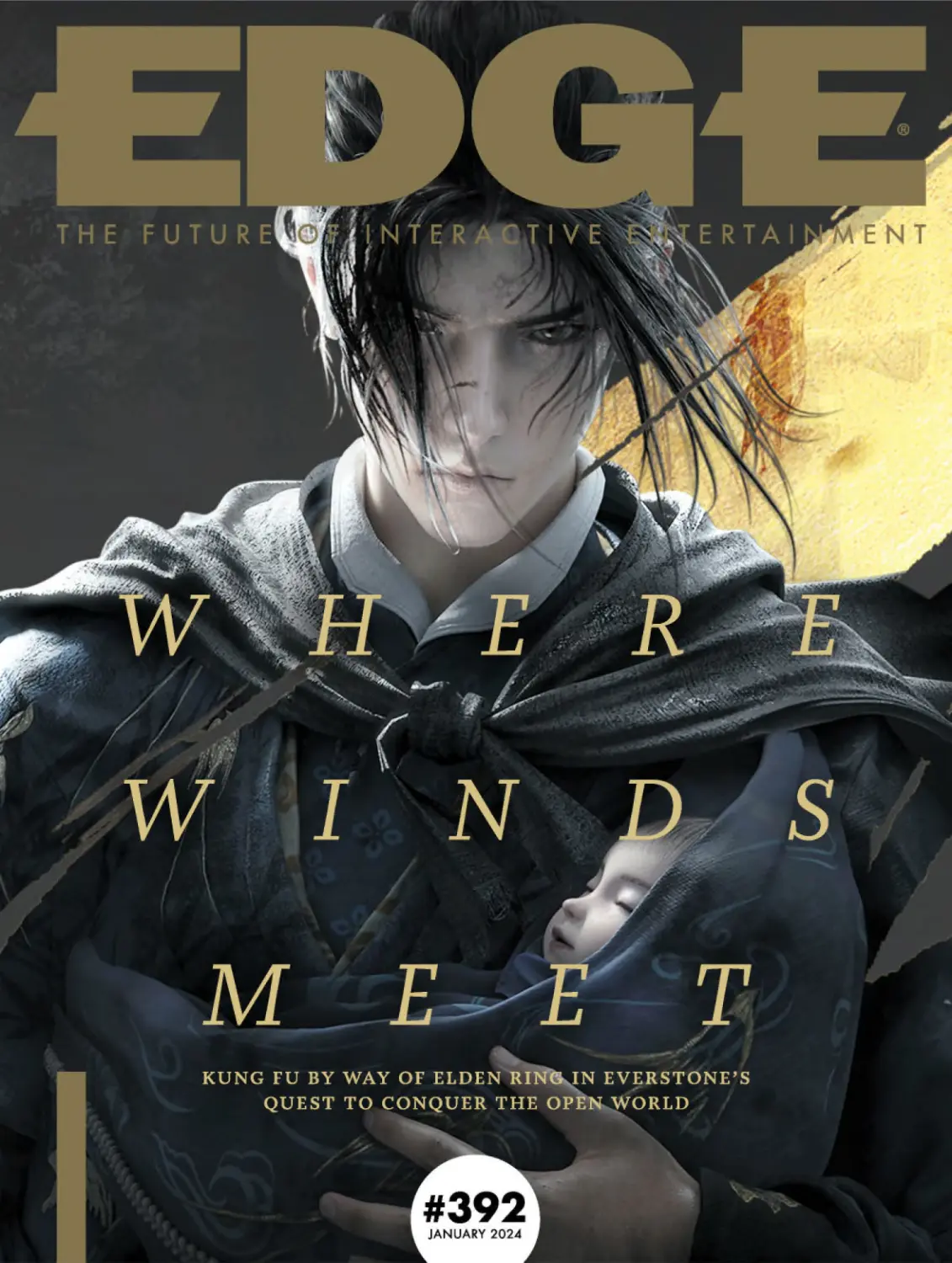
game, whose approach is apparently undecided right now. The scale of
its ambition, however, couldn’t be more clear, as we discover on p52.

Exclusive subscriber edition

3

games
Hype

Play

32 Life By You

100 Alan Wake 2

36 Thank Goodness
You’re Here!

104 Call Of Duty:
Modern Warfare III

40 Homeworld 3

108 The Invincible

PC

PC, PS5, Switch
PC

PC, PS5, Xbox Series

PC, PS4, PS5, Xbox One, Xbox Series
PC, PS5, Xbox Series

42 Glassbreakers:
110 A Highland Song
Champions Of Moss
PC, Switch
36

PCVR, Quest

44 Pepper Grinder
PC, Switch

44 Indika
PC

46 Hype roundup

112 The Talos Principle 2
PC, PS5, Xbox Series

114 Like A Dragon Gaiden:
The Man Who
Erased His Name
PC, PS4, PS5, Xbox One, Xbox Series

116 Persona 5: Tactica

PC, PS4, PS5, Switch, Xbox One, Xbox Series

118 Last Train Home
PC

120 SteamWorld Build

PC, PS4, PS5, Switch, Xbox One, Xbox Series

Explore the iPad
edition of Edge for
additional content

121 Thirsty Suitors

PC, PS4, PS5, Switch, Xbox One, Xbox Series

122 WarioWare: Move It!
Switch

Follow these links
throughout the magazine
for more content online

4

123 Gubbins
Android, iOS

100

94

sections
#392

78

J A NUA RY 2024

Knowledge

Dispatches

8 Mixed results

22 Dialogue

12 Generation game

24 Trigger Happy

Steven Poole asks in Wonderment:
who, exactly, is this Mario fellow?

How a cold-blooded attitude has
set up Dutch developer Team
Reptile for a cyberfunk future

14 Head shots

26 The Outer Limits

124 Time Extend

16 Shoot for the moon

Features

Does Quest 3 mark a tipping point
for mixed-reality videogames?
The interactive tale commemorating
Windrush’s 75th anniversary
Inside artist Larry Achiampong’s
videogame-centric exhibition
How an altruistic act gave Fable’s
co-creator a surprise Steam hit

18 Soundbytes

Edge readers share their opinions;
one wins an exclusive T-shirt

Plague doctors? Fetish masks? Alex
Spencer gets a little Punchdrunk

52 Winds Of Change

Game commentary in snack-sized
mouthfuls, featuring Alanah Pearce

Martial arts and magic combine in
the lavish Where Winds Meet, a
distinctly Chinese open-world game

20 This Month On Edge

68 Womb With A View

The things that caught our eye
during the production of E392

Hotline Miami artist El Huervo
takes us on a psychedelic trip
inside cosmic adventure Ultros

86 The Making Of...

Why Obsidian’s historical
adventure Pentiment is much more
than a palimpsest of influences

94 Studio Profile

Revisiting 2017’s Prey, perhaps
the most uncompromising
immersive sim of them all

129 The Long Game

The arrival of ArtePiazza’s Super
Mario RPG reopens the remake/
remaster debate once more

68

78 Collected Works

52

From Snatcher to Slitterhead via
Silent Hill: Keiichiro Toyama talks
us through his horrifying career

5

EDITORIAL
Tony Mott dual tape deck enthusiast Chris Schilling deputy editor
Alex Spencer features editor Miriam McDonald operations editor
Warren Brown group art director Milford Coppock managing art editor
Ryan Robbins designer
CONTRIBUTORS

Josh Broadwell, Malindy Hetfeld, Rick Lane, Emmanuel Pajon, Simon Parkin,
Andrei Pechalin, Jeremy Peel, Steven Poole, Henry St Leger, Alan Wen

SPECIAL THANKS

Emily Morganti, Colby Tortorici, David Wilson

ADVERTISING

Clare Dove UK group commercial director
Kevin Stoddart account director (+44 (0)1225 687455 kevin.stoddart@futurenet.com)

CONTACT US

+44 (0)1225 442244 edge@futurenet.com

SUBSCRIPTIONS

Web www.magazinesdirect.com
Email help@magazinesdirect.com (new subscribers), help@mymagazine.co.uk (renewals/queries)
Telephone +44 (0)330 333 1113

CIRCULATION

Matthew de Lima circulation manager +44 (0)330 390 3791

PRODUCTION

Mark Constance group head of production Stephen Catherall head of production Jo Crosby senior ad production manager
Jason Hudson digital editions manager Nola Cokely production manager

MANAGEMENT

Matt Pierce MD, games and entertainment Tony Mott editorial director, games Dan Dawkins content director, games video and events
Warren Brown group art director, games and tech Rodney Dive global head of design
Printed in the UK by William Gibbons & Sons on behalf of Future. Distributed by Marketforce, 2nd Floor, 5 Churchill Place, Canary Wharf, London E14 5HU.
All contents © 2023 Future Publishing Limited or published under licence. All rights reserved. No part of this magazine may be used, stored, transmitted or reproduced in any way without the
prior written permission of the publisher. Future Publishing Limited (company number 2008885) is registered in England and Wales. Registered office: Quay House, The Ambury, Bath BA1 1UA.
All information contained in this publication is for information only and is, as far as we are aware, correct at the time of going to press. Future cannot accept any responsibility for errors or
inaccuracies in such information. You are advised to contact manufacturers and retailers directly with regard to the price of products/services referred to in this publication. Apps and websites
mentioned in this publication are not under our control. We are not responsible for their contents or any other changes or updates to them. This magazine is fully independent and not
affiliated in any way with the companies mentioned herein. This month we raise a glass to Nick, one of the finest gentlemen it’s ever been our privilege to know, and send our love to Kate.
If you submit material to us, you warrant that you own the material and/or have the necessary rights/permissions to supply the material and you automatically grant Future and its
licensees a licence to publish your submission in whole or in part in any/all issues and/or editions of publications, in any format published worldwide and on associated websites,
social media channels and associated products. Any material you submit is sent at your own risk and, although every care is taken, neither Future nor its employees, agents, subcontractors
or licensees shall be liable for loss or damage. We assume all unsolicited material is for publication unless otherwise stated, and reserve the right to edit, amend, adapt all submissions.

Edge is available for licensing and syndication. To find out more, contact us at licensing@futurenet.com or view our available content at
www.futurecontenthub.com
Want to work for Future? Visit yourfuturejob.futureplc.com
Future, Quay House, The Ambury, Bath BA1 1UA United Kingdom +44 (0)1225 442244

6

KNOWLEDGE
MIXED REALITY

Mixed results
Meta Quest 3 gives MR a platform on which
to shine – but what can it offer to games?

J

ohn Carmack has never been one to
bite his tongue. Since his resignation
from Meta last year, however –
accompanied by an internal
announcement, leaked to the press, that
he “wearied of the fight” – he has had
no reason to hold back with his opinions
on its strategies. In late September, as his
previous employer prepared to ship the
first Quest 3 units, with MR (mixed reality)
the headline feature, Carmack took to
Twitter. “I remain unconvinced that mixed
reality applications are any kind of an
engine for increasing headset sales,” he
wrote. “High-quality passthrough is great,
but I just don’t see applications built
around integrating rendering with your
real-world environment as any kind of a
killer app. I consider it [an] interesting
and challenging technology looking for a
justification.” The Id co-founder capped
off the post in the most John Carmack
way possible, offering a cash bet to
anyone who could prove him wrong.
Carmack’s words go through our
head as we first place the Quest 3 onto
it. The hardware, though, offers a pretty
strong counterargument. The passthrough
feed from its dual RGB cameras is
sufficiently high-fidelity and responsive to
make a plausible stand-in for actual
reality. Handy for a quick glance at our
phone or PC, yes, but it also makes it
possible to move to another room – or
even another floor – without removing the
headset, something we’d never have
dared attempt with its predecessor.
The hand tracking, meanwhile, feels
something like magic. Extending a digit
out in front of your face, it’s easy to scroll
through app listings as you would with a
touchscreen – except that here your finger
is resting on thin air, meaning that you
have an extra axis of interaction at your

8

HANDS DOWN
Making mixed-reality
games means
grappling with new
design questions, such
as: what do you do
with the player’s
hands? After all, while
the rendered image
appears to be at a
distance, it is in fact
laid over the camera
feed, including
whatever’s visible
of your own body.
Firstperson MR games
that overlay hands and
arms over the real
thing don’t always
adhere perfectly,
creating a level of
dissonance, and it’s
even a problem for the
diorama approach.
Clockstone initially
tested 3D models to
represent your hands,
Hilke explains, but this
risked obscuring the
objects you’re meant
to be interacting with.
Instead they’re
represented by small
points of light,
deemed less illusionbreaking – at least,
until half a hand pokes
out from the side of a
Lego set. There’s no
best practice yet in
place, then, but that’s
part of what makes
this space exciting.

Matthias Hilke,
co-founder and
project manager,
Clockstone Software

disposal. Without thinking about it, we
instinctively grab at a menu to bring it
closer, and it’s quietly thrilling to discover
that it simply works. Finer control can be
hit or miss, especially when dealing with
something that’s not immediately in front
of you, requiring some shaky pointing off
into the distance. But at its best, this is
exactly the kind of naturalistic interaction
that has always been core to XR’s
promise. At this point, though, we’ve
barely left the menus. So, to Carmack’s
point: what of the experiences made
possible by this technology?

VR sessions is not only visible here but a
surface upon which a virtual boardgame
can be played. By this yardstick, though,
many of Quest’s first wave of MR games
are, in fact, headset-based AR – a point
that’s first brought to our attention by the
developer behind one of them.
Clockstone’s Lego Bricktales arrives
this December, a couple of months after
Quest 3’s launch, but it was the very first
game shown during the hardware’s
unveiling, at Meta Connect back in
September. “Quest 3 understands your
space, so you can play with the world
around you,” Mark Zuckerberg promised
on stage. “You can solve Lego puzzles,
Quest 3 arrives without a launch
or build your own creations on any flat
lineup in the traditional sense of the
surface in your room.” For
phrase. With the exception
now, though, that isn’t
of Meta’s own First
The feed isn’t a flat quite the case, as
Encounters (essentially
Clockstone co-founder
an MR tutorial-cum-tech
background but
and Lego Bricktales project
demo), the small cluster
rather a 3D space manager Matthias Hilke
of games that accompany
explains: “If MR is to be
its arrival are all Quest 2
into which these
understood as the
compatible, as will be the
virtual elements
interaction of a game
case until at least 2024.
Fortunately, a number of
can be integrated with the real world, then
actually, currently, we were
games from the existing
not really able to implement
library have received
the one feature that we had in mind, to
Quest 3-friendly updates, working
snap the diorama onto the table.”
together to provide a handy overview of
This has long been a stalwart of
what MR gaming looks like right now –
Meta’s marketing of this concept: the
although technically speaking calling it
understandable, trailer-friendly fantasy of
MR gaming may be misleading.
a boardgame or Lego set that can be
MR works by taking a live video
plonked down on the table without
feed and overlaying it with computerrequiring any of the tidying up
generated imagery – much like AR, then,
afterwards, or shelf space to store it.
but with the vital difference that the feed
“Meta asked for this early on,” Hilke
isn’t treated as a flat background but
adds, “but we had to fight more basic
rather a 3D space into which these virtual
issues.” When those couldn’t be ironed
elements can be integrated. A wall, for
out before the certification deadline,
example, might host a portal to another
Clockstone’s hopes shifted to adding it to
world, while that coffee table you’re
the game with a post-release update.
always bumping your shins against in

There might be no game
that better represents
the promotionalmaterials dream of MR
than Demeo, but in
practice the execution
falls short of the ideal

9

KNOWLEDGE
MIXED REALITY

REALITY CHEQUES
One of the
considerations for VR
developers has always
been the addressable
audience, which is, of
course, segmented
further by MR.
However, there are
ways of balancing the
books. “XR hardware
manufacturers may
occasionally have
grants or other
incentives to support
devs who are early
adopters of new
features,” WentworthBell explains. “In early
2023, we did have a
conversation with
Meta where they
helped support us to
develop an MR mode
and release it as a free
update to Espire 2.”
It’s a similar story for
Bricktales, it seems,
where Meta not only
provided some degree
of funding but is
lending Clockstone its
QA resources – plus
the mighty weight of
its marketing division.

Michael WentworthBell, founder and VR
director, Digital Lode

Not that this dampens our experience
too much. The diorama approach has
always suited VR beautifully – think of
peering down into the miniature fantasy
world of Moss, or turning your head to
follow Astro Bot through Rescue Mission’s
platforming sequences. But stripping
away everything but the object in front of
you really emphasises its scale, which fits
the source material beautifully. We lean
in close to study the intricate Lego
brickwork that makes up its levels and
coo appreciatively, as you might at a
real display of master-builder prowess.
Bricktales represents one of two major
schools of MR design here, also on show
in the hectic multiplayer arena battles of
Bam and in Demeo, a well-established
VR take on D&D-style tabletop games that
sticks to a stricter definition of MR, its
board adhering to any flat surface in front
of you. A recent hand-tracking update,
meanwhile, lets you manually reposition
miniatures and roll dice, which rattle
convincingly along the table – and often
off its edge, onto the floor below. There
are clues, though, as to why Bricktales
might not have launched with these
features in place. The board’s placement
can be distractingly skittish, something
that isn’t helped by the gesture controls
shifting its location whenever a hand is
clenched into a fist. Using your fingertips
to grasp such small objects, meanwhile,
exposes every tiny inaccuracy of the
tracking, leading to frustrating moments
when our hand seems to pass through the
model we’re trying to pick up, or places
it down a square short of the enemy we
were intending to engage.

There’s much more room for error
in the other school of MR design. As
with the dioramas, this builds on an
established VR template, in the vein of
Beat Saber and umpteen virtual reality
shooters, where you stand and move
around a limited space while poking at
your surroundings in some way. This can
be with your fists, as in the Punch-Out-like
boxing game Knockout League, or with
a sword, in Broken Edge, which opens
up a rift on a nearby wall to its pastel
Moebius-art reality, from which your
rival duellist emerges. Or, indeed, with

10

While Espire 2 isn’t much more graphically advanced than its main inspirations – the first couple of Metal
Gear Solid and Deus Ex titles – there’s a remarkable lack of dissonance when it is overlaid onto reality

a pair of maracas in the case of Samba
reimagine your living space as infiltration
De Amigo: Party Central.
zones. One mission adds a blast shutter
While it doesn’t do much to reinvent
to a nearby wall that, when opened,
Sega’s rhythm-game series, Party Central
reveals a snowy base outside with guards
does incorporate its MR elements with
to snipe; another has us crawling along
a certain flair. Video filters alter the
the living-room floor in order to duck a
appearance of your surroundings,
Mission Impossible-style laser grid.
inverting their colours or
This mode, more than
redrawing the outlines of
anything else we play,
“This was the most highlights one strength MR
nearby furniture in thick
neon. At one point, the
technically difficult has over VR. One of the
ceiling of our living room
latter’s biggest obstacles is
project we have
is torn away to reveal a
having to work around the
giant Mecha-Amigo, its
worked on because everyday objects in your
head poking into our
play space. Espire 2,
every person’s
space. Then its colossal
though, makes a boon of
legs begin kicking holes in
them, whether by scattering
room is unique”
the walls and floor. It’s a
documents over a table or
joyful way of reinventing
having you duck behind
familiar surroundings, albeit fairly
the sofa for cover during a gunfight,
shortlived: while all songs can be played
having fed the furniture into its procedural
in MR, the real showcase is the Multiverse
level generation at the outset of every
mode, consisting of three stages and
mission. If that sounds like a development
lasting under 15 minutes.
headache, then Michael Wentworth-Bell,
This is indicative of most games’ MR
founder of Espire 2 developer Digital
offerings for Quest 3, which either simply
Lode, confirms it. “This was the most
replace backgrounds with camera
technically difficult project we have
passthrough or else offer a limited
worked on, primarily because every
sideshow to demonstrate what could,
single person’s room is unique,” he tells
hypothetically, be done with this
us. “A player may have a ton of free floor
technology. But there are exceptions,
space, but their walls are blocked by
most notably Espire 2, a Metal Gearshelving units all around. Or they may
styled stealth action game that has bolted
have bare walls, but much of the floor
on a suite of bespoke MR missions that
space is taken up by a king-size bed.”

Bam’s hectic multiplayer
plays out like a mashup of
Gang Beasts, Smash Bros
and Quake Arena, with a
touch of early PlayStation
in its graphic design

The technical ambition pays dividends
here, but – as with Demeo – also exposes
some of the hardware’s limitations. While
Meta’s Scene APIs allow developers to
treat real 3D space as level geometry,
this isn’t entirely an automated process
from your perspective as player. You must
set up your room manually, drawing out
bounding boxes for every piece of
furniture. Push aside a sofa for a VR
session and you will need to repeat this
process; play in a different room and
you’ll need to start over entirely, which
overwrites the original, since only one
room can be stored at a time. Tapping
into one of Espire 2’s headline features –
multi-room MR to allow missions that let
you traverse a base the size of your entire
home – requires unlocking the device’s
developer mode and taking advantage
of various workarounds.
As a launchpad for Meta’s MR vision,
then, Quest 3 falls a little short. Of
course, that’s the nature of any nascent
technology: it’s normally the second or
third iteration that nails it, provided the
dream makes it that far. This will depend
on consumer adoption along with Meta’s
will to keep pushing MR as a selling
point, but also on developers’ continued
interest in pursuing it. How do they feel
about their position right now?
For Clockstone, which dabbled in
VR back in the HTC Vive days before

deciding “the market was not ready yet,
and we would not follow that road any
more,” the jury is still out. “There are two
parties in the team,” Hilke says. “Some
really do not want to do another VR
game; others think it would be cool to
continue here.” Digital Lode, however,
has long been entrenched in the XR
space – and as far as Wentworth-Bell is
concerned, MR is just another “Wild
West frontier” for the studio to explore:
“Working on Espire’s MR mode, the
process felt invigorating, like VR did ten
years ago. Everything was fresh, no rules
were established, and nobody knew
exactly what’s fun yet – until you try it.”
Digital Lode is keen to apply
everything it has learned during this
process, Wentworth-Bell tells us: “We
actually prototyped seven new MR
experiences throughout 2023. There are
three in particular at various stages of
preproduction and prototype phases. It’s
been a very tough year for the games
industry – with luck, we will develop one
of these MR experiences into a full
product.” It’s likely to remain a side
feature, he acknowledges, since relying
exclusively on MR risks condemning
developers to a niche of a niche. But
Wentworth-Bell clearly believes that
there’s room left to be explored here.
Perhaps he could be the one to take
Carmack up on that wager. n

ABOVE CENTRE As much as its predecessors that were born in the arcade, Samba
De Amigo: Party Central recalls the days of Sony’s EyeToy and Microsoft’s Kinect.
ABOVE Trying to build with mouse or controller was the biggest obstacle to Lego
Bricktales’ original release, but motion controls make it a smoother experience

11

KNOWLEDGE
WINDRUSH TALES

Generation game
How UK indie 3-Fold Games is shining an interactive
light on the journey of the Windrush generation

T

the cold and not always welcoming
his June marked the 75th anniversary
climate but try to make the best of it.
of the Empire Windrush docking at
Research for the game reached well
Tilbury, Essex, bringing with it the first
beyond immediate families, though getting
post-war migrants from the Caribbean to
firsthand experience isn’t easy, given that
the UK – a symbolic beginning of modern
few from that original generation are still
multicultural Britain. Windrush Tales
with us. Funding from charity organisation
director Chella Ramanan, though, had
Okre, however, enabled Ramanan and
begun thinking about creating a game to
Brotherson to organise workshops where
commemorate this event long before – a
they could consult Caribbean elders.
year prior to the 70th anniversary, in fact.
She was keen to tackle the topic in part
because it had never been done before in
The original plan, to release the
the medium. “There aren’t that many Black
game in time for the 70th anniversary
British Caribbean developers working in
of Windrush, was overshadowed by a
indie,” says Ramanan,
scandal that brought this
whose father and uncle
history to light for the worst
“There is a real
came from Grenada.
reasons. The government’s
Fortunately, she found
amount of pressure ‘hostile environment’ policies
someone who fit the bill:
resulted in the wrongful
on us, becase you detention and deportation
Corey Brotherson, at the
time a copywriter and
of immigrants, mainly from
want to reflect a
producer for Sony who
the Windrush generation.
whole generation’s “People who’d never heard
also had experience
writing screenplays and
about Windrush were
experiences”
comic scripts, whose
hearing about it in such a
parents emigrated from
negative way,” Brotherson
Saint Kitts and Barbados respectively.
says. That did, however, mean there was
“I knew bits and pieces just from talking
even more determination to tell a story
[to family] day-to-day growing up, but it
celebrating “a generation of people who
felt like a whole chapter of their lives, so
had the strength and determination to stay
you don’t want to be nosy,” he says.
in the country despite bigotry, racism and
“But for the game I had to specifically
all those issues happening around them.”
sit down with them to talk about it.”
And one that acknowledged that they
To an extent, the structure of Windrush
were far from left in the past. “We were
Tales mirrors the developers’ experiences
thinking [the game] could end at Carnival,
of piecing together stories from their
showing this celebration of multicultural
heritage. It takes the form of a photo
Britain, the success of the British
album, assembled by the player to build
Caribbean community and their legacy,”
a picture of two siblings who have
Ramanan says. “We can’t tell that story
separately left Antigua in search of a new
because that’s not how it is – and maybe
life in 1950s London, as they adapt to
we were naïve to think it ever was that.”

12

LIGHT RELIEF
Games – and indeed
stories of all forms –
that represent the
experiences of
marginalised
characters have a
tendency to focus on
suffering, perhaps in
a misguided attempt
to instil empathy.
Ramanan emphasises
the importance of
depicting the positive
and lighter moments
of these lives, noting
a playtest session with
Caribbean elders
where there was
enthusiastic feedback
to a party scene and
the language used,
but no mention of a
character’s arrest. “The
thing you get when
you talk to people
of that generation,”
Ramanan says, “is
that they kind of just
got on with things.”

Chella Ramanan and
Corey Brotherson

Other factors contributed to the longer
development time, such as waiting for
funding, while Ramanan had also joined
Ubisoft Massive back in 2019. Yet this
also allowed the team more time to
research. They took in museum exhibitions
organised by the Black Cultural Archives,
books including Sam Selvon’s novel The
Lonely Londoners and a short memoir
Brotherson’s late grandfather wrote about
his experiences, and Steve McQueen’s
Small Axe TV miniseries.
This breadth of reference was essential
for a game with a title that implies plural
representation of a whole generation.
“We wanted to take bits and pieces of
different experiences,” Brotherson
explains. “There is a real amount of
pressure on us, because you want to
reflect a whole generation’s experiences,
but we can’t do everything. But if we
inspire other people to make games
about it from different perspectives, then
that’s a success in itself.”
The game’s branching story provides
an incentive to replay – a way of
experiencing multiple perspectives that
games can add to the existing corpus of
books and films preserving and
celebrating the memories of the Windrush
generation. Brotherson has nieces he
hopes will be able to play Windrush
Tales and gain an understanding of what
life was like for their grandparents and
great grandparents. Regardless of your
knowledge of or relation to this part of
history, though, Ramanan ultimately hopes
that any type of player will be able to
find a good tale within: “Stories are
universal, no matter who the protagonist
is or what their heritage is.” n

The Empire Windrush, by Naima
Ramanan. While the first ship arrived
in 1948, others would bring Caribbean
migrants to Britain until 1971, hence
the term ‘Windrush generation’
referring to multiple generations

ABOVE
THE FOLD

What does ‘games
beyond entertainment’
really mean?

Windrush Tales’ photo album has you piecing together the life of Rose,
inferred to have recently passed away, with a variety of images to choose
from. The game’s narrative also explores her brother Vernon’s perspective

Windrush Tales is
Ramanan’s second
independent release under
the banner of 3-Fold
Games. Its debut, Before
I Forget, was nominated
for a BAFTA in the ‘games
beyond entertainment’
category, due to its story
about a woman living
with early-onset dementia.
Yet Ramanan is keen to
stress that these aren’t
educational games as
such. “We didn’t make it
to teach people about
dementia,” she says.
“Likewise, we’re not
making Windrush Tales
to teach people about
anything. I’m making it
to represent my heritage
and a really important
part of British culture
that’s completely ignored
in videogames.”

13

KNOWLEDGE
ART

Head shots
How artist Larry Achiampong is
recasting iconic videogame characters

F

his portraits include Duke Nukem, Master
or the past 20 years, Frieze London
Chief and F-Zero’s Captain Falcon – or
has been one of the world’s most
rather, reimagined versions of them.
prestigious contemporary art fairs. Not
Instead of John-117 inside the suit, for
somewhere you might expect to find
example, we find Nana, a pink-haired
videogames as a subject, then. But as an
Black woman. Street Fighter’s Shoryuken
artist and committed player himself, Larry
master, meanwhile, is presented as
Achiampong incorporates the medium
‘Black Ken’ – a direct reference to
into his latest exhibition. Not just in the
Achiampong’s childhood when, playing
works – a series of portraits featuring
on a monochrome TV, he believed the
reimaginings of iconic game characters –
palette-swapped version of the character
but in the space itself, which has been set
also changed the colour of his skin.
up like a gaming room. “I wanted to
make sure that it was interactive,” he
explains, “so there’s actual games that
The aim is to highlight the lack of
you can play, and having
diverse characters, and
those as references to the
counter the negative
Depicting
work as well.”
stereotypes that dog Black
The small, square
characters. “It’s about being
John Marston as
space of an art-fair booth
able to dream, in a space
Black addresses the that allows dreaming,” he
feels almost perfect for
Achiampong’s recreation
misrepresentation says, “but then dealing with
of the council flats where
the irony that a lot of the
of cowboys
he grew up. It’s a kind of
characters are usually white
physical autobiography,
men.” Artists reimagining
in fiction
inviting visitors into a
pop-cultural characters isn’t
space with armchairs and
new, but Achiampong’s
two-seater sofas, classic consoles hooked
portraits tackle these questions in different
up to CRTs. Piles of old music CDs
ways. Depicting Red Dead Redemption’s
provide a further glimpse into the tastes
John Marston as Black, for example,
that shape his work. You might suggest
addresses the misrepresentation of
this installation of sorts is superfluous to
cowboys in fiction, given that historically
the portraits hanging on the walls, which
one in four cowboys wasn’t white. Yaa,
are ultimately what is being sold, but for
Guardian Of The Tomb, is a deliberate
Achiampong it’s an intentionally leftfield
antithesis to Lara Croft, a protector rather
move, to “push the boundaries of what an
than looter of cultural artefacts.
art fair isn’t and what an art fair could be.”
Achiampong’s chosen subjects include
Such an approach has been integral
characters whose faces are hidden under
to his past works too (see ‘Portrait of an
a helmet or mask, leaving their identities
artist’), although with more oblique
up to the player. Alongside Master Chief,
connections to games. Here, however,
there’s a figure that has long fascinated
they’re front and centre. The subjects of
the artist: Metal Gear Solid’s cyborg ninja

14

PORTRAIT OF
AN ARTIST
Achiampong’s past
works have also taken
inspiration from
videogames, albeit
more obliquely. His
2022 feature film
Wayfinder follows a
nameless ‘Wanderer’
as she travels the
breadth of England,
evoking adventure
games such as Zelda,
Ico and Journey. An
exhibition earlier this
year, And I Saw A New
Heaven, featured
religious collage
posters displayed
alongside The Binding
Of Isaac, Blasphemous
2 and BioShock
Infinite, all inside a
former church hall,
as a way of bringing
together the ‘high
culture’ of religion
and the ‘low culture’
of popular
entertainment.

Gray Fox. “I remember reading that the
character was from Zanzibar and listening
to the voice that felt, apart from being
American, resembled the voice of my dad
or Black men I looked up to.” Indeed, in
the English version the character was
portrayed by African-American voice actor
Greg Eagles, but is canonically halfwhite, half-Vietnamese. Here Achiampong
reimagines the character (‘Grey Anansi’)
as the Black African he had always
envisioned. He also draws parallels
between the character’s backstory – as a
robot with their history obliterated and
programmed to do a set of tasks – with
the conditions of chattel slavery.
Clearly, Achiampong isn’t afraid to
put himself into the work. Literally, in the
case of A Dynasty Will Rise From The Ash,
which recasts Ganondorf in the likeness
of the artist himself, the Triforce Of Power
on his hand replaced with a Ghanaian
Adinkra symbol for justice. Achiampong
loves the Zelda series but points out its
problematic patterns in equating light with
good and dark with evil: “Where’s the
space for nuance?”
There is a kneejerk defensiveness
from some quarters whenever people from
marginalised backgrounds question the
status quo, but, without wishing to resurrect
a tired debate, we can’t talk about games
as a type of art without accepting critique
and interpretation. For Achiampong,
much like the gaming room he’s made to
display his work, it’s all about creating a
space where these conversations can be
had. “There’s a sharing that takes place,”
he says. “In the same way when people
read literature or they interpret a certain
scene in different ways.” n

Achiampong’s subjects are
largely from games he grew
up with. An exception is Duke
Nukem, reimagined as a Black
albino fighting for justice

Some vintage cartridges from Achiampong’s
collection of games sit beside CDs and DVDs

DOWN TO
THE WIRE

The inherently
physical relationship
of gaming nostalgia

ABOVE Grey Anansi, Achiampong’s reimagining of Grey Fox as a Black African, keeps the cyborg
helmet; his Blackness is implied by being based on a spider deity from West African mythology

Recreating Achiampong’s
childhood gaming spaces
meant original hardware
hooked up to CRT
televisions, RF units, and
a mess of cables. “The
very first television that
me, my brother and sister
played on is one of those
old black-and-white ones
with the dial, and it took
us a while to find the
channel for the game,”
he says. “It’s very, very
physical in that way,
whereas now we have
a different relationship
with technology: if it’s not
user-friendly, it’s useless.”
All those wires did,
however, present
something of a health-andsafety issue with the Frieze
organisers – hence the
presence of a rug, to
literally sweep it all under.

15

KNOWLEDGE
MOONRING

Shoot for the moon
How Fable designer Dene Carter’s RPG passion project
became a surprise Steam hit – without making a penny

W

insane idea.” And now? “Well, it is just
hen Dene Carter released
a completely insane idea.”
Moonring in September, a
few days before his 25th wedding
anniversary, he’d spent four and a half
The player response says otherwise.
years working on it. His Ultima-inspired
At the time of writing, Moonring has over
RPG had attracted so little attention in its
500 Steam reviews, adding up to an
early-access form that his expectations
‘Overwhelmingly Positive’ rating. Which
were low: “I honestly thought it was just
suggests there were plenty of people in a
going to die without a trace.” He’d even
similar place to Carter when the creative
begun to put plans in place for his next
spark first ignited – because this was
project, having supported himself over the
never just about a cloth map. “Part of the
prior two years of development through
reason I actually started making this is
freelance scriptwriting jobs on other
that I was playing Bloodborne for the
games. “Then it kind of blew up.”
third time, and I realised that was a
It helped that Carter
problem,” he explains.
released the game for free.
Nothing else – at least
“I thought I’d
“Life is hard, COVID
within the triple-A space –
sucked, everyone’s poor
was grabbing him. “I was
release the game
and stressed,” he said in
so bored seeing exactly the
for free and
the comments of YouTuber
same games with exactly
Splattercatgaming’s Let’s
the same best practices.”
then raise some
Play video, which he
Having tired of modern
credits as being one of the money to pay for
standardisation, Carter
biggest factors behind its
looked back to the 1980s
the cloth map”
success. “I don’t need the
for inspiration. “There’s a
$300 this would make me
reason games came with
– I’d rather take the goodwill.”
manuals back then,” he says, “because
That is, he admits, only half the story.
you had no bloody idea what you were
Yes, there was an altruistic motive behind
doing if you didn’t have one.” Rather than
it – “ethically, it didn’t make any sense to
“do the 12 things we expect every game
charge for it,” he says – but that was
to do now but with a slightly different
partly because he saw Moonring as a
palette,” he hoped to make something
“complete vanity project”, having
that fostered deeper engagement. “It
originally set out with a more selfsounds very highfalutin, but games felt like
indulgent goal. “I was at a point in my
a relationship: you had to put yourself
career where I really wished I’d made a
out there to meet the game halfway.”
game with a cloth map,” he says. “This is
Moonring does feature a few
not a joke. I thought I’d release the game
contemporary conveniences; Carter
for free and then raise some money via
reckoned his audience would be small
Kickstarter or something to pay for the
enough without offering some guidance.
cloth map, so it’s not just a completely
All the same, its initial tutorials leave much

16

HALF THE BATTLE
If Moonring’s
keyword-based
conversation
mechanics are lifted
from Ultima, Carter
was keen to find a
fresher approach to
combat. Looking at
other turn-based
Roguelikes, he didn’t
want encounters to
feel “statistically
predetermined – like,
you’re next to an
enemy, know you’re
going to lose ten per
cent of your energy,
they’re going to die,
it’s a foregone
conclusion.” This is
alleviated through
the game’s poise
mechanic: unlike
your health, poise
regenerates outside
combat, giving the
option of disengaging
to protect your
precious HP. “It’s
certainly not unique,”
he says, citing Halo as
a comparison. “But
it’s unusual to see it
in this kind of game,
and it turns out it
works quite well.”

Dene Carter, formerly
of Lionhead and now
creator of Moonring

unsaid, while part of the enjoyment comes
from figuring out its interface. On the left
of the screen is a readout detailing your
every action, alongside your character’s
stats, equipment and more. On the right
is the world of Caldera, presented in oldschool top-down fashion, but with a neon
aesthetic. Shadows encroach around the
edges; in dungeon areas, the darkness
creeps closer still. Sometimes you’ll
stumble straight into an enemy; new
players might find their first adventure
ended prematurely by an outsized insect.
It’s a humbling welcome. But it’s found
its audience – fellow Yharnam expatriates
finding solace in Caldera, perhaps? “As
a species, I think we’re meant to struggle
a little bit,” Carter says. “Games can be
a way of producing that survival
excitement that is largely absent from our
lives. I sometimes feel that developers
make wolves for a world that has largely
annihilated wolves. There’s a thrill and a
sense of being alive to sitting around the
campfire, looking out into the darkness for
the eyes that we think might be predators.”
Sometimes, though, those eyes
belong to allies. Moonring’s players have
accepted that it’s “buggy as hell”, Carter
says, which has helped foster a feeling of
community. “There’s this sense that, ‘OK,
here’s this slightly broken, imperfect thing
that has clearly had a lot of love put into
it’, and people have responded to that.”
In return, he’s abandoned his plans to
move on, reckoning he owes something
to his players. And there’s a glint in his
eye as he reveals he’s currently talking to
merchandisers. Yes, after almost three
decades in the game industry, Dene
Carter is finally getting his cloth map. n

“People have warmed
to the idea that this is
a slightly shonky thing,”
Carter says. “They feel
that they’re at the
beginning of something
that’s growing”

17

KNOWLEDGE
TALK/ARCADE

Soundbytes

ARCADE
WATCH

Keeping an eye on the
coin-op gaming scene

Game commentary in snack-sized mouthfuls

“Super Mario Bros was
made by a team of five
people, 38 years ago.
Of those five people,
four of them worked
on Super Mario
Bros Wonder.”

Game Air Strike
Manufacturer Game Art
Thanks in part to so many of
today’s up-and-coming
manufacturers lacking the kind
of flair traditionally associated
with Japanese veterans such as
Sega and Namco, this has
hardly been a vintage year for
memorable arcade releases, but
as 2023 comes to a close we
have at least one cabinet trying
to mix things up a bit. From
Hong Kong’s Game Art, Air
Strike puts you into the seat of
a biplane, steering your craft
through colourfully rendered
environments using a yoke
whose dual fire buttons unleash
your on-board weaponry. The
control method immediately
sets it apart from typical
modern arcade fare, and the
entire seating section and
monitor lean from side to side
as you bank your plane, adding
a welcome physical dimension.
As a redemption-based game,
it’s not exactly Microsoft Flight
Simulator, but a linkup mode
promises some replay appeal.

“We’re looking
over our shoulders
at our competitors.
We’re terrified at
all times, or we’re
not doing enough.”

”Imagine
announcing this in
a year where the
games industry
has laid off
6,000+ people.”

A good dose of paranoia just
keeps you on your toes, says
Take-Two CEO Strauss Zelnick

Sony SM’s Alanah Pearce
can’t quite digest the reveal of
Xbox’s InWorld AI partnership

“We must take the
risks of AI as seriously
as other major
global challenges,
like climate change…
We can’t afford the
same delay with AI.”
Frankly we preferred listening to Demis Hassabis when he
was punting Republic’s rendering tech, not scaring us witless

18

© Samuel de Roman/Stringer

Has Bungie’s Max Nichols finally cracked The Nintendo Difference?
Perhaps working at as many studios as possible isn’t the key to success

KNOWLEDGE
THIS MONTH

BOOK

Critical Hits
bit.ly/criticalwords
This thoughtfully curated series
of personal essays is catnip to
the open-minded reader – the
kind that doesn’t balk at the
idea of someone outlining how
Hollow Knight helped them
deal with dysphoria. A broad
range of games and themes
features, with discussions
about Leisure Suit Larry and
Disco Elysium, Fallout 76 and
Outer Wilds, although with
multiple pieces focusing on
what videogames can teach
us about identity, repetition
occasionally sets in; we’d have
welcomed more diversions
such as the comic strip from
visual artist MariNaomi. But
at its best – such as in Elissa
Washuta’s essay on The Last
Of Us and her own experience
with serious illness – it finds
powerful links between worlds
real and virtual, underlining
the ways games can offer both
escape and a chance to see
ourselves reflected in them.

GAME

DREAM

Vecta Majoris 2
bit.ly/vectagraphics
What we’d imagined at first
glance to be a straightforward
dogfighting-focused Star Foxlike turns out to be something
good deal more ambitious. Yes,
you’ll engage in arcade-style
space battles, but as you make
your way through the planets
of a star system, you’ll accept
delivery missions, take part in
races and more besides –
amassing funds to customise
your ship and upgrade its
arsenal. There’s a story to
uncover, too, and though the
script evidently wasn’t a
priority, that’s a minor tradeoff for a game that might
otherwise be one of the
most accomplished Dreams
productions we’ve yet seen.

Cold Abyss
bit.ly/seafixit
The Itch blurb describes this
shortform exploration game, in
which you’re simply asked to
repair ten underwater Internet
cables, as “the perfect game to
unwind [with] after a long
day”. As we take the long
journey to the seabed inside a
cramped elevator, we begin to
wonder. The doubt grows as
we spin around, aiming our
handheld tracker at the next
objective, with the occasional
detour to the nearest oxygen
tank to refill. Strange objects
loom from the murk, our
feeble torchlight doing little to
illuminate anything but our
immediate surroundings. Then
we see a shape that sends a
chill down our spine. Dare we
look closer? It’s fine, we
convince ourselves, trying to
steady our quickening pulse.
After all, we’ve already been
told “there are no enemies or
other forms of danger down
there”. It’s just us. Isn’t it?

THIS MONTH ON EDGE
Some of the other things on our minds when we weren’t doing everything else
HARDWARE

PlayStation Portal
bit.ly/portalps5
As we take it out of the box, it’s impossible to ignore that Sony’s
streaming device really does look like a DualSense split in half with
a screen glued in between. The angle of the handles, though, feels
ever so slightly different, combining with the extra weight and
smaller analogue sticks to mildly uncanny effect. Beyond that, it
does exactly what you’d expect: you can access your PS5 collection,
streaming it to the device via Remote Play on those occasions when
someone else in your household might have commandeered the TV.
It is, inevitably, a compromise unless you have a simply flawless WiFi
environment, our tests suffering stutters and resolution drops even
in what we thought were optimal conditions. And while there’s no
better option if you’re seeking to play the handful of PlayStation
exclusives that exist, it’s hard not to compare the price with the
cheaper Steam Deck models and conclude that you’d be better off
paying a little more for a vastly superior handheld experience.

20

continue quit
Legendary
Zelda producer Eiji Aonuma
named ‘Knight Of The Order
Of Arts And Letters’ by
France’s Minister Of Culture

Broken age
As industry creativity thrives,
redundancies continue, with
Bungie and Media Molecule
shedding yet more talent

Do the ’math
Could independent workerowned website Aftermath
be a Defector for games?

Night off
The Glory Society cancels
NITW follow-up Revenant Hill,
citing “serious health issues”

Screen Link
Shigeru Miyamoto announces
the next Nintendo blockbuster:
a live-action Zelda movie…

Excuse me
…but is Maze Runner: The
Scorch Trials director Wes Ball
the right choice for the job?

Shots fired
The next big online FPS? The
Finals open beta ends, having
attracted 7.5 million players…

Vocal fried
…as experienced voice actors
(rightly) criticise its abysmal
AI-powered ‘commentators’

Something changed

Issue 391

Dialogue
Send your views, using
‘Dialogue’ as the subject
line, to edge@futurenet.com.
Our letter of the month wins
an exclusive Edge T-shirt

6

22

I’ve been gaming from a very early age,
receiving a ZX Spectrum 48K to share with
my siblings aged four, then moving on to an
Atari ST. It was several years later, though,
visiting my auntie and uncle who had just
purchased a new videogame console, that I
truly discovered the love of gaming that
continues to this day. ‘What’s this?’ I
thought. ‘Can’t be as good as a computer.’
Connect to the TV, slot in a cartridge, turn
on the power, and bam: instant gaming.
It was the Super Nintendo Entertainment
System and I was about to discover the
magic and magnificence of Nintendo. Super
Mario World, Super Tennis, Super Mario Kart,
F-Zero. Instant playability,
creativity and ingenuity. Then,
slightly later, Yoshi’s Island and
Donkey Kong Country. All before
eventually deciding to try an
RPG, which was something new
to me. Unbeknownst to me at
the time, I was about to discover
the greatest videogame
franchise of all time, The Legend
Of Zelda. It was like nothing I’d
ever played before: thought
provoking, not just reflex testing. Light
worlds. Dark worlds. Dungeons, and so on.
From then on I stuck with Nintendo,
ignoring the massive hype of PlayStation
and later Xbox. I knew where the most
playable, creative games were. I moved on to
the N64, with Super Mario 64, Ocarina Of
Time, GoldenEye 007, Wave Race, etc. Again,
all breaking new ground with graphics,
content and playability.
As I got older, got married and had kids,
my time to play games and control of the big
screen waned. For many years my only real
gaming was Football Manager on a laptop.
But I still managed to justify the purchase of
a console in the shape of a Wii, with Wii Fit
and WarioWare for family time, plus the
two series I always purchased – Mario and
Zelda, of course – for those occasional
opportunities for solitary gaming.

As the years passed, my wife and I went our
separate ways and suddenly I had the time
to rediscover the things I loved: live sport,
’90s indie bands, and, of course, Nintendo –
specifically Super Mario Galaxy and The
Legend Of Zelda: Breath Of The Wild.
Both were undoubtedly great games, with
Zelda in particular once again showing
Nintendo’s ability to break new ground and
constantly come up with new ways to play.
Both, though, followed the usual format.
Princess Peach gets kidnapped by Bowser;
Mario saves the day. Hyrule gets
overpowered by Ganon as Zelda fights him
somewhere unknown, while waiting for
Link to awaken and become powerful
enough to save the kingdom.
After completing these, I
was a little lost for something
else to play on Switch. I was
approaching 40, and Splatoon
wasn’t really what I was looking
for. One game kept popping up
on the online store: The Witcher
3. This looks a little more adult,
I thought, and I decided to give
it a whirl. Well, the language
was certainly more adult than
I’d experienced in a game before. Something
else about it, though, grabbed me like I’d
never been grabbed before. The story! It was
deep and engrossing, with twists, turns and,
well over 100 hours later, a magnificent
conclusion. An interactive Choose Your
Own Adventure with heart and soul.
The next Nintendo Direct confirmed that
I had to do something I never thought I
would. It was time to buy a PlayStation. I
bought Demon’s Souls as it was Edge’s most
highly rated PS5 game at the time, and
reportedly the new generation’s most
graphically impressive game. After that, I
wasn’t sure what to play, but my brother had
plenty of PS4 games to recommend. So over
the past few years I’ve made my way
through The Last Of Us (1 & 2), God Of War,
the entire Uncharted series, GTAV and the
most immersive of all, Red Dead Redemption

“These games
highlighted the
story element
that I had never
before noticed
was missing”

DISPATCHES
DIALOGUE

2. All these games highlighted the story
element that I had never before noticed was
missing from Nintendo games. For all that
creative genius, and the ability to create
groundbreaking games, a real story with
heart seems sorely lacking from any of its
series. I turned 45 two days after the release
of Tears Of The Kingdom. Five months on,
and once again I’ve found a game I don’t
want to finish. I’ve only just defeated
Phantom Ganon, and it’s not down to a lack
of ability. I still have side quests and half the
underworld to complete and discover; I’m
progressing the main quest in small steps.
Contrary to your recent poll, I’ve found it
much more enjoyable than Breath Of The
Wild. It’s equally – if not more – creative
with Link’s new skills. The story even has a
‘wow’ moment – almost unheard of in a
Nintendo game. But when I compare it to
the PlayStation games I’ve played in recent
years, it massively lacks on the story front.
It has more than any other Nintendo game
but it’s still very shallow compared to the
other games I’ve mentioned. I don’t want to
finish it because it’s such a fun game, not
because I’m emotionally attached.
When I do eventually decide to
conclude the game, I’m pretty sure it’ll
be the last time I ever use my Switch, and
may well be the last time I ever pick up a
Nintendo console – something I never
thought I’d say. Nowadays, I need more than
just creative genius to pull me in; more than
just the same hero saving the same world
from the same villain. I may tackle the Red
Dead Redemption remake next, or Baldur’s
Gate. Then there may be something else
from Rockstar or Naughty Dog on the
horizon. I don’t know what I’ll be playing
in a couple of years’ time, but it almost
certainly won’t be on a Nintendo.
Andy Hayhurst
True, Nintendo has always prioritised
systems over story, and there’s certainly
nothing wrong with seeking to broaden your
gaming diet. But we’re reminded here of

what CS Lewis said about childish things.
Surely a man who is tired of Super Mario
Bros Wonder is tired of life (or stuck on that
accursed invisible section of the final stage).

Glory days
I really enjoyed reading through your 100
greatest games of the past 30 years. There
were some lovely surprises in there that took
me back, misty eyed, such as WarioWare and
Katamari Damacy. One game I belatedly
wanted to espouse the virtues of is Prince Of
Persia: The Sands Of Time. Back when Ubisoft
actually made unique and original triple-A
games (Beyond Good And Evil! Splinter Cell!),
this game stood above them all. The timerewinding mechanic felt so original and yet
completely fully formed, and in the days
before ludonarrative harmony was coined, it
was beautifully integrated into the story with
a knowing wink (“No, no… that’s not what
happened”). With its excellent platforming,
brilliantly seamless animation (wall-running
felt revolutionary the first time you did it)
and likeable characters, I had such a ball with
it that when I encountered a game-breaking
bug 90 per cent of the way through, rather
than rage quit, I was more than happy to go
straight back to the start and play through the
whole damn thing again. And if that’s not a
marker for a great game, I don’t know what is.
Tom Laverack
Some might say Tom’s decision to include
his postal address (presumably to expedite
delivery of an Edge T-shirt) was a little
presumptuous. In this instance, though, we’ll
say that his confidence was well placed.

The loss adjuster
I wanted to reply to Dean Freeman’s call for a
response in E390 regarding fair prices. His
point hit home recently regarding a certain
developer, whose niche games I have picked
up heavily discounted over the past couple of
years and subsequently sunk countless hours
into. I was looking forward to playing its latest
at some point in the future, as soon as its

price would inevitably be reduced to that of a
middling service-station sandwich and I could
feel smug in grabbing myself a great deal.
It was with more than a pang of guilt, then,
to read that Mimimi Games has decided to
shut shop, after launching the excellent
Shadow Gambit: The Cursed Crew. I regret that
my past desperation to save a few pounds has
possibly contributed towards their demise
(the developer cited wellbeing as a reason for
closure, but I imagine greater revenues would
have led to a larger team and alleviated the
development workload). Paying full price for
Shadow Gambit before its closure felt like the
very least I could do, but it does make me
wonder if alternative pricing models could
save smaller devs in future. Given the many
hours I sunk into their games, maybe charging
per minute played would be a good idea?
Wait, no – if any Unity pricing analysts are
reading this, don’t get any ideas. But Dean’s
suggestion of a tip jar seems wise: perhaps we
could encourage developer Patreons, as is
common in the podcasting world?
Matt Turner

Help the aged
I am well into my 40s now, and I have to ask:
is anything going to tempt me back to
sustained gaming? This is not a question of
other commitments, or being too busy. My
hair is greying, and my poor old system
simply won’t stand long, twitchy multiplayer
shootouts with teenagers. Various solutions
present themselves:
1. Something less time critical, such as the
arranging of dried flowers.
2. Endlessly replay Everybody’s Gone To The
Rapture, Solitaire and other titles that do not
over-excite me.
3. Steady my hand with vats of strong
chamomile tea before playing.
Have other ageing ex-gamers got better ideas?
Neil Sewell-Rutter
It’s been a good year for narrative adventures:
perhaps the likes of Birth, Videoverse and Venba
might be your cup (or vat) of chamomile? n

23

DISPATCHES
PERSPECTIVE

STEVEN POOLE

Trigger Happy
Shoot first, ask questions later

Illustration konsume.me

H

as Mario gone woke? That, at least, was
the
opinion
of
some
furious
Twitterers, through whose gimlet eyes
it appeared that Nintendo had dialed down
Mario’s masculinity in favour of a more
feminised version. Nothing, fulminated one,
could “excuse making a traditional man
appear cute and feminine”. Lucky, then, that
at least his black fluffy cloud of a moustache
has remained, or incels would have been
rioting in the streets. And despite the change
of voice actor, his voice is still that
reassuringly gruff baritone, er, squeak, that
we all know and love.
But who is Mario anyway? I would submit
that, although the artist originally known as
Jumpman is nominally a plumber – the most
perfectly masculine of trades, of course;
women don’t even know what pipes and
washers actually are or whether water flows
up or down – he is really something between
an athlete and a circus clown. And, of course,
he is the child in every one of us.
It takes some corporate cojones, doesn’t
it, to put the word ‘wonder’ right in the title
of the latest instalment of your beloved
videogame series. What if people don’t find it
wondrous? Don’t be silly; of course you will.
This is, precisely, a game about all the joy
available in games. In almost all games. The
wonder is merely that they’re still capable of
doing this after 40 years.
Who, we were asking, is Mario? Mario is
also the happy Stoic who knows that,
whatever flavour of brightly coloured chaos is
happening around him, he is always in
command of his own feelings. And his own
feelings usually amount to sheer joy at being
alive in such a ridiculous cosmos. Mario is
really the Dalai Lama of videogames. It would
not surprise him to be turned into a llama.
And so Super Mario Bros Wonder is in one
important sense a homage to that most
ridiculous of artforms, the musical. Who can
be unhappy when the Piranha Plants have
their own moment in the spotlight, singing
their song on parade with such cute gusto,

24

It’s an exquisitely tuned
engine for making you smile,
and keeping that smile there
until your cheeks hurt
like something Sir Andrew Lloyd Webber
dreamed up on actual hallucinogenic
mushrooms? Being chased by the operatically
warbling giant Boo, meanwhile, feels like
being in an even sillier version of Phantom Of
The Opera. And the chatty flowers that cheer
you on as you pass are a sort of benevolent
Greek chorus commenting on the action.
What sound, pray tell, does an
anthropomorphised elephant make when
dive-bombing to the ground? I’m glad you
asked: an orchestral cymbal smash, of course.
That is pure golden-age cartoon musical
comedy, as are the twangy guitar glissandos

that accompany jumping in the musical levels.
It’s tempting to suppose, from the delightful
surprised face that the squishy Hoppos
(bouncy hippos) make when you land on
them, that the development team also took
some aesthetic inspiration from the new
golden age of musical cartoons, spearheaded
by Hey Duggee!
Who is Mario? Mario is musical-theatre
stars Sarah Brightman and Michael Crawford,
but also he is The Man With No Name, the
kinetic but laconic figure around which
composer Ennio Morricone weaves his
fabulous spaghetti operas in Sergio Leone’s
westerns. He is the one for whose sake the
game’s orgy of gratuitous visual pleasures are
staged: showers of starry meteors, sentient
pipes crawling like caterpillars, musical blocks
chiming with his gait. He is the reason this
ridiculous universe exists, but he is also
single-mindedly focused on making it all
stop, by defeating Bowser.
Not too fast, though (unless you are a
speedrunner). We must take our time also to
admire the set dressing, and the way in which
it is not merely set dressing but also
functional space, in the splendid sequences in
which Mario is teleported to the washed-out
parallax background of the level and finds it
to be another playground hidden in plain
sight behind the first. We must admire the
gorgeous lunacy of the Wonder Seed
interludes and their generous homages to
other Mario games, and Zelda games, and yet
other games beyond. We must be laughingly
grateful for the parachute cap.
In a world where there is much to frown
about, Super Mario Bros Wonder is an
exquisitely tuned engine for making you
smile, and keeping that smile there until your
cheeks hurt. If Nintendo never made another
Mario game, it could stand proud as a
pinnacle of the series, and of videogames tout
court. Who is Mario? I am Mario. You are
Mario. It’s-a us, Mario.
Steven Poole is a writer, composer and author whose
books include Trigger Happy 2.0, Unspeak, and Rethink

DISPATCHES
PERSPECTIVE

ALEX SPENCER

The Outer Limits
Journeys to the farthest reaches of interactive entertainment

Illustration konsume.me

T

he Outer Limits will eventually take us
somewhere other than warehouses in
London, I promise, but they are its
natural home, the kinds of spots where the
column was conceived: under railway arches
and in basements and unloved corners of
industrial estates. Spaces that, having
outlived their original purpose, will welcome
just about any tenant at a knockdown price.
I’ve been frequenting such places for a decade
now, since a rainy day in Budapest led me
down the stairs of a ruin pub’s cellar and into
my first escape room. (The world’s, too,
though I had no idea of that at the time.)
All this goes through my head while I
watch Punchdrunk: Behind The Mask, a Sky
Arts documentary about the famed
immersive-theatre company that opens with
footage of its founder, Felix Barrett, touring a
derelict building. He pulls aside graffiti-laden
hoardings and examines crevices with a torch,
the narration offering a lot of waffle about
“emotional architectural blueprints” and
“listening” to a space, which might test your
patience. Knowing Barrett is a keen player of
videogames, though, I can’t help but wonder
if he thought the same thing I am now: that
this looks exactly like a real-life walking sim.
Which wouldn’t be a bad description of
what Punchdrunk makes, actually. Enormous
chunks of set-meets-level design, loaded
with environmental storytelling, populated by
NPCs whose actions follow an hours-long
loop. They’re massively multiplayer, too, with
hundreds of audience members carving their
own paths through this story – only rarely by
interacting directly with the characters, more
often instead by choosing which scenes to
follow and spaces to explore.
You might opt to stick in one room,
poking at its props while waiting to see what
stories wander in, or commit yourself to a
single plot thread, riding in the slipstream of
one character for the duration. Either way, it
feels a little like haunting, thanks to the
mandatory white mask that gives you the
appearance of an otherworldly plague doctor.

26

It feels a little like haunting,
thanks to the white mask that
gives you the appearance of
an otherworldly plague doctor
The masks are a handy shortcut for
distinguishing cast and audience, establishing
your role not as an active participant in the
story but essentially a roaming camera.
Which is also true of a fair few walking
sims, of course, and indeed many other games
that put their NPCs behind protective glass
(literal or otherwise) while they act out their
parts. Most recently, Alan Wake 2 does this in
typically novel fashion. Its ‘Echoes’ trigger a
filmed performance, presented as a
shimmering silhouette that sits on top of the
three-dimensional space you’re exploring but
remains out of reach. The likeness probably

isn’t coincidental, given that one of the
game’s levels is set inside a hotel that has
recently played host to an immersive-theatre
show. Alas, it doesn’t steer into the medium
the way others do with music or film, leaving
me to wonder what it might look like if a
videogame designer flipped the direction of
influence between these two mediums.
The problem for a big-budget game is that
anything substantial the player doesn’t see is
a waste of resources. Punchdrunk doesn’t
think that way: FOMO is a big part of what
makes its shows exciting. The group of
characters you’re following might split up, or
have their story invaded by another, noisier
one so that you lose sight of them.
Occasionally a door is slammed in your face
and locked, with just a couple of audience
members getting to see what happens inside.
All of this happened to me at The Burnt
City, Punchdrunk’s retelling of the fall of Troy
that plays out across – bingo cards at the
ready – two warehouses in southeast London.
This column seemed the perfect reason to go
back, so imagine my disappointment on
discovering that the show had finally lived up
to its name and had been reduced to embers
just a few weeks earlier. In the documentary I
spot familiar faces and scenes, but also entire
rooms I never set foot in. It’s tantalising, in a
way that I suppose is the point. While the
videogame industry is, rightly, worried about
preservation, that’s never really been theatre’s
bag. You’re here for a good time, and any stray
memories you can carry out with you into the
night. In The Burnt City those include a
couple doing backflips on a DDR machine; a
hydroponic greenhouse in a Blade Runnerstyle tenement, every plant labelled by hand;
and a man in a rubber fetish mask, pulling
from his mouth a prop exactly like the one I’d
just been handling. What memories these are
– made all the sweeter by the knowledge that
there was no guarantee I’d ever see them. And
now, never will again.
As well as among derelict industrial estates, features editor
Alex Spencer can also be found on Twitter (@AlexJaySpencer)

#392

THE GAMES IN OUR SIGHTS THIS MONTH
32 Life By You

44 Pepper Grinder

36 Thank Goodness
You’re Here!

46 Indika

PC

PC, PS5, Switch

40 Homeworld 3
PC

42 Glassbreakers:
Champions Of Moss
PCVR, Quest

PC, Switch
PC

48 Broken Roads
PC, PS4, PS5, Switch,
Xbox One, Xbox Series

48 Persona 3: Reload

PC, PS4, PS5, Xbox One, Xbox Series

48 Roman Sands
Re:Build
PC, PS4, PS5, Switch,
Xbox One, Xbox Series

48 Resistor

PC, PS5, Switch, Xbox Series

48 Laysara:
Summit Kingdom
PC

Explore the iPad
edition of Edge for
extra Hype content

30

The great beyond
When talking to developers, particularly those who’ve spent years making
one game, we’re sometimes moved to ask what possessed them to get into
this line of work in the first place. When the clock strikes midnight on
December 31, Riv Hester’s Pepper Grinder will enter its ninth year of
existence in some form, the idea having originated in 2016. But the seed
was planted long before that, when Hester and his father played Donkey
Kong Country together. “One of the stages looked like Mayan ruins. There’s
a really deep parallax background in that one,” Hester recalls. “My dad
and I talked about how we wished we could go back there and explore
the rest of the world outside the scope of the game.” Considering how that
might be achieved was what first “got the gears turning”.
That speaks to a truth about virtual worlds, or certainly the most
absorbing ones: that making a game is not just about considering the
space the player occupies, but what exists past those boundaries. When
we visit Coal Supper for another look at Thank Goodness You’re Here,
developers James Carbutt and Will Todd tell us the game was originally
20–30 hours long; as more details have poured in, the
MOST
scope has shrunk but the lore has only grown more
WANTED
Still Wakes The Deep
dense. In a conversation punctuated by laughter, Todd
PC, PS5, Xbox Series
Newly released footage – a condensed
briefly gets serious when citing one major inspiration.
version of what we saw for E386’s cover
story, essentially – has us hankering after
He’s the third developer this month to reference
The Chinese Room’s oil-rig horror once
more. Protagonist Caz remains a major
Bloodborne, itself a prime example of what happens
draw: an everyman hero who isn’t
afraid to show us just how afraid he is.
when you think holistically about the virtual space you’re
Little Nightmares III
building, including the bits the player doesn’t get to see.
PC, PS4, PS5, Switch, Xbox One, Xbox Series
You wonder how Tarsier feels, having
relinquished control of this series when
If you’re really lucky, you’ll have the opportunity to
acquired by Embracer. But the prospect
of Supermassive, itself no stranger to
explore that area yourself. In Glassbreakers: Champions
horror, taking the reins for this dualprotagonist threequel is tantalising.
Of Moss, developer Polyarc is seizing the chance to
Silent Hill: Townfall
showcase more of the world it created in its first two VR
PC, consoles TBA
The less said about ‘interactive media
outings. The result reflects how deeply the studio invested
experience’ Ascension the better – and
that’s doing Konami a kindness. No
in Moss, and reminds us that to build a truly captivating
Code’s forthcoming entry should offer a
much needed corrective; a Stories Untold
replay proves it knows how to scare us.
virtual setting, you need to think outside the greybox.

H Y
P

E

LIFE BY YOU
Can Paradox beat
The Sims at its own game?
Developer/publisher
Format
Origin
Release

O

nce head of The Sims, Rod Humble
seems set on belying his surname
with his latest project. The pitch, after
all, is essentially the world’s most popular life
sim, but bigger, broader and more detailed. As
Humble and senior designer Hannah Culver
talk us through an extended demo, it feels of a
piece with the series Humble left behind, but
with a few crucial differences. Paradox is
promising an open world with extensive
customisation and emergent storytelling,
and on this evidence, Life By You has the
potential to let players create deeper stories.
“As a game designer, one thing I enjoy so
much is working with a game that clearly
shouldn’t have any victory conditions,”
Humble says. “There’s a lovely Italian folk
saying: at the end of the game, the queen and
the pawn get back in the same box. There
aren’t any winners or losers in life. You just
live a life, and life sims are a great equaliser.”
Our demo puts us in the shoes of aspiring
gardener-slash-fitness guru Ronnie. The first
thing we see as they step outside is a colourful
house that wouldn’t look at all out of place in
The Sims. But then the camera pans out to
reveal a more recognisably Paradox world, with
quasi-realistic trees, geography and ambient
audio. It’s a visual direction that’s consistent
with the publisher’s signature style, but
Humble says this aesthetic approach serves

32

Paradox Interactive (Paradox Tectonic)
PC
US
March (early access)

an important purpose. “I wanted a more
grounded look,” he says. “The tone I really
wanted is just this sense of, ‘Hey, I can really
tell a relatable story’, and our style isn’t getting
in the way of it or hanging over your head.”
Humble doesn’t mention The Sims directly,
but the connection is easy to see. Sure, you
can try to tell serious stories in The Sims, but
when your character wakes up with cartoonish
fumes emanating from their unwashed body
and greets their loved one with “shalooba
farken”, or gibberish to that effect, that style
sets distinct limits for the shape your story
can take. You have to supply most of the
emotional depth from your imagination.
Humble and Culver hope Life By You’s
stronger sense of realism will help players to
create more meaningful, intimate experiences
and explore sides of themselves they might
not have the freedom to in their real lives.
That desire guides everything from building
mod support into the game’s early-access
release to enabling players to customise
populations so that their cities look familiar
and representative of their own lives.
“Making a life sim means bringing games
to the most important thing in the world –
our lives – and being able to help players tell
stories that they can relate to, that are very
personal, that they couldn’t in any other
medium,” Humble says.

Paradox Tectonic studio
chief Rod Humble and
Hannah Culver, senior
designer on Life By You

Paradox Tectonic promises a
seamless world in Life By You.
That means, unlike in The Sims
4, you can walk from your
house to the beach and get
views such as this without
loading times or menu hassle

33

H Y
P

E

LIFE BY YOU

Those stories play out across dozens of
everyday actions, including going to work.
Most workplaces and leisure spots in The
Sims exist as text-only locations in your
imagination, or elaborate-looking buildings
you can’t enter – what players call ‘rabbit
holes’. Life By You has no rabbit holes: whether
your character is buying groceries or going to
work, you stay in control, guiding them
through every ordinary moment and
extraordinary decision alike. Following your
character while shopping or going to work
may sound mundane, but it’s a significant
departure from The Sims, where you can’t
control or influence them for long periods.
A suite of new interactions and activities
opens up when Ronnie clocks in at the gym.
They’ve got classes to teach, equipment to
clean, colleagues to ignore, and business
planning to sort – if they want to. While we
suspect you eventually have to do your work

“We push as far as we can,
until we hit some kind of
hard technical or time limit”
tasks to remain employed, for now, Ronnie
wanders around the fitness centre and chats
with an amorous coworker – an interaction
that introduces Life By You’s take on emergent
storytelling, where contextual factors converge
and result in unexpected outcomes. In this
scenario, Ronnie picks a rude response while
speaking to their colleague, but a combination
of his personality traits and environmental
triggers means that, rather than being hurt, he
actually falls in love with Ronnie a little more.

Culver says the goal was to recreate
as faithfully as possible the space between
chaos and structure that fuels real-life
interactions – where you don’t know if the
person you greet might offer simple
pleasantries or, prompted by circumstances
you know nothing about, start sharing their
life story. Humble built a fully functional 2D
prototype of Life By You at the start of
development in 2018 so the team could
experiment with this kind of simulation,
putting scenarios in the system and seeing

34

how they turned out before tweaking them
and adding even more.

An unfazed Ronnie heads home for an
extended lunch break, stopping outside their
house to pick some flowers for an arrangement,
which also levels up their gardening skill. The
vase they pick is customisable, and the
arrangement changes visually depending on
which flowers or other greenery you use.
That’s merely a fraction of the granular
degree of control you’re afforded. Should you
have a penchant for, say, seashells, an expansive
crafting system lets you create bespoke items
from them by mashing them together with
anything else that takes your fancy. And if
you’re having trouble locating shells – or any
other item you might need more of – you can
adjust the parameters for how and where they
appear, their size and colour, and pretty much
everything else about them. “We’ve taken a
maximalist approach,” Humble says. “We push
as far as we can, until we hit some kind of
hard technical or time limit.”
It seems Humble’s team hasn’t hit that
limit yet. Every item and person in Life By You
features modifiable scripts like those shells.
You can change your cat, your clothes or your
neighbour’s cat’s clothes. You can adjust the
size, colour and several other traits for any
object you see, or create brand-new ones. You
can even build your own expansion packs and
share them with friends. While that might
sound standard for anyone who’s developed or
downloaded custom content in The Sims, here
you’re using the same tools as the developers
while building directly in the game itself. That
removes any compatibility issues between
mod and game, letting you pick what you
want to change rather than downloading a
custom pack in its entirety.
There are a few shortcomings and potential
sticking points. Dialogue seems flat, and while
there are no glaring performance issues in the
small suburb we’ve seen, outside the context
of a controlled demo there’s no telling how the
game’s systems might buckle, particularly
under the weight of player-authored elements.
If it can fulfil its promise to present a virtual
existence in greater depth and detail, though,
Life By You could yet grow into the Sims beater
its creators are so clearly shooting for.

To be, or
not to bee
Humble and Culver
view life sims as a
challenging but
rewarding genre to
work in. “The design
questions that come
up are different from
other games’, like
figuring out how
many times an elf
shoots their bow
every second,”
Humble says. “This is
really important stuff
that everybody can
relate to – like, how
do you like to wake
up in the morning?
What kind of
breakfast do you
want?” Culver,
meanwhile, explains
that everyone on the
development team
has contributed small
details from their
own lives, affecting
everything from
major features such
as character
customisation to
minor options such as
the ability to care for
bees – which Culver
says she would love to
do in real life were
she not a city dweller.

TOP Gardening, like LBY’s
other systems, can stay a
leisure activity, help build
other skills, or lead to a
branching career path.
RIGHT If you like the look
of someone else’s house
and life, you can ditch your
character and play as them

TOP Context-based
conversations sound
promising, but the dialogue
we’ve seen feels like it
needs some livening up.
ABOVE Want it bigger?
Redder? Less chair-like?
Built-in mod support means
that you can turn furniture
and, well, anything else
into whatever you want.
MAIN Work in LBY feels like
a whole second life. Jobs
have multiple progression
paths and new skills – or
you can simply slack off
and mod your employers
so that they don’t mind

35

36

Your interactions with the
world (as the small yellow chap
on the right here) are limited
to jumping and slapping. Coal
Supper is trying to make sure
that there’s a punchline of
some size for every possible
slap-based interaction

H Y
P

E

THANK
GOODNESS
YOU’RE HERE!
Yorkshire meets Yharnam in this
beautifully animated adventure
Developer
Publisher
Format
Origin
Release

Coal Supper
Panic
PC, PS5, Switch
UK
2024

37

ABOVE The simplicity of
interaction allows Thank
Goodness You’re Here! to
switch perspectives and
compositions frequently,
as in an animated film,
without having to fear the
player getting too lost.
TOP RIGHT There’s an
unmistakeable Englishness
here, even with the persistent
drizzle you might expect
replaced by bright blue skies.
MAIN This scene illustrates
the quantity of visual gags
squeezed into some of the
game’s environments.
BELOW LEFT The game
features a wide range of
silly voices, provided by
Carbutt, Todd and a handful
of other talent, including
comedian Em Humble, who
you may know from her
‘Every Northern Character
In A Musical’ sketch.
BELOW RIGHT Thank
Goodness You’re Here!’s
cutscenes are a consistent
delight. Rarely have we been
so pleased to have control
yanked from our hands

38

H Y
P

E

THANK GOODNESS
YOU’RE HERE!

W

Will Todd (technical lead) and
James Carbutt (creative lead)

hen we previously showcased
some of James Carbutt’s
gorgeous artwork, in E390, the
accompanying text pointed to a few of his
cited influences: Reeves, Mortimer, Aardman.
Reuniting with Carbutt and Will Todd, the
other half of developer Coal Supper, this list
grows substantially. Night In The Woods,
particularly the way it’s unafraid to switch
compositions. The Beano, via its more (or
arguably less) mature relative, Viz. Adventure
Time, and the accompanying wave of CalArts
animation. Monty Python. Kes. “The pitch
was Where’s Wally, but every character has
something to say and do,” Carbutt says.
“That was the image in my head, anyway.”
“The image in my head,” Todd interjects,
“was Bloodborne. It was going to be a 3D
action RPG. And you’ve slowly worn me
down over time.” He jokingly asks Carbutt
when the game’s combat system is going to
be implemented. Strange as the comparison
might seem, though, Todd is straight-faced –
at least for a moment. “The perfect game for
me is zero gameplay,” he says. “You just walk
around and press the interact button and a
strange, hooded figure says some bizarre
non-sequitur and then laughs maniacally.”
That’s not a hugely inaccurate description
of Thank Goodness You’re Here!, albeit with
Yharnam swapped for the sunnier Barnsworth,
a pastiche of the pair’s Yorkshire hometown.
Its inhabitants are just as odd, in their own
ways. The gardener who speaks in constant,
accidental innuendos. The fishmonger whose
produce all have cigarettes dangling from
their pouting lips. Rog the veg-flinging
greengrocer, with his Ernie-shaped yellow
head and a rage problem caused, as shown in a
smash-cutting flashback, by a life of constant
humiliation at that oversized cranium.
You encounter these townsfolk while
completing odd jobs for them, providing a sort
of sketch-show structure propped up by the
main narrative: a salesman killing time before
a meeting with Barnsworth’s mayor. Carbutt
makes the comparison to Life Of Brian, but
while the emphasis is firmly on the silliness,
Todd hints at a “deep lore” underpinning the
whole thing. “We decided not to attempt this
big, grand narrative that was told very
explicitly. There’s not necessarily a lot of

drama explicit in the text – it’s more that
stuff is alluded to.” He adds, with mischief
in his voice: “Little bit of narrative depth for
the boys.” There’s that Bloodborne influence
at work, then, and Todd hints that the game
might head more in that direction as the
story develops. “We didn’t want to go
psychedelically trippy straight away. Let’s
start grounded, and get weirder over time.”

Naturally, Coal Supper isn’t gunning
for quite the length of your average FromSoft
game – though that wasn’t a foregone
conclusion. Todd remembers planning for
around 40 hours, “naïvely”; the figure Carbutt
has in his head is 18. “Then I think we pitched
12, or ten. Or eight. It was incrementally
going down every time.” Todd recalls the
preproduction planning: “‘James, how long
does it take for you to draw a little man? And
if there are a hundred little men, all with silly

“James, how long does it take
for you to draw a little man?
And if there are a hundred?”
voices…’ Then we’d look at the spreadsheet
and it’s like, ‘Predicted launch date: 2045’.”
A longer game would have been possible,
Todd explains, but only by “reusing stuff and
lowering the fidelity”. This would go against
what makes Thank Goodness You’re Here! so
thrilling: the density of jokes, waiting not
only in the beautifully produced cutscenes but
in the Simpsons-style sign gags and incidental
dialogue. To keep up the momentum, a
planned focus on puzzles has been scrapped.
“It was unclear how that was going to amplify
the stuff we’re good at,” Todd says. “We didn’t
want it to be, like, the next joke is locked
behind these match-three games or whatever.”
For all the unexpected parallels to
Bloodborne, the biggest divergence might be
that Coal Supper is aiming for a frictionless
experience – one that can be enjoyed over a
couple of evenings, ideally with someone who
might never touch the controller but can share
in the laughter. “We don’t want it to outstay
its welcome,” Todd says. From what we’ve
seen so far, that seems highly unlikely.

Funny feeling
Testing jokes is a
difficult process,
especially when
they’re reliant on the
delivery of visuals and
voiceovers, as is the
case here. Carbutt and
Todd have decided
they can only rely on
what makes the two
of them laugh – which
sometimes means
starting with the
punchline and
working backwards.
“‘What if there’s a big
pie?’ ‘Oh, yeah, that’s
going in, definitely!’
Now, how could that
possibly translate into
gameplay?” Carbutt
explains. “Sometimes
it’s just a turn of
phrase that we like.
There’s this whole
sequence in the game
that was built around
this disgruntled
handyman finding his
tools. At one point,
Will just went [adopts
a broad Scottish
accent] ‘Oh, a fine
scene – catch of the
day!’ And that was
enough for us to be
like, ‘Right, let’s work
for years on that’.”

39

Developer
Blackbird Interactive
Publisher
Gearbox Publishing
Format PC
Origin Canada
Release February

HOMEWORLD 3
Adagio for heartstrings

O

ur resource controller, a slice of
Homeworld’s utilitarian but sleek
geometry, floats near a debris field.
Smaller resource collectors swarm around it,
their orange beams siphoning material that
will feed our research and build queues. They
are guarded by interceptors, mainstay of this
series’ dogfights for nearly 25 years. We hit
the spacebar, listen for the thrum as the view
pulls back into the sensor overlay, and survey
the tactical map. Enemy icons have appeared.
We scramble our interceptors. Engine trails
dance against the glow of a nebula, as the unit
chatter grows urgent and Paul Ruskay’s score
transitions from synths to percussion.
Perhaps more than its genre-defining space
combat, full 3D, intuitive UI or persistent
fleets, Homeworld is remembered for its
atmosphere. There is something conjured up
by the hard sci-fi aesthetic, the Middle Eastern
influences, the minimalist cutscenes, and the
detached professionalism of your advisers,
contrasted with the frantic pace of battles,
that hasn’t quite been replicated anywhere
else. While we know little about the campaign

The additions are reasons
to throw more at you and
give the series new depth
(see ‘Home and away’), it’s a relief to find that
atmosphere recaptured so completely here.

The simple ingenuity of Homeworld’s
structure returns. Hotkeys that streamline rote
actions such as harvesting; control groups that
make it easier to manage a varied fleet through
the rock-paper-scissors game of matching ally
ship strengths to enemy ship weaknesses,
formations and behaviours; the frugal unit
cap; the ebb and flow of zooming out to issue
orders and in to follow a ship to victory or
demise. But there are also subtle additions.
Unit chatter is dynamic, with units reacting
differently to a changing situation: pull a

40

resource collector’s escort away and you will
hear about it if they come under fire. While the
XYZ-axes movement wheel is present, certain
strategic points are circled and units can be
dispatched there with a click on the circle.
Camera controls have been refined, making it
harder to accidentally issue commands or
unintentionally pan out of the play area and
easier to move through it. The tactical pause
returns, but it’s supplemented by four game
speed options (disabled in multiplayer).
Other additions are more substantial. The
majority of our session is focused on War
Games, a PvE Roguelike mode that can be
played alone or cooperatively with up to three
players. Players work against timed enemy
waves to complete a series of randomised
objectives, from escorting a VIP to capturing a
location. Even with an experienced Gearbox
player carrying the day, these test our abilities.
Matches comprise three levels, with the
last culminating in what Gearbox is loosely
calling a boss fight – in our case, a face-off
against a powerful battlecruiser. During a
match, artefacts can be collected to buff and
debuff, or even unlock, certain units. At the
end of a match, a permanent reward is earned,
which currently takes the form of artefacts
and different starting fleets for the next round.
Missions take place on battlefields that
offer a surprising variety of level design,
including debris fields, mining facilities and
giant megaliths. These structures reshape
levels from mere spherical space into
tactically varied playgrounds, presenting new
options for subterfuge and cover: fly a
squadron through a facility to flank an enemy,
for instance, or hug a monolith to protect
your capital ship from enemy fire.
The additions neither undermine the feel
of Homeworld nor make it easier. If anything,
they are reasons to throw more at you and
give the series new depth. There might not be
opportunities for it to be as revolutionary as
the original, which was a lightning-in-abottle moment, but this sequel is on course
to offer the best kind of homecoming.

Home and
away
BBI and Gearbox
are tight-lipped on
Homeworld 3’s
campaign, but we
know it’s set a century
after the golden age
triggered at the end
of Homeworld 2.
Karan S’Jet, merged
with the original
mothership as its
Fleet Command, has
disappeared and the
Anomaly has emerged
in her wake, this
strange phenomenon
swallowing up the
galaxy. Meanwhile,
the new Incarnate
faction forces the
Hiigarans, series
protagonists, to enter
Anomaly space.
Karan’s great-greatniece Imogen S’Jet
continues her legacy
and merges with the
new mothership KharKushan as its Fleet
Command. Many plot
points are unclear
for now: who are the
Incarnate, what is the
Anomaly, and does
Hiigara face a new
exodus? Hopefully,
the involvement of
original Homeworld
writer Martin Cirulis
will provide some
intriguing answers.

TOP The cinematic camera
focus can be used on any
ship, whether friend or foe.
ABOVE It’s testament to the
improved controls how
sparingly we use the sensor
overlay during our demo.
FAR LEFT Homeworld 3
supports ray-traced
shadows, but it is a
captivatingly presented
game even in their absence.
LEFT The Incarnate
battlecruiser is tough,
even for our very loud and
artefact-buffed frigates, and
bears a curious resemblance
to Homeworld 2’s Sajuuk ship

41

Developer/
publisher Polyarc
Format PCVR, Quest
Origin US
Release TBA (Early
Access out now)

GLASSBREAKERS:
CHAMPIONS OF MOSS
There’s nothing mousy about this VR multiplayer spinoff

W

Among the cosmetics on
offer in the game’s shop are
new masks for your avatar.
When that’s all you can see
of another player, it’s a
remarkably effective change

42

hen you’ve found success in VR –
that rarest of things – with a pair
of charming fairytale adventures, a
free-to-play miniature MOBA might not seem
the most obvious next step. It’s a tough field
for new multiplayer games right now, let alone
ones that have a pricey headset as an entry
requirement. Then again, given that its three
founders left jobs at Bungie to set up a
specialist VR studio, taking risks is nothing
new to Polyarc. And it is, at least, being
careful to build on its prior achievements.
As the somewhat unwieldy subtitle
suggests, this is a Moss spinoff, where you
once again find yourself in the role of The

Reader – or rather, A Reader, given that this
time there’s another ghostly mask looking at
you from across the table. Quill, though,
Moss’s beautifully animated rodent
companion, has been replaced. Instead of the
mighty mouse, you manage a team of three
Champions, assembled from a small (in more
ways than one) roster of common class
archetypes redrawn as rodentia. Gwendoline,
for example, is a guinea pig – and thus, by the
standards of this world, an absolute unit.
Accordingly, she’s placed in the tank role,
with an enormous health bar and a cooldown
ability that can suck up damage directed at
her more fragile teammates. Filling out your

Polyarc has been gradually
adding new Champions to
Glassbreakers during its
Early Access period,
including Mojo, whose
“get over here”-style
special ability can upset the
entire positioning game

Chetleif, the spiky
swordsman on the right
here, is a resident of the
Mire Temple glimpsed in the
original Moss, whetting the
appetite for a potential
return to these locales

team might be Rees, the dormouse healer,
and roguish, ratty archer Brel.
Elsewhere, the character selection is
used as an opportunity to expand this world
beyond the bits Quill was able to visit on her
adventures: monastic gerbils hailing from an
unexplored mountain region, an order of
‘Torched Knights’ who seem to be this
universe’s equivalent of the Sith, even

Gwendoline is a guinea pig –
and thus, by the standards of
this world, an absolute unit
jailbroken versions of Moss’s automaton
enemies. They’re all realised with Polyarc’s
trademark care, the 3v3 skirmish setup giving
them the feel of animated miniatures –
something that’s underlined by the gorgeous
physicality of Glassbreakers’ menus (see
‘Handled with care’).

Knowing when to unleash
each character’s special
abilities seems core to
strategic success; in practice,
though, we generally end
up hammering our team
as soon as they’re ready

That tangibility is the game’s strongest
argument for your attention in a crowded
market. The way you’re embodied in these
games has always been one of Moss’s great
strengths, and it’s a joy to identify real players
from bots here by how their glowing-orb

hands respond to our waves and mimes.
It’s worth watching those hands throughout,
in fact, as Polyarc promises that high-level
play will rely on feints. We don’t quite
achieve that degree of skill in our handful of
matches, but it’s immediately clear that the
way a player is pointing their troops makes a
huge difference – because you’re playing on
such a tight board.
The players’ bases, which consist of three
towers that must be defended (or destroyed),
are a stone’s throw apart. Meanwhile, off to
the left and right jut small annexes that might
hold a control point, rewarding the occupier
with a buff that can be slotted into one of
their Champions, or a ‘Swaying Stone’ which,
once destroyed, will weaken the opponent’s
towers for a limited time. This results in
excitingly frantic matches, where dexterity
can be as important as strategy. Units with
power-shot abilities fire along a line of hexes,
or explode in an area of effect, leaving quickwitted players a narrow opportunity to dodge,
while mastering the game’s gestures to
summon your troops back to base will pay
dividends in clutch moments.
The flipside of all this, however, is that
we’re never quite sure how much tactical
depth lies beneath the flurry of action. That
small playspace is constant between matches,
varying only in which side-objectives spawn
where, and we don’t see a single game tip back
in the favour of the player who first loses a
tower. It’s such a novel mix of multiplayer
RTS and physical boardgame that we don’t
much mind, but it’s the kind of thing that will
matter in the longer term, given the brutally
competitive space it’s entering. Fingers
crossed, then, that Polyarc has another
surprise stratagem up its collective sleeve.

Handled
with care
We’re rarely pleased to
see a battle pass these
days. Glassbreakers’,
though, makes scrolling
through its rewards
(in-game currency,
decorative banners,
cosmetics for your little
warriors) a pleasure,
simply by placing them
on a spinning wheel
that you can whizz
through by grasping the
handles in your hand.
The rest of the lobby
screen, which plays
out in a mezzanine
overlooking the library
reading room from
Moss, is a similar
delight. Different
parts of the menu are
triggered with buttons
that click like a
typewriter. Matches
and purchases are
picked by placing a
totem on a plinth. And
it’s all but impossible,
when switching out
characters by picking
up their models, not to
take a moment to hold
them up to your eye
and study them.

43

Developer Ahr Ech
Publisher
Devolver Digital
Format PC, Switch
Origin US
Release Q1 2024

PEPPER GRINDER
A platformer that won’t put you through the mill

H

ere’s a tip for indie developers seeking a
publishing deal. Put an unconventional
weapon in your game, one that also
serves as a method of traversal, and there’s a
fair chance Devolver Digital will be interested.
To the likes of Olija, Boomerang X and
Gunbrella we can add Riv Hester’s platformer,
in which prospector Pepper uses her drill
Grinder to get around and defeat the enemies
guarding her stolen treasure. Which isn’t to
say that it was a conscious consideration on
Hester’s part. “That might have had something
to do with why they were so excited about
signing me on,” he smiles. “But I don’t think
I’m that smart about strategising.”
It helps, too, if you share a residence with
someone developing a game for the same
company, whose director of publishing
happens to be visiting when you’ve just parted
ways with your previous publisher. “One of
my housemates was in the middle of making
Gato Roboto,” Hester recalls. “I went out on
the back porch and told everyone, ‘Well, I split
from my publisher’. JR from Devolver was
there, and was like, ‘All right, pitch us up’.”

Development began with
an idea to combine Ecco
The Dolphin with Dig Dug
That stroke of good fortune came when
Hester’s drill had met its first bit of resistance;
he cites “creative differences” as the reason
for the separation. “The mentality was: we’re
gonna mentor you and make this game the
best it can be together, even if it’s not really
the game you want to make any more.” The
relationship with Devolver, by contrast, has
“felt really positive and healthy”, he says.
His recipe has been liberally seasoned with
ingredients from the platform genre’s past and
present. Development on Pepper Grinder began,
he says, with an idea to combine Ecco The
Dolphin with Dig Dug – “I wanted to get that
smooth, dolphin-like movement, and combine

44

it with something more solid so there’s an
interesting interplay there.” There’s a similar
sense of momentum to Ecco in the way you
tunnel through rock, arcing up, out and back
down into the earth, but with a little more bite
and a little less grace and fluidity, reflecting
the nature of the tool you’re steering.
It’s unconventional rather than unwieldy,
and should be rewarding to master – though
Hester acknowledges that not everyone will
get to grips with it quickly. As such, his game
is pitched at a slightly lower level of difficulty
than his inspirations. “The time-attack
challenges on your second time through,
those are gonna be a little tougher. But yeah,
difficulty-wise it’s low floor, high ceiling.”

In striving to capture the sensation of
wielding a powerful tool, Hester wanted to
lean on more contemporary techniques. “Part
of it is definitely screen shake,” he says. “I am
a screen shake liker.” Recognising that not
everyone shares his fondness for the technique,
he notes that it can be reduced or turned off.
Which puts the emphasis on the crunchy
audio design instead; carving through rock has
seldom sounded quite so satisfying. “It’s a
mix of electric drills and chainsaws,” he says,
“which might not make sense but it sounds
and feels good.” Controller feedback is a factor,
too – though Hester jokingly laments that it’s
not the same as the rumble pack bundled with
Game Freak’s cult GBA hit Drill Dozer.
It’s structured, meanwhile, like a vintage
side-scroller. Borrowing, Hester says, from
Super Mario World, Yoshi’s Island and the
Donkey Kong Country games, Pepper Grinder
has a world map from which you access the
various levels – including hidden stages. The
level progression, too – “how those games
introduce and build on mechanics” – draws
from those 16bit hits, as well as their modern
descendants. In particular, Hester praises the
“neat, fun, engaging pace” of the levels in
Retro Studios’ Donkey Kong Country Returns
and Tropical Freeze. “So, yeah, just kind of
aping all my favourites,” he deadpans.

Drill
commands
It’s been seven years
since that initial Eccomeets-Dig-Dug spark,
but Hester says he
hasn’t been working
on Pepper Grinder
full time for that
long – only since he
signed on the dotted
line with Devolver.
Since posting a GIF
on Twitter that
“started everything
snowballing”, and
drew the attention of
his former publisher,
the drilling mechanic
has, he says, become
more flexible. “It was
closer to Ecco The
Dolphin – that big
arc where you drive
yourself up out of the
water, that’s initially
what I was doing, too.
There’d be a skill
component of
[having] to be at just
the right angle.” In
the near-finished
game, there’s much
more air control.
“It’s more focused on
reacting to things on
the fly, which gives
a more frenetic,
action-y feeling to
the movement.”

LEFT “It’s definitely more
involved than I initially
meant it to be,” Hester
says of Pepper Grinder’s
story. “But there’s no
dialogue – it’s all little
vignettes with pantomime
[gestures], and the rest is
done through worldbuilding.
So the story is elaborate in
my head, but you’ll only get
hints at what’s going on.”
BELOW Whereas jumps had
more of a fixed arc in early
versions of the game, you
now have more control over
your trajectory in mid-air

ABOVE Pepper can plug
her drill into all manner of
things, from weapons to
this shop’s capsule machine.
RIGHT You’ll need to find a
way to get underneath this
beetle boss and target its
soft underbelly – though the
pilot of this oversized insect
is your real target here

45

Developer
Odd-Meter
Publisher
11 Bit Studios
Format PC
Origin Russia/
Kazakhstan
Release Q1 2024

INDIKA
Breaking the habit

T

he debut trailer for Odd-Meter’s second
game – following firstperson VR shooter
Sacralith: The Archer’s Tale – could hardly
do a better job of announcing that this is no
ordinary thirdperson narrative adventure. It’s
there in its unusual visual presentation, from
claustrophobic close-ups of the eponymous
nun that recall nothing quite so much as
Darren Aronofsky’s Mother to sudden freezeframes and eccentric camera angles: one shot
looks up at Indika from a swaying bucket as
she carries it through a courtyard. And it’s
glaringly apparent in its soundtrack, which
begins with jittery percussion, before
incorporating off-kilter brass parps and
shrieking, horror-movie strings.
It’s a purposely unsettling watch for what
promises to be a intense experience. Which,
at least in part, reflects the circumstances
under which it has been developed. Originally
hailing from Russia, director Dmitry Smetlov
and his 16-strong team were forced to relocate
to Kazakhstan last year, when Russia invaded
Ukraine: the “emotionally overwhelming”
process, Smetlov says, took almost six months,
all told. In a YouTube video message, he
denounces the “pointless, crazy war… started
[by] criminals”, recognising that his political
views would see him and his colleagues
considered traitors – a result, he says, of
“political infantilism rooted in Russian
Orthodox culture”. (Separately, his
condemnation of Putin and the effects of
Russian propaganda is even more strident.)
Even after such a forceful reproof, Smetlov
expresses his concern about feeling like an
apologist for his country by developing a game
that seeks to explore Russian culture in all its
complexities. Indika had been in development
for some time when the Ukraine conflict
escalated, but now its themes seem all the
more pertinent. Discussing the tenets of

46

Russian Orthodoxy, he cites “obedience,
patience, constant repentance, turning into
almost self-hatred”. Who better, then, to
explore those ideas than a pious-seeming
nun – albeit one who secretly communes
with a chort, or demon. This devil on her
shoulder is her companion for a surreal,
satirically tinged story that promises to
explore the constraints of Church doctrine –
in ways intended to reflect Smetlov’s own

The devil on Indika’s shoulder
is her companion for a
surreal, satirically tinged story
religious upbringing, but refracted through a
19th-century lens.
Talking us through the game, Smetlov,
self-effacing to a fault, describes it as “a slowpaced adventure game, with lots of cutscenes,
dialogue and puzzles – sorry, very easy
environmental puzzles”. Przemek Marszał,
CEO of publisher 11 Bit, interjects with an
apology of his own. “Sorry to break in, but I
think Dima is downplaying the game a lot,” he

Marszał loses the run of
himself when describing the
atmosphere generated by
Indika’s setting, enthusing
for a good two minutes
about details such as snow
crunching underfoot and
the way the protagonist’s
clothes move. “It’s an exotic
space that has a huge
amount of beauty and
uniqueness,” he smiles

LEFT It’s hard to know how
seriously to take Smetlov
when he claims that the
game originally had “at least
ten times more puzzles”, but
the gist of the matter is that
anything that added nothing
to the story was deemed
surplus to requirements

Match made
in heaven

Smetlov won’t be drawn
on some of the more
provocative questions raised
by Indika, partly because
they “might sound vulgar”
out of context, and partly
because “some of the words
aren’t [easily] translatable
from Old Church Russian”

laughs, explaining that some puzzles have
been removed or simplified to emphasise the
game’s other strengths. He says Indika’s spaces
are designed to provide “an extremely strong
and immersive environment that has a huge
amount of beauty and uniqueness in it”. The
aim, he adds, is to make the player feel “amazed
around every corner”. Smetlov modifies his
initial statement, suggesting it’s more that
anything that detracted from the atmosphere
or narrative was adjusted or removed. “The
story is the king of the game,” he says.
As such, and to reflect the internal discord
of both developer and protagonist, Smetlov
says it was important to reflect the time and

setting authentically, but also to find ways to
subvert it. “Some parts of the game are very
accurately reproduced,” he says, particularly
with regard to religious details. “But at other
points, we decided to make it grotesque, even
like a fairy tale.” Well, there is, after all, a
demon involved, one whose constant needling
of Indika is designed to provoke players into
considering their own feelings on the themes.
“There are some really intelligent questions in
there,” Marszał says. “The discussion is not
only with Indika – it’s a discussion with the
player.” Given the lengths to which OddMeter has gone to bring this to fruition, it’s
a fair bet that it will have plenty to say.

Odd-Meter was two
years into developing
Indika when Smetlov
first met with 11 Bit.
“I don’t have like a
special love story
about our first date,”
he smiles. “It was
pretty regular. We
sent a pitch deck –
we’d had dozens of
different interviews,
but I remember
[thinking] it was the
first time I’d seen such
nice guys on the
screen. And it seemed
we had similar values,
so I decided that
maybe this was our
option.” Marszał and
Smetlov’s shared
background in
architecture was a
common factor, while
11 Bit’s goal to create
“meaningful games”,
as outlined in E391’s
cover story, aligned
with Smetlov’s desire
to make something
“that is not just
entertainment, but
deeper, more serious”.

47

ROUNDUP

ROMAN SANDS RE:BUILD
Developer Arbitrary Metric Publisher Serenity Forge Format PC,
PS4, PS5, Switch, Xbox One, Xbox Series Origin US Release TBA

BROKEN ROADS
Dev Drop Bear Bytes Pub Versus Evil Format PC, PS4, PS5, Switch, Xbox One, Xbox Series Origin Australia Release Early 2024

In contrast to Paratopic’s slow-percolating dread, Arbitrary
Metric’s latest delivers an anxiety attack as you fulfil the needs
of a capricious clientele in a luxury resort caught in a time
loop. Capturing the horrors of working in the service industry
while satirising modern game design, it’s abrasive stuff.

RESISTOR
Developer Long Way Home Publisher PQube Format PC, PS5,
Switch, Xbox Series Origin UK Release TBA

Late delays for games aren’t uncommon nowadays, but a postponement of several months when review code has already been
sent out is somewhat rarer, and raises serious questions. A week after Steam keys for this Fallout-inspired CRPG reached
reviewers, two Edge acquaintances reported that it was in a shambolic state – a byproduct, the developer’s apologetic
statement suggests, of its ambitious scope. That its myriad bugs are now being squashed is good news for players, but of little
comfort to freelance critics who wasted several days during busy season on a game demonstrably nowhere near launch-ready.

PERSONA 3: RELOAD
Dev P-Studio Pub Sega Format PC, PS4, PS5, Xbox One, Xbox Series Origin Japan Release Feb 2

Though the PQube name isn’t one you’d ordinarily associate
with action on four wheels, Inertial Drift proved it knows what
makes a good racer. This odd blend of narrative adventure
and Burnout-style vehicular combat features some of the
most satisfying rear-end shunts this side of Wheelman.

LAYSARA: SUMMIT KINGDOM
Developer Quite OK Games Publisher Future Friends Games
Format PC Origin Poland Release Early 2024

The preference of the true Persona connoisseur, or simply the contrarian’s choice? Atlus’s
remake should help settle once and for all the argument of whether the third in the series is
superior to its successors. Reload will probably feel fresher to those who first experienced the
game in its relatively compact portable form, but with new social stats, expanded dormitory
sections and more besides, this isn’t merely a cosmetic upgrade to the PS2 original either.

48

Originally planned for launch before Christmas, this
vertiginous town-builder has had its Early Access release put
back. Settling on a mountain has its advantages – those
views – but we find ourselves worrying about our citizens’
uphill treks to market. At least the journey home will be swift.

ON SALE
NOW!

FINAL FANTASY VII
R E B I R T H
HANDS-ON! How huge maps and
dynamic team combat are reforging
the legendary PS1 classic

Subscribe today and choose either EarFun Air S1 earbuds or a Nacon Wired
Compact PlayStation Controller with every print or bundle subscription
http://www.magazinesdirect.com/POM/XMAS23

SUBSCRIBE TO

RECEIVE
13 I S S U E S
PER YEAR

WHEREVER YOU ARE IN THE WORLD
Quarterly prices
PRINT

D I G I TA L

IN
THE UK?
S E E PA G E
66

Europe
US and rest
of the world

P R I N T + D I G I TA L

B E S T VA L U E

25.75

11.75

29.50

$29.25

$13.49

$33.00

Choose a print subscription and get every issue of Edge delivered to your door
for less than you’d pay in the shops and with exclusive subscriber-only covers.
Choose a digital subscription and get every issue of Edge on iOS and Android
delivered on the UK on-sale date.
Get the best value with the print + digital package: instant access to the digital edition on
the UK on-sale date, plus a print copy with exclusive, subscriber-only cover, to your door.

www.magazinesdirect.com/edg
50

VIDEOGAME CULTURE, DEVELOPMENT, PEOPLE AND TECHNOLOGY
94

68
86
78
124
52

Winds Of Change

68

Womb With A View

78

Collected Works:
Keiichiro Toyama

86

The Making Of…
Pentiment

94

Studio Profile:
Team Reptile

124 Time Extend:
Prey

52

Game Where Winds Meet
Developer Everstone Studio
Publisher NetEase
Format PC, consoles TBA
Release 2024

52

S
D
N
W I
OF
Exploring Everstone’s
extravagant plan to pu
t
China at the centre of
the open-world map
By Simon Parkin

53

WINDS OF CHANGE

n a hilltop overlooking the
lingering plains of Qinghe,
the brightest and most
beflowered vision of the
Chinese countryside a
person could imagine, there stands an
academic archer. Feng Jishen wears
flowing robes to match the waterfall of
sleek black hair that spills from his
topknot. He came to Qinghe, he explains
to your character, a lithe and acrobatic
swordsman with a generational score to
settle, to study the local flora and fauna
on the bidding of his tutor. But as he
stood here, watching the birds fly lazy
circles on the updraft, Jishen decided to
try out his newly made bow and his
newly made theorem that, using an
obscure move from Wuxia, the mystical,
physics-defying martial arts powers that
define a vast and ever-popular genre of
Chinese cinema, he might slow time to
better strike moving targets. Jishen
challenges you to a nature-off: shoot
down more birds than him within the
allotted time and he will gift you his
notebook containing the secret
knowledge to keep forever.
Arrow-time, as this pre-industrial
revolution form of bullet-time might be
described, is a staple of most videogames
that place any sort of emphasis on
ballistics. But in Where Winds Meet, a
lavish open-world game from a Chinese
team with, it feels, a great deal to prove,
this magic seems entirely in keeping
with the tone and mythos of its reality.
This is a world defined not only by lily
pads and swaying reeds, by fields of
ostentatiously colourful blooms and
giant ancient statues, but by physical
sorcery. Still Water, as the time-slurring
move is known, is just one option on an
overwhelming menu of ‘Mysteries’
available to your character, clandestine
skills that subvert, exaggerate, or upturn
the rules of the physical world, often in
delightful ways.

Some of these moves, which must
be learned by first convincing different
characters in the world to impart their
knowledge, have the subtle intimacy of
a close-up card trick. Chi Grip, for
example, allows your character to
summon distant objects to his hand

54

IN SICKNESS
A N D H E A LT H
Where Winds Meet features
a fully developed disease
system which can affect
both the player character
and NPCs in the world.
Your character might
catch a cold if they move
between areas with
different climates too
quickly, or break their
bones by falling from too
great a height. Animals too
can become ill and require
diagnosis and treatment.
Some diseases are
temporary and will pass
with time; others can
become more serious if not
properly treated. Ailments
are not purely physical,
either: the player can also
suffer mental illness,
perhaps coming to view
themselves as an animal,
mimicking its movements
and actions. If you contract
rabies from a wolf bite, you
will need to seek out a
doctor and receive the
proper medical treatment –
from either an NPC in
singleplayer or a real
person with the right
training in multiplayer.

As players learn new
abilities, so the range of
character builds expands.
As many as ten Mysteries
can be equipped, and the
combination of martial
arts used can profoundly
alter the feel of combat

55

WHERE
P L AY E R S
MEET
The scale of Everstone’s
ambition is made clear in
the game’s fully featured
multiplayer mode, which,
as in Red Dead Redemption
and Grand Theft Auto V, is
set within the same game
world as the main campaign
but delineated as a separate
mode. Players will be able
to found clan-like
organisations such as a
security service that
chaperones other players,
or together run a tavern,
strengthening their
organisation’s reputation
in the world through
collaboration. “You can
have an identity in the
Xxxxx
xxxxx xxxxx
martialxxxxx
arts world,
such
xxxxx
xxxxx working
xxxxx xxxxx
as a doctor,
with
xxxxx
xxxxx xxxxx
xxxxx
other doctors
to treat
sick
xxxxx
xxxxx
xxxxx
players,”
Lyuxxxxx
explains,
xxxxx
xxxxx the
xxxxx
“or playing
rolexxxxx
of a
xxxxx
xxxxx
xxxxx
xxxxx
shadow
knight
in the
xxxxx
xxxxx xxxxx
martialxxxxx
arts world,
fighting
xxxxx
xxxxx
injustices
forxxxxx
otherxxxxx
players,
xxxxx
xxxxxchivalrous
xxxxx
performing
acts.”

56

WINDS OF CHANGE
Development began in
2019. Since then the
team has grown in size
from 12 to more than
200, demonstrating
NetEase’s eagerness for
the project to succeed
in a challenging genre

with a subtle flex of the fingers. You
learn the trick while observing a drinking
competition in a boozy village. As one
competitor, seemingly unaffected by the
yards of ale he’s consuming, challenges
passers-by to drink him under the table,
another spectator conspiratorially points
out the box of alcohol-nullifying pills
he’s been gobbling before each swig. You
Chi Grip the pills into your hand, expose
the competitor’s scam, and watch as he’s
chased from the village.
Other Mysteries are anything but
subtle. Take Sword Flight, for example:
the ability to launch yourself into the
sky, then tear through the clouds like a
dragon to cross vast distances of the
game’s five-kilometre-square map. Or
Death Fog, which fires a poisonous fog in
front of your character potent enough to
“sever the veins” and “dissolve the bones”
of low-level enemies, in the game’s rather
gruesome description. You might use Chi
energy to cause an explosion in a lake
that allows you to gather up the fish, or
Dragonfire Spitting, whereby you take a
swig of alcohol then set fire to your
breath to ignite grass, or Boundless Shift
to lift a charging bear into the air then
hurl it against the rocks that block the
entrance to a cave.
“Traditionally, kung fu has
predominantly been employed only for
battles in games,” notes Chris Lyu,
Where Winds Meet’s lead designer at
Hangzhou-based developer Everstone
Studio. “In our imagination, however,
the authentic martial arts realm isn’t
merely concerned with combat. These
skills have multifaceted applications,
with intriguing results and influence.
Our emphasis lies in leveraging kung fu
for exploration and puzzle-solving.”
There are dozens of these mystical
skills waiting to be learned and unlocked,
then equipped to one of the ten action
slots for quick-fire deployment – just
one of several design features in Where

Winds Meet that feels decidedly MMOish in its inspiration.
This is principally and obviously an
China-themed martial arts game. The
opening feels like the cinematic preface
to a high-budget historical action film:
here you play as Jiang Yan, a swordsman
driving a horse through a forest, firing off
arrows to take down pursuing enemy
riders. Eventually you emerge into a
brightly coloured field for a face-off
against one of the emperor’s generals.
Only in the aftermath of battle do you
realise your character was carrying a baby
inside the folds of his cloak the entire
time. Cut. The game proper begins 20
years into the future: you play as the
baby, now a young warrior, searching for
what happened to Yan, your adopted
father and the man who saved your life.

Where Winds Meet’s martial arts
credentials aren’t limited to its premise
or appearance. It’s especially clear in the
immense array of weapons on display,
which offer obvious specialisations such
as swords and spears, but also more
arcane, Chinese-specific options such as
fans, umbrellas and Mo swords. The
combat capabilities of your character –
whom you are free to design and name
however you choose – alter with
different weapon choices, as does the
feel of combat according to handling,
weight, speed and range.
In a world infused with kung fu
elements, choosing to go unarmed is also
a legitimate strategy. Hand-to-hand
combat draws influence from the Qigong
techniques popularised in the west by
Ang Lee’s film Crouching Tiger, Hidden
Dragon and Zhang Yimou’s House Of The
Flying Daggers. The Magic Hand skill
enables you to paralyse enemies before
you engage them in combat, by, in the
game’s description “inspecting their
meridians and sealing the major
acupoints”. The 200-strong team at

DE ATH FOG IS POTENT ENOUGH TO
“SE V E R T H E V E I N S” A N D “ DI S S O LV E
T H E BON E S” OF LOW-L E V E L E N E M I E S
57

WINDS OF CHANGE

Everstone has also included less familiar
techniques, including what it refers to as
‘animal styles’, derived from simulating
the hunting behaviour of creatures in
nature, resulting in actions such as Lion
Roar and the somewhat less majesticsounding Golden Toad Leap.
Tai Chi techniques seek to channel
the power of enemies’ attacks to counter
them, while the fire-breathing acrobatics
that appear in the game are derived from
kung fu displays of traditional Chinese
street performers. Other moves appear to
be lifted from the videogame canon: later
in the game it’s possible to triple jump
before delivering a kind of Super Mario
ground pound. Taken together, these
diverse abilities give the game a feel that
is utterly fresh – as well as one that is
meaningful to anyone steeped in the
tradition. “Players well versed in Wuxia
culture can both explore the world more
efficiently and also appreciate a profound
cultural resonance,” Lyu says.

The game is not only conspicuously
Chinese in its tone and aesthetic but also
in the timing and circumstance of its
arrival. China is the world’s largest
videogame market by player numbers,
and beyond that Chinese investment
companies own, either in part or wholly,
many of the world’s best-known
videogames. Fortnite, League Of Legends,
Clash Of Clans, PUBG and Call Of Duty are
all household names, played by people of
all ages and in all places, but none of
them would be considered Chinese
games, so much as games made and run
by the studios in which China holds a
stake. China’s turbulent history and rich,
vivid landscapes have often featured in
games beloved by western players before,
but they have usually been Japaneseengineered productions such as the
Romance Of The Three Kingdoms series,
Sega’s Shenmue II, and Koei Tecmo’s
recent Wo Long: Fallen Dynasty.

There has long been a cultural
disconnect between the games Chinese
people play and the games Chinese
companies fund, so often made by
overseas studios for overseas audiences.
Honor Of Kings may be the most played
videogame in the world, but you’ll
struggle to find a bleary-eyed commuter
on the New York Metro or London
Underground logging in for a daily preoffice ritual. The reasons for the divide
are complex and historical. The Chinese
game scene has grown out of a different
ecosystem – online competitive titles
played in Internet cafes, and mobile
experiences that adopt free-to-play
and pay-to-win financial models – which
many western players dislike and some
simply do not trust. The scandal that
surrounded 2022’s Diablo Immortal, a
Chinese mobile game based on a wellloved western property, is a clear example
of how the cultural differences between
western and Chinese tastes can clash in
high-profile, expensive ways.
And yet Chinese companies in
general – and Where Winds Meet
publisher NetEase in particular – are
making clear moves into making the
kinds of games customarily associated
with Japanese and western studios. None
make these ambitions clearer than this
extravagant, lavish, highly engineered
game, which takes the scale and texture
of Elden Ring, The Witcher 3 and Red Dead
Redemption, and strains such influences
through the veils of Chinese lore and
aesthetics. This is a game that draws
upon Chinese history, Chinese martial
arts, Chinese tone, and Chinese
geography, all underpinned by game
design foundations laid down and
perfected by overseas companies. It is,
it turns out, a potent recipe.
“We are firm believers that an openworld game offers players unparalleled
freedom and gives us ability to seamlessly
incorporate a vast array of content,”

TA I CH I TECH N IQU ES SEEK TO
CHANNEL THE POWER OF ENEMIES’
ATTACKS TO COU NTER TH EM
58

The game’s many
constituent parts fit
together to form a
unique character. “The
combination of ‘martial
arts’ and ‘open world’
should be so intertwined
that removing either
element would render
the entire experience
incomplete,” Lyu says

59

HAND
O R H E A RT
Your choices will not, it
seems, directly affect the
main storyline, which tells
a preordained tale. But
Lyu is keen to emphasise
Where Winds Meet’s
open-world credentials,
and the fact that player
agency can affect the
journey, if not the ultimate
destination, in many subtle
ways. “Within various side
missions, players can
employ the martial art
prowess and skills that
they have learned to
swiftly defeat the
enemies and attain their
objectives,” he says. “Or
they can also choose to
negotiate and use the
power of persuasion to
avert conflict. Players may
even choose to utilise their
medical expertise to treat
adversaries, thereby
resolving a conflict and
potentially cultivating a
sense of trust and creating
an ally out of an enemy.”

“‘WHERE WINDS MEET’ REFERS TO A
MOMENT WHERE THE COLLISION OF
I D E A S D R OV E H U M A N K I N D F O R WA R D ”

FROM LEFT Cory Chou,
(technical director),
Leanse Lee (engine
technical director, Chris
Lyu (lead designer), Beralt
Lyu (producer), and
Goff Lee (art director)

60

WINDS OF CHANGE

explains Lyu, who believes the team’s
vision of freedom and variety starts with
the game’s title. “Wind is a symbol of
freedom, which is difficult to capture and
has infinite possibilities,” he points out.
“The plurality of wind represents a
gathering of people with different ideas,
organisations with different visions, as
well as players who are different and
diverse, all in this turbulent era of
Chinese history. We want these
harmonious yet different things to meet,
collide, and fuse together in the game.”
The team’s choice of era is
thematically meaningful, too. Most games
set in historical China feature the
prosperous Tang and Song dynasties, the
turbulent Three Kingdoms, or the Yuan,
Ming and Qing dynasties. To make the
game stand out, Lyu and the team opted
for the lesser-known era of the Five
Dynasties and Ten Kingdoms, a chaotic
50-year period in the tenth century,
nestled between the prosperous eras of
the Tang and Song Dynasties. “As the
chaos of the era neared its end and a new
era of prosperity loomed on the horizon,
the once-revered heroes faded into the
obscurity of war, making way for a
generation of emerging heroes,” Lyu says.
“This unique allure of an era
characterised by such complexity gave
rise to a remarkably diverse and inclusive
culture. For us, this era proves to be an
intriguing and fertile ground, offering
space to explore and express ideas in
terms of artistic design, narrative and
player experience. In this sense, ‘where
winds meet’ refers to a moment where
the collision and intersection of ideas
drove humankind forward.”
This marriage of historical
authenticity (as in the recent Like A
Dragon: Ishin!, the game mixes historical
figures and invented characters) and
magical fantasy has proven reliably fertile
ground for videogame designers. Qinghe
is the hometown area, sparsely populated,
with pastoral, expansive fields where
swaying grass covers the scars of old
battles, and wisps of purplish smoke rise
on the horizon. This is a world of rural
trundling, dependable seasons, honest
work, and modest, usually alcohol-fuelled
ways to unwind. The settlements here are
sparse; their people live simply. Later,

61

WINDS OF CHANGE

apparently, players will have the chance
to visit cities such as Kaifeng, one of
China’s eight ancient capitals, densely
populated and sophisticated. The team
intends for the map to grow and develop
post-release, too, suggesting the arrival of
more missions and multiplayer-focused
incentives to keep people playing. And
yet, urban or rural, crowded or forsaken,
wherever you travel in this world, magic
carries on the breeze.
For example, you can traverse on
horseback or other kinds of familiar
mount. But as you increase your affinity
with each of the game’s regions by
completing missions and activating
warp-point-style boundary marker
stones, you earn the right to use a wide
range of mystical traversal techniques,
known here collectively as ‘Qinggong’.
These see the protagonist sprinting
across the surface of bodies of water, his
body a kinetic blur, racing up sheer cliff
faces, or even simply launching into the
air and, with a flutter of a paper fan,
hovering high above the landscape,
looking out for points of interest.
In battle, too, the game balances the
physical and the mystical, and wears the
influence of FromSoftware’s oeuvre
heavily. The ponderous circling of foes
while hunched in a defensive stance
quickly gives way to flurries of attacks,
which drain a stamina bar (or ‘Chi’, in
Where Winds Meet’s parlance), forcing
moments of retreat, respite and recovery.
Because of the mystical abilities open to
you, bosses attack with relentless
ferocity. In an earlier version of the game,
only certain special moves could be
parried, but the design team has since
followed FromSoft’s example, and all but
the most powerful enemy attacks can
now be deflected or riposted – so long as
your timing is sufficiently precise.
While Where Winds Meet’s combat
shares many similarities with Hidetaka
Miyazaki’s games – most pertinently, the

open-world rival Elden Ring – the team
is keen to point out the places where it
differentiates from its influences, most
provocatively in terms of the game’s
variable difficulty levels. “We offer
diverse difficulty modes tailored to
various player preferences,” Lyu explains.
“People who are inclined towards
immersive exploration and narrative
engagement can opt for the Plot mode,
but enthusiasts of combat can choose
the Challenge mode.”

Still, Miyazaki’s sensibilities
define much else, too. In Where Winds
Meet you can use ‘Scenic Road Signs’ to
leave messages for other players,
potentially offering advice relating to
enemies or puzzles. In addition, you
can summon other players into your
otherwise solitary game world to provide
battle assistance, or just companionship
as you explore the world together. You
can also pledge allegiance to different
factions, which have various
characteristics, benefits, and unique
methods of enrolment. The Equalisers,
for example, are a group of warriors
dedicated to justice; they do not fight for
states, and their services cannot be
bought, but adopt a Robin Hood style of
morality, taking from the rich to give to
the poor. The Wild Lances, by contrast,
have cast aside chivalry, and pursue only
“their brand of poetic justice”. Most
faction-centred activities will revolve
around helping other players or harming
them by invading their worlds.
To maintain your status within a
faction you must perform certain regular
actions and abide by faction rules. In the
Wild Lances, for example, you must drink
alcohol at least ten times a week, and
defuse a set number of bombs, else incur
status debuffs. Meanwhile, excessive
drunkenness will incur a severe penalty.
Responsible drinking, in other words,
appears to be a core tenet. Most

I N T H E W I L D L A NCES FACT ION,
YOU M UST DR I N K A LCOHOL AT
LEAST TEN TIMES A WEEK
62

The first major encounter
in the game with Faceless
Tyrant sets the tone for
boss fights: hunched
anticipation before
flurries of well-timed
deflections and ripostes

1
2

3

1 Faceless Tyrant ticks many
of the customary boss boxes,
including Extra-Large Weapon.
2 The world design draws
carefully on period architecture
styles from both real-world
constructions of the Five
Dynasties and Ten Kingdoms
period and also illustrations.
3 Although the specifics of
the implementation aren’t yet
clear, the team claims it will
be possible for players with
the requisite skills to add their
own buildings to Where Winds
Meet in its online incarnation

63

WINDS OF CHANGE

factions require monogamy, and leaving
to join another will see your character
hunted by those you have betrayed.
Alongside fighting and factioning,
your character can assume a secondary
job in the game. Take on the role of
doctor and you’ll be able to heal the sick
by literally fighting whatever ailment or
infection the patient is suffering from.
The healing ritual takes the form a card
battle in which you deal hands to
simultaneously attack the infection and
defend yourself from its attacks. You have
a certain number of rounds in which to
reduce the infection’s hit points to zero
and heal your patient. As you progress in
your vocation you unlock new cards to
use during battles, and restoring a
character’s health can provide a nonviolent solution to certain missions.

Medicine is not the only pursuit
available. You might opt to follow the
scholar profession, using language to
convince characters you meet to follow
your suggestions, or to avoid battles. The
path of architecture will enable you to
design and build structures, or you might
moonlight as a bodyguard, escorting
NPCs around the map while fending off
attacks from assassins. More
unexpectedly, you can also choose to
spend your time as a ferryman, working
as a water taxi, carrying passengers along
the world’s rivers and streams. “In terms
of player freedom, we have defined three
main gameplay directions: profession,
world exploration, and martial arts
advancement,” Lyu explains. “Players can
freely choose their path in the world of
martial arts or choose to experience all
of these aspects.”
Everstone Studio’s design team has
taken a ‘Yes, and…’ approach to the game,
borrowing ideas from a slew of sources,
then positing what else one might do
with the idea. In other words: Yes, you
can pet the dog. And… the dog might

then bite you and give you rabies. This
eagerness to provide texture and choice
is perhaps rooted in a concern that, in
choosing the prestige and highly
competitive genre of open-world
blockbuster, there is both much to gain
and much to lose. The rewards for
delivering a Red Dead Redemption or
The Witcher are clear, but so too are the
risks of releasing an undercooked project,
à la Cyberpunk, before it’s ready. “We can’t
solely rely on pre-existing open-world
design models and simply overlay the
concept of martial arts onto them,” Lyu
says. “Challenging the open-world genre
is a complex undertaking, demanding a
huge amount of design work, a very high
degree of design complexity, and a
substantial volume of development. Add
to that the concept of a world infused
with martial arts and we joked among
ourselves that we had set ourselves a
‘hell mode’ challenge.”
With a PC release scheduled for
2024, and the potential for console
versions to follow, the team admits that
there is still much to be done. “As of now,
we can’t really say we have overcome the
challenges before us,” Lyu says. “There
are still lots of challenges in open-world
design that we need to resolve. That
includes effectively guiding players
through exploration and maintaining a
rhythm for their experience within the
open world, to avoid a sense of repetition
and monotony. We are still on this
journey, continuously experimenting
and gradually accumulating valuable
experience and learnings.”
This humble, open-hearted approach
stands Where Winds Meet in good stead.
The tension between admiring respect
for what has come before and a tentative
belief that Everstone’s plans may yet
meet its ambitions is a fitting story for
a game set at the intersection between
the glories of China’s notable past and
optimism for its future.

YOU MIGHT MOONLIGHT AS A
BODYGUA R D, ESCORTI NG N PCs
WHILE FENDING OFF ASSASSINS
64

A previous version of the
combat system used QTEstyle circles to indicate
when players could deflect
or riposte enemy attacks.
These prompts have since
been integrated into the
combat flow, and attacks
that can be riposted see
the enemy’s weapon
glow red as it powers up

65

for just £62.99
plus

MOGA XP7-X Plus Bluetooth Controller

WORTH
£99.99

Integrates your
Android phone for
a cinematic gaming
experience

Tabletop mode
supports mobile
devices and
most tablets

Two mappable
advanced gaming
buttons, assignable
to any action

Subscribe today and
get a year’s worth of issues,
plus the XP7-X Plus included
with every print subscription
A N N UA L PRI NT ED ITI O N

£62.99

D I G I TA L E D I T I O N

£53.99

annual payment

annual payment

13 issues of Edge in print
over 12 months

13 issues of Edge in digital
over the course of the year

SAVE 25%

SAVE 20%
( XP7-X Plus not included)

Great reasons
to subscribe
Enjoy a year’s worth of Edge
for just £62.99
Delivered direct to your door
Exclusive collectable covers
for subscribers only

SUBSCRIBE NOW

ONLINE magazinesdirect.com/EDG/XG42
PHONE 0330 333 1113 and quote XG42
Terms and conditions Offer closes 31/12/2023. Offer open to new UK subscribers only. Pricing is guaranteed for the first 12 months and we will notify you in advance of any price changes. Please allow up to six weeks for delivery of
your first subscription issue (up to eight weeks overseas). Your gift will be delivered separately within 60 days after your first payment has cleared. Gifts only available to subscribers on the UK mainland. Gift not available with a
digital subscription. Gifts only available in the colour black. The full subscription rate is for 12 months (13 issues) and includes postage and packaging. If the magazine ordered changes frequency per annum, we will honour the
number of issues paid for, not the term of the subscription. For full terms and conditions, visit www.magazinesdirect.com/terms. For enquiries, please call +44 (0)330 333 1113 (lines open Monday to Friday, 9am–5pm UK) or email
help@magazinesdirect.com. Calls to 0330 numbers will be charged at no more than a national landline call, and may be included in your phone provider’s call bundle.

Game Ultros
Developer/publisher
Hadoque
Format PC, PS4, PS5
Release Q1 2024

68

W O M B
W I T H

A

V I E W

El Huervo takes us aboard Ultros’s ‘cosmic
uterus’ to discuss the art of cultivating a
more constructive variety of Metroidvania
By Chris sChilling

N

icklas ‘El Huervo’ Åkerblad is
perhaps still best known for the art he
produced for Dennaton Games’ Hotline
Miami. As such, it’s no surprise when
he invokes perhaps its most famous
quote, in which the game’s protagonist
– and, by extension, the player – is confronted with an
uncomfortable question: do you like hurting other
people? “Violence talks to us in a weird, weird way,” he
says. But when developing the debut game from Hadoque,
the studio Åkerblad set up with Mårten Brüggemann six
years ago, he began to consider a less destructive
alternative for progressing through this psychedelic
world. If most videogames aim to provoke one of two
types of physiological response – either ‘fight or flight’
or ‘tend and befriend’ – Ultros presents a space at which
those approaches can coexist.

69

WOMB WITH A VIEW

“O UJ I I S A N E MP T Y S H E L L , A V ES S E L T H AT T H E
P L AY E R F I L L S U P, A N D T H E I D E A I S T O F I N D
CONS TRUC TIVE SOLUTIONS TO PROBLEMS”

Nicklas ‘El Huervo’
Åkerblad, creative director
and art director, Ultros

That apparent dichotomy – one of several in a world
Åkerblad describes as both a uterus and a sarcophagus,
death and birth constantly in close proximity – is
reflected in the game’s protagonist, Ouji, whose role
came into sharper focus when he painted her as a saint,
as seen in the image on p68. “Saints of old were almost
schizophrenic,” he says. “People would say, ‘You have the
voice of God’ and revere their visions. I wanted to touch
upon the aspect that Ouji is an empty shell, a vessel that
the player fills up, and the idea is to find constructive
solutions to problems.”

Which isn’t to say Ultros is ever quite as simple
as that. Shortly into your adventure, you find a sword
embedded in a corpse. When you happen across a
creature nearby, you do what comes naturally – an act
that has additional benefits for Ouji. When Åkerblad
talks about filling her up, he means it in a very literal
sense, too. She is what she eats, the nutrients from the
creature’s remains factoring into the skill upgrades
available to her when she rests in one of the floating pods
scattered throughout the world, which double as save
points. You’ll need to adopt a balanced diet to unlock the
more esoteric abilities, while you’re encouraged to use
precision and variety in combat by a mechanic that means
you get higher-quality, more nutritious spoils when you
don’t just hack away gracelessly.
Though that is only half of the equation. Elsewhere
you’ll find seeds that can be planted in specific spots,
sprouting into plants that yield nourishing fruit. In the
early stages, you can leap to the top of their thick stems,
which serve as platforms to higher ground. Over time,
Åkerblad says, the gardening element develops, your
efforts to pursue more constructive means to progress
rewarded by what he describes as equivalent to “the
inverted castle from Symphony Of The Night”.
Are you eventually able, then, to play Ultros as a
pacifist and just focus on the gardening? “That was
important for us,” Åkerblad begins, before adding that
“nothing, of course, is black and white. It’s not
necessarily better to be a gardener in a war than a warrior
in a garden. You have to have a little bit of both. That
being said, a gardener has to allow even for the lice that
eat the tomato plants to exist as well – but you can’t let
everything run amok. You have a responsibility, almost
like when hunters cull the herd.” Mindful of saying too
much, he teases: “You’ll have to play the game and figure
out how much of a pacifist you can really be. It’s up to
the player to find out what’s the best solution.”
Six years after work started on Ultros, it seems
Åkerblad and his fellow developers have found it
challenging to answer that question themselves. What
70

ABOVE Influenced by his work on Hotline Miami, Åkerblad experimented with
a pixel aesthetic, but eventually settled on an approach closer to his painted
art. The camera was drawn in when he decided the game should feel “more
intimate”, while the close-up here was inspired by Paul Cuisset’s Flashback

This piece, Exploring The
Crashed Entity, was an
attempt by Åkerblad to
pin down the game’s
tone: ominous yet
enticing, with “colours
and symbols to invoke
curiosity in players”

LEFT An early concept for Ouji.
ABOVE The very first piece of
art Åkerblad produced for
Ultros, with a Samus Araninspired design for the game’s
then-unnamed protagonist.
FAR LEFT A more recent Ouji
concept: that combination
of organic and technological
is at the very heart of Ultros

71

The China Miéville novel
Perdido Street Station
features a creature called
the Slake Moth. Struck
by the name, Åkerblad
imagined how it might
look, conjuring this
grotesque boss design

becomes clear over an extended Zoom call is that the
approach Hadoque has taken has been closely informed
by the artwork of the game’s creative director. Åkerblad
shows us everything from his initial experimentations
to the final in-game graphics, talking us through his
processes and inspirations, and the somewhat organic
way Ultros has grown and evolved during that time.
There’s a certain irony to its inception point, as
Åkerblad explains that he first started to explore the idea
after Dennaton’s Jonatan Söderström and Dennis Wedin

72

had commissioned him to draw the cover art for Hotline
Miami 2. “They were fighting or something, so I needed
to do something else,” he says. An image of a character
exploring a derelict ship in space came to mind, inspired
by an episode of Star Trek: The Next Generation which
features a sentient craft named Tin Man. He showed
Brüggemann, a former college friend who was working
at Toca Boca at the time, and who encouraged him to
explore the idea further. “I got deeply involved with
science fiction,” Åkerblad continues, sharing a few more

WOMB WITH A VIEW

“M Å R T E N B A S I C A L LY S A I D : ‘ W H A T I F H R G I G E R
B U T M O R E C O L O U R F U L ? ’ S O I S T A R T E D P L AY I N G
A R O U N D W I T H T H A T.” H E N C E T H E U T E R I N E T H E M E

73

74

WOMB WITH A VIEW

“ I D O N ’ T WA N T T O U S E T H E W O R D , B U T I ’M
G O N N A D O I T A N Y WAY: T H E A R T I S K I N D O F
W E I R D. W H I C H C R E AT E S A LOT O F MYS T E RY ”
concepts. “But like psychedelic science fiction, à la
Moebius, but mixing that with Hayao Miyazaki’s
Nausicaä Of The Valley Of The Wind.” (He briefly breaks
off to note that the two artists were friends, and it was
through that friendship that the former became involved
in designing the cover art for Sega’s Panzer Dragoon.) That
artistic cross-pollination continued when Åkerblad toyed
with adopting a pixel-art style, in the vein of Hotline
Miami, but Brüggemann dissuaded him. “Mårten basically
said: ‘What if HR Giger but more colourful?’ So I started
playing around with that.” Hence the uterine theme, and
the concept of reproduction.
But with that came the horrifying flipside of Giger’s
work, since Ultros’s setting isn’t a spaceship, but a
sarcophagus. The idea was inspired by another
contemporary master of horror – and the game’s second
Miyazaki influence. Having spent some time playing
FromSoftware’s Bloodborne, Åkerblad was struck by the
thought of this tomb containing an unborn demon. “The
player is sort of its catalyst,” he says. “[Their] actions
inform what the demon should be. So then we had to
incorporate that somehow. How do you make something
beautiful but scary at the same time?”

The answer lay in Åkerblad’s Nordic heritage, as he
looked to the work of Moomins creator Tove Jansson for
the combination of “cute and scary” he was seeking to
evoke through Ultros’s characters and environments. “I
wouldn’t claim that I managed to capture that like she
does,” Åkerblad says modestly, “but [I was] trying to find
this ominous vibe and have it clash with the vibrant
colours, and also have these symbols to invoke curiosity
in players, because that was something I really found
fascinating with Bloodborne.” Summoning a sense of
mystery that would entice the inquisitive player, while
ensuring it wasn’t too opaque or confusing, was a hard
balance to strike, he admits: “If you’re too abstract,
people will lose interest.”
Having settled on the notion that Ultros would be a
Metroidvania of sorts, Åkerblad quickly recognised that a
Samus Aran type of lead would be “too clichéd”. A piece
of work titled Meshia No Shuppatsu (see facing page) saw
her become more of a solitary ronin-like figure, as the
game’s aesthetic tilted more and more toward vibrant
psychedelia – or “a visual overload”, as Åkerblad puts it.
“As you can see, there’s a lot of stuff going on,” he
says of a piece for which that feels like a major
understatement. “I’m not interested in psychedelic drugs
like that. I don’t think that’s the interesting part of it,” he
explains. “I like the nature-inspired part of it – as above,
so below, you know? Where you have this almost
[overstimulation] of your senses.” He zooms into the

ABOVE A three-step process, from sketch to screen. Åkerblad says the act
of redrawing is detrimental, risking the loss of that initial burst of creative
energy – but that scripts adding “sway and wobble” help sustain it. “You get
that visceral feeling back because everything moves. Nothing is really still”

image, highlighting details that would otherwise be lost
in a fuzzy video call. “Where you can find small worlds
deeper within.” That partly explains the move away from
pixel art, even as he shows us an appealing prototype
image that resembles a 16bit demake of the finished
game: ensuring the in-game environments more closely
resembled his own work was one way to fulfil his wish to
“break clichés as much as possible”.
Again, that involved finding an equilibrium: make
the game different, but not too different. “I don’t want
to use the word, but I’m gonna do it anyway: the art is
kind of weird,” he says, “which creates a lot of mystery

75

WOMB WITH A VIEW

“ W E WA N T T O E N C O U R A G E T H E P L AY E R T O D O
SOME THING POSITIVE. BUT ALSO NOT SCOLD
T H EM F O R H I T T I N G T H I N GS W I T H A SWO RD”
INTER
QUALIA
After designing Ouji,
Åkerblad decided she
needed a “mirror” – an
antagonist of sorts
who reflected “the
ultimate bad situation
the character could end
up in”. Cloaked in a
tattered shawl to reflect
the shame she feels at
her appearance, Qualia
(below) moves “like an
old crone but she has
this incredible power,”
Åkerblad says. “There
had to be that side of her
[to show] that she hadn’t
been able to fulfil her
true potential.” This all
factored into Åkerblad’s
concept art for Qualia
(see facing page), which
he says was inspired by
Yoshitaka Amano’s work
on the Final Fantasy series.
“Because Qualia was such
a complex character for
me, I thought drawing a
picture of her in her most
empowered state would
be a really interesting
piece to draw.” Through
that, he says, it was
easier for the rest of
the development team
to understand the inner
power that belies her
ragged appearance.

76

for the player. So if the mechanics are a little bit… not
necessarily conformative, but familiar, you can lean upon
that so they’re not put off.” In incorporating the looping
structure of a Roguelike, however, Ultros approaches it
in a less punishing way, affording a level of persistence
so as not to frustrate players too much. Explore
thoroughly and you’ll find fungal mycelia that can lock
abilities as a permanent memory, allowing Ouji to use
them through subsequent loops, while other elements
persist, not least the plants you grow. Indeed, you can
drop food into patches of soil to transform it into
compost, a process that takes a single loop. In other
words, starting over is all part of the deal. In order to
preserve some of the surprise, though, Åkerblad isn’t
prepared to say exactly what the trigger is – that’s just
one more mystery for the player to figure out.
He admits that the time loop was introduced
“partly because a lot of people were doing it – like,
Outer Wilds did it really successfully, and it was just
part of the zeitgeist”. But it also afforded Åkerblad the
opportunity to explore the idea of getting stuck and
the empowering feeling of breaking free – in particular,
the notion of escaping a destructive cycle. “It’s never too
late to start anew,” he says. “Like an old schoolteacher
hitting you over your fingers when you do [something]
wrong – that’s not really what we want to do here. We
want to encourage the player to do something positive.
But also not scold them for doing the videogame
thing and hitting things with a sword. It’s more like,
‘OK, you did that and then this happened: what did
you do ‘wrong’, and what can you do better this time?’”
That in turn fed into the concept of gardening, which
became an element that could exist outside of the player’s
own loop. “We felt that gardening is very good for a
constructive solution. It makes you slow down. You
have to think. You can’t act on emotions when you’re
taking care of plants.”
In doing so, there’s a sense that Ultros’s world can
somehow be fixed, and that in doing so the loop can be
broken. Perhaps, then, its motto is less ‘tend and befriend’
than it is ‘mend and transcend’. Given the game’s
philosophical (and, to some extent, spiritual) leanings,
we can’t help but ask whether that reflects Åkerblad’s
thoughts on human nature. Are we as a species
predisposed to destruction, or are we more naturally
inclined to be constructive? “I think we’ve been taught to
think the opposite,” he says after giving it some thought.
“I think we were made to work together. But somewhere
along the line it seems like maybe our self-awareness,
when we started thinking we were masters – or at the
centre – of the universe, created this sense of selfabsorbedness, of individualism.”

ABOVE One of Ultros’s key locations, the shaman incubator. Åkerblad says the
game’s use of chromatic aberration is partly practical, a way to “help focus
the eye” with “very busy” imagery. Its hallucinogenic qualities, he adds, are
intended to reflect naturally occuring highs such as ayahuasca and DMT

Can we break the cycle? And what does he think is
the secret to doing so? “It’s about letting go and being
vulnerable,” he says. “If you can teach yourself to cry in a
crowd, you’re probably gonna be all right. And I think
making art in general has a lot to do with that
vulnerability: you want to express something and you
want to find connection with other people.”
That’s why, he says, he identifies strongly with the
science-fiction ronin who’s trying to cultivate a better
world. “Ouji has the ability to be that constructive power,
and the player has the ability to become that through her,”
he reflects. But only if you choose that path, of course.
So we’re back to that question: do you like hurting
other people? Or would you rather help them?

77

C O L L E C T E D W O R K S
K E I I C H I R O T O YA M A

SNATCHER

Developer/publisher Konami Format Mega CD Release 1994

INTERNATIONAL TRACK & FIELD
Developer/publisher Konami Format PS1 Release 1996

SILENT HILL

Developer Team Silent Publisher Konami Format PS1 Release 1999

FORBIDDEN SIREN

Developer Project Siren Publisher SCE Format PS2 Release 2003

FORBIDDEN SIREN 2
Developer Japan Studio Publisher SCE Format PS2 Release 2006

GRAVITY RUSH

Developer Japan Studio Publisher SCE Format Vita Release 2012

SLITTERHEAD

Developer Bokeh Publisher TBA Format TBA Release TBA

The creator of Silent Hill looks back
on a long, horrifying career – and
ahead to his big return to the genre
By Simon Parkin

78

79

COLLECTED WORKS

here might be no single
videogame director more
keenly
associated
with
Japanese
horror
than
Keiichiro
Toyama.
His
directorial debut, the fogchoked Silent Hill, introduced
a cloying, small-town-gone-bad aesthetic
that remains urgent and immediately
recognisable today. And while the Siren
series – designed by Toyama once he had
recovered from the ordeal of making
Silent Hill – is less widely known in the
west, in Japan the games remain fiercely
beloved cult classics. It’s a legacy on
which he’s continuing to build with his
next project, Slitterhead, currently in the
final stages of development, albeit a
rather unlikely one for a designer who, by
his own admission, has “always been a bit
apprehensive about horror”.
Born in 1970 in the city of
Miyakonojo, in the southern part of
Kyushu, Toyama grew up in the
mountainous countryside – the sort of
rambling, sparsely populated rural
location to which he has been drawn
repeatedly in his games. His parents
owned a general store that sold everyday
goods such as vegetables and rice –
“nothing to do with art or technology”.
So when he encountered his first arcade
game at the age of six, it felt like a
momentous occasion. “I felt astounded
when I first saw these games,” he recalls.
“I can’t quite put it into words, but it was
incredibly impactful.”
As well as arcade games, Toyama
grew up alongside another revolution:
Hollywood-produced horror films. “I
must admit I wasn’t particularly fond of
them at first,” he says. But when Japanese
studios began to adopt and reshape
American
horror
to
more
local
sensibilities, Toyama was drawn in.
“Horror began to infuse both Japanese
cinema and Japanese television. It
introduced this fascination in the
culture with ghosts and the unknown –
stories about the remnants of people who
once lived. So when I was a teenager,
there was a constant stream of
mysterious and supernatural content.
Looking back, I suppose there’s a
foundational connection there from my

80

childhood, something that I was exposed to
during that time.”

SNATCHER

Developer/publisher Konami Format Mega CD Release 1994

Snatcher, while difficult to play today, has a reputation
for being one of Hideo Kojima’s most formative works

“I TOOK IT UPON
MYSELF TO RECTIFY
THE DESIGN,
WHICH GOT ME
INTO TROUBLE”

I attended an art school during my college
years, Tokyo Zokei University, which had
been founded in the ’60s by the Japanese
fashion designer and journalist Yoko
Kuwasawa. To be honest, I wasn’t entirely
sure about what I would pursue in terms of
my career. While I was an art student,
there was also this simmering passion
for videogames within me, but it wasn’t a
path I had firmly decided upon right from
the outset.
During the ’90s, a pivotal time when
the gaming industry was transitioning into
the realm of 3D, videogame companies
were actively recruiting fresh graduates.
They regularly conducted seminar sessions
at educational institutions to scout new
talent. Two notable companies, Sega and
Konami, made appearances at my
university. Sega was a prominent player in
the arcade industry; on the other hand,
Konami was associated with the kind of
games I had loved as a child, shooters
such as Gradius and Salamander. Konami
was also beginning to shift its focus
towards creating videogames for the
US market, with titles such as Teenage
Mutant Ninja Turtles. I decided to apply
to both companies, and eventually I
received an acceptance letter from Konami.
That’s how I found my path into the
videogame industry.
The Snatcher project marked my entry
into the company. Although it wasn’t
exactly an internship, it was a program
designed for new recruits. My role
primarily involved porting the PC Engine
version of Snatcher to the Mega CD – or, as
it’s known in North America, the Sega CD.
I had a deep affection for the Mega Drive
system. As you may be aware, it had
limitations when it came to the number of
colours that could be utilised, especially in
comparison to the PC Engine. What I did
was essentially rework the colours of
characters, backgrounds and various
elements in the game. In some respects, I

stood out from my fellow new hires
because I was already familiar with this
process, which made me fast and efficient.
This proficiency bought me some extra
time, which I then used to create new
artwork for the game.
The original version of Snatcher had
numerous elements that had to be cut from
the game due to various constraints. So,
during any available free time, I made it my
mission to include these cut elements in
the Mega CD version. This absolutely
hadn’t been part of the original plan, and
required reworking the art. Additionally, it
came to our attention that the design of
the Snatcher character in the original
release was inaccurate – it wasn’t intended
to be that way. Given the time constraints
involved with the game’s initial launch,
these design issues had to be addressed
post-release. Consequently, I took it upon
myself to rectify the design in both the
first and second parts of the game, which
got me into some trouble with my
superiors. Nevertheless, the improved
designs found their way into the final
product version. I must admit there was a
sense
of
satisfaction
in
that
accomplishment for me. In our version of
the game there was a scene which could be
played with a gun controller peripheral – I
was responsible for creating the artwork
for these scenes as well.
Because I was working on the port of
Snatcher, the game’s director, Hideo
Kojima, had already moved on to other
projects, so I didn’t have the chance to
collaborate directly with him. But I was a
huge fan of Metal Gear on the MSX – it
was one of the reasons I had wanted to join
Konami. To be honest, I was just pleased to
be working at the same company as him.

International Track & Field was a polygon-powered
update to the button-hammering 1983 arcade smash

SILENT HILL
Developer Team Silent Publisher Konami
Format PS1 Release 1999

INTERNATIONAL
TRACK & FIELD
Developer/publisher Konami
Format PlayStation Release 1996

The videogame industry was undergoing a
significant shift as it transitioned from
16bit machines like the Mega Drive and
Super Famicom to 32bit platforms such as
the PlayStation and Sega Saturn. Konami’s

Tokyo team was redeployed to work on this
new hardware, while the team in the
Osaka-Kansai region continued their
projects for the Nintendo 64.
My initial project was related to
American football, but this game got
cancelled due to this shift in focus at the
company. I was then presented with a list
of game projects I was allowed to choose
from. I noticed ‘Track & Field’ on the list. I
didn’t think too carefully and assumed it
must be a war-themed game, so when I
found out it was actually an Olympic
sports game I must admit I wasn’t too
thrilled about my decision… It left me
feeling dejected, which is not the ideal way
to join a new project.
In retrospect, though, I am pleased with
that period of my working life. This was
one of the first games where Konami
decided to incorporate motion-capture data
into the game. I take pride in having had
the chance to work with and implement
this data, and looking back at my career
today, it proved to be a hugely valuable
experience, despite my initial misgivings.

Silent Hill’s streets were named after literary figures:
Richard Matheson, Ray Bradbury, and James Ellroy feature

Resident Evil made a significant impact on
the videogame market, and Capcom was
thriving with this new horror series.
Konami felt the need to step up and take
on the challenge. It meant venturing into
unfamiliar territory with the PlayStation
and 3D games, especially in the realm of
survival horror, which was a genre they
hadn’t explored before. To be honest, I’m
not entirely sure why I was chosen for this
role. But Konami seemed to prefer having
young individuals in charge of genres they
weren’t yet familiar with, and I benefited
from this policy.
When Resident Evil came out, it
triggered a surge of developers trying to
make their mark in the survival horror
genre. The key was to distinguish your
game; simply emulating Resident Evil
wouldn’t lead to the same level of success.
Konami was determined to make its mark
in the genre. I recalled my college days,

81

COLLECTED WORKS

when I worked part-time at a video rental
store, and I remembered the popularity of
movies adapted from Stephen King novels.
These works hadn’t been effectively
incorporated into games yet, and I believed
taking some of those ideas could bring a
unique dimension to the game.
One key element we focused on was the
artwork. In Resident Evil, the backgrounds
were prerendered in 2D. When I initially
conceived the concept for the game, I
decided to use darkness as a central theme,
as it wasn’t a prominent feature in Resident
Evil. I believed that by incorporating
darkness effectively, we could create a
distinct
atmosphere.
At
first,
I
contemplated using 2D backgrounds with
lighting layers on top of them. However,
during the development of another project,
a colleague was working on a lighting
system that wasn’t realtime but employed
a point lighting system. When I saw the
prototype of this lighting system, I was
extremely impressed and felt that we
should use it for our project.
There was a limitation to how far the
lighting could reach: roughly ten metres. I
had concerns but was also confident that it
would work well, because in a horror game
you don’t need to see too far – darkness is
part of the atmosphere. However, the team
believed that having just darkness might
become monotonous. I decided to use fog
as an element to add depth and intrigue.
That was the point where all the ideas
came together.
I left Konami shortly after the release of
Silent Hill. It wasn’t just the game’s success
that weighed on my mind, it was the entire
process of creating the game that was
incredibly challenging. I was filled with
uncertainty about how the game would be
received, and during production I often felt
like I was crafting something incredibly
peculiar. This stemmed from the fact that
games of this nature weren’t common at
the time. By the time Silent Hill was
launched, my mental health had taken
quite a hit. I couldn’t help but feel that if I
had managed things better and looked after
my team more effectively, my colleagues
and staff might have received more
recognition and appreciation. In short, after
the game’s release, I found myself in need
of time to recuperate. However, I take great

82

For all its violence and brutality, the original Silent Hill offered one precious moment of reprieve during the game’s closing
moments. Players who arrive at the final boss without any ammunition for their weapon can cycle through their inventory,
at which point the enemy will die without attacking them – a brute-force solution to address a problematic design issue

pride in how the Silent Hill franchise has
continued to thrive.

FORBIDDEN SIREN
Developer Project Siren Publisher SCE
Format PS2 Release 2003

Naoko Sato, a writer on Silent Hill, and Isao Takahashi,
an artist who joined Konami from the advertising
industry, worked alongside Toyama on Forbidden Siren

Eventually I joined Sony, which helped me
rebuild my confidence as a creative person
and a team leader. But when I first
transitioned to Sony, there was a period
where I wasn’t actively involved in game
development. After I made the decision to
become a director once again, it was a
different company with new people, and
the management structure was different.
This made it easier to embark on the
journey of creating a horror game at Sony.
It was simpler to convince people and
secure the necessary funds for production.
During my dark period, when I felt
unable to make games, I still had ideas
brewing. One of these ideas resulted in a
new project: Siren. When asked if it was
entirely different from my previous work, I
confirmed that it had a different theme and
a distinct identity. I enjoyed working on it,
but the game didn’t perform well overseas
at the time. This was partly due to Siren
having many Japanese-oriented elements,

and perhaps not being marketed as
effectively abroad. However, it has since
gained a cult following in Japan, and remains
very popular to this day. So I certainly take
pride in Siren and the impact it had.

FORBIDDEN SIREN 2
Developer Japan Studio Publisher SCE
Format PS2 Release 2006

With the sequel, we introduced the concept
of changing perspective between different
characters. It was an interesting design
choice, and implementing it was a
challenging process. While we’ve seen such
shifts in perspective in films and books, of
course, it wasn’t very common in games,
and it took a lot of prototyping to get right.
The initial concept involving changing
the
perspective
seemed
relatively
straightforward because it’s essentially just
switching cameras. However, when we
tested this approach, we found it lacked the
desired horror element, so we modified the
concept. We wanted to create a situation
where something threatening or dangerous
was approaching the player, but the player
couldn’t yet see it. Just switching cameras
wouldn’t suffice to make it truly terrifying.
To achieve the desired effect, we had to
simplify the movements of the characters
when changing perspectives, regardless of
the distance between them. This involved
seemingly mundane actions like opening
doors and closing them. Surprisingly, this
turned out to be one of the most
challenging aspects of the project. However,
it created a unique feeling that was not
prevalent in other videogames at the time,
which ultimately contributed to its
success, despite the difficulties we faced.

Forbidden Siren’s Yamijima Amusement Park and its rusted, dilapidated Ferris wheel draw clear inspiration from Pripyat, the
northern Ukrainian town closest to the 1986 Chernobyl nuclear disaster, and famously abandoned. The amusement park
connects the ‘real world’ of the game to the netherworld, and provides a point through which underworld creatures flow

“DURING MY DARK
PERIOD, WHEN I
FELT UNABLE TO
MAKE GAMES, I
STILL HAD IDEAS”

GRAVITY RUSH
Developer Japan Studio Publisher SCE
Format Vita Release 2012

When it comes to the world-building and
visual aspects of the Gravity Rush series, I
drew inspiration from various sources. I’ve
had a fondness for French comics, also
known as ‘bandes dessinées’, since I was

Forbidden Siren’s story is told through the alternating
perspectives of ten survivors of a supernatural disaster

83

COLLECTED WORKS

a child, and I had always aspired to create
something connected to that visual style.
Fortunately, Sony wasn’t micromanaging my
creative direction or dictating what kind of
game I should make. Following my success
with the Siren series, I had the freedom to
work on whatever I wanted, to a degree.
The concept of gravity control in the
game originated from my daily experiences
in Tokyo, where Sony Interactive was
located. Walking amid skyscrapers and
buildings, I often found myself frustrated
by the need to navigate around these
structures. I thought, ‘Wouldn’t it be so
much better if I could just fall upwards, or
glide across them?’ That’s where the initial
idea for manipulating gravity came from.
We initially developed the game for the
PlayStation 3. However, during that period,
Sony made the decision to introduce new
mobile hardware. The decision to switch to
PS Vita wasn’t mine; it came from upper
management and decision-makers. They
believed that the game would be better
suited to this powerful handheld platform.
At first, I was concerned about the
challenges of adapting a 3D action game to a
portable device. It seemed like a challenging
task. However, it turned out surprisingly
well. The transition from the PS3 to the
Vita took quite some time, but we used this
time effectively to refine the worldbuilding and the visual aspects of the game,
and it ultimately turned out to be a success.

In Slitterhead, players will combine magic, swords and
ballistic weapons to take down monstrous enemies

“IN LARGER
C O M PA N I E S , Y O U
OFTEN SENSE
THE WINDS OF
CHANGE BLOWING”

the process of restructuring, especially
within Japan Studio where I was based. In
larger companies, you often sense the winds
of change blowing, and it seemed like a
suitable time to explore new opportunities.
I thought I might end up working on my
own or collaborating with other companies,
as I didn’t envision establishing a studio.
However, as the pieces fell into place and
people started to move in different
directions, I spoke with some colleagues
and producers at Sony and we realised that
we could create something together. It was
unexpected but it turned out to be a great
opportunity, and I’m thankful for it.
As we are reaching the final stages of
development for Slitterhead, I feel that it’s
an appropriate time to share more details
about the project [and the decision to] go
back to my roots in horror. I’m fully aware
that developing a survival horror game in
today’s market is challenging, given the
abundance of horror games available.
However, I’ve been striving to create
something that sets itself apart from the
traditional survival horror experience. It’s
taking a shape that’s different from my
previous work, incorporating elements and
themes that are genuinely horrifying.
While I cannot predict how players will
perceive it, I believe we are crafting
something unique, far from generic, and
imbued with a new and distinct feel.

SLITTERHEAD
Developer Bokeh Publisher TBA
Format TBA Release TBA

As I moved into my 40s, and the later
stages of my career, I noticed a significant
shift happening in the industry. Many of
my former colleagues and friends, who had
been part of larger companies, were leaving
to establish their own studios. This wasn’t
entirely new – but when you reach your late
40s, you face critical decisions. It’s often a
choice between climbing the corporate
ladder within a company or going solo.
Seeing friends venture into the indie
scene, I felt that it was a more appealing
option for me because, ultimately, I wanted
to create games. Furthermore, Sony was in

84

Composer Akira Yamaoka, who first worked with Toyama on Silent Hill and went on to work with Grasshopper Manufacture’s
Goichi Suda on Lollipop Chainsaw and Let It Die, has provided the score for Bokeh’s debut, which is now nearing completion

Gravity Rush showed a
different side to Toyama’s
directorial work, and
offered him a chance to
demonstrate his skills in
other genres, having been
somewhat pigeonholed
after Silent Hill’s success

85

T H E
M A K I N G
O F. . .

P E N T I M E N T
How a palimpsest of ideas evolved
into a singular work of art
By Chris sChilling
Format PC, Xbox One, Xbox Series
Developer Obsidian Entertainment
Publisher Xbox Game Studios
Origin US
Release 2022

86

Y

our first act in Pentiment is a simple
one, yet loaded with layers of deeper
meaning. The game begins with the
camera zooming in on a thick book,
propped up against a large wooden board.
Suddenly, it flips open to reveal a page of
Latin text – at which point a smooth, ovalshaped stone appears, inviting you to press it
down against the page to erase the printed
words and images. Even without any
additional context, the process feels taboo –
effectively charging you with rewriting history.
It’s tied to the game’s title, too: like a
palimpsest, it refers to visible traces of a prior
work, scraped away or covered up by fresh
paint or ink. As game and narrative director
Josh Sawyer puts it, “You’re creating your
own version of the story that is going down.
But also, your story is built upon many other
stories that have come before you.”
In this particular instance, Sawyer
acknowledges the debt to Pentiment’s primary
influence – one that, for most players, is hidden
in plain sight. Those fluent in Latin (and also
familiar with Biblical verse) may recognise the
opening lines ‘In principio erat Verbum et
Verbum erat apud Deum et Deus erat Verbum’
(‘In the beginning was the Word and the Word
was with God, and the Word was God’) as
from the Gospel According To John. Which is
accurate, Sawyer says, but only because
Umberto Eco’s historical murder mystery The
Name Of The Rose also begins with those
lines – the rest of the page is actually Eco’s
work translated into Latin. “It’s me saying, ‘I,
Josh, am writing this story on top of The Name
Of The Rose – it’s inspired by it and builds
upon it, and you are telling your own story
within this framework as well.’ So it was to
convey all of these things at once.”
Having studied the Holy Roman Empire
for his history degree, Sawyer decided to
move his murder mystery saga forward in time,
shifting the location from Eco’s Italy to the
Bavarian Alps. “I find the early modern period
particularly fascinating – that transition point
between the Middle Ages and the modern
period – and I’m also more familiar with
Germany broadly,” he says. Further research
into the period threw up a problem, but one
that ended up informing Pentiment’s story –

As well as joining Maler on his trips to his ‘memory palace’,
Grobian encourages coarser dialogue options throughout

and, indeed, the developer’s approach to
historical accuracy in general. “At this point in
time, there really weren’t very many, if any,
monastic scriptoria in existence,” he says. “So
the idea of the scriptorium of Kiersau Abbey
holding onto the past became more of a focus;

THE PLACE ITSELF
SHOULD FEEL
ALIVE – “NOT
LIKE THE WHOLE
THING REVOLVES
AROUND YOU”
this place is unable to move forward in time.”
That theme crops up throughout Pentiment,
which spans 25 years in and around the
village of Tassing – fittingly, about the same
amount of time since Sawyer first mooted the
idea of a historical RPG to Obsidian CEO
Fergus Urquhart, when the two were
co-workers at Black Isle Games.
As art director Hannah Kennedy recalls,
it was at GDC in 2019 when the opportunity
“to work on something smaller, something
more experimental” arose. She had been
working on The Outer Worlds as a concept
artist, while Sawyer was close to wrapping
up work on the console versions of Pillars Of
Eternity II: Deadfire. “I had heard whispers of
this idea that Josh had for quite a while,”
Kennedy says. Her own background in
printmaking – “I studied it in college, and
still do it for fun” – along with the studio’s

backing meant the stars were finally beginning
to align for this long-gestating concept.
By then, Sawyer had found his secondary
source of inspiration – one that helped
determine the type of game Pentiment would
turn out to be, in both creative and practical
ways. “I had seen Night In The Woods shortly
before it came out, played it shortly after, and I
was really impressed by it,” he says of Infinite
Fall’s award-winning narrative adventure. As a
player, he was captivated by “a very interesting
story from a perspective I had not seen
before”. As a developer, he was inspired and
motivated, partly by the fact that it had been
put together by a core team of just three people.
“It made it approachable in my mind as
something a smaller team could do – that you
could tell a moving and very gripping story
with a relatively simple gameplay formula.”
Kennedy elaborates: “The structure of that
game didn’t end up getting in the way of any
of what they were trying to do with the story
and the experience. It was just enough. But
you’re really just walking and talking to people,
and then you have these little interactive
minigames within it to break that up – which
we just one-for-one stole from them,” she
laughs. Though Pentiment was always going
to have a larger cast and greater scope than
Night In The Woods (with changing seasons,
time passing, and a longer, three-act story),
Kennedy says the team hoped to capture a
similar sense of a world that feels larger than it
actually is in terms of real estate, and one that
captures a tangible feeling of a community.
And, more importantly, that the place itself
should feel alive – “not like the whole thing
revolves around you”.

The ‘you’ in this case is apprentice
illuminator Andreas Maler, tasked first with
finishing a manuscript originally commissioned
to his elderly mentor Piero, then leading a
murder investigation when the latter is accused
of killing a visiting baron. Though you get to
determine his background and areas of
expertise, he’s no blank slate: an avatar, but
one with a context of his own. Maler was
based on German painter Albrecht Dürer,
Kennedy explains, partly “because there
were a lot of parallels to the themes we
87

THE MAKING OF…

were trying to [explore]”. Dürer, she says,
was chosen specifically as “one of the first
recorded artists in western Europe that was
marketing himself more as a craftsperson and
towards individual patrons in the more secular
community,” at a time when art was almost
exclusively formally commissioned by institutions
such as the Church. “He even designed his own
kind of logo, with two letters nested in each
other,” she says.
You can see that reflected in the personlity
of Maler, who can easily come across as a
pompous blowhard – particularly in dialogue
choices that see him lean on his education for
extra insight, an approach that doesn’t always
find favour among Tassing’s working classes. All
the same, he also possesses a certain everyman
quality – crucial for a man who has to move
between the secular and ecclesiastical
communities, capable of hobnobbing with the
nobility while boarding with the peasantry.
“There’s always a risk, I think, [with a] fantasy or
historical [setting], to make things feel overly
formal and stuffy,” Sawyer says, citing Derek
Jacobi’s Cadfael series as a key touchstone for
the game’s language and tone.
“[Maler] just needed to feel approachable.
He needed to feel like a real person. Like you
said, he can be a blowhard, or a lusty guy, or
he can jump into fistfights if you want him to.
Though, of course, you don’t have to engage
with all that.” The key, ultimately, was to make
sure that the time period would be no barrier to
making its characters relatable. People in the
16th century might have had different problems
to our own, Sawyer adds, but “they’re not that
alien, really”.

One of Kennedy’s tasks, meanwhile, was
making its cast immediately identifiable in a
different sense. In defining Pentiment’s look, she
naturally researched historical printmaking,
specifically from western Europe and Bavaria
itself. But in capturing Tassing’s inhabitants – no
small feat, given there are 75 different characters
in the game’s first act alone – she and her team
also studied modern media inspired by those
pieces, looking once more for traces of the past.
“The Cartoon Saloon animated features were a
big one,” she says, referring to the five-time
Oscar-nominated Irish studio. “We didn’t want
to copy their style, but we wanted to see what
they kept and what they extrapolated upon.”

88

Q&A

1

Hannah
Kennedy

Art director, Pentiment

Were there any
character designs
that were directly
affected by the story, or vice versa?
One example is definitely Brother Sebhat.
We tried to be very intentional about staying
true to history, but stretching it to its limits to
accomplish as much as we wanted to
accomplish. We wanted to show that there
was this practice of pilgrims coming through
from all over the place. Josh wanted an
Ethiopian monk, and then the art team realised
we had this neat opportunity to style his design
after the art of his region, in contrast to all of
the other ones [using] this Germanic style of
printmaking. Because of that, he got a lot more
content because we wanted to be able to
showcase that moment.
Not that we’re seeking to turn Pentiment into
a series, but are there any other periods of
art history that you would like to explore?
Not necessarily other eras, but other regions.
Art is so varied from place to place – even if it
was at the same time, I think every time period
has really interesting stories to tell. But I would
definitely love to explore something set in other
regional art styles and doing research in places
other than western Europe. A game that was
more centralised in Ethiopia or in other places
in eastern Asia or in Native American cultures
– that could be really cool. Getting to spend
more time learning about the history of other
places besides some of the ones we’re most
familiar with. And there’s also cultural history in
the sense of different folklore from different
areas, and I would love to explore that space
as well – telling those stories with the context
of the culture that surrounds it.

Kennedy and her fellow artists watched the likes
of Wolfwalkers and The Secret Of Kells, picking
up tips from their flattening of space and
dramatic stylisation of characters.
One of the biggest takeaways, she continues,
was how those films differentiated character
silhouettes among a large cast. Given players
were going to be spending a large portion of
their time in either the abbey or monastery,
they’d encounter several characters dressed in
habits or robes. “Also, they’re going to be really
small, and they’re going to be stylised,” she
smiles. “We needed to figure out ways that we
could make them easily recognisable to players
having only been exposed to them for a little

2

1 In-progress images of Tassing’s
peasant houses. Kennedy: “Our
artist Soojin [Paek] did all the meal
scenes, which are some of my
favourites in the game. We flipped
people’s expectations – at one
point the peasants are eating eggs
and salmon, and we think of that as
a fancy dinner. But they couldn’t
keep the chicken and pork; that was
owed to the monastery. The fish is
what peasants had available; that
was their accessible food source.”
2 Adjustments to the design of
Clara Gertneryn, who features
across all three acts of Pentiment.
3 A lineup featuring a selection
of the game’s extensive cast, with
Maler’s height marked in red.
4 From Anna to Big Jorg, a look at
how seven characters age over the
25-year span of Pentiment’s story

3

4

89

THE MAKING OF…

time.” The answer was to cheat a little, not
necessarily being truly authentic to how these
characters would have looked or dressed at the
time: “If all these nuns were in the same order
they would all have the same habit on.” In some
cases, it was about adjusting head pieces, with
almost geometric shapes to distinguish
individuals; in others, it was about body shape
and height. “Sister Illuminata kind of looks like
a bowling pin,” Kennedy laughs.
Deciding when to play fast and loose with
historical accuracy and when to lean into it
proved challenging at times. Which approach
to take was generally determined by the ideas
and themes they wanted to communicate,
Kennedy says, such as having an abbey and a
monastery in such close proximity: not entirely
unheard of, but very much “a fringe case”.
Maler’s walk cycle was briefly a cause of
consternation, adapted by the animators once
research revealed that, at the time, people
walked toe-to-heel rather than vice versa. “Shoes
weren’t fully soled at the time,” Kennedy says,
“so you wouldn’t want to land on the hardest
part of your foot first. And the first test of
Andreas walking like that looked ridiculous,
like he’s tippy-toeing around everywhere. And
in cases like that, you also have to think about
the player experience: we want to be accurate,
but we also don’t want this to be distracting to
a modern audience.”
Sawyer, a stickler for authenticity, also
caused a few headaches for the art team when
he observed that characters shouldn’t wear hats
inside. “We’re like, ‘What do you mean?’”
Kennedy recalls. “The hats were all attached at
this point – they weren’t separate pieces.” But
she knew he was right during the meal scenes in
particular, where it felt strange to see everyone
gathered around the table with headwear still
fixed in place. “It was a big ask,” she says, “but
it also presented us with the opportunity to do
some jump scares with people’s ‘secret hair’.
Like how Peter [Gertner] has a pretty
dramatically receding hairline that you never
get to see without his hat, because his hair is
sticking out of the sides.” (As we say, relatable.)

Those scenes of breaking bread with the
townsfolk feel particularly significant during
Pentiment’s first two acts: a way to introduce a
sense of routine to Maler’s days, but also to
establish class distinctions, both in the

90

conversational topics and in the foodstuffs
consumed. And, of course, to pick up a few
hints at potential motives for the various suspects
(some of which are, Sawyer reveals, dependent
on the order in which you reach for the various
comestibles). “We knew we were going to have
investigation events, but only a limited number of
them and only a limited number of suspects. But
I didn’t want the player to not get exposure to
the other people in the town. So the meals are a
way to sort of force the player to go and sit
down with a bunch of different people in the
community.” He points to the game’s second act,
where you have back-to-back meals with the
increasingly impoverished Gertners and then the
abbot, who complains about funds being tight
while still eating like a noble. “You end the meal
with half the food still on the table and you’re
like, ‘What the hell?’” There was a temptation
among the team to call more attention to this,
but Sawyer said no. “Players will notice it. We
don’t need to actually call it out explicitly
because it’s right there in front of you. And
thankfully, a lot of players have [commented on]
the stark difference in social status and wealth.”
Even so, Sawyer recognises that it’s
important to spell some things out – namely,
when your dialogue choices and actions have
had some kind of effect. Though even here
there’s a degree of ambiguity in the phrasing.
‘This will be remembered’, you’re told, which
not only sounds more ominous than the Telltale
alternative, but doesn’t let you know who is
going to remember it – or, just as crucially, how.
You might argue that this should be left unsaid,
but Sawyer says he never considered that
option. “Making RPGs for long enough has
settled that debate in my head,” he says. “Tell
the player what’s going on. Sure, some people
will say, ‘Oh, I don’t want to know that,’ but
almost always it’s a negative reaction [if you
don’t].” Besides, he says, the story is structured
so that the payoff to a particular setup could still
be hours away. “Not all of them are superimportant,” he says, “though they might be, and
there are landmines buried here, so you should
think a little more carefully about the choices you
make. But I like ‘This will be remembered’
because it’s not even necessarily that it will be
remembered by the person you’re talking to. In
some cases, it’s another person who’s nearby or
someone who hears about it.” In a compact
community such as Tassing’s, you can be

1

1 The Gertner farm, amid a small
selection of the game’s indoor and
outdoor environments. Kennedy says
her experience as a concept artist
helped her see the town holistically.
“Camera orientation was [a
challenge],” she says. “Things get
confusing if in some scenes you’re
pointing west and in others south if
you don’t have the 3D panning
camera to reorient yourself. So we
had a rule from pretty early on to
lock the camera to north.”
2 An early colour test. Kennedy:
“Having an illustrative background
helped in designing these spaces.”
3 A progress image of Maler’s
masterpiece and the finished article.
4 A temporary sketch for the village
commons, a key Pentiment location

2

3

4

91

THE MAKING OF…

assured that somebody is going to remember
what you said or did.
Or, for that matter, what you didn’t. With
time against you, your investigation of the
baron’s murder will see you discover evidence
that is, at best, circumstantial. Indeed, you will
often discover possible motives for other
suspects after the fact. In keeping with the
themes of The Name Of The Rose, Pentiment is
a game in which you interpret meaning from
what you are able to uncover, but since that’s
subjective, you may never have a complete
picture of how events really played out. In the
background you might even detect faint traces
of an untold story – or, in the case of one
character, a deliberately withheld one, should
you choose to take pity on one suspect with a
clear and obvious rationale for murder.
This was always part of the plan for
Pentiment, Sawyer says, spurred by hearing
another developer (“I won’t name names”)
outline their pitch for a murder-mystery game
where there was always a single, conclusive
answer. “It made me think: how would I
approach that? How would I approach a
murder mystery in a roleplaying game? To make
your choices feel important and meaningful,
without later invalidating them by telling you that
actually you were wrong, or the inverse, saying
no matter what you picked, it was actually
right.” The 16th-century setting was a boon in
this regard, given the lack of forensic evidence
or investigating officers. “We specifically
removed things like alibi, because all that does
is exclude people. It really comes down to
motive and plausibility and how much you
think,” Sawyer says. Or it might simply come
down to how much you like or dislike the
characters in question: the monastery’s
antagonistic and high-strung prior Ferenc is
overwhelmingly the most popular choice for the
chop, he adds, with two-faced scribe Guy firmly
in second place. “He’s a huge jerk,” Sawyer
laughs. “There are extenuating circumstances but
most players don’t find out about those. [When
they do], in some cases, they’ll pull a 180.”

As the game celebrates its first anniversary,
we concede to Sawyer that we haven’t replayed
it since; he responds by saying he knows plenty
of others have felt similarly disinclined to go
back. “I think there’s less of a desire to
immediately replay than you might find in a
92

traditional roleplaying game where there’s so
many aesthetic options and class options and
build options,” he says. “Though some people
have said they’ve done like five playthroughs in
rapid succession, which seems crazy to me. My
thinking on it was much like Night In The
Woods, which is a game I come back to, like,
once every year or year and a half.” He
acknowledges that he finds it “emotionally
difficult” watching other players, but then this
is a game that refuses to shy away from the
brutal realities of the time: plenty of characters
you meet in the first act are no longer around
by the third. “It’s a weird analogy, but I watched
Dancer In The Dark, the Lars von Trier movie
with Björk. And it’s gutting. It’s devastating.
What an incredible movie. And I got it on DVD
and started watching it again, and getting
upset. I was like, ‘What am I doing?’”
Pentiment, however, isn’t nearly as
unremittingly bleak; we return to the Cadfael
comparison when discussing the game’s final act
(which, even now, we’re keen not to spoil) and
a newfound character trait that allows you to
deploy a range of withering putdowns. That
levity, Sawyer says, is important – and
historically accurate, too. “It’s easy to look at the
past and say, ‘Oh, what a dark time. What an
awful world. There was no pleasure at all’. But
that’s not true. We know that people did have
joy in their life. And the most popular books in
this time period were scatological stories.
They’re extremely sexual, extremely crude –
there are all sorts of jokes about crap and piss.
And people thought they were hilarious. And
so having characters have a sense of humour
and ribbing each other and insulting each other
and things like that – you need a little of that or
else it’s just it’s too much to take.”
One year on, perhaps now is the perfect
time to revisit Pentiment, but as we reach the title
screen again, we find ourselves hesitating to
reach for that metaphorical stone. It’s not that
we’re unprepared for its darker moments. Rather,
having seen the masterpiece that Maler began
in act one finally receive its finishing touches, it’s
a powerful sense of having illuminated our own
version of history – one we’re reluctant to paint
over. That in itself is testament to the emotional
impact of Obsidian’s adventure, and to the way
it is so much more than the sum of its own
pentimenti – even as the traces of its biggest
influences can still be detected in the cracks.

1

2

3

1 Just a small selection of the
strange and sometimes amusing
marginalia awaiting discovery in
Pentiment’s illustrated manuscripts.
2 Ferenc’s book, which Maler sees
the prior scribbling inside in the
scriptorium, is very much an object
of interest during his investigations.
3 These images represent the first
pass of the protagonist’s design,
ahead of any colour considerations.
“I started trying to design Andreas
initially based [on] Josh’s context
of who he thought he was going
to be,” Kennedy says. “He had the
character profile [in place], but
we knew players would get to
choose their own version of him”

4

4 Visiting Ethiopian priest Brother
Sebhat was an example of the art
influencing the story, his role
expanding as the game’s artists
seized the opportunity to showcase
a different aesthetic. This scene
depicts The Resurrection Of Lazarus.
5 The team went to great lengths
to define the look of Maler’s journal
and how it would work in-game,
outlining its specifications in detail
to ensure function matched form.
6 An early prototype of the
loquarium, with the permanently
locked entrance to the convent.
7 The background of the refectory

5

7

6

93

STUDIO PROFILE

TEA M REP TILE
How a pair of
“cold-blooded” rebels
jet-setted to a cyberfunk future
By AlAn Wen

W

hen we speak to Team Reptile’s
co-founders, the pair have just
recently returned from TGS,
where the studio was invited to
join the Netherlands Pavilion to exhibit Bomb Rush
Cyberfunk. It’s something of a full-circle moment
for founders Dion Koster and Tim Remmers,
given the inspiration their latest game takes from a
certain Sega cult classic, itself set in an alternative
version of Tokyo. We avoided naming that title in
our review, and Koster is similarly keen for
audiences not to rely on the comparison.
Team Reptile is conscious that nostalgia for
Jet Set Radio is a large part of why the game’s
announcement, back in 2020, made such a
splash online. But Bomb Rush Cyberfunk, Koster
insists, was born not so much from a desire to
remake that game as wanting to use it as a
template for channelling his interests in street
culture, underground dance and hip-hop. “We
are not creating a videogame world; rather
we’re representing a world that already exists but
we’re extrapolating it into the future,” he says.
“A cyber street world.” It’s an idea that had been
on Koster’s mind since the very first week the dev
team was formed – albeit one they knew they’d
need more experience before tackling.
At least one part of the company’s identity,
though, was crystallised from the very start: its
name, stemming from a fondness for lizards
shared by both founders. (More specifically,
Koster and Remmers are particularly interested in
dinosaurs, but such a name might not give the
impression of a young and forward-thinking
studio.) On the studio’s website, Team Reptile
describes itself as “cold-blooded”. What, exactly,
does it mean by that? “We say ‘cold-blooded’,
but it’s more like sober, raw, not a lot of frills,”
Koster explains. “Like, no bullshit, or no weak
shit, as we often shout in the office!”

Having decided they weren’t yet ready
to start making their dream game, the pair
returned to a prototype made by Koster while the
two were studying game design at the Utrecht
School Of The Arts. Or, to be more accurate,
made by Koster while Remmers was studying.
When the two met, Koster had already graduated
from the university but “hijacked” the classroom
next door after noticing “my student pass was still
working”. It was here that they first crossed paths
and began bonding over lunch-hour rounds of
Super Smash Bros Melee.
“When we were studying, there were two
universities [in the Netherlands] to go to if you

Founded 2011
Employees 10
Key staff Dion Koster (game director,
co-founder), Tim Remmers (managing
director, co-founder)
URL team-reptile.com
Selected softography Megabyte Punch,
Lethal League, Bomb Rush Cyberfunk
Current projects TBA

Tim Remmers and Dion Koster with art for Lethal League, the
project that has occupied most of the studio’s time to date

want to create games,” Remmer says. “The one
we went to, and the good one.” The college at
Utrecht did have one advantage over its more
corporate-minded rival in the country’s south,
though, as perhaps demonstrated by its laissezfaire attitude to Koster’s illicit use of the facilities.
“Most of the game development was self-study,”
Remmers says, conditions which the pair agree
prepared them for indie game development. “It
certainly gave us a more entrepreneurial spirit
and motivated us to find everything out for
ourselves,” Koster adds.

“WHEN
WERE
ONE

WE

TWO
WE

WERE

Megabyte Punch – the studio had landed the
idea for its next. Once again, it was a case of
returning to an old prototype – this time, based
on a mechanic tested for the former game, where
players would bounce a small projectile back
and forth. Koster worked up a quick-and-dirty
version in Flash and uploaded it to Team Reptile’s
website, so that anyone could play it in-browser.
“We saw the numbers from checking the website
that people jumped on it,” Koster recalls. “People
would play these in school, on the school
computer, because on the browser you didn’t
have to install anything.” The game attracted
enough buzz that members of the fighting game
community began playing it in side tournaments,
between rounds of the usual big hitters.

STUDYING,

UNIVERSITIES

WENT

TO,

AND

Indeed, the two have been stubborn about
doing things their way, without looking to
subsidies, publishers or crowdfunding, Remmers
likening the latter to “working with a thousand
publishers”. The aim is that no logo but Team
Reptile’s appears on its games’ startup screens.
In the early days, this was helped by the fact that
Koster and Remmers were still living at home,
plus a few work-for-hire jobs that don’t bear the
studio’s logo at all.
“Before Dion and I started working together,
I was working on some Flash games, and there
used to be a marketplace for Flash games that
other companies could bid on and get for their
website,” Remmers explains. “Then Cartoon
Network was interested in a Flash game I had
made with two other people, and they asked us
to reskin it as a game for Regular Show.” That
was technically Team Reptile’s first pay cheque,
which went towards the studio’s first office: a
tiny attic room costing just 50 a month.
Even before it had finished the first game
of its own – 2013 platforming mech brawler

TO
THE

THERE
GO

TO.

GOOD

THE

ONE”

Naturally, then, Lethal League was the studio’s
next official release. It was followed four years
later by Lethal League Blaze, a sequel that – in
the finest tradition of the genre – expanded its
selection of stages, modes and the roster of
characters. But Remmers admits that becoming a
fighting game studio was, ultimately, an
accident. “We do like these types of games, but
that was not the type of game that we set out to
make for the rest of our game-development
career. It got a little bit stale at the end of
development on Lethal League Blaze because we
also decided to do DLC, which extended the
development time of the game even further.”
Making the Lethal League games was a real
test, Koster adds, owing to the particular
challenges of developing a competitive game.
“You have to deal with a pillar of heavily
dedicated players that need constant updates,
and constant fixing and balancing of the game
that they will always stretch to its limit – but you
notice after a while you’re making a game for
like a hundred people in total.” For all their

95

STUDIO PROFILE

Incorporating his motions into the game felt
natural to Koster: “Cyber and funk together”

ABOVE The attic office where Team Reptile started out. The two initially worked from home
but soon realised they needed dedicated space for development work. The attic belonged to
a charity organisation that Remmers was involved with, secured for a bargain rental price

laments, Koster is quick to add that there are
definite benefits to making this kind of game:
“I think it’s really dope that they get so passionate
about it, and have their own community and
tournaments, but as a creator you start to think,
‘OK, what’s the step beyond that?’”

Which brings us back to Bomb Rush
Cyberfunk. It might have been in the offing from
Team Reptile’s very beginnings, but in the context
of the back catalogue the studio had accrued by
this point, this singleplayer-only skating game
seems like a real departure. “I started to feel like
I wanted to tell a bit more story,” Koster says. “To
explore more of the world and subject matter –
which is a bit trickier in a fighting game.”
Still, all the experience they’d gained with
using 3D assets and working with a larger team
were essential to Bomb Rush Cyberfunk’s
development – not to mention all the funds the
success of the earlier games provided. Not that
the studio has grown enormously over the past
decade. While the two co-founders have long
since moved from their tiny attic, the core team
still numbers just ten, expanding to 16 at most
towards the end of development. The game’s
credits, however, tell a very different story,
featuring as they do ten times as many names.
“We get in a lot of freelancers with
specialities to help us out,” Koster clarifies. “I
enjoy grabbing someone who’s really deep into
their own thing and facilitating that. Just give
them a spotlight, and not tell them what to do too
much. As long as there’s an overseer in terms of
direction, then letting people really go wild with
it, I think, is a really fun way to make a game.
And there’s not a lot of games where you can
actually feature so many people’s styles without
making it very specific.”
Take a closer look at Bomb Rush’s credits
and you’ll spot an unusual variety of disciplines.

96

Graffiti artists, responsible for designing the
various tags you can throw up on the walls and
billboards of New Amsterdam. A host of
musicians who contributed to the eclectic, funky
soundtrack, which in addition to freshly
commissioned tracks (including, most notably,
three from Jet Set Radio composer Hideki
Naganuma) features licensed music, such as
2 Mello’s I Wanna Kno, taken from the
producer’s JSR-inspired album Sounds Of Tokyo-To
Future. Listed among the cast, you’ll even find a
handful of street dancers – including Koster
himself – whose moves were captured using a
magnetic-field mocap suit, meaning they could
wear their usual clothes on top.

“IT’S

NOT

GAME,
PRETTY

GOING

THAT
MUCH

MUCH
THE

TO
IS

in recent memory. This was another result of
Team Reptile’s independent streak, handling the
marketing, publishing and even code distribution
itself – though it seems the studio has no regrets
on that front. “Even if you have a publisher
bringing the hype in around release, it’s still not
worth the big cuts [of revenue] that they get over
periods of maybe 15 or 20 years,” Koster says.
“Less of a fanfare around release also fits our
style. We just drop dope shit. We’re not saying
it’s the best, we’re not even saying you should
play it, but it’s there if you want it. And that is
also our game design philosophy as well.”
More intriguing is the team’s commitment to
making more ‘Cyberfunk’ games in the future.

BE

A

SERVICE

CLEAR.

WE’RE

ANTI-SERVICE”

This unusual mix goes back to the studio’s
mission for this game, to present a wider culture
that curious players can explore further. “We’re
just inspiring people with things that can enrich
your life,” Koster says. “We explicitly made sure
to mention all the artists of the graffiti, all the
names of the dance styles you could do in the
game, all the track names of the music and the
artists, to show that there is a world here, there is
a community here. If you Google the name of a
dance, then maybe find a class nearby and
change your whole life, as it did for me.”
Whatever the reason, the game has been a
success for Team Reptile, recouping all of its
development costs on the first weekend following
launch. That’s despite the PlayStation and Xbox
versions arriving two weeks after the initial PC and
Switch release, surely the shortest ‘timed exclusive’

They’re not yet ready to share what exactly what
means – a sequel, an iteration, or even a move
into another genre? However, Remmers does
tease one possibility: “We had a whole rhythm
game based on the dancing before that had been
scrapped, so we’d definitely like to revisit that
mechanic and see what we can do with that.”
Making a constantly updated live game is firmly
behind them, after Lethal League, but multiplayer
hasn’t been ruled out. “I think there are ways to
still facilitate whatever we want to do within a
multiplayer context, but it’s not going to be a
service game, that much is clear,” Koster says.
“We’re pretty much the anti-service.” The pair’s
rebellious streak hasn’t faded with time, then –
one benefit, perhaps, of being cold-blooded –
and it’s an attitude they’re ready to carry into the
cyberfunk future, whatever that might look like. n

1

3
2

1 While Bomb Rush
Cyberfunk’s cel-shaded
character models evoke
the aesthetic of 2000, they
certainly don’t lack style.
2 Environments might feel
reminiscent of Tokyo-to,
but there are nods to
Team Reptile’s home turf.
Starting area Versum Hill is
a riff on Hilversum, where
the studio is based.
3 Megabyte Punch’s key
feature is being able to
build your own fighter
from different parts.
4 Lethal League started
out as a Flash prototype

4

97

REVIEWS. PERSPECTIVES. INTERVIEWS. AND SOME NUMBERS
STILL PLAYING/
NEAR MISSES
A Perfect Day Switch
Previously featured in E363, Coconut Island’s sliceof-life tale finally gets an English-language release.
Set on the final day of the 20th century, it follows
11-year-old Chen Liang, who hopes to use an
unexpected day off to give a belated Christmas card
to a classmate upon whom he has a crush. Waylaid
by circumstance, he finds the day looping over and
over; each 24-hour period yields fresh information,
new plot threads to follow – and steadily untangle –
and items that, unlike the protagonist’s memory,
persist between loops. With limited time slots in
which to fulfil his needs (and those of friends and
family), a prevailing theme is the futility of the pursuit
of perfection. It’s repetitive by design but richly
detailed, the specificities of location and period
lending extra texture to this absorbing slow-burner.
Windy Meadow – A Roadwarden Tale PC
One of last year’s finest games, Moral Anxiety
Studio’s brilliant Roadwarden offered you the
opportunity to at least attempt to right the wrongs of
your predecessor. After a fashion, Windy Meadow is
Polish developer Aureus Gaj’s attempt to do the same
thing for his less-experienced self. This visual novel
was originally released five years ago; buoyed by
Roadwarden’s reception, Gaj has remade it. We get
roughly half an hour in, captivated once more by his
gift for mise-en-scène and characterisation, before
realising that this is one to be savoured rather than
hurried through during deadline week. Already,
though, there’s compelling evidence that Gaj has
managed to achieve his goal this time around.

Explore the iPad
edition of Edge for
extra Play content

98

Slay The Princess PC
This visual novel wastes no time at all in setting out
its twisted premise. You’re already on your way to
complete a horrifying task: a princess is chained up
in the basement of a nearby cabin, and you’ve been
charged with killing her to save the world. As you
make your way there, the dialogue options reflecting
the natural questions you’d have in such a scenario,
the story’s narrator warns you that she’ll try anything
to change your mind. Even heeding his warnings, we
allow a sliver of doubt to creep in, a decision that
proves fatal – for us. Next time around, the entrance
has changed, the stairs leading downward steeper
and more numerous. And the princess? Well, let’s just
say we’re made to regret picking up that dagger.

REVIEWED THIS ISSUE
100 Alan Wake 2
PC, PS5, Xbox Series

104 Call Of Duty: Modern Warfare III
PC, PS4, PS5, Xbox One, Xbox Series

108 The Invincible
PC, PS5, Xbox Series

110 A Highland Song
PC, Switch

112 The Talos Principle 2
PC, PS5, Xbox Series

114 Like A Dragon Gaiden:
The Man Who Erased His Name
PC, PS4, PS5, Xbox One, Xbox Series

116 Persona 5: Tactica

PC, PS4, PS5, Switch, Xbox One, Xbox Series

118 Last Train Home
PC

120 SteamWorld Build

PC, PS4, PS5, Switch, Xbox One, Xbox Series

121 Thirsty Suitors

PC, PS4, PS5, Switch, Xbox One, Xbox Series

122 WarioWare: Move It!
Switch

123 Gubbins
Android, iOS

A link between worlds
As true section-intro connoisseurs will be aware, we often use this page to try
to locate a common thread among the issue’s selection of review games. With
Remedy’s Alan Wake 2 in mind, we could perhaps discuss the nature of shared
or connected universes – a potential jumping-off point to discuss Call Of Duty:
Modern Warfare III and Like A Dragon Gaiden: The Man Who Erased His
Name, with The Invincible also teasing the tantalising notion of the Stanislaw
Lem Expanded Universe. Or perhaps we could focus instead on metatextuality
(though in calling attention to this process, we’re sort of doing that already).
But what ultimately defines the next two dozen pages is range. Consider the
breadth of genres: alongside puzzlers (existential firstperson and word-based)
and narrative adventures (one set on a distant planet, the other in the Scottish
Highlands), other categories include survival horror, FPS, turn-based tactics,
realtime strategy, action RPG, narrative adventure and city-builder. Then there’s
the category-defying Thirsty Suitors, which mashes up turn-based RPG battles with
arcade-style skating and QTE-powered cookery.
That particular game – from a creative team whose
director is based in Seattle but hails from Sri Lanka and
whose lead writer was born in Bangalore but operates out
of London – brings about another realisation. The US and
Japan, the two dominant territories throughout the history of
videogames, are represented here, yes. But we also have
games from Finland, Czechia, Poland, Croatia, Sweden,
Australia and the UK – many of which, of course, rely on
contractors spread across the globe. It’s worth remembering,
when end-of-year industry shindigs might suggest otherwise,
that this medium is a broad church rather than a narrow
clique, and that such diversity is worth celebrating. That’s the
kind of connected universe that most interests us.
99

PLAY

Alan Wake 2

T

he darkness may conceal many things. In a horror
story, most obviously, it’s where dangers lurk. And
there are plenty of those here: muttering cultists,
forest-stalking wolves, deadly shadows that reach out
and grab you by the throat. For a certain stripe of horror
movie, the dark might also be a way to disguise rough
edges – cheap sets and men in rubber suits – and on
occasion we can’t help but wonder if that might be one
reason Alan Wake 2’s world is seen mostly by torchlight,
a succession of tight illuminated circles like portholes
in the centre of a mostly black screen. But then it turns
up the lights and all scepticism is burned away.
Remedy might not have the budget of a firstparty
production to work with here, but you’ll struggle to
detect any sign of that. While we reunite with Wake in
the noirish New-York hell dimension known as ‘The
Dark Place’, new character Saga Anderson takes us back
to Bright Falls, with its Twin Peaks blend of pine trees,
mom-and-pop diners and incongruous atrocities. Both
locations are crisply detailed, from the broad strokes of
their vistas – a hazy treeline beyond a lake, alleyways of
flickering neon – right down to details of the kind that
your torch’s beam might happen to fall on for a moment,
or else miss entirely. And that’s before the game starts
to bend reality, revealing an inventive flair that suggests
it’s the blockbusters that need to play catch-up.
Often, these moments of invention are also the
game’s brightest. The standout, a set-piece that builds
on both the original Alan Wake’s rock-show battle and
Control’s Ashtray Maze, is dazzling in every sense of the
word. One moment in the game’s climax pulls back the
grey curtains that have been sitting overhead for almost
the duration, managing to wring horror from how off
the blue skies feel after so long in the dark. Throughout,
shadowy enemies caught in the beam of your torch fizz
and pop like fireworks, an effect that remains as
satisfying the hundredth time as the first.
It’s not only Wake and Saga who wield light as a
weapon, then. Whether it’s the neons of the Dark Place
or a lingering, sodium-orange sunset over Bright Falls,
Remedy squeezes every drop out of its Northlight
engine’s lighting tech to wow you. So why keep us in
the dark? Well, when it comes to the inhabitants of
these places – monstrous and otherwise – it’s hard to
deny that AW2 does its best work in the shadows.

You generally hear enemies before you see them.
The score rises, heavy with dread, and blends with the
sound of possessed ‘Taken’ coming through the trees:
everyday utterances from their prior lives, cut up and
distorted. Played with headphones, as we’d advise, every
encounter is tense even before a fight breaks out. Once
it does, things get really wild.
The basic combat rhythm established in the first
Alan Wake remains intact here: a blast of concentrated

100

Developer Remedy Entertainment
Publisher Epic Games Publishing
Format PC, PS5 (tested), Xbox Series
Release Out now

A set-piece that
builds on both
the original
Alan Wake’s
rock-show battle
and Control’s
Ashtray Maze
is dazzling in
every sense

torchlight followed, ideally, by a few headshots before
their shadow-shield can regenerate. But where those
fights tended to play out at distance, these are desperate,
scrambling affairs. Remedy has taken a leaf out of
Capcom’s book, using the same tight over-the-shoulder
perspective as its Resident Evil remakes, so you can never
cover all the angles – but it’s got a few tricks of its own.
In the forests of Cauldron Lake are wolves that dart
between trees so fast that it’s hard for your torch to
keep up; when the beam does pass over them, their eyes
menacingly reflect the glow back at you. In the Dark
Place, meanwhile, you have to walk through groups of
shadowy figures. As you approach, they might disperse
under the light like bad dreams, or pop into existence as
a threat. The question can be settled by using up a charge
of your torch’s battery, but that just leaves us secondguessing whether we’re about to waste resources on a
harmless illusion – just as the shadow we weren’t
paying any attention to extends its all-too-solid claws.
These encounters feel real in a way that your
interactions with the cast never quite manage. The
visual fidelity of these characters, certainly, is such that
Remedy’s decision to hold them up against their liveaction equivalents often feels bold rather than foolhardy.
Yet their behaviours don’t always match up: animations
and performances can feel uncanny at times, benefitting
from the obfuscation that darkness offers. And not just
visually (though, of course, everyone looks better with
deep noir shadows cast across their face) but also in
terms of the blanks left for your imagination to fill in.
Understanding that this world runs on fuzzy
middle-of-the-night illogic, it’s easy to wave away its
shortcomings. That person standing in the rain, for
example, miming domestic chores with empty hands –
the result of broken AI pathing and an asset that’s failed
to load in, or typical Lynchian weirdness from Bright
Falls’ populace? Similarly, when the disconnect between
Wake’s two actors becomes distracting (while Matthew
Porretta lends his voice, Ilka Villi provides the physical
performance in both filmed and mocapped segments),
we can justify it as part of the nightmare in which we’re
all trapped. In the gloom, it can be hard to tell bug from
feature; when the game shines natural light on its
subjects, this layer of plausible deniability can dissipate.

Realistic dialogue has never been Remedy’s
strong suit – or, we’d assume, its aim – and Alan Wake
2 is no exception. This isn’t a game afraid to announce
its themes out loud, nor to repeat them at increased
volume. It’s a very specific tone, unlike that of any other
game (or any of the TV, films and books it cribs from),
and if you can dial into it, it provides much of the
game’s charm. But it sits on a razor’s edge. While the
artifice works while you’re dealing with the weird, when
it comes to more grounded matters – scenes that place

ABOVE This lead-in to a climactic set-piece nods back to perhaps the most
memorable moment from the first Alan Wake. Remedy feels like a student
of its own game in terms of what made it sing and also where it fell down

TOP Alan Wake 2 must set a new
record for the amount of facetime
with a videogame’s director during
play. Fortunately, Remedy’s Sam
Lake remains an affable presence.
MAIN As well as Max Payne, the
Dark Place’s facsimile of New York
nods to the films of Scorsese and
Fincher, but that’s just a small
sampling of the many cinematic
inspirations at work here.
RIGHT The visual effects that
surround this game’s Taken foes
recall the petrol-rainbow smoke
left behind by Control’s Hiss
enemies, but given a fresh twist

101

real human relationships and conversations under the
spotlight – it can sometimes tip over to the wrong side.

The PS5 version reviewed here doesn’t have all the path-tracing bells
and whistles available on high-spec PCs, but Alan Wake 2’s lighting tech
still has plenty of punch. At least, it does when it steps out of the dark

It helps, though, that the whole thing isn’t told
with a straight face. After this year’s Resi 4 remake
sanded off some of the original’s dafter edges, it’s a
pleasure to find a horror game unafraid to be silly. We
find ourselves laughing at dialogue, at the Eurovision
quality of certain moments, and often at the simple
audacity of what’s before us. Alan Wake 2 peaks
early, in a spectacular sequence that combines all of
the above, but for its entire (lengthy) duration it
never quite runs short of mad new ideas.
This buoys the game, even when it threatens to
be dragged down by the flaws of its predecessors:
combat that doesn’t evolve far beyond the core loop,
and collectathon tendencies that go far beyond the
occasional Thermos. The latter are just inventive
enough, and intriguingly integrated into the game’s
fiction, to keep us on the hook, even as they cause
the pace to slacken a little. But on the rare instances
that repetition does set in, there’s always the option
to jump between protagonists, and worlds.
This is available at practically any time once
you’ve completed the introductory chapters. Should
you tire of the horror-in-the-everyday eeriness of
Bright Falls, you can jump down the rabbit holes of
metafiction offered by Wake’s dreamworld instead.
It’s testament to just how well realised each of the
game’s halves are that we stick with each for hours at
a time, chewing through multiple chapters in a
sitting before slipping in the proverbial bookmark
and preparing to switch for the next session.
There’s a page-turning momentum to the plot
that Wake would surely covet, if not a huge amount

of complexity. For all the nonlinearity of its telling,
the strangeness of its details, at its heart this is a
relatively conventional save-the-world narrative.
Which is no bad thing, necessarily, in a game that
elsewhere tends towards obscurity and excess. But
it’s those latter qualities we’re here for, ultimately –
and Alan Wake 2 delivers over and over.
You’re never too far from the next arresting image
or mechanical twist or snippet of purple prose that
catches the imagination. Reality can be rewritten by
your hand, the new version of a scene snapping into
place with the instantaneousness of a starter pistol.
Worlds bleed into one another: not just Bright Falls
and the Dark Place but all the settings of the
developer’s previous releases. And then there’s all the
mixed-media stuff, Remedy having commissioned a
soundtrack it barely uses and filmed hours of liveaction footage, integrated in all manner of novel ways.
Late in the game, we linger in a cinema
auditorium, by accident, when a movie starts to play.
For plot reasons, the film is in Finnish (we don’t
know at this point that the subtitles offer an English
translation) and looks every bit the shoestringbudget production its in-fiction equivalent must
have been. It runs for 15 minutes. Wake’s task in this
level is complete, meaning we’re free to leave at any
time. And yet we stand there, agape once again at
this game’s audacity, until the smoky light of the
projector cuts out. Then, and only then, do we return
to the more pressing business of searing away
9
the darkness, one torch beam at a time.

102

OUT OF PLACE

Anderson calls it her Mind
Place, Wake his Writer’s Room,
but they’re both essentially the
same thing: a kind of mental
subspace where they can study
collectibles, purchase upgrades
and, in Anderson’s case, do a
spot of detective work. You can
jump into these places at any
time, the game match-cutting
with an immediacy that never
tires. The detective aspect,
however, doesn’t fare quite so
well. Working with the Mind
Place’s red-string murder board
feels more like following an
Ikea manual than genuinely
piecing together clues, while
‘profiling’ characters by
reading their thoughts rather
undermines the idea Anderson
is a brilliant detective in her
own right. But if we have any
doubts, their presence is
justified by a brilliant late-game
subversion of the Mind Place’s
role – one more thing that’s
simply too good to spoil.

PLAY

Post Script
Does Alan Wake 2 make a case for the connected universe in videogames?

T

he first announcement of a ‘Remedy Connected
Universe’ arrived just as its biggest precedent was
in full swing. A few months before Control’s
release, Avengers: Endgame had managed to pay off a
decade’s worth of interconnected storytelling in the
Marvel Cinematic Universe, breaking box-office records
in the process. Naturally, given how Hollywood
operates, every film studio with a faintly applicable
property on its roster was trying to get in on the action.
Warner Bros launched efforts with its own superheroes
in the DC Extended Universe, while also smashing
Godzilla and King Kong together to form the terribly
named MonsterVerse.
In videogames, though, this approach has been a lot
rarer. Plenty of developers have snuck Easter-egg nods
and winks into their catalogues, of course, and there’s no
shortage of spinoffs from long-running series. But few
have attempted to tell a story with shared characters and
plot points that necessitate (or at least heavily encourage)
following each instalment to get the whole picture. It’s
not hard to imagine why this might be the case, given the
lengthy production cycles generally required: there’s a
reason that the Rusty Lake games, of which there have
been 16 since 2015, is the clearest exception to this rule.
Here in 2023, though, there’s also the sense that the
entire notion of a shared universe might be falling out of
fashion. Just look at most cinematic attempts to follow in
Marvel’s footsteps: even those that haven’t gone the way
of the Dark Universe have failed to capture the same
momentum. Even the MCU has begun to buckle under
its own weight, an increasingly rapid flow of films and
TV series undermined by both their relentless release
schedule and the struggle to find a second saga-sized tale
worth telling. So, as Alan Wake 2 finally kicks open the
doors of the RCU, how does it match up?

Well, it’s certainly not being subtle about the
connections. References to Control’s FBC were guaranteed,
given how that game’s AWE expansion ended, but it goes
far beyond the monitoring station first glimpsed there,
here found in the woods of Cauldron Lake. The Bureau
plays a pivotal role in the resolution of the main plot,
through the newly introduced Agent Kiran Estevez
(Janina Gavankar), a character surely set up to recur
elsewhere. Meanwhile, Remedy seems to have found its
equivalent of Samuel L Jackson in the unlikely shape of
Ahti, Control’s mysterious singing janitor, who appears in
both the ‘real world’ and Dark Place halves of the story.
And perhaps its Loki or Thanos, too, in David
Harewood’s Warlin Door. A simple thesaurus will help
make the connection to Martin Hatch, a character once
played by the sadly departed Lance Reddick. The
surprising thing, though, is that Hatch doesn’t hail

It’s a bold
gambit,
especially given
how the MCU’s
multiversal
adventures
have been
received

from Control but rather Quantum Break, a game to which
Remedy doesn’t hold the rights and which is thus
excluded from its connected universe. Not that this
seems to be any real barrier for the studio, as evinced by
the appearance of a few other familiar faces and voices.
Over the past two decades, Remedy has built up
something of a troupe of actors who pop up in a variety
of roles from project to project, and that is taken to its
logical extreme here. Matthew Porretta both voices Wake
and shows his face in a few brief cameos as Control’s Dr
Casper Darling. James McCaffrey, the original voice of
Max Payne, returns to do the same for Alex Casey, whose
instantly recognisable scowl is once again provided by
game director Sam Lake. There’s nothing subtle about
this reference, but it’s just the beginning of the
intertextual, multidimensional layering here.
The ‘real’ Alex Casey is Anderson’s partner, sick of
being compared to his fictional namesake from Wake’s
book series and now their movie adaptations – where he
is played, inevitably, by an actor called ‘Sam Lake’. Casey
is Wake’s most famous creation, just as Payne might be
Lake’s, and the thin reality of the Dark Place allows the
author and character to meet face to face, an encounter
that always ends with the murder of the man wearing
Lake’s face. It’s a literal death of the author, filtered
through a kind of metafictional grandfather paradox.
This plays out both inside the story and outside of it,
in our own reality. Take, for example, the final member of
Remedy’s recurring cast: Shawn Ashmore. Having joined
this repertory as the star of Quantum Break, here he plays
Sheriff Tim Breaker. At first it seems like another wink,
but over time he begins to reference dreams of another
life, one that has led him to pursue Door, the nemesis of
his Quantum Break counterpart. (“The guy has many
disguises,” he says at one point.) It took Marvel over a
decade of movies to expand into the multiverse –
Remedy is going there right from the off.
It’s a bold gambit, especially given how the MCU’s
multiversal adventures have been received, but it seems
unlikely that Remedy plans to explore these parallel
universes. Rather, they provide an in-fiction explanation
that takes what can only ever be, for licensing reasons,
cameos and analogues in order to make them part of the
story. Self-indulgent? A touch, perhaps, but if there was
ever a place for that, it’s here. Alan Wake has always been
about the way that dreams and stories can shape reality,
after all. And, as told in E388’s cover story, it was attempts
to make this very sequel that birthed many of the games
it is now encompassing. That means Alan Wake 2 comes
off as something of a victory lap for Remedy. Of course,
this isn’t the endgame but just the beginning – and, as
Marvel has shown, it’s keeping the momentum going
that really matters. In other words, bring on Control 2. n

103

PLAY

Call Of Duty: Modern Warfare III

Y

ou get what you pay for. And if recent Bloomberg
reports are anything to go by, Activision has paid
about half price for this entry in its shooter series.
Modern Warfare III was reportedly cobbled together in
record time to fill a gap in the publisher’s schedule,
forcing lead studio Sledgehammer to put its name to a
singleplayer campaign that represents just 16 months
of work. Call Of Duty general manager Johanna Faries
told Bloomberg TV that suggestions of a shortened
development time are “wholly inaccurate”, but the results
certainly appear to bear the bruises of a game shoved
roughly through Activision’s pipeline. Modern Warfare
III is lacking much of the polish that usually marks out
Call Of Duty even at its most creatively bankrupt.
That’s evident in the details of the solo campaign:
the screen tear that plagues cutscenes on PC; the
dunderheaded NPCs proclaiming there’s “nothing on
thermals” while yellow-green blobs shuffle between the
trees; the UI that fades too quickly from the screen
when not in use, making it impossible to see what gear
you’ve got to hand without a twitch of your scope trigger.
It’s evident, too, in the higher-level structure of that
campaign, which sees story-heavy missions padded out
with sparse levels that lean heavily on Warzone’s existing
mechanics. Pitched as ‘Open Combat’, these maps give
you space to attack an objective from any angle, and
fire-and-forget tools such as airstrikes, AI-manned jets
and sentry guns with which to do it. But expanding the
scale of your playspace, leaving you to skulk around
between skirmishes, reveals the gulf between COD and
other solo stealth shooters. You won’t find the deeply
considered, bespoke navigational routes of Deathloop, nor
the reactive enemies and alarm systems of Far Cry. You
may be met with enemy patrols unable to spot bodies at
their feet, soldiers funnelling like lemmings into
chokepoints, and reinforcements that spawn in front
of your face. Only one Open Combat map, High Rise,
deserves mention, pushing you up through a winding
apartment block via open windows and washing lines as
you gather increasingly powerful gear to aid your ascent.
While underdeveloped, it’s a relative standout that
shows a way forward for this new style of mission.
When Modern Warfare III does tell a story, it’s an
improvement over last year’s effort, dialling back the
hardboiled dialogue for something slightly more human.
The shift from walking-headsock Ghost back to Captain
Price and freedom fighter Farah is welcome, while some
of the SAS banter actually lands this time. “It’s dark in
here,” series regular Soap says of a cave near an oligarch’s
mansion. “Good update,” Price replies. “Is the water still
wet?” Soap lets a beat pass. “Checking. Stand by.”
Nonetheless, we’re a long way from Infinity Ward’s
meaningful interrogation of proxy wars and the evils
done in our name by murderers in the dark. Modern
Warfare III can’t be said to have anything approaching

104

Developer Sledgehammer, Treyarch,
Infinity Ward
Publisher Activision
Format PC (tested), PS4, PS5 (tested),
Xbox One, Xbox Series
Release Out now

These maps
give you space
to attack an
objective from
any angle, and
fire-and-forget
tools with
which to do it

RECYCLE OF DEATH

For evidence of COD’s
cannibalism, you need only die
in singleplayer, at which point
Modern Warfare III flashes an
inspirational quote across your
screen. It’s a series tradition –
except that now, alongside the
likes of John Steinbeck, Martin
Luther King Jr and Pericles,
there are also lines from COD’s
own characters. “Three things
you can’t outrun in this world,
folks. Death, taxes and me.”
That’s one from PMC
commander Phillip Graves,
in case you fancied popping it
on Facebook. While last year’s
entry riffed heavily on Denis
Villeneuve’s Sicario, you get the
sense that today, Call Of Duty’s
greatest inspiration is itself.
That nostalgia has fuelled
some of Modern Warfare’s
success, but ultimately it can
only ever be a dead end.

a theme or a message; instead it retreads the legacy of
No Russian. A plotline leaning on multiple ‘false flag’
terrorist attacks has only become less tasteful since
2009, as American conspiracy theories have entered the
political mainstream. The villain of the piece, Russian
ultranationalist Vladimir Makarov, delivers soundbites
such as “no one is innocent” and “war is treachery” in a
tone of profundity, yet nothing he says is particularly
striking or worthy of contemplation. This is the brand of
bad guy who always means to get captured, and whose
foiling is just another step in their 4D-chess masterplan
– less a convincing strategist than someone who simply
had the luxury of reading the screenplay backwards.

There’s more creativity on show in multiplayer,
where COD studios continue to find success
miniaturising the hooks of battle royale and extraction
shooters for more cramped environs. In Cutthroat Mode,
three squads battle in tight terrain that guarantees
Warzone-style team fights within seconds – a routinely
thrilling, if sometimes discombobulating, experience.
Much of it takes place on returning ‘classic’ maps, many
of which are converted chunks of ancient Infinity Ward
campaigns. These crowdpleasers get the job done, and
they’re cheaper and quicker to produce than original
levels – a benefit for a rushed production such as this.
Then there’s Zombies mode, a cameo from Treyarch
that reconfigures Warzone’s popular DMZ variant for
co-op. The goal is to bag great gear and extract it, so you
can draw on it in subsequent sessions and push into the
toughest regions of a huge, monster-infested map.
Happening across a second squad of three players, then
hopping into a truck so that you can all fight on together,
is a rollicking good time, not to mention a technical
feat. Otherwise, Zombies feels like a downgrade from
Black Ops: Cold War’s Outbreak, which offered similar
scale with more focused, meaningful missions. This
year’s DMZ-style contracts make for fragmented and
unclear objectives, while swapping out items in your
backpack is a frequent and fiddly frustration.
There’s pleasure to be found in almost all of it. This
year’s Call Of Duty is fun because 2019’s Modern Warfare
reboot was. Nothing is taken away: not the smooth
mantling through a window that takes the glass out of
the pane with a satisfying crash, nor the gasp-inducing
crack of armour under sniper fire. Yet nothing is truly
added either. Remix, rehash, repackage, resell: this is the
philosophy that has led us to an all-time series low.
You get what you pay for. Except for those who
trusted Activision with a £60 preorder. They’ve been
suckered into buying a product that scarcely qualifies as
an upgrade – and if early user reviews are any indication,
they know it. Without immediate course correction,
Activision is likely to discover that even the most
5
loyal playerbase can smell when it’s being cheated.

ABOVE Out-of-body cutscenes fail to take advantage of the immersive
potential of the firstperson perspective. Having said that, some of the
bantery humour between characters actually works this time around
MAIN Hollyoaks veteran Barry
Sloane contributes a better
performance than the script
deserves as Task Force 141’s gruff
emotional anchor, Captain Price.
ABOVE In perhaps a series first, no
helicopters crash during the course
of Modern Warfare III’s campaign.
RIGHT Stealth is simplistic but
consistent, allowing you to both
catch and lose the attention of NPCs

105

Modern Warfare III’s writers struggle to
deal with the fallout of Warzone, which
has resurrected characters left and right

Post Script
To get COD out of this mess, Activision should listen to its own advice

A

ny miss as dire as Modern Warfare III,
from a weapon as finely tuned as Call
Of Duty, demands explanation. Just a
few years ago, the series was riding a popcultural peak not seen since the noughties,
following the one-two punch of Infinity Ward’s
Modern Warfare reboot and Warzone. Freed
from novelties and buoyed by the best-feeling
movement this side of Apex, COD won over a
new generation while reviving icons such as
Soap and Price in convincing fashion.
This was the hard-won payoff of a plan put
into motion almost a decade ago by Activision.
In 2014, the publisher announced that Call Of
Duty development was to run in three-year
cycles, with responsibility for each year’s
release rotating between Infinity Ward,
Treyarch and Sledgehammer Games. The
latter was a relative newcomer to the fold,
but had proved itself by putting together a
singleplayer campaign for Infinity Ward when
many of the latter’s staff defected to Titanfall’s
Respawn. “This will give our designers more
time to envision and innovate for each title,”
said then-CEO Eric Hirshberg. “Finally, we’ll
give our teams more time to polish, helping
ensure we deliver the best possible experience
to our fans – each and every time.”
It was a shrewd move, protecting COD
from the painfully incremental progress of

106

annualised sports games, and giving
developers within Activision’s studio system
more room to breathe. By 2016, it was yielding
results. Under the direction of Jacob Minkoff
and Taylor Kurosaki, Infinity Ward
rediscovered its mojo with Infinite Warfare.
Though some fans rejected the space setting,
the game introduced a character-driven
sensibility to the series, and leant into brave
setpieces against unfamiliar backdrops.
It was followed by Call Of Duty: WWII,
Sledgehammer’s most impressive release to
date, delivering both exquisite cinematography
and large-scale multiplayer battles with a
narrative thrust. With just a little extra
incubation time, COD had recovered from a
creatively barren period and planted the seeds
for today’s cultural dominance.
But the plan began to fall apart. According
to Kotaku, 2020’s Black Ops: Cold War began
as a co-production between Sledgehammer
and Raven Software, the latter studio having
typically taken a support role on previous
COD projects. Yet infighting led development
to break down, and Treyarch was called in to
take control. Despite this upheaval, Activision
opted not to pump the brakes on the gravy
train, and Sledgehammer produced Vanguard
just one year later. Our 6/10 review called it
“a case of a studio in retreat”.

In the aftermath, it seemed as if Activision
might have learned some valuable lessons. A
Bloomberg report from early last year claimed
some executives believed Call Of Duty needed
a break, and it looked as if 2023 would be the
first year without a COD since 2004. But it was
not to be. In the event, Sledgehammer again
became the Activision studio system on the
line, tasked with cranking out a Modern
Warfare III at breakneck speed. What
reportedly began life as an expansion
campaign set in Mexico was reimagined as a
premium release, taking the player all over the
world and featuring the long-teased villain,
Makarov. The stretch marks are everywhere in
Modern Warfare III’s campaign, and it’s hard
to imagine anyone is happy with the outcome.
The modern game industry is one in which
triple-A releases take half a decade to emerge,
and are often rebooted during production to
meet changing player expectations. Right now,
though, many of the developers behind the
biggest FPS in the world are afforded just a
fraction of that room to experiment and polish.
The hope is that new Activision owner
Microsoft will be able to see past its hunger
for new Game Pass tentpoles and give Call Of
Duty’s teams enough space to thrive. Or, as
somebody once wisely put it, more time to
envision and innovate for each title. n

FOR PEOPLE WHO

RETRO GAMES
Available
from all good
newsagents and
supermarkets

SPECIAL
EDITION! 2024

CALENDAR

ON SALE NOW

Available at www.magazinesdirect.co.uk

facebook.com/RetroGamerUK

twitter.com/RetroGamer_Mag

PLAY

The Invincible

D

uring the final scene of Starward Industries’
firstperson narrative adventure, we encounter a
bug. It speaks to the qualities of this thoughtful
piece of science fiction that we instinctively wonder if
it’s actually a feature, pondering the implications of a
bold but apparently intentional decision that certainly
reflects the concluding choice we’ve just made. It
wouldn’t be the first time we’ve been wrongfooted by
the debut release from this Polish studio, which clearly
isn’t afraid of diverging from conventional game design
wisdom. As we look out across the surface of Regis III
through the eyes of astrobiologist protagonist Yasna,
several minutes passing by without incident, we finally
concede that something might have gone wrong. Even
so, we’re happy just to sit and enjoy the view.
There are plenty more jaw-slackening vistas during
the eight or so hours it takes to reach the endgame of
The Invincible, an adaptation of sorts of Stanisław Lem’s
1964 hard sci-fi novel – this year marking the 50th
anniversary of its English-language translation. It invents
a new expedition to Regis III that falls chronologically
between the two outlined in Lem’s book, detailing the
travails of a much smaller craft and crew to tell a more
intimate tale, distilling many of the themes of the source
material into a relatively compact form. Since Lem’s
work has often been declared unfilmable, that might
seem like an act of hubris on the part of his countrymen,
though in a sense that’s fitting: this is, after all, a tale of
humanity’s folly, the central mantra that ‘not everything
everywhere is for us’ drilled home through dialogue and
even written across an optician’s chart. “We’re not
supposed to be here,” Yasna says, after the latest in a
string of incidents that suggest someone – or
something – doesn’t want this mission to end well.
Attractively dustblown and arid for the most part
(such that one sudden downpour feels especially
threatening), Regis III is not so much player-hostile as
player-ambivalent. The air isn’t breathable for long, but
nor is it toxic enough that Yasna can’t occasionally
remove her helmet. Gravity is close enough to Earth’s
that our intrepid scientist can walk around without too
much difficulty – though the weight of her spacesuit
makes her a little leaden-footed. As Yasna explores, the
place begins to look more like a graveyard: anyone with
even a passing awareness of how these stories tend to
play out will know it’s not a spoiler to say that not all
of Yasna’s crewmates are alive, nor those belonging to
the planet’s prior visitors. But this isn’t so much an
intense fight for survival as a quest for answers.

Its anticolonialist philosophy makes it
somewhat of a piece with the similarly cerebral Jett: The
Far Shore – even if Yasna would much sooner leave than
attempt to settle here. But structurally and narratively it
has more in common with Firewatch, replacing Wyoming

108

Developer Starward Industries
Publisher 11 Bit Studios
Format PC, PS5 (tested), Xbox Series
Release Out now

The effect is
simple but
potent: this
feels like a real
place, and
you feel like
a real person

SLIDE RULE

Among The Invincible’s visual
delights is the way missions are
pictorially documented. Within
the machines you stumble across
you’ll find slides that reveal the
last movements of those who
came before you – and, in a few
ominous cases, Yasna herself.
Rather than have them resemble
photographs, the developer
uses comic-book-style imagery –
presumably a practical as much
as a creative choice, but one that
proves evocative in rendering
the more violent scenes. Yasna
holds them out in front of her,
leafing through them as she
vocalises her interpretation of
events, her surroundings visible
through the translucent frames.
The same aesthetic is used for a
graphic-novel summary of the
story: when you continue your
game, the most recent page
reminds you where you are.

woodland with rocky mesas, peaks, slopes and caves.
It’s navigated in similar fashion: rather than relying on
waypoint markers, you carry a map to orient yourself
(space tech means your position is tracked), while
known elements are marked and details handwritten.
A handheld device pinpoints the location of other
astronauts – alive or otherwise – when you’re close by,
and a scanner cuts through the level topography to
recast it in wireframe form, in some cases revealing
phenomena beneath the surface. A portable telescope
lets you highlight environmental features, perhaps even
naming them (you get to do the same for a spherical
probe droid you discover). And you get to communicate
with others, chiefly your astrogator superior Novik, via
a helmet mic that’s visible throughout.
Indeed, you’re constantly aware of your physical
presence within this world. Turn your gaze to the sky
or ground and you’ll see the rim of your helmet, while
there’s a palpable heft to your movements – though it’s
a pity that, playing on PS5, more isn’t made of the
controller’s haptic capabilities. Beyond the handsome
design of your kit – and those you discover, including a
Buck Rogers-style raygun – there’s a tactile quality to
every interaction, with buttons, levers, switches and
more tapped, pushed and dragged via the right trigger.
These collectively serve to accentuate your human
strength and frailty, underlined when you break into a
run (well, more of a slow jog) and your visor fogs up at
the edges as Yasna gasps for breath. Those gulps grow
deeper and more urgent after we make one altruistic
choice; another act of compassion stalls her progress in
a different way, stressing the cost of your sacrifices. The
scale of the place, too, emphasises your vulnerability: The
Invincible strikes a fine balance between making Regis
III inconvenient or uncomfortable to navigate without
the route to your destination ever feeling arduously
long or circuitous in a contrived way. When you pilot a
rover, it’s a pig to control, albeit not to the brokenshopping-trolley level of, say, Deadly Premonition’s
driving sequences. The effect is simple but potent: this
feels like a real place, and you feel like a real person, with
all the feelings such a situation naturally engenders.
That extends to the way The Invincible’s story is told,
its climactic scenes suffused with tension but eschewing
neat resolutions. However, while there is something
quietly radical – and thematically apposite – in the way
a potentially dire situation is resolved via logic and
reasoning, it loses some of its impact in the rudimentary
way its conversations are presented. Something for
Starward Industries to build upon with its next mission,
then, but its maiden voyage is largely successful, even as
it depicts an adventure that isn’t. As for those views?
Though Yasna might be of different mind, you’ll want to
linger on Regis III until your suit’s oxygen (or the
7
space on your console’s media gallery) runs out.

LEFT Your handheld locator even
looks a little like Firewatch’s
walkie-talkie. Though Regis III is
no place for a spot of light flirting.
MAIN It’s a pity The Invincible‘s
(slightly perfunctory) photo mode
doesn’t have Starfield’s filter that
can turn shots into weathered sci-fi
book covers. You get plenty of
views that would work as such
without any camera repositioning.
BOTTOM The rover feels
surprisingly lightweight: it can
tip over if you’re not careful,
though you can usually extricate
yourself from awkward positions

ABOVE Daisy May delivers a convincing performance as Yasna, her
characterisation balancing everywoman charm with scientific smarts.
It’s pleasantly surprising how frequently her thoughts reflect your own

109

PLAY

A Highland Song

M

oira McKinnon breaks into a sprint,
accompanied by a whoosh as if a tailwind were
hurrying her along. For once on this 15-yearold’s solitary journey to the sea (born and raised in the
Scottish Highlands, she’s never been) at the behest of
her uncle Hamish, she’s got company. Moments ago, a
deer appeared before her, this quadrupedal sherpa
seemingly ushering her to follow it. As it accelerates
into a gallop, she matches its tempo, hopping between
and over rocks with taps of X and Y as the fiddles and
accordions of a Celtic folk soundtrack briefly dispel the
rain and thunder. Our teenaged protagonist whoops
with delight, her cries sporadically becoming anxious
yelps as missed cues see her stumble and wobble. Yet
as the strings recede, giving way to the sounds of the
mountains once more and a grinning Moira catches her
breath, her exhilaration matches our own.
Had Inkle included more of these fabulist flights of
fancy, A Highland Song could well have come across as
twee, presenting an unconvincingly rose-tinted view of
its setting. Instead, it finds the ideal equilibrium, deftly
balancing the magical with the realist. These sequences,
after all, often come after more arduous sections; here,
you’re reminded that while Moira’s home might offer
spectacular views, they’re often masked by inclement
weather and restricted to those prepared to tackle its
challenging terrain. Make no mistake: this is a
legitimately treacherous trip, and you’re unlikely to
arrive at your destination without a few cuts and bruises.
Not that Moira is thinking about those when she
sets off from home, flushed with the enthusiasm – and
naïveté – of youth. Already she knows her destination,
and for the first step on her journey, she has a route in
mind. “I sketched the path I need next from my windae,”
she says. “In case I cannae find it once I’m down in the
trees.” It’s an elegant way of saying, essentially: tonight,
Matthew, I’m going to be The Legend Of Zelda: Breath Of
The Wild. As in Nintendo’s game, you regularly make
your way up to high ground, plotting your next target by
gazing at your surroundings and marking them on a map.
This time, however, you don’t have a complete map.
Rather, you find fragments in caves and crevices, or
nestled on out-of-the-way mesas and cliffsides:
incentives to stray from your intended path. Reach a
peak and you might be invited to name it, based on your
existing and acquired knowledge, from discoveries and
memories. Whether you’re correctly identifying a peak
or pinpointing a spot on the horizon that corresponds
to a hand-drawn map, it’s hard not to share Moira’s
satisfaction as she celebrates with a gleeful “yaass!” (One
of A Highland Song’s many strengths is how Scottish it
feels; when the temperature drops to its lowest point,
the display reading not as ‘freezing’ but ‘pure Baltic’, we
wonder if we could get used to survival mechanics were
they more often presented using the local vernacular.)

110

Developer/publisher Inkle
Format PC (tested), Switch
Release December 5

You’re
constantly
aware of
Moira’s human
strengths, and
especially her
vulnerabilities

LOCH STEP

You’re given a time limit to
reach the lighthouse where
Hamish awaits, but it doesn’t
seem binding: on our first
attempt at reaching the coast,
we’re still allowed to explore at
one day past, when we reload
an earlier save after wasting a
couple of in-game days
struggling to locate the way
forward. The aim is to get there
before Beltane, a Gaelic term
for May Day: as a festival rooted
in Celtic myth, it’s in keeping
with the game’s more fantastical
elements, which variously have
the quality of ghost stories and
fables. Indeed, there are
folkloric elements to Moira’s
own story: if Inkle seems to
show its hand at a surprisingly
early stage, our initial
assumptions are smartly
subverted by that quietly
wondrous climax.

Those systems have been dialled back from earlier
iterations of the game. Though you’re invited to pause
for sustenance (as Moira asks whether it’s possible to
survive such a trek on Curly-Wurlys alone), you’re never
forced to find food. But between those rhythm-action
runs that boost your endurance and the presence of a
stamina gauge that depletes during downpours – and,
for that matter, the zoomed-out views that emphasise
the scale of the journey ahead and the protagonist’s
diminutive stature – you’re constantly aware of Moira’s
human strengths, and especially her vulnerabilities.

The game’s climbing mechanics may be less
involved than, say, Jusant’s, but it consistently feels
more dangerous. Even when you know there’s no real
punishment for falling, it’s impossible not to gasp as
Moira relinquishes her grip. Such instances are rare, but
there’s a sense of tension and release as she scrabbles
up to a ledge, dropping to her haunches as you press a
button to catch her breath, or another to rest awhile and
recover lost stamina. It’s amplified by sharp, economical
writing: your heart aches for Moira when she worries
aloud that she’s going to die out here, berating herself
for being underprepared, or for thinking she could ever
make such a dangerous journey in the first place.
Between ghosts and goshawks, at most turns you’ll
add to a growing collection of stories – some discovered,
some remembered, and some incomplete, leaving gaps
you fill yourself. But A Highland Song is not beyond
sending you down cul-de-sacs: at one point we waste an
in-game afternoon inching through a crawlspace, only
to retreat whence we came with nought but a muddy
cagoule and rumbling stomach for our trouble. These
mountains are not intended to be convenient to explore,
and occasionally the purposely difficult terrain combines
with the weather to make progress heavy going. That in
itself would be fine, but on rare occasions prompts fail
to appear unless you’re standing in a precise spot, while
an apparently solid wall is only revealed as permeable
on the third time of bumping up against it. That’s less
an issue of level design than presentation: occasionally
you’re left squinting into the darkness (encouragement,
perhaps, to scale peaks during daylight). But not all of
the found maps match the in-game topography, as you
scour the horizon for bumps that exist only in sketches.
Perhaps, though, the reason A Highland Song stays in
the memory is because of those bumps and scrapes
rather than in spite of them. And either way, the ending
is a delight – a denouement to fill the heart and reward
even the most circuitous of routes to reach it. This being
an Inkle game, of course, we’re invited to start again from
the top. Can we make it to the sea in less than a week
this time? Who knows, but as that friendly ruminant
invites us to match it stride for stride, we’re
9
powerless to resist. As Moira might put it: yaldi!

ABOVE A Highland Song’s skies are
among the finest we’ve seen. Their
painterly look combined with the
convincing weather effects gives
them an almost mythic quality.
RIGHT Moira can bed down in the
mouth of a cave if there isn’t a
bothy nearby, but her sleep will
be affected, which in turn results
in a hit to her maximum health.

BELOW Maps and items persist
between runs: on our second
playthrough, we locate an early
hidden path from a hint found
right at the end of the first, leading
to another potential shortcut for
which we’re seemingly missing
the right item. There are plenty
of incentives for returning, then

ABOVE As well as identifying peaks, or confirming locations marked on
the maps you find, there are a number of optional bespoke interactions to
discover. Be sure to leave offerings on mountaintops if you can spare them

111

PLAY

The Talos Principle 2

W

hat is society? Is it a form of stewardship, to
protect ourselves and the planet on which
we were born? Is it a vehicle for us to expand
our consciousness as far as possible? Or is human
progress inherently doomed? Such questions are part
and parcel of playing The Talos Principle 2. Its
philosophical conundrums tug constantly between
realism and optimism, myth and history, curiosity and
punishment, as an android society grapples with the
legacy of its self-destructive human past – all while
trying to determine its post-human future.
In the 2014 original you were placed within a
simulated garden of Eden, tasked simultaneously with
completing puzzles and grappling with the concept of
free will – eventually defying the garden’s overseer,
Elohim, to prove your readiness to enter the real world.
The Talos Principle 2 builds on that philosophical
foundation, seeing you ‘born’ into the 1,000th android
body of New Jerusalem, a city founded by the entity that
completed the trials of the first game many centuries
ago. Now that you androids are out of the simulation,
and have proved your autonomy, you have the
significantly more challenging job of figuring out what
comes next – a hard limit on your society’s growth,
continued expansion, or something in between. The
seemingly serene city is full of disagreement under the
surface, which is intensifying as the population grows.
To complicate matters further, an illusory
Prometheus is promising secret knowledge – we’ve
heard that old chestnut before – should you venture
outside the city to free him. Soon enough, you’re back
solving puzzles in an attempt to explore this newly
found island and reveal its many secrets, unlocking
successive regions and delving into mysterious
structures. All the while, you hash out Socratic dialogue
with your band of fellow androids, helping you
determine your own position on the direction of this
new, post-human civilisation. Do you grasp for the
secrets of the universe, or decide some things are best
left out of human – or, rather, android – hands?

It’s an intriguing premise, and mythology buffs will
enjoy piecing together the viewpoints of Sphinxes and
Titans, alongside the literary naming conventions for
your colour-coded android friends (Melville, Byron, and
so on). While the story lags at times, it does a fine job
of comparing and contrasting distinct perspectives as
you go on, making the entire game a marketplace of
ideas in which you act as a resolute window shopper.
Like the original game, it makes for a distinctive
blend of logic puzzles and philosophical critique.
Musings on the nature of reality and consciousness are
interspersed with spatial challenges in which you must
use teleportation devices and multicoloured lasers to
reach your goal – like a galaxy-brain rat freeing itself

112

Developer Croteam
Publisher Devolver Digital
Format PC, PS5, Xbox Series (tested)
Release Out now

Now the stakes
are higher, the
world is busier,
the visuals
sharper.
Everything
benefits from the
grander scale

AIM FOR THE STARS

Optional challenges are rife
across the game’s many regions,
and you have to explore
extensively both to spot these
clues and to figure out exactly
what they refer to. Successfully
solve these puzzles, marked by
Sphinx or Pandora statues, and
you’re rewarded with collectible
stars, which aren’t needed for
the main story but, as in the
first game, unlock a secret
ending should you manage to
gather them all. Some are as
straightforward as chasing an
orb of energy across the map,
while others require you to
decode an engraved chart to
locate specific triggers. The lack
of an easy in-game map proves
an irritation at times, though it
makes deciphering these
puzzles all the more rewarding.
In other words, be sure to
keep a pen and paper handy.

from a series of mazes. But now the stakes are higher,
the world is busier, the visuals sharper. Everything
benefits from the grander scale, whether you’re puzzling
your way across frozen landscapes, exploring a damaged
laboratory or rearranging blocks inside a pyramid.
These challenges are consistently strong, with a new
suite of devices that mesh together in devilish ways –
continually pushing you to think smarter as the
difficulty escalates. And many of the first game’s kinks
have been ironed out on this second run. A fiddly video
feature, which previously allowed you to co-complete
puzzles with a recording of yourself, has been replaced
with a second android body you can swap between for
certain puzzles. Meanwhile, the first game’s flat, Tetrislike puzzles have evolved into three-dimensional bridges
that need to be constructed between sections of the
map – a tangible improvement, even if they still feel a
little disconnected from the puzzle logic elsewhere.
Croteam expertly mixes its combination of lasers,
force fields and handheld gadgets for its puzzle-box
dioramas, the solutions often seeming opaque until they
slowly come into view. With optional puzzles to help
meet your quota, freedom as to the order in which you
tackle them, and (albeit scarce) collectible tokens that let
you sidestep puzzles entirely, The Talos Principle 2 helps
nudge you forward on the occasions you get stumped on
a brainteaser. The lack of timing-based puzzles affords
you the room to mull over these conundrums without
pressure. The developer trades the linearity of Cocoon
and the momentum of Portal for a more contemplative
stop-start pace, which ensures space is made for the
ontological conversations happening around you.
(“Existence? It’s totally gnarly.” Well, quite.)
Crucially, the game’s larger scale extends to its
intellectual scope. It juggles a lot more ideas, and the
game benefits from the liveliness and humanity of its
central cast, whether that be the droll asides of a robot
engineer or musings on the comparatively short lives of
domestic cats – all of which helps to make the puzzlesolving process a little less lonely. And Croteam draws on
a host of sources from across history and fiction,
mixing classical philosophy and 19th-century authors
with visions of a futuristic utopia. It’s a fascinating mix,
and one that this sequel carries confidently, allowing it
to take bigger swings, the majority of which connect.
That central combination of philosophical debate
and logical reasoning remains as robust as it did nine
years ago, asking you not only whether your mind is up
to the task of completing puzzles with a single correct
answer, but also whether you’re able to move beyond
that rigid thinking and choose a path for yourself –
whatever the consequences. In the words of the android
Byron, “There’s a price for pursuing progress. But there’s
also a price for not pursuing it.” Playing this, it’s
8
clear Croteam was wise to choose option A.

ABOVE A colourful cast of characters, from sardonic engineers to cautious
mayors, keeps the journey interesting, while distinctive hues and voices,
plus names taken from myth and legend, help each of them stand out
MAIN Despite the narrow spaces
of most puzzles, there’s a vast and
varied landscape that connects
between them, and the game looks
gorgeous even in console form.
ABOVE Prometheus, from Greek
mythology, was a Titan who gave
humanity the secret of fire, and
was punished by the gods for it. His
biggest crime is probably ruining
your birthday party here, though.
RIGHT You’ll return regularly to
this imposing pyramid, unlocking
different doors as you complete
puzzles in the surrounding area

113

PLAY

Like A Dragon Gaiden:
The Man Who Erased His Name

S

ince its Japanese debut, Like A Dragon has been
released near-annually on home turf – such that
it’s easy to consider it Japan’s equivalent to
Assassin’s Creed. Coincidentally, in the latest entries in
both series things are pared back to their foundations –
in this instance reverting from the previous game’s
turn-based RPG mechanics to realtime brawling, with
Kazuma Kiryu returning to the spotlight. But, as the
title’s suffix suggests, this is a side story, told in parallel
to the events of Ichiban Kasuga’s recent adventure. With
most instalments set in the same year as their release,
the fact that Gaiden is set in 2019 is telling: this isn’t a
course correction from RGG Studio, but a nostalgia trip.
There are limits imposed by the narrative, though.
Now serving as an agent for the shadowy Daidoji faction
under the alias Joryu, the supposedly deceased Dragon
Of Dojima naturally cannot return to his old stomping
ground of Kamurocho, especially since his dark suit and
shades aren’t much of a disguise. Gaiden settles instead
for the next best thing: Osaka’s Sotenbori, a familiar
sight from breakthrough prequel Yakuza 0 and Kiwami 2.
In addition, there is The Castle, a decadent playground
for the rich reminiscent of the first game’s Purgatory,
right down to a coliseum hosting underground
deathmatches. Given the reported six-month lead time,
it’s no surprise to see recycled ideas, and once fists start
flying, it’s clear several of Kiryu’s Heat takedown
animations from Yakuza 6 are being used here.

Developer/publisher Sega
(RGG Studio)
Format PC, PS4, PS5 (tested),
Xbox One, Xbox Series
Release Out now

Given the
reported
six-month
development
time, it’s no
surprise to see
recycled ideas

Which isn’t to say there aren’t new features to dig
into. Chief among these is Kiryu’s Agent fighting style,
which starts you off with the Spider gadget, enabling
you to shoot wires that can lasso enemies before
flinging them into others or pulling them within range
of an uppercut. It’s an imperfect tool, a struggle to
control the direction in which the wire swings or who it
targets, its ability to grab nearby objects and weapons
proving unreliable. Other unlockable gadgets – attack
drones, cigarette bombs, and jet-boosting shoes – also
require holding down a corresponding face button,
which lacks the immediacy of simply throwing a punch.
As such, it’s tempting to revert to the tried-and-true
Yakuza style as soon as it becomes available.
But if all this new tech encourages you to keep your
distance, several upgrades later their effectiveness
becomes apparent as you increasingly find yourself
surrounded by scores of foes. In mass brawls where
we’re joined by temporary allies, we’re happy to hang
back, letting them go on the offensive as we fire off a
few gadgets to thin out the numbers (or jet around to
sweep low-level thugs off their feet) before mopping up.
But perhaps the most effective addition to fights is

114

IN THIS ECONOMY

Perhaps Gaiden’s most unlikely
callback is in adopting Yakuza 0’s
money-based system for
upgrading Kiryu’s abilities,
especially without the same
context of economic boom – a
decision that makes sense for
his gadgets, but significantly
less so the ability to recover
after getting knocked down,
for instance. As these upgrades
become more expensive, you
face a series of dilemmas when
you’re also budgeting for new
equipment and suave outfits for
Kiryu. Taking some time out to
complete requests for Akame is
a quick way to earn cash early
on, while you’ll be surprised
how many platinum and gold
plates are just lying around to
be pawned at Ebisu. Payouts
also grow over time, with the
biggest reserved for the
coliseum’s toughest challenges.

Kiryu’s ability to parry stronger opponents’ unblockable
attacks before following up with a powerful counter, a
welcome option against bosses.
The Spider has a use outside combat, too. As you
explore, blue flashes in high places mark items that you
can retrieve with the wire, encouraging you to be more
attentive to your surroundings. Among the restoratives
and pawnable plates you’ll find a variety of objects, the
retrieval of which forms part of Gaiden’s biggest side
hustle. Rather than setting up his own business, Kiryu is
pressed into running errands for Akame, an information
broker whose network you expand by helping Sotenbori’s
homeless, as well as other locals in need. From teaching
punk gangs preying on the helpless a lesson to fetch
quests, you can tackle most of these while pounding the
streets, unlocking perks, additional abilities and an item
shop as Akame’s reach expands – alongside bespoke
sub-stories with greater rewards. There are fewer of
these than in a typical mainline entry, while several riff
on past asides. But if there’s a sense that the studio’s
writers are rehashing old ideas on a tight schedule, some
callbacks are more intentional, rekindling memories of
important individuals in Kiryu’s life, or providing
cameos for a couple of familiar Kamurocho faces.
At five chapters, Gaiden is comparatively short, but
its pace is on the leisurely side, between its luxurious
cutscenes (a reminder, after Ishin’s flirtation with Unreal,
that RGG’s Dragon Engine is made for leathery faces and
clothing) and the lulls that force you to complete side
activities before the story can continue. It doesn’t skimp
on the usual distractions, from karaoke to darts to golf,
and offers the most generous line-up of Sega classics to
date, even if series regulars will experience a stronger
sense of déjà vu than usual. One notable difference
comes in the form of ‘immersive’ cabaret clubs with
live-action hostesses, which feels like a throwback to
earlier entries that catered more to the male gaze.
Elsewhere, Gaiden hints at an alternative direction to
its current RPG trajectory, with combat damage factoring
in status effects such as bleed, stun, burn and shock.
The coliseum’s team rumbles, in which you command
up to ten party members in realtime, makes us wonder
whether the latest party-based entries need to be turnbased after all. As this parallel story inevitably brings us
to its predecessor’s climax, there’s no escaping the
feeling that we aren’t merely reading the yakuza’s last
rites, but getting one last hurrah with Kiryu. Yes, it’s a
little too familiar in places. Yet the opportunity to be
reunited with one of the medium’s great protagonists is
hard to resist – and, following an ending guaranteed to
melt all but the coldest of hearts, we realise we’re
7
not quite ready to leave this all behind.

LEFT Dealing street justice to
thugs is par for the course, but it’s
never not amusing when seemingly
normal citizens want to pick a
fight, entirely oblivious about
who they’re tangling with.
MAIN Tougher enemies still tend
to have rock-solid guard and
devastating Heat stances, but being
able to counter the latter helps to
shift the balance. And don’t forget
to pack some spare Toughness
drinks or food items, naturally.
BOTTOM Holding down the right
trigger puts you into Extreme Heat
mode for as long as you have the
Heat gauge to burn. In Agent
style, it’s a powerful and efficient
way of clearing out an area

ABOVE Of Kiryu’s new agent gadgets, Spider has the most useful upgrades,
as it can lasso multiple targets or even yank weapons off armed foes. That
said, 007-inspired cigarette bombs will never fail to provide entertainment

115

PLAY

Persona 5: Tactica

A

tlus certainly knows how to get the most from
its biggest series. As such, after dabbling in
rhythm action with Persona 5: Dancing In
Starlight and collaborating with Omega Force on Persona
5: Strikers, its decision to explore turn-based tactics for
this latest spin-off is less of a surprise than it might
otherwise have been. With these offshoots, P-Studio
has proved it can successfully adapt the elements that
make the core game so recognisable, from the way
Personae are used in battle to the satisfying All-Out
special attacks. Tactica is another attentive adaptation
of the Persona 5 formula, but, as with Strikers, in
endeavouring to offer something for everyone it feels
like a game that may not fully appeal to anyone.
Tactica follows on immediately from the finale of
Persona 5: Royal. The school year has just ended, with
Makoto imminently off to university and protagonist
Joker about to leave Tokyo and return home. The
Phantom Thieves assemble at Café Leblanc one last time
to reminisce about their time together, but just as they
overhear a TV news report about a famous politician,
there’s a shift in the air and they are transported to
what seems to be a different dimension, at once close
to what they know as the Metaverse, yet somehow
different. Here, a tyrannical woman named Marie rules
over everything, subjugating a populace of diminutive
people with hats for faces. Obsessed with arranging the
perfect wedding for herself, Marie doesn’t look kindly on
interruptions, and manages to brainwash the Phantom
Thieves – save for Joker and Morgana, who escape with
the help of Erina, leader of a local rebel group.

Developer P-Studio
Publisher Sega
Format PC, PS4, PS5 (tested), Switch,
Xbox One, Xbox Series
Release Out now

That deviation
from Persona 5
as we know it
only serves to
make Tactica a
little bland by
comparison

Rescuing Joker’s friends and uncovering Marie’s
identity is only the beginning of a story that spans a
good 40 hours. For all the effort invested in delivering
alternative lore in the form of a non-Metaverse, that
deviation from Persona 5 as we know it only serves to
make Tactica a little bland by comparison – and that’s
before considering the new turn-based tactical battles.
While the original game took time to put its villains and
their actions into a real-world context, here enemies,
and even allies, could be anyone, since there is no
connection between the alternative dimension and the
pre-existing world. You simply encounter evil people
doing evil things, the nuances of the original story
largely conspicuous by their absence.
In combat, each stage comprises an assortment of
structures that grant either full or half cover. To defeat
enemies, you must first lure them out of cover, since
they are otherwise rather resistant to damage. To achieve
that, you must call on your Personae – each party
member now has their regular Persona and can equip
another besides, a skill previously limited to Joker. You
can use either a Persona attack or melee attack to blow
enemies away from behind cover, the advantage of the

116

SPLAT’S ENTERTAINMENT

Persona 5: Tactica’s paid launch
DLC is called Repaint Your
Heart, a standalone expansion
featuring Goro Akechi and
Kasumi Yoshizawa from Persona
5: Royal as Joker’s only available
teammates. As the name
suggests, this time you take on
an artist. Named Guernica, they
seem aware of the existence of
Personae, even in the real
world, and keep painting
images of Joker’s first Persona,
Arséne, around Tokyo. In
Guernica’s domain, you use
paint in battle: causing damage
splatters paint onto the
environment, which can
either make it safer or more
dangerous. Standing on an area
daubed in your team’s colour
makes you more vulnerable to
damage and costs you cover.
Additional ‘brutal’ challenges
suggest it will offer a real test.

former being that you don’t have to leave cover yourself.
Once an enemy is in the open, they effectively become
helpless for the remainder of the round. Hitting them
with a ranged attack grants you one more turn, while
positioning all team members in a triangle formation
around an individual opponent lets you trigger an AllOut attack that deals significantly more damage.
With its heavy use of ranged weapons, the natural
comparison is XCOM – although, since Tactica is
intended to be approachable to genre newcomers, you
needn’t worry about hit percentage, nor permadeath.
The effectiveness of cover is generous, too, since
facing cover from any angle grants you protection from
attacks from behind, whether your rear is exposed or
otherwise. Tactica is equally charitable when it comes to
movement: as long as you haven’t selected an action,
you can move your characters around as much as you
like. As a result, you’ll spend most of your time
prioritising damage output over protecting your units,
since they can withstand plenty of punishment, while
healing magic is always available in a pinch.
How Tactica explains these systems is suboptimal,
to put it kindly. It drowns you in text explanations for
the first half-hour, letting up for a while before doling
out further basic lessons, such as how to use higher
ground and perform combo attacks, over the course of
several hours. It feels as if you’re stuck in tutorial mode
for the entire first quarter of the game, with no
comprehensible reason to delay certain types of attack.
Yet even as it goes out of its way to deliver these lessons
in the least helpful manner possible, once you grasp the
fundamentals Tactica becomes a pushover – perhaps
even for the genre newcomers for whom it has evidently
been designed. The wealth of Personae, together with
the range of upgradable skills and equipment, make the
group enormously overpowered during the early stages
in particular. It’s a problem exacerbated by the lack of
enemy variety and some questionable AI – and, since
elemental weaknesses no longer play a part, there’s
scant incentive to collect more Personae.
The biggest disappointment, though, is level design.
A single area is often used for several missions of a
similar type, and even when you visit somewhere new,
the layouts quickly start to repeat. Coupled with the
lack of mission variety, Tactica lapses into repetition
and eventually tedium – certainly for those well-versed
in turn-based tactics, and probably even for players
with the benefit of no prior genre experience.
The saving graces, as ever with Persona 5, are the
Phantom Thieves themselves: their new aesthetic
makeover is effective, while the sparky banter between
the group is sure to make series fans feel right at home.
Indeed, Tactica is very much a Persona 5 game, with all
that entails: conceptually sound, visually stylish,
6
lovingly assembled – and needlessly drawn out.

RIGHT The typical Persona 5
presentation – speedlines, outsized
text and, of course, someone
screaming “Persona!” – makes
even regular attacks feel great.
BELOW Ahead of making any
attack it’s a good move to check
your enemies’ movement range
as well as your own in order to
successfully evade a counter.
MAIN Lady Marie subjugates Erina
and her friends, but she’s only a
cog in a much bigger machine and
thus a typically long Persona game

ABOVE Once the Phantom Thieves’ voltage meter is filled, any member of
your party can unleash their particular special attack. Ann, for example,
can set forth a little enemy-seeking bomb that waddles across the map

117

PLAY

Last Train Home

W

hen Bartolomèj Kvapílek is killed during
one of Last Train Home’s first missions, we
immediately reload to see if we might save
him. Described as a ‘drunken bard’ in his biography, he
has the Chaotic and Charismatic traits, but beyond that
it’s difficult to let go of any soldiers so early in our
journey. Twenty-five hours later, we barely flinch at
leaving Leona Hráblová behind. She may be an excellent
medic and a veteran of almost every deployment, but she
has become Weak, Self-conscious, Scarred, Impaired, and
Agitated – debuffs that collectively make it impractical
to keep her on the train when there are others eager to
join, even if it would be the moral thing to do.
Our sentiments speak to Last Train Home’s two
greatest strengths. On the one hand, it fosters a firm
bond between you and your soldiers, fictionalised
analogues of the real Czech and Slovak Legionnaires
that found themselves stranded in the newly constituted
Bolshevik communist state during the Russian Civil War
of 1917–23. The combination of traits and bios, together
with trackers for health, stamina and morale, base stats
such as Fitness and Intelligence, one of four ideologies,
and up to six roles based on the soldiers’ experience,
helps to foster the illusion of real personalities. These
interact with other mechanics in a way that forces you
to use, and thereby get familiar with, all your troops.
On the other, Last Train Home does its best to put
that bond under strain, as the Legionnaires board a train
from the World War I frontline in Ukraine to an
extraction point in Vladivostok. Thousands of
kilometres of war-ravaged towns and countryside,
ambushes and Siberian winter force compromises that
transform the way you see your role as commander. It’s
not necessarily about doing right by your troops, but
the best you can in rapidly deteriorating conditions.
That sense of camaraderie through hardship is
delivered across four modes: a bird’s eye view of the
journey marked with points of interest to investigate; a
close-up view of the train, including micromanagement
of speed, resources, train car functions, upgrades,
repairs and train roles; realtime missions in which you
deploy up to ten squadmates in locations ranging from
fields to urban centres; and events that rely on RPG-like
dialogue and decisions. Together, these offer interesting
ways to test your relationship with your soldiers, but
they also bring a number of minor frustrations.

The longer we spend with Last Train Home, the less
we take advantage of optional points of interest. In part,
that’s because they become repetitive; we lose count of
the number of blockades, abandoned villages, forests and
lakes we explore. And then there’s the game’s curious
economy. While points of interest generally yield few
resources and merchants charge an exorbitant price for
them, the realtime missions invariably have a relative

118

Developer Ashborne Games
Publisher THQ Nordic
Format PC
Release Out now

It offers some
of the strategy
genre’s finest
storytelling,
with a surprising
amount of wellwritten prose

ONE TRACK MIND

When we spoke with Ashborne
Games in E389 it was clear that
sacrifices had to be made to
streamline historical fact to fit
the game’s fiction. While
understandable, and clearly
considered, we do wonder
whether the end result goes a
little too far. In particular, the
nature of the Red and White
Armies and their support base
have been oversimplified. Last
Train Home does acknowledge
some nuances, especially in its
encyclopaedia, but it also strays
close to portraying the Reds as
the unmitigated bad guys and
the Whites as the flawed good
guys. In reality, even if the White
Terror might not have compared
in scale and systematicity to
the Red Terror, the White Army
was nonetheless guilty of
atrocities, and attracted the
far right to its ranks.

abundance of fuel, metal, cloth, food and ammo
scattered around their maps at no cost. Thus, it pays to
invest soldier stamina and risk their health on missions
rather than points of interest. As a result, though, you
can spend long stretches of time scrambling around a
mission map for resources instead of engaging in battle.
There is a diegetic explanation for this – the Civil War
led to both runaway inflation and egregious waste – but
it breaks the pacing and can feel like busywork.
It’s also an opportunity to observe occasionally
puzzling behaviour in the enemy AI. Missions showcase
a welcome range in level design, from tight streets that
encourage you to split your squad for cover or to flank
your enemy, to grass and shrubs that offer opportunities
for a stealthier approach. Yet the AI often negates the
need for thoughtful tactics. In one encounter, for
instance, we blow up four soldiers and a machine gun
with a grenade while another four look on without
reacting – presumably because the explosion is outside
their vision cones or because we remain hidden in grass.
Train management can likewise feel arbitrary on
occasion: when a new group of Legionnaires asks to join
our train, why can’t we stop to build additional beds
rather than be forced to choose comrades to leave
behind? With many of our soldiers frequently injured,
ill, or tired from missions, we also spend most of our
attention on upgrading living conditions, heating, and
maintaining the hospital car, rather than researching
better weapons or cooking meals for temporary buffs.
These grievances, however, are often forgotten in the
face of the narrative. Last Train Home offers some of the
strategy genre’s finest storytelling, with a surprising
amount of well-written prose, scripted drama and
character development tucked into the game’s events and
RPG-like decisions. The latter largely comes courtesy of
Captain Langer, portrayed by Karel Dobrý, who’s your
advisor and provides the main character arc for the story.
Other aspects can feel slightly forced. One late-game
mission, which involves helping volunteers for the antiBolshevik White Army as they make a desperate stand
against the Bolshevik Reds, feels at odds with your role
as the Legion’s commander. Helping the Whites at this
juncture is a point of honour, not instrumental to the
train’s journey, so it’s unclear why it’s compulsory, other
than its role in setting up a future plot development.
Still, if it occasionally shares Kvapílek’s less desirable
attributes, Last Train Home coalesces into something
unique – telling an absorbing and heartfelt story of a
complex and lesser-known period of world history in a
way that conveys its sense of adversity and comradeship
through a set of engaging systems. And in a genre
preoccupied with conquest, its hopeful concluding note
of independence – the Legion’s actions in Russia are
tied to the formation of the First Czechoslovak
8
Republic – makes for a welcome epilogue indeed.

ABOVE The real Legion had thousands of troops in Russia, but in this game
you never command more than a few dozen soldiers. This means that all
of them get to feature in the game’s scripted and randomised events

TOP It’s not a direct replica, of
course, but the Russian countryside
has an authentic feel to it. There is
something relaxing about watching
your train rack up the miles.
MAIN Despite occasionally strange
AI, some missions really test your
tactics. After facing multiple waves
of enemies here, we’re about to
be surprised by some tanks.
LEFT The story is delivered via a
combination of in-engine cutscenes,
live-action film footage, and drawn
stills. Karel Dobrý is convincing
as your adviser, Captain Langer

119

PLAY

SteamWorld Build

S

teamWorld’s brilliance has always been the ability
to take a genre, pare it back to its base elements,
then add a twist. The Dig titles concealed a
Metroidvania within a Terraria-looking game of mining
ore; Heist flattened the turn-based tactics of an XCOMlike into 2D, with manual aiming letting you set up
trickshots. In creating the first entry in this meandering
series not led by the original Image & Form team, The
Station is understandably careful to stick to the formula.
The result is an approachable take on the city builder
that leads you by the hand through each layer of its
systems. You begin with an expanse of land and a build
menu that offers dirt paths and basic dwellings, which
you’re gently encouraged to lay down before unlocking
the next set of options, and again, and again, until
you’re linking together complex chains of foundries,
refineries and outlets. A sand-sifting factory placed
down in the desert can be used to feed a glassblower,
who makes bottles for moonshine, keeping your
saloons topped up and nearby Steambots lubricated.
As you might expect, given the way this series has
always foregrounded its delightfully ramshackle
automata, there’s a real focus on the inhabitants here.
They must be kept happy, plied with booze or stetsons,

As SteamWorld’s first foray into 3D, Build does a good job of retaining its
essential visual personality – but in sticking with the dusty old-West look,
it does create some problems differentiating between building types

120

Developer/publisher Thunderful
Publishing (The Station)
Format PC (tested), PS4, PS5,
Switch, Xbox One, Xbox Series
Release December 1

DIGGING DEEPER

Build’s mining aspect pulls on
SteamWorld history in two ways.
Carving a base out of the rock,
one block at a time, recalls the
rhythm of Dig, while placing
turrets and traps goes back to
the very first game in the series,
SteamWorld Tower Defense.
The latter genre is one we’d
liked to have seen explored
more: while initial encounters
with enemies are thrilling, the
lack of fine control means we
eventually overlook even big
incursions, checking in once
it’s all over to make repairs.

but that comes with time. Your rank-and-file Workers
only desire a general store and a repair shop; once
satisfied, you can upgrade them into Engineers, who have
more refined tastes. As you grow the population of each
successive class, the game ticks off a Milestone and
introduces new buildings, with needs to match. Here’s
a burger joint; now your Engineers crave metallic meat.
These Milestones stack towards Build’s ultimate goal
(building an escape rocket) and the source of its big
genre twist. Not just because it offers a spine of
structure to city building, but because the rocket’s parts
are buried underground, in three layers of mine shaft.
This part of the game runs on an interlocking set of
resources (oil from the mines can be refined into diesel
above, while building an oil extractor requires sheet
metal, produced topside) and its own rules. Miners
don’t have needs to meet, for example, just running
costs. Dig deeper and you’ll unearth threats that must
be dealt with by guards and automated turrets.
It adds up to an effective plate-spinner where there’s
always something else demanding attention: a sudden
shortage of one resource, an outbreak of weird critters
below. By the time the rocket blasts off, it feels like we’ve
completed a tutorial for the genre at large. That’s the
first half of the formula ticked off, then, but the trickier
bit is left unfulfilled. You can’t just mine your
6
inspirations; ideally, you should build on them.

PLAY

Thirsty Suitors

A

t their core, most videogames task you with
sorting out someone else’s mess. In Outerloop
Games’ second release, however, the mess is
very much of your own making. Returning home ahead
of her sister’s wedding, Jala, a 20something pansexual
desi woman who has left a trail of heartbreak in her
wake, must confront her six exes – who, in her absence,
have formed a vengeful mob. In essence, it’s a South
Asian take on Scott Pilgrim Vs The World, sharing a
vibrancy and vitality with Edgar Wright’s adaptation,
but distinguishing itself with its distinct Indian and
Sri Lankan flavours and unusual hybrid of cooking,
skating and RPG-style turn-based combat.
The grace, style and athleticism with which Jala
removes her coat and headphones upon walking through
her front door makes you realise why so many people
have fallen in love with her. Indeed, if she’s possessed
of chaotic energy, it’s a force she’s been able to channel
into her every movement, whether she’s acrobatically
washing her hands, spinning atop a fire hydrant, or
slamming a basketball into a would-be suitor (sent by
her overbearing paati, whose imminent arrival is itself a
cause of consternation). For the most part, though, it’s
hard to recognise this version of Jala as the philanderer
The game’s ‘thirstsona’ mechanic feels undercooked. Ostensibly your
responses allow you to lean into three personality traits – Heartbreaker, Star
or Bohemian – but these only amount to marginally different stat boosts

Developer Outerloop Games
Publisher Annapurna Interactive
Format PC, PS4, PS5 (tested), Switch,
Xbox One, Xbox Series
Release Out now

DAD BODHI

It’s apparent from early on that
Jala’s mother’s strictness – which
clearly comes from a place of
love – is a by-product of her own
upbringing. In contrast, her
more progressive father is an
oasis of calm, providing respite
from the constant arguments in
which Jala can’t resist becoming
embroiled. Each day concludes
with a heartwarming little ritual,
as she hops onto the sofa to
watch TV with him, before
falling asleep on his shoulder –
prompting him to give her a
piggyback ride to bed.

for whom so many hold so much antipathy, even when
you pick more abrasive responses in battle to deal bonus
emotional damage, or taunt opponents into a rage or
teary distress, softening them up for followup attacks.
The game surrounding her, however, is appropriately
mercurial. It’s redolent of something from the PS2 era,
in the sense that it throws a variety of ideas at the wall to
see what sticks. Its component parts hold up reasonably
well – combat and cooking lean on timing-based inputs,
from stick shunts to button mashing, but these QTEs
are accompanied by imaginative animations, from
coquettish waves to arouse an ex’s lingering thirst to
pirouettes while preparing dishes. Skating, meanwhile,
is Diet Tony Hawk’s, as you chain tricks before banking
combos with environmental finishers. Collectively they
make for an odd but distinctive mix, the common factor
being a difficulty setting that borders on trivial.
Then again, when the dialogue (sparkling throughout,
as you’d expect given the input of 80 Days’ Meghna
Jayanth) is at least three-quarters antagonistic, from
good-natured bickering to blazing rows, it’s perhaps wise
to grant Jala a few easy wins. This is, after all, a story of
reconciliation – of learning to overcome generational
trauma, mending fences, maturing and moving forward.
Sure, at times it’s a little messy, but isn’t that just part
of the business of being human? Would that we
7
could all create havoc with such irresistible style.

121

PLAY

WarioWare: Move It!

A

fter ten WarioWare games, it wouldn’t be
unreasonable to assume that the ideas well at
Intelligent Systems might be running dry. It’s
not the only reason we feel foolish as we find ourselves
cast as a fairytale favourite’s digestive system, tilting our
torso left and right to guide a poisoned apple through
Snow White’s intestines – culminating in a courtesy
flush. And they say there is nothing new under the sun.
Conceptually, though, Move It! is familiar, feeling
like a direct successor to Wii’s Smooth Moves. Which
makes its arrival toward the end of Switch’s life more
confounding: it would surely have fit better around the
console’s launch, serving as it does to showcase (almost)
the full extent of the Joy-Con’s capabilities. As in that
game, it turns a series defined by reaction into one that
involves some proactivity: before each microgame you
assume one of a range of poses, from Choo Choo (clutch
the controllers by your sides as if mimicking a train) to
Massage (arms outstretched, palms facing downward).
Fulfilling the barked instructions that follow often
involves doing what comes naturally, albeit usually
presented in surreal or mirthfully puerile fashion: in a
squat, you’ll instinctively clench as eels leap over a pier
and you try to trap them between your thighs. As a
Several firstparty Switch games advise using the wrist strap, but here it’s a
necessity: some games require you to let go of the controllers, such as when
dropping a fishing line into an ice hole, yanking it out when you get a nibble

122

Developer/publisher Nintendo
(Intelligent Systems)
Format Switch
Release Out now

PARTY HARDER

The best multiplayer activities
require at least two sets of JoyCon. Co-operative play might
ask two players to complete the
same microgame simultaneously
to pass it, before alternating
between them, a second pair
of hands offering an extra
opportunity not to lose a life.
Others require different poses
per player – one fanning the
fleece from the other’s rotating
sheep – while one mode requires
rapid movements from one to
crank open a retracting frame so
the other’s view isn’t restricted.

Wario-faced chicken strains to squeeze a huge egg from
its cloaca, it feels troublingly natural to pump your arms
for extra purchase. Punchlines tend towards the silly and
the scatological: bending the bars of a cell, you sprint
towards a bright light, revealed to be a pristine public
toilet. You’ll use your backside to roll snowballs and
flatten whoopee cushions. And, per series tradition,
there are nostrils to be plugged – this time with two
carefully angled fists rather than a lone probing digit.
The complexity that elevates it above Smooth Moves,
is, however a double-edged sword. Each set of
microgames involves two or more poses. Though the
variety is welcome, as more nuanced movements and
buttons come into play – not to mention activities
that require distinct actions with each hand, such as
spraying and swatting fast-moving bugs – it’s hard to
escape the feeling that less experienced players are
being weeded out. The inherent imprecision of motion
controls, though sometimes a great leveller, neuters the
score-chasing appeal; likewise the unreliable IR-camerausing Hand Model pose and the increasingly rapid
adjustments required as the tempo ratchets up, causing
you to unwittingly fail a microgame before you’re even
ready. Still, the extra flailing and frustration only makes
it funnier still. With a room of onlookers, it’s certain
to provoke some of the most raucous laughter
7
you’ll hear playing a videogame this year.

PLAY

Gubbins

Y

ou can tell Studio Folly’s debut release is no
ordinary word puzzler from the second step of
its tutorial. As a helpful hand gestures us to
follow its lead by placing a pair of two-letter tiles on
the board – SE and AR, in that order – we’re about to
do likewise when a mischievous thought strikes us.
The game doesn’t just accept our alternative word, but
responds in a way which makes it clear the developer
expected – nay, hoped – that some players might
choose that particular option.
That’s typical of the puckishness with which
Gubbins has been put together, its playful attitude
reflected in the creatures of the title and the disruptive
effect they have on your game. It’s simple stuff at heart:
you place tiles of one, two or three letters on a grid
(rotating them when needed by dragging them toward
the bottom of the screen) to form words. These only
score points when you drag your finger along them,
which then removes the tiles you’ve touched from the
field of play. It might look vaguely like a variant on
Scrabble, but the game is played very differently: you
needn’t form a cohesive word each time, and when
confirming a word you need to consider how the
letters you erase will affect the board.
Gubbins’ Melbourne-based makers were assisted by Unpacking creators Witch
Beam. The Antipodean influence is most apparent on the accomplishments
screen: additional unlockables are hidden behind a range of ‘Achievos’

Developer/publisher Studio Folly
Format Android, iOS (tested)
Release Out now

ODDS AND SPENDS

Downloading Gubbins for free
grants you access to the game’s
Classic mode, which you can
play once daily; stump up for
the Launch Pack and you’ll be
able to play three different
game types as many times as
you like. Pencil allows you to
play with arguably the single
most helpful Gubbin alone,
while the Daily mode offers a
distinct challenge every 24
hours, with a week’s worth
available via the archive.

Then, of course, you need to bear the Gubbins in
mind. Friendly variants include a pencil that can be
used as any letter, and a trumpet that extends words
(and, naturally, your score) by adding the suffix -ING.
The delinquent types of Gubbin lock adjacent spaces or
drop in random letters to throw your plans into chaos.
In one mode these appear at random; in another you
pick between two good or two bad Gubbins every few
turns. Naturally, the longer the word you make, the
more points you earn, but the trick to achieving a high
score is to confirm consecutive words to increase your
multiplier – which means leaving words intact as long
as you can, at the risk of having your plans disrupted
by an impish invader.
There are 25 of these critters to collect, categorised
into five themed groups – in each, three are good and
two bad, which speaks to the game’s easygoing ethos.
Their animated appearances lend considerable visual
character to each game, though at times you can’t help
but wonder if this is a way to zhuzh up what is
otherwise a fairly bare-bones puzzler; likewise, the
ability to create post-match postcards, in which you can
arrange stickers of your best words, favourite Gubbins
and your final tally in a shareable image. Either way,
there’s enough here to compel us to move the app to a
prominent position on our home screen for easy
7
access – close to the bottom, of course.

123

+

+

+

+

+

+

+

+

+

+

+

+

+

+

+

+

+

+

+

+

+

+

+

+

+

+

+

+
+
+
+
+
+
+
+
+
+
+
+

+
+
+
+

By Rick Lane

+
+
+
+

Arkane’s sci-fi immersive sim was a shock to
the system, for players and its developer alike

+
+
+
+

EXTEND

+
+
+
+

TIME

+

Developer Arkane Studios Publisher Bethesda Format PC Release 2017

124

It’s a brilliant opening, the one part of
Prey to receive the recognition it deserves.
But its ingenuity stretches beyond that
immediate surprise, serving as your first
lesson not to take anything on Talos 1 at
face value. This is quickly reinforced on your
first encounter with a Mimic, when you
realise that virtually any object in the game
world could suddenly sprout tendrils and
leap at your face. These shapeshifting alien
spiders are an impressive piece of enemy
design – and not just conceptually. The way
their tendrils flow and shift as they move is
mesmerising, as is watching them slowly
freeze in place when you hose them down
with your GLOO Cannon.
Indeed, Prey’s general presentation
remains spellbinding. There’s a distinctive,
classy timelessness to its blend of busy
near-future science-fiction – all dashboards,
dials and diodes – with elegant art-deco
furnishings. And indeed to the faces of its
cast, less grizzled and menacing than
Dishonored’s guards and vagabonds but with
that mildly caricatured touch that marks
them as Arkane NPCs. The writing and acting
are unadorned and understated, including a
disarmingly weary turn from Benedict Wong
as your enigmatic brother Alex. The music,
composed by Mick Gordon, is a world away
from the industrial metal of Doom’s Martian
rampage, built from subdued electronic riffs
and eerie ambient noises, like radio signals
that have travelled light years to be sampled.
But the crowning achievement of Prey’s
understated style is Talos 1 itself, surely the
single finest example of 3D level design from
a studio synonymous with the phrase.

+
+
+
+
+
+
+
+
+
+
+
+
+
+
+
+
+
+
+
+
+
+
+
+

TranStar CEO Alex, and embark upon a
series of psychometric tests. But these tests
are unexpectedly interrupted – and the next
thing you know, you awaken once more in
your apartment.
Arkane then leaves you to figure out the
rest. That the janitor you passed in the
corridor is now a withered corpse. That the
wrench by their side can be used to shatter
your apartment’s plate-glass windows, with
its illusory sun-kissed balcony, to reveal a
laboratory dedicated to monitoring you. That
you’re not on Earth at all, in fact, but rather
orbiting the Moon on the space station
Talos 1, overrun by hostile alien creatures
known as the Typhon.

+
+
+
+

n its release in 2017,
Prey burned brightly
but all too briefly.
A wave of glowing
reviews arrived late,
thanks to Bethesda
withholding
code
from journalists, and
the game was burdened with a title that
suggested it was a reboot of a not-very-wellknown title from a decade prior – a decision
director Raphaël Colantonio recently said
was forced upon the developer. However, two
games released in 2023 have helped to push
Arkane Austin’s science-fiction immersive
sim back into the spotlight, albeit for very
different reasons.
On the one hand there is System Shock,
Nightdive’s faithful update to the Looking
Glass original, to which Prey owes almost as
great a debt as its remake. On the other,
there is Redfall, a game that highlighted the
imagination,
innovation
and
finesse
demonstrated by Arkane Austin in Prey – by
their lack in its followup. Yet those qualities
weren’t properly appreciated at the time of
Prey’s release, and not merely with the wider
audience it failed to find. Many accustomed
to the hazy playspaces of immersive sims
found it systemically obscure and slow to
satisfy. This is because Prey might be the
least compromising of all Arkane’s
immersive sims, if not the entire genre.
It lacks the flashy violence of Dishonored,
the cyberpunk allure of Deus Ex, the
undersea fantasy of BioShock. The toolset it
offers you is eclectic, ranging from a gun that
shoots glue to the ability to turn into a cup,
and a literal toy. Its story and themes are
coldly intellectual, avoiding emotive drivers
such as revenge or conspiracy. There are no
crazed megalomaniacs or scenery-chewing
AIs to be found here; those enemies you do
face are vague and amorphous by design.
Such ambiguities make for a cumbersome
pitch, but they are also Prey’s greatest
strength. Nowhere is that more starkly
demonstrated than in the game’s opening.
Morgan Yu, a mildly customisable player
character, awakens in their penthouse
apartment, before taking a helicopter ride to
the HQ of megacorporation TranStar
Industries. After flying over a cityscape
where the game’s opening credits form parts
of its architecture, you meet Yu’s brother,

TIME EXTEND

+
+
+
+

+
+
+
+

+
+
+
+

+
+
+
+

+
+
+
+

+
+
+
+

+
+
+
+

While there are flashier, higher-concept
examples within Arkane’s canon, notably the
Clockwork Mansion and Stilton Manor of
Dishonored 2, nothing in that series can
match up to this space station, in which
practically the entire game is housed. Every
square foot has been accounted for, every
sector and shortcut moulded to fit inside a
kilometre-long orbital art installation. The
accuracy to scale is crucial to making one of
the game’s most effective tricks work: the
ability to venture outside the station, using a
spacesuit to travel between airlocks.
Talos 1’s layout is also where Arkane pays
its clearest tribute to Looking Glass. It has
the same geometric fundamentals as System
Shock’s Citadel Station, both metal columns
where operational sectors are delineated
vertically. At the peak of each is a verdant
grove where the respective infestations are

Prey, by comparison, lets you approach
situations with remarkable flexibility. GLOO
can be used to entrap enemies, but also to
climb walls, create bridges or nullify hazards
such as fires and electrical shortages. Your
adopted mimic power lets you transform into
a cup, but also a gun turret or a flamespitting engineer robot. The best tool on
your belt, however, is the most unassuming:
the Huntress Boltcaster. This toy crossbow

ITS NARRATIVE IS THE STRONGEST
OF ANY ARKANE GAME, A CEREBRAL
YA R N A B O U T M E M O R Y A N D I D E N T I T Y
most acute; at the bottom, twin nuclear
reactors where you can seal the structure’s
fate. Exploring each space plays out similarly
too. Both games encourage you to divine
objectives yourself, listening to audio logs for
clues and, in Prey’s case, using an employeetracking system to locate specific individuals.

As its spiritual

The Psychoscope unlocks the
ability to scan the Typhon and
use their powers; absorbing too
much Typhon DNA has a cost

126

successor, Prey owes
much to System Shock. Yet in replaying
System Shock, in its original or remade form,
it becomes clear just how far Prey has
exceeded it. System Shock remains a key text
in immersive-sim design, but does not itself
truly fit the definition as we understand it
today. It has no real stealth systems, and few
ways to interact with or manipulate enemies
beyond shooting them. It is, ultimately, a
shooter with loftier aspirations, a survival
horror on the more mindful edge of the genre.

fires plastic-tipped foam bolts that deal no
damage to enemies but have a dozen other
uses. They can activate door buttons and
computer touchscreens from a distance,
distract Typhon, or set off traps you’ve
devised using EMP or ‘Recycler’ grenades,
the latter compressing any nearby objects
into elemental balls – Typhon included.
It’s a subversive toolset that trusts you to
figure out its diversity of function. But it is
in this trust that Prey opens itself up to
failure. The lack of mechanical immediacy
makes its tools tough to grapple with when
under attack by the game’s Typhon, which
are not merciful predators. And for all the
ingenuity of their design, the unknowability
of your alien foe makes them unsatisfying
cannon fodder. This isn’t such a problem
when you treat combat as a puzzle to be
solved, using the environment and your

Prey’s opening lets you
choose between a male and
a female variant of Morgan
Yu, while the mirrored image
of your character reflects
the beginning of the 2006
shooter of the same name

+
+
+
+
+
+
+
+
+
+
+
+
The GLOO gun is at the heart
of Prey’s design philosophy,
less a weapon and more a
multitool that rewards
creative problem solving

+
+
+
+
+
+
+
+
+
+
+
+

One of the few
concessions Prey
makes to
contemporary trends
is the addition of a
crafting system. Yet
even here, Arkane
displays subtle
ingenuity in its
implementation. A
Recycler can compress
any item found in the
game world into its
base materials:
organic, synthetic,
metallic and so forth.
Placed in a Fabricator,
those materials can be
used to create items,
from health kits to
ammunition. The large,
futuristic machines
that perform these
tasks are both highly
efficient and pleasingly
tactile, spitting out
resources like a slot
machine or knitting an
item into existence
before your eyes. It
makes the act of
crafting feel rewarding
in and of itself – the
reason, surely, that we
endeavour to make
things in the first place.

+
+
+
+

CRAFTY
BEGGARS
Traversing outside the
station conveys the scale
of both Talos 1 and the
threat you face, though
the game is less fun to
play during spacewalks

powers to conjure experimental solutions. Yet
certain foes, like the floating Telepath and
Technopath, appear to defy such an approach,
tempting you to pull out a pistol or a
shotgun, neither showing Prey at its best.
In place of more recognisably human foes,
all of the characterisation is poured into the
station’s crew. Sublime use of audio and text
logs lends nuanced personalities to this cast
of hundreds, despite the fact that they’re
nearly all dead by the time you awaken in
that penthouse. This does mean Prey lacks
attention-grabbing headliners in the mould
of the previous games’ SHODAN, Andrew
Ryan and Sander Cohen. Yet its narrative is
the strongest of any Arkane game, a cerebral
yarn about memory and identity. What does
it mean to be human? What does it mean to
be you – and, indeed, Yu?
In every facet of its design, Prey takes the
subtler route. That’s precisely what makes it

special, but also a harder sell to a mass
audience. Unsurprising, then, that Arkane
Austin would wish to make something with
greater immediacy for its next game. And on
paper, Redfall was exactly that. Vampires!
Guns! Multiplayer! Open world! Loot! All
the boxes thoroughly ticked. But it was, in
retrospect, a vast overcorrection.
The consequences of Redfall’s failure for
Arkane are still unclear. Requests in recent
job postings for experience with “actionRPGs and immersive sims” hint at a return
to the studio’s roots, as does the presence of
a Dishonored 3 in Microsoft’s leaked plans
(though that may well be saved for the Lyon
team that led on the second game). This
would no doubt be embraced by the studio’s
longtime fans, but doesn’t simply wave away
the problems that led Arkane down this
thoroughfare in the first place. No developer
wants to make a bad game, but equally, no
developer wants to make a good game that
nobody plays – a problem that has dogged
the immersive sim for almost 30 years.
System Shock may have been beloved by
those in the know, but according to Looking
Glass founder Paul Neurath it ultimately
resulted in a net financial loss for the studio.
In this sense, Prey followed its inspiration
with nigh-poetic symmetry. The only hope
is that great game design eventually wins out
and word spreads, just as System Shock’s
legacy has grown over the decades. And here
there is a more optimistic parallel to be
found: as the years pass and the red shifts,
Prey’s star only ever shines brighter.

127

PREFER
THE PRINT
EDITION?
S E E PA G E
66

DOWNLOAD THE EDGE
APP AND GET YOUR
FIRST ISSUE FREE
Terms and conditions The free trial is only available to new subscribers, and only through the Apple App Store, Pocketmags
and Amazon. If you have previously subscribed to Edge, payment will be taken immediately. You can cancel at any time
during the free trial period and you will not be charged: simply turn off auto-renew in your account subscriptions page at least
24 hours before the auto renew is due. Payment will be charged to your iTunes, Pocketmags or Amazon account at confirmation
of purchase. No cancellation of the current subscription is allowed during active subscription period. This does not affect your
statutory rights. Any unused portion of a free trial period, if offered, will be forfeited when you purchase a subscription.

128

T

H

E

L

O

N

G

G

A

M

E

A progress report on the games we just can’t quit

Super Mario RPG
Developer ArtePiazza Publisher Nintendo Format Switch Release 2023

T

he volume of new releases means we can seldom
find room for videogame remasters, and remakes
usually have to offer substantive differences from
the originals to be considered for critique. If examining
the latest result of Nintendo’s proclivity for rummaging
through its back catalogue feels like stretching the
mandate of this page to extremes, The Long Game was
always intended as a way to consider how individual
games have evolved – or not. Instead of games we just
can’t quit, then, perhaps it’s time to consider the
merits of a habit Nintendo just can’t break.
This new version of Super Mario RPG preserves the
isometric perspective and stubby character models of
Square’s 1996 original, but with crisp character models
and environments that bring its aesthetic closer to the
plumber’s contemporary adventures. To its original
recipe, which combines exploration of compact
environments with turn-based battles and sporadic
minigame sections, Nintendo has added a handful of
new ingredients. The most significant come during
combat, in which – as has become customary – you
press a button as your attack lands to boost its damage
or as an enemy blow connects to negate or reduce it.
Here, timing it perfectly means your moves will
damage surrounding foes, while consecutive offensive

and defensive successes boost the refill rate of a gauge
that powers a blend of devastating party attacks.
It’s a curious mix: a combat system from which
many Nintendo RPGs have since borrowed, presented
in a context that makes it feel more outmoded than it
would otherwise, the fresh visual patina confusing
matters. There is something to be said, however, for
the absence of timing prompts seen in many of its
contemporaries – forcing you to work out the precise
point of impact rather than playing Simon Says.
Elsewhere, it’s largely as you were – but not quite.
Rather than ‘remade’ or ‘remastered’, the publisher has
gone with ‘overhauled’. Which suggests something that
wasn’t in good nick, undermining its status as a classic:
if this really is an RPG great, why is a restoration
necessary? Surely better alternatives would be either
to preserve the game in its original form or to
comprehensively reimagine it: a true modernisation
should at least include a suite of accessibility options.
That Yoko Shimomura’s wonderful 16bit soundtrack
can be reinstated via the menu demonstrates some
appreciation for the original. But you shouldn’t
confuse that for faithfulness or authenticity. This
cosmetic update might provide a jolt of nostalgia, but
its respect for the medium’s history feels superficial. n

129

#393
December 28

130

9000

9021