/


Author: Guggenheim E.A.
Tags: thermodynamics physical chemistry statistical mechanics metals and alloys
Year: 1952
Similar


Text
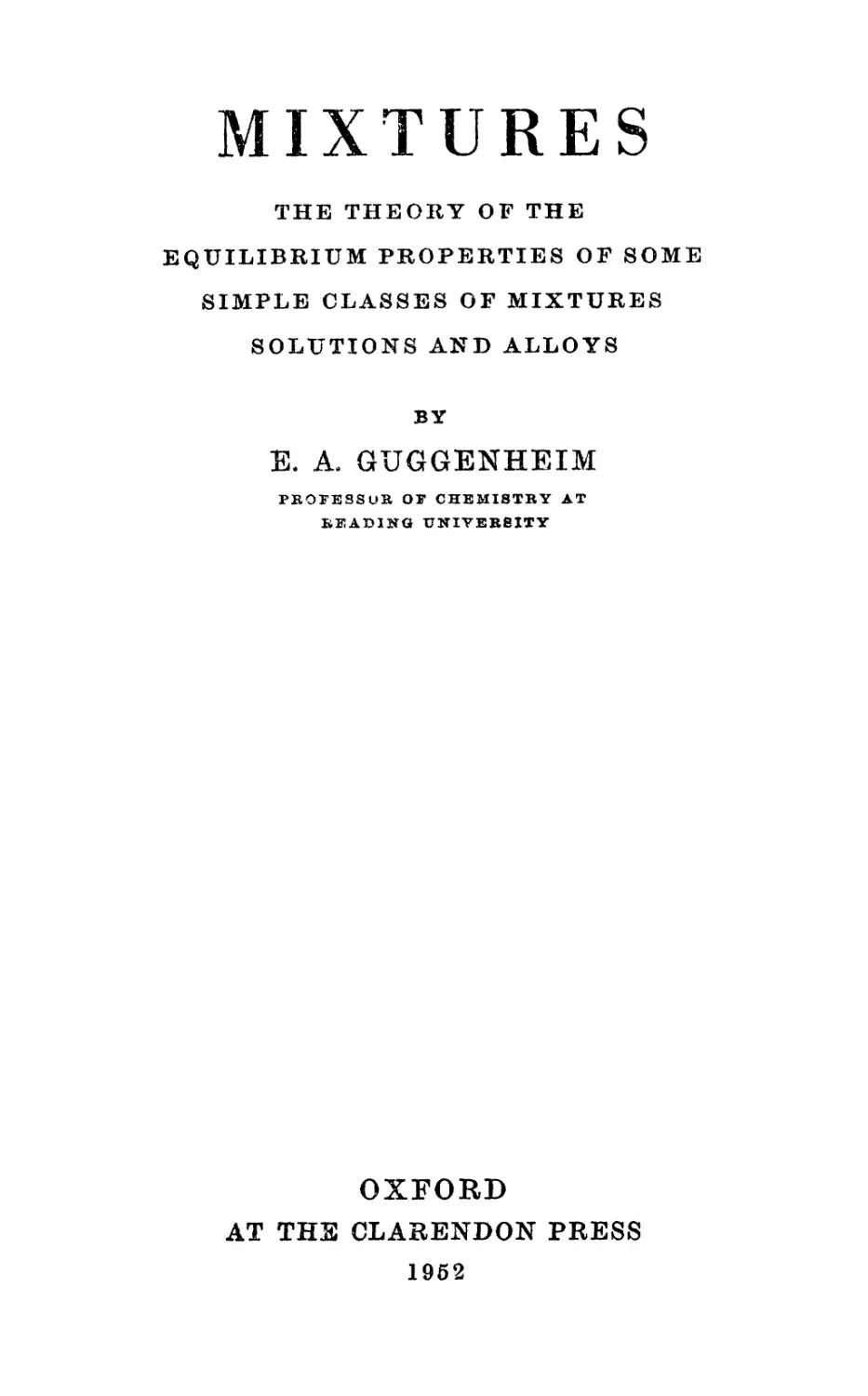
MIXTURES
THE THEORY OF THE
EQUILIBRIUM PROPERTIES OF SOME
SIMPLE CLASSES OF MIXTURES
SOLUTIONS AND ALLOYS
BY
E. Ae GUGGENHEIM
PROFESSUR OF CHEMISTRY AT
READING UNIVERSITY
OXFORD
AT THE CLARENDON PRESS
1952
'rIlE
INTE'B,N .l\.TIO N l\I
SERIES
OF
M01
OG.RAPHS ON" PIIYSICS
ENERAL InDITO:aS
tR
H. i'OWLERJj P. KAPITZA
N. F. MOTT, E. C. BULLARD
THE INTERNATIONAL SERIES OF
MONOGRAPHS ON PHYSICS
GENERA.L JCDITOB8
Tm: LAD Bm RALPH FOWLER
N.F.:MOTT
Henry Overton Willa Professor
of Theor tioal Physics in the
University of Bristol.
P. KAPITZA
E. C.BULLARD
Director of the National
Physical Laboratory,
Teddington.
Already Publi,hed
.
THE THEORY OF ELECTRIC AND MAGNETIC SUSCEPTIBILITIES.
By J. B. VAN VLBOK. 1932.
THE THEORY OF ATOMIC COLLISIONS. By N. F. MO'1'T and H. 8. w.
JUS8BY. Second edition. 1949.
RELATIVITY, THERMODYNAlIICS, AND COSMOLOGY. By B. o. TOL-
KAN. 1934:.
CHEMICAL KINETICS AND CHAIN REACTI S. BYN. S:DIENOl'lI'. 1935.
RELA'tIVITY, GRAVITATION, AND WORLD-STRUCTURE. By B. A.
JltLNB. 1935.
KINEMATIC RELATIVITY. A sequel to BelatitJitfl, (hafttatWn, ar. World-
SIrudwe. By E. A.. IIILNB. 1948.
THE QUANTUM THEORY OF RADIATION. By W. HEITLEB. Second
«INWn. 1 94:5.
THEORETICAL ASTROPHYSICS: ATOMIC THEORY AND THE ANAL Y-
SIS OF STELLAR ATMOSPHERES AND ENVELOPES. By s. BOSSE-
LAND. 1936. , '
ECLtpSES OF THE SUN AND MOON. By 8m FRANK DYSON and B. v. d. R.
WOOLLEY. 1937.
THE PRINCIPLE OF STATISTICAL MECHANICS. By B. O. TOLMAN; 1938.
ELECTRONIC PROCESSES IN IONIC CRYSTALS. By N. 1'. M:0'l'T and
B. W. GURNEY. Second edition. 1948.
GEOMAGNETISM. By 8. OHAPMAN and J. BARTELS. 1940. 2 voIs.
THE SEPARATION OF GASES. By K. BUBEKANN. Second ediliOft. 1949.
KINETIC THEORY OF LIQUIDS. By J. FRENKEL. 1946.
THE PRINCIPLES OF QUANTUM MECHANICS. By P. A. .14. DIBAO.
';l'hird edition. 1947.
THEORY OF ATOMIC NUCLEUS AND NUCLEAR ENE!tGY SOURCE8.
By G. GAKowand o. L. CBITOID'IELD. 1949. Being tfi£ third edition oj STaUO-
TURB 01' A.TOMIO NUOLBuS AND CLEAR TIU.NSI'OBKATIONS. .
THE PULSATION THEORY OF VARIABLE STARS. By s. BOSSBLAND. .
194:8.
THEORY OF' PROBABILITY. By HAROLD JEFFREYS. SeQond edition. 1948.
RADIATIVE TRANSFER. By 8. OHANDRASBKBAR. 1950.
COSMICAL ELECTRODYNAMICS. B)i B. ALJ'V N. 1950.
COSMIC RAYS. By L. JAN08SY. Second «liMon. 1950.
THE FRICTION AND LUBRICATION OF SOLIDS. By P.-P. BOWDBN and
D. TABOR. 19'0.
ELECTRONIC AND IONIC IMPACT PHENOMENA. By B. S. w. KASSBY
and B. B. 8. BUBBOP. 1952.
Oxford, Unive1'8itll Prus, An:en IJ'oUBe, VYrulon,. E.G.4
O A3GOW NEW YORK TOBON O M'ELBOU.RN WEr,LrN{ TON
BOMBAY OALCUTrA MAD:a ......8 OArE TOV1N
GwJJrey Oumberlege, .Publi8} r io the V-n'iveraity
FRINTED IN GREAT R::'r.AIN
PREFiA( E
My ahn in thig book has been to givo ft,n accoru1t \)f the 3,pplication
of statistical t'nerL'1oilynarnics to certain models of . olid, liquid, and
ga.seous mixtures. There has been 110 attompt 1.iO e:xplore mOl e thall
a, small part of t.he wide field covered b:Y' th 'wol"d. mix ture ' In fact
the o:illy nlode l .8 discussed are tllose 8G girnpl0 that theory cc.n be applied
to th'am qua,ntltatively with the minimunl of a.sBulnptions superposed
on those implied in t,he models an.d c&n, mOTflover, be applied with. the
use of only ele!nentary Tl1a.thematicf. Ir.:. spiLe of the gres.t simplicity
of tl1 se models tllcir study leads to l>roblems su.fficiently complicated
to be jnter 8tillg.
1.'he models can be expected to be useful refresentat,ioJls of 011 Y the
simplest inixtur6S In particular, mixtl1rea cO!lw,i:u.irlg electrolytes or
highly polar molecules are entirely excluded. from consideration. Com-
parison between theory and fact h. limited. by th scarcity of precise
experimental measurements on the simpler 3yst.ems. \\llere compa.risoll
is possible the result' is nearly always fJurpriEtf'lgly gtatif3ring.
There is a, clear need for more extel1 ive fi.nd precise measurements
of all the equilibrium properties of tll: implest mixtures. If 8uoll
research work is st.imulated by the theories described, then this book
will have served a useful purpose. .
Here I 3hould like to point out how m'uch tIns subjoct owes to one
of the foun(ler-editors of this series, the 1a te Sir Ralph Fowler. - Although
much of the theory has been dev'eloped ainoe his deatl1, there is scarcely
a eectiol1 which does not bear the hnprint of ideas and techniques
originated or jI spired by him.
I have great pleasure in ackrlowledging my debt of gratitvde to
Dr. M. L. McGlashan for his invalu ble a 8istance in preparing this boo!t
for the press. As well as contributhlg origirlal work described in the
book, he has read the ma.nuscript, cbecked tb,e formulae, prepared the
diagrams, compiled t.he indexes} and oorrected the proofs.
I
I am indebted to the Royal Society arid to ' hfl l orth Holland
Publishing Compa.ny for permi&sion to copy certaill.diagrams.
E. A. G.
UNIVERSITY OF READING,
December I 51
CONTENTS
I. CI.h SSICAL THERMODYNAMICS OF MIXTURES
1.01. Introduction. Free Energy
1.02. Independent Variables
1.03. Thermodynamic Potentials and Fundamental Equations ·
1.04. Partial Molar Quantities .
1.06. Chemical Potentials and Absolute Activities
1.06. Useful Fonnul8.8 for Liquids and Solids .
1.07. Activity Coefficients
1.08. Useful Formulae for Gases
.
.
II. STATISTICAL THERMODYNAMICS OF MIXTURES
2.()1. Introduction. Independent Variables
2.02. Distribution Law and Parti ion Fimction.
2.03. Free Energy and Total Energy. .
2.04. Separation of Degrees of }"reedom
2.05. Configurational Free Energy
2.08. Two Simple Examples
2.07. Characteristic of Macroscopic System
2,,08. Grand Partition Function
2.09. Semi-grand Partit.ion Functions .
.
.
III. IDEAL SOLUTIONS
3.01. Sufficient Conditions for Ideality.
3.02. Free Energy and Entropy of Mixing
3.03. Raoult's Law for Vapour 1Tessure8
3.04. Osmotic Pressure
3.06. Several Components
.
IV. REGULAR SOLUTIONS
4.01. Sufficient Conditions for Regularity
4.02. Classification of Neighbouring Pairs
4.03. Nature of Crude Treatment (Zeroth Approximation)
4.04. Free Energy and Total Energy ·
4.05. Partial Pressures. ·
4.06. Activity Coefficients
4.07" Separation into Two Phases
4-.08. Critical Mixing .
4.09. Nature' of Quasi-chemical Treatment (First Approximation)
4.10. Total Energy and Free Energy ·
4.11. Partial Pressures and Activity Coefficients
4.12. Coexisting Phases. Critical )fi,ring
4.13" Relationship of Zeroth to First Approximation ·
4.14. Combinatory Formula ..
4:.16. M'asimtz ation ·
.
.
.
1
1
2
4
5
8
9
11
.
13
13
14
15.
15
17
18
19
21
23
25
26
27
28
.
29
29
30
30
32
33
34
36
38
38
39
40
42
42
44
"Jiii
CO NT"t :, /'i.' R
4. ().
'F!'t', }:"llerg"v 1n.rt C!lelui, a.l Fct,<:.\nti 1
T)€sc; i-ption of }J t.h(;1' M t,ho"l
- ..L.
Ct'itiqu.e of J3e t ;he J fJ l\lethod
Hig"h(ir 11.ppl'l; .i.m21iiontJ .
0" r-r . I
t,v21jOm OJ. .,! la:ICT €!8
.... ;
GYbfJsnJ of rratre hed.t'a
Compb1ribon 0f Sev(;l"r;l Approxlij,)ft ions
EXpt4tllS i .Vlla 913 PO\-ye.-r et"icJ "n wjzk/l'
-, ., . (: f) · 11 · 1 A .. .
rower e:!'j' B lrom -06acp.t.Ct1erruca. .ppY'nx.una.tloa
f' m .( 1)e:rg,tu:re of Or- th..a) xinf.f
......
I '(;;;.t.nA&rf;a:-, l'i eighboUl3
1) . 1 (' ri-' '.
penhf3nCI) O w on _'- en1per.a"tJU.l e
CO!!'5pwjsf?n wi ijh l Y'f\erimcnt
Exa li TrooJtr1"lsat in. 'I'wo J J;men.HioL.tJ
..,.
4.17..
4.18.
4. J p,.
4J O.
4..' 1.
4. 2.
4 :-t
4-.24,
25.
?:{)
4.8
.&:1
50
$&
[:9
)2
4.26,
(}!1
..18
""0
'18
4.27..
4.28.
4.2 41
01
86
". DIL1TTE S )Lu rION8
D vl.. l)ofinitlon {. .Dhl1t(1ne .
5JJ2. Dilut6 Regule,r Solution .
5.03. l:tao tt'& Law F1J1d HGllry's La,v .
5.04 More .3en 1' 1 T:i'\ a.tlnent "
5.0:).. HenJ:y'a L,8;¥ r and Nern f 3t's Ls,w .
5.0G. RA.0ult's LRW
ft07, Osmot,ie Pr88Sill"e.
5 Ob. IIea,t '1f Dilution .
5.09. lJsfII of K ole RH,t,iofS. J}lc19,lity Scale
...,.,
. ('j
88
3!.1
Rq
l
9J
92
\}
G
. u
'tIt L/1TTICE IJLlPERIY'ECTI()NS
6.03. i'1ature of IYlllJerfa()tioIlS ..
itO . Iinpcxfcctjons in :.At SingJe Saltl
6.02. IT<)puritie
95
96
98
VII. SUPI R,LAT'TICES
'1.0 1. Qu&Htatl v'o D sur£p'bion
7.02.. ClasFjficatioil of (Jou...figurations
7 03, Configurational t nergy
7 .04.. Dt: terrni.:rlat:"Jn of Equilibriu:rr:. l'ropertit,s .
7 .05. C.rud Tr "'tment. (7:E.rot,h Apprcxi nation)
7 ,.l)6. Equ Ebrh.un Stu.te
" _'\"1.... b " . t,
, ., v .. f.trn 0.8,... Oln "
7.08. Degree, Qf Order .
.., .Og. Tots..! Ene;lC 7
fJ.10. Correlation. hetween Superlattices and ReguJar Iixtur6s .
"1.11.. First ApproxL"Ilation. COlnbinatory FOffilula
7.1 . Ma.xirnizatiGln. ( ua£i-cheIr cltl Equation.
7.1 ., .f ree Ene rgy &ucl EquiJibrium State
"r14., L8Jnhda ?oint
1-1.15. ExpanBion in Powers of w,/zkT
I')!
10:
104
105
.106
107
109
lO
110
111
114;
115
115
119
12u
.
.
.
.
II> .
.
L:
122
124
126
12
130
130
133
134
130
. 136
. 140
.. . 141
c 143
. 14
1(
C01\1 'TBN'l'S
r; _ i. 6" l e"'ne' 8 Met/hod .
7.17. 1nterc,-)f'u-parigo!1 uf :ar.eLho\i..q
7.13. Ano:a:naloUb He9.t Capa, ity
7. 19. COP..lpari30n wi\in. J xpe.\'hnalit
'7.20. AuCua Supal"lattice
7.21 Zer 1tb Appl'1) iall i.l0n .
'7 ..22. Equi1jb 'imp (;oi1dlt,ion .
7.23.. Tote.:l Ellf:HID r
7.2 . D.Dg!"% of Order .
'7.25. }4'iret A:pprcximatien
7.23. ]:l UJnt:;r\Ol\\ I{,esults
7.27. Con.).p.9,'r.io u \vith ExperiI.Gent
7i28.. AuCu S-,.t .latt,ie
r ..? , F;.rst Ii 1JpA.--o {}.mt1tiOl).
7,30.. Num-3).l\l.cal j1, ll:;8
'I.TT":" I (...... EOU " .fT"VI T 'T.P E
i J.".. 'Vi IS ; J...... .- \.J ....."
(J. O.L Int-red ]ct on
.t Aj2. 1\tlil:tl1 :' of Pel"fect G. s ·
8JJ3. Sin.gh Pe.;!' of lntex-acting Moloou1es
8.n4. Slight.ly Impe) fect Roo'} Gas .
x.05. Vil'ie1 CoeIrlc" ents
8.01) J4:illtropy t 'J."'Ot8J Ener!;y'; and. Chemical Potentia.Is .
8 ()7. Change of \'arieb!e froni V to P &
it 08. COl!tpa.r .zoI.i. witb I.lel...rcct Gas. Fugacit.y.
S .09. A l' t.\i 1'(3 P. ppt' -I.KiIDAtiC!1 t
S;..l{).. Corroepou.di"'1g SffitB3 f01" 1\iixbd ( 88e&
B. i I -v oragin.g R" l{ £ .
8 12. Cotn}"W;mon with }-::xpcrur:.ellt -- ·
8.13.. Ferm of l\!oloo t .uar Int ract.i )n .
144
144
J46
]48
100
15\
15!
lEj
164
1-54
168
158
161
IX B1JItP A.CES (iF SIMPLE 1,IQUID MIX'I'UP ES
9,01. 'I'h nnodJu:!Lrilloo of r;u Joo Ph8a9S
9*02. Exampi Qf Tat,eJ' and Ethyl Alcohol
9 .f.J3 S ,.,tistico,! Moohr.nich of Surfa.cl1 I,t\yaf8
9/)4.. QUa&i. ry'6t nhle rd'odDJ.
.05. FOrInul00 for PU?e Liq" d
1.GB" Su\1ac,e Layer Gf W.xt'!J.r6.
n.07. Grt'.rH. };)a,r.tiition Function of Surface Laye ,
9.08. Ide'),! (J1utioH.8
tn . J{.egular Soh. .tioT'..s \ ..
fJ..l:\ Gibb s .L .:..dsorpt.ion FonnuJs. aDd 'Furt,l1er Si:npEficatiol\ ..
9. 11. Compa isoH. ..:v-ith .:periD1e t
.
J.
169
172
1'13
114
1'16
1'16
176
1'7
179
"lRl
.
110
y "' ' L T;}''''n. "'1" ] " " 'L 0 ,..... D Ii -r:t T']> E '.\..'Tm f.1- 1 '." 1:." : L. _ .: A m lR :"' J: ' '!\3' ' l. _ L "'V":'TI R, Q
_.... ;' i. ,_1 t.'.A... \.J" . :'.J J. L\: 1.1:'., -\...".. ..., \.:.11::"\ ....,. s l.'f.a...o.. J4 V
't( .Ol tlisriOI'ical introduction · 18:
1 v. 02 4 'TE>rrn.inologjt" 3110 .. i ot/ tjon 134
x CONTENTS
10.03. Relation of ex to Absolute Activities . . 186
10.04. Relation of ex to Free Energy of Mixing · .. . lR7
10.05. Combinatory "ormula . . 188
10.06. Dimers. Chang's Method . 189
10.07. Dimers. Direct Method. 192
10.08. Open Chain r-mers 193
10.09. Thermodynamic Proper ies 195
10.10. More than Two Components 196
10.11. Notation for Triangles and Tetrahedra . . 198
10.12. Triangular Trimers 198
10.13. Tetrahedral Tetramers . 201
10.14. Na.ture of A.pproximation . 204
10.15. Flory's Approximation . . 205
10.16. Numerical Values of Entropies of Mixing . 203
10.17. Numerical Values of Activity Coefficients 207
10.18. Higher Approximation for Dimers 209
10.19. Relation to Experimental Material 213
XI. MOLECULES OF DIFFERENT SIZES: MIXTURES NOT ATHERMAL
.
11.01. Introduction
11.02. Crude Treatment (Zeroth Approximation)
11.03. Classification of Contacts. 'rotsl Energy
1] .04. Free Energy
11.05. Absolute Activities and Fugacities
11.06. First Approximation. Co binatory Formula .
11.07. Maximization. Quasi-chemical Equations
11.08. Absolute Activities. Free Energy
11.09._ Total Energy .
11..] o. Critical Mixing .
11.11. Relation of First Approximation to Ze:-oth Approximation
11.12. Flory's Approximation .
11.13. Dependence of w on Temperature
11.14:. Numerical Values for Activity Coefficients
11.15. Experiments on B nzene/Diphenyl
11.16. Experiments on Alkanes
.
215
216
;)16
219
219
. 220
221
. 222
. 224
225
228
229
230
232
234
239
, .
XII. SOLUTIONS OF MACROMOLECUI _ES
12.01. Introduction
12.02. Athermal Mixtures
12.03. Comparison with Experiment
12.04. Mixtures not Athennal .
12.05. Comparison with Experiment
. -
.
. 243 '
. 244
. 247
. . 250
. 252
. 259
26
266
APPENDIX TO CHAPTER VIr
INDEX OF AUTHORS
ll\TDEX OF SUBJECTS
.
I
CLASSICAL THERMODYN A'MICS OF
MIXTURES
1.01. Introduction. Free energy
THE classical thermodynamics of mixtures is such a, vast subject that
an exhaustive treatment of it would require a, book comparable in size
to this one. No attempt will be mad to give such a. treatment here.
We must rather'be content with & brief 8 1 1 11)I1\a.ry of the fundamental
principles and the most important formulae. The reader must go
elsewhere for detailed derivations.
We shall in this book be concerned only with systems in complete
therm l equilibrium, 80 that the temperatUl'ee will always be uniform
throughout the system. 1\.8 long as the temperature is kept constant,
that is to say under isothermal conditions, the most important thenno-
dynamic function is the free energy, so named by Helmholtz and
denoted by F. In any isothermaJ. reversible process the increase in F,
denoted by F, is equal to the work done on the system; aJ m&tively
the decrease in F, denoted by -f1F, is equal to the work done by the
. system. Thus in reversible othermal processes the free euergy is
analogous to the potential energy in reversible mechanical processes.
The particular kind of isothermal pr cess which most concerns us
here is that of the mixing of two or more substances. We shall denote
by -AmF the decrease in free energy when one mole of a, mixture is
formed from the constituent pure substances. A considerable part .of
this book will be concerned with the quantity F called the molar
free energy of mixing.. It is important to know how this quantity is
' etemUned experimentally, but this can be expl ined more conveniently
in i 1.65 after we have considered some other thermod ynami c functions.
. I
1.02. .JBdeRendent variable8
The &tate of a liquid mixture may be completely defined by specifyi g
the a,bsolute temperature T, the pressure P, and the composition of
the liquid. This is -moreover nearly always the most convenient manner
of specification. The same choice of independent varia.bles is appro-
priate to a solid mixture provided all stresses other than an isotropic
pressure are excluded. For gaseous mixtures, on the other hand, it is
sometimes more convenient to choose the volume V rather than the
3596.71 B
2
CLASSICAL T &:{EI 'I OI lrN A l ICS OF 'iI X T (1 RES
1.02
!)rossure P ,tS all jnd_epelld:: nt v'aria,ble. Since a much greater part of
this buok is devut d to liquids al d solids than to gascs, the set of
independerlt variable '1't P will be appropriate lnore often than the
set T, V anti therefore 1110re detailed attention ,viIi be paid to the
fOrD1er.
The compositiol1 of a IrJxture is conveniently described by specifying
t,he -I1Um ber n r of mo]es of ach species r. "Vhen we l:"Jre intereste{l only
in the relative comp'osit.ioIl, out/ not in the total amQunt of a mixture,
it is convenient to use the n10Ie fractions x,. defined hy
X r ::= n r / !n r . (1.02.1)
r .
The mole fraotions are thus not indepel1dent, being related by
! x,. = 1. (1 02.2)
r
We shall be mostly cODctll'ned with binary mixtures for which (2)
reduces to
X 1 +X 2 = 1. (1.02.3)
In this C88e it wilt be convenient to simplify our notation by writing
x instead of Xs and I-x instead of Xl. /
f
With this notation th -molar free energy of mixing m F of a binary
mixture is related. to the :molar free energy F. of t.he mixture and the
moIM free energies F1, of the two pure components by the definition
A,nF = (1-x)}i'1+xl1-Fm. (1.02.4)
1.03. Thermodyn.Glnic potentials and fundamental equations
'When the free energy F of 9,ny homogen us phase is regardeu. as
a ftmotion of tIle indep€ndcnt vari bles ,p, V, n r its partial difIerei\tial
coefficiehts with, respect t!> the first two variables are given by the
silnple re18Jtionst
of/aT = -8, (1.03.1)
oJFj8V = -P, (lt03.2)
where 8 denotes the e'itt'ropy. 'The partial differentie.l coefficieLt of F
with l'e8poct t,() eaoh nOr is o8,lled the kemical potential of r and is denoted
by fL,. FJ.:hus ').1l' / = (1 1\" 3 3)
.o.J -. Viti,. /-L,.. . u.: . t
Formulae (1), (2), and, (3) ma r be combined to give
dll' :.= .-8 dT-P dV + ! JLrdn,..
r
(1.03.4)
t The notation for all thcimodynamic quantities is the same !l.g u80d in th author's
book 'l1hermodynamics (1949}, North.Holhmd Publishing C-o., a.nd confcrmc with th
r30om.nl5:;1dationa of the JnternationaJ tJnion of Physics (1948) and the Internetional
t 1 niotl of Chemi8try (1-94.9). Derivation'J of all the required thermodynar..:t.ic relations
wiil fO\U.id m this or othel" stll da.rd xt bt)oks all ciie:nical thermodynamics.
g 1. O:l
C 1-1 A S I C 1\ L 'ii' -{ E R .r.f 0 j) ':{ N ... \ ' r,: J C S (, F M.l X U RES
3
1'he free energy }1' i8 aa,id to be fJhc tlt.cf1'li/oflyn:J/lii'ic potential tQr the
independent varinble T, V, n r , {t}JJ:l forI Jl1la (4-) j alled. the Jurulamtntal
equation for tllcse 'variabloo..
Turning no"".v t10 the mort:' genera,II:", usei'u] sot ':,,if v&,riables T, P, n
the relevant thermodynamic :pot,-;-ntlc"tlls t,ll (}ibbc.,:.function G defined by
G - ....;r t DrT
- .f! T..L Y,
(1.03JS)
alld the flmdaznental equatio:n for t,he5 Yari;],ble ;8
dO =- --.8 d1 i .+ J' tlP.+ I ftrdn,.
( 1.03.6)
IaotherD:lal Cihanges in G are closely related to net work defined as
follows. The work done on a BYH J.ll plus the iD re&8e in the quantity
p V i called the net work done on the aJ"8t m.. Alternatively .the WG1"k
dOlle by the syetcm less the increane ill the qUt1,Tltity }JV ii4 called the
llet work done by the S Tstem.. In particular if the p1'eB8Ure it} kept
COIllJtant then th6 net work done by the aY3tcJn may be defined as the
work done by the sY&1tem other tlUtll the wo k. due to tIle change V
of its volume.. With this defiuibioll of net "\Vork it follo,,"s from (5) that
in a Teversible isothermal process the decl'ea.se --fiG of th6 Gibbg
function is equal to the net worl{ done by tile system.
The entropy S has the prol)erty tlll t in any infiuitc3imal reversible
pro esB the hoat a,bsorb6fl bj' tlle system iq T dS - Consequently in any
reversible i8oth rmal process the llea,t al;sGrbect is li !J.JS 01 L\( ']1 S)) ",.h.ere
as usual the EYlTI'bol /..). is usod to d. note tIle Ij1C.:.'eaae of any. quantity
during the process consil!ered. If, o:n th otllcr hand, we consider an
isothermal proces il1 wI-ricb. tl"o pressure is ID.ainta.ined constant tJl":.'91.1gh-
out, such a process bei.:ig usua]!y riot rC Ter jble, then the heat absorbed
is equal to the in. crease L R' of thE:' hea1: fUi1ctlt :r", B..
Th5 fUllctjions Gf, /3) t nd }f art11'Qlnr&3d. bJ'
H - Fr,1 'l l,Q
- Lt T ,...., :
( 1.03.7)
GO
.':] - ._--
,. -- a 'I' oJ
( 1.C3.8)
80
H::= G--T-.
ff'
...,. (. t
(1.03.9)
Hero and elsewh.er when We use l1PJrtJial di-e: rehtial coefficients the
independent va:ri&,..blas a!'e al\-va.ys T) P, 1 r 'unless the Cf)Iltrary is stated.
It fo1]0"-8 ilnlnedifttely that for. all 1sothc!'ITi.al prooess in ,rhj(;h t11.6
4:
CLASSICAL THERl\.IODYNAMICS OF MIXTURES
f 1. OS
initial and final pressures have speoified values, uaually but not
neoessarily the same, we have
dH == I1G+T6.S, (1.03.10)
a
S = -- G, (1.03.11)
aT
8
dB = AG-T oT 6.G. (1.03.12)
The last formula is called the Gibb8-H elmhoUz relation.
1.04. Partial molar quantities
The relations between partial molar quantities and the correspond-
ing extensive property may be illustrated by the case where the property
in question is the volume V. For the sake of brevity and simplicity
we lhall coD8ider & mixture of only tWQ components, 1 and 2. .As usua.l
we take as independent variables T, P, n 1 , 'ns. The partial molar volume8
, are defined by
Ii = av/On 1 ,
= aVIlJn l _
IncidentaJIy the other pa.rtial differential ooefficients of V are
BV/aT = (XV, (1.04.3)
8V/oP = -/(V, (1.04.4)
where CI is the ooeJfkient 01 tkerm.oJ, expansi(Yll, and IC is the iBOtkeNlUJ,l
tompresBibiZity.
The tota.l volume is related to the partial molar voluni by
V = nlJt;.+nt . (1'.04.5)
When the cO p08ition of the mixture is varied a.t constant temperatu!e
and pressure the va.riations of the two partial molar volumes are inter-
related by 1'tt d +n.dJi; = 0 (T, P const.). (1.04.6)
Applying the above formulae to a, quantity of mixture conta.ining in
all one mole and denoting the mean molar volume by V#p we have
. V m = (l-x) +x , (1.04.7)
8V m = "fa-Ji, (1.04.8)
ox
(1.04.1)
(1.04.2)
(1 _ ) a + a - _ 0 (T P t )
:.::-"'" , co DB . _
ox ax
(1.04.9)
Precisely a.nalogous formulae apply to any other extensive property
9 L04
01 ASSICAL THERMODYN AMIC8 OP MIXTURES
5
8uch as F, 0, S, or H. In particular we see from (1.03.6) and the
definition of partial molar" quantities that
0 1 = 1-'1' G 2 = ILl. (1.04.10)
Consequently for '\ aria,tions in the composition of a binary mixture at
oonstant temperature and pressure we have
(I-x) Ofl-l + x O lL2 = 0 (T, P const.). (1.04.11)
ox ax
This important formula is called the Gibbs-DuMm relation.
Provided we keep to the independent variables T, P, n 1 , n l or
T, P, x, then for each relation between extensive properties there is an
analogous relation between the corresponding partial molar quantities.
In particular as analogues of (1.03.7), (1.03.8), and (1.03.9) we have
HI == GI+TS 1 , H'}, = G2+T81 (1.04.12)
Sl = - oG l , S2 = _ 002 . (1.04.13)
aT aT
HI = 01-T o 1 ,
0....
H 2 = 02_ T aG ? .
aT
(1.04.14)
By virtue of (1 (») we may rewrite these formulae &8
HI = ""1 + TS I , HI = P,I+ PSi'
8 1 = _ OILl , 8 2 = _ a ILI ,
aT . aT
( 1.04.15)
( 1.04.16)
/l, - IL T 01-'1.
1 - .-1- -,
aT
U _ II. P 0/l!J.
ns - ,1- -
aT
(1.04.17)
1.05. Chemical potentials and absolute activities
We have already collected many of the mOst import.ant formulae.,.
involving chemical potentials, but have not yet s&id anything about
the physical significance of these quantities. The chemical potentiaJs
have two fundamental properties closely related. to each other.
We have already drawn att ntion to tbe fact &t he ohemical
potential is identical with .the pa.rtial molar Gibbs function. We h&ve
aJso mentioned that in any reversible isothermal process the decrease
in the Gibbs function is equal to the net work done by the system.
It follows tha.t if we consider the process of transferring one mole of
he 8ubstance If reversibly and isothermally from a large quantity of
one ph to a large quantity of another phase, then the decrease - P,r
ill the value of the chemic&! potential ILr is equal to the net work done
6
C L t 3 I C A L THE R 1\t 0 D Y' I 1.. M 1 C a () 1 4 " ftf 1 x'.r {) R 8
l.t):
h:;r trr(:j 1Y8},f)lYl. This is the fifZt flH1(.ialn nti J pIoperty' of the chelnical
:pot, )rltial.
rIlle sec.)THt fnndan1entaJ property of the ChoIl1ieal potential is tbe
io.nf) 'nng. \V!ji"n two phaseft r8 a the sa,n:le te:npei:atnr0 the condition
for equ!lib:riu 1 distrihution of tl1c substance r betwee:n t)b t ""a phases
ia that the chemical potential f.L't st.:Juld }lltVe the sa.!ne value ill Lotb
pll S S. i']1is condition is vaJi.d eve11 vt!1en t'he two pll&Ses a..tO a,t
different pr' AAltreS, for example wheli sepalr:t't d by a son'11-1,el'nl t }abJe
men1brc1/ne, provided always tllat they' aro at th.e sa.me t' ll1peratur'3.
'The fir t f(lI!d mental pr.Jperty of tho Ch )nlical potential en8JbletJ 118
to r lat the difference ill chemical potentIal bet\veen" two phases to
experimerltall { determinable {lua1. t,ities¥ Fo.l' th.e sake of SilTIplicity we
sbf.tll1.liitiaII:v aH unle that tho aturate(l vftItour over each pha,se L"1a y
with 8l1fficl r t accuracy be 5reated as a perfect gas.. It ffi'18t be
' lllphf sizoo. th.8j"t this is all a Eurnpti0n relating onl,-Y to the ,;6h"1\' iour
of th va,pour; t}le.re is 110 restriction cOl1ce:rAling the nature of t118 liqllid
or solid ph&sfjz. The tral1sfer of Olle mole of the Aub 1janco r ii.Ql a
large Q.U(1Iltity of a liquid ot" SQlid phase 0: to a large qua.ntity' of another
liquid or solid l)hase (j call "in pri.nC'ipJe he porfornlcd .rc i lersibly and
i othermally by what may be cftlied all i,-c:otherrai:J,l th'ree-stage tlistiilt1-
tion. 8y :m d.J1S of pistOIlS and arpp:rvpriate semi-permea.bJ.e nlembranf:;s,
which the h.i.toreated reader' can reacli1y de'v-ise, tIle proces8 CiYi1 bQ
perforn.1ee. in "ih_e following three tages:
((II) E1<" l)(;J a,lje 0113 mole of r frl)ID a large quan.tity of tht) phase (X
a.gah""1st a ])reSHUre equal to tlltj saturated part.htl vc,pour prcssuru
1) cf r nl the phase ex.
(h) Exparul (il.' omp:ress the OI1 mole of vapour isothcl'ma}l::,r froID.
tilo pr. esu:r p to a. pressure 6qUG,l to tlJe 23,te.r!1ted v ;"fJ0u:r
p r )F.euro p of r in the p}lase $.
(0) (!0ndnnse the Olle mold llltD fJJ I Tge qu.an.tity of 'o}-.e ph.&1e (J by
;P2Jying a OIl3ta,nt pr s8......r" p .
_£\t ll stages the temperatu:re t supposed m9Jhltairled con3tr..,n{, 'hy U8e
of 8, s itf.ble thi;rmosta;b.
Tll worl: done "by the ayst811'i in tIle tl1ree f3tagea vih t ':Ihe Yc pou:r
is trea,ted as a perfect gas is as folto--;;....s:
(Q,) RT--pO: T, ''1 Of?' l'
.. l' -;- , \..f.. O. J
1'-') ex
(b) R.'''''1- ..t 1" ' O 2\
-I. .L..l.... -13 <. j. ;) , "
p,
«( ) -.RT-+'l) rTf, " ')h ..
;. 1 . t) I . t, ,
l.()=)
; L /. , f C .\ ;'.( 1;; n ,\ [ C T) \" J" l;' 11 C S 0 F I'll I X T tr t ?': S
1
'\vh.::n"e It dn:COtl S t,'tJe a ( a11f. jl1nt e...U.\! / , V denote tl1 F 1 L a,rtiH,l t. 101f1J\
' .r )J Uln (Jf '/ ill -1je },h at t; C" , f3 T8St. cti "/ ely. By adCiitiotl ,ve Ui1..:1 truJJt
}, ' ro;'k C-O!...0 by th.o ::Y!i!l{nn is
f("/ ()'.
','lo ':. '( "' .1:' ',. . ( n r? Q a: V ex )
.r ...L n --15 '1- \p; ¥ --'..Pr 1""
(nP
.1.'r
It lollovlk' by d .fir,itio{l that th. net ',,,,"oi'k (lone b)T th0 f-t)/Gte m iM
(j .05.4)
t: '\ IX
t" 1 ;- 1 ..,,1!r
...t..f.. 1.: ..
'I)
rt us f{ 1} t1,.ny ' 'V0 p:ilt),.'3fj8 0i, f3 ai; the same temperature "H.v ha,\'e
(1 05.5)
pcx.
ll.a _ ".P -- .J "C m '' In r
.1' r-'" - c:.: J .
Pr
At ihis 8t(.yg it i convenient t,O l.'1t,rodtlce allothel' thermod. 1n&!ni(J
f1u .t!ity ).,. ca118(i th ctfuJoluJe acti?)1:ty defined by
J.tr === 1l7' 1nA I'. (1.00/1)
Since ;;,. at:u! !Lt> a:\ f i11 i J..art81 v i1n.C!. sl;npJy interlelated. mathe;.Ilc,tically
i.t i obvicu ly Ul1.0Ace::;sp.;!'}' o U3f; both" N verthele8s .hi I)rac' ioo it
otteI\ c.oI1Ve!lii:Hlt tD -tiS( 1. 1 ' rafher t"h n tar. Tbe cC!".veni8uc oJ tihe
fl.oSvlut.t) c, tl vity will r jv8al it clf wit.!l use especially' itl at;], j.Btioal
uerl'j- ati(}ll!.
'U@in3' tIlt) deit.nitiol1 {'l} )'\r'C oa,n rawrite (6) as
( 1.05.6)
A OL ti/\CI.
i . .A.OJr
X# = - p P
r - r
(I r,5,8)
R6t j,mmiS lO'\V to the R6culUl f lnd. m\1n.ta] property o_f tt .e chemic l
pot, nti ), V{ se3 tha.t, the c ljilit.ioD. that t,vo phases O;; f3 at the 8&111e
te:mper8,tarfJ f4hould be in equilibrium with respeot to t.he s'u1;3tance ,.
ml} r 00 exproosecl. iI;. 1:/le mathem ..tica.H.y equivalent forms
£J,ot -- .jf ( l&)u5 9 ' )
rr ..- r'
A '.; ), } {1 05.10)
or provide(i oni)' that the va.:pour lIlar57 b3 t,reated as IJ, perfect ga.CJ)
pi := p . (1.05.11)
EV0'J1 if the vapour :n:lay 110t, bo t.re&too. 8JS a perfe t gas these relatiolW
still h.old Jiood !?l'eJyid,ed 1')r- is .cedcfh.led a9 the fugacity instead of the
lh'\rti&! vftpour pres8:!11" . T'h fugacity may be rep;arderl simply as a
pattio,l V8'1'0t1.;: pr6GSllre corrected for de"iations from the r3hav,our
,of perfect gMes. T116 Illaimer of applying such corr ction8 wi}) be
descrfb8\1 i11 (1..lu1.pter v-III.
8
CLASSICAL THERMODYNAMICS OF MIXTURES
1.05
Let US now consider a bilIary mixture of substances 1 and 2, and
compare it with the two pure substances. We shall use the superscript
o in symbo18 relating to either of the pure substances and shall omit
8uperscripts from 8ymbols relating to the lnixture. We then }lave tIle
following relations between several thermodyrlamic functions and the
partial vapour pressure8:
AO pO
JL -J.Ll = RTln l = RTln--!, (1.05.12)
1\1 PI
'po
ILl-I'I = RTln '). = RTln , (1.05.13)
"I PI
G A O A O
-- = (l-x)ln--!+xln
BT
o 0
= (1-x)ln P1 +xln Ps . (1.05.14)
P1 PI
The Gibbs-Duhem relation (1.04.11) may be rewritten in terms of
absolute activities
8ln,\ 8lnA
(I-x) l + X 2 = 0 (T, P CQIl@t.). (1.05.15)
ox ax
If we treat the vapour as a perfect gas, or alternatively if we let p
denote fugacity instead of pa.rtiaJ va.PQur pressure, we ma.y replaoe
(15) by ,
a1np alnp .
(I-x) 1 + x 1 =0 (T, P oonst.). (1.05.16)
ox ox
This importr.nt formula is called the ])4j,kem-Margule8 reuuion.
1.06. Useful formulae for liquids and solids
As we have emphasized a1; an early stage, the 90nvenient choice of
independent variables for liquid and solid phases is T, P, n 1 , nt, or
T, P, x and therefore the appropri&te thermodynamic potential is
G not F. To avoid a,ny possibility of confusion we have set out in full
the most important formulae in terms of the chosen independent
variables. Having done 80, we may now point out that at ordinary
pressures, for liquids at temperatures not too near the critical point
and for Bolids, all terms in PV or V dP a.re entirely negligible. This is
the case when the pressure is CC?mparable to atmospheric, or is less.
Thus, although it is important to remember that G, not .F, is the
thermodynamic potential for the independent variables T, P, yet the
experimenta.l or theoretical values of G are usually indistinguisha.ble
1 1 . 06
CLASSICAL THERl\IODYNAMICS OF MIXTURES
9
from those of F. We ay therefore usually, for liquids and solids, omit
all terms in PV or V dP. We then obtain for inary mixtures, inde-
pendently of the pressure provided it is not too great, such formulae &8
dG = dF = -8 dT+J.t1dn1+JL2dns, (1.06.1)
dGm = dFm = -SmdT+(/L2-P,1)dx, (1.06.2)
(1_z) 81n 1 +x 81n = 0 (T const., P not too gr , eat), (1.06.3)
8% ox
(l_z) 81nPl +x v1nPS = 0 (T conet., P not too great). (1.06.4)
ax ox
To the 8&me approximation there is no need to distinguish between
th heat fuDction H and the total energy U = H.-PV.
To 8um up, except when we are dealing with gases, we shall usually
make no mention of pressure. The implied assumption is that the
pressure is sufficiently small not to affect appreciably the values of
the relevant thermodynamic functions. An xceptional case is that of
o8motic equilibrium. The osmotic pressu=e II, of a binary mixture in
which the subStance 1 is regarded as the solvent, is defined as the
extra pressure which must be applied to the mixture to raise the partial
vapowr pressure of the solvent in the mixture to that of the pure solvent
at ordinary low pressure. The osmotic pressure is related to the partial
vapour pressure of the solvent by the formula.
n = RT In Pt , (1.06.5)
PI
where PI' p denote partial vapour pressures over the solution and the
pure solvent respectiv61y at the same external pre8sure. 88 usu&1
denotes the partial molar volume of the solvent in the mixture, and is
here usumed indistinguishable from the molar volume V of the pure
aelTent.
1.87. Activity coefficients
We have mentioned' that the absolute activities of the two com-
ponents depend on th composition. so as to be interrelated by the
Duhem-Marg1Ues relation
(1 ) 8lnAl oInA! 0 (T t )
- tV + x = cons · .
Ox 8
The simplest solution of this equation haa the form
A 1 == .\Y(l-x), "2 -= A X.
(1.07.1)
(1.07.2)
10
CLASSICAL 'rI-I"HE. f lC D 't N A Tvl C 0 " I\.iIX.1 URE
f 1.07
l'h{) same relatio!ls "nay be \?xpre sod. in tei'illS of partial vapour
pressures, or strlctl:r fa.gaciti\.1fi,
.P,.:-:=: p (l:---x), · P2 = pg (I.'J7.3)
As VIe shall soe E.1. CJlapter III, t.he simplest, kJlld 0/ mixture which
axi8t in fact sa,twfte2 th.6 bova :relationl3 Such mixtures are called
ideal. 'Vhereao ideal !:oixtures 8,,1'e t,he excel)tion ra.ther than the rule,
the)"!" provide a convenif}ntly 1:.3ef111 standaru v-nt,h whi h to compa.re
other real mixtures. Fer this pl1rr ose iij is expedient to introduce
actiV'itll coeJficient 11,1 f; defined by
)t1 = A (l--x)fl' Ai = !tlxJ' (1.07.4)
or P1 ;:- p l--x)fl' Pa = pKxf" (1.07,5)
It then foJlows b'y substitution of (4) into (1) tb.J},t tho'varia.tions with
Ct)mpo ition of the aotivity C09fficienta of the two species are intel..
r61ated by
(l_x) nf",, +x :n.f = 0 (T const.).
ox ox
(1.07.6)
The introductio11 of :1ctivity coefficit)nts of course gives us no quanti-
tati,?"e information con.eerni:ng t.j}1.:} '{)roperti6s of tIle mixture until their
Valtle8 have been cl,etermine l experimentally. Tlleir introduction is
mere!y &, c{)l\vcni nce and a wctth.i"t?hile one beoa,11se the as.me activity
(*..ocfficienta en.ter into 811 tho equilibrium :-ala,tiona cf the mixtu e.
'We have already soon c.h.at the partial vapour preseuTee of the two
I
oOlnponents Me given b '" (5). By comparison with (1.06.5) we see that
the oamotic pr68sure n (for o9!D.otic equilibrium ... th respect to the
peoies 1) is giv'en by
RT 1
IT = --m-; c- . (1.07.7)
(l -X)Jl
W 0 shall now reoord. without PrQof the f')rmulae relating to equilibrium
between. the li{luid 9ulntion and" the pnre Bolid pha-sa of one of the
oomporLents. For equilibrium at the t,emp6rattl1"C T l}etween the solu-
won and tho solid ph9 ;' consioth}g of the pure substa, nce 1 the relation is
In ] _ .H ( ' 1 ) , (1.07.8)
(I- x)!! -. R p - 2'1
where T denotes th.a equilibrinm tempere:ture for the pure liquid 1
and I1j H t denote3 the Inomr heat of fusion of the pure substance 1.
To be more precie i1 tHt d notes an &Vera.g6 ?alue of this quantity
over the temperM,ture rar.ge T to T , but, usug,lly the va.ria.tion of the
t 1.0'j
CL.t\_SB1:Cl .L l' J ERIHOD y N AMICS OF M! TUKE
11
ll08t of fusion ,vitJh 'Lempe-r ture is neglected. For equilibrium b6tW i1
tb.3 5vl Jtiort and the soJid phase ()f the pure substall00 2 we 118;V8 tIle
alu 106()U8 relation.
1:a_L =--= L\IHg ( _.!_ ) \ (l.07.9)
x.f" R ,T 1 '
where Tg denotes the quilib-rium temperatUl-e f01 tb.e pure liquid 2
and L:, H .iJ th molrvr her"t of fusion for thfl pure sub8ta nce 2. Altb.ough
4'
-formu}£e (8) and (G) 'tre entirely analogous it is oommon praotice to
use diffc'-' nt t,ermL'1.oJogieB to desoribe them. Formula, (8) is 11Bually
des(}ribed as reJ1\ting 1i}lf) freezing-pc.i'nt T of the solutian to its com..
po dtlo!l , while fonnula (9) is dooQribed as relating tn6 colubility, or
c, mroHit:on of t,h saturated aolution, t.o the temperature 2'
1.03. rJ eful forn1ala for ases
Man:r of tile forttl\"iioo lready quotad for liquidn and solids, though
not these in which fjhi:} PI: tarIDS have been neglected, a,1 ' 6 e,,}so appliMble
to gnsr,oua mixtures wh&u the independent va.:tia;bles ara ChORC:r! to be
T 1 .p) "'!1_' n 2 or '1.', }), x., But for gasa3 it is sometimes ootlvemant to use
th set, of ind pelldeIlt vaj:i blee T tV, ?l,1' 1t i or T, .V'J x For this
purpose q' lit3 a, differt1nt sat of f0rn11Uae is requirndo Ma.ny of these
ior:.nuL'W b.a,ve a C!OB4j :t3s'2Imblance to those in which P is an indepen.d.ent
v&11&l;] . Vn s'h ,l1 quoto some oftb.e most important ofth3S6 formulae
withQ\lt proof, restrlctirtg ou:rselv0B to binary mixturee.
The thennodyt18mio :)tentjal for these inttt'.pend"()ut variables is, &9
already m{)11tioll{''\(}, tile free energy If' and the flID(la.mbnt&l equation is
dF :=: -SdT-PdV-f-n1dp,1.+niap,"4 (1.08.1)
The tct l €.nergy U, tha free energy F J and th9 eJ tropy 8 are ulter.
161.ted by
U = F+TS,
S = --( t,
u -.= 11_T ( ) .
aT v
We recall }h.drt iL a re,Tcrsible isothermal proc s the w(. k do:::ta by the
8yatem m -/);,1/ sInd the J)oat abaorbeti is l' 8. Tb.n (2) t1Apr OO the
ta.w of con eI'Vatioll of total ensr U fo-:" an isothGr!l\ l reversibl"
pMceBB,\ Irt an iat')"1j ITnal -prOOOBJJ at cO:18tanL tots,1 "oi-nl!1(1, suoh &
proeeaa being uStlG.IIJ !l t I-ev0£sibI3, the heat a.bsorb-ad. t,o keep the
temperatur' con tant, is .6.U.
(1,08.2)
(1.08.3)
(1.08.4)
If we llave a formula expressing t,he free energy F in terms of T, V,
n 1 , n 2 , the'll vie obtain other important properties from the formulae
8 _ _ ( oF )
- aT V,nt.rh'
( OF )
p---
- BV T,nl,n,,'
( OF )
f-Ll = - ,
an} T,V,n,
( OF J
J-L2 = - ·
On T.V,nl
12
CLASSICAL THERl\fO])YN}\. IICS O ., l\IIXTURES
9 ] .OS
(1.08.5)
( 1.08.6)
(1.08.7)
(1.08.8)
II
ST A TISTICAL THERMODYN AMICS OF
MIXTURES
2.01. Introduction. lodependent variables
IN this chapter we shaJI give a brief synopsis of the most general
formulae of statistical thermodynamics, especially those required in
. the treatment of mixtures. Detailed derivations will not be given, but
must be sought elaewhere.t
In statistical, &8 in classica.l, thermodYI1amics one uses alternative
functions and formulae according to the choice of independent varia,bles.
The simplest and most fundamental law of statistical thermodynamics
relai;es to a completely isolated system, that is to say a system of
prescribed energy, volume, and content. The observed equilibrium
properties of such a system are correctly obtaine by averaging O ler
all accessible quantum states of the system &ttacmng the same weight
to eaoh non-degenerate quantum state. This formulation is the simplest
possible, but it is by no means the most usefnl in applioation. It is
far more useful to ha.ve a, formulation applicable to a system of pre-
soribed temperature instead of to a, system of prescribed energy. In
other words, the choice of independent variables T, V is more 11seful
than U, V.
The alternative formula.tion for a system of prescribed tem:perature,
volume, and content is as follows.. The observed equilibrium. proper-
ties- of such a system are correctly obtained by averaging Qver all
a.ccessible quantum states of the system, attaching a statistical weight
exp( -Er/kT) to each non-degenerate quantum state, where Er is the
energy of the quantum state rand k is a universaJ constant determining
the size of the degree in the temperature scale. This constant Ie
called Boltzm.ann'8 COfI,Bt4nt and the weighting factor exp( -Er/kT) is
called e., Boltzmann fOdor.
2.02. Distribution law and partition function
According to the law enunciated in the previous . section, the
fraction of time spent by a. system at given temperature and volume
. t For example Mayer and Mayer (1940), Statistical Mechanic8, Wiley; Fowler and
Guggenheim (1939), BtatVtimJ Thermodynamics, Cambridge University Press; Slater
(J939), Introduction to (JAemical Phpics, McGraw-Hill; or for a more elementary treat-
ment, Rushbrooke (194:9). Btati8tical MechfmicB, Oxford University Press.
14
STAT.IS 'ICAI... rr"'HER1'"IO YNAMICS OF MIXTURES
! 2.02
in the state 'T is
e-E'/kT
! e-E,/kT
r
(2.02.1)
an.d the obse:;:'ved 3qmlibrium value UJ of a. property fP 'whose value is
when the systan\. is iu the stat-e r is given by
" f?!. e-Br/i.;T
_ k r
g = ..! e-H.l kP · (2.02.2)
The qu tity oc urring in tile denominators of (1) and (2) is called the
partition f'l.tnrJ, cm. If then we dCIlote the partition function by Q we
ha.ve the definition Q = 2: ,,-B.lI&'1'. (2.02.3)
r
2.03. Free energy and total energy
If we now dafino a qUf).nbity F by the relation
1;' = -kTln Q, (2.03.1)
it can be shown tha.t F 1188 all the properties of the thermodynamic
froo energy. In Fa.rticltla.r the observed value of the pres.q lre is given by
I l e,-E,!1eT I - (8ErloV)e-BvikT
P r ,.
= I e-E,./kP - = - L.: e-E,./kP
r r
8 vF
= kT-:-.-lnQ = --,
8V 8V.
(2.03.2)
in agreement with fCrnlula (1 03.2).
Similarly the observed value of the total energy U is given by
E 2- E ,J,i;:T
- :hit r a a ( of
U = E = "1 e-E..Pc T = kTt 8T ln Q = -T" aT(Tj = F'-T aT '
'/'
(2.03.3)
i agreement with flJnr ula (1,08.4).
. If from our knowledge of the detailed structure of th system, or 0:1
a model represe ting thA sy;.r em to a useful degree of &pproximation,
we l:£.n. confstruct, the partition function Q of the systom, then the free
energy is given by' (1).. lvhen we are concerned vlth liquid or solid
phases we may witl10tit senaible error llsually replace (1) -by the formula
for th e Gibbs function Q
G = -lcTln Q.
(2.03.4:)
\Ve call then obt.ain iormulae for the entropy, hePJ- functioIl, an
chemical potentials by appropria,te differentiatiolliJ.
12.04 STATISTICAL TliERIdODYNAllIOS OF MIXTURES 15
1.04. Sepftration of del1re 8 of freedon1.
It often ha.ppens that the behaviour of the system with respect to
some degrees of freedom is independent of that with respect to the
others. This is oaJIed _pt.WtHiOA oj degrtes oj fru,d,om. The energy of
the system can then be expressed as a 8um of energies in the sepa.rated
degrees of freedom, and consequently the pa.rtition function of the
gystem can be expressed as a product of factors relating to the separated
d e cff om. .
Throughout this book we shan treat the degrees of freedom relating
t.o the poaitions and nlotions of the centres of mlJ.88 of the molecules
as eeperable from aJ1. other degrees of freedom. These other degrees
of frmilom will be ref 17ed to as it?,temal dtgttU)j 61 JreeiJnm, although
thay include molecuJa.r rot&tions which are not strictly internnJ. We
accordU1gly write
Q = Qiut Qtr' (2004.1)
where the i'll,tuy"aJ, parlitNm, furwtiO'n, Qtnt rela to &ll internal degree.
of £-eedom includiug rott8tious, and the trn/nlJlational partition Jumtwn.
Qw relates to the motions of the centres of mass of he m.olecules.
Formula (1) is an appro xima tion e8sentiaJ. to tha treatment of mix-
tures throughoot t.biIJ book. It is of course' only an approximation.
Its uae implies that the rota.tional degrees of freedom of the moleoulea
of each kind are the same in any mixture as in the pure substance.
Its use does Dot, however, imply that the rotational degrees of freedom
&r8 the same in the liquid state as. in the gas state, nor yet as in the
solid state.
It follows from (1) that the free energy of miyin g is. dete rm i J1ed
entirely by the translational partition function Qtr, since on comparing
a, mixture with itB oonatituents as pure substanoes aJl contributions to
the free energy of mixing from the internal partition function Qint will
olearly cancel.
2.050 Configurational free energy
We have seen in the preceding section that for the purpose of
de-oor.m.rning a free energy of mixing we may effectively ignore all
degrees of freedom other than those relating to the motioD_ of the
, oo of lli8&4 of t.he molecules. When the aystem is a, crystalline
IOlid we can use & still further simplification. For any given quantum
stAte -!)f the crystal we may regard the energy as the sum of two terms
which for convenience we may call configurational and aOOUBtw. By
CO'Aj/,guratioMl energy we mean the energy .t.he crystaJ would have if
16
STA'l'IS1 i ICAL THERMODYNAMICS OF MixTURES
2.05
the centre of mass of every molecule were at rest on its lattice point.
:By acoustic ene'l'fJ1/ we mean the energy of the vibratiQns of the oentres
of mass of the molecules about their lattice points.
We shall, without any attempt at justift.cation, use the approxima-
tion of trea.ting tI.. e configurational and acoustio energies as independent.
We accordingly write for the transla.tional partition function Qtr
Qtr = Q a Q} (2.06.1)
where Qac is the partitioi.t f1.111C ioIl for the acoustic modes of vibration
and fA is the configurati01UJ,Z' partition function fur the molocules sup-
posed fixed on their lattice points. The approximation, used through-
out this book, consists in regar diVl g Qa,o as determined by the n11mber
of molecuies of each species but as unaffected by the mixing of these
molecules.. To this approximation the molar froo energy of mixing
6.11: F of a binary mixture is det.ermined by
- mFllcT =: In Dm-(l-x)ln Q¥-xln n , (2.05.2)
where am denotes the corlfiguIational partitioIl funotion of one moJo
of tl1e ,mixture while [l , Qj d note those of one mole of the pure
sllbstanoes 1, 2 -respectively.
'fhe foregoin.g discussion shows that for crystals Qao nd .Q are well..
d.efined quantities and that the weak point in the treatment is the
assunlption of their mlltual ind'9pendence. For liquids also we stl8,ll
assume that the acoustical partition funct,ion and the configurational
partitior! function" are independent, but there is the further weakness
that for liquids these functions are difficult to define since there is now
no lattice. Nevertheless it is usef 1 .11, even though untrlle, to treat a, liquid
as if the molecule& were arranged on a lattice. Ana ysis by X-rays has
shown that a liquid is much, more like a solid than like a gas, and the
structure which we shall accept as the most plausible for liquid is
conveniently referred fA> as quasi-crystalline. Whereas in a crystal each
molecllle is surrounded by a definite invariable' number of nea.rest
neigb.hours, this n lmber is not definite in 8 liquid. Nevertheless, at
t mperatu:tes well beJow the critical temperat11re, the number of nearest
neighbours has a faJrly well-defined average value, and, although there
are fuc-t ations about this average, these fluctuations are not serious
and the geometrical relationship of each moleoule to its immediate
neighbours is on the average very similar to tha.t in a crystal. More..
over, the fluctuations are not suffioiently serious to disturb tIle regularity
of the geometrica l relationship between immediate neighbours for more
than a rather mumporta,nt fraotion of centres in the liquid. The
9 2.0:")
STATISTIC..J\L rrH jR 10DYNAMICS Off IIXT'URES
17
flu tuations or occasional irregularities in tIle configurations of im-
mediate neighbours are, however, usually sufficient to destroy com-
pletely any regularitjT between the configurations of distant molecules.
We shall then, without further apology, treat liquid mixtures as quasi-
orystalline. This means that we shall use _ the terminology applicable
to a lattice although we know that in fact no precise lattice exists.
Formula (2) will accordingly be used for liquid mixtures as well as for
solid mixtures.
2.06. Two simple examples
. It may be helpful at this stage to illustrate the use of partition func-
tions by considering certain particularly simple systems. We accord-
ingly discuss two such examples.
Our first example is the determination of the free energy of mixing..
of two isotopes. Consider a mixture conta.ining N(l-x) rnolecules of
the isotope 1 and N x molecules of the isotope 2, -that is to say N
molecules in all. Let us begin by imagining that every -individual
molecule were distinguishable and let us denote the configurational
partition function for this imaginary system by Q*. Then by definition
we have Q* = I e- E1kT , (2.06.1)
where E denotes the energy of the crystal and the summation extends
over all arrangements of the N supposedly distinguishable moleoules
over the N lattice points. -Since the molecules are all isotopio we may
safely. assume that the energy E is independent of the arrangement
of the molecules on the lattice and indeed independent of x. We may
therefore take the Boltzmann factor outside the summation, and since
the number of possible arrangements of the supposedly distinguishable
mole ules on the lattioe is evidently N!, we have
fl. = Nt e- E1kP .
,-'
(2.06.2)
In the real mixture the individual molecules are of course not distin-
guishable, but only the two kinds. We must count as separate states
'only such as are distinguishable. Hence the configurational partition
function 0 for the real mixtu e is obtained by dividing n* by
{N(l-x)}!{Nx}!.
r'\ _ N! -ElkT
- e.
{N(l-x)}! {4¥X}!
Consequently
(2.06.3)
If we now consider N molecules of the pure isotope 1, since E will
8696.71 0
18 STA'rISTICAL THERM"ODYNAMICS OF }IIXTURES. i 2.06
ha,re Lhe same value &8 in the mixture, we 0&11 obtain the conflgure.,tional
p rtition function Q by setting x = 0 in (3). Thu8
Q = e-E1k'l'. (2.06.4)
Silnilarly for the configurationa.l partition funotion of N moleoules of
the pure isotope 2 a: = e-E1k7.'. (2.06.5)
"Hence the free energy of the mixture exceeds that of the oonstituent
pure isotopes by the negative quantity
.
Nt
-kT{lnQ-(l-x)lna -xln.a } = -kTln {N(l-x)}1 {Nx} I
= NkT{(l-x)ln(l- )+xlnx}, (2.06.6)
when we use Stirling's theorem for the factorials. If we now equate
N to Avogadro's number, the number of molecules in 8. mole, 80 ths,"t
Nk = R, we obtain for the molar free energy of mixing for isotopes
the negative value given by
f).m F = RT{(l-x)ln(l'-z)+z z}. (2.06.7)
The corresponding entropy of mixing has the positive va.lue given by
l1 m B :;:::: -R{(l-x)In(l-x)+x1n }. (2.06.8)
Our second example is the comparison of the ttee energy of a mixt.ure
of two pe fect gases occupying a volume V with th&t of the two un.
mixed gases eaoh occupying an equa.! volume V. :By a. perfect gas we
mean. a. system of molecules 80 dilute that interaction between the
"molecules m.&y be neglected. Since, then, we ignore all interactions
between moleoules, we ignore in particular interactions between different
kinds of moleoules. Thul the states and behaviour of e ch gaseous
speoies will be independent of the presence of a.ny other gaseous speoies,
Hence the partition function of the mixture is equ&J. to the produot of
partition functions for the separa.te gases each occupying the same-
volume V and -consequently the free energy of the mixture is equal to
the sum. of the free energies of the separate gaaes each ocoupying
. 88rme volume. This result may be expressed by the formula.
F(T, V, ,NI) = F(T, Jl, ,O)+F(T, V, 0, N a ). (2.06.9;
Correspondingly for the entropies we have
8(T V,N1,N a ) = 8(T, V, N1,O)+B(T, v ,O,lV ). (2.06.10)
2.07. Characteristic of, macroscopic system
Let us rewrite formula (2.02.3) as
Q = I g(E)e- E1kT ,
(2.07.1)
t 2.07 STATISTICAL THERMODYNAMICS OF }IIXTU,RES 19
where g(E) denotes the number of IlJO-degenerate states having the
same value of the energy E. wt us further denote the largest terln
in the Bum by Qm = g{Em)e-EmIkT, (2.07.2)
and the ratio of the sum to it,s largest term by , Since all terms of the
sum are positive, it is evident that
Q/Qm = ex > 1. (2.07.3)
Substituting equations (2) 8JD.d (3) into (2.03.1) we obta,in
F
- 'c'lT = In Qm+1na. (2.07.4)
It can be shown mathernaticaJly that ill sYBtems with a, very large
number of degrees of freedom, that is to say all macroscopic'systems,
the positive term In ex is entirely negligibl compared with the other
term. For any macroscopic system we may therefore, without ap-
preciable loss of accur cy, replace (4) by
F = -kTln Qruo (2.07.5)
In other words, for ptlrposes of evaluating t.he free energy, or any
thermodYllamic property derived therefrom, we may alwa.ys replac-a
the partition function Q by its lnaximum term in the sum (1).
2.08. Grand partition function
We emphasized at the beginning of this ohapter tha.t the functions
and formulae used depend on the choice of independent vu,riablf48. We
have hitherto concentrated our attention on tIle oommonest a.nd most
generally l1seful set of independe...lt vari:1bles, namely T, V, , N s ,
where N 1 , N J denote numbers of molecula of the species 1, 2 respectively.
This is, however, not the only u-seful set. l-t is for some purposi.'s con-
venient to use instea(l the indepen.dent variables 11, V, AI' A2 where
. At, are the absolute activities. We shall not at this stage discuss the
possible advantages of this choice. These Till ra.tller become evident
from applications at various pIa.ces in t his book. We shall now merely
describe the procedure alld formulae appropriate to this set of inde-
pel1dent variables.
'¥ e begin by constructing the grand partiti01 ju,nction 8 defined byt
E( T, "1' ) = > 2: e-ErlkT'\1"-IA 2, (2.08.1)
e; 1\', r
. '
where the triple summation extends over an values of Nt, }vT 2 as we]l
as over all sta.tes r for each N 1 , N 2 . It can be SIlOWll that the observed
t :Fowler (1938), Proc. Oa'l1lhridge Phil. Soc. 34, :>82.
20
STATISTICAL THERMODYNAMICS OF MIXTURES
2.08
value of any property of the system is oorrectl Y' given by averaging
over all possible values of N 1 , Nt as well as r attaching to each such
state as weight the relevant term in the sum (1). Thus the average
or observed value of gJ is given by
_ I I I &:.(N 1 , N,Je--E,./kPAfJ).,fl
@= HINI r
I I I e-ErlkT>..fIAfI
N1 Nt r
By application of (2) we find in particular that the equilibrium values
of N 1 , N'I. are given by .
T _ BinS alnE
.LYI - , N 2 = ·
olnAl alnA 2
Similarly the equilibrium value of the energy, that is the total energy,
is given by _ l
U == E == kT2 u n .
aT
(2.08.2)
(2.08.3)
(2.08.4)
We must now consider how E is related to the thermodynamic func-
tions. As the partition function Q is closely related to the free energy
F, .which is a, thermodynamic potential for the independ nt variables
T, V, , N 2 , so we may expect the grand partition function 8 to be
closely related to -a thermodynamic potential for the independent
variables T, V, AI' As. Such a th.ermodynamic potential is the product
PV ofpressur6 and volume or alternatively the ratio PVjkT. We have
for a system of two components
PV G-F 1L1+N,.1L2-F N, \ F
kT = kT = kT = IlnI\1+N 2 1n.\2- kT '
. (2.08.5)
According to formula (1.03.4) for a system of two components, we have
dF = -SdT-PdV+kTlnA 1 dN 1 +kTlnA 2 dN 2 ,
which is equivalent to ·
(2.08.6)
( F ) U P
d kT = - kT2 dT- kT dV+ln'\ldNl+ln'\2dN2'
DiftWentiating (5) and using (7) we obtain
( PV ) Up.
d kT = kT2 dT+ kT av+ dln.\1+N2dln.\.
· (2.08.7)
(2.08.8)
We may regard (8) as a fundamental equa.,ion for the variables T, V,
'\1' I nd PV JkT as a thermodynamic potential for these variables.
2.08
STATISTICAL THERMODYNAMICS OF MIXTURES
:1
Formulae (3), (4), and (8) are consistent with the assumption, which
oan in fact be rigorously justified, tha.t
InE = :: ' (2.08.9)
or kTlnE = PV. (2.08.10)
From (10) it follows that for liquid or solid phases the value of (E)l/N
will be extremely close to unity, since PVjNkT is n.gible.
We may evidently rewrite (1) in the form
E = )"' Q(N 1 ,N 2 )Afl>fl, ( .08'.11)
MN,
whore Q( , N 2 ) denotes the ordinary partition funotion for given
values of ,N2. In the previous section we saw that for the purpose
of deriving the thermodynamic properties of a macroscopio system we
may always replace the partition function Q by its la, gest term in the
sum (2.07.1). For similar reasons we ma.y, for the purpose of evaluating
thermouynamic properties, always replblce the double sum in (11) by
its ma um. term. If we denote this maximum term by E p we 11&Ve
from its definition
8lnE m _ 0 olnEm, - 0 (2 08 12)
oN, -, oN- - · · ·
1 !
Substituting the value of 5. from (11) into (12) we have
alnQ olnQ
a +InA 1 = 0, N. +1n == 0, (2.08.13)
which are equivalent to the familiar thermodynamic relations '
aF aF
I"AT = kTlnA 1 , :.,., = lcTln,\.. (2.08.14)
a Yl 8 1
The relations (14) provide & check on the mutuaJ consistency af our
statements concerning the properties of the grand partition funotion 8.
2.09. Semi-grand partition functions
It is sometimes convenient to use &8 independent variables neither
N v N 1 no;r 1' ;\. but , or '\1' N 2 . This causes no new diffioulty and
the required procedure is evident. We construct a 8emi-grand partition
function 8/( T, , ) defined by
E(T, , ) = I e-.E,./kP,\f., (2.0 1)
r
where the double su mma tion extends over all values of N 2 as well as
over a.ll states r for each Nt and the given Nt- I t can be shown that the
22
STATISTICAL THERMOD"\Y"N AMICS OF 'IXTURES
2.09
o bserved valu of any property fP of the system is correctly given
by' averaging over aU possible values of N 2 as weB as r, attaching to
each such state as weight the relevant term in the sum (1). Thus the
average or obser"Ted value of !?}J is given by
I 2 (Nl' N 2 )e- E ,./kTAf s
gJ _ N. f' (2.09.2)
- 2 2 e-E,./kT)..i'1 ·
NI ,.
By a.pplication of (2) we find in particular that the equilibrium value
of iV 2 is given by BInS
N" =. (2.09 3)
a In A9.
.a
We ma,y evidently write (1) in the alternative form
E( , 2) = I Q(N;., N,jAfs, (2.09.4)
NI
where Q(N 1 ) N 2 ) denotes the ordinary partition fUIlction for given ve.lu6s
of , N 2 . As usual we may for a macroscopio system replace the sum-
in (4) hy its maximum term Em determined by
alnE =O. (2.09.5)
aN 2
Comparing (5) with (4) we have
o In Q + In Az = 0, (2.09.6)
aN,.
where N" no"r denotes its value in the maximum term and so itc
equilibrium value. Fonnula (6) is equivalent to the familiar thermo-
dynamic relation
o = kTlnAz.
O.LVg
(2.09.7)
40
REGULAR SOI.lUTIONS
S 4.11
The partial pressures, or strictly fugacities, are given by the analogous
formulae
P.& { .8+1-2x } lS
p = (I-x) (I x)(,1+I) ,
PB = X { ,8-1+2X } t .
p x(,8+ 1)
(4.11.4)
(4.11.5)
The activity coefficients are given by
{ ,8+1-2x ) iZ
f4 = (l-x)(,1+l) ,
_ ( tl- 1 + 2X } lZ
fB - x(,1+l) ·
(4.11.6)
(4.11.7)
4.12. Coexisting phases. Critical mixing
At -'ltemperatures below the critical, phases of composition around
x == ! are unstable and split into two phases of different compositions.
The two coexisting phases are such that the partial vapour pressure
of each component has the same value in both phases. In regular
mixtures owing to symmetry the curves for p.Alp and PB/P<1 against
x are mirror images of each other about x = t. Consequently in Fig.
4.3 the two coexisting phases are represented by the points L, M where
the two curves intersect. These points are determined by
P.A _ PB
p - p '
Substituting froln (4.11.4) and ( .11.5) into (1) we obtain
f3 -1 + 2x ( X ) (S-2)/
= = r(s-2)/ ,
p+1-2x I-x
where r is the molecular ratio defined by
(4.12.1)
(4.12.2)
x
r = (4.12.3)
I-x
It is convenient to use the further abbreviation y defined by
y == r<Z-2}/Z, (4.12.4)
,B-l+2x
so that we write (2) as ,1+1-2x __ y. (4.12.5)
Solving (5) for p we obtain
1-2x
l+y
=-,
l-y
(4.12.6)
i 4..12
REGULAR SOLUTIONS
and consequently
fl-l+2x 2y
= ,
1-2x I-I'
.
p+I-2x 2
- .
1-2z l-y
Multiplying (7) by (8) we have
,BZ-(1-2x)2 = 4y(1-2x)2 .
(l_y)2
Comparing (9) with (4.10.2) we find
{ I' } 1 1-2X
'1J = x(l-x) l-y ·
Inserting the value of I' from (4) and using (3)'we obtain
I l-r
etC zk'I' = ')') =
"J r1/z_r<z-1)/z.
41
(4.12.7)
(4.12.8)
(4.12.9)
(4.12.10)
(4.12.11)
Formula (11) is the required relationt between the Inolecular ratio of
either of the coexisting phases and the temperature. It is readily veri-
fied that if one solution of (II) is r = r 1 then the other solution is
T 2 = I/Tt.
At the critical temperature the two coexisting phases become
identical having the composition x = !- or r = 1. If we put T == 1 in
(II) we obtain an indefinite form. We therefore put r = I+S, expand
in powers of S, and then make 8 o. We tlluS obtain for the critical
temperature
z
e tD/skP e - 'n --
- .,C - ,
z-2
or
w Z
k ffl = zln-.
.I." z- 2
c
For body-centred cubic packing z = 8 and (13) becomes
w 8
- = 8Jn- = 2-301 (z = 8);
kTc 6
(4.12.12)
(4.12.13)
(4.12.14)
while for 8: face-centred cubic lattice z = 12 and (13) becomes
= 12ln 12 = 2.188 (z = 12). (4.12.15)
kTc 10
If in (13) we make z 00 we recover the zeroth approximation (4.08.10),
namely
.W
-=2
kTc
(z 00).
(4.12.16)
t This relation obtained by McGlashan has not previously been published.
(2
REGULAR SOLUTIONS
I 4:.13
4.13. Relationship of zeroth to first approximation
We have just seen that as the coordination number z increases the
value of w/kTc decreases and that if we make z ro then w/kTc 4 2,
its value according to the zeroth approxima.tion. It ca.n be shown that
tIle zeroth approxi.mation is in fact the limiting form. taken by the firs1i
approximation when z is made infinite. ConsequentJy any formula. of
the zeroth approximation CIm be obtained from the corresponding
formula of the first approximation by expanding in powers of Z-l a.nd
then putting Z-l = o. We shall now verify this for a few of the most
important fomnulae"
We begin with formula (4.10.3) for fJ. Expanding in powers of w/kT
and retaining only the fi.ret power, we have
f3 = {l+4x(l-X) z }! = 1+4x(l-x) z:T o (4.13.1)
We shall now llse (1) in formula (4.11.6) for the activity coefficient fA.
We have, correct to the first power of w/zkT,
p+I-2x = 2(I-X)(1+ Z;T) '
. P+l = 2{1+ (I_X) Z:T }'
th t . p+l-2x - (1 2 " _ W ,
80 a. (l-x)(P+I) - + x zkTJ'
and so finally, by substitution of (4) into (4.11.6),
f _lim ( l + 2XI ) i. _ 8Y1'\ ( X S W ), ( 4.18.5 )
J.A - I'r+CD z kT --r kT
in agreement with formula (4:.06.3) of tine zeroth approxima.tion.
When we substitute (1) into (4.10.1) a.nd then make Z-1 = 0 we
recover formula (4.04.9) of the .zeroth approximation. Again when
z -+ 00 the quasi-chemioal equilibrium formula. (4.09.1) reduces to the
formula for complete randomness (4.03.1). Finally when we make
Z -+ 00 in formula (4.12..13) for tha critical temperature we recover
formula (4.08.10) of the zeroth approximation.
(4.13.2)
( 4.18.3)
{ 4:.13.4)
-4.14. ombinatory formula
We have so far treated formula. (4.091.1) as the fundamental hypo-
thesis of the quasi-ohemical method, which has been introduced, with-
out further snpport than its own inherent reasona.bleness, by analogy
with the law for gaseous chemical equilibria. We shall now show
that formula (4.09.1) is equivalent to an approximate combinatory
4. I 4
l,, GULAR SOLU'rIONS
43
iOl'ffiulat for tll l1uHlber of cOllfigul ations of the aS8embl v with given
values of , N B , alld X.
If ,ve cou]d assume that the number of such configurations ma y" be
calculated as if the .various types of pairs do not interfere wit,h one
another, then since there are !z{ + ) pairs as tabulated in 4.02,
the number of configurations would be
{tZ( +NB)}!
{iz( -X)}! {!zX}! {izX}! {!z( -X)}! u
It will be observed that L."'l the dencminator of (1) we have placed two
factors each {izX}!, here at first Right a single factor {zX}! might aeern
more appropriate. This means that we are regarding the pairs of sites
(\IS oriel1tated so that we distinguish b.etween the two manners of
oecupation A.B 81nd BA. If {e toak the oppodite view of ignoring
oventations of ha pairs of sites we should ha.ve to illtroduce s r-mmetry
fa,ctors and tb.e final result woulcl be the sarrle.
Form:ula, (1) is of COUTse inexact, firstly ecause the different pairs
do in. fuct nf) essariJ.y m.tf1rfere "nth one a.nother and secondly beca.use
('.) would not give, "hen summed over ll values of X, the correct total
l1umber of confl.guratiolls. VIe oall remove the second defect by in-
serting a normali ing factor indepen.dent of X and .writmg for the
number-of configurations g(ly&, ;X) for given J N B , X
(4.14.1)
_ {tZ(l\ +NB)}!
g( . .X) - h( )NB) {lZ( -X)}!{tzX}!UzX}I{lz(NB-X)}I '
(4.14.2)
We can eva.luate h(N..&, N B ) in (2), at least approximately, without
much trouble. For if we sum g( , N B , X) 'Over all values .of X we
must obt.ain the total. number Gf ways of placing '}N'.J. molecules ....4 a.nd
N:s molecules B 9n ( +. ) sites. Hence
) (l 'T N X) ( +NB)!
g , B' = INBJ ·
( 4.14.3)
Now we oa,n ""tVith suffi.cient accuracy replace the sum in (3) by its
maximum term. By differentiating (2) with respect to X we find that)
if we denote the value of X in the m8.1ximum term by X*, then
X*2 = ( -X*)( --X IE). (4.14.4)
t The following tre8Jtment of regular mixtu.r9S is an adaptation of th metbod
developed for superlattices by Fowler and Guggenheim (1940), Proc. Roy. Soc. A 174,
189. It may alternatively be regarded 88 a specially simple e8Me of the treatment
desoribed by GuggU)heim (1944), Proc. Boy. Soc. A 183, 213.
.
44
REGlTLAR SOl UTIONS
4.14
r j ' } . . y* _ _ J\ .LV E ,
1]8 gIves .-'.1.-
NA + N B
whicll llleans that X* is the value of X
randoln11ess.
We have then
(4.14.5)
corresponding to complete
(N N, X) _ ( +NB)! {!z( _.X*)}! {lzX*}!{lzX*}! {tz(NB-X*)}!
g , B' - ! NBt {!z( -X)}! {lzX}! {!zX}! {lz(NB-X)}! '
(4.]4.6)
where X* is defined by (5).
4.15. Maximization
So far we have merely been investigating the form of g(NA., N B , X)
to which our suggested approximation for the number of configura-
tions of given X leads us. We 11ave now to apply the result to the
thermodynamic problem. Since according to the table in 4.02 the
configurational energy for .given X is - NA XA - N B XB+ X w, the con..
fig:urational partition function is gi,ren by
o = i g( , N B . X)exp{(NA. XA+NB XB-Xw)/kT}. (4.15.1)
As llsual we may replace the sum by its maximum tenn. If we denote
tIle value of X, in the maximum term by. X , we have
Q = g( ,NB,X)exp{( XA+NBXB- X W)/kT},
where X is determined by
alnQ _ _ 0 (X X)
oX = - ·
(4.15.2)
(4.15.3)
When we use formula (4.14.6) for g(NA, N B , X), equation (3) becomes
_ - - w
tzt!n( -X).-zlnX+!zln(NB-X)- kT = 0,
or X 2 = ( _ X )(NB- X )e-2WlzkT, (4.15.4)
which is identical with the quasi-chemical formula (4.09.1).
It follows that the hypothesis of the non-interference of pairs and
the approximate combinatory formula for the number of configllrations
to which it leads aJso lead to all the equilibrium results which we have
already ded.uced by the quasi-chemical method. The two assumptions
are in fact exactly equivalent to each other. We have just proved
that the -hypothesis of non-interf{}rence of pairs ilnplies also tIle results
of the quasi-chemical method. We shall_ complete the proof of the
S 4. L")
REGULAR SOLUTIONS
45
equivalence of the two nlethods by verifying tllat they lead to the
same formula for the free energy.
4.16. Free energy and chentical potentials
The configurational free energ)T is given by
.F'c = -kTlnQ
= -kT Ing(l , N B , Y )- XA-NB XB+ X W, (4.16.1)
with g( J N BJ X) given by (4.14.6) and X determined by (4.15.4) and
X* by (4.14.5). Instead of evaluating F'c directly, it is more convenient
first to obtain formulae for the chemical potentialR fL.4.' JLB' by differentia-
tion of F'c with respect to , N B respectively. In performing these
differentiations we Inust remember that X is a function of ., N B , but
since by definition of X we know that 8F'c/o X = 0, it follows that a.ll
terms coming from differentiations with respect to X in fact cancel.
We may therefore omit all such terlDS and this greatly reduces the
work. At the same time from the definition of X* one can readily
verify that aing/aX* vanishes, so that terms in 8X*ja or oX*j8N B
also,cancel. Taking note of these simplifications we obtaiIl immediately
'-. JL.&t-JL In I - X ( 6 2)
kT - = +NB +TZ n -X* ' 4.1 ·
ILB-IL1:J In NB 1 I NB- X ( 3)
kT = +NB +yZ n NB-X* ' 4.16.
Consequently for the absolute activities AA' B' the partial pressures
(strictly fugacities) PA' PB' a.nd the activity coefficients fA' fB we have
AA P.4. ( N".&- X ) '.
'\ (l-x) = p (l-x) = fA = -X* ' (4.16.4)
;\B PB ( NB- X ) 1.1
,\ = p x =fB = NB-X* · (4.16.5)
When we substitute (2) and (3) into the relation
F = N".&ft.&t+NBlLB = N(I-x)ILA+ Nx fLB'
we obtain for the molar free energy of mixing m F
F { N- X NB- X )
. BT - = (l-x)In(l-x)+xlnx+iz (l-x)ln N;--I-X* +xIn NB-X* ·
(4.16.7)
(4.16.6)
We recall that in all these formulae X* is given by
X* = N B ,
+NB
(4.16.8)
46
REGULAR SOIJUTIONS
4.16
\vhile X is deterluined by the quasi-chelllical equat/i<.'n
(NA- X )(NB-- X ) := X 2e2wlzk'l'. (4.16.9)
It is clear tllat the }llethod of deriving these formulae is apprecia,hly
more direct and more elegant than that of 4.10 and 4.11. The
equivalence between the formulae of those sections and the formulae
of the present seotion follows immediately from 1jhe relations
X 2
N = x(l-x) 11+ 1 '
-X (1-x){,8+1-2x )
N = f3+ 1 '
NB-X x(,B-l+2x)
]{ - fi+ 1 '
x*
N = x(l-x),
-X* _ (1 - ) 2
N - X,
(4.18.10)
(4.16.11)
N -X*
B 2
N =x.
( 4.16.12)
4.17. Description of Bathe's method
We shall now desoribe a differe.nt method for deriving the equilibrium
properties of an s-regular mixture. The. method waB devised by Bethet
for the study of the equilibrium properties of superlattices. It is there-
fore generally known as Bathe's method. It was applied to the study
of a-regular mixtures by Rusllbrooke. Although Bethe's method is
apparently quite different from the q uasi-chelnical treatlnent, the two
methods of approach are, as we shall see later, complet.ely equivalent
to each other. As the quasi-chemical tr a,tment is more direct and
more powerful, we need describe Bathe's method only briefly.
The essence of Bathe's method is the construction of a, grand parti-
tion function for a sample group of sites, namely a site called the
central site together with its z nearest neighbours.. The grand partition
function for this grOllp of z+ 1 sites is written as
8.6+1 = qA (fA '1+€B)z+%i\B( +€B'7)Z, (4.17.1)
where "',,4,) AB are the absolute activities of A and Band q.A' qB are the
partition functions of molecules of type A arld B respectively which
take account of all degrees of freedom and motio11 of these molecules
supposed attached to their lattice sites. The factor qAA,A and qBAB
relate to the occupation of the central site by an A or B molecule
respectively. The other factors relate to the manners of ocoupation
of each of the z neighbouring sites, namely
t Bethe (1935), Proc. Roy. Soc. ,A 150 1 552.
i Rushbrooke (19.38), Proc. Roy. Soc. A 166, 296.
J .I 7
REGULAR SOLUTIONS
47
£,A TJ relates to the ocoupation of Or neighbour site by A when tIle
central site is also occupied by .4.;
relates to the occupation of a neighbo1.1r site by B when -the
central site is occupied by A;
relates to the occupation of neighbour site by A when the
centra.l sitt} is occupied by B;
£B TJ I'elates to the oooupation of a nejghbou.r site y B when the
centra.! site is also ocoupied by B. '
The probabilities of ocoupation of the z+ 1 sites Dl the several alterna-
tive manners are assumed proportio al o the .re.spective t.erms in the
expanded form of E and for the present i)urpcse these may be taken
as sufficient definitions of the parametets €.A, €B' '1J. Formula. (1) CAn
be simplified, at 80me sacrifice of symme'try'i:by making the supatitu-
tions c \ C ".J4 (4 17 2)
A = ".4. C:,B' B = t}B "E f:1l, · ·
E = £"4.!€B. (4.17.3)
£B
£A
We then obtain
,
E +l = A(E'Y}+l)e_}-g}J(E+ ,YjlfJ. (4.17.4)
The usual method of procedure, follawing B2the, is to determine the
parameter € from the condition that the probability that the central
site is occupied by A and a given neighbour sitG by B must by sym-
metry be equal to the probability tlw,t the oentral site is occupied by
B and the given neighbollr site by A. 'fills condition gives
'..4.(ETj-r- I )fJ-l = B(E:+ 1J)3-1€, (4.17.5)
qBAB _ _ { E7]+l ) Z-l .
or using (2) (4.17.6)
qA €+'1
This is &n equation for £ in terIll:8.> of the known quantities , %,
AA' B' a.nd the parameter 7]. All the equilibrium pro rties, including
for example X , o&n then be expressed in terms of these quantities, but,
owing to the intractable nature of equation (6), Bethe's method in this
original form is far from convenient for obtaining explicit results.
We are, however, not compelled to follow Bathe in dete rminin g E
by m an8 of (6). We shall instead obtain a relation- from which E has
been eliminated. Before doing this we would point out that the form
of (1) or (4) implies that, for a. specified manner of occupation of the
central site, the mann ers of oocupation of tb.e several neighbour Bites
are independent of one another. This implication is -ery simil ar to,
if not identical with, our previous hypothesis of non-interference of
pairs. It should therefore not be surprising if we can show that formula
48
REGULAR SOLUTIONS
I 4.17
(4) leads to the equation of quasi-chemical equilibrium. Let us denote
by [A, A] the probability that the central site be occupied by A and
a given. neighbour site by A; by [A, B] the 'probability that the central
site be occupied by A and the given neighbour site by "B; and similarly
for . p,A] and [B, B]. We have therefore
[ A, A] = A E1] ( E1] + 1 )Z-l,
[A, B]-= g,d(E1J+ 1 )Z-1,
[B,A] = BE(E+7J)Z-l,
[B,B] = 'H7J(E+7J)Z-l.
From (7) we deduce imnledia. ly
[A, B][B,A] _ -2
[A,A][B,B] - '1) ·
Sin e from symmetry [A,B] = [B,A] we can "Nrite (8) in the alterna-
tiveform (l[A,B]+UB,A])2 _2
[A,A][B, B] = 'Y} ,
which we recognize as the equation of quasi-chemica.l equilibrium if
we identify '1J with the 1] of 4.09.
We see then th8Jt Bethe's method leads directly to the same res t
as the quasi-chemical treatment.
From the way in -which the extra factors ( )Z-l in" (7) eliminate
themselves from (8), it is clear that it is unnecessary in Bethe's ma.nner
to consider a group of z+ 1 sites. A group of a pair of neighbouri"lg
sites is sufficient. t If we construct the grand partition function 2. for
a pan of sites analogous to Bethe's 8J!1+1 we find
8 2 = AA('.d 7J+'B)+q B AB('..4+'B 1])- (4.17.10)
It is possible, but not necessary, to correlate '.A' 'B with , EB occuning
in 8.+ 1 - Fro (10) we have
[AA] = q.A A,d t.4. 1], [AB] = q.A A.4. 'B'
[BB] = lJB A B'B!1, [BA] = Q B A B '.4.'
from which We immediately recc;>ver (8).
(4.17.7)
(4.17.8)
(4.17.9)
( 4.1 7 .11 )
4.18. Critique of Bethe's method
We have Been that 'Bethe's method leads directly to the equation
of quasi-che:rnical equilibrium. It might then be thought, and indeed
it has been suggested, that Bethe's method may be regarded as & basis
for the quasi-chemical treatment. Actually such an attitude puts the
t Guggenheim (1938), Proo. Roy. Soc. A 169, 134.
S 4.18
REGULAR SOLUTIONS
49
cart before the horse. We shall now show that Bethe's form for 3';+1
,
aS8'Ume8 the condition of quasi-chemical equilibrium. t
Let [A, A, S] denote th term in the grand partitiQD function corre-
sponding to a, selected central site being o ocupied , by an A molecule,
8, selected nearest neighbour being occupied by &n A molecule, and all
the remaining sites central and neighbours being occupied in some
specified nl&nner denoted symbolically by S. Let [B, B, S] be similarly
defined. Let [A, B, 8] denote the term. corresponding to the selected
centraJ site being occupied by an A molecule, the selected neighbour
sit3 by a, B molecule, all the remaining sites, central and neighbours,
being occupied in the manner 8. Let [8, A, S] be defined similarly
and correspond to the converse manner of occupation of the selected
central and neighbour sites.
One of the essential approximations of Bethe's method is the
assumption
[ A, A, S]/[ A, B, S] independent of S, }
[B,A, S]/[B, , S] independent of S.
According to this assumption the two Bethe parameters F and "1 can
be defined by
(4.18.1)
[A, A, S]/[ A, B, S] = €'1J,
[B, A, S]/[ B, B, S] = E/'YJ.
We now sum (2) and (3) over all S obtaining
[.4, A ]/[ A, B] =::: E'YJ,
[B, A ]/[ B, B] = /T}.
Now divide (5) by (4), thus eliminating E and obtaining
[A,B][B,A] _ -2 (4 18 6)
[ A , A ][ B, B] - 71 · · ·
This is the ss,me as (4.17.8), which we have already shown to be equiva-
lent to the condition of quasi -chemical quilibrium, if we identify '1J with
ewlzkT, which is precisely the value assumed for T} in Bethe's method.
To recapitulate, the two essent al approximate assumptions of Bethe'8
method are (1) and the identification o '1J aefinoo by (2) and (3) with
e- w / zkT . These two assumptions are completely equivalent to the COlldi-
tion of quasi-chemical equilibrium.
(4.18.2)
(4.18.3)
(4.18.4)
(4.18.5)
4.19. Higher approximations
We ha, T-e seen that the essential basis of the first approximation is .
the hypothesis of the non-interference of pairs. This hypothesis ie'
t Gu genheim (1944)t Proo. Roy. Soc. A 183. 221.
3585.71 ]I
50
REGULAR SOLUTIONS
t 4.19
most obviously false ill the. case of a close-pa.oked lattice. For Guch
a, ls..ttice tllere is an obvious method of obtaining f better approxima-
tion by considerillg triangular triFlets of sites or tetralledral quadruFlets
instead of pairs. The nlethod of attackt is close]y nalogous to that
of the first approxilnation, but the equations of quasi-cllemical equi-
libriu.m for triangles a.nd tetrahedra require the solution of cubic and
qU8.rtic equa,ti ns respectively.
4,,26. System of triangles
Vt.T e shall rlO"'w co truct an approximate combinatory forJllula for
triplets of sites, forming equilateral triangles, analogous to that obtained
in 4.14 for pairs of sites. We begin by constructing the following table
anR,logous to tl1at in 4.02.
Ki nd of tripl et
AAA
AAB
ABB
BBB
All
Number of triplets
- -
izN(I-x-2,-g)
lzN3'
. zN3
tzN(x- {-- 2g)
izN
Er:e'l gJj of ell 8 ;ch t'riplets
-N(1--x-2,--g)XA
N'(-2XA-XB+W)
N (-XA- XB+W)
- N(x-'-2 )X.B
- N{ l-x)XA - NXXB+l1( -f--g)w
As previou,,,ly the number of A molecules is = N(l-x} and the
nur:alber uf B molecules is N B = N x" The number of nearest l1eighbours
o£. each sibe is Ze The totaJ number of pairs of closest neighbours is !zN
Each such .ilA IJair contributes --2X.A./z to the ellergy; e ch BB pair
contributes -2XB/Z; each AB pair contributes (-XA-XB+W}/z. In
order that tJ18 energy of the imaginary system of tripl ts 8hall e a,
reasonable epresentation of the energy of the real sy.stem we must
11se th.e right tohal number of pairs. Since each triplet contains
3 pairs, the total !l1.1mber of triplets required to provide tz N pairs is
izN. We have accordingly constructed fie table for an imaginary
system of tzN triplets. This is less than the totalnulnberof distinguish-
able triplets in the rea.l system by a fac.tor 4 in a close-paoked face-
centred ct!bic ]att ce. The -two parameters { and g are defined by the
statement th&t the number of AAB and ABB triplets are izN3' and
iz N3 , respectively. The faotors 3 are inserted for convenience to take
account of the faot that a given triplet of Sit6S' can be occupied in three
distinguishable ways by two A molecules and one B lilolec-ule or con-
versely. The numbers of AAA and BBB triplets are then obtained
by counting the total number of pairs containing a.t least one A and
a.t least one B respectively.
t Guggenheim and McGlashan (1951), P't'oc. Roy. Soc. A 206, 335.
i 4.20
REGULAR SOLUTIONS
5)
If we could &sau-me that the triplets did not intrerfere with one another,
the number of configurations for given " rould be
{i zN } !
{ } {{ } ' (4.20.1)
izN(l-x-- ,-g)}!{(izN')f 8 (*zN )r}S izN :.-'-2 ) !
It will be observed that in the denominator we have placed three
factors (izN,)! rather than one factor (izNS')f. This means that we are
regar g the t iplets as orientated 80 that the three maIL.1.ers of occupa-
tion AAB, ABA, and BAA are distinguishable. If we took the opposite
view of ignor...ng orientations of triplets of sites we should have to
introduce symmetry factors and tIle final result, would be the .,me.
Formula, (1), liI{e (4.14.1), is of course inexact, firstly 1?eca,use the
different triplets do in fact necessarily interfere with one another and
secondly because (1) would not give when 3ummec:l over all vaJues of
" , the cOITect'total number of configurations I We can remove the
second defect by inserting a suitable normalizIng factrOr independent
of " ,. The manner of choosing this factor is precisely analogous to
that used in 4.14. We then obtain for g(N,x,', ) the number of
configurations of given N, x, {, g -
Nt
g(N,x", ) = {N(l-x)}!{Nx}! X
{i zN ( l-x- 2,*--g*)}! {( tzN'*) !}S{( i zN *) !}3{ izN(x- '*- 2e*)} !
X {lzN(1-x-2'-,)}! {(izN')!}3{(lzN )!}3{izN(x-'-2,)}! '
( 4.20.2)
where '., * are the values of " g respectively wbj h maximize (1).
They are determined by the simultaneous equations
(1-x- ,*-g*)2(x"":"'*-2,*) = '*3,
(1-x-2'*- *)(x-'*-2,*)2 = .3.
The solution of these equations is
,. = x(l-x)2, (4.20.5)
,. = x 2 (I-x). (4.20.6)
These values of ,.) g* correspond, as would be expected, to complete
randomness..
The configurational energy for given N, x, " , is given at the end
of the a.bove table. Conseqttently the conngurationaI partition function
Q is given by
Q = I g(N,x, ,, )exp[{N(1-x)X4+NxXB-N('+ )w}/kTJ. (4.20.7}
C.f
( 4.20.3)
( 4.20.4)
52
REGULAR SOLUTIONS
! 4.20
As ulllua,l we may replace the double sum by its maximum term. If we
denote the values of , g in the maximum term by , g respectively, we
obtain
Q = g(N, x, , )exp[{N( l-x)XA+Nx XB-N('+E)w}fkT], ('.20.8)
where , g are determined by
o O = 0 (, = {). (4.20.9)
aInO = 0 ( = E). (4.20.10)
ag
Using formula (2) for g(N, x, ,, ) equa.t.ions (9) and (10) become
.. N
i zN {21n(l-x-2,-g)-31n'+1n(x-{-2E)}- k:;: = 0, (4.20.11)
IzN{ln(l-x-2,-g)-3lng+21n(x-'-2f)}- :;: = O. (4.20.12)
rfhese can be written as
(l-x-2,-g)2(x- -2E) = 31]6, (4;20.13)
(l-x-2 - )(x- -2 )2 = 3'YJ6, (4.20.14)
where 'YJ is used, as in 4.09, to denote e 1D/ - kT . If we compare equations
( 13) and (14) with the table at the beg inning of this section, we recognize
them as having the form. of 8 quasi-chemical equilibrium. Equations
( 13) and (14) can be rearranged to give
'(x- -2 ) = '72,
g(1-x-2 -g) = 11J2,
which are also of quasi-chemical form.
The configurational free energy is given by
Fe = -kTlnQ
= -kTlng(N, x, e, )-N(l-x)XA-Nx XB+N( +f)w,
( 4.20.17)
with g(N', x, " g) given by (2) and " determined by (15), (16). Instead
of proceeding further witll this formula for Fe, it is more convenient
to obtain formulae for the chemical potentials JL..4.' J-LB by first changing
the variables from N, x to , N B and then differentiating with respect
to , N B respectively. In performing these erentia,tions we must
remember that , are functions of N..&, N B , but since from the defini-
tio s of !, f they must satisfy oFe/ ' = 0 and 8Fe/a, = 0, it follows
I
that all terms coming from differentiation with respect to and in
fact cancel. At the same time f.rom th definitions of '*, * one can
(4.20.15)
(4.20.16)
readily verify that aIng/a,. and BIng/a,. both vanish so that terms
coming from differentiation with respect to '., ,. also cancel. We may
thereforf) omit all such terms and this greatly reduces the work. We
then obtain immediately
P.A-P. = In(I-x)+lzln I-x-2'- I
kT l-x-2{*- *
JLB-JL1JJ x- -2
kT = lnx+lzln x-'*-2 * ' (4.20.19)
The absolute activities A.4' A B ) the partial pressures (strictly fugacities)
PA' PB and the activity coefficients fA' fB are then given by
A.il P..4. ( l-x-2t- ) iZ ( 1-X-2{-i ) iZ
A (I-x) = p (I-x) =L = I-x-2'*- * = (I-x). I
( 4.20.20)
AB = PB =h = ( x-t-2g ) iZ = ( X-'-2 i\i., (4.20.21)
A X p x B x-C*-2,* xl - )
where as usual the superscript 0 denotes the value for the pure substance.
The molar free energy-of mixing Ll m F is given by
LlmF (l-x)(JL..4-p. J+x(JLB-"" )
RT - kT
= (l-x)ln(l x)+xlnx+
+ lZ{ (I-x)ln, I( =: - +xln X- - }. . (4.20.22)
,
The molar total energy of mixing and molar heat of mixing are given
by Am U' = Am H = { +E)Nw, (4.20.23)
where N is Avogadro's number.
We liave now obtained rather simple formulae for the most important
thermodynamic quantities expressed in terms of , i which are deter-
mined by the quasi-chemical equations (15), (16). Thus the whole
proWem is reduced to solving two simultaneous quadratic equations
for Z and g. For the purpose of studying theae equations we shall drop
the bars and write simply', e instead of {, g.
\V'e introduce the new variable p defined by
, ='p'.
Substituting for, from (24) into (15) and (16) we obtain
.
x-' 2p' = pt'T} {,
l-x-2'-p' = p-17J2{.
! 4.20
REGULAR SOLUTIONS
63
( 4.20.18)
( 4.20.24)
( 4.20.25)
( 4.20.26)
54
REGtJLAR SOLTJT!Ol S
4.2u
SoJving (25) alld (26) in turn for' we find
t = x = p(l-:t) .
;J p21]2+2p+l '1j1+2p+p2
( 4.20.27)
1'his iS j for given ,ralues of 1] and x, &r cubic equation i11. p which. can
be 801v d numerically. Su.bstitution of ,he 'value of p back into (27)
gives' and then g is given by (24). rrheGe values of " g whf'n substituted
into th vE,rious equations of this seotion lead to valuea for the several
the!'IDodyn&mio properties of the mixt,ure. Numerical r 8ults thus
obtained will be quoted in S 4.22.
At temperatures below the critica ; phases of compositioDB near
x = t "ill be UIlSt,able and split into two phases of different com-
position. The values of P.A: (and vf PB) must be t.he same hi the two
coexisting pha.'3ee. Owing to the free lj!1ergy of mixing being sym-
metrical in z and (I-x) tbe curves of p.dlp and PB/p plotted against
x are mirror iw..ages of each other in x == t. It f( llOW8 that both the
coex£etL'lg phases satisfy the relation
P.lI. _ FE
-- .....-- -.
p P'B
Substituting (20) and (21) into (28) we h3.ve
x-'-. 2, _ I x ) 8tS- 2 }!.
l-x.-2'-, - \l-x ·
If, on the ot,her hand, we diviq,e (15) by (16) we have
x-'-2g 3
l-x-2{-t = {3 =::.:; pv)
using (24). Comparing (29) and (30) we ohtain
P _ ( '_ \ (e-2)/z _ .J£-2)!e
- I-x) - T" J
where r denotes the molecular ratio xf{l-x). We now solvo (27) for
7]2 obtaining
(-i.20.28)
( 4.20.29)
( 4.20.30)
(4.20.31)
,
ana.
7]" = p (2+p)x-(2p+ l)(l-x) ,
p3(I-x)-x
substituting for p from (3]) we obtain
4 (1- 2r)-t- (2-r)r<.- )/z
e 2w1ik 'l' - 'Y) -
- "/ - 1"21S')_rS(f8-2)f ·
( 4.20.32)
( 4.20.33)
Formula (33) is an explioit relation between tIlc temperature and the
composition of either of the ooexisting phas s.
At the critic&! temperature the two 30existing phases become
j 4.20
REGUL,A.R SOLU'rIONB
6li
identica.l at r == 1. If we put,. -= 1 into (33) we obtain aID i.ndefinite
form. 1He therefore put r = 1+0, expand in powers of 8, and then
make 8 -+ O. We thus cbtain
e 2wl .f'o = -n t = z+ 1 ,
"/C z-3
( 4.20.34)
which may be compared with the first approximation (pairs) formula
(4.12 12)
z
'TJc = --.
z-2
( 4.20.35)
4.21. Sy'Stem of tetrahedra
Wa now turn to a, trea,tment in terms of quadruplets of sites, fo rmi g
regular tetrahedra. A3 the treatment is closely 9...naJogous to thg,t of
triplets, described in the precerling seotion: we shall give only a brief
outline. In order that the im8Jginary system of quadruplets ahaJI con-
tain in all the correct nU.m ber izN of pairs, since each tetrahedral
quadruplet contains 6 pairs of nearest neighbours, 'we ooIlBider a system
of r,.zN quadi"lplet.s. We beglll by constructing the following table
analogous to that for triplets in t:'1e preceding section..
Kind of
fJ1..,adr1.lplet
A ...4.A.A
AA.4..8
A.A.BB
ABBB
B13BB
.;lli
Number .:;j-
qv-adruplet8
. l';(1-x-3'--3v-g)
I zlV4"
I i2z1V6v i
I i1,zN 4,
i hz}i(x- -3v-3,)
i
.
E'Mrgy oj aU Buch q'.w.d1'upl et.a
-N 1-x.-3'-3v-g)X..{
N'{-3XA-X»+fO}
Nv{-3XA- 3 XB+2wj
lle( - Xd - 3XB+'llJ}
-N(x- -Bv-3')XB
i -N(1 -x)X..4-NxX3+N( -f-.2tJ+,}tD
---------- ......... ......... 1".A
l N
As pre'lioualy tilO numb.,r of A moleonIes is 1!,;. = Nil-x) aIld tLe
nl::;.mber of B molecules ia = l/z. Each AA pair of closest n.eighbours
contributes -2X.d/z to the f3n rgy; each BE pa.iT contributes -2XB/Z;
each AB pair contribu'ooa (-X.A-XB+w)/z. The three p&rameters
, v, !1re d finej by the i!taooments tha.t the number of AAAB
quadruplets is tJzN4', the number of A_A'BB quadruplets ftzN6v, and
the ntlmber of ABBB quadruplets f1zN4e. The f&ctors 4, 6, 4 a.re
inserted for convenience to take account of the dJsting-uish&bl orients,-
tions of the seta of 4 moJeoules on a. given set of 4 sites. "rhe numb'el'B
of AA AA and BBBB q1J.sdrGplets a.re then obtanled by oountmg.
By re&SOJung precisely analogous to that used foI' triplets we obtain
36
REGULAR SOLUTIONS
i 4.21
the approximate formula for g(N, x, " v, ) the number of configura-
tions of given N, x, " v,
N! {nzN(I-x-3'*-3v*-,*)}!
g(N,x,',v, ) = {N(l-x)}!{Nx}1 {BzN(1-x-3'-3v- )}! X
{(ftzN '*) !}'{(ftzN v*) !}8{ (hzN *) !}'{fizN (x- ,. - 3v*- 3 *)} !
X {(ftzN')!}t{(1\zNv)I}'{(nzNe)!}'{fi z N(x-'-3v-3 )}! '
( 4.21.1 )
:where '*, v., t* are the values of " v, e corresponding to complete
randomness. They are given by
,. = x(l-x)8,
v* = z'(1-x)2,
* = x8(l-x),
(4.21.2)
( 4.21.3)
( 4.21.4)
respectively.
The configurational energy for given N, x, " v, g is given at the end
of the above table. Consequently the configurational pa,-rtition function
Q is given by
!} = g(N,x,',v, )xexp[{N(1-x)X +NxXB-N('+2v+g)w}/kT].
f
(4.21.5)
As usual we may replace the triple sum. by its largest term, 80 that
!l = g'(N,x",v,f)exp[{N(I-x)X.d+ Nx XB- N ('+2v+,)w}jkT},
( 4.21.6)
where now and henceforth ,,'v, denote the values " v, f determined
by the conditions of quasi-chemical equilibrium. Whell 'We use the
ab breviation 'rJ for e 1D /- P these become
(1-x-3 -3v-,)8(z-'-av-3,) = '41]12,
(1-z-3'-3v-f)l(x-'-3v- 3 e)8 = v6712j,
(1-x-3'-Sv- )(x-'-3v- )8 = 47J12.
These three equations can be rea.rranged to give
v(l-x-3'-3v- ) = '21'}2,
v(x- -3v-3 ) = 1]s,
, = v 2 "12.
(4.21.7)
(4.21.8)
(4.21.9)
, (4.21.10)
(4.21.11)
(4.21.12)
These simult&neouB equa.tions for " v, have to be solved numericaJIy
when x, '1 are given.
i 4:.21
REGULAR SOLUTIONS
51
The configurational free energy is given by
Ii;, = -kTlnQ
= -kTlng(N, z", v, )-N(1-x)XA-NxXB+N('+2v+e)w,
(4.21.13)
with , v, determined by the quasi-chemical equations (10), (11), (12).
Changing the vari& Ies from N, x to NA, N B and differentiating with
respect to N.&, N B we obtain formulae for the chemical potentials }£.A' P,B.
By the same kind of reasoning as in H 4.16, 4.20 one oan re&dily verify
tha.t in performing these differentiations a.ll terms coming from differen-
tiations with respect to', u, E, t*, v*, *mustcancel. Taking advantage
of this we obtain immediately
P.A-P. = In(l-,x)+nz ln l-x-S{-Sv-e
kT l-x-3'*-3v*-f*
= In(l-x)+t\zln l-X; :v-e , (4.21.14)
P-B-14J x-'-3v-Se
kT = lnx+nz ln x-'*-3v*-Se*
= lnx+nzln X-' v-S( (4:.21.16)
The absolute activities, partia.l pressuroo (strictly fugacities), a,nd the
a.ctivity coefficients are given by
. A P..4. ( 1-X-3'-3v-e ) -is
A (l-x) = p (l-x) =f.d = (l-x)4 ' (4.21.16)
A B _ fiB _., _ ( X-'-3V-a, ) *"
\0 - - JB - ,
AB PBX x 4
wher as usual the superscript 0 denotes the value for the pure
substa.nce.
The molar tota,} energy of miring is given by
l1". U = ('+2v+,)Nw,
where N is Avogadro's number.
To solve the quasi-chemical equations we introduce a new variable
Ie defined by I:.
S = K7JV, (4.21.19)
80 that, owing to (12), , = lC- l 7JV. (4.21.20)
Substituting (19) a.nd (20) into (10) and (11) we ha.ve
l-z-31C- 1 "JV-Sv-ICTJv = 1C- 2 TJ4v,
x-ic- 1 1'JV-3v-31C1JV = 1(27J .
(4.21,17)
(4.21.18)
( 4.21.21;
( 4.21.22J
58
REGULAR SOLUTIONS
I 4.21
Solving (22) aD.d (21) in tura for v we obtain
x I-x
v = = . (4..21.23)
K2'YJ4+3K'1]+-J(-I'YJ+3 1(-117 4 + 31C- 1 71 +1(1]+ 3 .
This is, for given '7 and x, a quartic equation in Ie which cap be solved
numericall T. Substitution of the vaJue of Ie back into (23) gives v
and then e, , are given by (lO), (20) respectively. These values of " v,
when 8ubstituted into the various equa.tions of this section lead to
ya,lues. for the severa} thermodyna.mic properties of the mixture.
Numerical results thu8 obtained will be quoted in f 4.22..
Below the critical tamperature the two coexisting phases must satisfy
the relation
PA _ PB
----- ---- .--.........
p pt,
Substituting (16) and (17) into (24) we have
x-'--3v-3f ( X ) 4<.Z-S)/. ,I.
, _ = _ = r'<M-8),.
l-x-3'--3v- I-x '
where r denotes the molecula ra.tio xJ(I--x). Dividing (11) by (IO) on
the other hand we find
x-'-3v-3 2 ,
. =-=«,
l-x-3'-3v-f '2
using (19) &Ild (20). COIrlparing (25) with (26) we have
Ie = -3)/..
We IIOW arrange equation (23) in powers. of '1, obtaining
. (1C 1 -rK-2)1'}'+{(31C+K-1)-r(3K-1+1C)}q+3(1-r) = 0,
(4.21.28)
and, when wa substitute for I( from (27),
(r<b-t)/e_r< - +G)P) '1)4 + {3 (/r(z-3)/s - ,.aI') + (,.-(.+1>/-- ,<b-8}Ja)}1J + 3( 1- r) = O.
(4.21.29)
Fonnula (29) is a quartic equation for '1} which can be solved for a, given
value of r.
To obtain the value 'Y}c of '1/ at the critical temperature we put
r = 1+8 in (29) expand ill powers of 8 and then make 8 o. We
_ .i .
obtain ( ' . 12 ) 4 12
3--; '1]c-z'1c-3 == o. (4.21.80)
The left side of (:10) has a factor '1Jc+ 1 which we may remove, since '1e
is essentially positive.. We then obtain the cubic equation
3 2 Z
'YJc - 17c + '7c = 4 ·
z-
( 4.21.24)
(4.21.25)
(4.21.26)
(4.21.27)
(4..21.31)
I 4.21
REGULAR SOLUTIONS
69
When we put z = 12 for a, olose-packed lattic equation (31) becomes
7J:-1J:+'1c-! = 0,
having the solution '1]" =' 1-204. '
( 4.21.32)
4.22. Comparison of several approximations
We cha.n now comparo some of the quantitative results obtained
&Cooming to the several approximations. The zeroth approximation
correSponds formally to z 00. In the other approximations we shall
put z = 12, the value for olosest packing.
We begin by comparing the critical v lues '1Jc and w/kp". These are
summarized in Table 4; 1.
TA.BLE 4.1
VaZUM of Oritical Temperature according to Several, .Appr matiOnl
/O'F . Olo8e-pac1ceJ, Lattice
Appro iM
Zeroth (z GO)
First (pairs)
Triplets
Quadrupleta
'1.
u;lk
2
2.1878
2- 2063
2.2288
1.2 exootly'
1.20185
1.20409
The remaining oompari80ns involve th evaluation of the parameters
such as X, " e, v whose valuea have then to be substituted into the
form &e fo the vario11s thelmod'yn&wj,c quantitiea. We first compare
values of the molar free energy of mi ing L\m F, the moJa.r energy of
mixing Am U, and the molar entropy of mixing m S 811 at the critical
tempera.ture. The comparison is sllown irJ. Tc,blea 4.2, 4..3, a.nd 4.4.
Table 4.5 "hOWB 8. comparison of t.he pal. ial vapour pressuro (strictly
fuga,city) of the component B at tb.e rritical temperature. There. is no
lieed to give &, separate comparison for the component A since from
symmetry the va.lue of PAlp at z is equal to that of PB/P at I-x.
The activity coefficient IE is in each 0&86 obtained by dividing PB/P?8
by x.
Ta.ble 4.6 shows a, similar comparison at a temperature T = I and
Ta.ble 4.7 for the stable region of concentrations at a temperature .9 .
Table 4.8 shows the rela.tion between the composition of the two co-
existing phases a d the temperatul'e &Ccorc:1ing to the severa} pproxi-
m s,tions .
60
REGULAR SOLUTIONS
i 4.22
TABLE 4_2
Val1U4 of -Am FJRT at Oritical Temperature according to Several
.Approximations for Glose-packed LaUice
Zeroth First (paira) Triplets Quadruplet8
.
0.1 0.1451 0.1317 0.1303 0-1279
0-2 0.1804 0.1610 0.1587 " 0.1557
0.3 0.1909 O. ] 693 0.1667 0.1635
0.4 0.1930 0.1 7 I 0 0.1683 0.1651
0-5 0.1931 0.1711 0.1684 0-1652
0-6 0.1930 0.1710 0.1683 0-1651
0-7 0-1909 0-1693 0.1667 0.1635
0-8 0-1804 0.1610 0-1587 0-1557
0-9 0.1451 0.1317- 0,1303 0-1279
TABLE 4.3
Values oj 6. m U/RT at Oritical Temperat'Ur accorai1l{/ to Several
A pproxi'lnations for Olo8e-packed Lattice
Zeroth Firat (pairs) TripktB QuadrupZet8
0-1 0-1800 Oil897 0.1909 0-1923
0-2 0-3200 0- 3284: 0- 3294 0-3306
0-3 (}.4200 0.4234 0-4236 0-4:238
0.4 0.4:800 0-4789 0.4784 0-4777
0-0 0.5000 0.4972 0-4:964: 0-4:953
0.6 0.4800 0.4789 0-4784 0-4777
0-7 0.4200 0-4234 0-4236 0-4238
0-8 0.3200 0-3284 0-3294 0-3306
0-9 0-1800 0.1897 0.1909 , 0-1923
TABLE 4_4
Values of Am S / R at Oritical Temperature according to Several
Approximations for Olo8e-.packed Lattice
:e Zeroth First (paW-8) TripZet8 Quad
0-1 0-3251 0.3214 0-3212 0-3202
0.2 0.5004 0-4894 0-4:881 0-4:863
0-3 0-6109 0.5927 0-5903 0-6873
0-4 0-6730 0-6499 0.6467 0-64:28
0-5 0-6931 0-6683 0- 6648 0-6605
0-6 0.6730- 0.6499 0-6467 0-6428
0-7 0-6109 0-5927 0-5903 0-5873
0-8 0-5004: 0.4894 0-4:881 0-4883
0-9 0.3251 0-3214 0.3212 0.3202
i 4.22
REGULAR SOLUTIONS
51
TABLE 4.5
Value8 of PBlpfJJ at Oritical Temperature according to Several
A pproximatio'n8 for Ol08e-packetl Lattice
..
x Zeroth Firat (paW8) Trip/MB Quadruplets
0.1 0,5053 0.5552 0.5612 0"5720
0.2 0-7193 0.7549 0.7596 0.7661
0.3 0-7993 0-8227 0.8257 0- 8294
0.4 0-8218 0-8408 0-8430 0.8458
0.5 0-8244 0.8427 0.8450 0- 8477
0.6 0-8263 0.8444 0.8464 0.8491
0.7 0.8381 0.8536 0.8556 0-8577
0.8 0-8886 0-8774 0-8784 0-8798
0,9 0-9182 0.9224 0-9226 0.9231
T A.BLB 4.6
,
Values of 1!B/P at Tempuature T = ITc according to Several
A pproxim.ations for Gloae-packed Lattice
x Zeroth Firat (paw..) TripktB Q'lMJdnlpletB
0.1 0-2945 0.3178 0.3208 0-3250
0-2 0-4695 0.4:928 0-4957 0.4995
0-3 0-6766 0.5960 0.5985 0-6017
0-4 0.6464 0-6828 0-6649 - ()-6675
0.5 0.6978 0.7121 0.'1198 0.7160
0-6 0- 7427 0.7648 0.7563 0.'1581
0.7 0.7893 0.7991 0.7999 0.8011
0.8 0.8438 0.8498 0.8505 . 0.8612
0.9 0.9121 0.9143 0.9144 0.9146
TA.BLE 4.7
Valuu 01 PB!PiJ at Temperature T = O.9Tc according to Several
Approximations for Olo8e-packed LattU;e
x I Zeroth Fir. (patrB) TripletB QtMJdrupleta
0.1 0- 6050 0.6667 0.6760 0.6850
0.2 0.8293 0-8872 0-8722 0.8784
0.8 , 0.8744 0.8868 0-8882 0- 8899
0.9 0.9202 0.9261 0.9255 0.9260
Values of x or I-x, in coexisting phases at T = 0.9
I 0.237 I 0-218 I 0.215 I 0-212
62
REGULAR SOLUTIONS
i 4.22
TABLE 4.8
V al of 'l'JTc at which Compositions x and I-x of T ()o CQexi$ting PhaBe8
have Specified Values, according to Several ApproximationB for Ol08e-
packed Lattice
I Q'Ua8i.che1 ioal
Zeroth
:x: or I-x Pairs Triplets Q.uadruplet8
0-5 1 1 1 1
0,4 0-9865 0.9887 0.9890 0.9894
0.3 0.9442 0.9527 O.Q540 0.9555
0.2 O. 8656 0-8844 0.8871 0.8904
0.1 0.7282 0.7598 0.7640 0.7691
0.05 1- 0.6113 0.6484 0.6529 0.6585
0.02 0.4933 0.5307 0.5350 0.5403
0.01 0.4265 0-4619 0-4657 0.47l)4
4.2341 Expansions as power series IQ u'/zkT
It was pointed out b:Y' ICirkwood'f that it is in principIa possible o
evalu&te In 0 to() any desired degree of aCC\lracy as a power series in
wjzkT. We rewrite formula. (4.04.1) as
N .N;
InQ- '4.XA: T 'BXB = In!e- W / k l', (4.23.1)
where rv := X w is the eXCeM potential energy of a particular config\r".t-
tion over that of the unmixed pure components. vVe I10W denote the
total number of distinguisha.ble conf1guratio.'1s, regardless of energy
va.lues, by g( , 1)' so that
Nt
g( ,NB) = N: IN; , . (4.23.2)
.!,& B'
Subtracting lng from both sides of (1) we llave
In .a-In 9 - N.J. X.<t ::B XB = In { L e- W1kT }. (4.23.3)
If we I10W introdu.ce an au.xiliary quantity h defined by
k = l-! ) e- W1kT ,
gk.-t
( 4.23.4)
we can re"write (3) as
lnQ-Ing- X.4:;t-:BXB = In(l-h) = -h-ih2-1h3-!h4-....
it....
( 4.23.5)
-
t Kirkwood (1938). J. Ohem. Phya. 6, 70.
4.JS
RE GULAR SOLUTIONS
63
If we expRJnd t.he eXpOnf1Iltlal itl (4) in powers of fV / k ']7 we 0 b taill
1) _ TVJ...v _ (JV AV (JV 8 )Av _ (4 28 6)
t. - kT !(k'P)2 + 3 !(kT)S ... · ·
where It Av dC:tlOt68 tho uIlweighted average over all ( onfigurationa, 80
tl1S, t
W Av = N[;"(l-x)w,
(4.23.7)
and dimilarly {JJTi)Av de110tes tta unweighted a'Terage of WI ove:t.-- all
configurati("JThJ. If we now substitute (6) lllto (5) and collect powar8 ,pf
leT we ohtaiI!. another power series in IjkT, namely
InQ_lng_ XAfNBXB _ _ H'Av _ ( v)9_(W?)AV _
leT - leT 2 t(kT)2
(W3lAv-3(W2lAv WAv+2(JJ: 'V)a
31(kT) 8 -..., (4:.23.8)
wbere t,be higher terms can be written down immediately if req.aired.
Since W == Xw it follows that (-.W 2 )Av and (W Av )! s.re each of the orde!
N 2 w 2 : but it t"flrI.\S out that their difference is of order only Nto l .
Owing to similar cancellations of lea g terms one finds that all the
numarators i1,1 (8) a.re of first order in N. It is accordirlg1y convenient
to r write (8) as
]V. X -LN; X . w
lnQ-lng- A f 11 i1 = -Nx(l-x)-+
kT kT
{ l2 ( 2w \ 2 la ( 2w ) 8 1, ( 2w ) " }
+!Nz 21 zkT } + 31" zkT + 4! zkT +..., (4.23.9)
where l2' la are defined by
Nl2 = (W 2 ).A.v-(Wi..v)l, (4.23.10)
z
(: r Nl s = -(W S ).Av+ 3 (W 1 JAv W Av -2(R'iv)3. ' (4.23.11)
Similar d.efinitions of lj, l5>". can be written down immediately. Thu8
defined alll 8 are of order aro in N..
Substituting the value of !1 froln (2) into (9) we obt:1in for the con-
figuratiol1al free energy Fe
Fe = _ x.&+NBXB +N{(l-x)ln(l-x)+xlnx}+Nx(l-X) -
kT hT kT
{ l2 ( 2w ) 2 18 ( 2w ) 3 l( ( 2w ) ' \
-!zN 21 zkT + 31 zkP + 41 zkT + "'1' (4.23.12)
64
REGULAR SOLUTIONS
i 4.23
Consequently the molar free energy of lnixing is given by
.Am F = (1-x)Jn(I-x)+xlnx+x(I-x) -
RT - . kT
-!z g (z ; r + ( z ; r + ( z ; r +...). (4.23.13)
The evaltlation of the series of coefficients l2' ls,... is in principle
a straightforward counting operation which is, however, increasingly
tedious and complicated as the series is ascended. Kirkwoodt evaluated
lG alld l a findin g -
.. l2 = x 2 (I-x)2,
la = x 2 (I-x)2(1-2x)2.
Bathe and Kirkwoodt evaluated l, finding
l" = X2(I-X)2(1-6x+6X2)2+6 (; -1)x"(I-X)'" (4.23.16)
where for the first time e meet a, new parameter y depending on the
lattice. Let us denote alteI1late sites of the lattice by a and b and denote
by'Zu, the number of b sites which are first neighbours common to the
sites a and a' both on the a lattice. If we now form !.he sum z . over
all positions of a' for given u, then y is defined by
y = I z l-z(z-l}.
cr
(4.23.14 )
(4.23.15)
(4.28.17)
.
In a simple cubic lattice we have z -= 6 and
Iz , = (12X2 2 )+(6X 12) = 54,
al
so that y = 54-30 = 24 and y/z = 4. In a body-celltred cubic lattioe
we have z = 8 and
Iz , = (6X4 2 )+(12x2 2 )+(8x1 2 ) = 152,
a' ,
80 that y = 152-56 = 96 and yJz = 12.
Chang* evaluated lo finding
l" = x 2 ( l-x)2( 1- 2X)2( l-I2x+ 12x2)2+ 60 ( -1 ) ( I-x)"( 1- 2x)'.
( 4.23.18)
Chang also evaluated ls obtaining a formula involving as well as z, y
two new parameters "1' Y2 depending on the lattice.
t Kirkwood (1938), J. ahem. PhY8. 6. 70; (1939), J. PhY8. Ohem. 43, 97.
Bathe and Kirkwood (1939), J. Ohem. Phya. 7, 578.
fi Chang (1941), J. Ohem. PhYIJ', 9, 169.
! 4.23
REGULAR SOLUTIONS
65
When x = t iihe odd l s vanish. For this value of x Wakefieldt has
evaluated the even l's IIp to l12 for a simple cubic lattice. He finds
dmF lw 3 ( W ) 2 11 ( W ) 4 2 71 ( W ) 6
RT = -ln2+ 4 kT - S 6kT - 645lcT - 9606kT -
123547 ( W ) 8 7350121 ( w ) 10 56714220 11 ( W ) 12
- 215040 6kT - 4838400 6kT - 1277337 600 6kT -...
(x = !, z = 6). (4.23.19)
From (13) we deduce for the molar total energy of mixing
U W { ( 2W ) 2 l f_2W ) S l ( 2W ) . )
RT = xCI-x) kT -!Z II zkT + 2 kT + 3 zkT +....
(4.23.20)
4.24. Power series from quasi-chemical approximation
It is of interest td compare the formulae of the quasi-chemical
approximation with the accurate formulae of the previous section.
This we can do by expanding the quasi-ohemical formulae in powers
of wjzkT. We begin by rewriting formula (4.10.3) as
f3 = (l+q4»)l,
q = 4x(I-x) 1,
cP = '7]2-1 = e'w/skP -1.
We assume that qcp < 1, whioh is true for all values of q if
2wJzkT < In 2.
At the oritical temperature w/kT !:=:! 2, so that if z = 6 we ha.ve
2w/zkT I
which is just less than In 2. Hence the condition qtfJ < 1 ,is. satisfied
t'/bove the critica,l temperature. It may well also be s tisfied at tem-
peratures below the critical for sta.ble phases since for these q is usually
appreciably less than 1.
Using the binomial theorem twice we can expa.nd 2/(fJ+l) in powers
of qcp a.nd substitute the result in (4.10.4). We thus obtain eventually
d m U = X(l--X)NW{ I- ( q:) + (qt r - :e: r + e:r -
_ 21 ( q4» 5 + 33 ( qcp ) 6 _ ... ) , (4.24.4)
16 2 16 2
where
(4,24.1)
( 4.24.2)
( 4.24.3),
t Wakefield (1951), Proc. Oomb. Phil. Soc. 47 t 419.
Wi. 71 Jr
66
REGtJLAR SOLtTTJONS
f 4.24
To obtain the free energy of lnixing w use the relation
1/7'
!JamF = T f mUd ( ) .
(4.24.6)
with adjustmellt of the il1tegl.a;L10D constant to give the correct
bah.aviour at high temperatures. .Using the definition (3) of 4> in (4)
and substituting into (5) 'we obtain eV81Jtuali)"') using as an a"hbrevia.-
tiOYl ex defined by 2w
ex = - , (4.2406)
zlcT
!JaR: = (l'-x)ln(l-x)+xl.nx+x{l-x) kWT X
X [ 1-! \ I<.!. ){ !(e R -l)-11+ I ( .f{ ) 2 { -.!..(e 2Cl _I)_ 2 (e.x_l)+1 _
2 2 ex J 2 2 2<x ex J
_ 5 ( q ) 8 { -.!..(e30<_1)_ (e20<'_I) + 3 (6a:- 1 )-1 } +
8 2 3 2a
+ 7 ( q ) 4 { -.!.. (64.01--1) _.!. (e 301 --1 ) + (e 0I-1) _ 4 (e Ol -l)+ I } _
8 2 4 3 2<x
:....!!: ( q ) 6 { -.!.. (e 6ct -l) _ (e 4cx -I) +
16 2 5a 4
10 . 10. 5 }
+_ (e 3 <X-l) __(e 2 G:-l)+-(e<x-l)-1 +
3ex 2<x
+ 33 ( Q ) 6 { 2. (e 8 0<-1) _ (e o «-I) + 15 (e4«-I) _ (e 801 -1)+
16 2 6 5 4a 3
+ : (e2«-I) - (t<X-l)+ I} - ....]. (4.24.7)
Wnen we expand the exponentiaJs in (7) and retain powers of a up to
a" we obtain eventually
il F
RT = (l-x)ln(l-x)+xl lx+
w [ 1 q { <x2 s ex 4 (XI ex" }
+x(l-x) kT 1- 22 <1 2I +31+ 4! + 51 + 61 +
I ( q ) 2 { 2a: S 6cx4 140-: 5 30!X 6 )
+ 20: 2 31 + 4! +51+61 -
_ _ ( 2 ) . { cx4 36a5 t 150lX 6 )
Sa 4! + 5! -r- 6! j +
+ 2. ( 9.. ) " { 24a: 5 + 240<x6 ) _ ( 'l ) 6120 6 ] .
Sex 2 {) ! 6 ! 16£¥ 2 6! ( 4 . 24. 8 )
4.24
REGULAR SOLUTIONS
67
Before passing on, '";?' may remark that at temperatures below t!la.t
of ritical mixing, where Ci is near to 1, formula (7) may be more useful
than- (8). The convergence of the wer series in 0: may then be rather
slow, bu.t tile convergenoe of the power series in q will still be rapid
bec\1use q will be small in both stable phases except in tbe immediate
Ileighbourhood of the critit)al temperature.
'\Then we collect powers of 0; and write 2w/zkT for a e obtain
A F w
-:"R"P- = (l-x)ln(l x)+xlnx+x(l-x) kT -
__ z { ( U, ) 2 q2(I-q) I W ) 3 Q2(1-SQ+Vq}) ( . 2w ) '
y 1621 zkT + 16 3! \zkT + 16 41 ?lc'l' +
I qa(1-7q+-¥, -ftqg) ( 2w ) 5
+ 16 - 5r zkT +
+ __!.. q2(l-15q+ȴq2- 3+Wq') ( 2W ) 6 }_
(4.24.9)
16 9! zkT
When W su"Postitute [0:(' q its value given by (2) we obtain
w
- == \ 'l-x ) ln ( l-x)+xlllX+x ( l-x } --
R1' J kT
{ X2(i-X)2/2 ' ) 2 X2(I-X)2(1-2X)2 ( 2W ) 3
-i z 21' zkT + 3' zkT +
+ x 2 (1-x)2 (1-12x+42x2-60x3+ 30x') ( 2w ) " +
4! zkT .
",.2( 1 ) 2 ( 1 2 ')'< ) 2 ( 2 w ,,{)
+ \ -. \ - .J (1-24x+108x l -168x3+84x4) _, +
51 . zk1')
+ :r;:1(I-x)2 (1-60x+81OxI-4860x3+ 15870x4-3024 +
61
+33600X6-20160X7+504Ox8)( z r +...). (4.24.10)
When formula (10) ib core.pared with the accurate formula (4.23.13),
witr Kirkwood's and Cha.ng's values for the l's, it is found that there w
agreement as fa:r.- as the terms in (2w/zlcT)3 but not in the higher terms.
It is also found that the next two terms in (10) can be obtained from
Chang's accurate formula. by putting y = o. Changt .has moreover
t Chang (1941), J. Ohem. pw,.. 9, 169.
68
REGULAR SOLUTIONS
J 4.24
shown that the quasi-ohemical approximation is equivalent to setting
such quantities as y, 1'1' 'Ya equal to 'Zero.
We conclude from this that the usefulness of the quasi-chemical
approximation depends on the rapidity of convergence of the power
series in 2wJzkT. We have already seen that smallness of q produces
rapid convergence. We shall accordingly investigate the worst case of
q = lcorresp ndingtox = I. Weaccordinglysetq = 1 in (9), obtaining
t;: = -ln2+ k -tZ{ ( Z:Tr - 1 2(Z ;r +...} (x = t).
(4.24.11)
(x = i, z = 6).
(4.24.12)
COmparlllg (12) with the accurate expansion (4.23.19) we find a.
difference
For a simple cubic lattice with z = 6 this bscomes
m F 1 w 3 ( W ) 2 1 ( 10 ) 4
RT = -In2+ 4:kP - 8 6kT + 64 6kT -...
: ( 6 T r-
If we set wJkT = 2, corresponding roughly to the critical temperature,
this difference is less than 1/400. We conclude that the quasi-chem1.cal
formulae should give a useful approximation for the free energy at
temperatures above that of critical Inixing.
4.25. Temperature of critical mixin
It is of some interest to compare the formulae giving the temperature
of critioal mixi g according to several approximations. This tem-
perature Pc is according to (4.08.11) determined by
o2 F _ _ 0
(x :=;z t).
ox!
Differentiating the l's, given by formulae (4.23.14) to (4.23.18), twice
with respect to x and then putting x = I we find
l; = -1 (x = i),
l; = I (x = f),
...
1: = _.!.- 3y (x = t).
4. 4z
(4.25.1 )
l H 1 + 15y
f!:=- -----
8 8 z
(x = 1).
( 4.25.2)
4.25
REGULAR SOLUTIONS
69
(x = i).
(4.25.3 )
Using (3) in (I) we obtain the equation determiIring the critical tem-
perature 1'c
: = z - (z J t + (Z ;J 3 -(1 + ;) 1 2(Z J . +
+ ( 1 + 1 5Y ) _ ( 2wj " _.... (4.25.4)
z 1920 zkpJ
"
This expression for l/z as a power series in 2w/zk1'c can be inverted into
an e pression for 210/zlc as a power series in l/z. "\Ve obtain eventually
= 2 { 1+.!.+ 4 + ( 2+ Y ) + { 16 +4 Y ) +... } . (4.25.5)
k1'c z 3 Z2 Z Z3 5 Z z'
If we make z 00 the expression in brackets becomes unity and we.
recove:- the zerotll approximation. If in (5) we omit the terms in yjz
we obtain an expansion agreeing with the first (quasi-chemical) approxi-
mation. In Table 4.9 are given values of wJk1'c obtained from (5) using
one, two, three, four, or five terms; also values including the sixth
term" calculated by Chang. Finally values obtained by the quasi-
chemical approximation are included. The calculations have been done
f r the simple cubic lattice with z = 6, Y = 24 and for the body-centred
cubic lattice with z = 8, Y = 96.
Using the valuef& given by (2) in (4_23.13) we find
1 o2 m F _ 4 2 w 1 { I ( 2w ) 2 1 I ( 2w ) 3
RT OX 2 - - kT - 2 z - 2! zkT + 2 3! zlcT -
( I 31/ ) 1 ( 2W ) ' ( 1 15Y ) I ( 2W ) 5 }
- 4 + 4z if zkT + 8 +8 z 5! zkT -...
TA.BLE 4.9
Oalculated Values of wflc1'c according to Several Approximations
Number oj tnm8
in formula (5)
1
2
3
4
!)
Simple cubic
z = 6, 'Y = 24
2
2-333
2-407
2-463
2-493
2.514
2-433
Body-centred cubic
z = 8, y = 96
2
6
Quasi -chelnical
2-250
2.292'
2.346
2.371
2.392
2-301
Study of Table 4.9 leads to two conclusions. Firstly, the convergence
Df the series expansion in powers of l/z is too slow to lead to a precise
70
REGULAR SOLUTIONS
S 4.25
value of . Seoondly, whatever tb.e true value may be, the quasi-
ch mica,l appro:ximatiolJ. appears to he considerably more accurate than
the zeroth approximation.
4.26. Next-nearest neighbours
In all our approximations we have hitherto tacitly ignored all inter-
actions between pairs of molecules which a.re net nearest neighbours.
We shall now showt that when this restriction i8 removed by including
the interaction between next-nearest neighbours in a quasi-ohemica,l .
treatment the effeot on the calculated va.lues of typical measurable
quantities is negligible.
We flOW denote the number of nearest neighbours of.each site by Zl
and the number of next-nearest neighbours by ZZ. Thus in the simple
cubic lattice Zl = 6, Z2 =.12, and in the body-centred cubic lattice
Zl = 8, Z2 ' 6. For both lattices we consider a, group of 4 sites denoted
by a, b, c, d. For both tb.ese latt,ices this group of 4 sites contains 4 pairs
of nearest neighbours, namely ab, be, cd, iJa) and 2 p&irs of next-nearest
neighbours, na.Dlely ac, bd Thanks to this fa.ct most of our formulae
are applicable to both lattices only with different vallles of Zl' Z2. In
the simple cubic lattic€t a.bed is a square having ac and bd as diagonals.
III the body-centred oubic lattice abed is a tetrahedron having 4 equal
short edges ab, be, cd, da, and 2 equal long ooges ac, bd whose directions
are at right angl s to each other Tile ratio of the lengths acJab is 2
in the simple cubic lattice and 2/..J3 in the body-centred cubic lattice.
These geometrica.l details are, however, irrelevant to the deriv'ation of
our formulae.
We shall, in this seotion, meas 8 all nergies relative to those of the
two pure substances A and B. This a:chieves brevity without ill any
way affectIng the formulae obtained for the thermodynamic functions
relating to the mixing process. With this convention we ignore inter-
actions between pairs of like molecules and attribute an energy
difference terrJ1 to each interaction between two unlike molecules.
We denote this term for a pair of unlike nearest neighbours by w 1 /z 1
and for a pair of unlike next-nearest neighbours by W 2 /Z 2 . If now we
COllsider a conlpletely random arrangement of N(l-x) molecules .A.
and Nx molecules B, the energy of the mi ture, in excess of tha.t of
the unmixed pure substances, is found to be Nx(1-x)(W 1 +W 2 ). Conse-
quently in the zeroth approximation WI +W 2 plays the part of the
energy of interchange hitherto denoted by w. We ilOW construct an'
t Guggenheim and McGlashan (1951), TmfUJ. Faraday Soc. 47, 929.
i 4.26 REQUI4AR SOLUTIONS '1
a.pproximate partition function for a. mixture of = N(l-x) mole-
cules A and N B = Nx nlolecules B. Since the procedure follows closely
that of 4:19-4.21 we need only sketch it briefly. The essential
quantities required for tho construction of the partition funotion are
collected in the following table.
1Z! Ntm'lber oj manner8 Ntllmber of Bets of 4 BoUzmtmft ../ "
of Baine type 8itu 80 occupied Ju
.':10.00
AA 1 t Z 1 N O/, 1
AA
B.A 4 N4' 'rJ-a.,-l
AA
BB , lN4v ,.,- -I
AA
BA .2 l N2v' 7J-f.
AB
4
BB 4 lzt N 4, 71-"'-1
BA
BB 1 lzl N fJ 1
BB
-
--
The first" column givas several manners of occupation of the group of
4 sites and the second column gives the number of such manners which
are equivalent, differing from one another only in orientation. The
third column defines p&re,meters «, t, V, v', ft fJ proportion to the
numbers of groups of 4 Bites oocupied in the several ways. Of these
para.meters C, tI, v', e are to be considered 88 independent, but ex, fJ are
to be considered as convenient abbreviations defined by
ex = l-z-St-2v-u'-e, (4.26.1)
fJ = x-C--2v-v' -Sf. (4: 26.2)
These relations ensure that the total numbers of .A. and B a,toms are
in the correct ratio (I-x) : x and that the total number of sets of 4: sites
being considered is lZl N. As each set of 4 sites contains 4 pairs of
ne rest neighbours, this. means that we are considering 'in all tZl N pairs
of nea.rest neighbours, that is to say the correct number. The last,
coluDm of the table gives Boltzmann's factor to be included in the
partitioil function for eaoh set of 4 sites occupied in the specified
ttlanner. Here 7'J is defined by
'1J = e tDtIlJkT , (4.26.3)
" .-.
i.:..
REGULAR SOLUTIONS
i '.26
. wllile c/> is an analogous quantity relating to a pair of unlike next-
nearest neighbours.
We have already mentioned that we a.re oonsidering a syste1I\ of
INz 1 sets of 4 sites containing in all the correct number iNzl of pairs:
of nearest neighbours. This system then contains lNz 1 pairs of next-
nearest neighbours, whereas the oorrect number in the real system is
'!Nz 2 . Sinlle Za =1= tZl there is an inherent contradiction in the .trea.t-
ment which cannot be eliminated. This contradiction was first pointed
out by Hill, t who at the same time "suggested an antidote equivalent
to writing
cp = e2wtl... kT,
instead. of the more intuitive
tP = ew.J.. kT . (4.26.5)
It is doubtful whether such ad hoc treatment of Boltzmann's factor
produoes the desired improvement. Fortunately we can proceed with
the development of aU the formulae without det&i.led specification of
which we may define as the most appropriate Boltzmann fac r. It is
only when we come to insert numerical values that we need to choose
between (4) and (5); we shaJI in fa,ct use (5) as l)eing the more natur-al
form for Boltzmann's factor since the energy term per pair is by
definition W 2 /Z 2 .
From the above table we now write down an approximate con-
figurational partition function Q exa.ctly acco ding to the rules pre-
scribed in fi 4.14. The formula so obtained is
r\ Nt
- X
- {N(I-x)}!{ Nx }!
.
( 12: 1 Ncx.)1 { ( 1 Z 1 N ,.) !}'{ ( 1Z'1 N v.) !}'{ ( lZl N v'. )!}2{ ( iZl Nt.) .I}'( lZl N p.) !
X (lzl N c¥)! {(lZI N{)/}4{(lZt Nv) !}4{( VI Nv') !}I{(iZI N f ) !}f'(fzl NP)! X
X '1-.I1 N <C....1-V' +t>cp-i e l N «+SV+f>, (4.26.6)
where ex*, '*, v*, Vi., ,., fJ* denote the values of 0:, " v, v', f, fJ in a,
completely random arrangement of the N(I-x) molecules A. and Nz
molecules B. According to this defiDition their values are
a: = (I-x)4,
,. = (l-x)Sx,
v* = v'. = (l-z)2 x 2,
g* = (l-x)z3,
p. = x4.
t Hill (\950), J. Ohem. PhY8. 18, 988.
( 4.26.4)
(4.26.7)
(.4.26.8}
(4.26.9)
(4.26.10)
(4.26.11)
4.26
REGULAR SOLUTIONS
73
The partition function Q defined b:y (6) is that for prescribed values
of x, , v, V', . The complete partition function.for given x is obtained
by summation over all possible values of " v, v', g. As usual we ma T
replaee the sum over all possible values of {, v, v', g by the ma.ximum
term in the sum. We mg,y t u8 use formula (6) for Q without any
summation provided the values of (x, " v, Vi, " f3 in the denominator
a.re such as to make the expression a maximum. These values are
determined by the oondi ions
aInQ _ 0 aIn!l _ 0 Bina _ 0 olnQ - 0 ( 4 26 12 )
8' , 8v -, 0," -, 0, -. ..
In.performing these differentiations we mu t remember that ex, fJ are
not independent"va,riables but are defined by (1) and (2) respectively.
When we substitute (6) into (12) we obtain four equations of quasi-
chemical equilibrium which together oan be reduoed. to the set
v'
- 11- 1 ..1..2
- -", 'II'
v
(4.26.13)
" = 2
2 'f' ,
v
(4.26.14)
p:v _ 2
" - 1] ,
( 4.29.15)
fJv = ,..,1
,I ., ·
We have to solve these four equations together with (1) and (2) for the
six quantities ex, " v, v', f, p. To do this it is convenient to introduce
&uxiliarr quanti.ty I( defined by 1(1 = e/,. . We hav& then
, = 1(- 1v tP,. (4.26.17)
, = , (4.26.18)
ex = 1(-Iv'YJiq,2, (4.26.19)
fJ = 1(2v lcp2. (4.26.20)
Substituting (13), (17), (18), (19), (20) into (I), (2) in turn we obtain
I-x::::::; ,V(I(-21]2q,2+ 3,,-1<p+ 2 + 1]-24>2+ 1('4», (4.26.21)
x = V(1(21] 14>2 + 31(4)+ 2 + TJ-:-24/ A + 1(-14». ( 4.26.22)
Now dividing (22) by (21) we obtain
x _. I(t'1l t+3t(<p+2+'7-24>2+1(-1
1-% - 1(-27]1 2+8J(-1t/>+ 2+ 7]-24>1+1<4> ·
( 4.26.16)
( 4.26.23)
74
REGULAR SOLUTIONS
! 4.28
This quartic in I( can solved numerically for given x, '], q,. Substitu-
tion of the value of II 80 obtained into (21) or (22) gives v and then
Vi, " , a, fJ are given by (13), (17), (18), (19), (20) respeotively.
All the thermodynamic properties relating to mixing are determined
by the oonfigurational partition funotion O. In particular the molar
free energy of mixing m F is given by
RT
mF = - N InQ. (4.26.24)
From (24) we can obtaiu the ohemical potentials and thence the
absolute activities, fuga.oities, and a.otivity coefficients by differentia.-
tion with respect to N,A = N(l-x) and N B = Nz. In performing these
.
differentiations we must not forget tha.t such quantities as " v, v', f
depend on N.A., N B . However, the fact th&t Q is ma, ximi ed with respect
to all these, quantities ensures that all terms coming from differentia.-
tion with respeot to them cancel. It also follows from the definitions
of '*, v., v'., f* tha.t all terms co ming from differentiation with respect
to these aJso cancel. We may, therefore, in differentiating omit all
such terms and this greatly reduces the work. In view of these simpli-
fications formula (6) is in a particularly convenient form for differentia-
tion with respect to N.A. or N B . We must remember that a, fJ are defined
by (1), (2) respeotively and that similar definitions apply to cx., p..
Performing these differentiations we obtain
81:1 m F _ T{ln ll.4' NOt } - T{ }
a - k ll.4+ N B +izlln N . - k In(1-x)+i z l 1n ;;; J
( 4.26.25)
a NBF = kT{ln N.A. NB +iZl ln ::. } kT{lnX+iZ1ln t. ).
( 4.26.26)
Consequently the absolute activities A, the fugacities p, and the
a.ctivity coefficients f are determined by
). ( X) = P ( X) = fA.= ( r = { (1-':X)4 t\ (4.26.27)
). x = p =JB = ( )... = { r"J (4.26.28)
where the superscript 0 denotes values for the pure substance A or B.
The values of (X a.nd fJ to be inserted into (27) and (28) have to be
determined numerically &8 described above.
I 4.26
REGULAR SOLUTIONS
75
At temperatures below the temperature of oritical mixing the co-
existing phases have to satisfy the relation
;\'.d ).'B
= A .
If we substitute (27) and (28) into (29) we obta.in
x { ' axle } !Zl
l--x = P(I-x)4 ·
But from (19) and (20) we 119Jve
(4.26.29)
(4.26.80)
ot
_ 4
- - on. ,
fJ
(4.26.31)
80 that (30) reduces to
/( = r 1 -I/Js,
( 4.26.32)
where r denotea the mole ra,tiD d_efined b V
x
r=- ..
l.-
( 4.26.33)
We now 8ubstitute (32) int.Q equ.atioll (23) and. so obtain
w- = r2(1-2/ 712tP2+ 3 r l - 2 / Z J.<p + 2 - -'lj -2cp _2+ r-(1-2/ )cf> .
f I aJ 21 (4.26.34)
r -2(1-2 7J? + 3f-(1- Z")cp+ + 7]-24>2+rl- ZlcP
,
This equation in 1. al vaYR h11S one root .r == I; 9Jt low temperatures it
has two other real roots which det.errninf1 tha cumpositions of the two
coexisting phases. At the temperature of critical mixing equation
(34) has three coincident l'ootR t '1 = 1. We therefore obtain the
critical conditions by putting r = 1+8 in (34) and making 8 tend to
zero. In this vray we obtain at the criliical temperature
' ( 8 ) ( 4 \
3- %1 7] -2 z;.4-;1+4>;;2)-7J; = 0, (4.26.35)
where the bscript c denotes the critical value. If we ignore the
interaction between next-nearest neighbours, W 2 is zero and c/J is unity.
The more important the interaction between llext-nearest neighbours
the more 4> will de",riate from unity. Si:aQe o'ur object is to o1?t&in a
general idea of the effect of the interaotioll between next-nea.rest
neighbours, there 1\0 need to make calCll1s"tions for numerous alterna.-
_ tive values of +. It will suffice to consider the greatest deviation from
unity likely to be of physical interest. .
To obtain a. rough estimate of how is related to "llet us consider
76
REGULAR SOLITTIONS
i 4.26
the silnple case where the int,eraction energy E betr\\ eel1 two molecules
at a distance r is of tIle form
:-:-.:": 00,
r < D,
E*
€==- 6 ' r>.D
:
(E*, .Dconst.),
( 4.26.36)
and where D has the same value, but E* has different values for AA,
BB, an(! .AB interactiollS. Under these conditiorlS the interaction
energy difference W 2 /Z 2 for a pair of next..nearest neighbours will be
related to the intaraction e!lerg}' difference W1!Zl for a pair of neal-est
neigllbours as the inverse sixth IJ0\-ver of the distances. Under these
eonciitions the relations will ba
W 2 = I WI
Zz 8 Zl
(simple cubic),
( 4.26.37)
27 VJ 1
--
z'2 54 Zl
VVe l11ay a,ecord.ingjsr take 1> =--= "f;11 as reasonabl;y representative for
tIle s!rnple cubic lattice and q:. == 'r;! silnila,rly representative for the
lJody...centred cubic lat£6ice. 'I11cse va uos have been used in comparisons
with the oppos .te assumption 4> ==:: 1 corresponding to neglect of the
interaction between D. xt-nearest neighbours. We here give results of
such comparisons only for the body-centred cubic lattice. We shall find
tllat the effect on aIr measurab]e properties of including the interaction
between next-nearost :r:.eighbours is e.x:t enlely small. It will 8u ce to
men.tioll tha,t the effect in the case of tthe simple cubic lattice is even
smaller.
, Since in our present state of krlowledge we have no a priori informa.
tion eoncerning the nlagnitude of 1))1 or 'w 2 ' we must regard these as
adjustable parameters, whose values we fix by the theoretical relation
between them and the temperature of critical mixjng. Having thus
fixed the values of wl/l '1 aild w 2 /k1'c we llse t.rlese values to. compare
the calclliated values of several measurable quantities according as the
interaction between next-nea.rest neighbours is illcillded il} the theory
or n.eglected. We shall also make the comparison wit)" values calculated
according'to the quasi-chemical treatment ill its simplest form appli'3d
to pairs of nearest neig:h.bours. "'v",1 e shall cOl1fine ollrselves to the body-
ce&tred cubic lattico so that Zl ' 8, z = 6. The relations between WI'
Q2' and k1'c accordillg to the severa] approximations are as follows:
(a) The quasi-chemical approxin1c1tion in its sinlplest form applied
W 2
(bt1dy. centred cubic).
( 4.26.38)
4.26
l RGULAR SOLT.TTIONS
77
to pa1l'S 0: nea,rest n.eighbours, 11eglecthlg interactions between :Inore
d.istant pa,irs, leads to the f()rn'nIH, (4.12.13) W}ll':;}4 in our pcr.sent
notation. becomes
.. k T l = z] In Zl '> = 81n = 2'3015, w 2 = O. (4.26.39)
c Zl - .I.J fl
(b) In the qua.si-ehemica.l reatl; 0nt applied to a qua.druplet of sites
but neglecting tIle intera.ction LctJ;vcen all pairs of molecules which
are :not nearest neighbours re 11ftVC fOLDtula (35) wit,11 ere = 1. Using
this valu.e of CPc a.nd putting Zl =-.= 8 the equ:-1tion L 'Olnes
2"n
'J . 0
)'n -- 1 == t...
; i;
(J!w26.40)
h9.:ving the solution 'YJc == 1-:
. r.
'lV I _ o.
k -- k -
U)Z === u.
(4.26.41)
(c) In t.tle (lUasi-che-rn.ical trc:at,E- 'Jnt apJ}lied to a quadrhl)let of Bites
we JGa,ke aCJOlIDt of int,eractlon betwe[ 11 next-ne8..rest :ilOlghboUI'S by'
puttiJLg rpc =:-:.: 1'] . UBi..lg tIlis .vable in (35) and putting Zl = 3 ',ve 11: ve
2"!J -- ?7! - - 2/ ]c-l :== 0,
:na,'T r}g the solution 'Ijc == 1'2512, so tJl ..t
(4.26.42)
_W 1 _ :=:.= 1-79:30
y rn . ,
lei
C
:11'2 = 1V1: _ = 0.6724.
kTc 8 kTc
( i.26.43)
Havillg fixed the values of 1.0l/kTe and 10 2 /kTc according to the 30,reral
approximations, ,ve now use these to COJnpare calculated values of
severa,l typical :measurable properties of the mixture. Ve begirl by
cOll1parmg vu,!ues of mHIR for an Bquimolec\lIar mixt.ure at the
teIIlp ratul'e of critical mixing. 'I'llc comparison is ShOvlT1 in the first
line of 'l'able 4.10. \V'e next cOll1pare calcu]ated values of the aGtivity
coefficient in for several values of x and of '1"/Tc_ These are also sho.wn
in Table tLJO. There is no need to quote value8 of 1.4 silIca by sym...
metry fA is the same function of I-x a8 IB is of x.
It'inally Table 4.11 shows s, cqmparision according to the tluee
approximations o,f calc11lated vaiues of T /Tc at which the compositions
of two coexisting phases have given 'values.
Frolu 'fables 4.10 8.1nd 4.11 we see that the differences between a]l
the calculata(i obser\Table quantities according to the three approxima-
tiond 9,re exceedingIJ T -sm81l. They ar01nuch smaller than the differ nces
betweert any of these quasi-chaulical approxims,tions and the zeroth
approxiratv"0ion, which differences ate themselves usually unimpoltant.
78
REGULAR SOLUTIONS
9 4-.26
We thus conclude that the effect on measurable properties of the mix-
ture of takL"'1g account of interaction between :next-near-est neighbours
is entirely negligible.
TABLE 4.10
Oomparison of Three Quasi-chemical Tret1"tments for a
Body-centred, Oubic Lattice, Zl == 8, Z2 = 6
(a) Pa.irs. (b) Quadruplets with WI = O. ( 0) Quadruplets w ith w!: = jw 1 .
0.4:31 =r --=:-
c
6fJ&HIRT for x :.::- 0.5 at T = To
0.494&
JB fo x = 0.2 at T = T 3-8691 3.8800 3.835.1
x = 0-5 " " 1.7060 1'707'1 1.6974
:z == 0.8 " ,t 1.1045 1.1050 1.1006
I;; fOT:C = 0.2 at T = 1-5T c Z'5325 2.5376 2.5f)33
r::c: 0,5 u " 1 ,4408 1 4422 1.4:J25
= ij.8 ., tf 1.0670 1.0672 1 1.0645
fB for :.=: \),2 at ':: = 0-92 4.4324 L 4.4424 4.3930
z == 0.8 'I' " 1.1176 1.1182 1.1133
TABLE 4 11
Va!uet o/' i1/ at 'which Oompositions x and I-x ojtu'o (joexisting Phases
fu'(;ve Specifieil' Values, accordi1l{/ to Several Approxi1natio .,t fC'&4 Body..
centred Cubic Latticc 1 Zl = 8, 2 :=...: 6
(a) PaLt'S" (0) Quadrople s with W2 = 0" (c) Quadruplets with 'W I == iw t .
<>
o
o
o
o
-
": I-a: I a
.0 1.0 1..0
.4 0.9897 0-9
n 0.9569 0.9
.u
.C) 0-8938 0.8
..
'1 0-7762 0.'1
3-05 0.6684 9-
0,,02 0- 6618 O.
0..01 0.4822 O.
xo
b
o
1.0
8Gr O. 93t5
574 (.9558
goD 0.8911
7'19 Jj 0 7704
6702 O.66J3
5534 0.5422
4836 0 .4724
4.27. Depandence of w on temperature
We have t,hro-ughout tacitly assumed that w is independent of the
temp€irat-ure and we must no.w consider wo.ether such an assumption
is either j ustifia.ble or neCeSS&l'Y" t 01;16 possible ma.nner of investiga-
ticn ;.8 to regard the quasi-chemical equa,tion as definin.g w. Thus
defined w is a, cDmplicated average energy..' In fact 2VJ is the energy
.-
t Guggenheim (1948), TnJM. Faraday Soc. 44, 1007; (1949), Supp. N'U,()1)o Oimento,
6, 181.
4.27
REGULAR SOLUTIONS
79
required to decrease by one the number of AA IJs,irs and of BB pairs
while increasing by two the number of AB pairs, avera.ged over all
accessible states of the Mmainder of the sy&tem, each such state being
weighted with the relevant Boltzmann factor. Thus 2u) is in a sense
tho free energy increase of the wholE:\ system when an AA pair and 8,
BB pair are convertOO. into two AB pairs. The value of tv thus defined
may be expected to depend on the relative numberd of AA, BBt AB
pairs in each configuration of the "\\Thole system. Such a quantity as
w may be called 8, oo-opemtitJe free emTgy.
Having thus re4efined w, let us consider some of its properties. The .
equation of quasi-chemical equilibrium is essentially an isothermal
tribution law co nWping the parameter wjkT. Its usefulness depends
on lmowledge, eithe accurate or a.pproximate, of how w depends at a
given temperature on the configuration of the remainder of the system.
The essence of the quasi-chemical treatment consists in the approxima-
tion that w is independent of the configuration of the remainder of the
system. It is not essential to the qaasi-chemical treatment to assume
that w is independent of temperatm-e and we shall accordingly consider
briefly the effect of removing this unwarranted restriction.
All our formulae for the configurational free energy 1;" the molar
free energy of mixing A. F) the chemical potentials ILL.'! f.LB' the absolute
activities AA) AB' and the aotivity coefficients fA' fB contain w in the
form of the ra.tio wlk or in particular 1] = ew[zkT" We may regard
either of these quantities as & single parameter whose value determines
&11 the above-mentioned thermodynamic properties a, a given t.em-
perature. None of the formulae for any of these quantities is affected
by removing the restriction that w should be independent of the
temperature. Nor are the formulae for the compositions of the two
cooAisting phases nor those for critical mixing affeoted.
The formulae for the oonfigur&tional total energy or heat function
and for the molar energy or heat of mixing are obtained fTom the
formulae for the :£roo energy by operations including differentiation
with =:espect to T. The formulae for these quantities are ther fore
affected by the dependel1ce of w 'on the temperature. The effect of
luch temperature dependence is that in all formulae for total energies
or heat functions w becomes replaced by u, defined by
dw
'U = w TdT. ( .27.1)
We may c ll u the co-opemtive total energy corresponding to the
co-operative free energy w.
80
REGULAR SOLUTIONS
4.27
Tn particular wb.en we subst,itute into tIle relation
!\ H == il U = d( mF/T)
m 1n d(lIT) '
the zeroth approximation (4.04.12) for m F we obtain immediately
D.mH = X(l-x)N(W-1' ;) = x(l-x)Nu. (4.27.3)
In the first approxL""D.ation the algebra is not so simple. From
(4.10.9) we ha,Te 1
F
RT = (l-x)ln(l-x)+xlnx+
{ ,8+1-2x ,B--l+2X }
+i Z \(1-x)ln (1_x)(,8+1) +xln x(,8+1) . (4:.27.4)
Substituting (4) into (2) we J1ave
D.NU = !z{(1-X) +11_2X - ,8 l )+x& - /-I-2X - ,8 l )} d( T)
ZX(l-X) { 1 I } , dfJ
= ,8+1 ,8 +1-2x + ,8-1+2x d (ljkT)
_ zx(l-x) 2P dfJ
- P+l f12-(1-2x)2 d(ljk'l').
From the definition (4.10.2) of fJ 'Ye have
fJI = (1-2x)2+4x(I-x)'1 1 = (1-2x)2+4x(I-x)e 1wl l;kT,
(4.27.6)
(4.2'].2)
(4.27.5)
so tha
dp 2 ( dW ) 21£
2p I = 4x(I-x)e2tDlzkT_ w-T- = -{P2-(1-2z)I}.
d\lJkT) z aT z
(4.27*7)
Substituting (7) into (5) we find
U 2
N - ,8+1 x(l-x)'U, (4.27.8)
which is the same as (4.10.4) except that w is now replaced by 'U.
Let us now assume tentatively that w can be expressed as a, Ii.Ylea.r
function of T . We then write
w = u O -8°T (UO SO constants).
dw
We deduce u = w-T- = uo.
dT
Hence in th zeroth approximation given by (3) we have
dmH = x(l-x)N1I,O (U O cOI1Btant).
(4.27.9)
(4.27.10)
(4.27.11 )
4.27
REGUL1\R SOLUTIONf:>
8l
\'Ve thus see that the assulnptiun that w depellds on the tI.. lnperature
does not necessarily imply tlu\,t the heat of luixing varies with the
tempera.ture. With the same assulnptions the lllolar entropy of lllixing
1S given ill tJhe zerotJh approxiulation by
L\m S ( 1 \ 1 ( ) I SO 0
- R - === -- -.1;j n I-x -x nx+x(l-x) k (8 constant).
(4.27.12)
4.28 Comparison with experiment
Any adequate comp rison of the theories and formulae of.this chapter
with experiment requires the experimental determination of partial
vapour 'pressures of suitable binary mixtures over the whole range of
composition and for BE'veral temperatures. Unfortunately there are
exceedingly few systems for which such Ineasurements have been made.
As examples of older measulements we may Inelltion the systems
ethel /acetone and chloroform/acetone. It was shown by Portert many
years ago that the experimental partial vapOllr pressures in etherJ
acetone mixtures at 30° C. can be expressed approxin:ately by formulae
(4.05.5) and (4.05.6) of th zeroth approximation if wlkT is given the
value 0.74. These data are not of sufficient accura.cy to warrant any
more refined analysis-. The system chloroform/nrcetone provides an
example of w negative. The vapour-pressure measurements of von
Zawidzltit at 35° C. can be represented only roughly, but not within
the probable experimental accuracy, by formulae (4.05.5) and (4.05.6)
of the eroth approximation with wjkT = -0-9.
\Vhe!l we turn to modern measurements we find that those of
Scatchard and his collaborators are conspicuous for their outstanding
precision. By compari&on no other measurements are worth considera-
tion. Of the mixtures studied by Rcatchard several contain an alcohol
and are therefore quite unsuitable for compa!ison with the theory of
regular solutions. Only three of the mix ures consist of two non-polar
substances, namely benzenejcyclohexaIle,g .carbon tetrachloridejben-
zene,H and carbon tetrachloridefcyclohexane. tt The molecular volumes
of the three substances are as follows: .
Benzene .
Cyclohexane
Carbon tetrachloride.
89 rol./mole
109 rol./mole
97 ml./mole.
t Porter (1920), l'rans. Fa.raday Soo. 16, 339.
von Zawjdzki (1900), z. Phyaikal. Ohem. 35, 128.
Scatchard, Wood, and Mochel (1939), J. Phys. Ohern. 43, 119.
If Scatchard, Wood, and Mochel (1940), J. Am. Ohen . Soc. 62, 712.
tt Scatchard, Woou, and Mochel (1939), J. Am. Ohem. Soc. 61,3206.
8695.71 G
82
REGULp_R SOLUTIONS
! 4.28
O'\ving to the 20 per cent. difference in volume between benzene aDd
cyclohexa,ne we can hardly expect their mixture to bellave as B...regular.
In the mixtures of carbon tetracllloride with each of tIle 11ydrocarbons
the rn,t,io of the sizes of the molecules is probab]y Ilear enough to nity,
but the shapes of the molecules are entirely differellt,. Ne,rerthelcss
these two mixtureh are undoubtedly more suitable for comparisol1 with
the theory than any other for vhich there are any precision measnre-
m3nts. We shall accordingly use these.
Scatchard measured the total presdure and the composition of both
liquid and vapour phases at a given temperature. From these he
calcuiated the two partial vapour pressures and corrected these for
the imperfect.ion of the vapour. He thus obtained the activity coeffi-
cients fA and fB of the two components. The quantity tabulated. by
SlJat.chard, suitable for comparison with tIle theory, is the excess of the
molar Gibbs function of mixing over its value for an ideal mixture;
that is to say tb,; quantity
flmG-RT(l-x)ln(l--x)-RTxlnx = RT{(I-x)lnf.A+x1nfB}.
(4.28.1)
For both nlixtures tha value of w/kT is about! or less, and consequentJy
the error llltroduced into the calculation of tIle quantity (1) by using
the zeroth approximation is always less thaI1 1 per cent. We shall
therefore use OlllY tIle z roth approxirnation. The theoretical value of
tIle experimental qua.ntity (1) is then
Nwx( I-x). (4.28.2)
The comparison between the t,heoretical quantity (2) and the experi-
Inental quantity (1) involves t /o questions. First, can the experimental
data over the whole concentration range at a, h..;.ven temperature be
represented by tIle theoretical formula. by a suitable choice of w?
Second, if a value of w can be found to fit over the whole range of
concentration, is this value of w independent of tIle temperature?
. We find that for both mixtures agreement can be obtained between
experiment and theory by 'assuming a temperature dependent w, but
not by means of a temperature indepelldent w. The comparison for
t.he system carbon tetra.chloride/benzene is shown in Table 4.12. The
values of w used at the several temperatures are given a.t the top of
the columns. We see that with few exceptions the agreement between
experimental and calculated values is better than 0.1 cal./mole. A dis-
crepancy of 0.1 cal./mole in the quantity tabulated is equivalent to an
inaccuracy of only about one part in five thousand in the pressure.
S 4.28
REGULAR SOLUTIONS
R
The agreement between calcula.ted and experimental values is about
as good as the experimental D,ccuracy. No such agreement could be
obtained by assuming a temperature independent w. In other words,
TABLE 4.12
Experimental Valttea in calories of the Excess M ow'r Gibbs Function of
mixing ove:rits Ideal Value comparedUJithtkeTheoretical Value Nx{l-x)w
for Carbon Tet'rachloridejBenzene
"femperature 30° C. 40° c. 50° C. 60° C. 7()O c.
wjcal. mvle- 1 77.8 76.3 74.8 73.3 71.8
x (approx.) . calc. . calc. expo calc. p. calc. . calc.
0.14 . . . . 9-11 9.18 . . . . . . . . 8.86 8.79
0.24 . . . . 13.85 13.83 . - . . . . . . 13.13 13.07
0.37 . 9 . . 17.78 17- 85 . . . . . . . - 16.98 16.90
0.49 19.46 19.44 19-06 19.07 18.74 18.70 18.36 18.33 17.63 .:;'7.95
0.50 . . . . 18.99 19.07 . . . . . . . . . . . .
0.62 , . . . 17-82 17.97 . . . . . . . . 16.76 16.87
0,76 . . . . 13.86 13.98 . . . . . . . . 12.93 13.01
0.87 , . - . 8.06 8.53 . . . . . . . . 7.80 7.85
there is agreement with the modified theory described in t 4.27 b
not with the simpl r theory considered earlier in this chapter.
According to the va.lues of w used the temperature derivative dwjdT
has the constant value -0.15 cal.jdeg. mole. The molar heat of mixing
is then given by
!:r.".H = Nx(l-x)u = NX(l-X)(W-P ). (4.28.3)
The calculated value of 'II = w- T dwjdT is 123 cal.jmole, 80 that the
. calculated value of .H for an equimola.r mixture is 31 cal./mole.
The directly measured valuet of this quantity obtained at 25° C.
is 26 cI11.fmole. 'l'he agreement is not striking, but may be rega.rced as
model ate.
In Table 4.13 a simila.r comp&rison is shown for the syste.\n carbon
tetraohloridejcyclohexane. Again excellent agreement between experi-
mental and caJculated values is obtained by assuming temperature
dependent w. Tho ass11med value for the temperature coefficient is
d'tl)jdP = -0-23 cal.fdeg. mole.. The calculated value of'U ::;: w- T dwfdT
is 135 r l./mole, 80 that the mola.r heat of mixing of an .equimolar mixture
should be 34 caI./mole. There is no direct expelimental measurement
with which to compare this.
In conclusion we should mention that Sca.tchard has develQped a
t Hirobe (19U), J. Fac Be;'. Imp. Univ. Tokyo, 1, 155 Cheesman and Whitaker
(1952), Proc Roy. '800. A.
: Scatchard (1937), TraM. Faraday 8oc... 33. 160.
84
l{'EQUL.AR SOI.UTIONS
4.28
t,lleory l'elatiIlg the temperature dependence of w to the volume change
occurring on mixing tll two components. As th.is tlleory lies outside
our field Wt} refer the interested reader to the original eXI)ositioIl.
TABLE 4.13
Expenrru!/ntal Values in calor'ies of the EXCe88 Molar Gibbs Function of
mixing over its I deal Value compared with the Theoretical Value Nx( 1- x)w
for Carbon Tetrachloride/ayclohexa
30 0 c. 14 00 C. 50° C. 60° C.
65.5 63.2 60.9 58.6
expo calc. exp_ calc. wp. cak.' e _ calc. exp_ calc.
6.77 6.97 5.98 6.15
II-50 11.70 10-19 10.47
14.62 14.68 13.03 13.03
1 .38 16.33 15.61 15.76
15.65 15.76 15.2:1
15.90 15.79
15.16 15.09
12.01 11-72
7.10 6.88
Temperature
wfcal. mole- 1
x (appr _)
0-125
0.25
()-37
0.47
0.48
0.51
0.61
0.75
0.87
70° C.
56,3
, .
15.21 14-57 14.63 13.92
13.90
13.48
10.79
6.50
14.05
14-06
13.43
10.46
6-13
So much for vapour pressures. We n1ust now COllsider briefly the
use of solubility measurements. Accordjng to formllia (1.07.9) the
activity cocffi ient 10 of the solute B in a solution saturated with respect
to the pure solid phase of B at a temperature T is given b r
1 d /HfJJ ( 1 1 )
InfB=ln x - R T - T1 ' (4,28.4)
where x denotes the mole fraction of B in the saturated solution, AJH7J
is the molar heat of fusion of the pure substance B, and T is the
freezing-point of the pure liquid B. If then one determines T , Il f HfJJ
and then measures the solubility x at several temperatures T, one can
calculate the activity coeffi.cient in the saturated solution at each
telnperature T. The value of IB thus calculnted can then be compared
with a theoretical form.1ila so -as to det,ermine the value of the inter-
change energy' w which fits best. It must be stressed that in this method
there is at each temperature only one composition at which the com-
parison can be made and so at each temperat,ure only one determina-
tion of tIle value of w which fits. Thus all that can be done is to find
out whether the same value of w fits the saturated solution at several
temperatllres. This is essentially the method of comparison proposed
by Hildebrandt and applied by him to a vast variety of binary
t Hildebrand and Scott (1950), SolubilMy oj Non.electrolytes, Reinhold.
4.28
R GULAR SOLUTIONS
85
Inixt,ures. It WH, in t.l1c course of Ruch compariso118 that Hildebrandt
invented the nalne reguhl,r solutions to d9note those nlixtures whose
behaviour showed a certain kind of regularity. 'rhe class of regular
nlixtures with the theory of which we }lave been concerned is SODle-
vtThat more restricted than accords with Hildebrand's original definition.
Whetl necessary w.e elnphasize the distinction by using the name
.",trictly ,.egular or s-regular to denote the more restricted class of mix-
tures of which we may llope that our .. heoretical models may be mo e
or less representative. In particular for a mixture to be s-regular the
two kinds of molecules must be sufficiently similar in size to be inter-
changeable on the lattice postulated in the model. It is only with
s-regular mixtures that we are here concerned, and it is for these only
that we desclibe comparison between theory and experiment. The
procedure, M a.lready ment oned, is to calcula'te the activity in the
saturated 801l1tion from (4) and compare this value with a theoretical
one. In particular if we use the zeroth approximation we have accord-
ing to (4.06.4)
In B -== (1-x)2 W = (1_x ) 2 Nu ) .
kT RT
(4.28.5)
Comparing (5) with (4) we have for the determination of w the equation
(l-x)2Nw = RTln - fH (l- ). (4.28.6)
At this stage we recall that 6.,HfJJ strictly denotes the value of the heat
of fusion, not at the temperature T , at which alone it can be directly
lneasured, but an average value over the temperature range T to Tt.
In practice it is rarely if ever possible to do better than use the value
at t,he temperature T'1. This necessitates a certain error' in dJHfJJ
which introduces a comparable error i11 Nw. Since, however, Nw is
usually much smaller than fH , the fractional error in w is usually
greater thaI1 that in Ll f H1J. ConsequentI)"" this method of com-
pa.rison camlot lead to precise values of w, and for this reason _there is
no point in lsing any approximation better than the zeroth, the more
so as we have seen that the difference between the zeroth and' the first
approximation is nev r very important. Hildebrand has applied this
method of comparison to numerous binary mixtures, and it can be said
tllat for such Inixturec as may reasonably be expected to be s-regular
the value of 11) obtained by formula (6) is ,vithin the accuracy of the
estimate, usu lly independent of temperature. It is, however, vnly fair
t Hildebra.nd (1 29), f'. Am. Chem. Soc. 51, 66.
88
REGULAR SOLUTIONS
I 4.28
to say b.a,t accurate comparisons a.re difficult and cOITespondingly
scarce. Some of the many mixtures considered by Hildebrand consist
of two kinds of nlolecules differing too much in size for the mixture
to be s-regular, though it may still be regular according to Hildebrand's
criterion.
4.29 Exact treatment in two dimensions
All the treatments described hitherto, except the series expansions in
powers of wJzkT are only 'approrima.tions. The series expansions are
presumably exact provided the series converge, but we have seen that
80me of the series converge only slowly, if at all. The analogous prohlem
in two dimensions has been investigated by more powerlul, but much
more elaborate: mathematical techniques. t These lead to a closed
formula for th temperature of critical mixi ng . For the simple square
lattice with z = 4 this takes the form
sinh = It (4.29.1)
C
which gives w/kTc = 3.5255.
It is interesting to compare this closed solution with that obtained
from the series expansion (4.25.5)
k = 2{1+ + ::3 +{2+ ) + ( 6 +4 ) +...}. (4.29.2)
For the simple square lattice z = 4, 'U/ z = 2 80 that (2) becomes
w { Ill 7 }
k:fc = 2 1+ 4 + 12 + 16 + 160 +'" · (4.29.3)
In Table 4.14 the second column gives the several values of w/kTc
obtained from formula (3) according to the number of terms retained as
compared with the exact value given by (1). It is evident that the series
converges to the exact value extremely slowly.
The quasi-chemical approximation for a simple square lattice takes
the form
w z { I 2 1 ( 2 ) 1 1 ( 2 ) 3 I ( 2 ) 4 }
k m = zln- = 1+--+- - +_ - +_ - +...
.Le .z-2 2 z 3 z 4 z fj z
{ II 1 1 }
= 2 1 + 4 + 12 + 32 + 80 +... ·
( 4.29.4)
t Kramers and Wannier (1941), PhY8. RefJ. 60, 263. Onsager (1944), PhY8. Rev. 65,
117. Wannier (1945), Rev. Mod. Phys. 17, 50.
j 4.2B
REGULAR SOLUTIONS
87
Formula (4) differs frOln formula (2) by the omission of the terms in yjz.
As a result of this omission formula (4), in contrast to formulae (2) and
(3), converges quite fast, as can be seen from the last column of Table 4.14.
' rABLE 4.14
Values f w/kTc for 8quare lattice, z = 4
2
2.5
.6667
2-7917
2.8792
3.5255
Quasi.chemtcal
2
'5
2.6667
2.7292
2.7342
2.7726
No. oj
1
2
:I
4
5
closed formula
Accurate
V
DILUTE SOLUTIONS
5.01. Definitio11 of diluteness
WE call a, solution, whether liquid or solid, dilute when one species
called the 80lvent is preRent in large excess con1pared, ,vith the other
species called solute. The characteristic of a diltlte soilltion is that the
mutual interactions of solut'e uolecules 'should be Ilegligible. If, S8 in
the t.wo previous chapters, we suppose that each molecule has z nearest
l1eighboura and we D.eglect interactions betweeIl pairs of molecules not
nearest neighbours, then the condition for a binary solution to be
dill1te is zx 1, which means roughly speaking x < 0.01.
5.02. Dilute regular solutions
We begin our study of dilute solutions by examining the behaviour
of a regular solution when the condition for diluteness iE. satisfied. The
configurational free energy of a bil1ary regular solution is given by
(4.04.4) with .X"related to X by (4.04.7) and X in turn given by (4.10.1).
We now assume N.o NA. so that zN'i/N may be neglected. We may
then replace ,the' right, side of (4.10.1) by its leading term and so have
X NA. N B ""AT
NA.+ '/"Bo
(5.02.1)
Consequently with sufficient accuracy
= X = .
(5.02.2)
The physical meaning of (2) is simple: there are so few B molecules
present compared with A molecules that practically every B molecule
is entirely surrounded by A molecules and tllere are practically no BB
pairs of nearest neighbours. In other words, tIle solution is so dilute
that mutua,l interactions between sohlte molecules are negligible. 'rhU8
(2) follows ilnmediateJy fron1 our definition of diluteness.
Substituting'the value of X given by (2) into (4.04.4) we obtain for
the configurational froo energy
Fe = - xA-N.oxB+N;;.kTln N NA N. + kTln N N. +N.ow o
+ B + 'B
(5.02.3)
.02
DIL1JTE SOLUTIONS -
89
By differentiation of (3) with respect to , N B ",,"e obtain for the
chelnical potentials (per lllolecule) and for the absolute activities
fJ-A-fJ- = kTlr. : = kTln N .Lv.. N. = kTln(l-x), (5.02.4)
'\.A + r.B
fJ-B-fJ-fJJ = 'kTln : = kTln N AT .+W = k1'lnx+w.
I\B +1.YB'
( 5.02.5)
5..03. Raoult's law and He lry's law
From (5.02.4) and (5.02.5) we obtain immediately for the partial
vapout pressures A
P: = ,: = (I-x), (5.03.1)
P A. I\.A
PB _ A B _ xe w / kT (5 03 2)
P - A -. . ·
We observe .tbat formula (1) for tIle vapour pressure of the solvent
is ideIltical with (3.00.9). In other wcrd , Raoult's law is valid for the
solve11t species A. On the other hand, forlnula (2) differs from Raoult's
law by the presence of the factor e wlkT . Formula (2) is al: example of
the isothermal relation
PJJ=hx
known as Henry's law.
(h = const. =1= p ),
(5.03.3)
5.04. More general treatment
We have derived the properties of dilute solutions by regarding them
as a special class of regular sOlut}Ol1S. Actually the laws of dilute
solutions are more general, being illdependent of the assumption that
all the molecules have comparable volumes and similar manners of
packing. We shall therefore give al} alternative derivation of these
laws, starting with a, different mothod of approximation. At the same
time we extend the treatlnent to cover the case of several solut,e
.
speCIes 8.
For sufficiently dilute solutions cf non-electrolytes we may ignore
all mutual interactions between so]tlte molecules. In this respect the
solute molecules behave like the molecul3s in a, perfect gas. We accord-
ingly treat the solute molecules 8 as a perfect quasi-gas moving freely
in a region of constant pote:qtial energy - Xs depending on the nature
of 8t on the nature of the solvent, and on the temperature. The molecular
p&rtition function of 8 molecule in a perfect gas is directly proportional
90
DILUTE SOLUTIONS
S 5.04
to the total volunle V. We a,ccordingly ascribe to each solute molecule
a partition ftInction of the form
4>8 f" e X ,/k2', (5.04..1)
where tIle faotor exJkT takes account of the average interaction between
a single solute molecule of type 8 and the surrounding solvent while q,s V
the partition function for the translational, rotational, and all internal
degrees of freedom of the moleoule. The important property of 4>., as
of Xs, is its ind.ependence of the number of solute molecules of any kind
in the solutioll.
The partition function Q of the whole solution is then of the form
Q = QO n ( .veXJ1c7')N. . (5.04.2)
8 N,!
where Qe is the value of Q when all the J.t are zero. The factor ! in
the denominator. takes care of the indistirlguish.ability of moleoules of
the same speoies, as explained in the discussion of gases in Chapter
VIII.
The free energy F of the mixture is. then giv'en by
F = -kTlnQo- I N.Xs- kT IN.ln t/J';t , (5.04.3)
8 .8. 8
when Stirling's approximation is used for N.f. By differentiating ( )
with respect to N, we obtain for the chemical potential J..'
JLs = -x.-kTlntps+kTln . (5.04.4)
The volume V of the whole solution is related to the partial lnolar
volumes J{. V. by V = J{+ IN. v.. (5.04.5)
B
but since the solution is dilllte we shall assume that I
8
and shall replace (5) by the approximation
V = ( + I N.)Ji. (5.04.6)
8
Substituting (3) into (4) we obt&in finally
p'fJ = -Xs-kTln<PsJ{+kTlnxs. (5.04.7)
Since XB, cPa' and are assumed independent of x, it follows that
'\C = e-p"f kP oc X,. (5.04.8)
Owing to the unsymmetrical nature of our approximatrion, which
treats the solvent as a medium in which the solute molecules are im-
mersed, we shall not expect to obtain useful information concerning
,-).04
DILUTE SOLUTIONS
91
fl"l frOlTI formula (3). By using the Gibbs-Duhem relation, however, we
can. sho\y that fornlula (7) leads to the fOrm1..1Ia for the solvel1t
ILl == 1L +kTlnxl. (5.04.9)
We do not g ve details because in 9 5.06 we shall give f'",n equivalent
formula for the va.pollr pressure of the solvent by using the Duhem-
Margules relation.
5.05. Henry's law and Nernst's law
From (5.04.8) we immediately derive for the vapour presaure, or
strictly fugacity, of each solute species 8
Ps = hsxs, -(5..05.1)
where hs depends on the nature of the solvent, the nature of the solute,
and the temperature, but not 011 the mole fractions XS. This relation is
called H enryi', law.
t
If we apply formula (1) to solutions of the same solute -8 in two
immiscible solvents ill mutual equihl>rium, we have
Ps := k x = k:x:, (5.06.2)
where the two solvents are .denoted by 8 le and double oRshes
respectively. Formula, (2) represents the relation known as Nernst'a
distrib'luion law.
5.06. kaoult's law
We have seen tha'\j in a dilute solution of several solute species, ea.ch
solute 8 obeys Henry's law (5..05.1), which we can also write in the
differential form dlnps = dlnx.. (5.06.1)
We can now obtain a formula for 'i;he partial vapour pressure of the
solvent, by uaing the Duhem-Margules relation. Denoting the solvent
species by the subscript 1, the Duhem-MarguIes rela.tion can be writtr\n
in the form dl .7
Xl nPl+ k Xsu,]np, = O. (5.06.2)
8
Substituting (1) into (2), we obtain
Xl dlnpl =-= - x dlnXB
.. "
= - .!dxs
s
= ax l ,
of which the integrated form is
lnPl = lnxl+const.
(5.06.8)
(5.06.4)
H2
DILUTE SOL UTIO,KS
9 .).\ItJ
'l'he inLogra.tion constant is determine(l by the COIldition tha,t ""hen
Xl ::=.: I the vapour l)ressure PI becornes that of th0 pure solvellt nClloted
as usual by p . Consequently (4) becomes -
PI =P XI =- p (l- 2Xs), (5.06.5)
8
which is Raoult's la,v.
,,\re have thus reached the importa11 conclusion that in any suffi-
ciently dilllte solution of allY nl1mber of (norl-electrolyte) solute species
tIle solvent obeys Raoult's la,v. A solution sufPcientl y dilute for
Raou t's law to be obeyed is usually called ideally dilute. As long as
electrolyte solutions are excluded there is no danger in USillg the simpler
epit,het dilute.
5.07. Osmotic pressure
The osmotic pressure ITl for tIle osmotic equilibrium of the solvent
species 1 is related to its partial vapour pressure b}" the thermodynamic
relatioll (1.06.5)
RT 0
fI I = -In Pl .
J.i PI
Substituting (5.06.5) into (1) we obtain
n 1 = - R; ln(l_ XB)'
Yl 8
Since from the definition of a dilute solution X 8 1, we ma.y replace
8
(2) by
(5.07.1)
(5.'J7.2)
x,
ill = RT 8 TT RT c s '
Yl IJ
where C s denoteo the concentration of the solute species 8 in 1noles per
unit volame. Formula (3) is known as van't Hoff's law for the osmotic
pressure of a dilute solution.
(5.07.3)
5.08. Heat of dilution
From formula (5.02.3) we obtain for the configurational ellergy and
heat function of a binary dilute solution
Hr: = lfc = P::-T = - XA- (XB-W). (5.08.1)
Consequently the partial molar heat functions are related to the molar
lleat functions of the pllre substances by
-H -== 0,
HB-H = w.
( 5.08.2)
(5.08.3)
5.08
F> r L {J 1 1 SOL IT rr ION S
i3
-Fornlula (2) tcliR us t.hat tIle heat of dilutio1i, i.e. of adding more &olvent,
is zero. Forlnula (3) tells us t.hat t,he IIlolar heat of dissolution" Le. of
<1dding lnorc solllte, is w.
Shnilar formula.e apply ,vhen !Jhet€' are Re"Teral solut,e species r
5.09. Use of mole ratios. l\1oIality scale
-Forlnnla (5.04.4) earn be abbreviated to
"8 oc c s ' (5.09.1)
where' C s (lenotes the concentration of 8 on a sca,le oi molecules per unit
volume; the proportionaJity factor depends on tha nature of the solvent,
on the nature of the solute 8, and on the temperature, but is independent
of the concentration of any of the solutes. Formula (5.04.8) llas the
similar form
As oc x" (5.09.2)
where again the proportionality factor depends on the nature of the
solvent, on the nature of the soh.1to 8, and on the temperature, but Il.ot
on .the concentration of any of the solutesr It is clear from 5.04
that for the dilute solutions with which we are concerned in this chapter
the relations (1) and (2) are equivalent. They are of course not equiva.-
lent for more concerltrated solutions.
The relations (1) a:ad (2) are not the only possible ones describing
Henr)T'S law for a dilute solution. Another such relation of practical
ilnportance is N
,\, oc OC m s ' (5.09.3)
where ms, called the mulality, del10teB th.a number of moles of 8 in a
quantity of solution containing one kilogra,m of solvent. The relation
(3) is equivalent to (1) and (2) for the dilute solutions with which
alone we are concerned in this chapter, but would not be equivalent
for more concent-rated solutions. The relations (2) and (3) have tIle
advantage over (1) that xS' ms do not change when the temperature of
a mixture is altered. Formula (3) haa the f\lrther practical advantage
over (2) that ms for a particular species 8 can be accurately measured
even if there are in the mixture other soIllte species of unknown kinds
or of llnknown amouIlts, as Inay well occur if some of these other
specier are capable of associatiIlg or dissociating or reacting chemically
with one another. lVIoreover, the determination uf the molality ms does
not require any kno",'"led_ge of the l'J.olecular weight or even the chemical
nature of the solvent. From a practical point of view it is generally
recognizecl that the nlolality scale is the most cOIlveniellt for dilute
I
94
DILUTE SOL UTIONS
5.09
solutions and the relation (3) is then tIle appropriate fOl"lnulation of
Henry's law.
Sin.ce, as we hn.ve already stressetl, fornllllae (1), (2), al1d (3) c.,re
mutually equivalellt for dilute solutions, it fol1o\vs that each of them
must be consisterlt witll Raoult's law for the solvent. 1'he precise form
of Raoult's law will, llowevar, be sliglltly difforent in the three cases.
'Ve a,lready know that if we substitute (2) into the .Gibbs-Duhem
relation we obtain R,aoult's law in the form
p = = 1- }.; x s ' (5.09.4)
Pl "1 8
Let us now see what we obtain when we start from (3) instead of from
(2). For this purpose it is convenient to use the mole ratio rs defined by .
r = , (5.09.5)
N 1
and rewte (3) as As CC '8. (5,,09.6)
We can write the Duhem-Margules relation in the form
-dlnA l = I rsd.lnAs. (5.09.7)
8
.....
Differentiating (6) loga:rithmically and substitllting into (7) we obtain
-dlnA 1 = }.; rsd1nrs = }.; drs == d! rs. (5.09.8)
8 s S
).,0
Integrating (8) we obtain In \1 = .2 r 8 )
1\1 8
or, in ter)ns of the fugacity Pi'
o
In PI = }.; rs.
PI 8
Formula (4) oan be rewritten as
P O_ p .2 r.
1 1 8
o = k Xs = , '
PI 8 1 T k rs
B
(5.09.9)
(5.09.10)
(5.09.11)
o
80 that PI-PI = }.; rs. (5.09.12)
PI 8
It is evident that for solutions so dilute that}.; fs I formulae (10)
8
and (12) are equivalent.
VI
LA T l' ICE 1 M PER FEC'f ION S
6.01. Nature of imperf ctions
BY lattice imperfections in a crystal we mean any deviations from the
regular arrangement of atoms or molecules on the lattiee of a cryatal.
For the sake of brevity we shall speak of atoms, although much of
h8Jt is said could in principle apply also to a crystal of Inolecules.
The most obvio'us and most important kinds of imperfections are (a) a
hole, ths.1t is an unoccupied lattice site; (b) an interstitial atom, that is
an atom loc&ted somewhere between the lattice sites; (c) a 'Wlong atom,
that is an atom loc&ted on a lattice site appropriate to a different kind
-af atom; and (d) an impurity, tha;t is an atom of a differer.1t kind from
tboae forming the bulk of the crystal.
rh6 existence of irilperf ction8 guch as those mentioned is important
in various transport phenomena t in solids, in particular diffusi n,
eltJ( trQ]ytic conduction, photoconductivity, and semioond.ucti\Tity. It
is outside the province of this book to discuss any of these pheilomena.
.vV a B.h ll confine ourselves to .J discussion of the equilibrium numbe of
several kindG of lattice lII1]JerfectiollS.
'.lb." s!lnplest system S1Jocoptible to lattice inlperfections is a crystal-
line e16ment, suell as a pure ITletal, which may contain oles and inter-
stiti8Jl atoms. Since all elsr.t1erJ.t is in no sense of the word a mixture,
the discussion of this exampJe is not in our field of study. We shall,
however, consider impert ctions in a binary salt such as NaCl or AgBr,
not oI ly because <this iq tIle sinlplest example of a sY8terll cont-aining
two kjIlds of atoIl18 but also becBuse imperfections in such a aubstance,
especially AgBr, a::'e in fact important in connexion with some of the
t.ra11sport phenomerla IDbnt,ioned a-bove.
It is well knovtn that the density and energy of formation of a, salt
such as NaCI ca.n be quantitatively accounted for by regarding it as
composed of Na+ ions and Cl- ions. Such a description of NaCl is
accordingly useful and legitimate, but there is no ground for- the opinion
80111etimes expressed that it is obligatory. We are equally at liberty
to regard NaCl as built of atoms Na and 01. In fa.ct if one asks the
queHtion whether N aOI is composed of the ions N a + and CI- or of the
t For accounts of this field see Jost (1937), DiJfvHion und ohemisMe Reaktion in Je8ten
BtoJ!en, Dresden; Mott and Gurney (1940), Electronic Proce88M in lonic Ory8t4ls, Oxford
University Press.
96
LATTICE Il\IPERFJ.i CTIONS
6.0]
atoms l a and (;1 the answer evidently del)eud.s on an a.1.bitr 1r5T assig;1-
ment of a geometrical boundary separatiI1g Na from 01. Ij'or our present
purpose it is eonvenien.t to describe the salt as con.1posed of atorns.
6.02. Imperfectiol1S in a single salt
le COIlSider a. crystalline salt, such as AgBr, which for brevity we
denote by AB. In principle it is possible in such a crystal to ha,re tw.o
kinds of holes, namely on A sites and B sites; t"\vo kincts of interstitial
atoms, namely A and B; two kinds of wrong atolns:, rlalnely A. atoms
011 B sites and B a-tolns on A sites. Act'nally wrong atoms do not OCCllr
to any detectahle extent ll1 salts and we shall not conciider thEf.n here;
they are import ,nt ill tha case where A, B denote tTVO Inetal GJtoms such
as Cu, Zn, but such systems wjll bb described in. Ch.apter VII In mallY
gaIts the atoms of one l{ind are much more firmly held to their lattic
sites tJ-.. an tJl0se of tIle other kind, Su thaJt, SOIne l{inds of imperi0ctions
are Dlucn rarer than oth0rs. IPor example in. AgBr :im.perfections asso
ciated with hromine &to"frtS or bromine sites aro extrernel:r iilfret-}ue-c.t
comp rcd '\-vith those associated witIl Ag atoms or Ag sites. If then fOt
lle sake of brevity arid silnplicity' we r 8trict ourselves to the considera-
-Lion of only holeR on A. sites and inturstitial A atorns, we srJall still
.be dealing with a typical re3.1 exarL1p) .
'lv e accordingly consider a crystal AB con'tain llg 1-: T sites of ty'pe B
all occupied by B a,tome. andN sites of type A of "'.vhich N h are Ull0CCTI.pied
(holes) while the remaining N -Nh, are occupied by A atoms. 'Va denote
the !lumber of posaible positi n3 for interstitial A fNtoms by' ctN and
the aetuR,1 rlunlber of interstitial. A atoms by . III the case of a sinlple
cubic lattice with alternate lattice sites of types A alld ..8, the only
likely place for an interstitial atom is in the middle of a cube formed b y
eight lattice site.. : In this case a = 2, b-ut in more complicated lattices.
€X ma r ha,ve sor .e other value comparable to unity. We denute by Xh'
the work !'equired to remove an A atom from an A site inside the crystal,
thereby creati.a.lg a hol , and take it to rest at infillite dista.nce from
the crystal. We denote by Xi the work required to remove an ..A. atom
from an interstitial position and take it t,o rest at. infinite distance from
the crystal. We denote by QO the partition ftInction for the perfect
erystal h.avirlg N h = C and == o. We denote by qA the con.tributioll
of each A atoln to the partitioIJ. functicn 'for the acoustiC;.lllodes, and
\-ve assume &.s an approximation that q is tIle same for an interstitial
atom. as for &11 aton1 on a lattice site. As usual vie denote the absolute
aetivit y of A by AAo
* 6.02
f
LATTICE I iPERFECTIONS
H7
\\Te now construct the semi-grand partition function as defined in
2.09 in terms of the independent variables T, N'.8, . When we take
as energy zero of the atoms a state of rest at infinite separation, the
semi-gTand partition function has the form
r;:4 ( T N. A ) -- Q 0'AN " N! (ex].!)!
, '13' -- L.., R ' ( N -N. ) , N..' ( N _ N. ) ' X
N,..N, h' 1 h..... (X u... .
X ('\A q )N.-NAexp{ -(N h Xh- Xi)/kT}. (6.02.1)
In this formula tIle first factor under the summatioll is the number of
.possible arral1gelnents of N h holes on the lattice; the next factor is
the number o(possible arrangements of interstitial atoms; the next
factor is a contribution from the extra nUID,ber 14-Nh of A atoms above
the number N in a perfect crystal. In the exponential faotor N h Xh is the
extra energy due to the N h holes and -1\:. Xi tIle decrea.se of energy due
to the interstitial A atoms, all relative to all energy zero of a state of
rest at infinity.
As usual the equilibrium valuer of Njl,' R.re thuse in the maximu:!TI.
tenn of E. rrlley are therefore determined by
Nil, = ( A q ) -1e-XhlkT
N-N k .4 ,
N. _ A q exJkT
N N - A ·
oc.L-i
Since in practical applications N h and 14 are extremely small compared
with N, we may replace (2) and (3) by
Nit = N('\,A qA)-le-x:Jk'I',
N. = aNA A eXtl kT .
If we multiply (4) by (5) we obtain
(6.02.2)
(6.02.3)
(6.02.4)
(6.02.5)
NhN. = cxN2e-(XA-X /kT = a.N2e-,wJkT, (6.02.6)
where Wi denotes the work required to move an A atom from an A site
to an interstitial position. We can also TtVrite (6) as
Nh = N5, (6.0.2.7)
where No denote'S the equilibrium value of N", and of 14 in the special
case when the number of A atoms is exact,ly' equal to tIle number of
B atoms. If we now denote the number of A a,toms by N -t-dN, where
tJV may be positive or negative, we have
8595.71
N,-}.. = !IN.
H
(6.02.8)
98
LATTICE IMPERFECTIONS
f 6.02
Solving (7} and (8) we find
N h = {No+Cl N)2}i-ILlN, (6.02.9)
N" = {No+(t N)2}i+ldN. (6.02.10)
Formulae (9) and (10) tell lIS how the numbers of holes and of interstitial
atoms are related to the exooss of A atoms over B atoms.
In principle there is no difficulty in extending the above kind of
trea.tment to the more general case where both A a,nd B sites can be
empty and both A and B atoms can oocupy interstitial positions. We
have only to construct the grand partition function E(T, ..d' AB) which
with an obvious extension of notation has the form
( T A A ) - Q O ( 'J; ;\ '1-1 N! N!
..... , , B - a i B) N ' ( N-N ) , N ' ( N-N ) , X
NA",lvJJ1tJV IJVJn h. h. Bh · Bh .
( Ci.J..V ) ,
X (A )N:.t,-NB(A q }l\lu-l\:SA X
i' NBi!(aN -:- i-NBi)! B B
X 3Xp{( - h X h-NBh XBh+ i XAl+NBi XBi)/k'l'}, (6.02.11)
where QO d.enotas tIle partition function for a perfect crystal having
2N sites, N of each kind.. The equilibrium values of h' N B1P i' N B l,
are obtained by selec,tw,'} the maximum term in the quadruple summa-
tion. We 1eave it to tl1e interested reader to complete the details.
6eU3. Impl1rities
We turn now to a brief study of a crystal assum to be without
imperfections) except for conta,ining small quantitieS of for3ign atoms
as impurities. We cOD_sider the simplest case of a crystal composed of
atoms A containing &, smv"ll number of atoms B as an impurity. 'fhese
B atoms ma3' be situated either on a lattice site, 80 displacing A atoms,
or in interstitial positio11S" We denote the total number of sites by N
and the total number of interstitial positions by aN, where ex is either
one or som.e simple raticnal number comparable to one. We denote
the number of B atoms on lattice sites by N ttl a.nd the number in
interstitial positions by Nt. '1{ e refer all energies to the energy zero
of infini te separation of t,he atomsv We denote by X4A the work required
to remove an A atom fr3m brn A site inside the crystal, thereby creating
8. hole, and to take it to rest at infinite distance from the crystal. We
denote by XBA the work required to remove & B atom from an .A Bite,
inside the crystal, thereby creating a, hole, and to take it to rest at infini
distance from the cryst&l. 'Ve denote by XB' the work required to remov ;
a B atom uom an interstitial position and take it to rest at infinite]
(}. os
LATTICE 'iMPERFECTIONS
99
dista,Ilce from the crysta,l. We denote by QO the partition function for
the perfect crystal having Nfl) = 0 and N, = o. We denote by lJ.& and
9.B the contributions of each A and B atom respectively to the acoustic
modes; we assume as usua.l that ) qB may be taken to be independent
of N w ' N,.
We now construct the grand partition function S(P, "'A' A B ) having
the form
';4' ( T ,\ ) _ Q 0).N " N! (<XN)!
.... ,A.d' B - N NtIIJ( N -N..,)!N,I(cxN-.Nt)!X
X (A.d q.d)-N"'(ABfJB)N.+N,exp{( -N", XAA+NVJ XB1t,+.Nt XB,)/1cT}.
(6.03.1)
Formula. (1) can be transformed by using the following properties of
the perfect pure crystal of A. The free energy per atom of A. in
the plU'e orystal has the form.
1;. = -X..4- iTln q,A., (6.03.2)
where ,NXuJ. denotes the energy required to separate the crystal of N
atoms in its lowest quantaJ. state into N separate A atoms at rest at
infini ty. In so far 88 ,J,Te may neglect intera.ctions between all pairs of
atoms other than nearest neighbotm! XA = tXAh' but we shaJl not use
t.his relation. As usua.l, for a, non-gaseous phase ignoring the distinction
between F and G, we may replace (2) by
P.d = kTJn = -XA-lcTln ,
A.t = e-}U/k'1'.
whence
(6.03.3)
(6.03.'4 )
Using (4) in (1) we obtain
. ( T 1\ \ ) _ Q O\N " Nt (cxN)!
.... 'A' I\B - 1\4 N.. t ( N -N. ) , R ! ( aN --ll ) ! X
N. I 1D. to. i .
X (A B QB)N w +N'exp{(N U1 XA-N", A +NfD XBh +.Nt XBI)/kT} (6.08.5)
The equilibrium. va.lues of N w , .Nt are then determined by the ma.ximum
term of the double sum. We find
NtIJ _ A n e,<x_-x.u+xAJ/kT
N-N. - B B '
'"
(6.03.6)
R
( - ' B (1_ ,,-YJJJkfl ( 6.03.7 )
aN -Ni. - 1\ "'1D ' ..
We note that the quantity XBh-XA.h+X-A. occurring in the exponent of
(6) is the energy required to remove to infinity an atom B from a lattice
site and to 'seal' the hole by re&ITa.ngement of the remaining atoms.
100
L4.\TTfCE 1MPER} EC'rIONS
6.03
Since , ..L are alwa,:ys roUCll snlaller tb,an lV, we lnay replace (6)
and (7) by
N
1'1 == A B qB C<X3Ja-X. iA +XA)/kT,
( 6.03.8)
-- \ q e XBtlkT
... .-- 1\ B B ..
(xii
(6.03.9)
'Ve may regard (8) and (9) as deterlninin N , N i ill terms of A B or
conversely as means of alculatillg 'A B from.N w or Ni,. We may describe
the crystal as supersaturated, saturated, or unsaturated -with respect
t6 a phaee of pure B according as A B is greater than, equal to, or less
than its value in the pure phase of B.
From (8) and (9) we deduce fOl the ratio of Ni to ]{w
Ni = exe<XB'-XBlt+XAA-XA)/kT..
]vT
w
(6.03.1G)
vVe note that the quantity XBi-'XEh'+YAlt-XA occurring in the
expollent in (10) is equal to Lhe energy required to create a hole by
m.o'tJrng an A atom to the surface of the c Y'3tal .Ind moving an impurity
atom .B into the hole from an lntersti ial pos tion.
VII
SUP E R I.i .t\ T T I \ 1_
7.01. Qualitative description
WE have studied in Chapter IV the phenOlnenon of critical mixing. We
saw that when the mixing of two ki!ids of nloleculcs A and.B is
endothermic (w positive) they ca,n. TIlix jn all r()portions only at t'£'m-
peratures above a oritioal tempel'at\1.re 1:,. l: 'low tIle temperature To
the mutual solubility of the two kinds of Inel l 9cules is limited anc1. it
decreases as the temperature d6creases, eventually approaching com-
plete mutual insolubility at very low'temperatures. This is due to the
tendency to avoid tIle formation of A B pairs: a, t ndency which becomes
stronger as wJkT increases. In'this cbH.pter we shall study the converse
situation when the mixing of A and B ator.a.s is exothermic. As the
temperature decreases we lnay eXp'3ct all increasingly strong tendency
to form AB pairs. At low telnperatures this tendency may be so strong
as to suggest the formation of a, chenlical compound 4B, at least in
the particular case of equal numbers of A and B atoms. We shall
not discuss the general prLenomenon of the forlnation of exothermic
Dlolecular compounds at low temperatures. This subject is of con-
siderable intere:st to chemists, but too complicated to be amenable to
a general quantitative theory. Wo shall confine oqrselves primarily to
the simplest possible case of a system containing equal numbers of two
kinds of atoms A and B &sfi'.1med to be sufficiently silnilar in size to
be in.terchangeable on a crystal lattice., III the limit of high telnperatures
we know that the two kinds of atoms will be arranged nearly at random,
forming a regular solution. In the limit of low temperatures we may
expect the A and B atoms to alternate on the lat ice. It is entirely
a matter of convention ,whether or not we call such a structure a
..
chemical compouIld AB. The subject of this chapter is the investiga-
tion of the change, as the temperature is decreased, from the disordered
mixture of A and B atolns at high temperatu es to the completely
ordered a ang ment of altern8,ting A and B atoms at low temperatures.
It will have been no-ticed that we ha-v"e spoken of A and B atoms
rather than molecules. This is becauae the formation of the ordered
structure req'uires great similarity in both size and shape of the two
species A and B. The only important case where this condition is
fulfilled in practice is for a mixture of two kinds of metallic a,toms.
The best stlldied example is the mixture of equal or nearly equal
102
SUPERLA'I'TICES
9 7.01
numbers of oopper and inc atoMs, this mixture being known a.s
p..brass.
Before passing to the discussion of the equilibrium conditions for
the phenomena, in question, we may' mention briefly one of severa.l
methods by which the ordered structure can be distinguished from the
disordered, na.mely the study of reflection of X-rays. In the state of
complete disorder all la,ttice sites con emed are occupied at random
by either of the two kinds of atoms and the crystal reflects X-rays just
as if all were o.ccupied in the sa,me average manner. The X-ray photo-
graph shows all sites to be equivalent. But in the ordered or partia,lly
ordered state o e set of sites is occupied predominantly \ by A atoms
and the other set by B a,toms, scattering the X-rays differelltly. Conse-
quently, the X-ra,ys distinguish between the two sorts of sites and
new X-ra,y reflections appear because, when lattice sites previously
identical become different, the averls,ge orystal pattern no longer repeats
so frequently. Thus a !attict) of larger spacing (s:uperlatt.ice) is formed,
and the new X-ray reflections correspondingly are ca,lled 81Lperlattice
lines. t .
It should be fairly obvious that the formation of a. superlattice is
possible only in a true crystal No analogous phenomenon can occur
in a liquid.. We have previously made considerable use of the' quasi-
crystalline model for a, liquid, and indeed this WAS justifiable as long
as we were concerned only with the short range inter&Ctions between
closest neighbours. The formation of & superlattioe, however; implies
a, regular alternation of sites extending right aoross the crystal. Suoh
an a,ltematlon is ruled out by the disordered structure of &, liquid.
This cha,pter is acoordingly devoted to crystalline bina.ry alloys of aim pIe
oomposition, in pa,rticuJa-r fl-brass. /
It iB not an essential condition for the formation of a 8uperlattioe
that the r&tio of the numbera of atoms of the two kinds should be one
to one. Other simple ratios are possible. For exa.mple copper a.nd gold
form a superl&ttice havi.n6 a ratio of three copper atoms to one gold
atom. This example will be discussed at the end of the chapter.
Initially we shall confine ourselves to the simplest case where the ratio
of the two kinds of atoms is one to one.
As we have already emphasized, superlattice forn1atioi1. occurs only
. when the mixing energy'.o is negative. Instead of this negative quantity
it will be convenient to use an energy of separation w. = -We We recall
t A useful review of all boSpecte of superlatticea is given by Nix and Shookley (1938),
Rev. Mod. PhY8. 10, 1.
! 7.01
SlJPERLATTICES
103
that in Chapter IV we used 7J as an abbreviation for e w (lJkl.'. We shan
again have occ on to use this same abbreviation, which in our new
notation denotes e- w ,/8kP.
7.02. Classification of configurations
We consider a, lattice of 2N sites which we regard as two interpenetrat-
ing lattices each of N sites denoted by a and b respectively i We restrict
ourselves to structures such that every a site bas' z closest neighbo1ir8
all b sites, and that every b site has z cJosest neighbours all a sites.
We may illustr-ate such arrangements by mentioning some familiar
crystal structures. In CsOl the Cs atoms form a simple cubic lattice
and the Cl atoms form. another simple cubic lattice. These two simple
cubic lattices interpenetrate U1 such a way t,hat each Os a.tom is
surrounded by 8 Cl atoms and each Cl atom by 8 Os atoms. Thus in'
this case z == 8. Incidentally the two lattices together form. a body-
centred cubic lattice. In N aC] the N a, atoills form a, face-centred
cubic lattice and the Cl atoms form a fe.ce -ceIltred cubio lattice."
These two face-centred cubic lattices interpenetrate in suoh a, W&y that
each Na atom is surrounded by 6 CI atoms B.nd each 01 atom by 6 Na
atom . Thus in this case z = 6. Inc "dentally the two lattices together
form 8- simple cubic lattice. In ZnS the Zn atoms form a face-centred
cubic lattice and the S atoIDSr anotller face-centred Cl1bic lattice. TheE;'
two face-centred cubic lattices interpen,etrate in such a, way that each
Zn atom is surrounded. by 4: S atoms and each S atom' by 4 Zn atoms.
Thus in this'case z = 4.
The _ s"tructure of the completely ordered crystal of CuZn, c&lled fJ-
brass, is 81ctually analogous to that, of CsCl so that for p-brass z = 8.
We now consider the arrangement of N a.toms A and N atoma B
on the lattice. Let JJ.S denote tile number of A atoms on a sites by
Nr. 'Ithen the remaining }l(l-,-) atoms A will be on b sites. It follows
immediately that the number of B atoms on b sites is Nr and on (J. sites
is N(l-r). We may without loss of generality define the lattice of
a sites as the one containing not fewer atoms A than the other lattice.
With this convention r > !. .
The state of complete ru.ndOIDlless is ohara,cterized by ". = -1 a.nd the
state of complete order by r = 1.
We now consider the numbers of pairs of neighbouring sites oocupied
in the fo poB8ible ways. We denote the number ofpa,irs ofneighbour-
ing sites both occupied-by A atoms by zNe. Since the total number
of A a.toms on a sites is Nr and each has' z neighbo 1 1I'8, it follows thai;
104
SUPERLATTICES
I 7.02
the number of pairs of sites such that the a site is occupied by an A
and the b site by a B must be zN(r- ). Similarly, since the total
number of A atoms on b sites is N(l-r) and each has z neighbours,
it follows that the number of pairs of sites such that the a site is
occupied by a B a.tom and theb site by anA atom must be zN(I-r-E).
Fina,lly, since the total number of pairs of sites is zN, the number of
pairs of sites both occupied by B atoms must be zN . We can accord-
ingly construct Table 7.1.
'T ABLE 7.1
Distribution qf N Atoms A and N Atoms B em Pair8 of
..l!vTeighbouring Sites, one a and one b
A on a, B on b: zN(r-g) B on a, A on b: zN(l-r-f)
A on a, A on b: z}..r B on a, .8 on b: zNf
We shall denote the ntlmber of configurEutions of given N, If, g by
g(N, r, g).
7.03. Configurational energy
As explained ifl g 2.05, we co tinue to assume as an approximation
that the ooilfig'lrati«nal and acoustic energies are independent.. We
accordingly need 00nsider only the configurational energy. We assume
as in ChaptarB III and IV that the configurational energy may be
expressed as a SlIm of corltributions ft"om. pairs of neighbouring atoms.
We continue to denote SUC}l contributions fIom each AA &nd BB pair
by -2XA/Z and -2XBlz respectively. We shall denote t e contribution
of each AB pair by' (-X.A-XB-Ws)!Z 80 that W s is the same a.s the
quantity previously denoted by -We Ws shall be concerned only witll
po ve values of w 3 .
'(!sing these definitions and Table 7.1 we now construct Table 7.2
showing the contributions of the several kinds of pairs to the con-
figuration&,l energy Ec.
TABLE 7.2
Oontribution8 of Several Kind8 of Pairs to the Oonfigurational
Energy
N(r- g)( - XA - XB-W,)
-N 2XA
N(l-r- )( -XA.-XB-W s )
-Ng2XB
N( -XA-XB-WB,+2N W8
A O a B on b:
A on a, A on b:
B 011 a'J A on b:
B on a, B on b:
AU
fi 7.03
SUPERLA TTICES
105
Part of our problem is to determine, either accurately or approxi-
mately, the average or equilibrium value f of ,. The equilibrium value
of the configurational energy is then given by
= E c = N(-X.J.-XB- W 8)+2Niw"
where we assume that W s is independent of temperature.
7.04. Determination of equilibrium properties
A.\II relevant equilibrium properties are determined bJT the configura.-
ti.onal partition function
Q = g(N, r, )exp({N(X..4+XB+W8)-2Ngw8}/kT]. ('L04.1)
To make progress w(, group together all states havi:ag the same value
of 'i and write
(7.03.1)
Q = I Or' (7.04.2)
t"
o'r = t g(N, r, g)exp[{N(XA+XB+w 8 )-2Ngw s }/kT]. (7.04.3)
As in other similar cases we may for the purpose of constructing thermo-
iynamic funotions replace 11 by its maximum term in (2). When we use
this procedure the problem of determining the equilibrium properties
has two stdrges, namely:
(a) to evaluate rl,. alld so the free energy for arbitrary r;
(b) to find the valu8 of r "hich maximizes Qr 01' minimizes tIle free
energy ..
We shall for stage (b) use straightforw rd. classical thermodynamics.
We have first to solve accurately or approximately the problem of
stage (a).
We now consider the evaluation of (3). We denote by g(N, r) the
total number of configurations of given N, r regardless of g, so that
by definition
g(N, r) = I g(N, r, ,).
f
Then g(N, r) is the product ,of the number of ways of dividing the N
sites a into two groups of Nr occupied py A atoms and N(l-r) by B
atoms and the number of ways of dividing tho J.T sites b into two groups
of Nr occupied by Band N(l-r) occupied by A atoms. Consequently
g(N r) = [ {Nr}! { l-r)}! r, (7.04.5)
or, by use of Stirling's theorem,
Ing(N,r) = -2N{rlnr+(I-r)ln(l-r)}. (7.04.6)
We may note ir! passing that when r = !, (5) becomes for iarge N
[ N! 12 (2N)!
g(N,!) = (iN)! (tN)d Nt N! = + g(N, r). (7.04.7)
(7.04.4)
106
SUPERLATTICES
7.04
This means that the total number of configurations when half t,he A
atome are on the a lattice and half on the b lattice is not significantly
different from "the total number of configurations when we no longer
distinguish between the a and b lattices. In other words, when r = t
the system becomes a regular mixture with equal numbers of the two
kinds of atoms.
-\Ve now introduce a form lism resembling that used in 4.04 for
regular mixtures. We define by the relation
Qr = t g(N, 1', )exp[{N(XA+XB+WB)-=2NtWB}/kT]
= g(N, r)exp({N(X.A + XB+W8)-2N W8}/kT]. (7.04.8)
It follows immediately that the configurational free anergy Fe is, in this
notation,
Fe = -N(XA.+XB.tw8)-kTlng(N,r)+2N v8' (7.04.9)
or, when we 1:8e (6),
== lV(X.A.+XB+W8)+2NkT{rlnr+(1- t')IIl(1-r)}+2NEwq.
(7 .O .lO)
Tl e confif.,rurational total bnergy is then gi \l'etl by
= }I -T = N(XA+XB+W8)+2N(g -T : )W8'
('7.04.11 )
Comparison of (11) witl! (7.03.1) SllOWS that is relat,od to by
== og
E = i:-T - ,
;) S aT
1/1.'
or l = T f d ( ). (7.04.12)
o
the lower limit of integration being determirled by the condition" that as
ws/kT 4 0 the formulae should approach tflose con8sponding to com-
plete randomness) that is to S&y those for all ideal mixture.
Wo have by. no means solved the problem of determining the equi-
librium properties. We have merely translated it into the problem of
evalua.ting 01' g in terms of r.
7.05. Crude treatment (zeroth approximation)
We begin by describing the most crude treatment of the prnblem.
because tlris treatment, wtJ.ich we call the zeroth approximation, has
been much usedt and is a useful approximation to the more refined
t Gorsky (1928), Z. PhY3. 50, 64. Bragg and Williams (1934), Proc. Roy. Soc. A 145,.
699; (1935), 151, lS40.
I 7.05
SUPER LATTICES
107
treatment, which we call the first approxi ation, described in. later
sections.
The zeroth approximation is the allalogue of the zeroth approximation
in the treatment of regular solutions. This approximation consists in
replacing, for ea,ch configuration of given r by the simple (tlnweighte<l)
average fAv for all states of given r. Since for given r this gA.V is inde-
pendent of the temperature; we have according to this approximation
= = 'A.. (?05.1)
This approximation is equivalent to aB8uming a. purely random arrange-
ment of the Nr atoms A. a.nd N(l-r) atoms B on the lattice a and
a purely random arrangement of the Nr atoms Band N(l-r) atoms
A on the lattice b. Such a. random arrangement will contain numbers
of pairs of sites oocupied in the four possible ways as shown in T&b e 7.3.
, TABLE 7.3
Ra1Ulom Distribution of Nr Atoms A a.nd N(l-r) .At01n8 B on the a Lattice
together with Nr Atoms B and N(l-r) Atoms A. on the b Lattiu
A on a, Bon b: zNrI B on a., A on b: zN(l-r)1
A on a, A on b: zNr(l-r) B on a, B on b: Z-Nr(l-r)
By comparison of Tables 7.3 and 7.1 we see that
AY = r( 1-7). (7.05.2:
Substituting (1) and (2) into (7.04.10) we obta.in &8 the zerotl
approximation to the configurational free energy for &, given r
Fe = -N(XA+XB+w.>+2NkT{rlnr+(1-r)ln(l-r)}+2Nr(l-r)w..
(7.05.3
It will be found convenient to rewrite (3) in the form
(r)-Fe<i) = f'Jnr+(I-r)1n(I-r)+1n2-':'(r-l)2 wI!
2NkT . kT.
(7.05.4
7.06. Equilibrium state
As explained in 7.04, the equilibrium value of r is the value whicl
minimizes the configurational free er..ergy. Using the zeroth approxima
tion (7.05.3) for 1;" we have
BE r
(Jrc = 2NkTIn 1 _ r +2N(I-2r)w s . (7.06.1
The equilibrium value of r must therefore satisfy' the condition
1 In r = w. . (7.06.2
2r-l l-r kT
108
SUPERLATTICES
i 7.08
For all values of ws/kT one solution of (2) is r == -t. It is, however,
necessary to explore whether this is the only real solution and also
wh6ther this solution gives a minimum or a maximum. This is readily
investigated by plotting the expression in (7.05.4) against r for various
values of ws/kT as ill Fig.. 7.1. This shows that for small values of
w 8 /kT, that is high temperatures, the root If = t is the only root and
it c01:Tesponds to a minimum of (r). There is then' no distinction
0-2. 0
0.1
F;(r)-Fc(t)
2NkT
-0.0
-0.'
-0.2
0.5
r
1.0
FIG. 7.1. Dependence of the configurational free energy F;,(r) on 1",
and on the degree of order 8 = 2r-l, for alloy of composition AB
according to the zeroth approximation at 'various temperatures.
The numbers attached to the curves are values of tw./ 1cT = TAIT.
. between the a and b lattices and 80 the a.lloy behaves as a, regular
mixture. At low enough temperatures, that is large values of wjkT,
there is anothe root 1- r 1 and this root corresponds to a m inim um
of (r) while the root r = 1- now corresponds to a maximum. There
exists a temperature T).. such that at temperatures below T).. the equi-
librium value of r is greater than 1 and increases as the temperature
decreases. The equilibrium va.lue of r becomes ! at the temperature
T,\ and remains ! at all higher tempera.tures. For reasons given later
this temperature is called a, lambda point. It is also sometimes called
a Curie point owing to its similarity to the ferromagnetic Curie point
discovered by Curie.
7.07
SUPERLATTICES
109
7.07. Lambda point
By defmition tae lambda point is the temperature at "rruch the
maximunl in Fc(r) at r = i changes into a minimum. In other words,
it is the temperature at which Fc(r) has a point of horizontal iIUlexioll
at r = t. Consequently T A is determined by
r = i, 8F'cIOr = 0, 8 2 Fc/8r 2 === O. (7.07.1)
Differentiating formula (7.06.1) with respect to r, we obtain
8 2 1;, = 2NkT -4Nw.. (7.07.2)
8r 2 r(l-r)
Using (2) in (1) we obtain for the lambda point
kT). = !w.. (7.07.3)
7.08. Degree of order
In virtue of (7.07.3) we can rewrite (7.06.2) as
T). _ _ 1 ln 2-. . (7 0 )
. 8.1
T 2(2r-l) l-r
Although we cannot express r as an explicit function of T, we can by
means of (1) calculate at what temperature r has any equilibrium valua
between 1 and 1. We thus have a numerical relation between T and
the equilibrium value of r which is shoWn as curve A in Fig. 7.2. At
each temperature the equilibrium value of r dete es the free energy
according to (7.05.4) a.nd thence 8,11' other th enn JJ1 amic properties.
Before proceeding further we shall, however, make some remarks con-
cerning nomenclature and notation.
The fundamental formula (7.06.2) which determines the equih riuiIl
value of r is du& to Gorsky,t who called r the degree oj orikr. Gorsky's
treatment was extended by Bra.gg a.nd W i1J;a,m st to alloys in which
the rl',tio of A atoms to B atoms differed somewhat from the ideal ratio
one to one. We shall not here pursue this extension of the theory.
At tIle same time Bragg and Williams considered -it desirable that the
degree of order should be 80 defined as o h9.ve the value zero when
the latticss a and b become indistinguishable and the value unity when
all the .A atoms are on the a lattice. With this object Bragg and
Williams redefined the degre.e of order as & qU&ntity 8 related to r by
r = }(1+8),
.8 = 2r-l.
(7.08.2)
t Gorsky (19 8), z. Phya. 50, 64, formula (11).
t Bragg and Williams (1934), p,.oc. Roy. Soc. A.145, 699; (1935), 151, 540...
110
SUPERLATTICES
* 7.08
1'ms defillition of degree of order is now genera.lly accept.ed p...nd we
shall therefore use it.
0-9
1-0
1'or 1 ---rT
- o.g
0'8 0-6
,. t , = 2. r' - J
0.7 0'4
0'2
0'6
O'5
()
0,4
TIT)..
FIG. 7.2. Equilibrium degree of ord.er as function of tem.
perature for alloy of composition .A.B. Curve A: zeroth
approximation. Curve B: first approximation, z = 8.
0'2
0-6
o.o
0,8 toO
This quantity 8 = 2r--l is not the only 011 a havi11g a value zero at -
the lambda point and increasing towards unity at low temperatures
Ano.ther ql1antity which ob"\-rjou ly shares this property is 8 = (2r-I)2.
We ma3T mention in pSSSlllg that Boreliust used the nalne degree oJ-
disorder for the quantity 1-8 2 = 41(1-r). Since he dAfinition of
Bragg and Williams is the best known, we .follow them ill using the
name degree of order for 8 defi ed by (2).
Stlbstituting (2) into (1) we obtain
T" _ _ ln 1+8 ,
(7 .i)8 3)
T 28 1-8
which ca.n be written in the more oonvenient form
T A tAtnh -18
T = 8 (7.08.4)
7.09. Total energy
Using the zeroth approxima.tion for g, nE..:nely (7.05.2) in (7..03.1), we
have TT N N .
U c = (-Xd-XB-W s )+2 r(l-r)w s , (7.09.1)
t ralius (1934), Ann. d. Phy.. 20, 57.
! 7.09 SUPERLATTICES
which could equally well be obtained from (7.05.8) with
U s = _T d .(
. dT
Using the substitution (7.08.2) in (1) we have
flc = N(-XA-XB-w,)+IN(I-8 i )w..
1.0
UT-llo
U;
o
o
0-5
,.s
III
(7.09.2)
(7.09.3)
2i)
1.0
T/1i
:Fw. 7.3. Equilibriwn configurational energy as f ct4on of temperature
for alloy of composition AB. Curve A: zeroth approxUuation. Curv B:
first approximation, z = 8.
It is con'Venient to rewrite (3) as
U(s)-U(l) = tN(1-s2)w., (7.09.4)
or 00 U(8)- U(Ij _ 1 - 2 '''I 09 r'!! )
U(O)-U(l) - 8 · \f. .0
Formulae (5) and (7.08.4) together completely determine the"dependenoo
of the configurational energy on the temperature, whan the temperature
is less than TA .At tempe-raturea above 2 A tllf; configurational energy
has the cor...stant value corrooponding to 8 = o. Formula, (5) can be
rewritten USiIlg subscripts to denute the temperature
-g = 1-"'( f1) (7.09.6)-
00- f
'\\ith 8 determi 1ad by (7.08.4). Fig. 7.3 shows the quantity (6) plotted
ap:ainst TIT). as the curv6 marked A.. The other curve, marked B, is
obta,in d 'by a, better approximation to be described later.
7,,10. Oorreistioll between 8uperIattices and reg1.11ar mixtures
We observe the formal resemblance between formula (7.06J)') deter-
raining the equilibrium value of r for a given temperature T below T A
and formula (4.07.3) determining tha mole fractions x and I-x of the
112
SlJPERLATTICES
7.10
two coexisting regula.r solutions at a given temperature T below .
We also notice the formal resemblance between formula (7.07.3) deter-
miving the lambda point and formula (4.08.10) determining the tern...
perature of critical mixing . Such formal resemblance not only exists
in the zeroth Q,pproxi ation but persists at every degree of accuracy,
being inherent ill the nature of the two classes of system. We now give
a general ,explanation of this resemblance.
We cOlltinue to consider two jnterpenetrating sub-lattices a and b
suoh that each a site has z closest neighbours all b sites and each b site
has z closest neighbours all a sites. We consider, hO"'Yever, a more
general distribution of A a.nd B atoms over the N sites a and N sites b,
namely that shown in Table 7.4. For the mom.ent we regard the two
,-
fractions 8 and 8' as independent. Th following argument is simplified
without affecting the conclusion, by a particular choice of new energy
zeros for A and B atoms. We accordingly define these such that the
energy of a pure phase of N atoms of A is - iN wand the energy of a
pure phase of N atoms of B is also -iNw. The energy of &.. perfectly
ordered phase of N atoms A and N a.toms B is then tNw = -tNws.
TABLB 7.4
Distribution, oj A and B At0m8 over 2N Si
A on a: N8 A on b: NO'-
B on (I: N(1-8) B on b: N(l-6')
Consider now what happens if we change every A atom on the b
lattice into a B atom and every B atom on the b lattice into an A
atom, without a.ltering the composition of the a la.ttice. That is to say,
terchange 8' and 1-8' without altering 8. For any chosen configura-
tion the potential energy, relative to the chosen zeros, becomes changed
in sign but not in magnitude. In other words, w has to be changed to
w. or conversely. Moreover, the new number of configurations with an
energy W will be equal to the previous n mber of configurations with
an energy - W. T4e effect on the configurational partition function
is expressed by
D.(N, 8, 8', w) = D.(N, 8, 1-8', w 3 ). (7.10.1)
:Likewise the effect on the configurational free energy Fe, with the
chosen convention relating to energy zeros, is expressed by
Fe(N,8,8',w) = Fe(N,O, 1-8',w.). (7.10.2)
Thus far we have treated 8, 8' as independent fractions. We 110W
investigate the two special cases 8' = 8 and 8' = 1- 8. When 8 = 8'
j 7.]0
SUPERLATTICES
113
there are equal numbers of A atoms on each sub-lattice and COIlse-
quently equal numbers of B atoms on each sub-lattice. The two Sllb-
lattices are indistinguishable as rega.rds manner of occupation, and as
already explained in 7.04 the 'system has degenerated to a regular
mixture with x = 1-8. On the other hand, when 8' = 1-8, the numbers
of A toms on the two sub-lattices are not equal, but the total number
of A atoms is N and the total number of B atoms is likewise N . We
have tAen precisely the kind of system which we have been discussing
in this ch&pter with ,r = 8. It follows from (2) that the configurational
free energy of a superlattioo, having equal numbers of atoms of the
two kinds, depends on ", w.1n precisely the same manner as the con-
figurational free energy of a regular ixture depends on x, w.
To prevent confusion we may mention that in discussing regular
mixtures in Chapter IV we considered altogether N sites whereas in dis-
cussing superlattices here we consider altogether 2N sites. This difference
in the treatment in no way affec 8 the above argument. We saw in 4.07
that the condition for the mutual equilibrium of two phases is
oFJax = 0
(x =1= 1),
(7.10.3)
while in j 7.04 we saw that- the equilibrium value of r in a superlattice
i8 determined by
8FJar = 0
(r =t= i).
(7.10.4)
From the preceding argument it follows that the equilibrium value of
r will be related to w./kT in the same manner '.as x, for one of the
coexisting phases, is related to wlkT. This mathematical resemblance
can be given the following physical interpretation. Consider an alloy
conta.ining equal numbers of A and B atoms initially at a temperature
above T and suppose it- to be cooled to a temperature below T . We
know that the atoms will rearrange themselves into a s ate determined
by the equilibrium value of r at the particular temper ture. There
will then be a fraction r of A a.toms on the a lattice and a fraction l-r
on' the b lattice. Alternatively there might be a fraction r of A atoms
on the b lattice and & fr&ction l-r on the a lattice. The difference is
of course physically non-significant. There is a third manner of de-
scribing the situation, whose difference is also physically non-significant,
but which brings to light the a,naJogy with a regular mixture. Let us
a.rtificially impose the condition that as the alloy is cooled atoms may
rearrange themselves on either sub-lattice but may not move from
one sub-lattice to the other. The alloy can still preserve equilibrium
by splitting into two equal parts one having a fraction r of .A atoms
8695.71 I
114
SUPERLATTICES
1'1.10
on the a sub-lattice and the other having & fraction r of A atoms on
the b sub...lattice. This interpretation of the. appearance of order is the
ana.logue pf the splitting of a, regular mixture into two phases with
mole fractions x and I-x of B molecules.
At each temperature below the lambda pomt the equation aFcIi:1t = 0
has three real roots, one giving an equilibrium value of r, another giving
the physically indistinguishable value l-r, and the third lying a.t r = 1.
The la.mbda point is the temperature at which these three roots coinoide;
it is therefore determined by
() = OJ ()I 0,
vr l)rl
tJ3F:: = 0
0r8
(,- = l)
('7.10.5)
rrhese are precisely ana.logous to the conditions for critical mixing,
na.mely a a"F, oaF:: _ 0
ax = 0, ax"" = OJ axa - (x = i). (7.10.6)
Now that we have a clear picture of the close resembla.nce between
the equilibrium. conditions for superlattices on the one hand- and regular
mixtures on the other, we can readily transoribe f?rmulae derived for
one kind of system into formulae appropriate to the other md.. We
thereby save considerable repetition. We shall now transoribe two of
the treatments of regular mixtures, namely the quasi chemica.l treat-
ment or first approxini.ation and the expansion in powers of wjkT.
7.11. First approximation. Combinatory formula
We now construott an approximate formula for g(N,r,g) defined in
7.02 using reasoning precisely analogous to that used in fi.4.14 to
obtain an approximate fonnuls. for g(N..t,NB;X). We call this the first
a,pproxi ation. If there were no mutuaJ. interference between the
various types of pairs of n a,rest neighbours the number of configura-
tions of specified N, r, would, according to T&ble 7.1, be
{zN}t
'{zN(r- )}! {zNg}! {zN,}! {zN(l-r- )}!.
This expression when summed over all values of , would not lead to the
COlTect VaJU6 given by (7.04.5), namely
(7.11.1)
[ Nt ] 2
tg(N,1", ) = g(N,r) = {Nr}!{N(I-r)}! ·
(7.11.2)
t Fowler and Guggenheim (1940), Proo. Roy. .soo. A 174, 189.
9 7.11
SUPERLATTICES
]]1)
le remove this defect, as described in 4.14, by inserting the appro-
priate normalizing factor. By this procedure we a.re led to the approxi-
nlate combinatory formula
g(N,r, ) = [ {Nr}!{;;l-r)}! r X
{zN(,.- *)}! {zNg*} I {zNe*} 1 {zN(l-r-e*)}!
X {zN(r- )}!{zN }!{zN }!{zN(l-r-e)}! . (7.11.3)
where e* denotes the random value of , whicll maximizes the expression
(1). . is accordingly given by
,. = r(l-r). (7.11.4)
7.12. Maximization. Quasi-chemical equation
According to (7.04.8) the configurational partition function for given
.
r18 "0,. = t g(N,r, )exp[{N(XA+XB+W8)-2N W8}/kP], (7.12.1)
in which we now use the approximation (7.11.3) for g(N,r,E).
As usual we may replace the sum. by its maximum term. Denoting the
value of in the maximuD). tenn by , we have
Qr = g(N,r, )exp[{N(XA+XB+W8)-2N W8}/kT], .<7.12w2)
where E is determined by
olno,./a, = 0, (g = f). (7.12.8) .
When we use fonnula, (7.11.3) for g(N,r, e), equation (3) becomes
zNln(r-f)-2zNlng+zNln(l-r-g) = 2N Pf' (7.12.4)
or 2 = (r_ ){1_'f_ )e-2wJ&kT, (7..12.5)
which is 8, quasi-chemical equation in the sense defined in fi 4.09.
All the equilibrium properties according to this approximation,
which we Mll the first approximation, are obtainable by substituting
the value of g determined by the quasi-chemical equation (6) into'
formula (7.11.3) for g(N,r,,) and using this value of g(N,,., ) in (2).
7.13. Free energy and equilibrium state
rrhe configurational free energy for given N, If is
F'c(N,r) = -kTlnQr = -k7Jlng(N,r,g)-lv(XA+XB+w,,)+2N wB'
('1.13.1)
with g(N,,-, ) givel) bv (7.11.3) with = g determined by (7.12.5). 1.1le
III
SUPERLATTICES
7.13
formula for F'c(N, r) can be obtained L a simpler form by changing the
variablesfromNandrtoN a = NrandN b = N(I-r). At the same time
we write X for Ng anti X* for Ng*. "'''e according]y rewrite (7.11.3) as
(N R X) = { (Na+l\T b ) ! } 2 { {Z(Na-X*)}! {z...Y"*}! {zX*}! {z(Nb-X*)} !
9 4' b, N a ! Nl,! {z(Na- Y)}! {zX}! {zX}! {z(Nb-X)}! .
(7.13.2)
Since in these variables F'c(N a , N b ) is homogeneous of the first degree in
N a and Nl" we have by 'Euler's theorem
F(N AT ) N oFc' :\T oF'c
c a' .LYb = a N +.LVb - N. ·
a a 0 b
(7.13.3)
The advantage of using (3) is that the expressions for aF'c/aN a and
aF'c/aNb are comparatively simple. When we differentiate F'c with respect
to N a or Nb we must remember that X is a function of N a , Nb, but since
by definition of g we know that oFc/o X = 0 it follows"'1lthat all t rms
coming from differentiation with respect to X cancel. We play thus
ignore such terms. We can also readily verify that aIng/ax* vaniShes
80 that the terms in aX*jaN a or 8X*jaNb also cancel. Noting these
simplifications we obtain immediately from (I) and (2), using Stirling's
theorem for factorials, ,
....!.- aF'c = 2ln N a +zln Na-X _ XA+XB+W s , (7.13.4)
kT aNa Na+N b Na-X* kT
....!.- aPe = 2ln Nb +zln N,,-X _ XA+XB+W s . (7.13.5)
kT aNb Na+Nb Nl,-X* kT
Substituting (4) and (5) into (3) and changing the variables back from
N a , Nb to N, r we have
F'c(r) = _ XA+XB+w s + rlnr +(I-r)ln(l-r)+
2NkT 2kT
+lz { rln 'r-t + (l-r)ln l-r-t )
r- * l-r- *
= _ XA+XB+WS +rInr+ (l-r)ln(l-r) +
2kT
{ r-g l-r- g }
+tz rln-"2-+(l-r)ln 2 ' (7.13.6)
, .r (l-r)
when we insert the value of g* defined by (7.11.4). We have to substitute
jnto (6) the value of E determined by (7.12.5).
7.13
SUPERLATTICES
117
At this stage we can verify tl1at the zeroth approxin1ation of 7.05
is obtained by 111aking z tend to infinity. We solve the quasi-cheluical
formula (7.12.5) obtaining
- 2r(l-r)
g = 1+{l+4r(l-r)(e 2w . l =kT_I)}1 ' (7.13.7)
We expand in powers of ws/zkT, neglecting a.ll powers higher than the
first, and obtain
= r(l-r){l-r(l-r) ::; },
r-g = 1+(I_r), 2w ll ,
r' zkT
l-r- _ 1+ 2 2w s
- r-.
(l-r)2 zkT
\Vhen we substitute (9) and (10) into (6), expand the last two logarithms,
and then ma.ke z (0) we obtain
(7.13.8)
80 that
(7.13.9)
(7.13.10)
1;,(r) = _ X.J.+XB+W 8 + rlnr +( 1-r ) ln ( l-r )+ r ( 1_r\ Ws
2NkT 2kT' J kT'
(7.13.11)
in agreement with the zeroth approximation (7.05.3).
The equilibrium value of -r is determined by minimizing 1;,(r) with
respect to r, 80 that aR(r)
c = O. (7.13.12)
Or
If we use formula (1) for 1;,(r) with g(N,r,,) given by (7.11.3), then all
terms in dE/ar may be ignored because a1;,/a = 0, and all terms in
df*fdr may also be ignored 'because aIng/a,. vanishes from the defini-
tion (7.11.4) of .. W thUB obtain i mediately
1 81;, _ In r + {ln r In l-r-E } (7 13 13)
2NkT Or - l-r T Z 7- (l-r)2. ..
I
Substituting (13) into (12) we obtain for the value of r at which 81;,/cr
vanishes, the equation
,. - f { r } 2<z-1)/8
l-r- f = l-r ·
Evidently equation (14) is Mways satisfied by If = !, btlt we sha.ll also
be concerned with other solutions of (14). It is convenient for the sake
of brevity to introduce the quantity p defined by
r-f I
g =-=P'
l-r-
(7.13.14)
(7.13.15;
118
SUPERI ATTICES
7 13
frODl wIllc}} it follows that
1-21'
] -r- = (p =f:. 1);
1- p 2
(7.13.16)
E = r-p2( l-r)
(p #- 1).
I-p2
Using (15) we n rewrite the quasi-chemical equation (7.12.5) as
= (l-r- )pe-'1DJzkP. (7.13.18)
Substituting (16) and (17) into (18) we obtain
(7.13.17)
2r-1
etDJzkT = _
p(l-r)-p-Lr
Using (15) we can rewrite the condition for 8Fe/ar to vanish as
_ { r } (" 1)1
p - -. (7.13.20)
J-r
(p =1= 1).
(7.13.19)
Substituting (20) mto (19) we obtain
2r-l
ew.lzkP -
- r 1 - 1 / 1J ( l-r)l/.-( l_r)l-l/flrl/fl
(r =F t). (7.13.21)
Equation (21) detennines the temperature at which oFe/8r "Tlanishest
for a, given value of r other than i. We have already noted th .It 8Fe/ar
also vanishes at ,. = t for all values of T.. It can be verified that at
high temperatureA (21) has no real {'oot, so that the only stationary
value of (r) is at r = ! and this is a minimum of . Thus at high
temperatures the equilibrium state is one in which the two sub-1attices
a,re equivt'Jellt and there is no I01.lg range order. It can also be verified
that SIt low tt}mpel'atures .th'9 solution r = t is a maximum of Fe, while
there is another polutioD r >! determined by eq-qation (2l) which
gives a minimum. It is this minimum which corresponds to the equi-
librium state. The eqllilibrium value of r as a function of T/ , is shown
as curv' B in Fig. 7.2.
TIle configurational total energy can be derived from the configura-
tional free energy by using the thermodynamio !'elation
u = - T2 ( F'c )
c d'1) T ·
(7.13.22)
t This relation derived by McGlasha.n has not pJ"eviously boon published.
7.13
SUPERLATTICES
119
We use formula (1) for lf and, remombering that oFc/o = 0 so [,Ila.t all
teans in d /dT cll.nee!, "\\"e obtain immediately
= -(X.(+XB+WB)+2 B' ('/.13.23)
which indoed is physioally obvious from the meaning of g.
In the limit for low tempera.tures r -+ 1 so that -> 0 and
-(x.t+XB+w s ) (T 0). (7.13.24)
In the limit of higll telnperatures eVJ,[MT -+ 1 and -+ i so tha.t g 4 t
and IT
N -+ -(X&+xB+iw.) (T -+ (0). . (7.13.25)
Using subscripts to denote the temperature we may then rewrite (23) 88
UT-U o = UT-U. = 4f, (7.13.26)
U«J-U, t Nw ,
whereas according to the zeroth approximation the right side of (26)
would be 4g. or 4r(l-r) instead of 4f.
At eooh temperature less tha.n Tl the equilibrium value of r is deter-
mined by equation (21) and that of l by equation (14). At temperatures
above TA' on the other ha.nd, ". = t and the quasi-chemioal quadrAtio
equation (7612.5) r ,d.uces to the simple equa.tion
= (i- )e-toJ.kT (T T ), (7.18 27)
with the solution
2g _ 1
- e wJakT + 1
Formu1a. (26) then becomes
Up-U o Up-U o 2
U -U = -iNw = ew,/zkT + l
00 0 "Z 8 .
The configurational energy given by formulae (26) and (29) is plotted
as curve B in Fig. 7..3.
(T T,\).
(7.13.28)
(T T,,).
(7.13.29)
7.14. Lambda poin
The lambda. point is defined as the tempera.ture T such that when
T > T,\ the equilibrium value of ,. is t, whereas when T < T,\ the
equilibrium value of ,. is greater than i. At, the lambda point itself
the minim um in Fe at r = i ohanges to 8. maximum. If then Fe is
120
SUPERL_ TTICES
f 7.14
plottell ag(1inst'r tl1ere is a Pllint of horizont l illftexion at r === t. Thus
at the Ianlbda point ,ve Ila,re
8Fc = 0, 82p = 0 (r "-= !, T = T.\). (7.14.1)
or or 2
TIle equations (1) can be used to determine T>." but we can more con-
veIliently deterrnine T>.. from equation (7.]3.21), which relates T to r
at all temperatures below T>.., by making r -7 i. We accordingly write
r = !(1+8), 1-r = !(1-:-8). (7.14.2)
Substituting (2) into (7.13.21) d then making 8 0 we obtain
z
ew,/ekTA = -,
z-2
(7.14.3)
which. can also be written as
W s = zln . (7.14.4)
kT).. z-2
If we expand the logarithm in powers of Z-l and then make z 00
we recover the zeroth approximation'
W s 2
kT).. = ,
(7.14.5)
which is the same as (7.07.3).
7.15. Expansion in powers of ws/zkT
It was pointed out by Kirkwoodt that it is in prinoiple possible to
evaluate In 0,. and so Fe(r) as a power series in ws/zkT. The technique
is precisely <bhe same as that described in 4.23. Since we have seen in
7.10 that there is complete formal resemblance between the formulae
for superlattices and for regular mixtures, we can imm diately tran-
scribe any of the formulae of 4.23. In particular formula (4,23.12) for
the configurational free energy becomes
Fe = _ XA+XB+W 8 +(1-r)ln(1-r)+rlnr+r(1-r) w. _
2NkT 2kT kT
-tz{ 2! ( :T r + (::Tr + (::Tr +...). (7.15.1)
We need comment only on the differerlces between this formtua and
(4.23.12). The two obvious changes are from x to r and from w to w..
There is also a, cllange from N to 2N which is a mere formeJity-due to
our considering a.ltogether N = +NB sites for a regular mixture,
t Kirl..-wood (1938), J. Ohem. PAY8. 6t 70.
i 7.15
SUP ERLA TTICES
121
but altogether 2N sites, r on each sub-lattice, in the present discussion
of superlattices. The re1naining chcl,nge is froIn (l x)XA+xXB to
XA+XB+'lV s . This is required because x === 1 or 0 implies no AB pairs,
whereas r === 1 or 0 implies all AB pairs and l O AA or BB pairs.
, ,
The coefficients 1 2 and la are defined by (4.23.10) and (4.23.11)
respectively. Similar definitions of l4' l5'." can be written down im-
mediately. Thus defined aUl's are of order zero in N. The evaluation
of the series of coefficients l2) la,... is in principle a straightforward
counting operation which is, hOJ'ever, increasingly tedious and compli-
cated as the series is ascended. Kirkwood evaluated l2 and ls finding
l2 = r 2 (I-r)2, (7.15.2)
ls = r 2 (1-r)2(1-2r)2. (7.15.3)
Bethe and Kirkwoodt evaluated l4 finding
l4 = r 2 (I-r)2(1-6r+6r 2 )2+ 6 (; -1 )r4(I-r)4, (7.15.4)
where y is a parameter depending on the lattice. Let us denote by Zoo/
the number of b sites which are nearest neighbours common to two
sites a and a' both on the a lattice. If we now form the sum I z , over
0,'
all positions of a' for a given a, then y is defined by
y = z ,-z(z-l). ' (7.15.5)
a
In the'CsC11attice, which is the same as that in p-brass, we have z = 8
and Iz ,= (6X4 2 )+(12X2 2 )+(8XI 2 ) = 152,
a'
so that y = 152-56 = 96 and y/z = 12.
. Changt evaluated lo finding
l" = 1"2(I-r)2(1-2r)II(I-12r+12r2)2+60 (; -1 )r4(I-r)4(1-2r)2.
(7.15.6)
Chang also evaluated le obtainin.g a formula involving as well as z, y
two new para.meters "1' ')'2 depending on the la.ttice. For the CsCllattioe,
the formula becomes
l6 = r 2 (I-r)2{1-6Or(1-r)(1-2r)2}+5190r4(1-r)'-
-44400rl(l-r)6+ I 1808Or6(I-r)6. (7.15.7)
The quasi-chemical approximation is in agreement with formula.
t Bethe and Kirkwood (1941), J. Ohem. Phys. 7, 578.
t Chang (.1941), J. Ohem. Phys. 9, 169.
122
SUPERLATTICES
i 7.15
(7.15.1) as far as terms i:i (u,'lzkT)3. Cllang has further shown that the
quasi-chemical approximation is equivalent to oetting such quantities
as y, '}It' ')'2 equal to Z6ro.
7.16. Bethe's method
In 4.17 we descxibed the treatment of regular mixtures by a tech-
nique due to Bethet and generally known as Bethe's method. In
9 7.10 we stressed the mathematical equivalence between the problem
of regul mixtures and that of superlattices. As a consequence of this
equivalence any method of treatment suitable for the one problem is
equaJly applicable to the other and leads to pa.ra11el formulae. We may
therefore be sure that Be h8's method is equally applicable to super-
lattIces and to regular mixtures and will lead to simil ar formulae. We
therefore need not expound Bethe's method of treating superlattices
in any detail We shall rather describe quite briefly what comes out
of its application.
We recall that Bethe's method is the construction of a, grand parti-
tion function for a, sample group of sites. In its original form the chosen
group of sites consisted of a. central a site together with its z closest
neighbours all b sites" The grand pa.rtition function could then be
written in the form recalling (4.17.1)
81$+1 =-= q,AA,d(€...4. 7J+E"B)z+q B A B (€A+ E B7J)-. (7.16.1)
However, all the conclusions reached by the use of such a grand parti-
tion function can be reached equally well and rather more simply by
constructing instead J grand partition. function for a single pair of sites
one a and the other b. Such a grand partition function 3 2 has the form
recalling (4.17.10)
8 2 ' q,&AA('A. 7J+ B)+qBAB(',A+'B 7]). (7.16.2)
The several terms in 8.+1 or in 8 2 are proportional to the several possible
manners of Ocoup&tion of the group of sites. Thus in (2) the relative
probabilities a.re &8 follows:
A on a, A Oil b: q.;.'A,A .A '7,
..4. on a,. .8 on b: q,& AA 'B'
B on a, A on b: qBAB'A'
B on a, B on b: qBAB 'B 7].
In the original u e of Bethe's treatment the method of procedure was
to deduce an equation betwgen E"B/E,A and qsABlfLt'A,4 from the obvioUs
fact that all physic&lly significant conclusions must be the same whether
t Bethe (1935). Proc. Roy. Soc. A 150, 562.
! 7.16
SUPERLATTICES
113
the o}10S()n group of sites consists of a, centr&l a with z neighbours b
or & c ntra,l b with z neighbours a. There is, however, ava.ila,ble, preoisely
as desoribed it:. 4 17, a much. simpler procedure, namely the direct
elimin&tion of EB/€.A. from (1) or of 'B/'.A from (2). Let us UGe the symbol
[Aja,Alb] to denote the proba.bility that there is an A atom on the a
site and an .A atom on &, neighbouring b site, and analogous symbols
for analogous probabilities. Then we have immediately
[Ala, A/b ] lLt >... "1
[BJtZ,A/b] = qB"B '
[Bla, BIb] 9.B).B'"
== .
[A/a, J3jb] q...A...
If we now' mu1tiply (3) by (4) we obtain
[.Aja'4.4jb][B/a, BIb] _ ,
[Ala, Bjb][Bja,Ajb] - 'T)
(7.16.8)
(7.16.4:)
(7.16.6)
which is nothing other than the familiar equation of quasi-chemica]
equilibrium.
We- see then that for snperla.ttices as for regular mixtul'es Bethe's
--netllod is mat!1ematicaJ.ly equivalent to the quasi-chemical m thod.
All results deriva.ble from Bathe's method can be ob'bained more directly
by the quasi-chemioal method. It mi8ht be tho ght that Bethe's
method could be regarded as a, basis for the quasi-chemioal treatment.
In fact the s.nalysis in 4.18 shows that the converse is tru e. The
essential &$8umption uItderlying. Bethe's method iB that the relative
probabilities fD"t 8. .pair of neighbouring sites to be qccupied in the
several possible ways B.re independent of the manner of oC3upation of
JI other si eB. This assumption, when one writes '1 = exp( -'UJs/zkT), is
precisely that of the quasi-chemical treatment.
There is one significant differencq between the treatments of super-
lattices on the one hand and regular solutions on the other, namely
an historical one. The quasi-chemical treatment was inventedt in its
most primitive form for regular solutions in 1935. In the same year
Bettet first applied his method to 8uparlattices. In 1938 Ruahbrooke
showed that both methods correctly applied to regular mixtures are
mathematically equivalent to each other. In 1939 Fowler a.nd Guggen-
heimll proved the eq valence of the two methods when applied to
t Guggenheim (1986). Proc. Boy. Boc. A 148, 304:.
: Bethe (1985), ibid. Prec. Roy. Soc. A 150, 652.
i Rushbrooke (1938)!t Pme. Roy. Soc. A 166, 296.
ft Fowler and Guggenheim (1940), Proc. Roy. &c. A 174, 189.
124
SUPERLATTICES
i 7.16
superlattices. The proof that the two methods actually depend 011 the
same assumption was given its most general formt in 1944.
7.17. Intercomp2.rison of methods
It is of some interest to compare the numerical results obtained by
the several methods of treatment already described. We have seen
that the method of expansion in power series of ws/kT is, in principle,
accurate, but its usefulness must depend on the rapidity of convergence.
We sh:1llsee that, although the series for the free energy may converge
fairly well, the derived series determining the lambda point converges
rather slowly if at all. The quasi-chemical treatment, or the mathe-
matically equivalent method of Bethe, has the advantage of giving
closed formulae, but the disadvantage that it is difficult to ass ss th
degree of inaccuracy. Tbe zeroth a.pproximation is obtainable from
either of the more accurate treatrments by m.aking z tend to infinity.
We hfJl compare the val es of the lambda point temperature given
by the several approximations. This inevitably involves some repetition
of the comparison already made in 9 4.25 for the temperature of critical
mixing o regu1ar solutions. We shall here confine ourselves to the CsCI
structure, wlrlch is the structure of f3-brass. We 'then have z = 8
1//'1, = 12. The formula for o2F'clor'}. derived from (7.15.1) becomes when
we insert the values of the l's for r = t
1 (J1F'c 4 2 wlJ 1 { I ( 2 I U'B ) 2 I 1 ( 2VJ s ) 8
. 2NkT Or 2 = - kP -7j;Z - 21 zkT + 2 3! zkT -
- ( + : ;):!(: r + G + 1: ;):!(::;r - ...). (7:17.1)
Hence the equation deter minin g the lambda point temperature is
4 = 2u,s _! ( 2w V + ( 2w \ 8 _ ( 1 + 3Y ) ( 2ws \4 +
'1, '1,kT 4 '1,kT)J 24 zkT)J z 192 zkTJ
+ (1+15 ;)19 O ( Z r -.... (7.17.2)
The expression for ljz as a power series in 2w s /zkT). can be inverted
into an expression for 2w./'1,kT).. as a power series in l/z. We obtain
eventually
;;). = 2{1+ + : z +(2+ ) z + ( 6 + 4;)z +...}. (7.17.3)
The eroth approximation obtained by making z 00 is ws/kT). = 2.
t
The expansion obtaulable from the quasi-chemical treatment is
t Guggenheim (1944), Proc. Roy. Soc. A 183, 221.
7.17
SUPERLA'rTICES
126
obtailled by putting yjz = O. We now insert the values z = 8, yjz == 12
appropriate to fJ-brass and (3) becomes
W s { I 4 1 1 256 1 }
- = 2 1 + - + - - + 14-+- -+... .
kT A 8 3 8 2 8 3 5 8 4
From (4) we onstruct Table 7.5 showing the values obtained for
ws/kT'A according to the number of terms in (4) which we use. The
value is also given including the sixth term calculated by Chang.
(7.17.4)
TABLE 7.5
Oalculated Values of ws/kT). and of 4 at the Lambda point according to
Several Approximations for the fJ-brass Lattice with z = 8, y/z = 12
Number oj Number of
Highest l terms in W s ter1n8 in 4 at
retain 00, formula (4) kT A fo.rmula (8) T = T).
.
II 1 2 1 I
l2 2 2.250 2 0 0 859
ls 3 2.292 2 0,857
l4,. 4 2.346 3 0'817
l6 5 2.371 3 0'814
lb 6 2.392 4 -
Quasi-chemical 2.301 - 0.857
Study of Table 7.5 leads to two conclusiop-s. The co vergence of
the series expansion in powers of Z-l is too slow to lead to a precise
value of T)... Whatever the true value may be, the qU8,.CJi-chemical
approximation appears to be considerably more accurate, than the
zeroth approximation.;
Another quantity, whose values obtained by the several nlethods
can readily be compared, is the equilibrium value of g at the lambda
point. We recall that the configurational total energy per atom is
'. _ X4+ B+WB + B' (7.17.5)
Since in the limit of very low temperatures l tends to zero, it follows
that W8 is the excess configurational total energy at any temperature
over its value u,. the limit T o. To obtain a formula for g as a power
series in ws/zkT, we accordingly require the series for From formula
(7.15.1) and the relation (7.13.22) we obtain immediately
= _ XA+XB+W B + r (l_r) W B _
2NkT 2kT kT
-1 Z { ( 2W8 ) 2 + ls ( 2W s ) S + l4 ( 2tos ) 4 + \ / 2ws ) 5 + ... } , (7.17.6)
11 zkT 21 zkT 31 zkT 4! zkT
126
SUPERLATTICES
t 7.17
so that aocording to (5) the equilibrium v&lue of g is given by
l == r(1_r)_ { t ( 2W s ) + 's ( 2W s ) 2 + I. ( 2W B ) 3+ lfi ( 2Ws ) 4+... } .
zkT 21 zkT 31 zkT 41 zkT
(7.17.7}
Inserting the values of the l's given in 7.15 for r = -1-, when all the odd
l's vanish, we obtain
4E = l-! 2w. - ( 3 Y _1 ) ( 2Ws ) 3 _... = 1- 1 W s _ 35 ( Ws ) 3 _ ...
4 zkT 192 z zkT 4 4/cT 192 4kT
(7.17.8)
using the values z = 8, y/z = 12 appropria.te to fJ-brass. In Table '1.5
the last column gives tho values calculated for when using for ws/kT
the value calculated for ws/kT'/t by using the series (3) aIid cutting off
at the same l as in (8). Included in the table is the value given by the
quasi-chemical tre tment, n,a,mely' by use of (7.13.7) and (7.14.3),'
2 z-2 6
4{;= JkT =-=- (r=!,T=T A ). (7.17.9)
l+e w Z A z-l 7
The figures in the last column of able 7.5 strongly suggest that formula
(8) converges tou slowly to be useful, if indeed it converges at alL
7&18. Anomalous heat capacity
\A/hen the configurational tot&l energy - is plotted. aga.inst the tom-
perature as Lfl Fig. 7.3 we see that the slope of the curve is discontinuous
at the lambda point. This slope is proportional to the heat capacity.
If we plot the heat capacity per atom &.gainst the temperature 'we obtain
a curve gradually rising up to the lambda point where it suddenly
falls. The shape of this curve resembles a, Greek capital letter lambda,
whence the name lambda point sugge3ted by. Ehrenfest.t In Fig. 7.4
aIle is plotted against TITA where a denotes the configurationr.;l contri-
bution to the heat capacity per atom. The two curves represent the
zeroth approximation and the first (quasi-chemical) approximation for
the p-brass structure with z = 8.
Although it is not possible to obtain any simple formula for 0 as
a function of teIfJ.pera.ture it is possible to obt&in formulae valid irl the
immediate neighbourhood of the lambda. poin , 1?0th a.bove and below.
In particular one can obtain fOA?mulae for the discontinuity -110 -at
the lambda point. The a.lgebra requiredt for ob tainin g such formulae
is ediouB and we shall only quote the re ults obtained.
t See Keeeoxn (1942), Helium, p. 216, Ehlevier. -
t Fowler and Gugpnhejm (1939), StatiBtical Thermod , S 1319, Car£\bridge
University Press.
i 7.18
SUPERLATTICES
127
The qu.asi..chemioal approximation leads to the closed formula
AG ( W _\lz-2
- tk = 2k z-I ' (7.18.1)
Tho corresponding zeroth approximation obta.ined by making z tend
to. infinity is
1-0
T/7A
FIG. 7.4. Configurational atomic heat capacity 88
function of temperature for alloy of compoeition .A.B.
- - - - zeroth approximation. - first approxi-
mation, e as 8.
z-s
z-o
1- 5
elk
1-0
0.5
o
o
o
-- = 1.
Ik
(7.18.2)
1-5
Using (7.14.4) we can rewrite (1)
_. = (lZln z 2 r (: ). (7.18.3)
When the right side of (3) is expanded as a po er series in l/z we obtain
110 1 2 1 52 1 28 1
- ik = 1 + z +3 z. - 45 z' -9 Zi+ ...) (7.18.4)
in which we notice that there is no term in 1/z8.
It is interesting to compare this with the eimil ar series obtainedt from
the accurate expa1l8ion of the free energy in powers of w,/zkT, namely,
_ /10 = 1 + 1 + 2 .!..+ ( 3 Y ) .!..+ ( 6 Y _ lS2 ) .!..+
tic 8 Zl Z z8 z 45 z4
+ ( 5 1'1 -40 '>'1 _ 26 11 _ 28 ) +.... (7.18.5)
z z 32 9z 6
It will be notioed that if the terms in (5) contJtining Y, 1'1' and i'2 are
ignored this formula reduces to (4).
t Chang (1941), J. Ohem. Pkys_ 9, 169.
128
SUPERLATTICES
1.7.18
For p-brass z === 8 and the uther strll0tural constallts have the values
y = 12, ')'1 = 18) 1'2 = 222.
z z z
Whereas the series (4) converges rapidly, the series (5) converges
slowly, if at all. This may be seen from the following table which shows
the values of -6.C/ik obtained for ,a-brass when various numbers of
terms are included.
Number of terms 1 l 2 3 4 5 6
Formula (4) . 1 1101250 1. 1354 1.1354 1.1351 1.135
Formula (5) 1 1.1250 1.1354 1.2057 1.2230 1.246
- -
o 110 50 -
3 ,
I
The author's personal view is complete distrust of this series expansion
in the absence of any investigation of its convergence.
7.19. COJIlparison with E;xperiment
We shall now consider briefly the cODiparison between the theoretical
predictions of the foregoing sections and what is found experimentally.
In making such a comparison it is important that the experimental
conditions should be free from hysteresis so that the measurements are
really made under equilibrium. conditions. The alloy of Ou and Zn
knOWIl as ,a-brass is suitabl6 for comparison between theory and experi-
ment because in the 11eighbourhoDd of .the lambda point equilibrium
is attained rapidly. This is proved by. the fact that the observed values
of the heat capacity with rising and with falling temperatures agree
with ea.ch othere The phase range of fJ-brass extends only between the
atomic fractions 0.458 and 0.489 of Zn. Titus the ideal compositign CuZn
is just outside the range, but the deviation from the ideal ratio will be
neglected. The superlattice structure of this alloy h been established
by X-ray measurelnents. In the ordered state the structure is analogous
to that of CsCI with z = 8. The lambda point is at 742 0 K.
Accurate measurements of the hea,t capacity have been made by
Sykes and Wilkinsont and independently by. Moser.t The two sets of
measurements are in strikingly good agreement with each other. The
drop in the heBlt capacity per atonl at t,he lambda point is about ok
as compared with the theoretica.l values given in 7.18, namely ik
according to the zeroth approximation and 1.70k according to the first
approximation with z = 8.
There is thus a serious discrepancy between the theory and experi-
n1ent which may be due to any of several causes such as
( 1) neglect of interactions bet,veen atoms not nearest nei hbours;
t Sykes and Wilkinson (1937), J. lust. MetalB, 61, 223.
+ Moser (1936), Phyai1cal. Z. 37, 737.
t 7.19
BUPERLATTICES
129
(2) neglect of dependenoe of w on the interatomic dist&nce which
alters with temperature;
(3) neglect of the eleotronia structure which may be quite different
in an alloy from that in the simple metals.
9
7
i
I
la
ii
iI
i I
i i
/ i
ld !
/ .,
'/
t. c
6
elk
5
4
\
\a
.
d -.-
---- c
b
373
573 673 773 873
rOK
FIG. 7.5. Atomic heat capacity of OuZn. a, experi-
mental for CuZn (Sykes and Wilkinson; Moser).
b, mean of experimental curves for pure Ou and pure
Zn. 0, calculated, zeroth approximation. d, calcu-
lated, first app oximation with z = 8.
The disorepanoy between theory and experiment is less obvious if
, tead of comparing heat capaoities we compare the energy change
over a, wide temperature range. That is to say we compare the integral
of the configurational heat capaoity, computed as the excess heat
capaoity of the a.lloy over the mean of the heat capacities of the two
pure metals. The most suita.ble temperature range f r the comparison
is from a, temperaturej> so low that the structure is cowplet'51y ordered
up to the lambda point. According to formula (7.13.29) the configura-
tional total energy at any temperature not less than the lambda point
is given by U(T)- U(O) _ 't w .
2N - ew,jzkT + 1
In particular at the lambda point, using (7.14.4) we have
U(T )- U(O) = z(z-2) In z ,
2NkT). 4(z-l) z-2
K
li86. n
(T T,\).
(7.19.1)
(7.19.2)
130
which for z = 8 becomes
SUPERLATTICES
i 7.19
U(T A )- U(O) = 0.493 (7.19.3)
2NlcT Jt '
while the zeroth approximution gives the value 0.50. The experimental
value given by the a.rea between the ourves a and b in Fig. 7.5 to the
!eft of T = T is 0.43. Even with this method of comparison the extent
of agreement is not impressive.
The strongest point. of the theory is the qualitative pre(liction of &,
lambda point, and in this respect the first approximation is no better
than the zeroth.
7.20. AuCu a superlattice
We turn now to & different type of superlattice of which the best
known example is the alloy AuCu a . Its behs,viour is 80 strikingly
different from that of CuZn as to warrant rather detailed consider&tion.
We begin by describing the lattice.
A face-oen red oubio lattice may be regarded as composed of four
interpenetrating simple oubic lattices, which we shall caJl sub-Iattioes
a, c 1 ' c 1 ' C s respectively. Every lattice site has z = 12 nearest neigh-
bours of which tz = 4 are on ea.ch of the other three sub-lattices.
A lattice site has no nearest neighbours on its own sub-lattice. We
now describe the struoture of AuCu a and for brevity we denote Au
atoms by A &nd Cu atoms by O. We consider a crystal oon tainin g N
atoms A and 3N atoms 0, that is 4N atoma in aJI. At very high
temperatures these atoms are distributed completely at random, so
that the four sub-lattices are indistinguishable. At very low tempera-
tures on the contrary all the A atoms are on the sub-lattice a and all
the 0 atoms on the three sub-lattices t;, C 1 , c a - Our problem is to study
the change from the completely disordered structure at high tempera-
tures to the compl tely ordered structure at low temperatures_ In8
of the lambda point, which occurs in the case of CuZn, we shall find
an ordinary phase change with a discontinuity in the energy.
7.21. Zeroth approximatlon
We shall initially study the system by using an approximationt
a.nalogous to that described in S 7..05 which we call the zeroth approxi-
mation. We denote by r the fraction of A atoms on the sub-lattice 4.
When ,. is specified, the zeroth approximation consists in assuming a
purely random arrangement of the Nr atoms .A and N(l--r) atoms 0
t Bragg and W iUiam$ (1935), Proc. Roy. Soc. A 151, 540.
! 7.21
-'
SUPERLATTICES
181
on the sub-lattice a and a purely randolU arrangement of the N(l- )
atoms A and N(2+r) atoms 0 on the three sub-lattices C 1 , c., Ca.
TABLE 7.6
Di8tribution oj Atoms A and, 0 over Four Bub-Zattit;u
A on a: Nr 0 on a: N(l-r)
A on Ct: NiCl-r) 0 on Ct: N!{2+r)
A on c J : Nl(l-r) 0 on 0.: Ni<2+r)
A on ea; Ni(l-r) 0 on 0.: i(2+r)
Table 7.6 show8 the distribution of the two kinds of "atoms over the
four sub.Jattices_ From this we can, &88 uming rando:JDlle8s on eaoh
sub-Iattioo s count the number of pairs of nearest neighbours of each
kind. The total number of pairs of nearest neighbours is iz4N, where
z = 12, but there is no adva.ntage in using the numerical vaJue of z
at this tage. One 8ixt of these is of ea.ch of the types ac 1 , ac., ac.,
c. C a , c. C IJ C 1 C a - Thus there are zN pairs of the type Ge, where c may be
c,. or C s or C a , a.nd zN pairs of tIle type ee',. where 0 and c' denote two
different c's. Let us now count the number of A a pairs of olosest neigh-
boUrse These can be of three kinds and their numbers are as follows
A on a, 0 on c: zNri(2+t'),
A on c, 0 on a: zNi(l-r)(I-r),
A on c, 0 on c': 2zNl(l-r)1(2+'}.
By addition-we find for the total number of.A.O pairs ofnea,rest neigh-
hours zN-zNi(1+r-2r 2 ). The numbers of AA and of GO. pairs are
counted simila.rly and we then construot Table 7.7. As previously we
TA.BLB 7.7
Diltribution 0/ Pai'f8 and their OontribUons to the
Oonftgurational Energy
Oonwibution to conftgumlional
energy
-Nf(l+r-JrS)XA
- N2 xc- N f(1+,--tr')xc
-N(X-A + xo+w.)+
+Nf( 1 +r- 2r1)(X..4 + xc+ w .)
denote the contributions of AA tOO, and A 0 pan to the configurational
energy by -2X.4./z, -2Xo/z and -(XA+Xa+w.)!z respectively. Multi-
plying' the number of pairs of each kind by their oontributions to the
oonfigura.tional energy we obtain the expressions in the last column of
KifUl oj
pair
AA
00
AO
Number 01 pairs
zNt(1+r-2r l )
zN+zNI(1+r-2r ' )
zN-zNf(l+r-2r l )
132
8UPERLATTICES
I 7.21
Table 7.7. By addition we o t in for the configurational energy Ec for
gIven r
= -XA-3Xc- w .+i(1-r)(1+2r)wso
(7.21.1)
We note the two extreme cases of coraplete order
Ec 3
N = -X,.4- XO- W 8
(7 = 1),
(7.21.2)
and of complete disorder
= -X.d- 3 Xo-!w.
(r = 1).
(7.21.3)
We now req ire an expression for g(r), the number of distinguishable
configura,tions of given r. This is equal to the product of the number
of ways of distributing N" atoms A on the sub-lattice a and the number
of ways of distributing N(l-r) atoms .A over the remaining three
sub-lattices. Hence
Nt [ Nt ] 3
.g(r) = {Nr}!{N(I-r)}! {Nl(1-r)}!{Nl(2+r)}! ·
or alternatively
( r ) _ H! {3N}!
9 - {Nr} I {N(l-r-)}I {N(1-r)}!{N(2+r)}!
FOrnlul& (4) is obtallled by considering how to distribute IN(l-r)
&1toms A over each of three sub-lattices, while formula. (5) is obtained
by considering how to distribute N(l-r) atoms A o'vor the 3N"}attice
sites of the three sub-lattices together. For large values of N the two
formulae are equivalent.
The configurational free ,energy (r) for given r is given by
(7.21.4)
(7.21.5)
(r) = -kTlng(r)+Ec(r).
(7.21.6) ,
Substituting (1) and (4) into (6) and using Stirling's theorem for the
factorials we obtain
F.:(r) ..:... r In r+ p.-r)In(l--r)-Hl-r)ln (l-r) + (2+r)ln (2+ to) _
NkT' 3 3
x 3Xo to. 2 (1 )(1 . 2 ) Ws
--------+9 -r + r -.
kT kT kT kT
(7.21.7)
I 7.22
SUPERLATTICES
113
7.22. Equilibrium conditions
The equilibrium value of r, and thence all equilibrium properties,
can be obtained by minimizinp; the configurational free energy. Differen-
tiating (7.21.7) with respect to r we have .
1 oF;, = In r (2+r) -i(4r-l) w" , (7.22.1)
-NkT or (1-r)2 kT
80 that stationary values of (r) are determined by
ln r (2+r) = i(4r-I) w" . (7.22.2)
(l-r)2 kT
0-010
0-6 0.7
r
0-8
0-9
1.0
0.005
0.0
Fe (Xr)-FclX t )
4NkT
- 0.005
-0.010
-0.015
FIG. 7.6. Dependence of the configurationa! free nergy F,,(T, r) on r for aHoy
of composition AO s according to the zeroth approximation for various'
temperatures. The numbers attached to the curves are values of w./kT.
Equation (2) is always satisfied by r = i corresponding to complete
disorder, but it does not follow tha.t this is a minimum rather than
8. maximum; even if it is a minimum it mayor may not be the lowest
minimum. We must therefore study F;,(r) mora thoroughly. This has
been done in Fig. 7.6, where {F;,(T, r)-p;;(T, !)}/4NkT has been plotted
against r for several values. of wB/kT. "Ve 8ee that at high temperatures,
the only stationary value of .rc(r) is a m initn um at r = ! and the stable
state is thc,t of complete disorder. Ai the temperature is lowered a,
seoond minimum appears but is initially higher than that at r = i; the
stable state is still that of completo disorder, the second minimum
being metastable. At still lower temperatures the second minimum
becomes lower than that at r = ! and so the stable state is the other
134
8UPERLA TTICES
I 7.22
minimum which we denote by r = r*. "Vhen the temperature is lowered
fmther the minimum at r = 1 changes into a ma.ximum, as in the
syate CuZn. Our main interest is m the transition of the stable phase
from,. = t to If = ,*. This is determined by the simulta.neous equations
J:,(r.)- (l) = 0, (7.22.3)
Wi = 0 (1' = r*). (7.22.4)
Putting r = 1 into (7.21.7) and subtracting the result from the origina.l
equa.tion we find
1 (l-r)
NkT {F(r)-F(!)} = rlnr+(I-r)ln(l-r)+(I-r)In .. 3 +
+ (2+r)1n (2 r) - 31n 3+4In 4-&(1'-l) ;:P ' (7.22.5)
Substituting (5) into (3) a.nd (1) into (4) wa obtain the simulta.neous
equations for the transition temperature
i(r-i)' W s = .!<1"_1)ln r(2+r
(1--,.)
(l-r)
= 'Thlr+(I-r)ln(l-r)+{I-r)ln 3 +
+ (2+r)1n (2;1') 3In 3+4 In 4. (7.22.6)
"
Solving the second equation by 8uccessive a.pproximations we find that
the equilibrium value r, of the ordered phase a.t the transition tem-
perature is 1ft = 0-597. Then using this in the first equation we obtain
ws/kT, = 7.32 or kTJ'W" = 0.137.
7.23. Total energy
Using the Gibbs-Helmholtz relation we obtain from (7.22.5) for the
cO:ilfigurat onaI total energy
1
4N {U(l)-U(r)} = ,(r-l)'w s .
(7.23.1)
Alternatively, either from (7.21.7) or more directly from (7.21.1) a1'\d
(7.21.2) we have
1
4N {U(r)-U(I)} = l(l-r)(r+!)w s .
(7.23.2)
Formula (1) gives the difference between the value of U in the limit
T -+ 00 (r 1)' and its va.lue at &l1 intermediate temperature; formula
5 7.23
SUPEltLATTICES
135
(2) gives the difference betwooll the value of U at a,n intermediate
temperature and its value in the limit T -+ 0 (r -+ 1). In either formula
r is related to the temperature by (7.22.2). From thi formula we can
calculate directly the temperature T a.t, which r has an equilibrium
value in tae range rt r 1. The result is shown plotted as the broken
curve in Fig. 7.7.
1.0
....
"
... +
...
...
,
'"
,-
,
,
,
,
T- 0,6
\ s= 1-(r- !'
0,5
0.3
0.2
o.g
0'7
r
0'8
0'6
0'4
0,3 .
O' 25 0 O.t Q.t' Q'3 0'4 0,5
T/1t
FIG. 7.7. Equilibrium de a of order as function of temperature for alloy
of compo ition AO s. - - - - zeroth approximation first, approxima-
tion, z = 12. X experimenwJ data of Wilchiosky for AuCu.* 0, + experi.
mental data of Cowley for AuCu, (two series).
Since in the transition at the equilibrium value of If changes
suddenly from rt tJO 1, it follows from (1) that the energy of the transi-
tion is given by
t:1U
4N = 6(fi-!)2 W . = i(O.347)2w s ,
(7.23.3)
'.
6.U
4Nk =-1(O'347)IX7.32 = 0-098.
'7.24. Degree of order
We llave seen that at temperatures above the transition tempera, ure
the equilibrium value of r is 1 whereas at temperatures below the
transition temperature r has values betw n 0-597 at T,and 1 as T o.
It is som time8 consideredt convenient to use instead of if a, lin ar
function of r having the value zero in the limit T - 00 and the value
t Bragg and W il1i mlJ (1934), Proc. Roy. Soc. A 1'5. 702.
or by
(7.23.4)
136
SUPERLATTICES
* 7.24
unity in the limit T -+ o. This linear function is called the degree of
order and is denoted by 8. The relation defining 8 is
8 = 6(1'-1). (7.24.1)
Any of our fonnuJae in.volV: g '1' can by means of (I) be transcribed
into formulae involving 8. In particular the fonnulae (7.23.1) and
(7.23.2) for the total energy can be rewritten e
1
m{U(O).-- U(s)} = *8Iw s ' (7.24:.2)
1
4N {U(8)- U(l)} :-=: *(Iw:-sl)t.De. (7.24:.3)
We can tralli'cribe (7.22.2) into an equation determining the equilibrium
value of 8, namely
W s _ In{l 168 } (T m ) (7 2 4)
kT - 28 + 3(1-8)2 , · · 'a.
The vaJue 8, of 8 of the ordered phase at the transition temperature is
0-463.
7.25. First approximatiQD
We shall now consider a, better approximation which, in accordance
with the terminology already used for regula.r mixtures in Chapter IV
and for p-brass in ii 7.11-7.14, we call the first approximation or the
quasi-chemical approximation. It is mathematically equiva.lent to
Bethe's Method in its usual form.
It was fimt stated by Peierlst that this method, applied in its usual
and simplest form, predic wrongly that in the system AuCu a a, super-
latt ce is never stable however low the temperature. By extending the
applica1;ion of Bethe's method to 8. group of thirteen sites on a, close-
packed lattice Peierls was able to deduce a, tran8ition to a 8uperlattice
at low temperatures, but th6 algebra. required is so cumbrous and com-
plicated that only inoomplete and approximatl8 numerica.l results were
obtained. As we shall see, these algebraio difficulties can be avoided by
COIlfining our attention to suitably chosen groups of only four sites
instead of the thirteen sites considered by Peierls.
Lit has made the tatement, recalliJJ.g that of Peierls, that .. stable
suparlattice in AUC 3 cannot be explained by trie quasi-chemical
approximation applied to pairs of neighbouring sites. Ya.ng and Li!
have, however. shoWl}. that a stable suparlattice' at low tempera.tures-
t Peierls (1936), Proc. Roy. Soc. A 154. 207. t Li (1949), PhY8. Rev. 76, 972.
I Yang (1945), J. Ohe1n. Phys. 13, 66. Yang and Li (194 7 ), Ohinese J. PhY8. 7, 511.
i 7.25
STJPERLATTICES
137
and a phase change to 8, disordered struct,ure at a transition tempera-
ture can l,e accounted for by applying the qtlasi-chemical approxima-
tion to tetrahedral quadruplets of siteri.. Such a group contains one site
on each of the four sublattices a, C 1 , C s , C s and may therefore be regarded t
in a se as the smallest and simplest group of sites capable of repre-
senting tJle 8uperlattice. This may well be the reason why the quasi-
ohemical approximation applied to such groups of sites leads to
physically correct results in contrast to the application of the same
.approximation to paixs of sites. We shall now describe the quasi-
chemical a.pproximation applied to a tetrahedral group of sites. Our
treatment will follow closely that used in 4.21 for regular mixtures.
This treatmentt differs in details of algebra from that of Yang and Li,
but the conclusions are identicaJ.
We consider a system of izN = 4N tetrahedral quadruplets of sites
in order that the total number of pairs of neighbouring sites shall have
the correct value lz4N = 24N for a crystal consisting of 4N sites, N on
each of the four sublattices a, c 1 ' C J ' CS. We. begin by constructing Table
7 . 8 specifying the various manners of ocoupation of the group of four sites
TABLE 7.8
Distribution of Quadruplef8
Manner of ocoupat1:on N 'U,',nh r of groups Energy oj all groups
of group 80 occupied 80 oCC'U']Ji«l
a c c c
A AAA t zNa -iXA 6Na
A AAO t zN3b - ){tXA +!xc+tw,}3Nb
A AGO lzN3c -j{3XA +3xo+ 2w ,}3Nc
A OCO lzNd - i{lxA +txo + tw.}Nd
o. AAA IzNe -i{lxA+fxc+fw,}Ne
0 AAO lzN3f - i{3XA + 3Xo+ 2w,}3Nf
0 AOO IzN3g - f{lxA +lxa+tws}3Ng
0 000 lzNh -- Ix 6Nh
with their nUn;lbers and energies. The second column of the table defines
parameters a, b, c, d, e, f, g, h proportional to the numbers of groups
occupied in the several manners. The factors 3 occurring in some places
take &\)count of the distinguishability of the three sub-lattices C 1 ' C s , and
C a - The energies given in the third colllmn follow immediately from the
definitions of XA' Xc' &rid w. namely tha the contributions of AA, OC,
and A 0 pairs to the configurationa.l energy are denoted by - 2X.&/z,
-2Xc/z, and -(XA+Xa+w.)/z respectively. .. -
t Yang (1945), J. ahem. pity.. 13, 66. Yang and Li (1947), Ohine8e J. PhY8. 7, 59.
McGlashan (1951), Thesis, Reading University.
138
SUPERLATTICES
i 7.25
TIlt:) eigll't paranleters a, b, c, d, e, f. g, h are riot. 0,11 independent.
The condit.io£.s that the total number of groups of four sit s COIlside.red
is izN and' that the fraction of fl, sites occupied by A 1 atoms is r can
together be expressed as
a = r-3b-3c-d, (7 Z5.1)
h = l--r-3g-3f-e. (7.25.2)
We accordingly regard a and h as abbreviations for the quantities
defl11.ed by the equations (1) an (2) respectively.
There is also the, condition that the number of A a.toms is equal to
the number of a sites. When we u'se (1) and (2) this condition can be
expressed as r-b--2c-d = i(1-r)-g-2f-e. (7.25.3)
From the third column of Table 7.8 using (1), (2), and (3) we can
obt&in variou8 f)quivalent formulae fo the configurational energy Ec.
One such formula is
Ec = -N{XA+3Xo+(1-a+c+f-h)w8}. (7.25.4)
F! 1I om the second column of Table 7.8, using the principles prescribed
in i 4.14, we ow :write down as in 4.21 an approximate formula, for
the nUI11bf'I' of configurations for given N, r and given 0" b j c, a, e,!, g, h
subject to (1), (2), and (3). The expression't so obtained is
,
. ]V! (31V)! (lzlVa*)!,
g(N,'I',a,...,kJ = {Nr} I {N(I-r)}1 {N(I-r}}!{N(2+r)}! (}.2;Na)! X
. {(lzl{b*) !}I{(!zNc*) !}3(lzNd*) !(lzN e"' !{(izNf*) !}3{(izNu*)f}8(iz1{h*)!
X { ( "}zNb) !}:J{( i zN c) 1}3( izN d) !(izN e} !{(izNf) W{(izNg) 1}='(tzNh)! '
(7.25.5)
where a*,...,h* ,jenotes the values of a,e..,h in a completely raIr.dom
arr&llgement. P.A.ccording to, this deLnition their values are given oy
a* = r(1-r)3/27:
b* = r(1-r)'(2+r)/27,
c* = r{I--r)(2+r)2j27,
d* = r(2+r)3/27,
e* = (1-r)4J27,
f* = (1-r)3(2+r)f27,
g* = (l-r)2(2+r)2J27,
h* = (l-r)(2+r)3j27. (7.25.6)
t 'll1e function g( ) will not be confused with the parameter g.
i 7.26
SUPERLATTICES
139
The configurational par:t;ition function Q(T, N, r) for .the system is
obtained by substitut.ing from (4) and (5) into the general formula
Q(T,N,r) = g(N,r,a,...,h)exp{-Ec(N,r,a,...,h)/kT}, (7.25.7)
where the s umm ation extends over all values of a, b, c, tl, , I, g, h
cOnsistent wiiih the conditions (1), (2), and (3).
As usual we m&y replace the sum in (7) by its D) "yim um term. We
accordingly write
_f1(T, N, r) = g(N, r, a,..., h)exp{ -Ec(N, r,'a,..., k)/kT}, (7.25.8)
where the v&lu,es of a, b, c, d" e, I, g, h are such &8 to maximize the
expression subject to the conditions (1), (2), and (3). These conditions
of ma.x imlv,a.t ion are sa.tisfIed when
a b'TJ8 C71'
_ _. _ 1'7.,,1
....-. - .-....-. --- --- -- [b.., ,
E 3 E 1 E
(7.25.9)
e'Yj3 f'TJ" g'1}3
8=1-=-=11"
E E E
(7.25.10)
(1- 3E2'1J-4- 2E31J-8)( 1 + 3E-17J-8+ 3E- I 7]-'-I- e- 8 1J-S)
(1 + 2E-17J-3 + E-21'J-') (1 + 3€7]-8+. 3E2'TJ-4+ E:i 1J -J) ·
(7.25.11)
This equation determines the value of E &nd hence a.ll the parameters
a, b, c, d, e, I, g, 11, for given r nd 1J.
The configurational free energy for any values of T, r is given by
where 1J denotes as previously e-fDJekP and E is a parameter, whose value
has to satisfy the conditions (1), (2), and (3).
At this stage we may remark that if, instead of starting from the
comb_inatory formula (5), we h applied Bethe's method to tetra..
hedral groups of sites we should have written down equatiol18 (9) and
(10) or their equivalent ab initio. Such procedure would thU.8 appear
at first sight to provide a useful short cut, but it w0111d still leave
unsolved the problem oi constructing a formula. for the free energy,
wher as in the procedure adopted this follows, as we shall see, directty
from formula (8). By elimin ating E from the equations (9) and (10)
we can, of course, obta.in & number of quasi-chemical equa.tions which
it is not necessary to write down.
Substituting from (9) and (10) into (1), (2), and (3) we obtain
eventually
3r
l-r =
F'c(T,,-) = -kTlnO{T,r)
= '-lcTlng(T,r)+Ec(T,r).
(7.25.12)
140
SUPERLATTICB8
I 7.26
Substituting (4) and (5) into (12),and using fonnulae (6), (9), r.nd (10)
to simplify the expression we obt&in eventually for z = 12,
F ;) = rlnr+2(I-r)ln(l-r)+(2+r)ln(2+r)-3ln3+
+ln +3ln +(4r_l)ln _ XA+3xc . (7.25.13)
a* h,* c*' kT
0.03
0-02.
0.01
feeT. r)-Fc(7: tl
4NkT
-0
- 0.01
-0'02.
- 0.03
0.25 0.3 0.4 0,5 0,6 0.7 0,8 o.g 1-0
r
FIG. 7.8. Dependence of the conBgurational free energy (T, r)
on r for alloy .dO, according to the first approXimation for
several temperatures. The numbers atached to the curves
. are values Of'tJ-l == exp(tD./l2tT).
The formula for 8F'c/8r, whioh will be requUed, can similt':rly be
reduced for z = 12 to the form.
1 aF'c(T,r) = _3ln r(2+r) +iln
NkT Or (l-r)' j.
(7.21;.14)
7.26. Numerical results
By means of the formulae of the previous section the value of the
configurational free energy F'c(T, r) o&n be calculated for any given values
of T or '7 a.nd of r. This has been dOD.e for several temperatures and
the result is shown in Fig. 7.8 where {F'c(T, ti-F'c(T, !)}/4NkT has been
plotted against r for several values Of'1}-l = e V1Jzk '1.'. By comparison with
Fig. 7.6 we soo immediately that the prediotions of the present treat-
ment are qualitatively sinillar to those of the zeroth approximatioll.
At high m.peratures the only stationary value of F'c{r) is at r = 1-
and the stable state is that of com.plete disorder. As the temperature
7.26
SUPERLATTICB8
141
IS lowered a, second minimum appears, but is initi lly higher than that
at r = 1; the stable state is still that of complete disorder, the second
minimum being metastable_ At still lower temperatures the second
minimum becomes lower than that at r = 1 and 80 the stable state
is the other minimum which we 'denote by ,. = ,.*. Of particular
interest is the transition tempera.ture where the stabJe phase changes
suddenly from r = t to r == r*. This is determined by the simultaneous
equations F.. ( . ) -E ( .1 ) -
e "r c" - 0, (7.26.1)
a =O
Or
(r !*, T = ).
(7.26.2)
These equa.tions have been solved numerica.lly and the results obtained
are
7],1 = exp(w,/12k ) = 3-3740, w./1cT, = 14-593,
r* = 0.9669 (T = ).
At temperatures below the equilibrium vaJue r* of l' is dete ed
by equation (2). Tills has been solved numerioally and the result is
shown as the full curve in Fig. 7.7. Having determined the equilibrium
vallIe of r at e&ch tempera.ture we obtain the configur9.1tional total
energy (f) by substituting this value of r into f rmula {7.25.4} for
Ec(T, r). The result is shown in Fig. 7.9 wh.ere {D;,(T, r)- (Tt, t)}/4Nk
is plotted against TIT,. The broken curve'lll Fig. 7.9 is that calculated
&Coording to the zeroth approximation fTom formula (7.23.1). The
single point calculatl6d approximately by Peierlst is also shown on the
di>_.a,m.
7.27. COD'iparison with ej(p riment
We shan now briefly compare tht> the 0 rJ1' with the experimen'bal
results or the a.lloy AuOu a . This alloy has been thol'oughly investi-
gated by S).lre8 r.,nd ,Jon&8. They established a sharp phatsf; cha ge g.t
664 <) !{. with a, heat of transitioIl of 1.26:!:Ott 13 cal.jg.
Rough. 6stim8.tes Qf the dogree of ord r can be obta,inoo from the
inteD.8ities of the superlatti.ce lines in the X-ray spectrum of the alloy
AuCu g . The estimates thus obtained by Wilchinskyi e"ilG. by Oowleytl
& are shown in Fig. 7.7. The agreement betw en expacin.1ent an.d'theory,
eith r zeroth or first approxim tion is rather poor.
t P ier18 (1936), Proc. Roy. Boo. .A 154 207.
Sykes and Jones (1936), Proc Roy. 800. A 157 t 213.
vYilchinsky (1944)) J. .App PhY8. 15, 806_
It Cowley (1960), J. App. PhY8. 21, 24:.
141
SUPERLATTICES
; 7.27
For a, further comparison between theory and experiment. we use
tIle calorimetrio measurements of Sykes and Jonest on AuCu a . These
are showri plotted in Fig. 7.9. We have arbitra.rily chosen to super...
pose the experimental points on the theoretioal curves so that they
agree for the. disordered sta.te ,. = i at the transition temperature
T = Tt. The experimental points below the transition temperature
and one point above the transition tempera.ture were determined by
0.2
0.1
G
- 0.1
L (rr)- (Tt. !)
4NkT;
/
,
,
/
/
/
;'
"
"
"
""
'"
,.' Q "
«:>
-0.5
0'6 0.7
l' 3 1'4
0'9 1.0
T/1t
FIG. 7.9. Equilibrium configurational energy as function of
temperature for alloy of composition .AO,. - - - - zeroth approxi.
mation. first approximation, z = 12. t Peierls's
ap,proximation. 0 calorimetric measurements of Sykes and
Jones for AuOn a .
direct measurements of the energy of transformation. The'remain-
ing points above the tra.nsition temperature have been estimated by
rough integration between the observed specific heat curve and the
estimated ourve for an ideal mixture of gold and copper in the propor-
tion 1: 3.
Qualita.tively both the zeroth and the 1irst approximations success-
fully predict'the formation of a super lattice at lo'w temperatures a.nd
t Sykes s.nd Jones (1936), P'foc. Roy" 8oc. A 157, 218.
The theoretical curve for the zeroth approximation is given correctly by Bragg
and Wil jams (1935), Proc. Boy. Sac" A 151,561, Fig. 8. Unfortunately the curve given
by Sykes and Jones (1936), Proc. Roy. Soc. A 157, 219, Fig. 3, curve b, is based on
Bragg and Williams (1934), Proc. Roy. Soc. A 145, 711, Fig. 7, which is wrongly drawn.
Nix and Shockley (1938), Rev. Mod, Phys. 10, 1 in Fig. 37, copy the mcorrect curve,
but give the correct curve in Fig. 12.
fi 7.27
SlJPERLATTICES
1 3
its sudden disappearance a.t a, transition temper ure with a. discon-
tinuity in the energy. Quantitatively' the agreement between theory
and experiment is fa.r from good and this agreement is hardly improved
when the zeroth approximation of Bra,gg a,nd Williams is replaced. by
the quasi-chemioal approxima.tion. It appears that the theory does not
go deep enough to give more than a semi-qua,ntitative account of the
aotua.l beha,viour of the alloy. This is accentuated by recent experi-
mental workt on the aJloy AuaCu. This alloy, like AuCu a , has been
shown to undergo &, phase ohange from a,n ordered to a disordered .
structure, but the transition temperature is reported to be 516 0 K. which
is considerably lower than the 664 0 K. of AnCu a . Acoording the
present theory, or any modifioation of it which treats the system &8
composed of strnctureles8 atoms, the two alloys should have the same
transition tempera,ture. The asymmetry between the two components
is evidently related to the eleotronic structure of thefla,lloys whioh has
here been ignored.
7.28. AuCu superlattice
See Appendix, p. 259.
7.29. First approximation
See Appendix, p. 260.
7.30. Numerical relults
See Appendix, p. 62.
t Hirabayaehi (1951), J. PAys. Soc. Japan, 6, 129.
VIII
GASEOUS MIXTURES
8.01. Introduction
GASES are strikingly different from liquids or solids in t.hat the mole-
cules are mostly far apart. In liquids and solids the molecules are in
close contact so tha.t the volume of the whole phase is termined
mainly by the number of molecules of each kind and this volume is
only slightly affected by changes of pressure. It is therefore convenient
for liqtrids and solids to choose the pressure as independent variable
and then, for many purposes, to ignore it. In gases, on the contrary, t,he
volume is determined by the containing vessel and is, at least initially,
a natural choice for an independent variable.
The most important thermodynamic potential for a gas is the free
energy F(T, V) rather than G(T, P). We must also remember that for
. a gas the difference between the values of G and F is not trivial, as
it usually is for liquids or solids; we must not treat G a d F as equal
to each other, as we have been doing for liquids and solids.
Owing to the wide separation of the molecules of a, gas the interac-
tions between the molecules play a minor part except at very high
pressures. At ordinary and lower pressures the interaQtiOl}.8 bet,,"een
molecules may often be entirely neglected. When they are neglected
the gas is said to be a perfect gaB. We must,. however, emphasize that
a perfect gas is not a reality but &11 abstraction corresponding to an
a.pproximate model.
8 02. Mixture of perfect ases
We begin by considering a mixture of N.& molecules A and N B mole-
Gules B in a volume V and initially we neglect all interactions between
moleoules. The degrees of freedom of any two different molecules are,
to this approximation, completely separable a.nd so the partition func-
tion is a product of factors for individual molecules. We acoordingly
write (Q )N (Q )
Q = ! I J (8.02.1)
where Q,A., QB are molecular partition functions independent bf .
The factors ! and NB! in the denominator are required to take care
f the indistinguishability of identical molecules.
The molecular partition function QA is itself separable into. fa,ctor
8.02
GASEOUS fIXTUltES
145
proportional to Jl for the translational degrees of freecton1 PJTld a factor
in(lepe11dent of V for the remaining degrees of fleedonl. We acoordingly
wri te
QA = CP,A V,
where cPA is indepelldent of V. N;., lVB and similarly
Qn == CPB V.
Substituting (2) a.nd (3) into (1) ,ve have
Q = (4)..4. V)N.4. (tPB V)NJJ .
! N B !
The free energy F is accordingly given y
F = -kTlnQ = kT(ln ':V -l)+NBkT(1n :;V -l).
( 8.02.5)
From (5) we see that for a given volume V the free energies of the two
cf)mponent gases are additive. It follows immediately by differentiating
with respect to T thatj&r a g,:ve'n vol'ume V the entropie- and the energies
are also additive.
By differentiating (6) with respect to V we obtain for the pressure P
aF kT
p -- = ( + )-,
BV V
(8.02.2)
(8.02.3 )
(8.02."4)
(8.02.6) ,
so that for a given volulne V the presaures are also additive. The
comp?nent tertllit k'l'IV and NBkT/J" are called l the partial prcs8vfC8
and are denoted by P.A. and PB respectively.
The chemical potent,ials }.LA' B are obtained from (5) by differentia.t-
I
ing with reapect to N:&., N B respectively. Thus
J1-A = ( 8F ) = kTIn -lY- .. (8.02.7)
8lV.4 p tp.A. f
f.LtJ:'=: ( oF ) = kTln ..!!.B . (8.02.8)
oN B J7 CPB V
We thus see that the chemical potential of each gas i ; determulOO by
its ooncentration and is i depandent of the pre ence of tIle other gas.
This is all we need to say fhbout a mixture of perfect ga.ses when the
illdependent variables are T, V, , NlJ. Let us IIOW examine what
happens when we cha:nge the independent variables to T, P, 1fA, N B "
Using (6) ill (5) we obtain J
G = F+PV = kTln (NA+ :tP..4.k11 +NBk'1'ln ( + ;BkT '
(8.02.9)
SSQ6.71
11
14Q
GASEOUS }.IIXTURES
t 8.02
From (9) we see that fQr a given pressure P, in COlltrast, to a given
volume V, the value of G for the mixture is less than that of the separa.te
gases each at the pressure P by the amoun'b
-tJ.G = N kTln NA+NB +N kThl + (8.02'.10)
B N B .
By differentiation with respect to T it follows that the entropy of the
mixture a.t the pressure P exceeds that of the separate gases each at
the pressure P by the a.mount
tJ.8 = kln N.J. + kln No . (8.02.11)
We thus see that the entropy of mixing at given pressure is given by
the same expression as for an ideal liquid mixture, whereas the entropy
of mixing at given volume is zero.
We can obta.in the chemical potentials by differentiating (9) with
respect to , respectively. Thus
P-.A. = (: t= kTln ( +1 .A.kT ' (8.02.12)
( 8G ) p
P-B = fJN B P = kTln ( +NB)4>Bk'P' (8.02.13)
i agreement with (7), (8) respectively. If we introduce the partial
pressures PA' PB we can rewrite (12), (13) as
P-.A. = kTln 4>: T '
P-B = kTln 4>:ZT '
a.nd the absolute activities AA' A B are given by
AA = P.A./ .J. kT,
A B -= PB/ BkT.
(8.02.14)
(8.02.15)
(8.02.16)
(8.02.17)
This proportionality between absolute activity and partial v&pour
pressure in a, perfect gas has been frequently assumed in previous
chapters.
8.03. Sin£Je pair of interactin molecules
We turn llOW to the more serious study of real gases, bearing in mind
that their resemblances to perfect gases are more striking than their
differences from perfect gases. As a first step towards the study of
real gases it is profitable to consider t e behaviour of a single pair of
S 8.03
GASEOUS MIXTURES
147
mC'lecules, whioh we denote by i, k respectively and which at this stage
we treat as distinguishable.
If there were no interaction at all between the two moleoules i &nd
k, the partition function for the pair of molecules, treated as distin-
guishable, would be the si ple product of the partition funotions for
the two isolated molecules, namely tP c/>k VI. We now study how this
partition function is altered by tb.e intera,ction between the two mole-
oules. t If we denote the interaction energy for a particular configura-
"
tion of each molecule by wi'" then we have to replace the factor VI
by the integral of e- wuJkT over all positions of both molecules. If we
choose as independent coordinates one set describing the position of
the centre of mass of the pail" of molecules and the other describing
the position of the molecule k relative to that of i, the integra.l becomes
a product of V and a factor depending only on the relative position
of the two molecules. In partioular if we assume that the interaction
energy depends only on the distance r between the two :clolecuIes, the
partition function Q for the pair of molecules regarded &8 distinguish-
able has the form
Q = c/Jic/J1c V f e-wuJkT41rr2dr, (8'{ 3.1)
where the integration extends over all possible values of r when the
two molecules are both inside the volume V. If the forces between the
molecules are not central the integr&l will be more complicated but
the main ensuing argument will be. unc.ffeoted. Since two molecules
interact appreciably with each other only when they are rath r close
together, e- wuJk 1.1 is unity for all values of r except tll0se compa.rable
with the dimensions of the molecule) say five or ten diameters. It is
expedient to rewrite (1) in the f':>rm
Q = cPicPk V(V +2b1, )'
where b ik is defined by B
bik = t f (e-wuJkT-I)4nrldr
o
(8.03.2)
(8.03.3 )
and R is a distance beyond which Wik becomes negligible. The important
. property of b ik is that it is independent of V. Even if the intermolecular
forces are not central, it is still possible to write Q in the form (2) with
b ik independent of V.
We shall refer to two molecules within a distance R of each other,
t See Mayer and Mayer (1940), Stati8tical Mechanic8, chap. xiii, Wiley; Rushbrooke
(1949), StatiBtical Mechanic-8, chap, xvi, Oxford University Press.
l'l
U.ASEOUS IIXTUREt}
* 8.0::S
where R is tho djstaIlce beyoi')d Wllich Wik becomes negligiLle. as <tI1
interacti'ng pair. We nlay' regard t]le term cPi4>k V2b'ik iTl (2) 'J the
oontribut,ion of the interacting pail" to the complete partition functio:n
of the two molecules
8.04. Sli lltly imperfect real as
We now consider a mixture containing molecule of A and NB
molecules of B. We denote the interaction er1etgies of two .A molecules
by W 4 A, of two B molecules by WBB' and of an A molecule with a B mole..
cule by WAB' We have see n that when we i ore interactions the
partition function of the gaseollS ixture is according to (8.02.4)
(cpA. J7)N..t (cPR V)NJJ
! l\!B!
(8.0-4.1 )
When we take into account the molecular intera,ctiollS "we have to
replace the factors VN.c+NB' b y the integral of e-W1k'l' over all rositions
of all the molecules, where W uenotes the totallnutual interaotion energy
for a particula configuration. In general W will contain not only tenus
du to pa.irs of molecules near enough to each other to contribute, but
also terms due to triplets of molecules close to one anotller as well as
.
to quadruplets and larger clusters.' The pr9blern of evaluating the
partition function is then rather complicated, \ but it is consIderably
simplified if we restriot ourselves to sufficiently low pressures so that
""e may ignore the simultaneous proximity of any Inolecule to more
than one other. We call a ga.s subject to this restriction slightly i,n..
perfect. For the common gases this gives a useful approximation for
pressures up to a, few atmospheres,
Let us rlanote the number of inter-9.otillg pairs of the three yinds
AA, AB, BB in a given co :figura,tion by nAA' nAB' nBB l'espectively.
We IK>W group together aU configurations having tIle saIne v&lues of
nA.A' n.AB' n BB - BJ" an extension of the reasoning and notation of 8.03
it can be ShOWl1 that the contrihlltion of each such gToup of cor1figura-
tions t.o the partitiol1 'function 1S
( ) (tP.A V)N.& ( B)V)NB ( 2bAA ) n.d.4 ( 2b.4B ) n.4.B ( 2bBB ) nJJB
g n.t1A' nAB' nBB lfA.! NBt V V' V- ,
(8.04.2)
where bAA' b..ltB' b BB are related to W..4A' W.AB, WBB by definitions of the
form (8.03 3) anti where g(n AA , n.A.B' nBB) denotes the number of possible
8.0
GABEOTJfj MIXTllRES
141i
\rfi,Yf] of choosil1g n,.A.d pairs AA, 1':d.B pairs A. B, and 'flvn Pl1i1-s 3 Bout
of rr olecules 4.4 [hud lV L mo]ecllles B. Its v lue i gi'tlen by
4 l\r !NB!'
g('i1:J..A' n B' nBJj) :=-= ---- .::. - X
( .-2n:4A-n.4B)! (RB--2nB B -.n.A.n)!
. 1
X -- , --.. (8.0ti.3)
n , 1 1 'in..... t 'J. r....:.6 .)111; n
A' B" "»B' ./rl . .... u
Substituting (3) into (2} a.nd thail forming tIle Rum for 1111 possible
11 . b "",. 5- h t O t . t .
vailles O..a. nAA.' nAB' nEB ,ve 0 ..,aln'(J e pal' 1 ion lU11C Ion
Q = (q,..( V)NA(q,B V)NB(bAA/V)nAA{2b BrV)' n(beB/V)nlJ .
/...." f -- 2n A .4.-. n AB)! ( -2n: B-n.4B)1 n,dA! n..lBt nBB!
ft,A.A. n.A.B,nBB ..
(8.04.4)
..
VIe may with sufficient accure"cy replace Q by its greatest tenn,
"'JVllich is det,ermined bv
e.I
n..4.A A
\N..1.-2 n;{.4-1 F)2 = V'
(8,04.5)
"
- - P'AB _. __ = 2 ( 04 6}
( -2n.A.d- "(B)(Nll - 2 B- nAB) V ' ".. '
B _ bB-'J
N. --. - - -. (8.(}4.7)
(.Q-- 2 n.sB- n ..loLB)2 . 1 7
'V.hen we substitute (f), (6), and !7) into a single iIe1, J-n of (4) we obtain
11Sing Sthaling's theorem
In Q = (ln A iT +l)+NB(1rlcAa V +1)- ln(1 ---2n:tjA-.nAB)-
-liB In(NB- 2 'BD- '} B)- ( +1 ('B-f-nBB) 1 (8..04.8)
other" terms cancelling. Our a.ssnIn ptjon that the gn,s is oniy slightly
ilnperfect imp ies that 1i;.4AJ n B are muoh smaller than .NA and that
nAB, 'n BB are mttch smaller than N B . tVe therefore expand the logs.-
rithma and. neglect terms like n':&.4.ll' . Tho exp: ession for h\ Q tJ10n
reduces to
JnQ = (Jn cJ.( +l)+NB(ln +N: +l)+(n..u+nAB+ B).
. (8.04.9)
Now substituting for 1 A) B' .nBB from (5), (6). (7) respect vely,
neglocting terms Dri.iall compared with n.A ' n.4.B' nBB we obtain fin&lly
lnQ = ( ln «;b..( V +l ) +Nb ( In "oB +l ) +
}{1 N B
+ (N bA..+2 NBbAB+NibB1J). {8.04.10)
160
QASEOUez MIXTURES
I 8.04
Th.e free energy F of the gaseous mixture ma.y th n be written
F = kT(ln V -l)+NBkT(ln 4> V -l)+
+ (N B..u+2 NBBAB+NJBBB)' (8.04.11)
where B.A.A' B 4B , BBB are defined by
B.A.A = -Nb,AA' B.AB = - Nb ..4.B'
BBB = - Nb BB .
(8.94: 12)
8.05. Virial coefficients
If the relation between the pressure P and volume per mole V m of
a gas is \vritten empirioally .
PV m = RT{lt + +..+ (8.05.1)
B is called the second virial coefficient and .0 the thitrd virial coefficient.
In a, perfect gas the second and all higher virial coefficient.s are ignored.
When we regard a gas as slightly imperfect, we ne lect the third and
higher virial coefficients but te,ke account of the second.
By'differelltiating (8.04.11) with respect to V we obtain for the
pressure of a slightly imperfect gaseous mixture
P = - : = ( +NB) + I (N!tBAA+2 N:8BAB+NJBBB)'
(8.05.2)
If we denote the total number of molecules by N and introduce the
mole fraction x by the definition
}."'.A = (l-x)N, N B = xN, (8.05.3)
we can rewrite (2) as
NkT N2kT
P = V + NVI {(1-x)IBAA+2x(I-x)BAB+XIBBB}' (8.06.4)
or introducing the molar volume V m = NVjN
PV m = RT+ : {(1-x)I!.BAA+2x(l-x)BAB+XsBBB}' (8.05.5)
Comparing (5) with (1) we see that the second virial coefficient B is
. I..
glven by B = (l-x)SBAA+2x(l-x)BAB+xIBBB' (8.05.6)
From (6) we conclude that the second virial coefficient Ij is a quadratio
fU:lotion of the mole fraction x.
i 8.06
GASEOUS MIXTURES
161
8.06. ElltrQPY, total energy, and chenlical potentials
By differontiat,ing forlnula (8.04.11) with respect to T we obtain for
the elltropy
8= _ ( o = -. k ( 1n __l_P d,lncPA ) _
8TJv <PJ. V aT
-N k ( ln NB _ 1_.l' dln B' _ { N1 ( B + T dBAA )+
B B V .-aT J NV ..4 .d tiT
+2 NB(BAB+T d: B )+NJ(BBB+T d: )}, (8.06.1)
-and for the totn,l energy U
( oF )
U F-T- =l'+TS
aT y
= N.kTl dlnc/>A + /tt kT, tllnr/>B _
iJ,T B aT
_ kTI (N ldBAA + 2 1\.'T 1\1' .J.B +N 2dBBB ) ( )
NV .4. dT .L!d J..YB dT B aT . 8.06.2
'Va obi;ain the ohemical potentials P,..d J.LB by differentiation o (8.04.11)
with respect to , N B respectively. Thus
fLA = (: )y = kTln ::v + 2 ( BALt+NBB.!D)'
( oF ) NB 1&T
JLB = aN B Y = kTlu y +2 Ny ( BBB+ BAB)'
(8.06.3)
(8.06.4)
8.07. Ghange of variable from V to P
In case it is desired to u:;e the pressure insteoo of the volun18 as
iIld$pendent va.riable, this is 8. conv9nient stage for ma.king the change.
vVa shall do this for a, slightly imperfect gas. Tb.l\t ia to 8&Y we shall
retain the sel}ond virial coefficient but neglect sMaIl terms of higher
order ill N IV.
Formula (8.05.2) 5xpr es P &8 8, POW6:' series in V":' l . 'Ve ca.n invert
this in.to a formula., for Vasa powerseries in P and obtain to the sa,me
degree of accuracy
= kT + N B..u+2 NBBAB+NJJBHB ,
NA--1-N B p N( +NB):
(8.u7.1 )
152
CrASEUUS IIXTtTRE5
.07
Su bstituting (1) hlto (8.0t.>.3) we obtain t/O t,he sa..rne dAgree of accnracy
J1-.A ;= 1.:1' IH( J\.A + B CPA kT + { BAA + ( NB r (2B AB -B AA - BBB)}
=--= k1'ln ( A; P + {BAA+X2(2BAB-BAA-BBB)}' (8.07.2)
J1-B = kTln- NBP + { BBB+ ( -N.J._ ) 2(2BAB-BAA-BBB) }
(N.J.+NB)q,B kT N +NB
= k11ln : T + {BBB+(1-X)II(2BAB-BAA-BBB)}' (8.07.3)
The Gi bB function G is given by
G = F+PV = N.J.J.t.A+NBJ.'B
= N.J.kT1n (N.J.+ BfcpAkT +NBkTln ( + BkT +
+ {l\!..BAA+NBBBB+ i. B (2B AB - B ..u.- B BB+ (8.07.4)
By differentiation of (4) with respect to T we obtain for the entropy
_ 80 _ { P dllJ. cP .4 } ,
S - - aT - -l\!..k (l\!..+NB)CPAkT -I-.T dT -
'AT' k ' { ln NBP 1 p illntPB )
-J.YB ( +NB)1> BkT - - dT -
P { ll d,B.A N dB BB l\!.. N B d ( 2B B . B )}
-N dT +.L B dP + +NB dT B- A- 'BB ,
(8.07.6)
and for the hMt function
aG
H = G-Tap = G+TS
:;= l\!t 1c l'(T d ::;A + 1)+NBkT(T d Tt/Io + I) +
+ Pl\!, ( B _T dB.4. )+ PNB ( B _p dBBB ) +
N .A ' dT N 'BB dT
+ Nr:; B) (l-T d )(2BAB-B..t..t-BBB)' (8.07.6)
8.08. Comparison with periect gas. Fugacity
It is sometimes stated that 8rS the pressure is indefinitely di minj shed
the differenoe between the properties of a rea.f and a perfeot gas t l)ds
to zero. Actually it is easy to see that this statement is true of some
f 8.08
GASEOUS MIXTURES
153
properties but false of others. Let UB use the superscript Id to denote
the value for a, perfeot gas at the same pressure. Then evidently
PV",_(PVm)IcI = PB -+- 0 &8 P -+ O. (8.08.1)
Equ.allyevidently V m - = B, (8.08.2)
which remains non-zero when P -+ o. Again it is evident from
(8.07.6) that H-IP4 tends to zero with P, but that aH/aP, a quantity
closely related to the Joule-Thomson effect, remains a non-zero con-
stant. '
Among the quantities whioh do tend to zero with. Pare p,_JLId and
In(A/A Id }. Aocording to (8.07.2) we have
A..( = ( :>: exp [ {B..(..(+X2(2BAB-B.4.d-:-BBB)}] J (8.08.3)
.
and a similar formula for ;\B. We see that as the pressure tends to
zero, we have
.A A... 1
:::.: - ...
(l- )P p.J. ,, 1cT
where PA denotes the partiaJ pressure of A.
We can then define & quantity p , oalled the l'UlJacityt of .A., by
1'.1 = , 1cTA.d' (8.08.G)
or alternatively by the two conditions
P /A..4. = oonst. (T canst.), (8.08..6)
p /(l-x)P-JI-l, as P-+O. "(8.08.7)
By using the fugaoity, thus defined, many of the thermodynamio funo-
tions and equilibrium conditions for a real gas oan be given the eame
simple form. &8 for a. perfect g&S except that the fugacity takes the place
of the partial pressure. This simplification is purely formal and leads
nowhere unless we are able to express the fugacity in terms of the
pressure and the oomposition; 'when we do this we are back where we
were before ,the fugaoity was introduoed. According to (3) the fugaoity
of A in a slightly imperfeot bina.ry ga,seous mixture is given by
p = (1-X)peXP [ {BAA.+ (2B.u-B..(..(-BBB»]. (8.08.8)
p1, == xPexP [:T { B+(1-x)t(2B.4B-B..(£-BBB)}]. (8.08.9)
(P -+ 0),
(8.08.4:)
t Lewis (1901), Proe. Am. .Aoad. Sol. 37, '9; (1901), Z. PhyWool. 01aem. 38, 101.
l1)4
G.AS}ijO UB :"I X. TtTREf:
.O!)
H 09. A naJv£ appt.oxirIl tiori
il glaru3e' over the formlilne obt.ain.cd fOl' bi!lary gaseous n11xtura.
ShOWR that man:r of theal would ilnplity con.sj.rlera.hly if tIle qUR,{ltity
B4B-!(BA..1-fhBD} 8.09.1)
,vera to vania}1. Il!1 )articul r the fugacity c,f each compo;u nt. wi)uld
be equal to tlu3 pro[luct 0; its mole fra.ction and the fugacitj ' of t.h.e
pure gas 3}t the B Vr!le .total presBure. This wO\lld, bt) an extremely
convenient state of affaire.
Since it it; of tAn assumedt tacitly or ef;plioitly that the q'uantity (I)
o.ocs vanish, i" 'tna r be s3,id at o ce that there is no theoretical or
experimeD.tal baBis for such an asstu.nption. We shall in the foJlo rlg
E9Cijions sho v how for simple substancoo Bttt.B can be computeAJ from
a knowledge of BAA &na EBB. We sbaJl spe that tli.e na,ivv suggestion
th11,t the q1larititj.T {I) 'vanished is completely diclprov0dr 1'he most that
o&n be said is th t the quantity (1) is often numeric&lly m'uch slli&iler
tha,n either 1!4.&. ..1r BB.B.
8 10tl COl"resp,Jnding states f r I"lI.lixed ases
We 6hail sho\\" hO"T .8 AB oan.be computed from It, kno {lodge of B... A
and BBB for mixttlres of such substances as obey the prin\1iple of
corresponding states. In general the more accurately the subf;tanoos
conform to this prillcipl the more reliably one n. predi43t, the proporties
of t,he gaseous Im.x.ture. No !'..ttcntion wbatever will. bo paid to polhr
811bstances, no to substances which for cheu1ical reasons cannot be
eXlX'cted to conforTil to the principJe of corresponding 8ta,tcS.
We mtlst of necessity begin with a, short digression on the principle
of corresponding staws for single subE'tanoos. Wh6reas th prirlciple of
oOITf}sponmng atates had its- historical orignl in van der Waa.ls's equa-
tion, the principle properly formulatedt m,akcs 110 referellce to any
particular equation of state, least of all to one known to be grossly
ina,ccurat;e" The conditions for substa.nces to conform. to the prinoiple
hav€t .been clearly pres(,ribed by Pitzer. In order that 8"substa.n e shan
conform to the prinoiplo of corresponding states it is necessa.ry to usa
the assumptiorl, &mcngst o.thers, that the interaction energy w of two
moleGulaa diata;nt r vlpart can be adequately represellted by & elatioJl
of the form w _ . ._ ., ( .!.. \
__ "' , { 8: 10.1 )
(Ji. t * J
t I wis and :&ands,U (192 ), Thermodynarr"ic8 004 M Free l.JJM'rgy of ahemi l
Subakmces, p. 226, McGrew-Hili; Beattie (1949), Ohem. Ret). 44, 17 .
Pit,zer 1939), ,1. VpA3m. PhY8. 7 t 583; Guggenheim (1945), J Ohem. Phya. 13; 253.
t 8.10
q ./' E 0 IT S M i T 1J RES
15
where £* is n en.erg)'" aJ1cl r* is a 16ngth botll cjutI'a.cterist,ie of the
molecule, white 'u jt-, th0 Rarne ./ tnction for all t11e moleculeR concerned.
From (1) it Ct ;n be shoVtrn by inlplB d.i.menslo11al analysis that the raja..
tion betwool1 the seco11d. virii:\l coefficient B antI jhe temp rature T is
of the form
.13 ( l' \
1 1* = 1\ T:!- )'
(8.10.2)
where tp is the sa1ne j"unct1.Cn for a]l the au bstr nces concerned, V* is
6 a, charaoteristio ,tolTI-me proI,ortJion.al to r*3, nd T* is fir characteristic
temperatu A propC\rtiDnal to £-f!/k. Except for the lightest molecule8
V* aud P* may ba itlentified with the molar critical volume an.d
with the critical tcml)3ratllro Te8pe1Jt Ve!y. O\ving to quanteJ. efJectst
hydrogen' does not cOliform ta the principIa of corresponding states at
its critical t mperatu 'e, but it does conform. at igher temperatur .
For hydrogen then 1 7 * T* m.tl3t I10t be eql1a'ted to , To but instead
to the values whi h , 1 would have in the absence of the quantal
deviations. StIoh val-neB cl1n be estimated approximately DY extra-
pola,tion from the va,luea for B through those for DIe
The "e :'ifioatiorj. of fon:o.u13, (2) for severai substances, inoluding
hydrogen but exclu ng helium, is shown in Fig 8..1, where B/V* is
plotted against TIT . The values of T*, V* and the sources of tbe
experimentn.} data. lor the vi. al coefficients are given in Table 8.1.
It is se n thnAi all th auhst9dlces, except :perhaps ethane, conform
rather well to formuia, (2) The curve has been drawn empirioaJly
through the e rimenta1 poiIrLrJ and will be furtlJ.er used ill our treat-
ment of lnixturoo.
We turn now to the ext.enaion of the principle of conesponding states
to mixtures.t We ase subscripts .A_A, BB, AB to d.enote the several
kinds of molecule-ppL"ps. For th.e sake of precision we rewrite equation
(1) for he two kinds of molecules At B' as -
= tt \ { ) , (8.10.3)
E.4A r M
W:BB ( BB )
c = U r;B ·
(8.10.4)
The J118,nncl' of e tending the principl of corresponding states to a
mixture of A and :3 is now 6"'iident. We assume that the interaQtion
t De Boer (194_8), Physi t 14 9 129.
t Guggenheim and Mt .1-I&8h&n (la6I), PrQlJ. Roy. Soc. A 206, 448; Lennard.Jones
and Cook-(11J2?), Proc. Bt)y. pco. A J 15, 334.
-0-4
0 N
8/V. 0 A
+ N 2
-0-8 9 O 2
t y CO
0 CH 4
. C 2 H 6
-1-2
+ <> n-4 o
x Hz
0-4
0-0
-1-6
o
o
TIT- scale For upper curve
6 8 10
12
14
2
4
:i: u)(
o
a x --- --- x
e X
0-5 '.0 '-5 2-0 2-5 3<0 3-5
TIT- scale for lower curve
:FIG. 8.1. Experimeatal values of reduced virial ooe1Boients for pure .... plotted ap.iDst reduced temperature.
16
u
4-Q
.l ')
GASEOUS MIX.TUR s
Li)7
rr ABLE 8.1
Oharacteri8tic Temperaturea ani/, V olUme8 for Single Substance8
I T* V. Source oj tJirial
Substance dB(}. 1(. em. S /mole coeJftcient data
Ne 44.8 41.7 1
.A. 150.7 75.3 1
Nt 126.0 90.2- 1, 2
O 2 154.3 74..5 1
CO 133.0 93.2 3
CR. 190.3 98.8 4, 5, 6
C,H. 305.3 148.2 7, 8
n-C.H 10 425.0 258.1 4, 8
H. 43.4 1, 2
1. Holbom and Otto (1925), Z. Physik, 33, 1.
2. Keyes (1941), Temperature, p. 46, Reinhold.
3. Townend and Bhatt (1932), Proo. Roy. Soc. A 134, 502.
4. Beattie and Stockmayer (1942), J. Ohern. Ph1/8. 10, 473.
5. Michels and Nederbtagt (1936), Phyrioa, 2, 1001.
6. M chels a.nd Nederbragt (1936), PhY8w, 3, 569.
7. Michels and Nederbragt (1939), Physico, 6, 656.
8. Hirsohfelder, MoClure, and Weeks (1942), J. OMm. Phya. 10, 201.
energy w between the moleoules of different kinds depends on their
distance apart T.a by the relation
W:B = tt ( r B ) , (8.10.5)
B rAB
where B' r1B are oharaoteristic of the pair of molecular species while
'U is the same/unction as in (8) and (4). We now define a, characteristic
temperature T ll &nd a, characteristic volume ¥1B by the equations
B _ A _ 21B
.-- _ .-- _.-' (8.10.6)
€.dB E.,L.4. EBB
:tB _ .Y..:.. _ ':!B . (8.10.7)
( AB)8 - (r..L)8 - (BB)S
We recall that for the substances considered, other than hydrogen,.
A' T;B a,re equa.l to the critical temperatures and V , V}B are
.equal to the critical molar 'volumes. I then follows by a,n im edia,te
extension of the argument for single stlbstances that
B V B = 4 ( :. ) , (8.10.8;
.dB 4B
where 1> is the same function as in (2): or in other words the function
represented by the curve in Fig. 8.1.
II
158
GASEOUS MIX'rURES
! 8.11
8.11. Averagin rules
We must now con-sider how vie may expect r.111 to be related to r":.A'
r;B and how we may expect B to be related to e14' € B. Questiona
similar to these have often been formulated and the answers usually
suggestedt as most reasonable are
r':s = !(r1.lt+ r ZB),
* ( * * ) 1
€..4.B = €.&A. EBB ·
Formula (1) would be true jf the two kinds of molecules behaved as
spheres -with diameters proportional to 4 and . Formula. (2)
would. be approximately true if the most important oontribution to the
energy of interaction were f the kind called dispersion energy. We
shall accept formulae (1) and (2) as ssmi-empirica,l relations without
attempt at further justifica.t on.
Combining equations (8.10.7) and (1) we derive
(V.lB)i = !(VJA)i+!<V:B)t.
Combining equations (8.10.6) &nd (2) we derive
8 == (2 A B)l. (8.11.4)
We shall find that formulas (3) and (4) combined with formula (8.10.8)
lead to useful agreement with expsrimellt ill 8triking contrast with the
naive assumption B = iBAA+iBBB-
(8.11.1)
(8.11.2)
(8.1].3)
8.12. Comparison with experir.aent
We are now ready to oompal-e our fOlmuJaa "';\ th experimental data.
Suitable data on second virial coefficients of mixtures' are rather Bcarce.
Many researches covering wide ranges of pressure are not Sllited to
providing. CDr&te values of the sacond mal coefficient. The six
mixtures for which the experimental data seem ID;ost uitable are
collected in Table 8.2. 'fhe first column gives the natu7e of the two
oomponents of the mixture, the second column gives the value of T1B
.calculated by eq ation (8.11.4), and tho tlrlrd colulnn gives the value
of 'VjB calculated from (8.11.3) The values of T*, V* for the single
substances were taken from Table 8 1. Th four Jb. column gives the
LPUroe of the experimental values of the virial coefficients. Fig. 8.2
shows the experimental values of BAB/VjB for aU th se mixtures
plotted agai.nst T 1:f':.B. 'fhe curve drawn is identical with the curve
in Fig. 8.1. It is; immediately cldar tnat the ag:reenlerlti between the
t See Lorentz, (1881), Ann. Phya. 12. 127; Beftht)lot (1898), G.H. A cad. Sci. Paris,
126, 1703, 1857.
I 8.12
GASEOUS MIXTURES
T .ABLE 8.2
Oharacteri8tic Temperatures and V olume8 for Pairs oj Substances
.
'1."* V1B Source of viriol
All
M izture deg. K_ c'ln. 8 /rnole coeffici.ent data
-
N .10. 139.4 82.1 1
N.fH. 73.9 67-8 2
AIR. 80.9 61-5 3
H./CO 76.0 69.1 4:
CH /C.H. 241-0 121.9 5
CH4In-C Hl0 284.4 165.9 6
1. Holbom and Otto (1925), Z. Physik, 33, 1.
2. Versohoyle (1926), Proo. Roy. Soc. A "tl1, 552.
3. Tanner and Masson (1930), Proc. Roy. Soc. A 126, 268.
4. Townend and Bhatt (1932), Proc. Roy. Soc. A 134, 502.
5. Miohels and Nederbragt (1939), PhyBi«J, 6, 656.
6. Bes.ttie and Stockrnayer (1942), J. Ohem. PhY8. 10, 473.
0'4
0'0
.8A8/ :
-0,4
+ N 2 /0 2
D H2/
V A/Hz
o H,ICO
<> CH./C 2 H s
A C14/n-C.lf..
-0.8
159
1.0 2'0 3.0 4.0 5.0 6'0
T / r:.
FIG. 8.2. Experimental values of reduced virial coefficient of binary mixtures plotted
against reduced temperature. Curve identical with that of Fig. 8.1.
calculated and experimental values is at least good enough to merit
further discussion. We accordingly give in Table 8.3 a more detailed
comparison for the six ixtures. The first column gives the temperature
P, the second column the reduced temperature T/T1.BJ the third
column the value of the reduced vinal coefficient BABIV'jB read from
the curve. The fourth COl\lmn gives the calculated value of BPJ' and
the fifth column gives -tihe experimental value of BABe The last column
gives the value of B AB calculated from the naive assumption
B.A.B = lB..tU.+IBBB.
leo
G.AS OT_TS l\IIXTUR E
8_]
' r 2 3
" A B I., E l,-...
G01nparison bet-w een li'heor'Y and Expe1.i1n ent fo r M :: !;,5ture8
-- -,T . I ---T BABIVA:J r l - - 1 lc. T BAR I B AJJ nai;;e-
_ deg.l(. T/TJB 1- t:ak. __ cm..t/ .&/m()le L"1n../mo
P...IT (N 1/02)
0.115 I 9-4
C'065 I {).3
0.000 0.0
-0.090 - 1.4
-- 0-220 -18-1
4 13
423
373
323
273
3-39
3.03
2.68
2-32.
I-go
7.7
3-4
-1-5
-8-1
-19.5
9.S
6.4-
1.3
-5.5
-16.3
H./N :f
273 I ' 3.69 O.1f\2 I 10-3 12.3 1-8
293 I 3.97 0-178 12.1 J.3'7 4:.3
AfH.
298 358 0.150 9.2 8.2 -1.3
323 3.99 0.180 11.1 9.3 2-1
348 L.1.30 0.202 12-4 11-0 4.0
373 4.61 0.222 -13.7 12.5 5.6
398 4.92 0.23 {) lr, 'l 13.g 7.2
423 5.23 0'245 15.1 14.9 8.4
44'1 5.53 C.255 15.7 15.8 9-4
HI/CO
273 3.59 0.140 I 9.6 11.2 -0.0
298 8.92 O. ] 7 {j 12-1 13'7 +2.0
CRt/C.He
273 1.13 -0,910 -Ill --J.09 -140
2 8 1.24 - 0.7 Sit -.92 . -90 -116
323 1.34 - 0-640 -78 -77 -97
CH f .!n-C,H 10
573 2-02 -0,187 -31 "! -29 -75
548 1 4 93 - 0.225 -31 -35 -86
523 1.84 -0.270 --45 -42 -98
498 1.'76 -0.820 -53 --51 -113
473 1-86 -.().370 -62 I -60 - - 129
448 1.08 - 0-430 :-71 1 -69 -148
1
423 1-49 --0-500 -83 I -82 - 170 -
t
'Va see from Table 8.3 that the agreemeIlt between our calculated
values of BAD and the experimental val\les is almost always better
than 2 cmos/mole and often cOIlliiderably better. This in1plies an agree-
ment better than 1 cm. /mole in B its lf. Tile mixtures are' given hl
approximately chronological order. On the '\-vhole the agreement is
better witb the later experiments than with the earlier ones. This
suggests that at least part of the discrep&ncies Inay be due to experi-
mental error.
8.12
GASEOUS MIXTURES
161
There is, on the oontrary, no aimilarity whatever, except ill the c{\se
of air, betwe'en the values predic ed by t e ilaive assumption s,nd the
experimel1tal values. In some cases a,Terl \;h sigr! of B.dB is predicted
wrongly by this assumption which W proposed many years ago.wl\er.l
experimental data were almost non-existeIlt. It was tlle11 a.8 good a,
g\J88S as any alternative, but we novl know it to be a wrong guess_
8.13. Form of moieculd.r interActions
In dfJ8cribing how B.A.B can be caloulated, at least apPJ;Oximately t
from a knowledge of B 4A , BBB we have exprecsly avoided the assump-
tion 9f any particular analytical form either for the interaction energy w
or for the second virial ooeffiGient. We wiRh t.o emphasize that the
analytical form of th68e quantities is irrelevant to tho tres,irment
described a.bove. We may now, however, profitably coneider wll Jt
analytical form of the interaction energ)"" leads to a relation between
second virial coefficients and temperature in acoord with experiment.
\
The exact form of the relation between interaction energy wand
distance T is probably quite complioated even for the,., simplest mon-
atomio atoms. For simple non-polar mole CulM B useful &pproxim tion
to the exaot relation is given by the formula
w = .4E*{( r2 -( }l
.
(8.13:1)
Hare D is the distance at which the repulsive and attractive terms in
the energy just cancel eaoh other, so that D may be regarded as a
molecular dilj,meter. The interaction energy tIJ has. a, mini mum -E*
at the distanoe r = 2 i D = 1.123D. Formula (1) is a speoial case of
(8.10.1) with D plavil1g tv.e part of r*. Lennard-Jonest deduced from
(1) the formula for the second virial coefficient B
B ( E* ) i { 2,..--1 { 2n-I )( E*'ln }
N = f'rrJ)3.,J2 leT r<f)-: /:i ",1' l' - 4: kT J. (8.13.2)
In comparing (2) with experiment we can assign arbitra,ry values t,o
t:*{kT* and to NJ)8/V*. 'Ne recall that except for hydrogell a11d
helium, P" and Y. are the s&me as 1:, and respectively - If we choose
the values determined by
-:*
_ = 0-780, '
kT*
2'TfD3 = V. = 0.738 V*
3 1-355N N'
(8.13.3)
(8.13"4)
t Lennard-Jones (1924), Proc. Roy. Soc. A 106, 463; (1937), Ph1l8ica, 4; 941.
3696.71 M
162
GASEOUS MIXTURES
8.13
we obtain the curve a of Fig. 8.3. The parameters given by (3) and
(4) have been chosen so that the curve should fit the experimental data
at the critioal temperature T* and at the Boyle point IT.. We see
that with the parameters thus adjusted the theoretical formula (2) of
Lennard-Jones is a, useful representation of the experimental data over
the whole temperature range. .
Except possibly at very high values of TIT. an equally good fit of
the second virial coefficients can be obtained by ass umin g the simpler
form for the interaotion energy w
W = +00
(r < D),
w = -E.( r (r > D).
(8.13.5) .
This two-parameter formula is a special case of (8.10.1) in which the
molecular diameter D plays the part of ".. It was shown by Keesomt
that when (5) is substituted into (8.03.3) one obtains, observing
(8.04.12),
,
B { oo 1 ( E'. ) ?1 }
N = tn- D3 1- 2 n!(2n-l) k'l ·
ft.-I
(8.13.6)
In comparing (6) with experiment we can assign arbitrary values to
E*fkT* and to ND3/V.. If we choose the values determined by
E*
kT* = 2,277, (8.13.7)
2"' = 0.4324 '; ,
(8.13.8)
we obtain curve b of Fig. 8.3. The parameters given by (7) and (8) ha'Ve
again been chosen 80 that the curve sho1.11d fit the experimental data,
at the critical temperature P* and at the Boyle point IT.. The only
notable difference between curves a and b is that the former has a fiat
maximum in the neighbourhood of TIT. = 30 while the latter rises
steadily.
We can obtain a much simpler formula for the second virial coefficient
without much loss of accuracy by assuming an interaction energy of
the form w = +00 (r < D),
'W = -E. (D < r < R),
w = 0 (r > R). (8.13.9)
.
t Keesom (1912), Oomm. Phya. Lab. Leiden aupp. 24b, 32.
-0.4
B/V.
-o.s
-1-2
o
0.0
2
4
T/r' scale for upp r curve
6 8 10
t
12
14
16
-----
.
.
o
e
, '>
....
o Nc
6 A
+ N 2
v 0"
'"
-1
I
'A
;:
· CO
o CH 4
A C 2 H 6
<> n - C 4 8 10
X H'l
/'
-1-6
o 0.5 1-0 1-5 2-0 2-5 3.0 3-5 4-0
T/T- scale for lower curve
FIG. 8.3. CalcuJated values of BIV. aooording to thIee equations otstate plotted against PIP. and com wi. experiment.
eI, Lennard-Jones's formuJa (8.l3.!); b, Keesom 's formula (8.13.6); c, square wen formula (8.13.10).
164
GASEOUS l\1.I.XTT.JRE
3 3.13
When we substitute frolll (9) into (8.03.:1), observing (8.04.12), we
obtain immediately
= i'ITDS{1 + ( -1 )(l-e("/kT)}. (8.18.10)
.In oomparing (10) with experiment we have three independently ad-
justable parameters which we may take to be e*JkT*, NIJ3JV* and
R3jDs. To obtain a fit between the fonnula, and the e::perimental data
we have to choose for RaiDs a value between 3 and 4. In parlicular
if we choose the values determined by
Jl8
D3 = 3.380, (8.13.11)
£*
kT* = 0-936,
2'IT])8 = 0,447 V. .
3 N
(8.13.12)
(8.1 .13)
formula (10) becomes
:. = 0.447{1+2.380(I-e O ' 1I88T O/"')},
(8.13.14)
and we obta.in curve c in Fig. 8.3. 'rho paramE;ters given by (11), (12),
and (1.3) have been chosen 80 that the curve should fit the experimo!1tal
da.te. at the critical tempera,tul'e '1'*, at -the Boyle point IT* aIul at the
temperature 8T*.
We see from Fig. 8.3 tha.t any of the theoretioa.l formulae (2), (6),
(10) with suitable choice of pa.ra,meters is a. useful representation of the
experimental data over the temperature range l'JT. = 1 tJO TIT. = 12.
Val1re8 of B B calculated from anyone of these formulae using (8.11.3)
and (8.11.4) are in good agreement with the experimental values given
in Table 8.S.
It should be pointed out tha.t ,the three curves shown ill Fig. 8.3
diverge at temperatures bolow lT*. · An analysis of second virial coeffi-
cie lts of simple non-polar molecules at temperaturvfJ below the critical
should provide interesting information concerning the true form of the
interaotion energy. Unforttlna,tely such eXp61'imental data are still
scanty and not as acourate a-B desirable.
For some purposes it may be convenient to express the theoretica1
formulae (1), (5), and ( ) in terms of a pa.rameter r* denlled by
i-te*3 . V* . (8 13 1 ... )
I'" N · · 0
! 8.18
I I
.("'t. ., CI F 1'-'1 T " - v T 'r-r i... "r.' f.t
.y ... J;:)_ I J 0 _._.1'..":A. l: ._'
165
Tne funaula (.t) booomt.'S :U1: i.hjs Jl0ta,li!On. "llCll we t138 (3) )nd (4)
w l /'r':) ' l If"'" ' 6\
kP" = "797r;"1"7&b:-j -t or) J. (8.13.16)
F 1 0nnula (5) become,-) 8inlilz.rl r vlhen. we use (7) and. (8.)
w .
kP. := -+ co
( !'/t' \.
t · t
4 .-.;: < 0 "953 J \
It, ."
t,:f t
V) hJt'; '\ J I 'l )
- == "A-I _rl03 ....- ; - >. 0..953 .
kP* II , ,, I) nt.'.
J . .. ,. , ' I
Form"lla (9) becomoo similarlJ 7 vf} e:n we ueoii (II), { 2), and (13)
k ,w T * ' +00 ( < CH (m \,
\r ;t J" .
r )
\ /0'963 < "* < 1.445 .
. ,r I
k;'" == 0 ( > }.4.1,6).
Formulae (16), (17), and (18) are shcWl)' .s e rrVt S in Fig 8.4_
(8.13.17)
- = - 0-933
k:l'*
'{8.IS.IS)
2 f U
1
w A
kT\\
0
I
V f-n
,lr 1 - ·
! I
I i j1 ;
--1 I (--'"-1
.
J
1'""
'VI
u
-I
,
-zlL-L.__L _ LJ .
o 1 c ./. ., 2 0 1 '/ . 2 0 1. . 2. 3
1/ r r r r/r
FIG. 8.4(0 Comparioc n I)f potential functions. A. LennaM.JoneR's formu1s,
(8.13.16); B, Keesom's formula. (8.13 17): a, square wen formu.J.a {8_1g.10}
IX
SURFACES OF SIMPLE LIQUID MIXTITRES
9.01. Thermodyn ics of surface phases
A SURFACE phase must strictly be regarded as all that volume of
material surrounding an interface between two bulk phases in which
the properties of the ma.terial differ appreciably from those of the bulk
phases on either side. When the two bulk phases consist of the same
pure substance the surface layer oan differ only in structural arrange-
ment. When the bulk phases contain more than one component the
surface layer in general contains these components in changed pro-
portions.
Our first task is briefly to extend the summary of thermodynamic
formulae given in Chapter I so as to include surface phases. We shall
use the methodf. of approach proposed by van der Waals j or and
Bakker. For the sake of simplicity and brevity we assume the inter-
race to be planar. Fig. 9.1 a shows schematically & planar interface,
B
p
cL p
c'
tX
FIG. 9.1 (I. Surface phase between
two bulk phases.
FIG. 9.1 b. Gibbs's surface separating
two bulk phases.
whose properties are all uniform in directions parallel to .AA I, but not
in he direction Donnal to AA'. This surface layer, shown shaded in
the diagr&m is completely contained between the two pa,rallel planes
AA' and BB'. We ca.ll the bulk phase extending up to AA' the phase
(X and the bulk phase extending down to BB' the phase p. We ca11
all the material between the geometrica.l planes AA' and B B' the
Burface phaae ,u.
Since the surface phase a, defined in this ma er, is a material
system with 8, well-defined volume and materia} content, its thermo-
dynamic properties require no special definition. We may speak of its
t van der Waa1s and Bakker (1928), BoMb. E%'fJeri/m,e,ntalphyai1c, 6; Guggenheim
(1940), Tram. Faraday Soc. 36, 397; (1949), Thermodynami08, Nortb.Holland Pub.
lishing CoillPfdlY, II 1.51-1.55 and 5.65-5.60.
f 9..01
SURFACES OF SIMPLE LIQUID :hiIXTURES
167
temperature, free energy, composition, volume, and 80 on just as for
an isotropic bulk pllase. In addition it has an area A and a surface
tensio y. Whereas the free energy Fa. of a bulk phase ex containing
two components '1 and 2 varies in a manner given by the fundamental
equation dFa. = -Sa.clT-Pc:lV(X+f£1dn +JL,dn , (9.01.1)
the corresponding formula for variations of the free ene.rgy .Fa of the
surface phase a is
dFa = -sadT-PdVa+ydA+JLl dn +JLldn;. (9.01.2)
In (1) and (2J we have used superscripts ex and a to relate to the bulk
phase and the surface phase -respectively. The superscripts hava beeu'
omitted from the intensive properties T, P, ILl' /A-2 which have the same
values in all phases in mutual equilibrium. They have also been omitted
from l' and A since these are relevaIlt to the surface phase only.
Before proceeding further it is as well to emphasize certain points
relating to this method of treatment and particularly to formula (2).
The placing of the two geometrica.l surf ces AA' and BB' is arbitrary
provided only that the inhomogeneous layer is completely contained
between them. If either or both the boundaries AA' and BB' be
shifted, then the content of the surface phase becomes changed and
so, of course, do the values of its extensive properties such as Fa, Sa,
Va, nr, ni'. Nevertheless it can readily be verified that formula (2) remains
invariant, the value of i' being also unaffected. ,
An altemat,ive method of trea.tment of the thermodynamics of sur-
faces due to Gibbs is shown schematically in Fig. 9.1 b, Instead of two
geometrical surfaces enclosing the inhomogeneous. layer, we now have
a, single geometrical surfa.ce 00' within the layer. Gibbs defined ea.ch
thermodynamic extensive property of the surf&ce as the excess of its
value for the whole system over an imagina,ry value it would have if
the bulk phases ex and fJ both remained oompletely homogeneous &s far
as 00'. In this method of approach the variations of the free energy
obey a relation simIlar to (2), but with the term -P dVa omitted si.11.c(f
now the surface is represented by a geometrical boundary occupying
no volume. Gibbs's method of t!Pproach, being ID ore abstract is more
difficult to visualize. In common with the method of approach de-
scribed above, the values of the extensive properties Fa, St;1, n , n;
depend on the precise positicm of the geometrical surface, but the
relation (2) without the term -P dVa remains invaria,nt. The only
advantage .of Gibbs's method is such Bimpli cation as may come from
the disappearance oftha term -P dVa. We shall, however, find t;4"t in
168
SURFACES OF SIMPLE LIQUll) l\IIXTURES
9.01
our preferred Inethod of treattnent the t,wo geonletricu,l surfaces A.lf I
and BB' can usually be 80 placed that PVa is entirely negligible and
so the term -P dV a may be omitted anywa.y.
Formula. (2) being the fundamental equation for the illd6perJ.dent
variables T, Va, A, nf, nI. it is po88ible by 8i ple algebra, just as for
bulk phases, to tra.nsform it to other forms, to integrate it, a.nd to
derive related formulae. We shall not hAre give details of these opera-
tions, but merely quote some of the most important results.
Fa+PVa_yA c:: 1l1n +f'sn:, (9.01.3)
SudT- VadP+A dy+nrdpt+n;dltl = 0, (9.01.4)
d(PV a -y..4) = SO'dT+PtlVa_ydA+n d/Ll+n;dJL2' (9.01.5)
( PV a YA ) _ U a p I a Y.. t1 a
d RT - RT - RT2 dT + RT dV - .RT aA+ dlni\1+n2dlni\2'
(9.01.6)
We shall be concerned only with interfaceS between a, liquid phase and
the vapour phase in equilibrium with it. We shall assume tha.t the
inllomogeneou8 layer has a thickness not greater than a few times the
distance between two neighbouring molecules in the liquid phase, aad
a, density comparable to that of the liquid phase. We may the 80
plaoe the two geometrical 8Ul faces AA' and BB' that the ratio of Vq
to (n +n ) is comparable to a molar volume in a liquid. phase, 80 that
at all ordinary pressures PVcj(nt+nf) « RT. All terma in pya then
become negligible and we shall henoeforth rlegleot them just as we have
always done for non-gaseous bulk phases. The above formulae may
now be written more simply as follows: .
. dFa = -So:dT+ydA+JLldn +JL2dn;, (9.01.7)
Fa_yA = ILl ni+J.t2 n ;, (9.01 8)
SudT+Ady-t n i d JLl+ n ;dp'2 = 0, (9.01.9)
-d(yA) =.SaclT-ydA+nl dJLl+n dJL2' (9.01.10)
-d { ) = ;:;2 dT- IT dA+n dlnAl+n dIn>'2' (9.01.11)
Those simplified formulae are formally the same as those obtainable
by Gibbs's method of 2.pproach without tIle need for tISing any approxi-
mation. Nevertheless we prefer the alternative method of approach,
whose advantage will become apparent when we come to consider
t
molecular models-
All the above formulae relate to a sllrface of area A. It is often more
9.01
SURJi"ACES OF SIM1 LE LIQUID M'IXTURES
la9
uS0ful 1.0 have fornlulae l' lating to unit area of eurf"J,ce. We sha.l1 use
the subscript a instead of the superscript to denote quantities per unit
a,rea of surface. We also denote the "\Talues of nr aud n 2 per unit area
by r 1 and r g respectively, and w-e call these quantities 8udace concentra-
tions. \Vith this notation we have according to (8)
i' = F,,- Ii 1'1-- rilLs. (9.01.12)
It should De emphasized that y is not equal to Fa. We also have
according to (10)
-dy = S(7dT+r 1 dJLl+r 2 d lLa.
In particulg,r at cons a,nt temperature we have
-d,y = r1dlL1+rzalL2 (T const.), (9.01.14)
which is commonly known as Gibb8's ailsorpt'l:on .formUla. It can oon-
vAniently be re"tvritten in terms of absolute activities It or fuga.cities p &8
1
- Bp dy = rldlni\l+r.alnAs = r 1 dlnpl+ r . dln PI
(9.01.13) .
(T const.).
(9.01.16)
In a. bulk liquid phase we have by the Gibbs-Dtlhem relation
(I-x) dlnA 1 +X clln t = 0 (T canst.),
or by the Duhem-Margules relatio
(I-x) dlnPl+X dlnP2 = 0 (T canst.), (9.01.17)
whel'C x denotes the mole fraction of the su.bs nce 2 in the bulk liq'aid
phase. Using (16) or (17) in (15) we obtain
- R dy = (rl- l X It) dlnA I = (rl- l X r 1 ) dlnp.
(9.01.16)
(T const.).
(9.01.18)
Whereas the values of r 1 and r , depend on the arbitrary pla.cing of
the geometrical surface AA' (&nd to a much less extent BB'); it is
readily v rifiedt that the quantity
x
r 2 --- r 1 ,
I-x
(9.01.19)
denoted by Gibbs as I' (t), remains invari Jnt. We may regard thia
quantit,y as a, measure of the adsorpt.ion of the substance 2 per unit
arec, xelative to the substance 1..
9.92. Example of water and ethyl alcohol
Before 'leaving the field of classical thermodynamics and entering
that of st.a,tistical mechanics it may be useful to illustrate by a example
t GuggenheiJu and Adam (1933). Proc. Roy. Soo. A 139. 218.
170
SURFACES OF SIMPLE LIQUID MIXTURES
i 9.02
the use of Gibbs's adsorption formula for estimating the preferential
adsorption of either component at the interface between a liquid mix-
ture and its vapour. We choose as our examplet mixtures of water
and ethyl alcohol, for which satisfactory experimen al data are available
at 25° C. over th whole range of composition. The experimental dG..ta are
given in the first four columns of Table 9 1. The subsoript 1 relates to
TABLE 9.1
Water/Alcohol Mixtures at 25°0.'
D .. II 1'"' X n
eterm nat on OJ .12 - -- i 1
. I-x
I r.- a:
oy --r;.
I I-a: 1-
PI PI )' a In P" 1 0- 10 moles 10- 2 mole-
z mm. Hg rwm. Hg erg em.- I erg cm.- I em. -" oulea .A-I
-
0.0 23.75 0.0 72.2 0.0 0,0 0.0
0.1 21.7 17.8 36.4 15.6 6.3 3.8
0.2 20.4 26.8 29.7 16.0 6.45 3.9
0.3 19,4 31.2 27.6 14.6 5.9 3.6
0.4 18.35 34.2 26.35 12.6 5.1 8.1
0.5 17.3 36.9 25.4 10-0 4.25 2.6
0.6 15.8 40.1 24.6 8.45 3.4 2.06
0.7 13.3 43.9 23.85 7.15 2.9 1.75
0.8 10.0 48.3 23.2 6.2 2.5 1.5
0.9 5.5 53.3 22.6 5.45 2.2 1.33
1.0 0.0 59.0 22.0 5.2 2.1 1.27
water and the subscript 2 to the alcohol. The first column gives the
mole fraction x of alcohol. The second and third columns give the partial
vapour pressures PI and P2 of the water and the alcohol respectively.
It has been verified that these experiIlieni;al values are in eatisfaotorv
'agreement with the Duhem-Margules relation. The Zourth column
gives tlle experimental values of the surface tension y. Values of &yj8PI
9,re obtained by plotting y against P2 and the fifth column gives the
vaiues so obtained for 8y/olnP2. We rewrite formula (9.01.18) as
x 1 oy
r 2 ---r 1 = --, (9.02.1)
l--x RT alnp2
and we see that values of
x
r 2 - 1 r 1
-x
(9.02.2)
are obtainable from those of -oyjalnp2 merely by division by RT.
The values so obtained for the expres&ion (2) are given in the sixth
t Guggenheim and Adam (1933), Pruc. Roy. Soc. A 139, 218.
9.02
SlJRF ACES OF SIMPLE LIQUID MIXTURES
171
colunl11 expressed in molesjcm. 2 and again in the last column expressed
in moleculesjA2.
As alre dy mentioned, the quantity (2) maybe regarded as a measure
of the adsorption per unit area of alcohol relative to the water. We
emphasize that this is as far as pure thermodynamics. can take UB. It
can give us no information concerning the separate values of r 1 and- rs,
which in any case depend on the positinn assigned to the geometrical
surface AA' (and. to a much less-extent the surface BB'). If we wish
to assign values to fi l : r 2 separately we must make some non-thermo-
dynamic assumption concerning the stru ture of the interface and then
define the positions to be assigned to the bounding surfaces AA I and
BB' relative to this assumed structure. The simplest conceivable
assulllption is that the int\3rfaciallayer is unimolecular and that each
molecule of water occupies a constant area A 1 and each molecule of
alcohollikowise occupies a constant area As of the unimolecular layer.
With this assumption it is natural to place the bounding surfaces .AA'
and BB' immediately below and immediately above the unimolecular
layer. With t,his convention Ol r assumption may be expressed by
Al rl+As I = 1
(AI' A 2 const.).
(9.02.3)
We may, if we like, call At, As the partial molar areas o( the water and
alcohol respectively in the surface. The essence of our assumption is
not the definition of these quantities but the assignment to them of
definite constani) values, which can neither be determined nor Q
verified by thermodynamics.
s an example we might assume arbitrarily
Al == 0.04 X 10 10 cnt. 2 /mole = 7 A2jmolecule,
...4 2 == 0.12 X lOt\) cm. 2 jmole = 20 A 2fmolecllle.
(9.02.4)
The relation (3) ,vith the values of AI' A 2 given by (4) is sufficient to
determine values of r 1 , r 2 from the values of the expression (2) already
given in Table 9.1. The results of the calculation are given in Table {}.2.
The first olumn gives the mole fraction x of alcohol, the second the
value of the expression ( ) taken from the previous table, the third
and fourth columns the values of r 1 and r 2 respectively calclllated by
means of (3). The fifth column gives values of r 2 /(r 1 + r 2 ) which we
may call the mole fraction of alcohol in the unimolecular layer. Since
the mole fractioll, thus calculated, in the unimolecular layer steadily
increa3es with the mole fraction x in the liquid, we may conclude that
172
S TJ I ") A. rt Q c; 0 T ,, T l \ ,'{ P T L' " ., {..... ' VI -. i\ ' 1 -..""" T -i" r \ i"
'1:"£'.\..1",,'/0 J.. j .J.....'.l __.Ji-A J..Ji j] 1-'. ...."- I ,.j \d ......
9"C
a.lthough the model on ,vhich our a,3sulnpt onR ' {ere b: ,seJ: 1 ftd}"!1it,t: rll:w'
arbitrr\'ry, at le&.st it dces 110t lead t,o unrC()JsGna.hle 0r ...n)i'p.l iuh1g ref2.lJts.
TABLE 9.2
Ulater/Alcohol M'ixtU1 es at 25°0.
Values of r in 11)-10 moles/cm. s calculated from
.A1Il+A. DC 1
with
At = 0.04 X 10 10 cm.l/ ole of water,
Aa = 0-12 X 10 10 cm.'frnole of alcohol
I - I I }
x I-x 1;. r;. + r 2
0.0 0.0 0.0 25.0 0.00
0-05 5.85 6.2 6.4 0.49
0.1 6.3 6.8 4-6 0.60
0.2 6.45 7.25 I 3.25 0-69
0.3 5.9 7.25 3.25 0.69
0.4 5 1 7.25 3-26 0.69
0.5 4.25 7.3 3,,1 0.70
0.6 g.4 7.45 2.65 0.74
0.7 2.9 7.65 2.0 0.79
0.8 2.5 7.9 1.3 0-86
o.{) 2.2 8.1 0.7 0.94
1-0 2.1 e.35 0-0 1.00 I
.
9.03. Statistical mechanics of surface :a.yers
e turn now to the' application 'Of statistical mechanics to the inter-
face between a binary liquid mixture of A and B IItolecules arid the
"vapour phase. First we have to choose a. sufficiently simple model of
the interfacial layer and then we have to speoify where we place the
lower and upper boundaries of the surface phase. For the most part
we shall, as in the previous section, assume that the in.terfacial layer
ma y be rega.rded as only one molecule thick and we th.ell I)!8Jce the
boundaries AA' and BB' immediately belo l a1.1d immediately above
this 11runl0lecular la)''''er. Ha,vL g completely deii!'.ed the bound8JTIeS of
011 r surface phase we denote quaIltities r lating to this 11nJn101eculal" layer
by primed symbols_ In partioul&l. we denote by N and N:e th.e Ill1nltJer
of molecules A and B reslJectivelv m the unimolecula,r 1a",rer
.a.'" J
Given. a sufficiently simple model it is in principle p03sible to con-
struct a partition function Q'(T, A, N , N ) for the surface phase. "iVe
,could tllen deduce th(} free nergy of the surface phase by mearlS of
the rela.tion Fa = -kTln Q'(T,A, N ,N ). (9.03.1)
Since, hov/ever, N , N are not known a priori, it would be nec ssary
J 9J}3
3 JB,F ACES OJi' SIl'.iPLE I..IQ U JD 1\! IXTU J{, Ei3
173
tn HB8 t fO.l."mult1 for ]i'a, t! ) froo energy of t,he btdk I)};' 89, a,nd then
da.terrnh.1e /'1: 1 .lJ by mininlizing li' .t 1/1.1"
T}lel iH, hovle"'v.ar, a, more direct routet f01. loteru:i:nu1g the f;qui..
libriuL 1 ProIK rtles of trlG Burface. We }19 ve 1nf r0ly t,o TIt'3 fjhe i-nde..
pcY!dent v-c:riables '1", A, > ) AB i11stead of T) A, ..\ 'J 1\1;'; itD..il -then. use
the 18."J\; t,htMt. )l h B in the surfa.ce nluat have vah.lvs 0f.Jua.1 t.o the valutJ.8
in tha liquid..
W () a,c ol'di '1g1y constr\!c't tJle gra,nd p&,rtiticn fUl10'tiior. :S t iOl the
fJl1rfatJ\) phase.. This is defined by
. 3' = L Q'(T,jl,}l ,}I ) AA . (9.03.2)
NI:Na
. I ..
l)B usub,l wa may replaoe the BUIn by its maximl1m tic-rID. 'l'he cond).tious
vf in xilnization d.etermine N , fl!tJ in terms of AA.' A8 ,vhioh them861vas
ll "ilt) 1ralllc& ueTAJrmiD.,oo. OJT the 'Jompositioll of tl (J l-rull{ liquid. Finally
\-,. o"btfLin the G'u} faoo tensiOll from t Q. l91atio 1
.. k "y 1 .-'
--yL:L === ...-:. ; /,tI,
\vh ,::.b. is the 8,n I'!)guo of the r8IDftic,l io£ a. bnlk ph&t50
PV kT hiE.
(9. 3.3)
(9.03.4)
f:.1L1: grl\11d pJ,iiiitlo:n function t.iJ.us affords a po,-:.rerrul tool for 0."3-
te :'lflt:llil1g th.0 equilibJ1Unl proper-ti .; of 8- }urface and we shall accord...
;''' } {'iT I t;;, 'lRD.
.iI.r..:..> 6J ,_../V.I, 'J..
S'A:'Ji ?l1.a i-cTystalline 1D.orJe'
\'"':7 b ucritl.uu8 to uso the (fl1asi 'l r V8ta,)HI1 "i11odel s,:ud ssume t.h ,t !n
J"iI .. l -- .., I h . .. " ....... 'f to.'" b
r ;\: :t) r'lH r rtlasB i'fVery m018CU e W ...fHint)r ...4 O!$ 15 ad,S vne S3,nli} nunl er z
(t::( .j.H:;a,.r'6f;t nelghbo1irs.. - V e assume, D,B pre...-riD usl v hat the tGtal :inter-
JJclolecu lar e el it v ma.:;" be regp.ru6d v..s the S': m. of u30ntiriol1tlon3 fw
p2qi:rs of olosest neig:hbouJ.'s. 1Ne ontinue to mak.e.llse of an energy of
irn.tereIlaJnge 'M) so defiIloo that 'w/z is the excess potential energy of an
.Ii]1 p3;Jr of neighbours over tho meal' of tile energies of an AA and a,
Bll pf ir. ]1or the sake of simplicity'" we shall confine OL1.r8elv0£ to the
zeroth s,pproximation. The absolute ac- ivities .f\. , A. H are then related.
to tl16 mol0 fJP' tio£'.8 I-x, x in the bulk phas 'hJr
InA.a = In(1-x)A +x2'1.f}/kT, (9.04.1)
lnA B = lnxA9.s+(I-x)2wjkT, (9.04.2)
whel th ) uperscript 0 denotes the value for tho pnre liquid.li or B.
'We rtlust now specif:r the model .tvhich we use of tIle surface phase.
We s1iarll ag312t1.18 fustJy that the molecules in tIle sUlface are pacl{ed
. G eim (1945)". P'i'an8. Fa"aday Soc 41 .150.
174
SURFACES OF SIMPJ.JE LIQUID MIXTURES
19.04
in the same manner as in the bulk making the same contribution per
pair of neighbours to the configura.tional potential energy, and secolldlf
that the difference III composition from that of the bulk liquid is con-
fined to a single layer of molecules at the surface.
Consider now any molecule in the surface layer. Let the number of
its nejghbours in this layer be lz and the number of its neighbours in
the next layer below be mz, its total number of neighbours being thus
(l+m)z. It is clear that the corresponding total number of neighbours
of an irlterior molecule will be (l+2m)z.. but by definition this number
is z. Conseq11ently we have the identit;y
l+2m = 1.
(9.04.3)
In a simple cubic lattice z = 6, l = i, and m = !, while in a close
packed. lattice z = 12" l = !, m = i.
9.05. FOrm1Jlae for pure liquids
Our main treatment of the surface of a mixture will be faoilitated
'by a preliminary discussion of the surface of a single substance. This
will help to clarify our definitions of certain molecular partition
funotions.
We accordiJ1.gly consider a quantity of the pure liquid A containing
N'.4. interior molec11les and N'..t surface molecules. :rdolecular partition
funotions (j.A. and q'.A can be defined so that the free energy F of the
whole system has the form
F = -NAkTlnq4.-N:'kTlnq'.A.
(9.05.1)
The 1Jloleoular partition function q.A will contain the factor exp(XA/ kT ),
where X.A. denotes as usual the energy required to. remove an A moleoule
in its lowest quantum state from the interior of tIle liquid and take it
to re8ti at it'1finity. The molecular partition function qA will similarly
contain the factor e-xp{(l+m)XAlkT}. There may also be differenoes
between qA and q in the faotors for some of the trans19JtionaI, rotationa],
or vibrational degrees of freedom.
eglecting, as usual for a liquid, the differfjnce between F and G
we have for the chemical potential ,u of the pure liquid
p. = -kT In qA,
and so for the absolute activity i\ of the pure liquid
A q.d=l.
(9.05.2)
(9.05.3)
9.06
SURFACES 014' SIMPLE LIQUID }IIXTURES
175
If the surface tension of the 'pure liquid A is y and the surfaJce area
is A, thell y A == F-(N.d+N'.A)fL'!a.
= F--( +11 Jk1TlnA
= -]{'..t kTln(;\ q )
::::-. N'.A kT In(q.A/q ),
(9.05.4)
or if a denotes the area, psr molecule in the surfaoe layer
'Y a = -kTln(A q'.J.) = kTln(q.4./q ).
(9.05.5)
An analogous set of relations holds for the pure liquid B.
Anyone of the formulae (1), (4), or (5) may be regarded as defining
the partition function q'.A of 8, molecule A. in -the surf ca of the pure
liquid. The object of d9vOting 80 much apace to the definition and
properties of q is to maka it clear that, when we come to construt;t
a partition flillction for 8, surface layer of a, mixture, if a factor
exp( -wlzkT) is used for each AB contact, then the contributions of
AA and BB contacts are correctly t,aken care of by using one q factor
for each A molecule in the surface layer and one qB factor fox each B
- molecule in the surface layer. We have thus adopted a notation such
that a.ll factors of the form exp(X/zkT) are abEorbed into t.he q and q'
factors .
9.06. Surface 18yer of mixture
I
Consider a mixture of .A and B, of molecular fr3,ctioDS 1- x and x
respectively, having the form of a cylinder or prism of oross-section iA.
Imagine this to be sliued in two in a direction normal to itS axis of
symmetry, thu creating two IJeW free surfaces each of area iA, the
total area of th newly oreated surface thus being A. Let the number
of molecules in a layer of area A be denoted by N'. Now ima.gine the
whole of the new surface area, A to be covered over with a, fresh la.yer
of N' molecules of which N'.A = (l-x')N' are of type A and N = x' N'
of type B.
Whenever we speak of a thermodynamic :function of the aurface layer,
we sball mean the exce88 of the function for the firwJ system after covering
with the new 14yer over that 1M the initial 8ystem before slicing in half.
We shall also denote by W the product of w/z and the excess number
of AB contacts in the fina,1 system over the number in the initial
system.
176
RUR}c". CES OF SI IPLE LIQ1JID lrIX Ul\'ES
g U.07
9.07. Grand partition iuncticn of surface lay r
rfhe orrlinary partition. funct,iol1 Q' of the 6urfa.ce layer defined in
the preceding section is
Q ' _ N'! (q f ... ) lvA (q ' ) NlJ c-.WjkT
I - N ' ' N " .a. . B ·
A. n.
We reca.ll that accoI:ding to our, definitions all contributions to the
intermolecular energy froln A.A and l!B contacts as well as .lIB con-
tacts are correctly included in (1).
The corresponding grand pRtrtition funotion 8' is gtven by
)' N "
'M" .- · ( A ' ) NA { A ' ) N B -WlkT
- £...i N ' tN'! AQ./1 11qB e
N ' u' A B .
Jili."II II
where the summation is over all values of N , Ni3 su.bject to
N +Nl1 =-= N'.
Alternatively we may writ.e
";(, _ N'I ( ll I } (l-x')N' ( A / ) 'X'N' -Wlk2' { 9 07 4 }
.... - {N'(l-x )}!{N'x'}! ..4 god BqB e , ..
wh.ere the summation now extends over all values of x' between 0 and 1.
Using Stirling's approximation for factorials we may rewrite (4) as
E' = G1:J l-z'}N r ¥Br N'e-Wlk7', (9.07.0)
where the summation extends over all possible values of x' .
(9.07.1 )
(9.07.2)
(9.07.3)
9.08. Ideal Rotations
Before going further with the general case we may conveniently
consider the speciaJly simple case of an ideal solution. t By the defini-..
tion of an ideal solution w = 0 and consequently W = OJ so that the
formula for 8' reduces to
8' = G : r-z'}N' C ?Br N'. (9.08.1)
As usual we may, for the purpose of deriying thermodynamic properties,
replace the sum by its maximum term. Thus
, = ( A q'.A ) (l-Z')N' ( 'A B q'z1 ) :r! N'
...., 1 " "
-x x
where x' is determined by
AA q Bq \ , , ,
1 , = , = ".(q.(-rI\BqB.
-x x
t Schuchowitzky (1944)& Acta Phy8icoohemica U.R.S.S. 19, 176; Belton and Evans
(1945), Trans. Faraday Soc. 41, 1.
(9.08.2)
(9.08.3)
9.08 SURFACES OF SIMPLE LIQUID MIXTURES
Using (3) wa can rewrite (2) in the muc}l simpler form
E' = (,\.4. q +'\B qB)N'.
We recall that according to formul (9.03.3)
-, ( yA ' ( N ' ya \
= exp - - = cxp - - )
kTl kT '
w:here a = .A/N' is the area of surface per mol ule. From (4) and (5) we
11avc
ex p ( - ) = '\.d +'\Bq .
We now use the relations oharacteristic of an ideal solution
. \0 \0
i\,A = /\A(l-x), A B = I\BX.
ubstituting (7) into (6) we obtaL.'1
e XP ( - k ya Tj \ = (l-x)'\ q +x,\ qB = (l-x) K +x q , (9.08.8)
q,4 qB
uBing (9.05.3). Finally comparing (8) with (9.05.5) we find
( ya ) ( yO a ) ( yO a )
exp -- T = (l-x)exp _-:L. +xexp _-L. (9.08.9)
k \ kT kT
.We hfJ"ve thus derived an additive relation, not for yO but fo
I
exp( -yOajkT).
,!'his is the simplest and most symmetrical relatioll obtainable for the
surface tension of an ideal mixture. .
III particular for an equimolecular mixture of A and B, with x = l,
formula (9) can be rewritten as
v O + v O k T ( O Y o ) a
y = r A. r B --lnoosh r B- A
2 a 2kT
It may generally be expected that for pairs of liquids forming ideal
n1ixtures (y -y )/t(y +yt) is unlikely to exceed 0.1. We may then
usually with sufficient accuracy replace In cosh by the first terln of its
expansion as a power series. We have then
y +y (y -y )2a
y = 2 - 8kT
(x = I).
(x = i).
177
(9.08.4)
(9.08.5)
(9.08.6)
(9.08.7)
(9.08.10)
(9.08.11 )
9.09. Re ull1r solutions
We return now to the more general case of regular solutions, using
the zeroth approximation. It is now necessary to express W h1J. (9<!07.5) as
the correct multiple of w/z. Using the zeroth approximation we shall
assume complete randomness in the surface layer as well as in the
8595.71 N
178
SUR 11 .tl {] £ S 0 Ii' S 11\1 P L }i J J CUI D 1\1 I X '1' .U I<:: 8
3 :)9
b:..,.1!_\. }Yl vbe elic.U1t,; process descci.hed in g 9.06 thd llu..r.:1b r of .Ii. [!
COI1td,ctR dustroyed .9JRt3 lming c.,omplete randomness:, -would. he
111lZ1V'{ (l--; )x+x( l--x)}. (9.09.1)
in cOlraring the nCTi)Y formed su-r!t\ce with g, new layer of N: n101ecules,
9.g9,in 8.,S8U!r.tlng cClnpleta ra,ndomlless, tb.e number of llE CODtact.s
created wit.hin .the il0V! la)rer is
lzN'(l-1:')x', (9.09.2)
Q,lld the numbor crof.ttted between the new le..yel 8Jnd tL. next layer is
mzN'{(l-x')x+x'(l-x)}. (9.09,,3)
lidding (2) an<l (3) B,lld subtracting (1) we thus obtain for the net
increase ir4. the nilm ar Df AB C01.1tacts
zN'[l(l- z')x' +m{{l--x')x+x'(l-x)-x(l-x)}]. (9.09.4)
Multi11lyhlg this by wjz we obtain for W'
Ul == N'w[l(l-x')x' +m{(l--x')x+x'(l-x)-x(l-x)}]
:.= (:t-X').N'w(lx'2+m 2)+x' .LV'w{l(l -x')2+1n(1-z)2}.
(9.09 5)
Subsbitlltiu.g (0) inttO (9.07.5) we obtain finally for tbe grl\11d paltition
function
E' = [,\..4. qA exp{ - (lx'2+ mx l)t;.I/kT}/(1-x')]<1-:cW'X
X [AB!1 exp{ ..-(l[l-x']2+m[l-x ]2)w/kT}/XI] 'N', (9.09.6)
where the su,mmation extonds over all possible values of x'.
As usual we replaca the Btl.m. in (6) by its greatest term. Differentia.t-
ing (6) with respect tv x' and equating to zero, we obtain after some
simplification
2' = [A,d: q:t exp{ - (lX'2+mx )w/kT}1 (I-x') ]N'
[AB q oxp{ -- (l[1-z']2+m[l-x ]2)w/kT}/x']N'. (9.09.7)
We ca,n rewrite formula, (9.03.3) in tIle form
E'=eXI(- : )= [exr{_ )]N', (9.09.8)
where a = .L4/N' is th mea.n area of surface per molecule. Comparing
(8) with (7) we h8.1v.e
y = kT In 1-:;:' + (lx'3+mx 2 ) !!!
a A..4.QA a
= kT 1n A x', + (l[i -x']2+m(l-x ]3) w 0 (9.09.9)
a B qB a
i 9.09 S {,frt1i'}i. H O? $IMl?LE LIQUID MIXTlTRES 179
Now using (9.04.3) and {9 05.3) we Ct:P1 re"write formulae (9.04.1) and
(9.04.2) resp'0ctivel3J as
1 \ __ 1 1-- x 1..2 W 2 .2'W
n_I\A - D.-'-1- .x k i n-J- mx k ""
q
(9.09.10)
In .1B = la --1-l( l---x)2 J n + 271l-(1-x)2 k W T .
qB .C.J.
Substituting for AJL, A B from (10) and (II) respectively into (9), we
obtain
(9.09.11 )
lcT ]n {1-x')qA ' l( '2 ! ) w 2W
y=-- --+ x -x -_...mx-
a (l-x)q:a (J, a
= kT In x' +i((1-X']2_[1-X]2) W _.m[l_x]t W .
a B a a
(9.09.12)
Finally using the formula (9.05.5) for the pitre liquid A and the ana-
logous fprmula for the pure li.quid B, we can rewrite (12) a.s
kT ] -x' W '10
i' = y +-lD. - +.l(x'2-x 2 )--mx 2 -
.a i-x a a
kT x' , w w
= 'V +-!D --l-l([l-x JI-[l -x)2)--m[l-x]I-.
, a x a a
(9.09.13 )
Formula (13) provides s, pair of simultaneous equations for i', x' in
terms of i' , ')lit, x. The s5cond equa.tion has to be solved numerically
fOl' x' and the vs,lue 80 obtained substitl1ted bac]{ to give the value of y.
9.10. Gihbs's adS01'pt:lon formula and f'urther simplification
It is of int-erest to in.vestigate whether Otir formulae satisfy Gibbs's
adsorption fO!mula as they should. Fer this purpose it is convenient.
to rewrite formula (9.09.9) in the form '
y = _ kT (l--x')ln A.1 q + (l-x')(lx'2+m. 2) w _
a · I-x a
kT , ln ABq L ' (l(l ' ] 2 + [1 ] 2 ) W
--x ---.x -x m -x -,
0, x'. a
(9.10.1)
where x' h8..S th.e value fluch as to rr.J.nimize thiM expression for y. We
now form the differential of (1) with respect to composition at constant
180
SURFACES OF SIMPLE LIQUID IIXTURES
9 9.10
temperature. Since, &s already noted, oy/ox' = 0 all terms in dx' cancel
and so may be ignored. le have then
I-x' x' w
-dy = kT dln;\.4 +-kT dlnA B +1n--2(x' -x) dx,
a a . a
(9.10.2)
which would be equivalent to the thernlodynamic rela,tioll (9.01.15) were
it not for the presence of the tern1
to-
w
m-2(x' -x)dx.
a
(9.10.3)
We thus reach the unsatisfactory conclusion that our formulae must
be th6rmodynamically inconsistent. Presumably we were rlot justified
in '.tssuming that the molecular layer adjacen't to the outermost one has
the same composition as the bulk phase. This suggests tryirlg to iln-
prove ' he trea.tment by assuming that the outermost two layers \lave
conlpositions different from the bulk. Tllis improvement has been
investigatedt and the following COIlclu8ions are reached.
The second layer has at equilibrium a composition intermediate
between that of the outermost layer and that of t,b.e bulk. The dis-
crepancy between the formula obtained and the necessary thermo-
dynamic formula is considerably reduced. Tfhere is a strong indication
that this ,discrepancy rapidly disappears as the number of layers
incorporated into the surface phase is increased. The calculated values
for the surface tension are not greatly affected.
There is another way of looking at this thermodyna.mic inconsistency
of our formulae. We have throughout used the zaroth approximation
in assuming complete ralldomness both in the bulk and in the surfa.ce
layer. We know that this is equivalent to ignoring t rms of order
(wjzkT)2. Consequently our approximate treatment is tlnlikely to be
useful, unless the terms in ware fairly small corrections to the formulae
obtained by neglecting w. If this is the case we may perhaps with small
loss of accuracy be even less careful about the terr.as in w than we have
so far. Lst us accordingly replace x' by x in the terms in w, assumed
to be small. We then obteJin instead of (9.09.13)
o kT 1n l-x' 2W ,0 kT } x' ( ) 2W
i' = Y.A+- -mx - = YB+- n---m I-x -,
- a I-x a a x a
(9.10.4)
t Defay and Pri...gogine (1950), Trans. Faraday Soc. 46, 199.
i 9.] (}
SUHl< ACES OF SIMPLE LIQUID MIXTURES
131
which ca.n be rewritten as
e-ra/f&'l' = I-x, e-Y a/kTemx'w/kT = e-y a/kT elti(l-x)"'I'/kT
I-x x
== (l-x)e-i' alkTe?nx'wlkT +xe- y alk7'e m (1--x)\JU'lkT. (9.10.5)
In particular for an equimolecular mLxture of A and B formula (5) be-
cpmes
e,-ya/kT = t{e- alkT +e- Y -'al kT }e!1nU'/kT (x = t), (9.10.8)
which is in a particularly convenient form for comparison with
experiment.
23
li
III
22 ...
18
21
20--
r/d nes cm '
19
0'3 0'4 O.S 0.6 0.7
Mote. fraction of acetone
FIG. 9.2. BUli"aoe teDsion " of mixtm of ether and acetone at 303 0 K. plaited
against malo fraction of acetone. 0 experimental data of Narbond; --
calculated for simple cubic lattice; - - - - calculated for close packed lattice.
15
o
0'1
t.O
9.11. Comparison with ex eriment
We shaJI now compare our theoretical formulae with the experimental
data for a typical ideal mixture and a, typieal regular mixt re.
One of tho best examples of an approxima.tely ideal mixture is th&t
of chlorober-zene and bromobenzene, which have surface tensionst
33.11 dyne/em. a.nd 36'60 dyne/em. respectively at 20° C; The calcu-
la.ted surface tension of an equimolecular mixture by taking he arith-
metic mean is 34-85 dyne/em., and the value calculated by formula,
t Experiments b)" Kre mMD and Meingast quoted by Belton and Evans (1945 ,. Trans.
Faraday Soc. 41, 1..
182 SURFACES OF SIMPLE LIQUID MIXTURES 59.fl
(9.08.10) is 34.72 dyne/em. if we &a8ume for the molecular area a = 37 A2.
The observed value for the equimolecular mixture is 34.65 dyne/em.
The agreement may be oonsidered satisfactory. Complete agreement
could be forced by using for the molecular area. the groa"ter value 55A2.
As an example of a, regular mixture we use ethyl ether and acetone.
The paltiu,l vapour pressures have been measured at 30° C and were
shown by Portert to be well fitted by the zeroth app roximation
formulae (4.11.4) and (4.11.5) with wjkT = 0.74. The surface tension
of mixtures of these two substances at 30° C. has been measured by
Narbond. Using Porter's value for w/lcT and assuming a = 30A2, the
surface tension has been calctlla £;d as a function of mole fraction
according to formula (9.09.13). The cOillparison was made assuming 88
alternatives l = i, m = 1 correRponding to a simple oubic iattice and
l = 1, m = 1 c<?rresponding to a close pa.cked lattioe. The co parison
is s own in Fig. 9.2. We see that whichever lattice is assumed there is
excellent a.greement between the observad a!l l the calculated values
over the whole range of composition.
t Porter (1920), Trana. Faraday BC:J. 16, 339.
: Narbond (1948), thesis, Brussels University.
I Prigogine (1946) P'rans. Faraday Soc. 4:4, 626.
X
MOLECULES OF DIFFERENT SIZES:
ATHERMAL MIXTURES
10.01. Historical introduction
\
WE ha..ve hitherto been concerned entirely with molecules sufficiently
similar in size and shape aB_ to be able to exchange places 'With one
another. We have accordingly used the quasi-crystalline mode] of a
lattice, each site of which is supposed to be occupied by one molecule.
We now turn to the consideration of mixtures of two or more kinds
of moleoules differing f!'om one another in size and shape. In the
present chapter we shall be concerned with suoh mixtures as, in common
with ideal mixtures, have zero energy of mixing. Such mixtures will
be called atherr:w,l mixtures or atherrnal solution8 in pr farence to an
older name, semi-ideal solutions. The oharacteristic properties of
athermal mixtures may then be summarized by the formulae
d ,n U = 0,
mF ::;: -TAmS,
(10.0101)
(10.01.2)
where as previously the operator L\m refers to the increase in the value
of a, property when ona mole of mixture is made iso:thermally from the
requisite quantitie 9f the p'lre componen' 8.
Until about fifteei1. years ago it was widely believed that 'the entropy
of mixing of athermal solutions was independent of the sizes and shapes
of the molecules. In other words, it was commonly believed that all
athermal solution3 shotl.ld be ideal. rrhis view was openly chaJIengedt
in a discussion beld by the Faraday Society in 1936, at which Fowler
then suggested that this view could be proved or disproved by a,
statistical analysis of a, mixture of two kinds of molecules arranged on
a, lattice, each r.aolecrue of the one kind occupying two neigllbouring
sites of the lattice and eaoh molecule of tho other kind occupying one
site. This problem was attacked by Fowler and Rushbrooke,t who
showed that such a mixture would not be ideal. Fowler's idea of a
lattice model has subsequently been widely used and has proved fruitful.
It is the only model which leads to quantitative and explicit formulae
t Guggenheim (1937), Trans. Faraday Soc. 33, 151.
Fowler and Rushbrooke (1937), Tran8. FOII"aday'Soc. 33. 1272.
Id4
1\1 0 L 1!; C lJ L"E S :)! D 11 ' 11' I } E l\T 1" S I I
10.01
without the introduction of arbit,rar:y assulnvtions. 1'1118 4uasi-cr ystal-
line model "Till be used. throngtout r our considerat1011S 0":: mixtures of
}nolecules of differel1 t sizeP.
We shall accordingly be COIH.dderinb' molt)cules Occup}Ting various
lJ.umbers of sites on a lattice or q na,si..lattice. It, will be conven ent to
use iJ}le following names: '
monODler:
dimer:
trimer:
tetramer:
r-mar:
n101ecule oCiC1;'_w"\Tln g one site.
J
molecule 000uIJymg two sites,
molecule occupying tllree si.tes,
molecule occupying fOUl" sites,
molecule OccupjTing '( sites.
Closed formulae for the configurational free erlergj" ap-prorriate to
a. mixture of monomers 811d flimeTs were first obtained by Chang,t
who used Bethe's metho{l of constructing a grari(l .pa,rtition ,function
for a sm.all group of sites. The same pI'OCedU B WHrS 11sed by Millert to
obtaiIl closed fornlulae for a rn.ixture of nlOnCn1.ers antI trimers. By
analogy Miller also correctly guessed the forrenl:)} fer a mixture of
monomers and any r-mer 11aving the fcrm of all open ch.( in, i.e. with-
out any closed rings This fCl'mula W& obtr i:led in c lepol1dently by
Ifuggins and was late (leri'led by & ID1Jch sil npler :neiJhou.1! than that
llsed by Chang and extended to mixtE e8 of n y nUIn1er of different
kinds of open-chain r-mers. Cb.ang's n1 thDd. has aJso b 0); materially
simplified by a reduction in tIle UJ11be of ites eon8idered. Thl1S
simplified the method ha.s been applied to ertain "J10lt3trulcs eontaining
closed rings, namely ti"iangG] 1C tli.mers, te4;r 11edy[:J. t.)tramers, and
squ re tetramers.
It is the main object of thiE chapti31" to dB3.Jriba tb.e '\vOJ.'k TIlentioned
above or at least such parts of it as 11&\ /Y 6 not becc:rne en' i..rely super-
seded by simpler and molro po,verflll techT iqlle8.
10,,02. Terminology and notation
We shall be concerned almost entirely v,rjth n1ixtures of monomers
with one kind of r-mer consisting of r cJetneIlts eaoll occupying one
site. We shall denote the number of inan0nlers by III and the number
of 'f-mers by . We den.ote by l-cP t,he fractioYl of sites occupied by
t Chang (1939), Proc. Roy. Soc. A 169, 512; (1939), Prac. Ocrnb-ridge Phil. Soc. 35,
265.
t Miller (1942), Proc. Oa'lnln-idge, Phil. 800. 3S 108, (1943), 39, 54.
Huggins (1942), Ann. IVew Yorlc Acad. Sci 4.:3, 9.
II Gug&enheim (1944), Proc. Roy. 13'oc. A 163 1 203.
9 1 1).02
A T :I E " """lvl A.'1iJ 1.i r 'x ri' ;::;"F;. :E
; ;15
the monomor and by cp {jhe fraction. ocoupied. b l trte r-nV2Il'. \:t/ :;;, H.ve
'thus the identities
1 cp _ Nt , rp _ 'TN,. . (10.02.1)
- - }. +rN:. - Nl'+1
As long as we use the lattice model we may call1-cP and the volume
fraction.st of monODler and r-mer respeotively.
As previously we denote by z the number of sites which a.re nearest
neighbours of a, given site. If then one element of Bin r-mer has been
placed on a site there are z ways in which a, second element, adjoining
the one already pla,ced, ca.n be placed on the lattice.
We denote by p the nllmber of ways in which the molacuJe as a whole
can be placed after one of its 611d. 0 emeIlts has b€Gll plb.,c9d ThlU3 in.
the trivial case of a, monomer p = 10 For climsts p = z. .Fot trimers
.there are three distinct cases. If the trimers are lin a.r &Ild rigid p = z.
lfthe trimers are non-linear and rigid p = zz', where z' is the number of
alternative sites for the third element when the first two elements have
been placed. If the trimers are flexible p = z(z-l).
For molecules occupying more than three s tes there are numerous
alternatives. The minimum value for p is z for rigid straight r.aolecules.
The maximum va.lue for p is approximately z(z-1)r-2 for entIrely
flexible molecules, but this is slightly inaccurate because it includes
certain configurations in which' the long molecule bends ba.ck on itself
and two elements occupy the same site; suoh configurations should of
course be excluded, but the error due to their inclusion is probably
small. W shall find that a knowledge of p is not required for determin-
ing the free energy of mixing or for any of the thermod amja properties
derivable from it.
We now introduce an important qua,nt ty <X defined &8 the ratio
of the proba.bility that At gri?up of sites, congruent with the r-mer, be
wholly ooollpied by a single r-mer to the probab i;y that the group be
eIltirely occupied by monom.ers. We fJtrO'1S the importance of ex because
it can be related independently and by quite ditfetent methods on the
one hand to the thermodynamic functions such as the absolute activities
or the onfigurational free energy and on the other to the composition
of the mixture, that is to ay to N,/ Nx or to .
t The use of '" to denote a volume fraction is the notation of Hildebrood and Scott
(1950), SoZuo-iltty of Nonelectrolylu. Reinhold. It is hoped tl1&t it may be widely adopted.
use by sorne authors of the same Jetter to denote both volume fraction and volume!
,ven though in different fouate, is deplorable.
: Guggenheim and McGlashan (1950), Proc. R01J. Soc. A 203, 485.
186
IVtCLECUL s OF DtFFRRENT SIZES
5 10.02
We shall immediately obtain aU required general relations between
and the important thermodynamic properties. We shall afterwards be
concerned with the configurational problem of relating ex to cp for various
kinds of r-mers.
10.03. Relation of (X to absolute activities
We recall the definition of ex. We consider a group of r sites congruent
with an r-m r. Such a group may be ocoupied in many distinguishable
ways, among which two are outstandingly simple, namely:
. \
(a) occupation of the group by a single r-mer;
(b) occupation of the group by r monomers.
It is the ratio of the probability of (a) to that 01' (b) which is denoted
bya.
From the fundamental properties of grand partition functions and
absolute activities it should be obvious that ex is direotly proportional to
q,.
(AI Ql)r'
where the 's denote as usual absolute activities and the q's are parti-
tion functions. The only point which is not quite obvious is whether
the proportionality faotor is unity or some other simple factor depending
on the shape and on the symmetry of the r-mer. The answer is--
that it depends on the preoise definition of q,., but that q,. can alwaYI
be reasoJl&bly 80 defined as to absorb any such. geometrical faotor.
Since any such factor-as well as ql and q., will ultimately disappear from
all formulae for the free energy of mixing and derived quantities, it is
J
unnecessary to devote effort to deta.iled discussion of this point, which
is really one of convention. We shall accordingly assume that y suit-
able definitions of ql' qr we may write
a = 'A,.q."
(A l ql)r
In case any reader is imufficiently familiar with the fundamental
properties of the grand partition function to have confidence in (2),
we may meIltion that the direct proportionpJity between ex and the
expression (1) can .be simply derivedt by applying the principle of,
detailed balancing to the two elementary processes:
(a) the removal ('evaporation') of an r-mer from the selected group
of r sites and its simultaneous replacement ('condensation') OD'
these sites by r monomer molecules from the gas phase;
t Guggenheim (1944), Proc. B01J Soc. A 183. 203.
(10.03.1)
(10.03.2)
i 10.03
... TIIERM AL 1\'IIXTURES
187
(b) the inverse proces of removal (' evaporation') of r monomer
molecules from the same group of sites and their simultaneous
replacement ('condensation') by an 1--mer from the gas phase.
The s("eptical reader ca.n also readily verify that any constant pro-
portionality factor may be absorbed into qr w thout affeoting any 'of
the essentia.l conclusions.
10.04. Relation of ex to free energy of mixing
We now require only straightfonvard thermodyna.m.icst to rela.te ex
to th.e free energy of mixing. We begin with one of the fundamental
relations, which for a binary :rcixture of monomers and N,. r-mers
takes the form
dG = -8 ilT+ V dP+JLl d +P,rd,N,.. (lO. 4.1)
Since we are considering a non-gaseous phase at ordinary pressures the
distinotion between G and F is trivial; we accordingly as usual replace
.
G by the'more familiar F and omit the term. in aP. As we shaJI be
concerned only with variations of composition at given temperature,
we also omit the term in dT, so that (1) reduces to
dF = fLl dN 1 +P,r dN,.. (10.04.2)
Using, the relation between chemical potential It,and absolute activity A
J.£ = kTln , (10.04:.3)
we rewrite (2) as
k dF = ln l dN;.+lnA,. dN,..
(10.04:.4)
We now take the important step of changing from the variables
, N;. to the variables N" </>, where N, denotes the total number of sites
and if> the fraction of sites occupied by the r-mer, so that
N, = N 1 +rN,., (10.04.5)
= (1- )N" N,. = p.N,. (10.04.6)
r
Ma.king this chang of variables in. (4) we have
k dF = {(I-.p)lnA l + ln } dN,+N,{ -ln l + : ln } d.p. (10.04.7)
1 1 A,.
or for consta.nt N, N,kT dF = ;;In ( l)r dtp. (10.04.8)
t Guggenheim (1944), Proo. Roy. Boo. A 183, 208, 16; Guggenheim and MeG laebaD
(1950). Proo. Roy. Soo. A 203. , 19. .
188
MOLEClYLES OF DIFFERENT SIZ' S
q ! 0.04
We now use forlnu]a (10.03.2) arId obta.j;l
1 dF = ! In 0:: (ql)r dc/>.
kT r q?,
When we have obtained formulae relating ex to 4>, we have only to
substitute for ex into (9) and then integrate to obtain F. The question
of the integration constant disappears when we consider the free energy
of mixing. If we regard the free energy as a function of and cp,
then the free energy of mixing 6.F is given by
(10.04.9)
JiF == F( , cp)-(l-q;,)F(N.fJ' O).--cpF( , ]).
Comparing (10) with (9} we see that F takes the form
tP 1
'J).F 1 J cp f .
k'11 ,r InrxQ4- r lnrx ti+,
o 0
( 10.04.10)
(10.04.11)
where, as predicted, all terms depending 01;1 Ql' qr cancel.
Formula (11) gives the free energy of mixing of a mixture containing
N l monomers and ]V,. r-mers, where N l , N,. are related to , 4> by (6).
To obtain the molar free energy of mixing m F "\\re have to divide 6.F
by the. total number of molecules, namely (l-tp+ /r) and mul"biply
by A adro's nurnber N = Rlk. We thus obtain
6. F l' { "'I }
RT = r-(r-1)c/> f Incxdrp-rp f lnrxdc/> ·
o 0
(10.04.12)
Whenever we have obtained a formula for a: in terms of ,;, formula,
(12) leads immediately to a olosed expression for the molBr free energy of
mixing. Since the mixtures which we are discussing are athermal, we
have by definition Am U = 0, and consequently
S F l' { -/1 } }
R = - RT = r--(,.-l) - f lnOLdrf>-;-cp J Inrxdc/> ·
Q 0
(10.04.13)
10.05. Combinatory formult";
If we denote by g( , N,.) the number of w ye (if arranging N l mono-.
mars and N,. r-mers on the lattice, then this quantity is related io the:
free energy F by
- :; = 1ng(Nl, )+Nl1nql+ lnqr' (10.05.1)
i lO 5
ATU RMAI Ml TURE3
1 9
If re n }w integr te (10.04.9) aj.ld compfl.f3 -wVith (1) we find
?
1 " J. g( Tl 'r ' _ - - il. I In "'" d .../... . (10 0 ... ('."
u; _ ..... 'fi '.. 5..h}
g( s 0) r.
But v/t:en N,. == () tlle lattice is completely cO"\Tared 'with monomem so
iJlat t=;v"identJy g(l 0) ::= 1. Consequerltly (2) reduces to
lng{N1,N;.) = - f ln = __( 1 +N;.) f ln o
o 9 (10.05.3)
We sr.1ould :rneIltion tha t g(N1'i N;.) is here so defined that w.llen ,,"e con...
struct t e complete partitio;.'l funf)tion
g(N 1 , l:r,.)qf"q V;,
( 19.05.4)
for the system, the partition fl1notion Q1' for A, single r-mer contains a.
factor II-u r , where U t denotes the symmetry number of the r-mer. If we
used the opposite conv'3ntion omitting this factor l/u.. from q,., then we
ahould have to include an 8Xt!..& tenn -N;.:h"G r m (8).
10J}l6. Jl)i!. l rG. Changte ttlet!:lod
T;:, 311&'11110 Y' ob \ain PJ fOI7DX'J.[ for ex in. ;erms of 4> for the 8irn.plefJ
u8Jse of f;; D.1ixt'll1"{; of dinlt.:r£ t rit:h :J.I011UnleT.i3 disregarding t,ha trivial
t ce of .ar... i l:a ,l :ni} .:trira of r:.::.u!lomera \vi\r jD:l011fIIZiors. We shall fi!"'st
use a met!lad lhiJh is a oOlLSiderably &in:pll£.ed Tfl0dification of Chang's'
method. Afte ob<JailCiing th.e ft3S111t Vt. r 0 ghall explain. in what respect
th .....1 . · ;. · l' ' :) · ... I J,. .t. """...... , h n th ·
e mOu.!ll( a,iiilO£.... Jl&Ve Gn:GIJLtfif/C:. l;1:3 - .t(-;)8Jtlrl 3n;J< . a a en gIve
all entir'ely dLf.I r8jyi.; arid 11J.ure dh e(ft iie:ci:vatioL of the formula for <Y..
W 0 a,r conc'eh1ed wibh the possible arraxigements of N;. dimers on'
1ls sitas so that the fraction 0f site& (Jool!pied by dimers is <P = 21/,./N s .
& far 8-,S th.e enu '3:ratiGn of onfigur,%tion.o i conc9rned it is quite
im.mat rial whethet' t,h.e ren1J1h15.rlg 11;;(1 -rft) sites are ocotlpied by mQno-
filers or ara :h:n:1giIi ed tD he, " '-aoant. r tib.e terxnm.ology of the followi g
disc .lsaion and of la11er .nalogous discussions ia simplified by calling a
site vacant when ,va mean, that it is not occupied by an r-me:-, but is
lltimately to be considered as occupied by &, ID.o:comeF.
We now consider a pair of sites a, b. Table 10.1 contains a list of the
several possible manne 8 of their oC 1.1pation with their relative prob-
e,bilities. The first olumn merely givoo a .number b)T which to refer to each
type of con:6.guratio:n. The second. colt: lln specifi88 t.h c nfiguration
190
MOLECUL S OF DIFFERENT SIZES
i 18,.06
TA.BLE 10.1
Dimer8
ReJerenu number
Oonftguraticm
a b
Relative probability
1
2
3
3'
4:
x X
X 0
o X
o 0
0:
E t
E
E
1
or type of configuration. The configuration 1, denoted by a line join-
ing the two sites, is the one in which a dimer occupies the pair of
sites. The symbol X denotes that a site is occupied by one element of
a. dimer, while its other element is on 8011)e site other than a or b. The
symbol 0 denotes that a site is regarded as vacant, i.e. eventually to be
occupied by a. monomer. The third column .gives ratios of probabilities
for the several configurations or types of configuration, the value for
configuration 4 with both sites empty being lmity by convention. The
t o oont!gurations 3 and 3' clearly have equal relative probabilities
which are denoted by . The essentidJ assumption or approxims, l\)n
of the treatment is that, if a and b are not occupied by the same dimer,
then the relative probabilities of being oocupied by an element of 8.
<timer or vacant are independent for the two sites. '£his leads to a
relati","e probability E 2 for configuration 2.
W note that each factor E represents z-1 orientations of a dimer.
In others words; a single orientation of a dimer occupyirJ.g a or b'j but
not both, is represented by a factor e/(z-l). The probability, :repre-
'sented by (x, that a dimer occupies the pair of sites ab must be equaJ.
to the probability that & dim6r occupies the site a and some other
specified neighbouring site. This condition is expressed by the equation
£
« = (£+1).
z-l
Equations obtained by this kind of reasoning will be called equivalence
relations. .
As we have already mentioned E/(z-l) is the relative probability
of occupation of a by a dimer having a specified orientation. Conse-
qU6ntly zE/(z-l) is equal to the relative probability of occupation of,
a by a dimer regardless of orientation. In other words, the probability"
that the site a, or any other chosen site, is occupied by a dimer i&
(10.06.1)
! 10.08.
ATHERMAL MIXTURES
191
ZE/(z-l) times the probabilit ... of its being vacant. But these two
probabilities are evidently to one another in the ratio to l-cp. Hence
we have
z q,
-E' = .
z-l l-cp
Eliminating f between (1) and (2). we obt.ain
1 cp l--cp/z
(X=- ,
z 1-cp 1-4>
(10.06.2)
(10.06.3)
which is the requir d relation between a: and cp.
Formula. (3) was firdt obtained by Chang, t btl1, tIle derivation given
here is much shorter and more direc than his. Th.ere are four contri-
butory causes to the greater simplicity of the new derivation. In the
first place Chang began by considering the more general and muoh
more complicated problem in which the several configurations had
different energies; he then treatec1. the case of an athermal system, in
which all configurations have equa.! energies, as a. particular example.
\
In the second pla.ce Chang considered a, group of altogether 2z sites)
wh.ereas here we are considering oIuy two sites. In the third place
Chang distinguished between central sites and neighbouring sites) where-
as here the two sites are trea,ted on a, par. In the fourth place if we
had copied the technique used by Chang our derivation of formula,
(2) would have been as follows. We equate /(l-cp) to the ratio of the
sum of all rela.tive probabijities for configurations in which a is occupied
by & dimer to the sum of those for configurations in which a is vacant.
This gives us
4> ' _ <X+EI+€
l- - €+1
(10.06.4)
When we substitute from (1) into (4) we recover (2) by an unnecessarily
oircuitous rout6. This alternative derivation admittedly affords a useful
check on th Q9ITectness and mutual consistency of (i) E'JJnd (2).
These simplifioations of Chang's treatment may seem unimportant
here, but it is in fact their introduction which has mada tracta;ble the
more complicated. systems studied later in this chapter.. Anticipating
: these it is convenient to introduce an &bbreviation for use in tables
of configurations. If we use the symbol U to denote either X or 0,
then in place of Table 10.1 we have the abbreviated Table 10.2.
t. Chang (1939), Proc. Roy. Soo. A 169, 512; (1939), Proc. Oambridge Phil. Soc. 35,
266.
192
MOLECULES ()F DIFF ER NT SIZ -:S
TA ELE ]0.2
Dirners
Reference number
(1 onjigurat :on
a b
]
2
U 1J
J
10.06
Relat'ive p'robabUity
(X
( E -'1- L) 2
10.07. Dimers. Direct method
We shall now leave Chang's method for the present and shall describe
a more direct method of obtaining Chang's fonnnIa (10.06.3) for a
mixture of N l monomers alld N 2 dimers. We begin bS' noting thai,
whereas the number of si s which are neighb0urs of a Inonomer is z,
the number of sites which are neighbours of a dirner is not 2z, but only
2z-2.
Since all configurations are assumed to have the -'same energy it
follows that the arrangement of the moleo\lles will be completely
random. A number of consequences follow immediately from this ral1-
domness, in particular the following.
The frequency of occupation of a chosen site by a monomer is
(1- 4» = / (Nt + 2N 2 ) and the frequency of its occupation by a dimer
. is cp = 2N 2 /(N t + 2N 2 ).
If a site is occupied by a monomer, t11en the chances that given
neighbouring site is occupied by another monomer or by a dimer are
as z to (2z-2) .
If a ite is occupied by a, dimer, then the chanoe that a given neigh-
bouring site is occupied y the other element of the same dimer or by
another mclecule (dimer or m'onomer) are as 1 to z-l.
If a site is occupied by a dimer, then the chances that a given
neighbouring site is occupied by a, monomer or by a different dimer
are as zN 1 to (2z-2)N 2 .
These ratios uniquely determine the following expressions for the
frequencies of occupation of a chosen pair of sites in a,lternative ways.
Nt zN 1 .
N 1 +2N 2 ZNl+(2z-2)N '
Both by monomers:
First by monomer,
second by dimer:
N l (2z-2)N 2 .
N l +2N 2 zN 1 +(2z-2)N 2 '
First by dimer, Nt (2z-2) .
second by mon.orner: N 1 +2.N 2 ZNl+(2z--2)N2
(10.07.1)
(10.07.2)
(10.07.3)
10.07
A.THERMAIJ MIXTURE8
IG3
(2z-2)N g (2z-2)N 1 .
(} +2NI) zl +(2z-2)NI'
Both by same dimer: 2Np,
z(N 1 + 2N a ) ·
By definition ex is equal to the ratio of the frequency of occupation of
the two sit.es by the same dimer to th9 frequenoy of their occupation
by two monomers. Henoe from (1) and (5) we have immediately
(X = 2N. N 1 +2N. z +(2z-2)N,
z(N 1 +2N,) zN 1
] 2N. +2 N 1 +(1--1/z)2N a
= z N 1 +2N,. Nt }
1 + l-cp+(I-I/z)"
= Z l-cp 1-4>
_ 1 cP I -f/J/z
-- - ,
z 1--,,_ I-</>
whioh is the same as formula (10.06.8).
Both by different
dime.:rs:
(lO.07 4)
(10.07.5)
(10.07.6)
10.08. Open chain ,.'-mers )
The method for obt aining .(X desoriboo in the previous section is so
straightforward that it oan imm ediately be extended 1A> e"ny r-mert
provided owy that it has the form of a simple chain or a branched
ohain without any olosed. rings. '
We begin by defining a. number lJ &8 follows. Consider.. partioular
I ,.-mer ocoupying a group of r sites. Each of these sites has z neighb -
ing sites 80me occupied by other elements of the same r-mer. We
denote by zq the number of p&ira of neighbouring sites of which o e
is a membor of the group oocupied by the given r-mer and the other
is not t Then for a simple chain or branohed ohain ,..mer f is related
to ,. by
lz(,,-- ) == ,,-1. (IO.08.1)
8inl)f) all configuration! are assumed to have the sam.a energy," it
follows that the &lTan.gement gf the molecules will be completely
random. A number of consequepoes follow 1mm edi&tely from this
ramdomne8s, in particular the foUowing,
The frequency of {occupation of a chosen site by a. monomer is
N,./(Nl+" ) and the frequenoy of its oconpation by an ,. mer is
r N,./(N 1 +r ).
t Guggenheim (1944). Proc. Boy. Boc. A 183, 203.
o
8606.71
194
MOLEC'£JLES OF DIFFEltENT SIZES
10.08
If a site is occupied by a IL.onomer, then the chances that a giv n
neighbouring site is occupied by another monomer or by an r-mer are
&8 N l to qN,..
If a, site is ocoupied by an r-mer, then the, chances that a given
neighbouring site is occupied by another element of the same r-mer
or by another molecule (r-mer or monomer) are as r-q is to q.
If & site is occupied by an r-mer, then the chances that a, given
neighbouring site is occupied by a, mOll0mer or by a different r-tner
are &8 N l to qN,..
These ratios determine uniquely the following expressions for the
frequencies of ocoupation of a chosen pair of sites in alternative ways.
N 1 .
N 1 +rN,. N 1 +qN,. '
qN,. .
Nl+rN,. +qN,'
qN,. .
+rN,. N 1 +qN,.'
B h b d . ff t qN,. qN r ' ·
ot y 1 eren r...mers:
Nl+r.i. Nl+qN,.'
(r-q)N,.
N,.+r N,. ·
A thorough study of these expressions and their ratios is profitable,
although we shall in faot require to use only (2).
Now consider a pa.rtioular group of r sites so interrelated that it is
possible for them to be ocoupied by a.n r-mer. Ifthe,r-mers are flexib e,
the group of r sites must be such that an r-mer occupying them is not
bent back on itself. The frequency of occupation of a chosen one of
these sites by any element of an r-mer is 4> = rN,.f(N1+rN,.), and the
frequ noy of its oooupation by a parhicular element of an r-mer {imagin-
ing the individual e 1 .ements to be distinguishable} is c/Jlr = N,./(N 1 +rN;.).
Consequently the freque:ucy lof occupation of the group by a single
'F. mer is .J... N.
a g 'I' _ au r
---- ,
p r p N1+rN,.
where p 'was defined in 10.02 as the number of ways in which the
r-mer as a, whole oan be placed after a particular one of its elements has
been pla.ced and au denotes the symmetry number of the group of r sites
being considered. We also require to know the frequency of occupation
Both by monomer:
(lO.Og..2)
First by monomer,
second by r-mer:
First "by r-mer,
second by monomer:
(10.08.3)
(10.08.4)
(IO.08.5)
Both by same r-mer:
(10.08.6)
(10.08.7)
10.08
.A'l'HERMAL MIXTURES
196
('f the wb.ole group of r sites by monOlners., By an obvious extension
of (2) this frequency is
N: ( Nt ) r-l
Nl+ N;. N1/qN;. ·
ow taking the ratio of (7) to (8) we obta.in for ex
= N;. ( N 1 +qN;. ) r-l
ex N, N '
P I 1
(10.08.8)
(10.08.9)
or in terms of cp
(X = aD -i_ ( l-cp+qcp/T ) r-l = U g 4> ( l-(r-q) /r ) r-l.
Fl- l- Fl- l-
(IO.C8.10)
In the simplest case of a dimer r = 2; a g = 2; p = z; (r-q)/r = l/z
and formula (10) reduces to (IO.06.3) or (10.07.6).
10.09. Thermodynamic properties
We now substitute for ex from (10.08.10) into (10.04.12) nd perform
the illtegrations, thus obta.ining
AmF = _ AmS = r 1 1n +(l- )1n(l-(M-
BT R r-(r-I)4>\r
_ r-l ( _ cp ) ln ( l- r-q cf» + q(r-1) 1n q } . (10.09.1)
r r-q r r(r--q) r
On reverting to th variables , N,. formula (1) oan be written
(N: +.N:) d m F = In Nil erN;.) , + r- 1 1n (Nt +rN;.)! (qN;.) '.
I r RT ( +rN;.)! r--q (N 1 +qN;.)!(rN;.)!
(10.09.2)
By using (10.08.1) we ca.n transform (2) to
(N1+N;.} dB: = N,.ln N, Nt N. +N;.1n N, rN;. N. +
t+ r r l+ r r
+ Iz(Ni+ q.N,.)ln +r -lzq.N,.1n!:. (10.09.3)
, l+q r q
Formula (3) was first obtained by Huggins.t Actually Huggins's
formula contains a complicated small quantity 10 introduced to take
account of flexible molecules bending back on themselves; if one sets
/0 = 0 in Huggins's formula it reduces to (3). Formula (3) was also
t Huggins (1942), Ann. Ne14. York Acacl. Sci. 43, 9.
J.98
MO.L- CULE3 OF DIFF EF.ENT SIZI d
1(;.011
te!ltatively p Op03ed b r l\lillert as a ge?.1er}11izat:on or the fOl"IDUh.\v
already obte,ined by Chang for dimers a,nd b:y himself for trimers.
By di erentiation of (2) with respect to Nt a.nd N,. ff.. urn we obt ju
for. the &bsolute activities ;\ and'the fugaoities'p
At PI' ( +rN, ) ("_l)/(,.-tI) Nl ( +rN.. ) il
A = p = N 1 +rN, N 1 +qN, = N 1 +rN,. N 1 +qN, J
(ID.09.4)
A,. _ _ N, ( N,.+N 1 /r ) r<,.-1)/(r-f) _ N,. ( N,+ Tl/r ) iq
-- p: - N,+Nt/r N,.+ /q - N,.+N:t/r N..+N;./q ,
{lO.09. S)
where as llEual the superscript 0 denotes th.e value of 9.1 'luantity for
the pure liquid.
By substituting for ex from (10.08.9) into (10.05.3) and performing
the integration we o'btain for the number g(N;., N,.) of ways of a.rr&nging
monomers and N,. r-mera on a lattice
R N.. = ( !.. ) Nr (Nl +rN,)! { (Nl+q.N } (r-l)/("-«>
g( l' r) £1 N.' (R + N. ) ,
a,l 1.". 1 r,..
\
We have already noted tha.t p and CIa are irrelevant to the thermo-
dYDe,mic properties relating to the process of reixin g. On the ot,her htt.,nd,
W6 note tha.t formula (6) contains the symmetry number 0g an . we may
mentIon that g(Nl' ) :.s here 80 defiued that, when the oomplete parti-
tion function of the system is formed, the internal partition funotion for
.
each ,-mer is assumed to contain as a factor the ratio erg/a,. of the
symmetry number (1/1 of the group of sites to the symmetry number a,.
of the ,-mer when oooupying this group of eites.
(10.09.6)
10.lG More tb.an two components
The formulAe of the two preceding sections can l'e&dily be extend( d
toO a mix'bure of any number [)f kinds of r..marD, proviciocl oLly i,hBit they
all have the ohapt) of open. ",b.ains, which. ma.y or ffif4rY not, b8 brallcnocL
We shall merely quote some of the most iu'r,erAsting r 8ults witIlout
proof.
Let the molecules of type i be Rt in number; Ivt each suoh m.olecl1le
oocuRY r, sites; let the numbers ofp&irs of sites of which one is oocupied
by an extended molecule of tYPe i and the other fu riot ocoupied by an
t l\tIiller (1943), p,.oc. Oambridge ,Phil. 800.. ! . 54.
: Gugcenheim (194.4), Proc. Rog,. S,Jt;. A 183. 203.
JO.I0
ATBERMAL MIXTUREB
197
elelnen"t of the Bame molecule be %Ill. Then the q,'1 s and ri's &r re!a'ted
by
tZ('-i--q-t) = 1:l-1. (10.10.1)
Let tb.e llumbar of altemativ oriontations of a molec"ule of type .; be
Pt wilen one of its a!em nt8 haa been fixed. Let (71, denote the symmetry
IT.um'Qer of the TOUp of aite8. If g(Ni) denotes the tot'81 ilumber ,.f
possible arrangements of molecules, then
_ { _ ( P, ) Ni } (+r'Ni)! { (+q, )! } il
g( ) - Il - ....-
4 a, IJ ! (tr, )! ·
A .p R . ( qJ r'll: ) iJl(lJ
= = rJ f q,l'4 '
a s ,, { r.N q; "illi )
- '> 14 - = > ln 2.J t+ tzqlN1ln- -u.. (10.10.4)
.n, J ., rl i 1j .., q i. JYi'
· i i}
In partioular for a binary mixture of molecules A and R neither of
which a.re monomers we have the fO-mlulae
g(...VA l'B) = ( p.J. ) NA{el!. ) N.B ( +rBNB)! { {q..4. +qBN1J)! } l".
./ O'A ''''B ! N B ! (r.. 4 :-1'!..t+ r BN B )!
(10.10.5)
(10.10.6)
(10.10.2)
(lO.18.S)
A.J . P.A. r.A. Ifs. { }!& + r B NB/r A ) ,.zq..(
= p = r.d +rBNB\} qBNB/qA '
A B _ PB _ rBN B _ ( N B +1A /tB ) I ({.B
A - p - lV..4.+'fBNB\NB+q.4. /qB '
-( +Na) ilj"s
-In (':.t )! (raN»)! + IIn (qA )I(qBNB)1 (r... +rBNB)1
- ( +"BNB)! z ('iL )! (rBN b )! ( +qBNB)!
"AT In t- 1 T I q.A.(rA +rBNB) +
= .L!d - I .L!4 n
rA +rBNB rA( +qBNB)
+NBln raNB +!zqBNBln q'a(r... +rBNB) ,
".d +rBNB rB(qAN.tt+qBN B )
(10.10.8)
We have mentioned these formulae not so much for their practical
impoI1;anoe but rather to emphasize their exist'3noe. By contra.st a.na-
logous formulae do not exist for mixtures 4 of several kinds of ro-mers
when some of the T-m8ilB coay,in closed rings.
(10.10.7)
198
MOLECU'LES OF DIFFEREliT SIZES
f 10.11
10.11. NotatioIl for triangles and tetrahedra
We shall now derive formulaet for a mixture of monomers eit11er
with trimers, whioh occupy three site. forming an equilateral triangle
or with tetramers, which occupy four sites forlning a "regular tetra.-
hedron.
We assume tha.t 8,11 the elellients of a, triangular or tetrahedral mole-
cule are indistinguishable, so that U r = Cf g = u. It will then be convenient
to use a number p' defined as the number of distinguishable ways in which
the molecule as a, whole can be placed after one of its elements has
boon placed. WhAn the first element has been placed the number of
possible positions for a second element is z. We denote by z' the number
of possible positions for t,he molecule &8 a whole after two elements
have ah g eady been placed.. Then pf is defined by
, r ,
p = -zz ,
G
(10.11.1)
being eqll&l to !zz' for triangles and equal to lzz' for tetrahedra, where-
'as according to our previous usage
p = zz'. (10.11.2)
VIe shtt.ll also use a quantity /(, related to p' and aiways smaller than
pi, defined &,.9 follows. Consider a group of sites congru nt with the
r-mer and let one element of an r-mer be placed on ona site of the
group. TheIl IC d.enotes the number of distinguishable w ys the r-mer .
as a whole can be placed without using any other sites of tIle given
group. Take &8 8. simple example equilateral triangu ar m leculeD on
plane triangula,r lattice: z = 6, z' :-= 2, p' = tZZ' = 6, and /( = 3.
We shall as previously denote 'by a: the ra,tio of the probability that
a, group of sites, congruent with the r-mer, be wholly Occllpied by one
molecuie to the probability that the gronp be compJetely vacant, i.e.
eventually to be filled with monomers.
Our immediate problem th6ll is to find a relation between ex and cp,
first for triangular moleoules and then for tetrahedral molecu1es.
10.12. Triangular .trimers
For mixtures of monomers with equilateral triangular trimers we
revert to the simplified version of. Chang's techniqlJ e described in
9 10.06. For brevity we shall refer to a site a,s vacant when we mean
that it is not occupied by a trimer, but is eventually to be regarded
as filled .by a monomer. We consider a group of three sites a, b, c
t Guggenheim and McGlashan (1950), Proc. Roy. Soc. A 203, 435.
5 10.12
ATHERMAL MIXTURES
199
forming an equilateral triangle. The several possible manners of oocllpa-
tiOD together with their relative Pi-obabilities are summarized in Table
10.3. We use the abbreviated notation of Table 10.2 where U denotes
TABLE 10.3
Triangular Trimer8
Oonjigurl'tion
Relative probability
Reference number
a\jb
ex
1
c
2
3(z' -1)'(E+ 1)
u
u u
8 (E+ 1)8
u
either X (ocoupied by a trimer) or 0 (vacant). We, continue to use the_
approximation of assuming that if two sites, say a aIld b, are not occu-
pied by the same molecule, then the relative pr.)babilitie of being
occupied or vacant are independent for the two sites. The faot that this
is only all appr ximation is more obvious in the present example than in
previous ones. Configurations 1 and 3 call for no fur her comment.
In the set of oonfigurations refeITed to as 2 two, and only two, of the
throe sites a, b, c are occupied by the sa.me molecule. In the formul
for the relative probability the faotor 3 represents the three possible
ways of ohoosing a pair of sites out of the three. The factor z' 1
represollts the number of possible configurations of a molecule specified
-
as oooupying two sitos, say a, b, but not tha third c. The factor- e--f-l
.t& eR ca,r.e of thE\ third site. If then we completely speoify the configura-
tion of th6 trimer inolecule occupying two of the sites, leaving unspeci-
fied whether the third site is empty or oocupied, the relative probability
ia (f'.: + 1 ) This may be regarded as the definition of ,. The parameter
E represents the octupation of one site, and one only, of the group of
three by p, trimer molecule and pomprises a, number K of alternative
configur.tionR of this moleoule. Hence anyone of these alternative
200
)1 0 . lEe IT L E 3 0 F D T F J E f E N'1.' U [Z l< S
S 10.12
configura,tion( is r p.r.et,erJt,e(l h..y €/u:. EvictviJtl.y ea,eh completrJI)y speci-
fied configuratioll of a tljnler In()1e ule IH the s rne proba.bility whether
tllis molecu1e occupies all three sites of the grouI) or two of thela or
OI1iS one This givos the oquiv llence rolations I
a = (€+ ) == {(z'-1) -+( +1)2}.
K
(lp.12.1)
If we solve for' and ex in t,erms of € we obbain
€ (<:+1)2
,= ,- ------
If (/C-Z' -f-l) /K+ l'
. _ E {€+1)3
Cl-- .
K (K- ' + 1)€/1(.+ 1
(10012.2)
(10.12.3)
Since, as already me':1tl ned, ElK is the relative probab lity of occupa-
tion of a given site by a trimer mclcoule having a specified oriontation,
it follows that the total relative 1?robability of occupation of a given
site by a trimei" is p'E/IC. Since this is true for "any and every site we
. must have
pf € = ,cp Q
Ie l-cp
(10.12.4)
Substitl1ting (4) into (3) we obtain
( p'-K ) 3
,/., 1- , cp
lX-'/' P
- p' (1-(p>8(1- P'-IC; '-l cPr
(10.12.5)
According to the definitions of p' and IC their values for equilateral
tria.ngll1ar molecules are
, ,
p = "!zz ,
lC=p'-2z'+1.
(10.12.6)
'Using (6) in (5) we obtain finally
cP (1- 2 z::1 cPr
(X = fZZ' (1-4»8(1- 3 2 cPr
valid either for a planar triangular la.ttice with z = 6, z' = 2, or for 8.
spatial close packed lattice with z = 12, z' = 4.
To obtain the thermodynamic properties of mixing we have to
(10.12.7)
10.12
.
ATHERMAL l\1:IXTURES
201
substitute (7) into (10.04.13) and perfornl the integrations. We thus
obtain
6.m = __ 6. n .F = (3--2c/»-1 { - In4>-3(1-cp)]n(I-1»+
R RT
( p' ) ( p' ) ( p' ) .. I p' )
+ 3 2z' -1 -c/>j In 2z' -1 -c/> - 3z' -.2 -c/> m 3z' -2 -4> --
( 3' , I I )
- 1- P In P - P lnJ_-
( ) 2z'-1 2z'-1 3z'-2 3z'-2}
[ ( ' ) ( ' ) I I ) I ' )]\
P P'I P ." - P ..
-4> 3 . -1 In -.1 - 1 lIlt - J.
\ 2z'.--1 2z'-1 t 3z'-2 I \ 3:.>'-2 J'
(10.12.8)
where p' = tZZ'. On a close l)acked lattico z == 12, z' == 4, p' = 24.
When we put -these values into (8) we obtain
mS _ m]/'
R -- RT
= (3 - 2cp )-1{ -cp In --3(I-rp)ln( I-r/J)+ 3( 2l' -cP)ln(Y-cp)-
- (\ -q, )In(¥-cp )-( 1-4»(1fln f-¥ln¥)-
-cf( l ln \i-lInt)}. (10.12.9)
fl'ranscription from tIle volume fraction cp to the mole fractioll x is
achieved by use of the relations
3x
4> = 1+2x '
l-c/> = 1-;1; .
1+2x
(10.12.10)
10.13. Tetrahedral tetramers
We now pass on to a mixture of monomers \vith tetrahedral tetra..
, me-rs on a face-centred cubic lattice for which z = 12, z' = 2.
We consid.er a group of four sites a, b, c, d forming a regular tetra.-
lledroIi. Its several possible manners of oCOllpation together with their
relative probabilities are summarize!). in Table 10,,4. The relative
position.s of the fou-r sites a, b, c, d can be shown only schematically;
the pairs ac and. bd a,:e in all respects equivalent to the pairs ab, be,
cd, and da. As prfJviously the symbol U denotes eith.er occupied by
a tetralled"al moleuule, which does no' occupy an.y other sites of the
group, or vacant, Le. aventnally filled by a. rilonomer; these t""'O alterna-
tives bave probabilitJes in the ra,tio E to 1. The first an(l fourth con-
figura,tions call for no comment. In the sacond set of configur tion8
. two molecl:le occutJy o'pposite edges of the tetrahedron. The factor 3
202
MOLECULES OF DI "'FF:RENT SIZES
; 10.13
' rA.BLE 10.4
Tetrahedral TetramerE-
Rt,fei.ence nu.mber 1
Oonfiguration
1
a b
d c
Relative probahility
tX
2
3(z' -1)1, = 3
s
I
u
u
8(z' -1)'(£+ 1)1
= 6'(E+ 1)1
u u
4: (E+ 1)'
u u
in the relative probability represents the _ three pa.irs of opposite sides."
Each of the factors 1,' -1 = 1 represents the number of ways a molecuJe
can ocoupy a given pair of sites, B&Y ab, 'without ocoupying either of
the other two cd. Then, is by definition the probability that 8, ml'lecule
oooup es & given pair of sites, say ab, with a specified orientation and
simulta.neously another molecule occupies the other pair of sites cd
with a specified orient.ation. In, the third set of configurations one..
molecule occupies two sites of the group while the other two .sites may
be occupied or vao8.nt, but are not occupied by the same molecule.
The factor 6 corresponds to the six edges of the tetrahedron. The.
faotor z' -1 = 1 represents the number of ways a. molecule can oocupy
two of the sites say a, b without ocoupying either of the other two c, d.
The factor' is defined as the relative probability of & m{}lecule occupy-
ing two given sites, say a and b, with a specified orientation when tht}
other two sit6S C and dare elnpty. Th two factors (E+l) ta.ke oare of
the other tw o sites.
By cOl1siderations closely similar to those 8,pplying to triangular
mblecul6B we obtain the equivalence relations
(X = t=-l-'(E+l)2 = E {3'(E+l)+(E+l)3}.
K
(1{t18.1)
1 10 . 13
ATHERMAL MIXTURl41S
203
Th.ere is also another independeIlt equiv"alellCe relation
E 2
, = 2{'+(e+l)I},
K
{10.13.2) ,
expressing t:he fact that by using only two of the four sites a,b,c,d one
can obtain conJigurations geometrically equivalont to those of the
second set. When we so]v (1) and (?) for " g, ex in terms of £ we
obtain
(€+1)2(€+ 1- € )
Y ._ E \ Ie
- ,
K E e 2
(E+ 1)2-3 - (E-{-l) +-
K 1(1
(10.13.3)
€2" (E+1)3(€+1-2 :)
g = 2 ,(10.13.4)'
IC (E+l)2-3 (E+l)+:'-
K 1(2
E (€+1)3{(E+l)"-2 :: }
ex = - -- . (10.13.5)
K €
(£+ 1)2--3 - (e+ 1) +-
Ie 1(2
We have just as for triangles the relation between E and cP
K c/>
€ = p' 1-(1/ (10.13.6)
with p' = lzzl) K = p' -3z' +2. (10.13.7)
Substituting (6) and (7) into (5), we obtain
_ cp (1- 3Z 2cpr(I-7vS+ 9Z'2 ;ZI+2cp2)
0: - p' 6- , p)4 ( 1- 6z'-1 vS+ 9Z'2- 3 Z '-I ,J.2 ) ·
p' p'2 'f'
(10.13.8)
When we pllt z = 12, z' = 2, p' = 8 cOITesponding to a, close packed
lattice, we obtain
cp (1-!4»3(1-4>+1I4>2)
ex = 8 (l- ri(1--W+HcP2)'
which is conveniently reWTitten as
(l-U)S(I- )(I--t)
ex = - ( ) ( rp ) ,
8 (l-cp) 1-- c I- d
(10.13.9)
(10.13.10)
204
MOLECULES OF DIFFERENT SIZES
10.13
where
8 8 16 16
a = 4-.J2 ' b = 4+.J2 ' c = 1l-.J5 ' d = 11+.J5 '
Subst.ituting (10) into (lO.04 13) and perfornling the integrations, we
obtain
AgJjB LlmF
.R = - RT
= (4-3t/»-1{ - In4--4(I-cp)ln(l-<ft )+3{2- )In(2-qS)+
+ (a-cP )In(a-4>) + (b -cP )In( b - cP)-
- (c-t/J )In(c-4>) - (d-cp )In(a-4)-
- (1-cp)[6ln 2+aln a+b hi b-e La c-d In d]-
-cP[(a-l)ln(a-l)+(b-l)ln(b-l)- (c--l )In(c-l)-
-(d-l)ln(d-l)]}. (10.13.11)
Transcription from the volume fraction cp to the nl0Ie fraction x is
achieved by use of the relations
4x
q, = 1+3x '
l-x
1-4> -
- 1+3x.
(10.13.12)
10.14. l'lature of approximation
As already mentioned the essential approximation in our treatment
is the assumption that when two sites are not occupied by the same
molecule the probabilities of being occupied or vacant are independent
for the two sites. It is easy to see by an example that this assumption
is at least sometimes false. Consider the triangular group of sites abc
use.d in 10.12. Let d denote another site forming an eqUilateral
triangle with be. Then when we state that a molecule occupies the
site b, but not a or c, it may also occupy the site a. Likewise when we
state that a molecule occupies the site c, but not, a or b, it may also
oocupy the site d. When we state that two different molecules occupy
the sites band c, without occupying a, then eitller of them, but not
both, may also occupy the site d. Haned the manners of occupation of.
sites band c are n t independent even wh£n they are not occupied by
the same moleoule.
It is not easy to estimate the error due to tpjs approxim&.tion. Its
seriousness wilI almost certainly vary from one case to another. Th
best method of estimating the error is to modify the whole treatment
in such a m nner that the approximation is replaoed by a.less inaccurate
one. This will be done for dimers ili' 10.18.
S 10.16
P_THERMAL MIXTURES
20i>
10.15. F'lo. y's npproximation
Much simpler, though less accurate, formulae than those obtained.
abo.ve have b n independe11tly proposed by l1'lory.t These simpler
formtl1ae oa,n b3 obtahled formally by making z -+- 00. This IneaIlS that
in Huggins's formula (1t).09.3) or the equivalent (10.09.1) we make
(r-q)jr o. \Vhen we do this (10.09.1) reduces to
}t' = _ mS = r . ( cP hl +(I- )1n(l- ) } .
:hT R r-(r-l) r
(!O.15.1)
Using the relation between volume fraction tP and mole fraction :r;
cp=__ rx , x= q, ,
l-x-t-rx 1'-(,,-1)4>
we can re Nrite (1) in the strilrJngly simple form
b.mF Am,S
RT =:..... R = xlncP+(1-x)1n(I-cP)'
(10.15.2)
(lO.15e3)
This is Flory's formula.
We call alternatively obtain Flory's formula, by making (r-q)/r 0
in (10.08.10). We thus obtain
=
pr (l-cP)r
When we substitute (4) into (10.04.13) and perform the integra,tions
we recover (1).
Flory's approximation is also obtained. formally from the formulae
of 10.12 for triangular trimers and those of 10.13 for tetrahedral
tetramera by making z -+ 00. "'e can readily prove this for triangles
by considering formula (lO.12.5). Using (10.12.6) we see th t when
z 00 formula (10.12.5) becomes
_ 4>
ex - p'(1-cp)3'
hich is equiva.lent to (4) with r = 3 and consequently leads to (3)..
8imil rly for t,t:trahedra. using (10.13.7) we see that when z -+ 00 formula.
(10.13.8) becomes
( 10.15.4)
(10.15.1»
cP
(X = p'(1-cp)4'
which is equivalent to (4) with r = 4 and consequently leads to (3).
(10.15.6)
t Flory (1942), J. Ohem. Phys. 10, 51.
206
- MOLECULES OF DIFFERENT SIZES
110.18
10.16. Numerical values of entropies of mixin
The formulae of earlier seotions have been used to oalculate numerical
va.luest for the molar entropy of mixing ",S. 'l e results for trime
are given in Table 10.5. The first column gives the volume fraction
of trimers, the second column the corresponding value of the mole
TABLE 10.5
Valuu oj dmS/R Jor Mixt'Uru 01 Trimer8 'With Monomer8
Flory' 8
a ima- Ideal Bolution
a:-n chaiM Priangle8 tion
." z=6 z == 12 z=CX>
-
0.05 0.01 '124 0.0981 0.0981 0.1021 0.0871
0-1 0.03611 0.1 '160 0.1760 0.1838 0.1541
0.2 0'07892 0.3J47 0-3147 0.3298 0-2712
0,3 0.1250 0.4410 0.4411 0.4626 0.3768
0.4: 0.1818 0-5575 0,5576 0,5846 0.474:1
0.6 0'2 OO ().6618 0.6621 0.6931 0'0623
0.6 0.3333 0.74:75 0,74:79 0.7811 0.6365
0.7 0.4376 0.7998 0,8004 0.8333 0.6853
0.8 0.3714: 0.7879 0.7886 0.8173 0.8829
0.9 0.7500 0.6362 0-6857 0.6547 0.6123
0.96 0,8636 0.4416 O.4i19 0.4528 0-3988
0,98 (}.9423 0.2398 0.24:00 0.2447 0.2206
0.99 0.9706 0.1427 0.1427 0.1452 0.1327
fraotion x of trime;rs. The third column gives the values of S / B for
openoPOha.in trimers on a sim.ple cubic lattice calcularted by meaDi of
formula (10.09.1) with z = 6" r = 3, ,q = 7/3. The fourth column gives
the values of d. S / R for triangular trimers on a spa,ti'J,} !Jlo88 packed
la.ttice c$lcula,ted from formula (10.12,,9). T e fifth column gives the
vaJues of AmS/B calculated from Flol-Y'O formula. (10.15.3),and the
sixth column the va,lues of 1A S / R for an ideal solution a.t the same
value of the mole fraction x. It ,vill be noticed that in spite of tbe quite
different fo of equations (10.09.1) and (10.12.9) ther is practically
no diftereace in the numerioal values of m S / R between triangles &lld
open-chain t rs. It will also be noticed that Flory's formula gives
a, much closer approximation to these values than (loes the formula
of an idea.l sdlution.
The results for tetramers are given in Table 10.6. The first column
gives th volume fraction cp of tetramer and the second column its
mole fraction x. The third column gives the values of Am Sf R for open-
ohain tetramers on a simple cubic lattice ca.lcula,ted by means offormuIa
t Guggenheim and McGlashan (1950), Proc. Roy. Soc. A 203. 451, ! 12.
f J 1.10
IJX rURES NOT ATHERMAL
2 ,]
Ta.king the log "rithnl of (1) and differentiating with respect to cP', we
obtain, using (6),
cllnA A = ( z-l)r I. (rBqA!r A qB)-1 + _ }
dt/J' Y A\l-cp'+(r B qA!r A QB)4>' 1-4>' +
+t { ,B+ 1 24>' - ,B I } 4' - t p+ 1 24>'
_ (tz-l)r A +
(1-4/){(r A qB/rBq )(I-cf/)+cJ>'}
. . (1-2c/>')(,8-1) 2
+ !zqA (,B+ 1-24>'),B(1-4>') -! p+I- '
,
_ , !(2-2)1'..( , , _1M. I, .
(1-1> ){(1' A 9.B/rB )(I-4> )+4>} . Y-14 fJ(I-4> ) (11.10.7)
The points P, Q in Fig. 11.1 are chara,cterized by
dI AA _ 0
d4>' - · (11.10.8)
From (7) we see that (8) is equivalent to
(z-2)r.d
- == ,(11.10.9)
P (r A qB/rBq.d)(I-c//)+t//
For the sake of brevity we introduce two new consta,nts a and b
defined by
a= zq.,4 = zqA ,
(z-2)r A -2
b = zqB == zqB .
(z-2)rB zb- 2
(11.10.10)
(11.10.11)
We,can now rewrite (9) as
= a</J' +b( 1-4>').
Substituting (12) into (5) we obt&in
(a 2 -1)4>'2-2(21]2-1-ab)tP'(I-cJ/)+(b 2 -1)(1-4/)1 = O.
(11.10.13)
Equation (13) is a quadratic in c/>'j(l;-q/). When the roots are real one
root corresponds to the point P alld the other to Q in Fig. 11,,1. The
condition of critical mixing is tha.t the two roots should ooincide. 'l uB
the critioal value 7Jc of 'lJ is d.etermined by
(27J:- 1 - ab )2 = (a!-1)(b 2 -1),
e 2w / dcT . = 1J = l{1+ab+(aa_l)i(b 2 -1)1}.
(11.10.12)
or
(11.10.14)
(11.10.15)
128
MOLECULES OF DIFFERENT IZES
111.10
The critical composition V> is given by
cp' ( bl-I ) !
l_c4» = al-l I
or wh.en we use (10), (11), and (2)
= f' 4fJ.4 ( q B Z- 1 ) i.
r:a qB qA z - 1
(11.10.16)
(11.10.17)
11.11. Relation of first approximation to zeroth approxima-
tion
We shaJI now show that the zeroth a.pptoximation describe t in
H 11.(\2 to 11.05 can be obtained from the first approximation by ex
pa.nding in powers of wlkT and retaining only theieading terms.t
By comparing the quasi.chemical equation (11.07.5) with (11.07.7)
it is clear that y-y. vanishes with w. A formula oan therefore be
obt&ined for the configurational free energy .F;, of the required degree
of accuracy by expressing.F;, as a power series in (y-y*) and neglecting
terms of order higher than the first. Ta.ylor's series for 1;,( , N B , Qy) is
li'e( ,NB' QlI) = .F;,( .NB' Qy.)+ 8Fc( . z::)QY-..J (J('!I-'!J.)+
+tenns in (y_y*)I. (11.11.1)
Since Fc( ' N B , Qy) is mini mized with respeot to Qy it is known that
BF;,( , N B , Qy*)/8( Qy.) is small of the first order in (Y-1I*) and 80
the second tenn on the right of (I) is small of th second order in
(y-y*). Hence to the required degree of accura.cy
F,,( ,NB' Qy) = .F;,( ,NB' Qy*). (11.11.2)
FOltmlua. (2) mJ,lSt be interpreted with care. The mea.ning of the right-
hond side is according to (11.08.1)
.F;,( ,NB' Qy*) = -lcTlng( ,.NBJ Qy*)+
+ (qA N.& +fbJ N B ) (uw tItJ + vwbb +y*w)
= -kTlng( , N B )+
+(ru. N.&+'lBNB)(UWaa+VWbb+Y*W). (11.11.3)
It is not the same as the configurationa.l term of F* in (11.08.4) which
would be
F: = -lcTlng( ,NB)+(qA +' 1VB)(u'U'aa+vwbb). (11.11.4)
t Guggenheim (] 9'4), Proc. Roy. Soc. A 183, 225, i 15.
11'.11
MIXTURES NOT ATHERMAL
229
By au bstituting (11.07.8)
* _ _ ( 'U..(+qBNBUB)( V.A+qBNBVB) )
y - U1) - - , (11.11.5
(qA. +qBNB)2 .
into (3) we recover immediately ,the zeroth approximation formulae of
11.04. If alternatively we wish to obtain the zeroth approximation
from formula (11.08.4) we must not simply put Ie = 1 but use the
next better approximation retaining tenns in wJkT. To this approxima-
tion we have from (11.07.12)
Q = 1 + 4Ut1W
fJ zkT '
(11.11.6)
and so from (11.07.11) to the same approximation
2uvw
1<=1- .
zkT
(11.11.7)
Hence to the same degree of accuracy
l-ICV !-ICU ( 2V2W ) ( 2U2W ) 2ut1W
'UIn 'U +"In v = uIn 1+ zkT +"In 1+ zkT = zk1' ·
(11.11.8)
Substituting (8) into (11.08.4) we obtain .
F = F*4- (qA +qBNB)Uf)W,
(11.11.9)
which is the correct zerotll approximation. In particular for homo-
geneous mole()ules (9) becomes
Ji' = F*+(q.A +qBNB)<PAcP W.
(11.11.10)
11.12. Flory's approximat.ion
The approxima ion, which we have called the zeroth approximation,
is obtained from the first approximation by making z 00 in the
thermal ,terms depending on w. On the other hand, the approximation
which we have called Flory'st approximation is obt&i.ned by making
Z -+ 00 in the athermal tenns, which implies making (r-q)/r o. When
we llse both q,pproximations making z 00 throughout we obtain for
a mixture of homogeneous mol cules
m F = RT{(l-x)ln A+xlnCPB}+{r.A(l-x)+1Bx}c/>.A +B Nw.
(11.1.2.1)
t Flory (1942), J. Ohem. Phya. 10, 51.
230
MOLECULES OF DIFFERENT SIZES
S 11.12
All other thermodynamic properties can be derived from (1), in parti-
cular S
R = -(I-x)lncPA -xln</>B' (11.12.2)
d. U = {r..c4(I-x):+r B x}<PA CPB Nw. (11.12.3)
In this approximation the formula t for the temperature of critical
mixing takes a strikingly simple form for homogeneous molecules. We
can conveniently obtain this by making z -+ 00 ill formula (11.10.15).
From the definitions (11.10.10), (11.10.11), of a, b we have
2 2
a 1+- 1+-, (11.12.4)
ZfJ.A zr-A.
2 2
b l-r 0 - 1 +-, (11.12.5)
zqB ZTB
4
(a 2 -] ) i1 b 2 --1)1 i ' (11.12.6)
, Z("A TO)
e 2wlzkT. ,-...J 1 + 2w ( 11 12 7 )
- zk.Tc · · ·
S.ubstittlting (4)t (5), (6), (7) into (11.10.15) we obtain
1+2w_ 1 l1 2
zkT. - + zr +z,;-+ z(r 1; )* '
CAB AB
or W _ 1 ( ,I + 1 ) 2. (11.12.9)
kTc. - 2 'V T A ..JrB
In particular (9) becomes for a regular solution with r..c4 = r B = 1
w
1c1! f/IIC 2
f
(11.12.8)
( = r B = I).
(11.12.10)
On the other hand, for (;t, mixture of monomers = 1
molecules rB 1, the relation becomes
w 1
kTc = 2
and macro-
( = 1, rB> 1).
(11812.11)
11.13. Dependence of w on temperature
Whereas we have throughout this chapter tacitly assumed that w
has a, value independent of the temperature, this assumption is not an'
essential feature of the method of treatment or of the quasi-cryst&lline
model. We have already in 4.27 pointed out that in the treatmen
of regular mixtures w may depend on the temperature. Most of what
t Guggenheim (1944), Proc. Roy. 89c. A 183, 226, f 16.
j 11.18
MIXTURES NOT ATHERMAL
231
,
is said there is also applicable to the more general kind of mixture
tre&ted in the present oha.pter. We shall not repeat the argumentt
but sba.ll merely summa.rize the effeot on our formulae of admitting
that to may depend on the temperature.
All our formulae for the configurationa.l free energy 1;" the molar
free energy of mixing l1 m F, the chemical potentials tL-A and ILB' the
absolute activities A.4 and A B contain w in the fonn of the ratio wjkT
or "1 = ewll: kT . We may regard either of these quantities as a single
parameter whose value determines all the above thermodynamio pro-
perties at a given temperature. None of the formulae for any of these
quantities is affected hy removing the restriction that w should be
independent of the temperature. Nor are the formulae for th condi-
tions of critical mixing affected.
The formulae for the configurational tota,} energy or heat function
and for the molar heat of mixing are obtained from the formulae for
the free energy by operations including differentiation with respect to
T. The formulae for these quantities are therefore affected by the
dependence of w on the temperature in the following way. In all ,thesE)
formulae we must replace
d(wjT) d(l/T)
d(ljT) = W d(I/T) = W
(11.13.1)
throughout by
d(wjT) .' d(IJT) 1 dw dw
d(I/T) = to atIlT) +"1' d(I/T) = w-TcFj"
This rule applies equally to the zeroth and to the first approximations.
One oonsequence of this change is that even in the zeroth approxima-
tion the entropy will contain terms in -dwfdT corresponding to the
terms in w in the free energy. We ma.y point out, as we ha.ve already
done for regular mixtures, that the assumption th$t w depends on the
temperature does not necessarily imply that the heat oi'mixing varies
with the temperature. In faot dIfferentiating the. expression on the
right of (2) with respect to T we obtain
(11.13.2)
d ( dW ) dlw
dT w-T dT = -T aT2 '
(11.13.3)
which can be zero even though dwjdT differs significantly from zero.
t Guggenheim (1948), Trans. Faraday Soe. 4:4,' 1007; (1949) Supp. NwWo OimmtD,-
6. 181.
232
MOLECULES OF DIFFERENT SIZES
S 11.14
11.14. Numerical values for activity coefficie11ts
We shall now transcribe some cf our relations into 8. form convenient
for compa ison with experiment. For the sake of brevity we shall
confine ourselve to mixtures of monomers denoted by the subscript 1
alld homogeneous r-mers denoted by the subscript r.
One of the most readily rn.ep"/surable properties of a solution is
the vapour pressure. At the tempera ures at which such measurements
call onveniently be made, the partial vapour pressure of the solute
r-mer will sually be only a small fraction of the total vapour pressure,
if not entirely negligible. It is then easy by applying, if necessary, a
small correction to convert the measured values of the tQta.1 vapour
pressur to values of -the partial vapour pressure of the solvent mono-
mer. When the required information eoncerning the seccnd vinal
coefficient of the vapour is available, a correction can be applied to'
the partial vapour prbBsurt} so as to obtain tIle fugacity. rrhe experi-
mental value of the aotivity coeffif)iellt 11 of the solvent is then obtained
from the relation
f - PI
1 - p (l-x)'
where PI denotes the fugacit)/ of tll sol rent in the inixture and p the
fugaeity of the pure solvent, while x denotes the mole fraction of the
s lute. This experimental value of il can then be comp3.red with
the, theoretical formulae.
We shall denote by Ii the calculated value of J; in an athermal
mixture ha.ving the same composition as the mixture being considered.
Valuoo of f: for solutioIlB of dimers, trimers, or tetramers have already
been given in Table 10.7. The relation between /1 and Ii can then be
transcribed to the form
(11.14.1)
11 = fit iZ , (11.14.2)
where t denote& the ratio of the equilibrium number of onomer"
monom r contacts to the number in a completely ra11dom configura.tion.
Tho value of t is determined by the quasi-chemical quadratic equatioD'
. (1-4/)2txt2-(l+(X-2 /(X)t+l = 0,
where q,' is defined by q,' = l-;:QX '
and for the sake of brevity €X is defined by
ex = 1-11- 2 = l_e- 21D/MT .
(11.14.8)
(11.14.4}
( 11.14.6)
11.14
MIXTURES NOT ATHERMAL
233
In the zeroth approximation, obtained by making z 00 in the factor
ti in (2) after substituting for t from (3), we have
It = f:exP(t/>/. k ) (zeroth approximation). (11.14.6)
TABLE 11.3
Values 0/ loglo t calculated at Round Values of 4>' ani/, of ex
-
ffJ' CI .. 0'04 . - 0'06 . - 0'08 II - 0'10 II - 0'12 CI - 0'14 CI - 0'18 CI - 0..18 CI - 0'20 CI - 0'21
T - -.
0.01 0'00000 0'00000 0'00000 0-00000 0'00001 0'00001 0'00001 0-00001 0'00001 0000001
0.02 0.00001 0'00001 0'00002 0'00002 0,00002 0'00008 0-00008 0'00004 O 0,00006
0'96 0'00004 0'00007 0'00009 0-00012 0'00015 0-00017 0'00020 0'00011 0'000!8 0'00080
0'1 0'0001& 0'00027 0'00087 0,00047 O-OOOC\S 0.f)()Oft9 0'00080 o.ooon O-OOI 0'0011.
o.! 0.00071 0'00108 0'001'7 0'00188 0'00226 0'00268 0-00811 0'00356 (H)04()1 0'00448
o.s 0-00160 O'C024! 0'00827 0.00413 0'00502 0'00592 0'00686 0-00780 0000877 0-009'"
0-4 0000288 0'00428 0'00076 0'00727 0'00881 0001038 0'01198 0'01862 0'01628 0'01809
0'6 0'00441 0'00887 0-00896 0.01129 0'01868 0-01607 0001862 0'02101 0'02866 0-0161'
0-6 0'00684 0,00958 0'01288 0'01620 0-01958 0'02802 0'02661 0'08006 n'08866 0-087$8
0'7 0'00868 0'01808 0'01750 0'02208 0'02663 0'03130 0'08604 OoQ4086 0'0.676 0006078
0'8 0-01128 0'01705 0-02290 0'01885 0 03 9 0'04108 0'04727 0'05862 Oo()6OO8 Oo068M
0,9 0.01481 0-02165 O-o l! 0'08873 0'044.'7 0-05286 0,06040 0-06880 0-07696 O-QlJ49
0'91 0'01691 0'02'18 O-OSI6i 0'0.109 0'04980 0.06869 0'06776 0007108 0-08661 000NI0
0'98 0'01701 0002578 0'.08471 O-oUS5 0'05818 0-06272 0-07246 0-082" 0'09264 8-10810
0'" 0.01787 O-Man O'OaMS. 00M480 0'05484 0'06410 0'07408 O'QNIO 0-09478 0'1*8
' CI - 0'14 . - 0.28 CI - 0.28 . - 0'80 o - 0.82 I CI _ 0'88 . ... 0.88 . - 0'40 .-..
.-O-M
0'01 0.00001 0'00002 0-00002 0-00002 0.00002 0'00002 0'00002 0'00008 0'00008 o.ooooa
0002 0-00006 0'00006 0-00007 0'00007 0'00008 0'00009 0'00010 0'00010 0'00011 O-OOOJ.I
0-06 0,00088 0'00087 0.00041 o 0()()() 46 0'00040 0'00053 0'00058 0'0008S 0'00068 0'0007.
0-1 0.00130 0'00143 O-OOI5e 0'00178 0-00188 &00206 0000222 0'00240 0'00268 0-002'18
0'2 0'004.96 0-00547 0'00598 0'00652 OoQ0708 0'OO7fi 0-00825 0'00887 0'00962 0'01018
o.s 0'01080 0-01185 0'01 94 0'01405 0'01520 0-01687 0'01759 0-oiSM 0'02018 0-01147
0" 0'01878 0'02051 0'02238 i 0'02420 0-02610 0'02806 -0a007 0-08218 O-OS'I' 0-08641
0.6 0-02878 0'081'8 0'0800 0'08700 0'08986 0-0'278 0-6d76 0'06881 0'06198 0-06118
0'6 O'O'lOt1 0004485 &04872 0'06288 0'05687 0'08018 0-OM9' 0'00920 -Q-07I68 0-07801
0'7 o'OINO 0-08094 0-08818 0'07162 0'07806 0-08160 0'0881' 0-09891 0-09080 0-10811
0,8 0007888 0'08014 0'08708 0009'16 0'10188 0-16872 6-1182' 0'12891 &11176 0-lm,
0'9 ().og'19 0-108C» 0'1121'1 0"121" 0'18098 0'16068 0'15064. 0'18OM 0';' '1110 O'UIIDI
0-$5 0-10811 0'11825 0-11864 0'18729 0'14821 0'159'1 0'17091 0'18178 o.tH88 0-20711
0'98 0'11880 O'12 79 0'18606 0-11"82 0.16Nl 0'17178 0-18480 0'11725 o.uo8o 0-12_
o. 0.i16'" 0'1277..6 0'18988 0'16122 0'18145 0'17804 0'18900 o.to_ 0'11814 0'18088
, .
Equation (3) has been solved for ro va.lues of cp' and for values
of ex between 0.04 n<:l 0.42. VaJues of IOglOt so obtainedt a.re shown
in Table 11.3. It is to be noted that this table is valid for any va.lues
of rand z.
For purposes of &courate interpolatioIl it is covenient to compare the
value of /1 according to the quasi-chemical trea.tment 'with its value
&ccordiv.g to the zeroth approximation_ By comparison of (2) with (6)
we hav ( 2W )
lnfl-lnfl eroth) = t z Int-cf/2 zkT · (11.14.7)
A. quantity proportional to the expression (7) is tabulated for z = 6
t Values calculated b T McGlashan; not previously published_
234
MOLECULES OF DIFFERENT SIZES
11.14
and values of ex between 0.04 and 0.42 in 'l'able 11.4. The value % = 6
has been chosen as the smallest value of z likely to ocour. A good
estimate of values of the difference function (7) for other values of z
can be obtained b)" linear interpolation with respect to l/z between
the va.lues t and o.
TABLE 11.4
. { I tl' }
Values 01 the Difference 10& X In -10 kT tP '2_!Z lOglot calculated
at RooM Values of cP' and, 01 ex for z = 6
tII' CI - 0-04 CI .,. 0-06 CIC - 0.08 CI - 0-10 OJ - 0-12 '" - 0-14 OJ - 0-16 OJ - a-I&- G .. 0.20 « u. 0.22
- .
0-01 0 0 0 0 0 0 0 0 0 0
0.02 0 0 0 0 0 0 -1 -1 -1 -2
0-05 0 0 -1 -2 -2 -3 -4 -6 -7 -8
0-1 0 -2 -3 -5 -7 -9 -13 -16 -21 -26
0-2 -2 -3 -6 -9 -13 -19 ..24 -31 -40 -48
0.3 -1 -2 -2 -4 -6 --8 -10 -13 -16 -19
0-4 2 6 9 14 21 30 40 52 67 83
0-5 7 16 28 45 67 92 124 160 203 251
0.6 12 28 52 83 122 169 226 292 368 456
0-7 18 40 73 116 171 238 3]8 411 519 642
0-8 19 45 81 130 191 266 356 462 584 725
0-9 ]5 35 63 101 150 209 280 364 462 575
0-95 9 21 38 62 92 128 172 225 286 356
0.98 4 9 17 28 41 58 78 101 129 161
0-99 2 5 9 14 21 30 40 53 67 84
.' ex - 0.24 ex - 0-26 « - 0'28 CI - 0-80 « - 0-82 . .. 0-8' ex - 0.36 ex - 0'88 CI& - 0'40 ex - 0.'.
- - - --
0.01 0 -1 -1 -1 -1 -1 -1 -2 -2 -2
0-02 -2 -2 --8 -8 -4 -6 -6 -6 -7 -8
o.o -10 -13. -16 -18 -21 -26 -29 -33 -38 · -43
0-1 -31 -88 -45 -58 -62 -'72 -84- -96 -110 -120
.
0.2 -59 -71 -84 -98 -114 -131 -150 -170 -192 -216
0,3 -22 -26 -29 -83 -36 -40 -" -47 -50 -53
0.4 102 124 149 177 208 244 283 327 377 "st
0-5 306 369 439 517 605 702 809 928 1 059 IJ
0.6 556 667 792 932 1087 1260 1 450 1660 1 891 21'8
0-7 782 940 1117 1 315 1535 1 778 2048 2-345 2673 3038
0.8 884 1065 1268 1495 1 749 2030 2343 2688 3070 3491
0-9 704 851 1 017 1203 1413 1646 1907 2 197 2520 2878
0-95 487 530 634 753 886 1036 1204 1 391 1 600 ] 834,
0-98 ]98 241 289 344 405 475 552 640 738 84:8
0.99 103 126 151 180 212 248 289 335 387 4'5
11.15. Experiments on benzene/diphenyl
We shaJI now illustrate the use of the formulae of the previous sectioD
by applying them to the experimental measurements of Baxenda.l .
Eniistiin, and Sternt on the system benzenejdiphenyl. They measured
t Baxendale, EnGitiin, and Stem (1951). Phil_ TraM_ Roy_ Soc. A 243, 189.
5 11.16
MIXTURES NOT ATHERMAL
236
the vapour pressure of the benzene, that of diphenyl being negligible,
at six temperatures over a range of conoentrations extending up to
saturation with the solid phase of diphenyl. We shaJI apply the model
with ,. = 1 for benzene and r = 2 for diphenyl, aJthQugh the 8()tuaJ
ratio of volumes is not 2 but 1.7. "
The first step is to oorrect the partial va.pour pressures to fugacities.
For this purpose we assume for the second virial ooef;lioient of benzene
the empirical formulat
B lS.2x10 7
= 68- T ' (II.liS.l)
cm. a jmole I
which is a, fair representation of all available experimental data.
axendale, Eniistiin, and tern in their analysis used their own
measured values of B. Since these measured values showed a, trend
with the pressure about a thou8&lld times greater than can be accounted
.
f9 r , there is probably some systematic error in their measured values
of B, which we therefore do not use. Consequently our tabulated values
of the experimental activit) coefficients are slightly different from those
evaluated by the original authors.
In Table 11.5 is shown a comparisont between the experimental vaJues
of loglo /1 and those predicted by the theory using the va.lue w/k = 76.0°.
The first column gives the temperature, the second the mole fraction
of cliphenyl, and the third the value of cpt determined by
t/J' x
= x+(l-x)/q'
(11.1.5.2)
with q = I. The third column gives the values of Iog lo /1 caloulated by
the zeroth approxiroation and the fourth column the values of the
first approximation, these values being obtained from those in the
previous oolumn by use of Tabie 11.4: The difference between these
two columns is almost negligible owing to the small value of 2wjzkT,
being between 0.08 and 0.07. The last column gives the difference8'
between the theoretical and experimental v lues of loglo fl. It will be
seen that except for com.positions in which the mole fraction of diphenyl
exceeds 0.8, uch olutfons being nearly saturated with respect to the
solid phase, the agreement between theoretical and experimental values
of loglo./t is near]y always bet r tha.n 0.0015. This corresponds to an
agreement of about 1 per cent. in fl-
t Everett, private communicat:on.
+ EV6xett and M:oGlaahan, not yet published.
236
],{OLECULE3 OF DIFFERENT SIZES
i 11.15
TABLE 11.5
Oomparison of Theoretical Value8 of the Activity Ooefficients of Benzene,
i" m.ixturu of Benzene and Diphenyt with Experimental ValuM of
Baxendale et ale
1011./1 1011,/1 10110 /1 108 J. (t1Nor.)
,. C.' z ' uroth f1MJri-cMmical 6qMfMnt 1. /1 (,.p).
,
... 0.1006 0.1670 0.0014 U.0016 0.0006 0,001
30
0.2010 0.2964: 0-0048 0.0049 0.0027 0..002
0.3000 0.4167 0.0093 0.0091 0.0075 0.002
0.4000 0.5263 0.014:4 0.014:1 0.0123 0.002
'0 0.100a 0.1676 0.OO:t3 0.0014: 0.0013 0.000
0..2024 0.2972 0.0046 0.0046 0.0033 0.001
0.3002 0.4169 0.0087 0,0085 0.0076 0,001
0.4:004 0.5267 0.0130 0-0132 0.0120 O' l
0.4988 0.6239 0-0186 0.0180 0.0172 0.001
50 ().1014 0.1583 0.0013 0.0013 0.0010 0.000
()o 2043 0.2997 0,0043 0,0043 0.0031 0.001
0.3006 0,4:17' 0.0082 0.0081 0,0073 0.001
0.4010 0' 27' 0.0128 0.0123 0.0115 0-001
0' 996 0.6246 0.0173 0.0167 0.0162 0.00 1
0.6037 0.7174: 0.0221 0.0215 0.0209 0.001
60 0.1021 0.1593 0-0011 0.0012 0.001'3 0.000
0.2068 0.3029 0.0041 0-0042 0.0031 O.O()l
0.3011 0.4179 0-0075 0.0075 0-0067 0.001
0.4:017 o- 281 0.0122 0.0115 0.0108 . 0-001
0.5006 0.6266 0.0162 0.0157 0.0164: 0.000
0.&049 0.7184 0.0205 0.0199 0.0199 0.000
(}'7()34: 0.7P 1 0.0246 0.024:0 0.0251 -0.001
0.7981 0.8682 0.0285 0.0279 9'0318 - O'OO
I
70 0.1090 0.1608 0.0011 0.0011 0.0009 0.008
,0.2101 3.8071 0.0039 0.0039 0.0026 0.001
.0.8016 0..4186 0.0071 0,0070 0-0063 0.001
O'4:026 0.6290 0.0110 0.0107 0-0103 0.000
0.5018 0.6267 0.0160 0.0145 0.014:4 0.000
0.6063 0.7196 0.0192 0.0186 0.0181 0.001
0.7048 '7992 0.0229 0-0223 0-0231 -O.OOJ
0.7994 0.8691 0.0262 O.G257 0.0295 - 0.004'
0.9034 <J.t397 0,0298 0.0295 0.0383 - O.OO
"
80 O. !041 0.1622 O.(JOll 0-0011 {)'0011 0.000
0.2143 0.3125 0.0038 0.0038 0.0030 0.001
0.3023 0.4193 0.0067 0.0066 0.0062 8.000
0-4038 0.6303 0.0102 0.0100 0.0101 0.000
0.6033 0.6281 0.0141 0.0136 0.0137 0.000
0.6081 0.7211 0.0178 0-0173 0.0180 -0.001-
0.7067 0.8006 0.0212 0.0206 (1,0218 - 0.001
0..8010 0.8703 0.024:3 0.0237 0.0278 - 0.006
0.9044 0.940.4: 0.0278 0.0270 0,0367 - 0.008
. ..J..l1
. .'"
i 11.16
MIJ(T;JRES NO'F A'l'H}4 R)IAL
231
TABLE 11_6
Cornpari&o'n of Theoretical Values of the Act' vity G.oejJicient:J of Be.nzene
in mixtures of Benzene a'rut Diphe'11,yl 'iv'ith Jilxperimental }7 alUe.B oj E'verett
and Pe'f£ney
- i -
log iO /1 lOSt,,!, lo81'!' Josle J1 (:Mo1'.)
,. O. at ' uroU" l fAM' !I (..",.)
- , p---
15 0-0781 0.1 '37 0-0009 0.0009 O'OOOf 0,000
0.1198 0-18liO 0,,0022 0-0023 0.0033 -0.001
0-1449 0.220 0,0080 0-0031 0' 2 - 0.001
0.1615 ()'2293 0.0033 0.0034: 0-0048 -0-001
25 0.0782 0.1239 0.0008 0-0008 ,.0,0005 GOO
0.1200 0-1862 0'00"0, 0.0021 0.0033 -0-001
.0,1453 0-2208 0-0029 0-0030 . 0-0038 -O!OOI
0.1520 0-2300 0-0030 O OO31 o-()(\& 7 -0-002
0.3040 0-4213 0-0100 0.0099 0.0104 -0-001
36 0.0784 0.1242 0.0008 'OOO8 0.0008 0-000
0-1204 0-1868 0-0019 0.0020 0.0028 -0'001
0-14:59 0.2218 {)'00I7 9.0027 C 0-900
0-1526 0-2308 o-OOH 0-0029 0.0038 -0-001
0-3044 0-4217 O-OOH 0-0093 0-0081 0,001
0.3382 0..4500 -0111 0-0109 0-0096 .001
.. 0.4:051 0-5316 0-014:7 ()4014S 0-01M 0-001
0.4:339 0.6609 . 0-0161 0-0117 0-0188 -0.001
0.489.7 O'61 0.0192 0.0186 0-0192 -0"001
46 0.0781\ 0.1248 0.0001 0,0007 0.000' 0-000
I 0.1209 0-1866 0.0019 0.0020 0.0014 0.000
0.1466 9-2226 0.0026 0-0026 0.0084 -6-001
0.1534: 0.2819 0.0028 0.0028 0-0011 - 0.001
p-3050 0.4224 0.0088 0,008'1 0-OO7S 0-001
0.3402 0.4622 G.O!05 0.0103 0-0096 0.001
0-407.2 0,5338 0.0137 0,018' 0-013! 0-000
0.4362 0-5632 0..0152 0.0148 0,0149 0-000
0"824 0.6178 0-0180 0.0175 0-0184 -().OOI
0-5971 O' 71)8 0-0234: 0-0127 0.0229 0.000
II 0-0790 ,0,1251 0'000'1 0-0007 O.OOO&J 0-000
0 1217 0-1876 0.0017 0-0018 0-0024: -0-001
0.1477 0.2241 0.001' 0-0024 0.0083 -0.001
0.1546 0.2336 0.0027 0.0027 0-0086 -0.001
. O' 306'1 0-4232 0-0083 0-0082 0'CO'70 0.001
0.3424 0,4646 0.0096 0.0094 " 0.0087 .0.001
0.4099 0'0365 0.0129 0.0126 0,0120 ' 0-001
0.4392 0.5662 0.0144: ' 0.014:0 0.0136 0.00 1
0.4:968 0.6210 0.0169 0.0164 0.0164 0-000
0-6012 0.7153 0.0218 0-0211 O'O;l! 0,000
0.6666 O' 768' 0.0249 0.0242 0.0264 - 0.002
0.7146 0.806'7 0.0270 0.0263 0.0289 - 0-009
238
MOLECULES OF DIFFERENT SIZES
111.16
TABLE 11.6 (Oont.)
loan/I loc../l 100t./. 10It /1 (tMor.)
eo c. s 41/ zerotA · 'I (....)
65 0.0794: 0.1257 0.0007 0.0007 0.0018 -0.001
0.1226 0.1889 0.0016 0.0017 0.0010 0.00 I
0.1267 0.1947 0.00 17 0.0018 0.0010 0.00 1
0.1490 0.2259 0.0023 0.0023 0.00 17 0.00 1
O.l ao 0.23 5 O.002 0.0025 0.0028 0.000
0.1744 0.28€K 0.0030 0.0030 0.3031 0.000
0-1918 0.2834 0.0035 0.0035 0.0032 0.000
0.2698 0.3805 0.0063 0.OQ62 0.0057 0.001
0.2883 0.4030 0.0071 0.0070 O.ooM 0.002
0.304:1 0-4:214: 0.0077 0.0076 0.0076 0-000
0.8068 0.4:24:6 0.0078 0.0077 0.0075 O.ooe
0.1161 0-4351 0.0081 0.0080 O.OOM 0.001
0.84:61 .
0.4676 0.0093 0.0091 0.0079 0.001
0.3801 0.4840 0.0100 0.0098 0.0089 0.001
0.4:076 0.5342 0.0120 0.0117 0.0107 0.001
04135 0.M02 0.0123 0.0120 0.0112 0.001
0.4431 0.5701 0.0136 0.0131 O.C 123 0.001
0.4602 0.5869 0.0143 0.0139 0.0136 0.000
0.6002 0.6252 0.0161 0.0156 0.0150 0.001
0-5036 0.6284 0.0161 0.0156 0.0166 -0.001
0.5459 0.6671 0.0180 0.0175 0.0205 - 0.003
0.6063 0.7196 0.0206 0.0200 0.0199 0.000
0.6683 0.7705 0.0231 0.0225 0.0249 - 0.002
0.7197 0..8106 0.0253 0.0247 0.0262 - 0-002
0.84:17 0.8986 0.0300 0.0295 0.0412 - 0.012
75 0.0800 0.1266 0.0006 0.0006 0.0020 -0.001
0.1245 0.1916 0.0016 0.0016 0.0018 0.000
0.1507 0.2282 0.0022 0.0022 0.0025 0.000
0.1679 0.2381 0.0024 0.0024 0.0039 - 0.002
0.1760 0.2626 0.0029 0.0029 0.0036 -0.001
0.1930 i).2860 0.0034 O.O{\34 0.0032 0.000
0.2714 0.3830 0.0060 0.0059 0.0046 0.001
0.2903 0.4054 0.0067 0-0066 0.0053 0.001
0.3080 0.4259 0.0073 0.0072 0.0066 0.001
0.3178 0.4371 0.0077 0-0076 0.0066 0.001
0.3486 0.4714 0.0088 0.0086 0.0088 0.000
0.3622 0.4862 0.0094 0.0092 0.0085 0.001
0.4101 0.5368 0.0113 0.0110 0.0100 0.001
0.4180 0.5"8 0.0115 0-0112 0.0112 0.000 .
0.4480 0.6749 0.0127 0.0123 0.0120 0-000
().4626 0.6893 0.0134 0-0130 0-0128 0.000
0.5059 0.6305 0.0161 0.014:7 0.0150 0.000 .
0-5063 0.6309 0.0151 0.0147 0.0157 - 0.001
0.M87 0.6696 0.0169 0-0164 0-0187 - 0.002
0.6714 0.7730 0.0216 0.0210 0.0228 -- 0.002
0.7260 0.8154 0.0237 0.0231 0.0254 - 0.002
0.8436 Q.8999 0.0278 0.0273 0.0355 -0.008
t lL16
MIXTURES NOT ATHERMAL
239
Still more recent measurements af a similar na,ture on the same system
have been made by Everett and Penney.t These measurements oov'er
the same range of temperature as th(\se of Baxendale, but the actual
'temperaturee used by the two groups of authors a,ltemate. These results
have been anaJysed in preoisely the same manner as that appJied above
to those of Baxendale, agahl assuming ormula (1) for the second vinal
ooefficient. A comparison between the experimental results and the
theory, using the value wile = 77.0° is SllOwn in Table 11.6. Again it
:is found that the agreement between observed and caloulated values
is nearly alwaYfJ better than 0.001 in IOg10!1' This corresponds to an
agreement of about 1 per cent. in .,fl'
The small difference between the values 76,0° and 77 '0° of w/k which
best fit the two independent sets of experiments shows that the internal
oonsistenoy of eaoh set is, as is not unusual, slightly better than their
mutual consistency.
Finally we may compare these values of wjk =,76° or "17 0 chosen to
fit these data with the value 89° obtained by Tompa from 8, measure-
ment at 25° C. of the heat of dilution from x = 0.335 to x = 0'150.
11.16. Experiments on alkanes
We turn now to a oomparison with experiment on heterogeneous
moleoules. Bronsted a.nd KoefoedS have measured vapour pressures
at 20° C. of three mixtures of normal &1ka.nes, n&mely hexanefhexa.-
decane, heptanejhexadecane, and hex&ne/dodecane. The partial vapour
pressures of t;h hexadecane and the dodecane are negligible. They
corrected their results for gas imperfections, thus obtaining fugaoities
and a,ctivity coefficients of the hexane or heptane.
It has been shown I I that the extent of a,greement between theory and
experiment is insensitive to the value chosen for z, he agreement being
com.parable for z = 8 and z = 4. We shall accordingly cOllfine our
comp8,rison to 8, single value of z and we arbit,rarily choose the value
z = 8 of a, body-centred cubic lattice.
We sha.ll \186 the subsoript A to refer to the vola.tile component,
hexane or heptane, and the subscript B to refer to the non-volatile
component, hexadeca.ne or dodecano. We shall regard all the moleculeG
concerned as comprised of two ldnds of elements, na.mely -CH J -
t Everett and Penney (1952), PrOOf Roy. Soc. A212.
: Toropa (1948), J. Ohem. PhY!J. .f., 296.
t BrOnsted and Koefoed (1946), Kgl. Dana1ce Vicl.13el8k. Mat-Fys. Medd. 22, No. 17.
11 Tompa (1949), 'Traf18. Faraday Soc. 45, 106, I 3.
240
MOLEC1TLES OF DIFFERENT SIZES
t 11.16
groups and -CH a end-groups. We accordin.gly assume the following
values for "'.A' v..t' UB' tJB:
Hexane
Heptane .
Hexadeoane .
Dodecane
. "... == 24/38,
· "A == 30/44,
· U1f -= 84/98,
. 1'B c:: 80/74:,
VA -= 14/38
t'A = 14/44
111J a::: 1 tJ: /9 8
= 14/74
Tompa t has given geometrical rea.sons for assuming the elements to
be -CH z -CH 2 - and -CHz-CHa. .van der W a&ls has given ill
o
-0.01
-0.02
iog 10 fi
-0.03
- 0.04
-0.05
o Q.2 ,0.4 0.6 0.8 1.0
Mole fraction of hexane
FIG. 11.2. Dependence on tm, composition of the
activity coefficient of hexane in mixtU1'e8 of hexane
and hexadeoane. '0 experimental data of Br<Snsted
and Koe£oed ; calculated by Tompa.
stronger reasons for choosing as elements -CHa-CH.- and -CH,
groups. Since, however,' both these proposals lead to molecules con-
,
sisting of half-integral numbers of elements, which can have no geo-
metrical interpretation, and since moreover the. final effeot on the
extent of agreement between theory and expe ent is uni portant
we prefer to ma.ke the simple choice specified above.
In Figs. 11.2, 11.3, and 11.4 the experimental va. lues of Iog 10 it are
compared with th retical values obtained by Tompa using. the values
of u A ' VA' 'Us, VB specified above. The curves shown aloe calculated
ing the following values of w{kT
Hexanefhexadecane
Heptane/l1ex&decane .
HeX&I1ejdodacane
. w/1cT = 0.975
. w/lcT = 0.991
. w/kT = 0.941
t Tompa (1949), Pro.nIl. Faraday 800. 45; 107.
: van der Waals and Hermans (1949), Bee. Trov. Chim. POIJIs-Ba8, 68, 18L
11.16
l\IIXTURES NOT ATHERM...I\L
24:1
These values were chosen independently in each case to give a good
fit with experiment. According to the assumed model they should all
be equal since all the molecules 8,I-e assumed constructed of the same
o
-0'01
10 910 fA
- 0-02
-0'03
-0-04 0 0'2 0,4 0,6 0-8 1.0
Mole fraction of heptane
FIG. 11.3. Dependence on the composition of the activity
coefficient of heptane in mixtures of heptane and hex&.-
decane, 0 experimental data of Bronsted and Koefoed;
cblculated by Tompa,.
.
1°910 fi.
-0'01
o
0'2 0'4 0'6 1'0
Mole fraction of' hexane
FIG. 11.4. Dependence on the composition of the activity
coefficient of hexane in mixtures of hexane and dodecane.
o experimental data of Bronsted and Koefoed;
calculated by Tompa.
two kinds of elements. The foot that these independently fitted values
of w/kT do in fact agree within :f: 3 per cent. is striking.
Using these values of wjkT and assuming w indepe dent of tempera-
ture Tompa has calculated the molQ,r heat of mixin g of an equi-
molar mixture and these values can be compared ,,;th the values
directly measured for two of the mixtures by van der WaaIs. t The
comparison is given in Table 11.7.. The agreement is far from good. It
must be mentioned that van der Waals found that his measured values
t van der Waala (1950), Thesis, University of Groningen.
li".n B
242
MOLECULES OF DIFFER NT SIZES
S 11.16
of the heats of mixing depended significantly on the temperature. This
result is surprising and, up to the present, not understood. Until it has
been explained a. more detailed analysis of the experimental results does
not seem justified.
TA.BLE 11.7
Oomparison of m 1I. for an Equimolar Mixture: (a) calculated from Yaluu
-0/ w d,ed/uceil from Vapo'Ur Pressures and (b) directly measured at 20 0 O.
mHlcal.
Oalculated M easurea
Hexane/hexadecane
Heptane/hexadecane
48.2
33.2
28.5
26
XII
SOLUTIONS OF MACROMOLECULES
12.81. Introduction
THE subject Dlatter of this chapter is the study of solutions in ordinary
non-pola.r solvents, such as benzene or carbon .tetraohloride, of tnacro-
mokculea, that is to say molecules having 'a molecula.r weight many
hundr.ed, sometimes many thousand, times that f the solvent. The
most importa,nt macromolecules are polymers of simple unsaturated
molecules. Examples are:
rubber, the polym r of isoprene, having the repeating unit
HCHaHH
-L J-LL .
'
polythene, the polymer of ethylene, having the repeating unii;
H
-L.
.
polystyrOe, the polymer of styrene, having the repeating unit
C.1Ia H
+t.
H H
Such substances have considerable practioal importance &8 well &8
theoretical interest, and a vast amOllnt of research; both experiment&!
and theoretical, has been devoted to polymers during the paSt fifteen
years. Accounts of this work are available in monographst devoted
entirely to polymers to which the reader specially interested in 'poly-
\
mars must turn. No attempt will be made here to review, still less to
discuss, most of this work. We shall on the contrary cot;rline ourselves
strictly to a study of the following question: to what extent can the
equilibrium properties of solutions of polymers, or other macromole-
cules, in typical non-polar solvents b e accounted for by the theory already
I
t For example Bawn (1948), Ohemutry of High Polymers, Butterwolth.
244
SOLUTIONS OF MACRO 10LECULES
12.01
developed for ordinary chain-shaped r-mers without any new ad hoc
aS8umpt'l:ons ? We shall find tha,t this general theory already developed
in the two preceding chapters gives a relnaJrkably good semi-quantita-
tive description of the actual behaviour of polymer solutions. The
agreement between the theory in its si plest possible form and the
experimental data. is, however, far from accurate. The discrepancies
can be redtlced, but not eliminated, by making the theory more compli-
cated and introducing new adjustable parameters.
12.02. Atherlnal mixtures
We shall inj4jiaJly neglect. any heat cf mixing and suppose t:he mix-
t res to be athennal. The equilibrium property most amenable to
direct experimental measl1rement is the dependence of the vapour
pressure of the solvent on the volum fraction of the polymer. We
accordingly choose as our starting point formula (10.10.6). Replacing
the subscript A by 1 for the solvent alld the subscript B by p for the
polymer, we can write this formula aR
p == (J._ ) ( l_cp+ qprl c/J ) -ltr(l\ (12.02.1)
PI ql r"
where cp is the volume fraction of polymer defined by
4> = "11 N p . (12.02.2)
rl +rpNp
At first sight it, wottld soom that the simplest pos ible model would be
that in which the solvent molecule is 8, monomer so that f 1 = 1, ql = 1.
We shall, however, find that equally sim.ple formulae are obtainedt
having a greater rangt:} of validity without imposing this restriction.
We aocordingly for the present lea.ve the "\"'a,lue of r l 'unspeoified. If
we vary the model by varying the value. assigned to t fl , then the value
assigned to r p must be simultaneously modified 80 &8 to keep the ratio
rp/rl equal to the ratio of the molecular volumes of polymer and solvent.
It is convenient to denote this ratio by p so that
rp = p. (12.02.3)
r 1
Accor ng to the definition (10.08.1) of qtJ qp we have
q1 = (1- :) 1'1 + . (12.02.4)
qp = (1- :) r p + : . (12'.02.6)
t Gee (1947), J. Ohim. Phya. 44, 66.
; \2.02
SOLUTIONS OF MACROMOLECULES
24&
from which it follows that
2 2 ( I )
q 1 rJ)-r 1 qf) = -(rj)-r 1 ) = -rf) 1-- ·
z z p
Substituting from (6) into (1) we Obta.hi
P1 f 2 { l }} -i l
-0 :=: (1-",) \ 1--" 1--- ·
PI 1 p.
.
If now,we lntroduce the abbrevia.tion Z defined by
Z = %ql'
( 12.02.6)
(12.02.7)
( 12.02.8)
formula (7) becomes
= (l-cP>{l- (l_ )riZ. (12.02.9)
We have thus obt&ined. a relation between Pl/P and the volume
fraotion in which the only parameters are Z and p. VVe see then that
if we had uUA eoes8arily imposed the reStriction r 1 = 1, q'l = 1 the final
fe!ult (9)' would have been t.lIl&ffected; only the distinction between
Z a.nd z would have disappeared.
If we now assume that iZ » 1 we may replace (9) by
= (1-c/»0XP{cf>(1- )}, (12.02.10)
which 'W'e recognize as Flory'st approximation, already desoribed in
f lO.IIS. We shall to 8. grea.t extent use F!:3ry's approxim.ntion (10)
instead of (9) for the following re&Sons:
1. Formula (lO} is simpler and quicker to use thail (9).
2. Formula (10) oo ntatnA one less adjustable parameter through the
disappearance of Z.
3. If Z > b the numeric&l difference between (9) &nd (10) is no
greater tb.&n the discrepancy between experiment and formula. {9).
Anticipating comparison between experiment a.nd theory, we may 8&Y
that the rough agreement with. thb simpler formula. is more impressive
than any anght improvement in agreement when the more complicated
formula is used.
We have already mentioned that the difference between (9) a.nd (10)
is not very important provided Z > 6. The difference is of course the
less the greater Z. If further ql > 1, then the condition tZ > 1 is leg
restriotive than lz > 1. It is for this reason that we prefer not to
impose the unnecessary restriction 1'1 == 1, ql = 1. If, for example, z
t .Flory (1942), J. OAem. PAy.. 10, 31.
24:6
SOLUTIONS OF MACROMOLECULES
112.02
has the smallest likely value 6 corresponding to a simple oubio la,ttice
while 'I = 4, then ql = 3 80 that !Z = 9 whioh is sufficiently large
for Flory's approximation to be good.
Formula, (10) oan in praotice be still further simplified. For maoro-
moleoules p is at least several hundred and sometimes several thousand.
Hence over almost the whole range of oomposi ion p-l will be negligible
compared with 4> and we may then replace (10) by
p = (l-.)e'" (,p > p-l),
PI
We emphasize that this a,pproxima.tion is valid over the wh61e range
of composition excopt for extremely small values of cp, namely cp com-
parable to or smaller than p-l.
Whenever t/> small compared to unity, and. in pa,rticul!',r when
. is comparable to or smaller tha.n p-l, we may expand the ex-
ponential in (10) and retain only the leading terms. We thus fine:.
PI l/J
- = 1--
p P
pt-Pl _ <P _ N p
PY - p - Nl+pNfJ
L
Since <p « 1 implies pN p < it follows that (13) does not differ signi-
ficantly from 0 P N
PI - 1 p
p = +lvp
w ch means that at hig dilutions, where « 1, Raoult t s law is obeyed
even by macromolecules.
Since the accuraoy of measurement of Pl is roughly independent of
the value of PI' the fractional &cc racy of P -Pl decreases as tho
dilution increases. Consequently at high dilutions a more useful experi-
mental quantity is the osmotic pr sure TI. According to (1.06.5) this
is related to Pt by the thermodynamio formula
n = BT ln P ,
Ii PI
where Ji is the molar volume of tb.e solvent. Substituting (10) into (15)
we have
(12.02.11)
(cp < 1),
(12.02.12)
or
(cp 1).
(12.02.13)
(<jJ « 1),
(12.02.14)
(12.02.15)
= -In(l-,p)- (] - ) = : +1 2+1,p8+.... (12.02.16)
The dete rmina tion of molecular weight by measurement of osmotio
pressure requires the evaluation of the first term. in the series on the
9 12.02
SOL TJTIONS OF M \CROMOLECUI ES
247
right of (16). This term is negligible compared viith 13Jter terD18 urJess
4> is comparable to p-l or smaller still; hence th.e great difficulty of
determining molecular weights of macromoleoules by measureILent of
osmotic pressure.
12.03. Cornparison with experiment
Extensive and accurate vapour pressure measurements have been made
on tho system rubber /belliene by Geet and his collabora,tofs. Their results
are shown in Fig. 12.1, where Pl/P is plotted ag t t/J. On the same
1'0
0'9
0'8
0'7 -
0'6
p./p.o
0'5
.0'4
O.!
0'2
0'1
0'0
o 0-1 0'2 0'3 0'4 O'S 0'6. 0.7 0'8 0'9 1'0
"
FJQ.12.1. Dependence oitbe vapour pree9U1'8 oithe solvent
in polYmer solutions on the volume fraction of polymer.
(I, Raoult's law for p == 100. b, Raoult's law for p .. 1000.
c, Flory's formula (12.02.11). eI, Formula (It.02.9) with
-= 6 and p-l negJigible. I, Formula (12.04:.17) with
tDlkT:= 0.43. 0 Experimenta1d&taofGee dhiscoUabora..'
tors for rubber{benzene.
diagram are shown five curves. Curves a and bare oalculated from
Ra.oult's law for p = 100 and p = '1000 reepeotively. Curve c is Mlou-
lated from Flory's formula (12.02.11) and ourve dfrom formula (12.02.9)
with Z = 6, the smaJ.lest physicg,lly acceptable value, and f# -1 negligible I
The rem ai"in g curve e whioh allows for an energy of interohange will
be disoussed later.
We see at once that there is not the remotest resemblance between
the experimental curve and that of Raoult's law. Incidentally if we
t Gee d Treloar (1942), "TnmB. FaradtJy SOOt 8, 147; Gee and Orr (1948), Trcm.t.
Faraday Soc 42. 307.. Numerical values obtainad privately from Gee.
24:8
SOL 'CITrONS OF 1\1" l\CROMOLECULES
S 12.03
use a, larger Inore real.istic value for p, then tbe Rlaoult's law curve wiU
hllg the axes still more clo ely. In contrast, t,he general sllape of the
experimental curve has a striking res lnb]ance to the theoretical ourves
for either Z = eX) or Z = 6. There remains, llowever, a, real and by
no means negligible discrepancJ7 betwee!l the theory and experiment.
In view of this discrepa.ncy the difference betw en the theory for
t -0
0-9
O'SI
0'7
0-6
pdpt
0-5
0-4
0'3
0'2
0-0
o 0'1 0.2 0'3 0'4 t/J O-S 0'6 0,7 0'8 0-9 1-0
FIG. 12.2. Dependence of the vapow' pressure of the solvent
in polymer solutions on tho vulume fraction of polymer.
a, Raoult's law for p = 1000. b, Flor :'s formula (12.02.11).
0, Forrr.ula (12.02.9) with Z == 6 and p-l negligible. d., For-
mula (12.04.17) with w/leT = 0.38. The experimental data are
thoAe of Bawn and bi8 collaborators for polystyrene/toluene
at three temperature8. 0, 25° C.; I::u 60° C.; [], 80° C.
Z = 00 and Z == 6 is 11nim portant. We shall henceforth for the sake
of -brevity and simplioity mostly use Floryt s simpler version of the
theory corresponding formally to Z 4 00. .
In Fig. 12.2 are shown similar data. obtained by Bawn, Freeman, &nd
Kamaliddint on th.e system polystyrene/tolaene. Once aga.in we see
a striking reaemblance between the experimental results and the theo-
retical curves for either Z = 00 or Z == 6 and no resembla.nce whatever
with the curve corresponding to Raoult's la,w. The estimated molecular
weight of the polystyrene was about 3 X 10 6 80 that p 3000 and the
curve corresponding to Raoult's law hugs the axes cven more that1 that
t Bawn, Freeman, and Kamaliddin (1950). TraM. Farad4y Soc. 46, 677.
i 12_03
SOLUTIONS OF MACROMOLECULES
249
shown for p = 1000. It should be not(;d that the experimental data
for the three temperatures lie within the experimenta.l error on a single
curve. It follows that the heat of mixing of these solutions must be
very sma.ll. We also observe that the best curve through the points
for polystyrene/toluene is not very different from the best curve-- for
rubber/benzene.
1-0
0-9
0.8
0.7
0.6
/'1lp,o
0.5
0.4
0.3
l
()
"
0-1
0.0 0 0.1 0-2 0.3 0-4 0,5 0.6 0'7 0-8 0-9 1-0
tjJ ,
FIG. 12.3. Dependence of the vapour pressure of the 801ve.o.t in
polymer solutions on the volume frac ion of polymer. Curve (I,
identical with curve e in Fig. 12.1, represents the data of Gee
and his collaborators for rubber/benzene at 26 0 C. Curve b,
identical with curve d in Fig. 12.2, presents the data or
Hawn and his collaborators for polystyrene/toluene at several
temperatures. Individual points represent data of Baughan for
polystyrene in several solvents as follows: G benzene; A
toluene; \1 m-xylene; + carbon tetrachloride; (> dio:.a.ne.
We turn now to the more extensive but less accurate measurements
of Baughant on polystyrene with the five non-polar solvents benzene,
toluene, m-xylene, carbon tetrachloride, and dioxane. These numerous
measurements are shown plotted in Fig. 12.3. On'the same diagram
are included two smc-othed curves, one through the experiraental points
of Bawn for polystyrellejtoluene and the other through t ose of Gee
and his collaborators for rubberfbenzene. In spite of the scatter of the
experimental points it is strikingly clear that they ould all be repre-
sented roughly by .a,' single curve which departs widely from Raoult's
t Baughart (1948), Jran8. Faraday Soc. 44. 495.
lSO
BOLUTIONS OF MACR01\'IOLECULES
i 12.03
law. This means not only that tIle curve is roughly the same for five
different non-polar solvents, but it is also t,he same for at least four
quite different .killds of polymer moleoules because Baughan's re&ults
inclttde measurements on t.hr q.ifferent samples of polystyrene having
moleoular weights estimated roughly as twenty thousand, two hundred
"thousand, and five hundred thousand..
This rough supeI-position of the data for several polymers and five
solvents suggests that the discrepancy between experiment and Flory's
theoretioal curve is due to som.e genera.l fundamental cause ra.ther than
to the negleot of the heat of mixing. We shall see in later seotions that
the disorepanoy can be reduced by introduoing oorreotionB for a non-
zero heat of mixing, but as these corrections are partly empirical and
oontain an adjustable parameter they should not be tak€Jn too eeriously.
e striking suocess of the theory is the similarity between th& experi-
mental ourve and Flory's curve, which contains no adjustable para-
meter whatever,- &8 opposed to the complete contrast between the
experimental urve and Rooult s law. Further sucoesees obta.ined by
elaboration of the theory are comparatively slight.
12.04. Mixtures not athermal
We shall now oonsider what modifioations to the formulae are to be
expeoted when the heat of mixing is not zero. We begin by obt a. i 11 1 11g
an estimate of the maximum 1i t of mixing likely to be met in the
systems under consideration, For the purpose of this estimate we
assume that the solvent moleoule is & monomer and that the polymer
moleoule is homogeneous in the sense defi!led in 11.01. We reoall that
"-
fOf such a, mixture the temperature q:, of oritical mixing is determined.
by equation (11.10.15),
e ftuJ1 - T , = l{l+ab+(al-I)I(bl-l)i}. (12.04.1),
Aocording to the definitions (11.10.10), (11.10.11) of a, b we ha.ve
ZlJl z
a== =-,
zql-2- z-2
since we are assuming the solvent molecule to be a monomer, while
for b we have
( 12.04.2)
· zqp 1 S)
o = ,- (12.04.
Z![p - 2 \
since for the polymer 2/zqp is negligible oompared with 1. Putting
these values of a and b 'into (1) we obtain
z-l
e 2W / skT , = -,
z-2
(12.04.4)
or
SOLUTIONS OF MACROMOLECULES
W Zln Z - 1
kTc = 2 z- 2
251
i 12.04
(solution of polymer).
(12.04.5)
We may contrast (5) with fornlula (4.12.13) for a t'egu ar mixture
w z
- = zln-
k'1 z-2
(regular soJution).
( 12.04.6)
In the limit z 00 the value of w/k1'c is thus only! for a solution of
a, polymer whereas it is 2 for a regular solution. If z has the value 6,
the smallest physically likely value corresponding to a simple cubic
la.ttice, we have
w
- = 3In! = 0.669
kTc
(z = 6).
(12.04.7)
Sinoe all the systems considered in the previous section are completely
misoible, we may safely conclude th&t for such systems wJzkPc 0.11;
Consequently with a.mply sufficient accuracy for our present purpose
we may negleot terms in the free energy of the second and higher
orders in w/zkT. In other 'words, we may with suffioient a.couraoy use
the zeroth approximation as defined in 11.02. We recaJI that aocord-
ing to this approxima,tion the entropy is the same as in an athermaJ
system of the same composition hila the total energy of the mixture
exceeds that of the UI\T11ix ed components by
U = Q1 N lq p N p w.
. ql N1+qp N1)
The partial molar energy U l of the solvent in the mixture is then related
to the molar en rgy U of the pure solvent by
TT U o 8 A u ( q:pNp ) 2
ul- 1 = oN.. LJ. = R N. ql w.
1 ql 1 + qp l'
If we assume that the solvent is a monomer, then r 1 = 1, ql = 1 and
9.l'lr1) (1,-2)/1, so that -(9) reduc to
UI-U = ( N.. qJlNp N. ) IW = ( N,/( i; N ) 2W. (12.04.10)
\ 1 + qp p Z 1 Z 2 +rp 1)
We oan rewrite (10) in terms of the volume fraction cp of polymer &8
{ } I { (Z-2)c/J } 2
UI-U = 4»/ ) cf> W = 24> w. (12.04.11)
z(l- (z-2 + . z-
Formula (11) gives the simplest expression for U 1 w:'rich is.oonsistent
with the quasi-orystalline model usocL It is the formula which should
be used for oomparison with experimental values of the heat of dilution,
(12.04.8) .
(12.04.9)
252 SOLUTIONS OF MACROMOLECULES 112.0'
but reliable and accurate experinlental values of this qnantity are not
a,vailable for the systema under consideration. For rough comparisons
we may replace (11) by its limiting form for z 00, namely
U t - U = cp2 W . (12.0 .12)
Formula (12) is the only one yet used in the analysis of experimel1tal data,.
Flory's formula, (12.02.10) is equivalent to
8 1 -st =-In(I- )-4>(l- :) . (12.04.13)
and in this form it is, in the zeroth approximation, still applicable to
mixtures which are not athermal. CombinIng (12) wIth (13) we deduce
Fl- = In(I-4>>+4> ( I- I ) +.!!!.-cpl (12.04.14)
RT p kT '
or in terms of vapour pressures
In = lri(I- )+ ( 1_ 1 ) + <p2. (12.04.15)
p p kT
The corresponding formula for the osmotic pressure is
nJ't = -In(I-4»-t/J ( l-! ) - I. (12.04.18)
BT p kT
.Except in the region of extreme dilution, say tP 0.001, \\"8 may neglect
p-l compared with" and pla.ce (15) by
In : = In(I- )+ + +I, (12.04.17)
and the corresponding formula for the osmotio pressure n is
llJ't = -In(I-4>)-4>- a = ( 1 _ ) cpl-f-M>8+ .+....
RT kT 2 kT
(12.04.18)
12.05. Comparison with experiment
We now c9mpare formula (12.04.17) with the experimelltal data for
rubber/benzene, one of the systems for which the experimental measure..
ments are most accurate and complete. The comparison between the
values of Pl!Pt measured at 25° C. by Geet and his collaborators and
the values calculated by means of formtl1a (12.04.17) when the para-
meter wJkT is assigned the value 0-43 is shoVlIl by curve e in Fig. 12.1
and also in Table 12.1. The agreement between the experimental and
caJculated values is rather Strikillg.
t Gee and Treloar (1942), Trana. Faraday Soc. 38, 147; Gee and Orr (1946), TraM.
FaraLay Soc. 4-2. 507.
i 12.05
SOLUTIONS OF MACROMOLECULES
253
TABLE 12.1
CGmparison oJ Observed and Calculated Partial Vapour
PrU8'U/f(MJ of Denzene over the System Rubber/Benzene
V ol'Urne fraction Pl/p Pl/p
of rubber experiment calculated Reference
0.119 0.998 0,998 G. and O.
0.205 0.993 0.994: G. and O.
0.211 0.990 0.993 G. and T.
0.312 0.979 0,980 G. and O.
0.395 0.956 0.960 G. and T.
0.441 0.948 0.945 G. and O.
0.524 0.916 0.905 G. and O.
0.649 0.890 0.889 G. and T.
0.710 0.729 O. '733 G. and T.
0.727 0.719 O' 709 G. and T.
0.323 0.534 0'539 G. and T.
0.894 0.352 0.365 . G. and T.
0.945 0.212 0.208 G.. and T.
0.969 0.124 . 0.122 G. and T.
0.98& 0.048 0.050 G. and T.
(I. and O. denotes Gee and Orr.
G. smd T. denotes Gee and Tr&loar.
At volume fra.ctions of rubber less than 0.1 the value of Pl/P is JJO
near to unit,y that it is difficult to obta.in useful information from
measurel.tlents of vapour pressure. At high dilutIons measurements of
osmotic pressure are TJ10re useful. Measurements of the osmotic pressure
of solutions of l'ubber in benz ne at high dilutions have been made
r cently by Freeman.t In Fig. 12.4 the experimental values ofTIJiIRT
are shown plotted. against cp2. Acoording to formula (12.04.18) we should
expect the curve to be not greatly different from a, straight line through
the origin with n initial slope (!-wj1cT). The curve shown h&.B been
lculated from formula (12.04.18) using the value w/kT = 0-41, a.s
compared with the value 0-43 whioh fitted the vapour pressure measure-
ments.
The question now arises whether the term cpiw/kT really represents
8, he&t of dilution or is just an empirical correction to the formula for
athermal mixtures. A satisfying answer to this question requires
accurate measurelnents of the heat of mixing and unfortunately these
measurements do not exist. Such m a,8urements are difficult oWing to th :
coD.siderable time required for the attainment of equilibrium. The besi,
we can do is to use experimental data at 16 0 C. for the heat of mixing:
t Private oommunictl,tion from Dr. Gee.
254
SOLU'i'IONS OF MACR.OMOLECULES
12.05
5
1
4
3
n XI0 s
RT
2
? 3
t/JI X JOf
FIG. 12.4. Dependence on the volume fraction of
rubber of th" Of ::1otic pressure of 8OIutioI'...£ of rubber
in benzene. 0 experimental data of (f se and ills col.
laborators; calculated from fonnuls. (12.04.18)
with wlkT =-= 0.41.
o.
o
4
5
9
8
t:.H/cal. cm-:-' 5
of mixture 4
7
6
3
2
1
0'05 0 10 (1- ) 0.15 0.20 0'25
FIG. 12.0. Heat of mixing per unit volume of polyisoprene and benzene
plotted against .< 1-"') where is the volum'3 fraction of polyisoprene. The
open symbols repreeent measurements with rP < t and the filled symbols those
with ", > I. Tria.ng1es and squares correspond to two series of measurements.
The straight line has a slope of :).1 Cltl. cm.- I
with benzene of polyisoprene, a lower homoJogue of rubber. The measure-
ments by Miss Ferryt are shown in Fig. 12.5, where t le h at of miying
per unit volUme of mixture is plotted agaiMt tIle product4>(I-if», where
t Gee and Orr (1946), Trans. Faraday flac. 'J.2 508.
9 12.05
SOLUTIONS OF MACROMOLECULES
255
denotes the volume fraction of the polyisoprene. According to formula
(12.04.8), ignoring the distinotion between q and r and that between H
&lld U, we have for the'mixing prooess
f1H = cp(l-cP)N'tv (12.05.1)
for a volume of mixture equal to the molar volume of benzene. , With
the method of plotting used in Fig. 12..5 every value of the a.bscissa
represents two values of cp, one greater, the other less than t. Ifformula
( 1) is a good representation of the experiments we should expect both
sets of points, namely those for q, < t and those for c/J > t, to be on
the same straight line through the origin. It is evident that this require..
ment is fulfille<I at least a,pproximately. The straight line shown has
a slope 3.1 cal.fom. 3 Sinc3 for benzelle Ji;. = 90 cm. 3 , we have Nw = .279
cal. and so w/kT = Nw/RT = 279/574 = 0.49. This value is to be
compared with the value O.4 obtained from vapour pressure measure-
ments and 0.41 obtained fronl oSInotic pressure measurements. ·
It is noticet1lble in Fig. 12.5 that there is a small but systematic
deviation from the straight line of the points representing low values
of . Possible explanations of this have been discussed by Geet and
his collaborators. For these ref1neInents of the theory we must refer
the reader to the original papers.
For several systems other than rubber/benzene the situation is
similar but rather less satisfactory. In particular we may us,-,fully
consider the measurements made by Bawn, Freeman, and Kamaliddint
of osmotic pressures in solutions of various polystyrenes in toluene.
The volume fraotions tp in these solutions were so small that p-l may
not be neglected oompared to cp. Consequently we must use form-ala
(12.04.16) rather than (12.04.18). There are thus two adjustable para-
meters p and w/lcT. Of these we may expect p to vary from one poly-
styrene sample to another while w/kT should have the same value for
all the samples. It has been shown that by assuming w/1cT = 0.443
and various values for p all the measurements on twelve different
polystyrene samples can be represented by formula (12.04.16). The
oomparison between calculated and observed values of llT{1 RP is
shown in Table 12.2. For the sake of brevity only six sample of
polystyrene -are included, the two with the smallest molecules having
p-l = 16.7 X 10- 4 and p-l. = 12.6X 10- 4 , the two with largest molecules
t Gee (1947), J. Ohem. Soc. 280.
Bawn, Freeman, and Kamaliddin(1950), TroM. Faraday Soc. , 862, supplemented
by private communication from Bawn. .'
t Guggenheim and McGl han (1952), Tram. Faraday Soc. 48.
256
SOLUTIONS OF 1\IACROl\10LECULES
12.06
TABLE 12.2
Comparison of Observed a11"d Calculated Osmotic Pres8U1"€s'in
Solutions of V ariou8 Polystyrenes in Toluene at 5° ().
0 IT 10& xfIVI/RT
/ . (ea:p.) r- --- ,
Sample g./ ml. <P g. em. expo calc.
Sa VB 0.00165 0.00153 0.61 2.58 2.69
10' /' 0.00297 0.00275 1.16 4.91 5.03
- = 16.7 0.00480 0.00444 2.00 8.46 8.57
p 0.00766 0.00709 3.52 14.90 14.82
Sa IVB 0.00161 0.00149 0.46 1.,)5 2.00
10" 0.00242 0.00224 0-70 2.96 3.11
- = 12.6 0.00310 0.00287 0.94 3.98 4.09
p 0.00491 0.00455 1.62 6.86 ' 6.94
0.00785 0.00727 2.93 12.40 I? 30
0.01016 0.00941 4.16 17.61 17.18
JaIIAI O.OOJ 55 0.00144 0.18 I 0.68 0.63
, 10' 0.00256 0.00237 0.28 1'18 1.17
- = 3.57 0.00293 0.00271 0.32 1.35 1.39
p 0.00380 0.00352 0.47 1.99 1.98
0.00538 0.00498 0.77 3.26 3.23
0.00780 0.00722 1.36 5-78 5.68"
0.00868 0.00804 1.60 6.77 6.73
Sa IA . 0.00229 0.00212 0.23 0.97 0.97
10' 0.00349 0.00323 0.40 1.69 1.69
- = 3.35 0.00413 0.00382 0.50 2.12 2-13
p 0.00464 0.00430 0.59 2.50 2.52
0.00624 0.00578 0.02 3.89 3.00
0.00785 0.00727 1.34 5.67 5.58
0.00888 . 0.00822 1.65 6.98 6.79
SlID 0.00260 0.00241 0.10 0-42 0.37
10' 0.00507 0.00469 0.32 1.35 1.36
-- z::: 0.15 0.00516 0- 00478 0.33 1.40 1.41
p 0.00654 0.00606 0.52 2.20 2.26
0.00919 0.00851 I.C9 4.61 4.46
0.00950 0.00880 1.17 4.95 4.78
SIIB 0.00427 0.00395 0.22 0.93 "' 0.91
10& 0.00697 0.00645 0-58 2.4.5 "2.46
- = 0.0 0.00900 0.00833 1.00 4.23 4.15
p 0.01096 0'.01015 1.53 6.47 6.22
having p-l = O.OX 10- 4 8Jnd p-l = O.15X 10- 4 , and two of inter-
mediate size having p-l = 3.57 X 10- 4 and p-l = 3.35 X 10- 4 . The first
column of the table specifies the sample of polystyrene and the value
assumed for p-l. The second column gives tIle concentration 0 in
g.lmi. and the third column the volume fraction cpo The fourth column
,gives thf} experimental value of the osmotic pressure II. TIle :fifth
column gives the experimental value of TIJi/ RT and the sixth column
i 12.05
SOLUTIONS OF !tIACROMOLECULES
21'1
the value caloulated by formula (12.04.16) ssuming the values of p-l
in the first column and wJkT = 0.443. The agreement is xcellent.
We have already mentioned the vapour pressure measurements of the
same &uthorst on solutions of polystyrene in toluene and these were
plotted Fig. 12.2. Curve d in this diagram has been caloulated from
formula (12.04.17) assuming w/kT = 0.38. The agxeem nt between
measured and calculated values is good, but we must point out that this
vaJue of w/kT is not the dame as that used to fit the osmotic pressures
at high dilutions. Moreover, the same value of w/kT is used to fit the
vapour pressures over the whole temperature range from T = 298 0 to
T = 353°. If then w is truly an illteI ' change energy its value must be
almost exactly proportional to the temperature. Such & coincidence)
though not impossible, is diffioult to believe.
In concl 1 1sion we can hardly do better than quote the opinions of
severa,I &Uthorities in this field.
Geet says: 'It will be evident tha.t a full comparison of theory and
experiment is as yet hardly possible, and in particular much more
, accurate data are needed for the heats of dilution of rubber-liquid
systems'; and again: 'Des mes,urea grossieres de pression de vapeur
pour un certain nombre de systemes polymere-liquide donnent deS
valeurs relativement precises de l'energie libre de dilution m&is dans
fort pen de cas on arrive a conna,ttr m me a.vec certitude Ie signe de
Is. chaleur de dilution.'
Huggins has said: 'The empirioal constant w/kT. w.hich must. be
used in most cases to obtain close agreement .hen cp is not small,
.Approximately takes care of the heat of mixing effect, the difference
between the entropy of mixing for infini coordina ion number and
that. for small effective ,average coordina.tion number, and any devia-
tion from the complete randomness assumed in the theoretical treat-
ment. ' We particularly draw attention to the second word of this
sentence.
We conclude ",ith- some mOi.e recent quotations from two mono-
gra.phs. Miller}! "Tites: 'This a.nalysis provides a, justification of the
original assumption that in a first approxima.tion it was .reasonable to
consider a system with zero energy of mixing. It also indicates that
t Bawn, Freeman, and Kamaliddin (1950), Tram. Faraday 800.'46, 677.
Gee (1946), Admncu in OoUoid Science, vol. ii, p. 168, Interscience; (1947)..
J. Ohim. Phys. "', '10.
t Huggins (1942), Ann. Nsw York ACGcl.. Sci. 43, 9.
II Miller (1948), 'rJ.eory uJ So'lwioM oj High Po!ymer., p. 102, Oxford University
1'\'888.
al.I.71 S
i68
SOLUTIONS OF MACROMOLECULES
f 12.03
the greater part of the divergence between the experimental results &J1d
the elementa theory which assumes random mixing must be due to
some factor other than the !lon-zero energy or heat of mixing. ' Bawnt.
writes: 'In spite of the success of the theoretioal interpretation of;
w/kT and its dependence on various factors, agreement with experi-
ment is attained by assigning to w/kT an arbitrary value whioh does
not agree with theory.'
The present author entirely concurs in these expressions of opinion.
There seems little doubt that there is need for an improved theoretioal
model, but there is a, far more urgent need for accurate and reliable
measurements of heats of dilution. The experimenta.l difficulties a.re
great, but we can only hope that they are not insupera.ble.
t Bawn (1948), OhemiBtry oj High Polymera, p. 126, Butterworf,h.
w/1cT is our notation; Bawn's is different.
APPENDIX TO CHAP1'ER VII
7.28. AuCu superlattice
WE have discussed in considerable detail the systems CuZn and AuCu s .
We have also mentioned AusCu which behaves similarlyt to AuOu a .
There is another alloy AuCu which exhibits a phase tr8JlSition from
a disordered to an ordered structure. Until recently the theory of this
alloy has been ra.ther neglected, possibly because the zeroth approxima-
tion wrongly p:r;ediots 8, lambda point instead of a, phase transition.
To obtain correct results one needs to apply the first approximation,
. that is o say the combinatorial or quasi-chemical method, to a tetra-
hedral group of fOt"!r sites, We shall describe this treatmentt which
is analogous to that already applied to AuCu a . This treatment is
essenti.ally equivalent to that described by Li. ' rhere are differences in
details of algebra, but the conclusions are identical.
The lattice of AUCll may be described at least approximately as the
same as that of AuCu s . The face-centred cubic lattice may be regarded
as composed of four interpenetrating simple cubio lattices, which we
now rename as sub-lattices aI' a 2 , C 1 ' C 2 ' Every lattice site has z = 12
nearest neighbours of whioh lz = 4 are on each of the other three sub-
lattices. A lattice site has no nearest neighbours on its own sub-lattice.
We shall I10W describe the structure of AuCu using as previously the
abbreviations A for Au and 0 for Cu. We consider a crystal containing
. 2N atoms A and 2N atoms 0, that is 4N atoms in all, At high tem-
peratures these atoms are distributed at random so that the four sub-
lattices are indistinguishable. At low temperatures on the contra.ry all
the A atoms are on the sub-lattices aI' as and all the G atoms o the
sub-lattices c 1 ' CI' Our problem is to study the change from the com-
pletely disordered st ucture a.t high temperatures to the .completely
ordered structure at low temperatures. We shall find tllat, as for AuCu sJ
there is an ordinary phase change with a discolltinuity in the energy.
The ordered structure can be described as follows. The two sub-
lattices aI' a 2 together constitute B lattice of planes; in each plane the
sites form a square lattice and the distance between the planes is 2
times the side of a, square. The two sub-lattices c 1 ' c t together constitute
a similar lattice. The planes of the aI' as lattice and those of the c 1 ' C j
lattice alternate. Consequently the ordered structure of lA.uCu should
be tetragonal, the sides of the unit cell being in the ratios 1: 1 : "'2.
t Hirabayashi (1951), J. Phys. 800. Japan, 6, 129. .
: McGlashan, unpublished work. I Li (1949), J. Ohem. PhY8. 17, 447,
260
SUPER LA 'l'TICES
! 7.28
Actually tbe formation of the ordered structure is accompanied by a
distortiont so that the sides of the unit cell are in thtjratios 1-08: 1-08: ....}2.
This deviation bet"ween 1.08 a.nd 1 is inevitably ignored in the present
theory .
7.29;'First approx;mation
We consider a system of lzN = 4N tetrahedral quadrup!ets of sites
in order that the total number of pairs of neighbouring sites shall have
the correct value tz4N = 24N for a crystal of 4N sites, N on each of
the four sub-lattices aI' az, C 1 , c 2 . For most purposes we do 110t need
to distinguish between the two sub-lattices at, a 2 nor between the two
sub-lattices C 1 , c 2 and we then drop the subscripts 1, 2. We begin by
constructing Table 7.9 which is analogous to Table 7.8. Since, how-
ever, the reader will by now be fa,miliar with the technique of the com-
binatorial method we ha.ve taken some short cuts. Instead of first
TABLE 7.9
.Distribution of Quadruplets and the:ir Oontributions to the
Oonfigurational Energy
Manner of
occupation N umher of
of group groups 80 Energy f,J all groups
a a c c occupied 80 occupied
AAOO !zN v'1J-. -lNv1J-.(6X..l + 6Xo+ 4w ,)
AAAO izNv2E1J-a - INv2E1J-3(9X..l +3Xo+ 3w ,)
AOOG t zN v2£1j-a - i N v2E1]-3(3X..l + 9Xo + 3w,)
AAAA izNVE I - iN VE I 12X..l
0000 izNvE I -.lNJ' EI12 xo
A 0 A 0 lzN V4€11J-' - t N v4E 1 TJ-4(6x. + 6Xo+ 4w,)
AOAA izNv2E 1 '1- 1 -lNv2.''1J-3(9X..l + 3Xo+ 3w,)
o 0 A 0 iZ-Nv2EI7J-a - i N v2€'17-8(3XA + 9Xo+ 3w,)
o 0 A.A t ZNVE .1J-t - iNvE41J-.( 6XA + 6Xo + 4«',)
introd ucing parameters a,..., h of unspecified values &nd then minimizing
the free energf by quasi-chemical equations between these parameters,
we introduce & much smaller number of parameters such that the quasi-
chemical equations between them are automatically satisfied. In other
words we revert to Bathe's method for specifying the relative numbers
of the several kinds of groups while reta.ining the combinatorial formula
to give directly a.n explicit expression for the configurational free energy.
t Gorsky (1928), Z. Phyaik, 50 t 64.
t 7.2{'
SUPERLATTICES
261
The second column in Table 7.9 is constrllcted as follows. The comInOll
factor lzN repLesents the total number of tetrahedral groups con-
sidered. As usual there is a. Boltzmartn factor 1]-1 = exp(ws/zkT) for
each ",4. C pair of Ileigh bours in the tetra.hedral group. There is also a
factor £ for each atom on a wrong lattice, that is to sayan A aton1 on
a c lattice or Or C atom on all a lattice. There are also numerieal factors
2 or 4 to take account of the two equivalent a sites and the two
equivalent c sites. Finally Y is a normalizing factor introduced to ensure
that the total number of groups adds up correctly to lzN. The condi-
tion for this is
y-I = 1]-4+ 4£'1- 3 + 2£2+ 4E 2 '71-' + 4E3-q-3_}-E41J-4. (7.29.1)
With v t,hus defined the distribution given in Table 7.9 ensures that the
total number of.atoms of each kind is 2N, that the total number of
pairs of neigllbouring sites is Iz4N and that the quasi-chemical equa-
tions for minimizing the free energy are satisfied. Thid is equivalent
to saying that the configurational froe energy is automatically mini-
mized with respect to the parameter E, when v is defined by (1).
If as usual we denote the fraction of A atolns on a sites by r then by
direct counting we have
r _ 7J-(+3 1]-3+E2+2E2'7]-4+E311-3
-- .
l-r £1j-3+e 2 +2£2'1-'+3E371-3+E47J-'
Formula (2) determines £ for given r a.nd 1], tllat is to say for given r
and ws/zkT.
The combinatorial factor g(N,r, 1]) takes the form
(2N)! (21V)!
g(N, r, 7]) = {2Nr}! {2N(1-r)}! {2Nr}!{2N(I-r)}! X
X {lzNr4}! [(lzNr3(I-r)} !]4[flzNr2(1-r)2}!]2[a Nr2(1--r)2}!]4 X
{lzN Y7J -4}! [tl zN YE'YJ-3} !]4[{lzN VEl} !]2[ {lzN v£2TJ -4} !]4
[{!zN r( l-r)3} !]'{izN (1- r)4}!
X , (7.29.3)
[{ izN V 1J -8} !]'{ lzN VE4'YJ -'} !
with £ determined by (2) and v defined by (1). Factors in the numerator
of (3) are obtained from the corresponding factors in the denom:U1ator
by randomizing, which means replacing 1] by -I and E by (l-r)jr and v
by r4. By uSillg Stirling's theorem we can rewrite (3) more concisely as
Ing(N, r, '7]) = -4Nr In r-4N(1--1")ln(1-r)+
+lzN{4r In r+ 4( l-r)ln( I-r)-In Y- 4(1-r)ln €}-
W I
- N v --!.. ( 1] -4 + 8E11- 3 + 4E 2 1]-4 + 3£8 'YJ -3 -t- £4'YJ -4). (7 .29.4 )
-a- kT "' "
(7.29.2)
282 SUPERLATTICES I '.11
r The cpntributions of the several groups to the oonfigutational energy
are given in the third column of Table 7.9. They are obtained by
merely counting the numbers of atoma of each kind and the numbers
of pairs of each kind in the tetrahedral group. By addition we obtain .
for the totaJ configurational energy Ee
Eo =' - 2N XA - 2N Xo- iN vw.( .,,-4 3E'1-1+ok l '1-t+ !I-a+ e4'1-C).
(7.29.5)
Combining (4) with (5) we obtain for the configurational!ree energy J:,
F.'N r )
c kT'" = rInr+(I-r)ln(I-r)-
-lz{rInr+(I-r)In(I-r)-lInv-(I-r)InE}- 1 ( +!£ ) , (7.29.1)
. 2 leT k'l'
in which we recall that E is determined by (2) and 11 is defined by (1).
The equilibrium value of r is determined by minimi zing the free
energy. In doing this we make use of our knowledge that 1:, is already .
mini mized with respect to . We thus obtain imm ediately
. p aF,,(N, 1', .,,) = In.:....!:..... -lz In r -lz In E. (7.29.7).
ItLYAI ar . I-.r l-r
Hence for all stationary values of we have the simple relation
between E and r ( l-r ) l-81.
. == - ( stationary), (7.29.8)'
r
or when we put z = 12
E = ( I :1' ) 1 ( D stat .. nA-rv )
! .lIe ;0-" ·
(7.29.9)
We now consider the configurational totaJ energy which is equal
to the equilibrium value of Ee given by (5). In the disordered state
r = l and this leads to € = 1. In an ordered state on the other hand
the equilibrium values of E and ,. are related by (9). Substituting tbis
into (2) we obtain the eqUilibrium relation between c ..d 1I The
equilibrium values of v and of ,. for given 71 are then determine4. by
(1) and (9) respectively. These values have then to be substituted,_
(5) to give as & funotion of '1, that is of w./u2'.
7.30. Numerical results
The formulae of the previous section. are sufficient to determine .u
the equilibrium properties of the syatelia. The rest is lengthy bat
stfaightforward calcu1ation For any given TI or w./zlcT and for .
t 7.30
SUPERLATTICES
263
value of ,. one calculates E from formula (7.29.2) and then v from
fonnula (7.29.1). These v&lues substituted into (7.29.6) determine the
configurational free energy.
By such calculations we obtain the dependence of the configurational
free energy on r and this is shown for se".eral temperatures in Fig. 7.10.
It-.is found that there is a phase transition at a temperature P, deter-
mined by 'TJ,l = 3.9251, wikT, = 16.409.
0-04
0.02
(X r) -Ii: '-1: t>
4NkT
0.0
-0.02
-O.O4.!
0.5
0.9
1.0
FIG. 7.10. Dependence or the o nfiguratioDAI tree energy Fe('l', r> on ,.
for the alloy A.O. aooording tG the first approxim tion for .veral
temperatures. The Dumbers attached to the Ot1rvel are vatues of
'1- 1 - exp(w,J12 2').
In this transition the equilibrium value of ,. jumps nom its random
value i to the value r* = 0.9914.
At temperatures above the equilibrium value of r is 1 while at
temperatures below 1; the equilibrium values of rand E are determined
by equations (7.29.9) and (7.29.11). In both oases the configurational
total energy c&n be calcula.ted as a. function of 1] or of w 8 /zkT as
de"scribed in the previous section. The relation thus obta.ined between
U c and the temperature is shown in Fig. 7.11.
Experimental data on AuOu are les8 extensive and 1 8 accurate than
for AuCu a . It is definitely estab hedt that there is a phase change,
not a lambda. point, at 681 0 K. There a.re no direot calorimetrio me&8ur -
ments under equilibrium conditions, but the energy of transition has
recently been determined by Borelius, LarsBon, and Selbergt a8 follows.
The alloy was maintained at equilibrium about..2()O above the transition
t Borelius, Larsson, &11d Selberg (1950), Ark,:v Jih' FlIrik, 2, 161.
64
SUPERLA TTICES
17.30
temperature and then rapidly chilled to a, temperature below the transi..
tiOll tJemperature. The heat evolved as the alloy gradually attained its
equilibrium ordered state was then measured. It WA,S found that not
one, but two rearrangements took place with well distinguished charac-
teristic times. Until the Ilature of these two changes has been dis-
entangled there is some uncertainty in the interpretation of the results.
0.2
0'0
(Xr)- (1t.t)
4f.tKTf;
-0,1
0.1
-0'2
-0'3 --
FIG.
. j
1'0
T/1;
7.11. Equilibrium configurational energy as function of temperature
for the alloy A 20 So accordiQg to the first approximation.
-0.4
0,6
0'7
0'8
0"9
j
1.1
1'2
1. 3 . 1-4
Borelius considers that it, is the heat in the combined changes which
is relevant to the disotder-order rearrangement. If we accept this
interpret.ation the experimental value of AUc/4NkTtis 0.43 as compared
with the theoretical value 0.314.
A more definite test of the theory is afforded by the ratio of the
bransition temperatures for the three gold+copper alloys. The com-
parison between the theoretical and observed ratios is as follows:
AuCus AuCu AusCu
664 0 K. 681 0 K. 516 0 K.
1 1.03 0.78
1 0.889 1
Tt experimental .
Ratios, experimental
Ratios, theoretical.
,
.
The extent of agreement is not impressive. As we have already men-
ioned an adequate theory would need to take detailed account of the
electronic structures of the e alloys. It would also have to explain the
ohange in spacing whicl1 accompanies the disorder-order transition in
A.uCu.
INDEX OF AUTHORS
Adam, 169 J 170.
Bakker, 166.
Baughan, 249.
Bawn, 243, , 48, 255, 267,
268.
Baxendale, 224.
Beattie, IN, 157, 169.
Belton, 178,,181.
Bernal, 24.
Be h lot, 158.
Bethe, 46, 64, 121.122, 123.
Bhatt, 157, 169.
Borelius, 110, 263.
Bragg, 106, 109, 130, 135,
142.
BrODSted, 23 J 239.
cm..".., 67, 12J, 127, 184,
1 1.
",n , 83.
Cook, III.
.cowley, 14:1.
de Boer, 16i5.
Delay, 180.
Ebrenfest, 126.
Enttiltiin, 234.
Evans, 176, 181.
Everett, 23i5, 239.
Ferry, 254.
Flory, 205, 229, 245.
Fowler, 13" 19, 24, 30 J 38,
43, 114, 123, 126, 188.
Freeman, 248, 253, 255, 267.
,244,247,252,253,254,
265, 257.
Gorsky, 106, 109, 260.
Guggenheim, 13, 24, 29, 30,
38, 48, 48, 49,.50, 70, 78,
114, 128, 124, 126, 154,
155, 166, 169, 170, 173,
183, 1M, 185, 186, 187.
193, 196, 198, 206, 2 O,
228, 230, 231, 266.
Gurney, 95.
Beitler, 30.
Hermans, 240.
Hildebrand, 23, 29, 30, 32,
84, 85, 185.
Hill, 72.
Hirabayashi, 143, 269.
Hirobe, 83.
Hir&chfelder, 157.
Holbom, 157 J 169.
Huggins, 184, 196, 267.
JOJ188, 141, 142.
J ost 95.
KamaJiddin, 248, 255, 257.
Keesom, 126, 162.
KeYe8, 157.
kwood,62,84, 120, 121.
Koefoed, 239.
Kramera, 86.
Kremann, 181.
I..a.raon, 263.
Lennard.Jones, 155, 161.
Lewis, 23, 153, 154.
Li, 136, 137, 259.
Lorentz, 158.
I..orenz, 30.
M88S0n, 159.
Mayer, J. E., 18" 1'1.
Mayer, M. G. t 13, 1'7.
McClure J 11S7.
McGlaahan, 41, 50, 70, 118,
137, 165, 185, 187, 198,
206, 208, 209, 211, 233,
235, 255, 259..
Moingast, 181.
Michele, 157, 159.
Miller, 184, 196, 267.
Mochel, 81.
Moser, 128.
Mott, 95.
Narbond, 182.
Nederbragt, 157, 109.
Nix, 102, 142.
. Onsager, 86.
OIT, 220, 247, 252, 2 4.
Otto, 167, 159.
Feierla, 136, 14:1.
Penney, 239.
Pitzer, 1M.
Porter J 80, 81, 182.
Prigogine, 180, 182.
Randall, 154.
. Rushbrooke, 13, 38, 46, 123,
147, 183.
Scatchard, 81, 88.
Schuchowitzky, 176.
j.< .tt, 23, 84, 185.
Selberg, 263.
S)1ockley, 102, 142.
Slater, 13.
Stem, 284.
Stockmayer, 157, 159.
\Sykes, 128, 141, 142.
Tanner, 159.
Tompa, 220, 239, 240.
Tovtnend, 167, 169.
Treloar, 47, 252.
van derWaals, junior,J.D.,
166"
van ,der WaaJs, 3. H., 240,
241.
van Laar, 80.
Verschoyle, 159.
von Zawidzki, 27, 81)
Ws,kefield, 65.
Wannier, 86.
Washburn, 23.
Weeks, 157.
Whitaker, 83.
Wilchinsky, 141.
Wilkinson, 128.
Williams, 106, 109, 130,
I31S, 142.
Wood, 81.
Yang, 136 137.
INDEX OF SUBJECTS
A oWJtic energy of crJ 1 8tat, 15.
Activities, absolute
defined, 7; Gibbs-Duhem relaticn be-
tweon, 8. See a180 Thermodyna.mic
prop€lrties of mixtures.
Activity coeffioients
defined, 10; Duhom-Margules reJ1;Ltion
between, 10. Su al80 Thennodyna.m\c
properties of mixtures.
Adsorption, Gibbs's fonnule. fo!:", 169, 179.
AJIoys, superlattice f01 ation hi, 10 J ff.;
8ee, al80 Superlatticea
Area of surface, 167.
Athermal mixtures of inacromolecules,
244 ft.
comparison with experiment for, 247 ff;
Flory's approximation for, 245. .
Athermal mixtures of molecules of differ-
ent sizes, 183 if.
Chang's method for dimers in, 189; com-
binatory formula for 188, 196, 197;
comparison of several approximations
for, 206, 207, 208, 211 ; definition of <X
for, 185; direct method for dim9r8 in,
192; F1ory's approximation for, 205;
formulae for monomers and r-mers
in, 193; formulae for several kinds of
r-mera in, 196; formulae for tetrahe-
d.ral tetramers in, 201; Cormulae for
triangular trimere in, 198 ; higher
approximation for dimers in, 209; lat-
tice model for, 183;. nature of approxi-
mation for, 2()4; numerioal values of
activity coefticie t8 in, 208; numerical
va.lues of entropies of mixing in, 206.
207, 211; partition function for, 188;
relation of <X to thermodynamic pro-
perties of, ! 86; relation of theory and
experiment for, 213.
Avogadro's number, 18.
Bethe'B method
critique of, 48; for alloys lika AuCu,
2803 for alloys like' AuCu a , 136; for
alloys like CuZn, 122; for mixtures
of molecules of different si e8, 184;
for regular eolutions. 46.
Boltzmann factor, defined, 13.
Boltzmann'" constant, 13.
Boyle point, 162.
Chang's method fcr dimars, 189.
Chemical potentials
defiued, :2 ; fundamental properties of. 6 ;
Gibbs-Duhem 1-elation between, I;
relation oft to abslt'lute activities, 7..
Bu al80 Thennodynamio properties of
matures.
Co m.cient&, activity, 8U Activity coeffi.
cients.
Coefficients, virial, 150; see alBo Second,
viriai coeffioients. .
C06xisting phases in regular solution
eonditions for. 34; from first approxima-
tion, 40; from higher approximations.
54. 58; from zeroth approximation,
36; including next-n st neigh-
bours, 75; numerical values for, 8J.
7£la
Combinatory fonnula, 8ee name oj pafiku., .
la1' class oj mixture such all Regular
solutions, Superlattices, Gaseous mix..
tures, AthermAl mixtures, Mixt'1L-e. of
molecules of different sizes, etc.; '"
also Partition function.
Compressibility, isothermal, defil1ed, 4:.
Configyuational enet'gy, 15.
Configurational free energy, 16.
ConfigUrational part tion function, 16; sA
al80 Partition function.
Co- perative free energy, 79.
Co-operative total energy) 7D.
Coordination number
defined, 23 in alloys, 103; in liquidJI,
24; in surfaces, 173.
COlTesponding states
principle of, 154:, for g8I8Oue mixtutel,
161S, 168.
Critical mixing in mixtures of molecw. -,
of ditferent sizes, 225, 230.
Critical mixing in regular solutions
comparison of several BpproximatioD8'
for, 59, 69, 87; conditions for, 38;
from exact tre tment in two dimen-
sions, 86; from first approximatioD,
41; from higher approximatioD8, a5,
68, 76; from Kirkwood'o rie8 ex-
pansion method, 68 ; from zer.oth
appr.oximatioli., 37; including next-
nearest neighbo , 75.
Critical mixing in solutions of m8Cl"o.
moleoules, 250.
Critioal properties of gases, 155.
Curie point, 1{)8; 8e8 al80 Lambda point.
Degree of disorder, 110.
Degree Qf order, 109, 135.
Degt'43€-s of freedom, 15.
INDEX OF SUBJECTS
Dilute solutions, 88 If. .
heat of dilution of" 92 ; heat of diasolution
for, 92; Henry'e law for, 89; ideally,
92; Nernst's distribution law for, 91;
partition function for, 90; Raoult's
la,w for, 89, 92; sufficient conditions
fOI', 88, 89; van 't H()'ff's law for osmo-
tic pressure of, 92.
Dimers
Chang's me thud for, 189; direct method
for, 192; higher approximation for,
209; numerical values for solutions
of, 208, 211.
Disorder, Order-, traneitions t 101 if.; see
alBa Superlattio .
Duhem-Margules relation, 8.
for dilute solutions, 91.
Energy
acoustic, 15; configurational, 13; co-
operative, 79; free, Bee Free energy;
of quantum etate, 13; total, -au Total
energy .
Energy of i1)terchange
defined, 23 j dependenc'9 un. temperature
of 78, 230. Bu aLto 'Regular 801utiolis.
Energy of phase transition ill alloy
AuCu, 264; AuCu a , 134, 141.
Energy of separation, 102, 86e tWo Super-
lattices.
Entropy
defined, 2; property of 3. See aka
Thermodynamic properties of mix-
tures.
Equilibrium
between liquid solution and pure solid,
10; between solution and vapour, 9;
properties, 8ee Thermodyruunic pro-
perties of mixtures.
Equivalence relations, 190.
Expansion, coefficient of thermal, 4.
Fimt appr.;>ximatlcn, see name uf particular
Cla88 of mi3;'ure BUCk a8 Regular solu-
tion&, Superlattices, Mixtures of mole-
cules of different sizes, etc.
Flory's apprl)ximation
for a'thermal mixtures of molecules of
diffen"nt sizes, 205,; for athermal solu-
tions of macromolecule::J, 245 ; for mix-
tures of moleccles of different sizes,
229; for sQlutions of macromolecules,
252;
Freedom, degrees of, 15"
Free energy
and partition function, 14: configura-
tions1, 16; co-opr tive, 79; defined,
1; molar, of mixing, 1, 16. See al80
2tn
Thennodynamic propert:es of mix-
tures.
Freezing point of 8olut,ion, 11.
Fugacities
defined, 7; defined for gases, 153. See'a18o
Thermodynamic properties of mix-
tures.
Fusion, heat of, 10.
Gaseous mixtures, 144 fIll
eful therm ynamic formulae for, 11.
Gaseous mixtures, perfect, 18, 144.
Gaseous mixtures, slightly imperfect, 148 fl.
veraging roles for, 158; combinatory
formula for, 148 ; compari on of theory
and experiment for, 158 if.; corre-
sponding states for, 154; fugacities
in, 153; naive approximation for, 164 ;
thermodynamic funct,ions for, 150.
86C alBo Second virial coefficients.
Ques
, perfect, 144; sligbt,ly imperfect, 148.
Gibbs-Duhem L lation, O.
in terms of bsolute activities, 8
Gibbs function
and partition function, 14; defined, 3.
See alBa Thermodyna:mic properties
of mixtures.
Gibbs-Helmholtz relation, 4.
Gibbd's adsorption formula, 169, 179.
Grand partition function
Bethe's approximate, for alloy CuZn,
12 ; Bethe'a &opproximate, for regular
eolutions, 46; defined, 19; for imper-
fections in & aingle salt, 98 ; for impure
crystal, 99; for surface of ideal solu-
tion, 176; for surface of regular solu-
tion, 178; fo!' 8\mace phase, 173, 176.
Heat capacity of alloy CuZn, 126.
Heat funotion
defined, 3. .See also Thermodynamio pro-
}.'erties of mixtures. .
Heat of dUn'Gion, 92.
for solutions of macromo!ecules, 251.
Heat of dissolution, 92.
Heat of fusion, 10.
Helmholtz free energy) &ee Free energy.
Henry's law, 89.
Heterogeneous molecules, d fined, 2] 5.
Homogeneous molecules, defined, 215.
Ideally dilute solutions, 92.
Ideal solutions, 23 if.
defined t 10; Raoult's Jaw for, 26; suffi-
cient conditions for, 23; surface ten-
sion of, 177.
268
INDEX OF STJBJECTS
Imperfoct gases, 148; see also Gaseous mix-
tures.
Imperfections, lattice, see Lattice imperfec-
tions.
Impurities, aee battice imperfeotions.
Interchange energy, Bee Energy of inter-
change.
Internal degrees of freedom, 15.
Isotopes, BU Mixtures of isotopes.
Keesom's potential function, 162.
Kirkwood's series expansion method
for alloys like CuZn, 120; for regular
solutions, 62.
Lambda point, 108, 126.
for CuZn: first approximation to, 119;
series expunsion method fo
, 124 ;
zeroth approximation to, 109.
Lattice imperfection, 95 if.
due to impurities, 98 ; in a single salt, 96 ;
nature of, 95.
Lattice model
for liquida, 16, 24; for mixtures of mole-
cules of different sizes, 183, 21
; for
solids, 16, 23.
Lennard-J ones's potential function, 161.
Liquid mixtures
freezing points of, 11; quasi-crystalline
model ,for , 16, 24; SUrfBCe8 of, 166 fIe ;
useful formulae for, 8. See also name oj
particular Clas8 of mixtll.re 8'UCh as Ideal
solutions, Regular solutions, Athermal
mixtures, Mixtures of molecules of
, different sizes, Solutions of macro-
molecules, etc.
Macromolecules, 8M Solutions of macro-
. molecules.
Macroscopic system, characreristic of, 18.
Mean molar quantities, 4.
Mixing
complete and incomplete, 34; critical,
8ee Critical mixing; molar free energy
of, J. See also Ceexiating phases,
Tnermodynamic properties of mix-
tures.
Mixtures
classical thermodynamics of, 1 if.; stati..
stical thermodynamic
of, 13 fT. Su
al80 name of particular class of m
ture
ll'UCh as Ideal solutions, Regular solu-
tions, Dilute solutions, Lattice im-
perfections, Superlattices, Gaseous
mixtures, Surfaces, Athennal mix-
tures, Mixtures of molecules of
different sizes, Solutions of macro-
molecules, etc.
Mixtures of isotopes, 17.
Mixtures of molecules of different sizes,
athermal, 8ee AthermaJ mixtures.
Mixtures of moleoules of different sizes,
not a thermal, 21 S fIe
claasification of contacts for, 216, 221;
combinatory formula for, 221; com-
parison of theory and experiment for,
234 fT.; critical mixing for, 225, 230;
first approximation for, 220; Flory'.
approximation for, 229; lattice model
for, 215; numerical values for activity
coefficients of, 232; pattition function
for, 222; relation of first and zeroth
approximations for, 228 ; temperature
dependence of 10 for, 230; tempera-
ture of oritical mixing for, 227, 230;
zeroth approximation for, 216.
Molality, 93.
Molar free energy of
i.King, 1; 8ee alBo
Thermodynamic properties of mix-
tures.
¥ole fractions, 2.
Mole ratios, 93.
Neighbours, nearest, assumption. 23, 2G.
N eighbours, next-nearest, 70 if.
Nernst's distribution law, 91.
Order, degree of, defined, 109, 135.
Order-disorder transitions, 101 if. ; 8U also
Superlattices.
Osmotic pressure
defined, 9, 10. See a180 Thennodynamio
properties of mixtures.
Partial molar quantities, 4.
Partial pressures
d.ed, 145. See a180 Thermodynamio
properties of mixtures. f"
Partial vapour pressures, Bee Vapour pres-
sures. .
Pa.rtition function
configurational, 16; defined, 14; ex-
amples of use of, 17; for alloys like
AuOu, 261, like AuCu,., 132, 139, like
CuZn, 105, 115; for athennal mixturel
of molecules of different sizes, 188 j for
dilute solutions, 90; fot icee.J solutions
24 ; for mixtures of molecules of differ-
ent sizes, 222; for mixtures of }>13.rfeot'"
gases, 144; for mixtures of slightly"
imp
rfect gases, 149 ; for surface
phase, 172, 176; grand, see Grand
partition function; internal, 15; semi-
grand, Bee Semi-grand partition funo-
tion; translational, 15.
Partition function for regular soluti<;>n, 30."
INDEX OF SUBJECTS
according to first approximation, 44,
to higher approximations, 51, 56, to
Kirkwood'8 method, 62, to zeroth
approxunation, 81; inoluding next-
nearest neighbours, 72.
Perfeot gasea, su Gaaeous mixtures.
Phase ohange in alloy
AuCu, 259, 263; AuCu a , 130, 133, 140.
Phases, coexisting, Bee Coexisting phases.
Phases, surface, 166 fr. ; 8ee al80 Surfaces.
Potential function
Keesom's, 162; Lennard-Jones's, 161;
square well, 164.
Potentials, chemical, see Chemical poten-
tials.
Potentials, thennodynamic, ate Thermo-
dynamic functions.
Pl'88Sure
effect of, on Bolids and liquids, 8 : osmo-
tic, see OSmotio pressure; partial, see
Partial pressures; partial vapour, 8ee
Vapour preS8Uft)8.
Quasi-chemical approximation, 8ee First
approximation.
Quasi-crystalline model
for liquids, 16, 24; for mixtures of mole-
oules of different sizes, 183, 215; for
surfaces, 173.
Raoult's law, 26.
for dilute solutions, 89, 92.
RegulaT solutions, 29.ff.
Bethe's method for, 46; coexisting
,phases in, 34; oombinatory formula
for, 42, 51, 56; oomparison of several
approximations for, 59 ff., 69, 78, 87;
comparison with experiment for, 81 ff. ;
correlation of, and superlattices, 111;
critical miyin g conditions for, 36 j
dilute, 88 ; effect of next-nearest neigh-
bours on, 70; exact treatment in two
dimensions of, 86 j first approxima-
tion for, 38 fr. ; higher approximations
for, 49 ff.; Hildebrand's deflnition
of, 29, 32, 85; Kirkwood's series
expansion method for, 62; partition
function for, 30; quasi-chemical trea.t.
ment of, 38 if ; relation of first and
zeroth approximations for, 42 ; separa-
tion of, into two phases, 34; strictly,
29; sufficient conditions for, 29; sur-
face tension of, 179; temperature
dependence of interchange energy for,
78; zeroth approximation for, 30 if.
886 also Coexisting phases, Critical
miYlng , Partition function.
Rotat oIlal degrees of freedom, 15.
269
Secpnd virial coeffioient of gas, 150.
from Keesom's potential, 182; from
Lennard-Jones's potential, 161; from
square well potential, 164.
Second vinal ooeffioient of gaseo mix-
ture, 150.
comparison of theory and experiment.
far, 158 fr. ; from oorresponding states,
158; naive approximation for, 15-'.
Semi-grand putition function
defined, 21 ; for imperfections in a single
salt, 97.
Semi-ideal solutions, 183; Mee al80 Ather.
mal mixtures.
Solid mixtures
lattice model Cor, 16, 23; useful formulae
for, 8. Su also ,,",me oj parlieuJc.w eltu.
· oj mixture 8Uch 08 Ideal solutions,
RegulaT solutions, Lattice imperfec-
tions, Superlattices, etc.
Solubility of solid, 11.
Solute, 88.
Solutions, 886 Mixtures.
Solutions of macromolecules, 243 fl.
Solutions of macromolecule., athennal,
Bee Athermal mixtures.
Solutions of maoromo1eou1es, not ather..
mal, 250 if.
comparison with experiment for, 252 fr. ;
critical mixing in. 250; Flory's ap-
proximation for, 252.
Solvent, 88.
Square well potential function, 164.
State, equations of, for gases, 161 fl.
State, quantum, 13.
States, corresponding, 8" Corresponding
states.
Statistical thermodynamics of mixtures,
13 fr.
Striotly regulaT solutio:ns, 29 j Ste also
Regular solutions.
Superlattice lines, 102.
SuperJattices 101 ff.
corre tion. of, and regular mixtures,
Ill; desoription of, 101.
Superlattices of AuCu type, 259 fl.
combinatory formula for, 261 j oompari-
son with experiment for, 263; de.
scription of, 259 ; distribution of
quadruplets for, 260; first approxima-
tiol} fo , 260; partition function for,
261 : zeroth approximation for, 259.
Superlattices of AuCu. type, 102, 130 ff.
combmatory formula for, 138; compari-
son with experiment for, 141; de-
scription of, 130; distribution of
quadruplets for, 137; :first approxi-
mation for, 136; partition function
270
INDEX OF SUBJECTS
for, 139; zeroth approxin1ation for,
J30.
Superlatti
of CuZn type, 102, 103 if..
Bathe's'method for, 122 j combinatory
formula for, 114 ; comparison of
several approximations for, 124, 128;
comparison with experiment for, 128;
description oC, 103; distribution of
pairs for, 103; first approximation for
114; heat capacity for, 126, Kirk..
wood's series expansion method for,
1:20; lambda poi,,'lt for, 109, 119; puti.
tion function for, 105; zeroth approxi-
mation for, 106.
Surface area, 167.
Surface concentration, 169.
Surf'acea of ideal liquid mixtures, 176.
Surface£: of liquid mixtures, 166 fl.
classical therL."1odynamics of, ]
6; com.
parison of theory and experiment for,
181 ; grand partition function for, 173,
176 i partition function for, 172, 176;
quasi-crystalline model for, 17
j
statistical mechanics of, 172; urn.
molecular layer model for, 1 71.
Surface tension, 167.
of ideal solution, 177; of pUl
liquid,
175; of regular 8ol'.ltioD s 179, 181.
Temperature
characteristic, of an imperfeot gas, 157;
critical, 155; depen.dence of inter.
. change energy. 78, 230; of critical
mixing, Bee Critical mixing. .
Tetramers
ntuDJrical values for solutions of, 207,
208 ; tetrahedral, 20 i.
Thermodynamic functions
and grand partition f'L'Ulctions, 20; and
partition funC':J.ODS J 14; and semi..
grand partition functions, 22; de-
fined. 2 if. : defined for surface phases,
167; molar, of mixing, L
Thermodyna.mic properties of mi.Ytures
see name of particular class of mixture
BUck a.
Ideal solutions, Regular 801u
tions r Dilute solutions, Lattioe imper-
fections, Superlattices, Gaseous mix..
tures, Surfaces. Athermal mixtures,
Mixtures of molecules of different
sizes, Solutions ofmact'omclecules, etc.
'Thermodynami'Js
classical, cf mixtures, 1 fI.; classical, of
surface phases, 166 if.; fundamental
equat.ions of, 2; statistical, of mix-
tures, 13 fT.; statistical, of surfaae'
ph88e6, 172 if.
Total energy
and partition function, 14; co..operative,
'79; defined, II. See alao Thermodyna-
mic properties of mixtures.
Translational degrees of freedom, 15.
1 rimers .
nUll..3ncal values for solutions of, 206,
208; triangular, 198.
van 't Hoff"s la.w for dilute Efolutions, 92
Vapour pressures, partial
defined, 6; Duhem-Margules relatioD
between, 8; related to fugacities, 7.
See ulBo Thermodynamic propertiea
of mixtures
Yariables, choiGe of independent, 1.
Virial coefficients for gas, 160; .
e a180
Second virial coefficients.
V oluma
characteristic, of an imperfect gas, 157;
critical, 155 j mean molar. 4 j partial
molar, 4. .
Volume fraction, defined, 185.
Zeroth approximation, Bee name oj particu.
14r Cla88 oj fnixture auch a8 Regul&r
solutions, Superlattioes, Mixtures or
molecules of different sizes, etc.