/



Text
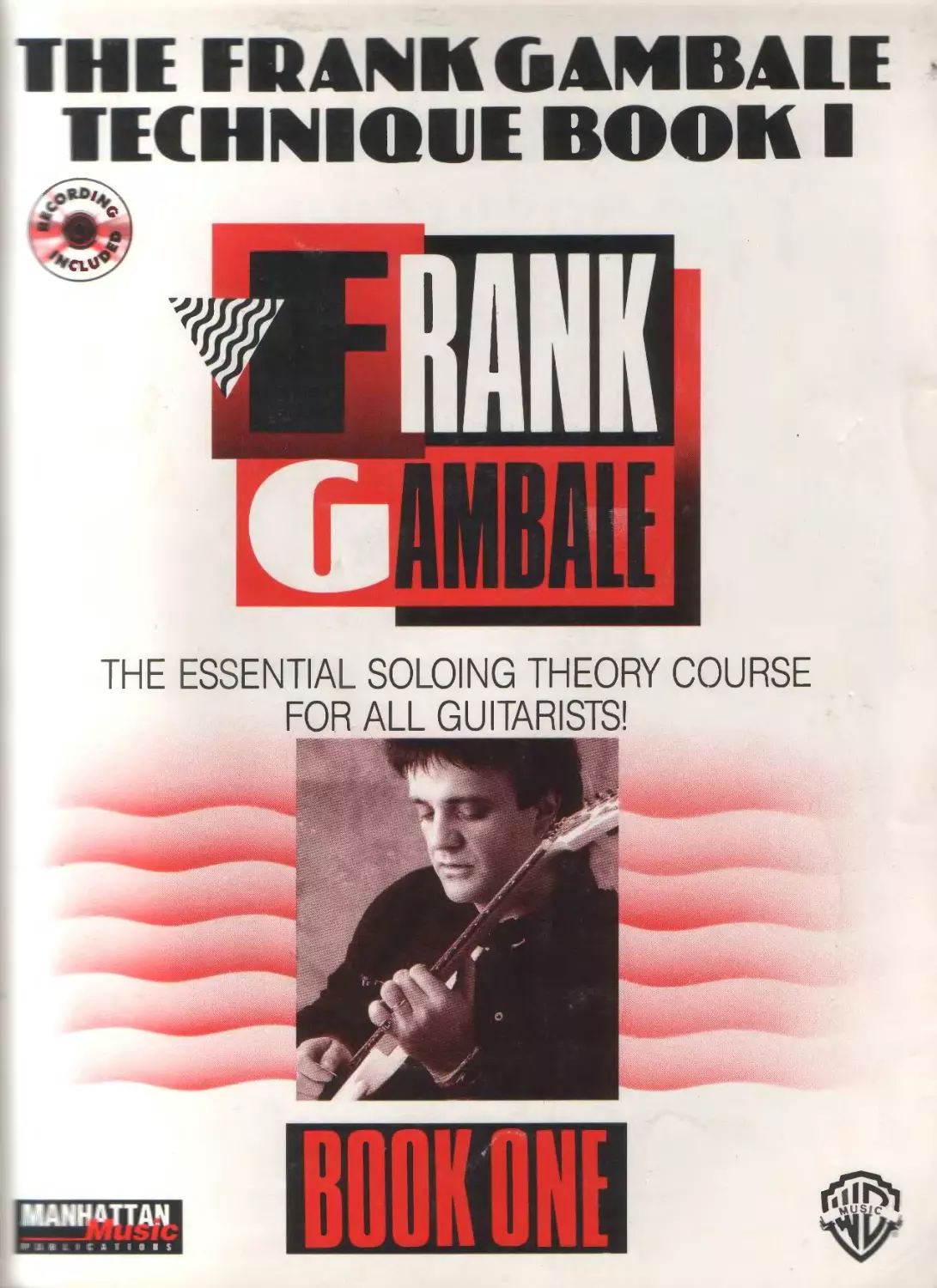
                    THE ERANKGAMBAEE
TECHNIQUE BOOK I
THE ESSENTIAL SOLOING THEORY COURSE
FOR ALL GUITARISTS!
SOLOING CONCEPT
Ьгеак music down into six basic chord types, and their applicable scales (See Fig 1). Than
over each of the chord types I apply five soloing approaches for each applicable scale. The
possibilities for soloing over these chords are, therefore, greatly expanded.
This book covers the second and third approaches for chord type 4 and all approaches for
chord types 5 and 6.
CHORD TYPES
(and applicable scales)
1 MINOR 7
1a Dorian
1b Aeolian
2	MAJOR 7
2a Major
2b Lydian
3	UNALTERED DOMINANT 7
3a Mixolydian
3b Lydian b7
4	ALTERED DOMINANT 7
4a Super Locnan
4b Diminished 1/2 / wno e
4c Phrygian major
5	MINOR 7 (b5)
5a Locrian
5b Aeolian b5
5c Locrian nat6
6	DIMINISHED
6a Diminished whole /12
6b Super Locrian na:6
APPROACHES
1	SCALE*
(7 or 8 notes)
2	PENTATONICS & BLUES
(5 & 6 notes)
3	ARPEGGIOS
(4 notes)
4	TRIADS
(3 notes)
5	INTERVALS
(2 notes)
* Approaches 2 through 5 are
denved from the applicable
scale chosen for soloing
approach 1.
SOLOING CONCEPT
- • music down into six basic chord types, and their applicable scales (See F»g 1) Тъ©<-
- ^ach of the chord types I apply five soloing approaches for each applicable scale Tne
t es for soloing over these chords are therefore, greatly expanded.
= rook covers all the approaches for soloing over chord types 1 through 3 and the mos*.
cant approaches for chord type 4. In Book II, I will cover the remaining approaches to*
- 2 *ype 4 and all approaches for chord types 5 and 6
C HORD TYPES
ЗГ a applicable scales)
1 MINOR 7
1 a Dorian
1	b Aeolian
2	MAJOR 7
2a Major
2b Lydian
3	UNALTERED DOMINANT 7
3a Mixoiydian
3b Lydian b7
4	ALTERED DOMINANT 7
4a Super Locrian
4b Diminished 1/2/whole
4c Phrygian major
5	MINOR 7 (b5)
5a Locrian
5b Aeolian b5
5c Locrian nat6
6	DIMINISHED
6a Diminished whole /1/2
6b Super Locnan nat6
APPROACHES
1	SCALE*
(7 or 8 notes)
2	PENTATONICS & BLUES
(5 & 6 notes)
3	ARPEGGIOS
(4 notes)
4	TRIADS
(3 notes)
5	INTERVALS
(2 notes)
* Approaches 2 through 5 are
denved from the applicable
scale chosen for soloing
approach 1
1
О AFTER t MNOF 7 CHORDS
~ -	- ways to treat a mm7 chord
As a c*c'd - a rr.a.or key, or as a VI chord
la Mm7 as a II chord: the chord = 1 b3 5 b7 (9 11 13);
the scale to use is Dorian mode =1 2 b3 4 5 6 b7 =
mode II of major.	(9)	(11) (13)
(see appendix if you need an explanation of modes.
1b Mm7 as a VI chord: the chord = 1 b3 5 b7 (9 11 ЫЗ);
the scale is Aeolian mode (also known as natural minor)
= 1 2 b3 4 5 b6 b7 = mode VI of major
(9)	(11) (ЫЗ)
Example: Dmin7 can be a II in C major
Cmaj7	Dmin7	Emin7	Fmaj7
I	II	III	IV
G7 Amin7
V VI
Bmm7 (b5)
VII
ora VI in F Major.
Fmaj7 Gmm7 Amm7	Bbmaj7 C7
I II III IV	V
Dmin7
VI
Emin7 (b5)
VII
Compare these two scale approaches and you can see that the chords differ by only one
note nati3 over mn7 (Dorian) versus ЫЗ over min7 (Aeolian). The modes differ by one
rote nat6 in Dorian versus b6 in Aeolian. Of course. 6 = the same note as 13; b6 = the same
te as ЫЗ or #5 So the pentatonics, arpeggios etc , that we use over Dmin7 which contain
a В 6 or 13 of D) will be specifically Donan. Those which contain a Bb (b6 or #5 or ЫЗ of D)
• be specifically Aeolian. And there are some which contain neither a 6 nor a b6; these are
common to both Donan and Aeolian.
F -s* -e tai-e a look at the Dorian scale over min7.
2
CHORD TYPE: Min7
APPROACH: DORIAN SCALE
Min7 chord as a II in major: use Dorian mode = mode II of major = 1 2 b3 4 5 6 b7
EXAMPLE:
Dmin7: use D Dorian = mode II of C major = DEFGABC.
Э Dorian needs to be learned in the following manner all over the neck:
Knowing the intervals that are being played is very important; knowing where the 5 of D is,
where the b7 of D is etc. Remember, Dorian means 1 2 b3 4 5 6 b7 from any root
Learn Dorian in other keys as well.
EXAMPLE:
Amin7; use A Dorian = mode II of G major = 1 2 b3 4 5 6 b7 from A= A BC D E F#G
3
Now, let's see what the other approaches offer us. given the choice of the Dorian mode
CHORD TYPE: Min7
APPROACH:	Donan Pentatonics/Blues
The second approach is pentatonics/blues. To see which ones are available, we need to
look at the harmonized scale of Cmaj (since our example, Dmin7, is being treated as a II in
C).
Cmaj7	Dmin7	Emm7	Fmaj7	G7	Amin7	Bmin7(b5)
I II HI IV	V VI	VII
M nor pentatonics (1 b3 4 5 b7) and minor blues (1 b3 4 b5 nat5 b7 ) can be extracted
from the minor 7 chords (II III and VI) of any major scale Therefore, we have Dmin, Emm,
and Amin pent/blues which can all be played over Dmin7 since they are all related through
‘he harmonized scale Emin pent/blues is specifically Donan because it contains a В
(6o*D).
•.; л as far as pentatonics and blues go, Dmin pentatonics and Dmin blues played over
Dm -' are okay, but sound a little too ordinary. Combining the other two pentatonics or blues
Ervr and Amm) with Dmin pent/blues creates a fresher sound.
FORM JLA: To transpose this to other keys: min pent/blues from root,[up] whole step or [up]
'-Z~	root
Ex, 3 Dinin pentatonic over Dmin7
Ex, 4 Emin pentatonic over Dmin7
Ex. 5 Amin pentatonic over Dmm7
5
’ 'ее mm pentatonics (Dmin, Emin, Amin) over Dmin7.
Wt-iJ-h
The following examples are written out with the intervals as they affect the Dmin7.
Example: Emin pent = 1 b3 4 5 b7 from E = E G A В D = 2 4 5 6 1 of D Dorian.
Also, writing out the whole neck frees you up to select any fingenng or position for these
ideas.
6
Ex. 7 D Min Pent
Ex. 8 E Min Pent
Ex, 9 A Min Pent
Ltol £)			b	7 b	3									t	7
		1	)				ь	> Ji				4	!	J
3 f-	□7 1	3	c	p J	i	3 /	i				3 2	b	7			J |
								6
5 ‘L	® -	I °	7	к	i	5 *	; (	p 1	t	?. 5	?	5 J	: C	p	. b	7 J	LJ5
			b	3
7					7 <		!	! T	(	?	7	i	» !	5 (	)
bL	_n £3			г b	7					b	7			i	L-^7
9					9		d	2		9			<	I
	4!. b	7 b	3 J	L®	C					5 J		)	1. ь	7	к	L®
	1
12	5 (l	) J			12 .	J	• c	5		f 12	> ;	i c	> ‘		2
"3			b	7b	3									b	7
		c				J	i :	i ;>				✓	«
15 -F	by b	3		} J	15 z					I	15 i	b	7			ъ
								i i
17 'L	©J	1 b	7		>	17 5	> 4		i	1 !	>	17	!	J		I b	7 J	> 5
			b	3		1	u					7
7
CHORD TYPE: Min7
APPROACH:	Dorian Arpeggios
The next aporoach is arpeggios.
Example: Dmin7
Wha: s Dmin7? 1 b3 5 b7 from D = D F A C
I rarely play a Dmin7 arpeggio over Dmin7 because it sounds frightfully dull, chaps! But there
is a remedy and it’s quite simple, really. Let's extend the chord up to 9 and toss out the 1.
/b3 5 b7 & = ^ F A С E = Fmaj7
Now, if you play an Fmaj7 arp over a Dmin7 chord, you sound automatically Нке George
Benson; it’s much hipper. We’re now playing b3 5 b7 9 which is creating a Dmin9 sound
without us bothenng to play a D note. FORMULA: maj7 arp [up] b3.
Okay that was a good idea. Such a good idea, in fact, that we're going to do t again,
except this time we'll extend to 11
/0 5 b7 9 11 = X/ A C E G
This time we’re left with A С E G which is Am n7; this arp sounds terrific over Dmin7.
FORMULA: min7 arp [up] 5th. Let's listen.
Ex, 11
Amin7 arpeggio over Dmin7.
8
These are my first two choices for attacking a min7 chord with arpeggios.
Now let’s look at the rest of the harmonized scale. ALL DIATONIC ARPEGGIOS SOUND
GREAT over Dmin7. Let s listen to ail of them.
Cmaj7 Dmin7 Emm7 Fmaj7 G7 Amin7 Bmin7(b5)
Ex. 12	Diatonic arpeggios from Cmaj over Dmin7 (cascading effect).
	Loco		1
KT—		—	 *	'J- Cmij7 Bmin7b5 Amin? G7 —ni}., ten., ft to.,	 U		_		Fmaj7 Emn7 DTiin7 Cma;7 	—		1
Here’s a pattern for learn ng one-octave arps mov.ng ьр or down m 4ths (this is a very
""us cal way to practice them).
Ex. 13	Diatonic arpeggio’s in 4ths over Dmin7 chord
Cma7 G7	Dmh7 Am п7 Вт1п7Ь5 Emin7 Amin7 Dmm7
9
Б с i3 со nt.)
APPROACH: Dorian Triads
\ow let's look at the triad approach.
ALL DIATONIC TRIADS from D Dorian (Cmajor) sound good over Dmin7. But the best effect
ocmes from using the diatonic MAJOR triads. Major triads are found on I, IV and V in every
- a or key. In C, that's C. F and G. FORMULA: maj triads [down] whole step, [up] min 3rd.
jo] 4th. G triad over Dmin7 is specifically Dorian because it contains a В (6 of D). Let s
sten to each of these triads over Dmin7.
C *r ad (my favorite) = С E G = b7 9 11 of D.
C triad gives you the upper extensions of a Dmm7 chord. Simply think Df this formu a maj
"ad [down] whole step.
10
Fmaj triad = F A С = ЬЗ 5 b7 of D. This triad is th© same as Dmin7 without the D. This
sounds okay; just re-defining the chord without saying anything new.
Gmaj triad = GBD = 11,13, root of Dmin7. Of the major triads, this one is the least related
to the chord. It has a very interesting sound, very suspended or unresolved. The tnck to
making these triads sound good is to mix them all up.
Learn triads on each group of three strings; G В E, DG B, A D G, E A D, horizontally do.*, n
the neck n 1 4 5 motion. Let's listen
Ex, 15 C TRIADS
EX, 16 F TRIADS
Ex. 17 G TRIADS
11
IV. V TnadsfromCmajon DG&B strings.
12
I, IV, V Triads in Cmaj on A, D & G stnngs.
Ex, 21 C TRIADS Ex, 22 F TRIADS
E2U23 G TRIADS
13
I, IV, V Triads in Cmaj on E, A & D strings.
Ex, 25 F TRIADS	Ex, 26 G TRIADS
14
Mote that you should hear these triads as they affect the Dmin7 chord. They sound hip
gainst the chord, but ordinary by themselves
Let’s listen to this triad exercise which incorporates our next subject as well, two-stnng triads.
-x 27 Two string triads from Cmaj over Dmin7
3.
2
С G F С
F G С п
лП * »*? V -Птпт
G F С
Лутлй*-Е
\‘ow, let’s look at two-string triads as opposed to the three-stnng triads
Ex 28 C TRIADS
15
Variation, 2-string triads
CHORD TYPE: Min7
APPROACH: Dorian Intervals
Any intervals can be chosen. I find 3rds, 4ths, 5ths and 6ths to be the most useful and
musical, so let’s examine those.
D atonic 3rds (using the notes of D Dorian «the same notes as C major): C - E, D - F, E - G,
F - A, G - В, A - С, В - D.
Le: s sien to these over Dmin7.
16
zx. 34
Dmin7
Diatonic 3nds from Cmaj.
-> 35	Dmin7	3rds on the E & В strings only.
*—fr—0 36~5-a-7 It)-8—
atonic 4ths: these sound more angular, oriental almost. Let's listen, first separately, then
rouble stops.
Dmin7

4ths as a Scale.
Dmm7
4ths on the E & В stnngs only
i6--IG )u Ч п В |5	ц 12 fg
18

Dmin7
5ths on the E & В strings
£_Л1
Dmin7
Sixths diatonic to Cmaj on the E & G strings only.
19
It f >
Yog should be beginning to see how many possibilities there are when approaching a
s ~p e m n7 chord The min7 chord (Dorian) has so many possibilit es because every note of
Donan mode sounds good against it; there are no ’’avoid'’ notes.
. &n you hear good improvisers, you can tell how well versed they are. They'll play a
-rase that goes up a minor pentatonic, comes down an arpeggio, up again in 4th intervals
"□ oown again with a diatonic triad; you get the picture An intelligent soloist includes many
approaches or colours. That's how one can tell how long and hard that person has
 jdied music and the instrument
Sz summing up this section on min7 (Dorian), we can see that there are certain formulas that
a ways work and always sound good against any mm7 chord
SUMMARY:
FORMULAS FOR SOLOING OVER MIN7 (DORIAN) IN ANY KEY.
Scale Donan = mode II of major = 1 2 b3 4 5 6 b7 (9 11 13)
2 Pentatonics/Blues from root, [up] whole step, [up] 5th
3 Arpeggios: all diatonic arps, especially maj7 [up] min 3rd. mm7 [up] 5th
- P ads: all diatonic triads, especially the major triads which are [down] whole step, [up]
mm 3rd, [up] 4th.
5 Intervals: diatonic 3rds, 4ths, 5ths, 6ths
New I’ll select just one of my personal favorites from each category, really simplifying.
* Scale. Dorian
2 Pentatonic/Blues: min pent.-'blues [up] 5th
3 Arpeggio: maj7 [up] min3rd
•i Tnad maj [down] whole step
5. Intervals 4ths
So over Gmin7 for example, using the above formulas we arrive at the fol owing*
* Scale: G Donan » mode II of Fmaj = 1 2 b3 4 5 6 b7; from G = GABbCDEF
2 Pentatonic/Blues Dmin pent (D FG A C) or Dmin blues ( D F G Ab Anat C)
3 Arpeggio’ Bbmaj7 arp (Bb D F A)
- Tnad Fmaj
5 Intervals: 4ths diatonic to G Dorian - G-C, А-D, Bb-E etc.
'  '7 chord progressions to practice
20
Ex 42
D mm?
F mln7
fib min7
В min?
A Dorian
C# Dorian
Г mln7			c mtn7
			fl 	J
E Dor an	C Dorian
Now, some musical examples Diatonic 3rds in Cmaj over Dmin7.
Ex, 44	"CAT PAUSE"
EX. 45	"CAT SNEEZE" (adapted from progression in Ex. 42)
Dmm7 (D Dorian)
21
Ex. 45 con't
АЬгтмп7 (Ab Donan)
£ - n7 (B Dor an)
Make up your own melodies from the formulas discussed in the Dorian chapter over the
sample chord progressions, examples 42 and 43
22
CHORD TYPE: Mn7
APPROACH: Aeolian Scale
Min7 chord as a VI in major: use Aeolian mode ( mode VI of major) =1 2 b3 4 5 b6 b7
Aeolian is also known as natural minor.
and VI of any major scale,
played over Dmin7.
Example: Dmin7: use D Aeolian = mods VI of Fmaj = D E F G
A Bb C. You may sometimes see a min7(#5) chord indicate
Dmin7(#5) = D F Bb C. (It may also be written Fsus/D or
Bb/D.) Remember that #5 = b6. So you can see that this
chord would fit the Aeolian mode (which has a b6) and not the
Dorian (which has a nat6). Other than when a min7(#5) chord
is indicated, if you choose to use the Aeolian approach for a
min7 chord, the b6 note will generally be used as just a
passing tone, as it’s a bit dissonant; so just be careful with it.
Remember, Aeolian means 1 2 b3 4 5 b6 b7 from any
root. Learn Aeolian in other keys as well.
CHORD TYPE: Min7
APPROACH: Aeolian Pentatonics/Blues
Our example is Dmin7 (Aeolian) = VI of Fmaj. So we need to
look at the harmonized scale of F major.
Fmaj7	Gmin7	Amin7	Bbmaj7	C7	Dmin7	Emin7(b5)
I II III IV	V VI VII
Remember that minor pentatonics (1 b3 4 5 b7) and minor
blues (1 b3 4 b5 nat 5 b7) can be extracted from the II, III
From Fmaj, that's Gmin, Amin and Dmin pent/blues which can be
Dmin pent or blues sound good.
Amin pent or blues sound good.
Gmin pent or blues contains a Bb; so if a Dmin7(#5) chord is indicated, it sounds very good;
but if just a Dmin7 chord is indicated, be careful with it
Notice that Dmin pent/blues and Amin pent/blues were also in the Dorian approach to
Dmin7.
FORMULAS: min pent/blues from root and [up] 5th. Min pent/blues [up] 4th over a min7(#5)
chord.
23
CHORD TYPE: Mm7
A "BROACH: Aeolian Arpeggios
Z - -7 - 1 b3 5 b7 from D = D F A C.
As :«‘ore, let’s extend Dmin7 to find some more interesting arps to play.
t-3 5 b7 9= FACE = Fmaj7
5 07 9 11= ACEG = Amm7
’ ~-se two arps sound great over Dmin7. Note that these are the same arps we arrived at
-en extending Dmin7 tn the Donan mode.
C  oe again, the only difference between Dorian and Aeolian is the 6 (13) is nat in Dorian and
•a* n Aeolian. Therefore, we have to extend further to discover an arp which is specifically
Aez an (includes а Ь6 = Ь13).
b7 9 11 Ь13 = С E G Bb « C7
rs sten to this over Dmin7.
C7 arpeggio over Dmin7
- a^ps d atonic to Fmaj sound good over Dmm7.
Fma ’ Gmin7 Amin7 Bbmaj7 C7 Dmin7 Emin7(b5)
Let's listen
24
Ex 48
~'DS over Dmm7 that are specifically Aeolian:
3~>n7 = G BbDF=11 ЫЗ 1 b3 of Dmin7.
“Cnaj7 = Bb D F A = ЫЗ 1 b3 5 ofDmin7.
?" = С E G Bb = b7 9 11 ЫЗ of Dmin7.
E~n7(b5) r E G Bb D = 9 11 ЫЗ 1 ofDmm7.
~“2t leaves three which are common to both Dorian and Aeolian:
"- = 7 = F A С E = b3 5 b7 9 of Dmin7.
--п7 = AC E G = 5b7 9 11 ofDmin7.
n7 = D F A C = 1 b3 5 b7 of Dmin7.
?-ORD TYPE: Min7
-“PROACH: Aeolian Tr ads
E ~iple: Dmm7= VlofFmaj.se we need to look at the harmonized Fmaj scale.
"-aj7 Gmin7 Amin7 Bbmaj7 C7 Dmin7 Emin7(b5)
* z atonic triads will work over Dmm7, especially the major triads, found on I, IV and V of
- 2 z r In F, that's F, Bb and C.
. - з sten to these three triads over Dmin7
25
: - " ad is specifically Aeolian [good over Dmm7(#5)J
C and F tnads are common to both the Aeolian and Dorian approaches to Dmin7.
FORMULAS: maj triads [down] whole step, [up] min3rd. Also maj triad on [up] b6 (Aeolian
c-ry).
CHORD TYPE: M n7
APPROACH: Aeolian Intervals
3 ds. 4ths, 5ths, and 6ths all work fine. You can use the interval examples (Ex. 34-41). but
2 .=• an Amin7 VI chord instead of Dmm7.
') U. . iM <*) *1
_ RMULAS FOR SOLOING OVER MIN7 AS VI IN MAJOR (AEOLIAN) IN ANY KEY
Scale Aeolian
Pent Blues: min from root [up] 4th, [up] 5th
-'oeggios: all those diatonic to Aeolian, especially maj 7 [up] mrn3rd, min7 [up] 5th
Tnacs all those diatonic to Aeolian especially, major tnads [down] whole step, [up]
"3rd. [up] min 6th.
t ntervals: 3rds, 4ths. 5ths, 6ths.
26
’ЛY FAVORITES:
• Scale: Aeolian
2	Pent/blues: mm [up] 5th
3	Arpeggio: maj7 [up] min3rd
- Triad: [down] whole step
5	Interval: 3rds.
Progressions to Practce (Aeolian)
Ex, 50
A Aeolian throughout
Ex 51
D Aoolian throughout
Ex 53
Amin7
"STICKMAN"
(based on Ex 50)
27
CHAPTER II: MAJOR 7 CHORDS
‘4ow let's move on to the maj7 chord A lot of people have a hard t me making a maj7 sound
c esy, a la Carlton. Some of the mysteries will unfold with the help of our little systematic
a oproach.
_ jst as a min7 chord can be treated in two ways, as a II in major (Dorian) or as a VI in major
Aeolian), the maj7 chord can also be approached in two different ways:
28
2a Maj7 as a I chord in major the chord =1 35 7 (9 11 13); the scale to use
is Major =1 234567 = mode IV of major
(9) (11) (13)
2b Maj7 as a IV chord in major: the chord = 1 3 5 7 (9 #11 13); the scale to
use is Lydian mode = 1 23 #4 567 = mode IV of major
(9) (#11) (13)
Example: Cmaj7 can be I in C major
	Cmaj7 1	Dmin7 II	Emin7 III
or IV in G major
	Gmaj7	Amin7	Bmin7
	1	II	111
Fmaj7	G7	Am 17	Bmin7(b5)
IV	V	VI	VII
Cmaj7	D7	Emm7	F#mm7(b5)
IV	V	VI	VII
Ex, 54
You can see that the chords differ only by the 11,
a r ch is nat11 over a maj7 chord as I. and #11
о .er a rr.aj7 chord as IV. The scales differ only by
•*r.e nat 4 n the Major scale versus the #4 in the
L.dian mode. (4 = 11 #4 = #11.)
Let’s look first at maj7 as a I (Major Scale).
CHORD TYPE: Maj?
APPROACH: Major Scale
Ua 7 chord as a I.
e :he Major scale = 123456 7.
Example:
?T.aj7 as a I in C:
use. Crr.aj scale = CDEFGAB.
1234567
Cmaj Scale
					3
		F	5
3 «		J J	1	J	! !>
				г
5 (		! I			5 6
					I
7 1		5		>	 r
		1		1
9
2 !			) *

i2 :	5 <		> «		г 3
4					J 4

is :> 6				J	I !>

17 S	> i	[ «			i T
				4	—
29
CHORD TYPE: Maj7
APPROACH: Pentatonics/Blues
For Cmaj7 as I in C, we need to look at the harmonized C Major scale.
Cmaj7
Dmin7 Emin7 Fmaj7 G7 Amin7 Bmin7(b5)
II III IV V VI VII
Tne minor pentatonics and blues can bo extracted from the II, III and VI of the Major scale. In
' that’s Dmin, Emin and Amin.
Let’s Listen.
56,
Emin pentatonic over Cmaj7
Dkay - Dmin pent sounds awful, so we avoid it.
Amin sounds only okay.
Em n sounds the best of these three
a- n and Emin pent are common to both the Major and Lydian approaches to maj7 because
rey contain no 4 or #4 of C.
FORMULA: Mm pent/blues [up] 3rd, [up] 6th.
30
?-ORD TYPE: Maj7
~ BROACH: Major Arpeggios
- “ext approach is arpeggios.
-*” = 1 3 5 7 = С E G В
3 5 7 9 « E G В D = Emm7
L sten
Emin7 Arpegqio overCma]7
Ел *' =~ s good over Cmaj7 Now the next extension is 5 7 9 11. There is a problem
li tr& - *1 4) doesn't sound good over a maj7. You're better off using the Lydian
tuz : the higher extensions since the #11 sounds better than the nat11. (The 4 or 11
Бшг " massing).
TO=’ LA ~ r7 arp [up] 3rd
31
CHORD TYPE: Maj7
APPROACH: Major Tnads
Example: Cmaj7 as I of C. The three major triads, I, IV and V, in C are C, F and G.
>/er Cmaj7, C triad sounds just okay*
F doesn't sound any good*
G sounds very good
FORMULA: maj triad [up] 5th.
'Note that C and F triads sound better when used over a Cmaj chord with no 7 and all three
sound great over a C bass.
Ex. 59	G maj triad over Cmaj7
CHORD TYPE: Maj7
APPROACH:	Major Intervals
3rds, 4ths, 5ths and 6ths all work fine. To practice, play exercises 34-41 over a Cmaj7 Chord.
SUMMARY:
FORMULAS FOR SOLOING OVER MAJ7 AS A I CHORD (MAJOR SCALE}.
1.	Scale: Major = 1 2 3 4 5 6 7
2.	Pentatonic/Blues: min [up] 3rd, min [up] 6th.
3.	Arpeggios: min7 [up] 3rd
4.	Triads: maj [up] 5th
5.	Intervals: 3rds, 4ths, 5ths, 6ths.
MY FAVORITES:
1.	Scale: Major
2.	Pentatonic/Blues: min [up] 3rd
3.	Arpeggio: min7 [up] 3rd.
4.	Triad: maj [up] 5th
5.	Intervals: 6ths.
32
Sc 'or Dmaj7 as a I in D, using the above formulas we get...
* Scale: Dmaj = D E F#G ABC#
2 Pent/Blues: F#min
3 Arp: F#min7
- Tnad: Amaj
5 Intervals: 6ths diatonic to Dmaj.
33
Maj7 chord as a IV in major, use the Lydian mode =1 2 3 #4 5 6 7 = mode IV of major
Example: Cmaj7 as a IV. C is IV of G
Gmaj7 Amin7 Bmm7 Cmaj7 D7 Emin7 F#min7(b5)
I II III IV V VI VII
C Lydian = 1 2 3 #4 5 6 7 from C « C D E F# G A В «the same notes, same harmonized scale
as G major.
Any maj7 (#11) chord is Lydian.
Don't be thrown by a maj7(b5) chord Remember, b5 = #4, so this fits into the Lydian
aoproach.
CHORD TYPE: Maj7
APPROACH: Lydian Pentatonics/Blues
Example: Cmaj7 (Lydian)
0 Lydian is mode IV of Gmaj so let s look at the harmonized Gmaj scale
Gmaj7
I
Amin 7
II
Bmin7
III
Cmaj7
IV
D7 Emin7 F#min7(b5)
V VI VII
-ember, that the minor pent (1 b3 4 5 b7) and minor blues (1 b3 4 b5 nat 5 b7) can
extracted from II. Ill and VI of major. Therefore, in C Lydian = Gmaj, we have Amin. Brin
and Emin pent or blues which can be played over Cmaj7.
s listen.
34
Ex-61
Влгп Pentatonic over Cmaj7
Ex, 62 Combination Emin and Bmin Blues over Cmaj7
Amin sounds only okay.
Bmin and Emin both sound very good.
Bmin pent or blues over Cmaj7 is specifically Lydian because it contains an F#.
So the gist is, over a Cmaj7 you can play an Emin pent/blues (FORMULA: min pent/blues
[up] 3rd) whether you’re using the Major or Lydian approach. Use a Bmin pent/blues
(FORMULA: min [down] 1/2 step) if you wish to play specifically Lydian.
CHORD TYPE: Maj7
APPROACH: Lydian Arpeggios
Cmaj7= 1 3 5 7 = CEG В
Let’s extend.
3579 = EG0D» Emin7
Emin7 arp is very good over Cmaj7. FORMULA: min7 arp [up] 3rd.
5 7 9 #11 = G В D F# = Gmaj7
7 9 #11 13 = В D F# A = Bmin7
These sound good too. Gmaj7 and Bmin7 played over Cmaj7 are specifically Lydian
because of the #11 (#4).
35
- ca:onic arpeggios from Lydian work fine.
FORMULAS: maj7 arp [up] 5th, min7 arp [down] 1/2 step.
Ex, 63 Gmaj7 over Cmaj7 chord	Bmin7 over Cmaj7 chord

CHORD TYPE: Maj7
APPROACH: Lydian Triads
All triads, diatonic to C Lydian (same notes as Gmaj) sound good over Cmaj7. Let’s examine
*ne major triads, which are found on I, IV and V of major In Gmaj, that’s G, C and D
G triad over Cmaj7 sounds very good. FORMULA: maj triad [up] 5th
C sounds just okay.
C sounds very good FORMULA: Maj tnad [up] whole step
D tnad over Cmaj7 is specifically Lydian because of the F# (#11 of C).
Ex. 64 Dmaj tnad over Cmaj7 chord
CHORD TYPE: Maj7
APPROACH: Intervals
3rds, 4ths, 5ths and 6ths diatonic to Lydian (mode IV of major) all sound great
For practice, play Ex. 34-41 over a Fmaj7 chord (IV in Cmaj)
36
SUMMARY:
FORMULAS FOR SOLOING OVER MAJ7 (LYDIAN)
1 Scale: Lydian = 1 2 3 #4 5 6 7 = mode IV of major
2 Pent/blues: mm [up] 3rd, [down] 1/2 step, [up] 6th.
3 Arpeggios: All diatonic arps, especially min7 [up] 3rd, maj7 [up] 5th, mm7 [down] 1/2 step
4 Triads: All d.atonic triads, especially maj [up] 5th, maj [up] whole step
5 Intervals: 3rds, 4ths, 5ths, 6ths.
MY FAVORITES:
1	Scale: Lydian
2	. Pent/blues: [down] 1/2 step
3	Arp: min7 {down] 1/2 step
- Thad: maj [up] whole step
5 Interval: 6ths
So over Amaj7, using the above formulas, we get1
- Sea e A Lydian = A В C# D# E F# G# = mode IV of Emaj
2 Pent/blues’ G#min
3 Arp: G#min7
- Tnad: В
5 interval: 6ths diatonic to A Lydian
CHORD PROGRESSIONS
i__22
R maj7	C moj7	Eb maJ7	Gb maJ7
A major or A lydian C major сг C lydlan Eb та;ог or Eb lydian Gb major or Gb lydian
			U.Wu}7				BL iuuj7	1	^4	' ’ j
D major		Bb lydlan

G major
С Гус an
37
COMBINATIONS (CHAPTER 1 & 2)
	1—ft	п 1/		Г. ГП1П7 ' 					-I
					£	b|
13	G major	G dorian
Ex. 69
	fl FTTJ I7 “	—			ЕТТТТП7—

17	A major		E dcr.an	г		 ~~ n
	n mn n	 				Ь ' Ct ГТНП7
				'	 - 4
21 D major	G dorian
EXJ59

г m Д 1 ~}				Г n । T n 7		 v

25	Е ma or		F dorian
г map	-		— у,	—
F dor an
29
F lydian
38
Ex, 70 A m Qj 7 "THE BUMBLE TREE” (Based on Ex. 68) Emin 7
39
CHAPTER 111: UNALTERED DOMINANT 7 CHORDS
Basically there are two types of unaltered dominant chords (unaltered meaning they contain
a nat9. not a b9 or a #9, and a nat5 or a b5 but not a #5):
3a Dominant sus4 or dominant 11 chords, as a V in major, contain a 4 or 11
instead of 3.
The chord: 1 4 5 b7 (9 11 13)
Examples (C root):
C7sus4 C9sus4 C11 C13SUS4 Bb/C Gmin7/C Bbmaj7.C
The scale to use with dominant sus4 chords is mode V of major = Mixolydian
= 1 2 3 4 5 6 b7
(9) (11) (13)
3b Lydian dominant chords: IV in melodic minor.
The chord: 1 3 5 b7 (9 #11 13)
(b5)
Examples: C7 C9 C13 C7(b5) C9(b5) Bbmaj7(#5 C C9(#11)
The scale to use with Lydian dominant chords is the Lydian flat seven mode, which is mode
IV of melodic minor =1 2 3 #4 5 6 b7
(9) (#11) (13)
When the extensions aren't specified on a dominant chord (for example, when only C7 is
indicated) and it doesn't function as a V moving to I (for example, the next chord after the C7
is not F or Frr.jn), this is the best type of chord and scale to use.
Compare these two approaches and you can see that the only difference between the scales
is nat4 in Mixolydian vs. #4 in Lydan flat seven. 4 = 11, #4 = #11.
So, the nat4/nat11 relates to the Mixolydian dominant and the #4/#11. relates to the Lydian
b7 dominant. Some chords cou d be treated as either sea e. For instance. C7. C9 arc C13,
do not specify the character of the 4th or 11th.
Now, let's look at the possibilities within Mixolydian and Lyd anb7 separately.
CHORD TYPE: Dominant 7 Sus 4
APPROACH:	Mixolydian Scale
Use MIXOLYDIAN Mode = 1 2 3 4 5 6 b7 (9) (11) (13) = mede V of major.
40
EXAMPLE: C7sus4 as V in major.
F major = FGABbCDEFGABb etc.
Mode V of Fmaj = C Mixolydian = CDEFGABb

C Mixolydian scale over C7 sus 4 chord


10 У

CHORD TYPE: Dominant 7 Sus 4
APPROACH:	Mixolydian Pentatonics/Blues
For C7sus4: use C Mixolydian a mode V major (F)
HARMONIZED F Major scale = Fmaj7 Gmin7 Amin7
Bbmaj7 C7 Dmin7 Emin7b5.
Remember that minor pentatonics/blues can be built on
the II, III and IV degrees of the major scale. So for F
major, Gmin, Amin and Dmin pentatonics/blues can be
played over C7sus4 (or any other Mixolydian chord
listed at the beginning of the chapter).
FORMULA: minor pentatonics/blues [up) 5th, (up] 6tn cr
[up] whole step.
Let’s Liston.
41
Ex. 73
Gmin pentatonic over C7sus4
CHORD TYPE: Dominant 7 Sus4
APPROACH:	Mixolydian Arpeggios
CII-1 5 b7 9 11
(in a dominant 11 chord, the 3 is omitted because it clashes with the 11).
/ 5 b7 9 11 =/G Bb D F = Gmin7
/X b7 9 11 13 = Bb D F A = Bbmaj7
These two arps sound good over dominant sus4 chords because they are the most closely
related.
42
FORMULA: min7 arp [up] 5th, maj7 arp [down] whole step.
ALL OTHER DIATONIC ARPS IN F MAJ (C MIXOLYDIAN) SOUND GOOD OVER C
DOMINANT SUS CHORDS.
» 76	Gmin7 arpegg.o over C7 sus4
Ex 77	Bb maj7 arpeggio over C7 sus4
Ex 78	Diatonic arpeggio’s from Fmaj over C7 sjs4
43
CHORD TYPE: Dominant 7 Sus 4
APPROACH:	Mixolydian Triads
С М xolyd an is mode V of F major The three maj'or triads (I, IV, and V) of F are F, Bb and C
Let’s listen to these over C7sus4
Ex $0
Bb triad over C7 sus4
£ u-f 1		-		L—			 	23Z^Z

|T	& g—.ЛО—iv иг—£,— Я 	—	=d	1 --y- 3	_	—-	=1
44
They all sound good All other diatonic triads in F major work well too
FORMULAS: Major triads [up] 4th, [down] whole step and from the root.
CHORD TYPE: Dominant 7 Sus 4
APPROACH: Mixolydian Intervals
3rds 4ths 5ths 6ths all work nicely.
Let’s listen.
Ex 62	Diatonic 3rds in C Mixolydian (Fmaj) over C7 sus4
45
Ex. .83 con't
Ex, 85 Diatonic 6ths in C Mixolydian over C7 sus4
46
SUMMARY:
FORMULAS FOR SOLOING OVER DOMINANT 7 SUS 4 CHORDS. (MIXOLYDIAN SCALE)
1.	Scale = Mixolydian
2.	Pent/blues minor [up] whole step, [up] 5th, [up] 6th.
3.	Arpeggios = min7 [up] 5th, maj7 [down] whole step (all diatonic arps to related ma or
scale)
4.	Trads = [up] 4th, [down] whole step, root.
5.	Intervals = 3rds, 4ths, 5ths, 6ths.
MY FAVORITES:
1.	Mixolydian
2.	M nor pent/blues [up] whole step
3.	Maj7 arp [up] 4th.
4.	Major triad [up] 4th
5.	6ths.
Using these formulas over E7sus4 =
1.	E Mixolydian = 1 2 3 4 5 6 b7 = mode V of A major (E F#G#ABC#D).
2.	Minor pent/blues [up] whole step = F#
3.	Maj7 arp [up] 4th = Amaj7.
4.	Major triad [up] 4th = A.
5.	6ths diatonic to A major
CHORD TYPE: Lyoian Dominant
APPROACH: Lydian b7 Sca'e
Nov; let's look at Lyd’an dominants.
1 3 5 b7 9 #11 13 (#11 = b5=#4)
Our example will be C9 The scale to use on Lydian dominants is Lydian b7, 1 2 3 #4 5 6
b7. Th s scale is Mode IV of Melodic minor scale.
eg. C9 = chord IV of G melodic minor
G melodic minor = 1 2 b3 4 5 6 7 (9) (11) (13)= G A Bb C D E F#
Mode IV = C D E F# G A Bb = C Lydian b7 (Lydian moans raised 4[#4]; Lydian b7 =
major scale with #4 and b7).
47
CHORD TYPE: Lydian Dom nant
APPROACH: Lydian b7 Pent/b ues
HARMONIZED MELODIC MINOR SCALE
Gmin (Maj7) Amin7 Bbmaj7#5 C7 D7 Emin7b5
F#min7b5
There is one minor pentblues in melodic minor, at the
2nd degree
C9 = C Lydian b7 = G melodic m nor. 2nd degree of G
melodic minor = A. Therefore, A minor pent/blues is
possible
FORMULA = min pent/blues [down] mm 3rd from chord.
Let's Listen
Ex, 88 Amin Pent over C9
48
CHORD TYPE: Lydian Dominant
APPROACH:	Lydian b7 Arpeggios
C7 = 1 3 5 b7. Let’s extend. 1 3 5 b7 9 = С E G Bb D = Emin7b5
5 b7 9 #11 = G Bb DF# = Gmin(maj7).
b7 9 #11 13 =Bb D F# A = Bbmaj7#5
FORMULAS: min7b5 arp [up] 3rd, mm (maj7) arp [up] 5th, maj7#5 arp [down] whole step
ALL DIATONIC ARPS OF G MELODIC MINOR SOUND GOOD OVER C LYDIAN
DOM NANTS. Let’s listen.
Ex 69 Emm7b5 arpeggio over C9
Ex, 90 Gmin(maj7) arpeggio over C9
'Note: Key s gnature for 9 melodic minor has all B’s flat, all F’s sharp
49
Diatonic arps in C Lydian b7 (Gmel min) over C9
CHORD TYPE: Lydian Dominant
APPROACH: Lydian b7 Toads
First we’ll look at major triads. There are two major triads in melodic m nor. They are on the
4th and 5th degrees. Our example chord is C9 = C Lydian b7 = G melodic minor 4th and
5th degrees of G melodic minor are C and D. Let’s listen to C and D major loads over C9.
50
FORMULA: MAJOR TRIADS from ROOT and [up] whole step
All diatonic triads in G melodic minor sound good over C Lydian dominant chords.
Ex. 94	Diatonic triads from C Lydian b7 over C9
Ex, 95	C Lydian b7 in triads over C9
CHORD TYPE:
APPROACH:
Lydian Dominant
Lydian b7 Intervals
3rds and 6:hs are useful in melodic m nor (the 4th and 5th intervals are almost all augmented
and diminished 5ths) So for our purposes we'll just use 3rds and 6ths in melodic
minor).
51
El 36
Diatonic 3ras in C Lydian b7 over C9
Ex. 97	Diatonic 6ths in C Lydian b7 over C9
SUMMARY:
FORMULAS FOR SOLOING OVER LYDIAN DOMINANTS (LYDIAN b7 SCALE)
1.	Scale: Lydian b7.
2	Pent/blues: [down] min 3rd
3	Arpeggios: Min7b5 [up] 3rd. Min(maj 7) [up] 5th, Maj7#5 [down] whole step.
(All diatonic arps of related melodic minor scale).
4.	Tnads:from root and [up] whole step
5.	Intervals: 3rds and 6ths
MY FAVORITES:
1. Lydian b7 scale
2. Minor pent/blues [down] min3rd
3. Maj7#5 arp [down] whole step
4. Major triad [up] whole step
5. 3rds.
Ex 98	Chord Progressions
Bb mixolydian	Bb |yd;an b7
52
Ex. 99 г- 11	 		L—L		Bb/C 	4		—J —	Db/Eb -  —	4_	,	F/6 -, ч ——	HI
		C mixoiyoian	3		Eb mi xo lydian	G mixolydian	—11
Ex 1	00 j—	г a —			- ~rn 1 т	—
	C lycian b7				Eb lydian b7
		Г7			i	Г 1 X
A lydian b7	F lyd an b7
Ex, 1 QI
	<				n?			ГТ
	C lyd.an b7 F"P		F lycian d7	C lydian b7 	nf
	F lyd.an b7		 —	C lydian b7
	42 	(Г7Т				i’ii	i
	E mixelydlan		V V	 1 C lydian b7
	пг*т	!			ПГ77П

г mixo ydian	Eb lydian b7
	fik m-1				 r 5
U U LU _	-	-	- -	.4	—. /7
В lydian b7
Eb mixelydlan
53
Ex.103.	COMBINATION PROGRESSIONS
i		Г-1ПИ j 7—			гтгУт	—		. z
C major 	rrmrrtm		F mixolydian
Bb dorian	!r» 		SLi*.		 1	.—У»	41 Db lydian b7
faLlOl
	L-:	Rmin7- —		L--,.wc	—		 -4^-
	A dorian		C mixolydian
	k-IUOjZ					B-b 44		. _ Z- —   11
F major	Ob lydian b7

	" Г ГТПП7			r°

	E donan  г rrrrm  —		C lydian b7 	Г7Т7
E dorian 	nrvm				G mixolydian h	D ГПгП7 —
E dorian		— - Z t. .	В major/В lydian	'	-- 'll
54
ЕзОДб.
"Playing Му Dx - 9 Tri’ ion" (based on Ex. 98)
Fmaj7	•/.
I 3-ds In F major __I |_ 4ths & 3rds in F

55
CHAPTER 4: ALTERED DOMINANT CHORDS
There are three main scale approaches for altered dominants Super Locrian (7th mode of
Melodic Minor), Diminished (half whole from root), and Phrygian Major (5th mode of
Harmonic Minor).
Melodic minor will be the final topic for this book The Frank Gambale Technique Book II will
continue where this book leaves off.
CHORD TYPE: Altered Dominant
APPROACH: Super Locrian (Melodic Minor) Scale
The most common scale used over altered dominant chords is the SUPER LOCRIAN. This
scale begins on the 7th degree of the melodic minor scale. An altered dominant means a 7th
chord with an altered (# or b), 9 or 5 or any combmat on.
The chord we will use for our purposes is E7#9. The scale will be E Super Locrian which =
7th mode of F Melodic minor. F Melodic minor = F G Ab Bb C D E. E Super Locr an = E F G
AbBbCD=1 Ь2 ЬЗ 3 b5 #5 b7 (b9) (#9) (#11) (ЫЗ).
FORMULA: On altered dominant chords play Super Locrian from the root or play melodic
minor [up] 1/2 step from the root of the chord
Ei W8
£~SuperLocrian (F*meiodic minor) overE7#^T
56
CHORD TYPE: Altered Dominant
APPROACH: Super Locrian Pentatonics/B»ue$
There is one minor pentatonic In melodic minor
starting on the 2nd degree. E7#9 - E Super Loera- =
F Melodic Minor. 2nd degree of F Melodic Minor is G.
FORMULA: Minor pentatonic [up] min 3rd from altered
dominant.
Let’s listen to G minor pentatonic over E7#9 (Ex. 110).
CHORD TYPE: Altered Dominant
APPROACH: Super Locrian Arpeggios
HARMONIZED F MELODIC MINOR. Fmin(maj7)
Gmin7 Abmaj7#5 Bb7 C7 Dmln7b5 Emin7b5. All
these arpeggios sound great over E7 alt.
Let's look a little closer to see which are the most
closely related. Dmin7b5 =1 b3 b5 b7 = D F Ab C.
If we play this arp over E, and rearrange the notes of
Dmin7b5 (D = b7 of E. F = b9 of E, Ab - 3rd of E, C =
#5 of E), we get E Ab(G#)CDF-1 3 #5 b7 b9 =
E7#5o9 = (Dmin7b5/E bass).
Ex. 110 Gmin pentatonic over E7#9
57
Ex. 111
Dmin7 b5 arpeggio over E7#9
The Dmin7b5 is the most closely related chord to E7alt. Let's list all the diatonic arps of F
melodic minor and see how they each affect E7#9
Fmin(maj7)
Gmin7
Abmaj7#5
Bb7
C7
Dmin7b5
Emin7b5
= F Ab С E = b9 3 #5 R of E
- G Bb D F = #9 b5 b7 b9 of E
= AbC E G = 3 #5 R #9 of E
= Bb D F Ab - Ь5 b7 b9 3 of E
= С E G Bb - #5 R #9 b5 of E
= D F Ab C = b7 b9 3 #5 of E
= E G Bb D = R #9 b5 b7 of E
All these arpeggios affect the altered chord differently and they are all useful sounds Let’s
listen to all of these.
Ex, 112 Fmin (maj7) Arpeggio over E7 #9
Ex, 113 Gmin7 arpeggio over E7#9
Ex. 114	Abmaj7#5 arpeggi ,/ rm  w	о over E7#9	Г-Н	1
T	7~7Г77"|ЧЧЗ;					 L*u^= ~-я-			bj s ' ’J  Н-Ю--ЛО-
Ex, 115 Bb7 arpeggio over E7#9
7	—я 6 Ч = -Н-Ь 4 	 —
Ex, 116 C7 arpeggio over E7#9
59
CHORD TYPE: Altered Dominant
APPROACH: Super Locrian Tnads
In a melodic minor scale there are two major triads. They appear on the 4th and 5th degrees
E7#9 = F melodic minor. 4th and 5th degrees of F are Bb and C
FORMULA: Major tnads (up] b5 and [up] #5 from the root of the altered chord.
Let's listen to Bb and C major triads over E7#9
Ex, 118	Bb triads over E7#9 chord
Ex. 119
Cmaj triads over E7#9 chord
60
Ex, 120 D atonic Triads from E Super Locrian over E7#9 chord
CHORD TYPE: Altered Dominant
APPROACH: Super Locrian Intervals
3rds and 6ths. Let's listen.
Ex, 121
Diatonic 3rds from E Super Locrian over E7#9 chord.
Ex, 122	Diatonic 6ths from E Super Locrian over E7#9
61
SUMMARY:
OF ALTERED DOMINANT
1.	Scale: Super Locrian
2.	Pent/ blues: [up] min 3rd
3.	Arpeggios: Min7b5 [down] whole step (all diatonic arps)
4.	Maj triads:[up] b5 and [up] #5
5.	Intervals: 3rds and 6ths
MY FAVORITES:
1.	Super Locrian scale
2.	Min pent/blues [up] min 3rd
3.	Maj 7#5 arpeggio [up] 3rd
4.	Maj triad [up] #5
5.	3rds
Ex, 123
Progressions
	•	11 m. a v-*. Л					t		i 1
	!	 rf	1ггттт r			1	.-! I
A dorian
E super locnan
Ex. 124
	i—h min i		— no

A donan
D lydian b7
	f ma]7	—			о			~	ill
					u
F lydian	E super locrian
62
bU.25
Northbourn© Ave" (Based on Ex 124)
63
EDITOR’S NOTE: On the accompanying cassette, Frank indicates that the Tech Book II
will include sections on slash chords and modes. Though Frank had
originally intended to include these topics, he later decided to
save them for future projects. The Tech Book 11 is now on sale
and details the second half of Frank’s soloing theory course.
64
APRfNPIX
Terminology used in this book.
INTERVALS
I refer to intervals by numbers in this manner:
1	= the root of a scale or chord
b2 = minor 2nd interval (half step)
2	= major 2nd (whole step)
b3 = minor third
3	о major third
4	= perfect fourth
#4 e augmented fourth
b5 = diminished fifth
5	= perfect 5th
b6 = minor 6th
6	 major 6th
b7 = minor 7th
7	= major 7th
b9  minor ninth (same note as b2, up an octave)
9 » major ninth (same note as 2, up an octave)
#9 = augmented ninth (same note as b3, up an octave)
11 = perfect eleventh (same note as 4, up an octave)
#11 = augmented eleventh (same note as #4, up an octave)
Ы 3 = minor thirteenth (same note as b6, up an octave)
13 = major thirteenth (same note as 6, up an octave)
It is very important to be aware of enharmonic equivalents (different spellings of the same
note). For example, G# = Ab, D# = Eb, etc. Also In Intervals: #4 - b5. #5 = b6, etc. And
also in octave equivalents: 2 = 9 (e.g. the 2 of a C scale is D. The 9 of a 09 chord is D.) b2 =
Ь9, b3 = #2 = #9, 4 = 11, b5 « #4 = #11,6 = 13, #5 = b6 = b13.
OTHER NOTATION
I use the notation [up] and [down] for “up a" and "down a", respectively. So, "mel min [up] 1/2"
means play the melodic minor scale up a half step (from the chord being discussed).
THE MAJOR SCALE
All major scales are made up of these intervals from the root. (W means whole step, 1/2
means half step):
from root
2\y3xy4\y5x/ 6	7^/1
W W 1/2 W W W 1/2
65
So in the key of Cmajor =
1	2	3	4	5	6	7	1
C\z D>/Ev F\/G\/A\/Bx/C
W W 1/2 w w w %
You'll notice that the major scales other than C require the use of sharps or flats to maintain
the right interval relationships. For example, the A major scale:
1	2	3	4	5	6	7	1
A^ B^C#vD
W W 1/2 W W W %
THE HARMONIZED MAJOR SCALE
There are many chord s that can be constructed from the major scale. Let me show you how
we arrive at them.
The notes of the C major scale are:
1	234567123456
CDEFGABCDEFGA
8 9	10 11 12 13
Chords are made up basically in ascending diatonic 3rds, every other note of the scale.
(DIATONIC means using only the notes of the given scale So when referring to diatonic
3rds, some will turn out to be major 3rds and others will be minor 3rds.)
If you start on the 1st degree (root) of the scale, C, and build a 4-part chord by selecting every
other note...
you have С E G B, = Cmaj7 = the I (one) chord in C.
If you begin on the 2nd degree, D, and build a 4-part chord by selecting every other note ...
You get D F A C = Dmin7 = the II Chord in С. E G В D = Emin7 =lll in C, and so on. The
list of four-part chords arrived at in this manner is the Harmonized C Major Scale.
Harmonized C major scale:
Cmaj7 Dmin7 Emin7 Fmaj7
I II III IV
G7 Amin7 Bmin7(b5)
V VI VII
Harmonized A major scale:
Amaj7 Bmin7 C#min7 Dmaj7 E7
I II III IV	V
F#min7 G#mm7(b5)
VI VII
66
Notice that since all major scales are constructed of the same intervals, 1 2 3 4 5 6 7 from
root, the chord types on each degree remain the same in all major keys.
TRIADS: in all major keys,
the I, IV and V triads are major (13 5 from root of triad)
the II, III and VI triads are minor (1 b3 5)
the VII triad is diminished (1 b3 b5)
FOUR-PART CHORDS: In all major keys,
the I and IV chords are maj7 (1 3 5 7)
the II, III and VI chords are min7 (1 b3 5 b7)
the V chord is dominant (13 5 b7)
the VII chord is min7(b5) (1 b3 b5 b7)
Although I generally write down just the 4-part chords when listing the harmonized scale, it is
very important to keep in m nd what the diatonic extensions (contnuing up In diatonic 3rds to
the 9 or b9 or #9,11 or #11,13 or Ы 3) would be.
For example, the IV chord in C would be:
c	D	E	0	G	A	В	C	0	E	F	G	A	В	C	D
			1	2	3	#4	5 I	6	7		9		#11		13
1 3 5 from F = F triad |
1357 from F = Fmaj7
13579 from F = Froaj9
1 3 5 7 9 #11 from F = Fmaj9(#11)
1 3 5 7 9 #11 13 from F « Fmaj13(#11)
Notice that 9 of F = the same note as 2 of F, #11 = #4,13 = 6. The diatonic extensions
available on each scale degree also remain the same in every major key.
In all major keys:
I maj7 (9 11 13)
II min7 (9 11 13)
III mm7 (b9 11 ЫЗ)
IV maj7 (9 #11 13)
V7 (9 11 13)
Vlmin7 (9 11 ЫЗ)
Vllmin7(b5) (b9 11 ЫЗ)
67
'•‘ODES OF THE MAJOR SCALE
"3  -sc ’'eory, th© major scale is always used as a reference to determine another
sea e s r.terval structure. Modes of major can be compared to major in two ways: as
atera: oos of a major scale (taking a major scale and raising or lowering certain notes by 1/2
sseps) or as inversions of a major scale (taking a major scale and playing a 7-note scale by
smarting on a degree other than 1 of the major scale). I want you to be aware of both ways.
V. e -se C as a root for our examples of modes.
DORIAN as an inversion: DORIAN IS MODE II OF MAJOR.
Example: In C Dorian, C is 2 of Bb, so....
C Dorian is mode II of Bb major, (has the same notes as Bb
major, starting on 2).
Dorian is like a major scale with b3, b7.
PHRYGIAN IS MODE III OF MAJOR
Example: In C Phrygian, C is 3 or Ab, so.
П Ab Major C Phrygian
1 2 3_ 4 5 6 7 1 _2
C Phrygian is mode III of Ab major.
Phrygian is like a major scale with Ь2, b3, b6, b7
68
LYDIAN IS MODE IV OF MAJOR
Example: C Lydian . C is 4 of G, so
л G Major
C Lydian

1234567123
Lydian is like a major scale with a #4.
MIXOLYDIAN IS MODE V OF MAJOR
Example: C Mixolydian. C is 5 of F, so
л F Major
C Mixolydian
1 2 3 4 5 6 7 1 2 3 4
C Mixolydian is mode V of F major.
Compared to major of the same root:
AEOLIAN (also known as natural minor) IS MODE VI OF MAJOR.
Example: C Aeolian. C is 6 of Eb, so
л Eb Major
C Aeolian
123456712345
C Aeolian is mode VI of Eb major.
Compared to major of the same root:
л C Major
C Aeolian
1 2 3 4 5 6 7
1 2 b3 4 5 b6 b7
9	11 ЫЗ
Aeolian is like a major with b3, b6, b7.
69
LOCRIAN IS MODE VII OF MAJOR
E • i-: « C Locrian. C s 7 of Db. so.
1 2 3 4 5 6 7 1 2 3 4 5 6
C Locrian is mode VII of Db major.
Compared to major of the same root:
Locrian is like a major scale with Ь2, b3, b5, b6, b7
SUMMARY OF THE MODES OF MAJOR
(mode I = major) = 12 3 4	5	6	7
mode II = Dorian = 1 2 b3	4	5	6 b7
mode 111 = Phrygian  1 b2	b3	4	5 Ь6 b7
mode IV = Lydian «12 3	#4	5	6 7
mode V = Mixolydian = 12	3	4	5 6 b7
mode VI = Aeolian = natural minor = 1 2 b3 4 5 b6 b7
mode VII = Locrian = 1 Ь2 b3 4 b5 b6 b7
70
MODES - MAJOR
C Major
1 2 3 4 5 6 7
(9) ИО (13)
C Dorian
1 2 b3 4 5 6 b7
(9)	(11) (13)
C Phrygian
1 Ь2 b3 4 5 b6 b7
(b9)	(11) (b13)
4	1				h -	I
		? :	J (
3 J		5 <	I		! !
				f
5 (		t «	> d	5	5
				4	I
7		; t		>
G				i
9	I I		f ;
	> «	> d			> 1	>

12 ;	f J	> :	» «			J
					) '
		7 :	5 J
15 '		) *	t		2 •

17 <	• >	> «	f 1	г
				4
			'Id
					n
3 J	 c	p	. b-		> !i
				b	5
5 f	। :	> I			6
b-	7 b	5		4	I b?
7			-
<г	p	tr	r b^	! !	IO
9
9	> 5	! 1	) <	1 J	1!
b	3			b	7 b;{
12			> «	)
4	г b1			1 <	11
			J
15	!	i (j	-	t b	7 :	2 !»
				Б	3
17 1	 ft *				)
b	7 bp				1 b?
	r b	5 °	5 I	Я
			b.	2
з О		, b	7	::
bj b	2		b
5	i	; <!	2 J
b? b	5 bi	I b		i bf
7
Фи	1 b-	т b	5 I	L®
9 b?			b	t b;>
1	L®J		J
cr "W GT	Э b	2	b	г-ЬЛ-, dQ
12		t
b	7 b;	5 b	5 G
			b	2
15 ? Q	)	» b	7
ьГ&	2		b;	5 b5
17	I	’ 4
bfT	3 bl	j t	2j	b7
71
MODES MAJOR
C Lydian
1 2 3 #4 5 6 7
(9) (#11) (13)
C Mixolydian
1 2 3 4 5 6 b7
(9) (11) (13)
C Aeolian
1 2 b3 4 5 b6 b7
(9)	(11) (ЫЗ)
	i b	7b:	> b	5 (J) -		1

з !	i d		: b	7 1	> J
b	5			b	5 й
5	J	> J	! c
b	?h	5 b	J	4	L ь	г
7			J	>
		. b	7 b		5 1
9	r			b	5
4	> к		j i	I	Л	!
b	3 b			b	1 b:	J
12		1	Z !
	r b	7 b	5 bi		p -	1
				1
15 •	• <	5	1 b	7	’ !	j
b	j			b	5 b(
17	J	! I	i c	5
b	7 b	"W er	5	j	4	F 6	7
72
MODES MAJOR
C Locnan
1 Ь2 b3 4 b5 b6 b7
(b9)	(11) (ЫЗ)
	i ь	7 k	5 6> 6
b			ь	ь >
3	J	p J	b 7
	6 b.	2 b	5 b	3 ь5
5			CO
b'	Г b:	5 bi	b2 .	1 by
7			b	5
q		» b-	’ bj	C )
9	&	2 b	5	t	6 b?
			S1
b	5 bJ	I Ь	I b5 b	7 b3
12
j	гb	r b	s bf, J
b!	>		b	2b5
15	Ф 		1 bf
b	5 ь	2 b	5 b	? b6
17			Ф
b	7 Ь	5 ь	5 b2 -I	1 b 7
73
THE MELODIC MINOR SCALE
The melodic minor scale is made up of these intervals:
from root:	1 \/2\/ьз V4 V^V 6 V7\/1
from each other: W V2 W W W W 1/2
The melodic minor scale is like a major scale with a b3
For example, C melodic minor is C D Eb F G A B.
THE HARMONIZED MELODIC MINOR SCALE
In all melodic minor scales, the harmonized scale is.
I min(maj7) (9 11 13)
II min7 (b9 11 13)
Illmaj7 (#5) (9 #11 ЫЗ (nat.]13)
IV 7 (9 #11 13)
V7 (9 11 М3)
Vlmin7(b5) (9 11 ЫЗ)
Vl(min7(b5) (b9 #9 Ы1 =3 #11 ЫЗ)
For example, in A melodic minor (А В C D E F# G#), the harmonized scale is Amin(maj7)
Bmin7 Cmaj7(#5) D7 E7 F#min7(b5) G#min7(b5)
MODES OF THE MELODIC MINOR SCALE
Just as we arnve at modes of the major scale by playing seven-note scales, we can start on
different degrees and arrive at modes of the melodic minor by doing the same thing The
modes are given names which compare them to modes of the major scale The interval
structure is compared back to the major scale.
DORIAN FLAT TWO IS MODE II OF MELODIC MINOR.
Example: In C Dorian Ь2, C is 2 of Bb melodic minor, so ...
n Bb Melodic Minor__________________C Dorian b2 ___________________________
Д.1.	=
1 2 b3 4 5 6 7 1
C Dorian b2 is mode II of Bb melodic minor.
Compared to major of same root:
r. C Major C Dorian bZ
C Dorian bZ
2 3 * 5 6 7
T Ь2 b3 4 5 6 b7
b9 11	13
Dorian Flat Two Is like a major scale with Ь2, b3, b7.
74
LYDIAN SHARP FIVE IS MODE III OF MELODIC MINOR.
Example: In C Lydian #5, C is ЬЗ of A melodic minor, so...
n A Melodic Minor
C Lydian #5
4
J
1 2 ЬЗ 4 5 6 7 1 2
C Lydian #5 is mode II of A melodic minor.
Lydian Sharp Five is like a major scale with #4, #5.
LYDIAN FLAT SEVEN IS MODE IV OF MELODIC MINOR.
Example: In C Lydian Ь7, C is 4 of G melodic minor, so...
л G Melodic Minor C Lydian b7
1 2 ЬЗ 4 5 6 7 1 2 ЬЗ
C Lydian Ь7 Is mode IV of G melodic minor.
Compared to major of the same root
Lydian Flat Seven is like a major scale with #4, b7.
MIXOLYDIAN FLAT SIX IS MODE V OF MELODIC MINOR.
Example: In C Mixolydian Ь6, C is 5 of F melodic minor, so ...
Л F Melodic Minor .b-«-bx C Mixolvdian b6
1 2 ЬЗ 4 5 6 7 1 2 ЬЗ 4
C Mixolydian b6 is mode V of F melodic minor.
Compared to major of the same root
ft C Major________________________C Mixolydian Ьб
1 2 3 4 5 6 7
1 2 3 4 5 Ьб 1)7
9	11 ЫЗ
M xolydian Flat Six is like a major scale with b6, b7.
75
AEOLIAN FLAT FIVE IS MODE III OF MELODIC MINOR.
Example: In C Lydian Ь5. C is 6 of Eb melodic minor, so...
1 2 b3 4 5 6 7 1 2 b3 4 5
C Aeolian b5 is mode VI of Eb melodic minor.
Aeolian Flat Five is like a major scale with b3, b5, b6, b7.
SUPER LOCRIAN IS MODE VII OF MELODIC MINOR.
Example: In C Super Locrian, C is 7 of Db melodic minor, so ...
1 2 b3 4 5 6 7 1 2 b3 4 5 6
C Super Locrian is mode VII of Db melodic minor.
Compared to major of the same root
Super Locrian is like a major scale with Ь2, b3, b4, b5, b6, b7.
SUMMARY OF THE MODES OF MELODIC MINOR
(mode I « melodic minor) = 12 b3 4567
mode II = Dorian b2 = 1 Ь2 b3 4 5 6 b7
mode III = Lydian #5 = 1 2 3 #4 #5 6 7
mode IV = Lydian b7 = 1 2 3 #4 5 6 b7
mode V = Mixolydian b6 = 1 2 3 4 5 b6 b7
mode VI = Aeolian b5 = 1 2 b3 4 b5 b6 b7
mode VII = Super Locrian = 1 Ь2 ЬЗ Ь4 b5 b6 b7
76
MELODIC MINOR MODES
77
MELODIC MINOR MODES
C LYDIAN Ь7	C MIXOLYDIAN Ьб	C AEOLIAN b5
	b	1					I b	7	Б	5c	) 	1	1 b	7 b;	5 b	&-Ц	4
	1				*	к						b
3 !	> (	о	b		i !	)	3 J	c		1 b		«	3 )	q	)	b	‘"Г	LJ'
			1			Ь	5				b	5	Ь	6	bi	i-	b	5jjj
5 J		> ;	(	; *	- <	r 5		> :	i C	J :	J	5	/	>
b	7				b-	7	b-	r	b	5	1	b	Г	b	7 b	5 b	j	—rr~	1 by
7		► J	> :	г *	к	7	•		J	>		7				> b	5 1 '7= 4
d	s	b	7	*	i (1	5 d	5	гb	7	к	i d	s	Ла	b	7 b	5	о
9						9				I b	5	9	b	5		bi	5
4	► !	i C			г 1	>	J	► ;	> 0	Ь	1	4	> :	►	Q	J -	k		2
			*	L Ь	7		b	5		b	7	b	5 b	5	b	5 b	7_b?
12 :	> f	• 1	’ !			s 12 :			* 			i 12		1	I
	b‘	Г		J	s		I b	7	b		p 	I	гb	7 b	5 Ь	>	) ? F 'c
	к	-	5					•3		6 1		b	5				Ji’
15 !	> c		b	7 :	г '	1	15 !	i (	5 •	b	r 1	1	5	15			j b	7 J	>
		*	к			b	5				b	,	b j	j	b	5	b	lE?
17 4		>	;	i (1	i) :		r 17	J	! !	> c		»	17	4	•
b	7				b	7	b	7		5		1 b	7	b	7 b	5 b	5	4 D[7
78
MELODIC MINOR MODES
C SUPER LOCRIAN
79
PENTATONIC SCALES
The minor pentatonic scale is a five note scale made up of the intervals 1 b3 4 5 b7 (from the
root of the minor pentatonic scale). For example, Amin pent = A C D E G.
In the key of C major, CDEFGABCDEFG etc.... you can extract minor pentatonic scales
starting on II (D), III (E), and VI (A).
In С: II min pent= D FG A C
III min pent = E G A В D
VI min pent = AC DEG
It is true of every major scale that minor pentatonics can be extracted from If, III and VI (the
same degrees that produce minor 7 chords, if you remember from the section on the
harmonized major scale).
The major pentatonic scale is a five-note scale made up of the intervals 1 2 3 5 6. e.g., Cma;
pent = C D E G A.
In the key of C major, you can extract major pentatonics starting on I (С), IV (F), and V (G).
In С. I maj pent = C D E G A
IV maj pent = F G A C D
V maj pent = G A В D E
It is true of every major scale that you can extract major pentatonics from I, IV and V (the same
degrees that produce major triads).
Notice that the major and minor pentatonics are inversions of each other (contain the same
notes).
In С: I maj pent = C D E G A = same notes as VI minor pent = A C D E G
IV maj pent = FGACD = II minor pent  D F G A C
V maj pent = G A В D E = III minor pent = E G A В D
80
BLUES SCALES
The minor blues scales are six-note scales: the same notes as minor pentatonics, with the
add tion of b5. The intervals are 1 b3 4 b5 [nat ]5 b7.
In С: II minor blues = D F
III	minor blues = E G
VI minor blues = A C
G Ab Ajnat.)
A iBbl Bjnat.]
D gb] Ejnat]
C
D
G
Even though the b5’s of the minor blues scales are not in the major scale (for example, C
major does not contain Ab, Bb or Eb), the blues scale is such a strong sound that your ear will
accept the extra note with no problem, adding spice to the regular pentatonic sound. So any
time the minor pentatonics are appropriate, the minor blues may also be used.
The major blues scales are six-note scales, the same notes as the major pentatonics, with the
addition of b3. The intervals are 1 2 b3 (nat.]3 5 6.
In С: I major blues = C D Eb E[nat.j G A
IV	major blues = F G Ab Ajnat.] C D
V	major blues = G A Bb Bjnat.] D E
Notice that the major and minor blues are inversions of each other. (This is essentially the
difference between blues and country styles).
In С: I major blues = C D Eb Ejnat.] G A = VI minor blues = A C D Eb Ejnat.] G
IV major blues = F G Ab Ajnat.] C D = II minor blues = D F G Ab A[nat.] C
V major blues = G A Bb Bjnat.] D E = III minor blues = E G A Bb Bjnat.] D
Aga n, even though the b3’s of the major blues are not in the major scale, your ear accepts
them and so the major blues may be used any time the major pentatonics are appropriate.
Since the major pentatonics/blues scales contain the same notes as the minor penVblues,
the use of the minor is more common in contemporary pop, rock and jazz (the major
penVblues are used in country music). I refer only to the minor penVblues in this book and
leave it to you, if you want, to remember that the majors are available as well.
81
C MAJ PENTATONIC
C MIN PENTATONIC
C MIN BLUES
з
5
7
9
12
15
17
					3
					b'>
з !	i d	) J	Ь
		b.		b	5
5		i	i Ф
b	г b	5			* b?
7				b	5
c	Л	tr	r b;		L®
9		5
	к	i c
b	3		b	5 &	cr L^J
12			1
	1 b	’ b1			У
b	5				O’
15 1	i Q				_!>
			5	b	5
17
b		J	г		1 by
82
C MAJ BLUES
83
CD Tracking Information
1 Opening/Foreword
2 Soloing Concept
3 Examples 1-9
4 Examples 10-14
5 Examples 15-20
6 Examples 21-26
7 Examples 27-33
8 Examples 34-37
9 Examples 38-43
10 Example 44 (Cat Pause)
11 Example 45 (Cat Sneeze)
12 Examples 47-52
13 Example 53 (Stickman)
14 Examples 54-59
15 Examples 60-69
16 Example 70 (Bumble Tree)
17 Examples 71-75
18 Examples 76-78
19 Examples 79-81
20 Examples 82-85
21 Examples 66-88
22 Examples 89-92
23 Examples 93-95
24 Examples 96-105
25 Examples 106 (DX9-Tnllion)
26 Examples 107 (Fried Zucchini)
27 Examples 108-111
28 Examples 112-117
29 Examples 118-120
30 Examples 121-124
31 Examples 125 (Northbourne Avenue)