/
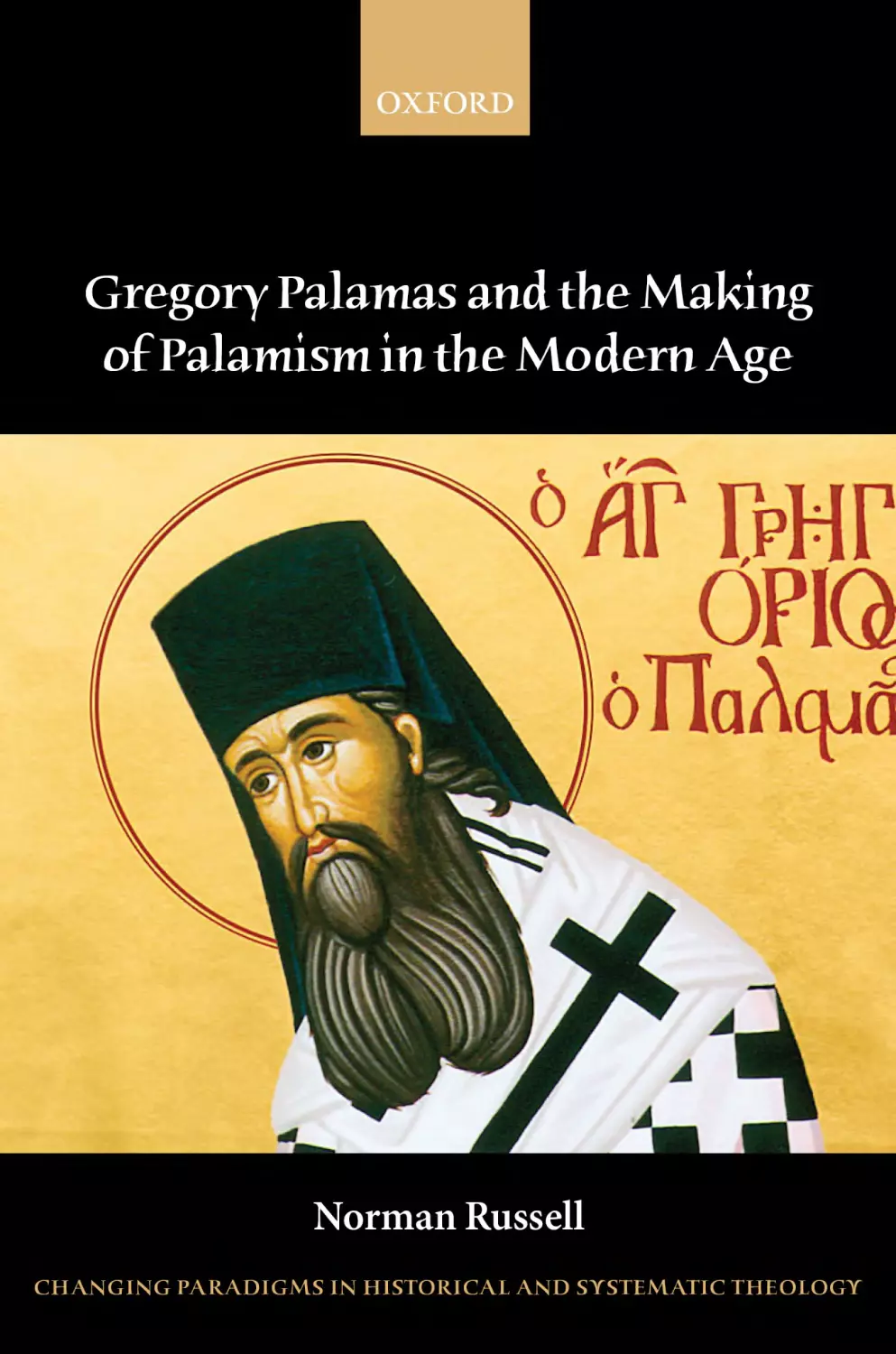















































































































Text
OUP CORRECTED PROOF – FINAL, 22/02/19, SPi
C HA N G I N G PA R A D IG M S I N H I ST O R IC A L
A N D SYS T E M AT IC T H E O L O G Y
General Editors
s arah c oakley ri c ha rd c ro s s
This series sets out to reconsider the modern distinction between ‘historical’ and
‘systematic’ theology. The scholarship represented in the series is marked by attention
to the way in which historiographic and theological presumptions (‘paradigms’)
necessarily inform the work of historians of Christian thought, and thus affect
their application to contemporary concerns. At certain key junctures such paradigms
are recast, causing a reconsideration of the methods, hermeneutics, geographical
boundaries, or chronological caesuras which have previously guided the theological
narrative. The beginning of the twenty-first century marks a period of such notable
reassessment of the Christian doctrinal heritage, and involves a questioning of the
paradigms that have sustained the classic ‘history-of-ideas’ textbook accounts of the
modern era. Each of the volumes in this series brings such contemporary methodological
and historiographical concerns to conscious consideration. Each tackles a period or
key figure whose significance is ripe for reconsideration, and each analyses the implicit
historiography that has sustained existing scholarship on the topic. A variety of fresh
methodological concerns are considered, without reducing the theological to other
categories. The emphasis is on an awareness of the history of ‘reception’: the possibilities
for contemporary theology are bound up with a careful rewriting of the historical
narrative. In this sense, ‘historical’ and ‘systematic’ theology are necessarily conjoined,
yet also closely connected to a discerning interdisciplinary engagement.
This monograph series accompanies the project of The Oxford Handbook of the
Reception of Christian Theology (Oxford University Press, in progress), also edited by
Sarah Coakley and Richard Cross.
OUP CORRECTED PROOF – FINAL, 22/02/19, SPi
C HA N G I N G PA R A D IG M S I N H I ST O R IC A L
A N D SYS T E M AT IC T H E O L O G Y
General Editors
SARAH COAKLEY
(Norris-Hulse Professor of Divinity, University of Cambridge)
and
RICHARD CROSS
(John A. O’Brien Professor of Philosophy, University of Notre Dame)
re c e n t se ri e s t i t le s
Kant and the Creation of Freedom
A Theological Problem
Christopher J. Insole
Blaise Pascal on Duplicity, Sin, and the Fall
The Secret Instinct
William Wood
Theology as Science in Nineteenth-Century Germany
From F. C. Baur to Ernst Troeltsch
Johannes Zachhuber
Georges Florovsky and the Russian Religious Renaissance
Paul L. Gavrilyuk
Balthasar on the Spiritual Senses
Perceiving Splendour
Mark McInroy
Knowledge, Love, and Ecstasy in the Theology of Thomas Gallus
Boyd Taylor Coolman
Prayer after Augustine
A study in the development of the Latin tradition
Jonathan D. Teubner
God Visible
Patristic Christology Reconsidered
Brian E. Daley, SJ
OUP CORRECTED PROOF – FINAL, 22/02/19, SPi
Gregory Palamas
and the Making of
Palamism in the
Modern Age
N O R M A N RU S SE L L
1
OUP CORRECTED PROOF – FINAL, 22/02/19, SPi
1
Great Clarendon Street, Oxford, OX2 6DP,
United Kingdom
Oxford University Press is a department of the University of Oxford.
It furthers the University’s objective of excellence in research, scholarship,
and education by publishing worldwide. Oxford is a registered trade mark of
Oxford University Press in the UK and in certain other countries
© Norman Russell 2019
The moral rights of the author have been asserted
First Edition published in 2019
Impression: 1
All rights reserved. No part of this publication may be reproduced, stored in
a retrieval system, or transmitted, in any form or by any means, without the
prior permission in writing of Oxford University Press, or as expressly permitted
by law, by licence or under terms agreed with the appropriate reprographics
rights organization. Enquiries concerning reproduction outside the scope of the
above should be sent to the Rights Department, Oxford University Press, at the
address above
You must not circulate this work in any other form
and you must impose this same condition on any acquirer
Published in the United States of America by Oxford University Press
198 Madison Avenue, New York, NY 10016, United States of America
British Library Cataloguing in Publication Data
Data available
Library of Congress Control Number: 2018961443
ISBN 978–0–19–964464–3
Printed and bound in Great Britain by
Clays Ltd, Elcograf S.p.A.
Links to third party websites are provided by Oxford in good faith and
for information only. Oxford disclaims any responsibility for the materials
contained in any third party website referenced in this work.
OUP CORRECTED PROOF – FINAL, 22/02/19, SPi
In memoriam
LOUIS BOUYER
(1913–2004)
OUP CORRECTED PROOF – FINAL, 22/02/19, SPi
OUP CORRECTED PROOF – FINAL, 22/02/19, SPi
Preface
Gregory Palamas has been so successfully cast as ‘the other’ in Western theological
discourse that it is difficult to gain a sympathetic hearing for him. This is not
surprising, as even some of his Orthodox contemporaries found his development
of a line of theology going back to Maximus, Dionysius and the Cappadocians
unconvincing, if not downright heretical. Palamas himself, however, had no
intention of constructing a new theological system. What he was claiming to
do was simply to bring out the implications of biblical and patristic teaching on
the nature of divine–human communion in response to those whose teaching
would make participation in the divine life either impossible or meaningless.
On the other hand, to regard him simply as the fourteenth-century spokesman
of conservative Orthodoxy, as some have done, would be mistaken. In this
study, besides reviewing the reception of Palamas since the fourteenth century
and his retrieval in the twentieth, I attempt to interpret Palamas’ thinking in
context, that is to say, in relation to the epistemological positions he was opposing: in his debate with Barlaam a radical apophaticism, in his bitter dispute
with Akindynos an insistence that God can only be known through created
things, and in his struggle with Gregoras a conviction that the route to the
knowledge of God lay through images created in the mind. In the course of
combatting these positions, Palamas develops a teaching on human participation in the divine life which was officially endorsed by the Orthodox Church in
1351 and, as I argue here, is not only compatible with the Western tradition but
can enrich it by offering another perspective on the nature of the Christian’s
participation in God.
When Sarah Coakley and Richard Cross invited me to contribute a volume
on Gregory Palamas to the ‘Changing Paradigms’ series, I responded with
enthusiasm. The work of Martin Jugie and John Meyendorff (as well as the
work of their successors) needed to be set in context if we are to get behind the
ideologies that have shaped modern Palamism and engage with Palamas himself. Recent work has resulted in the repositioning of Palamas in relation to the
intellectual currents of his age. A new paradigm has been emerging which calls
for discussion. Moreover, I had been aware for some time that my Doctrine of
Deification in the Greek Patristic Tradition (Oxford University Press, 2004),
while perhaps dealing adequately with the earlier Greek tradition, had not
done justice to the emphasis on the transformation of human life in the later
Fathers. Deification for the later Fathers, including Palamas, is more than a
metaphor. It is a sharing even in this life in the divine glory with which Christ
was transfigured on Mount Tabor. The present study has therefore given me
the opportunity to discuss the transfigurational element of divine–human
OUP CORRECTED PROOF – FINAL, 22/02/19, SPi
viii
Preface
communion more fully and to explore current efforts to appropriate Palamas’
teaching on it within the framework of his essence–energies distinction.
Living as I do in rural France, among the vines and pastures of southern
Burgundy, I have had to rely on the help of a number of friends and colleagues with easier access to scholarly libraries. I am particularly grateful to
Charalambos Dendrinos of Royal Holloway College, London, Dragos Dasca
of Iaşi, Fr Michael Lang of the London Oratory, and Br Richard of the
Monastery of Taizé, for making several important books and articles available
to me. I also owe a special debt of gratitude to Fr Antoine Lambrechts of the
Monastery of Chevtogne, who checked the material held in the monastery’s
archives on Kiprian Kern and translated a number of relevant passages into
French for me. Marie Meyendorff kindly responded to my enquiries regarding her late husband’s early studies in Paris. Linos Benakis, of the Academy of
Athens, generously sent me a copy of his collected studies. Fr Sergio Mainoldi
patiently answered my bibliographical queries. Marcus Plested, Oxford University
Press’s reader, read the entire manuscript and not only saved me from a number
of errors but made several valuable suggestions for improving its structure.
Some chapters were also read by Fr Samuel Nedelsky of the Holy Transfiguration
Monastery, Brookline, Massachusetts, and Daniel Keating of the Sacred Heart
Major Seminary, Detroit, Michigan, both of whom made significant contributions to improving the manuscript. With regard to the Russian material,
Fr Samuel not only sent me his unpublished translations of primary materials,
but also allowed me to benefit from his expert knowledge of the rich theological
ferment of late nineteenth- and early twentieth-century Russia. Daniel
Keating, the author of a superb book on the appropriation of divine life in
Cyril of Alexandria, proved a challenging conversation partner for the theological chapters of Part II, although he is not of course responsible for my final
judgements or for any remaining errors. I am deeply grateful to both of them.
Some portions of Chapters 2, 3, and 8 were previously published as ‘Inventing
Palamism’ in Analogia 3, issue 2 (2017), 75–96. I am grateful to the editor,
Fr Nikolaos Loudovikos, for permission to reproduce them here. I am also
grateful to Sarah Coakley and Richard Cross for their initial invitation to write
this book, and to Karen Raith and her team at Oxford University Press for their
patience during its long gestation and their invaluable technical assistance at its
final stages.
Finally, the dedicatee of this book, Fr Louis Bouyer, not only played a major
part in the twentieth-century retrieval of Palamas by Western scholars but also
encouraged my own early studies in the field. May his memory be eternal.
Ozenay, 71700 France
1 July 2018
OUP CORRECTED PROOF – FINAL, 22/02/19, SPi
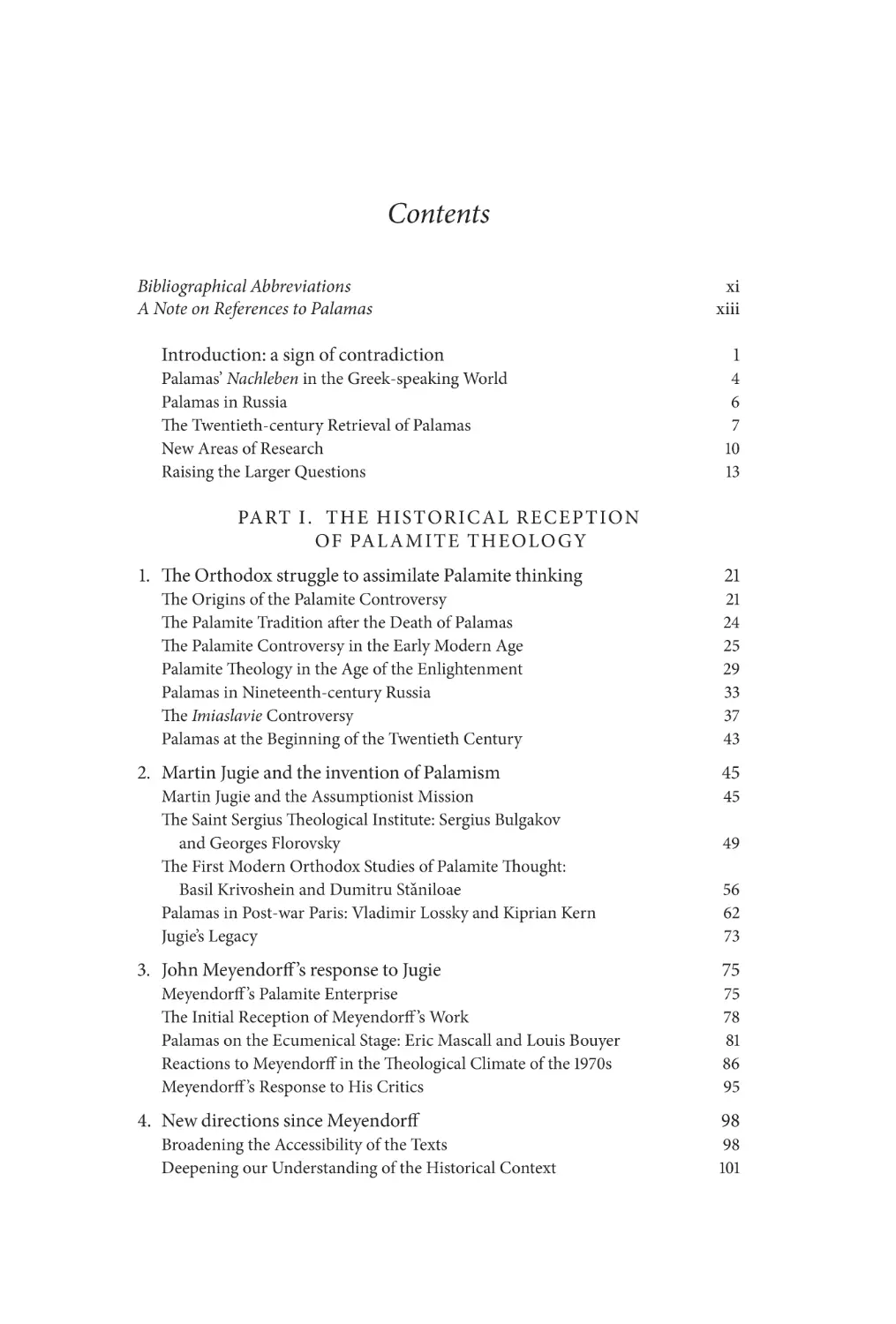
Contents
Bibliographical Abbreviations
A Note on References to Palamas
Introduction: a sign of contradiction
Palamas’ Nachleben in the Greek-speaking World
Palamas in Russia
The Twentieth-century Retrieval of Palamas
New Areas of Research
Raising the Larger Questions
xi
xiii
1
4
6
7
10
13
PA RT I . T H E H I S T O R IC A L R E C E P T IO N
O F PA L A M I T E T H E O L O G Y
1. The Orthodox struggle to assimilate Palamite thinking
The Origins of the Palamite Controversy
The Palamite Tradition after the Death of Palamas
The Palamite Controversy in the Early Modern Age
Palamite Theology in the Age of the Enlightenment
Palamas in Nineteenth-century Russia
The Imiaslavie Controversy
Palamas at the Beginning of the Twentieth Century
2. Martin Jugie and the invention of Palamism
Martin Jugie and the Assumptionist Mission
The Saint Sergius Theological Institute: Sergius Bulgakov
and Georges Florovsky
The First Modern Orthodox Studies of Palamite Thought:
Basil Krivoshein and Dumitru Stǎniloae
Palamas in Post-war Paris: Vladimir Lossky and Kiprian Kern
Jugie’s Legacy
21
21
24
25
29
33
37
43
45
45
49
56
62
73
3. John Meyendorff ’s response to Jugie
75
4. New directions since Meyendorff
98
Meyendorff ’s Palamite Enterprise
The Initial Reception of Meyendorff ’s Work
Palamas on the Ecumenical Stage: Eric Mascall and Louis Bouyer
Reactions to Meyendorff in the Theological Climate of the 1970s
Meyendorff ’s Response to His Critics
Broadening the Accessibility of the Texts
Deepening our Understanding of the Historical Context
75
78
81
86
95
98
101
OUP CORRECTED PROOF – FINAL, 22/02/19, SPi
Contents
x
Exploring the Thinking of Palamas’ Contemporaries
Investigating Palamas’ Philosophical Structures
Interpreting Palamas’ Theological Perspective
A More Nuanced Palamas
107
112
120
128
PA RT I I . R A I SI N G T H E L A R G E R Q U E S T IO N S
5. What does doctrinal development Mean?
133
6. How is a participatory understanding of the divine mystery
to be attained?
163
7. What is the reality of divine–human communion?
189
What is the Relation between Philosophy and Theology?
How is the Testimony of the Church Fathers to be Used?
What is the Relationship between Dogmatic and Mystical Theology?
How are Theological Disputes to be Resolved?
Conclusion
What is the Nature of Participation?
What is the Distinction between Ousia and Energeiai?
Can One Speak of a Higher and a Lower Divinity?
The Palamite Encounter with Aquinas
Conclusion
What is Grace?
How is Grace Appropriated?
The Vision of Light
Enhypostatic Existence
The Nature of Symbols
ΚΟΙΝΩΝΙΑ ΘΕΩΣΕΩΣ: The Nature of Divine–Human Communion
Conclusion
8. Could Palamas become ‘the inheritance of all Christians’?
Obstacles to the Reception of Palamas
Contrasting Methodologies
Palamas in Recent Debates
Two East–West Colloquia
Conclusion
Concluding reflections
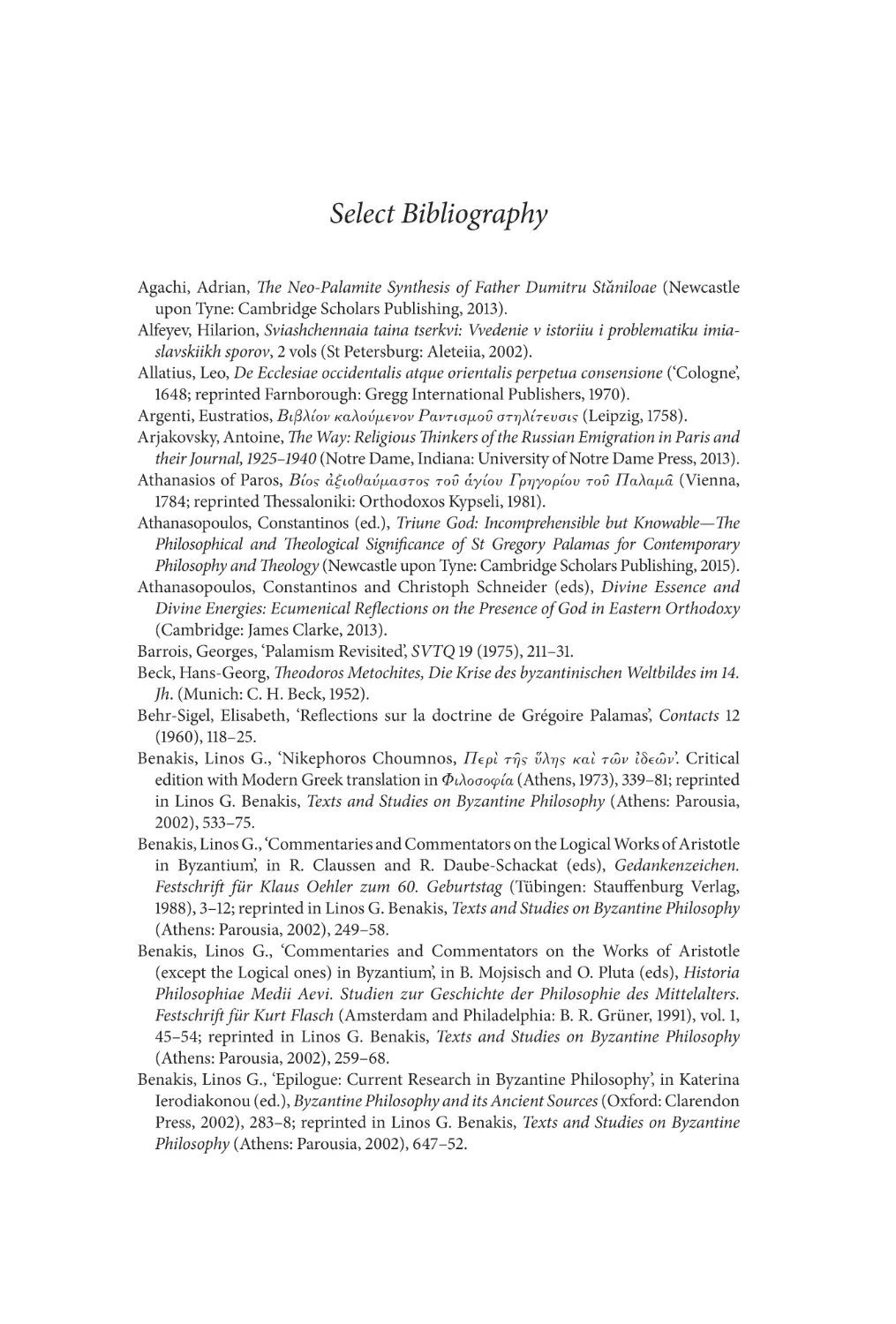
Select Bibliography
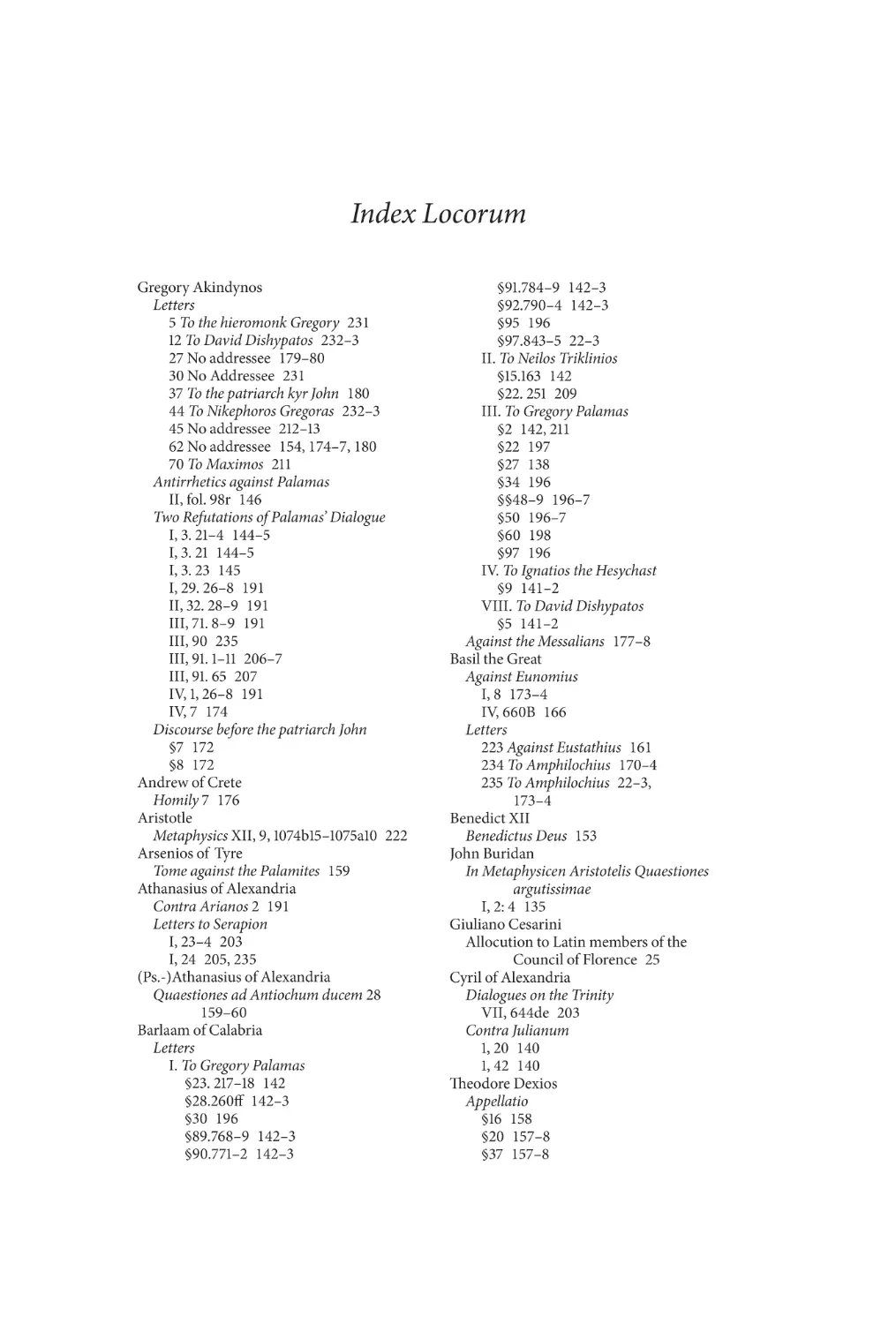
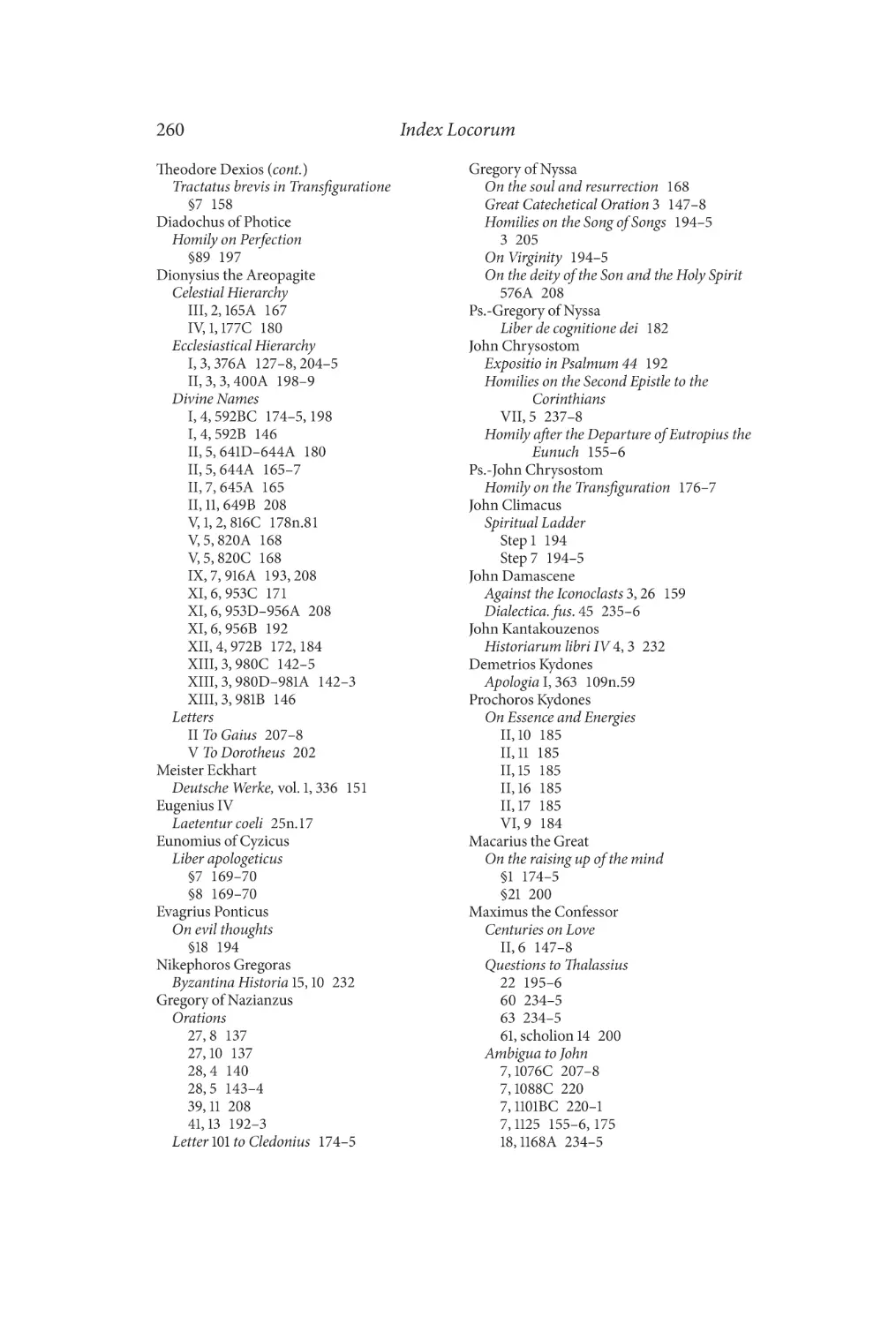
Index Locorum
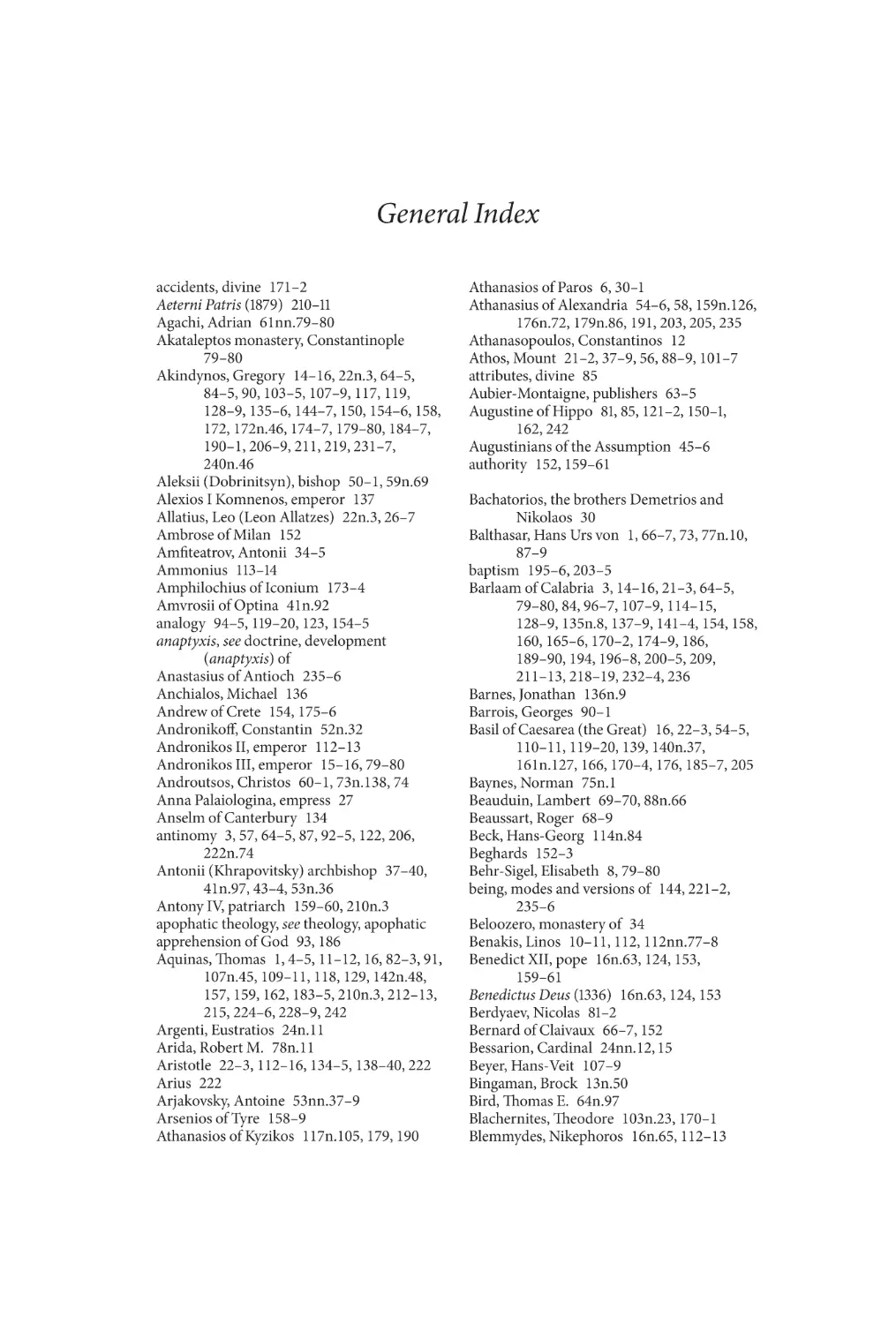
General Index
134
142
147
152
160
164
169
177
183
185
190
193
196
199
201
203
208
210
211
213
215
223
230
231
243
259
264
OUP CORRECTED PROOF – FINAL, 22/02/19, SPi
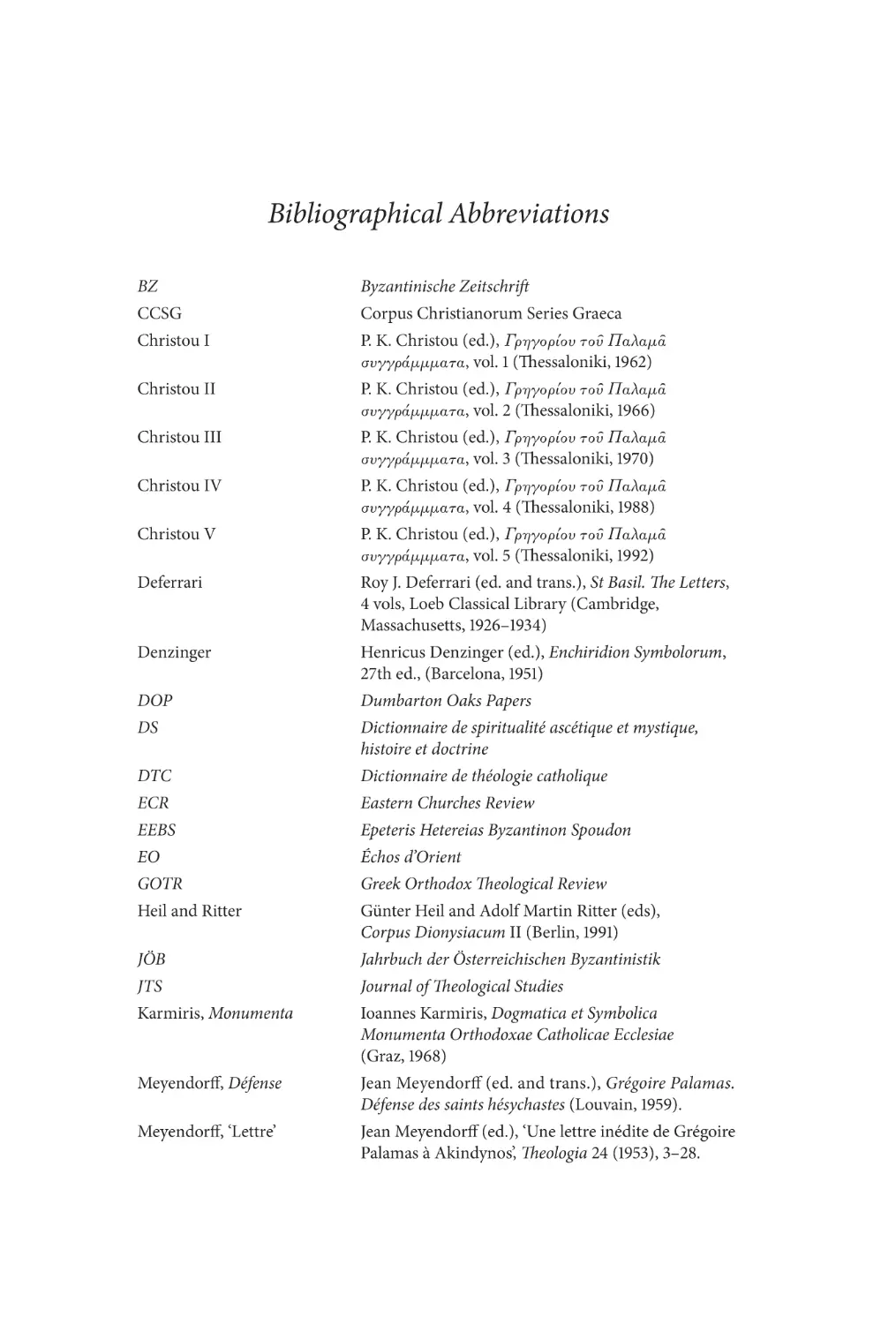
Bibliographical Abbreviations
BZ
Byzantinische Zeitschrift
CCSG
Corpus Christianorum Series Graeca
Christou I
P. K. Christou (ed.), Γρηγορίου τοῦ Παλαμᾶ
συγγράμμματα, vol. 1 (Thessaloniki, 1962)
Christou II
P. K. Christou (ed.), Γρηγορίου τοῦ Παλαμᾶ
συγγράμμματα, vol. 2 (Thessaloniki, 1966)
Christou III
P. K. Christou (ed.), Γρηγορίου τοῦ Παλαμᾶ
συγγράμμματα, vol. 3 (Thessaloniki, 1970)
Christou IV
P. K. Christou (ed.), Γρηγορίου τοῦ Παλαμᾶ
συγγράμμματα, vol. 4 (Thessaloniki, 1988)
Christou V
P. K. Christou (ed.), Γρηγορίου τοῦ Παλαμᾶ
συγγράμμματα, vol. 5 (Thessaloniki, 1992)
Deferrari
Roy J. Deferrari (ed. and trans.), St Basil. The Letters,
4 vols, Loeb Classical Library (Cambridge,
Massachusetts, 1926–1934)
Denzinger
Henricus Denzinger (ed.), Enchiridion Symbolorum,
27th ed., (Barcelona, 1951)
DOP
Dumbarton Oaks Papers
DS
Dictionnaire de spiritualité ascétique et mystique,
histoire et doctrine
DTC
Dictionnaire de théologie catholique
ECR
Eastern Churches Review
EEBS
Epeteris Hetereias Byzantinon Spoudon
EO
Échos d’Orient
GOTR
Greek Orthodox Theological Review
Heil and Ritter
Günter Heil and Adolf Martin Ritter (eds),
Corpus Dionysiacum II (Berlin, 1991)
JÖB
Jahrbuch der Österreichischen Byzantinistik
JTS
Journal of Theological Studies
Karmiris, Monumenta
Ioannes Karmiris, Dogmatica et Symbolica
Monumenta Orthodoxae Catholicae Ecclesiae
(Graz, 1968)
Meyendorff, Défense
Jean Meyendorff (ed. and trans.), Grégoire Palamas.
Défense des saints hésychastes (Louvain, 1959).
Meyendorff, ‘Lettre’
Jean Meyendorff (ed.), ‘Une lettre inédite de Grégoire
Palamas à Akindynos’, Theologia 24 (1953), 3–28.
OUP CORRECTED PROOF – FINAL, 22/02/19, SPi
xii
Bibliographical Abbreviations
Meyendorff, ‘Première lettre’
Jean Meyendorff (ed.), ‘ L’origine de la controverse
palamite, La première lettre de Palamas à Akindynos’,
Theologia 25 (1954), 602–30.
Moreschini
Claudio Moreschini (ed.), Gregorio di Nazianzo, Tutte
le Orazioni (Milan, 2000)
OCP
Orientalia christiana periodica
ODB
The Oxford Dictionary of Byzantium
Perrella I
Ettore Perrella (ed. and trans.), Gregorio Palamas.
Atto e luce divina (Milan, 2003)
Perrella II
Ettore Perrella (ed. and trans.), Gregorio Palamas. Dal
sovraessenziale all’essenza (Milan, 2005)
Perrella III
Ettore Perrella (ed. and trans.), Gregorio Palamas. Che
cos’è l’ortodossia (Milan, 2006)
PG
Migne, Patrologia Graeca
REB
Revue des études byzantines
SC
Sources chrétiennes
Sinkewicz
Robert E. Sinkewicz (ed. and trans.), Saint Gregory
Palamas. The One Hundred and Fifty Chapters
(Toronto, 1988)
Suchla
Beate Regina Suchla (ed.), Corpus Dionysiacum I
(Berlin, 1990)
SVTQ
St Vladimir’s Theological Quarterly
TM
Travaux et Mémoires
OUP CORRECTED PROOF – FINAL, 22/02/19, SPi
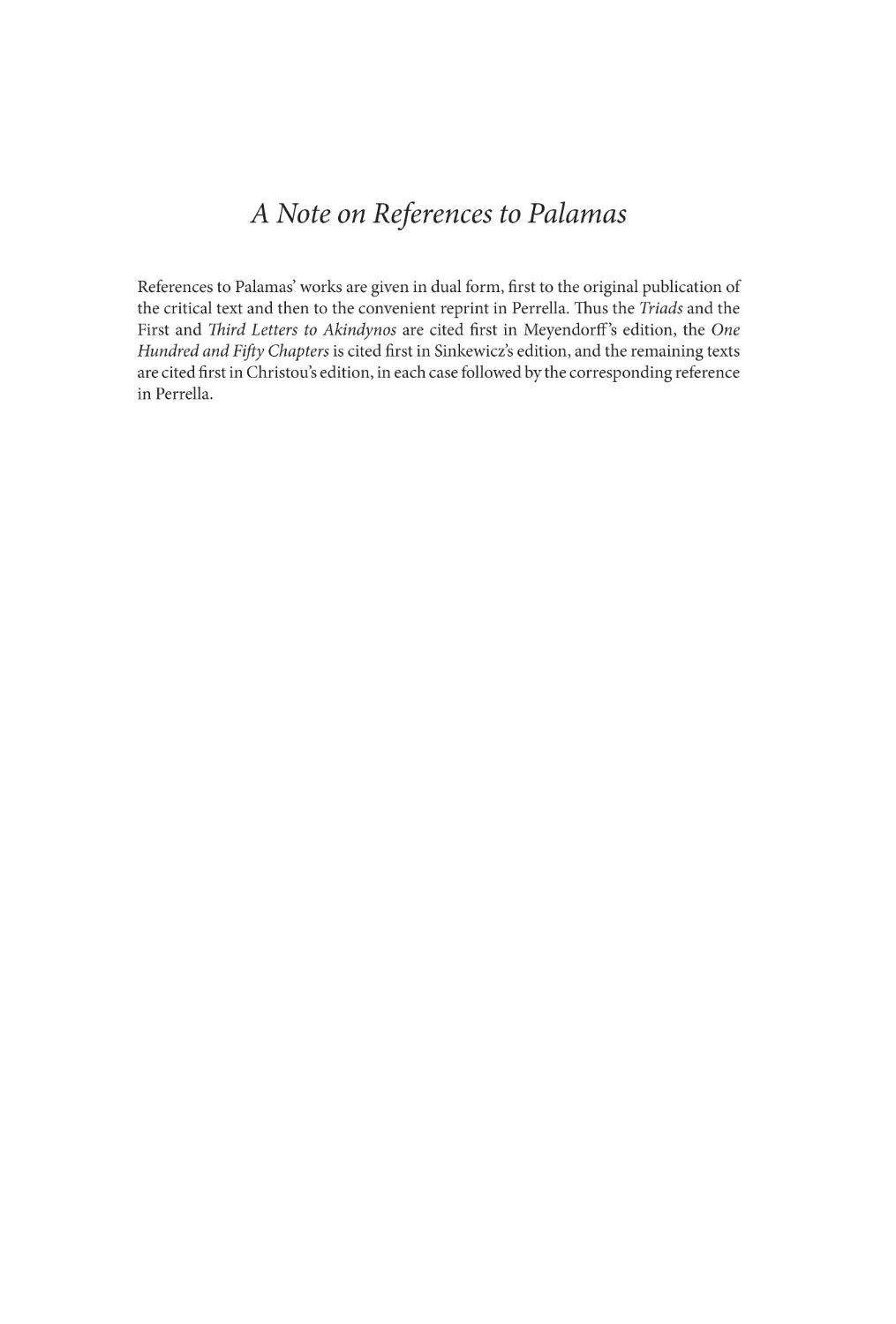
A Note on References to Palamas
References to Palamas’ works are given in dual form, first to the original publication of
the critical text and then to the convenient reprint in Perrella. Thus the Triads and the
First and Third Letters to Akindynos are cited first in Meyendorff ’s edition, the One
Hundred and Fifty Chapters is cited first in Sinkewicz’s edition, and the remaining texts
are cited first in Christou’s edition, in each case followed by the corresponding reference
in Perrella.
OUP CORRECTED PROOF – FINAL, 22/02/19, SPi
OUP CORRECTED PROOF – FINAL, 22/02/19, SPi
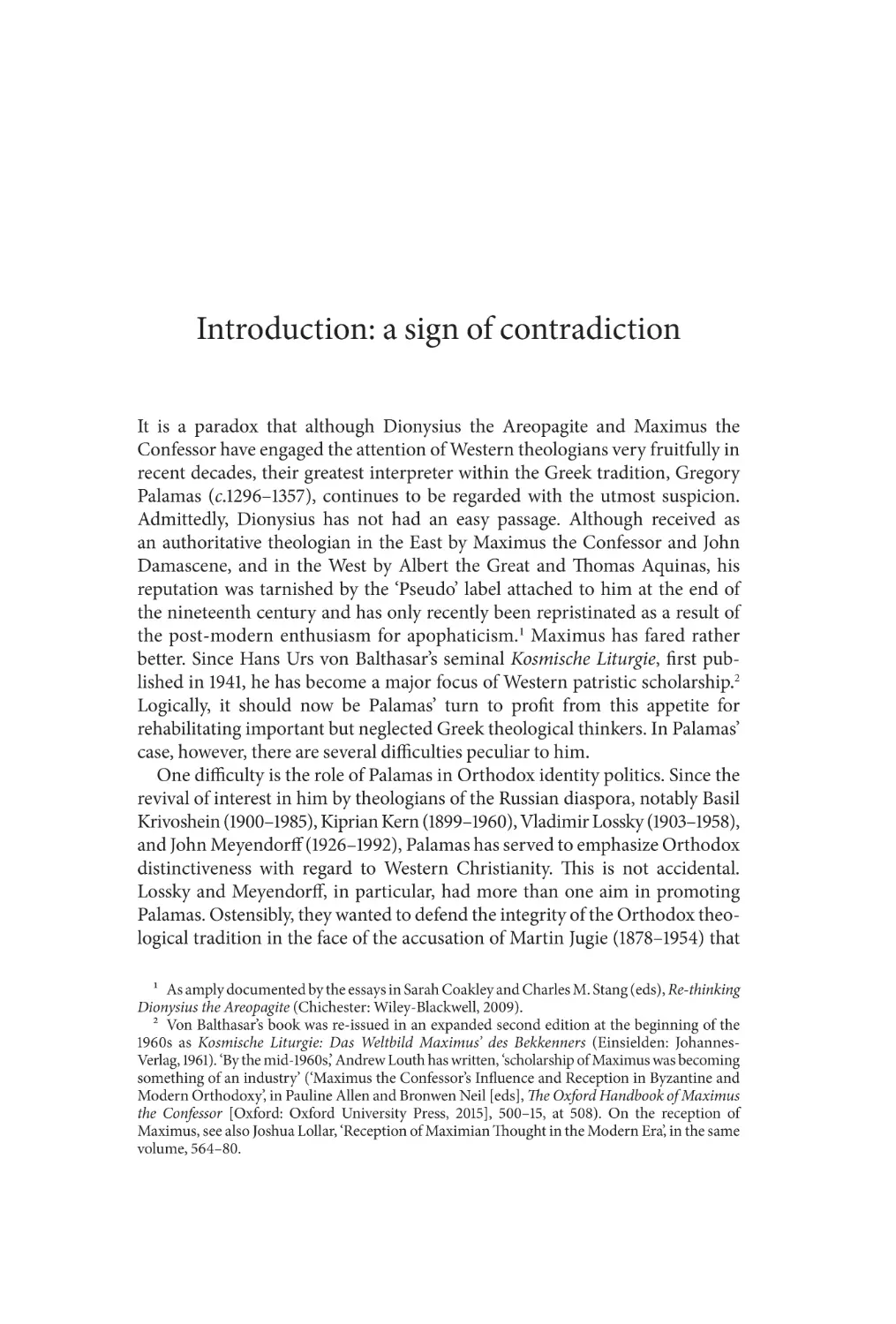
Introduction: a sign of contradiction
It is a paradox that although Dionysius the Areopagite and Maximus the
Confessor have engaged the attention of Western theologians very fruitfully in
recent decades, their greatest interpreter within the Greek tradition, Gregory
Palamas (c.1296–1357), continues to be regarded with the utmost suspicion.
Admittedly, Dionysius has not had an easy passage. Although received as
an authoritative theologian in the East by Maximus the Confessor and John
Damascene, and in the West by Albert the Great and Thomas Aquinas, his
reputation was tarnished by the ‘Pseudo’ label attached to him at the end of
the nineteenth century and has only recently been repristinated as a result of
the post-modern enthusiasm for apophaticism.1 Maximus has fared rather
better. Since Hans Urs von Balthasar’s seminal Kosmische Liturgie, first published in 1941, he has become a major focus of Western patristic scholarship.2
Logically, it should now be Palamas’ turn to profit from this appetite for
rehabilitating important but neglected Greek theological thinkers. In Palamas’
case, however, there are several difficulties peculiar to him.
One difficulty is the role of Palamas in Orthodox identity politics. Since the
revival of interest in him by theologians of the Russian diaspora, notably Basil
Krivoshein (1900–1985), Kiprian Kern (1899–1960), Vladimir Lossky (1903–1958),
and John Meyendorff (1926–1992), Palamas has served to emphasize Orthodox
distinctiveness with regard to Western Christianity. This is not accidental.
Lossky and Meyendorff, in particular, had more than one aim in promoting
Palamas. Ostensibly, they wanted to defend the integrity of the Orthodox theological tradition in the face of the accusation of Martin Jugie (1878–1954) that
1 As amply documented by the essays in Sarah Coakley and Charles M. Stang (eds), Re-thinking
Dionysius the Areopagite (Chichester: Wiley-Blackwell, 2009).
2 Von Balthasar’s book was re-issued in an expanded second edition at the beginning of the
1960s as Kosmische Liturgie: Das Weltbild Maximus’ des Bekkenners (Einsielden: JohannesVerlag, 1961). ‘By the mid-1960s,’ Andrew Louth has written, ‘scholarship of Maximus was becoming
something of an industry’ (‘Maximus the Confessor’s Influence and Reception in Byzantine and
Modern Orthodoxy’, in Pauline Allen and Bronwen Neil [eds], The Oxford Handbook of Maximus
the Confessor [Oxford: Oxford University Press, 2015], 500–15, at 508). On the reception of
Maximus, see also Joshua Lollar, ‘Reception of Maximian Thought in the Modern Era’, in the same
volume, 564–80.
OUP CORRECTED PROOF – FINAL, 22/02/19, SPi
2
Gregory Palamas and the Making of Palamism in the Modern Age
one of its venerated exponents, Gregory Palamas, was quasi-heretical. But they
were also keen to mark off Orthodoxy from the dominant Roman Catholicism
of their French environment, and at the same time to demonstrate the relevance of Palamas to current Western theological concerns—hence Meyendorff ’s
presentation of Palamas as an exponent of a personalist and existential theology.
There are also several subtexts. One is the interest of the mainly Jesuit and
Dominican leaders of la nouvelle théologie in the thinking of their Orthodox
confrères, and indeed their active encouragement of it. Lossky’s famous Essai
sur la théologie mystique de l’Église d’Orient, which some regard as the most
important Orthodox work of the twentieth century, began in fact as a series of
lectures given in 1944 to a Roman Catholic audience at the request of Henri de
Lubac (1896–1991), Yves Congar (1904–1995), and Jean Daniélou (1905–1974).3
A further subtext is Lossky’s intense concern to combat the sophiology of
Sergius Bulgakov (1871–1944) with another, supposedly more authentic,
version of the essence–energies distinction. The identity politics in which the
retrieval of Palamas played a significant part was as much an intra-Orthodox as
an East–West affair.
Another difficulty is the perceived strangeness of Palamas. This is due in large
part to the close relationship between Palamas and Dionysius. At every turn,
Palamas appeals to ‘the great Dionysius’ as his chief authority, and Dionysius
has seemed to many modern commentators a strange figure, more a disguised
Neoplatonist than a Christian. Alexander Golitzin, however, has done much
to situate the Dionysian corpus fully within the Eastern monastic tradition.4
Dionysius is only strange when read out of his proper context, which is not late
antique pagan Neoplatonism but the deeply Christian world of sixth-century
Syrian monasticism. Indeed, I would say that as an introduction to Palamas’
thinking, one could hardly do better that read Golitzin’s Mystagogy. In this he
presents the Dionysian corpus as a coherent and unified structure which is
both strikingly original and remarkably faithful, the fidelity ‘not applying
primarily to the pagans, from whom Dionysius did indeed borrow, but to the
already long-established currents in Greek Christian speculation—and meditation—on the mystery of God in Christ’.5 Palamas, in Golitzin’s view, was
in turn a faithful interpreter of Dionysius; he was not an innovator but a
theologian ‘engaged in the defense of a tradition, both of theology and ascetic
practice, that long antedated him’.6
3 Vladimir Lossky, Essai sur la théologie mystique de l’Église d’Orient (Paris: AubierMontaigne, 1944). English translation: The Mystical Theology of the Eastern Church (London:
James Clarke, 1957).
4 Among his many publications, see especially Alexander Golitzin, Mystagogy (Collegeville:
Liturgical Press, 2013).
5 Golitzin, Mystagogy, xxxviii.
6 Golitzin, Mystagogy, 392; cf. Alexander Golitzin, ‘Dionysius the Areopagite in the Works of
Gregory Palamas. On the Question of a “Christological Corrective” and Related Matters’, SVTQ
46 (2002), 163–90.
OUP CORRECTED PROOF – FINAL, 22/02/19, SPi
Introduction3
A third difficulty concerns the commonly held opinion that Palamas is
rationally incoherent. Not only do we find this opinion in major Western
authors such as Robert Jenson and John Milbank, but also in a Greek philosopher such as Stelios Ramfos, who finds Palamas’ use of enhypostasia unconvincing, or in an Orthodox theologian such as David Bentley Hart, who
expresses the hope that some of his confrères ‘might be emboldened partly to
abandon the Neo-Palamite theology that has become so dominant in their
Church since the middle of the last century, and frankly acknowledge its
incoherence’.7 The opinion that Hart rejects seems to me to be based more on
Lossky’s elevation of the idea ‘antinomy’ to a fundamental theological principle
than it is on Palamas himself.8 I have not found any instances in Palamas’ voluminous writings of what could be characterized as ‘antinomic’ thinking in
Lossky’s sense.9 Certainly, the divine essence is utterly transcendent. But this is
presented by Palamas as beyond discursive thought rather than as logically inconsistent with the accessibility of the divine energies. If anything, Palamas relied
more heavily on logic than any of his opponents, including the p
hilosophers
Barlaam of Calabria (c.1290–1348) and Nikephoros Gregoras (c.1290–c.1360).
Barlaam was much more cautious than Palamas about the applicability of
apodictic demonstration to intra-Trinitarian relations.10 Gregoras, for his part,
refused to deal in Aristotelian syllogisms at all, regarding them as fit only for
inferior minds.11 The anti-logical movement that has been noted in Byzantium
in the fourteenth century could not count Palamas among its adherents.12
Finally, Palamas has rarely been considered in a dispassionate manner. Jugie’s
construction of ‘Palamism’, a term he invented for polemical purposes, has
proved so robust that it still dominates Western attitudes towards Palamas,
despite—or perhaps partly because of—the work of Meyendorff and others.
Meyendorff himself seems to have accepted the concept of Palamism in his
earlier writings, largely because he was bent on constructing an alternative
Palamism. Although his major work, Introduction à l’étude de Grégoire Palamas,
7 David Bentley Hart, ‘Foreword’, in Adrian Pabst and Christoph Schneider (eds), Encounter
Between Eastern Orthodoxy and Radical Orthodoxy (Farnham: Ashgate, 2009), xiii.
8 Antinomy is defined by Lossky as characterizing a theology ‘which proceeds by oppositions
of contrary but equally true propositions’ (Vladimir Lossky, In the Image and Likeness of God
[Crestwood, New York: St Vladimir’s Seminary Press, 2001], 51).
9 Palamas never uses the term ἀντινομία (which for him would have meant ‘a conflict of laws’)
but he does refer to ἀντίφασις (‘contradiction’), which he vigorously rejects: ‘How is a contradiction
not oppositional, or how is it not impossible that they can both be true or both false at the same
time? For in the case of a contradiction, if one of the two is unorthodox, the other is necessarily
orthodox’ (Palamas, Letter to Philotheos 7 [Christou II, 523; Perrella III, 982]).
10 See Robert E. Sinkewicz, ‘The Doctrine of the Knowledge of God in the Early Writings of
Barlaam the Calabrian’, Medieval Studies 44 (1982), 181–242.
11 See Demetrios N. Moschos, Πλατωνισμὸς ἢ Χριστιανισμός; Οἱ φιλοσοφικὲς προϋποθέσεις
τοῦ Ἀντιησυχασμοῦ τοῦ Νικηφόρου Γρηγορᾶ (1293–1361) (Athens: Parousia, 1998), 165–6, 181–7.
12 Katerina Ierodiakonou, ‘The Anti-Logical Movement in the Fourteenth Century’, in
Katerina Ierodiakonou (ed.), Byzantine Philosophy and its Ancient Sources (Oxford: Clarendon
Press, 2002), 219–36.
OUP CORRECTED PROOF – FINAL, 22/02/19, SPi
4
Gregory Palamas and the Making of Palamism in the Modern Age
was warmly received when it was first published in 1959, the partisan approach
evident in it led to a reaction in the decades that followed. It is only in the last
twenty years that new work has tried to break the polemical mould set by Jugie
and Meyendorff and treat Palamas as a worthy theological conversation partner.
PALAMAS’ NACHLEBEN IN THE
GREEK-SPEAKING WORLD
When Palamas died, probably in 1357,13 his theology had been vindicated by
the Constantinopolitan Council of 1351, but there was a substantial minority
who felt that, even though the anathemas pronounced on the anti-Palamites
had been inserted into the Synodikon of Orthodoxy in the following year, the
council’s decisions were not morally binding because its proceedings had
been manipulated by the emperor John Kantakouzenos (c.1295–1383; reigned
1347–1354) to arrive at a predetermined conclusion. The leaders of the continuing opposition to Palamism were not treated particularly harshly. The four
opposing metropolitans were deposed in 1351 and three of them confined to
monasteries.14 The layman Nikephoros Gregoras was placed under house-arrest
until 1354, when Kantakouzenos’ forced abdication led to a change of policy.
John V Palaiologos (1332–1391; reigned 1341–1391) continued to rule as sole
emperor, but although interested in the Palamite controversy—he even organized a debate at the imperial palace between Palamas and Gregoras—he was
not inclined to force a definitive solution.15 The definitive solution was to come
fourteen years later as a result of an initiative taken by the patriarch Philotheos
Kokkinos (c.1300–c.1377; patriarch 1353–1354/5, 1364–1376).
The year 1354 was significant not only for the abdication of John
Kantakouzenos, but also for the completion of the first of the works of Thomas
Aquinas (c.1225–1274) to be translated into Greek.16 This was the Summa contra
Gentiles, translated by Kantakouzenos’ chief minister, Demetrios Kydones
(c.1324–c.1398). The translation was an immediate success, and was followed by
13 Palamas died on the 14 November, traditionally in 1359. Strong arguments, however, have
been proposed for regarding the year as 1357; see Antonio Rigo, ‘La canonizzazione di Gregorio
Palama (1368) ed alcuni altre questioni’, Rivista di studi bizantini e neoellenici 30 (1993), 155–202.
14 These were Joseph of Ganos, Neophytos of Philippi, and Makarios of Serres. A fourth metropolitan, Matthew of Ephesus (Manuel Gabbalas) was deposed but apparently not imprisoned.
Matthew was a distinguished figure who had courageously entered Ephesus (then under the rule
of the emir Khidir Beg) in 1339 in an attempt to take possession of his see and minister to his flock.
He has left a body of letters, some treatises on Homer, and two hundred chapters of moral counsel.
For further details, see Alice-Mary Talbot, ‘Gabbalas, Manuel’, ODB ii, 811–12.
15 The chief priority of John V (who privately submitted to Rome in 1369) was to establish good
relations with the West and obtain Western help in resisting further Turkish expansion.
16 On the reception of Aquinas in the Greek East, see Marcus Plested, Orthodox Readings of
Aquinas (Oxford: Oxford University Press, 2012).
OUP CORRECTED PROOF – FINAL, 22/02/19, SPi
Introduction5
the translation of other Latin works, in which task Demetrios was assisted by his
brother, Prochoros (c.1333/4–1369/70), a monk of the Great Lavra on Mount
Athos. The philosophical and theological method of Aquinas excited much
interest amongst both Palamites and anti-Palamites. In Prochoros’ case, Aquinas’
method provided him with a method of argumentation by which he could
mount a sustained attack upon Palamas’ essence–energies distinction.17 When
he extended his attack to include the growing cult of Palamas as a saint, his trial
by a Constantinopolitan synod became inevitable. At a council held in 1368,
Prochoros was found guilty of heresy and stripped of the priesthood. At the
same time, the patriarch Philotheos took the opportunity to establish Palamas’
sanctity in a formal manner. He prepared for this carefully, collecting a substantial dossier of posthumous miracles to support the official glorification of
Gregory Palamas as a saint of the Orthodox Church.
After 1368, many of the opponents of Palamite theology joined the Latin
Church.18 The West thus first came to know of Palamas through the writings
of his adversaries. At the Council of Ferrara–Florence (1438–1439), Palamite
theology was not discussed, even though the Latin side was fully aware of it.
The leaders on both sides were anxious to come to an agreement, and there
were sufficient difficult theological problems to be debated without adding yet
another one. In the course of the fifteenth and sixteenth centuries, Palamas’
writings as well as several collections of Palamite texts were acquired by manuscript collectors. But they lay unstudied in the great libraries of Paris and Rome
until the seventeenth century, when they were exploited by theologians of the
newly confident post-Tridentine Roman Catholic Church intent, in the confessionally competitive atmosphere of the times, on expanding the influence and
authority of the Holy See. When the Orthodox of the Greek-speaking world
became aware of this, they responded vigorously. With the aim of countering
Western attempts at proselytization within the Ottoman Empire, Dositheos II
of Jerusalem (1641–1707; patriarch 1669–1707) established the first Greek printing press under Orthodox control. As part of this programme, he published
several Palamite texts, including conciliar documents, in order to demonstrate
that Palamism was not a Greek heresy but the officially endorsed teaching of
the Orthodox Church. He also planned a complete edition of Palamas’ works
but was unable to do more than assemble a number of manuscripts, which he
sent to Moscow.19
17 For details, see Norman Russell, ‘Prochoros Cydones and the fourteenth-century understanding of Orthodoxy’, in Andrew Louth and Augustine Casiday (eds), Byzantine Orthodoxies
(Aldershot: Ashgate Variorum, 2006), 75–91.
18 On how this came about, see Norman Russell, ‘Palamas and the Circle of Demetrius Cydones’,
in Charalambos Dendrinos et al. (eds), Porphyrogenita. Essays on the History and Literature of
Byzantium and the Latin East in Honour of Julian Chrysostomides (Aldershot: Ashgate, 2003),
153–74.
19 For more details, see Klaus-Peter Todt, ‘Dositheos II. von Jerusalem’, in Carmelo Giuseppe
Conticello and Vassa Conticello (eds), La théologie byzantine et sa tradition II (XIIIe–XIXe s.)
OUP CORRECTED PROOF – FINAL, 22/02/19, SPi
6
Gregory Palamas and the Making of Palamism in the Modern Age
In the following century, Palamas played a role in the movement of spiritual
renewal initiated by Makarios of Corinth (1731–1805), Athanasios of Paros
(c.1721–1813) and Nikodemos the Hagiorite (1749–1809). One of the fruits of
this movement was the publication of the Philokalia, whose anthology of texts
included several by Palamite authors and by Palamas himself, notably the One
Hundred and Fifty Chapters.20 Like Dositheos, Nikodemos planned to publish
a complete edition of Palamas’ works. He got as far as sending his manuscript
to a printer in Vienna, but was thwarted at the last moment by the nervousness
of the Austrian authorities about anything that might be construed as supporting the revolutionary fervour then developing in Greece.21 The Greek-speaking
world had to wait until the twentieth century before it was able to re-appropriate
Palamite teaching. The fact that it did so was in large measure due to the Russian
experience of Palamism.
PALAMAS IN RUSSIA
Russians were slow to receive Palamas. This was not because they had any particular animus against him. The strand of hesychasm that took root in Russia
with Nil Sorskii (c.1433–1508) was that of Gregory of Sinai (c.1255–c.1345) rather
than of Gregory Palamas. Later, when the Philokalia reached Russia, it was in
the version of Paisii Velichkovsky (1722–1794), which did not include Palamas.
It was only towards the end of the nineteenth century that Russians really
encountered Palamite theology.
This encounter came by two routes. The first was through the work of
historians in a period noted for the quality of Russian historical research. The
publications of Modest Strelbitsky (1823–1902), Porfyrii Uspensky (1804–1885),
and Feodor Uspensky (1845–1928) enabled Russian readers to acquire a sound
knowledge of the hesychast controversy and the theological issues raised by it.
The second route was through monastic writers in the context of the imiaslavie
controversy, a controversy concerning the divinity or glorification of the holy
name that broke out just before the First World War. The first route emphasized
the anti-Latin aspects of Palamism; the second focused on Palamite teaching
(Turnhout: Brepols, 2002), 659–720; Norman Russell, ‘From the “Shield of Orthodoxy” to the
“Tome of Joy”: The Anti-Western Stance of Dositheos II of Jerusalem’, in George Demacopoulos
and Aristotle Papanikolaou (eds), Orthodox Constructions of the West (New York: Fordham
University Press, 2013), 71–82.
20 In keeping with Nikodemos’ aim of spiritual edification, however, all references to Barlaam
and Akindynos were excised.
21 The full story is told by Antonio Rigo, ‘Nicodemo l’Aghiorita e la sua edizione delle opere di
Gregorio Palamas’, in Adalberto Mainardi (ed.), Paiisij lo staretz (Magnano: Edizioni Qiqajon,
1997), 165–82.
OUP CORRECTED PROOF – FINAL, 22/02/19, SPi
Introduction7
on deification and the vision of the divine light. The imiaslavie controversy,
however, revealed a deep division among Russian churchmen between those,
like Antonii Khrapovitsky (1863–1936), who were suspicious of the religious
turn of the intelligentsia (the ‘Russian religious renaissance’ in Nicholas Zernov’s
phrase) and were only comfortable with the traditional rationalist theology
and authoritarian Church order of tsarist Russia, and those, like Antonii
Bulatovich (1870–1919) and his supporters, who gave greater weight to the
Church’s mystical tradition and valued the more speculative theological trends
in vogue at the end of the nineteenth century.
This division between the conservative traditionalists and those attracted to
the more speculative and mystical currents of Russian thought was brought
to the West as a result of the emigration following the Bolshevik Revolution.
Khrapovitsky became head of the conservative Russian Orthodox Church
Outside Russia (ROCOR). The leaders of the Russian religious renaissance who
settled in Paris initially remained faithful to the newly re-established Moscow
patriarchate but were themselves divided on the issue of Bulgakov’s sophiology.
In the development of his ideas, Bulgakov made use of Palamite thinking,
which he saw as supportive of his doctrine of divine Sophia. His most articulate
opponent, Vladimir Lossky, argued that Palamas’ teaching on divine–human
communion actually excluded sophiological ideas. Lossky was therefore strongly
motivated to deepen his study of Palamas, especially in view of a new factor
that emerged in the early 1930s, the direct attack on Palamas from the Roman
Catholic side initiated by Martin Jugie.
THE T WENTIETH-CENTURY
RETRIEVAL OF PALAMAS
When Jugie published his magisterial articles on Palamas and the Palamite
controversy in 1932,22 he was not seeking to undermine contemporary
Orthodoxy’s esteem for Palamas. He believed that Palamas’ ideas had been
quietly abandoned after his death and had long since become a dead letter. His
aim was to demonstrate that if the Roman Catholic Church had officially promulgated new doctrines, such as the Filioque in the eleventh century and the dogma
of the Immaculate Conception in the nineteenth, so too had the Orthodox
Church in the form of Palamism in the fourteenth. His ultimate purpose was to
persuade the Orthodox to submit to the magisterium of the Roman Church as
the only infallible guide to truth. From Jugie’s point of view, the project backfired badly, stimulating an impressive revival of interest in Palamite studies
22 Martin Jugie, ‘Palamas, Grégoire’ and ‘Palamite (controverse)’, DTC 11, part 2 (Paris: Letouzey
et Ané, 1932), 1735–818.
OUP CORRECTED PROOF – FINAL, 22/02/19, SPi
8
Gregory Palamas and the Making of Palamism in the Modern Age
among the Orthodox. Jugie, who died in 1954, was spared a further humiliating
development, the rejection by the fathers of the Second Vatican Council of the
triumphalism that he took for granted and their cautious willingness to see
‘many elements of sanctification and of truth’ outside the visible structure of
the Roman Catholic Church.23
The publication of Meyendorff ’s Introduction à l’étude de Grégoire Palamas
gave scholars, for the first time in a Western language, a full presentation of the
fourteenth-century hesychast controversy on the basis of a study of the manuscript sources together with a vigorous defence of Palamite theology.24 One of
Meyendorff ’s underlying aims was, like Lossky, to delineate an Orthodox identity which would help Francophone Orthodox of the Russian diaspora resist
assimilation to the dominant Roman Catholic form of Christianity yet at the
same time put Orthodoxy alongside Western Christianity as an ally in the common struggle to articulate a response to the challenges facing the Churches
after the Second World War. In each of the two parts of his aim, Meyendorff
achieved only a limited success. With regard to the first, his existentialist and
personalist interpretation of Palamas met with opposition from some Orthodox,
notably from Krivoshein and Elisabeth Behr-Sigel (1907–2005).25 With regard to
the second, although some Anglicans and Roman Catholics, such as Eric Mascall
(1905–1993), Louis Bouyer (1913–2004), and André de Halleux (1929–1994),
responded warmly,26 most Western theologians c ontinued to find Jugie’s
construction of Palamism more plausible than his own.
The critical reception of Meyendorff ’s work falls into two phases. The first
was centred on an analysis of the Introduction and a critique of its methodology.
The second was dominated by the sharply polemical debate that subsequently
arose in the theological journals between opponents and defenders of Palamism.
This is hardly surprising, given the polemical orientation of Meyendorff ’s own
exposition of Palamite theology in the Introduction (mitigated slightly in the
English translation),27 which was bound to provoke opposition. Moreover, the
23 See the Vatican Council’s Decree on Ecumenism, Unitatis Redintegratio, § 8.
24 Jean Meyendorff, Introduction à l’étude de Grégoire Palamas (Paris: Éditions du Seuil, 1959).
25 B. Krivoshein, ‘Sviatoi Grigorii Palama. Lichnost’ i uchenie po nedavno opublikovannym
materialam’ [Saint Gregory Palamas. Personhood and doctrine according to recently published
materials], Messager de l’exarchat du patriarche russe en Europe occidentale 9 (1960), no. 33–4, 101–4;
Elisabeth Behr-Sigel, ‘Reflections sur la doctrine de Grégoire Palamas’, Contacts 12 (1960), 118–25.
26 For Mascall see, for example, E. L. Mascall, The Openness of Being: Natural Theology Today
(London: Darton, Longman and Todd, 1971, 221–4; for Bouyer, Louis Bouyer, ‘Byzantine
Spirituality’ in Jean Leclerq, François Vandenbroucke, and Louis Bouyer (eds), The Spirituality of the
Middle Ages (London: Burns and Oates, 1968), 547–90, at 547, and Louis Bouyer, Le Consolateur:
Ésprit-Saint et la vie de Grâce (Paris: Éditions du Cerf, 1980), 316–22; for de Halleux, André de
Halleux, ‘Palamisme et Scolastique. Exclusivisme dogmatique ou pluriformité théologique?’
Revue théologique de Louvain 4 (1973), 409–42.
27 The first footnote of Part II, chapter 5, for example, states that this chapter (which comes as
the climax of Meyendorff ’s theological exposition) has in view the analyses of Jugie, Guichardan,
and Candal (Meyendorff, Introduction, 279, n. 1). The footnote was dropped from the English
translation.
OUP CORRECTED PROOF – FINAL, 22/02/19, SPi
Introduction9
book appeared at the beginning of a period of intense conflict in the Roman
Catholic Church at around the time of the Second Vatican Council. It was to
be expected that its commendation by supporters of theological pluralism
such as de Halleux (although de Halleux himself was careful to avoid a relativist
line) should draw a sharp response from neo-Thomists, such as Marie-Joseph
Le Guillou (1920–1990) and Jean-Miguel Garrigues,28 who regarded scholastic
principles as the yardstick of doctrinal orthodoxy. Some Thomists were happy
to emphasize points of agreement between Palamas and Thomas,29 but the
Istina authors were sceptical. For them there was another issue, too, even if they
did not make it explicit: Meyendorff lent unwelcome support to their opponents in the nouvelle théologie camp, who seemed to them to blur the distinction
between the natural and the supernatural. The debate stimulated by Meyendorff ’s
book had repercussions within the Roman Catholic communion.
In subsequent publications, Meyendorff revised the over-schematic presentation of Palamas’ theology that characterizes his Introduction, but he did not
abandon his fundamental position. Palamas, in his view, was firmly based in
the patristic tradition. His teaching on the interpenetration of the divine and
the human in a Christ who possessed two wills and two energies was that of the
Sixth Ecumenical Council (held in Constantinople in 680–681). His account of
how the believer could participate in the divinized humanity of Christ was, as
he claimed, an authentic explication (ἀνάπτυξις) of the decree of that council.
His elaboration of the distinction between essence and energies was not a
speculative move but an attempt to safeguard the reality of the believer’s participation in Christ without compromising the absolute transcendence of God.
Meyendorff ’s arguments for the orthodoxy and experiential value of this teaching did not prove convincing enough to overcome the deeply rooted Western
suspicion Palamas, but it was to prove extremely fecund in suggesting further
lines of research.
In the years after the Second Vatican Council, a reaction set in against
Palamite theology as presented by Lossky and Meyendorff. This was led by
the Dominicans of the Istina Centre in Paris, who in 1974 published an issue
of their journal, Istina, in which they set out to combat the ‘false irenicism’ that
they felt had prevailed during the previous decade.30 The controversy they
stirred up through a quartet of distinguished articles still reverberates in much
current writing on Palamas.31
28 See the articles in the special issue of the Dominican journal Istina devoted mainly to
Palamas: Istina 19 (1974).
29 For example, Ch. Journet, ‘Palamisme et Thomisme. À propos d’un livre récent’, Revue thomiste 60 (1960), 430–52.
30 Istina 19 (1974). The phrase ‘false irenicism’ is from Unitatis Redintegratio, § 11.
31 The four articles in Istina 19 (1974) are Jean-Philippe Houdret, ‘Palamas et les Cappadociens’,
260–71; Jean-Miguel Garrigues, ‘L’energie divine et la grâce chez Maxime the Confesseur’, 272–96;
Juan Sergio Nadal, ‘La critique par Akindynos de l’herméneutique patristique de Palamas’, 297–328;
Marie-Joseph Le Guillou, ‘Lumière et charité dans la doctrine Palamite de divinisation’, 329–38.
OUP CORRECTED PROOF – FINAL, 22/02/19, SPi
10
Gregory Palamas and the Making of Palamism in the Modern Age
NEW AREAS OF RESEARCH
In the last thirty years, important publications have opened up new areas of
research in several different fields. The work of Byzantinists such as Antonio
Rigo and Ioannis Polemis has sharpened our historical perception of the events
leading up to ‘the triumph of Palamism’.32 Our knowledge of the philosophical
currents that shaped the thinking of the period has grown enormously as a
result of the labours of Linos Benakis, Ioannis Polemis, John Demetracopoulos,
and many others.33 Theological work, especially by Amphilochios Radović and
Stavros Yangazoglou, has shed light on a number of important issues, especially the relationships between essence–energies and essence–hypostases, and
between the economies of the Son and of the Spirit.34 Our knowledge of Palamas’
opponents has also been extended through the work of Juan Nadal Cañellas
(1934–2016),35 Antonis Fyrigos,36 Michele Trizio,37 and Demetrios Moschos.38
Several Roman Catholic scholars, particularly Jacques Lison, have made strenuous efforts to aid the reception of Palamas in the West.39 Yet it must be confessed
that Jugie’s perspective (supported by scholars such as Dorothea Wendebourg,
32 Of their many important publications, two have been especially valuable for the present study:
Antonio Rigo, Monaci Esicasti e Monaci Bogomili (Florence: Leo S. Olschki, 1989); Ioannis D. Polemis,
Theophanes of Nicaea: His Life and Works (Vienna: Der Österreichischen Akademie der
Wissenschaften, 1996).
33 Benakis’s valuable but often inaccessible studies have now been collected in Linos G. Benakis,
Texts and Studies on Byzantine Philosophy (Athens: Parousia, 2002). For my purposes,
Demetracopoulos’s most significant study is John A. Demetracopoulos, ‘Palamas Transformed.
Palamite Interpretations of the Distinction between God’s “Essence” and “Energies” in Late
Byzantium’, in Martin Hinterberger and Chris Schabel (eds), Greeks, Latins, and Intellectual
History 1204–1500 (Leuven, Paris, and Walpole, MA: Peeters, 2011), 263–372.
34 See especially Métropolite Amphiloque (Radović) du Monténégro et du Littoral, Le mystère
de la Sainte Trinité selon Saint Grégoire Palamas (Paris: Éditions du Cerf, 2012); Stavros Yangazoglou,
Κοινωνία θεώσεως (Athens: Domos, 2001).
35 Juan Nadal Cañellas, ‘Gregorio Akíndynos’, in Conticello and Conticello, La théologie byzantine II, 189–314; Juan Nadal Cañellas, La résistance d’Akindynos à Grégoire Palamas. Enquête historique, avec introduction et commentaire de quatre traités édités recemment, 2 vols. (Leuven: Peeters,
2006). The second volume, which is Nadal’s commentary on the treatises, is the best detailed
account of the hesychast controversy (from a strongly Akindynist point of view) since Meyendorff.
(Perhaps it should be mentioned that Juan Nadal Cañellas is the same scholar as Juan Sergio
Nadal, who contributed one of the quartet of articles on Palamas to the 1974 edition of Istina.)
36 Among Fyrigos’ important body of work on Barlaam, I have relied principally on his edition
of Barlaam’s letters, introduced by a fine study of Barlaam’s role in the hesychast controversy:
Antonis Fyrigos, Dalla controversia palamitica alla polemica esicasta (Rome: Antonianum, 2005).
37 Trizio has also worked extensively on Barlaam; see especially Michele Trizio, ‘ “Una è la
verità che pervade ogni cosa”. La sapienza profana nelle opere perdute di Barlaam Calabro’, in
Antonio Rigo, Pavel Ermilov, and Michele Trizio (eds), Byzantine Theology and its Philosophical
Background (Turnhout: Brepols, 2011), 108–40.
38 Demetrios N. Moschos, Πλατωνισμὸς ἢ Χριστιανισμός, has superseded earlier work on
Gregoras, although R. Guilland, Essai sur Nicéphore Grégoras. L’homme et l’œuvre (Paris: Librairie
Orientaliste Paul Geuthner, 1926, and Hans-Veit Beyer, ‘Nikephoros Gregoras als Theologe und
sein erstes Auftreten gegen die Hesychasten’, JÖB 20 (1971), 171–88, are still of value.
39 Jacques Lison, L’Esprit répandu. La pneumatologie de Grégoire Palamas (Paris: Éditions du
Cerf, 1994).
OUP CORRECTED PROOF – FINAL, 22/02/19, SPi
Introduction
11
Gerhard Podskalsky [1937–2013], and Juan Nadal) continues to dominate
Western thinking. Jugie’s ecclesiological motives for his judgements may no
longer be persuasive, but his neo-Thomist dismissal of the distinctions Palamas
sought to make still carries immense weight.
Work on Palamas, however, to deepen our understanding of the p
hilosophical
and theological context of his thinking has been taking place not only through
the publication of monographs and articles on Palamas and his contemporaries but also through the holding of colloquia and conferences which have
sought to bring together Orthodox and Western scholars—even professed
Palamites and anti-Palamites—in a fruitful manner. Moreover, there has also
been an extraordinary burgeoning of interest in Palamas as a spiritual teacher,
and this has extended well beyond the boundaries of the Orthodox Church. Each
of these three modes of encounter with Palamas—the theological-philosophical,
the dialectical, and the spiritual—has something important to offer.
The first mode naturally predominates in the academy. It is striking that most
of the monographs on Palamas published during the last twenty years concentrate on Palamas’ account of religious experience.40 It is the nature of this
experience, rather than the more abstract philosophical aspects of essence and
energy, that has attracted much of the research. Another area of interest, since
Anna Williams’s attempt to show that Palamas and Aquinas, as representatives
of the Eastern and Western traditions, respectively, are not in o
pposition to
each other but offer fundamentally similar models of sanctification, has been
the impact of Thomism on Palamas and other hesychast writers.41 It has become
clear that in the fourteenth century, Byzantium and the West did not inhabit
mutually incomprehensible intellectual worlds, even if their theological outlooks may be sharply contrasted, but shared similar concerns and were even
interested in each other’s philosophical methodology.42
The second mode of encounter with Palamas, the dialectical, has resulted in
some lively exchanges and disagreements, which have by no means all been across
the confessional divide. A key figure in facilitating these has been Christoph
Schneider, currently Academic Director of the Institute for Orthodox Christian
40 For example, Yannis Spiteris, Palamas: la grazia e l’esperienza: Gregorio Palamas nella discussione teologica (Rome: Lipa, 1996); Håkan Gunnarsson, Mystical Realism in the Early Theology
of Gregory Palamas: Context and Analysis (Göteborg: Skrifter Utgivna vid Institutionen för
Religionsvetenskap, Göteborgs Universitet, 2002); Fadi A. Georgi, Ἡ Ἀνάστασις καὶ ἡ Ζωή: Ἡ
Ἐσχατολογία τοῦ Γρηγορίου Παλαμᾶ (Athens: Barbounaki, 2010); Britta Müller-Schauenburg,
Religiöse Erfahrung, Spiritualität und theologische Argumentation: Gotteslehre und Gottebenbildlichkeit
bei Gregorios Palamas (Stuttgart: Kohlhammer, 2011).
41 A. N. Williams, The Ground of Union: Deification in Aquinas and Palamas (New York and
Oxford: Oxford University Press, 1999); cf. Marcus Plested’s fine study, Orthodox Readings of Aquinas.
42 Valuable studies of Greek–Latin philosophical and theological interaction may be found in
Ierodiakonou, Byzantine Philosophy; Hinterberger and Schabel, Greeks, Latins, and Intellectual
History; and John A. Demetracopoulos and Charalambos Dendrinos (eds), When East met West:
The Reception of Latin Theological Thought in Late Byzantium (extracted from Nicolaus, Rivista di
Teologia ecumenico-patristica, Fasc. 1, 2013).
OUP CORRECTED PROOF – FINAL, 22/02/19, SPi
12
Gregory Palamas and the Making of Palamism in the Modern Age
Studies in Cambridge. In 2005, with the help of Adrian Pabst, he organized a
conference in Cambridge that brought together leading theologians of the
chiefly Anglican Radical Orthodoxy movement and a number of distinguished
Eastern Orthodox theologians, primarily to explore what their traditions had in
common.43 Inevitably, Gregory Palamas was always in the background, and sometimes in the foreground, too, particularly in an account of the differing Eastern
and Western approaches to ontology presented by Nikolaos Loudovikos and
the response by John Milbank.44 On questions of intersubjectivity, illumination,
and participation, Loudovikos finds Palamas entirely persuasive, whereas
Milbank strongly prefers Aquinas.
A writer cited by both Loudovikos and Milbank is David Bradshaw, the
author of a book on the reception of Aristotle in East and West that has aroused
a good deal of controversy.45 Bradshaw’s work was at the centre of a second
conference organized in Cambridge by Schneider (this time with the help of
Constantinos Athanasopoulos), which resulted in a book devoted entirely to
Palamas’ essence–energies distinction.46 Convinced that the Greek tradition
which culminated in Palamas understood Aristotle better than the West did,
Bradshaw makes a plea for Palamas to be taken seriously as a philosophical
thinker. He is strongly opposed by Milbank and others,47 but supported by
Loudovikos, who develops an interesting contrast between the notion of participation held by Palamas (which he calls a ‘dialogical syn-energy’, leading to
assimilation to God through the divine energies) and that taught by Aquinas
(which he characterizes as ‘emanational similitude’, an intellectual conformation
to God without the transformation of the bodily senses).48 The lack of consensus on Bradshaw’s thesis emphasizes the deep divisions which continue to exist
on the significance of Palamas.
The third mode of encounter with Palamas’ teaching, the spiritual, is also
highly contentious. It is associated by many Orthodox writers with a ‘therapeutic
ecclesiology’, which emphasizes the ascent of the soul to God through purification, illumination, and glorification, ideally under the guidance of a spiritual
43 The papers and discussions of that conference, together with some additional articles, have
been published in Pabst and Schneider, Encounter.
44 Nicholas Loudovikos, ‘Ontology Celebrated: Remarks of an Orthodox on Radical
Orthodoxy’, in Pabst and Schneider, Encounter, 141–55; John Milbank, ‘Ecumenical Orthodoxy—A
Response to Nicholas Loudovikos’, in Pabst and Schneider, Encounter, 156–64.
45 David Bradshaw, Aristotle East and West: Metaphysics and the Division of Christendom
(Cambridge: Cambridge University Press, 2004).
46 Constantinos Athanasopoulos and Christoph Schneider (eds), Divine Essence and Divine
Energies: Ecumenical Reflections on the Presence of God in Eastern Orthodoxy (Cambridge: James
Clarke, 2013).
47 None more strongly than David Bentley Hart in his ‘Foreword’ to Pabst and Schneider,
Encounter, xiii.
48 Nikolaos Loudovikos, ‘Striving for Participation: Palamite Analogy as Dialogical Syn-energy
and Thomist Analogy as Emanational Similitude’, in Athanasopoulos and Schneider, Divine
Essence, 122–48.
OUP CORRECTED PROOF – FINAL, 22/02/19, SPi
Introduction
13
father but often with little reference to the sacraments.49 It is also associated
more broadly with the ‘Philokalic movement’, which seeks to promote the use
of the Jesus Prayer, usually, its critics maintain, in a strongly individualistic
manner detached from any ecclesial context.50 One of the central figures in this
movement was Dumitru Stăniloae (1903–1993), who published a work drawing
on the Fathers of the Philokalia (and particularly, in his section on deification,
on Gregory Palamas) under the title, Orthodox Spirituality.51 Despite its Westernsounding title, the work is in fact in line with traditional Orthodox ascetical
teaching, insisting that the spiritual ascent is always an ascent within the Church
that is achieved through the graces imparted by the holy mysteries.52 Another
work in the same genre is Becoming Uncreated by the Serbian Orthodox priest
Daniel Rogich, who teaches a course on the Jesus Prayer at a Jesuit university.53
Although Rogich also focuses on the mystical ascent, he is careful not to treat it
in isolation from Palamas’ Chalcedonian Christology or emphasis on the
Church’s sacramental life.
RAISING THE LARGER QUESTIONS
An indispensable tool for any work on Palamas is a book chapter by Robert
Sinkewicz that offers a brief but comprehensive overview of Palamas under the
headings of biography, works, theology, and bibliography.54 At the conclusion
of his study, Sinkewicz summarizes the situation at the beginning of the twentyfirst century in the following words:
In a short space such as this, it is only possible to suggest some directions for future
research. The dossier of texts published is ample, but there is still much work to be
done in completing the necessary editions and the much needed detailed analyses
49 A therapeutic ecclesiology has been attributed, with justice, to Fr John Romanides. His
isciple Hierotheos Vlachos, metropolitan of Naupaktos, has written a book on Palamas which
d
exemplifies this approach: Metropolitan of Nafpaktos Hierotheos, St. Gregory Palamas as a
Haghiorite, trans. Esther Williams (Levadia: Birth of the Theotokos Monastery, 1997).
50 See the articles in Brock Bingaman and Bradley Nassif (eds), The Philokalia: A Classic Text
of Orthodox Spirituality (New York and Oxford: Oxford University Press, 2012). For a fascinating
glimpse of the outer reaches of the ‘Philokalic movement’, see Christopher D. L. Johnson, The
Globalization of Hesychasm and the Jesus Prayer: Contesting Contemplation (London and New York:
Continuum, 2010).
51 Dumitru Stăniloae, Orthodox Spirituality: A Practical Guide for the Faithful and a Definitive
Manual for the Scholar (Canaan, PA: St Tikhon’s Seminary Press, 2003).
52 Stăniloae, Orthodox Spirituality, 66.
53 Daniel M. Rogich, Becoming Uncreated: The Journey to Human Authenticity—Updating the
Spiritual Christology of Gregory Palamas (Minneapolis, MN: Light and Life Publishing Company,
1997). Fr Rogich teaches in the department of theology at Walsh University, Canton, Ohio.
54 Robert E. Sinkewicz, ‘Gregory Palamas’, in Conticello and Conticello, La théologie byzantine
et sa tradition, II, 131–88.
OUP CORRECTED PROOF – FINAL, 22/02/19, SPi
14
Gregory Palamas and the Making of Palamism in the Modern Age
of the content of texts. Even so, it is time to begin raising some of the larger questions
posed by this episode of Byzantine religious history.55
The dossier of texts to which Sinkewicz refers is not that of Palamas but of his
contemporaries, some of them not involved directly in the hesychast controversy, who shed a fascinating light on many of the issues debated by Palamas
and his adversaries. Palamas’ own writings have all been published already in
adequate, if not always exemplary, editions, one of the chief fruits of Meyendorff ’s
publication in 1959 not only of his Introduction but also of the first critical edition of the Triads accompanied by a French translation.56 The complete works,
published in Thessaloniki in five volumes between 1962 and 1992,57 have recently been made more accessible through a three-volume edition with an Italian
translation on the facing page by the remarkable psychiatrist and philosopher,
Ettore Perrella.58 The increased accessibility of these works has only recently
begun to be exploited.
Heeding Sinkewicz’s call to raise the larger questions, I attempt in Part II
of this book to follow the contours of Palamas’ thinking in three areas: his
relationship to tradition, with a discussion of why he found it so difficult to
obtain universal acceptance of his ‘explication’ of patristic teaching (Chapter 5),
his philosophical approach, with a focus on his understanding of participation
(Chapter 6), and his theological account of divine–human communion, with
an examination of the doctrine of divine grace entailed by it (Chapter 7). The
method I have followed is historical, partly because none of the participants
in the controversy was trying to construct a systematic theology, and partly
because Palamas himself changed or developed several of his opinions as the
controversy unfolded.
With regard to tradition, Palamas stands somewhere between his main
opponents, Barlaam and Akindynos. Against Barlaam, he rejects the authority
of profane wisdom, which in his view can in no way lead to knowledge of God.
But against Akindynos, he opposes what he regards as a pedestrian exegesis of
patristic texts and allows himself a more speculative approach (in a p
hilosophical
rather than an allegorical sense), in developing the implications of what the
Fathers teach. These are personal choices, reflecting not only his monastic
vocation but also the Hellenic formation he received in his adolescence under
55 Sinkewicz, ‘Gregory Palamas’, 173.
56 Jean Meyendorff, Grégoire Palamas, Défense des saints hésychastes. Introduction, texte critique,
traduction et notes, 2 vols (Louvain: Spicilegium Sacrum Lovaniense, 1959).
57 Panagiotis Christou et al. (eds), Γρηγορίου τοῦ Παλαμᾶ, Συγγράμματα, 5 vols (Thessaloniki,
1966–1992). A sixth volume, containing the homilies, was added in 2015.
58 Ettore Perrella (ed. and trans.), Gregorio Palamas. Atto e luce divina: Scritti filosofici e
teologici (Milan: Bompiani Il Pensiero Occidentale, 2003); Ettore Perrella (ed. and trans.), Gregorio
Palamas. Dal sovraessenziale all’essenza: Confutazioni, discussioni, scritti confessionali, documenti
dalla prigionia fra i turchi (Milan: Bompiani Il Pensiero Occidentale, 2005); Ettore Perrella (ed.
and trans.), Gregorio Palamas. Che cos’è l’Ortodossia: Capitoli, scritti ascetici, lettere, omelie (Milan:
Bompiani Il Pensiero Occidentale, 2006): henceforth Perrella I, II, and III.
OUP CORRECTED PROOF – FINAL, 22/02/19, SPi
Introduction
15
his teacher, the philosopher Theodore Metochites (1270–1332).59 Surprisingly,
he holds a rather modern view of ‘theology’. He connects it not with the experience of God in the manner of Evagrius Ponticus (‘a theologian is one who
prays, and one who prays is a theologian’60), but with human discourse about
God. Against theologia he sets theoptia, the direct knowledge of God which is
gained by ‘seeing’ him through the illumination of divine grace.61
The trouble Palamas had in obtaining general assent to his teaching as an
authentic exposition of patristic teaching was due to two factors: his innovative
terminology, particularly his use of the word θεότητες (‘divinities’ or ‘deities’) to
characterize the divine energies, and the convoluted political situation of the
time. Theologically, Palamas had great difficulty in persuading his opponents
that new terminology did not entail novel doctrines but was necessary in order
to respond to new challenges to orthodox teaching. Politically, he found himself in a situation during the civil war of 1341–1347 and its aftermath in which
the exercise of ecclesiastical and imperial authority was dysfunctional. In normal
circumstances, the councils of June and July 1341, which exonerated Palamas
from the charge of heresy brought by Barlaam, and condemned both Barlaam
and Akindynos, would have been decisive. But the emperor Andronikos III
died suddenly a week after the June council, and consequently the synodal
tome published by the patriarch John Kalekas in the following year makes no
mention of the council of July, the one at which Akindynos was condemned.62
The two councils of 1341 were followed immediately by the civil war between
John Kantakouzenos and the regency governing in the name of Andronikos III’s
son, John V Palaiologos. The two pro-Palamite councils that were held after
the war, in 1347 and 1351, when Kantakouzenos was reigning as co-emperor
with John V, were perceived by many as Kantakouzenist. John V (whose long
reign lasted until 1391) had other religio-political priorities than to impose a
Kantakouzenist solution on the hesychast controversy, so the dispute dragged
on until the patriarch Philotheos Kokkinos seized the opportunity in 1368 to
have Palamas declared a saint. The Latin West experienced a similar controversy at about the same time, which was likewise bitter and drawn out precisely
because there was no political will at the top to enforce a solution. But in the
59 On how one could be a Palamite without denigrating profane wisdom, see Marie-Hélène
Congourdeau, ‘Nicolas Cabasilas et le Palamisme’, in Antonio Rigo (ed.), Gregorio Palamas e oltre:
Studi e documenti sulle controversie teologiche del XIV secolo bizantino (Florence: Leo S. Olschki,
2004), 191–210.
60 Evagrius Ponticus, De oratione 60 (PG 79, 1180).
61 In Greek the verbs ‘to see’ (ἰδεῖν) and ‘to know’ (εἴδεναι) are closely related etymologically.
62 Moreover, the anti-Palamite George of Pelagonia claims that Andronikos III had tried to
protect Barlaam (Ioannis Polemis [ed.], Theologica varia inedita saeculi XIV, CCSG 76 [Turnhout:
Brepols, 2012], xxix, n. 49). This is not at all unlikely, despite the emperor’s disagreement with his
theological opinions, in view of the important diplomatic missions that Barlaam had undertaken
for him.
OUP CORRECTED PROOF – FINAL, 22/02/19, SPi
16
Gregory Palamas and the Making of Palamism in the Modern Age
Latin case, the relatively swift succession of a new pope ensured that the matter
was ended quickly and decisively.63
On the philosophical level, Palamas’ chief work was the elaboration of the
essence–energies distinction.64 This raised questions at the time, and these are
still hotly debated. Does the distinction compromise divine simplicity? Does
it remove the persons of the Trinity from the possibility of human experience
by introducing a new level of being between God and humanity? To decide on
this it is necessary to be clear about what Palamas was actually affirming and
what he was denying. But even when we have grasped his meaning accurately,
can we say that it has sense? And if it does, is it necessary? If Ockham’s razor
is applied, do we lose anything? These questions are still open. My own view is
that Palamas has extrapolated his essence–energies distinction legitimately
from Basil the Great and Gregory of Nyssa, although the Cappadocians are not
the only thinkers who have influenced him,65 and that it provides a satisfactory
solution to the problem of the relationship between the One and the Many.
On the theological level, Palamas elaborates a doctrine of grace that is
often wrongly understood to be opposed to that of Aquinas. The distinction that
Palamas makes between grace as the giving of the gift and grace as the gift given
is equivalent to Aquinas’ distinction between uncreated and created grace. Grace
as the gift given makes participation in grace as the giving of the gift possible,
for the two are different facets of the same divine energy from the viewpoints,
respectively, of the giver and the recipient. The reception of grace thus becomes
participation in the energy of theosis, the energy by which the believer’s adoption
by the Son in the Holy Spirit is brought about. Palamas crowns and completes
the patristic doctrine of deification with a theological explanation which is
worthy of serious attention.
Palamas, however, was not simply an intellectual who conducted theological
debates with his opponents on a high theoretical level. In 1347, he became
63 This was the acrimonious dispute which began at the end of 1331 over whether the saints
enjoyed the beatific vision immediately after death or whether they had to wait until the Last
Judgement. Pope John XXII, who favoured the latter view, allowed the controversy to continue
until his successor, Benedict XII, ended it in 1336 with the dogmatic constitution Benedictus Deus,
which condemned the doctrine of the deferral of the beatific vision.
64 Some scholars (such Torstein Tollefsen) prefer to translate ἐνέργεια in all contexts as ‘activity’,
‘operation’, or ‘actuality’ on the grounds that ‘energy’ might give the impression that energeia is ‘a
kind of quasi-material force almost flowing into the human recipient’ (Torstein Theodor Tollefsen,
Activity and Participation in Late Antique and Early Christian Thought [Oxford: Oxford University
Press, 2012], 4–5, 186). Others (such as David Bradshaw) are more inclined in theological contexts
to translate ἐνέργεια as ‘energy’ because ‘the divine energeiai are not merely operations, but God
Himself as manifested within creation’ (David Bradshaw, Aristotle East and West: Metaphysics and
the Division of Christendom [Cambridge: Cambridge University Press, 2004)], 174). I am persuaded
by Bradshaw that ‘energies’ renders the sense of ἐνέργειαι more adequately than ‘activities’ in
theological contexts. The energies are more than ‘activities’ but not independent forces or entities.
65 Polemis has presented persuasive arguments for regarding Nikephoros Blemmydes as an
additional source. See Ioannis D. Polemis, ‘Nikephoros Blemmydes and Gregorios Palamas’, in
Rigo, Gregorio Palamas e oltre, 179–89.
OUP CORRECTED PROOF – FINAL, 22/02/19, SPi
Introduction
17
etropolitan of Thessaloniki and in that capacity has left us a body of homilies
m
which, together with the letters of spiritual counsel he wrote, shows us that he
did not regard deifying grace as the preserve of monastics alone. Ordinary
Christians may not be able to undertake the contemplative ascent to the vision
of light, but by keeping the commandments and participating in the Church’s
ecclesial life, they open themselves equally to the operation of grace and to the
eventual appropriation of divine glory.
In the last chapter, I respond to the hope expressed by the founder of the
Institute of Saint Sergius in Paris, Metropolitan Evlogy (1868–1946), that his
foundation (where Kiprian Kern and his pupil John Meyendorff were to p
roduce
their work on Palamas) would bring Orthodoxy out from under its bushel, so
that it ‘would gradually become the inheritance of all Christians’.66 Palamas
could become an ecumenical figure if the ideological constructions of the
twentieth century are set aside and his teaching is understood on its own terms.
His melody (to borrow a metaphor from Paul Gavrilyuk) could add a rich independent voice to the hitherto dominant homophony of the Western tradition,
so that each part, as in true polyphony, finally modifies the others.
66 My Life’s Journey: The Memoirs of Metropolitan Evlogy As Put Together according to His Accounts
by T. Manukhin, trans. Alexander Lisenko (Yonkers, New York: Saint Vladimir’s Seminary Press,
2014), ii, 513.
OUP CORRECTED PROOF – FINAL, 22/02/19, SPi
OUP CORRECTED PROOF – FINAL, 22/02/19, SPi
Part I
The Historical Reception
of Palamite Theology
OUP CORRECTED PROOF – FINAL, 22/02/19, SPi
OUP CORRECTED PROOF – FINAL, 22/02/19, SPi
1
The Orthodox struggle to
assimilate Palamite thinking
The Palamite Controversy preoccupied the Byzantine Church for much of
the fourteenth century. Subsequently, it ceased to be a burning issue, but it was
never forgotten, particularly in monastic circles. At the Council of Florence it
was deliberately kept out of sight, but in the course of the seventeenth century
it surfaced again in the context of Catholic–Orthodox rivalry, as the aggressively self-confident Church of the Catholic Counter-Reform sought to expand
its influence in the Russian and Ottoman empires. Knowledge of Palamas,
however, even though promoted by Greeks such as the patriarch Dositheos II of
Jerusalem and the monk Nikodemos the Hagiorite through the exploitation
of the new opportunities offered by the printing press, penetrated the Orthodox
world very slowly. It was not until the end of the nineteenth century that the
materials had been assembled, principally in Russia, for a fruitful re-engagement
with Palamas and with the controversy that bears his name.
THE ORIGINS OF THE PALAMITE CONTROVERSY
In the early fourteenth century there were two outstanding hesychasts on Mount
Athos, Gregory the Sinaite and Gregory Palamas.1 We do not know if they ever
met although their presence on the Holy Mountain coincided from 1320, when
Palamas entered Vatopedi briefly before settling at the Lavra, to around 1326,
when they both left Athos owing to Turkish incursions. The Sinaite eventually
founded the monastery of Paroria in Bulgarian territory, whereas in about
1331 Palamas returned to Athos. As hesychasts, they were both committed to
pursuing the contemplative life through the practice of noetic prayer with the
1 For expert overviews of the life and writings of the two Gregories, see Antonio Rigo, ‘Gregorio
il Sinaita’ and Robert E. Sinkewicz, ‘Gregory Palamas’, in Conticello and Conticello, La théologie
byzantine et sa tradition II, 35–130 and 131–88.
OUP CORRECTED PROOF – FINAL, 22/02/19, SPi
22
Gregory Palamas and the Making of Palamism in the Modern Age
goal of attaining union with God conceived of as deification, a participation
in God’s divinity that can begin even in this life. Although the Sinaite had his
critics, his orthodoxy was never challenged. Palamas, however, was attacked in
1340 by the Calabrian monk Barlaam of Seminara (c.1290–1348) on the grounds
that his profession of hesychasm was only a cover for Messalianism.2 Palamas’
defence of hesychasm against Barlaam led him to develop a new terminology
centred on a distinction in God between his essence and his energies. This
attempt to give hesychasm a philosophical and theological rationale has been
dubbed ‘Palamism’ by its modern critics.3 Palamas’ teaching, however, was
upheld as fully orthodox by a series of Constantinopolitan councils from 1341
to 1368. Nonetheless, it continued to be opposed by an articulate minority in
Constantinople until the end of the century.4
Gregory Palamas did not profess to be a philosopher, although Philotheos
Kokkinos tells us that in his youth he had acquired an excellent knowledge of
Aristotle.5 Barlaam, by contrast, often referred to by Palamas as ‘the philosopher’,
clearly possessed a high level of technical competence.6 He was a Neoplatonist
whose familiarity with Syrianus and Proclus provided him, as recent research
has shown, with the conceptual framework for holding that philosophy and
2 Messalianism was the Byzantine term for Bogomilism. The Messalians were a fourth-century
sect condemned for holding that, as a result of the Fall, every human soul was united with a
demon which remained after baptism and could only be driven out by ceaseless prayer. The
Bogomils do not seem to have been connected with them historically. They were a dualist
mediaeval sect of Manichaean origin who believed that the body was the creation of Satan,
with the result that the soul, which alone was created by God, could only be released by a life
of extreme asceticism.
3 ‘Palamism’ is a term which first appears in the early twentieth century. Palamas himself
referred to his teaching simply as εὐσέβεια (‘piety’ or ‘orthodoxy’). His opponents attacked it as
‘the heresies of Palamas’ and referred to his followers as ‘Palamites’. Akindynos, with a word-play
on Palamas’ name, often refers to the ‘abominable’ [or Palamnaian] impiety or error. The first
modern discussion of the hesychast controversy (that of Leo Allatius, published in 1648) still uses
the traditional anti-Palamite terminology and speaks of ‘Palamae heresis’ and ‘factio Palamitarum’.
In this study I use ‘Palamism’ in a neutral sense to refer to the distinct features of Palamas’ teaching
that aroused hostility in a number of his contemporaries.
4 For overviews from different viewpoints, see Aristeides Papadakis’ chapter, ‘The Hesychast
Controversy’, in his The Christian East and the Rise of the Papacy (Crestwood, New York:
St Vladimir’s Seminary Press, 1994), 275–319; Dirk Krausmüller, ‘The Rise of Hesychasm’, in
Michael Angold (ed.), The Cambridge History of Eastern Christianity (Cambridge: Cambridge
University Press, 2006), 101–26; Norman Russell, ‘The Hesychast Controversy’, in Anthony Kaldellis
and Niketas Sinisiossoglou (eds), The Cambridge Intellectual History of Byzantium (Cambridge:
Cambridge University Press, 2017), 494–508.
5 Philotheos Kokkinos, Encomium on Gregory, Archbishop of Thessalonica 11. We should not
forget, however, that our idea of what makes a philosopher has been conditioned by the academic
tradition deriving from the mediaeval Western Schools, particularly that of Paris. On the disparity of the Eastern and Western traditions in this respect, see György Geréby, ‘Hidden Themes in
Fourteenth-Century Byzantine and Latin Theological Debates: Monarchianism and CryptoDyophysitism’, in Hinterberger and Schabel, Greeks, Latins and Intellectual History, 183–211.
6 This was recognized from the beginning by his opponents. The Synodal Tome of 1351, §2,
describes him as ‘steeped in Greek learning’ (PG 151, 718A; Karmiris, Monumenta, 375).
OUP CORRECTED PROOF – FINAL, 22/02/19, SPi
The Orthodox Struggle to Assimilate Palamite Thinking
23
theology were twin paths leading to the same truth.7 Plato and Aristotle were
not for Barlaam, as they were for Palamas, teachers of ‘outer’ wisdom of secondary importance to the teachers of ‘inner’ wisdom, the Church Fathers. They
were indispensable ancient authorities who were not only able to teach us
how to construct valid rational arguments but also, like the Fathers, had gained
knowledge by divine illumination.8 The arguments of the Fathers were to be
judged by the rational standards that they had established. Palamas, of course,
did use philosophical arguments but in a heuristic rather than a systematic
fashion. His first mention of divine energies was in his Second Letter to Barlaam
(dating from 1337), in which he appealed to St Basil the Great as a patristic
witness to the idea that created beings participate in names or realities such as
the wise, the good, light, and life which are ‘around God’ and therefore divine
but are not the substance of God, because God, as ineffable and inconceivable,
is beyond every name and reality.9 According to Basil, such names or realities
are divine operations or ‘energies’. On the basis of these early remarks Palamas
went on to develop a distinction (first set out in his Third Triad of 1340) between
God’s essence, which is inaccessible to us, and his energies, in which we can
participate. Barlaam denounced this distinction as ditheism, maintaining that
Palamas’ ideas resulted in two uncreated divinities: a higher imparticipable one
and a lower participable one.10 Palamas vigorously denied that the essence–
energies distinction entailed two or more divinities. At the synod of 1351, the
distinction was subjected to close examination and found to be consistent with
patristic teaching. Yet the accusation stuck. Many of those who remained dissatisfied with Palamas’ teaching on essence and energies felt themselves alienated from Orthodoxy by its official endorsement. A number of them (beginning
with Demetrios Kydones and some other notables around 1357) became Roman
Catholics, turning what had hitherto been an internal Orthodox debate into a
further point of difference between Latin and Greek theology.
7 Michele Trizio, ‘ “Una è la verità che pervade ogni cosa”, 108–40. Trizio builds on the work of
Fyrigos, especially his Dalla controversia palamitica alla polemica esicastica, which gives the best
overview of Barlaam’s life and work. Meyendorff ’s account of Barlaam (‘Un mauvais théologien de
l’unité au XIVe siècle’, in 1054–1954: L’Eglise et les Eglises, II [Chevetogne, 1954], reprinted in John
Meyendorff, Byzantine Hesychasm: historical, theological and social problems [London: Variorum,
1974], Study V) is unsatisfactory. As Romanides first pointed out (‘Notes on the Palamite Controversy
and Related Topics’, GOTR 6 [1960–1], 186–205; 9 [1963–4], 225–7), Barlaam could not have been, as
Meyendorff would have it, both a nominalist and a Neoplatonist at the same time.
8 Barlaam of Calabria, To Gregory Palamas, Ep. I, 97. 843–5
9 Palamas, Second Letter to Barlaam 31–2 (Christou I, 278; Perrella III, 536), with reference to
Basil the Great, Letter 235 (PG 32, 873BC; Deferrari iii, 380–2). An English translation of the key
passage at the beginning of §32 is given by Sinkewicz, who comments that the nucleus of what
would become Palamas’ doctrine of the divine essence and energies first appears in an epistemological context, not in a discussion of the Divine Light or grace: ‘The historical development of the
controversy cannot be correctly appreciated apart from a recognition of this initial perspective’
(R. E. Sinkewicz, ‘The Doctrine of the Knowledge of God in the Early Writings of Barlaam the
Calabrian’, Mediaeval Studies 44 [1982], 181–242, at 221).
10 Palamas, Third Letter to Akindynos 6 (Meyendorff, ‘Lettre’, 19. 7–8; Perrella III, 582).
OUP CORRECTED PROOF – FINAL, 22/02/19, SPi
24
Gregory Palamas and the Making of Palamism in the Modern Age
THE PALAMITE TRADITION AFTER
THE DEATH OF PALAMAS
By the end of the fourteenth century, Palamism had become entrenched in
the monastic tradition, particularly after its official status was confirmed again
emphatically in 1368 with the proclamation of Gregory Palamas as a saint.
Defenders of Palamite theology became increasingly hard line in response to
continued opposition especially from Greeks such as Manuel Kalekas (d. 1410)
and the Chrysoberges brothers, Maximos (d. c.1425) and Andrew (d. 1451), who
became Latin Catholics and entered the Dominican Order. Among the Palamites,
one of the most intransigent was Mark Eugenikos (c.1392–1445); he wrote a vast
work against Kalekas on essence and energies in which he takes issue with
Aquinas for claiming that we can only know the divine attributes through their
created effects.11 Eugenikos also discusses the vision of the divine light, and
the reception of the gifts of the Spirit, but for him the outstanding feature of
Orthodox theology is the essence–energies distinction.
At the council held in Ferrara and Florence in 1438–1439 in a last supreme
effort to achieve a real union between the Eastern and the Western Churches
while there was still some hope of halting the Turkish advance, Mark Eugenikos,
now metropolitan of Ephesus, was one of the two chief spokesmen on the
Greek side.12 In March 1439, he wanted to pursue the topic of essence and
energies in the official discussions, but John VIII prevented him from doing
so.13 The emperor clearly thought that focusing attention on Palamite theology
would scupper any chance of union. Three months later, as the council was
nearing agreement, Pope Eugenius himself raised the subject of essence and
energies with a Greek delegation that came to see him about dogmatic differences that remained to be settled. The Greeks refused to discuss the matter,
saying they had no authorization to do so.14 The Latins were well aware that
the Greeks held Palamite views that needed to be examined, but did not press
the matter.15 Indeed, they were even willing to go some way to accommodate
11 Partly edited by M. Pilavakis, ‘On the Distinction between Essence and Energy; First
Antirrhetics against Manuel Kalekas’ (Doctoral dissertation, London, 1987). See also Louis Petit
in DTC 9, 1981–3, who mentions that this work was condensed into 73 Capita syllogistica, which
were to play a part in a later phase of anti-Western polemics through being published by Seraphim
of Pisidia as an appendix to his trilingual edition of Eustratios Argenti’s attack on the validity of
Western baptism, Βιβλίον καλούμενον Ραντισμοῦ στηλίτευσις (Leipzig, 1758), republished by
W. Gass, Die Mystik des Nikolaus Cabasilas (Griefswald, 1849).
12 The other was Bessarion, metropolitan of Nicaea (1403–72), who remained faithful to the
union proclaimed at Florence and became a Roman Cardinal.
13 Joseph Gill, The Council of Florence (Cambridge: Cambridge University Press, 1961), 205–6.
14 Gill, Council of Florence, 266–7.
15 A correspondence between Bessarion and Andrew Chrysoberges suggests that there was
some discussion of Palamite theology behind the scenes, but only between Greeks and people on
the Latin side who were native Greek-speakers. See E. Candal, ‘Andreae Rhodiensis, O.P. inedita
ad Bessarionem epistula’, OCP 4 (1938), 329–71.
OUP CORRECTED PROOF – FINAL, 22/02/19, SPi
The Orthodox Struggle to Assimilate Palamite Thinking
25
aspects of what they took to be Palamite teaching. For example, in the ‘debriefing’
which he gave to the Latin participants after the end of the council, Cardinal
Giuliano Cesarini (1398–1444) explained that ‘the subject of purgatory was not
debated in public but between some delegates and very seriously, and because
there seemed to be so many difficulties I almost despaired’.16 The Latin delegates
did eventually win assent to their doctrine.
But the Greeks [Cesarini goes on to say] were holding that they do not see God
himself, but certain lights, and in this there was great difficulty and such as nearly
upset the whole business; at length they yielded to argument and recognised
that the souls of the blessed will see God, Three and One, as he is; but they wanted to
have put into the cedula that some would see less and others more, and it was
thought good that this should be included, since ‘in our Father’s house there are
many mansions’.17
With his citing of the dominical saying on many mansions (John 14:2), Cesarini
appears to concede the legitimacy of a certain degree of theological pluralism.
This was not a stance, however, that survived the failure of the union proclaimed
at Florence.
THE PALAMITE CONTROVERSY IN THE
EARLY MODERN AGE
Palamism had been too sensitive a subject to be discussed publicly at Florence.
After the council it faded into the background, but never entirely out of sight.18
Damaskenos Stoudites (d. 1577), metropolitan of Naupactus and Arta, published
in about 1570 a collection of popular sermons, in one of which he expounds the
Transfiguration in the Palamite style.19 In the seventeenth century, in the context
16 Gill, Council of Florence, 285, citing Andreas de Santacroce, advocatus consistorialis: Acta
Latina Concilii Florentini, ed. G. Hoffmann (Rome, 1955), 253–6.
17 Cited and translated by Gill (Council of Florence, 285) from Acta Latina Concilii Florentini,
253–6. The Latin text of the bull Laetentur coeli of 6 July 1439 states: ‘Illorumque animas, qui post
baptisma susceptum nullam omnino peccati maculam incurrerunt, illas etiam, quae post contractam peccati maculam, vel in suis corporibus, vel eisdem exutae corporibus, prout superius
dictum est, sunt purgatae, in coelum mox recipi et intueri clare ipsum Deum trinum et unum,
sicuti est, pro meritorum tamen diversitate alium alio perfectius (Denzinger, 693). The key
expression, sicuti est (‘as he is’), is from 1 John 3:2. The phrase added to the cedula to satisfy the
Greeks was ‘pro meritorum tamen diversitate alium alio perfectius’ (‘yet according to the diversity
of merits some more perfectly than others’).
18 On Palamism as an element of continuity during the Tourkokratia, see Gerhard Podskalsky,
Griechische Theologie in der Zeit der Türkenherrschaft (Munich: C. H. Beck, 1988), 36–46. See also
Martin Jugie, ‘Palamite (Controverse)’, DTC 11, 1810–16, which although superseded in some
respects is still important.
19 Damaskenos Stoudites, Βιβλίον ὀνομαζόμενον θησαυρός (Venice: Iakobos Leogkinos and
Gregorios Malaxos, 1570), noted as the second edition, but see Émile Legrand, Bibliographie
OUP CORRECTED PROOF – FINAL, 22/02/19, SPi
26
Gregory Palamas and the Making of Palamism in the Modern Age
of increasing tension between Catholics and Orthodox as a result of Jesuit
missionary activity in the Ottoman Empire, Palamism came to the fore again.
Works surviving in contemporary manuscripts include a syllogistic proof of
the divine energies as bestowers of grace by Nikephoros Melissenos (d. 1635),
bishop of Naxos (an island with a large Roman Catholic community);20 a treatise
on the light of Tabor from a Palamite perspective by George Koressios (c.1570–
1659/60), a doctor and a leading lay theologian and polemicist of the period;21
and a treatise on the divine essence and its o
perations by Sebastos Kymenites
(1630–1702), another lay theologian who after serving as Grand Dragoman of
the Sublime Porte became a professor at the Greek Academy of Bucharest.22
Greek theological works of the seventeenth century, although not numerous,
show that Palamite theology remained a strong current in Orthodox thought.
On the Latin side, the French Jesuit scholar Denys Petau (Dionysius Petavius)
(1583–1652) and the Catholic Greek layman, Leon Alatzes (Leo Allatius) (c.1586–
1669) were the first to discuss Palamite theology in printed works. In the first
volume of his monumental Dogmatic Theology, published in Paris in 1644,
Petau dismisses Palamas’ essence–energies distinction as a heretical idea borrowed from Platonism.23 Four years later Allatius, a Greek from Chios with a
post at the Vatican Library that gave him access to its unrivalled collection of
Greek manuscripts, became the first to offer a documented historical account
of the Palamite controversy.24 Allatius devotes thirty-seven columns to it in his
great survey of relations between the Latin and Greek Churches, the De perpetua
consensione, published in ‘Cologne’ (actually, in Amsterdam) in 1648.25 He
printed the text for the first time of a number of documents hostile to Palamas,
including the Tome of the anti-Palamite council of 1347, to allow the reader, as
he says, to see that Palamas was convicted of many errors and heresies by the
Greeks themselves.26 Allatius’ learned work was followed ten years later by a
popular piece by a Jesuit author that caused a considerable stir in the Ottoman
hellénique, vol. 2 (Paris: Ernest Leroux, 1885), 12–13, no. 151. This book, revised in the eighteenth
century by Georgios Sougdoures, has frequently been reprinted, most recently in 2009 by the
Hesychasterion of Katounakia, Mount Athos.
20 For an analysis of Melissenos’s work, see E. Legrand, ‘Nicéphore Mélissène, évêque de Naxos
et de Cotrone’, Revue de l’Orient Chrétien 8 (1903), 81–90.
21 George Koressios, Περὶ τῆς ἐν τῷ θαβορίῷ ὄρει φανείσης ἐλλάμψεως, in Cod. Par. Gr. 1264,
ff. 41v–42r. There is also a chapter on the same topic from Koressios’ Encheiridion which was
reproduced by Dositheos of Jerusalem in his Τόμος καταλλαγῆς (Jassy, 1692), 276–410.
22 Sebastos Kymenites, Περὶ διαφορᾶς θείας οὐσίας καὶ θείας ἐνεργείας κατὰ Λατίνων, in
Metoch. Panag. Taphou/Constantinople 253 (Athens).
23 Dionysius Petavius, De dogmatibus theologicis, 3 vols. (Paris: Sébastien Cramoisy, 1644; a
fourth vol. was published in 1650). Palamas is discussed in the first book of the first volume (‘On
the divine essence and its properties in general’), chapters 12 and 13, and in the third book of the
same volume (‘On the negative attributes of God’), chapter 5.
24 On Allatius, see Louis Petit, ‘Allatius, Léon’, DTC 1, 830–3.
25 Leo Allatius, De Ecclesiae occidentalis atque orientalis perpetua consensione (‘Cologne’, 1648;
reprinted Farnborough: Gregg International Publishers, 1970), 802–39.
26 Allatius, De perpetua consensione, 803–10. The text of the anti-Palamite tome, followed by
Allatius’ Latin translation, was reprinted by Migne, PG 150, 877D–885A.
OUP CORRECTED PROOF – FINAL, 22/02/19, SPi
The Orthodox Struggle to Assimilate Palamite Thinking
27
Empire. This was François Richard’s Targa, which attacked Palamas in the Greek
vernacular—to the fury of the Orthodox bishops—as the author of heresy.27
It was in response to Allatius, the Targa, and other hostile treatments of
Palamism in Western publications that the patriarch Dositheos II of Jerusalem
established a Greek press for the first time on Ottoman territory (at Jassy in the
Danubian principality of Moldavia) and embarked on an ambitious series of
publications with the specific aim of countering Western propaganda.28 In one
of these publications, the Tome of Love (Jassy, 1698), he assembles a large number
of Palamite texts, ranging from Philotheos Kokkinos’ massive Antirrhetics
against Gregoras to a brief letter which a group of metropolitans addressed to the
empress Anna in 1346 calling for the deposition of the patriarch John Kalekas.29
In an introduction of over a hundred pages, Dositheos also presents a detailed
history of the hesychast controversy from the Palamite point of view. By the end
of the century, largely as a result of his labours, Palamism once again became
the subject of debate among intellectuals in the Greek-speaking world.30 In 1696,
for example, a dispute about the nature of the distinction between the divine
essence and the divine energies broke out at Ioannina between Georgios
Sougdoures (1645/7–1725), the rector of the celebrated Gioumas School (supported by his predecessor, Bessarion Makres), and the metropolitan of Ioannina,
Klemes (Clement). Sougdoures, who taught Aristotelian philosophy at the
School, held that the distinction was purely conceptual. Klemes insisted that
it was real, but he did so in a crudely materialistic fashion, comparing the relationship between the essence and the energies to that between a loaf and a
stone. Dositheos was in touch with both parties and contributed to the resolution that was achieved three years later. Sougdoures was reinstated when he
issued an Apologia admitting the reality of the distinction; the metropolitan
was told to go and make a careful study of the hesychast tradition.31
27 François Richard, Τάργα τῆς πίστεως τῆς Ρωμαϊκῆς Ἐκκλησίας εἰς τὴν διαφένδευσιν
τῆς ὀρθοδοξίας (Paris: Claude Cramoisy, 1658). The Orthodox ecclesiastical authorities in
Constantinople, Smyrna and elsewhere bought up as many copies as they could lay their hands on
and had them publicly burnt; Dositheos, Ἱστορία περὶ τῶν ἐν Ἱεροσολύμοις πατριαρχευσάντων,
1177, cited (with an English translation) by Norman Russell, ‘From the “Shield of Orthodoxy” to
the “Tome of Joy”, 290.
28 For Dositheos’ career, see Klaus-Peter Todt, ‘Dositheos II. von Jerusalem’; Russell, ‘From the
“Shield of Orthodoxy” to the “Tome of Joy” ’.
29 Dositheos of Jerusalem, Τόμος ἀγάπης κατὰ Λατίνων, (Jassy, 1698). Dositheos says in the
preface that his original intention was to publish only Philotheos’ Antirrhetics until he came across
a large volume in the Monastery of St Anastasia (on Mount Hortiatis just outside Thessaloniki)
which contained the other texts. For an analysis of these, see Todt, ‘Dositheos II. von Jerusalem’,
674–6; Rigo, ‘Nicodemo l’Aghioreta, la “Filocalia” e Gregorio Palamas’, in Antonio Rigo (ed.),
Nicodemo l’Aghiorita e la Filocalia (Magnano: Edizioni Qiqajon, 2001), 156–8.
30 Jugie notes: ‘Il est remarquable qu’au XVIIIe siècle, à l’epoque même où l’Église russe . . . se
détache complètement du palamisme, cette doctrine obtient un regain de vie dans l’Église grecque
proprement dite’ (‘Palamite [Controverse]’, 1812).
31 Podskalsky, Griechische Theologie, 44–5. For a more detailed account, see P. Christou,
Ἡσυχαστικαὶ ἀναζητήσεις εἰς τὰ Ἰωάννινα περὶ τὸ 1700, Kleronomia 1 (1969), 337–54 (reprinted in
Christou’s Θεολογικὰ μελετήματα, vol. 3 (Thessaloniki, 1977), 181–96.
OUP CORRECTED PROOF – FINAL, 22/02/19, SPi
28
Gregory Palamas and the Making of Palamism in the Modern Age
Despite the renewal of interest in Palamas, the Tome of Love contains only
three short pieces by Palamas himself.32 Dositheos was conscious of this
deficiency, and in the introduction to Philotheos’ Antirrhetics announced his
intention to publish a full edition of Palamas’ works.33 Up to this point only
a very few of Palamas’ writings had been printed. The first (and the only one
to have been printed on an Orthodox initiative) was his Against the Latins
(London, 1624), published in England because Greek printing presses were
not yet permitted in the Ottoman Empire.34 The then patriarch, Cyril Loukaris
(1570/2–1638), had been under pressure from the Jesuits in Constantinople
because of his Calvinist leanings. Eager to counter their influence, he sent the
manuscript, along with an anti-Latin treatise by Gennadios Scholarios, to a
Greek merchant in London, Nikodemos Metaxas, who was collaborating with
a London printer to publish books in Greek. The remaining works by Palamas
to appear in print before the three included in the Tome of Love were published
by (or at the instigation of) the great Dominican patristics scholar, François
Combéfis (1605–1679).35 Combéfis came across a codex containing Palamas’
homilies and some of his other writings in 1655 when he was carrying out
research in the library of Cardinal Mazarin in Paris.36 One of the works in the
codex was Palamas’ Life of Peter the Athonite. Combéfis drew this to the attention of Jean Bolland, the founder of the Bollandists, with the result that it was
subsequently included in the second volume for June of the Acta Sanctorum.
Much later, in 1672, Combéfis published Palamas’ two homilies on the
Transfiguration (Homilies 34 and 35) from the same codex along with his
Confession of Faith, the Synodal Tome of 1351, and some anti-Palamite works
by John Kyparissiotes (c.1310–1378), who had been a student of Gregoras, and
Manuel Kalekas.37 Thanks largely to Combéfis, the first seeds of a scholarly
interest in Palamas (even if strongly hostile to him) were planted in the West.38
32 These are the Exposition of the impieties of Barlaam and Akindynos (pp. 13–17), the Hagioretic
Tome (pp. 34–9), and the Confession of Faith (pp. 85–8) (=Sinkewicz, ‘Gregory Palamas’, nos. 12, 4,
and 16).
33 On this project, see Rigo, ‘Nicodemo l’Aghiorita, la “Filocalia” e Gregorio Palamas’, 158–9.
34 On the history of the printing of Palamas’ works in the seventeenth and eighteenth centuries,
see Rigo, ‘Nicodemo l’Aghiorita e la sua edizione delle opere di Gregorio Palamas’, 165–82; Rigo,
‘Nicodemo l’Aghiorita, la “Filocalia” e Gregorio Palamas’, 151–74. In 1535, the classical scholar
Guillaume Morel had already published a supposed work of Palamas consisting of a dialogue
between the soul and the body, but although it was not proved until 1915, this was actually the
Προσωποποιΐα of Michael Choniates (1182–1204). A French translation was published in 1570 by
Claude Espence of the University of Paris.
35 On Combéfis’ career and publications, see R. Coulon, ‘Combéfis, François’, DTC 3, 385–7.
36 The codex is now Parisinus graecus 1239 in the Bibliothèque Nationale.
37 François Combéfis, Bibliotheca graecorum Patrum auctarium novissimum, 2 vols (Paris, 1672).
Cf. Rigo, ‘Nicodemo l’Aghiorita, la “Filocalia” e Gregorio Palamas’, 154. Combéfis’ Latin translations
of Kalekas and Kyparissiotes are reprinted by Migne in PG 152.
38 Like Petau, who had already dismissed ‘the ridiculous doctrines’ of Gregory Palamas in his
discussion of the divine attributes in the first volume of his De dogmatibus theologicis, Combéfis
OUP CORRECTED PROOF – FINAL, 22/02/19, SPi
The Orthodox Struggle to Assimilate Palamite Thinking
29
Although Dositheos was able to set up a Greek press at Jassy, he was convinced
that he needed a more secure centre with better facilities for a project of the size
of the edition of Palamas that he was contemplating. The place he chose was
Moscow. The four manuscripts he sent there have been identified among the
holdings of Moscow’s Synodal Library.39 The first, which contains Palamas’
Triads, Antirrhetics against Gregoras, and One Hundred and Fifty Chapters besides
a selection of his letters and various Palamite works from the fourteenth and
fifteenth centuries, had belonged to Metropolitan Neophytos of Thessaloniki
(1680–1686). The second, which contains the Antirrhetics against Akindynos
and some further letters, had been copied in 1607 at Halki’s Hagia Triada
monastery.40 The third was a collection of shorter works copied by Maximos
Margounios (c.1549–1602) at the end of the previous century. The fourth, containing Theophanes and texts connected with Palamas’ dispute with Gregoras,
corresponds in its contents to another manuscript, now in Athens, which bears
the inscription ‘For the use of Dositheos, patriarch of Jerusalem, 1672’. The
planned edition, however, came to nothing. ‘For reasons unknown to us,’ says
Rigo, ‘these ambitious publishing projects of the patriarch of Jerusalem failed
and Palamas’ works remained buried among the codices of the Synodal Library.’41
PALAMITE THEOLO GY IN THE AGE
OF THE ENLIGHTENMENT
In the following century, Palamism was officially endorsed again when a synod
held in Constantinople in 1727 solemnly declared it to be the teaching of the
Church.42 At this time the principles of the Enlightenment were beginning to
penetrate Greek intellectual culture. Some prominent figures of the Greek
Enlightenment, taking their cue from the French Encyclopaedists, were hostile
to the Church. Others, like Vikentios Damodos (1700–1752) and Eugenios
Boulgaris (1716–1806), although highly appreciative of Western thinkers—in
frequently refers to ‘the errors of Palamas’ and the ‘absurdity’ of some of his ideas in his notes to
his edition of the Synodal Tome of 1351 (reproduced in PG 151, 718–84).
39 These manuscripts have been identified as Mosq. Syn. Gr 237, 238, 249, and 252. For their
contents, see Rigo, ‘Nicodemo l’Aghiorita, la “Filocalia” e Gregorio Palamas’, 158–9.
40 The Hagia Triada monastery on the island of Halki (Heybeliada) in the Sea of Marmara was
destroyed at the time of the Turkish conquest but had been rebuilt by the Patriarch Metrophanes
III (1565–1572, 1579–1580), who endowed it with a magnificent collection of manuscripts.
41 Rigo, ‘Nicodemo l’Aghiorita, la “Filocalia” e Gregorio Palamas’, 159. The Synodal Library did
not even have a catalogue until the nineteenth century.
42 Podskalsky, Griechische Theologie, 43. The four Eastern patriarchs issued a profession of faith
addressed to all the faithful which included two Palamite articles: article 9 on the uncreated character of the divine light of Tabor, and article 10 distinguishing this uncreated light from the divine
nature and prohibiting the confusion of the two; Mansi, Sacrorum conciliorum nova et amplissima
collectio 37, 901–2, cited (with a French translation) Jugie, ‘Palamite (Controverse)’, 1812–13.
OUP CORRECTED PROOF – FINAL, 22/02/19, SPi
30
Gregory Palamas and the Making of Palamism in the Modern Age
Boulgaris’ case his appreciation extending even to Leibniz, Wolff, and Locke—
remained faithful to Orthodoxy and its Palamite expression. In the first volume of his (unpublished) Dogmatic Theology, Damodos is critical of Demetrios
Kydones and defends Palamas’ essence–energies distinction. He has been
described as the first to take up ‘a “scientific” position in defence of Palamism
in the Modern Greek era’.43 Boulgaris published the first edition of the complete
works of the Palamite polemicist, Joseph Bryennios (c.1350–1430/1) (Leipzig,
1768 and 1784) and an edition of the Fifty-seven Chapters of Mark Eugenikos
(Saint Petersburg, 1797), yet his own chief theological work, the Theologikon
(not published until 1872) follows the model of Latin Scholastic manuals and
quotes only infrequently from Byzantine authors.44 The way forward for
Palamites in the modern age was not in the production of dogmatic manuals of
this type, which were in any case heavily influenced by Western models. It lay,
rather, in the recovery of the spiritual heritage of Palamas.
The recovery of this heritage called for a printed edition of Palamas’ collected
works, but two further attempts after Dositheos to publish such an edition
also met with failure. The first of these was prepared by two brothers, otherwise
unknown to us, Demetrios and Nikolaos Bachatorios. Their collection, which
survives in two manuscripts, one at the Great Lavra on Mount Athos and the
other at the University of Illinois at Urbana-Champaign, contains some documents pertaining specifically to the Palamite controversy, namely, the Synodal
Tome of 1341, the Hagioretic Tome, and Phakrases’ account of the disputation
between Palamas and Gregoras, but the bulk of its material is edificatory and
is intended ‘for the benefit of Orthodox Christians’. It too was meant to be
published, but for some reason failed to find a publisher.45
The next project, which at the last moment also proved unsuccessful, was
undertaken by Nikodemos the Hagiorite at the suggestion of Athanasios of
Paros. Athanasios himself had already published in Vienna in 1784 a version
in demotic Greek of the Life of Palamas by the Patriarch Philotheos of
Constantinople.46 In his preface, Athanasios laments that his contemporaries
knew so little of a great saint who ‘apart from his ascetical struggle and angelic
way of life was also a common teacher of the Church, a supreme champion of
the divine dogmas, and a most fervent defender of Orthodoxy’.47 He expresses
43 Yannis Spiteris, La teologia ortodossa neo-greca (Bologna: Edizioni Dehoniane, 1992), 61.
44 On Boulgaris as a theologian, see D. Stiernon, ‘Eugène Boulgaris’, in Conticello and Conticello,
La théologie byzantine et sa tradition II, 782–831.
45 Rigo, ‘Nicodemo l’Aghiorita, la “Filocalia” e Gregorio Palamas’, 160–2. The two manuscripts
have been identified by Rigo as Athos Lavras 95 (1907) and Urbana, Bibl. Univ. 2. See also Rigo,
‘Nicodemo l’Aghiorita e la sua edizione delle opera di Gregorio Palamas’, 174–5.
46 Athanasios of Paros, Βίος ἀξιοθαύμαστος τοῦ ἁγίου Γρηγορίου τοῦ Παλαμᾶ (Vienna 1784);
reprinted Thessaloniki 1981 (page references are to the 1981 edition).
47 Athanasios, Βίος ἀξιοθαύμαστος, 21. Athanasios laments that although the people of
Thessaloniki could see Palamas’ holy relics—his body lay enshrined in the then cathedral—and
could tell that he must have been a great saint, they knew nothing about him.
OUP CORRECTED PROOF – FINAL, 22/02/19, SPi
The Orthodox Struggle to Assimilate Palamite Thinking
31
the hope that his readers might benefit from his work in two ways: first that
they might see that Palamas’ ‘Western enemies, the profane mouths of Hades,
slander and blaspheme him unjustly’, and secondly that they might be reassured
that Palamas’ doctrines ‘were correct and holy’.48 Nikodemos’ project was
meant to further these aims. He sent his bulky three-volume manuscript to a
Greek printer in Vienna, the brothers Poublios and Georgios Poulios. Shortly
afterwards, however, in 1797, the Poulios press was closed down by the
Austrian police for having published the revolutionary manifesto of Rhegas
Pheraios and in consequence a large part of Nikodemos’ manuscript seems to
have been destroyed.49
In the meantime a further ten of Palamas’ homilies had been edited in 1776
by a Western scholar, Christian Friedrich von Matthaei (1744–1811).50 Matthaei
was a German New Testament scholar who came across the homilies in Moscow
among the materials deposited by Dositheos of Jerusalem when he was searching for biblical manuscripts in the Library of the Holy Synod. He dedicated his
volume to Eugenios Boulgaris with a brief but enthusiastic eulogy of Palamas.51
In the same year he published a work containing some of the letters of Demetrios
Kydones,52 and later another work containing Palamas’ Theophanes.53 Only the
homilies, however, were published in Russia, and in these pastoral pieces,
addressed to the ordinary faithful in Thessaloniki, there is no discussion of
essence and energies.54
In 1782 came the important publication of the Philokalia compiled by
Makarios of Corinth and Nikodemos the Hagiorite.55 The principle guiding the
compilers was different from that which had governed Dositheos’ selection of
48 Athanasios, Βίος ἀξιοθαύμαστος, 23–4.
49 Jugie (‘Palamas, Grégoire’, DTC 11, 1776) informs us that the first volume of the manuscript
was in fact saved and ended up eventually in the library of the Great Lavra on Athos. Nikodemos’
preface was published in the Constantinopolitan journal Ἐκκλησιαστικὴ Ἀλήθεια 4 (1883), 93–101.
50 Gregorii Thessalonicensis X. orationes, cum singulis Ioannis Chrysostomi et Amphilochii
Iconensis. Accessit quoque fragmentum Io. Damaceni . . . Primum edidit C. F. Matthaei, etc., Moscow
1776. On this publication, see Rigo, ‘Nicodemo l’Aghiorita, la “Filocalia” e Gregorio Palamas’, 160.
The homilies are nos 6, 9, 12, 14, 15, 20, 26, 28, 42, and 43.
51 Text of the eulogy (in Greek) in Rigo, ‘Nicodemo l’Aghiorita, la “Filocalia” e Gregorio
Palamas’, 160, n. 44.
52 Isocratis, Demetrii Cydone, et Michaelis Glycae aliquot epistolae; necnon Dionis Chrysostomi
oratio περὶ λόγου ἀσκήσεως. Edidit et animadversiones adjecit C. F. Matthaei. Moscow 1776.
53 Lectiones Mosquenses, Leipzig 1779, ii. 7–37. Matthaei based his editions of Palamas’ Homilies
and Theophanes on the present Mosq. Syn. Gr. 212 (15th cent.).
54 It is embarrassing that the first Westerner to express unqualified admiration for Palamas
turns out to have been a somewhat unprincipled character. It appears that he appropriated a number of manuscripts from the (as yet uncatalogued) Synodal Library, keeping some for his personal
use and selling others to university libraries in Germany and Holland. The evidence for this is
given by Oscar von Gebhardt, ‘Christian Friedrich Matthaei und seine Sammlung griechischer
Handschriften’, Centralblatt für Bibliothekswesen 15 (1898), 345–57, 393–420, 441–82, and 537–66.
55 Φιλοκαλία τῶν ἱερῶν νηπτικῶν (Venice: Antonios Bortoli, 1782). On the compilation of the
Philokalia, see Kallistos Ware, ‘St. Nikodimos and the Philokalia’, in Bingaman and Nassif, The
Philokalia, 9–35.
OUP CORRECTED PROOF – FINAL, 22/02/19, SPi
32
Gregory Palamas and the Making of Palamism in the Modern Age
specifically polemical texts for the Tome of Love. In the Philokalia, Makarios
and Nikodemos assemble thirty-six texts drawn from authors spanning the
fourth to the fourteenth centuries to provide the reader with a unified body of
teaching on the spiritual life. A number of Palamas’ writings are presented near
the end of the volume, including (for the first time in print) the important work
of his maturity, the One Hundred and Fifty Chapters.56 The last third of the One
Hundred and Fifty Chapters (from chapter 64 onwards) is devoted to refuting
the doctrines of Barlaam and Akindynos, but it does not belong to the same
genre as the antirrhetic treatises of Philotheos printed by Dositheos. The aim of
the Philokalia is to assist the reader to attain theosis (union with God without
absorption into him) through ‘the interior guarding of the intellect . . . the battle
against passions and thoughts . . . the acquisition of vigilance and stillness of
heart’,57 and the One Hundred and Fifty Chapters makes a fundamental contribution to the exposition of this theme. In the words of Kallistos Ware, although
‘only a small proportion of the Philokalia is devoted explicitly to the essence/
energies distinction . . . the basic truth that the essence/energies distinction
seeks to safeguard—that God is at one and the same time totally transcendent
and totally immanent—underlies the Philokalia from beginning to end and
confers upon it an integrated coherence’.58 The large folio volume of the
Philokalia, however, with its difficult texts in Byzantine Greek closely printed in
double columns, did not have an immediate impact on the Greek-speaking
world. The intended readership, according to the compilers, was lay people as
well as monastics. But it was only in the nineteenth century, with the translation
of the texts into Romanian and (via Slavonic) into Russian, that the teaching of
the Philokalia became accessible to a broad public.59
56 The other texts are (1) a little treatise on the spiritual life addressed to the nun Xene, (2) a
summary of Christian moral teaching entitled A New Testament Decalogue, (3) a short discourse
from the first Triad on the hesychast method of prayer (Triads 1. 2), (4) a brief work entitled Three
Texts on Prayer and Purity of Heart, and (5)—after the One Hundred and Fifty Chapters—the
Hagioretic Tome first published by Dositheos.
57 Kallistos Ware, ‘St. Nikodimos and the Philokalia’, 28.
58 Ware, ‘St. Nikodimos and the Philokalia’, 32. Andrew Louth is much more reserved in this
regard: ‘While it is clearly not erroneous . . . to see the Philokalia as occupying a standpoint that
might be regarded as hesychast, and establishing a hesychast perspective, the hesychast culmination seems a little hesitant, and to regard the Philokalia as a whole as representing what Germans
might call the Herkunft of Palamism or hesychasm seems unbalanced; it is not until one is two
thirds the way through the Philokalia that the hesychast theme of the Jesus Prayer is more than
alluded to, and one needs to go still further for the Palamite distinction between essence and
activities’ (‘The influence of the Philokalia in the Orthodox world’, in Bingaman and Nassif, The
Philokalia, 52). Louth is right up to a point about the Philokalia not growing out of the root-stock
(Herkunft) of Palamism. As we shall see below, anthologies with a similar content seem already to
have existed on Mount Athos. But it is not unreasonable (or unbalanced) to hold that Makarios
and Nikodemos consciously added the Palamite material (absent from Paisii Velichkovsky’s version)
as the culmination of the tradition exemplified by the earlier texts.
59 On the dissemination of the Philokalia in the nineteenth century, see Ware, ‘St. Nikodimos
and the Philokalia’; Louth, ‘The Influence of the Philokalia in the Orthodox World’.
OUP CORRECTED PROOF – FINAL, 22/02/19, SPi
The Orthodox Struggle to Assimilate Palamite Thinking
33
PALAMAS IN NINETEENTH-CENTURY RUSSIA
It was over a hundred years before the first Greek edition of the Philokalia
of Makarios of Corinth and Nikodemos the Hagiorite was reprinted.60 In the
meantime, however, a Slavonic version by Paisii Velichkovsky, the Dobrotoliubie,
was published in Moscow in 1793 and reprinted in 1822 and 1832.61 But Paisii’s
version does not include Gregory Palamas or the other Palamites of the Greek
Philokalia. This does not necessarily imply a deliberate omission. Paisii was on
Mount Athos collecting and translating texts before the work of Makarios and
Nikodemos. There appear to have been earlier ‘philokalic’ collections on which
both the Greek compilers and Paisii drew independently. Yet although Paisii
had access to the printed Greek Philokalia, and may even have checked his
version against it, he did not see fit to make room for Palamas. When Theophan
the Recluse (1815–1894) made his expanded Russian translation towards the
end of the nineteenth century, he did restore some of the Palamite texts but
not Palamas’ One Hundred and Fifty Chapters or the Hagioretic Tome on the
grounds that ‘in them there is much that is difficult to express and to understand’.62
Clearly neither Paisii nor Theophan found the Palamite approach to the mystical life particularly helpful. A sympathetic appropriation of Palamas did not
occur in Russia through the Dobrotoliubie. So how did it occur?
It is asserted by Nikephoros Gregoras that when Theognostos of Kiev
(metropolitan 1328–1353) received official copies of the Synodal Tomes of
1347 and 1351, he rejected them as full of ‘Hellenic polytheism’.63 The first official
recognition of Palamas in Russia was due to Kiprian of Kiev and All Russia
(metropolitan 1375–1406).64 It is noteworthy, however, that although Kiprian,
a monk of Bulgarian origin, had received some of his monastic formation
on Mount Athos and was a confidant (οἰκεῖος καλόγηρος) of Philotheos of
Constantinople, who had entrusted him with diplomatic missions to the principality of Moscow and the grand duchy of Lithuania and had consecrated
him metropolitan of Kiev and All Russia, he appears to have been rather reserved
towards Palamite theology. It is true that he had the Synodikon of Orthodoxy
(the list of anathematized heretics that is read out on the first Sunday of Lent)
60 Athens 1893. The next reprint was a five-volume edition, Athens 1957–63.
61 On Paisii Velichkovsky and the Philokalia, see Antonios-Aimilianos Tachiaos, ‘La creazione
della “Filocalia” e il suo influsso spirituale nel mondo greco e slavo’, in Adalberto Mainardi (ed.),
Nil Sorskij e l’esicasmo (Magnano: Edizioni Qiqajon, 1995), 227–49; John Antony McGuckin,
‘The Making of the Philokalia: A Tale of Monks and Manuscripts’, in Bingaman and Nassif, The
Philokalia, 39–45; Ware, ‘St. Nikodimos and the Philokalia’, 21–5.
62 Dobrotoliubie v Russkom Perevodie vol. 5 (Moscow 1900; reprinted Paris 1988), 3.
63 Nikephoros Gregoras, Byzantina Historia 36, 24.
64 The best overview of Kiprian is Dimitri Obolensky’s chapter, ‘Metropolitan Cyprian of Kiev
and Moscow’, in his Six Byzantine Portraits (Oxford: Clarendon Press, 1988), 173–200. For Kiprian’s
hesychasm, see Gerhard Podskalsky, ‘Il metropolita Cipriano di Kiev/Mosca e la comparsa
dell’esicasmo in Russia’, in Mainardi, Nil Sorskij, 205–15. Cf. John Meyendorff, Byzantium and the
Rise of Russia (Crestwood, New York: St Vladimir’s Seminary Press, 1989), 220–60.
OUP CORRECTED PROOF – FINAL, 22/02/19, SPi
34
Gregory Palamas and the Making of Palamism in the Modern Age
updated to include Barlaam and Akindynos, but this is likely simply to have
reflected his personal loyalty to Philotheos, the author of the Tome of 1351.65 His
first spiritual father was Theodosius of Tŭrnovo, who had been a disciple of
Gregory the Sinaite at Paroria. His favourite spiritual work was John Climacus’
Ladder of Divine Ascent, of which we possess a Slavonic translation in his own
hand. His monastic outlook had been formed in the Sinaite rather than the
Palamite tradition.
In the succeeding centuries the spiritual culture of Russian hesychasm
follows in the same mould. The texts translated into Slavonic in the fourteenth
and fifteenth centuries for use of the monks of St Sergius’ Trinity Lavra and
St Cyril’s monastery at Beloozero include St Isaac of Nineveh, St Symeon the
New Theologian, and St Gregory the Sinaite, but not St Gregory Palamas. Some
works of the Palamite apologist, David Dishypatos, were translated, but the only
works of Palamas himself that were made available in Russia at this time were
his two treatises Against the Latins and his account of his debate with the Chionai
(a Jewish group converted to Islam) held in 1355 when Palamas was a prisoner of
the Turks.66 The Russian hesychast tradition, whose chief representative in the
fifteenth century was St Nil Sorskii, had no knowledge of Palamas. Moreover,
hesychasm as a whole was marginalized in Russian monastic life after the
defeat at the Russian Church Council of 1503 of the Non-possessors (who
opposed the owning of land by monasteries on the grounds that it was inimical
to the interior life) by the Possessors (who argued that an assured income from
land holdings enabled the monasteries to carry out e ffective apostolic work).67
Even after the revival of hesychasm in the nineteenth century, Palamas remained
almost unknown. St Theophan the Recluse, writing to a correspondent on the
light of Tabor, says: ‘The controversy about it arose during the time of Gregory
Palamas; it is hard to determine what the essence of the matter was.’68 The
nineteenth-century flowering of hesychast life in Russia at Optina and elsewhere,
with its emphasis on the Jesus Prayer and starchestvo (spiritual eldership), owed
very little, if anything, to Palamas.
In the seminaries and academies (where teaching was still in Latin in the early
decades of the nineteenth century) the appointed textbooks were dominated
by a scholastic outlook that knew nothing of Palamism. Widely used manuals
of dogmatic theology, such as those of Makarii Bulgakov (1816–1882) and
65 Podskalsky, ‘Il metropolita Cipriano’, 212; cf. Meyendorff, Byzantium and the Rise of Russia,
259–60. Meyendorff takes the updating of the Synodikon (wrongly, in my opinion) to be a sign of
Kiprian’s commitment to the Palamite expression of hesychasm.
66 See Meyendorff, Byzantium and the Rise of Russia, 124–5. Meyendorff also mentions a short
treatise by Palamas against Akindynos and his Confession of Faith translated into Slavonic in Bulgaria.
67 For a succinct account of this conflict and what was at stake, see Sergei Hackel, ‘Late
Medieval Russia: The Possessors and the Non-Possessors’, in Jill Raitt (ed.), Christian Spirituality:
High Middle Ages and Reformation (London: Routledge and Kegan Paul, 1987), 223–35.
68 Letter to M. M. Speranskii, cited by Samuel Nedelsky, ‘Archbishop Antonii (Khrapovitskii),
Imiaslavie, and Hesychasm’, 22 from Pis’ma o dukhovnoi zhizni [Letters on the spiritual life]
(Mount Athos, 1903), 221–2.
OUP CORRECTED PROOF – FINAL, 22/02/19, SPi
The Orthodox Struggle to Assimilate Palamite Thinking
35
Antonii Amfiteatrov (1815–1879), denied that there was any real distinction
between God and his attributes.69 By the 1850s, however, there were signs of
the recovery of the hesychast tradition. In his Great Catechism, Metropolitan
Filaret (Drozdov) of Moscow (1783–1867) teaches that the divine essence lies
beyond human knowledge, that the saints attain beatitude through contemplating the light and glory of God, and that their bodies at the Resurrection
will be transfigured like that of Christ on Mount Tabor. Filaret Gumilevskii
(1805–1866), rector of the Moscow Theological Academy and at his death
archbishop of Chernigov, addresses the hesychast controversy directly in his
Dogmatics, but according to Jugie ‘expresses himself obscurely on essence and
energies and does not seem to have grasped the problem’.70 The ‘problem’ for
Jugie, of course, was that by making a distinction between essence and energies
Palamas was compromising the unity of God. No Orthodox was going to admit
that Palamas was a heretic, even if some did come very close to doing so.71 Yet
accurate information on him was difficult to come by.72 This was a situation
deplored in 1860 by Igumen (later Bishop) Modest Strelbitsky in the first monograph on Palamas to be published in Russia (or anywhere else, for that matter):
St Gregory Palamas is one of the greatest ascetics of Christian piety, teachers, and
zealous defenders of the Greek Church in the struggle against Papism for Orthodoxy
and its independence. Yet this Church Father’s great monastic struggles, his
69 Jugie, ‘Palamite (Controverse)’, 1815, citing Makarii Bulgakov, Pravoslavno-dogmaticheskoe
bogoslovie [Orthodox dogmatic theology], 4th edn (Petrograd 1883), vol. 1, 144–5, and Antonii
Amfiteatrov, Dogmaticheskoe bogoslovie [Dogmatic theology] (St Petersburg 1849), in a Greek
trans. by Vallianos, 72.
70 Jugie, ‘Palamisme (Controverse)’, 1816, commenting on Filaret Gumilevskii, Pravoslavnoe
dogmaticheskoe Bogoslovie [Orthodox dogmatic theology], 3rd edn, Petrograd 1883, vol. 1, 36–8.
Filaret is commended by Florovsky (Ways of Russian Theology: Part One [New York: Nordland
Publishing Company, 1979], 263) as an academic theologian who helped initiate a new era free of
the scholastic rationalism that had been imported from the West in the time of Peter the Great. It
was on Filaret’s initiative that the academy undertook an ambitious programme of translating the
Fathers into Russian.
71 Jugie points out that M. Bulgakov draws a parallel between Palamite theology in the East
and the condemned propositions of Gilbert de la Porrée in the West (Jugie, ‘Palamite
(Controverse)’, 1815). Nedelsky has also drawn my attention to a passage in Nastol’naia Kniga
(an officially sanctioned clergy handbook first published in 1913 and still widely used today) that
could have been written by Barlaam himself. It states (in Nedelsky’s translation) that the hesychasts were ‘a group of monastic mystics in Greece in the fourteenth century distinguished by the
very strangest reveries. They honoured the navel as the centre of spiritual energies and, consequently, the centre of contemplation; they thought that, by lowering the chin towards the chest
and gazing at their navel, they would see the light of Paradise and rejoice in seeing celestial inhabitants’ (entry on Hesychasm, in a section entitled ‘Schisms, Heresies, Sects, etc.’).
72 A Russian translation of some of Palamas’ writings had been published in Moscow in 1785
by I. V. Lopukhin under the title: Sviatogo otsa nashego Palama [sic], arkhipiskopa Fessalonitskago,
Desiat’besed [Ten homilies of our holy father Palamas, archbishop of Thessaloniki]. Lopukhin was
a Rosicrucian at a time when the influence of mystical freemasonry in Russia was at its highest.
Judging from the imprint (Tipografia I. Lopukhina), Lopukhin published the work himself. The
government suppressed the edition with the result that it was not distributed widely. See Nedelsky,
‘Archbishop Antonii (Khrapovitskii)’, 22.
OUP CORRECTED PROOF – FINAL, 22/02/19, SPi
36
Gregory Palamas and the Making of Palamism in the Modern Age
unwavering zeal for Orthodoxy against the Western Church, comparable to the
zeal of Photios and Michael Keroularios, and many of his works—in many respects
beneficial to the theologian—do not, unfortunately, enjoy recognition among the
enlightened sons of the Orthodox Church to this day. One can say that not a single
defender of the faith and piety of the Greek Orthodox Church has endured as
many slanders and unjust accusations of deviation from Orthodoxy and the rules
of asceticism as St Gregory Palamas. Not only his contemporaries in the West, but
even Eastern historians and theologians, strove to obscure the height of the struggles of this holy man, and find in his works many heresies as the result of the
departure of the Eastern Church from unity with the Western Church. In the most
recent times, even in certain widely used anthologies in our Fatherland, St Gregory
Palamas and those with him have received the name of a sect known as ‘Palamites’
or ‘Hesychasts’, which had its beginning, as it were, in the eleventh century. It goes
without saying that such views of historians and theologians, especially of Western
ones, about the deeds and teaching of the holy Palamas not only concern him
alone but in his person stain the Orthodoxy of the entire Eastern Church (of the
fourteenth century), of which he was the primary defender.73
Strelbitsky exaggerates when he makes Palamas a champion of anti-Latin
polemics in the same league as Photios and Michael Keroularios. But he represents accurately contemporary attitudes to Palamas in Russia and the West. A few
years before his monograph (in 1856–1857) all the works of Palamas and his
contemporaries that had previously appeared in print had been collected and
reprinted by the Abbé Jacques-Paul Migne (1800–1875) in the Patrologia Graeca.
In the Monitum that precedes the texts, Migne says that initially he had decided
to exclude Palamas but had changed his mind for three reasons: firstly because
‘the heresy of the Palamites has already self-destructed several c enturies ago on
account of its absurdity’; secondly because by presenting ‘this miserable heresy’
he was celebrating the (Roman Catholic) Church’s triumph over it; thirdly, and
most importantly, because his learned mentor had persuaded him that Palamas
ought to be included.74 Migne’s publication of Palamas, even if reluctantly done,
was a great boon to the Orthodox, for it made a number of his texts easily
accessible for the first time in the libraries of academies and universities.
As for the ‘widely used anthologies’ that Strelbitsky mentions, it is not entirely clear what he is referring to. Perhaps he means the Slavonic version of the
73 Sviatyi Grigorii Palama, mitropolit Solunskii. Pobornik pravoslavnago ucheniai o Favorskom
svete i o deistviiakh, Kiev 1860; cited and trans. Nedelsky, ‘Archbishop Antonii’, 23–4, from Kiprian
Kern, Antropologiia Sv. Grigoriia Palamy, xix. Nedelsky reproduces the same passage in ‘Palamas
in Exile’, 25–6.
74 PG 151, 551–2. There is a French translation of the Monitum in Juan Nadal Cañellas, La
résistance d’Akindynos à Grégoire Palamas (Leuven: Peeters, 2006), vol. 1, xvii. Nadal points out
that the mentor Migne refers to was the great French patrologist, Cardinal Jean-Baptiste Pitra
(1812–1889). Pitra, a monk of Solesmes, was at the time prior of St Germain, a new Solesmes
foundation in Paris. In the year after the publication of Migne’s Palamas volume, Pitra went to
Russia (wearing his Benedictine habit), where he spent more than seven months researching
Greek manuscripts in the libraries of St Petersburg and Moscow. The fruits of this visit were his
two-volume Juris ecclesiastici Graecorum historia monumenta (Rome, 1864–1868).
OUP CORRECTED PROOF – FINAL, 22/02/19, SPi
The Orthodox Struggle to Assimilate Palamite Thinking
37
Philokalia—the Russian version not yet being available—which omits Palamas.
At all events, the hesychasts, with Palamas, in Strelbitsky’s view, as their most
representative teacher, had been marginalized and it was time that this situation was remedied, especially as the promotion of Palamas could strengthen
the Eastern Church’s hand in its struggle with the Catholic West.
During the remainder of the nineteenth century, the most valuable work on
Palamas in Russia was done by historians rather than theologians. Two s cholars
in particular made outstanding contributions: Bishop Porfyrii (Uspensky) and
Feodor Ivanovich Uspensky. Bishop Porfyrii made several extended visits to
Mount Athos between 1845 and 1861, and these resulted in two massive works
describing his travels and a four-volume history of Mount Athos.75 Feodor
Uspensky, a distinguished Byzantinist who became a professor at Odessa’s
Novorossiia University in 1879 and from 1915 until his death in 1928 edited the
journal Vizantiiskii Vremennik [Byzantine Chronicle], published the text of
the Palamite additions to the Synodikon of Orthodoxy (which, although inserted
by Kiprian of Kiev and All Russia, had been removed in the latter part of the
eighteenth century under Catherine II) and a pioneering study of the hesychast
controversy.76 By the end of the century, even if only a limited number of
Palamas’ writings had been published, sufficient materials were available in
Russia for an informed assessment of Palamite thought.77
THE IMIASLAVIE CONTROVERSY
In reality, however, these materials were consulted chiefly by academic specialists.
Churchmen in general were rather poorly informed about St Gregory Palamas,
75 Istoriia Afona [History of Athos], three parts in four volumes: Parts I to III, 1, Kiev 1877; Part
III, 2, Saint Petersburg 1892 (Hesychast doctrine is discussed in Part III, 1, pp. 134–44, and in Part
III, 2, Ch. 18). Pervoe puteshestvie v Afonskie monastyri i skity [First journey to the Athonite monasteries and sketes], vols 1–3, Kiev 1877; vols 4 and 5, Moscow 1880–1881. Vtoroe puteshestvie po
sviatoi gore Afonskoi [Second journey to the holy mountain of Athos], Moscow 1880.
76 Sinodik v nedeliu pravoslaviia. Svodnyi tekst c prilozheniiami [The Synodikon for the week of
Orthodoxy. Collated text from the supplement], Odessa 1890. ‘Filosofskoe i bogoslovskoe dvizhenie v XIV veke (Varlaam, Palama i priverzhentsy ikh)’ [Philosophical and theological movements in the fourteenth century (Barlaam, Palamas and their followers)], Zhurnal Ministerstva
Narodnago Prosveshcheniia 279 (1892), 1–64, 348–427; reprinted in F. I. Uspensky, Ocherki po
istorii vizantiiskoe obrazovannosti [Essays on the history of Byzantine education], Saint Petersburg
1892 (German summary in BZ 1 [ 1892], 177–8). Uspensky’s stature as a Byzantinist in the years
following the Bolshevik Revolution may be judged from his entry in the Great Soviet Encyclopaedia:
‘He exaggerated the importance of historical matters involving the Church, ignored the class
nature of the state, and idealized the Byzantine monarchy and the Orthodox Church.’ He nevertheless remained unmolested by the Soviet authorities until his death.
77 Other important nineteenth-century studies that may be mentioned include G. Nedetovsky,
‘Varlaamitskaia eres’ [The Baraamite heresy], in Trudy Kievskoi Duukhovnoi Akademii of February
1873, and P. A. Syrku, K istorii ispravleniia knig v Bolgarii v XIV veke [A history of the correction
of books in Bulgaria in the 14th century] (mainly on Gregory the Sinaite), n.p. 1899 (reprinted 2013).
OUP CORRECTED PROOF – FINAL, 22/02/19, SPi
38
Gregory Palamas and the Making of Palamism in the Modern Age
especially his theology, as is illustrated by the controversy that broke out in
1912 over the glorification of the Divine Name (imiaslavie).78 The controversy
began with the publication of a book in 1907 by a monk, formerly of Mount
Athos, called Ilarion, under the title Na gorakh Kavkaza [In the Mountains
of the Caucasus]. The book was initially well received and was reprinted twice
within three years.79 In 1912, however, it was the subject of a hostile review in
the journal Russkii Inok [Russian Monk].80 As an exposition of the Jesus Prayer
(‘Lord Jesus Christ, Son of God, have mercy upon me a sinner’), it should not
have given any cause for complaint. But it contained the statement, ‘Jesus Christ’s
name is he himself our divine Saviour Jesus Christ’,81 and it was this that shocked
the reviewer, drawing from him an accusation of pantheism and Christological
heresy. A monk of the Russian skete of St Andrew on Mount Athos, Fr Antonii
Bulatovich, wrote to Archbishop Antonii (Khrapovitsky) of Volynia, who directed Russkii Inok, to protest against the review, with the request that his letter
should be published. Not only was it not published, but Archbishop Antonii
himself published a statement in the journal in May 1912 denouncing the author
of the book, and followed this up in August with another statement in which
he compares the glorifiers of the Divine Name, the imiaslavtsy, to the heretical
sectarians known as khlysty. In September, Fr Bulatovich lodged a complaint
against Archbishop Antonii with the Holy Synod. The issue came to a head in
January 1913, when the imiaslavtsy of the Russian skete of St Andrew on Mount
Athos drove their opponents out of the monastery. Their action and their
teaching were both condemned in May 1913 by the Russian Holy Synod and by
78 I am indebted in this section to Fr Samuel (Nedelsky), ‘Archbishop Antonii (Khrapovitskii),
Imiaslavie, and Hesychasm’, with a valuable appendix of texts in translation. Nedelsky’s paper has
been published in Vladimir Tsurikov (ed.), Metropolitan Antonii (Khrapovitskii) Archpastor of the
Russian Diaspora, but without the appendix of texts. My page references are to the original paper,
which the author kindly sent me. The most complete treatment of the controversy is the two-volume
work of Bishop Hilarion (Alfeyev), Sviashchennaia taina tserkvi: Vvedenie v istoriiu i problematiku
imiaslavskiikh sporov [The holy mystery of the Church: an introduction to the history and problems of the imiaslavie controversy] (St Petersburg: Aleteiia, 2002). For good accounts in Western
European languages, see Antoine Nivière, Les Glorificateurs du Nom, Une querelle théologique
parmi les moines russes du mont-Athos (1907–1914) (Geneva: Editions des Syrtes, 2005); and Tom
Dykstra, Hallowed Be Thy Name: The Name-Glorifying Dispute in the Russian Orthodox Church
and on Mount Athos, 1912–1914 (St. Paul, Minnesota: OCABS Press, 2013). See also Hilarion
Alfeyev, Le nom grand et Glorieux (Paris: Editions du Cerf, 2007).
79 The second edition (1910) was paid for by the saintly Grand Duchess Elizabeta Fedorovna,
and carried a commendation from the starets Varsanufi of Optina. The third edition (1912) was
published by the prestigious Lavra of the Caves, Kiev. There is a recent French translation of
Ilarion’s book by Dom André Louf with a preface by Metropolitan Hilarion of Volokolamsk:
Hieromoine Ilarion Domratchev, Sur les monts du Caucase: dialogue de deux solitares sur la prière
de Jésus (Geneva: Editions des Syrtes, 2016).
80 The review, by a monk called Khrisanf of the Russian skete of St Elijah on Mount Athos,
circulated widely for five years before finally being published in Russkii Inok.
81 Schema-monk Ilarion, Na gorakh Kavkaza (Batalpashinsk, 2007), 119; cited and trans. Dykstra,
Hallowed Be Thy Name, 24.
OUP CORRECTED PROOF – FINAL, 22/02/19, SPi
The Orthodox Struggle to Assimilate Palamite Thinking
39
the Ecumenical Patriarchate. Fr Bulatovich then issued an Apologia, published
by Mikhail Aleksandrovich Novoselov (a former disciple of Lev Tolstoy but
now zealously Orthodox), in which he defended the teaching of the imiaslavtsy,
but he failed to persuade the Holy Synod.82 In the summer of 1913, a Russian
naval vessel forcibly removed 800 or so recalcitrant imiaslavtsy from Mount
Athos and returned them to Russia for disciplinary action.
In the first of his statements published in Russkii Inok, Archbishop Antonii
of Volynia protests against treating the name Jesus as God. After all, the
Scriptures speak of Jesus, son of Nun, Jesus, son of Sirach, and Jesus, son of
Josedek.83 ‘Were they also gods?’ he asks.84 In the second statement he links
the teaching of the imiaslavtsy with the heresy of the khlysty, ‘which is now
overtaking all of Russia like a fire’, and laments the fact that Fr Ilarion’s novel
teaching about deified names, which has no support from the ancient Fathers,
is infecting even the ascetics of Mount Athos.85 This was a serious charge which
could not be ignored.
The formal complaint which Fr Antonii Bulatovich promptly sent to the
Over-procurator of the Holy Synod strongly defends the imiaslavsty against
the charges of pantheism and khlystovstva, and accuses Archbishop Antonii of
injustice, slander, and blasphemy.86 The Apologia which Fr Bulatovich produced
in support of his complaint appeals to the teaching of St Gregory Palamas and
quotes from the anathemas against Barlaam in the Synodikon of Orthodoxy.
(Bulatovich makes his own translation from the Greek, because these a nathemas,
as already noted, were absent from the Slavonic version.) He outlines the Palamite
distinction between essence and energies, emphasizing that the acceptance of
this distinction is fundamental for understanding imiaslavie. The Church recognizes the visible light of Tabor as a divine operation or energy and therefore
82 See the Holy Synod’s letter of 15 May, 1913, Sviateyshii Pravitel’stvuiushchii Vserossisii Synod
vsechestnym bratiiam, 200–1, cited in Hilarion, Sviashchennai taina tserkvi, vol. 1, 537–8, trans.
Nedelsky, ‘Archbishop Antonii (Krapovitskii)’, Documents, 35–6.
83 Exod 33:11, and Joshua passim; Sirach, prologue; Zech. 6:11. In the Septuagint, of course,
‘Joshua’ is ‘Jesus’.
84 Russkii Inok 10 (1912), 62–3, Archbishop Antonii (Khrapovitskii), ‘More on the Book In the
Mountains of the Caucasus’; trans. Nedelsky, ‘Archbishop Antonii (Khrapovitskii)’, Appendix, 6–7.
85 Russkii Inok 15 (1912), 60–2, Archbishop Antonii (Khrapovitskii), ‘More on the Book In the
Mountains of the Caucasus’; trans. Nedelsky, ‘Archbishop Antonii (Khrapovitskii)’, Appendix, 6–7.
In this text, Archbishop Antonii describes the heresy of the khlysty (khlystovshchina) in lurid
terms: ‘The essence of this khlystovskaia deception consists of some peasant, cunning and sensual,
who is called the incarnate Christ and some dirty old lady the Theotokos, and they are worshipped
in place of God, and then they give themselves over to squalid sin . . . They had one Christ God in
Moscow (Koloskov), another in Petersburg (Churnikov), a third in Suzdal (Stefan Podgornyi),
and also a Theotokos in Oranienbaum, Matrena Kisleva, who recently died of syphilis and was
known by them as Porfiria, and, moreover, the Archangel Michael and John the Baptist in the
form of robust peasants who hung about her.’ Archbishop Antonii comments: ‘It is to such delusion
that Fr Ilarion—who himself, we hope, is not conscious of this—is leading his foolish followers.’
86 Hieroschemamonk Antonii (Bulatovich), ‘Complaint against Archbishop Antonii, conveyed to the Over-Procurator of the Most Holy Synod on 12 September 1912 by Hieroschemamonk
Antonii’; trans. Nedelsky. ‘Archbishop Antonii (Khrapovitskii)’, Appendix, 8–10.
OUP CORRECTED PROOF – FINAL, 22/02/19, SPi
40
Gregory Palamas and the Making of Palamism in the Modern Age
as God. The name of Jesus, he argues, because revealed by the Holy Spirit (Luke
9:35), ‘is also God himself as the verbal operation of God’. Equally divine is all
the truth revealed by the Holy Spirit, even the liturgical prayers of the Church,
‘for they are the verbal operations of God’.87
Archbishop Antonii returned to the attack in a long article published in a
supplement to Tserkovnii vedomosti [Church Gazette].88 He has no quarrel with
the Jesus Prayer, but the Jesus Prayer, he says, has no need of superstitious arguments to support it. He reveals his fear, however, that the undisciplined practice
of the Jesus Prayer encourages monks to neglect the daily offices and their
obedience to the rule. Fr Ilarion, in his view, disparages liturgical prayer. It is a
‘charismatic’ freedom of this kind that assimilates monks who surrender to it
to the khlysty. A large part of his article is devoted to examining Bulatovich’s
patristic arguments and finding them wanting. In particular, Bulatovich, in his
view, distorts St Gregory Palamas. Even if the Name of Jesus can be considered
a divine energy (which the archbishop does not concede), it is not ‘God’, according to Palamas, but ‘divinity’, not theos but theotēta. Archbishop Antonii concludes by urging Bulatovich and his followers to abandon their error and show
themselves to be repentant sons of their heavenly Father.
The imiaslavie controversy highlights what Florovsky has described as ‘the
strange gulf [in the history of Russian theology] separating theology and piety,
theological learning and devotional prayer, the theology of the schools and
the life of the Church’.89 Those educated monks who opposed the imiaslavtsy
were all, like Khrapovitsky himself, graduates of the theological academies.
Bulatovich, who had embraced the monastic life after a distinguished military
career,90 had not been formed in the same scholastic and moralistic tradition.
His early spiritual mentor had been St John of Kronstadt, himself a proponent
of the divinity of the name of God. Bulatovich was much closer than most of
his peers to the traditional piety of the peasant monks who prayed the Jesus
Prayer and had no problem with glorifying the holy name.
The imiaslavtsy, however, did not lack defenders from among the leaders of
the ‘Russian religious renaissance’. Pavel Florensky (1882–1937), who regarded
the fourteenth-century hesychast debates on the Light of Tabor as having ‘clarified the foundations of Orthodox epistemology and the very significant aspects
of Orthodox ontology’,91 was convinced that the Name of Christ brought people
87 Hieroschemamonk Antonii (Bulatovich), Apologiia very vo Imia Bozhiia i vo Imia Iisus
[Apologia for faith in the Name of God and in the Name Jesus], (Moscow, 1913).
88 Archbishop Antonii (Khrapovitskii), ‘On the New False Teaching, the Deifying Name, and
the “Apology” of Antonii Bulatovich’, Supplement to Tserkovnii vedomosti 20 (1913), 869–82; trans.
Nedelsky, ‘Archbishop Antonii (Khrapovitskii)’, Documents, 11–33.
89 Georges Florovsky, Ways of Russian Theology, Part Two (Vaduz: Buchervertriebsanstalt,
1987), 290.
90 Besides being decorated for bravery by Tsar Nicholas II, he was awarded the Legion d’Honneur
by the French government for saving the life of a French Catholic missionary in Manchuria.
91 Florensky, The Pillar and the Ground of the Truth, trans. Boris Jakim (Princeton and Oxford:
Princeton University Press), 468.
OUP CORRECTED PROOF – FINAL, 22/02/19, SPi
The Orthodox Struggle to Assimilate Palamite Thinking
41
into communion with Christ’s grace-giving power and transformed them into
a new spiritual essence, divinizing them within an ecclesial context: ‘the Name
of Christ is the mystical Church!’92 The imiaslavtsy were therefore fully within the
Church’s mystical tradition. Convinced of this, Florensky wrote an anonymous
preface for Bulatovich’s Apologia. But he was unhappy about the Athonite’s
militancy. It seemed to him that Bulatovich had ‘stripped Ilarion’s thought, that
ancient thought, of its sacred cloak of mystery’ in a misguided effort to adapt
‘the doctrine of the Name to the mentality of the Intelligentsia’.93
Florensky was supported in his defence of the imiaslavtsy by his friend,
Sergius Bulgakov. Writing in 1916, Bulgakov insists that the naming of God lies
at the heart of prayer:
The Name of God is as it were the intersection of two worlds, the transcendent in
the immanent, and hence beside its common theological sense ‘name-worship’ is
in a certain manner the transcendental condition of prayer that constitutes the
possibility of religious experience. For God is known experientially through
prayer, the heart of which is the invocation of the Transcendent, naming him, and
he seemingly confirms this naming, acknowledges the name as his, not by simply
responding to it but by being really present in it.94
For Bulgakov, the naming of God is the most important element of the Jesus
Prayer, which is ‘the unceasing striving towards the transcendent Divinity by
immanent consciousness’.95 Bulgakov himself did not publish anything on
behalf of the imiaslavtsy at the time of the controversy apart from his comments
in Unfading Light.96 Other members of the intelligentsia, however, did protest
strongly against the Holy Synod’s condemnation in various pamphlets and
articles. One of the most eloquent of these protests was written by the religious
philosopher Vladimir Ern (1882–1917).
In 1917, Ern published an essay analysing the official epistle issued by the
Holy Synod of May 1913.97 ‘The Synod’s Epistle on the Name of God,’ he said,
92 Florensky, The Pillar and the Ground of the Truth, 303. The emphasis is Florensky’s own. In
support he cites Fr John of Kronstadt, My Life in Christ, the discussions of Ignatios and Kallistos
Xanthopoulos in the Philokalia, the anonymous (Fr Amvrosii of Optina?) Way of a Pilgrim,
Hieroschemamonk Antonii (Bulatovich), Apologia, and Monk Pavel (Kusmartsev), Thoughts of
the Fathers concerning the name of God (566, note 747).
93 From a letter of Florensky to Ivan Scherbov dated 13 March 1913, cited and trans. Avril
Pyman, Pavel Florensky: A Quiet Genius (New York and London: Continuum, 2010), 101. For an
account of Florensky’s role in the imiaslavie controversy, see Pyman, Pavel Florensky, 99–102.
94 Bulgakov, Unfading Light: Contemplations and Speculations; trans. Thomas Allan Smith
(Grand Rapids and Cambridge: Eerdmans), 24 (emphasis original).
95 Ibid., 25.
96 Bulgakov was asked to prepare a paper on the issue for the council of 1917 which owing to
political the events of that year could not be presented. The paper did, however, become the basis
of his book Filosofiia imeni [Philosophy of the Name], most of which was written by the time he
was exiled from Russia in 1922, although it was not published until 1953, nine years after his death.
97 The epistle was published in the issue of 18 May of the Synod’s journal, Tserkovnii vedomosti
[Church Gazette]. Compiled from three reports submitted by Archbishop Antonii (Khrapovitsky)
of Volynia, Archbishop Nikon (Rozhdestvensky) and Professor Sergei Troitsky, it was signed by
OUP CORRECTED PROOF – FINAL, 22/02/19, SPi
42
Gregory Palamas and the Making of Palamism in the Modern Age
‘touches the innermost point of the Orthodox conscience in the most profound
manner and cannot be passed by in silence.’98 He criticizes the Synod for its
lack of engagement with theological issues. Without allowing for any broader
discussion, it simply imposed an administrative solution in an authoritarian
manner. ‘What was needed,’ he goes on to say, ‘was to show the true ecclesial
attitude to the Name of God, that is, to uncover it effectively and plainly in word
and reason and, as it were, to “show” its “verbal icon” to the faithful.’99 What most
disturbs Ern is the thoroughly subjectivist view of prayer set out in the Epistle.100
Prayer is described therein as a ‘phenomenon particular to our consciousness’
rather than an activity that leads us to real communion with God. Such s ubjective
pietism is destructive of faith: ‘If there is no going “from oneself ” and forgetting
of oneself, there is no prayer.’101 The true Christian teaching on prayer is preserved
by those humble Athonite monks who have protested against ‘the spiritual
hibernation around them’, not by those who, like the Holy Synod, accuse them
of ‘magical superstition’. The Name of God is a divine energy. In a profoundly
Palamite manner, Ern declares:
If the name of God is revealed to us by God, then this primarily means that the
Name of God is not one of the many givens of our consciousness, but an unconditional gift from above, opening our consciousness not as something belonging to it
and owned by it, but as a kind of inconceivable and unforeseen action of Divine
generosity, bursting the darkness of its empirical condition by the ineffable and
substantial light of the very Godhead. But God’s actions are Divine in themselves,
which means that the Name of God, revealing God and taken in itself, cannot have
anything in common with the defective, sinful human thinking that nominalism
tried to perpetuate and deify. The Name of God, revealed by God Himself, is God’s
covenant to man and with creation, and God’s covenant with man (Old and New)
is God’s revelation to man, accomplished by God Himself, and therefore the Name
of God is equivalent and of equal value to God’s revelation, for God is revealed in
His Name, and is truly and authentically named only in His revelation.102
In Ern’s view, the imiaslavie controversy was in some respects a replay of the old
debate between nominalists and realists.103 But his plea fell on deaf ears. In 1914,
the seven bishops constituting the Synod of 16/29 May 1913 (one of whom was Khrapovitsky).
Ern’s essay was published as a pamphlet: Vladimir Ern, Razbor poslaniia svyateishego sinoda ob
imeni bozhiem [Critique of the Epistle of the Holy Synod on the Name of God] (Moscow:
Religiozno-filosofkoe Biblioteki, 1917). My quotations are from an unpublished translation kindly
made available to me by Fr Samuel Nedelsky.
98 Ern, Razbor, prologue; trans. Nedelsky.
99 Ern, Razbor, II; trans. Nedelsky (emphasis original).
100 Florovsky concurs: ‘Psychologism in the explanation of prayer appeared to many safer,
more humble, and more pious’ (Ways of Russian Theology, Part two, 376, footnote).
101 Ern, Razbor, VII; trans. Nedelsky (emphasis original).
102 Ern, Razbor, X, 1; trans. Nedelsky.
103 Archbishop Nikon specifically accused the imiaslavtsy of treating names as realities. See
Dykstra, Hallowed Be Thy Name, 125–6.
OUP CORRECTED PROOF – FINAL, 22/02/19, SPi
The Orthodox Struggle to Assimilate Palamite Thinking
43
the Holy Synod condemned the imiaslavtsy—without excommunicating them,
however. The issue was to have been decided definitively at the All-Russia
Council of 1917, but the Bolshevik Revolution brought proceedings to a premature close before the matter could be discussed.
PALAMAS AT THE BEGINNING OF
THE T WENTIETH CENTURY
The ‘long nineteenth century’ thus drew to a close with Palamas at the centre of
a new controversy, this time on the implications of prayer. The imiaslavie controversy brought to the fore again an old fault line within Orthodox theology
between those who understood salvation as an ontological transformation
of the human person and those who interpreted it primarily in moral terms.
Fr Bulatovich and his supporters were enthusiastic proponents of the divinization of the Orthodox Christian in the hesychast tradition. Archbishop Antonii
represents another approach which focused on keeping the monastic rule,
following the commandments and remaining faithful to the liturgical and
canonical traditions of the Church. For him Palamism was obscurantist, and its
most exotic excrescence, that of the imiaslavsty, was downright heretical.
The exodus of Russian theologians in the aftermath of the Revolution brought
this unresolved debate to the West.104 There it was to be overtaken by the controversy caused by Bulgakov’s teaching on Divine Sophia, but it was not forgotten.
In 1937, Vladimir Lossky replied to an inquiry he received from Metropolitan
Sergius (Stragorodsky), the locum tenens of the patriarchal throne of Moscow,
with a letter in which he suggested that the dispute about the Divine Name
could be resolved in the light of Palamite doctrine:
You await from me an answer concerning imiaslavie. I will attempt to answer your
question very briefly and systematically, or more accurately—to outline only that
which I would like to say (otherwise one would have to write volumes, so substantive is this theme). The (dogmatic) questions about the Divine Name, about verbalintellectual expressions (‘symbols’) of the Divinity are as important as the question
of icons. Just as then [at the time of the iconoclast controversy], the Orthodox
formulation of the Truth about icons became a ‘triumph of orthodoxy’, so too now,
the Orthodox teaching about names, as well as all the questions connected with it
(the teaching of St Gregory Palamas, forgotten by many—grace, prayer, authentic
‘anthropology’, teaching about the mind and the heart, about the ‘inner man’ and
104 For a brief account of the persistence of Imiaslavie in Soviet Russia and the role of Aleksei
Fedorovich Losev (1893–1988) and others in ensuring continuity, see Oleg E. Dushin, ‘St. Gregory
Palamas and the Moscow School of Christian Neo-Platonism (A. F. Losev, S. S. Averincev,
V. V. Bibihin, S. S. Horujy)’, in Constantinos Athanasopoulos, Triune God (Newcastle upon Tyne:
Cambridge Scholars Publishing, 2015), 102–13.
OUP CORRECTED PROOF – FINAL, 22/02/19, SPi
44
Gregory Palamas and the Making of Palamism in the Modern Age
so on)—must lead to a new Triumph of Orthodoxy, to the appearance of new
grace-filled strength and holiness.105
Lossky saw the rationalism of the imiabortsy (the name-fighters)—with
Metropolitan Antonii (Khrapovitsky) as a prime example—as comparable to
the rationalism of the iconoclasts of the eighth century. But the extreme imiaslavtsy (the name-glorifiers) erred just as much in the opposite direction by
making the flesh divine by nature. ‘This last tendency—in the broad sense—
develops as sophiology, where God and creation are confused.’106 The correct
approach, in Lossky’s view, is that of Gregory Palamas, who can restore
Orthodoxy by steering a middle path between on the one hand a rationalist
exclusion of God from creation altogether and on the other a theosophical
confusion of the two. It is against the background of this concern for a correct
Orthodox perspective on divine–human communion that the study of Palamas
was undertaken by some of the best Russian émigré theologians who came to
Paris in the 1920s and 1930s—principally by Archimandrite Kiprian Kern and
by Lossky himself.
105 Vladimir Lossky, letter dated 6/19 January 1937, cited Hilarion, Sviashchennaia taina tserkvi,
vol. 2, 205; trans. Nedelsky, ‘Palamas in Exile’, 98.
106 Lossky, letter dated 6/19 January 1937.
OUP CORRECTED PROOF – FINAL, 22/02/19, SPi
2
Martin Jugie and the invention of Palamism
‘Palamism’ is a modern term. It seems to have been first used by Martin Jugie
in the early twentieth century to characterize an Orthodox—he calls it a
‘Graeco-Russian’—doctrine which he wanted to brand as quasi-heretical.
There is, of course, a sense in which Palamas’ theological justification of
Athonite hesychasm, with the special terminology he developed centred principally on the essence–energies distinction, may legitimately be distinguished
from the teaching of contemporary hesychasts such as Gregory of Sinai, who
makes no mention of essence and energies. But Palamas’ fourteenth-century
adversaries referred simply to his ‘innovations’ or his ‘heresy’. The term
‘Palamism’ has a ring to it, suggesting a system of thought, a counterpart to
‘Thomism’, which is precisely why Jugie adopted it. From the start, it had a
polemical colouring.
MARTIN JUGIE AND THE ASSUMPTIONIST MISSION
Martin Jugie was one of the most learned Catholics of his day in all matters
pertaining to Orthodoxy.1 He was born in the Limousin region of south-west
France in 1878 and was baptized Etienne. At the age of seventeen, he entered the
noviciate of the Augustinians of the Assumption (an order founded in France
in 1845 with the specific mission of Catholic evangelization), taking the name
Martin. Two years later, he made his solemn profession at the Assumptionists’
house in Jerusalem. Since the seventeenth century, French religious—principally
Jesuits and Franciscans—had been active in the Ottoman Empire, where under
the terms of successive treaties with France (known as the ‘Capitulations’), they
were allowed to proselytize among the Orthodox; the conversion of Muslims
was, of course, forbidden. In the last years of the Ottoman Empire, the
Assumptionists followed in the footsteps of the older orders. In 1895, the year
1 On his life and work, see V. Laurent, ‘L’œuvre scientifique du R. P. Martin Jugie’, REB 11
(1953), 7–32.
OUP CORRECTED PROOF – FINAL, 22/02/19, SPi
46
Gregory Palamas and the Making of Palamism in the Modern Age
in which Jugie joined them, they founded an educational institute at Kadiköy,
on the Asiatic shore of the Bosphorus opposite Constantinople, with the aim of
encouraging the ‘return’ of ‘separated brethren’ to Rome in accordance with the
appeal to the Orthodox of Pope Leo XIII in his Apostolic Letter, Praeclara
gratulationis publicae (20 June 1894). Jugie was sent to Kadiköy in 1902 and
remained there until the outbreak of the First World War. He taught Greek at
first, and then dogmatic theology and canon law, to young men who were
recruited with a view to being trained as Uniate priests.
The Assumptionist institute at Kadiköy rapidly became an important seat of
learning. Two years after its foundation it launched Echos d’Orient, which
under the editorship of Louis Petit (editor from 1897 to 1912, and subsequently
Latin archbishop of Athens) became the leading Western journal dealing with
the Christian East.2 Jugie’s colleagues included well-known scholars such as
Jules Pargoire (1872–1907) and Siméon Vailhé (1873–1960). It was at Kadiköy,
in pursuit of the plan to train Uniate clergy who would work discreetly within
the Orthodox world to bring about conversions to Rome, that Jugie laid the
foundations for his immense learning.
After service in the French army during the First World War (French clergy
were not exempt from military service), Jugie was called to Rome, where he was
appointed to teach at the recently founded Pontificio Istituto Orientale.3 In 1922,
the Orientale was placed by Pope Pius XI under the presidency of the Jesuit
Michel d’Herbigny (1880–1957), who was to direct the institute’s work until his
downfall (for reasons that are still obscure) in 1933.4 D’Herbigny’s imagination
was fired by the possibilities for Catholic proselytization that he could see arising
in Russia due to the Bolshevik Revolution. Like most Catholics, until the Second
Vatican Council (1962–1965) he could only conceive of the reunion of Christians
in terms of the return of Protestant and Orthodox ‘dissidents’ to obedience to the
Holy See.5 Jugie fully shared this outlook. His master-works, the double article
on Palamas and the Palamite controversy in the Dictionnaire de Théologie
Catholique, and the massive five-volume survey of Orthodox theology, belong
to this period.6 As a person, his colleagues found him ‘humble, shy and even
self-effacing’,7 but as a writer he was trenchant and polemical.
2 During the Second World War, Echos d’Orient was renamed Études byzantines. In 1946 it was
refounded in Paris as the Revue des études byzantines.
3 Jugie was Professor of Dogmatic Theology at the Orientale from 1917 to 1952.
4 For a fascinating account of d’Herbigny’s career, see Léon Tretjakewitsch, Bishop Michel
d’Herbigny SJ and Russia: A Pre-Ecumenical Approach to Christian Unity (Würzburg: AugustinusVerlag, 1990).
5 His main publication was entitled, significantly, Un Newman russe: Vladimir Soloviev (1853–1900)
(Paris: Beauchesne, 1911), translated into English by A. M. Buchanan as Vladimir Soloviev: A Russian
Newman (1853–1900) (London: Washbourne, 1918).
6 Martin Jugie, ‘Palamas, Grégoire’ and ‘Palamite (controverse)’, DTC 11, part 2, 1735–1818;
Martin Jugie, Theologia dogmatica Christianorum Orientalium ab Ecclesia catholica dissidentium
(Paris: Letouzey et Ané, 1926–1935).
7 The phrase is from the obituary of Jugie on the Assumptionist website: https://www.assomption.
org/fr/mediatheque/necrologies/martin-etienne-jugie-1878-1954. Jugie inspired devotion
OUP CORRECTED PROOF – FINAL, 22/02/19, SPi
Martin Jugie and the Invention of Palamism
47
Jugie knew the sources very well, having read widely in the manuscripts as
well as the printed sources. His account of Palamas’ thinking is detailed and
factually reliable; it is his interpretative framework that makes it contentious.
In the opening columns of the DTC articles, he states his viewpoint clearly:
‘Palamas’ system is undeniably a novelty in the history of Byzantine theology.’8
Describing Palamas’ thinking as a novelty was in itself nothing new. Western
theologians had been doing so since the time of Petau. What was new was its
characterization as a system. Palamas was not in fact a systematic thinker, and
Jugie was fully aware of this, pointing out that Palamas chose to conduct his
polemics not on the philosophical level but on the religious and theological
levels.9 To represent his thought as a system betrays Jugie’s own neo-Thomist
assumptions. It is not that Jugie constantly compares Palamas with Thomas
point by point. Rather his aim is to construct ‘Palamism’ as a set of propositions, a coherent body of thought, which he can proceed to judge first on
rational grounds, then in relation to the patristic tradition, and finally in the
light of the magisterium of the Roman Church.
Palamas, Jugie says, has sometimes been described as a Platonist or
Neoplatonist. Jugie himself is not convinced of this because Palamas does not
posit any intermediate entities between God and the world. Indeed, he does not
seem to Jugie to take the transcendence of God seriously enough. Jugie faults
him on rational grounds for conceiving of God in far too anthropomorphic
terms. The soul and its faculties is an image Palamas frequently uses to suggest
the way in which the energies are related to the essence, the soul’s faculties
maintaining a reality of their own, but not an independent existence. The sun
and its rays is another favourite analogy: the rays emanate from the sun like the
energies from God without causing any change in their source. The transcendence of the divine essence escapes Palamas, says Jugie (ignoring the apophatic
side of his theology), because Palamas discusses God as a being in the same
sense that creatures are beings.10 In consequence, he treats God as a composite
entity consisting of primary and secondary elements.
If Palamas is unsatisfactory on the rational level, perhaps he does better with
his patristic arguments. Not at all, says Jugie. He abuses the authority of the
Fathers, manipulating them to suit his purposes. The most egregious example,
in Jugie’s view, is the way Palamas appeals to the Cappadocians to support his
argument that if the hypostases can be distinguished from the divine nature
common to them without destroying the simplicity of God, the energies can
be distinguished likewise. Another example is the claim Palamas made at the
Constantinopolitan council of 1351 that by distinguishing between the essence
and the energies, he was only offering an explication (anaptyxis) of the
among his students. His disciple, the Assumptionist Daniel Stiernon (1923–2015), collected
materials with a view to writing a biography of him, but never fulfilled his project.
8 Jugie, ‘Palamas, Grégoire’, 1758.
9 Jugie, ‘Palamas, Grégoire’, 1761.
10 Jugie, ‘Palamas, Grégoire’, 1760.
OUP CORRECTED PROOF – FINAL, 22/02/19, SPi
48
Gregory Palamas and the Making of Palamism in the Modern Age
Definition of the Sixth Ecumenical Council.11 The Sixth Ecumenical Council,
held in Constantinople in 680–681 to decide the Monothelete question, decreed
that Christ has two wills: a divine one and a human one. Each has its own
energeia, or operation, but the human will always submits to, and follows, the
divine. The intention of the Council Fathers was to assert that Christ was a
single agent while at the same time preserving both his divine and his human
natures. The argument that Palamas drew from the Definition—namely, that if
the human operation is really distinct from the human nature, then the divine
operation (energeia) is really distinct from the divine nature—seemed perverse
to Jugie.
The ultimate standard by which Jugie judges Palamism, however, is that of
papal and conciliar authority. Two centuries before Palamas, Gilbert de la
Porrée had been censured by the Council of Reims (1148) for making a real
distinction, which Jugie regards as comparable to that of Palamas, between the
divine essence and the divine persons.12 At the Fourth Council of the Lateran
(1215), Joachim of Fiore’s Trinitarian doctrine was condemned posthumously
for a similar error that made a real distinction between the divine essence and
each of the divine persons in order to define the character of three ages of
human history: the age of the Father (in the pre-Christian past), the age of the
Son (under the dispensation of the New Testament), and the age of the Spirit
(still to come). Palamism also contradicts the Catholic doctrine of justification
as set out by the Council of Trent (1545–1563), and the dogmatic definition of
the First Vatican Council (1869–1870), which proclaimed that God is an entirely
simple spiritual substance. All this is asserted by Jugie with much citing of
Denzinger. For him, ecclesiastical authority trumped any rational argument or
the adducing of any patristic texts.
Towards the end of the second of the DTC articles, which discusses the history
of the Palamite controversy, Jugie is at pains to show how Palamism in his own
day was a dead letter: ‘not only is it forgotten, but it is openly contradicted in
the theological teaching [of the Graeco-Russian Church].’13 Why, then, did he
11 Synodal Tome of 1351, §6 (Karmiris, Monumenta, 378).
12 Gilbert de la Porrée (c.1080–1154), who taught at the school of Chartres and became bishop
of Poitiers in 1142, was a logician who made distinctions within the Godhead apart from those
existing between the persons. According to Geoffrey of Auxerre (Libellus contra capitula Gilberti
Pictaviensis episcopi, PL 185, 617–18), four propositions drawn from his works were condemned at
Rheims: (1) that there is a real difference between God on the one hand, and the divine essence
and attributes on the other; (2) that there is a real difference between the divine essence and the
divine persons; (3) that only the three persons are eternal, the relations, properties, singularities,
and unities which are in God not being God; and (4) that it was not the divine nature that became
incarnate but only the person of the Son. None of these distinctions corresponds to the one
Palamas made between the divine essence and the divine operations or energies. Moreover,
Gilbert’s were logical distinctions; he did not seek to work out their theological implications.
13 Jugie, ‘Palamite (Controverse)’, 1810. Jugie was not without justification in thinking this. The
imiabortsy showed themselves to be ignorant of Palamite theology if not actually hostile to it. The
Nastol’naia Kniga, published at the height of the imiaslavie controversy, states at the end of its
OUP CORRECTED PROOF – FINAL, 22/02/19, SPi
Martin Jugie and the Invention of Palamism
49
bother to expend so much effort in refuting it? A few columns later, the answer
becomes apparent. Catholic theologians, he says, do not find it difficult ‘to
demonstrate by clear and decisive arguments that the dissident church of the
East is not the true Church’.14 The Easterners respond by attacking Catholicism
on the grounds that it is guilty of introducing innovations, whereas their own
Church has preserved the pristine Christian faith unchanged. The Palamite
controversy is one proof among many that this is simply not true. If the Latins
have introduced the Filioque, as the Easterners claim, the latter have introduced
their own innovation, Palamism, even if they are too embarrassed to admit
the fact now.
Palamism as a ‘system’ was thus invented by Jugie as part of the armoury of
weapons he could use against the Orthodox Church in order to undermine
confidence in it as a reliable vehicle of salvation and so encourage conversions
to Catholicism. There was nothing particularly unusual about this approach at
the time, alien as it might appear in the light of the ecumenism prevalent (at
least in the West) today. The Catholic Counter-Reformation of the late sixteenth
century, with its assumption of the soteriological exclusivity of the Roman
Catholic Church, had little interest in the kind of ‘corporate reunion’ that the
Council of Florence had tried to achieve in the previous century. The path to
salvation in the new era lay in the submission to Rome of individual believers.
In the seventeenth century, François Richard had attacked Palamas as a heretic
in his Targa precisely for this reason, to encourage conversions.15 Jugie was
working within a long-established tradition.
THE SAINT SERGIUS THEOLO GICAL INSTITUTE:
SERGIUS BULGAKOV AND GEORGES FLOROVSKY
Jugie’s anti-Palamite writings were carefully studied at an Orthodox theological
institute that had been opened a few years earlier in an industrial suburb of
north-east Paris. After the Bolshevik seizure of power in 1917 and the subsequent civil war, at least 1 million Russians came to Europe, forming large
communities in Berlin, Belgrade, Prague, and especially Paris. A number of
these refugees were educated people.16 Many had to take humble jobs to survive,
entry on hesychasm that the ‘nonsensical opinion of the hesychasts about the means of the apprehension of the uncreated light was soon given over to oblivion on its own’. Cf. the dismissive Greek
view of Palamas reported by Kiprian Kern (note 138, below).
14 Jugie, ‘Palamite (Controverse)’, 1816.
15 François Richard, Τάργα τῆς πίστεως τῆς ῥωμαϊκῆς ἐκκλησίας εἰς τὴν διαφένδευσιν τῆς
ὀρθοδοξίας. For the reaction of the Greek hierarchy to this work, see above, Chapter 1.
16 Statistical details are given by Marc Raeff, Russia Abroad: A Cultural History of the Russian
Emigration, 1919–1939 (New York: Oxford University Press, 1990). Raeff shows that although
OUP CORRECTED PROOF – FINAL, 22/02/19, SPi
50
Gregory Palamas and the Making of Palamism in the Modern Age
but it was not long before they set about founding cultural and educational
institutions to serve their community. Initially the most important of these
were in Prague and Belgrade, but from the mid-1920s, Paris began to play a
leading role. It was there in 1924 that Metropolitan Evlogy (Georgievskii), the
Moscow patriarchate’s Archbishop-Metropolitan for Western Europe, with the
encouragement of a group of professors of the Russian Student Christian
Movement and the financial assistance of the YMCA, decided to found an
Orthodox theological institute. Because the property was acquired on the
feast-day of St Sergius of Radonezh, ‘the great intercessor of the Russian land’,
the institute was named after him.17 As the only Russian theological school
outside Russia at that time, it quickly attracted some of the best minds of the
emigration. Among the professors whom Metropolitan Evlogy invited to teach
there were Fr Sergius Bulgakov (Dogmatic Theology) and the then layman,
Georges Florovsky (Patristics). They were joined a decade later by Archimandrite
Kiprian Kern (Pastoral Theology). All three were to give some attention to
Palamas, with Kern in particular playing a significant role in the twentieth-century
retrieval of Palamite thought.
Sergius Bulgakov was a leading member of the early twentieth-century
‘Russian Religious Renaissance’.18 A former Marxist professor of political
economy at the University of Moscow, he returned to Orthodoxy in 1908, and
in 1918, in the turbulent months following the Bolshevik Revolution, was
ordained to the priesthood. He took the step of seeking ordination under the
influence of his friend Fr Pavel Florensky, whose theological outlook he shared.
Although he had no formal theological training, he had immersed himself
deeply in the tradition represented by the novelist Feodor Dostoevsky (1821–1881),
the religious philosopher Vladimir Soloviev (1853–1900), and Florensky himself—the so-called ‘Russian School’. He was expelled from the Soviet Union as
an undesirable intellectual in 1923, and was teaching in Prague when
Metropolitan Evlogy invited him to come to Paris.
Bulgakov’s familiarity with Palamas was based on a study of the texts published
in Migne and on the monographs of Bishop Porfyrii (Uspensky) and Bishop
Aleksii (Dobrinitsyn).19 What was important to him was that Palamas lent
support to the sophiology that he had received from Soloviev and he remained
committed to this until the end of his life. Soloviev himself does not mention
there were indeed many educated refugees, the majority (contrary to what is often assumed)
were working-class.
17 The circumstances of the founding of the Theological Institute of Saint Sergius and its opening
just after Easter 1925 are described by Metropolitan Evlogy in his memoirs, My Life’s Journey: The
Memoirs of Metropolitan Evlogy As Put Together according to His Accounts by T. Manukhin, trans.
Alexander Lisenko (Yonkers, New York: St Vladimir’s Seminary Press, 2014), vol. 2, 504–19.
18 For a sympathetic sketch of Bulgakov’s life and theological outlook, see Andrew Louth,
Modern Orthodox Thinkers: From the Philokalia to the Present (London: SPCK, 2015), 42–59.
19 As he reveals in the notes to the paragraphs devoted to Gregory Palamas in the historical
survey of apophatic theology in the first section of Unfading Light (131–7).
OUP CORRECTED PROOF – FINAL, 22/02/19, SPi
Martin Jugie and the Invention of Palamism
51
Palamas, but sought a unity between God and the world through the participation
of the created in the uncreated based on Sophia, or the divine wisdom, which is
both an active principle as the Word of God uttered in Christ, and a passive
receptive principle as the perfect humanity eternally contained in Christ.20
Soloviev hypostasizes Sophia as a divine figure alongside God, although he
strongly denies that this means ‘to introduce new gods’.21 Bulgakov in one his
earliest theological writings, Unfading Light (1917), speaks of Sophia as relativizing the absolute transcendence of God, so that God becomes a ccessible to
created being while remaining inaccessible in his inner-divine life.22 He sees
this as another way of speaking about the Palamite divine energies:
The divine energies streaming into the world, the revelations of the Divinity in the
creature, introduce thereby differentiation into the Divinity itself, which to that
extent already ceases to be a pure NOT for the world, but, in disclosing the innerdivine life, it makes visible what is invisible, introduces into immanent consciousness what is transcendent to it; so to say, it splits up and multiplies the Divinity as
a single ray of the sun is split up and multiplied in its reflections and refractions.
On the foundation of the operation of God in the creature, what God is in himself
becomes known. Although this cognition in essence is inadequate, that is precisely
why it represents the possibility of infinite growth and deepening.23
But having established on the basis of the Palamite essence–energies distinction that there can be differentiation within the Godhead in addition to the
three Persons, Bulgakov goes beyond Palamas in arguing, like Soloviev, for the
hypostatic status of Sophia. Sophia is a hypostasis because she is ‘the love of
Love’—that is to say, the eternal object of God’s love. Yet although a hypostasis,
she does not disturb the triadic structure of the Godhead: ‘She does not participate in the inner-divine life, she is not God, and that is why she does not
convert the trihypostaseity into tetrahypostaseity, the trinity into a quaternity.’24
Palamas, too, had argued that he was not turning the trinity into a quaternity.
But whereas for Palamas the energies were God encountered in his wholeness
in a mode different from that of his essence, for Bulgakov Sophia is ‘found
outside the Divine world, and does not enter into its self-enclosed, absolute
fullness’.25 As the beginning of a new creaturely multi-hypostaseity, Sophia is
the world soul, the Eternal Feminine, the Church as ‘the body of God’.26
20 This is expounded fully in Soloviev’s Lectures on Godmanhood, especially Lectures 11 and 12.
21 Lectures on Godmanhood, Lecture 7, 154–5. The phraseology echoes that of Palamas.
22 Bulgakov, Unfading Light, 215 . For Bulgakov’s exposition of Palamas’ essence–energies
distinction, see ibid., 131–4.
23 Bulgakov, Unfading Light, 215–16.
24 Bulgakov, Unfading Light, 217. In his later work, Bulgakov abandons any reference to a
fourth hypostasis.
25 Bulgakov, Unfading Light, 217. Emphasis original.
26 Bulgakov, Unfading Light, 218–19, 229, 259. Bulgakov is aware of Palamas’ polemic against
the notion of a world soul (in 150 Chapters 4; Sinkewicz, 88), but claims that although Palamas
rejects the astrological world soul, he affirms its existence in humankind (Unfading Light, 477,
OUP CORRECTED PROOF – FINAL, 22/02/19, SPi
52
Gregory Palamas and the Making of Palamism in the Modern Age
In his later work, especially the great dogmatic trilogy, The Lamb of God
(1933), The Comforter (1936), and The Bride of the Lamb (finished in 1939, but
published posthumously in 1945), Bulgakov continues to find the essence–
energies distinction useful, but now also ventures some criticisms of Palamas.
In particular, he complains that ‘Palamas virtually ignores the complex and
essential problem of the relation of the energy to the hypostases’,27 and in the
final volume of the trilogy he flatly denies that Palamas correlates his teaching
at all with the doctrine of the Trinity.28 In Bulgakov’s mature judgement, Palamas’
doctrine of the energies is therefore ‘essentially an unfinished sophiology’,29
which can provide him with some helpful analogies but is not fully adequate to
the task of articulating a satisfactory theology of the relationship between the
uncreated and the created.
In 1934, Bulgakov entered into a brief correspondence with Martin Jugie.30
Two years previously, Jugie’s Palamas articles had appeared in the Dictionnaire
de Théologie Catholique, and at the time of writing, he was putting the final
touches to the last volume of his Theologia Dogmatica Christianorum
Orientalium. But it was not the Palamite controversy that moved him to write
to Bulgakov. As the editors of his two letters observe, he scrutinized the publications of his Orthodox contemporaries to see if he could discern any signs of
a personal opening to the Roman Church.31 Just before writing, he had rapidly
gone through Bulgakov’s L’Orthodoxie, which had been published in French in
1932, and it must have impressed him by its irenic spirit and breadth of vision.32
note 47). This appears to read too much into Palamas’ use of the word hyperouranios. In Sinkewicz’s
translation, the text reads: ‘Thus it [the celestial body] does not have a soul, nor does there exist
any heavenly or pancosmic soul; rather, the only rational soul is the human one, which is not
celestial but supercelestial (hyperouranios), not because of its location but by its own nature, inasmuch as it is an intelligent substance (noera hyparchousa ousia).’ The human soul is ‘supercelestial’
because human nature is superior to the celestial angelic nature, which although similarly rational
does not possess a life-giving spirit through not having been created together with an earthly body
(150 Chapters 38; ed. Sinkewicz, 124). Bulgakov himself acknowledges as much in his summary
later in the book of Palamas’ arguments for the embodied nature of human beings being closer to
the image of God than the bodiless nature of angels (Unfading Light, 314–15), a point he comes
back to in Jacob’s Ladder (originally published in Russian in 1929), 140.
27 Sergius Bulgakov, The Comforter, trans. Boris Jakim (Grand Rapids, Michigan: Eerdmans,
2004), 244.
28 Sergius Bulgakov, The Bride of the Lamb, trans. Boris Jakim (Grand Rapids, Michigan:
Eerdmans, 2002), 18.
29 Bulgakov, The Bride of the Lamb, 18.
30 Texts and discussion in Job Getcha and Vassa Kontouma-Conticello, ‘Deux lettres de Martin
Jugie à Serge Boulgakov’, REB 67 (2009), 183–96. Jugie’s two letters are dated 2 May and 10 May
1934. Bulgakov replied at least to the first letter, but the authors of the article were unable to locate
his side of the correspondence.
31 Getcha and Kontouma-Conticello, ‘Deux lettres’, 185.
32 The French version, anonymously translated and slightly abridged, preceded the publication
of the Russian original, which was only issued by Ymca-Press in 1964. An English translation of
the first French edition by Elizabeth S. Cram was published in 1935. A new French translation of
the integral Russian text by Constantin Andronikoff was published in 1980.
OUP CORRECTED PROOF – FINAL, 22/02/19, SPi
Martin Jugie and the Invention of Palamism
53
In his first letter, he asks Bulgakov for clarification on some points of Eucharistic
theology and suggests that the Russian theologian send him some of his
publications as a basis for an article on him in a Catholic journal. He also
mentions his own four-volume work on ‘Graeco-Russian theology’ published
in the course of the previous few years in Paris. 33 Bulgakov’s reply has not
survived, but he must have responded in a friendly tone because in the second
letter, Jugie thanks him for his kind reply and for the offprints he has sent him.
He ventures the opinion that theological quarrels are nearly always puerile and
are merely pretexts. With a little good will, he feels, and sympathetic reciprocal
study, Catholics and Graeco-Russians can easily be reconciled.34
In reality, Jugie was convinced that the best way to Catholic–Orthodox unity
was through the individual conversion of leading Orthodox intellectuals. He is
unlikely to have known that Bulgakov had once considered becoming a Roman
Catholic.35 But although his research, as he says, had not gone beyond Russian
theological writings after 1917,36 he must have been aware of Bulgakov’s reputation as a Catholic sympathizer. The offprints that Bulgakov sent him, perhaps
including some of the articles from the émigré journal, Put’ (The Way), in
which Bulgakov examines such doctrinal differences as the Filioque and papal
infallibility and finds them not insurmountable, cannot have been displeasing
to him.37 The projected article, however, was never written.
It would be interesting to know if Jugie was aware at the time of the growing
opposition to Bulgakov’s sophiology. In his first letter to Bulgakov, he had
mentioned The Lamb of God as a book he particularly wanted to read.38 It was
precisely this work that brought the internal Russian dispute about Sophia to a
head.39 In 1935, Metropolitan Sergius (Stragorodsky), the locum tenens of
33 This is his chief work, Theologia Dogmatica Christianorum Orientalium ab Ecclesia Catholica
Dissidentium (1926–1933). A fifth volume was added in 1935.
34 Getcha and Kontouma-Conticello, ‘Deux lettres’, 196.
35 Bulgakov discusses his temporary attraction to Catholicism in 1918 in an autobiographical
text (in Russian), Beneath the Ramparts of Kherson, which was not published until 1990 (French
trans. by Bernard Marchadier: Serge Boulgakov, Sous les remparts de Chersonèse [Geneva: Ad
Solem, 1999]). See also Paul L. Gavrilyuk, Georges Florovsky and the Russian Religious Renaissance
(Oxford: Oxford University Press, 2013), 122–3.
36 In his first letter, dated 2 May 1934, Jugie says that although he has specialized in GraecoRussian theology, he has not gone beyond 1917 except for Khrapovitsky’s Catechism, which he
understands has been withdrawn in the face of attacks by émigré theologians (Getcha and
Kontouma-Conticello, ‘Deux lettres’, 195).
37 Bulgakov sets out his views on the Orthodoxy’s doctrinal differences with Catholicism in a
series of articles, ‘Notes on the Doctrine of the Church’, which appeared in Put’ (published in
Paris) from the first issue in September 1925 to the sixteenth in May 1929. See Antoine Arjakovsky,
The Way: Religious Thinkers of the Russian Emigration in Paris and their Journal, 1925–1940 (Notre
Dame, Indiana: University of Notre Dame Press, 2013), 166–7.
38 Getcha and Kontouma-Conticello, ‘Deux Lettres’, 195.
39 For a succinct account of the Sophia Affair, see Gavrilyuk, Georges Florovsky, 137–40, and for
a more detailed discussion from Bulgakov’s perspective, Arjakovsky, The Way, 384–401.
OUP CORRECTED PROOF – FINAL, 22/02/19, SPi
54
Gregory Palamas and the Making of Palamism in the Modern Age
Moscow’s patriarchal throne,40 initiated an inquiry into the sophiological
teaching of Sergius Bulgakov. Four years earlier, Metropolitan Evlogy, together
with his St Sergius Theological Institute, had transferred himself to the jurisdiction of the ecumenical patriarchate.41 Metropolitan Sergius therefore had no
jurisdiction over Bulgakov, who was the Institute’s dean; however, by attacking
Bulgakov, he could seek to undermine Evlogy. Sergius commissioned a theological report on Bulgakov from the Brotherhood of St Photius, whose members,
under their president Aleksei Stavrovsky (1905–1972) and their vice-president
Vladimir Lossky, had remained loyal to the Moscow jurisdiction and had not
followed Evlogy to Constantinople. Stavrovsky and Lossky both submitted
reports hostile to Bulgakov; Stavrovsky based his on a selection of quotations
from The Lamb of God, while Lossky ranged more widely among Bulgakov’s
writings. In a polemical booklet published in the following year, Lossky singled
out for criticism the use Bulgakov makes of Palamas in Unfading Light,42 where
Bulgakov argued that Palamas supports the idea of a creaturely Sophia. In a
somewhat sarcastic tone, he accused Bulgakov of deliberately manipulating
Palamas in order to claim the great hesychast’s authority for a spurious doctrine
that confuses God with creation.43
Most of the professors of the Theological Institute supported Bulgakov, but
even among his colleagues he had his critics, principally Georges Florovsky
(1893–1979) and Sergei Chetverikov (1867–1947).44 In response to the Moscow
patriarchate’s initiative, Metropolitan Evlogy set up his own internal commission
40 Strictly speaking, Metropolitan Sergius (1867–1944) was deputy locum tenens at the time.
When Patriarch Tikhon died in 1925, Metropolitan Peter of Krutitsy became locum tenens. On
Metropolitan Peter’s arrest, Metropolitan Sergius became deputy locum tenens pending Peter’s
release. In 1927, Sergius ‘tried to make himself useful as a patriot by issuing a declaration of
political loyalty to the Soviet regime in the hope of gaining breathing space for his Church’
(Tretjakewitsch, Bishop Michel d’Herbigny, 175). Sergius became locum tenens in 1936, following
reports of Peter’s execution, and served in that capacity until 1943, when Stalin, in recognition of
the Church’s contribution to the war effort, allowed him to be elected patriarch.
41 Metropolitan Evlogy gives a full account of the political and ecclesiastical tensions that
forced him to take this step in his memoirs: My Life’s Journey, 685–736.
42 Vladimir Lossky, Spor o Sofii [The controversy about Sophia], 39–41; trans. S. M. Nedelsky,
‘Palamas in Exile’, 96–7.
43 Lossky’s son, Fr Nicholas Lossky, maintains that his father had not intended his report to be
published, ‘not just because Father Sergius was a close friend of the family but because, as Lossky
insisted, any critical text placed in the public domain should be ultimately positive, not simply
negative. To us, his students, he insisted that Father Sergius was without doubt the greatest
Orthodox theologian of the 20th Century and that his sophiology deserved to be corrected so as
to render it entirely admissible. However, the members of the Confrérie were adamant that his
criticisms should be published (in Russian) as a booklet with the title Spor o Sofii (The Controversy
concerning Wisdom)’ (‘New Preface to Vladimir Lossky’s The Mystical Theology of the Eastern
Church’, in Nicholas Lossky (ed.), Vladimir Lossky, Seven Days on the Roads of France, June 1940
[Yonkers, New York: St Vladimir’s Seminary Press, 2012], 117).
44 For a brilliant assessment of Florovsky’s life and career, see Gavrilyuk, Georges Florovsky. For
a detailed analysis of Florovsky’s role in the Sophia Affair, see Alexis Klimoff, ‘Georges Florovsky
and the Sophiological Controversy’, SVTQ 49 (2005), 67–100.
OUP CORRECTED PROOF – FINAL, 22/02/19, SPi
Martin Jugie and the Invention of Palamism
55
at St Sergius to examine Bulgakov’s theology. The commission produced a
report which found Bulgakov’s views orthodox, but both Florovsky and
Chetverikov refused to sign it. Florovsky, although more deferential to Bulgakov
than Lossky, shared Lossky’s opinion of sophiology. In a letter to Bulgakov
written ten years previously, Florovsky had argued that there are two teachings
on Sophia, one coming from Soloviev and the other from Palamas.45 Soloviev’s
teaching, in Florovsky’s view, was heretical and was drawn from Philo, the early
Gnostics, and the German theosophist Jacob Boehme (1575–1624). Palamas’
teaching, by contrast, descended in a direct line from Athanasius, Basil the
Great, and Gregory of Nyssa: ‘The very terminology—οὐσία and ἐνέργεια—has
its beginning in Basil the Great. I see no difficulty in this terminology.’ Sophia
is nothing other than God revealed, God ‘towards the world’ (πρὸς τὸν
κόσμον)—in other words, simply grace. Against the notion of a creaturely
Sophia, Florovsky insists that Sophia is never the world. ‘The world is other,
both in relation to grace and in relation to the “original image”.’ Sophia is therefore not a hypostasis but God’s ‘thrice-radiant glory’.46
In the event, both Florovsky and Chetverikov left St Sergius. Florovsky went
to America, where he was to become Dean of St Vladimir’s Seminary, and
Chetverikov travelled to Finland, where he became a monk at the New Valamo
Monastery. Bulgakov remained at St Sergius, maintaining the orthodoxy of
sophiology until his death.
Although Florovsky believed that the issues Bulgakov sought to confront
with his sophiological arguments had already been dealt with adequately by
Palamas, his knowledge of Palamas was fairly elementary. His expertise lay in
the earlier Greek Fathers, who had provided the material for his course in
patristics at St Sergius, his studies on the Byzantine Fathers only going as far as
Photius in the ninth century.47 It was not until 1959, at a congress held in
Thessaloniki held to mark the sixth centenary of Palamas’ death, that he devoted
a paper specifically to Palamas.48 What he emphasizes is not the distinctive
features of Palamas’ thought but his rootedness in the patristic tradition. To
accept Palamas is to share in τὸ φρόνημα τῶν πατέρων, ‘the mind of the Fathers’.49
Following Athanasius, the Cappadocian hierarchs, Cyril of Alexandria, and
45 ‘Pis’ma G. Floroskogo S. Bulgakovu i S. Tyshkevichu’, Simvol 29 (September 1993), 205–6,
trans. Nedelsky, ‘Palamas in Exile’, 89–90 .
46 Ibid. (Nedelsky’s translation.)
47 As Gavrilyuk remarks, ‘[t]he Palamite distinction between the unknowable essence of God
and the uncreated divine energies did not play a noticeable role in Florovsky’s neopatristic synthesis’
(Georges Florovsky, 240).
48 Georges Florovsky, ‘St. Gregory Palamas and the Tradition of the Fathers’, in Bible, Church,
Tradition: An Eastern Orthodox View, vol. 1 of The Collected Works of Georges Florovsky
(Belmont, Mass.: Nordland Publishing Company, 1972), 105–20.
49 Klimoff believes that Florovsky here had Bulgakov in his sights (‘Georges Florovsky and the
Sophiological Controversy’, 96), but this seems to me unlikely at a time when interest in Bulgakov
was at a low ebb.
OUP CORRECTED PROOF – FINAL, 22/02/19, SPi
56
Gregory Palamas and the Making of Palamism in the Modern Age
Maximus the Confessor, Palamas testifies to the reality of the Church’s spiritual
experience of God and to the highest expression of such experience in the
deification of the Christian. Florovsky thus presents Palamas as the crowning
Father of his neopatristic synthesis.50 Although he mentions the opposition
Palamas faced in his own time, he does not engage with Palamas’ modern
critics. For him Palamas is simply a late Byzantine expression of the mind of the
Fathers, valuable for his witness to ‘the action of the Personal God’.
THE FIRST MODERN ORTHOD OX STUDIES
OF PALAMITE THOUGHT: BASIL KRIVOSHEIN
AND DUMITRU STǍNILOAE
In his article on Palamas in the Dictionnaire de Théologie Catholique, Jugie had
lamented the absence of any modern study ‘in which Palamas’ system on the
essence of God and his operation, with all the consequences which this entails
for what appertains to grace and glory, the mysteries of the Trinity and the
Incarnation, is expounded and subjected to a critique’.51 The first to respond to
the challenge to supply such a study was Fr Basil Krivoshein, who had been a
student briefly at St Sergius before becoming a monk in 1926 on Mount Athos
at the Russian monastery of St Panteleimon.52 In 1936, Krivoshein published an
essay on Palamas in the Prague journal, Seminarium Kondakovianum, which
immediately attracted attention.53 The original Russian text was soon translated
into German and English.54 The English version, due to the constant demand
for it, was also issued (with minor corrections) as a separate booklet in 1955.55
50 The argument put forward by Florovsky was perhaps especially tailored for the occasion.
Paul Gavrilyuk, in his careful study of Florovsky’s thought, finds that ‘[i]n general, Palamite theology did not play in Florovsky’s retrieval of the Fathers the prominent role accorded to Palamism
by Vladimir Lossky, John Meyendorff, Christos Yannaras, and other neopatristic theologians’
(Georges Florovsky, 143).
51 Jugie, ‘Palamas, Grégoire’, 1776.
52 For Krivoshein’s career, see Arkhiepiskop Vasilii (Krivoshein), Vospominaniia (Nizhnii
Novgorod: Izdatel’stvo Bratstva vo Imia Sviatogo Kniazia Aleksandra Nevskogo, 1998), and the
obituary by Bishop Kallistos of Diokleia in Sobornost Incorporating Eastern Churches Review 8:1
(1986), 51–4.
53 ‘Asketicheskoe i bogoslovskoe uchenie sv. Grigoriia Palamy’, Seminarium Kondakovianum 8
(1936), 99–154. The Russian text is accompanied by a resumé in French.
54 The anonymous English translation was first published as ‘The Ascetic and Theological
Teaching of Gregory Palamas’ in The Eastern Churches Quarterly 3 (1938), a Catholic journal (the
predecessor of ECR) founded in 1932 by Dom Bede Winslow (1888–1959) of St Augustine’s Abbey,
Ramsgate, Kent, and edited by him until his death. The German translation, by Hugolin Landvogt,
‘Mönch Wassilij, Die asketische und theologische Lehre des hl. Gregorius Palamas’, appeared in
Das östliche Christentum 8 (1939), the journal of the Augustinian Ostkirkliches Institut of
Würzburg, Germany.
55 The Ascetic and Theological Teaching of Gregory Palamas, by Father Basil Krivosheine, Monk
of Mount Athos (London: Reprint from The Eastern Churches Quarterly, 1955).
OUP CORRECTED PROOF – FINAL, 22/02/19, SPi
Martin Jugie and the Invention of Palamism
57
In this brief study, Krivoshein attempts two things: in the body of the text to
give a synthetic account of those aspects of Palamas’ thought that are most
relevant to the monastic life, and in the footnotes to engage with Palamas’ modern
critics. The exposition of Palamas’ thought in the body of the text is divided
into three parts, beginning with ‘the ascetic-gnoseological basis of the doctrine
of Gregory Palamas’, moving on to a consideration of essence and energies, and
concluding with how Palamas conceives of the participation of the hesychast in
the uncreated Divine Light. The emphasis is on how in practice we can attain
communion with God. In the gnoseological introduction, Krivoshein rejects
the idea that analogical discourse about God or philosophical analysis of concepts can teach us anything of real value: ‘a true knowledge of God cannot be
attained either through the study of the visible created world or through the
intellectual activity of the human mind. Not even the most subtle philosophizing
or theologizing, however free from all that is material, can give the true vision
of God and communion with Him.’56 How we attain knowledge of God is
through prayer, or more precisely through ἐπιστημονικὴ προσευχή, which the
English translator, guided by Krivoshein’s Russian discussion, renders as
‘skilled-art prayer’. Such prayer is not simply a mental activity; it involves the
whole human person, both body and soul, and implies ‘the antinomism so
characteristic of Gregory Palamas’.57 What Krivoshein calls Palamas’ antinomism centres on the teaching that God is at the same time both utterly
transcendent and unapproachable as ousia and also fully immanent and present in the world as energeia. The supreme image of God as both ousia and
energeia is to be found in the divine light of the Transfiguration revealed on
Mount Tabor. The light is eternal and unchanging; it exists independently of
our consciousness. What changes, says Krivoshein (following St John Damascene)
is our capacity to receive it. The light of Tabor is thus uncreated grace, which is
accessible to those who have been purified by the Spirit. We who contemplate
it ‘contemplate not some created effect of the divine cause, in itself beyond our
reach, not some light distinct from the uncreated Light, but the Divine itself in
its reality’.58
In his concluding remarks, Krivoshein, unusually for an Orthodox theologian, makes a case for doctrinal development in Orthodoxy. Palamas’ teaching,
he maintains, is rooted in the Orthodox tradition, but to claim complete
traditionalism for him is as mistaken as to regard him as an innovator who has
56 Krivosheine, Gregory Palamas, 2.
57 Krivosheine, Gregory Palamas, 16 . By ‘antinomism’ (a term much used by Florensky and
Bulgakov) is meant the affirmation of religious truths which to the human mind appear irreconcilable (such as the simultaneous threeness and oneness of God, or the perfect divinity and perfect
humanity of Christ), but which on a higher (divine) level are fully compatible. Krivoshein quotes
from Palamas’ statement at the council of 1351 that we must ‘theologize in such a way as to “unite
while distinguishing what is in God and distinguish while uniting”’ (ibid., 22, quoting Karmiris,
Monumenta, 391[PG 151, 739D]).
58 Krivosheine, Gregory Palamas, 45.
OUP CORRECTED PROOF – FINAL, 22/02/19, SPi
58
Gregory Palamas and the Making of Palamism in the Modern Age
invented new doctrines. What Palamas has achieved is to bring together
material from various patristic sources and give it ‘a further, more systematic
elaboration and theologico-philosophical foundation’. Thus,
[t]he scattered mystical statements of his predecessors on the uncreated light of
God first attain in him the character of a systematic theological doctrine. The
doctrine of grace as divine power is also developed by him in greater detail than
before and, what is most important, is connected with the rest of the teaching on
God (the same can be said of the uncreated Light). The teaching on God in His
‘hidden supersubstance’ and ‘exteriorized energy’, although it does not belong to
Gregory Palamas, first receives from him its theological and philosophical foundation in connection with the problem of the divine simplicity.59
Taking his cue from Palamas’ claim that what he had introduced was not an
addition (προσθήκη) to Christian doctrine but an explication (ἀνάπτυξις) of
what is already implicit in it, Krivoshein compares Palamas’ achievement with
that of Athanasius, who in the fourth century had introduced the new term
homoousios.60 What Palamas does is to draw out, by the use of a new t erminology,
the implications of the patristic teaching on divine–human communion,
explaining how human beings can overcome through grace their creaturely
limits ‘without any pantheistic confusion or absorption into the Divine Being’.61
In consequence of his recognition of doctrinal development in the sense of
ἀνάπτυξις, the drawing out of aspects hitherto unexpressed but implicitly contained in earlier formulations, Krivoshein is able to make a distinction between
Palamism and hesychasm. Hesychasm is a current of monastic teaching with
its roots in Christian antiquity that reached its apogee on Mount Athos in the
fourteenth century. Palamism is a particular version of hesychasm, new in
some respects but not to be thought of as ‘an entirely new phenomenon in the
history of Eastern monasticism’.62
Krivoshein’s comments on the way in which Palamas has developed earlier
thinking are intended principally as a response to Jugie’s assessment of Palamas
as a heretical innovator. Krivoshein is respectful of Jugie’s erudition. Regarding
his articles in the Dictionnaire de Théologie Catholique and his exposition of
Palamite teaching in his Theologia Dogmatica Christianorum Orientalium as
‘outstanding owing to his knowledge of the sources of the period and to the
philosophico-theological treatment of the subject’,63 he takes his judgements
seriously, even if he protests at the polemical points that Jugie sometimes seeks
to score.64 He is less impressed by other Western critics of Palamas, such as the
59 Krivosheine, Gregory Palamas, 48.
60 Krivosheine, Gregory Palamas, 49; cf. the Synodal Tome of 1351, §6 (Karmiris, Monumenta,
378 [PG 151, 722B]).
61 Krivosheine, Gregory Palamas, 49.
62 Krivosheine, Gregory Palamas, 51, n. 2.
63 Krivosheine, Gregory Palamas, 50–1, n. 1.
64 For example, Krivosheine, Gregory Palamas, 59, n. 143.
OUP CORRECTED PROOF – FINAL, 22/02/19, SPi
Martin Jugie and the Invention of Palamism
59
Assumptionist Sébastien Guichardan (1906–1985),65 and the Jesuit Irenée
Hausherr (1891–1978),66 whom he finds blinkered by their neo-Thomist
perspective. Guichardan seems to him especially prone to a superficial rationalism that induces him to try to fit the thinking of Eastern Fathers into ‘a whole
scheme worked out by Western scholasticism’.67 Hausherr is the better scholar
with regard to the Orthodox tradition, but in Krivoshein’s view does not have
Eastern monasticism quite in focus, making too strong a contrast between the
coenobitic and eremitical forms of life, and often identifying the aim of prayer
with the means it uses.68 Krivoshein, it should be noted, does not make these
criticisms in a confessional spirit. He is equally severe in his assessment of
several Orthodox scholars.69 Indeed, despite numerous disagreements, Jugie
comes out of his analysis rather well.
Krivoshein had based his research solely on the printed texts of Palamas, relying on Migne and the homilies published in Greece in the nineteenth century.70
Two years after the publication of Krivoshein’s article in the Seminarium
Kondakovianum, Dumitru Stǎniloae, then a young professor at the Theological
Institute of Sibiu, published a work for which he had consulted several manuscripts in Munich and Paris besides the texts printed in Migne. This was his Life
and Teaching of St Gregory Palamas, which appeared in Romanian in 1938.71
Stǎniloae began his research on Palamas while he was in Munich in 1928–1929,
where on the completion his doctoral studies in Romania at Cernǎuți he had
gone to carry out further research in church history.72 It seems to have been
65 Sébastien Guichardan, Le problème de la simplicité divine en Orient et en Occident aux XIVe
et XVe siècles: Grégoire Palamas, Duns Scot, Georges Scholarios (Lyon: Legendre, 1933).
66 Irénée Hausherr, La méthode d’oraison hésychaste, Orientalia christiana, vol. 9, 2, no. 36
(Rome: Pontificium Institutum Orientalium Studiorum, 1927).
67 Krivosheine, Gregory Palamas, 60, n. 148.
68 Krivosheine, Gregory Palamas, 55, n. 52.
69 Krivoshein makes extensive use of Bishop Porfyrii Uspensky’s books on Mount Athos, preferring them to Feodor Uspensky’s treatment of the hesychast controversy, which he finds ‘most
unsatisfactory’ (Krivosheine, Gregory Palamas, 51, n. 1). He also finds fault with Bishop Alexis
Dobrodonitsyn’s study of the fourteenth-century mystics (ibid., 55, n. 51). Although praising
Bulgakov for asserting that the statement ‘energy is God’ does not imply its converse, he rejects his
claim that Palamas’ teaching on the divine energies is related to his own on the Divine Wisdom,
on the grounds that Palamas’ energies are not hypostatic in the way that Bulgakov represents
Sophia to be (ibid. 66–7, n. 217).
70 Homilies I to XLI are in Migne (PG 151, 9–526), reprinted from the first edition published by
D. Kleopas in Jerusalem in 1857. Homilies XLII to LXIII were published in Athens by S. Oikonomos
ton ex Oikonomon in 1861.
71 Dumitru Stǎniloae, Viața și învǎțǎtura Sfîntului Grigorie Palama, Sibiu 1938. A second edition, with the preface revised by the author, was published by Editura Scripta, Bucharest, in 1993.
The second edition adds an appendix of translated texts of Palamas: the second and third treatises
of the first of the Triads in Defence of the Holy Hesychasts (originally published in Sibiu’s Anuarul
Academici teologice ‘Andreiane’ 9 [1932–3], 5–71), the Apologia, and the Fifth Antirrhetic against
Gregoras. These are texts not included in the Philokalia.
72 Stǎniloae’s doctoral thesis, ‘Viața și Activitatea Patriarhului Dosofteiu al Ierusalimului și
Legǎturile lui cu Țǎrile Românești’ (published in Candela 40 [1929], 208–76) was on the activities
OUP CORRECTED PROOF – FINAL, 22/02/19, SPi
60
Gregory Palamas and the Making of Palamism in the Modern Age
there, while he was working under the Byzantinist August Heisenberg
(1869–1930),73 that he first came across a competent Greek study of Palamas,
which although published in 1911 had not up to that time attracted much attention, Grigorios Papamichail’s St Gregory Palamas.74 Papamichail gives a good
historical account of the dispute between Palamas and Barlaam together with a
valuable bibliography, but does not offer much in the way of theological analysis.
Stǎniloae was therefore stimulated to do some theological research of his own,
which took him to the manuscripts of Palamas’ works in both Munich75 and
Paris.76 In Paris he spent three months working at the Bibliothèque Nationale,
where he made a thorough study in particular of Coislinianus gr. 100, an
important codex of the fifteenth century which represents the third volume of
the collected works of Palamas assembled on Mount Athos at the Lavra shortly
after his death. This manuscript contains Palamas’ writings up to 1341 (principally the two apodictic treatises Against the Latins, the little work Against
Bekkos, the first four letters to Barlaam and Akindynos, and the Triads in
Defence of the Holy Hesychasts), as well as some works from the end of Palamas’
life (principally the four treatises Against Gregoras) in a better and more complete text than the one reproduced in Migne.77 The fruit of Stǎniloae’s research
was a historical study of the hesychast controversy, which, despite being published in a language little read outside Romania, was quickly noticed and was
later to have an important influence on Palamite scholarship.
It was not until eight years after the research carried out in Paris and Munich,
however, that Stǎniloae’s study appeared in print. On his return to Romania, he
was appointed a professor at Sibiu’s Theological Institute. One of the first tasks
he set himself was the translation into Romanian of the standard Greek dogmatic theology of the time, that of Christos Androutsos.78 In the course of his
translation, he became dissatisfied with what he saw as the author’s reliance on
in Romania of the patriarch Dositheos II of Jerusalem. Dositheos’ enthusiasm for Palamas would
not have escaped his attention.
73 Heisenberg (the father of the physicist Werner Heisenberg) was Krumbacher’s successor
in the chair of Byzantine and Modern Greek studies at the University of Munich.
74 Grigorios Papamichail, Ὁ ἅγιος Γρηγόριος Παλαμᾶς ἀρχιεπίσκοπος Θεσσαλονίκης
(St Petersburg and Alexandria, 1911). Papamichail had also published in the Alexandrian journal,
Ekklēsiastikos Pharos 5 (1910), 385–425, a pioneering study of the hesychast controversy. On the
importance of his work (his dates are 1874–1956), see Yannis Spiteris, La teologia ortodossa neogreca (Bologna: Edizioni Dehoniane, 1992), 159–69. Spiteris reports Christou’s judgement that
Papamichail ‘was the best Greek theologian of the first half of our century’ (160).
75 In Viața și învǎțǎtura (153–62) Stǎniloae relies on cod. monac. gr. 554 for his account of
Palamas’ debate at the Blachernae palace with Nikephoros Gregoras. Elsewhere he also cites cod.
monac. gr. 505.
76 The Paris manuscripts cited include Coisl. 99, 100, and 101, and Par. gr. 1238.
77 Jean Meyendorff, Introduction à l’Étude de Grégoire Palamas (Paris: Éditions du Seuil,
1959), 333.
78 Christos Androutsos, Δογματικὴ τῆς Ὀρθοδόξου Ἀνατολικῆς Ἐκκλησίας, first published in
Athens in 1907.
OUP CORRECTED PROOF – FINAL, 22/02/19, SPi
Martin Jugie and the Invention of Palamism
61
Western dogmatic manuals and neo-Scholastic modes of argument.79 The new
theological perspective that his studies of Dositheos and Palamas had given
him was to find mature expression in his own Dogmatic Theology, published
forty years later. In 1938, however, his main concern was to emphasize the
theological differences between the Eastern and Western forms of Christianity,
and for this purpose, in view of the research he had already carried out, Palamas
was an ideal subject.
In the preface to his book, Stǎniloae sets out his fundamental thesis, namely,
that the dispute between Barlaam and Gregory Palamas was a clash between
Western scholasticism on the one hand and the Eastern patristic tradition on
the other. Despite criticism, this was a polarity he maintained to the end of his
life. In the opening paragraph of his revised preface, published posthumously
in 1993, he states unequivocally:
The hesychast controversy was the most important episode in the history of
Orthodox spirituality after the patristic era. This controversy came about through
a collision between Western scholasticism, which had already reached its final
form in the fourteenth century, and traditional Eastern religious thought, and led
to the final sharpening and formulation of Orthodoxy’s doctrinal characteristics
and its position in relation to the new thinking of Western Europe. Inasmuch as
the doctrine of Gregory Palamas grew out of the theoretical and practical Eastern
religious environment, it described and developed, in turn, the characteristics of
this environment, so that today we cannot say anything serious and concrete about
Orthodoxy without taking into account the contribution of this profound Eastern
thinker.80
Having announced the perspective within which he will present his material,
Stǎniloae discusses in successive chapters the early careers of Palamas and
Barlaam, the beginning of the hesychast controversy, the progress of the
controversy with Barlaam, the production of the Hagioretic Tome, the first
hesychast synod of 1341, the events following the synod, the polemics with
Akindynos, and finally the disputation with Gregoras. In the course of nine
chapters he gives the most detailed historical account hitherto available of the
hesychast controversy from its beginnings in 1335 to the disputation with
Gregoras in 1348, the year after Palamas, vindicated by the synod of 1347, had
been made metropolitan of Thessaloniki. The account is thoroughly rooted in
the sources, both published and unpublished, with only occasional references
to modern scholars.
79 According to the testimony of his daughter, Lidia Stăniloae Ionescu in her biography of her
father, Lumina faptei din Stăniloae cuvîntului: împreună cu tatăl meu, Dumitru Stăniloae
(Bucharest: Humanitas, 2000), 173 (cited Adrian Agachi, The Neo-Palamite Synthesis of Father
Dumitru Stǎniloae [Cambridge: Cambridge Scholars Publishing, 2013], 8).
80 Stǎniloae, Viața și învǎțǎtura, 5 (trans. Agachi, The Neo-Palamite Synthesis of Father Dumitru
Stǎniloae, 39 [modified]).
OUP CORRECTED PROOF – FINAL, 22/02/19, SPi
62
Gregory Palamas and the Making of Palamism in the Modern Age
Although Stǎniloae’s book on Palamas did not have any immediate impact,
it was brought to the attention of scholars by the Byzantinist Jean Gouillard
(1910–1984), who praises it highly in an important review-article which appeared
in Échos d’Orient only a few months after the book’s publication.81 In his article,
Gouillard discusses Krivoshein’s work as well as Stǎniloae’s. He regards
Krivoshein’s study as not badly done, but marred by serious methodological
errors through trying to be simultaneously an exposition and an apology, conflating Palamas with the broader hesychast tradition, and too often taking as
demonstrated what has not yet been sufficiently studied.82 Stǎniloae, too,
reveals an apologetic intention in his preface, where he portrays the hesychast
controversy in ideological terms as a clash between Western scholasticism, as
personified by Barlaam, and the Eastern patristic tradition, as summarized by
Palamas.83 In the body of the book, despite insisting on a purely Latin background for Barlaam and unreservedly defending the Palamite version of events,
Stǎniloae nevertheless gives a detailed and generally reliable historical account
of the controversy. Researchers, says Gouillard, will find the book very useful
for the new texts it adds to the dossier on Palamism, chiefly in the historical but
also in the doctrinal sphere. He commends it as the most objective and complete study of Palamism available to date.84
PALAMAS IN POST-WAR PARIS: VLADIMIR LOSSKY
AND KIPRIAN KERN
Stǎniloae’s work in Paris in 1930 does not seem to have brought him into
contact with any of the Russians who were later to work on Palamas. Basil
Krivoshein was already on Mount Athos. Kiprian Kern was in Jerusalem. Only
Georges Florovsky and Vladimir Lossky were in Paris, where Florovsky was
teaching a course on the early Greek Fathers at Saint Sergius, and Lossky was
about to embark on his study of Meister Eckhart with Étienne Gilson. Of these
four it was Lossky, at that time merely a doctoral student, who was to play the
pivotal role in the Western—but not only Western—reception of Palamas.
Vladimir Lossky left Russia in 1922 with his father, the well-known philosopher, Nikolai Onufriyevich Lossky (1870–1965).85 They were among the Russian
intellectuals expelled by Lenin who sailed from Petrograd (as St Petersburg was
81 J. Gouillard, ‘Autour du Palamisme. Notes sur quelques ouvrages recents’, EO 37 (1938),
424–60.
82 Gouillard, ‘Autour du Palamisme’, 435–47.
83 Gouillard describes the preface as ‘une sorte de manifeste idéologique’ (‘Autour du
Palamisme’, 448). The revised preface of 1993 still has the character of a manifesto.
84 Gouillard, ‘Autour du Palamisme’, 455.
85 For a biographical sketch of Vladimir Lossky, see Lossky, Seven Days, 101–7.
OUP CORRECTED PROOF – FINAL, 22/02/19, SPi
Martin Jugie and the Invention of Palamism
63
then known) on one of the famous two ‘philosophers’ ships’. After a brief period
in Prague, where Lossky attended the seminars of Nikodim Pavlovich Kondakov
(1844–1925), he arrived in Paris and in 1924 enrolled at the Sorbonne to study
mediaeval history. Lossky had always been a Francophile fascinated by the
culture and spirituality of Western Europe who moved in intellectual circles
different from those of the professors of the Institute of Saint Sergius.86 It is
indicative that whereas Bulgakov and Kern published their theological work in
Russian, Lossky from the start wrote in French.87 Nor, as a rule, did he address
a narrowly Russian Orthodox readership: preserving Russianness was not part
of his agenda. Indeed, his Mystical Theology of the Eastern Church, published
originally in French in 1944 and destined rapidly to become a classic of
Orthodox theology, was not written primarily for an Orthodox audience at all.
At the Sorbonne he had studied under the great mediaevalist Ferdinand Lot
(1866–1952).88
This led him in turn [writes his son, Fr Nicholas Lossky,] to become a faithful
disciple of the great specialist in mediaeval philosophy Étienne Gilson, at whose
feet he got to know personally several Catholic theologians who were themselves disciples of the Master. Among them were Fathers Jean Daniélou,89 Henri
de Lubac, and Yves Marie Congar—all later to become Cardinals—as well as
several Protestants and philosophers such as Jean Wahl. It was this group of
friends who in 1944 asked Vladimir Lossky to give a series of twelve lectures on
the nature of Orthodoxy; for, they explained, everything they knew about it they
owed to the writings of Father Martin Jugie, whose presentation was rather
negative, if not to say something of a caricature. It was these twelve lectures that
were published, that same year, by Aubier-Montaigne as Essai sur la théologie
mystique de l’Église d’Orient.90
Lossky’s guiding principle in these lectures is the conviction that spirituality
cannot be separated from a doctrinal stance: ‘The eastern tradition has never
86 At the University of Petrograd he had studied the civilization of mediaeval France. One of
his teachers there introduced him to Meister Eckhart, who was to become the subject in France of
his doctoral thesis. Another, the philosopher Lev Karsavin (1882–1952), guided his early reading
of the Greek Fathers.
87 Of Lossky’s books, only Spor o Sofiia (1936), which concerned a matter of purely Russian
interest, was written and published in Russian. For a full bibliography of his books and essays, see
Vladimir Lossky, In the Image and Likeness of God, ed. John H. Erickson and Thomas E. Bird
(Crestwood, New York: St Vladimir’s Seminary Press, 1974), 229–32.
88 Lot had a Russian wife, Myrrha Lot-Borodine (1882–1954), whose publications include two
still of value to students of Palamas: Un maître de la spiritualité byzantine au XIVe siècle, Nicolas
Cabasilas (Paris: Éditions de l’Orante, 1958), and La deification de l’homme selon la doctrine des
Pères grecs (préface par le cardinal Jean Daniélou) (Paris: Éditions du Cerf, 1970).
89 Nicholas Lossky remarks that Daniélou was a frequent visitor to the Lossky home, where he
used to discuss theology with his father (Lossky, Seven Days, 116). In 1944, Daniélou was appointed Professor of Early Christian History at the Institut Catholique of Paris.
90 Lossky, Seven Days, 110. In the following decade, the Essai was translated into English ‘by a
small group of members of the Fellowship of St. Alban and St. Sergius’ as The Mystical Theology of
the Eastern Church (London: James Clarke, 1957).
OUP CORRECTED PROOF – FINAL, 22/02/19, SPi
64
Gregory Palamas and the Making of Palamism in the Modern Age
made a sharp distinction between mysticism and theology; between personal
experience of the divine mysteries and the dogma affirmed by the Church.’91
Theology is simply a means to an end, and the end is salvation, or, in the
language of the Fathers, union with God understood as the deification of the
Christian. How we attain such union is the question that lies behind all the
Church’s dogmatic struggles, from the battle against the Gnostics in the second
century to the hesychast controversy in the fourteenth. Palamas fits seamlessly
into this pattern. His ‘radical apophaticism’, inherited from Dionysius the
Areopagite, makes God ‘far removed from all that exists and more than
unknowable’, otherwise he would not be God.92 Yet St Peter teaches us that we
become ‘partakers of the divine nature’ (2 Peter 1:4). Any account of how we
attain can union with God needs to respect the antinomic character of God’s
simultaneous inaccessibility and accessibility, and the essence–energies distinction does precisely that. In his energies, or operations, by which he communicates himself in a more realistic sense than that of a cause operative in
its effects, God becomes intimately present to his creatures without in any way
compromising his transcendence. ‘The energies might be described as that
mode of the existence of the Trinity which is outside of its inaccessible essence.’93
Palamas’ opponents could not see this because, through their Aristotelianism
or Thomism (as Lossky believes), they had become ‘alienated from the apophatic and antinomical spirit of eastern theology’.94 Thus Palamas provides
the conceptual framework for interpreting the patristic tradition as a unified
whole, whereas his opponents may be dismissed as doctrinal deviants.
Lossky’s lectures were much appreciated by his audience and were published
very soon afterwards by Éditions Aubier-Montaigne, the Paris publishers of
Daniélou and de Lubac.95 In the following year, Lossky collaborated with his
Jesuit friends in the founding of the journal Dieu vivant, himself contributing
an article on Gregory Palamas to the first issue.96 This was ‘La théologie de la
lumière chez saint Grégoire de Thessalonique’, which was included in the posthumous collection of essays, À l’image et à la resemblance de Dieu, as ‘La
Théologie de la Lumière chez saint Grégoire Palamas’.97 In this essay, Lossky is
91 Lossky, Mystical Theology, 8.
92 Lossky, Mystical Theology, 37, quoting Palamas, Theophanes 17 (Christou II, 242;
Perrella I, 1278).
93 Lossky, Mystical Theology, 73.
94 Lossky, Mystical Theology, 77.
95 In the same year that it published Lossky’s Essai sur la théologie mystique (1944), AubierMontaigne also published Daniélou’s brilliant doctoral thesis on Gregory of Nyssa, Platonisme et
théologie mystique, and de Lubac’s important study of the Eucharist in the Middle Ages, Corpus
Mysticum.
96 Other articles in the issue included Daniélou on baptismal symbolism and von Balthasar on
Kierkegaard.
97 Vladimir Lossky, ‘La théologie de lumière chez saint Grégoire de Thessalonique’, Dieu
vivant 1 (1945), 94–118; repr. in Vladimir Lossky, À l’image et à la resemblance de Dieu (Paris:
Aubier-Montaigne, 1967), 39–65. English trans. by Thomas E. Bird under the title ‘The Theology
of Light in the Thought of St. Gregory Palamas’ in Vladimir Lossky, In the Image and Likeness of
OUP CORRECTED PROOF – FINAL, 22/02/19, SPi
Martin Jugie and the Invention of Palamism
65
concerned with defending Palamas’ mystical realism against the views of Jugie,
Guichardan, and Hausherr. He does so by insisting on the validity of an antinomic theology ‘which proceeds by oppositions of contrary but equally true
propositions’.98 The distinction between the essence and the energies of God
is precisely an instance of such antinomy, necessary if Palamas was going to
succeed in his goal of giving a dogmatic basis to mystical experience. ‘Energy’,
however, is an abstract and philosophical term, used for convenience in dogmatic discussion. The ‘more concrete term’ for energy is ‘divine light’.99 It is
this light which is the content of mystical experience, because the uncreated,
eternal, divine, and deifying light is what we call grace. That is why ‘almost the
entire debate with Barlaam and Akindynos revolves around the question of
whether the light of the Transfiguration was created or uncreated’.100 Lossky
insists that the theology of light, as articulated in Byzantine discussions of the
Transfiguration culminating in those of Palamas, ‘is not a metaphor, a literary
fiction lending an affected disguise to some abstract truth’ (as Jugie would
have it), but ‘a reality inherent in Orthodox spirituality’.101 He concludes his
essay with a plea that studies of the theological tradition of the East should ‘see
and judge this tradition otherwise than through rigid concepts of an academic
theology which is foreign to it’ (by which he means the neo-Scholastic concepts characteristic of Jugie and Guichardan), and cites a pioneering article of
M.-J. Congar on deification in the Eastern spiritual tradition as a model of how
one ought to proceed.102
A year later (in 1946), Lossky returned to Palamas in the last of a series of
lectures given at the École pratique des Hautes Études at the Sorbonne and
published posthumously as Vision de Dieu.103 In these lectures, Lossky sharpens his polemical tone: ‘The Hesychasts have never had a good press in the
West. The reason for this is in particular the bad faith of certain modern critics
God (Crestwood, New York: St Vladimir’s Seminary Press, 1974), 45–69. The article’s change of
title, says Nicholas Lossky, was because at the time of its original publication in 1945 ‘under Jugie’s
influence, the name Palamas and the term “Palamism” had become so obnoxious for many western theologians’ that ‘Gregory of Thessaloniki’ was thought to be more diplomatic (Lossky, Seven
Days, 116–17).
98 Lossky, Image and Likeness, 51. The reference that Lossky gives to chapter 121 of Palamas’ 150
Chapters does not fully support such a bald statement. In Sinkewicz’s translation, Palamas says:
‘For to say now one thing, now another, with both being true, is characteristic of an orthodox
theologian, but to contradict oneself is characteristic of no intelligent person’ (Robert E. Sinkewicz,
Saint Gregory Palamas. The One Hundred and Fifty Chapters [Toronto: Pontifical Institute of
Mediaeval Studies, 1988], 223).
99 Lossky, ‘Theology of Light’, 57. 100 Lossky, ‘Theology of Light’, 60.
101 Lossky, ‘Theology of Light’, 68–9.
102 Lossky, ‘Theology of Light’, 69, citing M.-J. Congar, ‘La deification dans la tradition spirituelle de l’Orient,’ La vie spirituelle 43 (1935), suppl., 91–107.
103 Vladimir Lossky, Vision de Dieu (Paris: Delachaux et Niestle, 1962). An English translation
by Asheleigh Moorhouse, with an introduction by John Meyendorff, was published in the following year: Vladimir Lossky, The Vision of God (Leighton Buzzard: The Faith Press, and Clayton,
Wisconsin: American Orthodox Book Service, 1963).
OUP CORRECTED PROOF – FINAL, 22/02/19, SPi
66
Gregory Palamas and the Making of Palamism in the Modern Age
who have wanted to mix confessional disputes with the study of a question in
the history of spirituality.’104 The last lecture in the series is entitled ‘The Palamite
Synthesis’—‘synthesis’ because ‘Palamism’ (a term Lossky objects to) was not
an innovation but the discussion of a form of mystical experience with a long
tradition in Orthodoxy, which ‘is rendered into the technical language of t heology
and inevitably undergoes in this process a certain doctrinal crystallization’.105 In
comparison with the way he had treated the hesychast controversy in his earlier
lectures, Lossky now deepens the gulf between Palamas and his adversaries.
Quite unfairly, he brands Palamas’ opponents as ‘persons who cared very little
about defending the Church’s dogma’ and describes them as mostly professors
of rhetoric and humanists.106 In reality, the category of ‘professors of rhetoric
and humanists’ applies only to Nikephoros Gregoras (c.1290–c.1360), the leader
of Palamas’ adversaries in the last phase of the controversy. It is significant that
Barlaam and Akindynos are barely mentioned, whereas Gregoras attracts a full
page of comment, which serves to emphasize the contrast that Lossky wishes to
draw between the ecclesial tradition represented by Palamas and the ‘outer
wisdom’ represented by Gregoras. The reason for Lossky’s passion (and manipulation of the historical record) is that his real purpose in the lecture is to defend
the reality of the Orthodox believer’s immediate communion with God; everything is subordinated to that end.
It is important to note that both of Lossky’s lectures on Palamas delivered
in 1944 and 1946, as well as the 1945 article published in Dieu vivant, were
written in French and were addressed primarily to non-Orthodox audiences.
The sharpening polemical tone that is perceptible in them is perhaps due to the
fact that the later audiences were less intimately connected with him than the
circle for which he prepared the addresses published in the Essai sur la théologie mystique. The polemics, however, are not conducted across an East/West
divide. Taking his cue from Krivoshein, whose article he warmly commends,107
he reserves his harshest comments for Jugie, Guichardan, and Hausherr.108 He
is appreciative of the work of his teacher, Étienne Gilson (1884–1978),109 and
of the publications of Congar and other proponents of la nouvelle théologie,
particularly Hans Urs von Balthasar (1905–1988).110 Nor does he dismiss the
104 Lossky, The Vision of God, 115.
105 Lossky, The Vision of God, 130.
106 Lossky, The Vision of God, 125.
107 See Lossky, Mystical Theology, 220, n. 2; ‘Theology of Light’, 49, n. 7.
108 Guichardan’s book, Le problème de la simplicité divine, ‘is a striking example of this theological insensibility before the fundamental mysteries of the faith’ (Mystical Theology, 78, n. 2; cf.
‘Theology of Light’, 46, n. 2). Hausherr’s article, ‘La méthode d’oraison hésychaste’, ‘can in no way
serve as a guide to the study of hesychasm’ (‘Theology of Light’, 48, n. 4).
109 Lossky praises Gilson’s apophaticism (Mystical Theology, 68–9) and shares his concept of
mystical theology (‘Theology of Light’, 49, n. 8).
110 Lossky agrees with Congar (with some reservations) about the nature of the East/West
schism (Mystical Theology, 14, 21). He refers to Daniélou’s work on Gregory of Nyssa (Mystical
Theology, 33, n. 2) and cites von Balthsar’s Kosmische Liturgie (1941) (on Maximus the Confessor)
several times (Mystical Theology, 99, 137, 190).
OUP CORRECTED PROOF – FINAL, 22/02/19, SPi
Martin Jugie and the Invention of Palamism
67
Latin Fathers, though he is hard pressed to find support among them beyond
St Bernard (the subject of an important study by Gilson), St Gregory the Great,
and an anonymous Irish writer of the seventh century.111 In his last essay (the
text of a lecture delivered in 1946) he moves from a critique of Western rationalism to seeing the hesychast controversy as mainly an internal Greek affair:
‘To regard the adversaries of St. Gregory Palamas simply as representatives of
western thought, as “Byzantine Thomists,” would be to distort many facts . . . this
intellectualism has eastern origins.’112
Although the lectures and the article have primarily an apologetic purpose,
the scholarship they demonstrate is far from negligible. Like most of his predecessors, Lossky relies only on the printed texts of Palamas, especially the
dialogue Theophanes, the One Hundred and Fifty Chapters, and the homilies.
Theophanes is particularly useful to him because of its discussion of participation in God on the basis of 2 Peter 1:4, ‘partakers of the divine nature’. His main
guide to the modern literature is Krivoshein, whose bibliography supplies him
with many of his references. He is not aware of Stǎniloae’s book, however, or of
Gouillard’s review-article in Échos d’Orient. Gouillard would have alerted him
to the fact that the Prosopopoiia, which he cites tentatively, had been proved
several years before to be not by Palamas but by Michael Choniates (1182–1204).113
But these points do little to detract from the value of his work as an introduction
to Palamas’ spiritual teaching.
While Lossky was defending Palamas against his detractors in the
Francophone world, Archimandrite Kiprian Kern was working in a more
Russian environment to deepen his compatriots’ understanding of Palamas’
place in the patristic tradition. In 1942, shortly after his appointment as
Professor of Patristics at the St Sergius Institute in Paris, he published a study in
the Russian series Bogoslovskaia Mysl’ (‘Theological Thought’) on the spiritual
predecessors of Gregory Palamas.114 Kern was convinced that Palamas was not
an ‘innovator’, yet at the same time he
opens up new horizons for theologizing, and with him begins a new step in the
history of thought. He offers something new, both in the area of methodology—
reflecting in his own person the entire centuries-old experience of Hagiorite
111 Gregory the Great’s account of Benedict’s ecstasy, when he saw the whole of created reality
in a single beam of light shining into his cell, is particularly suggestive to Lossky of Eastern light
mysticism (Mystical Theology, 99–100; ‘Theology of Light’, 66, n. 57).
112 Lossky, Vision of God, 126.
113 Gouillard, ‘Autour du Palamisme’, 437, 449. Cf. Lossky, Mystical Theology, 224; ‘Theology of
Light’, 64. In Mystical Theology, 224, Lossky acknowledges that the authenticity of this dialogue
had been questioned, but regards the matter as unimportant because it ‘belongs to the same
spiritual family’ as Palamas’ unchallenged works.
114 Arkim. Kiprian (Kern), ‘Dukhovnye predki Sviatogo Grigoriia Palamy (Opyt misticheskoi
rodoslovnoi)’ [The spiritual ancestors of Saint Gregory Palamas (An essay on mystical genealogy)],
Bogoslovskaia Mysl’ (1942), 102–31.
OUP CORRECTED PROOF – FINAL, 22/02/19, SPi
68
Gregory Palamas and the Making of Palamism in the Modern Age
hesychasm and the mysticism of the Areopagite, and in the sphere of theological
problematics itself, outlining new paths for the Christian exploration of thought.115
Although he uses the word ‘mysticism’, Kern attaches a warning to it: it denotes
a concept of Western origin that expresses a spiritual striving for a grace-filled
condition, a striving that in the Eastern context must be communal, not individualistic. Mysticism in the Orthodox sense is rooted in apophatic theology,
which holds that true knowledge of God can be attained not by intellectual
investigation but by immediate experience of him through ecstatic contemplation. Such experience implies a eucharistic setting, for ‘[t]he very nature of the
Church is eucharistic, and only being in eucharistic communion, combined
with the . . . virtues and the podvig of humility, is mysticism established in the
bosom of the Church’.116
Kern discusses Palamas’ antecedents in Dionysius the Areopagite, Maximus
the Confessor, Symeon the New Theologian, and Niketas Stethatos, arguing
that this tradition is not purely intellectualist but also includes the participation
of the body in the quest for union with the divine life. Palamas is the heir to a
rich tradition. Interestingly, Kern does not maintain that this tradition comes
to perfection in Palamas so that there is nothing further to be said:
Palamas is not the end point of the development of theological thought. The
definitions of the Synodal and Hagioritic decrees of the fourteenth century do not
impose a seal on the living pursuit of wisdom in the Church. Palamas outlined
new paths in this direction and encourages and calls to a disclosing of the eternally
vital Tradition of the Church. Neither on the side of methodology nor from the
point of view of a problem preserved in Palamism, the mystical insights of hesychasm cannot be ignored in the history of Orthodox thought.117
It would be a mistake to see this as endorsing Bulgakov’s contention that
sophiology is a legitimate development of Palamas’ insights.118 The ‘new paths’
outlined by Palamas, as he was to argue in his doctoral thesis, lay in the antinomies of mystical theology that were capable of overcoming the impasses of
theological rationalism.
The thesis that Kern defended at the Saint Sergius Institute on 5 April 1945
was the fruit of decades of study. A massive work in Russian of over 850 pages,
it falls into two parts, the first historical, comprising four chapters on the
historical sources, the life of St Gregory Palamas, the works of Palamas, and a
survey of patristic anthropology, and the second systematic, comprising five
115 Kern, ‘Dukhovnye predki’, 102; trans. Nedelsky, ‘Palamas in Exile’, 77 (lightly adapted).
116 Kern, ‘Dukhovnye predki’, 113–14; trans. Nedelsky, ‘Palamas in Exile’, 78.
117 Kern, ‘Dukhovnye predki’, 131; trans. Nedelsky, ‘Palamas in Exile’, 79.
118 In a piece written in 1950 for the twenty-fifth anniversary of the Institute of St Sergius, Kern
explicitly distanced himself from ‘Father Sergii’s conjectures’. Cited by N. K. Gavriushin, Russkoe
Bogoslovie: Ocherki i Portrety [Russian Theology: Studies and Portraits] (Nizhnii Novgorod:
Glagol, 2005), 351; trans. Nedelsky, ‘Palamas in Exile’, 86.
OUP CORRECTED PROOF – FINAL, 22/02/19, SPi
Martin Jugie and the Invention of Palamism
69
further chapters on the theology of St Gregory Palamas, the nature of humanity
(symbolism), the image of God, the Incarnation, and divinization.119 The defence
of the thesis was a major event for Saint Sergius. It was the first doctorate in the
twenty years of its existence as the only academy of Orthodox theology in
the West. The audience was not restricted to the faculty and students of the
Institute. Invitations were issued to Mgr Roger Beaussart, the auxiliary bishop
of Paris, and a number of other prominent French priests and theologians, but
to Kern’s disappointment only two or three Jesuits turned up.120 But the successful defence of the thesis was noted by a Catholic institution that was to play
an important part in making Kiprian’s work more widely known: the Belgian
monastery of Chevetogne.
Chevetogne had been founded in the same year as Saint Sergius by Dom
Lambert Beauduin (1873–1960), initially at Amay near Namur, with a special
commitment to promoting church union, particularly with the Orthodox.121
Beauduin, who was strongly opposed to proselytism and wholeheartedly committed to rapprochement by fraternal dialogue, fell foul of the authorities in
Rome after the promulgation in 1928 of the anti-ecumenical encyclical of Pius
XI, Mortalium Animos.122 Papal policy towards the Orthodox in this period was
in the hands of the powerful Jesuit bishop, Michel d’Herbigny, who like Jugie
and many Catholics at the time regarded fraternal dialogue as a threat to
Catholic hegemony.123 D’Herbigny saw to it that Beauduin was exiled from his
monastery, which Beauduin accepted humbly, taking the opportunity offered
by his exile to visit the Eastern Mediterranean in order to familiarize himself
with Orthodoxy in its homeland. In Jerusalem in October 1929, he met Kern,
who was then head of the Russian apostolic mission there. After a rather
guarded first encounter, the two became friends.124 Beauduin was not allowed
119 The thesis was published five years later: Archimandrite Kiprian Kern, Antropologiia Sv.
Grigoriia Palamy [The Anthropology of St Gregory Palamas] (Paris: YMCA-Press, 1950; repr.
Moscow: Palomnik, 1996).
120 Unpublished letter of Archimandrite Kiprian to Dom Olivier Rousseau of Chevetogne,
dated 8 May 1945. Kiprian writes: ‘Malheureusement l’élite spirituelle catholique était mal presentée.
Msgr Beaussart, aussi bien que les Pères et théologiens catholiques, invités d’assister à cette assemblée académique n’étaitent pas avec nous. Deux-trois prêtres jésuites seulement nous ont honoré
de leur presence. J’ignore la vraie raison’ (Archives d’Amay-Chevetogne [AAC], Fonds Olivier
Rousseau: Correspondance). I am most grateful to Fr Antoine Lambrechts, the librarian of Chevetogne,
for making the unpublished letters of Archimandrite Kiprian to Dom Olivier Rousseau and Dom
Clément Lialine available to me (with significant passages in the Russian letters translated into
French by him) and for his illuminating comments on their contents.
121 In 1939 the community moved to Chevetogne, forty kilometres south-east of Namur.
122 Immediately after the publication of Mortalium Animos, Amay’s journal, Irénikon, lost 500
of its 2,000 subscribers.
123 D’Herbigny saw the Russian Revolution and the installation of the Soviet regime as a
splendid opportunity to Catholicize Russia; Tretjakewitsch, Bishop Michel d’Herbigny, 55.
124 Kiprian records in his journal that at their first meeting Beauduin was in the company of
other Catholic monks and behaved very formally, only uttering what was in accordance with the
official Catholic line. But when he met him alone later he found him quite different, a warm and
sincere person with whom he could hold a genuine discussion. The long conversation transcribed
OUP CORRECTED PROOF – FINAL, 22/02/19, SPi
70
Gregory Palamas and the Making of Palamism in the Modern Age
to return to Chevetogne until 1950, but as a result of meeting him Kern came
into contact with other members of the community, including Dom Olivier
Rousseau (1898–1984) and Dom Clément Lialine (1901–1958).
A month after Kern defended his thesis, Olivier Rousseau wrote to him
congratulating him and offering to publish the dissertation in Chevetogne’s
journal, Irénikon.125 In his reply, Kern explains that the dissertation is far too
long for a journal, but suggests that Chapters 4 (on patristic anthropology) and
5 (on the theology of St Gregory Palamas) might be suitable.126 In the event, it
was Chapter 5 that was published, translated from the Russian by Fr Clément
Lialine and entitled ‘Les éléments de la théologie de Grégoire Palamas’.127
Lialine, who was the editor of Irénikon from 1934 to 1949, was himself
Russian.128 Although he had become a Roman Catholic at the age of twentyfive, he retained a strong affection for his native land and its Orthodox faith.
Kern had a very warm regard for him and trusted him implicitly to produce a
scrupulously correct rendering in French.129 The only anxiety he had was that
Lialine might have a problem with the ecclesiastical censor.130 This anxiety,
evidently shared by Lialine, accounts for the editorial note at the beginning of
the article. After mentioning the positive reception given by readers to Lossky’s
Essai sur la théologie mystique two years previously, Lialine says:
The pages published below on the theology of Gregory Palamas are somewhat
along the same lines. They will perhaps disconcert the reader much more than a
work like that of V. Lossky by their rather off-putting character (leur caractère
in the journal has been translated into French by Fr Antoine Lambrechts and published in Nicolas
Egender, ‘Aux origins des Semaines d’études liturgiques de Saint-Serge: L’archimandrite Cyprien
Kern, dom Lambert Beauduin et les moines de Chevetogne’, Irénikon 86 (2014), 77–111.
125 The letter does not survive but is mentioned in Kiprian’s reply of 8 May 1945 (in French),
preserved in the archives of Chevetogne. For a portrait of Rousseau, an early disciple of Beauduin
and a key figure in the work of East–West rapprochement, see Emmanuel Lanne, ‘Dom Olivier
Rousseau 1898–1984’, Irénikon 67 (1994), 163–85.
126 AAC, Fonds Olivier Rousseau: Correspondance (letter in French, dated 8 May 1945).
127 Archimandrite Cyprien Kern, ‘Les éléments de la théologie de Grégoire Palamas’, Irénikon
20 (1947), 6–33, 164–93. In a letter (in Russian) dated 11 January 1947 Kiprian thanks Clément
warmly for undertaking the translation of his article into French (AAC, Fonds Clément Lialine:
Correspondance).
128 Born in St Petersburg, where his father was director of the Forestry Institute, Lialine left
Russia as an eighteen-year-old in 1919 on the collapse of the White Russian front in the Ukraine,
and came via Constantinople and Belgrade to Belgium. While pursuing studies in agronomy at
Gembloux he came into contact with the Abbey of Maredsous, which in response to his religious
enquiries sent him to Paris to the newly founded Saint Sergius Institute. Saint Sergius, however,
did not attract him. Instead, in 1926, Lialine joined the Roman Catholic Church and two years
later entered the new monastery of Amay. He remained at Amay–Chevetogne until his death in
1958. For further details, see Olivier Rousseau, ‘In memoriam: Dom Clément Lialine (1901–1958)’,
Irénikon 31 (1958), 165–82.
129 In his letter (in Russian) dated 3/19 March 1947, Kiprian says that he has such confidence in
Clément that he has no need to see the proofs (AAC, Fonds Clément Lialine: Correspondance).
130 Kiprian Kern, letter of 11 January 1947 (AAC, Fonds Clément Lialine: Correspondance).
OUP CORRECTED PROOF – FINAL, 22/02/19, SPi
Martin Jugie and the Invention of Palamism
71
assez rebutant). They nevertheless touch on one of the most important realities of
the theology of the Orthodox Church.131
Lialine goes on to present a brief apology on behalf of Palamas for his Catholic
readers. The philosophy of the Latin Middle Ages, he says, must not be wholly
identified with Scholasticism. Alongside it there are ‘a good number of systems
more or less tinged with emanationism, monism, or ontological dualism’ which
have generally been considered pantheistic, but deeper studies ‘have discovered
in them important nuances which correct at least the simplistic unfavourable
opinion that has been formed about their orthodoxy . . . Some of the errors attributed to the theology of Gregory Palamas have the same cause.’132 With this discreet reproof of the officially sanctioned neo-Scholasticism characteristic of
Jugie, Guichardan, and others, Lialine prepares his readers for what is to follow.
Kern begins his article with a statement of his intention to give a simple
exposition of Palamas’ theology without any critical appreciation. In other
words, he is not going to offend Catholic sensibilities by an attempt to promote
Palamism. His work is justified because of the two previous serious studies of
Palamas, those of Jugie and Krivoshein (he does not mention Stǎniloae); the
one, despite its scholarship, is one-sided and marked by a lack of sympathy
for its subject, the other, restricted as it is to the ascetic teaching of Palamas,
is incomplete. His aim is therefore to show how Palamas’ teaching is rooted
in the patristic tradition and how its dogmatic features flow from its mystical
methodology.
It is Kern’s conviction that the key to understanding Palamas lies in a proper
appreciation of his theological approach. Accordingly, the first and longest section of the article is on the apophatic method. In Orthodox thinking there are
two kinds of apophaticism. The first is rational and deductive, proceeding by
way of affirmation and negation. The second is mystical, drawing primarily on
the experience of prayer in the Liturgy.
But there also perhaps exists another apophatic theology, as Fr S. Bulgakov
has shown. It opposes the two following negative points of view: (1) on the one
hand, the inexpressible and undefinable character of that which is denied by the
negation and which corresponds in this sense to the Greek privative alpha: ἄπειρον,
ἀόριστον, ἄμορφον; and (2) on the other, the impossibility of defining, in so far as
it concerns a state of potentiality, of implication, but not of a formal impossibility
of definition, and which corresponds to the Greek particle μὴ, which should be
rendered as ‘not yet’ or ‘only in expectation’. In the first case, by reason of the absolute ‘no’ of negative theology, there exists no logical passage towards a ‘yes’ of
whatever kind, of a positive teaching on God and on the world. Here the o
pposition
is not dialectic but antinomic. There is no bridge over this abyss, and one can only
bow down in a gesture of faith before the inexpressible.133
131 ‘Note de la Redaction’, Irénikon 20 (1947), 3.
133 Kern, ‘Les éléments’, 14–15.
132 ‘Note de la Redaction’, 4.
OUP CORRECTED PROOF – FINAL, 22/02/19, SPi
72
Gregory Palamas and the Making of Palamism in the Modern Age
Palamas (and Bulgakov, for that matter) stand in the tradition of this antinomic
apophaticism that goes back through Maximus, Dionysius, the Cappadocians,
and Origen to Clement of Alexandria. The antinomic approach is a different
theological method from the discursive. In Kern’s view, it is the only way to
read the Fathers that penetrates to the heart of their thinking, for there is no
dialectical dependence between God and the world.
Once he has analysed Palamas’ theological method, Kern moves on to dogmatic issues, for ‘although at first sight the hesychast controversies appear to be
about purely mystical and ascetical questions, they deal at the same time with
profound dogmatic problems’.134 These problems concern the distinctions that
Palamas wishes to make within the Trinity, the number of the divine energies,
the distinction between energy and substance, the created cosmos and the
knowledge of God that may be gained by its contemplation, and finally the
nature of the world soul. Kern argues that none of Palamas’ positions on these
questions is a novelty; all are rooted in patristic tradition.
In his concluding section, Kern summarizes the points that he believes he
has established and returns to his methodological considerations. There is no
discontinuity, he insists, between the hesychast movement in the fourteenth
century and the monastic tradition that preceded it. Careful attention to Palamas’
many patristic citations only confirms how rooted he is in patristic thinking.
The more deeply we study Palamas’ thinking the more easily we can dispel any
doubts about his orthodoxy. His adversaries in the fourteenth century as well
as his opponents today placed and continue to place too much reliance on a
rationalist theological method. Indeed,
Palamism is to be distinguished from Western theology not so much on account
of dogmatic differences as on account of the mystical method which it employs in
theology. It is not difficult to reconcile Roman Catholicism with Palamism, but it
is impossible to bring it into and embed it within the rigid forms of Thomism.135
Certainly there are points in Palamas, Kern believes, that are open to criticism. His
talk of ‘higher’ and ‘lower’ divinities is infelicitous;136 he does not sufficiently
explain how ‘God’ is to be distinguished from ‘divinity’—a distinction which
surely belongs to the dialectical order alone. But he does suggest a fruitful line of
theological reflection for our own day by his antinomic method. ‘We must not fear
to accept antinomy and experience a sensation of vertigo before the abysses of
theology. These abysses contain the mystery before which our minds fall silent.’137
134 Kern, ‘Les éléments’, 26.
135 Kern, ‘Les éléments’, 188. Kern is only thinking here of the neo-Scholasticism with which he
is familiar. Lialine takes the opportunity in an editorial note to remind him (and no doubt also to
reassure the Catholic censor) that Thomas’s philosophy is perfectly compatible with the mystical
life, as the example of St John of the Cross, who was devoted to Thomas, shows.
136 As a matter of fact, despite Jugie’s claim to the contrary, Palamas himself never refers to
‘higher and lower divinities’ in the plural.
137 Kern, ‘Les éléments’, 193.
OUP CORRECTED PROOF – FINAL, 22/02/19, SPi
Martin Jugie and the Invention of Palamism
73
JUGIE’S LEGACY
The parameters of the modern study of Palamas were set by Jugie. It was he who
seems to have coined the term ‘Palamism’, the chief characteristics of which
were its theological and philosophical incoherence (since the essence–energies
distinction is incapable of rational defence), its novelty (since it marks a distinct break with the patristic tradition), and its arbitrariness (since it was
imposed on the Orthodox Church as a result of the Palamite capture of the
ecumenical patriarchate). Moreover, Palamas’ successors had quietly dropped
the most blatantly heretical feature of his teaching by treating the essence–
energies distinction as kat’ epinoian, or purely conceptual, thus promoting a
‘mitigated Palamism’. Yet Palamas had been officially proclaimed a saint. The
challenge to the Orthodox was clear: either prove that Palamas was not a heretic or submit to the Roman Church, whose orthodoxy has never wavered.
Among Palamas’ champions, Lossky, Krivoshein, and Kern responded to
Jugie defensively, eager to demonstrate that Palamas was not a heretic, yet
at the same time not shy to acknowledge that he did indeed open up new
avenues of theological thought. For their voices to be heard, however, it was
important that besides Jugie and the dominant Catholic line that he represented, there were Dominicans and Jesuits of la nouvelle théologie (Congar,
Daniélou, de Lubac, von Balthasar) and also Benedictines discreetly involved
in the ecumenical movement (Lialine, Rousseau, Winslow) who were willing
to give their Orthodox brethren a platform. It is striking how warm in those
non-ecumenical times relationships across the confessional divide could be,
particularly in the case of Lossky and Kern. Indeed, Kern found his Benedictine
friends at Chevetogne more appreciative of Palamas than some of his Orthodox
confrères.138
Jugie’s critique was the principal though not the only stimulus for Orthodox
to study Palamas. Besides responding to Jugie, Orthodox admirers of Palamite
theology also had to confront problems that were entirely intra-Orthodox. In
the Russian émigré context, these problems concerned Bulgakov’s sophiology;
138 Archimandrite Parthenios Polakis (1890–1965), the rector of the Greek parish in Paris,
regarded Palamas’ ideas as ‘absurd’. In a letter (in Russian) to Clément Lialine dated 3 October
1951, Kern reports a conversation with him which is revealing of the attitude to Palamas in some
Greek academic circles. In Fr Lambrechts’ French translation the conversation went as follows:
‘Une autre fois, quand j’ai demandé au même P. Parthenios le sens d’une expression grecque, assez
difficile à traduire en français, il me demanda où on pouvait trouver pareille expression. Je lui
disait qu’on pouvait la trouver, entre autres, dans certains entretiens de Palamas. “Bah, qu’est-ce
que vous voulez? Qu’est-ce que vous pouvez attendre de Palamas, sinon des notions saugrenues
pareilles? Chez les Pères de l’Église de l’époque classique vous ne trouverez sûrement rien de
pareil.” Je lui demandai alors de me nommer un “Père de l’Église de l’époque classique”.—“Bon,
euh, prenons Grégoire le Théologien.” Sans moindre effort, j’ai montré alors au P. Parthenios un
endroit du Nazianze, où il avait justement la même expression”’ (AAC, Fonds Clément Lialine:
Correspondance). Polakis had studied theology at the University of Athens at a time when Christos
Androutsos would have been one of his professors.
OUP CORRECTED PROOF – FINAL, 22/02/19, SPi
74
Gregory Palamas and the Making of Palamism in the Modern Age
in the Balkans, they arose from the dominance in academic theology of
Western-inspired neo-Scholastic modes of theological thought. In Paris, the
way in which Bulgakov not only drew a parallel between the divine energies
and the divine Sophia but even claimed that he was improving on Palamas
drew strong protests from Lossky and others. Further east, not only was
Stăniloae untouched by the sophiological controversy, but he did most of his
work on Palamas before Jugie’s DTC articles appeared. In his case, he was
prompted to undertake a personal study of Palamas by his dissatisfaction with
Androutsos’s Dogmatics, the standard Greek theological textbook in the first
half of the twentieth century.
Up to this point, all researchers apart from Stǎniloae had relied on the
inadequate editions of the selection of Palamas’ texts printed by Migne
together with the homilies published by Oikonomos. The next step required
a thorough investigation of the manuscripts and also engagement with
Stǎniloae himself, who despite Gouillard’s substantial review in the Échos
d’Orient still remained unknown outside Romania. This next step was to be
taken by Kiprian Kern’s pupil, John Meyendorff, who was thus to inaugurate
a new era in Palamas studies.
OUP CORRECTED PROOF – FINAL, 22/02/19, SPi
3
John Meyendorff ’s response to Jugie
The end of the 1950s was a propitious time for the publication of a major new
work on Gregory Palamas. It was the height of the Cold War, when a number of
Western scholars were inclined to see in Orthodox Christianity a valuable ally
in the ideological struggle against Soviet communism.1 Moreover, with the
accession of Pope John XXIII in 1958, the Roman Catholic Church was about to
undergo great changes which would lead to the abandonment of a triumphalist
attitude towards the Orthodox Church and its replacement by a concept of
sister Churches. If the publication in 1959 of Meyendorff ’s Introduction à l’étude
de Grégoire Palamas marks a watershed in the modern study of Palamas, it is
partly because the potential readership was ready to respond to it.2
MEYEND ORFF’S PALAMITE ENTERPRISE
John Meyendorff came from an old Baltic German family, which had distinguished itself in the Russian imperial service since the time of Peter the Great
1 In ‘The Hellenistic Civilization and East Rome’, a lecture given in 1945 and published a decade
later, Norman Baynes speaks prophetically of the strength of the Russian liturgy ‘which may yet
even in the Russia of Stalin see a resurrection and reassert its claims against the propaganda of a
Godless creed’ (Norman H. Baynes, Byzantine Studies and other Essays [London: The Athlone
Press, 1955], 21–2). Sir Steven Runciman concludes his study of the East–West schism, published
in the same year, with the fervent hope that ‘in these dark days’ even if Christendom cannot close
its ranks in perfect unity, we can pray ‘that the followers of Christ should show a warmer fellowship
to each other; so that if the Holy Catholic Church cannot march against the enemy as one united
army, it can at least march as a company of allies bound by friendship, respect and understanding’
(Steven Runciman, The Eastern Schism [Oxford: Oxford University Press, 1955], 169–70).
2 Jean Meyendorff, Introduction a l’étude de Grégoire Palamas (Paris: Éditions du Seuil, 1959).
For the reception of the book by the scholarly world, see the comprehensive article by Daniel
Stiernon, ‘Bulletin sur Palamisme’, REB 31 (1972), 231–341, esp. 255–61. For a rapid survey, one may
also consult Norman Russell, ‘The Reception of Palamas in the West Today’, with the responses
of Stavros Yangazoglou (Ὃ ἅγιος Γρηγόριος Παλαμᾶς καὶ ἡ νεώτερη δυτικὴ θεολογία) and Ivana
Noble (‘The Reception of Palamas in the West Today: A Response to Norman Russell’) in Theologia
83/3 (2012), 7–62.
OUP CORRECTED PROOF – FINAL, 22/02/19, SPi
76
Gregory Palamas and the Making of Palamism in the Modern Age
and had embraced Orthodoxy in the mid-nineteenth century.3 Belonging as
he did, however, to the first generation of exiles who had never known their
Russian homeland, his education was almost wholly Western. In 1949, he completed a course of studies in Paris at the Institute of Saint Sergius (where the
medium of instruction was Russian). At the same time he also pursued studies at
the Sorbonne, receiving a licenciat-ès-lettres in 1948 and a diplôme d’études
supérieures in 1949. This was followed in 1954 by a diplôme de l’école pratique
des Hautes Études, which equipped him with the palaeographical skills needed
for the reading of Greek manuscripts. Thus prepared, he began his doctoral
studies at the Sorbonne in 1954 under the distinguished Byzantinist, Rodolphe
Guilland (1888–1981).4
Meyendorff had decided on the topic of his doctoral studies long before
he began working under Guilland. He was familiar with the publications of
Vladimir Lossky, who had made Palamas the key representative of the Orthodox
tradition in his mission to clarify boundaries of that tradition, not only for
Catholics in the interest of better understanding of how the Orthodox differed
from them, but also for Francophone Orthodox who might otherwise be
easily absorbed into the surrounding Catholic milieu. Moreover, Meyendorff ’s
teacher at the Saint Sergius Theological Institute, Kiprian Kern, had defended
his thesis on Palamas’ anthropology only four years before Meyendorff ’s arrival
there in 1949. Kern will have known better than anybody else what was needed
to take research on Palamas further: the study of the manuscripts. Five years
later Meyendorff ’s diplôme de l’école pratique des Hautes Études was awarded
to him for a dissertation entitled ‘Lettres inédites de Grégoire Palamas’, which
consisted of the text and French translation of letters transcribed from manuscripts which he had consulted on a visit to Mount Athos.5
The thesis that Meyendorff defended at the Sorbonne in the summer of 1958,
is remarkable for the depth and range of its scholarship. His first task, as he
explains in the Introduction to the published version, was to make a thorough
investigation of all the sources, both edited and unedited.6 In modern times
only Papamichail and Stǎniloae had consulted unpublished manuscripts of
Palamas. Meyendorff assembled photographic copies of a much wider range
of manuscripts—about seventy in total—from all the major libraries, especially
those of Paris, Mount Athos, Moscow, Rome, Athens, and Oxford. He was able
to do this largely through the help of the Paris research institutes: the Institut de
3 This occurred when the Lutheran Baron Georg von Meyendorff (1794–1879), John Meyendorff ’s
great-grandfather, took a Greek wife and was therefore required to bring up the children as
Orthodox. I owe this information to Paul Meyendorff.
4 Guilland, an expert on Nikephoros Gregoras, had succeeded his teacher Charles Diehl in the
chair of Byzantine studies at the Sorbonne in 1934. Meyendorff, one of his last doctoral students,
completed his thesis in the year of Guilland’s retirement (1958).
5 I am grateful to Mme Marie Meyendorff for this information.
6 Meyendorff, Introduction, Appendice I, 331–99.
OUP CORRECTED PROOF – FINAL, 22/02/19, SPi
John Meyendorff ’s Response to Jugie
77
Recherche et d’Histoire des Textes and the Centre Nationale de la Recherche
Scientifique. His second task was to present a synthetic account of the life and
teachings of Gregory Palamas, an account that he describes as having no claim
to being more than an introduction—hence the title of the work.7 The predecessors whom he acknowledges in the Preface as his best guides are Dumitru
Stǎniloae and Kiprian Kern,8 Stǎniloae’s book providing him with his chronological framework and basic historical narrative, while Kern’s monograph
contributed to aspects of his theological perspective. Modern Western specialists
on the Byzantine fourteenth century are also listed—Louis Petit, Martin Jugie,
Venance Laurent, Rodolphe Guilland, Giovanni Mercati, Raymond Loenertz,
and Giuseppe Schirò—but their contribution is confined to the historical
account, which constitutes only the first part of the work.9 The main chapters of
the theological exposition, constituting the second part, refer to comparatively
few modern authors, and those who are cited are mostly Russian: Meyendorff ’s
contemporaries Krivoshein, Kern, Lossky, Florovsky, and Verkhovskoy, and
the pre-Revolutionary writers Brilliantov, Minin, Syrku, and Popov.10 The book
thus combines two different genres—that of Western academic scholarship,
and that of Orthodox apologetics—but as elements that are juxtaposed rather
than fully integrated. Meyendorff himself was fully aware of the tension. In an
interview he gave towards the end of his life he declared that the Orthodox
of Western Europe (he might have added of Russia, too) ‘in fact since the
nineteenth century have adopted certain scientific conceptions, certain methodological approaches that are unique to Western civilization. Consequently,
it is no longer as in the time of Byzantium where those of the East and the West
were speaking two different languages, had very different social structures and
7 Meyendorff, Introduction, 13.
8 Stǎniloae, Viaţa și învǎţǎtura (1938); Kern, Antropologiia (1950).
9 Petit and Jugie are valued for their edition of anti-unionist texts (Brève apologie des antiunonistes (Paris, 1930), Laurent for his work on the second council of Blachernae (EO 26 [1927], 129–49),
Guilland for his edition of Gregoras’ correspondence and his 1927 monograph on Gregoras,
Mercati for his Notizie on the Kydones brothers and their associates, Loenertz for his edition of the
correspondence of Demetrios Kydones, and Schirò for his work on Barlaam of Calabria. These
authors are still indispensable for the study of Byzantine thought in the fourteenth century.
10 For the work of Krivoshein, Lossky, Kern, and Florovsky, see Chapter 2. Serge S. Verkhovskoy
was the author of a recent book, Bog i chelovek [God and Man], published in New York in 1956.
A. Brilliantov wrote a book on the Eastern influence on John Scotus Eriugena (Vlianie vostochnago
bogosloviia na Zapadnoe v proizvedeniiah Ioanna Skota Erigeny, St Petersburg 1898), which
Meyendorff describes as ‘excellent, old but still useful’ (Introduction, 282, n. 10). P. Minin published
a series of articles on the different mystical strands of the Early Church in Bogoslovkii Vestnik
(December 1911, 828–38; May 1913, 151–72; June 1914, 304–26). P. Syrku wrote a valuable book on
Euthymios of Tŭrnovo and the spiritual life of fourteenth-century Bulgaria (K istorii ispravleniia
knig v Bolgarii v XIV veke, I. Vremia i zhizn patriarcha Evthymiia Ternovskago, Saint Petersburg, 1899).
I. V. Popov published an article on deification in Voprosy filofofii i psichologii 97 (1909), 165–213,
and a study in on the life and teaching of Blessed Augustine (Lichnost’ i uchenie bl. Augustin, Sergiev
Posad, 1917). Among the few Western authors mentioned, Hans Urs von Balthasar’s Liturgie
cosmique (Paris: Aubier, 1947) is commended several times, but the most frequently cited author
is Jugie, whose errors are pointed out whenever the opportunity arises.
OUP CORRECTED PROOF – FINAL, 22/02/19, SPi
78
Gregory Palamas and the Making of Palamism in the Modern Age
lived in a different intellectual world.’11 Yet with regard to theology (as distinct
from history) he found the West’s ‘scientific conceptions’ and ‘methodological
approaches’ only of limited use. In the same interview, he emphasized that in
the modern age, ‘Orthodoxy is only of value and interest if it presents itself as
a witness of the Apostolic Tradition . . . and not simply as the inheritor of Byzantine
or Russian civilization’. The first part of the book, written in the Western mode of
scientific history, may have incurred criticism for its one-sided championing
of Palamas, but with regard to the accuracy of the factual information it gives,
it has not been challenged except on points of detail.12 The second part, with its
attempt to witness to the Apostolic Tradition through the medium of Palamite
theology, provoked controversy from the beginning.
THE INITIAL RECEPTION OF MEYEND ORFF’S WORK
On its publication in October 1959, the book was widely acclaimed. Not only
did it introduce Palamas to a Western readership in a much more comprehensive fashion than hitherto, but it had been preceded earlier in the same year by
Meyendorff ’s own critical edition of the Triads,13 and only a month previously
by a little book that summarizes Palamas’ spiritual teaching in a popular format.14
Henceforth Western scholars could not ignore Palamas, or treat him simply
as a theological aberration. Notices were generally favourable, with reviewers
also praising the more popular work.15 From the outset, however, a cautious
note was also sounded. For example, Meyendorff ’s thesis supervisor, Rodolphe
Guilland, commends the book as ‘a solid study’ which ‘provides a great deal
of new and important information’, but expresses the opinion that ‘without
doubt . . . it will not fail to provoke useful discussions, above all with regard to
what concerns the second part’.16 Guilland was not mistaken.
11 From an interview given by Meyendorff to Antoine Nivière, first published in Service
Orthodoxe de Presse (no. 146, March 1990); translated from the original French by Fr
Robert M. Arida and posted on http://www.orthodoxytoday.org/view/niviere-a-challengingvision-for-orthodox-christianity-in-america. Accessed 4 November 2018.
12 For example, Meyendorff attributes to the Emperor John Kantakouzenos the Theological
Chapters addressed to the legate Paul (Meyendorff, Introduction, 412). In reality these chapters are
from a correspondence consisting of seven letters exchanged between John and Paul, of which
letters 3 and 6 are in fact by Paul (Stiernon, ‘Bulletin’, 245).
13 Jean Meyendorff, (ed.), Grégoire Palamas, Défense des saints hésychastes. Introduction, texte
critique, traduction et notes . Spicilegium Sacrum Lovaniense, Études et Documents 30 (Louvain:
Spicilegium Sacrum Lovaniense, 1959).
14 Jean Meyendorff, St Grégoire Palamas et la mystique orthodoxe. Series ‘Maitres spirituels’ 20.
(Paris: Editions du Seuil, 1959); translated into English by Adele Fiske as John Meyendorff, St Gregory
Palamas and Orthodox Spirituality (Crestwood, New York: St Vladimir’s Seminary Press, 1974).
15 Antoine Guillaumont recommends it as a good introduction to the larger work in his review
in the Revue de l’histoire des religions 159 (1961), 92–6.
16 R. Guilland’s review of Meyendorff ’s Introduction in the Revue des Études Grecques 74
(1961), 347.
OUP CORRECTED PROOF – FINAL, 22/02/19, SPi
John Meyendorff ’s Response to Jugie
79
Roman Catholic reviewers were generally very positive about the book, even
if they sometimes regretted its partisan approach to Palamas.17 The sharpest
critique came from the Spanish Jesuit, Manuel Candal (1897–1967), an expert
on Palamas’ theological opponents.18 Candal, in Stiernon’s words, ‘contests that
Akindynos had falsified the Palamite writings, that the distinction between
divine essence and energies had been initiated by Gregory of Cyprus, that
Palamas had spoken seriously of created grace, and that his pneumatology
could be considered an “opening” in the debate on the Filioque’.19 Most of all,
Candal deplores the fact that a chapter had not been devoted specifically to
the problem of divine simplicity, the principal point at issue between Palamas
and his adversaries.
Orthodox reviewers could be just as critical as Candal, but from a different
perspective. Writing in the French Orthodox journal Contacts, Elisabeth
Behr-Sigel questions the propriety of attributing a personalist and existentialist
theology to Palamas and opposing it to the supposedly essentialist and nominalist views of his adversaries.20 Basil Krivoshein (writing in the same year that
he became an auxiliary bishop in the Russian patriarchal exarchate of Western
Europe) goes further, protesting against a polarization that reflects a modern
apologetic concern rather than a serious attempt to interpret Palamas in context: ‘the author, in his desire to make Palamas’ theology more accessible to the
modern reader, modernizes his teaching and, detaching Palamas from his age,
endeavours to formulate his doctrine in the most up-to-date terms of Western
European philosophy.’21 Meyendorff would have done better, in Krivoshein’s
view, to have studied the patristic roots of the teaching of both Palamas and
his adversaries. But the most hostile Orthodox reaction of all came from the
Greek-American theologian, Fr John Romanides (1927–2001).22 Romanides is
astonished that Meyendorff should describe Barlaam as both a nominalist
and a Platonist. The contrasts between Barlaam and Palamas which Meyendorff
draws in order to explain the hesychast controversy—an Evagrian intellectualism versus a Macarian mysticism of the heart, a Platonic dualist anthropology
versus a Biblical monistic anthropology, an Ockhamite nominalism versus a
17 Stiernon (‘Bulletin’, 256) describes the following as subscribing fully to the author’s judgement:
L. G(aillard), Revue d’histoire ecclésiastique 56 (1961), 1066–7; F. Halkin, Journal of Ecclesiastical
History 13 (1962), 89–90; B. Leib, Revue des sciences religieuses 49 (1961), 152–7; H.-D. Saffrey,
Revue des sciences philosophiques et théologiques 47 (1963), 158.
18 M. Candal, ‘Un libro nuevo sobre Gregorio Pálamas’, OCP 26 (1960), 418–28.
19 Stiernon, ‘Bulletin’, 257.
20 E. Behr-Sigel, ‘Reflections sur la doctrine de Grégoire Palamas’, Contacts 12 (1960), 118–25.
21 B. Krivoshein, ‘Sviatoi Grigorii Palama. Lichnost’ i uchenie po nedavno opublikovannym
materialam’ [Saint Gregory Palamas. Personhood and doctrine according to recently published
materials], Messager de l’exarchat du patriarche russe en Europe occidentale 9 (1960), no. 33–4, 101–4;
Stiernon, ‘Bulletin’, 258.
22 John S. Romanides, ‘Notes on the Palamite Controversy and Related Topics’, GOTR 6 (1960–1),
186–205 (part 1), and 9 (1963–4), 225–70 (part 2). Stiernon (‘Bulletin’, 260–1), describes this as
less of a review than a presentation of opposing theses in an ‘enterprise of demolition’.
OUP CORRECTED PROOF – FINAL, 22/02/19, SPi
80
Gregory Palamas and the Making of Palamism in the Modern Age
patristic existentialism—seem to him quite wrong. These polarities are certainly
open to objection, but in opposing them Romanides presents a polarity of
his own that is itself highly questionable. He sees Barlaam as theologically
an Augustinian, which would make the controversy ultimately a clash between
Eastern and Western versions of Christianity. Barlaam, it is true, was born in
Seminara in Calabria, and contemporary Greek documents refer to him as an
Italian—italos.23 But in Constantinople he gained the patronage of the Emperor
Andronikos III, who had him appointed hegoumenos of the Akataleptos monastery and used him as a Greek spokesman in local debates against the Latins
and as imperial ambassador to the Avignon papacy. It was only after his condemnation by the Constantinopolitan council of 1341, and—just as importantly—the
death of his imperial patron a week later, that Barlaam went off to Avignon,
professed the Latin faith, and was rewarded with the Calabrian see of Gerace.
Modern scholarship is satisfied that Barlaam was brought up as an Orthodox
and that philosophically and theologically he was a Christian Platonist (or
Neoplatonist) who saw Aristotle as perfectly compatible with Plato.24 Pace
Romanides, Meyendorff was not wrong to see the hesychast controversy as
fundamentally an intra-Orthodox debate.
When the English translation of the Introduction was being prepared in 1964
under the title A Study of Gregory Palamas, Meyendorff took the opportunity
‘to correct a few errors and to give consideration to several pertinent remarks
of my critics’.25 Silent corrections include the modification of a paragraph on
Macarius in the light of Guillaumont’s observation that, contrary to Meyendorff ’s
statement, certain condemned Messalian propositions may indeed be found
in Macarius.26 But the only explicit consideration Meyendorff gives to his critics
is in a footnote responding to Romanides:
My tentative interpretation of Barlaam’s thinking was sharply challenged by
J. S. Romanides in the Greek Orthodox Theological Review, VI, 2, 1961. According
to Fr. Romanides, Barlaam is to be placed in the line of classical Western
Augustinism. If sufficient evidence was to be found for that interpretation in
23 Italos is more likely to mean ‘born in Italy’ than ethnically ‘Italian’. The classicizing term for
Italians was ‘Ausones’. On ethnic labels in late Byzantium, see Anthony Kaldellis, Hellenism in
Byzantium: The Transformations of Greek Identity and the Reception of the Classical Tradition
(Cambridge: Cambridge University Press, 2007), chapter 6, ‘Imperial failure and the emergence
of national Hellenism’.
24 Among the many valuable publications of Antonis Fyrigos, the leading expert on Barlaam,
see especially his Dalla controversia palamitica, 67–97.
25 John Meyendorff, trans. George Lawrence, A Study of Gregory Palamas (Leighton Buzzard:
The Faith Press, 1964), 7. Nearly all reviewers lament the omission of the valuable appendices of
the French edition. Moreover, the translation is not of high quality and introduces a number of
errors of its own. On these, see the review by Hilda Graef in ECR 1: 1 (1966), 83–4.
26 Guillaumont, review of Meyendorff ’s Introduction in the Revue de l’histoire des religions, 96.
Compare Introduction 198–9 with Study, 136–7.
OUP CORRECTED PROOF – FINAL, 22/02/19, SPi
John Meyendorff ’s Response to Jugie
81
Barlaam’s mostly unpublished writings, the controversy would be reduced simply
to a simple episode in the debate between East and West.27
Obviously, Meyendorff did not believe that the controversy could be reduced
simply to such an episode, and in this he was proved right. Indeed, Augustine
has been shown to have had a greater influence on Palamas himself, through
Maximos Planoudes’ thirteenth-century Greek translation of the De Trinitate,
than on Barlaam.28 Romanides nevertheless raised a number of important
questions about the hesychast controversy (for example, concerning the true
role of the Corpus dionysiacum in the thinking of both Palamas and Barlaam),29
which would serve as a springboard for further research.
PALAMAS ON THE ECUMENICAL STAGE:
ERIC MASCALL AND LOUIS B OUYER
By publishing in French rather than Russian, as Krivoshein and Kern had
done, Meyendorff intended from the outset to address a readership that was
largely non-Orthodox. Like Lossky, he wanted to emphasize a contrast between
Orthodoxy and Western Christianity but at the same time, by enabling Westerners
to ‘appreciate the great theologian of hesychasm better’, to offer ‘a constructive
answer to the challenge which the Modern Age throws down to Christianity’.30
Among the first to respond to Meyendorff ’s ‘ecumenical’ suggestion that
Palamas’ personalist and existential theology might help Western theologians
to articulate a credible theology for the modern world were Eric Mascall and
Louis Bouyer.
The Anglican philosopher and theologian, Eric Mascall (1905–1993) first
encountered Orthodoxy at the Second Anglo-Russian Student Conference,
held at St Albans in 1927.31 This conference, which Mascall describes as one
of the turning points of his life, led to the founding shortly afterwards of the
Fellowship of St Alban and St Sergius. From 1929 to 1936, he was chairman of
the Fellowship’s Executive Committee, and from 1937 to 1946, he was the
editor of Sobornost, the Fellowship’s journal. Through the Fellowship’s annual
27 Meyendorff, Study, 116, n. 1a.
28 Reinhard Flogaus, ‘Inspiration–Exploitation–Distortion: The Use of St Augustine in the
Hesychast Controversy’, in Papanikolaou and Demacopoulos, Orthodox Readings of Augustine,
63–80.
29 Romanides objects to Meyendorff ’s claim that Palamas subjected Dionysios to a ‘Christological
correction’. Cf. Alexander Golitzin, ‘Dionysius the Areopagite in the Works of Gregory Palamas:
On the Question of a “Christological Corrective” and Related Matters’, SVTQ 46:2 (2002), 163–90.
30 Meyendorff, Introduction, 327; trans. Study, 240 (modified).
31 Recounted in Saraband: The memoirs of E. L. Mascall (Leominster: Gracewing, 1992), 80–4.
OUP CORRECTED PROOF – FINAL, 22/02/19, SPi
82
Gregory Palamas and the Making of Palamism in the Modern Age
conferences at High Leigh in Hertfordshire he came to know Berdyaev, Lossky,
and many of the professors at the Saint Sergius Theological Institute. Mascall
did not share the general enthusiasm at the time for Berdyaev, finding that his
extreme anti-intellectualism ‘made rational discussion with him practically
impossible’.32 Lossky, by contrast, impressed Mascall greatly by the clarity of his
thinking: ‘I have not always found it easy to discover what an Orthodox thinker
really held about a difficult theological question; but there was never any doubt
in the case of Vladimir Lossky.’33
It was Lossky who introduced Mascall to the essence–energies distinction:
As I understood him, the Palamite doctrine of the divine essence and the divine
energies was no mere theologoumenon but a direct consequence, if not indeed a
constituent, of the deposit of faith; though this was a point on which I was hoping
to question him if he had not been so suddenly taken from us.34
Despite the clarity of his thinking, however, Lossky was unable to convince
Mascall of the intelligibility of the essence–energies distinction. In his American
Bampton Lectures delivered in 1958, the year of Lossky’s death, Mascall declares:
‘I must confess that I find the Palamite doctrine very difficult to follow and
still more difficult to accept.’35 He nevertheless goes on to say that he doubts
very much whether there is a real dogmatic difference between East and West
on this matter.
By the time Mascall came to publish his 1970–1971 Gifford Lectures, his
judgement on the absence of dogmatic incompatibility had been considerably
strengthened. What had tipped the balance in favour of a firmly positive view of
Palamas was the publication in the interval of Meyendorff ’s Introduction à l’étude
de Grégoire Palamas and his St Grégoire Palamas et la Mystique orthodoxe.36
From these two books, says Mascall, ‘[t]he impression which one derives is,
surprisingly enough, that, whatever may be true as regards verbal idiom and the
strictly philosophical setting, there is a fundamental dogmatic and religious
agreement between St Gregory Palamas and St Thomas Aquinas’.37
Meyendorff, whom Mascall later described as ‘one of the most creative
Orthodox theologians of the present day’,38 was able to present Palamas in a
way that accorded well with Mascall’s Thomist sympathies. Mascall notes that
32 Mascall, Saraband, 83. For a considered assessment of Berdyaev’s theological method, see
E. L. Mascall, He Who Is: A Study in Traditional Theism (London: Longmans, Green, 1943), 135–7.
33 Mascall, Saraband, 187.
34 Mascall, Saraband, 188.
35 E. L. Mascall, The Importance of Being Human: Some Aspects of the Christian Doctrine of Man
(London: Oxford University Press, 1959), 70.
36 Mascall discusses Meyendorff ’s presentation of Palamas in Mascall, Openness of Being,
221–4.
37 Mascall, Openness of Being, 221.
38 E. L. Mascall, Whatever Happened to the Human Mind? Essays in Christian Orthodoxy
(London: SPCK, 1980), 119. The appellation ‘a really great theologian’, however, is reserved for
Lossky (Mascall, Saraband, 187).
OUP CORRECTED PROOF – FINAL, 22/02/19, SPi
John Meyendorff ’s Response to Jugie
83
the nominalism and essentialism that Meyendorff attributes to Barlaam ‘are
also the two bêtes noires of Thomism’.39 He is far too acute a theologian to make a
simple equation between Aquinas and Palamas, but he is intrigued by the
perspectives that Meyendorff opens up:
Recent commentators have seen the heart of St Thomas’s thought to lie in its firm
hold upon the principle of existence (esse) in contrast to the primacy given to the
principle of essence by both his opponents and his more pedestrian disciples.
Now, according to Meyendorff, it was precisely to counteract the essentialist trend
that Palamas developed his distinction between the divine essence and the divine
energies; and it is noteworthy that, just as many modern Thomists have hailed
St Thomas as the true existentialist, Meyendorff gives this honourable title to
St Gregory. It would, of course, be rash in the extreme to identify the divine existence in Thomism with the divine energy in Palamism; nevertheless it would be a
fascinating and really important question for investigation whether Thomas and
Gregory were not ultimately concerned with the same theological and religious
question, even if they expounded it in terms of divergent metaphysical systems.
Admittedly, the Palamite insistence upon the basic unknowability of God seems at
first sight to be contrary to the Thomist doctrine that God is supremely intelligible.
Nevertheless some Thomists [. . .] have discerned in Aquinas an agnosticism that
has scandalised some of their less intrepid colleagues,40 while, on the other hand,
M. Vladimir Lossky has argued that the Palamite doctrine, while ascribing to God
in his essence an unknowability exceeding that asserted by Plotinus, holds him
to be wholly communicated in the energies by which he deifies us. And, even if we
cannot simply equate existence with energy, perhaps we can see a difference
between essence as it is understood by Aquinas and Palamas, and the reconciliation
may lie along this line.41
Mascall is not put off (like Krivoshein and others) by Meyendorff ’s attempt to
discuss Palamite theology in existentialist terms. The transposition of historical
problems and their solutions into modern terminology is, in his view, what
‘creative theology’ is about. Eager as he is, however, for his own ecclesial communion to enter into accord with Orthodoxy, he is not prepared to sacrifice
rigorous thinking in the interests of a muddled ecumenism. He is nonetheless
ready to see a complementarity between the Eastern and Western traditions,
with Palamas’ apophatic approach to God and to a non-intellectualist version
of deification having something particularly valuable to teach the West.
The French Oratorian, Louis Bouyer (1913–2004), also first encountered
Orthodoxy through the professors at Saint Sergius. Brought up as a Protestant,
Bouyer was ordained a Lutheran pastor and did not become a Catholic until
39 Mascall, Openness of Being, 221.
40 Mascall is referring here to the critical reappraisal of neo-Scholasticism that occurred
around the time of the Second Vatican Council. Under the influence of Gilson and Maritain,
many Thomists went behind the great commentators (principally Cajetan) to re-engage with
Thomas himself.
41 Mascall, Openness of Being, 222.
OUP CORRECTED PROOF – FINAL, 22/02/19, SPi
84
Gregory Palamas and the Making of Palamism in the Modern Age
1944. When asked to identify the chief influences on his life, he mentioned four:
the Orthodox Sergius Bulgakov, the Calvinist Auguste Lecerf, the Lutheran
Oscar Cullman, and the Catholic John Henry Newman.42 He was introduced to
Saint Sergius in his Lutheran days by the dean of the American Episcopalian
pro-cathedral in Paris, and, having discovered the Orthodox Liturgy there, went
a number of times to hear Bulgakov preach.43 He once told me that Bulgakov’s
sermons made such a powerful impression on him that he considered becoming Orthodox, but in the end it was Newman’s example that prevailed. As a
Catholic, he became a close friend of Lossky, whose fierce but intelligent fidelity
to the Orthodox tradition he much admired, but he never lost his regard for
Bulgakov.44 Despite what he saw as a Gnostic element in sophiology, he felt that
Bulgakov’s vision of the Divine Wisdom was fundamentally in the tradition of
Symeon the New Theologian and St Gregory Palamas.45
Writing soon after the publication of Meyendorff ’s Introduction, Bouyer
welcomes it as a sign of a new era in ecumenism, a splendid example of a
scholarly work ‘written in a spirit of eirenical sympathy’.46 The only criticism
he ventures is that Meyendorff has not done justice to the Evagrian heritage in
Palamas’ thinking. But he accepts Meyendorff ’s view of Barlaam as ‘a Platonizing
humanist, radically nominalist and anti-mystical’ and endorses his corrections
of Jugie.47 He is also prepared cautiously to accept the essence–energies distinction as a teaching foreshadowed by the Cappadocians and in line with the
Jewish conception of God’s simultaneous transcendence and immanence, even
though this distinction raises ‘the thorniest of metaphysical problems’.48 Such
problems, however, are outweighed by the fact that what Palamas was concerned
with was not the construction of a philosophical system but the reality of
divine–human communion.
When he returns to the topic nearly twenty years later in his book on the Holy
Spirit, Bouyer is much more confident about the essence–energies distinction.49
42 Louis Bouyer, Le Métier de théologien: Entretiens avec Georges Daix (Paris: Éditions FranceEmpire, 1979), 14. Lecerf and Cullman had been his teachers at the Universities of Paris and
Strasbourg, respectively.
43 Louis Bouyer, Mémoires (Paris: Éditions du Cerf, 2014), 56. (Bulgakov, he says, preached in
a correct but heavily accented English, the medium which he habitually used for his contacts with
the West.)
44 Bouyer’s two trilogies, the first on the divine economy, Création et Salut (Le Trône de la
Sagesse [1957], L’Église de Dieu, Corps du Christ et Temple de l’Ésprit [1970], and Cosmos: la Gloire
divine et l’Univers [1982]), the second on theology proper, Connaissance de Dieu (Le Fils éternel
[1974], Le Père invisible [1976], and Le Consolateur [1980]) were inspired by Bulgakov’s two
trilogies, the ‘lesser’ and the ‘greater’, now translated into English, largely through the labours of
Boris Jakim; Bouyer, Métier, 188–90.
45 Bouyer, Mémoires, 74–5.
46 Louis Bouyer, ‘Byzantine Spirituality’, 547. (The French original of ‘Byzantine Spirituality’
was published in Paris by Éditions du Cerf in 1961.)
47 Bouyer, ‘Byzantine Spirituality’, 585.
48 Bouyer, ‘Byzantine Spirituality’, 588.
49 Bouyer, Le Consolateur, 316–22.
OUP CORRECTED PROOF – FINAL, 22/02/19, SPi
John Meyendorff ’s Response to Jugie
85
He is prepared to accept that Palamas sometimes gives a forced interpretation
of his patristic sources,50 but in his judgement this does not mean that Palamas
marks a break in the tradition of the Fathers. Akindynos may be right in protesting to Palamas that the texts he cites from the Cappadocians refer to the
divine attributes rather than to deifying grace:
But what are the divine attributes [asks Bouyer] if not dim glimmers we have
concerning God (‘des lueurs que nous avons sur Dieu’) in accordance with his
creating and sanctifying activity? Besides, although it is difficult to find a text in
the Cappadocians where one can say that the term divine energy is applied directly
to grace, there are numerous texts where, incontestably, the word dynamis is taken
by them in this sense. But this word, in the language of the Fathers and of Palamas
himself, is practically synonymous with energeia.51
Attempts by scholars to drive a wedge between Palamas and the exegetical
tradition that preceded him are not found by Bouyer to be persuasive.
The discussion of Palamas in Le Consolateur occurs in a chapter entitled
‘East and West: Theological Conflict and Spiritual Accord’. One of the positions
that Bouyer combats in this book is the belief by Lossky and his disciples—a
belief going back to the theologian A. S. Lebedev (1852–1912) and the philosopher and historian L. P. Karsavin (1882–1952)—that the West’s Trinitarian
theology has been pushed in a modalist direction by the influence of Augustine’s
psychological model of the Trinity.52 Well before the discoveries later claimed
by Reinhard Flogaus and John Demetracopoulos,53 Bouyer notices Palamas’
use of Augustine in at least two works, somewhat obscurely in the Dialogue
of an Orthodox with a Barlaamite, but very clearly in chapter 36 of the One
Hundred and Fifty Chapters, where Palamas explicitly identifies the Holy Spirit
with the bond of divine love uniting the Father and the Son.54 In pursuing his
argument against Lossky’s anti-filioquist disciples, Bouyer finds it important not
only to point out Palamas’ use of Augustine but also to stress the unimpeachability of Palamas’ orthodoxy. Hence Bouyer’s insistence that Meyendorff ’s works
have completely demolished Jugie’s contention that Palamas’ teachings were
heretical, anti-Latin, and anti-Thomist.55 In Palamas, according to Bouyer, we
have a supremely orthodox theologian who ‘links the deployment of the energies in us with the gift of the Spirit’, and ‘for this purpose does not hesitate to
appropriate the conception of Augustine that identifies the Spirit of God with
divine love’.56
50 Bouyer refers the reader to the articles by Nadal and Houdret in the 1974 Palamas issue of
Istina discussed below.
51 Bouyer, Le Consolateur, 320.
52 Bouyer, Le Consolateur, 13–14.
53 See, for example, Reinhard Flogaus, ‘Inspiration—Exploitation—Distortion’, where Flogaus
insists that the discovery is his own.
54 Bouyer, Le Consolateur, 321–2.
55 Bouyer, Le Consolateur, 317.
56 Bouyer, Le Consolateur, 321.
OUP CORRECTED PROOF – FINAL, 22/02/19, SPi
86
Gregory Palamas and the Making of Palamism in the Modern Age
REACTIONS TO MEYEND ORFF IN THE THEOLO GICAL
CLIMATE OF THE 1970S
In the years between the publication of Bouyer’s two studies, adverse criticism of
Meyendorff ’s Introduction, although expressed by only a minority of reviewers,
did not die away completely. It resurfaced in the 1970s as a result of a combination of factors connected with the revolutionary change in the Roman Catholic
Church’s view of the ecumenical movement that occurred as a result of the
Second Vatican Council. Until the council, the official Catholic line was that
the purpose of relationships with other Christians was to draw them back into
unity with the Roman Church, a unity that had been broken historically through
disobedience to Peter’s successor. Fearful of the relativization of Catholic
doctrine, Pius XI in his 1928 encyclical, Mortalium Animos, had forbidden the
participation of Catholics in the religious services of other Christian bodies.
The fathers of Vatican II, however, while insisting that the Church of Christ,
‘constituted and organized in the world as a society, subsists in [substitit in] the
Catholic Church’ were prepared to concede that ‘many elements of sanctification
and of truth are found outside of its visible structure’.57 Along with the Dogmatic
Constitution on the Church that expressed this view (Lumen Gentium), a
decree was issued (Unitatis Redintegratio) urging the faithful ‘to recognize
the signs of the times and take an active and intelligent part in the work of
ecumenism’.58 It was in pursuit of this new policy that in 1968 the Holy See sent
a delegation of theologians to the Faith and Order Commission of the World
Council of Churches (WCC),59 and in 1969 Pope Paul VI himself visited the
headquarters of the WCC in Geneva. Without formally becoming a member of
the WCC, the Roman Catholic Church signalled its full support of it.
The suddenness of this volte-face disturbed traditionalists as much as it
delighted progressives. The conciliar documents themselves contained statements that could be interpreted as an attempt to juggle between conflicting
positions. On the one hand, ‘[n]othing is so foreign to the spirit of ecumenism
as a false irenicism, in which the purity of Catholic doctrine suffers loss and its
certain meaning is obscured’;60 on the other, where different understandings
of tradition have developed (as in the case of the Eastern Churches), ‘these
various theological expressions are to be considered often as mutually complementary rather than conflicting’.61 Theologians naturally tended to favour
one approach more than the other (the traditional emphasis on Catholic truth,
57 The Dogmatic Constitution on the Church Lumen Gentium (21 November 1964), § 8.
58 The Decree on Ecumenism Unitatis Redintegratio (21 November 1964), § 4.
59 The twelve-man Catholic delegation to the Commission included Bernard Dupuy O.P., the
director of Istina, and Emmanuel Lanne, O.S.B., the editor of Irénikon. Joseph Ratzinger was also
a member.
60 Unitatis Redintegratio, § 11.
61 Unitatis Redintegratio, § 17.
OUP CORRECTED PROOF – FINAL, 22/02/19, SPi
John Meyendorff ’s Response to Jugie
87
or the new emphasis on ecumenical pluralism), according to their theological
leanings. The result was a long period of confusion and conflict.
One theologian who supported theological pluralism in the context of ecumenical dialogue was the Louvain professor and distinguished Syriac scholar,
André de Halleux (1929–1994). In 1973, de Halleux published an article in Louvain’s
journal of theology in which he reviews Meyendorff ’s arguments and those of
his critics, and concludes by calling on both Orthodox and Catholics not simply
to dwell on what they have to offer to each other but to recognize the complementarity of their respective traditions.62 The article proceeds by asking a series
of questions based on the work of Lossky and Meyendorff: Divine darkness
or vision of the essence? Deification or created grace? Antinomic thinking or
rational logic? God as relational or as autarchic? Apophaticism or ontotheology?
Patristics or scholasticism? Christianity or humanism? Personalism or essentialism? In each case, de Halleux argues that the dichotomy is a false one. It is
apparent to him that there are two theological systems in play here: ‘the one more
scholastic, but not to the point of forfeiting all qualification as traditional; the
other more patristic, but not to the point of being able to monopolise the title’.63
De Halleux censures the views of Jugie, Candal, and von Ivanka. Palamism, he
is convinced, has something to teach the West. But although he frequently cites
Meyendorff in support of his arguments, he is not uncritical of him, taxing him
with having assimilated too well the ideas that were dominant among French
Christian intellectuals in the decade after the Second World War:
Christian existentialism and personalism, a unitary anthropology and meaning of
the Incarnation, a historicity of Christianity and eschatological humanism, an
ecclesiology of the mystical body and of the sacramental ‘mystery’—all is presented as if he has deciphered the Byzantine theologians of the fourteenth century
against this grid, so as to range his hero on the side of théologie ressourcée and drive
his adversaries into the darkness of scholastic essentialism.64
De Halleux sees Meyendorff as taking sides in the Catholic struggle between the
neo-Thomists, who were in the ascendancy until Vatican II, and the proponents
of the nouvelle théologie who came to the fore in France in the 1940s. The latter
advocated a renewal or ‘re-sourcing’ (ressourcement) of Catholic theology
through the study of the Church Fathers. Naturally, Meyendorff found their
outlook congenial—the Western author he cites most frequently in Part II of
his Introduction is one of the leaders of the ressourcement movement, Hans Urs
von Balthasar. De Halleux, however, like Krivoshein a decade earlier, finds
Meyendorff ’s apologetics inappropriate and misleading. What is needed, in his
view, is not a schematic set of oppositions but a thorough study of the patristic
62 André de Halleux, ‘Palamisme et Scolastique’. In the following year, de Halleux was appointed consultor to the Pontifical Secretariat for Christian Unity.
63 De Halleux, ‘Palamisme et Scolastique’, 433.
64 De Halleux, ‘Palamisme et Scolastique’, 439.
OUP CORRECTED PROOF – FINAL, 22/02/19, SPi
88
Gregory Palamas and the Making of Palamism in the Modern Age
basis of Palamite theology: ‘Since Palamite theology claims to be fully patristic,
the verification of this claim would constitute its decisive proof.’65
Before the Orthodox could rise to the challenge, however, a group of Catholic
theologians connected with the Istina centre in Paris responded with an attempt
to falsify Palamism’s claim to be fully patristic and so disprove the truth of
Palamite theology. The origins of the Istina centre lie in the seminary of SaintBasile founded in Lille in 1923 by the Dominicans of the French Province. The
seminary sought to recruit Orthodox students from the Russian emigration
in order to train them as Catholic missionaries for the conversion of Russia.
Alongside this, the Dominicans founded the Study Centre Istina (istina being
the Russian translation of the Dominican motto, veritas) with Fr Jean Omez
(1892–1968) as its first director. In 1932, Omez was removed from office by Pope
Pius XI’s Russian policy advisor, Michel d’Herbigny, for not being sufficiently
compliant with d’Herbigny’s own plans for the Russian mission.66 An unhappy
period followed until Istina, now newly orientated towards ecumenism, was
re-founded in Paris in 1948. As a project directed by Dominicans, however,
Istina has never lost sight of its commitment to veritas, to truth.
In 1974 the centre’s journal, Istina, published an issue devoted to Palamas
which included a quartet of articles by theologians clearly opposed to ‘a false
irenicism’ who sought to demolish the patristic basis that the Orthodox claimed
for Palamite doctrines: Jean-Philippe Houdret, OCD, on the Cappadocian
background to the essence–energies distinction;67 Jean-Miguel Garrigues, OP, on
the support for the essence–energies distinction in Maximus the Confessor;68
Juan Sergio Nadal, SJ, on the patristic exegesis of Gregory Akindynos;69 and
Marie-Joseph Le Guillou, the Dominican editor of Istina, on the Palamite
teaching on deification through participation in God.70 These articles, which
according to the unsigned editorial respond specifically to the work of John
Meyendorff,71 were to attract wide attention.
Le Guillou was doubtless the author of the editorial. Deeply versed in Eastern
spirituality, he was a specialist on the Greek world and had even, as a young
Dominican, spent a year on Mount Athos. In his article, he claims a deep
sympathy for the Orthodox tradition, but he also has reservations about the
65 De Halleux, ‘Palamisme et Scolastique’, 429.
66 This was at the same time as d’Herbigny’s campaign against Dom Lambert Beauduin. The
Dominicans fell in with d’Herbigny’s plans more readily than the Benedictines. On this, see
Tretjakewitsch, Bishop Michel d’Herbigny SJ and Russia, 197–228.
67 Jean-Philippe Houdret, OCD, ‘Palamas et les Cappadociens’, Istina 19 (1974), 260–71.
68 Jean-Miguel Garrigues, OP, ‘L’énergie divine et la grâce chez Maxime le Confesseur’, Istina 19
(1974), 272–96.
69 Juan Sergio Nadal, SJ, ‘La critique par Akindynos de l’herméneutique patristique de Palamas’,
Istina 19 (1974), 297–328.
70 M.-J. Le Guillou, OP, ‘Lumière et charité dans la doctrine palamite de la divinisation’, Istina
19 (1974), 329–38.
71 Istina 19 (1974), 258–9.
OUP CORRECTED PROOF – FINAL, 22/02/19, SPi
John Meyendorff ’s Response to Jugie
89
language which Palamas uses to defend the reality of the Christian experience
of deification:
We perfectly understand Palamas’ intention, but in the light of the Eastern tradition
represented by St Maximus we are obliged to pose the following question: Is not
the Palamite vocabulary concerning the energies a metaphorical vocabulary, that
is to say, an inexact (impropre) vocabulary, of which the sole aim is to safeguard the
doctrines of the divinisation of man and the transcendence of God?72
In Le Guillou’s view, Palamas is forced to use a Neoplatonic vocabulary drawn
from Dionysius the Areopagite rather than the vocabulary of Maximus the
Confessor which he might otherwise have used, because it was on Dionysius
that his opponents had centred the discussion. Le Guillou takes it for granted
that Maximus had ‘corrected’ Dionysius in the light of the Monoenergist crisis,
abandoning Neoplatonism’s theurgic language of participation in favour of the
language of created grace: ‘it is the habitus of charity transfiguring the freedom
of man that establishes him in an intentional communion of knowledge and
love.’73 It is this Maximian (and scholastic) language which better safeguards
the doctrines of the divinisation of man and the transcendence of God. In the
editorial he sums up his view of Palamism more strongly: Palamism is infected
with Neoplatonic emanationism and cannot be seen as complementary to the
scholastic tradition of the Roman Catholic Church.
The Carmelite Jean-Philippe Houdret’s article reviews the opinions of Myrrha
Lot-Borodine, Vladimir Lossky and John Meyendorff on the patristic basis
of the essence–energies distinction and formulates the fundamental question
thus: ‘Do we have in the Cappadocians the affirmation of a distinction in God
between the essence and the attributes that would be the starting-point of
the real distinction between the essence and the divine energies professed by
Palamas?’74 After examining several key passages (and not omitting to invoke
the authority of Daniélou and von Balthasar), his judgement is that we do not:
‘Far from constituting a precedent, the doctrine of the Cappadocians on the
divine names seems more to oppose the Palamite real distinction in God by
founding the distinction in the order of our knowledge.’75
Jean-Miguel Garrigues, a French Dominican of Spanish origin, was a student
of Le Guillou. His article, warmly welcomed by Le Guillou in the editorial, is
part of a doctoral dissertation on St Maximus which Garrigues defended at the
Dominican studium of Le Saulchoir in 1970.76 His thesis is that the scholastic
72 Le Guillou, ‘Lumière et charité’, 337.
73 Le Guillou, ‘Lumière et charité’, 337. Le Guillou seems to have received these ideas from
Jean-Miguel Garrigues, who was his doctoral student.
74 Houdret, ‘Palamas et les Capadociens’, 266.
75 Houdret, ‘Palamas et les Capadociens’, 270.
76 The thesis, entitled ‘Naître de Dieu dans la charité’, was published in a revised form with a
preface by Le Guillou, as Maxime le Confesseur. La charité, avenir divin de l’homme (Paris: Éditions
du Cerf, 1976).
OUP CORRECTED PROOF – FINAL, 22/02/19, SPi
90
Gregory Palamas and the Making of Palamism in the Modern Age
doctrine of the causality of grace, which creates a habitus of charity, was already
present in the Fathers, most clearly in St Maximus, but was abandoned by
Palamas, who fell back on theurgic concepts to explain humanity’s participation in God. He expresses the startling view (though not so startling that it is
not also accepted by Le Guillou) that this Scholastic doctrine of a created
habitus of charity lies behind the Sixth Ecumenical Council’s definition in 681
of Christ’s two wills and two energies, and he concludes with a barb directed
against Lossky and Meyendorff: ‘If contemporary neo-Palamism wishes to pour
scorn on this Christological background of grace, it will fall under the condemnation of this Sixth Ecumenical Council which the Palamite councils—without
perhaps weighing the consequences—invoked.’77
The longest essay of the quartet, and the most valuable for the insight it offers
into the way the Fathers were cited in the Palamite debates, is by Juan Sergio
Nadal, a disciple of Manuel Candal, SJ, who was to continue his predecessor’s
work on Palamas’ adversaries. Nadal had just completed his doctoral thesis at
Rome’s Gregorian University, a critical edition of Akindynos’ seven Antirrhetic
Treatises against Palamas. His Istina essay is one of the first fruits of his study of
this text. Gregory Akindynos (c.1300–1348) was not a philosopher like Barlaam
of Calabria. He was a hesychast monk steeped in the Fathers, who opposed
Palamas’ teaching on the grounds that Palamas was manipulating the patristic
tradition in order to support a novel teaching. In the course of his essay, Nadal
analyses Akindynos’ hermeneutic principles in detail, establishing (1) that all
the Fathers are inspired by the Holy Spirit, (2) that each Father is consistent
with himself, (3) that each text needs to be interpreted in context, (4) that any
interpretation must be in accordance with the Church’s tradition, and (5) that
as a last resort, in cases of inconsistency, there is a hierarchy of authority among
the Fathers, with Gregory the Theologian occupying the first place. Nadal
believes that Akindynos has correctly identified cases where Palamas was dealing with his sources in a cavalier fashion. His judiciously expressed conclusion
is that one needs to advance along the paths of Palamite doctrine with great
caution, verifying at each step the solidity of the ground beneath one’s feet.78
These articles—Garrigues’ thesis in particular—provoked a strong reaction
not only from Orthodox neo-Palamites but also from anti-Thomists both
within the Catholic communion and beyond. In the following year André de
Halleux published an article in Chevetogne’s journal, Irénikon, protesting at
the forcing of St Maximus into a neo-Thomist mould.79 In the same year, two
articles also appeared in St Vladimir’s Theological Quarterly responding to the
Istina articles from a more pronounced Palamite perspective.80 The first was by
77 Garrigues, ‘L’énergie divine’, 296.
78 Nadal, ‘La critique par Akindynos’, 328.
79 André de Halleux, ‘Palamisme et tradition’, Irénikon 48 (1975), 479–93.
80 Georges Barrois, ‘Palamism Revisited’, SVTQ 19 (1975), 211–31; Christos Yannaras, ‘The
Distinction Between Essence and Energies and its Importance for Theology’, SVTQ 19 (1975),
232–45.
OUP CORRECTED PROOF – FINAL, 22/02/19, SPi
John Meyendorff ’s Response to Jugie
91
an author who had intimate knowledge of the Istina centre and its work among
Russian émigrés before the Second World War, Georges Barrois (1898–1987),
the second by a Greek professor who had recently returned to Greece after
teaching for some years in Paris, Christos Yannaras.
Barrois had made his profession as a Dominican at Le Saulchoir just before
the end of the First Word War. In 1923 was sent to the École biblique in
Jerusalem, returning to Le Saulchoir as Professor of Old Testament Studies
in 1935 during the difficult years following the sacking of Fr Omez. Just before
the Second World War, he moved to the United States, where he taught at
Washington, Princeton, and St Vladimir’s Seminary. Although he left the
Dominicans in 1942, his article reveals an insider’s understanding of the connection between the Istina articles and Catholic ecclesiastical politics:
There is little wonder that the editorialist feels dismayed at some Roman scholars
who would regard Palamism as a valid alternative to scholastic theology. The
essays may even indicated a mustering (unofficial) of theologians eager to uphold
the ‘solid’ doctrine of St. Thomas recommended by several popes and by Vatican
authorities with a warning against the importation of divergent systems of thought
into Catholic institutions of learning. This would explain why the editorialist
reserved a Parthian arrow for the unnamed Uniate prelate who had the unfortunate idea of reintroducing the memory of St. Gregory Palamas into the liturgy of
his Church.81
After summarizing the articles, Barrois offers his explanation of why Palamas’
teaching had become an issue dividing the Eastern form of Christianity from
the Western—or rather, from that of Western scholasticism. The problem here
is that there are two versions of soteriology based on two different anthropologies, on the one hand participation through Christ in the life of God in virtue
of our creation in the divine image and likeness, on the other, the ‘infusion’ of
a free gift of grace by Christ for the healing of a humanity mortally wounded
by the fall. For Barrois, these two versions are mutually exclusive: ‘We have to
make a choice.’82 The choice lies between a theology which imprisons God in
his own transcendence as pure act, creating a deep gulf between creature and
creator, natural and supernatural, and confining salvation to the moral realm,
and a theology which allows God to interpenetrate the created world through
his energies, thus conceiving of salvation in terms of deification. In Barrois’
view, ‘the versatility and fecundity of neo-Palamism creates a strong presumption in favour of its validity’.83
81 Barrois, ‘Palamas Revisited’, 214. Pope Paul VI had apparently refused the request after
consulting what for him was the standard work on Palamas’ teaching, Martin Jugie’s Theologia
dogmatica Christianorum Orientalium ab ecclesia catholica dissidentium (Paris, 1926–35).
82 Barrois, ‘Palamas Revisited’, 229.
83 Barrois, ‘Palamas Revisited’, 230. Curiously, according to the obituary of Barrois published
on the French Dominican website, Barrois eventually joined not the Orthodox, as one might have
expected, but the Presbyterians.
OUP CORRECTED PROOF – FINAL, 22/02/19, SPi
92
Gregory Palamas and the Making of Palamism in the Modern Age
Christos Yannaras, who had spent the years of the Greek military dictatorship
of 1967–1974 teaching in Paris both at Saint Sergius and at the Institut Catholique,
was fully conversant with the theological trends prevalent in France at the time.
He believes that the ‘defensive return to scholasticism’ marked by Garrigues’
essay ‘is merely an exception’,84 but an exception with sufficient institutional
backing to merit rebuttal. Arguing that participation in God, and hence deification, is more than a union on the level of will or intention (union intentionnelle) which results in our moral ‘improvement’, as Garrigues would have it, he
sets out in detail how the divine energies make personal communion with God
possible by raising us to the rank of becoming ‘partakers of the divine nature’
(2 Peter 1:4). Without the distinction between essence and energies God remains
unknowable, or rather, is knowable only as an intellectual abstraction. In the
Church’s experience ‘God is known only as a personal revelation (and not as an
idea of “active” essence), only as a triune communion of persons, as an ecstatic
self-offering of loving goodness’.85 To reject the essence–energies distinction
means to give rational abstraction priority over ecclesial experience. If God is
defined only in terms of his essence, reducing the energies to created effects of
his essence in act, grace becomes a created effect, thus rendering our participation in the divine nature impossible. The theology that Fr Garrigues expounds
is to be resisted not only because it distorts the teaching of St Maximus but also,
positing as it does an unbridgeable gulf between the human and the divine,
because it is inimical to salvation conceived in terms of deification.
Two years after the Saint Vladimir’s Theological Quarterly articles, the Eastern
Churches Review published an issue devoted largely to Palamas which marks a
further stage in the debate initiated by the Istina articles. Of particular interest
to us here are two essays, one by Illtyd Trethowan (1907–1993),86 the other by
Rowan Williams,87 which raise objections to Palamism on rational grounds,
and the response to them by Kallistos Ware.88 Dom Trethowan, a Benedictine
monk of Downside Abbey and highly respected philosopher, is himself responding in his article to an earlier paper in which Archimandrite Kallistos (as he
then was) set out the main features of Palamite theology for a meeting of the
joint Anglican/Orthodox Doctrinal Sub-Commission.89 Trethowan’s philosophical position was basically Thomist but not uncritically so. He rejected
syllogistic inference from abstract first principles as a valid method of proving
the existence of God. His fundamental insight as a philosopher was that we
begin with an awareness of God, an experience rooted in mystery, and we then
84 Yannaras, ‘Distinction’, 245.
85 Yannaras, ‘Distinction’, 241.
86 Dom Illtyd Trethowan, ‘Irrationality in Theology and the Palamite Distinction’, ECR 9:1–2
(1977), 19–26.
87 Rowan D. Williams, ‘The Philosophical Structures of Palamism’, ECR 9:1–2 (1977), 27–44.
88 Archimandrite Kallistos Ware, ‘The Debate about Palamism’, ECR 9:1–2 (1977), 45–63.
89 Kallistos Ware, ‘God Hidden and Revealed: The Apophatic Way and the Essence-Energies
Distinction’, ECR 7/2 (1975), 125–36.
OUP CORRECTED PROOF – FINAL, 22/02/19, SPi
John Meyendorff ’s Response to Jugie
93
use reason to elucidate and elaborate that mystery. In his ECR article he poses
two questions: In what sense is God knowable? In what way can there be union
with him? On the question of how we attain knowledge of God, he finds the
idea of antinomy unacceptable because it implies that our notions of the divine
reality are irrational. On the question of how we attain union with God, he
regards the essence–energies distinction as unnecessary. We must not apply an
abstract notion of simplicity to God, he says. The three persons are the divine
nature. And it is our awareness that unites us with what is not ourselves. The
distinctions made by the neo-Palamites seem to him purely scholastic:
Ware writes of the mystical experience as ‘a union without confusion’.90 In the
same paragraph he writes that ‘St Gregory Palamas and the spiritual tradition of
which he is the spokesman are seeking to affirm the possibility of true mystical
union between God and man, while avoiding pantheism and safeguarding the
full personhood of each human being’. But why do we need the Palamite distinction for affirming this possibility if we find it as a fact that human knowledge is
itself a ‘union without confusion’?91 Ware goes on to quote the saying of Palamas
that ‘we participate in him [God], yet he remains beyond all participation’.92 He
has said, as we have seen, that we ‘participate’ in the divine ‘energies’.93 He tells us
also that the essence–energies distinction, according to the Council of 1351, is ‘in
the being of God’94 and that ‘the energies are not a part or division of God, but
they are severally and individually the whole God, God in his entirety’.95 Must we
accept these paradoxes? Isn’t the presence of the known to the knower the stuff of
our experience?96
These are serious questions, which merit a considered response, but before
responding to them Kallistos Ware (the Orthodox member of the editorial
triumvirate of the ECR, and in practice the executive editor) also prints an
article by Rowan Williams, then a lecturer in theology at Westcott House,
Cambridge. In his article Williams discusses two key issues: the nature of the
essence–energies distinction and the meaning of participation in God. These
issues are closely related because according to Palamite doctrine the ultimate
fulfilment of the human person is the result of theosis, or deification, which is
attainable by participation in God—not in the divine essence, which is
inaccessible to us, but in the divine energies. Williams believes that the
essence–energies distinction, while acceptable on the epistemological level,
has been ‘exteriorized’ by the neo-Palamites and turned into an ontological
90 Ware, ‘God Hidden and Revealed’, 132.
91 Trethowan adds in a footnote: ‘We cannot explain it. It is only in the light of it that explanations can be given at all.’ (Emphasis original.)
92 Ware, ‘God Hidden and Revealed’, 133.
93 Ware, ‘God Hidden and Revealed’, 129.
94 Ware, ‘God Hidden and Revealed’, 134.
95 Ware, ‘God Hidden and Revealed’, 135.
96 Trethowan, ‘Irrationality’, 23. Trethowan adds here in a footnote: ‘No contradiction is possible in experience itself. Contradiction does arise when something is alleged contrary to what our
direct awareness has told us to be true. Not to reject it would be irrational.’
OUP CORRECTED PROOF – FINAL, 22/02/19, SPi
94
Gregory Palamas and the Making of Palamism in the Modern Age
distinction. It is the ontological implications of Meyendorff ’s discussions that
he finds most objectionable. It seems to him that Meyendorff ‘drives a very
considerable wedge between the two terms’, ‘essence’ and ‘energy’, regarding
essence on the one hand as immutable and energy on the other as mutable, so
that ‘what is true of one mode of divine existence is not true of another. The
unity of God is far more gravely imperilled by this,’ says Williams, ‘than any
Palamite or neo-Palamite seems to have grasped; it is the purest Neoplatonism,
an affirmation of two wholly distinct orders of reality in God.’97 The Palamite
notion of participation, with its implication of the believer’s ontological transformation, also seems to him Neoplatonist. Like Garrigues (whose Istina article
he finds ‘brilliant’),98 he understands participation in moral rather than ontological terms; it means a union with God on the level of the will alone.
Ware’s response to these articles begins with a discussion of antinomy. For its
lucidity, his definition of the term is worth quoting in full:
By an ‘antimony’ in theology I mean the affirmation of two contrasting or opposed
truths, which cannot be reconciled on the level of the discursive reason although
a reconciliation is possible on the higher level of contemplative experience.
Because God lies ‘beyond’ the world in a unique sense, he cannot be precisely
conceived by human reason or exactly described by human language. But if there
are no exact descriptions of God, there are many ‘pointers’. In order to reach out
towards that which is inconceivable, the Christian tradition speaks in ‘antinomic’
fashion—as Newman put it, ‘saying and unsaying to positive effect’. If we rest satisfied with a strictly ‘logical’ and ‘rational’ theology—meaning by this the logic and
reason of fallen man—then we risk making idols out of our finite, human concepts.
Antinomy helps us to shatter these idols and to point, beyond logic and discursive
reason, to the living reality of the infinite and uncreated God.99
Antinomy, in Ware’s view, is thus simply the recognition of the finitude of
human concepts. It does not entail incoherence unless in using antinomic concepts we are attempting to account for the whole of reality within the limits of
discursive reasoning. In response to Trethowan’s arguments against the need
for the essence–energy distinction, Ware accepts that the sense of mystery is at
the root of all human experience in which an awareness of God is present. But
there remains the possibility of an unmediated communion with God, which,
he insists, does raise problems peculiar to it. In order to indicate these, Ware
appeals to the Evagrian threefold division of the spiritual life. The first two
levels, the levels of the virtuous life (praktikē) and of natural contemplation
(physikē theōria), correspond to Trethowan’s experience of God though the
sense of ‘ought’ and the awareness of the ‘isness’ of things. The third level of
unmediated communion (theologia) through love requires some explanation
of how God, while remaining transcendent, also becomes immanent without
97 Williams, ‘Philosophical Structures’, 38.
99 Ware, ‘Debate’, 46–7.
98 Williams, ‘Philosophical Structures’, 29.
OUP CORRECTED PROOF – FINAL, 22/02/19, SPi
John Meyendorff ’s Response to Jugie
95
blurring the distinction between the creature and the Creator.100 Trethowan,
however, does not see why unmediated ‘union’ should present special problems: ‘We have to say that that what is present to us in our awareness becomes
“part” of us. For we are changed by it, although it does not change. What we
know is known by us in its acting upon us and only so.’101 There is no need, he
says, for a distinction between essence and energies. In presenting a counterargument from the patristic tradition, Ware defends the Palamite distinction
but does not claim too much for it. Palamas, he reminds us, ‘insists that when
talking of divine reality, we cannot speak with exact precision but only by way
of symbol, image and analogy’.102
Ware’s response to Williams’s article is less receptive to what it has to offer.
He concedes that Williams has rightly drawn attention to ‘the danger of “ontologizing” logic, treating it as descriptive of fact, not regulative of language’, but
he finds his discussion too much ‘an abstract analysis of the “philosophial
structures” of Palamism’, lacking a sense of the historical context of the hesychast controversy.103 Philosophical statements cannot be treated as right or
wrong in themselves without reference to the particular questions they were
intended to answer. ‘Palamas’s own writings,’ Ware insists, ‘make it abundantly
clear that he affirmed the essence–energies distinction not for philosophical but
for experiential reasons.’104 Williams’s arguments are judged by Ware, somewhat
unfairly, to be mostly beside the point.105
MEYEND ORFF’S RESPONSE TO HIS CRITICS
These debates influenced Meyendorff ’s thinking, but not immediately. In the
introduction to a volume of collected studies on Palamas and related topics
published in 1974 he mentions the debates stimulated by his evaluation of
Palamite theology but declines to comment on them, expressing instead his
satisfaction that one of the most important results of his work has been the
publication of the entire corpus of Palamas’ writings by Professor Christou of
Thessaloniki.106 After 1959 Meyendorff continued to discuss details of the hesychast controversy in a number of publications,107 but did not return to make an
100 Ware, ‘Debate’, 52–3.
101 Trethowan, ‘Irrationality’, 22.
102 Ware, ‘Debate’, 53.
103 Ware, ‘Debate’, 56–7.
104 Ware, ‘Debate’, 58.
105 For a (still negative) critique that takes Williams’s philosophical points more seriously, see
David Bradshaw, Aristotle East and West, 268–71. Bradshaw argues (a) that Williams has misread
Proclus, and (b) that the Neoplatonist unparticipated–participated distinction is not Palamas’
source for his teaching on essence and energies.
106 John Meyendorff, Byzantine Hesychasm: historical, theological and social problems (London:
Variorum Reprints, 1974), Introduction.
107 For example, John Meyendorff, Byzantine Theology (New York: Fordham University Press,
1974), where Meyendorff continues to regard Barlaam as ‘probably influenced by Nominalism’
OUP CORRECTED PROOF – FINAL, 22/02/19, SPi
96
Gregory Palamas and the Making of Palamism in the Modern Age
overall assessment of Palamism until he was invited in the early 1980s to
contribute an entry on Gregory Palamas to the Dictionnaire de Spiritualité.108
This important article makes it clear that in the interval since 1959 Meyendorff
had accepted the criticism of his hermeneutic principles that had been
expressed by scholars such as Krivoshein and de Halleux. He no longer argues
in terms of the dichotomies he had found useful in his Introduction: Barlaam is
not now described as a nominalist, nor is Palamas presented tout court as a
Christian existentialist. Instead, Meyendorff carefully reviews Palamas’ soteriological teaching, showing how it is founded on earlier patristic doctrine and on
the experience of the Church.
The entire work of Palamas, Meyendorff maintains, was centred on deification. That is why Palamas describes the knowledge of God as supernatural
(ὑπερφυής), for such knowledge requires a real participation in the divine
presence. By contrast Barlaam, without denying divine illumination (accessible
to the pagan philosophers as well the Church Fathers), held that all human
knowledge of God was relative or symbolic. Palamas discusses knowledge of
God in terms of mystical experience as described by Dionysius the Areopagite
and Gregory of Nyssa. This experience is not merely ‘negative’. The cloud which
Moses entered on Mount Sinai symbolizes not a cessation of sensory activity
‘but a vision which presupposes a “purification of the intelligence” ’.109 This
vision implies an encounter with God characterized by what Gregory of Nyssa
calls epektasis, a never-ending progress ‘from glory to glory’. ‘Transposed by
Palamas into technical terms,’ says Meyendorff, ‘this experience takes the
form of a doctrine of transcendent essence, distinct from the revelation of the
divine Persons in the uncreated energies.’110 In his interpretation of Christian
experience, Palamas considers dangerous all reduction of ‘the vision of God’
to a created or natural function, whether intellectual, physical, or mystical.
He does not deny the preparatory role of philosophy, but he insists that communion with God is never the result of merely natural efforts.111 Deification
(103); idem, Christ in Eastern Christian Thought (Crestwood, New York: St Vladimir’s Seminary
Press, 1975), where he argues that the essence of the debate concerned the defence of the experiential reality of deification against an intellectualist version of Christianity (171–2, 195, 202–5);
idem, Byzantium and the Rise of Russia: A Study of Byzantino-Russian Relations in the Fourteenth
Century (Cambridge: Cambridge University Press, 1981; reprinted by St Vladimir’s Seminary Press,
1989), chapter 5, ‘Victory of the Hesychasts in Byzantium: ideological and political consequences’,
where he presents the hesychast controversy as ‘a crisis of civilization’, reflecting what German
historians call a zeitwende. In Meyendorff ’s view the fourteenth century was a turning-point for
Orthodoxy in the sense that the victory of the hesychastic wing of monasticism marginalized the
‘humanists’, who were the bearers of Hellenic culture, forcing many of them into the arms of the
Latin Church. Henceforth the Orthodox Church, dominated by monastic zealots, was ‘in many
ways, a more powerful body than the impoverished Empire’ (103), and promoted the ideal of the
Orthodox oikoumene among the Slavs much more effectively than the imperial government.
108 Jean Meyendorff, ‘Palamas (Grégoire)’, in DS 12, fasc. 1 (1984), 81–107.
109 Meyendorff, ‘Palamas (Grégoire)’, 93.
110 Meyendorff, ‘Palamas (Grégoire)’, 93.
111 Meyendorff, ‘Palamas (Grégoire)’, 95.
OUP CORRECTED PROOF – FINAL, 22/02/19, SPi
John Meyendorff ’s Response to Jugie
97
is not the result of the contemplative ascent of the mind to God but is rooted
in Christology. The key experience here was that of the apostles at the
Transfiguration. The theophany of the Transfiguration was a manifestation of
the deified humanity of Christ penetrated by uncreated light.112 It is in this
deified humanity that believers participate through their baptism. But their
participation is not effected automatically. ‘It should be noted,’ says Meyendorff,
‘that Palamas always understands deification in a synergistic context.’113 At the
conclusion of his discussion, he poses a key question: ‘Is this participation only
analogical or intentional, as the Latin scholastics would have it, in conformity
with their philosophy of the created habitus and the divine simplicity? Or is it an
entitative and immediate communion with the divine life itself?’114 Meyendorff
obviously believes the latter, in which case the essence–energies distinction is
necessary in order to avoid pantheism and preserve the freedom of God when
he gives his grace to creatures.
It is evident that in the decades after the publication of his Introduction
Meyendorff ceased to interpret the hesychast controversy against the grid, as de
Halleux put it, of modern Christian existentialism and personalism, but he did
not alter his opinion on the basic dichotomies dividing the Byzantine East from
the Latin West. In his judgement, these were the result of different intellectual
traditions (scholastic professionalism versus monastic theology), different
methodologies (dialectical argument versus traditional patristic exegesis), and
different views of the Trinity (essentialism versus personalism).115 These confrontational positions could not be bridged; the Latins had therefore been
logically consistent in seeking the reductio Graecorum, the conversion of the
Greeks to the Latin obedience.
The next phase of research was to explore ways of affirming compatibility
between Palamas and Western modes of theological thought yet without denying
that there were real differences.
112 Meyendorff, ‘Palamas (Grégoire)’, 96.
113 Meyendorff, ‘Palamas (Grégoire)’, 97.
114 Meyendorff, ‘Palamas (Grégoire)’, 105.
115 This is stated most succinctly in John Meyendorff, ‘Theology in the Thirteenth Century:
Methodological Contrasts’, in J. Chrysostomides (ed.), ΚΑΘΗΓΗΤΡΙΑ (Festschrift Joan Hussey)
(Camberley: Porphyrogenitus, 1988), 395–407.
OUP CORRECTED PROOF – FINAL, 22/02/19, SPi
4
New directions since Meyendorff
Meyendorff ’s work was the catalyst for a vast increase in the number of scholarly
publications on the hesychast controversy and its historical, philosophical, and
theological context. This increase did not of course occur overnight, but gathered momentum gradually as the full corpus of texts of Palamas and his
contemporaries became available. By the end of the twentieth century, our
understanding of the intellectual climate of the mid-fourteenth century had
been considerably enriched by the researches of Byzantinists, intellectual historians, and theologians, whose accumulation of work has given us a much
more nuanced view of Palamite theology than was possible in 1959. In the
twenty-first century, this work has enabled several theologians and p
hilosophers
to bring Palamas into today’s theological debates, despite the fact that Palamite
theology is still regarded by many in the West with considerable suspicion. In
this chapter, I shall attempt to trace the course of these developments in the
different fields of research that have contributed towards them.
BROADENING THE ACCESSIBILIT Y OF THE TEXTS
New projects were set in train not only by Meyendorff ’s Introduction but also
by his critical edition of the Triads, which was published by the University of
Louvain a few months before his major study of Palamas’ thought. At a conference held in Thessaloniki in 1959 to mark the sixth centenary of the death of
St Gregory, the decision was taken to publish a critical edition of the complete
works of Gregory Palamas under the direction of Panagiotis Christou (1917–1995),
Professor of Patristics at Thessaloniki’s Aristotle University. The first volume of a
planned six, which appeared in 1962, contained the text of the Triads established
by Meyendorff, along with Palamas’ early correspondence, his two apodictic
treatises, and his refutation of John Bekkos.1 Reviewers welcomed the project
1 P. Christou (ed.), Γρηγορίου τοῦ Παλαμᾶ Συγγράμματα, vol 1: Λόγοι ἀποδεικτικοί,
Ἀντεπιγραφαί, Ἐπιστολαὶ πρὸς Βαρλαὰμ καὶ Ἀκίνδυνον. Ὑπὲρ Ἡσυχαστῶν, edited by B. Bobrinsky,
OUP CORRECTED PROOF – FINAL, 22/02/19, SPi
New Directions Since Meyendorff
99
(even if this initial volume contained only one previously unpublished text,
Palamas’ second letter to Barlaam), but found that it did not measure up to the
highest standards expected of such publications. The first volume was criticized
on codicological grounds by Darrouzès for lacking a discussion of the reasons
for choosing the base manuscript,2 and by Candal for printing all nine discourses
of the Triads under the title In Defence of the Holy Hesychasts when the manuscript tradition only accorded that title to the first two Triads.3 In the second
volume, published in 1966, Christou responds to his critics by belatedly setting
out the criteria governing the choice and order of Palamas’ writings, but fails to
provide a discussion of the manuscript tradition and the problems encountered
in establishing the text. This he promises to do in the final volume. It is clear
that Christou simply wrote the introductions of the volumes and left the actual
work of editing to junior colleagues. Nevertheless, even if they failed to satisfy
the experts, these volumes did at least make a significant portion of the corpus
of Palamas’ writings accessible for the first time to interested scholars.
After the publication in 1970 of the third volume in this series, there was a
long hiatus.4 In the absence of further texts, the Canadian Basilian monk,
Robert Sinkewicz, embarked independently on a critical edition of one of the
most important of Palamas’ writings, The One Hundred and Fifty Chapters,
which he published in 1988.5 As he explains in his Preface,6 the only printed
edition until the publication of his own was that of the eighteenth-century
Philokalia by Nikodemos the Hagiorite and Makarios of Corinth, who had
based their text on an inferior manuscript and in any case had edited it to make
it more suitable for spiritual reading by excising all references to Barlaam and
Akindynos.7 When the Thessaloniki edition was resumed in 1988, Sinkewicz’s
impeccably edited text (without, of course, its en face English translation) was
included in the fifth volume, published in 1992, with some minor alterations.8
The Thessaloniki volumes are not easy to use. Even Darrouzès had regretted
the absence of facing-page translations and had pointed out that the lack of
P. Papaevangelou, J. Meyendorff and P. Christou (Thessaloniki, 1962). On this edition, see
Stiernon, ‘Bulletin’, 233–5.
2 J. Darrouzès, REB 23 (1965), 264–5.
3 M. Candal, ‘Obras completas de Gregorio Pálamas (volumen primero)’, OCP 31 (1965), 415–19.
4 Christou was appointed minister of education towards the end of the period of Greek military
rule (1967–1974). With the fall of the dictatorship, he was dismissed from his university post, with
the consequent disruption of his publishing programme.
5 Robert E. Sinkewicz, C.S.B. (ed.), Saint Gregory Palamas. The One Hundred and Fifty
Chapters. A Critical Edition, Translation and Study. Studies and Texts 83 (Toronto: Pontifical
Institute of Mediaeval Studies, 1988).
6 Sinkewicz, 150 Chapters, x.
7 Φιλοκαλία τῶν ἱερῶν νηπτικῶν, 964–1009. This is the text reproduced by Migne, PG 150,
1117–226.
8 The Greek editors appear sometimes to have preferred the readings of Sinkewicz’s beta family
of manuscripts, whereas Sinkewicz consistently follows the alpha family. On no occasion, so far as
I have been able to ascertain, does this affect the sense.
OUP CORRECTED PROOF – FINAL, 22/02/19, SPi
100
Gregory Palamas and the Making of Palamism in the Modern Age
running titles at the head of the page made finding texts difficult. Help arrived
finally (after the passage of forty years) from an unexpected quarter. The Italian
psychoanalyst, Ettore Perrella, first came across the name of Gregory Palamas
through his reading of Lossky’s Mystical Theology of the Eastern Church.9 To his
intense surprise he found that the passages from Palamas cited by Lossky suggested solutions to numerous difficult theoretical problems that had arisen for
him in the daily practice of his profession.10 He then read everything by Palamas
available at that time in Italian or French,11 and his interest in Palamas became
deeper. His next step was to visit Thessaloniki, where he bought the five available volumes (the planned sixth was published in 2015) of Christou’s edition of
the texts. His study of these volumes convinced him of the value of Palamas for
researchers in his own field of psychoanalysis:
From its origins psychoanalysis has always made the problem of the limits of
scientific knowledge a central concern. Indeed, if psychoanalysis has, on the one
hand, always referred to modern science as the discipline’s immediate logical
presupposition, it has, on the other, even prior to being a general or formal branch
of knowledge, always been a practical discipline, and therefore in contrast to the
classic sciences—that is to say to the modern sciences—it has never been able to
consider the difficult question—which today is posed ever more frequently—of
the nature of the relationship between science and ethics as something external
to its own concerns. It is understood perfectly well that this is not simply a
psychoanalytical problem, or even a scientific one, because it is fundamentally a
philosophical problem: not to acknowledge that would only signify a desire to
keep the problem unresolved or to condemn science—and along with it an
epistemology that considers it justified not to pose metaphysical questions—to a
circularity that is only another name for scepticism.12
As a psychoanalyst with a Lacanian background, Perrella was especially
attracted by the insights that the language of Palamas’ defence of hesychasm
offered into the structures shaping inter-subjective relations. But he was also
convinced more broadly that Palamas’ gnosiology and metaphysics could
contribute to a unified understanding of different aspects of reality that would
9 Ettore Perrella (b.1952) graduated from the University of Padua in 1974 with a thesis on
Giordano Bruno. He then studied with Jacques Lacan in Paris, after which he ran a series of seminars
on the lines of Lacan’s own Séminaires in Padua, his native city. Later he broke with the Lacanians
and founded the Accademia platonica delle arti. Recently he has published a three-volume poem
modelled on Dante’s Divine Comedy in which he recounts a journey to Paradise, where he discovers
that the West cannot save itself by its own liberal tradition from the dehumanizing forces of
globalization (Viaggio in Paradiso: Poema fantastic per il XXI secolo, vol. 1, La città, vol. 2, La vita,
vol. 3, I principi [Rome: NeP edizioni, 2016]).
10 Perrella I, xiii–xiv.
11 The bulk of these texts consisted of Meyendorff ’s French translation of the Triads printed
en face with his critical edition (Jean Meyendorff (ed.), Grégoire Palamas, Défense des saints
hésychastes. Introduction, texte critique, traduction et notes (Louvain: Spicilegium Sacrum
Lovaniense, 1959).
12 Perrella I, xiv–xv.
OUP CORRECTED PROOF – FINAL, 22/02/19, SPi
New Directions Since Meyendorff
101
be helpful not only to practitioners of psychoanalysis but also to philosophers.
This conviction led him to embark upon an ambitious publishing project: the
complete works of Palamas in Greek, with an Italian translation on the facing
page. Perrella’s edition has been published by Bompiani of Milan in three convenient volumes at a price affordable by individuals.13 The Greek text is simply
that of the Christou edition, but in most other respects, Darrouzès’ desiderata
have been satisfied. Not only are there running headings throughout, but also
subheadings have been provided in the Italian version, a translation which is
largely the work of Perrella himself with the assistance of a team of able colleagues. These volumes, a direct result of the work of Lossky and Meyendorff,
are a great boon to students of Palamas.
DEEPENING OUR UNDERSTANDING
OF THE HISTORICAL CONTEXT
The fourteenth century is extraordinarily rich in Greek documentary sources.
Historical narratives, patriarchal acts, synodal tomes, saints’ lives, testimonies
of faith, official and private letters—all shed light in various ways on the
complex relationships that existed on Mount Athos between different monastic
groups and between them and important figures in the patriarchal and i mperial
courts. We do not yet possess a detailed history of Athos for this period.14 But
some fascinating insights into aspects concerning the hesychast controversy
have been provided by recent scholars, notably by Antonio Rigo, Professor of
Byzantine Philology and Christianity at the University of Venice Ca’ Foscari.
Rigo’s researches into the penetration of Athos by Bogomilism, a dualist
heresy of Manichaean origin that became established in the Balkans in the
eleventh century, have made it clear why Barlaam’s accusation of Messalianism
(i.e. Bogomilism) rang such loud alarm bells on Mount Athos.15 Rigo rightly
13 Perrella was not sure at first whether Bompiani would undertake to publish more than one
volume. But Atto e luce was a publishing success, and was followed by Perrella II (2005), and
Perrella III (2006). The Greek text of all of Palamas’ writings is reproduced except for the homilies,
of which only an Italian translation is given. Also in Italian only (at the end of the first volume) is
the Encomium of the Patriarch Philotheos, which in the Greek is published not in the Christou
volumes but among the works of Philotheos Kokkinos edited by D. Tsames. This is the only edition
to date of the whole of Palamas in a Western language.
14 The most useful works are still volumes 3 and 4 of the Actes de Lavra (P. Lemerle, A. Guillou,
N. Svoronos, and D. Papachryssanthou [eds], Actes de Lavra, III [Paris: P. Lethielleux, 1979], and
P. Lemerle, A. Guillou, N. Svoronos, D. Papachryssanthou, and S. Ćirković [eds], Actes de Lavra, IV
[Paris: P. Lethielleux, 1982]) and the first volume of Darrouzès’ edition of the patriarchal register
of Constantinople (J. Darrouzès, Les regestes des actes du Patriarcat de Constantinople, 1/5 [Paris:
Institut français d’Études Byzantines, 1977]).
15 Antonio Rigo, Monaci esicasti e Monaci Bogomili (Florence: Leo S. Olschki, 1989).
OUP CORRECTED PROOF – FINAL, 22/02/19, SPi
102
Gregory Palamas and the Making of Palamism in the Modern Age
warns against working with heresiological stereotypes, which is easy to do, he
says, but risks basing resemblances on imaginary constructions (fantasmi).16
Certainly, it was easy to accuse monks who may simply have been radical
hesychasts of following Bogomil doctrines. Nevertheless, there was a group on
Mount Athos whose beliefs resembled those of the Bogomils very closely.
This group provoked a major crisis in the 1340s. Rigo’s reconstruction of events
is as follows.17
The origins of this heretical group lie in Thessaloniki, where a nun called
Irene Porine ran a hostel for visiting Athonite monks. There is no doubt that
Irene held Bogomil beliefs and saw her work as giving her an opportunity to
proselytize. She is known to have been in contact with Gregory Palamas, who
had left Athos in 1326 and spent a few months in Thessaloniki before going on
to Beroia, and also with Isidore Boucheiras, the future Palamite patriarch
(1347–1350), who was then still a layman living an ascetic life in Thessaloniki
with a group of disciples. One of the members of Isidore’s hetaireia was George
of Larissa, who was then still Orthodox but was later to be convicted of
Bogomilism. In 1341, with the beginning of civil war in the empire, Isidore left
Thessaloniki for Constantinople and his hetaireia was disbanded. Not long
afterwards, George was forced to leave Thessaloniki and went to Mount Athos,
where he was tonsured as a monk at the Great Lavra.
In this period, the practice of hesychasm on Athos was based in the hermitages
around the Lavra. In the early 1340s, however, there was a malaise at the Lavra.18
It was a time of the absence of strong central leadership. The protos of the Holy
Mountain, Isaac of Anapausa, was absent in Constantinople on a mission of
mediation in the civil war.19 The hegoumenos of the Lavra, Makarios, who was
a member of the mission, was rewarded in the spring of 1342 by being made
metropolitan of Thessaloniki. At about the same time Philotheos Kokkinos and
another senior monk, Iakobos Maroules, also left the Lavra, apparently dissatisfied with the state of affairs there, and went to Thessaloniki. The indiscipline
that arose in these circumstances was noted in Karyes, the administrative
centre of Athos. Towards the end of 1343, a commission of senior monks was
appointed to investigate the situation, especially the problems at the Lavra and
similar ones that had arisen at Esphigmenou. The work of the commission was
disrupted by the capture of its four members by Turkish pirates while they were
making a visitation of Vatopedi, but eventually the commission was able to
16 Rigo, Monaci esicasti, 233.
17 My account is based on Rigo, Monaci esicasti, 156–78. Cf. Meyendorff ’s treatment of the
affair (Introduction, 55–8 [Study, 35–7]), which agrees that hesychast and Bogomil circles were in
contact with each other but is more defensive about the role of Palamas.
18 Unspecified in the sources, which simply mention Βυζάντια κακά (Rigo, Monaci esicasti, 158).
19 Rigo quotes the Acts of Docheiariou (Doch. 30, rr. 4–5), which state specifically that the
absence of the protos was the occasion of ‘many deeds contrary to the ancient rules’ (Monaci
esicasti, 164).
OUP CORRECTED PROOF – FINAL, 22/02/19, SPi
New Directions Since Meyendorff
103
present its report. The result was the katholike synaxis (general assembly)
held at the Protaton at Karyes in the autumn of 1344.
The assembly was presided over by the metropolitan of Hierissos (the
ordinary of Mount Athos) and the hegoumenoi of the leading monasteries.20
The group of a dozen or so monks accused of Bogomilism included Greeks (no
fewer than six from the Lavra), Serbs, and Bulgars. The leader of the group was
a Lavriot monk, Joseph of Crete. Some of the accused went into hiding, others
defended their doctrines, none more eloquently that Joseph himself. They were
finally condemned on charges of hostility to the use of icons, denial of the utility
of baptism and communion, and refusal to acknowledge the Incarnation
and the Resurrection—in other words, for rejecting the entire ‘economy of
the flesh’. They were also found guilty of lewdness and obscenity, the standard
charge levelled against heretics of all types. All the condemned were banished
from the Holy Mountain. The secular authorities must also have been called in,
for George of Larissa, who at the Lavra had become a disciple of Joseph of
Crete, was also branded with a cross on his face. These events were reported to
Constantinople in an official letter.21
Rigo doubts whether the condemned monks were consciously Bogomil
heretics. They may possibly have thought of themselves as radical hesychasts
who denied the value of sacramental means of sanctification because they held
that it was an ecstatic form of prayer alone that led to identification with
Christ.22 The deification of the Christian was, of course, a perfectly orthodox
teaching, but Joseph of Crete went far beyond what was orthodox in promoting
a mystical theory of complete identification.23 Rigo believes that Joseph’s
spiritual teaching, whether he intended it or not, did in fact imply a Christology
that was ‘effectively Bogomil’.24
Despite the expulsion of Joseph and his associates from Athos, the affair
was damaging to the reputation of Palamas and the Athonite hesychasts.
In November of the same year Isidore was deposed as metropolitan-elect
(ὑποψήφιος) of Monemvasia by the patriarch John Kalekas and Palamas was
excommunicated—ostensibly for reasons entirely unconnected with the Bogomil
affair on Athos, but the timing is perhaps significant. More certainly significant
is the fact that neither Gregory Palamas nor Philotheos Kokkinos ever refer
20 Antonio Rigo, ‘L’assemblea generale athonita del 1344 su un gruppo di monaci bogomili’,
Cristianesimo nella storia 5 (1984), 475–506; Rigo Monaci esicasti, 167–86.
21 On this document, the Hagioretikon Gramma, which is preserved in Vat. gr. 604, see Rigo,
‘Assemblea’ and Rigo, Monaci esicasti. 178–86.
22 Rigo does warn, however, that we do not have any testimony as to the real existence of
‘superhesychasts’ of this type (Monaci esicasti, 256).
23 Rigo finds a close parallel in the teaching of Theodore Blachernites, who was condemned in
the eleventh century for holding that the spiritual Christian, after passing successively through
the various angelic orders, is transformed ultimately into the divine nature itself (Monaci esicasti,
218). Such ideas go back still further to the ‘Isochrists’ of the sixth century.
24 Rigo, Monaci esicasti, 220.
OUP CORRECTED PROOF – FINAL, 22/02/19, SPi
104
Gregory Palamas and the Making of Palamism in the Modern Age
to the affair.25 Clearly, the condemnation of a number of Athonite monks as
Bogomils (especially monks with whom Palamas had been in contact) remained
for them a sensitive issue. Palamas’ opponents, however, found useful ammunition in the affair. Before the condemnation of the Joseph of Crete and his associates, the hesychast controversy was conducted almost entirely on the doctrinal
level. This changed after 1344. In a letter of 1345 addressed to Iakobos Kouk
ounares (Isidore’s successor as metropolitan of Monemvasia), Gregory Akindynos
gives a brief account of the events of 1344 in which he insists that ‘Messalianism
is part of Palamas’ whole heresy’, claiming that Isidore and Palamas had both
praised the nun Irene Porine as a prophetess.26 When Nikephoros Gregoras
entered the hesychast controversy after the council of 1347, he went much further
than Akindynos, recounting the events of 1344 in detail in his Antirrhetics and
accusing Palamas of having been a disciple on Athos of both Joseph of Crete and
George of Larissa.27 As this was chronologically impossible, he corrected it later in
his Historia Byzantina, but the association of Palamas with ‘Messalianism’ stuck.
Palamas’ connection with the ‘Messalian’ current on Mount Athos also features
in an important analysis of the early stages of the hesychast controversy recently
presented by Juan Nadal Cañellas.28 Nadal, who made his début in Palamite
studies with his valuable contribution on Gregory Akindynos to the 1974 Palamas
edition of Istina,29 worked until the end of his life to rehabilitate Akindynos not
only as a theologian but also as a man of high personal integrity. He objects to
the ‘profound contempt’ that Meyendorff had for Akindynos and reproaches
him for an over-zealous defence of ‘Palamas’ ideological positions’.30 His own
view of Palamas is thoroughly negative. He accuses him of having been, with
Isidore Boucheiras and Philotheos Kokkinos, a member of the heretical circle
in Thessaloniki of Irene Porine, and of developing his t heological ideas based
on the ‘Messalian’ doctrine of this circle. His final judgement of him as a person
is damning:
Too sure of himself, highly ambitious—Akindynos often accuses him of pride—
but a coward, he often throws a stone and hides his arm. First he says that he is
calumniated, then he is seen forced to acknowledge that of which he has been
accused, but he avoids his responsibilities under the pretext of personal integrity.
25 See further, Norman Russell, ‘The Patriarch Philotheos Kokkinos and His Defence of
Hesychasm’, in Eugenia Russell (ed.), Spirituality in Late Byzantium (Newcastle upon Tyne:
Cambridge Scholars Publishing, 2009), 21–31.
26 Angela Constantinides Hero, Letters of Gregory Akindynos. Greek text and English translation
(Washington, D.C.: Dumbarton Oaks, 1983), Letter 52, 223–5.
27 Nikephoros Gregoras, Antirrhetika I, 1–4 (ed. Beyer, 131–3).
28 Juan Nadal Cañellas, La résistance d’Akindynos à Grégoire Palamas. Enquête historique, avec
traduction et commentaire de quatre traités édités recemment. Spicilegium Sacrum Lovaniense,
Études et Documents 51 (Leuven: Peeters, 2006), vol. 2, Commentaire historique.
29 See above, p. 90.
30 Nadal, La résistance d’Akindynos, vol. 2, 73. This contempt, he believes, also affected
Meyendorff ’s student, Angela Constantinides Hero.
OUP CORRECTED PROOF – FINAL, 22/02/19, SPi
New Directions Since Meyendorff
105
And this happens more than once. For him all means are good, so long as they lead
to what he wants: false promises, lies, calumnies, different versions of the same
event, personal attacks. He has an innate taste for politics.31
This judgement is the result of a detailed analysis of the two synods of June and
July 1341,32 which Nadal sees as a charade, or rather, as a Pirandello play in
which the actors play out the gulf between fiction and reality.33 The credibility
of this analysis, argued consistently from the perspective of Akindynos, is
something to which we shall return.
Twenty years later there was another crisis, originating at the Lavra. A new
monastic dispute concerning Palamite theology flared up in 1364 which initiated
the last phase of the hesychast controversy. This has been the subject of an important historical study, again by Antonio Rigo.34 The dispute centred on the Lavriot
monk Prochoros Kydones, brother of the powerful mesazon (chief minister) of
the emperor John V Palaiologos, Demetrios Kydones. Prochoros scandalized the
hesychasts of the Lavra, who were deeply devoted to the memory of Gregory
Palamas, by an attack on the Synodal Tome of 1351 and on Palamas’ essence–
energies distinction. The hesychasts broke off communion with Prochoros and
reported him to the patriarch, who was now the ex-Lavriot, Philotheos Kokkinos.
The hegoumenos of the Lavra, Iakobos Trikanas, also wrote to the patriarch, but
Philotheos took no action until Prochoros himself appealed to him. Philotheos
responded cautiously, asking a senior m
etropolitan, Theophanes of Nicaea, to
head a commission of enquiry into Prochoros’ theological opinions. But before
the commission could finish its work, Prochoros precipitated the denouement of
the affair by writing from Constantinople to Trikanas towards the end of 1367 to
denounce the honouring of Palamas at the Lavra as saint. The Holy Mountain
reacted by holding a katholike synaxis which anathematized Prochoros as a
heretic. A trial by the home synod of Constantinople followed in the spring of
1368 which not only condemned Prochoros but formally inscribed Palamas
among the saints.
In his study, Rigo investigates the background of these events, demonstrating how complex the internal dynamics of the Lavra were at this time. First of
all, the hegoumenos Iakobos Trikanas was himself a controversial figure. His
election to the hegoumenate in about 1360 was the occasion of such intense
31 Nadal, La résistance d’Akindynos, vol. 2, 276–7.
32 Meyendorff (following Jugie) dates the second synod to August 1341 (Introduction, 86–8).
Loenertz, however, has proved that the synod was actually held in July (Raymond-J. Loenertz, ‘La
chronique brève de 1352’, OCP 30 [1964], 61).
33 Nadal, La résistance d’Akindynos, vol. 2, 178.
34 Antonio Rigo, ‘Il Monte Athos e la controversia palamitica dal concilio del 1351 al tomo sinodale
del 1368’, in Antonio Rigo (ed.), Gregorio Palamas e oltre, 1–177. Rigo’s study is the introduction to his
critical edition of the Synodal Tome of 1368. On the theological aspects, see also Norman Russell,
‘Prochoros Cydones and the fourteenth-century understanding of Orthodoxy’. My own paper,
although published later than Rigo’s study, had been sent to the publisher four years previously and
therefore could not take into account Rigo’s careful analysis of the historical context.
OUP CORRECTED PROOF – FINAL, 22/02/19, SPi
106
Gregory Palamas and the Making of Palamism in the Modern Age
rivalry among different factions at the Lavra that the intervention of the patriarch
Kallistos I was required before the resulting disturbances could be resolved by
the expulsion of Trikanas’ opponents (supporters of the previous hegoumenos,
Niphon).35 Three or four years later there was another problem of a disciplinary
nature concerning a monk called Moses Phakrases, who appealed to the
patriarch, claiming he had been condemned without a hearing.36 The case of
Prochoros was not an isolated one.
Secondly, there was a political dimension to the affair. This was a period of
exceptional instability in the Balkans, with the disintegration of the Serbian
empire of Stefan Uroš IV Dušan upon his death in 1355, and the attempt by his
son Stefan Uroš V to hold on to some of his possessions in former Byzantine
territory. Trikanas was a supporter of Serbian suzerainty over Athos. Demetrios
Kydones calls him ‘a servant of the queen of Serbia’ (i.e. of Helena, Stefan Uroš
V’s mother),37 and indeed there are documents in the Lavra’s archives which
prove a close relationship at this time between the Lavra and Helena.38 The
Kydones family, on the other hand, were naturally supporters of Byzantine rule,
and through Demetrios exercised considerable political influence. A letter of
Demetrios to George Synadenos Astras, governor of Lemnos, dating from early
1365 asks him to intervene at the Lavra on Prochoros’ behalf.39 But Synadenos
Astras died of the plague a few months later before being able to oblige Demetrios,
and so Prochoros was deprived of valuable support.
As the patriarch Philotheos had been a monk at the Lavra, there is no doubt
that he was au courant with the situation there. He was wary of taking hasty
action, knowing that Prochoros had supporters elsewhere on the Holy Mountain
as well as enemies at the Lavra. It was not until he returned to the patriarchal
throne in October 1364 after the resignation imposed upon him ten years
previously that he became fully resolved to enforce the decisions of the council
of 1351. As Rigo points out, whereas the hesychasts of the Lavra were determined
from the beginning to apply the decisions of the synodal tome of 1351 with
canonical exactitude (akribeia), the patriarch and the metropolitans were ‘more
inclined to solutions that were more “economic”’.40 In the event, it was Prochoros
himself who forced their hand.41
35 Rigo, ‘Il Monte Athos’, 11–14.
36 Rigo, ‘Il Monte Athos’, 16–18. The Phakrases affair (contemporary with that of Prochoros)
was not resolved until 1369.
37 Demetrios Kydones, Invective against the patriarch Philotheos (Giovanni Mercati, Notizie,
320. 45).
38 Rigo, ‘Il monte Athos’, 14–15.
39 R.-J. Loenertz, Démétrius Cydonès, Correspondance. Studi e Testi 186 (Vatican City:
Biblioteca Apostolica Vaticana, 1956), vol.1, no. 96, 130–2.
40 Rigo, ‘Il monte Athos’, 49.
41 This militates against the common claim, going back to Jugie (‘Palamite [controverse]’, DTC
11 [1932], 1793–4), that it was the Palamite ‘capture’ of the patriarchate that imposed Palamism on
the Byzantine Church.
OUP CORRECTED PROOF – FINAL, 22/02/19, SPi
New Directions Since Meyendorff
107
Rigo demonstrates that three interacting power centres were at play in this
affair: the political world of the Kydones family, the entourage of the patriarch,
and monastic circles on Athos: ‘The destiny of Prochoros was in the hands of
this triangle.’42 The Kydones family could bring pressure to bear on Mount
Athos and on the Lavra in particular. Rigo observes that things began to go
badly for Prochoros only after the death of his influential protector, George
Synadenos Astras.43 It was then that he came under duress both on Athos and
at Constantinople. Rigo’s work warns us that our discussions of the theological
debates are likely to be skewed unless we take into account the often subtle
workings of the different social networks in play.
EXPLORING THE THINKING OF PALAMAS’
CONTEMPORARIES
At the conclusion of his study, Rigo is careful to emphasize that the historical
reconstruction of events is only a first and necessary stage of the study of the
Prochoros affair. The second stage is the ‘Prochoros of the texts’:
Only an edition of his writings (in the first place of the De essentia et operatione—
with a study of its Thomist sources—and of the opusculum on apophatic and
cataphatic theology) will permit an overall evaluation of his theology, of the decisive
importance of Thomism and other Western Fathers, and of his doctrine on the
light of the Transfiguration and on Christology.44
The required edition still awaits completion.45 On the other hand, many
critical texts of authors both hostile to Palamas and supportive of him have
been published since Meyendorff ’s work, which enables us to gain a fuller
understanding of Palamas’ moves in the complex theological debates of the
42 Rigo, ‘Il monte Athos’, 49–50.
43 Rigo, ‘Il monte Athos’, 50.
44 Rigo, ‘Il monte Athos’, 50.
45 Some progress has been made since Rigo’s remark. The opusculum on apophatic and
cataphatic theology (Περὶ καταφατικοῦ καὶ ἀποφατικοῦ τρόπου ἐπὶ τῆς θεολογίας) has recently
been edited from its unique manuscript (Vat. gr. 678, fols 31–103) by Polemis in Ioannis D. Polemis
(ed.), Auctores varii. Theologica varia inedita saeculi XIV: Gregorius Pelagonius, Adversus Palamam;
Anonymus, Adversus Cantacuzenum; Prochorus Cydones, De Lumine Thaborico, CCSG 76
(Turnhout: Brepols, 2012). Of Prochoros’ De essentia et operatione only Book VI has benefited
from a critical edition: M. Candal, ‘El libro VI de Prócoro Cidonio (sobre la luz tabórica)’, OCP 20
(1954), 247–96. Books I and II (attributed by Migne to Gregory Akindynos) are printed in PG 151,
1191–1242. Of Prochoros’ translations from Thomas Aquinas and other Latin authors, his
translations of eight letters of St Augustine and a short philosophical text of Boethius have
been edited: Herbert Hunger (ed.), Prochoros Kydones, Übersetzung von acht Briefen des Hl.
Augustinus. Wiener Studien 9 (Vienna: Österreichischen Akademie der Wissenschaften, 1984);
Dimitrios Z. Nikitas (ed.), Boethius, De topicis differentiis καὶ οἱ βυζαντινὲς μεταφράσεις τῶν
Μανουὴλ Ὁλοβώλου καὶ Προχόρου Κυδώνη. Corpus Philosophorum Medii Aevi 5 (Athens:
Academy of Athens, 1990).
OUP CORRECTED PROOF – FINAL, 22/02/19, SPi
108
Gregory Palamas and the Making of Palamism in the Modern Age
fourteenth century. Among the anti-Palamites, these texts include Fyrigos’s
edition of Barlaam’s letters,46 Hero’s edition of Akindynos’ letters,47 Nadal’s edition
of Akindynos’ refutation of Palamas’ Dialogue between an Orthodox and a
Palamite,48 Beyer’s edition of Gregoras’ Antirrhetics,49 and Polemis’s edition of
the works of Theodore Dexius and of a treatise by George of Pelagonia.50 Among
the Palamites, we now have Kaimakis’s edition of the dogmatic works of Philotheos
Kokkinos, along with Tsames’s edition of the hagiographic works of the same
author,51 and of the writings of Joseph Kalothetos,52 Voordeckers and Tinnefeld’s
edition of John Kantakouzenos’ refutation of Prochoros Kydones,53 and
editions by Sotiropoulos and Polemis of some of the writings of Theophanes of
Nicaea.54 A major theologian who was sympathetic to Palamite teaching but
did not take up a polemical position was Nicholas Kabasilas Chamaetos,
whose principal works have been edited by several different scholars.55 Another
46 Antonis Fyrigos, Dalla controversia palamitica. Fyrigos’s work is intended as a replacement
of Giuseppe Schirò (ed.), Barlaam Calabro, Epistole greche (Palermo: Istituto Siciliano di Studi
Bizantino e Neogreci, 1954). His reordering of the letters has not met with universal acceptance,
but he has used a fuller list of manuscripts than Schirò to establish the text and his introduction
is important.
47 Angela Constantinides Hero, Letters of Gregory Akindynos. Hero has been criticised for not
respecting the order of the letters in the manuscript tradition and for making significant errors in
the translation.
48 Juan Nadal Cañellas (ed.), Gregorii Acindyni refutationes duae operis Gregorii Palamae cui
titulus Dialogus inter Orthodoxum et Barlaamitam. CCSG 31 (Turnhout and Leuven: Brepols and
Leuven University Press, 1995). Nadal has also published a French translation of the text with an
extensive commentary: Nadal Cañellas, La résistance d’Akindynos (2006).
49 Hans-Veit Beyer (ed.), Nikephoros Gregoras, Antirrhetika I. Einleitung, Textausgabe, Übersetzung
und Anmerkunden. Wiener Byzantinische Studien 12 (Vienna: Österreichischen Akademie der
Wissenschaften, 1976).
50 Ioannis D. Polemis (ed.), Theodori Dexii Opera Omnia. CCSG 55 (Turnhout and Leuven:
Brepols and Leuven University Press, 2003); Ioannis D. Polemis (ed.), Auctores varii. Theologica
varia inedita saeculi XIV, CCSG 76 (Turnhout and Leuven: Brepols and Leuven University
Press, 2012).
51 Dimitrios B. Kaimakis (ed.), Φιλοθέου Κοκκίνου δογματικὰ ἔργα. Thessalonian Byzantine
Writers 3 (Thessaloniki: Centre for Byzantine Studies, 1983); Dimitrios G. Tsames (ed.), Φιλοθέου
Κωνσταντινουπόλεως τοῦ Κοκκίνου ἁγιολογικὰ ἔργα. Thessalonian Byzantine Writers 4
(Thessaloniki: Centre for Byzantine Studies, 1985).
52 Dimitrios G. Tsames (ed.), Ἰωσὴφ Καλοθέτου Συγγράμματα. Thessalonian Byzantine
Writers 1 (Thessaloniki: Centre for Byzantine Studies: 1980).
53 E. Voordeckers and F. Tinnefeld (eds), Refutationes duae Prochori Cydonii et Disputatio cum
Paulo Patriarcha Latino epistulis septem tradita. CCSG 16 (Turnhout and Leuven: Brepols and
Leuven University Press, 1987).
54 Charalambos G. Sotiropoulos (ed), Θεοφάνους Γ´ ἐπισκόπου Νικαίας, Περὶ θαβωρίου φωτός
λόγοι πέντε. Τὸ πρῶτον νῦν ἐκδιδόμενοι. Εἰσαγωγή, κείμενον (Athens, 1990). Ioannis D. Polemis
(ed.), Θεοφάνους Νικαίας, Ἀπόδειξις ὃτι ἐδύνατο ἐξ ἀϊδίου γεγενῆσθαι τὰ ὂντα καὶ ἀνατροπὴ
ταύτης. Editio princeps, εἰσαγωγή, κείμενο, μετάφραση, εὐρετήρια. Corpus Philosophorum Medii
Aevi Philosophi Byzantini 10 (Athens: Academy of Athens, 2000. For a critique of Sotiropoulos’s
edition, see Ioannis D. Polemis, Theophanes of Nicaea: His Life and Works. Wiener Byzantinische
Studien 20 (Vienna: Österreichischen Akademie der Wissenschaften, 1996), 208–14.
55 For details, see Yannis Spiteris and Carmelo Giuseppe Conticello, ‘Nicola Cabasilas
Chamaetos’, in Conticello and Conticello, La théologie byzantine et sa tradition II, 315–410.
OUP CORRECTED PROOF – FINAL, 22/02/19, SPi
New Directions Since Meyendorff
109
important author is Theoleptos of Philadelphia, claimed by Palamas as one of
his spiritual teachers, whose Monastic Discourses have been edited and translated by Sinkewicz.56 The appearance of these works alongside several important
earlier publications, principally Mercati’s still indispensable Notizie,57 and
Loenertz’s editions of the correspondence of Demetrios Kydones and Manuel
Kalekas,58 has rendered the corpus of edited texts relating to the Palamite
controversy immeasurably richer and more varied than it was at the time of the
publication of Meyendorff ’s Introduction.
One of the striking new discoveries made as a result of these publications
is the extent to which the Kydones brothers’ translations of Thomas Aquinas
were used not only by anti-Palamites but also by defenders of Palamite doctrine.59 The main work in this field has been done by Ioannis Polemis, who
has made a detailed study of the prominent Palamite, Theophanes of
Nicaea.60 In an article published in 1989 Polemis signals the probable source
of some of Theophanes’ ideas in the writings of Thomas Aquinas.61 Seven
years later in his important monograph on Theophanes he is much more
confident about Theophanes’ dependence on Aquinas, arguing persuasively
that Theophanes formulated his views on the divine vision under the direct
influence of Aquinas, whom he had read in the Greek translations of
the Summa contra Gentiles and parts of the Summa theologiae by the
56 Robert E. Sinkewicz, C.S.B., Theoleptos of Philadelphia, The Monastic Discourses. A Critical
Edition, Translation and Study (Toronto: Pontifical Institute of Mediaeval Studies, 1992).
57 Giovanni Mercati, Notizie di Procoro e Demetrio Cidone, Manuele Caleca, a Teodoro
Meliteniota ed altri appunti per la storia della teologia e della letteratura bizantina del secolo XIV.
Studi e Testi 56 (Vatican City: Biblioteca Apostolica Vaticana, 1931).
58 Raymond-J. Loenertz, O.P., Correspondance de Manuel Calecas. Studi e Testi 152 (Vatican City:
Biblioteca Apostolica Vaticana, 1950); Raymond-J. Loenertz, O.P., Démétrius Cydonès, Correspondance,
2 vols. Studi e Testi 186, 208 (Vatican City: Biblioteca Apostolica Vaticana, 1956, 1960). Tinnefeld’s
German translation of Kydones’ correspondence is also important: Franz Tinnefeld, Demetrios
Kydones, Briefe. Bibliothek der griechischen Literatur 12 (Stuttgart: Hiersemann, 1981).
59 Demetrios completed his translation of Thomas’s Summa contra Gentiles at the end of
1354, and himself describes it as an immediate publishing success (Demetrios Kydones, Apologia I
[Mercati, Notizie, 363. 27–9]). Prochoros also translated a part of the Summa theologiae and other
texts, but seems to have intended his translations more for his private use, although they did
circulate more widely. For the broader context of their work, see Norman Russell, ‘Palamism and
the Circle of Demetrius Cydones’, in Charalambos Dendrinos et al. (eds), Porphyrogenita. Essays
on the History and Literature of Byzantium and the Latin East in Honour of Julian Chrysostomides
(Aldershot: Ashgate, 2003), 153–74; Judith Ryder, The Career and Writings of Demetrius Kydones.
A Study of Fourteenth-Century Byzantine Politics, Religion and Society (Leiden and Boston:
E. J. Brill, 2010) ; Plested, Orthodox Readings of Aquinas, Part II.
60 Theophanes, a protégé of Philotheos Kokkinos, was made metropolitan of Nicaea upon
Philotheos’ return to the patriarchate in 1364. He never visited his see (which was in the
Ottoman emirate) but was employed by Philotheos in several diplomatic missions. He died
shortly after 1376.
61 Ioannis D. Polemis, Ὁ μητροπολίτης Νικαίας Θεοφάνης καὶ τὸ «Περὶ Θαβωρίου φωτός»
ἔργον αὐτοῦ, EEBS 47 (1987–9), 201–19.
OUP CORRECTED PROOF – FINAL, 22/02/19, SPi
110
Gregory Palamas and the Making of Palamism in the Modern Age
Kydones brothers.62 This leads Theophanes, Polemis claims, to adopt positions
incompatible with the teaching of Gregory Palamas. Thus, in accordance
with Aquinas but in contrast to Palamas, Theophanes argues that the vision
of God belongs to the second stage of a tripartite division of knowledge,63
that such a vision is attained by means of the intellect, that sinners too will
experience the divine light (only in their case they will experience it as the
fire of hell),64 and that the deification of the just does not extend to infinity
(by epektasis) but is the satisfaction of all desire and all contemplation.65 In
Polemis’s view ‘the fundamental point in which Theophanes seems to concur with Aquinas is in his view that the essence of God is identical with His
intellect’.66 Polemis believes that Theophanes did not deliberately attempt to
synthesize Palamite and Thomist positions but made an ad hoc use of
Aquinas ‘unaware of the fact that the differences between scholasticism and
Palamism are not superficial’.67
Meyendorff held that Theophanes was only nominally a Palamite.68 Polemis
accepts that he was a Palamite theologian but an inept one. We should not, of
course, expect to find systematic theologians (a Western scholastic genre) among
the Palamites, but Polemis is right to expect logical consistency. The Palamites,
admittedly, could use arguments heuristically, sometimes without concern for
their overall coherence. Palamas himself was caught out in this respect by
Barlaam and later by Gregoras. On the other hand, philosophical thought was
important to them. As Polemis has again shown, Theophanes was quite capable
of constructing a treatise marked by a rigorous logical structure. This is his On
the Eternity of Beings, written between 1364 and 1376 ostensibly to demonstrate
that the world has not existed from all eternity but in reality to defend Palamas’
essence–energies distinction.69
The treatise is presented in the form of forty-four chapters, each being a
proposition which Theophanes defends by traditional arguments and copious
references to the Fathers, particularly those Fathers of special importance to
the Palamites, namely, Basil the Great, Dionysius the Areopagite, and Maximus
the Confessor. But although the arguments are traditional, the way in which
Theophanes presents them owes much to the Greek translations of Thomas
Aquinas, with objections and responses set out in the Scholastic manner. The
62 Polemis, Theophanes of Nicaea, 87–109; cf. Plested, Orthodox Readings of Aquinas, 89–95.
63 Polemis, Theophanes of Nicaea, 94–5.
64 Polemis, Theophanes of Nicaea, 98–9.
65 Polemis, Theophanes of Nicaea, 107.
66 Polemis, Theophanes of Nicaea, 104.
67 Polemis, Theophanes of Nicaea, 108. Thus Theophanes ‘arrived at results which were not
acceptable to anybody’ (ibid., 102).
68 Meyendorff, Introduction, 261, n. 21; Meyendorff, ‘Le dogme eucharistique dans les controverses théologiques du XIVᵉ siècle’, Γρηγόριος ὁ Παλαμᾶς 42 (1959), 93–100, at 99–100 (reprinted
in Meyendorff, Byzantine Hesychasm, study XIII).
69 Ioannis D. Polemis (ed.), Θεοφάνους Νικαίας, Ἀπόδειξις ὃτι ἐδύνατο ἐξ ἀϊδίου γεγενῆσθαι τὰ
ὂντα καὶ ἀνατροπὴ ταύτης. Editio princeps, εἰσαγωγή, κείμενο, μετάφραση, εὐρετήρια. Corpus
Philosophorum Medii Aevi Philosophi Byzantini 10 (Athens: Academy of Athens, 2000), 26*–28*.
OUP CORRECTED PROOF – FINAL, 22/02/19, SPi
New Directions Since Meyendorff
111
influence of contemporary theological debates is also evident. As Polemis says,
it seems that what Theophanes wanted to do was to examine a traditional theme
from a new perspective.70 This enables him to develop the following argument:
The creative energy of God is participable; therefore it can construct products
similar to itself—that is to say, products that are eternal. Created beings, however, cannot derive either from the divine essence or from the divine energy,
but only from non-being. Creation therefore is not co-eternal with God. It
exists and becomes good through participation in the goodness of God,
exhibiting thus the relation of a participant to the participated. Having presented arguments for the finitude of beings, Theophanes goes on in the last
section of his treatise (Chapters 36–44) to answer the anti-Palamite objection
that c reation by the divine energy would entail the eternity of created beings.
Like Maximus the Confessor, Theophanes distinguishes between the βούλησις
of God (his will as purpose) and his θέλησις (his will as a faculty). If creation
occurred by the θέλησις of God and not by his βούλησις, then it would indeed
be eternal. But βούλησις is a relation that links the creator with the creature; it
has a beginning and an end, and is identified with the act of creation. The act of
creation is therefore itself created. What can help us understand this is the distinction between active and passive motion. God’s creative motion first creates
a passive motion, which then results in the appearance of matter. The passive
motion lies between the uncreated divine energy and matter, linking them, and
is thus the created element through which God creates. This distinction means
that creatures do not participate in God’s eternity; they are simply finite images
of God’s eternal wisdom. Accordingly, when Maximus speaks of human beings
becoming what God is, he is using relative terms to indicate a mutable likeness
to God. Palamite teaching on the divine energies does not blur the distinction
between God and the creature.
Theophanes’ distinction between an absolute non-relational energy and a
finite relational energy (finite because it ceased to operate on the seventh day of
creation) is not found in Palamas. It seems, rather, to reflect Aquinas’ distinction
between uncreated and created grace. Theophanes was not rejecting Palamite
doctrine. He was simply trying to fill a theological gap, for Palamas had not
given consideration to the consequences of his theory of the divine energies for
the doctrine of creation.71 This was a gap exploited by the anti-Palamite contemporaries of Theophanes. In Polemis’s view, Theophanes’ work is an example
of the fruitful synthesis between Eastern and Western thinking that more able
theologians might have been able to accomplish had not been for the fall of
Constantinople in 1453.72
70 See Polemis’s synopsis of the treatise, Θεοφάνους Ἀπόδειξις, 20*–25*.
71 Polemis, Θεοφάνους Ἀπόδειξις, 85*–86*.
72 Polemis, Θεοφάνους Ἀπόδειξις, 87*.
OUP CORRECTED PROOF – FINAL, 22/02/19, SPi
112
Gregory Palamas and the Making of Palamism in the Modern Age
INVESTIGATING PALAMAS’ PHILOSOPHICAL
STRUCTURES
The study of Byzantine philosophy is a relatively new discipline.73 It began just
after the Second World War when Émile Bréhier invited Basil Tatakis to contribute a volume on Byzantium to his multi-volume Histoire de la philosophie.
Published in 1949 as La philosophie byzantine, Tatakis’s work has still not been
superseded.74 In the section that he devotes to the hesychast controversy, he
gives an excellent summary, from a viewpoint sympathetic to Palamas, of how
the debate unfolded.75 He does not see the controversy, however, as seriously
concerned with philosophical issues. Noting Feodor Uspensky’s opinion of
the hesychast controversy as fundamentally a philosophical dispute between
Aristotelians and Platonists, he grants that there is some merit in this because
both sides frequently refer to Greek philosophical thought, but in his judgement
‘the hesychast controversy began and ended as a purely theological dispute’.76
It did not engage in philosophical debate in any significant way.
With regard to Palamas himself, Tatakis, of course, was relying on the
inadequate selection of texts included in Migne, and the homilies published by
Kleopas and Oikonomos. The immense progress that has been made since the
publication of Tatakis’s book in the publication and study not only of Palamas’
oeuvre but also of contemporary philosophical texts has enabled us to position
Palamas more precisely in the philosophical debates of his age. In the early
fourteenth century, there was a strong revival of interest in Aristotle.77 George
Pachymeres (1242–1310), a polymath historian and patriarchal official, produced
an influential epitome of almost the whole of the Aristotelian corpus, known
73 For a survey, see Linos G. Benakis, ‘Epilogue: Current Research in Byzantine Philosophy’, in
Ierodiakonou, Byzantine Philosophy and its Ancient Sources, 283–8; reprinted in Benakis, Texts
and Studies, 647–52.
74 B. N. Tatakis, La philosophie byzantine (Paris: Presses Universitaires de France, 1949). A
Greek translation edited by Benakis, with a new preface by Tatakis, was published in 1977:
B. N. Tatakis, Ἡ βυζαντινὴ φιλοσοφία (Athens: Society for the Study of Modern Greek Culture and
General Education, 1977).
75 He relies for his narrative on Papamichail, Ὁ ἅγιος Γρηγόριος Παλαμᾶς, and Stǎniloae, Viața
și învǎțǎtura.
76 Tatakis, Ἡ βυζαντινὴ φιλοσοφία, 252, citing F. Uspenskij, ‘Le mouvement philosophique et
théologique au XIVe siècle’, BZ 1 (1892). For a recent estimation of Uspensky’s work, see Paul
Ermilov, ‘Feodor Uspenskij and his Critics in Late Nineteenth-Century Russia’, in Rigo, Ermilov,
and Trizio, Byzantine Theology, 187–96.
77 See Linos G. Benakis, ‘Commentaries and Commentators on the Logical Works of Aristotle
in Byzantium’, in R. Claussen and R. Daube-Schackat (eds), Gedankenzeichen. Festschrift für Klaus
Oehler zum 60. Geburtstag (Tübingen: Stauffenburg Verlag, 1988), 3–12; reprinted in Benakis,
Texts and Studies, 249–58; Linos G. Benakis, ‘Commentaries and Commentators on the Works of
Aristotle (except the Logical ones) in Byzantium’, in B. Mojsisch and O. Pluta (eds), Historia
Philosophiae Medii Aevi. Studien zur Geschichte der Philosophie des Mittelalters. Festschrift für Kurt
Flasch (Amsterdam and Philadelphia: B. R. Grüner, 1991), vol. 1, 45–54; reprinted in Benakis, Texts
and Studies, 259–68.
OUP CORRECTED PROOF – FINAL, 22/02/19, SPi
New Directions Since Meyendorff
113
as the Φιλοσοφία. Nikephoros Choumnos (1250/5–1327), a chief minister of
Andronikos II, wrote an anti-Platonic treatise entitled ‘On matter and the ideas’.78
Theodore Metochites, also a chief minister of Andronikos II and a bitter rival
of Nikephoros Choumnos, commented on much of Aristotle (though not on
his logical works).79 Of equal erudition but of less exalted social status was the
monk Joseph Rhakendytes (1260?–c.1330), who in the last decade of his life
published an immense encyclopaedia which included a section on logic drawn
from a scholar of the previous generation, Nikephoros Blemmydes. Another
scholar contemporary with Choumnos and Metochites was John Pediasimos,
‘consul of the philosophers’, who wrote commentaries on the Prior Analytics
and part of the Posterior Analytics.80 This renewed study of Aristotle was to play
an important role in the hesychast controversy.
Gregory Palamas, whose father was a trusted counsellor of Andronikos II,
was at home in these learned circles. His encomiast, Philotheos Kokkinos, tells
us that he had been a pupil of Theodore Metochites and repeats the following
anecdote:
He [Gregory] also distinguished himself in physics and logic—in a word, in all
Aristotelian studies—so much so that the man most admired for his abundant
wisdom and learning by everyone at that time, who skilfully managed affairs between
the emperor and the common Roman people, I mean the Grand Logothete [Theodore
Metochites], once in the presence of the emperor began a discussion with Gregory on
Aristotle’s treatment of logic, and was so struck by what he heard the youth utter that
he could not contain himself or conceal his admiration but turning to the emperor in
amazement said: ‘Even Aristotle himself, if he were present and had heard this young
man, would in my opinion praise him more than a little. And I would here add,’ he
went on to say, ‘that those who study philosophical treatises, especially the complex
works of Aristotle, should possess such a spirit and aptitude’.81
The connection with Metochites sheds an interesting light on the way in
which Palamas was to conduct his debate with Barlaam. Although an expert
on Aristotle, Metochites did not place much reliance on Aristotelian logic. He
admired Aristotle’s technical competence in logic and natural philosophy,82
78 Περὶ τῆς ὕλης καὶ τῶν ἰδεῶν. Critical edition with Modern Greek translation by L. G. Benakis
in Φιλοσοφία (Athens, 1973), 339–81; reprinted in Benakis, Texts and Studies, 533–75.
79 Metochites’ chief work is his Σημειώσεις γνωμικαί (c. 1326), 120 chapters on various topics
edited as Miscellanea philosophica et historica by C. G. Müller and T. Kiessling (Leipzig, 1821;
reprinted Amsterdam, 1966).
80 Text in V. de Falco (ed.), Ioannis Pediasimi in Aristotelis Analytica scholia selecta (Naples, 1926).
81 Philotheos Kokkinos, Discourse on Gregory, Archbishop of Thessalonica 11 (ed. Tsames,
Φιλοθέου Κωνσταντινουπόλεως τοῦ Κοκκίνου ἁγιολογικὰ ἔργα, vol. 1, 437–8). Philotheos takes his
anecdote from Gregory Palamas himself, who says in the first of his refutations of Gregoras that
he is not prepared to take lessons on Aristotle from his opponent (who like himself had been a
pupil of Metochites): Against Gregoras I, 14 (Christou IV, 241–2; Perrella II, 938–40).
82 Even though Metochites regards Aristotle in general as a mere doxographer, in Σημειώσεις
γνωμικαί 12 he praises him as an ἐταστὴς καὶ τεχνίτης τῆς λογικῆς and a γνώμων καὶ συνήγορος
τῆς φύσεως.
OUP CORRECTED PROOF – FINAL, 22/02/19, SPi
114
Gregory Palamas and the Making of Palamism in the Modern Age
but as a guide to metaphysical truth he much preferred ‘the wonderful Plato’.83
In fact, most of the work on Aristotle by Byzantine scholars in this period was
done with the aid of the Neoplatonic commentaries of Philoponos, Ammonius,
Simplicius, and others. Metochites was no exception. In his opinion, Aristotle
could teach us about the natural sciences but theology was Plato’s domain.84 In
our world of ceaseless flux, nothing remains immutable and subject to definitive
knowledge. Those who chase after knowledge by observation of a world that is
in constant motion only experience error and perplexity:
Nothing can be discovered with absolute security, except indeed wisdom about
God and divine things alone, which assuredly comes from some divinely borne
inspiration (ἐξ ἐπιπνοίας τινὸς θεοφορήτου)—where else can it come from or
through what compelling syllogistic modes and proofs? [. . .] only those things
quite beyond the reach of philosophy concerning God himself and the divine,
which are evidently grasped by us from God, remain, by the power of truth,
doctrines worthy of full respect and full certainty.85
Logic for Metochites is of no use at all for illuminating the nature of ultimate
reality.86
These views were shared by another of Metochites’ pupils, Nikephoros
Gregoras, who was to become a bitter opponent of Palamas after the council of
1351.87 By its own powers, the mind cannot reach God. As in Metochites’ case,
this is an ἀγνωσία which has come directly from Neoplatonism, not from
Dionysian apophaticism. The bodily vision of God, such as the hesychasts claim
to attain, is only for the less perfect. It is to remain stuck on the level of created
symbols and must be replaced by a direct apprehension (νοερὰ κατάληψις),
which is a motionless movement of the mind towards God.88
When we turn to Palamas’ exchange of letters with Barlaam at the beginning
of the hesychast controversy, we are confronted with the interesting fact that of
the two Barlaam seems the closer to Metochites and Gregoras as regards gnosiology and the receptivity of the mind to divine inspiration. Since Meyendorff ’s
83 He refers thus to Plato several times when discussing astronomy in his dispute with
Choumnos. In Σημειώσεις γνωμικαί 61 (ed. Bydén, line 23) he rates ὁ πάντα σοφὸς αὐτὸς Πλάτων
above all other philosophers.
84 On Metochites’ philosophical approach the classic overviews are Hans-Georg Beck,
Theodoros Metochites, Die Krise des byzantinischen Weltbildes im 14. Jh. (Munich: C. H. Beck,
1952), and Ihor Ševčenko, La vie intellectuelle et politique à Byzance sous les premiers Paléologues.
Études sur la polémique entre Théodore Métochite et Nicéphore Choumnos (Brussels: Éditions de
‘Byzantion’, 1962). See now also Börje Bydén. ‘“To every Argument there is a Counter-Argument”:
Theodore Metochites’ Defence of Scepticism (Semeiosis 61)’, in Ierodiakonou, Byzantine
Philosophy, 183–208, to which is appended a critical edition of the text of Σημειώσεις γνωμικαί 61.
85 Metochites, Σημειώσεις γνωμικαί 61 (ed. Bydén, lines 73–86).
86 On the widespread distrust of Aristotelian logic in this period, see Katerina Ierodiakonou,
‘The Anti-Logical Movement in the Fourteenth Century’, in Ierodiakonou, Byzantine
Philosophy, 219–36.
87 On Gregoras’ philosophical outlook, see Moschos, Πλατονισμὸς ἤ Χριστιανισμός, 101–77.
88 Moschos, Πλατονισμὸς ἤ Χριστιανισμός, 187–99.
OUP CORRECTED PROOF – FINAL, 22/02/19, SPi
New Directions Since Meyendorff
115
time, much important work has been done on Barlaam, chiefly by Robert
Sinkewicz, Antonis Fyrigos, and Michele Trizio.89 We are now in a position to
situate Barlaam much more accurately in relation to the intellectual currents of
the early fourteenth century than was Meyendorff, who saw Barlaam primarily
as a humanistic nominalist.90 In reality, Barlaam shared in the Neoplatonizing
approach to Aristotle exemplified by Metochites and Gregoras. Trizio has shown
that it was the Neoplatonist commentaries of Proclus on Plato’s Timaeus and
Alcibiades and of Syrianus on Aristotle’s Metaphysics that provided Barlaam
with his conceptual framework.91 It was through his study of these fifth-century
non-Christian commentators that Barlaam came to formulate the views that so
disturbed Palamas, namely, that apodictic syllogisms were invalid as a means of
knowing God, because there can be no premises which are prior to God by
nature,92 and that the pagan philosophers were illuminated by God just like the
Church Fathers, because the truth to be found in both philosophy and theology
is one.93 These are views that seem also to have been held by Theodore Metochites,
but if that was the case, he did not share them with his seventeen-year-old
pupil, Gregory Palamas.
Palamas’ own conceptual framework has been the subject of close study
since Meyendorff. The British philosopher Stephen Clark finds in the One
Hundred and Fifty Chapters ‘evidence of an acute philosophical intelligence’. In
his judgement, ‘Meyendorff is almost certainly mistaken in supposing that
Palamas had not read much pagan Platonic philosophy.’94 Other scholars have
89 Robert E. Sinkewicz, ‘A New Interpretation for the First Episode in the Controversy between
Barlaam the Calabrian and Gregory Palamas’, JTS 31 (1982), 489–500; Robert E. Sinkewicz, ‘The
Solutions addressed to George Lapithes by Barlaam the Calabrian and Their Philosophical
Context’, Mediaeval Studies 43 (1981), 151–217; Robert E. Sinkewicz, ‘The Doctrine of the
Knowledge of God in the Early Writings of Barlaam the Calabrian’; Fyrigos, Dalla controversia
palamitica; Trizio, ‘“Una è la verità”’.
90 Jean Meyendorff, ‘Un mauvais théologien de l’unité au XIVe siècle: Barlaam le Calabrais’, in
1054–1954: L’Église et les Églises (Chévetogne, 1954; repr. in John Meyendorff, Byzantine Hesychasm:
Historical, Theological and Social Problems [London: Variorum Reprints, 1975] as Study V), vol. 2,
47–64, at 61: ‘La controverse palamite, à ses débuts, constitue essentiellement une opposition
entre le nominalisme de Barlaam et le théologie de la grâce des moines byzantins.’ Curiously,
Meyendorff also sees Barlaam as a Platonist but only by virtue of dependence on Ps.-Dionysius
(‘Les débuts de la controverse hésychaste’, Byzantion 23 [1953], 87–120 [repr. in Meyendorff,
Byzantine Hesychasm, as Study I], at 95–6; Introduction, 259–60).
91 Trizio, ‘“Una è la verità”’, 114–18, 129–33, 136–40.
92 Barlaam, First Letter to Palamas 30–9 (Fyrigos, Dalla controversia palamitica, 216–24);
cf. Palamas, First Letter to Barlaam 31 (Christou I, 243; Perrella III, 466); Palamas, Second Letter
to Akindynos 6 (Christou I, 223–4; Perrella III, 506) (both letters dating from autumn 1336) .
93 Barlaam, First Letter to Palamas 95 (Fyrigos, Dalla controversia palamitica, 260–2); Barlaam,
Second Letter to Palamas 30 (Fyrigos, Dalla controversia palamitica, 322); cf. Palamas, First Letter
to Barlaam 34–5 (Christou I, 245–6; Perrella III, 470–2).
94 Stephen R. L. Clark, ‘Silence in the Land of Logos’, in Constantinos Athanasopoulos (ed.),
Triune God: Incomprehensible but Knowable—The Philosophical and Theological Significance of
St Gregory Palamas for Contemporary Philosophy and Theology (Newcastle upon Tyne: Cambridge
Scholars Publishing, 2015), 83–101, at 85. Nadal has gone through the indexes of the Christou
OUP CORRECTED PROOF – FINAL, 22/02/19, SPi
116
Gregory Palamas and the Making of Palamism in the Modern Age
focused particularly on Palamas’ Platonizing reading of Aristotle. In his study
of the reception of Aristotle in the Latin and Greek traditions David Bradshaw
finds that Palamas, developing the concept of energeiai in the light of Maximus
the Confessor’s divine logoi, rightly thinks of the energeiai ‘as not merely divine
operations, but in some sense God Himself ’.95 Christoph Erismann has shown
recently how in chapters 132–6 of the One Hundred and Fifty Chapters, Palamas
reflects on God in the light of the ten Aristotelian categories applicable to the
sensible world and comes up with some original theses.96 His predecessors
either reject outright that the categories can be predicated of God, or else accept
the category of substance (οὐσία) alone, or substance together with relation (πρὁς
τι). Palamas admits a third category, that of action (ποιεῖν), which, like the first
two, does not result in any composition or change in God.97 The category of
action is rethought by Palamas in terms of energeia: ‘Those who assert that God
is substance alone with nothing observed in him are representing God as having
neither creation and operation nor relation (οὐδὲ τὸ ποιεῖν καὶ ἐνεργεῖν, οὐδὲ τὸ
πρὁς τι ἔχειν).’98 Moreover, in being applied to God, these categories lose their
accidental dimension and ‘are rethought in the mode of eminence’.99 Palamas
does not simply repeat Aristotle but links energeia with poein and grafts it on to
Aristotle’s theory of substance. In Erismann’s view, ‘far from contradicting
Aristotle or showing an inadequate interpretation of his doctrine, Palamas
demonstrates a good understanding of the text and, more importantly, provides
a synthesis between the requirements of Christian metaphysics and the fundamentals of Aristotelian doctrine.’100
The One Hundred and Fifty Chapters have also been studied from a
philosophical point of view by the Norwegian scholar, Torstein Tollefsen.101
The essence–energies distinction is Palamas’ solution to the problem of how
transcendent activity is accommodated to created otherness. If participation in
God is possible it cannot be in his transcendent nature, for it is generally conceded, Palamas says, that the divine essence is imparticipable.102 Participation
must therefore mean that God is active in his creation. It is this activity, or
volumes and located at least twenty citations from Aristotle, five from Plato, two from Plutarch,
and one from Ps.-Aristotle (Nadal, La résistance d’Akindynos, ii, 103).
95 David Bradshaw, Aristotle East and West, 166. Bradshaw is here simply posing the question,
but he answers it in the affirmative at 234–42.
96 Christoph Erismann, ‘St Gregory Palamas and Aristotle’s Categories’, in Athanasopoulos,
Triune God, 132–42.
97 Erismann, ‘St Gregory Palamas’, 135, citing Palamas, 150 Chapters, § 134.
98 Palamas, 150 Chapters, § 134, lines 12–14 (Sinkewicz, 238; Perrella III, 150).
99 Erismann, ‘St Gregory Palamas’, 136: ‘That which is accidental for us is eminent for God.
This is one of the implications of the fact that Palamas states that poein and energein should be
attributed in the truest sense to God alone. Alēthestata in the sentence indicates that we must
understand poiein according to a paradigmatic mode and not according to an accidental one.’
100 Erismann, ‘St Gregory Palamas’, 140.
101 Torstein Theodor Tollefsen, Activity and Participation, 186–200.
102 Palamas, 150 Chapters, § 75, lines 5–6 (Sinkewicz, 170; Perrella III, 84).
OUP CORRECTED PROOF – FINAL, 22/02/19, SPi
New Directions Since Meyendorff
117
energeia, in which created beings can share. Meyendorff had maintained that
the participation of created human beings in the uncreated life of God made
a real distinction between divine essence and divine energy unavoidable.103
Tollefsen is not convinced of this:
the activity [energy] proper to a being is not something totally different from what
it is essentially, and when Palamas says the activity is the essential movement of
nature, this precisely demonstrates that point. So being God and executing the
capacities of what it is to be God, even if different or distinct, is not separated into
two different or distinct realms of being.104
For this reason, Tollefsen (following Nadal rather than Meyendorff) finds it
‘unfortunate’ that in his Third Letter to Akindynos ‘Palamas used a phrase that
disturbed his addressee, speaking of the activity [energy] as a “lower divinity”
(θεότης ὑφειμένη).’105 This was an expression that prompted Akindynos to join
Barlaam in accusing Palamas of ditheism. In response, Palamas accused the
Akindynists of Eunomianism, for like the Eunomians they held that anything
said of God is substance.106 In the Eunomians’ case, this resulted in the degrading of the Son to the status of a creature because begottenness could not belong
to the divine substance alongside unbegottenness. The Akindynists did not of
course profess to regard the Son as a creature, but in Palamas’ view that was
what was logically entailed by their claiming, out of a mistaken desire to avoid
two Godheads, that the energy participated by creatures is created:
For they do not understand that just as God the Father is called Father in relation
to his own Son and being Father belongs to him as an uncreated reality even
though ‘Father’ does not denote the substance, so too God possesses also the energy
as un uncreated reality even though the energy is distinct from the substance. And
when we speak of one Godhead we speak of everything that God is, namely, both
the substance and the energy.107
103 Meyendorff, Byzantine Theology, 186.
104 Tollefsen, Activity and Participation, 193–4.
105 Tollefsen, Activity and Participation, 194, with reference to Gregory Palamas, Third Letter to
Akindynos 6 (Meyendorff, ‘Lettre’, 18. 17–19. 11; Perrella III, 582). This letter was first published by
Meyendorff (Jean Meyendorff, ‘Une lettre inédite de Grégoire Palamas à Akindynos. Texte et commentaire sur la troisième lettre de Palamas’, in Theologia 24 [1953], repr. in John Meyendorff, Byzantine
Hesychasm, study III) and is the version published in the Christou and Perrella editions of Palamas.
In this version the phrase ‘lower divinity’ is quoted by Palamas from Barlaam’s treatise Against the
Messalians and is repudiated in the sense attributed to it by Barlaam. Later, Nadal published a different
version of Palamas’ Third Letter to Akindynos reconstructed from Akindynos’ refutation of it, as
preserved in a single manuscript, Monacensis graecus 223 (J. S. Nadal, ‘La rédaction première de la
Troisième lettre de Palamas à Akindynos’, in OCP 40 [1974], 233–85). Nadal believed that this was the
original version, arguing that Palamas then redrafted the letter, perhaps to satisfy Athanasios of
Kyzikos, who had at first refused to sign the Synodal Tome of 1341 on account of what Palamas claimed
were ‘falsified writings’ (cf. Meyendorff, Introduction, 92–4 [Study, 60–2]; Nadal, La résistance
d’Akindynos, vol. 2, 164). Nadal offers cogent arguments which have been widely accepted.
106 Palamas, 150 Chapters, 126. 1–4 (Sinkewicz, 228; Perrella III, 140).
107 Palamas, 150 Chapters, 126. 15–20 (trans. Sinkewicz, 231).
OUP CORRECTED PROOF – FINAL, 22/02/19, SPi
118
Gregory Palamas and the Making of Palamism in the Modern Age
Tollefsen finds this argument a convincing attempt to balance unity and distinction in God, but he remains uncomfortable with language of higher and
lower divinities, even if Palamas will only allow the expression ‘lower divinity’
to indicate the gift of deification, which is the participation by the creature in
uncreated grace.108
The precise nature of the essence–energies distinction is the subject of a richly
documented article by John Demetracopoulos arguing that Palamas maintained
a distinctio realis between God’s essence and his energies which was abandoned
by his successors in favour of a distinction that was merely conceptual (κατ’
ἐπίνοιαν), or, in the language of fourteenth-century scholasticism, that reflected a
distinctio rationis cum fundamento in re.109 Following in the tradition of Jugie, von
Ivanka, and Podskalsky, Demetracopoulos argues for a ‘mitigated Palamism’ in
Palamas’ followers compared with Palamas himself. He provides ample evidence
to prove that the language relating to essence and energies did indeed change.
The expression κατ’ ἐπίνοιαν, which was avoided by Palamas, came to be used
frequently by Philotheos Kokkinos and later Palamites. Demetracopoulos concludes from this that the Palamites wanted to soften the harsh distinction between
the essence and the energies made by Palamas himself. They were helped to do so,
Demetracopoulos believes, by Kydones’ rendering of Aquinas’ intentio and ratio
in certain contexts as ἐπίνοια, which ‘played an important role for some Palamites
to re-state their Palamism with smoother, more acceptable, Thomistic colours’.110
In Demetracopoulos’s view, Palamas’ distinctio realis is incompatible with divine
simplicity. Moreover, his supposed distinction between a ‘higher essence of God’
and a ‘lower divinity’ seems to him ‘redolent of Proclus’ metaphysical tenet that
each level of the hierarchical structure of beings derives its ontological grade
from its essence, whereas it produces the lower level by granting, in terms of its
superior, existence, substance, qualities, and energy to its inferior’.111 The influence of Aquinas as ‘a theological trans-confessional authority, or at least, semiauthority deserving to be seriously and profitably taken into account in all
matters’ was wholly to the good.112
Despite the impressive array of texts that Demetracopoulos examines, often
with illuminating insight, there are two conclusions he draws which I would
wish to challenge. The first is that Palamas has no qualms about distinguishing
between two different ontological levels in the Godhead, a superior one (the
essence) and an inferior one (the energies). The second is that Palamas’ avoidance
of κατ’ ἐπίνοιαν indicates a strong objection to treating the distinction between
the essence and the energies as conceptual.
108 Gregory Palamas, Third Letter to Akindynos 15 (Meyendorff, ‘Lettre’, 23. 27–9; Perrella III, 592).
109 John A. Demetracopoulos, ‘Palamas transformed. Palamite interpretations of the distinctions between God’s “essence” and “energies” in late Byzantium’, in Hinterberger and Schabel,
Greeks, Latins, and Intellectual History, 263–372.
110 Demetracopoulos, ‘Palamas transformed’, 271.
111 Demetracopoulos, ‘Palamas transformed’, 277.
112 Demetracopoulos, ‘Palamas transformed’, 371–2.
OUP CORRECTED PROOF – FINAL, 22/02/19, SPi
New Directions Since Meyendorff
119
On the first point, Demetracopoulos admits that Palamas states in his Second
Refutation of Akindynos that ‘it is impossible to conceive of any severance or
division in any way between the essence and the energy of God’, but sets against
this Palamas’ supposed distinction between the ‘superior essence of God’ and
‘the inferior divinity’.113 Without mentioning that Palamas himself denied that
he had ever made such a distinction, he tacitly accepts Nadal’s reconstruction
of an original version of Palamas’ Third Letter to Akindynos (in which the
offending phrase is not a quotation from Barlaam but Palamas’ own) as an
established fact.114 Nor does he explain that on the single occasion when Palamas
does accept the phrase ‘lower divinity’ (or ‘deity’, as Demetracopoulos renders
it), he is referring to the gift of theosis.115
The Third Letter to Akindynos belongs to early 1341. Five years later, in a letter
explaining his position to the empress Anna Palaiologina, Palamas discusses
the phrase once again, emphatically repudiating it.116 The Fathers, he says, refer
both to the essence of God and to the light of Mount Tabor seen by the disciples
at the Transfiguration as divinity or deity (θεότης). We therefore regard the light
of Tabor as uncreated, which leads Akindynos, like Barlaam, to accuse us falsely
of advocating ‘two uncreated divinities, one superior and the other inferior’.117
The reason for this, Palamas goes on to say, is that Akindynos regards the divine
light of Tabor as created:
Because he calls that divine radiance created, he also necessarily calls it inferior;
therefore it is he himself who says that there are two divinities, a superior and an
inferior. Consequently, it is evident that it is in order to deceive his auditors that he
accuses us of a higher and a lower divinity. This is the true reason why he accuses
us, namely, because we maintain that that divine and ineffable light (which he says
is created) is uncreated, just as the God-bearing Fathers and Christ himself, who
radiated this light and called it the kingdom of God, taught us.118
It is unreasonable (pace Nadal) to suppose that in 1341, Palamas changed his
opinion in the face of criticism and then concealed the fact. It is much more
likely that from the start Akindynos attributed to his opponent an explicit statement of what he was convinced was entailed by his premises—not an unusual
rhetorical ploy.
With regard to the second point, there are, I suggest, reasons why Palamas
was wary of the qualifier κατ’ ἐπίνοιαν without thereby implying that he was
113 Gregory Palamas, Antirrhetics against Akindynos II, xii, 54 (Christou III, 126; Perrella II,
166): Οὐκ ἔστιν οὖν ἐννοῆσαι τομὴν ἣ διαίρεσιν κατ’ οὐδένα τρόπον οὐσίας τε καὶ ἐνεργείας θεοῦ;
Demetracopoulos, ‘Palamas transformed’, 273.
114 For details of Nadal’s argument, see note 105, above.
115 Demetracopoulos, ‘Palamas transformed’, 277; cf. Palamas, Third Letter to Akindynos 15
(Meyendorff, ‘Lettre’, 23. 27–9; Perrella III, 592).
116 Gregory Palamas, Letter to the most powerful and pious lady [Anna] Palaiologina 2–3
(Christou II, 545 –6; Perrella III, 1022–6).
117 Palamas, Letter to [Anna] Palaiologina 2 (Christou II, 545–6; Perrella III, 1022–4).
118 Palamas, Letter to [Anna] Palaiologina 2 (Christou II, 546; Perrella III, 1024).
OUP CORRECTED PROOF – FINAL, 22/02/19, SPi
120
Gregory Palamas and the Making of Palamism in the Modern Age
altogether ruling out a conceptual distinction between the essence and the
energies. As evidence of a sharp distinction in Palamas between essence and
energies, Demetracopoulos quotes a passage from Apologia 19 which, he says,
makes it obvious that ‘Palamas regarded the division between God’s essence and
energies as radically different and thus greater than [. . .] that between the persons
of the Holy Trinity’.119 In this passage Palamas cites John 14:28 (‘the Father is
greater than I’) and makes the point that if the Father is greater than the Son (by
virtue of causality), despite the fact that the Son is self-subsistent and consubstantial with the Father, then a fortiori (πολλῷ μᾶλλον) the essence must be above the
energies (ὑπερέξει τῶν ἐνεργειῶν). Palamas is here drawing an analogy between
the unity-in-distinction of the Father and the Son, and the unity-in-distinction of
the essence and the energies. He is not emphasizing a radical difference between
the two unities-in-distinction. It is true, however, that Palamas does not use the
term κατ’ ἐπίνοιαν to characterize the distinction between essence and energy.
I suspect that this was because of the signification ‘human fiction’ that Eunomius
had given to κατ’ ἐπίνοιαν in his Christological dispute with Basil of Caesarea.120
The Eunomian dispute was of great interest to the Palamites because of Basil’s use
of the term ἐνέργεια in his Adversus Eunomium. Philotheos Kokkinos, in particular, is thought on secure grounds to have made an independent study not only of
Basil’s treatise but also of Eunomius’ Liber Apologeticus, the work to which Basil
was responding.121 It is perhaps not a coincidence that Philotheos, like Palamas,
avoided using κατ’ ἐπίνοιαν—in Philotheos’ case until he found it used in an
acceptable fashion by Demetrios Kydones in his translation of Aquinas Summa
contra Gentiles (completed in December 1354).122
INTERPRETING PALAMAS’ THEOLO GICAL
PERSPECTIVE
Since Meyendorff ’s time, work on Palamas’ theological (as opposed to
philosophical) perspective has been done principally by Orthodox scholars,
largely on the basis of the new accessibility to the texts offered by the Christou
119 Demetracopoulos, ‘Palamas transformed’, 274; cf. Palamas, Apologia 19 (Christou II, 111;
Perrella I, 1014). The Apologia (Sinkewicz, ‘Gregory Palamas’, works no. 6) dates from autumn 1341.
120 Note also that for Palamas what is ‘only a concept in the mind’ (διανοίας μόνον θεώρημα)
‘will completely lack subsistence’ (ἀνυπόστατος ἒσται τελέως) 150 Chapters, 136. 1–2 (Sinkewicz,
242; Perrrella, III, 152).
121 Richard Paul Vaggione, Eunomius of Cyzicus and the Nicene Revolution (Oxford: Oxford
University Press, 2000), 371–2.
122 I have discussed this in greater detail in Norman Russell, ‘The Christological Context of
Palamas’ Approach to Participation in God’, in Athanasopoulos, Triune God, 190–8. (Note that in
this essay on p. 192, line 12 from the foot of the page, ‘from his humanity’ should read ‘from it’ [i.e.
from his divinity].) Cf. Demetracopoulos’s discussion of the patristic use of ἐπίνοια, ‘Palamas
transformed’, 268–9, n. 16.
OUP CORRECTED PROOF – FINAL, 22/02/19, SPi
New Directions Since Meyendorff
121
edition. The doyen of these scholars is Georgios Mantzaridis (b. 1935), a student
of Christou who became Professor of Moral Theology and Christian Sociology
at the University of Thessaloniki. In 1963, Mantzaridis published a study on
deification in Gregory Palamas, which was included in his influential collection
of essays, Palamika, and translated into English in 1984.123 Throughout his career
Mantzaridis has emphasized the experiential dimension of Christian theology,
a dimension underpinned by the ecstatic character of the knowledge of God.
The real value of Palamite research, in his view, is that familiarity with the
teaching of Gregory Palamas can help us attain the goal of human existence,
which is to go beyond what we are by nature and become gods by grace. As the
culmination of the hesychast tradition on this subject, Palamas’ teaching on
deification is of enduring importance in the practice of the Christian life.
The practical application of Palamas’ teaching is also a major concern of the
Serbian scholar, Amphilochios Radović, since 1990 metropolitan of Montenegro
and the Littoral, whose book on the Trinitarian theology of St Gregory Palamas,
the fruit of a dissertation defended at the University of Athens in 1973, has
become a major point of reference for Orthodox studies on the Trinity.124 The
metropolitan takes a different approach from Meyendorff. He is not especially
concerned with answering Western objections to ‘Palamism’, although he does
not ignore them.125 The book, divided into three parts, proceeds from the
epistemology of our knowledge of God to the trihypostatic character of the
Godhead and culminates with the unions and distinctions within the Holy
Trinity. Meyendorff is occasionally cited, but Radović does not follow up his
arguments.126 It is Lossky who seems to have exerted the greater influence on
him, particularly through his discussions of the Filioque. Claiming that Palamas
regarded the Filioque as not just one of the theological differences dividing East
and West but as indicative of two different Trinitarian theologies that are
123 Georgios I. Mantzaridis, Παλαμικά (Thessaloniki: Pournaras, 1973, 3rd edn 1998). The
last essay in this collection, Ἡ περὶ θεώσεως τοῦ ἀνθρώπου διδασκαλία Γρηγορίου τοῦ Παλαμᾶ,
was published in English as Georgios I. Mantzaridis, The Deification of Man: St Gregory Palamas
and the Orthodox Tradition, trans. Liadain Sherrard (Crestwood, New York: St Vladimir’s
Seminary Press, 1984).
124 Amphilochios Radović, Τὸ μυστήριον τῆς ἁγίας Τριάδος κατὰ τὸν ἃγιον Γρηγόριον Παλαμᾶ
(Thessaloniki: Patriarchal Institute for Patristic Studies, 1973; repr. 1991). The work has recently
been translated into French with a valuable preface by Jean-Claude Larchet and an interview with
the metropolitan by Jivko Panev: Metropolite Amphiloque (Radović) du Monténégro et du
Littoral, Le mystère de la sainte Trinité selon saint Grégoire Palamas, trans. Yvan Koenig (Paris:
Editions du Cerf, 2012).
125 He cites Jugie only twice (Radović, Le mystère, 78 n.1, 289 n.2), on both occasions with
reference to Jugie’s DTC article on Palamas, and mentions him once in passing as, like Candal,
lacking an understanding of Palamas (Radović, Le mystère, 243 n.4).
126 Meyendorff ’s Introduction is cited in only three footnotes (on pp. 149, 243, and 260). In the
footnote on p. 260 both Meyendorff and Romanides are criticized for not fully understanding
Aristotle’s category of relation.
OUP CORRECTED PROOF – FINAL, 22/02/19, SPi
122
Gregory Palamas and the Making of Palamism in the Modern Age
incompatible with each other, Radović strongly endorses this viewpoint.127 In
view of the papal authorization of the addition of the word Filioque to the Creed
in the eleventh century, Palamas’ position, Radović insists, follows the ‘communal’
search for knowledge as witnessed by the Fathers and the symbols of the faith,
whereas the Latin teaching is the product of an ‘individualistic’ intellectualism.
On the doctrinal substance of the Filioque, the Western teaching ‘identifies the
Trinity’s mode of existence with the modality of its mission and manifestation,
that is to say, it identifies Theology with the Economy’.128 By contrast, in the
Eastern tradition, which Palamas follows, the eternal existence of the Spirit is
from the Father alone, with the Spirit’s manifestation being accomplished in
the created world by (dia) and from (ek) the Son. Radović acknowledges that
the teaching of Gregory of Cyprus (1241–1289) on the ‘eternal manifestation’ of
the Spirit by the Son is ‘in the same line of thought’ as that of Palamas, by virtue
of Palamas’ use of Augustine’s image of the Spirit as the bond of love between
the Father and the Son, but points out that Palamas does not actually speak of
such an ‘eternal manifestation’.129 The apophatic character of Palamas’ thinking
prevents him from developing a rationally structured and determined theology
of God in himself. What he does develop is a theory of the manifestation of the
persons of the Trinity on the level of energy.
Radović’s discussion of the distinction between the essence and the energies
comes at the climax of his book.130 It is the most lucid exposition of Palamas’
thinking on this topic to date in a modern language. Although Radović claims
at the outset that Palamas’ mode of thinking is ‘antinomic’,131 there is no easy
recourse to ‘antinomies’ to solve difficulties without further discussion. Palamas’
teaching on the essence and the energies is presented as a wholly rational exercise
in biblical hermeneutics, even if it requires the reconciliation of antithetical
statements. The New Testament tells us that no one has seen God (John 1:18 and
1 John 4:11) and yet the pure in heart will see God (Matthew 5:8) and indeed will
see him face to face (cf. 1 Corinthians 13:12). Palamas’ o
pponents interpreted
this vision in purely eschatological terms. But for Palamas, the fundamental
question was how is God at the same time both visible and invisible, both
participable and imparticipable.132 The incomprehensible and transcendent
nature of God is not simply a consequence of the feebleness of our intellect. It
is a divine property. In Radović’s judgement,
127 Radović, Le mystère, 196–7, 201–3; cf. Palamas, First apodictic treatise, prologue (Christou I,
23–4; Perrella I, 6–8).
128 Radović, Le mystère, 218; cf. Palamas, Antirrhetics against Akindynos I, vii, 26 (Christou III,
59; Perrella II, 40).
129 Radović, Le mystère, 235–9.
130 Radović, Le mystère, 239–87.
131 Radović, Le mystère, 239.
132 Radović, Le mystère, 240. Radović states unequivocally that ‘the whole problem of the
difference between Palamas and his adversaries is above all of a hermeneutic nature’ (Radović,
Le mystère, 240–1).
OUP CORRECTED PROOF – FINAL, 22/02/19, SPi
New Directions Since Meyendorff
123
The acceptance of that which is in reality, and not just by analogy, both
comprehensible and incomprehensible, both participable and imparticipable,
both known and unknown, in one and the same divinity leads necessarily to the
conclusion that a distinction exists within the divinity. This distinction is precisely
the one between the essence and the energy in the Trinity. The fact of the revelation
and of the historical and real presence of God witnesses of itself to the following
truth: God exists as imparticipable in his participation, and as absolutely incomprehensible in his total presence. The two contradictory affirmations are absolutely
true without one abolishing the other. If we abolish the participable and comprehensible character of God, we automatically abolish his existence (at least for created
beings) and his Revelation. If, on the other hand, we do not admit the imparticipable
and absolutely inaccessible character of God, we deny the Bible and end up in an
absurdity: created beings participate in the essence of God, a participation by
which the tri-hypostatic God turns out to be a multitude of hypostases.133
This, Radović insists, is entirely consonant with the earlier patristic tradition.
The sole difference in Palamas is that he has developed a vocabulary to clarify
the distinction, which is not ‘the invention of an ontological definition and a
logical comprehension of the ineffable relation between God and the world, but
the defence of the experience of the Church and of the truth of Revelation.’134
One important question that Radović addresses is the relationship between
the essence–energies distinction and the personal distinctions in the Trinity. In
Palamas there is no impersonal doctrine of the energies. For the energies are
the ‘indicators’ not simply of the essence but of its tri-hypostatic character: ‘the
energy presupposes and manifests the person.’135 If the essence did not have an
energy distinct from itself, which is uniquely neither ‘accident’, nor hypostasis,
nor temporal event, it would remain an abstract concept, deprived of concrete
reality. Yet the distinction does not endow the energy with a hypostatic reality
of its own. It is, rather, a distinction between ‘that which is by nature’ and ‘that
which is the product of the will’. According to Palamas, the energy, although
distinct from the essence, always accompanies it, and thus, far from resulting in
ditheism, actually manifests the unity of the Godhead:
The energy is a union of three hypostases in the same way as the essence is, and it
is contemplated ‘equally’ in each hypostasis as being that which they have in common. This does not mean, however, that the energies characterize the hypostases,
as if constituting their hypostatic properties. Whereas the hypostatic properties
characterize each hypostasis separately, the energies characterize only the nature,
being common to the Father, the Son and the Holy Spirit. In consequence the
divinity of the three persons is effectively one and it is contemplated as such.136
133 Radović, Le mystère, 243–4.
134 Radović, Le mystère, 244. On this point Radović finds himself in agreement with von
Ivanka, with a reference to the French translation of Plato Christianus (Paris: PUF, 1990), 373.
135 Radović, Le mystère, 261.
136 Radović, Le mystère, 272–3, with copious references to a broad range of Palamas’ texts.
OUP CORRECTED PROOF – FINAL, 22/02/19, SPi
124
Gregory Palamas and the Making of Palamism in the Modern Age
Far from leading to polytheism, the energies thus confirm the unity of the three
persons in one Godhead.
Two decades were to pass before the next important contribution to Palamite
studies, Jacques Lison’s L’Esprit répandu, the product of a doctoral thesis supervised by André de Halleux.137 Lison, a Belgian-born Canadian Dominican, does
much to counteract the negative Dominican approach characteristic of the
1974 Palamas issue of Istina. Twenty years on from the Istina articles, however,
it is still necessary to reassure Catholics that Palamas is not a heretic: Lison’s
Dominican colleague, Jean-Marie Tillard, reminds readers in his Preface to the
book that neither the constitution Benedictus Deus of Pope Benedict XII (1336)
nor the Decree Laetentur Coeli of the Council of Florence (1439) formally
condemned the Orthodox doctrine of the divine energies, but he admits that ‘the
Catholic tradition does not know how to “receive” it’.138 The task Lison sets
himself is precisely to facilitate the Catholic reception of Palamas. He wants to
go beyond the polemics and bring out the richness of Palamas’ teaching based
on a close study of the texts. His focus is on pneumatology, which Palamas never
treats systematically but which, as he says, pervades all his writings. Despite
Palamas’ opposition to the Filioque, Lison is convinced that an understanding
of his teaching on the Spirit will situate him for Western readers within the
broader soteriological, ascetical, and mystical traditions of the Church:
It is mainly for this reason that we do not hesitate to recognize in Palamism the
expression of the same faith as that of the West. There is of course a different
theological vision, in accordance with another tradition; but does not this difference
contribute to our catholicity? For what tradition can claim to exhaust the fullness
of Christ?139
This is the same approach as that of de Halleux. Lison admits that ‘pneumatology
separates the East and the West, whereas it should be that which unites them’,140
but expresses the hope that a knowledge of Gregory Palamas will help to
overcome this.
Lison covers much the same ground as Radović, but refers only to an article
in French by him on the Filioque.141 He appears not to know Radović’s Mystère
de la Sainte Trinité selon saint Grégoire Palamas, which at that time was available
only in Greek, but the French article will have left him in no doubt about
Radović’s view of the centrality of arguments against the Filioque in Palamas’
teaching.142 In keeping with his conviction about the compatibility of Palamas
137 Jacques Lison, L’Esprit répandu. La pneumatologie de Grégoire Palamas (Paris: Éditions du
Cerf, 1994).
138 Lison, L’Esprit, v.
139 Lison, L’Esprit, 279.
140 Lison, L’Esprit, 279.
141 A. Radović, ‘Le Filioque et l’énergie incréée de la Sainte Trinité selon la doctrine de saint
Grégoire Palamas’, Messager de l’exarchat du patriarche russe en Europe occidentale 23 (1975), 11–44.
142 Lison, L’Esprit, 94–5; cf. Mantzaridis, Deification, 37–8 (also cited by Lison), who holds a
similar view to that of Radović.
OUP CORRECTED PROOF – FINAL, 22/02/19, SPi
New Directions Since Meyendorff
125
with the Latin tradition, however, Lison is anxious to play down the idea that
Palamas was absolutely intransigent on the matter of the Filioque. He makes the
most of the psychological image of the Trinity, characteristic of Augustine, which
is found more than once in Palamas’ writings, but in deference to the doubts
expressed by Sinkewicz in his edition of the One Hundred and Fifty Chapters,
does not claim that this proves a direct reading by Palamas of Augustine.143
Nevertheless, the use of this psychological image demonstrates, Lison believes,
an openness (ouverture) in Palamas that needs to be set alongside his admitted
intransigence.144
Lison makes a useful point when he claims that the appearance of intransigence in Palamas is exaggerated by his method of argument. Palamas adopts
two parallel strategies, both of which rely on syllogistic logic.145 The first is
reductio ad absurdum—proving that the premises accepted by the opponent
lead inexorably to absurd conclusions. The second is a form of elenchus heresis,
that is, the refutation of heresy, in this case proving that the opponent’s premises
lead to a reprise of one or other of the heresies of the Early Church. It was
not only Palamas, of course, who used these strategies. Some of his opponents
did too (though not Gregoras, who rated syllogistic reasoning as fit only for
second-rate minds). The reliance of Palamas on these polemical strategies was
unconducive to a common search for truth and led only to an interminable
series of refutations and counter-refutations.
On the positive content of Palamas’ teaching, Lison focuses his analysis on a
discussion of participation as the key to understanding how the believer attains
deification in Christ through the Holy Spirit. He is persuaded by Palamas that
participation is not in the divine essence, which would lead to the multiplication of hypostases in God, but in the energies. Like Radović, he emphasizes that
each hypostasis of the Holy Trinity possesses all the energies. It is thus that
through baptism Christians are united not solely with the Son but also with the
Father and the Spirit. He is not as clear as Radović on the relationship between
energy and hypostasis in the Trinity, but his exposition of the hesychast’s
ascent to the vision of God in the Holy Spirit is well rooted in the texts. When
he comes at the end of the book to ask himself what he has contributed that
has not already been said by Meyendorff and Mantzaridis, it is, he rightly points
out, to bring together systematically what Palamas has said about the Spirit
in various passages scattered throughout his writings.146 As a result, our
understanding of Palamas’ teaching on divine–human communion has been
considerably deepened.
143 Lison, L’Esprit, 89. Besides the well-known chapters in the 150 Chapters (§§125 to 135),
Lison draws attention—for the first time, he says—to a passage in Against Bekkos 2 (Christou I,
164; Perrella II, 1228), where Palamas says that the Holy Spirit is described by some (Fathers) as
‘the communion and love of the Father and the Son’.
144 Lison, L’Esprit, 96.
145 Lison, L’Esprit, 125–30.
146 Lison, L’Esprit, 278.
OUP CORRECTED PROOF – FINAL, 22/02/19, SPi
126
Gregory Palamas and the Making of Palamism in the Modern Age
The most important monograph on Palamas since Lison—I would say since
Meyendorff—is Stavros Yangazoglou’s work of 2001, Communion of Theosis,
the fruit of research carried out under the supervision of John Zizioulas.147 In a
review of Lison’s book, Yangazoglou reproaches the Dominican for relying too
much on Lossky’s division between the ‘economy’ of the Son and the ‘economy’
of the Spirit.148 Although Lison ‘manages to steer away from the dangerous reefs
of a Losskian pneumatomonism’, says Yangazoglou, he does not deal satisfactorily with ‘the crucial issue of a full and organic synthesis of christology and
pneumatology together with all the consequences which such a synthesis
entails for all levels of theology in accordance with Palamas’ teachings’.149 Other
unsatisfactory aspects mentioned by Yangazoglou are Lison’s shying away from
Palamas’ pronounced hostility to the Filioque and his scanty treatment of the
‘horizontal’, or ecclesial, dimension of pneumatology, both of which are issues
that Yangazoglou addresses squarely in his own book.
At the beginning of Communion of Theosis Yangazoglou declares that two
basic axes have determined his research on the teaching of St Gregory Palamas.
One is the polemic of many Western scholars against the ‘essentialism’ and
‘impersonal energies’ that they attribute to Palamas on the basis of a supposed
Neoplatonizing metaphysics; the other is the difficulty modern Orthodox
scholars often have (especially if they hold a Losskian view of the Filioque) in
relating Palamas’ christology to his pneumatology. A vital hermeneutic
problem along the way also concerns the relationship between Dionysius the
Areopagite and Gregory Palamas. Meyendorff, Yangazoglou points out, is not
very helpful on this relationship because he is not free from a Western reading
of Dionysius that regards him simply as a channel of Neoplatonic thought. The
purpose of Yangazoglou’s book is thus to demonstrate the coherence of the
essence–energies distinction with the triadological, christological and pneumatological teaching of St Gregory Palamas and the Greek patristic tradition as
a whole in view not only of the Western criticism that there is no christological
basis to Palamas’ triadology, but also of the Eastern tendency to drive a wedge
between the Son and the Spirit.
One of the valuable results of Yangazoglou’s research is to demonstrate how
a rejection of the Filioque does not lead in Palamas to a Losskian separation of
the economies of the Son and the Spirit.150 Palamas is convinced that the Filioque
147 Stavros Yangazoglou, Κοινωνία θεώσεως. Ἡ σύνθεση χριστολογίας καὶ πνευματολογίας στὸ
ἔργο τοῦ ἁγίου Γρηγορίου τοῦ Παλαμᾶ (Athens: Ekdoseis Domos, 2001). Κοινωνία is a favourite
term of Zizioulas, but the phrase κοινωνία θεώσεως is actually from Palamas himself, Second
Apodictic Treatise 78 (Christou I, 149; Perrella I, 260).
148 Stavros Yangazoglou, review of Jacques Lison, L’Esprit répandu, in Orthodoxes Forum 1
(1996), 128–32. On Lossky’s two economies, see Vladimir Lossky, The Mystical Theology of the
Eastern Church (London: James Clarke, 1957), chapters 7 and 8, and Yangazoglou’s discussion in
Κοινωνία θεώσεως, 326–43.
149 Yangazoglou, review of Lison, 130.
150 Yangazoglou, Κοινωνία θεώσεως, 145–7, 190–6.
OUP CORRECTED PROOF – FINAL, 22/02/19, SPi
New Directions Since Meyendorff
127
confuses theology with economy, so that the hypostatic character of the Spirit
is impaired not only in the theology of the Trinity but also in the economic
work of Christ. The ‘theogonic’ property of the Father (τὸ θεόγονον) is not
shared by the Son, otherwise there would be two Godheads instead of one. The
Latin argument that the Spirit proceeds from the Father and the Son ‘as from
one principle’ (tamquam ab uno principio) appears to Palamas a mere sophism.
The Latins are presuming to analyse internal relations within the essence of the
Godhead while ignoring the authentic hypostatic relations that have been
revealed to us. Because the hypostatic characteristics of the persons are different,
the procession of the Holy Spirit from the Father is different from the procession of the Holy Spirit from the Son. If the two processions were the same, there
would be two divinities rather than one.
The Augustinian image of the Holy Spirit as the bond of love between the
Father and the Son does not alter the way the hypostases are structured in
terms of origin. Palamas is aware of this image through Maximos Planoudes’
translation of the De Trinitate, and finds it useful for suggesting how the Spirit
belongs also to the Son, who possesses him from the Father (cf. John 15:26), but
insists that he ‘proceeds from him [the Father] alone in his coming to be’.151 The
divine energies belong to the essence but are instantiated in the hypostases.
‘The enhypostatic character of the divine energies,’ as Yangazoglou puts it,
‘proves to be the key to understanding the way in which the Holy Spirit can be
called “love” and “pre-eternal joy”. The richness of the Godhead with regard to
energy as loving perichoresis is common to the three persons and exists in
them. Love as energy is common to the Father, the Son and the Holy Spirit.’152
According to Palamas, the Christological kerygma in closely connected with
the good pleasure (εὐδοκία) of the Father and is accomplished by the dynamic
co-operation (συνεργασία) of the Holy Spirit. The power of the Holy Spirit fills
the teaching of Jesus, making operative the words ‘uttered in a bodily manner’.153
Certainly, at the end of the earthly ministry of Christ a new period is i naugurated
by the work of the Holy Spirit. Pentecost was a hypostatic manifestation of the
Holy Spirit, but Palamas is clear that ‘the fact of Pentecost does not have a
character that is autonomous and independent of the Christological mystery
itself ’.154 All three hypostases participate in the divine economy and are manifested by it.155 There are not two consecutive economies.
The complete synthesis of the two economies in Palamas is reflected in his
teaching on deification. Commenting on the emphasis in modern scholarship
151 Palamas, 150 Chapters, §36 (Sinkewicz, 123; Perrella III, 38–40); cf. Yangazoglou, Κοινωνία
θεώσεως, 192–4.
152 Yangazoglou, Κοινωνία θεώσεως, 194–5.
153 Palamas, Homily 24, 2; Yangazoglou, Κοινωνία θεώσεως, 263.
154 Yangazoglou, Κοινωνία θεώσεως, 317.
155 Palamas, Second Apodictic Treatise 18 (Christou I, 95; Perrella I, 152); Yangazoglou, Κοινωνία
θεώσεως, 327.
OUP CORRECTED PROOF – FINAL, 22/02/19, SPi
128
Gregory Palamas and the Making of Palamism in the Modern Age
on the essence–energies distinction, Yangazoglou objects to the way Palamas is
usually presented as a dogmatic theologian uninterested in the sacramental life
in contrast, say, to Nicholas Kabasilas, who is held to be radically different from
him. Palamas is often thought to project a ‘therapeutic’ ecclesiology emphasizing
an ascent to union with God through contemplation and ascetic discipline in a
manner unrelated to the sacramental life.156 Certainly, Palamas valued contemplation (θεοπτία) above theology (θεολογία). The experience of God transcends
our capacity to speak about him. Nor can we attain participation in God and
the vision of the uncreated light through intellectual effort alone. In an important
passage on how we can come to share in the life of God, Palamas quotes a famous
saying of Dionysius the Areopagite: ‘Deification is the attaining of likeness and
union with God.’157 How do we do this? The starting-point is not, as one might
expect, application to the philosophical (i.e. ascetic) life; it is the rebirth of
baptism.158 The fullness of the adoption of baptism is experienced as an eschatological reality. On the way to that fullness, the believer participates in the
sacrifice and resurrection of Christ through ‘the mystical bread and cup’, which
conforms the believer not to Christ’s divine nature but to his transfigured
humanity. The ‘communion of theosis’ that Palamas teaches is the product of a
complete integration of the ascetical with the sacramental life, with the former
dependent on the latter.
A MORE NUANCED PALAMAS
New work since Meyendorff in the fields of history, philosophy, and theology,
based on the detailed analysis of the texts, including those that have more
recently become available, has brought Palamas into sharper focus. We are now
in a better position to appreciate the context in which Palamas conducted his
debates: the complexity of the political situation both in Constantinople and on
Mount Athos; the nature of the intellectual challenges facing him on the one
side from the Neoplatonist philosophers Barlaam and Gregoras, and on the
other from the conservative monk Akindynos; the character of the refinements
that he brought from his study of the Cappadocians, Dionysius, and Maximus
to the philosophical notions of participation and energeia and to the theological
implications of divine–human communion. We are also better informed about
such matters as the operation of social networks and the techniques of rhetorical
performance that governed the way in which arguments were presented.
156 Yangazoglou, Κοινωνία θεώσεως, 425–9.
157 Dionysios the Areopagite, Ecclesiastical Hierarchy I, 3, 376A (Heil and Ritter, 66).
158 Palamas, On divine participation 7 (Christou II, 142–3; Perrella I, 1076–8); cf. Yangazoglou,
Κοινωνία θεώσεως, 438–56.
OUP CORRECTED PROOF – FINAL, 22/02/19, SPi
New Directions Since Meyendorff
129
Palamas was creative in his thinking but also fully immersed in the social,
political, and intellectual currents of his time.
The Palamas that emerges from these studies is a complex figure who does
not fit the straightforward dichotomies set out by Meyendorff in his seminal
work of 1959. Nor, as Kiprian Kern pointed out, is he ‘the end point of the
development of theological thought’.159 The fact that his disciples were able after
his death to draw on newly translated texts of Thomas Aquinas to refine his
arguments further in the face of new objections demonstrates the fruitfulness
of his thinking. This thinking is not only of interest to students of historical
theology but has also begun to feature in current debates. It is now time, as
Robert Sinkewicz has said, ‘to begin raising some of the larger questions posed
by this episode of Byzantine religious history’.160
159 Kern, ‘Dukhovnye predki’, 131.
160 Sinkewicz, ‘Gregory Palamas’, 173.
OUP CORRECTED PROOF – FINAL, 22/02/19, SPi
OUP CORRECTED PROOF – FINAL, 22/02/19, SPi
Part II
Raising the Larger Questions
OUP CORRECTED PROOF – FINAL, 22/02/19, SPi
OUP CORRECTED PROOF – FINAL, 22/02/19, SPi
5
What does doctrinal development mean?
Palamas was frequently accused of innovation (καινοτομία)—literally, of
cutting a new furrow. His teaching on essence and energies, on different ‘divinities’, on uncreated grace, on the mode of the creature’s participation in God,
and so on, was regarded by many as novel and therefore, by definition, as false.
Revelation had been concluded by the founding of the Church and the descent
of the Holy Spirit at Pentecost. Nothing could be added to it except by way of
explication (ἀνάπτυξις) in the manner of the Ecumenical Councils and the
Fathers of the Church. The modern concept of the development of dogma only
goes back to the nineteenth century, to theologians ‘mesmerized by the evolutionary axiom that the less complex must always precede the more complex,
and that there must be a line of progressive development’.1 For both Palamites
and anti-Palamites, only heresy had a history. True doctrine was given once
and for all and was immutable, except for the metathesis that had occurred
between the old and the new covenants.2 That did not preclude the adoption of
new terms when they were considered necessary for safeguarding the truth.3
Nor did it put the content of revelation beyond the reach of rational investigation.
But it did mean that new insights had to be presented simply as restatements of
old ideas. In this chapter, we shall consider the methodological issues raised by
the hesychast controversy. These may be summed up as a series of questions.
First, what is the relation between philosophy and theology? Palamas and his
contemporaries made a distinction between ‘outer wisdom’ (the thinking of the
pagan Greek philosophers) and ‘inner wisdom’ (the thinking of the Church
Fathers). Was Barlaam right in integrating the two, claiming that all truth is
1 J. N. D. Kelly, Early Christian Creeds (London: Longmans, 1960), 27. For a stimulating discussion
of the difference between the Orthodox and the modern Western sense of doctrinal development,
see Andrew Louth, ‘Is Development of Doctrine a Valid Category for Orthodox Theology?’, in
Valerie Hotchkiss and Patrick Henry (eds), Orthodoxy and Western Culture: A Collection of Essays
Honoring Jaroslav Pelikan on His Eightieth Birthday (Crestwood, New York: St Vladimir’s Seminary
Press, 2005), 45–63.
2 Cf. Gregory of Nazianzus, Or. 31, 26 (Moreschini, 770).
3 Palamas himself gives the example of the non-biblical word ὁμοούσιον (consubstantial)
adopted by the Fathers of the First Ecumenical Council (Nicaea I) in their creedal summary of the
Christian faith; see Palamas, Letter to Dionysios 15 (Christou II, 494; Perrella III, 930).
OUP CORRECTED PROOF – FINAL, 22/02/19, SPi
134
Gregory Palamas and the Making of Palamism in the Modern Age
one? Secondly, how is the testimony of the Church Fathers to be used, especially, as often happens, when there are differences among them? Thirdly, what is
the relationship between dogmatic and mystical theology? What dogmatic
language is appropriate for expressing personal experience? And finally, how
do you decide on an authoritative solution when after exhaustive debate there
are still sharp disagreements? Let us examine each of these questions in turn.
WHAT IS THE RELATION BET WEEN
PHILOSOPHY AND THEOLO GY?
In the fourteenth century, philosophical studies were pursued quite differently
in the Latin West and the Greek East. In the West, since the revival of philosophy
in the eleventh century by the Benedictine monk Anselm of Canterbury
(1033–1109)—his famous definition of philosophical inquiry was ‘faith seeking
understanding’ (fides quaerens intellectum)—philosophy had been pursued as
an adjunct to theology. With the emergence of the University of Paris after
Anselm’s death as the leading centre of philosophical study, the mastery of
grammar, logic, and rhetoric (the trivium), on the basis of Aristotelian texts
translated into Latin at first from Arabic, became the preliminary stage for the
study of theology. The most famous Paris philosopher of the mid-fourteenth
century was Palamas’ exact contemporary, John Buridan (c.1300–c.1361).4
Buridan was unusual in that he was a secular cleric at a time when the
Dominicans dominated the university, and he also remained a master of arts
when the majority of his fellow-teachers went on to take a doctorate in theology.
But in every other respect he exemplifies the philosophical culture of his age.
He was a cleric, a member of a professional guild (the University of Paris), and
an expert in ‘the supreme art’ (ars artium), the art of logic.
Buridan wrote a highly influential textbook on logic (the Summulae de
Dialectica), and in his teaching in the arts faculty of the university applied
logical method systematically to metaphysics and the natural sciences. Every
problem was grounded in logic. His most famous remark, made in connection
with the debates provoked by William of Ockham (c.1235–1347), was: ‘I believe
that such great controversy has arisen among the disputants because of a lack
of logic (ex defectu logicae).’5 That is not to say that he confused logic with
theology—far from it, for logic and theology were not only separate academic
4 On Buridan and his ‘vision of the philosophical enterprise’, see Jack Zupko, John Buridan:
Portrait of a Fourteenth-Century Arts Master (Notre Dame, Indiana: University of Notre Dame
Press, 2003).
5 Zupko, John Buridan, xvii.
OUP CORRECTED PROOF – FINAL, 22/02/19, SPi
What Does Doctrinal Development Mean?
135
disciplines, but were based on different kinds of premises. Even though Aristotle
calls metaphysics ‘theology’, says Buridan,
metaphysics differs from theology in the fact that although each considers God
and those things that pertain to divinity, metaphysics only considers them as
regards what can be proved and implied, or inductively inferred, by demonstrative
reason. But theology has for its principles articles [of faith], which are believed
quite apart from their evidentness, and further, considers whatever can be deduced
from articles of this kind.6
Thus metaphysics is the most certain of sciences because it considers the nature
of being, even the being of God (which is most removed from us), from the
point of view of rational first principles—being qua being. From these first
principles, others can be demonstrated. Theology, however, makes its inductions from the data of revelation. If the procedures of correct reasoning are
followed, its findings are as equally certain as those of metaphysics, but they are
based on premises of a different order.
Theology at the University of Paris, like philosophy, was a rigorous academic
discipline. As Buridan pointed out, the two disciplines differed not by their
methodology but only by the nature of the premises on which they based their
arguments. In the theological field Palamas’ older contemporary, John Duns
Scotus (c.1266–1308) illustrates this approach perfectly. In Scotus we ‘see
theology unashamedly at its most complex and specialized, in perhaps its most
technically proficient philosophical practitioner’.7 His discussions of God begin
with a proof for the existence of one God, then show how the one God is triadic
through the emanation of the second and third persons, and next how this
necessitates a single divine essence. All this can be shown by natural reason,
even if demonstrative arguments cannot be employed with regard to the
Trinity.8 There is no need to cite patristic authorities. The entire structure of
theological thinking follows logically from the fundamental propositions of
the Christian faith.
The conditions under which philosophy was studied in the East differed
markedly from those of the University of Paris. The Western university system
was entirely under the control of the Church and was designed for the training
of clerics. The Eastern programme of education had as its goal the training of
candidates for service in the civil administration. Schools of higher education
were not corporations regulated by the Church but were private institutions.
The most famous of these in the fourteenth century were the schools of
Theodore Metochites in Constantinople and Thomas Magistros (c.1275–after
6 Buridan, In Metaphysicen Aristotelis Quaestiones argutissimae I. 2: 4ra–rb; trans. Zupko, John
Buridan, 141. See also Zupko’s discussion, John Buridan, 139–45.
7 Richard Cross, Duns Scotus on God (Aldershot: Ashgate, 2005), 3.
8 On Scotus’ view of demonstration, see Cross, Duns Scotus, 127–30. Barlaam of Calabria
adheres to the same principle with regard to the validity of demonstrative arguments.
OUP CORRECTED PROOF – FINAL, 22/02/19, SPi
136
Gregory Palamas and the Making of Palamism in the Modern Age
1347) in Thessaloniki. At these schools, students acquired an excellent general
education (ἐγκύκλιος παιδεία) which included the trivium (grammar, rhetoric
and logic) and the quadrivium (arithmetic, music, geometry, and astronomy).
Philosophy at this elementary level was confined to logic, but was nevertheless
technically comparable to the teaching available in the West.9 Alumni of the
two schools included most of the protagonists on both sides of the hesychast
controversy: Gregory Palamas and Nikephoros Gregoras had studied under
Metochites; Philotheos Kokkinos, Gregory Akindynos, and the Kydones
brothers, Demetrios and Prochoros, had studied under Magistros. There were
differences in emphasis between the schools. Thomas Magistros was a philologist and classical scholar, whereas Theodore Metochites was a philosopher
with a preference for Plato over Aristotle. These emphases are reflected in the
writings of their students, particularly in the careful patristic scholarship of
Magistros’ pupil, Akindynos, and in the Platonic metaphysics of Metochites’
disciple, Gregoras.
Although the schools were private institutions, they were loosely overseen
by state officials. The official charged with the supervision of philosophical
study was the Consul of the Philosophers (ὁ ὕπατος τῶν φιλοσόφων). The office
had been created for the polymath Michael Psellos (1018–after 1081) by the
emperor Constantine IX Monomachos in recognition of his intellectual attainments, but had lapsed after the condemnation for heresy in 1082 of his pupil
and successor John Italos (c.1025–after 1082) on charges including the adoption
of Neoplatonic doctrines of the transmigration of souls and the pre-existence
of the world. The office was revived again in 1166 by the emperor Manuel
Komnenos for the scholar and subsequent patriarch, Michael Anchialos
(d.1178), with a view to strengthening the study of Aristotle and combatting the
influence of Platonism. At around the time when Palamas began his studies
with Theodore Metochites, the office was held by the Aristotelian scholar John
Pediasimos (c.1250–c.1310). The Consul of the Philosophers, however, was not
the head of a professional body of philosophers. Higher philosophical studies
were pursued by independent scholars, some of whom, like Nikephoros
Choumnos (c.1250–1327) and Theodore Metochites, were men of high social
standing with important positions in the imperial government.
The study of theology, unlike philosophy, was pursued in an ecclesiastical
context, but not as an academic discipline or element of professional training.
As Paul Magdalino has put it with regard to the twelfth century (and there is
no reason to believe the situation was any different in the fourteenth), ‘the
concepts and techniques of theological writing were readily absorbed by men
who had mastered the rhetorical and philosophical curriculum in which
the Fathers themselves had been educated; for such men theology was an
9 For a detailed analysis of the kind of textbook used for the study of logic, see Jonathan Barnes,
‘Syllogistic in the anon Heiberg’, in Ierodiakonou, Byzantine Philosophy, 97–137.
OUP CORRECTED PROOF – FINAL, 22/02/19, SPi
What Does Doctrinal Development Mean?
137
automatic application of their education.’10 It is true that a patriarchal school,
headed by three imperially funded teachers, the didaskaloi of the Psalms, of
the Epistles, and of the Gospels, had been founded at Hagia Sophia in 1107 by
a novel of the emperor Alexios I Komnenos, but it is not known whether this
school was formally reconstituted after the recapture of Constantinople from
the Latins in 1261. In any case, it seems likely that the main duty of the
didaskaloi was to give r hetorically polished theological discourses at Hagia
Sophia for the edification of the general public rather than for the formation
of clerical students. Indeed, the taste for public theological debate was a notable feature of Constantinopolitan life from the age of the ecumenical councils right up to the fall of the city in 1453.
Serious theological work was largely the preserve of the monasteries. Here a
clear distinction was drawn between the ‘outer wisdom’ of the pagan Hellenes
and the ‘inner wisdom’ of the Church Fathers. Gregory of Nazianzus (329/30–
389/90), whose Orations were among the most widely studied theological
works in Byzantium, had addressed Eunomius as a ‘dialectician and babbler’
who was deluded in thinking that what he regarded as discourse (λόγος) and
contemplation (θεωρία) was true wisdom.11 Gregory was prepared to allow
Eunomius to philosophize about physics and ethics but warned him off
theology: the encounter with God was attained in Jesus Christ alone, and in
this life only dimly.12 This remained the standard attitude in the monastic
tradition. Theoleptos of Philadelphia (c.1250–1322), whom Palamas claimed as
one of his own teachers, castigated ‘those who devote all their attention to profane wisdom (τῇ θύραθεν σοφίᾳ)’, as ‘captives of conceit’ who ‘imagine that that
they have a wealth of knowledge but in reality [. . .] are impoverished of truth
because they have not a trace of the humility which is bestowed by [prayer] and
which brings with it a way of thought free from deceit’.13 True wisdom is attained
only by prayer, which generates the divine love that ‘awakens the mind to the
manifestation of hidden things’.14
Palamas himself frequently expresses his hostility to Hellenic philosophy.
The opening treatise of his first Triad (spring 1338) is dedicated to the
exposition of the fundamental difference between true and false knowledge. It
is utterly impossible on the basis of ‘the outer wisdom’ (ἐκ τῆς ἔξω σοφίας) to
discern the images of the divine logoi in the human soul: ‘The knowledge that
hunts for what is according to the divine image from this wisdom is therefore
10 Paul Magdalino, The Empire of Manuel Komnenos, 1143–1180 (Cambridge: Cambridge
University Press, 1993), 366.
11 Gregory of Nazianzus, Or. 27, 8 (Moreschini, 652).
12 Gregory of Nazianzus, Or. 27, 10, alluding to 1 Corinthians 13:12 (Moreschini, 654).
13 Theoleptos of Philadelphia, MD 2, 42; ed. and trans. Robert E. Sinkewicz, Theoleptos of
Philadelpheia, The Monastic Discourses (Ontario: Pontifical Institute of Mediaeval Studies, 1992),
143. The Monastic Discourses were delivered to the community of nuns founded in Constantinople
by Nikephoros Choumnos for his daughter, Eirene-Eulogia, who was installed as abbess.
14 Theoleptos of Philadelphia, MD 23, 26 (Sinkewicz, Theoleptos, 365).
OUP CORRECTED PROOF – FINAL, 22/02/19, SPi
138
Gregory Palamas and the Making of Palamism in the Modern Age
pseudo-knowledge.’15 Palamas’ mention of ‘what is according to the divine
image’ (τὸ κατ’ εἰκόνα θείαν) recalls Genesis 1:26. Pagan philosophy can in no
way lead us to an understanding of the nature of the human person created in
the image and likeness of God; such an understanding is the fruit of revelation
alone. In the light of this conviction, Palamas is scandalized by Barlaam’s claim
that because truth is one, the products of divine revelation and human reasoning may be considered in some sense on a par with each other.
Barlaam makes his statement on the unity of truth in a treatise, now lost,
called Περὶ λόγων.16 Palamas responds to it in the first treatise of his second
Triad (spring-summer 1339), where he quotes the offending passage:
The words of those who perform sacred functions and the wisdom that resides in
them aim at the same goal and attain the same end as the philosophy deriving from
the outer disciplines: the discovery of truth. For the truth in all things is one,
whether given directly by God to the apostles at the outset, or acquired by us
through study.17
This has been shown by Michele Trizio to derive from the commentary on
Aristotle’s Metaphysics by the fifth-century pagan Neoplatonist, Syrianus.18
What Syrianus does is to harmonize the two different types of wisdom found
on the one hand in the theologians (i.e. the Greek poets) and on the other in the
philosophers. Barlaam transposes the harmonization of this distinction to a
different context, contrasting the apostles who received the truth directly from
Christ with us who have to work it out laboriously by intellectual effort. The
oneness of truth (guaranteed by the principle of non-contradiction) means that
both paths are valid routes to the same end. Moreover, if truth is one, there is a
further inference to be made. In so far as the ancient philosophers have uttered
what is true about God, says Barlaam, ‘I cannot refuse to accept that the cause
of this is divine illumination’.19 In other words, the pagan philosophers were
inspired by God in the same way as the Church Fathers (provided, of course,
they did not contradict them) and could be used accordingly.
Palamas will have none of this. For him there are two kinds of wisdom, one
human the other divine; only the Church Fathers can be said to have been
illuminated by divine wisdom. ‘Outer’ philosophical learning has never produced any worthwhile fruit and is certainly not salvific, whereas ‘the wisdom of
the divine sayings’ (the Bible) brings us reconciliation and salvation. How,
then, can we discover that the truth in these two is one?20 That is not to say that
15 Palamas, Triads I, 1, 2 (Meyendorff, Défense, 11. 17–18; Perrella I, 276).
16 On this treatise, see Fyrigos, Dalla controversia palamitica, 125–8.
17 Palamas, Triads II, 1, 5 (Meyendorff, Défense, 235. 7–12; Perrella I, 480).
18 Trizio, ‘Una è la verità’, 132–3. Barlaam’s use of Syriani in Metaphysica commentaria in his
letters to Palamas has long been known; the six passages which he quotes or alludes to are listed
in Fyrigos, Dalla Controversia Palamitica, 424–5.
19 Barlaam, Ep. III, 27, 258—9 (Fyrigos, Dalla Controversia Palamitica, 320). Palamas reproduces the quotation in his Second Letter to Barlaam 6 (Christou I, 264; Perella III, 506).
20 Palamas, Triads II, 1, 5 (Meyendorff, Défense, 237. 17–18; Perrella I, 482).
OUP CORRECTED PROOF – FINAL, 22/02/19, SPi
What Does Doctrinal Development Mean?
139
philosophy in itself is useless. ‘The wisdom of the Spirit’ lacks nothing but it is
susceptible of clarification and explication. The cautious application of philosophical techniques can be helpful in the task of biblical exegesis (πρὸς τὴν τῶν
λογίων σαφήνειαν) but not if we conflate spiritual wisdom with profane wisdom
by maintaining that truth is one.21
It is therefore not philosophy as such that Palamas repudiates (after all,
St Basil had approved of the ‘despoiling of the Egyptians’)22 but what he takes
to be Barlaam’s attempt to abolish the vital distinction between the Scriptures
and the pagan philosophers in relation to salvation. He is fond of quoting
Paul’s rhetorical question: ‘Has not God made foolish the wisdom of the
world?’ (1 Corinthians 1:20). When he refers to the philosophers in his letters
to Barlaam, it is to emphasize their inadequacy as guides to truth. Genuine
contemplation cannot be the product of the conjoining (συζυγία) of pagan
philosophy with divinely revealed doctrine.23 For how could Socrates and
Plato, if divinely illuminated, have spoken approvingly of illicit unions and
paederasty? Even Plotinus and Proclus were inspired only by their daemon
under the form of a serpent.24 As for Aristotle, his notion of God is pedestrian
(χαμερπής) and he is quite mistaken about the non-immortality of the soul.25
The pagan philosophers are poor guides to truth; they can certainly not be
regarded as illuminated by God.
Palamas’ opinion of the pagan philosophers may be mostly negative but it is
not based on ignorance of the Greek philosophical tradition. His quotations
and allusions testify to an acquaintance with the history of philosophy and a
familiarity with the major sources. He quotes a fragment of a Presocratic
philosopher, probably from Diogenes Laertius,26 and several passages from
Porphyry’s Life of Plotinus and Mauricius’ Life of Proclus.27 A number of
philosophers are mentioned by him in passing.28 Those he holds in highest
esteem are Aristotle and Plotinus, but for their technical expertise rather
21 Palamas, Triads II, 1, 6 (Meyendorff, Défense, 237. 20–1; Perrella I, 482).
22 Palamas, Triads II, 1, 16 (Meyendorff, Défense, 257. 21–2; Perrella I, 500), cf. Triads I, 1, 8
(Meyendorff, Défense, 25–7; Perrella I, 288–90), with reference to Basil of Caesarea’s spiritual
exegesis of Exodus 12:36.
23 Palamas, First Letter to Barlaam 45 (Christou I, 251; Perrella I, 482).
24 Palamas, First Letter to Barlaam 46–7 (Christou I, 252–3; Perrella III, 484–6).
25 Palamas, First Letter to Barlaam 54 (Christou I, 256; Perrella III, 494).
26 A saying of Xenophon of Colophon is quoted in the Letter to the monk Dionysios 1 (Christou II,
479; Perrella III, 906); cf. Diogenes Laertius, Lives of the Philosophers 9, 2.
27 On Porphyry: Palamas, Triads II, 1, 7 (Meyendorff, Défense, 241.9–11; Perrella I, 484); First
Letter to Barlaam 46 (Christou I, 252; Perrella III, 484); Antirrhetics against Akindynos VII, 25
(Christou III, 479; Perrella II, 830–2). In the antirrhetic treatise against Akindynos (dating from
1344) Palamas has re-used material from his letter to Barlaam (autumn 1336). On Mauricius:
Palamas, First Letter to Barlaam 47 (Christou I, 252–3; Perrella III, 486); Antirrhetics against
Akindynos VII, 25 (Christou III, 479; Perrella II, 830–2). Again in the antirrhetic treatise Palamas
has drawn on his letter to Barlaam.
28 For example, in the Letter to the monk Dionysios 1 (Christou II, 479–80; Perrella III, 906),
and in The One Hundred and Fifty Chapters 25 (Sinkewicz, 108).
OUP CORRECTED PROOF – FINAL, 22/02/19, SPi
140
Gregory Palamas and the Making of Palamism in the Modern Age
than the content of their teaching.29 In his general contempt for the Greek
philosophers, he takes his cue from the Cappadocians.30 Like them, he has
studied the ‘outer wisdom’, and like them, he rejects it as a source of higher
truth: the natural philosophy of the Greeks is useful, and indeed has been given
by God; but the mind that pursues the ‘outer philosophy’ fails to attain the
proper goal of wisdom, which is the knowledge of God (θεογνωσία).31
The Cappadocians set the tone for the whole of the later Greek monastic
tradition. In a passage reproduced by Palamas, Gregory of Nazianzus quotes a
famous saying from Plato’s Timaeus (without attributing it to Plato): ‘To grasp
God by the intellect is difficult but to express him is impossible (θεὸν νοῆσαι μὲν
χαλεπόν· φράσαι δὲ ἀδύνατον), as one of the Greek theologians has said.’32 The
contextualization of this saying by Christian authors in Late Antiquity has been
the subject of a recent study, which has shown that there were two different
ways in which the saying was understood.33 It was first invoked by Celsus in his
anti-Christian treatise, The True Doctrine, to prove that the Greeks were better
guides than the Christians for arriving at truth, and that Plato was the more
effective teacher of theology. In his refutation of Celsus, Origen advanced two
arguments against Plato. First, the incarnation of the Logos has given human
beings access to the divine in a manner unknown to Plato. Secondly, human
nature cannot know God except by grace.34 The emperor Julian reacted to this
critique in his Against the Galilaeans, to which Cyril of Alexandria responded
in his Against Julian, but with a different slant on Plato’s saying. Cyril is clear
that God cannot be contemplated unless he illuminates the contemplator’s
mind,35 but unlike Origen he sees no opposition between natural knowledge
and divine revelation, finding Plato in concordance with Proverbs 25:2 (‘It is
the glory of God to conceal things; but the glory of kings to search things out’)
and 1 Corinthians 13:12 (‘For now we see in a mirror, dimly, but then we will see
face to face’).36 It was Origen’s approach, however, that came to predominate in
Byzantine Christianity because this was the approach taken up by Gregory of
Nazianzus and popularized in his twenty-eighth Oration.37
29 Palamas, Triads II, 1, 7 (Meyendorff, Défense, 241. 6–14; Perrella I, 484).
30 Palamas, Triads I, 1, 8 (Meyendorff, Défense, 25–7; Perrella I, 288–90); Triads I, 1, 23
(Meyendorff, Défense, 65. 1–5; Perrella I, 326–8).
31 Palamas, Triads I, 1, 19 (Meyendorff, Défense, 55. 20–7; Perrella I, 316–18).
32 Gregory of Nazianzus, Or. 28, 4, quoting Plato, Tim. 28c (Moreschini, 658); cf. Palamas, First
Letter to Barlaam 55 (Christou I, 257; Perrella III, 494).
33 Marie-Odile Boulnois, ‘Païens et Chrétiens en concurrence: l’instrumentilisation de la philosophie dans les controverses d’Origène contre Celse et de Cyrille d’Alexandrie contre Julien’, in
Christoph Riedweg (ed.), Philosophia in der Konkurrenz von Schulen, Wissenschaften und
Religionen (Boston and Berlin: De Gruyter, 2017), 217–56.
34 Origen, Cont. Cels. 7, 42 (Henry Chadwick, Origen contra Celsum [Cambridge: Cambridge
University Press, 1965], 430); Boulnois, ‘Païens et Chrétiens’, 245.
35 Cyril, Cont. Jul. 1, 20 (PG 76, 525CD).
36 Cyril, Cont. Jul. 1, 42 (PG 76, 548D–549A); Boulnois, ‘Païens et Chrétiens’, 246.
37 We know that Gregory of Nazianzus had studied Origen’s Contra Celsum because he
included sections from it in the Philocalia he compiled with Basil of Caesarea.
OUP CORRECTED PROOF – FINAL, 22/02/19, SPi
What Does Doctrinal Development Mean?
141
Plato’s saying, recontextualized in this way in the Greek Christian tradition,
became symbolic of Hellenic hubris, particularly with the twist Palamas gave to
it: ‘It is difficult but not impossible to grasp God with the intellect (χαλεπὸν ἀλλ’
οὐκ ἀδύνατον νοῆσαι τὸν θεόν)’.38 The incomprehensibility of God was actually a
point of agreement between Palamas and Barlaam; where they differed was in
their assessment of the way in which God, although inaccessible by nature,
becomes accessible to human beings. Palamas was prepared to concede that his
opponent was right on the inapplicability of demonstrative arguments to God,39
but he could not follow Barlaam in his conclusion that there is therefore no sure
knowledge of God. That would be to deny the reality of contemplation and of
ecclesial experience in general.
For Palamas and his Greek contemporaries, philosophy was not simply a
neutral instrument to be used, as in the West, to help us clarify our thinking.
The surviving corpus of Hellenic philosophical texts carried immense cultural
weight. The teachings of the non-Christian philosophers were siren voices that
exercised a constant pull on Greek intellectuals.40 Paul had spoken of two wisdoms, the wisdom of God and the wisdom of the world.41 The monastic
tradition vehemently rejected the latter, and Palamas writes from within that
tradition. ‘Since the divine,’ he says, ‘is superior to all thought and all discourse,
it is both beyond dialectics (for it supremely transcends imagination and opinion) and beyond apodictics.’42 Theology, he insists, is not a science: ‘there is no
touching or knowledge of [the divine].’43 God is approached through grace, not
through intellectual effort.
Barlaam shares Palamas’ apophaticism, but with a difference. Sinkewicz notes
Barlaam’s early statement of ‘traditional views on the limitations of p
hilosophy
with respect to knowledge of God’ but he believes that Barlaam made ‘an apparently complete volte-face’ in his later letters as ‘emphasis on the gnoseological
character of the experience [of illumination] eventually led the Calabrian to
38 Palamas, First Letter to Barlaam 55 (Christou I, 257; Perrella III, 494); but cf. Palamas, Second
Letter to Barlaam 25 (Christou I, 276; Perrella III, 530), where the saying is quoted accurately.
39 Palamas, First Letter to Barlaam 54 (Christou I, 256; Perrella III, 494); Second Letter to
Barlaam 6 (Christou I, 264; Perrella III, 506).The debate on the use of Aristotelian logic has been
analysed by Robert Sinkewicz in two articles that are fundamental for understanding the beginning of the hesychast controversy: R. E. Sinkewicz, ‘A New Interpretation for the First Episode in
the Controversy between Barlaam the Calabrian and Gregory Palamas’, JTS 31 (1980), 488–500;
R. E. Sinkewicz, ‘The Doctrine of the Knowledge of God in the Early Writings of Barlaam the
Calabrian’, Mediaeval Studies 44 (1982), 181–242.
40 Witness the case of John Italos in the eleventh century and, even more strikingly, of George
Gemistos Plethon in the fifteenth.
41 1 Corinthians 1:20–1. Palamas comments on the two wisdoms at some length in Triads II, 1,
19–20 (Meyendorff, Défense, 265–7; Perella I, 506–10).
42 Palamas, First Letter to Barlaam 33 (Christou I, 244; Perrella III, 468).
43 Palamas, First Letter to Barlaam 33 (Christou I, 244; Perrella III, 468): ἐπαφὴ γὰρ αὐτοῦ οὐκ
ἔστιν οὔτε ἐπιστήμη. Palamas appears here to be negating a statement of Plotinus: ἔστι μὲν γὰρ ἡ
τοῦ ἀγαθοῦ εἴτε γνῶσις εἴτε ἐπαφὴ μέγιστον (Ennead VI, 7, 36. 4–5).
OUP CORRECTED PROOF – FINAL, 22/02/19, SPi
142
Gregory Palamas and the Making of Palamism in the Modern Age
understand philosophy as a legitimate way to God’.44 This opinion seems to
ignore Barlaam’s Platonist perspective. The limitations of philosophy that the
Calabrian emphasizes are simply the limitations of Aristotelian syllogistic.
True philosophy is on a different level. There is something divine in us (τὸ ἐν
ἡμῖν θεῖον) which when cultivated allows God to unite himself with us.45 This is
the philosophy that Barlaam says he could not bring himself to ignore, and
which impelled him for the sake of truth to write his treatises.46
Throughout the debate, Plato casts a long shadow. When Palamas denies that
theology is a science, he is not thinking of the way theology was pursued at the
University of Paris. What he has in mind is Plato’s commendation of the idea of
the Good as the ‘supreme topic of systematic study’ (ἡ τοῦ ἀγαθοῦ ἰδέα μέγιστον
μάθημα).47 Barlaam does not respond in the Byzantine way by quoting copiously from the Fathers but consistently deploys intellectual arguments. Yet
although probably familiar with scholastic theology,48 he refrains from using
scholastic techniques of disputation. He too has Plato, along with Plotinus,
Proclus, and Syrianus, constantly at his elbow. He objects to being considered
at odds with the Fathers—‘our divine Fathers’—and in agreement with the
Hellenes,49 but the philosophers, inspired as they also are by God, have an
authority which is not inferior to that of the Christian teachers. On that point
there could be no common ground between Barlaam and the monastic t radition
for which Palamas was the spokesman.
HOW IS THE TESTIMONY OF THE CHURCH
FATHERS TO BE USED?
In his first letter to Palamas (summer of 1336), Barlaam conducts his arguments
almost entirely on the philosophical level, rarely alluding to patristic sources.50
The only Church Father he mentions by name is Dionysius the Areopagite.51
44 Sinkewicz, ‘The Doctrine of the Knowledge of God’, 242.
45 Barlaam, To Ignatios the Hesychast, Ep. IV, 9 (Fyrigos, 376. 77).
46 Barlaam, To David Dishypatos, Ep. VIII, 5 (Fyrigos, 400. 31–4).
47 Plato, Republic VI, 505a.
48 In his Contra Latinos Barlaam refutes theses drawn from Thomas Aquinas, but he seems to
have derived his knowledge of them from his interlocutors. In his letter to Nilos Triklinios he
mentions Thomas explicitly (Ep. II, 15; Fyrigos, 286. 163), but not in his letters to Palamas. In his
first letter to the latter, however, he does include one possible (unacknowledged) quotation from
Aquinas’ Summa Theologiae (Ep. I, 23; Fyrigos, 212. 217–18). In Fyrigos’ opinion, Barlaam was the
first Byzantine to have had a knowledge of Aquinas, probably in the original Latin (Controversia
palamitica, 164). See also Plested, Orthodox Readings of Aquinas, 54–5.
49 Barlaam, To Neilos Triklinios, Ep. II, 7 (Fyrigos, 278. 50–2); To Gregory Palamas, Ep. III, 2
(Fyrigos, 300. 20–1).
50 The only sustained patristic reference is a catena of quotations from Gregory Nazianzus
given anonymously as the testimony of ‘the theologians’: Barlaam, Ep. I, 28 (Fyrigos, 214. 260 ff.).
51 Barlaam, Ep. I, 89 (Fyrigos, 256. 768). It is interesting that in their correspondence it is
Barlaam, not Palamas, who first raises the testimony of Dionysius. (I drop the ‘Pseudo-’ because,
OUP CORRECTED PROOF – FINAL, 22/02/19, SPi
What Does Doctrinal Development Mean?
143
The point at issue is how plurality—or more precisely, threeness—may be
attributed to God, who (in Neoplatonic terms) is ‘unity-in-itself ’ (αὐτοέν).
Barlaam says that ‘the divine Dionysius rightly declares [in the Divine Names]
that the mode by which God is said to be three is unknown.’52 He then poses the
question: ‘Since everything we speak of is said to be such either by virtue of
participation, or existence, or causality, how is God said to be three and a
triad?’53 God cannot be three by virtue of participation in threeness ‘once we
have formed a prior conception of the number three and of a triad as it is in
itself ’, because he would then be three like any three objects, and there is no
reason why he should not be more than three. Nor can God be three by virtue
of existence, because his threeness cannot be prior to his essence, for his existence is the triad itself. The threeness of God is therefore not susceptible to
apodictic demonstration; it can only be the subject of direct apprehension. But
it is universally held that the essence of God is not the subject of direct apprehension (ἀκατάληπτος εἶναι). Therefore, God is not a triad by virtue of existence.54
There remains the category of causality. Light and wisdom exist because they
have been caused, but the threeness of God cannot be a product of the idea of
the number three.55 Dionysius’ statement on the radically apophatic nature of
God is thus confirmed by rational argument: God’s triadicity cannot be proved
apodictically; we must simply confess our ignorance.
In his second letter to Barlaam (late spring–early summer 1337), Palamas
goes over Barlaam’s argument based on the quotation from Dionysius’ Divine
Names, and responds to it in detail.56 What he objects to first is the way Barlaam
lifts the quotation out of context. ‘The philosopher’ does not appreciate, he
says, that Dionysius is not saying that the monad cannot be known by any
being; he is saying that the monad is known and hymned but not as a being
among the various beings known to us. Dionysius’ ‘monad’ indicates not number but divinity. Secondly, Dionysius’ statement must be interpreted within the
broader context of the Christian tradition, in accordance with Paul’s declaration
that God’s ‘eternal power and divine nature, invisible though they are, have
been understood and seen through the things he has made’,57 and Gregory the
Theologian’s insistence that when he speaks of the incomprehensibility of God
like Alexander Golitzin, I reject the implication that Dionysius is an impostor. On why the
author of the Corpus Dionysiacum adopted his pseudonym, see Golitzin, Mystagogy, 1–15; cf.
Charles M. Stang, ‘Dionysius, Paul and the Significance of the Pseudonym’, in Coakley and Stang,
Re-Thinking Dionysius the Areopagite, 11–25.)
52 Barlaam, Ep. I, 89 (Fyrigos, 256. 768–9); cf. Dionysius, Divine Names XIII, 3, 980D–981A
(Suchla, 229).
53 Barlaam, Ep. I, 90 (Fyrigos, 256. 771–2); cf. Dionysius, Divine Names XIII, 3, 980C (Suchla,
228–9): there is nothing that is not in the One as the cause of all things.
54 Barlaam, Ep. I, 91 (Fyrigos, 258. 784–9).
55 Barlaam, Ep. I, 92 (Fyrigos, 258. 790–4).
56 Palamas, Second Letter to Barlaam 23–9 (Christou I, 273–7; Perrella III, 526–34).
57 Palamas, Second Letter to Barlaam 24 (Christou I, 274; Perrella III, 528); Romans 1:20.
OUP CORRECTED PROOF – FINAL, 22/02/19, SPi
144
Gregory Palamas and the Making of Palamism in the Modern Age
he is referring to the mode, not the fact, of his existence.58 Thirdly, deductive
arguments have their value—the existence of a creator can be deduced from
the existence of creatures—but the importance of Aristotelian syllogistic in
the domain of theology must not be exaggerated. At this point, Palamas lobs
Plato’s famous saying back at Barlaam (taking care this time to quote Plato
accurately): ‘To grasp God by the intellect is difficult but to express him is
impossible’.59 What transcends language can in some degree be grasped by
intuition. The total agnosticism professed by Barlaam on the basis of the inadmissibility of apodictic proofs with regard to the divine makes the experience
of God impossible.
Palamas then turns to the three modes of being proposed by Barlaam: by
participation, by existence, or by causality.60 Participation and existence can be
set aside, he says, because they are self-evident. Causality, however, calls for
discussion. Behind Barlaam’s argument about the difficulty of attributing number to God (i.e. to assert that God is three or even that God is one implies that
God must be caused) lies the Platonic theory of Forms: for any specific number
of things to exists, the Form of that number must be prior to them. So far as
Palamas is concerned, however, there is no problem about saying God is one,
and indeed the saints confirm this. God is the cause of one, but the reverse is
not true, otherwise God could not be the cause of anything. Dionysius cannot
be used by Barlaam to support specious positions (σοφίσματα) he has reached
on philosophical grounds that belong properly to the ‘outer’ wisdom.
In his Second Letter to Palamas, Barlaam cites Dionysius as a text serving as
a springboard for his philosophical reflections. Akindynos, who appeals to the
same passage from the Divine Names in the third treatise of his first refutation
of Palamas’ Dialogue between an Orthodox and a Barlaamite,61 treats Dionysius
differently.62 The Areopagite comes at the head of a catena of patristic passages
testifying to the manner in which God, who is present everywhere and penetrates all things, is nevertheless a unity. If Barlaam analyses the nature of our
58 Palamas, Second Letter to Barlaam 23 (Christou I, 273; Perrella III, 526); Gregory of
Nazianzus, Or. 28. 5.
59 Palamas, Second Letter to Barlaam 25 (Christou I, 275; Perrella III, 530).
60 Palamas, Second Letter to Barlaam 26 (Christou I, 275; Perrella III, 530).
61 Treatise 3, 21–4 of the first of Akindynos’ two refutations of the Dialogue between an
Orthodox and a Barlaamite; critical ed. by J. Nadal Cañellas, Gregorii Acindyni refutationes duae
operis Gregorii Palamae cui titulus Dialogus inter Orthodoxam et Barlaamitam (CCSG 31)
(Turnhout: Brepols, 1995); French translation by J. Nadal Cañellas, La résistance d’Akindynos à
Grégoire Palamas, vol. 1 (Spicilegium Sacrum Lovaniense. Études et documents 50) (Louvain:
Peeters, 2006).
62 On Akindynos’ handling of his patristic sources in general, see J. Nadal, ‘La critique par
Akindynos de l’ herméneutique patristique de Palamas’, Istina 19 (1974), 297–328; and on his use of
Dionysius in particular, J. Nadal, ‘Denys l’Aréopagite dans les Traités de Grégoire Akindinos’, in
Ysabel de Andia (ed.), Denys l’Aréopagite et sa posterité en Orient et en Occident (Paris: Institut
d’études augustiniennes, 1997), 533–62.
OUP CORRECTED PROOF – FINAL, 22/02/19, SPi
What Does Doctrinal Development Mean?
145
knowledge of God, Akindynos is concerned with the nature of our participatory relationship with him. In the passage in the Dialogue on which Akindynos
comments, Palamas had spoken of different degrees of participation. Only the
saints participate in the whole of God—not in his essence but nevertheless in
the whole of God—‘because by means of his own grace the whole of God is
present and active in them and is known through them in a unified, simple and
undivided manner; but they do not in the least participate in his essence,
because they do not end up as gods by nature’.63 Participation in the whole of
God but not in his essence (because in that case a human being would become
the same as God) entails for Palamas the existence of a reality which is fully
God but not the same as the essence. For Akindynos this compromises God’s
simplicity. Palamas’ doctrine, in his view, implies a Neoplatonic hierarchy of
divine beings, ‘a multitude of uncreated divinities, unequal and dissimilar
with regard to each other, superior and inferior’, to which he opposes Dionysius’
text from Chapter XIII of the Divine Names on the return from the Many to
the One.64
For all the disputants in the hesychast controversy Dionysius carried
immense authority. It was taken for granted that he stood in immediate succession to the apostles, and for his theological insight could only be compared
with Gregory the Theologian himself. Akindynos goes on to quote Dionysius’
text on ‘the One and the Many’ at some length in order to demonstrate that
Palamas is clearly contradicted by patristic teaching. He follows his quotation
with the following comment:
As for you, there is no doubt that you declare the Divinity to be the cause of beings
in the plural, given that each of his powers is the cause of different things, whereas
the great Dionysius, as we have heard, declares that the Divinity is a sole cause, in
the singular, of all things, even if the things produced are multiple and the modes
of production are numerous and different. You, for your part, speak of a number
and a multitude of supra-essential divinities. He, by contrast, says that there is only
one supra-essential reality, and that the number participates in the essence. He
leads us to that which is beyond the being of One and which comes before all unity
and before all plurality. But you, you teach a plurality which is not only emancipated from any ‘one’ whatever, but is always and only a plurality, if it is true that we
participate at the same time in several different uncreated divinities, having been
produced by them, by one which accords us essence, by another which gives us
life, by another wisdom, by another illumination, by another divinization, and by
another which does something else for us.65
63 Palamas, Dialogue between an Orthodox and a Barlaamite 47 (Christou II, 211; Perrella I, 1214).
64 Akindynos, Refutation I, 3, 21 (Nadal, Résistance I, 218), citing Divine Names XIII, 3, 980C
(Suchla 228. 17–18).
65 Akindynos, Refutation I, 3, 23 (Nadal, Résistance I, 222).
OUP CORRECTED PROOF – FINAL, 22/02/19, SPi
146
Gregory Palamas and the Making of Palamism in the Modern Age
Chapter XIII of the Divine Names is the chapter in which Dionysius lays the
greatest stress on divine unity. The subject of the whole treatise is the relationship between the One and the Many. In this relationship there is an overall
pattern of procession and return. The early chapters of the treatise discuss the
procession. From the One come the three persons of the Trinity (although each
is individually the One). Through the overflowing of goodness, God proceeds to
a further (external) plurality in his creation of the world, and next to his entry
into the world through the Incarnation, when ‘ineffably the simple Jesus became
composite’, though ‘without change or confusion in his own constitution’.66 After
much discussion of unity and differentiation, the scriptural names applied to
God being distinct from him and yet not distinct, the last chapter emphasizes
the return to transcendent unity, when the soul is ultimately brought into union
with God ‘so far as it is possible for us to be united with him’.67
Akindynos is an acute student of Dionysius. His fundamental complaint is
that Palamas fails to hold unity and plurality in a correct balance. By calling the
names, or attributes, of God ‘divinities’ (θεότητες) he reifies them, detaching
them permanently from the One and thus rendering the return to unity impossible. He makes a valid point, but exaggerates it. In an earlier treatise, he had
accused Palamas of taking single passages from the Fathers and interpreting
them out of context.68 Here he seems to be giving due weight to Dionysius’
account of the return (ἐπιστροφή) to unity with a God who transcends even
number, but without also keeping in view Dionysius’ teaching on the procession (πρόοδος) of God ‘outside’ himself by an ‘ek-static’ movement towards his
creation. If Palamas overemphasizes the One’s descent into plurality as a result
of the procession, Akindynos does the same with regard to the unification that
accomplishes the return.
Which of the three—Barlaam, Palamas, or Akindynos—is the best Dionysian
exegete? Barlaam is concerned mainly with epistemology and on this limited
level is correct in saying that according to Dionysius the mode of God’s oneness
and threeness transcends human knowledge. Palamas’ claim that Dionysius is
only saying that God is not a finite being like the beings we are generally familiar
with is an argument ad hominem. Palamas is on stronger ground, however, in his
debate with Akindynos. Both men are right in stressing the importance of taking
the context of patristic texts into consideration. Considering the broader context,
Palamas seems justified in seeing in Dionysius’ processions a real multiplication
of divinity in ‘a mode of existence that is other than the essential’.69 Akindynos,
however, in his anxiety that the unity of God should not be compromised, limits
66 Dionysius, Divine Names I, 4, 592B (Suchla 113. 9–12).
67 Dionysius, Divine Names XIII, 3, 981B (Suchla 230. 5).
68 Akindynos, Antirrhetics against Palamas II, Codex Mon. gr. 223, fol. 98r (unedited); trans.
Nadal, ‘La critique par Akindynos’, 310.
69 The expression is Alexander Golitzin’s, from Mystagogy, 73. I find Golitzin’s discussion of the
One and the Many in Dionysius’ theology (Mystagogy, 59–79) entirely convincing.
OUP CORRECTED PROOF – FINAL, 22/02/19, SPi
What Does Doctrinal Development Mean?
147
the degree to which the divine penetrates the created world. Palamas in this
respect seems to have entered more fully into Dionysius’ thinking.70
WHAT IS THE RELATIONSHIP BET WEEN D O GMATIC
AND MYSTICAL THEOLO GY?
The distinction between dogmatic theology and mystical theology is a modern
one. The expression ‘dogmatic theology’ seems to have been first used in the
seventeenth century by Denys Petau for the title of his great work, the Dogmata
theologica.71 It refers to a systematic theology deduced rationally from first
principles in the scholastic manner. ‘Mystical theology’ is a much older expression, originating with Dionysius the Areopagite (as the title of the shortest of
his four treatises), but going back in its essentials to St Paul’s life ‘in Christ’ and
St John’s teaching on seeing and knowing the Father through the person of
Jesus.72 Originally, the word ‘mystical’ referred to the secret purposes of God, or
the hidden spiritual meaning of Scripture, which is how we find it most commonly used by Origen. But Origen is also the first to connect ‘mystical’ with
contemplation, an association taken up and developed by Gregory of Nyssa.73
For the Cappadocian, one who studies the depths of the mystery of the doctrine
of God ‘receives in his soul in an ineffable manner a modest degree of apprehension of the doctrine of divine knowledge’.74 But this is only the beginning.
Those who are able to ascend the mountain with Moses into the divine darkness enter into an experiential knowledge of God (θεογνωσία) which, everdeepening, is never exhausted. The sense of the mystical as direct intuitive
knowledge of God undergoes further development with Dionysius the
Areopagite and Maximus the Confessor. ‘Thus theologia, the summit of contemplation, will be, for Maximus, not a knowledge of God by the rational soul,
knowing him in itself and recognizing itself as his image, but a going out from
itself, an ecstasy.’75 In St Maximus’ words, the sign of true contemplative prayer
is when ‘at the very onset of prayer the intellect is so ravished by the divine and
infinite light that it is aware neither of itself nor of any other created thing, but
70 Meyendorff ’s contention that Palamas has submitted Dionysius to a ‘Christological corrective’ is no longer tenable. See Alexander Golitzin, ‘Dionysius the Areopagite in the Works of
Gregory Palamas: On the Question of a “Christological Corrective” and Related Matters’, SVTQ
46:2 (2002), 163–90.
71 Dionysii Petavii, De dogmatibus theologicis, vols 1–3 (Paris: Sébastien Cramoisy, 1644).
72 On the word ‘mystery’ in the Christian tradition, see Louis Bouyer, The Christian Mystery:
From Pagan Myth to Christian Mysticism, trans. Illtyd Trethowan (Edinburgh: T & T Clark, 1990).
73 Bouyer, Christian Mystery, 210–16.
74 Gregory of Nyssa, Great Catechetical Oration 3 (ed. J. H. Srawley, The Catechetical Oration of
Gregory of Nyssa [Cambridge: Cambridge University Press, 1903], 15. 10–12).
75 Bouyer, Christian Mystery, 224.
OUP CORRECTED PROOF – FINAL, 22/02/19, SPi
148
Gregory Palamas and the Making of Palamism in the Modern Age
only of Him who through love has activated such radiance in it’.76 Mystical
theology in the patristic tradition is thus simply theology in its deepest sense,
characterized by a direct and ecstatic apprehension of God.
On turning to the fourteenth century, we find that something has changed.
When Palamas discusses the meaning of the word theology, he makes a distinction between discourse about God and the experience of God (a distinction not
unlike the one we make today): ‘Theology (θεολογία),’ he says, ‘is as remote
from the direct vision of God in light (τῆς ἐν φωτὶ θεοπτίας) and as distinct
from conversing directly with God (τῆς πρὸς θεὸν ὁμιλίας) as knowing is
different from possessing; for to say something about God and to encounter
God are not the same thing.’77 What has caused the change? The answer perhaps
lies in the Byzantine experience of theological debate as an opportunity for
elegant rhetorical performance. In the early eleventh century, Symeon the
New Theologian had deplored what was passing for theology in his own day:
We think we will receive the full knowledge of God’s truth by means of worldly
wisdom (διὰ τῆς τοῦ κόσμου σοφίας), and fancy that this mere reading of the Godinspired writings of the saints is to comprehend Orthodoxy, and that this is an
exact and certain knowledge of the Holy Trinity. Nor is this all, but the more august
among us foolishly suppose that the contemplation which comes to pass only
through the Spirit in those who are worthy is the same as the thoughts produced
by their own reasoning. How ridiculous! How callous!78
Palamas writes in the same tradition. A ‘theology’ that is the result of the
application of the ‘outer’ wisdom to sacred texts bears no comparison with
the direct experience of God in contemplation. Indeed, mystical theology is
not something that can be acquired from the study of texts at all:
The principle of spiritual contemplation is the good, which is acquired by purity of
life, together with true knowledge of beings and the genuine understanding of
what pertains to them. This is a knowledge which arises not from intellectual study
(μὴ ἐκ μαθημάτων) but from purity, for this alone can discern what is truly good
and useful and what is not so; and its end, which is the pledge of the age to come,
is an unknowing which is superior to knowing (ὑπὲρ γνῶσιν ἄγνοια), and a
knowledge which is beyond conceptual thinking (ὑπὲρ ἔννοιαν γνῶσις), the mystical
and ineffable contemplation and taste of eternal light.79
Yet that is not to say that the dogmatic content of the teaching of the Fathers
may be detached from mystical experience. Palamas quotes copious patristic
76 Maximus the Confessor, Second Century on Love 6 (trans. Palmer, Sherrard, and Ware, The
Philokalia, vol 2, 66).
77 Palamas Triads I, 3, 42 (Meyendorff, Défense, 201. 19–23; Perrella I, 450).
78 Syméon le Nouveau Theologien, Traités théologiques et éthiques 9 (ed. J. Darrouzès, SC 129,
220. 23–31); trans. A. Golitzin, St Symeon the New Theologian, On the Mystical Life: The Ethical
Discourses, vol. 2, 113.
79 Palamas Triads I, 3, 42 (Meyendorff, Défense, 203. 16–25; Perrella I, 452).
OUP CORRECTED PROOF – FINAL, 22/02/19, SPi
What Does Doctrinal Development Mean?
149
testimonies to support the contention that his distinction between the essence
and the energies accords fully with the Christian tradition. It was a fundamental principle accepted by all parties in the hesychast controversy that what was
contradicted by the Fathers could not be true. The best way of doing theology
was by the exegesis of patristic and conciliar teaching.
Palamas always remained conscious of the dogmatic implications of the
positions he adopted. At the Constantinopolitan council of 1351, the debate at
the first session, which was held on 28 May, revolved around his claim that his
doctrine of the energies was not an addition (προσθήκη) to the body of Christian
doctrine but an explication (ἀνάπτυξις) of the teaching of the Sixth Ecumenical
Council of 680–681.80 The latter council had decreed that Christ has two wills,
a divine will and a human will, in virtue of his being a single hypostasis which
was both fully human and fully divine without confusion or division, as taught
by the Council of Chalcedon. The Monothelete position had evolved as a
compromise designed to reconcile the non-Chalcedonian monophysites (or
‘miaphysites’), who held that since Christ was a single subject his two natures,
divine and human, could be separated only in thought, with the Chalcedonian
dyophysites (the ‘Byzantine Orthodox’), who held that each nature, although
fully united with the other, was complete in itself. The first attempt at a
compromise had proposed ‘two natures but one energy’ (the ‘monenergist’
position). When this formula failed to satisfy, the next proposal was ‘two
natures or energies but one will’. The Sixth Ecumenical Council rejected both
formulae, decreeing that since in the one person of Christ ‘each nature wills and
does the things proper to it and that indivisibly and unconfusedly . . . we confess
two wills and two operations (energeiai), concurring most fitly in him for the
salvation of the human race’.81
Palamas mentions the Sixth Ecumenical Council several times in his writings. In the first of his Antirrhetics against Akindynos (1343–1344), he insists
that those who call the energies created are worse than the Monotheletes. ‘For
they think that Christ has only a created will, and only one energy, the created
one, on the supposition that everything is created which is not divine essence, as
a result of which, again, they even reduce the divine essence to a creature.’82 In the
second of the same series of Antirrhetics Palamas develops this point, citing first
a passage that he says he is quoting verbatim from the acts of the council:
Every nature is a source of energy and the natural wills are divided by the different
energies. If there are two natures in Christ, how is each not the source of its own
energy and the will which is appropriate to it, as being on the one hand a created
80 Synodal Tome of 1351, § 6 (Karmiris, Monumenta, 378. 7).
81 Henry R. Percival (ed.), The Seven Ecumenical Councils of the Undivided Church (NPNF, 2nd
series, vol. 12), 346.
82 Palamas, Antirrhetics against Akindynos I, vii, 25 (Christou III, 58; Perrella II, 38).
OUP CORRECTED PROOF – FINAL, 22/02/19, SPi
150
Gregory Palamas and the Making of Palamism in the Modern Age
energy and will from the created nature, and an uncreated energy and will from
the uncreated nature?83
Based on this text, Palamas argues that to maintain that only the divine essence
is uncreated is to accuse the Fathers of the council themselves of error, for they
speak of an uncreated energy which belongs to the Son by virtue of his uncreated divine nature and indeed is caused by that nature. If Akindynos denies the
uncreated effect, a denial entailed by his insistence that only the essence of God
is uncreated, he thereby denies the uncreated cause, thus falling into one of two
errors. Either he makes the Son a creature, because if the effect is created the
cause must also be created, or he confuses the persons of the Trinity, because if
the Son is not the source of uncreated energy and will, the only uncreated
energy is the Son and the Spirit themselves, who are therefore not differentiated
from the Father.
Palamas quotes the same passage again some ten years later in the second of
his treatises, Against Gregoras.84 This time he ignores the first of the consequences that he argues follow from denying an uncreated energy in Christ as well
as an uncreated essence, namely, the reduction of the Son to a creature. Instead,
perhaps because the argument had proved effective at the council of 1351, he
dwells on the second consequence, namely, the confusion of the persons of the
Trinity. Gregoras, he says, confuses the divine hypostases because he abolishes
what distinguishes them, which is uncreated energy and will springing eternally
from the essence within each hypostasis as from a cause. The position taken by
Gregoras results in the Father becoming identical with the Son and the Spirit,
because the Father causes them to spring forth in such a way that the Son and the
Spirit are themselves the uncreated energy that springs from the divine essence.
Palamas’ ‘explication’ of his citation from the Sixth Ecumenical Council is
disappointing. He does not advance our understanding of the text or draw out
its implications for mystical theology. Instead, he resorts to the technique he
frequently adopts in his disputations, that of reductio ad absurdum. The opinions of Akindynos and Gregoras, he argues, when set against the teaching of
the Sixth Ecumenical Council on two energies and two wills in Christ, result in
ludicrous doctrinal error.
To return the level of mystical theology, it is perhaps not entirely coincidental
that the outbreak of the hesychast controversy, which began with Palamas’
first letters to Akindynos and Barlaam in 1336, came seven years after Pope
John XXII’s bull In agro dominico of 27 March 1329, which censured twentyeight propositions drawn from the teaching of the Dominican provincial
Meister Eckhart on the nature of the soul’s union with God. Among the propositions specifically condemned as heretical are the tenth, that we are trans83 Palamas, Antirrhetics against Akindynos II, xi, 38 (Christou III, 112; Perrella II, 142). The
passage quoted by Palamas has not been identified.
84 Palamas, Against Gregoras II, 72 (Christou IV, 314–15; Perrella II, 1082).
OUP CORRECTED PROOF – FINAL, 22/02/19, SPi
What Does Doctrinal Development Mean?
151
formed totally into God in the same way as the Eucharistic bread is converted
into the body of Christ,85 and the twenty-seventh, that there is something in
the soul, namely the intellect, which is uncreated and uncreatable.86 Eckhart
was a Master of Theology with experience of teaching in Paris. He belongs to
an intellectualist theological tradition, and his speculative mystical theology is
likewise intellectualist. Union with God is attained on the cognitive level.
Drawing on a Platonist tradition going back to Augustine, he sees the highest
part of the soul, the intellect, as akin to the divine, a ‘divine spark’ that through
divine action is transformed and becomes identical with God himself:
When God is at work in the soul, everything in the soul which is contrary to his
nature is purified and cast out in the heat of the flame. Truly! The soul enters God
more truly than any food enters into us. We can go even further and say that the
soul is transformed into God.87
Eckhart made a sharp distinction between ‘God’ (Gott) and ‘Godhead’ (Gotheit).
The essence of God is intellegere—the act of self-knowledge. The divine nature
as Gotheit is beyond all intellection. Yet it is into this divine nature that we enter
by virtue of the birth of God in the soul—into God as he is in himself.
A comparison between Eckhart and Palamas is instructive. Both speak of the
personal experience of God. Both make a distinction within the divine being
that exists alongside the distinction of the persons. But Eckhart is the more
speculative thinker and goes a good deal further than Palamas. In Palamite
terms, he would seem to teach participation not merely in the energies, but in
the divine essence itself. Palamas’ mystical theology was found by successive
Constantinopolitan councils to be satisfactorily rooted in what we would now
call dogmatic theology. John XXII, however, and his theological advisers in
Avignon judged that on a number of points Eckhart parted company with the
Church’s dogma. The general consensus today is that, when Eckhart’s own
explanations and disclaimers are taken into account, he remained within the
bounds of orthodoxy.88 Palamas’ reputation (at least in the West) has moved in
the opposite direction. Yet in the fourteenth century, it was deemed by their
respective ecclesiastical authorities that Eckhart’s teaching was heretical,
whereas that of Palamas was orthodox. Palamas may have regarded theology as
85 Proposition 10: Nos transformamur totaliter in Deum et convertimur in eum, simili modo
sicut in sacramento panis convertitur in corpus Christi: sic ego convertor in eum, quod ipse me
operatur suum esse unum, non simile; per viventem Deum verum est quod ibi nulla est distinctio
(DTC 4, 2063).
86 Proposition 27: Aliquid est in anima quod est increatum et increabile; si tota anima esset
talis, esset increata et increabilis, et hoc est intellectus (DTC 4, 2064).
87 From Meister Eckhart’s German sermons (Deutsche Werke, 1936, vol. 1, 336) quoted and
translated by Oliver Davies, God Within: The Mystical Tradition of Northern Europe, 2nd ed.
(New York: New City Press, 2006), 49.
88 See the excellent discussion in Davies, God Within, 30–72.
OUP CORRECTED PROOF – FINAL, 22/02/19, SPi
152
Gregory Palamas and the Making of Palamism in the Modern Age
inferior to contemplation, but he was anxious when pressed to allow the latter
to be judged by the former.
HOW ARE THEOLO GICAL DISPUTES
TO BE RESOLVED?
The near-contemporary cases of Gregory Palamas and Meister Eckhart highlight the difference in the procedures followed in East and West for settling
theological disputes. In Constantinople, neither the patriarch nor the emperor
exercised the authority in doctrinal matters that in the West was vested in the
pope. That is not to say that dogmatic authority in the East was not top-down
when the political situation facilitated it. But theoretically church and state
worked in ‘symphony’ to promote the Orthodox faith, the emperor summoning the bishops on occasion, when a doctrine became a matter of dispute, to
discover synodically the mind of the Church. How imperfect these respective
systems could be in practice may be studied not only in the hesychast controversy but also in a parallel dispute that arose in the West over the nature of the
beatific vision.89
The second of the Avignon popes, John XXII (1316–1334), the pope who in
1329 had condemned the twenty-eight propositions of Meister Eckhart, himself
came under criticism for maintaining the opinion in a series of sermons
delivered between the feasts of All Saints 1331 and Epiphany 1332 (in his private
capacity, he later claimed, as a theologian) that the beatific vision was not
enjoyed by the saints immediately after death but was deferred until the Last
Judgement. John XXII, who had been trained as a lawyer at Montpellier, was
moved by the legal principle that a person could not be tried twice for the same
offence. If definitive judgement was reserved to the eschaton, the saints could
enjoy the vision of the humanity of Jesus after their death, as tradition held, but
had to wait until the last day to enjoy the vision of his divine essence—the
beatific vision proper. The scriptural basis for this was to be found in Revelation
6:9–11, where the martyrs under the altar are told to continue waiting until
their number would be complete. Patristic support was sought in St Bernard
and St Ambrose, who, appealing to 1 Corinthians 12:26, emphasized the solidarity of all the faithful until the Last Judgement.
Scholastic opinion was divided on the matter. A few, notably Franciscans of
the University of Oxford, defended the papal line on deferred judgement, but
89 On this dispute, see the published thesis by Christian Trottmann, La Vision Béatifique: Des
disputes scolastiques à sa definition par Benoît XII (Rome: École Française de Rome, 1995);
Trottman’s findings are usefully summarised in Christian Trottmann and Arnaud Dumouch,
Benoît XII: La Vision béatifique (Paris: Editions Docteur angélique, 2009). The following paragraphs depend on Trottmann.
OUP CORRECTED PROOF – FINAL, 22/02/19, SPi
What Does Doctrinal Development Mean?
153
the majority of theologians, including most of the Paris faculty of theology,
were opposed to it. The context of the debate was the papal struggle with the
Franciscan spirituals (not to mention the heretical Beghards and Cathars) who
claimed that perfection could be attained in this present life. Against this view,
which threatened ecclesiastical discipline, the pope was anxious to push back
the beatific vision to the Last Judgement. In his correspondence with the king
of France, however, he maintained that this was a disputed opinion that he had
opened up for discussion in his sermons but did not seek to impose on the
Church.90 As a result, the dispute became a bitter one, fought over by partisans
on both sides in the lecture halls of the universities and even in broader
assemblies.91 Not only did the dispute split the academic community, but it also
threatened to divide the whole Church.92
One of the leading advocates of the view opposing that of John XXII was the
Master of the Sacred Palace, Cardinal Jacques Fournier, who at the end of 1334
succeeded John as the third of the Avignon popes, Benedict XII. Benedict lost
no time in issuing an authoritative judgement on the matter. By the dogmatic
constitution Benedictus Deus of 29 January 1336, he formally defined that even
before the resurrection of their bodies the souls of all the saints, including those
of the apostles, martyrs, confessors, and virgins, the souls of all the baptized
who have nothing to expiate upon death, and even the souls of children before
the age of discretion who were to have been baptized but had died before baptism, by virtue of Christ’s death and resurrection ‘have seen and will see the
divine essence by a vision that is intuitive and even face to face, not with the
mediating interposition of any creature, but the divine essence showing itself to
them nakedly, clearly and openly in an immediate manner’.93 By this short and
carefully worded document, the beatific vision was clearly and authoritatively
defined as the unmediated experience upon death of the divine essence, thus
bringing the controversy to an end.
The contrast with the way in which the parallel Eastern controversy over
the vision of the light of Tabor was handled is striking. Whether the radiant
light emanating from Christ at his transfiguration on Mount Tabor was created or uncreated was debated heatedly in the East, not as a separate question
but as an integral part of the hesychast controversy. The first mention of the
90 John XXII, Letter to Philip VI of 18 November 1333, Chartularium Universitatis Parisiensis,
vol. 2 (Paris, 1891), n. 978, 426–7.
91 On 19 December 1333, Philip VI called an assembly at Vincennes at which the issue of the
Beatific Vision was debated in his presence in the vernacular.
92 Philip VI of France was sympathetic to the papal opinion, but in Naples Robert of Anjou
wrote against it, and in Munich the emperor Louis IV the Bavarian gave his support to William of
Ockham and other theologians opposed to the pope.
93 ‘. . . ac post Domini nostri Jesu Christi passionem et mortem viderunt et vident divinam
essentiam visione intuitiva et etiam faciali, nulla mediante creatura in ratione objecti visi se
habente, sed divina essentia immediate se nude, clare et aperte eis ostendente . . .’ Latin text with
French translation in X. Le Bachelet, ‘Benoît XII’, DTC 2 (1905), 653–704, at 658.
OUP CORRECTED PROOF – FINAL, 22/02/19, SPi
154
Gregory Palamas and the Making of Palamism in the Modern Age
Transfiguration is in the Hagioretic Tome, or Tomos of the Holy Mountain in
defence of the holy hesychasts, drawn up in 1340 by Palamas and signed by the
protos, hegoumenoi, and leading hesychasts of Mount Athos in response to
the formal charges laid by Barlaam against Palamas in Constantinople earlier
that year. The tome states:
Whoever says that the light which shone about the disciples on Tabor was a phantasm and a symbol of such a kind that it comes into being and passes away, but
possesses no genuine existence and is not beyond all understanding, is in clear
opposition to the opinion of the saints.94
The interpretation rejected by the Athonite assembly seems to have been the
one presented by Barlaam in his lost work, On light.95 Barlaam’s position was
condemned, and the Athonite reading of the Transfiguration confirmed, by the
Synodal Tome of 1341 with the support of several extracts from Andrew of
Crete’s homily on the Transfiguration.96
The synodal declaration, however, by no means ended the matter. Akindynos,
maintaining correctly that even though Christ’s divine nature and human
nature are combined in a single hypostasis each nature nevertheless retains its
own characteristics, was convinced that the light of Tabor belonged to Christ’s
human nature and was therefore created.97 In his Antirrhetics against Akindynos,
Palamas returns many times to this issue, arguing that the light of Tabor, as the
glory of Christ’s divinity shining through his humanity, was uncreated, and that
to say otherwise was to be guilty of a Christological error worse than that of the
Monotheletes. What was at stake was not an abstruse doctrinal point, but the
practical question of how human beings are able to attain the vision of God.
Akindynos and Palamas both agreed (on the authority of Gregory of Nazianzus)
that the essence of God was not in itself visible.98 So what did the apostles see
on Mount Tabor?
Palamas argues that what the apostles saw was the uncreated light of divinity
and is convinced that he has reason, patristic testimony, and synodal authority
on his side. On the rational level, he resorts to his favourite stratagem of reductio ad absurdum. According to Akindynos, even Moses only saw God by divine
94 Tomos of the Holy Mountain 4 (Christou II, 572–3; Perrella II, 1256; Eng. trans. Sinkewicz,
‘Gregory Palamas’, 185–6).
95 Fyrigos, Controversia palamitica, 139.
96 Karmiris, Monumenta, 358–9, §§ 14–24. The extracts from Andrew of Crete’s homily may be
found in English translation in Brian Daley, Light on the Mountain: Greek Patristic and Byzantine
Homilies on the Transfiguration of the Lord (Yonkers, New York: St Vladimir’s Seminary Press,
2013), 181–5.
97 Akindynos, Letter 62. 46–54 (Hero, 252). Hero dates Letter 62 to 1346, but there is no evidence that Akindynos ever modified his views.
98 Palamas, Antirrhetics against Akindynos V, ii, 4 (Christou III, 289; Perrella II, 478). In the
passage cited by Palamas, Akindynos quotes Gregory of Nazianzus, Letter 101 to Cledonius, PG
37, 181A.
OUP CORRECTED PROOF – FINAL, 22/02/19, SPi
What Does Doctrinal Development Mean?
155
condescension. A fortiori the three apostles cannot have seen God in a superior
way to Moses or, for that matter, to Paul. The light of the Transfiguration must
have become God’s manifestation of himself ‘by condescension’ (θείας, φησί,
γενομένης συγκαταβάσεως). Yet Akindynos also holds that the only way human
beings can see God is analogically through his creatures. He therefore reduces
the light of the Transfiguration to a creature while at the same time maintaining
that in some obscure sense the light is also God ‘by condescension’.99 On the
patristic level, Palamas marshals a great many testimonies against Akindynos,
arguing that even if the light mentioned by the Fathers is symbolic, as Akindynos
maintains, it is not an arbitrary symbol but one that actually conveys what it
symbolizes.100 On the disciplinary level, Palamas argues that although in his own
mind Akindynos has circumvented the condemnation of 1341, the creaturely
status of the divine light is entailed by the logic of his arguments, and so he
stands condemned.101
Palamas offers his mature reflections on the light of the Transfiguration in
two of his homilies and in his One Hundred and Fifty Chapters.102 Following
Maximus the Confessor, he insists that the radiance seen by the apostles on
Mount Tabor is evidence of a change not in Christ but in the beholders, ‘who
were transferred from flesh to spirit in that moment, by a change in their sensory powers’.103 As St John Chrysostom says, ‘Christ opened up a little of his
divinity’.104 Those who make this light a perceptible created light are inspired
simply by Greek philosophy.105 They blaspheme against the economy of the
flesh, dragging the divinity of God down to the level of a creature.106 The light
revealed what Christ already was in a hidden way, and those who saw it had
their eyes opened as if healed of blindness.107 For the light is the beauty and
radiance of the divine nature. It purifies our minds and sustains us, conforming
us to the likeness of the glory of the Lord, whose face shone on the mountain
like the sun. That glory is not the essence of God, because Christ in the gospels
99 Palamas, Antirrhetics against Akindynos V, ii, 5 (Christou III, 291; Perrella II, 482).
100 Palamas, Antirrhetics against Akindynos IV, v, 6–9 (Christou III, 291–4; Perrella II, 394–400).
101 Palamas, Antirrhetics against Akindynos V, iv, 6 (Christou III 291; Perrella II, 482).
102 The light of Tabor is the topic of Homilies 34 and 35 for the vigil and feast of the
Transfiguration, which cannot be dated precisely but must belong to Palamas’ years as metropolitan
of Thessalonica (1347–1357), and also of chapters 146 to 150 of The One Hundred and Fifty
Chapters, dated by Sinkewicz to 1349/50. The Greek text of the two homilies (not reproduced by
Christou or Perrella) is in PG 151, 424–49; Eng. trans., Daley, Light on the Mountain, 355–78. The
Greek text of chapters 146 to 150 is edited with an Eng. trans. in Sinkewicz, 250–7.
103 Palamas, Homily 34, 8 (Daley, Light on the Mountain, 360); cf. Maximus, Ambigua to John 7
(PG 91, 1125).
104 Palamas, Homily 34, 10 (Daley, Light on the Mountain, 361); cf. John Chrysostom, Homily
after the Departure of Eutropius the Eunuch (PG 52, 404).
105 Palamas, Homily 34, 12 (Daley, Light on the Mountain, 363).
106 Palamas, The One Hundred and Fifty Chapters, §148 (Sinkewicz, 255; Perrella III, 162).
107 Palamas, Homily 34, 13 (Daley, Light on the Mountain, 363).
OUP CORRECTED PROOF – FINAL, 22/02/19, SPi
156
Gregory Palamas and the Making of Palamism in the Modern Age
teaches us that this glory is common to the Father and the angels.108 Filled with
this light, we shall share Christ’s eternity.109
This was the teaching on the vision of the divine light endorsed by the councils of 1347 and 1351. The first of these two councils was held in February 1347,
only a week or two after John Kantakouzenos’ entry into Constantinople as
victor in the civil war that had devastated the empire for the previous six years.
The synodal tome issued shortly after the council describes how, in the course
of examining a dossier of texts by the patriarch John Kalekas, a number of
statements in Akindynos’ own hand were found. These claimed that the light
seen by the apostles on Tabor was created on the grounds that a divine energy
cannot be seen with created eyes, nor can it be something different from the
essence of God.110 These statements were condemned and Akindynos was
deposed from the priesthood and excommunicated.
The second of the two councils, held at the imperial residence, the Blachernae
palace, in May–June 1351, was forced on Kantakouzenos by the continuing
absence of unanimity. The opponents of Palamas, now led by two m
etropolitans,
Matthew of Ephesus and Joseph of Ganos, were allowed full freedom to make
their case. The nature of the light of Tabor, although not the only issue debated
at the council, occupied a major part of the first session, which was held on
28 May 1351 with the full participation of the anti-Palamites. The synodal tome,
drawn up by Philotheos of Herakleia and signed on 15 August by the emperor
John Kantakouzenos and the metropolitans who accepted Palamas’ orthodoxy,
summarizes the debate as follows:
Indeed, when the dissenters from the Church were asked by the metropolitan of
Thessalonica what opinion they held on the most divine light, the one in what he
said and what he read out in the hearing of all showed himself in every respect to
be firmly in accord with the mind of the theologians, whereas the others in what
they said and in what they were found to have written were convicted of dividing
the one divinity of the Father and of the Son and of the Holy Spirit into two, into
what is created and what is uncreated, on the one hand by saying that the essence
of God is uncreated divinity deprived of all divine power and energy, and on the
other by rejecting and denying any power and energy in God—in a word, his
omnipotence—and reducing God to a creature, and saying that he is two d
ivinities,
that he is both uncreated and created, both superior and inferior in reality, inasmuch as they sometimes said that the light of divinity that shone on Tabor was the
essence of God, and sometimes that it was an apparition, a veil, an image, and a
creature, with the result that in their view the same thing is both a creature and the
essence of God.111
108
109
110
111
Palamas, Homily 35, 14 (Daley, Light on the Mountain, 375); cf. Luke 9:26.
Palamas, Homily 35, 18 (Daley, Light on the Mountain, 378).
Synodal Tome of 1347 (Karmiris, Monumenta, 372).
Synodal Tome of 1351, § 10 (Karmiris, Monumenta, 380).
OUP CORRECTED PROOF – FINAL, 22/02/19, SPi
What Does Doctrinal Development Mean?
157
At the end of the council, the metropolitans Matthew of Ephesus and Joseph of
Ganos, together with the philosopher Nikephoros Gregoras and several lesser
anti-Palamites, were convicted of heresy but were not subjected to any penalties
more severe than house-arrest.
The council of 1351 was an authoritative assembly and its tome acquired the
full weight of law, so why did the synodal tome it issued not prove as decisive in
the East as the papal bull of 1336 had done in the West? Several reasons may be
suggested. First, the council was seen by the anti-Palamites as a Kantakouzene
council, not only convoked by John VI Kantakouzenos but also managed by him
to produce a predetermined result. John VI’s co-emperor, John V Palaiologos,
took no part in the proceedings and did not sign the tome until February or
March 1352.112 Secondly, the forced abdication of John VI in 1354, with the subsequent release of those who had been detained in 1351, further weakened the
authority of the council. Thirdly, the relatively minor punishments meted out
to the anti-Palamites did nothing to inhibit them from continuing their campaign against Palamas. And lastly, the translation of Western Scholastic texts by
the Kydones brothers, beginning with Demetrios Kydones’ translation of Aquinas’
Summa contra Gentiles in 1354, put new wind in the sails of the anti-Palamites
in the decade before the final definitive Palamite council of 1368 which glorified
Gregory Palamas among the saints.
One of the minor anti-Palamites condemned in 1351 was Theodore Dexios.
Shortly after the council, Dexios addressed a formal appeal to John VI Kanta
kouzenos, complaining about the emperor’s partiality, which is revealing
about the way the proceedings were conducted.113 At the opening of the council
the gospels were placed in the centre of the room and Kantakouzenos swore
that he would be impartial. He would not, however, let the anti-Palamites sit
next to him, and in his opening speech he uttered threats against them.114
Moreover, at the third session he told the anti-Palamites that the Church (that
is, the Palamite bishops assembled at the council) regarded the accusation
brought against Palamas as an accusation against the Church itself.115 At the
fourth session, he allowed the pro-Palamite Synodal Tome of 1341 to be read
but did not permit the reading of the anti-Palamite Tome of the patriarch
Ignatios II of Antioch, which had been issued in 1344.116 Finally, he precluded
any extended discussion of the central doctrinal issue of the council by asking
112 Meyendorff, Introduction, 149 (Study, 99). He was in Thessaloniki at the time, dealing with
the aftermath of the Zealot revolt.
113 Theodore Dexios, Appellatio adversus Iohannem Cantacuzenum, in Ioannis D. Polemis
(ed.), Theodori Dexii Opera Omnia, CCSG 55 (Turnout: Brepols, 2003), 1 ff.; English summary,
lxxxii–cxiv. In Appellatio 37, Dexios makes it clear that he was writing before the publication of the
Synodal Tome in 1352. The long Introduction by Polemis is an important contribution to our
historical understanding of the council.
114 Polemis, Dexii Opera, xxxii–xxxiii. The threats were in the form of a passage quoted from
Demosthenes’ third Philippic.
115 Polemis, Dexii Opera, xxxiv.
116 Polemis, Dexii Opera, xxxvi.
OUP CORRECTED PROOF – FINAL, 22/02/19, SPi
158
Gregory Palamas and the Making of Palamism in the Modern Age
the anti-Palamites point-blank whether they believed the light of Tabor was
created or not.117
Dexios argues that the topic of the light of Tabor should have been discussed
fully because it had not previously been the subject of any conciliar judgement.118
His own views are set out in the draft of a treatise that, although incomplete,
gives us a sufficiently clear idea of his somewhat unusual opinion.119 Some of
the anti-Palamites, like Barlaam and Gregoras, interpreted the light of Tabor as
a created symbol distinct from Christ’s uncreated divinity. Others, like
Akindynos, held that it was indeed the light of the incarnate Logos, but refused
to agree with Palamas that it represented a different mode of divine being from
that of the divine essence, preferring to leave the precise nature of the divine
light a mystery. Dexios maintains that the light is not different from Christ. It
reveals the divine Logos and can therefore not be a creature. Yet it is accessible
to our intellect as an image of the Resurrection by virtue of the communicatio
idiomatum. What was seen was the hypostasis of Christ in its duality, the
uncreated becoming visible in Christ’s created human flesh.120
Another participant in the council of 1351 was Arsenios, metropolitan of
Tyre, and later self-proclaimed patriarch of Antioch in succession to Ignatios.
At the time of the council, he was hegoumenos of the Hodegoi monastery in
Constantinople, a monastery of the patriarchate of Antioch, in which capacity
he attended all but the last of the council sessions. In 1367 as ‘patriarch of
Antioch’ he produced a Tome against the Palamites, which supplements the
one-sided account of the proceedings of 1351 which we find in the officially
promulgated synodal tome.121 On the light of Tabor, Arsenios quotes several
paragraphs from John Damascene’s homily on the Transfiguration that were
cited at the council of 1351, giving a fuller account of the discussion provoked
by them. The anti-Palamites maintained that a single uncreated divinity was
revealed to the apostles ‘in a manner apprehensible by the intellect’ (νοητῶς),
not ‘another divinity’ (i.e. an energy) as their opponents claimed.122 The correct
interpretation of the Transfiguration was important because it affected the
way deification (θέωσις) was understood and thus pertained to the doctrine
of salvation. The fundamental question was how the Christian can participate
in the divine.
117 Dexios, Appellatio 20; English summary, Polemis, Dexii Opera, xc.
118 Dexios, Appellatio 16; English summary, Polemis, Dexii Opera, lxxxviii.
119 Dexios, Tractatus brevis de Christo ipso splendente in Transfiguratione (Polemis, Dexii
Opera, 227–41; English summary, cxx–cxxii).
120 Dexios, Tractatus 7 (Polemis, Dexii Opera, 240–1. 27–36).
121 Published by Ioannis D. Polemis, ‘Arsenius of Tyrus and his Tome against the Palamites’,
JÖB 43 (1993), 241–81. Arsenios, for example, gives the full text of the anti-Palamite confession of
faith (265. 349–71) of which we only have the final sentence in the tome of 1351 (Polemis, ‘Arsenius’,
280, comment on lines 347–74).
122 Polemis, ‘Arsenius’, 266. 402–5.
OUP CORRECTED PROOF – FINAL, 22/02/19, SPi
What Does Doctrinal Development Mean?
159
This question occupies the last third of Arsenios’ Tome. He gives a detailed
account of the exchange that followed the direct question that the emperor put
to the dissidents on whether the light which the apostles saw was created or
uncreated.123 The anti-Palamites declared boldly (μετὰ παρρησίας) that they
could not answer because it was not a simple case of either/or. The vision of the
divine light should not be considered in isolation from other experiences of the
divine, particularly in the Eucharist, for John Damascene says that those who
partake of the body and blood of Christ become partakers of the divine
nature.124 We never experience Christ only as a created nature or only as an
unhypostasized divinity. To separate the divine and the human in the
Transfiguration as sharply as the Palamites do must be rejected, because it has
unacceptable implications for the Eucharist.
The emperor’s question, demanding a straight yes or no answer as to whether
the light of Tabor was created or uncreated, was evidently perceived by the
Palamites as reaching the heart of the matter. The same question was put
to Prochoros Kydones by the patriarch Philotheos Kokkinos at Kydones’ trial
in 1368.125 Like the anti-Palamites in 1351, Kydones refused to reply. When
Philotheos accused him of maintaining that the light of Tabor was both created
and uncreated, he remained silent. Perhaps he felt he had argued with sufficient
clarity in his writings that he regarded the light of Tabor as both a cause and an
effect: inasmuch as it was the cause of what was seen, it was uncreated; inasmuch
as what was seen was the result of movement in the contingent order, it was
created. In any case, he had developed his thinking as a result of his study of
Western scholastic authors—he had translated Aquinas’ De mundi aeternitate
and eighty-two articles from his Summa theologiae—and knew by this stage of
the trial that a sympathetic hearing was impossible.
The Western controversy concerning the beatific vision was on whether the
righteous would see the essence of God immediately after death or only after
the Last Judgement. It was settled relatively quickly by Pope Benedict XII
because, despite his difficulties with the Franciscan spirituals and the German
emperor, he commanded sufficient authority to impose his decision as a formal
papal judgement. The Eastern controversy differed in several important respects.
First, it concerned the attainment of the beatific vision in this life as well as in
the next. Secondly, in view of the patristic tradition that the essence of God is
not accessible to human eyes,126 it also concerned the precise nature of what it
123 Polemis, ‘Arsenius’, 268. 471–4.
124 Polemis, ‘Arsenius’, 270. 519–24, quoting John Damascene, Against the Iconoclasts 3, 26, who
is himself quoting 2 Peter 1:4.
125 Synodal Tome of 1368, Antonio Rigo (ed.), ‘Il Tomo sinodale del 1368’, 681–6 (PG 151,
709D–710A), in Rigo, Gregorio Palamas e oltre, 124; cf. Norman Russell, ‘Prochoros Cydones and the
fourteenth-century understanding of Orthodoxy’, in Louth and Casiday, Byzantine Orthodoxies, 84.
126 Cf. (Ps-) Athanasius of Alexandria, Quaestiones ad Antiochum ducem 28 (PG 28, 616A): οὐ
τὴν οὐσίαν τοῦ θεοῦ ἔβλεπον οἱ ἅγιοι ἀλλὰ τὴν δόξαν, cited by Palamas, Apologia 34 (Christou II,
120; Perrella I, 1032).
OUP CORRECTED PROOF – FINAL, 22/02/19, SPi
160
Gregory Palamas and the Making of Palamism in the Modern Age
is that is seen: the divine essence, or a divine energy distinct from the essence,
or a created effect of the divine essence. Thirdly, the decision-making process
in doctrinal matters had been rendered dysfunctional in the East by the civil
war of 1341–1347 and by its outcome, the sharing of power between John VI
Kantakouzenos and John V Palaiologos. Palamas was careful formally to
remain neutral in the civil war, but he was clearly sympathetic to Kantakouzenos,
and by the end of the war it was no secret that Kantakouzenos himself was a
convinced Palamite. The councils of 1347 and 1351 were widely regarded as
partisan assemblies by the opponents of Palamas, and therefore as not binding
on them. Moreover, after the abdication of Kantakouzenos in 1354, the political
will was lacking during John V’s long reign as sole emperor to impose the decisions of the Palamite councils by force. The matter therefore dragged on until
the canonization of Palamas, which was carefully prepared for by Philotheos
with the documentation of the candidate’s post-mortem miracles. Even then,
anti-Palamites could continue to express their opinions freely until a hard Palamite
line, forbidding all dissent, was finally imposed by the patriarch Antony IV
during his second patriarchate (1390–1397).
CONCLUSION
Theology and philosophy were more fully separated in the East than in the
West. Barlaam, although a Greek monk, is atypical in refusing to make the
sharp contrast between the ‘outer wisdom’ and the ‘inner wisdom’ that was
characteristic of Eastern theologians. But Barlaam is not a product of the
Western schools either. Westerners in the fourteenth century generally pursued theological studies in a university setting once they had completed a
rigorous course of philosophical studies with a view to gaining a competence in
logic. Easterners were not trained in syllogistic as a preparation for theological
studies. Theology in the East was done in a monastic environment. If educated
men entered the monastic life, they often brought with them a knowledge of
the tradition of Greek philosophy and a competence in the application of
Aristotelian techniques of logical analysis. But the emphasis in the monasteries
was on the encounter with God in prayer, not, as in the universities of Oxford
and Paris, on mastering theology as a science.
Palamas makes a distinction between ‘theology’ as talking about God and
‘contemplation’ as experiencing God. Theology was therefore greatly inferior to
contemplation. Yet Palamas was not party to the fourteenth-century ‘anti-
logical movement’. He retained a taste for syllogistic to the end of his life, relying
on it particularly in many of his letters and in his multi-volume antirrhetics
against Akindynos and Gregoras. Indeed, his reliance on logic is one reason
why it is difficult to speak of ‘development’ in Palamas’ theological discussions.
OUP CORRECTED PROOF – FINAL, 22/02/19, SPi
What Does Doctrinal Development Mean?
161
He constantly uses syllogistic as a rhetorical device to demolish the arguments
of his opponents by exposing their incoherence. As a result, his own conclusions are often largely negative, as he rejects this or that interpretation. It is not
in his antirrhetic works but in his theological treatises of the early 1340s and in
his One Hundred and Fifty Chapters of 1349/50 that we can best discern what he
contributed to the development of the Christian understanding of divine–
human communion.
‘Development’, of course, did not mean the elaboration of new doctrines. It
meant the ‘explication’ of what was already implicit in the faith transmitted by
the apostles.127 Palamas attempts to make explicit the distinction between the
essence and the energy of God, which he sees as implicit in the Trinitarian
theology of the Cappadocian Fathers and in the Sixth Ecumenical Council’s
definition of Christ’s divine and human energies. He also attempts to draw out
the implications of the apostles’ experience of the Transfiguration. This had not
previously been the subject of conciliar definition, as was pointed out at the
time, and so offered scope for the exploration of fresh insights. Accordingly,
the Transfiguration was an important topic and was discussed in each of the
Palamite councils.
The Constantinopolitan councils of 1341, 1347, and 1351, however, failed initially to establish themselves as authoritative. The anti-Palamites did not consider themselves bound by the Synodal Tome of 1341, because of the four
Eastern patriarchs only the patriarch of Constantinople had appended his
signature,128 or by the synodal tomes of 1347 and 1351, because they were seen
as the products of partisan councils whose results had been predetermined by
the emperor John VI Kantakouzenos. Retrospectively, however, the council of
1351 did come to be regarded as authoritative and its anathemas were eventually
added to the Synodikon of Orthodoxy, the list of proscribed heretics read liturgically on the first Sunday of Lent. Unlike the Western definition by Benedict
XII of the beatific vision, the Eastern pronouncement on the orthodoxy of the
more complex issues raised by Palamite theology was drawn out over several
decades. By the end of the century, unanimity was achieved, but only at the cost
of driving out the remaining dissidents into the arms of the Latin Church.
127 Basil the Great had already expressed this principle with the use of the analogy of the
growth of a plant. Speaking of the faith transmitted to him in his childhood by his mother and
grandmother, he declares: ‘I did not change from one opinion to another with the maturity of
reason, but I perfected the principles handed down to me by them. For just as the seed, in developing, becomes larger instead of small, but is the same in itself, not changing in kind but being
perfected in development (ἀλλὰ κατ’ αὔξησιν τελειούμενον), so I consider that also in me the same
doctrine has been developed through progress (διὰ τῆς προκοπῆς ηὐξῆσθαι), and what is now
mine has not taken the place of what existed in the beginning’ (Basil, Letter 223 to Against
Eustathius, trans. Deferrari, Letters, iii, 299). Cf. Philip Rousseau, Basil of Caesarea (Berkeley:
University of California Press, 1994), 122–3. Palamas, however, avoids the language of ‘growth’
(αὔξησις), preferring that of ‘unfolding’ (ἀνάπτυξις).
128 The patriarch John Kalekas—and even he ignores the second council of July 1341, which
had condemned Akindynos, not mentioning it in the Synodal Tome of 1341.
OUP CORRECTED PROOF – FINAL, 22/02/19, SPi
162
Gregory Palamas and the Making of Palamism in the Modern Age
Palamas seems to have had no knowledge of contemporary Western t heology.
He was not anti-Western, however, and had studied and made use of the Greek
translation of Augustine’s De Trinitate which had been made available by
Maximos Planoudes towards the end of the previous century. After 1354, the
date of Demetrios Kydones’ translation of Aquinas’ Summa contra Gentiles,
Thomist thought made a strong impression on several Greek theologians, both
Palamite and anti-Palamite. This led to some interesting new speculations,
especially on the nature of the light of Mount Tabor. Palamas himself died
before an encounter with Aquinas became possible for him. The legacy he
bequeathed to his successors, however, proved to be a fertile basis for further
reflection.
OUP CORRECTED PROOF – FINAL, 22/02/19, SPi
6
How is a participatory understanding
of the divine mystery to be attained?
For Palamas, to know God experientially is to share in him, to have (on some
level appropriate to created existence) a community of being with him. We are
not restricted to an intellectual or inductive knowledge of God, such as may be
acquired by inference from the world around us. According to Palamas, we are
able to know God in a much more direct way by ‘participating’ in him. The
meaning of participation, however, is not self-evident. The word itself (μέθεξις
or μετουσία) is of Platonic origin and in Plato signifies the relationship of a
particular to a transcendent Form or Idea.1 The particular instantiates the
universal. From the Platonic perspective, if we say that we participate in God,
we mean we are instantiating him in the sense that we are exhibiting his attributes, or rather, some of them. Participation also implies duality, not identity,
for there are necessarily two terms: the participant and the participated. In the
case of a human being and God, these two terms are not commensurate. The
one is transcendent, the other belongs to the finite sensible world. So how precisely are they related?
The next question concerns the nature of the participated term. To what in
the divine can a human being be related? Is there a distinction between the
transcendent form of God and his immanent character? There is a long
tradition on this question, with roots going back again to Plato. In the Western
version, God’s utter simplicity did not admit of any real distinctions (except
on the level of hypostases or persons), even if our statements about God introduce a conceptual plurality. In the East a distinction was made, as Eric Perl has
put it, between the ‘different modes in which reality may be given to cognition’.2
God as the transcendent reality and determining cause is present and manifested in the determined effect. What is known in the effect is not a different
reality from the cause; it is the appearance, the ‘image’, of the same reality. This
1 For the history of the term in non-Christian thought, see Tollefsen, Activity and Participation,
13–31. For the term in Christian usage, see also Bradshaw, Aristotle East and West, 172–8.
2 Eric D. Perl, Theophany: The Neoplatonic Philosophy of Dionysius the Areopagite (New York:
State University of New York Press, 2007), 20.
OUP CORRECTED PROOF – FINAL, 22/02/19, SPi
164
Gregory Palamas and the Making of Palamism in the Modern Age
way of distinguishing between the transcendent and the immanent passes
from the Neoplatonist philosophers via the Cappadocians, Dionysius the
Areopagite, and Maximus the Confessor to Gregory Palamas, who presents it
as a fully worked out distinction between the divine ousia and the divine energeiai. Is the distinction convincing?
Palamas’ opponents were persuaded that he was making an illegitimate distinction within the Godhead, an error compounded by his characterization of
the ousia and the energeiai as higher and lower θεότητες, ‘divinities’. If Palamas
had insisted on this, it would certainly have been an innovation, though not as
startling as might seem. In the singular, the word is found in several Fathers in
conjunction with terms denoting participation. What is new is the use of the
word in the plural. Was Palamas stretching the limits of orthodoxy? He seems
to have thought so because after first toying with the expression, he quietly
dropped it.
These questions on the philosophical structures of Palamas’ thought need
to be addressed before we go on to examine the soteriological content of his
teaching.
WHAT IS THE NATURE OF PARTICIPATION?
According to Plato, all the sensible and intelligible beings of our transitory world
exist in virtue of their dependence (by μέθεξις, or ‘participation’) on an unchanging transcendent reality which he calls the Idea or Form. Later Platonists introduced a dynamic element into the notion of participation: the higher reality acts
on the lower to effect the relation of participation. This principle is stated tersely
by Proclus in the twenty-third proposition of his Elements of Theology: ‘All that
is unparticipated produces out of itself the participated; and all participated
substances are linked by upward tension to existences not participated.’3 There is
a constant movement from unity to multiplicity and back again to unity, a perpetual procession and reversion (exitus–reditus), as the Good out of its bounty
generates lower realities and the latter in their desire for the Good seek to return
to their cause.4 This Platonic notion was Christianized by Dionysius, who
understands the weaker sense of participation as God’s causal presence in all
things and the stronger more dynamic sense as God’s self-manifestation by
‘going out of himself ’ in erotic love for his creation.5
3 Proclus, The Elements of Theology, ed. and trans. E. R. Dodds (Oxford: Clarendon Press,
1963), 27.
4 According to Perl, ‘Reversion, in fact, is nothing other than participation, the participation of
the determined effect in its causal determination, considered as an activity of the participant’
(Theophany, 40).
5 Perl, Theophany, 29–32, 46–7.
OUP CORRECTED PROOF – FINAL, 22/02/19, SPi
How is a Participatory Understanding of the Divine Mystery
165
Palamas’ first major discussion of participation is in the second treatise of
the third Triad, where (addressing Barlaam) he poses the question: ‘Do you
consider the powers proceeding from the hiddenness beyond all being that
bestow deification or being or wisdom to be participating or participated?’6 The
language is Dionysian, echoing a passage in Divine Names II, 7.7 Dionysius is
saying there that anything belonging to the divine is known to us only in so far
as it is revealed and then only by participation. God in himself is beyond being
and beyond knowledge; if we call him life, or being, or light, it is because his
deifying powers endow us with being, or life, or wisdom. Palamas invites
Barlaam to agree that these dynameis or energeiai do not participate but are
only participated. For if they were themselves participants, it would be necessary to find other powers in which they participated, and so we would be caught
in the trap of infinite regression. Barlaam maintains that to assert that there are
many different eternal and uncreated powers is to postulate a composite God.8
Palamas denies this. Like Dionysius, he distinguishes ontologically between
what is imparticipable (ἀμέθεκτον), what is participable (μεθεκτόν), and what
participates (μετέχον). God, as a reality that is not simply a being among others,
or even a supreme being, but because he transcends them all and is therefore
‘beyond being’ is eo ipso imparticipable. As the transcendent cause of all things,
he is nevertheless present in them in the manner in which a cause is present in
its effect.9 He is present in them not as something other than himself yet in a
mode accessible to the human mind, thus enabling human beings to participate
in him by their wills. If there were no ontological distinction between God and
his powers, the created world would participate in the transcendent ground
itself of all reality and thus be indistinguishable from God.10 Between the one
transcendent imparticipable reality and the many beings that participate in
that reality, there are therefore numerous participable powers which nevertheless do not compromise the divine simplicity. Borrowing an analogy from
Dionysius (based in turn by Dionysius on a passage in Plotinus), Palamas uses
the image of superimposed circles to suggest how we might conceive of this.
Although there are many circles, there is only one mathematical point, which is
the centre.11 Human beings participate in God through the divine powers or
processions, which are thus, in Dionysius’ phrase, ‘unparticipatedly participated’ (ἀμεθέκτως μετεχόμενα).12
6 Palamas, Triads III, 2, 19 (Meyendorff, 677; Perrella I, 880). Sinkewicz dates the treatise to 1340.
7 Dionysius, Divine Names II, 7, 645A (Suchla, 131. 9–11).
8 From Barlaam, Against the Messalians, cited by Palamas at Triads III, 2, 21 (Meyendorff, 679;
Perrella I, 884); cf. Fyrigos, Dalla controversia palamitica, 155.
9 On this point, see the illuminating discussion in Perl, Theophany, 30–4.
10 Palamas, Triads III, 2, 23 (Meyendorff, 683–5; Perrella I, 886–8).
11 Palamas, Triads III, 2, 25 (Meyendorff, 687–9; Perrella I, 890); cf. Dionysius, Divine Names
II, 5, 644A (Suchla, 129. 6–7) and Plotinus, Enneads IV, 1, 1, 1. 25–30.
12 Palamas, Triads III, 2, 25 (Meyendorff, 689; Perrella I, 892): ἀμέθεκτος ἂρα καὶ μεθεκτὸς
ὑπάρχει ὁ αὐτὸς θεός. Cf. Dionysius, Divine Names II, 5, 644A (Suchla, 129. 3).
OUP CORRECTED PROOF – FINAL, 22/02/19, SPi
166
Gregory Palamas and the Making of Palamism in the Modern Age
Palamas’ next discussion of participation occurs in his Apologia, written
immediately after the two synods of June and July 1341 in an attempt to persuade those who remained unconvinced that he was not preaching two Gods,
one participable, the other imparticipable. In addressing a broader public, he
does not focus narrowly on Dionysius, as he did in his debate with Barlaam, but
draws on a wider range of patristic testimony, especially on texts from Basil of
Caesarea, Maximus the Confessor and John Damascene. His language is
accordingly less technical. He appeals to the biblical expressions ‘Lord of lords
and God of gods’ (Deuteronomy 10:17; Daniel 2:47) and to the opening verse of
Psalm 82 (81), ‘God stands in the assembly of the gods’, to show that ‘gods’ in
this context are to be understood not as independent entities but as participants
in the lordship and divinity of the one God. An image that he uses to help his
readers understand the nature of participation is the familiar one of iron heated
in a fire. The red-hot iron takes on the characteristics of fire—participates in
them—but remains iron in its nature; it does not become fire.13 Another
important aspect of participation is that it distinguishes between the temporal
and the eternal, the former being dependent upon and determined by the latter.
In Maximus’ words, ‘Those things which began in time exist and are said to
exist by participation in the things which did not begin in time.’14 The most
important considerations of all, however, are Christological. The indwelling of
Christ in the saints of which Paul (cf. Galatians 2:20) and the gospels (cf. John
14:23) speak implies a distinction between the unparticipated ousia of God and
his participated grace, or deifying energeia, because Christ cannot be participated as an ousia without his being replicated hypostatically.15 Moreover, without the distinction between unparticipated and participated we would not be
able to glorify the one Christ in two natures, wills, and energies, as defined by
the Sixth Ecumenical Council.16
Palamas followed up his Apologia with three texts in quick succession, and
these go over much the same ground in greater philosophical detail. These are
his treatises Dialogue between an Orthodox and a Barlaamite (autumn of 1341),
On divine and deifying participation (winter of 1341–1342), and Theophanes (early
autumn 1342). What is new in them is Palamas’ analysis of the different degrees
of participation that may be postulated. His fundamental principle is the
Procline and Dionysian axiom that all things participate in God: πάντα μετέχει
13 Palamas, Apologia 17 (Christou II, 110; Perrella I, 1012), quoting (Ps-) Basil, Against Eunomius,
Book IV, PG 29, 660B.
14 Palamas, Apologia 41 (Christou II, 126; Perrella I, 1044), quoting Maximus the Confessor,
Capita theologica et oeconomica I, 50 (PG 90, 1101B; trans. Palmer, Sherrard, and Ware, Philokalia,
vol. 2, 124). The whole of chapters 48 and 50 of Maximus’ text are quoted by Palamas as central to
the theme of participation.
15 Palamas, Apologia 48 (Christou II, 133; Perrella I, 1058).
16 Palamas, Apologia 52 (Christou II, 136; Perrella I, 1064).
OUP CORRECTED PROOF – FINAL, 22/02/19, SPi
How is a Participatory Understanding of the Divine Mystery
167
τοῦ θεοῦ.17 Not only do they participate in God, but also they participate in the
whole of God.18 Stated baldly, without qualification, this might be taken to imply
that the whole of reality is one undifferentiated divine mass, which is what
Palamas claims his opponents’ reasoning entails, because in their view what
participates in the whole of God is not deprived of any of the divine attributes.
The attributes or energies of God, however, must be distinguished from the
divine substance. On the most fundamental level, all things participate in the
whole of God as being. Animate things also participate in the whole of God as
life, rational things additionally as reason or intellect (logos), and spiritual things,
additionally again, as spirit. For participation is the manifestation of causality,
and it can only be the whole of the cause, not part of it, that is manifested by the
effects. Nevertheless, there are different degrees of participation in the cause.
Even the demons participate in God in terms of being, life, and reason, although
not in terms of spirit. The highest degree of participation is in God as god,
through the imparting of divine grace. Again, this is a participation in the
whole of God but not in the divine substance or essence, because that would
blur the distinction between cause and effect, between creator and creature.19
The precise nature of the highest degree of participation is examined in the
second and third of this trio of treatises with the support of numerous patristic
testimonies. The key text is from Dionysius: ‘The goal of hierarchy is the attaining of likeness to God and union with him so far as possible, which renders his
disciples divine images, most clear and spotless mirrors, receptive of the
thearchic ray of the principle of light.’20 This confirms, in Palamas’ view, that
there are different degrees of participation in the one God, for the saints clearly
participate in him more fully than all other created beings, which participate in
him simply by virtue of sharing in existence, or life, or intellect. To live in the
divine manner is to participate in the uncreated mode of existence of Christ
and the Holy Spirit, which is not a natural attainment but is the result of a
divine gift. There are thus two different senses in which creatures participate in
God. One is passively and by necessity as created effects of a divine cause, in the
way in which artefacts participate in, and so manifest, the craftsman who made
them; the other sense (participation properly, or κυρίως) is dynamically and
volitionally as recipients of the supernatural gift of deification.21
17 Palamas, Dialogue 46 (Christou II, 210; Perrella I, 1212); also Participation 9 (Christou II, 145;
Perrella I, 1082), and Theophanes 30 (Christou II, 258; Perrella I, 1310); cf. Proclus, Elements of
Theology, Prop. 1 (Dodds, 2), and Dionysius, Divine Names V, 8, 824AB (Suchla, 187. 8–12).
18 Palamas qualifies this in Against Gregoras IV, 62 (Christou IV, 374–5; Perrella II, 1200); cf.
Dionysius, Divine Names II, 5, 644A (Suchla, 129. 4–5).
19 Palamas, Dialogue 47 (Christou II, 211; Perrella I, 1214).
20 Palamas, Participation 9 (Christou II, 145; Perrella I, 1082), adapting Dionysius the Areopagite,
Celestial Hierarchy III, 2, 165A (Heil and Ritter, 17. 10–18. 3). Dionysius himself adapts Plato,
Theaetetus 176b.
21 Palamas, Participation 14 (Christou II, 149–50; Perrella I, 1090–2); cf. Theophanes 15
(Christou II, 239; Perrella I, 1272).
OUP CORRECTED PROOF – FINAL, 22/02/19, SPi
168
Gregory Palamas and the Making of Palamism in the Modern Age
Palamas summarizes his mature thoughts on participation in two divisions
of his One Hundred and Fifty Chapters, chapters 85 to 95, which are based on
his treatise On divine and deifying participation, and chapters 104 to 112, which
reproduce several paragraphs verbatim of his dialogue Theophanes.22 In the
first group of chapters, he draws on Dionysius’ teaching on unity and distinction to distinguish between μετοχή (participation) and αὐτομετοχή (absolute
participation).23 Μετοχή refers to the different degrees of participation in God
possible for created beings. Αὐτομετοχή refers to the relationship to God of his
own processions and energies. Claiming to quote Dionysius, Palamas states
that ‘participation in absolute being in no way participates in anything’.24 God
as absolute being is not a ‘thing’, a discrete being. His processions and o
perations
ad extra are not related to him as finite effects are related to their cause. Absolute
existence can have no finite participants. Αὐτομετοχή therefore expresses the
divine communication that without difference from, or diminution of, its source
(on the analogy of the sun and its rays) bestows participation.
In the second group of chapters, Palamas prefaces his extracts from Theophanes
with two chapters (104 and 105) on the mutual interpenetration of created and
uncreated nature, maintaining in chapter 104 that ‘God is in the all and the all
is in God, the one sustaining, the other being sustained by him’.25 This echoes a
passage in the Divine Names, where Dionysius, quoting Colossians 1:17, explains
how all things are dependent on God as their causal principle for their very
existence.26 Palamas emphasizes that it is the sustaining energy of God in which
all things participate, not his substance, thus excluding any suggestion of
pantheism. But it is not only God as their causal principle that beings manifest.
God is also the goal of the existence of beings that have the capacity to become
like God.
This more dynamic aspect of participation is the subject of Chapter 105.
Alluding to 2 Peter 1:4 (‘partakers of the divine nature’), Palamas says that ‘God
made us in order to make us partakers of his own divinity’.27 This ‘other way of
participation’ (τρόπον ἓτερον), as Palamas calls it, is a product of the human
will’s response to divine grace, an active participation in the divine energy. In
22 See also chapter 78, analysed by Tollefsen, Activity and Participation, 188–90.
23 Palamas, 150 Chapters 86 and 87 (Sinkewicz, 184; Perrella III, 98–100); cf. Dionysius, Divine
Names V, 5. 820C (Suchla, 184. 8–16), and XII, 4, 972B (Suchla, 225. 14–20).
24 Palamas, 150 Chapters 88 (Sinkewicz, 186; Perrella III, 100): Ἡ . . . τοῦ αὐτοεῖναι μετοχὴ
κατ’οὐδένα τρόπον οὐδενὸς μετέχει. The translation is Sinkewicz’s. The quotation from Dionysius
has not been identified.
25 Palamas, 150 Chapters 104 (Sinkewicz, 200; Perrella III, 112): ἐν τῷ παντὶ δέ ἐστιν ὁ θεὸς καὶ
τὸ πᾶν ἐν τῷ θεῷ, ὁ μὲν ὡς συνέχων, τὸ δὲ ὡς ὑπ’ αὐτοῦ συνεχόμενον.
26 Dionysius, Divine Names V, 5, 820A: πάντα αὐτοῦ μετέχει . . . καὶ αὐτός . . . τὰ πάντα ἐν αὐτῷ
συνέστηκεν (Suchla, 183. 15–16); cf. also Gregory of Nyssa, On the soul and the resurrection, PG 46,
73A: καὶ τῇ πρὸς τὸ πᾶν ἀνακράσει συνέχειν ἐν τῷ εἶναι τὰ ὄντα, and the excellent discussion of this
passage by Torstein Theodore Tollefsen, Activity and Participation in Late Antique and Early
Christian Thought (Oxford: Oxford University Press, 2012), 97–9.
27 Palamas, 150 Chapters 105. 3–4 (Sinkewicz, 200; Perrella III, 112).
OUP CORRECTED PROOF – FINAL, 22/02/19, SPi
How is a Participatory Understanding of the Divine Mystery
169
the dialogue Theophanes Palamas is not only the first theologian since Cyril of
Alexandria to make extensive use of 2 Peter 1:4, but also the first absolutely to
attempt an exegesis of the text.28 His opponents appealed to it to prove that
participation in God did not necessitate any distinction between essence and
energy. Palamas argues that ‘nature’ in this context has two senses, an ontological
one by which the divine nature, as essence, is imparticipable, and a dynamic
one by which, as energy, it is participable. For this reason, he prefers to render
the word ‘nature’ (φύσις) in 2 Peter 1:4 as ‘divinity’ (θεότης), in order to emphasize its participable sense. It is a participation that does not simply manifest
divine causality but is actively bestowed by God on those who have pleased him.
WHAT IS THE DISTINCTION BET WEEN
OUSIA AND ENERGEIAI?
In his classic work Divine Substance, Christopher Stead describes the concept
of ousia as ‘a piece of technical shorthand’ which ‘is really a complex of notions
embodied in a changing tradition of philosophical thought’.29 Stead identifies
no fewer than twenty-eight meanings of ousia, the most important of which are
the predicative (‘what x is’) and the classificatory (‘the nature of x’). The word is
generally translated in English as ‘substance’ or ‘essence’, but these expressions
suggest that ousia is a ‘thing’. Typically, however, ‘ousia indicates the most permanent form of being and the ultimate principle of explanation’.30 It refers to a
reality of some kind that exists in its own right and is not simply a product of
our imagination. When we come to speak of the ousia of God, is it possible to
attain any conceptual clarity beyond this?
The most radical Christian attempt to define God’s ousia was that of the fourthcentury neo-Arian, Eunomius of Cyzicus. For Eunomius, the most fundamental
characteristic of God was the fact that he was without cause, or ‘unbegotten’
(ἀγέννητος), ‘for he was brought into being neither by his own action nor by
that of any other, for each of these is equally impossible’.31 Moreover, God is said
to be unbegotten not nominally by human invention (κατ’ ἐπίνοιαν) but in reality (κατ’ ἀλήθειαν).32 Unbegottenness is therefore God’s ousia in the sense of its
being ‘what God is’. Once it is accepted that unbegottenness expresses the being
of God, two consequences follow. First, as the Unbegotten, God’s ousia is fully
28 See further, Norman Russell, ‘ “Partakers of the Divine Nature” (2 Peter 1:4) in the Byzantine
Tradition’, in Julian Chrysostomides (ed.), ΚΑΘΗΓΗΤΡΙΑ. Essays presented to Joan Hussey for her
80th birthday (Camberley: Porphyrogenitus, 1988), 51–67.
29 Christopher Stead, Divine Substance (Oxford: Clarendon Press, 1977), v.
30 Stead, Divine Substance, 138.
31 Eunomius, Liber apologeticus 7. 2–3 (ed. and trans. Vaggione, 40–1).
32 Eunomius, Liber apologeticus 8. 1–2 (ed. Vaggione, 40).
OUP CORRECTED PROOF – FINAL, 22/02/19, SPi
170
Gregory Palamas and the Making of Palamism in the Modern Age
accessible to the human mind. Secondly, he cannot share his ousia with another
(the Son) by ‘begetting’, because unbegottenness eo ipso cannot be transmitted.
Both of these inferences shocked Eunomius’ fellow Cappadocian, Basil of
Caesarea. The second inference was more radically Arian than the teachings of
Arius himself. It is the first, however, that concerns us here. To say that God
could be comprehended by the human mind offended against the apophaticism
that Basil had inherited from the Alexandrian Fathers, Clement and Origen
(and Philo before them). Eunomius took it for granted that the logic of language
corresponded to reality. If a name could be demonstrated not to be a human
invention (an epinoia), it gave us direct access to an intelligible reality (an ousia)
that existed independently of us.33 This was a widely held opinion, but Eunomius
went much further than most, claiming that we can know God as God knows
himself, for to know him in any other way would be to know him only partially,
κατ’ ἐπίνοιαν, as a bundle of separate items of knowledge.34 Basil responded
with a two-fold strategy, arguing on the one hand that fully to comprehend the
divine essence by our finite minds would render God similarly finite (we only
know that God is, not what he is), and on the other that the term ‘unbegottenness’ indicates not the essence of God but only one of his many attributes.35
Basil’s discussions of the relation between the divine essence and its a ttributes
in Adversus Eunomium, De spiritu sancto, and especially Letter 234, were carefully studied during the hesychast controversy. There is evidence, too, that
copies of Eunomius’ Liber Apologeticus were sometimes bound with Basil’s
refutation of Eunomius to help the reader follow Basil’s arguments, with the
result that Eunomius’ arguments for distinguishing the essence from the energies also became known.36 Palamas’ earliest discussion of the essence–energies
distinction is in the second treatise of the third of his Triads against Barlaam,
which dates from the spring or summer of 1340. In this treatise, Palamas is
concerned to defend himself against Barlaam’s accusation that his teachings are
simply a reprise of those of Theodore Blachernites, who was condemned as a
Bogomil under the emperor Manuel I Komnenos (1143–1180). In return, Palamas
paints Barlaam as a Eunomian, because he will allow only the divine ousia to be
‘without beginning’ (ἄναρχος), which is equivalent to saying, like Eunomius,
that the only divine substance is the ‘unbegotten’.37 This introduces an
unacceptable division in the divine being. If the only unoriginate reality is the
divine ousia, it follows that the divine powers or energies (holiness, goodness,
33 Richard Paul Vaggione, Eunomius of Cyzicus and the Nicene Revolution (Oxford: Oxford
University Press, 2000), 254.
34 Vaggione, Eunomius, 256.
35 Georgios D. Martzelos, Οὐσία καὶ ἐνέργεια τοῦ Θεοῦ κατὰ τὸν Μέγαν Βασίλειον (Thessaloniki:
Aristotle University of Thessaloniki, 1984), 39. These arguments are summarized in Basil’s Letter
234, to Amphilochius.
36 Vaggione, Eunomius, 371–2.
37 Palamas, Triads III, 2, 4 (Meyendorff, Défense, 649; Perrella I, 856).
OUP CORRECTED PROOF – FINAL, 22/02/19, SPi
How is a Participatory Understanding of the Divine Mystery
171
glory, providence, etc.) must have a beginning in time. But God is not a composite being. The whole of God is present in each of the divine energies, for
each energy manifests him in his entirety. Yet he transcends all of them, because
‘that which is beyond every name is not identical with what is named’.38
Moreover, some energies (such as God’s foreknowledge), although unoriginate,
have a temporal end, which also shows that the energies, even though without
a beginning, are not to be identified with the divine ousia. Palamas has no
doubt that this interpretation accords strictly with the teaching of the Fathers.39
There is one testimony adduced by Barlaam, however, which Palamas admits
does seem to support his case. This is from Dionysius’ key passage on the
essence–energies distinction where the Areopagite speaks of God ‘establishing’
his powers (τὸν θεὸν ὑποστῆσαι ταύτας).40 The verb hyphistēmi (which gives us
the noun hypostasis) when used transitively means ‘institute’, ‘give substance to’,
‘cause to exist’, which indicates a beginning in time and therefore suggests that
the powers are created. Palamas, however, maintains that it is the intransitive
sense (‘subsist’ or ‘exist’) that Dionysius intends: ‘it indicates existence alone,
not the mode of existence as well’.41 The Father Palamas immediately appeals to
in order to confirm this understanding of Dionysius is Basil the Great. It is Basil
who is the greatest authority for the essence–energy distinction and by whom
Dionysius must be interpreted.
Andrew Radde-Gallwitz, in his recent study of divine simplicity in Basil and
Gregory of Nyssa, objects to what he takes to be the Palamite—or rather neoPalamite—interpretation of ousia and energeiai.42 He rightly holds that Basil
and Gregory did not regard God as identical with his properties, arguing that
they took an intermediate position between ‘the identity thesis’ (which maintains that God’s essence and his properties are identical) and radical apophaticism (which would deny that the scriptural titles attributed to God give us any
real insight into the divine nature).43 The Palamite reading of Gregory of Nyssa,
says Radde-Gallwitz, dresses him in the garb of radical apophaticism.44 Here he
38 Palamas, Triads III, 2, 10 (Meyendorff, Défense, 661; Perrella I, 868).
39 Tollefsen finds in Palamas ‘no breach with the legacy of Greek–Byzantine theology’ (Activity
and Participation, 185). Bradshaw, whose Aristotle East and West is devoted largely to the history
of the term energeia, finds Palamas in full continuity with his predecessors but comments that he
understandably fails ‘to draw together all the diverse strands of the eastern tradition’ (Aristotle
East and West, 242).
40 Palamas, Triads III, 2, 18 (Meyendorff, Défense, 675; Perrella I, 878); cf. Dionysius the
Areopagite, Divine Names XI, 6, 953C (Suchla, 222. 3–4).
41 Palamas, Triads III, 2, 18 (Meyendorff, Défense, 675; Perrella I, 878). Alexander Golitzin
gives a convincing exegesis of Divine Names XI, 6 (Golitzin, Mystagogy, 77–9), which supports
that of Palamas.
42 Andrew Radde-Gallwitz, Basil of Caesarea, Gregory of Nyssa, and the Transformation of
Divine Simplicity (Oxford: Oxford University Press, 2009), 221–4.
43 Radde-Gallwitz, Divine Simplicity, 6–14. Radde-Gallwitz aligns himself here with Stead
although later he criticizes him for being too Palamite.
44 Radde-Gallwitz, Divine Simplicity, 221.
OUP CORRECTED PROOF – FINAL, 22/02/19, SPi
172
Gregory Palamas and the Making of Palamism in the Modern Age
seems to have misread Palamas. The radically apophatic view of God is in fact
that of Barlaam. Palamas himself takes a position that accords rather well with
that of Basil and Gregory as interpreted by Radde-Gallwitz. The propria (or
ἰδιότητες) of God (goodness, wisdom, power, justice, and truth), which are to
be distinguished from accidents, do not define the essence of God. ‘God is
simultaneously known and unknown, and part of the theological task is stating
clearly where the lines are drawn between these.’45 ‘Precisely!’ Palamas might
have said, and the lines are indicated by the distinction between the essence
and the energies.
The dispute with Barlaam came to a head in 1341, resulting in Barlaam’s condemnation at a council held on 10 June of that year. At a second council, convened in July with Akindynos now as the defendant, the patriarch John Kalekas
had Theodore Dexios read St Basil’s Letter 16, on the impossibility of knowing
even the nature of an ant, let alone of God.46 This letter (actually a portion of
Gregory of Nyssa, Against Eunomius 10) was read in its entirety.47 Emphasizing
as it does the unknowability of any nature at all without suggesting in what way
the knowledge of God was possible, it did not please the Palamites and the
session ended in uproar.48 Clearly a fuller exposition of Basil was needed.
Palamas must have been aware of this, because most of his discussions of
Basil’s teaching on the divine energies occur in works written in the months
following the council. In his treatise On unity and distinction (summer 1341) he
asks what may be known from created beings.49 First Paul says that God’s
eternal power (δύναμις) and divinity (θειότης) may be understood and seen
through the things that he has made (Romans 1:20). This does not mean that his
ousia may be seen and known, as Eunomius (followed, Palamas claims, by
Barlaam and Akindynos) held. What may be known, as the God-bearing
Fathers explain, is not the ousia, which is unknowable, but all that is ‘around the
ousia’ (a Maximian phrase), that is, in Basil’s terms, ‘the goodness, the wisdom,
the power, the divinity, or indeed the majesty of God, which Paul calls “his
invisible things” that are “understood through the things he has made” (Romans
1:20).’50 How do these ‘invisible things’ that are ‘around the ousia’ stand in relation
to the divine essence?
45 Radde-Gallwitz, Divine Simplicity, 221; cf. Radde-Gallwitz’s discussion of Gregory of Nyssa’s
understanding of the propria, ibid., 200–12.
46 Hero, Letters of Gregory Akindynos, xviii–xx; Nadal, ‘Gregorio Akíndinos’, 209–12. For
reasons suggested by Meyendorff (Introduction, 88–90 [Study, 58–9]) the debates of the second
council are not reported in the Tome of 1341. We know of them from Akindynos’ speech delivered
in the presence of the patriarch some time afterwards (ed. Nadal, Discurso ante Juan Kalekas, in
‘Gregorio Akíndinos’, 258–84).
47 Akíndinos, Discurso, §7.
48 Akíndinos, Discurso, §8.
49 Palamas, On unity and distinction 8 (Christou II, 74; Perrella I, 940).
50 Palamas, On unity and distinction 8 (Christou II, 74; Perrella I, 940), citing Basil, Letter 234,
869A (Deferrari, iii, 372). Palamas must have been satisfied with this formulation, because he
reproduces the whole passage as chapter 82 of his One Hundred and Fifty Chapters, adding as a
concluding comment: ‘Therefore, the energy of God known by the mind from creatures is
OUP CORRECTED PROOF – FINAL, 22/02/19, SPi
How is a Participatory Understanding of the Divine Mystery
173
A month or two later, Palamas published his Dialogue of an Orthodox with a
Barlaamite (autumn 1341). The Barlaamite is represented as maintaining that
the energies by which God is known are manifestly created. These are the air,
the earth, the sea, and so on, which provide evidence of a creator, the only
uncreated energy being the divine ousia.51 To refute this claim, the Orthodox
appeals to Basil to prove that there exist realities that are not created and yet are
not the divine essence itself. For Basil insists in Adversus Eunomium that the
divine powers of creation, providence, prescience, and so on, are real but are
neither ousiai in their own right nor identical with the divine ousia.52 As he says
very clearly in Letter 234, ‘the energies are varied but the essence is simple’;
moreover, ‘we say that we know our God from his energies, but his essence we
do not profess to approach’, for ‘his energies descend to us, but his essence
remains inaccessible’.53
Palamas is fond of repeating these phrases.54 In Letter 234, in which Basil
instructs his friend Amphilochius, bishop of Iconium, how to reply to questions posed by the Eunomians, they come as the climax of a model response to
the question: ‘Do you worship what you know or what you do not know?’ The
question, alluding to John 4:22 (Jesus’ remark to the Samaritan woman, ‘You
worship what you do not know; we worship what we know’), is a direct challenge to the apophaticism of the orthodox, who are presented with the dilemma
of siding either with the Samaritans or with the Eunomians.55 In reply, Basil
makes a distinction between the divine ousia, which is inaccessible to us, and
the divine activities ad extra (the energeiai ‘that descend to us’), such as God’s
creative power, benevolence, foreknowledge, and providence, which do not
compromise the simplicity of God but are nevertheless accessible to us and
enable us to know him. Is this distinction ontological or merely e pistemological?
Basil himself does not pose the question. Both he and Eunomius took it for
granted that knowledge is ‘real’ because the names of things bring us into contact with non-material essences that do not depend for their existence on our
thinking of them.56 But Basil also insists that knowledge is an equivocal term.57
We can know in one sense but not in another. With regard to God, knowledge
uncreated and is not the substance, because it is presented not only in the singular but also in
the plural’ (trans. Sinkewicz, 181).
51 Palamas, Dialogue of an Orthodox with a Barlaamite 42 (Christou II, 206; Perrella I, 1204).
52 Basil, Adversus Eunomium 1, 8 (PG 29, 528B).
53 Basil, Letter 234, 869A (Deferrari, iii, 372).
54 They occur again in Dialogue 51 (Christou II, 214; Perrella I, 1220), Apologia 39 (Christou II,
124; Perrella I, 1040), Theophanes 13, 21 and 25 (Christou II, 237, 248, and 251; Perrella I, 1268, 1290
and 1296), and Letter to Arsenios 8 (Christou II, 321; Perrella III, 616), all from 1341–2, and later in
Antirrhetics against Akindynos IV, ix, 19 (Christou III, 255; Perrella II, 412) and V, iv, 12 (Christou
III, 296; Perrella II, 490), Against Gregoras II, 48–9 (Christou IV, 299–300; Perrella II, 1050–2),
and 150 Chapters 111 (Sinkewicz, 208–10; Perrella III, 120–2).
55 For a recent discussion of Basil’s Letter 234, see Tollefsen, Activity and Participation, 35–9.
56 Vaggione, Eunomius, 254.
57 Basil, Letter 235 (Deferrari, iii, 378).
OUP CORRECTED PROOF – FINAL, 22/02/19, SPi
174
Gregory Palamas and the Making of Palamism in the Modern Age
of the divine ousia is no more than the perception of God’s incomprehensibility. It is only through the perception of his wisdom, power, and goodness in the
world he has created that we can have a conception of God. At the same time,
what we perceive in each of these invisible qualities is the whole of God, not
part of him, ‘for God is indivisible’.58
The discussion of the relationship between the being of God and knowledge
of him initiated by Basil was resumed and developed during the hesychast
controversy. Palamas concludes his treatise On divine and divinizing participation with the statement that when we say that essence and energy are different,
we mean that one is known and the other is not known.59 Yet the distinction
between the two is more than simply epistemological. The key passage in Basil’s
Letter 234 is quoted again at length by Palamas in the fifth of his Antirrhetics
against Akindynos (dating from 1344), where he argues that an unbalanced
emphasis on divine simplicity can be the cause of error. The fifth Antirrhetic
begins with an examination of the meaning of the verb ‘to see’ (εἴδω), which in
the perfect tense (οἶδα) means ‘to know’. According to Palamas, to see the divine
light, as the apostles saw it on Mount Tabor, is to acquire experiential k nowledge
of God. One who sees in this way goes beyond the knowledge ‘that God exists’,
yet without arriving at the knowledge of ‘what God is’, which the Fathers agree
is impossible. Between these two kinds of knowledge there is therefore a third,
an experience of God which is real but does not entail the comprehension of his
essence.60 This is the knowledge that Basil refers to when he says that we know
God from his energies but do not profess to approach his essence.61
Akindynos, for his part, maintains that the teaching of the theologians is that
God can only be seen through created things.62 God may be known by inference (by the analogia entis), or symbolically, or by likeness, as Moses and the
prophets taught. Even Paul, who was taken up into the third heaven, did not
know whether he was in the body or out of it—his vision did not bring with it
certain knowledge.63 The appeal to biblical testimony leads naturally to a fuller
discussion of the transfiguration of Christ on Mount Tabor. What was the
nature of this vision? What kind of knowledge of God did it convey?
With the support of testimonies from Macarius the Great (as paraphrased by
Symeon Metaphrastes), Dionysius the Areopagite, and Gregory of Nazianzus,
Palamas held that the light of the Transfiguration that illuminated the Apostles
58 Basil, Letter 235 (Deferrari, iii, 382).
59 Palamas, On divine and divinizing participation 29 (Christou II, 162; Perrella I, 1116).
60 Palamas, Antirrhetics against Akindynos V, iv, 12 (Christou III, 295–6; Perrella II, 490).
Palamas speaks of a dual knowledge, ignoring the first kind because it is not relevant in the context of his argument at this point.
61 Palamas, Against Akindynos V, iv, 12 (Christou III, 296; Perrella II, 490), citing Basil’s Letter
234, 868C–869A (Deferarri 370–2).
62 Akindynos, in passages cited by Palamas at Against Akindynos V, ii, 2 (Christou III, 288;
Perrella II, 476) and V, iii, 9 (Christou III, 293–4; Perrella II, 486); cf. Akindynos, Letter 62. 31–2
(Hero, 252).
63 Akindynos, Refutation IV, 7 (ed. Nadal, 322–3); trans. Nadal, résistance, 355–6.
OUP CORRECTED PROOF – FINAL, 22/02/19, SPi
How is a Participatory Understanding of the Divine Mystery
175
was the uncreated glory that will illuminate the saints in heaven, who have
become conformed to Christ.64 This glory was accessible to the senses and
could therefore not be the same as the divine essence, and yet at the same time
it was the glory of God. Barlaam also agreed that it was not the divine essence.
The very fact, however, that it was accessible to the senses and transitory made
it in his view a created glory. At best, it was a symbol of divinity.65 Palamas was
shocked to be told that the glory that triumphed over the flesh and will deify the
saints is created and ephemeral. As he was to put it in a homily for the night
office of the Transfiguration:
The light of the Lord’s Transfiguration does not come and go, after all, nor is it
circumscribed, nor is it subject to our power of perception, even if it is seen by
bodily eyes and for a short period of time, and within the narrow space of the
mountaintop. But ‘the Lord’s initiates were transferred’, as one writer puts it, ‘from
flesh to spirit in that moment, by a change in their sensory powers’,66 which the
Spirit brought about in them. So they saw—in whatever place and degree the
power of the divine Spirit bestowed on them—that ineffable light. Those who now
do not understand, but blaspheme this light, think that these elect Apostles looked
on the light of the transfiguration of the Lord by created powers of perception, and
for that reason they attempt to drag down to the creaturely level not only that light,
the glory and kingdom of God, but also the power of the Holy Spirit, through
which divine things are revealed to the worthy.67
Following Maximus the Confessor, Palamas presents the theophany on Mount
Tabor as a change in the perception of the Apostles, not a change in Christ
himself. The Apostles saw Christ as he really was because their faculties were
temporarily enhanced by divine grace.68 Akindynos, convinced that the light
seen on Mount Tabor by the Apostles was a property of Christ’s humanity and
therefore a created light, agreed with Barlaam.69 It was this insistence on making a clear distinction between what belonged to Christ’s divine nature and
what belonged to his human nature (in contrast to Palamas, who took the communicatio idiomatum for granted) that made the hesychast controversy in its
later stages a Christological debate. In the earlier stages, however, the main
question was whether there could be a real knowledge of God—not a symbolic
or analogical knowledge—which was nevertheless not a knowledge of the
divine essence. What Barlaam and Akindynos are unwilling to admit, says
Palamas, is that there can be an uncreated light that is not the essence of God.
64 Palamas, Triads III, 1, 10 (Meyendorff, 575–7; Perrella I, 786–8). The passages cited are from
‘Macarius’, On the raising up of the mind 1 (PG 34, 889C = Logos 48, 6–7, ed. Berthold II, 104),
Dionysius the Areopagite, Divine Names I, 4, 592BC, and Gregory of Nazianzus, Letter 101 to
Cledonius (PG 37, 181AB).
65 Palamas, Triads III, 1, 11 (Meyendorff, 577–9; Perrella I, 788–90).
66 Maximus the Confessor, Ambigua to John 7 (PG 91, 1125).
67 Palamas, Homily 34, 8 (trans. Daley, Light on the Mountain, 360).
68 Cf. also Palamas, Triads III, 3, 9 (Meyendorff, 711–13; Perrella I, 912), and Letter to Athanasios
of Kyzikos 7 (Christou II, 416–17; Perrella III, 796).
69 Akindynos, Letter 62. 48–53 (Hero, 252).
OUP CORRECTED PROOF – FINAL, 22/02/19, SPi
176
Gregory Palamas and the Making of Palamism in the Modern Age
‘For the uncreated—which is what they themselves call that light—is an energy,
not the essence, of God if it is known through something created.’70 Later, in his
debates with Gregoras (1355–1357), he argues that the proof of the divinity of this
light is that it deifies the beholder, quoting (or rather, adapting) in support of
this assertion a passage from a homily on the Transfiguration by Andrew of
Crete (early eighth century):
This is what we celebrate in our feast today, then: the divinization of nature (τὴν τῆς
φύσεως θέωσιν); its change for the better; the displacement (ἔκστασιν) and ascent
(ἀνάβασιν) [. . .] towards what is above nature [. . .] by which occurs the overwhelming of what is better, [. . . or], to put it more precisely, the ineffable act of divinization
[. . .]. This the angels wonder at; to this the archangels sing hymns of praise. And all
the spiritual world of supra-mundane beings feasts immaterially on this wonder,
offering the clearest and most indisputable witness of the Logos’ love for us.71
If the light of the Transfiguration deifies the beholder, it must itself be divine.72
Gregoras holds that this deification is a mental construct (ἀνάπλασμα διανοίας),
and thus is created.73 Palamas has no trouble in showing that such an
uncompromising view of divine transcendence is not in accord with patristic
doctrine. Basil, Gregory of Nazianzus, Maximus the Confessor, and others teach
that the divine light makes the beholder ‘another sun’—in other words, that it
communicates divinity in its fullness to those who participate in it. The correct
exegesis of the Transfiguration therefore entails a distinction between the
incomprehensible Godhead and a divinity that is knowable and participable.
These debates on the nature of the light of the Transfiguration are summed
up by Palamas in the concluding paragraphs of his One Hundred and Fifty
Chapters.74 The Akindynists (by whom he seems to mean principally Gregoras)
say that the light of Tabor was a phantom and a creature (φάσμα καὶ κτίσμα).75
Gregoras did indeed hold that realities in the external world are appropriated
by the senses only through the phantom images (εἴδωλα) which they create in
the mind. These ‘idols’ need to be ‘melted down’ if the mind is to ascend by a
‘non-transitional movement’ (ἀμετάβατος κίνησις) to real knowledge.76 Others
70 Palamas, Antirrhetics against Akindynos V, v, 14 (Christou III, 297; Perrella II, 492) (my
emphasis).
71 Andrew of Crete, Homily 7 (PG 97, 932–57) (trans. Daley, Light on the Mountain, 182–3),
cited by Palamas, Against Gregoras III, 19 (Christou IV, 332; Perella II, 1116). The ellipsis marks
indicate Palamas’ own abbreviation of the text.
72 This was a principle well established in the patristic tradition since the time of Athanasius,
who argued for the full divinity of the Son and Holy Spirit from the effects produced by participation in them. See further Russell, Deification, 169–78.
73 Palamas, Against Gregoras III, 20 (Christou IV, 332; Perella II, 1116).
74 Palamas, 150 Chapters 146–50 (Sinkewicz, 250–6; Perrella III, 160–4).
75 Palamas, 150 Chapters 146. 4–5; 148. 1 (Sinkewicz, 250–2; Perrella III, 160–2). The word
φάσμα in this sense is a Platonic term indicating (in Theaetetus 155a, for example) a subjective
notion of a relational property.
76 On Gregoras’ epistemology, see Moschos, Πλατωνισμός, 159–77.
OUP CORRECTED PROOF – FINAL, 22/02/19, SPi
How is a Participatory Understanding of the Divine Mystery
177
who claim that the light of God is his substance (clearly turning now to
Akindynos), take the light seen on Mount Tabor to be the divine ousia, thereby
rendering it finite by making it subject to the senses.77 In this case, Palamas has
drawn an inference from his opponent’s position that Akindynos would have
rejected. Akindynos did not assign the perceptible light of the Transfiguration
to the divine ousia. The difference between Palamas and Akindynos on this
issue was Christological. Akindynos emphasized the distinction between
Christ’s two natures, claiming that the light was created because Christ’s human
nature was created;78 Palamas emphasized their union, claiming that the light
was uncreated because it was the glory of the divine nature shining through the
human, a foretaste of the eschatological vision of God. This divine glory, however, could not have been the divine ousia itself because the latter is inaccessible
to the senses. Patristic authority could be claimed for either position, but the
homiletic tradition on the Transfiguration overwhelmingly supports Palamas.79
CAN ONE SPEAK OF A HIGHER
AND A LOWER DIVINIT Y?
The first mention of a higher and a lower divinity (θεότης ὑπερκειμένη and
θεότης ὑφειμένη) is in a passage of Barlaam’s lost treatise Against the Messalians
quoted by Palamas in his Third Letter to Akindynos (1341).80 Alluding to
Dionysius’ statement that the divine attributes of goodness, life, and wisdom
are processions of the one God, not higher and lower divinities, Barlaam says:
If both the light which was caused and participable and became visible on the
mountain and is in some sense called ‘divinity’, and also the nature of God which
77 Palamas, 150 Chapters 150 (Sinkewicz, 256; Perrella III, 164).
78 Akindynos, Letter 62. 46–54 (Hero, 252).
79 An exception is a Greek homily from Southern Italy, perhaps of the fourteenth century, which
teaches that it was Adam’s glory, lost by his disobedience, which was revealed on Tabor by Christ the
new Adam (ed. Maurice Sachot, ‘Édition de l’homélie pseudo-Chrysostomienne BHG 1998 (=CPG
5017) sur la Transfiguration’, Revue des sciences religieuses 58 (1984), 91–108; trans. Daley, Light on the
Mountain, 319–24. The homily was known to Palamas’ opponents; it was cited by Gregoras as a text
of John Chrysostom (Palamas, Against Gregoras IV, 24 [Christou IV, 353–4; Perrella II, 1158]).
80 Palamas’ Third Letter to Akindynos was first published by Meyendorff as ‘Une lettre inédite de
Grégoire Palamas à Akindynos’ in Theologia 24 (1953), 3–28 (= Meyendorff, Byzantine Hesychasm,
Study III) from the collected works of Palamas in the fifteenth-century manuscripts Paris. gr. 1238
and Coisl. 99, and is reprinted in Christou I, 296–312, and Perrella III, 574–604. Nadal discovered
a different version in a collection of Akindynos’ works, Monacensis gr. 223, and demonstrated
that Meyendorff ’s text from the Paris manuscripts is a redacted version of the letter as actually
received by Akindynos, which is preserved in the Munich manuscript (Juan Sergio Nadal, S.J.,‘La
redaction première de la Troisième lettre de Palamas à Akindynos’, OCP 40 [1974], 233–85). Nadal
believes that Palamas redacted the letter in order to conceal his true opinions. What has been
omitted or added, however, does not seem to change the sense; for the most part it adds attributions and streamlines the argument.
OUP CORRECTED PROOF – FINAL, 22/02/19, SPi
178
Gregory Palamas and the Making of Palamism in the Modern Age
is beyond all cause and participation, vision and comprehension, naming and
manifestation, are uncreated, how will they be one and not two uncreated
divinities, a higher one and a lower one?81
Palamas objects strongly to Barlaam’s inference. If the light of Tabor is created
and not a divine energy, he declares, there would be no uncreated divinity at all,
for if the energy is created it follows that the nature is created. The simplicity of
God does not mean that that there are no distinctions within him. ‘He who says
this says that the only uncreated divinity is the divine essence mutilates the
divinity.’82 For as Dionysius says, there is also power, will, energy, and so on.
Yet there is also a sense in which one may accept that there is a higher and a
lower divinity, for again according to Dionysius, ‘theosis is a gift of the
transcendent ousia of God’.83 This does not entail the ditheism that Barlaam
claims it does. It simply acknowledges the distinction between the giver and the
gift while affirming at the same time that the gift is nothing less than God himself. To deny that the gift is a divine energy is to attribute a created component
to God. Yet the divine ousia, which is utterly transcendent, may indeed be said
to be ‘higher’ than the divine energy, which is participable by us.
This was a concession to Barlaam from which Palamas wished to distance
himself after the councils of June and July 1341. In Unity and distinction (summer 1341) he complains that Barlaam and Akindynos calumniate him by claiming that he teaches two divinities, a higher and a lower.84 On the contrary, he
insists, it is they who teach two divinities, a higher uncreated one and a lower
created one, thus dividing the one God into two:
Who then, if he is not completely out of his mind, would say that by acting and
moving someone who acts and moves possesses many things that contradict
each other, such as what is uncreated and what is created? It would be the same
as saying that someone who stands still is multiple by the act of standing still,
even though standing still differs from someone who stands and moving differs
from someone who moves, and by this difference each is not the same as the
other; if, on the other hand, these things do not differ from each other through
being contradictory, there is nothing to prevent them from being one. It is in this
manner, then, that the divine energy does not differ from the divine essence, for
it is the one divinity of God in essence and in energy—and they are not only one
but simple.85
81 Barlaam, Against the Messalians, in Palamas, Third Letter to Akindynos 6 (Meyendorff,
‘Lettre’, 19. 3–8; Perrella III, 582); cf. Dionysius, Divine Names V, 1, 2, 816C (Suchla 181. 17–18).
82 Palamas, Third Letter to Akindynos 9 (Meyendorff, ‘Lettre’, 20. 13–17; Perrella III, 584).
83 Palamas, Third Letter to Akindynos 15 (Meyendorff, ‘Lettre’, 23. 28–9; Perrella III, 592).
84 Palamas, Unity and distinction 20 (Christou II, 83–4; Perrella I, 960).
85 Palamas, Unity and distinction 22 (Christou II, 85; Perrella I, 962). Perrella comments:
‘Palamas rightly insists that if an energy is not a determination of the essence, because it is only a
manifestation, it does not introduce multiplicity in the subject to which it pertains’ (Perrella I,
962, n. 41).
OUP CORRECTED PROOF – FINAL, 22/02/19, SPi
How is a Participatory Understanding of the Divine Mystery
179
In the Apologia (autumn 1341), Palamas goes on to argue, on the basis of
Dionysius’ statement, in his second Letter, that the principle of divinity (the
‘thearchy’) and the ‘deifying gift’ are both ‘divinity’, that the gift of deifying
grace as well as the giver of the gift must be uncreated divinity, because that
which is created cannot deify.86 And in the Treatise clarifying in brief the opinion
of Barlaam and Akindynos (c.1348), he strongly repudiates the accusation that
he teaches a higher and a lower divinity, attributing it to an attempt by Barlaam
to conceal his own impiety.87
Despite the destruction of all copies of Against the Messalians after the
council, Barlaam’s accusation that Palamas taught a higher and lower divinity,
coupled with Palamas’ conceding in his letter to Akindynos that there was a
sense in which one could say that there was a lower divinity (that of deification), rang alarm bells in the minds of many who were still undecided about
Palamite teaching. In two of his letters of this period Palamas goes over the
same ground in some detail. Writing to John Gabras (winter 1342–1343), a
scholar who eventually accepted Palamas’ doctrine but at this time leaned more
towards Akindynos, he defends himself against the charge of teaching two
divinities.88 In a letter to Athanasios of Kyzikos (1343–1344), a metropolitan
who signed the Tome of 1341 only after some hesitation, he devotes a long
paragraph to the meaning of the word ‘divinity’.89 It is Akindynos who divides
the one God into two, into created and uncreated, Palamas insists, not he himself. Akindynos calls the divine nature uncreated, but the divine light, which is
the radiance of the divine nature by which God communes with the worthy, he
calls created. If the divine light is created, so too is the divine will. Akindynos
ignores Maximus who says, ‘just as the divine nature is trihypostatic, unoriginated, uncreated, and incomprehensible, so is its will’.90 It is Akindynos who
suffers from ditheism. If we say with Barlaam and Akindynos that God is
simply ousia, we deprive him of power, will, and energy.91
Akindynos, for his part, cannot accept that the deifying gift is not a
created grace. The ‘new theologian’, he says, in a letter of 1343 to an unnamed
correspondent,
not only in long written discourses but also by word of mouth has been proclaiming two uncreated divinities, not to say actually a great many, ‘one higher and the
other infinitely lower’; one invisible and the other visible even to the bodily eyes of
86 Palamas, Apologia 30 (Christou II, 118; Perrella I, 1028). The principle that ‘that which
is created cannot deify’ goes back to Athanasius, who used it as one of his chief anti-Arian
arguments.
87 Palamas, Treatise clarifying in brief the opinions of Barlaam and Akindynos 5 (Christou II, 91;
Perrella II, 1434).
88 Palamas, Letter to John Gabras 18 (Christou II, 345–6; Perrella III, 660).
89 Palamas, Letter to Athanasios of Kyzikos 5 (Christou II, 414–15; Perrella III, 790).
90 Maximus the Confessor, Opuscula theologica et polemica, ad Marinum, PG 91, 268D.
91 Palamas, Letter to Athanasios of Kyzikos 6 (Christou II, 416; Perrella III, 792).
OUP CORRECTED PROOF – FINAL, 22/02/19, SPi
180
Gregory Palamas and the Making of Palamism in the Modern Age
certain men; one activating and the other activated; one nameless and the other
having a name; one being the essence and the other not; one incapable of being
shared and the other capable of being shared. The latter he calls deification and
power and energy and grace and illumination and form and essential and natural
glory of God, being separate, he says, from his essence and nature.92
What Akindynos most objects to is that these ‘divinities’, in his view, add to the
persons of the Trinity, tearing apart what Dionysius calls the ‘supremely united
monad’.
In another letter, addressed to the patriarch John Kalekas in 1343–1344,
Akindynos complains again of Palamas’ ‘higher’ and ‘lower’ divinities, which ‘surpasses pagan polytheism’, compromising the one divinity in three hypostases.93
Two or three years later, in a conversation reported by him in which he attempts
to win over a waverer to his own side, he makes the same point: Palamas’
multitude of coeternal ‘higher’ and ‘lower’ divinities contradicts ‘the one and
only indivisible monad in the Trinity’.94
Palamas gives his considered answer to these charges in 1349–1350, in his
One Hundred and Fifty Chapters. It is noteworthy that here he avoids any talk
of ‘higher’ and ‘lower’ divinities, even though he had been prepared eight years
previously, in his Third Letter to Akindynos, to concede that these expressions
(at least, in the singular) could have an acceptable meaning. His main concern
now, as metropolitan of Thessaloniki, is unequivocally and authoritatively to
counter the calumny of ditheism. His position may be set out in the form of the
following propositions:
1. There are other distinctions in the Godhead alongside the hypostases.95
2. These distinctions are identical for the Father, the Son, and the Holy
Spirit, and therefore belong to the divine ousia, not to the hypostases;96
3. God is a transcendent ousia whose operations (energeiai) and relations
do not produce any composition or alteration.97
4. To assert that God is ousia alone with nothing observed in him is to represent God as pure being with no operations (energeai) or relations.98
5. Not everything said of God refers to his ousia, for as Dionysius says, ‘All
things participate in the providence pouring forth from the Godhead that
is the cause of all’.99
92 Akindynos, Letter 27. 81–91 (trans. Hero, 93, modified).
93 Akindynos, Letter 37, to the patriarch Lord John, lines 73ff (Hero, 135).
94 Akindynos, Letter 62. 26–9 (Hero, 250–2).
95 Palamas, 150 Chapters 85 (Sinkewicz, 182–4; Perrella III, 96–8); cf. Dionysius, Divine Names
II, 5, 641D–644A; II, 11, 649B; II, 11, 652A.
96 Palamas, 150 Chapters 72 (Sinkewicz, 166; Perrella III, 82).
97 Palamas, 150 Chapters 134 (Sinkewicz, 238; Perralla III, 148–50).
98 Ibid.
99 Palamas, 150 Chapters 126 (Sinkewicz, 228–30; Perrella III, 140); Dionysius, Celestial
Hierarchy IV, 1, 177C (Heil and Ritter, 20).
OUP CORRECTED PROOF – FINAL, 22/02/19, SPi
How is a Participatory Understanding of the Divine Mystery
181
6. The powers and energies of God are eternal (cf. Micah 5:1, LXX).100
7. We were created to become partakers of God’s own divinity (cf. 2 Peter 1:4),
which can only mean participation in the divine energy, not in the divine
ousia.101
The problem for Palamas is how to account for God’s activity in the temporal
realm, even to the extent of sharing himself intimately with believers, while
maintaining at the same time his transcendence and simplicity. It is taken for
granted that God is not a discrete being at the apex of a hierarchy of beings.
According to a tradition going back to Plato, he is ‘beyond being’ (ἐπέκεινα
τῆς οὐσίας),102 which means that he is the cause of all that exists and therefore
‘“permanent reality” as contrasted with change and flux’.103 The question then
arises how this ‘permanent reality’ relates to the world of change and flux?
The answer must lie in God’s transcendence and simplicity not being absolute. As Palamas points out, we already make distinctions in the Godhead by
speaking of the three hypostases, Father, Son, and Holy Spirit. A further distinction must be made between ousia (what God is) and energeia (what God
does), because ‘what God does’ cannot be distributed among the hypostases
even if it is manifested in distinct ways by them; it must belong to the divine
nature as such.
But does this not multiply distinctions in God unnecessarily? Why do we
need more than the revealed hypostases of Father, Son, and Holy Spirit? This
was an objection made by Palamas’ opponents (and still made by his critics
today), which Palamas addresses at length in a letter of 1343–1344 to another
sceptical bishop, Daniel of Ainos.104 The anti-Palamites ask what need there is
for the Son to possess energeia when he is energeia in itself (αὐτοενέργεια).
Palamas replies that the distinction between being and acting cannot coincide
with the distinction between the hypostases:
If someone were to say that the Son himself is to be called energeia by the fact of
existing inseparably from the Father—but this is not even simply an energeia,
being in a specific hypostasis—these people assert that nowhere is it written that
God possesses energeiai, whether self-subsistent or not self-subsistent—one could
reply as follows: How can you maintain, my learned friends, that ousia and energeia are the same thing, and then say that the ousia is common to the Father, Son,
and Spirit, but the energeia is not common to them? And how is it that when the
ousia is not a hypostasis or even something hypostatic—for ‘hypostasis’ does not
refer to only one of the three persons, nor is it single—you make the energeia
100 Palamas, 150 Chapters 72 (Sinkewicz, 166–8; Perrella III, 82).
101 Palamas, 150 Chapters 105 (Sinkewicz, 200; Perrella III, 112).
102 Plato, Republic VI, 509b.
103 Stead, Divine Substance, 27.
104 Daniel, metropolitan of the port of Ainos, a fortress on the east bank of the Hebros river in
Thrace, had signed the Hagioretic Tome in 1340, but added his signature to the Tome of 1347 only
in July, later than most other bishops.
OUP CORRECTED PROOF – FINAL, 22/02/19, SPi
182
Gregory Palamas and the Making of Palamism in the Modern Age
hypostatic? For what belong to the Son or the Spirit are the hypostases and the
attributes that pertain to them.105
The hypostatic distinction and the essence–energies distinction are not to be
confused. Nor does one distinction exclude the other; both are needed. Essence
and energies have no independent existence apart from the persons. Nor do the
persons operate without the energies, for each of the persons of the Trinity is
divine ousia with relations (hence their triadic unity), and it is the divine relations
both ad intra (generation, procession, etc.) and ad extra (creation, goodness,
wisdom, foreknowledge, etc.) that are the energeiai.106
The testimonies that Palamas assembles to support his contention are from
Micah 5:1 (‘and his goings forth were from the beginning, from the days of
eternity’), Maximus the Confessor (‘In no way would we wish to assert that in
the case of the incarnate and perfectly hominized Word the energy is natural or
hypostatic’),107 and the Sixth Ecumenical Council (which decreed that Christ is to
be worshipped not only in two natures but also in two energies and two wills).
Palamas is firmly within the Cappadocian–Dionysian–Maximian tradition.
According to (Ps.-) Gregory of Nyssa, whom he quotes, the verse from the
prophet Micah is to be interpreted as referring to the uncreated energies of the
Godhead.108 Even if we accept ‘generation’ (γέννησιν) as included in Micah’s
‘goings forth’ (ἔξοδοι), says Palamas (referring now to intra-Trinitarian relations),
the Barlaamite position is wrong because ‘generation’ or ‘non-generation’ are
not natures, even if ‘generation’ is uncreated and without beginning.109
Palamas made his final statement on this issue on 8 June 1351, at the third
session of the council of 1351. Repudiating the charge of ditheism or polytheism
as emphatically as possible, he declared:
With regard to the charge brought by my opponents this is what I say. That there
are two or many deities in the Holy Trinity, so that the Father is one deity, the Son
another, and the Spirit another, I have not held, nor do I hold, nor indeed by the
grace of God will I hold. Moreover, I place any who do hold this under anathema.
I do not acknowledge any other deity apart from the trihypostatic deity, nor have
I proclaimed any divine or angelic essence or hypostasis, according to the great
Dionysius, apart from the divine energy and certain processions proceeding by
nature and from all eternity from the deity in the name of God, with the intention
to speak in harmony with the saints. And I would not even have said this unless
105 Palamas, Letter to Daniel of Ainos 10 (Christou II, 383; Perrella III, 732).
106 Most scholars, even those sympathetic to Palamas (e.g. Bradshaw, East and West, 242),
believe that Palamas does not relate his teaching on essence and energies to traditional Trinitarian
doctrine. The evidence for a carefully worked out relationship is there if they will look beyond the
text of the One Hundred and Fifty Chapters and the selections from the Triads that have been
translated into English.
107 Maximus the Confessor, Opuscula theologica et polemica, ad Marinum, PG 91, 109A.
108 Ps.-Gregory of Nyssa, Liber de cognitione dei, from Euthymios Zigabenos, Panoplia dogmatica, PG 130, 268CD.
109 Palamas, Letter to Daniel of Ainos 10 (Christou II, 384; Perrella III, 732–4).
OUP CORRECTED PROOF – FINAL, 22/02/19, SPi
How is a Participatory Understanding of the Divine Mystery
183
I had been forced to do so by my opponent and as a rejoinder in my struggle
against him, who says that the only uncreated divinity is the essence of God, and
assigns every divine power and energy differing from the essence to the created
order. Above all, I would say this, that I have not inferred from these premises that
there are many deities, as they falsely allege, which is evident from my own writings and, among others, from my confession. At all events, it is my contention that
what has been alleged by my opponents is not something that I have professed, for
I acknowledge one deity, and that one as trihypostatic, omnipotent, and active.
Besides, neither then was it my intention to be concerned with words but the
whole struggle was about realities, nor now do I quibble about names and s yllables.
On the contrary, when realities are proclaimed in an orthodox fashion, I am ready,
by the grace of Christ, to hold and accept everything that the divine synod determines about the words.110
Thus when Palamas spoke of ‘divinities’ or ‘deities’ (θεότητες), he was not referring
to discrete entities, as the Akindynists assumed. He was simply, on the authority
of the Areopagite, distinguishing God as being from God as a ctivity.111 Insofar
as God’s activity is accessible to creatures, whereas his being is not, his being
(ousia) may be said to be ‘higher’ than his activity (energeia), but the distinction
expressed in this way was so open to misinterpretation that Palamas quickly
dropped it. Meyendorff insisted that the distinction was ‘real’. His opinion has
been followed by many scholars who have accordingly accused Palamas of
reifying essence and energies in an unacceptable manner.112 It is clear, however,
that Palamas did not regard the distinction as ‘real’ in this sense. It may be asked
why, then, did he not use the expression ‘notional’ (κατ’ ἐπίνοιαν), as Philotheos
and others of his followers did in later years. I have suggested elsewhere that
this was a result of his study of Eunomius, who had used κατ’ ἐπίνοιαν to mean
‘fictional’.113 A close reading of a wide range of Palamas’ texts reveals that the
distinction Palamas intends is indeed notional but also reflects reality—what
contemporary Scholastics termed a distinctio rationis cum fundamento in re.
THE PALAMITE ENCOUNTER WITH AQUINAS
Palamas himself knew nothing of Thomas Aquinas. Three years before his
death, however, a significant event occurred which was to enrich Palamite theology from a new quarter. This was the translation into Greek of Aquinas’
110 Synodal Tome of 1351, § 9 (ed. Karmiris, Monumenta Orthodoxae Ecclesiae, 379–80).
111 Cf. Palamas, Triads I, 3, 23 (Meyendorff, Défense, 159–61; Perrella I, 412) (the Church’s
teachers, according to Dionysius, said that θεότης is the θεοποιὸς χάρις coming from God); Palamas,
Triads III, 1, 8 (Meyendorff, Défense, 571; Perrella I, 782) (Maximus calls this θεότης ‘θέωσις’).
112 The most thorough treatment is in Demetracopoulos, ‘Palamas Transformed’.
113 Norman Russell, ‘The Christological Context of Palamas’ Approach to Participation in
God’, in Athanasopoulos, Triune God, 190–8.
OUP CORRECTED PROOF – FINAL, 22/02/19, SPi
184
Gregory Palamas and the Making of Palamism in the Modern Age
Summa contra Gentiles by Demetrios Kydones, the chief minister of the emperor
John VI Kantakouzenos, who tells us that he completed his task on 24 December
1354. The interest generated by this venture encouraged Kydones to undertake
the translation of further texts, including (with the collaboration of his younger
brother Prochoros) the Summa theologiae. These texts were eagerly read and
exerted a considerable influence on both Palamites and anti-Palamites.114
Curiously, the influence of Aquinas in the years immediately following the
publication of the Kydones translations was limited largely to copying Aquinas’
method of argumentation. Shortly before 1368, Prochoros Kydones wrote a
voluminous anti-Palamite work in six books, On Essence and Energy. In the
first two books he reproduces verbatim many passages from Thomas that he
and his brother had translated from the Summa contra Gentiles, the Summa
theologiae, and De potentia, but he does not engage directly with Palamas
except in the last book, which is on the light of Mount Tabor. There he states:
Those who say that in the case of the light of Tabor there is some sort of light
within its essence which is different from the essence are in error. First, because of
homonymy (which has also troubled them in many other places), for they hear
what was [seen] on Tabor and God himself both called light; secondly, because it
seems absurd that the essence of God should be participable, they declared that
there is some sort of light within it, just as they speak of life and goodness and
wisdom, dividing God into participable and imparticipable, lower and higher, all
of which has been proved to be false.115
Prochoros’ own commentary on this statement was quoted at length at his
trial.116 God, he says, is called light by analogy. His opponents call the light on
Tabor a theophany when in reality it was a created divinity. When Scripture
refers to human beings as ‘holy ones, kings, gods, and lords’, it is because they
share in certain attributes not in the cause itself, which remains simple.117 It is
therefore not absurd to say that that just as there are many created gods and
lords, and so forth, but there is one uncreated God and Lord, and so forth, so
one can speak of many holinesses and divinities and kingdoms and lordships
which are created and one holiness, and lordship and divinity which is uncreated and transcendent.
These statements are not from Aquinas but echo Akindynos, who seems to
have been Prochoros’ main source for his interpretation of the Transfiguration.
Indeed the material from Aquinas assembled by Prochoros in On Essence and
Energy does not seem to have aroused any particular ire in Philotheos or in the
114 On this whole topic, see Plested, Orthodox Readings of Aquinas.
115 Prochoros Kydones, On Essence and Energies VI, 9 (ed. Candal, 270. 1–9).
116 Synodal Tome of 1368 (ed. Rigo, 109. 275–91).
117 Prochoros is drawing here on Dionysius, Divine Names XII, 4, 972B (Suchla, 225–6),
where Dionysius says that that the unparticipated cause transcends all participators and all
participations.
OUP CORRECTED PROOF – FINAL, 22/02/19, SPi
How is a Participatory Understanding of the Divine Mystery
185
commission he appointed to investigate its orthodoxy.118 On the occasion anything resembling an opinion of Aquinas is censured, it is put down to Prochoros’
own invention:
Among the titles at the head of his chapters are the following: ‘That the intellectual
energy of God is his essence.’ ‘That the intellectual power of God is his essence.’
‘That the wisdom of God is his essence.’ ‘That the truth of God is his essence.’ ‘That
the will of God is his essence.’ And he proves these not from the Holy Scriptures,
nor by citing the pronouncements of the saints, but from his own thinking and
supposedly using Aristotelian syllogisms.119
Although Prochoros reproduces a number of statements from Aquinas, Philotheos
is correct in claiming that many of the views expressed by Prochoros are peculiar to him.120 Indeed no Greek thinker in the fourteenth century attempted to
refute the essence–energies distinction on Thomist principles. As Marcus
Plested has pointed out, the first to attempt to do so was Andrew Chrysoberges
(d.1451), who joined the Dominican order, became archbishop of Rhodes and
later of Cyprus, and was one of the leading spokesmen on the Latin side at
the Council of Ferrara–Florence (1438–1439).121 At no time until well after the
hesychast controversy had been settled definitively in Palamas’ favour, so far as
the Orthodox were concerned, did the disputants pit Aquinas against Palamas.
CONCLUSION
Older scholars, led by Endre von Ivánka and Jean-Philippe Houdret,122 were
inclined to drive a wedge between the Cappadocian Fathers and Gregory Palamas.
Modern research, however, has tended to see Palamas as a faithful interpreter
of Basil the Great and of the two Gregories of Nyssa and Nazianzus.123 This has
not always served to exonerate Palamas from error. Dorothea Wendebourg, for
118 The commission was headed by Theophanes of Nicaea, who was himself to make use of
Aquinas in his refutation of Prochoros. See Ioannis D. Polemis, Theophanes of Nicaea: His Life and
Works (Vienna: Österreichischen Akademie der Wissenschaften, 1996), esp. 87–109.
119 Synodal Tome of 1368 (ed. Rigo, 107. 236–43). The chapter headings are from Prochoros
Kydones, On Essence and Energies II, 10, 11, 15, 16, and 17.
120 See Polemis, Theophanes of Nicaea, 74–8.
121 Plested, Orthodox Readings of Aquinas, 119. The title of Chrysoberges’ work is Apodictic
Exposition from the Writings of the Most Blessed Thomas concerning the Divine Essence and Energy,
published by E. Candal (ed.), ‘Andreae Rhodiensis, OP, inedita ad Bessarionem epistula’, OCP 4
(1938), 329–70.
122 Endre von Ivánka, ‘Palamismus und Vätertradition’, in L’Église et les églises. Études et
travaux sur l’Unité chrétienne offerts à Dom Lambert Beaudouin (Chevetogne, 1955), vol. 2, 29–46;
Jean-Philippe Houdret, ‘Palamas et les Cappadociens’.
123 Georgios Martzelos, Οὐσία καὶ ἐνέργεια, 13–14, 98; Georgios Martzelos, ‘The Significance of
the Distinction between the Essence and Energies of God according to St. Basil the Great’, in
Athanasopoulos and Schneider, Divine Essence and Divine Energies, 149–57.
OUP CORRECTED PROOF – FINAL, 22/02/19, SPi
186
Gregory Palamas and the Making of Palamism in the Modern Age
example, sees the Cappadocians as laying the foundations, through their
essence–energies distinction, for what she regards as the ‘dysfunctionalization’
(Entfunktionalisierung) of Orthodox soteriology under Palamite influence.124
A number of philosopher-theologians, however, such as Mascall,125 Bradshaw,126
and Tollefsen,127 have found the essence–energies distinction intellectually
coherent and useful for clarifying the notion of participation. Mascall draws
attention specifically to the idea of participation as ‘a union which is not to be
thought of merely in terms of either efficient or exemplary causality but rather
of active presence’.128 It is the development of this dynamic aspect of participation, representing the active presence of God in the world together with the
human response to it, which is Palamas’ fundamental contribution to our
understanding of divine–human relations.
Palamas chose to use the Cappadocian term ‘energy’ (ἐνέργεια), and was
even prepared initially to use the expression ‘lower divinity’ (ὑφειμένη θεότης),
to suggest the active presence of God to us in a mode that was not ‘essential’
and yet was without any created intermediary. This was a move he regretted,
as it was seen by Barlaam, and subsequently by Akindyos and Gregoras, as
compromising God’s transcendence and unity. All agreed that our relationship
with God consisted of more than inferential knowledge of him, but each had
his own version of what that ‘more’ was. For Barlaam it was the gift of wisdom,
knowledge, and understanding imparted by divine ‘illumination’ (ἔλλαμψις) to
those who were worthy to receive him—including not only the saints but also
the great pagan philosophers of antiquity. For Akindynos, it was deifying grace
(θεουργός χάρις) bestowed by the Holy Spirit. For Gregoras it was a motionless
movement of the mind leading to an intellectual apprehension of God (νοερά
κατάληψις) that was at the same time an ‘unknowing’ (ἀγνωσία) because God
is beyond being. Palamas’ positing of a bipolarity in the Godhead, which they
branded ‘ditheism’, was totally unacceptable to them.
For Palamas, however, the transcendence of God was not absolute. Basil had
taught him that the divine energeiai are not external operations of God but are
God himself as manifested and active within creation. Dionysius had shown
him that God is present in creation not only as a cause is present in its effect,
but as a constant going out of himself in ecstatic love and a returning to himself
in communion with the believer, an exitus–reditus that leaves the believer purified, illuminated, and perfected through participation in him. Maximus the
Confessor had shown him that ‘the things around God’ are divine activities in
124 Dorothea Wendebourg, Geist oder Energie? Zur Frage der innergöttlichen Verankerung des
christlichen Lebens in der byzantinischen Theologie (Munich: Beck, 1980), 10, 199–200, 242–3; cf.
the critique of Wendebourg by Martzelos, Οὐσία καὶ ἐνέργεια, 117–18.
125 Mascall, The Openness of Being, Appendix III, ‘Grace and Nature in East and West’.
126 Bradshaw, Aristotle East and West, 164–72.
127 Tollefsen, Activity and Participation, 2–3, 186–200.
128 Mascall, Openness of Being, 228.
OUP CORRECTED PROOF – FINAL, 22/02/19, SPi
How is a Participatory Understanding of the Divine Mystery
187
which human beings can share, attaining deification not through becoming
what God is by nature but by sharing in what God does. Our reciprocal relationship with God who is actively present to us, God as energeia, was what
Palamas strove to convey in everything he wrote.
The litmus test was the transfiguration of Christ on Mount Tabor. It was in
their exegesis of this passage from the synoptic gospels that Akindynos and his
supporters revealed their vulnerability. For the protagonists on both sides,
their conception of the relationship between the human and the divine in the
Christian life mirrored their understanding of the union of the human and the
divine in Christ himself. The fundamental question concerned the nature of
the light seen radiating from Christ by the Apostles on the mountain. Was it
human or divine, created or uncreated? For Akindynos, the fact that the light
was transitory proved that it was not divine; it was a created light that belonged
to Christ’s human nature. For Palamas, however, the transience of the light was
a characteristic of the experience of the beholder, not of Christ. In conformity
with a teaching first adumbrated by Cyril and the Cappadocians and later formalized by Maximus and others as the ‘reciprocity of the idioms’ (ἀντίδοσις
τῶν ἰδιωμάτων, which passed into Latin as communicatio idiomatum), the
attributes of divinity and humanity in Christ remained distinct. But by virtue of
the unconfused union of the natures, the divine attributes could be predicated
of the human nature. Thus the glory of Christ’s human nature was the glory of
his divinity. Those who denied it were guilty of Christological error. This was
spelled out most clearly in 1368 at the trial of Prochoros Kydones, where
Prochoros argued that the light of Tabor was both created and uncreated
because Christ was a combination of created humanity and uncreated divinity
united by a human soul. It was this Nestorianizing Christology, rather than his
personal attacks on Palamas’ memory, that ensured his condemnation.129
Palamas’ canonization in 1368, as the climax of the patriarch Philotheos’
handling of the Prochoros case, effectively put an end to any further challenge
to Palamite doctrine by loyal Orthodox. Many who could not accept this
outcome joined the Latin Church, taking with them their hostility to the
essence–energy distinction.130 Their writings passed into the great Western
libraries, to be studied and used again in the seventeenth century in conjunction with the Roman Catholic Church’s new emphasis, in the wake of the
Council of Trent, on her own soteriological exclusivity. The apparent incompatibility of the Thomist doctrine of grace with the essence–energies distinction also served to reinforce Western hostility to Palamas. Meyendorff ’s
presentation of Palamite theology, governed as it was by an apologetic agenda,
129 For details, see Russell, ‘Prochoros Kydones and the fourteenth-century understanding of
Orthodoxy’.
130 For more on these developments, see Russell, ‘Palamism and the Circle of Demetrius
Cydones’.
OUP CORRECTED PROOF – FINAL, 22/02/19, SPi
188
Gregory Palamas and the Making of Palamism in the Modern Age
successfully re-established Palamas as a fundamental Orthodox thinker but
drove too strong a wedge between the essence and the energies, giving many,
such as Williams,131 LaCugna,132 and Milbank,133 the impression that the difference is purely o
ntological. Palamas himself, however, repeatedly emphasizes the
unity of the transcendent and the immanent aspects of divinity: God as being
(ousia) and God as activity (energeia) are not different entities, for God is wholly
present in each of his energies.
Meyendorff was nevertheless right to emphasize the importance to Palamas
of the experience of God. The philosophical structures that Palamas elaborated,
sometimes in a deliberately provocative fashion for rhetorical effect, were
designed to safeguard not only intellectual knowledge of God but also the
reality of communion with him. It is to the nature of this communion that we
now turn.
131 Williams, ‘The Philosophical Structures of Palamism’.
132 Catherine Mowry LaCugna, God for us: the Trinity and Christian Life (San Francisco: Harper
San Francisco, 1991).
133 John Milbank, ‘Sophiology and Theurgy: The New Theological Horizon’, in Pabst and
Schneider, Encounter, 45–90; John Milbank, ‘Christianity and Platonism in East and West’, in
Athanasopoulos and Schneider, Divine Essence and Divine Energies, 158–209.
OUP CORRECTED PROOF – FINAL, 22/02/19, SPi
7
What is the reality of divine–human
communion?
The nature of divine–human communion became the central issue in the
hesychast controversy after Barlaam published his Against the Messalians in
the winter of 1339–1340, in which he accuses the hesychasts of being cryptoBogomils. This was a serious charge and it did not lack plausibility. Palamas
responded with alacrity, issuing in the spring or summer of 1340 the third of
his Triads and also drawing up an official Hagioretic Tome which was signed by
a number of senior monks, including the Protos of the Holy Mountain and the
bishop of Ierissos, the ordinary of Mount Athos.
Barlaam’s accusation led to the arraignment of Palamas at the council of 1341.
After considering patristic teaching on the Transfiguration, the attainment of
deification by participation in divine grace, and the practice of the Jesus Prayer,
the council found against the plaintiff, declaring the monks innocent of the
charge Barlaam had brought against them. Yet although the Synodal Tome subsequently published by the patriarch John Kalekas forbade any further discussion of these and other dogmatic matters, much of the theological debate for
the next ten years focused precisely on these issues.
The position Palamas set out in the Hagioretic Tome was one from which he
never wavered. The union that one may attain with God depends not on conforming one’s will to God through the practice of virtue but on the gift of grace,
which is nothing less than God’s gift of himself:
Whoever declares that perfect union with God can be attained by imitation and
relationship alone (μόνῃ τῇ μιμήσει τε καὶ σχέσει) without the deifying grace of the
Spirit, like people of the same character who are also loved by one another, and
that the deifying grace of God is a habit (ἓξιν) of rational nature which is attained
through imitation alone, but is not a supernatural illumination and an ineffable
divine energy which is invisibly seen and incomprehensibly conceived by those
deemed worthy, let that man know that he has fallen without knowing it into the
deceit of the Messalians. For someone who is deified will by all necessity be a god
OUP CORRECTED PROOF – FINAL, 22/02/19, SPi
190
Gregory Palamas and the Making of Palamism in the Modern Age
by nature, if deification (θέωσις) takes place by a natural power and is naturally
encompassed by the bounds of nature.1
This passage, seeking as it does to exclude a merely moral sense of the imitation
of God centred on the training of the will, encapsulates the mainstream
patristic—especially the Maximian—teaching on deification.2 In his Against
the Messalians, Barlaam had evidently spoken of grace in terms of a created ἓξις
or habitus.3 For Palamas’ grace was much more than that. It was a signifier with
a rich range of meanings in patristic literature. These had hitherto not been
discussed. It was now time to do so.
WHAT IS GRACE?
When the leadership of the anti-Palamite faction was assumed by Akindynos
after Barlaam’s departure from Constantinople, Athanasios of Kyzikos wrote to
Palamas, asking him to clarify the difference between the two men. In his reply
(1343–1344), Palamas discusses at some length the different meanings of the
word ‘grace’ (χάρις).4 First he distinguishes between uncreated grace and created grace, the former being the giving of the gift (τὸ δωρεὰν δίδοσθαι) and the
latter the gift as received (τὸ δωρεὰν διδόμενον). Sometimes, however, grace is
neither the thing given (τὸ δόμα) nor the act of giving it, but is the splendour of
the Father, Son, and Holy Spirit that is manifested in those who are deemed
worthy of deification. Besides these divine senses of grace, there is also a natural
grace, which is the physical beauty, comeliness, and splendour of each nature,
or the intellectual beauty of the mind.
The problem with Akindynos, says Palamas, is that he cannot distinguish
between these different senses of grace. He treats every kind of grace as created
and accuses those who disagree with him of ditheism. But there is no natural
contiguity between the creature and the Creator. When Akindynos makes the
outpouring of grace on the saints a creature, he destroys their communion
with the divine. From Akindynos’ writings, Palamas picks out the following
1 Palamas, Hagioretic Tome 2 (Christou II, 570; Perrella II, 1252); trans. Sinkewicz, ‘Gregory
Palamas’, 184 (modified).
2 For a full account of deification in Maximus, see Jean-Claude Larchet, La divinisation de
l’homme selon saint Maxime le Confesseur (Paris: Cerf, 1996); cf. Russell, Doctrine of Deification,
262–95. A minority tradition interpreted deification in moral rather than ontological terms.
See, for example, Eusebius of Caesarea’s treatment of John 17:4 in his Ecclesiastical Theology 3,
18 (PG 24, 1041BC).
3 Cf. Palamas, On divine and divinizing participation 2 (Christou II, 138; Perrella I, 1068): ‘If the
deifying gift of the Spirit in the saints is created, and as an acquired habit (ἓξις) or natural imitation (μίμησίς τις φυσική) at that, as he who is disturbing us goes about teaching, the saints would
not come to be deified in a manner transcending nature . . .’
4 Palamas, Letter to Athanasios of Kyzikos 32 (Christou II, 442; Perrella III, 840).
OUP CORRECTED PROOF – FINAL, 22/02/19, SPi
What is the Reality of Divine–Human Communion?
191
statement as illustrative of the error which results from confusing the giving
with the gift:
The hypostasis of the All-holy Spirit creates deifying grace in the saints, and as a
result this created grace is said to be a hypostasis of the All-holy Spirit; and those
who have received this created grace are said to have received the Holy Spirit, the
essence and hypostasis itself of the Spirit.5
‘But what is there in every being that has not been created by the All-holy
Spirit?’ asks Palamas. Yet all beings have not received the outpouring of the
Spirit, which is what Akindynos’ statement entails. Moreover, to say that the
saints have received the essence and hypostasis of the Spirit is blasphemously to
make them divine in their essential being—ὁμόθεοι and ὁμότιμοι with Christ.
Palamas bases these remarks on his distinction between passive participation in God (God as causal principle) and active participation in him (sharing
in divine energy—here in the outpouring of the Spirit), which Akindynos fails
to make. But it is difficult to support his conclusions (reached by reductio ad
absurdum) from Akindynos’ independently surviving writings. In his refutation of Palamas’ Dialogue Akindynos does indeed maintain that grace is created
because of ‘the economy of the Incarnation, which is grace and is called a “new
creation” by the Apostle and the great Athanasius’.6 He grants that there exists
an uncreated grace common to the Father, Son, and Holy Spirit, but this is the
divine essence itself. As grace-in-itself (αὐτοχάρις), uncreated grace is different
from the graces that are accessible to the senses, like the saving blood of Christ
and other created gifts. Elsewhere the ‘deifying gift’ is the fruit of the operation
(ἐνέργημα not ἐνέργεια) of the Spirit.7 There is no grace or energy or glory that
is ἀνούσιος, that does not belong to the essence.8 It is therefore unacceptable to
call the deifying grace of the All-holy Spirit ‘divinity’, as Palamas does, and not
only divinity but ‘uncreated divinity’.9 These assertions make it unlikely that
Akindynos would have really claimed that the recipients of grace receive the
essence and hypostasis of the Holy Spirit, as Palamas maintains. Palamas highlights the unacceptable consequences of saying that the experience of grace is
the experience of the Holy Spirit himself when a distinction is not also made
between essence and energy. But Akindynos approaches the question differently.
For him all experience of grace is the experience of a created effect of the Holy
Spirit or of the incarnate Christ.
5 Palamas, Letter to Athanasios of Kyzikos 33 (Christou II, 443; Perrella III, 842). The source of
the quotation has not been identified.
6 Akindynos, Refutationes duae I, 29. 26–8 (Nadal, 35). Akindynos is referring to 2 Corinthians
5:17 and Athanasius, Contra Arianos 2, 53 (PG 26, 257C–260A).
7 Akindynos, Refutationes duae II, 32. 28–9 (Nadal, 131).
8 Akindynos, Refutationes duae III, 71. 8–9 (Nadal, 273).
9 Akindynos, Refutationes duae IV, 1. 26–8 (Nadal, 314).
OUP CORRECTED PROOF – FINAL, 22/02/19, SPi
192
Gregory Palamas and the Making of Palamism in the Modern Age
Palamas’ chief guide to the doctrine of grace is Dionysius. It is from him
that he borrows the phrase ‘deifying gift’ (θεοποιὸς δωρεά) to express the fundamental nature of χάρις.10 ‘And what else is the deifying gift of the Spirit,’ he
asks, ‘than the Kingdom of God? For to become a god is the same as to attain
the Kingdom of God.’11 It follows that if the Kingdom of God is without beginning and uncreated, so too is the deifying gift that brings us into the Kingdom.
This transcendent gift is different from the specific created gifts of grace (τὰ τῆς
χάριτος δόματα) which are symbolized by the mantle that fell from Elijah and
was picked up by Elisha.12 The biblical text that conveys the meaning of the
former kind of grace most vividly is Joel 3:1 (MT 2:28), which is also cited by
Peter in his Pentecost homily reported in Acts 2:17: ‘I shall pour out from my
spirit on all flesh’. For Palamas the difference between ‘giving’ and ‘pouring
out’ is highly significant. ‘Giving’ suggests a discrete quantity; ‘pouring out’ is
unlimited. The distinction comes from John Chrysostom’s exegesis of the
second verse of Psalm 44 (MT 45), ‘grace has been poured upon your lips’, an
exegesis which Palamas is fond of quoting.13 For Palamas, Chrysostom puts
Dionysius’ ‘deifying gift’ in its biblical context.
Even before his dispute with Barlaam, Palamas had found Chrysostom a
valuable source of testimonies to the manner in which the Spirit is given. In his
apodictic treatises Against the Latins (1335) he appeals to Chrysostom on several occasions to demonstrate how the difference between Spirit’s being (ousia)
and the Spirit’s activity (energeia) is reflected in the fact that the Spirit is ‘poured
out’ (Joel 3:1) ‘without measure’ (John 3:34). As Chrysostom emphasizes, the
Paraclete is not divided—and we should note, adds Palamas, that the text of
Joel 3:1 says not ‘I shall pour out my Spirit’ but ‘I shall pour out from my Spirit’
(ἐκχεῶ ἀπὸ τοῦ πνεύματός μου). What is given is the Spirit in a derivative sense,
yet what is derived from him is not something less than the Spirit himself.14
Later in his Apologia (1341), Palamas brings John 1:16 into play: ‘From his fullness we have all received’. Again Palamas wants us to note the word ‘from’ (in
this case, ἐκ). The ‘fullness’ (πλήρωμα) from which we have all received is selfevidently not a creature (κτίσμα), therefore neither is what we have received a
creature.15 Palamas comes back to the same point several times in his Antirrhetics
against Akindynos (1343–1344), usually with reference to Joel 3:1, as commented
on by Chrysostom. The grace that is apportioned (μεριζομένη) to believers cannot
10 Dionysius the Areopagite, Divine Names XI, 6 (Suchla, 223. 7).
11 Palamas, Apologia 30 (Christou II, 117; Perrella I, 1026).
12 Palamas, Triads I, 3, 24 (Meyendorff, Défense, 161–3; Perrella I, 414); cf. 4 King. 2:13 (MT 2
Kings 2:13).
13 John Chrysostom, Expositio in Psalmum 44 (PG 55, 185–6).
14 Palamas, Against the Latins II, 47 (Christou I, 121; Perrella I, 204) and II, 79 (Christou I,
149–50; Perrella I, 260–2). Note that the ‘from’ is lacking in the English translations of both Joel
and Acts, but the author of Acts and the Fathers read ἐκχεῶ ἀπὸ τοῦ πνεύματός μου with the
Septuagint.
15 Palamas, Apologia 35 (Christou II, 121; Perrella I, 1034).
OUP CORRECTED PROOF – FINAL, 22/02/19, SPi
What is the Reality of Divine–Human Communion?
193
be the ousia of the Spirit, because the ousia is indivisible. Grace therefore has
two senses: It is both the uncreated outpouring from the Spirit and the giving of
the created gift.16
HOW IS GRACE APPROPRIATED?
The chief way in which grace is appropriated is through the imitation of Christ.
Palamas is anxious to exclude any idea of an external imitation, or imitation ‘by
nature’, which is what he believes Barlaam’s position entails.17 Dionysius, he
says, speaks of two modes by which we become conformed to God: by the
deifying gift (θεοποιὸν δῶρον) and by a non-imitating imitation (ἀμίμητον
μίμημα).18 Imitation is simultaneously affirmed and negated by Dionysius
because it is impossible for us to become like God by our own efforts. Such
non-imitating imitation is equivalent to the grace of deification (ἡ τῆς θεώσεως
χάρις), which is a divine, not a human, activity, an energeia that is inseparable
from the divine ousia.19 Yet we are not simply passive recipients of deifying
grace. We have to prepare ourselves for it actively by effort and study, which
opens us up to wisdom.20 Imitation, although properly speaking non-imitation,
is from the human point of view a mark of active cooperation with the divine.
In his ascetical writings, Palamas constantly emphasizes the need to d
iscipline
both the body and the mind in order to create the conditions conducive to
union with God. It is not enough simply to acquire the habit of study. In his
Epistolary Treatise to the Philosophers John and Theodore, Palamas urges his
respondents to regard Christ as the true philosophy, as wisdom-in-itself. The
cultivation of the virtues is a vital accompaniment to the intellectual life if
the mind is to ‘return to itself ’ and attain its proper integrity.21 In this task the
utmost vigilance is needed, especially among monastics, because even prayer
and the pursuit of virtue can become self-regarding if they are not accompanied
by the love of God.22 Nor are the married laity dispensed from self-discipline; it
may not be as severe as that expected of monastics, but it is none the less real.
In the homilies that Palamas delivered as metropolitan of Thessaloniki, he
16 Palamas, Antirrhetics against Akindynos II, xvi, 78 (Christou III, 139–40; Perrella II, 198), V,
xiv, 54 (Christou III, 327; Perrella II, 548), and V, xiv, 57 (Christou III, 329; Perrella II, 552).
Gregory of Nazianzus also refers to Joel 3:1 in Or. 41, 13 and is cited in Against Akindynos V, 57
along with Chrysostom.
17 Palamas, Triads III, 1, 25 (Meyendorff, Défense, 605; Perrella I, 814).
18 Dionysius, Divine Names IX, 7, 916A (Suchla, 212. 13) and Letters II, 1069A (Heil and Ritter,
158. 3).
19 Palamas, Triads III, 1, 24 (Meyendorff, Défense, 604–5; Perrella I, 814).
20 Palamas, Triads III, 1 28, (Meyendorff, Défense, 611; Perrella I, 820).
21 Palamas, To the Philosophers John and Theodore 17 (Christou V, 238; Perrella III, 318).
22 Palamas, To the Nun Xene 38 (Christou V, 212; Perrella III, 268).
OUP CORRECTED PROOF – FINAL, 22/02/19, SPi
194
Gregory Palamas and the Making of Palamism in the Modern Age
emphasizes the obligatory nature of fasting, prayer and personal asceticism but
he is careful to set it within the context of a teaching on the spiritual life that
makes the vision of God the goal for every Christian.23
The theological anthropology that lies behind this teaching makes use of the
common patristic distinction between image and likeness. Humanity, which
was created ‘in the image’ and ‘according to the likeness’ of God, as Genesis 1:26
puts it, lost its likeness to God as a result of the Fall but retained the divine
image. In his Letter to the Nun Xene Palamas adapts a passage from the fifthcentury bishop, Diadochus of Photice, which expresses this relationship in a
vivid manner:
Holy grace confers two things on us by baptism, one of which infinitely transcends
the other. For it renews us in the water and brightens up what is in the image,
washing away from us every wrinkle of sin. But the other is received so that it
might work with us. When the mind begins to taste the goodness of the all-holy
Spirit with full consciousness, we should then know that grace is beginning, as it
were, to paint the likeness over the image, with the result that this consciousness
shows us to have been conformed to the likeness, but we shall know the perfection
of the likeness by the illumination.24
For it to fulfil more than its basic function in baptismal cleansing and renewal,
grace requires the cooperation of our wills. Drawing on Evagrius Ponticus
(whom he knows under the name of Nilus), Palamas describes the illumination
that brings knowledge of the perfection of the likeness as the experience in
prayer of a sky-blue noetic light which is cognate (συγγενές) with God.25 When
defending such experience of grace against Barlaam, who brands it a product of
the imagination (φαντασίαν . . . τὸ εἴδωλον ἐν ἑαυτῇ τῆς καρδίας φέρουσαν),
Palamas describes it, like John Climacus, as a spiritual joy which descends from
the mind into the body, transforming the body into spirit in accordance with
Christ’s saying, ‘what is born of the Spirit is spirit’ (John 3:6).26 When writing to
the nun Xene, however, he joins this to the language of the nuptial mysticism
characteristic of Gregory of Nyssa:
This, then, is the profit gained from mourning (πένθος), which is painful insofar as
it is joined to the fear of God. But as it continues, it becomes wonderfully united
with the love of God and bears the fruit of sweet and holy consolation, when the
goodness of the Paraclete is tasted by one who has acquired the quality of mourning.
23 On this topic, see Maxym Lysack, ‘Asceticism in the Homilies of Saint Gregory Palamas’,
Analogia 3/2 (2017), 19–40.
24 Palamas, To the Nun Xene 60 (Christou V, 224–5; Perrella III, 292), basing his metaphor on
Diadochus of Photice, Homily on Perfection 89 (ed. Des Places, 149); cf. Russell, Doctrine of
Deification, 246–7.
25 Palamas, To the Nun Xene 60 (Christou V, 224; Perrella III, 292), quoting Nilus of Ancyra
(i. e. Evagrius Ponticus), On evil thoughts 18 (PG 79, 1221B).
26 Palamas, Triads II, 2, 9 (Meyendorff, Défense, 335; Perrella I, 570); cf. Climacus, Ladder,
Step 1 (PG 88, 633B).
OUP CORRECTED PROOF – FINAL, 22/02/19, SPi
What is the Reality of Divine–Human Communion?
195
For those who have not experienced this, it is almost unheard of because it is
inexpressible. For if no one can convey the sweetness of honey to someone who
has not tasted it, how can anyone describe the pleasure of the holy joy and grace
that comes from God to those who have not experienced it? Moreover, the beginning of mourning resembles some kind of quest for betrothal with God, which
seems impossible. As a result, words proposing, as it were, a betrothal are addressed
to the as yet unengaged Bridegroom by those who mourn on account of their
desire, smiting themselves and calling on him with loud wails, as one who is not
present and perhaps will not make himself present. But the end of mourning is a
perfect bridal union in chastity.27
Such is the experience of the saints. Nobody, Palamas comments, could say that
the grace dwelling in them is created.28 But what of those who are not saints and
not even monastics? They may not be able to reach the heights attained by those
who have embraced the hesychastic life, but they are not thereby deprived of
grace. Even union with the Bridegroom can be theirs, although for them it is to
be experienced as an eschatological fulfilment.29
The appropriation of grace by the ordinary Christian faithful became a matter
of concern to Palamas after his consecration as metropolitan of Thessaloniki in
1347. In his sixty-three surviving homilies and his New Testament Decalogue
(the rule of life he wrote for the average layperson), he deploys all his rhetorical
skills to encourage in his people a disposition favourable to the reception of
grace. The life of laypeople is not of a different character from that of monks
and nuns. Those who are capable of it should embrace the life of virginity in
order to devote themselves undistractedly to God. But those who choose the
married life must also live chastely in imitation not only of the angels and of the
virginal mother of Christ, but also of the Holy Spirit, who proceeds from the
Father without generation.30 Everyone should have a spiritual father throughout their life to bring to fruition the transformation from earthly being into
heavenly being that was begun at baptism.31 And everyone should receive the
holy body and blood of Christ to prepare themselves for the reception of the
eternal blessings to come.32 Fasting is important in order to orientate oneself
towards this future divine glory, for it brings victory over the passions, although
one must also bear in mind that ‘without me you can do nothing’ (John 15:5).33
The veneration of icons and relics is also important, because by glorifying those
27 Palamas, To the Nun Xene 68–9 (Christou V, 229; Perrella III, 300–2); cf. Gregory of Nyssa,
Homilies on the Song of Songs (PG 44, 756–1120) and On Virginity (PG 46, 317–416); also Climacus,
Ladder, Step 7, On mourning that brings joy (PG 88, 801–17).
28 Palamas, To the Nun Xene 70 (Christou V, 230; Perrella III, 302).
29 Palamas, Homily 5, 24; 18, 16
30 Palamas, Decalogue 6 (Christou V, 257–8; Perrella III, 354–6).
31 Palamas, Decalogue 5 (Christou V, 256–7; Perrella III, 352–4).
32 Palamas, Decalogue 4 (Christou V, 255; Perrella III, 350–2).
33 Three homilies are devoted to the theme of fasting, Homilies 6, 7, and 9 in the corpus.
OUP CORRECTED PROOF – FINAL, 22/02/19, SPi
196
Gregory Palamas and the Making of Palamism in the Modern Age
who glorified God, one will also be glorified with them.34 Every aspect of
Christian life should open one to the operation of grace, which is not a private
enjoyment of spiritual consolation but one’s insertion into the grace-filled life
of the Christian community, and then progress towards the fulfilment of
divinization.35
THE VISION OF LIGHT
For contemplatives, however, there is another, more direct way. The person
who keeps the commandments, avoids evil, and cleaves to the love of God may
ascend by the practice of contemplation (θεωρία) to a vision of God—not of
God’s essence but ‘by a manifestation befitting him and proportionate to him’.36
The nature of this contemplative ascent occupied much of the debate between
Palamas and Barlaam. In his first letter to Palamas, Barlaam suggests, in an
irenic manner, that the differences between them on the nature of apodictic
arguments are not all that important because they both hold that the highest
knowledge comes by divine illumination from the source of intellectual and
immaterial light.37 Palamas disagrees. He finds Barlaam’s opinion of the nature
of illumination quite different from his own. When he reads that Barlaam cannot accept that the ancient philosophers were not themselves enlightened
(πεφωτίσθαι) by God and so rose above the multitude, he is shocked.38 Does
Barlaam believe they enjoyed the vision of God?39 In his reply, Barlaam protests
that he has been calumniated. He was not saying that the Socrateses and the
Platos of the ancient world were seers (θεόπται) in the biblical sense. He meant,
as Paul testifies, that they had the possibility of knowing God.40 Barlaam seems
to be less than frank here. He must have known that the term he had used,
φωτίζω, carried a deep significance in the mystical tradition in general, and in
Dionysius in particular.
Palamas rightly discerned early in the debate that he and Barlaam had different
conceptions of the apophatic approach to the knowledge of God. He complains
to Barlaam that his reliance on the ancient philosophers leads him to claim that
34 Palamas, Decalogue 2 (Christou II, 253–4; Perrella III, 346–8).
35 At the end of Homily 8 On faith Palamas quotes Maximus, Questions to Thalassius 22
(‘He who is deified by grace will become everything that God is short of identity of essence with
him’), to characterize the goal for every Christian (Hom. VIII, 13).
36 Palamas, Triads I, 3, 4 (Meyendorff, Défense, 113; Perrella I, 370).
37 Barlaam, Letter I, 30 (Fyrigos, 216); cf. Palamas, First Letter to Akindynos 12 (Meyendorff,
‘Première lettre’, 25–6; Perrella III, 412). Barlaam makes the same assertion at the end of his second
letter to Palamas, Letter III, 97 (Fyrigos, 368).
38 Barlaam, Letter I, 95 (Fyrigos, 262).
39 Palamas, First Letter to Barlaam 35 (Christou I, 246; Perrella III, 472).
40 Barlaam, Letter III, 34 (Fyrigos, 326); cf. Romans 1:19.
OUP CORRECTED PROOF – FINAL, 22/02/19, SPi
What is the Reality of Divine–Human Communion?
197
the divine transcendence may be comprehended by the human mind.41 Barlaam
responds by saying that the expression ‘to comprehend the divine transcendence’ has two meanings. The meaning he intends is that the human mind may
comprehend the fact that the divine is transcendent, but it may not comprehend the content of divine transcendence.42 Indeed, the ancient philosophers
together with the great Dionysius in the last chapter of his Mystical Theology are
united in emphasizing the utter transcendence of the divine, which is beyond
everything that may be either asserted or denied.43 Barlaam’s radical way of
negation, however, although supported by the Platonic tradition, leaves him
with a divinity devoid of any predicable attribute that enables it to be ‘seen’.
Palamas comments on this in the third of his first series of Triads. ‘One sees,’ he
says, ‘not in a negative way—for one does see something—but in a manner
superior to negation. For God is not only beyond knowledge, but also beyond
unknowing.’44 This manner of seeing ‘something’ does not depend on the activity of the intellect because in that case it would be a product of the human will.
All that the process of abstraction does is to predispose us to being receptive to
the operation of the Holy Spirit by whom we see what we see. As a result,
Palamas is able to define contemplation in an affirmative sense as something
that is fundamentally a divine action:
Contemplation (θεωρία), then, is not simply abstraction and negation; it is a union
and a divinization which occurs mystically and ineffably by the grace of God, after
the stripping away of everything from here below which imprints itself on the
mind, or rather after the cessation of all intellectual activity; it is something which
goes beyond abstraction (which is only the outward mark of the cessation).45
Barlaam does not dispute that contemplation in its highest form is a divine gift,
but he thinks of it, to put it in Palamas’ terms, as something that is given (τὸ
δωρεὰν διδόμενον) rather than as the act of giving itself (τὸ δωρεὰν δίδοσθαι):
For I, like you and all who have been found worthy of the same grace, admit that
the apostles and prophets and anyone who has become like them have been
granted a vision from on high and have received an intellectual light, through
which they have received the logoi of providence in a manner superior to apodictic
proof, and have been raised to contemplations that are simple and undivided, as a
result of which I consider them skilled theologians.46
41 Palamas, First Letter to Barlaam 30 (Christou I, 242–3; Perrella III, 466).
42 Barlaam, Letter III, 48–9, 434–50 (Fyrigos, 334–6).
43 Barlaam, Letter III, 50, 451–7 (Fyrigos, 336). Fyrigos notes (336, n.7) that Barlaam’s references to ancient philosophers are drawn from Syrianus.
44 Palamas, Triads I, 3, 4 (Meyendorff, Défense, 114–15; Perrella I, 370); trans. Nicholas Gendle,
Gregory Palamas. The Triads. Classics of Western Spirituality (London: SPCK, 1983), 32.
45 Palamas, Triads I, 3, 17 (Meyendorff, Défense, 147; Perrella I, 400); trans. Gendle, 34–5.
46 Barlaam, Letter III, 22, 221–7 (Fyrigos, 318).
OUP CORRECTED PROOF – FINAL, 22/02/19, SPi
198
Gregory Palamas and the Making of Palamism in the Modern Age
But the illumination that is the fruit of contemplation is only a metaphorical
way of speaking about human knowledge as a result of the bestowal of grace:
If anyone calls ‘illumination’ in a figurative sense (ἔλλαμψιν τροπικῶς) the gifts of
wisdom, knowledge, will, understanding, and such things, which God gives to the
worthy, it is only this illumination that I would desire and wish to possess. As for
those illuminations which are spoken of, or occur, differently, and are given to
souls in a manner other than the way I have already mentioned, I am not in the
least attracted to them. For I consider it of no profit at all for a foolish soul, infected
with forgetfulness, error, ignorance, and senseless opinions to cohabit with light
and be mingled with it when it has not purified itself of the passions I have just
mentioned and has not instilled in itself knowledge of the processions of the One
into the things that are.47
So much for the hesychasts—in Barlaam’s view, a deluded bunch if there ever
was one, steeped in ignorance and error.48
For Palamas the contemplation of God is not a form of knowledge, or rather,
it is knowledge in a transcendent sense because it depends on the indwelling
and manifestation of God.49 In reply to Barlaam, he devotes the longest treatise
of the Triads, the third of the second series, specifically to the nature of the
hesychast’s contemplation of the divine light. This treatise is in effect an extended
commentary on a section of the Divine Names (the fourth of the first book),
which Alexander Golitzin has called the key to the entire Dionysian corpus.50
Dionysius’ text runs as follows:
We shall . . . be filled, on the one hand, with pure contemplation of His most visible
theophany, shining around us with manifest brilliance as it shone round His
disciples at the divine Transfiguration, and, on the other hand, we shall [also]
participate in His noetic gift of light with our intellects grown passionless and
immaterial; and [finally we shall share] in the union which transcends the [created]
intellect through the unknowable and blessed impulsions of [His] supra-luminary
rays in a more divine imitation of the heavenly intellects because, as Scripture says,
‘we shall be equals to the angels and sons of God, being sons of the Resurrection.’51
Palamas analyses this text in terms of Paul’s ‘now’ (νῦν) and ‘then’ (τότε)
(1 Corinthians 13:12–13). Now we see these things in partial symbols; then we
shall see the light like the disciples at the Transfiguration.52 Now we see
corporeally (by the senses) and noetically (by the intellect); then we shall see in
a manner that transcends both the senses and the intellect. There is a strong
47 Barlaam, Letter III, 60. 559–68 (Fyrigos, 346).
48 Fyrigos dates the beginning of hesychast polemics from this point—the end of 1334
(Fyrigos, 97).
49 Palamas, Triads II, 3, 17 (Meyendorff, Défense, 421–3; Perrella, I, 648–50); trans. Gendle, 61.
50 Golitzin, Mystagogy, 29–30.
51 Dionysius, Divine Names I, 4, 592B (Suchla, 114. 7–115. 5); trans. Golitzin, Mystagogy, 30.
Palamas quotes this passage in Triads II, 3, 23 (Meyendorff, Défense, 433–5; Perrella I, 660).
52 Palamas, Triads II, 3, 24 (Meyendorff, Défense, 435–7; Perrella I, 660).
OUP CORRECTED PROOF – FINAL, 22/02/19, SPi
What is the Reality of Divine–Human Communion?
199
continuity between the ‘now’ and the ‘then’, for in both cases we experience the
divine light in our corporeal nature. On the one hand, according to Dionysius,
the divine light is now in part accessible to the senses, although as a divine gift
it cannot be forced by our own efforts;53 on the other, as Maximus testifies, ‘the
Spirit then will grant us through deification the cessation of all the natural
operations of the body and the intellect, so that God will be made manifest
through the soul and the body’.54 The ultimate stage of contemplation is thus
attained not through intellectual abstraction but through the transformative
effect on both body and soul of the superabundance of divine glory.
ENHYPOSTATIC EXISTENCE
In the first treatise of the next Triad, Palamas devotes an important paragraph to
explaining his use of the terms ‘authypostatic’, ‘enhypostatic’, and ‘anhypostatic’
because he believes that Balaam’s misunderstanding of the use of these terms,
especially ‘enhypostatic’ (ἐνυπόστατον), has been the cause of much confusion.55
Palamas acknowledges that in his previous treatise he had often used the
expression ‘enhypostatic light’ to refer to ‘the foretaste of the future promise,
the grace of adoption, the deifying gift of the Spirit’.56 This light is ‘enhypostatic’,
rather than ‘authypostatic’, because it does not exist independently, ‘but the
Spirit sends it out into the hypostasis of another, in which it is also contemplated’.57
He explains what he means by this a few paragraphs later:
By this term [ἐνυπόστατον] they [the saints] testify that this [light] is not
independently subsistent (αὐθυπόστατον), which is also manifest from their never
saying that it exists in its own hypostasis, as we have also already stated elsewhere,58
and is even more manifest as a result of the distinction we have proposed. For what
is said to be anhypostatic is not only that which is not-existent (τὸ μὴ ὄν), nor is it
only that which is a mental image (τὸ φάσμα), but it is also that which quickly fades
and passes, which disintegrates and rapidly ceases to be, like the nature of lightning
and thunder, or indeed our own speech and thought. To indicate the permanence
and stability of that light they [the saints] have rightly called it enhypostatic, in that
it persists and does not disappear from sight of the beholders like lightning or
speech or thought.59
53 Dionysius, Ecclesiastical Hierarchy II, 3, 3, 400A (Heil, 74. 15–75. 1). Cf. Palamas, Triads II, 3,
25 (Meyendorff, Défense, 437; Perrella I, 662); in his usual fashion, Palamas has abbreviated the
quotation.
54 Maximus, Two Centuries on Theology II, 88 (PG 90, 1168A).
55 Palamas, Triads III, 1, 18 (Meyendorff, Défense, 591–3; Perrella I, 802).
56 Palamas, Triads III, 1, 6 (Meyendorff, Défense, 569; Perrella I, 780).
57 Palamas, Triads III, 1, 9 (Meyendorff, Défense, 573–5; Perrella I, 786).
58 Cf. Palamas, Triads III, 1, 9 (Meyendorff, Défense, 573–5; Perrella I, 786).
59 Palamas, Triads III, 1, 18 (Meyendorff, Défense, 591; Perrella I, 802).
OUP CORRECTED PROOF – FINAL, 22/02/19, SPi
200
Gregory Palamas and the Making of Palamism in the Modern Age
The word ‘enhypostatic’ has a complex history.60 Originally it meant ‘having a
concrete existence’, or simply ‘real’. It was first brought into Christological discussion in the early sixth century by John of Caesarea, who responds to Severus
of Antioch’s miaphysite arguments in his Apologia Concilii Chalcedonensis.61
‘Enhypostatic’ had been used in the fourth-century Trinitarian controversies,
but it was only with John of Caesarea that the ‘en-’ prefix begins to acquire a
localizing sense: ‘Although the term enhypostatos in John’s usage primarily
means “having a concrete existence”, it is implied that a common nature or
substance always exists as being individualized in a hypostasis.’62 A little later,
Leontius of Jerusalem speaks of Christ’s two natures as being ἐνυπόστατοι,
affirming that they exist in a concrete sense but also implying that ‘the two
natures exist in one and the same hypostasis’.63 The first to make this localizing
sense explicit in quite an original way is John of Damascus (c.655–c.750). For
Damascene, ‘a nature that has been taken up by another hypostasis and has its
existence in it is called enhypostatos’.64 In the Christological context, the flesh of
Christ is enhypostasized, or localized, in the eternal hypostasis of the Logos,
rather like the flame of a lamp is enhypostasized in a wick.
Palamas draws on Damascene and, with the help of Maximus the Confessor,
makes a further adaptation of his own. Moving away from the original
Christological context, he applies enhypostatos to any permanent reality that is
taken up by another hypostasis. The divine light, as an energy or θεότης, has no
hypostasis of its own. But it is not therefore without existence independent of
our minds, nor does it lack stability. Barlaam protests strongly at what he regards
as metaphysical nonsense: ‘Now we are discussing what some call enhypostatic
light, without first expressing our own opinion, which is that what they say they
see as noetic and immaterial is light in its own hypostasis.’65 Palamas responds by
appealing to Macarius the Great and Maximus the Confessor, who state, he says,
that the light exists but not in its own hypostasis.66
60 For a careful study of the history of the word up to John Damascene, see U. M. Lang,
‘Anhypostatos–enhypostatos: Church Fathers, Protestant Orthodoxy and Karl Barth’, JTS ns 49/2
(1998), 630–57, on which this paragraph relies.
61 Lang, ‘Anhypostatos–enhypostatos’, 636.
62 Lang, ‘Anhypostatos–enhypostatos’, 640. Lang contends that John’s ‘formula of an
ἐνυπόστατος ἓνωσις indicates that both the divinity and the humanity of Christ exist in one hypostasis, namely that of the Logos, the second person of the Trinity, for they can be seen as one and
the same prosopon’ (ibid.).
63 Lang, ‘Anhypostatos–enhypostatos’, 641. As Lang points out, Brian Daley has shown, contrary to what had hitherto been the received opinion, that the other Leontius (of Byzantium) ‘does
not use the term enhypostatos to indicate the in-existence of the human nature in the Logos’ as we
find in Leontius of Jerusalem (ibid.).
64 Lang, ‘Anhypostatos–enhypostatos’, 650.
65 Cited by Palamas, Triads II, 3, 6 (Meyendorff, Défense, 397–9; Perrella I, 626–8).
66 Palamas is no doubt referring to Macarius, De libertate mentis 21, PG 34, 956A, and
Maximus, Quaestiones ad Thalassium 61, scholion 14 (ed. Laga and Steel, II, 111). The scholion
(perhaps by Maximus himself) comments on the phrase ἀγένητος θέωσις as follows: ‘With
“unoriginate deification” he is referring to the illumination of divinity in enhypostatic form
OUP CORRECTED PROOF – FINAL, 22/02/19, SPi
What is the Reality of Divine–Human Communion?
201
Even if the hesychasts call the light of grace ‘noetic’, they do not do so in the proper
sense, for they know that it transcends the intellect, because it is only produced in
the intellect by the power of the Spirit on the cessation of all intellectual activity.67
In his discourses Against Gregoras, Palamas emphasizes the same point, citing
again the same text from Maximus the Confessor.68 Arguing against Gregoras’
contention that theosis is a product of the human mind, he insists that it is
an ‘enhypostatic illumination’ which is neither authypostatic (‘for no one is
inserted into the hypostasis and substance of the Lord’), nor anhypostatic like
thunder and lightning, but subsists permanently in those who have been
endowed with grace. Theosis is real but, by virtue of being an energy, does not
subsist independently of the deified as an essence.
THE NATURE OF SYMB OLS
Barlaam, like Gregoras, could not accept that the contemplation defended by
Palamas was a vision of any external reality. At best, it was the contemplation
of products of the mind (εἴδωλα). In response, Palamas found himself obliged
to investigate the meaning of symbol. In his first Triad (spring 1338) he was
content to make a somewhat arbitrary distinction between the symbolic
nature of the Old Testament theophanies and the reality of Christ’s theophany
on Mount Tabor.69 In this scheme, Stephen’s vision at his martyrdom (Acts
7:56) fell between the two, because the vision itself was real but the scene
which Stephen saw—Jesus at the right hand of God—was symbolic.70 By the
time he came to write the second Triad, however (spring–summer 1339), he
needed, in response to his opponents’ continued insistence that all the lights
shown to the saints were mentally constructed symbolic images (συμβολικὰ
φάσματα),71 to consider the question more deeply. He now took a more positive
view of symbol, having studied what Maximus the Confessor had to say about
the Transfiguration in the Ambigua.72 For Maximus, ‘wise in divine matters,
called the light of the Lord in the Transfiguration “a symbol of theology”
(τὴν κατ’ εἶδος ἐνυπόστατον τῆς θεότητος ἔλλαμψιν), which has no origin but appears beyond
what we can conceive of in those who are worthy of it.’
67 Palamas, Triads II, 3, 6 (Meyendorff, Défense, 399; Perrella I, 628).
68 Palamas, Against Gregoras III, 20 (Christou IV, 332–3; Perrella II, 1118). This time Palamas
actually reproduces the phrase ἐνυπόστατον ἒλλαμψιν from Maximus’ scholion.
69 Palamas, Triads I, 3, 26 (Meyendorff, Défense, 165–7; Perrella I, 418).
70 Palamas, Triads I, 3, 30 (Meyendorff, Défense, 175–7; Perrella I, 426).
71 Palamas, Triads II, 3, 20 (Meyendorff, Défense, 429; Perrella I, 654).
72 Cf. Maximus the Confessor, Ambigua 31, PG 91, 1160C–1169B; Eng. trans. Andrew Louth,
Maximus the Confessor (London: Routledge, 1996), 128–34.
OUP CORRECTED PROOF – FINAL, 22/02/19, SPi
202
Gregory Palamas and the Making of Palamism in the Modern Age
analogically and anagogically’.73 What Palamas learned from Maximus was that
there are two kinds of symbol that correspond to two modes of t heology. The
first kind (corresponding to apophatic theology) transcends the senses and
leads us up to the truth that transcends reason and the intellect; the second
kind (corresponding to cataphatic theology) enables us to form conjectures
about God by deductive reasoning. The Transfiguration is symbolic in the
first sense, for the symbols correspond to realities external to the mind. That
is why Maximus, says Palamas, can make the word ‘symbol’ equivalent to
‘contemplation’.74 The symbolic in this sense is not an image we have constructed
in our own minds, but the road to reality.
In this same treatise on divine light (Triads II, 3), Palamas also considers
Moses’ ascent of Mount Sinai to meet God in the darkness of the cloud (Exodus
24:15–18), for this was regarded by all parties as the Old Testament counterpart
to the theophany on Mount Tabor. Barlaam had appealed to the authority of
Dionysius to argue that ‘the mystical darkness’ encountered by Moses on Sinai
was symbolic of radical unknowing (τὸ μηδαμῇ μηδὲν ὁρᾶν).75 Palamas quotes
the same text back at him more fully to show that the darkness, far from being
the darkness of nothingness, was the result of the dazzling intensity of light that
Moses experienced.76 The biblical account indicates the presence, not the
absence, of God. Certainly, the tabernacle and all its equipment that Moses was
shown on Sinai (Exodus 25–7) were symbols, but the vision itself was not a
symbol in the sense in which Barlaam understands the term.77
Palamas returns to the topic of symbols in his antirrhetics Against Akindynos
(1343–1344). Confident now about the distinction Maximus had made between
symbols that transcend the senses and those that do not, he combines it with a
distinction from Gregory of Nyssa between ‘natural’ and ‘non-natural’ symbols.78
The latter are conventional, like the beacon that signals the approach of the
enemy; the former are never separate from what they signify, like the first gleam
of dawn that heralds the approach of daylight. Thus the symbolic light of the
Transfiguration does not exclude the reality it represents. Indeed, it should be
considered a symbol of itself, not of something other than itself.79
73 Palamas, Triads II, 3, 21 (Meyendorff, Défense, 431; Perrella I, 656); cf. Maximus, Ambigua 31,
1165D.
74 Palamas, Triads II, 3, 22 (Meyendorff, Défense, 431–3; Perrella I, 658).
75 Palamas, Triads II, 3, 54 (Meyendorff, Défense, 497; Perrella I, 716); cf. Dionysius, Letter 5,
1073A (Ritter, 162. 6–7).
76 Palamas, Triads II, 3, 51 (Meyendorff, Défense, 491; Perrella I, 711), quoting Dionysius, Letter
5, To Dorotheus 1073A (Ritter, 162. 3–8), slightly abbreviated .
77 Palamas, Triads II, 3, 55–6 (Meyendorff, Défense, 501–5; Perrella I, 720–4).
78 Palamas, Against Akindynos IV, v, 7 (Christou III, 246; Perrella II, 396). The text of Gregory
of Nyssa he has in mind has not been identified.
79 Palamas, Against Akindynos IV, v, 9 (Christou III, 248; Perrella II, 400). Perrella underlines
the importance of this statement and its relevance to modern theories of the function of symbols:
‘here a path may be opened up for understanding how, notwithstanding the necessary heteroreferentiality of symbolic systems (which derives from Gödel’s theorem), it can nevertheless be
OUP CORRECTED PROOF – FINAL, 22/02/19, SPi
What is the Reality of Divine–Human Communion?
203
ΚΟΙΝΩΝΙΑ ΘΕΩΣΕΩΣ: THE NATURE
OF DIVINE–HUMAN COMMUNION
‘What then is the nature of our dispute with Barlaam?’ The question was posed
by Palamas after his vindication by the council of 1347 and his elevation to the
episcopate. His reply is that it concerns the ontological character of grace:
What the dispute is about is that we, in unison with the saints, say that this deifying
grace and gift of the Holy Spirit, which the saints also call ‘divinity’, is uncreated, in
that it unites those who have been deemed worthy with God, thus divinizing
(θεουργοῦσαν) them, but is not itself separated from God, whereas Barlaam madly
says that it is created, tearing it away impiously from the uncreated divinity.80
Thus for Palamas the main issue concerns the nature of grace as a divine
operation, as an uncreated giving rather than a created gift. He takes it for
granted that if grace is merely created we can have no communion with God,
for to have communion with God means to share in attributes that belong
properly to him alone: immortality, holiness, divinity, and so forth. This is an
argument that goes back to the great age of the Fathers. Athanasius had argued
for the divinity of the Holy Spirit on the grounds that he was able to make the
baptized partakers of the divine Son.81 Cyril of Alexandria had claimed similarly that the Holy Spirit’s divinity was proved by his ability to endow believers
with the attributes of God.82 Palamas extends the same argument to the
operation of the Spirit, which is grace in the primary sense. To call such gracein-action created, he says, is ‘madness’. It leads to fundamental errors in the
doctrine of the Trinity.
Grace-in-action deifies. ‘Are not the deifying gift and theosis the same
thing?’ Palamas asks.83 He frequently comes back to this theme throughout his
writings. In the teaching of the Fathers the main characteristics of theosis are
adoption through Christ as sons and daughters of God, imitation of God so far
as is possible for human beings, participation in God, and attainment of union
with God. Each of these characteristics is to a greater or lesser degree woven
into Palamas’ discussions of how human beings reach their fulfilment in God.
The first to link deification with baptism was the second-century Father,
Irenaeus of Lyon.84 Irenaeus does not use the term itself (it had not yet been
possible—not only for science but also linguistically—to express a truth which is not self-referential’
(Perrella II, 401, n. 24).
80 Palamas, Treatise clarifying in brief the opinion of Barlaam and Akindinos 4 (Christou IV, 88;
Perrella II, 1432).
81 Athanasius, Letter to Serapion I, 23–4 (PG 26, 584B–588B).
82 Cyril of Alexandria, Dialogues on the Trinity VII, 644de (de Durand 3, 180); cf. Russell,
Doctrine of Deification, 195.
83 Palamas, Apologia 34 (Christou II, 120; Perrella I, 1032): οὐχὶ ταὐτὸν θεοποιὸν δῶρον καὶ
θέωσίς ἐστιν;
84 Russell, Doctrine of Deification, 106.
OUP CORRECTED PROOF – FINAL, 22/02/19, SPi
204
Gregory Palamas and the Making of Palamism in the Modern Age
invented), but he was the first to speak of the ‘gods’ of Psalm 81 (82): 6 as those
who through baptism had come to share in Christ’s sonship by adoption. This
was to become a recurring motif in the patristic tradition and is prominent in
the Fathers on whom Palamas most relies, Gregory of Nazianzus, Dionysius
the Areopagite, and Maximus the Confessor. Palamas himself, however, makes
comparatively little use of it even in his sermons to the people of Thessaloniki
where one would expect to find it. In the first treatise of the third Triad, which
responds to Barlaam’s Against the Messalians and is entitled On theosis, he refers
to ‘the grace of adoption’ on the authority of Maximus and Macarius as the
deifying gift of the Spirit, but he does not develop the baptismal implications of
the phrase.85 In a letter addressed to the people of Thessaloniki in 1354, when he
was a prisoner of the Turks, he simply urges the Thessalonians to cultivate the
God-like supernatural virtues that result from the indwelling of the Holy Spirit,
‘for it is thus that a human being is deified’.86
Palamas takes it for granted that baptism is a divine rebirth.87 But it is by the
imitation of God that the deification implicit in baptism becomes a reality in
the life of the Christian. This too goes back to the second century,88 coming into
prominence four centuries later in Dionysius, who incorporates it into the first
formal definition of deification: ‘theosis is the attaining of likeness to God and
union with him so far as possible.’89 Palamas quotes this definition in order to
emphasize that such imitation cannot be accomplished naturally.90 Barlaam
had argued in Against the Messalians that the imitation of God is a deifying gift
that is an innate condition (ἓξις) of created rational and intelligent beings, who
thus of their nature strive to attain the non-imitable imitation of God who
transcends divinity and goodness.91 Palamas cannot accept that the imitation
of God is an innate condition that belongs to the way in which human nature is
constituted. It can only take place by the power (δύναμις) of the Spirit.92 Neither
Palamas nor Barlaam understood imitation simply in moral terms. For both of
them it signified the fruit of divine, not of human, activity. But Barlaam saw it
as an innate element of created rational being, whereas Palamas held it to be a
85 Palamas, Triads III, 1, 6 (Meyendorff, Défense, 569; Perrella I, 780); again in Triads III, 1, 28
(Meyendorff, Défense, 611; Perrella I, 820), quoting an unidentified passage of Maximus.
86 Palamas, Letter to his own church 35 (Christou IV, 141; Perrella II, 1502).
87 Cf. Palamas, On divine and deifying participation 7 (Christou II, 142–3; Perrella I, 1076–8);
Homily XVI, 32.
88 Russell, Doctrine of Deification, 128–9.
89 Dionysius, Ecclesiastical Hierarchy I, 3, 376A (Ritter, 66. 12–13). The definition is new but the
association of Plato’s Theaetetus 176b (we should become like the divine so far as we can) with
Genesis 1:26 (humanity’s creation in the image and likeness of God) was first made by Paul’s
contemporary, Philo of Alexandria.
90 Palamas, On divine and deifying participation 7 (Christou II, 142; Perrella I, 1076).
91 Palamas, Triads III, 1, 25 (Meyendorff, Défense, 605–7; Perrella I, 814); cf. On divine and
deifying participation 2–5 (Christou II, 138–41; Perrella I, 1068–74).
92 Palamas, On divine and deifying participation 7 (Christou II, 142–3; Perrella I, 1076).
OUP CORRECTED PROOF – FINAL, 22/02/19, SPi
What is the Reality of Divine–Human Communion?
205
free gift of grace. In Palamas’ view, Barlaam confused the uncreated divine
giving with the created possession of the gift.
Imitation, however, is only a first step: ‘Without union, likeness will not be
sufficient to attain theosis.’93 And union requires participation. We have already
considered participation from the philosophical point of view (Chapter 6).
Here we need to examine how grace makes the believer a partaker of God. The
key text from Scripture is 2 Peter 1:4 on how Christ’s divine promises have been
given so that, having escaped from the corruption of the world, ‘you may
through these become participants in the divine nature’ (ἳνα διὰ τούτων γένησθε
θείας κοινωνοὶ φύσεως). This text, from the latest document to enter the New
Testament canon, had not previously attracted much comment.94 In the early
1340s, however, it came to the fore because of the apparent support it gave to the
opponents of the essence–energies distinction. In the winter of 1341–1342,
when he wrote his treatise On divine and deifying participation, Palamas had
quoted a passage citing 2 Peter 1:4 from Athanasius’ first dogmatic letter to
Serapion to strengthen his argument that there is a divine power at work in the
world which is not a created power.95 He does not comment at this point on the
scriptural text. But by the time he came to write his dialogue Theophanes (early
autumn 1342), he had become aware that his opponents were asserting that this
text proved that the essence and nature of God was participable.96 The question
is put by the Orthodox spokesman Theophanes: how is it that the prince of the
Apostles is able to say ‘that you may become participants in the divine nature’,
and is supported in this by Maximus the Confessor and Gregory of Nyssa?97
A lone biblical text might be set aside, but not one confirmed by two of the most
authoritative Fathers of the Church. The converted Barlaamite Theotimos,
Theophanes’ interlocutor, applauds Theophanes’ willingness to face the question
squarely for the sake of truth rather than merely attempt to score a debating
point. In his response, Theophanes assembles a long list of quotations from
Maximus, Athanasius, Basil, and John Chrysostom to prove the truth of the
proposition that God is both participable and imparticipable:
Do you see that both of these assertions have been transmitted to us by the venerable theologians, namely, that the substance of God is both imparticipable and in
some way participable, and that we both participate in the divine nature and do
not participate in it in any way? It is therefore necessary that we should maintain
93 Ibid.: Χωρὶς δὲ τῆς ἑνώσεως ἡ ὁμοίωσις οὐκ ἀποχρήσει πρὸς θέωσιν.
94 On the history of the exegesis of 2 Peter 1:4, see Norman Russell, ‘“Partakers of the Divine
Nature” (2 Peter 1:4) in the Byzantine Tradition’, in Julian Chrysostomides (ed.), ΚΑΘΗΓΗΤΡΙΑ.
Essays presented to Joan Hussey for her 80th birthday (Camberley: Porphyrogenitus, 1988), 51–67.
95 Palamas, On divine and deifying participation 8 (Christou II, 143; Perrella I, 1078), quoting
Athanasius, Letters to Serapion I, 24 (PG 26, 585C–588A).
96 Palamas, Theophanes 13 (Christou II, 236; Perrella I, 1266).
97 Ibid., quoting Maximus, Various texts on Theology I, 42 (PG 90, 1193D); Gregory of Nyssa,
On the Song of Songs 3 (PG 44, 821BC).
OUP CORRECTED PROOF – FINAL, 22/02/19, SPi
206
Gregory Palamas and the Making of Palamism in the Modern Age
both of these assertions and consider them an indicator of orthodox belief, and
that we should reject as unorthodox and foolish those who use one of them against
the other and think that each of the two refers to the same thing. For in no way
should we allow anyone to think in any way that the saints contradict each other,
especially in matters of such importance, knowing that this opinion, that there is a
contradiction, belongs truly to men of meagre knowledge.98
Palamas, it should be noted, is not advocating an ‘antinomic’ position here.
The statements ‘God is imparticipable’ and ‘God is participable’ are both true
because each has a different referent, as Theophanes makes clear in response
to the next question, ‘How then can both be true?’ Peter, says Theophanes, is
speaking in his epistle about the gift given to us through which we become
partakers of the divine nature. Maximus teaches that we were created in the
first place specifically that we might become partakers of the divine nature.99
In both cases, Peter and Maximus are referring to participation in a divine
gift which is distinct from the divine essence itself on analogy with Paul’s
exhortation, ‘Be imitators of me, as I am of Christ’ (1 Corinthians 11:1).100
Participation in the divine nature is thus through God’s gift of himself in his
uncreated grace.
Akindynos responds to this in the third treatise of his Refutation of the
Dialogue between an Orthodox and a Palamite.101 Maximus’ statement seems to
him a piece of rhetorical hyperbole. The other Fathers simply say that we are
partakers of the divine nature, meaning by this that we are purified and deified;
Maximus goes further, saying that the very purpose of our creation was that we
should become partakers of the divine nature. In Akindynos’ view, he would
not have expressed himself in the way he did if the divine nature was not in fact
participable. Palamas, it seems to him, will not accept the plain sense of this
because of his crowd of divinities, and so interprets the texts perversely to
accommodate his own ideas. Akindynos himself does not find the participation in the divine essence problematic. It is clear, he says, that
something is said to be participated essentially when the nature itself of the participated either transforms the nature of the participant into itself, or is itself
altered and changed into the nature of the participant and becomes its essential
and natural food like physical food for those who are nourished. Or again, when
the nature of the essence itself of the participated either comes to be perceived in
itself by a sense, or several of the senses, or all of them together, and enters into
communion with them by commingling, like life in relation to living beings, order
98 Palamas, Theophanes 13 (Christou II, 238; Perrella I, 1270).
99 Maximus, Letter 43 (PG 91, 640B), reproduced in Various texts on Theology I, 42 (PG 90,
1193D).
100 Palamas, Theophanes 15 (Christou II, 239; Perrella I, 1272).
101 Juan Nadal Cañellas (ed.), Gregorii Acindyni refutationes duae, 304–5, § 90; French trans.,
Nadal, La résistance d’Akindynos, vol. 1, 333–4, § 90. Nadal dates the completion of these treatises
to December 1342 or at the latest January 1343 (Nadal, ‘Gregorio Akíndinos’, 216).
OUP CORRECTED PROOF – FINAL, 22/02/19, SPi
What is the Reality of Divine–Human Communion?
207
in relation to ordered beings, beauty in relation to beautiful beings, likeness in
relation to like beings and contrariety in relation to contrary beings.102
Akindynos will grant that the divinity ‘in some obscure fashion’ is imparticipable
by nature, but insists that because the divine essence exercises its creative, conserving, providential, and vivifying powers by nature, participation in these
powers is participation in the divine essence itself.103 From Palamas’ point of
view, however, by not distinguishing the participable divine attributes (which are
more than attributes because they are God himself in energeia) from the imparticipable divine ousia Akindynos ends up in a state of hopeless confusion.
A copy of the third treatise of Akindynos’ Refutation of the Dialogue between
an Orthodox and a Palamite was brought to Palamas while he was under house
arrest in Constantinople.104 He responded to it immediately in a letter to John
Gabras, a monk of the Thracian port of Ainos, who was in touch with both
Palamas and Akindynos.105 There he sets out as clearly as he can the principle
by which a Christian can attain a union with God which is a real union yet does
not compromise the divine transcendence. Following closely Dionysius’
account of God’s self-communication in his second letter to Gaius, where the
Areopagite says ‘if by divinity you understand the “what” (τὸ χρῆμα) of the
deifying gift by which we are deified, and this is the principle of being deified,
then he who transcends all principles is beyond divinity thus described’,106
Palamas argues that, granted that it is the property of the Son and the Holy
Spirit to deify, if you make the ‘what’ of the deifying gift created, which is the
grace of the Spirit, you turn the Son and the Spirit into creatures.107 That which
deifies, however, cannot be a creature. Logically, he says, there are three possibilities for deification: union with the essence; union with the energy; or union
with the hypostasis. Essential union, a merging of the divine and human substances, is out of the question and unsupported by any patristic tradition.
Hypostatic union is exclusively the property of the Son, who united himself
with the human nature that he assumed. ‘If each of us deified by being united to
God neither by essence nor by hypostasis, what is left is necessarily that each is
deified by divine grace and energy.’108 In uniting himself to each of the deified,
as Maximus teaches, God shows that both they and he have a single energy.109
102 Gregorii Acindyni refutationes duae III §91. 1–11
103 Gregorii Acindyni refutationes duae III §91. 65
104 Palamas, Letter to John Gabras 2 (Christou II, 325–6; Perrella III, 624–6); cf. Sinkewicz,
‘Gregory Palamas’, 147.
105 On Gabras, see Hero, Letters of Gregory Akindynos, 359–60. Hero dates Palamas’ letter to
Gabras to between Christmas 1342 and 11 February 1343 (Letters of Gregory Akindynos, 357).
106 Dionysius, Letter 2 to Gaius, 1068A–1069A (Ritter, 158. 3–6). Palamas has abbreviated the
quotation.
107 Palamas, Letter to John Gabras 28 (Christou II, 355–6; Perrella III, 678).
108 Palamas, Letter to John Gabras 29 (Christou II, 356–7; Perrella III, 680).
109 Palamas, Letter to John Gabras 29 (Christou II, 357–8; Perrella III, 682), citing Maximus,
Ambiguum 7, 1076C.
OUP CORRECTED PROOF – FINAL, 22/02/19, SPi
208
Gregory Palamas and the Making of Palamism in the Modern Age
God in his essence remains utterly transcendent, but the deified share a
‘communion of theosis’ with him through participating in his deifying energy.
Palamas’ final summary of his teaching on theosis in the One Hundred and
Fifty Chapters draws together these Maximian themes:
Those who have pleased God and attained that for which they came into being,
namely, divinization—for they say that it was for this purpose that God made us,
in order to make us partakers of his own divinity—these then are in God since
they are divinized by him and he is in them since it is he who divinizes them,
Therefore, these too participate in the divine energy, though in another way, but
not in the substance of God. And so the theologians maintain that ‘divinity’ is a
name for the divine energy.110
Each phrase is carefully chosen and refers back to Palamas’ earlier discussions.
That our divinization (θέωσις) was the purpose for which God created us
(contested by Akindynos), is drawn from Maximus’ Letter 43.111 To be ‘in God’
is to attain union with God by an activity that Dionysius called ‘non-imitating
imitation’ (ἀμίμητον μίμημα).112 We participate in the divine energy ‘in another
way’ (τρόπον ἓτερον) because according to Maximus and others God is both
participable and imparticipable.113 And that ‘divinity’ (θεότης) is the name of
the specific power or energy of God that deifies is asserted by several Fathers,
especially by Gregory of Nyssa.114
CONCLUSION
Palamas is clear that theosis is the goal of salvation for everyone, not just for a
spiritual elite. Contemplatives can train themselves to be receptive to the Holy
Spirit, but they do not achieve the communion of theosis simply by intellectual
effort. Theosis is the consummation of grace-in-action. For we are deified neither by a created intermediary, nor by our moral achievements, nor by a process
110 Palamas, One Hundred and Fifty Chapters 105 (trans. Sinkewicz, 201).
111 Cf. Palamas, Theophanes 13 (Christou II, 238; Perrella I, 1270).
112 Cf. Palamas, Triads I, 3, 23 (Meyendorff, Défense, 171; Perrella I, 410–12); Triads III, 1, 25
(Meyendorff, Défense, 605–7; Perrella I, 814), with reference to Dionysius, Divine Names IX, 7,
916A and Letter II to Gaius.
113 Cf. Palamas, Theophanes 13 (Christou II, 238; Perrella I, 1270).
114 Cf. Palamas, Antirrhetics against Akindynos II, 102 (Christou III, 157; Perrella II, 230), citing
Dionysius, Divine Names XI, 6, 953D–956A, and Gregory of Nyssa, On the deity of the Son and the
Holy Spirit (PG 46, 576A); cf. also Palamas, Triads I, 3, 23 (Meyendorff, Défense, 159–61; Perrella I,
412), citing Dionysius, Divine Names II, 11, 649B; Palamas, Dialogue of an Orthodox with a
Barlaamite 17 (Christou II, 179–80; Perrella I, 1154), citing Gregory the Theologian, Oration 39, 11;
Palamas, Treatise explaining the opinions of Barlaam and Akindynos II, xxi, 102 3 (Christou IV,
86–8; Perrella II, 1430), citing Dionysius’ Letter II to Gaius, and referring to Maximus the Confessor,
Basil the Great, and Gregory of Nyssa.
OUP CORRECTED PROOF – FINAL, 22/02/19, SPi
What is the Reality of Divine–Human Communion?
209
of intellectual abstraction, but by God himself in the course of our ecclesial life.
The final stage of divine–human communion is our transformation by the
superabundance of divine glory.
Palamas was right to identify the core of his dispute with Barlaam as a difference in their conceptions of grace. For Barlaam grace was a created disposition
towards God. For Akindynos it was participation in the divine attributes as
created gifts. Palamas himself considered it vital to distinguish uncreated grace,
which is the giving of the gift, from created grace, which is the gift as appropriated by us. Uncreated grace is represented by the biblical ‘outpouring from the
Spirit’; it is grace-in-action. If grace were merely created, we could have no
communion with God, because then we would have nothing bridging the ontological divide between the Creator and the creature.
The consummation of grace-in-action is deification. Barlaam rarely mentions
deification, evidently considering it a purely metaphorical term.115 Akindynos
agrees that deification is the fulfilment of salvation but does not accept, as
Palamas does, following Maximus the Confessor, that it was the purpose for
which humanity was created and therefore constitutes a fundamental element
of the divine economy. Akindynos’ view of deification as created grace also led
him, according to Palamas, into Christological difficulties with regard to the
hypostatic union.116 Grace-in-action deifies. It expresses God’s free gift of himself to the believer. Yet God also remains hidden. He is both participable and
non-participable, not in any antinomic sense, but because he is both utterly
transcendent as essence and intimately present to us as energy. Only in the
latter mode is he accessible to us. The contemplative, as Maximus says, wholly
interpenetrated by God, will become everything that God is except on the level
of identity of essence.117
115 Barlaam’s single use in his letters of any of the terms referring to deification is when he uses
‘deifying’ as a metaphorical word for ‘holy’, urging Palamas to exchange hatred for deifying love
(τὴν θεοποιὸν ἀγάπην) (Letter II, 22. 251; Fyrigos, 294).
116 Palamas, Letter to Athanasios of Kyzikos 24 (Christou II, 434–6; Perrella III, 826), where
Palamas claims that Akindynos, like Nestorius, holds that what was conceived by Mary was
subsequently deified by the divine Word.
117 Maximus, Ambiguum 41, 1308B, cited by Palamas, Against Gregoras I, 25 (Christou IV, 250;
Perrella II, 954).
OUP CORRECTED PROOF – FINAL, 22/02/19, SPi
8
Could Palamas become ‘the inheritance
of all Christians’?
Kiprian Kern asserted many years ago that Palamas was not the end point of the
development of theological thought.1 He was right. Palamas had no intention
of constructing a finished systematic theology in the manner of his Western
contemporaries, even if he had known how to do it. He drew together in a
creative manner a number of different strands in the Greek patristic tradition
in order to counter a succession of challenges to his understanding of hesychasm, which he saw as embodying the goal of Christian teaching on the
fulfilment of human life. His thinking was endorsed by the ecumenical patriarchate in a series of councils between 1341 and 1368. Opposition to it was finally
silenced in the last decade of the fourteenth century,2 but it never became
mandatory in the way that Thomism became mandatory for Roman Catholic
theologians between Leo XIII’s encyclical Aeterni Patris and the Second
Vatican Council.3 With his development of the concepts of the energies, of the
operation of uncreated grace, and of the participatory mode of divine-human
communion, Palamas laid the foundations for further theological reflection.
For historical reasons this was inhibited after the Fall of Constantinople in
1453 until it was resumed again in Russia towards the end of the nineteenth
century and was brought to the West after the Revolution of October 1917.
During the twentieth century, Palamas played a significant role in the polemics
between Orthodox and Western Christians, and even between different factions of the Orthodox themselves. In the twenty-first century the politics of
confessional rivalry are not as prominent as they once were. We are perhaps in
1 Kern, ‘Dukhovnye predki’, 131, cited by Nedelsky, ‘Palamas in exile’, 79.
2 The patriarch Antony IV (1389–1397, with a break in the second half of 1390) adopted a hardline policy against the anti-Palamites; for details, see Russell, ‘Palamism and the Circle of
Demetrius Cydones’, 171.
3 In Aeterni Patris (4 August 1879), Leo XIII commended the study of St Thomas Aquinas,
which led to a strong revival of scholastic theology. The sharp distinction between nature and
grace that this neo-scholastic theology made provoked a reaction among the theologians of la
nouvelle théologie, who found the patristic doctrine of deification (together with Palamite theology
which made it central) helpful to their thinking.
OUP CORRECTED PROOF – FINAL, 22/02/19, SPi
Could Palamas Become ‘The Inheritance of all Christians’?
211
a better position now to study Palamas dispassionately and bring his thinking
into current theological debates.
OBSTACLES TO THE RECEPTION OF PALAMAS
There are still a number of obstacles, however, to embracing Palamas as a
theological conversation partner. Some of these are of his own making. Many
of his writings are in the form of antirrhetics, a genre that is not much to the
modern taste. They rely for their effect on the demolition of the opponents’
arguments by the use of the rhetorical techniques of forensic argument,
principally the technique of reductio ad absurdum. Barlaam complains that
Palamas uses abusive language and attributes views to him that he does not
hold.4 Akindynos protests that Palamas constantly denigrates him.5 Palamas
himself frequently claims that he has been misrepresented.6 The arguments on
both sides often need to be sifted carefully for their positive content.
Another obstacle is the sheer bulk of Palamas’ writings, only a small portion
of which has been translated into English.7 In this respect, readers of Modern
Greek or Italian are more fortunate. Thanks to the heroic labours of Christou,
Perrella, and others the whole corpus is easily accessible to them. Englishspeaking scholars have tended to rely on the translations of Gendle, Sinkewicz,
Rogich, and Veniamin, which although excellent give only a sample of Palamas’
4 Barlaam, Letter III to Palamas 2 (Fyrigos, 300. 17–19).
5 Akindynos, Letter 70 to Maximos (Hero, 298. 54–6).
6 For example, Palamas, Letter to Daniel of Ainos 3 (Christou II, 376; Perrella III, 718), Letter to
John Gabras 4 (Christou II, 329; Perrella III, 630), and Letter to Philotheos 6 (Christou II, 522;
Perrella III, 978).
7 These are, in chronological order, (1) an anthology from the Triads selected by John Meyendorff
and translated by Nicholas Gendle in the Classics of Western Spirituality series (New York Paulist
Press and London SPCK, 1983); (2) the One Hundred and Fifty Chapters edited and translated by
Robert Sinkewicz (Toronto: Pontifical Institute of Mediaeval Studies, 1988); (3) the Letter to the
Nun Xene, translated with an introduction by Daniel M. Rogich in Saint Gregory Palamas, Treatise
on the Spiritual Life (Minneapolis, Minnesota: Light and Life Publishing Company, 1995); (4) the
Letter to the Nun Xene, the New Testament Decalogue, a longer section of Triads I, 2 than that
included in the Classics of Western Spirituality series, and Three Texts on Prayer and Purity of Heart
(besides Nikodemos the Hagiorite’s version of the One Hundred and Fifty Chapters and the
Hagioretic Tome) translated by G. E. H. Palmer, Philip Sherrard, and Kallistos Ware in vol. IV of the
complete text of the Philokalia (London: Faber and Faber, 1995); (5) the Hagioretic Tome translated
by Robert Sinkewicz in ‘Gregory Palamas’, 183–8; (6) the complete corpus of the sixty-one homilies
translated by Christopher Veniamin (Waymart, Pennsylvania: Mount Thabor Publishing, 2009);
(7) Homilies 34 and 35, On the Transfiguration, translated by Brian Daley (in Light on the Mountain:
Greek Patristic and Byzantine Homilies on the Transfiguration of the Lord [Yonkers, New York:
St Vladimir’s Seminary Press, 2013], 355–78). The present writer is engaged in the translation of a
further selection of texts (principally Philotheos’ encomium, some letters of Palamas, and the
Synodal Tomes pertaining to the Palamite controversy) to be published by Liverpool University
Press in their Translated Texts for Byzantinists series.
OUP CORRECTED PROOF – FINAL, 22/02/19, SPi
212
Gregory Palamas and the Making of Palamism in the Modern Age
thinking. The treatises and letters written after the Triads provide important
clarifications, and even the antirrhetics, for all their tediousness, offer frequent
flashes of insight. These texts should not be neglected.
The main obstacle, however, is the polemical use which has often been made
of Palamas by both pro-Palamite and anti-Palamite scholars. In many cases,
this is based on the persuasive constructions of Palamism by Jugie, Lossky, or
Meyendorff rather than on a first-hand acquaintance with Palamas himself.
Thus Palamas is regarded by some as the proponent of an anti-rational antinomic
theology,8 or a teacher of higher and lower divinities,9 or a theologian who
replaces knowledge of the divine persons with the experience of impersonal
energies.10 By others, generally on the Orthodox side, he is seen as the defender
of the personal experience of God in the Greek patristic tradition against the
intellectualist theology of the West,11 or as the champion of a charismatic
monastic spirituality against the pedestrian ministrations of the diocesan clergy.12
In this connection it must be emphasized that Palamas himself was not
notably anti-Western. Admittedly, his first works were apodictic treatises
against the Latins on the procession of the Holy Spirit, but this was a normal
stance for any Greek theologian, including Barlaam.13 In reality, Palamas was
keen to commend his work to the Latins and wished to receive their response.
We know that he was in touch with the Latins of Galata, on the other side of the
Golden Horn from Constantinople, and that he sent copies of his works to the
Master of the Hospitallers in Rhodes.14 He studied Maximos Planoudes’ translation of Augustine’s De Trinitate and made use of elements of it in his One
Hundred and Fifty Chapters.15 If he had had the opportunity to see the translation of Aquinas’ Summa contra Gentiles that Demetrios Kydones completed at
the end of 1354, we may be sure that he would have read it with interest and
would have profited from it, as several of his younger disciples did. Although,
of course, he took the Greek patristic tradition as normative, Palamas did not
8 David Bentley Hart, Foreword, in Pabst and Schneider, Encounter, xiii.
9 Tollefsen, Activity and participation, 194.
10 Catherine Mowry LaCugna, God for Us: The Trinity and Christian Life (San Francisco. Calif.:
HarperSanFrancisco, 1991), 190.
11 Christos Yannaras, Orthodoxy and the West, trans. Peter Chamberas and Norman Russell
(Brookline, Mass.: Holy Cross Orthodox Press, 2006), 47–50.
12 John Romanides, Πρόλογος and Ἱστορικοδογματικὴ Εἰσαγωγή in vol. 1 of the Modern
Greek series Ρωμαῖοι ἢ Ρωμηοὶ Πατέρες τῆς Ἐκκλησίας (Thessaloniki, 1984), 11–194; John
Romanides, Ἐκκλησιαστικαὶ σύνοδοι καὶ πολιτισμός Theologia 4 (1995), 646–80.
13 Barlaam’s anti-Latin works continued to be copied and appreciated in the East long after
Pope Clement VI appointed him bishop of Gerace; see Antonis Fyrigos, Barlaam Calabro, Opere
contro i Latini (Vatican City: Biblioteca Apostolica Vaticana, 1998).
14 Akindynos, Letter 45 (Hero 192. 70–9).
15 Bouyer, Le Consolateur, 321–2; Reinhard Flogaus, ‘Inspiration—Exploitation—Distortion:
The Use of St Augustine in the Hesychast Controversy’, in Papanikolaou and Demacopoulos,
Orthodox Readings of Augustine, 63–80.
OUP CORRECTED PROOF – FINAL, 22/02/19, SPi
Could Palamas Become ‘The Inheritance of all Christians’?
213
regard himself as a peculiarly Eastern theologian; he wanted his arguments to
be judged on their own merits.
CONTRASTING METHOD OLO GIES
In order to judge Palamas’ arguments on their own merits, his distinctions
need to be translated into modern concepts.16 Very often Palamas’ modern
critics attempt to demonstrate, based on their own premises, the unacceptable
conclusions entailed by his arguments—in effect applying to him the same
method of reductio ad absurdum that he did to his own theological opponents.
Sometimes contrary positions have been reached by this method. Thus it has
been argued, on the one hand, that the essence–energies distinction c ompromises
the divine simplicity,17 and on the other, that it is bluntly modalist.18 It is also
often thought that the energies, lacking any Trinitarian or Christological basis,19
place an unnecessary intermediary between God and humanity, thus rendering
the persons of the Trinity unknowable,20 or even ‘dysfunctionalizing’ the Trinity.21
Palamas himself addressed some of these concerns on the relationship of the
energies to the Trinity, but his statements have for the most part either been
ignored or dismissed.22
In recent years, scholars who have set themselves the task of remedying this
situation have adopted one or more of the following methods: the expository, the
16 As Perrella says, this risks sparking off another round of polemics, but nevertheless needs to
be done (Gregorio Palamas, Atto e luce divina, cxxviii). It has been attempted most recently in an
illuminating article by D. Glenn Butner, ‘Communion with God: an Energetic Defense of Gregory
Palamas’, Modern Theology 32:1 (2016), 20–44. See also, from an Orthodox perspective, Stavros
Yangazoglou, Ὁ ἅγιος Γρηγόριος Παλαμᾶς καὶ ἡ νεώτερη δυτικὴ θεολογία, Theologia 83:3 (2012),
23–53; Tikhon Alexander Pino, ‘Beyond Neo-Palamism: Interpreting the Legacy of St Gregory
Palamas’, Analogia 3:2 (2017), 53–73. (My own article, ‘Inventing Palamism’, in the same third issue
of Analogia, 75–96, has mostly been incorporated into the present study.)
17 Guichardan, Le problème de la simplicité divine; Trethowan, ‘Irrationality and Theology in
the Palamite Distinction’.
18 Robert Jenson, Systematic Theology I: The Triune God (Oxford: Oxford University Press,
1997), 153.
19 Ivanka, Hesychasmus und Palamismus; Le Guillou, ‘Lumière et charité’; Garrigues,
‘L’énergie divine’.
20 LaCugna, God for Us, 196.
21 Wendebourg, Geist oder Energie?, 171–2, 233–4, 244–5.
22 Even thinkers sympathetic to Palamas (such as Bruce D. Marshall, ‘Action and Person: Do
Palamas and Aquinas Agree About the Spirit?’, SVTQ 39 [1995], 379–408, at 394; David Bradshaw,
Aristotle East and West: Metaphysics and the Division of Christendom [Cambridge: Cambridge
University Press, 2004], 242) often believe that he does not relate the energies to the Trinity
satisfactorily. For Palamas’ claim that he does relate them satisfactorily, see Dialogue of an Orthodox
with a Barlaamite 25 (Christou II, 188; Perrella I, 1168); On unity and distinction 15, 16, 21 (Christou
II, 79–80, 84; Perrella I, 950–2, 960); Antirrhetics against Akindynos VI, 58, 61, 67, 81 (Christou III,
429–30, 431–3, 437, 447–8; Perrella II, 738, 742–4, 752, 774); and 150 Chapters 90–1 (Sinkewicz,
188–90; Perrella III, 102–4).
OUP CORRECTED PROOF – FINAL, 22/02/19, SPi
214
Gregory Palamas and the Making of Palamism in the Modern Age
problematic, the antithetical, and the comparative. Authors who have expounded
Palamas’ thinking carefully in a non-partisan fashion include Jacques Lison,23
Yannis Spiteris,24 Stavros Yangazoglou,25 Håkan Gunnarsson,26 and Fadi
Georgi.27 The problematic method has been used to good effect by Torstein
Tollefsen and Nikolaos Loudovikos, who have both contributed significantly to
our understanding of Palamas’ notion of participation.28 Also using the
problematic method, Manuel Sumares has produced interesting work on how
Palamas can help us conceive of the manifestation of the transcendent in the
immanent.29 The antithetical method has been pursued vigorously by several
Orthodox philosophers, not only by Christos Yannaras and David Bradshaw,
who have sought to show that the Western intellectualist tradition leads to
metaphysical problems which can only be overcome by the adoption of a
Palamite perspective,30 but also by Stelios Ramfos, who takes the opposite
line.31 Studies based on the comparative method include useful discussions by
Anna Williams and Antoine Lévy of the differences and similarities between
23 The Dominican Jacques Lison, a student of André de Halleux, set the benchmark for such
studies with his doctoral dissertation, published in 1994 as L’Esprit répandu.
24 Spiteris, a Greek Capuchin and the Roman Catholic archbishop of Corfu, published his
Palamas: La grazia e l’esperanza in 1996. Not all his Italian readers have agreed with his fine irenic
exposition of Palamas’ doctrine of grace. My own copy has been annotated in the margin by a
previous reader with furious remarks such as ‘incomprensibile’ and ‘come sempre, obscurum per
obscurius’, rather in the manner of a mediaeval reader annotating a manuscript with comments
like ‘the heretic is a liar!’.
25 Stavros Yangazoglou, editor of the Athens journal Theologia, published Κοινωνία θεώσεως
in 2001. Inspired by Lison, Yangazoglou’s principal aim in his study is to correct Lossky’s division
of the divine economy into separate economies of the Son and the Spirit.
26 Håkan Gunnarsson wrote his Mystical Realism in the Early Theology of Gregory Palamas as a
doctoral thesis defended at the University of Göteborg in 2002.
27 Fadi Georgi, now Fr Porphyrios Georgi, teaches at the University of Balamand. His Ἡ
Ἀνάστασις καὶ ἡ Ζωή, on Palamas’ eschatology, published in 2010, is the fruit of his doctoral studies
carried out at the University of Thessaloniki under Dimitrios Tselengidis, Georgios Mantzaridis,
and Nikos Matsoukas.
28 Notably in Tollefsen, Activity and Participation, and Nikolaos Loudovikos, Ὁ Μόχθος τῆς
Μετοχῆς. Εἶναι καὶ Μέθεξη στὸν Γρηγόριο Παλαμᾶ καὶ τὸν Θωμᾶ Ἀκινάτη (Athens: Harmos,
2010). Tollefsen is professor of philosophy at the University of Oslo. Loudovikos, a trained
psychologist and Orthodox priest, teaches at the Higher Ecclesiastical Academy of the University
of Thessaloniki.
29 Sumares is an Orthodox priest of Portuguese-American origin who teaches at the University
of Braga and edits the journal Revista Portuguesa de Filosofia. For his articles on Palamas, see
below, note 45.
30 David Bradshaw, Aristotle East and West; ChristosYannaras, especially Person and Eros,
trans. Norman Russell (Brookline, Mass.: Holy Cross Orthodox Press, 2007), and ChristosYannaras,
The Schism in Philosophy, trans. Norman Russell (Brookline, Mass.: Holy Cross Orthodox Press,
2015). Bradshaw teaches philosophy at the University of Kentucky. Yannaras is emeritus professor
of philosophy of the Panteion University of Athens.
31 Stelios Ramfos, Ἑρμηνευτικὸ ὑστερόγραφο γιὰ ἓνα ‘κενὸ’ τῆς Παλαμικῆς θεολογίας, Indiktos
7 (winter 1997), 15–21; Yearning for the One, trans. Norman Russell (Brookline, Mass.: Holy Cross
Orthodox Press, 2011). Ramfos is a philosopher who teaches at several institutes in Athens.
OUP CORRECTED PROOF – FINAL, 22/02/19, SPi
Could Palamas Become ‘The Inheritance of all Christians’?
215
Palamas and Aquinas,32 and also an important article by Bruce Marshall on the
meaning of compatibility in a theological context.33 Marshall offers us a convenient starting-point for a review of how these and other authors have
interacted in recent debates.
PALAMAS IN RECENT DEBATES
Compatibility, says Marshall, occupies a fairly broad band in the spectrum
between identity of meaning and bare consistency. In his comparison of Aquinas
and Palamas, which focusses especially on their accounts of the action of the
Holy Spirit, he finds that their respective doctrines go well beyond bare consistency. For Palamas, the Spirit’s chief action is to deify. Deification is not a created
effect but belongs eternally to God, with numerous cognates among the divine
energies, such as ‘light’ and ‘life’. Marshall puts it well when he says that ‘Palamas’
view seems to be not that the Spirit gives the uncreated energies instead of
himself, but that he gives himself by giving his uncreated energies’.34 Similarly,
as Aquinas conceives it, ‘“created grace” is not at all a reality interposed between
the uncreated person of the Spirit and the created person in whom the Spirit
dwells’, inhibiting ‘direct contact between the Spirit and us, but is rather the
effect that the Spirit necessarily achieves in order to bring about such contact’.35
Expressed in this way, Palamas’ distinction between the act of giving as a free
gift (τὸ δωρεὰν δίδοσθαι) and the gift itself as freely given (τὸ δωρεὰν διδόμενον)
would seem on Marshall’s compatibility scale to be close to identity with
Aquinas’ doctrine of grace.36
Demonstration of compatibility, however, is not the final goal but is, in effect,
a plea not to exclude Palamas from current theological debates. It is on this
level that some of the most interesting discussions have been conducted.37
32 A. N. Williams, The Ground of Union. Williams’s book is based on a Yale doctoral dissertation,
‘Deification in Thomas Aquinas and Gregory Palamas’, defended in 1995. With regard to Palamas,
it seems to rely mostly on the English translations of Gendle and Sinkewicz. Lévy’s work goes
deeper: Antoine Lévy OP, Le créé et l’incréé. Les origines de la querelle palamienne chez Maxime le
Confesseur et Thomas d’Aquin (Paris: Vrin, 2006); cf. Antoine Lévy OP, ‘The Woes of Originality:
Discussing David Bradshaw’s Aristotelian Journey into Neo-Palamism’, in Athanasopoulos and
Schneider, Divine Essence and Divine Energies, 96–121.
33 Bruce D. Marshall, ‘Action and Person: Do Palamas and Aquinas Agree About the Spirit?’,
SVTQ 39 (1995), 379–408. Marshall wrote this article as a Lutheran, but has since become a
Roman Catholic. Aquinas, although not regarded as opposed to Palamas, evidently proved the
more persuasive.
34 Marshall, ‘Action and Person’, 385–6.
35 Marshall, ‘Action and Person’, 388.
36 On Palamas’ distinction, see Chapter 7. In Marshall’s view what really distinguishes Palamas
from Aquinas is not their doctrine of the Spirit’s action but different concepts of participation
(‘Action and Person’, 392–4).
37 See especially the papers in Pabst and Schneider, Encounter, and in Athanasopoulos and
Schneider, Divine Essence and Divine Energies.
OUP CORRECTED PROOF – FINAL, 22/02/19, SPi
216
Gregory Palamas and the Making of Palamism in the Modern Age
A thoughtful recent contribution to these is an article by David Glenn Butner,
who after a careful exposition of the essence–energies distinction makes the
interesting suggestion that an acceptance of the energies, properly understood,
not only ‘allows for a robust notion of communion as personal relationship’ but
can also ‘help us move beyond the impasse of binary distinctions’ (immanent
and economic, persons and being, revelation and the God who self-reveals) by
the introduction of the energies as a third term.38 Butner’s article is a welcome
sign that Western scholars are now going beyond a merely sympathetic reading
of Palamas and have begun to find elements in his thinking which can enrich
their own understanding of divine-human communion.
It is naturally among Orthodox scholars that most of the work of the translation
of concepts is being done. Torstein Tollefsen would like to abandon the term
‘energy’ altogether and translate energeia by ‘activity’ instead.39 This is partly to
exclude any idea that an energy is an entity in its own right, a hypostasis in
addition to three persons of the Trinity. The problem here, however, is that
‘activity’ is rather weak as a term for God himself in action, God as perceived
presence.40 Tollefsen is fully aware, of course, that the difference between essence
and energy is not the same as that between God ad intra and God ad extra. The
energies are eternal, preceding any activity or operation ad extra. On this basis,
Tollefsen offers a valuable analysis of participation as discussed by Palamas in
some passages in the One Hundred and Fifty Chapters.41 Arguing against
Reinhard Flogaus, who holds that Palamas’ notion of participation necessarily
introduces a division within that which is participated,42 Tollefsen judges that
beings are conceived in God’s eternal thought in such a way that they may be
participants in divine activity to the degree that their natures are fit for such a
reception, and some creatures may even make themselves fit for the reception of a
more intense presence of divine activity when they move in accordance with the
divine will.43
Tollefsen would therefore explain the energeiai as a pluralization of divine activity
that does not introduce divisions into the Godhead because creatures have been
conceived from eternity as potential recipients of divinity: ‘The one activity is
pluralized in accordance with the divinely predefined receptive potentiality and
capacity of creatures.’44
38 Butner, ‘Communion with God’, 44.
39 Tollefsen, Activity and Participation, 186. He does not believe, however, that this will achieve
a universal following.
40 I agree more with Bradshaw, who translates energeia as ‘energy’ because Palamas ‘must have in
mind by energeia not only activity or operation, but a divine power and presence that is perceptible
to the purified senses’ (Aristotle East and West, 238).
41 Tollefsen, Activity and Participation, 186–200.
42 Reinhard Flogaus, ‘Palamas and Barlaam Revisited: A Reassessment of East and West in the
Hesychast Controversy of 14th century Byzantium’, SVTQ 42 (1998), 1–32, here at 15.
43 Tollefsen, Activity and Participation, 200.
44 Ibid.
OUP CORRECTED PROOF – FINAL, 22/02/19, SPi
Could Palamas Become ‘The Inheritance of all Christians’?
217
Another Orthodox scholar who has discussed Palamas in the context of
modern (or rather, post-modern) thought is the the philosopher Manuel
Sumares. In a stimulating series of articles, he positions Palamas in relation to
the post-secularist endeavour of John Milbank and others in the Radical
Orthodoxy movement to re-conceptualize the relationship between the natural
and the supernatural, between our created bodily reality and the reality that is
uncreated and spiritual.45 ‘Post-secularism’ refers to Milbank’s persuasive
contention that secularism does not represent humanity’s coming of age.46 The
secular is not, as is often assumed, cultural space that is reclaimed as the tide of
the sacred recedes from human consciousness. It is, rather, a deliberate cultural
construct, an ideology with its roots in the mediaeval scholastic drive to make
human reason an autonomous sphere of activity. Post-secularism thus seeks to
uncover ‘the religiosity that informs the modern world and the secularism that
it has systematically cultivated to be its implicit expression’ in order to understand it and redirect it.47 It is in the redirection of this religiosity that Palamas,
in Sumares’ view, has potentially an important contribution to make.
Like Tollefsen, Sumares sees Palamas’ central teaching as focussed on the
capacity of creatures to receive divinity. What interests him specifically is the
proposition that not only the human mind but the body too is capax Dei.
He believes that Palamas was right to oppose Barlaam’s intellectualist version of
divine-human communion, a communion attained by the mind ‘going out’ of
itself to contemplate the intelligible in the light of divine illumination for its
own sake.48 This particular ‘mode of conceptualising the human quest for selfunderstanding’ has led to the adoption in Western civilization of a ‘severely
truncated’ view of interiority, because Western civilization has failed to comprehend ‘the true reach [of] the noetic process at work in the embodied
existence of human being.’49 This process is symbolized in hesychast texts as the
drawing of the mind into the heart, the work of grace affecting the whole
human organism. What Palamas teaches is that the transcendent is not just ‘out
there’ waiting to be discovered by an intellectual process but is present and at
work within the immanent. From this, Sumares concludes:
It is precisely here that we might recognise the contemporary pertinence of
Hesychasm as magnifying the dimensions of transcendental immanence: we
are already within the self-giving reality of triadic divine reality operative in
45 Manuel Sumares, ‘Post-Secularity, Orthodoxy, and the Theosis Factor: Blondel and St. Gregory
Palamas’, Revista Portuguesa de Filosofia 67/1 (2011), 81–102; Manuel Sumares, ‘The Theotokos as
a Mystical Theologian’, in Athanasopoulos, Triune God, 142–53; Manuel Sumares, ‘The Life of
Ordinary Life: Hesychasm and Immanence’, Analogia 3/2 (2017), 97–111.
46 See John Milbank, Theology and Social Theory: Beyond Secular Reason (Oxford:
Blackwell, 1990).
47 Sumares, ‘Post-Secularity’, 85; cf. Sumares, ‘Life of Ordinary Life’, 100.
48 Sumares, ‘Life of Ordinary Life’, 107–8.
49 Sumares, ‘Life of Ordinary Life’, 109–10.
OUP CORRECTED PROOF – FINAL, 22/02/19, SPi
218
Gregory Palamas and the Making of Palamism in the Modern Age
creation; every aspect of our bodily and spiritual life is, or is called to be,
consubstantial, envisioning while actualising communion beyond the dichotomies of the ages.50
We are already within the self-giving reality of the Trinity by virtue of the
Incarnation, which signals that ‘the human body is capax Dei and, as a consequence, the human mind is enabled to participate in divine reality’. Such
participation requires the ‘full synergetic involvement of the bodily powers
with the nous, rooted in the economy of self-giving Life that descends, as it
were, transcendentally into human praxis, into ordinary life’.51 The transformation
of the whole human person from within through the divine energies is what
Palamas takes to be the meaning of theosis.
The difference between the Eastern and Western views of interiority that
Sumares touches on has also been a major preoccupation of the Greek philosopher, Stelios Ramfos. In complete contrast to Sumares, however, Ramfos regards
the Eastern, not the Western, version as the severely truncated one. This is
because he identifies three moments of enlightenment in the later history of
Greek civilization, namely the first Byzantine ‘renaissance’ of the tenth–eleventh
century, the second Byzantine ‘renaissance’ of the fourteenth century, and the
period of the reception of the European Enlightenment in the eighteenth century,
in each of which a developing sense of the individual was stifled by the reaction
of the hesychasts. The crucial period was the fourteenth century, with the chief
responsibility for the failure of the Greeks to emerge from a group identity to a
sense of the individual lying with Gregory Palamas.
Ramfos came to this view after have initially been impressed by Palamas’
defence of hesychasm against Barlaam. In his work Ἱλαρὸν φῶς τοῦ κόσμου
[Gladsome Light of the World], based on a series of lectures given in 1989–1990,
he takes a wholly positive view of Palamas’ arguments.52 He values in Palamas
both his rejection of the dialectical knowledge of God through abstract concepts
and his formulation of the terms on which communion by grace may be established between God and humanity.53 It seems to him that in the Triads, Palamas
gives due weight to the initiative of the embodied human person without falling
into the error of anthropocentrism. Barlaam, by contrast, introduces a theory
of two separate paths leading to two truths in the manner of Duns Scotus.
The truth of the sensible world, which is the ‘product of the reciprocal influence
between the soul and the external object, from which the visible and knowable
image (ἀπείκασμα) is born’, is set against the truth of the spiritual world, which
is apprehended by direct illumination.54 Barlaam’s version of apophaticism, in
Ramfos’s view, lays the foundations ‘of the whole of European mysticism, which
50 Sumares, ‘Life of Ordinary Life’, 109.
51 Sumares, ‘Life of Ordinary Life’, 110.
52 Stelios Ramfos, Ἱλαρὸν φῶς τοῦ κόσμου (Athens: Harmos, 2nd edn, 2006), 249–78, 367–76.
53 Ramfos, Ἱλαρὸν φῶς, 253.
54 Ramfos, Ἱλαρὸν φῶς, 254.
OUP CORRECTED PROOF – FINAL, 22/02/19, SPi
Could Palamas Become ‘The Inheritance of all Christians’?
219
presupposes a division of matter and spirit, and assigns to the individual soul
the task of bridging the gulf as [the cultivation of] interiority’.55
Within a few years, Ramfos modified his position sharply.56 What had
happened in the interval was that he had read Palamas’ Antirrhetics against
Akindynos, where he had studied Palamas’ use of the concept of enhypostaton
to explain the relationship of the energies to the persons of the Trinity, and had
found it unsatisfactory.57 The energies, according to Palamas, belong to the
essence, not to the hypostases, of the Trinity. But how can such an emission
from the impersonal divine essence become a personal reception? Palamas’
explanation, in Ramfos’s view, lacks coherence.
Palamas uses the idea of the enhypostaton in his treatment of the relation
between triadic hypostases and uncreated energies. Whereas Akindynos argues
that the Son and the Spirit are themselves divine energies, Palamas maintains
that the energies are not hypostatic but are only enhypostasized in the persons
of the Trinity.58 Ramfos accepts that Akindynos’ suggestion will not do, but he
finds Palamas’ position problematic:
Although the energies originate from the divine essence, they are rendered
hypostatic as inseparable from the divine persons. They do not originate from the
persons but are dependent on them. If the energies originated from the persons,
they would constitute the persons’ hypostatic idioms, and therefore would not be
common to the persons of the Trinity; whereupon they would be individualized
and we would end up, by extension, with tritheism. [ . . . ] Consequently, for Palamas
the matter is solved in a simple way: The persons are not energies, as Akindynos
would have them; rather, the energies are enhypostatized in the persons. Palamas’
solution, however, raises the following vital question, which I have described as a
logical gap (λογικὸ κενό): If with regard to their essential and infinite provenance
the energies are impersonal, general, and subsisting at the same time in all three
persons of the Godhead, does not this in-existence, but not provenance, put their
personal character within inverted commas—only one person would be needed
for their manifestation—and does this not make the essentially infinite and uncreated
communicable in a simple manner to creatures?59
Ramfos’s answer is that it does. A non-correspondence is created, he argues,
between the essential forms of the energies (truth, justice, etc.) and the finite
hypostatic-personal form of our own spirit. In his view this has led to a thoroughly
passive approach to grace on the part of the Orthodox, which has created great
spiritual problems for them ever since.
55 Ramfos, Ἱλαρὸν φῶς, 254–5.
56 Yangazoglou says that he performs a complete volte-face (Stavros Yangazoglou, Ὁ ἅγιος
Γρηγόριος Παλαμᾶς καὶ ἡ νεώτερη δυτικὴ θεολογία, 51–2).
57 Stelios Ramfos, Ἑρμηνευτικὸ ὑστερόγραφο γιὰ ἓνα ‘κενὸ’ τῆς Παλαμικῆς θεολογίας, Indiktos
7 (winter 1997), 15–21.
58 Ramfos gives examples from Antirrhetics against Akindynos I, iv, 7–10 (Christou III, 43–6;
Perrella II, 12–16).
59 Ramfos, Ἑρμηνευτικὸ ὑστερόγραφο, 17–18.
OUP CORRECTED PROOF – FINAL, 22/02/19, SPi
220
Gregory Palamas and the Making of Palamism in the Modern Age
The solution that Ramfos proposes is to transfer the notion of the enhypostaton,
which he finds of value, from the energies to the person. By the enhypostaton of
the person he means ‘the possibility of an immanent and at the same time
transcendent self which brings my hypostatic catholicity to realization’, that is
to say, to ‘the image of God, thanks to which each of us exists as a vessel of the
essential and, in addition, hypostatic gift’. In that event, ‘human beings will
experience the infinity of God in a creative act in which they themselves are
created’.60 This seems to me not so very far from Palamas’ own thinking. The
divinization of the believer by ‘enhypostatic illumination’, as Palamas (drawing
on Maximus the Confessor) goes on to describe it later in his discourses Against
Gregoras, creates human beings anew, leaving them wholly human but at the
same time rendering them wholly God.61 The way Ramfos puts it is this:
In the enhypostaton we read the person as our own broader manifestation between
the individual ‘I’ and the other human being. This encourages an inward gaze and
constructs a new horizon of existence, through which we enter into historical time
without wounding ourselves or tradition. It allows us to conceive of an interiority
wide open in the first place to the fullness of living well (τὸ εὖ ζῆν) and only secondly
to the ethics of obligation.62
At the time he wrote this, Ramfos was giving a course of lectures that was
published in 2000 as Ὁ καημὸς τοῦ ἑνός [The Yearning for Oneness].63 In this
work, he pushes back the ‘logical gap’ from Palamas to Leontius of Byzantium,
whom he sees as the originator of the concept of enhypostasia.64 The gap is
rectified, he says, by Maximus the Confessor, who (in Ambiguum 7) conceives
of the incarnate flesh of Christ as enhypostatized in the Logos, setting the mystery
of salvation within the reality of the sensible world: ‘Once we accept that Christ
is the Logos who has always possessed human nature within himself, the term
enhypostaton indicates the real universality of humanity and becomes a means
of raising the individual by a systatic or unifying process to wholeness.’65
What Ramfos seems to have overlooked is that Palamas himself cites texts
60 Ramfos, Ἑρμηνευτικὸ ὑστερόγραφο, 19.
61 Palamas, Against Gregoras III, 21 (Christou IV, 333; Perrella II, 1118), quoting Maximus,
Ambiguum 7, PG 91, 1088C; cf. Wilken’s translation of the whole passage and its context in
Paul M. Blowers and Robert Louis Wilken, The Cosmic Mystery of Jesus Christ. Select Writings from
St Maximus the Confessor (Crestwood, New York: St Vladimir’s Seminary Press, 2003), 63.
62 Ramfos, Ἑρμηνευτικὸ ὑστερόγραφο, 19.
63 English translation: Stelios Ramfos, Yearning for the One, trans. Norman Russell (Brookline,
Mass.: Holy Cross Orthodox Press, 2011).
64 Ramfos follows the older scholarship, going back to Friedrich Loofs, which attributes the
relevant texts to Leontius of Byzantium, rather than to his contemporary, Leontius of Jerusalem,
but this does not affect his argument (Yearning for the One, 121–8, 278–86). On the true origins of
enhypostasia, see Lang, ‘Anhypostatos–Enhypostatos’.
65 Ramfos, Yearning for the One, 123. Ramfos refers the reader to Ambiguum 7, PG 91, 1101BC.
It may be noted that this Ambiguum contains one of Maximus’ very rare usages of the word
enhypostaton itself (at 1077C): ἀσυγχύτως ὑπάρχοντα ἐνούσιόν τε καὶ ἐνυπόστατον τοῦ θεοῦ καὶ
πατρὸς θεὸν λόγον ὡς ἀρχὴν καὶ αἰτίαν τῶν ὅλων.
OUP CORRECTED PROOF – FINAL, 22/02/19, SPi
Could Palamas Become ‘The Inheritance of all Christians’?
221
from Maximus’ Ambiguum 7 and arrives at a similar conclusion.66 Perhaps he
overlooked it because he had already decided to blame hesychast doctrine for
curtailing the influence of the fourteenth-century ‘renaissance’ that flourished
among the Byzantine humanists.67 He admires the enhanced sense of the individual that the ascetic movement in Byzantium produced but fails to recognize
in Palamas a proponent of a thoroughly embodied spiritual teaching:
However much the ascetical tradition honored the world as the ‘very good’ work
of God, it did not succeed in making the body of equal value with the soul, nor did
it wish to do so—it wanted people to deny the world as the context of the passions,
so as to gain salvation for the soul. Byzantine individualistic humanism, with its
emphasis on the natural sciences, correct reasoning, and bodily and spiritual
beauty, tended more or less to bring the two together. By contrast, the hesychastic
enlightenment remained tied to a Neoplatonic-Dionysian schema of the soul’s
redemptive return to the One.68
This judgement would actually apply more appropriately to Barlaam than to
Palamas. Ramfos’s ideological construction of hesychasm as a stance that has
stunted the development of individuality has inhibited him from seeing that in
Palamas’ teaching, as Mario Sumares has argued, the transcendent is drawn
into the immanent, rendering the whole human person, body as well as soul,
capax Dei.
Ramfos’s fellow Greek philosopher, Christos Yannaras, shares with him a
sense of the Greeks as failed moderns, both of them attributing to this failure
most of Greece’s present woes. Their analyses, however, of the reasons for it are
diametrically opposed. In his struggle to articulate a metaphysics that might be
credible in the late twentieth and early twenty-first century, Yannaras finds
Palamas’ essence–energies distinction, particularly his analysis of the consequences entailed by its denial, extremely suggestive.69 To understand what
Palamas means by the terms ‘essence’ and ‘energies’, in Yannaras’s view, we need
to distinguish between the ontic and the ontological versions of Being.70
The ontic version identifies ousia (‘substance’ or ‘essence’) with onticity. Instead
of ousia being an event of participation in being (the ontological version), it
becomes ‘the definitive identity that emerges from the package as whole of
properties and determinations of each onticity’.71 By contrast, the ontological
66 Cf. Palamas, Triads III, 1, 27 (Meyendorff, Défense, 597; Perrella I, 818); On Divine
and Deifying Participation 21 (Christou II, 155–6; Perrella I, 1102–4); Antirrhetics against
Akindynos III, vi, 16 (Christou III, 173; Perrella II, 256); Against Gregoras III, 21 (Christou IV,
333; Perrella II, 1118).
67 Ramfos, Yearning for the One, 197–202.
68 Ramfos, Yearning for the One, 203.
69 Christos Yannaras, Ἓξι φιλοσοφικὲς ζωγραφιές (Athens: Ikaros, 2011), 204–6.
70 The main treatments of this distinction are in Christos Yannaras, Person and Eros, trans.
Norman Russell (Brookline, Mass.: Holy Cross Orthodox Press, 2007), 28–30, 52–70 (§§9, 19–23);
and Christos Yannaras, The Schism in Philosophy, trans. Norman Russell (Brookline, Mass.: Holy
Cross Orthodox Press, 2015), 165–210 (§§26–8).
71 Yannaras, Schism, 182.
OUP CORRECTED PROOF – FINAL, 22/02/19, SPi
222
Gregory Palamas and the Making of Palamism in the Modern Age
version denies that Being can be defined, for simply by trying to define it, we
are assuming that it has a definitive and static character.
In his discussions of the ontological version of Being, Yannaras borrows the
language of Heidegger, who first gave it coherent expression. Heidegger’s
inspiration for his concept of Being came partly from his study of ancient Greek
philosophy, particularly Heraclitus. Yannaras, too, finds Heraclitus seminal,72
but what is even more important for him is the encounter between the Greek
philosophical tradition and the Greek Fathers of the Church. The Fathers sought
to reconcile the unchanging oneness and unity of the divine substance, as
conceived by the Greek philosophers (the logical necessity of God), with the
triadic God revealed temporally by the Incarnation (the historical experience
of the personal God). The solutions of Sabellius (modalism) and Arius (subordinationism), which were in conformity with the determinism of the Greek
philosophical tradition, were rejected by the Cappadocians in favour of the
ontological priority of the hypostasis which participates in Being-in-itself: ‘We
know Being only as a hypostasis of personal otherness, and otherness signifies
freedom from any predetermination of substance or nature.’73 In doing so, the
Cappadocians and their successors (especially Maximus the Confessor and
Gregory Palamas), while marking a discontinuity with earlier Greek philosophy,
interpreted Aristotle’s thinking on ousia and energeia more correctly than the
mediaeval Western scholastics.
In contrast with the scholastic understanding of knowledge as the coincidence
between the object of thought and the concept (adaequatio rei et intellectus), in
Aristotle—for whom only God is ‘a thinking on thinking’ (νόησις νοήσεως), an
identity of the mind with the object of thought and therefore uniquely the
thinker who thinks without defining the object of thought or being defined by
it—true knowledge requires that ‘we transcend human thinking in order to see
(contemplate) God beyond the defining fragmentariness of thoughts. It is on
this double transcendence of both human nature and human thought,’ says
Yannaras, ‘that Aristotle bases his ultimate approach to the truth of Being.’74
The later Christian Greek tradition draws on the same double transcendence
for its own distinction between essence and energy. As Yannaras interprets the
terms, following a Maximian and Palamite hermeneutic, essence and energy are
not simply a nature and its manifestation; they are both ‘modes of existence’.75
The primary ontological category is love, ‘the only mode by which Being
72 Particularly Heraclitus’ assertion that rationality is constituted by participation: ‘when we
share something in common we express the truth, and when we hold something in private we
deceive ourselves’ (Yannaras, Schism, 45–6).
73 Yannaras, Schism, 205.
74 Yannaras, Schism, 177–8, with reference to Aristotle, Metaphysics XII, 9, 1074b15–1075a10.
Note the epistemological basis here of ‘antinomic’ thinking.
75 For an excellent analysis of this, see Dionysios Skliris, Η Οντολογία του Τρόπου στη σκέψη
του Χρήστου Γιανναρά, in D. Angelis et al., Χρήστος Γιανναράς (Athens: Manifesto, 2015), 91–124.
OUP CORRECTED PROOF – FINAL, 22/02/19, SPi
Could Palamas Become ‘The Inheritance of all Christians’?
223
[i.e. the Being of God] is realized hypostatically as freedom and otherness’.76
By the same mode, God also hypostasizes the energeia, or activity, of his
personal freedom in the world that he creates. The knowledge of God is not the
result of rational inquiry but is a fact of personal relation. The power of experiential knowledge ‘derives from personal “sharing” and “participation” in the
essence or nature, without the participation also signifying identification with
the nature’.77 Thus Maximus the Confessor says that ‘the whole of God’ interpenetrates ‘the whole of those who are worthy, as befits his goodness’,78 and
Gregory Palamas insists that ‘even if deifying grace [. . .] is not the nature of
God—for the latter is imparticipable—it is nevertheless a natural energy of God,
naturally consequent on God and always contemplated inseparably around
him.’79 To accept the essence–energy distinction with Palamas and the tradition
that he crowns is to embrace an ontology that makes the personal experience of
God possible. To deny the distinction in a mistaken attempt to safeguard the
divine simplicity makes participation in the divine life ultimately impossible.80
T WO EAST–WEST COLLO QUIA
Participation in the divine life, with the diachronic dimension of divine
presence which this requires, was one of the underlying themes of a conference
held in Cambridge in 2005 that brought together representatives of the mainly
Anglican Radical Orthodoxy movement and Orthodox theologians open to
ecumenical conversation.81 Entitled ‘Transfiguring the World through the Word’,
the conference could not neglect Gregory Palamas, who emerges as a significant
conversation partner, particularly for two of the main participants, John Milbank
and Nikolaos Loudovikos.82 In a sympathetic critique of Bulgakov’s sophiology,
Milbank compares Bulgakov to Palamas to the disadvantage of the latter.83
Although he accepts that Palamas’ essence–energy distinction does not ‘entirely
forego the divine simplicity’, he thinks that even what he regards as Palamas’
76 Yannaras, Schism, 208.
77 Yannaras, Person and Eros, 60 (§21).
78 Maximus the Confessor, Ambigua, PG 91, 1076C.
79 Gregory Palamas, Apologia 28 (Christou II, 116; Perrella I, 1024).
80 Yannaras, Person and Eros, 62–6 (§22).
81 The papers given at the conference, together with some additional essays, were published by
Adrian Pabst and Christoph Schneider (eds), Encounter Between Eastern Orthodoxy and Radical
Orthodoxy: Transfiguring the World Through the Word (Farnham: Ashgate, 2009).
82 Curiously (but not untypically of Western publications), although Dionysius the Areopagite
and Maximus the Confessor are fully indexed in Encounter Between Eastern Orthodoxy and
Radical Orthodoxy, there is no entry for ‘Gregory Palamas’ or ‘Palamite theology’. Mentions or
discussions of Palamas or Palamite, however, may be found on pp. xiii, 42, 43, 70–1, 77, 148–9,
150–1, 153, 160–1, 162, 186–7.
83 John Milbank, ‘Sophiology and Theurgy: The New Theological Horizon’, in Pabst and
Schneider, Encounter between Orthodoxy and Radical Orthodoxy, 45–85.
OUP CORRECTED PROOF – FINAL, 22/02/19, SPi
224
Gregory Palamas and the Making of Palamism in the Modern Age
formal distinction (not a real division but nevertheless one that is more than
simply conceptual) still gives rise to a subtle onto-theology that sets intermediaries between God and the created world:
Clearly for Bulgakov, the Palamite energies played the same role as Sophia, and
infused human actions with theurgic power. Nevertheless, sophiology is superior
to the Palamite theology precisely because it moves away from a literal between
and allows the energies simultaneously to be identical with the divine essence
itself and yet also to be created as well as uncreated. This actually brings Eastern
theology more in line with the best Thomism for which grace has to be created as
well as uncreated if it is ever to reach us—but occupies no phantom and limboesque
border territory.84
Milbank will not allow even a formal distinction between essence and energies.
In his view, two dangers arise from such a division. First, it makes deification
‘merely an irradiation by the light of the divine energies’. Secondly, it seems to
drive an ontological wedge between divine light and divine darkness, so that
the (apophatic) darkness greatly exceeds the (cataphatic) light, making the
apophatic mode do all the work of giving immediate access to God beyond all
images, even that of light.85
Loudovikos denies that Palamas makes a formal division between essence
and energies in the way that Milbank suggests, rightly claiming that the distinction in Palamas is kat’ epinoian—‘not a separation but an expression of the
fundamental distinction between will and essence in God which is not of course
a separation either’.86 The energies are not to be ontologized. They ‘are not quasi
personal agents, mediating the divine perfections to lower beings but personal
acts of an “ek-sisting” God’.87 This ‘standing-outside’ is not outside of the divine
nature but is ‘an ek-stasis of the nature itself in the Holy Spirit’.88 The divine
energies are God as he manifests himself ad extra, which does not imply in a
symmetrical fashion that the essence is God ad intra, for the essence is God as
he is in himself.
In a response to Loudovikos, Milbank takes issue with the essence–energies
distinction as a satisfactory ‘solution’ to the problem of participation in God.
84 Milbank, ‘Sophiology and Theurgy’, 71.
85 Milbank, ‘Sophiology and Theurgy’, 71–2. This is what he thinks Vladimir Lossky does in
The Mystical Theology of the Eastern Church (London: James Clarke, 1957), 23–44.
86 Nicholas Loudovikos, ‘Ontology Celebrated: Remarks of an Orthodox on Radical Orthodoxy’,
in Pabst and Schneider, Encounter, 141–55, at 148–9. Although Loudovikos’s comment is correct
in its emphasis, Palamas himself is actually wary of the expression kat’ epinoian. He uses it only
three times, in Triads III, iii, 10 (Meyendorff, Défense, 713. 15; Perrella I, 914), Dialogue between an
Orthodox and a Barlaamite 39 (Christou II, 202: Perrella I, 1196), and Antirrhetics against
Akindynos II, xix, 92 (Christou III, 149; Perrella II, 216), in the last two instances in quotations
from Basil with reference to Eunomius. For a discussion of the reasons why Palamas avoided kat’
epinoian, see Norman Russell, ‘The Christological Context of Palamas’ Approach to Participation’,
in Athanasopoulos, Triune God, 190–8.
87 Loudovikos, ‘Ontology Celebrated’, 149.
88 Loudovikos, ‘Ontology Celebrated’, 151.
OUP CORRECTED PROOF – FINAL, 22/02/19, SPi
Could Palamas Become ‘The Inheritance of all Christians’?
225
For him, paradoxically, ‘all participation is in the imparticipable’ because there
are no parts to God.89 He is not persuaded that the Cappadocians regarded the
distinction between the divine essence and the energies as anything more than
a mental distinction. Nor does he think that Paul’s talk of energeia is betrayed
by Aquinas, whose actus purus Milbank regards as synonymous with energeia.
Moreover, Aquinas seems to him to interpret Maximus’ doctrine of the logoi in
an entirely acceptable way without any ‘betweenness’ interposed between God
and creation. Bulgakov also seems to him to get it right: ‘Sophia lies on both
sides of the creator/created divide and does not hover in any imagined middle
limbo.’90 So how does the human person participate in God without the participable energies? Milbank appears to be satisfied with Aquinas’ doctrine of created
grace, and regards Bulgakov’s sophiology as an acceptable alternative expression of it. The key issue is clearly the nature of participation in the light of the
simplicity of God.
In the following year, Loudovikos published in Greek an important study
of participation in both Gregory Palamas and Thomas Aquinas that brought
together three essays that had previously appeared in English, supplementing them with a study of participation in Thomism from a Palamite point of
view.91 In the Preface to the book, Loudovikos expresses his satisfaction that
new readings of both Aquinas and Palamas are enabling Orthodox as well as
Western Christians to get away from stereotypical interpretations of their
respective cynosures.92 He recognizes that for the Orthodox in the theological climate following the so-called ‘Babylonian captivity’ (Florovsky’s
phrase), ‘Palamas offered an easy schematization of Orthodox experience,
in such a way that the whole of Orthodox theology could be transposed into
Palamism and, in this manner, be turned into an ideology’.93 Even if Aquinas
discusses his topics systematically in accordance with the School tradition,
neither he nor Palamas were ideological thinkers. A proper appreciation of
this by theologians of both traditions would enable them to join in a common search for truth, not fudging any issues or conflating doctrines in a
89 John Milbank, ‘Ecumenical Orthodoxy—A Response to Nicholas Loudovikos’, in Pabst and
Schneider, Encounter, 156–64, at 161.
90 Milbank, ‘Ecumenical Orthodoxy’, 161.
91 Nikolaos Loudovikos, Ὁ Μόχθος τῆς Μετοχῆς. Εἶναι καὶ Μέθεξη στὸν Γρηγόριο Παλαμᾶ
καὶ τὸν Θωμᾶ Ἀκινάτη (Athens: Harmos, 2010). The essays that had previously appeared in
English are: Loudovikos, ‘Striving for Participation’ (Part I); Loudovikos, ‘Ontology Celebrated’
(Appendix I); and Nicholas Loudovikos, ‘Eikon and mimesis eucharistic ecclesiology and the
ecclesial ontology of dialogical reciprocity’, International Journal for the Study of the Christian
Church 11, Nos. 2–3 (2011), 123–36 (Appendix II). The new material, which is on participation
in Thomism, constitutes Part II: Τὸ ψυχοσωματικὸ ποιὸν τῆς μετοχῆς στòν Θωμισμò μὲ τὰ
μάτια τοῦ Γρηγορίου Παλαμᾶ.
92 In this connection, Marcus Plested has made a welcome contribution with his Orthodox
Readings of Aquinas.
93 Loudovikos, Ὁ Μόχθος τῆς Μετοχῆς, 9.
OUP CORRECTED PROOF – FINAL, 22/02/19, SPi
226
Gregory Palamas and the Making of Palamism in the Modern Age
spirit of ‘ecumenism’, but engaging in what Loudovikos calls a shared journey
towards ‘the greatest and most honourable’ goal.94
This goal is for us to become in Christ ‘partakers of the divine nature’ (2 Peter
1:4). Deification in Palamas is not identical with participation, but there is a
profound ontological connection between them, for deification is the eschatological foundation of participation. The shorthand expression Loudovikos uses
for participation is ‘dialogical syn-energy’. This is more than simply conforming
our will to the will of God (a moral union); it is fundamentally a Christological
concept which may be extended, mutatis mutandis, to ordinary human beings:
in Christ we do not have a confusion of natures but a hypostatic union through the
perfect perichoresis of the two natures, through the complete dialogue of created
and uncreated energies in him. Christ’s theandric energy is nothing other than a
dialogical syn-energy of his two natures that make them perfectly co-exist and
collaborate.’95
Essence and energy are related differently from the two natures in Christ,
energy being ‘the willed personal expression of divine being’.96 Participation in
the divine energies is analogical, analogy in Palamas (though not in Aquinas)
always meaning ‘a synergetic dialogical reciprocity’ because an analogical
action is something that takes place between different beings: ‘analogy . . . refers
not to a similitude of essences but to an analogous action between different
agents in order for them to achieve union.’97 This is not an individualistic enterprise. Before my entering into union with God through the vision of the divine
light ‘becomes a syn-energy/dialogue with God, my action has to become a
syn-energy/dialogue with the other’, that is, pre-eminently by the Eucharist,
‘since it is in the Eucharist where this double participational analogy of this
dialogical syn-ergy is accomplished’.98 The expression ‘dialogical syn-energy of
reciprocity’ may be inelegant, but it encapsulates strikingly the nature of Palamas’
teaching on union with God attained in perfect freedom.
In 2008, three years after the Radical Orthodoxy–Eastern Orthodoxy colloquium, a second colloquium was held in Cambridge at which Milbank and
Loudovikos met again. This time the theme was the essence–energies distinction, with Bradshaw’s Aristotle East and West providing the fundamental text
for discussion. The thesis of Aristotle East and West is that the Aristotelian
distinction between ousia and energeia was better understood in the East than
94 Loudovikos, Ὁ Μόχθος τῆς Μετοχῆς, 10.
95 Loudovikos, ‘Striving for Participation’, 127; Ὁ Μόχθος τῆς Μετοχῆς, 32.
96 Loudovikos, ‘Striving for Participation’, 145; Ὁ Μόχθος τῆς Μετοχῆς, 75.
97 Loudovikos, ‘Striving for Participation’, 131; Ὁ Μόχθος τῆς Μετοχῆς, 39. See also the discussion
of analogy in Nikolaos Loudovikos, A Eucharistic Ontology: Maximus the Confessor’s Eschatological
Ontology of Being as Dialogical Reciprocity, trans Elizabeth Theokritoff (Brookline, Mass.: Holy
Cross Orthodox Press, 2010), 217–20, where Loudovikos compares Aquinas’s analogia entis with
the Greek patristic version of analogy as dialogue.
98 Loudovikos, ‘Striving for Participation’, 132; Ὁ Μόχθος τῆς Μετοχῆς, 42–3.
OUP CORRECTED PROOF – FINAL, 22/02/19, SPi
Could Palamas Become ‘The Inheritance of all Christians’?
227
in the West. It was the achievement of the Cappadocians to build on the
distinction so that the energeiai manifest the divine ousia in a dynamic fashion
but without constituting it.99 In the Eastern tradition, energeiai are forces that
can be shared in. The Latin translation of energeia as operatio does not do justice
to the association of energeia with actuality. Thus the notion of participation in
the divine energeiai did not gain much traction in Western thought, whereas in
the East participation came to mean not simply, as in the West, conforming the
human will to the will of God, but sharing dynamically in the being of God.
The question then arises: How is it that if the energies are divine realities that
are participable by creatures they do not compromise the simplicity of God?
Palamas’ answer is that the energies are not hypostases—they are real but
without a self-subsistent reality. Nor are they subject to change in the way that
all composite realities are: ‘it is not acting and energy but being acted upon and
passivity which constitute composition’.100 Bradshaw is satisfied that by positing
the energies as participable ‘realities’ (pragmata) between the divine essence
and creatures Palamas is not introducing multiplicity into the Godhead. But
there are aspects of Palamas’ account of the essence–energy distinction that do
cause him unease. For example, he does not find that Palamas makes any connection between the eternal procession of the Holy Spirit and the manifestation
of the energies. ‘Thus, although he affirms both the traditional teaching about
the inner life of the Trinity and the distinction between essence and energies,
he does not relate them to one another.’101
In an article published two years after Aristotle East and West, Bradshaw
returns to the topic of the divine energies in an effort to persuade Western
theologians and religious philosophers to take Palamas seriously.102 After
summarizing the Greek philosophical and patristic tradition relating to energeia,
he offers several reasons for regarding this (Palamite) tradition as superior to
the Western tradition based on Augustine and Aquinas. First, Palamite apophaticism allows for a more profound idea of God than one which sees him as
pure act and therefore as intrinsically intelligible, even if not fully comprehensible because of the limitations of the human mind. Secondly, an ever-deepening
participation in the divine energies, which engages the body as well as the soul,
is more satisfactory than a purely intellectual attainment of the beatific vision
through the infusion of the blessed with the lumen gloriae to enable them to
apprehend the divine essence. Thirdly, divine simplicity is better preserved by
the essence–energy distinction than by treating God’s will as identical with his
99 Bradshaw, Aristotle East and West, 170–1; for a critique dissenting from Bradshaw, see
Radde-Gallwitz, Basil of Caesarea, 222–4.
100 Bradshaw, Aristotle East and West, 241, quoting Palamas, 150 Chapters, §145 (trans.
Sinkewicz, 251, modified).
101 Bradshaw, Aristotle East and West, 242.
102 David Bradshaw, ‘The Concept of the Divine Energies’, Philosophy and Theology 18:1 (2006),
93–120, reprinted in Athanasopoulos and Schneider, Divine Essence and Divine Energies, 27–49.
OUP CORRECTED PROOF – FINAL, 22/02/19, SPi
228
Gregory Palamas and the Making of Palamism in the Modern Age
essence. The latter raises more problems than it solves, for it would seem to
limit God’s freedom or else make him subject to change: either God can only
act as he does, or if he responds to creaturely initiatives, creatures would in
some way determine the divine essence. Bradshaw’s ‘Palamism’ is thus a challenge
to the Western tradition of philosophical theology to reconsider some of its
fundamental positions.
At the beginning of his article, Bradshaw acknowledges that even though
there is ‘virtually unanimous acceptance’ that Palamite theology represents
the authentic teaching of the Orthodox Church, and ‘widespread although far
from unanimous acceptance’ that Palamas is in full continuity with the Greek
Fathers, the assertion that his teaching ‘is of essential value today, representing
the best and most cogent way of understanding the relationship of God to the
world’ has received ‘not even much attention, to say nothing of agreement,
beyond the bounds of Eastern Orthodoxy’.103 It was in response to this observation that the 2008 Cambridge colloquium was held to debate the differences
and similarities between Palamite theology and various Western positions and
see what each could learn from the other(s).104 The answer at first sight would
seem to be not much. A number of the contributors to the volume resulting
from the colloquium take the view that Aquinas and Palamas are incompatible,
with Palamas offering a much better account of the relationship between created and uncreated than Aquinas, a view endorsed by Bradshaw at the end of
the volume. Milbank takes the opposite view, arguing that Aquinas was more
successful than Palamas in giving an account of mediation between creation
and the Godhead ‘without endorsing the idea that God requires the aid of a
mediating sphere between divine and non-divine reality’ in the Plotinian
manner.105 Between these two poles lie Nikolaos Loudovikos and the Dominican
Antoine Lévy. Loudovikos admires both Aquinas’ insistence on divine unity
and Palamas’ account of the existential realization of participation in God, cautiously suggesting that the two are contiguous: ‘Thomas concludes with what
Palamas started and tries to defend in his lifetime.’106 Lévy likewise regards the
thinking of Palamas and Aquinas as dissimilar but complementary, different
103 Bradshaw, ‘The Concept of the Divine Energies’, 27–8. In conversation with me Christos
Yannaras once lamented the fact that apart from the essay of the young Rowan Williams on his
1970 doctoral thesis (R. D. Williams, ‘The Theology of Personhood: A Study of the Thought of
Christos Yannaras’, Sobornost [1st series] 6 [1972], 415–30) no Western theologian or philosopher
has paid serious attention to his work. This has now begun to be redressed.
104 The papers given at the colloquium together with Bradshaw’s 2006 Philosophy and Theology
article were published five years later in Athanasopoulos and Schneider, Divine Essence and
Divine Energies.
105 John Milbank, ‘Christianity and Platonism in East and West’, in Athanasopoulos and
Schneider, Divine Essence and Divine Energies, 158–209, at 174.
106 Nikolaos Loudovikos, ‘Striving for Participation: Palamite Analogy as Dialogical Syn-energy
and Thomist Analogy as Emanational Similitude’, in Athanasopoulos and Schneider, Divine
Essence and Divine Energies, 122–48, at 148.
OUP CORRECTED PROOF – FINAL, 22/02/19, SPi
Could Palamas Become ‘The Inheritance of all Christians’?
229
accounts of divine activity within a unified Eastern and Western whole.107 One
interesting paper by the Greek-Australian philosopher, Nick Trakakis, leaves
aside the attempt to reconcile Palamas with Aquinas and tries to make sense of
the essence–energies distinction in modern philosophical terms.108 Trakakis is
not happy with accounts of the distinction (under the logical form: the essence
is unknowable; the energies are knowable; both are God; therefore God is
both knowable and unknowable) that complacently fall back on the notion of
antinomy. ‘Of course, a paradox or an antinomy,’ he says, ‘is not yet a formal
contradiction, but theologians would do better to vigorously attempt to resolve
antinomies or paradoxes, rather than jumping at the first opportunity to
embrace and proclaim them—as though this was the surest sign that one had
scaled the heights of the divine mystery.’109 Trakakis himself attempts to resolve
the antinomy by using Gottlob Frege’s distinction between ‘reference’ (Bedeutung)
and ‘sense’ (Sinn), the divine essence and the divine energies having the same
reference but different senses. There is no ontological division between essence
and energy but equally the energies and names of God are more than merely
nominal in nature: ‘The Fregean way out is to say that the energies are modes of
presentation that reflect, not a division in the divinity, but a way of perceiving
God—one that is not simply the product of the human mind, but accurately
represents who God is.’110 In his comment on this suggestion, however, Bradshaw
objects to interpreting the energies as ‘ways of perceiving’ and ‘modes of presentation’. In the Fregean scheme, he says, these would be ‘senses’ rather than
‘references’. The energies ‘are not modes of presentation, but God conceived
under various such modes, and the same is true of the divine essence’.111
These colloquia illustrate the great difficulty of demonstrating compatibility
between Palamas and the Western intellectual tradition. Bradshaw challenges
his readers to make a straightforward choice between the two. Milbank finds
Palamas as filtered through Bulgakov’s sophiology more palatable than Palamas
taken neat. Loudovikos recognizes the ideological nature of Palamism in modern
Orthodoxy as well as in neo-Thomism and attempts to reformulate Palamas’
teaching in terms of the language of reciprocity. This language, drawn as it is
107 Antoine Lévy OP, ‘The Woes of Originality: Discussing David Bradshaw’s Aristotelian
Journey into Neo-Palamism’, in Athanasopoulos and Schneider, Divine Essence and Divine Energies,
96–121. Lévy’s conclusions are broadly similar to those of A. N. Williams, The Ground of Union.
108 N. N. Trakakis, ‘The Sense and Reference of the Essence and Energies’, in Athanasopoulos
and Schneider, Divine Essence and Divine Energies, 210–31.
109 Trakakis, ‘Sense and Reference’, 218. Trakakis adds in a footnote: ‘This is not to deny the
value of antinomy in theology, but to point out that antinomies may only require us to modify our
principles of logic rather than to reject them outright.’
110 Trakakis, ‘Sense and Reference’, 223.
111 David Bradshaw, ‘In Defence of the Essence/Energies Distinction: A Reply to Critics’, in
Athanasopoulos and Schneider, Divine Essence and Divine Energies, 256–73, at 261. In Trakakis’s
case, logic has proved to be inimical to faith. Since the publication of his article he has announced
his renunciation of Christianity on the grounds that any kind of religious belief is incompatible
with the pursuit of truth through philosophy.
OUP CORRECTED PROOF – FINAL, 22/02/19, SPi
230
Gregory Palamas and the Making of Palamism in the Modern Age
from Maximus the Confessor, offers a real way forward. Palamas saw himself
primarily as an interpreter of the Cappadocians, Dionysius, and Maximus. The
closer he can be shown to be to Maximus, whose stature as a theologian is
uncontested in the West, the easier it will be to win a sympathetic hearing
for him.
CONCLUSION
Before Palamas can enter fully into fruitful debate with modern philosophers
and theologians many more of his texts need to be translated, because it is
only through an increased familiarity with his work that deeply entrenched
ideological misinterpretations of his thinking can be overcome. There are
nevertheless encouraging signs that genuine efforts are being made, especially
among Orthodox scholars, to express Palamas’ philosophical theology in terms
that can enrich modern and post-modern theological thought. Christos Yannaras
and David Bradshaw argue robustly that Palamas’ philosophical theology got it
right and the Western tradition got it wrong, challenging us to accept the
Eastern tradition as fundamentally sound and the Western as fundamentally
unsound. But despite the rigour of their arguments it is doubtful whether they
will convince most Western Christians. A non-confrontational method is more
likely to be effective. Thus Torstein Tollefsen’s work on how Palamas can help us
to conceive of the pluralization of divine activity is especially important, as is
Manuel Sumares’ advocacy of Palamas’ potential contribution, through his
teaching on the capacity of creatures to receive divinity, to post-modernity’s
redirection of religiosity. Nikolaos Loudovikos’ discussions of ‘dialogical synenergy’ are also important, for they offer a fresh perspective on how the human
and the divine can be conceived in reciprocal terms without either the drawing
down of the transcendent into the immanent diminishing the divine or the
raising up of the finite to the uncreated destroying the human. Others too have
produced valuable work. David Butner has suggested how we can ‘move beyond
the impasse of binary distinctions’ without creating what John Milbank has
called a ‘limboesque’ intermediate state between God and the world. And
Stelios Ramfos, even if he ultimately takes a negative view of Palamas, indicates
the potential in Palamas’ use of the notion of enhypostasia. What is clear is that
Palamas has already grown out of his role as an identity marker for modern
Orthodoxy and has begun to take his place in current Western theological
debates. In this respect, he is already becoming ‘the inheritance of all Christians’.
OUP CORRECTED PROOF – FINAL, 22/02/19, SPi
Concluding reflections
During the last two decades, scholars have been moving beyond the
twentieth-century’s ideological constructions of Palamism. This has been
facilitated by enormous advances in our understanding of the historical events
of the fourteenth century, the intellectual currents of the period, and the
theological context in which Palamas formed his convictions. The publication
of texts, while not yet complete, is now ample, enabling us to engage with
Palamas’ thinking in an informed way. Whether we find that thinking persuasive is another matter, but the materials are more accessible now than at any
time since the fourteenth century.
The difficulties that still impede a fruitful engagement with Palamas’ thinking
concern his character as well as his ideas. Palamas remains an enigmatic figure.
It is not, of course, necessary to like a theologian or philosopher in order to find
his thinking persuasive, but it is important to have confidence in his integrity.
Estimates of Palamas’ character, by his contemporaries as well as by modern
scholars, vary considerably. One thing, however, is perfectly clear: Palamas had
a beguiling personality. Before withdrawing to Mount Athos, ‘he persuaded his
closest relations and the more loyal and intelligent of the servants’ to embrace
the monastic life in Constantinople.1 On his leaving for the Holy Mountain in
about 1319, he took his two brothers with him. When Akindynos met him in
Beroia in the late 1320s, he was totally captivated by him.2 Two famous Athonite
ascetics testified after his death that ‘just to be in the admirable Gregory’s
company and to see him and converse with him’ was beneficial to their souls
and helpful to salvation.3 In addition, the patriarch Philotheos declared ‘from
intimate personal knowledge of him’ that he held him to be a saint.4 It was
difficult to resist his attraction.
1 Philotheos Kokkinos, Discourse on Gregory, Archbishop of Thessalonica 14. 6–7 (ed. Demetrios
Tsames, Φιλοθέου Κωνσταντινουπόλεως τοῦ Κόκκινου ἁγιολογικὰ ἔργα Α´ Θεσσαλονικεῖς ἅγιοι
[Thessalonian Byzantine Writers 4] [Thessaloniki: Centre of Byzantine Studies, 1985], 441).
2 Gregory Akindynos, Letter 5. 19 (σου καὶ τῶν σῶν ἥλων) (Hero, 14). Cf. Letter 30. 4–5, where
he describes his addressee as having fallen ‘under the spell of Palamas’ (τοῖς Παλαμᾶ περιπεσῶν
φαρμάκοις) (Hero, 104).
3 Philotheos Kokkinos, Discourse on Gregory 112. 6–8 (Tsames, 559).
4 Philotheos, Synodal Tome of 1368 § 19 (Rigo, ‘Il Tomo Sinodale del 1368’, lines 727–30).
OUP CORRECTED PROOF – FINAL, 22/02/19, SPi
232
Gregory Palamas and the Making of Palamism in the Modern Age
After his appointment as metropolitan of Thessaloniki in 1347, Palamas
became an exemplary bishop. He preached sermons of practical utility and
theological profundity without worrying his hearers about the essence–energies
distinction.5 The people of Thessaloniki had confidence in his judgement. In
illustration of his pastoral qualities, Philotheos tells the story of a young girl
who had been adopted by a formidable nun, the founder of a monastery. In
adolescence, the girl had developed double incontinence and in consequence
the nun was planning to get rid of her, but she first took her to see the bishop.
Palamas discerned the anxieties oppressing the girl as a result of the nun’s
harshness and ‘completely cured the body of the one and the soul of the other,
or rather, to be more precise, he healed both of them in both respects, for they
were both sick in body and in soul’.6 After the victory of John Kantakouzenos in
the civil war of 1341–1347, Palamas may well have nurtured ambitions for high
ecclesiastical office,7 but once he became metropolitan of Thessaloniki, none of
his contemporaries found anything to blame in his episcopal conduct.
The most persistent critic of Palamas’ personal character was Akindynos,
whose ‘admirable Palamas’ of 1341 had become by 1345 guilty of ‘moral depravity’.8
Akindynos’ modern advocate, Juan Nadal Cañellas, supports his paragon to
the hilt, accusing Palamas of ambition, pride, cowardice—‘he often throws a
stone but hides his arm’—lies, calumnies, and, when forced to admit the truth
of the accusations against him, dissimulation.9 Much of this seems to me to
ignore the rhetorical conventions of dialectics: the denigration of the opponent’s character, the anticipation of what he will say, the deduction from his
premises of absurd conclusions, and, in theological disputation, the assimilation of his opinions to those of ancient heretics. These were techniques used by
both Palamas and Akindynos. It may be granted that Palamas was politically
5 Nadal takes this to imply that Palamas reserved divinization solely for a monastic elite, ‘a trait
characteristic of Messalianism and of many other sects, but not of the Church of Christ’ (Nadal,
La résistance, ii. 278). In the homilies, however, he frequently refers to deification as the goal of the
ordinary Christian (most explicitly, perhaps, in the peroration of Homily 35, the second on the
Transfiguration). It is simply his philosophical and theological analysis of deification that,
appropriately enough, he does not attempt to set before the simpliciores.
6 Philotheos Kokkinos, Discourse on Gregory 107. 15–16 (Tsames, 556).
7 Nikephoros Gregoras claims that in 1347 Palamas lobbied to be made patriarch (Gregoras,
Byzantina Historia 15, 10; Bonn ed., ii, 786. 4–5). John Kantakouzenos reports that although many
thought he was the best-qualified candidate for the patriarchate after the deposition of John XIV
Kalekas, the bishops, on being allowed a free vote, chose Isidore (Kantakouzenos, Historiarum
libri IV 4, 3; Bonn ed., iii, 25. 6–26. 4).
8 In Letter 12. 36, addressed in 1341 to David Dishypatos: ὁ θαυμάσιος Παλαμᾶς (Hero, 58);
Letter 44. 70, addressed in 1345 to Nikephoros Gregoras: τὴν τοῦ ἤθους τοῦ ἀνδρὸς μοχθηρίαν
(Hero, 192). Akindynos reviews the change in his relationship with Palamas in the first six paragraphs
of his Discourse before the Patriarch John Kalekas, delivered in the spring of 1343 (critical text in
Nadal, ‘Gregorio Akíndinos’, 258–84), where he asserts that although he supported Palamas
against Barlaam, his concern for the canonical and theological proprieties after the synod of 1341
turned Palamas against him.
9 Nadal, La résistance, ii, 276–7.
OUP CORRECTED PROOF – FINAL, 22/02/19, SPi
Concluding Reflections
233
astute and knew how to organize his support.10 When Barlaam laid formal
charges of heresy against him in 1340, Palamas immediately drew up a document,
the Hagioretic Tome, to which he had the bishop of Hierissos and the governing
body of the Holy Mountain append their signatures. When he was under house
arrest in Constantinople during the civil war, he would sometimes instruct his
correspondents in the arguments they were to use against his opponents so that
they could present them as their own.11 But this is hardly an indication of
cowardice. Indeed on occasion, as when Kalekas sought to have him arrested
on a charge of treason, or when he engaged in debate with Muslims during his
captivity among the Turks, he showed himself to be completely fearless.12
There remains the charge that Palamas falsified documents. Many years
ago Nadal drew attention to two different versions of Palamas’ Third Letter to
Akindynos.13 The one published among Palamas’ collected works differs from
the one Nadal discovered in a manuscript in Munich containing some of
Akindynos’ writings.14 In Nadal’s view, the original version (the one preserved
by Akindynos), dating from just before the synods of 1341, ‘clearly has for its
subject the existence of several divinities which are uncreated by nature’.15 The
second version, redacted by Palamas after the July synod, suppresses the friendly
references to Akindynos, together with comments that might be interpreted to
favour ditheism, and adds new material. Nadal has convincingly established
the priority of Akindynos’ version, but his judgement that Palamas subsequently
falsified the text in order to conceal his true opinions is contestable. Certainly,
Palamas revised his writings for general circulation. But his claim that it was
10 The letters of Palamas, Akindynos, Gregoras, Demetrios Kydones, and others have made us
aware of the importance of social networking during the hesychast controversy. All the protagonists
knew each other and called on the support of their family and friends. Indeed, it was often social
ties that determined where anyone stood in the controversy—a further reason why it was so difficult
to resolve the controversy on purely theological grounds.
11 For example, in his letter of 1344 to Philotheos (at that time hegoumenos of the Lavra), written
just after his excommunication by Kalekas and the standing synod, he instructs Philotheos at
length on what to say in his defence (Christou II, 517–38; Perrella III, 970–1010).
12 In the same letter to Philotheos he describes how he was eager to go and confront Kalekas in
person about the injustice of the treason charge until his confrères persuaded him that this would
be foolhardy (Palamas, Letter to Philotheos 20 [Christou II, 537–8; Perrella III, 1006–8]). At the
end of his debate at Nicaea with the Chionai (apparently a group of Christian Judaizers converted
to Islam) he was struck in the face by a bystander outraged by his outspokenness in defence of the
Christian faith (Report of the debate with the Chionai by the emir Orkhan’s Greek doctor, Taronites
16: Anna Philippidis-Braat, ‘La captivité de Palamas chez les Turcs: dossier et commentaire’, TM 7
[1979], 109–222, at 183–5).
13 Juan Sergio Nadal, S.J.,‘La redaction première de la Troisième lettre de Palamas à Akindynos’,
OCP 40 (1974), 233–85.
14 Palamas’ Third Letter to Akindynos was first published by Meyendorff as ‘Une lettre inédite
de Grégoire Palamas à Akindynos’ in Theologia 24 (1953), 3–28 (= Meyendorff, Byzantine
Hesychasm, Study III) from the collected works of Palamas in the fifteenth-century manuscripts
Paris. gr. 1238 and Coisl. 99, and reprinted in Christou I, 296–312, and Perrella III, 574–604. Nadal
discovered the earlier version in Monacensis gr. 223.
15 Nadal, ‘La redaction première’, 280.
OUP CORRECTED PROOF – FINAL, 22/02/19, SPi
234
Gregory Palamas and the Making of Palamism in the Modern Age
Barlaam who first suggested that his teaching was equivalent to proposing the
existence of a higher and lower divinity is plausible. It would appear that Palamas
was initially prepared to concede that there was indeed a sense in which
one could speak of a higher and lower divinity, but rapidly back-tracked when
he saw the opposition that this aroused. The existence of a ‘lower divinity’
(ὑφειμένη θεότης) could be inferred from Dionysius,16 but it was too open to
misinterpretation, so in the version of his Third Letter to Akindynos which
Palamas redacted for inclusion in his collected works he omits some statements
and adds a clarification to others. There is no need to posit a volte-face or attempt
at concealment. Palamas consistently denied that he taught the existence of
higher and lower divinities in the way that his opponents claimed.
The issue of two levels of divinity is closely connected with Palamas’ understanding of participation. Originally a Platonic concept designed to express
how the particular relates to the Form, participation comes in late Platonism to
indicate how an essential reality becomes operative at a lower level of being.
With the Christian introduction of a Creator-God, participation becomes the
mode by which the transcendent deity is active in the created order. ‘The one
activity’, as Tollefsen puts it, ‘is pluralized in accordance with the divinely
predefined receptive potentiality and capacity of creatures.’17 For there are
different degrees of participation, ranging from participation in God in the way
that an effect participates in its cause, at one end of the scale, to sharing in God
in the way that the saints, ‘receptive of the thearchic ray of the principle of light’,18
share in the divine glory, at the other. Akindynos can only see these pluralized
divine activities as created gifts. It is axiomatic for him that a human being
cannot participate in God except through that which belongs to the contingent
order, for God transcends all power, goodness, life, and immortality ‘infinitely
an infinite number of times’ (ἀπειράκις ἀπείρως). This phrase is repeated so
often by Akindynos that it almost becomes his signature.19 The gulf between
God and the created order is absolute. God’s processions and operations ad
extra are only related to him as finite effects are related to their cause. But for
Palamas there is only a modal difference between God as transcendent in his
16 See Palamas, Third Letter to Akindynos 5, in Akindynos’ version (Nadal, ‘La redaction
première’, 252), where Palamas appeals for support to Dionysius, Letter II to Gaius (Ritter, 158). In
this letter Dionysius distinguishes between the deifying gift, which he calls θεότης, and the giver
of the gift, who is beyond all things and beyond θεαρχία, but he does not use the expression
ὑφειμένη θεότης.
17 Tollefsen, Activity and Participation, 200.
18 Palamas, Participation 9 (Christou II, 145; Perrella I, 1082).
19 The phrase comes from Maximus the Confessor, Questions to Thalassius 60. 42 and 63. 230
(Laga and Steel, Quaestiones as Thalasium, ii, 75 and 159). According to the Thesaurus Linguae
Graecae, Akindynos uses ἀπειράκις ἀπείρως 230 times. Palamas quotes a similar phrase from
Maximus’ Ambiguum 10—where the divine essence is described as ἀπειρίας ἀπειράκις ἐξηρημένη
(PG 91, 1168A)—but only twice, in his Letter to Arsenios 8 (Christou II, 320–1; Perrella III, 616) and
Theophanes 13 (Christou II, 237, Perrella I, 1268), both dating from 1342. It does not become
central to his thinking, as it does for Akindynos.
OUP CORRECTED PROOF – FINAL, 22/02/19, SPi
Concluding Reflections
235
essential being and God as immanent through his giving of himself to those
of his creatures who are receptive of him. The cause (the giver of the gift) and
the effect (the gift given) are both accessible on this side of the gulf that
separates God from the contingent order without in any way compromising
the divine unity.
The scriptural support for participation in God is supplied chiefly by 2 Peter
1:4, ‘partakers of the divine nature’ (θείας κοινωνοὶ φύσεως), which Palamas
finds quoted by St Athanasius of Alexandria,20 and notes also that St Maximus
says it is the purpose for which we were created.21 Akindynos takes 2 Peter 1:4
to exclude Palamas’ distinction between essence and energies.22 Palamas, however, distinguishes between nature as essence and nature as energy, claiming
that the Petrine saying refers to nature in the latter sense because the Fathers
say that we cannot participate in the divine essence.23 Participation in God is
though the grace of deification (θέωσις), but the bestowal of this grace does not
introduce us into the divine essence. Consequently, the phrasing that Palamas
prefers to use in his mature writings is that God has created us ‘in order to make
us partakers of his own divinity’.24
This ‘divinity’ (θεότης), in Palamas’ usage, is equivalent to ‘energy’. The
essence–energies distinction, his opponents never tired of saying, is tantamount
to ditheism. Palamas with equal persistence maintains that the transcendent
essence differs from the energies only in terms of ineffability and inaccessibility.25
In other words, the difference principally concerns our experience of God
rather than God as he is in himself. Yet it is not simply an e pistemological
difference; the way in which we relate to God reflects God’s actual mode (or
modes) of being. This is the point at which non-Palamite thinkers experience
the greatest difficulty. Western thought is accustomed to distinguishing what is
‘ontological’ on the level of being and therefore ‘real’ from what is ‘epistemological’ on the level of our thinking and therefore ‘conceptual’. The distinction
between the divine essence and the divine energies must consequently be either
20 Palamas, On divine and deifying participation 8 (Christou II, 143; Perrella I, 1078), quoting
Athanasius, Letter to Serapion I, 24 (PG 26, 585C–588A).
21 Palamas, Theophanes 13 (Christou II, 236; Perrella I, 1266), quoting Maximus the Confessor,
Various Chapters on Theology and the Economy 1, 42 (PG 90, 1193D).
22 Akindynos, Refutations of the Dialogue between an Orthodox and a Barlaamite III, 90
(Nadal, Gregorii Acindyni Refutationes Duae, 304–5).
23 Palamas, Triads I, 3, 23 (Meyendorff, 161. 2–6); 150 Chapters 146. 8–11 (Sinkewicz, 250–2).
24 Palamas, 150 Chapters 105 (Sinkewicz, 200). Palamas’ discussions of 2 Peter 1:4 seem to be
the only instance (in contrast, say, to his exegesis of Joel 3:1) in which he does not insist on the
precise wording of Scripture. Daniel Keating, in correspondence with me, finds this telling, for it
shows Palamas’ ‘metaphysical difficulty with what the passage seems to state’. The difficulty arises,
I suspect, because of the technical sense acquired by the word ‘nature’ (physis) in the Christological
debates of the fifth and sixth centuries. The Chalcedonians took physis to be equivalent to ousia in
contrast to the miaphysites who used it as an alternative for hypostasis. Palamas was not going to
admit participation in the divine physis in the sense of ousia. Hence his distinguishing between
physis as nature and physis as divinity.
25 See, for example, Palamas’ Letter to John Gabras 3 (Christou II, 327; Perrella III, 626).
OUP CORRECTED PROOF – FINAL, 22/02/19, SPi
236
Gregory Palamas and the Making of Palamism in the Modern Age
real or conceptual. Palamas, however, avoided the expression ‘conceptual’ (κατ’
ἐπίνοιαν), very likely, I have suggested, because he understood it to mean
‘fictional’. What, then, is the ontological status of the energies? Christoph
Erismann has shown in a careful analysis of chapter 136 of the One Hundred
and Fifty Chapters that Palamas takes an Aristotelian (and therefore anti-Platonic)
line with regard to universals, bringing to Aristotle the later Greek distinctions
between ὑπόστασις (‘substance’ or ‘real existence’), ἀνυπόστατον (‘without substance’ or ‘without existence’), and ἐνυπόστατον (‘having a concrete existence’
or ‘individualized in a hypostasis’).26 The meaning of ἐνυπόστατον underwent
development during the Christological debates following the Council of
Chalcedon (451), as authors such as Anastasius of Antioch, Leontius of Jerusalem,
and especially John Damascene struggled to express ‘an explicit doctrine of the
humanity’s in-existence in the hypostasis of the Logos’.27 Palamas builds on this
debate on the enhypostasis of Christ’s humanity in the Logos to account, by
analogy, for activities or energies of the divine essence that are ‘real’, as opposed
to merely notional, but have no independent existence apart from the essence.
It is in this sense that his teaching, as he claims, is an ‘explication’ of the
Christological teaching of the Sixth Ecumenical Council. It is also for this reason,
in his view, that the rejection of the essence–energies distinction has as its
corollary a Nestorianizing Christology.
Buridan complained at around the time of the Palamite dispute that the
bitter Western controversy over the teaching of William of Ockham had arisen
because of a lack of logic. The Palamite dispute suffered, if anything, from a
surfeit of logic. It began with the exchange of letters between Barlaam and
Palamas over the admissibility of apodictic arguments with regard to the
Trinity, and continued with debates conducted at a high level between Palamas,
Akindynos, and Gregoras about what was logically entailed by the positions
adopted by each of the disputants. In the course of these debates, important
consideration was given to the role of philosophy in relation to revelation, to
the epistemological basis for our knowledge of God, to the reality of contemplation and ecclesial experience, to the nature of symbols, and to the correct
principles governing the exegesis of biblical and patristic texts. In the later
stages of the controversy, the debate focussed almost entirely on the exegesis of
the New Testament accounts of the Transfiguration. This exegesis was the point
on which Palamas’ opponents showed themselves to be most vulnerable.
What did the apostles see on Mount Tabor? Was their experience entirely
subjective, as Gregoras maintained, or was there an objective change in Christ’s
appearance, and if there was a change, what did that signify? Akindynos agreed
26 For an illuminating analysis of the concept of the ἐνυπόστατον, see Michael Lang’s important
article, ‘Anhypostatos–enhypostatos’.
27 Lang, ‘Anhypostatos–enhypostatos’, 648–9. See, for example, John Damascene, Dialectica. fus.
45. 17–22 (ed. Kotter I, 110), cited and translated by Lang, ‘Anhypostatos–enhypostatos’, 649–50.
OUP CORRECTED PROOF – FINAL, 22/02/19, SPi
Concluding Reflections
237
with Palamas that the light was objective but disagreed about its cause and
significance. He argued that the light was created because it was experienced as
a property of Christ’s created humanity. Palamas insisted that the light was
uncreated because, in virtue of the ‘communication of idioms’, it must be
interpreted as the light of divine glory shining through the humanity of Christ.
To call it created was to drive an unacceptable wedge between Christ’s human
and divine natures.
That is why the Sixth Ecumenical Council (the third of Constantinople,
680–681) came to play such a prominent role in the later stages of the controversy.
Convoked to resolve the monothelete controversy, the council had decreed that
in virtue of his two natures, divine and human, Christ had two wills and two
energies (or operations). Its definition of faith, insisting on both the reality of
the two natures and the unity of the person of Christ, declared that the two
natures shine forth in his one hypostasis (φαμὲν δύο αὐτοῦ τὰς φύσεις ἐν τῇ μιᾷ
αὐτοῦ διαλαμπούσας ὑποστάσει).28 The nature of this ‘shining forth’ was at the
centre of the last phase of the Palamite controversy. It was the principal topic of
the Constantinopolitan synod held in 1368 under the presidency of the
patriarch Philotheos to try the case of Prochoros Kydones. Kydones had
maintained that the light of the Transfiguration was both created and uncreated because, although it was of divine origin, it was transient and therefore
belonged equally to the temporal world. Philotheos objected, arguing that
because Christ is composed of divinity and humanity subsisting unconfusedly
in a single hypostasis, ‘both sets of characteristics are preserved’ but the light
of the Transfiguration ‘is a single reality and belongs to Christ’s divinity, or
rather, is the radiance and illumination of the trihypostatic deity, and not of
the flesh’.29 Kydones’ denial of the essence–energies distinction resulted in
Christological confusion with regard to the light of the Transfiguration, and it
was specifically on this issue (not his objection to Palamite doctrine as such)
that he was condemned.
Clarity on the nature of the Transfiguration was important because the
apostles’ experience of the Transfiguration was seen as the model for the
Christian’s entry into divine glory. This entry into divine glory is deification,
which not simply an eschatological reality (as it was for Akindynos) but for
the faithful Christian—no less than for the advanced contemplative—begins in
this life:
For as soon as we are baptized, the soul, purified by the Spirit, shines even more
brightly than the sun. And not only do we behold the glory of God, but we receive
from it a certain splendour. For just as when pure silver is turned towards the sun’s
rays, it too sends out rays, not from its own nature alone but also from the brilliance
28 Denzinger, 292. The verb διαλάμπειν (‘to shine forth’) perhaps deliberately echoes the
λάμπειν of the Gospel accounts of the Transfiguration (cf. Matthew 17:22, Luke 17:24).
29 Philotheos, Synodal Tome of 1368, §17 (Rigo, ‘Il Tomo Sidonale del 1368’, lines 687–91).
OUP CORRECTED PROOF – FINAL, 22/02/19, SPi
238
Gregory Palamas and the Making of Palamism in the Modern Age
of the sun, so too does the soul, when it has been purified and has become brighter
than silver, receive a ray from the glory of the Spirit and send it back again. That is
also why it says ‘reflecting the same image’ we are transformed by reason of the
glory of the Spirit to our own glory which is engendered within us, and that is such
glory as is appropriate from the Lord the Spirit.30
Deification is not the perfection of rational nature.31 Nor does it only have a
moral character, consisting in the attainment of virtue and wisdom. It is a
divine energeia that transforms the believer, making every saint ‘uncreated by
grace’ (ἄκτιστος διὰ τὴν χάριν).32 This bold phrase—Palamas uses it in the first
treatise of his third Triad but never repeats it—derives logically from his proof
that grace is uncreated.33 If grace is uncreated, it follows that those who share in
grace share in its uncreated character, not becoming what God is ‘essentially’
but partaking of his ‘energetic’ mode of existence.34 In the New Testament,
particularly in the Pauline and Johannine writings, light is one of the most
potent images of divinity.35 The light of Tabor represents an unmediated
experience of the divine, a deifying gift that transforms the believer.
Perhaps the greatest obstacle to the reception of Palamas by Western
theologians is not the mistaken notion that Palamas, like the pagan Neoplatonists,
posits an intermediate sphere of reality between God and the contingent order,
but that by his distinction between the divine essence and the energies he
attempts to solve a problem that Western theologians simply do not have. Even
if it is conceded that Palamas’ arguments have substance, they are often
regarded as beside the point. The simultaneous transcendence and immanence
of God can be expressed adequately, Western theologians believe, without
recourse to the language of essence and energies. Even among the Fathers,
Cyril of Alexandria teaches a profound doctrine of the appropriation of divine
life by the believer that can begin here in this world without the need to
distinguish between essence and energies. For Palamas, however, and for the
30 John Chrysostom, On the Second Epistle to the Corinthians, Homily VII, 5 (PG 61, 448),
quoted by Philotheos Kokkinos in the Synodal Tome of 1368 § 13 (Rigo, ‘Il Tomo Sidonale del 1368’,
lines 551–60). Palamas himself uses the same image in Triads III, I, 35 (Meyendorff, Défense, 627,
lines 14–21; Perrella I, 834), but derives it from Gregory of Nyssa, On Virginity 11, 4. Like his
namesake of Nyssa, Palamas speaks of the transfigurative power of the Spirit in those who ascend
in contemplation to the true light of Christ without, like Chrysostom, alluding to baptism.
31 Palamas, Triads III, 1, 30 (Meyendorff, Défense, 613, line 24; Perrella I, 822).
32 Palamas, Triads III, 1, 31 (Meyendorff, Défense, 617, line 24; Perrella I, 826).
33 Palamas, Triads III, 1, 8 (Meyendorff, Défense, 571–3; Perrella I, 782–4). Palamas sums up his
argument in 150 Chapters 68 (Sinkewicz, 162; Perrella III, 78).
34 Becoming Uncreated is the title of an interesting work by Daniel Rogich (a former student of
both Meyendorff and Radović), who explores the experiential aspects of ‘the search for God
within the human heart—in the experience of uncreated grace in the “image of God” within’
(Daniel M. Rogich, Becoming Uncreated: the Journey to Human Authenticity [Minneapolis,
Minnesota: Light and Life Publishing, 1997], xvi).
35 For example, Ephesians 5:8 (‘now in the Lord you are light’), 1 Timothy 6:16 (‘he alone who
has immortality and dwells in unapproachable light’), John 1:9 (‘the true light . . . was coming into
the world’), John 8:12 (‘I am the light of the world’), 1 John 1:5 (‘God is light’).
OUP CORRECTED PROOF – FINAL, 22/02/19, SPi
Concluding Reflections
239
hesychast tradition that he represents, the whole question of the appropriation
of divine life had come, in the century after Cyril, to be set within the parameters
established by Dionysius the Areopagite. Thus, on the one hand, ‘[t]he modes
of divine union and difference in the hidden life of God are forever unknowable’,36
and on the other, the divine processions, or proodoi (which Dionysius, in contrast to the pagan Neoplatonists, holds to be non-substantial), are ‘God, as it
were, in transit, transcendent communications, “imparticipably participated”’37
as God himself ‘gives himself, opens himself to participation, enables the same
in his creatures, and so leads them back to himself ’ in a great cycle of grace.38
The essence–energies distinction, even if not stated precisely in Palamite terms,
is integral to the Dionysian vision of human fulfilment in God. Consequently, the
distinction not only appears unnecessary to those who do not share Dionysius’
vision, but also comes up against the hostility of many modern theologians to
Dionysius’ exitus–reditus scheme of salvation.
Another related obstacle is the use of the Dionysian tradition in its Palamite
expression by Orthodox theologians such as Lossky and Yannaras as the
criterion of Christian authenticity.39 Lossky remains a towering figure. There is
no doubt that it was largely through him that the notion of energies became ‘the
central category in contemporary Orthodox theology for expressing divine–
human communion’.40 Christos Yannaras, who regards Lossky’s Mystical Theology
of the Eastern Church as the most important Orthodox work of the twentieth
century, builds on his insights, correcting and refining his distinctions. We
must be clear, Yannaras insists, that when we are talking about the divine
essence and energies we are talking about realities, not just about ‘approaches’
and ‘methodologies’. These realities must not be reified, but at the same time
‘the distinction between essence and the energies of the essence is not simply a
methodological tool, a mode of relation with reality’.41 We cannot know the
essence of existents except intellectually by a priori speculation. But if the essence
is a mode by which what is is active existentially, then knowledge of this mode
is possible but only by participation, as experience of relation.
That is why distinguishing between essence and energies [Yannaras goes on to say]
or rejecting the distinction is a difference not of ‘approaches’ or methods, or ‘spiritualities’, but of cultures, of modes of life. The mode shaped by the post-Roman West
is incompatible with the mode of the Church—just as the mode of individualism,
36 Golitzin, Mystagogy, 72.
37 Golitzin, Mystagogy, 78.
38 Golitzin, Mystagogy, 100.
39 See Paul L. Gavrilyuk, ‘The Reception of Dionysius in Twentieth-Century Eastern
Orthodoxy’, in Coakley and Stang, Re-Thinking Dionysius the Areopagite, 177–93. Gavrilyuk
himself is not fully convinced of Dionysius’ doctrinal orthodoxy.
40 Aristotle Papanikolaou, Being with God: Trinity, Apophaticism, and Divine-Human
Communion (Notre Dame, Indiana: University of Notre Dame Press, 2006), 16.
41 Yannaras speaking on essence and energies in Norman Russell, Metaphysics as a Personal
Adventure: Christos Yannaras in Conversation with Norman Russell (Yonkers, New York: St Vladimir’s
Seminary Press, 2017), 57.
OUP CORRECTED PROOF – FINAL, 22/02/19, SPi
240
Gregory Palamas and the Making of Palamism in the Modern Age
of self-interest, is incompatible with the mode of love. This way of putting it may
seem provocative, but we should not forget that I am putting it so as a child of the
West. It is a form of self-criticism—painful, but perhaps liberating too.42
For Yannaras, to pick and choose in metaphysics is simply a sign of intellectual
dilettantism. The choice before us, in his view, is stark. It lies between accepting
the essence–energies distinction, with a mode of divine existence that is known
experientially as an active mode and is both rational (as ek-static) and participable (as the foundation of relation), or accepting instead an intellectualist
version of God’s essence which, ‘as “pure act”, nullifies the pragmatic character
of ecclesial experience and witness’.43
Does this mean that the acceptance of the essence–energies distinction is an
indispensable criterion of Christian authenticity? Not all Orthodox thinkers
think so. One of the best-known internationally, Metropolitan John Zizioulas,
has reservations about what he terms the ‘maximizing’ of the energies in discussions of the relationship between God and the world. ‘The divine energies
qua energies,’ he declares, ‘never express God’s personal presence, since they
belong to the level of nature and to all three persons of the Trinity.’44 Like many
of his Western colleagues, he sees the energies as a barrier, not an aid, to the
experience of God:
It is extremely important not to forget or overlook the fact that the God-world
relationship is primarily hypostatic, that is, in and through one person of the Trinity
and not through an aspect of God’s being that belongs to all three of the Trinitarian
Persons, such as the divine energies.45
Even scholars more sympathetic to Palamas than Zizioulas (such as Ramfos,
Marshall, and Bradshaw) have difficulty with the relationship between the
energies and the persons, which indicates that this is a major topic, which
merits further research.46
42 Yannaras in Russell, Metaphysics as a Personal Adventure, 57–8.
43 Yannaras in Russell, Metaphysics as a Personal Adventure, 61.
44 John D. Zizioulas, Communion and Otherness: Further Studies in Personhood and the
Church, ed. Paul McPartlan (London: T and T Clark, 2006), 29 (emphasis original).
45 Zizioulas, Communion and Otherness, 30 (emphasis original). For a fuller discussion of
Zizoulas’s attitude to the essence–energies distinction, see Aristotle Papanikolaou, Being with God
(Notre Dame, Indiana: University of Notre Dame Press, 2006), 106–27. Papanikolaou aligns himself
with Zizioulas. A Palamite might respond that even though the energies belong to the nature, they
are always exercised by the Trinitarian Persons; the energies, like the nature, are manifested only
by the Persons.
46 Palamas discussed it on several occasions, principally in response to Akindynos’ attempt to
equate the energies with the divine persons, but he would not have claimed to have said the last
word on it. See Antirrhetics against Akindynos VI, 58, 61, 67, 81 (Christou III, 429–30, 431–3, 437,
447–8; Perrella II, 738, 742–4, 752, 744); cf. Unity and Distinction 15, 16, 21 (Christou II, 79–80, 84;
Perrella I, 950–2, 960), Dialogue of an Orthodox with a Barlaamite 25 (Christou II, 187; Perrella I,
1168), and 150 Chapters 90–1 (Sinkewicz, 188–90; Perrella III, 102–4).
OUP CORRECTED PROOF – FINAL, 22/02/19, SPi
Concluding Reflections
241
The fact that a senior metropolitan of the Orthodox Church can express
reservations about the essence–energies distinction raises the question of
whether Orthodoxy can accommodate a pluralistic approach to doctrinal
matters of such fundamental importance. Yannaras manifestly believes not. Yet
the dilemma he presents us with is surely a false one. The alternative to the
Palamite doctrine of divine existence in two modes, the mode of being and the
mode of activity, is not necessarily a sterile Aristotelian doctrine of the divine
essence as ‘pure act’. The Thomist tradition holds that God is both transcendent
(as Being) and immanent (as present and manifest in every being) and that by
the unconditional gift of himself through grace he raises the soul to participation in divine life, divine attributes such as life and holiness being not what God
has but what God is. It should be noted, moreover, that the council of 1351 did
not make Palamas’ teaching the Orthodox Church’s exclusive doctrine of
salvation. It declared it ‘most orthodox’, subjected Palamas’ opponents to excommunication, and proscribed any ‘thinking, speaking, or writing against the
most holy metropolitan of Thessaloniki’, but did not make the expression of
salvation in Palamite terms obligatory.47
Pluralism does not necessarily entail relativism. Since Florovsky’s call to
‘return to the Fathers’, his doctrinal paradigm (the ‘neopatristic synthesis’) has
been the context in which most Orthodox have reappropriated Palamas. This
paradigm, however, is itself undergoing revision.48 Whereas Orthodox doctrine
has long been seen in the Orthodox world as a unified whole with each Father
adding his stone, as it were, to a harmonious edifice (an edifice which, unlike
the imperial city, survived the collapse of 1453), the emphasis is now moving to
the Fathers’ differences and particularities. An image that better conveys the
new emphasis than the architectural metaphor is the metaphor of musical
performance. This was perhaps first used by the early fifth-century ascetic,
Nilus of Ancyra, who remarks to one of his correspondents:
It is worthy of admiration how you sound with one accord one composition of
piety in vibrant notes, like a tuned harp. Each of you succeeds in a specific genre,
and nobody is in dissonance, thanks to the mutual obedience, which, by nature,
joins the minds of those who are separate in bodies, making them one soul,
combining, like a composer, the particular high and bass tones in a harmonious
melody. That, which seems to be deviant from the norm, is precisely what creates
the harmony, giving savour through the variant subtleties of sound.49
47 Synodal Tome of 1351, §51 (Karmiris, Monumenta, 404–5). The same judgement is repeated
in the Synodal Tome of 1368 § 22 (Antonio Rigo, ‘Il Tomo Sinodale del 1368’, lines 885–92, in Rigo,
Gregorio Palamas e oltre, 131).
48 As a polemical stance it has largely been abandoned, but as a research project, as Paul
Gavrilyuk says, ‘neopatristic theology remains a work in progress’ (Georges Florovsky, 270).
49 Nilus of Ancyra, To Agathius, PG 79, 1056CD, quoted and translated by Chrysostom
Koutloumousianos, The One and the Three: Nature, Person and Triadic Monarchy in the Greek and
Irish Patristic Tradition (Cambridge: James Clarke, 2015), 87–8. Fr Chrysostom’s book is itself a
wonderful example of patristic study conducted in the spirit of harmonious melody.
OUP CORRECTED PROOF – FINAL, 22/02/19, SPi
242
Gregory Palamas and the Making of Palamism in the Modern Age
The metaphor implies that the unity of polyphony is superior to the unity of
monody, richer, more textured, and more subtle. Harmony is fundamental—
the cacophony of contradiction is unacceptable—but what ‘seems to be deviant
from the norm’ adds savour. From the Western viewpoint Palamas could become
such a voice, different from the standard narrative but enriching the whole.
There are signs that through a deeper understanding of the context in which
Palamas developed his theology this is already taking place. One is the increasing
number of publications that seek to demonstrate complementarity between
Palamas and Western theology. Another is the growing interest in the thinking
of Bulgakov, who saw his sophiology as a creative reworking of Palamas.50 Yet
another, rooted in monastic experience, is the way in which Palamas’ teaching
can give shape to work on patristic theology, contributing a unifying soteriological perspective without any diminution of academic rigour.51 In the words
of Chrysostom Koutloumousianos, ‘emphasis upon the energies means emphasis
upon the personal encounter with God.’52 Aristotle Papanikolaou has written
that it would be helpful to the Orthodox if they could see the theologies of
Augustine and Aquinas ‘as particular attempts to think through the principle
of divine–human communion in a specific context and faced with particular
challenges, such that their theologies are contributions to the broader Christian
attempt to express an understanding of the transcendent God who is radically
immanent in Jesus by the power of the Holy Spirit’.53 If Western Christians could
learn likewise to see Palamas as a particular attempt within a specific context to
articulate a vision of divine–human communion, he would enter more fully
into Western debates on the relationship between divine transcendence and
divine immanence, freed from the ideological constructions placed upon him
in the past.
50 Gavrilyuk, Georges Florovsky, 143. One notable theologian who has found Bulgakov helpful,
as already mentioned, is John Milbank.
51 I am thinking here in particular of Alexander Golitzin’s Mystagogy and Chrysostom
Koutloumousianos’s The One and the Three. Both Bishop Alexander and Fr Chrysostom have an
Athonite background.
52 Koutloumousianos, The One and the Three, 162.
53 Papanikolaou, Being with God, 155.
OUP CORRECTED PROOF – FINAL, 22/02/19, SPi
Select Bibliography
Agachi, Adrian, The Neo-Palamite Synthesis of Father Dumitru Stǎniloae (Newcastle
upon Tyne: Cambridge Scholars Publishing, 2013).
Alfeyev, Hilarion, Sviashchennaia taina tserkvi: Vvedenie v istoriiu i problematiku imiaslavskiikh sporov, 2 vols (St Petersburg: Aleteiia, 2002).
Allatius, Leo, De Ecclesiae occidentalis atque orientalis perpetua consensione (‘Cologne’,
1648; reprinted Farnborough: Gregg International Publishers, 1970).
Argenti, Eustratios, Βιβλίον καλούμενον Ραντισμοῦ στηλίτευσις (Leipzig, 1758).
Arjakovsky, Antoine, The Way: Religious Thinkers of the Russian Emigration in Paris and
their Journal, 1925–1940 (Notre Dame, Indiana: University of Notre Dame Press, 2013).
Athanasios of Paros, Βίος ἀξιοθαύμαστος τοῦ ἁγίου Γρηγορίου τοῦ Παλαμᾶ (Vienna,
1784; reprinted Thessaloniki: Orthodoxos Kypseli, 1981).
Athanasopoulos, Constantinos (ed.), Triune God: Incomprehensible but Knowable—The
Philosophical and Theological Significance of St Gregory Palamas for Contemporary
Philosophy and Theology (Newcastle upon Tyne: Cambridge Scholars Publishing, 2015).
Athanasopoulos, Constantinos and Christoph Schneider (eds), Divine Essence and
Divine Energies: Ecumenical Reflections on the Presence of God in Eastern Orthodoxy
(Cambridge: James Clarke, 2013).
Barrois, Georges, ‘Palamism Revisited’, SVTQ 19 (1975), 211–31.
Beck, Hans-Georg, Theodoros Metochites, Die Krise des byzantinischen Weltbildes im 14.
Jh. (Munich: C. H. Beck, 1952).
Behr-Sigel, Elisabeth, ‘Reflections sur la doctrine de Grégoire Palamas’, Contacts 12
(1960), 118–25.
Benakis, Linos G., ‘Nikephoros Choumnos, Περὶ τῆς ὕλης καὶ τῶν ἰδεῶν’. Critical
edition with Modern Greek translation in Φιλοσοφία (Athens, 1973), 339–81; reprinted
in Linos G. Benakis, Texts and Studies on Byzantine Philosophy (Athens: Parousia,
2002), 533–75.
Benakis, Linos G., ‘Commentaries and Commentators on the Logical Works of Aristotle
in Byzantium’, in R. Claussen and R. Daube-Schackat (eds), Gedankenzeichen.
Festschrift für Klaus Oehler zum 60. Geburtstag (Tübingen: Stauffenburg Verlag,
1988), 3–12; reprinted in Linos G. Benakis, Texts and Studies on Byzantine Philosophy
(Athens: Parousia, 2002), 249–58.
Benakis, Linos G., ‘Commentaries and Commentators on the Works of Aristotle
(except the Logical ones) in Byzantium’, in B. Mojsisch and O. Pluta (eds), Historia
Philosophiae Medii Aevi. Studien zur Geschichte der Philosophie des Mittelalters.
Festschrift für Kurt Flasch (Amsterdam and Philadelphia: B. R. Grüner, 1991), vol. 1,
45–54; reprinted in Linos G. Benakis, Texts and Studies on Byzantine Philosophy
(Athens: Parousia, 2002), 259–68.
Benakis, Linos G., ‘Epilogue: Current Research in Byzantine Philosophy’, in Katerina
Ierodiakonou (ed.), Byzantine Philosophy and its Ancient Sources (Oxford: Clarendon
Press, 2002), 283–8; reprinted in Linos G. Benakis, Texts and Studies on Byzantine
Philosophy (Athens: Parousia, 2002), 647–52.
OUP CORRECTED PROOF – FINAL, 22/02/19, SPi
244
Select Bibliography
Benakis, Linos G., Texts and Studies on Byzantine Philosophy (Athens: Parousia, 2002).
Beyer, Hans-Veit, ‘Nikephoros Gregoras als Theologe und sein erstes Auftreten gegen
die Hesychasten’, JÖB 20 (1971), 171–88.
Beyer, Hans-Veit (ed.), Nikephoros Gregoras, Antirrhetika I. Einleitung, Textausgabe,
Übersetzung und Anmerkunden. Wiener Byzantinische Studien 12 (Vienna:
Österreichischen Akademie der Wissenschaften, 1976).
Bingaman, Brock and Bradley Nassif (eds), The Philokalia: A Classic Text of Orthodox
Spirituality (New York and Oxford: Oxford University Press, 2012).
Blowers, Paul M. and Robert Louis Wilken, On the Cosmic Mystery of Christ: Selected
Writings from St Maximus the Confessor (Crestwood, New York: St Vladimir’s Seminary
Press, 2003).
Bouyer, Louis, ‘Byzantine Spirituality’, in Jean Leclerq, François Vandenbroucke, and
Louis Bouyer (eds), The Spirituality of the Middle Ages (London: Burns and Oates,
1968), 547–90.
Bouyer, Louis, Le Métier de théologien: Entretiens avec Georges Daix (Paris: Éditions
France-Empire, 1979).
Bouyer, Louis, Le Consolateur: Ésprit-Saint et la vie de Grâce (Paris: Éditions du Cerf, 1980).
Bouyer, Louis, The Christian Mystery: From Pagan Myth to Christian Mysticism, trans.
Illtyd Trethowan (Edinburgh: T & T Clark, 1990).
Bradshaw, David, Aristotle East and West: Metaphysics and the Division of Christendom
(Cambridge: Cambridge University Press, 2004).
Bradshaw, David, ‘The Concept of the Divine Energies’, Philosophy and Theology 18:1
(2006), 93–120, reprinted in Constantinos Athanasopoulos and Christoph Schneider
(eds), Divine Essence and Divine Energies: Ecumenical Reflections on the Presence of
God in Eastern Orthodoxy (Cambridge: James Clarke, 2013), 27–49.
Bradshaw, David, ‘In Defence of the Essence/Energies Distinction: A Reply to Critics’,
in Constantinos Athanasopoulos and Christoph Schneider (eds), Divine Essence and
Divine Energies: Ecumenical Reflections on the Presence of God in Eastern Orthodoxy
(Cambridge: James Clarke, 2013), 256–73.
Bulgakov, Sergius, Unfading Light: Contemplations and Speculations, trans. Thomas
Allan Smith (Grand Rapids and Cambridge: Eerdmans, 2012).
Butner, D. Glenn, ‘Communion with God: an Energetic Defense of Gregory Palamas’,
Modern Theology 32:1 (2016), 20–44.
Bydén, Börje, ‘“To every Argument there is a Counter-Argument”: Theodore Metochites’
Defence of Scepticism (Semeiosis 61)’, in Katerina Ierodiakonou (ed.), Byzantine
Philosophy and its Ancient Sources (Oxford: Clarendon Press, 2002), 183–208.
Candal, E. (Manuel), ‘Andreae Rhodiensis, O.P. inedita ad Bessarionem epistula’, OCP
4 (1938), 329–71.
Candal, E. (Manuel), ‘Un libro nuevo sobre Gregorio Pálamas’, OCP 26 (1960), 418–28.
Candal, E. (Manuel), ‘Obras completas de Gregorio Pálamas (volumen primero)’, OCP
31 (1965), 415–19.
Christou, Panagiotis, Ἡσυχαστικαὶ ἀναζητήσεις εἰς τὰ Ἰωάννινα περὶ τὸ 1700,
Kleronomia 1 (1969), 337–54. Reprinted in Christou’s Θεολογικὰ μελετήματα, vol. 3
(Thessaloniki, 1977), 181–96.
Christou, Panagiotis et al. (eds), Γρηγορίου τοῦ Παλαμᾶ, Συγγράμματα, 5 vols
(Thessaloniki, 1966–1992).
OUP CORRECTED PROOF – FINAL, 22/02/19, SPi
Select Bibliography
245
Christov, Ivan, Vizantijskoto Bogoslovie prez XIV v. Diskursyt za Bovestvenite Energii
(Sofia: Iztok-Zapad, 2016).
Chrysostomou, Georgios, ‘The Liturgical Veneration of St Gregory Palamas in Veria’,
Analogia 3:2 (2017), 47–52.
Clark, Stephen R. L., ‘Silence in the Land of Logos’, in Constantinos Athanasopoulos
(ed.), Triune God: Incomprehensible but Knowable—The Philosophical and Theological
Significance of St Gregory Palamas for Contemporary Philosophy and Theology
(Newcastle upon Tyne: Cambridge Scholars Publishing, 2015), 83–101.
Coakley, Sarah and Charles M. Stang (eds), Re-Thinking Dionysius the Areopagite
(Chichester: Wiley-Blackwell, 2009).
Combéfis, François, Bibliotheca graecorum Patrum auctarium novissimum, 2 vols
(Paris, 1672).
Congar, M.-J., ‘La deification dans la tradition spirituelle de l’Orient’, La vie spirituelle
43 (1935), suppl., 91–107.
Congourdeau, Marie-Hélène, ‘Nicolas Cabasilas et le Palamisme’, in Antonio Rigo (ed.),
Gregorio Palamas e oltre. Studi e documenti sulle controversie teologiche del XIV secolo
bizantino. Orientalia Venetiana 16 (Florence: Leo S. Olschki, 2004), 191–210.
Conticello, Carmelo Giuseppe and Vassa Conticello (eds), La théologie byzantine et sa
tradition. II (XIIIe—XIXe s.) (Turnhout: Brepols, 2002).
Coulon, R., ‘Combéfis, François’, DTC 3 (1908), 385–7.
Daley, Brian, Light on the Mountain: Greek Patristic and Byzantine Homilies on the
Transfiguration of the Lord (Yonkers, New York: St Vladimir’s Seminary Press, 2013).
Damaskenos Stoudites, Βιβλίον ὀνομαζόμενον θησαυρός (Venice: Iakobos Leogkinos
and Gregorios Malaxos, 1570).
Darrouzès, J., review of Christou, Γρηγορίου τοῦ Παλαμᾶ, Συγγράμματα, vol. 1, REB 23
(1965), 264–5.
Darrouzès, J., Les regestes des actes du Patriarcat de Constantinople, 1/5 (Paris: Institut
français d’Études Byzantines, 1977).
Davies, Oliver, God Within: The Mystical Tradition of Northern Europe, 2nd ed.
(New York: New City Press, 2006).
De Falco, V. (ed.), Ioannis Pediasimi in Aristotelis Analytica scholia selecta (Naples, 1926).
Demacopoulos, George E. and Aristotle Papanikolaou (eds), Orthodox Constructions of
the West (New York: Fordham University Press, 2013).
Demetracopoulos, John A., ‘Palamas Transformed. Palamite Interpretations of the
Distinction between God’s “Essence” and “Energies” in Late Byzantium’, in Martin
Hinterberger and Chris Schabel (eds), Greeks, Latins, and Intellectual History
1204–1500 (Leuven, Paris and Walpole, MA: Peeters, 2011), 263–372.
Demetracopoulos, John A. and Charalambos Dendrinos (eds), When East met West:
The Reception of Latin Theological Thought in Late Byzantium. Offprint from Nicolaus,
Rivista di Teologia ecumenico-patristica (Bari), Fasc. 1, 2013) 7–136.
Dodds, E. R. (ed. and trans.), Proclus, The Elements of Theology (Oxford: Clarendon
Press, 1963).
Domratchev, Ilarion, Sur les monts du Caucase: dialogue de deux solitaires sur la prière
de Jésus. Preface du mitropolite Hilarion de Volokolamsk; traduit du russe par dom
André Louf (Geneva: Éditions des Syrtes, 2016).
Dositheos of Jerusalem, Τόμος καταλλαγῆς (Jassy, 1692).
OUP CORRECTED PROOF – FINAL, 22/02/19, SPi
246
Select Bibliography
Dositheos of Jerusalem, Τόμος ἀγάπης κατὰ Λατίνων (Jassy, 1698).
Dushin, Oleg, ‘St. Gregory Palamas and the Moscow School of Christian Neo-Platonism
(A. F. Losev, S. S. Averincev, V. V. Bibihin, S. S. Horujy)’, in Constantinos Athanasopoulos
(ed.), Triune God: Incomprehensible but Knowable –The Philosophical and Theological
Significance of St Gregory Palamas for Contemporary Philosophy and Theology
(Newcastle upon Tyne: Cambridge Scholars Publishing, 2015), 102–13.
Dykstra, Tom, Hallowed be Thy Name: The Name-Glorifying Dispute in the Russian
Orthodox Church and on Mt. Athos, 1912–1914 (St. Paul, Minnesota: OCABS Press, 2013).
Egender, Nicolas, ‘Aux origins des Semaines d’études liturgiques de Saint-Serge:
L’archimandrite Cyprien Kern, dom Lambert Beauduin et les moines de Chevetogne’,
Irénikon 86 (2014), 77–111.
Erismann, Christoph, ‘St Gregory Palamas and Aristotle’s Categories’, in Constantinos
Athanasopoulos (ed.), Triune God: Incomprehensible but Knowable –The Philosophical
and Theological Significance of St Gregory Palamas for Contemporary Philosophy and
Theology (Newcastle upon Tyne: Cambridge Scholars Publishing, 2015), 132–42.
Ern, Vladimir, Razbor poslaniyia svyateishego sinoda ob imeni bozhiem (Moscow: Izd.
Religiozno-filosofskoi biblioteki, 1917).
Flogaus, Reinhard, ‘Palamas and Barlaam Revisited: A Reassessment of East and West
in the Hesychast Controversy of 14th century Byzantium’, SVTQ 42 (1998), 1–32.
Flogaus, Reinhard, ‘Inspiration–Exploitation–Distortion: The Use of St Augustine in
the Hesychast Controversy’, in Aristotle Papanikolaou and George E. Demacopoulos
(eds), Orthodox Readings of Augustine (Crestwood, New York: St Vladimir’s Seminary
Press, 2008), 63–80.
Florensky, Pavel, The Pillar and Ground of Truth: An Essay in Orthodox Theodicy in Twelve
Letters, trans. Boris Jakim (Princeton and Oxford: Princeton University Press, 1997).
Florovsky, Georges, ‘St. Gregory Palamas and the Tradition of the Fathers’, in Bible,
Church, Tradition: An Eastern Orthodox View, vol. 1 of The Collected Works of
Georges Florovsky (Belmont, MA: Nordland Publishing Company, 1972), 105–20.
Florovsky, Georges, Ways of Russian Theology, Part One. Collected Works of Georges
Florovsky, vol. 5 (New York: Nordland Publishing Company, 1979).
Florovsky, Georges, Ways of Russian Theology, Part Two. Collected Works of Georges
Florovsky, vol. 6 (Vaduz: Buchervertriebsanstalt, 1987).
Fyrigos, Antonis, Barlaam Calabro, Opere contro i Latini (Vatican City: Biblioteca
Apostolica Vaticana, 1998).
Fyrigos, Antonis, Dalla controversia palamica alla polemica esicastica (con un’edizione
critica delle Epistole greche di Barlaam) (Rome: Antonianum, 2005).
G(aillard), L., review of Jean Meyendorff, Introduction à l’étude de Grégoire Palamas, in
Revue d’histoire ecclésiastique 56 (1961), 1066–7.
Garrigues, Jean-Miguel, ‘L’energie divine et la grâce chez Maxime the Confesseur’, Istina
19 (1974), 272–96.
Garrigues, Jean-Miguel, Maxime le Confesseur. La charité, avenir divin de l’homme
(Paris: Cerf, 1976).
Gass, W., Die Mystik des Nikolaus Cabasilas (Griefswald, 1849).
Gavrilyuk, Paul L., ‘The Reception of Dionysius in Twentieth-Century Eastern
Orthodoxy’, in Sarah Coakley and Charles M. Stang (eds), Re-Thinking Dionysius the
Areopagite (Chichester: Wiley-Blackwell, 2009), 177–93.
OUP CORRECTED PROOF – FINAL, 22/02/19, SPi
Select Bibliography
247
Gavrilyuk, Paul L., Georges Florovsky and the Russian Religious Renaissance (Oxford:
Oxford University Press, 2013).
Gavriushin, N. K., Russkoe Bogoslovie: Ocherki i Portrety (Nizhnii Novgorod:
Glagol, 2005).
Gebhardt, Oscar von, ‘Christian Friedrich Matthaei und seine Sammlung griechischer
Handschriften’, Centralblatt für Bibliothekswesen 15 (1898), 345–57, 393–420, 441–82,
and 537–66.
Georgi, Fadi A., Ἡ Ἀνάστασις καὶ ἡ Ζωή: Ἡ Ἐσχατολογία τοῦ Γρηγορίου Παλαμᾶ
(Athens: Barbounaki, 2010).
Georgievskii, Evlogy, My Life’s Journey: The Memoirs of Metropolitan Evlogy As Put
Together according to His Accounts by T. Manukhin, trans. Alexander Lisenko (Yonkers,
New York: Saint Vladimir’s Seminary Press, 2014).
Geréby, György, ‘Hidden Themes in Fourteenth-Century Byzantine and Latin Theological
Debates: Monarchianism and Crypto-Dyophysitism’, in Martin Hinterberger and
Chris Schabel (eds), Greeks, Latins, and Intellectual History 1204–1500, (Leuven, Paris,
and Walpole, MA: Peeters, 2011), 183–211.
Getcha, Job and Vassa Kontouma-Conticello, ‘Deux lettres de Martin Jugie à Serge
Boulgakov’, REB 67 (2009), 183–96.
Gill, Joseph, The Council of Florence (Cambridge: Cambridge University Press, 1959).
Golitzin, Alexander, ‘Dionysius the Areopagite in the Works of Gregory Palamas.
On the Question of a “Christological Corrective” and Related Matters’, SVTQ 46
(2002), 163–90.
Golitzin, Alexander, Mystagogy: A Monastic Reading of Dionysius Areopagita (Collegeville:
Liturgical Press, 2013).
Graef, Hilda, review of John Meyendorff, A Study of Gregory Palamas, trans. George
Lawrence, in ECR 1:1 (1966), 83–4.
Guichardan, Sébastien, Le problème de la simplicité divine en Orient et en Occident
aux XIVe et XVe siècles: Grégoire Palamas, Duns Scot, Georges Scholarios (Lyon:
Legendre, 1933).
Guilland, R., Essai sur Nicéphore Grégoras. L’homme et l’œuvre (Paris: Librairie Orientaliste
Paul Geuthner, 1926).
Guilland, R., review of Meyendorff, Introduction à l’étude de Grégoire Palamas, in the
Revue des Études Grecques 74 (1961), 347.
Guillaumont, Antoine, review of Jean Meyendorff, St Grégoire Palamas et la mystique
orthodoxe, in Revue de l’histoire des religions 159 (1961), 92–6.
Gunnarsson, Håkan, Mystical Realism in the Early Theology of Gregory Palamas: Context
and Analysis (Göteborg: Skrifter Utgivna vid Institutionen för Religionsvetenskap,
Göteborgs Universitet, 2002).
Hackel, Sergei, ‘Late Medieval Russia: The Possessors and the Non-Possessors’, in Jill
Raitt (ed.), Christian Spirituality: High Middle Ages and Reformation (London:
Routledge and Kegan Paul, 1987), 223–35.
Halkin, F., review of Jean Meyendorff, Introduction à l’étude de Grégoire Palamas in
Journal of Ecclesiastical History 13 (1962), 89–90.
Halleux, André de, ‘Palamisme et Scolastique. Exclusivisme dogmatique ou pluriformité théologique?’ Revue théologique de Louvain 4 (1973), 409–42.
Halleux, André de, ‘Palamisme et tradition’, Irénikon 48 (1975), 479–93.
OUP CORRECTED PROOF – FINAL, 22/02/19, SPi
248
Select Bibliography
Hart, David Bentley, ‘Foreword’, in Adrian Pabst and Christoph Schneider (eds),
Encounter Between Eastern Orthodoxy and Radical Orthodoxy: Transfiguring the
World Through the Word (Farnham: Ashgate, 2009), xi–xiv.
Hausherr, Irénée, La méthode d’oraison hésychaste, Orientalia christiana, vol. 9, 2, no. 36
(Rome: Pontificium Institutum Orientalium Studiorum, 1927).
Hero, Angela Constantinides, Letters of Gregory Akindynos. Greek text and English
translation (Washington, DC: Dumbarton Oaks, 1983).
Hinterberger, Martin and Chris Schabel (eds), Greeks, Latins. and Intellectual History
1204–1500 (Leuven, Paris, and Walpole, MA: Peeters, 2011).
Houdret, Jean-Philippe, ‘Palamas et les Cappadociens’, Istina 19 (1974), 260–71.
Ierodiakonou, Katerina, ‘The Anti-Logical Movement in the Fourteenth Century’, in
Katerina Ierodiakonou (ed.), Byzantine Philosophy and its Ancient Sources (Oxford:
Clarendon Press, 2002), 219–36.
Ierodiakonou, Katerina (ed.), Byzantine Philosophy and its Ancient Sources (Oxford:
Clarendon Press, 2002).
Ivánka, Endre von, ‘Palamismus und Vätertradition’, in L’Église et les églises. Études et
travaux sur l’Unité chrétienne offerts à Dom Lambert Beaudouin (Chevetogne, 1955),
vol. 2, 29–46.
Jenson, Robert, Systematic Theology I: The Triune God (Oxford: Oxford University
Press, 1997).
Johnson, Christopher D. L., The Globalization of Hesychasm and the Jesus Prayer:
Contesting Contemplation (London and New York: Continuum, 2010).
Journet, Ch., ‘Palamisme et Thomisme. À propos d’un livre récent’, Revue thomiste
60 (1960), 430–52.
Jugie, Martin, ‘Palamite (Controverse)’, Dictionnaire de Théologie Catholique 11, pt 2
(Paris: Letouzey et Ané, 1932), cols 1777–818.
Jugie, Martin, Theologia dogmatica Christianorum Orientalium ab ecclesia catholica
dissidentium, 5 vols (Paris, 1926–35).
Jugie, Martin, ‘Palamas, Grégoire’, Dictionnaire de Théologie Catholique 11, pt 2 (Paris:
Letouzey et Ané, 1932), cols 1735–76.
Kaimakis, Dimitrios B. (ed.), Φιλοθέου Κοκκίνου δογματικὰ ἔργα. Thessalonian
Byzantine Writers 3 (Thessaloniki: Centre for Byzantine Studies, 1983).
Keating, Daniel A., The Appropriation of Divine Life in Cyril of Alexandria (Oxford:
Oxford University Press, 2004).
Kern, Kiprian, ‘Dukhovnye predki Sviatogo Grigoriia Palamy (Opyt misticheskoi
rodoslovnoi)’, Bogoslovskaia Mysl’ (1942), 102–31. (Bogoslovskaia Mysl’ is the unnumbered fourth volume of a journal publishing the work of the professors of the Saint
Sergius Theological Institute, which began in 1928 as Pravoslavnaia Mysl’ and was
resumed on a regular basis under its original title in 1947.)
Kern, Kiprian, ‘Les éléments de la théologie de Grégoire Palamas’, Irénikon 20 (1947),
6–33, 164–93.
Kern, Kiprian, Antropologiia Sv. Grigoriia Palamy (Paris: YMCA-Press, 1950; repr.
Moscow: Palomnik, 1996).
Koutloumousianos, Chrysostom, The One and the Three: Nature, Person and Triadic
Monarchy in the Greek and Irish Patristic Tradition (Cambridge: James Clarke,
2015).
Krausmüller, Dirk, ‘The Rise of Hesychasm’, in Michael Angold (ed.), The Cambridge
History of Eastern Christianity (Cambridge: Cambridge University Press, 2006), 101–26.
OUP CORRECTED PROOF – FINAL, 22/02/19, SPi
Select Bibliography
249
Krivoshein(e), Basil, The Ascetic and Theological Teaching of Gregory Palamas, Monk of
Mount Athos (London: E. J. Coldwell, 1955. Reprint from The Eastern Churches
Quarterly 3, 1938).
Krivoshein(e), Basil, ‘Sviatoi Grigorii Palama. Lichnost’ i uchenie po nedavno opublikovannym materialam’, Messager de l’exarchat du patriarche russe en Europe
occidentale 9 (1960), no. 33–4, 101–4.
Krivoshein(e), Basil, Vospominaniia (Nizhnii Novgorod: Izdatel’stvo Bratstva vo Imia
Sviatogo Kniazia Aleksandra Nevskogo, 1998).
LaCugna, Catherine Mowry, God for us: the Trinity and Christian Life (San Francisco:
Harper San Francisco, 1991).
Lang, U. M., ‘Anhypostatos–enhypostatos: Church Fathers, Protestant Orthodoxy and
Karl Barth’, JTS ns 49/2 (1998), 630–57.
Larchet, Jean-Claude, La divinisation de l’homme selon saint Maxime le Confesseur
(Paris: Cerf, 1996).
Laurent, V., ‘L’œuvre scientifique du R. P. Martin Jugie’, REB 11 (1953), 7–32.
Legrand, Émile, Bibliographie héllenique, vol. 2 (Paris: Ernest Leroux, 1885).
Legrand, Émile, ‘Nicéphore Mélissène, évêque de Naxos et de Cotrone’, Revue de l’Orient
Chrétien 8 (1903), 81–90.
Le Guillou, Marie-Joseph, ‘Lumière et charité dans la doctrine Palamite de divinisation’,
Istina 19 (1974), 329–38.
Leib, B., review of Jean Meyendorff, Introduction à l’étude de Grégoire Palamas in Revue
des sciences religieuses 49 (1961), 152–7.
Lévy, Antoine, Le créé et l’incréé. Les origines de la querelle palamienne chez Maxime le
Confesseur et Thomas d’Aquin (Paris: Vrin, 2006).
Lévy, Antoine, ‘The Woes of Originality: Discussing David Bradshaw’s Aristotelian
Journey into Neo-Palamism’, in Constantinos Athanasopoulos and Christoph
Schneider (eds), Divine Essence and Divine Energies: Ecumenical Reflections on the
Presence of God in Eastern Orthodoxy (Cambridge: James Clarke, 2013), 96–121.
Lison, Jacques, L’Esprit répandu. La pneumatologie de Grégoire Palamas (Paris: Éditions
du Cerf, 1994).
Loenertz, Raymond-J., Correspondance de Manuel Calecas. Studi e Testi 152 (Vatican
City: Biblioteca Apostolica Vaticana, 1950).
Loenertz, Raymond-J., Démétrius Cydonès, Correspondance, 2 vols. Studi e Testi 186,
208 (Vatican City: Biblioteca Apostolica Vaticana, 1956, 1960).
Lopukhin, V., Sviatogo otsa nashego Palama [sic], arkhipiskopa Fessalonitskago,
Desiat’besed (Moscow, 1785).
Lossky, Vladimir, Spor o Sofii (Paris, 1936).
Lossky, Vladimir, Essai sur la théologie mystique de l’Église d’Orient (Paris: AubierMontaigne, 1944). English translation: The Mystical Theology of the Eastern Church
(London: James Clarke, 1957).
Lossky, Vladimir, In the Image and Likeness of God (Crestwood, New York: St Vladimir’s
Seminary Press, 2001).
Lossky, Vladimir, ed. Nicholas Lossky, Vladimir Lossky, Seven Days on the Roads of
France, June 1940 (Yonkers, New York: St Vladimir’s Seminary Press, 2012).
Loudovikos, Nikolaos (Nicholas), ‘Ontology Celebrated: Remarks of an Orthodox on
Radical Orthodoxy’, in Adrian Pabst and Christoph Schneider (eds), Encounter
Between Orthodoxy and Radical Orthodoxy: Transfiguring the World Through the
Word (Farnham: Ashgate, 2009), 141–55.
OUP CORRECTED PROOF – FINAL, 22/02/19, SPi
250
Select Bibliography
Loudovikos, Nikolaos (Nicholas), A Eucharistic Ontology: Maximus the Confessor’s
Eschatological Ontology of Being as Dialogical Reciprocity, trans. Elizabeth Theokritoff
(Brookline, MA: Holy Cross Orthodox Press, 2010).
Loudovikos, Nikolaos (Nicholas), Ὁ Μόχθος τῆς Μετοχῆς. Εἶναι καὶ Μέθεξη στὸν
Γρηγόριο Παλαμᾶ καὶ τὸν Θωμᾶ Ἀκινάτη (Athens: Harmos, 2010).
Loudovikos, Nikolaos (Nicholas), ‘Striving for Participation: Palamite Analogy as
Dialogical Syn-energy and Thomist Analogy as Emanational Similitude’, in
Constantinos Athanasopoulos and Christoph Schneider(eds), Divine Essence and
Divine Energies: Ecumenical Reflections on the Presence of God in Eastern Orthodoxy
(Cambridge: James Clarke, 2013), 122–48.
Loudovikos, Nikolaos (Nicholas), Church in the Making: An Apophatic Ecclesiology
of Consubstantiality, trans. Norman Russell (Yonkers, New York: St Vladimir’s
Seminary Press, 2016).
Louth, Andrew, Maximus the Confessor (London and New York: Routledge, 1996).
Louth, Andrew, ‘Is Development of Doctrine a Valid Category for Orthodox Theology?’,
in Valerie Hotchkiss and Patrick Henry (eds), Orthodoxy and Western Culture:
A Collection of Essays Honoring Jaroslav Pelikan on his Eightieth Birthday (Crestwood,
New York: St Vladimir’s Seminary Press, 2005), 45–63.
Louth, Andrew, Modern Orthodox Thinkers: From the Philokalia to the Present (London:
SPCK, 2015).
Louth, Andrew, ‘The Influence of the Philokalia in the Orthodox World’, in Brock
Bingaman and Bradley Nassif,(eds) The Philokalia: A Classic Text of Orthodox
Spirituality (New York and Oxford: Oxford University Press, 2012), 50–60.
Lysack, Maxym, ‘Asceticism in the Homilies of Saint Gregory Palamas’, Analogia 3:2
(2017), 19–40.
McGuckin, John Anthony, ‘The Making of the Philokalia: A Tale of Monks and
Manuscripts’, in Brock Bingaman and Bradley Nassif, The Philokalia: A Classic Text of
Orthodox Spirituality (New York and Oxford: Oxford University Press, 2012), 36–49.
Mantzaridis, Georgios I., Παλαμικά (Thessaloniki: Pournaras, 1973, 3rd edn 1998).
Mantzaridis, Georgios I., The Deification of Man: St Gregory Palamas and the Orthodox
Tradition, trans. Liadain Sherrard (Crestwood, New York: St Vladimir’s Seminary
Press, 1984).
Martzelos, Georgios D., Οὐσία καὶ ἐνέργεια τοῦ Θεοῦ κατὰ τὸν Μέγαν Βασίλειον
(Thessaloniki: Aristotle University of Thessaloniki, 1984).
Mascall, E. L., He Who Is: A Study in Traditional Theism (London: Longmans,
Green, 1943).
Mascall, E. L., The Importance of Being Human: Some Aspects of the Christian Doctrine
of Man (London: Oxford University Press, 1959).
Mascall, E. L., The Openness of Being: Natural Theology Today (London: Darton,
Longman and Todd, 1971).
Mascall, E. L., Whatever Happened to the Human Mind? Essays in Christian Orthodoxy
(London: SPCK, 1980).
Mascall, E. L., Saraband: The memoirs of E. L. Mascall (Leominster: Gracewing, 1992).
Matthaei, C. F. (ed.), Gregorii Thessalonicensis X. orationes, cum singulis Ioannis
Chrysostomi et Amphilochii Iconensis. Accessit quoque fragmentum Io. Damaceni . . .
(Moscow 1776).
Matthaei, C. F. (ed.), Isocratis, Demetrii Cydone, et Michaelis Glycae aliquot epistolae;
necnon Dionis Chrysostomi oratio περὶ λόγου ἀσκήσεως (Moscow, 1776).
OUP CORRECTED PROOF – FINAL, 22/02/19, SPi
Select Bibliography
251
Mercati, Giovanni, Notizie di Procoro e Demetrio Cidone, Manuele Caleca, e Teodoro
Meliteniota ed altri appunti per la storia della teologia e della letteratura bizantina del
secolo XIV. Studi e Testi 56 (Vatican City: Biblioteca Apostolica Vaticana, 1931).
Meyendorff, John, ‘Une lettre inédite de Grégoire Palamas à Akindynos. Texte et
commentaire sur la troisième lettre de Palamas’, Theologia 24 (1953), 3–28 (reprinted
in Meyendorff, Byzantine Hesychasm, Study III).
Meyendorff, John, ‘L’origine de la controverse palamite. La première lettre de Palamas à
Akindynos’, Theologia 25 (1954), 602–30 (reprinted in Meyendorff, Byzantine
Hesychasm, Study II).
Meyendorff, John, ‘Un mauvais théologien de l’unité au XIVe siècle: Barlaam le
Calabrais’, in 1054–1954: L’Eglise et les Eglises, II (Chevetogne, 1954) (reprinted in
Meyendorff, Byzantine Hesychasm, Study V).
Meyendorff, John, Grégoire Palamas, Défense des saints hésychastes. Introduction,
texte critique, traduction et notes, 2 vols. Spicilegium Sacrum Lovaniense, Études et
Documents 30 (Louvain: Spicilegium Sacrum Lovaniense, 1959).
Meyendorff, John, Introduction à l’étude de Grégoire Palamas. Patristica Sorboniensa 3
(Paris: Éditions du Seuil, 1959). Abbreviated English translation by George Lawrence
published as: John Meyendorff, A Study of Gregory Palamas (Leighton Buzzard:
Faith Press, 1964).
Meyendorff, John, ‘Le dogme eucharistique dans les controverses théologiques du
XIVᵉ siècle’, Γρηγόριος ὁ Παλαμᾶς 42 (1959), 93–100 (reprinted in Meyendorff,
Byzantine Hesychasm, Study XIII).
Meyendorff, John, St Grégoire Palamas et la mystique orthodoxe. Series ‘Maitres spirituels’
20. (Paris: Editions du Seuil, 1959); trans. Adele Fiske as: John Meyendorff, St Gregory
Palamas and Orthodox Spirituality (Crestwood, New York: St Vladimir’s Seminary
Press, 1974).
Meyendorff, John, Byzantine Hesychasm: historical, theological and social problems
(London: Variorum, 1974).
Meyendorff, John, Byzantine Theology (New York: Fordham University Press, 1974).
Meyendorff, John, Christ in Eastern Christian Thought (Crestwood, New York:
St Vladimir’s Seminary Press, 1975).
Meyendorff, John, Byzantium and the Rise of Russia: A Study of Byzantino-Russian
Relations in the Fourteenth Century (Cambridge: Cambridge University Press, 1981;
reprinted by St Vladimir’s Seminary Press, 1989).
Meyendorff, John (ed.), Gregory Palamas. The Triads, trans. Nicholas Gendle in the Classics
of Western Spirituality series (New York: Paulist Press, and London: SPCK, 1983).
Meyendorff, John, ‘Palamas (Grégoire)’, in DS 12, fasc. 1 (1984), 81–107.
Meyendorff, John, ‘Theology in the Thirteenth Century: Methodological Contrasts’, in
J. Chrysostomides (ed.), ΚΑΘΗΓΗΤΡΙΑ. Essays presented to Joan Hussey for her 80th
birthday (Camberley: Porphyrogenitus, 1988), 395–407.
Milbank, John, ‘Sophiology and Theurgy: The New Theological Horizon’, in Adrian
Pabst and Christoph Schneider (eds), Encounter Between Eastern Orthodoxy and
Radical Orthodoxy: Transfiguring the World Through the Word (Farnham: Ashgate,
2009), 45–90.
Milbank, John, ‘Christianity and Platonism in East and West’, in Constantinos
Athanasopoulos and Christoph Schneider (eds), Divine Essence and Divine Energies:
Ecumenical Reflections on the Presence of God in Eastern Orthodoxy (Cambridge:
James Clarke, 2013), 158–209.
OUP CORRECTED PROOF – FINAL, 22/02/19, SPi
252
Select Bibliography
Milbank, John, ‘Ecumenical Orthodoxy – A Response to Nicholas Loudovikos’, in
Adrian Pabst and Christoph Schneider (eds), Encounter Between Eastern Orthodoxy
and Radical Orthodoxy: Transfiguring the World Through the Word (Farnham: Ashgate,
2009), 156–64.
Moschos, Demetrios N., Πλατωνισμὸς ἢ Χριστιανισμός; Οἱ φιλοσοφικὲς προϋποθέσεις
τοῦ Ἀντιησυχασμοῦ τοῦ Νικηφόρου Γρηγορᾶ (1293–1361) (Athens: Parousia, 1998).
Müller-Schauenburg, Britta, Religiöse Erfahrung, Spiritualität und theologische
Argumentation: Gotteslehre und Gottebenbildlichkeit bei Gregorios Palamas (Stuttgart:
Kohlhammer, 2011).
Nadal Cañellas, Juan (= Juan Sergio Nadal), ‘La critique par Akindynos de l’herméneutique
patristique de Palamas’, Istina 19 (1974), 297–328.
Nadal Cañellas, Juan (= Juan Sergio Nadal), ‘La redaction première de la Troisième
lettre de Palamas à Akindynos’, OCP 40 (1974), 233–85.
Nadal Cañellas, Juan (= Juan Sergio Nadal), ‘Denys l’Aréopagite dans les Traités de
Grégoire Akindinos’, in Ysabel de Andia (ed.), Denys l’Aréopagite et sa posterité en
Orient et en Occident (Paris: Institut d’études augustiniennes, 1997), 533–62.
Nadal Cañellas, Juan (= Juan Sergio Nadal), La résistance d’Akindynos à Grégoire
Palamas. Enquête historique, avec introduction et commentaire de quatre traités édités
recemment, 2 vols. Spicilegium Sacrum Lovaniense, Études et Documents 50, 51
(Leuven: Peeters, 2006).
Nadal Cañellas, Juan (= Juan Sergio Nadal), ‘Gregorio Akíndinos’, in Carmelo Giuseppe
Conticello and Vassa Conticello (eds), La théologie byzantine et sa tradition. II
(XIIIe–XIXe s.) (Turnhout: Brepols, 2002), 189–314.
Nedelsky, Samuel (Sergey), ‘Palamas in Exile: The Academic Recovery of the Monastic
Tradition’ (unpublished M.Th. thesis, St Vladimir’s Orthodox Theological Seminary,
New York, 2006).
Nedelsky, Samuel (Sergey), ‘Archbishop Antonii (Khrapovitskii), Imiaslavie and
Hesychasm’, in Vladimir Tsurikov (ed.), Metropolitan Antonii (Khrapovitskii) Archpastor
of the Russian Diaspora (Jordanville, NY: Holy Trinity Monastery, 2014), 69–91.
Nedetovsky, G., ‘Varlaamitskaia eres’, in Trudy Kievskoi Duukhovnoi Akademii of
February 1873.
Nikodemos the Hagiorite, Φιλοκαλία τῶν ἱερῶν νηπτικῶν (Venice: Antonios Bortoli, 1782).
Nivière, Antoine, Les glorificateurs du Nom, Une querelle théologique parmi les moines
russes du mont-Athos (1907–1914) (Geneva: Éditions des Syrtes, 2005).
Noble, Ivana, ‘The Reception of Palamas in the West Today: A Response to Norman
Russell’, in Theologia 83:3 (2012), 55–62.
Obolensky, Dimitri, ‘Metropolitan Cyprian of Kiev and Moscow’, in Six Byzantine
Portraits (Oxford: Clarendon Press, 1988), 173–200.
Pabst, Adrian and Christoph Schneider (eds), Encounter Between Eastern Orthodoxy
and Radical Orthodoxy: Transfiguring the World Through the Word (Farnham:
Ashgate, 2009).
Palmer, G. E. H., Philip Sherrard, and Kallistos Ware (ed. and trans.), The Philokalia.
The Complete Text, vol. 4 (London: Faber and Faber, 1995).
Papadakis, Aristeides, ‘The Hesychast Controversy’, in Aristeides Papadakis and
John Meyendorff, The Christian East and the Rise of the Papacy (Crestwood, New
York: St Vladimir’s Seminary Press, 1994), 275–319.
OUP CORRECTED PROOF – FINAL, 22/02/19, SPi
Select Bibliography
253
Papamichail, Grigorios, Ὁ ἅγιος Γρηγόριος Παλαμᾶς ἀρχιεπίσκοπος Θεσσαλονίκης
(St Petersburg and Alexandria, 1911).
Papanikolaou, Aristotle, Being with God: Trinity, Apophaticism, and Divine-Human
Communion (Notre Dame, Indiana: University of Notre Dame Press, 2006).
Perl, Eric D., Theophany: The Neoplatonic Philosophy of Dionysius the Areopagite
(New York: State University of New York Press, 2007).
Perrella, Ettore (ed. and trans.), Gregorio Palamas. Atto e luce divina: Scritti filosofici e
teologici (Milan: Bompiani Il Pensiero Occidentale, 2003).
Perrella, Ettore (ed. and trans.), Gregorio Palamas. Dal sovraessenziale all’essenza:
Confutazioni, discussioni, scritti confessionali, documenti dalla prigionia fra i turchi
(Milan: Bompiani Il Pensiero Occidentale, 2005).
Perrella, Ettore (ed. and trans.), Gregorio Palamas. Che cos’è l’Ortodossia: Capitoli, scritti
ascetici, lettere, omelie (Milan: Bompiani Il Pensiero Occidentale, 2006).
Petavius, Dionysius, De dogmatibus theologicis, 4 vols. (Paris: Sébastien Cramoisy,
1644–1650).
Petit, Louis, ‘Allatius, Léon’, DTC 1 (1909), 830–3.
Pilavakis, M., ‘On the Distinction between Essence and Energy; First Antirrhetics
against Manuel Kalekas’ (Doctoral dissertation, London, 1987).
Pino, Tikhon Alexander, ‘Beyond Neo-Palamism: Interpreting the Legacy of St Gregory
Palamas’, Analogia 3:2 (2017), 53–73.
Plested, Marcus, Orthodox Readings of Aquinas (Oxford: Oxford University Press, 2012).
Podskalsky, Gerhard, Griechische Theologie in der Zeit der Türkenherrschaft, 1453–1821
(Munich: C. H. Beck, 1988).
Podskalsky, Gerhard, ‘Il metropolita Cipriano di Kiev/Mosca e la comparsa del esicasmo in Russia’, in Adalberto Mainardi (ed.), Nil Sorskij e l’esicasmo (Magnano: Edizioni
Qiqajon, 1995), 205–15.
Polemis, Ioannis D., ‘Arsenius of Tyre and his Tome against the Palamites’, JÖB 43
(1993), 241–81.
Polemis, Ioannis D., Ὁ μητροπολίτης Νικαίας Θεοφάνης καὶ τὸ «Περὶ Θαβωρίου φωτός»
ἔργον αὐτοῦ, EEBS 47 (1987–9), 201–19.
Polemis, Ioannis D., Theophanes of Nicaea: His Life and Works. Wiener Byzantinische
Studien 20 (Vienna: Der Österreichischen Akademie der Wissenschaften, 1996).
Polemis, Ioannis D. (ed.), Θεοφάνους Νικαίας, Ἀπόδειξις ὃτι ἐδύνατο ἐξ ἀϊδίου
γεγενῆσθαι τὰ ὂντα καὶ ἀνατροπὴ ταύτης. Editio princeps, εἰσαγωγή, κείμενο,
μετάφραση, εὐρετήρια. Corpus Philosophorum Medii Aevi Philosophi Byzantini 10
(Athens: Academy of Athens, 2000).
Polemis, Ioannis D. (ed.), Theodori Dexii Opera Omnia. CCSG 55 (Turnhout and
Leuven: Brepols and Leuven University Press, 2003).
Polemis, Ioannis D., ‘Nikephoros Blemmydes and Gregorios Palamas’, in Antonio Rigo
(ed.), Gregorio Palamas e oltre. Studi e documenti sulle controversie teologiche del XIV
secolo bizantino. Orientalia Venetiana 16 (Florence: Leo S. Olschki, 2004), 179–89.
Polemis, Ioannis D., Auctores varii. Theologica varia inedita saeculi XIV. CCSG 76
(Turnhout: Brepols, 2012).
Pyman, Avril, Pavel Florensky: A Quiet Genius (New York and London: Continuum, 2010).
Radde-Gallwitz, Andrew, Basil of Caesarea, Gregory of Nyssa, and the Transformation of
Divine Simplicity (Oxford: Oxford University Press, 2009).
OUP CORRECTED PROOF – FINAL, 22/02/19, SPi
254
Select Bibliography
Radović, Métropolite Amphiloque, du Monténégro et du Littoral, Le mystère de la
Sainte Trinité selon Saint Grégoire Palamas (Paris: Éditions du Cerf, 2012), a translation by Yvan Koenig of Amphilochios Radović, Τὸ μυστήριον τῆς ἁγίας Τριάδος κατὰ
τὸν ἃγιον Γρηγόριον Παλαμᾶ (Thessaloniki: Patriarchal Institute for Patristic Studies,
1973; repr. 1991).
Ramfos, Stelios, Ἱλαρὸν φῶς τοῦ κόσμου (Athens: Harmos, 2nd edn, 2006).
Ramfos, Stelios, Ἑρμηνευτικὸ ὑστερόγραφο γιὰ ἓνα ‘κενὸ’ τῆς Παλαμικῆς θεολογίας,
Indiktos 7 (winter 1997), 15–21.
Ramfos, Stelios, Yearning for the One, trans. Norman Russell (Brookline, MA: Holy
Cross Orthodox Press, 2011).
Richard, François, Τάργα τῆς πίστεως τῆς Ρωμαϊκῆς Ἐκκλησίας εἰς τὴν διαφένδευσιν
τῆς ὀρθοδοξίας (Paris: Claude Cramoisy, 1658).
Rigo, Antonio, ‘L’assemblea generale athonita del 1344 su un gruppo di monaci bogomili’, Cristianesimo nella storia 5 (1984), 475–506.
Rigo, Antonio, Monaci Esicasti e Monaci Bogomili. Orientalia Venetiana 2 (Florence:
Leo S. Olschki, 1989).
Rigo, Antonio, ‘La canonizzazione di Gregorio Palama (1368) ed alcuni altre questioni’,
Rivista di studi bizantini e neoellenici 30 (1993), 155–202.
Rigo, Antonio, ‘Nicodemo Aghiorita e la sua edizione delle opere di Gregorio
Palamas’, in Adalberto Mainardi (ed.), Paisij lo staretz (Magnano: Edizioni Qiqajon,
1997), 165–82.
Rigo, Antonio, ‘Nicodemo l’Aghioreta, la “Filokalia” e Gregorio Palamas’, in Antonio
Rigo (ed.), Nicodemo l’Aghiorita e la Filokalia (Magnano: Edizioni Qiqajon,
2001), 151–74.
Rigo, Antonio, ‘Gregorio il Sinaita’, in Carmelo Giuseppe Conticello and Vassa
Conticello (eds), La théologie byzantine et sa tradition. II (XIIIe–XIXe s.) (Turnhout:
Brepols, 2002), 35–130.
Rigo, Antonio (ed.), Gregorio Palamas e oltre. Studi e documenti sulle controversie teologiche del XIV secolo bizantino. Orientalia Venetiana 16 (Florence: Leo S. Olschki, 2004).
Rigo, Antonio, ‘Il Monte Athos e la controversia palamitica dal concilio del 1351 al tomo
sinodale del 1368’, in Antonio Rigo (ed.), Gregorio Palamas e oltre. Studi e documenti
sulle controversie teologiche del XIV secolo bizantino. Orientalia Venetiana 16
(Florence: Leo S. Olschki, 2004), 1–177.
Rigo, Antonio, Pavel Ermilov, and Michele Trizio (eds), Byzantine Theology and its
Philosophical Background (Turnhout: Brepols, 2011).
Rogich, Daniel M., Saint Gregory Palamas. Treatise on the Spiritual Life (Minneapolis,
MN: Light and Life Publishing Company, 1995).
Rogich, Daniel M., Becoming Uncreated: The Journey to Human Authenticity—Updating
the Spiritual Christology of Gregory Palamas (Minneapolis, MN: Light and Life
Publishing Company, 1997).
Romanides, John, ‘Notes on the Palamite Controversy and Related Topics’, Greek
Orthodox Theological Review 6 (1960–1), 186–205; 9 (1963–4), 225–7.
Romanides, John, Πρόλογος and Ἱστορικοδογματικὴ Εἰσαγωγή in vol. 1 of the
Modern Greek series Ρωμαῖοι ἢ Ρωμηοὶ Πατέρες τῆς Ἐκκλησίας (Thessaloniki,
1984), 11–194.
Romanides, John, Ἐκκλησιαστικαὶ σύνοδοι καὶ πολιτισμός Theologia 4 (1995), 646–80.
Rousseau, Philip, Basil of Caesarea (Berkeley: University of California Press, 1994).
OUP CORRECTED PROOF – FINAL, 22/02/19, SPi
Select Bibliography
255
Russell, Norman, ‘“Partakers of the Divine Nature” (2 Peter 1:4) in the Byzantine
Tradition’, in Julian Chrysostomides (ed.), ΚΑΘΗΓΗΤΡΙΑ. Essays presented to Joan
Hussey for her 80th birthday (Camberley: Porphyrogenitus, 1988), 51–67.
Russell, Norman, ‘Palamism and the Circle of Demetrius Cydones’, in Charalambos
Dendrinos et al. (eds), Porphyrogenita. Essays on the History and Literature of
Byzantium and the Latin East in Honour of Julian Chrysostomides (Aldershot: Ashgate,
2003), 153–74.
Russell, Norman, The Doctrine of Deification in the Greek Patristic Tradition (Oxford:
Oxford University Press, 2004).
Russell, Norman, ‘Prochoros Cydones and the fourteenth-century understanding of
Orthodoxy’, in Andrew Louth and Augustine Casiday (eds), Byzantine Orthodoxies
(Aldershot: Ashgate Variorum, 2006), 75–91.
Russell, Norman, ‘Modern Greek Theologians and the Greek Fathers’, Philosophy and
Theology 18:1 (2006), 77–92.
Russell, Norman, ‘The Patriarch Philotheos Kokkinos and his Defence of Hesychasm’,
in Eugenia Russell (ed.), Spirituality in Late Byzantium (Newcastle upon Tyne:
Cambridge Scholars Publishing, 2009), 21–31.
Russell, Norman, ‘The Reception of Palamas in the West Today’, Theologia 83:3 (2012), 7–21.
Russell, Norman, ‘From the “Shield of Orthodoxy” to the “Tome of Joy”: The Anti-Western
Stance of Dositheos II of Jerusalem (1641–1707)’, in George E. Demacopoulos and
Aristotle Papanikolaou(eds), Orthodox Constructions of the West (NewYork: Fordham
University Press, 2013), 71–82, 286–94.
Russell, Norman, ‘The Christological Context of Palamas’ Approach to Participation in
God’, in Constantinos Athanasopoulos (ed.), Triune God: Incomprehensible but
Knowable – The Philosophical and Theological Significance of St Gregory Palamas for
Contemporary Philosophy and Theology (Newcastle upon Tyne: Cambridge Scholars
Publishing, 2015), 190–8.
Russell, Norman, Metaphysics as a Personal Adventure: Christos Yannaras in Conversation
with Norman Russell (Yonkers, New York: St Vladimir’s Seminary Press, 2017).
Russell, Norman, ‘The Hesychast Controversy’, in Anthony Kaldellis and Niketas
Sinissioglou (eds), An Intellectual History of Byzantium (Cambridge: Cambridge
University Press, 2017), 494–508.
Ryder, Judith, The Career and Writings of Demetrius Kydones. A Study of FourteenthCentury Byzantine Religion and Society (Leiden and Boston: E. J. Brill, 2010).
Saffrey, H.-D., review of Jean Meyendorff, Introduction à l’étude de Grégoire Palamas in
Revue des sciences philosophiques et théologiques 47 (1963), 158.
Ševčenko, Ihor, ‘The Decline of Byzantium seen through the Eyes of its Intellectuals’,
Dumbarton Oaks Papers 15 (1961), 168–86.
Ševčenko, Ihor, La vie intellectuelle et politique à Byzance sous les premiers Paléologues.
Études sur la polemique entre Théodore Métochite et Nicéphore Choumnos (Brussels:
Éditions de ‘Byzantion’, 1962).
Sinkewicz, Robert E., ‘The Solutions addressed to George Lapithes by Barlaam the
Calabrian and Their Philosophical Context’, Mediaeval Studies 43 (1981), 151–217.
Sinkewicz, Robert E., ‘A New Interpretation for the First Episode in the Controversy
between Barlaam the Calabrian and Gregory Palamas’, JTS 31 (1982), 489–500.
Sinkewicz, Robert E., ‘The Doctrine of the Knowledge of God in the Early Writings of
Barlaam the Calabrian’, Mediaeval Studies 44 (1982), 181–242.
OUP CORRECTED PROOF – FINAL, 22/02/19, SPi
256
Select Bibliography
Sinkewicz, Robert E. (ed. and trans.), Saint Gregory Palamas. The One Hundred and Fifty
Chapters. A Critical Edition, Translation and Study. Studies and Texts 83 (Toronto:
Pontifical Institute of Mediaeval Studies, 1988).
Sinkewicz, Robert E. (ed. and trans.), Theoleptos of Philadelphia, The Monastic Discourses.
A Critical Edition, Translation and Study (Toronto: Pontifical Institute of Mediaeval
Studies, 1992).
Sinkewicz, Robert E., ‘Gregory Palamas’, in Carmelo Giuseppe Conticello and Vassa
Conticello (eds), La théologie byzantine et sa tradition. II (XIIIe–XIXe s.) (Turnhout:
Brepols, 2002), 131–88.
Skliris, Dionysios, Η Οντολογία του Τρόπου στη σκέψη του Χρήστου Γιανναρά, in
D. Angelis et al., Χρήστος Γιανναράς (Athens: Manifesto, 2015), 91–124.
Sotiropoulos, Charalambos G. (ed.), Θεοφάνους Γ´ ἐπισκόπου Νικαίας, Περὶ θαβωρίου
φωτός λόγοι πέντε. Τὸ πρῶτον νῦν ἐκδιδόμενοι. Εἰσαγωγή, κείμενον (Athens, 1990).
Spiteris, Yannis, La teologia ortodossa neo-greca (Bologna: Dehoniane, 1992).
Spiteris, Yannis, Palamas: la grazia e l’esperienza: Gregorio Palamas nella discussione
teologica (Rome: Lipa, 1996).
Spiteris, Yannis and Carmelo Giuseppe Conticello, ‘Nicola Cabasilas Chamaetos’, in
Carmelo Giuseppe Conticello and Vassa Conticello (eds), La théologie byzantine et sa
tradition. II (XIIIe–XIXe s.) (Turnhout: Brepols, 2002), 315–410.
Stǎniloae, Dumitru, Viaţa și învǎţǎtura Sfîntului Grigorie Palama (Sibiu, 1938). Reprinted
with a new preface by the author (Bucharest: Scripta, 1993).
Stǎniloae, Dumitru, Orthodox Spirituality: A Practical Guide for the Faithful and a
Definitive Manual for the Scholar (Canaan, Pennsylvania: St Tikhon’s Seminary
Press, 2003).
Stead, Christopher, Divine Substance (Oxford: Clarendon Press, 1977).
Stiernon, Daniel, ‘Bulletin sur Palamisme’, REB 31 (1972), 231–341.
Stiernon, Daniel, ‘Eugène Boulgaris’, in Carmelo Giuseppe Conticello and Vassa
Conticello (eds), La théologie byzantine et sa tradition. II (XIIIe–XIXe s.) (Turnhout:
Brepols, 2002), 721–848.
Strelbitsky, Modest, Sviatyi Grigorii Palama, mitropolit Solunskii. Pobornik pravoslavnago
ucheniai o Favorskom svete i o deistviiakh (Kiev, 1860).
Sumares, Manuel, ‘Post-Secularity, Orthodoxy, and the Theosis Factor: Blondel and
St. Gregory Palamas’, Revista Portuguesa de Filosofia 67:1 (2011), 81–102.
Sumares, Manuel, ‘The Life of Ordinary Life: Hesychasm and Immanence’, Analogia 3:2
(2017), 97–111.
Sumares, Manuel, ‘The Theotokos as a Mystical Theologian’, in Constantinos
Athanasopoulos (ed.), Triune God: Incomprehensible but Knowable – The Philosophical
and Theological Significance of St Gregory Palamas for Contemporary Philosophy and
Theology (Newcastle upon Tyne: Cambridge Scholars Publishing, 2015), 142–53.
Syrku, P. A., K istorii ispravleniia knig v Bolgarii v XIV veke, I. Vremia i zhizn patriarcha
Evthymiia Ternovskago (Saint Petersburg, 1898; reprinted London: Variorum
Reprints, 1972).
Tachiaos, Antonio-Aimilianos, ‘La creazione della “Filocalia” e il suo influsso spirituale
nel mondo greco e slavo’, in Adalberto Mainardi (ed.), Nil Sorskij e l’esicasmo
(Magnano: Edizioni Qiqajon, 1995), 227–49.
OUP CORRECTED PROOF – FINAL, 22/02/19, SPi
Select Bibliography
257
Tatakis, B. N., La philosophie byzantine (Paris: Presses Universitaires de France, 1949).
A Greek translation, edited by Linos Benakis with a new preface by Tatakis, was
published as: B. N. Tatakis, Ἡ βυζαντινὴ φιλοσοφία (Athens: Society for the Study of
Modern Greek Culture and General Education, 1977).
Theophan the Recluse, Dobrotoliubie v Russkom Perevodie vol. 5 (Moscow 1900; reprinted
Paris 1988).
Tinnefeld, Franz, Demetrios Kydones, Briefe. Bibliothek der griechischen Literatur 12
(Stuttgart: Hiersemann, 1981).
Todt, Klaus-Peter, ‘Dositheos II. von Jerusalem’, in Carmelo Giuseppe Conticello and
Vassa Conticello (eds), La théologie byzantine et sa tradition. II (XIIIe–XIXe s.)
(Turnhout: Brepols, 2002), 659–720.
Tollefsen, Torstein Theodor, Activity and Participation in Late Antique and Early
Christian Thought (Oxford: Oxford University Press, 2012).
Trakakis, N. N., ‘The Sense and Reference of the Essence and Energies’, in Constantinos
Athanasopoulos and Christoph Schneider (eds), Divine Essence and Divine Energies:
Ecumenical Reflections on the Presence of God in Eastern Orthodoxy (Cambridge:
James Clarke, 2013), 210–31.
Trethowan, Illtyd, ‘Irrationality in Theology and the Palamite Distinction’, ECR 9:1–2
(1977), 19–26.
Tretjakewitsch, Léon, Bishop Michel d’Herbigny SJ and Russia: A Pre-Ecumenical
Approach to Christian Unity (Würzburg: Augustinus-Verlag, 1990).
Trizio, Michele, ‘“Una è la verità che pervade ogni cosa”. La sapienza profana nelle opere
perdute di Barlaam Calabro’, in Antonio Rigo, Pavel Ermilov, and Michele Trizio
(eds), Byzantine Theology and its Philosophical Background (Turnhout: Brepols,
2011), 108–40.
Trottmann, Christian, La Vision Béatifique: Des disputes scolastiques à sa definition par
Benoît XII (Rome: École Française de Rome, 1995).
Trottmann, Christian and Arnaud Dumouch, Benoît XII: La Vision béatifique (Paris:
Éditions Docteur angélique, 2009).
Tsames, Dimitrios G. (ed.), Ἰωσὴφ Καλοθέτου Συγγράμματα. Thessalonian Byzantine
Writers 1 (Thessaloniki: Centre for Byzantine Studies, 1980).
Tsames, Dimitrios G. (ed.), Φιλοθέου Κωνσταντινουπόλεως τοῦ Κοκκίνου ἁγιολογικὰ ἔργα.
Thessalonian Byzantine Writers 4 (Thessaloniki: Centre for Byzantine Studies, 1985).
Uspensky, Feodor, ‘Filosofskoe i bogoslovskoe dvizhenie v XIV veke (Varlaam, Palama
i priverzhentsy ikh)’, Zhurnal Ministerestva Narodnago Prosveshcheniia 279 (1892),
1–64, 348–427; reprinted in F. I. Uspensky, Ocherki po istorii vizantiiskoe obrazovannosti
(Saint Petersburg, 1892).
Uspensky, Feodor, Ocherki po istorii vizantiiskoe obrazovannosti (Saint Petersburg,
1892).
Uspensky, Feodor, Sinodik v nedeliu pravoslaviia. Svodnyi tekst c prilozheniiami
(Odessa, 1893).
Uspensky, Porfyrii, Istoriia Afona, three parts in four volumes: Parts I to III, 1 (Kiev 1877);
Part III, 2 (Saint Petersburg, 1892).
Uspensky, Porfyrii, Pervoe puteshestvie v Afonskie monastyri i skity, vols 1–3, (Kiev 1877);
vols 4 and 5 (Moscow, 1880–1881).
OUP CORRECTED PROOF – FINAL, 22/02/19, SPi
258
Select Bibliography
Uspensky, Porfyrii, Vtoroe puteshestvie po sviatoi gore Afonskoi (Moscow, 1880).
Vaggione, Richard Paul, Eunomius of Cyzicus and the Nicene Revolution (Oxford: Oxford
University Press, 2000).
Veniamin, Christopher (trans.), St Gregory Palamas: The Homilies (Waymart, Pennsylvania:
Mount Thabor Publishing, 2009).
Vlachos, Metropolitan of Nafpaktos Hierotheos, St. Gregory Palamas as a Haghiorite,
trans. Esther Williams (Levadia: Birth of the Theotokos Monastery, 1997).
Voordeckers, E. and F. Tinnefeld (eds), Refutationes duae Prochori Cydonii et Disputatio
cum Paulo Patriarcha Latino epistulis septem tradita. Corpus Christianorum Series
Graeca 16 (Turnhout and Leuven: Brepols and Leuven University Press, 1987).
Ware, Kallistos, ‘God Hidden and Revealed: The Apophatic Way and the EssenceEnergies Distinction’, ECR 7:2 (1975), 125–36.
Ware, Kallistos, ‘The Debate about Palamism’, ECR 9:1–2 (1977), 45–63.
Ware, Kallistos, obituary of Basil Krivoshein in Sobornost/ECR 8:1 (1986), 51–4.
Ware, Kallistos, ‘St. Nikodimos and the Philokalia’, in Brock Bingaman and Bradley
Nassif (eds), The Philokalia: A Classic Text of Orthodox Spirituality (New York and
Oxford: Oxford University Press, 2012), 9–35.
Williams, A. N., The Ground of Union: Deification in Aquinas and Palamas (New York
and Oxford: Oxford University Press, 1999).
Williams, Rowan D., ‘The Philosophical Structures of Palamism’, ECR 9:1–2 (1977), 27–44.
Yangazoglou, Stavros, review of Jacques Lison, L’Esprit répandu, in Orthodoxes Forum
1 (1996), 128–32.
Yangazoglou, Stavros, Κοινωνία θεώσεως. Ἡ σύνθεση Χριστολογίας καὶ Πνευματολογίας
στὸ ἔργο τοῦ ἁγίου Γρηγορίου τοῦ Παλαμᾶ (Athens: Domos, 2001).
Yangazoglou, Stavros, Ὃ ἅγιος Γρηγόριος Παλαμᾶς καὶ ἡ νεώτερη δυτικὴ θεολογία,
Theologia 83:3 (2012), 23–53.
Yannaras, Christos, ‘The Distinction Between Essence and Energies and its Importance
for Theology’, SVTQ 19 (1975), 232–45.
Yannaras, Christos, Orthodoxy and the West, trans. Peter Chamberas and Norman
Russell (Brookline, MA: Holy Cross Orthodox Press, 2006).
Yannaras, Christos, Person and Eros, trans. Norman Russell (Brookline, MA: Holy Cross
Orthodox Press, 2007).
Yannaras, Christos, Ἓξι φιλοσοφικὲς ζωγραφιές (Athens: Ikaros, 2011), 204–6.
Yannaras, Christos, The Schism in Philosophy, trans. Norman Russell (Brookline, MA:
Holy Cross Orthodox Press, 2015).
Yiangos, Theodoros, Μαρτυρίες περὶ τῆς μνήμης του Ἁγίου Γρηγορίου Παλαμᾶ στὸ
Ἃγιον Ὄρος, Kleronomia 28 (1996), 9–30.
Zizioulas, John D., Communion and Otherness: Further Studies in Personhood and the
Church, ed. Paul McPartlan (London: T and T Clark, 2006).
OUP CORRECTED PROOF – FINAL, 22/02/19, SPi
Index Locorum
Gregory Akindynos
Letters
5 To the hieromonk Gregory 231
12 To David Dishypatos 232–3
27 No addressee 179–80
30 No Addressee 231
37 To the patriarch kyr John 180
44 To Nikephoros Gregoras 232–3
45 No addressee 212–13
62 No addressee 154, 174–7, 180
70 To Maximos 211
Antirrhetics against Palamas
II, fol. 98r 146
Two Refutations of Palamas’ Dialogue
I, 3. 21–4 144–5
I, 3. 21 144–5
I, 3. 23 145
I, 29. 26–8 191
II, 32. 28–9 191
III, 71. 8–9 191
III, 90 235
III, 91. 1–11 206–7
III, 91. 65 207
IV, 1, 26–8 191
IV, 7 174
Discourse before the patriarch John
§7 172
§8 172
Andrew of Crete
Homily 7 176
Aristotle
Metaphysics XII, 9, 1074b15–1075a10 222
Arsenios of Tyre
Tome against the Palamites 159
Athanasius of Alexandria
Contra Arianos 2 191
Letters to Serapion
I, 23–4 203
I, 24 205, 235
(Ps.-)Athanasius of Alexandria
Quaestiones ad Antiochum ducem 28
159–60
Barlaam of Calabria
Letters
I. To Gregory Palamas
§23. 217–18 142
§28.260ff 142–3
§30 196
§89.768–9 142–3
§90.771–2 142–3
§91.784–9 142–3
§92.790–4 142–3
§95 196
§97.843–5 22–3
II. To Neilos Triklinios
§15.163 142
§22. 251 209
III. To Gregory Palamas
§2 142, 211
§22 197
§27 138
§34 196
§§48–9 196–7
§50 196–7
§60 198
§97 196
IV. To Ignatios the Hesychast
§9 141–2
VIII. To David Dishypatos
§5 141–2
Against the Messalians 177–8
Basil the Great
Against Eunomius
I, 8 173–4
IV, 660B 166
Letters
223 Against Eustathius 161
234 To Amphilochius 170–4
235 To Amphilochius 22–3,
173–4
Benedict XII
Benedictus Deus 153
John Buridan
In Metaphysicen Aristotelis Quaestiones
argutissimae
I, 2: 4 135
Giuliano Cesarini
Allocution to Latin members of the
Council of Florence 25
Cyril of Alexandria
Dialogues on the Trinity
VII, 644de 203
Contra Julianum
1, 20 140
1, 42 140
Theodore Dexios
Appellatio
§16 158
§20 157–8
§37 157–8
OUP CORRECTED PROOF – FINAL, 22/02/19, SPi
260
Theodore Dexios (cont.)
Tractatus brevis in Transfiguratione
§7 158
Diadochus of Photice
Homily on Perfection
§89 197
Dionysius the Areopagite
Celestial Hierarchy
III, 2, 165A 167
IV, 1, 177C 180
Ecclesiastical Hierarchy
I, 3, 376A 127–8, 204–5
II, 3, 3, 400A 198–9
Divine Names
I, 4, 592BC 174–5, 198
I, 4, 592B 146
II, 5, 641D–644A 180
II, 5, 644A 165–7
II, 7, 645A 165
II, 11, 649B 208
V, 1, 2, 816C 178n.81
V, 5, 820A 168
V, 5, 820C 168
IX, 7, 916A 193, 208
XI, 6, 953C 171
XI, 6, 953D–956A 208
XI, 6, 956B 192
XII, 4, 972B 172, 184
XIII, 3, 980C 142–5
XIII, 3, 980D–981A 142–3
XIII, 3, 981B 146
Letters
II To Gaius 207–8
V To Dorotheus 202
Meister Eckhart
Deutsche Werke, vol. 1, 336 151
Eugenius IV
Laetentur coeli 25n.17
Eunomius of Cyzicus
Liber apologeticus
§7 169–70
§8 169–70
Evagrius Ponticus
On evil thoughts
§18 194
Nikephoros Gregoras
Byzantina Historia 15, 10 232
Gregory of Nazianzus
Orations
27, 8 137
27, 10 137
28, 4 140
28, 5 143–4
39, 11 208
41, 13 192–3
Letter 101 to Cledonius 174–5
Index Locorum
Gregory of Nyssa
On the soul and resurrection 168
Great Catechetical Oration 3 147–8
Homilies on the Song of Songs 194–5
3 205
On Virginity 194–5
On the deity of the Son and the Holy Spirit
576A 208
Ps.-Gregory of Nyssa
Liber de cognitione dei 182
John Chrysostom
Expositio in Psalmum 44 192
Homilies on the Second Epistle to the
Corinthians
VII, 5 237–8
Homily after the Departure of Eutropius the
Eunuch 155–6
Ps.-John Chrysostom
Homily on the Transfiguration 176–7
John Climacus
Spiritual Ladder
Step 1 194
Step 7 194–5
John Damascene
Against the Iconoclasts 3, 26 159
Dialectica. fus. 45 235–6
John Kantakouzenos
Historiarum libri IV 4, 3 232
Demetrios Kydones
Apologia I, 363 109n.59
Prochoros Kydones
On Essence and Energies
II, 10 185
II, 11 185
II, 15 185
II, 16 185
II, 17 185
VI, 9 184
Macarius the Great
On the raising up of the mind
§1 174–5
§21 200
Maximus the Confessor
Centuries on Love
II, 6 147–8
Questions to Thalassius
22 195–6
60 234–5
63 234–5
61, scholion 14 200
Ambigua to John
7, 1076C 207–8
7, 1088C 220
7, 1101BC 220–1
7, 1125 155–6, 175
18, 1168A 234–5
OUP CORRECTED PROOF – FINAL, 22/02/19, SPi
Index Locorum
31, 1160C–1169B 201–2
41, 1308B 209
Capita theologica et oeconomica
I, 50 166
II, 88 198–9
Opuscula theologica et polemica
109A 182
269D 179
Various Chapters on Theology and the
Economy
I, 42 205–6, 235
Letters
43 206, 208
Theodore Metochites
Semeioseis gnomikai §61 114
Nilus of Ancyra
To Agathius 241
Origen
Contra Celsum 7, 42 140n.34
Gregory Palamas
First apodictic treatise
Prologue 122n.127
Second apodictic treatise
§18 127n.155
§47 192–3
§78 126n.147
§79 192–3
Against Bekkos
§2 125n.143
Triads in defence of the holy hesychasts
I, 1, 2 137–8
I, 1, 8 139n.22, 140n.30
I, 1, 19 140n.31
I, 1, 23 140n.30
I, 3, 4 196–7
I, 3, 7 197
I, 3, 23 183, 208, 235
I, 3, 24 192
I, 3, 26 201–2
I, 3, 30 201–2
I, 3, 42 148
II, 1, 5 138–9
II, I, 6 139n.21
II, 1, 7 139n.27, 140n.29
II, 1, 16 139n.22
II, 1, 19–20 141n.41
II, 2, 69 194
II, 3, 6 200–1
II, 3, 17 198
II, 3, 20 201–2
II, 3, 21 201–2
II, 3, 22 201–2
II, 3, 23 198
II, 3, 24 198–9
II, 3, 25 198–9
II, 3, 51 202
261
II, 3, 54 202
II, 3, 55–6 202
III, 1, 6 199, 203–4
III, 1, 8 183, 238
III, 1, 9 199
III, 1, 10 174–5
III, 1, 11 174–5
III, 1, 18 199
III, 1, 24 193
III, 1, 25 193, 204–5, 208
III, 1, 27 220–1
III, 1, 28 193, 203–4
III, 1, 30 238
III, 1, 31 238
III, 2, 4 170–1
III, 2, 10 170–1
III, 2, 18 171
III, 2, 19 165
III, 2, 21 165
III, 2, 23 165
III, 2, 25 165
III, 3, 9 175–6
Hagioretic Tome
§2 189–90
§4 154
On unity and distinction
§8 172
§15 213, 240
§16 213, 240
§20 178
§21 213, 240
§22 178
Apologia
§17 166
§19 119–20
§30 179, 192
§34 159–60, 203
§35 192–3
§39 173–4
§41 166
§48 166
§52 166
On divine and deifying participation
§2–5 204–5
§2 190n.3
§7 127–8, 204–5
§8 205, 235
§9 166–7
§14 167
§21 220–1
§29 174
Dialogue of an Orthodox with a Barlaamite
§17 208
§25 213, 240
§42 173
§46 166–7
OUP CORRECTED PROOF – FINAL, 22/02/19, SPi
262
Index Locorum
Gregory Palamas (cont.)
§47 144–5, 166–7
§51 173–4
Theophanes
§13 173–4, 205–6,
208, 234–5
§15 167, 206
§21 173–4
§25 173–4
§30 166–7
Antirrhetics against Akindynos
I, iv, 7–10 219
I, vii, 25 149
I, vii, 26 122n.128
II, xi, 38 149–50
II, xii, 54 119
II, xvi, 78 192–3
II, xxi, 102 208
III, vi, 16 220–1
IV, v, 6–9 154–5
IV, 5, 7 202
IV, v, 9 202
IV, ix, 19 173–4
V, ii, 2 174
V, ii, 4 154
V, ii, 5 154–5
V, iv, 6 154–5
V, iv, 12 173–4
V, v, 14 175–6
V, xiv, 54 192–3
V, xiv, 57 192–3
VI, xvi, 58 213, 240
VI, xvi, 61 213, 240
VI, xvii, 67 213, 240
VI, xxii, 81 213, 240
Treatise clarifying in brief the opinions of
Barlaam and Akindynos
§3 208
§4 203
§5 179
One Hundred and Fifty Chapters
§36 127n.151
§38 51n.26
§68 238
§72 180–1
§75 116n.102
§78 168
§82 172
§§85–95 168
§85 180
§86 168
§87 168
§88 168
§§90–1 213, 240
§§104–12 168
§104 168
§105 168–9, 181, 208, 235
§111 173–4
§121 65n.98
§§125–35 125n.143
§126 117, 117n.106, 180
§134 116nn.97–8, 180
§136 120n.120
§§146–50 155–6, 176–7
§146 176–7
§148 155–6
§150 176–7
Against Gregoras
I, 25 209
II, 48–9 173–4
II, 72 150
III, 19 176n.71
III, 20 176, 201
III, 21 220–1
IV, 24 176–7
IV, 62 166–7
First Letter to Akindynos
§12 196
First Letter to Barlaam
§30 196–7
§33 141
§35 196
§45 139
§§46–7 139
§46 139n.27
§47 139n.27
§54 139, 141
§55 141
Second Letter to Barlaam
§6 138n.19, 141
§§23–9 143–4
§23 143–4
§24 143–4
§25 141, 143–4
§26 144
§31–2 22–3
Third Letter to Akindynos 177
§6 22–3, 117n.105, 177–8
§9 178
§15 118n.108, 119n.115, 178
Letter to Arsenios Stoudites
§8 173–4, 234–5
Letter to John Gabras
§2 207–8
§3 235–6
§4 211
§28 207–8
§29 207–8
§18 179
Letter to Daniel of Ainos
§3 211
§10 181–2
OUP CORRECTED PROOF – FINAL, 22/02/19, SPi
Index Locorum
Letter to Athanasios of Kyzikos
§5 179
§6 179
§7 175–6
§24 209
§32 190
§33 191
Letter to Dionysios
§1 139nn.26, 28
§15 133n.3
Letter to Philotheos
§6 211
§7 3n.9
§20 232–3
Letter to Anna Palaiologina
§2 119
Letter to his own church
§35 203–4
Life of Peter the Athonite 28
To the Nun Xene
§38 193–4
§60 194
§§68–9 194–5
§70 195
To the Philosophers John and Theodore
§17 193–4
Decalogue
§2 195–6
§4 195–6
§5 195–6
§6 195–6
Homilies
5, 24 195
6 195–6
7 195–6
8 195–6
9 195–6
24 127n.153
34 155–6
34, 8 155–6, 175
34, 10 155–6
34, 12 155–6
34, 13 155–6
35 155–6
35, 14 155–6
35, 15 155–6
Philotheos Kokkinos
Discourse on Gregory, Archbishop of
Thessalonica
§11 22–3, 113
§14 231
§107 232
§112 231
Plato
Timaeus 28c 140
Theaetetus
155a 176–7
176b 167, 204–5
Republic VI
505a 142
509b 181
Plotinus
Enneads
IV, 1, 1 165
VI, 7, 36 141
Proclus
Elements of Theology
1 166–7
27 164
Sixth Ecumenical Council
Decree 149
Symeon the New Theologian
Theological and Ethical
Discourses 9 148
Synodal Tome of 1347
Karmiris 372 156
Synodal Tome of 1351
§2 22n.6
§6 48n.11, 58n.60, 149
§9 182–3
§10 156
§29 57n.57
§51 241
Synodal Tome of 1368
§13 238n.30
§17 237
§19 231
§22 241
Theoleptos of Philadelphia
Monastic Discourses
2, 42 137
23, 26 137
263
OUP CORRECTED PROOF
OUP
– FINAL,
CORRECTED
22/02/19,PROOF
SPi
– FINAL, 22/02/19, SPi
General Index
accidents, divine 171–2
Aeterni Patris (1879) 210–11
Agachi, Adrian 61nn.79–80
Akataleptos monastery, Constantinople
79–80
Akindynos, Gregory 14–16, 22n.3, 64–5,
84–5, 90, 103–5, 107–9, 117, 119,
128–9, 135–6, 144–7, 150, 154–6, 158,
172, 172n.46, 174–7, 179–80, 184–7,
190–1, 206–9, 211, 219, 231–7,
240n.46
Aleksii (Dobrinitsyn), bishop 50–1, 59n.69
Alexios I Komnenos, emperor 137
Allatius, Leo (Leon Allatzes) 22n.3, 26–7
Ambrose of Milan 152
Amfiteatrov, Antonii 34–5
Ammonius 113–14
Amphilochius of Iconium 173–4
Amvrosii of Optina 41n.92
analogy 94–5, 119–20, 123, 154–5
anaptyxis, see doctrine, development
(anaptyxis) of
Anastasius of Antioch 235–6
Anchialos, Michael 136
Andrew of Crete 154, 175–6
Andronikoff, Constantin 52n.32
Andronikos II, emperor 112–13
Andronikos III, emperor 15–16, 79–80
Androutsos, Christos 60–1, 73n.138, 74
Anna Palaiologina, empress 27
Anselm of Canterbury 134
antinomy 3, 57, 64–5, 87, 92–5, 122, 206,
222n.74
Antonii (Khrapovitsky) archbishop 37–40,
41n.97, 43–4, 53n.36
Antony IV, patriarch 159–60, 210n.3
apophatic theology, see theology, apophatic
apprehension of God 93, 186
Aquinas, Thomas 1, 4–5, 11–12, 16, 82–3, 91,
107n.45, 109–11, 118, 129, 142n.48,
157, 159, 162, 183–5, 210n.3, 212–13,
215, 224–6, 228–9, 242
Argenti, Eustratios 24n.11
Arida, Robert M. 78n.11
Aristotle 22–3, 112–16, 134–5, 138–40, 222
Arius 222
Arjakovsky, Antoine 53nn.37–9
Arsenios of Tyre 158–9
Athanasios of Kyzikos 117n.105, 179, 190
Athanasios of Paros 6, 30–1
Athanasius of Alexandria 54–6, 58, 159n.126,
176n.72, 179n.86, 191, 203, 205, 235
Athanasopoulos, Constantinos 12
Athos, Mount 21–2, 37–9, 56, 88–9, 101–7
attributes, divine 85
Aubier-Montaigne, publishers 63–5
Augustine of Hippo 81, 85, 121–2, 150–1,
162, 242
Augustinians of the Assumption 45–6
authority 152, 159–61
Bachatorios, the brothers Demetrios and
Nikolaos 30
Balthasar, Hans Urs von 1, 66–7, 73, 77n.10,
87–9
baptism 195–6, 203–5
Barlaam of Calabria 3, 14–16, 21–3, 64–5,
79–80, 84, 96–7, 107–9, 114–15,
128–9, 135n.8, 137–9, 141–4, 154, 158,
160, 165–6, 170–2, 174–9, 186,
189–90, 194, 196–8, 200–5, 209,
211–13, 218–19, 232–4, 236
Barnes, Jonathan 136n.9
Barrois, Georges 90–1
Basil of Caesarea (the Great) 16, 22–3, 54–5,
110–11, 119–20, 139, 140n.37,
161n.127, 166, 170–4, 176, 185–7, 205
Baynes, Norman 75n.1
Beauduin, Lambert 69–70, 88n.66
Beaussart, Roger 68–9
Beck, Hans-Georg 114n.84
Beghards 152–3
Behr-Sigel, Elisabeth 8, 79–80
being, modes and versions of 144, 221–2,
235–6
Beloozero, monastery of 34
Benakis, Linos 10–11, 112, 112nn.77–8
Benedict XII, pope 16n.63, 124, 153,
159–61
Benedictus Deus (1336) 16n.63, 124, 153
Berdyaev, Nicolas 81–2
Bernard of Claivaux 66–7, 152
Bessarion, Cardinal 24nn.12, 15
Beyer, Hans-Veit 107–9
Bingaman, Brock 13n.50
Bird, Thomas E. 64n.97
Blachernites, Theodore 103n.23, 170–1
Blemmydes, Nikephoros 16n.65, 112–13
OUP CORRECTED PROOF – FINAL, 22/02/19, SPi
General Index
Boehme, Jacob 54–5
Bogomilism, see Messalianism
Bogoslovskaia Mysl’ 67
Boulnois, Marie-Odile 140n.33
Bolland, Jean 28
Boucheiras, Isidore, see Isidore Boucheiras,
patriarch
Boulgaris, Eugenios 29–31
Bouyer, Louis 8, 83–5, 147nn.72–3, 75
Bradshaw, David 12, 16n.64, 95n.105,
115–16, 163n.1, 171n.39, 182n.106,
185–6, 213–15, 213n.22, 216n.40,
226–30, 240
Bréhier Émile 112
Brilliantov, A. 77
Bryennios, Joseph 29–30
Bulatovich, Antonii 6–7, 37–40
Bulgakov, Sergius 1–2, 7, 41, 43, 49–55,
59n.69, 68, 71, 73–4, 83–4, 223–5,
229–30, 242
Bulgakov, Makarii 34–5
Buridan, John 134–5, 236
Butner, David Glenn 213n.16, 230
Bydén, Börje 114n.84
Candal, Manuel 8n.27, 24n.15, 79, 87, 90,
98–9, 107n.45, 121n.125
capax Dei 217, 230
Cappadocians 47–8, 84–5, 89, 140, 161,
163–4, 185–7, 222, 224–7 see also Basil
of Caesarea, Gregory of Nazianzus,
Gregory of Nyssa
Cathars 152–3
causality 144, 163–4, 166–7
Celsus 140
Cesarini, Cardinal Giuliano 24–5
Chetverikov, Sergei 54–5
Chevetogne, monastery of 69–70
Chionai 34, 233n.12
Choniates, Michael 28n.34, 67
Choumnos, Nikephoros 112–13, 114n.83,
137n.13
christology 9, 126–8, 149–50, 154, 166,
187, 237
Christou, Panagiotis 27n.31, 60n.74, 95–6,
98–9, 99n.4, 211–12
Chrysoberges, Andrew 24, 24n.15, 185
Chrysoberges, Maximos 24
Chrysostom Koutloumousianos 241n.49,
242
Church
Orthodox 86–7, 228–9
Roman Catholic 5, 7–9, 21, 36, 49, 73, 86,
187–8
Clark, Stephen R.L. 115–16
Clement VI, pope 212n.13
265
Clement of Alexandria 72, 170
Combéfis, François 28
communion, divine–human 84, 92, 127–8,
189, 203
conceptual, see kat’ epinoian
Congar, Yves (Marie-Joseph) 1–2, 63–7, 73
Constantine IX Monomachos, emperor 136
Consul of the Philosophers 136
contemplation 14–15, 127–8, 151–2,
196–9
Conticello, Carmelo Giuseppe 108n.55
Coulon, R. 29
councils, synods
Council of Nicaea (325) 133n.3
Council of Chalcedon (451) 149, 235–6
Council of Constantinople (680–681)
(Sixth Ecumenical) 47–8, 89–90,
149–50, 161, 166, 182, 235–7
Council of Rheims (1148) 48
Fourth Council of the Lateran (1215) 48
Council of Constantinople (1341) 15–16,
21–2, 79–80, 105, 161, 172, 178
Council of Constantinople (1347)
21–2, 161
Anti-Palamite council (1347) 26–7, 156
Council of Constantinople (1351) 4, 22–3,
47–8, 93, 106, 149–50, 156–8, 161,
182, 241
Council of Constantinople (1368) 4–5, 105,
157, 159, 187, 237
Council of Ferrara-Florence (1438–9) 5, 21,
24–5, 49, 124, 185
Russian Church Council (1503) 34
Council of Trent (1545–63) 48, 187–8
Council of Constantinople (1727) 29–30
First Vatican Council (1869–70) 48
All-Russia Council (1917) 42–3
Second Vatican Council (1962–5) 9,
83n.40, 86, 210–11
Cram, Elizabeth S. 52n.32
creation 110–11
Cross, Richard 135nn.7–8
Cullman, Oscar 83–4
Cyril V Loukaris, patriarch 28
Cyril of Alexandria 55–6, 140, 168–9, 187,
203, 238–9
Daley, Brian 154n.96, 155nn.103–9, 175n.67,
176n.71, 177n.79, 200n.63
Damaskenos Stoudites 25–6
Damodos, Vikentios 29–30
Daniel of Ainos 181
Daniélou, Jean 1–2, 63–5, 73, 89
darkness, mystical 202
Darrouzès, Jean 98–101
Davies, Oliver 151nn.87–8
OUP CORRECTED PROOF – FINAL, 22/02/19, SPi
266
General Index
deification 68–9, 89, 91–4, 96–7, 120–1, 151,
158, 175–6, 178–9, 190, 201, 203–5,
207–9, 220, 224, 238
Demetracopoulos, John 10–11, 11n.42, 85,
118–20, 183n.112
Dendrinos, Charalambos 11n.42
development, see doctrine, development
(anaptyxis) of
Dexios, Theodore 107–9, 157–8, 157n.113, 172
Diadochus of Photice 194, 194n.24
dialogical syn-energy 226, 230
Dieu vivant 64–5
Diogenes Laertius 139–40
Dionysius the Areopagite 1–2, 63–4, 68, 72,
89, 96–7, 110–11, 126–9, 142–8, 163–8,
171, 174–5, 177–9, 186–7, 192–3,
196–9, 202–5, 207–8, 233–4, 238–9
Dishypatos, David 34
divinity, higher and lower 15–16, 22–3,
118–19, 164, 177, 186
divinization, see deification
doctrine, development (anaptyxis) of 57–8,
133–4, 149–50, 160–1, 235–6
Dositheos II, patriarch of Jerusalem 5, 21,
26n.21, 27–9, 31, 59n.72
Dostoevsky, Feodor 50
Dupuy, Bernard 86n.59
Dushin, Oleg E. 43n.104
Dykstra, Tom 38n.78, 42n.103
dysfunctionalization 185–6
Eastern Churches Review 92–4
ecclesiology, therapeutic 12–13, 127–8
Echos d’Orient 46
Eckhart, Meister 62, 63n.86, 150–2
ecumenical movement, ecumenism 83–4, 86
Egender, Nicolas 69n.124
Elijah 192
Elisha 192
Elizabeta Fedorovna, grand duchess 38n.79
energies, divine 22–3, 48, 51, 73–4, 91–4,
96–7, 110–11, 117, 123–4, 149–50,
216, 219, 228–9, see also
essence–energies distinction
enhypostasia 199, 219–21, 230, 235–6
epektasis 96–7
Erismann, Christoph 115–16, 235–6
Ermilov, Paul 112n.76
Ern, Vladimir 41–3
Espence, Claude 28n.34
Esphigmenou, monastery of 102–3
essence–energies distinction 16, 22–3, 47,
48n.12, 51, 63–4, 73, 82, 84–5, 89, 92–3,
95, 118, 122–3, 126–8, 148–9, 161, 169,
180–1, 224, 226–9, 235–6, 238–40
Eucharist 159, 195–6
Eugenikos, Mark 24–5, 29–30
Eugenius IV, pope 24–5
Eunomius, Eunomians 117, 119–20, 137,
169–74, 183
Eusebius of Caesarea 190n.2
Evagrius Ponticus 14–15, 94–5, 194
Evlogy (Georgievskii), metropolitan 17,
49–50, 53–5
exegesis, patristic 90, 148–9, 205–6, 236
experience of God 188
explication, see doctrine, development
(anaptyxis) of
de Falco, V. 113n.80
father, spiritual 195–6
Filaret (Drozdov) of Moscow 34–5
Filioque 7–8, 48–9, 79, 121–2, 124–7
Flogaus, Reinhard 81n.28, 85, 212n.15, 216
Florensky, Pavel 40–1, 50
Florovsky, Georges 40, 42n.100, 49–50, 54–6,
62, 76–8, 225–6, 241
Franciscans 152–3, 159–60
Frege, Gottlob 229
Fyrigos, Antonis 10–11, 23n.7, 80n.24, 107–9,
114–15, 138n.18, 142n.48, 154n.95,
197n.43, 198n.48, 212n.13
Gabbalas, Manuel, see Matthew of Ephesus
Gabras, John 179, 207–8
Gaillard, L. 79n.17
Garrigues, Jean-Miguel 8–9, 9n.31, 88–92
Gass, W. 24n.11
Gavrilyuk, Paul 17, 53n.35, 54n.44, 55n.47,
239n.39, 241n.48
Gebhardt, Oscar von 31n.54
Gendle, Nicholas 211–12
Geoffrey of Auxerre 48n.12
George of Larissa 102–4
George of Pelagonia 15n.62, 107–9
Georgi, Fadi 213–15
Geréby, György 22n.4
Getcha, Job 52n.30–1, 53nn.34–5, 38
Gilbert de la Porrée 35n.71, 48
Gill, Joseph 24nn.13–14, 25nn.16–17
Gilson Étienne 62–3, 66–7, 83n.40
Gioumas School, Ioannina 27
Golitzin, Alexander 2, 81n.29, 142n.51,
146nn.69–70, 171n.41, 198,
239nn.36– 8, 242n.51
Gouillard, Jean 62, 67, 74
grace 57, 141, 175–6, 186, 189–93, 214n.24
Graef, Hilda 80n.25
Gregoras, Nikephoros 3–4, 33–4, 65–6,
103–4, 107–9, 113n.81, 114–15, 125,
128–9, 135–6, 150, 157–8, 175–7, 186,
201–2, 232n.7, 233n.10, 236–7
OUP CORRECTED PROOF – FINAL, 22/02/19, SPi
General Index
Gregory of Cyprus, patriarch 121–2
Gregory the Great 66–7
Gregory of Nazianzus (the Theologian) 90,
137, 140, 142n.50, 145, 154, 174–6,
185–6, 203–4
Gregory of Nyssa 16, 54–5, 96–7, 147–8,
168n.26, 171–2, 182, 185–6, 194, 202,
205, 208
Gregory of Sinai 6, 21–2, 34, 45
Guichardan, Sébastien 8n.27, 58–9, 64–7,
213n.17
Guilland, Rodolphe 75–8
Guillaumont, Antoine 78n.15, 80
Gumilevskii, Filaret 34–5
Gunnarsson, Håkan 11n.40, 214
Hackel, Sergei 34n.67
Hagia Sophia, Great Church of 136–7
Hagia Triada, monastery of (Halki) 29
Halkin, François 79n.17
de Halleux, André 8, 87–8, 90–1, 95–7, 124
Hart, David Bentley 3, 12n.47, 212n.8
Hausherr, Irenée 58–9, 66–7
Heidegger, Martin 222
Heisenberg, August 59–60
Helena, mother of Stefan Uroš V 106
Heraclitus 222
d’Herbigny, Michel 46, 69–70, 88
Hero, Angela Constantinides 104nn.26, 30,
107–9, 154n.97, 207n.105
hesychasm 6, 21–2, 58, 61, 101–2
Hilarion (Alfeyev), metropolitan 38nn.78–9
Houdret, Jean-Philippe 9n.31, 88–9, 185–6
Hunger, Herbert 107n.45
hyperouranios 51n.26
Ignatios II of Antioch, patriarch 157–8
identity, Orthodox 1–2, 8
Ierodiakonou, Katerina 3n.12, 11n.42,
114n.86
Ilarion (Domrachev), hieromonk 37–40
image and likeness 194
Imiaslavie 6–7, 37
imitation of God 204–5
Immaculate Conception 7–8
immanence, divine 163–4, 187–8, 234–5,
238–9
In agro dominico (1329) 150–1
individual, development of sense of the 218,
220–1
Innovation, doctrinal 133–4
Institut Catholique of Paris 63n.89, 92
intuition 143–4, 147–8
irenicism, false 9
Irenaeus of Lyon 203–4
Irénikon 69n.122, 70, 90–1
267
Isaac of Anapausa 102–3
Isaac of Nineveh 34
Isidore Boucheiras, patriarch 102–4, 232n.7
Istina 9, 88, 91, 104, 124
Istina Centre 9, 88
Italos, John 136, 141n.40
Ivanka, Endre von 87, 118, 123n.134, 185–6,
213n.19
Jakim, Boris 84n.44
Jassy 27, 29
Jenson, Robert 3, 213n.18
Jesuits 28
Jesus Prayer 12–13, 41, 189
Joachim of Fiore 48
John, apostle 147–8, 166
John V Palaiologos, emperor 4, 15–16, 157,
159–60
John VI Kantakouzenos, emperor 4, 15–16,
78n.12, 107–9, 156–61, 183–4,
232n.7
John VII Palaiologos, emperor 24–5
John XIV Kalekas, patriarch 15–16, 27,
103–4, 156, 161n.128, 172, 180, 189,
232–3, 232n.7
John XXII, pope 16n.63, 150–2, 153n.90
John XXIII, pope 75
John of Caesarea 200
John Chrysostom 155–6, 192–3, 205,
237–8
John Climacus 33–4, 194
John of the Cross 72n.135
John Damascene 1, 57, 158–9, 166, 200,
235–6
John of Kronstadt 40, 41n.92
Johnson, Christopher D. L. 13n.50
Joseph of Crete 103–4
Joseph of Ganos 4n.14, 156
Jugie, Martin 1–4, 7–8, 8n.27, 25nn.16, 18,
27n.30, 29n.42, 31n.49, 34–5, 45–9,
52–4, 56, 58–9, 63–7, 71, 73, 77, 87,
118, 121n.125, 212
Kabasilas Chamaetos, Nicholas 108, 128
Kadiköy, Turkey 45–6
Kaimakis, Dimitrios 108
Kaldellis, Anthony 80n.23
Kallistos I, patriarch 105–6
Kalekas, John (see John XIV Kalekas,
patriarch)
Kalekas, Manuel 24, 28, 109
Kalothetos, Joseph 107–9
Kantakouzenos, John (see John VI
Kantakouzenos, emperor)
Karsavin, L. P. 63n.86, 85
Karyes 102–3
OUP CORRECTED PROOF – FINAL, 22/02/19, SPi
268
General Index
kat’ epinoian 73, 118–20, 169–70, 183, 224,
235–6
Keating, Daniel 235n.24
Kelly, J. N. D. 133n.1
Kern, Kiprian 1–2, 17, 44, 49–50, 62, 67–73,
76–8, 129, 210–11
Keroularios, Michael 35–6
Khidir Beg 4n.14
Khrapovitsky, Antonii 6–7
Khrisanf, monk 38n.80
Kingdom of God 192
Kiprian of Kiev and All Russia 33–4, 37
Kisleva, Matrena 39n.85
Klemes, metropolitan of Ioannina 27
Kleopas, D. 59n.70, 112–13
Klimoff, Alexis 54n.44, 55n.49
knowledge 222
Kondakov, Nikodim Pavlovich 62–3
Kontouma-Conticello, Vassa 52n.30–1,
53nn.34, 38
Koressios, George 25–6
Koukounares, Iakobos 103–4
Krausmüller, Dirk 22n.4
Krivoshein, Basil 1–2, 8, 56–9, 62, 66–7, 73,
76–80, 95–6
Kydones, Demetrios 4–5, 22–3, 29–31,
105–10, 118–20, 135–6, 157, 162,
183–4, 212–13, 233n.10
Kydones, Prochoros 4–5, 105–7, 107n.45,
109–10, 135–6, 159, 184–5,
187–8, 237
Kymenites, Sebastos 25–6
Kyparissiotes, John 28
LaCugna, Catherine Mowry 187–8,
213nn.19–20
Laetentur coeli (1439) 25n.17, 124
Lambrechts, Antoine 69n.120, 73n.138
Landvogt, Hugolin 56n.54
Lang, Michael 200nn.60–4, 220n.64, 236
Lanne, Emmanuel 70n.125, 86n.59
Larchet, Jean-Claude 121n.124, 190n.2
Laurent, Venance 45n.1, 77
Lavra, monastery of the Great 21–2, 31n.49,
102–3, 105–6
Lebedev, A. S. 85
Lecerf, Auguste 83–4
Legrand Émile 25nn.19–20
Le Guillou, Marie-Joseph 8–9, 9n.31, 88–90,
213n.19
Leib, Bernard 79n.17
Lemerle, Paul 101n.14
Leo XIII, pope 210–11
Leontius of Byzantium 200n.63, 220–1
Leontius of Jerusalem 200, 220n.64, 235–6
Lévy, Antoine 213–15, 228–9
Lialine, Clément 69–71, 73
light, uncreated, see Tabor, light of
Lison, Jacques 10–11, 124–6, 213–15
Loenertz, Raymond-J. 77, 105n.32, 107–9
logic 113–14, 125, 134–6, 141–2, 141n.39,
160–1
Lollar, Joshua 1n.2
London 28
Loofs, Friedrich 220n.64
Lopukhin, I. V. 35n.72
Losev, Aleksei Fedorovich 43n.104
Lossky, Nicholas 54n.43, 63, 64n.97
Lossky, Nikolai Onufriyevich 62–3
Lossky, Vladimir 1–2, 3n.8, 7, 43–4, 53–4,
62–7, 70–1, 73, 76–8, 81–3, 85, 89,
99–100, 121–2, 212, 239
Lot, Ferdinand 62–3
Lot-Borodine, Myrrha 63n.88–9
Loudovikos, Nikolaos 11–12, 213–15, 223–30
Louf, André 38n.79
Louis IV the Bavarian 153n.92
Loukaris, Cyril (see Cyril V Loukaris,
patriarch)
Louth, Andrew 1n.2, 32n.58, 50n.18, 133n.1,
201n.72
de Lubac, Henri 1–2, 63–5, 73
Lumen gentium (1964) 86
Lysack, Maxym 194n.23
Macarius the Great 80, 174–5, 200, 203–4
McGuckin, John Antony 33n.61
Magdalino, Paul 136–7
Magistros, Thomas 135–6
Makres, Bessarion 27
Makarios of Corinth 6, 31–3, 99
Makarios, hegoumenos of the Great
Lavra 102–3
Makarios of Serres 4n.14
Mantzaridis, Georgios 120–1
Manuel I Komnenos 136, 170–1
Manuscripts
Coislinianus gr. 99 60n.76 177n.80,
233n.14
Coislinianus gr. 100 59–60
Coislinianus gr. 101 60n.76
Monacensis gr. 223 117n.105, 146n.68,
177n.80, 233n.14
Monacencis gr. 505 60n.75
Monacensis gr. 554 60n.75
Parisinus gr. 1238 60n.76, 177n.80
Parisinus gr. 1239 28n.36
Vaticanus gr. 604 103n.21
Vaticanus gr. 678 107n.45
Marchadier, Bernard 53n.35
Margounios, Maximos 29
Maritain, Jacques 83n.40
Maroules, Iakobos 102–3
Marshall, Bruce D. 213–15, 213n.22, 240
OUP CORRECTED PROOF – FINAL, 22/02/19, SPi
General Index
Martzelos, Georgios 170n.35, 185nn.123–4
Mascall, Eric 8, 81–3, 185–6
Matthaei, Christian Friedrich von 31
Matthew of Ephesus 4n.14, 156
Mauricius 139–40
Maximus the Confessor 1, 55–6, 68, 72,
89–90, 92, 110–11, 128–9, 147–8,
155–6, 163–4, 166, 175–6, 179, 182,
186–7, 196n.35, 198–209, 220–5,
229–30, 234n.19, 235
Melissenos, Nikephoros 25–6
Mercati, Giovanni 77, 109
Messalianism (Bogomilism) 21–2, 80, 101–4,
189–90
metaphysics 134–5
Metaxas, Nikodemos 28
Metochites, Theodore 14–15, 112–15, 135–6
Metrophanes III, patriarch 29n.40
Meyendorff, Georg von 76n.3
Meyendorff, John 1–4, 8, 14, 17, 23n.7,
34nn.65–6, 65n.103, 74, 82–4, 87, 89,
93–5, 110, 114–17, 117n.105, 121–2,
129, 147n.70, 172n.46, 183, 187–8,
212, 233n.14
Migne, Jacques–Paul 36
Milbank, John 3, 11–12, 187–8, 217, 223–30,
242n.50
Minin, P. 77
monad, see Trinity, Holy
Moorhouse, Asheleigh 65n.103
Mortalium Animos (1928) 69–70, 86
Moschos, Demetrios N. 3n.11, 10–11,
114n.88, 176n.76
Moscow 29, 31
Moses 147–8, 154–5, 202
mystical theology, see theology, mystical
mysticism 68
Nadal Cañellas, Juan Sergio 9n.31, 10–11,
36n.74, 88, 90, 104–5, 108, 115n.94,
117n.105, 119, 144nn.61–2, 172n.45,
177n.80, 206n.101, 232–4
Name of God 37–9, 41–4
Nassif, Bradley 13n.50
Nastol’naia Kniga 35n.71, 48n.13
Nedelsky, Samuel 34n.68, 35n.71, 36n.73,
38n.78, 39nn.82, 84–6, 41n.97,
55nn.45–6
Nedetovsky, G. 37n.77
neopatristic synthesis 55–6, 241
Neophytos of Philippi 4n.14
Neophytos of Thessaloniki 29
Neoplatonism 89, 114–15
neo-Thomism, see Thomism
Nestorius 209n.116
Newman, John Henry 83–4, 94
New Valamo Monastery 55
269
Nikitas, Dimitrios 107n.45
Nikodemos the Hagiorite 6, 21, 30–3, 99
Nikon (Rozhdestvensky), Archbishop 41n.97,
42n.103
Nil Sorskii 6, 34
Nilus of Ancyra 241
Niphon, hegoumenos of the Great
Lavra 105–6
Nivière, Antoine 38n.78, 78n.11
Noble, Ivana 75n.2
notional, see kat’ epinoian
nouvelle théologie 1–2, 66–7, 73, 87–8, 210n.3
Novoselov, Mikhail Aleksandovich 37–9
Obolensky, Dimitri 33n.64
Oikonomos ton ex Oikonomon, S. 59n.70,
112–13
Omez, Jean 88, 91
Orientale (see Pontificio Istituto Orientale)
Origen 72, 140, 147–8, 170
ousia, see essence–energies distinction;
transcendence, divine
Oxford, University of 152–3, 160
Pabst, Adrian 11–12, 223n.81
Pachymeres, George 112–13
Palamas, Gregory
canonization 24
life 4, 11–12, 16–17, 22–3
as a person 212–13, 231–5
publication of works 28–9, 31–2, 98
Palamism 7–11, 21–2, 24–7, 29–30, 47, 49,
65–6, 73, 229–31
Panev, Jivko 121n.124
Papadakis, Aristeides 22n.4
Papamichail, Grigorios 59–60, 76,
112n.75
Papanikolaou, Aristotle 239n.40, 240n.45, 242
Pargoire, Jules 46
Paris, University of 62–3, 65–6, 75–6, 134–6,
152–3, 160
Paroria, monastery of 21–2
participation 92–4, 95n.105, 123, 125, 128–9,
142–5, 163–4, 185–6, 191, 216, 222–7,
234–5, 239
Paul, apostle 141, 143–4, 147–8, 154–5, 166,
196, 198–9
Paul VI, pope 86, 91n.81
Paul of Smyrna 78n.12
Pavel (Kusmartsev), monk 41n.92
Pediasimos, John 112–13, 136
Perl, Eric 163–4, 164nn.4–5, 165n.8
Perrella, Ettore 14, 99–101, 202n.79, 211–12,
213n.16
Petau, Denys (Dionysius Petavius) 26–7,
28n.38, 147–8
Peter, apostle 63–4, 67, 192, 205–6, 235n.24
OUP CORRECTED PROOF – FINAL, 22/02/19, SPi
270
General Index
Peter, metropolitan of Krutitsy 54n.40
Petit, Louis 24n.11, 26n.24, 46, 77
Phakrases, Moses 105–6
Philip VI of France 153nn.90–2
Philo of Alexandria 54–5, 170, 204n.89
Philokalia, Philokalic movement 6, 12–13,
31–3, 36–7, 99
Philoponos, John 113–14
philosophy 113–15, 134, 236
Philotheos Kokkinos, patriarch 4–5, 15–16,
22–3, 27–8, 30–1, 33–4, 101n.13,
102–9, 109n.60, 113, 113n.81, 119–20,
135–6, 156, 159–60, 183–5, 187–8,
231, 233n.11, 237, 238n.30
Photios, patriarch 35–6
Pilavakis, M. 24n.11
Pino, Tikhon Alexander 213n.16
Pitra, Jean-Baptiste 36n.74
Pius XI, pope 46, 69–70, 86
Planoudes, Maximos 81, 162, 212–13
Plato 22–3, 135, 139–44, 163–4, 167n.20, 181
Plested, Marcus 4n.16, 109n.59, 110n.62,
142n.48, 184n.114, 185, 225n.92
Plethon, George Gemistos 141n.40
Plotinus 139–40, 142, 165
pluralism 86–7, 241
pneumatology 124–8, 191, 215
Podskalsky, Gerhard 10–11, 25n.18, 27n.31,
29n.42, 118, 33nn.64–5
Polakis, Parthenios 73n.138
Polemis, Ioannis 10–11, 16n.65, 107–11,
157nn.113–24, 185n.118
Pontificio Istituto Orientale 46
Popov, V. 77
Porfyrii (Uspenskii), bishop 6–7, 37, 46n.6,
50–1
Porine, Irene 102–4
Porphyry 139–40
post-secularism 217
Poulios, the brothers Poublios and
Georgios 30–1
Praeclara gratulationis publicae (1894) 45–6
procession 146–7, 165, 186–7, 238–9
Proclus 22–3, 114–15, 118, 139, 142, 164, 166–7
propria, divine 171–2
Psellos, Michael 136
psychoanalysis 100–1
Put’ (The Way) 53
Pyman, Avril 41n.93
Radde-Gallwitz, Andrew 171–2, 227n.99
Radical Orthodoxy movement 223–4
Radović, Amphilochios 10–11, 121–4
Raeff, Marc 49n.16
Ramfos, Stelios 3, 213–15, 218–22, 230, 240
Ratzinger, Joseph 86n.59
ressourcement 87–8
revelation 137–8, 140
reversion 164n.4
Rhakendytes, Joseph 112–13
Richard, François 26–7, 49
Rigo, Antonio 4n.13, 6n.21, 10–11, 21n.1,
27n.29, 28nn.33–4, 29, 30n.45,
31nn.50–1, 101–7, 159n.125, 241n.47
Robert of Anjou 153n.92
Rogich, Daniel 12–13, 211–12, 238n.34
Romanides, John 13n.49, 23n.7, 79–81,
121n.126, 212n.12
Rousseau, Olivier 69–70, 69n.120, 70n.128, 73
Rousseau, Philip 161n.127
Runciman, Steven 75n.1
Russkii Inok 37–9
Russian School 50
Ryder, Judith 109n.59
Sabellius 222
Saffrey, Henri-Dominique 79n.17
St Alban and St Sergius, Fellowship of 81–2
St Anastasia, monastery of 27n.29
St Andrew, skete of 37–9
St Panteleimon, monastery of 56
St Photios, Brotherhood of 53–4
St Sergius, Theological Insitute of 17, 50n.17,
53–6, 62, 67–9, 75–6, 83–4, 92
St Vadimir’s Theological Quarterly 90–1
Sachot, Maurice 177n.79
Saulchoir, Le 89–91
Schirò, Giuseppe 77
Schneider, Christoph 11–12, 223n.81
school
of Magistros 135–6
of Metochites 135–6
patriarchal 136–7
Scotus, John Duns 135, 218–19
Seminarium Kondakovianum 56
Seraphim of Pisidia 24n.11
Sergius (Stragorodsky), metropolitan 43,
53–4
Ševčenko, Ihor 114n.84
Severus of Antioch 200
simplicity, divine 163–5, 171–2, 174, 181,
213, 227, see also unicity and
multiplicity
Simplicius 113–14
Sinkewicz, Robert E. 3n.10, 13, 21n.1, 23n.9,
51n.26, 65n.98, 99, 107–9, 129, 141–2,
141n.39, 154n.94, 155nn.102, 106,
165n.6, 168n.24, 211–12
Sixth Ecumenical Council (see Councils,
synods – Council of Constantinople
680–1)
Skliris, Dionysios 222n.75
OUP CORRECTED PROOF – FINAL, 22/02/19, SPi
General Index
Sobornost 81–2
Socrates 139
Soloviev, Vladimir 50–1, 54–5
Sophia, sophiology 7, 50–5, 59n.69, 68, 73–4,
224–5, 229–30
Sorbonne, see Paris, University of
Sotiropoulos, Charalambos 107–9
soul 139
Sougdoures, Georgios 25n.19, 27
Spirit, Holy, see pneumatology
Spiteris, Yannis 11n.40, 30n.43, 60n.74,
108n.55, 213–14
Stang, Charles M. 1n.1, 142n.51
Stăniloae, Dumitru 12–13, 59–62, 73–4,
76–8, 112n.75
Stavrovsky, Aleksei 53–4
Stead, Christopher 169, 171n.43
Stefan Uroš IV Dušan, king 106
Stefan Uroš V Dušan, king 106
Stephen, protomartyr 201–2
Stethatos, Niketas 68
Stiernon, Daniel 30n.44, 46n.7, 75n.2, 78n.12,
79, 79n.22, 98n.1
Strelbitsky, Modest 6–7, 34–7
Sumares, Manuel 214–15, 217–18, 221, 230
syllogistic, see logic
symbol 94–5, 154–5, 158, 201, 236
Symeon Metaphrastes 174–5
Symeon the New Theologian 34, 68, 83–4, 148
symphony, Byzantine 152
Synadenos Astras, George 106–7
Synodikon of Orthodoxy 4, 33–4, 39–40, 161
Synodal Tomes (see Tomes)
Synods (see Councils, synods)
Syrianus 22–3, 114–15, 138, 142, 197n.43
Syrku, P. A. 37n.77, 77
Tabor, light of 39–40, 57–8, 119, 153–60,
175–8, 184, 187, 200
Tachiaos, Antonios-Aimilianos 33n.61
Talbot, Alice-Mary 4n.14
Targa tēs pisteōs tēs Rōmaikēs Ekklēsias 26–7
Tatakis, Basil 112–13
Theodosios of Tŭrnovo 33–4
Theognostos of Kiev 33–4
Theoleptos of Philadelphia 109, 137
theology
apophatic 68, 114, 121–2, 142–3, 148, 171–2
and contemplation 14–15, 127–8, 160–1
dogmatic 133–4, 147–8
mystical 133–4, 147–52
nature of 14, 114–15, 147–8, 160
and philosophy 134, 160
Theophan the Recluse 33–4
Theophanes of Nicaea 105, 107–11, 185n.118
theosis, see deification
271
Thomas Aquinas, see Aquinas, Thomas
Thomism, Thomists 72, 82–3, 87–8, 91–3,
187–8, 210–11, 224, 229–30
Tikhon, patriarch 54n.40
Tillard, Jean-Marie 124
Tinnefeld, F. 107–9
Todt, Klaus-Peter 5n.19, 27nn.28–9
Tollefsen, Torstein Theodor 16n.64, 116–18,
163n.1, 168nn.22, 26, 171n.39, 173n.55,
185–6, 212n.9, 213–16, 230, 234
Tomes
Hagioretic Tome of 1340 181n.104, 189
Synodal Tome of 1341 30, 117n.105, 154,
157–8, 172n.46, 179, 189
Anti-Palamite Tome of 1344 157–8
Synodal Tome of 1347 33–4, 156, 181n.104
Synodal Tome of 1351 22n.6, 28n.38, 33–4,
47–8, 58n.60, 105–6, 156, 182–3,
241n.47
Anti-Palamite Tome of 1367 158–9
Synodal Tome of 1368 184n.116, 185,
238n.30, 241n.47
tradition 14–15, 86–7
Trakakis, Nick 229
transcendence, divine 89, 91, 151, 163–5,
187–8, 234–5, 238–9
Transfiguration
of the believer 155–6, 158, 174–6
of Christ 96–7, 119, 153–5, 158–9, 161,
175–7, 187, 201–2, 236
Trethowan, Illtyd 92–5, 213n.17
Tretjakewitsch, Léon 46n.4, 54n.40, 69n.123,
88n.66
triadicity, see Trinity, Holy
Trikanas, Iakobos 105–6
Triklinios, Nilos 142n.48
Trinity, Holy 124–5, 135, 142–4, 181–3
Trinity-St Sergius Lavra 34
Trizio, Michele 10–11, 23n.7, 114–15, 138
Troitsky, Sergei 41n.97
Trottmann, Christian 152n.89
truth 137–8
Tsames, Demetrios 101n.13, 107–9, 113n.81
Tserkovnii vedomosti 40
unicity and multiplicity 145–7, 181
union (nuptial) with God 194–5, 205
Unitatis Redintegratio (1964) 8n.23, 86–7
Uspensky, Feodor Ivanovich 6–7, 37,
59n.69, 112
Uspensky, Porfyrii (see Porfyrii (Uspensky))
Vaggione, Richard Paul 120n.121,
170nn.33–4, 36
Vailhé, Siméon 46
Varsanufi of Optina 38n.79
OUP CORRECTED PROOF – FINAL, 22/02/19, SPi
272
General Index
Vatopedi, monastery of 21–2, 102–3
Velichkovsky, Paisii 6, 32n.58, 33
Veniamin, Christopher 211–12
Verkhovskoy, Serge S. 77
vision
beatific 152–3, 159–60, 176–7
of God 114, 154
of light 174, 196
Vlachos, Hierotheos 13n.49
Voordeckers, E. 108
Wahl, Jean 63
Ware, Kallistos (Metropolitan Kallistos of
Diokleia) 31–2, 33n.61, 56n.52, 92–5
Wendebourg, Dorothea 10–11, 185–6,
213n.21
Wilken, Robert Louis 220n.61
William of Ockham 134–5, 153n.92, 236
Williams, Anna 11, 214–15
Williams, Rowan 92–5, 187–8, 228n.103
Winslow, Bede 56n.54, 73
wisdom, ‘inner’ and ‘outer’ 133–4, 137–40, 160
World Council of Churches 86
Xanthopoulos, Ignatios and Kallistos
41n.92
Xenophon of Colophon 139n.26
Yangazoglou, Stavros 10–11, 75n.2, 126–8,
213n.16, 219n.56
Yannaras, Christos 90–2, 212n.11, 213–15,
221–3, 228n.103, 230, 239–41
Zernov, Nicholas 6–7
Zizioulas, John 126, 240
Zupko, Jack 134nn.4–6