/






Text
                    Energy
Leaders

December 2023 | energydigital.com

J.P. MORGAN
Transforming
treasury via
technology

AWS

HARNESSING CLOUD

TO ACCELERATE
ELECTRIFICATION
SUSTAINABLY
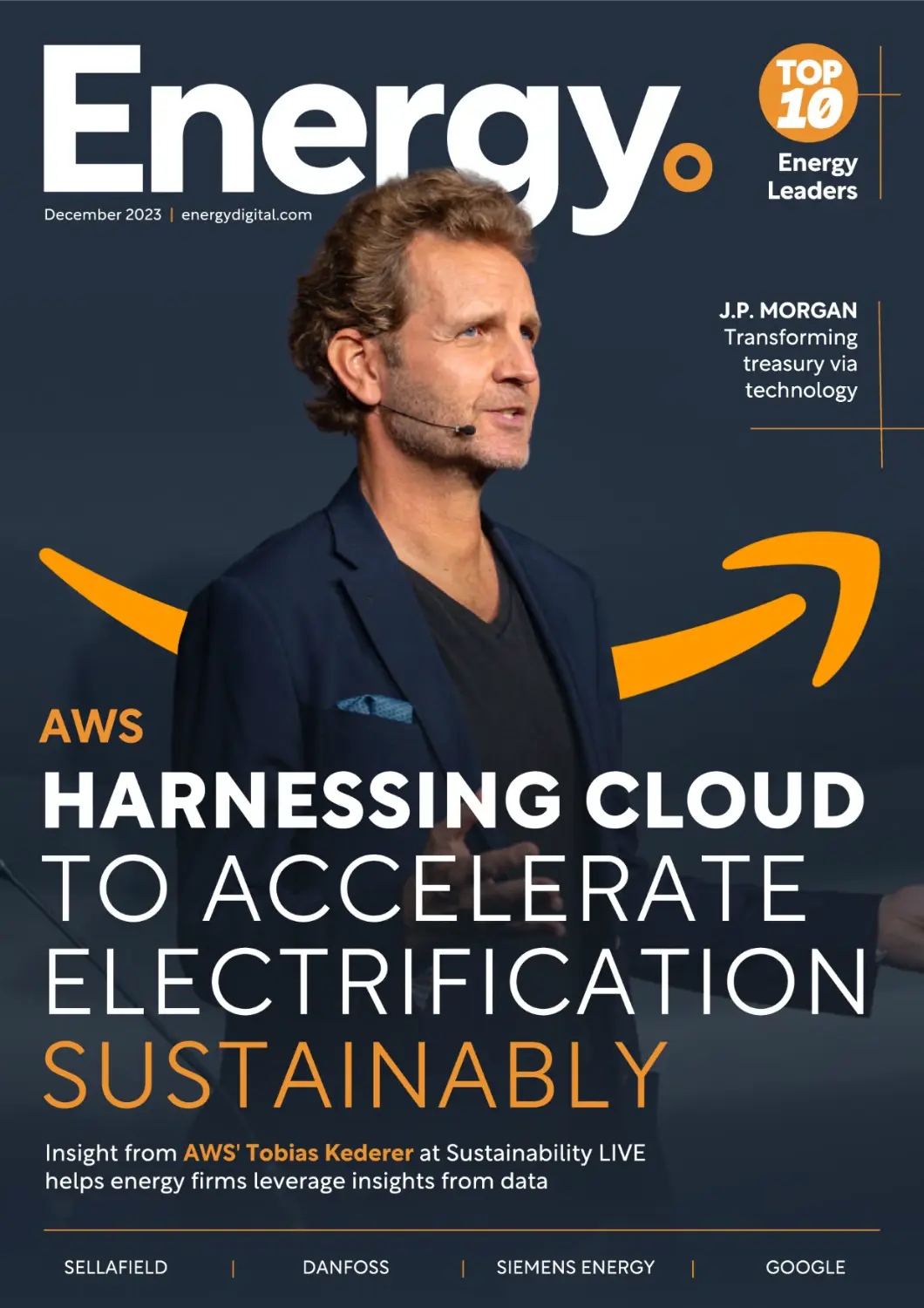
Insight from AWS' Tobias Kederer at Sustainability LIVE
helps energy firms leverage insights from data
SELLAFIELD

DANFOSS

SIEMENS ENERGY

GOOGLE

The Digital Platform
for Energy Leaders

JOIN THE COMMUNITY

MAGAZINE | WEBSITE | NEWSLETTER + MORE

Ways to
Work With us
Energy magazine is an established and trusted
voice with an engaged and highly targeted audience
of 150,000 global executives
Digital Magazine
Website
Newsletters
Industry Data & Demand Generation
Webinars: Creation & Promotion
White Papers & Research Reports
Lists: Top 10s & Top 100s
Events: Virtual & In-Person

WORK WITH US

Never miss
an issue!

+
Discover the
latest news
and insights
about Global
Energy...

JOIN THE COMMUNITY

The Energy Team
EDITOR-IN-CHIEF

TOM SWALLOW
EDITOR

CHARLIE KING
CHIEF CONTENT OFFICER

SCOTT BIRCH

HEAD OF DESIGN

ANDY WOOLLACOTT
LEAD DESIGNER

SAM HUBBARD
SENIOR DESIGNERS

SAM HUBBARD
REBEKAH BIRLESON

FEATURE DESIGNERS

JULIA WAINWRIGHT
VICTORIA CASEY
EMMA WALLER
ADVERT DESIGNERS

PRODUCTION DIRECTORS

GEORGIA ALLEN
DANIELA KIANICKOVÁ

PRODUCTION MANAGERS

CALLUM HOOD
DANILO CARDOSO
ADRIAN SERBAN

JANE ARNETA
MARIA GONZALEZ
YEVHENIIA SUBBOTINA
KENDRA LAU

VIDEO PRODUCTION MANAGER

MARKETING MANAGER

KIERAN WAITE

DIGITAL VIDEO PRODUCERS

ERNEST DE NEVE
THOMAS EASTERFORD
DREW HARDMAN
SALLY MOUSTAFA

INDIA BERRY

SENIOR MARKETING MANAGER

LAUREN HAYES

PROJECT DIRECTOR

CHARLIE MCGILL

MEDIA SALES DIRECTOR

CHARLIE MCGILL

MANAGING DIRECTOR

LEWIS VAUGHAN
CEO

GLEN WHITE

FOREWORD

AI’s power to protect
and prevent
What’s your opinion of AI? Perhaps if I elaborate…
These new technologies bring immense
transformation benefits in a world that is under
threat from natural disaster as well as national and
international disruptions. AI gives us great insight
into the future, but also helps us pivot in a safe and
sustainable direction in order to meet environmental,
social and economic needs.
A great example of how technology can aid in the
event of disruption can be witnessed in Google’s
Sustainability LIVE keynote, which really showcases
how AI can be used for good. It can foresee the weather
and generate alerts of extreme conditions, manage
infrastructure to ensure that transport runs smoothly,
all while monitoring the efficiency and effectiveness of
current systems.
Sooner or later, we’ll all be wondering what we ever
did without technology; many already are.
ENERGY DIGITAL MAGAZINE
IS PUBLISHED BY

TOM SWALLOW

tom.swallow@bizclikmedia.com

© 2023 | ALL RIGHTS RESERVED

energydigital.com

5

The Portfolio

WORK WITH US

CONTENTS
UP FRONT

014

014 THE ENERGY
INTERVIEW

Vaishali Nigam, Co-Founder
and Sustainability Chairperson,
ReNew

020

020 LIFETIME
OF ACHIEVEMENT
Fatih Birol,
Executive Director, IEA

024 PEOPLE MOVES

024

Clean energy leaders and
industrial, electrical evolution

026 THE MONTH
THAT WAS

Leaders build up to energy
discussions at COP28

030
000
8

December 2023

DECEMBER 2023

044

FEATURES
030 TOP 10

054

Energy leaders

044 J.P. MORGAN

J.P. Morgan Payments –
Transforming treasury
via technology

054 INDUSTRY X.0

Digitising energy to access
transportation efficiencies
through data

062

062 SELLAFIELD

Sustainable impact begins
with a sustainable mindset

078 SMART ENERGY

Battery vs fuel-cell vehicles friends or foes?

078
energydigital.com

9

rd r
Bi ffe
rly O 95
t
Ea ke
£2
c
Ti 95
£4

6 - 7 M ARCH 2024
QEII CENTRE, LONDON

2,000+
IN-PERSON & VIRTUAL
ATTENDEES

60+
INTERNATIONALLY
ACCLAIMED
SPEAKERS

2-DAY
NETWORKING, CONFERENCE
& EXHIBITION EVENT

Connect with The World’s
Net Zero Leaders

Sean Jones
Chief Sustainability Officer

Virginie Helias

Ulrike Sapiro
Chief Sustainability Officer

Chief Sustainability Officer

EARLY BIRD TICKETS

BECOME A SPONSOR IN 2024

EXPO • CONFERENECE • WORKSHOPS • NETWORKING

DECEMBER 2023
086 DANFOSS

The journey to net zero
and energy efficiency

086

104 AI

Harnessing cloud service to
accelerate energy sustainably

112 SIEMENS ENERGY
Driving sustainability
with digitalisation

128 CHARGING

Bi-directional charging turns
EVs into battery energy assets

112

104

energydigital.com

11

In Association with:

CSO s
THE TOP 100

OUT NOW
Championing CSOs from global
organisations, celebrate those who
elevate the industry day in, day out.

Read now

INTERVIEW WITH...

India’s renewable
energy progress
explained
Vaishali Nigam Sinha,
Co-Founder and Sustainability
Chairperson of ReNew, debunks
India’s renewable energy adoption
progress, thriving on national
support

F
VAISHALI NIGAM SINHA
TITLE: C
 O-FOUNDER AND
SUSTAINABILITY CHAIRPERSON
COMPANY: RENEW
INDUSTRY: RENEWABLE ENERGY
LOCATION: INDIA
Vaishali Nigam Sinha is the Co-Founder
and Sustainability Chairperson at
ReNew. In this role, she plays a key
part in establishing ReNew as a global
leader in ESG. Nigam also serves as the
Chair of the ReNew Foundation and
holds positions on various boards
as an Independent Director.

14

December 2023

ollowing a successful start to her
career as an investment banker in
the US, Vaishali Nigam Sinha became
the Co-Founder and Sustainability
Chairperson of ReNew—an organisation
that is helping decarbonise India through
renewable energy engagements.
Alongside her role at ReNew, Nigam
Sinha works closely with industry bodies
and think tanks to address the climate
challenge from her angle in the clean
energy sector—as a board member of
the UN Global Compact Network, acting
chair of its Gender Committee, as well as
being the chair of the Confederation of
Indian Industry’s National Committee
on Women in Energy.
Expressing the importance of ESG
in her work, and that of ReNew, we
‘sat down’ to learn more about India’s
sustainability trajectory, and ReNew’s
influence on the industry.

“There is a
common
misconception
that India’s
growth has
been driven
by coal”

INTERVIEW WITH...

“Historically, women have not been
drawn into areas of sustainability and
renewable energy, which has its roots in
traditionally male-dominated sectors”
Q. WHAT’S THE CURRENT ENERGY
LANDSCAPE IN INDIA IN TERMS OF
RENEWABLE ENERGY CAPACITY?

» India, as the fastest-growing major

economy, is making significant strides in the
renewable energy space. Currently, India
is ranked fourth in the world for installed
capacity of renewable energy (including
large hydro), amounting to 179.322
gigawatts. In 2022, we witnessed the highest
year-on-year growth in renewable energy
additions of 9.83%. The Indian government
is also actively promoting the addition of
a substantial amount of renewable energy
capacity in the coming years, with the aim
of installing 500 GW of renewable energy
capacity, requiring India to add about 50
to 60 GW every year until 2030. This target
positions India to become one of the world’s
leading renewable energy economies.
However, there is a common
misconception that India’s growth has
been driven by coal. Over the last decade,
India’s renewable energy function has been
on a highly accelerated trajectory, which
has been driven largely by our country’s
leadership and supported by a thriving
private sector of which ReNew is a part –
and often a pioneer.
It was recently reported that India’s
greenhouse gas emissions rate dropped
33% over 14 years, largely thanks to the
16

December 2023

exponential growth of the renewables
sector in the country. Prime Minister
Narendra Modi has set forth an ambitious
objective for 2030, and in addition to the
500 GW of renewable energy capacity, India
is also looking at a 45% reduction in the
emissions intensity of the economy.

Q. HOW IS THE COUNTRY
AND ITS ORGANISATIONS
RESPONDING TO THE DEMAND
FOR RENEWABLE TRANSITION?

» India’s response to the demand for

the renewable transition is multifaceted,
involving a combination of a positive policy
environment, private sector investment,
technological innovation, and international
collaboration.
India is experiencing a swifter expansion
of renewable energy compared to many
other major economies, with new capacity
additions expected to double by 2026. On
top of that, India’s shift towards clean energy
is already well underway. The country has
surpassed its commitment made at COP21
in Paris by achieving 40% of its power
capacity from non-fossil fuel sources, nearly
nine years ahead of schedule.
India has been responding to the demand
for the renewables transition in several
ways. Constructing solar power plants has
become more cost-effective than that

of coal facilities, thanks to advancements
in technology, consistent and supportive
government policies, and a robust private
sector.
The government is also playing a crucial
role in the support of the industry. The
Production Linked Incentive (PLI) scheme
in solar PV manufacturing was introduced
by the government with financial outlays
amounting to INR 24,000 crore to enhance
manufacturing capabilities, increase exports,
and generate jobs. In addition, the Indian
government authorised US$2.3bn in January
to boost the green hydrogen sector, aiming
to establish India as a worldwide centre for
sustainable fuel.
ReNew specifically is making huge strides
in the green hydrogen space. Last year, the
company signed a Framework Agreement
with the Egyptian Government to establish
a green hydrogen plant in the Suez Canal

Economic Zone, which aims to produce
220,000 tonnes of green hydrogen annually.
Further, it has also set up manufacturing
facilities in Gujarat and Rajasthan for solar
cells and solar modules.

Q. WHY IS IT SO
IMPORTANT TO HAVE FEMALE
REPRESENTATION IN THE ENERGY
SECTOR? WHAT WILL THIS BRING
TO THE RENEWABLE TRANSITION?

» The journey towards a greener future goes
beyond just environmental concerns. While
these types of concerns are a crucial aspect
of businesses’ efforts to reduce carbon
emissions and promote sustainability, it
is equally important to prioritise the wellbeing of individuals. We must guarantee that
the shift to green energy is fair and inclusive
for all communities, particularly those most
susceptible to the effects of climate change
energydigital.com

17

INTERVIEW WITH...

in underdeveloped nations. In addition
to this focus, we certainly must include
women in this transition, through education,
advocacy, and leadership.
On a global scale, we are not looking
only for a renewable energy transition.
We are looking for a just energy transition,
and in order for the energy transition to
be fully credible and just, we must ensure
that women and marginalised groups are
not forgotten as we continue to advance
this journey. It is critical that women are
involved in the renewable energy transition,
from policymakers to government
representatives, all the way to site leaders.
The renewable energy sector is only
growing larger, and this means that the need
for skilled workers will continue to increase.
IRENA estimates that 38 million employees
will be needed by 2030 to reach and deliver
global climate commitments. Increasing
the amount of female representation in
the renewable energy sector has double
benefits: increasing the size of the workforce
while simultaneously bridging the gender
gap currently faced in this sector.

Q. WHAT HINDERS FEMALE
REPRESENTATION IN THE INDUSTRY?

» The United Nations reports that 80%

of people who are displaced by climate
disasters are women, however, their
representation in the clean energy industry
is minimal, at around 32% globally, and just
11% in India. Around 34% of women in the
workforce are in corporate functions and
only about 1% of women occupy jobs in
operations and maintenance or core
STEM roles.
Women have historically not been drawn
into areas of sustainability and renewable
energy, which has its roots in traditionally
male-dominated sectors, like engineering.
18

December 2023

This lack of a female presence could be
caused by societal expectations similar to
that of women in STEM or cultural issues
that hinder women from entering the
workforce. Over the years, this has led to
a lack of diversity in the talent pool and
created an environment where women
may feel like outsiders.
Looking back at my early adult life, a large
majority of women did not go to engineering
colleges due to the lack of available hostels
for them to stay in, which raised security
and safety issues. The combined effect of
the enabling environment and the cultural
environment prevented women from
getting into STEM careers.

Q. HOW WILL RENEW HELP
OVERCOME THESE CHALLENGES?

» I am committed to driving not just

positive environmental impact, but positive
transformation on the societal scale as well.
My work at ReNew has been hyper-focused

on increasing and advancing the roles
that women play in the renewable
energy transition, not just in India,
but across the world.
At ReNew, we believe that diversity,
equity, and inclusion are integral to our
success as a pioneer in the renewable
energy industry. Fostering an environment
that celebrates diversity and encourages
inclusion is our responsibility. Our aim is not
to just bring in more women but to make
sure they feel included and respected by
their seniors and peers. We have observed a
seamless transition of women from enabling
roles to core decision-making roles, where
they contribute significant value to our
organisation across various fields. We have
enabled our talent acquisition team to bring
in an increasing number of female graduate
engineer trainees and diploma engineer
trainees into STEM roles. Members of the
senior leadership team at ReNew have DE&I
targets which help us track progress better.

We continue to take concrete steps to
improve our diversity quotient. We have
a long-term target of achieving 30% gender
diversity in our workforce by 2030. We
are already at around 16%, which is
significantly higher than the industry
average in our sector.
Beyond business, our programmes have
focused on re-skilling women in energy
job roles.
Under our Women for Climate initiative,
I developed and launched Project Surya
in partnership with the UNEP and SelfEmployed Women’s Association of India,
a first-of-its-kind project to train thousands
of salt pan women workers in India and
enable them to get roles in the clean energy
sector. This initiative enabled these women
workers to obtain the necessary skills needed
to not only take on higher pay, safer working
conditions, and a path towards socioeconomic mobility but also to play an
active role in the renewable energy transition.
In addition to Project Surya, I also
developed and led ReNew’s Women
Climate Champions program, an
entrepreneurship development platform,
which selected six female entrepreneurs
to receive bespoke 1:1 mentoring sessions
with senior sector experts, strategic peer
learnings, and capacity-building activities.
Closely aligned with the UN Sustainable
Development Goals, the entrepreneurs
were also educated to ensure that the work
they conduct will have a positive ripple
effect and leave a sustainable legacy.
energydigital.com

19

Credit: International Energy Agency

FATIH BIROL

LIFETIME OF ACHIEVEMENT

A driving force in
international energy
Leading the sector’s main authority, Fatih Birol, Executive Director
of the IEA is a climate evangelist and believes in economic prosperity

M

any of us couldn’t
imagine being at the
helm of a global energy
institution as a critical
decision-maker at this
time. Nevertheless, the International
Energy Agency (IEA) continues to support
the greatest industrial transition of our
time with the Executive Director Dr Fatih
Birol influencing major evolution across
the industry.
Born in 1958 as a Turkish citizen
in the country’s capital Ankara, Birol
studied a Bachelor’s of Science in Power
Engineering at the Istanbul Technical
University. Later he also achieved a
Master’s and PhD in Energy Economics
from the Technical University of Vienna,
which was where his first job role was
formed.
2013 marked the recognition of his
dedication to study as Birol was awarded
a Doctorate of Science honoris causa by
Imperial College London.
During this time, he has been
recognised by a number of countries for
his excellence in the form of honours
and medals. In January 2022, he was
awarded the Chevalier of the Legion of
Honour in France, adding to many other
honours from across the globe, including
countries like Turkey, Austria, Germany,
Italy, and Sweden.

Birol comes from humble beginnings
as a dedicated Junior Analyst with the
Organization of the Petroleum Exporting
Countries (OPEC) based in Vienna.
The following years saw him enter the
IEA and climb the ladder to a Chief
Economist role, which put him in charge
of its World Energy Outlook report.
In 2015, his tenure as Executive
Director began, consisting of an
incredible journey of industry
influence to this day.

FATIH BIROL
TITLE: EXECUTIVE DIRECTOR
COMPANY: IEA
INDUSTRY: ENERGY
LOCATION: FRANCE
Fatih Birol is the Executive Director of
the International Energy Agency (IEA).
An expert in energy economics and
sustainability, he has made significant
contributions to global energy policy
dialogues over the years. Under
his leadership, the IEA addresses
pressing challenges including
climate change, energy security,
and sustainable energy access.

energydigital.com

21

Credit: World Economic Forum

LIFETIME OF ACHIEVEMENT

WATCH NOW

22

December 2023

“Let me be clear,
economic growth
coupled with
decarbonisation
is not only realistic,
it has already been
happening”

Responsibility for climate
change and the energy transition
Birol’s climate advocacy and
commitment can be seen across the
industry, but he often shares his thoughts
on the direction of the global energy
sector via the IEA’s website – sharing
analysis of new developments, global
news, major events, and opportunities
across all facets.
Birol is a strong believer of
decarbonisation that coincides with
economic prosperity. While this is a key
part of his role, as an economist himself
he understands the relationship between
the two and looks to drive a coalition
between business and the planet.
In an article published by the IEA
he talks of world recovery that aligns
the economy with sustainability.

“Let me be clear, economic growth
coupled with decarbonisation is not only
realistic, it has already been happening,”
says Birol. “Last month, IEA data showed
that global energy-related carbon
emissions stopped growing in 2019 even
as the world economy expanded by
nearly 3%. A key part of this encouraging
development was the decline in emissions
from the electricity sector across advanced
economies, indicating that clean energy
transitions are moving forwards.”
It’s safe to say that the climate crisis, and
in fact all crises, has a profound effect on
Birol and is further motivation to continue
building an energy that is suitable for the
future. Part of this work is to understand
the energy landscape and ensure full
transparency of the industry and the
sentiments of the powers within it. Birol
recognises the challenges vary between
continents as energy equity is yet to come
to fruition in some underserved areas.
“Although some of the biggest
disruptions have been felt in Europe and
made a lot of the headlines, major impacts
are being felt in many emerging and
developing economies. For example, we
see this clearly in the number of people
worldwide who lack access to electricity,
the large majority of whom live in SubSaharan Africa. This number rose last year
for the first time in decades as energy prices
spiked amid the crisis.”
As the Executive Director, Birol prides
himself on bringing clarity and reassurance
to the industry that it takes on the climate
challenge with the full support from the IEA.
With many countries realising the demand
for their own energy strategies, they can
focus on delivering renewable systems.
energydigital.com

23

PEOPLE MOVES

CLEAN ENERGY LEADERS
AND INDUSTRIAL,
ELECTRICAL EVOLUTION
We look back at some of the key appointments that will enable clean
energy development and further progress in the electric revolution

LUKE MILNER
JOB FROM: C
 FO, ENERGY VENTURES
AT LIBERTY GLOBAL
JOB TO: C
 EO, ENERGY TRANSITION
PORTFOLIO AT LIBERTY GLOBAL
Milner holds a key role in enabling finance for
a future of renewable energy. While he was
previously the CFO of Energy Ventures, he now
steps up to become the CEO of the portfolio,
working on the Egg brand – which is driving
a clearer pathway to clean energy through
home solar-power, battery-storage, and EV
charging solutions. The joint-venture Believ
initiative will also be supported by Milner with
a primary focus on automotive electrification
as an EV charge point operator, which recently
appointed Guy Bartlett as its CEO.
His position at Liberty Global will continue to
build the foundations of a cleaner relationship
with energy and act as a key influencer of
infrastructure electrification globally.

24

December 2023

“Kristin Baker’s extensive
knowledge of our business
gained from various senior
roles, including her most
recent position as VP
for Strategy & Business
Development, is invaluable”
KELLY BECKER

ZONE PRESIDENT,
SCHNEIDER ELECTRIC UK&I

IAN WOODS
JOB FROM: M
 ANAGING DIRECTOR
AT DEUTSCHE BANK
JOB TO: V
 ICE CHAIRMAN,
INDUSTRIALS INVESTMENT
BANKING AT BARCLAYS
Barclays announced the appointment
of Woods to the role of Vice Chairman,
Industrials Investment Banking in October
2023 – a role that will support global
energy investing.

KRISTIN BAKER

DAVID GOATMAN

JOB FROM: V
 P STRATEGY & BUSINESS
DEVELOPMENT UK & IRELAND
AT SCHNEIDER ELECTRIC

JOB FROM: P
 ARTNER, HEAD OF ENERGY,
SUSTAINABILITY AND
NATURAL RESOURCES
EMEA AT KNIGHT FRANK

JOB TO: V
 P INDUSTRIAL & PROCESS
AUTOMATION UK & IRELAND
AT SCHNEIDER ELECTRIC
Having joined the team in 2011, Baker is
now the VP Industrial & Process Automation
for UK & Ireland at Schneider.

KRISTEN BROWN
JOB FROM: D
 IRECTOR OF
FUTURE ENERGY SYSTEMS
UK&I AT SCHNEIDER ELECTRIC
JOB TO: V
 P OF STRATEGY UK&I
AT SCHNEIDER ELECTRIC
VP of Strategy for the UK and Ireland was
earned by Brown, a role in which she will
dedicate her efforts to group operational
strategy and ensure the execution of shortterm strategic goals.

JOB TO: G
 LOBAL HEAD OF
ENERGY AND SUSTAINABILITY
SERVICES AT KNIGHT FRANK
The real-estate consultancy based in London,
UK, has appointed Goatman to lead the
changes happening in the world of property.

FRANCESCO STARACE
JOB FROM: C
 EO & GENERAL
MANAGER AT ENEL
JOB TO: C
 HAIR OF THE
SCIENCE-BASED TARGETS
INITIATIVE (SBTI) AT ENEL
“I am very impressed by the momentum
the SBTi has built since its inception,” said
Starace on his appointment as the Chair of
the global sustainability programme.

energydigital.com

25

THE MONTH THAT WAS

LEADERS BUILD
UP TO ENERGY
DISCUSSIONS
AT COP28

From clean energy
to supply chain,
industry leaders
are building on
their sustainable
commitments and
COP28 will see to
a more strategic
direction

MCKINSEY &
COMPANY’S
GLOBAL ENERGY
PERSPECTIVE
REPORT
CLEAN ENERGY TECHNOLOGY:
ROLLS-ROYCE SMR’S
NUCLEAR SOLUTION
Most people will be familiar with RollsRoyce Motors – the brand is synonymous
with the luxury cars that it has been
developing since 1904.
It is, however, part of a wider Rolls-Royce
business that believes in the positive,
transforming potential of technology.
READ NOW

Leading global
consultancy McKinsey
& Company has released
its 2023 Global Energy
Perspective, which shows
that tackling energy
transition technology
bottlenecks with
substitute materials,
innovation, infrastructure
build out and regulation
will be crucial to achieving
net zero targets.
READ NOW

DHL SUPPLY CHAIN
BOOSTS DECARBONISATION
BY FUELLING WITH HVO
The world’s leading logistics provider, DHL Supply Chain,
is part of the DHL Group, the enabler of global trade
that operates in more than 220 countries and territories
and employs over 600,000 people around the world.
READ NOW

RWE LED GERMAN
GREEN HYDROGEN
RESEARCH
PRODUCES
HYDROGEN
In Germany, research
around the infrastructure
required for green
hydrogen in public
spaces is being
conducted.
The project, GET H2
TransHyDE, is being run
by RWE with Adlares,
Evonik, Meter-Q
Solutions, Nowega, OGE,
and Rosen, together with
the DVGW Research Unit.
READ NOW

EXXONMOBIL
SUPPORTS
DECARBONISATION
THROUGH CARBON
CAPTURE

COP28:
KEARNEY
& THE WCF PARTNER
FOR BUSINESS
SUSTAINABILITY

ExxonMobil is one of the
world’s largest publicly
traded international
energy companies.
Established over
140 years ago, it works
to provide the fuels and
chemicals that make
modern life possible and
support human progress,
providing the energy
that the global economy
requires while also
offering lower-emission
solutions.

Leading global
management consulting
firm Kearney has been a
trusted advisor to C-suites,
government bodies, and
non-profit organisations
for nearly
a century.
To further support
the private and public
sector transition to more
regenerative business
models, the firm is
partnering with the World
Climate Foundation (WCF).

READ NOW

READ NOW

energydigital.com

27

IT’S TIME TO
GET NOTICED
10T H S E P T E M B E R
BUSINESS DESIGN CENTRE, LONDON

ENTER NOW

SPONSORSHIPS

In Association with:

M AG A Z I N E

TOP 10

ENERGY
LEADER
Sustainability Magazine and Energy
Digital champions innovative and
influential Chief Sustainability Officers
(CSOs) leading energy companies
WRITTEN BY: CHARLIE KING

Y
RS
energydigital.com

31

TOP 10

09

Anisa Kamadoli Costa
Title: Chief Sustainability Officer
and President & Trustee,
Rivian Foundation
Company: Rivian
Industry: Vehicle Manufacturing
Ranking: 93

10

Katherine Neede

Title: Chief Sustainability Officer
Company: Duke Energy
Industry: Utilities
Ranking: 99

Currently the CSO of Duke Energy,
Neebe has 25 years of experience
leading ESG initiatives that include
climate change, natural capital, and
human rights. In her current role, she
develops solutions to meet customer
needs for continued reliable and
affordable energy while striving
to meet net zero targets.

32

December 2023

As a leading sustainability,
philanthropist and social impact
executive, Costa has a track record
of connecting ESG issues to business
performance, reputation, and
shareholder value. In her role at
Rivian, Costa develops the
company’s global sustainability
and philanthropic agenda.

TOP 10

07

Yumi Otsuka

Title: Chief Sustainability Officer
Company: Toyota
Industry: Vehicle Manufacturing
Ranking: 43

08

Charlotte Wolff-Bye

Title: Chief Sustainability Officer
Company: PETRONAS
Industry: Oil & Gas
Ranking: 61

Dedicating her career to Toyota,
Otsuka has been at the company for
three decades. As CSO she leads the
company’s approach to sustainability
ensuring it is woven into its corporate
strategy priorities. She also drives
awareness and investment for
sustainable innovation, productivity
and growth.

A champion of corporate
sustainability practices, Wolff-Bye
has been the CSO of Petronas for
the last two years, embedding
sustainability into the company
strategy, as well as ensuring that
the company has good governance
to match.

energydigital.com

33

rd r
Bi ffe
rly O 95
t
Ea ke
£2
c
Ti 95
£4

6 - 7 M ARCH 2024
QEII CENTRE, LONDON

2,000+
IN-PERSON & VIRTUAL
ATTENDEES

60+
INTERNATIONALLY
ACCLAIMED
SPEAKERS

2-DAY
NETWORKING, CONFERENCE
& EXHIBITION EVENT

Connect with The World’s
Net Zero Leaders

Sean Jones
Chief Sustainability Officer

Virginie Helias

Ulrike Sapiro
Chief Sustainability Officer

Chief Sustainability Officer

EARLY BIRD TICKETS

BECOME A SPONSOR IN 2024

EXPO • CONFERENECE • WORKSHOPS • NETWORKING

TOP 10

05

Kristen Siemen

Title: Vice President and
Chief Sustainability Officer
Company: General Motors
Industry: Vehicle Manufacturing
Ranking: 29

06

Christopher Raymond

Title: Chief Sustainability Officer
Company: Boeing
Industry: Aviation & Aerospace
Ranking: 30

“Our journey to a zero emissions,
all-electric future has never been
more important than it is today
I’m honoured to be featured on
this list with leaders all around the
world working together to help
create a more sustainable future
for generations to come.”

Responsible for advancing Boeing’s
approach on aerospace sustainability
priorities, stakeholder-oriented
engagement; reporting; and company
performance, Raymond drives shared
awareness of sustainability trends,
opportunities and risks. He reports to
the CEO and to the Governance and
Public Policy committee of the Board.

energydigital.com

35

TOP 10

04

Gwenaelle Avice-Huet
Title: Chief Strategy &
Sustainability Officer
Company: Schneider Electric
Industry: Automation Machinery
Manufacturing
Ranking: 23

An inspirational leader at global
organisations including ENGIE and
KLM, Avice Huet has a long career
in and around sustainability, climate
negotiations, renewable energy, and
the zero carbon transition. Avice-Huet
joined Schneider Electric in 2021.

03

Matthew Bateson
Title: Chief Climate
& Sustainability Officer
Company: Aramco
Industry: Oil & Gas
Ranking: 21

An industry expert on sustainability,
climate change, and carbon
management, Bateson is the CSO
of Aramco where he anticipates
and sustainably manages safety,
environmental and social impacts
of current and future activities in
the oil and gas industry.

36

December 2023

02

Roger Martella

Title: Group Vice President
and Chief Sustainability Officer
Company: GE
Industry: Industrial
Machinery Manufacturing
Ranking: 16

GE is a 129-year-old technology
and innovation company committed
to succeed in a larger purpose —
improving the quality of life for all
people globally by addressing the core
sustainability challenges of the energy
transition and climate change, precision
healthcare for people everywhere, and
a more sustainable future of flight.

“We’ll succeed for sustainability
only if we collaborate with diverse
leaders in the private and public
sectors. It’s an honour to join my
partners in Sustainability Top 100 who
are driving critical progress both for
their companies and more broadly
for sustainability success together,”
Martella says.

WATCH NOW

energydigital.com

37

In Association with:

CSO s
THE TOP 100

OUT NOW
Championing CSOs from global
organisations, celebrate those who
elevate the industry day in, day out.

Read now

TOP 10

40

December 2023

01

Judith Wiese

Title: Chief People
and Sustainability Officer
Company: Siemens
Industry: Automation
Machinery Manufacturing
Ranking: 13

A people person that enjoys meeting
people and listening to their stories,
Wiese is driven to create an inclusive
and empowering culture. She is
passionate about sustainability and
believes who all companies have a
responsibility to contribute to the
UN’s SDGs. Alongside her role as CSO,
Wiese is a Member of the Managing
Board of Siemens AG. Previously,
she held management roles at Mars,
the world’s leading manufacturer of
chocolate, chewing gum, mints and
fruity confections.

WATCH NOW

energydigital.com

41

FEATURING:

2,000+
IN-PERSON & VIRTUAL
ATTENDEES

60+
INTERNATIONALLY
ACCLAIMED
SPEAKERS

Adam Read
Chief Sustainability Officer

Kristen Siemen
Chief Sustainability Officer

2-DAY
NETWORKING, CONFERENCE
& EXHIBITION EVENT

Sandeep Chandna
Chief Sustainability Officer

A BizClik Event

EXPO • CONFERENECE • WORKSHOPS • NETWORKING •

rd r
Bi ffe
rly t O 95
Ea ke
£2
c
Ti 95
£4

Connect with
The World’s
Net Zero Leaders
6 - 7 MARCH 2 024
QEII CENTRE, LONDON

Virginie Helias
Chief Sustainability Officer

Ulrike Sapiro
Sean Jones

Chief Sustainability Officer

Chief Sustainability Officer

EARLY BIRD TICKETS

BECOME A SPONSOR IN 2024

EXPO • CONFERENECE • WORKSHOPS • NETWORKING

J.P. MORGAN
PAYMENTS –
TRANSFORMING
TREASURY VIA
TECHNOLOGY
AD FEATURE
WRITTEN BY:
SCOTT
BIRCH
PRODUCED BY:
GLEN
WHITE

44

December 2023

J.P. MORGAN PAYMENTS

J.P. MORGAN PAYMENTS

Michael Brady, Executive Director, Liquidity and Account
Solutions at J.P. Morgan Payments, explains how Treasurers
can leverage technology transformation

A

s a leader in payments with
nearly 150 years of experience,
J.P. Morgan Payments has a deep
understanding of the impact of
technology on Treasurers and their partners.
This technology, when implemented
correctly, can enhance a Treasurer’s ability
to perform their core responsibilities,
and their value to the organisation.
Michael Brady, Executive Director,
Liquidity and Account Solutions at J.P.
Morgan Payments, says better technology
and data leads to more informed decision
making, resulting in better forecasting and
improved control.
“At their core, a Treasurer is responsible
for ensuring the company has the right
amount of money, in the right entity, in
the right currency, in the right location
and at the right time to ensure financial
obligations are met,” says Brady.
“Having the right technology
infrastructure can unlock the data and
insights necessary to more accurately
view current cash positions and forecast
future cash needs. This ultimately leads
to freeing up working capital, improved
FX hedging, and overall improvements
in capital efficiencies. Additionally,
technology can reduce operational risks
associated with manual processes and,
ultimately, free up resources.”
The key phrase there is “the right
technology”. With so many solutions
on the market, Treasurers can easily
find themselves swamped with disjointed
46

December 2023

systems that lead to unnecessary
complication and inefficiencies.
Brady backs this up, saying that the
issue J.P. Morgan Payments hears of most
often is fragmented platforms that lead
to lack of both centralisation and visibility
into cash positions globally.
“This lack of controls results in excess
cash buffers, which has become increasingly
punitive in an elevated rate environment,”
explains Brady.
“Along with lack of control/visibility,
we also see an increased focus on the
move towards real-time data to help
further reduce idle cash. The main reason
for these challenges is twofold. First, lack
of understanding the art of the possible
and keeping up with new trends in treasury
technology, and second, lack of availability
of resources on the treasury and technology
side of companies.”
Application programming interfaces,
or APIs, allow applications to speak to
one another and can therefore support
digital transformations such as real-time
payments and real-time visibility into
cash positioning. These innovations
can be good news for both partners
and Treasurers, but they do require
Treasurers to have a foundational
understanding of APIs – as well as which
ones are most useful when it comes to
meeting business goals. Treasurers need
to be able to communicate confidently
about APIs with technology leaders within
the organisation.

US$9.8
trillion

daily payments
processed

200+

countries &
territories

120+

currencies

Michael Brady,
Executive Director,
Liquidity and
Account Solutions
energydigital.com

47

J.P. MORGAN PAYMENTS

“Here at J.P. Morgan Payments, we
have built our virtual solutions
platform in-house, which makes it
more flexible, and we are continuing
to invest in it to suit our clients’ needs”
MICHAEL BRADY

EXECUTIVE DIRECTOR OF LIQUIDITY
AND ACCOUNT SOLUTIONS,
J.P. MORGAN PAYMENTS

“The world of Treasury has shifted and is
rapidly moving towards real-time to reduce
capital buffers and create operational
efficiencies. APIs are a tool that is driving
this evolution,” says Brady.
“In a rapidly changing economic
environment with elevated rates,
the benefit of having real-time insights
into cash positions is invaluable,
and the flexibility the APIs provide
will be transformative.
“APIs are really the present and the future.
Where we see the biggest challenge is with
the understanding of APIs and how powerful
they can be in a company’s treasury
transformation journey.”
APIs are on a rapidly evolving journey
with the ability to monitor and initiate
payments in real-time to transform
Treasury. All of this of course comes
with a cost, particularly when working
in a legacy technology environment.
The technology investment and
resources need to be carefully taken
into consideration, but the adoption of APIs
is becoming more and more streamlined
and may be easier and more powerful than
some Treasurers realise.
48

December 2023

Of course, Treasurers are rightly
concerned with cost when it comes to capital
expenditure on new technology, and while
virtual solutions are not new, there has been
an increased focus and investment in them
thanks to the cost benefits they can bring.
Brady, however, believes there is a bigger
picture to consider.
“When it comes to virtual solutions,
the number-one driver from clients
is cost reduction as a result of account
rationalisation,” he says. “Can there be
a cost benefit? Sure, but we encourage
clients to think more broadly. What is the
art of the possible? If you could have the

most granular level of reporting, insights,
and visibility, what would that look like?
What resources would that free up? How
much working capital could you free up with
better reporting? What operational efforts
or risks could be reduced or eliminated?”
Brady says virtual solutions can facilitate
subledgering of funds within a single physical
account, resulting in the ability to slice and
dice transactions within that account to
create the ultimate in flexibility in reporting.
Historically, companies had to open
hundreds or thousands of accounts to
get this level of visibility. The improved
visibility not only creates natural business

MICHAEL BRADY
TITLE: EXECUTIVE DIRECTOR,
LIQUIDITY AND ACCOUNT
SOLUTIONS
COMPANY: J.P. MORGAN PAYMENTS

Michael Brady, Executive
Director, is a Liquidity and
Account Solutions Specialist at J.P.
Morgan. Michael is a liquidity subject
matter expert with more than 13
years’ experience in various roles
in the payments space.

energydigital.com

49

insight benefits, but also limits idle cash
as concentration is native within virtual
structures. Lastly, virtual structures can
significantly reduce the burden of cash
application and manual reporting processes.
“The key with virtual solutions is creating
a flexible structure and having a partner
that is continuing to invest in their
platform as technology and adoption
of virtual solutions evolve,” says Brady.
“Here at J.P. Morgan Payments, we have
built our virtual solutions platform inhouse, which makes it more flexible,
and we are continuing to invest in it
to suit our clients’ needs.”
50

December 2023

Treasury transformation is not a onesize-fits-all, one and done approach.
It is important to not just think of what
you need to solve now, but rather to
consider what is the art of the possible,
and work backwards from that.
There will inevitably be low-hanging
fruit, and there will also be heavy lifts.
When thinking of the heavy lifts, keep
in mind the return in terms of unlocking
capital, freeing up resources or gaining
more insights to drive business.
View it as a journey, which, as
technology advances, will be ever evolving.
That is why flexibility is so important.

J.P. MORGAN PAYMENTS

When it comes to the best strategy for
creating a digital ecosystem to enable and
accelerate digital transformation, again,
there is no single ‘silver bullet’ solution.
“Does it make sense to invest in the most
robust treasury management system?
Maybe. Maybe not. What features are you
realistically going to use and is it worth the
investment?” asks Brady.
When it comes to the potential benefits,
there are a few key aspects to consider.
First, what manual processes can you
replace? This should be assessed both
from an operational risk perspective
and also a resourcing perspective.

Second, how much working capital can
you unlock, and what is the most efficient
way to deploy it? With rates elevated, the
benefits can be significant, but it is also
important to perform sensitivity analysis
around yields to ensure ROI projections
are accurate should current economic
conditions change drastically.
Lastly, and less tangible, is the
importance of flexibility of your tech
ecosystem. The secret of a successful
digital transformation lies in fluency between
Treasurers and Chief Technology Officers
(CTOs). Only when these vital functions are
aligned will the organisation truly evolve.
energydigital.com

51

J.P. MORGAN PAYMENTS

“We encourage clients to
think more broadly. What
is the art of the possible?”
MICHAEL BRADY

EXECUTIVE DIRECTOR OF LIQUIDITY
AND ACCOUNT SOLUTIONS,
J.P. MORGAN PAYMENTS

“With many companies evolving into
new lines of business or expanding into
new markets with globalisation, we are
seeing increased alignment between
Treasury and the Business lines as a result
of the cash implications of these evolutions,”
says Brady.
“As the demand on Treasury increases,
Technology must also have a seat at the
table to understand the implications the
Treasury infrastructure has on the overall
working capital of the company. Treasury
should view Technology as a critical partner
and involve them in project decisions so
that Technology not only understands the
language of treasury, but vice versa as well.
“With resources limited on both sides,
it is important to have a clear sense
of the implication of projects and decisions
on one another.”
There are pressures on both sides to
deliver transformation via technology in
a cost-effective manner, which is why due
diligence is essential to enable smooth
project delivery and ROI.
This is where the Treasurer and CTO
can work in tandem to secure the best
business outcomes.

energydigital.com

53

Digitising
energy to access
transportation
efficiencies
through data

Insight from Kate Brandt, CSO of Google,
highlights the evolution of Google’s digital
product that is enabling time, energy, and
cost savings worldwide
WRITTEN BY: TOM SWALLOW

INDUSTRY X.0

I

n the current consumer landscape,
sustainability is faced with myriad
challenges. In order to engage
the public in the race to net-zero
emissions – renewable energy adoption,
green transportation, and so on – industries
must arm themselves with methods of
influencing drivers, homeowners, and
businesses. However, this need not be
so challenging, particularly in the digital
environment where new functionality awaits
on every rotation of the innovation sphere.
Iterations of digital solutions bring with
them greater, more convenient methods of
managing energy consumption and travel
smarter, more sustainably, and even at lower
costs – these are the three major impacts
to the consumer: time, money, and effort.
Moreover, the challenges develop
in different ways depending on global
positioning. For example, a solution that
can support those in the US will not be
the same in India. The requirements vary
depending on geographical location and
other factors like the adoption of digital
energy infrastructure, the uptake of electric
cars, and overall the access to data in order
to share insights.
Take Google’s product as an example.
For almost two decades now, Google Maps
has served the majority, adopting more
insights year-on-year and is now one of the
staple services for commuters and travellers
worldwide. The sheer amount of data
leveraged by the company for this particular
application is mind-blowing and is enabling
greater accessibility than many can even
comprehend. Paper maps are pretty much
redundant as digitally savvy generations turn
to Google Maps to get to their destination,
albeit in the car or on foot in their local
town or city.
energydigital.com

55

Get reliable
network coverage
and security
protection, fast.

ADVERT PAGE
MEDIA SALE

A modern network must be able to respond easily, quickly and flexibly to the growing
needs of today’s digital business. Must provide visibility & control of applications,
users and devices on and off the network and Intelligently direct traffic across the
WAN. Be scalable and automate the process to provide new innovative services.
Support IoT devices and utilize state-of-the-art technologies such as real-time
analytics, ML and AI. And all these must be provided with maximum security and
minimum cost.
This is the power that brings the integration of two cloud managed platforms,
Cisco Meraki and Cisco Umbrella. This integration is binding together the best of
breed in cloud-managed networking and Security.

cisco.com

cisco

CiscoSecure

CiscoSecure

“In the US, when people
search for terms like
‘best electric cars’, they
can quickly compare
prices, battery range
and discover models”
KATE BRANDT

CHIEF SUSTAINABILITY OFFICER,
GOOGLE

The influence of Google Maps
on energy-efficient transport
Nowadays, consumers expect more insight
from the app. Google has set the bar for
navigation, so now the platform is able to
play its own unique role in driving down
emissions bit by bit. We also heard from
the company’s Sustainability Lead Adam
Elman at Sustainability LIVE London about
how Google is delivering functions to keep
customers moving while enabling the most

fuel-efficient and energy-efficient routes.
The company recognises the growing trend
in electric vehicles (EVs) and is leveraging
data from various digitally enabled vehicles
to paint a picture of the cost and emissions
involved in travel anywhere in the world.
More information is gained as we read the
latest insights from Kate Brandt, Google’s
Chief Sustainability Officer, who says: “To
help people find other sustainable modes
of transportation, like rail, new train route
suggestions will soon appear on Search
when you look for flights. And in the near
future, in France, when people look up
driving directions, Maps will show public
transit or walking suggestions next to
driving routes if travel times are comparable
and practical.”
energydigital.com

57

“Global
EV-related
searches have
nearly doubled
over the past
two years”
KATE BRANDT

CHIEF SUSTAINABILITY OFFICER,
GOOGLE

58

December 2023

Of course, allowing greater insight into
already established public transport is
crucial, and there are many ways in which
this can reduce emissions – influencing
more people to use public systems by
making them more convenient, but a much
more challenging beast is that of automotive
electrification. EVs are arriving thicker and
faster, spurred on by the growing emphasis
on climate change and the pandemic’s
showcase of atmospheric healing thanks
to limited driving.
Google must integrate data from various
sources to track and analyse the entire EV
landscape, including charging hubs, new

INDUSTRY X.0

GOOGLE AT
SUSTAINABILITY
LIVE LONDON

cars, and complex energy requirements in
cities. Not only is this having an influence
on the renewable energy transition, but
also allowing customers to understand the
credentials of EVs on the market, making
everyone much more knowledgeable of
how to live with electrified transport.
“EVs are another area of transportation
where we’re seeing growing interest. In fact,
global EV-related searches have nearly
doubled over the past two years. For people
shopping for an EV, it’s now even easier to
understand the costs associated with buying
a new vehicle thanks to new insights in
Search,” says Brandt.

For the third year running, BizClik hosted
Sustainability LIVE London, which has
grown exponentially over a short period.
Sustainability advocates and evangelists
descended on the Business Design
Centre, London, to pack their minds with
the latest insights from the corporate
leaders in sustainability.
The event hosted Google’s own
Head of Sustainability Adam Elman, who
shared all of the current and upcoming
innovations from the technology giant
in terms of climate impact reduction,
renewable energy adoption, and, as we
mention here, solutions that will drive
the EV industry forward.
Catch the session on-demand, HERE

energydigital.com

59

KATE BRANDT
TITLE: C
 HIEF SUSTAINABILITY OFFICER
COMPANY: GOOGLE
INDUSTRY: TECHNOLOGY AND AI
LOCATION: UNITED STATES
Kate Brandt the Chief Sustainability
Officer of the world’s leading internet
search engine company and one of
the most prestigious digital and cloud
organisations. She was also recognised as
number one in Sustainability Magazine’s
Top 100 Women for her unwavering
commitment to inclusivity and
decarbonisation.

INDUSTRY X.0

“In the US, when people search for terms like
‘best electric cars’, they can quickly compare
prices, battery range and discover models. They
can also find federal government incentives for
qualifying vehicles in the US, with German and
French national incentives coming soon.”
Supporting city planners
to adopt renewable energy
Looking at a much more industrial side of
things, Google Earth is now capable of doing
much more than simply allowing internet users
to scan the globe for the latest birdseye view
images of their childhood back garden.
This tool can support city planners with
greater insights into the potential applications
of renewable energy infrastructure, such as
solar, as well as cost and energy efficiency
information to get the most out of disruptive
projects.
Ultimately, the sooner these functions can
be leveraged the smoother the transition will
be and allow developers to be more proactive
in their approach to building more efficient
housing in the future.
“This capability will make it easier for
planners to determine the best building
designs and solar options for urban areas. It’s
especially helpful when optimising designs
for places with ample space, like parking lots,”
says Brandt. “As we continue working toward
a carbon-free world, making solar technology
more accessible for cities and organisations
will be key to reducing global emissions.”
Energy efficiency is supported in various
ways by the Google products that have evolved
over time to share more insight than previously
anticipated. These great strides of its digital
products will serve economies in the race to
decarbonise cities, electrified transportation,
and create more opportunities for the public
to take energy consumption into
their own hands.
energydigital.com

61

LOGO

62

December 2023

SELLAFIELD

Sustainable
impact begins
with a sustainable
mindset
AD FEATURE
WRITTEN BY:
TOM SWALLOW

AD FEATURE
PRODUCED BY:
GLEN WHITE

SELLAFIELD

Eirini Etoimou showcases how
Sellafield integrates sustainability
moving from the ambition to action
and to long-term results

T

here is a misconception that
one person can tackle all of the
global challenges in an instant.
This is especially true with
areas of sustainability.
The imminent threat of centuries of
damage to the planet makes sustainability
a very passionate subject, but it is not
without its challenges. This is why one
of the most critical tasks for some of the
most impactful organisations is managing
expectations of what their businesses
can achieve in the eyes of those that work
for them – but also those that look from
the outside-in.
It is in this sense we can say that the
majority still don’t grasp the concept of
sustainability whereby one change can cause
a chain reaction in a particular direction,
albeit related to business or climate, that can
alter how the world works. In combining the
attributes of the economy and sustainability,
we open up a very complex environment,
of which all businesses will learn to navigate
over the coming years – or so we hope.
Some of the most critical industries,
namely supply chain and energy, are
undergoing great shifts to first de-risk,
then decarbonise, with a number of social
implications along the way. Facilitating this
monumental transition requires passionate
people with the ability to listen, learn, and
act upon the challenges that come their way
– true advocates of, not just sustainability,
but ensuring environmental prosperity,
social justice, and effective governance.

64

December 2023

Eirini Etoimou
Head of Corporate
Sustainability & Supply
Chain Development
at Sellafield Ltd
energydigital.com

65

“Not everyone is
‘ready’ to listen
or to be part of
the sustainability
journey, but this
should not stop us”
EIRINI ETOIMOU

HEAD OF CORPORATE
SUSTAINABILITY & SUPPLY
CHAIN DEVELOPMENT
AT SELLAFIELD LTD

66

December 2023

Someone with passion and at the same
time realism, for sustainability within her
sector and beyond, is Eirini Etoimou, Head
of Corporate Sustainability & Supply Chain
Development and Sourcing at Sellafield
Ltd. Etoimou seeks to tackle the challenge
at its very core in an industry that is under
a watchful eye due to the nature of its
nationally important work.
As one of the key centres for nuclear
engineering management, Sellafield Ltd is
tackling the legacy of the past and building
a capability for the future. Having spent over
two years with the organisation, heading up
supply chain development, strategic SRM,
and sustainability practices, Etoimou is well

SELLAFIELD

EIRINI ETOIMOU
TITLE: HEAD OF CORPORATE
SUSTAINABILITY & SUPPLY CHAIN
DEVELOPMENT AND SOURCING
LOCATION: UNITED KINGDOM

aware that it is not realistic to make the
company more sustainable in a heartbeat,
but instead takes a more pragmatic approach
to the task – starting with its people.
Winning the hearts and
minds of the workforce
One of the key points that Etoimou
makes is about action. Ambiguity around
sustainability and the different definitions
make people feeling intimidated or
reluctant to contribute or even to find
out more.
Now we’ve all heard the cliche phrase
‘we just need to take action’, but Etoimou’s
approach to building sustainability into

Eirini Etoimou is the Head of
Corporate Sustainability & Supply
Chain Development and Sourcing
for Sellafield, and the Chair of the
Nuclear Forum of the Institute of
Collaborative Working.
She holds a MSc in Procurement,
Logistics and Supply Chain
Management, MBA in Leadership
and Sustainability and speaks
four languages.
In addition, she is a visitor
lecturer on sustainability and
global sustainable supply chains.
Eirini participates as a keynote
speaker at UK and international
conferences. Additionally, she is
an author of academic papers and
a contributor to business editions,
focusing on sustainability, supply
chains, procurement, leadership,
business strategy.

energydigital.com

67

SELLAFIELD

WATCH NOW

Sellafield Ltd is to transform sustainability
from being opaque and complex, to
easy, accessible and meaningful for all
Sellafield’s people and its partners.
There is a realistic approach here, as
Etoimou shares: “not everyone is ‘ready’
to listen or to be part of the sustainability
journey; but this should not stop us. We
can always focus on the ones that want
and are ready. We can identify these
areas that can deliver quick wins in order
to attract some positive attention and
gain more advocates, but we should
not fall into the trap of ‘short-termism’.
There are quick wins, but sustainability
is equal to the bigger picture and longterm. It is important to pass this message
to everyone in the business that would
expect immediate results.
68

December 2023

“Considering the nature of our business,
and taking a holistic approach, we identified
four key focal areas, the interconnectivity of
which will allow us to move from ambition
to action and to long-lasting results. These
areas are aligned supply chains, positive
environmental impact, innovative solutions,
and motivated people,” says Etoimou.
It is not just about working with advocates
but ensuring that their missions align with
those of the business because, as Etoimou
points out, there are some individuals with
a passion in sustainability that can work
against the effort to strategically move in
the right direction.
“For me pushing back sustainability
is equally a problem with the obsessive
passion,” says Etoimou. She continues: “In
the sustainability journey, we need to work

Use more image
captions as often
as possible

together. Everyone may have an idea or
a thought, but quick, opportunistic raids,
won’t help anyone. Sustainability requires
structure and focus. Everyone should be
clear of the plan, their role; have an idea,
have a thought, but share, be aligned, build
up on this structure.
This is the reason why I keep avoiding the
phrase ‘sustainability strategy’. Instead, I say
“I build the strategy for the sustainability
integration”. Sustainability is a mindset, and
from my perspective, you don’t strategise
the mind; work with it, influence it, inspire it”.
“Many years ago, when I realised what
sustainability was about, I remember I
had a T-Shirt-slogan, ‘I love Sustainability’,
approach; back then I thought sustainability
was self-explicit, no further details needed.
Obviously, that was a mistake. That was

“In the sustainability
journey, we need
to work together.
Everyone may
have an idea or a
thought, but quick,
opportunistic raids
won’t help anyone.
Sustainability
requires structure
and focus”
EIRINI ETOIMOU

HEAD OF CORPORATE SUSTAINABILITY & SUPPLY
CHAIN DEVELOPMENT AT SELLAFIELD LTD
energydigital.com

69

SELLAFIELD

“Those who will
seriously and
strategically
integrate
sustainability in
their businesses,
in their projects,
they will experience
positive financial
performance and
long-lasting savings”
EIRINI ETOIMOU

HEAD OF CORPORATE SUSTAINABILITY
& SUPPLY CHAIN DEVELOPMENT
AT SELLAFIELD LTD

when I realised that I had to personalise my
message to every individual or team I spoke
to about the subject. So, it was and still is my
responsibility to find ways to approach and
to bring people along.
“I am not saying it is easy. It requires a lot
of time and effort to engage with every single
person, but there are ways,” says Etoimou.
“Obviously sustainability is not down to one
person, therefore some specific actions can
achieve some quick wins. Impact requires
more advocates, and you can attract
people with a different voice or way of
communicating to work with others that
you may not be able to.
“This could be somebody’s friend or close
colleague with a completely different way
of approaching that one person or group of
people. However, we need to accept that

some, no matter what, simply don’t want
to engage. So, let’s focus and work with
the ones that are more receptive.”
You could say that Etoimou refers to a
pyramid effect here, whereby working with
the right mindset towards sustainability
creates a pool of individuals that can carry
the message to others – creating a ripple
effect throughout the organisation. In doing
so, not only does this reduce time to impact
others but also the extent of which Etoimou
must address individual cases of nonadvocacy or even ‘over-advocacy’.
“I am a big believer of the impact the
environment has on you as an individual, and
we are affected by other people’s behaviours
– so we can be influenced,” Etoimou says.
“Even if one person is not, I doubt
that person would remain 100% against
sustainability. This is where we discuss equal
rights, we talk about our children, our parents,
and the environment, there is nothing that
this person won’t relate to. It is not black and
white, and we start with those that understand
it and can support what we are doing.”
There is one major factor among the first
steps to bringing teams on board. Making
sustainability’s impact more measurable
and having an equal share in the business
plan or corporate KPIs.
“Thinking of a CFO as an example, we
need to acknowledge that they are right in
some respects. The language is different:
they discuss Return on Investment (ROI),
Earnings Before Interest, Taxes, Depreciation,
Amortisation (EBITDA), and we discuss waste
management, carbon reduction, and social
value. The ambiguity on metrics and the
numerous and inconsistent approaches to
measuring sustainability impact does not
help either.
“There is also a ‘short-termism’
effect, which means trying to prove
energydigital.com

71

“From the
awareness level
and throughout the
supplier journey,
sustainability will
be there. We are
taking an end-toend approach with
our supply chain”
EIRINI ETOIMOU

HEAD OF CORPORATE
SUSTAINABILITY & SUPPLY
CHAIN DEVELOPMENT
AT SELLAFIELD LTD

that a sustainability activity will have an
immediate result, and this is where any
evidence remains incomplete, and we lack
this evidence of sustainability’s value.”
Embedding Sellafield’s
principles into the supply chain
There’s a common theme here, which is
all about taking action on things that are
achievable. In an ideal world, Sellafield
Ltd would align its entire workforce to
sustainability as a way of living and operating
as opposed to a strategy. This was stressed
by Etoimou as a staple part of society
and how it functions as more than just
a means of achieving the climate netzero emissions goal.
When looking at the supply chain the
approach is very much similar, whereby
feasible actions can be taken to ensure that
new companies tendering for contracts with
72

December 2023

SELLAFIELD

Sellafield align with its sustainability goals.
The controllable aspect of this is the criteria,
which is how the organisation ensures that
suppliers meet the necessary requirements
to do business going forward.
“We are taking an end-to-end approach
with our supply chain. From the awareness
level and throughout the supplier journey,
sustainability will be there. Considering the
nature of our business, which predominantly
relies on our supply chain for our purpose
of delivery, it only makes sense to work
collaboratively with our partners to support,
directly and indirectly our sustainability
goals,” says Etoimou.
“We want to ensure that we will achieve
our goals, but most importantly, that we
will contribute so more of our existing
and potential partners can appreciate the
importance of embedding sustainability
principles in their organisations. It is
fundamental to have more role models
around us; only in this way we can achieve
a greater, positive impact.
“Evidently, there is a direct correlation
between meaningful business relationships
and exponential impact from sustainability
actions. In our case, our social value
programme, our Six strategy, combined
with our environmental strategy, and the
carbon management programme, can
only multiply and maximise their impact
through collaboration with our supply chain.
This provides both parties with the right
visibility and understanding of each other’s
priorities and maturity level, allowing sharing
of knowledge and expertise to advance
progress.”
Etoimou then explains the need to
align its principles and actions with those
of its partners.
“First of all, it is important and only
fair for everyone that would like to work
energydigital.com

73

SELLAFIELD

with us to be aware of our expectations
and principles in advance. Our ‘supplier
journey’, an interactive guidance tool that
describes every step of a supplier’s life cycle
within Sellafield, includes among other
useful information guidance, sustainability
and collaborative working principles. We
created a new market engagement strategy,
introducing the ‘principles alignment’ and as
part of the tender process, new, meaningful,
sustainability questions,” says Etoimou.
“We are seeking commitment, not
perfection, and we ensure that we cover
cases of existing contracts as part of our
SRM model”, she explains, “this is as well
one of the reasons we decided and recently
launched an upskilling programme, initially
focused on our SMEs, and we are working
with our major partners on a joined socioeconomic programme, ensuring alignment
and targeted actions with credible results
for our communities.
“Having said that, I still believe that
despite all of these being in place, and
all the interactions with the supply chain
and our colleagues, in principle, all of
this is necessary, but still reactive. In the
procurement world, sustainability should
start from the design phase, but even this
is the second step for me. The first step
where everything starts with sustainability,
is the mindset. Only a person, a team, an
organisation with a mature sustainability
mindset will design or describe a need
embedding these principles; then, all
the system will need to serve this need
as described, without ‘negotiations’ in
the process.”
This re-emphasises the need for a
sustainability mindset at the beginning of any
design process (no matter if it is the design of
a product, service or business model) having
and aligning to ESG goals in mind – from
74

December 2023

“I am a big believer
of the impact
the environment
has on you as an
individual”
EIRINI ETOIMOU

HEAD OF CORPORATE
SUSTAINABILITY & SUPPLY
CHAIN DEVELOPMENT
AT SELLAFIELD LTD

Use more image
captions as often
as possible

here we begin to paint a picture of how the
different stages look with mindset being the
vital first step that educates further processes.
“The person or teams to decide that
we need this product, service, building,
for example, must have the sustainability
mindset in order to begin writing the
specification in that way”, Etoimou says,
and she continues: “the list is long, but
incredibly rewarding: emissions, energy,
materials, lifecycle value, impact on the
communities, supply chain transparency,
among others. It becomes exciting when we
look at the numbers. Those who will seriously
and strategically integrate sustainability in

their businesses, in their projects, they will
experience positive financial performance
and long-lasting savings.
“I appreciate that numbers matter, but at
the same time, for a successful sustainable
transformation, we need to invest in the
human capital, as this will support and
contribute to our social value, competitive
advantage, and reputation.
“We are currently working on a number of
environmental and socio-economic areas,
such as compliance, data, energy & water,
carbon management, travel, transport,
natural capital, good health & wellbeing,
built environment, engineering and climate
energydigital.com

75

SELLAFIELD

“We are seeking
commitment, not
perfection”
EIRINI ETOIMOU

HEAD OF CORPORATE SUSTAINABILITY
& SUPPLY CHAIN DEVELOPMENT
AT SELLAFIELD LTD

adaptation among others. But, in parallel,
our priority is investment in sustainability
integration. For this reason, we built a new
engagement plan to make our people feel
that everyone has a role, and everything
counts. Within this structured approach,
focusing on the same goal, everyone will
have the opportunity to initiate, influence,
and inspire their social or professional
circle.”
It is acknowledged as well that
sustainability at this stage does not mean
the same for every single person. “It is part
of our engagement plan to achieve this
minimum level of common understanding,
the understanding of the ‘so what’, ‘why’
we need to care, and ‘how’ we can care
meaningfully,” she explains.
Etoimou aims this strategy for integrating
sustainability into Sellafield Ltd that will likely
trigger deliverables through collaboration.
Centring sustainability in the heart of every
business decision and culture, organisations
can look at sustainability as a characteristic
of their business rather than an industry or
status or buzzword, meaningful actions can
be taken to change the way they approach
the subject and begin to consider the bigger
picture and the long-lasting results.

energydigital.com

77

SMART ENERGY

BATTERY VS
FUEL-CELL VEHICLES FRIENDS OR FOES?
Is it time to end the battle between battery and
fuel-cell vehicles, and unite these clean energy sources
in the mission for automotive decarbonisation?

T

WRITTEN BY: CHARLIE STEER-STEPHENSON

he global scarcity of resources
has set a significant challenge
against the development of
sustainable technology in
recent years – especially in
the sustainable vehicle industry. As it
becomes increasingly acknowledged
that no technology alone can drive the
sustainability movement onward, it looks
more likely that the integration of battery
and fuel-cell vehicles will be the best
option for companies striving to achieve
100% decarbonisation.
According to leading circular materials
technology company, Umicore, the most
essential difference between batteries and
fuel cells is that the former stores energy
which it then uses, whereas the latter
generates energy by converting available
fuel. Therefore, fuel cells can produce
power as long as there is access to fuel.
Interestingly, a fuel cell can also contain
a battery component to store the energy it
78

December 2023

is generating. Although Umicore’s primary
aim is to develop Proton Exchange
Membrane (PEM) fuel cell catalysts, the
company recognises the benefits of
combining the two energy solutions to create
electric powertrains that will tackle the clean
energy challenge head on: “Both technologies
will have their place as a hybrid solution.
Depending on the application, either can be
the best answer. It all depends on the needs,
demands and conditions of its use.”
While it’s clear that battery vehicles
have driven themselves to fame faster than
hydrogen cars (especially in the world of
passenger vehicles), the two aren’t actually
totally pitted against one another. According
to Global Spec, as more people begin
to switch to clean energy solutions and
automotive manufacturers are forced to
meet demands for affordable, reliable and
sustainable vehicles, it’s likely that hybrid
models combining elements of batteries
and fuel cells will emerge.

Toyota bZ4X
All-Electric SUV
energydigital.com

79

SMART ENERGY

Are battery electrics or fuel-cell electrics
the answer to a clean energy solution?
Many companies and individuals have
favoured battery-electric cars for their
renowned energy efficiency (since they
reuse 80-90% of the energy stored inside),
lower running costs and ease of charging.
Tesla, for example, have crafted impressive
manufacturing systems to produce high
numbers of battery-electric vehicles within
a single fleet. Their process of ‘gigacasting’
(producing one giant piece instead of lots
of small pieces) has become renowned
for the extent to which it reduces the cost
and production time for a fleet of electric
vehicles – thereby making battery-electric
cars more affordable and accessible to
a wider audience.
On the other hand, proponents of fuelcell (or hydrogen) vehicles prefer their
faster refuelling processes and longer driving
range. While a battery-powered electric car
requires hours of recharging time, a much

BERND HEID
TITLE: S
 ENIOR PARTNER
COMPANY: M
 CKINSEY & COMPANY
INDUSTRY: MANAGEMENT
CONSULTING

“I THINK WE WILL
SEE IN THE NEXT
YEAR THAT WE
WILL NEED BOTH
TECHNOLOGIES”
BERND HEID

SENIOR PARTNER,
MCKINSEY & CO

larger trailer-truck will take only 15 minutes.
For larger vehicles taking multiple rounds of
trips in a day, then, fuel cells seem to be the
sensible option. Since hydrogen has a higher
energy density than batteries, a fuel-cell
powertrain will weigh less and consequently
allow its vehicle to travel for longer, while
carrying heavier cargos.
Recently, green hydrogen mobility
solutions company First Hydrogen
partnered with fleet management company
Rivus to assess the performance of its
brand new hydrogen vehicle. Clearly, as
hydrogen technologies develop, a range
of corporations and their stakeholders are
becoming interested in the capabilities of
fuel- cell vehicles on a grander scale.

LOCATION: UNITED STATES
Bernd Heid is a consulting
professional based in New York,
United States. He holds a Senior
Partner position at McKinsey and has
been with the organisations since
2000, making him a veteran by today’s
standards of employment period with
over 23 years with the business

Toyota Yaris Cross
Hybrid Vehicle

Toyota bZ4X
All-Electric SUV

“[Rivus’s] findings will showcase our
vehicle’s capabilities to a new audience
of fleet customers and create market
demand. Rivus’ input will help us to optimise
performance and will also inform our
plans for future vehicle development and
deployment. The team’s expertise will also
help us to support fleet operators to switch
to zero-emission vehicles,” says Steve Gill,
CEO Automotive at First Hydrogen.
Additionally, whereas the resources
required to produce high amounts of
lithium-ion batteries are currently in short
supply, the production of fuel cells requires
much more common materials (such as
82

December 2023

aluminium and stainless steel).
This means that fuel-cell vehicles may
seem like the better long-term option
for supply chain sustainability.
Combining energy methods to
produce a sustainable hybrid solution
Although both battery and fuel-cell solutions
continue to face criticism for their inability to
be completely carbon neutral (mainly due to
the disposal of batteries and transportation
of hydrogen), they both also produce no
tailpipe emissions at all and are clearly
kinder to the environment than traditional
modes of transport.

SMART ENERGY

“THE CUSTOMER
CAN CHOOSE THE
APPLICATION OR
THE POWERTRAIN
THAT BEST SUITS
THEIR LIFESTYLE
[AND] THAT BEST
SUITS THEIR
FLEET’S NEEDS”
JACKIE BIRDSALL

SENIOR ENGINEERING MANAGER,
TOYOTA

Therefore, many vehicle manufacturers,
researchers and consumers have started to
recognise the potential that batteries and
fuel cells have when their capabilities are
put together to power electric vehicles.
“I think we will see in the next year that
we will need both technologies,” Bernd
Heid, McKinsey & Co Senior Partner, told
Automotive News. “The interesting part
is that it’s not only dependent on the
propulsion technology of the powertrain,
but it also has to do with the infrastructure.
And we will see that two infrastructures will
be cheaper to society than if we just do allelectric infrastructure.”

Jackie Birdsall, Senior Engineering
Manager of Toyota’s Fuel Cell Integration
Group, agreed: “Hydrogen and fuel cell
electric vehicles are complementary. There’s
two different use cases. Our job is to give
these zero-emission technologies, to make
them available to the customer, and then
the customer can choose the application or
the powertrain that best suits their lifestyle
[and] that best suits their fleet’s needs.”
Heid and Birdsall argue that both batteryelectric and fuel-cell electric vehicles will be
needed to achieve global decarbonisation
goals. Whereas batteries will likely remain
known for their efficient reuse of energy
energydigital.com

83

Toyota Yaris Cross
Hybrid Vehicle

84

December 2023

SMART ENERGY

JACKIE BIRDSALL
TITLE: S
 ENIOR ENGINEERING
MANAGER
COMPANY: T
 OYOTA NORTH
AMERICA’S FUEL CELL
INTEGRATION GROUP
INDUSTRY: AUTOMOTIVE
LOCATION: JAPAN
Jackie Birdsall is the Senior Engineering
Manager of the Fuel Cell Integration Group
at Toyota Motor North America Research
and Development. Her expertise and role at
Toyota highlight her significant contributions
to the automotive industry in the field of fuel
cell technology and integration.

and lower running cost, it’s also probable
that fuel cells will become more popular as
their capacity for faster refuelling and longer
distances becomes more accessible, too –
especially as companies like Umicore and
First Hydrogen continue to research and
experiment with new ways to use hydrogen
as a source of clean energy.
Overall, a hybrid solution to the clean
energy problem seems to be the best way
forward. Since battery power and fuelcell power each have their own benefits
and drawbacks depending on the needs,
demands and conditions of their use,
perhaps it’s time for energy technology
and automotive manufacturers to find new
ways of combining these power sources.
If we are able to utilise and unite their
strengths, it’s likely that the green energy
movement will have more capacity to focus on
the development of smarter driving solutions
and improved operational management to
improve the vehicle experience, too.
energydigital.com

85

DANFOSS DRIVES

DANFOSS
DRIVES:

THE JOURNEY TO NET ZERO
AND ENERGY EFFICIENCY
WRITTEN BY:
HELEN ADAMS
PRODUCED BY:
BILLY EVANS

DANFOSS DRIVES

Danfoss Drives’ Chief
Technology Officer
Janne Kuivalainen
explores the company’s
net zero goals,
energy efficiency and
decarbonising industries

88

December 2023

D

anfoss Drives is a member
of Danfoss Group, a Danish
family-owned company, with
42,000 employees, sales in
more than 100 countries and
factories in more than 20. Danfoss Group
is a powerhouse in energy efficiency and
electrification, with sustainability at the
very centre of the company.
“We are present all around the globe, but
we are well-known to few,” explains Chief
Technology Officer, Janne Kuivalainen.
“Our ambition is to become our customer’s

preferred choice partner in decarbonisation
and we want to create long-term value for
our stakeholders, customers, employees,
shareholders and partners as the global
leader in energy efficiency.”
Kuivalainen began working in the
hydroelectric power plant business with
ABB, where he learned about the merits of
dynamic optimisation of energy production
and that high reliability and availability are
key drivers for success.
“Energy production optimisation started
to raise its head in the 1990s, specifically for

those companies that owned both power
plants and factories consuming the electric
energy. They started to look at the dynamic
optimisation of electricity production and
consumption. This is a reality today with
distributed energy production.”
Kuivalainen also explored the early days
of the industrial ethernet, before joining
Vacon Plc in 2005, which he found to be an
exciting journey, with the growth of versatile
and dedicated solutions. Kuivalainen was the
Global Head of Research and Development,
when Vacon was acquired by Danfoss.
energydigital.com

89

DANFOSS DRIVES

JANNE KUIVALAINEN
TITLE: CTO, HEAD OF TECHNOLOGY
COMPANY: DANFOSS
LOCATION: FINLAND
Janne Kuivalainen is CTO of
Danfoss Drives business, a global
leader in AC/DC and DC/DC power
conversion, as well as variable speed
control for electric motors.
He is a strong advocate of search
solutions by offering dynamic and
impressive products as innovation
platforms for customers. Before his
current position, he served as Head of
Product Management & Development.
Earlier in his career, he has headed
technology with ABB Marine & Ports
and R&D with Vacon Plc next to being in
power generation sales with ABB. He is
passionate about learning, lean, equality
and sustainability.

Now, the biggest challenge in
Kuivalainen’s role is ensuring an effective
and efficient working environment, from the
CEO’s office to the factory floor.
“We are very aware that we have had great
success in working effectively and efficiently
across our teams, and with our people,
to help all of us understand the business
better every day. I want to emphasise that
next to the leaders, we need top-notch
key-knowledge experts who are able to
then pick up the right priorities, organise
efficiently and be inspirational and
motivational to their surroundings.”
So far, Kuivalainen’s proudest
achievement has been scaling and
organising electrification businesses.

“We have a fast-emerging business in
electrification,” he explains. “I set up a
dedicated team with a startup mentality
in 2019, to make room for specific
exploration. The green transition has been
gathering momentum in recent years, and
following the ambidexterity principles for
businesses, our team was able to become
a business unit in the beginning of 2023.”
Net zero pathways and software
engineering create energy efficiency
Danfoss Group has one of the world’s
strongest portfolio components for
decarbonising the three most emissionintensive sectors: industry, transport
and buildings.

Danfoss Group committed to reducing
its emissions to 46.2% of the absolute scope
of Scope One by 2030, 2019 being the base
year. The company has also committed to
reducing absolute Scope Three emissions
by 15% in the same timeframe.
“We have decided that, to reduce our
Scope One and Two to zero by 2030, we
must use energy-efficient measures, reuse
excess heat from the process and source
renewable energy.”
As a last resort, the company will offset
its emissions.
Danfoss Group has a three-step approach:
Reuse, Reduce and Recirculate, which
Kuivalainen views as a method of medicine.
The company is introducing
energydigital.com

91

By Scott Parent, VP & Field
CTO, Energy, Aerospace,
and Industrial, Ansys

World-class companies use Ansys

Achieving sustainability goals that are crucial to the long-term health of
this planet involves consuming fewer of our current resources so more
will be available to future generations. Simulation enables companies
to save resources, energy, and emissions before products are ever
built, and build more energy-efficient products and processes. Digital
engineering is key to meeting these goals. It encompasses the design,
simulation, optimization, and operation of systems and processes
over their life cycles. Two major concepts of digital engineering are
sustainability by design and digital twins. Simulation is essential to
both concepts.
Sustainability by Design
Incorporating sustainability into the design process from its earliest
phases is important because more than 80% of a product’s
cost, material requirements, and ecological impact are
determined during the development and design cycle.
Simulation is crucial to sustainability by design. Using
Ansys Granta MI materials database software can help
engineers reduce the carbon footprint of a product by finding the
best material for the application based on its physical properties and
recyclability. Ansys Mechanical can help optimize both the volume and
the topology of a component to use as little of the material as possible.
Digital Twins
By implementing Ansys Twin Builder, you can improve top-line revenue,
manage bottom-line costs, and both gain and retain a competitive
advantage. This enables organizations to track the efficiency of the
process and monitor any wear and tear. Using software like Ansys Twin
Builder, engineers can run simulations on the digital twin to determine
any interventions necessary to increase the efficiency or extend the
lifetime of the physical mechanism. In many instances, a longer lifetime
can mean better resource utilization.
Digital engineering, with simulation at its core, is key in helping to
ensure sustainability in product design and operation.

94

December 2023

DANFOSS DRIVES

WATCH NOW

the Danfoss circularity framework
(Rethink Reduce Recirculate) as an integral
part of its new product development.
By 2030, Danfoss’ ambition is to apply
it to all product development.
According to Kim Fausing, Danfoss
President and CEO of Danfoss Group,
“A third of the reduction needed in
energy-related CO2 emissions this decade
according to the IEA Net Zero by 2050
scenario must come from improvements
in energy efficiency. The good news is that
the solutions are there to improve energy
efficiency in all sectors. We don’t need to
wait. We need action because the greenest
energy is the energy we don’t use.”
It is not about how much new green
energy can be produced, but how the
company can use the energy it has in a much
more efficient way. Danfoss Drives is a part

of one very public reference, which is its
Project Zero – a public-private partnership
in the south of Denmark.
“Since 2007, Project Zero has been
able to cut 50% of emissions in the city
of Sonderborg. That’s a reduction from
700 tonnes to 339 tonnes of CO2, from
2007 to 2020.”
Software engineering in the age of
digitalisation, cybersecurity and IoT
Software engineering is not what it used
to be. Digitalisation comes with industrial
internet connectivity, cybersecurity and
data privacy, which is also an important topic
in the business environment. Kuivalainen is
tasked with working out how to improve and
manage this in a sustainable way.
“We have applied DevOps to the
embedded systems. The IT industry has
energydigital.com

95

Hardware-in-the-Loop
Based Digital Twins
for Motor Drives

*An example motor drive schematic.

Drive your competitiveness
with Hardware-in-the-Loop
based models:

Empowering Danfoss
MyDrive® HIL Digital Twin
users by:

▪

Streamline embedded software testing
and lifecycle maintenance for motor
drives.

▪

Reducing digital controller testing and
integration time from days to hours.

▪

Enable continuous testing and agile
DevOps processes.

▪

De-risking motor drive integration and
interoperability challenges.

▪

Integrate component design and testing
with system integration and
interoperability testing.

▪

Streamlining product lifecycle maintenance
with virtualized simulation.

▪

Automated testing of new software updates
and upgrades.

▪

Supercharge product lifecycle with
portable HIL based digital twins.

https://www.typhoon-hil.com/
https://www.typhoon-hil.com/
https://www.typhoon-hil.com/
https://www.typhoon-hil.com/

Typhoon HIL

https://www.typhoon-hil.com/

DANFOSS DRIVES

“To reduce our
emisssions we
must use energy
efficient measures,
reuse excess
heat and source
renewable energy”
JANNE KUIVALAINEN

CTO, HEAD OF TECHNOLOGY,
DANFOSS

been using DevOps in development and
integrated operations for quite a while.”
The company has now applied that
to the embedded software, which requires
hardware-software integration, so that
Danfoss Drives can carry out testing
seamlessly.
Danfoss Drives has been using solutions
offered by its partner, Typhoon HIL, in
the hardware-in-the loop (HIL) testing.
Continuous integration and delivery requires
investments in testing.
“We applied robotic process automation
for testing and lifecycle requirements, for
example, due to cyber security, which meant
that we needed to create an architecture
that has these elements built in, so that it’s
easy to maintain.”
Kuivalainen knows that Danfoss Drives
can increase the performance on a
continuous basis for years to come.
“If I look back to the product itself, we
have decided on more extensive use of
energydigital.com

97

DANFOSS DRIVES

“It has been great
to work directly
with customers
and look at
different optimised
systems there”
JANNE KUIVALAINEN

CTO, HEAD OF TECHNOLOGY,
DANFOSS

modelling and simulation. This depends very
much on the different physics like thermal,
vibration, and EMC simulations.”
Danfoss Drives can generate the software
itself for the product, but also the simulation
models needed for digital twins, at the same
time, from the same source code.
“We envisioned the benefits to ourselves
regarding simulation and modelling-based
engineering. It has been great to see how we
can use it with our customers now.
“Requirements by both customers
and regulators will change regarding
embedded software. Cybersecurity and data
management requirements and regulation
will also continue to develop.”
Kuivalainen anticipates that updates will
become more common over the lifecycle
of a product and they need to be controlled,
safe and secure.
“I see that the best practices of it, for
example, the DevOps type of operating
model is coming into the development
of embedded systems as well. It’s a reality
for us today.”
98

December 2023

Electrification in manufacturing,
sustainability and energy
Danfoss Drives electrification solutions
can be used across the manufacturing,
sustainability and energy sectors. The
company has firm ESG targets, ranging
from implementing Net Zero to a radical
reduction of greenhouse gases.
“We found out there are tools and very
much our own products, for this, readily
available, which are financially profitable.
Financing of companies is becoming
increasingly dependent on how well they
do on their ESG journey.”
In manufacturing industries, Danfoss
Drives brings the solutions in electrification
to the site level, enabling tangible savings
in decentralised conveyor systems,

DANFOSS DRIVES

providing drive solutions for local
battery-energy storage systems and
advanced drive arrangements.
Danfoss Drives and Ansys collaboration
empowers digital transformation
Danfoss Drives’ collaboration with Ansys
started over a decade ago. As the leading
provider of multiphysics simulation software,
Ansys has the engineering expertise and
comprehensive solutions needed to help
innovators push boundaries by using the
predictive power of simulation.
“What we value with Ansys is their
responsiveness in tool development,”
said Kuivalainen. “Optimisation requires
high fidelity modelling and simulation.”
Throughout Danfoss Drives’ digitalisation
journey, Kuivalainen noticed a barrier
to entry for new users of the high-end
simulation tools, which could be difficult
to understand. This caused a bottleneck
for product development.
But with Ansys simulation solutions,
such as Ansys Discovery, users can quickly
understand how to use the tools; achieve
fast, high-fidelity results; and explore
multiphysics and multiple physics scenarios.
“With Ansys, we can democratise the
simulation, making it more available,
so that customers get the right support
to get started.”
With Ansys Discovery, Ansys Mechanical,
Ansys Fluent, Ansys Icepack and Ansys
SIwave, Danfoss Drives can combine fast,
accurate physics simulations that are easy
to use, meaning that this digitalisation is
democratised. For example, Ansys Discovery
features interactive modelling and multiple
simulation capabilities, which enable users
to answer critical design questions early
100

December 2023

in the design process. This saves time and
effort on prototyping as users can explore
hundreds of design concepts virtually in the
time it would take to build and test just one
physical prototype.
Danfoss Drives is also co-innovating
with customers with help of simulation
and modelling.
“We started to pivot systems in our own
application development centres with a
customer facing platform. We have physical
locations, where we can go to innovate
and develop solutions with our customers.”

“We can help our customers run

earlier full scale virtual testing and
performance assessments before
they have any physical hardware
realised for their product”
JANNE KUIVALAINEN

CTO, HEAD OF TECHNOLOGY,
DANFOSS

energydigital.com

101

DANFOSS DRIVES

Danfoss Drives has
made a commitment to
reduce its emissions,

46.2%

of absolute scope of Scope One,
Two GHG emissions by 2030,
2019 being the base year
Danfoss Drives has committed
to reducing absolute Scope
Three emissions by

15%

Danfoss Drives provided hardware in
the loop solutions, which Kuivalainen has
found rewarding.
“It has been great to work directly with
the customers and look at different
optimised systems there. We can see how
greatly we can help our customers to speed
up productive development and run earlier
full-scale virtual testing and performance
assessments before they have any physical
hardware realised for their product.”
Simulation and digital engineering help
to transform business at Danfoss Drives, as
the company can start work much earlier
with its customers looking to develop their
next generation of products or systems.
Simulation and modelling systems
support software solutions like Ansys
Twin Builder which helps the customers
to integrate, no matter what tools they
are using.
“Simulation modelling helps customers
to build better solutions.”
Danfoss Drives makes this easy for
its customers, co-developing tools with
customers, reaching out and piloting with
the customers to understand their needs
102

December 2023

and being responsive to change. The
simulation and modelling products Danfoss
Drives offers to its customers is based on
the customers’ needs.
For the next year at Danfoss Drives,
Kuivalainen will continue to be more
effective in bringing the message to the
market of energy savings and opportunities
available through the Drives solutions.
“The journey continues, while we look
at how we can use the same technologies
internally, to drive better quality and
productivity,” said Kuivalainen.

AI

Harnessing cloud to accelerate
electrification sustainability
AWS’ Head of Sustainability & Migration and Modernisation
Tobias Kederer’s comments at Sustainability LIVE help energy
firms leverage insight from data
WRITTEN BY: TOM SWALLOW

T

he global transition towards a more
sustainable energy network has
intensified over the past few years
with energy providers at the heart of it all.
As renewable energy takes centre stage in
climate change conversations – such as
wind, solar, and hydroelectric solutions –
organisations are looking to keep up with
growth by means of digital transformation.
Having learned a lot from Tobias Kederer,
EMEA Head of Sustainability & Migration and
Modernisation at AWS, at Sustainability LIVE
London, real-world use-cases of cloud show
us how cloud technology can apply in the
energy sector.
Data management and
analysis in the energy sector
One of the key challenges for the energy
sector is the management of an abundance
of operational data. Organisations strive
for greater efficiency in their operations
to streamline their approach and reduce
the impact of high demand from the grid.

TOBIAS KEDERER
TITLE: E
 MEA HEAD OF
SUSTAINABILITY & MIGRATION/
MODERNISATION
COMPANY: AWS
INDUSTRY: CLOUD COMPUTING
LOCATION: GERMANY
Tobias Kederer is a prominent figure in
the B2B SaaS sector, having co-founded
a global customer success think tank and
community serving over 1,500 leaders
worldwide. He is also familiar with the
fundamental aspects of Amazon Web
Services, particularly its sustainability
transformation.

energydigital.com

105

rd r
Bi ffe
rly O 95
t
Ea ke
£2
c
Ti 95
£4

6 - 7 M ARCH 2024
QEII CENTRE, LONDON

2,000+
IN-PERSON & VIRTUAL
ATTENDEES

60+
INTERNATIONALLY
ACCLAIMED
SPEAKERS

2-DAY
NETWORKING, CONFERENCE
& EXHIBITION EVENT

Connect with The World’s
Net Zero Leaders

Sean Jones
Chief Sustainability Officer

Virginie Helias

Ulrike Sapiro
Chief Sustainability Officer

Chief Sustainability Officer

EARLY BIRD TICKETS

BECOME A SPONSOR IN 2024

EXPO • CONFERENECE • WORKSHOPS • NETWORKING

AI

“If you don’t have
the data, how can
you measure?”
TOBIAS KEDERER

EMEA HEAD OF SUSTAINABILITY
& MIGRATION/MODERNISATION,
AWS

Alternatively, managing major energy
network infrastructure in a more predictable
way requires a significant amount of insight,
but consists of data that is usable.
The energy sector has experienced the
challenge that comes with data. While it is
great to acquire in abundance, it requires
strategic management and optimisation to
be effective for forecasting demand and
energy production requirements – overall
better grid management will help reduce
reliance on fossil fuels.

Speaking to the audience about the
key steps that AWS takes to improve
sustainability, Kederer highlights the
key stages: migration, optimisation, and
transformation. Kederer explains that
companies ‘green it, then the fun starts’.
By this we can assume he means assigning
data to AWS’ more sustainable services that
allow further integration with AI and machine
learning.
Migrating data to the cloud is an early task
that can reduce the need for on-premise
data storage. In doing so, organisations
are shifting their data management
into third-party data centres, which can
therefore undergo further processes, such
as optimising the information. As a digital
partner in this space, Kederer explains AWS’
approach from there.
energydigital.com

107

WATCH NOW

“Think of data aggregation and then
using machine learning to detect trends
and patterns that allow you to predict likely
business outcomes. So you could potentially
predict when the next flood hits, you could
predict all kinds of things depending on your
specific situation,” says Kederer.
In the context of energy, and the highly
volatile nature of the current market – as
seen during major network disruption –
organisations can firstly follow the necessary
step of migrating their data to a strategic,
more efficient hosting, then consider further
108

December 2023

ways to optimise this and understanding
the use-cases for data in predicting
disruption and forward-planning for
risk management.
“This is where our system architects
work with our customers and our partners
to really optimise the architectural
decisions. In some cases, the code that
runs takes up all this energy. So migration
is the foundation you optimise. But at the
end of the day, the issue that we’re facing
in climate is a data issue. The data is core
to addressing this,” Kederer says.

AI

AWS Energy:
Cloud computing services
for the energy sector
AWS Energy is a specialised sector of
Amazon Web Services dedicated to
the energy industry.
Partner collaboration: AWS Energy
offers a vast network of energy partners,
facilitating cooperation and solution
harnessing among industry leaders.
Performance boost: Energy professionals
can elevate their performance using the
extensive facilities and tools from the
AWS ecosystem.
Innovative drive: AWS Energy equips
the energy sector with instrumental
resources, propelling innovative growth
and evolution.
Enhanced customer engagement:
Through its platform, AWS Energy brings
forth methods that markedly uplift the
customer journey in the energy sector.

Advanced analytics and
machine learning for local insights
Energy companies can harness the tools
provided by cloud platforms to organise
data for meaningful insights. Leveraging
machine learning models enables them
to predict equipment failures, reducing
downtime and maintenance costs.
Similarly, more advanced analytics direct
optimal placement of assets to maximise
energy output based on the historical
data provided from previously developed
infrastructure.

Tailored solutions: AWS Energy designs
distinct solutions, collaborations, and
scenarios exclusively for the energy
sector, guiding them in refining processes
and championing green initiatives.
Sustainability emphasis: AWS Energy
aligns with the shift towards sustainable
energy, granting organisations access
to expansive, protected cloud services.
Its adaptability ensures efficient data
handling and prompt responses by
these entities.

energydigital.com

109

AI

“Think of data
aggregation and
then using machine
learning to detect
trends and patterns
that allow you
to predict likely
business outcomes”
TOBIAS KEDERER

EMEA HEAD OF SUSTAINABILITY
& MIGRATION/MODERNISATION,
AWS

To close this, Kederer’s comment from
the show sums up the argument clearly.
The data available to businesses is key – it’s
abundant. The challenge for organisations
is how they use it to their advantage to
leverage its benefits. While organisations
may be inclined to start from scratch in their
pursuit of data optimisation, cloud service
partners – like AWS – already have many of
the bases covered.
“Data is growing dramatically. It’s coming
from a lot of different sources used by a lot
more people. We have a data intelligence
shortage. And the cloud can really help you
make sense of all the information and help
you predict going forward,” says Kederer.
“So if you don’t have the data, how can
you measure? How do you know what your
carbon footprint is? What does your scope
three look like? Do you know? It’s very,
very difficult to answer right now, but you
have to measure in order to monitor and
then manage.”
110

December 2023

energydigital.com

111

DRIVING SUSTAIN

WITH DIGITALIS
AD FEATURE
WRITTEN BY:
MARCUS LAW
PRODUCED BY:
OLIVER REEK

112

December 2023

SIEMENS ENERGY

NABILITY

SATION

energydigital.com

113

SIEMENS ENERGY

Siemens Energy VP Simona Rossetti on how the
company is spearheading the decarbonisation of
the energy industry through digitalisation

F

or more than 150 years,
engineers at Siemens Energy –
one of the world’s leading energy
technology companies – have
been spearheading the electrification
of the world.
The company works with its customers
and partners on energy systems for the
future, supporting the transition to a more
sustainable world. With its portfolio of
products, solutions and services, Siemens
Energy covers almost the entire energy
value chain – from power generation
and transmission to storage.
“Our mission is to support companies
and countries with what they need to reduce
greenhouse gas emissions and make energy
reliable, affordable, and more sustainable,”
describes Simona Rossetti, Senior Vice
President within Siemens Energy’s Gas
Services Business, who first joined the
company’s energy business in 2003.
In 2020 Siemens Energy was founded
as an independent company, opening a
new chapter in Siemens’ extensive history
of energy technology. Its aim today is to
energise society.
“An estimated one-sixth of the electricity
generated worldwide is based on
technologies from Siemens Energy,” Rossetti
says. “Today we are a team of 94,000 sharing
the same passion, vision, and values. Our
diversity makes us strong and helps us to
find answers together with our partners.”

114

December 2023

Digitalisation and decarbonisation
Describing it as our greatest challenge,
energy transition poses a number of
questions: first and foremost how to reduce
greenhouse emissions while also increasing
energy supply. “It is an uphill battle, and
there is no silver bullet,” Rossetti says.
“But finding solutions has always been
in our DNA.”
Digitalisation can contribute to
decarbonisation in several ways, firstly by
making energy production more efficient,
meaning the same amount of electricity
can be produced with less fuel and fewer
emissions.
“Secondly, digitalisation helps to
integrate renewable energy sources into the
grid by managing power flows, balancing
supply and demand, and optimising energy
storage,” Rossetti says. “For example, digital
control systems such as Omnivise T3000
can help manage the intermittency of
solar and wind power by predicting energy
output and adjusting supply accordingly.”
Integrated data management is another
solution that supports decarbonisation.
“Integrating operations and engineering
data can enable engineers to do their jobs
more efficiently,” Rossetti says. “Overall,
digitalisation can enable the optimisation
of energy and resource use, reduce fuel
consumption, and promote sustainable
practices, contributing to decarbonisation
efforts.

“SIEMENS ENERGY
BELIEVES INCLUSION
AND DIVERSITY
CREATES MORE
OPPORTUNITY
FOR SUCCESS...
EVERYONE HAS
AN EQUAL PART TO
PLAY IN ENERGISING
SOCIETY”
SIMONA ROSSETTI
TITLE: SENIOR VICE PRESIDENT
COMPANY: S
 IEMENS ENERGY
INDUSTRY: ENERGY
LOCATION: GERMANY
Simona Rossetti is a Senior Vice
President within Siemens Energy’s Gas
Services Business. She is leading the
Europe and Africa region for all service
activities in Controls and Digitalisation.
Her goal is to support all European
and African customers with tailored
sustainable solutions for servicing
and decarbonising their portfolio to
secure energy supply and achieve CO2
reduction goals. She aims to directly
contribute to business growth and
strategic direction of the organization,
drive change management, and
effectively role model, inspire and
mentor the next generation of
professionals in the energy industry.

116

December 2023

SIEMENS ENERGY

WATCH NOW

Digitalisation boosting
efficiency in power generation
Digitalisation is a potent tool to enhance
efficiency in power generation. Siemens
Energy offers a number of solutions from
their Omnivise portfolio, engineered to
refine maintenance operations within
power plants and foster predictive
maintenance strategies.
The company’s Omnivise Asset
Management (OAM) offering is a modern
software suite combining deep domain
know-how, the latest technologies and
methods, and modern software design
to support plant personnel.
An example of these capabilities can
be seen in the operations of one of Latin
America’s largest electricity suppliers,
which manages a vast fleet of diverse power
generation assets – ranging from fossil to
renewable sources. The company, in a bid

to trim Operational Expenditures (OPEX)
across its maintenance and operations,
wanted to introduce a remote expert
centre at its headquarters.
“The OAM software forms the central
technical backbone to deliver critical
services to their entire fleet of assets,”
Rossetti says. “Our solution will enable the
customer to reduce operational costs while
increasing reliability and availability of key
assets at 23 power plants.”
With OAM, Siemens Energy also supports
broader use cases from remote operator
rounds and inspections all the way to
autonomous plants. As Rossetti describes,
to reach this milestone there are a number of
challenges for plant operators to overcome.
“The growing percentage of renewable
energy sources in the grid is steadily
increasing the pressure on gas power plants
to operate more flexibly and efficiently.
energydigital.com

117

SIEMENS ENERGY

A massive shortage of skilled control room
and maintenance personnel is also looming
on the horizon.”
Ultimately, the vision of power plants
that operate autonomously is about to
become a reality, with increasing advanced
technologies increasing the efficiency of the
plant itself but also of the plant operators.
“Developers are now taking the next step
towards autonomy by fine-tuning digital
twins, data analyses, and AI to provide
smart forecasts and instructions.
“Autonomy doesn’t start with the
autopilot. Long before that, power plants
are supported by smart analyses, smart
forecasts, smart recommendations, and
smart instructions,” Rossetti comments.
“AI-supported analysis algorithms
regularly filter out signs of irregularities from
the data supplied by cameras, microphones,
118

December 2023

and other sensors mounted on the plant or
installed on robots, and that request support
when needed. Off-site maintenance and
control room personnel can support several
power plants simultaneously.”
Digital control systems helping manage
new challenges in the energy industry
The energy landscape is changing and the
number of renewable energy sources is
growing steadily. With that comes pressure
on fossil-fueled power plants to operate
more flexibly and efficiently. Digital control
systems such as Omnivise T3000 from
Siemens Energy can help to manage
these new challenges.
This system with its SCADA functionality
is capable of managing a variety of different
decentralised energy resources including
wind offshore, automated, autonomously

and in a coordinated way, ensuring reliable
24/7 operation.
“At the same time, it is flexible and
scalable to support a larger number of assets
when needed,” says Rossetti. “Omnivise
T3000 is the perfect solution not only for
fossil power generation and renewables,
but also for large and mid-size microgrids,
such as IPPs, islands, industries, data centres
and mines.”
Together with German utility MVV,
Siemens Energy has built and recently
put into operation a large-scale heat pump
plant at the GKM power plant in the city of
Mannheim. The plant uses river water as
a heat source, helping to replace a coal-fired
power plant.
This new heat pump will be a major
contributor to MVV and the City of
Mannheim’s goals to become CO2 neutral

“DIGITALISATION WITH
OMNIVISE CAN ENABLE
THE OPTIMISATION OF
ENERGY AND RESOURCE
USE, REDUCE FUEL
CONSUMPTION, AND
PROMOTE SUSTAINABLE
PRACTICES,
CONTRIBUTING TO
DECARBONISATION
EFFORTS”
SIMONA ROSSETTI

SENIOR VICE PRESIDENT,
SIEMENS ENERGY
energydigital.com

119

SIEMENS ENERGY

“AN ESTIMATED
ONE-SIXTH OF
THE ELECTRICITY
GENERATED
WORLDWIDE
IS BASED ON
TECHNOLOGIES
FROM SIEMENS
ENERGY”
SIMONA ROSSETTI

SENIOR VICE PRESIDENT,
SIEMENS ENERGY

in heating production by 2030. The facility is
expected to supply district heating for 3,500
households and save some 10,000 tonnes
of carbon emissions per year.
“Our proven Omnivise T3000 control
system integrates the control of the new
heat pump and an existing thermal storage
into the existing GKM power plant,”
Rossetti explains. “The control system
uses its multi-unit functionality to manage
multiple generation units from a central
control room.”
Using data insights to unlock
new opportunities to decarbonise
A powerful tool to improve operational
efficiency and reduce emissions is
harnessing the power of data. Integrating
operations and engineering data enables
engineers to do their jobs more efficiently,
while data scientists and modelers use this
integrated data to predict the future.
One good example of this, Rossetti
describes, is Siemens Energy’s Omnivise
Energy Management solution. “Power
120

December 2023

SIEMENS ENERGY

producers also have the challenge to sell
their energy most profitable. Every day, they
have an increasingly complicated decision
to make: How can I plan the dispatch of my
assets to satisfy market demand, but in the
most beneficial way?”
For dispatchers with combined-cycle
power plants this question is challenging.
The introduction of renewables like solar
and wind can create wider fluctuations
in demand for dispatchable energy from
traditional power producers.
“When solar and wind are available,
they are prioritised on the grid,” Rossetti
explains. “This situation leads to shorter
market intervals for power generated by
fossil-fueled plants. These dispatchers now
must access and understand weather data
to know when neither wind nor solar will
be available, and they will need to fill the
generation gap in a cost-efficient way.”
Aimed at solving this problem, Siemens
Energy’s Omnivise Energy Management
solution combines the power of AI-driven
forecasting and predictive asset models.
“With Omnivise Energy Management our
customers are able to do rapid multidimensional or multi-branch scenario
simulations and create day-ahead and
short-term future generations plans that
are economically optimised to the plant’s
circumstances,” Rossetti says.
Ensuring the safety and security of
control systems and customer data
As part of critical infrastructure, plants in
the energy market must fulfil more stringent
requirements than ever before. With the risk
of cyber-attacks, this means looking beyond
operational concerns and protecting plants
against hacker attacks – and documenting
compliance according to a wide range of
legal requirements.
energydigital.com

121

As Rossetti describes, thanks to
built-in security and Siemens Energy’s
comprehensive cybersecurity portfolio,
Omnivise T3000 is ideally suited to help
operators protect their infrastructure.
“We provide long-term support so
you can rely on a system that is always
up to date,” she comments. “We support
current hardware on a long-term basis and
provide tried-and-tested security patches
for software at any time during operation.
For our customers, this means long-term
security with no downtime.”
One of Rossetti’s most significant career
achievements, she describes, has been
the spearheading of Siemens Energy’s
Cyber Security Operation Center (cSOC)
in Germany to help organisations defend
against and resolve cyberattacks 24/7.
122

December 2023

“OUR MISSION IS TO
SUPPORT COMPANIES
AND COUNTRIES
WITH WHAT THEY
NEED TO REDUCE
GREENHOUSE GAS
EMISSIONS AND MAKE
ENERGY RELIABLE,
AFFORDABLE, AND
MORE SUSTAINABLE”
SIMONA ROSSETTI

SENIOR VICE PRESIDENT,
SIEMENS ENERGY

SIEMENS ENERGY

“The energy sector has become a
primary target for cyber-attacks,” she says.
“Collaborating with my dedicated team,
I saw the need to develop cybersecurity
services that could be seamlessly integrated
into our customers’ contracts and help
them when confronting the growing cyber
threats they are exposed to. To meet this
need, I took the initiative to establish a
Cyber Security Operation Center (cSOC)
for our European customers from the
ground up.
“This undertaking allowed us to promptly
respond to an emerging trend and fulfill
a critical customer requirement with our
cyber protection, detection, and monitoring
solutions. I am proud of our ability to
identify a new industry trend and swiftly
create effective solutions to address it.”

The energy transition relies on seamlessly
connecting physical assets with digital
technologies to foster innovation, reduce
emissions, and improve efficiency, but this
future depends on strong cybersecurity
across the whole supply chain. Siemens
Energy’s Managed Detection and Response
(MDR) solution provides scalable protection
against disruptive cyberattacks in the energy
sector using innovative AI. “It defends critical
infrastructure against cyberattacks, helping
protect communities around the world
from supply chain disruptions,” comments
Rossetti.
Siemens Energy partners with Amazon
Web Services (AWS) to quickly collect and
analyse large volumes of data to monitor
for cyber threats, giving energy sector
chief information security officers (CISOs)
energydigital.com

123

SIEMENS ENERGY

“OUR PROVEN CONTROL SYSTEM SUPPORTS
YOU WITH INNOVATIONS YOU NEED TO
BUILD A BRIDGE TO THE ENERGY SYSTEM OF
TOMORROW. FOR CONVENTIONAL POWER
PLANTS AS WELL AS DECENTRALISED POWER
GENERATION WITH RENEWABLE ENERGY
SOURCES, FOR ANY PLANTS AND ANY SIZE
– PERFECTLY TAILORED TO OUR DIGITAL
SOLUTION PORTFOLIO. CONTROL THE ENERGY
SYSTEM OF TOMORROW WITH OMNIVISE T3000”
SIMONA ROSSETTI

SENIOR VICE PRESIDENT,
SIEMENS ENERGY

the power to detect and uncover attacks
before they execute. “These secure cloud
capabilities that can integrate digital
applications and leverage sensitive data –
such as real-time monitoring and detection
– add an important and cost-effective
tool to the defensive arsenal for CISOs
and industrial security analysts.”
A wide range of collaborative partnerships
Siemens Energy is collaborating with
numerous companies around the world,
from the marine sector to hydrogen
production, from eFuels to heavy industries.
“We are working on open innovation with
customers, industrial partners, universities,
and research centres like the Karlsruher
Institut für Technologie (KIT) in Germany,
the Georgia Institute of Technology in the US
and the University of Cambridge in the UK.”
As Siemens Energy invests in growth and
optionality, it has engaged in partnerships
with a number of ventures: including joining
124

December 2023

the AWS Partner Network as a Technology
Partner to provide customers with industrial
cybersecurity, analytics and data storage
solutions and partnering with Air Liquide
on building a sustainable hydrogen economy
in Europe.
“At Siemens Energy, our innovation
strategy is not just about technology and
products. It is about empowering people
and partners, both within the company
and outside of it, to accelerate progress
on the journey to net-zero,” Rossetti says.
“We strive to create a culture and
framework where individuals and teams can
take ownership of innovation and bring new
concepts to market with the goal of better
serving our customers and becoming the
world’s premiere energy.
“Partnerships represent a key step in
helping the power industry drive toward
a more sustainable, profitable future and
in offering our customers a more efficient
solution for their business.”

SIEMENS ENERGY

The importance of inclusion
and diversity in energising society
Every day, people are treated less favorably
or face discrimination because of their
ethnicity, gender, religion or ideology,
disability, age, or sexual identity. As
Rossetti explains, this has to change.
“Siemens Energy believes inclusion
and diversity creates more opportunity for
success. It doesn’t matter the gender, age,
ethnic background, sexual orientation, or
disability − everyone has an equal part to
play in energising society. Here, more than
94,000 employees worldwide join forces
with welcoming colleagues who encourage
equality and belonging, to passionately and
energetically pursue a shared goal: to shape
the energy systems of the future.”
With the energy industry playing
a crucial role in addressing climate change
and reducing carbon emissions, there has
never been a more important time to make
positive change.
“The world needs people who do
not look the other way when they see or
hear racism and discrimination. We can all
doa great deal in our everyday lives and at
work to make our society more supportive,
open, and tolerant.
“At Siemens Energy, we believe that
creating a society worth living in involves
demonstrating solidarity and creating
an environment in the here and now
that not only leaves room for diverse
identities and lifestyles but also sees them
as an enrichment to our lives,” Rossetti
concludes. “If we all work together toward
this goal, nothing less than great things
can come of it – for us, for the future,
for all of us.”

energydigital.com

127

128

Month 20212023
December

CHARGING & INFRASTRUCTURE

BI-DIRECTIONAL
CHARGING TURNS
EVs INTO BATTERY
ENERGY ASSETS
Bi-directional charging is an enabler of low-cost and efficiency
and Guillem Ivañez from Wallbox shares the solution’s consumer
and commercial benefits
WRITTEN BY: TOM SWALLOW

energydigital.com
Magazine.com

129

CHARGING & INFRASTRUCTURE

T

here are more benefits to be gained
from EVs than simply developing
more sustainability models for the
brands that consumers all know and love.
While many consumers and businesses
understand the sense of urgency around
climate change and the need to find
less pollutant alternatives to fossil fuelpowered cars, there are also many pros
to battery-electric vehicles (BEVs) that are
yet to be truly leveraged in a renewable
energy ecosystem.
Bi-directional charging is one of them,
which is often seen as a bonus for drivers,
but realistically this could be a gamechanger for homeowners, business owners,
and the mobility network at large as it
looks to create a more connected mobility
system and optimise the use of energy.
To find out more about what it means
to have bi-directional charging in place
and why this idea was brought to fruition,
130

December 2023

Guillem Ivañez (GI), Head of Product,
Bi-directional Charging at Wallbox
answers our questions on the topic.
TS: What exactly is bi-directional charging?
GI: Bi-directional charging unlocks the
power of the biggest battery you will have
in your home, your EV battery. Quasar 2
empowers people to take control of their
energy consumption by letting them charge
when energy is cheapest and send the power
back to their homes or the grid when grid
energy is expensive. This process is referred
to as Vehicle-to-Home (V2H).
In addition, for certain regions, EV users with
a Quasar 2 can decide to sell energy back
to the grid and build additional revenue
streams from their car and charger, this is
a game changer for the industry as it will
also enable us to improve grid resilience.
This process is referred to as Vehicle-toGrid (V2G).

“ONE OF THE KEY
AREAS IN WHICH
BI-DIRECTIONAL
CHARGING CAN
BE USED TO SAVE
A BUSINESSES
MONEY IS THROUGH
INCORPORATING
IT INTO ENERGY
MANAGEMENT
SYSTEMS”
GUILLEM IVAÑEZ

HEAD OF PRODUCT,
BI-DIRECTIONAL CHARGING,
WALLBOX

TS: Where does the idea of
bi-directional charging come from?
GI: Bi-directional charging was born after a
natural disaster: Great East coast Fukushima,
2011. After the earthquake and the
subsequent tsunami, Japan suffered severe
blackouts. To accommodate their energy
needs they used EVs during recovery efforts
to support rescue and medical personnel.
Electricity was required to assist in the
rescue efforts and CHAdeMO's functionality
allowed them to use power from the EVs.
That was the first implementation
of CHAdeMO's V2X functionality.
After this natural disaster Japan developed
a bi-directional protocol to use EV batteries
as distributed energy resources to formalise
the process for future emergencies. Until
recently, CHAdeMO was the only protocol
that enabled V2X (Vehicle-to-Everything)
technology, among the international DC
charging standards.
energydigital.com

131

CREATING BUSINESS
VALUE THROUGH
SUSTAINABLE ENERGY
Ensuring you have the
best partner at your side.

ADVERT PAGE
MEDIA SALE

Follow us

enelgreenpower.com

CHARGING & INFRASTRUCTURE

In 2019, Wallbox launched Quasar, the
world’s first bi-directional EV charger for
the home, which utilised a CHAdeMO
connector. This charger has been utilised by
a number of V2X projects globally, including
Octopus Energy’s Powerloop project.
At Wallbox we believe that bi-directional
charging is a key solution to empower
people to get more out of EVs and build
a more resilient renewable energy based
electricity grid.
TS: How can bi-directional
charging save businesses money?
GI: Using the battery of a parked EV as an
energy asset is simple. Charge the EV when
energy from the grid is cheapest (or even
free when you incorporate solar PV panels)
and power your business when energy is
more expensive.

“TO SUCCESSFULLY
MOVE FROM
FOSSIL FUELS
TO RENEWABLE
ENERGY, WE
NEED TO BUILD
A NEW PARADIGM”
GUILLEM IVAÑEZ

HEAD OF PRODUCT,
BI-DIRECTIONAL CHARGING,
WALLBOX

One of the key areas in which bi-directional
charging can be used to save a businesses
money is through incorporating it into
energy management systems.
On an individual scale, an Australian winery
in the Barossa Valley has adopted a 40-kWh
Nissan LEAF lithium battery as the main
energy source powering its business. As
Nissan LEAF’s are capable of bi-directional
energy loading they are able to perform
V2H and V2G. Installing our bi-directional
energydigital.com

133

charger, Quasar, and connecting it to
their solar PV system has allowed them to
transition from spending US$6,000 annually
on electricity to making a profit of about
US$50 a week from selling their excess
power to the grid, meaning an annual
profit of around US$2,500.
On a larger scale, SIRIUS, Wallbox's
pioneering energy intelligence solution,
balances a number of distributed energy
resources, but importantly incorporates 23
bi-directional cars connected to Quasars.
This sophisticated software that was
developed to incorporate V2B (vehicleto-building) technology into a commercial
energy management system has allowed
Wallbox to optimise its energy use, saving
85,000euro per year in electricity bills.
TS: Are there more potential
opportunities in bi-directional charging?
GI: A key obstacle to the green energy
transition is the inconsistent production
of renewable energy sources. The
grid needs to match generation and
consumption. The more renewables
used, the more difficult this becomes.
To successfully move from fossil fuels
to renewable energy, we need to build
a new paradigm where instead of
matching generation to consumption,
we couple demand response systems
with bi-directional charging to build
decentralised energy networks.
Bi-directional charging allows us to
use EVs, which will soon be the world’s
largest source of lithium batteries,
to store energy during peak production
periods and use it later to manage energy
distribution and stabilise the grid.
134

December 2023

CHARGING & INFRASTRUCTURE

Aside from allowing societies to move
to flexible energy consumption systems,
bi-directional charging can help:
1. Reduce costs relating to
transmission, distribution and
transformation infrastructure.
2. Improve grid resilience through
decentralised generation and flexible
consumption.
3. Alter the status quo by decentralising
and democratising energy and providing
the end user with tools to optimise and
control their energy consumption and
gain energy independence.
4. Build a new infrastructure paradigm by
using EVs as a decentralised power network
connected through bi-directional charger.
An EV can store enough electricity to
supply up to 5 homes for 24h, at scale
the technology will transform energy
networks as we know them.

“BI-DIRECTIONAL
CHARGING
UNLOCKS THE
POWER OF THE
BIGGEST BATTERY
YOU WILL HAVE IN
YOUR HOME, YOUR
EV BATTERY”
GUILLEM IVAÑEZ

HEAD OF PRODUCT,
BI-DIRECTIONAL CHARGING, WALLBOX

CHARGING & INFRASTRUCTURE

136

December 2023

CHARGING & INFRASTRUCTURE

TS: Can you share any successful examples
of cost savings through bi-directional
charging?
GI: In February 2020, Wallbox grew by more
than 11,000 square metres and exceeded
650 workplaces, and a grid power of 400kW
was needed, while that available was
only 173kW. Instead of upgrading the grid
infrastructure which would have cost more
than €500,000, Wallbox developed SIRIUS,
Wallbox’s pioneering energy intelligence
solution, which harnesses the power
of bi-directional charging.
SIRIUS enabled the integration of the electric
grid with the company’s distributed energy
resources (DERs) composed of 400kWp
of solar panels, bi-directional EV chargers,
23 Nissan LEAF and 560 kWh stationary
batteries, balancing all DERs in real-time to
optimise the building’s energy consumption,
reducing the company’s environmental
impact and saving money.
By investing around €415,000 in SIRIUS
instead of more than €500,000 for grid
upgrades, Wallbox reduced implementation
time from 12 to 4 months and saved more
than €85,000 per year in electricity bills.
energydigital.com

137

rd r
Bi ffe
rly O 95
t
Ea ke
£2
c
Ti 95
£4

6 - 7 M ARCH 2024
QEII CENTRE, LONDON

2,000+
IN-PERSON & VIRTUAL
ATTENDEES

60+
INTERNATIONALLY
ACCLAIMED
SPEAKERS

2-DAY
NETWORKING, CONFERENCE
& EXHIBITION EVENT

Connect with The World’s
Net Zero Leaders

Sean Jones
Chief Sustainability Officer

Virginie Helias

Ulrike Sapiro
Chief Sustainability Officer

Chief Sustainability Officer

EARLY BIRD TICKETS

BECOME A SPONSOR IN 2024

EXPO • CONFERENECE • WORKSHOPS • NETWORKING