/











Author: Cornford F. M. Guthrie W. K. C.
Tags: philosophy cambridge university press philosophical essays ancient philosophy
Year: 1968

Text
                    THE UNWRITTEN PHILOSOPHY
AND OTHER ESSAYS

THE
UNWRITTEN PHILOSOPHY
AND OTHER ESSAYS
BY
F. M. CORNFORD
Late Laurence Professor of Ancient Philosophy
and Fellow of Trinity College in the
University of Cambridge
EDITED WITH AN
INTRODUCTORY MEMOIR
BY
W. K. C. GUTHRIE
CAMBRIDGE
AT THE UNIVERSITY PRESS
1950

PUBLISHED BY
THE SYNDICS OF THE CAMBRIDGE UNIVERSITY PRESS
London Office: Bentley House, n.w.i
American Branch : New York
Agents for Canada, India, and Pakistan : Macmillan
Printed in Great Britain at the University Press, Cambridge
(Brooke Crutchley, University Printer)

CONTENTS
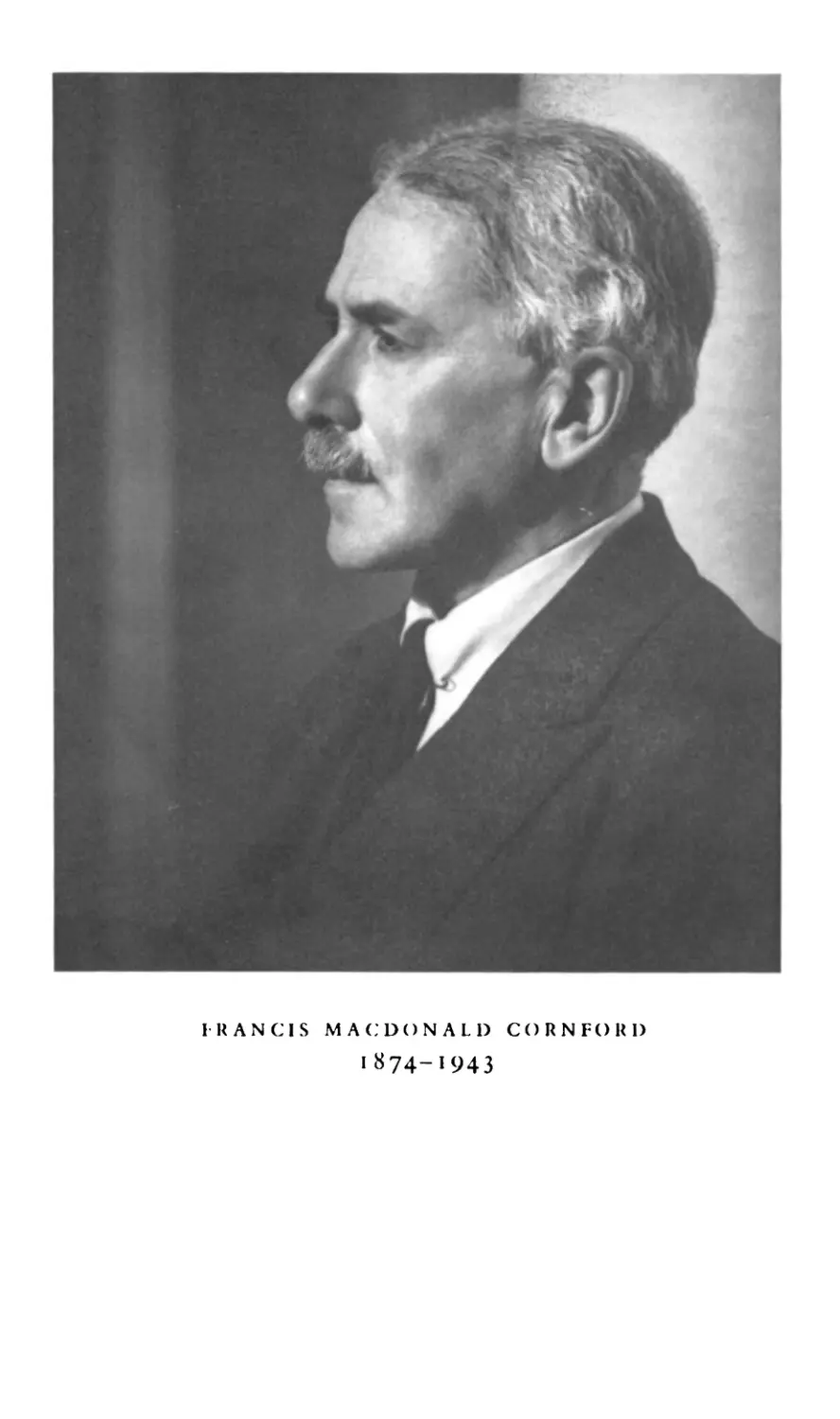
Portrait Frontispiece
Memoir page vn
Note xx
The Unconscious Element in Literature and Philosophy (1921) 1
The Harmony of the Spheres (1930) 14
The Unwritten Philosophy (1935) 28
Plato's Commonwealth (1935) 47
The Doctrine of Eros in Plato's Symposium (1937) 68
Greek Natural Philosophy and Modern Science (1938) 81
A Ritual Basis for Hesiod's Theogony (1941) 95
The Marxist View of Ancient Philosophy (1942) 117
Appendix:a list of Cornford's publications on classical subjects (excluding reviews) 138
ν

MEMOIR
CO RN F Ο RD once began a paragraph with the words : 'As
I am neither a philosopher nor a theologian ' What
then was he? The best answer I can give is that he was a
historian and a poet, and in his chosen field, the history of Greek
thought, a better historian because he was a poet. The cosmology
of the Pythagoreans, though in due course to be explained in terms
of mathematical philosophy, brings first of all to his mind the
picture of Lorenzo and Jessica lying on the moonlit grass. It recalls
There's not the smallest orb which thou behold'st
But in his motion like an angel sings,
Still quiring to the young-eyed chérubins;
Such harmony is in immortal souls.
This approach is not merely pleasanter, but truer. As he himself
said when describing the advantage of expressing one's thoughts,
as Plato did, in dramatic form: 'the action is lifted above the plane
of historical fact towards the region of poetry and universal
statement, which Aristotle describes as "more philosophic and of
graver import" than the particular statements of history \ A
philosopher, and even a historian of recent European philosophy, need
not, perhaps, be a poet. But the sympathetic insight of a naturally
poetic mind was exactly what was needed for the task which he
had set himself of exploring the foundations of ancient thought.
'Plato was born into a society where the means of expression were
grotesquely inadequate to the demands of abstract speculation.
Philosophic prose was in its lisping infancy. The fifth century had
been an age in which profound and far-reaching thoughts had
been released to hover, as it were, in a disembodied state, and
haunt the minds of men who could not capture more than a
fragment of their meaning in the precision of a formula. ' When
he wrote these words he was not defending his own approach to
the Greeks, but they go far in themselves to explain the necessity
for the insight to which I have referred.
vu

MEMOIR
Again, speaking of Empedocles and the doctrine of the
transmigration of souls, he wrote (in his last, unfinished work) :
The unity of all life, the kinship of all living things, is the fundamental
principle ; and we cannot dismiss the notion that it is based on some
genuine psychological experience, merely because we do not believe
in transmigration and are not poets. Books on psychology have mostly
been written by philosophers and men of science whose habits of
thought are uncongenial to that poetic imagination (as we call it) which
can 'see into the life of things' and lose the sense of separate existence
in a communion of feeling with the whole of nature, as if the daughters
of Memory could free the soul from the limitations of space as well as
from those of time. It is not wise, or even genuinely scientific, to brush
aside as idle fancy or outworn superstition the experience of the
greatest poets, because it is beyond the reach of the ordinary man and
cannot be translated into terms of what he would call an 'explanation'.
The philosophy of Empedocles, whether we like it or not, is animated
and illuminated from within by this poetic and prophetic gift of insight,
though, here as elsewhere, the Muses may sometimes be telling a false
tale that is only like the truth.
In his later years he said that it sometimes seemed to him as if
he had been all his life writing one and the same book. For all the
difference between Thucydides Mythistoricus at one end and Plato
and Parmenides at the other, it is true that one guiding thought can
be followed throughout the whole remarkable series, one
paramount lesson which he was always trying to bring home to our
duller minds. This comprised, first, a basic truth about the nature
of human thought, and secondly, its application to the Greeks.
In his inaugural lecture of 1931, the general truth is enunciated
thus:
If we look beneath the surface of philosophical discussion, we find
that its course is largely governed by assumptions that are seldom, or
never, mentioned. I mean that groundwork of current conceptions
shared by all the men of any given culture and never mentioned because
it is taken for granted as obvious.
He supports it by a quotation from A. N. Whitehead: 'When
you are criticizing the philosophy of an epoch, do not chiefly
Vlll

MEMOIR
direct your attention to those intellectual positions which its
exponents feel it necessary explicitly to defend. There will be some
fundamental assumptions which adherents of all the variant
systems within the epoch unconsciously presuppose.'* But in the
preface to his first book, published in 1907, we can already read :
'In every age the common interpretation of the world of things
is controlled by some scheme of unchallenged and unsuspected
presupposition; and the mind of any individual, however little he
may think himself to be in sympathy with his contemporaries, is
not an insulated compartment, but more like a pool in one
continuous medium—the circumambient atmosphere of his place and
time. This element of thought is always, of course, most difficult
to detect and analyse, just because it is a constant factor which
underlies all the differential characters of many minds/2
The particular application of this lesson, that is, the answer to
the question what is the groundwork of current conceptions, what
are the unmentioned because unconscious presuppositions in the
special case of the Greeks, cannot well be set forth here. It can
only be found by following Cornford as he finds it himself in
Thucydides, in the philosophers, in the tragic or comic poets, and
each must decide as he reads how far the answer is justified. We
may, however, attempt a brief indication of it. Greek philosophical
and historical writing, however rational and scientific in intention,
and whatever the mental powers of its authors, was the work of
men born into an entirely different climate of thought from their
modern counterparts. It lacked not only a background of
systematically accumulated knowledge, but also the framework of
scientific concepts and categories within which that background
has since been built up. To-day both are the common heritage of
even the less highly educated and the less gifted of us, a heritage
from which the most independent minds would find it hard, even
if they wished, to shake themselves free. Yet 'the philosophic
Muse is not a motherless Athena'. Lacking our complex apparatus
of experimentally ascertained fact and laboriously constructed
1 A. N. Whitehead, Science and the Modern World (1925), p. 71. Cf. p. 39
below.
2 Thucydides Mythistoricus (1907), p. ix.
IX

MEMOIR
(though now almost unconsciously applied) logic, her image
was inevitably cast in another mould. 'If the individual
intellect is her father, her older and more august parent is religion.'
'Religion expresses itself in poetical symbols and in terms of
mythical personaUties. Philosophy prefers the language of dry
abstraction, and speaks of substance, cause, matter, and so forth.
But the outward difference only disguises an inward and substantial
affinity between these two successive products of the same
consciousness. The modes of thought that attain to clear definition and
explicit statement in philosophy were already implicit in the
unreasoned intuitions of mythology/ *
This approach to the philosophers is obviously in large measure
psychological, and we can understand the deep interest awakened
in Cornford's mind by the Zürich school of psychologists when
we read in the works of Jung that 'philosophy is internally nothing
else but a refined and sublimated mythology'. Such confirmation
from another quarter must have seemed striking. In his own
progress towards the same conclusion he had been helped, not
by the analogies of psycho-analysis but rather by theories of the
earliest types of social organisation and the mentality which
resulted from them, by accounts of the 'group-soul' and 'collective
representations' as they were emerging from the researches of
French scholars, notably Emil Durkheim and Levy-Bruhl. The
'collective unconscious' of Jung came later to strengthen and
deepen his convictions.
This view of the progress of Greek thought was already in his
mind when he wrote Thucydides Mythistoricus, a masterpiece of
lucid and persuasive argument, in the preface to which we read:
'The history of philosophy is written as if Thaïes had suddenly
dropped from the sky, and as he bumped the earth, ejaculated,
"Everything must be made of water ! " '% But it is first dealt with
1 From Religion to Philosophy (1912), pp. ix, vii.
2 Thuc. Myth. p. x. It is obvious from what has been said that Cornford's
approach to ancient thought corresponded in important respects to the
conception of history held by the late R. G. Collingwood. Thus too we find
Cornford criticising (in an unpublished chapter) 'the assumption that the
questions they asked themselves, the motives which prompted their inquiries, and
the quarters to which they looked for the sources of knowledge, were the same
X

MEMOIR
fully, as the title implies, in From Religion to Philosophy, which
appeared in 1912. For one who only knew Cornford later, and
was unaffected by the sources, both personal and Uterary, of his
inspiration at that time, it is perhaps not easy to give a just
appreciation of this work. Yet it is fair to say that it represents a
necessary stage on the way to that comprehensive understanding
of the Greek mind which he afterwards achieved, rather than an
example of the full understanding itself. Its argument is that the
Milesian philosophers, in stripping off the mythological and
theological trappings from their account of the universe, whereby
they believed themselves to be getting at the natural facts and
offering purely rational explanations, were in fact going behind
the religious phase and unconsciously reproducing a pre-religious
type of thought which had all the time persisted underneath.
Their conception of nature is not one which could have arisen
from scientific observation, nor yet (since it has parallels not only
in Indian philosophy but in primitive thinking wherever this has
been laid bare by anthropologists) from the imagination of a single
inspired individual. It is then traced, largely in reliance on the
French school of sociologists mentioned above, to an origin in
the state of mind of a totemic society which included not onl^
men, but animals and trees, the sky, the earth and the whole
universe within the same tribal divisions and allotted to them certain
provinces as their own.
This theory leaves one now with a certain feeling of inadequacy.
It belongs to the days when researchers still spoke of the 'origin'
of religion, as if it could be assumed that this origin was single and
moreover could be elicited without undue difficulty by
observation and questioning of existing savage tribes. Thus Cornford
writes: 'If we are right about the starting-point, we have both
ends of the chain in our hands \ In reconstructing the intermediate
links, i.e. the growth of Greek polytheistic religion up to the time
when the Milesian philosophers rejected it, he emphasises the
hypothetical nature of the account and the impossibility of its
then as now'. Compare Collingwood's 'logic of question and answer'.
Collingwood's own comment on Thucydides Mythistoricus is brief and
unqualified: 'He was of course perfecdy right' (The Idea of History, p. 18).
xi

MEMOIR
being certain or complete. This is of course right, at least as far as
the earlier stages are concerned, but surely the starting-point,
namely that 'what the Milesians called physis has the same origin
as what the savage calls Mana\ is at least equally hypothetical. It
is when he gets beyond this remote and misty starting-point and
begins to demonstrate the different types of philosophy which are
the natural successors of Olympian and mystery-religions
respectively, and to reveal the links which unite the Milesians to the
one and the Pythagoreans to the other—links which do not have
to be inferred, but are there in extant Greek literature for him who
has Cornford's eyes to see—that to some at least he will appear to
be on ground that is both more solid in itself and more fruitful in
explanation of the birth and early growth of the philosophic and
scientific spirit in Europe.1
Cornford himself pays glowing tribute to the influence in these
formative years of two minds with which he was in personal
contact, those of A. W. Verrall and Jane Harrison. VerralTs lectures
were imparting, with all the thrill and freshness of discovery,
a way of interpreting the great classics of ancient literature as
one would a work of modern poetry or prose; not reading back
our own ideas into the ancient mind—far from it—but boldly
1 In saying that the argument of From Religion to Philosophy is not completely
satisfying, I am in part at least expressing what I have learned from Cornford
himself. In the book which he was writing when he died he returns to the same
problems with a mind matured and enriched by a lifetime's study, and suggests
a fresh solution of the problem of the rise of anthropomorphism and its
evolution into philosophy which relies far less on a priori argument and more on
historical evidence. In particular he has assimilated and turned to his own
purposes the findings of Prof. S. H. Hooke and his collaborators on the
relationship between myth and ritual (in Myth and Ritual, 1933, and The Labyrinth,
1935), in which he saw the origin of much in Greek cosmogonical myth.
Again, in arriving at a true estimate of the relation between the ostensibly
rationalistic philosopher in Greece and his predecessors and contemporaries the
seers, poets and rhapsodes, he felt further enlightened by the material collected
by Mrs Chadwick (Poetry and Prophecy, 1942) on the composite character of
the shaman and similar figures in northern Asia. For a connecting link between
Greece and the mythology and ritual of Babylonia he now had the finds at
Ras Shamra on the northern coast of Syria and the Canaanite mythology there
revealed (Schaeffer, The Cuneiform texts of Ras Shamra Ugarit, 1939). Links
with the northern shamans were already to hand in Orpheus, Zalmoxis and
Hyperboreans like Aristeas and Abaris.
xii

MEMOIR
applying common sense and universal critical canons to the content
of a work, and daring to teach that the thought of an author was
more important than his syntax. Of Cornford's friendship with
Jane Harrison and all that it meant to him, one who did not know
her can scarcely speak; but it would be difficult to overestimate
the effect at this time of her infectious enthusiasm, her sympathetic
understanding and her ready praise. The Cambridge school was
still dominated by the tradition of strict linguistic scholarship and
the minutiae of form. Brought up within these narrow walls,
Cornford's heart went out to one who gloried that in her own
time, as she has written in her reminiscences, classics were turning
in their long sleep, that she had James Frazer for a contemporary,
that she was a young graduate when Schliemann began to dig at
Troy, and that when the relevance of these men to classical studies
was beginning to force itself on the minds of scholars, 'Arthur
Evans set sail for his new Atlantis and telegraphed news of the
Minotaur from his own labyrinth'.1 To the new and exciting
influence of such thoughts as these he must have owed much of his
appreciation of mythology as true history—the history of the mind
of a people, which is only falsified and obscured if the myths are
ignored or explained away.
Cornford's mind did not remain in tutelage. In what way did
he go beyond these ideas and put them in their place as one element
in the subtle complex of his later work? To answer the question is
to attempt a statement of the essence of his achievement, and this,
with due warning that one who is interested in the same subject-
matter may be led to isolate the things which he himself wishes to
find, I should like to do.
His unusual merit is his constant awareness that all systems of
religious and philosophical thought have two sides, the conscious
and the unconscious, or (to take another pair of rough equivalents)
the intellectual and the instinctive. Greek minds were
intellectually alive, inclined to logical and often mathematical activity, and
delighted in building up elaborate structures of thought. Yet as we
have noted, these structures were not created in vacuo, but based
unconsciously on the innate preconceptions which centuries of
1 Reminiscences of a Student's Life (1925), p. 83.
Χ111

MEMOIR
pre-intellectual mental processes had implanted. In his early
account of the existence and nature of these preconceptions,
Cornford was to a large extent inspired by the work of others—
the French sociologists or Jane Harrison's researches into
comparative mythology. What was his own was the historical sense
and mental balance which enabled him, as he went on, to assign
to each of the two sides its proper place and to give a just
appreciation of the finished product of which each was only one
ingredient. This evolutionary view of human thought came to him
like a revelation, and to seize the primitive roots of Greek thought
seemed to him essential to an understanding of its flower. It was
an indispensable means to an end, but the end remained the same,
to comprehend the mind of a Plato, an Aeschylus or a Thucydides.
Here we may find the difference between him and some of those
to whom in his early years he owed so much. Jane Harrison
confessed, with the enthusiasm of a freedom won from a narrowly
evangelical upbringing: *I mention these ritual dances, this ritual
drama, this bridge between art and life, because it is things like
these that I was all my life blindly seeking.... Great things in
literature, Greek plays for example, I most enjoy when behind their
bright splendours I see moving darker and older shapes.' For her,
clearly, in the study of Greek literature the primitive background
was more than a means to an end. Set beside her words a sentence
from a lecture which Cornford wrote twenty years or more after
the publication of From Religion to Philosophy. After stating, in
language of delicate parody, what he describes as 'an analytical
account of Platonism', he continues: 'But such a description bears
much the same relation to the processes in Plato's mind, as revealed
in the dialogues, that an anatomical diagram bears to the breathing
and moving man, who can live and love and work and die
without any assistance from grotesque and hideous portraits of his
internal economy.'
The focus of his interest was always the breathing and moving
man. Such abstractions and hypothetical constructions as Primitive
Man, Collective Representations or the Collective Psyche had an
undeniable intrinsic interest, but they remained no more than
useful instruments. To understand his instruments was the first
xiv

MEMOIR
task, and it is natural therefore that these conceptions loom more
largely in his earlier books and that his own development seems in
a way to have been a progress 'from religion to philosophy'.
His interest in Greek thought found expression in two
particular fields, Presocratic philosophy and the mind of Plato. To
those of us who were able to listen to his lectures on the Pre-
socratics it is a matter of lasting regret that he died without
completing a book entirely devoted to them. The lectures gave one
the peculiar sensation of mental well-being which comes from
following a skilfully and closely woven pattern of argument, of
necessity intricate but never obscure. They had a perennial
freshness, for he never tired of trying new approaches, suggested by his
reading or his own thoughts, which might lead to a better solution
of the problems involved, and himself so obviously enjoyed (for
all the quiet dignity of his delivery) the opportunity for testing
new ideas which the subject offered. At the risk of a short
digression, it is worth mentioning his theory of the proper use
of lectures, which are so often (and rightly) condemned as a mere
repetition of what the student can get more conveniently, quickly
and efficiently from books. In Cornford's view, ideas can and
should be tried out in a lecture while they are in process of
formation, before the scholar is ready to commit himself to them in
print. Lectures should be a part of the humanist's laboratory, with
the inestimable advantage to the listener that he is not presented
with a finished treatise which he could better read in his own
room, but is watching a Hving mind at work and given an insight
into its methods. But Cornford's thoughts can never be expressed
so well as in his own words. Ά course of lectures ought almost
always to be the outcome of recent first-hand work. When a
man's mind is full of fresh ideas and quickened by the excitement
of discovery, then is the time to lecture, because then is the chance
of interesting his class, while the discipline of exposition will test
and clarify his results. The lectures over, the results should in
many cases go at once into a book. Finally a period of rest,
followed by fresh study of a different subject; and so the process
begins again.'l
1 The Cambridge Classical Course (1903), pp. 28 f.
XV

MEMOIR
He himself faithfully carried out his precept in the sequence of
lectures and books on separate dialogues of Plato. If the lectures
on the Presocratics did not result in a single book, the fruits of his
meditations on them are to be found in many places in his writings.
Something of the sureness of his historical sense in this field will,
it is hoped, appear from one or two of the essays presented here.
They should be supplemented by the chapter 'Mystery-Religions
and Presocratic Philosophy' in the Cambridge Ancient History,
vol. iv. The place of the Presocratics in the whole Greek
philosophical tradition is admirably explained for the non-specialist in
the lucid sketch called Before and After Socrates, itself the outcome
of a course of extra-mural lectures.
In 1935 appeared the first of his books dealing with the later and
more difficult dialogues of Plato. Two more were published, in
1937 and 1939. These works were the direct outcome of his
lectures in the University, to which they owed their unique form.
Their titles are Plato's Theory of Knowledge, Plato's Cosmology and
Plato and Parmenides, with a sub-title to say that they consist of
the Theaetetus and Sophist, or the Timaeus or the Parmenides,
'translated with a running commentary'. (The last mentioned
also contains a translation of the fragments of Parmenides' own
Way of Truth.) He had in fact retained exactly the method which
he or any other lecturer would naturally use, of translating a
paragraph and following it by his own explanation and comment
before proceeding to the next. The reader is taken by the hand and
guided through the argument like one of his own class, with
illuminating results.
In these books he is dealing with the finished product, not the
raw material or the first uncertain essays of Greek thought. The
keen psychological and historical sense is always in evidence, but
there is not the same need for the insight and inference by which
the fragmentary hints of the earlier thinkers were taken up and
their minds revealed against a background of yet older
conceptions. With the complete dialogues before him, he had the
opportunity for a more exact appreciation of the structure which
the philosopher himself had built. His main effort was devoted to
a patient and faithful dissection of the argument, in which his
xvi

MEMOIR
historical imagination, and especially his keen awareness of the
historical associations of words, took him straight to the heart of
the reasoning and saved him time and again from entanglement
in merely verbal quibbles. Yet here too the amount of external
reading to be undertaken was considerable, if he was to succeed
in his constant aim of understanding his author by becoming
familiar with the intellectual climate in which he worked and the
influences to which his mind was open. His absorption in the
study of Plato's predecessors we already know. One other
example may be mentioned, his serious and thorough reading in the
field of Greek mathematical thought, which had such a natural
attraction for Plato and in many important respects determined
the direction of his speculations. Those of us who knew Cornford
at that time can only marvel at the completeness with which all
this in itself indigestible material was assimilated and transmuted,
so that the reader who is presented with the finished commentary
can scarcely be aware of the amount of patient labour that has gone
to its composition.
The later dialogues of Plato will never attract more than a
limited circle of readers. It is otherwise with the Republic, and by
making his last published work a new translation of that central
dialogue he put a much wider public in his debt. His aim was to
ensure that this version would produce on the Greekless but
otherwise educated Englishman as nearly as possible the same effect as
the original produced on the contemporary Greek. To this end he
took, as he said, 'certain liberties', which in his opinion 'it was
reasonable to suppose that Plato would have sanctioned in an
edition prepared for the modern press'. One of the most obvious
of these was to ignore in a number of passages the convention
whereby the development of the argument of Socrates is
constantly interrupted by formal interjections of assent on the part of
his hearers. The convention is alien to English prose, and it cannot
be denied that by this and similar devices a real barrier has been
removed from between Plato and a modern reader. The value of
the book as part of a general education received welcome and
perhaps unexpected recognition when the Army Education
authorities selected it for their syllabus.
xvu

MEMOIR
In Cornford's younger days the crying need for reform in
certain aspects of University teaching put him definitely on the side
of his own 'Young Men in a Hurry' against any middle-aged
upholders of the status quo, and he wrote the satire Microcosmo-
graphia Academica (1908) whose truth has been found to extend
well beyond the academic sphere. Civil servants and business men
alike have claimed to recognise in their own walks of life the types
which it portrays. In his later years I do not think he was by
nature a controversialist, yet he found himself forced to take the
field against some who, as it seemed to him, would not let the
Greeks speak for themselves. Instead of trying to understand them
by inquiring what were the problems of their own day to which
they were seeking answers, these scholars were interpreting them
in terms of present-day problems and present-day conflicts.
Thus the Ionian philosophers and Epicurus became politically-
minded scientists, who in addition to producing purely rational
explanations of the physical universe were concerned to see these
explanations offered to the masses in place of the religious ideas
which were being perpetuated to bolster up the interests of a
reactionary class. In this argument Plato appears as the champion
of reaction. Politically, Cornford was the reverse of an oligarch.
(This is not the place to go into his political views, which he did
not consider relevant to his search for the truth about the Greeks,
but it may be mentioned that his standpoint was that of a Fabian
socialist.) Yet in the interests of truth he felt bound to protest
when the haughty and oracular Heracleitus, who condemned
inquiry and claimed to have found wisdom by looking into his
own mind, was impressed into the ranks of experimental scientists,
or when the class in Plato's Republic which included all holders
of private wealth was described as the toiling masses. The notes
which he has left behind suggest that he would have liked to
express himself further on this subject. It has therefore seemed right
to include in this volume the one essay, hitherto unpublished,
which he devoted to it.
It is not every classical scholar whom one can commend to the
reader not only for his matter but for the beauty of his writing and
the art with which his works are composed. This also therefore
XVlll

MEMOIR
should be mentioned in speaking of Cornford, but briefly, since
to learn that a book or an essay is a work of art it is better to read
it than to read about it. His art has itself a Hellenic quality, which
would not call for comment in one who spent most of his hfe in
such close touch with many aspects of Greek culture, were it not
in fact comparatively rare among such men. To read him brings
from time to time the same flooding pleasure that I myself get
from the Phaedo, and others from contemplating the form and
decoration of a Greek vase. All the main qualities are there, the
living (not mechanical) symmetry of form, the grace and delicacy
of the details, the humour, irony and occasional fantasy enlivening
a fundamentally serious theme. This is a heavy-handed description,
but if anyone thinks it at the same time extravagant, I commend
to him the essay in the present volume called The Harmony of the
Spheres.
I am only concerned here with Cornford as a writer on scholarly
subjects, leaving to others who knew him intimately the more
difficult task of portraying him in the round. All I would add is
that in trying to crystallise my own impressions I find two
Homeric epithets constantly recurring to my mind as together
providing the best summing-up :
φίλος τ' fjv αιδοϊός τε.
W. Κ. C. G.
PETBRHOUSB,
CAMBRIDGE
II November 1949
xix

NOTE
THE essay 'The Unconscious Element in Literature and
Philosophy' was read to the Classical Association in 1921,
and printed in its Proceedings for that year. That on 'Plato's
Commonwealth' appeared in Greece and Rome, vol. iv (1935).
Thanks are due to the Council of the Classical Association and
the editors of Greece and Rome for permission to reprint these two.
The essay 'Greek Natural Philosophy and Modern Science' was
originally a contribution to the symposium Background to Modern
Science, published by the Cambridge University Press in 1938.
The other essays in this book have not been printed before.
The essays are printed in chronological order. I have chosen
to name the third one on the title-page, because if, as Cornford
said, it sometimes seemed to him that he had all his life been
writing the same book, the title of that symbolic volume might
well be said to be 'The Unwritten Philosophy'.
W. K. C. G.

THE UNCONSCIOUS ELEMENT IN
LITERATURE AND PHILOSOPHY
I AM inviting you to consider the unconscious element in
literature and philosophy, because it has lately occurred to
me that that is what I have always been thinking and writing
about. I have observed too that, in so far as my work in any
department of ancient literature attracts notice, the result has been
to provoke in the specialists in that department a feeling for which
the mildest name is disgust; whereas students in other departments
sometimes show symptoms of satisfaction. That phenomenon
admits of more than one explanation. The most flattering (which
I naturally prefer) is that, if you direct attention to those factors
in an author's work which are in any sense unconscious, you
strike the specialist as detracting from those merits which the
author may be supposed to have valued most highly. If he is an
historian, you seem to undermine his credibility; if a dramatist,
you seem to belittle his deliberate craftsmanship; if a philosopher,
you seem to deny his originality.
I think there is a misunderstanding here, which I should be glad
to clear up. I have mainly in view the early Greek philosophers;
but I will say a word first about history and drama.
To begin with Thucydides. Long ago I wrote a book with the
provocative title Thucydides Mythistoricus. I did not mean to
challenge Thucydides' claim to be perhaps the most trustworthy
of all historians. My thesis did not necessarily cast a doubt upon
any single statement of objective fact. But it seemed to me that
any historian's choice of facts to be recorded, his distribution of
emphasis among them, his sense of their significance and relative
proportion, must be governed by his philosophy of life. For the
history of the Peloponnesian War, Thucydides is our only
authority of the first rank. How are we to control his presentation of
the facts? In such a case criticism can apply only one method.
It consists in disengaging from the narrative that whole framework
CUP
I
I

THE UNCONSCIOUS ELEMENT IN
of preconception which the author cannot help bringing with
him, because it is the very atmosphere of his mind—in a word, his
philosophy of life. In Thucydides this element may be called
unconscious, in a loose and popular sense, in that he made an
heroic effort to keep objective fact in the focal centre of his
attention. He was aware, moreover, of the seductions of party bias and
personal passion. Such factors obtrude themselves from time to
time within the field of attention; they can be detected and
deliberately suppressed. But, enveloping and pervading the whole
area of the mind, like a subtle and penetrating ether, there is a man's
philosophy of life—a factor which does not obtrude itself at any
particular moment, for the reason that it is always and everywhere
present. In order to detect it, to guard against it, he would have
to go outside himself. No note of warning comes to him from the
objective world. Everyone knows, from his own experience, that
there is no fact so brutish and unmalleable as not to fit into the
frame of his philosophy; otherwise philosophy would sometimes
have to yield to facts, and where would any philosophy be then?
It is of the nature of philosophy to claim objective validity. In the
same way, to the ordinary man nothing seems more certainly
objective than space. Yet Kant declared that space was only a pure
form of our intuition—a form contributed by our minds. A
philosophy of life is analogous to Kantian space. Really contributed
by our minds, it is innocently projected into the external world.
The most cautious and honest historian cannot free himself from
the laws of his optical perspective. The objective facts he is looking
for present themselves already embedded in this setting, ordered
by its symmetry, dyed by its colours.
But it is possible for us, who look at Thucydides' world from
a different angle through glasses of a different power and hue, to
make out the subjective character of this philosophy. Our first
business as critics should be to disengage it and to study it in
isolation. Then we may see how it would bend the course of the
narrative at any point; in what patterns it would tend to group
the facts; how it would throw the light upon some, and leave
others in the shade.
Now this is not to say that Thucydides' philosophy of life is not,
2

LITERATURE AND PHILOSOPHY
within its limits, a true philosophy—as true as any alternative our
own minds may contribute. It may even be truer. Fourteen years
ago, writing under the impression of the South African war, I
may have overstressed the financial aspect of imperialism. Since
1914 Thucydides' moral interpretation of history has seemed more
profound. But that does not touch the main thesis, namely, that
there are alternative interpretations; that each is limited and tends
to obscure the truth contained in the others; and that the criticism
of an ancient historian should begin with the study of his a priori
forms of thought, fashioned in a time when economic science, for
instance, was not invented.
I turn next to the Drama. Here the case is diffèrent. No critic
can overlook the philosophies of Aeschylus, Sophocles, Euripides;
nor is there here any question of disentangling the philosophies in
order to arrive at objective fact. The unconscious element in
drama falls under two heads : (a) the traditional form, (b) the myth.
(a) The traditional form of ancient drama may be called an
unconscious factor in the sense that it is accepted without a thought,
as a painter accepts his canvas.1 The painter's mind is intent on his
design; the dramatist's on the contrivance of the detailed variable
plot which he will fit into the given frame. But the frame is there ;
and unless you disengage it and allow for it, you cannot fully
measure the skill with which the dramatist has turned it to account.
Nor can I see anything indecent or impertinent in the attempt to
explain why the frame is there. I refer, of course, to Professor
Murray's theory that the 'fixed forms' of Attic Tragedy
correspond to the moments in a ritual drama which survives all over
Europe in the folk-play. Some good scholars have approved this
theory; others, for some cause I cannot quite fathom, are reduced
by it to a state of frenzy; others, again, think that there may be
some truth in it, but that it is irrelevant, if not uninteresting. To
this last class belong scholars of the type of my own great
master, Arthur Verrall; and perhaps I may add his worthy
successor, Mr Sheppard, whose brilliant powers as a literary critic are
1 In so far as the traditional form, if really a ritual form, carries with it the
associations of the ritual myth, what is said below about myth becomes relevant
here.
3
1-2

THE UNCONSCIOUS ELEMENT IN
reinforced by an artist's mastery of stagecraft. He, too, is mainly
interested in the conscious and deliberate art of the poets and in
their philosophic reflection. That is a field wide enough for the
display of the finest critical faculty, and when a Verrall or a Shep-
pard displays it I am eager to join in the applause. Only I wonder
whether it is the whole field. When Mr Sheppard demonstrates
the existence of a personal Homer from the evidence of design in
the Iliad and Odyssey, my thoughts wander to Archdeacon Paley.
Bergson explains how it is that the intellect can always find
inexhaustible evidence of design in creation, which, nevertheless
(he thinks), had no designer. In poetic creation there may be a
great deal of design; but I suggest that there is always less than
the cleverest critic can find evidence for—sometimes much less.
Creation is not all or mainly contrivance; some of its happiest
effects occur at points where the freedom of its flow is checked or
turned in an unforeseen direction by the limits of given material
or of traditional form. This is one of the ways in which luck
favours art, and art has reason to delight in luck.
(b) So much for the framework of traditional form. Consider
next the tragic plots that are fitted into this frame. Our word
'plot' pre-eminently suggests contrivance and the interest of
intrigue, kept in a state of tension until it is released by an unforeseen
denouement. The plots of the New Comedy are of this kind; but
it is a commonplace that this interest of intrigue is foreign to Greek
tragedy. We find there primarily not the 'plot' but the myth.
Now if we take the Oedipus myth, for example; if we forget what
Sophocles has made of it, and then judge it merely as a story, an
anecdote of early Theban history, it will seem repulsive and hardly
deserving of a place in literature of any higher kind than the Police
Court News. The few belated adherents of Euhemerus may be
content to take it so; but most of us will feel that the great myths
of the world are more than historical anecdotes. They come, even
to us, charged with a congenial warmth, with the appeal of a
mysterious significance lying behind their face value as legendary
incident. We are, very dimly but intensely, aware of some
universal meaning that is contained in a myth, and not contained in
a plot of intrigue. And we must be right in supposing that the
4

LITERATURE AND PHILOSOPHY
race which preserved these myths while it forgot its national
history, and the dramatists who preferred to use them rather than
invent new stories, must also have felt, in their different ways and
degrees, this same peculiar quality, and have valued it, however
little they could account for its presence.
Now in recent times comparative anthropology, directed upon
classical material by the illustrious author of the Golden Bough,
has swept away all the earlier keys to mythology by interpreting
the myths in terms of social institutions of the prehistoric past.
It will hardly be denied nowadays that this work has extended
our comprehension of the myths; but it is challenged by the
criticism that these prehistoric institutions had been forgotten by the
Greeks themselves, and that consequently all this enlargement of
our comprehension is irrelevant to the interpretation of Aeschylus
or Sophocles. You can dispose of it by remarking that Aeschylus
had never visited Melanesia and Sophocles had never read the
Golden Bough. Mr Sheppard practically says as much in his learned
and subtle book on the Oedipus Tyrannus. He writes there:1
The origin and early history of the [Oedipus] myth I do not discuss.
Modern theories are based on inadequate evidence and very bold
hypotheses. Even if they could be proved, they would be irrelevant
here unless it could be established that they were known to Athenians of the
time of Sophocles. For this reason I have nothing to say about 'medicine-
kings', vegetation-spirits, marriage with the earth-mother.
Mr Sheppard's reason could not be more conclusive. No one
can ever establish that 'modern theories' were known to
Athenians in the time of Sophocles.
But I understand Mr Sheppard's point: he says 'modern
theories ' because he will not say ' modern knowledge '. And, even
granted that the knowledge gained from comparative study is
knowledge, he thinks that we know too much—far more about
primitive religion than the fifth-century Greeks knew—and that
we read back that knowledge into the plays illegitimately, and so
invest them with a significance they did not possess for their
authors and spectators.
1 P. xviii, footnote; my italics.
5

THE UNCONSCIOUS ELEMENT IN
Frankly, I admit that Professor Murray and we who in the main
think with him do sometimes fall into that error. On the other
hand, it seems to me a less serious error than the opposite one of
assuming that the whole religious background of the myths and
traditional mould of Greek tragedy had been, in Sophocles' time,
irrecoverably blotted out of the memory of the Greek race. The
ancients certainly knew about the earth-mother. They may have
understood more about divine kings and even vegetation-spirits
than Mr Sheppard chooses to allow; for, after all, the 'bold
hypotheses' of Sir James Frazer or Miss Jane Harrison, in so far as they
apply to classical antiquity, are based entirely on evidence supplied
by the ancients themselves.
Grant, however, that the ancients had little explicit knowledge;
grant that Aeschylus himself would have had much to learn about
Zeus from Mr Arthur Cook,—that does not settle the question.
How can any modern critic be positive that, in that fantastic region
of the mind where concrete images take the place of discursive
thought, there were not still links of association, however obscure
and unexplicit, connecting (say) the figure of Jocasta with the
earth-mother, and the figure of Oedipus with the divine king ?
We are assured that the individual mind, though in one sense it
forgets all but a tiny fraction of its experience, in another sense
never forgets anything—not even experience of which it was not,
at the time, aware. Similarly, the memory of a race, enshrined in
a continuous tradition of myth, legend, poetry, retains knowledge
which, after a sufficient lapse of time, no individual can formulate
in abstract terms. The knowledge is not blotted out, though you
may say it is forgotten ; it lives on in symbol and image, and finally,
as it were, fossilised in metaphor, as a system linked together by
chords of association that vibrate without the interposition of
rational, directed thinking. Our view is that modern research into
origins is not only recovering the temporal sequence of the several
stages in the development of religious representations, but is also,
by that very fact, bringing to light the corresponding systems of
association deposited, at those stages, in the racial tradition and
memory of the Greeks—systems that lasted on in their minds like
the superimposed layers of alluvial stratification. It is from these
6

LITERATURE AND PHILOSOPHY
hidden layers that the springs of poetry rise. That is why Greek poetry
is full of passages that for us become enriched with meaning when
read in the light of new discoveries. What we attribute to
Sophocles is not acquaintance with 'modern theories', not the explicit
knowledge of the prehistoric past, but the latent systems of
unconscious association, ultimately derived from that past, and not
so deeply buried but that the images composing them can emerge
in the fabric of poetic creation.
But there is yet another answer which goes deeper and suggests
that these systems of unconscious association are even now not
wholly lost. This answer is furnished by the psychological
interpretation of myth.
On the one hand, you have, persisting in the time of Aeschylus
and Sophocles, and reverently regarded by them, a great mass of
ritual practice. We can see that, in the case of a substantial part of
this ritual, the meaning had involved such ideas as marriage with
the earth-mother, or participation in the barely personified Hfe of
all nature, inadequately named 'the vegetation-spirit'. The rituals,
as living social institutions, expressed these ideas in the concrete
form of action. On the other hand, you have the myths, which
appear to us to involve the same set of ideas, expressed this time
in words, and disguised by the concrete form of legendary
narrative, professing to be the history of prehistoric men and women.
What is the link between these two forms of expression, or methods
of symbolism—the ritual and the narrative, the social institution
and the myth ?
The psychological interpretation asserts that behind both these
alternative symbolisms there lies the universal inner experience
of human beings—experience that is never antiquated, but repeated
in every generation, and not confined to Melanesia, or to Athens,
or to modern England. This experience, which, in a great
variety of degrees and shapes, besets every new Hfe that comes
into the world to confront the task of adapting itself to what
it finds there, is the ultimate common factor shared by us with
Sophocles, and by Sophocles and us with those remoter ancestors
who transmitted the symbolical expression of the universal
problems of Hfe and their solutions. It is the perennial existence of
7

THE UNCONSCIOUS ELEMENT IN
this experience, the recurrent pressure of the same problems, the
recurrent need of the same solutions, that explains (as nothing else
explains) that mysterious quality of appeal which, as I said, the
myth contains, and the anecdote or artificial plot does not contain.
The myth makes this appeal directly and universally, because, like
the corresponding religious ritual, it symbolises what does happen,
and what ought to happen, and what ought not to happen, in the
inner development of any human life. That is, in the last resort,
the reason why a play like the Oedipus is to us, not a stiff, archaic
monument of a bygone age, but a living thing that shakes every
nerve in our moral being. That is the ground of our assurance
that we not only understand Sophocles but feel with him.
I do not know to what extent students of classical mythology
have attended to the results obtained by the analytical
psychologists of Vienna and Zürich. Consequently, I do not know
whether what I have just said sounds in most ears as a platitude or
as an unintelligible absurdity. In the hope that it sounds familiar,
I will only indicate its bearing on my subject.
The psychological interpretation explains the fact, which has
long been known, that certain mythical themes or motives,
fundamentally the same though overlaid with endless variety of
detail, are found in the legends and folk-tales of peoples so widely
scattered over the globe that the alternative hypothesis of
migration from one original centre becomes extremely difficult. The
migration hypothesis should, no doubt, be pressed as far as
ethnological discovery will warrant; no one denies that migration
occurs. But, if its fullest claims were conceded, the question
would remain, why some myths spread everywhere and others
do not. Here psychology would step in, and by the analysis of
these universal myths would show that, if they are borrowed, it
is because they are wanted—because they satisfy some need and
symbolise some experience that were already there and waiting
for this expression. Between the two hypotheses there is no
necessary conflict.
Dr Jung, however, would go further. The study of the
unconscious contents of contemporary minds is bringing to light the
fact—however it is to be explained—that people to-day, in their
8

LITERATURE AND PHILOSOPHY
dreams, use the symbolism of the primitive mythical themes, such
as rebirth, death, and resurrection, eating the god, and so on—
symboUsm that often coincides in surprising detail with the
universal myths, so that the myth can be interpreted from the dream,
and the dream from the myth. The dreams containing this
symbolism appear to refer to typical conflicts which constantly
occur in the psychical development of individuals, and, moreover,
to point to solutions of these conflicts, to indicate the direction in
which the psychic energy that is being wasted in them might be
set free in a normal adaptation to the demands of life.
Further, this primitive symboUsm seems to Ue in a very deep
stratum of the unconscious mind, below the contents of the
'personal unconscious', as Dr Jung caUs it. By the personal
unconscious he means those contents which can be identified as
buried memories of individual experience—events that have
happened to the individual and been forgotten. Below these is that
deeper stratum, the contents of which seem to Dr Jung not to be
traceable to individual experience, but to consist of the universal
primitive symbolism. He caUs this the 'impersonal' or 'collective
unconscious'. Whatever the explanation may be, it is as if the
individual mind to-day passed through every phase in the
development of the mind of the race, just as the embryo of the body is
said to pass through the pre-human stages of evolution; and as if
the individual mind preserved some memory, normaUy quite
inaccessible to the waking consciousness, of every phase of imagery
and symboUsm which the mind of the race has used in its progress
to abstract conceptual thought.
If this conception should turn out to be vaUd, the rather
exorbitant demand for proof that 'modern theories' were known
in fifth-century Athens ceases to have any point at aU. If the
symboUsm, for instance, of marriage with the earth-mother is
actuaUy present now in aU our minds, including Mr Sheppard's,
we may assume that it was present in the mind of Sophocles, and
probably much nearer the surface. The appeal ofthat symboUsm
disguised in the Oedipus myth would help to invest what is
otherwise merely a revolting story with that mysterious quaUty which
would make it worthy to be chosen as a tragic theme.
9

THE UNCONSCIOUS ELEMENT IN
In this section of my paper dealing with the myth, the word
'unconscious' has been used in a sense not applicable to the
historian's or the poet's philosophy of life. This is not contributed
by what the psychologists call 'the unconscious'. But the myth
is a different thing. The myth is like a tree whose leaves and flowers
in the upper air of the conscious mind are sustained by a root that
stretches down, out of sight, into the unconscious levels. The tree
is fed, from age to age, by a vital sap welling up from that root
in a secret and perennial flow.
Finally there is the case of philosophy. I know that to speak of
an unconscious element in philosophy is to outrage the feelings
of philosophers. Yet I am convinced that, until it is recognised,
the history of thought cannot be written in full.
Professor Burnet, in the last edition of his Early Greek
Philosophy—a work to which every student must acknowledge a deep
obligation—remarks in a footnote that 'the fundamental error of
Mr Cornford's interesting book From Religion to Philosophy9 is
the error of'deriving science from mythology'. I have failed, it
seems, to realise that 'Ionia was a country without a past', and that
'there was no traditional background there at all'. If Professor
Burnet is right, my error is so fundamental that his complimentary
epithet 'interesting' should be withdrawn. My book is of no
interest whatever unless science is, in some sense, 'derived from
mythology'. I think myself that the error did not lie there, but
in the failure to make it perfectly clear how this 'derivation' is to
be conceived. Perhaps I can make it clearer now.
I cannot here examine Professor Burnet's strange statement that
Ionia was a country without a past or a traditional background.
This is sometimes said of the United States; but a history of
American thought which refused to take any account of European
religion and speculation before the sailing of the Mayflower, or
even before the voyage of Columbus, would not go to the roots
of the matter. I will not pursue the parallel, but only state my
conviction that there never has been, on the surface of this planet,
any set of human beings with no past and no traditional
background. And philosophy is the work of human beings, not
of countries. I shall assume, then, that the minds of the Ionian
10

LITERATURE AND PHILOSOPHY
philosophers were not pure intelligences, absolutely vacant,
and presenting to the external world the placard 'To be let
unfurnished'.
I will illustrate my point from the system of Anaximander.
Time will allow me to consider only one point in that system; but
that is the central point—the primordial stuff of the universe, that
'unlimited' nature from which all individual existence emerges,
and into which it returns. This world-stuff is described as without
beginning or end, ageless and deathless, divine. It has some of the
properties we ascribe to matter; but its most essential property is
one that we commonly deny to unorganised matter, namely, life,
and the inherent power of self-motion characteristic of the living.
It is called, not 'matter'—the word was not yet invented—but
'God'. It is, as it were, a first approximation to that 'neutral
stuff', not yet differentiated into 'mind' and 'matter', which is
emerging once more in American philosophy.
Where does this concept, or (as I should prefer to call it) this
image, come from? That is a question to be faced and answered.
It is not answered, nor even faced, in any history of philosophy
I am acquainted with.
Was it deliberately fabricated by Anaximander? I think not.
It is true that the modern physicist may be said to fabricate
concepts, such as the ether, by refining and recombining older
concepts, and putting together into an arbitrary collection the
determinate properties he requires, and only those. He proceeds
thus deliberately, because centuries of critical reflection have
taught him that such a concept is only hypothetical, not given;
therefore he feels free to adapt it in any way that will fit it to
support the phenomena he has observed. But this entire method
is modern. Anaximander did not start from observation and
proceed to construct an hypothesis. He started with a problem
beyond the range of any possible observation—the origin of the
world. And his image of the primordial nature of things was
announced with all the confidence of prophetic dogma, because
it presented itself to him with all the authority of an intuitive
vision of the real. He did not go about to make it; it came to him
as given. Whence did it come?
II

THE UNCONSCIOUS ELEMENT IN
It was certainly not given, through the senses, by the external
world. It must, therefore, have been given by some part of the
philosopher's mind.
Now when an image (as distinct from an object of sensation)
presents itself to our consciousness as given, as independent of our
will, authoritative and objectively valid, that may mean one of
two things. It may mean that the image, or concept, or belief,
is part of our social tradition, which we have been taught and
remember. The authoritative character is then due to the sanction
of the collective mind of our group. This applies to our moral
ideas and beliefs; but it does not apply to the case before us. This
image of a single living divine stuff was not, so far as we know,
a traditional representation in Ionia, imposed by authority.
I do not see how to avoid falling back on the second alternative,
offered by modern psychology. This is the view that an image
such as we are concerned with emerges from a level of the
unconscious mind so deep that we do not recognise it as part of
ourselves. I mean Dr Jung's collective unconscious.
'In every individual,' says Dr Jung, 'in addition to the personal
memories, there are also, in Jacob Burckhardt's excellent phrase,
the great "primordial images", the inherited potentialities of
human imagination. They have always been potentially latent in
the structure of the brain. The fact of this inheritance also explains
the otherwise incredible phenomenon, that the matter and themes
of certain legends are met with all the world over in identical
forms. Further, it explains how it is that persons who are mentally
deranged are able to produce precisely the same images and
associations that are known to us from the study of old
manuscripts I do not hereby assert the transmission of representations,
but only of the possibility of such representations, which is a very
different thing.'τ
In my book I adopted, with some trepidation, the suggestion
of MM. Hubert and Mauss that the Ionian image of the nature of
things—this living stuff—could be connected with the primitive
image of Mana. But I could not then see how the connection could
be established. It is plainly not a case either of overt tradition or
1 Analytical Psychology (English trans.), 2nd ed. (1920), p. 410.
12

LITERATURE AND PHILOSOPHY
of migration. Dr Jung independently brings the same two images
together and he provides the link. On this view Mana and physis
are varieties—though varieties that differ in important respects—
of the same 'primordial image ', upon which (as he says) 'primitive
religions, in the most dissimilar regions of the earth, are founded'.
I believe that both are images of the psychic energy itself—of that
life-force which every sentient creature feels as the driving-power
within it.
No doubt Dr Jung's concept of the collective unconscious may
be susceptible of further analysis. If it proves valid, it will lead to
the conclusion that the development of philosophy and science
centrally consists in the differentiation, under the action of
conscious intellectual criticism, of these primordial images which had,
by a difFerent process, previously given birth to every form of
reUgious representation. The image presents itself at first as a
confused complex of properties, natural and mystical, subjective
and objective. The work of philosophy is to analyse this mass, and
to cut out of it a number of clear and more determinate concepts,
which become the tools of science. It is not the case that
philosophy or science is immediately 'derived' from mythology. Both
are derived, by difFerent channels, from the same source in the
impersonal unconscious.
13

THE HARMONY OF THE SPHERES
Lorenzo (to Jessica)
Sweet soul, let's in, and there expect their coming.
And yet no matter—why should we go in ?
My friend Stephano, signify, I pray you,
Within the house, your mistress is at hand;
And bring your music forth into the air.
How sweet the moonlight sleeps upon this bank !
Here will we sit, and let the sounds of music
Creep in our ears : soft stillness and the night
Becomes the touches of sweet harmony.
Sit, Jessica; look, how the floor of heaven
Is thick inlaid with patines of bright gold:
There's not the smallest orb which thou behold'st
But in his motion like an angel sings ;
Still quiring to the young-eyed chérubins ;
Such harmony is in immortal souls ;
But whilst this muddy vesture of decay
Doth grossly close it in, we cannot hear it
Jessica I am never merry when I hear sweet music.
Lorenzo The reason is, your spirits are attentive :
For do but note a wild and wanton herd,
Or race of youthful and unhandled colts,
Fetching mad bounds, bellowing and neighing loud,
Which is the hot condition of their blood;
If they but hear perchance a trumpet sound,
Or any air of music touch their ears,
You shall perceive them make a mutual stand,
Their savage eyes turned to a modest gaze
By the sweet power of music. Therefore the poet
Did feign that Orpheus drew trees, stones, and floods ;
Since nought so stockish, hard, and full of rage
But music for the time doth change his nature.
The man that hath no music in himself,
Nor is not moved with concord of sweet sounds,
Is fit for treasons, stratagems, and spoils ;
The motions of his spirit are dull as night,
14

THE HARMONY OF THE SPHERES
And his affections dark as Erebus:
Let no such man be trusted.
Jessica (no answer)
Lorenzo Mark the music.
Consider this scene: the dark avenue leading to Portia's hall of
Belmont; the gentle wind in the trees; the moonlight falling on
the new-married lovers; above them the night sky and the stars.
I say the stars, although in the only commentary I could lay hands
on, I read, with a shock, that Lorenzo, when he spoke of patines
of bright gold inlaid in the floor of heaven, 'was probably
referring to the small broken clouds preluding the dawn'—as if clouds
could be inlaid in a floor; or as if, on such a night, there could be
clouds in the Venetian sky over-arching the happiness of so many
lovers. Reading further, I was reassured as to the sanity of at least
some scholars: 'some believe the reference to be to the orbs of
heaven'. These, no doubt, had taken the trouble to read the next
line : 'There's not the smallest orb which thou behold'st' ; so much
profit is to be gained by the critic scanning the context through
his spectacles, though his imagination may have no inward eye.
Jessica, at any rate, looking up at the majestical roof, would need
no Hamlet to tell her that it was fretted with golden fires, not
gilded clouds—fires, moreover, that were not yet paling before the
dawn, but growing brighter as the setting moon sank to sleep with
Endymion. Some minutes earlier, before Stephano brought news
that Portia would be home before daybreak, Jessica's wits had been
lively enough to match his Cressida and Dido with Thisbe and
Medea, for she had read Ovid in some Italian version; but now
she is lying back on the grass, while Lorenzo charms her to a mood
of quietness, discoursing on the unheard harmonies of heaven.
She sinks deeper into a dream, as first the words, and then the
strains of music, creep in her ear, like the sweet sound that breathes
upon a bank of violets, stealing and giving odour. The gaiety
passes from her spirits—Ί am never merry when I hear sweet
music'—and she is content to be lulled by Lorenzo's eloquence
and to let Time stand still.
But Time will not stand still, so long as we are awake, because
the brain has more of the clock than the sundial—the clock that
15

THE HARMONY OF THE SPHERES
will measure each minute with insistent ticking. So, even in the
suspense and all but slumber of the higher faculties (as we choose
to call them), some wisps of thought must be drifting over the
field of Jessica's consciousness. What is she thinking ? She is not
looking at the sky as she was told to do; she is watching her
husband, while he sits propped on one hand and gazing, not at
the stars nor yet at her, but into the level distance. 'Dear Lorenzo.
How familiar and strange he looks in the moonlight, and how
much he knows about the stars. It is time we went in to prepare
a welcome for Portia. He was telling me so only a moment since.
But then he said "and yet no matter, why should we go in?" and
sent for the musicians to come out and play to us. So be it; no
matter, then; Portia is in love herself and she will surely forgive
us. It is good to He here and listen to him talking about—what is
he talking about?'
For Lorenzo's voice has come to a pause. Looking down, he
sees why no answer is forthcoming; but courteous and, after all,
newly married, he only tells her to mark the music, without
adding ' if you cannot mark me '. But we must not find fault with
Jessica; if the thinking part of her mind has dwindled to so small
a measure, that is because all the rest of her consciousness is
drowned in the still tide of feeling. She has taken into every
recess of her being that harmony of earthly and heavenly music
which Lorenzo's eager mind is bent upon describing in words.
The meaning of the words she has ceased to heed; but they have
borne a part in creating the peace of her experience.
And what has been happening in Lorenzo's mind? His eye is
fixed on the candle lighted in a window of the Hall to guide its
mistress home; but he does not see the candle. The influence of
the stars and the moonlight is upon him too; the music fills his
hearing; but if music be the food of love for Jessica, for Lorenzo
at this moment it is also the food of thought. He is thinking of all
he has learnt of the legend of Orpheus and the mathematical
philosophy of Pythagoras—topics remote enough from Jessica,
who, if she had ever heard of Pythagoras, probably was like
Malvolio and knew no more of him than his opinion concerning
wildfowl: that the soul of our grandam might haply inhabit a
16

THE HARMONY OF THE SPHERES
bird. And what (she might have asked, if she had been listening
at all) has that to do with the quiring orbs? Or what, for that
matter, have the orbs themselves to do with the young-eyed
chérubins? The chérubins, my commentary says, are 'introduced
in allusion to Job 38.7', though in point of fact they are not
mentioned there, but only the morning stars which sang together.
We might be tempted to see in Lorenzo's admixture of Hebrew
myth with Greek astronomy a delicate acknowledgment of
Jessica's Jewish birth; and if it was wasted on her, Lorenzo would
not have cared. But I would sooner think that he had read the
Paradiso, and learnt that the Cherubim, at the inner rim of the
crystalline heaven, are next-neighbours to the heaven of the fixed
stars, and first of the angelic hierarchy to hear the symphony of
the planetary spheres.
Be that as it may, certainly Lorenzo was more deeply instructed
than his wife. We know nothing of him but that he was a
gentleman, and in Launcelot's judgment no good member of the
commonwealth, in that by converting Jews to Christians he was
raising the price of pork. But he must have been a student at the
University of Padua, and (I am tempted to add) there learnt more
than Shakespeare knew about Pythagoras and Orpheus. If you
will imagine yourselves in the Paduan School of Astronomy and
Music, I will try to reconstruct the store of learning on which
Lorenzo drew. I shall enjoy the freedom of speaking as a Paduan
professor from the chair later to be filled by Galileo; but I promise
you not to repeat what, as a member of another university, I
believe to be untrue.
In the island of Samos, towards the middle of the sixth century
before Christ, Pythagoras was born. In early manhood he
removed to southern Italy, and there founded a brotherhood, with
some monastic features, which lasted for about two hundred
years—through the lifetimes of Socrates, Plato, and Aristotle—and
left a tradition which was still living in the earliest Christian
centuries. Of his life we know little more; and that for a
significant reason. Already by his immediate followers he was recognised
(like his contemporary, the Buddha) as one of those divine men
of whom history knows least because their lives are at once
CUP I7 3

THE HARMONY OF THE SPHERES
transfigured into legend. He was, they said, the son of a God,
Apollo, by a mortal woman; and Aristotle recorded some of the
miracles ascribed to his more than human powers. His doctrines
are commonly classed under two heads : the religious and the
scientific or philosophical; but in fact they are only parts of a single
vision of the universe.
The soul is of its own nature immortal, that is to say divine.
When the body dies, the soul, according to its deeds, passes into
other forms of life, of man or animal or plant. It is bound upon
this wheel of reincarnation until it shall have become pure. It will
then regain a place in the company of the immortal gods and
heroes. The body is no better than a temporary prison-house or
tomb of the living soul, thus grossly closed in the muddy vesture
of decay. From this follows the unity of all life : there is a bond of
kinship uniting man to the gods above him and the beasts below:
for any soul may climb or descend to any rung upon the single
ladder of existence. And the sin for which the fallen soul has been
condemned to its round of mortal births was a breach of this unity,
symbolised by the shedding of blood.
Reincarnation had been taught earlier by the votaries of Orpheus,
who were banded in mystical cult-societies in Pythagoras' adopted
country, South Italy. They too abstained from killing animals or
eating flesh, holding the same belief that the unity of life should
be inviolate. Upon secret sympathy between all creatures had
rested the power of Orpheus, who, for them as for us, was a figure
of the far legendary past. He was the enchanting son of the Muse
Calliope; and his enchantment was wrought by music, the sober
Apolline music of the lyre:
Such notes as, warbled to the string,
Drew iron tears down Pluto's cheek
And made Hell grant what love did seek.
But all this is a familiar theme in English poetry.
Now the myth of Orpheus contains a thought that took shape
in the mind of Pythagoras. How can music possess this magical
influence ? If the power of music is felt by all living things, and
even (as Lorenzo says) by trees, stones, and floods, there must be
18

THE HARMONY OF THE SPHERES
in the principle of life itself, in the soul of man and of universal
nature, chords that can answer to the touch of harmonious sound.
May it not be the most essential truth about the soul that it is, in
some sort, an instrument of music?
Tradition, truly as I believe, reports that Pythagoras declared
the soul to be, or to contain, a harmony—or rather a harmonia.
For in Greek the word harmonia does not mean 'harmony', if
6 harmony ' conveys to us the concord of several sounds. The Greeks
called that symphonia. Harmonia meant originally the orderly
adjustment of parts in a complex fabric; then, in particular, the
tuning of a musical instrument; and finally the musical scale,
composed of several notes yielded by the tuned strings. What we
call the 'modes' would be to the Greek harmoniai.
Pythagoras turned to the study of the musical scales; and in this
field he made a discovery which gave him a clue to the whole
structure of the world. He found that the concordant intervals of
the musical scale can be exactly expressed in terms of ratios
between numbers. It was only later that Greek musicians guessed
that these ratios hold between the numbers of vibrations
corresponding to the several notes. Pythagoras simply measured the
lengths on the string of a monochord, stopped by a movable
bridge. It came to light that the ratio of the octave is 1:2; of the
fourth, 4:3; of the fifth, 3:2. These (which are still known to
musicians as the 'perfect consonances') are the fixed intervals
common to all the Greek scales, the variety of scales being obtained
by varying the intervening or 'movable' notes. Observe further
that the numbers which occur in these ratios are 1, 2, 3, 4—the
sum of which is 10, the perfect number. Pythagoras would never
have made the experiment, if he had not already divined that the
order and beauty evoked by the art of music from the weltering
chaos of sound—a matter, plainly enough, of measure, proportion,
rhythm—might be reducible to the pure abstractions of number.
To discover that these fundamental proportions, on which every
scale is built, could be expressed so simply in ratios between the
first four numbers was enough to flood any mathematician's soul
with joy. To Pythagoras it came as a revelation, lighting up the
framework of the moral, no less than of the natural, world.
19
2-2

THE HARMONY OF THE SPHERES
First, in the microcosm of the individual, not only are strength
and beauty dependent on proportions and rhythms of form, of
which the Greek sculptors might determine the canon, but health—
the virtue of the body—was interpreted as a proportion or
equipoise of contending elements, which any excess might derange
or finally destroy. And virtue—the health of the soul—likewise
lay in the golden mean, imposing measure on the turbulence of
passion, a temperance which excludes both excess and deficiency.
In virtue the soul achieves moral order and beauty; its harmonia
is in tune.
Dust as we are, the immortal spirit grows
Like harmony in music, there is a dark
Inscrutable workmanship that reconciles
Discordant elements, makes them cling together
In one society.
That the soul should be harmonised meant not only that its several
parts should be in tune with one another, but, as one instrument
in an orchestra must be in tune with all the rest, so the soul must
reproduce the harmonia of the Cosmos. The phrase 'in tune with
the infinite' is one that no musician, least of all a Greek musician,
would use. The very essence of order is a measure or limit imposed
upon the infinite or unlimited; and looking out into the world of
Nature, Pythagoras saw here the secret of beauty and of rational
truth.
For in the field of the eye, no less than of the ear, there is harmony
or discord in the relations of colour, and there is measure and
proportion in form. Music has its being in time, not in space; but
space is peopled with extended bodies having surfaces whose shapes
and colours, confounded in the darkness, are, as it were, recreated
daily by the dawn of light. From the measurement of these
surfaces we can reach the theorems of geometry, simple, perfect, and
unalterably true. Moreover, the truths of geometry can be yet
more abstractly expressed in numbers. So numbers and their
properties and relations underlie the whole fabric of the world in
space and time; and Pythagoras, in the language of his day,
declared that numbers—not formless matter—were the 'nature of
all things'.
20

THE HARMONY OF THE SPHERES
It was Pythagoras who first gave to the visible world the name
of Cosmos, a word which equally signifies order and beauty.
Of his cosmogony only a few traces survive. These indicate that
the two great principles of Nature are Light and Darkness,
concretely conceived as Fire and the dark, cold vapour of primaeval
Night filling the abyss of space. Imagine a spark or seed of Fire
planted in the womb of unlimited Darkness. By the
self-propagating power of Hght spreading outwards from this centre, a
spherical realm of order and form and colour is won from the
dominion of Night. This is the universe, the Cosmos, extending
from earth at the centre to the sphere of the fixed stars. Between
centre and circumference, the seven known planets (including sun
and moon) are set, each like a jewel in its ring, in material orbits
which carry them round; and these are spaced according to the
intervals of a musical scale, the celestial harmonia.
The Pythagoreans suppose, says Aristotle, that the motion of
bodies so huge as these and moving with so great a speed must
produce a sound. Arguing so, and from the observation that
their speeds, as measured by their distances, are in the same ratios
as the concords of the musical scale, they assert that the sound
given forth by the revolution of the heavenly bodies is a harmonia
or scale. They explain that we do not hear this music because the
sound is constantly in our ears from the very moment of birth and
so cannot be distinguished by contrast with silence.
Such, in its earliest form, is the harmony of the spheres. 'The
whole heaven', said the Pythagoreans, 'is harmony and number'—
number because the essence of harmony lies, not in the sound, but
in the numerical proportions, and .these (I think we may add)
constitute the soul of Nature, which thus, like the human soul,
is itself a harmony. So the moral world is interfused with the
physical. The harmony of heaven is perfect; but its counterpart
in human souls is marred with imperfection and discord. This is
what we call vice or evil. The attainment of that purity which
is to release the soul at last from the wheel of incarnation, may
now be construed as the reproduction, in the individual, of
the cosmic harmony—the divine order of the world. Herein
lies the secret of the power of music over the soul. Accordingly
21

THE HARMONY OF THE SPHERES
the learned Bishop Hooker (Eccles. Polity, v, 38), writing in
defence of church music, drew his arguments in'the last resort
from Pythagoras:
Touching musical harmony, whether by instrument or by voice, it
being but of high or low in sounds a due proportionable disposition,
such notwithstanding is the force thereof, and so pleasing effects it hath
in that very part of man which is most divine, that some have been
thereby induced to think that the soul itself is, or hath in it Harmony ;
a thing which delighteth all ages and beseemeth all states; a thing as
seasonable in grief as in joy ; as decent being added unto actions of
greatest weight and solemnity, as being used when men most sequester
themselves from action.
The reason hereof is an admirable facility which Music hath to
express and represent the mind, more inwardly than any other sensible
mean, the very standing, rising and falling, the very steps and inflections
every way, the turns and varieties of all passions whereunto the mind
is subject; yea, so to imitate them that, whether it resemble unto us the
same state wherein our minds already are, or a clean contrary, we
are not more contentedly by the one confirmed, than changed and led
away by the other. In Harmony the very image and character even
of virtue and vice is perceived, the mind delighted with their
resemblances, and brought, by having them often iterated, into a love of the
things themselves.
Finally, the influence of the celestial harmony is absorbed and
assimilated by the soul in contemplation (theoria). The soul in the
presence of the Cosmos was compared to the spectator at a festival,
who comes, not to compete for success or to traffic for gain, but
to see and to enjoy. Contemplation is contrasted with practical
activity. It was the gift of Mary, who chose the better part when
Martha was cumbered with serving—Mary who, when Lazarus
was dead, sat still in the house, while Martha went out to meet
their guest. It was the gift of Rachel in Dante's dream on the
Mount of Purgatory. Her sister Leah moves through the meadow
to gather flowers; but Rachel sits all day at her mirror; Leah is
satisfied with doing; but for Rachel it is enough to see. But
if contemplation is not for practical ends, it is not merely
passive, but (as Aristotle taught) an activity. To the Pythagorean
22

THE HARMONY OF THE SPHERES
it meant, not only taking in the spectacle of order and beauty
in the visible heaven, but the active operation of thought in all
the mathematical sciences which reveal the truths of number
and form. Contemplation is the search for wisdom, not only
the fruition. Among those whom the Greeks honoured as wise
men, Pythagoras was the first to refuse the title and to call
himself, not wise, but a lover of wisdom (philo-sophos), not a sage
but a philosopher.
Such was the substance of the Paduan professor's discourse
which came back to Lorenzo, and withdrew his mind into a world
of speculation where Jessica could not follow. You will guess why
I pushed my construction ofthat scene to a pitch that might seem
overstrained. Which of the two has chosen the better part—
Lorenzo, who sees neither the sky nor Jessica, but dwells in his
mind's eye on the candle lighted by ancient wisdom in the
darkness; or Jessica, content to watch her lover's eyes and to He back
dreaming on the earth, like Earth herself, all Danae to the stars?
The question is not easily answered. For the contrast between
the two is not the contrast between Martha and Mary or Leah and
Rachel. Both Lorenzo and Jessica have renounced and forgotten
their immediate business of making ready for Portia the house she
left in their charge. For this enchanted pause of contemplation they
have sacrificed all duties of the practical life; even the musicians,
posted in the Hall to greet their mistress, have been called forth
into the air, as if to render audible to human ears the very tones of
the quiring orbs. The choice lies rather between the active and the
passive modes of contemplation. Does Lorenzo gain or lose by
speculating upon the experience which Jessica is satisfied to enjoy,
and spanning its depth with a structure of intellectual theory?
There may be more than one answer to the question.
Two possible replies may be at once dismissed. The first I will
call the brutal scientific reply: that the intellectual structure of
Pythagorean cosmology is false to ascertained fact. We know that
the earth does not stand still at the centre of a nest of revolving
rings or spheres, carrying round the planets and fixed stars. For
this and other reasons there can be no harmony of the spheres.
The whole theory is an idle and obsolete fancy.
23

THE HARMONY OF THE SPHERES
A second reply meets this criticism on its own level. This is
the sentimental-aesthetic answer: what matter if all the facts are
misconceived? The fancy (if you call it so) is beautiful in itself and
touches emotions that we have a right to value. In your
laboratory you may claim to have reduced the universe to a dust of
atoms and the atoms themselves to electrical charges—but let us
that are of purer fire
Imitate the starry quire.
The sentimental reply is just as superficial as the brutal objection
and more contemptible. Pythagoras himself would have expelled
the aesthete from his community; but he would have entreated
the man of science to tell him more about electrons and protons.
He would never admit that the beauty he sought was the rainbow
in a bubble destined to burst at the touch of the crudest fact. The
advance of truth could not subvert the dominion of beauty. This
was the core of his faith. To some minds it may still appear
sentimental, charged with a warmth of feeling which the intellect, if
really free, would dissipate.
Let us, then, consider the system of Pythagoras first under the
aspect of truth. Curiously enough, on this side, where it seems
weakest, the theory is most easily defended. If we look beneath
the surface details, we find at the centre an intuition which has
guided the whole course of mathematical physics from its founder
Pythagoras to the present day: 'The nature of things is Number.'
If the intellect would embrace the universe with the grasp of
knowledge, it must subdue the unlimited welter of qualities,
assailing our senses with a bewildering host of colours and sounds,
to the principle of quantity ; it must weigh and measure and count.
The key to intelligible order lies in the notion of limited quantity
defining unlimited quality, as the key to harmony lies in a few
definite intervals marked out in the indefinite range of sound.
This was a theoretical discovery comparable to the greatest of all
man's practical inventions, the alphabet. It cost the labour of many
generations and perhaps of several peoples to perfect that
invention, which enabled us to convey in writing the unlimited world
of spoken thought by the combinations of some twenty-four
24

THE HARMONY OF THE SPHERES
symbols. But it is to the individual genius of Pythagoras that
science owes the clue which has ever since been followed by
mathematical physicists—by Plato, by Leibniz and Newton, and
by Einstein. So when the husk of his cosmology was shattered,
the kernel survived.
I spoke of Pythagoras divining the principle of his philosophy
by intuition, but there is a danger in the use of these psychological
terms. They suggest that our minds are a bundle of distinct
faculties working separately, like the band of warriors ensconced
in the Trojan Horse, each peering out through his private loophole.
When I speak of intuition, I by no means exclude intellect and
feeling, or even sense-perception. The total state of our
consciousness always contains all these elements. As the focus of attention
shifts, it seems as if energy were gathered into some one.of these
elements at the expense of the rest. A reader absorbed in his book
is unaware that his eyes are hard at work upon the lines of type,
and his ear registering sounds that he does not hear. When his
wife breaks in with a question, what the weather will be like
to-morrow, he feels a wrench with a characteristic emotional
revulsion, as he forces his attention to study the clouds and his
intellect to weigh the chances of rain and sunshine. Meanwhile
his train of thought drops into the penumbra of consciousness.
What becomes of it, while he is patiently explaining that it is rash
for an amateur to forecast the weather even for an hour? The
train of thought is not blotted out of existence. Perhaps it remains
in suspense; but possibly he may return to find that it has gone
forward of its own momentum. This trivial experience may serve
to illustrate the alternation of various phases of consciousness, and
how they may all be kept in play, though the attention be engaged
now in one quarter, now in another.
To return to Pythagoras' discovery: it is certain that a long
travail must go before the birth of an intuition such as this, which
suddenly sees widely scattered patches of knowledge as significant
parts of a coherent picture. I suspect that, in approaching the
moment of illumination, the soul must have reached out with
every power intent; and moreover, that such phases of enhanced
activity have alternated with other phases of passive acceptance,
25

THE HARMONY OF THE SPHERES
where thought was merged in feeling and strength was drawn
from the humblest roots of being.
The final act of recognition must be overwhelming, because
the truth, in such a moment of insight, is not presented as an
intellectual formula, compact and comprehensible. It comes
rather as an undefined mass of significance, fused in a glow of
intense feeling. It may take years or generations for all the meaning
and implications to be drawn out and expressed in words. In that
process the glow of feeling fades out, and it may be forgotten that
it was an essential part of the original experience. Certainly the
apprehension of beauty—in particular, the beauty of harmonious
sound—inspired the theory of Pythagoras, which could never have
been framed by mere cool deductions of logical reasoning. The
theory .was born of the marriage of thought and feeling, in the
fullness of an experience like that which I have imagined as felt
in common by the man and woman, Lorenzo and Jessica. When
the feeling has passed, the thought is left, an intellectual content
distilled into the language of prose. The gold is now coined into
a counter that can be passed from hand to hand. It may be
depreciated or defaced, and become at last an idiot's plaything or a
curiosity in an antiquary's cabinet.
So with this doctrine: 'All things are Number.' That is the
barest extract; the words, just in themselves, mean little, and that
little might be understood, while the feeling is neglected. The man
of science, tracing from its source in that formula the main stream
of mathematical physics, will be inclined to take the formula as
preserving the only element of truth and value in Pythagoras'
system, and to discard the harmony of the soul and of the spheres
as so much dross. For the man of religion, on the other hand, the
scientific statement will have no interest; he will find his profit
in the recognition that the soul is immortal and may achieve
perfection by becoming attuned to some divine principle in the
universe. Pythagoras would say to both: What is your warrant
for valuing one part of my experience and rejecting the rest? One
of you will listen only to the head, and the other only to the heart.
If I had done so, you would never have heard my name. It may
be that nothing I taught is true in the letter: but if any part is true
26

THE HARMONY OF THE SPHERES
in the spirit, then the whole is true. Seek truth and beauty
together; you will never find them apart. With the Angel of
Truth your mind may wrestle, like Jacob: Ί will not let thee go
except thou bless me'; but Beauty is the Angel of Annunciation,
before whom the soul must be still as a handmaid: 'Be it unto me
according to thy word.'
27

THE UNWRITTEN PHILOSOPHY1
IT would not be surprising if every lecture in this course should
open with the same reflection; that the literature, the history,
the philosophy, we have inherited from the ancient world
bear much the same relation to the total product in those fields
that the contents of the Ashmolean bear to the cities and temples,
theatres and houses, that once formed the complete and famihar
scene of ancient life. The most cherished exhibits in these galleries
have been unearthed from ruins and waste-dumps and rubbish-
heaps. Few are perfect; and the most perfect are often the least
significant. The rest are fragments, which may or may not be
susceptible of more or less dubious reconstruction.
In philosophy we are fortunate in possessing two great
monuments of the highest significance, standing out in the centre of our
field—the entire works of Plato, and a large body of Aristotle's
more technical writings. Of the earlier, formative period all the
surviving remains could be printed in a very slender volume.
The only Presocratic document which extends to more than half
its original size is the first part of Parmenides' poem—about 120
lines. The Milesian School is represented by two sentences and
a few phrases. The fragments of Heracleitus, Empedocles, Anaxa-
goras, Democritus, are so disjointed that they cannot even be
arranged in a probable order.
After Aristotle we have the letters of Epicurus, and then not a
single writing by an original thinker of the first rank till we come
to Plotinus. There is a much larger mass of fragments, but of
greatly inferior value; because the succeeding eight centuries
produced very few men worthy to stand beside that constellation
of men of genius, the Presocratics. If the excavators of Hercula-
neum should bring to light the 750 books of Chrysippus—which
Heaven forbid—any student would cheerfully exchange them for
a single roll of Heracleitus.
1 A lecture delivered to candidates for 'Greats' at Oxford.
28

THE UNWRITTEN PHILOSOPHY
Such being the state of the materials, a course of study in ancient
philosophy is bound to concentrate attention on the works that
exist in readable form—the works of Plato and Aristotle. But
there are certain dangers in studying them in isolation from their
context, and relying on handbooks for a bird's-eye view of the
rest of the field. Our histories of philosophy have to eke out the
scanty fragments by the testimony of ancient handbooks. These
were uncritical compilations, based, at second or third or fourth
hand, on the first history of philosophy, written by Aristotle's
colleague Theophrastus. Theophrastus himself, though he knew
the earlier philosophers at first hand, was apt to repeat statements
about their doctrines which are to be found in Aristotle; and
Aristotle was more interested in the construction of his own
system than in the historical question, what his predecessors actually
meant. He treated their speculations as imperfect forecasts of
the truth he was engaged in discovering; and his testimony cannot
safely be detached from its context and used as an uncoloured
statement of fact. The result is that the whole doxographic
tradition, derived from Theophrastus, is under suspicion of a
Peripatetic bias, not to mention the inaccuracies and
misunderstandings contributed by the later compilers.
These are some of the difficulties and dangers besetting the task
of recovering what the ancient philosophers meant, even when
we know what they actually said. My business is to consider
whether there are any principles, over and above the application
of common sense, to guide us in reconstructing what is lost, and
interpreting what is extant.
Let us go back to the analogy with the reconstruction of
material objects. If you confront an expert like Professor Beazley
with a few broken potsherds, he will recreate from them a krater
of Euphronius. In favourable cases, his fellow-experts will accept
the result, within a narrow margin of error, because they will
recognise that it is based on knowledge of two things: first, the
individual style of Euphronius, and second, the whole tradition of
structure and design, within which any work of Euphronius will
fall into a definite place.
Now it is no less true that every system of philosophy has its
29

THE UNWRITTEN PHILOSOPHY
individual style and its place in a historic tradition. Both things
must be taken into account, whether we are trying to reconstruct
the system from shattered fragments, or to interpret the expression
of it in completely extant writings. In one obvious respect, we are
at a serious disadvantage, as compared with the archaeologist.
Every system of philosophy is unique. The archaeologist is guided
by the analogy of a score of vases of the same pattern and similar
design, some from the hand of the same master. But the historian
of philosophy is not helped by so much as one parallel attempt to
formulate the system of Heracleitus or Anaxagoras. The individual
style has to be discovered from the fragmentary remains of a single
example. Experience shows that we have, consequently, a much
smaller chance of producing a result that will convince a fellow-
expert.
Another point of difference is this. A material work of art, once
restored to its original condition, speaks for itself. We can take it
as the most complete expression that the artist's skill could achieve,
of what he set out to express. There are no reservations—nothing
that the artist could have any motive, conscious or unconscious,
for keeping in the background or suppressing altogether.
Philosophers, on the other hand, are less open and candid. We cannot
always take what they say at its face value. Yet that is just what
they would like us to do. Each system professes to be a structure
of rational argument, which, if it is ever valid, claims to be valid
for all minds at all times and places. It claims, in fact, to be like a
system of geometry, based on premisses that seem to be intuitively
certain, and deducing conclusions which everyone must accept
as necessary consequences. The ancients, in particular, always had
this ideal in mind, because geometry was then the only science
with a developed technique, which assured a continuous and
triumphant advance in discovery. The spectacle of this growing
body of universally valid truth in mathematics encouraged the
belief that there was one complete and coherent system, in which
all truth about the world could be formulated. It encouraged also
the corresponding belief that the human reason, whose work is to
discover and know this truth, was not human, but divine—all our
frailties, misunderstandings, ignorances, were traceable to its
30

THE UNWRITTEN PHILOSOPHY
temporary association with the lower part of our nature, which
reason finds it hard to dominate completely. If reason could once
establish perfect authority, or perfect detachment from unruly
passions and desires, then all our minds would see the one truth
as it really is, and find themselves in absolute agreement.
Meanwhile, each philosopher was inclined to credit his own reason with
clear and unbiased vision, and to lay the blame for disagreement
on the clouds that darkened the eyes of his neighbours. So each
system was announced with dogmatic confidence as the revelation
of dispassionate thought.
Even the science of nature was carried on with the least possible
reference to observable fact. It was, indeed, concerned from the
outset with facts that could never be observed, such as the origin
of the world, before man existed. The intellect must assume that
the world is intelligible; and that leads naturally to the further
assumption that the processes of nature, and even the course of
human history, must move on lines that our own reason might
have laid down beforehand. If we flatter ourselves that the modern
world has outgrown that delusion, let us remember that it is not
so very long since Fichte taught that the philosophy of history
'has to correct our ideas of what seems on the evidence to have
happened, by telling us what must have happened on the
inherent "reasonableness" of its so happening.' Mr Carritt quotes
Fichte's words :τ
The philosopher must deduce from his adopted principles all possible
phenomena of experience. But it is clear that, in the fulfilment of this
purpose, he does not require the aid of experience ; he proceeds purely
as a philosopher, paying no respect whatever to experience ; rather he
describes time as a whole, in all its possible epochs, absolutely a priori.
And after Fichte, came Hegel; and after Hegel, Marx.
Nowadays there are still people who believe themselves to be
in possession of the absolute truth about the most important
matters; but no one of the creeds they accept is identical with any
ancient Greek system. So we see those bygone systems now as
facts of history, which occurred at a certain time and place, and
could have occurred at no other, because they had certain causes
1 E. F. Carritt, Morals and Politics (Oxford, 1935), p. 160.
31

THE UNWRITTEN PHILOSOPHY
that combined to produce them just there and then. We refuse to
acknowledge their claim to be timeless, purely rational, universally
valid. Yet perhaps we still treat them too much as they would
like to be treated. There is a temptation to regard the history of
philosophy as the record of a debate, carried on by a succession of
speakers, each putting forward his own arguments and criticising
the others. On the surface, there is much truth in this. A
philosopher often does start from where his master left off; he modifies,
improves, elaborates. Equally often he developes his opinions in
opposition to other schools which he detests; or he replies to their
criticism. As Aristotle remarks, 'We are all inclined to direct our
inquiry, not by the matter itself, but by the views of our
opponents; and even when interrogating oneself, one pushes the
inquiry only to the point at which one can no longer put up any
opposition.'1
But the history of philosophy ought not to resemble too
closely the minute-book of a debating-society controlled by a
competent chairman. If we dwell too much on these influences and
interactions, it becomes fatally easy to weave the succession of
systems into a neat pattern, preconceived by the historian, as if they
were parts of a single design, supplementing and playing into one
another. It is true that, less than a century after it began, ancient
philosophy, in the hands of Parmenides and Heracleitus, became
a controversy, and remained so to the end. None the less, at least
throughout the creative period, from Thaïes to Aristotle, each
system should be regarded as a self-contained work of art, with
an inner life of its own, to which influences and reactions are
secondary and subordinate. At the centre of the system is the
source of its life, the philosopher himself, the spider who has spun
the web. Or rather, perhaps, the philosopher, like the spider,
prefers to conceal his person and leave the web with an innocent
appearance of having spun itself. His motive is not modesty, but
one that was ruthlessly exposed by William James—a man who
saw the history of philosophy with the eye of a psychologist and
a wisdom born of shrewd experience of human nature. Near the
beginning of his book on pragmatism, James wrote as follows:
1 De Caelo 294 β η.
32

THE UNWRITTEN PHILOSOPHY
The history of philosophy is to a great extent that of a certain clash
of human temperaments. Undignified as such a treatment may seem
to some of my colleagues, I shall have to take account of this clash and
explain a good many of die divergencies of philosophers by it.
Of whatever temperament a professional philosopher is, he tries,
when philosophising, to sink the fact of his temperament.
Temperament is no conventionally recognised reason; so he urges impersonal
reasons only for his conclusions. Yet his temperament really gives him
a stronger bias than any of his more strictly objective premisses. It loads
the evidence for him one way or the other, making for a more
sentimental or a more hard-hearted view of the universe, just as this fact or
that principle would. He trusts his temperament. Wanting a universe
that suits it, he believes in any representation of the universe that does
suit it. He feels men of opposite temper to be out of key with the
world's character, and in his heart considers them incompetent and
'not in it' in the philosophic business, even though they may far excel
him in dialectical ability.
Yet in the forum he can make no claim, on the bare ground of his
temperament, to superior discernment or authority. There arises thus
a certain insincerity in our philosophic discussions : the potentest of all
our premisses is never mentioned. I am sure it would contribute to
clearness if we should break this rule and mention it, and I accordingly feel
free to do so.
James goes on to characterise two main types of temperament—
the tender-minded rationalist who goes by principles, and the
tough-minded empiricist who goes by what he calls facts. The
more recent theory of psychological types prefers the terms
introvert and extrovert with various qualifications. The grouping
of philosophers under these two main types can be traced all
through. We think at once of Plato and Aristotle. Aristotle is the
extrovert or empiricist pupil of an introvert and rationalistic
master, constantly betraying the irritation due to the clash of
temperament, struggling not to be a Platonist and to escape from
the other world into the world of facts. Before them, there is the
alignment of the Western mystical tradition over against the
Ionian philosophy of nature; and later, again, the tender-minded
Stoic confronts the tough-minded Epicurean.
The contrast has been plain enough, ever since Plato described
CUP
33
3

THE UNWRITTEN PHILOSOPHY
it in the Sophist as the battle of Gods and Giants; but the conspiracy
of silence, noted by James in philosophic debate, is still observed
by historians of philosophy, who would perhaps feel that there
was something not quite decent in the indiscretion of a breezy
American. They are as disinclined as the philosophers themselves
to lay bare temperamental motives behind the façade of rational
argument. The materials for a genuine biography of Plato exist in
his letters and in the indirect evidence of his dialogues. Wilamo witz,
being a man of letters and not a professional teacher of philosophy,
had the courage to make some use of them. One day, when
psychology has become respectable, that life will be written by
a man of genius, with no academic reputation to lose.
When a philosophy survives only in fragments, there is more
excuse for a failure to grasp the character of its author. Yet, even
so, the diversity of opinions about Heracleitus (for instance) is
little short of scandalous. Heracleitus has been called a pantheist,
a panzoist, and a panlogist; a sensualist and empiricist (by
Schuster); a rationalist and idealist (by Lassalle); an optimist (by
Pfleiderer) and a pessimist (by Mayer). He would not have
understood most of these epithets; and the epithets he would have used
in return would have been simpler, but not less impressive. We
possess a fair number of his utterances which the ancients regarded
as most characteristic, and some illuminating anecdotes. It ought
not to be impossible to classify his temperament, and decide, with
a reasonable certainty, that he could not have held some of the
doctrines ascribed to him.
In the passage I quoted from William James the most significant
remark, for our purpose, is this :' The potentest of all our premisses
is never mentioned.' James is referring to the philosopher's
unconscious syllogism: 'The world ought to satisfy my
temperamental preferences: it will satisfy them, if it is like this: therefore
it is like this; and my business is to find arguments to prove it,
arguments that will appear purely reasonable and dispassionate.'
This syllogism remains unconscious, because it is overlaid by that
belief I mentioned—the belief that we possess a divine reason,
animated by the desire for truth, and capable of detachment from
all other desires and emotions. Now it is true that philosophers,
34

THE UNWRITTEN PHILOSOPHY
at all times, have risen above personal ambitions and cupidities.
Also, in the ancient world, when natural science was a part of
philosophy, the study of nature had no connection with the
exploitation of natural powers and resources for economic ends.
In both these ways philosophy was disinterested and really detached
from the importunities of daily life. On the other hand, no
philosopher has ever succeeded in becoming completely superhuman,
or (if you prefer to put it so) completely inhuman. As Unamuno
has said:1
In the starting-point of all philosophy—in the real starting-point
(the practical, not the theoretical)—there is a wherefore. The philosopher
philosophises for something more than the sake of philosophising.
Primum vivere, deinde philosophari, says the old Latin adage ; and as the
philosopher is a man before he is a philosopher, he must needs live
before he can philosophise, and in fact he philosophises in order to live.
A passage from Nietzsche2 puts a finer point on this
observation:
It has gradually become clear to me what every great philosophy up
till now has consisted of—namely the confession of its originator, and a
species of involuntary and unconscious autobiography; and, moreover,
that the moral (or immoral) purpose in every philosophy has
constituted the true vital germ out of which the entire plant has always
grown. Indeed, to understand how the abstrusest metaphysical assertions
of a philosopher have been reached, it is always well (and wise) to first
ask oneself: What morality do they (or does he) aim at? Accordingly
I do not believe that an 'impulse to knowledge' is the father of
philosophy ; but that another impulse, here as elsewhere, has only made
use of knowledge (and mistaken knowledge !) as an instrument.
Here is a philosopher letting the psychological cat out of his own
bag. I wonder if Nietzsche realised how completely this
penetrating remark applied to himself.
Now, in Greek philosophy, throughout the eight and a half
centuries from the death of Aristotle to the closing of the schools
by Justinian, the truth pointed out by Nietzsche came visibly to
1 The Tragic Sense of Life (trans. Flitch), p. 29.
z Beyond Good and Evil (trans. H. Zimmern), p. 10.
35
3-2

THE UNWRITTEN PHILOSOPHY
the surface. Everyone can see that, from the days of Zeno and
Epicurus onwards, philosophy became essentially moral
philosophy. Ethics, as we say, overshadowed and prejudiced logical
speculations and the study of nature. The vital question was:
What is the ultimate good in which human happiness can be
found ? And, looking beyond mankind to the world as a whole :
Is the universe governed by a moral power, which has some care
for man, or is it not? Stoic and Epicurean alike might take for
their motto Augustine's words: 'Man has no motive to
philosophise, save that he may be happy'—Nulla est hominiphilosophandi
causa, nisi ut beatus sit—a saying which comes to very much the
same thing as the passage just quoted from Nietzsche. Both the
great systems are fortresses, built to shelter souls haunted by
despair, and to make it possible to achieve resignation, self-
mastery, and peace of mind.
So philosophy became frankly moral and anthropocentric. But
it was already so, though less frankly and obviously, in the earlier
creative period. Before Zeno and Epicurus, the question "How
must we live in order to be happy?" had been brought into the
foreground by Socrates. When Plato composed the Phaedo, he had
come to see in this reorientation of philosophy the essential
achievement of his master. Towards the end of the dialogue, he
makes Socrates describe it as a sort of intellectual conversion that
Socrates had experienced in his own person. But Plato knew that
it was of much deeper significance than a passage in the biography
of any individual; it was a crisis—perhaps the most important
crisis—in the history of European philosophy. Socrates turned
away from the old questions : What are things ultimately made of?
How did the world we live in come to exist, as we see it, out of
some primitive disorderly condition ? The second half of Socrates'
life had been spent in the atmosphere of a great war, in which the
foundations of moral life were quaking, and traditional
institutions were failing to save it from wreck. In such conditions a
great mind, capable of preserving its detachment, may well come
to declare that the end of man's life—what we should live for—is
a more pressing problem than the beginnings of the physical
world.
36

THE UNWRITTEN PHILOSOPHY
Accordingly, the philosophies that spring, directly or indirectly,
from Socrates are at heart moral philosophies. For all his
rationalism, Plato's thought constantly gravitates to the practical reform
of society. So we put the matter, in abstract and impersonal terms.
But there is something warmer and more human behind it. For
what is Plato's remedy for the evils of his time? That 'the
philosopher should be king'—again an abstract and impersonal
statement. But in the Seventh Letter Plato has told how he arrived at it.
During the last years of the war and for some time afterwards he
had been pressed by his friends to enter public life. He had been
tempted to yield on several occasions, but held back to watch their
proceedings, before he would commit himself to joining them.
Each time he had been revolted by an act of glaring injustice; and
the conclusion was that there was no individual statesman or party
with whom he could co-operate.
The result was [he writes] that I, who had at first been full of
eagerness to take part in public Hfe, when I saw all this happening and
everything going to pieces, fell at last into bewilderment. I did not
cease to think in what way all these things might be amended, and
especially the whole organisation of the State; but I was all the while
waiting for the right opportunity for action.
At last I saw that the constitution of all existing States is bad and
their institutions all but past remedy, without a combination of radical
measures and fortunate circumstance. I was driven to affirm, in praise
of true philosophy, that only from the standpoint of such philosophy
could one take a true view of public and private right; and that,
accordingly, the race of man would never see the end of trouble until
the genuine lovers of wisdom should come to hold political power,
or the holders of political power should, by some divine appointment,
become genuine lovers of wisdom.
The Republic, from beginning to end, explains and justifies this
thesis. The genuine lover of wisdom—the philosopher—is the man
whose character and intellect have been so trained that he has
learnt the real difFerence between good and evil, the true value of
all the ends that men pursue in Hfe. Society is now governed, not
by such men, but by the lovers of wealth and power, who cannot
conceive a higher end for statesmanship than that their own
37

THE UNWRITTEN PHILOSOPHY
country should be the richest and the strongest. Their own lives
are ordered on the same principle. The question answered in the
Republic is this: What are the least changes to be made in the
Greek city-state, that will secure that these men who now rule
shall be put in their proper place—a subordinate place—and the
state shall be governed by men who know what really makes life
worth living?
The city-state is a thing of the past; but essentially the same
problem confronts modern society. One who has read the
Republic will watch, as a tragic spectacle, the nations turning for
salvation to dictators, who still believe that all will be well when
all citizens are equally rich (or poor) or when their own country
has more military power than any other.
Platonism can be regarded as essentially a demand for the
reversal of current moral values, crystallised in this doctrine that
mankind will never be happy until the lover of wisdom is king.
It would be interesting to consider how far this doctrine is
compatible with the modern panacea, which consists in turning society
upside down with a view to obliterating all social distinctions;
interesting—but irrelevant to our subject. The point to which I
must return is that the moral impulse, detected by Nietzsche, is
not the least of those 'potent premisses', which are not, indeed,
altogether unmentioned, but which govern the direction, and
predetermine the conclusions, of abstract thought more effectively
than the thinkers themselves are aware. As I say, you could build
the whole structure of Platonism round that central scheme for
the reform of society. What we call the theory of Forms or Ideas,
and the whole conception of the universe that goes with it, could
be represented, not unfaithfully, as deducible from the moral
thesis. And because we happen to possess a few of Plato's letters,
we can see, behind that thesis, the emotional stress of the personal
problem from which it took shape.
So far I have been speaking of the element of individual style,
as one of the factors to be reckoned with in reconstructing a
system from fragments, or interpreting a complete philosophical
work. We must divine the philosopher's temperament as a means
to deciding what he could, or could not, have taught, and, in
38

THE UNWRITTEN PHILOSOPHY
many cases, we must look for a moral motive behind theories that
seem, on the surface, to have little or no bearing on the conduct
of human life.
Let us turn now to the other factor, the cultural tradition, which
gives to ancient philosophy, as a whole, a character distinct from
mediaeval or modern thought. This is a matter of intellectual
climate—the atmosphere breathed in common by all members of
a given civilisation, speaking the same language. We come here
to premisses and assumptions which are much less likely to be
explicitly mentioned, precisely because they are the common
property of all the philosophers, not points of difference such as
emerge in controversy. No dispute can be carried on unless
both parties have some fundamental standpoint on which they
agree. This common basis is the last thing of which they are
likely to be aware. Hence in the philosophic debate it is apt to
pass almost wholly unmentioned.
I may here quote Dr Whitehead :
When you are criticising the philosophy of an epoch, do not chiefly
direct your attention to those intellectual positions which its exponents
feel it necessary explicitly to defend. There will be some fundamental
assumptions which adherents of all the various systems within the
epoch unconsciously presuppose.
Here is a plain warning that, if we would really understand what
a philosopher says, we must keep a wakeful eye on what he does
not say, because both he and his opponents take it for granted.
There are no personal motives for concealment here. The
premisses now in question are not mentioned simply because they
seem too obvious to be worth mentioning. This brings us to the
consideration of the current language in which the philosophies
of any given age must be expressed. Philosophy requires an
exceptionally large proportion of abstract words; and the discipline
of translating into, and out of, Greek and Latin has taught us that
abstract words—as distinct from the names of tangible objects—
have a strange habit of shifting their meanings. This happens
within the continuous life of the language itself, by a process
which is imperceptible because it occurs in response to wholly
39

THE UNWRITTEN PHILOSOPHY
unconscious needs. Take a word like logos. The Stoics borrowed
the word, and much that it stood for, from Heracleitus; but no
ancient Stoic could have told you how much meaning it had lost
or gained in the two centuries between Heracleitus and Zeno. He
would almost certainly assume that it meant to Heracleitus just
what it meant to him. We may be sure that this is not true ; but we,
who think and write in English, have to contend with the further
difEculty, that no modern word covers more than a fraction of
the meaning that logos had for either Heracleitus or the Stoic.
Modern philosophy is carried on mostly in terms that were
translated from Greek into Latin, and then developed, along more or less
diverging lines, in all the languages derived from Latin. Words
are like coins. Shillings and half-crowns remain much the same
in size and weight. Their constancy in appearance conceals from
us the perpetual variations in their purchasing power. To realise
that fully, we need a shock like the German period of inflation,
when wages had to be paid twice a day because a pat of butter
might cost a thousand marks in the morning, and two thousand
in the evening. It is well to remind ourselves sometimes that
everything written about ancient philosophy by modern scholars
is, to a greater or less extent, vitiated and falsified by the linguistic
exchange of currency, and by the underlying shift in the scope
and content of concepts.
Even if we set aside the accidental difficulty of finding any
modern equivalents for ancient words, there remains the problem
dealt with by Ogden and Richards in their book called The
Meaning of Meaning. When we speak of the meaning of a word,
what is it, precisely, that we are talking about ? This (as the readers
ofthat book will know) is a very hard question to answer. All I
can do is to offer a suggestion about the history of Greek
philosophical terms.
The thought of the Greek race about the world—what it made
of our natural environment—passed through two main stages:
a magico-religious or mythical stage, and a philosophical or
rational stage.
The mythical thinking of the earlier stage is partly rational: it
offers explanations which satisfy an untrained and comparatively
40

THE UNWRITTEN PHILOSOPHY
childlike intelligence. But the form of these explanations resembles
day-dreaming—or dreaming proper—rather than the directed
logical thinking which is governed by an effort of conscious
attention, and uses language and abstract concepts. Dream-thought
is a kind of passive thinking—the mind seems to watch a train of
visual images, which pass before it unsummoned, as if arising
spontaneously from some inner source. It is a flow of images and
symbols, not of intellectual concepts or abstract ideas. In these
concrete images and symbols, what we call the 'meaning' is
enveloped in a wealth of sensuous content, which to the rational
mind may seem, on analysis, to be irrelevant. The meaning, or
thought, or idea, is immersed and disguised in symbols and
pictures, and can be extracted only by a deliberate subsequent effort
of analysis.
This description applies to speculation in the mythical stage.
Take, as a simple instance, the notion of cosmogony—the
becoming or beginning of existence of an ordered world. The
abstract notion of becoming was still merged in the concrete image
ofbirth: the words genesis, gignesthai, continue to be used for both.
In the mythical stage the accompaniments and associations of
birth, and therefore of sex, are still involved in any becoming—
the parents who are married, the father who begets, the mother
who brings forth. So mythical accounts of the origin of the world
take the form of a cosmogonia or theogonia. Each new factor is
introduced as the offspring of a marriage. In Hesiod, for example,
cosmogony is an indistinguishable part of theogony, and the
whole evolution takes the form of a genealogical tree.
So the concrete image of birth is richer in content than the
abstract idea of becoming (beginning to exist). But if we describe
the extra content as 'associations', we must remember that at
first it consisted of elements that had never been Associated. The
abstract notion of becoming was only disengaged later, by
eHminating the pictorial sex-imagery in the notion of birth.
This work of elimination and abstraction is not done all in
a moment; it is a gradual process. The core of abstract meaning
which rational thought is trying to isolate, remains surrounded by
a penumbra of what will now be called 'associations'. These
41

THE UNWRITTEN PHILOSOPHY
survive in poetry, because poets go on using concrete images in
preference to prosaic concepts. Some of them the grammarian
calls 'metaphors'; but a traditional metaphor is often not really
the 'transference' of a word to a new sense. It may well be a
fossilised association, holding together elements of thought that
have become dissociated in the language of prose. After the
primitive stage of genuine myth-making, there is a transitional
period, in which the old images and symbols are retained, but
with a nascent consciousness that they do go beyond the meaning
proper.
In Hesiod himself they are on the way to becoming metaphor
and allegory. When Hesiod speaks of the Muses as the daughters
of Memory, that is not genuine myth. It is allegory—a thought
that might be expressed in prose, but is more or less consciously
disguised in language that is no longer meant literally. Pherecydes
is a good example of the transitional phase. Aristotle mentions
the old poets (theologoi) who made Zeus reign, not the first
principle of things (Night, Chaos, Ocean). He then speaks of
Pherecydes as belonging to a 'mixed class' who 'do not express
themselves wholly in mythical terms'. The fragments of
Pherecydes are in fact a mixture of myth, allegory, and literal
statements.
Finally there may come a time when rational thinking
consciously asserts itself, and the foremost intellects of the race awaken
out of the dream of mythology. They perceive that the imagery
of myth has become incredible and fantastic ; and they demand
literal, matter-of-fact truth. This happened in sixth-century Ionia,
and what the Western world calls philosophy or science was born.
The philosophers, trying to think clearly, discard the old
representations. The aura of associations is dispelled, and the abstract
concept—the tool of the new kind of thought—begins to emerge.
It is an easy fallacy (encouraged by dictionaries) to suppose that
a word has at first a single sense—the sense that happens to be
uppermost at its first occurrence in written records—and later
accumulates other meanings. It is nearer the truth to say that the
original meaning is a complex in which nearly all the later senses
are inextricably confused. In etymology, if you dig down to the
42

THE UNWRITTEN PHILOSOPHY
root of a word, you will often find that there have sprung from
that same root a multitude of words whose meanings are now
so completely dissociated that we cannot detect any connection
between them. The elaboration of the concept is only the
deliberate continuation, on the conscious level, of a branching process
that has been going on unconsciously ever since man began to
think and speak. Perhaps the greater part of it was already done
before he began to write.
I suspect that, in an Oxford tutorial, one of the commonest
questions is: 'What exactly do you mean when you say so-and-
so?' The question is as old as Socrates and indeed dates from his
time. We know that Socrates was interested in the lectures of
Prodicus, the first man who tried to draw fine distinctions between
so-called synonyms. But philosophic speculation had been going
on for a good while before it was clearly realised that the most
important terms were still ambiguous. It is characteristic of
Aristotle that he solved many current problems by the discovery
that this or that term has several senses. It was very hard for the
Greek, who knew no language but his own, to find out that one
word was doing duty for a number of concepts which could be
distinguished by careful definition. In this way it happened that
philosophic discussion, all the way through, rested on tacit
assumptions, which were enshrined in the ambiguities of language.
It was taken for granted that associations and connections of
thought covered by a single word faithfully reproduced
associations and connections between things—that the structure of the
Greek language reflected the structure of the world. Plato himself
wrote a whole dialogue (the Cratylus) to dispel the belief that every
thing has a name which naturally belongs to it and embodies its
real nature. So long as that was believed, it was inevitably
assumed that all the associations of a word stood for real properties
of the thing whose name it was.
Perhaps I can illustrate what I mean by taking two concepts
which have long ago reached a very high degree of abstraction—
the concepts of Time and Space. The whole framework of Time and
Space, in which we spend our lives, has undergone no change in
the last two thousand years; and until very recently it seemed
43

THE UNWRITTEN PHILOSOPHY
obvious that the ancients must have conceived the properties of
Time and Space as we do, or at least as we did, before we heard
of the theory of relativity. For our purpose we may neglect that
theory because it has not really penetrated the structure of our
thoughts. Whatever mathematical physicists may say, we still
imagine Time as a straight line reaching back without limit into
the past and forward without limit into the future. And we
imagine Space as a three-dimensional continuum of strictly
unHmited extent. We cannot help believing that we could travel
backwards or forwards in Time, and in any direction in Space,
without ever retracing our steps or arriving at any end or
beginning. That seems so clear that it may not occur to us to doubt
whether it seemed equally clear to the ancient mind. But I think
it can be shown that an ordinary Greek of, say, the fifth century
would not have agreed with us. I believe it was just as obvious
to him that Space was not an unlimited and shapeless extent, but
finite and spherical; and that Time was not an endless straight line,
but a circle. I cannot now produce the evidence for those
conclusions. It is drawn partly from a study of the old associations
bound up with the notion of Time and surviving in poetical
imagery, partly from the explicit statements of the philosophers.
To take Space: it is true that in the fifth century the Atomists
asserted the existence of a void, in which an unHmited number of
material particles had unHmited room to move. But in so doing
they were not formulating a view accepted by everyone as
common sense. Before them Parmenides had declared that the whole
of being is a finite sphere. Outside that sphere there can be neither
something (for all being is inside) nor nothing (for nothing cannot
exist). And after the Atomists, Plato and Aristotle are at one in
teaching that the physical universe is spherical and finite, and in
denying the existence of any empty space outside. If there is no
empty space outside, the spherical universe of perceptible body
must fill the whole of space. Space, therefore, is itself spherical and
finite. The Epicureans—Lucretius for instance—continued to
assert their unlimited void; but in the main the authority of Plato
and Aristotle prevailed right on through the Middle Ages.
That Time was regarded as a circle is actually stated in so many
44

THE UNWRITTEN PHILOSOPHY
words by Aristotle in the Physics. Time could not be dissociated
from motion, and the motions by which time is measured are
recurrent periods—the day, the month, the year—and the
corresponding revolutions of the heavenly bodies. All these motions
are circular. The attributes and associations of Time in poetry are
manifestly borrowed from the cycle of the year, in which the life
of nature moves from the death of winter to birth in spring, to
maturity and decay, to death and rebirth—the cycle of becoming.
If I may take these statements for granted without detailed proof,
the point is that these abstract conceptions, which are for the
most part tacitly assumed as the common property of a whole
culture, entail religious and philosophical consequences of great
importance.
With the assumption that Space is finite and spherical goes the
belief that the earth which man inhabits stands at the centre of the
universe, as Plato and Aristotle maintained. Aristarchus of Samos
could not even succeed in giving the sun the central place, for
all that the sun, as a divinity and the source of life and light, had
long possessed an enormous prestige. There was immeasurably
less chance for the impious Epicurean theory that our world as a
whole—earth, planets and stars—was not at the centre of things,
because there is no centre in infinite Space. The consequences
are far-reaching. Dr Inge, among others, has remarked that the
whole of Christian theology has never ceased to be geocentric.
You may say that the vast profundities of space that have been
revealed since Galileo made the first telescope have no real bearing
on the value and importance of human life, in relation to the rest
of the universe. It is none the less true that the whole of ancient
and mediaeval cosmology and theology would have taken a
very different shape, if an infinite Space, without centre or
circumference, had been all along accepted as an obvious and
unquestionable datum.
The circularity of Time also led to curious conclusions. It is
not only in the Bible that man's history begins with a paradise lost
and ends with a paradise regained. All ancient thought is haunted
by regret for a golden age in the remote past and by the hope
that the reign of Cronos will some day return. In the earliest
45

THE UNWRITTEN PHILOSOPHY
philosophy it is assumed without question that the world had a
birth in time, and will perish, to be succeeded by another. There
is nothing whatever in the appearances of Nature to suggest such
a daring theory. It is the primitive assumption of all cosmogony
combined with the image of Time as a circle, in which the end is
knit to the beginning. In Pythagoreanism appears the more precise
doctrine of eternal recurrence: everything that happens now has
happened before and will happen again for ever. The modern
belief in a continuous progress of mankind from a brutish
condition was stated, but could not establish itself in antiquity.
Perhaps most people continued to hold, with Hesiod, that man had
degenerated ever since the golden age. Plato naturally speaks of
the rule of the philosopher, Virgil speaks of the reign of Augustus,
as a return to the lost happiness of the past: redeunt Saturnia regna.
These cases illustrate the way in which not only physical and
metaphysical theories, but the whole view of the course of human
history, are governed by abstract schemes of conception that
escape notice, because they so seldom need to be actually mentioned.
46

PLATO'S COMMONWEALTH1
A COUNTRY so situated that its growth depends on sea-
power and foreign trade heads an alliance against an emperor
bent on adding a good part of Europe to his dominions.
The emperor is defeated; and in an ample stretch of comparatively
quiet years the champion of freedom finds opportunity to take
the lead among its neighbours in the arts of peace. At home,
democratic institutions are developed towards their logical
completion; abroad, ambition is satisfied by consolidating an
empire overseas. A golden age of prosperity and progress—or so
it will seem when men look back upon it from the darker days
that are to come. For an expanding prosperity has to reckon with
the jealousy of commercial rivals; and an expanding empire is not
always welcomed as a boon by the countries it penetrates and
absorbs. There is a growing tension. A continental power, whose
citizens are trained to the highest pitch of military efficiency,
declares war. The states are grouped in two alliances, neither of
which is strong enough to overpower the other or to inflict a fatal
wound. No soldier of genius appears on either side, and the war
drags on in a series of futile successes and futile defeats. The strain
of anxiety and the release of those ugliest passions which, in time
of war, assume the name of virtue, demoralise the combatants.
The tacit conventions that He at the base of civilised life are called
in question or openly denied. Men lose faith in democracy, and
even in freedom; they come near to losing faith in life itself.
Somewhere at the heart of their being a nerve snaps; and when the
war of exhaustion comes to a disastrous close, they are left
disheartened and listless, unable to believe in a future worth the effort
they lack the driving-power to make.
That description (as perhaps you have guessed) was designed
to leave you in doubt whether I was speaking of the history of
Athens, from the struggle with Persia, through the golden age of
1 The Samuel Dill Memorial Lecture, delivered at the Queen's University,
Belfast, 1933·
47

plato's commonwealth
Pericles, to the Peloponnesian War and the early manhood of
Plato, or of the history of England, from the struggle with
Napoleon, through the golden age of Victoria, to the war of 1914
and the early manhood of the younger generation.
Perhaps you do not believe (as the ancients believed) that human
affairs move in cycles and that history repeats itself. But the men
of my Victorian generation, to whom the war came in middle
life, are struck by two features which seem common to the opening
of the fourth century at Athens and the present time in England.
One is the collapse—whether it be temporary or permanent—of
the belief in democracy. The other is what looks to us Victorians
like a failure of nerve in the generation to whom the war came
in their childhood. Perhaps both features are symptoms of the
same trouble. To believe in democracy you must believe in the
essential goodness of common humanity, and it is hard to keep
that faith when you have seen humanity at war. And if men lose
faith in one another, perhaps they must also lose faith in
themselves. Despairing of freedom, they may seek refuge in authority;
despairing of persuasion, they may pin their hopes on violence.
One after another, we have seen countries with more or less
democratic institutions submit to dictators. Some individuals who
feel their hand too weak to steer their own boat, or do not know
whither to steer it, climb on board the great vessel of the Roman
Church—not a democratic institution, but a hierarchy securely
dependent on the infallible wisdom at its head. Others have found
a wisdom no less infallible in an economic interpretation of history,
teaching them how to become the tools of inexorable destiny.
In fourth-century Greece we can see something analogous to
this longing for a political or spiritual dictatorship, to relieve
ordinary men of a responsibility they cannot face, and guide their
lives to some goal they cannot choose for themselves. Some of
Xenophon's works show a hankering after benevolent despotism.
His poHtical romance, the Cyropaedia, transfigures the autocrat of
Persia into a paternal monarch. He even found a living exemplar
in Agesilaus, who ruled Greece for some six years. Antisthenes
seems to have made Heracles into an ideal mythical king, enduring
his labours for the good of mankind. Finally there is Isocrates.
48

plato's commonwealth
Debarred from public life by a weak voice and impoverished by
the war, Isocrates had set up a school where he taught young men
looking forward to a public career to take a large view of
international affairs and to reproduce the style of his own pamphlets
with a scrupulous avoidance of hiatus. He looked to a nation on
the northern fringe of the Greek world, a comparatively young
nation, which had not been ground in the mill of the Pelopon-
nesian War, and was, in the eyes of Hellenic purists, hardly to be
counted as civilised. Isocrates saw the saviour of society in Philip
of Macedon. Philip was, indeed, a man who knew his own mind.
He created the military machine which enabled his son, Alexander,
to turn the tables on Persia; prepared for him the path to the East
by political manoeuvres; and in his diplomatic relations with the
states that had once been leaders of Hellas, was capable of twisting
their representatives round his little finger. Set beside Philip,
Demosthenes, nursing his pathetic dream of restoring Athens to
the place she had held under Pericles, seems as blind and futile as
the European politicians of to-day.
For here the parallel I drew at the outset seems relevant again.
The heads of the European states are still immersed in the old
local feuds and jealousies, plotting for the hegemony of Europe;
and all the while, on the eastern fringe, a young and semi-barbarous
nation, under the iron hand of men who know their own minds
and have a plan, is being taught to worship mechanical efficiency
and to husband strength that might be used in an idealistic crusade.
The modern counterparts of Demosthenes have no better means
of meeting this situation than Demosthenes' weapons against
Philip—ostracism and invective. But I will not push my parallel
into the region of prophecy. "We had better return to Athens.
Plato was born in 427 b.c., the year of the revolt of Mitylene
and the revolution at Corcyra. In that year Cleon, urging the
Athenians not to revoke their savage sentence to massacre the
citizens of Mitylene and to enslave their women and children, had
warned Athens that a democracy cannot govern an empire, that
their rule was a despotism over unwilling subjects held down by
force, that the three greatest enemies of their power were pity and
eloquent sentiments and the generosity of strength, and that if,
CUP
49
4

plato's commonwealth
right or wrong, they were resolved to rule, then, rightly or
wrongly, they must chastise the rebels for their good: otherwise,
let them resign their empire, and, when virtue was no longer
dangerous, be as virtuous as they pleased. At Corcyra the brutal
massacre of the oligarchic party by the democrats drew from
Thucydides his famous reflections on the demorahsation of
character produced by war and revolution. It is here that he sets
down the terrible truth:
In peace and prosperity both states and individuals are actuated
by higher motives because they do not fall under the dominion of
imperious necessities; but war, which takes away the comfortable
provision of daily life, is a hard master and assimilates men's
characters to their conditions.
This was not an auspicious year for the birth of a man whose
distinguished family and extraordinary gifts should have marked
him out for a brilliant part in the public life of Athens. The disaster
of the Sicilian expedition came when Plato was fourteen; the fall
of Athens when he was twenty-three. The democracy was then
restored; but not the old faith in democracy. A few years later
Socrates was condemned to death. This event soon gathered a
symbolic significance never foreseen by the authors of the charge:
'Socrates is guilty of not recognising the gods whom the State
recognises. ' In the sense intended the charge was false ; but in a deeper
sense it was true enough. Henceforth the wise man was to go his
own way, following gods whom no State has ever recognised.
If we possessed only the shorter dialogues which Plato wrote in
the dozen years after the death of Socrates, we should have very
little clue to his state of mind. He set himself to think out, for his
own guidance and for the enlightenment of his fellow-citizens
who had condemned Socrates, the essential significance of his
master's thought, which was not easy to grasp. He chose to write
in the form of dramatic dialogues, with the scene laid far back in
the days of his own childhood, or even before his birth. No
troubles and misgivings of his own were allowed to darken the
atmosphere of these pictures of a bygone generation. We could
not guess at the passions working under this serene surface were
50

plato's commonwealth
it not for the Gorgias, a longer dialogue which falls at the end of
this first period, and a passage in the Seventh Letter. This letter
was written, near the end of Plato's life, to the surviving friends
of Dion at Syracuse, when Dion's death had finally eclipsed all
the hopes that inspired Plato's excursions to Sicily.
When I was young [he means in the early twenties] I had the same
experience that comes to so many: I thought that as soon as I should
be my own master, I should enter public life. This intention was
favoured by certain circumstances in the political situation at Athens.
The existing constitution was generally condemned, and a revolution
took place. [This was the revolution of the Thirty Tyrants in 404.]
... Some of the leaders were relatives and friends of mine, and they at
once invited me to co-operate, as if this were the natural course for
me to take. My feelings were such as might be expected in a young
man: I imagined that they would bring the State, under their
management, from an iniquitous to a right way of life. Accordingly I watched
closely to see what they would do.
It was not long before I saw these men make the earlier constitution
seem like a paradise. In particular, they sent Socrates, my friend, then
advanced in years—a man whom I should not hesitate to call the most
righteous man then living—they sent Socrates with other persons to
one of the citizens with instructions to arrest him by violence for
execution. Their purpose, no doubt, was to involve Socrates, with or without
his consent, in their proceedings. Socrates refused, preferring to face
any danger rather than be a party to their infamous acts. Seeing all this
and other tilings as bad, I was disgusted and drew back from the evils
of the time.
Not long afterwards the Thirty fell, and the whole constitution was
changed. Once more I was attracted, though less eagerly, by the desire
to take part in political action. In those unquiet times much was still
going on that might move one to disgust, and it was no wonder that,
during the revolutionary changes, some took savage vengeance upon
their enemies; but on the whole the returning exiles showed great
moderation. Unfortunately, however, some of the men in power
brought my friend Socrates to trial on an infamous charge—the very
last that could be made against Socrates—the charge of impiety. He
was condemned and put to death—he who had refused to have any
hand in arresting one of the accusers' own friends when they themselves
were in exile and misfortune.
51
4-2

plato's commonwealth
When I considered this and the men who were directing public
affairs, and made a closer study, as I grew older, of law and custom,
the harder it seemed to me to govern a State rightly. Without friends
and trustworthy associates it was impossible to act; and these it was
not easy to find among my acquaintance, now that Athens was no
longer ruled by the manners and institutions of our fathers ; nor was
it possible to make new associates with any ease. At the same time the
whole fabric of law and custom was going from bad to worse at an
alarming rate. The result was that I, who had at first been full of
eagerness to take part in public life, when I saw all this happening and
everything going to pieces, fell at last into bewilderment. I did not
cease to think in what way all these things might be amended, and
especially the whole organisation of the State ; but I was all the while
waiting for the right opportunity for action.
In such a situation it would be harsh to accuse Plato of failure
of nerve. But the whole of this long letter reveals—what we
might guess from his other writings—that his powers and gifts
were of such a kind that he could never be a leading man of action
in the society of his time. The plane on which his mind habitually
moved was not one from which he could make effective contact
with the plane of political life in a demoralised society. By the
man of action I mean the type of man who sees that, if he is to get
anything done, he must ally himself with associates who are not
altogether to his mind, lay aside ideal aspirations for some future
day that will never come, and condescend to opportunism and
compromise. But Plato is already dreaming of an ideal
organisation of society. He even imagines that the Thirty Tyrants (of all
men) might effect a moral reformation. He transfers his hopes to
the restored democracy, only to find them shattered once more.
And all the time he is thinking and waiting for the right moment
to act. It is not surprising that the right moment never came.
Meanwhile, he writes the early dialogues, thinking out Socrates'
philosophy of life and finding it to be a philosophy that stands in
uncompromising conflict with all the current ambitions and aims
of the practical man of the world. That conflict is brought upon
the stage and fought out to the end in the last part of the Gorgias.
The antagonists are Socrates and Callicles. Socrates is the man of
52

plato's commonwealth
thought, who had studiously kept clear of politics and thereby
avoided the fate that was to overtake him in old age. Callicles is
not an historical character. He is the ideal representative of the
man of the world—a young man looking forward, like Plato
himself, to a career of statesmanship, and armed for it with a very
different view of life, which he states at length and with astonishing
force. He believes in the natural right of the strong man to rule
the weak and take to himself the lion's share of all worldly
advantages. The conventional idea that such self-assertion is unjust
he regards as put about by the weak and inferior, who cannot hope
to assert themselves and so praise equality—the watchword of
democracy. He has no patience with the cant about self-restraint
and moderation. He professes to believe that happiness is to be
found in indulging every natural appetite to the full. Socrates
attacks this position with equal or greater force. He tells Callicles
that this life of selfish ambition, seeking the satisfaction of every
desire as it arises, is 'an unending round of evils, the life of a robber
and an outlaw, who can never be the friend of man or the friend
of God'. Callicles is not convinced. He shrugs his shoulders,
leaving Socrates to point out that every statesman Athens has ever
had is condemned by the standard he has set up. Socrates declares
himself to be the only true statesman; but, if he were to take
Callicles' advice and enter public life without surrendering his own
ideals, he would certainly be put to death.
The choice between a political career and the philosophic life
was not a choice that the real Socrates had ever had to face. Plato
is thinking here of his own problem. The Gorgias is his final
answer to the friends who had pressed him to join them, and
perhaps also to the impulse within himself which had tempted
him to yield. Callicles is the devil's advocate. Socrates' forecast of
his own death is echoed by a later passage in that letter I have
already quoted. In the course of some general reflections on the
giving of political advice, Plato there says how the prudent man
should deal with his city.
If he thinks the constitution is bad, he should say so, unless he sees
that to say so will be useless or will bring about his own death. He must
53

plato's commonwealth
not have recourse to revolutionary violence. If that is the only possible
expedient, he must refrain from action and pray for the best, both for
himself and for his country.
That is the course finally taken by Plato himself. The long and
painful period of indecision ended in the conclusion that he could
never take part in the politics of a democratic state. And on this
question he never changed his mind. In his retreat at the Academy
he appears to us as completely detached from all that went on in
the Assembly and the market-place as if the garden of the Academy
had been the garden of Epicurus.
Callicles, in his spirited exhortation to Socrates to give up
philosophy and play a man's part in active life, quotes, from the
Antiope of Euripides, a famous debate between the Theban
brothers, Zethus and Amphion, on this same contrast. Zethus
urges Amphion, who had ' built the walls of Thebes with ravishing
sound of his melodious lute', to give up the effeminate and
unprofitable service of the Muse and take to agriculture, war, and
politics. It is significant that this contrast between the active life
and the contemplative should occur in a play of Euripides. Long
ago, in the sixth century, the wise man had been the man of
affairs, like Solon the lawgiver and others of the Seven Sages. The
death of Pericles and the Peloponnesian War mark the moment
when the men of thought and the men of action began to take
different paths, destined to diverge more and more widely till the
Stoic sage ceased to be a citizen of his own country and became
a citizen of the universe. Pericles had been the last philosophic
statesman. Socrates remarks in the Phaedrus that his loftiness of
spirit was due to his converse with Anaxagoras, whose
speculations about Nature and the intelligence that works in Nature had
given Pericles an insight and breadth of view that he carried into
his work as leader of the Assembly. After Pericles the men of
thought, like Thucydides and Euripides, go into exile, voluntary
or enforced. Socrates just fulfils his civic duties, but obeys the
warning of his divine sign to keep out of politics. The task of
winning, or losing, the war was left to business men like Cleon,
or ambitious egoists like Alcibiades. When the war was over,
54

plato's commonwealth
there was not a man in public life with whom Plato could bring
himself to co-operate.
And yet, in Plato's eyes, this drifting apart of the men of thought
and the men of action was a disastrous calamity—indeed, the root
of the social evils of his time. His problem, as presented in the
Gorgias, could not be solved simply by dropping all interest in the
fate of society and becoming absorbed in abstract speculations.
Philosophy meant to him what it had meant to Socrates—not the
contemplative study of science or metaphysics, but the pursuit of
wisdom, which is the same thing as human perfection and
happiness. And man is a social creature; the individual cannot gain
perfection and happiness by living for himself alone. There are
parts of his nature that can find scope only in the life of society.
Hence philosophy and active citizenship were not—or ought not
to be—two alternative careers. They should be combined in a
single life; and the only perfect solution was to reunite the two
elements that had been drifting apart. This is the conclusion which
Plato, in that letter I quoted, tells us he had reached before he first
went to Sicily, in or about his fortieth year. The passage I read
continues as follows :
At last I saw that the constitution of all existing States is bad and their
institutions all but past remedy, without a combination of radical
measures and fortunate circumstance. I was driven to affirm, in praise
of true philosophy, that only from the standpoint of such philosophy
could one take a true view of public and private right; and that,
accordingly, the race of man would never see the end of trouble until
the genuine lovers of wisdom should come to hold political power,
or the holders of political power should, by some divine appointment,
become genuine lovers of wisdom. It was in this mind that I first went
to Italy and Sicily.
This visit to western Greece was probably due to a desire to
make acquaintance with the Pythagorean communities of lower
Italy. Unexpectedly it led Plato to form hopes that the rule of
a philosophic prince might actually be established. At Tarentum
he formed a lifelong friendship with Archytas, who was both a
mathematician of great distinction and a man who, at the head of
55

plato's commonwealth
the government, had conducted successful wars against
neighbouring states. In Sicily the strong man at this time was the elder
Dionysius, the Machiavellian tyrant of Syracuse who had already
become master of nearly all Sicily and was now scheming
to add southern Italy to his dominions. Plato certainly never
dreamed of converting the elder Dionysius to philosophy; but
there is a passage in the Republic which may reflect hopes founded
on his son, Dionysius the younger, who was less than ten years old
at the time of Plato's visit.
No one will deny [says Socrates] that some prince might be born
with the philosophic nature, and that nature might escape corruption.
If only one such should arise, in control of a city which would obey
him, he might achieve all these things which now seem incredible—
the foundation of the ideal State.
Or these hopes might have been founded on Dion, another
lifelong friend made on this occasion. Dion, as the elder
Dionysius' brother-in-law, held a position of influence at the Syracusan
Court. In the same letter Plato writes :
I became acquainted with Dion, then a young man, and without
knowing it began to work for the overthrow of a tyranny by telling
Dion what I thought was best for mankind and advising him to act
upon it. He, with ready understanding, was quick to grasp my
arguments. He listened with keener attention than any young man I have
ever met; and he determined to live for the future a different life from
that of the Italians and Sicilians, preferring goodness to pleasure and
luxury. So he continued until the death of Dionysius, earning thereby
the dislike of those who led the usual life of a tyrant's courtiers.
Twenty years later, when the younger Dionysius succeeded his
father, Dion persuaded Plato to visit Syracuse again, and attempt
to carry his ideals into practice by training the young tyrant in the
principles of the Republic. Plato consented, with much doubt and
reluctance. But, though the younger Dionysius had shown some
promise of what Plato calls the philosophic nature, that nature had
not, in his case, escaped corruption. Also he was vain and
conceited. To persuade a young man already in possession of despotic
power, bequeathed by an ambitious and unscrupulous father, that
56

plato's commonwealth
he must qualify himself for his position by a long training in pure
mathematics was a task that few men would have attempted.
It soon ended—as Plato in his heart must have known it would—in
a fiasco. The philosopher had put himself into a false position,
which any man of the world would have seen to be ridiculous,
because he feared, more than ridicule, the reproach of being an
idle dreamer who would not take an opportunity to carry his
ideals into practice.
There remained another means of indirectly influencing practical
life. This was to found a school of philosophic statesmen—to
attract from foreign states young men whose position and
prospects were more fortunate than those of Plato's own youth, and
to give them such a training as would fit them for the art of
statesmanship, as Plato conceived it. On his return from his first
visit to Sicily, Plato founded the Academy. His own task was to
direct this school in personal contact with his students. At the
same time he continued to write Socratic discourses, setting forth
his principles in a form that would reach the educated public all
over the Greek world. Such writings would have the double
advantage of making the Socratic philosophy known, and of
attracting students to the Academy. Chief among the dialogues
of this group is the Republic.
I cannot attempt, in so short a time, even the barest outline of
what the Republic contains. But if there is any truth in the parallel
I drew between the state of society in Plato's time and in our own,
there is some interest in comparing his remedy for human troubles
with the remedies held out to us. I do not mean the momentary
expedients of bewildered politicians. I am thinking rather of more
speculative schemes for the future of society. In the main, these
schemes appear to have two aims in view. The first is to standardise
mankind, by redistributing wealth so as to level down the
distinction between rich and poor. The second is to raise the standard
slightly by increasing the efficiency of the machines which are to
do the hard work for us. We are then to enjoy a moderate degree
of bodily comfort, and have leisure to frequent the cinema, read
the Hundred Best Books, and do all the other things we should
do if only we had time. In the last hundred years civilised man
57

plato's commonwealth
has fallen under the dominion of the machine, which has come,
not only to regulate his life, but to permeate his imagination
and his ideals. We are not yet at the end of this stage. For the
present our dream of the future centres in the machine. As our
machinery becomes more and more automatic, we shall be able
to escape from minding it for a larger number of hours in the day.
And with the supremacy of the machine there arises the ideal
of order, which (as Professor Zimmern has remarked) we are
substituting for the ideal of personal freedom, associated with
democracy. There is no place more orderly than a factory, no
place where personal eccentricities are less welcome. But if we
are destined to model the whole of life on factory life, the question
who is to manage the factory will become urgent; and about that
we seem to be rather vague. Do we want to be ruled by dictators,
or by a directorate of Marxian doctrinaires, or by a conspiracy of
business men? We are like a firm advertising for a manager with
no clear notion of the qualifications required, and not much
liking the looks of any of the applicants.
Now Plato too, as we have seen, had lost the belief in Hberty,
if Hberty was to mean that every man should do as he pleased, and
in equaHty, if equaHty was to mean that any citizen was just as fit
as any other to hold office in the State; and he thought that
democracy at Athens had come to rest on those principles. He too
desired to substitute the ideal of order; and the problem of the
Republic is to discover a type of social order that shaU be stable and
harmonious. Not Hving in a mechanical age, he did not look for
a model to the factory with its despotic manager or its board of
directors. The principle that guided him was this. A social order
cannot be stable and harmonious unless it reflects the unalterable
constitution of human nature. More precisely, it must provide
a frame within which the normal desires of any human being can
find legitimate scope and satisfaction. A social system which
starves or thwarts any important group of normal human desires
will, sooner or later, be overthrown by the forces it has repressed,
and, while it lasts, will warp and pervert them.
It is at this point, I beHeve, that Plato's thought takes a different
direction from the philosophy of his master, Socrates. There are
58

plato's commonwealth
two ways in which a man may approach the task of conceiving an
ideal society. One is to start with the moral reformation of the
individual, and then to imagine a society consisting of perfect
individuals. That is the logical outcome of Socrates' mission to his
fellow-citizens as described in the Apology. The other is to take
individual human nature as we find it, and to construct a social
order that will make the best of it as it is and as it seems likely to
remain. This is the course taken by Plato in the Republic.
Let us consider for a moment Socrates' view of human nature.
Socrates believed that in every human soul there is a faculty of
insight, which, if once it could be cleared from the mists of
prejudice and the illusions of pleasure which seems good when it
is not, is capable of discerning where its own true happiness is to
be found. The only thing in the world that is really and intrinsically
good for man is the perfection of his own nature. All the other
aims that we pursue—wealth and the pleasures it can buy, power
and distinction, even bodily health—are in themselves valueless.
To sacrifice any or all of them in the pursuit of perfection is really
no sacrifice at all. We are only sacrificing what men call pleasure
to gain happiness. Now, no one will believe this truth until he
can see it for himself with the inward eye of his own soul; you
cannot persuade him to act as if it were true until he knows it,
with entire conviction, from his own experience. When he does
know it in this complete sense, then he will act upon it unfailingly ;
his knowledge must determine his will, for no man will sacrifice
his true happiness for pleasures he can see to be illusory. This
knowledge is wisdom; and the man who gains it becomes
thenceforth morally autonomous : everything he does is determined by
his own inward light; he will not be guided by any external
authority, but will claim the unconditional freedom of self-rule.
Socrates did not concern himself directly with the reform of
society. His mission was addressed to any individual who would
listen to him. He spent his life trying to make individual men
see for themselves the truth which he had seen, but could not
teach them; for wisdom cannot be taught, or communicated by
persuasion, or imposed by authority.
Now if we imagine this mission successfully accomplished, the
59

plato's commonwealth
reform of society would follow. The outcome would be a group
of individuals, each one of whom would be completely self-ruled
and free. Not only would each man enjoy inward harmony (the
conflict of desires within his own soul having been finally
reconciled), but also there would be no conflict or competition between
one individual and the rest. If any set of men could be finally
convinced that the perfection of the human soul is the only object
of any value in itself, the clash of competing egoisms would
disappear. No one man's gain would be another's loss. Such a
society would need no laws. There would be no distinction of
ruler and subject, for each man would govern himself. There
would be perfect equality and unlimited freedom. The name for
such a state of society is Anarchy, or (if you think of the ruling
faculty of insight as divine) Theocracy. The men who condemned
Socrates for not recognising the gods whom Athens recognised,
and for turning the minds of young men against traditional
authority, were dimly aware that Socrates' mission pointed to
a subversion of all existing institutions.
But it was left to the Stoics to follow up the consequences
into the political field. From the Socratic premiss that human
perfection is the only thing of real value, and that this virtue is
wisdom, they deduced the ideal of the perfect sage, who alone is
self-sufficient, happy, and free. To him all things that he can desire
are lawful. So we find Zeno, the founder of Stoicism, rejecting,
in theory, all existing forms of constitution. The wise man can
only be a citizen of the universe. There is no such thing as the ideal
State on earth. If men were perfect, they would all be members
of the City of Zeus.
It is significant that Zeno is known to have criticised Plato's
Republic, because it is not the City of Zeus. Plato, it is true, has his
scheme for the production of the perfect man, deduced from the
same Socratic principles, combined with his own conception of
all that knowledge or wisdom implies. But he does not say: First
make every individual perfect, and then you will need no laws or
civic institutions. He is too much bent upon the reform of Greek
society to be ready to postpone it to the millennium. So he turns
to the other possible course: taking human nature as it is, and
60

plato's commonwealth
making the best of it. Plato's commonwealth is not the City of
Zeus or the Kingdom of Heaven. It is a reformed Greek city-
state, surrounded by other city-states and by the outer world of
barbarians, against which it may have to hold its own. Hence he
does not contemplate the abolition of war, which figures in all
modern Utopias. The problem he proposes for solution is : What
are the least changes to be made in the highest existing form of
society—the Greek city-state—which will put an end to intestine
strife and faction, and harmonise the competing desires of human
nature in a stable order?
Looking, then, to human nature as it is, Plato points to a given
natural fact that any practical scheme must reckon with, namely,
that men are not born all alike, but with temperamental differences
sufficiently marked to group them in various types. It is not the
business of education to smooth out these differences and level
everyone up or down to the same pattern. Education should
develope each type to the fullest life of which it is capable; and the
social framework should provide a place in which that type can
make its contribution to the life of the whole community, without
sacrificing the fulfilment of its own characteristic desires.
First, then, we need a broad classification of human types, based
on their dominant desires or motives. Now there was an old
parable comparing human life to the Olympic festival, and
dividing the people who went to such a festival into three classes,
according to the motives which took them there. To some it was
a fair or market, where they could buy and sell; their motive was
gain. The competitors in the games went with a different purpose,
to win honour and fame ; their motive was a not ignoble ambition,
or more generally the love of victory and power. Finally, there
were the spectators, who sought neither gain nor honours, but
went to contemplate a scene which must have been more
attractive to Greek eyes than a football match in the Wembley Stadium.
The three classes of visitors correspond to the three classes in
Plato's State. These are not hereditary castes, but strata of society
into which the citizens of each new generation are to be sorted
out, solely on the ground of their natural temperament and abilities.
First there is the money-making type—the lovers of wealth and
61

plato's commonwealth
of the pleasures that wealth can buy. Second, the lovers of honour
and power, who desire distinction in the active life. Third, the men
whom Plato calls philosophers, the lovers of wisdom and
knowledge, the spectators of all time and all existence—a phrase that
recalls an anecdote about Pericles' friend Anaxagoras. When
Anaxagoras was asked what he thought made life worth living,
he replied: 'The study of the heavens and of the whole order of
the world.'
Now, if it be true that men can be roughly grouped according
to these temperamental varieties of dominant motive, and if
society can avail itself of this natural fact, then there is a possibility
of these divergent types pursuing each its own satisfaction, side by
side, without competition and conflict. This is the key to Plato's
solution of the social problem. He does not propose to convert
all his citizens to the ideal of any one type, but rather to draft
the individuals of each type, as soon as their dispositions can be
ascertained, into their proper place, and to secure that they shall
stay there and discharge their function. To him it seemed that
what was wrong with existing society was that these types do not
keep in their places. The acquisitive and the ambitious types are
always trying—and trying successfully—to control the life of the
State and to direct its action to the ends they value. Hence society
is governed by men who cannot conceive of any higher aim than
to make their own country the richest and the most powerful.
Unfortunately, wealth and power are what Aristotle calls 'goods
that can be fought for'; neither the individual nor the State can
indulge an unlimited desire for either except at the expense of
others. The only remedy that Plato could see was to transfer
supreme political power to the third type. The object of their
desire is not a competitive object. If a man gains wisdom, it is not
at his neighbour's expense. On the contrary, the more wisdom
he can gain, the better it will be for them, if they can take
advantage of it. The advantage they should take is to constrain him—
reluctant though he may be—to take control of the State. So we
reach the central proposition of the Republic:
Unless [says Socrates] either the lovers of wisdom become kings
in their cities, or those who are now called kings and potentates come
62

plato's commonwealth
to love wisdom in the true sense and in sufficient measure—unless, in
fact, poUtical power and the pursuit of wisdom be united in the same
persons, while the many natures which now take their several ways in
one or the other direction are forcibly debarred from pursuing either
separately, there can be no rest from troubles for the race of mankind,
nor can this commonwealth that we have constructed in discourse ever,
till then, grow into a possibility or see the light of day.
Who are these lovers of wisdom—philosophers—that they
should rule over us? If the word 'philosopher' calls up before
your mind an old gentleman with a long beard, bending over his
study-table as he composes an article on some intricate problem
of metaphysics, then you are in much the same position as Adei-
mantus in the Republic, who objects that specialists in philosophy,
for the most part, become decidedly queer, not to say rotten, and
even the better sort are entirely useless to their country. And you
will find that Socrates assents to that objection. We must banish
that picture of the philosopher from our imaginations. To Plato
wisdom means, ultimately, what it had meant to Socrates—not
only a knowledge of scientific or metaphysical truth but, above
all, the knowledge of good and evil, the knowledge (as we say)
of values. To possess wisdom is to know what is really good and
worth living for; and that is the secret of happiness. It is true,
Plato thought that such wisdom could be attained only by a small
number of men, after an arduous intellectual training; but the
claim of the philosopher to rule is based on his power to think
clearly and the insight enabling him to assess the value of all
objects of desire—to see that neither wealth nor power is the right
aim either for the State or for the individual.
The institutions of Plato's commonwealth follow from the
principles I have outlined. The principle that normal desires should
be given a legitimate satisfaction dictates his solution of the
problem that bulks so large in schemes of social reform—the
redistribution of wealth. It excludes the idea, popular with some
modern reformers, that wealth should be evenly distributed over
the whole of society—a proposal commonly advanced by men
who are not of the money-loving type, and contemplated without
enthusiasm by the mass of mankind, even in Russia. Plato would
63

plato's commonwealth
make over all material property to the acquisitive type—the
lovers of money—who are to form the third and lowest class, the
industrials. They desire wealth, and they shall have it. In the
enjoyment of a moderate amount of property—for extremes of poverty
and of wealth must be prohibited—they shall find the reward of
fulfilling their social function, which is to supply the economic
needs of the whole commonwealth. He will thus set this type to
the kind of work it likes and is fitted for—necessary and useful
work—and make it contented by allowing it the rewards it
understands and desires.
But this class must not govern, and we must make sure that it
shall not want to govern. This is to be done by making the
possession of property incompatible by law with the possession of
authority in the State. So long as political power can be combined
with wealth, and either can be made a means to the other, the
business man will leave his counting-house and try to grip the
levers of the political machine. The only way to prevent that is to
effect a complete divorce between the functions of government
and the holding of private property and wealth. The money-lovers
will not want to rule, if to be a ruler means living in monastic
austerity on a bare subsistence. Accordingly this mode of life is
decreed for both the two higher classes. They are deprived of
property, partly for their own sakes, lest the love of wealth should
assert itself in them, but also for the sake of making the task of
government a forbidding and disagreeable business in the eyes of
the industrials.
These higher classes are also to be deprived of family life, for
reasons which have been used in defence of the celibacy of the
clergy. Where the family exists, the very strong instincts associated
with marriage and fatherhood must absorb a large part of any
normal man's interest and energy. Plato wanted to diffuse this
energy over the whole class, and to abolish the distinction of mine
and thine in this field, as in the field of property. On the other
hand, if you select the most intellectual and spiritual men and
women to form the head of your hierarchy, and then decree that
they shall be childless, you inevitably impoverish the stock of the
race. Plato avoids this sterilisation of the highest type by laying
64

plato's commonwealth
on his Guardians the duty of begetting children, who will not be
their children, but the State's. A very carefully contrived system
of arranged marriages is designed to meet the obvious objections.
These institutions are common to all the Guardians, as distinct
from the industrials. The Guardians are then divided into two
classes—the lovers of wisdom and the lovers of power. The
ambitious type is not to be in control. They are to find their scope as
the element of executive force in government and as the standing
army. Here they will have sufficient play for their characteristic
motive—the love of honour—and for their characteristic virtue,
courage. All ultimate authority is reserved for the men of thought
who have attained to wisdom and know what is the true end of
human life. They will not desire to exercise authority; but they
will undertake the direction of society as a duty which they alone
can perform.
Towards the end of the Republic Plato seems to become more
doubtful whether wisdom can ever be enthroned in human
society. And if we could pass in review the long procession of
kings and rulers who, since his time, have been responsible for the
welfare of mankind, we might well think his doubts justified.
Lord Russell has remarked that history presents no parallel so close
to the Republic of Plato as the Bolshevik régime in Russia:
The Communist Party corresponds to the Guardians; the soldiers
have about the same status in both; there is in Russia an attempt to
deal with family life more or less as Plato suggested. I suppose it may
be assumed that every teacher of Plato throughout the world abhors
Bolshevism, and that every Bolshevik regards Plato as an antiquated
bourgeois. Nevertheless, the parallel is extraordinarily exact between
Plato's Republic and the régime which the better Bolsheviks are
endeavouring to create.1
There is, of course, some truth in this. Both systems result from
the conviction that society can be reformed only by subjecting the
mass of mankind to the undisputed rule of a small minority, who
are in possession of the truth and capable of a religious devotion
to their task. Both systems are a consequence of the loss of belief
1 The Practice and Theory of Bolshevism (1920), p. 30.
CUP
65
5

plato's commonwealth
in democracy, which seems to be itself the consequence of a
disastrous war. On the other hand, the philosophies which
severally inspire the two systems are almost diametrically opposed;
and I am inclined to think that the Bolsheviks are right if they
regard Plato as an antiquated bourgeois, who would have repudiated
dialectical materialism as founded on a false analysis of human
nature.
Perhaps there is more truth in Wilamowitz's observation that,
in the modern world, we find something comparable to Plato's
State only in the structure of the Roman Church, culminating in
the infallible authority of the triple crown. In Plato's latest work,
the Laws, he tries to bring the institutions of the Republic closer to
the given possibilities of actual life; and here there is a yet stronger
resemblance to the Roman Church, which has found the secret of
keeping a hold on human nature and has long outlived the
Empire. In the institution of the Nocturnal Council, secretly
watching over religion and morals, with powers of life and death,
Plato has been said to have anticipated the Inquisition.
The likeness here is more than superficial. You will remember,
in The Brothers Karamazov, Ivan's story of the Grand Inquisitor.
An auto-da-fé has been held in Seville, in presence of the Cardinal
and the court. Next day a stranger appears among the crowd in
the market-place; and, though his coming is unobserved, he is
instantly recognised. A healing virtue comes from the very touch
of his garments. At the steps of the Cathedral he raises to life a
child who is being brought to burial. In the confusion that follows,
the Inquisitor passes by—an old man, tall and erect, with a withered
face and sunken eyes, in which there is yet a gleam of light. He
orders the arrest of the stranger, and at midnight visits him in the
prison. He asks why he has come to hinder the work of the
Church. The Church has relieved mankind of that intolerable
burden of freedom, which the stranger had promised them. 'We
have paid dearly for that promise', says the Inquisitor. 'For fifteen
hundred years we have been wrestling with that freedom, and now
it is ended. The people have brought their freedom to us, and laid
it humbly at our feet.' The Church has given them, instead of
freedom, authority; instead of knowledge, mystery. And men
66

plato's commonwealth
rejoiced that they were again led like sheep. The terrible gift that
had brought so much suffering was at last lifted from their hearts.
The stranger makes no answer. At the end he suddenly goes
up to the old man and kisses him. The Inquisitor opens the prison
door upon the dark streets, telling him to go, and never to come
again. Afterwards, the memory ofthat kiss glows in the old man's
heart, but he holds to his conviction.
If the ideal State of the Laws had ever become a living reality,
we might imagine a parallel scene : Socrates arraigned for a second
trial before the Nocturnal Council, and confronted with Plato in
the president's chair. Socrates had held out the same gift of
unlimited freedom and self-rule ; and Plato had foreseen that mankind
would not be able to bear it. So he devised this commonwealth,
that the few who are wise might keep the conscience of the many
who will never be wise.
But I cannot imagine the end of my story. All that I am sure
of is that Plato's prisoner, unlike the Inquisitor's, would not have
kept an unbroken silence.
67
5-2

THE DOCTRINE OF EROS IN
PLATO'S SYMPOSIUM
THE Symposium is held to be near in date to the Phaedo, in
which the deliverance of Socrates by a self-chosen death
from the Athenian prison becomes the symbol of the
deliverance of man's soul from the prison-house of the body by
its own passion for wisdom. Whichever of the two dialogues was
finished first—and I suspect it was the Phaedo—Plato felt the need
to hang beside the picture it gave of Socrates another picture as
different as possible.
Every genuine drama has a physical atmosphere. The storm is
as necessary to King Lear as the stillness after storm is to The
Tempest. The atmosphere of the Phaedo is the twilight that
precedes the night: 'the sun is still upon the mountains; he has not
yet gone down'. It ends at sunset, with Socrates' mythical
discourse about an Earthly Paradise for purified souls. The atmosphere
of the Symposium is steeped in the brilliant light of Agathon's
banquet, celebrating the victory of his play in the theatre. Socrates
on his arrival, replying to the poet's welcome, speaks of his own
wisdom as 'a sorry thing, questionable, like a dream; but you are
young, and your wisdom is bright and full of promise—that
wisdom which, two days ago, shone out before the eyes of more
than thirty thousand Greeks'. And the Symposium ends at
daybreak, with Socrates arguing with the two drowsy poets till they
fall asleep and he goes off to take a bath and to argue all the rest
of the day at the Lyceum.
The Phaedo had brought out the ascetic strain in Socrates, the
man of thought to whom the body with its senses and appetites is
at best a nuisance. There was that strain in him. The Cynics were
destined to fasten upon it and follow the track that leads from the
denial of the flesh to a point where the sage will be found taking
refuge in a dog-kennel—the tub of Diogenes ό κύων—and
advertising his singular virtue by outraging not only the graces but
68

THE DOCTRINE OF EROS IN PLATO'S SYMPOSIUM
the decencies of life. Plato's word for such men is
αμουσος—uncultivated, ungracious, unmusical. Socrates was not such, but
rather the chief and indispensable guest at the elegant young poet's
table. If he was a man of superhuman self-restraint, that was not
because there was nothing in his nature to restrain. He could
drink more wine than anyone else, but no one had ever seen him
drunk. He had not, as some later critics said, ignored or ' abolished '
the passionate side of human nature; he had done something else
with it. The man of thought was also the man of passion,
constantly calling himself a 'lover', not in the vulgar sense—the
speech of Alcibiades was to make that perfectly clear—but still
a lover. The Symposium is to explain the significance of Eros to the
lover of wisdom.
In the Republic Plato divides the soul into three parts : the
reflective or rational, the spirited or passionate, and the concupiscent;
and he defines the several virtues of wisdom, courage, temperance,
and justice as they appear in the complex nature of man in his
present state of imperfection. An essential point of this triple
division is that each so-called 'part' of the soul is characterised by
a peculiar form of desire. Moreover, these three forms of desire
are themselves characterised by their peculiar objects. Thus, where
Plato proves that the tyrannical man is of all men most miserable,
he observes that each part of the soul has its own pleasure and its
own characteristic desire and any one of the three may take
control. The reflective part desires understanding and wisdom;
the passionate aims at success, honour, and power; the
concupiscent is so called because of the special intensity of the desires
of nutrition and sex; it is acquisitive, loving money as a means to
sensual gratification. There are, accordingly, three main types of
human character determined by the dominance of one or another
desire, three lives seeking respectively the pleasures of the
contemplation of truth, of contentious ambition, and of material gain.
The inferior pleasures are declared to be in some sense false and
illusory. On the other hand, the two lower parts are not to be
merely crushed and repressed. They will be positively better off,
in respect of their own satisfaction, under the rule of reason than
when left to themselves. And conversely, if either of the lower
69

THE DOCTRINE OF EROS IN PLATO'S SYMPOSIUM
parts usurps control, not only does it force the others to pursue
false pleasures, but it does not even find the truest satisfaction of
which it is itself capable. In this respect the lowest is the worst.
A life dominated by unchecked sensual indulgence is the least
pleasant of all.
Hence it appears that we are not to think of the soul as divided
into reason, a thinking part, on the one side, and irrational appetite
on the other; or of the internal conflict as between passionless
reason, always in the right, and passion and desire, usually in the
wrong. That analysis would point to an ascetic morality of the
repression and mortification of the flesh, the extinction of passion
and desire, leaving only dispassionate contemplation. Much of
the Phaedo suggests a morality of that type; but there what is
called 'the soul' is only the highest of the three parts, which alone
is immortal; the other parts are called 'the body' or the flesh. The
Phaedo is concerned with death and its significance for the perfect
man. For him philosophy is a rehearsal of death, and death is
deliverance from the flesh. But the Republic is concerned with
this life and the best that can be made of our composite nature, in
which all three forms of desire claim their legitimate satisfaction.
Hence the conception of virtue is centred in the notion of a harmony
of desires—a condition in which each part pursues its appropriate
pleasure and finds its truest satisfaction, without thwarting or
perverting the others. There is for each type of man one best
possible balance or harmony of various desires. The condition
may not be perfect; but it is more stable and happier than any
other.
Beyond this lies an ideal solution, which would produce the
perfect individual. In the later books of the Republic that solution
is stated on the intellectual side. There is a higher education which
might end in perfect knowledge and fashion the only type of man
who ought to take control of human society—the philosopher-
king. But the process is not purely intellectual; it involves the
education of desire. This aspect is developed in the Symposium, in
the theory of Eros, the name for the impulse of desire in all its
forms. We are now to learn that the three impulses which shape
three types of life are not ultimately distinct and irreducible
70

THE DOCTRINE OF EROS IN PLATO'S SYMPOSIUM
factors, residing in three separate parts of a composite soul, or
some in the soul, some in the body. They are manifestations of
a single force or fund of energy, called Eros, directed through
divergent channels towards various ends. This conception makes
possible a sublimation of desire; the energy can be redirected from
one channel to another. The flow can be diverted upwards or
downwards. The downward process is analysed in the eighth and
ninth books of the Republic. It leads to the hell of sensuality in the
tyrannical man. The upward process is indicated in the Symposium.
I must pass over the earlier speeches, which contribute
suggestions about the nature of Eros that are either taken up or
criticised in the discourse of Socrates. Last of the six speakers,
Socrates follows after Agathon, the poet, who has given a
sentimental and euphuistic panegyric of Eros as personified by the
artist's imagination. Agathon professes to describe 'the nature of
Eros himself, the most blessed of the gods, fairest and youngest,
delicate and soft in form. He has every virtue : he is just, as neither
doing nor suffering injustice; temperate, as the master of all
pleasures, for no pleasure is stronger than Love; brave, for Ares
himself cannot resist him; and wise, transforming anyone whom
he touches into a poet.
Socrates then opens with a conversational criticism of Agathon.
By a masterstroke of delicate courtesy he avoids making his host
look foolish. He pretends that he himself had spoken of Eros in
similar terms to Diotima, a wise priestess of Mantinea, and he
represents the criticism as administered by Diotima to himself.
This is a sufficient reason for the invention of Diotima. Socrates,
moreover, can put forward the whole doctrine not as his own,
but as hers, and so escape professing to know more about Eros
than his fellow-guests.
Agathon's description of Eros as graced with every beauty and
virtue is not a description of Eros at all, but of the object of Eros.
Beauty and goodness are attributes, not of desire, but of the thing
desired. This criticism points to a curious phenomenon of
personification. The representations of Aphrodite and Eros in highly
developed art, as an ideally beautiful woman and youth, are
representations of the desirable, not of Desire—of the lovable, not
71

THE DOCTRINE OF EROS IN PLATO'S SYMPOSIUM
of Love. Henceforward it will be assumed that the object of Eros,
in all its forms from lowest to highest, is something that can be
called either the beautiful or the good, indifferently. Beauty and
goodness may be manifested in a variety of forms, ranging through
the whole scale of being. It is this variety of forms that distinguishes
the several kinds of desire; but the passion itself is fundamentally
the same.
Diotima had put the same argument to Socrates: that desire
must lack that which it desires; but she had added that, if Eros
lacks beauty and goodness, it does not follow that he is ugly and
bad. He may be neither good nor bad. In mythical terms, Eros
is neither god nor mortal, but a daimon intermediate between the
two—one of those spirits through whom intercourse between the
divine and mortal worlds is maintained. For the object of Eros is
to be found in both worlds, the seen and the unseen; here there is
visible beauty, a likeness of the invisible beauty yonder; and Eros
lends to Psyche the wings that will carry her across the boundary.
But the point here is that desire, in itself, is neutral, neither good
nor bad; it takes its value from its object.
This object is first described in general terms : Eros is the desire
for the possession of beauty and goodness, that is to say, of
happiness. This desire is universal: 'All have a passion for the same
things always.' The name Eros has been wrongly restricted in
common speech to what is really only one form of this universal
desire. Just as the word 'making' (ττοίησις) really means creation
of any kind, but has been misappropriated to one species—metrical
composition, poetry—so the name of Eros is misappropriated to
one species of passion, but really means 'any and every desire for
good things and for happiness'. Diotima next alludes to the three
types of life. Those who turn to seek it in many other directions,
some in getting wealth, some in athletic pursuits, others in the
pursuit of wisdom, are not called 'lovers' nor said to be 'in love' ;
the name has been usurped by those whose energy passes into one
special form.
From this conception of a common fund of moving force Plato
elsewhere draws an inference, based on experience. The amount
of energy directed into one channel is withdrawn from the others,
72

THE DOCTRINE OF EROS IN PLATO'S SYMPOSIUM
as if only a limited quantity were available. In the Republic (588 b)
the soul is imaged as a composite creature, part man, part Hon,
part many-headed monster. One who praises injustice is saying
that it is profitable to feed and strengthen the multifarious monster
and to starve and enfeeble the man, so as to leave him at the mercy
of the other two. Again (485), where the language of Eros is used
to define the philosophic nature by its essential passion for truth,
the metaphor of channels is used. 'When a person's desires are set
strongly in one direction, we know that they flow with
corresponding feebleness in every other, like a stream whose waters
have been diverted into a different channel. Accordingly when
the flow of desires has set towards knowledge in all its forms, a
man's desire will be turned to the pleasures which the soul has by
itself and will abandon the pleasures of the body, if his love of
wisdom be not feigned.' Socrates then goes on to explain how
the whole character is shaped by this master passion.
We can now see more clearly how virtue of the ordinary kind,
the harmony of desires in the complex nature, is effected by the
readjustment of natural impulses. During this life the energy must
flow along all the channels in due measure. Some part must go
to preserve mortal life. The pleasure attached to bodily functions
attracts the necessary force, and is innocent, if controlled and not
mistaken for the end of life. Another part must go into the
interests and duties of civic life. So the love of power is satisfied and
rewarded with the honours bestowed by society. And the love
of truth and goodness will be satisfied in the exercise of prudence
or practical wisdom. The harmony of the three elements will be
achieved by a right distribution of the available energy.
But this is not the end of the matter, or of Diotima's discourse.
She now defines the common object of all desire as the possession
of the good, with the significant addition 'for ever'. How can
this be attained by the mortal creature? By means of the
characteristic operation of love, generation. In all human beings there
is the urge to bring to birth children, whether of the body or of
the mind. The end is not the individual's immediate enjoyment
of beauty, but the perpetuation of life by the creative act, to which
Beauty ministers, like a birth-goddess, giving release from travail.
73

THE DOCTRINE OF EROS IN PLATO'S SYMPOSIUM
Procreation is the divine attribute in the mortal animal. Eros is,
in the last resort, the desire for immortality.
Even in its lower forms Eros betrays this divine quality, whereby
it reaches out to something beyond its immediate and apparent
object—beyond any personal happiness that can be achieved and
enjoyed during the individual's life. At its lowest level, in the
animal form of sex-passion, its aim is the immortality of the
species. 'Have you not perceived', says Diotima, 'that all animals
are strangely affected when the desire comes upon them to produce
offspring? They are all distraught with passion, first for union
with one another and then for rearing the young creature: and for
its sake the weakest will fight with the strongest and lay down
their lives, or they will starve themselves to feed their young;
there is nothing they will not do.' The reason is that the mortal
nature seeks, within the limit of its power, to exist for ever and
to be immortal. This it can achieve, not in its own person, but by
leaving behind a new thing in place of the old. All mortal life is
a perpetual renewal and change, not unchanging like the divine.
This is the only immortality possible for the mortal race.
Discussing marriage regulations in his last work, the Laws,
Plato writes: 'It is a man's duty to marry, remembering that
there is a sense in which the human race by nature partakes of
immortality—a thing for which the desire is implanted in man in
all its forms; for the desire to be famous and not to He nameless
in the grave is a desire for immortality. The race of man is twin-
born with all time and follows its course in a companionship that
will endure to the end ; and it is immortal in this way—by leaving
children's children, so that the race remains always one and the
same and partakes of immortality by means of generation ' (721 b).
This passage mentions the desire for the immortality of fame.
Diotima passes on to this: 'If you consider human ambition, you
will marvel at its irrationality, unless you reflect on what I have
said, and observe how strangely men are moved by the passion
for winning a name, and laying up undying glory for all time.'
This form of Eros is characteristic of the passionate or spirited part
of the soul. Usually we think of the ambitions of this part as
directed to the worldly success and advancement of the individual.
74

THE DOCTRINE OF EROS IN PLATO'S SYMPOSIUM
But here also desire reaches out to an immortality which the
individual can never enjoy, and for this he will sacrifice all that
he can enjoy and life itself.
There is, moreover, a third way in which the individual can
perpetuate something of himself, namely by begetting children,
not of his body, but of his mind. Of this kind are poets and
creative artists, whose works survive and carry their thoughts to
posterity. Still more the educator begets children of a fairer and
more lasting kind, by planting his thoughts in living minds, where
they will live again, to beget yet other generations of spiritual
children. And with the educator is ranked the lawgiver—
Lycurgus or Solon—who leaves laws and institutions as permanent
means of training his fellow-citizens in virtue.
At this point Diotima pauses and says : ' Into these lesser mysteries
of Eros, you, Socrates, may perhaps be initiated; but I know not
whether you are capable of the perfect revelation—the goal to
which they lead. I will not fail, on my part, to express it as well
as I can; you must try to follow, to the best of your power.' I
incline to agree with those scholars who have seen in this sentence
Plato's intention to mark the limit reached by the philosophy of
his master. Socrates had been the prince of those educators who
can beget spiritual children in others' minds and help them to bring
their own thoughts to birth. Had he gone further ? Immortality
in all the three forms so far described is immortality of the mortal
creature, who may perpetuate his race, his fame, his thoughts, in
another. The individual himself does not survive; he dies, and
leaves something behind. This is immortality in time, not in an
eternal world. All that is contained in the lesser mysteries is true,
even if there be no other world, no enduring existence for any
element in the individual soul. The disclosure of the other world—
the eternal realm of the Ideas—is reserved for the greater mysteries
that follow. If I am right in believing that Socrates' philosophy
was a philosophy of life in this world, while Plato's was centred
in another world, here is the point where they part company.
The line which here divides the lesser from the greater mysteries
corresponds to the division between the two stages of education
described in the Republic: the lower education in gymnastic and
75

THE DOCTRINE OF EROS IN PLATO'S SYMPOSIUM
music of the earlier books and the higher education of the
philosopher in Book vn. In the Republic the transition is obscured by
a long intervening discussion of other matters; the Symposium
supplies the link. The end ofthat lower musical education was to
produce in the soul reasonableness, harmony, rhythm, simplicity
of character. These are likenesses, existing in individual souls, of
the eternal Ideas of Temperance, Courage, and the other virtues.
Such an image is, for him who can discern it, the noblest object of
contemplation, and also the loveliest : it inspires Eros in the musical
man, the love of the individual person in whom these images of
goodness dwell. So music ends, where it should end, in the passion
for beauty, not a passion for sensual pleasure. From this point the
greater mysteries of the Symposium start. They describe the
conversion of Eros from the love of a single beautiful and noble
person to the love of the Beautiful itself. They correspond to the
higher intellectual education of the Republic, where the eye of the
soul is converted from the idols of the Cave to the upper world
of sunlight and finally to the vision of the Good. In this last
transformation Eros becomes a passion for immortality, not in
time, but in the region of the eternal.
There are four stages in this progress. The first step is the
detachment of Eros from the individual person and from physical
beauty. The individual object is lost sight of in the realisation that
all physical beauty is one and the same, in whatsoever individual
it may appear.
The passions [writes Mr Santayana], in so far as they are impulses
to action, entangle us materially in the flux of substance, being intent
on seizing, transforming, or destroying something that exists; but at
the same time, in so far as they quicken the mind, they are favourable
to the discernment of essence ; and it is only a passionate soul that can
be truly contemplative. The reward of the lover, which also chastens
him, is to discover that, in thinking he loved anything of this world,
he was profoundly mistaken. Everybody strives for possession; that
is the animal instinct on which everything hangs ; but possession leaves
the true lover unsatisfied: his joy is in the character of the thing loved,
in the essence it reveals, whether it be here or there, now or then, his
or another's. This essence, which for action was only a signal letting
76

THE DOCTRINE OF EROS IN PLATO'S SYMPOSIUM
loose a generic animal impulse, to contemplation is the whole object
of love, and the sole gain in loving.1
Next, we must learn to value moral beauty in the mind above
beauty of the body, and to contemplate the unity and kinship of
all that is honourable and noble—a constant meaning of το καλόν—
in law and conduct.
The third stage reveals intellectual beauty in the mathematical
sciences. Eros now becomes the philosophic impulse to grasp
abstract truth and to discover that kind of beauty which the
geometer finds in a theorem and the astronomer in the harmonious
order of the heavenly bodies. By now we have lost sight of
individual objects and the temporal images of beauty, and we have
entered the intelligible world.
The final object—beyond physical, moral, and intellectual
beauty—is the Beautiful itself. This is revealed to intuition
'suddenly'. The language here recalls the culminating revelation
of the Eleusinian mysteries—the disclosure of sacred symbols or
figures of the divinities in a sudden blaze of light. This object is
eternal, exempt from change and relativity, no longer manifested
in anything else, in any living thing, or in earth or heaven, but
always ' by itself, entirely unaffected by the becoming or perishing
of anything that may partake of its character. The act of
acquaintance with it is the vision of a spectacle, whereby the soul has
contact with the ultimate object of Eros and enters into possession
of it. So man becomes immortal in the divine sense. As in the
Republic, the union of the soul with Beauty is called a marriage—
the sacred marriage of the Eleusinia—of which the offspring are,
not phantoms like those images of goodness that first inspired love
of the beautiful person, but true virtue, the virtue which is wisdom.
For Plato believed that the goal of philosophy was that man should
become a god, knowing good from evil with such clearness and
certainty as could not fail to determine the will infallibly.
The final act of knowledge is described as an immediate
intuition in which there is no longer any process of thought. The
eye of the soul directly contemplates reality. We may, and perhaps
1 G. Santayana, The Realm of Essence (Constable, 1928), p. 116.
77

THE DOCTRINE OF EROS IN PLATO'S SYMPOSIUM
must, conjecture that the description is based on some experience
which Plato had at privileged moments. There is no warrant in
tradition for supposing that he ever passed into a condition of
trance or ecstasy. The Neoplatonists would have seized eagerly on
any such tradition, had it existed in the school. He uses the language
of the Eleusinian mysteries because it is appropriate to a sudden
vision led up to by a long process of instruction and initiation.
But the revelation at Eleusis, of course, no more involved ecstasy
than does the elevation of the host. Perhaps Plato's experience
should be called metaphysical, rather than religious—a recognition
of ultimate truth. On the other hand, it is not purely intellectual,
but a conversion of every element in the soul by the last
transfiguration of Eros: and at that point the distinction between the
metaphysical and the religious may become meaningless.
To return to the theory of Eros: the energy which carries the
soul in this highest flight is the same that is manifested at lower
levels in the instinct that perpetuates the race and in every form
of worldly ambition. It is the energy of life itself, the moving
force of the soul; and the soul was defined by Plato precisely as
the one thing that has the power of self-motion. The Platonic
doctrine of Eros has been compared, and even identified, with
modern theories of subHmation. But the ultimate standpoints of
Plato and of Freud seem to be diametrically opposed. Modern
science is dominated by the concept of evolution, the upward
development from the rude and primitive instincts of our alleged
animal ancestry to the higher manifestations of rational life. The
conception was not foreign to Greek thought. The earliest
philosophical school had taught that man had developed from a fish-like
creature, spawned in the slime warmed by the heat of the sun.
But Plato had deliberately rejected this system of thought. Man
is for him the plant whose roots are not in earth but in the heavens.
In the myth of transmigration the lower animals are deformed and
degraded types, in which the soul which has not been true to its
celestial affinity may be imprisoned to work out the penalty of its
fall. The self-moving energy of the human soul resides properly
in the highest part, the immortal nature. It does not rise from
beneath, but rather sinks from above when the spirit is ensnared
78

THE DOCTRINE OF EROS IN PLATO'S SYMPOSIUM
in the flesh. So, when the energy is withdrawn from the lower
channels, it is gathered up into its original source. This is indeed
a conversion or transfiguration; but not a sublimation of desire
that has hitherto existed only in the lower forms. A force that
was in origin spiritual, after an incidental and temporary
declension, becomes purely spiritual again. The opposition to Freud is
not merely due to misunderstanding and prejudice. It is due to
the fact that the religious consciousness of Christianity has been,
almost from the first, under the influence of Platonism.
I adopted the view that Diotima's words to Socrates on the
threshold of the greater mysteries, where she doubts if he can
follow her further, indicate that Plato is going beyond the historic
Socrates. It has been objected that this interpretation makes Plato
* guilty of the arrogance of professing that he has reached
philosophical heights to which the historical Socrates could not ascend'.
But the best commentary on the Symposium is to be found in the
Divine Comedy. Dante, as a man, was far more arrogant than
Plato; but it was not arrogance that made him represent Virgil as
taking leave of him at the threshold of the Earthly Paradise, before
his flight from Earth to Heaven. Dante has passed the seven circles
of Purgatory and is now purified of sin. Virgil, who has guided
him so far, stands for human wisdom or philosophy, which can
lead to the Earthly Paradise, but not to the Heavenly. The analogy
is not complete. Dante's guide to the higher region is the Christian
revelation, the divine wisdom symbolised by Beatrice—not a
further development of human philosophy, but a God-given
addition. But if there is some analogy, Plato might mean that his
own philosophy, centred in another world, lay beyond the
explicit doctrine of his master, though it might be implicit in his life
and practice. That is not to deny that Socrates was the ideal
philosopher, who lived (though he never taught) what Plato intends
to teach. Nor is it to say that Plato claimed to be a greater
philosopher than Socrates, any more than Dante claimed to be a better
poet than Virgil.
However that may be, Virgil's farewell words exactly express
the doctrine of Eros:1
1 Purgatorio, Canto xxvii, lines 115 η0.
79

THE DOCTRINE OF EROS IN PLATO'S SYMPOSIUM
This day the sweet fruit which mortals seek on so many branches
will set thy hunger at rest.
The sweet fruit is happiness which men pursue under so many
guises. At these words,
Desire upon desire of being above so came to me that at every step
thereafter I felt my wings grow for the flight.
These are the wings which Psyche receives from Eros—the wings
of her own desire.
When the whole stair was passed and now beneath us, and we were
on the topmost step, Virgil fixed his eyes upon me, and said: 'My son,
thou hast seen the temporal fire and the eternal, and thou art come to
a place where, of myself, I see no further. I have led thee hither with
intelligence and art; henceforward take thine own pleasure for guide;
thou hast come forth of the steep and narrow ways.
See there the Sun, which shines upon thy forehead; see the tender
grass, the flowers, the young trees which here the Earth of herself alone
brings forth.
While those fair eyes with joy are shining, whose weeping made
me come to thee, here mayst thou sit and walk among them.
Await no more word or sign from me. Free, right and sound is
thine own will; and not to act according to its prompting would be
a fault.
Therefore I give thee, over thyself, the mitre and the crown.
The mitre and the crown are the signs of sovereignty, spiritual
and temporal. Dante, now purified, is subject to no external
power; because his own will has become right, sound and free,
and cannot lead him astray. Hence he is made priest and king over
himself.
So the Republic calls the perfect philosopher 'the most royal of
kings, who is king over himself' ; but not until he has climbed the
steep and narrow way out of the Cave, to see the Good, like a sun
shining upon his forehead, and has learnt what it is that makes
man's life worth living.
80

GREEK NATURAL PHILOSOPHY
AND MODERN SCIENCE
WHEN I was invited to contribute to this course1 a
single lecture on Greek Philosophy and Science, my
first impulse was to reply: Greek philosophy began
when Thaïes of Miletus successfully predicted an eclipse of the sun
in 585 B.c. and ended in A.D. 529 when the Christian Emperor
Justinian closed the schools of Athens. What can I say, in fifty
minutes, about a development of thought which covered eleven
centuries—a longer span than separates ourselves from the reign
of King Alfred?
Plainly, I must limit myself to a few general considerations.
Of these the most relevant will be the differences distinguishing
the Greek study of Nature from the natural science of our modern
period. These differences are obvious on the surface, but the
underlying reasons for them may easily be overlooked. The man of
science to-day works at his own field within the horizon of a
certain outlook, and using a certain apparatus of concepts which
are the common property of his contemporaries. If he is not a
philosopher or a psychologist, he may tacitly assume that this
outlook and this apparatus are the only possible ones and have always
been common property, imposed upon any student of Nature by
Nature herself. He may then be puzzled, if he should dip into the
pages of Aristotle or Lucretius. He may there light upon some
startling anticipations of recent discoveries, but he will find them
embedded in a mass of what looks to him like nonsense. He may
conclude that the ancients were like clever children, with some
bright ideas, but with untrained minds, who had advanced only
a little way along the one right approach to truth.
This illusion is rampant in histories of philosophy and science.
It is fostered by writers on the classics who catch at every chance
1 A series of lectures on the background to modern science, arranged by
the Cambridge University History of Science Committee in 1936.
CUP
81
6

GREEK NATURAL PHILOSOPHY AND MODERN SCIENCE
of showing that the past they love is not out of date. But one
purpose of this course of lectures should be to point out that the
ancients were not moderns in the stage of infancy or adolescence.
The Graeco-Roman culture was a self-contained growth, with its
own infancy, adolescence, maturity, and decay. After the Dark
Age and the Middle Ages, the modern science of Nature starts at.
the Renaissance with a fresh motive impulse. The questions it asks
are different questions. Its method is a new method, dictated by
the need to meet those new questions with an appropriate answer.
You know better than I do what you are trying to find out here
in your laboratories, and how and why you go about your task.
I am told that you proceed by a method of tentative hypotheses,
suggested by careful observation of facts, and controlled by no
less careful experiment. Your objective has been described (at least
till very recently) as the discovery of laws of cause and effect,
invariable sequences of phenomena. And your motive—what is
your motive ? Shall we say: a pure and dispassionate love of truth
for its own sake? I will accept that answer gladly; long may it
remain as true as it is now in Cambridge. But there are some
people who think that truth is the same thing as usefulness, and
that the study of Nature really aims at the control of natural forces
as a means to a further end. Some, again, would define that end
as the increase of wealth and material comfort, and increase of
power, which may itself be used to destroy, not only the comfort,
but the lives, of our competitors in the scramble for wealth.
Hence the subsidies lavished on natural science by War
Departments and captains of industry. Hence the unabashed emergence
of Nordic physics in central Europe and of proletarian physics
farther east. Your very protons and electrons are suspected of
capitalist or Marxian sympathies. Your neutrons are not to be
politically neutral.
Now if that is a roughly true picture of natural science in the
last four centuries, it differs in every respect—in method, in
objective, and in underlying impulse—from the physical speculation
of antiquity. My purpose is to bring out these differences and to
raise, if I cannot wholly answer, the question why they exist.
First, let me indicate the limits of my subject. Other speakers
82

GREEK NATURAL PHILOSOPHY AND MODERN SCIENCE
are to deal with Greek mathematics and biology. * Science and
Philosophy' in the title of this lecture must be taken to mean what
the Greeks called Physics or 'the inquiry into the nature of things'.
In this field all the most important and original work was done in
the three centuries from 600 to 300 b.c. After Aristotle's death in
322 physics fell into the background; philosophers became
preoccupied with the quest of a moral or religious faith that would
make human life bearable. In those first three centuries no line
was drawn distinguishing philosophy from the study of Nature.
Before Aristotle there were no separate branches of natural science.
The word for science (knowledge, επιστήμη) was applied rather
to mathematics, because mathematics deals with exactly defined
unchanging objects and demonstrable truths, and so could claim
to yield knowledge in the fullest sense. Physics was known as * the
inquiry into the nature of things'. We should speak of it rather
by its older name, natural philosophy. Accordingly, we are now
concerned only with the natural philosophy of the period ending
with the school of Aristotle.
Let us begin with method and procedure. In this period, down
to and including Aristotle's master, Plato, philosophy perpetuated
the traditional form of exposition—the cosmogonical myth, a
narrative describing the birth or formation of an ordered universe.
Such myths are found all over the world, in societies where
science has never begun to exist. They exhibit two main patterns,
singly or in combination: the evolutionary and the creational.
In the one the world is born and grows like a living creature; in
the other it is designed and fashioned like a work of art. The formula
is familiar: 'In the beginning the earth was without form and
void; and darkness was upon the face of the deep.' Or, in more
refined language: 'In the beginning was an indefinite incoherent
homogeneity.' The initial assumption is that the complex,
differentiated world we see has somehow arisen out of a state of
things which was both simple and disorderly.
The earliest Greek school at Miletus in the sixth century followed
the evolutionary scheme. The original condition of things was
water or mist. Cosmogony then proceeds to tell how this
83
6-a

GREEK NATURAL PHILOSOPHY AND MODERN SCIENCE
primitive moisture was condensed to form the solid core of earth,
and rarefied into the encompassing air and the heavenly fires.
Then, within this elemental order, life was born in the slime
warmed by the sun's heat. This evolutionary tradition culminated in
the Atomism of Democritus, towards the end of the fifth century.
His system, with slight modifications, was adopted, after Aristotle's
death, by Epicurus, and reproduced by Lucretius for the Roman
public in the first century b.c. For Democritus the original state
of things was a chaos of minute solid bodies, moving incalculably
in all directions in a void, colliding, and forming vortices in which
ordered worlds arise, by necessity and chance without design.
There are innumerable worlds, some being formed, others falling
to pieces, scattered through unlimited empty space.
The alternative pattern, preferred by Plato for moral and
religious reasons, is the creational. The world is like a thing not
born but made, containing evidences of intelligent and intelligible
design. Necessity and chance play only a subordinate part,
subdued (though not completely subdued) to the purposes of a divine
Reason. For convenience Plato retained the old narrative form
of exposition ; but neither he nor Aristotle believed that the cosmos
had any beginning in time or will ever come to an end. So Plato's
myth of creation in the Timaeus is really a disguised analysis of
the complex world into simpler factors, not a literal history of its
development from a disorderly condition that once actually existed.
For Plato and Aristotle there is only one world, a spherical
universe bounded by the fixed stars. Plato held that it was
animated by a World-Soul, whose intelligence is responsible
for those elements of rational order which we can discern in the
structure. Blind necessity and chance are also at work, producing
results which no good intelligence could desire; but they are in
some degree subordinated to co-operate with benevolent Reason.
For this Reason Aristotle substitutes a vaguely personified Nature,
who always aims at some end.
Now, whichever of the two patterns be adopted—the
evolutionary or the creational—cosmogony deals dogmatically with
matters wholly beyond the reach of direct observation. You must,
indeed, look at the world to see that there is a solid earth at the
84

GREEK NATURAL PHILOSOPHY AND MODERN SCIENCE
centre, surrounded by layers of water, air, and fire; but no one
had observed the primitive disorderly condition, or how order
arose from it, and life came to be born. Nor did it occur to the
ancients that their imaginative reconstruction of the past could be
checked by any experimental test. For example, Anaximenes, the
third philosopher of the Milesian School, held that as the primitive
air or mist passed from the gaseous state to the hquid, as water,
and from the hquid to the sohd, as earth and stones, it became
colder and also denser, more closely packed. On this showing ice
ought to take up less room than water. But Anaximenes never
set out ajar of water on a frosty night so as to find out how much
the water would shrink when turned to ice. The result would have
surprised him. It is still stranger to our minds that no critic should
have thought of confirming or confuting him by this means.
This neglect of experiment is connected with the traditional
form of exposition. Physical theories were stated, not as
hypotheses, but as a narrative of what happened in the remotest past:
4In the beginning' there was water, or mist, or qualities like hot
and cold, or atoms of definite sizes and shapes. Who could decide
which of these accounts was to be preferred ? A physicist could
do httle more than accuse others of inconsistency; he could not
prove his own doctrine to be true. 'We are all inclined', says
Aristotle, 'to direct our inquiry not by the matter itself, but by
the views of our opponents; and, even when interrogating
oneself, one pushes the inquiry only to the point at which one can no
longer find any objections' (De Caelo 294 β 7). On the other
hand, these early philosophers did good service by thinking out a
number of alternative possibilities, some of which might bear fruit
later. Atomism, which has recently borne astonishing fruit, might
not have been thought of, if Democritus had not allowed his reason
to outrun his senses, and assert a reality which the senses can never
perceive, and no means of observation then existing could verify.
So much for differences of method. My second point is the
difference in objective: what it was that the ancients were bent
upon discovering.
Both types of cosmogony can be regarded as answering the
question: what things really and ultimately are? Suppose you say
85

GREEK NATURAL PHILOSOPHY AND MODERN SCIENCE
that the objects we see around us are compounds of earth, water,
air, and fire, and that earth, water and fire themselves were
originally formed from air, by condensation or rarefaction. You
will then hold that everything now really and ultimately consists
of air, in different states of density. Or you may say that
everything really consists of atoms. On these lines the evolutionary
type of cosmogony will declare that the real nature of things is
to be found in their matter. Your philosophy will then be
materialistic; and you may go on to say (as Democritus did) that
the soul consists of specially mobile spherical atoms, and that all
our thoughts and feelings are to be explained in terms of the
motions and collisions of minute impenetrable bodies. To some
this may sound fantastic; but there are still people who would like
to believe something of the sort, and there are signs that the
Epicurean philosophy is again becoming popular.
To this question of the real nature of things, the creational type
returned a different answer. It found this real nature, not in the
matter, but in the form. That was because it looked on the world
as a product of craftsmanship ; and the essence of such products
lies in their form.
A potter is moulding clay. You ask, what is this thing he is
making? A teapot. What is a teapot? A vessel with a spout to
pour the tea through, a lid to keep it hot, and a handle to hold the
thing by without burning your fingers. You now understand the
nature of the object in the light of the purpose dictating its essential
features. The material is not essential: you can make a teapot of
clay or of silver or of any rigid stuff that holds liquid. The essence
or real being or substance of the thing is its form. Now suppose
that the world is like a teapot in being a work of design. Matter
will then exist for the sake of the form that is to be realized. The
essence of living creatures will be the perfect form into which they
grow. It is manifest in the full-grown tree, not in the seed. The
real nature must be sought in the end, not in the beginning, and
the end irresistibly suggests the aim of conscious or unconscious
purpose. This type of cosmology reached its perfection in Plato
and Aristotle, in deliberate opposition to materialism.
But whether the answer be matter or form, both types tell us
86

GREEK NATURAL PHILOSOPHY AND MODERN SCIENCE
what things really are; they do not confine themselves to the
question, how things behave. Here is the second point of
difference between ancient and modern natural philosophy. At all
times the quest is for something permanent, and therefore know-
able, in the ceaseless flow of appearances. For the ancients this
permanent something is substance, whether substance be
understood as tangible material substance or as the intangible essence of
the specific form.
Aristotle takes both into account: he speaks of the material and
formal 'causes' of things. Neither is a 'cause' in our sense of the
word. They are the two constituents, which answer the question:
what is this thing ? The moderns, on the other hand, are concerned,
not so much with what things are, as with how they behave. By
a cause we mean some phenomenon or event which regularly
precedes some other phenomenon or event, called its 'effect'. We
are looking for those invariable connections or sequences which
are known as 'laws of nature'. Such laws do not describe the
internal nature of things, but rather the constant relations between
them.
Why was there this difference of objective—the ancients
defining the substance of things, the moderns formulating sequences
of events? One reason was that, for the ancients, the pre-eminent
science, setting the pattern of all organised knowledge, was
geometry. Geometry alone had developed a method and technique
of establishing necessary truths—proving conclusions that must
be accepted by anyone who accepted the premisses. And the
method of geometrical reasoning was leading to a continual and
triumphant progress in discovery. No wonder that the search for
something certain and knowable in the physical world should
follow this brilliant example and unconsciously imitate its methods.
Now geometry is not at all concerned to describe the sequence
of events in time. It has no use for observation or experiment.
It starts from a definition, stating, for instance, what the triangle
essentially is. It then goes on to deduce from that definition and
a few other explicit premisses, a whole string of necessary
properties of the triangle: its angles are equal to two right angles, and
so on. If you can exhaust these necessary properties, you will
87

GREEK NATURAL PHILOSOPHY AND MODERN SCIENCE
know all that can be known about the triangle. When, with that
ideal of knowledge in mind, you turn to the physical world, you
will be disposed to inquire after the essential nature of visible and
tangible things, and to enumerate their necessary properties, in
the hope of knowing all that can be known about them. You may
then develop a technique of definition by generic and specific
differences. What is a man? Plainly he falls under the genus
Animal, as the triangle falls under the genus Plane Figure. What
is the essential or specific difference, distinguishing man from other
animals, as the triangle is distinguished from other figures by
having three sides? Man is a biped; but so is a goose. We
must add another difference, 'featherless', or perhaps 'rational', to
distinguish man from birds. So a genus is divided into species by
a method of classification, which was first elaborated by Plato and
which still persists in zoology and botany. The procedure answers
the ancient question: What is the essential nature of this thing?
Aristotle tries to reduce to this pattern even such questions as
the cause of an eclipse of the moon. He treats 'eclipse', not as an
event, following upon some earlier event called its cause, but as
an attribute of the moon. The moon is the subject, and when you
state the fact that it is eclipsed, you are saying that it has the
attribute 'eclipse'. If you then ask for the reason—Why has the
moon this attribute ?—the answer will be the same as if you ask
for a definition of 'eclipse'. 'It is clear', he writes, 'that the nature
of the thing and the reason of the fact are identical. The question
"What is an eclipse?" and its answer: "Privation of the moon's
light by the interposition of the earth", are the same as the
question: "Why is there an eclipse?" and the answer: "Because
of the failure of light when the earth is interposed".' Thus the
inquiry for the cause of an event is reduced to inquiry for the
definition of an attribute. We ask: What is the essential nature of
an eclipse? just as we asked: What is the essential nature of a
triangle or a man?
Aristotle is not setting out a sequence of two events, one of
which precedes the other and brings it about. What moderns call
the * cause'—the interposition of the earth—is to Aristotle part of
the definition of an affection suffered occasionally by the moon.
88

GREEK NATURAL PHILOSOPHY AND MODERN SCIENCE
This manner of approach has a further consequence. When we
pass from the abstract and timeless objects of geometry to the
changing things in this visible world, we find that individual men,
unlike the triangle, have also many properties that are not essential.
A man may be tall or short, white or black, wise or foolish.
Besides the essential core of properties, without any one of which
he would not be a man at all, there is, in any particular man, a
fringe of attributes which he may or may not have, may acquire
or lose without ceasing to be human. These attributes are called
'accidental' or 'contingent', as opposed to 'essential' and
'necessary '. If your object is to define the universal essence common to
all men, you will rule out these accidental properties of individuals
as beyond the scope of knowledge. And the words 'accidental',
'contingent' suggest chance—what is not determined one way
or the other, but may or may not be so. The notion of chance is
very obscure, and I cannot pursue it; but I believe that ancient
views of the world allowed more scope for chance than is
commonly recognised.
If so, that is because the ancients were not thinking of Nature, as
we think, in terms of invariable laws of cause and effect. When you
arrive at that notion, chance must disappear. Every event must have
another event before it as cause, and before that yet another, and so
on for ever. Order and Necessity will now cover the whole field,
usurping the old domain of the accidental, contingent, disorderly,
unknowable. So the belief in universal law led modern science
to complete determinism. Miracles were not to happen. The gods
were either eliminated or pushed back to an imaginary beginning,
with the honorary title of First Cause—honorary, because no one
really believed that there could be such a thing as a first cause.
And man himself was asked to surrender the inveterate belief in
his own freedom, lest he should break in upon the chain of
necessary events and start a fresh and unpredictable series. In order that
Nature may work like a perfect machine, man must keep in his
place as a part of the machine. The ancients, in the period we are
considering, were not troubled by this question of freedom,
because they did not think of Nature as a perfect machine.
That word 'machine' brings me to my third point: the question
89

GREEK NATURAL PHILOSOPHY AND MODERN SCIENCE
of the motive or driving impulse behind the two traditions of
natural philosophy, the ancient and the modern. The difference
in objective carries with it two different ways of looking at
Nature. Scientific inquiry must select and concentrate attention
upon certain aspects of the world, ignoring other aspects as
irrelevant. And this selection is determined by interest, some feeling
of need or desire, some value set upon this or that end in life.
Now it is a truism that the era of modern science with its
mechanistic view of Nature has coincided with the era of
mechanical invention, from Leonardo to Marconi. You will notice also
that two of the later lectures in this series will deal with the relation
of science to industry, in the Middle Ages and in modern times.
But there is no lecture on the relation of ancient science to
industry. The reason is that natural philosophy as pursued in the
classical period had no bearing whatsoever on mechanical
inventions. It was for this lack of interest in the means of production
that the ancient philosophers were denounced in the first year of
Queen Victoria by Lord Macaulay in his essay on Francis Bacon.
Macaulay exalts Bacon as the apostle of modern scientific progress.
A philosopher of our own day has recognised in Bacon the
prophet of Big Business. There is surely some connection between
the two descriptions. But listen for a moment to Macaulay's
panegyric:
The chief peculiarity of Bacon's philosophy seems to us to have been
this, that it aimed at things altogether different from those which his
predecessors proposed to themselves. This was his own opinion
What then was the end which Bacon proposed to himself? It was, to
use his own emphatic expression, 'fruit'. It was the multiplying of
human enjoyments and the mitigating of human sufferings
Two words form the key of the Baconian doctrine, Utility and
Progress. The ancient philosophy disdained to be useful and was
content to be stationary It could not condescend to the humble office
of ministering to the comfort of human beings Once indeed Posi-
donius, a distinguished writer of the age of Cicero and Caesar, so far
forgot himself as to enumerate, among the humbler blessings which
mankind owed to philosophy, the discovery of the principle of the
arch, and the introduction of the use of metals Seneca vehemendy
90

GREEK NATURAL PHILOSOPHY AND MODERN SCIENCE
disclaims these insulting compliments. Philosophy, according to him,
has nothing to do with teaching men to rear arched roofs over their
heads. The true philosopher does not care whether he has an arched
roof or any roof. Philosophy has nothing to do with teaching men the
use of metals. She teaches us to be independent of all material substances,
of all mechanical contrivances
The ancient philosophers did not neglect natural science; but they
did not cultivate it for the purpose of increasing the power and
ameliorating the condition of man Seneca wrote largely on natural
philosophy, and magnified the importance ofthat study. But why?
Not because it tended to assuage suffering, to multiply the conveniences
of life, to extend the empire of man over the material world; but solely
because it tended to raise the mind above low cares, to separate it from
the body, to exercise its subtilty in the solution of very obscure
questions.
Finally, in a very eloquent passage, Macaulay rebukes the ancient
philosophers for their failure to achieve the only practical good
they aimed at: they did not Torrn the minds of men to a high
degree of wisdom or virtue'. Whereas no one can deny that
nowadays every year makes an addition to what Bacon called
* fruit'. 'We know that guns, cutlery, spyglasses, clocks, are better
in our time than they were in the time of our fathers, and were
better in the time of our fathers than they were in the time of our
grandfathers.'
It did not occur to Macaulay that a closely similar indictment
might be drawn against the religion founded by one who said
that man does not live by bread alone. But more recent disciples
of the Baconian philosophy have not hesitated to accuse
Christianity of failing to achieve its one practical aim: to make men love
one another. Both failures must be frankly admitted. But no one,
as Macaulay says, can deny that modern science has produced not
only better cutlery and spyglasses, but better guns, to which we
can now add incendiary bombs and poison gas.
Granting all this, as indeed we must, let us consider its bearing
on our question of underlying motive. If the tree is to be known
by its fruits, Macaulay's description of the Baconian fruits suggests
that the conscious or unconscious aim of natural philosophy since
91

GREEK NATURAL PHILOSOPHY AND MODERN SCIENCE
the Renaissance has been to multiply the conveniences of life and
to extend the empire of man over the material world—in a word,
the increase of wealth and power. Certainly this was not the aim
of natural philosophy in ancient times, which, accordingly, never
tried to improve cutlery, guns, and spyglasses. And the difference
of aim ought to throw light on those differences of method and
objective which I have outlined.
That splendid and triumphant progress towards wealth and
power, which has made Europe to-day so much happier than it
was in the days of Pericles or of Marcus Aurelius, has been achieved
by the invention of machines, which take the work out of human
hands and perform it a thousand times more quickly and efficiently.
And the construction of machine tools means enlisting the
tremendous forces provided by Nature. The first forces to be
utilized are the passive forces of weight and pressure exerted in
the natural motions of air and water—the wind that fills the ship's
sails, the stream that drives the water-wheel. It is significant that
the pioneers of science in the sixteenth and seventeenth centuries,
notably Galileo and Newton, were specially interested in the laws
of motion and gravity, which they were the first to formulate.
Later came the much more powerful active energy released by
combustion. After taming earth and air and water, man harnessed
fire to his engines of production.
You cannot effectively enlist these natural forces until you know
a good deal of their working apart from human control. So a
science ultimately bent on the fruits of power and wealth will find
it useful to regard Nature itself as a machine of unsuspected
complexity. The first task will be to take this machine to pieces, and
to grasp the relation of one part to another, and how each part
behaves. A machine must work with the greatest possible order
and regularity. So the mechanical philosophy of Nature looks
always for those invariable sequences of cause and effect which
are the secret of its uniform behaviour. The results discovered are
then transferred to machines contrived by human ingenuity.
These machines will not work unless the behaviour of the forces
employed has been apprehended correctly. Knowledge that is
turned to practical use is constantly checked by results. Hence
92

GREEK NATURAL PHILOSOPHY AND MODERN SCIENCE
a whole technique of exact observation and cautious experiment
will be invoked to make sure that the Jinn conjured out of the
jar will serve the magician's will and not tear him to pieces.
Let us now contrast with this attitude towards Nature as a
source of mechanical power the attitude of the ancient Atomists
as formulated by Epicurus and reproduced by Lucretius. I take
Epicurus for two reasons. First, Atomism has a closer kinship
than any other ancient system with modern physics. Secondly,
Macaulay saw in Epicureanism the one sect which ought not to
have merited Bacon's condemnation. ' The Epicurean who referred
all happiness to bodily pleasure and all evil to bodily pain might
have been expected to exert himself for the purpose of bettering
his own physical condition and that of his neighbours. But the
thought never seems to have occurred to any member of that
school.' True; but why was the Epicurean so indifferent?
It was, perhaps, not the fault of the philosophers that the ancients
had so few machines driven by non-human force. The simple fact
is that power for anything that could be called large-scale industry
was then supplied by slaves—'living tools', as Aristotle called
them. It is estimated that when Pericles died the population of
Attica was divided into a little more than 200,000 freemen and
115,000 slaves. Abundant slave-labour makes it unnecessary to
enlist non-human force in industry. There was thus no economic
pressure driving men to study Nature as a source of mechanical
power. The philosopher or man of science of any age, if he cares
for knowledge and not for riches, has no personal motive to invent
machinery for production. In a society where industry already
has all the power it needs, you will not find the man of science
installed in a factory, and devoting years of research to devising
a process of making cotton fabrics that will not crease when
folded.
But Epicurus was not merely free from any external pressure to
discover the energy latent in his atoms. If he had held the key to
unlock that energy and harness it to ever more powerful machines,
then, like Prospero, he would have abjured that magic, and,
deeper than did ever plummet sound, have drowned his book.
He believed that human happiness depends, not on intense and
93

GREEK NATURAL PHILOSOPHY AND MODERN SCIENCE
varied pleasures, but on untroubled peace of mind; and that the
pursuit of wealth and power had made man less happy even than
his primitive ancestors before they found out the use of fire and
the working of metals. As Lucretius says:
If a man would order his life by a true principle, for him a frugal
subsistence joined to a contented mind will be great riches; for he
whose needs are small will never be in want. But men desired to be
famous and powerful, hoping that their fortunes might rest on a firm
foundation, and wealth might enable them to lead a tranquil life. But
all in vain
Man labours to no purpose and wastes his life in fruitless cares,
because he has not learnt what is the true end of possession, and up to
what point true pleasure goes on increasing. This by slow degrees has
carried life out into the deep sea, and stirred up from their lowest
depths the mighty billows of war.
If my train of thought has been sound, this difference of motive
and consequent interest—in the last resort a question of human
values—lies at the root of the other differences we have noted.
The arts of peace, as they were called in Macaulay's day, are now
openly described in terms of the art of war. In Russia a party of
labourers, who have painfully learnt what hard work means, are
said to be despatched as 'shock troops' to 'the agricultural front'.
All wars, as Plato remarked, are made for the purpose of getting
money and the material things that money can buy. It is now
admitted that industry at home and commerce abroad are a
warfare waged for the same purpose. There is also the class war, to
decide whether the money and the goods shall go to the rich or to
the poor. I have suggested that, for economic reasons, the ancient
study of Nature was not drawn into this perennial struggle. So it
was suffered to remain as part of the pursuit of peaceful wisdom
and of a happiness independent of wealth and even of material
comfort. The fruits it gathered from the Tree of Knowledge were
not the Baconian fruits of utility and progress.
94

A RITUAL BASIS FOR HESIOD'S
THEOGONY
PROFESSOR Mazon has recently described Hesiod's
Theogony as 'a genealogy interrupted by episodes'. These
episodes are myths, and Professor Mazon rightly remarks
that their authenticity ought not to be suspected merely because
they interrupt the genealogy, or because they are not consistent
with one another. The texts produced by higher critics, who have
given rein to such suspicions, leave the impression that the poem
consists mainly of interpolations, like a bad sponge consisting
mostly of holes. They are approaching the point at which the
critics of the Pauline Epistles, having condemned them all, one
after another, were left with no means of knowing what a genuine
Pauline Epistle would be like. If the game was to go on, it was
necessary to restore at least one to serve as a criterion for rejecting
the remainder; and when that had been done, most of the others
crept back again one by one into the canon.
This paper is inspired by the hope of rescuing some of the so-
called episodes now jettisoned from the Theogony. I shall call in
question what seems to be the current view, that the narrative
parts of the poem are a mere patchwork of unconnected stories
drawn from a variety of sources: Homer's account of the
Olympian society; local cult-legends; other myths universally current
in Greece ; and a few stories too crudely indecent to be
acknowledged as Hellenic.1 I shall argue that the bulk of the episodes fit
into the pattern of a very old myth of Creation, known to us from
eastern sources and ultimately based on ritual.
Hesiod's own programme, laid down in the prelude, mentions
three elements that are to figure in the poem: (i) theogony
proper, i.e. the generations of the gods; (2) cosmogony, or
the formation of the physical world-order and the creation of
mankind; and (3) the story of how the gods took possession of
1 So Ziegler in Roscher, Lex. Myth. s.v. 'Theogonien'.
95

A RITUAL BASIS FOR HESIOd's THEOGONY
Olympus under the supreme kingship of Zeus, who apportioned
to the other gods their several provinces and honours.
(i) We can quickly pass over the first element—the genealogies
of the gods. Hesiod gives three main lines of descent: (a) The
children of Night prove to be a list of allegorical abstractions:
Death, Sleep, the Fates, and all the afflictions which plague
mankind, (b) The children of the Sea (Pontos), including a Dragon
of the Waters with a brood of monsters, of whom we shall hear
more later on. (c) Finally there are the offspring of Ouranos and
Gaia : the earlier generation of Titans, Cyclopes, and the Hundred-
Armed, and the second generation of the sons of Cronos, Zeus
and the other Olympians and their descendants. These
genealogies, though bewilderingly compHcated, can be understood as
an effort to combine in one pantheon a very miscellaneous
collection of supernatural beings, ranging from the most concrete
and anthropomorphic to the barest allegorical abstractions.
(2) Setting aside the genealogies, we come next to the second
factor, cosmogony: 'how at the first the gods and earth came into
being, and the rivers, and the swelling rage of the boundless sea,
and the shining stars, and the broad heaven above' (108-10). The
cosmogony, so announced in the prelude, follows immediately.
It is quite short, occupying seventeen lines of which three or four
are possibly spurious (116-32).
We are here told how the main divisions of the existing cosmos
came into being: the earth with its dry land and seas, and the sky
above with its stars. The veil of mythological language is so thin as
to be quite transparent. Ouranos and Gaia, for instance, are simply
the sky and the earth that we see every day. They are not here
supernatural persons with mythical biographies and adventures.
Even when Earth is said to 'give birth' to the mountains and the
sea, Hesiod himself tells us that this is conscious metaphor: a
'birth' can only follow upon a marriage, but here it occurs
'without love or marriage', ατερ φιλότητος εφιμέρου (132). The
metaphor means no more than that this cosmogony is of the
evolutionary type. There are no personal gods to make the world
96

A RITUAL BASIS FOR HESIOd's THEOGONY
out of pre-existing materials according to the alternative pattern,
the creational. The personal gods come later, when the world-order
is already complete.
At that moment (132) Gaia and Ouranos suddenly become
mythical persons, who marry and have children—Gaia is now
a goddess, who can plot with her son Cronos to mutilate her
husband Ouranos. We have passed into the world of myth, where
the characters acquire the solidity and opaqueness of
anthropomorphic individuals, with the whole apparatus of human motive
and action.
(3 ) The remainder of the poem—the third of our three elements—
moves in this genuine mythical atmosphere. It is a story of the
adventures which led from the birth of the earliest gods to the
final establishment of Zeus, triumphant over his enemies, as king
of the gods and of the universe.
My object is to show that we have here not 'a genealogy
interrupted by episodes', but a sequence of episodes, most of
which once formed parts of a connected pattern, interrupted by
genealogies, which serve to explain how the characters in the
mythical action came into existence. The sequence of episodes
itself constitutes what is, in essence, a hymn to Zeus and also
a hymn of Creation—a mythical account of the beginning of
things, immeasurably more primitive in character than the
evolutionary cosmogony that precedes it. These two elements—the
cosmogony and the hymn of Creation—are not in origin what
Hesiod has made them, two chapters in a single story. The hymn
is based on a genuine myth of enormous antiquity, itself founded
on ritual. The cosmogony, on the other hand, has almost
completely emerged from the atmosphere of myth. It is only just on
the wrong side of the line we draw between mythical thinking
and the earliest rational philosophy—the system of the Milesians.
Contents of the Cosmogony
Let us look first at the cosmogony.
I can only deal very shortly with its contents. I think it can be
shown to conform to a pattern which also appears in the Orphic
CUP
97
7

A RITUAL BASIS FOR HESIOd's THEOGONY
cosmogonies and underlies the Ionian systems of philosophy from
Anaximander onwards.
(i) 'First of all Chaos came into being.9 There should be no doubt
about the meaning of Chaos.1 Etymologically, the word means
a yawning gap; and in the Greek poets, including Hesiod
himself (Theog. 700), it denotes the gap or void space between sky
and earth. Ibycus (29), Bacchylides (v, 27) and Aristophanes
(Birds, 192) all speak of birds as flying in or through this space
(δια του χάους, έν χάει).
A gap or yawn comes into being (Hesiod says γένετο, not f)v) by
the separation of two things that were formerly together. What
these things were we learn from a fifth-century Ionian system,
preserved by Diodorus (1, 7).* It opens with the words:
'Originally, heaven and earth had one form (μίαν ίδέαν), their natures
being mingled; then, when these bodies had taken up their stations
apart from one another, the world embraced the whole order now
seen in it.' Diodorus cites as parallel the famous lines of Euripides'
Melanippe: 'The tale is not mine—I had it from my mother: how
heaven and earth were once one form, and when they were
separated apart, they gave birth to all things.'
Orpheus (Apollonius Rhodius, Argon. 1, 496) sang 'how earth
and heaven and sea were once joined together in one form, and by
deadly strife were separated from each other', then the heavenly
bodies, mountains and rivers (dry land and water) were formed;
and finally all living things.
Thus all these cosmogonies begin with a primal unity, which
is separated apart, when the sky is lifted up from the earth, leaving
the yawning gap of void or air between.
(2) By the opening of the gap, the broad bosom of Earth is
revealed (γαία ευρυστερνος), and Eros. Eros is an allegorical figure.
1 Most modern discussions of diis term are vitiated by the introduction of
the later idea of infinite empty space, and by modern associations with disorder.
I do not think Chaos is ever described as άπειρον, and if it were, that would
mean no more than 'immeasurable', as when the word is used of the earth or
the sea.
2 This system is now ascribed (Diels-Kranz Vors.s, 11,135) to Democritus; but
there is no mention of atoms.
98

A RITUAL BASIS FOR HESIOd's THEOGONY
His function is to reunite the sundered parents, Heaven and Earth,
in the marriage from which all life, mortal and immortal, is born.
So we are told in the parabasis of the Birds: 'Before that there
was no race of immortals, until Eros mixed all things together',
συνέμειξεν: the use of μιγηναι for marriage needs no illustration.
Eros is the allegorical image of that intercourse of the separated
opposites which will generate life.
His physical equivalent is the rain, the seed of the Heaven-father
which fertilises the womb of mother Earth.
(3) Another physical consequence of the opening of the gap is
that light is let in between the sundered parts. Accordingly we
hear next of the appearance of light out of darkness. In
genealogical terms, Darkness, as the male Erebos and the female Nyx,
generates Light as the male Aither and the female Hemera. Day
dawns from Night.
In one form of the Orphic cosmogony Eros is replaced by
the spirit of light, Phanes, who appears when the world-egg is
separated apart, the upper half forming the dome of heaven, the
lower containing the moist slime from which the dry earth and
the sea will emerge.
(4) The next event is startling. In spite of the fact that the gap
separating heaven and earth has already come into being, we now
hear that 'Earth first generated the starry heaven, equal to herself,
to envelop her all round, that there might be for the blessed gods
a seat secure for ever'.
Here is another separation of heaven from earth duplicating the
opening of the gap. We shall soon encounter this duplication
again, and when we get back to the original myth we shall be able
to explain it.
Meanwhile let us note the epithet of heaven—' starry ' (άστερόεις).
This is expanded in Hesiod's proem: 'the shining stars of the
broad heaven above' (no). Strange as it seems to us, the Ionian
philosophers likewise regard the heavenly bodies as derived from
the earth. They were explained mechanically as huge rocks, flung
off to a distance, which became incandescent because of the speed
of their motion.
99
7-2

A RITUAL BASIS FOR HESIOd's THEOGONY
(5) Then comes the distinction of the dry land from the sea:
* Earth gave birth to the high hills and to the sea (Pontos) with
swelling waves/ This was not the result of a marriage, but άτερ
φιλότητος εφιμέρου, another act of separation.
So again, in the Ionian systems, the last stage is the separation
of dry from moist, when part of the earth is dried by the sun's heat,
and the seas shrink into their beds.
The world-order is now complete as we see it, with its four
great divisions: earth, sea, the gap of air, and starry sky above.
From first to last the process is the separation or division, out of
a primal indistinct unity, of parts which successively became
distinct regions of the cosmos.
This cosmogony, as I have remarked, is not a myth, or rather it
is no longer a myth. It has advanced so far along the road of
rationalisation that only a very thin partition divides it from those
early Greek systems which historians still innocently treat as purely
rational constructions. Comparison with those systems shows
that, when once the cosmic order has been formed, the next
chapter should be an account of the origin of life. In the
philosophies, life arises from the interaction or intercourse of the
separated elements : animal life is born of the action of the heavenly
heat on the moist slime of earth. This is the rationalised equivalent
of the marriage of Heaven and Earth. And sure enough this
marriage follows immediately in Hesiod : Gaia lay with Ouranos
and brought forth the Titans. And so the genealogies begin—the
theogony proper.
But here comes the sudden change I mentioned.
These gods are supernatural persons, with human forms and
characters and well-known biographies. So at this point we
turn back into that world of mythical representation which the
rationalised cosmogony had left so far behind. Sky and Earth are
re-transformed into a god and goddess, whose love and hate are
depicted in all too human terms.
Here, where the mythical hymn to Zeus begins with the birth
of the eldest gods, we must leave Hesiod for the moment to note
a curiously close parallel to this sudden shift from rationalised
cosmogony back to pure myth.
100

A RITUAL BASIS FOR HESIOD's THEOGONY
The first three chapters of Genesis contain two alternative
accounts of Creation. The first account, in its present form, was
composed not earlier than the Exile; it is considerably later than
Hesiod, it may even be later than Anaximander. In this Hebrew
cosmogony, moreover, we find nearly the same sequence of
events. Let us recall what happened on the six days of Creation.
(ι) There is the original confusion, the unformed watery mass
wrapped in darkness. Light appears, divided from darkness, as
day from night.
(So Hesiod's gap opened and Day was born from Night.)
(2) The sky as a solid firmament (στερέωμα) is lifted up to form
a roof separating the heavenly waters, whence the rain comes,
from the waters on the earth.
(This corresponds to Hesiod's Earth generating the sky as a secure
seat for the gods. There is the same duplication that we noted.)
(3) The dry land is separated from the sea, and clothed with
plants and trees.
(4) The heavenly bodies, sun, moon, and stars are made.
(As in the Greek myths and philosophies, their formation
follows that of the earth.)
(5) & (6) Then came the moving creatures with life—birds,
fishes, and creeping things—and finally man.
(Thus life appears when the cosmic frame is complete.)
The most striking difference from the Greek cosmogonies is
that Hebrew monotheism has retained the Divine Creator as the
sole first cause. Otherwise there are no mythical personifications,
no allegorical figures like Eros or Phanes. And the action of the
Elohim is confined to the utterance of the creative word. He has
become extremely abstract and remote. If you eliminate the
divine command: 'Let there be' so-and-so, and leave only the
event commanded: * There was' so-and-so, and then link these
events in a chain of natural causation, the whole account is
transformed into a quasi-scientific evolution of the world-order.
The process is the same as in the Greek cosmogonies—separation
or differentiation out of a primitive confusion. And as measured
101

A RITUAL BASIS FOR HESIOD'S THEOGONY
by the absence of allegorical personifications, Genesis is less
mythical than Hesiod's Theogony, and even closer to the
rationalised system of the Milesians.
When we turn to the second account of Creation in Genesis
ii-iii, we find ourselves back once more in the world of myth.
The utterly remote Elohim of the first chapter is replaced by an
anthropomorphic Jahweh, who moulds man out of dust, breathes
life into his nostrils, plants a garden with trees, takes the man's rib
and makes out of it a woman, walks in the garden in the cool of
the day, and speaks to Adam with a human voice. The substance
of the story also is composed of genuine myths: the woman Eve
and the trouble she brings recall Hesiod's Pandora; there is the
myth explaining man's mortality by failure to eat the fruit of the
tree of life; and so on.
These myths may represent the concluding episodes in a
primitive Creation myth. The earlier part, dealing with the formation
of the world-order before man was made, has been suppressed by
the priestly compilers of Genesis. They substituted for it their own
expurgated and semi-philosophical cosmogony in the first chapter.
There is thus a curious parallel between Hesiod and Genesis.
In both we find a prosaic cosmogony followed by a shift back into
the world of poetry, peopled by the concrete human figures of
mythical gods. This is no mere accident. In each case the
cosmogony is the final product of a long process of rationalisation, in
which the expurgation of mythical imagery has been carried so
far that the result might almost be mistaken for a construction of
the intellect reasoning from observation of the existing world.
Only when we reflect on certain features do we realise that it can
be nothing of the kind. There is nothing whatever in the obvious
appearance of the world to suggest that the sky ever had to be
lifted up from the earth, or that the heavenly bodies were formed
after the earth, and so on. The same remark applies to the slightly
more rationalised cosmogonies of the Ionian philosophers. They
follow the same pattern, which pattern could never have been
designed by inference from the observation of nature.
Now the value of the parallel I have drawn with Hebrew
cosmogony lies in the fact that the Old Testament has preserved
102

A RITUAL BASIS FOR HESIOd's THEOGONY
elsewhere other traces of the original myth of Creation which the
priestly authors of Genesis have largely obliterated. This myth has
been restored by scholars, and, what is more, traced to its origin
in ritual. And behind this Palestinian myth and ritual he the
Babylonian Hymn of Creation and the corresponding New Year
rites. If we follow this track, we shall, I believe, discover the
framework of those episodes which make up the third element
in Hesiod's Theogony—the mythical hymn to Zeus.
The Opening of Chaos
We may start from that curious feature I have emphasised: the
fact that, both in Hesiod and Genesis, the separation of sky from
earth occurs twice over. We will take the two versions of this
event separately.
First there is the opening of the gap and the appearance of light
in the primaeval darkness. Turning from Hesiod's cosmogony
to the hymn which follows, we find that this event has its
counterpart in the first episode of the myth. Fifty years ago
Andrew Lang pointed out that the mutilation of the sky-god by
his son Cronos could be explained as a myth of the violent
separation of the earth and sky, which some races, for example
the Polynesians, supposed to have originally clasped each other in
a close embrace'. I quote these words from Frazer's Adonis (i, 283) ;
and this explanation is adopted by Nilsson in his History of Greek
Religion (p. 73).
After mentioning the Orphic world-egg, Nilsson writes: * Still
more crude is the cosmogonie myth in Hesiod. Ouranos (the sky)
settled down upon Gaia (the earth), completely covering her, and
hid their children in her entrails. Gaia persuaded her son Kronos
to part them by cutting off the genitalia of Ouranos. There are
curious parallels in the Egyptian myth of Keb and Nut, the earth-
god and the goddess of heaven, and in the Maori myth of Rangi
and Papa.'
In this myth we read :1 ' From Rangi, the Heaven, and Papa, the
Earth, sprang all men and things; but sky and earth clave together,
1 Tylor, Primitive Culture 1, 322.
103

A RITUAL BASIS FOR HESIOd's THEOGONY
and darkness rested upon them and the beings they had begotten,
till at last their children took counsel whether they should rend
apart their parents or slay them.'
Tane Mahute separated them and raised up the sky. The gods
then departed each to his separate place in air, earth, and sea, and
thus the world was established. We may note further that as, in
Hesiod's Cosmogony, the opening of the gap is followed by the
appearance of Eros, so in his myth the sundering of Ouranos and
Gaia is followed by the birth of Aphrodite, who has Eros and
Himeros in her train and whose prerogative (τιμή and μοίρα) is
to preside over marriage (201-6).
The Polynesian myth brings out more clearly than Hesiod does
the purpose for which heaven and earth were forced apart: it was
to give the gods room in which to be born and distinct regions
they could occupy in a world-order. In the language of myth, it
enables Gaia to give birth to her children, Pontos and the other
gods. In the language of rationalised cosmogony, it is followed
by the separation of the sea from the dry land and the appearance
of living things. Once you have granted the fundamental axiom
that * heaven and earth were once one form' (or, as the
philosophers put it, 'all things were together', ήν όμου πάντα),
theogony and cosmogony alike must begin with the separation
of the two parents of the gods or the two primary regions of the
cosmos.
The agent in the mythical version is Cronos, instigated by Gaia
herself. To that extent Cronos fills the role of creator. Also he
was the king, who originally distributed among the Titans their
privileges and provinces in the order of the world (Theog. 392 ff.).
But his reign has receded into the dim past. In the hymn the
foreground is occupied by his son, the young king, Zeus. Zeus is
the hero whose exploits established the world as it now is.
The Dragon
So much, then, for the original opening of the gap. We will
now go on to the second version of this act of separation. In
Hesiod, Earth gives birth to the heaven and the shining stars. In
Genesis, Elohim lifts up the firmament to support the heavenly
104

A RITUAL BASIS FOR HESIOd's THEOGONY
ocean and creates the sun, moon, and stars. What is the mythical
counterpart of this episode in cosmogony?
Once more the answer is to be found in the pages of the Golden
Bough. Frazer writes:
The Babylonian myth relates how in the beginning the mighty god
Marduk fought and killed the great dragon Tiamat, an embodiment
of the primaeval watery chaos, and how after his victory he created
the present heaven and earth by splitting the huge carcase of the monster
into halves and setting one of them up to form the sky, while the other
half apparently he used to fashion the earth. Thus the story is a myth
of creation The account of creation given in the first chapter of
Genesis, which has been so much praised for its simple grandeur and
sublimity, is merely a rationalised version of the old myth of the fight
with the dragon, a myth which for crudity of thought deserves to rank
with the quaint fancies of the lowest savages.1
Frazer is referring to the Babylonian so-called * Epic of Creation'.
We there read how Tiamat the dragon of the waters, seeking
vengeance on the younger gods for killing her husband Apsu,
organised a host of monsters. She defeats the first champion of
the gods, who then appeal to Marduk. He undertakes to save
them, if he is promised kingship over the whole world. Exalted
as a great god, he kills the dragon and imprisons her monsters in
the lower world. He then splits her body in half to make sky and
earth; fixes the regions of the world-order, and assigns the three
provinces of heaven, earth, and sea to Anu, Enlil, and Ea. He
orders the year and the signs of the Zodiac and other heavenly
bodies. There is a long description of the constellations.
Here we have, in its oldest known form, the lifting-up of the
starry heaven from the earth followed by the ordering of the stars
and of the provinces in the cosmos. We have seen how all this is
rationalised in Genesis i and reduced to the formation of the
firmament, the creation of the heavenly bodies, the separation of
land and sea.
Now the link connecting the Babylonian myth with Genesis i
is provided by references in the Psalms and Prophets to the myth
1 The Dying God, p. 105.
105

A RITUAL BASIS FOR HESIOd's THEOGONY
of Jahweh slaying the dragon Rahab or Leviathan. Here is one
of many :
God is my king of old, working salvation in the midst of the earth.
Thou didst divide the sea by thy strength; thou brakest the heads
of the dragons in the waters.
Thou breakest the heads of leviathan in pieces
The day is thine, the night also is thine ; thou hast prepared the light
and the sun.
Thou hast set all the borders of the earth: thou hast made summer and
winter.1
Here the dividing of the waters by the firmament is equated
with the breaking of the dragon in pieces. It is followed by the
creation of light and the sun, the ordering of the seasons, and fixing
of the borders of the earth.
Now in Hesiod, one of the most exciting episodes is the slaying
of the dragon by Zeus. This is one of the passages which the
editors condemn on account of some inconsistency and
dislocation. Among the descendants of Pontos we find the half-human
dragon Echidna, who in marriage with Typhaon produces a
brood of monsters (Theog. 295 ff.). Later (820), after the
expulsion of the Titans from heaven, comes the battle of Zeus
with the dragon Typhoeus, here the child of Earth and Tartarus.
The whole of nature is involved in the turmoil of this terrific
struggle. After his victory, Zeus, like Marduk, is established as
king over the gods, and apportions to them their stations in the
world-order.
On the strength of the Hebrew and Babylonian parallels (not
to mention others), I claim that the battle of Zeus and the dragon
Typhoeus is an original feature of the Greek Creation myth, which
should be followed by the lifting up of the sky and the formation
of the heavenly bodies. Of this sequel just a trace remains in the
cosmogony, where the earth gives birth to the heaven and the
shining stars—the second of those two separations of heaven and
earth which we have noted.
It is now possible to explain why this separation occurs twice.
1 Ps. lxxiv. 12-17.
106

A RITUAL BASIS FOR HESIOD'S THEOGONY
In the rationalised cosmogonies it is inexplicable; but the reason
appears in the myth. There the work of creation is the exploit of
a personal god—Marduk, Jahweh, Zeus—who can bring light out
of darkness, order out of formlessness, only by first triumphing
over the powers of evil and disorder embodied in the dragon of
the waters and her brood of monsters.1 But this exploit must
happen somewhere: the drama requires a stage. Also the hero must
have a birth and history; and if he is to be the son of Heaven and
Earth, his parents must have become distinct before they could
marry and have a child.
Hence the necessity that the whole story should begin with the
gap coming into being. In Hesiod's cosmogony, this simply
happens : the first event has no cause behind it. But in myth all
events are apt to have personal causes. So we find that Ouranos
and Gaia are forced apart by Cronos, before the gods can be born,
including Zeus himself. The result is this curious duplication.
Heaven and earth are first separated in order to give birth to the
god, who will create the world by separating heaven from earth
as the two parts of the dragon.
But it is high time for me to fulfil the promise of my title which
suggests that Hesiod's Theogony is, in the last resort, based on
ritual. So far I have only argued that his ail-but philosophical
cosmogony is a rational reflection of his mythical hymn of Zeus,
just as Genesis i is a reflection of the myths of Jahweh and Marduk.
But I have only dealt with two episodes in the myth. In the light
of the oriental material we can now go further and ask whether
other episodes in the hymn of Zeus will not fit into a connected
pattern, and whether this pattern may not be referred ultimately
to a sequence of ritual acts.
It is now certainly established that the killing of Leviathan by
Jahweh or of Tiamat by Marduk was not what Frazer called a
'quaint fancy' of primitive and problematical savages, sitting
round the fire and speculating on the origin of the world. Nor
was this conflict an isolated event without a context. Biblical
1 Roscher, Lex. s.v. 'Ophion'. Jensen suggested that the battle of Xpovos-
Kpovos with Ophioneus in Pherecydes* cosmogony is equivalent to the batde
of Marduk and Tiamat.
107

A RITUAL BASIS FOR HESIOd's THEOGONY
students* have made out that the Psalms celebrating it belong to
a group of liturgical songs, which were recited, as part of the
Temple worship, at the Feast of Tabernacles. This feast inaugurated
the New Year; and in its dramatic ritual the events these Psalms
describe were annually re-enacted.
It is inferred from the Psalms that the fight with the dragon was
one episode in the drama, in which, as throughout the festival,
the part of Jahweh was taken by the king. There was also a
triumphal procession, conducting the divine king in his chariot up
the hill of Zion to be enthroned in the temple. Emblems of new
vegetation, fertility, and moisture were carried and waved as a
charm to secure a sufficiency of rain for the coming year. There
are also signs that, at some point in the king's progress, there was
another ritual combat. The procession was assailed by the powers
of darkness and death, who are also the enemies of Israel, the kings
of the earth who took counsel together against the Lord's anointed.
The god who wields the thunder intervened to save his royal son
and to dash his enemies in pieces. This episode has a parallel in the
annual ritual at Abydos in Egypt. The procession conducting
Osiris to his shrine was attacked by a band representing Set and
his followers, who were repelled by a company led by Horus.
At Jerusalem there was probably also a sacred marriage in a grove,
commemorated by the booths made of branches from which the
festival took its name, Tabernacles.
It appears, then, that the slaying of the dragon by the king-god,
which was the initial act of creation, was one feature in the
dramatic ritual of the New Year festival. What is the connection
between a New Year festival and the myth of Creation?
This question has been convincingly answered by oriental
scholars. The festival was much more than the civic inauguration
of another year. It was in the first place a ceremony whose magical
efficacy was to secure, during the coming year, the due supply of
rain and the consequent fertility of plants and animals, on which
man's life depends. This purpose was never forgotten. It is stated
in the simplest terms by the prophet Zechariah (xiv. 16), who
1 Prof. W. O. E. Oesterley in Myth and Ritual, chap, vi; A. R. Johnson in
The Labyrinth.
108

A RITUAL BASIS FOR HESIOd's THEOGONY
foretells that, when the Lord is King over the whole earth, every
one that is left of all the nations which came against Jerusalem
shall go up from year to year to worship the King, the Lord of
Hosts, and to keep the feast of Tabernacles—'And it shall be, that
whoso will not come up... upon them shall be no rain.9
So the central figure in the New Year rites was the rain-maker,
the divine king. But at the advanced stage of civilisation we are
now considering in Babylon, Egypt, and Palestine, the king has
become much more than a rain-making magician. To control the
rain is to control the procession of the seasons and their powers of
drought and moisture, heat and cold; and these again are linked
with the orderly revolutions of sun, moon, and stars. The king is
thus regarded as the living embodiment of the god who instituted
this natural order and must perpetually renew and maintain its
functioning for the benefit of man. The king embodies that power
and also the life-force of his people, concentrated in his official
person. He is the maintainer of the social order; and the prosperity
of the nation depends upon his righteousness, the Hebrew Sedek,
the Greek δίκη. He protects his people from the evil powers of
death and disorder, as well as leading them in war to victory over
their enemies.
The purpose of the New Year festival is to renovate—to
recreate—the ordered life of the social group and of the world of
nature, after the darkness and defeat of winter. The power which
gives one more turn to the wheel of the revolving year is vested
in the king, but derived from the god whom he embodies, the
god who first set the wheel in motion. So the rites are regarded
as an annual re-enactment of Creation.
Commenting on the features common to the New Year festivals
of Babylon and Egypt, Professor Oesterley remarks* that, while
there are many gods,
there is one who assumes supremacy in the role of productive creator;
and the earthly king is identified with him. Osiris among the Egyptians,
and Marduk among the Babylonians, are the supreme gods, and in
each case the earthly king is identified with his god. During the annual
New Year Festival held in honour of the deity he is proclaimed king;
1 Myth and Ritual, p. 123.
109

A RITUAL BASIS FOR HESIOd's THEOGONY
and this is graphically set forth in the drama of his ascent upon his
throne ; he is thereby acknowledged as lord of creation. The mystery-
rite not only symbolised, but was believed actually to bring about, the
revivification of Nature.
Now, what Osiris was to the Egyptians, and what Marduk was to
the Babylonians, that Jahweh was to the Israelites. The New Year
Festival of the Israelites was held on the first day of the Feast of
Tabernacles (Sukkoth), when the Kingship of their God Jahweh was
celebrated, and he was worshipped and honoured as Lord of Creation. By
his will... the produce of the soil during the coming year would be
abundant; thus, annually there was the renewed manifestation of His
creative power, so that every New Year Festival was a memorial of the
Creation, since at each New Year the land was recreated It may be said
that the New Year Festival was, as it were, a repetition of the Creation.
To the same effect Professor Hooke has written of the
Babylonian ceremony:
It was, in a literal sense, the making of a New Year, the removal of
the guilt and defilement of the old year, and the ensuring of security
and prosperity for the coming year. By this ceremony was secured
the due functioning of all things, sun, moon, stars, and seasons, in their
appointed order. Here lies the ritual meaning of Creation: there
is a new creation year by year, as a result of these ceremonies. The
conception of creation in this stage of the evolution of religion is
not cosmological but ritual. It has not come into existence in answer
to speculations about the origin of things, but as a ritual means
of maintaining the necessary order of things essential for the well-
being of the community.1
We can now define the relation between the Creation myth and
the New Year rites. It is the relation called ^etiological'. Here
the Babylonian evidence is conclusive. We possess a large part of
the myth in the tablets now misleadingly entitled 'The Epic of
Creation'. This is not an epic, but a hymn. Epics do not reflect
ritual action; nor were they recited as incantations to reinforce the
efficacy of a rite every time it was performed. This document is
a hymn to Marduk, recounting his exploits in creating and
ordering the world of gods and men.
1 Origins of Early Semitic Ritual, p. 19.
110

A RITUAL BASIS FOR HESIOd's THEOGONY
We know, moreover, that, on the fourth day of the New Year
festival of the spring equinox, this hymn was recited, from
beginning to end, by the high priest, shut up alone in the sanctuary.
This was done before the king arrived to take the leading part in
the principal ceremonies.
Further, fragments of a priestly commentary on the ritual
explain that a whole series of actions performed by the king
symbolised the exploits of Marduk in the story of Creation. That
story is, in fact, the aetiological myth of the New Year festival.
Now we know that an aetiological myth is not really the
historical record of a supernatural series of events instituting the
rite which professes to re-enact these events on a miniature scale.
The rite itself is the only historical event, repeated annually. Every
spring the king-god actually recreates the natural and social order.
The myth is a transcription ofthat performance on a higher plane,
where the corresponding actions are imagined as performed once
for all by the god whom the king is conceived to embody and
represent. But that god is simply a projection, made up of the
official character and functions of the king, abstracted from the
accidental human personality who is invested with those functions
so long as his vitality lasts in full vigour. When he grows old or dies,
the divine character is transmitted to a successor. The god is related
to the individual king as the Platonic Idea to a series of particulars
which for a time manifest its character. The myth is similarly the
universalised transcript of the recurrent ritual action, projected on
to the superhuman plane.
It follows that the contents of the Creation myth are not ' quaint
fancies', or baseless speculations; nor are they derived from the
observation of natural phenomena. Starting from the given
appearance of the starry sky above our heads and the broad earth
at our feet, no one but a lunatic under the influence of hashish
could ever arrive at the theory that they were originally formed
by splitting the body of a dragon in half. But suppose you start
with a ritual drama, in which the powers of evil and disorder,
represented by a priestly actor with a dragon's mask, are overcome
by the divine king, as part of a magical regeneration of the natural
and social order. Then you may compose a hymn, in which this
III

A RITUAL BASIS FOR HESIOd's THEOGONY
act is magnified, with every circumstance of splendour and horror,
as a terrific battle between the king of the gods and the dragon of
the deep. And you will recite this hymn, every time the ritual
drama is performed, to reinforce its efficacy with all the majesty
of the superhuman precedent.
Now so long as the myth remains part of a living ritual, its
symbolic meaning is clear. But when the ritual has fallen into
disuse, the myth may survive for many centuries. The action will
now appear crude, grotesque, monstrous; and yet a poet may
instinctively feel that the story is still charged with significance,
however obscure, owing to the intense emotions that went to its
making when it was part of vitally important religious action.
Symbols like the dragon still haunt the dreams of our most
civilised contemporaries.
The suggestion, then, to which all this intricate argument has
led, is that the mythical element in the Theogony consists mainly
in the debris of a Creation myth which is also a hymn to Zeus.
By Hesiod's time it had long been detached from the ritual it once
reflected, and the episodes have naturally suffered some
dislocation. Also, since Hesiod was unaware of the ritual origin which
alone makes them intelligible, the outlines are sometimes blurred.
But if we pass them briefly in review, the ancient pattern can still
be traced.
(i) Hesiod's myth is linked with the preceding cosmogony by
the marriage of Ouranos and Gaia, parents of the elder gods; the
Cyclopes, who will furnish Zeus with his thunder; the Hundred-
Armed, who will fight for him against the Titans; and the Titans
themselves.
Ouranos hates his children, who cannot get born until Cronos
castrates his father and forces the pair apart.
In the Babylonian myth the first parents are the male and
female powers of the primaeval deep, Apsu and Tiamat, whose
waters at first were mingled together. Apsu wishes to destroy his
children, the elder gods. Ea plots against Apsu, kills him, and
castrates his messenger, Mummu.
(2) Here follow in Hesiod three genealogies. The children of
Night include Death and all the evils that plague mankind.
112

A RITUAL BASIS FOR HESIOd's THEOGONY
Among the descendants of Pontos is the dragon Echidna with her
consort Typhaon and their brood of monsters.
In the Babylonian hymn, Tiamat plans to avenge Apsu, with
the help of monsters born of the sea. She exalts Kingu among her
first-born to be king over her other children, much as Gaia chose
Cronos to take the lead among the Titans.
(3) Both poems then tell of the birth of the young God—
Marduk, Zeus—who is to become king and order the world of
men and gods.
This part of the story of Zeus is of Cretan origin. Once more
the old king tries to destroy his sons who will rob him of his
kingship, and is defeated by a stratagem.
It will be remembered how in the Palaikastro hymn the fertility
aspect of the young Zeus appears when he leads the dancing
Kouretes, and is invoked to bring fruitfulness for the coming year.
In Hesiod Zeus releases the Hundred-Armed and the Cyclopes,
who give him the thunder that will assure his kingship.
As Nilsson remarks, a fertility god who is annually reborn must
also die annually. The death of Zeus was a part of the Cretan myth
which the Greeks suppressed.
It is noteworthy that the death of Marduk does not figure in the
Creation myth; but we possess tablets recording the ritual of his
death and resurrection, which somehow accompanied the New
Year festival. The ritual resembled that of Tammuz; and, while
Bel-Marduk was in the underworld, the hymn of Creation was
sung as an incantation to secure his return to life.
(4) Hesiod's story is here interrupted by the genealogy of
Iapetus, which leads to the cheating of Zeus by Prometheus, the
theft of fire, and the creation of woman to plague mankind. These
events, which imply that man has already been created, are
obviously out of place. At line 617 Hesiod goes back to the release
of the Hundred-Armed. Zeus gives them the food of immortality,
and they undertake to fight the Titans, who are attacking Olympus.
The battle is indecisive until Zeus, now armed with the thunder,
intervenes. The Titans are blasted and imprisoned in Tartarus.
These Titans who assail Olympus can hardly be the same as the
children of Ouranos called Titans in the earlier genealogy. We
cup II3 8

A RITUAL BASIS FOR HESIOd's THEOGONY
cannot believe that the lovely Tethys, the gold-crowned Phebe,
and two brides of Zeus, Themis and Mnemosyne, can have been
battered with rocks, blasted by the lightning, and permanently
chained in Tartarus.
This story has grown out of the ritual combat in which the
forces of death and disorder, the followers of Set, the kings of the
earth, attack the company of the young king, and are defeated by
the god whom he represents. If this is so, the Titanomachy
perpetuates a feature of New Year ritual.
(5) In the Babylonian myth the enemies of the younger gods
are Tiamat and her host of monsters. She defeats their first
champion, Anu. The gods then appeal to Marduk, who
undertakes to save them if he is promised kingship over the whole
world. The gods do homage to him and invest him with the
insignia of royalty. There is a terrific battle, told at great length.
Tiamat is slain and her monsters imprisoned.
Marduk then splits her body to make heaven and earth, fixes
the regions of the world-order, and assigns heaven, earth, and sea
to Anu, Enlil, and Ea as their provinces. (Compare the δασμός of
these same regions to the three sons of Cronos.)
Marduk orders the year, the signs of the Zodiac, and the other
heavenly bodies.
Man is created by Ea from the blood of Tiamat's consort,
Kingu.
Marduk then gives laws to the gods and fixes their prerogatives.
In gratitude, they build the temple of E-Sagila, where they
assemble every year for the New Year festival—that very festival
of which this hymn reflects the ritual.
In Hesiod the battle with the dragon Typhoeus comes after the
expulsion of the Titans, as the last exploit of Zeus. It cannot be
followed by the work of Creation, since the formation of the
world-order has already been described in the cosmogony
prefixed to the whole myth and Hesiod is too logical to repeat it here.
But it is followed by the final recognition of Zeus as king over the
gods, to whom he apportions their prerogatives.
Thus Zeus institutes the natural and social order. This royal
function is allegorically expressed by the marriage of Zeus with
114

A RITUAL BASIS FOR HESIOd's THEOGONY
Themis (social order) and the birth of their children, the Seasons
(whose names are Good Government, Justice, and Peace) and the
Moirai, who give men their portions of good and evil.
So the last event in the hymn of Marduk is that the seven gods
of fate fix the destinies for all mankind.
The parallel I have drawn might be illustrated in much greater
detail. But perhaps there is now a prima facie case for the thesis
that Hesiod's hymn of Zeus is not a genealogy interrupted by
unconnected episodes, but reflects the features of an ancient New
Year ritual of recreation, in which the king impersonated Zeus.
The myth may have been for a long time detached from the
ritual. Hesiod cannot have been aware of its origin; but he must
have been dimly conscious that just these episodes were relevant
to the story of Creation. Further research in Crete and Asia Minor
may show whether there is any ground for the guess that the New
Year festival in question was once performed in the palace of King
Minos.
Note
The following is added at the end of the MS. of this essay, with a note saying
that it was occasioned by a criticism of Prof. A. B. Cook to the effect that it
ought to be possible to point to a ritual on Greek soil, of which the myth
discussed might be the aetiology. W. K. C. G.
I am wondering whether this New Year festival is not the
original parent of a lot of festivals, including the Dionysia (New
Year festivals need not be in spring), which have diverged by
emphasising different features of the original until they may seem
to have as little in common as a horse's leg, the human forearm
and hand, and a bird's wing. Thus the death and resurrection
element may be almost entirely suppressed in one form (as at
Babylon, where it survived only as an extraneous rite and in the
humiliation of the divine king by the high priest, of which there
is a trace still in the coronation rite). Elsewhere this feature might
become central and all-important : then you have the ritual which
yields tragedy and comedy. Hocart's Kingship suggests that you
might derive from the one source also the coronation ritual
and the initiation ceremonies of Eleusinian type (which were
115
8-2

A RITUAL BASIS FOR HESIOd's THEOGONY
agricultural-fertüity rites, not tribal initiations). In Osiris's case
the death and resurrection motif is central, but other features
survive.
There is only one fundamental theme behind all these: renewal
of life; rebirth; the young king superseding the old.
What excited me was the idea (which I got from Hooke's books)
that early philosophic cosmogony is not only a transcription of
mythical cosmogony, but finally has its root in ritual, something
tangibly existing, not baseless 'fancies' and speculation.
116

THE MARXIST VIEW OF ANCIENT
PHILOSOPHY
THE subject of this paper is the application of the Marxist
interpretation of history to ancient philosophy in two
recent books: Mr Farrington's Science and Politics in the
Ancient World and Mr George Thomson's Aeschylus and Athens.
Mr Thomson's book covers a much wider field; his references to
the philosophers are only incidental. But he seems to share Mr
Farrington's view of them; and he is an avowed believer in the
Marxist doctrine.
A word must first be said about this doctrine. I will quote one
statement of it from a work which is still cited as authoritative.
Engels, in his polemic against the unfortunate Diihring,1
declared that the conception of history had been decisively changed
by the 'new facts' of the working-class movements in the 1830's
and 1840's. 'The new facts', he says, 'made imperative a new
examination of all past history, and then it was seen that all past
history was the history of class struggles, that these warring classes
of society are always the product of the modes of production and
exchange, in a word of the economic conditions of their time; that
therefore the economic structure of society always forms the real
basis from which, in the last analysis, is to be explained the whole
superstructure of legal and political institutions, as well as the
religious, philosophical, and other conceptions of each historical
period. Now idealism was driven from its last refuge, the
philosophy of history; now a materialist conception of history was
propounded, and the way found to explain man's conciousness by
his being, instead of, as heretofore, his being by his consciousness.'
This is a very sweeping statement. I shall try to follow out its
implications in a train of thought which can be traced in Mr
Farrington's treatment of the history of philosophy, and in
particular in his view of Epicurus and Plato.
1 Anti-Dühring (English trans.), p. 32.
117

THE MARXIST VIEW OF ANCIENT PHILOSOPHY
I am not at all concerned to deny that the economic
interpretation of history has thrown into relief certain neglected factors
which have had some influence on the course of religious and
philosophic speculation. I have long believed that at least some
philosophic and scientific concepts have a social origin, in one
sense ofthat highly ambiguous phrase. In a book published thirty
years ago I tried to trace some of them back to collective
representations current in pre-scientific ages and preserved in later myth
and poetry. But at that time I had never heard of dialectical
materialism, and my speculations (for what they were worth)
were entirely independent of Marxian doctrine. Now that I have
made some study of that doctrine, I can see furdier light to be
gained from that quarter. The history of philosophy may be
brought into closer touch with the history of other forms of
human activity, provided that the influence of economic and other
social factors can be measured and appraised dispassionately.
But here at once—over that word 'dispassionately'—I find
myself at issue with my Marxian friends. They will not admit that
either the philosophers themselves, or the scholar who interprets
them, can be dispassionate or disinterested. For the Marxian
there can be no light without heat; indeed the more light he sees,
the hotter he becomes.
The reason appears plainly in that passage I quoted from Engels.
The Marxian doctrine took shape a century ago, when the
Industrial Revolution had produced an acute crisis in the class-war,
and Europe seemed to be in the birth-throes of a social revolution,
which proved to be abortive. The Communist Manifesto was
issued in 1848; and since then it has become the fighting creed of
a very energetic political party. The members of such a party find
strength in the conviction that their opponents, even in the sphere
of abstract thought and scholarship, are not merely mistaken, but
selfishly clinging to their wealth and social position. Their own
generous sympathy with the oppressed is further strengthened by
an interpretation of all history which assures them that they are on
the right side, that is to say, on the side which is bound to win.
If they even tried to be dispassionate, their attitude would be
worse than wrong: it would be 'unhistorical'.
118

THE MARXIST VIEW OF ANCIENT PHILOSOPHY
Fortified by this creed, the Marxian carries back into the study
of the past that mood of righteous indignation which is so
appropriate to a partisan in the contemporary conflict. Quite naturally;
since he holds that 'all past history is the history of class struggles',
and all philosophical systems are reflections, on the plane of
abstract ideas, of the economic antagonisms of society. It follows
that the philosophers, and even the poets in so far as they have
philosophies of life, must be lined up on one or the other side
of the class conflict, as it was being waged in the society of
their time and place. Their professedly disinterested speculations
must be correlated with some economic or social change. Those
who can be ranged on the side of the social forces which were in
fact destined to prevail, will be approved as revolutionary and
progressive. Those who appear to be supporting a cause which
was in fact destined to be lost, will be denounced as selfishly trying
to perpetuate the privileges of their own class. Now, if we
approach the study of Greek philosophy from this angle, we notice at
once that (as the ancients themselves perceived) there were two main
traditions running side by side all the way through. At various
points, indeed, they might overlap and flow into one another
in composite systems ; but on the whole they maintained a distinct
character, and, as time went on, came into more open conflict.
The first tradition was called Ionian. Starting from Thaïes and
Anaximander, it was continued in the fifth century by Anaxagoras,
Archelaus, Diogenes of Apollonia, and found its most fortunate
expression in the Atomism of Democritus, adopted and modified
by Epicurus. The trend of this tradition was towards materialism—
the belief that reality is to be found in the bodies we can see and
handle, and that the soul consists merely of bodies of specially fine
texture, destined to be dispersed at the moment of death. The
existence of gods was not denied; but they were not to interfere
with the course of physical events, which is left to the purposeless
play of necessity and chance.
The other tradition, called Italian, starts from Pythagoras. It
throws the emphasis, not on matter, but on form, and sets the
interests of an immortal soul above those of the perishable body.
It culminates in the Platonic idealism, which asserts that soul is
119

THE MARXIST VIEW OF ANCIENT PHILOSOPHY
ontologically prior to body and is the source of all bodily motion.
Reality is immaterial, accessible to thought, but not to the senses.
The shifting world of appearances can yield no certain knowledge.
Although its main structure shows evidence of intelligent design,
there is, strictly speaking, no science of nature, because the rational
principle of order in the universe has not completely prevailed
over that unruly element of chance and necessity, which holds
undisputed sway in the Ionian systems.
Confronted with these two traditions, there is no doubt where
the sympathy of the Marxian will He. His materialist
interpretation of history, itself a reaction against the idealist interpretation
of Hegel, is bound up with materialism in the philosophic sense.
Having laid down that all religious and philosophical conceptions
are ultimately traceable to economic relations and modes of
production of material goods, he naturally embraces the doctrine that
matter is primary and actually existed before mind, while mind
and all its creations are somehow a secondary superstructure, or
reflection, or epiphenomenon. And when he speaks of matter, he
is thinking, I suspect, of something much more like the solid
atoms of Epicurus or of Sir Isaac Newton1 than like anything that
the physics of the twentieth century would recognise as existent.
Accordingly, he will favour the Ionian strand in Greek thought,
as against the Platonic.
We are now prepared to find Mr Farrington upholding the
Ionian philosophy, and above all the atomism of Epicurus, on
three grounds: first, as scientifically true, so far as it went;
secondly, as potentially useful for material progress ; and thirdly, as
philanthropic in another sense—a popular philosophy, promising
to emancipate the 'little people' from the tyranny of oligarchs
like Plato, who wished to hold them in permanent subjection
by denying them access to truth and poisoning their minds with
outworn superstitions.
I propose to take these three points separately, and to explain
briefly why this picture seems to me to distort the facts.
1 Newton described atoms as * solid, massy, hard, impenetrable particles...
even so hard as never to wear or break in pieces' (quoted by Dampier,
A History of Science, 4th ed. p. 170).
120

THE MARXIST VIEW OF ANCIENT PHILOSOPHY
(i) First, there is the question of scientific truth. Can it be claimed
for any of the Ionian systems, from Anaximander to Epicurus, that
they were solidly based on grounds which any candid inquirer
would be bound to accept?
Mr Farrington opens his account of the Ionians by asserting, as
'a fact which anyone can confirm', that 'the kind of things that
Anaximander was saying in his book On Nature were the same kind
of things that an up-to-date writer puts forward to-day in a
scientific handbook of the universe '/He then gives an outline of
Anaximander's system in modern terms, omitting its archaic
features, and so incidentally obliterating all traces of those social
origins which Mr Thomson has rightly emphasised. Finally, Mr
Farrington tells us that Anaximander knew that he had arrived,
'by looking at the universe about him and thinking about what
he saw' (i.e., by observation and reflection), at a new kind of
knowledge, which he thought 'could be trusted to make its way
by itself with intelligent people, and would be found useful to
humanity \
This statement, no doubt, represents part of the truth; but it
fails to account for those features which Mr Farrington omits.
What sort of observation could have taught Anaximander that the
earth is a cylindrical drum, three times as broad as it is high; or
that the fixed stars, the moon, and the sun, in that order, are
respectively distant from the earth by 9, 18, and 27 times the
diameter of the earth? Yet he made these assertions with the same
dogmatic confidence as all the rest. These are not the same kind of
things that we find in up-to-date scientific handbooks, because the
modern man of science is restrained by a conception of scientific
method of which none of these Ionians had any inkling.
All the Ionian systems were, in fact, chiefly concerned with
matters beyond the reach of observation. They speculated about
the way in which an ordered world might have arisen from some
sort of chaos; about the ultimate constituents of material bodies;
and about the possible origin of life, on the assumption that life
was not supernaturally created.
If we take Anaximander's cosmogony with all its archaic
1 Op. cit. p. 19.
121

THE MARXIST VIEW OF ANCIENT PHILOSOPHY
features, it can, I believe, be shown to be a rationaUsation of an
ancient Creation myth. The social origin of his philosophy is to
be found there, not in the economic conditions of sixth-century
Miletus. He inherited from mythical thought a scheme of
cosmogony in which the operating factors had originally been conceived
as personal gods. Expurgating the factors he could recognise as
mythical, he substituted for the gods the operation of powers, such
as 'the hot' and 'the cold', which he took to be unquestionably
natural. But he kept the fundamental framework of the myth.
The structure of his system was not the outcome of unbiased
reflection on observed phenomena.
This work of rationalising expurgation was, of course, a very
remarkable step towards what we call natural science. But it was,
in essence, a dogmatic speculation, with no more claim to have
established truth on grounds which any intelligent person must
accept than had any of the other Ionian systems which followed.
This remark holds good of atomism, a theory which was not
inferred from observation, but derived from the earlier
Pythagorean doctrine that all things are made of'numbers'—numbers
conceived in a material fashion, as both geometrical points and
indivisible units of which bodies consist. That doctrine had given
rise to a logical and mathematical debate, carried on by theEleatics,
who denied the real existence of plurality and change. The
atomism of Democritus was an expedient to restore reality to
these obvious facts. Two other systems were put forward with the
same object by Empedocles and Anaxagoras. They had just as
much, and just as little, claim to have proved any scientific truth;
and in some respects they were more plausible than atomism.
Atomism never advanced an inch beyond the point to which
it was carried by Epicurus. It could not advance until it was
revived two thousand years later by modern science, armed with
the microscope and a habit of testing its hypothesis by experiment.
Atomism then turned out to be a more useful hypothesis than its
rivals, though within living memory it has been transformed out
of all recognition. But its success in recent times is no warrant for
exalting ancient atomism as if it had been established scientific
truth, or for calling it (as Mr Farrington does) 'the most assured
122

THE MARXIST VIEW OF ANCIENT PHILOSOPHY
result of Greek speculation' and 'the triumphant solution' of the
problem of the constitution of the universe.1 Nor is it fair to say
that it was rejected by idealists like Plato for motives of self-
interest or class interest. Plato incorporated a revised form of
atomism in his own account of the constitution of matter. But
it seemed to him that a theory which reduced all reality to little
bits of dead, impenetrable body, moving chaotically in a void,
could not account for an ordered universe or for the phenomena
of life, including our own minds with their thoughts and feelings.
And, whatever materialists may have believed a century ago, no
one, I suppose, now holds that all these phenomena can be
satisfactorily explained in terms of an unlimited number of billiard-
balls, banging about and colliding in empty space.
(2) In the second place, we come to the suggestion that Ionian
philosophy was 'useful to humanity', as providing a sound
materialistic basis for the application of science to the production
of material goods, and so contributing to human progress, as
conceived by those who identify progress with an increase of
wealth and power. This tendency, we are told, is symbolised by
the Prometheus of Aeschylus, the friend of man and inventor of
the arts. Prometheus' famous speech is said to expand the theme
that his philanthropy 'is identical with the creation of applied
science'.2 Moreover, his ally, the hundred-headed Typho,
symbolises 'popular revolt' against the established order.3 When
Aeschylus disapproves of Prometheus' unreasonable rashness and
obstinacy, and speaks of Typho as 'hissing forth terror from his
horrid jaws', he means that there is danger in the association of
' the eager humanity of the enlightenment ' with ' the many-headed
people'. On the other side, Zeus is to represent the blind,
repressive violence of the oligarchic reactionaries, who had been
advised by Theognis to 'trample on the many-headed populace'.
Reconciliation can be effected only when 'reform becomes wise
and patient and authority becomes instructed and humane'.4
This political or social interpretation of the Prometheus attributes
1 Farrington, p. 122. 2 Ibid. p. 68.
3 Ibid. p. 69. 4 Ibid. pp. 83 f.
I23

THE MARXIST VIEW OF ANCIENT PHILOSOPHY
to the enlightened philosophy of Ionia two characteristics which
I wish to keep distinct. First, it alleges that this philosophy was
philanthropic, as pointing the way to material progress; and
secondly, that it was a popular philosophy, frowned upon by the
ruling class as subversive of the established order.
First, then, was the Ionian philosophy progressive, in the sense
of promising to contribute, as applied science, to increased
material wealth and power over natural forces? I venture to assert
that no spectator, listening to Prometheus' recital of the arts
bestowed on man to alleviate his miserable condition, could
possibly have associated those arts with the atomic theory or with any
other Ionian system. Prometheus taught man to build houses, to
count and write, to construct a farmer's calendar, to domesticate
animals, build ships, cure diseases with herbs, practise divination,
and work in metals. All these arts had, of course, existed for
centuries before the Ionians began to describe the origin of the
cosmos and to assert that everything was made of water, or air,
or atoms, or the four elements. It could not occur to anyone that
these speculations had any bearing whatever on possible
improvements in the means of production. The belief that bodies consist
of atoms or homoeomeries could not help anyone to invent more
efficient types of plough or loom. Accordingly, even if
Prometheus stands for the restless intellect, driven by necessity to struggle
out of savagery into civilisation, there was nothing to connect such
material progress with Ionian physics, no question of any
philanthropic application of science to human welfare.1
Of all the arts enumerated by Prometheus, the one with most
pretention to be scientific was medicine; and medicine certainly
was philanthropic, since it had always aimed at alleviating human
suffering. But medicine had an independent root in the practical
treatment of individual cases, ages before it came to develope
anything we should call scientific theory or procedure. When it
did approach that stage, notably in the Hippocratic School, its
characteristic reaction to Ionian physics was a vigorous protest
against the intrusion of philosophic dogmas into its own field.
1 Much the same view of Prometheus appears in Thomson's Aeschylus and
Athens, pp. 327 f.
124

THE MARXIST VIEW OF ANCIENT PHILOSOPHY
The treatise On Ancient Medicine insists that the medical art is of
great antiquity, and has always had its own secure foundation in
the observation of individual patients and in accumulated
experience of verifiable fact. The Ionian speculations are denounced
as dogmatic assumptions, not based on experience and worse than
useless for the philanthropic purposes of the physician. This conflict
in aim and method warns us that the philanthropic character of
medicine cannot be extended to Ionian physics, as Mr Farrington
would have it. From the fact that doctors relieve suffering we
cannot argue that the philosophers were bent upon applying
science to improve material conditions. It is quite certain that they
were not; and the anecdotes current about them show that, in the
popular view, they were unpractical head-in-air theorists, who
absurdly neglected even their own economic interests.
Finally, it is not easy to see why the existing holders of wealth
and power, symbolised by Zeus, should have objected to their
advantages being extended by applied science. The modern
capitalist does not persecute natural science; he is eager to spend
vast sums on industrial research. Epicurus, on the other hand,
regarded the pursuit of wealth as a misuse of human energy, no
less disastrous than the pursuit of power. He had no wish to
control, or to exploit, the forces of Nature; for any accession of power
and wealth would have upset that peace of mind which he found
in the simplest possible manner of life. If the happiness you desire
can best be obtained by living on bread and water in a home-spun
shirt, the spectacle of steam agitating the lid of a boiling kettle will
not impel you to invent the steam-engine, the power-loom, and
the tractor. Epicurus would have felt much more sympathy with
Mr Gandhi than (let us say) with Lord Nuffield.
(3) But let us for the moment waive this objection and entertain
the view that Prometheus symbolises the 'Ionian enlightenment'
in general, allowing this phrase to embrace the natural
philosophers, the philanthropic physicians, and the sophistic
movement. In opposition to all this, Zeus is to represent the reactionary
oligarchs, the rich, who (we are told) were really the ruling class
even in the heyday of Athenian democracy. Aeschylus (says Mr
125

THE MARXIST VIEW OF ANCIENT PHILOSOPHY
Farrington) saw the problem of government 'in terms of his own
day, the brutal ignorance of the reaction with its ministers Might
and Violence, the eager humanity of the enlightenment and the
danger of its association with the many-headed people'. His
solution was that 'reform [Prometheus and Typho] should
become wise and patient, and authority [Zeus] should become
instructed and humane'.1
What does this solution mean in more concrete terms? It must
mean that the ignorant upper class needed to be instructed in the
teachings of the philosophers, doctors, sophists, and initiated into
the enlightened rationalism which was encouraging the many-
headed workers and peasants of Attica to revolt against the
established order. Here we come to the third point in Mr Farrington's
theory which I wish to challenge. He describes what he calls 'the
Ionian renaissance' as 'in a very real sense a popular movement of
enlightenment'.1 In proof of its popular character, he quotes a
medical treatise, of the age of the sophists in the late fifth century,
which mentions a considerable public interest in discussions of the
conflict between philosophy and medicine. At the same time
Euripides was introducing the theories of his friend Anaxagoras
to his 'somewhat backward fellow-citizens' in the theatre. Earlier
still Xenophanes had recited his poems in many Greek cities. On
these grounds the Ionian philosophers are enlisted under the
banner of Prometheus on the side of the many-headed people in the
class-war; and in the fourth century Plato is cast for the role of
the ignorant and reactionary Zeus.
This picture of Ionian enlightenment as a popular movement,
associated with the emancipation of the poor and oppressed,
seems hard to reconcile with the evidence of fifth-century writers.
The Clouds of Aristophanes does not suggest that the atheistical
rationalism there taught by Socrates was familiar and congenial
to the peasantry, as represented by Strepsiades; nor do we hear
that it was any more familiar in the workshops of the urban
craftsmen. The friends of Anaxagoras were to be found in the
circle of Pericles and Aspasia; and, even if Euripides' mother was
really a greengrocer, the poet himself was not a typical proletarian.
1 Pp. 84, 33. [The italics in these quotations are Cornford's.—W.K.C.G.]
126

THE MARXIST VIEW OF ANCIENT PHILOSOPHY
Prometheus is called by Mr Thomson 'the patron-saint of the
proletariat', and the proletariat of antiquity were, he tells us, the
slave population. But it was not an audience of slaves, or of
workers and peasants, that met at the house of the wealthy Callias
to hear the great sophists, Protagoras, Hippias, and Prodicus. The
sophists lectured to young men of the upper class who had leisure
to attend and were rich enough to pay their fees. It was Plato's
misfortune to be born into that class; but if, like the Zeus of
Aeschylus, he was an ignorant reactionary, who (says Mr Farring-
ton) 'relentlessly opposed the Ionian scientific tradition and the
spread of popular enlightenment',1 it was not because he failed
to become instructed and humane by joining a workers'
educational association. And when we come to Epicurus, the last flower
of Ionian enlightenment, is there a single line in his writings, or
in Lucretius, which betrays the smallest concern for the social
welfare either of the poorer citizens or of the slave proletariat?
The Memmius addressed by Lucretius was probably a rather
disreputable aristocrat; and the poet speaks of the atomic theory,
not as a widespread popular doctrine, but as so obscure and
repellent that all the honey of the Muse is required to sweeten
the draught of wormwood from which ' the multitude shrink back
in dismay'.2
Here I must end the review of this side of Mr Farrington's
argument, which I hope I have not misrepresented. I conclude
that his attempt to picture the Ionian philosophy of nature as
genuinely scientific in the modern sense, as a philanthropic
impulse towards material progress, and as the outcome of a popular
movement, is dictated by a conviction that the facts must fit the
frame of a materialist interpretation of all history, which is the
characteristic product of the early nineteenth century.
The rest of my time must be given to offering some apology
for that reactionary oligarch, Plato. Mr Farrington's main thesis
is that, in ancient society, the problem for the oligarch was : how
1 P. 130.
2 Lucr. iv. 8 if. I cannot agree with Mr Farrington's interpretation of these
last words as meaning that Lucretius 'clearly thinks that, if he can succeed
in interesting Memmius, he may succeed in reaching a wider audience too, the
general mass of the people, whom the poem is meant to serve' (p. 184).
127

THE MARXIST VIEW OF ANCIENT PHILOSOPHY
to ' disseminate such ideas as would make the unjust distribution
of the rewards and toils of life seem a necessary part of the eternal
constitution of things, and to suppress such ideas as might lead
to criticism of this view of the universe'.1 The operation of this
political principle was, he maintains, a major cause of the
degeneration of science from Anaximander to the final triumph of
Christianity.
In this campaign of the rich to keep the poor in their places by
suppressing truth and disseminating superstition, the sinister part
assigned to Plato is succinctly described by Mr Thomson. He
tells us that, after the Peloponnesian War, Athenian thought was
sharply divided between the few who had an interest in
maintaining the city-state, and those who had not. (The implication
that the abolition of the city-state would have entailed the
abolition of social inequalities, including slavery, is hard to justify
in the light of history.) 'The idealists', he writes, 'clung to their
faith in the city-state at the cost of accepting social inequalities
which were becoming less and less compatible with honest
thinking Plato made slavery the basis of his ideal state,
modelled on the parasitic communism of backward Spartan
landowners, and, true to his model, passed imaginary laws narrowly
restricting the activities of painters and poets, in whose creative
imagination and fertile sense of human possibilities he recognised
a danger to the established order; while, for the further security
of his ruling class, he drew up a fantastic system of education
designed to poison the minds of the people by dissemination of
calculated lies.'2
Mr Thomson has here combined two different accusations
against Plato. One is that he proposed to keep the structure of the
city-state, and did not foresee that it was 'entering on its last
phase'. This is true; and Aristotle was no wiser. But what
contemporary of Plato displayed more foresight? The materialist
whom Mr Thomson and Mr Farrington hold up in contrast, is
Epicurus, who was born six or seven years after Plato's death, and
was a boy when Alexander's conquests transformed the political
scene and destroyed the independence of the city-states.
1 P. 27. 2 Aeschylus and Athens, p. 368.
128

THE MARXIST VIEW OF ANCIENT PHILOSOPHY
The second accusation rests on quite other grounds. The city-
state was a frame within which any type of constitution could
subsist: a despotism, an oligarchy, or a democracy. Any Greek
citizen of Plato's day, rich or poor, would have been completely
puzzled, if he had been told that he had no interest in maintaining
the structure of the city-state. The democrat, in particular, would
have replied: 'Do you really think that an oriental despotism,
where all men but one are slaves, is a higher and happier type of
society? Or would you reduce us to the level of those savages
with all their queer customs described by Herodotus?' When
Mr Thomson speaks of 'the few who had an interest in
maintaining the city-state', he is suggesting that Plato, being himself
well-to-do, 'sought to stabilise society on the basis of the exclusive
domination of a leisured class', like the Spartan landowners, that
is, to reduce all city-states to oligarchies or plutocracies (as
Xenophon calls them), ruled by the few whose interest it was to
maintain, not the framework of the city-state, but a plutocratic
form of government. Mr Farrington, in the same strain, calls
Plato's system the philosophy of an oligarch. 'It was', he writes,
' to banish for ever the possibility of popular revolts and to establish
a class-divided society on a secure basis that he sought to call in
the aid of the governmental lie, and so to stamp it upon the soul
of the people that they should be for ever incapable of questioning
its truth.'1
Even Mr Crossman, in his lively work Plato Today, describes
the ideal state as 'not a democracy of rational equals, but an
aristocracy in which a hereditary caste of cultured gentlemen care
with paternal solicitude for the toiling masses'.2 And he
represents Plato as capable of admiring the use of propaganda or 'noble
lies ' in modern totalitarian states.
May I now, by way of contrast, briefly recall what Plato did in
fact propose? In the Republic his fundamental thesis is that the
inborn disposition which can develop the highest quaUties of
intellect and character required to make a good ruler, is very
rarely found and very easily corrupted. The human race will not
see the end of trouble until society is effectively controlled by the
1 P. 94 (cf. p. 119). * Plato Today, p. 132.
CUP
129
9

THE MARXIST VIEW OF ANCIENT PHILOSOPHY
few men and women in whom those qualities have been developed
to the full by an arduous moral and intellectual training and by
experience in practical life. Plato was an oligarch and an aristocrat
in the sense that he thought mankind can be well governed only
by a few, and those few the wisest and best. He also believed that
the capacities required are normally inherited, but may appear in
any stratum of society. They can be discovered and brought to the
front only as they emerge in childhood and youth. Accordingly,
all children of all the citizens in the ideal state are to receive the
same elementary education, during which their behaviour, under
tests of every sort, will be carefully watched. The most promising
will be sifted out, without any regard to their parentage, and given
a higher university education in the exact sciences and moral
philosophy, lasting for fifteen years. At every stage a further
selection will be made. After another fifteen years of practical
experience in subordinate posts, the small company of men and
women, who have come through every test of intellect and
character, will form the supreme council of state. Their
qualification to rule is the highest wisdom man can attain—an
understanding of the order of the universe and of the true values of all
the things that men desire. They will know what really makes life
worth living, and that you cannot make a state or an individual
happy by making them richer or more powerful than their
neighbours. All these rulers and the subordinate guardians are
forbidden to own money, houses, or land. They live in monastic
austerity, on a bare subsistence provided by the third order, the
Producers, who have not qualified for the higher education. This
order includes, not merely what Mr Crossman calls 'the toiling
masses' and the Marxians call 'the workers', but all owners of
property, business men, merchants, shopkeepers, craftsmen,
farmers. These will continue to live a normal family life. All the
wealth of the city is in their hands; but no one is to be either rich
or poor, because any sharp distinction of riches and poverty would
entail the class-war and destroy the unity of the commonwealth.
But this third order is restricted to its useful and necessary
economic functions, and is denied any part in politics. The Producers,
in return for the wages they pay to the Guardians, will receive
130

THE MARXIST VIEW OF ANCIENT PHILOSOPHY
good government at the hands of those who are wiser than they,
and who have proved, both by temperament and by training,
superior alike to the profit-making and pleasure-loving motives,
and to all ambition for worldly power.
In the review of degenerate types of constitution in Book vm
the Spartan timocracy is condemned as corrupted by secret avarice ;
and oligarchy or plutocracy is ranked still lower as a constitution
fraught with many evils.
Such being Plato's proposals, it seems unfair to assert that what
he 'really' wanted was to perpetuate the exclusive domination
of a leisured class of property-owners or to substitute for Athenian
democracy 'an aristocracy in which a hereditary caste of cultured
gentlemen care with paternal solicitude for the toiling masses'.
If such had been his intention, he would have framed a
constitution like the English squirearchy of the eighteenth century,
instead of proposing a resolution which would have given Squire
Western an apoplectic fit.
Mr Thomson has added the still graver charge, that Plato, 'for
the further security of his ruling class, drew up a fantastic system
of education designed to poison the minds of the people by
dissemination of calculated lies'.1 Mr Crossman's language is milder
(he is not a Marxian) ; but he describes the elementary education
provided for all citizens as consisting of 'propaganda', which
Plato called the 'noble lie', 'the technique of controlling the
behaviour of the stupid majority'. 'Philosophy and reason are
poison to the masses', who 'need not truth, but a convenient
falsehood', and 'must be forbidden to eat of the tree of the
knowledge of good and evil—for their own sakes'.2
Between Mr Thomson and Mr Crossman, the unfortunate
Plato could hardly have escaped the charge of being a poisoner.
Mr Crossman says he believed reason and philosophy to be poison
to the masses; yet, when he offered them propaganda instead,
Mr Thomson tells us he was poisoning their minds with calculated
lies. His motives too seem, at first sight, somewhat confused.
According to Mr Crossman, the masses were denied access to
truths/or their own sakes: it was useless to explain the truth to the
1 Aeschylus and Athens, p. 368. 2 Plato Today, pp. 130-1.
131
9-2

THE MARXIST VIEW OF ANCIENT PHILOSOPHY
stupid majority. But Mr Thomson insinuates that Plato's purpose
was to perpetuate the exclusive domination of his own class.
Perhaps the inconsistency was due to 'dishonest thinking'. At the
best, we might hope that the pretence of keeping the masses in
ignorance for their own good concealed from Plato himself, as
well as from others, his secret desire to secure the pre-eminence
of the cultured squire. But neither of our critics would let him
off with this rather shabby excuse. The propaganda forming the
substance of elementary education is, we are told, deliberate and
calculated lying.
Once more, let us turn from these accusations to the text of the
Republic. The education there outlined, so far from being
'fantastic', is (as Plato remarks) simply the traditional Athenian
education in poetry and music, with the addition of a university course
in pure mathematics and the discussion of moral concepts. It laid
down the basic pattern which has persisted through the Middle
Ages into our own classical schools and universities. In the
elementary stage, the modifications proposed by Plato consist
chiefly in the expurgation of the myths from which the Greek
child derived his notions of divine and heroic character. The
fictions of the poets are denounced, not merely as politically
inexpedient, but as false. In particular the gods ought to be
represented as entirely good and truthful—incapable of causing any
evil or of deluding mankind. More than any other Greek writer,
Plato insists on the supreme value, not only of knowing the truth,
but of truthfulness. 'A love of truth and a hatred of falsehood that
will not tolerate untruth in any form' is declared to be the master-
passion of the philosophic rulers, on which all their other
qualifications depend.1 It seems strange that, in the all-important
sphere of education, their business should be to disseminate
calculated lies, in order to secure their own social predominance.
But if that was not their business, how (we may be asked) could
Plato use the expression 'noble he', which will be found in some
translations of a single passage in the Republic? It occurs nowhere
else.
The answer is that 'noble he' is simply a mistranslation of the
1 Rep. 475, 485, 490.
132

THE MARXIST VIEW OF ANCIENT PHILOSOPHY
phrase γενναϊόν τι εν ψευδόμενους.1 Γενναΐον means 'noble' only
in the sense in which we might speak of a 'noble sirloin of beef :
the word, and its equivalent ουκ άγεννής, are frequently used by
Plato for anything that is on a grand scale, or impressive, or
spirited. Much more important is the plain fact that ψευδός
cannot, in this context, mean a 'lie', if a He is a false statement made
with intent to deceive, ψευδός has a wide range of meaning; it
can cover any statement which is not a Uteral prosaic statement of
fact. Myth, poetry, fable, romance are all ψευδός, fiction. Davies
and Vaughan's rendering of γενναϊόν τι εν ψευδόμενους by ' a single
spirited fiction' is pretty close to Plato's meaning. The expression
is used to introduce an allegorical myth, which the founders of
the ideal state may hope to incorporate in its traditions, so that in
time it will be accepted by all the citizens, including the rulers
themselves. The first lesson this myth conveys is that the citizens
must think of their native land as a mother to be defended from
all attack, and of their fellow-citizens as brothers born of the same
soil. Secondly, the symbolism of Hesiod's races of Gold, Silver,
and Iron, is employed to illustrate the fundamental thesis, that men
are not all born with the same natural capacities. Society,
therefore, should be so stratified that the wisest—in whatever stratum
they may be born—shall rise to the top as rulers, and the rest find
their level in lower strata, performing, for the good of the whole,
the useful functions of which they prove capable.
Such is the so-called 'noble lie', denounced by our Marxian
friends as poisonous propaganda. But I submit that a philosopher
who offers for universal acceptance a myth or legend embodying,
in allegorical imagery, what he holds to be the most important
of political truths, is not poisoning anyone's mind with a calculated
lie. Further, it is plainly false to accuse Plato of designing this
fiction in order to perpetuate the domination of his own class—
a 'hereditary aristocracy of cultured gentlemen'—and to keep the
'toiling masses' in permanent subjection. For this very allegory
declares that, if the rulers find a child of their own whose metal
is alloyed with iron or brass, 'they must, without the least pity,
assign him the station proper to his nature, and thrust him out
1 Rep. 414 β.
133

THE MARXIST VIEW OF ANCIENT PHILOSOPHY
among the craftsmen and farmers. If, on the contrary, these classes
produce a child with gold or silver in his composition, they will
promote him, according to his value, to be a Guardian.'1
It is true that, once the individual's proper level has been
determined, Plato said that he must stay on that level; and he may have
been rash in assuming that the several types of disposition—the
lovers of wealth, the lovers of power, and the lovers of truth—
could be sorted out in their early years. This may be impracticable,
like some other features of the ideal state. It may be that the
human race is condemned never to see the end of trouble, because
it will never find a way to prevent the men who worship power
and wealth from gripping the levers of the political machine.
Plato himself had no sanguine hope of success; and any materialist
is at liberty to think him a fool for saying that an ideal is none the
worse for not being capable of realisation.
If our critics will abandon the term 'noble he', and use the
milder word * propaganda ', we may remind them that propaganda
is not necessarily false; and that no wholehearted admirer of any
totalitarian régime is entitled to object to propaganda in elementary
education. It is only from the standpoint of Liberalism that Plato's
position is assailable. Like the Catholic Church, he did not believe
that truth will have the best chance of making its way, if an
unrestricted field is left open to free thought and free speech. In its
extreme form this Liberal principle has never, I suppose, been
adopted by any human society. Civilised man, like the savage,
has always been at pains to mould the beliefs and habits of children
into some conformity with the traditional reHgion and morals of
the group. The points at issue between the Liberal on the one
hand and the authoritarian on the other are: the extent to which
this socialising process should be carried, and the sort of truth that
may legitimately be inculcated by authority. Is it the provisional
truths of natural science and human history; or an absolute
revealed truth, like CathoHc Christianity; or a doctrine of poHtical
expediency, as in Nazi Germany or Russia?
Plato's attitude to these questions is too authoritarian for the
taste of an EngHsh Liberal. The Hellenic world, in his time, was
1 Rep. 415 B. Promotion is mentioned again at 423 c.
134

THE MARXIST VIEW OF ANCIENT PHILOSOPHY
not indeed in possession of a revealed religion; but he thought
that absolute truth might be discoverable in the realm of morals
as well as in the field of mathematical science. If so, it could be
discovered by the exercise of intuitive reason, a faculty which he
sometimes declares to be present in every human souL1 When it
had been discovered it would provide a faith that might be
propagated without reproach. But strait is the gate and narrow the
way that leads to wisdom. Ultimate truth was not (as Mr Cross-
man suggests) a sort of trade secret of the 'ruling class', arbitrarily
withheld from the stupid majority because it would poison them.
Anyone may have access to it, in the same sense that it is now open
to anyone to grasp the theory of relativity. But the multitude
can never be philosophers. They must accept moral truth on trust
from those who know. It will be conveyed to them in the
imaginative symbolism of poetry and myth. If this is to be called
propaganda, we must equally apply that term to the parables in
which Christ taught the fishermen of Galilee. Plato constantly
calls it 'true belief. He nowhere speaks of it as belief which,
although false, will be useful to the ruling class.
Moral truth was, to Plato's mind, inseparable from religious
truth. Mr Farrington gallantly upholds the religion of Epicurus
in contrast with the religion of Plato. When we compare the two,
we find that neither philosopher proposed to interfere with the
traditional state-cults, to which they both conformed. Conformity,
of course, did not imply belief in the mythical accounts of the
gods. Both attempted to reform popular conceptions of the
anthropomorphic gods in accordance with the ethical principles
they respectively maintained. Yet Plato is accused of a 'reactionary
reimposition of a mass of traditional cults' and of recommending
'the maintenance of all the traditional beliefs', knowing them to
be false; whereas Epicurus is praised for accepting 'the religion
of the people' and for reforming the 'popular theology' of the
average man.2 An impartial critic (if there were such a person)
might wonder how the average man could be expected to feel
any religious devotion towards gods who were (like Epicurus
himself) egoistic hedonists, as indifferent to human concerns as
1 Rep. 518. 2 Pp. 101,155.
135

THE MARXIST VIEW OF ANCIENT PHILOSOPHY
Epicurus was to all that went on outside his garden and the circle
of his friends. The Marxist does not defend the Epicurean religion
as true, or as having any sound scientific foundation; but he views
with equanimity the social consequences of assuring the wicked
man that, if he pursues his own personal pleasure, he has nothing
to fear from gods who do exist but are as selfish as himself. The
Platonists were not alone in preferring a type of religion which
taught that the gods were good and cared for man, and that
wickedness which escaped punishment here would be punished
after death. The doctrine of immortality and a better lot for the
initiate was not a feature of those state-cults, which are alleged to
have been kept up by the aristocracy for the sake of their class
interests. It belonged to the mysteries, and in particular to the
Orphic mysteries. In these, as at Eleusis, distinctions of nationality
and class, even the distinction of freeman and slave, were ignored.
Orphism really was a popular movement, just because it
transcended these distinctions and, like Christianity, held out hope to
the poor and oppressed. It was closely related to Pythagoreanism,
and Plato's doctrine of immortality was deeply influenced by
both. Mr Farrington never mentions Orphism at all. No reader
of his book could guess that such a popular religious movement
had ever existed. It would not fit into his picture of the oligarch
Plato, disseminating 'such ideas as would make the unjust
distribution of the rewards and toils of life seem a necessary part of the
eternal constitution of things'. This can only mean that the author
of the Republic taught immortality and the redress of earthly
injustice after death, because he wished to perpetuate injustice in
this life.
Epicurus, it is true, abolished the terrors of hell; but he also
abolished the joys of heaven. Mr Farrington speaks of his
doctrine, that the personality is annihilated at the moment of death, as
conveying 'a healing balm to all that needed it'.1 I wonder how
many readers have found a healing balm in the third book of
Lucretius. I do not know how common the horror of death may
be among normal people; but, where it exists, is it not often the
prospect of extinction that horrifies them? If so, the fear of death,
1 P. 125.
136

THE MARXIST VIEW OF ANCIENT PHILOSOPHY
which Epicurus claimed to have banished, is actually increased by
the denial of immortality. Is it Plato's fault that Western humanity
has, on the whole, rejected the Epicurean consolation?
In this short review I have had to leave many arguments
unanswered. Let me repeat, in conclusion, that I am not denying
that the economic interpretation of history has thrown some light
on religious and philosophical speculation in its broad outline.
But the narrower the field you take, and the closer you come to
individual prophets and thinkers, the less possible it becomes to
correlate their doctrines with economic motives or changes in the
production of material goods. In the sixth, fifth and fourth
centuries we are confronted with a constellation of great men without
parallel in the world's history. It is, I believe, good Marxian
doctrine that great personalities are accidents, which may
temporarily disturb the march of historic events, as an earthquake may
deflect a stream without wholly changing its main course. The
philosophers' systems and the poets' visions of life are the creations
of highly individualised and exceptional minds. I suggest that
they should be regarded rather as a chapter of accidents than as
secondary reflections of a continuous flow of social or economic
change. How else can we account for the fact that philosophers
and poets belonging to the same social class, in societies of the
same type, with the same modes of production and exchange,
contradict one another and hold views as widely divergent as they
could possibly be ?
137

APPENDIX
A list of CornforcTs publications on classical subjects
(excluding reviews)
A. BOOKS
Thucyaides Mythistoricus (Arnold, 1907).
From Religion to Philosophy (Arnold, 1912).
The Origin of Attic Comedy (Arnold, 1914, reprinted by Cambridge,
1934).
Greek Religious Thought (Dent's 'Library of Greek Thought', 1914).
The Laws of Motion in Ancient Thought (Inaugural Lecture, Cambridge,
1931).
Before and After Socrates (Cambridge, 1932).
Aristotle's 'Physics' (with P. H. Wicksteed, Loeb Classical Library,
2 vols. 1929 and 1934).
Plato's Theory of Knowledge (Kegan Paul, 1935).
Plato's Cosmology (Kegan Paul, 1937).
Plato and Parmenides (Kegan Paul, 1939).
Plato's 'Republic' (translated with introduction and notes, Oxford,
1941).
B. CONTRIBUTIONS TO BOOKS
'The Origin of the Olympic Games' (in J. E. Harrison, Themis,
Cambridge, 1912, 2nd ed. 1927).
'The Aparchai and the Eleusinian Mysteries' (in Essays and Studies
presented to William Ridgeway, Cambridge, 1913).
'Memoir of A. W. VerralT (in Verrall, Collected Literary Essays, ed.
Bayfield and Duff, Cambridge, 1913)·
'Mystery-Religions and Presocratic Philosophy' (in Cambridge Ancient
History, vol. iv, 1926).
'The Athenian Philosophical Schools' (in Cambridge Ancient History,
vol. vi, 1927).
'The Invention of Space' (in Essays presented to Gilbert Murray, Allen
and Un win, 1936).
'Greek Natural Philosophy and Modern Science' (in Background to
Modern Science, Cambridge, 1938).
138

APPENDIX
C. CONTRIBUTIONS TO PERIODICALS
Classical Review
'Plato and Orpheus' (xvn, 1903).
'Elpis and Eros' (xxi, 1907).
'Hermes-Nous and Pan-Logos' (xxvi, 1912).
'The so-called Kommos in Greek Tragedy' (xxvn, 1913).
'The Idea of Immortality' (xxxvn, 1923).
'Note on Aeschylus, Eumenides 945' (xxxvm, 1924).
'Note on Plato, Theaetetus 209 d' (xliv, 1930).
'Note on [Plato,] Eryxias 393 b' (xlvi, 1932).
Ά New Fragment of Parmenides' (xlix, 1935).
'Notes on the Oresteia' (lui, 1939).
Classical Quarterly
'Note on Plato, Phaedo 105 a' (hi, 1909).
'Hermes, Pan, Logos' (in, 1909).
'Psychology and Social Structure in the Republic of Plato' (vi, 1912).
'Mysticism and Science in the Pythagorean Tradition' (xvi and
xvn, 1922 and 1923).
'Anaxagoras' Theory of Matter' (xxiv, 1930).
'Aristotle, Physics 250 a 9-19 and 266 a 12-24' (xxvi, 1932).
'Parmenides' Two Ways' (xxvn, 1933).
'Innumerable Worlds in Presocratic Philosophy' (xxvni, 1934).
'Aristotle, De caelo 288 a 2-9' (xxxni, 1939).
Journal of Hellenic Studies
'Was the Ionian Philosophy Scientific?' (lxii, 1942).
Greece and Rome
'Plato's Commonwealth' (iv, 1935).
Mind
'Mathematics and Dialectic in Plato, Republic vi and vn' (xli, N.S.
1932).
'The "Polytheism" of Plato: an Apology' (xlvii, N.S. 1938).
Hibbert Journal
'The Division of the Soul' (xxvni, 1930).
New Adelphi
'Psychology and the Drama' (1, 1927; originally printed as 'The
Origin of the Drama' in Transactions oiNew Ideals in Education,
1922).
Newnham College Letter
'Memoir of Jane Ellen Harrison' (1929).