/


Author: Rose M.E.
Tags: physics theoretical physics theory of relativity relativistic physics
Year: 1961
Similar
Text
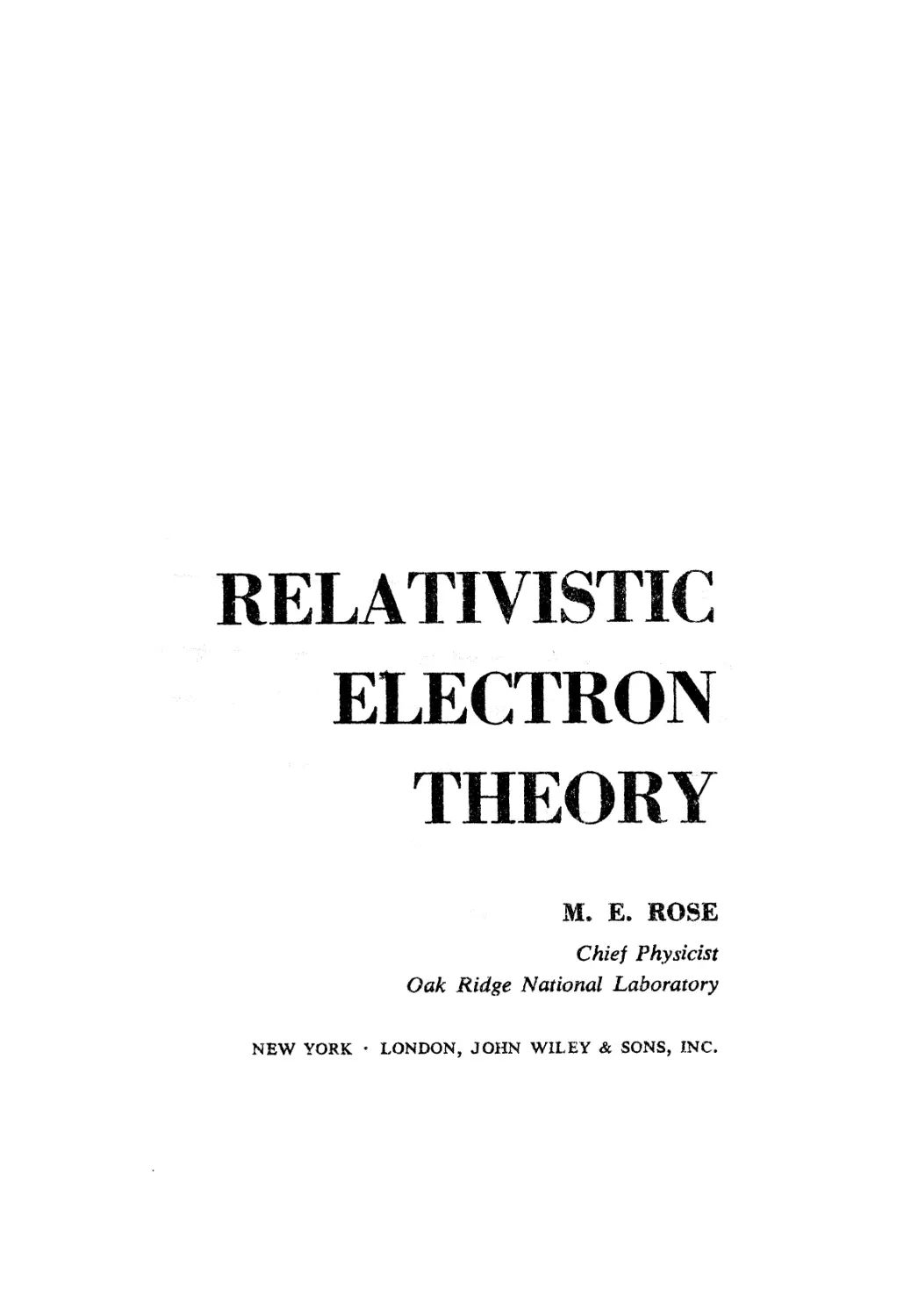
RELATIVISTIC
ELECTRON
THEORY
M. E. ROSE
Chief Physicist
Oak Ridge National Laboratory
NEW YORK" LONDON, JOlIN WILEY & SONS, INC.
Copyright @ 1961 by John Wiley & Sons, Inc.
A II rights reserved. This book or any part
, thereof must not be reproduced in any fornl
without the \vrilten permission of the publisher.
Library of Congress Catalog Card Number: 61-5667
Printed in the U ni1.ed States of America
PREFACE
The preface of. a book is traditionally a device enabling the autho
to divulge his intentions and hopes as weU as his motivations. At the
same time it provides the reader of the book with a preview of things
to come. In that sense this Preface is in accord with tradition.
It-is not the purpose of these prefatory remarks to describe the con-
tents of this book in any detailed manner. A study of the table of con-
tents should provide an adequate guide to the material covered here,
as to the scope of the discussion as well as, possibly, to the level of
sophistication which has been. assumed on the pa.rt of the reader. Lest
there be any ambiguity with reference to the latter, it is assumed that
the.. reader has become acquainted with the general principles and
methods of quantum mec anics. In view of recent trends in the gradu-
ate curriculum, most first-year and virtually all second-year graduate
students should find themselves adequately prepared, and presumably
equipped to undertake the'study of relativistic electron theory. In this
connecti.on it is of interest to not,e that this book has been designed
for Use asa reference as well as a text.
It is important to recognize the place in the scheme of things which
this part of physics occupies. To begin with, we are here concerned
\vith the theory of all spin one-half particles (fermions) which are
lighter than a nucleon. Therefore the word "electron" in the title
stands for mu meson, neutrino, and their antiparticles as well. In mak-
ing this remark we recognize that, in light of recent developments, the
neutrino, in particular, may well require special discussion but this,
properly speaking, is an off-shoot of the more general electron theory
and is taken up in the last chapter of the book.
The second point of importance is to tecognize that we deal here
with what is sometimes called the "c-number , eory." The fields with
which we are concerned are not quantized. 'This means that certain
vii
viii
PREFACE
effects, radiative corrections to electromagnetic processes for example,
are, stricdy speaking, beyond the scope of the present treatment. This
does not, of course, preclude a discussion of radiative processes: brems-
strahlung, Compton scattering, and the like. The contents of this book
ITlay. properly ,be referred to as the -single particle J?irac theory. This
theory is the extension of quantum mechanics to include the ,effects of
special relativity. As such, it may be thought of as forming a link
between the simpler form of the quantum theory and": the more ad-
vanced version wherein all the fields are treated as quantized entities
It will be quite evident, however, that the Dirac theory occupies a more
important position in the development of modern physics than... this
ancillary role would imply. As will be seen, it has a w de range of
applicability. To the extent that it does not give con1plete answers.. to aU
conceivable problems, in the realm of electron theory, it partakes of the
nature of all other physical theories which are useful, powerful, even
\
elegant, but not final.
This book is intended, then, as a comprehensive treatment of the
single particle description of rela ivistic quantum mechanics. Explicitly
we are concerned wjth spin one-half' particles which are not subject to
strong couplings (for instance, the pi meson field); it, is well known t
however, that in. at least a-, formal way parallel considerations maybe
nlade for spin zero particles with mass. This would then exhaust the
non-field theoretic description of kno"wn particles in the quantum
theory.
1.n the pa.st it has been customary, in books expounding the principles
of quantum tnechanics) to conclude with an. all too brief chapter .00 the
relativistic single particle theory. That this kind of discussion, abbrevi-
ated as it D1USt usually be.. inevitably leaves the student with an inade..
quate understanding of this irnportant extension of qua11tum mechanics
is presumably very well appreciated by all the authors who have been
forced into this position for obvious practical reasons. Several yearS'
ago, when an appreciable fraction of graduate students .Nere not ex-
pected to acquire 'a knowledge of quantum mechanics beyond the treat-
ment of the standard textbooks, this curtailed treatment of the relativ-
istic theory or, more pertinently the absence of a book dealing with
the subject in a detailed and extensive manner was not so serious a
drawback. It is clear, however, that this is no longer the case. At
present) courses dealing with the present subject have become rather
common in most graduate curricula.
()bviously, the degree of emphasis 'V\'hich each topic has received is a
rnatter of personal taste and judgment. 'The ITiotivation in n1aking such
PREFACE
ix
aecisions has been to give as much prominence as possible to the'
conceptual basis of the theory. Secondly, particular a tentionhas been
given to the presentation of techniques which would enable the user
of the book fiot only to "follow the literature" but also to use. the
... theory on his own. Applications. of the theory appear throughout but
are most frequently found in later chapters.. /\ nUITlber of ingenious
solutions of he Dirac equations have not been included because it ap-
pears that their main interest is mathematical rather than physical.
About a hundred problems appear in the book. "These are to be
found at the end of each chapter. They present a wide range of con-
tent and a broad spectrum so far as degree of difficulty is concerned.
Withtbe exception of a few general references listed at the end of 'the
book, the literature cited in the text is referenced at the end of the
appropriate chapter. I offer my apologies to the ITlany contributors
wh()seexcellent papers have not been cited. No attempt has been made
to provide a complete bibliography. Instead, the references cited con-
stitute' recognition of the important early papers and the most recent
dev loPD1ents in the case' of each topic discussed. In any event, these
references should furnish an adequate starting point for the reader in-
terested in pursuing any particular topic in. greater detail.
It is a pleasure to record my thanks to Dr. Roland H. Good, Jr., pf
Io""aState University forhis kindness in reading the manuscript.. Need-
less to say, the responsibility for all tbat follows rests entirely with me.
This applies especially to whatever errors of omission and/or com-
mission may exist herein.
M. E. ROSE
Oak Ridge, Tennessee
November, 1960
CONTENTS
I. NON.RELATIVISTIC SPIN rrHEORY
1
1. Introduction
2. Empirical Basis of the Spirt Theory
3. Formal Theory of Angular ?\1omentuln
Definition of Angular lvlomenturn. Eigenvalues ana
Eigenfunctions of the Angular MOlnentum Operators
4. Application to Spin One-Half
5. Spatial Rotations
6. Spin Projection Operators and Polarization
7.. Electron in a Central Field
1
2
3
8
14
17
19
Spin-Orbit Coupling. Pauli Spinors in a Celltral Field.
Anomalous Zeeman Effect
8. CoupHng of Angular Momenta 25
The Vector Addition Coefficients. Properties of the
Spin-Angular Functions
II. RELATIVISTIC QUANTUM MECHANICS
OF FREE PARTICLES 32
9. Postulates of the Theory 32
10. The Wave Equation 37
The Second-Order Equation. 1'he Dirac Wave Equation.
The Covariant Forln of the Wave Equation
11. The Dirac Matrices 44
12. Spin and Constants of the Motion 49
13. The Fundamental Theorem of Pauli 52
14. Lorentz Transformation" and Relativistic Covariance 5 5
Covariance of the Equations of Motion. The Transforma-
tion Matrix. Bilinear- Covarianl ' .
xi
xii CONTENTS
In. DIRAC PLANE WAVES 68
15. The Four Plane Wave States 68
The Wave Functions. The Spin Operator
16. Negative Energy Solutions. The Positron 74
17. The. Properties of Free Positrons 78
18. The Diagonal Representation 8
Plane Waves. The Foldy-Wouthuysen Transformation
19. Projection Operators 92
General Properties. Energy Projection Operators. The
New Representation. The Spin Projection Operators-
20. Covariant Description of Spin 102
21. Application to Nuclear Beta DC{cay 105
IV. PARTICLE IN ELECTROMAGNETIC FIELDS 116
. 22. 1'he Wave Equation 116
Classical Electromagnetic Fields. The Equations- of Motion.
Magnetic Moment of the Electron. Foldy-Wouthuysen
Tran$/ormation with External. Fields
23. Spin Effects in Electric and Magnetic Fields 130
Polarization Effects and Covariant Spin Operator.
Virial Theorem
24. Charge Conjugation 134
25. Space . and Time Reflection 139
Space Reflection. Time Reflection. Transformation of the
Adjoint Function. Transformation o/the Bilinear Covariants
under Time Reflection. Unitary Transformations
v. DIRAC PARTICLE IN A CENTRAL FIELD 157
26. Wave Equation in Polar Coordinates 157
27. Free Particle Solutions 161
28. General Properties of the Radial Functions 163
Normalization of Bound State Wave Functions. Nodes of
the Radial Functions
29. Coulomb Field. Bound States
30. Anomalous Zeeman Effect
169
181
VI.
35.
36.
37.
38.
39.
40.
VII.
41.
.42.
CONTENTS
31. '
32.
33.
Hyperfine Structure
Coulomb ..Field. Continuum States
Scattering Theory
The Density Matrix. Formal Theory of Scattering 01 PoltJr-
ized Electrons. The Scattering Amplitudes
Time-Dependent Perturbations
34.
APPROXIMATION METHODS
'"
The Classical Limit
The Born Approximation
Retarded Interaction between Charged Particles. The Breit
Interaction. Scattering of Fa.ft Electrons by Nuclei
Compton Scattering of Circularly Polarized Radiation
Sommerfeld-Maue Appr.oximation
Finite Nuclear Size Effects
Wave Functions inside the Nucleus. Scattering Phase Shifts
The Dirac Equation at Hig Energies
NEUTRINO THEORY
Four-Component Formulation
Masso! the Neutrino. Neutrino Helicity. C:'harge Conjugate
States
The Two-Component Theory
The Weyl Equation. Relation to the Majorana Theory. Co-
variance of the Theory. Two-Component Neutrino in Beta
Decay. Angular Momentunt Representation
xiii
188
191
196
211
219
219
223
232
237
240
246
253
253
258
,
Appendix A. Notation 273
Appendix. B. Lorentz Ttansformations 276
App ndix C. Time-Dependent Operators 279
Appendix D. An Alternative Approach to the
Dirac Matrices 281
Appendix E. Retarded Electromagnetic Interaction 286
General References 293
Author Index 295
Subject Index 298
I.
NONuRELATIVISTIC SPIN TH}-::ORY
1. L'fTRODUCTION
The relativistic theory of the electron, as distinct from relativistic particle
theories in general, is a theory of a particle \vith spin In. By spin vIe shall
mean the intrinsic angular. momentum associated with the particle. In
contrast, the t.otal angular momentum is the resultant of the spin and the
orbital angular momentum which the particle possesses by virtue of.its
'motion. Thus the spin is the total angular momentum in the rest systeln.
This property of intrinsic angular momentum is, of course, a quantum
effect since/ it cannot appear in a classical theory, that is, the limiting fOl1n
of the theory as Ii -- O. By way of contrast, the orbital angular m(;mentum
Iii does have a classical1imit since hequantum number I is not bounded
in this limit.
Needless to say, the relativistic theory which forms the subject of our
discussion is, in a sense, more tha1l a description of the spin. I t is
immediately obvious that SUCl1 a theory must be consistent with the
in variance requirements of the special theory of relativity. Indeed, \vhen
this requirement is iroposed, a number of theories appear as possible
candidates. Moreover, each of these theories contains the result that the
particle under discussion does, in fact, exhibit a spin sn, \vhere 2s is any
non-negative integer. The particular form of the theory, unique for a
particle with non-vanishing mass, which corresponds to s = t is the
well-known Dirac theory with which we shall be almost exclusively
cccupied in this exposition. ConsequentJy, it is proper to say that, in
detail, the spin properties of an electron are a natural consequence of the
requirements of relativistic invariance-. The validity of this statement is
explicitly demonstrated in the seque1.
Historically, the concept of electron spin arose in a phenon1cnological
1
2
RELATIVISTIC ELECTRON THEORY
.
way.It The first formal theory! of spin was not a relativistic theory, a.nd
in view of the basic principle that simpler things come first, this historical
order was a most natural one. This theory, the Pauli theory, is the limiting
form of the rigorously correct theory.in the limit in which the velocity of
light (c) tends ,toward infinity. Consequently, all the quantitative results
of the non-relativistic theory can be obtained as limiting values of corre-
sponding results as given by the Dirac theory. In fact, it is a curious
circumstance that in some cases the exact theory yields these results in a
simpl r and more straightforward manner. Accordingly, it might appear
logical to dispense with a discussion of the approximate'theory and obtain
all the results of the Pauli theory.'as limiting forms of the more rigorous
treatment. Nevertheless, it is advantageous to approach the study of the
relativistic theory from the standpoint of the Pauli theory, since the latter
provides a unique insight into the structure of the former.
2. EMPIRICAL BASIS OF THE SPIN THEORY
The concept of a spinning electron was. first suggested byCQII1ptpn 3 jn
1921 in connection, appropriately enough, with the origin of the natural
unit of magnetism. The idea became firmly established in physics when
in 1925 Uhlenbeck and Goudsmit 1 prop ed the electron asa point magnet
with intrinsic spin in order to clarify,. the anomalous Zeeman effect. The
main results of the argument were:
(a) The electron must have an intrinsic spin !11. Hence single electrorr
atomic levels must be characterized by half-integer angular momentum.
(b) The electron rnagJ?-etic moment arising from the spin must have a
rnagnit de equal to the Bohr magnelon:
Iftl = en/2mc5 #0 (1.1)
where m is the rest mass of the electron and -e < 0 is its charge.
Moreover, in termS ofa vector model, fL and s(the angular momentumifi
units of Ii) must be oppositely directed. Therefore a vector equation
f£ = -(e/mc)Jis (1.2)
can be written. It will appear that this equation is valid as an operator
equation. The magnetic moment (f.-l) as a measured quantity is then the
average (expectation) value of P'z for the state in which Sz has the constant
t Re(erences are found at the end of the chapter.
t More precisely, the non-relativistic spin theory can be correct only to order vIe,
where v is the velocity of the electron. In the case, of bound states, vIe,......, rJ.Z, where
<X = e 2 /hc 1/137 is the fine structure constant and Z is the atomic number.
NON-RELATIVISTIC SPIN THEORY
3
value!. The connection between the spi and the associated magnetism
implies that the spin must be a relativistic phenomenon.
. '
The gyro,nagnetic ratio is
gs = /-l/Pos = Z- (1.3)
in contrast to the result for the orbital angular momentum, where the
corresponding ratio is
gz = /lz/flo l = 1
(1.4)
and fit is the Inagnetic moment due to the orbital motion. It is possible to
make a classical argument 4 based on relativistic invariance, whic leads to
the value gs = 2.. However, it is much simpler to obtain this result from
the complete quantum mechanical treatment of spin given in later chapters._
For the moment it is of interest to mention that, if gs = 1 is assumed, the
Zeeman effect with spin leads to the "normal" Zeeman triplet, contrary
to experimental evidence. Obviously, the conclusion that gs = 2 precisely
is obtained from neither the empirical evidence nor as a consequence of
the approximate spin theory. In this theory it must be taken as a postulate.
.. The postulated magnetic dipole to be associat d with the electron
immediately leads to a spin-orbit c0upling since, in the frame of reference
of he electron, the rest of the at0I!l provides a magnetic field which is
coupled with the electr<;>n magnetic dipole moment. In these terms the
doublet structure of the spectra of the alkali atoms' and other multiplet
. structure observed itl optical spectra could be understood. However, a
quantitative accounting for the measured doublet separations depends on
a. more detailed analysis of relativisticeeffects (section 7) than this simple
discussion would seem to entail.
3. FORMAL THEORY OF ;\NGULAR IVIOMENTUMt
Definition .ofAngular Momentum
....
Since we are concerned with a particle with angular momentum,
intrinsic and possibly orbital angular momentum as well, it is very useful
to establish in a formal way just what is meant by these terms. If we are
given a wave function "p which represents the state of a particle, there is a
procedure, as indicated below, by means of which we can determine what
t Here and henceforth the unit of angular momentum is h. Hence the term "angular
momentum" will refer to a dimensionless quantity which, as a matter of fact, is integer
or half-integer. The contents of this section appear in several other places;. for example,
see reference A.in the General References at the end of the book. In the text, references
in this general list will be denoted by an upper-case Roman letter.
4
RELATIVISTIC ELECTRON Tl-IEfJRY
angular momentum, if any, characterizes this. state. Since we do not in
general start with a given wave function, it i& more to the point to establish
SOlne properties which the requisite function must exhibit in order that it
propeJ;'ly describe the given angular m01nenturn associated with the state.
In the last analysis a definition of angular nlomentum must be based on
a measurement or set of measurements. However, the logical chain may
be reversed: angu]ar momentunl may be defined in terms of a formal
operation, and from this definition a connection wiJl eventually be
established between the angular momentum thus defined and a measured
quantity-a cross section, shape of an angular distribution, 01 the number
-of lines in a spectrum of some type of radiation emitted by an atom or by
a corresponding physical systern.
The concept of angular momentum is intimately connected with three-
dimensional rotations. 'This is clear in classical as wen as in non-relativistic
quantum mechanics where, as is to be expected., only orbitaJ anguJar
momentunl is involved. Nevertheless;; the connection \\lith rotations is a
general one. For instance, the statement that a physical system is rotation-
any invariant ir1ipHes in both classical and quantlun theory, that the
Hamiltonia n describing it COlnmutes with the operator representing the
rotation. It will become evidenf that in the general cas4'e this leads to the
result that the total angular momentum is a constant of the motion.
Starting with a wave function VJ which depends on spatial coordinat s
and possibly other coordinates as well, we consider a rotation R described
by three parameters. These can be taken to be the three Euler angJesor
the two angles specifying the orientation of a unit vector ii, the rotation
axis, and an angle .0, t. e rotation angle around n. Under the rotation 'I'
is . transformed to 1p' and
1p' = R(D, O)1p
(1.5)
Since R must be unitary, it can be written
R(ft, 0) = exp [ - is(n, 0)]
(1.6)
where S is hermitian and S(o.. 0) = o. Considering infinitesinlal rotations
around the X-, y-, and z-axes respectively, we \vrite, in each case
bVJ c= Rtp - 1p = -ie ( ) tp
of)ls=o
(1.7)
where (oS/oO)o=o depends on the axis of rotation. Since a rotation is a
continuous transformation, the function S TIlust have corresponding
properties and, for instance, the derivatives of S \vith respect to f) must
exist at any value of e.
NON..REL. TIVIS'TIC SPIN THEORY
5
The angular momentum operator, actually three operators, J , 1'V, Jz,
are defined by choosing fi along the X-, y-, and z-axes. Since infinitesimal
rotations commute, we can define the J i operators in terlllS of
( as ) .D.. J .... J "" J A T
.- =11. =n x +nll y+n Jz
,08 8 = 0
Clearly Ja:, J y , and Jz are all hermitian. In (1.8) a con velltion has been
made 'with respect to a choice of sign, and, in detail, this choice is fixed in
terms of the manner in which a p sitive rotation, for example, is specified.
From (1.7), .
(1.8)
R(ft, 6) = exp ( - i(}ft-J)
(1.9)
which has the property that t .o rotations around the same axis corpmute:
R(ii, (1) R(n, (2) = R(ft, 1)1 + ( 2 )
as is necessary.
Since,finite rotations do not commute, it is clear that the components of
J win not commute.. In fact, if a rotation around the y-axis through an
angle 01/ is followed by one around the x-axis through Ox, the result is not
the. same if the rotations are carried out in reverse ordere For simplicity
as um.e that both rotations are infinitesimal and consider terms of second
order in Og:, (}11. The the difference between the first pair of rotations and
the second pair (first pair in reverse order) produces the same displacenient
as an infinitesimal rotation around the z axis through an angle 8 x 0'll.
Hence, \vith an obvious notation,
. R(x, Oa:) R(y, f)1I) - R(y, Oy) R(i, Ox) = -f);efJy(J:t;' J lI )
where we have introduced the commutator; that is,
(1.10)
(A, B) = AB - BA
From tl1e statement made above, the quantity on either side of (1.10) is
-i(Jx() z Hence
(J;e, J 1/) - iJ;;
It follows that two similar equations obtained by cyclic pernlutation of the
indices x, '!/, z are also valid. These three equations are sUITlmarized by
J X J = iJ
(1.11)
These are the commutation rules of the angular momentum operators.
It is evident that, if J and J' form two sets of operators conforn1ing with
(1.11) and if each component of J commutes with each component of J',
then the sum J + J' = J" also satisfies (1.11). Each component of J" is
an angular momentum operator, while J" itself is referred to as a vector
6
RELATIVISTIC ELECTRON THEORY
angular mo entum operator. The measured quantity generally refe!r <i
to ,as the angular momentum of a physical system cannot be a vector
because this would imply that each component of that vector is a constant
of the motion, and that, in view of (1.11), is impossible. Qearly the
angular momentum must be' the eigenvalue of a rotationally invariant
operator and hence must be related to
J2 == J: + J: + J:
..
f 4 rom (1.11) it follows that J2 commutes with each of J re , J u , and J. anq
hence with the rotation operator R. Consequently we can make J2a
constant of the motion, and the eigenvalues of this operator will not
depend on the orientation of the coordinate axes.
Eigenvalues and Eigenfunctions
of the Angular Momentum...Operators
CQnsider a physical-system described by a Hamiltonian.H which is
rotationally invariant. This means that H commutes with each compoI1ent
of J and
Of course, it follows that
(H, R) = 0
(H 1 J2) = 0
so that J2 is a constant of the motion. In addition, one component QfJ,
say Jt;, can be made a con.stant of the motion. The angular momentum
representation in which J2 and J. are simultaneously..diagonaI with H is
given in terms of a set of eigenfunctions 'fJJf for which
J21p'1 = 'YJ i "Pi
( 1.12)
Jz1p7 = m1pi
In the first of (i.12) the notation implies tE.at the eigenvalues'?]; of J2
depend on a number j to be determined. Because 12 and Iz are hermitia!1,
rJ; is real and non-negative, m is real, and the eigenvalue of J2 - 1; = J; + J;
is'
Introducing the operators
'YJi - m 2 >= 0
(1.13)
and the function
J:t = J :I:: iJ '¥
(1.14) ;
we see that
c/>z == J z 'Pi
( 1.15)
J2cp-j; = 'YJic/>:t
NON-RELATIVISTIC SPIN THEORY
because (J2,J:t) = 0 and
Jz ":t = [J :l:JI: + (J/lf J :I:)]1J17 == J j;(J 3 ::I: l)-tpi
= (m ::I: l)cp:t
'"Therefore 1>:1: is an eigenfunction of J2 with the same eigenvalue as 1pj
and is also an eigenfunction of Jz with eigenvalue m :I: 1. Thus
7
..J.. - r ,IJm:l:l
'f' oj: - :.t: T;
where r :i: is a constant the value of which is determined below.
Since application of J+ to "Pj raises the value of m, for givenj, it follows
from (1.13) that for some m, say m 2 , the resulting function cP+ must vanish;
that is
J + 1fJ't s = 0 .
(1.16a)
Then m <: mg <; 'YJj. Ina similar way we deduce that there exists a value
of m (say m 1 ) for which
J _1pjl = 0
(1.16b)
andm :> m 1 >: -1'];. Operating on (1.16a) with J_ and on (1.16b) with
J+ gives
J:r- J -J: 1pji = [J 2 - J (J :l:l)]V'ji
= [1}1 - mi(m i :I: 1)]"P7 i = 0
( 1.17)
and i = 1, 2 for ]ower and upper signs respectively. Since 1pj,1t i are bona
fide memb,ers .of the set, it follows that the square bracket in (1.17) must
yanish. Eliminating '7; from the two equations obtained in this way, we
find the result '
(m 2 + m 1 )(m2 - m 1 + 1) = 9
Since m2 > m 1 it follows that m 2 - m 1 + 1 cannot vanish and so m 1 = - m2-
Also, consecutive m-values ,differ by unity. Hence 11'12 - m 1 is a non-
negative integer which we denote by 2j; that is,
j = 0,1, 1,1,2,...
It follows then that
m 2 = j,
m 1 = -j
(1.18)
(1.19)
and, from (1.15),
"YJ; = j(j + 1)
Classically, j - 00 and the eigenvalue of J2 -:;. j2. Therefore it is to be
expected that the number j is the angular momentum (in units of Ii).
The linear term in j is a result of the uncertainty principle as expressed by
8
RELATIVISTIC ELECfRON TIIEORY
the commutation rules (1.11). This is apparent in (1.17). From (1.16}the
projection quantum number m is restricted by
-j <; m -< j (1.18')
so that there are 2j + 1 eigenfunctions for given j.
The next problem is that of determining the matrix elements of the
angular mornen um operators in the angular nlomentum representation.
These wiH be denoted by
(jmlJ klj'm')
for each ,of the operators J k . In writing these matrices in explicit form, the
first row refers to m = j and the first column to m' = j. The nth row and
column refer to m, m' = j --- n + 1. Clearly, -
(jm!Jlelj'm') = mc};j,d mm , (1.20)
A1so
(jmlJ2lj'm') = j(j + l)d j j't5 mm ,' (1.20/)
corresponding to the diagonalization of these operators. For the other
components \,\'e observe that
IF :t 1 2 = (J :t yj, J =t "1'1)
. (The detailed prescription for forming the scalar product w ll be discussed
below.) The ''Pj are taken to form an.orthonormaL seLThus, using
..1I = J +, where * means hermitian conjugate,
Ir :f: 1 2 = (1Jlj, J :r-J:t 1J1i a ) = (1pi, [J 1 - J z(J z :i: l)]"PT)
= j(j + 1) - m(m :I: 1) = (j =F m)(j:l: m + 1)
The phase is chosen so that r :i: > 0:
r:f: = [(j T m)(j :l: m + 1)]!-i (1.20")
From (1.15) it follows that
(jmlJ ]:Ij'm') = r ]:<5 H 'c)m,m':i:l (1.20"')
These matrices therefore have non-vanishing elements only in the diagonals
adjacent to the principal diagonaL
4. APPLICATION TO SPIN ONE-HAI..F
Each of the matrices derived in the preceding section has 2j + 1 rows
and columns. For j = ! we obtain the angular momentum matrices for
the intrinsic spin of an electron. Using s for J in this case we write
s=!o
(1.21)
NON-RELATIVISTIC SPIN THEORY
9
and from. (1.20"1) it foHows that
10 1 )
a = ,
'" \1 0
(0
a,s: = ,
\ i
-i\
01'
/1
(T. = (
, ,0
0 )
-1
( 1.22)
in the representation v/herc. Sz or C1 z is diagonal. These a-nlatrices are the
v/ell-knovvn Pauli m trices. Together 'Nith the 2 by 2 unit n1atrix /2 they
form a conlplete set in the serfse that any 2 by 2 matrix can be written in
terms of them. To see this we observe, first, that 1 2 and the three Pauli
matrices are evidentlv linear]v inde p endent. Thus
'" .I
Qol2 + a-a' :-= 0
if and only if 00 = 0 and a = O. Second, the trace of each a-matrix is
zero, whereas Tr 1 2 = 2. Hence, for any 2 by 2 rnatrix M,
Ai = }[Tr 1\1 + efr 1\10')-«]
(1.23)
In view of (1.11) \\'e can write ill1mediately
s X s = is
(1.24 )
or
a X u = 2ia
(1.24')
J n addition, the Pauli matrices ha.ve the foHoVv'ing properti.es:
axG y = - a l /:J:r, = fa z
fYy(J ::::: - a zU II == 1 a;;c
( 1.24")
(J zC;';,e = -- (J xU z = I cr!J
? 2 1
(f = (J = (1" =
trY Y Z
(1.24"')
In addition to being hermitian, each of the Pauli matrices is unitary:
a: == a -]. The existence of the inverse matrices foHows, since det (jk -=j:. 0.
For integer spins, for instance, the nlatrices are singular, as is clear since
one value ofm which ah\'ays occurs is In = O. The anticommuting
property of the a-matrices is peculiar to spin i. i\ corresponding property
does not appear for j * i. The last equality in (1 e24 ) also applies in the
case j == i- only. This equaJity \viH be written more succinctly by using
,Latin indices = 1, 2, 3 in place of the cartesian indices. Then
0' ,a k = iE " k lV ' .+ () ' k
1 ,1 v,, J
(1.25)
where €jkl is the antisymmetric third-rank tensor equal to + 1 if j, k, I is an
even perm utation of 1, 2, 3 and eq ual to - 1 if j k, ! is an odd permutation
of 1, 2, 1; otherwise € jkl = O.
10
RELATIVISTIC ELECTRON THEORY
Another. property which is extremely useful follows from the com..
mutation rules (1.24!1)o If A and B are two vectors which commute with
(1k but not necessarily with each other, then
a.A a.B = O"kAk(JzBz = A.D + (1 - OkZ)(]kGlAkBZ
Using (1.24"), this becomes
a.A aoB = AoB + io.(A)( ;8) (1.26)
This is an exan1ple of the decomposition of the type (1.23). It is clear that
no higher power of the PauJi spin matrices than the first need ever occur
in the formalism. By repeated application of the rule (1.26) it is easy to
construct the corresponding decomposition for the product of any number
of factors a.A'n. In view of what has already been said it is trivial to see
that this will always appear in the forn1 a + b.o.
As was mentione above, the form (1.22) of the Pauli matrices refers to
a particular representation: (] z diagonal. By a linear transformation with
a non-singular matrix S it is possible to \vrite the a matrices in other
representations. For example, in
O' = S(]kS-1 (1.27)
.S can be chosen so that any linear combination 0'.0, where n is an arbitrary
vector, can be made diagonaL When n is a real (unit) vector the unitary
transformation is a rotation in three-space. We shall return to this
problem in the next section. l\t this juncture it is important to remember
that all matrix equations are unchanged by the transformatio (1.27).
In particular, the commutation rules, (1.24') and (1.24"), are unchanged in
the sense that, if aU O'k in these equations are primed, the resulting equalities
are valid. A few simple cases can be discussed in1mediate1y. For exampI ,
for S = (]x = S-l we find a = (J , a; == -G 1I , 0'; = -G z , which corre-
sponds to a rotation through 'TT around the :t;-axis. On the other hand, a
reflection (change of sign of an odd number of a's) is not a unitary trans..
formation because -0" does not fuUiIl the same comn1utation rules as
does (J.
The invariance of the cQlnmutation rules under the transformation (1.27)
does not actually require S to be unitary. It is sufficient that S be non..
singular so that S l exists. However, in the present instance, where (/ and
(lk are both hermitian, S can always be chosen to be unitary.
As another example consider a representation in \\,hich (]; is diagonal.
Then, from the preceding it must have eigenvalues :l: 1, and we write it in
the form -
G = ( _ )
.
NON-RELATIVISTIC SPIN THEORY
11
The linear transfornlation from the representation . (1.22) to the a'
representation corresponds to a rotation which carries the z-axis into the
x-axis. Since the positjons of the z' - and y'-axes are not specified, there
Intlst be some arbitrariness in 0'; and a;. Setting
a = {: :),
( at
0" =
z . t
C
b l )
d'
the requireme t that O';O' = iO': implies that
..
. ,
a = IG ,
. t
C = -IC ,
F I , , I fi d
. rom O'yO'x = - O'xCf y we n
b = ib '
.....
d = - id'
a=d=O
and
a = e :),. a = (: -;b)
From (] 2 = or 0';2 = 1 we find
be = 1
and, with this, results (1 (]; = ia = - 0'; a; follow automatically_ Also
()" <T; =__ iQ' = - (.j;(j is fulfilled. lIenee
at = (b 1 :),
( 0
ai = ib- 1
-:b)
The lS'-matrix effecting the a-a' transformation is written
s = ( oc fJ )
y ,0
where oed - f3y -=P O. From
a S = Saf£
it follows that
rx = p,
= -y
From O";S = Say or O" S = SO"z we find .
(1..i = by
and thus
( -ib
S=y
1
- i b ) ,
-1
( O b X
x l
S* = Y
ib x
--:)
12
RELATIVISTIC ELECTRON THEORY
and
( lb l2 0 )
SS* = 21rl 2 0 t
Thus we can n1ake S* = S-1 by setting lyl2 = t, Ibl 2 = 1. For this choice
of Ibl 2 it is seen that SS* = S*S = 1. For b = 1, C!; = O'x') a; = u Y ' so
that a cyclic interchange of indices has taken place.
The converse theorem that, if S* = S-l and any matrix a is hermitian,
then .
a' = SaS- 1
is also hermitian is readily verified:
a'* = (SaS*)* = SaS* = SaS- 1 = a'
as required. Notice that, if a sequence of unitary transformations IS
carried out, the resulting overall transformation is also unitary.
The converse statement regarding (1.27) is also true: if a f and a are
two sets of three anticol11muting matrices ,vith a; = 0';2 = 1, then an S
exists for which (1.27) is valid. The proof is identical with that given in
section 13 for the Dirac matrices and will not be duplicated here. Finally,
we note that the trace and determinant of a matrix is unchanged by a
J . '
transformatIon of the type (1.27).
'Throughout this book the notation 0' or 0'.", where 2 by 2, matrices are
in1pJied, wiH refer to the representation (1.22).
The eigenvalue equations (1.12) for spin i will be written in the form
s2Xm = s(s - l)X m =.JtXrn
szX m = mx m , 111 := ::l:! (1.28)
There are t")vo eigenfunctions X:J: . From the matrix representation of Sz
and S2 it 1"oHo\"5 that the I m m ust b tnto-COfflponent functions. In fact,
with a simp1e choice of phases,
x H = ( ) ;
_ 1.. ( 0 )
X =
1/
(1.29)
These may be regarded as single cohftnn matrices. 'Jv'e verify that these
form an orthonormal set.
(x m , Xtfl.') :.= omm'
»,here the scalar product 111eanS that Xm* is multiplied into X'm'. That is,
X m $ js the transpose, complex conjugate of X m :
x ' . = (1 0);
- . (0
X -- =
1)
NON-RELATIVISTIC SPIN THEORY
13
so tnat Xm* are single row nlatrices. Ingenera1, a scalar product will
imply, unless explicitly stated to the contrary, integration over configura-
tion space and summation over the CO]UlTItl (or row) index labeling the
components of the spin function X'ru. Of course, in the present case we
are dealing with the eigenfunctions of the intrinsic spin, and they do not
depend on the space coordinates X k . Hence the first operation is here
unnecessary.
The" set of spin functions is obviously complete. Thus any two-
component function can be written as a linear superposition of them:
( a ) 1 1/
b = ax"" + bx->2
and hence the only two-component function \vhich is orthogonal to both
X!-1 and X- is the trivial one which is identically zero.
The appearance of a multicomponent wave function s characteristic of
the existence of a non-vanishing spin. Where the Vv'ave function 1p has a
single component depending only on the space coordinates the spin is
zero. In fact, the considerations of section 3 show that in this case
J = -irX V =L
(1.30) .
where L is the orbital angular momen.tum operator. Of course, in the
general case a particle with spin s (s > 0) rnay be characterized by a wave
functioll.1p \vhich has the form
'P1(X t )
"p2(x k )
'I) :::-..::
In this case the prescription of section 3 sho\vs that
J=L+s
( 1.30')
where s is a vector-matrix with ,,2s + 1 rows and columns and L is the
direct product of - ir X V and a unit matrix of the same rank. This
follows fron1 the fact that under rotations each component of . ) must
transform into a linear combination of components. If this were not so,
the situation would arise in which rotations comn1 ute, contrary to fact.
For s = l
J == Ll 2 + !o
which is usually written
J=L+tO'
(1.31 )
14
RELATIVISTIC ELECTRON THEORY
In the foregoing considerations \vehave "t'..",(x k ) - 1 or 0, and the resulting
'lp = X m is a pure spin function. In section 7 we shall consider the problem
of introducing orbital motion.
Fron1 this discussion it follows that the wave function "p of a particle
with spin i is a function of the three X k , which form a continuum, and in
addition tp depends on a fourth variable which is dichotomic. That is to
say, the fourth variable has only two possible values and refers to the
"direction of the spin" or, more exactly, to the eigenvalue of SZ. Tp.us the
general form of 1p would bet
I -!-i ( "Pi( Xk) )
1p(x k , sz) = 'Vll(Xk)X + "P2(X k )X = )
"P2( X k
The notation indicates that this 1JJ is a superposition of the two states
m = :i:i. The interpretation of each terra is: l"Pl,2i 2 is the probabili y per
unit volume that the particle is at the point X k with m = l, -i respectively.
Note that there is no interference between these two states:
(1p, "P) = ("PI' 1JJl) + (1J.'2' 1JJ2) = t Y'] 1 2 + 11f21 2
where the scalar product implies only summation over the column (row)
index of the spin functions. This in turn implies that (?p, 1p) is the
probability density when no observation of the spin (polarization measure-
ment) is made. A more detailed discussion of pol3:rization is.. given in
section 6.
5. SPATIAL ROTATIONS
It has already been emphasized that we cannot ascribe any meaning to
the statement that the spin vector is in a given direction. This would
imply the three equations 01p = ft"P where it is the spin direction. That
this equality is impossible follows from the fact that «(Jk, Ul) -=I=- O. However,
we can speak of the . average spin direction. This is given by (1p, aw).
If we introduce unit vectors e k a10ng the coordinate axes,
( ;to
e 3
a=
e 1 -t- ie 2
@1-A ie2 ) '
--e 3
For the p1!re spin functions,
(Xm,O'X m ) = ::tea,
for m = :1:1-
t s; is a number distinguishing tp fron1 the orthogonal wave function:
tp(x Je , --4;) = tp XYi - tp X-
NON-RELATIVISTIC SPIN THEORY
15
This result'is obviously directly connected to the choice of representation
in which (1 = O"a is diagonal.
It is useful to investigate other representations in which the con1ponent
ofa in any direction ii, that is a.6, is diagonal. Thus we write
to
x.= .! amX m
m
(1.32a)
and
a.ft X = AX
It is evident that the average spin ist
(1.32b)
(x :i:' aX:i:) = :I: ft
(1.32c)
From the fact that (0.6)2 = 1 (see Eq. 1.26), it foilows that A = ::I:: 1-
,Substituting (1.32a) into (1.32b), \ve find
( 3
n+
n_ ) fL
- !rz '" -- 1.-2
.. (a x + a_ x \ ) = A(a x ,+ a x ' )
-1l
where fi-j; = fi! :i: in 2 . From (1..29} we obtain
n3a -i' -+ n_Q - = Ja!-i
12 + a } - naa -!4 -:- Aa - t
or
I A
n 3 - A
n-
=0
n+ -11 3 - A
giving ),,2 = j1;+ n+n_ = ft2 = 1 or A. = :l: 1 as n1entioned. Also
na - A
a-y% = - A aZi
n_
Writing n3 = cos .f}, n::i: = sin it e itp., so tllat {), f{J are the polar and
azimuth angles. of ii, and using the normalization condition
,
I 2 I 1 2 1
la 1 + a-!-i =
we find, for A = 1,
i a , /1 2 = co s 2 Q. /2 .
i /"2 i . cU' ,
a - 4/a!i = ei(jJ tan -D/2
and!; for A = -1,
la 12 = sin 2 {}j2; a _ \A!a1A, = _eif'P cot fJ/2
t We anticipate that there will be two eigenfunctio!1s X = X::i:; :tee (1.33a) and (1.33b)
below. .
16
RELA TIV1sTIC ELECTRON l'HEOR Y
We choose the phases as follows:
A = 1: a! = e -'iqJ/2 cos {)/2,
A = -1:
a = _e- ifP / 2 sin {}12,
a _ /2= e iP / 2 sifl {}j2
a_ = e i q;/2 cps fJI2
(1.32d)
.t. 2e)
Therefore the spin functions which diagonalize 0'.1\ with eigenvalue :f: 1 are
( 'e -irp/2 cos {}12 )
A = 1: X - (1.33a)
+ - e irpl2 sin r{}J2
( -e -if/J/2 sin Dj2\
). = -1: x- == ei'P/2 cos {}/2 ) (U b)
These are, of course, a complete orthonOfInal set of spin functions. For iJ,
rp 0 the functions X:i: reduce to X:t! .
The tran.sformation just carried out can be written in another form.
We consider the matrix elements of R (see Eq. 1.9), in the angular
momentum representation and use the notationt
D:nm,( f3y) = (jmIRI.i 1n ') (1.34)
Here ct, 13, and yare the Euler angles of the rotation: (I) rotation through
tI.. around z, (2) rotation through f3 around resulting y-axis, (3) rotati0n
through y around final z-axis. Then under this rotation angular momentum
eigenfunction 'tJlj is transformed to
R"IJ"!" = D 3 'W '
T, m'1n,?
m-'
(r. 35)
It is important to notice that, if aU rotations are expressed in the original
coordinate system,A
R = e-i«Jze-ip.,TlIe--iyJ.,
( 1.35a)
In the present instance thefotation is. one \vhich carries the. z-axis, into
the direction ft. Hence the third Euler angle y is irrelevant (it introduces a
phase e- imy in D ). The preceding choice of phase is equivalent to setting
y = O. It is clear then that
1 ( e-iCP/2coS19/2 eif/J/2SinfJ/2 ) _
D1A.(tp, 0,0) = . I. . , (1.35b)
_e-1.Q;/2 sin {)/2 e q;/2 cos lJ./2 '.;, :
A two-component function which transforms under rotations by the DYi.
matrix is called a spinor. Thus the pure spin functions X"n and X:t are
spinors. They will be referred to as Pauli spinors. The index which labels
the components will be referred to as the spinor index.. It is seen that
D( rp + 21Tn, f}, 0) = D( cp, {} + 21Tn, 0) = (_)11 D( cp, '0, 0)
t See Chapter I V of reference A.
NON-RELATIVISTIC SPIN THEORY
17
\Vher 1'1 is an in ger.. For odd.n the complete rotationcarries1p to --V'
This two-to-one correspondence of the unitary transformation D and
three-space rotations is. characteristic of spinors.
6 SPIN PROJECTION OPERATORS AND POI ARIZA1'ION
It was mentioned above that any set of two spinors like X 1: in (1.33)
forms a complete set in the two-dimensional spin space. As we have seen,
this means that any two-compon nt function can be expanded as a
linear combination of these two. Alternatively, there is no non-vanishing
two-component function orthogonal to both x+ and X_a
If we write Xa. for X:i:' so that <X has two values, the tatements above
imply..that fot. any spinor -q; we can write
'Y = I c,/xf¥. = I (XIX, 'F}j(Z
« <X
In terIns of the spinor components,
. 'Yp = I X'YyX: = I bpy'Y y
<xv v
Th .erefore we obtain the completeness relation
I x;x x= lJ pv
CIC "
( 1.36)
Of!
I'x tlx xfl.* = 1
oX
(1.36 / )
'where X indicates a direct product of the t\VO spinors.
Consideriqg one term in (1.36), we define a pair of matrices pry. by
prz = Xf!. X x«*
(1.31)
or
pa = X IX X aX
p p ",v
( " 1'"' 7 ')
1.... /
Dropping the superscript (l. for the moment, we investigate the propertics
of P. First ,v observe that P is idempotent: that is, p2 = P and therefore
pn = P (n > 0); thus
(P2)UA = I PtlpP p ). = I XqX:XpX
p p
= ltTX = P tll
In order to understand this result we evaluate P for the spin function
(1.33a, b). Clearly,
p = I[Tr P + (Tr Pa).a]
18
REl.-ATIVIS11C ELECTRON THEORY
But
Tr P = I xpx = 1
p
and
Tr Pa = I Pp;.a).p = 2: x a).pXp
PA PA
= (x, ax)
Here, as elsewhere, the subscripts on spinors are spinor indices and on
tJ1atrices are corresponding ro\v-COlUn111 indices. "lith the results we find
directly from (1.32c)
p+ = x+ X X = !(l 'I- 0-6)
p- := x- X X = !(l - a-6)
(1.37a)
(1.37b)
As expected,
1)+ +P- = 1;'
(p:l:)2 = pi:.
(1.38)
It is evident that
]:J+P- = p-p+ = 0
(1.39)
and that
P+x- = 0, P-x+ = 0
The interpretation of these results is quite simple. If
'Y = 2 Ca.xa;
is an arbitrary superposition of the t\\lO spin states, tllen
P+'Y =c+x+, P-'Y= c-x-
and the operators p.:l:: project from 0/ the parts corresponding to + and -
spin along ft. Since p-J:X:f: = X:1' the idempotent property is obvious.
rrhe IDutuaUyexclusive character of P+ and P-- (viz., 1.39), is an expression
of the fact that there is no overlap in the portions of spin space proje( te(l
by these two operators. The exhaustive property, P++. p- = 1, is an
evidence of the fact that the two projected' subspaces together constitute
the whole spin space. In other words, fro.ffi a conglomerate of spin states
p+ projects or selects one state (A =- 1.), P- projects the other (l == --1),
and together these constitute the complete set of spin states. .
In general terms, if a projection oper tor P exists, tbat is, p2 = P, then
P' = 1 - P forms with P a con1plete set (}f projection operators. 1"'hus
(1.40)
p + p" = 1,
pp' := }")']' :.:::: 0,
p,n. = P' (n:> 1)
"rhe projection operators given in (1.37a) (; nd (1..37b) are Pauli spin
. .
projection operators. As is to be expected, they ,"vill be very closely related
to the spin projection operators for a relativisti parti :.]e in the franle of
reference in which the particle is at rest. In connection \Jvith this discussion
NON...RELATIVISTIC SPIN THEORY
19
it should be recognized that projection operators for other dynamical
variables (for example, the energy) can be defined; see section 19. FinaJIy,
it is to be noted that for any matrix P vlhich fulfills p2 = P and P =1= 1 2 )
tbe determinant of P (det P) = 0 as will be readily verified by the reader.
rhus 1''1 is singular and p-l does not exist. In fact, the assumption that p-l
does exist leads to P = 1 2 in1n1ediately, but this does not yield a sensible
set of projection operators (that is, P' = 0 would follow in. this case).
It should now be fairly clear how the poJarization of a particlt Vtrith
spin -! is to be defined. If we again consider a state like (1.40) the polariza-
tion f!lJ will be defined bV 5 )6
.J
f!IJ = ('Y, a!> = Tr aP'Y (1.41)
('Y, 'Y) Tr P'Y
where the projection operator Pq: is
( P'I!-) p;' :== 'P- p \f"
If a beam of polarized particles is detected by a device which is sensitive
only to spin projection along :i:fi, the response of this device is proportional
to
where
:t = ("0/, P+o/) = !('Y,o/)(1 :i: EP.ft)
J+ -1- 5._ = (\f', 'F)
(1.42)
,
In general, the con1ponent of polarization in the direction fi is
&,.ft. = (0/, a'il 0/) = 1<:+ 1 __Jc.:: r (1.43)
('Y, '0/) Ie + 1 2 + Ie _12
so that &'.0 = :l: 1 for states with (O'.ft)AV = :i: 1. It is to be emphasized
that this definition of polarization does not carry over without modification
to the relativistic case; cf. section 20.
7. ELECTRON IN A CENTRAL FIELD
Spin...Orbit Coupling
The main pl1ysical assumption o the Pauli theory is that the Hamiltonian
describing a system of particles is just the usual Schrodinger Hamiltonian
plus an additional term representing an interaction energy with the spin.
For a single p3:rticle this term is
Hsp = -fJ.-JIt' (1.44)
where fL is the magnetic moment operator (1.2) and JIt' is the magnetic
field at the position of the particle" Where there is only an external
20
RELATIVISTIC ELEC1'RON THEORY
magnetic field :!/e, Eq'.{1..44) gives the.cntirespinenergy. However,vvl1. i.t
there is also an electric field an additional interaction term of relativistic
origin arises. For an electron moving.in an.. electrost.atic.field8,'ass
in the laboratory reference system or the reference 'system in which th
. aton1.as a whole is at rest, there is a contribution 'to the field d'l'givenpY'
l .= ! X 8
c
This corresponds to a.precessionofthe spin axis. around. the. field l
with Larmor precession frequen(;y
WI =e l/mc (1.44')
.and a contribution
.
H p = Iiw1-s
(1.44 / ')
to th.e couplin.g energy. However, this is not thetotalspinenergy.t<As
the electron Inoves in the field 8, it.undergoes an acceleration a -e8/m
and in time dt the velocity changes. from v to v +dvwith dV .=aat.
This change of the electron reference frame with respect" to the atom
reference .frame will introduce an additional precession of the spin 4 axis.:-,
It issl1Pwnil'l Appendix B thatintimedtthe reference frame at,achedto
the electron rotates through the angle
1 <:"
dO= -- (v X dv) (v )( dv)
v 2 2c 2
where /= (1 - v-2Jc 2 )-1A.. Hence the additional precession frequencyis
. 1 e .
(1)2 = - vX a = - (v X 8)
2c 2 2mc 2 .
Thus the total precession frequency is
f.A) = w 1 + (»2 = - (v X 8) = !wI
2mc 2
The total pin interaction energy is then
Ii
Hsp = nrots = - v X \IV
2mc 2
where we use eO = - V V. If V is a potential energy arising from a
central field,'
. 1 dV
Vv = -- r
r dr
t The follo".,ving discussion le ding to Eq. (1.45) is based directly on the work of
L. H. Thomas, :reference 1..
NON...RELATIVISTIC SPIN THEORY
Then, using v = plm where
21
Ii
is =-\7
i
is the linear momentum operator, we find
Ii 1 df,-r _
Hsp = -- s .(r X p)
2n1 2 c 2 r dr ' -
We use small Jetters for .angular mOlnentum operators of a single particle,
and this becomes -
fz2 1 dV
Hsp = ? - --- s"l
2m 2 c'w r dr
(1.45)
where IJi is the orbital angular momentum operator.
The total Hamiltonian is nowt
H = jJ2 + V + Hsp
2m
and it is required to find the eigenfunctions of H. 1 hi& win be done below
in an exact manner for the spin and angle dependence or the vvave function.
(1.46)
Pauli Spinors in a Central Field
In the absence of spin coupling the Hamiltopjan
. ft2
1-10 = - + VCr)
2m
commutes with Sz and lz. Therefore the \vave functions for v;dllch Ho, 1 2 ,
lz,and Sz are simultaneously bdiagonal are of the forrn
1fo= R(r) y;n(r) X m '
(1.47)
t By considering the limiting case of the Dirac equation, it will be shewn in section 22
that there are two additional term of the same order of magnitude a!: Hsp which shQuld
be added to (1.46). ,These ar'b
dE-I = [.-ieli 8.p + V p 2]/4m 2 c 2
The first term has no classical analogue. The second is a correction due to the variation
of mass with velocity, that is, a mechanical effect of relativity. l<; Teither of these terms is
spin-dependent, and for a central field they give merely a displacement but not a splitting
of the unperturbed magnetic sublevels. For a Coulomb field the first term gives a level
shift in first-order perturbation theory only for s-states and can be replaced by
Ji 2 e 2 Z c5(r)
2 m 2 c 2
22
RELATIVISTIC ELECfRON THEORY
. where X rn ' are the Pauli spin functions defined in (1.29). In (1.47), R(r) i
a radial function, Y (r) is the spheri al harmonic which is the eigenfunction
of 1 2 and lz with eigenvalues l(i + 1) and m respectively_ The. phase
convention adopted is given by the explicit definition
m [ 21 + 1 (1 - nl)! J (_ei'P sin f})m ( 1 d ) l+m 2 £
Yz = --- ,--- (cos {) - 1)
41r (I + m)! 2 l l! d cos f)
(1.48)
and consequently
y;nX = (- )mYl--n
These functions are orthonormal:
(1.48')
j ymlxyrn2 sin {} dO dm = .
ll!1 'r ills mlm2
With Hsp present, neither l nor S commutes with H. Writing
J.s = Izsz + !(l+s_ + l_s+)
and using the algorithm
(1.49)
(A, BC) = (A, B)C + B(A C)
(1.50)
\\:" find
(Sz, 8-1) = i(l lI - If/sa;) = -((" s-I)
Therefore Sz + Iz = Jz does com.mute with H. In addition, j2 = (I + S)2
commutes with H, and this is re dily seen from the fact that this operator
commutes with Ifo and with any function of r while
2s.1 = fa - )2 - 8 2 (1.49')
which comn1utes with j2 since (1 2 ,lk) = 0 and (S2, SkY = O. Consequently
the required eigenfunctions simultaneously diagonalize .H, j2, jz as well as
1 2 and S2. Since the functions (1.47) form a cotnplete set we write
''Pf = R?(r) I cm(j) yr- m x m ;
m
m = ::J:l
(1.51)
where ft is the eigenvalue of jz. Thus
J % 1p == p,1p
automatically. Applyin; j2 to (1.51) and using (1.49), (1.49'), and (1.20'''),
we obtain the result
I [1(1 + 1) - j(j + 1) + t + 2m(p - m)]c m rr-n1 X m
M
+ [(I + !)2 - ft2] I C- m yr- m x m = 0
m
NON..RELl\ TIVIS'T(C SPIN THEORY
23
Since yr-mx m are linearly indepeildent, we obtain two linear 110rno-
geneous equations in c , c_}-2. Setting the determinant equal to zero
gives the resuJt
1(1 + 1) -- j(j + 1) + i = :!::(l + })
The two solutions are
j=l:t:!>!
which is the 'usual result of vector addition of angular, momenta / and !
Also
C1A(j) [(1 + -1)2 - ,u2J!ri
-........ = ------------
c-IA(j) 1(1 + 1) - j(j + 1) + f." + !
Normalizing the radial and spin-angular functions separately, that is,
L IC m (j)1 2 = 1
m
yields, \vit.h the conventional choice of phases,B
( I + IJ + 1 ) !1:
c (l + l) = .. = c_IA(l - !)
, 21 + 1
( 1. - It + 1 ) Y2 ,
c_ (l + !) = = -c (l - tJ
\ 21 + 1
Thus the required eigenfunctions are
. ( ' C [ + jt + 1 ) -i Y: Jl- )
Jl _ Rl+ !,;,,. l
'f'1+!ti - (21 + l)14\(l - {t + !)'" y/,+!ti
R ( - ( 1 - 11. + .l)}i' Y;U- 1 )
p, l--!4 r- 2 L
'f'1- = (21 + 1)!ti (l + {t + !)!ti yt+!ti
(1.51a)
(I.51b)
These are the Pauli central field spinors. In later discussions we shall also
refer to the spin-angular part (tp exclusive of the radial functions R) as
central field spinors.
The spin-orbit energy is reedily obtained by using first-order perturba..
tion theory for the radial part of the problem. For a Coulolnb field
V(r) = -Ze 2 /r
and the additional energy due to Hap is
Ze'Ji" < 1 ) \
H sp ::'. - (8-1)
2m 2 c 2 ,.a.
r
24
REIJATIVISTIC ELECTRON THEORY
where the angular brackets are diagonal matrix elements.. Also m,.' is the
reduced mass of electron and nucleus.. For hydrogen-like orbits of
principal quantum number none finds c
< 1 ) (me2Z/Ji2)3
r = n 3 1(l 1)(1 + !) "
so that
"
Hsp = a(s.l)
= !aU(j + 1) - 1(1 + 1) - iJ
where
1 (a.Z)4 m c 2
a=- 7'
2 n 3 1(1 + 1)(1 + !)
and oc = e 2 /Jic is ,the fine structure constant. Each unperturbed level with
quantum numbers n, 1 splits into a doublet with the lower level having
j = I - 1-; that is, the doublet is normal for a single electron. The
splitting is
AE =.(H8P)1=Z+ " - (H sP );=Z-!1 = a(l + t)
and the center of gravity of the doublet is unshifted since
'1 (2j + l)(H sp ); = 0
i
Anomalous Zeeman Effect
In the presence of an extern.al magnetic field K = curl A, the total_
Hamiltonian is
H = ( p + A ) 2 + V - JL' ( K + i. v X 8 ) (1.52)
2m c. 2c
In the Pauli approximation it is consistent to neglect the A2 term. Then,
for a homogeneous field, A = i(K X r) and div A = o. Thus
H = Ho + H'
-+2
Ho = L .+ V
2m
H' = .!!- A.p - p. . ( :K + i. v X 8 )
me 2c
(1.53)
The last term in H' gives the spin-orbit coupling. This can be written
as-} as before. The remaining terms due to the external field can be
written in terms of I and s so that
H' -= ,uo .(l + 2s) + al.s
(1.54)
NON-RELATIVISTIC SPIN THEORY
2S
ltis seen that with :Ye along the z-axis j commutes with H' and H.
The secular determinant, using the representation (1.51), is
E + 21 + 2 £ _ E
+ f' 21 + 1
€ [(1 + 1)2 - ,u2]
21 + 1,.
E_ + 2€1 '- E
'" 2l + 1
=0
£ [(I + }-)2 - ,u2]
21 + 1 .
where € = ilo:YE and E:f: are the (zero field) energies of the states with
j = I :I:!. Also p, is the eigenvalue of jz. The energy values are then
E = !(E+ + E_) + €/A:l: [( j + 21: 1 E + ( ;r T' (1.55)
where the ::I:: sign is associated with the level for which E = E:J: in the
limit :YE --+ 0: E+ = Eo + tal and E_ = Eo - ia(l + 1) and Eo is the
eigenvalue of Ho.
The result (1.55) shows that the member of the doublet with angular
momentum.i (in :YE = 0 limit) splits into 2j + 1 (non-degenerate) sub-
levels. Levels with the same ft do not cross and'j in general, E is an
increasing function of fl. For an s-level (I = 0) Eq. (1.55) does not apply.
Instead, from (1.54),
E.= Eo + 2£1', }t = :l:l
and Eo is the energy in the absence of the field. Thus for a 2PY2 ls
transition the Zeeman pattern will consist of four separate lines instead of
the Zeeman triplet expected without, spin. c
8. COUPLING OF ANGULAR MOMENTA t
.
The Vector Addition Coetlicients
The discussion of the preceding section shows how the eigenfunctions
of orbital and spin-angular momentum can be coupled to form eigen-
functions of j2 and jz \vhere j = I + s. This procedure can be generalized,
and it will be useful to do so for subsequent considerations. Consider
two vector angular mom ntum operators jl and j2 operating in different
spaces. The operators j; and jiz are diagonal with eigenvalues ji(ji + 1)
and n1 i respectively in the decoupled representation
1nf!11 'JJ m 2
T .11 T 12
Obviously JIZ + j2z is also diagonal with eigenvaluem 1 + m 2 ';'
t See Chapter III of reference A.
26
RELATIVISTIC ELECTRON THEORY
1"'.he required representation. must diagonalize j2 as well as j , j , j where
j = jl + j2
is alsu a vector angular momentum <)perator G rhis coupled representation
is obtained from the decoupled one by a unitary transformation where the
elements of the unitary matrix depend on jl' /2' j, m 1 , m 2 , and m where the
eigenvalue of j2 is j(j + 1) and m is the eigenvalue of jz. They are denoted
by C(jl}2j; m 1 m 2 m), the Clebsch-Gordan or vector addition coefficients.
For brevity they are sometinles referred to as Ci-coefficients. Thus
'PI} t. = ' r ( ; J . J '. li1 m m ) 111m} 'I 1j m?,
T j k "-".; 1 2 , 1 1 2 T jl T;2 ...
11 1 ffl?,
(1.56)
By appl)'ingjz, = jlz + j2z to (1.52) we find that
I (m - ml - In 2 )CUJJ; mlm m) 1fJf,.t 1p'J;.2 = 0
ml ffl 2
Since each term in this equation is linearly independent, it follows that
C(jlj2j; m1mgm) = 0 unless
ml + m2 = m
Hence one of tIle indices is redundant.. For instance, the last projection
number can be omitted with the understanding that it is the sum of the
other two. Then I
1pj = I C(jJJ; ml,m - ml) 1pii 1 1p -ml
ml
and only a single sum is involved.
From the unitary character of the transformation it follows that
I C(iJ ; 1n 1 ,m - m 1 ) C(jlj2.i'; m1,m - ml) = 6;JI
11&1
(1.57)
and
I C(jLili; m1,m - m 1 ) C(jlj2j; m ,'n' - m ) = mlmi<5mm
;
(1.58)
Thus the nlatrix of C-coefficients withj labeling the rows and m 2 = m - m 1
labeling the columns is its own inverse.
The results of section 7 give the C-coefficients for jl = I, j2 = ,.
Arranged in conventional form these are
! -I
l+!
[ 1 + m + t ] !,.,
21 + 1
- [ I - m + I ]
21 + 1
[ I - m + i ] '
21 + 1
[ ' + m + I ]
21 + 1
(1.59)
C(llj; m - m2,m2):
l-i
NON-RELATIVISTIC SPIN THEORY
27
By enumerating the possible m values of aU states whiell can be formed
from the two states jl( -jt < m 1 < jl) and j2( -j2 < m 2 < }2) it is seen
that quite generally
Ijl - j21 <j <jl + j2
.
and that all possible j values, differing by an integer, which occur between
these limits are possible. This relation between jl' i2' and j is called a
triangular relation. That is, the three numbers jlj2j form the sides of a
triangle and either all three are integers or one is an integer, the other two
half-integers. The triangular relation is often abbreviated by the symbol
Jl(jlj2j).'
Properties of tbe Spin-Angular Functions
The wav function (1$51) is now written
1/f"! = R . ( r' "" C ( fl J .. JL - m1n) y#-m X na.
T1 ,.Ik I 'r > t. Z
m
(1.60)
Of course, "p) also depends on I, which is a good quantum number giving
the parity as well as the orbital angular momentunl" It is obvious from
section 7 that 'lJlf is an eigenfunction of Gel + 1 with eigenvalue
j(j + 1) - 1(1 + 1) + t = (j + !)2 - 1(1 + 1)
This number will be denoted by the symbol -1(. Thus
I for j = I - t
1(=
-1 - 1 for j = I + t
Therefore I( takes on all integer values excepi zero. We observe that
II<I == k gives the value of j according to
(1.61)
j=k-i
(1.62a)
In addition, specification of I( gives 1 or the parity of the wave function.
The latter is
'Tr z = (_)1 = (_ );+ SIC
(1.62b)
where
SIC = K/k
(1.62c)
is the sign of K. It is now evident that the use of K introduces an economy
in the notation since its value gives both j and I:
K for I( > 0
1=
-K - 1 for K. < 0
(1.63)
28
RELATIVISTIC EL.ECTRON THEORY
Thus I is a function of K. Where 1 appears in the sequel its value is defined
by (1.63). In terms of spectroscopic notation 1<: = -1. 1, -2, 2, . . .
corresponds to s , PIA' PYi.' d 4.') " · .. states.
We also introduce i = I_Ie; that is,
K - 1 for Ie > 0
1=
- K for K < 0
(1.64)
For a given j the two possible ,( values are x.(j + i). It is also seen that
1-1=81(
j == 1 - IS 1C
'The spin-angular function in (1.60) is now written as x::
x = I C(l!j; fJ - m,m) yr- m x m
1n
(1.60')
From the above,
(0-1 + l)X = -KX
Another useful property of these spinors is
rt' X JL = - X #
V r IC. - K.
(1.65)
(1.65')
where
rf1,. = I XiO'i
i
The proof of (1..65') follows: a,. is a scalar operator so that (1rX must
belong to the same j and it as X!:. That is, j2 clearly commutes with (J,..
For jz we have
r(jz., a r ) = (/z + Sz, xaa; + YO'y) = 0
since (lz, x) = iy, (lz, y) = --ix, (sz, (1a:) = ;(111'" and (sz, (]11)'= -i(f . Since
O',.,has odd parity it follows that
arX == ax': I(
where a 2 = 1 since (1; = 1 by (1.26). To evaluate a we can take r along
$e z-axis" Then setting {} = 0 in (1.48) we find
( ) J
y;n(es) = 21 1 ' b mo
and we obtain
( 21 + 1 ) }i
x= = C(llj; O#)X#
\ 411"
Thus
a(21 + l)H C(ltj; 0#) 2#(21 + 1) C{l!j; O,u)
NON-RELATIVISTIC SPIN THEORY
29
For all four possible cases j = I :J: I, /1, = :l::t we find a = -1, thus
establishing (1.65').
As an application we consider the expansion of a plane wave x m exp (ik-r)
into spherical \vaves. Such an expansion is useful in problems of scattering
and angular correlation. 8 For a free particle tIle radial function, llitherto
denoted by Rj(r), is a spherical Bessel function:
R;(r) =j!(kr) = C J J!+H(kr) (1.66)
and J Z + 1A is the standard Bessel function. Thus Vie write
X m exp (ik-r) = ! aKJLjl(kr)x
KJ.I.
We use the Rayleigh expansion
(1.67)
exp (ik-r) = ! i L (2L + l)jL(kr) PL(cos 0)
L=O
where e is the angle between j{ and r; with the addition theorem of the
spherical harmonics this becomes
exp (ik-r) = 41T! i I 1L(kr) Jr!lX(k) Yf(r) (1.68)
LM
From the orthonormality of the X we obtain
jZQKJL = (X , X m exp (ik-r))
and \vith (1.68) and (1.60') this gives
jtQKJL =47T ! C(l!j, fl - T, T) Tm:2 iLjLYfX(k) Ll(; I'Jl-T
T LM
or
80 that
X m exp (ik..r) = 417! ilC(ltj;ft - m,m) Yi-mX(k)jz(kr) X
KJ.t
a KIl = 417i l C(llj; p, - yn,m) yr- 1nX (k)
(1.69)
(1.70)
For Ii along the z-axis this specializes to
Xraeikz = (41r) ! ;Z(21 + 1)1A C(ltj; O,m)jz(kr) Xr:
K.
= (27T) ! iZS:+ (2j + 1)1A jz(kr) Xr;:
K
(1.70')
To obtain plane waves with the average spin direction along ii, that is o.ii
diagonal, the transformation with the D matrix can be carried out just as
in section 5. Then the X m is replaced by m,D tn(ft)Xm' so that-in (1.70'),
for example, S;:+ X": is replaced by D mS:?-' + i X:' and the result summed
over m' = :l::l. .
30
RELA TIVIS fIC ELECl"RON rrHEOR Y
PROBLEMS
1. Show that it is impossible to construct a non-vanishing 2 by 2 matrix
which anticommutes with each of the three Pauli matrices.
2. (i) Evaluate
a.AI a-A 2 a.As
in the form a + b.a.
(ii) Find the trace of
a. l a-A 2 a...4. 3 a-A..
(iii) Show that
C'! a-A - .A. = iA X 0' = A - a..A a
3. Show that if a nlatrix is idempotent, i.e.. p2 = P and P -:/= 1 2 , then tbe
determinant of P is zero. Thus a projection matrix is singular..
4. Solve the problem of the anomalous Zeeman effect using the ftecoupled
wave functions (1.47) as zero-order solutions.
5. From Eq. (1.35b) it is seen that
D!4(OD 0) D ( 0 0) = DJA.(fPD 0)
but
D!4( 0 0) D (O{j 0) =F D 2(q;{} 0)
Explain why both of these results should be expected.
6. Show that it is impossible to find a representation of the Pauli a-matrices
in which (a) all three are real, (b) two are pure imaginary (i.e., O' = -(]k) and
one is real.
7. If the numbers aik are the elements of a 3 by 3 orthogonal matrix, so that
:}:aik'1ik = ii
k
and
I,aiiQilC = d ik
i
then prove that
O' = ItLtiO'j
i
satisfies the same cOlnmutation rules as "i:
's 1 ' I ' I I .. I ( - -I- k)
u j =, O'SO'k = -O''kuS = 1€;kZO' J -r
8. Show that there is no 2 by 2 matrix which commutes with a.A other than
the trivial cases of the unit matrix and a multiple of a-A itself.
9. ....An electron in an atom interacts with the magnetic field produced by the
nuclear magnetic moment ILN- The vector potential of this magnetic field is
A = IJ.N x r = fJoN x r
:r 3 r 2
Show that the inter ction energy is
z:r eli {4 "' ( ) 3fLN.r s-r - P- N" S } """
nsp = - 7TIJoN- S () r + I 3
me r
NON-RELATIVISTIC SPIN THEORY
31
10. p"'rom the fact that an arbitrary two-component spin or is an eigenfunction
of Sl show that S2 must be diagonal.
11. Evaluate a"x!:x where xf: is the spin-angular function for central fields.
In particular, sho\\t that (J1/X!:X is, within a phase, x; /.J 0
REFERENCES
1. G. E. Uhlenbeck and S. A. Goudsmit, Naturwiss. 13. 953 (j 925); lValUie. 117, 264
(1926).
2. W. Pauli, Z. Phvsik 43, 601 (1927).
"
3. A. H. Compton, J. Franklin Ins!. Aug. 1921, p. 145.
4. 1-1. A. Kramers, Quantunl Mechanics, North Holland Publishing Co., Amsterdam)'
1957. .
S. U. Fano, Revs. Mod. Phys. 29, 74 (1957).
6. H. A. Tolhoek, Revs. Mod. Phys. 28, 277 (1956).
7. L. H. Thomas, Nature 117, 514 (1926); Phil. Mag. (VII) 3, 1 (1927).
8. L. C. Biedenhan1 and M. E. Rose, Revs. Mod. Phys. 25, 729 (1953).
II.
RELATIVISTIC QUANTUM MECHANICS
OF FREE PARTICLES
9. POSTULATES OF THE THEORY
The postulational basis of the relativistic electron t ory has been
discussed by many authors. For example, for this as well as other questions.
reference may be made to the famous article of Pauli. D Although not'
generally stated explicitly, there are certain postulates which are comlnon
to quantum mechanical theories in general, and since they are of decisive
inlportance in guiding us to a relativistic theory they are di cussed below.
F or a more complete discussion the reader is referred to th work of Dirac. t
The postulates which follow apply quite generally to particles interacting
with fields as well as to free particles. However, it is once nlore to be
emphasized that th.ese fields are taken as given quantities and are not
quantized. The result is a single particle theory.t We list the postulates
below, deferring the discussion of them to the end of this section.
1. The theory shall be forn1ulated in terms' of a field, quantitatively
represented. by an amplitude function 1p, in such a way that the customary
statistical interpretation of quanturn phenomena will be valid.
2. The description of physical phenomena in the theory will be based on
an equation of motion describing the development in time of the system,
or of the field amplitude "p..
3. The superposition principle shall hold, and therefore the equation of
rr}otion must be linear in 1p.
4. The equation (or equations) of lnotion must be consistent with the
t Reference E, especially Chapter V.
t Often referred to as a c-nulnber theory in contrast to the q-number theory with
non..commuting fields in which creation and annihilation of particles is explicitly
provided for.
32
FREE PARTICl,E QUANTUM MECHANICS
33
principle of special relativity. t This, it\vill be seen in section 14, requires
that they may be written in covariant form as, for exan1ple, the Maxwell
equations of classieal electrodynamics.
5. In view of postulate 1 it n1ust be possible to define a probability
density p such that p is positive definite:
p>O
and the space integral of p has the properties
f p d 3 x = relativistic invariant
.!!.. f p d3X = 0
dt
These requirements permit a Lorentz-invariant meaning to a nOftnalization
condition such as
(2.1)
(2. 2a)
( 1 ....'11 )
......kD
f P d 3 x = 1
6. The theory should be consisfent with the cOf!espondence principle
and in the non-relativistic limit should reduce to the standard forIn of
quantun1 n1echanics already found applicable at low velocities. Further-
more, in the non-quantum limit the th ory should yield the mechanics of
special relativity.
Postulates 1 and 3 appear to be necessary in view of such experimental
facts as scattering and the attendant difIraction effects observed in SUCll
phenomenao The tp-function referred to will be again caned a \vave
function. It will, in general, depend on the four space-time coordinates .'t p
and may be a multicomponent Vv'ave function. The latter shou1d be
expected jf the theory js to account for spin properties of the electron
(cf. Cha pter I).
Postulate 2 implies, as Dirac E has shown, that there exists an 0Ilerator
equation of the form
01.jJ
H1p = ili-
at
This gives for the time development of the systeln
. 00 1 I _ i H t ) n
1p(t) = e- tHt / 1 1p(O) == 2 - ( -- 1jJ(O)
n=O n! h
where 1p(O) refers to the function 1p at time t = o. Thus H/ili is the time
displacement operator; H itself has the dimensions of energy From the
general relation between time and energy in classical mechanics, including
(2.3 )
(2.3')
t General relativity, so far as is known) plays an extremely negligible role in typical
quantum mechanical processes. An outline of the necessary constructs of special
relativity is given in Appendix B.
34
RELATIVISTIC ELECTRON THEORY
specia1 relativity, we must expect H to be the energy operator. In (2.3')
we have assumed II to be explicitly independent of time; this assumption
is necessary for a system in which energy is conserved.. In vie",! of postulate
1 the scale of 1p, as. n1easured by its norm (1p, 1p) for example, should not
change as long as the system is left undisturbed. This iInplics that
exp (- iHtjJl) is a unitary operator and therefore that H is hermitian.
This is at least consistent with the energy identification since it is then
assured that eigenvalues of H will be real.'
In connection \vith postulate 4 it should be remarked that the occurrence
of the first thne derivative in the equation of motion will impJy that the
space derivatives must also occur to first order. The more or less obvious
requirement of sytnmetry in all four space-time variables is clearly not
.fulfilled by the non-relativistic form of quantum mechanics. Although
this symmetrical appearance of the four x /-l in the equations of motion vv'ill
actually be realized in the form of the theory to which one arrives, it must
be understood that it is not a sufficient condition for relativistic covariance
and that this covariance must actually be demonstrated, as it will be.
Postulate 5 needs t\\'o comn1ents. First, the positive definite character
of p implies that we speak of a particle and not of a charge den5,ity. It is
not clear a priori, in a given theory, whether the goal stipulated in (2.1) is .
attainable. For instance.. for charged spin zero particles only a charge
density can be defined.! The second remark is to the effect that (2.2b) is
assured if a continuity equation exists and if?jJ vanishes sufficiently strong1y
at the boundaries of the system. That is, a particle current density j must
exist such that .
div j + op = 0
at
(2.4)
Then, by Gauss' theorem,
:t f p tFx = - I div j t:f3x = - Ij" dS
where dS is an element of the bounding surface and jn is the .component of
j along the outward normaL The requirement that this vanish can be
stated explicitly only after j has been defined in terms of the wave functions.
I-Iowever, in a general way, the time independence of the volume integral
of p is assured if in vanishes sufficiently strongly on the infinite surface
bounding the physical region. '
If, after j and p are defined, it can be shown that j = sand icp = S4
form a four-vector, sl-l' the continuity equation can be written in the
Lorentz invariant fornl,
asp' -
-=0
oXp.
(2.4')
FREE PAR'TICl.E QUANTUM IvlECHANICS
35
so that the relevant staternents of postulate 5 will not depend on a particular
reference frame. This requirement should therefore be added as an
additional condition on j, p. (>f course, (2.4) has the usual interpretation
that a particle cannot disappear from a volume of space unless it crosses
the surface bounding that volume. As we shall Sl10W later, it will be
recognized that electrons can actually do this by means of pair annihilation
x
4
X.
I
,
x 4
X.
I
x.
J
"
\, d 3 x
',
Figure 2.1 Schematic representation of four..dimensional volume of integration.
The prirned coordinate system is obtained from the unprimerl system by a Lorentz
transformation.
and subsequent materialization of the quanta. Thus destruction or
creation of particles and antiparticles con tradict the conservation of
partictes but not the conservation <;>f charge. This apparent difficulty
disappears in a quantized field theory. In the questions discussed in this
book it raises no real probiem.
The invariance of the volurne integral of p can be demonstrated once
the continuity equation (2.4') is established. Assunle that s'-l vanishes on
the spatial boundaries of a closed four-dimensional space-time continuum.
That is, for large X k , S'-l -+ 0 for any x 4 . Consider a closed four-dimensional
volUllle in the fOfIn of a cylinder whose bases are X 4 = constant and
x = constant where x refers to a second Lorentz frame (Fig. 2.1). The
36
RELATIVISTIC ELECTROl THEOR):'
remaining surfaces correspond to x k = constant, which \ve take to be
large without limit. Then, by an application of Gauss' theorem, (2.4') is
transformed to a surface integral of the outward normal component of
the four-vector S Ii" On the surf ces X k = constant the vector vanishes and,
it is assumed, sufficiently strongly that there is no contribution to the flux
integral. On the surface x 4 = constant the normal component is -Sa! and
on x = constant it is s . This is true if dX4/dx > o. Then the flux integral is
- f S 4 d 3 x + fS4 Jdx' = 0
or
f p cf3x = J p' d 3 x'
implying invariance under the Lorentz transformation.
Finally, with regard to postulate 6 it should be stated that no deliberate
effort is made to formulate the theory so that it is a priori evident that all
the requirements listed wiH be fulfilled. Nevertheless, these requirements
of the theory will' be seen to be satisfied without additional assumptions.
Particular attention will be given here to the last requirement mentioned:
that the relativistic wave properties reduce to relativistic but classical
orbits.t For free particles this means that the energy Wand m.omentun1 p
must be related according to
W 2 = C 2 (p2 + m 2 c 2 ) (2.5)
Here W includes the rest energy mc 2 as well as the kinetic energy W -:- mc 2 .
In quantum mechanics the wave asp cts of the field, as specified by tIle
frequency and wave vector k, are related to Wand p by the Bohr-deBrogIie
relations.
W = /iw
p = lik
(2.6 )
Since iW/c and p form a four-vector as d9 iw/c and k, these relations are
in covariant form and will. be valid in all Lorentz frames if they are vaUd
in anyone. The energy-rrlomentuln relatiol\ (2.5) then implies the foHowing
dispersion law for the relativistic deBroglie waves:
w 2 = c 2 (k 2 + k ) (2.7)
where
ko = me/Ii
is the reciprocal Compton wavelength.
It will be seen that there are two branches
consideration: those corresponding to positive
(2.7')
for the waves under
and also to negative
t A detailed discussion of the non-quantunllimit is deferred until section 35.
FREE PARTICLE QUANTUM MECHANICS
37
frequencies. This existence of positive and negative frequencies is pecttll.ar
to every'relativistictheory, and the consequences of this fact win be seen-
tobe.profoupd. in the quanttun thepry.
In the limit k ko the dispersion law is characteristic of non-relativistic
quantun1 mechanics of free particles, as one should expectG I'herefore, if
the dispersion law is made the basis on which the theory is constructed,
it may be expected that the appropriate limithtg cases will automatically
emerge incorrect form.
10. THE WAVE EQUATION
The. Second-Order Equation
The dispersion law (2.7) contains, as stated above, the frequency-wave
number relationship applicabJe to non-relativistic deBroglie waves:
0) -- cko = w' Iik 2 f2m
(2.8)
corresponding to
-VV - 1?lC 2 = E r:::::!. p2J2m
(2.8')
If one introduces a wave packet,
1p = fUCk) exp [i(k r - roft)] d 3 k
it follows from (2.8) that
\
(2.9 )
01jJ !i 2
in . - = If . 1/) = - - . y2.",
t . nr j ,., T
U kIn
tIle usual non-relativistic wave equation for free particles. .
Applying the sanle technique t9 (2.7) vl,ithout the approxirnation of
smallk,weobtainwith.. (2.9) the. second order wave equation
( V 2 _.!.. (3.. _ k ) tp = 0
c 2 at... /
(2.10)
or
( - k )1p = 0
aXJl a JL
This is known as the Klein-Gordon equation, and it has been proposed on
a number of occasions. l The form (2vlO') clearly sho\vs that the wave
equation is relativistically covariant. Even though this equation does not
(2.10')
38
REL A.. TI\tISTIC EloJEC1'R()N THEORY
have tpe fOfl'n of (2u3), it 'NiH be instructive to exaltlinc it furtht r. \\le
write the equation for 1P*:
( '\:12 1 a 2 r 2 ' )
\ v - 2 i)( - K fJ ; 1.p* = 0
By Inultiplying (2.10) with 'IP* on the le;ft and (2910 1 ') by 1p on the right and
subtracting, we obtain 8, continuity equation
(2. 10 ft )
as,.,. := 0
ax p
(2.11a)
where
( ' a?p 01p* )
S JL = const. "p* .-- - -:--- 1p
a rp axp /
Because the II f.J are evidently the components of a four-vector, (2.11a) is
Lorentz invariant.. However, ,ve observe that
(2.11b)
a 1jJ '(}(p*
p ,-.".' "p* -- -- --- 1p
ot at
will not be positive definite if 1P obt;Ys onl}' the second-order equation (2.10).
'This is so because in' that eventuality lp and il1p/ot are independent. ]f at
tinJe t = 0 they are chosen so that p is posjtj,, ] there is no guarantee that
p will rernain. positive. f-or this reason the second-order equation is usual1y
rejected a a description of the electron.. It is correct to reject the Klein..
Gordon dt scription as far as electrons are concerned. i ro\vever, the
re sol1ing is son1eV\/hat misleadlng. Fir$t, one recognizes that, if ?p is a
scalar (slngJc""eornponent) field, the second..order theory can appJ)' to spin
zero particles only. 'That it indeed does apply to such particles is ,ven
.kIlo ln.. However, tIle difficulty concerning the non-positive definite
character of p would appear to relYlain 1'he proper interpretation in th
case of charged spin zero particles has already been Inentioned:1. p can be
expressed as a f.1UTercnct? of two posltive de6.nite biHnear quantities of the
form CP*qJ .-. X*X, where:
, 1 d1.p
1(' ...'., -.-
t ! k
"0 UX4
I
In this fOfIH ex!)]icit fecognition is rnade ,)f the indept ndence of VJ and
Otp/ot, v/hich obey coupJed first-order equations, The interpretation of p
is then made correctly in tern1S of a charge density and the two-component
character of 'tp is connected with the existence of positive and negative
charges..
( ' (j?) ""' ,
xl
1
1J1 ---
ku
- !£
;i ,...
V"""4
(2.12)
FREf Pl\1irr (':LE QUAN1'U!v1 MECHANICS
39
The ass!gnment of the eq uation of motion (2.10) to spin zero partIcles
does not entirely c]ear up th( question at issue. I'he fact relTIa1nS that
according to postulate 6 the wave equation (2.10) must also apply for spin
i, or for any spin. "rhus, from (2.3) it would foUow that
! 2V! = __ _ H2'1f1 = (V"2 -- k h"
c 2 8t 2 Ji 2 c 2
or
11 2 = C 2 (p -J'2 + fn 2 c'2 ) {") 1 -=r )
_. \.i.... _.-
for free partIcles. If 1.p is not a s}ngle-eornpop.ent function, (2.10) appHes to
each cornponenL lfov\/ever, it i no longer true that t:ach C01Tlponentof 1P
,is deterrrdned. on(v by (2.10). In particular, it is not true that 1p and 01p/Ot
are independent. 'I'hey are, in fact related by (2.3). 'The existence of the
con. inuity equation (2.11) is not to be interpre.led in term.s of a conservation
theorem but is the direct result of the energy-nl0rnen1 uro rclation (2.5).,
Thus, for any 1jJ of the form
"P = I u+(k) exp [i(k.r - wt)J ,PI\- + f u._(k) exp [i(k.r -+ wt)] d 3 k
the continuity equation (2.11a) with sit given by (2.11 b) is automatically
fulfilJed.
The Dirac Wave Equation 3
The assumption is made that an equation of Inotion of the type (2,,3)
exists. Then the postulated property of p, that is) (2.2b), is autornaticaUy
valid with H herJuitian if
:« .'" 1 ,
P = 1fJ' tp (.::.: l'.J
Obviously, this p is pos.hive definite. f;or, jf (2 14) IS assurned 5 \\iC see that
f . op d 3 x = -- J f[ 'q}*H1/ J --.- (H'W):t1D J d3tI' ;::= (I
jot Ii.' "'!.' F. 1.
by virtue of H* = H.
Since the equation is hnear in a/ox 4 , the relativistic covan.ance inipHes
that.R is lineai in th<; spaCt: derivatives O/O.1: k or tl) rnornentunl operator.Pk
If we adrnit the possibihty that i is a 1TIulticcrnp0netrt fun.ction ,vith
components 1p).) 1-1 nrust bav( the forrn of a square m.atdx and the nlost
gf::neral forn1 of one of the clerfl nts of thL" matrix in the absence of
interactions, is
H,'{a == c(Cl.r);'crj j " + fJ).(jrnc 2 (2.15)
the constants have been chosen so that the nurr1b( rs. {Xk.). .o aDd t3;. are
din1ensioniess. I 'or ti partich; at rest \ve 111uSt expect the iirst .operator in
40
RELATIVISTIC ELECfRON THEORY
(2.15) to give zero when applie4 to 1p,andhence the second term. would be
associated -with what remains: the rest energy. The first ternl should
therefore be the kinetic energy operator.
'The postulated wave equation is, in matrix form,
H "" = [c«op + pmc 2 ]1p = ili d1p
at
(2.16)
,vIDell is a set of n equations where 1'1 is the nun1ber of components of 'f/J.
rfhe a..p term is an abbreviation for the sum of three terms,
.
3
-io "" ...
a.p = k (XkPk
]c=l
where j as mentioned, each of the three OC k is a square matrix.. The same is
true of fJ, and thf hermiticity of II, each Pk being hermitian, requires that
each of the four matrices ex and {J are hermitian:
cx. k = oc:
( k = 1 2 3 )
, ,
f1 = fJ* (2.17)
As stated above, this is sufficient for a continuity eq-uatl IL:. To see this in.,
detail and to identify the current density we write the hetHHtian. conjugate
of (2.16):
...,
(Htp)* = 1p*H = 1p*[ -c«op + PW C2 ] = -ili . !f
at
Multiplication of (2c16) by 1p* on the left and of (2.18) by'i.Jl art the"right
and subtraction give
(2.18)
iJi p = c( 1p*«opV' + 1p*a. o p1p)
at
= Cp.(IP*«1J')
because p is proportional to the gradient operator. Using p = -ilf\l we
obtain
d " op 0
IV J -!- - =
at
where p is given by (2..14) and
j = c1p*Cl.1p
The four-vector current density \voutd be expected to be
(j, icp) = S Jl = c1p*a p.V,1
(2.19)
(2 20)
where the four matrices a f.l are a (It = 1, 2, 3) and a. i == i multiplied IJY the
n by n unit I!1atrix (Jf course. it is yet to be pro'ved that s u. is a four-vector
FREE PARTICLE QUANTUM IECHANICS
41
since the properties of "p and 1p* under Lorentz transformations have not
yet been discussed. This question will be taken up in section 14.
We turn now to the connection with the second-order equation. From
(2013) it is required that
H 2 = C 2 [(OC i !X k + fXkfXi)PiPk + mC((J.,ifJ + fJtXi)Pi + ,82m 2 (;2]
== C2[jJi i 1r YJn 2 C 2 ]
iden.tically in the components of p. Consequently,
OCifXk + fXJcfY.i = 2t5 ik
rx fJ + pcx i = 0
{32 = 1
(2.21a)
(2.21b)
(2.21c)
That is each of the four matrices Xi and rJ are their o\vn inverse, in addition
to being hermitian. They are therefore aU unitary.. Ivforeover the set of (Xi'
{J constit ll tes jour anticommuting Inatrices. t
The fact that the cti and fJ cannot be taken to be unit matrices (or
multiples thereof) means that tp must be a multicomponent function. The
process of linearization of the Klein-Gordon equation, which was Dirac's
innovation,3 has therefore led to the requirement of a multicomponent
wave function) wpich, as may correctJy be anticipated.. is c.onnected with
the existence of spin. However, the first striking fact is that "p cannot be a
two-component function like the Pauli spinors, because then each OCi and (J
would be a 2 by 2 matrix and we have seen that there can be only three
anticommuti g 2 by 2 matrices: the Pauli a;..matrices and their transforms.
The dimensionality of the four Dirac matrices wiH be discussed in the
following section.. For the present we may observe that the number of
components n must be even. To see this we obs.erve that for each of the
fOUf Dirac matrices there is another matrix which anticommutes lith it.
Therefore, if b J.L is anyone of the four matrices and hv is a matrix which
anticommutes with hp., we have
Tr bJi. = Tr bJlb = Tr bvhJlhv = - Tr bpb = 0 (2.21')
since each b; = 1 and Tr AD = Tr BA. Thus each n1atrix has zero trace.
There exists a representation in which any b tl can be brought to diagonal
form, and, since the results b = 1 and Tr b p are independent of the
representation, we conclude that the eigenvalues of hI-'- in diagonal form
t Equations (2.21) can be written in more compact form by writing for example,
fJ = 4. But this carries the unfortunate connotation that fJ is connected in some way
with the fourth component of a four..vector whose space component is connected in the
same way with ex. The r ult (2.20) indicates that "this is an incorrect interpretation,
as it is indeed.
42
RELATIVISTIC ELECTRON THEORY
ar :i: 1 and tbat there are as many + 1 as -1 eigenvalues. Thus the
number of rows and columns must be even. The minimum possible
number for n is 4, and it is easy to see that a 4 by 4 representation does, in
fact, exist. For example,
« = e :).
( 12
p=
o
I)
. (2.22)
where each entry is a 2 by 2 matrix. In detail, for the representation of
the Pauli a's given in (1.22),
0 0 0 1
0 0 1 0
(Xl = etc.
0 1 0 0
1 0 0 0
The matrices (2.22) will be referred to as the standard representation.
That the standard representation fulfills aU the rules (2.21) is readily
verified. Of course, any transform
a.' = 8«8- 1 ,
/3' = Sf3S-1
(2.22')
also fulfills (2.21) and is equivalent. This type of transfOfrnation arises
wh n a non-singular linear transformation from one 'if' to another 1jJ' is
made.. Then
1p' = S1p,
1p = S-l1p/
and
H 1p = i.1i (a1jJrat)
becomes, with as/ot = 0,
H"lJl' = SHS-1tp' = ili (01p' tat)
In the present instance
H' = c(ct'.p -t {l'me)
where a.' and {3' are related to ex and fJ by (2.22'). \Ve con1pare the (spinor)
expectation value (not necessarily integrated over coordinates) in two
representations of a matrix Q, where 0 is a SUtTI of terrns formed by
const'ructing arbitrary products of fY..k and {3:
,
y;'*!!' 'fJ/ = 1jJ* 3* Sfl.S -1 S 1jJ = 1jJ* S* SQ1p
If S*S = 1, that is, if S is unitary,
1.p'*Q'V;' = 1p*Q1jJ
FREE PARTICLE QUANTUM MECHANICS
43
Another generalization which gives the same commutation rules is
ex = ( CX(4) 0 ) , {3 = ( f3(4) 0 ) (2.22")
o «(4) 0 P(4)
or
« = C 4) 4} P = (p 4) P 4) (2.22")
where 0:(4) and f3(4) are the matrices given by (2.22). Thus these alternatives
are ..8 by 8 matrices. But they correspond to writing the wave equation
twice and yield nothing of additional significance.
The Covariant Form of the Wa1'e Equation
It is clear that, although (2.16) and (2.18) are in Hamiltonian form, the
time and space coordinates do not enter in a symmetric nlanner. Of
course, (2.16) could be written in the form
( -ilk (( + fJmc2 ) 1p == 0
Jl ox
J.l
where 0.:4 = i. But, in order to construct a covariant operator, each term
should be covariant and the rest energy term, in particular, should be
simply mc 2 . Therefore we multiply the preceding equation on the left by fJ
and define
'Yk = - ifJrt. k
(k = 1., f, 3)
(2.23)
Y4 = fJ
( 0 \
y,.-+ko)tp=O
oXp. ,
This will be referred to as the covariant form of the \\'ave equation.
(2.23) and (2.21) we obtain directly
to obtain
(2.24)
From
Y fl Y V + y v Y p = 2b Jl " ; ft, 'J} = 1: 2) 3, 4 (2.25 )
for the commutation rule of the four Dir c y-matrices. Of course, the
right side of (2.25) impJicitIy contains a unit n1atrix. In ,,'\ppendix D an
alternative approach culminating in the same wave equation and
commutation rules is presented.
It is clear by a preceding arguInent that the trace of anticommuting
matrices vanishes. Therefore, for alII).,
Tr Y Jl = 0 (2.26)
Also, by direct verification it i,s n'n1ediately seen that all y 1-' are bermitian.:
*
Y1-& = Y ll
(2.27)
44
RELATIVISTiC ELECTRON 1 HBORY
For 1p* the covariant equation of motion is
011'* 01jJ*
- Yk - - Y4 + ko1jJ* = 0 (2.24')
oX k aX 4
This extremely unsymnletrical form indicates that for Lorentz trans-
formation properties it is not "1'* which should be considered. Instead if,
the adjoint to 1p, is introduced (following Pauli D ):,
'ip = 1p*y 4' 1p* = ipY 4 (2.28)
Then, inserting (2.28) in the equation for 1p* and multiplying by 1'4 on the
right yields
oip k - 0
- Y - O'{jJ =
ox Jl
Jl
In section 14 it will be shown that both equations of motion (2.24) and
(2.29) are covariant under Lorentz transformations. That is, in two
reference systems (2.24) and (2.29) are both valid if it is understood that
the wave functions in the two systems are related to each other by a
specified transformation.
(2.29)
11. THE DIRAC MATRICES'
In order to fix the dimensionality (rank) of the Dirac matrices we
consider the complete set of matrices which can be constructed Iforn them
by multiplication. As win be seen presently, there are 16 different matrices
Y.A (A = I, . . . 'I 16) which can be formed in this way, and we shall choose
a phase factor for each so that in all cases y = 1. Then also Y.A = y
f<?r all A.. We divide the matrices Y A into five groups as indicated below.
The letters used to label these groups refer to Lorentz transform.ation
properties discussed in section 14.
Group;S. This consists of a single nlatrix, the identity or unit matrix.
Obviously it can be formed from the Y Ii- in at least four ways: y = 1 for
eachJ.t.
Group V. These are just the four n1atrices Y Il.
Group T. These are the matrices formed by taking products in pairs.
Since y; = I and 'Y lAY'" = -y"y p when p, -=1= 11, there are just six linearly
independent matrices in this group:
if' IlY v
( =;1= 'v)
or) in detai1
'YIY2, iY2Ya, iYSY1' iYIY4' iY2Y4' iYaY4
F'REE PARTICLE QUANTUM MECHANICS
45
The first group of three can also be written, using (2.23), i(t.l 2' ioc 2 rJ.s, ;rJ.SOCl.
The s ond group is -OCt, -0: 2 , and -rJ.s.
Group A. These are the four possible products formed by products of
three II/-l. Choosing the phase again as indicated above, these are: iY2YaY 4'
iYSYIY4' iYIY2Y4' and iYIY2Y3. These can be written in a more lucid fashion
by using the Ys matrix, defined below,. in the fornl iy pYs.
Group P. rrhis is the single matrix formed by multiplying all four Y fA :
/'5 = YIY2Y3Y
No other matrices can be formed from the y's in view of (2.25).
The designation "group" used above does not mean that these 16
matrices fornl a group in the technical sense (for exampJe, iYIY2 cannot be
\vrittcn as a product of two members of the set of 16). Mor€over, if the
factor i is olnitted in the T group, then there are no inverses of these
elements in the set. Nevertheless, the set of 16 matrices doe,s form a
n1athematical entity: a Clifford algebra. 5 This is synonomous ¥/ith
statements 1 through 5 below.
We now prove a nun1ber of statements concerning the 16 Dirac
matrices :4,6
Statement 1. For every Y A =f=. 1 there is at least one other matrix YB
(B =1= A) such that Y AYB= -YBf'.ll. This is obvious on inspection, and
in fact, for every Y A =1= 1, there are exactly 8 other YB \Vhich anticommute
with Y A and 8, counting Y A itself, which commute with it. Obviously the
unit matrix 1 is a member of the latter set.
Statement 2. For every Y A #:- 1 we deduce that
Tr YA = 0 (2.30)
This follows exactly as in (2.21').
Statement 3.. The Y A are linearly independent. This means that if
16
! C AY.4 = 0
. A=l
(2.31)
. then all CA = o. To prove this we multiply (2.31) by anyone of the 16 y's,
ay YD- Then
CD + ! C A YBY..1 = 0
A*B
But I'BYA =1= 1 or a multiple thereof when A =F B: Therefore on taking
the trace of this equation we find
f
Cn = 0
Since this applies for B = 1, . . . ,16 the statement IS demonstrated.
Thus the 16 r A are distinct.
46
RELATIVISTIC ELECfRON THEORY
Statement 4. An arbitrary n by n matrix M can be written as a linear
combination of the 16 Y A. 'fhe truth of this statelnent is demonstrated by
performing the decomposition. Thus
M = n1.A.Y,4
.....4.
,
and by multiplying by 'YB nd taking the trace we find
1
mA = -Try AM
..;... n
(2.32)
Statement 5. If a matrix M commutes with all 16 Y A it must be a
multiple of the unit matrix. We first write M in the form
M = mBYB + mAY A (2.33)
A=f;:B
where YB =I=- 1 but is otherwise arbitrary. Since a Yo can always be chosen
such that YBYa = -YOYB' where Yo is one of the 16 'Y A matrices, \ve can
write '
M = YaMYa = mBYer'BYa + InAYaY AYC
A B
= -mBYB + EAmA.YA; A. = ::t:l
A#B
since, for each A, YaY AllO = :i:y A. Multiplying this equation and (2..33)
by 'YB and taking the trace, we obtain
Tr yBM = nmn = -nmB
where the first equality follows from (2.33). It is then evident that
mB=O
Since 'YB was any member of the set excluding-I, it follows that M contains
no y-matrices other than 1. This demonstrates the validity of statement 5.t
Under the circumstance which has been established-that only one
element of the Dirac algebra commutes with all the rest-it i5 a property
of the algebra that it can be represented by n by n matrices v/here n 2 is the
number of elements of the set. Thus since n 2 = 16 we conclude that, aside
from trivial generalizations, the Dirac matrices have four rows and
columns. The wave function is a four-component function.
The matrices (2.22) do indeed constitute a 4 by 4 representation for the
(Xi and p. In this representation, the standard representation.
y = (: - a),
Y4 = ( _ )
(1.34)
t This result is a special case of Schur's lemma. 7
FREE PARTICLE QUAN'TUM MECHANICS
47
and all equivalent representations are obtained from (section 13)
y = SyIlS- 1
For the T group described above we find
(2.35)
. ( ia jGk 0 ) ( C1l
zy iYk = . = -
o iajG k 0
:)
(2.36)
\vhere j, k, I are a cyclic permutation of 1, 2, 3. The matrix in (2.36) will
be designated by C1 io rrhat is, in general,
a = (: :)
or
0 1 0 0 0 -i 0 0
1 0 0 0 i 0 0 0
<11 = 0'2 = ,
0 0 0 1 0 0 0 -i
0 0 1 0, 0 0 i 0
/1 0 0
0 -1 0 0 (2. 7)
t1 3 =
0 0 1 0
0 0 0 -1
Each one of these three 4 by 4 matrices is a direct product of a unit Inatrix
and a Pauli spin n1atrix. The fact that the same notation is used for both
four- and two-ditl1ensional matrices should cause no confusion since the
context wiU distinguish between them.
It ",'ill be noted that all the [)irac matrices can be written as direct
products of two 2 by 2 matric s: one of these operating in the "Dirac
space" refers to the four areas of the 4 by 4: matrices delineated by dotted
Hnes belov/:
x x x x
x x x x
(*)
x x x oX
x x x x
48
RELATIVISTIC ELECTRON THEORY
The other which operates in the "Pauli space" refers to the four elements
within each of these four areas. Thus
('J.i =. Pl ai',
fJ = P3 1 2
(2.38a)
where
( 0 1\
PI = 1 0)'
P3 = ( _ )
(2.38b)
operate in Dirac space. It is to be understood that the direct product is
always implied for matrices, operating in. different spaces. A third matrix
operating in Dirac space is evidently
.'1 ( 0
P2 = i
i)
(2.38c)
so that 1, Pi' P2, Pa forIn a cOlnplete set like 1, aI' (12' era-
The Dirac matrices which have zero elements in the upper right and
lower left quadrants in the 4 by 4 array (*) are caned even in the Dirac
sense; those with zeroes in the upper 1eft and lower right quadrants are
called odd. Evidently matrices which are formed with PI and P2 are odd
and those formed with Pa are even. In a corresponding way the wave
function is written in the form
VJl
'P2 ( VJ u \
1p= = VJI)
'IP3
1f'.
where u and I refer to "upper" and "lower":
VJU = (:j, I = (:j
are each two-component spinors. Then, for example,
( _ i'fjJl )
P21Jl =
i'fjJu
while
( OVi )
U1p = P 1 G1p =
a Vi'"
From these examples it is clear that the matrices operating in the Dirac
space act 011 1jJu and 1pl while the matrices operating in Pauli space act on
FREE PARTICLE QUANTUM MECHANICS
49
the. two components in 1pU( 'If)1' VJ2) and in 1pZ( 'fJJ3, "P4). Odd Dirac matrices
couple 1ptl. and 1jJl while even ones couple 1pu with 1pu and VJZ \vith 1fJL. The
four-component 'lp, sometim,es referred to as a bispinor, will here be called
a spinor (or four-spinor). This nomenclature is justified since the four-
component functions transform under rotations in exactly the same way
as the Pauli spinors; see section 19.
.' 12. SPIN AND CONSTANTS OF THE MOTION
From the form (2.3) of the equation of motion it follows for any operator
a thatt
dO = (HO .. 00) = ! (H, 0)
dt Ii Ii
(2.39)
From the interpretation of 1J' provided by the density p as given in (2.14)
one U1USt calculate expectation values according to
(0) = J cJ3x tp*Otp
(2.40)
,
Hence it follows that the time derivative of the expectation value is the
expectation value of the time derivative.
(/ > = !!.. (fA)
\ dt dt
(2.41 )
This for s the basis of the connection with the realm of classical physics
via the correspondence principle.
For our present purpose it is more pertinent to recognize that by (2.39)
constants of the motion exist for a set of commuting operators if and only
if they commute With H. In connection with the angular momentum of
the electron we first calculate the commutator of /1 = - i(r )( \1)1 with H.
Only the kinetic energy term cu., is relevant since P commutes with Ii.
We.:tind
(1 1 , ex-p) = (J. ,(11t P2) + ('/..3(1 1 , P3) = i( OC 2P3 - tJ. a P2)
or
(I, ct-p) = i(ct. X ji) =j:. 0 (2.42)
For the commutator \vith the square of the orbital angular momentum 1 2
we use (1.50) and obtain
(1 8 , (lep) = -i{(J.1[(12'PS)+ - (1 3 ,P2)+J + C(a[(la'Pl)+ - (1 1 ,13)+]
+ (1.3[(/ 1 , P2)+ - (1 2 , Pl)+]} (2.43)
t Time-dependent operators are discussed in Appendix C.
so
RELATIVISTIC ELECfRON THEORY
Here we use a subscript + to designate the antjcommutator:
(A, B)+ = AB -f- BA
It will be seen that none of the quantities in square brackets in (2.43)
vanishes. For example,
(1 3 ,Pl)+ - (1 1 , P3)+ = -iff! + 21 3 F1 - (ips + 21 1 '3)
= -2iP2 + 2(1 X P)2
= -2iPa + ! (r.pjJa - TaP 2 ) *' 0
Ii
The condition that (2.43) vanishes is that the coefficient of each (li vanishes.
It follows that the orbital angular momentum is not a constant of the
motion. On the other hand, we expect the total angular momentum to be
a constant of the motion since 110 direction in space is preferred. We
identify the vector operator for the total angular momentum as.t
j=l+!a
(2.44)
where a is the 4 by 4 lllatrix vector. This will certainly. give the Pauli
result when the non-relativisti( limit is taken. The commutator of jl with
H is C(j1' ex-,) since aJl components of 0 commute with f3 in the standard
representation and therefore in all representations. Thus
(jl «op) =-= ([1' cx p) + !( aI' a.p)
Using
c; = -YsCX = -«Yo
(2.45a)
(2.45b)
or
we find
ex = -Yrl 1 = -erys
t( 0"1' ex.p) = i(P2Ct..a - P a rJ..2)
and two sin1ilar equations obtained by cyclic permutation of the indices.
From (2.42) it follows that
(j, ex-p) = 0
(2.46)
Therefore j2 and any component of j, say js, may be made diagonal
simultaneously with the energy H. '
As a result of the foregoing consideration we must identify to == s as
the spin operator in the relativistic the<?ry.. Obviously S2 is diagonal with
eigenvalue s(s + 1) =! or s =!. This interpretation of the spin is
therefore in agreement ,vith the empirical results.
t The context should clearly distinguish between the symbol j used as the total
angular momentum operator and as the Dirac current density.
FREE PARTICLE QTJANTUM MECHANICS 51
Since j2 and 8 2 commute with 1! while 1 2 does not, it follows that the
spin-orbit coupling operator s..{ :=; iO'.1 also does not commute with H.
However, there is an operator related to a..} which is precisely the relativistic
analogue of (1.65), which does commute with .R and with each component
of j. This is the operator
K = p(a e ) + 1) , (2.47)
Obviously K COlnmutes witb {J. Therefore, for the commutator with H,
consider
({J a-I, a-p) + (13, at.p) (p (J I, a-p) + 213 a.p
(fJ O'.!, .p) == fJ( a. a.p) +
'fo evaluate this W note that. the extension of (1.26) to the 4 by 4 a...matrices
is imrnediate. T'hat is,
a.A a B =.:: A-B -1-- ja..A. X B (2.48)
This relation will be used very frequently in tIle sequel. l\fultiplying by
-Ys we get
But
a-A (l.D = a.A a.B = -ysA-B + i!l-(A X B)
For complet.eness we record the important result
(t.A .x-D = a..A O" B
(2.48')
(2.48")
"fherefore, from (2,,48'),
Then.we get
and
(u-R, (I,,,p)+ = -ys[ll)p -{- p 1 + i a.(1 )( p .t Ii X I)]
But I-p -= p-I = 0 and
Ii I X Ii = -rft2 -1- (u-.p)p
Ii is X I = rp2 - (p.r)p __M i/ p
I X P -1- P X I = 2ip
(K', ex.p) = 2p (l.p + 213"15 es.p = 0
1 he con1mutator of K and j is obtained in a similar ¥lay
commutes with j and Te need only consider
(2.49)
Again {J
vvhile
({J a-I, I + lo) = p(a-I, I) -t- !p(a-I, a)
From (2.48) we obtain
(a e ), a) = 2ia )( I
From I )( I = il the first tern1 is
Hence
p(a-J, I) == - ifl(a X I)
(K, j) = 0
(2..50)
52
RELATIVISTIC ELECfRON THEORY.
The connection between K2 and j2 is revealed by
K 2 == (ael + 1)2 = }2 + io-l X I + 2a.} + 1
= 1 2 + a-I + 1 = j2 + !
Therefore the ,eigenvalue 1(2 of K2 is (j + !)2 or
I( = :l:(j + t)
just as in (1.62). More will be said about K in sections 26 and 42.
The Hamiltonian H = c( a-p + pm c) does not commute with the
operation of space inversion r -)0- - r. TIle term a-, is odd under inversion,
while {J is even. Hence the operator {3 times space inversion does commute
with H. This will be called the parity operator and will be denoted by tJI.ie
Since j and K contain axial vector operators which conlmute with (J, it
follows that the parity operator commutes with H, j, K. It is seen that K
gives the eigenvalue ofj2, and in section 26 it will be seen that it also gives
the eigenvalue of the parity operator in the angular momentum representa-
tion. This situation is therefore reminiscent of what was seen to apply in
the Pauli theory. The problem of space inversion will be discussed at
greater length in section 25.
There is another very obvious and very important representation. This
is the plane wave representation in which the set of commuting operators
is Hand p = -iliV. Because the eigenvalues of p constitute the vector
mo:r:nentum, the relativistic plane wave of fixed energy W is
'1p(r, t) = u(p) exp [ (p.r - Wt)]
(2.51)
In Chapter III, where the plane wave solutions are studied in greater
detail, it will be seen that there is another operator (there called ) con-
nected with the spin (analogous to cr) the component of which in any
direction can be made simultaneously diagonal with Hand p.
Of course, p does not commute with K or I.fJ. Therefore t e two
representations described are alternative ones and they are connected by a
linear transformation; see section 27.
13. THE FUNDAMENTAL TI-IEOREM OF PAlJLI4,6
,
In what follows, extensive use is made of the fUt;ldamental theoreln of
Pauli. ,The content of the theorem is: If two sets of matrices I' p. and
y (p = 1, 2, 3, 4) obey the commutation rules
y 1I/'11 + Yvl'lt :::: 2 pv;
, , + I' 2 .R
'Y IJ." v Y vI' Jl = U /lV
FREE PARTICLE QUANTUM MECHANICS
53
then there must exist a non-singular D1atrix S \vhich connects the two sets
accord in g to
r S = SY Il
From each set r and Y l we can build a set of 16 matrices in a parallel way.
Typical members of sets are caHed Y.A. and 1' 4. respectively.t rhe theorem
also implies that
for each A..
It is first shown that (2.52) is valid if one makes the choice
yAS = SYA
(2.52)
16
S :.-= 2: y'nFYB
B=l
(2.52')
where F is arbitrary. Then
16
yASy A = 2: Y YBFYBr A-
B=l
(2.52")
Each product Y AYB is) within a factor :i: 1 or :!:i, equal to SOll1e other
Inember of the set say Ye. Thus
rBf A = Aore (2.53a)
where Ao = :I: 1 or ::l:i. For each A as B ranges from 1 to 16, the 'Yo which
result constitute the cOlnplete set of 16 four by four Dirac matrices. To
see this, we assume the contrary. "fhat is, let
r.BY A = 1or c
and
rnYA = PD'YC, B #D
so that one particular matrix Yo occurs at least twice. Then
rB = AeYCYA = (Aa/PD)YD
This is contrary to the proven linear independence of the 16 t'-matrices
and so is itnpossible.
From (2.53a) it follows that
I' ..,
rBY A = ).'oYa
(2.53b)
since the rules for forming all the y' -matrices frorn y are exactly the same
as those for forming the y-matrices from y p' and the commutation rules
are the same for both sets. From (2.53b) we find
Y YB = AolYa
t The previous statement in1plies that a one-to-one correspondence between mernbers
of the two sets exists such that for YAY B = Yo there corresponds the relation Y Y = Yo-
S4
RELATIVISTIC ELECfRON THEORY
by taking the inverse. Introducing (2,,53a) and (2.53b) into (2.52'''), we find
16
, S "'\:' ']-1 , F "
YAY A = k /\'0 Y c AcY 0
[':::::1
16
= I yoFYa= S
0=1
J By multiplying on the right by Y A we obtain (2.52).
It now remains to be shown that F can be chosen so that 8-- 1 exists 1>
'fo do this it is necessary to show first that }? can be chosen so that S -:J:. o.
If S were exactly a null matrix for all}', we could choose F to be a matrix
with only one element diffe.rent from zero:
F fJV == (j plIo flvvo
where Ilo, 1-'0 are an arbitrary index pair. Then IS = 0 inlplies that
18
I (YB)lIl0(YB)vo(1 = 0
B=l
Since this would follow for all '''0 and (1, each eletnent of the Inatrix
16
\ I (1 i b);" po l'.B
B::.::.l
would vanish. }'his again contradicts tbe linear independence of the YB- ,
lienee there must be SOll1e F for ,vhich 5 f =f=. O
1"0 denlonstrate the existence of S-l it i$ sl1o\vn that a non-zero matri S
exists sucb. tllat Ss = k, where k is a l11l.lltiple of the unit Inatrix. ( oDsider
16
ti , "',.'
.:) -'= Y BG'J B
B :;;. 1
(2.54)
where G is; for the moment, arbitrary. This is constructed in a way similar
to (2..52') except for the interchange of f'B and lIB" From precisely the
same argument as led to (2.52) from (2..52') we deduce that
... l'f'
I.A = 0YA
(2.55)
This equation with (2.52) gives
'Y ASS = SyAS = JSSy A
Since ss commutes with all Y A. it is a multiple of a unit matrix by statement
5 of section 11. Thus. '
Ss= k
(2.56)
FREE PARTteLE QUANTUM MECHANICS
55
:Now G can be chosen sq that S =F 0 just as was done for Sf. Also F can
be chosen so that k =I- 0 since the assumption that k = 0 for all F leads to
16
2: SyBFYB = 0
B=1
by (2.56) and (2..52'). Again, if the ch.oice FJ'. = 0 PP.o <5""0 is made, one
obtains
16
2: (SYB)AfJO'YB = 0
B=l
B,ut this is irnpossible in view of the linear independence of the YB and the
fact that at least one coefficient in the sum above does not vanish: S =1= 0
and I'h includes the unit matrix. 1.hus k -1= 0 is possible for SOIne F.
Also, from (2.56),
det S det S#-O
and S-.1 therefore exists. From (2.52) it folJows that
Y.A = SY.A. S - 1
(2.57)
as was stated originally.
It can be further demonstrated that S is deterplined to within a numerical
factor by the two sets l'f-l and y . If there were two matrices Sl and S2
for which
y = SlY Il S 1 1
/ S S '-1
Y Jt = 2Y v. 2
then
SlY p.Sl1 = S2Y p.S;l
or
S2 1S lYP. = Yp.S;lS 1
Thus 82,- 1 8 1 corl1n1utes with the entire set of 16 matrices and is a multiple
of a unit matrix: S2 = kS1.follows at once. It is customary to choose the
arbitrary Dlultiplicative factor so that det S = 1. Then S is unique except
for a factor of modulus unity: explicitly, :!: 1 or :l:i"
14. LORENTZ TRANSFORMATIONS AND RELATIVISTIC
CO""ARlANCE
In this section we &halJ consider. e Lorentz transformations as th.ey
affect the equations of motion. O\ir explicit considerations are for the
moment restricted to the proper continuous group of transformations,
since the improper transformatio;Is are best studied in conjunction with
other considerations which. are taken up in section 25. In this connection
S6
RELATIVISTIC ELECTR.ON THEORY
it should be realized that covariance under the discontinuous transforma-
tion does not have quite so strong a basis of experimental justification as
do the continuous transformations. It will also appear subsequently that
the discussion of the present section is fully appJicable to an electron in an
electromagnetic field.
As outlined in Appendix B, the Lorentz transformation is defined by a
matrix a which connects the space-time variables in two reference systems
(primed and unprimed):
, -
x p, - a p..vxv
(2.58)
and invariance of x#x# implies that a is an orthogonal matrix
a ,.,.."a Il). = <5 vl ,
a p.vapv = 0/lP
(2.59)
or
a = a-I and det a = ::1::1
For transformations 'Continuous with the identity det a = 1. Since the X k
are real and X 4 is pure iInaginary and the same is true in the primed system,
it follows that Qik, ia4;' ia;4' and 044 are rea.l. For continuous transforma-
tions as well as for space reflection aM:> O. In the first case, since
L",(0p4YJ. = 1, it is seen that 0 44 :> 1 for space-time rotations.
Covariance of the Equations of Motion
We now consider equations (2.24) and (2.29) and investigate the
conditions under whtch relativistic covariance under proper Lorentz
transformations obtains. That is, if (2.24) and (2.29) apply in the unprimed
system, then it is necessary that 1p'(x') and ip'(x') exist such that
J'
and
(r It a: + ko) tp(x') , 0
(7.24")
oijl k -' ( ' ) . 0
;--; Y fl -'o1p X =
(,I x p.
(2.29')
We do not alter the y p, because these matrices are sinlply a devi e for
writing four equations for the components of"p as a single matrix equation
(2.24). In the same way they permit the four complex conjugate equations
to be written in the compact form .29). If these four equations in the
components of vJ are written in detailed or expanded form in the unprimed
system, the corresponding .equations in tbe primed system, if l..orcl1tZ
covariance is to obtain, are realized by priming each component of 1p and.
by rel,lacing xp. by x in both o/OXp. and in the argument of the wave
I
FREE PARTICLE QIJANTUM MECHANICS
57
function. Then (2. 4") and (2.29') are the conlpact forin of such equations
with same Y ft as in the system of unprimed equations.
For Q44 > 0 we write
"P' (x') = t\.1p( x)
(2.60)
where, it is assumed, A does not contain the coordihates. It is also assumed,
subject to verification, that the inverse A-I exists. Starting with (2.24")
we obtain
a
'Yp.a/l V - A1p + koA1p = 0
ox"
(2.24''')
where we have used
a '__ ox" () _ -1 0 _ a
-----a --a --
, , VII. a p"
uX Il uXp. (Jx" Xv uxv
That is, the four-gradient is a polar four-vector.
If we multiply (2.24"') by A-Ion the left it becomes the same as (2.24)
nrovided that
.I.
A -II' pa Jt"A = Yv
Using (2.59), we may write this alternatively in the form
(2.60a)
A-IYJLA = apvyv
(2. 6Ob)
The existence of a A which satisfies this condition is apparent from the
following. Let
r = a pvy,,,
Then
.'Y yl + yly = aJtva pY"Yp + a;'pap/lpYv
= 2a llv a;.p o vp = 2a iJp a).p
= 2 1
itA
Therefore. by Pauli's fundamental theorem there exists an S s h that
SYp,I.';-l = }I . By comparison with (2.60b) it is clear that A = S-lwithin
a multiplicative factor. Since the ap'v are not all real, the ')' defined above
need not be hermitian. Hence A (also 8- 1 and therefore S in this case)
will not be unitary in general.
Turning to the transformation of the adjoint equation, we write
ip' (x') _ 1p'*( x')y 4
= 1p*(x)A*Y4
= 1jj(x}Y4 A *Y4
(2.61 )
58
REl..ATIVISTIC ELECTRON 'THEORY
The operator Y4A *Y4 can be related to A-I as follows. Writing (2.60b)
for the two cases f-l = j = 1, 2, 3 and /.1. = 4, we have
ajkf'rc + a i 4Y4 = A---IJlji\
a 4k Yk + a 44 Y4 :=ow; A. -lY4 A
Taking the hermitian conjugate of these equations results in
ailt'Yk - t1 j4 'Y4 = A *Y1 A -1*
-a 4kf 'k + a44Y4 = A*r'4 A -1*
These can be combined into
III
a pp "F4Y p 'Y4 = A*Y4YIl('4 A - 1 * .
as is verified by setting !-t =.i and 1,£ ::: 4. Then we multiply (2.60b) on
the left and right by Y1 and substitute in the above to obtain
Y A -l y I .\, y - A * y Y Y A--l *
4 p..J. 4: - 4 p. 4
By multiplying by AY4 on the left and by i\. *Y4 on the right, the result is
Y p AY4. A *Y4 = AY.i A *Y4YP.
Therefore Ay 4 A *1'4 commutes with all,' J.l and is a multiple of 1.
..l\Y41\*Y4 = k
By taking the hermitian <?onjugate of this equation we find
Y4..l\'Y4 A *= k X
and multiplying by Y4 on right and left results in
AY4A Jir'o/4 = k X
Therefore k = k X and k is real. Since (2.60) does not fix a multiplicative
factor in A, k ca.n be chosen to have modulus unity. Later we show that
k has the same sign as a 44 so that in the present case k = 1. This result
can be very easily established by noting that A is a function of a set of
paralneters defining the rotation in the space--time continuum. One of
these parameters is () the angle of rotation, real for space rotations and
pure imaginary for space-time rotations. Examples are given in Eqs. (2.69)
and (2.71) below. As f) varies in a continuous \vay, k cannot change
discontinuously, and for () = 0, A = 1 and from (2.62) we deduce that
k = 1. Then, from (2.61),
(2.62)
ip(x') = 'tp(x) -,1
From (2.62) with k = ::I: 1 it follows that
fdet j\.12 = 1
(2.63)
FREE PARTICLE QUANTTJM 1\1ECHANICS
59
The transformation of (2.29') into (2.29) is now achieved by the condition
a pyA -11' 1l.J.\ = Y)I
which. is identical with (2.60a).
The Transformation l\tIatrix
To determine A. for particular continuous transformations vie consider
first an infinitesimal transfornlation
x = X fl +. IE J.w x ",
or
aJl:V = oJlV + Ew'l
The orthogonaJ cl1aracter of the transformation Ineans that to fir& , order
ail = 1 + (;" + E == 1
so that € is an antisymmetric Dlatrlx: E!-tv = -- Ei',u. The li matrix which
is deternuned by the 0j.{tI or € lAP is now of the form
A = 1 +. t€p.yTJlV (2.64)
where TIAJ1 constitutes a set of matrices one for each pair of indices p, 'V and
TPP c::: _TJJf.l. The inverse of .l\. is
_1\..->1 = 1 - !E!JV TIl V
Inserting (2.64) and (2.65) in (2.60b) gives
,,'
(1 - t E p " TP")y p(l + t€,"'r7y).r) = Y p + €p.vYw
Neglecting, as usual, the term of second order in IE, ,¥e find
€;"y(Yp.T AV - TAVyp) == €;..v(,'v'-' #1)" - rA.av )
(2.65)
or
(y , 'TA-V) = yy6 #1). - 'Y ). vp.
A so1ution sufficiently general for our PU11)ose is
T).v = trAY,! (A =f:. 11) (2.67)
F.or A. = 'V E<J. (2 66) is trivially valid.. For; ::f- fl. =/--; P =f- A botb sides of
the equation vanish with the solution (2.67) since r,.,. ( OmIn.utes with r AV
in that ca& , Ftnally, it is easily verified that, if p, = 'y 7'-= A or f.l = A :f.= "',
an identity is obtained.
We nO\1{ write
(2.66)
1pi( x') -. pt ;) = tJtp = (1\ - 1 }tr'
= t€J.:",T P v1p
60
RELATIVISTIC ELECTRON THEORY
For a finite transformation, tp' - Atp results with
A = exp (!£JlVY JlYv)
Example 1. Consider a rotation around the xs-axis through an angle O.
Then
cos (} sin () 0 0
- sin 8 cos (} 0 0
a= (2.68)
0 0 1 0
..
0 0 0'1
and, for an infinitesimal transformation () 1,
€12 = -E21
and all other €o/),v = O. Since T IZ = - T 21 = 11'11'2' we obtain
A = e 717s' , cos () + 1'11'2 sin ()
2 2
(2.69a)
A -1 = e- 717S' = cos - 1'11'2 sin ()
2 2
The -expanded form of the exponential operator foUows because
(Yl"2)2n = (_)n
and, of course, (Yly 2n+:i :::II (- )ny1I'z. We check these results by inserting
(2.69) into (2.60b) and obtain /'., = a"pY p for" = 3, 4 and
"11 cos () + 1'2 sin 8 = QIPY p = a 11 )'l + a l2 Y2
-Yl sin (J + 1'2 COS (J = a"p'Y p = a 2l Yl + a 2 2Y2
from which (2.68) is recovered. It will be noted that
A = exp G alJ) (2. 69c)
(2.69b)
In general, for a rotation through an angle () around the direction ii,
A = exp G a.M) (2.69d)
The A-matrix is then seen to be identical with the n1atrix of the Cayley..
Klein parameters. 8 On comparison wit.h DIA.(cp, fJ, 0) in Eq.. (1.35b), it is
seen from (2.69d) that A = D (O, 8, 0) if and only if ft is a unit vector
along the y...axis, as expected from the definition of the Euler rotation.
FREE PARTICLE QUANTUM MECHANICS
61
Example 2. Considera. Lorentz transformation corresponding to a
uniform motion with velocity v along the xs-axis. Since this is a rotation
in the X 3 -X 4 plane, the results are in complete parallel with the first exampJe
except that the angle () is pure imaginary. In fact,
· () .VI::
SIn = l -
c
cos (J = ';
= (1 - V 2 /C 2 )-tA
(2.70)
and with 0 = iw
A = e Y3Y49 = cos (j + i sin (j
2 2
h w · h ())
=' cos 2: - d sIn
(2.71a)
= ( t -l f- ( l f
A-I = ( I f + ( I f
The coordinate transformation obtained is just the familiar one corre-
sponding to uniform nl0tion along the x 3 -axis:
,
xl:::::: Xl'
,
X 2 = X 2
x = (X3 - t,t)
f 1: ( vxa )
t = t -- c 2
(2.72)
It is of interest to observe that for V 2 JC 2 1, A 1 so that tpf(X/) = 1p(x)
and (2..72) reduces to the Galilean transformation: x; = Xv (v = 1, 2, 4)
and x = Xa - vt.
Bilinear Covariants
Under the Lorentz transformation,j(x) f'ex'). T'hen the follo\ving
covariant quantities are of interest and occur in the Dirac theory.
(1) Scalar:
(2) Vector (polar):
(3) Tensor:
(4) Axial or pseudovector:
.
(5) Pseudoscalar:
fl(X ' ) = f(x)
f;(x') = ajlvfv(x)
f v(x') = a p ).a va f).(1(x)
f (x') = (det a)allvfv(x)
f'(x') = (det a)f(x)
\
62
RE.LATIVIS11C ELECTRON THEORY
Under proper transformations (det a = I) there is no distinction between
(1) and (5) or between (2) and (4).
That only Ithese tensors and pseudotensdrs of rank 0, 1" and 2 occur
is a consequence of the existence of the five groups into which the 16 Dirac
n1atrices were ciassified in the discussion of section 11. We proceed tQ
the construction of these five cuvariant quantities in terms of bilinear
combinations of the Dirac wave functions.
I Scalar s I "rom (2.60) and (2. 3) it follows that Sex) = ip(x)1p(x) is a
scalar.
S!'(x') = ijj'(x') 1p'(x') = ip(x)A-' l A 'tp(x) = Sex)
,rector V.. We defint four ...Huantities V (x) by
(2.73)
V}t(X) = ijJ(x}y Ii tp( x)
(2.74)
Then
V (Xf) == ip'(x')y Il Vl(:c') ::=: (x)A -lYIlA tp(x)
= a p-v ip( x)l'v 1p(x) = a pw V v ( x)"
(2.74')
'rh refore v- JI are the components of a four-vector which transforms
exactly like xp It win be verified thatthe vector ij/c and p (see Eq. 2 20),
is just Jt....u . This justifies the reference to s p. as a four-vector and demon-
strates th( invariance of the continuity equation.
'Tensor r'. Again we define a second-rank anti symmetric array by
1 v( :1:) = i ip( x)y f.ly \' V'( x)
(It #: v)
(2.75)
The transformation of Tp.v is
T ,,(x') = iip'(x')y,/yv 1P'(X') = i1fi(x)A -ly p.A.A -1/VJ\. 1p{x)
= iallfJaVtf ip(x}Y P Yl1 1p(x)
= a Jlp Q Wl Tpq( x)
(2.7 S')
"Note that in the secbnd last line the terms p = (/ do not contribute
because p. =I=-- 'I'. Hence Tp.'JI is a four-tensor antisyol111etric in the tensor
indices
Axial vector A This set of four quantities is defined by
A4 1l = i (x)y ItYs 1p(x)
The transformation law is most easlly studied by first evaluating
(2.76)
A -. 1 A A --1 A
Ys.l:l =:.: .ll. JJ 1 Y2l'aY4
¥kEE PARTICl.E QUANTUM MECHANICS
63
By introducing €rxpa't'JI an antisymmetrical fourth-rank tensor which vanishes
unless aU indices are different and is + 1 (-1) for (x, fJ, oc', p', an even (odd)
permutation of 1, 2, 3, 4 we can write
1
1'5 = - €a:/J«'{J'Yr/lpY«'Y{J'
4!
since each of the 4! terms in the sum is )15 by virtue of the fact that with
, f3, fX/, P' all different -YaY (3Y fI,'Y p' = ::t "5 according to whether €a.{1a.'fJ' = ::i: 1.
Hence
A -75A = ! e"p,,'p;(A -ly"A)(A-1YpA)(/\.-ly".A)(A-1Yp.A)
1
= 4! Eapa.' {J,a«p.a pvaa.' 1(,a (J'v'Y 1l'Y v Y .IJ'Y v'
1
= - (det a)EjJVJt'v'Yj./YvY/-t"'/v'
4!
, = (det a)ys
Returning to A Jl' we now see that
(2.77)
A (x') = i1fj(X}l\....lY:JA1\. -lyS'/\ 'IfJ(x) = (det a) apyAv(x)
so that AI' is a pseudo or axial vector.
Finally, the fact that
P(x) = 1p(X)Ys 'tp(x)
is a pseudoscalar is already evident from (2..77). That is,
P'(x') = (det a) P(x)
(2.78)
(2.78')
It is clear that ,ve can generaHze the covariants discussed above by
replacing 1p(X) but nt)t , ;(,'J:), by the \:v'ave function of another particle
which, ho"vever) transforrns just as 1P does. If the two particles are referred
to by labels a and b then, as an exalnplc J
iji''(x) 1pb(X)
is a scalar.
These covariant quantities p1ay an important role in the problem of
fonnulating the weak interaction of four fermions 9-11 When this inter-
action energy is to be a l.Jorentz invariant it can evidenfly be constructed
by contractii1g the tensors of the five groups. rrhu if, for example,
T/' t = pa(x)YJ& V}J(x)
64
RELATIVISTIC ELECTRON THE()RY
where a and b are labels of different spin 1 partIcles, the contraction of
two vectors V;b, V d is evidently a scalar. Similar scalars are constructed
from sab Sed TabT cd A ab Ar-d and pal.> [}cd
, J..'V !-tV' !J. p.' . ..
To facilitate comparison with the form in which these often appear in
the literature of nuclear beta decay the covariants are listed below in
terms of 1p* instead of ip and in terms of the (! {3 nlatrices.
s = 'P*f31jJ
V 4 = 1.p*1p,
T/ . *
k = -11p (J..k 1 P
Tjk = - tp*pal"P,
Ak = - VJ*ak, 1p,
P = 1p*Y4Y51/l
T 4k = 1p* t ct.k 'ljJ
A4 = i'l.p*Y5' P
(2.79)
Here j, k, and I are a cyclic perm"Jtation of x, y., z or 1, 2, 3. Note that in
this forIn the tensor components appear as 1p*DAP, where Q need not be
hermitian. Those Q which are not hermitian are, however, antihernlitian
(i times a hermitian matrix) and on contraction of the co variants a factor i
appears twice. It should also be remarked that in many references a
representation in which a, fJ are replaced by -u) -fJ appears in the
literature. Again, on contraction this sign difference ", ould not appear.
The notation .S, V, T, A, P used above is based on the terminology of
the theory of beta decay; see section 21. In this theory it is necessary to
work with quantized field operators because particles are created and/or
destroyed in the decay processo However, after the formalism of the
perturbation theory is carried through, it is possible to evaluate the
observable results predicted by the theory in terms of wave functions of
the type discussed here.
PROBLEMS
1.. Find the transformation 111atrix S for which
a,. , = Sa..S- 1 = -<X
R' - S 'R('f- 1 - - 8
,., - p.J .- .
Can S be chosen to be unitary'! If 1p is a solution of the wave equation in the
<I, (J representation and is wri tten in the form
/tJ) \
( ,1
'ijt
1p = : j
\ 1J4j
FREE PARTICLE QUANTUM MECHANICS
65
express 1p (A. = 1, 2, 3, 4) in terms of "PAo Conlpare the four-density p and j
calculated by explicit matrix multiplication in the two represenations.
2.. Show that if
YpY + YvY p = y;y + y y; = 2d pv
and, with all y p, hermitian,
J1 = S'Y p,S-l
S*S commutes with a]) Yp, and S...S'Y* commutes with all j/. Consequently S*S
and SS* must both be multiples of a unit matrix, and in particular it is possible
to choose SS. = 1.
3. Consider two Lorentz transforn1ations defined by
I
XI' = a,..t"'x v ,
11 b I
X t-t = f.J.va. v
,"lith corresponding matrices Aa and j\b transforming the wave functions. If
AaY4i\ Y4 = a 44 /la 44 I
t\bY4A:jl4 = b 44 /lb 44 1
show that
AbAaY4(Ab.L\a) f'4 = (b 44 /lb 44 D (a44!1a 44 !)
4. From the conditions of problem 3 show that
Idet Aal 2 = Idet Abl 2 = 1
Give an argument to show that for transformations continuous with the identity
the only possible value is
det A = 1
5. Show that the tensor covariants discussed in section 14 have the stipulated
transformation properties even when they are defined in terms of two types of
Dirac particles (for example, electron and mu meson); that is,
V,,(x) = 1jje(x)y" tpP,(x)
transforms like a four-vector.
6.. Show that the complete contraction of two covariant tensors of the same
rank is a l.orentz invariant.
7. Consider a Lorentz transformation for which a 4p = ap4 = p4' as in a space
rotation. Show that A commutes with Y <I and that in the representation (2.22)
it must have the form .
( AI 0 )
A=.o A 2
where Ab A 2 , and 0 are here 2 by 2 matrices. A matrix of this type is called
even (Dirac). Write the inverse matrix -1 in terms of A1-l and A2"l.
8. Referring to problem 7, carry out a similar investigation of the Lorentz
transforrnation in which a 3p = <5 3P . With what matrix does A commute in this
case? In the representation (2.22) can A be an even matrix if
9. A matrix of the form
( )
66
RELA-fI"IS'fIC ELECTRON TI-IEORY
where 4, B, and 0 are 2 by 2 matrices is cal1ed an odd Dirac matrix. R_eferring
to problcln 7, show that the product of two odd or t\VO even matrices j even
ihHe the product of an odd and an even matrix taken in either order s odd.
10. Consider the nl<itrices
P -J: :::::: t( 1 :t.: (J)
\Vrite these matrices in the, representation (2.22). Show that in any representation
det 1 ::t: ::= 0
Show also that in any representation
1'-'2 = P
:t: :i-: 5
p+p_ = p_p+ = 0,
P+"+"P_=l
so that P -+ and P._" form a complete set of projection operators. Can you suggest
an interpretation of these projection operators--:
11. Is it possible to construct a representation of the four y p in \vhich they
are an real? Show that it is hnpossibie for aU l' p. to be even in the Dirac sense.
12. Demonstrate that in every representation det? A =- 1 for al t 16 Dirac
matrices.
13. Prove t.he relations
Y",Yfj + YSY!l = 0,
p = t, 2" 3, 4
y: = Y ,
2 1
t's = ?
J': = yS=-l
Are there any other matrices \Alhich anticomn1ute with all four of the }' f1 ?
14. Show that the four components A" defined by
A f.l( x) = i'tjj( x);, p.1' 5 1p(X)
transforlu like a third-rank tensor antisymmetric in all index pairs.
15" Show that Y;4 = Y f1 can al\vays be obtained from y p, by
Y = SY!6 S - 1
Can S be unitary in this case? If 5' is unitary explain why S must also be hermi-
tian.
16. A and B are two 4 by 4 matrices which can be written in the form
A = ( I all a 12 )
a 21 a 22
and similarly for B" where a ik and b ik are all 2 by 2 matrices. Sho\"v' that C = AB
can be written in the form
_ ( ell C12\
C - e 21 22)
where the 2 by 2 n1atrlx C ik is given by
elk = L a ij b ik
j
17. An invariant quadrilinear combination of the wave functions of four
different Dirac particles (0, b, c, d) is constructed by contracting the covariant
FREE PARTIC LE QU-ANTIJM MECHANICS
67
forms as discussed in section 14. Write I n , n = 1, 2, 3, 4, 5 for Sflb..')Cd, V ab . J/cd,
Ta'J: TI';il, Aat.A('.l, pubprd,where the dots indicate the number of indices contracteq
Evidently, interchange of particles a and c would also give an invariant quadri-
linear form. ('all these five invariants Ln. Then show that
Ln = .4 nm J m
.wher the:; by 5 matrix A (Plerz matrix)12 is
1 1 I 1 -1
J
4 -2 0 ,., -4
J..,
A ==! 6 0 -2 0 6
4 2 0 -.2 -4
1 -1 1 -1 1
Verify that A2 = 1, as it should. Find the eigenvalues and corresponding
eigenvectors of 4. The Jatter are linear combi!1ations of the five J which are
equal, to within a factor, to the same linear combinations of L'ne
18. Cons1der a representation which differs fro!l"'t the standard one by inter-
change of Y, and Y5. Shovi that in this representation the Dirac equations can
be written as two coup!ed equations involving two-component spinors and that
the coupling is broken for zero rest fnass.
19. \Vrite each of the 16 Dirac matrices as the direct pr oduct of 2 by 2 matrices
in Dirac space and Pauli space.
RI£FEREN( ES
1. E. Schrodinger, Ann. PhJ'sik 79, 489 (1926); (). K!ein, Z. Ph/sik 37., g95 (1926):
VI. Gordon, Z, Physik 40, li7 (1926); V. Fock, Z. Physik 38,242 09:'6); 9J 226
(1926); .1. Kudar, Ann. Physik 81, 632 (1926); Th. deDonder and II. 'vB'.n J)ingen,
(""'ompt. rend... July J 926.
2. H. Feshbach and F. Villar, Revs. A-fod Phys. 30, 24 (1958).
3. P. A.. M. Dirac, Proc. Roy. Soc. (London) A117 1 610 (1928): . 118 351 (1928).
4. '1\'. Pauh, Ann. lust. Henri Poincare 6, 109 (1936).
5. \V. K. Clifford, Afn. J. lv/alii. 1, :150 (1878).
'6. R H. Good, Jr., Revs. 1Y1od. Phjs. 27, 187 (1955).
7. J. Schur, Berliner Silzber. 406 (905).
8. II. Goldstein, Classical Mechanics, .:\.ddison..\Vesley, Cambridge" f\.fass.., 1950; p.116.
9. E. J. Konopinski, Ret's. Mod..Phys. 15, 209 (1943).
10. L. Michel and A. Wightfnan, Phys. Rev. 93, 354 (1954).
1 L R. W. King and D, C. PeasJee, Phys. Rev. 94, 1284 (1954).
1.2. 1. Fjerz Z, Physik 104, 553 (1937).
III.
DIRAC PLANE WAVES
IS. THE FOUR PLANE WAVE STATES
The Wave Functions
The eigenfunctions of definite energy have a time dependence
ili i) 'IjJ = w 'IjJ
at
(3.1)
and are therefore eigenfunctions of If with eigenvalue W. This is the
energy including the rest energy. We shall use rational relativistic units
wherein Ii = m = c = I. The rest energy, for example'! has the value 1.
The time-independent wave equation is then
H1p = (a.-p + fJ)1p = W1p
(3.2)
This is valid for the time-dependent or time-independent wave function.
The plane wave states are eigenfunctions of the mornentum operator
the eigenvaJues PI' P2' Pa constituting the components of the vector
momentum p. Note that without the arrow p is a set of three numbers.
We have
-
P1Jl = pip
(3.3)
Hence we write
1jJ = U(p) exp [i(p.r - JVt)]
'1 '1' )
t_o..,
where U(p) is a four.component spin or which satisfies the equation
hlJ = (a-p + (J)[) == WU
68
(3.4)
DIRAC PI.A.NE WAVES
69
This is the abridged notation for four linear algebraic equations in the
components of (}(p).
I'he upper and lower t\.vo-conlponent spinvrs in [7 are inn=oduced by
( 'u\
u= .
". I
, t'l
(3.4')
-rhis corresponds to the dcCOn1p0'3ition of the wave function In Dirac
3pace. Then (3.4) in the representation (2.22) becomes
a pu = (fV + l)v
(3.5a)
O'''pt' 7.:':: (Vi - l)u
(3.5b)
Eliminating v, we find
(a.,p)2u = p 2 u == (H/ 2 - l)u
where (1.26) has bet;;fl uscd In the sarne \vay, elin1.inating u would give
(aop)2v = p 2 v = (H/ 2 - l)v
'"fherefore the four roots of the secular determinant of the eigenvalue
probleln under consideration are
T:fl === n. "-: (p .2 + 1 , ) 1,A).
n Po -,," , .; 'j
ILP ,.? 1 ) /'
rv ==. -- P.} :::::= -(P'" + ... ... '.
occurring t\vice
(3.6)
occurring twice
Consequently, there are four eigenstates of the energy operator Hand
these are degenerate in pairs: two with positive energy Po and two with
negative energy equal to -PO' The significance of this strange result-that
eigenstates \vith negative energies occur--wil1 be discussed in the next
section.
Considering first the positive energy solutions, there are, in general, two
linearly independent solutions.. This. fact is not altered by the existence of
the t\vo-fold degeneracy. The degeneracy simply l11eans that in the 4 by 4
deterrrtinant obtained by ""Tiring out the four linear equations corre-
sponding to (3.4) each minor vanishes ,vhen the determinant vanishes;
that is, when (3.6) is fuifilIed. 'rherefore the general solution is given in
terms of two constants G..l-.:
( a+\ /
1';<; __ LI)
tl= aJ=a+x-+a_ x ,-
70
RELATIVISTIC ELECTRON THEORY
which is the most general form of a two-component spinor. Alternatively,
the po itive energy wave functions define a two-dimensional space with
the basis
( Y2 )
U + r-.J a.; x
Po + 1
( - ) \
U - "" a.; x- I
Po -+ 1 !
These are unnorrnalized. The normalization to one partic]e per unit
volulne, that is,
tJ'*tp = 1
gives the normalized amplitudes
" ' l) i ( X:!: U \
u -. Po-r
:t -- (--;:;-- 0'.1' :!: J
\, .L P (1 --- X
, Po + t I
This normalization also corresponds to a current density equal to
j = p/Po = v, the average velocity. rhe proof is easHy obtained by direct
calculation:
j = 1p*ct.1J' = U*a. U = ') 1 _ [(X m , a O'.p X m ) + (O'.p X m , O'x m )]
... Po
(3 7)
= -1... [(X m , (a, O'.p)+ X m )] = 2!!. (X m , i m ) = 1-
2po' 2po Po
In (3.8) we have used the hermitian property of a-pc Obviously, other
normalizations are possible. For normalization to unit current the wave
functions are obtained from (3.7) by multiplication by v- . Normalization
per unit energy range requires multiplication of (3.7) by the square root
of PE' the density of state"s per unit range of E:
(3.8)
PE = %EPo :: PPo
(217)3 21T 2
The Spin Operator
In order to understand the physical significance of the spin in the
relativistic theory we first consider the non-relativistic limiL 'Then p <t 1
and Po is replaced by 1. Consequently, from (3.5) we see that in this limit
DIRAC PL L\NE WAVES
71
u v. Therefore for positive energy states U IS the so-c Hed large
component, 1) the sinal! component. 'T'hen
U :!: --+ U :1:(0) = (> :!-i) (3.9)
so that we recover the PauJi spin functions.. For the non-relativistic wave
function "Pnr = ll:t:(O) exp [i(p.r -- Pot)] it is seen that
p .t',' -- 1 l '
jJ -J nr -, 1'21'
'I'herefore in this Jirnit 13 can be rep]aced by 1, the unit rnatrix. I'll the
general case the non-relativistic amplitude function, except for a nornJaliza...
tion factor, can be obtained from U tJY application of the projeetion
operator !(l + fJ):
I . 1-2
1 ( J + Q'\ l r .:.:= ( I p 'J -t 1 ' ) " U
z, - p) ,., '") nr
\ k Po !
It is also seen that odd IHlai; rnatrtCe5 (:ouple large \J/ith s Ha l COtDponents
while even ones coupJe large with large and small "v1:h cH'nalf. ( cnscquci1'fly
in the non",relativistic limit the large contribution to quantIdes Eke 1;i*f hp
come frotn even 12 operators.
From the result (J.9) it would appear that the t\VO solutions U and 'fIJ-z.
correspond to r ro spin orientations Hov levef, lHlliJ.<e the PJ.uli spin ,,;ase
where a z is diagonal, we have
l ;--1/< \
: (J Y-" \
/ . -I · \ L') i ZA"
P . \ / .. i ·
T f'-1'
(Jz (J:1: == \ J .-, \ a.. a.p .J.. lA)" }
\ 2po I .3.___ X.....-'-
'Po + 1 /
and, while O'2'X:t.: -f = :f:X:i: , in the s:11all (or lower) component (f does
not commute with a.p unless p is in the z-direction. ]n that case it is true
that G z is diagonal: (JzU: t = ::J: [l + for p = pze z . But in general neither "P
nor U is an eigenfunction of (j.: Sin<.;e.. in the case that p = pz it is true
that (jz == O'..p, it appears that O' p is diagonal in this special ea5e. In fact
a.p does comrrlute \vith the HamHtonian. lIowever (3.7) js not an
eigenstate of a.p in genera]:
( PO + 1 ) ( I o.p l:= )
a.lJ U:1: = 2p -- _ X x Yi
Po -1- 1 t
In fact we observe that for any unit vector ft
(a.o, .II) = (cr. n, a.p) :=.:: 2ia. ii X P
and the cotnmutator is zero only if fi X P = o. This implies that there i
a linear combination of lJ+ and U_ which is an eigenfunction of a..p, and
72
RELATIVISTIC EIJECTRON THEORY
\ve shaH subsequently discuss this in detaiL However, we are interested
in the interpretation of U+ or U.__ alone. For this purpose \ve note that
({3a.fi,11) = (fJo n, tt-p) = fJ(a fi, «.p)+
= - 2fJ)'5 n -P
and this vanishes if fiop = o. l'h.erefore if we introduce two unit vectors
e 1 and c 2 which together with .p form a right-handed coordinate system,
we can construct an operat(Jrt
(!) = O'-p P . pa.e 1 e 1 + fJa.e 2 c 2
and the comn1utator
( ), H) = 0
(3JO)
(J.l1)
Of course, the three terms in (JJ do not COffilTIute \vith each other, so only
one of them can be made diagonal. 1'his is the relativistic generalization
of the spin operator which was a in the Pauli theory. In the non-relativistic
limit
(f) --)- a = a..p p + Q've 1 c 1 + G e2 (\
It \vill now be sho't'vn that the representation (3.7) diagon,.dizes (9 . 1"'he
reason for the preference for the >axis is the choice r1 z diagonal on which
(3 7) is based In the foUo\ving we note that
p X e 1 = e 2 ,
" x .... "
C 2 P = el,
e 1 Xe 2 =p
l"'hen.
( + " \ 2 ( / aofJe Xi fA ) \
(foel U :!: -. £(\,,- 1. ) ipa"e :t
.:I., Po - . -- X
Po + 1
and
a.e 2 U 1: =
( o.e 'V:i: \
I 1 2h
( P 0 2 +- ) ipa'el .:t: )
Po Po + 1 X · J
'"[hen
I \ .' '
OzU:t:= ( po+l ) (a )
\ 2 Po ! \ b
where
a = [a"p pz + a.c 1 e 1 z .+- 0'4e 2 e 2z Jx i: },j = a zX:t !,}:' = ::t X:t
( 1 )l [ .J4 .".. " .A '1 + "f
Po + ) = p pz + la.e el _. io"e 1 e2 .t% - .
.
arc eaCH two-component Spl110rs.
"1 See also section 20. We refer to the \;Olnponents uf {!J as spin operators in the sense
that they correspond to the Pauli operators a and not (f. An alternative non1encl tu.re
for (f) is the '''polarization operator" sjnce a will be clear from the sequeL the po1ariza"-
tion of an electron beam is the ensen1b1e average of ((I.
DIRAC PLANE WAVES
73
For X+ ,\\1e use
( Ti' \
1 ' f' ...
ooY X = )
V+ 1
for any vector V and V-I- = Va; .+ iVIJ' 'Then
( ... \
(Po + 1) b = P . _ . p z _ _ )
t(e]Ze 2 + - e 2z e 1 +)1
But i(el z e2+ -, e Zz el+) = i(e l X e 2 )y + (e l X e 2 }r = P+q 'r'hus
(Po + 1) b = O'''p X:1:
and we obtain
tD z rJ + = [J +
(3.12)
Sjrr!ilarly, for X-- i we use
lL ( V - )
a-V X-/ =
\- V z
where V_ = Va: - iVy, and so in this case
, . {i( e 1z e 2 - - e 2z e 1 -- Y } \
(Po .+ 1) b == p \
pz I
= pC(e 1 X c 2 )Y - (e l X C 2 },,)
" pz I
( ' --- p ) \
'- l'
= pz = -a.p X - ,10
Therefore
OzU _ = - [J _ (3.13)
The interpretation of (3. l2) and (3..13) is that the z-component of the
relativistic spin operator (!) is a constant of the motion and for the states
U:i the eigenvalues of (!) z are :f: 1.
Since a-p, a.c 1 , and a.e 2 all anticommute, we note that (!)2 = 3 and
«(!)_n)2 = 1 for any unit vector n. Hence the eigenvalues of (9.0 are ::t] in
general.
We can also interpret the spin properties of the state (3.7) in terms of
the average spin; tha tis,
( tp *, (!) 1p) = (U , (9 U :t:) = «(J) 1.
The expectation' value «(f):t is readily calculated:
«(f)-I = [it (a-p) r+ e 1 (fJa.e}) + e 2 <pa-cz)]:t
I-I ere we use
(a p):t: = :i:pz,
({3a.e i ) i: = :f: e iZ '
.. 1 ,..,
l == ., k
74
REL,A.TIVIS'fIC ELE( TRON TlIE,l)RY
and agait 1 I'S-'pj fj.e 1 , and a..e 2 have tll s(nne CO!nU1utatlclp rules as 0Z' U;r,
and Cl Y . 'rh us
/'1 ' \ -.
\Ci I::f: -
r ( A A + .... J\ + '" "' ) I "
::t: '- p zp t?J zC] e 2z e 2 , = ::t: e z
That is) the, tlveragt; value of the pl:1 operator has v.njt length and is in
1:h z-djrection for iJ_ L and in the - ,;; direction for [t__ This is 'vvhat is
rn' ;ant by the uSljal tcrrninology: "spin up" (U_,,-), (;sph) do\vn>' (O'd). In
ection J 9 the Eenerahzation to an arbitr;, ry reD '. \:ntation t\ /here < » is
(_J .. i '
an arbitl ary urHt ve:: '(ot vnH be COIlStdered
Since lJ+ and tJ__ are cig }1functions of the h rmiti(lJ; operator t 7 -:; hav:ng
dlf1 rent eigen'lalueso; it foUo\'\-"s that (hey rnust be 4)rthogonaL This is
verified by d1rect c<)lculation froro (3.7):
( TT { J ) ...-- (,T
l./ +;:, * -.J ........ \ v -.,
[J +) , ,..:::; 0
'rhe sarnc" of (,ourse aprlie to (?P'1 0 ' 'lp_) =::: ( i__" 1p.+.). 'rhe t\ VO spinor
\ .1; , ." t . 1 f " . 1
arn r -lntUG,e u o cnos1J,tute a com p ete set 0 POSItIVC encre,V P ...ane \ .iaves.
w..t.- }. 4.---'.. .
l"he fact that (he {jirae v/ave functi()n haY'; four and n.ot (\ /o cOlnponent£
\vIB he nter )fetcd. in the IH:xt section.
J.
1 ). .NI:(; A 'r '\'I : E.}\U;i«;Y S()lfUI'ICH. .L 'IRE P()SfIltON
fhe t)ccurrence of nt gative energy s()tDtkH1 ' i-; CLaraClcri::;tic 01' a
relativis.tic thear y b cause of the two possible solutions c f (2.5); rran1ely
If-> ""-1.' l' '4' 1 .
'1";.' :"'7.: =l:pfj' C;rOV10usay, a negative energy tatc 1)./0 U h.., rDrilY propertle.s
J l'k "*-'/\ 'fJo.' {' ..... 1 1 .;- d · <I.,' ,1 ¥ . - ..... , . '\,',, ., · ... ] . <:(,' .1 th " ('
,drul:....e L. .....,J," .)1 ad) 0 ) c;:,.rve pardCn.... Ja. O} 1hS,..f.dA..''' .dJ a, (,t. ',"I1Cal e..Jry,
and a ( 1 1(1nt"iltO theof' ) / lS \lileB) 1he aVr.-;ra e ve1.ocjt rt is
,:.; -' I
orV
v, =-- ==
fl: "'"
°Pk
P ,..
1'-
Po
t The velocit.y operator, in ordinary :ulits, is (see .Appendix C)
. i
x == - (II X ) ;.. co:
It. ,
and, since the e:jgt n"alne8 of each component ot (1. have mod.alus unity, it might appear
that the vel()city ha& tht. value ::f:c. 'This is indeed the insta'1tan<;X\11S veleclty but Dot the
rneasured veloG;ty. In a representation in whicl1 the (>.n rg,) is (:Ol, tant H\ litne none of
the !.X., can he ill.ude diagonal. In frict,
, " ( '" "' ( T --\>. . . 2 ":)
tt :::':': I H a.j = -"....1 (1.1/ --- '9) = -. 2a X l' -t- .!pa
with n ::;: C := i. In physicaJ teffi1S this is a reflection of the fact that a precise vf;!Qcity
measurement r quire8 precise tirne and pos1tion rnea3ureln nts. so that the eneigy aikd
ulonlenturn, in that C9se, could not be t..-;onstants of th motion. The average veiocity
divided by c is ({fl.; -== p!Po for a plal1e wave of positivs energy.
11JRl\C: P[ut\t E ""1\ \rES
75
vv.here the last ( qua1ity apphes for the negative energy 5tates Thus the
.:nomenturn and ve.]ocity .would he in opposite directions. In a classical
theory the negative energy states cause no trouble beca u e no tranr...t.tions
between positive and negative e.nergy states occur. 1'herefore if a particle
occupies a positive energy state at any time] it will never appear in a
negative energy state. The anomalous negative energy states are then
eliminated as a result of initial conditions vihich stipulate that no such
state occurred in the past. In a quantunl theory this device is no longer
admissible. Although the problem of coup1ing of })irac electrons with an
electromagnetic field has 110t yet been discussed, it is fairly obvious that
spontaneous emission of radiation can occur as long as a state of lower
energy is unoccupied and as long as conservation of angular mOInentum
and line,lf norncntum can b fuHdt: d. rfbese conservation princjples can
always be fulfilled under appropriate conditions (for exaJnple the presence
of another particle to take up rec:oB ITl0tl1entUIT! is necessary in brem-
sstrahlung). rrhus there is nothing to prevent an electron from. radihting
energy in making a transition from a positive energy state to a negative
energy state. What is more, therl is nothing to prevent it trorn c.ontinuing
to radiate, making transitions to lO' ler and lo Yer negative energy states.
This behavior is evidently to be rejected in a reasonable description of
nature, and the negative energy states are unphysicaJ so far 3.S observed
states are concerncd.t
The solution of tl1e difficulty of the negative energy st.ates is due to
Dirac. 1 One defines the vacuurn to (:onsist of no occupied positive energy
states and aU negativt:' energy states completely filled. This nleans that
,each negative energy state contains two electrons .. n electron therefore
is a particle in a positive energy st.ate vlith an negative energy states
occupicd No transitions to these states can occur because of the Pauli
principle. The interpretation of a single unoccupied negative energy state
is then a particle with positive energy, Po if the observed n10mentunl is p,
and \vith (average) velocity
"'i.! _ n I ' ')
'f - t J i 0
parallel to the mOI1H:ntum. This follo'\vS because to rrodiJce the vacuum
where all observables bave zero expectation value requires the addition of
an electron with energy Po and (average) velocity --Plpt)- It \vill be
apparent that a hoi( in the. negative energy states is equivalent to a particle
with the sarne nla s as the electron, and this rnass, In, which n1ay be
defined by
p = mv(l - V2/C2)-.1
t They may and do occur a& intermediate states in the usu(\l desc, iption of uch
processes as COinpton scatt€riIlg; see section 37.
76
RELArrIVISTIC ELE( TRON THEORY
is positive. When one examines the behavior of the particle (unoccupied
negative energy state) in an electromagnetic field it is seen that its charge
is e \vhere the electron char..ge (that of the particle in the occupied pus.jtive
energy state) is --e; set; section 21. 'The tht ory therefore predicts the'
existence of a particle, the positron" 'vvith the same mass and opposite
charge as compared to an electroJl. It is well known that this particle \vas
discovered in 1933 by i\nderson. 2
Although the prediction of the positron is certainly a brilliant success
of the Dirac theory, some rather fOfl11idable questions still arise. With a
cOlnpleteiy fined "negative energy sea" the C0111 plete theory (hoole theory)
can no longer be a single-particle theory. The treatment of the problems
of electrodynamics is seriously complicated by the requisite elaborate
structure of the vacuun1 The fined negative energy states need produc no
observable electric field. However, if an external field is present the shift
in the negative energy states produces a polarizatjon of the vacuum and,
according to the theory) this pplarization is innoite. In a similar way it
can be shown that an electron acquires infinite inertia (self-energy) by the
coupling \vith the electromagnetic field which permits ernission and
absorption of virtual quanta. More recent developments show that these
infinities, while undesirable, are removable in the sense that they do not
contribute to observed resu]ts. 3 ,4, For exampJe, it can be shown that
starting with the parameters e and m for a bare Dirac particle the effect of
the "crowded" vacuum is to change these to ne\\ onstants e' and m ' ,
which must be identified with the observed charge and mass. The difference
between e and e' as well as bet\veen m and tn' arises principally from
coupling between the electron and the electromagnetic field \vherein
transitions to states of very high momentum p' can occur and the diver-
gences mentioned arise from the contribution from states with p' -)- co.
If these contributions were cut off in any reasonable Inanner, m' - nl and
e' - e would be of order rx =: e 2 /lic 1/137. No rigorous justification
for such a cut-off has yet been proposed.
An this Ineans tbat the present theory of electrons and fields is not
cOJnplete. 'This is, of course., a characteristic of n1any theories in physics.
The particles---the electron and j tS antiparticle the positron, or posjtiVt
and negative fiU rnesons.-are treated as "bare" particles. For problerrls
involving electrornagnetic field coupling this approxirnation ,",iH result in
an error of order ('/.. As an example, in section 22 it wiU be shovvn that the
Dirac theory predjcts a magnetic monlent fl :=' #0 for the electron'! whereas
a more c0I11plete treatment 5 of radiative effects gives ,u = .uo(I + CI..!27r)
which agrees very well with the very accurate measured valuet) of
ft/ /l-o = J.oo 1146 4 0.000012. l'his example is typica] in the sense that it
teJls us that the Dirac theory can be useful in a certain domain, a very
DIRAC PLAl'lE \;VAVES
77
broad domain, of physical problems. In other words, \ve can prescribe a
method for obtaining resuJts vvhich are consistent with experiment. It is
only fair to add that this is not an ad hoc procedure and that a reasonable
physical picture emerges from the the;:Jry. So far as the treatment of .
dynamic processes is concerned, it should be stressed that even when a
quantized field is necessary, as in decay processes) the present theory is not
only useful but also essential in obtaining results with \vhich experiment
can be confronted.
I
o- - - - ---
-mc 2
Figure 3.1 Energy spectrun1 showing positive and negative energy continua. A transi-
tion, indicated by the vertical arrow, of a negative energy electron from the initially
completely filled negative energy states to a positive energy state rcpre ents the '-7eation
of a positron..elec tron pair.
In radiative P roblefi1s such as brerosstrahlung" ohotoelectric effect,
v .....
internal conversion, pair annihilation, and pair formation the theory is
used to obtain results in the lowest non-vanishing order of the perturbation
theory The process of pair production, for example, is then regarded as
the absorption of a photon \vith a transition of an e1ectron from a negative
to a positive energy state. AnnihiJati(:it is the reverse process except that
in the absence of a (nuclear) field only t\VO quantun1 annihilation is
pern1itted by the requiremer;.ts of energy and mon1entum conserv3tion.
The simple diagram of Fig" 3.1 sho\vs the envisaged transition. The shaded
78
RELATIVISTIC ELEC1'RON 'THEORY
region gives the possible continuum energy states in the absence of external
fieJds. \
Another brilliant success of the Dirac hypothesis is the prediction of
antinucleons, negati ve proton or antiproton and the antineutron. tfhese
particles, \ ihich were discovered in recen t years in high energy nuclear
reactions,7 have (within the exp rinu ntal error) the predicted properties
that: (i) the charge of particle and that of antiparticle are OpposIte;
(ii) their mass is the same; and (iii) they are produced and annihilate
in pairs. The spins should be the same and their magnetic moments
(sectlon 22) should have opposite signs, but reliable data on these quantities
have not been obtained as yet. ()f course, for nucleons the prediction of
t}:e Inagnitnde of the magnetic lT10ment requires detailed consideration
of the interaction with pi mesons.
1'1: production processes for the antjrroton p appear to be
p M1- P - '.. J p t P
7f - -t- p --." p -t- n + p
Here 1T- is a negatively charged pi TI1eSOn4 For the antineutron n at least
one production mechanism is the so-called exchange scattering of p on p:
p + P --?o- n - ii
The antiparticles annihilate with partjcles giving predominantly 17":1:
meBons. -rbe strong interaction bctween nucleons and 7T' nlesons precludes
the use of the Dirac theory of are partie-Ies for any but essentially
qualitative applications so far as nucleons are concerned.
In contrast to tllis situation mu fl1esons of both charge signs, /AI., appear
to be "nor-trial" Dirac l)articJes. For exatnple, the accurate magnetic
:rneasurenlent 8 for the su+ gives a value (1.00122 :i: 0.0008) #0 \vhich agrees
\vith the electron value within the experimental error.t There seerns to be
Jittle doubt that the physical properties of the ,n meson can be explained
by the Dirac theory as well as in tl)(. (:ase of electrons. 9 The distinction
bet'-V\reen the particles eems to be entirely hl the much larger mass of the
# Incsons (207rn) whicb permits the decay process of I-t -»- e:l: -f.. neutrinos
whereas, of course e* are stable except for annihilation with each other.
17. THE PROPERTIES OF FRE:E POSITRONS
FrOIn. the results of section 15 it is seen that the normalized wave
fun( tions of a negative energy ei ctron with the eigenvalue of Ii = pare
1J':t( -- Po) = J7j:( -p) exp (i(p.r + Pot)]
tHere fto is ,the m.agneton unit dehned "\J,'hh the meson mass.
DIRAC PLp..NE W,A. YES
79
and
O'-p :t: i
Po + 1 X
:t
X
Here H1f':t( -Po) = -Po1p-J:.( -Po). "'fhe argument (-Po) is to indicate a
negative energy state. The large component is the lower spinor.. Thus in
this case Po 1 gives
V:t(-p) = ( PO + 1 ) !"
2po
(3.7')
V:!:(O) = C:H) = V llt
and fJ can be replaced by - 1. Also
i(l - f3) /:t( -p) = ( po + 1 ) "" Vnt
2po
The projection operators l( 1 ::t: 13) constitute a complete seL
The results given here and above for the positive energy states clarify
the problem of interpretation of the four..component wave function. The
occurrence of an "upper" and "lower" spinor is evidently connected with
the appearance of positive and negative energy states or, in more physical
terms, with the existence of positive and negative charge. This corresponds
to the decomposition of the wave function in Dirac space. The decom-
position in Pauli space is clearly associated with double-valued spin
orientation,. This interpretation is brought out more explicitly in the
diagonal representation discussed in section 19. '
The physical particle is not the negative energy state electron but the
positron.. The corresponding positron has energy Po and momentum -p.
We change the notation so that for the positron p has the meanjng of the
physical momentum of the particle. Hence the positron wave function is
1J.':t = V:t(p)exp [-i(p-r - Pot)]
(3.14)
where
cr-p ::f: !
V:t:(p) = ( po + l ) H Po + 1 X
2po 1L
X:f: 72
(3.14a)
The large component is again the lower two-component spinor, while the
slnaU component is the upper two..spinor. Even Dirac matrices have the
property of (:oupling large vdth large and small \vith small components,
just a for the electron. Sin1ilarly, odd matrices couple small and I.arge
components as before.
80
RELATIVISTIC ELECTRON THEORY
The V::t: are normalized and orthogonal
(V+, V_) = (V_, V+) = 0
for both V:t:(p) and V:t:( -p). Between the U and V amplitudes the following
relations hold:
(U m , Vm,(-p» = 0, '(U m , V m ,) = .!.(x m , (J.PX m ')
Po
where unless otherwise indicated the argument of U and V is p; for
brevity m and m' are used as indices in place of ::1:. The first of these
results shows that the four amplitudes U::t:(P), V::t:( -p) are linearly independ-
ent and constitute an orthonormal set. This is obvious from the following
facts: (1) they are eigenfunctions of Hwith different eigenvalues; (2) U:t:(p)
. are eigenfunctions of the hermitian (!)z with different eigenvalues; and
(3) V:t:( -p) are eigenfunctions of the hermitian operator:
(!) ' (!) ' ,.. A A + fJ '" A + R A ,.
Z = .e z = -a.l'pz 0'.e 1 el z pa.e 2 e2z
with eigenvalues + 1. On comparing with (!) Z' the change of sign in the
first term should be noted. This result is obtained in the following way:
We have
V:t(-p) = -iP2 U :t(P)
and P2 commutes with (J and anticommutes with fJ. Therefore
(!) V:t( -=p) = ip 2 m z U :t:(p)
= ::I: iP2 U :t:(p) = =F V:t:( -p)
Between. V:t:(P) and V:t:( - p) we obtain the scalar products
1
[Vm(p), V m ,( -p)] = - c5 mm '
Po
since, as is seen in the next paragraph, V:t:(P) are also eigenfunctions of m;
with the same eigenvalue as V::t:( - p). This result is, in fact, evident since
() and (!)' do not change under the transformation p -p. It follows
from the foregoing that U:t:(P), V:t:(P) , are four linearly independent
. I
amplitudes.
It is of considerable importance that there exists an operation which
converts an electron wave function into a positron wave function and
vice versa. We distinguish between these by writing them, for the moment,
as 1p(-e) and 1p(e) respectively. Then, with the standard representation
used here,
1p(e) = fJifJr:J. 2 1pX( - e)
(3.15)
DIRAC PLANE WAVES
8l
where 'YJ is a phase factor: 1171 = 1. To prove this, it is only necessary to
show that
V(p) = 'Y}ifJrx2UX{P)
,vhere, as indicated, a real phase factor 1] = :l: 1 may occur. Since
; {3a.2 = ( j(1 0 2 )
-10'2
we find
. x
lO' 2 G .p x:t
ifJa. 2 U = ( po + 1 ) J.i Po + 1
2po
- i a2x :i:
since X::!: is real. Now i<1 2 o X .p = - a.pi0'2 and
ia2x:t = TX=F
Then, combining these results,
V:t(p) = :l:ip U {p)
(3.16)
The operation of complex conjugation and multiplication by ifJoc 2 which
occurs in (3.15) and (3.16) is called charge conjugation. It appears here in
the standard representation, but it wjl1 be discussed in a general representa-
tion in section 24. It is seen to interchange a positron and electron and at
the same time' to reverse the spin state. This fact will be investigated
further below. Clearly, the charge conjugation operation works in both
directions. That is,
implies
1p :t ( e) = :J:. i fJ OC2, tp ( - e)
1J':t( -e) = :l:ifJrx21p (e)
(3.17a)
(3.17b)
The spin reversal is another way of saying that (!) and (!)', the spin operators
for electron and positron, have opposite eigenvalues; see also below.
The notation will be simplified by introducing the charge conjugation
matrix c:
C -1 = :l: ifJ.(t.2 = C
(3.18)
and writing
1p = C"P
(3.19)
We,refer to 1pc as the charge conjugate wave function. Then any operator
,
equation of the form
(1 tp:t: = lJ.) 11' :t:
82
RELATIVISTIC ELECT'RON THEORY
where Q is hermitian, co real, becomes
C-lrlxCV} = w1p
In the present case
C -'1 = C
(3.20)
and this, it will be seen, is a consequence of choosing the phase so as to
make C real. The operator
(;-lQXC ::::"".: QC
(3.21)
is the charge conjugate operator. Similarly, for a herlll1tian operator
\vhich is not diagonal we consider the (necessarily real) expectation value
W = (V'-:J:;, Q1P:t)
Then the charge conjugate equation is
(V c = (¥' , Q c1f) ) = (1p =+-., (-; .-lC X - 1 Q1p=F)X = (J)x = 0)
Mnce C ::= (: = eX = C-I.
Applying these results we find a C = (1" {Jc - f3, (lC = - a and
(a) Energy operator: HC = --Ii = _({tap + fJ)
(b) Momentum operator: pC = --p == iV
(c) Spin operator: (!Jc == - a.p p .t {30'ae1el + {Ja.e 2 e 2 = (!J'
(d) Angu1aI momentum> JC == IC -r- ta c = -J = -(I + to)
(e) Current four-vector: .i c = j, Fl = P
We proceed to a discussion of these results. In connection with the
energy operator we recognize that
i 0v:::. = i aC-1'IfJx = -C-1Jlx'lfJx = -C-1HxC'IfJ" = -H"'lfJc
at at
or
. a1Jl c
l - = -.... Po'tfJ
at
so Po is the eigenvalue of HC. Th refore vv'e are justified in calling HC the
energy operatofo Sin1ilarly,
pC1f'c = i\71jJc = p1pc
and so pt: is the ITtomentum operator. For the spin operator we note that
the component of spin along the mOl11entum has reversed in sign. This is
related to ti1e he/icily of the particle; that is, the expectation value (o-p).
r-rhe result that electrons and positrons have opposite helicity is well kno'W'n .
as an experinlental result in beta decay. '"fhe angular momentum operators
DIRAC PLANE WAVES
83
of the positron are the negative operators of the electr'on. For the positron,
then, the commutation rules are
JC )( JC = -iJc
The operator KC = {3C(oc.lc + 1) is equal to -K. The connection between
this result and the relative parity of positron and electron states win be
clarified in section 26. FinaHy, the result for the current four-vector is
fairly obvious. 1 he space part of particle current density is in the direction
of the average velocity or momentum, and the particle den ity is positive
definite. These results are precisely what one obtains from the hole theory.
18. THE DIAGONAL REPRESENTATION
Plane Waves
A special representation to which considerable interest is attached is
that in which the energy matrix h for plane waves is transformed to
diagonal form. Since the eigenvalues of hare :1::po the diagonal form of h
must be
h' = ShS- 1 = PofJ
(3.22)
This corresponds to the transformation fron1 U to V' = U o , ¥'.here
u = S-lU O
(3.23)
and
h'U o = ShS- 1 U O = Po{3U o = PoU o
or
{JU o = U o
(3.24 )
Here we confine our attention to positive energy states. The extension to
negative energy states \viIl be obvious. The resuJt (3e24) corresponds to an
electron in the rest frarne, and therefore the results of this section should
correspond to the non-relativistic limit. We return to a consideration of
this question below.
It is evident that if 8 1 and S2 are solutions of (3.22), that is
Si h = POPSi,
i = 1, 2
(3.22')
then any linear combination of 8 1 and "';2 is also a solution. All the
solutions can be generated in the following way. First a particular
solution is constructed. 1'his is
fJ + kat-p
84
RELATIVISTIC ELECTRON 'fHEOR Y
"vhere, k is a constant. J nsertion in (3.22') shows that
1
k=
Po + 1
and p = p2 -t- 1. We now consider a solution of (3.22') in the form
SA =: ')/..4((3 -f- ka-p)
where k may now be different from the value found above. Here YA is
one of the 16 matrices previously discussed, and it either con1mutes or
anticommutes \vith fl. lnsertion of SA in (3.22') shows that SA satisfies
this equation provided that
1
k = .----
1 + EPO
where € = + 1 if (y A' ;3) = 0 and € = -1 if (jl A' (J)-!- = O. It follows that
the Inost general solution of (J.22') is
s = ! c--t[YA(l + EPO){3 + YAr;t p]
A
where CA are 16 arbitrary constants not all zero. If vve write
M = !CAYA
A
then
S =: Mh + Pof3M
(3.25)
independently of E.. Direct substitution in (3.22') verifies that tIns S does
indeed satisfy this equation since h 2 = P5 times the unit matrix.
If the normalization of U o to
(rIo, U o ) = 1
is to be retained, it is necessary that S*S = SS* = 1 But
SS* = p MM* + Po[(MhM* (J)+ -r Po{31vIM*{3]
It is sufficiently general to consider the two cases: (i)}V! and .f3 commute
and (ii) lvE and fJ anticommute. In the first case \ve set f = J. 10 and in the
second M' = -Y5MO' where (Mo, (J) == 0 but Mo is otherwise arbitrary.
When M is a linear cornbination of Afo and -YsMo, the result for Sand
therefore for U o is a corresponding combination of the results for cases
(i) and (ii).
It is now seen that
S S * 11 " M * ( " t) 2 '
I. = lVL koPO :f:: ...Po)
DIRAC PLANE WAVES
8S
where the upper sign corresponds to case (i) and the lower to case (ii).
The general form of Mo is
Mo = ( )
where, if we take a*a = b*b = 1, it follows that Mt Mo = 1. Therefore
in case (i) we choose S to be
S = [2po{Po -1- 1)]-!-2[Moh + PoPM o ]
(3.26a)
and Mri Mo = 1. In case (ii)
S = -[2po(Po -- 1)]- / Y5[kloh - Pof/Atl o ]
Substitution of S given by (3.26a) into U o = SU gives
(3.26b)
1 _ ( a xm )
V o -
o
(3.27)
where, as usual, m = :i:!. The general form of a is 0'-° 1 , where 8 1 is a
unit vector. The result (3.27) is a unitary transformation (with a which is
unitary) on the wave function
U(O) = (lorn)
representing the electron in the rest frame..
For case (ii) we find similarly
_ ( bO. P xm )
U o -
, 0
(3..28)
which is again a unitary transformation on U(O). )
For negative energy or positron states it is readily seen that the diagonal
representation results in
v = C m)
where cc* = c*c = 1. The demonstration will be left as an exercise for
the reader.
It j natura] to think, in connection with these results, of the Lorentz
transforrnation w hich brings the electron to rest. To see the relation of
86
RELATIVISTIC ELECTRON TIIEOR {
this ,\\lith the unitary transformation used in the foregoing., we genc a!ize
the transformation of Eq. (2.71a). This gives
( ' + 1 \! ( - 1 ) Y2 r ( + l ) !' J
A = ) - ex-p -= exp I -a.p cosh -1 -
2 , 2 L. L, /
and
-1 ( + 1 ) ,. ( - 1 ) ' /2
A = + a.p
\ 2 2
(3.29)
Here p is a unit vector in the direction of the velocity vector v of the
transformation. The correctness of (3.29) is verified by using (2.60b),
which can be written in the form
4a.uv = l'r (Yv A -lYpA)
or
8a}'v = Tr Yv[{ + l)YIt - ( - l)a.p y a.p + ( 2 - l) i(cx.p, YJl)J
When this is evaluated for the various cases, I =I; 4, v =1= 4; fh = 4, v -:F. 4:
p = l' = 4, it is seen that the Lorentz transformation generated
,
X II = a ll"x"
agrees exactly , ;ith Eqs. (B.6) and (B.7) of Appendix B.
Now ..1\ given in (3.29) may be applied to VJ = U exp i(p.r - Pot). The
exponential factor is the scalar product of two four vectors and is therefore
a Lorentz invariant. Then using == Po we obtain
_ ( l P + 1) X 11t ) _;'2 ( O'ap asp 'Vm )
A Po \ 0, P Po 1 /'"
U = - - ---- Po +
2 a-p X m 2
a.p Xrt1
and, since a-p a-t) = p, the result is
AU = po (xm )
,0
(3.3,0),
It is obvious that l\.U is not normalized in x-space. But, if Vie recall that
the Lorentz transformation does not change the two coordinates perpen-
dicular to Ii anp stretches the coordinate along p by a factor ::.: Po' it
follows that I
d 3 x' = Po d 3 x
Hence, if
r 'IjJ.'IjJ d 3 x = 1
.,
DIRAC PLANE WAVES
87
it follows that
f 1p'*V/ lfx' = 1
as should be expected from the invariance of f p d 3 x. In this sense it may
be said that the Lorentz transfOfn1ation and the S..transformation used at
the beginning of this section are equivalent. They differ by an arbitrary
unitary transforn1ation.
The Foldy-Wouthuysen Transformati n
The diagonal representation discussed above is closely related to an
extremely elegant and povverful transformation scheme due to FoJdy and
\Vuuthuysen. 10 This will be referred to briefly as the FW transforn1ation,
and "re shall here discllss on 1y its application to free particles. J n section 22
t.he rnethod will be applied to particles in an electromagnetic fieJd. In
general, the lnethod is equivalent to a non-relativistic expansion in which
lhe ratio of th momentum to me and the ratio of the kinetic and inter-
act.ion energies to the rest energy rnc is a paratneter of expansion. For
free particles the rn.ethod gi ves exact results in closed formw
The purpose of the FW transformation is to find a representation in
\vhich the srnall and large components are d coupled. l'hus the electron
\,vaVt; function \vill be a [our-component spinor with the lower t\¥o-spinor
jd ni cany zero, vvhile the positron. \vill be represented by a fouf<wspinor
\vjth the upper t\vo .spinor identically zero. The spinors
. (1 :i: fJ)VJ
JUive the property of vanishing small cOlnponents, but these do not
represent states of definite energy in the standard representation.
Instead of working in the plane wave representation, the V\'ave functi.on
will be left general and wiH depend on the coordinates in an unspecified
way.. The transf..)rmation
'Jf" __ <.:'11)" __ e iU Ui'
I "--;.J 1 -- T
introduees a wave function vhich fulfills
'V'
} J ''-Tit! . U -
T :=: l-
at
where
H · in H - iU at!
=-=e e ----
at
Vie shaH be interested In the case iJll/or == 0 so
III ::..:: e u He - iH
( " ..,.. \
-,.j'; )
88
RELATIVISTIC ELECfRON THEORY
Other operators transform in exactly the same way. For the hermitian
operator U the choicet
U = - 2- (Ja..p lp ( p- )
2m m
is made. Here we are using units with Ii = c = 1, but it is preferable to
keep the mass m in evidence so that
(3.32)
H = m.p + 13m
In (3.32) q; is a function of p/m defined in terms of the (Taylor) series
expansion of this function. It is to be recognized that fJa..p commutes
with q;. Since U anticommutes with H we can write
H' = e 2iU H = [cos (p'Pfm) + {3a..pp-l sin (plp/m)]H
= {3(m cos (plp/m) + p sin (pq;/m)]
+ a..pp-l[p cos (prp/m) - m sin (p!pjm)] (3.33)
which follows from the fact that ({3cx e p)2 = _p2. It is seen that H' is free
of odd operators if
q;(p/rtt) = (m/p) tan -J (p/,n)
00 (_ )n(p/m)2n
=I -
n=O 2n + 1
(3.34 )
and with this choice
H' - RW
- P p
(3.35)
where W p is an operator:
W p = (m 2 + p2)Y2 (3.35')
which can be expressed by the binomial expansibn in ascending powers of
(p/m)2 = -m- 2 V 2 .
It follows from (3.35) that 'Y' can be written as a sum of positive and
negative energy solutions:
'¥' = 'Y + 'P'
(3.36)
t Here and below p is an operator. The arrow is omitted for simplicity. In qJ only
pi = _ V2 will occur.
: For plane waves W p has the eigenvalue po, and the entire discussion reduces to
the diagonal representation. The unitary transforma ion matrix is
S = e iU = [1(1 + l/po)]IA + P (I.p[-6-(l - l/Po)]}1
and this is obtained from (3.25) with either
M-= [2po(po - 1)]- a.p
or
M = [2po(po + l)]-! p
DIRAC PLAN'E WAVES
89
where
't:t'1't 1(1 ::t f3Y"Y.
and for these two solutions the wave equation reads
W \lj'" . \TJ'f'
. p r + = 1 u '.c -t. i at
_ W 'tf,'" =' a \TJ ' r:.\
p I _ Ir .- Jot
To justify these statements the ,-,rave function 'F'(x)
Fourier integral:t
(3.37)
IS written as a
'f'(x) = f a(p') exp (ip',x) tfJp'
and
'I' :t(x) = f [1 ? Ja(p') exp (ip'.x) d 3 p' (338)
\"here H(p') = (X pf + fJnl. Since i[l 1: 1l(Pf) JI}/;;l] is a positive (upper
sign)-or negative (lower sIgn) energy projection operator 0/...;_ and'¥ _ are
positive and negative energy solutions. Since S an be "vvritten in the form
S __ _ 11'1 + 'IV" *t- pa..p
--- [2 Vp(Ylp + In)])1i
it is readily verifIed that
' I I'I = oiU'!f}
:i: \[". ...t
j ,.. r ., TJT ] 1 1 [ H ( r \
= 1(1 fJ) _ '::!!.JL_' 1 :I:: ..:- P J I alp') exp (ip'< ;:) J3 p '
!- J1 Vi .+. In 1. W;Jf .J
\vhlch, because of the (1 :l f3) explicitiy sho\vs that (he \lf , have only
large cOl11ponents. .
An extrcrnely interestIng result of the FW transforr:nation s that it Jeads
to a representation in which the operators have a non-local character.
To understand this we construct an opel'ator kernel K(x, x') which: acting
on 7(x'), gives 'P '(x). Thus, with
a(p') =, (217')'-3 f 1J'(x') exp (- ip'.x') (PX'
('j 3 1\ )
\_;:._7
we obtain
J il
, . '/ ( I I " 3 I
'¥ (x) == 1(\,x, X ) 'tp(x ) d x
(3.40)
,,,,,here
I t "- ? v 1 r PH" 1
K(x, x') = (217)-3 , - p' --! ; L 1 + - r :f; exp [ip'''(x - x')] d 3 p'
. - Vp' + nl..J.... J1;p1 ..
(3.41)
t Of course, where p and W 2J operate on plane "'"aves they may be replaced by
numbers: their plane wav eigenvalues.
90
RELATIVISTIC ELECTRON THEORY
It is se(fn that K(x, x') is not a Dirac delta function. In fact, it can be
shown that 0/' (x) is determined from 'Y(x') over a finite range of x' centered
around x and that this range is of the order of the Compton wavelength
Ii/mc. To see this w note that K is' a displacement kernel depending only
on R = x - x'. Then
f cFRK(R) = f L ( 2Wp' ) ! ( 1 + PH p , )] = 1
W 1J , + m 2 W p ' p'=o
The 1nean square R is
(R 2 ) = r d 3 RR 2 K(R)
eI
= - [ v . ( p' -r !' ( l + fJ P: ) \ ] = 3
W p < 1- m _ 2 JV p ' p'=o 4
The unit is (n/mc)2, and this result substantiates the statement made above.
l he interpretation of this curious result lies in the fact that x is no
longer the position operator. Instead, in the FW representation this is x'
\vhere
..,... . u iBct i .Ra. p P - ( 0 X P ) p
x' :.= eh-t xe - = x __ -!..- + fJ
2» p 2Hi (H ;; + m)p
If X is the operator in the old representation, which in the F\V representa-
tion becomes just tbJ' old x, it is clear t latll
X -iU iU + ifJa. i{Ja.ap p + (a X p)p
= e xe = x - -
2W p 2Wp(Jt + In)p
and its time derivative is
= i(H, X) = 1-!!..
dt W p W p
Thus for positive energy states this is just p/W 1J and for negative energy
states -p/Wl" so that dX/dt is the conventional velocity operator.
In this connection the results of Appendix C should be consulted. It is
shown there that the electron executes a cOITlplicated motion which is a
superposition of an average motion with the expected velocity plus an
oscillating motion with a frequency 2mc 2 /n. "[he latter type of motion is
called Zitterbewegung or trembling motion. 12 The origin of this trernbling
motion is seen when one considers a superposition of positive 'and negative
energy states. For instance, a general wave function is
\f'(x) = f a+(p) exp [i(p.x - Pot}] tfJp + J a -(p) exp [i(p.x + Pot)] tfJp
DIRAC PLANE WAVES
91
where o:f: are the positive and negative energy state anlplitudes.t rhe
average value of X k with this wave packet is
!tI
(x k > == J 'F*xk'F d 3 x
= f tJ3:J.: d 3 p cfp'[a:(p) exp [-i(P.x - Pot)]
+ a (p) exp [-i(p"x + Pot)]]
( . ) [ ( 1 ) - i1J t ( d ( . , ))
X -l a + P e 0 --- exp lp.X
ap !
+ a _ (p/)ei:..,ot ( exp (ip/.X) ) ' "1
a PI:: ...J
= ( 27T)3 J cFp{ateiPot + a e -iPot) { i ;0 _ ) (a+e-i:pot + a _eiPot)
\ °Pk'
where tl1e integration over x has been perforr11ed to give (27T)3('(P - p'),
and after the p' integration is made aU arguments of ax are equal to p.
If only Q+ or Q_ is different from zero, this result for (x k > is linear in t, as
is seen wh.en the differentiation '\vith respect to PTc is performed; but with
both a+ and G___ present there are cross terl11S of the type a .a_e2iPut and the
conjugate terrn which give rise to an osciHatory tinle dependence of (Xtt)
with the above-mentioned frequency.. .l\n understanding of these effects
can be obtained from the requirement of the theory that a probability
density exist, implying the possibility of a precise position measurement,13
and the requirement of energy and momentunl conservation, which implies
an uncertainty Llx:> lie/po t'. Ii/me. The trembling motion is a con-
sequence of the reconciliation of these two requirem l)ts. "fo avoid this
we must redefine the position operator to be X in the old representation,
and not x. This operator X is ;),ppropriately referred to as the rnean po,rition
operator. lts transform in the FW scheme, as indicated, is just x
The transfornlatioll of otber operators in the FW scl1eme is readily
carried cut. We mention oniy that the momentlun operator, commuting
with S, is unchanged. For other cases the original literature Illay be
consulted. 10
A number of investigations extending the scope of the F"W tra.nsforma-
tion have been published. P.or exan1ple the extension to two Dirac
particles has been studied by Chrapl yvy 14, and by Barker and Gfover,15
the extension to an arbitrary number of particles by Pursey 16 who also
discusses the essentially unique character of the transforn1ation.. An
t These amplitudes are the unnormalized wave functions in momentum space.
92
RELATIVIS11C ELECfRON TH ORY
alternadve representation in which H' contains only an odd operator
(a.p UT 1J !p) can be constructed 17 (see Eq. 3.33)'1 and this is of interest for
high energy particles or, alternatively, for nlassless particles; see also
section 40 and Chapter VII. Other methods for decoupling the four Dirac
equations into two independent sets of two equations have been described
in the literature. 18 ,19
19 PROJECTION OPERATORS
(;eneral Properties
We ha.ve seen that the four-component structure of the wave functions,
as well as the existence of four linearly independent plane waves for a given
momentum p, is a direct result of the t\vo-valued nature of the spirt and of
tb.e sign of the energy. This doub]e division of the four states forms a
natural basis for the construction of projection operators which play an
extremely ilnportant role in the theory and :its applicatioJJs.
F 1 0r convenience the entire set of quantum l1Utnbers describing a plane
wave state win be designated by 'fj and the corresponding Wave functions
by 1.p{'l)(X). Only the space part of the wave functions will be needed
beca.use the time parts can( el out in the foIJo,ving procedure. In detail,
for the representation used abov , 'YJ win then sta.nd for the three nurnbers p,
the sign of the energy Sw = »r/ po , and the eigenvalue, A( = ::i: 1), of {!}z.
1'hen summation over 'fJ has the n1eaning
1 = (27rr- s r d 3 p 2:
r: ., sw).
since the number of states in the volume element of phase space d 3 p d 3 x
is (217)-3 d3p d 3 x and we consider unit volume in configuration space
Since the 11'(YJ) form a eornptete orthonorn1al set, we can expand a
four-cornponent function in terrns of thern:
F(x) = t c< ) 'Ip< >(x) = [f cFx' 'f'<'1>*(x') F(X')J 'Ip<'O(x)
Here x' is used to distinguish the integration variable from x. In sI>inor
index notation the above reads
. F p(x) = [f d 3 ;c' "I. '1)X{x') F".( x') ] ''P >(x)
= <rp f d 3 x' F ,lx')I5(x -. x')
DIRAC PLANE WAVES 93
so that ,¥e obtain the completeness relation
! 1p ,,)X(x') 1p ")(x) = d ap <5(x - x') (3.42)
"
This relation would be valid for any complete orthonormal set. For the
plane wave case we use
.,,(")(x) = a (")(p ) exp (ip.x)
and (3.42) becomes
(21T)-a j ! tfJp a ")X(p) a '1)(p) exp [ip.(x - x')]
Sw l
= "'P x - x') = (2'IT)-3 tlP f tFp exp (i,.(x - x')]
by the Fourier expansion of the delta function. Hence
! a ")(p) a ")X(p) = pa (3.43)
8w).
In previous sections the notation was a(p) = U(P) for W = Po and
a = V( -p) for W = -Po. In (3.43) the label '1 should be interpreted
only as an abbreviation for the set of two nuulbers Sw and A. For
definiteness we label the four by 1j = 1, 2, 3, 4 according to the following
scheme:
1 234
Sw 1 1 -1 -1
A 1 -1 1-1
Thus 7J = 1 and 2 are positive energy states, 'YJ = 3 and 4 are negative
energy states. For 'fJ = 1 and 3 the spin component «(),)) along z is
positive; for 'YJ = 2 and 4 it is negative.. The notation
p ",] = a ")(p) a ")x(p)
then refers to the elements of a matrix..P<TJ). Since
(a ('I) a ('I'» ) - -
, - u",,' - US w 8w,{I A.A'
the following properties are seen to hold:
( p<,,) p(If#» - p<,,) p(tt') - a(If) a(tOX a(I:') aCIJ')X
pet - pr 1(1 - P 1 r (1
- d a(") a<"')X = {) p(rr)
- II'" P tI II'" ptJ'
(3.44)
Hence
P<If) pC,,') = 0
if '1J =F rj'
(3..45a)
andt
[p<'1)]2 = pc,,) (3.45b)
t Since p("I) is not a unit matrix, it follows that det p(f1) - O. as it must for all pro..
jection operators.
94
RELATIVISTIC EI,ECfRON TJ.IEOR Y
Finally,
4:
p<q) = 1
11=1
These results. show that each p(TJ) is a projection operator: Eq.. (3.45a) is
the I1lutually exclusive property, (3.45b) the idempot.ent propel1y, and
(3.46) the exhaustive property.
If '1) --/= r;' the matrix p(r;) + p(r() is also a projection operator 'Thus, for
(3.46)
P(l2) = p(l) + p(2)
we have, fronl (3.45),
1\1S0
[P(12)]2 := [p(1)]2 + [p(2)]2 p(l) .+. pU ) = P(12)
P(34) P(12) =: P(12) P(34) :' 0
by (3.45a) and
P(12) .t. .P(34) =:: 1
by (3.46).
l'he projection of greatest physical interest are tht four per;) and those
for positive and negative energy as \¥( n as positive and D.egative spin
projection 'The ener "Y projection operators are
P(Po) =:: p(l) '1'- pen
1.\ - Po) == p(3j -f.. p(4)
(3.48)
and fhe spir projection operators ar
pel) = 1.)(1) t- p{3}
P( -1) = p(2) -f- p(4)
(3.48 )
Energy Projection Operators
We first consider the positive energy projection operator. \Ve "vrite
16
P(Po) = 2: C .Lir'A.
A:::::l
and it follows that
4CA = 4c(J'A) = Tr YA.P(PO)
::; (''It')'' a(I1)a{1i)X
\ I /..../ AI) k p J\.
II =: 1,2
= 1/t;)X ( "v ). a('O
;- "..1. .i A, A/J P
11 1;.2
= I (a(l1) Y Aa(1 0 )
,,:;: 1,2
DIllAG PLA NE WAVES
95
V{hereas the trace is indepen.dent of the representation, the explicit 'Y .A are
not. We use the standard representation. "lith a(1) = U+ and a(2) = U_
we obtain
4c(1) : I (a(Jf), all;)) = 2
'I
4c(fJ) = 2/ Po
4c(rX i ) = 2Pi/ Po
and all other C(,'A) == O. These resu1ts are obtained easily by recognizing
that Y A has one of t !O fOfJns: , ither Y A is even:
'v = fa 0 )
i A \0 b
V\ l ith a = :l:b, or 'Y A is odd:
( ' 0 a )
YA = \b 0,
'\¥ith a* ='b and, sinc a (and therefore b) is either hermitian or anti-
hermitian, a = :l:b. 'fhen, for even Y A'
! (a("), Y Aa C ,,») = Po + 1 ! ( xm, ( a :t Po - 1 a.p aa.p) xm )
" 2 Po n Po -t- 1 I
for a = :!::b, and, for Y A odd,
I (a(l1), Y.d a ('1») = ? p 2 (x m , fa, a-p):t: x m )
" -Po m
where the anticonlmutator is used for a = b and the commutator,
(a, o..p)__, for a = -b. The fesult is then
P(Po) = P+ = ! ( l + (;t.p + P )
2 Po I
=: l ( l + ! )
2 Po
Fronl (3e49) the idelnpotcnt property is obvious
(3.49)
just as ',vas to be expected.
since h 2 /P5 = 1.
For the negative energy states, a(S) :.:: V+( -p), a(4) = V_( -p), and
P( - Po) = P - = .!:.! (a C "), Y Aa(")h' A
4 A '1 ::: 3 ,4
Interchanging small and large components and changing the sign of p in
the positive energy case, we have .
! (a("), Y Aa('1») = P!L,+ ! I r x"", ( Po - 1. a.pa a.p :!: a ) \ Xm 1
11 2po Tn L... \po + 1 ..J
96
RELATIVISTIC ELECTRON THEORY
for even r.A. and a = :i:b, and also
(a(I1), Y Aa('O) = - 2 p I (xn , (cs.j), a):f: x m )
" Po m
for Y...4. odd and a = 3:b. Hence C 4 changes sign for 'YA odd and for YA
even with a = -b, while CA remains the same for 'Y A even and a = b.
Thus we find
p _ = ! ( '1 - ex-, + P ) = ! ( '1 _ .! ) '
2 Po 2 Po
Again p = P _ is obvious and
(3.50)
p+p_ = p_p+ = 0,
P++P_=l
is readily checked.
In general, if "p is a linear combination of positive and negative energy
states
"P = 1JJ+ + 1p--
in an obvious notation,
P + "P = 1fl+
P-1Jl=1J'-
since P+"P- = P-"P+ = O. The result P"+1JJ = "p+ and VJ = 1J'- for any
integer n is then also obvious.
For the positron states the momentum is the negative of that for negative
energy states. Retaining the symbol p for the observed momentum gives
. the operator
1 ( cx.p - fJ ) X -1
PPOS = - 1 + = p = CP +C
2 . Po
This is a projection operator in the sense that P;os = Ppo ' but clearly the
complete set of projection operators of which Ppos is a member contains
P+(-p) = tPi)-l(po - «.p + (J), as the other member.
(3.51)
Tbe New Representation
Instead of using P(::t: 1) or p(1'J) defined above, it is more useful to define
the spin projection operators in terms of eigenfunctions of -ft and (!}C-ii
where, as before, ..
(!) = a.p p + I fJcr.e i e i
i
(f)C = - a-, j) +. 2: fJa.e i e i
i
DIRAC PLANE WAVES
97
Since
...." " A " ( A )
k a-e i e i = 0 - a-p II = P X ,a X p = 0'.1
i
these can also be written in the fornl
;} = :i:a.p p + (3aJ.
CJearly a.l and O'c>p it anticommute since they are obtain.ed from (Jre, (111'
and G z by a rotation of the z-axis to the direction ft.. We note that
(!) = per 4- (1 - P) O" p P
(!Je =--= t 1a - (1 + fi) a-p p
so that in the nOll-relativistic limit f3 ._ 1, (!) (J and fJ --+ -1, (!}e -:,.. -0
as expected.
"The eigenvalue problem
(9-0 'f = ,, o/
must give eigenvalu( s A = :J: 1 since
( (f)..ft)2 = 1
The same is true for (9c"n. We write, for the electroD,
'Y = b+ "p+ + b_ "P- = A exp (ip.x)
where
1p = U :t:(p) exp (ip-x)
since '¥ is also an eigenfunction of Ii with eigenvalue p. Then the
exponential factors cancel. 'The eigenvalue problem is then
But
(9oD,,4 = (f)-f1(b+U + + b_U _.) = } (b+U + + b_U.__)
( ! (a-p p + 0';) X. m )
(!Mit! = ( Po + _! ) ..n
:t \ 2 ( " ) a-p m
. Po O'-p P - a.l X
Po + 1
(3.52)
We observe that a .l-n and a.1\ anticornmute, a11d (3.52) becornes
I bnlo.p p-n + O'l- n ) x rtt = A I h m x?n
t rn
frDnl the upper components and
I b 7r lp.ti + (fep a .Len) x 1n := ).. 2: b.mo"p X"
m. ?I'"
98
REI", TjVISTIC El"E( TRON THEORY
from the lower corflponents By operating on the left \vith a-p in the
second 'equation, this equation becomes identical with the first and the
probJem is reduced to the transformation of the upper components only,
that is, of the Pauli spin functions. 1\1 oreover, a.p p.ft + a J. -0 = a.o and
the transformation in question is one that diagonalizes a-f1 in the X m
representation. This transformation has already been carried out in
section 5, and those results can be taken over at once. Thus the coefficients
b-:t:. are identical with the am used there. 'The result is then
A A -"'lJ' 2 1} U ';mlO . r{} (T
= + = e <"t"j cos - + + e"""/" SIn - _
2 2
(3.53a)
for it = 1 and
f).
., A -i9Y/2,' t 1;
../:1. = _. = - e Sin ..- Co., +
2
.+ e i <P/2 COSo {} U _
...,
-"'"
(3.53b)
for )" = -- i. Here f} and rp are the pOlar and aZlrnuth angles of n as before.
For '{J == 0, {} = 0 these reduee to ,A:_t =.7.;: [J: t a they should. Jote that,
for f} = 0, the factor exp (:f: icpJ2) enters flS a crivial phase corresponding to
the fact that, if Ii is along the z-axis, the positjons of the x- and y-axes are
not specifiedw
Just as in section ] 5 \ve can show that
('lit:t, (9'¥ :1:) = (A:t, (9 A 1;) = :!: 0 (3.54)
This wouid be expected fron1 the general principle of covariance. However,
as a check the result (3.54) win be worked out for 'Y +. From (3.53),
('¥ +, (9'£"+) = cas:! (U +1l!JiU +) + sin 2 % (U _ 19IU_)
+ !e"P sin {l(U + ! IU _) + ' e-iq; sin {feU -lmlU +)
Since (!J is hermitian the last tern1 is the con pi x conjugate of the third.
I t is also seen that
/ 1 T I A '" I T 7 ) A Po J- 1 r 1 + p2 J l ( 'i11. .A m'\
\ v m a p Pi lJ 'tn' ::-:-.: P -- 2 -'-1 1 i -:-:' --;- ) 2 X , a-p X' )
Po.' (Pt 1 -r ...
"= p(X m , a-p X W ')
and
(U"m!fJa4lei etllJ m ,) = elxm, cr-e i X m );
where again U m is written for U:t' 1""hen since
(X m ., a;oV X m ) = V z for In = m' = !
= -v for In = m' = _1 2
h
i = 1, 2
=: Jt' - iVy
=: Jlx -i- i V:;
for m == --nt' = i
for n1 == -m' = -i
(3.55)
DIRAC PLANE W A YES
99
we obtain
('1',+, (9'1"+) = COs-o(pPz + ei;z)
+ 1. . {} f itp [ '" ( .... . A ) + ( A .... )]
2 Sin \e p p - ZPy f e j ,ej - le jll
+ complex conjugate}
Since n z -== cos'{} and fix :I:: {fly = sin {}e:l: i9i , this beconles
('Y +, (90/ +) = nf:e Z + !(n;l: + iiiy)(c x - i y) +. lena; - intl)(e + ie ll )
=0
( 3.56)
In a similar way we find
('F' _, (9'Y _) = - ft
(3.56')
since the vector n occurs only in the coefficients b m and, under the trans-
formation {} -+ 7T - {}, ffJ 'IT + cp, the coefficients bm, for A = 1 go over
into i times the coefficients b m for Ii. = - 1. The factor i, of course, does
not enter into the expectation value.
The two states 'Y :f: completely span the two-dimensional spin space for
positive energy states, just as was the case for 1pj:. For the positron states
the results are obtained most simply by charge conjugation. Thus
'Y = C'J1
so
A C = _e itp / 2 sin {} U C + e -ifJ'J/2 cos {} uc:..
+ 2 + 2
= e -if/J/2 cos {} V - e itp / 2 sin {} V_
2 + 2
and
A:' = e i q;/2 cos {} U + e- i q;/2 sin {} U':..
2 2
= e itp / 2 cos f!. V _ + e - iCP/2 sin {} V
22+
which should be compared with (3.53a, b). The eigenvalue equations for
the spin now read :.'
(9c.ra 'Y = +'Y
and, in addition,
(\f" , e c'Y ) = (C'Y , ( (!)X (.' -lC'f. )
= ('Y =1=, .(!}':P =f)X = + it
100
RELATIVISTIC ELECTRON THEORY
The interpretation of 'Y , for a given vector 0, is then in one-to-one
correspondence with the interpretation of'F =F. Alternatively, the vector it
is replaced by -0 upon charge conjugation. This is in agreement with the
result that the V:1: are eigenfunctions of with eigenvalues =F 1.
The Spin Projection Operators
With the wave functions 'Y:i: and 'Y we construct the spin projection
operators, that is, the matrices with elements
Ppt1(:l:ft) = (\}J' :i:)p(7 :i:) = (A:i:)p(A:i:) (3.57)
Only P(ft) need be calculated since P( -0) is obtained by changing the
sign of ft. As before,
Pen) = ! .l (A+, Y 4A+)YA
A.
Separating the various possible Y A into even and odd
facilitates the calculation of the expectation values.
matrices we find
(3.57')
Dirac matrices
For even Dirac
YA
1
{3
(A+, Y AA+)
1
fJo
-1
Po
p;l[V + (po - 1)p.V p]
V - POl(pO - l)p.V it
a
where
V = .l b bm'(Xm, ax m ')
mm'
For the odd Y A the results are
YA (A+, Y.AA+)
-1. V
Ys -Po p-
« p!Po
i{3« - POl(p X V)
i{3ys 0
The vector V is readily obtained from (3.53a) and the result is
V=ft
Consequently,
P(ft) = !{1 + Pol({3 + «-p) + pola-[ft + (Po - l)o.p it]
+ {3a.[ 0- POl(pO - 1)0-' p]
- ipOlpa..(p X ii) - PolY5ii.P} (3.58
DIRAC PLANE WAVES
101
We observe that
P(n) + P( -0) = l(l + h/po) = P +
That is, the positive energy projection operator is obtained by summing
over the two spin states in either basis, as expected.
For the positron the projection operator is readily obtained by charge
conjugation. This gives
PC(n) = l{l + pole -fJ + cx-p) - pola-[ft + (Po - 1)0-; it]
+ (la-[ft - POI(pO - 1 )ii.p p]
- ipO"lpa..(p X 0) + PolYsft-p}
In the rest system, p 0, Po 1, and
(3.59)
pen) - l(l + a-fi)l(l + fJ) = Po(ii)
PC(n) t(l - a.ft)!(l - p) = Pg(ii)
(3.60a)
(3.60b)
These are just the products of the non-relativistic spin projection operator
and the positive and negative energy projection operators in the rest
system. The projection operators P(fi) and PC(n) can be written more
compactly in terms of these rest system operators. F'oT this purpose we
define
V(O) = bm( ')
which is the limit as p 0 of the actual wave functions. Then, for positive
energy,
P + V(O) = [1 + atop p fJ ] ! b m ( xorn)
( 'Vm )
Ai
_ b Po + 1 _ Po + 1 A
- m a.p - +
m 2po --- X m (2Po)
Po + 1
Then
P"p(ft) = V,,'F: = 2po (P +)"/l 'FiO) \F (O)(P +)rp
Po + 1
2po (
= P+PoP+)(J'P
Po + 1
Therefore
P(ii) = 2po P + (1 + a.n)(l + (3) P +
Po + 1 4
(3.61)
102
RELATIVISTIC ELECTRON THEORY
Similarly,
PC ( ft ) = _2po _ pc pc pc
+ 1 + 0 +
Po '
_ 2po P (1 - a it)(l - (3) P
- ---- 'os pos
Po -t- 1 4
The projection operators in this form will play an important role in the
theory of scattering as given in section 33 and the discussion of Compton
scattering, section 37. '
(3.62)
20. CO,,r ARIANT DESCRIPTION OF SPIN20,21
The spin projection operator obtained in the preceding section is readily
understood in terms of a covariant description of the spin.
We consider two reference systems: the rest system and the laboratory
system in which the electron or posit.ron has momentulTI p.. We use bars
to refer to the rest system and write the four-vector momentum:
PIL = (O i)
(3.63)
\ here the first entry in the parentheses gives the space part of the vector,
l"'he spin vector win be
il,u = (no, 0)
vvhere ) is: the unit vector previously written 1\. Obviously
(3.64)
fz IlP Jl = 0
and therefore, in all reference systems,
nJlPIl = 0
(3.65)
where np and PP, are the components of the four-vector into \vhich flp and
Pll transform under the Lorentz transforlnation. Sin ilarly,
where nil = (n, nJ and
n III Ji = 1. 0 2 + ni
(3.66)
PIlP IL = -1 = p2 - p
since P,t = (p, P4 = ipo).
Under a IJorentz transformation of the rest system with velocity
---v = --'pJ the particle acquires a velocity v. Then, since iip transforms
like a polar four-vector under the continuous Lorentz transformation, we
DIRAC PLANE WAVES
103
can use (B.6) and (B.7) of Appendix B with v replaced by -p/Po, = pO
and obtain
n'= 110 + (Po - l)fio.p P
(3.67)
.A
n 4 = 'I1o-P
From (3.65) we obtain
n 4 = in-pi Po
(3.67a)
From (3.66) we obtain
n 2 = 1 .t (00-p)2 > 1 (3.68)
Of course, (3.67) substituted into (3.67a) gives an identity.
For fto-p = 0, the vector n is a unit vector = 110. For Do X p = 0, so
that (flo_p)2 = p2, n has the magnitude Po and is again in the direction of6o.
For other cases these two vectors are not parallel.
The spin is described in a covariant manner by introducing the operator
Q(n) = iysY p'n Jl (3.69)
Clearly ipQ(n)"P transforms like a pseudoscalar under Lorentz trans-
formation just s a fto transforms under the extended group of three-
dimensional space rotations and reflections. The operators
![l :f: Q(n)]
are, moreover, projection operators since
Q2(n) = -Y5Y p'n IlYSYVnv
= nJlnv!(Y P:Yv + YvY . )
=nn =1
Jl 1J
For the rest system
![1 :I: Q(n)] !(1 :J:: fJa.n) = . (1 :i:: pa-Do)
and for both electrons ({J - 1) and positrons ({J -+ -lY this gives the
expected results. We may also observe that the charge conjugated
I operator is
QC(l1) = Q(n)
(3.69')
We now show that Q(n) is completely equivalent to (9-0 0 for the electron
and to (Qc. Oo for the positron. It is first observed that
Q = i'sf3a.-n + iYSP n 4
= f1a-n + fJyso.p/ Po
With
(9-° 0 = a p paDo + fJo-f1o - paep p-ft o
104
RELATIVISTIC ELECTRON" 1-HE()RY
we obtain from (3.67) and (3.69)
Q(n) - (!)-Oo = fto p[(po - f)lla-p .+ pfJY5/ Po -to {3Y5(PO -. l)pj Po
-- a-p + pes.;]
= Oo-p[popa.p + p,'uP .-- a..p]
= flo-}} a.p[pop + a.pfJysp - 1]
= Do-P oep[Pnf f .-- f/a.p -- 1]
= Do-P (J pfJ(Po -. tt-p -- fJ)
= 2PoDo"P (f.p/3P - (3.70)
Consequently, for a positive energy state 1p for "\¥hich "¥.r ::.::: P.}-"P it follows
that
[Q(n') -- (v. ] o :-:. 0 (3.71)
In other words, the operator Q(n) -" tt) fio is a nun operator for positive
energy states only. We observe that, in contrast £0 (V..rlo, Q(n) does not
commute with the free particle I-iatniJtonian. In fact:
[Q(n), h] = 2Y5Y4[n p p p + i(h - po)n/ ] =1= 0
However, since n,JJp. = 0 we see that
[Q(n), h] = -4in 4 J)sY4PoP-
and, again, this gives zero \vhen applied to a pos.itive energy statc. We
see, then, that every positive energy eigenstate of (0.00 is an eigenstate of
Q(n) with the same eigenvalue (:J: 1) and vice versa. This clarifies the
observation that ![1 :I:: Q(n)) are projection operators. 1-he same, of
course, is true of t(l :J: (9.-00), and these projection operators select the
spin eigenstates in the sense that these have been defined a.bove.
For the spin operator (!)C only the sign of the term without f3 must be
changed. The steps given in (3.70) yield the result
Q(n) - (!)c. no = 2PoDo"P a.pfJ(l --. Ppos)
where Pp08 is the positron energy projection operator introduced in. (3.51)
Therefore, for positrons as \\'ell, the operator Q(n) is fully equivalent to
(!)c.fto-.a result to be anticipated in vie,,, of (3.69').
The spin projection Qperator given in (3.58) or (3.61) is related to the
spin operator (!) by
P(no) = I' + !(1 + ..fio)
(3.72)
and the corresponding charge conjugate equation C),lso holds, of course.
This is the relation analogous to (3.60). Tra.(lSforrnations to other
coo.rdinate vsfeIns are faci1itated b ) ' using th, covariant form of the
DIRAC PLANE W A YES
105
projection operator. However, P(iio), as (3.72) shows, is not in such a form
since P + is not. In fact, the covariant energy projection operators are
{ P +fJ }
1(1 =F iY/lPll) = Po
- p fJ
where P = Ppos. Since the spin-independent terms in P(fto) constitute
the operator !P + the covariant form must be PoP(fi.o)f3. Direct calculation
yields the result
4PoP(fto)fJ = 1 - iY/1PJL + iYsYJLnJL + 'YIlYvTpy (3.74)
Here np' is given by (3.67) and TJJ" is an antisymmetric four-tensor whose
space-space components are
(3.73)
T;k = - ; EjkZ[PO(no)z - (Po - l)fio.p pz]
and space-time components are
7J4 = tEiklPk(n O ), (3.74")
The stated transformation properties of TfJv are readily verified by the
methods of Appendix B. Each term in (3.74) is evidently covariant; thus
PoipP(iio)f3'tp is an invariant. The appearance of Q(n) in (3.74) is to be noted.
The last term in (3.74) indicates that an alternative and equivalent covariant
description of spin is possible in terms of an antisymmetric four-tensor.
In the rest system, for example, Tik reduces to a multiple of floo
(3.74')
21. APPLICATION TO NUCLEAR BETA DECAy22.
The extensive literature of nuclear beta decay and weak interactions in
general bears testimony to the numerous phenomena involved. A com-
prehensive discussion of these phenomena is not our purpose, and our
attention is restricted to a brief outline of the foundations of the theory
and some applications.
A convenient starting point is that of the Lagrangian density p of the
Dirac field. The Dirac equations themselves can be derived from a
variation principle 23
b f ..<t'(x) d 4 x = 0
where, for free particles,
2'(x) = 1/'* (i - «op1/' - ,81/')
(3.75)
106
RELATIVISTIC ELECfRON THEORY
is a function of the four components of 1p* , those of V' and the derivatives
thereof. Variation with respect to 1pp gives the p-component of the wave
equation for 1p* and similarly for 1p/
For the interaction of four fermions whiell are taken to be Dirac
particles the total Lagrangian density must then be a sum of four terms
like (3.75), one for each particle, and an interaction term. The interaction
term must be Lorentz invariant at least for the continuous transformations,
and it will be assumed, in agreement with observations, that this interaction
contains each of the four particles linearly with no derivatives of the fields
occurring. Thus in the process
n -+ p + e- + ji
where, by definition the light neutral particle is an antineutrino, the
interaction density in the Lagrangian is
int(X) = - g J d 3 y( ij?'(x) r Jl.. V'''(x)X tp"(y) r Jl.. V'V(y)) (x - y)
+ hermitian conjugate (3.76)
The -function implies a local interaction as in electromagnetic theory. It
, does not seem possible, within the present framework, to construct a
consistent relativistic theory with any other kernel corresponding to a
non-local theory. In (3.76) the r It.. may be one of the five groups of i'.A
matrices discussed in section 14. More generally, it is a linear combination
of them. Thereby the relativistic invariance is assured. The constant g is
determined empirically by the observed beta half-lives. The structure of
the first term of (3.76) corresponds to creation of a proton and a positive
energy electron and annihilation of a neutron and a negative energy
neutrino. The hermitian conjugate term corresponds to the process
p n + e+ + ')1
with a positive energy neutrino emitted with the positron The 11 and ji
are taken to be Dirac particles with zero rest mass. t
The Hamiltonian density is obtained from if in the usual way:
= I a 1ftr -
a 01jJ(J'
where (j runs over all fields and their conjugates. Since 2 int contains no
derivatives, the corresponding term in , that is, int will be just - int.
t Experimentally, the neutrino mass is known to be less than 10- 3 times the electron
mass; see section 41. No experiment yet devised is sufficiently accurate to distinguish
between zero mass and a mass of, say, 10- 4 m. 22
DIRAC PLANE W A YES
107
The beta interaction obtained by the foregoing prescription would have
the form
£int = g C {£ + h.c.
(3.77a)
II:
where x = S, V, T, A, and P and, from (2.79),
£' s = (1Jl'P*fJ1pnx tp6*fJV/')
JIe v = (1p'P*'lpn)( V/ 'I.jJ") - (1p'P*aVJn).( 1f,6*a.1Jl)
1? T = (1p'P*{3cs1pn}{ tpe*fJcs1pv) + (1p'P*fJa.1pn)e( 1p6*{3a.1pV)
£ A = ('tfJ'P*aVJn}( 'ljJe*a1pV) - ('Ip'P*Ys1jJn)( 1p6*Y61pV)
Jt' p = ('f/J'JJ*fJYs1pn)( 1pe*{Jys1pv)
Therefore there would be ten. coupling. constants since the C:e are, in
general, complex. There are, however, two important results which hear
on the interaction Yt'into The first is the well-known fact that the inter-
action is not parity conserving as the scalar character of (3.77a) would
indicate. 24 ,25 Actually, the assumption that ..Pint and therefore Yt'int must
be a scalar is not based on experimental fact but as initially made as a
natural assumption which is not only the simplest but is in complete
parallel with other interactions, notably those of electromagnetic type.
The observation, for example, that beta particles which are emitted from
nuclei are polarized 26 is a sufficient datum to cause the co ventional theory
to be scrapped.
With this in nlind, Yt'int must be a combination of scalar and pseudo-
scalar terms since either one alone would give parity conservation.t
Therefore, one writes
(3.77b)
Yt'int = g (C gJrYf' x + C Yt' ) + h.c.
(3.78)
a;
where C are ten new constants and Yt'; differs from Yt'x in that each
lepton covaria.nt is replaced by its pseudo..form S P, V A, T-(-4 T.
This means that each 1p" in (3.77b) i replaced hy Ys1p" in Yt';.
'Thus far it would appear that ten constants have been replaced by
twenty. The additional complication in the theory is more than com-
pensated by the added variety of experiments which can be performed. 22
As a result of these the following values of the constants can be given. with
reasonably good accuracy:
C s = C s = C T = C = 0
C v r>J C v , C A ::-:: C A = -AC v
(3.79)
t We recall that transition probabilities depend on absolute squares of matrix
elements of .1t'int.
108
RELATIVISTIC ELECTRON THEORY
,vhere A 1.2; also g'2 = 2g2(C + C1) 2 1 X 10- 23 in rational
relativistic units.t An overal1 phase is irrelevant.t Also, as will be evident,
the equality of the so-called even and odd coupling constants (C re and C;')
means that parity breakdown effects are as large as possible. Although
this equality of Ca: and C is fairly well established, it is useful to write
C = EC:r, in order to study the effects of deviations from the condition of
equality. The significance of the equality will become much more apparent
in light of the discussion of the two-component neutrino theory; see
Chapter VII.
The choice of coupling constants given in (3.79) leads to the so-called
V - AA theory which, at present, seems to give good agreement with all
observations. With this choice we can write the part of lnt leading to
e- emission in the form
g-l 1nt = (1jj"YJl(l + AYs) 1pft)(1jje yJl (l + 1'5) 1p")
= (1p1'*Y4YJl(1 + Ayo) 1pn)C'lf,e. y4y ,ll + YS) 1p")
for Ca; = C . For C[C = eC; the factor 1 + Ys in the A-independent term.
is replaced by 1 + €Ys and in the A terms by £ + 1'5 = Yo(l + EYo). To
introduce the E we designate this matrix by a + bY5 so that a and b
interchange their roles in going from V to A interactions.
When the interaction is used in a perturbation calculation of the
transition probability the following result is obtained. For the number of
transitions in which the electron has momentum between p and p + dp',
the antineutrino momentum is between q and q + dq, and the electron
spin state is specified, say by the unit vector fto in the rest system, the
result is
w dp dq = (27T)-5 g 2 C} dp dqlfffil 2 (3.80)
A sum over neutrino spin states is implied since it will be assumed that
this observation is not made. The transition probability w is in units
me 2 /1i. In (3.80) the matrix element is between final (I) and initial- (i)
nuclear states ('Yf and 'Fa
'. ',.
Jt> it = f d 'YjY4y,.(1 + AY5) 'Y.[ tp' Y4y,.(a + bY5) tp"]
The factor in square brackets is evaluated at the position of nucleon
number k, and we have suppress d the explicit appearance in front of'Y i
t The dimensions ofg are energy times volume, so thatg' in ordinary units is obtained
by multiplying by li31 m 2 c. Thus g' 2.2 x 10- 49 erg cm s .
:I: This means that for all purposes the constants may be assumed real and also that
£lnt is time reversal invariant; see section 25.
For E = 1 the interaction is equivalent to that of the two-component neutrino theory
of Chapter VII..
DIR.t\.C PLANE WAVES
109
of an operator which changes the kth nucleon from. a neutron to a proton
if it is a neutron and gives zero other\vise.. l"'his detail and, all effects
arising from the fact that nucleons are not actually bare Dirac particles.,
will affect only the nuclear ll1atrix elen1.cnts whi h enter as described in the
next paragraph.. A SUln over all nucleons is also implied in r:-Yt/ fi .
For ?po and 1pfl plane waves are assurned.. Corrections due to Coulomb
fields will alter only the total intensity of beta particles, This assumption
of plane 'Naves gives a factor exp [..-i(p + q})x v], where XLV is the position
of a nucleo!L Since XiV ;;;;,; 1<'1 the nuclear ractius, and R in our units is
O.4cxA l (A is the mass number), it follows that for typical beta spectra,
in which p and q are of order 1, that (p + q).xN <{ I.. The exponential
will therefore be replaced by unity for the transitions of greatest probability,
and then o?pe in the above is given by (3 53a), For these ("allowed")
transitions only the even parts of the nuclear Dirac Jtlatrices should be
retained" T herefore v 'fl becomes
;fffi = «(fe, (1 +. €)ls)[j\l)A1(1) .- A(U B , 0(1 + E)/s)Uv)-M(a) (3.81)
wher kf(J) and 1\1(<7) are nuclear matrix elcn1ents:
M(l) = f dXN '}";':I r i
''\. fd \:,'1'* n"'
J\1{a J == xJ.v l,a-l i
It is evident that aJl(' )v( d transitions should then be characterized by no
nuclear parity change. 'f.his is indeed what is observed.
It is custolnary to observe only th( electron, and the usual rcsu]t of
interest is obtained by ,vriting an expression for the energy distribution.
"'fherefore we write, for the transition probability for electrons with energy
in the interval Po to Po + dpo'J direction p in tIle solid angle range d(}, and
neutrinos with fil0n1entumt q In the soHd angle range dQq" and "spin
direction" Do for the electrons,
9-2
W dpo d 1p d g == $ L,T dpo dO;. dllqS(Po)l J1Oh,12
(217"X)
(3.82)
where, using the conservation of energy,
S(Po) = dp p2 J r dq t5(q - W o + PO)q2 = pPo(W o - Po)2
dpo
t q = W o po, \\fhere Vo is the total energy rele ,se: maximum kinetic energy of the
beta particle plus its rest' energy.
110
RELATIVISTIC ELECTRON THEORY
S(po) is a statistical factor arising from the volume in momentum space
available to the two light particles. The nucleus, which is very accurately
treated as infinitely heavy, will take up recoil momentum but negligible
recoil energy.
For simplicity we shan consider separately those nuclear transitions for
which M(O") = 0 and those for which M(J) = o. The former case arises
when 22
Jf=Ji=O
and these are called pure Fermi transitions.. The latter arises when
J f - J i = :i::l
and these are called pure Gamow-Teller transitions. For J i = J f -=I=- 0
both matrix elements would contribute in generaL
For pure Fermi transitions we need to calc.ulate
, I f.il 2 = I M(1)12 2.: I U*\ (1 + E))5)U V l 2
8"
and the sum is over v spin states. Then
I t Te , (1 + €l's)u v I 2 = U;X(l + eys)ptY U; U;,(l + C:f'5) a' u;::<
= Pp'p(rto)(l + €Y5)P;Y P;(/,(l + l£?,S):' P '
where P(fto) is the spin projection operator of section 19 and pv is a similar
operator defined for the neutrino. When the sum over neutrino spins is
made, P" becomes the energy projection operator for the neutrino. For
· zero rest mass and physical momentum q this is
2.: pv = PC,,) = tel + «-4)
8"
(3.83)
since I'll = q. Then we obtain
l fii2 = IM(1)f2 Tr P(fto)(l + eys) P(vXl + eY5)
= IM(l)( 2 Tr P( )[l + e 2 + 2eys] P( v)
(3.84)
since P(v) commutes with 1 +, €Ys. A parity conserving theory in which
£ = 0 gives 1 for the square bracket. Similarly, if only the €r5 term were
present instead of 1 + eys, the square bracket would be €2. Therefore the
parity non-conserving effects must arise from the 2€Jls cross term, and the
relative order of parity non-conserving terms to parity conserving terms is
j" = 2e
1. + €2
(3.85)
DIRAC PI.1ANE W A YES
111
For € = 1, f has its maximum value, namely 1, and for € = 1 + { with
o < 1 this factor f is 1 - b 2 /2..
The trace in (3.84) is ea.sily evaluated, and for the transition probability
one obtains 27
2
W = (f 5 S(Po)IM(1)1 2 I F
(3.86)
where
g;r = !g2C (1 + e 2 )
and
IF = (1 + p-4/ Po)(l + &'-0 0 )
(3.86')
The beta particle polarization is
f/J = - f q + p + (Po - 1 )p-q P
Po + ,-ii
(3.87)
for electrons. For positrons the same result applies with the exception
that the sign of fIJ is cllanged.
If the electron polarization is not measured, IF is replaced by
\
! IF = 2(1 + pelt/po)
Be
and this gives the well-known electron-neutrino correlation, 1 + (vIe) cos{},
where {J is the angle between p and q. If the neutrino direction is not
observed, P(v) will be replaced by t and a. factor 41T from integrating over
dO, is introduced in }t'. Then
fJ' = -p/Po
Thus he polarization is longitudinal and the helicity is negative for
electrons, positi e for positrons. In the general case r!J> can have any
direction in the p-q plane, even t ansverse to p.28 It is seen that v/hen
j- = 1 the magnitude of f!P is unity; this implies that for Do = -f!lJ no
beta particles are emitted. lIenee in pure Fermi transitions only one of
two spin states is formed, provided the spin basis, or selection of spin
states, is made in terms of the vector fJJ defined by (3.87). lhen f < 1
the polarization is not conlplete and .both spin states are formed, though
not equally. It will be seen in Chapter VII that the explanation lies in the
fact that for f = 1, E = 1 only one neutrino spin state is possible. Hence
the averaging over neutrino spin states is superfluous in that case. F'or
f < 1 there are two neutrino spin states and the averaging process reduces
to a value less than unity.
112
RELATIVIS'fIC EI..:ECTRON T'HEORY
For the !>ure Ganlow- Tener case we calculate
'C: fit2 ' ) 2 2: U:X(ooM(a)(l + €YS»)PIL U U;,(a-M(a)(l -t- €Y5) Jt' U;
8,..
:::= A 2 Tr P(iIo) 0 0 1\1«(1)(1 {- €Ys) P(lI) a Mx(a)(l .+ €,'5)
-= A,2 Tr 'P(fto) ooM(a)(l + £2 + 2€ys) P(v) a.MX(a)
The transition probability is no""' given 27 in terms of
2
g S ' ( .
' = - .Po)lGT
(21T}}
(3.88)
where
and
g 2 == ......2C 2 (1 + €2 )
A .../:>.A,
IGT = (Bl - P.A 1 )(1 + &"'iio)
Po
Here the poJarization 28 is
&' == :f: Ao - Bop. + (Po - l)p.A-o P
POBI - peAl
(3.89)
(3.90 )
and
A n = :i:if ,n M)( M X + fl-'rn[I\i>l\I X q - (10M M X - q$lVI X M]
Bm = f1-mM.M X ::i: ifmq.M X ft'lX > 0
The upper sign refers to electrons, the lower to positrons. No\v the matrix
elements M and M X depend on the nuclear orientationc If aU substates
in the initial and final Ilucleus are uniforroJ.y popu.lated and the n.UCJCl are
not oriented, v.'e find
(M.M X ) = IM q l 2 = M(a}MX(a); Re (4-M M X ) :-':: liijM q f2
i(M X M X > = 0
where the angular brackets now indicate an average over nuclear substates.
Then, for f = 1,
fJJ = :I:: it} - p + i(Po - 1)p-q
Po - tp"q
Now 1.91 < 1 even thoughf"= 1. r"fhis result filight have been expected
in vievv of the averaging over nuclear states. For no observation of the
electron polarization the usual electron-neutrino correlation is observed.
f"or un oriented nuclei this is
(3.91)
I GT =. 21M o 1 2 (1 - tp 0 4/ Po)
DIRAC PLANE WAVES
113
If the direction of the neutrino is not observed and no polarization
nleasurement of the el ctrons is made there is, from the p.At term in the
first factor of I GT' a correlation 25 between the direction of the electron
nlomentum and the nuclear polarization i(M X M X ) which is now not
zero. This vector is
i(M X M X > = N< : >MaI2
where (Ji/J i ) is the pola rization of the initial nuclear state and 28
N = 1 for J i = J f + 1
= (J i + 1)"-1 for J i = J f
= -Ji/(J i + 1) for J i = J f - 1
PROBLEMS
1. Explain, from a consideration of the nlomentum spectrum resulting from
a precise position measurement, the fact that the instantaneous velocity of a
relativistic electron must have the value :l:c.
2. Show that each column of the 4 by 4 matrix h + Po where
h ::;: ex.p + tJ
is a solution of the amplitude equation (3.4). Are these four solutions linearly ,
independent? Answer the same questions for the columns of the matri (h + Po) A
where A is an arbitrary 4 by 4 matrix.
3. Obtain the electron and positron \vave functions in the representation
ex = Pa O , f3 = PI
where Pa and PI are given in (2.38b). Find S where
SploS-t = Pa o , SP:i S - 1 = Pt
Compare the non-relativistic limit of the wave functions in this representation
with those obtained in the standard representation. /
4. Using anticommutator relations, show that the expectation value of (3 for
positive energy states is
<fJ) = l/po
independent of the representation. In a similar way show that
(a) = p/Po
in all representations.
5. Let A be an arbitrary four-component spinor. Show that P +A = tp+,
where tp+ is an eig nfunction of P + = 1(1 + h/po). Thus a positive energy
amplitude can be generated by P + operating on any four-component spinor.
6. Show that the spin operator (9 can be obtained from ° by a unitary trans...
formation; that is
SOS-l = (9
Find S subject to S* = S-l. Obtain the corresponding result for the positron.
114
RELATIVIs'rIC ELECTRON THEORY
7. For two vectors A and B, whose components commute with the components
of @, show that
l'J.A .B = A.B + i(!}.A x B
Write the corresponding result for thf; positron.
8. Show that the product of two projection operators ..4 and B is again a
projection operator if A and B commute. Is the converse theorem true?
9. The pair of operators A and B fulfill two of the following:
(a) A2 = 64, B2 = B
(b) AB = BA = 0
M A+B=1
Show that if (c) and (a) or (b) are true then (b) or (a) must be valid, but if (a)
and (b) hold then (c) is not necessarily vaJid. What is the relation between these
results and the existence of a complete set of eigenfunctions of a set of com-
muting operators?
10. Verify Eqs. (3.61) and (3.62).
11. \Vhat interpretation should be given to the projectio operator P(13) =
p{l) + p(3)? Compare the operator P(fi) with P +P(13). Under what circurn-
stances are they equal?
12. Show that (3C( QC(n) - 19 c .fi o ) is a nun operator for positron energy states.
13.. Considering plane wave states of given momentun1, show that in any
representation the Dirac current for positive and negative energy states with the
same physical momentum must always have the same magnitude and sign.
14. Show that for Do parallel or antiparallel to the lTIOrnentum p the spin
operator projected on no, that is; (9-° 0 , is equal to the helicity operator a.p while
for no perpendicular to p it is fJa.iio.
15. VerIfy that Tik and T j4 defined by Eqs. (3.74') and (3.74") do in fact
transform like a four-tensor.
16. Evaluate the position operator x" in the Foldy \Vouthuysen scheme to
obt3in the result given in the text. Evaluate the FW transform of the spin
operator a and of the orbital angular momentum I = r x p. Should}' -1- -ja'
conunute \vith H', the (new) FW Jlamiltonian?
17.. F<or a general wave packet consisting of a superposition of positive and
negative energy states show that the, current density has osciHatory terms cor-
responding 10 the Zitterbewegung. Is this also true of the average mOlnentum?
18. If in the beta decay formulas (3.86') and (3.89) the vector Do is replaced
by the Pauli spin matrix u, the polarization is
rr a I
flJ =-
TrI
How should this fact be interpreted '?
19.. From the result
@j(!)k = Ojk + i€jkrn(!)m
evaluate the anticommutator of (9.0 and (!}j, and ShO i from this that the expecta-
tion value of (!) is :i:il. Note that this proof does not require the use of a specific
representation.
DIRAC PLANE WAVES
115
REFERENCES
1. P. A. M. Dirac, Proc. Roy. Soc. (London) A 126, 360 (1930). See also P. A. M.
Dirac, Proc. Cambridge Phil. Soc. 30, 150 (1934); W. Heisenberg, Z. Physik 90,
209 (1934); V. Weisskopf, Proc. Dallish A cad, Sci. 24, No.6 (1936).
2. C. D. Anderson, Phys. Rev. 43, 491 (1933).
3. J. Schwinger, Phys. Rev. 74, 1439 (1948); 75, 651 (1949).
4. S. Tomonaga, Prog. Theoret. Phys. (Kyoto) 1, 27 (1946).
5. See, for example, J. M. Jquch llnd F. Rohrlich, TIle Theory 0.( Photons and Electrons,
Addison-Wesley Publishing Co., Cambridge, Mass., 1955, p. 342"
6. S. Koenig, A. G', Pradell and P. Kusch, Phys'. Rev. 88, 191 (1952).
7. An excellent sutnmary of the data as of April 1958 appears in the article by E. Segre,
Ann. Rev. Nuclear Sci: 8, 127 (1958).
8. R. L. Garwin, D. P. Hutchison, S. Penman, and G. Shapiro, Nevis Rept, 79 (1959).
9. J. Rainwater, Ann. Rev. Nuclear Sci., 7, 1 (1957).
10. L. Foidy and S. A. Wouthuysen. Phys. Rev. 78, 29 (1950). See also S. Tani} Progra
Theoret. Phys. 6, 267 (1957).
11. M. H. L. Pryce, Proc. Roy. Soc. (London) A 150, 166 (1935); A 195, 62 (1948).
12. E. Schrodinger, Berlin Ber. 419 (1930); 63 (1931).
13. T. D." Newton and E. P. Wigner, Revs. A/od. Phys. 21, 400 (1949).
14. Z. V. Chraplyvy, Phys. Rev. 91, 388 (1953); 92, 1310 (1953).
15. W. A... Barker and F. N. Glover, Phys. Rev. 99, 317 (1955).
16. D. L. Pursey, Nuclear Phys. 8, 595 (1958).
17. M. Cini and B. Touschek, Nuovo cimento 7, 422 (1958). See also S.. K. Bose,
A. Gamba, and E. C. G. Sudarshan, Phys. Rev. 113, 1661 (1959); P. Y. Pac. Progr.
Theoret. Phys. 21, 640 (1959); 22, 857 (1959).
18. R. A. Ferrell, Thesis, Princeton University, Princeton, New Jersey, 1951 (un-
published).
19. B. Kursunoglu, Phys. Rev. 101, 1419 (1956).
20. H. A. Tolhoek, Revs. Mod. Phys. 28, 277 (1956).
21. F. W. Lipps and H. A. Tolhoek, Physica 20, 85, 395 (1954).
22. For a general survey see, for example, M. Deutsch and O. Kofoed-Hansen, in
E. Segre (ed.), Experimental Nuclear Physics, John WHey and Sons, New York,
1959, Vol. III, Part XI, especially sections 3ff. Also M. E. Rose, Handbook of
Physics, McGraw-Hill Book Co. New York, 1958, Part 9, Chapter 5.
23. G. Wentzel, Q .lantum Theory of Fields, lnterscience Publishers, NevI York, 1949.
24. This hypothesis was originally suggested by T. D. Lee and ( . N, Yang, Phys. Rev.
104, 254 (1956).
25. The first experiment which established parity non-conservation in beta decay was
carried out by C. S. Wu, E. Ambler, R. W. Hayward, D. D. Hoppes, and R. P.
Hudson, Phys. Rev. lOS, 1413 (1957). This experim.ent demonstrated an anisotropic
angular distribution of e- emitted by polarized C 0 60 nuclei.
26. A summary of the data as of 1957 is found in Proceedings of the Rehovoth Conference
on Nuclear Structure, H. J. Lipkin (ed.) North Holland Publishing Co., A.msterdam,
1958. See pp. 376-403. )
27. J. D. Jackson, S. B. Treiman, and H. W. Wyld, Jr., Phys. Rev. J06, 517 (1957).
28. R. H. Good, Jr., and !vI. E. Rose, Nuovo cimento 14, 812 (1959).
IV.
PARTICLE IN ELECTROIUAGNETIC FIELDS
22" THE WAVE EQUATION
Classical Electromagnetic Fields
In this discussIon we shall be concerned with the interaction of electrons
or positrons with external electromagnetic fields. While ,it is possible to
construct a Hamiltonian equation and a covariant wave equation for more
general cases, these seem to have mainly academic interest. There is one
exceptional case and that is the problem of the beta interaction vlhich was
discussed in section 21 and win again be considered in sections 25 and 42.
The electromagnetic fields are taken to be real classical Maxwell fields,
and in the present theory it is assuIned that they are given independently of
the dynamics of the Dirac field. These fields are then described in terms of
,two vectors 8 and K, the electric and Inagnetic fields for which the u ual
MaxweH equations apply. In non..rational Gaussian units these are
47T . 1 08
cud K = - Je + - -
c c at
(4.1a)
curl 8 = _ ! a:¥e
· c at
(4.1 b)
div 8 = 4rrpc
div:¥e = 0
(4. Ie)
( 4.1d)
where Pc and jc are the electric charge density and current density respec-
tively. Then from (4.1a) and (4.!c) the continuity equation follows:
B',;;
div J . + aPe = 0
" ot
116
(4.1e)
PAR rI( LE IN E.l..ECTROMAGNETIC FIELDS 117
Since the charge is
e =.r P. d 3 x
and this is taken to be a scalar invariant, Pc znust have the Lorentz trans-
formation property of the time part of a four-ve< tor whose space part is l..
More exactly, the four-vector is SIt = (jc, icpc) so that (4.1e) reads as
follows:
which is in covariant forrn.
The field equations (4.1a) and (4.tb) can be replaced by equations in the
ve(;tor potential A and sca.lar potential <I> by the definitions
8 = _ 1 8A _ 7f1>
c at
.05#
-=0
aX tt
( 4.2a)
e'Yl' == curl A
( 4.2b)
so that the 110mogeneous equations (4Jb) and (4.1d) are satisfied auto-
matically. Furthermore, if the Lorentz condition
div A + ! o = 0
c at
(4.2c)
is assumed, the A and <P satisfy a simple second-order wave equation. We
introduce a four-vector potential Ap = (A, i<P) and then
0 2 A", 411
. = - - S (4. )
dx v OX" c p,
For the vacuum, sp. = 0 and this is the zero m.ass Klein-Gordon equation.
Of course, the Ap are still not uniquely determined because, if they are
replaced by
a; '
A' = A + - (4.4)
f.l JI. a ;J:: 1J
where G is a scalar function satisfying the zero rnass Klein-Gordon
equation, the fieJd strengths
. 0 vf = - ! - V<!>'
C ot
;Yea' = curl AI'
are the same as 8 and ft 1ne transforlnation (4.4) is called a gauge
transforn1ation of the first kind..
118
RELATIVISTIC ELECTR..ON THEORY
To justify the description of Ap. as a four-vector it is necessary only to
observe that a 2 jox v OX,t in (4.3) is an invariant operator. The Lorentz
condition is
(J.,4 J.t
.--=0
ax)!
and is satisfied in an inertial frames if it is assumed true in anyone. The
Maxwell equations are then written in covariant form by introducing the
antisymmetric fieJd tensor
( 4.2c')
aA oAJl
F = -. - --=-F
IIV YJl
u X Il UX v
In detailed f orIn this is
0 1 '3
._ 2
- 3 0 ;Y{)
, 1
F p ,,: 2 -.Yt'l 0
it9\ i i)2 i8 3
Then the Maxwell equations become
of Py 41T
-=-$
ax" c JJ
(4.5)
--i8 1
-i8 2
- iB 3
o
( 4. 6a)
for the inhomogeneous equations, and for the homogeneous equations the
result is
oF vp 0
E pvp;' - =
ax;.
which are in manifestly covariant form. Here, again, €f.jvp'). is the completely
antisymmetric unit tensor of rank four (section 14)a
(4.6b)
The Equations of l\1otion
In classical mechanics the equations of motion for a charged particle
(charge -e) in a field are obtained fron1 the free particle equations by
replacing the energy Po by Po + e<I> and the momentum by p + (ejc)A.
The correct Lorentz force -e(8 + v X jc) is then obtained. It will be
recalled that - e is the electron charge. The same prescription is valid in
non-relativistic quantum mechanics because, when the replacements
. " h C . 0 + ..Jh
l .- - 2,1 .- Cq..l
ot at
-iIiV- -inv.+:A
c
PARTICLE IN ELECTROMAGNETIC FIELDS 119
are n1ade, the resulting wave equ(j.tion is gauge invariant. This is what is
meant: l.,ct H(A,J be the Hamiltonian in one gauge so that
H(A ,.)1jJ = ili 01jJ
at
Then it will be true that for another gauge (cf. 4.4),
H(A ' ) ' . f; d1p'
Il 'If' = lrt--
ot
where
tp' = exp (- ie G/lie) 11'
(4.7)
Equation (4..7) is a unitary transformation. In the present connection it is
called a gauge transf.ormation of the second kind, and it is evident that the
gauge transformation of the first kind is equivalent to (4.7) and conse-
quently no physical results are altered.
Exactly the same replacements are now made in the covariant free
particle Dirac equations of motion. The justification for this follows.
1. The equations are still consistent with relativity requirements.
2. They are gauge invariant exactly as described ab9ve.
3. The classical equations of motion for particles in electromagnetic
fields are obtained in the appropriate limit. Also the non-relativistic
quantum limit is obtained, as one should expect.
We shall defer discussion of point 3 until later.
The new form of the equation of motion is no\v
[y Dp(--e) + ko]1p = 0
(4.8)
where
a ie
Dp.( -e) = - + - AJl
ox". lie
For the hern1itian conjugate 1p* we have
D ( - e }'I'*y Jt + ko 1p* = 0
(4.9)
and
X ( ) 0 ie ( )
Dk - e = - - - Ak = Dk e
oX k lie '
X ( ) () ie ( )
D4 -e = - - + - A4 = -D 4 e
ox.) lie
Therefore, for xactly the same reason that nlotivated us in discussing free
particle , the adjoint function
ip == 1p*')14
120
RELATIVISTIC ELECTRON THEORY
is introduced. Then for fJ the wave equation is
D p(e)'ipy II - ko1P = 0 (4.10)
The equations for the positron will be discussed-in the next section.
Since Dp. transforms under a Lorentz transformation exactly as iJ/ox p ,
that is, like a four-vector, the argument concerning the covariance of (4.8)
and (4.10) is precisely the same as for free particles. Therefore nothing
further need be said about point 1. '
For the gauge invariance we observe that, replacing Ap by A; and 1f by
. ei'Ltp, we have
[ 0 ie ( oG )] . i
YP - + - Ap. + - e l 1.1p + koe l1p
ax p ne ax p
. ( 0 ie ) i ie oG. . ox
= r e tX - + - A "P + koe x1p + - r - e xtp + iy e'x - 1p
p ax lie P lie Jl ox p ax
p P Il
The sum of the first two terms vanishes by virtue of (4.8). The sum of
the second two terms will vanish if
e
X = --G
lie .
(4.11 )
as in (4.7). This justifies the statement made in point 2. It will be
recognized that. in any bilinear or quadrilinear combination of wave
functions such as generally occurs in matrix elements the transformation
(4.7) multiplies the wave function combination by
exp (-i e G//tc)
where e is the sum of the charges in the initial states minus the sum of
the charges in the flnal state. Hence, since charge is conserved, this sum is
zero and the factor given above is unity.
In terms of (X and p the wave equation is
Htp = ili otp
at
where
H = ccx-ii + pmc' - e<1>
(4.12)
and
n = p + A
c
(4.13)
is the standard kinetic momentum operator.
Since A is real, tbe continuity equation holds with the same four-current
sp as for free particles. This is in contrast to the non-relativistic case
PARTICLE IN ELECTRO¥AGNETIC IELDS 121
where A occurs explicitly in j. Of course, the 1p is different so that 1p* fl.1p'
for example, has a different value now and will certainly depend on the
fields present.
It is of interest, however, to note that the fields appear explicitly when
the current is decomposed into constituent parts which can be interpreted
in a sinlple way.l In
$Il = (j c) Jl = iecipy 1l"P = liec( 1py 1l1p + .;pI' 1l1p)
we replace ip by kOl D,,(e)ipyv in one term and tp by _ki)l D,,( -e)'Y,,"P in the
other. Then (jc)", can be writte as a sum of two parts, one arising from
the a/ax" term in D,,(:l::e) and one from the field terms. Alternatively, we
separate the terms with f' = 11 from those with Il =1= 1'. Then
(j c)1l = j<:> + j 1)
where
.(0) ieh oM JlV
) =-
Il 2m ax v
'(1) ien { ( oip ie A - ) - ( a + ie A ) }
1 11 =- --- 1l1Jl1p-1p - - JJ tp
2m aXil nc / aX/J lic
Here the ft =1= 11 terms give j O) and
M /JV = - M v 11 = ipy" y 1l'fP
The tensor .J.\1 IJ.V has space-space parts given by
M jk = - i€ ikl¥'(1Z"P
(4.14)
(4.15)
(4.16)
(4 16a)
and time-space parts given by
M;4 = - i ip(1../t/J (4. 16b)
so that j O) can be interpreted as the current density moment associated
with a magnetization (density of magnetic dipoles) and an electric polariza--
tion (density of electric dipole moment). The space ..part of the second
term has just the form of the non-relativistic Schrodinger current:
'(1 ) ien ( oip - otp ) + e2 A -
lIe = - - 1p - 1p - - k1Jl1J'
2m aX k aX k me
However, note that ip and not 1p* occurs here. For the non-relativistic
limit where {3 can be replaced by 1 the distinction is irrelevant. Of course,
in the frame of reference in which the electron is moving there is also a
. ,
tIme part
.(1) en ( Oip _ otp ) + ie 2 ,,,-_
14 = - - 1J' - tp - - '-V1jJtp
2me at ot me
( 4. 14a)
(4. 14b)
122
RELATIVISTIC ELECfRQN THEORY
For both j O) and j l) the continuity equation holds.
The question of constants of the motion of (4.12) will be deferred until
the study of specific fields is taken up.
Magnetic Moment of the E1ectron
It has already been stated that the Uhlenbeck-Goudsmit hypothesis'
involves the existence of a magnetic filoment of the electron given in terms
of an operator
en
fL=--S
me
Exactly this magnetic Inoment, it \vill now be shown, emerges from the
Dirac theory. 1 he magnitude of the measured moment is then the
maximUITl expectation value of fL, which is predicted to be
en
Po = --
2n1c
To see this we construct the second-order wave equation by operating on
(4.8) with rp.DI (-e) - ko. Then we obtain
( Y Jl Y v D Il D v -- k )1p = 0 ( 4.17)
where j) = D('-e) 1'1he terms in 'Yp,YvDpD" are evaluated as follows:
y py"D Il Dv = 'y;D + iY Ilrv(D pDv -- D"D Il)
_ D2 ie r;
- k Ji. + 2 9:..-4- y IJYv JL ,tLV
" flC
1'hen (4.17) becomes
( D I'D p - + 'Y p'YlI F P\. ) ' "I' = 0
2/ic
(4.18)
The'first two terms give the Klein-Gordon equation with the replacement
of a/oxj.t by D;.t. The space part of DfJDp. is
1 1 ( e \2
D]cDk = - - 2i 2 = - -- if + - A )
/i2 ;"2 C
so that the farniliar non-relativistic kinetic energy operator results after
multiplication by -Ji2J2fn. The last term in (4.18) is the spin-dependent
part:
;e Y Y F . == _ _f!.. ( O-eYe .- ia...8 )
2 f.;. P" In r
flC fiC _
PARTICI,E IN ELECTROMAGNETIC FIELDS 123
1"0 interpret these results in terms of a coupling energy with the field,
the equation (4.18) is multiplied by -1i2/2m, as indicated above, so that
the spin-dependent interaction energy is
Hsp = ,.eh (4J - ia..4)
2mc
(4.19)
By de.linition the magnetic moment operator couples to the magnetic
field to give a contribution
- iL.
to Hsp. Therefore
en eii
iL= --0= ---s
2mc me
( 4.20)
as predicted.
The occurrence of tbe antihermitian electric field interaction in (4.19) is
puzzling until it is realized that (4.18), after being multiplied by -1i2/2m,
does not have the Hamiltonian form
H1p = ili 1p
at
and the operator on 'tp in (4.18) need nc,t be hermitian. If we replace
iJ2/ax by WA/1i 2 c 2 and W = E + mc 2 , then for
E me 2 ,
e 2 <1>2 <{ m 2 c 4 ,
e 2 A 2 m2c'4
as is appropriate in this limit, and using (4.2c'), we obtain a time-
independent Hamiltonian equation valid in the non..relativistic limit:
[ ;'2 e l
- 2m V2 - eel> + c A-p + Hsp JVJ nr = E1pnr (4.21)
A.gain, the non-hermitian term in Hap does not present a real difficulty
because of the approximate nature of this equation t The correct
H"amiltonian (4.12) is herlnitian. The non...relativistic limit "vil] be studied
further immediately belovv and the defect in the form (4.21), it will be
seen, can be remedied when the limiting process is performed more
systematically.
Foldy-Wouthuysen Transformation with External Fields 2
The limiting process considered in the preceding discussion is equivalent
to writing the Dirac equatiO!l as a pair of coupled equations in the large
and slnall components and then elirninating the small component to obtain
t This does not imply that an approximate Ha.miltonian cannot be hermitian. The
n1anner in which the approximation is made is the decisive pointo
124
RELATIVISTIC ELECTRON THEORY
a second-order equation for the large component. As was evident, this
procedure suffers from the defect of giving non-hermitian operators. It is
also inconvenient in that, when expectation values are to be calculated to
order V 2 /C 2 , the small components cannot be ignored. The FoIdy-
Wouthuysen transformation considered in section 18 remedies both these
defects and at the same time provides more physical insight into the
mechanism whereby the relativistic description of the electron operates.
The appearance of hermitian operators only is assured since we start with
a hermitian Hamiltonian and perform only unitary transformations.
In contrast to the free particle studied before, it will be seen that it is
impossible to eliminate all odd operators from the Dirac Hamiltonian in a
finite sequence of transformations. This is connected with the observation
that whereas for free particles a clean-cut separation of positive and
negative energy states is achieved, this is no longer the case when external
fields are present. If these fields are weakt compared to mc 2 , the FW
transformation should converge rapidly and' something of the nature of
an approximate separation should be achieved. Fortunately for electro-
magnetic fields this usually occurs. .
The ambiguities which arise when fields are present can be illustrated by
the following example. Consider a particle subject to an external static
potential <I> and write V = -e(I) (for electrons). Then the wave. equation
for a stationary state with energy W is
(W - «., - (3)tp = V1p
( 4.22)
or
where "p is time independent. Operate on (4.22) from the left with
W + a-, + p to obtain
(W 2 - p2 - l)tp = (W + (X-p + (J) Vv.'
= (t-(jiV) 1p + V(W + (X-' + fJ) "p
= «-(pV) 1p + V(2W - V) 1p
[V 2 + (W - V)2 - 1]1p = a:.(pV) 1p
( 4.23)
Consider the case of a square central well:
V=-J/O
V=O
r < ro
r> ro
Then the. right side of (4.23) gives a Dirac delta function at r == roe
However, if we consider r ::/=- r 0' the right side of (4.23) can be set equal to
t More precisely, the relative change of the interaction teJms in a Compton wave-
ltmgth and in a time interval of II/me" must be small compared to unity.
PARTICLE IN ELECTROMAGNETIC FIELDS 125
zero, this equation is readily solved in both regions, and 1p is made
continuoust at '0. Therefore we consider the equations
.
[V2 + (W - V)2 - 1]1p = 0..
r < ro
( 4.24a)
and
,
,
(VI + W 2 - 1)1p = 0 r > ro (4. 24b)
Although these equations are proper ones to use, it must be remembered
that it would be incorrect to calculate all four components of 1p indepen-
dently from (4.24). Instead (4.24a) and (4.24b) could be used to obtain 1p",
the large component say, and then 1pl obtained from .
1pl = (W - V + 1)-1 a.p1pu (4.25a)
or, alternatively, from 1pl we could obtain 1pu by
1pU = (W - V - 1)-1 a.pv i
(4.25b)
We see that for, > To we have free particle solutions, but it is not
assumed that these are necessarily momentum eigenfunctions. It is some-
what more appropriate to consider that they are angular momentum
eigenfunctions. These are studied in d tail in Chapter V, but the particular
form which they assume is not essential for the present discussion. In the
inside region (, < To) we may select, for any W, a solution regular at , = o.
This means that 1p*1p is integrable over any domain, including the origin.
For W2 < 1 the solutions of (4.24b) are clearly of exponential type and a
square integrable solution is obtained only if-the decreasing exponential
solutions (/"'OooJ exp - [1 - W2]!-t r ) are chosen. There will consequent y
exist a set of discrete states in the interval -1 < W <: 1, if it is assumed
that [(W V)2 - I]r is sufficiently large to permit at least one level.
However, when we consider W2 > I, in particular W < -1, we obtain
results which are in complete variance with expectations based on the
behavior of a non-relativistic particle. In the region, > '0 we now obtain
oscillatory solutions. At, = 00 these are not square integrable in the
sense of a bounded value of J tJ8X1p*1p, but they are acceptable solutions in
the sense that continuum sol tions generaJly are. In general, linear
combinations of the oscillatory solutions regular and irregular at , = 0
will be used in the outside region, and at r = 00 these are standing waves.
With these linear combinations a perfectly valid solution of (4.24) is
obtained since the inside solution furnishes values of 1pu and 1p1 at , = '0;
and (4.25a) with (4.25b) provides values of 1pu and 1p& at all points, > '0
once the starting values are specified.. Of course, here we set V = 0 in
both equations (4.25). As a consequence we find that a particle can have
deep lying negative energy tates which permit a "tunneling through" to
t A3 required by the postulate of a probability d nsity.
126
RELATIVIsrrIC ELECTRON THEORY
infinity in a region of classically non-allowed motion. This is, in fact, an
understatelnent since in the region r > To there is no exponential damping,
as "tunneling" usually implies.
The situation described here is an example of the so-called Klein paradox
which is a paradox only if we insist on an interpretation in which the wave
functions are supposed to describe particles of definite sign of the mass.
Instead, it is necessary to reject the customary intuitive notions connected
with a non-relativistic description. In the presence of very strong fields
the usefulness of a description in terms of positive and negative energy
states is seriously impaired.
Returning to the problem of the FW transformation, the Hamiltonian
is written in the form
H = fJm + fie + 0 0
(4.26)
where Qe is an even operator and 00 is odd. These shall be assumed time
independent. The rest mass term fJm is considered dominant and it is
desired to transform H to a new Hamiltonian in which the odd tenns are
of a given order in 11m. We shall successively transform H so that the
resulting Hamiltonian contains odd operators of order 11m, then lim 2 ,
and finally 11m 3 . The general prescription is to choose U in
H' = eiuHe- iU
(4.27)
to be
..
i
U = - - pOo
2m
When this is done, H' contains odd terms with a factor 11m or higher
powers of 11m. If these are substituted for 0 0 in (4.28) and a second unitary
transformation is carried out, the resulting Hamiltonian H" contains
odd-order terms with a factor 11m 2 or higher order in 11m. At each stage,
if the odd terms which are of order 11m" or higher are dropped, the
resulting Hamiltonian is correct to order 1 1m".
From (4.27) we can write
(4.28)
«J 1
H' = I - Tn
n=O n!
(4.29a)
where To = Hand
Tn = (iU, T n - l ) (4.29b)
defines all other Tn' n > 1. For the leading term in Tl we have
(iU pm) = !«(:Jo.o, {J)
--
Since fJ anticommutes with all odd operators, this is
(iU, pm) = ....:.no
PARTICLE IN ELECTROMAGNETIC FIELDS 127
which will cancel the 00 in To = H. The remaining terms are: first,
(iU.O.) = (po.o. 0.) = 1- (0 0 , 0..)
2m 2m
\\.hich is odd, and we have used the fact that f1 commutes with Qe; a
second term is
(iU. 0. 0 ) = ..!.. (pD,o. 0. 0 ) = 1. po.
2m m
and is even. There is one additional term arising from T which contributes
to order 11m. This is the term of T 2 arising fro111 the commutator of iU
and the dominant term of TI. With the numerical factor i going with T 2
the relavant contribution is
I(iU. -0. 0 ) = - PQ
Hence, to order 11m the Hamiltonian is
H' = pm + Q. + J.... pO: + J!- (0 0 , 0.)
2m 2m
(4.30)
If it is desired to obta;n the HamiJtonian correct to order l/ln, then we
carry out the same transformation but with U replaced by U', where
u' = - {3 L ( 0 Q )
2 ') fJ' 6
m .....m
i
= - -i (00' 11 )
4m
(4.31)
Then
H'" = eiU'H'e- iU '
is written. in the form (4.29a)
"all == 1.- T '
.n k n
n==O n!
where T = H' and
T f ( ' . U ' 1 ' )
n = l , ." -1 ,
n > 1
The mass ternl gives
(iU', pm) = _.!... «0. 0 , 0.). fJ) = -- - p(no. Q.)
41n 2m
whi h cancels the last term qf (4 30). l'teinaining tern1S are of order t 1m?.
Therefore the first three terms of (4.30) give the correct result to the
desired order.
128
RELATIVISTIC ELECfRON THEORY
If it is desired to. obtain the Hamiltonian in which odd-order terms are
of order 11m 3 , the preceding transformation which led to (4.30) must be
carried further to give terms of order 11m 2 . Then we must add the following
terms from i T 2 :
! (iU, (iU, OJ) = <Pa., fJ(D.o, D.J)
2 8m
1
= - -. (0 0 , (no, fie))
8m
and
! (iU, (iU, D.o» = (fJD.(), PD.:) = - D.:
2 4m 2m
and a term from Ts/6:
! (iU, (iU, -D.()) = - 1 2 (pD.(), PD.:) = 0.:
6 12m 6m
which involves the commutator of iU and the dominant term of T 2 . Then,
to order 11m 2 , we obtain
H' = pm + Oe + ..!.- pO: + L (0 0 , 0e)
2m 2m
- (0 0 , (0 0 , Oe» - 0:
8m 3m
. (4.32)
Repeating the same process gives
H " iU' H ' - iU'
= e e
with U' now given by
U' = - fJ[ L ( Q Q ) - Q3 J
2m 2m 0' e 3m 2 0
(4.33)
The commutator (iU', pm) gives a contribution from the first term of (4.33)
which cancels the fourth term of (4.32), and a contribution from the
second term of (4.33) which cancels the last of (4.32). Then, in addition
we obtain the ,following m- 2 contribution to H": ,f
(iU', 0e) = «0 0 , OJ, 0e)
4m
which is odd. All other terms are of order m- 3 . Each succeeding term in
the expansion of H" now gives a factor m- 2 , since this is the nt-dependence
of the dominant term of (4.33). Since tJ1e term (4.33/) can be removed by
(4.33')
PARTICLE IN ELECTROMAGNETIC FIELDS 129
another unitary transformation withoJt changing the m- 2 terlns, it follows
that the Hamiltonian to second order is
H n.. = fJm + 0. + J.- fJD, - -; (no. (no. D,.»
2m 811';""
(4.34)
This result is now applied to the electron in an electromagnetic field.
Then
0 0 = a.(p + eA)
Qe = -e<I>
A straightforward calculation gives
Hn.. = fJm - e<l> + L ( + eA)2 + ..!!- fJa.;Ye
2m 2m
+ a.8 X (p + eA) + divS
4m 8m
It can be checked that all terms in H nf are hermitian. For positive energies
fJ should be set equal to 1. Then, in ordinary units, and with {3 = 1
H nf" = mc 2 - eel> + l-. ( ii + .: A ) 2 + a.;Ye
2m c. 2mc
(4.35)
+ e a.S X ( Ii + A ) + en 2 _ div B
4,n u c 2 c 8m 2 c 2
(4.35')
The first three terms have an obvious interpretation. Then the magnetic
interaction of the field ;Ye with magnetic moment fL, given by (4.20), can
be recognized' in the fourth term. The fifth term gives the spin-orbit
coupling interaction. Finally, the last terln, the so-called Darwin term,3
gives a relativistic shift to s-levels for a Coulomb field. This follows since
div 8 = 41TPc = -41Tec5(r), and in the present approximation it is proper
to use non-relativistic wave functions for which only s-states have 1p(O) ==F O.
A simple way of interpreting this term is to recall that the electron motion
is characterized by an oscillatory component which was referred to as the
Zitterbe\\'-egung. If its coordinate is written r + Llr, where r is the
oscillatory part, the potential <I> at the position of the electron is
4t(r + r) = [1 + Llr.V + l(lir.V)2 + · · .]<I>(r)
The relevant -quantity is a time average of this. Thus, for the interaction
energy, we obtain
-e<D(r) - «(8r.V)2) Av <l> = -e$(r) - e (Ilr)i v V2<1>
2 6
130
RELATIVISTIC ELEC1 RON l'HEOR'Y
Hence the additional energy is
e ( A ) 2 d ' n..
'6 Ur A v 1 V G
In this interpretation we would set (cf. 4.35')
3 ( Ii ) 2
(llr)lv = - -
4 nlC
which is exactly the result obtained in section 18..
2.1. SPIN EFFECTS IN ELECTRIC AND t[AGNETIC FIELDS
Polarization Effects and Covariant Spin Operator
As an application of the results of the preceding section we first consider
the behavior of a spinning electron in electric and magnetic fields. 4 ,5 FrQln
dQ = !. ( 1-1" Q )
dt Ii ' -
where oil/ot = 0 and HO is given by (4.12) we observe that with Q =: 0-1t,
d ie ( Ii..... ie -. m
dt a-"(C = ..- -h 'V, (J.1t) :;:::: Ii O"{P, 'V)
= -. eo-I:
(4.36)
where 8 = - V<I> is the static electric field. Therefore in a pure magnetic
field a.7t is a constant of the motion. From tIlls result it may be concluded
that a longitudulally polarized electron will remain longitudinally polarized
after passing through a static magnetic field. A second conclusion is that
a polarized beam of electrons will not be depolarized on passing through
a magnetic field if no electric field is present.
For a pure static electric field we consider n = 1t. Then
d1t
- = -elf
dt
Combining this result with (4.36) leads to the conclusion
da
rc. - = 0
dt
Here 1t = p. Therefore a beam of electrons (or p, D1esons) which is
originally polarized along the direction of the momentum-that is,
PARTICI E IN ELE(;TROMAGNETIC FJEI..DS 131
longitudinally--will rernain longitudinally polarized in passing through an
electric field whj<. h docs not deflect them.
1""'he justification for the int.erpretation of the results given above is
ultimately to be based on an appropriate definition of the spin operator in
the presence of fields This question was discussed for free particles in
section 20. It was shown there that a description of the spin st.ates could
be based on the operator
(9-60 -: 80-[0 + (fJ - l)p X (0 )( p)]
and despite the non-covariant appearance of this operator it is equivalent
to the manifestly covariant
Q(n) = iY6Y I4 n Jl
\vhere nJA is the four-vector into which ii", = Il Oj 0 transforms. This
description is based on the single-vector parameter 6 0 which gives the spin
direction in the rest system. J-lo'Never, when fields are present the spin
direction is no longer a constant of the motion. Instead, from classical
considerations, one expects a precession in a pure nlagnetic field, for
example. Therefore lV-Oo or Q(n) no longer provides a suitable description.
Another ,vay to say this is that lV ftu does not lend itself to the gauge
invariant generalization jJ p. -+ 17 p = PI' + eA i which must be made when
electrolnagnetic fields are present.
TIle required operator is obtained by noting that for free particles
Q(n) = Tpn1J
vheret
TJl =: YG( iy jl - P Il)
since n/-lp/-l = o. For free particles it follows that
(TIl II) = 0
where we use iy!.lpp. = -1 as an operator relation for the relevant states.
Also,
1 p /.L = P p.'T Il = 0
while the commutation rules of the T are
(Tp., Tv) = 2[/IlY -- t5 pv + i(?JIlPv - P,uYlI)]
(Tp., T v )+ = 2(b 1lv + PIlPv)
t These operators were fi.rst jntrcduced by 'V. Bargmann and £. P. Wigner, Proc.
Natl. A cad. Set. U.S. 34, 211 (1948). 'Their w!.l is IT;l> The 1 ,.l are generators of a
subgroup of the Lorentz transfoI1nations. i'hey were called to my attention by D. M.
Fradkin of Iowa State University.
In the rest frame T p- = T, T 4. 0', 0, where odd operators are repla.ced by zero.
132
RELATIVISTIC ELECTRON THEORY
In the ,presence of an electromagnetic field with four-potential A# the
Tp is defined by _ C . _ -+ )
& - 1'5 ty Jl. 1T Jl
The commutation rules with the Hamiltonian are now, for time-
independent fields,
(T, H) = - ie(a )( tYe - Y( 8 )
(T4' H) = ea-8
and, expJicitly, T4 = ia.n. Consequently, when\<- 8 = 0, r4 is a constant
of the motion as is the component of T along:¥e. When:¥e = 0 the
components of T perpendicular to {I are constants of the motion.
In general, <t!'
dTp. . F
- = te/'5/'4 p.v/'v
d'T
where Fp." is the electromagnetic field tensor introduced in section 22 and
dT = dt/E is the proper time interval. For slowly varying fields in which
the relative change of the fields pver the dimensions of a wave packet 1Jl
are negligible,
!{. (T p ) = -eF ,.. f 1p*i/'4'Y6/,y1J1 d3X
dT
In the rest system of the particle (1'4 1 in even operators) this is
d(T ) _ F (T T )
e p.v Y
dT '
where r refer& to rest system and the gyromagnetic ratio eJmc here appears
as e. Here we use (TT) = i/,sY, (T ) O. Then since Fjk = EijkJl'i we
see that
d(T") -e(T') )( :Ye
d'T
which is the classical equation of motion for the spin vector. Under a
Lorentz transformation to an arbitrary coordinate system., (T;) = a#,,(T:>
and
d(T ) = -eF ( T' )
dT /.IV v
Virial Tneorem 6
As a second example we consider an entire'!y different question. The
virial theorem in physics has a very general significance. What form does
it take in the Dirac theory? In classical physics the form of this theorem is
- (r.F)Av = (T + LO)Av
(4.37)
PARTICLE IN EIJECfROMAGNETIC FIELDS 133
where (. · .)Av indicates a time average; F is the force, Tthe kinetic energy,
and Lo the Lagrangian for a free particle. Thus, in classical relativistic
mechanics, 1
T" = m 2 c 4 + c 2 n 2 ,
= (1 - v 2 fc")-1A
The corresponding quantum form is obtained by first observing that
,
d < d Ii )
- (p.r - r.p) = - 3 - = 0
dt dt i
Lo = -mc 2 /E
(4.38)
Angular brackets mean expectation values. Also,
d i
dt por = n [po(H, r) - (p, H)-r] (4.38')
Since (H, r) = CCI and (p, H) = ea:.(p, A) - e@, 4» = e@CI-A - pfb), it
follows that (H, r) commutes with is and @, H) commutes with r. Therefore
:t rop = [ro(H, p) - (r, H)' J = - :t por
Thus it follows from (4.38) and (4.38') that
<:/ op) = 0
(4.39)
and
(p.(H, r» = «ji, H)-r)
Applying this to (4.12) results In
C(CI.p) = -e(r.Vc1> - r.V (I-A) (4.40)
Since r and A commute, we can replace p by ft in (4.38). Hence
_ ! / d roA \ = (a.oA) + (ro(a.oV)A) = 0 (4.41)
c '\dt /
The quantity V CI-A in (4.40) is readily evaluated since the components of
(I are constants in the differentiation and
VCI.A = (X X curl A + (CI.V)A
Thus, for example, ..
(J ( A A A ) ( OAlI GAg: ) ( OA GAs )
;- «'z + ex. 11 + oc. s == <Xv -;- - _ a - tX s -;- ,- -;-
u X (J X Y I u1, uX
+ or. cA", + or. cA.. + or. cA..
ax 11 ay Z oz
134
RELATIVISTIC LECTRON THEORY
Substituting in (4.40) and using (4..41) results in.
c(<<-7t) = -- (r-F)
(4.42)
where
F = e[?f.J.) -- ot X curl A J (4.42')
This is just the Lorentz force when we replace the velocity by the operator
Cot
This result can be used to calculate 111atrix elements in a very simple
way. Since (4.42) can be written in the form
--(r.F) = (W - pmc 2 + e<I»
we find, for no ma.gnetic field,
c(a.-p) = (W + e .J.... (3rnc 2 )
For 4 = O this becolnes the free particle case and
c(ot.p) = W -- mc 2 (f3)
where "V = Po = (p2 -f- 1) , and since <(J) = lnc 2 /W we obtain
.cp2
( a.;t > = -.:.....
\ l' J"V
which checks \vith the result < C() = cpJ lift.
r\n alternative method of rapid calculatio:n of matrix elements is now
illustrated. Consider t.hat the magnetic field is absent T'hen
fJl-I + HfJ = 2(mc 2 - pert.)
T11erefore
(fJ(Pa + e<I») = me 2
(4.43)
From this it can be seen that, at least in. the non..relativistic limit, (J _. 1,
the eigenvalues Ware less tl1an l'f!c2. for an attractive potential, eq> > o.
rhis, as should be expected, 1Adll be true in general. It would foI1o"w then,
that the upper con1ponents, for which fJ = 1, contribute a greater amount
to the average potential than do tIle lower cornponents for which f3 == -1.
24* CHARGE CONJIJGATION8,9
In section 17 it was seen that a plane,. wave for an electron 1p ,\\ras trans....
formed into a positron plane wave "Pc by the charge conjugation operation
'Ill' = C- 1 1px
(4$44)
PARTIC'LE IN ELECfROMAGNE'TIC FIELDS 135
We "\fish to show that there is a charge conjugation transformation in the
general representation and to determine the properties which the matrix C
will exhibit in this general case" For'tp we write
( a ;e ' )
Y P - -1- - A.u 1J' + kofJJ = 0
aXil ne I
(4.45)
and substitute (4.44) after taking the complex conjugate of this equation..
Then 'we obtain
X ( (7 ieAk )c , C X ( G ieA 4 )c C + 1 ..., C 0
Yk --- - -- tp + 1'4 - -- + -:- 1p . oC".p:=
eX k lie , GX 4 he
Multiplying by C.-l from the left, we see that if
C-1y:C = fk
C I - 1 ' y Xf1 = ._-v
4- ." I 4
( 4.46)
then we obtain for 1pc
( a ie A ) ere 0
y p. - - - II 1p + "o1p' =
oXp. he /
"
(4.47)
Since t s is just (4.45) with the sign of e reversed, we may interpret 1jJc as
the positron wave function.
The fact that charge conjugation involves complex. conjugation in any
representation can be seen to be a consequence of the requirements of
gauge invariance. The charge conjugation is therefore a non-linear
operation: .
[ a i tp i ]" * t aitp
for all constants ai. Instead
[ ai'PiJ = aftp:
and the charge conjugation 0Eerator is antilinear.
Since 'Y and -Y obey the commutation rules of the YP-' it is established
by the fundamental theorem of section 13 that C exists. We introduce a
matrix B such that
C = BY4J'5
(4.48)
and B has the property that
It,j = "a/ X = .B' y B-1
rp III t').
(4 49)
136
RELA rIVISTIC ELECTRON THEOR Y
Then both equations (4.46) are fulfilled. The matrix B is now shown to be
antisymmetric. The transpose of (4.49) is .
I
- »-1:: B - n-1B B-1B
i'" - 'YIA - 'Yp.
= (B- 1 B)-11'IA B - 1B .
..
Therefore B-1! commutes with all 'YP ana must be a multiple of a unit
matrix.
B-1n = k
ot
B= kB
Transposing gives
B = kB = k 2 B
so that k = :i: 1. To show that k = - J, consider the transpose of iBy I' Y v
where Jlt =1= ". This is .
(iBy,,/,v)- = ikjiyY IJB = - iky Ilr y B = - ikjl pBy y = - k(iBy Pyy)
Also, since
v - v X - Y x,,\/xvxv x - B v B -1
r5 - r6 - 1 r2 r3 r4 - r5
we obtain
(iBYpY5)- = ikY6Yl'B = ikYsByp. = ikBysYp = -k(iByp.Ys)
.
The choice k = 1 implies the existence of ten linearly independent anti-
symmetric matrices. Since there can only be six antisymmetric 4 by 4
matrices we conclude that k = -1. Thus
B= -B
( 4.50)
With this result the remaining five matrices By P and BY5 are anti-
symmetric and with (4.50) we find BrA constitutes six antisymmetric and
ten symmetric matrices.
It can be further shown that B may be chosen to be unitary: Thus the
hermitian conjugate of (4.49) is
y = (B-1)*YIlB*
so that, with (4.49), this yields
B*Byp = 'Y B*B
Consequently B* B, commuting with all l' Il' is a multiple (k) of. a unit
matrix. Since the diagonal elements of B* B are necessarily positive
definite, k > 0 and k may be set equal to 1 since (4.49) does not define k.
PARTICLE IN ELECTROMAGNETIC FIELDS 137
These properties of B may now be used to establish some properties of C.
From (4.48) we see that
C = Y6Y4B = -Y5Y4 B = -BYSY4 = BY4YS = C
Thus C is symmetric. It is also easy to show that C is unitary if B is. Then
C.C = (BY4YS)*(BY4YS) = YSY4 B *BY4Y5 = 1
It is now seen that charge conjugation does not change the norm of 1p:
.
C'f/l', 1pC) = (C- l 1px, C- l 1pX) = (1px, CC- 1 1pX) = (1p, tp)x
and (1p,1p) is real. The same is therefore tru for any linear combination
2,i a i1pi with complex coefficients ai. This result is to be expected in view
of the interpretation of 1pc as the positron state. .
Finally, the charge conjugation property is reciprocal. This means that
the charge conjugate of tpc is 'P:
<''PC)C = C-1(V'C)X = C-1C-1Xtp
But C-l is C* and (C-l)X is (7*x = t; = C. Thus C-IC-IX = C*C = 1.
This proves the theorem. .f'J
As before, any operator equation
01p = w1p
where ()) is a number, on charge conjugation becomes
O/tpc = ())xtpc
where
QC = C-1QXC
(4.51)
and, for hermitian 11, ()) = ())X.
The correspondence between positive energy positron" states and
negative energy electron states should not be a property of a particular
Lorentz frame but should be independent of which inertial system is used.
This means that charge conjugation should be covariant. With 1px = C1pc
under a Lorentz transformation, 1p(x) -+ 1p'(x'); then if .
1p'(x') = A1p(x) .
. we should also have
tpC'(x') = A1pC(x)
This implies that
1p'C(z') = C- l 1p'X(x.') = C-1Ax 1pX(x)
"should be equal to
1pc'(x') = A1pC(x) = AC- l 1pX(x)
138
RELATIVISTIC ELECTRO i 11Hf20RY
Therefore we require that
["f-1 A X ._ 1\ ,"""-1
v -- .t 1\....
Of, equivalently,
A Xc = CA
This constitutes an additional condition on A. For instance, for
( 4.52)
A _ J'j)'k8
1l. -- e
(j =1= k)
and
c = Y2
in the standard representation, the condition (4.52) Ieduces ,to
Y r;;Y2 = Y2Y:irk
Since in this representation 1'2 is rea] while Yl and 1'3 are pure imaginary, it
is seen that the condition is indeed satisfied. For a Lorentz transformation
with uniform velocity the A used in section 14 will satisfy (4.52) if
<X:Y2 = Y2 k
Again «2 is pure imaginary and anticolnlTlutes with -1'2 while (Xl and 3 are
real and commute with 12* Hence the condition is again satisfied.
It will be realized that the relations
c
G k = -Cl k ,
c_
a'k ,-- fX k
and the like are unchanged under a change of representation. Also
{ca.(p + ;A) + pmc 2 - eCI>}" = -{ca.(p - A) + pmc 2 + eCI>}
The minus sign in front of the curly bracket on the right is cancelled in
the equation of motion by another minus sign arising fronl charge
conjugation of the operator iJi %t.
It is important to recognize that any particular Lorentz transformation
can al\vays be replaced by two (or any nurnber of) other l.;orentz trans-
formations and conversely. Therefore if (4.52) is 'valid for two trans-
formations Ll and L 2 with corresponding Al and A 2 it rnust also be true
for the Lorentz transfoflnation obtained by applying them in succession.
That this is so is seen at once. If
J\i<c = CA 1
A:C = Cj\.. !
then
(i\2Al)XC = A A C = l\:CA r
= Cl\.2 A l
PARTICLE IN ELECfROMAGNETIC FIELDS 139
It follows that the property (4.52) is preserved through any number of
Lorentz transformations. Improper transformations are discussed in the
next section, and it will be seen that (4.52) still applies.
25. SPACE AND TIME REFLECTION
In this section it is our purpose to investigate the transformation
properties of the Dirac equations of rnotion under the improper Lorentz
transfgrmations
,
x k = -X k ,
, -
X 4 - X 4
(4.53)
which is the space inversion of coordinates, and
x = x k ,
,
X 4 = - x 4
( 4.54)
or time reversal. In each case det a = -- 1. The case of reflection in a
plane, say x = -xl' x = xp. for !1- ::i= 1, is included in (4.53) since the
complete space reflection followed or preceded by a rotation around the
X 1 - or x -axis through an angle 17 reproduces the reflection in the X 2 -X a
plane. Clearly, Lorentz transformations of the type (4.53) and (4.54)
commute with all the three-space rotations although not with the general
continuous Lorentz transformation.
In the following discussion we shall trace the arguments concerning th"e
space and time inversion in classical and in non-relativistic quantum
mechanics, and this will shed considerable light on tlle discussion of the
corresponding problem with the Dirac equation.
Space Reflection
If we consider a charged particle in an electromagnetic field, then the
equations of motion
rn!!:. v · 1 = F = .-e(8 .+ v X Jfejc)
dt (1 - v 2 fc 2 )IA
with v. = dxfdt are unchanged under the space reflection (4.54) provided
that
v' = --v
'(X') = (x)
$/(3'/) = -4(x)
where the charge -e is an invariant. Here x'( = -x) on the left refers to
.the san1e point in space as x does on the right.. Therefore at a given point,
( 4.55)
140
RELATIVISTIC ELECTRON THEORY
described by different coordinates in the two reference frames, does
not change (axial vector) and " does (polar vector).
The transformations (4.55) are in accord with the deductions from the
form invariance of the Maxwell equations. 1"hus
«:)
-e = J J J Pc(x) cJ3x
-00
is transformed to
«:)
-e" = J J J Pc(x) cJ3x'
-ex;)
since the three sign changes in going from d 3 z. to d 3 x' compensate the
three sign changes required to interchange the limits in the integrals. Since
00
-e' = -e = J J J p (x') cJ3x'
-00
we conclude that Po is a scalar. From (4.1c) 8 is a polar vector and from
(4.1b) is an axial vector. Then from (4.1a) we conclude
j'(z') = -J(x)
so that, as expected, e continuity equation is
oS' (x')
II- = 0
ox'
p.
unchanged in form. From (4.2b) we conclude A (x') = -Arc(x), and from
(4.2a) <J>'(x') = (x). Hence it is still true that
A (x') == a ItVAy{ x)
In a quantum theory the space reflection requires
p' = -p, l' ::::: I
and since reflections commute with rotations it follows that
(4.56)
J' == J
for all angular momentum operators. Then the commutation rules
( :c l' %k) == (jJ;, Pk) == 0
(jJ i'l X k ) = - ind it
JxJ==iJ
PARTICLE IN ELECfROMAGNETIC FIELDS 141
are all unchanged by the space reflection. It follo'Ys then, from the known
properties of transformation theory, that there exists a unitary trans-
formation A such that
1p'(x') = A1p(x)
The non-relativistic equation
{ J... ( p + A ) I - eC1> } tp(X) = ili otp(x)
2m e at
(4.57)
goes over into the corresponding primed equations with A equal to any
operator which commutes with the Hamiltonian in curly brackets. ince a
second application of A gives the same coordinate system with which one
.
started, A2 = 1 and the eigenvalues are :f:: I. These are the well-known
even, odd parity states. Thus
1p'(X') = :f:1p(x)
implies that for every 1p(x) there is a functiqn 1p( -x) which is also an
eigenfunction of the energy operator with the same eigenvalue.
We may now consider the space reflection in the Dirac theory. Writing
(4..8) in the primed coordinate system, for example,
YJj ( -.!. + ie A (X') ) 1p'(x') + k o 1p'(x') = 0 (4.8')
ax lie
becomes
A -1, iJ E Il ( .3.... + ie A,,(x) ) Atp(x) + k o 1p(x) = 0
oXJj lie
.
where E"k = -1, £4 = -t-1. Consequently,
A -lYJlA = a pv ""
as before and, in detailed forln, this is
(4.58)
A -ly = -Yk
(4.58' )
A- 1 1'4.L\ = Y4
From the second of these equations A nlust be a linear combination of
Y4' 1'1Y2' Y2r3, Y3Y1, 'Y11'5' )'21'5, and 1'31'0" However, of these only 1'4 has
the property that it anticommutes ,vith aJl Yk. Hence
A = iY4 (4.59)
The choice of phase in (4.59) is arbitrary so far as (4.58) is concerned,
but the factor j is inserted so that the relation
A Xc = CA
142
RELATIVISTIC ELECTRON THEORY
is fulfiJled. In this way tb.e space-reversed positron is the charge conjugate
of the space-reversed eJectron. The fact that A "'" Y 4 is hardly surprising.
in view of the remark made above that y, times space inversion commutes
with the Dirac Hamiltonian and the additional circumstance that
'Y ( -!. + A,, ) + ko = Y4 ( H - ili 2- )
oX p lie Ii at
with H given by (4.12).
It should be emphasized that the covariance of the Dirac equation under
space inversion is in no way at variance with the breakdown of parity
conservation in beta decay. This phenOITlenOn is a Inanifestation of the
properties of the beta interaction. Whether or not parity conservation is
required for an electron or l')ositron in an electromagnetic field is a matter
for experiment alone to decide) and present data are entirely in agreement
\vith the position that the electromagnetic interaction is parity-conserving.
When one deals \/Vith a neutral particle like the neutrino (see Chapter VII)
there will be no a priori reason for insisting on a parity-conserving
Hamiltonian.
Time Reflection
Considering first the classical probJem of the motion of a charged
particl 1"1 an electromagnetic fietd we find from the IVlaxwell equations
that under time reflection
A (x') = '-'a vAv(x) (4.60)
This is seen by noting that, with e a sca1ar,
;
Pc = Pc
but
j = -jc
as is required to preserve the forIn of the continuity equation Then from
(4. Ie)
8' =8
and from (4.tb)
- (
:Ye ' = -:Ye
Thus Eq. (4.1a) is fulfilled in the prirned fields and current density, with
primed coordinates (x ). Consequently, froIn (4.2b), A' = -A and from
(4.Za), (1)' = $. This gives (4,,60); the sign change as compared to (4.56)
will be seen to have profound consequences.
For the classical orbits we see t.hat, v1'ith
v' = -v
PAR'fICLE IN ELECTROMAGNE11C FIELDS 143
the Lorentz force and. therefore the equations of motion do not change
under time inversion. This means that, if an orbit exists in which a particle
goes from A to B, . with momentum PA at t = 0 and PB at time t, then
another orbit exists in which the particle retraces its path and goes fconl
B to A with momenta -PlJ at Band -P-A at A. This is, of course, the
original orbit run backwards in thne as in a reversed motion picture.
Turning to the spin-independent non-relativistic theory, we see that if
1p/ (x', t/) satisfies (4.57) with primed variables, then
{ 1 ( it e A) 2 Jh ) ' ( ' ' ) . OJ:. 01p'(x/, t')
- p - - - tN:' 1p x, t = -In
2m c at
with t' = - t. Taking the cotnp]ex conjugate of this equation converts it
to (4.57). Therefore
tp'(x', t f ) = 1pX(x, t)
(4.61)
;expresses the time reversal properties in this case. 1ne occurrence of the
antilinear cornplex cor ugation operation could have been foreseen by
noting that none of the commutation rules is changed by time inversion
but the operator equation
d11 i
.- = ..-(H,Q)
dt Ii
is,-changed to the extent of replacing i ",ith - i, which is just the effect of
complex conjugation. This, of course, does not occur with space reflection.
"fhe n.ext step l[) the consideration of the Pauli equation. This is written
in the forIn .
[ -j a r(
H nr + .a()(J. J '!pet) = in )
where H'nr is the Hamiltonian in (4e57).. Writing this in the primed system
gIves
, I ." i!' ' ( " at; 81//( - t)
H",.1p (-t) - PiP"""" If -./} = --.In 3 -
Gt
In H ". the v ctor potential A' = -A occurs. We again take the complex
conjugate and set
1p/X( -t) = A x''P(t)
where i\. is a linear operator.. 'We remeniber that H = Hut" and this gives
A -lxfl nt.Ax 'p(t) - p.oA -1 X aX..?f(' AX'fJ(t) = in .? )
144
RELATIVISTIC ELECTRON 1'HP,ORY
Therefore it is required that
A -lxaxAx = -0
( 4.62a)
and
A-1XHn,AX = Hnr (4.62b)
It is clear from (4.62a) that j\ must be a 2 by 2 nlatrix in spin space. This
would commute with Hnr, which is a unit matrix in this space and so
(4.62b) is satisfied. Writing (4.62a) in the fonn
aA = -Ao x
we see that, in the standard representation of the Pauli matrices where <1 2
is pure imaginary and at, as are real, A is proportional to (]2- We choose a
phase consistent with A Xc = C/\.. and write
A = i<1 2
(4.63)
which is real. Of course, (4.63) will hold under a unitary transformation
also. The final result for a Pauli electron is then
1p'(X, t') = ia 2 1pX(x, t)
(4.64)
'The persistent appearance of the antilinear complex conjugation is to be
expecte:;p and will, of course, appear in the Dirac formalism as well.
Proceeding as before, we write (4.8') for the Dirac particle and insert
A & = -apvA"
to obtain
{ y € ( - ie All ) + ko } 1J"(x, t') = 0 t
II Pox lie
Il
where Efe = 1, E4 = -1. If there were no field present it would be possible
to write a linear relation
1p'(x,t') = A 1p(x, t)
( 4.65)
with
IJ,/l = AYk
Y4 A = -AY4
( 4.66)
with the solution
A = Yl"2Ya = 1'51'4
( 4.67)
However, this choice would not restore (4.8) when Ap "* 0 since the sign
of the charge would be reversed. The time-reversed solution (4.65) would
then correspond to opposite charge! To remedy this situation we need
the complex conjugation operation. Therefore we write
tp'X(x, t ' ) = CAtp(x, t)
( 4.68)
PARTICLE IN ELECTROMAGNETIC FIELDS 145
,.
The charge conjugation matrix C is inserted for convenience. Noting that
A == EIlAp (no sum on p,) and that (a/ax x == E",(a/aX) (again no sum
on p,), we obtain (4.8) provided that
(CA)-ly CA == I'll
or
A-IC-ly CA == YP
From (4.46) it is seen that this reduces to
A -ly == i'k
A -11'4A == -I', (4.66')
so that A is the same as in (4.65) and the special solution (4.67) applies.
It is therefore still true that
A-II' pA == apv'Yv
and (4.53) gives apt' = Ep. <5",v (no sum 011 p,). Of course, A now plays an
entirely different role in the Lorentz transformation, as compared to
transformations with Q44 1.
In order that time reversal and charge conjugation commute we require
that
(,,c)' = (1p')C
The left-hand side is
CXAxtpcx.= CXAX(C-1VJX)X .=..CXAXC-1Xtp
The right-hand side is
C- 1 (C X Ax1J'X)X = C-1CAtp == A1p
Equating the operators and taking the complex conjugate gives
CAe -1== A x
or
CA = A xC
which is just (4.52). Thus, with (4.52) ,fulfilled, charge conjugation is
covariant under all Lorentz transform_ations. The solution A = 1'51'4 =
"1"21'3 does indeed fulfill this relation with C:: )'S" In the standard
representation A = ;'1)'2"8 is real, and this is just the condition for (4.52)
to be correct. From the definition of B given in (4.48) it is seen that (4.68)
is alternatively written
1p'X(x, t') = B1p(x, t)
With C == 1'2 the matrix B is
B := Cr'''4 == 7'."51', == -Yl1'3 = ieT"
(4.68')
(4.68 / ')
146
RELATIVISTIC ELECTRON THEORY
so that (4.68') reduces to (4.64), the t.ransformation equation of the. Pauli
electron. In the present context, however, (12 is a 4 by 4 nlatrix. Thus
both the large and the small components transform Jike the Pauli functions.
It is a consequence of (4.52) that if a seq uence of Lorentz transformations
is carried out the transformation matrix 1\. is the product of the A-matrices
for the individual transformations. This is valid for all types of trans..
formations. For example, consider a time reflectipn carried out first. Then
x = b JJvxv
1p'X(x,) = CA b 1p(x)
bpvYv == Ably p.Ab
Then, if this is followed by a Lorentz transformation which does not
involve time reflection, we have
" ,
X A = a;.pxJ1.
'fJ'"( x") = Aa 1p'( x')
a API' J.l = A l Y A,Aa
The net transformation gives
and
" b
x A . = a).J.I. fJ.yXy = C A.yX V
where
c;'vYv = a;'pb pv ". = aAIlA;lYpAb
= A;lA;ly;.Aa 1 \b
= (AaAb)-lYkAaAb
'li == A;lY;.Ac
Ac = AaAb
Also
tp"(x") = AaCxA tpX(x)
or
1p"X(X") = A:CA b 1p(x)
= CA c 1p(x)
Any matrix compounded from continuous space and tin1e reflection
matrices will also satisfY (4.52).10 If
A:C = CA a
and
A_ C = CAb
PARTICLE IN ELECTROMAGNE'rIC FIELDS 147
then for Ac = Aa.i\iJ Ne see that
j\. C = A;A C = J\ CAb
=:: CAaAo = CA o
as stat( d abvve. 'fhllS (4.52) characterizes all Lorentz transforrnations.
TransformatiuD of the Adjoint Function
In order to study the time reflection properties of the covariants ?py A.1p
(see section J4) it is necessary to determine the connection between 'V"(x')
and ip(x). F'or a transformation without time reflection it was seen in
Chapter II that
'II/(X') = ip(X)Y4 A *)/4
On the ottler hand, for a time reflection
{4.69)
(ij/(x'))X = (1p'*(X!)Y4)X
(1p,X)*y: = (Cl\ 'IfJ)*y;
= 1p: J\ *(:*Y.
- 1! 'Y A * C -L X
-- T il J 14
- ,:.Ie C '- l
= -- 'If'Y 41.\. Y 4
(4.70)
since C* = C-l and cr-ly, == -')"4.C-1u 'This result certainly d]ffeIS from
(4.69). Jlowever, this is expected since 1p itself transforrns in a different
way for time reversal than in other cases. In fact, in sec jc n 14 it was
shown that
Y4 A *Y4 = A-I
'Nllen Q44 > I. Now when Q44 < -1 it will be shown that
Y4-I\.*Y4 = __A-1
In section 14 it vIas shown that
./\ Yi}.A. *'/4 = k (4 71)
where k 2 = 1 and therefore k == :f:: 1.
To see that.l, is identical witll the sign of a 44 , \vhich is wha.t is needed to
complete the proof, ,ve DIUlt.ipJy
'-l4 p Y p = ...1\ -lJI4A
from the left and then second time frOT.a the right by Y4. and add the
resulting equations to get
a 4P (:P4J'P -f- Y P Y4) = ?41\.--1.y _1\. + A- 1 Y4 A ,J 4
I'.) 7 " )
\.'"""
148
RELATIVISTIC ELECTRON THEORY
We use i'j'Y + 'Ypi'« == 264p and
I',A-l = kA*'Y4 (4.71')
which is obtained from (4.71) by taking the inverse of that equation. This
is used in the first term on the right of (4.72). In the second term use
A'Y4 = ky,A*-l
which is the inverse of (4.71'). Then (4.72) becomes
2a44 ::.k[A*A + A-IA*-l]
The matrix in square brackets is now seen to be diagonal, and from its
structure its elements must be positive definite. Therefore the sign of k is
the sign of a44 and the proof is thereby completed. Substituting the result
in (4.70) gives
'.
(ip')X = ipA -lC- 1
( 4.73)
Transformation of the Bilinear Covariants under Time Reftection
..
In section 14 the transformation properties of the bilinear co variants
1p'YBc/> were investigated for continuous Lorentz transformations. The
results obtained there also apply to space reflections which involve only
"linear" transformation. However, for time reflections, with the antilinear
transformation app aring, a separate investigation is necessary and a
different result Inay be expected.
The transformation rule for 1p and q, is given by (4.68) and for ip, f> by
(4.73). Then
ip'YBP' = (ijJ'X,, rp'X)X
== (ipA -1C-l,, CAcP)X
=: (1p*Y4A-IC-1y CA4»X
= ("P*Y4 A -lC-ly CA )*
since the covariant is a 1 by 1 and complex conjugation is equivalent to
hermitian conjugation. We use l' ,A -1 = ........l\ *"4 and obtain
ip'''B ' = -(1p*A*Y4C-li' CAtp)"
== (1p* A ..,-l'Y:'Y CA4».
since 1' 4 C- 1 = -C-l,, .
The matrix C-li':Y C is related in a simple way to C"4'YBC-l. Moreover,
C"4'YBC- 1 == -'YB;;" (4.74)
where
'=1
t= -1
for "B == 1, iyo" Il' 'Yo
for I'B == "#£' iy pI'"
(P =1= ,,)
PARTICLE IN ELECTROMAGNETIC FIELDS 149
Taking the complex conjugate of (4.74) gives
CXy:y C-IX = -'(Y4"B)*
or
C-li':Y C = -'(Y'YB)*
by the properties of C: C-l = C*, C = C. Then
ip'YBc!>' = -,( tp* i\ * yilY4 A 4»*
= -'(tp*A*Y4'YBA )
= -' 'Y4A *Y4y B A1p
= ' A -lyBA'tp
(4.75)
where the last st p follows from Y4AY41\* = -lor y,A*/'4 = _A-I;
cf. equations immediately preceding (4.71).
We see from (4.75) that if 1p and cp are the same the only change in the
transformation law is the factor ,. Thus, for the V and T covariants, a
minus sign is introduced s compared to (2.74') and (2 75/ , In general,
then, the transformation laws could be written as in section 14 but with a
factor 5'(a44) = a 44 /la 44 1 inserted for the Vand T covariants. It is important
"to realize, however, that when 1p::j::. cp that time reflection reverses the
roles of these two. This is intuitively obvious when 1p( <p) represent, as in
beta interactions, a particle which appears in the final (initial) state.
The result (4.75) will now be applied to the study of time reversal
properties of interaction constructed frOITI contractions of covariants.
We consider, as a special case, a term of the type
..
H B = CBKB(ab) KB(cd) + C K;(ab) K;(cd)
where
K B( a b) == ipayBtptJ
and similarly for KB(cd). The C B are ordinary numbers playing the role
of coupling constants. We wish to investigate the consequences of the
assuDlption: H B is invariant under time reversal. It will be evident that
the conclusion will also apply to an interaction of the form LBH R .
We observe that
K;(ab) = (ipa j 'B1pb)*
= ( fp a*Y4YB1Jl b )*
= 1pb*Y;Y41pa
-1) * a
,= tp Y4'YB'Y41J'
ISO
RELATIVISTIC ELECTRON THEORY
We shall use the hermitian I'll so that we can writet
K;(C! b) = €BKB(ba)
where €B = 1(-1) if 1'4 and YB comrnute (anticommute). Moreover,
Kh(ab) = {B1pb 1 \ -'ly B A1pa
where we have recognized that' depends on YB by writing B" With
.A = Y5Y4 \ve have
A -l')J = Y4'YSYBY5?'4 = 1'}B?'/At'BY4
where t]B = 1 ( -1) according to whether '"B and Y5 commute or anti..
commute. Hence
Similarly,
KB(ab) = 'B'i'IBK;(ab)
'K f(ab) = 'B'fJsKB(ab)
The same resu]ts apply for K (ed) arid KJ'(cd) witll the same phase factors.
I-Ience, since , = 1] = 1,
'liB = CBKj;(ab) K {cd) + C KB(ab) J(B(cd)
'Vhen this is compared with HE it is seen that the consequence of the
assumption of time reversal invarianee is
., e x
('B = 11
( 4 76)
or the coupling coefficients must be reaL 11
Unit8:ry Transfor'mations
In the discussion of charge conjugation, given in section 24, it ,vas stated
that the relation 1;Jetween a given matrix (1 and the corresponding charge
conjugate matrix Qc was independent of the representation. However, it
does not foHow that, if the charge ,conjugation matrix has a particular
realization, say 1'2 as in the standard representation, in another representa-
t on it V\,ill be the transform of Y2' that is, SY2S-1. OUf purpose here is
three-fold. First we determine the relation between C in different
repres ntations. Second, we show that when 1fJ undergoes a unitary
transformation.
'¥(x) = S1p(x) .
(4.77)
t Although this result is not actually needed in the present connection it is cited to
show the connection of the hermitian conjugate .covariants to the reverse decay processes.
If Y B is antihermitian there is an additional minus sign in the connection between
Kl(ah) and KB(ba) which disappears in the product entering HlJo The same remark
app lies in the time-reversed H 80
PARTICl"E IN El,ECfROMAGNETIC FIELDS 151
then the charge conjugate function undergoes the same transforrna.tion:
'Y C ( x) :-.= S 1pC( x)
Finally, it ';viII be demonstrated that the unitary transformation is covariant
under allJ-,orentz transformations; that is, j f (4.77) applies i one reference
frame it a]so applies in any other with the same S.
To avoid confusion \ve use capital letters 7) r '" rather than prhnes to
designate the wave function and Dirac matrices obtained after the S
transforn1ation. A_s usua1, prhnes are reserved to designate the '\-'lave
functions obtained after a I"orentz transformatio11. 'Then if
(YpD'J + k O )1p(X) = 0
the tral1sfornlation (4.77) gives
(r pDJL + ko)'Y(x) = 0
where
I = S y S-l
JL J4
Of course the cornmutation relations
(4.78)
f',ur v + I\.r p = 2b J.tV
are valid and r /-4 can be chosen hern1itian. Therefore, by a prevIous
argument, 5" can be chosen unitary and \ve shall so choose it. Thus
S* == S-1
(4.79)
For definiteness, we refer to the f'/-l representation as the "new" repre-
sentation in contrast to the "old" representation \vhere the Dirac matrices
are ' Tritten )' p." In the old representation we use Co for charge conjugation
and th.e associated Bo as defined by (4.48). In the new representation these
are replaced by C n and Bn. Thus .
EJc = 1, E4 = --1, and
C -1 f 'X rf D
n. po t", on = € Ii 1. J.(
( 4.80 )
B r B-' l = I'x
n /l n JI.
(4.81)
Substituting (4.78) into (4.81) yields
\
B S S-lB- 1 = SX J<S-lX
n Y P n y
= S--lBoYp,BowlS
by (4.49) and (4 79). Multiplying on the left by y,.I)-lB;;l and on the
right by S-lBoY p.' we obtain .
S-lB- 1 S- 1 B = S-lB-1S-1B
n oY p Y It -n 0
152
RELATIVISTIC ELECfRON THEORY
This result states that S-lB:;lS-1Bo commutes with aU "II and must
therefore be a multiple of a unit matrix:
Bo = kSBnS . (4.82)
By taking the hermitian conjugate of (4.49) the result
' y: = B;l*y JlB:
is obtained. Then with (4.49) we deduce that
B: BoY Ii = Y 1J!3 Bo
\
and hence B3 Bo is a multiple of a unit matrix which is, moreover, positive.
Since a scale factor is left open in the definition of Bo it can be chosen so
that Bo is. unitary. Precisely the same argument with r JI and Bft shows
that Bra can be chosen unitary. Consequently (4.82) becomes
"'"
1 = B:Bo = Ikl'S*B:S*SBnS
=.,lkI 2 S*B:B n S = IkI 2 .S*S = (k1 2
Therefore it is permissible to choose k = 1, and when this is done
Bo = SBnS
or
Bn = SXBOS-l
For the charge conjugation 111Rtrix
Cft = Bn r 4 r 5 = SXBoS-1SY4YsS-1
= SXCos- 1
(4.83)
'I
This is the desired cqnnection between C n and Co, the charge conjugation
matrices in the two representations.
TIle properties Co = Co and CS = Co! are preserved under the unitary
transformation:
[;n = S....lCOSX = SXCoS* = C n
and
c.c - S-l*C*SX*SxC 8- 1
n n- 0 0
= SC;lSX-1SXCOS-1
= SC;lCoS-1 = 1
From (4.83) the validity of the initial statement of this paragraph can
be checked. For example, if (jJ and Q represent an operator in the old and
new representations and if
Ct.)C = 'fJO)
PARTICLE IN ELECTROMAGNETIC FIELDS 153
where 'YJ =:: :!: 1, then with a = SroS- 1 we find
QC = C-1QXC
n. n
= SC;lS-lXSXwxS- 1 XSXCoS-l
= "SC;lWXCoS- 1 = S(OcS-l
= 1']8ooS- 1 ::= 1JO
as required. . .._'
The second problem is the determination of.ttie charge conjugate of tp
in the new representation: 'Fe" This is now obtained immediltely.
'F c = C 'Yx
== SC:S-1XSX'lpx
= SC:tpx
== S "Pc
Thus "Pc and tp transform in exactly the same way.
With regard to Lorentz transformations we consider first those which
do not involve time reflection. We wish to show that if tp'(x') = Ao1p(x)
then, under (4.77), 'Y'(x') = S1p'(x') and 'Y'(x') = An'¥(x). Here Ao and
An are the A transformation matrices in the old and new representations
respectively. We find with (4.78) that
a ,uyr y = SA,;lS-1S y pS-lSAoS- 1
= sAQ1s-lr /JS1\.oS-1
== .i\;lr pAn
1
SO that
An == S1\P-l
as could be expected. It is also true that
..."- Cn = CnAn
which should be compared with (4.52), and
A n r 4 A:I'4 = S(a 44 )
as was the case in the old representation.
For the transformation of'Y'(x') we see that
'¥'(x') = Af£'Y(X) = SAoS-1S1p(x)
= SAo1p(x)
= 8,,'(x')
(4.84)
154
P EL.LL\ TIVISTI( ELECTRON TI-IEOI.tV
We turn now to the Lorentz transfofJr\ation vvith thne reflection, and
we shall 8ho\1J that th same result holds., 'Ne vlrite
,¥r(x') = (CnAn:'¥(x))x := (C ytl\.nStjJ(x))X
= ( AnSX' t)((x)
But 'tJ"(x') = Ct-A X(x) and so
'f'(x') = C A;SXj\:-lC:--l/(jJ'(x'')
We use (4 3) and (4.84) to obtain
'¥'(x') = (SC;S'-lX)(SX S-lX)(SXA;-lC: l)V"(XI)
= SC:A A:'-lCI:-11p'(X')
= SC:Ct-' 11 p'(x')
== Stp'(x ) .
. as ,vas stated.
PROBLEMS
. 1" ShOVi tha.t the space pari of the current density j;?) defined in (4.14) is
. ?h
)(0) == 2"1 curl 'fP('';' F
2. Sho'W' that the expectation value of fJ for any state HUlst satisfy the inequality
--1 < <f3 > :< .1
3. Find a Inatrix B satisfying (4.49) when the standard representation is used.
Choose the arbitrary factor in B so that B is unitary. What a,:!)itrariness rema.ins?
With this B fine the charge conjugation" n1atri x C.
4. Pauli has used a charge conjugatioI1 rrlatr: : C.1J for whi h
C Y C--l = _. y X
p p.. :fJ f.t
Sho\v that the charge conjugate wave functiqn is
/1/)t = C-1l'T,
. p r
5.. Find a represen ation in. vvhich C is the unit matrix so that charge con-
jugation is identica1 \\,ith cornplex conjugation. Find. a representation in whic.h
C? =- "-}'5 \vhere 1/5 is in the standard repiesentation. 12 Vlrite the wave equation
for zero rest Inass.
6. Give an argument, based on the gauge transformation, which ilVould show
that the charge conjugation operation rnust involve cO.,.Ttplex conjugation.
7. ShOVi that the tin1e...reVer&ecr wave funct]on tp'(x, t') is equal to AtpC(x t)
where A is defined in (4.66) and (4.52) is assumed to be fulfilled.
PARTIC[.E IN ELECTROMAGNETIC FIELDS
,
155
8. Consider an interaction of the f OrIn
H B = C n( -rpa y B1pb) (ipc}, B1pd) + (' B{ ijja y B Y 5 pb) (ipc Y B1pd) -t- hermitian conju ga te
Show that the c.onseguence of invariance of if B und r space reflection is CB = O.
Alternatively, if Ell = _u HB, then e'E = o.
9.. Sho\v that covariants forrned wjth . :::::: S'fp are exactly the saIne as those
formed \vith 1/', 'hcre the IS transformation is unitary.
10.. The Majorana represents tion of the J)irac nlatrices is one in which the
three Dirac (t.k are real hi1e f.l is pure irnagioary. More specifically, it 1S stipulated
that the transformation to the Majorana representation leaves Ct.l and (;(3 un-
changed and replaces \X2 and (3 ,jth -.f] and Ct 2 respectively. Find. the S ma.trix
connecting the Majorana and standard representations, Take the fortner to be
the H.n w" representation. Find the charge conjugation matrix in the Majorana
representation. In the Majorana rt:presentation find the A rnatrix vv'hich ,effects
the Lorentz transforrnations for (a) a space rotation around thc'z..axis: (b) a
uniform translation along th x-axis; (c) a space reflection; x k :';.::: -;c , x =:: xli;
and (d) a tin1e rt ftection: x 'c = Xk, x 4 :=:;; - 't:i.
11. Show that the adjoint tp" in the net(\! representation is connect d to the
adjoint 1jJ in the old representation by
\f (x) = ip(x)S
12. If BB* = 1 sho\v that C and C n are both unitary.
13. Feynman and Gell-l\fann 13 have pointed out that t instead of using four-
con1ponent wave functions satisfying linear equations, onecou!d use two
coupled second-order equations with t"No-co.mponent functions. Find a pair
of equations of this type equivalent to the standard Dirac equations.
14u In a nuclear beta transition the final and initial states, 'tp I and 'fIJi., are
stationary states of a Hamiltonian \vhich is assumed to have the form HN ==
a.-p + PNf + V, where V is an even operator. Using the FW transformation
to first order in "1.--1, evaluate the parts of the beta interaction (see. Chapter III,
Eq. 3.77) which contain odd operators in toe nuclear space.
15,. For a Lorentz tral1sformation in \vhich VJ (x')" = Atp(x) sho\\:' that
ip'T 1p' = S(a44) (det a)ap.vii'T,,1p
and for 1p'(x') ACx1J'X( ;) show that the above is changed '£0 the extent ofa
rninus sign..
REFEltENCES
1. W. Gordon, Z. Physik SO, 630 (1927).
2. L. Foldy and S. A. Wouthuysen, Pllys. Rev. 78, 29 (1950).
3. C. G. Darwin, Proc. Roy. Soc. (u 1 ndun) A 118, 654 (1928).
4. H. A. ToIhoek and S:R. de Groot, Physica 1" 17 (1951).
5. K. M. Case, Phys'. .Rev. 106 173 (1957).
6. M. E. Rose and T. A. Welton,. Phys. Rev. 86, 432 (1952); R.. M. Schectman and
R. H. GOOd;f Jr., ./1m. J. Phys. 25, 219 (1956).
156
RELATIVISTIC ELECTRON THEORY
7. H. Goldstein, Classical Mechanics, Addison-Wesley Publishing Co.. Cambridget
Mass. t 1953, Chapter 6.
8. W. Pauli, Ann. illst. Henri Poincare 6, 109 (1936).
9. R. H. Good t Jr., Revs. Mod. Phys. 27, 187 (1955).
lO. G. Racah, Nuovo cimento 14, 322 (1937).
ll. L. C. Biedenharn and M. E. Rose, Phys. Rev. 83, 459 (1951).
12. Cf. W. L. Bade and H. Jehle, Revs. Mod. Phys. :!S, 714 (1953).
13. R. P. Feynman and M. Gen..Mann, Phys. Rev. 109, 193 (19S8).
v.
DIRAC PARTICLE IN A "CENTRAL FIELD
This chapter, is devoted to some of the ,most important applications of
the theory which arise in connection with central field problems. The wave
functions obtained for hydrogen-like atoms in the Kepler problem will
also' be applied to perturbation calculations wherein the perturbed
Hamiltonian does not possess spherical symmetry.
26. WAVE EQUATION IN POLAR COORDINATES
1:
We recognize at the outset t.hat the central field problems which arise in
actual applications are not strictly one-body problems but present for
consideration at least a two-body problem in which the second "particle"
is the atomic nucleus.t Since the electron in an atom perturbs the nuclear
structure ,in an entirely negligible way and whatever perturbation exists
reacts back on the electron to a very mal1 extent, the nucleus can be
treated classically as a source of the static central field. The motion of the
center of mass of the system can be eliminated in a trivial way by taking
the mass of the nucleus to pe infinite. Alternatively, one can replace the
electron mass m which appears in the following equations, when ordinary
units are introduced, by the reduced mass. The latter does not have a
uD:i ue definition in relativistic problems,1 but this ambiguity is mitigated
by the circumstance that the description of the nuclear motion can be
taken to be non-relativistic with a high degree of accuracy. Whatever
course is followed, the error introduced is less than one part in 10 3 , and
this is of order or less than the radiative cotrections. c In the following
treatment r is the vector defining the position of the Dirac particle relative
to the source of the field.
.
t Many electron atoms are briefly discussed in section 29.
157
158
RELATIVISTIC ELECTRON THEORY
To obtain the polar form of the wave equation we consider a stationary
. state of energy JV in a field with a central potential energy VCr) and
transfornl the kinetic energy term cx-,. fo do this use is made of the identity
v = f(i-V) -- r X (r)( V)
,
A a . r I
=r--l-X
or r
.
(5.1)
where, as usual, I = -ir X V is the orbital angular nlomentUITJ. in the
rational relativistic units used here. From (5.1) the kinetic energy operator
becornes
-+ . a 1 I
a-p == -1(;(" -- - - a-X' X
ar r
If in
ex-...t\. (I-B = A.B + ia-A X B
we set A = r, B = I Wf.. A find
GrO'-J = fa-,. X I
Hence
P · 21 + · CY..,.. I
ex- = -1<X - t - 0'.
. r dr r
This rf. sult rnay be.6ubstituted in the wave equation and, using the K
operator defined in section 12, we obtain
W1p'= Htp = [ iY50'T ( + ! - P K ) + V + P J Vl (5.2)
or r ,.
This is the wave equation in polar fotm.
As is evident from section 12 and from the fact thatj2,jz, and K commute
\vith r'{r), these three operators commute with H. We shall be interested
in a represen.tation which diagonaIizes these three operators in addition
to H. The eigenvalues OfJ2,jz' and K arej(j + 1), l,l, and -K respectively.
As has already been mentioned, the operator of space inversion times fJ is
also diagonalized in this representation. Writing
11/1 U )
'If} = \'11'
we have
(a-I + l)V l ' := _K1p'U
? I
(0-1 + l}lfJ = K1p
j2"pn = j(j + l)1pn
jzlpn = #'1)11.
DIRAc PARTICLE IN A. CENTRAL, FIEI D 159
where, in the last two equations, n = u or I.. Since 1pu and VJZ are two-
component spinors, it follows that they are proportional to X and X/'-I<
respectively; cf. Eq. (1.60'). Therefore we may write. for 1p
( g(r)x )
1p - 1pll -
- K - \if(r)X K
(5.3)
wh.ere g(r) andf(r) are radial functions which will, in general, depend 011 K.
The phase i is introduced to make the radial equations for.r and g explicitly
real. For bound states and continuum standing waves fIg win be real.
Inserting (5.3) in (5.2) we obtain the two relations resulting from
equating upper and lower components on each side of th.e wave equation :
(W' - V - l),gX: == [ - ( a df + ) . !3f. J t-:;
\ r r r.
l - dg rr Kg l
(W - V .+ l)fx K = -- + Q. + - J IX -K
dr r r
Here (1rX = .- X'=-t< has been used; cf. (1.65'). F'rom these we arrive
finally at the radial equations
df K - 1 T
- = f - (W - 1 - Jt)g
dr r
.
d g . f( -t 1
- = (W - V + 1)/ - - - g
dr r
(5.4)
It is often convenient to use
Ul = rg
U2 = rf
for whic11. th.e alternative radial equations
(5.4')
d ( Ul ) ( -K/r W + J. - V' )( Ul ) \ (5.5)
a; U2 = -( - 1 - V) Kfr U2
apply.
To obtain the corresponding results for the positron we recall that the
charge conjugate solution is
1J l = v 1 / 'X
, 2 Y
in th.is representation. Howe\( r, in applying the charge conjugate operation
it D1USt be remerrlbered that it applies to the iinle..(h pendent functions and
therefore if i 01p/ot = W1p then i a1fl /ot = - V1f'c. .Hence the radial
160 -
RELATIVISTIC ELECfRON THEORY
functions must be altere.d to the extent of changing the sign of W.
call these altered radial functions IC and gC we obtain
( - iCa 'V IlX )
(1Jl:)C = 2 -1(
ig C a 2 x: x
If we
From (1.60'),
C12X:X = IC(llj;/-l- m,m)<12x m (-)p-myrn-#
'\ ,n
But
C1 2 X tn = i( - )m- X-m
So
(]2X: X = i(-)P- I C(l!j;# - m,ln)x- my r- 1l
m
The summation letter In can be replaced by -m and the relation
.
C(l!j; -p, - m,m) = (- )l+ -JC(I!j; f.l + m,-m)
it used. The validity of the latter may be verified from (1.59). Then
a2X X == i( - )Z-;+ Il X ; P
The reversal of the sign of p, is just what is expected from j: = - j..
Using this last result, we obtain
( ifo -1l )
("P:y = (_)'-1+ 1'+1- 1 . X-Ie
gCX; Il
Comparing this result with (5.3), we see that (apart from a phase) (5.-6) is
obtained from the former by making the replacements: -I( for K, _igc
for f, -ifc for g, /l. for - f.l. If these replacements are made in (5.4) and
the sign of W is changed, the result is
(5.6)
'!l.:.. = K - 1 IC _ (W _ 1 + V)gC
dr r
(5.7)
dg" = (W + V + 1)f" _ K +1 g"
dr r
In other words, since IC and gC are regular solutions as are j" and g, the
charge conjugate radial functions are obtained from the f and g of (5.4)
by changing the sign of V. For a positron in an electrostatic field (5_6)
. applies withfand g obtained from (5.4) but with the sign of Z reversed.
Therefore a positron wave function is
( - if( - Z)X= : )
("P:)P08 == g( _ Z)X; I'
(5.6')
DIRAC PARTICLE IN A CENTRAL FIELD J61
and the eigenvalues of (j2)C and j: are j(j + 1) and p, respectively. If we
apply the space inversion operator PIa to "Ppos, the eigenvalue is (_ )11t+ 1
where for the electron the same operator gives (_)'1(. But {Jcl, applied to
"P P 08 again gives (- )ll(tppos. '
27. FREE PARTICLE SOLUTIONS
The angular momentum repre$entation for free particles is obtained
through use of solutions of (5.4) or (5.5) with V = O. In general, a second-
order equation for u 1 (or U2) can be obtained by elimination of one of these
radial functions. For U 1 this second-order equation is, for any cen ral V,
d2Ul + dVjdr dUl
dr 2 W - V + 1 dr
+ [ (W - V? - 1 - K(K + 1) + !5 dV/dr J U l = 0 (S.8)
r 2 rW-V+l
For V = 0 this becomes
d 2 U 1 +[ .2 K(K + l) J ..... -- 0
- p - - u 1 -- .
d r 2 r 2
(5.9)
where p2 = W 2 - 1. The solution regular at r = 0 is
U 1 = ArjzCpr) (5.10)
Here A is a normalization constant. For U 2 the first ot'Eqs. (5.5) is used
to give
1 ( d \
u 2 =- -+ ) Ul
W + 1 dr r
For the spherical Bessel functions \ve use the relations
<I ( ) I .. I + 1 . + .
JL X = - Jz - It+l = - Jz Jl-l
X X
where prime means differentiation with respect to the argument x = pr.
With these relations and ,the relation 1 - 1 = . K = K/I1<I, we find
AS pr . ( '\
U 2 = K --1 , pr)
W+ 1
(5.11)
162
RELATIVISTIC ELECTRON THEORY
which applies for both signs of K. For a constant potential, W is SiUlply
replaced by »'y' - V throughout.
If the free particle wave function
( jl.X )
'1"U - . S
TIC - zp K . It
W + 1 JiX-1<
(5.12)
is compared witll the plane wave solutions (W = Po) it is clear that the
spirt orientation quantum nUInber, i.e., the eigenvalue of (9z, h,as been
replaced by f..t, the eigenvalue of Jz. This does not mean that. a direct
rep]acement is made but rather that the operators play similar roles in a
given physical situation. For example, a polarized particle would be
represented by an ensemble in v/hich states of different p, would have
unequal weights. rrhe precise relation between the two representations is
obtained by an expansion of the plane wave into angular momentum waves
similar to that carried out in section 8. \¥ e \vrite
Tl e ip.r = L "" . 'wJ.L
t... :t ,t;.", ,s,. K P. T I(
KfJ.
(5.13)
where C!:t i given in (3.7) and 1f' in (5.12). Then we require that the
e(l nation.s
I )
Po + 1 m' ·
( .._" - X = '5' a ) (p r )yfJ
, 2 """ KJl l - I\IK
Po . KJl
(5.13a)
( +J.y-i .
Po . , a.pXm = 1]J ! SKaK/lh(pr)X':K
,2po I Po + 1 KJl
be fulfilJed. Here m = :f:!. The first equation is satisfied for
a",. = 47TiZ( po2: I f C(IV;p - m,m) Kr-mX(ft)
(5.13b)
(5.14)
as comparison with. (1.69) shows. That this value of the a KJl also satisfies
the second equation (S.13b) \vill be immediately apparent. In fact, we
kno,v that tJle small component of the plane wave is obtained from the
large cornponent by applying the operator a.p/(W + 1) to the latter. Since
the large COITlpOnent of the plane wave is equal to the large component in
the expansion (5.13) with alC!-t given by (5.14), it fo11o\\'s that the proof of
the statenlcnt consists in showing that a.p/(W + 1) applied to VJU = jzX:
gives the small conlponent of the spherical waves. But this is true, since
it is just the condition used to find the small component in vt:c. The
DIRAC PARTICLE IN A CENTR.AL FIELD 163
expansion of the plane wave is, therefore, obtained from that of the large
component, 'Arhich s
, \ 1 '
W = 4--r{ E o +_ .-!. ) ".! . i L C r I 1 J '. J1. -. m m) j '.{ p r ) y,.,.-mX (p A ) x ,.,.
T large · \ 2 ) k- \2"' , " i\ l K
\ Po .00Jl.
(5.15)
An expansion of this type is useful in scattering theory; see section 33.
A corresponding expansion for particles in a central field \vill be discussed
later (section 34).
It is useful to observe that, for p along the z-axis, f.l = m = ::I:!.
28. GENERAL PROPERTIES OF 'fHE RADIAI.J FUNCTIONS
Normalization of Bound State Wave Functions
For many problems, and for the Coulomb field in particular, the bound
state solutions are rather complicated functions and the problem of
normalizing them by direct ITlethods of calculation is rather formidable.
Fortunately, there exists a comparatively simple method for carrying out
the norn1alization. 2
First it is desirable to introduce the concept of "left" and "right"
solutions. Since the normalization requires that
f VJ*VJ d 3 x = f" r 2 (f2 + g2) dr = 1
it is clearly necessary that 1p*1f' be integrable over any domain in configura-
tion space. It is possible to find solutions which are integrable at the left
end of the interval 0 < r < OCJ; that is, they are regular at r = O. These
will, in general, not be integrable as r -+ 00 unless the energy parameter W
is given one of the values corresponding to the appropriate discrete
spectrum Such solutions, which depend on W, will be called left or L
solutions. Similarly, it is always possible and usually easy to construct
solutions which vanish at infinity in such a ""vay that I)*'lp i5 integrable
there. Such solutions will not be integrable at r = 0 unless W has one of
the appropriate values (eigenvalues). Such solutions we shaH call "right"
or R solutions. If an L solution is made to coincide with an R solution at
any point '1 say, that is,
;fL(r 1 ) ==.frt(r 1 )
gL(r 1 ) = gR(r t )
th.en they will coincide at aU J' and the solution obtained will be an eigen 4
solution. The solution is then hoth an L solution and an R solution. Th.e
164
RELATIVISTIC ELECfRON THEORY
continuity conditions at any point r 1 constitute a condition 011 W yielding
the correct spectrum of energy values. Actually, since an overall scale
factor is not fixed until the normalization is applied, it is only necessary that
PL(r 1 ) == fL(r 1 ) = PR(r 1 ) = fn(rl)
gL(rl) gR(rl)
In fact, p(r) is uniquely determined by the radial equations (5.4) or (5.5)
and the stipulation of a regularity condition either at r = 0 or at r = 00.
Again, PR and PL are functions of Was well as of r.
We now consider two timewodependent solutions corresponding to
different energies Wand W'. They are
'Y = 1pe- iWt
':1" = 1p' e -iW't
where the prime refers to the energy Wi. The four current formed from
'Y and 'Y' fulfills a continuity equation. Thus
div'Y'.ci'Y + o'¥'*'¥ = 0
at
or
div'f'.'*cx'Y = i(W - W')'Y'*'¥
Integrating over a closed volume we obtain
f 'Y'*ex..'Y dS = i(W - W') f 'Y'*'Y tf>x
where <X. n is the component of (I along the outward normal on the surface S
bounding the volume of integration. Now we let W' = W + dW and
obtain
f exntp dS = -if tp*tp tFx
since there is no outward current for a stationary state; that is,
f tp*ex.. tp dS = 0
We now specialize the volume of integration to be a spherical shell with
radii'1 and '2. Then, introducing Ul = rg and U 2 = f, we find
[ J l'i J 1"t
Utll UU 2 2 2
u 2 - - u 1 - = (U I + u 2 )dr
aw oJV r1 1'1
(5.16)
DIRAC PARTICLE IN A CENTRAL FIELD 165
Taking r 1 = 0 and r2 = r, the contribution to the left side of (5.16) from
r = Tl = 0 vanishes if "t and U 2 are the radial functions of an L solution.
Hence 0 i r
u a = - 0 (uf + u ) dr (5.17)
where
PL = ( u 2 )
U 1 L
For r 1 = rand T 2 = 00 the contribution fron1 '2 on the left side of (5.16)
will vanish if Ul and U 2 are radial functions of the R type. Hence
a f oo
u 2 PR = ( u 2 + u 2 ) dr
1 aw r 1 2
(5.18)
and
PR = ( u 2 )
\U J R
We combine (5.17) and (5.18) and the nornlalized solution at any point r
is given by [ a a J -1
u = PR _ PL (5.19)
oW aw W n
where W"t is one of the eigenvalues of Wand n represents the set of
quantum numbers required to specify these eigenvalues.
The normalization procedure is then as follows. From (5.4) or (5.5) one
constructs solutions for any W which are regular at r = o. One also
constructs solutions regular at r = 00. From these PR and PL are obtained
as functions of W. The Land R solutions will each contain a normalization
constant. From either the L or R solutions the correct W n are obtained.
The ratios PR and PIJ do not depend on the normalization constants.
Hence, by differentiation with respect to Wand substitution of Wn., the
right side of (5.19) is calculated. Equating this to ur obtained from R or L
solutionst with W = W n gives the value of the normalization constant to
within the usual phase :!:l. This procedure will be carried out in detail
for the Coulomb field in the next section.
In connection with these questions it is useful to examine the asymptotic
form of (5.5) in the case of practical interest: VCr) -)0- 0 as r 00. Then,
for large r,
dU t K.
- = - - U 1 + (W + 1)u 2
dr r
dU2 ( ) K
- = - W - 1 u 1 + - U 2
dr r
t After setting W = W" these solutions are identical to within the unfixed normaliza-
tion constant.
166
REL.. 1'rVISTIC ELECTRON TlfEOR Y
The asymptotic solutions are
u 1 == A(r, W)e--;'r + B(r, fV)e).r
(W + 1)u 2 = -AA'(r, W)e-).7' + AB'(r, fV)eA.r
where
A = (1 - W2) ,
A' = A _ 1. dA
A dr '
B' = B + .! dB
A dr
The terms in ,,/r in the differential equations and also the contribution
from the potential energy J" serve to determine the functions A(r, »/) and
B(r, "T). These will generally have the form of finite powers of r. F1rom
the result just given it is seen that a bound state requires
-1 < W < 1
(5.20)
This demonstrates a general result that all bound states must be in the
interval from -1 to + 1 Of, in ordinary units, from -mc 2 to mc 2 . In
particular cases, of course, it is possible that the spectrum of discrete
eigenvalues is restricted to an even srnaller range. The Coulomb field is a
case in point. In the aSytnptotic form of Ul the term in eAr n1ust vanish.
Thus the eigenvalues W n may be obtained as roots of the equation
Jim B(r, W n ) = 0
(5.21)
r ...Ii> 00
We must at () h3ve lim B'(r, W n ) = 0 and this will be the case where
B(r, Jfl) has a factor which depends on U7 alone and which vanishes for
W = u-/ 1...--see (5.42) below--or where dBfdr < .ll for large r.
The term ..4(r, W) exp (-'Ar) is, of course, the asyrnptotic form of the
R solution.
Nodes of the R.sdial Functions 3
In the non-relativistic central field problem vi/e know that for given
orbital angular rnomentuln fhe solution for the bound state with lowest
energy is nodeless if we exclude the possible zero at the origin a.nd the
point at infinity. In this open interval frofTI 0 to (fj the number of nodes
increases by one in going from one state to the next of higher energy.
There is a corresponding result in the relativistic central field prob1em, but
the situation is n10re complicated because there are now two radial
functionsw t
t Of course, we can also write the non..relativistic radial equations as t\tVO coupled
first-order <;litferential equations, This can be done in nlany ways. For example, if
r!1t, where !:il is the radial wave function, is set equal to U I and dr/Rldr is set equa.l to Uz,
we obtain a pair of equations of the general character of (5.5). However, the connection
between Ul and Ut is somewhat more involved in the relativistic case. This is reflected
in the radically different second order equation (5.8).
DIRAC PARTICIJE IN A CENTRAL FIELD
167
We first recognize that the quantity W - I - v in (5.5) is similar to
E - V, the kinetic energy in the non-relativisti case. In the non-relativistic
case nodes of the radial \vave function can occur only jn the region of
classically allow'ed motion, that is, where E -- V > O. Of course, \ve
consider only proper wave functions with W or E equal to one of the
eigenvalues. It is now easy to see that exactly the same result applies in
the relativistic case: nodes can occur onJv where V,? - 1 - r' > o. We
'"
shaH prove this in the practical case that v" is everywhere negati'v'e and a
monotonic increasing function of f. Thus U/ - 1 - V = 0 at only one
point:t In (5.5) we set
G K
= r U l'
F = r-- K u 2
Then in the open interval 0 to 00 in which the end points are excluded.,
nodes off and g coincide "vith nodes of }? and G. We see that
; = -r- 2 ,.,(W - 1 - V)G;
dG == r 2K (W + 1 -- V)F'
dr
No\v \ve consider a node of [/ at r = t 1 and !irb 1 .trafily assume that F < 0
for r <:: '1 and F > 0 for r > 1"1. If W" .--- 1 -.. V < 0, and s' nce }fl' + 1 -- V
is every\vhere :>0'1 jt foHows that, at '1' G is po itive and goes through a
mininlum; that is, the curvature of G i po itive. This behavior is
imoossible because F and G must both vanish at c(). "rhus, for some
l
f ::=;: r ;:> Y 1 ' the function F must reach a rnaximurn bev011d "which F
:
decreases. 1 q he point '2 i deHned so that between r a }d fr;: there are no
roots or extrem.a of F. At r 2 then, G 1Dust vanish. 'But, since;; at 1'1 ,ve saw
that G > 0 and d 2 Gjdr 2 :;> 0, it follo\vs that between '1 and r 2 the function
G must reach a Inaxin1um. 'This is not possjbJe because at such a point F
would vanish, contrary to assumption.
On. the other hand, jf J1/ ....' 1 --- J.Y :;;. 0 then at r 1 ,vhere F = 0 and
dFfdr > 0 the function (i <:: 0 and dGfdr == o. Moreovcr d 2 Gld.r 2 ;> 0 so
that G reaches a tninitnUlTI, at rt. This is a valid type of solution. For
r > rr, F and G may have otl,er zeros or G may approach zero without
crossing the axis. in that case F'reaches a ITlaximum for some r :> '1 and
then approaches zero \vithout crossing the axis for any Jarger value of r.
'I'hi& discussioD also jHu tfates a p\)lnt \vhich is faidy obviou:3. It is
i!1'lpossible for.;f and g1 or I' and G.. to vanish sin1 u]ta!"ieous,ty at any point
where J/" is fJn te. If both j" and g or P' anli G vI/ere to vanish at the same
point, the equations, (5.4) for example, sho\v that j' and g would vanish
evervw]lerc. }\ second relnark ,\t'hich j at the base of our discussiol1
..
t 'fhe proof can be generalized to Sh0W that H0 ies ('f;\::;ur only \vhere (j,i/ - V)1 -1 > 0,
When 1/ < 0 this is identical with the condition H7 .. 1/' _a ] :'>' O.
168
RELATIVISTIC ELECTRON THEOR Y
concerns the fact that where V is continuous f and g must be not only
continuous (which is always necessary) but they must also have con-
tinuous first derivatives.
To discuss the nodes of.! and g it is useful to introduce p = fig once
more. For p we have the Ricatti equation
dp 21<p ( r ( ) 2
-=-- V-l-v)- W+l-Vp
dr r
If we also introduce cp according to
f = p sin r.p
g = p cos cp
( 5.22)
it is seen that
op = (1 + p2) Of/!
ar or
Therefore, where g = 0 and hence p = 00, aplar and oq;lor are both
negative (V < 0). Where f = 0, p = 0, both aplar and oq;jor have the
opposite sign to M/' - 1 - V. But, since this must be positive where
rt'odes occur, aplar and orp/or are negative again. Hence) in thef-g plane,
the vector representing f and g rotates clockwise whenever it crosses the
axes f = 0 or g = 0 with r increasing. Frorn the discussion of th.e functions
of F and G it js seen that the nodes off and g alternate; that is, between
every pair of adjacent nodes of j' (or g) there is one node pf g (or f).
For an eigensolution .
( ) t /
A 1 - W (',
p(oo) = - = - < 0
W+l l+W
(5.23)
Hence at 00 the functions f and g have opposite signs. Thus, to determine
the relative number of nodes off and g, we must examine the behavior at
the origin. Two cases suffice for the discussion: V(O) = constant an1
V(r) = - 'I r for small r with , > 0. 2 - 4 In the first case the behavior at
the origin is the saIne as in the free particle case; see Eq. (5.12). Thus, for
small r,
II g > 0 for K:> 0
II g < 0 for I< <' 0
For a Coulomb-like behavior of V near r = 0 we find from (5.5) that
U 1 = Ar}',
U2 = Br}'
for small rand
A(K + y) = {B
B(K - y) = 'A
DIRAC PARTICLE IN A CENTRAL FIELD 169
so that
,..2 = «2 _ ,2
The regular solutions (for all K) must correspond to {2 < 1 and y > o.
Hence
lim [ = B = K + Y
r....O g A
Thus, for K > 0, fig> 0 and, for K < 0, ,fig <.:: 0 just as in the first case
discussed. For K > 0, the angle cp at r = 0 is in the first or third quadrant
and, for K < 0, g>(O) is in the second or fourth quadrant. At r = ':I:) we
have cp"'in the second or fourth quadrant.
It follows that for 1<: > 0 the number off' nodes exceeds the number of
g nodes by 1, while for K < 0 the numbers of nodes off and g are equal.
It is seen that the number of nodes of the large component g in every'case
follows the same rule that applies to the non-relativistic radial function.
The bound state eigenfunctions for a Coulomb field are studied below,
and the results are shown in F'igs. 5.2 through 5.5. These may be compared
with the statelTIents made .here.
(5.24)
29. COUI..IO:rvm FIELD. BOUND STATES
\\Te shall consider hydrogen-like atoms for which
V = --Ze 2 /r
although for many electron atoms screening corrections due to the presence
of other electrons constitute an appreciable rnodification of the energy.
The radial equations (5.5) are now
dU l = _ KUl + ( w + 1 + r ) u 2
dr r r,
dU2 ( { ) KU?
-- == - J-V - 1 + - U 1 + --=
dr , r r
(5.25)
where { = e 2 Z = Cl2: < 1. In these equations the substitutions
U 1 = (1 -1- W)}- e-;'r( 971 + tP2)
U 2 = (1 - W) e-;"r(q;l - f{J2)
are made. Here A = (1 - W2)1/2 as before. If we also use
x = 2).r
(5.26)
170
RELATIVISTIC ELECTRON THEC)RY
the resulting equations are
dCPl _
- .. ......1
dx
( W ) ( K> )
1 - - <Pi - - + - l:f2
AX x AX
d f{J2 ( K ) , fV
- = - - + -=-- 'PI + - CfJ2
dx x AX } x
These equations are solved by substituting the power series:
( 5.27)
ao
fn = x'Y (X xfn
:rl k m
m=O
ao
m - x Y R x m
'1'2 - k Pm
m=O
which, after like po,vers of x are equated, gives the recurrence relations
W' I ' )
(J.. ( m + y) = rJ.. 1 - --- CI.. - I K. , I- R
2n 1Yt. - ') m \ . '" P m
1\ \ /:,
( ,\ ult
,Bm(m + y) = - K -t- -: ) rJ..m. + ---:-=- Pm
\ .It A
For m > 0 this determines all 1Xm and 13m in terms of c(o and {Jo. For
m = 0 we find a pair of homogeneous linear equations in (1.(\ and Po which
are consistent jf and on]y if the determ nant of the ( oeftleients vanishes:
(5.28)
or
I y + 1;'>/A I( + /A
I K - /A y _ W/;i. = 0
,2
y2 __ r 2 W 2 /A 2 = K2 _ _
A 2
Using the value of )\. given above, we obtain
y2 = K2 ._ 2
as above. The regular solutions are obtained by taking the positive square
root:t y = (K 2 _ '2) (5.29)
Using this value of y we have
fJ,n 'I). - K
-=---
1Xm { V/A - :v - rn
k -, 1 / ' A
- ";,
--- ----
n' .-. nl
t For the negative root, r 2 (l2 + g2) r- 2i ' near r = 0, and this gives a divergent
result for y > t. The lTtinimum y occurs for K 2 = 1 so that in this case the negative
root would require' > iv'3 or Z > 109. For K 2 > I there is no value of Z \\'hich
permits a regular solution to be constructed.
DIRA( PARTICLE IN A CEN1 RAL FIELD 171
where
n 1 = W/A - y (5.30)
Inserting tlus into the first of Eqs. (5.28) yields the result
n' - In m ( n I -- 1) · · . (n' _. m)
CXm = - CX'rn-l = (-) CXo
m(2y + m) m !(2y + 1) . · . (21' + m)
= g_ n')(2 - !l') · . · (m - n' ! (5.31)
In !(2y + 1) . · · (2y + in)
and
(3 = < - r n' · · · en' - Tn + 1) f3
m 111 !(2y + 1.) . · · (21' + nz) 0
From. the second of (5.28),
!Xo _ Y - W'/A _ n'
- --- - - - - -..,--
Po K -¥ {I A Ie - ,/ A
Tht 8e results may nO'N be used in the power series for CPt and f{J2. \Vhen.
this is done we recognize that the series cpJ and. f{Jz are confluent hyper-
geometric functions. "f.hese functions can be defined by
(5.32)
(5,32')
a a(a + 1) x 2
F(a, c, x) = 1 + - x + ---- -- + · .. ·
c c(c + 1) 2!
(5.33)
wl1ere
00 m
= ! 1n _
m::;O c tn n1!
(a -{.- 111 -- I)! r(a + m)
a = --.--------- =
Tn (a . 1)! rOta)
The series (5 33) converges uniforrnly over the entire complex plane In
terms of the confluent hypergeon1ctrie function
(fJ1 = CI,,)x Y .P'(l - n', 2y -1-- 1. .:r.)
(5 _ 34)
fP2 = {iox} FC -- fl', 2y + 1, x)
K - 'I A
= - (1...0:(;"1 F( - n I, 2 y + 1, x)
n'
(5.35)
The asymptotic behavior of (5.33) j.s given by5
F(a, c. x) = r(c) <-X)-n [ l + o( ) J - + r(c) exxa-c l r-l + oU ) "l
r(c - a) \.t;; rea) .x -'
As a consequence, as r -+ oo,f'and g bt have hke eAr and are not regular at
infinity. Therefore the series (5,34) and (5.35) must be so tern1inated that
172
RELATIVISTIC ELECTRON THEORY
both of the confluent hypergeolnetric functions are simply poJynomials.
This means that. n' is a non-negative integer: n' = 0" 1, 2, . . .. The case
n' = 0 gives an acceptable solution since then rt o = 0 (see below). The
integer n' gives the number of nodes of f!'2, and it will be seen that this is
the same as the number of nodes of g. In addition to n', it is useful to
introduce the principal quantum number n where
n = n' + k = n' + IKr
Then Eq. (5.30) gives the eigenvalues
_ [ ( ' ) 2 J -- _ [ ( , ) 2 J -!i
W nk - 1 + - 1 +
n' + y n - k + Y
The eigenvalues are seen to lie in the interval
?'l < W n < 1
(5.36)
(5.37)
where the lower limit corresponds to the ls state: K = -1, n' = 0,
n = 1. In (5.37) we have attached a subscript to y which gives the value
of k: 7'1 = (1 - '2)Y2 is the ls energy.
From the result (5.36) it is seen that W depends only on 11 and k; the
non-relativistic degeneracy for the Coulomb field is partially lifted.
Whereas for principal quantum number n the 2n 2 states described by
o < I < n - 1, -I <: m l < I, and ms =:i:-! had the non...relativistic
binding 1 -- W = l'2fn 2 , now the levels with the same n and I but with
j = I :f: t are split. These levels correspond to K = k = jl + t and
K = -k - 1 = -jl - 3/2 = -j2 - 1. Here jl = I - i and)2 = I -I- I.
The level with the higher j lies higher as the x-ray data require. 6 This
splitting represents a spin-orbit energy, but only in the non..relativistic
limit will it be the same as the values given in section 7.
In Fig. 5.1 the predicted position of the levels for n = 1 and 2 is shown
for Z == 82 and for both the relativistic (r) and non-relativistic (nr) cases.
Note that the scales for n = 1 and 2 are not the same. The nUInbers on
the ordinate scale are J;J 7 nk - 1. We see that the relativistic binding is
greater, and this is generaIly the case.
Since W nk for given n depends on k = II<I but not on the sign of K, it
follows that the levels of the sarne j and n are predicted to be degenerate.
This degeneracy which, of course, also exists in the non-relativistic energy,
is an accidental degeneracy peculiar to the Coulomb field. In many...
electron atoms, where V deviates from a Coulomb field due to screening,
the level with lower llies below that with higher /. However, in hydrogen
where no screening is involved there is nevertheless a very small 2s -2p
splitting which is the well-kno\\'n Lamb shift. 6 In frequency units this
DIRAC PARTICLE IN A CENTRAL FIELD 173
splitting is 1057 megacycles per second, and so tlE/E 28 = 1.4 X 10- 3 .
This is of the same order as other radiative corrections (for ins! (laGe: the
correction to the magnetic moment).
Expanding (5.36) in powers of = rxZ) we see that
1 ,2 4 ( 3 1 )
W - 1 = E = - - - + r - - - + 0 ( Y6 )
n n 2 n 2 «;;, 8n 4 2kn 3
(5.38)
-0.040
n := 2 -0.045
2P3
:.'2
2 S1 t 2 p.
1'2 /2
-0.050 -
-0, 60
n = /j -0.180
- 0.200
is
/.
2
nr
ir
I
Figure 5.1. Energy level diagram for n = 1 and 2. The numerical values refer to
W nk - 1 and are calculated for the non-relativistic (nr) and relativistic (r) cases
for Z :r=: 82.
The first term is the non-relativistic energy, exclusive of the rest energy.
The terms in '4 are exactly what is obtained in the Pauli theory if a first-
order perturbation calculation is used to evaluate the contribution of the
sum of the following three terms:
(i) the additional energy due to variation of mass with velocityt
-teE - V)2;
(ii) the spin-orbit coupling as given in Chapter I;
(iii) the Darwin "fluctuation" term given in Chapter IVe
t The kinetic energy is (1 + p2)Yi, where p is the local momentum. Expanding in
powers of p2, the p4. term gives -l(E - )/)2, where p2 = 2(£ - V) to this order.
174
F..ELATIVIS'fIC ELECl'RON THEORY
The first terrn (1) con tributes to ijf -,. J the amount
1 1'"1"2 + 2E I -1) -+ ' 2,. ._ ,., 1 f l 4 4 t! ]
-- :: LC \"r · r" \r ,'.I = .... :2 4 4 - n 4 + n 3 (l +- 1)
,4 ( I! 3 )
"': . _... -..----- -- -
2n 4 l + i 4,
1 he second term contributes (section 7)
4. 1
-- .--.........--------..-.
2n 3 (2.1 + 1)(1 + 1)
for j = 1 + t
and
<.'4 1
---- .......--- ----------
2n 3 f(21 + 1')
for j = 1 -- 1
FinaHy, the Dar"win term (4.35) gives
y4
....?- ,/ .
am
" n 3
.t...
Adding tiu;se (aud noting that k == I i- J for j == i -1- t and k = i for
j = I - -i)7 confirms the validity of the st t1ernent made above.
The relativj::)tic corre ctions to the Coulornb energy levels are seen to be
of relative order 2 ":'.= (<XZ)i and are n10st in'portant for heavy elements
for \vhich ,xZ is no much less than unit Yo "{'his is expected because for
large Z the approximatio:1 ! Jf! mc 2 is 110t justified. Lt\S the fornl (5.38)
sho,vs" tIle corrections are )no t irnportant for small principal cluantum
number. I-lo\vevcr, comparison of :\bsolute value of the calculated and
measured energies' shows that the effect of screening by the other atomic
electrons is quite in1portant. The influence of St: reening can be included
by using an average central potential so that
r
I,' 5 11 )
::= - \ r.
r
where the scr( ening factor S( depends on the choice of rnodeL Numerical
integration of the radia1 quat.i()n:s \ ith :.-C; given by the Thomas-Fermi-
Dirac mocel \vith exchange, effects included yie1ds energy values in
rea,;onably good agreernent. 'ith observations.j.j l"he influence of screening
is essential for the splitting of levels \.vJth t.he same j It is also not negligibJe
for the fine-strUt:tut'e'spHtting, and calcu1ated vatues are in good agreement
with the measured ones.
DIRAC PARTICIJE IN A (':ENTRAI.l }7:IELD 175
Returning to the wave functions, we discuss first the case n' -.::;:: 0 which
requires separat comrnent. Frotn (5.32 1 ') it i eel1 that if K > 0 it is
necessary that
K = k = /A
This gives
i
W - ( 1 r2I k 2 )
- ,".1. --- ':, I
which agrees with (5.36). For K. < 0 we would obtain <Xr, ::.; 0 Vv'hen n' :::: O.
That is, r:J.o/n' is finite. In this case ({J1 0 and f{J2 takes the simple form
, ( 1' 1 " ' 1 1
CfJ2 = 'lO K -- A):t.
where tX = rxo/n' is a norn1aJization eonstant.
To determine (xo in the general ease v.; proceed as ou.tlined in the
preceding section. Starting wIth (5.5), we introduce
U 1 = (1 + W) (<I>l + <1>2)
. 1 ,.,
U 2 = (1 --. W)/2(<P 1 - <fJ 2 )
and the variable x = 2lr = 2(1 - vJl2) ir. From the resulting differential
equations for <PI and $2'
d<l>.. ( 1 W ) ( K' )
dX'- = 2 - X; <[>1'- -; + AX <[>2
= ( _ K + 1. ) <1>1 _ ( ! _ 'W ) ' <1>2
dx X AX 2 Ax
we eliminate <1>1 to obtain a second-order equation for <1>2:
(5.39)
d 2 <1>2 + ! d<I>2 + [ _! + ( 'W + ! ) ! _ j/2 - ] q>2 = 0
d x 2 X d x 4 A 2 X ;l 2_
This equation can be put in nOfrnal forln by using
9Jl = x}itt> 2
as dependent variable. l"hen
d 2 9Jl + [ - ! - - ( f V + ! ) - _ y:l - ..f J Wt = 0
dx 2 . 4 . A 2 X x2
The solution of (5.40) regular at the origin is 10
en> ( ,..," ) - x y + /' e - Yi.:rr F ( ! -I .. .....J --. k ' ".,. .J... 1 A )
»"k' ,'V "',/ - 2" { , .w" r ..Ii, "' "
(5.40)
(5.41)
with
k' =: ( WIA) .-,-. !
(5.41')
176
RELATIVISTIC ELECTRON THEOR)'
This agrees with the results already obtained. A solution regular at x = 00
is the Whittaker function,lO Wk',y(x), which, for our purposes, can be
defined byt
m, (x) = r( -2y) . 9JL (x ) r(2y) 9Jl, (x) (5.42 )
k.1 rei - y - k') k,r + r(i- + y _ k') k,-1
The asymptotic expansion of m3 ,y(x) for large x is lO
ID k , y( x) t-.....J e - z x k '
{ <X) [y2 _ (k' _ !)2][y2 _ (k' _ j)2] · . · [y2 - (k' - 'V + l)2] )
x 1+2:
v=l v!X V
(5.43)
Equating Wkl y and mk,y so that they are identical functions to within a
constant factor yields the result (5.36) for the energy. This is most readily
seen from (5.42), ,,<'hich requires that r(i + y - k') = 00 or
t + Y - k' = -n' (5.43')
where n' is a non-negative integer. For <1>2 we write
2 = z- }-iWk"y(x) (5.44a)
For <PI we use the second equation in (5.39) and the relation 5
d' a
- F(a, c, x) = - F(a + 1, c + 1, x)
dx c
a-c
= F(a, c + 1, x) + F(a, c, x)
c
(5.43")
to obtain
<PI = X-!-i(K + '/A)Wk'-l,y(X)
(5.44b)
Consequently,
( 1 - W ) (K + '/A)W k '-l1-' - W k ,
P - " "
R - 1 + W (I< + '/A)'lB k '-l;t + Wk',y
(5.45)
This result is to be differentiated with respect to W, and after differentiation
(5.43') is used. If we evaluate (5.19) at r = 0, in the sense of a limit for
small r, it is unnecessary to consider OPL/iJW as (5.17) and (5.18) show that
lim ( oprJOW ) = -Urn r[u + u ] = 0
1"-+0 OPR/OW 1'-+0
t The notation used here corresponds to Whittaker and Watson's notation in the
following way: y = m, k' = k, 9Rk':Y = Mkm" Wk',y = Wkm. Equation (5.42) appears
on p. 346 of reference 10.
DIRAC PARTICLE IN A CENI'RAL FIELD 177
In calculating OPR/aW it is unnecessary to differentiate 9J(k,_y(x) because
it is multiplied by [r(t + y - k')]-l which eventually is set equal to zero.
No indeterminate forms arise thereby. Finally, we notice that only the
leading terms in IDl,t',:l:Y need be considered since we are to take the limit
of oPRloW at r = O. In evaluating (opu/oW)w n we need to use
[ 0 1 ] (_ )n'+l (Ok' )
-oW r(l + r - k') w.,= - n'! , aw w.,
(_)n'+ln'! [ ( n'+y2 )J
::..-: -- - 1 +
7T ,
in which elementary properties of the gamlna function are used.t The
remaining details of the rather lengthy m.anipulations may be left to the
reader. The result is expressible in terms of a value of oc . Taking the
negative square root as a matter of cOl1vention we get
An' [ 1'(2y _J r n' + 1) J
0C0 = - I'(2y + 1) 2'( -I< + 'IA)n'!
(5.46)
in which the value of A. must be inserted according to
A = [1 + ( n' t r j]-
= '[n 2 - 2n'(k - y)]-
(5.46')
The final results for the bound state wave functions are obtained from
(5.26), (5.34), and (5.46). They are
f == - 2 A% [ r(2 Y + n' + 1)(1 - W) J (2Ar)Y-le-'\T
r(2y + 1) n'! ,(, - A;c)
x [n'F( -n' + 1, 2y + 1, 2).r) - (K - /A)F( -n', 2y + 1,2A.r)]
(5.47)
= 2?-i';\,% [ r(2 Y + n + 1)(1 + W) J (2Ar)Y-le-'\T
g r(2y + 1) n'! ,(, - AI() .
x [-n'F(-n' + 1,21' + 1, 2Ar) - (I( - '/A)F(-n', 2y + 1, 2A.r)]
(5.48)
In the non-relativistic limit is neglected compared to unity, so that
" = k, W is set equal to 1 and A = 'It1. Then/vanishes and g becomes
t [d log I'(z)/dz]z== --n' +€ = --l/E for € 1. Also,
r( -n' + e) = 1T/{n')! sin (n' + 1 - E}rr
Table 5.1. Parameters Defining the K and L SheD Radial Wave Functions for the Coulomb Field
I j
I
Subshell 'Y W A Qo a1 , c1) I C 1 N
.L
I - --------j------!----
(2')Y+
K (ls 1i) (1 - '2J , 1 I I I
I' o 1 I 0 I
K = -1 I [2f(2y + 1 )]
I I
!
, i I I
'" i ' '" ..,. I y+! -, 1,-1
, . I
L 1 K( 2.s!1 1 ! (1 - e ;,)
I
L 11 (2p ) (1 :Y2'\lL ( 1 + Y ) H I
.... - ':, ]=,zl --- 2
Ie = 1 I I
L 1 : 1 (2 P % ; I (4 - ;.) t?J
,
2W 2(W + 1)
,
2JV
tT1
2" + 1 T!' 2 U -t 1 (2') r 21' -r 1 I ' t"'"
- W 21' + 11 2JJ : - W 2" + 1 ! 2(2J1I)1'+1 L P(2y + 1)(2 W + IJ g
, 2W - 11 I, 2W - 11 (20r+ [ 2i' + 1 J H
- W 21' + 1 i 2(W - 1) 1 , - HI 2y + 1 12(2 w) 1'+! r(2y + lX2W -1) 'Z
I I
I , y+
o 1: 0 _ tr1
[ ' I [2r(2y + 1)];.t
I
2W
t,
1
...-
-.l
00
tT.t
t""4
>
<:
en
('")
DIRAC PARTICIJE IN A CENTRAL FIELD 179
the non-relativistic radial function, as can be seen by use of the contiguous
relation
xP"(a + 1, c + 1, x) = c.F'(a + 1, c, x) - cF(a, c, x)
All the states with k = 1 exhibit a \veak (but square integrable) divergence
of f and g at r = o. This is typical of the relativistic wave functions" It
0.6
0.2
ITlIiTll-j-r-r--n-- j
J I , I J I I I I ' I I
I I g' ----rgnrT ---t : -----r--r-- t -- i Tll-- i l
i- I - --- I ---T- -,- --t--t-Ti--i-- I
I ! I
o I - .
! I I I I ! I I 1 ,
---t i rf, -+-t-t-ti-r--+-t-+--- L -._-
-L _ _l I -1-LLLl-1-1____L__ -J
4 6 8 10 12 14 16
I
0.4
-0.2
-0.4
o
2
r
Figure 5.2 Normalized radial wave functions rnultiplied by r for the ls state and
Z = 82. The abscissa gives r in units of "Ime. The subscript nr refers to the non..
relativistic radial function.
does not appear in the non-relativistic radial function because it is there
assumed that V <{ me 2 , which is clearly invalid near r = O. Then only the
centrifugal term 1(1 + 1)/r 2 determines the small r behavior. In the
relativistic case the second-order equation contains V2:::.. '2Jr 2 , which
counteracts the centrifugal repulsion to some extent and reduces the
exponent in the indicial behavior of the wave functions from k _ u. ] to Y - 1.
For the K and L shells the wave functions j" and g may be \vritten as
follows:
f = -N(l - W) '-2r)'-le-).r(ao + aIr)
g = N(J .t W) r,-1e- ).r{C O -t- c1r)
(5.49a)
(5.49b)
'J'able 5.1 give8 the values of N, y, and ai' c. i ' For the K shell we have
n = 1, n' = 0, K = -1. For L 1: n = 2, n' = 1, K .= -1; I.'II: n = 2,
n' = 1, K = 1; L11111: n = 2, n' = 0, K = -2. In Figs. 5.2 to 5.5 these
radial functions multiplied by r are given in graphical forin for Z = 82
together with the non-relativistic rg. It is apparent that for ls and 2p i
(K and Ln [ respectively), the ratio fig is constant and, in fact, equal to
p(oo) = -(1 - W) ;(l 4- W)!r1 as would be required. From (5.22) it is
seen that this occurs only for the Coulolnb field and then only for n' = 0,
K < O. In these cases W = 'yJk in generaL
180
RELATIVISTIC ELECTRON THEORY
0.2-
0.1
o
-0.1
-0.2
'--0.3
-0.4
o
5
10
15
20
25
r
Figure 5.3 Same as Fig. 5.2 but for the 2s state.
0.1
I
o
-0.1
-0.2
-0.3
-0.4
-0.5
o
10
15
20
25
5
r
t *
I
I
30
35
.
I
30
35
Figure 5.4 Same as Fig. 5.2 but for th 2p state. The infinite slope of rg at r = 0
is not discernible on this scale.
0.4
0.3
0.2
0.1
o
-0.1
o
5
10
15
25
r
Figure 5.5 Same as Fig. 5.2 but for the 2p state..
."'"
30
35
DIRAC PARTICLE IN A CENTRAL FIELD 181
The ratio of the magnitudes of small to large component is of the order
p( 00) ,-...; , = ('J.,Z. However, large departures from this ratio occur,
especially near nodes of f or g or both. The order of magnitude of
l(g - gnr)lgn t is (ocZ)2 except, of course, where one of these radial functions
has a node.
30. ANOMALOUS ZEEMAN EFFECT
In a homogeneous magnetic field :Ye in addition to the Coulomb field
the Hamiltonian for an electron is
H = Ho + H'
where Ho is the Hamiltonian with the Coulomb field and
H' = ea.A = - e a-r X :!/e
2
(5.50)
In this relativistic formulation of the anomalous Zeeman effect it is
apparent that,there are no explicit A2 terms. These appear only in a
second-order equation, and therefore the present treatment includes,
among other effects, the influence of the A2 term previously neglected.
If the z-axis is chosen as the direction of the magnetic field, the
perturbation (5.50) becomes
,
H' = -1 (oczY - oc"x) (5.51)
The total Hamiltonian still commutes with jz since
(lG z , Cl..a:Y - Cl..yx) = i(a.-r - Cl..zz) = -(lz, Cl..zY - IX1JX)
Therefore matrix elements of H' exist only between states of the same fl.
Ho\vever,j2 does not commute with H', as may be verified directly.t The
matrix elements of H' with the wave functions in the angular momentum
representation are
( I H ' I Jl ) _ _ ie 1UJ [( 'L I( . ) I I' JI. )
1p1(1 "p", - 2 dl- - gKX". 0' X r z J K'X -I\.'
- (fKX KI(CI X r)Z'gK'X ,)J (5.52)
The econd term in (5.52) can be put into a form similar to the first by
noting that O'rX = - X':,c and
O'r 0' X r (J". = -a X r
t A simple way to see this is to note that If' transforms under rotations like a first-
rank tensor (or a first-order spherical harmonic). Therefore it can connect states with
angular mo entum j' and j if 8.(j j' 1) is fulfilled: j' = j, j ::i: 1.
182
RELArrIVISTIC ELECTRON THEORY
Hence ll
( ,w 1 " fH ' I .w Jl ) - -- ! R A
TK TI\'. - ') KK.' KK'
k
wh.ere
KKK' = LX) r(g , ,JK + g,J",) dr
is a radial matrix element sYInmetric in K, 1<:' and
r-
A KK , = J dn(X:I(o X r).IX K')
is an angular integral. Using
(5.53)
(] X ,n = 'y' - 1n
00 1',;
m . ( ) -m -m
ayX = I --. X
and the definition (1.60') of the spin-angular functions we obtail1 the result
A"K' = i( fr{C(l j;ft - t,nCo'!j';p, + !.-nJdQyt'- XY1-lyr
+ C(lV;p, + l,--t) ql' j';p,- t,t) f d.QYl'+ xy yr }
'Chi'" . ){'f l "¥ a ', .... l 'r',h:.'l> g r aIs a .' et
.J .j.., ,\e.,,1 (.";".,."t:, .,,, .. .L f..-\.,J,.."-J>... ...
J.. . ......
". r 3 2 1" L 1 "\!
I dfl y.u i: xl" i: 1 Y . ' / T 1 :::: l - _..:.:.....2._ , C e l'll- 00) C ( i'11" =F 1- :i: 1 )
. ' 1., 41T 21 + 1 J '. , ft .,.'
(5.53')
and
A . f 2(21' + l ) J ["- } ' 11 ' 0 0) '"
. A K p\ ILL 2/ + 1 \... {... ,...
x.I C(l!j;p, - T 'i) C(l'!j';p. +. r,-T) C(1'11;# + 7',-27) (5.54)
l'
Fron1 this result it is apparent that
if + 1 + 1 = even integer
j' -- J " = 0 ..1- 1
J ,
as is evident fj orn the odd parity property of (a X r)z/r and its rotational
properties.. In addition, I - l' = :t: 1 from the triangular condition !i(ll'l).
Since if = I' -- K' it follows that If + I Inust be even and I - l' = 0, ::1:2"
The diagonal matrix eletnents of h't' exist for al1 states: K = K' = k,
j = j' == k - i 1 === l' = k -. 1, }, = k - 2. Tb.e non-diagonal matrix
t Reference A, D 62.
j.
DJRAC PARTICLE IN A CENTRAL F'IELD 183
elements which do not vanish occur between the following pairs of states:
(a): K = -k, 1(' = k + 1, j = k - i = j' - 1, I = k - 1 = /' - 2.
I' = k; (b): K = k, K' = -k -- 1, j = k - ! = j' - 1, 1 = l' = k,
-,
I = k + 1 Son1e examples of (a) are s i - d '2' p; - J% and of (b) are
P t. - P3A.' d 4 - d s ,,;.. Obviously, the value of p for the two coupled states
D1USt be tIle same.
In constructing the secular determinant for the operator H' we shall
restrict our consideration to states within a given shell, neglecting matrix
elements between states in different shells since their energy separation is
large. In particular we consider the K and L shells. The onJy non.-diagonal
matrix elements are between 2PIA. and 2p 4. for !.t = :f:!- In order to
calculate A KIC , in general \ve need vector addition coefficients of the type
C(jl 1 j; m - m 2 , m). These are listed in Table 5.2. B Using these results
and the C(llj; m - m 2 , mJ given in (1.59), it is a straightforward procedure
to calculate AICI(I for all relevant cases. For the diagonal elements we find
A _ 4il#
kk - 41 2 _ 1 '
k=1
A = _ i(l + 1),u
-k, -k; (21 + 1)(2l + 3) ,
or, in general,
k=l+l
A = 4iKp,
KK 4k 2 - 1
(5.54')
For the non-diagonal elements the results are
_ . [(1 + !)2 -- ,u2]
Ak -k-l - 1 ,
· 21 + 1
. [(I + J)2 - ,u2]
A =-}
-k k+l 21 + 3 '
1 = k
l=k-l
For s states in the K and L shells the total energy is simply
W - W _ 2elK R (n)
- nl 3 -1,-1#
(5.55)
where we have elnphasized that the radial matrix element depends on the
principal quantun1 number n. For the 1\1 shell and higher shells this result
will not apply because of non-diagonal elements between ltS and nd 3A .
For the p-states in the L shell Vle obtain a simple result for 2P%, ,u = :!:l:
W = W 22 =F ielKR_ 2 ,-2
(S.SSa)
00
,.J:::..
Table 5.2. Vector Addition Coefficients C(j1lj; m -- m 2 , mJ
j m 2 = 1 m" =0 m 2 = -1 tr1
... >
-- ----_. ------- -l
joo-oJ
-<
[(.it + m)(h + m + I)J [(h - m + l)(jl + m + l)J [(h - m)(h - m + l)J
jl + 1 t.n
(2jl + 1)(2j1 + 2) (2jl + 1)(j1 + 1) (2jl + 1)(2jl + 2) ...,
(j
tn
t'11
_ f<jl + 111)(j1 - m + 1ll m [(h - m)(jl + m + I)J q
}l L 2jl(jl + 1) J [jl(jl + 1)] 2jlVl + 1)
C
Z
eh - m)(jl - m + l)J _ r(jl - nl)(h + !n)l [(h + m + l)(h + m)]!1i trJ
jl - 1 0
2jl(2jl + 1) L h(2jl + 1) J 2jl(2jl + 1)
DIRAC PARTICLE IN A CENTRAL FIELD 185
For It = ::I:! we use the secular determinant
W 21 + (2p IH'12p ) - W
(2p IH'12p 2)
We find from the above that
(2p IH'12P%)
W 22 + (2p%IH'12P%) - W
= 0 (5.56)
(2p iH'12p ) = i eYCR l1f t
(2p IH't2p ) = -1 6eyeR-at-2fl
(2p IH'12p ) = (2p zIH'12p )
eye ( 9 ) i
= 6 4 _,.,,2 R 1 ,-2
(5.56a)
(5.56b)
(5.56c)
The roots of (5.56) are
w = !{ W 21 + W 22 + H + ll%
::l: [(L\ W + H 2% - !1!4J1.)2 + 4(H .-2 1)2] } (5.57)
where L\ W = W 22 - W 21 is the 2p% - 2P! splitting without magnetic
field. In (5.57) we have used an obvious abbreviation for the matrix
elements of H'.
The radial integrals are obtained from the results of the preceding
section. A straightforward calcula{ion gives
R t-l = -t(2Yl + 1)
R ,-l = - W(2 + 1) (1 _ W2)
Rll = W(2 - 1) (1 _ W2)
(S.58a)
(5.58b)
(5.S8c)
where ,. = W 21 .
R_ 2 ,-2 = -!(2Y2 + 1)
R = _ 2Yl+Ys+lWis+1(2Wl + l)J.-2r(Yl + Y2 + 2)
1,-2 '(1 + W 1 Y'l +Ya+ 2 [r(2Yl + 1)r(2Y2 + 1)]
X { [(l - W)(1 + )] [ w _ )11 + )12 + 2 l
] 2 1 (2W 1 + 1)(W 1 + l)J
+ [( '1 - W )( l + W )] [ w - 1 - Yl + Y2 + 2 J}
2 . 1 1 (2W 1 + 1)(W 1 + 1)
(5.S8e)
(5.58d)
186
RELATIVISTIC ELECfRON THEORY
1.6 I
l
o
l i I
i s ' J.L = '2 --....
W-W nt X 103
W l14
1.2 -+
0.8 -------
0.4
I
2 s 1 t fL =: - 2
V z
-0.4
is. tP.=- 2
'2
-0.8
-1.2
-1.6
o
0.4
0.8
e "}.I /2 W n 1
1.2
(XiO- 3 )
Figure 5.6 Magnetic energy for s-levels, (K and L I shells) Z = 82. The ordinate gives
the additional energy due to the homogeneous magnetic field in units of th ( oulomb
energy. The abscissa is ""o / 'nk' where /1-0 = el2 is the Bohr magneton. Both ordinate
and abscissa scales are different for ls}-2 and 2s!.-}, but the slope of the Jines is independent
of the scale factor W n1 . The Coulomb values are 1 - W n = 0.1989 and 1 - »"21 =
0.0510.
DIRAC PARTICLE IN A CENTRAL FIELD
187
4'°1--1--
W-Wn.t 3
- W..d: - X 10 +
30 - --- -
'r- -t 2P3/. . ,u.=3t 2 -
I 2
I I
2.0 ---+---
-3.0 t-------i.
I
I
,
-4.0 L
() 0.4
\
I
t
2P3 t fL= 2
:.'2
2 Pi' fL :::: /2
/2
o
2 p IJ_=- ';-
1/ 2 I ,..... 2
I -
_____L...--.--- 1 .
I 2 P 3 '2 · I'- = - 2
I
--2.0
2 p u= - 3f?-
3/ 2 ' r ... i
---+-----
0.8
e1.J/2 W nk
1.2
I
I
J
XtO-3)
F'igure 5.7 The rnagnetic energy for the 2p levels and for Z = 82. The coordinates are
the same as in Fig. 5.6 and the unit of energy is slightly different for 2PIA and 2p i.
The Coulomb value of 1 - }V 22 is 0.0458..
188
RELATIVISTIC ELECTRON THEORY
For greater clarity we have written Yk = (k 2 - 2) , and in (5.58e) the
subscript on Win (5.58e) gives the value of k:
WI = e YI f
W 2 = !Y2
We can readily verify that in the non-relativistic limit these results indeed
go over into the results given in section 7. The radial matrix elements are,
in fact, independent of Z in the limit Z - 0 because, while f r-; ClwZg, the
matrix elenlent of r always involves a factor 1/ A "'-' l/<xZ. Indted, the
diagonal radial matrix elements can be written in a form which displays
this in an explicit \-vay. From (5.4) we obtain, by multiplying the first
equation by f and the second by g and adding,
f df + dg 2 .r + K - 1 f 2 I< + 1 2
- g- = :/g - g
dr dr' r r
Therefore
l C() 1 00 r ( df d ) l
2 0 rIgdr = 0 Lr 3 I dr + g d - (K - 1)r 2 + (K + 1)r 2 g 2 J dr
= -f + (K + 1) roo r 2 g 2 dr - (K - 1) [ 1 _ (00 r 2 g 2 drl
J o J o
re oo
= -(K + t) + 2KL r 2 g 2 dr
= K - t - 2Kf: rap dr (5.59)
In the non-relativistic limit the last term may be negl cted. As a final
check \\'e observe that R lf -2 is equal to unity in the non-relativistic limit.
Figure 5.6 shows the magnetic energy W/W n1 -- 1 versus e:Ye/2W nl for
the s-states (n = 1 and 2) and for Z = 82. In ordinary units the abscissa
is the ratio of flo:Ye to W n1 - In Fig. 5.7 the corresponding results are
given for the 2p states. For a more extended discussion of the anomalous
Zeeman effect reference C should be consulted.
31. HYPERFINE STRUCTURE12.13
TIle relativistic corrections to the hyperfine structure can be determined
in a manner very similar to that used in the treatment of the anomalous
Zeeman effect. We must now consider the entire system of nucleus plus
DIRAC PARTICLE IN A CENTRAL FIELD 189
electron. If the nuclear spin is I, the angular ITlom.entum of the nuclear
plus electron system is F where F(F + 1) is the eigenvalue of F2 = (I + j)2.
The total system of nucleus plus electron is described by a wave function
o/; = 2 C(ljF; m - j1,p.y1>?- Jl 1p j
J{
Here <l> is the nuclear wave function and VJY is the same as lp l introduced
in (5.3).
The perturbation is
1-1' = ea.-A = ea.- m X r = em- r X ( 5.60 ) '
3
r' r
In (5.60) tn is the nuclear magnetic mom nt operator, \vhich is
111 = gs!l..v I,
eli
fl4V = ") 1\ If .
,,-,1 {1 C
\\lith M the proton mass and g;.v the nuclear gyroTIlagnetic ratio. The
t1rst-order perturbation energy is then
J1f' == egNf-lJ.V 2 C(Ij.f ; n1 - p !);) C(IjF m - I U ' ,p')
/l p: X (I m _ ,u I 111 m - ,u /). (j,u r 3 (1 I j,u' )
(5.61)
The matrix elenlent (5.61) can be worked out by Inethods described in
reference At with the result
W' _ e _ F(F. + 1) - J(I + . 1) - j(L + 0 ( 111:'1 ) ( .1 !.. X . ) \
- Kv!-lN 2[1(1 + l)j(j + 1)r..-,; \, Ii ) I 1'2 . )
(5.62)
,vhere the double-barred quantities are "reduced n1atrix elements" which
can be defined by
and
(Imllzllm) = C(llI; mO)(IIiIIi I )
(j,u (r a (1) j,u) = C(j1j; ,uO)(; I r 1\ j)
It followst that
and
(1111111) = [1(/ + l)J
(J ' r X (1 .' ) [j(j + l)] i ( . (r X a.)z J 'n ) '
. ) = Jll r
r 3 . fl r 3
t Chapter VI, particularly Eq. (6.21).
Reference A, pp. 85-88 and Eq. (5.13).
190
RELATIVISTIC ELECTRON THEORY
Hence
W' = eg.v,us[F(F + 1) - 1(1 + 1) - j(j + l)](j;.t (r 3 a) jjp),u-l
(5.63)
The matrix element in (5.63) is exactly like the one worked out in the
preceding section except for a change in the radial integrals. Takin g' over
those results, we have
( . (r X a)z . ) "A flJl
J# ---a- JP- = -1 KK K
r
(5.64)
\vhere AKl< is defined in (5.53) and
.9t", = 2 [OOgJ" dr
--0
From (5.54') we obtain the result 14 - 16
W' = 4k; 1 egN,uzv[F(F + 1) - 1(1 + 1) - j(j + l)] K (5.65)
(5.64')
The radial integrals for the K and L shell states are
/J/j ' 1 ) 2 3
9t- l ( sH = -
YI(2!'l - 1)
_ 2 (1 - tV2)
3i_ 1 (2s!i) = - 2W 2 (2W - 1)(2W 2 - 1)(4W II - 3)
, 2 (1 - WJ);
&f (2plL) = -
2 7" 2w 2 (2JV + 1)(2W 2 - 1)(4W 2 - 3)
(;3
9l ( 2 3 ) = -
- 2 P J-2 4 (2 1 )
Y2 Y2-
In the non-relativistic Jhnit all these radial integrals are proportional to
(cx.Z)3, as they should be. 17 To obtain an idea of the magnitude of the
corrections to the non-relativistic limit we give the expansion of 9£1( to
two terms:
(5.66a)
(566b)
(5.66c)
(5.66d)
-l(ls i) -2 3(1.+ ! 2)
3 ( ' t 7 )
!!II_l(2sj,!) -"4 1 + 8 2
/JlJ I" ,3 ( 47 Y2 )
a I 2 p ,,(. ) - 1 + -
l' 2 - 12 24 ..
-l2p%) c:::-L - 3 ( 1 + 2. 2 )
- 24 24
DIRAC Pl\RTICLE IN A CEN'"fRAL }.:'IEIJD 191
In all cases the hyperfine rnultiplet splitting has bee.n increased. For
Z == 82, , 0.60 and the relativistic correction 1S quite appreciable.
32. CC)ULOMB FIELD CONTINUlJ1\f STA l'ES
When 'V > 1 the energy spectrum for the ( oulomb field is continuous
and the "vave functions which are regular at r = 0 become standing waves.
To obtain these \vave functions 'e consider the counterpart of (5.39)"
Tha t is, we set
U 1 == ( V + 1// 2 ($1 + <P 2 )
U 2 -= i{ Hl - 1)!:-2(<D 1 - <1>2)
(5.67)
and use
p = (H/ 2 - 1 ) '
In place of A. Hence p is the rnagnitude of the local mon1e.nturn at r = roo
If we set
x = 2i pr
we obtain
d<l>l = ( '.! + Pt' )<1>l _ ( _ i )<1>2 (5.68a)
dx 2 px I \x PXI
d<D 2 = _ ( !:. -+ -! ' )11>1 - ( ! + ! JW )11>2 (5.68b)
cl x x px, 2 px I
If we take the cOll1plex conjugate of these equations" remembering that x
is pure imaginary, we find
d<D = _ ( ' + i W ) <I) _ ( K + 1- ) <p
dx 2 px .X px
d<1?: = __ ( ._ f )<J> + { + W ) (p:
d x ,x px, \.c.. px
1-'hese equations are identical with (5.68a) and (5.68b) if we set
<I>f = $2 (5.69)
Hence u 1 and U 2 can be chosen real, as is obvious from the original radial
equations. These real functions will therefore gi'"vre standing waves.1"
Eliminating <P 2 , we find for $1 the second-order equation
d 2 cI>t + q\ _ f! + (! + i W ) ! + Y J <I>l = 0
dx 2 X dx L4 \2 p:1: x 2
t The extension to outgoing or ingoing waves will be obvious from the sequel.
192
REI.,ATIVISTIC ELECTRON rrHEORY
where )l has the sa1T!e meaning as before. T' o put this in normal form we
again write
1.<:
9)1 =.= X,r 2 q, 1
and find
d 2 m
--
dx 2
[1 ! 1 °1 U r ) 1 2 1 J
,';" rt ' Y - 4:
- + ( - + - - + ---,-:;-- ffi1 = 0
4 2 p J X x'"
(5.70)
This should be con1pared with the corresponding equation (5,40) in the
bound state problelTl. The regular (at r = 0) olution of (5.70) is
9Jl(x) = x y !- /2e - );/2F(y ..J r - 1 + iy 2y + 1 x)
where we have introduced
y = V)p
"r e set
<1>1 = N(y + iy)eil1(2pr}Ve-'iPTF'(y + ,+ iy, 2y + 1, 2ipr)
= lV(y + iy)e ill (2p)Y(P(r)
where N is a real norlnaiization factor " /hich) for the 1110111ent, is irrelevant.
The phase Yj Inust now be dcterll1ined so that (J>2 evaluated fforn (5.68a) is
indeed <I> . This requires that
- 2i Y + i Y r r 1 d(J) . ( y ) (j) 1
e ,'I = - Y _ iy _ iy/w L q; x dr --tp 1 + p;/ $X _ J
'The evaluation of exp ( - 2ft,) is facilitated by th use of K. urnrrler's
formula. 10
e- x / 2 F(j' + 1 + iy, 2y + 1, x) = e X / 2 },\y - iy, 2y + 1, - x)
With this and the additional help of the contiguous relation
x P'( a -f.. 1, c -t. 1, x) = c [F (a .+ 1, c, x) - F ( a, C, x)]
of the hypergeometric function, \ve find
2in. K - iy/W
e =- - -----
i' .-t 4 i JI
(5.71')
For the radial functions \ve can no\v write
rf = i( W - 1) 1i N(2prY' {(/) + iy)e- i1n '+ il1
X F(? + 1 -t iy 2y + 1 2ipr) - c.c.}
(5.71)
rg = (W + 1)!,iN(2pr)/'{(}' + iy)e-ivr+it,
X }'(y + 1 + iy 2y + 1, 2ipr) + c.c}
D1RAC PARTICLE IN A CENTRAL FIELD 193
where N is again the normalization factor and 'YJ is the phase determined
by (5.71') to within an additive multiple of?T. In (5.71) c.c. means complex
conjugate.
The solutions are now norlTlahzed in the energy scale. This means that,
if 1pw and 1f'JV' are solutions corresponding to energies Wand W', ·
f d 3 x 'I/ltv''Pw = d(W - W')
An alternative normalization is to one particle in a sphere of very large
radius R. If at r = 00
(5.72)
rf = -A(W - l);i sin (pr + b)
rg = A(J-V -1- 1) cos (pr + J)
then the normalization in the sph re requires that
f d 3 x tp*V! = i R r 2 (j2 + g2) dr = A 2 WR = 1
(5.73)
Then
A = (WR)-
For normalization according to (5.72)t
A = (1Tp)-
(5.74)
We use the asymptotic behavior of the confluent hypergeonletric
functions. s l'he relevant part of this in our case is
F ( a c x) _)-- r'(c) xa-ce x + . · .
, , / r( a)
so that at r -+ co
[ ( +') ipr+i'1 J
rf -+ i(W - 1)!/ Nr(2y + L)(2pr)Y lye. (2iprYll-Y - c.c.
I (y + 1 + lY)
[ ( +') i1J'1' + iq J
rg (W + 1)1 .Ll\lr(2y + 1)(2pr)Y ly\e . (2iprYv-y + C.c.
I (f" + 1 + lY)
We write
y + iy = exp [ - i arg r(y + iy)]
r(y + 1 + iy) Ir(y + iy)1
(2iprY Y = e-n-1I/2 e itdog2 p r
i-Y = e-n-i Y /2
t cr., for example, reference C, p. 23.
194
RELATIVISI'll-: ELEC"fRON THEORY
Then rfand rg ha e the asyn1ptotic behavIor given by (5.73), \vhere
21Ve .- 1TV /21'( 2 y + J)
A :.:: "--- (5.74')
!r(y.+ iy)1
and
tJ == b K =:. y log 2pr -- rg r(y + iy) + rJ - !'iry (5.75)
The occurrence of the r-dependent logarithm tern... is characteristic of the
COUIOlTLb field and arises from the 810\\/ decrease of V"(r). F'or lim r J/ ---+ 0
as r 00 it \vould not appear. '"fhis r-dependent phase \vill not affect any
physical results of the Coulon1b field alone. For example, it will not
appear in interference terms in scattering amplitudes since the log terrrr is
independent of K.
'rhe energy scale norn1alization fixes N when (5.74) and (5.74') are
compared. The final results are then
.' W l) ( " ) }' 11' f/i2 (J -' ( + . )1
r 1 = 1\ - "'P; e - 1/ lY" (e-- tpr+iJ,{ , + i )
2(7Tp)!' r(2y + 1) \ ) Y
x };(y + 1 +, iy, 2y + 1, 2ipr) -. c.c.} (5.76)
, (W + 1) (2prYe"1I1211\y + iy)1 r -ipr+il l ( +')
rg = 2(7Tp)J..2r(2y + 1) .-- le y. lY
X F(y + 1 + iy,2y + 1, 2ipr) + c.c.} (5.77)
Since rJ is defined only to within an additive 1nultiple of 1T, there is the
usual sign ambiguity in,f and g, but fig is unambiguous. The onJy factor
in /1( and g K which depends on the sign of Ie is e:t irj
For rnany purposes, in particular the calculation of radial Inatrix
elernents involving! or g, the integral representation. of these functions is
useful. With the same nOfrnalizatjon as in (5.76) and (5.77) \ve have 5 ,]&
{ f \ { it w - 1) 2 } . e1rVI2( pr)Y
r g J = (W + 1)! 2(7Tp)! W ( Y +- iy)1
x [ e iq f+lfiT""X(l - xy-l-ill(1 + x)1+ill dx =t= c.c. ] (5.77')
.... -1
l xpansion of exp (iprx) and integratiol1 term by tern1 give the series
so] utions again.
The asymptotic behavior of the solution (5.76') and (5.77) is
rf = - ( W -=- .! tsin (pr + b)
71]) /
( Jf V + 1 \l
rg = -;;p-) cos (pr + <5)
where the phase {; is given in (5.75).
(5.78a)
(5.78b)
DIRAC PJ-\-RTICLE IN A CENTRl\L FIELD 195
Clearly) wherever a physical problen1 involves emission of electrons into
the continuum these wave functions win be important. Exan1ples of their
application occur in electron scattering, internal conversion, photoelectric
effect, nuclear beta decay, and e1ectron..positron pair formation. They
would also be relevant for Inany other problems which have hitherto been
solved only with approxirnate wave funetions. Among these we may
mention bremsstrahlung and Auger emission. Approximate "'ave functions
are therefore of son1e utility and win be discussed in the next chapter. A
formal application to scattering wiH be made later on in this chapter.
It will be recognized that the same w(:.ak singularity as appeared in the
bound state wave functions occurs in the continuum solutions at r = 0
for j = i. This behavior in both continuum and bound solutions implies
a marked modification of the description of processes in which the small r
region is important. Internal conversion is a case in point. However, in
all such cases it 1Tlay be necessary to remember that at very small distances
the potential energy' function is again modif1ed by the effect of the finite
size of the nucleus. This problem will also he discllssed in the next chapter.
Finally, it is of interest to note that screening effects on the continUUi11
solutions are usually less important than for the bound state functions.
As a simple application of the continuum wave functions we consider
the density of electrons near the nucleus. A quantity of this sort appears
in the beta-decay transition probability. Then, since we are interested in
small r, the confluent hypergeometric functions in (5.76) can be set equal to
unity. The factor of interest inf2 or g2 or both is
== e" Y II'(y + iY)12
and we consider this factor for small momentum. Then, since y is large,
we use Stirling 7 s approxim tion5 and
21re 7T1I (y2 + y2Y'-! e-21'(y + iy)i1J(y _ iy)-ill
The product of the last two factors is
( + . ¥Y
I y Y , = e- 2Y luetan I'll
\1' - lY,
= e-2'V{ "-1Iv+ ...)
Hence
= 21T(y2 + y2YI-}i
This result applies for electrons. For positrons j I'(y + iy)1 is unchanged,
but the factoi" exp (7T1I) becomes exp (-:7Y) and we find
POfJ = e -21111 el
196
RELATIVISTIC ELEC'TRON THEORY
Consequently, as p - 0, the number of positrons near the nucleus is very
strongly suppressed in cOlnparison with the number of slo\\' electrons.
This is evidently an influence of the Coulomb repulsion acting on the
forlrler.
If non-relativistic wave functions are used, the value of ¥,2(O), when
tp2( 00)1 = 1, is known to be
2TrY
----
I - e - 2rr1/
for electrons and
2TTY
e 21lY - 1
for' positrons (y = rxZ/p). Again, for y -+ CX), the ratio of 11JI(O)I os/11JI(O)I 1
is exp (-27TY), as would be expected.
33. SCATTF RING THEORY
The relativistic treatment of the scattering problem was first given by
Mott 19 in a famous paper in which he- also showed that the electrons are
polarized in the process of scattering. The physical origin of this polariza-
tion is connected with the spin dependence of the interaction (as evidenced
by spin-orbit coupling) which is built into the theory. The analysis of the
polarization may then be made by a second scattering, whereupon an
azimuthal asymmetry in the scattered intensity appears. Since any asym-
metry in a scattering process ""'herein the wave vector is scattered from p
to p' must be a scalar of the form &>.p X p', where f!I> is the polarization
vector, it is clear that the polarization must be at least partially transverse.
As will be seen, the direction of the polarization is along the normal to the
scattering plane, as could be expected on elen1entary principles of symmetry.
In this section we shall first develop the scattering theory fo! polarized
electrons in a purely formal way. It will be shown then that, in contrast
to the spin-independent description, there will be (»70 scattering arnplitudes
corresponding to the two possible orie1.1tations of the electron spin The
problem of obtaining an explicit form of these scattering amplitudes will
be then taken up for th case of a central field. For the first part of the
discussion '\Ie shaH follow the treatment of Miihlschlegel and Koppe. 20
As a preparation for the treatment of the scattering problem we first
introduce the concept of the density matrix. The present discussion will
be only a very brief one; for a more comprehensive treatment the literature
may be consulted. 21
DIRAC PARTICI4E IN A CENTRAl.. FIELD
197
The Density Matrix
When we use a single vvave fUliction or, generally, a state vector to
describe the electron, there is a tacit assuJnption that there exists an
experiment, designed for exan1ple to Ineg Ure the spin con1ponent in some
direction, which will give the result + -k wjth certainty R For such a pure
state the electron polarization is complete: of unit Inagnitude and of
definite direction. Thus any Jinear cOITlbination of plane waves U_+: exp (ip.r)
not only specifies the luomentum and energy uniquely but also diagonalizes
a.a for sotne unit vector n. The precise specification of ft depends only on
the coefficients in the pure state envisaged. However, we must recognize
the existence of situations in v/hich this characteristic of maxima] inforrrla-
tion does not apply: Suppose that an electron is emitted from a nucleus in
beta decay. J n general, one does pot perform an xperilnent .in which all
observables are measured. For instance, The neutrino (or antjneutrino)
rnay not be observed in coincidence; the nuclear magnetic substate are
averaged over because the t nlitter is not prepared in a definite one of the
substates nor is the recoi1 nucleus ob.serv,.:.d in a. definite substate¥ l\S a
consequence, the electron polarization is less than unity and "\-vhat is
measured is an average value. The Inathel11atical device for perforrning
the average'1 \vhi<.;h js carried out incoherentl}', is the density matrix. 'The
probability for electron emission in SOlTle spin state is calculated and the
average of this quantity. quadratic in the electron amplitude, is taken. Thus
the electron can be thought of as being in an inlpure state. Alternatively,
'We deal with an ensefnble of pure states, each member of the ensen1ble
corresponding, in the example above, to emission with all other physical
parameters being simultaneously Ineasured.
The forolalism of the density matrix technique is based on the following
definition. Consider a pure state 'If which is expanded into a set of basic
states VJn:
'Y = C 11)
£., n'17i
n
(5.79)
Then any observable represented by an operator !2 has the average value
f\tf"j'-)Illf') _ "'\,""" () x
'- - : l,1 T } -- "'n'r.CnfC n
nn'
where Qn'n are the matrix elemtnts of !2 in the 1p basis. Now we consider
an impure state. The enseJnble average of Q is
(1l) === I ql't J6 (i) I Q)'l}'(i»)
i
where qi is the probability, or statistical weight, that corresponds to any
one of the pure states '¥(i). The latter are different states of the form (5.79).
198
R.ELATIVJSTIC ELECfRON 11IEORY
It is evident that.
fA' } = "'" , q . C (i)X C (i)
\ "- l.n n k 1 n' n
nn' i
wllere c } are the expansion coefficients of'l"(i) in the 1Pn basis. If the
matrix p is defmed by
P = q . C (i)X C (i)
nn' .k' n' n
i
we may write
(Q) == IQn'nPnn' = "rr(Qp)
nn'
(5.80)
The density matrix p is defined by Eq. (5.80). Obviously, it depends in a
quadratic way on the amplitudes c ) and linearly on the probability
parameters qi-
Some relevant properties of pare:
(i) In order that <0) be real when Q is Jlermitian, it is necessary that
p be hermitian:
" X
Pnn' = Pn''YI.
(5.80a)
(H) When (2 = 1 we must require th.at (0) = 1. Hence
Tr p = 1 (5.80b)
(iii) If Q is diagonal with Onn :> 0, we Inust require that (0) > O.
Hence all diagonal elements of p are non-negative:
Pnn > 0
(5.80c)
Suppose that
c< i) = .
11 1La
corresponding to 'Y i = 1Jli. Then
Pnn' = t5. n n.,qn
(5.8Od)
which says that p is diagonal and its elements are the probabilities for
finding the system in one of the base states. Consequently rr p = 1 is
the usual normalization for the probability parameters.
(iv) If p is brought to diagonal form by a unitary transformation which
does' not change Tr p, we see that (Pn == Pn,,):
Tr p2 = p < ( pn ) 2 = (Tr p)2 = 1
n n
(5.80e)
Thus Tr p2. < 1 and each e]ement Pnn' has a square modu]us equal to or
less than unity.
DIRAC PARTIGLE IN A CENTRAL FIELD 199
There is a relation between p and the projection operators discussed in
section 19. Suppose that (12) is equal to the expectation value ofO. Then
( r\ ) _ \Tl'*Q'l''' _ 'Yxr\ \TJ'
" - I - k O' tGaA. T ;.
6).
where the spinor index summation is now explicitly indicated. It follows
then that
(0) = QalP AO' = Tr !1P
0').
where P is the projection operator: P),(j = q;',t'Y as before. Therefore in
this case the density matrix and projection operator are the same. This
case corresponds to complete polarization, f!lJ =.1. If the average polariza-
tion vector is fYJ, where {!) < 1, the density matrix can be obtained from
the projection operator by replacing the unit vector {!fJ by the average
polarization vector. Thus for the non-relativistic case the density matrix is
Po( OJ) = }{ 1 + .9-0), #2 < 1
This satisfies all four conditions (5.80a, b, c, e). Thus
p = p * ; T r p = 1; p Y2 = t( 1 + .07J z), P - /f -. :/f = l( 1 - {ljJ,)
(5.81)
The latter two elements of p are both less than unity and positive; Tr pi =
Tr 1(1 + f!lJ2 + 2[1JJ.a) = !(l + &,2) < 1.
For the relativistic electron the density matrix corresponding to
momentum, or wave vector, equal to p and polarization fIJ will be obtained
in a similar way from (3.61).
p(p,9') = 2po P + (p)t(l + P)Po(9')!(l + fJ)P +(p)
Po + 1
(5.82)
where
P +(p) = ( 1 + ,,-t.l )
.t.. 1"0
is the positive energy projection operator. In the same v.lay as before, when
we considered Po(f!IJ), it may be veril1ed that the four fundamental
properties are indeed satisfied. t
Formal Theory of Scattering of Polarized Electrons
We consider an elastic scattering process in v/hich p and f!lJ describe the
initial state and p' a.nd fJJ' describe the final state. The cross section
per unit solid angle for this process win be denoted by a(p', p, 9).
t For instance, to verify that p is hermitian it is sufficient to observe that p,,(fIJ) and
!(l + fJ) commute.
200
RELATIVISTIC ELEC1 RON THEORY
We define a transition amplitude A(p', p) by
a(p', p, flJ) Po(&J') = A(p', p) po(&» A*(p', p) (5.83)
From this definition it appears that A is a 2 by 2 nlatrix. In part, the
succeeding development will explain \vhy this is the relevant transition
amplitude even though the scattering of a Dirac electron would seem to
involve four by four matrices. OUf eventual purpose is to define A
explicitly (for example, in terms of phase shifts) and to relate (] and .9' to A.
The solution of the scattering probJem leads to a wave function which
has the asymptotic formt
"p = a(p) exp (ip.r) + b(p') exp iJ.?!.
r
Here a and b are four-component spinors. We define T(p', p) by
b(p') = T(p', p) a(p)
( ; 0 8 )
( 5.85)
so that T transforn1s the incident. amplitude to the amplitude of the
outgoing wave. The cross section in (5.83) is
(J = b*b (5.86)
The density matrix for the incident beam is pep, f/J) as given in (5.82).
It is constructed from the incident wave amplitudes a(p) as shown in
section 19. Thus
PCT,t(P, f!lJ) = a(1a
(5.87a)
Although the notation does not explicitly indicate it, the fact is that a must
also depend on the direction of &J. For the final state density Inatrix we
Inust use p(p', [!P'), and this is constructed in a similar \vay fronl the b
amplitudes. We write
Pu,t(p', &J') = .h' bab (5.87b)
where % is a normalization factor chosen to make Tr p = 1. From (5.85),
%-1 Pa;'(P', &J') = [T(p', p) a(p)]u[T(p', p) a(p)]
= [Tp(p, &J)T*]a,t (5.87c)
Hence
(] = b*b = b,tb = %-1 Tr p
Therefore
%-1 = a(p', p, &J)
and (5.87b) reads
a(p', p, &J) p(p', flJ') = b X b* = T(p', p) p(p, &» T*(pf, p)
t There is no loss of generality in omitting the explicit appearance of a possible
logarithmic term in the phase of incident or scattered wave.
DIRAC PARTICLE IN A CENTRAL FIELD 201
Making use of the identity
p +(p') pep', flJ') P +(p') = p(p', .9')
we find that
G(p' p, flJ) p(p', f!I>') = P.+(p') T(p', p) pep, fJ» J'*(p', p) P +(p') (5.88)
Substituting (5.82) jnto (5.88) and writing pep', fYJ') in the form (5.82)
with primed variables (p = Po), we obtain
P +(p') T(p', p) P +(p)(1 + (J) Po(.9)(l + f3) P +(p) T*(p', p) P +(p')
= a(p', p, &J)P+(p')(l + fJ) Po(.9')(l + P)l)+(p') (5.89)
We now multiply (5.83) on the left by P +(p')(l + fJ) and on the right by
(1 + fJ)P +(p') to obtain
a(p', p, &» P +(p')(1 + (» Po(flJ')(l + (J) P +(p')
= P + (p')(l + P)A Po(&J)A*(l + (J) P +(p') (5.90)
The right side of (5.89) and the left side of (5.90) are identical. 1 _herefore
we equate the remaining members to get a relation between A and T.
This relation has the form
A = !11](Po)12(1 + fJ) P +(p') T(p') p) P .,.(p)(l + (3) (5.91)
'tV here the constant I1JP is to be fixed. Then we obtain a result
1" + (p') T(p', p) p + (p )(1 -)- (3) Po( &')(1 + fJ) P -+ (p) 7 *(p : p) p + (p')
= !11l1 4p +(p')(l + (3)P +(p') 11(p', p)P -t.(l»)(l + {J)Po(f!IJ)(l + fJ)
X P +(p) 1"*(p' p)P +(p')(1 + fJ)P +(p') , (5.92)
Tlus is simplified by use of the identity
! P +(p'Xl + (J) P +(p') = Po + 1 P +(p')
2 2po
Then the two sides of (5.92) are equal if
(5.92')
")
1171 2 = kPO
Po + 1
Substituting this in (5.91) fixes A in terms of J'. To obtain the inter-
pretation of A we see that
b = Ta = P +(p')b = P +(p')Ta
202
RELATIVISTIC ELECTRON THEORY
since b is a positive energy amplitude for which P+(p') has the eigenvaJue 1.
From this it follows that
t(l + (J)b =--= t(l + 13) P +(p')Ta
L
a = P + (p)a = Po P + (p)[l(l + fJ)]2a
Po + 1
\vhere the last equality follows by use of the identity (5.92') wherein p is
substituted for p'. As a consequence of this last result we may write
But
r 2 1 1 1
hl + f3)b = I- - (1 + (3) P +(p') T(p', p) P +(p) - (1 + (3) J t(l + p)a
"'Po + 1 2 2
The quantity in the square brackets is A. Hence
i(l + {J)b = A!(l + fJ)a
( 5.93)
This means that A transforms the large components of the incident wave
anlplitude into the large components of the outgoing wave ampJitude. It
fOUO'NS that the scattering is cOlnpletely described by the manner in which
the large con1ponents are influenced by the scattering field. When this part
of the incident and outgoing waves is specified, the small components are
automatically corre t1y adjusted. This is a consequence of the fact that in
the as)'111ptotjc ",vave function the amplitudes are those corresponding to
essentiaIJy plane waves for which the small components are determined in
a specified and simpJe \vay from the large ones.
From (5.83) it follows that
a(p', p, flJ) = Tr .A. Pot eP)A *
( 5.94)
and
f1J' = Tr aA Po( &')£4 *
Tr A Po( )A*
(5.95)
Both (J and f!lJl are therefore fixed from a knowledge of A which is forth-
coming from a detailed analysis of the scattering process. Ho\\'ever, it is
clear that A? a 2 by 2 matrix, must have the form F + Go-a, where n is
conveniently taken to be a unit vector. From a syrnrnetry consideration
ft must lie jn the direction of the normal to the scattering plane because, as
will be evident, for an initially un polarized beam :YJ' is parallel to ft and no
other direction is uniquely defined. We take
A P X p'
n=
Ip X p'l
J)1] .AC PARTICLE IN A CENTRAL FIELD 203
In Fig. 5.8, ft points into the plane of the paper for the first scattering and
out of this plane for the second scattering if the scattered particle proceeds
along the vector there labeled p.
From (5.94) we find for the cross section
a(p', p, 9J) == IFI2 -t. tGj2 + (FxG + G X F}!7'.ft
(5.96)
OUTGOiNG
/
FIRST
,SCATTERING
,
OUTGOING
INCOMING
Figure 5.8 Schematic diagram illust.rating double scattering. -The outgoing momentum
p is parallel to the incoming n10mentur{t p. Th' outgoing morncntum p" makes the
same angle \vith p' ?s does the outgoing tT10mentum p_
The scattered intensity is therefore dependent on the initial polarization if
this does not lie in the cattedng plane. F0f the polarization after scattering
a some\vhat lengthier hue sirnpl calcuL3.tion gives
a(pf, I), fP)fl P = "(FG)' + (;F x + 2 .niGI? )
+ .9(;£1 2 - tG1 2 ) + i&> X fiCFG x - GF X ) (5.97)
]f the initial bean1 is unpoJarized, fj.iJ = 0 and then after the scattering the
polarization is
;tn' JA FG X '1- (; r X
fr = .r M = 11<"1 2 = -:-- Gr I
This is the Mott polarization. 22 It is along n as stated above.
(5.97a)
204
REloJATIVISTIC ELECTRON THEOR)"
There are some convenient relations which can be derived from (5.79a).
For instance,
1 _ g/2 = (1 - glJ w)(l :- 91 2 )
(1 + fIJ M. fIJ)2
may be verified by direct substitution. Also
fi- flJ' = 0-( f/J + f!IJ AI)
1 + fP lYE- fJJ
From these equations we can deduce some interesting consequences. If
r!P = - OJ {, then f!IJ' = 0, or the scattered beam is unpolarized. Figure
5.8 shows how this situation could be realized The beanl before the first
scattering is unpoJarized, and so after the first scattering it is polarized
with fIJ = f/J M. --fhis [IJJ M points into the plane of the paper and depends
on the scattering angle {}l. For the second scattering wherein the outgoing
partiele is parallel to the original direction of n10tion, the original polariza-
tion is - OJ lu(2), where fP M(2) is the Mott polarization that would ensue
if an initially unpolarized electron were scattered from pi to p for which ft
has the opposite direction to the ft of the first scattering. Hence, after the
two scatterings, both the wave vector and the (zero) polarization are
unchanged.
On the other hand, in Fig. 5.8, the scattering intensity along p and p"
after the econd scattering will be different, although the scattering angle
is the same for these two directions. For this it is not necessary that
'{}1 = {}2. We denote the amplitudes F and G at {} = 1}i by F i and G i - Also
11 1 and 1\2 are the unit normals for the first and second scattering. For
instance, if Po is the initial wave vector,
(5.97b)
(S.97c)
while
I
ftl = Po X p
Ipo X p' I
,.. p' X P
"2 =
Ip' X pi
for scattering into the direction p and
,.. p' X pI!
"2 =
Ip ' X p"l
for scattering into p". Thus ft 1 -ft 2 is -1 in the first case and + 1 in the
second. Then after two scatterings we find, from (5.96) and (5.97a),
a = I F 1 2 + I G -2 ::f: (F 2 G: + F:G 2 )(F 1 Gf + FfG t ) ( 5.98 )
2 21 I F ll2 + IG 1 !2
DIRAC PARTICLE IN A CENTRAL FIELD 205
where :i:: is the value of 81- 8 2 . This is the well-known analysis of polariza-
tion by double scattering. 22 Of course, it js now known that it is unnecessary
to scatter electrons in order to polarize them. Electrons emitted in beta
decay are polarized, and it is important to measure this polarization. If an
analysis of the polarization of beta particles is to be made, it can be done
in single scattering by comparing the intensity along two directions with
the same scattering angle. Thus, in the notation of Fig. 5.8, the relative
difference of intensity along p and p" is
a(p") - a(p) }"G x + FXG
= &'-8 (5.99)
a(p") + O'(p) If"1 2 + IGI2
where fJJ is the polarization in the incident beam and
X "
ft = pine p
Ipine X p";
This measures only the polarization component along 0, but this direction
may obviously be varied at will.
From (5.97b) we see that a completely polarized beam remains completely
polarized after scattering although the direction of the polarization may
change. If conditions are chosen so that
J.11-3J :> - [1 - (1 - .9 f)]
f9'.ft ;;. _ 1 - (1 - f9' )
fP:&f
then the polarization after scattering is at least as great as the incident
polarization but, of course, f!JJ' < 1 always. Finally, we notice that the
incident and final polarization are parallel (or antiparallel) only if the
initial polarization is completely transverse, that is, f/J X ft = o.
or
The Scattering Amplitudes
The formal solution of the scattering problem is complete when the
scattering amplitudes F and G are expressed in calculable form. We do
this for an arbitrary central field. The starting point is the expansion of
the plane wave into spherical waves carried out in section 27, Eqs. (5.13)
and (5.14). In this expansion we shall make the following changes: First,
since there should be no confusion between positive and negative energy
states, we shaH write Po = W throughout. Second, we shall consider a
superposition of the two basic plane wave states. This means that we
must replace X m in the plane wave by
! cmX m
m
206
R ELA TIVISTIC ELECrRON THEORY
where c and c_ are arbitrary constants. Third, for convenience we
change the normalization of 1p as defined by (5.12) so that the amplitudes
at r -+ 00 are the same as those given for the COUIOITlb field in (5.78).
That is, we normalize the free particle spherical wave solutions in the
energy scale. These renormalized solutions are denoted by 1p (O), to
emphasize that they are free particle solutions, and
[ peW + 1) J !i ( . jlX; )
1Jl:(O) =
17' p S.. II-
W + 1 KJlX-K
The asymptotic behavior may be checked by noting that
xU x ) -+ COS (x _ 1 1 7T)
xjj(x)-+ -SK sin (x _ 1 1_ 7T)
Thus, for Z == 0, the phase = <51(0) is
biO) = - 1 1 7T
and a definite ohoice of phase has already been made in (5.12). Since the
Coulomb phase shift must reduce to t111 for Z = 0 we observe, with
cos 2'1 = _ /(y + y2fW
y2 + y2
. 2 _ Y(K + yiW)
SIn 1] - 2 2
Y + y
that rJ is in the third quadrant for J( > 0 and in the first quadrant for K < o.
-'Nith these changes the expansion of the plane wave is
( , ) !i
1pp = 47T cmiz C(l!j; p, - m,m) Yf-m X(p) (O) (5.101)
2Wp KJ! m
( 5.1(0)
For the Coulomb field we require a solution which has the asymptotic
behaviort
+ b i(pr+1I1og 2pr)
1Jl -+ 1ppl - e
r
so that it is asymptotically a plane wave plus outgoing waves.
t Fer fields falling faster than the Coulomb field the logarithmic term is omitted.
DIRAC PARTICLE IN A CENTRAL FIELD
207
For 1p we writ("
/ )
7T -- 'l 1- . . ""/' - m X IJ.
f/J=47T t - I!sKCm 1 C(12J,fl-- m ,m)lL (f))"PK
\2 JV p K JJ m
(5.102)
where 'tp is defined by (5.3) with f and g given by the ( oulomb radial
functions (5.76) and (5.77). '"fhe argument of X/ g in 1p is the unit vector r
which is in the direction of observation: that is, r = p', the unit vector
in the direction of scattering. The constants SK are fixed so that the
required asymptotic behavior is obtained. Using (5,,78), we find that
. ;
s = e 1 ,o K.
K
(5.102')
where
b = 1] -- !1Tr' - arg I\y + iy) + !(l + 1)71
(5.103)
That is, o is the difference between the Coulonlb phase shift exclusive of
the logarithmic term and the Z = 0 phase shift K.(O). Jt is therefore the
additional phase due to the Coulomb fIeld. For a chfferent central field
the phase o has a similar definition but a different value, of course. It is
only in these phase shifts that the detailed structure of the central held
enters. \\lith this value of SI( the alnplitude of the outgoiQg wave is obtained
i1nmediate.iy. Writing only the relevant large components, \ve tind
2 . ( *' + 1 )
i(l + fJ)b = - 2 2 Cm(e2ia - 1) C(f j J-t - In,nl)
p 2W / I(fl. 1n
X yt.-?t't X(p) X (p')
2 . (W + J'
1T I I.. \ I')ib' -, '\'
= -- - ) ! 2 C m(e- K - 1) (,(/ 2 J:, p. - yn,n1)
p ,2JtV Kit mT
X C( 1i- i' iJ. - T 'Z- ) y.u - m X (p " ) ' y,.l- T{ )j')yT
. ,.. ,J , I' , l l \ l ,'/"
(5.104)
wherein i1ei"K(O) = - i has been used. \Ve may sin1piify this result by
choosing the z-axis along the direction of the incident beam. Then, since
( ]A
Y JJ - m X 0' ) _4- 2 L + 1 )
l \ P U J.: 'tit
417' .
we can write
},,"1 + K ) ' b = ( W' + I J \ ')' (' Em r
2 V ? W "'- m T Z
\ _ rnr .
(5.105)
where
. 14-
B n:= - 7T --I(e2iO _ 1)(2/ + l)! r2 C(l-!j; Om) C{l j; fn - r,'"r) Y7 t -- 1 (p')
p K
(5.106)
208
RELATIVISTIC ELECTRON THEORY
The transition amplitude A of the previous section is then obtained from
! cmB Xr = A ! cmX m
mr m
Therefore
IB BllA )
}'2 .., .... ,
A = I}.f _ = F + Go-.ft
\B_ !; B-!4
where Ii' is to be determined. We write
G = Go'
and
A = ( F + G z G_ )
G+ F - G z ,
where Gx. == G x :f: iG,r Consequently,
F - .l (B + B -Y2 )
- 2!-t - !
G z = I(B - B=t1)
G B G B -
+ = - 3--2, - = !4
.For p = e z , a unit vector along the z-axis, and
p' = e sin {} cos cp + e y sin {} sin cp + e z cos {}
we find
With
p X p' = e y sin -0 cos f{J - e3: sin 1? sin cp
A X A'
n= P P
I, x p'l
we see that
n% = 0,
fix :;: - sin rp,
ii' ll = cos q;
Therefore
n:!: = :!:ie:t:ifP
We can now determine the direction o[ft' relative to n. First the component
G 3 is evaluated. This gives a sum of two terms:
{[C(iij; O,!)]2 - C( !j; O,_!)]2} Y:(p')
Using the relation
C(llj; m 1 ,m 2 ) = (- )l+ -j C(l!j; -nl 1 ,-m 2 )
we see that G z = O. Next we evaluate
'
AI G B !. . . C(ltj; O,!) C'(l!j; 1,-i) Y (p')
n+ + - K
fi = G_ = B! ! = I" · C(l!j; 0,-1) C(llj; -1,1) Y,-l( ')
I(
DIRAC PARTICLE IN A CENTRAL FIELD 209
Here the dots indicate factors, depending only on /<, which are the same in
numerator and denominator. Using the relation between C...coefficients
just given above, we see that the product of these coefficients is the same in
numerator and denominator. From the definition (1.48) of the spherical
harmonics,
ym = [ 21 + 1 l - m)! J i ( _ ) meimqJ pm ( cosD )
l 41T (l+m)! l
where Pi is the associated Legendre function. From }Tt X = (- yn Yl-'n
we deduce that
Y l _ _ 2ifP y -l
l - e t
and hence
AI
n+ Zitp n+
- = -e = -
fz'- n_
This demonstrates that ft and 0' are either parallel (6' = ft) or antiparallel
(0' = -Ii). As a matter of definition we can take ft.' = 1\, since Gft' is
unaffected by the choice we make.
For the scattering amplitudes we obtain
F = -. 1- }: (e2i - 1)(21 + 1) Pt(cos {}) ! [C(lij; Or))2
4p K r
= - 2 (e2iC - 1)(21 + 1) P,CCO:; 1J)
4p K
by (1.57). For G we find, from G = -ie-ifPG+,
G = -ie-itpB !
(5.107)
-i
= - :...- '7T I ( e 2iO :C - 1)(21 + 1) -2 C(ltj; 01) C(l!j; 1,-1) Y (fa')
p K
FroIn (1.59),
C ( r1 .. 01. ) C ( l '. 1 _1 ) = -8. [1(1 + 1)]
7];] , 2 'lJ,,"! K 21 + 1
U sing this and
yl (p "' ) = _ [ 21 + 1 1 J ei'P pl ( COS # )
I 4Tr 1(1 + 1) l
the result for G becomes
G = - J.. 2 S,.{e'UlJ',. - 1) p}{cos I}) (5.108)
2p K
Equations (5.107) and (5.108) [with (5.103) for the Coulomb field]
complete the formal solution of the scattering problem. In order to obtain
210
R.ELATIVISTIC ELECTRON THEC)RY
specific results, nUlnerical procedures are necessary in general. Without
attempting an exhaustive survey of the literature, rnention may be made of
the calculations of Bartlett and \' /atson2 for Hg and of Bartlett and
Weltol1,24 also for fIg" in \vhich screening is taken into account by straight-
forward numerical calculation and by using various approximation
methods. Aore recently Shern1,:tn 25 has giv€"!l numerical results for Hg,
Cd, and Al for the unscreened field. Additional numerical values for
cross sections have been given by Doggett and Spencer 26 for Z = 6, 13,
0.06
o 6 r-- T --r- -I----r-- I --y-- ----r-----r-
. I I r ---t--- __L-__ ----1---- I -----..:t::.::.
O.4 ._ _ _ __ ____ __.
\---105° , . (--I
t f ..
=- I = :- .-- . f t---f-_l - f +-- j - t i
j__ __,--L -- --'
0.5 0.6 0.7 0.8 0.9
O.i
0.04
-1
0.02
0.2
03
0.4
vie
Figure 5.9 The asyrnmetry factor SeD) versus vJe for I-Ig (after Sherman 2 &).
29, 50, 82, and 92. These authors a1so give results for positron scattering.
For the purpose of more easHy extending the results to other elements
McKinley and Fcshbach 27 have given analytic expressions obtained by
expanding the Mott scattering in powers of r.x.Z and ocZcjv. As their Figs.
2 and 3 show, the scattering is less than Rutherford scattering for almost
all Z at large scattering angles but exceeds Rutherford scattering for heavy
elements and scattering angles in the intertnediate range. Sherman's
calculation of the am.plitudes F and G has been used 25 to calculate the
scattering asymmetry when the incident beanl is polarized. This asymmetry
factor S(fi) is defined so that the double scattering cross section is (cfs Eq.
(5.98)]
a( {}1' IJ 2 , rp2) a( {'I) a( {1 2 ) [ 1 +. S( 1)1) S({'2) COS 1 2]
where O-({}l) and a( {}2) are the single scattering cross sections and 4>2 is the
azimuthal angJe of the second scattering about the direction of the beam
after the first scattering. As an illustration of the results Sherman"s values
of .S(O) for Hg have been plotted in Fig. 5.9. It is clear from (5.99) that a
DIRAC PARTICLE IN A CENTRAL FI]-2LD 211
measurem nt of the azimuthal asymmetry in the single scattering of
polarized electrons together with a kno\vledge of S determines the
polarization of the incident beam.
34. rIME-DEPENDENT PERT{JRJjATICN
A development similar to that employed in obtaining the scattered wave
in the preceding section is necessary when one wishes tc answer questions
concerning the angular distribution or polarization, or both, of electrons
emitted in electromagnetic or weak interaction processes Iiere we need to
know the solutions of the Dirac cC1uation in a Coulonlb field which behave
j.
like out oing ,vav s at large distances and, as i-n the scattering problcln,
correspond to a definite direction of nlotion. In developing the necessary
formalism we follow the work of Rosc) Biedenharn, and Aifken. 28
Consider a time-dependent perturbation II' e -iwt + H' *e'iut. In a process
wherein energy is absorbed by the electron in going from an in.itial state
to a final state, only the first terl11 contributes. 'Therefore . e write the
equation of motion as
(H + H'e-irot)'t'''(r, I) = io'Y(r, t)/ot
(5.109)
Here H is the Hamiltonian in the Cou1omb field. If \ve introduce the
Fourier transfornl1p( W, i) according to
'Y(r, t) = r V->(W, r)e- iWI dW (5.110)
'"
which corresponds to writing 'f\r, t) as a superposition of stationary
states, we obtain from (5.109)
(Ii - W)1p(W, r) = -H"tp(W - oJ,r)
(5.111)
"{Jnder the conservation of energy, W -- OJ is the initial energy. -Moreover,
in a perturbation treatrnent in which H'is {;onsidered only to first order,
tp on the right side of (5.1 ] 1) should be replaced by the initial stationary
state wave function ':pi" Therefore we obtain an inhomogeneous equation
to solve:
(H - W)w == --H"'Pi
(5.112)
In order to solve (5.112) it is necessary to obtain the Green's function
of the operator Ii - W. This Ineans th.at we are required to solve
(ex-p + fJ + V ,- Vv') G(r, r{) = d(r - r')l (5.113)
where on the right side we have emphasized that there is a 4 by 4 unit
matrix (1). We recognize that G is actually a 4 by 4 matrix.
212
RELATIVISTIC ELECTRON THEORY
The solution of the Green's function problem is more easily obtained by
first considering the free particle case. Then we have
(a.p + (3 - W) Go(r, r') = J(r - r')l
(5.114)
and we see that
e il1R
Go(r, r/) = (W + ,B + a-p) - I
4'11" R
where R = r - r'. This result follows since
(5.115)
e ipR
(V2 + p2) - = -47Tb(r - r')
]{
We now introduce the well-known expansion
ipR
= ip Z hz(pr»jl(pr<) Y (r) yrn XCr')
41TR lm
( 5.115')
where h z is the spherical Hankel function of the first kind:
( )
hz{x) = H} Y2(x)
2x,
To carry out the evaluation of Go as expressed in (5.115) we observe that
11 A/Jl
l/'",K
[tp:Jout = [ pew 7T + l) Ti ip S/Ch/X':.K
W+ 1
(5.116)
is a solution of the free particle Dirac equation. We consider r > " and
construct the matrix
ap = Z {[ tp (r)Jout}O"{ 1p (r')};
KJI.
where 1p is the standing wave solutions with h z in (5.116) replaced by it.
We write this matrix as
t(1 = ( 1l :12 )
ry 21 '9 22
where each of r:g 11' etc., is a 2 by 2 matrix: Then, for example,
11 = peW + 1) L hl(r)jz(r')x (r)x X(r')
1T KJl
and
W -1
(122 = 11
W+ 1
DIRAC PARTICLE IN A CENTRAL FIELD 213
since replacing K by - K in the summand does not change the value of the
sum over K. But
I x (i) x:X(i') = 2: ! C(llj; It - T,r) C(l!j; It - 'T',T')
jp. TT' ip.
X XTXT'X y - T(f) yr-T'x(f')
where the sum over j is carried out with / fixed. The sum over j of the two
C-coefficients gives ':'t" from Eq. (1.58). Then we observe that
2:X T X TX = ( 1 0 ) = 1 2
T 0 1
In the sum over p, and T which remains, we set It - T = m and sum over
m and T. Then .
2: X:(i) x X(r') = 2: Y;n(t) y;nX(r')I 2
;p m
Hence
11 = peW + 1) 2: hl(pr) jl(pr') Y;"(i') Y;"X(i")I a
7T 1m
Con1paring this with (5.113), we see that
' G ) JV + 1 " G )
l 0 11 = ( 0 22
W -1
= ip(W + 1) 2: hl(pr) jz(pr') X (f) x:X(r')
ICp
and, in a similar way,
(G O )12 = -(G O )21 = - p2 2: SlChl(pr) jlpr') X IC(i') x:X(r')
K/J
Consequently, for, > ,',
Go = i1T 2: [1p (r)]out 1p;X(r')
K1J.
(5.117)
For, < " we need only interchange rand r', since Go is symmetric in its
arguments. This result is strongly reminiscent of the completeness relation,
but it should be stressed that the "P do not form a complete set of states.
To obtain the Green's function for the Coulomb field we need only
replace the radial functions by the Coulomb functions, since the particular
form of the radial functions which appear in the free particle solutions
played no essential role in the development above. The desired wave
function is then
'P(r) = - f d 3 r' G(r, r') R'(r') 'Pir')
(5.118)
214
RELATIVISTIC ELECTRO THEORY
and from (5.113) it is evident that (:)o'f 12) is satisfied. For the asynJp10tic
ehavior of 1p, which is all that is needl d to calculate the outgoing currt;nt,
we have
( ) . 1 . "It.""' [ Jl ( ' .... {Jl i H n )
"Pas r = -11'1 lITJ 2..: "P,f r)Jout\'lf'Kf .'lfJi.
r -+ IX> f\ 11.
(5.119)
v/here the quantity in brackets is the 111atrix element of the time-independent
perturbation H'. For ('p )out we lTIUst choose radial functions which have
the asyutptotic behavior
( \ 1 /
W 1'/
r[fK r)Jcut -- i -;,. ) ei(l1TH)
. . /W + 1 ) .
r[gK(r)] nut --+ I et('[Jr+lJ)
\ 1Tp
since the phase must reduce to that of the I-Iankel functions in the Z = 0
limit. Conseq.u cntly ,
( ) l'Pr { ( V +. l) XJt(p) )
"pa3 = - i , !!: 1: ei61C(lp;:IJl't"Pi) '- _ K,
P r 1.: Jl \ -- t W' -- 1) X - {l) ),
\vhere p is in the direction of the outgoing electron. r-rhe spinor in (5.120)
is an eig\;nfunction of (I-P + {3 with eigenvalue W, so that 1.p81S is indeed a
plane v\,Tave w-1th momentum p.
l:\S ,applications of (5.] 20) we may !nention two. First, if we consider
internal conversion,29 "Pi is the initial bound state and 'fp are states in the
<:ontinuurrl. The perturbatjon H' is e( a..A . <l') where A and <D are
outgoing \vave solutions of the Ivtaxvvell field.t The SUITt on K and fl is
restricted by selection rules arising from the matdx clerrient in (5..120);
for example) angular mOl11entum conservation imposes the triangular
condition il(j, L, jJ. As a second example the emission of beta particles
rnay be considered. Then H' is the nuclear beta Int{;raction of the forIn
'YjQ'l,'t i .!"2(1 + Ys), ,vhere Q is a Dirac matrix (of V or A type, say), and
'I!f and '¥i are nuclear wave functions. ' rhe dot indicates a contraction
over the tensor indiees of Q. Also 1Pi is no\v a neutrino state of negative
energy, so t.hat negative beta emission in\'olv ::s absorption of a negatIve
energy neutrino or the creation of an anti neutrino. To calculate the
intensity of outgoing beta particles one considers ' ):a'lpa " whereas for the
polarization of the beta particles the quantity involved is (1J}:s(,()'tp ,s)/( VJ;slp3S)'
where (f) is the operator discussed in section 15. In all cases the logarithmic
(5.120)
t For a nuclear transition J i -+- J h these Maxwell fields arc svperpositions of eigen-
functions of the electromagnetic angular moment L with II, -- Jfl -« L < J i + J f and
they are moreover eigenfunctions of parity. Hence for each L the potentials describe
a Inultipolc field.
DIRAC I"A'RTICLE IN A CENTRAL. FIELD
215
term in OK factors out of (5 120) as an irrelevant phase factor. It win be
recognized that(5.120) is independent of the sign convention for r; occurring
in K since 1f' also changes sign when e h7 does, but, of course, the sign
ambiguity in 1pas persists in that 1J'i is not fixed as to sign.
If we think of (5.120) as a matrix element of the form
( 1f' f III I i V'i)
where Vlf plays the role of a "final state wave function," it is clear that the
Coulomb phase enters "PI as e-- i6iC . lIenee 1Pt is not the scattered wave
discussed in the previous section but, since changing the sign of the phase
shifts converts outgoing waves into incoming waves, 1pf has the behavior
of a plane T\\rave plus an ingoing spherical wave!. This has been discussed
by Breit and Bethe. 30
PROBJ.JEJ\1S
1" What is the eigenvalue of the operator l s 13 for the wave function (5.3),
Is being the space inversion operator? How are the eigenvalues of I s f3 for
1p and ?pc, given by Eq. (5.6), related? Is this relationship a generally valid one?
2. Calculate the perturbation energy for the L shell states in the case of an
electron in a unifornl electric field.
3. Using first-order perturbation theory, find the shift of the lS!-2 and 2s
energy levels due to screening when the screening function is
5' -:: e -A.y
and .A. is chosen so that (dSjdr)r=o has the same value as for a Thoinas--Fermi
screening Inode 1.
4. Assume that the nucieus is a uniformly charged sphere of radius R = t A ! .
Estimate the energy level shift of the 2s and 2p1A. levels by using first-order
perturbation theory. Under \vhat t::ircuITtstanccs, if any, would this perturbation
result be an accurate representation of the energy shift?
5. Using first-order perturbation theory, calculate the shift in the 2p% level
tinder the influence of a perturbation
e 2 Q
H' = -- 2r 3 P2(COS{)
where Q is the "nuclear quadrupole moment." rhis type of perturbation would
arise from the non-spherical shape of a- nucleus. Obtain a nUITlerical estimate
for the energy shift for Q = 10- 24 cm 2 and for Z = 63. Show that the first-order
perturbation of H' vanishes for aU levels with j = i.
6. Apply the operators rlJ (space reversal) and ia 2 times complex conjugation
(tirne reversal) to the scattered wave discussed in section 33 and. compare the
result with 1pas given by (5.1 20). A.
7. Verify the result for e 2 ' i l'J,as given in Eq. (5.71') of the texL
216
RELA TIVISTIC ELECTRON THEORY
8. Show that p(p, &J) as defined in section 33 does have the properties of a
density matrix.
9. How does one obtain the scattering cross section and polarization after
scattering for a positron, given the corresponding results for an electron?
10. In the theory of beta decay: when the Coulomb field is included, the
spectrum depends upon the following bilinear cOfi1binations of radial functions,
evaluated at the nuclear radius :31
fk 2 + g!..,
f k + g
I-kg -k - [kgk
The subscripts (k > 1) give the value of K. How are these quantities related in
positron and electron emission?
11. The influence of the Coulomb field in allowed beta transitions is expressed
in terms of the Fermi function F(Z, W). This is defined by
1 ( 2 2
F(Z, W) = 2p2 g-l + [1)
evaluated at the nuclear radius. Taking only the first term in the series expansion
of the confluent hypergeometric functions, obtain an expression for f'(Z, W).
Verify that, for Z = 0, F = 1 and that, for p -+ 0, pF has a finite limit when
Z > 0 and F vanishes for p --.. 0 when Z < O. Note: For the p = 0 limit,
Stirling's approximation for the gamma function is useful.
12. Find the bound state solutions for j = ! in a square well,
V = - V o < 0 for r < ro
V = 0 for r > Yo
What is the minimum depth V o with given "0 for a bound state? What happens
to the energy levels and wave functions as V o increases indefinite1y?
13. Consider the emission of elect.ric dipole radiation for which the selection
rules are
l = :f: 1
t:,. j = 0, :f: 1
Discuss the spectrum to be expected in the transition between states \vith
principal quantum numbers 2 and 3, and cODlpare the number of lines predicted
with the result that would be expected in the Schrodinger theory (no spin).
What differences, if any, are to be expected in the Pauli spin theory and the Dirac
theory?
14. Evaluate the scattering amplitudes F and G and the cross section a(O)
in the limit of small rxZ. What is the Mott polarization to the same order?
15. Define the irregular solutions in the continuum as those obtained by
replacing y in the regular solutions by -yo What linear combination of regular
and irregular standing waves has the asymptotic behavior of the outgoing waves
designated by [ff, l]out in section 34?
16. Find the solutjons of the radial wave equations in a Coulomb field for zero
kinetic energy at infinity (W = 1).
DIRAC PARTICLE IN A CENTRAL FIELD
217
17. Show that there exist radial functions in the Coulomb field for which the
asymptotic behavior is .
( W-l ) .
rfo --> i 1TP e,(pr + )
( w + 1 ) Y2 .
rgo ->- 1TP e,(pr + 6)
Hint: Ifjandg are the real irregular (at r = 0) solutions, consider the r depend-
ence of r 2 (fg - Ii).
18. In the scattering wave (5.102) take the terms I( = :!: 1 on]y and evaluate
"p in the litnit of small r. Note that "p n1ay be written as a spinor which closely
resembles a plane wave. With this 1jJ, for sman r construct a projection operator 32
with elements Pa.j3 = ¥ta.1p .
19. For free electrons of definite n10J11entU111 p and energy Po, show from the
definition of the density Inatrix p that
Tr po. = p!Po, Tr pfJ = Ilpo, Tr pfJys = 0
and that the traces of PYs, pfla, and pfla are linearly related to the Tr pO. Hence,
show that
4p = 1 + (a.p + fJ)/po + (Tr pa).a - (Tr pa.p)p.fJo/po
+ po(Tr pa)-(Ja + ip X (Tr pa).{3a - (Tr po.p) "Is/Po
REFERENCES
1. M. H. L. Pryce, Proc. Roy. Soc. (London) At95, 62 (1948).
2. M. E. Rose, Phys. Rev. 82, 389 (1951).
3. M. E. Rose and R. R. Newton J Phys. Rev. 82, 470 (1951).
4. K. M. Case, Phys. Rev. 80, 797 (1950).
5. Ifigher Transcendental Functions, Bateman Manuscript Project, McGraw-Hill
Book Co., New York, 1953, Vol. I, Chapter VI.
6. W. E. Lamb and R. C. Retherford, Phys. Rev. 72, 241 (1947). Also see Phys. Rev.
75, 1325 (1949); 79, 549 (1950); 81, 222 (1951); 85, 259 (1952); and 86, 1014
(1952) by W. E. Lamb and co-workers.
7. R. D. Hill, £,. L. Church, and J W. Mihelich, Rev. Sci. Ins/r. 23, 523 (1952).
8. J. R. Reitz, Phys. Rev. 77, 10 (1950).
9. R. Christy and J. KeHer, Phys. Rev. 61, 147 (1942).
10. E. T. Whittaker and G. N. Watson J Modern Analysis, Cambridge University Press,
An1erican Edition (1943), Chapter XVI.
11. H. Margenau, Phys. Rev. 57, 383 (1940).
12. G. Breit, Phys. Rev. 35, 1447 (1930).
13. G. Racah, Z. Physik 71, 431 (1931).
14. E. Fermi, Z. Physik 60, 320 (1930).
15. G. Breit, Phys. Rev. 38 463 (1931).
16. G. E. Browo J Proc. Natl. A cad. Sci. U.S. 36, 15 (1950).
17. See. for example, H. A. Bethe and R. F. Bacher, Revs. Mod. Phys. 8, 82 (1936).
18. M. E. Rose, Phys. Re:J. 51, 484 (1937).
218
RELATIVISTIC El,ECTRON TI-IEORy"
19. N. F. Mott', Proc. Roy. Soc. (London) AI24, 438 (1929).
20. H. I\flihlschl gel and loot Koppe, Z. Physik 150, 474 (1958).
21. For example, U. Fano, Revs. Mod. Phys. 29, 74 (1957). AJso R. C. Tolman, The
Principles 0..( Statistical "fechanics, Oxford University Press, Oxford, 1938.
22. N. F. l\1ott, Proc. Roy. Soc. (London) A135, 438 (1932).
23. J. ff. Bartlett, Jr., and R. E. \\latson, Phys. Rev. 56, 612 (1939).
24. J. J-l. Bartlett, Jr., and T. A. Welton, Pilys. Rev. 59, 281 (1941).
25. N. Shennan, Phys. Rev. 103, 160J (1956).
26. J. A. Doggett and V L. Spencer, Phys. Rev. 103, 1597 (1956).
27. W. lL lcK nley, Jr., and H. Feshbach) Phys. Rev. 74, 1759 (1948).
28. 1\1. E. }"{ose, L. C. Biedenham, and G. B. l-\rfken, Phys. Rev. 85, 5 (1952).
29. M. E. F,ose, Nlultipole Fields, John \Vile)' and Sons New 'York, 1955.
30. G. Breit and .H. A. Bethe, Phys. Rev. 93, 888 (J 954).
31. For exarnple, ?VI. Deutsch and O. Kofoed-Han en1 in E. Segre (Ed.), Experbnental
l\luclear Phyj'ics, Vol. III, John WHey and Son;;, New Yark, 1959, p. 523.
32. J. D. Jackson, S. B. Treiman, aDd }-1. H. \Vyld, Jr., Z. Plzysik J50, 640 (1958).
VI.
ApPROXIMATION METHODS
For many problems, exact solutions of the Dirac equations are not
available and it is highly important to develop methods of approximation.
In this chapter we discuss some of the more important methods ,vhich
have been developed. Some of these are applicable to stationary state
problems, others to dynamical processes, and some to both types of
problems.
35. THE CLASSICAL LIMIT
The classical limit of the Dirac equations is obtained by considering
that Jj is small compared to such quantities as (xft). In this limit one
shou1d recover the relativistic Hamilton-Jacobi equations. Pauli 1 has
considered tlns limiting case in some detail and, except for some rl1odifica...
tlon of notation, we shall follow his presentation
Restoring the constants Ii, m, and c, the wave equation for a particle in
a field with vector potential A and scalar potential <D = Ao is
[ ( Ii e ) Ii a e ]
a;. -: v + - A + -: - - - Ao + fJmc 1p = 0
lei (} Xo c ,
where Xo = ct. The field cOl11ponents A and Ao are taken to be rea1. We
introduce the usual representation of 'lp in terms of the action function S:
(6.1)
"p = a exp (iSII1)
(6.2)
Then, with
e
1t = VS + - A
c
( 6.3a)
as e
71"0 = - - + - Ao
ax c
o
219
(6.3b)
220
RELATIVISTIC ELECTRON THEORY
we find
Cle ( V + n ) a + ( - 7TO ) a + pmca = 0 (6.4)
I I (} Xo
The expansion in powers of Ii is made in the amplitude a:
Ii
a = a o + -: at + · · ·
J
Then the coefficient of lio is
(<<en + fJmc - '"o)a o = 0 (6.5)
and the coefficient of Ii gives
(men + flmc - ?'To)a 1 = - ( a.eV + 1- ) a o (6.6)
oX o
The homogeneous equations (6.5) are consistent with a o =/:- 0 if
n 2 + m 2 c l = 11: (6.7)
as can be seen, for instance, by operating on the left of (6.5) with
(l e 7C + fJmc + '"0. Equation (6.7) is the relativistic Hamilton-Jacobi
equation.
By taking the hermitian conjugate of (6.5) we obtain
a: (<<en + fJmc - ?To) == 0 (6.8)
We have used the fact that real fields imply a real S and hence realn and 170.
From (6.8) it follows that
a: (necx + pmc - '"o)a n = 0
for any n = 0, 1, . . .. Hence, from (6.6) with n = 1, we see. that
a: ( CltoVao + oa o ) = 0
oXo
The hermitian conjugate of this is
. oari 0
vao.«ao + - a o =
oX o
and, adding (6.9a) and (6.9b), we obtain the continuity equation
(6.9a).
(6.9b)
div j + = 0
ot
with
. *
J = ta o Ciao
p = aria o
APPROXIMATION METHODS
221
TIle relation of this current density to the velocity of the particle is seen
from the following; E( . (6.5) is multiplied on the Jeft by a a and (6.8) is
multiplied on the right by «a o . Adding these, we find
ari(<< cx..1t + a.'Jt a)a o = 21Toa aao
or since
a .7t + «.'Jt (I = 27t
we see that
.,., oj = C p'lt
(6.10)
The velocity is deduced from the canonical equations:
. oR
X k = -
OPk
with
H = - as = _ c oS = C ( 170 _ e Ao )
at ax o c
Hence, from (6.7),
. C11'k C11'k
X k = 1-'" = --
(71: 2 + m 2 c 2 )' 2 7To
(6.11 )
Consequently,
jk = pik
(6.12)
Here the positive root in (6.7) was chosen. For the negative root,
. CTT' k
X k = - -
(71: 2 .t- 1112c2)
C1rk
=-
11'0
so that (6.12) applies in any case. It follows that the orbit of the particle
is along the direction of j: the current is convective, as would be expected
classically.
The preceding discussion is a formal one designed to exhibit the classical
]imit. However, as is well known, the limiting form of the theory for
Ii 0 can sometimes be used as an approximation for getting wave
functions and eigenvalues in the limit of large quantum numbers. This
involves, of course, the application of the Wentzel-Kramers-Brillouin
(WKB) method to the Dirac equation. 2 ClearlY:J the application of the
method is facilitated very greatly if the wave equation can be reduced to
one degree of freedom although a more general treatment is obviously
possible, in principle.
For the radial part of the central field problem we consider the second-
order equation (5.8). The application of the WKB method to this equation
222
RELATIVISTIC ELEC'"fRON THEORY
has been discussed at some length by Bessey3 and by Good$4 If the units
are restored, this equation now reads
u; + - V' 2 u + (Qo + Ql)U 1 = 0
W - V + mc
(6.13)
where the prime. means differentiation with respect to rand
(W - V)2 - m 2 c 4 1(2
Qo = ft2 2 - 2
c r
K I<. V'
Ql = - - + -
r 2 r W - V + mc 2
The terms have been grouped as shown because it is consistent to treat 1<:
as large, and Kn/r is then of order mc. Consequently Ql must be treated
as sn1aUer than Qo by one order of magnitude. Thus the two terms in Ql
are of order
1/ K ,"'-I (h/mcr) and C1..Z/ K
tin1es the term K2Jr 2 in Qo. 'The large value of r compared to Ii/mc can be
understood in terms of a pair of turning points which delineate a classically
allowed region of Illotion which encompasses the point at infinity as Ii -+- O.
The lerln in u{ in (6.13) can be eIiminated by the substitution
U 1 = VI(W - J/ + mc2) -'2
and this gives
v + (Qo + Ql + Q2)V 1 = 0
where
3 ( J.l' ) 2 1 VI!
Q2 = - 4 w - V + mc 2 - "2 w - V + mc 2
Both terms in Q2 are negligible in the classicallirnit. They are, in fact, of
second order relative to Qo, and they will be dropped in the following
treatment. Hence the WKB solutions are of the form (Qo + Ql > 0)
( W - V + mc2 ) r f r 1 / ( Q ) ]
U ex p :f:i Q 2 1 + --L dr
1 -- Q Y2 0 2Q
OJ..... rl 0
(6.14)
The small component u 2 is obtained from (5.5). These solutions are for
the region where Qo -t- Ql > O. It is obvious that for Qo + Ql < 0 the
solutions have the real exponential form and i(Qo + Ql) is replaced by
IQo + Ql[. In (6.14) an expansion has been made for Ql <{ Qo and r 1 is
a root of the integrand.
APPROXIMATION METHODS
223
For a bound state, neglecting Qt, it is seen that Qo has two real positive
roots and Qo > 0 between these roots. If these roots are denoted by r 1
and '2' with '2 :> tv the energy quantization condition is
J 1'2 Q;? dr = (n r + !)7T
Tl
( 6.15)
where n r is the number of radial nodes. 'The evaluation of the integral for
a C01Jlornb field is eleInentary, and it. gives the resu]t (5.36) provided that
we identify 11", .+ t with n'. This identification is not exact, but it is
pern1issible in the lirnit of Jarge n'. If the Ql correction is add d to the
integrand, the eigenvalues depend on the sign of 1<, contrary to the behavior
of the exact rcsulL
A.n inlproved foral of the WKB solutions has been given by GOOd,4
who has applied the method to the continuum states in the calc'ulation of
the F'erl11i function v/hich describes the influence of the screened Coulomb
field on the energy spectrum of allowed beta transitions. For bound
states this modified method gives the san-Ie energy eigenvalues as the
standard WKB procedure.
36. THE BORN APPROXIl\IATION
Retarded Interaction between Chal 4 ged Particles
One of the ITIOst iIl1portant i11ethods \vhich has been used very extensively,
especially in dynamical problems, is the Born approximation. The term
Born approxinlation is used in two different contexts. In one it involves
neglect of all interactions in zerC order so that the zero-order vv'ave
functions are plane \ laVeS or free particle spherical waves. The broader
meaning of the Born approxitnation Inay bf.: illustrated by a specific
exarrlple.. In the treatrne-nt of the probieru of beta decay the electrons are
in a Coulomb field and the de( ay process takes place by virtue of the beta
coupling. It is customary and justified to treat the latter as small and to
calculate transition probabilities to lo\;vest order in the beta coupling
constant. This is a Born approximation in which the expansion parameter
is expressed in terms of the coupling constant. If the Coulomb field is
neglected and plane waves are used for the beta particle, this constitutes
an additional approximation, a Born approximation in the sense first
described above. -rhen the expansion parameter depends on the Coulomb
field and is essentially cxZ. In this case, then, a double expansion in powers
of two paranleters is being ll1ade. In the present application we shall be
concerned \vi th situations in \vhich the electronlagnetic coupling is the only
224
RELATIVISTIC ELECTRON THEORY
one present. In this kind of problem the term Born approximation has the
same two-fold meaning. For instance in the electromagnetic interaction
between t\VO charged particles, electrons say, there may also be an external
field which, for example is due to the presence of the nucleus. We can
take this field as fixed: essentially this means that the nucleus is treated as
a classical system of charges (and currents). l'hen the Born approxin1ation
consists of a perturbation treatment of the tvvo..electron interaction \vhich
is equivalent to an expansion in powers of e ::-:..: (Y.., In addjtion, we may
use the Born approximatIon in the sense that tb:e external field is neglected
"so that the electrons are represented by plane 'Naves for exarnple. The
sense in which the approximationg are made 8hould be clear from the
context. ..
The problem of interaction b( tweer! charged particles \\'ilj be formulated
by assuming that two Dirac particles ate conpJed to the electromagnetic
field. Then for each particle the equation of n1Gtion
( ' a if:: ) \ , '"
r /l , ax /l + he A It '!p + ko 1f = \J
applies. Here AJ.t' the four-potentia] of the eiectrornagnetic field, is
evaluated at Xl in the equation for particle 1 and slrni]arly at Xz in the
equation for particle 2. We shall make no distinction between 1 1 and t 2 ,
using a common time t for both particles. The field A p, at x] , say, is
generated by particle 2 according to
o2Av 4.11'
-. Sy (6.1.7)
axp oX)L - - -;;
where the current four-vector due to 2 is
/ . 1 .....,
, 6 c l Q 1
Sv = - iecip(2)Y2V 1f'{?'}
( 6. i8)
If we consider a dynarriical problem where particle 2 mak s a transition
from state 1p 2) to 1JlY1.), \ve iTIUst replace s". by
S = -- ; ec 'f7; 2} 111 ,w 2)
V f.,r T f 't'2v'f z
(6.18')
" ;
Then
1 t- . / if )
A / ) J S , .6\ r:h" d 3
I r 1 t = - ---- rf)
V\' C R -"
( ;' "'0/' )
C. Lt"
where R = r 1 - r 2 and t ' == t -- Rlc. Under the influence of A"., particle
1 is considered to make a transition fforo state . ) l) to 1f.P . l"'hen the rnatrix
eleljlent for this is written, in correspondence princIple fashion, as
If . f -(H A ( ) '1' A
fi = Ie )i Ylp I f 1 1.fJi' tl r 1
r.J
(6.19)
APPROXIMATION METHODS
225
where we recognize that only the space part of the potential A{4 enters in
the results of the perturbation theory. In fact, sp(r 2 , t) has a time
dependence given by exp UCW f - Wi)t/h] = exp (-hot), and replacing t by
t - R/c gives a factor
e -iwteikR
where k = ({)je = (Wi - Wf)flic. The All in (6.19) includes everything
but the time factor, exp ( - iwt).
From (6.18') and (6.18") we find
r eikll
H Ii = e 2 ifJ 2) ifJ}l'Yl ll f'21l R - 'VI)2) 'VI?' d 3 r t d 3 r 2
(6.20)
This may be written in the alternative forIn
R
H Ii = e 2 J 'VI 2)*'VI t)*(1 - a. t °Ot 2 ) e R 'VI 2) '1jJ 1) d3rt d 3 r 2
( 6.20')
rhis is the wen-known retarded interaction between two electrons. It
was first obtained by M0l1erS and has been discussed by many other
authors. 6 The retardation is expressed through the scalar Green's function
(exp ikR)jR. The first term is recognized as the Coulomb repulsion, the
second is the relativistic current-current interaction. While the operator
appearing in (6.20) is a contraction of two four-vectors and is relativistically
invariant, it should be emphasized that the matrix element as obtained here
is correct only to first order in e 2 or <X. This is brought out explicitly in a
more.detailed derivation given in Appendix E. There it will be seen more
clearly that the Coulomb repulsion term arises from the virtual emission
and absorption of longitudinally polarized quanta, while both transverse
and longitudinal polarizations contribute to the (11-(12 term. The wave
functions in (6.20) or (6.20') need not be free particle wave functions.
For instance, in the Auger effect "1'(1) and 'lp(2) are wave functions in the field
of the nucleus. For two electrons antisytnmetrization in initial, final states
is necessary. Tn internal conversion this is not needed, of course, because
then one of the particles is a nucleon, the other a Dirac electron. For this
problem a in the nuclear space should be thought of as a current operator
whose precise specification depends on questions of nuclear dynamics.
The matrix element (6.20') would also include a sum over all nucleons.
'The Breit Interaction
A different approach to the problem of two electrons has been developed
by Breit 7 In this treatment of the problem the instantaneous Coulomb
repulsion is included as a zero-order term in the total Hamiltonian, and an
226
RELATIVISTIC ELECTRON THEORY
additional approximately relativistic current-current interaction B is
deduced from the mutual emission and absorption of transverse quanta
between the two electrons. Thus we would write the equation of motion
for a stationary state in the form
( W - Ro(1) - He(2) - ) 'f = Bo/
\ 2
(6.2J)
Here W is the total energy of the system, Ho(n) = cx n ,,1i n + t3n + Vext(r n )
where nn = Pn + eA xt(rn) in general. To determine B the zero-order
solutions of (6.21) with B = 0 are used in a second-order perturbation
treatment. This gives the interaction energy
AW = _ e 2 ! J d3k' .L { (011Xv. exp (ik'or 1 )ln)(nI 1X 2l exp (-ik o r 2 )IO)
47T 2 ).. k' n t k' + W n - W o
+ (OIIX2). exp (i 'or2)ln)<n!lXu exp (- ikor1)IO) }
k + W n - JV o
This result corresponds to emission of a quantum with wave number k',
polarization A by particle 2 and its absorption by particle 1 (first term)
and (second), the same process in which particles 1 and 2 are interchanged.
The numerical factor comes about from the (27T)-3 coming from the
density of states of wave number k' and a factor 211/k' from the normaliza-
tion of the radiation field.t The index n designates an intermediate state
in which the energy is k' + J¥n e
The Breit interaction results from the neglect of the energy differences
W n - "V o compared to k'. This implies a neglect of retardation. The
justification for this step may be made by noting that in an atom of atomic
number Z the important values of k' are of order < 1/ r) ,-....; ocZ while
W n - W o r-...; (ocZ)2. Thus We must assume ocZ <{ 1. When this is done
the sum over n is carried out by the completeness relation, giving
W = (OIBIO)
where
e 2 f d3k'
B = - 27T 2 .t k'2 exp (ik' oR) IXUIX2l
( 6.22)
The SUITl over polarization states A is carried out for transverse degrees of
polarization only. Then
.! <X 1 ,l(X2J. = (Xl - k' (Xl. k ')-( «2 - k' a 2 .k')
A
A, r_I
= «1-«2 - Cll.k CX2.K
t See Appendix E.
APPROXIMATION lVIETI-IODS
227
and
2 J -- d 3 k '
e '. , I ",
B == - - - exp (lk .R) (CX 1 .CX 2 - cx 1 -k tX 2 -k)
21T 2 k,2
(6.22')
The integrals are evaluated by elementary means:
f d3k' 2n 2
- exp (ik'-R) = -
k,2 R
j '" d3 k' . J
_ 2 exp (ik'-R) (cx]-k')(O:2- k ') = !. «1-\7 R d 3 k' exp (ik'.R) CX 2 -V k , 1-
k' '2 " k,2
2 A
= 7T (CXl-V It) C'l. 2 '"R
2 A A
= -- (ct 1 e a 2 - af,R cx 2 .R)
R
The integrals over k' are carried out by inserting a Hconvergence factor"
e- rxk ' and then taking the limit C1., -> 0" Hence the Breit operator becomes
e 2 A A
B = - 2R (CX 1 'CX 2 + cx1.R cx 2 .R)
(6.23)
The cOD1plete two-electron interaction is then
2
V;2 = + B
R
( 6.24)
in the Breit theory. Tn contrast to this) fron1 (6.20') we would take this
interaction to be
ikR
V 2 = e 2 ( 1 - (11-(12)
R
( 6.25)
in a process involving energy transfer k. The retardation does not appear
in (6.24). Indeed, the two interactions should not be expected to give
identical results since the Breit interaction invo]ves the additional assump-
tion that V 2 JC 2 1 and is therefore not an invariant quantity under
Lorentz transformations.
To compare these two results quantitatively \\'e cousider the rnatrix
element for electron-electron scattering, using }/]2 given by (6.25) ZInc! then
by (6.24). \Ve consider a coHision process in which there are no external
fields and plane ",raves are used in zero order. The ini tial state j s described
by electron 1 (Pt, WI)' electron 2 (P2' W 2 ) where the syrn bots in parentheses
are the momenta and energies. After the scattering 'e have, for (;1ectron 1,
228
I ELATIVISTIC ELECTRON THE,QRY
(p , W{) and, for electron 2 (p ., W ). We use conservation of energy and
momentum so that
q = PI - P = - (P2 - p )
and
k = WI - W = -(JV 2 - w;)
The cross section per unit solid angle in units of (tzjmc)2 is
27T6111 fil 2 n( H; , rV )
(J=
.hnc
( 6.26)
",here 6 is a sum over final spin orientations and an average over initial
orientations, n( fV{, V ) is the density of states, and Jinc is the incident
current density. The n1atrix element for the !Y1011er interaction (6.25) is
thent
f ikR
Hfi = e 2 JaR e R exp (iq.R)[U*(pD U*(p )(l - a 1 ,a 2 ) U(Pl) U(P2)]
(6.27)
The integral in (6.27) is
I '3 R exp (ikR + iq-R) 27T J oo dR ikR ( iqIl -iqR )
cl =- e e --e
R iq 0
This is eva]uated, as usual, by inserting a convergence factor e- I.R and
taking the limit r:I. ._- 0 after integration. Then the integral is
27T ( 1 1 ) 47T
q k -t- q - k - q = q2 - k 2
and
HI; = "241Te2 k 2 [lJ*(p{) U*(p )(l - a 1 .( 2 ) [{(PI) U(P2)]
q -
(6.28)
We shall not evaluate this further, although a subsequent exanlple will
illustrate the nlanner in which this would be done. Instead, the Breit
interaction will be used to obtain a result to compare with (6.28). For
this case,
H 2 f d3R ( . R " U ' ( ' ' ) T -.' ,0 )
h = e Ii- exp HI" ){ 'I" .'l LI '\"'tP2
A A-
X [1 - {al-a2 + ((l-R (X2- R )] U(Pl) U(P2)}
t Nonnalizing in a box of unit volume. For our present purpose it is not necessary
explicitly to consider antisyn1metrization since we shall eventually compare two different
operafors which are treated in the same way.
Ll\.PPROXIM/\'TI()N METIIODS
229
The second part, involving B, ls sbnp1y done by tt jng (6.22') for B rather
than the fi)rnl displayed here. T'hen.8 contributes
2 r f d3 t f
H J ,(B) == - 3- d 3 R ex p (i q .,R) exr (.!l(eR' )
2 2 " k "f 2 ,
*"1T ...
x [U*(p ) {]*(p )«(.'(laa2 - tX1-:k f tt 2 e :t{') U(P1) (I(P2)]
T'h;;; integration over R gives (27T)3 o(q + k') and
4. f) ( I )
l/ (B) ' 7 re 4J T 1'::.0;/ ' ) L ' ( ' ) ('tlt1q tt2'"Q Iv ) U( )
t Ii j = -. --:;-- u' PI I' P2 a 1 ll a: 2 -- -'--;'--- (PI P2
q q
TJ, I '" r ' f
.uut q ';= PI -. It l' l1ere ore
lJ*(p ) al q U(Pl) = U*(p ) aI-PI [l(Pl) - [al.p U(p;)]* lJ(PI)
=.: l]*(p ){ Vl - PI) U(Pl) - l]*(p )(J¥; - PI) U(Pl)
.=' kU*(p ) U(Pl)
Similarly, q = -(P2 - p ) and
£J*(p;) a .q U(P2) = kU-*(P2) [J(P2)
u
Li..-,..."o3r" ( k2\ l
;-l"jJL ) =--= - : : :.. ! t: 'l'(pj) [I*(p ) C( l tOt 2 - -2/ fJ(pJ) ll(P2)
4 '". \ q , ..J
1 "-. . . , id . P J 4- . p ."')., -:"I ; ' t., , ..\. f 2 /R W ." f ·
J u. 1 c.; t1{. i\..(. to n, ,Xl.;.1 t. 1 )" LiCm'l.lTl (0 e . c use
2 f d R ( ' ) 47Te2
e 1 -Ii: exp Iq"R = -qi-
and the total n1fu.rlx ele1nent, from (6 24)5 becomes
Hfi = ;:2 {U*(P ) U*(p;) ( 1 + ;: - (1(1"(12) U(Pl) U(P2)} (6.29)
for the Breit interaction. ( {)mparing with the T\1[0tler result (6.28)" we see
that the t\VO are identical on!y if the retardation as expressed by k is
neglected. 'This assurnption of k = 0 will be exact if p] = P . and hence
p ::::: p . For exan1plc, if r n 2 :-:.::; 0 then k = 0 only for forward scattering.
For sn1all p and p', k S jq2 <f, 1 and the t\\-'o results again become identical.
r[o obtain the cross section for electron-electron scattering we must
antisyrnmetrize the wave functions. Re ults have' been given by M011er. 5
These sho\v that for st11all relative velocities the cross section given by the
two interactions agree up to order v 2 jc 2 only.
230
RELATIVISTIC EI..ECTROt 1'HEORY
Scattering of Fast Electrons by Nuclei
As an application of the Born approximation vve consider the effect of
the finite extent of the nucleus in the scattering of electrons. 8 When the
deBroglie wavelength of the electrons is of the order of nuclear di;:nensionst
we may expect destructive interference from \.vaves elnanating from
different parts of the nucleus. Essentially exact ca lculations 9 show that the
}3orn approximation gives approximately correct results except over certain
angular ranges where strong destructive interference occurs; the scattering
in Born approximation is then predicted to be smaller than the true value.
Our purpose here, however, is illustrative rather than one of obtaining
precise nun1erical cross sections.
The nucleus \vill be considered a static charge distribution with density
Zep. The cross section (6.26) for unit solid angle is
w 2 I f (r ) 1 2
a = 817 2 ZV6 d 3 r tPr N p R N 1Jl;(r) 1Jlb) I
(6.30)
where we disregard retardation in (6.20') since only elastic scattering is
considered. "Ne neglect the negligible current term in view of the non-
relativistic treatment of the nucleus. Here p(r).,,) = 1fJ:r"PJ.v replaces 1.p}2)*"P 2).
The matrix element in (6.30) is
U*(p') V(p) f tPr d 3 rN p(rN) exp iq.r2
where q = p - p' is the mon1entUJTI transfer and R == r - r N' Tbe
integral is
f 3 . f eXD ( i q .R ) 3
d rN p(rN) exp (/q.rN) A R d R
= 17 f d 3 rNP(rN) exp (iq.rN) l ro (eiqR - e- iqR ) dR
zq 0
= f d 3 rNP(rN) exp (iq.rN)
where use of the convergence factor is again made. Since we assume a
spherically symmetric charge distribution p(rN), the integration over the
directions of r. N may be made to give for the integral
(47T)2 j OO sin qr
- rJ.vp(rJ-wT) _-11 dr.'V.
q2 0 qrN
t More exactly, the nuclear radius times the mornentum transfer is of order unity.
APPR()XIJ\l{ { TJOI rAEl'fIODS
'j" 1
..".)
The SUln over spiri. orientations is done by standard llleans:
6IU*(p') U(p)1 2 = 6U (p') Ug(p') Ur(p) (}f(p)
- Tr P ( n' ) ' :'J> ( )
- -\- t' i + 1".1
1 1.. (1 r
= .+ --- - , P . p )
'2 '
w 2 - - 1 -t- p2 cas l} 2 I fl ') {) )
= ----- '" = - + pu cos2-.
W W 2 \ 2
where{} is the scattering angle and we have usedp = pro Collecting results,
",re obtain for the cross section
2
(J = (JoFo
(6.31)
where
Z 2 e 4 [1 + p2 cos 2 ({j/2) ]
(J - .
o - 4 p 4 sin 4 ({)j2)
is the scattering per unit solid angle from a point nucleus and
(6.31a)
l CX) .
F 4 ' ) S I n q r lV 2
'"10 = 17 ptrN r 1y (11 IV
o qr;.V
is the forn1 factor for scat1ering fron1 the distribution p. If the nucleus has
a sharp radius '0 and a constant den5ity p = 3f4'n"rg, the forrJ factor is
(ci.31b)
3 {sin qro \
Fo == ---;;\_._-- .-- cosqroJ
(or ( ,)'"" \ ( 1 1" 0
'L j,
For qrJ.v < 1 for all rN for \\lhich p(r. y ) is appreciab e the form factor can
be expanded to give
F = 1 - - q 2 < r2T'> + q -!lr4 ) ; -. .
o 3 ! , , .Av 5! \ N .A '\
In fIrst approximation the correction for finite size of the scatterer depends
. 011 (r})AV' In aU cas s Fe) .« 1, since p is normalized to unity. Noting
, that q = 2p sin !19, it is evident that Fo = 1 in the fOf"vvard direction. l'his
is expected since all waves arising frorn different parts of the s<.. attering
volun1e are then in phase.
The validity of the Born apprOXinJd.tion in scattering has been invcsti-
. gated by Parzen. 10 For a central field \vith potential energy /fr) \vhich is
not singular at r = 0 (finite nuciear size) 2.nd ' lhich falls at infit1ity faster
than a Coulomb field (screening) the requiren1ent is found to he
I ' ('''' V( 1') dr l ' <{ 1
J o
232
REI.,r\TIVISTIC ELECTRON TfIE()R"-[
In contrast to the expectat10n foHowing from tbe non-relativistic treatment
it does not foHow that at sufficiently high energy the i orn approxilnation.
is valid. If V(r) violates the condition above, as jlvvnuJd for high Z., 1he
Born approximation cannot be justified. The distHlctiun in the f\VO cases
lies in the interpretation 0; the Born pan:uTIeter e 2 Z)hv "'v1'dch pproaches
zero if we superficially take v -- (X') as in tht; non-relativistic description
but approaches rxZ in actuality. f\S a rough estimate of 1 he a bove integral
we can cut off the Coulornb field at r == ltXA 1 at the lo\v :r Jirnit (\vhich is
of order of the nuclear radius) and at an upper hrnitequal to (Cj{.L':-)--;"'3
which is of the order of the atornic radjus. T'hen
J I I) ( 1 ", ""y.
V(r) dr ! 2.0: rxZ In :- A;: -
which is roughly of order y.Z.
37. COMPTON S( ATT:ERING OF CII ( {JLARl.lY 'P\OLj\Ft!Z} D
RADIATION
Strictly spf aking, the discussion of processes invo1-'ving f.; U Ston and
absorption of quanta, electrrnn3gnctic or nther\vise in\i()]ve ttH: formula
tion and a p pl catjon of a the:or y .. in vvhich these fic1d : arc {Tuantizt.\.L
. ;,;
HO\''le'' e r a we L 1 a .. / f' rl lI ', . .;\(i .' f'f""l p '. J 't 1 <,;';7f { ,)....$", F:"') l '!i;-Il t,p r'f fr'..:lpI\: 1 " t 1p n
'- " Y u .1 ,,-<.. V L... \ II.- tv.. t A .t. ......J 1, i '-l ,.A W\ L ':&',..f., ."., ,,' (..... i. ......." t. -\ ..1 .I '... .. 4"" _ .t _ LJ.&.
probabilj ties and cross sections 'is to a large extent 2ri :{pphc:atlcn of tht,
singJe particle theory developed in this book A an ; nu:;; rafJon f)f tbrs
fact \VC considel the ( ()1TIpton ' catteri1lg,} st(1rt1ng vnth the gen raJ fOflnuias
of the perturbation theory in vvhich the h)\vest-order ficn..vanishing
contributions in a power series in Ct := e 2 j Ilc a re retained,> 1'his lS often an
cxceHent approximation') and this rt: m.a.rk applies to th ' ( o!npton scattering
in the range of energies (nuc]ear garnnla-ray encrgie5) where IT'iany pr(1ct,.cal
applications are n1ade
'The effect we shall discuss is the a nalysis of circutady poladz,ed radjation
where the application in mrnd is to nuclear gatnrna rays foUo\ving beta
decay. As is well known, the effect of non,.conser\'atiOI1 or parity jn bet 1
decay results in a residual nuclear state whi<.:h is pOJarizedt / ven in a!l<y.;;ed
transitions. "Then a gamma ray ernitted fforn such a nucl:?ar tate, observed
in coincidence with the beta particle, is circularly polarized. T'o anatyz
the circular polarization COlnpton scallt:ring by polarized electrons
constitutes the 1nost practical procedure. H ,
l' In a representation in which the density matrix is diagonal th:: nuclear sur.'states
with magnetic quantum nurnber A1 can be described by a population disH ibntion
(following allowed transitions) of the forn1 of a linear function of M'.
...
APPROXIMATION METHODS
233
r-rhe influence of the Coulomb field in the Compton scattering is
negligible, and the electron can be represented by plane waves. Hence the
present consideration represents an example of the Born approximation
in both senses in which this term is ernployed. 1'he present section
constitutes a.n application of not only the Born approximation but also of
several other considerations which have been discussed in previous
chapters.
The electron is initially at rest but in a specified spin state. The photon
has initial momentum to, and after scattering its momentum is k. The
electron therefore acquires momentum p given byt
p=ko-k
( 6.32)
1'hen the final state is reached from the initial state via either of two
intermediate states:
(i) The initial photon is absorbed and the electron acquires m()mentum
p' = ko
(6.33a)
and energy
vV' ;:..-= :f: (p2 + 1) ,'i
(6.33b)
rhe electron of this energy will exjst in either of two possible spin states)
and so in summing over intermediate states ::dl four states of the given
momentum must be counted
(ii) The final photon is eJnitted first, so that 1n this intermediate state
there are two photons, vvith momentum ko and k, and an electron with
momentum
p" = .-k
(6.33c)
and energy
WI! _ :i:(p"2 + 1)Y2
( 6.33d)
Again both spIn states and hence four intermediate states are to be
included.
The final state is reached from (i) by emission of k and from (ii) by
absorption of ko In all cases it will be assuIned that no observation of the
final polarization of electron or photon is made. This, again, corresponds
to the situation most often realized in practice.
The transition probability in units with 11 = m = c = 1. is
21TP,:! :! H (k, -r') Hio(kr" -r) + I H,lke., r) (k, :J 2 (6.34)
r' i Eo - E i ii Eo - E ii
t Linear momentum conservation is a consequence of the non-vanishing of the matrix
elements; see below.
234
REI-iATIVIS'rIC ELECTRON THEORY
Tn (6.34) Pi is the density of final states per unit range of E, = W + k,
where 2 1/6
tV = (p .+ 1)" 2 > 1
j.s the final electron energy. AJso in (6.34) the matrix eIenJents Hflk, T')
aild 30 on are the plane \vave rnatrix elements for emission (with the
COITlplex conjugation) and absorption (without complex conjugation). The
arguments indicate the InOlnentum of the photon eillitted or absorbed and
the polarization of that photon. 'lye normalize the radiation fieJd so that
the energy in unit volume is k or ko- "fhen the coupling energy with the
field is ( ) 1 .'
2 /2
e k: (X.a, exp (iko'r) = e(X.A (6.35)
for the photon with energy ko, n10mentum ko. Here 3.. is a unit (complex)
polarization vector: ") - !-- /'" + . .... ) (6. 1 5 ' )
a r = k; el ITe 2
"
where e 1 , e 2 , and e3 = ko form a right-handed system and T = :l: 1. For
T = -(-1 the radiation is right circularly polarized (by definition), and
T ;;:.-;; - I corresponds to left circular polarization. Also, aT' is expressed in
a sirnilar v,'ay in terms of two directions vvhich vvith .k form a right-handed
oordin(: te system. The superscript (X) on the matrix elements n: eans that
only the vector potential A in (6.35) is conjugated. Since the space."
dependent exponential factors cancel out by linear n10nlentum conserva-
tiCIL this means that only aT' v iH be; conjugated. The sum over if jnlplies
that even this operation is actu.any unessential (1h == 2_ -;,,). }\. surn over
fir' ai spin states is in1plied in (0,34). Final!y the energ y denorrdnators in
(6.3:4) are
En = J -t k {}
1:.7. = Vf
t
(6.36a)
( t:.. ;>$ 6 )
\.J.':; 0
E'ii = k + ko + JV"
The densIty of final states is
( 6.36(; )
dk k 2 dO
Pr =:-: dE f (2,")3
where the volume 'Of the box, in \ ;hich the entire system is enclosed, has
been set equal to unity. In (6.37), d!.! is the elernent of solid angle f0r the
outgoing phot or. l 'rorn
( 6.37)
V11 := (k. t- k 2 - 2ko.j{ -1- l)
we nnd
Ji/k k 2 d l
Pi = - k _ ( '1... ) 3
o ..... IT
(6.37')
APPROXIMATI()N ME rIIODS
235
The cross section per unit so1id angle is obtained from (6.34) by dividing
by c = 1 and hence, in units of (hfmc)2..
(J = e 4 W k 2 I Z pIIX'a lp') (p'IIX',a,IO) + Z (pla:.arlp") (P"I(X' IO) \6.38)
k r' i 1 .+ ko - W ii 1 - k - W I
"fhis refers to one electron. In an aton1 of atomic number Z the electrons
scatter incoherently, and the cress section would then be multiplied by Z.
In (6.38) the plane wave states have been labeled by their momentum.
It is important to remember that the initial state labeled 0 is an igenstate
corresponding to a definite spin direction s: that is, it is an eigenstate of
(!J.s, \vhere s may be taken to be unit vector for the present. 'rhese states
were discussed in section 19. For the remaining states ..he spin r presenta-
tion need not be specified explicitly since a sum over spin states is to be
carried out.
The sums over four intermediate states in (6.38) are carried out as
follows. In the first sum we multiply numerator and denominator by
1 + ko + W' so that the denOl11inator then becomes (1 + ko)2 - W'2 = 2ko
and is independent of the specification of the intermediate state spin and
energy sign. The factor 1 +. ko + Jill" in the numerator can be taken into
either matrix elen1ent where, multiplying the state with momentum p', it
is replaced by 1 + ko + h(k o ), where
h(k o ) = a..ko + f3
Then the first sum has the form
with
2 O (piQl!P')(P'!Q210)
Ql = a..a [l +. ko + h(ko)]
Q2. = a..a r
Introducing spinor indices, this sum is
[p J;( Q 1) P;.[p'] [P'];(Q2)P' ;.,[OJ,t'
(6.39)
wherein the n10menta in square brackets are used as symbols for the
amplitudes. The only quantity involved in the sum over intermediate
states is [P']A[P'] and
[P'JA[P/];' = t5 ;,p'
i
since the states labeled by p' form a complete set of given momentum.
Hence (6.39) becomes simply
tpjQIQ210)
236
RELAT'lVISTIC ELECTRON THEORY
,
In a similar "vay, the second sum in (6.38) is evaluated by multiplying
nUJllerator and denominator bv 1 -.. k + W". The result is
.I
(j = e4 2 _I ' plf!.110) _ (PIf!210) 2
4 k r' ku k
( 6.40)
" here
£1 1 = a.a [l ko + h(ko)Ja..a r
U? = a-a r [ 1 - k - h( - k)]a..a
( 6.40a)
(6.4Gb)
Carrying out the square operation and introducing the projection operators
previously studied in section 19, vie find
e 4 W k 2
a = -- I Tr (.11 -- B - C + D)
4kg r'
( 6.41)
where
kgA = P + ltP(S)o.;
k 2.J) = P -r-112P(S)Q:
- *
kkoB = P + 11P(S)!.}2
kkoC = P +f1 2 P(s)O:
Here we have already carried out the spin sum for the final electron states
by introducing the (positive) energy projection operator
p+ = (1 + ct. + E )
(6.41a)
Compare Eq. (3.49). Vle have also introduced the projection operator
P(s) for the initial electron. This is,
P( s) == i (1. -to 0' -s )( 1 + {3)
(6.41b)
Compare Eq. (3 60a).
The evaluati.on of the traces in (6.41) is quite lengthy but straight-
forward. [t is facilitated by noting relations such as
a a x -- '".I a x -. 1
f" r .-- ".'- T' --
. x I" ' k '"
la r X ar' = T e a = 'T
x
;I a.a ' a. p a.a ' = -2a.K P .k
...., r r
r'
The final result is, for a single electron,12
1 2 k 2 [ ko k . 2 -Q ( 1 Q. ) (k {} k )]
(] = - r - - t - -- S1n 'U .-- 7' --- cas v s. cos + 0
2 0 k k ko .
( 6.42)
APPROXI1\1A TIO'N METH()DS
237
where cos {} = .k-k o is the scattering angle of the photon and \ve have
introduced the classical \::lectron radius ro = e 2 ,/lnc 2 = e 2 in our units. The
first three ternlS 111 (6.42) give the \'Vell-known K]ein-Nishina formula for
COlnpton scattering The last term, <;lependent on T, gives the anisotropy
due to the circ:ular polarization of the photen and the magnetization of the
electron. F'or scattering in magnetized iron, s would be replaced by its
average value so thar the anisotropic term would be of order %6 0.08.
38. SOfvll\1ERFI:J.:D...j\1AlfE APPRO'XJMATION
Plane wa"lcs for the Dirac particles have been used very frequently for
the caicuJation of a number of other etrccts. l\mong these mention rnay be
ITlade of hrernsstrah1ung,!3 external pair forn1ation,13 photoelectric effect,14
and inL ;rn.al pair forn:ulticn.1 5 In most ca&e,: appreciable deviations from
thr:se Born appf(fX1IP8tiont re:sults are se ;n to occur '\vhcn essentially exact
caicui itiqr'I(;; >1",,;, r.!rr '- d oc 1 tb i\' :jnc tht' exac+ calcnl t;o:<]S ar,n. vf rv
..J....... - '-,..:.,., ,,'., ,"". 1 """ L.':>.oJ I..... "" i . "'10 ....,;1 ,"w< .- w' .,. - - .... L ' J" f........ ..I. 1. .,; .J
laborious, etIl irDprOVenJcnt on the Born a pproxin/a6'1Jn is desirabJe. l"his
1S afforded bv us\ of the Sornmerfeld..Maue Vlave funct 1 ons. 1 '7 These 'wave
functio-ns \vttich h3 \/l ) heen \vorked out for the ( oulomb field" correspond
very closely to the \veU.»kno"vn solutions of the !lon-relativistic probIenl in
parabolic coordinates. As such, they give an approA:imate solution of the
l)irac equatton in closed form which can be used when the direction of
motion of the particle at infinity is specified. The solutions are approxi-
mate, as couhi be expected, since the Dirac equation for central fields,
unlike its Don-relativistic counterpart, is not separable in parabolic
coordinates. The solutions exhibited beloVv T have been used to obtaitl
improved 'values for bremsstrahlung and external pair production c,ross
sections 18 and pbotoelectric cross sectionsJ9
1'he starting point is the exact second-order \vave equation (4.23) which
is \vrittt:n in the forol
('q"rJ , ' Jl r '" ". v y .". j .. --; . ' J .... ..."'t
: I i " J,j .., , * . ), .-- I Ira ' ) , ' · / '"' l' jJ
\, -. - ", -- "-' jI _u j r , ..;; .r."'\!t" fir -..., 'f'
i 6.43)
where Ii ()perates orJy on V;i the r.: entral flthi potentiaL I'he terrns on the
right side of (6.43) are to be treatcd as snlaH correction terlns, and the
second terrn with V2 is regarded as a second-order terrn while the first
gives a tlrst-order correc1 ion. lIenee \V ; \A/rite
'if == 'lj'o + ' )l 1 'IP? -1- · · .
Then \\'ith p2 = W"z . 1 and
D = y'2 -t- p2 --- 2 VV
-r In :he narro\v sensc.
238
RELA TJVISTJC ELEC"fR01'! Tl-If OR Y
\ve obtain the series of equations
D'ljJl = -ia'{VV) o
D1p2 = - iet-(V V)"Pl - J;"2 O
etc.
( 6.44a)
(6.44b)
(6.44c)
D'lf'o = 0
OUf considera.tion is restricted to 1pO and the firstnorder correctJon (j'l' so
that only (6.44a) and (6.44b) will be con&idcred.
We recognize that the operator D is diagonaL Since for V ---)- 0 the
solution '«Po must become the free particle solutions, we write
1jJo = U(p) fer)
( 6.45)
where U(p) is the usual four cornponent fJ>jra.c spinor \vhich gives the plane
¥laVes .in IllomentulJl space. Then fo! V -)0- 0 \Ve require ,/'0_> exp (ip"l ')
To simplify (6.44b) vve set
"Pl = - [a.-eft
(6.45')
and (6.44b) becomes
Dc.p = (V' 1/) 'lpo
( 6.45")
The solution of (6.44a) for the ( oulomb field is exactly the saIne as the
non-relativistic equation, except that the rest mass of the latter equation is
replaced by the moving mass. This is seen by introducing pr as a variable
in (6.44a); then the equation becomes identical with the non-relativistic
one if the coefficient cxZ f1/jp of 1/ r in the Coulolnb term is \vritten rxZ/v.
rhe solution 20 of the non-relativistic equation in parabolic coordinates
can be taken over so that
fer) = exp (ip<r) F( -11,1, u)
( 6.46)
where
u = i(pr .- p..r)
(6.46a)
and tbe cont1uent hypergeOlTIetric function can be represented by the
convergent series
n(n - 1)u 2
F ( -n 1 U ) = 1 - nu + + . . . ( 6.46b )
, , (2 !)2
with
. zw
n = -l --
P
lJ./e veri(y first thatfreduces to a plane wave for Z = O. That (6.46) is a
solution is checked by using
(6.46c)
v2j= exp(ip..r){-p 2 F -t 2ipo\7F + y 2 F}
,h}.PPRO){!lv1A TION MEI'IJOl)S
239
and
VF = i(pr - p)F"
\vhere prime means the derivau ve \\-ith respect to u. Also
y2F = div V'F = i[(1"r p).\"'j--" + pF' di v rJ
?in
== - 2 p( p - p. f')f'lI -t- -_. -- F'
r
I-lence
Df:.-;: 2 p ..:xp (ip-r)[uf" + (J - Il)F' + nFJ = 0
,...
;
since the square bracket, set equal to zero, js the dilferential equation for
(he hypergeometric function,31
1 he follo,ving procedure gives, in 'Jutline forr.o, th:: method of obtaining
qJ'. l.let WO and VJ be the 30Jutions of (6.44a) fot encrgies fj/ and Hi"
rcsp ctively. I"fhen, by n1uttiplicatior of (6.4421.) by 11' * and its counterpaft
for 'I'P !* by 'lpo and subtraction, the orthogonality relation
!It
j 1f "(W + W' - 2V)'Po d 3 r = 0
(6.47)
is obtain d. Here Gauss" theorem is used to reITIOVe an integral of
div [1p6*Vtpo - (v1p )*¥'o]. In a similar lUanneI' we demonstrate that
f \O *(W + W' - 2V)( c:p - 2 . _;'" V'iPIJ) d 3 r = 0
e; \ ... rV I
Hence c.p -- \-; 11'0/2 7 n1ust be a solution of (6.44a) since the solutions form
a complete set. 'fherefore
1
<p = - "VV;o .+ X,
2J11
and X is deterrnined so that, in the limit Z - 0, the ratio cp/lIYo -). O. The
quantity v'lpo is obta;ned fronj the above:
DX=Q
( 6.48)
Y'V;o = U(I))vj'
= i[J(p) exp (ip.r)[pF + (pr -- p)f']
(6.49)
}--;"rom (6.46b) it is seen that F' is proportional t.o n or rxZ. On the other
hand, the first term in (6.49) is of the same order as V)o' }Ienee, since this
terrn is jllst ip1.PU' we can choose X so that th.is tern) is cancelled. Hence
th.e Sornn1erfehl. Malle wav(:: function is
[ " 1
. ". 1 " . '"'If I '.,.. ,
'Jf = exp (lp. r) F + ---- a..(pr -" p)F I t) (p)
2W _J
(6.50)
240
RELATIVISTIC ELECTRON 'THEORY
,
where F is given in (6.46b). Of course, for Z = 0 they reduce to the
famiIj r plane waves. Detailed analysis of the Somlnerfeld-Maue approxi-
mation for the photoelectric etfect 19 and for bremsstrahJung 18 shows that
the expansion parameter is of order Cl.Z/ W, and hence these functions are
very well suited for high energy processes. Sommerfeld and Maue I7 have
used the wave functions to calculate the Coulomb scattering. We note
that the wave function as given in (6.50) does indeed have the asymptotic
form 21 of a scattering function,;: plane '.\lave plus outgoing spherical wave.
As an application of the result (6.50), we consider the modification of
the positive energy projection operator due to the Coulomb field. We
evaluate
[P + (Z)]rrp = ("Pq1J':)r=o
since this is the pertinent quantity for applications to beta decay where,
following standard practice, the wave functions are evaluated on the
nucleus. Then with F replaced by 1 and F' by -Jl and recalling that
n X = -n, we find
p +(Z) = [ 1 - ..!!..- a.-(pr - p)lp + [ 1 + a..(pr - P) J
2W J 2W
Keeping only first-order corrections in 11, we obtain
p +(Z) = P + - iCl.Z [P(a:-.. - (X-p) + 2ia.p X rJ
2W
(6.51)
To first order in n this is a unitary transformation on the Z = 0 projection
operator P +" For negative energy states we find
P _(Z) = p _ + ;rJ.Z [p(a-r - a-i» + 2ia.p X r]
2W
and P+(Z) + P_(Z) = 1; also P+(Z)P_(Z) = P_(Z)P+(Z) = 0, and
Tr P+(Z) = Tr P_(Z) = 2just as for Z = O. The results (6.51) and (6.51')
apply for waves which are plane waves plus outgoing waves at infinity.
For the case in which the Coulomb field produces an incoming wave at
infinity the sign of the Z-dependent terms is changed. 22
(6.51')
39. FINITE NUCLEAR SIZE EFFECTS
In this section we take up the question of corrections due to the finite
size of the nucleus. These arise in beta decay, internal conversion, electron
scattering, isotope shift, hyperfine structure, and in many other situations.
APPROXIMATION METHODS
241
"'ave Functions inside the Nucleus 23
We develop a Inethod by which the solution of the Dirac equations can
be expressed as an infinite serie of quadratures for any central field. The
method is essentially exact since it can be made to yield results of any
desired degree of accuracy. The only approximation enters in terminating
the series with a finite number of terms.
We write (5.5) in the form
dU I K
- = - - u] -t. €]2U2
d r i,e
(6.52a)
dU2 K
- = E 2J U 1 + -1l2
dr r
(6.52b)
with
£12 = W + 1 - V,
£21 = -(W - 1 - V)
'-fhen these equations can be put into the form of integral equations:
II I = r-{ C I + i r r'K E12 (r') u 2 (r') dr'J
U 2 = r" r C z + (r r' -. ""2L(r') lII(r') dr' J "'"
L .! 0
(6.53a)
(6.53b)
These equations can now be solved by iteration. We consider the case of
K <:: 0 and K ::-'> 0 separately.
For K = -k < 0 the condition of integrability requires that C 2 ;.--= o.
We write (6.53) in the form
ill == C1r k + f 1 u 2
U 2 = .f 2 u 1
where J 1 and Y2 are 1inear integral operators:
Yly = r k i Tf ,-Ic E12 (r') y(,.') dr'
f 2 y = r- k f r l""'E 21 (r') y(r') dr'
.,' 0
(6.54a)
(6.54b)
Eliminating U z ,
III = C1r ' .: + .f r f 2 u 1
or, by iteration,
or.
1I 1 = C1(1 - .f"r_yf )-lrk = C 1 ! (u 1.f'2)nrk
o
(6.55)
Uo = --yf "U 1
'" ...
242
RELATIVISTIC ELECTRON l"'HEOR'"y
r;or K == k ::-> 0 the equations (6.53) beconle, with C 1 = 0,
4"
U - 't) Z '
1 - eJ" 1 't
( k rJ:
lt 2 = -'2 r + c/' 2 U l
and JfJ and Jf2 are linear int.egral operators \vhich differ fronl 51 and J 2
only in that the sign of k is changed. For this case
Xl
i ....,. C "" ( 0; ;; '1; ) n ."k
."'I ....._, 2 } [F t) .. t
.... ,""" \.(. " ....
o
U 1 = f1 U 2
(6.56)
1n each case the solutiol15 contain one arbitrary (normalization) constant,
C 1 or C 2 ) but U 1 /U 2 is uniq ueJy determined. These solutions ,\'ill be of
practical use for a1irnited range of r although, as will be Geen, they converge
for all r with potentials of interest. Fer the finite nuclear size problem the
soh;tions (6.55) and (6,56) are joined to linear combinations of regu1ar and
irre g ular Couhvrnh soJu1ions gnd the }t.1inin b o condition together with the
J
norrnaEzatioD fixes a a the censtar:ts.
\iVe ITlay first r, :cogHizc that if /'(r) is a polynon1iai with positive PO\I'lcrs
of r each tern1 in (6.55) or (6.56) is a polynonlial in r and the degree of
. r- L. . '1 ,--..P :. l' " (, , . '.," < .. . t 1 r> ;>. .' 0. . ... ,.,:>. r (:< b ' .., ]' -. V . 4- r t
f.:h.,p Su,..,...",.-LGiHt;, P0.tyHolU.i.at 1., u)C ,')(:,t h",S Hll V...aSeL ,y . .. d lS a cons Lan..
over a range r <::: '0' the tern1S n the Fol: y not'1ials c :t.n be reordered to give
the series expansion. of th(: pheric(- l B ssel functions. It is hardly necessary
o show this in detail :in'2c the -Taylor expansions of U 1 and U 2 are unique.
If Jl'is bounded, as it is fOf a 'lucleus of fAnitc SIze; a: t upper !i:nit for each
tern'l and for the series is obtained by n rlacing / \"ith its 111aximum
pGs ti've or n gative ",alue. The resulting series 1S, of course, again the
series of the soherical Bessel functions 'hich CO!lVergc ever y \vhere. Hence,
j
for bounded i/ r , the solutions (6.55) and (t.56) converge. For a potential
which js negative defini'ie and monotonic, such p s the Coulomb field \vith
tlnite size modification there is in the discrete spcctrurn (ij/ <: 1) one
turning point r 1 " /(rl) == w r - J, such thHt for r .< '1" E 21 < 0 "nd, for
.. ". - " 0 F p.. - ' 0 H {' b t1 r't.:\ r.( itf:t.r . . (i'
1 -> fJ' ."21''-> . . or a.1 t, t12 >. cD.....e O.J1 oJL.l.l...,S a.. e ad.. .' n....unt) In
the regioll r <' = 1"1 and an upper liu]ir 01" the error is obtained fro(n the
first -ern1. negJt;(;ted. !n gen raj, for 1,)oundcd f,' the expansion parttrncter
is of order r{yV -- V)2 - IJr 2 , as can 1e seen by I: r']a( jn.t; C1S and € l in.
(6.54) by <;'average" values.. It will b seen that the integra.is \viU eX)Sl and
the series will converge for aU cases \Vhere1o ihl1 rv T ::-:: 0 for r -;'t. O. Hence
the Coulofnb field, as is usual_ is a speej"l case and the method does not
'work fOt fhis '''singuiar'' field.
APPROXIMATION METHODS
243
Considering tl).e leading terms, we have for K = -k,
u1(r) C1r k
C r k + 1 i 1
u 2 (r) 1 w(x)<:12(rx) dx
2k + 1 0
where
w(x) = (2k + 1)x 2k
is a normalized weight function:
[ 1 w(x) dx = 1
o
In genera], then u 1 is determined by the centrifugal term but U 2 is strongly
dependent on the potential at points between 0 and ,. For very large k the
weight" function becomes a de]ta function at x = 1, and the value of u 2 (r)
no longer depends on the details of the potential at points closer to the
origin than r. This is readily understood in terms of the repulsion of the
centrifugal terms. For K = k the functions U 1 and U 2 interchange their
roles:
U 2 ""': C 2 r k
rk+l i 1
U 1 ro..J C 2 w(x)E'21(rx) dx
2k + 1 0
For the constant density nucleus of radius '0'
}.7 = _ ::Z ( 3 _ r: )
2ro ro
The radial functions for K = k are
_ ( / r ) ' 1c+l ( r ) 2n
Ul -'- 2 an -
'0 0 r 0/
(6.57a)
with
( 'r ) kOO ( 'r ) 2n
U 2 = p- I b n -
\r" 0 '0
(6.57b)
b .- (2k + l)ao
0-
ro(W + 1) + 3 Z/2
and the recurrence relations
[ rxZ ] rxZ
(2k + 2n + l)on = ro(W + 1) + 3 2" b n - '2 b n - 1
[ Z J Z
2(n + 1)b n + 1 = -- ro(W - 1) + 3""2 0'j + '2 °n-l
(6.58a)
(6.58b)
244
RELATIVISTIC ELECTRON THEORY
determine the remaining coefficients in terms of Go, which is a normalization
constant. For K = -k we interchange U 1 and U2 and change the sign of
Wand Z; see section 26. 'These wave functions have been used ,in a
number of problems. 24 For beta-particle energies three terms of the series
usually give the wave functions for all r < '0 to better than 1 percent.
Scattering Phase Shifts
Phase shifts for scattering Inay be obtained by joining the solutions
inside the nucleus (see above) to the Coulomb solutions outside the nucleus.
This procedure is sometimes laborious, and a more direct method for
obtaining the phase shifts win be of interest. Generally) the method to be
described is approximate. However, when the potential energy V deviates
from the Coulomb value over a finite distance and the solutions inside th.e
nucleus are known (see above) exactly, the method becomes exact.
The difference between the actual potential V and the Coulomb value is
denoted by i (r ) :
r(r) = V + a.Z/r
Then the radial equations (5.5) become
(6.59)
d ( Ul ) ( Ul ) ( 0 -r )( u 1 )
dr U 2 - M(r) U 2 =.y 0 U 2
where the matrix M is given by
M _ _ ( -1<./r W + 1 + ocz/r )
( 6.60')
-w + 1 - ocZjr 1<:/r
The real Coulomb (1/ = 0) radial functions multiplied by r are denoted
by Vl and V 2 for the solution regular at the origin and by VI and V2 for the
solution irregular at the origin. Then the Wronskian
(6.60)
V 1 V2 - V 2 V 1
has a constant value, as may be verified by differentiation and the use of
(5.5). We normalize the Coulomb solutions so that
V 2 V 1 - V 1 V 2 = 1
Then an integral equation equivalent to (6.60) is
tlj(r) = vlr)[ 1 - LX) v;(r') ulT') 1/"(r') dr']
- vlr) J: vir') uj(r') j' (r') dr' (6.62)
(6.61 )
APPROXIMATION METHODS
245
Repeated indices. are to be sUDlmed over the two values 1, 2. This
expression for U i can be written more compactly in terms of the Green
function matrix of (6.60):
U i = Vi - LX> Gij(r, r') uj(r') (r') dr' (6.63)
where
Gij(r, r') = vlr) v;(r'),
= vir) vier'),
r' > r
r > r'
(6.63')
The asymptotic behavior of Vi and Vi with the normalization (6.61) is
(cf. sections 32 and 34)
Vi --+ -[p/(W - l)] ,cos (pr + 0)
V 2 [(W - l)/p]!4 sin (pr + )
Z)l-+ [peW - 1)]!4 sin (pr + 0)
6 2 [(Tt'" - l)/pJ cos (pr + )
where is defined in (5.75). The subscripts K are omitted throughout.
Thus the solutions of section 32 have been multiplied by -1T . The
irregular solutions are obtained from these by the change of sign of y.
The asymptotic behavior of U 1 and U2 win be
U 1 -[p/(W - l)] [ct?s (pr + 0) - tan sin (pr + 0)]
U 2 -+ [(W - l)/p]! [sin (pr + ) + tan cos (pr + 0)]
so that is the additional phase shift produced by the deviation from the
Coulomb field. Comparing with (6.63), we find
tan A. = - LX> vj(r') ulr') (r') dr' (6.64)
When j/" -=1= 0 for, < '0 only, the integral is taken over the finite region
r < roe However, this result has the disadvantage that the solutions u;
must be normalized, and the solutions for r > '0 must be continued to
infinity in order to do this. An alternative expres ion for the phase can be
obtained from (6.63) and (6.64).23,25 This is
-cot Ll =
LX> dr (r) u;(r) ulr) + LX> dr LX> dr' (r) u;(r) Gii(r, r') uir') (r')
LC)dr (r) uir) vj(r)T
(6.65)
246
RELATIVISTIC ELECtRON THE()RY
with sums over repeated indices implied. The normalization constant in
u j now cancels out. The expression (6.65) is actually stationary2.!} with
respect to first-order variations in uj(r). This is not true of (6.64). When
"f/(r) = 0 for r > ro, the solution U j for r < '0 obtained as described
above can be used to evaluate cot directly.
40. THE DIRAC: EQUA'flON AT HIGH ENERGIES
A high energy electron behaves very much like a particle with zero rest
mass. In this respect at high energies the properties of electrons are
related to those of the neutrinos to be studied in Chapter VII. Of course,
one n1ajor distinction, compared to the neutrino case, is the fact that for
an electron interactions with electromagnetic fields are possible. A second,
as will be seen, is the fundamentally different polarization possible.
We consider an electron in a central field V. Instead of the ot and {3
standard representation \\'e use 9
,
«' = Pa fl = (: J, P' = Pl = e ) (6.66)
which can be obtained from the standard representation by
pJG = SP10S-1
where the unitary matrix S is
s = J2 G
1 \ 1
) = --;= (Pa + PI) X 1 2
-1 2
(6.67)
and each element appearing in the first form of S is a 2 by 2 matrix.
The wave equation written in terms of upper and lower components is
now
(o,p + V - W}'P tu = 0
(-G-p + V - W) 1p ' l = 0
( 6.68)
where the transformed wave function is
, = ( 1p IU )
1p fZ
1jJ
and where the rest mass term is neglected, It is seen that as a conseq"uence
of the representation (6.66) the upper and lower components are now
decoupled. HO\\lever, we still deal with a four-component wave function
APPROXIMATION METHODS
247
For a free particle,
G.' 1p'U = W1f"U
O'-P 1p't = - W1f'"
The plane wave solutions 1J/ = A' exp (ip-r) or
(6.69)
"P"''' = A"u exp (ip.r)
'V,tl = .A. il exp (ip'r)
are obtained with the amplitudes given by the helicity eigenvalue equations
(I I)pA ftt = A 'U
a-pAil = _A'l
These eigenvalue problclTlS were solved in Chapter I? where u.p was
diagonalized in th.e Pauli theory. From (1.33a) we deduce that
(6.70)
( e - i'P/2 cos {f l2 )
C 1 I
. f
eZ'P1 SkO v!2 t
A.' =
( ' -- e -irpl2 sin fJ/2' )
(0 ' / 2 I I
'"' e lp,
\ ' cos l}j2 /
(6.71)
\vhere 0 and rp are th.e po}ar and zjrrtuth a'ragles of p. 'To under5tE ud !he
significance of the constants C 1 and C 2 \ve transforITt the stallda.rd
representation wave function 1P t.
, V'st = U trlp) exp (ip r)
\vbere, in the high energy lin1it,
1 ( ' X'm )
U 1n (p) = /,-
.y 2 .PXm
Then from (6.67) the transfor-rned wave function is
1p I = S1jJ3t, = [T t Xp (ip.r)
U' "- ! (0 + a"Ph m )
". 2\(1 -- a.p)xm
::::: ( p+ (p) X \
P-l p "' ) ./"J
, \ fool I
(6.72)
where p:i:(p) are the Pauli spin projection operators
248
RELATIVISTIC ELECTRON THEORY
Writing these in detail,
1 + cos {J cos t, {) /2
U' 1 sin () e itp sin {} /2 cos {} /2 eif'
1-' = - -
2 1 - cos {} sin 2 {}f2
..
- sin () e itp -sin {}J2 cos #/2 e ilfl
sin {} e- illJ sin {}12 cos f}/2 e- icp
U = ! 1 - cos {} sin 2 {}J2
-
-
2 -sin {} e- irp -sin {}f2 cos {}f2 e- illJ
1 +. cos f} cos 2 {}12
(6.73a)
(6.73b)
These amplitude spinors diagonalize {J = S@zS-l, where (f) is the spin
operator discussed in section 15. To diagonalize (f)J .ft) where ft is a unit
vector with poJar and azimuth angles {} n' qJ"", the usual procedure is
followed. The amplitudes are transformed to
A = cos n e-i"'''/2U{,;, + sin n ei'P"/2U !--2
A = -sin IJ n e -i'P,,/2 U + cos 1} n e i 'P,,/2 U:.
2 2
We now take ft = P so that A':.t.: will be amplitudes for states of positive
and negative helicity respectively. Then {} n = fJ, qJn = q;, and
e - illJ/2 cos {}/2
e illJ / 2 sin {}/2
A =
(6.74a)
o
o
o
o
A:' =
_e-,illJ/2 sin {}j2
e illJ / 2 cos 1Jj2
We see that the solutions for mean spin along xii are effectively t"'O-
component spinors with Pauli spin functions. From (6.71) these two
solutions are obtained by setting C 1 = 1, C 2 = 0 and C 1 = 0, C 2 = 1. Of
course. this result would have been predicted, since the upper and lower
(6.74b)
APPROXIMATION METHODS
249
components in (6.70) l1ave opposite signs for the eigenvalues of o-p, so that
if this operator is diagonal one of the components must be identically zero.
It is cleat that throughout this development the nODlenclature "large
components" and "small components" is no longer significant. The upper
and lower cOlnponents have the same order of fi1agnitude.
It is useful to observe that for free particles it is possible to remove the
rest mass term from the Hamiltonian in a rigorous manner.t This is done
by the (unitary) Foldy-Wouthuysen transformation discussed in section 18.
Front
fl1p = }i/1p
we transform again to 1p' by
1p' = e iU 1jJ
with the hermitian U written exactly as in (3.32). Then
with
H'1p I = W1J"
H' = eiuHe- iU
given by Eq.. (3.33). J-Iowever, this time \ve elirrlinate fJ by choosing
tan p cpjm = --mlp
(6.75)
]n this case
} "J' ex-p ( 2 + 2 ) .
=--p m
p
flere p is everywhere an operator. If we take a plane wave solution, then
p is replaced by the rrtomentum eigenvalue Consequently, with
'ljJ = A exp (ip..r)
VJ' = A' exp (ip..r)
A' =: eiHA
we have
aopA' = A'
The amplitude A' is to be distinguished from (6.71). Ifnow the representa-
tion (6.66) is used, the equations (6.70) apply rigorously to the amplitude
A" = ( 1
2 1
I ) "
A'
--1
The transformation from A to A' is made with
.. r 1 ( p ) ] r 1 ( p ) 1 Y2
e !I = I - 1 + - - pa>p' -. 1 - - J
L2 W L2 "fJ'
(6.76)
t See reference 17 of Chapter III.
250
RELATIVIS1'IC ELECTRON THEORY
The connection with the transfonnation discussed at the beginning of this
section is obvious. If W 00, the second term in (6.76) vanishes and
exp (iU) = 1 so that A' = A and tp' = 1jJ. Then only the transformation
(6.67) is needed to go from A to A tl .
It is also of interest to discuss the central field solutions. in the angular
momentum representation. These are obtained from (5.3) and (6.67).
1 \ 1 gX + if Xl!:.. Ie )
1" " = -
i K ,--
2 gX - ifX':K
( 6.77)
The total angular lTIOmentun1 is diagonal} as is its z-component:
j21p = j(j + 1)1p
J . II'JJIJ. = 11. 'l1JJl..
z r!( rTN.
and PIs has tbe eigenvalue (- y-+ 1, where fJ is given hy (6.66). Similarly
K = fJ(a-) + 1) has the eigenvalue -I<. with the same fJ.
The radial functi<:)ns for the Coulomb field are obtained from (5.76)
and (5.77) ',vith
?i" K
e - :::::; -- ----
;J ,L ictZ
y is everywhere replaced by CJ.Z and tIle factors (Jv:i: l)!- are replaced. by
W . From the radial equations in the high energy limit,
dg I( _ K + 1 + / w T/). {
- d --. gK -"Jjl(
r r
d " = -(W _ V)g" + K - 1 fIt
ar r
we see that changing the sign of K restores the equation if the replacements
f - g and g -)- f are made. Hence
I-I( = -gK'
l? - K = ffr.
(6.78)
From the asymptotic behavior given in (5.78a) and (5* 78b) it is then
evident that
(j -K = b K + 7T/2
(6.79)
a relation which is useful in the analysis of high energy scattering. 26 From
(5.75), this relation between the phases is equivalent to
'Y1 - /1I"j / - /')
.'-_1( III( - Jijk
}\PPROXIrvL TION METI-IODS
251
and the definition of e 2iYJ given above is seen to give a verification of this
result. In fact, the correction term is seen froln
exp [2i(1JK - 'YJ- K)] - ( 1 _ 2iO: )
pKI
to be con1pJetely negligible at energies of order 50 Mev. The relative signs
of''1 _I( and 1]1( were fixed by the choice ,of phase made in (6.78). ()bVlously,
f0r given j and gJ( it would be equally valid to reverse the sign of both
f __I( and g -K. The application of th se central field solutions to the high
energy scattering problem has been rnade by Yennie et a1. 9
For the extrelne relativistic Ihnit a rough approximation using the
asyrnptotic fonn of the radial funct.ions.f and g \viU often yield useful
results. This is the so...caUed C:asimir limit.
PR()BI.EMS
1. Find the cross section for lectron-electron scattering v\/'ith the ivI011er
interaction in the limit of srnaiI scattedng angles. Take one electron to be initially
at rest.
2. Show that in the Born approxu11?-tion the scatter; ng arnplitudes F and G
as defined in St ction 33 are out of phase by 7T/2 and hence that "there it) no effect
on the scattering of the initial electron polarization.
3.. Derive the expression (6.65) for the phase shifts.
4. ObtaiQ the high energy solutions for a positron. Write phase in the forrD.
of wave functions for positive and negativ helicity
5. Find the transfonTled spin operator () in the representation (6 66).
6. Show that for the state described by (6.7]) \vith c 1 = C 2 = } the jnean spin
along the direction of n10tion vanishes. ·
7.. In beta decay Ihe electL)Cl i emitted V\lith polarization -vie along the
direction of the momentulTI. \Vha t does this mean vvith regard to the r }ative
amplitude of positive and negative helicity states. In what way, if a!1Y \vould
the answer change if one considers the limit v c.
8. EstiITlate the order of m gnitude of the phase shifts in scattering due to the
finite size of the nucleus (1) by assunling a constant proton charge density and
(2) by using only the first terms of th. f:xpansion of the wave functions ccurring
in (6.65). COffil11ent on the validity of this approximation at high scatterIng
energies.
9. Ine!astic scattering of electrons by atolTIS is obtained H the Born approxi.,
mati on by using the matrix elenlent (6.20'), replacing Cf. for the atomic electrons
by the operator \vhich gives the non relativjstic current density, and sumnling
over aU bound electrons. 27 Shnw that if polarized electrons are inclasticaHy
scattered there is no scattering H yn1.metry in the Born approximation.
252
RELATIVISTIC ELECfRON THEORY
10. Discuss the high energy approximation in which one uses
S' = ( t 1 \
'/2 \ - 1 1 )
in place of(6.67). Start with the standard representation and find the transformed
wave functions which diagonalize S'lVapS"-l.
REFERENCES
1. W. Pauli, Helv. Phys. Acta 5, 179 (1932).
2. See, for example, L. 1. Schiff, Quantuln Nfechanics, M.cGraw-Hill Book Co., New
York, 2nd ed., 1955, secti.on 8.
3. R. J. Bessey, Thesis, University of Michigan (1942)7 unpublished.
4. R. H. Good, Jr., Phys. Rev. 90, ]31 (1953); 94, 931 (1954).
5. C.. M011er, Z. Physik 70, 786 (1931); An!l. Physik 14, 531 (1932).
6. L. Rosenfeld, Z. Physik 73, 253 (1931); H'. A. Bethe and E. Fermi, Z'. Physik 77,
296 (1932); W. Heitler and L. Nordheim j J. phys. S!t 449 (1934).
7. G. Breit, Phys. RelJ. 34, 553 (1929); 36, 383 (1930); 39, 616 (1932). See also J. R.
Oppenheimer, Pllys. Rev. 35, 461 (1930).
8. See, for example, M. E. Rose, Phys. Rev 13'1 279 (1948).
9. D. R. Yennie, J). G. Ravenhall, and R N. "Vilson, Phys. Ret'. 95, 500 (1954).
10. (J. Parzen, Phys. Rev. 80, 261 (1950),
1 L H. Schopper, Nuclear Instr. 3, 158 (1958); L. Grodzins, Prog. in lVuclear Phys.
7, 163 (1959).
12. W. Franz, Ann. Physik 33, 689 (1938); F. V.I. Lipps aDd H. A. Tolhoek, .Physica 20,
85, 395 (1954).
13. \V. I-Ieitler, Quantum Theol Y o.f lfadiation, Oxford Press, 3rd ed... 1954.
14. F. Sauter) Ann. Physik 9, 217 (1931); 11.. 454 (1931).
15, I'lt E. Rose, Phys. Rev, 76, 678 (1949); 78'1 184 (1950).
16. Pbo oelectric effect: tI. R. Hulme, J. McDougal, R. Buckingham, and R. Fowler,
Proc. Roy. Soc. (London) A149, 131 (1935). Internal pairs: J. C. Jager and fI. R.
Hulme, Proc. Roy. Soc. (London) A148, 708 (1935).
17. A. Sommerfeld and A. W. Maue) Ann. Physik 22s 629 (1935): see also \"1. Furry,
Phys. Rev. 46 391 (1934).
18. H. A. Bethe and L. Maximol1, Pllys. ReI). 93, 768 (1954). See also H. Davies,
H. A. Bethe, and L. Maximon, Phys. Ret'. 93, 788 (1954); H. QJsen, Phy.,:. Reo. 99,
1335 (1955).
19. H. Banerjee, Nuovo cimento 10,863 (t958). Also T. Erber, Ann. Phys. 8, 435 (1959).
20. G. Temple, Proc. ROJ. Soc. (London) i\J2t, 673 (1928); A. Sommcrfeld, Ann.
Physik 11, 257 (1931).
21. Higl(er Transcendental Functions, Bateman Manuscript Project, McGraw Hill
Book Co., New York 1953 Vol. I, Chapter VI.
22. J. D. Jackson, S. B. Treiman, and H. W. "Wyld: Jr., Z. Physik 150, 640 (1958).
23. M. E. R.ose, Phys. Rev. 82, 389 (1951).
24. L. K. Acheson, Jr., Phys. Rev. 82,488 (1951); 1 . A. Green and M. E, Rose.. Phys.
Rev. 110, 105 (1958); M. E. Rose and D. !(. Holmes, Phys. Rev.. 83, 190 (1951).
25. J. M. Blatt and J. D. Jackson, Phys. _Rei'. 76, 18 (1949).
26. H. J;eshbach, Phys. Rev. 84, 1206 (1951).
27. H. A:Bethe, Handbuch der Physik, XXIV/I, Julius Springer, Berlin, p. 495.
Vll.
NEUTRINO THEORY
41. FOUR-COMPONENf FORMULATION
Mass of the Neutrino
The unique position of the neutrino arises from the null character of
many of its physical attributes. That it has no charge is obvious. The
neutrino magnetic moment is either zero or so extremely small as to
preclude any likelihood of its observation. In fact, since the only inter-
action known to exist for this particle is the very small coupling leading to
decay processes, there seems to be no mechanism for providing the neutrino
with an appreciable magnetic moment. Finally, the neutrino mass is
extremely small (in units of m) and the experiments are consistent with
this mass mv being zero.
The most reliable value for the mass of the neutrino comes from the
observation of the shape of the nuclear beta spectrum near the maximum
electron energy where, if there were a non-zero neutrino rest mass, its
effect would be noticeable when the corresponding rest energy is of the
order of the neutrino kinetic energy. In order that this portion of the
spectrum constitute a non-negligible portion of the total spectrum an
emitter with a small energy release is studied. The best source for this
purpose is H3.
The effect of the possible non-zero neutrino rest mass is observed in the
alteration of the statistical factot
p"J. dp f q2 dq .5(W o - W - W y )
= dW pllV(W o - W)[(W o - W)2 - In;] (7.1)
Here q is the magnitude of the neutrino momentum and W)' is 'its total
253
254
FtEI_ATIVISTIC ELEC TRON TI-IEORY
energy.. Besides this statistical fa.ctor, the spec.truln for emISSIon of
electrons is proportional to
T (1 (top + P ) (\/ 1 . { l (teq:r: Pm,, ) it. (1 )
r +. - --- ,,\. \ ,i > ';i;- \ c + l. -+ Y
\ W ,".) J \ Jf / ' 5
where
(7.2)
Q = jW(1) -,- ,1o$.M(()")
contains the nuclear ITlatrix elements. rrhe upper sign above corresponds
to e-- clnissjon accornpanied .by the enlission of an antineutrino (charge
conjugate of a positive el1ergy state) and the lO'Ner sign implies elni$ ion
of a positive energy neutrino. l t this stage the distinction is purely a
formal one. The only contribution to (7.2) arising frorll nI , is
rn" 'Ir R1t(1 -J- ) 81l*ll + ,' )
WW. t', Ys I , h
tlo\vever, {l as well as 5.1* commutes 'Nlth 1 + Y5 while
fJ(l + Y5) ::: (1 y JP
He-nee we obt:lin the trace of a Inalrix containing (1 + r::)( 1 -- ?5) as a
fae-toe and this product is identically zero. If the (1 -1- Ys) factors i.n (7.2)
are repl .ced by ]. + €?/f» the resuH of (2) gives a ternl in 1Jl p proportional
! ) 1 - . t. 2 and experilTlcntaHy 1 -- {. -< 1. C onsequently, the altered form
of the statistic[tl \veight is he on1y effect \vhi h needs to be considered.
1'he experirnental re5uI t 1 is rnJ < 10 -3.
Since this n1ass is so sOla1l and rn lY \vel] be /:ero:, Vle shaH take rnv = 0
in 'rVhat follo,vs. In this connectlon it hould be realized that ail In asurable
quantities are continuous in the 1irnlt In y = 0, and so far as experIments
are conce'rned there (,eerns to be no prospect of distinguishing between
theories \vith zero and non-zero but very Sl113.11 rest rnass of the neutrino.
Neutrino Helicity
'Nith l1'lp = 0 the theory deveJoped in section 40 for high energy electrons
holds rigorously for the neutrino. t]sing the fh1tation q for nl0mcntun1
and q > 0 for the energy, we "tNritc
rJ. · \/ 1,p ==
(} '<p
--- - - _....
at
(7.J)
and with the p]ane v\'ave soJu1tons
1jJ =-= A exp [i( q.r -- qt)]
(7.4)
we find
"''' A
a.q /1. = ","1
(7.5)
NEUTRINO TI-IEORY
255
where the unit vector q is
q = q/q
In the representation (6.66) ",'herein
tt= ( a 0 )
o ---0;
we obtain, as before, the general solution for positive energies,
A = ( cIA + )
c,>A _/
...
(7.6)
where
( e - i1fJ/2 cos {}/2\
A-f'- = )
e'ltp/2 sin 1..9>/2
= ( ' --- e -- i<r/? sin {j /2 )
A__
iq;/2 cos 012
and fJ, cp are the polar and azimuth angles of q. In (7.6), Cl and C2 are
constants which may be subject to the normaJizing condit.ion
(7.7a)
(7. 7b )
Ic l l 2 + jC212 = 1
and A+, A_ are positive and negative helicity solutions:
a.q A:t = ::I:: A :1: (7.8)
We now introduce two projection operators which have the property
of selecting one or the other of the two eigenstates of the so-called chiralityt
operator YS' These projection operators are
Wi: = i(l :i: Ys)
(7.9 )
where, clearly,
(1)+ + OJ_ = 1
2
(J).:i:: = ({):i:
w+w_ = W__({)+ = 0
The states !1) i: 1/1 will be denoted by 4>-=F where the reason for the inversion
of indices (::I::) will be clear presently; th us
c/; t = (J):t 'lp
= B:;:. exp [i(q r -- qt)J
B:r: = (0::t A
t The chirality transforrn. of tp is j I 5V1. 2
(7.10)
256
RELATIVISTIC ELECTRON THEORY
Then, from (7.5),
0'-4 B 1= = !(G'.4 =F (t.q)A
= l(T 1 - Ys)«.4 A
= T 1(1 :i: Y5)A
= =FB+
(7.11 )
Hence B+, B_ are the amplitudes of the positive, negative helicity states
respectively and t(l ::I:: Ys) tnay be regarded as helicity projection operators:
positive helicity (w_) and negative helicity «(0+).
In detail, we see that in the representation (6.66) used here
( 0 -1 )
Ys = S -1 ° S-1
where S == S-l is given by (6.67). Thus
( -1 0 )
Y5 = 0 1
and
w+ = ( ),
w_ = ( )
(7.12)
lienee, choosing C 1 and C 2 in (7.6) to obtain normalized functions,
B+ = (A O +)' B_ = COJ
(7.12')
as was expected.
Charge Conjugate States
The charge conjugate state to 1Jl is
1pc = Cx1px
where the charge conjugation matrix C is most easily obtained from (4.83)
with Co = ifJrJ..2 in the standard 'representation. Then
( 0 -0"2 )
C = SXCOS- 1 = i = -Co
0"2 0
The charge conjugate solution is then
(7.13)
1pC == A exp [ -i(q-r - qt)]
l\1EUTRINO THEORY
257
wher
A C = eX AX
Since CI is real, we find from (7.5) that
Cetx.q C- 1 A c = A C
or since C-l = C and
0'2 a X a 2 = -(1
the eigenvalue equation for AC beCOTI1eS
a.q A C = A C
just as in (7.5). In fact, direct application of (7.13) to (7.6) gives
A C == _._ ( C:A+ )
c 1 A_,
which differs from A given by (7.6) in only a trivial way. For 1pc it is
apparent th t
(7.14)
(7.15)
01pC
a:.Y1pc = _ _
dt
which should be compared with (7.3). It should be emphasized that the
charge conjugate solutions are not connected to a reversal of sign of
electromagnetic coupHngs, which, of course, are absent, but rather to the
existence of negative energy state solutions. As before, the antiparticle
represented by 1pc is to be interpreted, according to the hole theory, as a
vacancy in the other\vise filled negative energy states.
From the fact that (7.15) and (7.S) have the same form, it appears that
. (J) :l:Ac are eigenfunctions of a-q with eigenvalue + 1 (for a)_AC) and -1
(for w+AC). However, the charge conjugate of the positive and negative
heIicity states have amplitudes B and B respectively. Thus
B = !(1 - y )AC
= !(1 -b ys)A C = (u+A c = -c B_
which is a negative helicity state. Sirnilarly,
.8:' = }-(1 + Y5) 4C
= !(l - ys)A C = cu_A c = -c:B+
which is a positive heJicity state In fact, we verify from (7.12) that
B c - B
+ - - -
B == - B +
(7.16)
258
REI-JATIVISTIC ELECTRON l'HEOR Y
This illustrates a general rule which has aJready been seen in operation in
the discussion of the spin operator j n section 17: the particle and anti..
particle states which are charge conjugate to each other have the opposite
sign of the helicity. For example, if by some mechanistn a particle is
emitted into a mixture of states such that the average longitudinal polariza-
tion (or heJicity) is positive, then in the process \vhere the charge conjugate
particles are emitted the corresponding antiparticle is JongitudinaHy
polarized with the opposite sign relative fo its direction of motion. A case
ill point is e* emission in beta decay where e-- is accompanied by emission
into one type of neutrino state, e t by neutrinos in the charge conjugate
states. By d finition, the latter are caUed neutrinos (v) and the former are
the charge conjugate antineutrinos (v).
In the description of processes; S\H h as beta decay, in terLf1S .of a four..
eomRonent theory of the neutrino it h; to be expected a priori that the
neutrino polarization will not be compJete in general. The four states have
the interpretation given in preceding dis< Hssion . Even jf e- emission is
accompanied by v only, both spin (helicity) states are available for v and
the polarization of ji depends on the relative number of decays into the
t NO helicity eigenstates. It is primarily in just this respect that the two-
component theory of the neutrino, to be described ifl the next se,ction,
introduces sOInething new.
42.. THE TWO...COMPONEN'f TI-IEORY
The Weyl Equation
Shortly after the introduction by .Dirac of the relativistic theory of the
electron, a two-con1ponent theory Vias proposed by Wey13 for the massless
parti(;leM The c,ase of zero mass and no couplings. with external fields is
described in the Dirac theory by the wave equation (7.3). Since here there
are only three anticommuting matrices, there is the possibility of identifying
the u in (7.3) vlith the three Pauli spin n1atrices. This identification leaves
a sign an1biguous: ct ---)-- ::to'. The wave equation would therefore be
equivalent to two equations, and the wave function, which is designated
by cp, is a two-component spinor. Thus we write
ia-V' CiS = i orp
at
(7.17)
Originally, this Weyl forrn of the theory \vas discarded on the gro Jnds that
it did not give a space-reflection invariant equation. Under the in1petus
of the discovery of parity nOfi-(,OnServatioll in weak intera(;tions the
NEUTRINO THEORY
259
two-component theory was revived,4-6 because it ,vas then evident that the
former objection was not actually cogent. At this juncture, it should be
emphasized that the properties of weak interactions and the decay processes
induced by them are not consequences of the properties of the free neutrino
but are instead consequences of the nature of the we"ak interaction itself.
This becomes evident when it is recalled that a four-component conven..
tional Dirac neutrino does not preclude asymmetries of the type attributed
to violation of parity conservation. The validity of a two-component
neutrino theory must be decided on grounds independent of the existence
of non-conservation of parity in beta decay. Of course, as already
emphasized, the predicted magnitude of the asymmetries depends on
whether or not the two-component theory is valid.
It is clear that the two equations (7.16) are not enough because from
four cOlnponents we can obtain two components by a projection, for
instance with tel - Y5). The complementary projection (1 + Y5) yields
another two-component spinor.t I'hus, if we take; the complex conjugate
of (7.16) and introduce
1>C = cXrj>x
we see that
a .J.. c
CXC;XC-lX.V c = J..-
at
If the two-component matrix fulfills eX = :f:c, as we shall assume, and if
caXc- 1 = -a
(7.18)
as will be required, then we obtain
· T7.J..C . ocP c
-la. v 'jJ = -
ot
(7.19)
The two functions cp and <pc, each of which is a two-component spinor,
replace the four-componpnt solutions previously studied.
In order to interpret this result we introduce plane waves
= a exp (i(q.r - qt)]
where I ql = q and then (7.16) gives
"-
a.q a = -a
(7.20)
and, from (7.18),
a.q aO = aD (7.21)
The implication of these results follows. The plane wave state 4> has only
one possible spin state, and this corresponds to negative helicity, that is,
t Of course, these are four-component functions with either the upper or lower
components zero. However, these are equivalent to a two-component wave function.
260
RELATIVISTIC ELECTRON THEORY
momentum and spin antiparallel. For cpo there is similarly only one spin
state, and this corresponds to parallel spin and momentum or positive
helicity. Thus one of 4> and tpc arises from the negative energy states and
the other from the positive energy states. According to our identification,
which is a matter of convention only, cp corresponds to the neutrino in a
positive energy state; 4>0 to the antineutrino. . This convention is in accord
with the practice of calling the light neutral particle in e- emission the
antineutrino, because according to this rule 'V is left-handed (G-4 has
eigenvalue -1) and;; is right-handed (0'-4 has eigenvalue +1). Thus the
reduction of the number of independent states of given momentum from
four to two is a reflection of the fact that for each type of state only one
and not two spin states arise. The neutrino polarization on this theory is
t,hen always complete, either :I: 1 along (}. Note that the relation between
spin and momentum (and therefore the helicity) is the same for a negative
energy state particle as fot the "hole" in these states.
Relation to the Majorana Tbeory7
We now show that the two-component theory is a projection of the
Dirac theory with the additional condition thatt
1p = tpc
(7.22)
This condition that 'fJJ be self charge conjugate leads to a theory originally
proposed by) Majorana. What is discussed here is the unquantized or
c-number form of the Majorana theory. The relation between the
Majorana and two-component theories has been discussed by Serpe,s
McLennan,9 and Case. 10
In the representation (6.66) the charge conjugation matrix is given in
(7.13). Hence with
"PI
= :: == (:')
"P4
we see that (7.22) requires
i ( -(]2CPX ) = ( q/ )
(J2'P'X cp
t It is important to distinguish between the condition of self charge conjugate solu-
tions as applied to VJ where it is pertinent and as applied to a projected wave function
of the fonn (:) or (:) where it is not pertinent.
NEUTRINO THEORY
261
or
'I/J -- 'I"x
rl - - r4 ,
VJ2 = tp:
Consequently,
q:/ = ( "PI ) = ( - : ) = -iG 2 f{Jx
'lfJ2 'fJJa
This, it will be seen, has the form
q/ = cXq;X
where c = - i0'2 has the propertyt
caXc- 1 = -a
x - -1 *
C = C = -c = -c =-c
.
(7.18')
Hence the self charge conjugate 1p is
= (-i:2 X) = (;C)
(7.23 )
and
The wave equation (7.3) now becomes
a.V = o
at,
OfPc
o..Vcpc = .- -
at
(7.17 ')
(7.19')
in agreement with (7.17) and (7.19) when we identify q; '\lith rp. Since
(7 .19') fallows from (7.17') by taking the complex conjugate, it is clear that
the four Dirac equations are equivalent to two equations.
If the projections with the heHcity operators are now constructed, we
find that
_ = W + Y5) = (0 )
Jp
(7.24)
and
+ = l(t _ Y5) = (:C)
(7.24')
are two-component neutrino functions for which the following auxiliary
conditions obviously hold:
Y 111 = " 'P
5,- -
(7.25)
Y 5 1 jJ + = - 'ljJ +
(7.26 )
t The replacement of c by c- 1 in (7.18) is irrelevant since by any choice of phase
c = :1:.:- 1 .
262
RELATIVISTIC ELECTRON THEORY
Here y = 1 is used. It is of interest to note that the conditions (7.25)
and (7.26) are consistent only with zero neutrino rest mass. Thus, from
"If a1p + k '10 = 0
/lJ a VT
xp.
where kv is the reciprocal Compton wavelength of the neutrino, we have,
by multiplication on the left by }Is,
01p
--Y}LY5 + kvys'tfJ = 0
dX Jt
since Y/l and Y5 anticommute. From (7.25) or (7.26) this equatio..t can be
consistent on]y if kv = 0 or the neutrino mass lTIUst vanish. lI The converse,
that mv = 0 implies (7.25) or (7.26), is not a va1id conclusion.
It will be recognized that the conditions (7.25) and (7.26) applied to a
four-component wave function as described by (7.3) lead to the two..
component description as given, for example, by (7.17) or (7.19). This is
another way of saying that the two-component theory is a projection of
the usual four-component fornlalism.
For th p]ane wave solutions the explicit form of the amplitudes has
already been given. For the positive helicity solution "P+ this amplitude is
B+ defined by (7.12') and (7.7a). For 1fJ- we use B__ defined in (7.12')
and (7 .7b).
The complete set of projection operators for the two-component
neutrino is two in number and not four, since there are only two states of
given n10n1entum. The new projection, operators are then
p=F = U):iP(V
'Nhere P, on the right side, refers to the four-component solutions with
zero rest mass. We see that
p:t = !( 1 ::I:: a-q)({):+
as was to be expected.
Covariance of the Theory
We now turn to the question of the Lorentz covariance of the theory.
For the most part it is sufficient to consider only the negative helicity
solution, since the corresponding results for the positive helicity state is
obtained by conjugation. 'Then we can discuss the properties of either "P_
ar (p. Tn the forn1cr case a would be the set of 4 by 4 matrices which are
the direct products of unity in Dirac space and the Pauli G. In the latter
NEUTRINO THEORY
263
case a is the set of 2 by 2 matrices. We discuss the equations first. in
two-component forrrt. Then (7.17) is written
a . orp ::.= 0
jJ ox
J1.
(7.27)
where
(]4 = - i
The hermitian conjugate of (7.27) reads
am*
....:!.- (j = 0
ax p. p.
since X 4 = it is pure imaginary and a4 = -(14' Then, in the usual manner,
we multiply (7.27) by cp* on the left and (7.27') by f/J on the right, and,
after adding,
(7.27')
a
- cp*a p.C(J = 0
oXJl
Thus we obtain a continuity equation. That
(7.28)
. *
J il = -qJ apcp
(7.29)
is a four-vector will be justified be]ow. The space and time parts are
j = - rp*ocp
(7 .29a)
(7 .29b)
. . *
1)4 ::-:::: p = q; f{J
In ternlS of 1Jl- the current density would be -1p:' GVl- and, recalling (7.25),
this is the san1e as 'lfJ CX'lp_. The positive definite p defines a normalization
according to
f p tfx = 1
and, if j/t is a four-vector, this integral is a relativistic invariant according
to arguments previously adduced.
For the Lorentz transforn1ations we first consider the proper rotations
,
xp. = a JIVX"
Then
a m' ( x' ) = 0
Jt , T
vXp
becomes
a Jl.vCf,. q/(x') = 0
ax y
264
RELA'flVIS'fIC ELECTRON THEOR'Y
Setting
cp'(x') = Ar{x)
we obtain a covariant result if
a jlvO'", == .l\ * (T j\
(7.30)
(7.30')
This differs from the defining equation (2..60b). Nevertheless we can see
that the A obtained from (7 30') is the same as the 111atrix for the continuous
transformations discussed in Chapte II, section 14. rro see this, consider
a rotation around a direction fi through an angle 8. Let the vector Oft be
denoted by D. Then ta ke 12
- A = exp (in-aI2) (7.31)
as in section 14. To verify the correctness of this.. we calculate the right
side of (7.30') first for a space rotation: ail! = a 41 = 0, a 4t = 1.
A *aiA ---: (cos !O - ;fi.a sin to) Gi(cos 10 -t- lOna sin iO)
= a i cos 2 iO + n.e ai'i u sin 2 i8 + i cos !8 sin to (Gin-a -- Deer O'i)
The last factor in parentheses is
<1 i i\.o - D$(T Ui = 2ia$(ei X 1\) = 2i€kim O lflm(/k
=..": 2iEkimrl mak
."
where e i is a unit vector in the direction of the ith coordinate axis and €klm
is the antisymmetric unit tensor of third rank. Also
Roa fJifi.a = [Di -t- ia o { 11 X e i ) ]f1ot G
= nin.." - a-(n X e t ) X fi
= 2n.ii-o - cr
l
Hence (7.30') becomes
aijC1 j = C1 i + nift.O'(l - cas 0) + €ikmnm.(1k sin ()
If we multiply this by (jz and evaluate the trace of the resulting equation,
we obtain
ail = oa cos (J - - ninll 1- cos ()) -t €amiim sin (j
(7.32 )
That this gives just the expected result can be verified easily. For example,
if Ii is along the z-axis we find
cos () sin fJ 0 :\
- sin () {;OS e 0
a=
0 ('J 1 !
\,1
0 0 0
NEUTRINO THEORY
265
Since there is nothing special about the z-axis, this constitutes a sufficient
proof that (7.32) de cribes a three-dimensional rotation.
For a translation in the direction v with uniform velocity v the vector n
becomes
n = it arctanh vJe
and that this leads to the appropriate Lorentz matrix a may be left as an
exercise for the reader.
It is of interest to examine the properties of n under three-space rotations
If the rotation is described by the 140rentz matrix a whose elements are Oil'
then
a.. (j. = A *a. A
'l.1 J
where, under the rotation, "p(x) -+ tjj(x) = A 1p(x). Then
tp'(x') = exp (in-oJ2)VJ(x) = A1p(x)
and
ip'( x') = . f\. 1p'( x')
ip'(x') = A A1p(x)
-= A AA-lip(x)
== exp (;0-0/2) ip(x)
In the case of the rotation considered here A -I = A *; that is, A is unitary.
Hence
Consequently,
exp (iii-a/2) = A exp {in-a/2) A *
( , - - )
= exp 2 Ao-aA *
Since
we find
AO'k A * = (jiaik
fi i = a ik 1'lk
Thus n behaves like any three-space vector under rotations. The trans-
formation law (7.30') is supplemented by
p*'(x') = <p*(x)A*
Then we readily see that
j (x') = -<p*(x)A*opA <p(x)
= Qllvjv(x)
justifying the statement that the jfC are the components of a four-vector.
266
RELATIVISTIC ELECTRON THEORY
Turning to the improper Lorentz tratlsformations, we see that under
either
1
Xi = -Xi'
,
X 4 = X 4
or
,
Xi = Xi'
,
X 4 = - x 4
that is, space or time reflections, the wave equation (7.27) would acquire a
relative sign change between the space and ti111e derivative terms. Starting
with
i
a '
(J (x') = 0
Jl ax'
Jl
a linear transformation of the type
tp'(x') = Aq:>(x)
would require that
A -laA = -a
which is impossible, since there is no 2 by 2 matrix which anticommutes
with all three a i . Therefore we consider the antilinear transformation and
set
<p'(x') = [A<p(x)]X
(7.33)
Then we find
A -la:A = -a k
From this we can conclude that A is equal to a 2 , within a phase. We write
q/(x') = E(ia2<P(x))X
where ;(12 is real but E may not be; however, lei = 1.
(7.34)
Two-Component Neutriao in Beta Decay
We can discuss the problem of covariants by considering the important
question of beta decay. The interaction density may be tentatively written
Hp = '1 gl1Jl:, !}i1Jln)('P:' 11 i 1JJ-)
i
(7.35)
for negative electron emission. The positron emission would arise from
H/J*. Here the annihilated neutrino is represented by 1p_. In (7.35) the gi
are the coupling constants a\nd i runs over the five possible interaction
types; see section 14. The ,Qi are the corresponding operators formed
from products of the Dirac y's, and a contraction between nucleon and
lepton bilinear covariant quantities is tacitly assumed in (7.35) and in the
following variants of the interaction. All this follows standard procedure.
NEUTRINO THEORY
267
We shall consider the behavior of Hp under space reflection. Then, for
the 1pP" 1p II' and "Pe we can write (see section 25)
Vl (x') = 17).fJ1Jl).(x)
where.lt stands for p, 11, or e and r;;. is a phase: 1r;;.1 = 1. For "P- we must use
1Jl'-(x') = ( 0 )
<p' (x')
From (7.24) and (7.34), the transform of "P- under space reflection is
1Jl'-(x') = ( 0 ) = €1Jlv(x)
Eia 2 qJX( x).
Consequently, under space reflection Hp transforms into the right side of
(7.36) :
H'p L g{rJ 'Y} n'YJ: E ( 1Jl:, f3[J. i f31p n)( 1Jl:, fJOi''Pv)
i
= L gir; 'YJ nr; €( Vlp, 12 i 1Jl n)( 1Jl:, o'i(J1p..,)
i
(7.36)
since Qi and {3 either commute or anticommute: {JOif3 = :i:Qi and this
operation has been carried out twice in (7.36). It is clear that there is no
choice of phases which will make the right side of (7.36) the same as Hp.
Alternatively, we can consider the interaction
H " - X X ( * {\. '\ ( * {". Ii ....
{J - k gi'Y}p'J'}n'YJe€ "P'P' l.irpnJ 1.pe' l.JifJ"P"')
i
(7.37)
so that under space reflection IIp H;. To complete our consideration
of transformation we examine the form of Hi under the space reflection.
Then
( 0 ) ( 0 )
Vl'(x') = = E'x = - eXw_(x)
v, i0'2CP'X(X') (i0'2)2qJ(x) .
and
H'P - L gi( r;:TJ n'Y} )2EXE( 1p:, Qi1Jl n)( VJ:, o {if -)
i
This is the same as H; if we choose -e X e('YJ:'YJn17;)2 = 1, which is al'.vays
possible. Consequently,
H fJ = Hft + Hp
is invariant under the space reflection transformation. Either H; or Hi
alone is not. Experiment requires that the coefficients of IIp and Hi in H
cannot be equat In fact, if the present experimental data are interpreted
as a demonstration of maximum parity breakdown, th n HfJ is identical
268
RELATIVISTIC ELECTRON THEORY
wi h Hfi or with Hi. The choice of HfJ = Hp depends on the measurement
of the neutrino helicity.13 Thus we write
H fJ = H = ! ! gi( 1p:, ililp n)( 11':, !li( 1 + )'5)1J')
i
where tp is the four-component neutrino state. Since
fJ1pv = "p+
where p is given by (6.66), it follows that under space reflection HfJ changes
into a form corresponding to the opposite helicity assignment for the
neutrino.
In a linear combination of H/J and H; we would find that the neutrino
",'ave function enters as
![gi(l + 1'5) + g;(l - Ys)]1p = W'f/J
where gi and g are the coupling coefficients in H; and H; respectively.
'Comparing with the notation of section 21,
gi -t. g; = 2gC i
gi - g; = 2gC;
It is evident that we are now describing the neutrino as a superposition of
negative helicity and positive helicity states. If we take wtp as above, for
example, the am.plitude of the negative helicity state is gi and for the
positive helicity state it is g:. Hence the average neut.rino polarization for
a particular interaction of type i would be
f?lJ = ICi - en! - ICi + C;I
v ICi - C:1 2 + ICi + C i l 2
_ 2ReC i C;X
- --
Ic i t 2 + IC 12
(7.38)
For C i = C; this would give complete poJarization anti parallel to the
momentum, and the beta interaction would contain the factor 1 + 1'5
. operating on the four-component neutrino, as compared, to the parity-
conserving interaction where the corresponding factor is 1. i'his, as we
have already mentioned, is the formulation of the interaction according to
the t\\'o-component neutrino theory and, as is evident, this fornl of the
the<?ry of the weak interactions implies maximum polarizations of the
emitt d particles. As can be seen without great difficulty, it also implies
maXImum anisotropy in angular distributions where such anisotropies
arise from parity violation of HfJ; see section 21.
NEUTRINO THEORY
269
We note that the condition C"i = C; appropriate to the two-component
neutrino theory is equivalent to f = 1 in the discussion of section 21. This
was seen to correspond to maximum breakdown of parity conservation in
the beta interaction, as the foregoing remarks would imply.
Angular Momentum Representation
l"he wave equations (7 17') and (7.19') are readily solved in the angular
momentum representation. Considering the latter equation, we write for a
stationary state
0'- v"1 cpt := i q gl
(7.39)
Since j2 and j still commute \vith a.V while 1 2 does not, the solutions will
still contain x/ KG However, a,,1 does not commute with (J-V, as the results
::t:
of section 12 demonstrate. Nor does the .operation of space inversion
multiplied by any 2 by 2 tnatrix conlmute with a-\7q That is,
71 a-v .= -Ta-'V 1
fJ
and there is no 2 by 2 matrix 7' which anticcHnmutes with fJ. lienee the
olutions will not have a definite padt)' and '#iH be linear combinations of
.x' '(. This means that K no longer represents a constant of the motion, as
is e\ ident ffonl the fact that (K, tJ.. \7) * O. 1'his again shows the intimate
:;onnection be! !een the .K operator and parity.
Set
( mC" ) JI == gX ' l + I . (,y Ii-
...,. K > K ;), ,,--K
(7.40)
Compare .E.q. (0.77). Then, since
I a 1 ,.
Go V = (Jr \ - - - G-I )
fJr r
and
a-I X = -(K ..... l)X
rl 'V /J == _ 1l Jl
utA.1( lv-!\.
we find the follo\,ving differential equations for the radial functions:
d g I< -1- 1
-5... = qf -- --- - g
dr r-
(7.41)
dJ K -. t
--- = ---- f - qg
dr r
These are exactly the sanle as (5.4) with V = 0 and the rest mass term
(there represented by ::i: 1 added to W - J/) set equal to zero. Of course,
270
RELATIVISTIC ELECTRON THEOR"Y
W = q in our present notation. l'he solution, regular at r = 0, as
comparison with (5.12) shows, is
g = jz(qr)
f = S/Cjl(qr)
(7 42)
The results for <p are obtained by charge conjugation in exactly the same
way as in section 26.
We observe that the wave functions for .1( = l and K = -k are not
linearly independent. Instead,
(cpC) k = i( q/))
Hence, as compared to a four-component description, there are half as
many states in the present theory. This corresponds to the reduction of
the number of plane wave states by one-half which, as \ve have seen, is a
consequence of the unique helicity of the two-component neutrino.
It is seen that the solution (7.40) is obtained froln the four-conlponent
solution 1p , as given for instance by (5.3), by application of ,,/2('o_S,
where S in turn is given by (6.67) The ren1aining projection is
rp = '2w+S1p = gX - ifx K
( '7 , .. ..., ' )
" " . l.t -'
and the linearly independent solutions (7.40), (7.43) may be compared
with (6.77). Two-cornponent plane waves expanded as a superposition of
these spherical waves can be \vritten down at once by applying the operators
(JJ:f::.S to each member of the four-component expansion given in section 27.
PROBLEMS
1. Assume that for the massless neutrino there n1ay be a magnetic moment
different from zero. If the interaction of this monlent with an electromagnetic
fiel is written as Pauli has suggested, the wave equation is
(y p iJ: t , + ;"Y p Y v Fpv)'P = 0
Nhere A is proportional to the n1agnetic moment and Ff.H' is the electromagnetic
field tensor as defined in Eq. (4.5). Show that in the t\vo-component theory
A. = 0 is a necessary condition, so that the neutrino cannot have a magnetic
moment if this theory is accepted.
2. Investigate the effect of replacing each wave function, in the beta inter...
action terms HjJ and H'/J as defined in (7.35) and (7.37), by the charge conjugate
functions. Is either Hp or Hp invariant under such an operation? What linear
combinations of HjJ and Hi are invariant?
NEUTRINO THEORY
271
3.. In \-vhat sense does the \Veyl equation (7.17) con1e in conflict with covariance
under improper l,orentz transformations'? .&
4. What is the effect of Inaking the space retlcction transformation a.nd re-
placing cp vvith q;C in the Weyl equation?
5. What meaning, if any, can be given to the follovving statement? A particle
observed in a Inirror is equivalent to the corresponding antiparticle.
6. Co 60 decays with negative eJectrons which are observed to be preferentially
en1itted antiparal1el to an externally applied magnetic fieJd. If the same type
of observation is inade with CO fi 8 \vhich errlits positrons, what should be the
observed directi0n of preferential Clllission?
7. If the electrons en1itted in bet:l d cay are described \N'Eth a V - 11.A inter-
action, implying that C.'A = -).Cv, v"hat .sign should the polarization of these
en1itted electrons have? .A.nsv/er the same question for positron enlission.
8. In the decay of a !h n1cson an electron and t\VO neutrinos are emitted One
may atternpt to describe this process by the tensor coupling
lfdeeay ,........ ( p yt.i)J (; Y f3V' ,)(lp; i' :.',Y f;()' 13 11 ' p,)
\vhere ¥1'V = ::l:;J 5 ?p,.. is the t\,vo-e-olnponent neutrino wave function. Show that
this Hrlecay vanishes identically. If "/lJ.;J{J is replaced by Yc>: and then, in an alter..
native form for [{decay, by Y(y'?'5' ho\l\ that the latter t\VO aHernative forn1s of
Hdecay are identical and do not necessarily vanish,
9. If the fl., meson decay rcfern. d to ill problem 8 is described by
H deca'/ ,-..! (1P;JI t1f.} p 1")( VJ y 4 0 'f/J,,)
what are the properties of H ii C[i,Y for fl =: y (f.}' {J? Comp _i.re the results for n = Yex
and 12 =- ')'C(Y p . In all cases assurne a tv/o COlnpO!:ent neutrino theory.
10. 'The proce.ss of double beta (fJ--) decay is the transformation of a nucleus
with Z protons and IV neutrons to one \vith Z + 2 protons and lV - 2 neutrons
with the emission of two electrons. Alternative descriptions of this process
are (1) no neutrinos:
III -t- n2 -+ Pi -f- P2 + e 1 + e;
(2) (anti) neutrinos emitted:
n 1 +. n2 -+ PI .t- P2 +. e 1 + e 2 + 'i\ +. V2
Sho\v that in a two-COITlpOnent description of the neutrinos process (1) is
irrlpossible.
11. In the classical beta interaction one can replace each field 'l.J' by the pro-
jection w+1f'. The beta interaction for fermions 0, b, c, d is then
H{3 :== Cx [(w+yP)*y 4f2.<yw+"Pb] [(co+1pC) *y 4 Q X w +1pd] .,- h.c.
...1:"
where Ox = 1, Y It' i 1 pY4J (p, ¥- v), ?J /t/'5' )J 5 for "'¥ = S, V, T, A, P respectively.
Show tllat only the Vand A interactions actually QCCur in H fJ and that the others
"" ill vanish identically.
"Ii 2. Show by direct application of the charge conjugation operation that the
two-component neutrino wave functions given in (7.40) and (7.43) are charge
conjugates of each other.
272
RELATIVISTIC ELECTR()N THEORY
REFERENC :S
1. Dft R. Hamilton, W. P. Alford, and L. Gross) Phys. Rev. 92, 1521 (1953).
2. See S. Watanabe, Phys. Rev. 106, 1306 (1957); E. C. G. Sudarshan and R. E..
Marshak, Phy. . Rev. 109, 1860 (1958)
3. Ii. Weyl, Z. Physik 56, 330 (1929).
4. L. Landau Nuclear Phys. 3, 127 (1957).
5. A. Salam, Nuovo cinlento 5, 299 (1957).
6. T. D, Lee and C. N. Yang, Phys. Rev. lOS, 1671 (1957).
7. E. Majorana) Nuovo cimen o 14, 171 (1937)
8. J. Serpe, Physica 18, 295 (1952).
9. J. A. McLennan, Jr., Phys. Rev. 106, 821 (1957).
10. K. M. Case, Phys. Rev. 107, 307 (1957).
11. Cf. W. Pauli, Nuovo clmenlo 6, 204 (1957).
12. C. L. Hammer and R. H. Good, Jr., Phys. Rev. 108, 882 (1957).
13. M. Goldhaber, L. GI'odzins and A. W. Sunyar, Phys. Rev. 109, 1015 (1958).
APPENDIX A.
NOTATION
In the chapters of this book certain notations have been introduced.
Although these are generally explained at the point of introduction, they
are summarized here for convenience. Much of the notation used here is
fairly standard and, as a rule, wherever a commonty accepted set of symbols
occurs in the literature it has been adopted here.. However, it is certainly
fair to say that in many cases there does not exist a notation which is
comtnon to more than two or three authors. 'While the following remarks
are not intended as a glossary of symbols used in the text, they are intended
as an explanation of some genera] characteristics of the notation used.
In the first chapter a notation for a unit vector is introduced. and this is
followed throughout the book. This consists of a (circumflex accent) n1ark
placed above the vector syrnbo1. Boldface symbols as used here refer to
three-component vectors, either operators or vectors with con1ponents
which are numbers. Generally, a boldface synlbol appearing as a square
is a scalar: for instance, f = j; + j; + j; is an operator which is to be
distinguished fromj2) which is a number related to the eigenvalue [that is,
j(j + 1)] of jt. Where it is convenient to use the same symbol for an
operator as for its eigenvalue, the two are usually distinguished by the use
of an arrow written above the operator. In gen.eral, the direction of the
arrow indicates the direction in which the operator acts. The only exception
to this rule occurs where no confusion is occasioned by the omission of
the arrow.
In connection with matrices and wave functions (spinors) \vith more
than one component the following notations are used:
(*) hermitian conjugate: transpose and complex conjugate
(X) complex conjugate
(f'../) transpose
( -1) inverse
273
274
RELATIVISTIC ELECTRON TI-IEORY
In the case "of conjugation and inverse operations the syn1bol, here placed
in parentheses, appears as usual as a superscript to the right. Of course,
complex conjugation and the inverse occur in connection with ordinary
numbers (1 by 1 quantities) and operators \vhich are 1 by 1 in their matrix
structure. An additional syrnboi appearing as a superscript, is c, which
connotes charge conjugation.
Spino!" indices generally appear as (Greek) subscripts. W"hen an
additional subscript is needed to distinguish between two or more matrices
(for example) parentheses are used for greater clarity. Thus a /.tv is an
element of a 1natrix a and it is associated with the p,tll row and vth column;
similarly, the corresponding elernent of the matrix Cl. k is (<X':).u v . Indices such
as k in th.e last exan1ple often refer to the three cartesian directions.
Synl bols x, y, z and indices 1, 2, 3 occur frequently and are interchangeable.
That is, (Xl' , tXa and (I.;)], Cl.. 1I 'J OC z are notations for the same set of three
quantities (matrices). Si111ilarly, Xl' x 2 , x 3 is used interchangeably with
x, y, z.
The sum of the diagonal elements of a matrix A is denoted by Tr A,
rneaning Htrace of A." For a matrix element of an operator Q between
states 'ljJn and "Pm anyone of the following equivalent notations is used:
('lpn,01p111) = (1fJ:D.1Jlm)
= (VJnl o lVJm)
= (nIQI,n)
Of course, the parentheses 'in the second form of the matrix element are
not really necessary 'Nhen only a spinor index summation is involved.
Diagonal matrix elements, or expectation values, are often designated with
angular brackets:
('lpn' D."Pn) = (Q)
Whether a matrix element involves only spinor index summation or
integration over space coordinates as weJl should be clear from the context.
\Vhere a labeling of a wave function (or spinol" amplitude) with eigen-
values of diagonal operators occurs, these eigenvalues usually appear as
subscripts or superscripts or both, bu sometimes as arguments wherever a
simplification of notation is thereby elfected. When the angular momentum
representation occurs, the general practice is to write the total angular
mon1entum as a subscript and the eigenvalue of the z-projection of angular
momentum as a superscript. The only exc ptions are: the pure spin Pauli
eigenfunctions always refer to angular lTIOmentum i and therefore this
subscript is omitted; the spin-angular functions in a central field carry a
subscript K which gives the total angular momentum j and the parity as well.
In many parts of the book it is cumbersome to carry along constants
APPENDIX A
275
m, c, 11 as well as e. It is customary in the description of the relativistic
electron to use units such that m = c = Ii = 1, and for definiteness m is
the electron mass. Then e 2 = <X 1/137. When two particles of different
n1asses are involved in the sanle discussion, as in the decay of the meson,
one can either set 11 = 1 and then the electron mass is m/p, 1}207 or
one can take m = 1 and the mu meson mass is 111m 207. If m is the
unit mass, the units of some other quantities of interest are
energy W: me 2
momentum p: me
length r: liln'lc
time t: 11/ mc 2
wave number k: mc/Ii
After each quantity there appears a symbol which is frequently used for it.
To conver(any result expressed in these rational re ativistic units to ordinary
units the energy symbol W should be replaced by Jt"/mc 2 , p by p/mc, and
so fo th. Then the syrnbols JV, p, . . are the energy, momentum, ., . . in
ordinary units. It is obvious that this process automatically introduces an
appropriate combination of m, c, and Ii so that correct dimensions appear
in each equation. For instance, a cross section will be replaced byaj(Jijmc)2
and a transition probability w = l/,T will be replaced by wiijn1c 2 . To
introduce ordinary units in a wave function it is only necessary to specify
the normalization. For example, if 1p is a bound state so that
r-
J d 3 x'IjJ* 'IjJ = 1
then 1J' in rational relativistic units is replaced by (mcjli)-%1p in ordinary
units. Conversion to atomic units is easiI)' carried out by noting that in
the latter system m = Ii = e = 1, so that c = l/ex. For example) the unit
of energy in this systen1 is rz 2 mc 2 , which is devoid of c as it should be.
In the discussion of Lorentz transformations the four space-time
coordinates are generally denoted by x p with Greek indices always having
the range 1 to 4. Here X 4 = fet. Latin letters range from 1 to 3 and refer
to the space part of four-vectors, for example. The dumrny index ruJe
involving summation over repeated indices is used rather frequently,
although where greater clarity is achieved by explicit use of the summation
sign this additional symbol appears.
The finite number of characters available in the alphabets which are
more or less common knowledget has unavoidably led to duplication
wherein a single letter is used in more than one context. An attempt has
been made to void such duplication in a single chapter, and there seems
to be no reason why confusion should result.
t And readily available from the printer. i
API)ENDIX B.
LORENTZ TR..\NSFORMATIONS
For convenience the relevant facts concerning Lorentz transformations
are summarized in this appendix. As indicated in Appendix A,
;r 1 , x 2 , x 3 ; x 4 = X, 1/, z; ict = it. Then one considers all the transforn1ations
which leave dxfl. dx,., invariant. These can be written in the form
x = a 1t VXV -I- b
(B.l)
where b is a constant four-vector corresponding to a space-time displace-
ment. The transformations indicated in (B.l) constitute the inhomogeneous
Lorentz group. "Ve shall be primarily interested in the homogeneous
subgroup, b = O. Then
I
X J.l = a pv x "
(BJ ')
The requiren1cnt that
dx dx = dXjl dx p
implies that the 4 by 4 matrix a is orthogonal:
a P\l a p.p = 6 vp
a fJVa..tv = JlA
and henee a = a- 1 " Therefore
det a = :I:: 1
(B.2)
(B.3)
The transfortnations with det a = + 1 constitute the subgroup of the
proper l...orentz transformations. Those with det a = -1 are the improper
transformations. The latter include
(a) space retlection a ik = - ik' a44 = 1, a j4 = a 4i = 0
(b) time reflection a ik = b ik , a 44 = -1, a j4 = a 4j = 0
and any product of a proper transformation \vith space or time reflection.
Combined space-tirne reflection gives a = - 1 and is a proper l,orentz
TI6
APPENDIX B
277
transforrnation. But, since it is not obtained in a continuous way from the
identity a = 1, it is properly con idered in a separate category. The proper
Lorentz transforrrlations with tl 4 4 ::.> 0 constitute a subgroup of trans-
formations continuous with the identity. They are four-space rotations.
This subgroup is composed of three-space rotations in \vhich a 44 := ],
Q4i = Qi4 = 0 and of translations with uniform velocity along some
direction as wen as products of these two.
For a uniform translation with velocity v along the xl-axis,
0 0 i v/c
0 1 0 0
a(e1v) = 0 0 1 0 (B.4)
- i vlc 0 0
= (1 - v 2 jc 2 )-IA = (1 - v2)- A
so that the components of th four-vector X/i perpendicular to v do not
change In (B.4) e 1 is a unit vector along the xl-axis. This is easily
generalized to a transfornlation with arbitrary but uniform velocity v..
We have
r = rev V + V X (r )( v)
(B.5)
where the first ternl is parallel to v and the second is perpendicular to v.
Similarly,
r' = r'et v + v X (r X v)
= (r .+ iC- 1 vx 4 ).y v +, v X (r X it)
where the first tern1 is transformed according to (B.4). Using (B.S) again,
this becoJtles
r' = r + ( - l)r-v v + iC-l 'Tx4
and, by an obvious generalization of. (B.4),
x = (- ic-1v.r -1- x 4 )
1"herefore the elements of a(v) are
(B.6)
(B.7)
aik = ik + ( - l)v i v k
a k-A = --- Q41c = i i;v k / C
(B.7').
a 4 4 =
In the discussion of spin-orbit coupling (section 7) it was necessary to
consider two Lorentz transformations: a( -v) followed by a(v + u),
278
RELATIVISTIC ELEC1"RON THEORY
where u = a dt was an infinitesimal velocity. From (B.7') it follows thAt,
to first order in u,
a(v + u) = a(v) + b(u)
where
- l r 1 3 2C 2 ) V.U ]
b ik = -"2 "2 ViV k + UiV k + ViU 'c
v 2 L - 1 t' C
b k4 = -b 4k = (;2 : v k + Uk)
b 44 = 3 u.v
c 2
(B.8)
Thus
a(v + u) a( -v) = 1 + b(u) a( --v) = 1 .+- a'
and
, - 1. ( "
a 'l :=: ... U . v. ._ U. V 1,. )
. 2 fC 1, I> ,
v'"
, ,. -1 [ +-( 1: 1) "''' ]
a k4 = -a 4k = lC !;- Uk - VkV.U
(B.9)
a = 0
Thus ] + 0' is the Lorentz matrix for two infinitesimal transforlnations,
which obviously ommute, and these are an infinitesimal translation with
a velocity given by
[u + ( - l)v-uv]
(B.1 0)
and an infinit.esimal rotation with the rotation axis and angle given by
- 1 . ,
- (v X OJ
v 2
(B.l1)
The angular velocity of the precession arising from (J 11), with u = a dt, is
-. 1 . 1
w = . tv X a ) - \ (v X a\
2 \ --- 2 2 "
V C
where the last expression applies as an approximation for V 2 /C 2 1..
APPENDIX C.
TIME-DEPENDENT OPERATORS
For any operator Q(O) in the time-independent (Schrodinger) .representa-
tion used throughout most of this book, a titDe-dependent operator Q(t)
(Heisenberg representation) can be defined by
J 1j!"'(t)O(O) 1j!'(t) d 3 x = J 1j! * (0) O(t) '1"(0) d 3 x (C.1)
where the prinle is' used to distingui h two \vave functions, belonging to
different energies for example.
Since
1p(t) = e- iHt / 1t 1jJ(O)
'P' (t) = e - ill t 1 ft1p' (0)
it is seen that
Q(t) = eiHt/1tQ(O)e-iHtlh
(C.2)
From (C.2) it follows that (00-/01 = 0):
dfl = i. (HQ - flH)
dt Ii
(C.3)
where, on the right, Q(t) is meant. Hence, for any operator D. commuting
with H, df2/dt = O. This is always applicable ,,'hen Q = H. For Dirac
plane waves fl = Ii is time-independent.
As an example we consider the operator for the velocity. T'his is
x =:: ! (fIx - xli) = CeL
Ii
(C.4)
for the Dirac particle. Equation (C.4) is also appl.l able in the presence o
279
280
RELATIVISTIC ELECTRON THEORY
interactions which are not momentum-dependent. For the acceleration,
assuming free particles,
1 .. . i (H H) 2 i ( -+ H)
-x=a=- a,-(I =- Cp-(I
c n n
2i
= Ii (Ha. - cp)
The last equation can be integrated since Hand p are constants in time.
Thus
«(t) = tIoH-le2iHt/A + cH-lji (C.5)
where CXo is a time-independent operator. Hence the velocity operator is
composed of two parts. One, the first erm in (C.5), is an oscillatory term
with frequency 2mc 2 /1i, and the second is the usual constant term with
eigenvalue c 2 pJpo. The physical interpretation of the oscillatory part is
given in section 18. FrOIn (C.5) another integration gives x(t), which will
clearly have three terms: an oscillatory term with frequency 2mc 2 //1, a
term increasing linearly with t, viz., c 2 pt/po, and a constant term.
APPENDIX D.
AN ALTERNATIVE APPROACH
TO THE DIRAC MATRICESt
In the discussion of the Lorentz covariance of the equation
( Yfl 1- + ko ) "P(X) = 0
oXp.
given in section 14 the 'Ytl. are recognized to be a given set of matrices
introduced as a device for writing four equations in one. Therefore they
do not change under the Lorentz transformation;
(0.1)
,
X 11. = a IJVXV
(D.2)
Nevertheless, with each Lorentz transformation there is associated a linear
transformation of the ')lIt which was written in Eq. (2..60b) in the form
, A -I A
Yll = 'Yp. = a/JvYv
(D.3)
This can be regarded as a linear (vector) transformation law. With it is
associated a transformation law of the other Dirac matrices. For instance,
sincea 3 = - iYl"2,
G = -iy y; = -iA- 1 y 1 AA-I y2 A
= - ia 1 /Ja 2v Y I&Y"
For a space rotation in which Qi4 = 04i = 0 it follows that
I
(1'3 = a 1k a 21 €klra(]m
(D.4)
where - iYkYz = €kl;fl,(f m - i lk has been used. Here €klm = E lm is the
antisymn1etric third-rank unit tensor introduced in section 4.
t The material in Appendix D follows the development given by H. Feshbach and
F. Villars, Revs. Mod. Phys. 30, 24 (1958).
281
282
RELATIVISTIC ELECTRON THEORY
The transformation. (D.3) is engendered by the coordinate four-rotation
(D.2). It should not be confused \vith a function space transformation in
which
'fJJ'(x) = S1p( x)
The transfornlation (D.S) changes (D. I) into
( SYvS-1-J- + ko ) 1p'(x) = 0
ax y
while (D.2) and (D.3) with 1p'(x') := A1p(x) changes (D. I) into
( aV/lY + ko ) 'lp'(x') = 0
-iJx y
Returning to (D.4), it is clear that if we introduce an antisymmetric
tensor f/ tl" whose space part is
(D.5)
:7'ik = Eikl(]Z
(D.6a)
then
[/ k = ailakm//zm
(D.6b)
Equation (D.6a) introduces a three-vector whose components are
('p'
r:.7 23 = aI'
[/31 = (12'
9'12 :.= 0"3
and (D.6b) is the generalization of (D 4) to which it reduces \vhen i = 1,
k = 2.
The approach of Feshbach and Villars is to start with the particle in the
rest frame where the Pauli theory applies. Here the spin matrices are just
the lY i and the commutation rules are
(Jja k = i€ikl(]Z
(j :# k)
(D.7a)
or
a j = iE jkZ(]l(Jk
(D. 7b )
In addition,
cr; = 1 for all' i (D.7c)
The relativistic description is no,\' obtained by Inaking a Lorentz transfor-
mation to the system in which the velocity is given by vie = plmc = cpJpo
where in ordinary units the total energy Po = mc2 = lnc 2 (1 + p2Jm 2 «2)'A.
To do this we recognize that 9ik is the space-space part of an anti-
symmetric four-tensor Y 1J. The space-tiIne part will be denoted by a.
That is,
Y' 4 = 0("
Y 4 = Y ii = 0
Although we show that these 'Xi have all the properties of the Dirac OC i ,
the similarity of notation should not be taken as an implication that this
APPENDIX D
283
has been proved. We must regard the (1.,i as unknown for the moment.
Under the Lorentz transformation f/!-t v g' 'V, where
9' v = a fJAayp!/' lp
For instance, a Lorentz transformation in the Xl-X, plane, see Eq. (B.4)
of Appendix B, gives
I
0"1 = <1 1
O' = ( 0'2 + i!? (la )
\ c
a = (O'a - i (l2 )
(D.8a)
and
,
(Xl = <Xl
(l = ( (l2 + i aa)
= ((la- i 0'2)
Similar relations follow for transformations in the X 2 -X 4 and x a -x 4 plane.
The relations (D.7) must be valid in the primed system. Hence it is
concluded that
(D.8b)
O"l 'i = <XjO":;
(D.9)
and
0" i = i€ jkl(J.ZCt.k
(D.lO)
To see this evaluate (1 (1 from CD.8a). 1"h s is
r. 2 ]
,,? IV V
0"20"3 = " l <12(1s + - (o;S0'3 - (]'2 OC 2) + '2 (1.,3(1.,2
C C
Equating -2a (/ to i(1 - V2/(2)(j = i -2(Jl and comparing coefficients of
vIe gives an identity for the coefficient of (vlc)O,
<XaO"a = <12 2
for the coefficient of vie, and
(J I = i CXa(Xz
for the coefficient of V 2 /C 2 . Then (0.9) and (0.10) are the self...evident
generalizations of these results. In a similar fashion 0' 2 = 1 gives
V v 2 v 2
1 + i - (a 2' (XS) + - -- (X = 1 - -
C c 2 c 2
284
RELATIVISTIC ELECTRON THEORY
or
C1 2 Cl 3 + CY..3C12 = 0
(X = 1
These immediately generalize to
O'i(Xk + (Xl/ Y i = 0
ex; = 1
(i =1= k)
(0.11)
(D.12)
It is now possible to deduce the commutation rules of the (Xi which fixes
them within a linear (unitary) transformation. Thus, from (0.10) and
(D.7b), it follows that
(Ji(fk = € ikZElnmanrf.. m
for j =1= k. Since €tnm is antisymmetric in nand m and (fj(Jk =1= 0, it follows
that (Xn(Xm must b antisymmetric in nand m also. Therefore
(X nrL m + CY..mrL n = 0
(m -::/:; n)
and from (D.12) we conclude that
(J..n fX 1n + r:t.mfX n = 20 nm
(0.13).
in general. These are, of course, the commutation rules of the Dirac
«-matrices.
The discussion is not yet complete because there are four fundamental
Dirac matrices and we have obtained only three of them.. To remedy this
omission we define four matrices Y It by
(I'll' :/ aP) = Y p.!/ ap - !7 rxp'Y p. = 2i( b ItPY a - 0 #laY p)
(D.14)
In the rest frame this becomes a well-known relation where, with indices
running from 1 to 3, Yk are the components of a vector in three-space.
To obtain the properties of y p, we first evaluate
(/, 11' sP;v) = !/' Ilv(r /1' Y II v) + (y It' [/ /1v)/7 p.v (D. IS)
where now no sum over f.l is implied. But !7 v = 1 for all p, =1= 11 and O.for
fL = v. Therefore the commutator in (0.15) is zero. From (D,J4) we find
(I' p' 5P ,..,,) = - 2iy_ for !l =F 'V and (0.15) becomes
- 2i(/7 /1 vI'" + Yv Y Jlv) = 0
(Y!l' g' Wt') + = 0
(0.16)
where again no sum on It is implied.
For the commutator of y and Y)rx the identity
(t'; YaP) = YDt(Ya, Y/ ap )+ - (rex, Y(JfJ)+Ya.
APPENDIX D
285
holds. Again there is no sum on repeated indices. Using (D.16), it follows
that
(y , !/ a.p) = 0
(no sum on ex)
(D .17)
This shows that 1'; must be a scalar So since it commutes with all rotations.
Therefore, for all p"
y = So (0.18)
From (I' J.4 f/ p,,) = - 2iy" we obtain by multiplication with Yv on the left
- 2iy Jl'Y" = 1';9' Jl" - Y JlY Jl"Y Jl
and by multiplication with I' p on the right
-2iy"y JL = Y p,!7 /lvY Il - 51' /lvY;
Therefore, by (D.17),
(no sum)
(no sum)
(Yll'YV)+=O
p,=/=v
so that
YjJY" + YVYJL = 28 0 Jl" (all fl, v)
The final step is to show that So commutes with all Y p. This is trivial
since So = Y; (any ft). Then
(So, Y Jl) == (1';, I' Jl) = 0
Consequently by Schur's lemma we can set So equal to the unit matrix and
there exist four matrices I' p for which
Y Ill'" + Y,,'Y Jl = 2d JlV
This completes the chain of reasoning which leads, via the Lorentz
transformation, from the non-relativistic Pauli representation of the spin
to the relativistic Dirac representation. A wave equation can then be
obtained by contracting I' p ith the four-vector a/axp, and this operator
acting on 1p must be a scalar times 1p. This leads to Eq. (2.24), where ko is
identified (up to a sign) by the requirement that one obtain the Klein-
Gordon equation as a second-order equation.
The agreement with the transformation properties already deduced in
Chapter II is to be noted. Thus, ipy p1p is a four-vector, ipr:J.l'P = ip[/i41JJ is
the space-time component of an antisymmetric four-tensor whose space-
space components are ipY jk 1p. Here a minus sign is not uniquely defined
because the con1mutation rules are unchanged if all (Xi are replaced by - r:J.ie
APPENDIX E.
RETARDED EIJECTROMAGNETIC
INT} RA errI ON
en section 36, Eq. (6.20'), \ve obtained a result according t.o which tile
interaction between two electrons in a transition with energy transfer k is
e ikR
e 2 (1 - (Xl-a 2 ) ...:-. (E.t)
R
where (Xl and a2 are the Dirac rnatrices for electrons 1 and 2 and R i5 the
distance between then1. 'The present purpose is to clarify this result by
sho"ving in greater detail the assumptions which are at the basis of (E. I)..
The problern is described in terms of t\VO electrons which, in zero order
in a perturbation theoretic sense, are completely decoupled. The overall
process is one in ,'\, hich electron 1 is initially in the ground state of zero '
energy (since an additive constaOnt to the energy is of no re]evance) and
electron 2 is in a state of energy W. -In the final tate electron 2 has zero
energy and electron 1 is in a state of energy E. 'The question at issue is 10
determine the transition probability per unit tirne It \vill not be necessary
to complicate matters by taking the exclusion principle into account in an
explicit way until the end of the calculation. Each electron is coupled to
the electromagnetic field with a coupling energy He- iwt + H"*e- iwt , where
H = e( a-A - <1». The transition is to be pictur d as a two-step process
in which a quantum is first emitted and then absorbed so that there 'are
two intermediate states: TIle first, for which the probability anlplitude is
a, is reached by the ernission of a quantun1 of frequency w, or 'Nave vector
Ii. (k = co), polarization specified by an index A, and electron 2 is in the
ground state. From this intermediate state the final state (an1plitude at)
is reached by absorption of this quantum by electron 1 which goes to
energy state E. The alternative path consists of an en1ission of a quantum
specified by k, A with electron 1 in state E forming an intermediate state
with amplitude a! and then the absorption of this quantum by electron 2
286
APPENDIX E
287
' lhich thereby proceeds to the ground state. FIgure £.1 illustrates these
transitions in a sche1natic way. The symbols H V Wl(W) which appear in
this figure have the ITleaning of absorption n1atrix elerrlents of H for
tl ---
w
-- -.q ... ...
2
w --.
/
a
/
./
,
I
I
I
"'VV\AIa- W E _...... _--
--:-°f 1 r
(2) X
A }1 0W (w) i (1 L
I H EO \w)
o I 2 I) _..1-_-.,
2
2
w ·
INITIAL
STAT£:
o.
!
\
\ E _n"'--
a' t
\0 _ J W)
- (J f --......
'11---,------
I
I
, "'
E-r-
,
I J {Z) (
I I /O f V.L:)
,
t 2
o - --...- - --..-
,
0- ..
iNTE RM EDtATE
S;,ATES
F!NAL
S T f.J. -; E
Fljg. F .l. Diagracfl sho\viog transitions ioyoJvt::d in the eJe.!.:.(.ro nag.n.elic .\nteraction
between t'NO ch rged particles. The relevant transittons. are labeh: d \vJth thf; 8ppropriatc ,,.
matrix eJements \vhi.ch art defined in the text. Tile an1pHtude of the vDric us states
a .. I <;.1 d
ppear as ai, a" a , ,..n 21.
frequency (J) by electron. (n) going frorn energy I/r/ to H7 " (if cot1.rse,
}{ V1 (co) is the elni ion rl1atrlx elemen.L Clearly,
'f l (-YI)X - '\ H ( n) ( ' )
1: r, v '; "';u I -- (V, = W TA: v co
. 2 f.'y l' /' ' 2 y 1
Wifh tl i the initial state proba.bility an p1itude and 'with the expansion
\J}I (t) (t) 1..I'" , ( \l"fJ' I 1 1 [Of'" t ' + 'Hf.' /1\
I: tot =,;: a i " r I (). J} -:t. ._ - a x " ) D,' a f ( ,tV')
the equation& of notiol1 are
. .. Dr. Lj't2) + ' [I ll) ,
la i = ,'., a i . /.:..i. C10Jpa oW FlG a
(E.2a)
lid = wa + H Wa; + f dE aiE) lI<J x
(E .2b)
288
RELATIVISTIC ELECTRON THEORY
iii' = (co + E + W)a' + HIj; Xai + f dE al(E) L H X (E.2e)
iO t = Eat + aH + a'H (E.2d)
Throughout, the k sign is meant to include a sum over all frequencies,
directions of propagation, and polarization. The latter inc1udes the
longitudinal components of the electromagnetic field; see below. The
argument of all matrix elements is w. To write these explicitly we first
remember that in zero order the wave functions in initial and final states
are simply products of wave functions of each particle We write the
stationary state wave functions as "PI and 1J1i for electron 1 and 4>1 and i
for electron 2. For the space part of the vector potential we '\Trite
A = (27T/W)IA. a ). exp (it-r)
(E .3)
where the constant factor (27T/ro)!4 is chosen so that the total energy in the
radiation field is (0; that is,t
f d 3 r( 8.8 x + .,*,X) = co
The con1plete set of poJarization vectors is aI' a 2 , and as, where these are
unit vectors ¥.:ith aa along k and a 1 and a 2 are perpendicular to k.. These
vectors satisfy;
a..t.a = GAl'
(E.4)
For the longitudinal field A = 3 and we note that, from the Lorentz
condition <I> = 0 for A = 1, 2 and for A = 3,
<I> = as exp (ik-r) = exp (ik-r)
since the time dependence is always exp ( - imt). Then
HIj; = f:t e f tPrl 'P:(a..a;. - J.3) exp (ik.r 1 ) 'Pi
1I = e:f ef tPr 2 CP:(a..a;. - ;'3)exp(ik.r2) cP;
(E.5a)
(E.5b)
t HereC = -oAlat -- V«>, = curl A, where A and (f> areconplexfields. The fields
are normalized in a box of volume V, and then V is set equal to 1 since it cancels from
Dnal results; see M. E. Rose, Multipole Fields, John Wiley and Sons, New Y{)I'k, 1955,
p. 42.
; For example, with k along tbe z-axis vie can choose 83 = e , 81 = 2- (e + tell)'
a z = 2- (e - ie tl ).
APPENDIX E
289
The solution of the equations of motion which gives at to second order
in the matrix elements is
a. = e- ffVt
(E.6a)
H (2) X
OJV ( -iwt -iWt )
a= e-e
(0- W
(E. 6b)
. H(l)X
a' = EO e-iWt[e-i(w+E)t - 1]
w+E
(E. 6c)
H (1) H (2)X [e i (E- U'')t 1 e i(E-co)t 1J
'" EO Of-V - -
at = £", -
W-w E-W E-w
+ H 1tH riX [ ei(E-fV)t - 1 _ e-i(JV+w)t - 1 J
,k (E.6d)
1 (J) + E E - W W + OJ
Only the first term in each square bracket in (E.6d) gives energy conserva-
tio\lt and a result for the total number of transitions increasing linearly
with time. Retaining only these terms, the transition probability per unit
ti me is
!!.. J dE 1 a J I2 = 21TIH fi' = TV
dt
where
H ' = I [ H!JM w )H 'H - w) + Hh1H w )H ( - W) ] (E.7)
I W - OJ + h} v w + W - i'YJ
We have here replaced w by (JJ - i'YJ since, as will be evident very soon,
this prescription for perforn1ing the sunl on ro gives outgoing waves.
The sum is now replaced in the usual way by a sum on A and by an
integration in k-space. Thus
2 = ( 27T}-a J d 3 k I
).
= (271')-3 J J d1lw 2 dw t
The,n in .the integration on w the integrand of the second tern1 in (E.7)
becomes identical with the integrand of the first term if we replace 0) by
-(J). The limits of the second term are thereby - 00 to O. Hence the two
t See, for example, L. 1. Schiff, Quantu1n Mechanics, McGraw...Hill Book Co.,
New York, 1955, pp. 201-202#
290
RELATIVISTIC ELECTRON THEORY
terms combine to the integral of the first over (J) from - 00 to 00.' The
nlatrix element Hli, is then
e 2 J (JJ dw f 3 * ( ) ( .
Hfi = 2 . .k d rl'lJlf al-a,,\ - U)'3 exp ,k.r l ) V'i
4-n- W - OJ + l'YJ l
X f d 3 r z <p:( (%2oa - 15;'3) exp ( - ik o r 2 ) <Pi
For A = 3 the cross-terms in the vector and scalar potential are simply
evaluated by using
A = VX,
<P = iroX
where
x = - .!.. exp (ik-r)
w
and noting that
a-A = a vx = -i(X, Ho)
where Ho is the zero-order Hamiltonian: a-p + f3 + V ext , "where V ext
may include a nuclear Coulomb field for exan1ple. Then using
I-I l)1jJi = H 2).p! = 0
H6 1 )1pj = W'lJlI'
J! 2} i = W 4>i
we find
H . = f co dw dO. ff d 3 r d3,.. * A.. *
11, 4 2 W + . A- 1 2"P f 'fJ f
7T - W l1'] X
X [(%loa.1. (%2oa + (1 - 2: ) 15.t3 ] exp (ik o R)"I'i<P.
where R = f 1 - f 2 .
The sum over A is evaluated with
! (ll-a l a2-a = (l1- I - cx 2 = Ct 1 -cx 2
).
where
I = ! a;.a
).
is the unit dyadic. Therefore
H . = e 2 f w dw d!}
11. 471"2 W - w + ir;
X f f d 3 r1 d 3 r 2 "1':<p:[ (%1 0 (%2 + 1 - 2: J exp (ik.R)"I'i<Pi
APPENDJX E
291
Then the integration over the directions of k is done by (OJ = k)
J ds:! exp (ikoR) = .2TT (e ik1i __ e- ikR )
I OJ R
so that
2 d
H - 3-'- J (I)
Ii - . .
211"1 W - 0) + rr;
X f J d 3 r 1 d 3 r 2 ¥';.p; [(Xl 0 01:2. + 1
- 2 t V ] (eikR _ e - ikl )R - 1. W ...J).
. . 'f'?
OJ
Finally, integrating over (V, the path is closed in the upper half-plane for
the ternl e ikR so the pole at (lJ = W + iYj is encircled. For the term-e-ikR
the path must be closed in the lower haJf-plane and no pole is enclosed.
Hence onJy the outgoing \\'ave part contributes and, evaluating the residue
and then taking the Iiolit 1J 0, we obtain
, 11> I ' iTVIl
q 3 3 * *. e .
1-/ Ii = e-- j d rId r 21pf 1>, (1 - CX 1 -«2) "Picfi
· R
which is the desired result. To include the efiect of the exclusion principle,
the final and initial state ,vave functions are antisymrnetrized. -rhus 'Pfr$/
is replaced by
(l . 8)
2 - }'2 [ tW(l) ,/...(2) _ 1,,(2) ,-h(1)l
Tf f TI f
and similarly for the initial state.
The derivation given above is based on the plane /ave representation
of the electrornagnetic field. One may use any complete set of states and
obtain the sanle result. For an cxarnple using angular mon1entum waves
the reference given on p. 287 n1ay be consuIted.t
t See also N. TraIl: and G. Goertzel Phys. Rf!o. 83, 399 (1951); lI. R. Hulme,
Proc, Roy. Soc. (London), A154'1 487 (1936).
(;ENERAL REFERENCES
A. M. E. Rose, Elementary Theory of Angular Momentum, John Wiley and Sons,
New York, 1957.
B. E. U. Condon and G. H. Shortley, The Theory of Atomic Spectra, Cambridge
University Press, Cambridge, England, 1935.
C. H. A. Bethe and E. E. Salpeter, "Quantum Mechanics of One.. and Two.. Electron
Systems," Encyclopedia of Physics, Julius Springer, Berlin, 1957, Vol. XXXV.
D. W. Pauli,"The General Principles of Quantum Mechanics," Encyclopedia ofPhysics
Julius Springer, Berlin, 1957, Vol. vII.
E. P. A. M. Dirac, Quantum Mechanics, Oxford. University Press, Oxford, England,
fourth edition, 1958.
293
AUTHOR INDEX
Acheson, L. K., Jr., 244, 252
Alford, W. P.'} 254, 272
Ambler, E., 107, 113, 115
Anderson, ( D., 76. lIS
A r,lke n, G . B., 211, 2 1 7
Bacher, R. F., 190, 217
Bade,. W. L, 154, 156
Banerjee, H., 237, 240. 252
Bargmann, V., 131
Barker, W. A., 91, 115
Bartlett, J. H., Jr., 210,218
Bessey, R. J., 222, 252
Bethe, H. A., 24, 25, 157, 188, 190,
192, 215, 217, 218, 225, 237, 240,
251, 252 29
Biedel1harn-, L. C., 29, 31, 150, 156,
211,217
Blatt, J. M., 245, 246, 252
Bohr, N., 36
Bose, S. K., 92, 115
Breit, G., 188, 190,215,217,218,225,
252
Brown, G. E., 190, 217
Buckingham, R., 237 1 252
Case, K. 1. 130, 155, 168, 217, 260,
272
ChrapJyvy, Z. Vo, 9 I, 115
Christy, R., 174, 217 .
Church, E. 1.10' 174, 211
Cini, Mo, 92, 115
Clifford, W. K.. 45, 67
Con1pton, PL fJ. 2, 31
Condon, Eo V., 23, 183, 217, 293
Darwin, (;. G., 129, 155
Davies, H., 237, 240, 252
deBroglie, Lo, 36
de Dander, Th., 37; 67
de Groot, So R., 130, 155
Deutsch, M., 105, 115, 216, 218
Dirac, Po Ao M., 32, 33, 39, 41, 67, 75,
115, 293
Doggett, J. Ao, 210, 218
Erber, To) 237, 240, 252
Fano, V., 19, 31, 196, 218
FOermi, E., 190,217,225,252
Ferrell, R. A., 92, 115
Feshbach, H., 34, 67, 210, 218, 250,
252, 281
Feynman, R Po, 155, 156
Fierz, M., 67
Fock, Vo, 37, 67
Foldy, L., 87, 115, 123, 155
Fowler, R., 237, 252
Fradkin, D. M., 131
Franz, W., 236, 252
Furry, W., 231, 252
Gamba, Ao, 92, 115
Garwin, R. L , 78, 115
Gell-Mann, Mo, 155, ] 56
Glover, F. N., 91, 115
Goertzel, G., 291
Goldhaber, M., 268, 272
Goldstein, I-I., 60, 67, 133, 156
Good, R . Ii., Jr., 52, 6"7, J 11, 112, i 1 3,
] IS, 132, 134, 155, 156, 222, 223
252, 264, 272
295
296
AUTHOR INDEX
Gordon, W., 37, 67, 121, 155
Goudsmit, S. A., 2, 31, 122
Green, T. A., 244, 252
Grodzins, L., 232, 252, 268, 272
Gross, L.., 254, 272
Hamilton, D. R., 254, 272
Hammer, C. L., 264 272
Hayward, R. W., 107, 113, 115
Heisenberg, W., 75, 115
Heitler, W., 225, 237, 252
Hill, R. D., 174, 217
Hoppes, D. D., 107, 113, 115
Hudson, R. P., 107, 113, } 15
Hulme, H. R., 237, 252, 291
Hutchison, D. P., 78, 115
Jackson, J. D., 111, 112, 115, 211, 218,
240, 245, 246, 252
Jaeger, J. C., 237, 252
Jauch, J. M., 76, 115
Jehle, H , 154, 156
Keller, J., 174, 217
King, R. W.,63, 67
Klein, 0., 37, 67
Koenig, S., 76, 115
Kofoed-Hansen, 0., 105, 115, 216, 218
Konopinski, E. J., 63, 67
Koppe, H., 196, 218
Kramers, H. A., 3, 31
Kudar, J., 37, 67
Kursunoglu, B., 92, 115
Kusch, P., 76, 115
Lamb, W. E., 172. 217
Landau, L., 259, 272
Lee, T. D., 107, 115, 259, 272
Lipkin, H. J., 107, 115
Lipps, F. W., 102, 115, 236, 252
McDougal, J., 237, 252
McKinley, W. A., Jr., 210,218
McLennan, J. A., 260, 272
Majorana, E., 260, 272
Margenau, H., 182, 217
Marshak, R. E., 255, 272
Maue, l\. W., 237, 240, 252
Maximon, L., 237, 240, 252
...
Michel, L., 63, 67
Mihelich, J. W., 174, 217
M ller, C., 225, 229, 252
Mott, N. F., 196, 203, 205, 218
Miihlschlegel, H., 196, 218
Newton, R. R., 166, 217
Newton, T. D., 91, 115
Nordheim, L., 22 , 252
Olsen, H., 237, 240, 252
Oppenheimer, J. R., 225, 252
Pac, P. Y., 92, 115
Parzen, G., 231, 252
Pauli, W., 2, 31, 32, 44, 52, 67, 134,
156, 219, 252, 262, 270, 272, 293
Peaslee, D. C., 63, 67
Penman, S., 78, 115
Praden, A. G., 76, 115
Pryce, M. H. L., 90, 11.5 , 157, 21 7
Pursey, D. L., 91, 115
Racah, G., 146, 156, 188,217
Rainwater, J., 78, 115
RavenhalI, D. G.. 230, 246, 251, 252
Reitz, J. R., 174, 217
Retherford R. C., 172, 217
Rohrlich, F., 76, 115
Rose, f. E., 3, 16, 25, 29,31, 105, lIlt
112, 113, 1]5, 132, 150, 155, 156,
166, 168, 182, 189, 194, 211, 214,
217, 230, 237, 241, 244, 245, 252,
287, 293
Rosenfeld, L., 225, 252
Salam, A., 259, 272
Salpeter, E., 24, 25, 157, 188, 192, 293
Sauter, F., 237, 252
Schectn1an, R. M., 132, 155
Schiff, L. I., 221, 252, 289
Schopper, H., 232, 252
Schrodinger, E., 37,67,90,115
Schur, I., 67
Schwinger, J., 76, 115
Segre, E., 78, 115
Serpe, J'J 260, 272
Shapiro, G., 78, 115
Sherman, N., 210, 218
AUTHOYt INDEX
ShortJey, G., 23, 183 217, 293
Sommerfeld, A., 237, 240, 252
Spence,r, V. L., 210, 217
Sudarshan, E. C. G., 92, 115, 255, 272
Sunvar A. W., 268, 272
.. ,
Tani, S., 87, 115
Temple, G., 238, 252
Thomas, L. H., 20, 31
ToJhoek, H. A., 19,31, 102,115, 130,
155, 236, 252
Tolman, R. C., 196, 218
TomoJ1aga, S., 76, 115
Touschek, B., 92, 115
Tralli, N., 291
Treiman, S. B., 111, 112, 115, 217,
'''. 218, 240, 252
Uhlenbeck, G. E., 2, 31, 122
Van Dingen, H., 37, 67
297
Villar, F., 34, 67, 281
Watanabe, S., 255, 272
Watson, G. N., 175, 176, 192, 217
Watson, R. E., 210, 218
Weisskopf, V., 75, 115
Welton, T. A., 132, 155, 210, 2,18
\\'entzel, G., 105, 115
WeyJ, H., 258, 272
Whittaker, E. T., 175, 176,192,217
Wightman, A., 63, 67
Wigner, E. P., 91, 115, 131
Wilson, R. N., 230, 246, 25<1, 252
Wouthuysen, S. A., 87, 115, 123, 155
Wu, C. S., 107, 113, 115
Wyld, H. W., Jr., 111, 112, 115,217,
2] 8, 240, 252
Yang, C. N., 107, 115, 259, 272
Yennie, p. R., 230, 246, 251, 252
SUBJECT INDEX
P djoint function, 44, 119, 147, 155
Amplitudes!)- Dirac plane waves, 68,
247
for scattering, 200, 205, 216
Angular displacements, cornmutation
of, 5
Angular momentum, conservation, 77
coupling, 25
eigenfunctions, 6
eigenvalues, 6
intrinsic, 2
operators, 4-8, 82, 83, 158
orbital 13, 114
spin matrices, 9
Angular momentum representation, 21-
23, 158, 161, 181, 250, 269
Anisotropy, in Compton scattering, 237
in nuclear beta decay, 111, 113
Antilinear transformation, 135, 143,
144, 266 .
Antineutrino, see Neutrino
Antineutron, 78
Antiproton, 78
Asymptotic wave functions, 125, 165}
168, 171, 176, 193, 194, 200, 214.
216, 217, 240, 245, 250, 251
Auger effect, 195, 225
Axial vector covariant, 62, 66
Axial vector interaction, 107
Beta decay, 64, 82, 1 05 ff. 114, 116,
142, 155, 195, 205, 214, 216 223,
240, 251, 253, 258, 266, 268, 271
Born approximation, 223 if., 230, 233,
237, 251
Bound state wave functions, 163, 169,
223
energy values, 125, 172, 183, 190,
223
Breit interaction.. 225, 228
Breit operator t 22.7
Brelnsstrahlung 77 t 195, 237, 240
C:asimir limit, 251
Center of mass, 157
Central fields 21, 157 if., 196
Charge conjugation, and Lorentz trans-
formations, 137
and space reflection, 142
and time reflection, 145
for zero mass 256
in Dirac equation, 81, 134, 159-160
in s.tandard representation, 81, 138,
154
in t\vo-component theory, 259, 260
of spin operator, - 82, 99, 103
reciprocal character of, 81, 137
under unitary transformation, 150-
152
unitary property, 137
Charge density, 38, 116
Charge conservation, 35, 120
Chirality, 255
Classical limit r 7, 33, 219 if.
Clebsch-Gordan coefficients, see Vec.
tor addition coefficients
CJjffortl lgebra, 45
Commutation rules, angular momen-
tum, 5,. 83
central field operators, 22, 49-51
298
SUBJEC1"' INDEX
Commutation rules, of Dirac matrices,
41, 43, 52, 65, 284
of even and odd matrices, 126
of spin one-half, 9
relativistic spin operator, 72
under space reflection, 140
under time reversal, 143
Completeness, 13,74,93,213; 226,
235
Compton scattering, 75, 102, 232
Constants of motion, for free particl s,
52
in central field, 22, 27, 49
-in---static fields, 130, ] 32
in hvo-component theory, 269
in Zeeman effect, 181
Continuity equation, 34, 38, 62, 116,
122, 140, 164, 220, 263
Continuum states, 191 ff.
Coulomb field, 23, 163, 166, 169 fi.,
206, 216, 238, 240, 242, 250
Covariance, of charge conjugation, 137 9
145
of description of spin, 102, 114, 130
of Dirac equations, 33, 55-61, 116
of MaxweU equations, 33, 117-118
of unitary transformation, 153
of Weyl theory, 262
Covariants, bilinear, 61, 65, 66, 147 t
148, 155, 266
vector, 62, 149
Current decomposition, 121
Current density, 34, 40, 82, 83, 114,
116, 121, 154, 221) 263
Darwin fluctuation energy, 129, 173
Decomposition of wave function, 48,
69, 79
Density matrix, 197-198, 217, 232
DiagonaJization, of energy, 25
of Pauli spin component, 15
of spin operator, 97
Diagonal representation, 79, 83 fi., 87,
88
Dirac equation. quadrature solution,
103
Dirac matrices, alternative approach to,
281
299
Dirac matrices) commutation. rules, 41,
43, 52
complete set) 45
properties of, 66
rank" 41, 46
trace ot 41, 45
transfonnation of, 42: 52
Dirac space, 47, 67, 69, 79, 262
IJirect product, 48
Double scattering. 196, 204, 210
f)oublet structure, 3, 24
Eigenvalues, of angular momentum, 6
of Coulomb energy, 172
of free particle energy 1 69
of spin operator, 9, 96
Electromagnetic interaction, 224, 286
Energy degeneracy, 69, 172
Energy levels, in anom.atous Zeeman ef-
fect, 24, 186, 187
in Coulomb field 172-174
Energy operator, 2 L 24, 34, 39, 123
Even matrices, 48, 65, 71. 79, 95
Expectation values, 49, 82, 113, 133,
154
Fermi function, 216, 223
Fermi transition, 110
Fierz matrix, 67
Fine structure, 24, 174
Foldy-Wouthuysen (FW) transforma-
tion, 87 fI., 114. 123 ff., 155, 249
Four-component representation, 46, 79,
92, 258
Free particles, 87, 104, 124, 131, 161,
223
Gamow. Teller transition, 110
Gauge invariance, 117, 118, 120, 154
Gauge transformation, 117, 119
Green's function, 211, 225, 245
Gyromagnetic ratio. 3, 132, 189
Hamilton-J acobi equation, 220
Heisenberg representation, 279
Helicity, 82, 111, 247, 248, 255 fT.
Jlermitian density matrix, 198
Hermitian matrices. 12 34, 40, 82, 88
300
SUBJECT INDEX
Hermitian operators, 123, 124, 150
-' .{igb energy representation, 92, 246,
252, 254
Hole theory, 75--76, 83, 257
Hyperfine coupling t 30, 188 if., 240
Hypergeometric function, confluent,
. 171, 239
contiguous relations, 176, 179, 192
Idempotent operators, 17, 30, 94
Inelastic scattering, 251
Internal conversion, 77, 195, 214, 225,
240
lnvariance,d)f beta interaction, 106
of norn1alization, 33, 263
Isotope shift, 240
Klein paradox, 126
Klein-Gordon equation, 37, 117, 122,
285
Klein-Nishina formula, 237
K shell, energy levels, 178
hypemne structure, 190
wave functions, 178, 179
Zeeman effect in, 183
Lamb shift, 172
Large component. 71, 79, 89, 123, 146,
169, 181, 202, 249
Larmor precession, 20
Linear independence, of Dirac mat-
rices, 45
of four-component wave functions,
69, 92, 113
of spin functions, 13
Lorentz transformations, see also Space
reflection; Time reflection
continuous, 56, 58, 85, 102, 106, 276
discontinuous, 103, 139-147, 266,
276, 282
general, 65, 120, 155, 276
infinitesimal,. 59
in two...component theory, 262 fi.
sochronous, 153
uniform translations, 61, 86, 87, 138,
265, 277
L shell, energy levels, 178
hyperfine structure, 190
wave functions, 178, 179
Zeeman effect in, 183
Magnetic moment, 2, 76, 78, 122, 129,
189, 270
Majorana neutrino theory, 260
Majorana representation, 155
Mass variation, 21 t 173
Matrix elernents, 8, 25
in hyperfine coupling, 189 ff.
in Zeeman effect, 181 ff.
Maxwell equations, 33, 116
l Her interaction, 225, 228, 251
Mott polarization, 203, 216
Multipole field, 214
Mu meson, 76, 130, 271
Negative energy states, 69, 74 ff., 85,
88, 90, 95, 114, 126, 240, 257, 260
Negative frequencies, 36
Neutrino, 78, 106, 142, 214, 253 fI.
Nodal properties, 166 ff.
Non-quantum limit, see Classical limit
Non-relativistic limit, 2, 33, 70, 79, 83,
87, 97, 101, 113, 119, 121, 122,
134, 171, 177, 188, 190, 199
Normalization, of bound state eigen-
functions, 163, 175
of continuum wave functions, 193
of radiation field, 226, 234, 287
Notation, 273
Nuclear form factor, 231
Nuclear size effects, 195, 230, 240 fI.
Odd matrices, 48, 66, 71, 79, 88, 95,
124
Orbital angular momentum, see Angu-
lar momentum
Pair annihilation, 77
Pair formation, 77, 195, 237
Parabolic coordinate so1utions, 237
Parity, in two-component theory, 269
of Dirac wave functions, 52 83, 161
Parity non-conservation, 107, 115, 232,
258 fI., 267
Pauli space, 48, 67, 79
Pauli spin matrices, see Spin matrices
Pauli theorem, 52, 135
Pauli theory, 2, 173, 216, 247
Perturbation theory, 77, 173,215,224,
226, 232, 286
SUBJECT INDEX
Phase shifts, 194,215,244,250
Photoelectric effect, 77 t 195, 237 9 240
Pi fiteSOns, 78
Plane waves, 52, 68 tr., 88, 89, 92, 109,
114, 223, 247. 259
expansion into spherical waves, 29,
162, 206. 270
Polarization, electric, 121
electron, 19,72,111-113,114,130,
162, 196, 203-205, 2 J 4, 251 f 271
longitudinal, 130
magnetic, 121
neutrino, 258. 260, 268
nuclear, 112, 1 J 3
photon, 225, 232
Position operator, 90, 91
Positron, 76, 79, 85, 96, 99. 103, l11,
135, 137. 159, 195, 216, 27J
Precession of reference franlf':, 20
Projection operators, energy, 66, 79
89,
94, 101, 110, 113, 236, 240
genera] properties, 114
helicity, 256, 259, 26l
spin, 17" 92 ff., 96, 100, 103, 104.
110, 199,217,236,247
Projection quantum number, 6, 8
Pseudoscalar covariant, 63
Pseudo')calar spin operator, 103
Quadrature solution of Dirac equation,
241
Quadrupole interaction. 215
Radial wave equation, 159. 160, 269
Radial wave functions, 159: 161: 163 ff..
175-181, 270
indicia] behavior, 170
regularity at infinity, 163
reg;]larlty 1U ()rigin
163, 169, 170
square integrability, 163
Relativistic invariance, 32, 35
Representation invarianc:e of rnHtrix
equations
10, t 14
Retardation, 225, 226, 227
Rotation matrices, 16, 30
Rotation operator, 4«- 5
Rotations in thrc
-space) 4
301
Scalar covariant, 62
Scattering, 194, 195, 196 fr., 205 fr.,
227, 240
phases in, 200, 245, 250
Schur's lenlma, 46, 285
Screening effects, 174, 195,215,223
Second-order equation, approximate
form, 123, 124, 129, 237
for free particles, 37
in electromagnetic fields, 122
155
Selection rules. J10, 214,2]6
Singularity. of Dirdc wave functions,
1 79, 19.5
of projection operators, 19,
3
SOlan cornponent, 71t i9, J23, 146,
181, 249
SomrnerfeJd-Maue rnethod, 237
Space inversion. 52
158, 215. ::69
Space reflection, J 39 ff., 155, 266 ff.
'lnd charge conjugation, 142
Spherical harmonics. 22
Spherical \vavcs, 206, 214
· . " I '
li o
Ingo1ng, .. _, £. ,
Spin, average? 15
componen.t of, 14
covar.iant description) 102, 130
of Dirac partic]
, 1--3
Pauli, 2. 9, 30, 114, 248
Spin-angular funcdons; 27, 3
160
Spin matrices, 9. 114, 25P.
Spin operator, 8--12, 162
in Dirac theory, 72
pseudo8calar, 103
relat{visti,
, 72, 113! 1 i 4, 214, 235,
248. 251
Spin-orbit coupling, 19\ ] 73. 196, 2i7
Spin-orbit spHtting, j 72
Spinors. four-COmpi)nent, 49
Pauli, 12
t,vo-compoD{:nt. 16. 3]; 7.5R
St
tic f1elds, ! 10
'"rensor cou.pHng} 27 t
Tensor covari(l1)t, 62, 69, 149
Tensor spin operat.or, 105
Thomas
Fen1\i."I)irac Model, 174
Titne-dependi'nt operators
49
rinle reflectlo!1, and eharg
conjuga-
tion, 145
302
SUBJECT INDEX
Time reflection, in beta interact jon,
108, 149
in classical theory, 142
in Dirac theory, 144, 154
in non
relativistic quantum theory,
143
in Pauli theory, 143
in scattering, 2! 5
in two-component theory 1 266
of the adjoint, 147
Trembling motion, see Zitterbe'lrvegang
Two,component spinors, 248
"rwo-componcnt theory, 108, 258 if.
Unitary transforn18tions, 10, 34, 64, 66,
83, 86, 87, 88, 113, 124, 150--154
lJnit tensors, fourth..rafik, 63, 118
third-rank, 9, 281
Units, 275
Variationai rnethod, 244
Vector addition coefficients, 26, 1 H4
'lector covariant. 62, 149
VectoriPteraction, 107
Vector operator, 5, 40
Velocity operator. 1 t 3, 279
Virial theorem, 132
Virtual quanta, 76. 226
Wave equation, 37, 39, 219, 258
polar coordinate form, 158
Wave functions, see also Asymptotic
wave functions; Bound state wave
functions
angu Iar mOInentum, 6, 12, 22, 26
ct.ntra] field, 27
Coulonl b field
177, 194
decomposition, 48, 69. 79
free particle, 29
integral representation, 194
left-handed, 255, 260
muJticomponent, 13
right-handed, 255, 260
Whittaker function, 176
WKB Inethod, 221
Zeeman effect, anomalous, 2, 24, 30,
181
Zero energy solutions, 216
Zero mass particles, 67, 106, 154, 253,
262
Zero spin particles, 216
Zitterbewegung, 90, 114, 129, 280