/


Tags: weapons military affairs military equipment army soviet army
Year: 1976



Text
                    MULTNOMAH COUNTY LIBRARY PORTLAND, OR
3 1168 05908 9902
DDI-1100-77-76
DEFENSE INTELLIGENCE AGENCY
Defense
Intelligence
Report I
i
MuHncnran	-ibid,у
NOV 2 .j i9;3
Copy
OCTOBER 1976
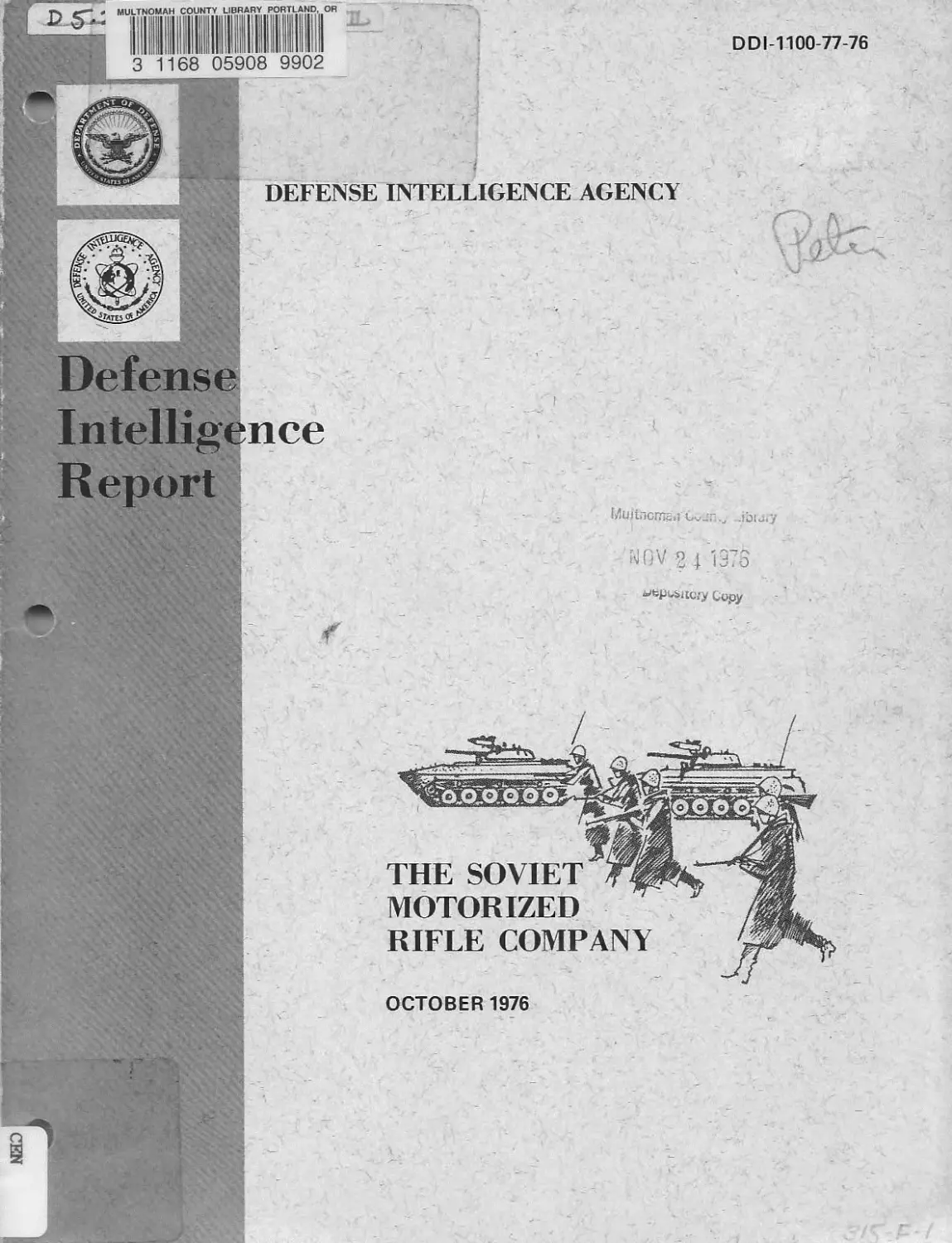
THE SOVIET
MOTORIZED
RIFLE COMPANY
THE SOVIET MOTORIZED RIFLE COMPANY
DDI-1100-77-76
Information Cut-Off Date:
June 1975
This document was prepared by Major Robert M. Frasche of the Tactics and
Organization Section, Ground Forces/MBFR Branch, Soviet/Warsaw Pact Division,
Directorate for Intelligence (Research Center), and is released for publication by
authority of the Director, Defense Intelligence Agency.
PREFACE
This study was written for the use of service schools and for unit intelligence officers
as an aid in presenting classes on the organization, training, tactics, and equipment of the
motorized rifle company.
The material presented on unit organization should be used as a guide only. Soviet
organizations vary widely depending upon their manning levels, weapons and equipment
mix, location and other factors. Differences in squad armament, capabilities, and numbers
of men per armored personnel carrier (APC) exist between units. Although older APC’s
are discussed, this study concentrates primarily on the BMP-equipped motorized rifle
companies, since they probably represent the desired standard.
The list of Soviet symbols used may be found in Appendix L
Comments, corrections and suggestions for improvement of this study are requested.
They should be sent through proper channels to the Defense Intelligence Agency, Ground
Forces/MBFR Branch, ATTN: DB-1B4, Washington, D.C. 20301.
iii
EXECUTIVE SUMMARY
1.	This study examines Soviet offensive and defensive doctrine and the organization,
training, tactics and equipment of the Soviet motorized rifle company. Emphasis is
placed on the company equipped with the infantry combat vehicle (BMP). The motorized
rifle company is organized, trained and equipped primarily for a war of rapid movement
and short duration. Maneuver during tactical operations is restricted to well-rehearsed
combat formations and is often dictated by higher authority. Tactical doctrine
emphasizes offensive action. Coordination of fire and movement is practiced, but usually
in closely regulated exercises. During operations, riflemen generally remain in their
personnel carriers until confronted with serious anti-armor fire, then dismount to assault
positions with support from tanks, artillery, mortars, and their own personnel carriers.
2.	Motorized rifle company officers receive extensive professional and political training in
schools, but are given little opportunity to exercise initiative and lack combat experience.
Conscripts receive prc-induction training prior to being assigned to their units. Although
the effectiveness of pre-induction training is uneven, it has shown improvement in some
areas and may eventually provide conscripts with the necessary basic military skills
before they enter the army. About half of the conscripts, including sergeants and APC
crew members, receive six months specialist training before they report to their units.
Other conscripts learn their duties by repetitive on-the-job training and are not
cross-trained. The training program and disciplinary measures produce soldiers who can
perform their duties adequately. They arc not expected to exercise initiative. Training,
and hence individual and unit effectiveness, are degraded by the fact that conscripts serve
only two years. New troops are rotated into units semi-annually.
3.	Equipment of the motorized rifle company provides the means needed to conduct
operations and successfully accomplish likely missions. The introduction of the BMP is
the most significant recent improvement in the company’s equipment and considerably
increases its firepower. Shortcomings of company equipment include:
a.	Squad leaders, when dismounted from their personnel carriers, have no radios.
b.	Radios available to platoon leaders in dismounted operations have limited range.
c.	The main gun of the BMP does not have a stabilizer.
d Sagger antitank guided missiles cannot be effectively fired at night without
illumination.
4.	Soviet motorized rifle companies, particularly those equipped with BMPs, are capable
of conducting effective combat operations. Although some qualitative deficiencies exist
in training, equipment and organization, the Soviets apparently consider that quantitative
superiority is adequate compensation.
v
TABLE OF CONTENTS
THE SOVIET MOTORIZED RIFLE COMPANY
Page
Preface	iii
Executive Summary	v
Table of Contents	vii.viii
List of Figures	ix,x,xi
Introduction	xiii
CHAPTER 1.	PERSONNEL AND TRAINING....................................1
CHAPTER 2.	OFFENSIVE AND DEFENSIVE CONCEPTS
Section 1.	Movement to Contact.......................................3
11.	The Offense...............................................5
Ill.	The Defense................................................9
IV.	Withdrawal................................................10
CHAPTERS.	HIGHER UNITS	11
CHAPTER 4.	THE MOTORIZED RIFLE COMPANY
Section I.	General................................................. 17
П.	Missions................................................ 17
111.	Organization.............................................17
IV.	Equipment................................................20
V.	Command and Control......................................27
VI.	Administration and Supply ...............................28
CHAPTER 5.	MOTORIZED RIFLE COMPANY TRAINING
Section I.	Introduction.............................................31
II.	Weapons and Equipment Training	..........................31
111.	Moral - Political Training ..............................37
IV.	Chemical Biological & Radiological	Training .............38
V.	Land Navigation..........................................38
VI.	Physical Training........................................39
VII.	Junior Officer and NCO Training..........................40
VIII.	Tactical Training .......................................41
CHAPTER 6.	THE MOTORIZED RIFLE SQUAD
Section I.	General..................................................43
II.	Movement to Contact......................................45
III.	Formations...............................................46
IV.	Offensive Action ........................................47
V.	Defensive Action ........................................51
vii
Page
CHAPTER 7.	THE MOTORIZED RIFLE PLATOON
Section I.	Introduction................................................55
IL	Movement to Contact.........................................56
III.	Formations..................................................57
IV.	Offensive Action ...........................................60
V.	Defensive Action ...........................................61
CHAPTER 8.	THE MOTORIZED RIFLE COMPANY IN COMBAT
Section I.	Movement to Contact.........................................65
II.	The Meeting Engagement......................................69
III.	Breakthrough Operations.................................... 72
IV.	Defensive Operations....................................... 75
V.	Withdrawal................................................  80
VI.	Relief in Place .........................................   81
CHAPTER 9.	THE MOTORIZED RIFLE COMPANY OPERATING UNDER SPE-
CIALCONDITIONS
Section I.	General.................................................... 83
II.	Operations Under Extreme Weather Conditions................ 83
III.	Operations in Forests and Swamps........................... 91
IV.	Operations in Mountains ................................... 93
V.	Water Barrier Operations .................................. 99
VI.	Combat in Built-up Areas.................................. 105
VII.	Heliborne operations ...................................... HO
VIII.	Night Operations ......................................... 115
Appendixes
1. List of Symbols........................................................123,124
II.	A Type Career Pattern in Basic Combat	Duty	in Peacetime....125
111. Officer Age Limitations.....................................127
viii
LIST OF FIGURES
Page
Figure 1. Varied ethnic structure of the Soviet Army ..........................1
2.	Pre-induction training facility at a secondary school ..............1
3.	A DOSAAF training facility for specialists .........................2
4.	Young officers at a commissioning school ...........................2
5.	Combined arms team in the attack....................................3
6.	Basic order of march of a Soviet formation anticipating a meeting
engagement .............................................................4
7.	Deployment of units from the line of march into a meeting engagement .. 5
8.	The breakthrough ...................................................6
9.	Division concentration for the breakthrough ........................7
10.	The pursuit ........................................................8
11.	Basic forms of maneuver.............................................8
a.	Frontal attack ................................................8
b.	Double envelopment with frontal attack .......................8
12.	The motorized rifle regiment (BMP-equipped) .............’.........Jl
13.	Principle weapons in the motorized rifle regiment .................12
a.	The medium tank T54/55/62 ................................... 12
b.	23mm SPAA Gun ZSU	234 .................................. 13
c.	ATGM launcher vehicle	AT-3 ..................................13
d.	122mm howitzer D-30..........................................13
e.	SAM SA-9 Gaskin ..............................................13
14.	The motorized rifle battalion (BMP-equipped) ......................14
15.	Principle weapons in the motorized rifle battalion ................14
a.	73mm Recoilless Gun SPG-9 ................................... 14
b.	Manpack ATGM Set Sagger (AT-3) ..............................15
c.	120 mm mortar ................................................15
16.	The motorized rifle company (BMP-equipped) ........................18
17	Principle weapons of the BMP and/or BTR-equipped motorized rifle
companies ..............................................................19
a.	7.62mm general purpose machinegun, Kalashnikov (PK) ..........19
b.	7.62mm light	machinegun,	Kalashnikov	(RPK) ..................19
c.	7.62mm modernized	rifle	Kalashnikov (AKM) ..................19
d.	Anti-tank	grenade	launcher (RPG-7) ..........................19
e.	7.62mm semiautomatic sniper rifle, Dragunov (SVD) ............19
f.	9mm pistol,	Makarov	(PM)......................................19
18.	APC’s found in motorized rifle companies ..........................20
a.	BTR 50 .......................................................20
b.	BTR 60 ......................................................20
c.	BTR 152	................................................20
d.	BMP .........................................................20
19.	Handgrenades ......................................................22
a.	F-l ..........................................................22
b.	RG42 ........................................................22
c.	RKG-3M	................................................22
d.	RGD-5 .......................................................22
ix
Page
Figure 20. Personal CBR protective gear ..............................................23
a.	ShM mask ..........................................................23
b.	ShMS mask..........................................................23
c.	OP-1 protective coat-overall ......................................23
d.	Individual decontamination kit, IPP................................23
21.	Summer and winter field uniforms ........................................24
22.	Field Combat pack and accoutrements .....................................24
23.	R-113 vehicular radio ...................................................25
24.	R-l23 vehicular radio with intercom unit ................................26
25.	R-l26 manpack radio .....................................................26
26.	The R-105 and R-l07 radios ..............................................27
27.	Representative radio net of a motorized rifle	company ...................28
28.	Soldiers eating in the field ............................................29
29.	Preliminary weapons training.............................................32
30.	Training in firing from an APC ..........................................32
31.	Antitank training .......................................................33,34
32.	ATGM (Sagger) training...................................................35
33.	SA-7 (SAM) training .....................................................36
34.	Sniper training .........................................................36
35.	Political indoctrination session ........................................37
36.	CBR training ............................................................38
37.	Chemical reconnaissance personnel preparing	for an operation ............38
38.	Traffic regulator .......................................................39
39.	Physical fitness training ...............................................39
40.	Tire BTR-equipped rifle squad ...........................................43
41.	Exiting the BMP .........................................................44
42.	BMPs supporting squads by fire ..........................................45
43.	Tank-borne infantry in the attack .......................................45
44.	Squad on a night reconnaissance mission .................................46
45.	Squad assault line ......................................................46
46.	Attacking from a position in close contact ..............................47
47.	Squad(s) negotiating a minefield ........................................49
48.	The squad defensive position prepared with engineer support .............52
49.	The MDK-2 ditching machine ..............................................52
50.	The squad fire plan .....................................................53
51.	The motorized rifle platoon (BMP-equipped) ..............................55
52.	The motorized rifle platoon attacking behind	tanks ......................56
53.	Motorized rifle platoon formations (mounted) ............................58
54.	Motorized rifle platoon formations (dismounted) .........................59
55.	The platoon defensive position ..........................................62
56.	A reinforced motorized rifle company as the advance guard of the
battalion ....................................................................65
57.	The company commander of a reinforced motorized rifle company con-
ducting reconnaissance .......................................................66
58.	Organization of a battalion march in anticipation of a meeting engagement 66
59.	An SA-7 gunner in firing position .......................................68
x
Page
Figure 60. CBR unit conducting decontamination during a halt ......................68
61.	A reinforced motorized rifle battalion conducting a meeting engagement . . 71
62.	The reinforced motorized rifle battalion in the defense ...............76
63.	The motorized rifle company strong point ..............................79
64.	GT-S and GT-SM vehicles ...............................................84
65.	Motorized rifle company commander conducting reconnaissance with sub-
ordinate and attached commanders ...........................................85
66.	Tanks towing infantry ..................................................86
67.	Tank-borne infantry attacking in winter ................................86
68.	Motorized rifle troops in a winter defensive position ..................87
69.	Motorized rifle troops training in the desert .........................88,89
70.	Reinforced motorized rifle battalion attacking in the desert ............90
71.	Reinforced motorized rifle battalion attacking in forested swampy terrain . 92
72.	76mm mountain gun, Ml966 ............................................... 94
73.	Motorized rifle troops training in the mountains ........................95
74.	Motorized rifle company attacking in mountainous terrain ................96
75.	The motorized rifle company in the defense in mountainous terrain........98
76.	Exercise “Dnepr” 1967 ................................................. 99
77.	K-61 and PTS tracked amphibious carriers unloading assault troops ..... 101
78.	A reinforced motorized rifle battalion forcing a water barrier ........ 102
79.	Reinforced motorized rifle battalion defending a river bank .......... 104
80.	Combat-in-cities tactical exercise ................................... 106,107
81.	The reinforced motorized rifle company in the attack in a built-up area . 108
82.	Mi-4 Hound ............................................................. Ill
83.	Mi-6 Hook...............................................................Ill
84.	Mi-8 Hip ..............................................................Ill
85.	Mi-10 Harke ........................................................... Ill
86.	Mi-12 Homer ........................................................... Hl
87.	Mi-1 Hare ............................................................. 112
88.	Mi-2 Hoplite .......................................................... 112
89.	Mi-24 Hind A........................................................... 113
90.	Helicopter mockup training device .....................................114
91.	1R sighting system, model NSP-2 .......................................116
92.	Soviet model PPN-2 IR sighting system ................................. 116
93.	Commander’s IR peritelescopc model TKN-3 ..............................117
94.	Characteristics of some illumination devices ..........................117
95.	Motorized rifle company in a night attack .............................118
96.	Possible changes in the night defensive system of a motorized rifle
battalion ..................................................................121
INTRODUCTION
Soviet writers have continually emphasized the fact that the next war must be won by
forces in being and that full mobilization of a nation’s resources will not be possible.
Small, professional armies are seen as anachronisms, and the policy of maintaining such a
force, “bankrupt.” Consequently the Soviets emphasize blitzkrieg offensives with
tank-heavy forces supported by large amounts of artillery, which would be able to achieve
the required fire superiority at selected points.
This study examines the organization, training, tactics and equipment of the
BMP-equipped motorized rifle company within the context of Soviet offensive and
defensive concepts. In an effort to present a realistic portrayal, weaknesses as well as
strengths are portrayed throughout the study.
The study begins with a brief examination of the human element. The first chapter
describes personnel and training. Soviet offensive and defensive concepts arc then
described. The link between these concepts and the MR company is chapter three, which
describes the motorized rifle regiment and the MR battalion. Chapters four and five
describe the organization, equipment and training of the MR company, and set the stage
for a close look at each of its subordinate elements, the squad and platoon (chapters six
and seven). Chapter eight ties together the preceding seven chapters by describing the
motorized rifle company in combat. Chapter nine describes the MR company operating
under special combat conditions. The historical data in this chapter are provided primarily
for two reasons: first, to show that the types of operations described have been practiced
for many years by the Soviets and arc an important aspect of current Soviet doctrine;
second to illustrate the searing impact that World War 11 continues to have on the Soviet
military.
Although there is a section on heliborne operations in chapter nine, tactical air support
of ground operations is not discussed. Soviet units below division level have no direct
organic radio communications with supporting aircraft, and representatives of tactical air
forces are rarely, if ever, sent to battalion and company.
xiii
CHAPTER 1. PERSONNEL AND TRAINING
1.	General
The personnel makeup of the motorized rifle company
typifies the human element in the Soviet ground forces
(Figure 1). The typical motorized rifle company is
composed primarily of conscripts, career enlisted men
and officers constituting a small percentage of the total
strength. Normally, the majority of officers are members
of the Communist Party of the Soviet Union (CPSU) or
the Young Communist League (Komsomol). Most en-
listed men are Party or Komsomol members or belong to
a subsidiary organization. All evidence the advantages
and disadvantages of Soviet political and military sys-
tems. These systems involve continuous, but not neces-
sarily effective, political indoctrination; comprehensive,
but unevenly implemented, pre-induction training pro-
grams; and generally adequate active duty training. On
balance, soldiers shaped by these systems appear to be
politically reliable and capable of performing effectively,
although with limited initiative at battalion level and
below.
Figure 1. Varied ethnic structure of the Soviet Army.
2.	Political Training and Control
The company is the lowest echelon at which a political
officer functions. The political officer, whose chain of
command is separate and extends to the Main Political
Directorate of the Ministry of Defense, is responsible for
political indoctrination and for ensuring loyalty to the
civilian leadership. He conducts political training, pri-
marily in the form of lectures, and monitors company
activities for indications of dissent. The amount of time
devoted to political training is inordinate and not as
effective as suggested in official statements. Only career
enlisted and officer personnel, who have a vested interest
in the military, appear to react favorably to the
indoctrination. Conscripts are generally unenthusiastic
and, to some degree, irritated by the training.
3.	Pre-Induction Training
Theoretically, the enlisted personnel of the motorized
rifle company receive military training prior to entering
service. The 1967 law governing military service in the
USSR requires pre-induction training for all males and
prescribes a comprehensive course of instruction — up
to 140 hours of classroom work - in addition to training
with weapons and equipment.-The program, beginning
in the ninth grade, is unevenly conducted in schools and
training centers throughout the USSR (Figure 2).
After 1967, the USSR reemphasized pre-induction train-
ing to compensate for the reduction of conscript service
from three to two years. It appears, however, that the
requirement is not uniformly applied to all individuals,
probably because of a lack of facilities in some areas. As
it now operates, the program provides most Soviet
youths with rudimentary military skills, but cannot
completely compensate for a reduction of one year in
active duty training time.
Specialist training, commencing at age 17, is the respon-
sibility of the All-Union Voluntary Society for Coopera-
tion with the Army, Aviation and Fleet (DOSAAF) and
of the vocational school system (Figure 3).
Figure 2. Pre-induction training facility at a
secondary school.
1
Figure 3. A DOSAAF training facility for specialists.
4. Officer Training
Most commissioned officers arc obtained from commis-
sioning schools (Figure 4), but a small percentage comes
from university-level reserve officer training programs
and from direct commissions. The commissioning
schools compare to the U.S. Military Academy and
produce comparably trained officers. Subsequent educa-
tional opportunities for officers include advanced
courses, mid-career schooling involving three to five
years at a military academy, and a two-year course at the
Military Academy of the General Staff. In general,
Soviet officers are reliable and equipped to function in a
contemporary battlefield environment, but are probably
somewhat inhibited, particularly at the lower command
levels, by the political system. Equally important, most
Soviet officers have not had the benefit of wartime
experience. A type of Soviet officer’s career pattern is
included in appendix II.
Figure 4. Young officers at a commissioning school.
5. Conscript Training.
Prior to enactment of the 1967 law on universal military
training, the majority of conscripts were trained by the
units to which they were assigned. Since then, in an
effort to compensate for the reduced term of service, the
Soviets have expanded their facilities for training con-
scripts prior to assignment. Currently, increasing num-
bers of conscripts, notably specialists and non-commis-
sioned officers, receive up to six months of training
before assignment to a unit.
Data gaps preclude definitive evaluation of the individual
soldier produced by the training programs. Personnel in
motorized rifle companies probably perform satisfacto-
rily, considering the relatively low skill levels involved
and the emphasis on repetition in training. Conscripts
serving in more complex assignments arc likely to vary
considerably in their effectiveness. Specialists suffer
somewhat from an extensive dependence on simulators
and from severe constraints governing the use of full
caliber, live ammunition. The expansion of specialist
training facilities, however, is expected gradually to
provide conscripts with an adequate base of skill for
individual assignments.
2
CHAPTER 2. OFFENSIVE AND DEFENSIVE CONCEPTS
Section I. MOVEMENT TO CONTACT
6.	General
Soviet doctrine stresses that the offensive is the decisive
form of combat; that the main purpose of offensive
combat is the complete destruction of the enemy’s
forces. To set the stage for successful offensive action,
the Soviets stress the use of diversionary units (agents,
parachutists and heliborne infantry) deep in the enemy
rear areas and the achievement of surprise through the
use of deception measures, the intensity and mobility of
firepower, and rapid rates of advance. Success is
achieved by the rapid concentration of superior forces
with massive air and artillery support to disrupt,
penetrate, and ultimately rout opposing forces (Figure 5).
Air and artillery interdiction would occur throughout
the depth of the enemy’s defensive position. If nuclear/
chemical weapons are not used, conventional artillery
would be used in greater quantities in order to achieve
the desired fire superiority. Soviet forces are trained to
go rapidly from a nonnuclear to a nuclear environment,
and Soviet writers stress the essential and critical
transition between these modes of combat. Despite this
emphasis on offensive operations, the Soviets realize that
in some situations their forces will have to go over to the
defensive, but stress that the primary purpose of the
defense is to prepare for the resumption of offensive
operations as soon as possible.
7.	The March
a.	The Soviets describe a march as an organized troop
movement conducted in column formations on roads, or
cross country. Troops are trained to be ready for action
at any time. If possible, the march is conducted at night
or under conditions of limited visibility. The speed at
which the march is conducted is dependent on many
factors: enemy, terrain, weather, makeup of the column,
condition of vehicles, the level of driver training, etc.
(Figure 6).
b.	Average speeds for vehicular traffic by day are
30-40 km/hr and by night and during other conditions
of limited visibility 20-30 km/hr. For foot movement
average speeds are 4 km/hr and between 5-7 km/hr on
skis.
c.	The interval between vehicles is 15-50 meters
during road movement and 50-100 meters during tactical
cross-country movement. Both the interval and the
speed of the vehicles are increased when crossing a
contaminated area or when under air attack.
d.	Control measures along the route of advance
include initial start points and easily recognizable con-
trol or phase lines. The number and spacing of these
control measures is dependent upon the length of the
march, the condition of the roads and the weather.
e.	In a motorized march, halts of up to one hour
occur every three-four hours. In foot marches,
10-minute halts are made every 50 minutes. During the
second half of a motorized march, a long halt of
two-four hours is held. Such long halts arc not held at
night (so as to make maximum use of the hours of
darkness), nor are they made during foot marches which
can be covered in a 24-hour period. During short halts,
Figure 5. Combined arms team in the attack.
3
column distances between vehicles in column formation
are not changed; men and vehicles maintain the proper
march intervals. During long halts, vehicles are dispersed
and camouflaged.
f To assist the commander in organizing the march,
the Soviets divide the march into two distinct elements,
the movement organization and march security.
g.	Movement organization is formulated to ensure
high speed, rapid combat deployment, and effective
control. Tanks and artillery are usually towards the
front, and antiaircraft weapons are distributed through-
out the column(s).
h.	All-around security is provided on the march in
order to ensure uninterrupted movement, to prevent
surprise attack, to keep enemy reconnissance units from
observing the main body and to create the most
favorable conditions for deployment of the main body
in a meeting engagement. Advance, flank, and rear guard
units ensure all-around security during the march. In
addition, stationary flank outposts are often used to
occupy critical terrain until the main body has passed.
1.	Reconnaissance
2.	Forward detachment
3.	Advance guard
4.	Flank security
5.	Main body
6.	Rear services
7.	Rear security
Figure 6. Basic order of march of a Soviet formation anticipating a meeting engagement.
4
Section II. THE OFFENSE
8.	The two methods mentioned in Soviet tactical
writings for accomplishing the transition to the offensive
are a) from the march and b) from a position occupied
in direct contact with the enemy. The three types of
offensive action are the meeting engagement, the break-
through, and the pursuit.
9.	The Meeting Engagement
The meeting engagement, i.c., the collision of two
opposing forces, is stressed more heavily in Soviet
military writings than any other form of offensive
action. Because of the fluid nature of modern war, the
Soviets believe that the meeting engagement will occur
more often than any other type of combat action.
Meeting engagements are characterized by action to seize
and maintain the initiative; the development of combat
on a wide front with freedom of maneuver and the
presence of open flanks; rapid deployment of troops,
chiefly from columns; mobile, high speed combat, and
often incomplete intelligence on enemy forces. The
Soviets believe that it is both possible and necessary to
anticipate meeting engagements; that through various
intelligence gathering means they will be prepared for,
and will aggressively seek out, such engagements (Figure
7).
10.	The Breakthrough
a.	The classic breakthrough operation is a frontal
assault against a well-prepared defensive position, using a
large amount of artillery and maneuver elements on a
narrow front (Figure 8). The breakthrough may also occur
against a hasty defense. Against each type of defense,
the Soviets envision swift and deep envelopment, the
bypassing of stubborn pockets of resistance, decisive
meeting engagements with advancing enemy reserves,
continuation of the attack, and the subsequent destruc-
tion of enemy strong points by second echelon units.
Breakthroughs may now be accomplished in short
periods of time due to nuclear strikes and the increased
lethality of conventional weapons. Successfully con-
ducted meeting engagements arid breakthroughs result in
the pursuit and ultimate destruction of the enemy’s
forces.
b.	These Soviet-To-NATO force ratios are reflected in
Soviet doctrine as being necessary to achieve a break-
through against a prepared position:
Tanks —	3-5:1
Infantry	4-5:1
Artillery	6-8:1
c.	A Soviet division concentrates its forces to achieve
the desired combat ratios for the breakthrough against a
Figure 7. Deployment of units from the line of march into a meeting engagement.
5
KEY
1.	Soviet first echelon forces achieving a breakthrough and holding the shoulders open for futher penetration
and exploitation by second echelon forces.
2.	Second echelon forces exploiting the penetration.
3.	Enemy reserves.
Figure8. The breakthrough.
6
4-8КМ
-<^ REGIMENTAL ZONE
Л OF ACTION
---BATTALION ATTACK
FRONTAGE
2-4KM
REGIMENTAL ATTACK
FRONTAGE
COMPANY.
BOUNDARY	1’2KM
.--------------BATTALION ATTACK
500-800M	FR0N.TAGE
COMPANY ATTACK FRONTAGE	1
8 16KM
DIVISION ZONE
OF ACTION
2-4KM
REGIMENTAL ATTACK
FRONTAGE
Figure 9. Division concentration for the breakthrough.
7
11. Pursuit Operations
Pursuit operations arc highly mobile in nature and are
best conducted on a wide front along parallel routes.
They involve both frontal attacks and envelopment to
cut off and destroy enemy forces. Pursuit operations are
made more effective by the use of tactical heliborne and
airborne forces, which occupy and defend locations in
the enemy’s rear and otherwise disorganize and delay his
retrograde movement. The Soviets stress that the pursuit
is to begin immediately upon the initiative of the
commander who discovers the retreat (Figure 10).
12. Basic Forms of Maneuver
“Maneuver” is defined in Soviet military literature as the
movement of a force into a favorable position in relation
to the enemy, from which it can launch an effective
attack. The Soviets mention two basic forms of maneu-
ver, the frontal attack and the envelopment, but favor
the latter, which may be shallow or deep, depending on
the size of the unit executing it (Figure 11). Should the
enemy not have an assailable flank, a frontal attack
would be used. A frontal assault may occur on a wide or
narrow front with or without heavy fire support.
Tank-heavy second echelon forces attempt to exploit
any rupture in the enemy’s position. Under favorable
conditions, however, the Soviets would attempt an
envelopment, possibly in conjunction with a frontal
attack to pin down enemy forces. Envelopment is the
preferred method of maneuver in the meeting engage-
ment and is used from platoon level up.
KEY
1.	Withdrawing enemy forces
2.	Pursuing Soviet forces
3.	Heliborne landing in enemy rear
4.	Approaching enemy reserves
Figure 10. The pursuit.
A. FRONTAL ATTACK
B. DOUBLE ENVELOPMENT WITH FRONTAL ATTACK
Note
An envelopment may be single or double, shallow or deep. It may also be
accompanied by a frontal attack designed to "fix" enemy forces.
Figure 11. Basic forms of maneuver.
8
Section III. THE DEFENSE
13.	General
Defensive operations occur when offensive operations
are not expedient or when economy of force is desirable
in one area in order to attack in another. Therefore, the
Soviets try to limit defensive operations to areas of
secondary importance. The purpose of the defense is to
inflict maximum damage on the attacker, to firmly hold
the defended area, and to create favorable conditions for
the resumption of the offensive.
14.	Defensive Concepts
a.	Stability. The Soviets define this term as the
ability of the defenders to repel attacks, to prevent
enemy airborne activities in the rear areas, and to
destroy any penetrations of the defensive positions.
b.	Security. Combat security forces provide early
warning, prevent enemy reconnaissance of the main
defensive position, force the enemy to deploy pre-
maturely, inflict maximum casualties, and coordinate
long-range fires on enemy formations.
c.	Use of Key Terrain. By properly preparing key
terrain which dominates the main avenues of approach,
the defender may offset some of the attacker's advan-
tages. One aspect of the proper use of key terrain is a
fire plan and obstacle plan which restrict the attacker’s
freedom of maneuver while maximizing the defender's.
The attacker is canalized into prepared killing grounds
for fires of all types (including nuclear).
d.	Dispersion. To allow for maximum protection
from nuclear and chemical weapons, the Soviets defend
on a wide front and in great depth.
e.	All-around Defense. Although oriented primarily
towards the direction of enemy advance, Soviet units
prepare alternate and supplementary positions and pre-
pare to repel attacks from any direction. This includes
the construction of platoon and company strong points,
deeply echeloned positions, and extensive barrier and
fire planning.
f.	Defense in Depth. This presents the attacker with
a series of prepared platoon and company strong points
which absorb the attacker’s momentum and provide
time for reserves to counterattack.
g.	Antitank Defense. After stability and protection
from weapons of mass destruction, a strong antitank
defense is the most important characteristic of the
defense. Antitank weapons are liberally allocated down
to low levels, while antitank reserves are maintained at
regimental level and above. Increasing emphasis has been
placed in Soviet writings on the importance of ATGMs.
h.	Coordinated Fires. Fires are coordinated to
destroy the attacker while approaching the defended
area, in front of the forward edge of the battle area
(FEBA), on the flanks, and in prepared killing zones
within the defended area. Included in these fire plans are
artillery, antitank, and small arms fires. Excluded are
nuclear strikes, which Soviet writers maintain should be
primarily directed against the enemy's nuclear weapons,
major enemy reserves and command posts.
i.	Mobile Counterattack Forces. The Soviets con-
sider the counterattack to be the decisive phase of
defensive combat. Soviet commanders require all units
from battalion and up to launch counterattacks. These
counterattacks will increase in severity as the depth of
the enemy salient increases.
9
Section IV. WITHDRAWAL
15.	General
Withdrawal operations are conducted for purposes of
regrouping, occupying more favorable terrain, or due to
enemy pressure. The mission of a withdrawing unit is to
preserve its integrity, to conduct an orderly withdrawal
to a designated area, and to be ready to execute
offensive missions. The Soviets recognize the com-
plicated nature of this operation and prefer to withdraw
on multiple routes without occupying intermediate
phase lines. Whenever possible, the Soviets will withdraw
at night or during other conditions of limited visibility.
16.	Conduct of the Withdrawal
a.	Organization of Forces. The grouping of forces
for a withdrawal includes covering forces, the rear guard
and the main body. Flank security detachments are also
established when necessary.
b.	Disengagement from Contact. Normally, the
Soviets leave one-third of their forces in contact in order
to deceive the enemy and delay his advance.
c.	Method of Withdrawal. Unengaged elements
(reserve and second echelon forces) are withdrawn first,
followed by artillery' and first echelon forces. Covering
forces depart suddenly and as a rule simultaneously.
They usually depart after the main body has passed
positions occupied by the rear guard. Should the enemy
press the withdrawing forces, the covering force with-
draws in a leap-frog manner, rendering mutual fire
support. Withdrawal of the main body is done without
delaying in intermediate positions.
d.	Actions of the Rear Guard. Prior to withdrawing
at the designated time, the rear guard commander
occupies defense positions usually located behind first
echelon defense forces. Subsequent defensive positions
are designated for the rear guard, which conducts
ambushes and erects barriers as it withdraws to sub-
sequent positions. The rear guard moves to subsequent
positions in a leap-frog manner, rendering mutual sup-
port, and aggressively defending each position.
e.	Establishment of New Defensive Positions. Prior
to arrival in the newly, designated area of defense,
reconnaissance groups are formed. These groups conduct
a thorough survey of the new area, determine the area to
be occupied by each unit, designate approach routes to
them, mark off any mined or contaminated areas, and
test the water in the area. As the main body approaches
the area its subordinate elements arc met by guides from
the reconnaissance groups and are taken to their
designated areas.
f.	Security is organized as soon as the lead elements
close on the new defensive areas, and engineering work is
immediately begun.
10
CHAPTER 3. HIGHER UNITS
17.	General
The motorized rifle company is the maneuver element of
the motorized rifle battalion. As it is reinforced by both
battalion and regiment for most operations, the organi-
zation and equipment of the motorized rifle regiment
and battalion will be discussed in this chapter.
18.	The Motorized Rifle Regiment
a.	Though capable of independent action, the motor-
ized rifle regiment normally operates as part of a
division. The division commander allocates additional
support to the regiments as required. Regimental artil-
lery may be reinforced with units from the division’s
artillery and rocket battalions, forming a regimental
artillery group (RAG). Because he does not possess
organic nuclear weapons, the regimental commander
requests nuclear fire support from division. The regiment
may also be reinforced with additional antiaircraft,
antitank, engineer, signal, medical, chemical, and supply
and service units.
b.	The BMP-equipped motorized rifle regiment is
organized as shown in Figure 12. Some of the regiment’s
principle weapons are shown in Figure 13.
19.	The Motorized Rifle Battalion
a.	The motorized rifle battalion usually operates
under the direct control of the regimental commander.
When used as the division reserve, it operates under the
division commander. The battalion may also participate
in heliborne and ship-to-shore operations.
b.	Because it is relatively “light” in terms of certain
organic combat and support elements, the battalion is
reinforced when attacking or defending in the first
echelon of the regiment, or when conducting indepen-
dent operations. For example, in addition to his own
organic units, the battalion commander may control a
tank battalion, a 122-mm howitzer battalion, the regi-
mental antitank guided missile battery, an antiaircraft
missile and artillery battery, an engineer platoon, a
chemical platoon and administrative and logistics sup-
port troops. The battalion commander reinforces his
organic motorized rifle companies as required with his
attached or supporting units.
c.	The BMP-equipped motorized rifle battalion is
organized as shown in Figure 14. Principle battalion
weapons are shown in Figure 15.
NOTE
For a list of the numbers and types of personnel and equipment at regiment, see (S) Soviet Ground Forces
Organization Guide (Ul. DDI-1100-2-75 dated June 1975.
Figure 12.	The motorized rifle regiment (BMP-equipped).
11
Т-54
Т-55
Т-62
a. The medium tank Т54/55/62.
Figure 13.	Principle weapons in the motorized rifle regiment.
12
b. 23mm SPAA Gun ZSU 23-4.
c. ATGM launcher vehicle AT-3.
d. 122mm howitzer D-30.
e. SAM SA-9 Gaskin.
13
NOTE
For a list of the numbers and types of personnel and equipment at battalion, see (S) Soviet Ground Forces
Organization Guide (U), DDI-1100-2-75 dated June 1975.
Figure 14.	The motorized rifle battalion (BMP-equipped).
Figure 15. Principle weapons in the motorized rifle battalion.
14
b. Manpack ATGM Set Sagger (AT-3).
c. 120mm mortar.
15
CHAPTER 4. THE MOTORIZED RIFLE COMPANY
Section I. General
20. The motorized rifle companies of the motorized
rifle battalion are organized on the triangular concept
with three motorized rifle platoons, each composed of a
platoon headquarters and three rifle squads.
21. The organization and equipment found in motor-
ized rifle companies varies, depending on the type carrier
they have and the number of troops available. The
BMP-equipped motorized rifle company has one more
man than the BTR-equipped company and does not
have a machine gun section (two PK machine gun
detachments), whereas the latter does. The company
headquarters of the BTR-equipped company is smaller
than the BMP-equipped headquarters. Squad strength
varies from 6-11 men, although we believe the desired
standard is 8 men in the BMP-equipped units. Squad
armament also varies, with the BMP-equipped squads
being more heavily armed. Moreover, within the BMP-
equipped companies, those squads possessing the initial
model BMP-1 will have one RPK light machine gun and
one AKM per squad in lieu of the two PK machine guns
found in the later model of the BMP.
Section II. MISSIONS
22. a. The missions of the motorized rifle company in
the offense are to penetrate the enemy defenses, develop
the attack, neutralize defending enemy troops by fire
and in hand-to-hand combat or to take them prisoner,
destroy or capture enemy equipment and weapons, seize
and consolidate defensive positions, repulse counter-
attacks, and pursue a withdrawing enemy.
b.	Other missions which may be given to the rifle
company include: (1) operating as an advance security
detachment within an advance guard (usually sent out
by regiment). A typical advance detachment consists of
a motorized rifle company reinforced by a tank platoon,
chemical reconnaissance team.an engineer squad, and an
antitank squad. In this situation the company com-
mander would be under the battalion commander who
commands the advance guard. (2) Acting as flank or rear
detachment on a tactical march. In this situation the
company’s attachments are approximately doubled, and
the company commander takes his orders from the
commander of the division’s flank or rear guard.
(3) Conducting a reconnaissance in force (usually sent
out by division). (4) Providing security during halts.
(5) Participating in tactical airmobile operations.
(6) Acting as an assault group in an attack against
fortified positions. (7) Operating as the regimental
reserve.
c.	The company will be reinforced as required for
these missions.
Section III. ORGANIZATION
23.	The organization and major items of equipment of
the BMP-cquipped motorized rifle company are shown
in Figures 16-18.
a.	The company headquarters consists of the com-
pany commander, political officer, and technical officer
plus nine enlisted men (the first sergeant, messenger/
company clerk, medic, communications specialist, a
three-man SA-7 Team, and the BMP crew members
(driver and gunner).
b.	The rifle platoon consists of a platoon head-
quarters and three rifle squads.
17
EQUIPMENT
9mm pistol, PM	25(15)
7.62mm rifle, AKM	62	(80)
7.62mm sniper rifle, SVD	3
7.62mm GP machinegun, PKM	20	(2)
Antitank grenade launcher. RPG-7	9
SAM, (SA-7) GRAIL (gripstock)	3
Armored personnel carrier, BMP-A	10	(0)
Radios: R-105/R-107	1
R-113/R-123	Ю
R-126	4
NOTES
1. Figures in parentheses, represent the differences in numbers of personnel, equipment and weapons found in the
BTR-equipped motorized rifle company.
2. The BTR-equipped motorized rifle company has a machinegun section consisting of five enlisted personnel,
9x7.62mm light machineguns (RPK) and 10xBTR-50/60/152 armored personnel carriers (in lieu of the BMP).
Figure 16. The motorized rifle company (BMP-equipped).
18
b. 7.62mm light machinegun, Kalashnikov (RPK).
a. 7.62mm general purpose machinegun,
Kalashnikov (PK).
c. 7.62mm modernized rifle Kalashnikov (AKM).
d. Anti-tank grenade launcher (RPG-7).
f. 9mm pistol, Makarov (PM).
e. 7.62mm semiautomatic sniper rifle,
Dragunov (SVD).
Figure 17. Principle weapons of the BMP and/or BTR-equipped motorized rifle companies.
19
a. BTR 50.
b. BTR 60.
c. BTR 152.
Figure 18. APC's found in motorized rifle companies.
d. BMP.
Section IV. EQUIPMENT
24.	Vehicular
APCs still found within the Soviet ground forces
include the BTR-50, 60 and 152 series, and the BMP
with modifications. The BTR-152, the standard Soviet
APC during the 1950s and early 1960s, is an
armored wheeled non-amphibious truck without over-
head cover, and is usually armed with a 7.62mm
machine gun. The BTR-152K as well as latter models has
overhead armor cover. The BTR-50P scries with an
amphibious capability, introduced during the middle
1950s, was the first Soviet standard tracked APC. The
BTR-50PK version with overhead cover became the
standard vehicle for motorized rifle units in tank
divisions. Like the BTR-152. it is armed with a 7.62mm
SGMB machinegun. The BTR-60P series amphibious
eight-wheeled APC was introduced in 1961 as a replace-
ment for the BTR-152V. Although the original model of
the BTR-60 lacked overhead cover, subsequent models
have it. The BTR-60PB has a turret mounting one
14.5mm KPVT and one 7.62mm PKT machinegun. The
vehicle usually carries 500 rounds of 14.5mm and 2000
rounds of 7.62mm ammunition. The latest Soviet APC is
the BMP which was first identified in 1967. It is an
amphibious tracked APC armed with a 73mm smooth-
bore gun, a Sagger AT-3 missile launcher, and a co-axial
7.62mm machinegun. A later model of the BMP has two
forward firing ports designed to accommodate the PKM
machinegun, thus considerably increasing the squad’s
firepower. The BMP carries forty rounds of HEAT and
HE ammunition for the 73mm gun and five Sagger
missiles, including one mounted on the launcher.
25.	Individual and Crew-Served Weapons
a.	9mm pistol, Makarov (PM). This pistol is carried
by the officers in the company headquarters, APC
drivers, and by SA-7 and RPG-7 gunners. The PM is a
20
small, semiautomatic pistol with an eight round maga-
zine. It is the most widely issued pistol in the Soviet
Armed Forces.
b.	7,62mm modernized assault rifle, Kalashnikov
(AKM). The AK is capable of both semiautomatic and
full automatic fire. The improved model, designated the
AKM, is lighter than its predecessor, has a greater sight
radius, is fitted with a straighter stock, and has an
improved detachable bayonet-knife. The AKM is fitted
for the NSP-2 infrared night sight system. A folding
stock version, the AKMS, has also appeared.
c.	7.62mm Light Machine Gun, Kalashnikov
(RPK). Found within the BTR-equipped rifle squad, the
RPK is essentially an AKM assault rifle with a longer
heavier barrel, a bipod, and a different shoulder stock. It
has two magazines, a 75 round drum and a 40-round
curved box, but it can also use the 30-round AK/AKM
magazines.
d.	7.62mm General-Purpose Machinegum
(PKM). Each of the Soviet rifle squads equipped with
the latest model BMP has two PKM machineguns. This
weapon has an effective range of 1000 meters and is an
improved version of the PK general purpose machinegun.
The PKM uses 25-round sections of non-disintegrating
metallic feed belts. The PKS model is mounted on a
tripod. It does not use the same ammunition as the AKM
and RPK.
e.	7.62mm Sniper Rifle, Dragunov (SVD). There are
three sniper rifles per motorized rifle company. The
Dragunov is a gas operated semiautomatic weapon with a
detachable box magazine. A combination flash sup-
pressor and compensator helps reduce the muzzle jump
and flash. The AKM detachable knife bayonet also fits
the Dragunov. The PSO-1 optical sight on the Dragunov
is a four-power telescope with an integral range finder, a
battery-powered reticle illumination system, and an
infrared reconnaissance aid.
f.	The RPG-7 Antitank Grenade Launcher. The
RPG-7 which replaced the earlier models RPG-1 and
RPG-2, can be reloaded. It is the squad’s antitank
weapon. The launcher is distinguishable from the earlier
models by the presence of two hand grips, the large
flared blast shield at the rear of the tube and the thick
heat shield around the center. The optical sight is
marked for ranges from 200 to 500 meters at intervals of
100 meters. The RPG-7 can be equipped with the NSP-2
infrared night sighting devices. The RPG-7V has a folding
stock.
g.	SA-7 “GRAIL”. The SA-7 is an infrared-homing,
short-range, surface-to-air guided missile. It is shoulder-
fired and is used against low flying aircraft.
h.	Grenades. The Soviet company uses a variety of
hand grenades (Figure 19). Both the F-l and RG-42
anti-personnel hand grenades date from World War П,
while the RKG-3M antitank hand grenade and the
RGD-5 anti-personnel hand grenade are postwar models.
The RGD-5 is more compact than the earlier models.
The RKG-3M is the standard Warsaw Pact antitank hand
grenade. It has a HEAT warhead and a stabilizing drogue
chute which ensures the proper angle of impact for the
shaped charge.
26.	Engineer Equipment
Each soldier has an entrenching tool. When extensive
fortification work must be done, shovels, pick mattocks,
and other tools from the engineer company in the
motorized rifle regiment are issued.
27.	Chemical, Biological and Nuclear Equipment
In addition to the BMP’s CBR filtration system, the
Soviet soldier has individual equipment to enable him to
survive in a CBR environment. Each man has one of
three standard protective masks; the ShM helmet-type
mask, the communication mask, or the ShMS special pro-
tective mask (Figure 20). These masks provide excellent
protection against current NATO chemical agents, bio-
logical agents, and large radioactive fallout particles.
Each individual is also issued the OP-1 protective
coat-coverall with gloves and an individual anti-chemical
kit for treating nerve agent, cyanide, and toxic smoke
casualties. Atrophine is used as an antidote for nerve
agent poisoning; sodium thiosulfate and amyl nitrate for
cyanide poisoning. Antiradiation pills are also included.
21
a. F-1.	b- RG-42.
d. RGD-5.
Figure 19. Handgrenades.
22
a. ShM mask.
b. ShMSmask.
c. OP-1 protective coat-overall.
d. Individual decontamination kit, IPP.
Figure 20. Personal CBR protective gear.
23
28.	Summer and Winter Field Uniforms
Summer and winter field uniforms and accoutrements
are shown in Figure 21 and 22. Each man is also issued a
camouflage cape. Special camouflage suits are issued as
required for winter and summer operations and for
reconnaissance missions.
Figure 21. Summer and winter field uniforms.
Figure 22. Field combat pack and accoutrements.
24
29.	Signal Equipment
a.	The motorized rifle company is well supplied with
radio sets. These radios are rugged and moisture-proof
and are designed for ease of operation and maintenance.
Adequate overlap in frequencies is provided for com-
munications among infantry, armor, and artillery.
b.	Each squad APC has either an R-l 13 (Figure 23)
or R-l 23 radio (Figure 24), the latter being the most
modern, with a greater frequency band. When dis-
mounted. the squad leader has no radio.
c.	Each platoon leader has a vehicular-mounted
R-l 13 or R-l 23 radio set which, like those in his squad
APCs, monitors the company command net. When
dismounted, the platoon leader has an R-l26 (Figure 25)
radio which has limited range and frequency coverage.
d.	The company commander’s APC contains an
R-l 13 or R-l23, an R-l26, and an R-105 or R-l07
radio. The R-107 is probably the replacement for the
R-105, R-l 08, and R-l 09 family of transceivers. It exists
in both the vehicular and manpack configurations. The
R-105 and R-107 are shown in Figure 26.
e.	There is no organic provision within the motorized
rifle company for wire communications. Laying of land
lines is performed by battalion. Other organic equipment
used by the company for signaling, are whistles, flags,
bugles, flares, tracer ammunition, and panels.
Figure 23. R-113 vehicular radio.
25
Figure 24. R-123 vehicular radio with intercom unit.
Figure 25. R-126 manpack radio.
26
R-105
Figure 26. The R-105 and R-107 radios.
R-107
Section V. COMMAND AND CONTROL
30.	a. The Soviets regard command as the exercise of
constant and effective control. The motorized rifle
company commander is responsible for the operations of
his unit. To assist him he has a political officer and a
technical officer. The former aids in the political training
and indoctrination of the company, while the latter
assists in administrative, maintenance and supply mat-
ters. The senior platoon leader is the company com-
mander’s second in command.
b.	There are no platoon sergeants. The senior squad
leader is the platoon leader’s next in command.
c.	The squad leader, usually an 18 or 19-year-old
conscript sergeant, directly commands his squad. There
are no fire team leaders.
31.	Control
a.	The primary means of control of the motorized
rifle company is radio, although personal contact, wire,
messenger, and a variety of other methods are also used.
Personal contact between the company commander and
his platoon leaders is routine for the delivery of combat
orders and for supervision of preparation for combat.
Wire communications are primarily used in the defense.
Company messengers are used in both the offense and
defense.
b.	Radio nets (Figure 27).
(1)	The company command net, when estab-
lished, goes from the company commander down to the
squad leaders during mounted operations. This net
utilizes the R-113 orR-123 radio.
(2)	During mounted operations, the company
commander maintains communications with battalion
through the R-113/R-123 and/or the R-107 radio. When
dismounted, the R-126 radio is used, although it has a
very short range.
(3)	Attached or supporting units use organic
radios. Commanders of attached units are normally with
the company commander in both the attack and the
defense.
27
NOTES
1. The tactical command net of an MR unit is controlled at the highest level possible. When the company is mounted in its
APC's there may be no company net per se.
2. Regardless of whether or not there is a company net. radio communications are strictly controlled, and used primarily by the
battalion commander and his immediate subordinate and attached unit commanders. Platoon and squad leaders would
primarily receive instructions and would transmit infrequently.
Figure 27. Representative radio net of a motorized rifle company.
Section VI. ADMINISTRATION AND SUPPLY
32.	Administration
At company level, administration is minimal. The
company commander is assisted in his administrative
tasks by the political officer, technical officer, first
sergeant and the company clerk. Forms and reports
which are maintained at company level include the
company personnel book (which contains a record of
pertinent facts pertaining to a soldier’s civil and military
life), duty rosters, the daily strength report, and the
training schedule.
33.	Supply
a.	Normally higher units, using their organic trans-
portation, deliver supplies to subordinate units, although
the latter may collect supplies in some situations. The
motorized rifle company has no organic service person-
nel, and therefore depends on battalion for resupply.
The company technical officer works closely with his
counterpart at battalion.
b.	Ammunition resupply is accomplished by the
battalion, which delivers ammunition to designated com-
pany ammunition points. Platoon personnel pick up the
platoon’s ammunition.
c.	The Soviet soldier carries one-two days rations.
Usually, combat units receive two hot meals (prepared
by battalion) per day (Figure 28). Dry rations arc issued
for the other meals. Bread is baked at division bakeries.
34.	Medical
The Soviets categorize wounds as light, serious, or
critical. Only basic treatment is rendered at company
level. Ambulatory cases are expected to make their way
on foot to the battalion aid station. Stretcher cases are
carried to the aid station for subsequent evacuation.
Seriously and critically wounded personnel are evacu-
ated by the battalion ambulance and other available
vehicles. Normally higher units provide transport for the
evacuation of casualties. The critically wounded may be
evacuated by helicopter.
28
35.	Recovery and Repair
Soviet recovery and repair policy places emphasis on
route clearing so that damaged vehicles and equipment
do not impede the advance. If the drivcr/mcchanics at
company cannot repair their vehicles in 10-15 minutes,
the technical deputy notifies the battalion technical
deputy who coordinates the battalion repair and evacu-
ation group (REG). The battalion REG, consisting of the
supply and maintenance platoon, may be reinforced
with a repair team from regiment. Because the repair
capacity of the REG, whether reinforced or not, is
limited tasks requiring more than 30-60 minutes will
normally not be attempted. Vehicles requiring this
amount of time or more to repair may be towed away,
or moved off the route for evacuation or repair by
regiment or division. First echelon companies which lose
a certain percentage of their men and equipment would
be replaced by second echelon units, reformed and
consolidated.
Figure 28. Soldiers eating in the field.
29
CHAPTER 5. MOTORIZED RIFLE COMPANY TRAINING
Section I. INTRODUCTION
36.	General
a.	There is a wide variation of training effectiveness
within the Soviet Army’s approximately 170 divisions.
The Soviet military press does, however, indicate what
should be taught and how it should be taught. It
discusses both good and bad examples of training. With
regard to small unit tactics, some of the conclusions
which we have drawn from the Soviet press are as
follows:
b.	Soviet military writings reflect official doctrine.
Soviet military literature is weighted in favor of the
offensive. Defensive operations receive less attention,
and retrograde operations are infrequently discussed.
c.	Most articles stress the importance of initiative at
all levels of command, and the need to eliminate stereo-
typed unimaginative training.
d.	Increased emphasis is being placed on the training
of junior officers and NCOs, possibly reflecting the
problems brought about by the decreased time of active
duty service and the difficulty of retaining trained
NCOs. Although the NCO is frequently described as “the
officer’s reliable deputy,” there are few references to
NCO’s initiating or planning training.
e.	There is widespread use of training aids in com-
pany training. These aids range from small optical
devices to check sight pictures during dry-fire exercises
to well established training areas complete with a variety
of electrically run targets, city mock-ups, etc.
f.	Within the motorized rifle company, training is
most often conducted by platoons utilizing the county
fair method.
g.	Training is normally planned and supervised by the
next higher commander. The battalion commander
supervises company training, the company commander
his platoons, etc. Tactical training exercises are con-
trolled by the senior authority using detailed scenarios.
These exercises are umpired and evaluated by officers of
the next higher unit. Unit preparation for an exercise is
normally detailed and, when done properly, progresses
in complexity. However, “aggressors” in these exercises
use Soviet rather than NATO tactics.
h.	Most exercises include aspects of CBR training.
Frequently, men will wear their protective clothing and
gas masks for long periods of time, even during the
conduct of strenous physical exercise.
37.	New Tactical Manual
During the 1963-1973 period, the Soviets probably used
a single manual for tactical methods at the battalion
level. In late 1973 a replacement was to be published.
Emphasis in the new version is probably on the offensive
and also activity in close contact with the defender, and
thereafter on defensive operations and the march.
Emphasis is placed on more skillfully portraying the
actions of probable enemies and on the use of electrified
tactical training fields. Combat under special conditions
is also emphasized.
38.	The Company Schedule
The company training schedule is drawn up weekly by
the company commander under the supervision of the
battalion chief of staff. The objective of the schedule is
to reflect the course of the training process by providing
for a logical progression of classes. The schedule includes
the following:
a.	Training goals.
b.	The topics and times for training classes.
c.	Types of political information sessions.
d.	Specialist training.
Platoon leaders devise the “self-training” to be con-
ducted by each of their platoon members within the
time allocated by the company commander. The training
of sergeants in the techniques of command is conducted
when they are free from classes with their squads. Not
included within the company training schedule arc the
detailed plans for servicing equipment during special
maintenance periods.
Section II. WEAPONS AND EQUIPMENT TRAINING
39. General	Machine gunners and RPG gunners may also receive
NCOs, APC crew members, and ATGM operators receive Prior training. Upon assignment to a unit, conscripts
six months of specialist training prior to unit assignment, receive about one month of basic training.
31
40.	Preliminary Weapons Training
a.	During this phase, training is designed to give the
soldier a thorough understanding of his weapon. The
nomenclature, functioning, assembly and disassembly,
and care and cleaning of the weapon precede marksman-
ship training. Firing positions, sight alignment, range
estimation, trigger squeeze, and extensive dry-firing
exercises are closely supervised by NCOs and officers.
Live fire is conducted after the basic principles have
been mastered (Figure 29).
b.	The goal of marksmanship training is to develop
the soldier’s ability to fire accurately and under condi-
Figure 29. Preliminary weapons training.
tions of poor visibility. He is trained to fire when
mounted in an APC and in the dismounted role as well.
c.	After mastering the basics, the individual is taught
to fire at stationary and moving targets on known
distance ranges. He is then taken to more advanced
ranges where he must rapidly engage moving, stationary,
and surprise targets at unknown ranges. Having success-
fully completed this stage, the soldier is ready to fire
from mockup APCs.
d.	Training in firing from APCs is normally con-
ducted by platoon, utilizing the county fair method of
instruction. Techniques vary according to the type of
APC used. A number of stations provide training accord-
ing to specialty (rifleman, machine gunner, RPG, and
SA-7 gunner), mounting and dismounting from the APC,
and dry-firing exercises within the vehicular mockup
(Figure 30). The training progresses from stationary
mockups to mockups mounted on a rocking frame which
simulates the movement of APCs. The men are trained
to fire through the firing ports and, in the older model
APCs, over the sides of the vehicle while the vehicle is
stationary and on the move. Antitank grenadiers and
SA-7 gunners may fire from the halt or on the move at
low speeds when the ground is fairly level. APC drivers
are trained to provide a stable platform for those firing.
e.	Riflemen also receive instruction on the coordi-
nated use of infantry weapons fire against attacking
aircraft. A variety of aircraft training aids arc used to
teach rapid identification of the air target and to help
the rifleman anticipate aircraft maneuvers.
Figure 30. Training in firing from an APC.
32
41.	RPK and PKM Training
Machine gun training follows much the same sequence as
rifle training. When the gunner progresses to firing from
inside the APC, he is taught how to compensate for
vehicular movement. He also practices dismounted
assault fire, holding his weapon at hip level and firing
short bursts.
42.	Antitank Training
a.	The Soviets believe that it takes disciplined, well-
trained, and psychologically prepared troops to engage
armor successfully. Antitank training attempts to build
both confidence and proficiency in combating armor
and is usually done in a county fair manner. Different
stations teach characteristics of tanks and armored
vehicles, and conduct practical exercises with antitank
grenades, RPG’s and mines (Figure 31).
b.	RPG gunners arc trained to fire at stationary and
moving tank silhouettes which measure approximately
three by five meters.
Figure 31. Antitank training.
33
34
c.	ATGM (Sagger) gunners usually conduct training
on an electric simulator mounted in a Z1L-157 van. Real
missiles arc rarely fired. The Sagger cannot be fired
effectively during darkness because of the problem of
depth perception and the fact that the effective range of
the infrared sighting device is 350400 meters. This does
not give the gunner enough time to guide the missile to
its target (Figure 32). The Sagger may, however, be
effectively fired at night with illumination. Sagger oper-
ators are carefully selected and reportedly fire up to
2300 simulated rounds to qualify as a gunner, After
qualifying, Sagger gunners may fire 50-60 simulated
rounds a week to maintain proficiency.
43.	SA-7 Training
a.	SA-7 gunners are trained on a simulator where
parameters of moving targets (range, course, flight
velocity, altitude, and boundary of launch zone) are
visually displayed. Both target tracking and missile
launching are simulated. For determining the type and
identity of air targets, silhouettes arc used.
b.	Having learned how to recognize targets, the
gunner trains with models placed at different distances
and course angles. If the target’s silhouette is equal to or
less than the diameter of the small circle on the front
sight the target is outside the launch zone. When the
target overfills the circle, the missile can be fired. Moving
target effects are shown through the use of moving
target simulators. After the gunner first learns how to
track low velocity targets on a horizontal course, he is
trained to track spinning and diving targets.
Figure 32. ATGM (Sagger) training.
35
c.	Gunners are warned about being too slow in
determining the movement of passage of the targets and
also about being too abrupt when guiding the missile on
to the target. After pressing the fire switch, there is a
short delay before the missile fires (Figure 33).
d.	Very little is known about the control and
employment of the SA-7s. Coordination and employ-
ment depend upon the mission, terrain, enemy, and
other factors.
Figure 33. SA-7 (SAM) training.
44.	Sniper Training
For snipers, the Soviets favor men who possess excellent
vision and hearing, good memory, and quick reactions.
Training for snipers is conducted periodically and lasts
from one and a half to two months. Sniper targets
mentioned by the Soviet military press include officers,
observers, antitank and recoilless rifle crews, machine
gunners, crews of disabled tanks, and low-flying heli-
copters. Initially, the Soviet sniper concentrates on
targets which are holding up attacking units (Figure 34).
Figure 34. Sniper training.
45.	BMP Training
BMP crew members receive six months training in special
training units prior to reporting to their unit. Training
includes BMP equipment, tactics, political instruction,
CBR warfare, river crossings, and physical training. Only
the BMP commander is cross-trained. The BMP is
presented to trainees as a fast, armored, all-terrain
transporter and a mobile base of fire for dismounted
infantry. Dismounting and remounting the vehicle arc
done at a short halt or on the move. The vehicle slows to
approximately five km/hour and both rear doors and the
commander’s hatch are opened. The commander exits
through the top of the BMP, while tlie squad exits
through tlie rear doors. The BMP then follows the squad
at a distance of 400-500 meters, and may move by
bounds with other BMP’s, using fire and movement.
Normally the BMP engages in a STOP3 FIRE and MOVE
pattern. Firing the main gun on the move is inaccurate
due to the lack of a gun stabilizer. When the squad is
ready to remount tlie vehicle, the platoon leader notifies
the BMPs to come forward. The BMP drives slowly
through tlie skirmish line picking up the squad members.
Mounting and dismounting the BMP in this manner takes
approximately 10 seconds.
36
46.	BTR Training
BTR training at company level is similar to BMP train-
ing. The county fair method of instruction is employed
with individual crew and squad members first being
trained in their separate specialties, progressing from
fixed mockups to moving mockups and finally to the
BTR.
Section III. MORAL-POLITICAL TRAINING
47.	General
The primary reasons for the heavy emphasis on what the
Soviets term “moral-political” training are to maintain
party control over the Armed Forces and to prepare the
populace for modern war. As Marshal Sokolovskii
observed,
The preparation of the population in the moral-
political aspect has decisive importance in present
day conditions, since the application of means of
mass destruction in war imposes very high,
previously unheard of demands on the political-
moral make-up of the population.
Such training is an important part of the overall effort to
prepare for CBR warfare. The ideological preparation of
the troops at company level is the primary responsibility
of the deputy commander for political affairs.
48.	The Deputy Commander for Political Affairs
The deputy commander for political affairs, while
utilizing his own separate chain of command (he reports
to the battalion political officer), is responsible to the
company commander for the organization and status of
party-political work in the unit. He is aided by officers
and enlisted party or Komsomol members in each
platoon (Figure 35).
49.	Ideological and Political Training
a.	At the company level daily ideological and politi-
cal training is tied in with military training. Tn addition
to regular political classes, officers and enlisted party or
KOMSOMOL members must often spend their “free”
time increasing their political awareness. As one Soviet
source indicated, “political self-education is not a
personal matter, but the obligation of a member of the
CPSU.”
b.	Company level political-ideological training is
chiefly intended to do the following:
(1)	To promote solidarity around the communist
party and the Soviet government.
(2)	To inculcate personnel with hatred for the
enemies of the USSR.
(3)	To ensure understanding of proper security
procedures.
(4)	To inform soldiers of recent CPSU and govern-
ment activities as well as international events.
(5)	To heighten the discipline and political aware-
ness of company members.
a. In addition, the company political officer trains
his assistants within the platoons and sections, helps
organize competition between units, and aids in the
displays in the Lenin room (every unit has such a room
which combines the functions of a reading room, library,
and game room).
Figure 35. Political indoctrination session.
37
Section IV. CHEMICAL, BIOLOGICAL AND RADIOLOGICAL TRAINING
50.	CBR Orientation
a.	Motorized rifle companies are assigned a team of
specially trained “chemical observer signalers” consisting
of an NCO and three or four men. The team is equipped
to detect and mark contaminated areas and to give the
chemical or radiological alert.
b.	Individual training stresses the use of protective
masks, clothing, and CW and radiological detection
equipment (Figure 36).
c.	Training posters have detailed information on first
aid against CW agents, the operation of chemical and
Figure 36. CBR training
radiological instruments, and the duties of a squad
assigned as a CBR reconnaissance unit.
d.	Company CBR training also includes the follow-
ing:
(1)	CBR route reconnaissance.
(2)	Reconnaissance in a CBR contaminated area.
(3)	Procedures for establishing chemical observa-
tion posts.
e.	Some aspect of CBR training is normally included
in tactical exercises (Figure 37).
Figure 37. Chemical reconnaissance personnel
preparing for an operation.
Section V. LAND NAVIGATION
51.	Instruments
Land navigation instruments range from compasses and
highly detailed topographical maps to directional gyro
driving aids for the APCs. Directional gyros provide an
azimuth to enable the driver to hold a fixed course in a
given direction.
52.	Maps
j.	Soviet military maps are rich in detail. For
example, Soviet maps with scales of 1:25,000,1:50,000
and 1:100,000 distinguish nine different types of
highway bridges and give their load capacities in tons,
roadway width, length, and height above water level in
meters. Fording points on rivers are shown with width
and depth in meters, stream velocity in meters/second
and type of bottom (sandy, viscuous, or rocky).
b.	Soviet military maps are tightly controlled. Maps
with a military grid and geographic comer values are
usually classified SECRET or TOP SECRET and are
hand-receipted to units.
38
c.	The Soviets rely on traffic regulators (Organic to
regiment and division) to guide their formations (Figure
38). Traffic regulators from both regiment and division
move with reconnaissance elements or advance guard
units to mark routes and direct the advancing columns at
critical points along the route. Methods of transporta-
tion used by traffic regulators include motorcycles,
jeeps, light trucks and APCs.
53.	Training
We cannot determine how much land navigation training
is conducted at the company level. Due to the security
classifications of military maps it is quite possible that
little map training is conducted and that map reading
skills have suffered accordingly.
Figure 38. Traffic regulator.
Section VI. PHYSICAL TRAINING
54.	Exercise and Competitive Sports
a.	The soldiers’ training day normally begins with
about 30 minutes of calisthenics (Figure 39). Troops
receive about 150 hours of physical training per year.
Monthly physical fitness training schedules outline the
type of calisthenics for each day.
b.	Competitive athletics play an important part in
the company conditioning program and are integrated
with physical training. The company commander, aided
by his sports organizer and party and KOMSOMOL
organizations, is responsible for seeing that everyone
participates in sports activities as laid down by the
Military Sports Complex of the Armed Forces (MSC).
MSC standards of achievement are included in the
weekly training schedule. Each soldier must meet the
standards set for his age group.
Figure 39. Physical fitness training.
39
Section VII. JUNIOR OFFICER AND NCO TRAINING
55.	General
Considerable emphasis has been placed by the Soviet
military press on officer and NCO leadership al the
company level. An analysis of many of these articles
seems to indicate that many junior officers do not
properly utilize their NCOs, that is, they “assume leader-
ship in everything large or small, command individual
soldiers, suggest ready-made decisions to the sergeant
and attempt to do everything themselves.'1 The NCO
appears to be used primarily as a trainer and supervisor
rather than as a leader.
56.	The NCO
Upon arrival in his assigned unit, the NCO, normally
18-19 years old. has received six months of specialist
training. His leadership training supposedly commences
with practical work in his assigned unit. In reality,
however, platoon leaders often give detailed orders to
tlie squad members and use the squad leader to ensure
that the orders are carried out. The conscript sergeant's
problems arc compounded by the fact that he is of the
same age and education as many of his squad members
and, though he has had six months training, is inexpe-
rienced, especially in leadership fundamentals.
57.	Impact of the Political System
a.	Lack of confidence in subordinates extends up tlie
chain of command and is a by-product of the Soviet
political system which stresses full responsibility and
punishment of those who make mistakes. Junior officers
arc often forced to accept ready-made solutions. Senior
commanders, fearing mistakes, outline their
subordinates' assignments in detail and leave little to the
initiative of the junior.
b.	Open press articles describe deficiencies in junior
leadership and urge that positive action be taken to
correct them.
c.	Tlie responsibility of company grade officers to
train thoroughly their NCOs is stressed. Praporshchiki
(warrant officers) also help -in this training and have
apparently provided some stability at the company level.
58.	Junior Officers
To improve junior officer training, two to four days per
month are set aside for platoon and company officer
training conducted by higher level staff officers. Tactics,
gunnery, technical subjects, and sports arc typical
themes for these sessions. Officers arc also allocated time
for individual study each week.
40
Section VIII. TACTICAL TRAINING
59.	General
a.	Company-level training builds up to battalion-level
and higher exercises. That is, intensive individual, squad,
and platoon training under the guidance of the company
commander precedes company-level exercises, which arc
normally under the supervision of the battalion com-
mander.
b.	Exercises are rigidly controlled by the next higher
echelon, and require highly detailed and lengthy prior
preparation for successful completion. The length and
frequency of company exercises varies widely, but
usually they do not go for more than one day.
c.	Live fire is used in some tactical exercises. Training
aids consisting of portable targets of the pop-up and
stationary type representing men and equipment are
utilized. These aids may be used in a variety of offensive
and defensive configurations to give the Soviet small unit
leader training in range estimation, terrain appreciation,
target analysis and battle drills. Some training areas use
consoles which control moving targets, some of which
have the ability to simulate return fire.
d.	Prevalent tactical themes in the military press
concern the the conduct of a march, the meeting
engagement, and attacking a defensive position. Defense
and retrograde operations receive less attention. CBR
training and the overcoming of engineer obstacles is
included in most tactical training exercises.
60.	Squad Tactical Training
The squad normally trains as part of the platoon.
Training centers upon individual weapons, squad tactics,
APC mounting and dismounting procedures, defense
against CBR attack and training under special condi-
tions.
61.	Platoon Tactical Training
Battle drills are the main form of tactical training for the
platoon and company. Actions of the soldiers, squad and
platoon and how they fit into the overall company plan
are stressed. Platoon tactical training is also aimed at
teaching the platoon leader to handle various attached
units. Platoon mounted and dismounted formations are
covered before the platoon conducts company level
exercises.
62.	Company Tactical Training
a.	Training at the company level combines squad and
platoon training in fulfilling company objectives as part
of the battalion. Coordinated fire and maneuver, in
conjunction with attached armor, chemical, engineer and
^artillery units, are intensified in company battle drills.
b.	For training conducted under special conditions,
see chapter nine.
41
CHAPTER 6. THE MOTORIZED RIFLE SQUAD
Section I.	GENERAL
63.	Mission
The rifle squad is the infantry’s basic tactical unit. It
accomplishes its missions by fire and movement as
opposed to fire and maneuver. There are no fire teams in
the squad. Though it normally fights as part of the
motorized rifle platoon, the squad may be given inde-
pendent missions. The squad:
a.	Conducts reconnaissance and combat patrols.
b.	Acts as point, flank or rear security during a
tactical march.
c.	Provides security for forces at a halt.
d.	Acts as the company reserve.
64.	Organization
a.	Both the BMP-equipped and BTR-equipped rifle
squads have an assault strength of eight men: a squad
leader, two machine gunners (one machine gunner and
an extra AKM rifleman in the BTR-equipped and earlier
model BMP-equipped squads), one antitank grenadier,
and four riflemen. Two of the four riflemen are assistant
machine gunners, and a third rifleman is an assistant
RPG-7 gunner (Figure 40).
b.	The squad leader is armed with the AKM assault
rifle; the two machine gunners carry the PKM machine
gun (the machine gunner in the BTR and in the earlier
model BMP-equipped units are armed with the RPK light
machine gun); the antitank grenadier is armed with both
the RPG-7 and the PM pistol, and the four riflemen have
the AKM assault rifle. Squad members are also armed
with grenades.
c.	The approximate basic load for each squad mem-
ber is:
(1)	Squad leader - 120 rounds (AKM)
(2)	Two PKM machine gunners - 2,000 rounds,
divided among squad members.
(3)	RPG-7 gunner — one RPG-7 launcher, one
pistol with 16 rounds, and four RPG-7 rounds.
(4)	Four AKM riflemen — each with 120 rounds
(AKM), plus some of the machine gun ammunition. One
rifleman might carry four additional rounds of RPG-7
ammunition.
65.	Tactics
There has been no radical change in Soviet squad tactics
despite noticeable improvements in weaponry and APC
Figure 40. The BTR-equipped rifle squad.
43
design. Capabilities of the squad have, however,
improved as a result of the introduction of the BMP, the
issue of two PKM machine guns per squad, and the
improved CBR protective gear. Wherever possible, the
squad will assault and fight from its vehicle, dismounting
only when forced to do so. The dismount point is
dictated by the terrain and the enemy antitank defenses
and may be up to 1000 meters from the enemy position.
When it must attack on foot, the squad occupies a
frontage of 40-60 meters with 6-8 meters between men.
Soviet infantrymen are trained to exit from the BMP
during a short halt or while moving at a reduced speed
(Figure 41). The BMP fires its main gun at the halt, or
(far less accurately) on the move. The main mission of the
BMP crew after the squad dismounts is to support the
squad by fire, particularly against enemy tanks and other
armored vehicles. In most cases, the BMP will remain
400-500 meters behind its dismounted squad (Figure 42).
Should their APCs become inoperative, Soviet infantry-
men may be mounted on tanks (Figure 43). In such cases
they dismount in the last concealed position before the
enemy FEBA.
66.	Leadership
The Soviet squad leader, normally an 18 or 19 year old
conscript sergeant with six months of active duty
training, is responsible for the training, conduct, and
control of his squad. He has no fire team leaders to assist
him. His ability to lead is further hampered by the fact
that when he is dismounted, he has no radio contact
with cither his APC or his platoon leader. He has no
method to coordinate artillery support or the fire
support from his own troop carrier, although he can
indicate targets for the latter by using tracers. To control
his squad in a dismounted assault the squad leader
normally places himself in the center and slightly ahead
of the assault line. His assistant is the APC gunner.
Figure 41. Exiting the BMP.
44
Figure 42. BMPs supporting squads by fire.
Figure 43. Tank-borne infantry in the attack.
Section II.	MOVEMENT TO CONTACT
67.	General
During the movement to contact, the motorized rifle
squad may be assigned a march security or reconnais-
sance mission. Normally, however, it moves as part of
the platoon in the platoon’s column formation.
68.	March Security
a.	Vehicle and foot marches arc conducted primarily
at night or during other conditions of limited visibility. On
a march, the squad may be given a point, flank, or rear
security mission. Depending upon the terrain and condi-
tions of visibility, the squad carrier is separated from its
unit by up to 200 meters by day and approximately 50
meters at night or in forests. If dismounted, the squad
leader sends out two-man patrols to the front and flanks
to act as local security along the line of movement.
These elements operate at a distance of up to 100 meters
by day and 30 meters at night or in forests. When
dismounted during daylight hours, the squad leader
controls his men by arm and hand signals.
b.	The squad attacks small groups of the enemy and
takes prisoners or attempts to destroy the enemy and
continue the march. If the enemy is too strong for the
squad to overcome, it defends and holds its position so
larger units can maneuver.
c.	During tire pursuit, the squad moves rapidly to
maintain contact. Maximum use is made of the APC, as
the squad stays mounted and fires from the carrier.
d.	The squad designated as rear security in the march
follows behind the unit it is protecting at a distance of
roughly 200 meters.
69.	Reconnaissance Patrol
a.	A reconnaissance patrol is usually composed of a
reinforced squad or a platoon (Figure 44).
b.	A squad in this role is often reinforced with
chemical and engineer troops. If dismounted, the patrol
leader receives a radio and possibly a radio operator.
c.	The squad is assigned a specific objective and/or
route instead of a zone and operates away from its
parent unit at a distance of approximately eight
kilometers during the day and three kilometers at night.
(These distances are shortened when the squad is
dismounted). The squad accomplishes its mission by
means of observation and maneuver, but may engage
in limited combat if necessary, including reconnaissance
45
by fire. The patrol deader gives each squad member an
observation mission. Specific individuals are made
responsible for front, flank, rear and overhead
observation. The reconnaissance patrol is also frequently
used to capture prisoners for intelligence exploitation.
d.	Normally the squad leader personally reconnoiters
the objective. He employs the squad to protect himself
or to ensure the completion of the mission by combat.
Reconnaissance patrols normally maintain radio silence.
If enemy contact occurs, however, the squad leader may
break radio silence and report enemy strength, location,
and activity.
Figure 44. Squad on a night reconnaissance mission.
Section III.	FORMATIONS
70.	Mounted Formations
Mounted squads move in various platoon formations (see
Chapter 7).
71.	Dismounted Formations
a.	Dismounted, the squads have only two
formations—column and line.
b.	When dismounted, the squad normally moves in
column, facilitating movement and control. This forma-
tion is also used in restricted terrain and during
conditions of limited visibility.
c.	Tlie skirmish line is the prescribed combat forma-
tion It has a frontage of 50-60 meters, with 6-8 meters
between individuals. The sauad leader is in the center of
the line and has one of his PKM machine gunners on
either side, thus ensuring tight control (Figure 45).
------------50-60 m-------------------------------------->
KEY
KO Squad leader
P Machine gunner
РГ RPG-7 gunner
A Rifleman (AKM)
Figure 45. Squad assault line.
46
Section IV. OFFENSIVE ACTION
72.	General
An attack may be launched from the march or when in
contact with the enemy. In the latter case, the squad
moves as part of the platoon to an initial position from
which it launches the attack. The depth of the attack
depends on the nature of the defenses, and the terrain. A
squad is assigned an attack sector.
73.	Troop Leading Procedures
a.	The squad leader is taught to issue a complete
order. In his order, the squad leader includes enemy
information, to include locations of personnel, weapons,
and obstacles; the platoon objective and direction of
further attack; the squad direction of attack and
mission; missions of adjacent squads; the number of the
tank (if tanks are attached to the platoon) which will
attack in front of the squad; locations of passages
through enemy obstacles, and the procedures to be used
for negotiating them; procedures for fires prior to and
during the attack; missions for the squad machine
gunners, APC gunner, grenadier and automatic riflemen
during the attack;combat formation to be used; the time
of attack, signals, and designation of a second-in-
command.
b.	Due to his scanty training and short term of
service, the Soviet squad leader does not function in
battle in the same manner as many of his NATO
counterparts. In practice, it is the platoon leader who
usually issues the squad orders. It is the squad leader’s
responsibility to execute these orders when the platoon
leader cannot oversee the squad’s actions.
74.	Conduct of the Attack
a.	When attacking from a position of close contact,
the squad waits in the assault trench until its assigned
tank crosses the trench, then follows it in the attack
(Figure 46).
Figure 46. Attacking from a position in close contact.
47
b.	When attacking mounted from the march, the
squad assumes its position within one of the platoon
formations (see Chapter 7). Movement of the squad
from the departure position to the assault position is
normally conducted under cover of artillery fire. If
forced to dismount, the squad does so in defilade or
while on the move under cover of smoke, at a distance
of 500-1000 meters from the enemy positions. Phase
lines arc used to aid the platoon leader in control and
fire support coordination.
c.	On foot, the squad fires on the move. On open
ground and while under enemy fire, the squad moves by
bounds in groups of two-three men under covering fire.
Although cover is used, speed in the attack is stressed.
The squad leader controls the fires of his machine guns
and antitank grenadier. By concentrating the fires of
these weapons and by the use of tracers, the squad
leader indicates to his supporting APC and platoon
leader particular strong points which are hindering Iris
advance. Artillery forward observers (FOs) attached to
the platoon and/or company may then call in supporting
fires on these targets. If the squad comes under enemy
artillery or mortar fire, it advances rapidly out of the
area under fire.
d.	Use of Supporting Fires. The squad advances
under the cover of supporting artillery and mortar fire.
Soviet tactical doctrine emphasizes speed in the attack
and states that casualties suffered from friendly artillery
are only a fraction of the casualties incurred by
infantrymen who lag behind in the attack. The driver
moves his vehicle by bounds from one covered position
to another, attempting to maintain a steady gun plat-
form for the gunner. The gunner supports the attacking
squad by fire and attempts to keep the squad leader in
constant view.
e.	Mutual Support. During the course of the attack,
the squad leader watches the progress of adjacent squads
and takes advantage of their progress and fire to move
his own squad forward. If the adjacent squads are held
up, he helps them with his squad’s fire.
/ The assault position. The squad occupies an assault
position close to the enemy. The squad leader then
repeats the objective of the assault, redistributes ammu-
nition, and marks (by use of tracers) targets to be
attacked by APC and artillery fire.
75.	Conduct of the Assault
On the platoon leader’s signal, the squad leader gives the
command. “PREPARE FOR THE ASSAULT.” Squad
members check their weapons, fix bayonets and ready
their hand grenades. Then the squad leader gives the
command “Into the assault FORWARD!” The squad,
firing on the move, attempts to advance rapidly.
a.	Negotiating a Minefield. The method chosen by
the Soviet squad to cross a mine field depends upon the
nature of the enemy’s defense, the terrain and weather,
and tank support. The squad may attack mounted or
dismounted, although when attacking positions with
antitank defenses, it will usually attack dismounted. Fig-
ure 47 illustrates four methods of dismounted attack with
tire squad carrier supporting the attack by fire. Example
one shows the squad attacking through a narrow opening
in the mine field without tank support. When attacking
with a tank, especially in deep snow, the squad as a rule
attacks behind the tank in a column of twos following in
the tank’s tracks (example 2). In the third example two
rifle squads attack in a column of twos behind a tank.
When the breach in the mine field is sufficiently wide,
the squad attacks on line behind a tank utilizing its full
fire power to the front (example 4). Should the enemy
antitank defenses be strong, the infantry may precede
the tanks, which with the APCs, would support by fire.
b.	Assault of the Objective. When the squad is within
20-30 meters of the enemy position, it moves into the
final assault and attempts to destroy the enemy in close
combat. Upon discovering a weak point in the enemy
position, the squad presses forward.
c.	Consolidation. If the assault is repulsed by the
enemy, the squad consolidates and digs in. The squad
leader, reorganizes his squad, attempts to neutralize
enemy fire and, in cooperation with adjacent units,
renews the assault.
48
Mixed minefield
KO Squad leader
P Machine gunner
РГ RPG-7gunner
A Rifleman (AKM)
Figure 47. Squad(s) negotiating a minefield.
49
76.	Battle for Reserve Positions of the Defense
a.	Maintaining the Momentum. When the enemy’s
forward positions have been overrun, the battle for the
reserve positions begins. The squad attempts to exploit
existing fortifications and to hit the enemy from the
flanks and rear. Emphasis is placed on maintaining the
momentum of the attack.
b.	Repelling Enemy Counterattacks. During this
phase of the battle, the squad is alert for enemy
counterattacks. It engages a counterattack by fire and by
assault as part of the platoon. When adjacent units are
counterattacked, the squad assists with fire, but docs not
slacken its advance. Soviet tactical doctrine stresses that
the best defense against a slowdown in tactical
momentum is an advance in any sector.
77.	Pursuit
The squad’s APC is called forward by the platoon leader.
The squad remounts and pursues the enemy, bypassing
individual strong points. These will be attacked by
second echelon (reserve) forces designated for this
purpose. Retreating enemy forces arc engaged by the
mounted squad.
78.	Raid and Ambush
Other forms of offensive combat conducted by the
squad, cither reinforced or as part of the platoon, arc
raids and ambushes.
a. The Raid
(1)	A raid is usually carried out on foot and
consists of a concealed approach to an objective and a
sudden attack to capture prisoners, documents, or
equipment. Whenever possible the raid is conducted at
night or under other conditions of limited visibility.
(2)	Preparations for the raid and ambush are
conducted in detail and secrecy. Sorties by small groups
may be made to gather route and obstacle information,
while rehearsals are held in rear areas.
(3)	The raid element is usually organized into an
obstacle clearing group, an assault group and a security
group. The obstacle clearing group consists of attached
sappers (combat engineers) who clear and mark a path
through obstacles and remain at the gap to act as guides.
The security group may consist of additional riflemen
attached to the squad for the mission. A reinforced
squad would also be given a radio and possibly a radio
operator. Raids are supported by artillery fire. The
assault element attacks the objective directly and
captures prisoners. The security element provides fire
support for the assault element.
(4)	Due to the complexity of a raid and the
degree of leadership called for, the patrol leader
probably is a career NCO, praporshchik, or junior
officer. He is normally in the assault element of the
patrol.
(5)	A junior commander, when given the mission
to conduct a raid, organizes continuous observation of
the objective area, makes an estimate of the situation
and issues his order, which includes the following:
(a)	Enemy deployment.
(b)	Mission and method of execution.
(c)	Composition and tasks of patrol elements.
(d)	Reference points.
(e)	Procedures for the move and actions during
the attack.
(f)	Withdrawal procedures and actions to be
followed in case of an unexpected encounter with the
enemy.
(g)	Procedures for requesting artillery and
mortar fire.
(h)	Procedure for casualty evacuation.
(i)	Patrol leader’s position within the patrol.
(j)	Signals for control.
(k)	Second-in-command.
(6)	Upon completion of the mission, the assault
element withdraws first, followed by the security
clement(s) and finally the obstacle-clearing clement.
Should the activities of the assault group be discovered,
it withdraws under cover of the security group and calls
for artillery and mortar fire if needed.
&.	The Ambush.
(1)	Soviet writings define an ambush as the
carefully concealed disposition of a unit at a previously
designated position for the purpose of making a surprise
attack on the enemy in order to capture prisoners,
documents, weapons, and military equipment.
Ambushes are set up along the enemy’s probable
movement routes, along communication and resupply
lines, traffic control points, etc.
(2)	A squad given an ambush mission may consist
of assault, security, and observation elements and might
50
be reinforced with additional personnel and equipment.
(3)	Upon arriving at the ambush locations, the
patrol leader organizes observation and allocates tasks,
which include:
(a)	Reference points
(b)	Enemy information
(c)	Positions of the patrol members and their
missions.
(d)	Procedures for opening fire, taking
prisoners, seizing documents and equipment, operational
procedures should the patrol be discovered, and
obstacles to be established.
(4)	Using pre-arranged signals, observers warn the
patrol leader of the enemy’s approach. Tlie enemy is
allowed to enter the center of the patrols’ sector, at
which time the ambush commences. Upon completion
of the mission, the patrol returns to its deployment area
or conducts other missions.
(5)	The ambush patrol leader would probably be
an NCGipraporshchik, or junior officer.
Section V. DEFENSIVE ACTION
79.	General
The squad goes on die defensive as part of the platoon in
order to repulse an attack, inflict losses, hold and create
favorable conditions for resuming the attack. Defense at
the squad level stresses anti-CBR and antitank
techniques.
80.	Troop Leading Procedures
Although the squad leader may issue detailed instruc-
tions to his squad after receiving the platoon leader’s
order, usually the platoon leader issues die order to all
personnel. The squad leader supervises to ensure
compliance with the order. An observer is posted to
prevent surprise; the platoon, squad and adjacent unit
missions are explained; contact is established with
adjacent squads; the terrain in the assigned sector is
studied and each man assigned a mission; fields of fire
are cleared; primary and alternate firing positions, slit
trenches and connecting trenches are dug. Reference
points, the area of observation, the principal sector of
fire and secondary sectors which overlap the fields of
fire of adjacent squads, are designated.
81.	The Squad Defensive Position
a.	The motorized rifle squad defends as part of the
platoon and occupies a frontage of' 50-60 meters (in
nuclear conditions up to 150 meters). The squad engages
the enemy forward of, and on the flanks of, the platoon
position. The position has weapons pits for the machine
gun crews and the antitank grenadier, covered slit
trenches which hold up to four people, two to three
recessed pits for ammunition, and a latrine (Figure 48).
If the squad is not in contact with the enemy, engineer
equipment such as the MDK-2 ditch digger from
regiment (Figure 49) may be used to dig the squad
trench.
The emplacement for the APC could be prepared by use
of explosives or other engineer equipment. If a ditching
machine is not available, the squad utilizes axes, shovels,
crowbars, and entrenching tools to prepare the position.
Individual foxholes and firing positions and an emplace-
ment for the APC are dug first. A squad trench
connecting the individual positions is then constructed.
Revetments are used to reinforce the trench system if
the soil is unstable. The squad defensive position is
established according to the principles outlined in
Chapter 2.
b.	AU or part of the rifle squad may act as a platoon
security clement to delay and disorganize tlie enemy and
to give warning of his approach. NormaUy the security
element is located about 600 meters by day and 200
meters by night away from the platoon position. The
squad leadcr/security commander places a sentinel
forward of the security position at a distance of 100
meters by day and 50 meters at night. When the enemy
approaches, the men commence firing and attempt to
delay the enemy advance without prolonged combat.
The security element withdraws on order of the outpost
commander or according to a prearranged plan.
c.	Positions are established on key terrain to block
likely enemy avenues of approach while giving the squad
maximum cover and concealment.
51
3
4
5
1. Covered firing position.
2. Rifleman position.
3. Machinegun firing position.
4. Alternate machinegun position.
5. Rifleman position.
6. RPG-7 position.
7. Machinegun firing position.
8. Alternate machinegun firing position.
9. Firing position for squad APC.
10. Latrine.
11. Connecting trench.
12. Alternate firing position for squad APC.
Figure 48. The squad defensive position prepared with engineer support.
Figure 49. The MDK-2 ditching machine.
d.	Proper dispersion in the defense allows for protec-
tion from weapons of mass destruction. In a nuclear
environment the squad frontage is increased to 150
meters.
e.	All-round defense is assured by preparation of
primary, alternate, and supplementary positions.
f.	Antitank defense is provided by the BMP with its
73mm gun and Sagger missiles and by the squad
grenadier. A squad’s APC may be in the middle of the
defensive position, on a flank, or up to 50 meters behind
the position. Should the squad be situated along a good
armor avenue of approach, the squad could receive
additional support from the battalion’s antitank platoon.
The platoon leader would position and control any
attached antitank weapons.
g.	Coordinated fires are planned by interlocking
squad fires with the fires of adjacent units and by
covering all gaps in the squad’s sector of fire with
concentrated frontal, flanking, and oblique fires. Squad
fires are also supplemented by artillery and mortar
concentrations, which cover dead space and likely
enemy avenues of approach. A squad is assigned both a
sector of fire and a final protective line. Squad leaders
prepare a firing card which contains the following data:
(1)	The squad position and its assigned sector of
fire.
(2)	Reference points and the distances to them.
52
(3)	Location of each squad weapon (including
those on the APC) and its sector of fire.
(4)	The positions of adjacent squads and their
sectors of fire (left or right boundary indicated) in front
of the squad.
(5)	The platoon and squad sectors of concen-
trated fire (Figure 50).
KEY
1.	Reference point 1-rocks.
2.	Reference point 2-bushes.
3.	Squad fire concentration 1.
4.	Reference point 3-bridge.
5.	Squad fire concentration 2.
6.	Reference point 4-knoll.
7.	Reference point 5-burial mound.
8.	Reference point 6-stump.
9.	Reference point 7-hill.
10.	Reference point 8-pond.
11.	The primary direction of fire from one of
each flanking squad's machine guns are
also depicted.
Figure 50. The squad fire plan.
53
82.	Conduct of the Defense
a.	The first enemy element to probe squad defenses
may be reconnaissance. The platoon leader is authorized
to fire on enemy reconnaissance patrols and, if ordered,
the men fire from their alternate positions so as to
deceive the enemy.
b.	Defensive fires increase in intensity as the enemy
approaches the FEBA. Should the enemy assault include
tanks, antitank weapons engage them, while the other
squad members concentrate on the accompanying
infantry. An effort is made to separate enemy tanks
from their infantry support.
c.	Though the squad members attempt to destroy
enemy penetrations into the gaps between squads, they
maintain their positions and concentrate on their
assigned sector of fire. If attacked from a flank, the
squad will distribute its strength to combat the new
threat while continuing to cover its original sector of
fire. Should enemy tanks overrun the squad position,
squad members attempt to destroy them from the rear
with antitank grenades.
83.	Withdrawal
The squad may withdraw on orders from the platoon
leader. The withdrawal begins with the riflemen who
move under cover of the squad’s machine guns and of
the APC. They withdraw individually or in groups,
depending upon the terrain and the enemy situation.
Simultaneous withdrawal of the entire squad normally
takes place under cover of fire from supporting units or
under conditions of limited visibility.
54
CHAPTER 7. THE MOTORIZED RIFLE PLATOON
Section I. INTRODUCTION
84.	Missions
The motorized rifle platoon accomplishes its primary
missions as part of the company by means of fire,
maneuver and close combat. It may be given a variety of
missions:
a.	Reconnaissance and combat patrols.
b.	Advance party, point, mobile, or stationary flank
security, or rear guard in a march security mission.
c.	Security element during halts.
d.	Battalion reserve.
85.	Organization
a.	Both the BTR and BMP equipped motorized rifle
platoons contain one officer and 30 enlisted men (Figure
51)-
b.	In addition to the squad armament discussed in
chapter 7, each platoon also has one 7.62mm sniper rifle
(Dragunov).
EQUIPMENT
9mm pistol PM	6
7.62mm rifle, AKM	18
7.62mm sniper rifle, SVD	1
7.62mm GP machinegun, PKM	6	(0)
Anti-tank grenade launcher, RPG-7	3
Armored personnel carrier, BMP-A	3	(0)
Radios
R-113/R-23	3
R-126	1
NOTES
1.	Figures in parentheses represent the differences in numbers of weapons and equipment found in the BTR-
equipped motorized rifle platoon.
2.	In lieu of the BMP, the BTR-equipped MR platoon has three of the BTR 50/60 or 152 series of APC's.
3.	In lieu of the PKM, the BTR-equipped MR platoon has 3 RPK light machineguns.
Figure 51. The motorized rifle platoon (BMP-equipped).
55
86. Tactics
87. Leadership
a.	The platoon usually attacks on line as part of the
company on a frontage of up to 200 meters. Enemy
defenses and terrain permitting, the platoon attacks
mounted in its APCs. Such employment occurs most
often during the mobile phases of operations such as the
meeting engagement, exploitation of a nuclear strike, or
during the pursuit. Against a strong defense, the platoon
attacks dismounted and. upon penetrating the enemy
positions, remounts its APCs to exploit the break-
through and conduct pursuit operations.
b.	In the defense, the platoon leader normally places
all three squads on line. Ln both the offense and defense,
the platoon leader receives attachments (Figure 52).
The platoon leader, usually 21 or 22 years old, is
responsible for the training, control, and discipline of his
platoon. He has no headquarters personnel to assist him
and carries his own radio when dismounted. The senior
squad leader is normally designated the second-in-
command. The platoon leader exercises control by radio
and visual signals. He also uses individual riflemen as
messengers. His control over his assigned and attached
units is limited by his communications, particularly
during the dismounted attack when his squad leaders
lack radios.
Figure 52. The motorized rifle platoon attacking behind tanks.
Section II. MOVEMENT TO CONTACT
88.	General
During the movement to contact, the motorized rifle
platoon normally moves as part of the company in
march column. The platoon may be assigned march
security missions or given a reconnaissance mission.
89.	Advance, Flank, and Rear March Security Detach-
ments
a,	A motorized rifle platoon may be assigned as the
advance, flank or rear guard with the mission of
preventing penetration by ground reconnaissance and/or
56
protecting the column against a sudden enemy attack.
Platoons given such a mission may be reinforced with
antitank weapons, mortars, engineers and chemical
troops, depending upon the mission and the enemy
situation. A platoon assigned as the advance guard of a
column moving on a main axis of advance would be
given more support then on a secondary axis of advance.
b.	Advance and rear march security elements lead or
follow the force which they are protecting at a distance
of up to one and one-half kilometers. The flank march
security element moves on a line with the head of the
column at a distance of up to one kilometer to the flank.
During conditions of limited visibility, these distances
are reduced. All types of march security elements are
dispatched by the company given a security mission.
c.	The reinforced platoon executing a security mis-
sion attempts to destroy small enemy units by fire and
aggressive attacks. Should this not be possible, the
platoon occupies a favorable position and resists stub-
bornly in an effort to give the protected column time to
deploy and enter the battle under more favorable
conditions.
90.	Separate Reconnaissance Patrol
a.	The motorized rifle platoon may be used to
conduct a reconnaissance patrol up to five kilometers
ahead of the parent unit if dismounted or up to 15
kilometers if mounted. These distances are decreased
during conditions of reduced visibility. The platoon
accomplishes its missions by means of observation and
maneuver, but may engage in limited combat if neces-
sary.
b.	The platoon may be reinforced with a variety of
support to include antitank weapons, mortars or artil-
lery, and chemical and engineer personnel. Reinforcing
weapons usually move as part of the platoon’s main
body with the platoon leader. Commanders of attached
units also move with the platoon leader. The method of
operation is the same as that of the squad reconnaissance
patrol.
Section III. FORMATIONS
91.	Mounted Formations
a.	Motorized rifle platoon formations used during the
approach march and combat arc the column, wedge,
inverted wedge, echelon (right or left), and the line. The
platoon leader places himself where he can best control
his squads and effects changes in formation by visual
signals. His choice of formation depends upon condi-
tions of visibility, the terrain and the enemy situation,
security and control (Figure 53).
b.	The platoon column formation is used during the
march, in conditions of limited visibility, when passing
through confining terrain, and during the pursuit.
Although it provides only minimum firepower and
security to the front, the column formation allows for
rapid movement, maximum control and permits rapid
deployment to other formations.
c.	The platoon wedge is used prior to contact or
during the battle for the enemy’s reserve positions when
tlic platoon leader wants to maintain maximum control
while deployed. It provides excellent firepower to the
front and to each flank.
d.	The inverted wedge formation provides the same
advantage as the wedge and is often adopted with the
intention of executing a double envelopment of the
objective.
e.	Echelon formations (right or left) provide
maximum firepower to the right (left) front and are
often used on the exposed flank of a larger formation.
They are difficult to control without good visual
contact.
f.	The line formation provides maximum firepower
and security to the front, but is difficult for the platoon
leader to control unless he has good visual contact. It is
used in crossing open ground and in the assault.
92.	Dismouhted Formations
a.	Dismounted formations are similar to mounted
formations. The line formation is used in tlic assault and
the file for negotiating minefields and for rapid cross-
county movement.
b.	Dismounted platoon attack is likely to occur when
the enemy position is continuous and unbroken, with
57
emplaced engineer obstacles well covered by fire. Dis-
mounted attack is less likely in a CBR environment (Fig-
ure 54).
c. In the dismounted assault, squads occupy front-
ages of about 50 meters with six-eight meters between
squad members, and 20 meters between squads. The
platoon attack frontage is roughly 200 meters. In a
conventional environment intervals between individual
soldiers in extended line are reduced to four-six meters
in order to increase the density of fire. In dismounted
assaults, the platoon APCs follow their squads at a
distance of from 400 to 500 meters, depending on the
terrain, and support them with fire. APCs arc normally
spaced up to 100 meters apart.
d. The platoon normally attacks on line (mounted or
dismounted). Squad fire and maneuver is rare. Normally
the platoon leader is positioned to the rear of his center
squad.
D
0
INVERTED WEDGE
0	0
ECHELON
RIGHT
FILE
Q
Q
Q
Figure 53. Motorized rifle platoon formations (mounted).
58
FILE
LINE
100m
100m
3RD SQUAD
1ST SQUAD
2ND SQUAD
3RD SQUAD
(ATTACHED TANKS!
1ST SQUAD
10m
2ND SQUAD
UP TO 200m
z 1ST SQUAD 4
1ST SQUAD
2ND SQUAD
Z 3RD SQUAD
(INVERTED WEDGE)
LEFT
2ND SQUAD
3RD SQUAD
ECHELON
1ST SQUAD
2ND SQUAD
Л3RD SQUAD X
AKM AKM
RIGHT
z 3RD SQUAD 4
SQUAD IN THE ASSAULT
50-60 METERS--
PK SQUAD
LEADER
(AKM)
KEY
PK
2ND SQUAD
1ST SQUAD
AKM RPG-7 AKM
Notes
1. In mounted and dismounted formations, the squad and platoon leaders would position themselves in the best locations to
control their units.
2. APC's usually follow their squads and support them by fire at a distance of between 300-500 meters.
Q Tank
APC
Figure 54. Motorized rifle platoon formations (dismounted).
59
Section IV. OFFENSIVE ACTION
93.	General
A motorized rifle platoon in the attack is normally
assigned an immediate and a secondary objective. The
immediate objective might be the personnel and
weapons located in the enemy’s forward defenses.
94.	Troop Leading Procedures
a.	Troop leading procedures are considerably abbre-
viated when attacking from the march. When attacking
an organized defense, however, Soviet doctrine specifies
that the preparations be thorough and detailed.
b.	From the company commander’s order, tlic
platoon leader notes the following:
(1)	The objectives and direction of the platoon’s
main effort.
(2)	Attachments to the platoon and supporting
fires available.
(3)	The enemy situation.
(4)	The company's mission, targets, and objec-
tives.
(5)	Missions of adjacent units.
(6)	Landmarks (code-names for local features).
(7)	Command and control instructions.
(8)	Time of the attack.
(9)	Location of the company commander and liis
deputies.
c.	Time permitting, a physical reconnaissance is
conducted so that the platoon leader and his squad
leaders may study the enemy positions in detail.
d.	The platoon leader then checks tlic status of his
equipment and that of his attachments and studies the
fire support plan provided by the company commander.
He arranges for coordination within the platoon and
with adjacent platoons. The company commander with
his greater communications capability probably coordi-
nates the fires of attached and supporting weapons.
e.	Throughout the attack, the platoon leader studies
the terrain to find approaches to the enemy firing
positions, to implement observation and camouflage, to
pick the most suitable positions for weapons, and to
select the best attack routes.
95.	Orders
a.	The platoon leader’s oral order might include the
following:
(1)	Missions of the company, platoon and adja-
cent units.
(2)	Reference points on which the platoon will
guide its forward movement.
(3)	The missions of each squad in the platoon and
how they are to be accomplished.
(4)	Tasks to be performed by attached and
supporting weapons, method and types of fire, and
sequence of displacement forward.
(5)	Attack formations.
(6)	Procedures to be followed in overcoming
enemy obstacles.
(7)	Location of the assault line and the best
approaches to it.
(8)	Intermediate firing positions.
(9)	Method of coordination with armor in the
assault.
(10)	Locations of artillery and mortar targets.
(11)	Steps to be taken to repel counterattacks.
(12)	Signals to be used in requesting, shifting or
lifting supporting fires and for liaison and reporting.
(13)	Supply and evacuation routes.
(14)	His location in the attack.
(15)	Designation of a second-in-command.
b.	After the platoon leader’s order has been given,
the squad leaders prepare their men.
96.	Conduct of the Attack
a.	When the attack signal is given, the platoon leaves
its departure position using available cover and conceal-
ment. When no hidden approach exists, the platoon
deploys into line formation and moves to the firing
position, from which it opens fire.
b.	When advancing on an objective 250 to 300
meters away, tlie squads cover the first 150 to 200
meters at a fast walk. The riflemen cover the remaining
100 meters on the double.
c.	The platoon leader closely controls the attach-
ments. Combat engineers go forward with the rifle
squads, and commanders of attached elements are with
the platoon leader for coordination.
d.	Up to the assault line, the platoon may use fire
and movement, with two squads advancing under the
cover of tlie third. The emphasis, however, is on speed.
e.	Before reaching the assault line, the platoon
leader, on the last firing position, may assign missions to
60
the squads and indicate their direction of movement and
their targets after the foremost enemy firing points have
been taken. Ammunition may also be redistributed.
f.	Using tracer ammunition and flares, the platoon
commander signals to the tanks and supporting weapons
for the destruction of enemy weapons. He maintains
radio communications with the company commander
and gives situation reports to him.
97.	Conduct of the Assault
a.	Squad techniques for the assault, participation
with tanks, the utilization of artillery, and the exploita-
tion of weak points apply to the platoon.
b.	As soon as the artillery shifts its fires, the platoon
moves to the objective. Within 25 to 30 meters of the
objective, the soldiers throw hand grenades and,
shouting "OOH-RAH!!," assault the positions.
c.	After taking the foremost strong points, the
platoon continues the attack and assaults succeeding
strong points. The assault is supported by mortar and
artillery fires which are shifted so as to precede attacking
tanks by 100 to 200 meters and assaulting riflemen by
200 to 400 meters. The momentum of the attack is
maintained by leaving the destruction of stubborn points
of resistance to following units.
d.	If the enemy succeeds in halting the assault, the
platoon survivors defend on the most forward position
they have reached. This becomes the new line of assault.
After regrouping and preparatory fires are delivered, the
assault is repeated.
98.	Battle for Reserve Positions of the Defense and
Pursuit
a.	Action for enemy reserve positions develops into
an uneven advance of units conducted directly from the
assault and without any consolidation on the objective.
Fire and maneuver is stressed, with particular emphasis
on envelopment. When the enemy’s' antitank means
have been neutralized, the platoon leader calls forward
his APCs in order to regain the necessary mobility. Units
pursue a withdrawing enemy without awaiting orders.
Complete consolidation on the objective is normally
made only at night, when the platoon has been assigned
a mission of seizing an isolated point or when the assault
has been stopped by the enemy. Otherwise, only a
momentary regrouping and realigning is accomplished
during the attack.
b.	During this phase, the platoon leader is alert for
counterattacks. The platoon attempts to destroy a
counterattacking force and continue the pursuit. Should
this not be feasible, the platoon defends and provides
the company with a base of fire for maneuver against the
counterattacking force.
99.	Raids and Ambushes
The squad techniques for the raid and and the ambush
apply to the platoon.
Section V. DEFENSIVE ACTION
100.	General
a.	The motorized rifle platoon defends as part of the
company and usually occupies a strong point with a
frontage of about 150 meters (up to 300 meters in
nuclear conditions) with all three squads on line. The
platoon’s strong point has squad trenches, firing posi-
tions (main and alternate) for armored personnel carriers
and attached weapons, a command and observation post,
a dug-out and a communication trench to the rear (Fig-
ure 55).
b.	The platoon may defend an area on the main line
of resistence or to the rear of it within the company
defensive area. The platoon’s mission in the defense is to
prevent tanks from breaking through into the reserve
positions of the defended area and to destroy enemy
infantrymen before they reach the main line of resis-
tence. Infantry which achieves a breakthrough is
destroyed by fire and counterattacks. The platoon
withdraws on order of the company commander.
61
KEY
Light machine gun
Anti tank grenade launcher
APC
Alternate position for APC
Tank
Alternate position for tank
X Platoon leader's command post
ISZ31 Reinforced shelter
Sector of trench with communications trench
Reference point (for artillery fire)
imtmiiii Defense position
Building
Sector of fire
Figure 55. The platoon defensive position.
62
101.	Troop Leading Procedures
a.	After receiving the company commander’s order,
the platoon leader begins work on Ids assigned area. If he
is going into the defense when in contact with the
enemy, the platoon leader organizes rudimentary posi-
tions. He assigns squad tasks and organizes the fire plan;
he develops a plan for repelling enemy attacks and
methods of protection against CBR weapons. Should the
most suitable line of defense be located forward of
occupied positions, the platoon may attempt a rapid
seizure of this line with the permission of the company
commander.
b,	If he is not in close contact with the enemy, tlic
platoon leader calls his squad leaders and APC drivers
and discusses the platoon strong point with them. The
remaining personnel remain in concealed positions. After
missions have been assigned, the squad leaders bring the
rest of their men forward.
c.	The platoon leader studies the enemy’s strength
and activity and the terrain. His terrain analysis includes
the ground in the vicinity of his defended area. His fire
plan is detailed and includes a method of covering gaps
in coordination with adjacent units and also the signals
for controlling fire.
d.	The platoon leader’s order to his squad leaders and
attachments includes the following:
(1)	The squads’ primary and secondary areas
(sectors) of fire; primary and secondary locations and
areas of fire for the APCs; platoon areas for concen-
trated fires; designation of weapons to cover tlie gaps
with adjacent units; procedures for occupying the
positions and the schedule for completing engineer work
and camouflage measures.
(2)	Missions for attached units, to include
primary and alternate locations and areas of fire for
tanks and anti-tank guns.
(3)	Procedures for destroying enemy tanks and
infantry in front of the forward defenses; signals for
CBR contamination and enemy air attacks and proce-
dures for repelling them.
(4)	Sequence of rest for personnel, the alert
signal, and the method of obtaining rations.
(5)	A sketch map of the platoon strong point is
submitted to the company commander.
102.	The Platoon Defensive Position
a.	The platoon defensive position encompasses the
same features as the squad positions.
b,	The platoon may be detailed by the battalion
commander to act in an outpost security role. In such a
role, the platoon would be augmented with antitank
guns or tanks, mortars, and chemical and engineer
elements and would have the mission of preventing
surprise attacks on the FEBA and of thwarting enemy
reconnaissance. In outpost support, the platoon is
assigned a position up to two kilometers in front of the
FEBA and occupies a frontage of about 500 meters. The
platoon occupies a strong point located within mutual
fire-support range of the strong points of adjacent
platoons, protected by obstacles, and supported by
mortar and artillery fire from the various zones of
defense. The outpost force attempts to destroy or
capture the enemy. Upon the approach of sizeable
groups of the enemy, outpost personnel inflict damage
and try to force them to deploy. The platoon leader
determines the enemy strength and dircction(s) of
attack and reports the situation to the battalion
commander. The platoon is withdrawn upon orders of
the commander who established the outpost.
c.	The platoon leader, like the squad leader, has no
reserve.
103.	Conduct of the Defense
a.	Members of the platoon conduct continuous
observation. Personnel take cover in dugouts, shelters
and on the bottoms of trenches from enemy artillery
fire, and are ready to resume positions to repel the
attack. If some of the platoon's weapons are put out
of action, the platoon leader attempts to restore his fire
plan by relocating weapons and assigning supplementary
fire tasks.
b.	An enemy reconnaissance in force or attacks by
enemy lead elements are engaged by fire from designated
weapons in the threatened sector. After the attack has
been repelled, those weapons that revealed their posi-
tions have their firing positions changed.
. c. When the attack commences, the platoon leader
signals his personnel to man tlicir positions. Artillery,
63
tank and antitank weapons fire is increased as the enemy
approaches the FEBA, with the maximum fires directed
at tanks and APCs. The platoon sniper attempts to pick
off enemy officers, snipers, observers, and machine
gunners.
d.	if the enemy infantry attacks on foot, efforts are
made to cut them off from supporting armor and
destroy them. Tanks which succeed in penetrating the
forward defenses are taken under fire by the company
second echelon (reserve) antitank weapons and artillery
firing in the direct fire role.
e.	If the company or battalion launches a counter-
attack, the platoon may furnish fire support or join the
counterattacking force.
104.	Withdrawal
When making a withdrawal, the platoon leader indicates
to his squads and attachments the direction of the
withdrawal, the intermediate phase lines, order of the
withdrawal, security measures, and the signal for the
start of the withdrawal. The platoon withdraws rapidly,
but when forced, defends a succession of delaying
positions as part of the company. Method of withdrawal
depends upon the enemy situation, the terain, and
weather. If the platoon cannot withdraw simultaneously,
it does so by squads, with the platoon leader
accompanying the last squad.
64
CHAPTER 8. THE MOTORIZED RIFLE COMPANY IN COMBAT
Section I. MOVEMENT TO CONTACT
105.	General
This chapter examines the actions of the motorized rifle
company in offensive and defensive combat.
106.	Missions
During a tactical march, the motorized rifle company
may be assigned any of the following missions:
a.	As the advance guard of a motorized rifle battalion
(Figure 56). The company commander is responsible fbr
the security of the battalion main body. The company
operates five to ten kilometers ahead of the unit it is
protecting. An advance detachment, usually a reinforced
platoon, is sent from one to one and one-half kilometers
ahead of the company. Flank security elements may also
be sent out.
b.	As a forward detachment for a regimental tactical
march. The company performs a specific tactical mission
independent of the march units. It may be assigned the
mission of securing a critical terrain feature dominating
the area through which the regiment will move.
c.	As a part of the main body of a tactical march
unit. In this case the company may be called upon to
furnish flank security forces or the rear guard element.
d.	To act as an ad-hoc reconnaissance group for the
regiment or division. A reconnaissance group is a
temporary tactical unit (usually a reinforced company)
formed to conduct a specific reconnaissance mission. Ac-
cording to Soviet doctrine, reconnaissance groups are
frequently employed on the march, during a meeting
engagement and in the defense. They are assigned an axis
of advance and an objective. The distance they operate
from the main combat force is determined by their
mission and composition, and by the terrain. The normal
depth of reconnaissance responsibility is 50 kilometers
the regiment and 100 kilometers for the division.
e.	To carry out the assigned march mission, the
motorized rifle company is reinforced with armor,
artillery, engineer and chemical units. The company may
also receive an antiaircraft section from the regiment.
107.	Actions of the Company Commander
a.	The company commander receives the march
order from the battalion commander and accompanies
him on a reconnaissance. Prior to going on reconnais-
sance, the company commander issues a warning order
to his platoon leaders. This order describes the march
conditions, its length, personnel preparation, equipment,
units detailed as march security, their augmentation, and
the time and place for the issuance of the march order.
b.	When time permits, the company commander
takes his platoon leaders on a reconnaissance to check
trafficability, the march start point, obstacles and other
factors that may affect the march (Figure 57).
c.	In making his estimate of the situation, the
company commander studies enemy activities and the
probable time of contact. He analyzes the terrain and
considers the weather. He outlines procedures for the
company formation and measures for security. He then
completes march calculations; viz.:
(1)	The length of the march.
(2)	Total time for the march.
(3)	The average speed and the speeds on portions
of the route.
(4)	The times for passing the start and control
points, and the time for security and reconnaissance
elements to be in assigned areas.
1. Patrol vehicle
2. Chemical warfare detachment.
3. Commander 1st motorized rifle company.
4. Tank platoon.
5. First motorized rifle platoon.
6. Second motorized rifle platoon.
7. Third motorized rifle platoon.
<1 O CJ I U U "*1'00
(5)	(6)	(7)
KEY
8.	Artillery battery.
9.	Patrol vehicle.
10.	Distances of patrol vehicles from the main
body (2-8) would vary depending upon
the enemy, weather, terrain and other factors.
Distances between other vehicles would be
25-50 meters.
Figure 56. A reinforced motorized rifle company as the advance guard of the battalion.
65
Figure 57. The company commander of a reinforced
motorized rifle company conducting
reconnaissance.
(5) The place, time, and duration of halts for the
security elements and for the main body (if designated
by the higher commander).
d.	Having completed his study of the higher com-
mander’s organization for the march (Figure 58) and his
own estimate, the company commander formulates a
march plan which includes the following:
(1)	The order of march and the distribution of
personnel and weapons.
(2)	The composition and tasks of the elements
detailed for march security and reconnaissance and the
times for them to pass the start point and the control
points.
(3)	The probable area of contact with the enemy
and the method of deployment.
(4)	The procedure for control of subordinate
elements.
e.	Normally tanks attached to tlic company are
located near the head of the march column to allow
them to bring fire quickly to bear in a meeting
engagement, to cover the deployment of the company
and to engage the enemy before he can deploy. Attached
artillery and mortar units move behind the infantry in
the center of the main body. Attached air defense
12
UPTO 10 km
opZTI Г
5-10 km
- 25-50 METERS BETWEEN VEHICLES
KEY
1.	Reconnaissance oatrol.
2.	Advance party consisting of the 1st motorized rifle company, a tank platoon, an artillery battery,
a platoon of A/T guns, one engineer squad and chemical reconnaissance personnel.
3.	The motorized rifle battalion staff, signal platoon, and engineer platoon (minus one squad).
4.	Anti tank battery.
5.	Tank company (minus one platoon).
6.	AAA battery.
7.	Artillery battalion (minus one battery).
8.	Second motorized rifle company (minus one platoon).
9.	Third motorized rifle company.
10.	Rear services of the motorized rifle battalion.
11.	Patrol vehicle.
12.	March flank security detachment (motorized rifle platoon from the second motorized rifle company).
Figure 58. Organization of a battalion march in anticipation of a meeting engagement.
66
weapons are distributed along the column, ready to
engage aerial targets on the move or during halts.
f.	After completing his reconnaissance, estimate of
the situation and march plan, the company commander
issues his order to the platoon leaders. The order
includes:
(1)	Information about tlie enemy and the possible
area of contact with him.
(2)	The company mission and the movement
route.
(3)	Information about adjacent units and recon-
naissance.
(4)	The composition and mission of tlie march
security patrol and the time for passing the start and
control points.
(5)	The composition of the column, movement
speed, locations of halts, and the operational procedure
in case of an encounter with the enemy.
(6)	The organization of observation, signals, and
maintenance.
(7)	Actions to be taken on signals for enemy air
raid warning, and CBR contamination.
(8)	His location and that of his deputies.
g.	Prior to tlie march, the company commander
inspects unit readiness, functioning of equipment, avail-
ability of ammunition and fuel, and the presence of
personal protective equipment.
108.	Command and Control
a.	During tlie march, the company commander is
usually located near the head of the column where he
can make a rapid estimate of the situation and quickly
deploy his unit.
b.	Methods of communication during the march are
messenger, visual signals, and personal contact between
commanders. As a rule, radio silence is enforced except
in emergencies.
c.	Control measures include:
(1)	Initial point. The starting line for the move-
ment is designated by one or more initial points, to
provide all elements with a checkpoint from which they
can start the march according to a prearranged time-
table. When it reaches the initial point, the company is
in its proper march order.
(2)	Control points and/or phase lines. These con-
trol measures are assigned by regiment for every two to
four hours of movement. These points are to be crossed
by the head or tail of a column at a designated time.
(3)	Halts. Halts may be designated depending
upon the mission and the length of the march.
(4)	Road guides and markers. Road guides and
route markers are utilized at key points along the march
route. Normally higher headquarters dispatches guides to
mark the route for the company.
109.	Actions During the March
a.	Air attack. The company normally continues the
march during the attack, increasing its speed and the
distance between vehicles. Designated personnel engage
low flying aircraft. SA-7 gunners fire while vehicles are
moving (Figure 59), speed and terrain permitting.
b.	Artillery attack. Should tlie company come under
artillery fire, it rapidly moves out of the impact area.
Distances between vehicles arc increased, and drivers
remain alert for craters along the route. The company
commander anticipates an enemy tank-infantry assault
following the artillery fire.
c.	Nuclear attack.
(I)	In order to minimize the effect of an enemy
nuclear explosion, the company passes through defiles
and over bridges without stopping and at increased
speeds. If the company is warned on the march of
imminent nuclear attack, immediate steps are taken to
disperse the column, taking advantage of terrain features
that provide protection from tlie effects of nuclear
detonation. Protection masks and clothing are put on
and personnel he in the bottom of their APCs.
(2)	Should the company be taken under nuclear
attack, the company commander’s priorities are to assess
the siutation, restore control, conduct rescue and
evacuation operations, regroup his platoons and con-
tinue the mission.
(3)	Ground and helicopter reconnaissance (if
available) is conducted to learn the extent of damage
and contamination. Should damage be extensive, the
battalion second echelon (reserve) unit replaces the
damaged one.
(4)	Rescue and evacuation teams are formed by
battalion and consist of engineer, medical and CBR
personnel. The tasks of these teams include treatment of
casualties, route clearance, and radiation monitoring.
Radiation dose rates are maintained on ah personnel. We
67
believe permissable dose rates are 50 rads in a 24-hour
period or 100 rads over a period of ten days or more.
(5)	Soviet doctrine stresses the importance of
rapidly resuming the offensive in a post-strike situation.
Surviving units are given missions quickly. Attempts are
made to bypass “hot spots.” If this is not feasible they
are crossed at high speeds. After leaving a contaminated
area, partial personnel decentamination is conducted on
the move or during short halts (Figure 60). Complete
decontamination is accomplished at regimental or divi-
sion decontamination points during long halts or in rest
areas.
Figure 59. An SA-7 gunner in firing position.
Figure 60. CBR unit conducting decontamination during a halt.
68
110.	Termination of the March
a.	The march terminates in the occupation of an
assembly area, a meeting engagement, or movement into
an attack. In occupying a concentration area, the
company leaves the route of march without halting and
occupies a designated area as part of a battalion or
regimental perimeter. Immediate steps are taken to
establish security positions covering avenues of approach
into the area. The company establishes defensive posi-
tions and coordinates with adjacent units. Patrols are
sent out to cover areas not covered by observation or
fire. The company commander supervises the establish-
ment of the company positions, establishes air defense
measures, arranges for re-supply of the company, and
awaits orders from the battalion commander.
b.	If the march terminates in a meeting engagement,
the motorized rifle company operates as outlined in
section II.
c.	When the motorized rifle company moves into the
attack of a defensive position, the company deploys into
combat formation from the march column well behind
the line of contact (See Section III).
Section II. THE MEETING ENGAGEMENT
111.	General
Tlie meeting engagement is a type of offensive action
that tlie Soviets expect to occur frequently. It is
characterized by its dynamic nature, uncertainty, sudden
changes in the situation, an intensive struggle to seize
and maintain the initiative, the development of combat
activities on a wide front and by the existence of
exposed flanks. Only minor meeting engagements would
be fought by the company independent of its parent
unit. Normally, the battalion is the smallest unit to
conduct the meeting engagement. The meeting engage-
ment may be divided into four phases: planning,
reconnaissance, deployment and maneuver, and termina-
tion.
112.	Planning for the Meeting Engagement
a.	If he has decided to conduct a march in expecta-
tion of a meeting engagement, the regimental com-
mander defines the following:
(1)	The plan of operations on encountering tlie
enemy.
(2)	The organization of the march formation and
the distribution of weapons.
(3)	The tasks of the forward detachment and the
march security troops.
(4)	The tasks of subordinate elements.
(5)	The movement routes, line of departure, and
the control lines.
b.	Tlie battalion commander also makes detailed
plans for the conduct of a meeting engagement and
structures his force in accordance with the mission given
by the regimental commander. In his march order to
subordinate and attached commanders, the battalion
commander places emphasis on the importance of
seizing the initiative, destroying the enemy forces, and
continuing the march.
c.	Company planning for the meeting engagement
will depend upon its mission as part of the battalion.
The organization for combat and planning done by the
company commander is in accordance with tlie assigned
mission. The company may provide flank security for ,
the column or maneuver as part of the main body in the
meeting engagement. When the company operates as the
battalion (or regimental) advance guard, the company
commander plans for initial contact with the enemy
column by keeping his unit alert to any eventuality.
Operating as the reconnaissance group of the regiment or
division, the reinforced company opens tlie second stage
of the meeting engagement.
113.	The Reconnaissance Phase
j.	The initial stage of the meeting engagement occurs
when the regimental or battalion reconnaissance and
security elements meet the enemy’s reconnaissance
units. This phase lasts from initial contact until the main
body enters the battle. Its duration will depend on the
composition of the march security elements and then-
distance from the main body and on the time needed by
the main body to advance and deploy.
69
b.	Upon encountering the enemy’s forward units, tlic
reinforced motorized rifle company, acting as the
regimental reconnaissance group, reports enemy contact.
The company establishes the composition and direction
of the enemy column, attempts to penetrate the main
body and locate enemy chemical and nuclear weapons,
and observes the approach of enemy reserves.
c.	The motorized rifle company acting as the advance
guard of the battalion attempts to destroy enemy
reconnaissance and security elements and continues the
march. Should it encounter a superior enemy force, the
advance guard company takes up defensive positions and
defends, inflicting casualties on the enemy and gaining
time for the main body to deploy.
114.	Deployment and Maneuver Phase
a.	The meeting engagement usually develops rapidly.
Normally positioned near the head of the column, the
battalion commander makes a rapid estimate of the
situation, assigns tasks to the attached artillery unit
commander, develops a maneuver plan for the main
body and issues a short operations order (Figure 61).
b.	Attached artillery takes up firing positions and
immediately opens fire in support of the advance guard
and the main body. Attached tanks, followed by
motorized rifle units mounted in their APCs, quickly
deploy and attack the main body of tlie enemy force.
c.	When the motorized rifle company receives the
order, it attacks in line, usually behind an attached tank
platoon(s) and abreast of other motorized rifle elements
of the main body. An effort is made to attack the flank
or rear of the enemy force and to destroy it or force it
to withdraw. Speed in the attack is stressed, and
riflemen remain mounted when feasible and fight from
their carriers. Enemy forces arc destroyed or bypassed
and mopped up by second echelon forces of the
regiment or by the second echelon (reserve) of the
battalion. Should it be necessary to dismount in the
attack, infantrymen move behind the attached tanks and
are supported in the attack by their APCs. When the
enemy has been defeated, the APCs arc called forward,
tlie troops remount and operations continue.
d.	If superior enemy forces make it impossible to
attack, the battalion commander attempts to hold the
enemy to establish favorable conditions for the deploy-
ment of the regiment.
115.	Termination Phase
The meeting engagement terminates when the enemy
force has been destroyed, forced to withdraw, or when
the Soviets have been forced onto the defensive. In the
event of the former, the battalion continues its march: in
the case of enemy withdrawal, a pursuit begins.
70
1.	Motorized rifle battalion, reinforced with tanks and artillery, acting as the advance guard of the regiment.
2.	Second artillery battalion.
3.	Third motorized rifle company.
4.	First tank company(-).
5.	Battalion commander, first MRB.
6.	Second motorized rifle company.
7.	First motorized rifle company with an attached tank platoon acting as the advance guard.
Figure 61. A reinforced motorized rifle battalion conducting a meeting engagement.
71
Section III. BREAKTHROUGH OPERATIONS
116.	General
a.	The breakthrough is an attack planned against a
hasty or prepared defense. It may be launched by
mounted or dismounted troops, from the march or when
in contact with enemy forces.
b.	Attacking a defensive position from the march
provides the attacker with security against nuclear
strikes, minimizes troop exposure to enemy fire and
creates the opportunity for surprise.
c.	An attack when in contact with the enemy usually
occurs when troops go over to the attack from the
defense, when the defenses cannot be neutralized, and
where terrain precludes an attack from the line of
march. This type of attack facilitates coordination and
planning. However, it necessitates dispersal to reduce
enemy weapons effects and requires special efforts to
achieve surprise.
d.	Sometimes forces may attack from the line of
march in tlie main attack sector and from a position in
contact in another.
e.	In both modes of attack the motorized rifle
company has basically the same mission, combat forma-
tion, fire support plan, and operational procedures. The
two modes of attack differ in the method of organiza-
tion and the procedures for moving forces to the FEBA.
117.	Mission
a.	The company’s mission is expressed in terms of
the destruction of a specific enemy grouping and/or the
seizure of a ground objective or line. A company is
assigned an immediate objective and a direction of
further attack.
b.	The depth of the company mission is determined
by the type of weapons used (nuclear or non-nuclear) to
neutralize enemy defenses, the operational concept, the
composition and effectiveness of friendly forces, terrain,
and weather. The depth of the mission is usually greater
under nuclear conditions.
118.	Attachments
a.	Allocation of supporting weapons to a battalion
depends on the mission, the availability of supporting
weapons, and the terrain. A motorized rifle battalion
attacking in the first echelon of the regiment may be
reinforced with up to one artillery battalion, one or two
tank companies and up to a platoon of combat engineers
(sappers).
b.	Companies attacking as part of the battalion’s first
echelon would be more heavily reinforced than the
second echelon (reserve) company. A company in the
first echelon may be reinforced with an artillery battery,
one or two tank platoons, a mortar platoon and the
battalion antitank platoon.
119.	Attack Frontages and Formations
a.	Normally, the company attacks mounted with ah
three platoons abreast on a frontage of about 500
meters during conventional operations and 800 meters
during nuclear conditions.
b.	If attacking from the march, the company deploys
from a column into an approach march formation and
finally into a combat formation when the enemy offers
resistance.
120.	Attacking a Prepared Position from the March
a.	General
Before the attack is launched an assembly area is
occupied briefly. Companies are separated by up to one
and one-half kilometers from each other as protection
against nuclear weapons.
b.	Troop Leading Procedures.
(1)	The company commander specifies the loca-
tions of his platoons and attached units, organizes air
observation and establishes procedures for engaging
enemy aircraft, issues instructions for preparing person-
nel and weapons, and replenishes the company’s sup-
plies. He then goes on a ground reconnaissance with the
battalion commander. During tliis reconnaissance, the
company commander receives his mission, studies the
deployment of enemy weapons, determines procedures
for neutralizing them, studies approaches to the enemy
defenses, the ground in the forward area and the
immediate rear, decides platoon missions, and selects the
exact locations for passages through obstacles.
(2)	When allocating combat missions, the com-
pany commander assigns his platoons an objective and
axis for further advance, the locations for passages
through obstacles, and the procedure for negotiating
them. He assigns tasks during the attack and the
movement sequence to his attached elements. When
72
organizing coordination, the company commander
specifies the procedure for the company move to the
line of departure (or the locations for dismounting for
an attack on foot) and the methods of firing while
moving into the attack and negotiating obstacles; he
coordinates the activities of the platoons and attached
subunits in the destruction of personnel and weapons in
the enemy strong points; he gives the signals for target
identification and for requesting, switching and ceasing
fires.
(3)	If he is unable to take his platoon and
attached leaders with him on a ground reconnaissance,
the company commander analyzes the terrain from a
map or terrain model. Usually, due to the lack of time,
platoon leaders receive their missions in terms of map
references.
c.	Command and Control.
(1)	In the assembly area, the company com-
mander exercises command and control by personal
contact and by messenger. Radios are used only for
receiving warning signals.
(2)	On leaving the assembly area, the company
commander moves at the head of the column and
controls subordinate units from his APC using estab-
lished signals. Radio communications are used only after
the start of preparatory fires.
(3)	After deployment into platoon columns, the
company commander moves to the main axis and
controls tlie deployment of his unit into combat
formation and the attack.
(4)	In tlie assault, the company commander
usually controls his subordinates from an APC. During a
dismounted attack he moves in the extended line of
APCs behind the attacking infantry, and for a mounted
attack, he positions his APC 200-300 meters behind the
attacking platoons. Should the company attack on foot
and the company commander also be dismounted, he
would use an additional R-126 radio to maintain
communications with the battalion commander, as well
as with his platoons.
d.	Conduct of the Attack.
(1)	During the deployment into platoon columns
and the combat formation, the company commander
amplifies the platoon missions by radio. The platoon
leaders do the same for their squads. Units go directly
into the attack without halting.
(2)	Artillery and mortars fire on the enemy
positions in the forward defended areas and the imme-
diate rear and then shift their fires to deep targets when
the attacking troops arc within 200 meters of the
risk-distance line.
(3)	The company commander observes the
progress of his units and assigns tasks to the artillery and
mortars. Fire support of the attack consists of the
successive neutralization and destruction of the enemy
by concentrated artillery and air strikes (if available) to
the complete depth of the mission and, for an attack
using conventional weapons, by a barrage in depth or
successive concentrations of fire to a depth of four
kilometers.
(4)	Tanks support each other with fire and,
preceded by tanks equipped with mine-clearing attach-
ments, negotiate the minefields in front of the FEBA.
Attacking infantry follows the tanks through the gaps,
firing on the move against enemy personnel and wea-
pons.
(5)	After negotiating obstacles in front of the
FEBA, attacking squads and platoons deploy into
extended line and advance while firing on the move to
their objectives. When mounted in APCs, the platoons
deploy into extended line formation after obstacles have
been negotiated. The company commander supports his
attacking elements with fires from attached and support-
ing artillery and mortars. The destruction of any enemy
remaining in the rear of the attacking sub-elements is left
to tlie second echelon (reserve) units of the battalion or
regiment.
(6)	Should the tanks be held up by obstacles or
barriers, they support the attacking infantry with fire.
The infantry and attached engineers clear the barriers
and support the advance of the tanks.
(7)	When he sees that his units have taken the
enemy’s forward positions the company commander
issues new orders to his platoons by radio. Efforts are
made to maintain the attack momentum.
(8)	Two major factors - exploitation of the
results of nuclear strikes and the seizure or destruction
of enemy nuclear weapons - dominate the battle in the
depths of the enemy defenses. Devastated areas and
obstacles are bypassed or negotiated through lanes made
by attached engineers. Strong points behind the FEBA
73
are attacked from the march by units advancing under
covering fires from artillery, mortars, tanks, and APCs.
(9)	The battalion commander commits his second
echelon (reserve) company after the initial objective has
been taken. Tliis company is committed in a sector
where enemy resistance is weakest or where the greatest
success has been attained. The mission may be the
further development of the attack in depth or an attack
on the flank or rear of an enemy strong point holding up
tlie advance. In his order to the second echelon (reserve)
commander, the battalion commander indicates the
enemy and frcindly positions, the line of deployment,
objectives, the direction of the subsequent attack, and
coordination with the first echelon companies. During
its entry into battle, the second echelon (reserve) is
supported by artillery and mortar fire.
e.	Enemy Counterattacks.
(1)	Minor counterattacks are repulsed by fire
while moving, and major counterattacks arc engaged
with concentrated fires from the halt.
(2)	When the counterattack force has been
sighted, the company commander issues orders to
repulse it. Subunits occupy hasty positions and organize
fire plans, whde attached engineers set up antitank
obstacles.
(3)	When the enemy is within range, the subunits
engage them with fires from all weapons. If a nuclear
strike was delivered on the counterattack force, the
company renews the attack immediately after the strike
and completes the destruction of the enemy.
f.	The Pursuit.
(1)	When the enemy withdraws, the motorized
rifle company starts pursuit operations. For more speed
and momentum and to create better conditions for
maneuver, the company forms into platoon columns and
continues tlie pursuit in approach march formation.
(2)	If the enemy organizes resistance by individual
units on advantageous lines to cover his withdrawal,
subunits by-pass them to reach the flanks and rear of the
enemy’s main body, cutting off his route of withdrawal.
121.	Attack When In Contact With The Enemy
a.	Units moving up to attack through forces in
contact occupy an assembly area which provides con-
cealment and cover against damage caused by nuclear
and conventional weapons. Usually the assembly area is
occupied at night.
b.	Companies dismount at a designated location and
proceed by concealed routes to attack positions. APCs
are left in covered areas ready to move forward to
support the attack.
c.	Companies in the battalion’s first echelon occupy
the first trench system, while the second echelon
(reserve) element occupies the second and third
trenches. Tank units attached to the battalion occupy
an assembly area prior to the start of the attack, while
tank units already positioned in the defense go into the
attack from those positions. A coordination line is
assigned to tanks for a change of formation. Its distance
from the enemy FEBA is determined by the terrain, but
it is usually from one to two kilometers.
d The company commander observes the results of
preparatory fires, assigns missions for the destruction of
surviving or new targets, and reports to the battalion
commander on the company’s readiness to attack.
e.	Tanks move from their assembly areas on receipt
of a signal. As they approach the line of departure, they
deploy into platoon columns and then into combat
formation, moving at high speed. As the tanks approach
the friendly trenches, the company commander gives the
order "PREPARE TO ATTACK." After the tanks have
passed, he orders "INTO THE
ATTACK - FORWARD!" Personnel leave the trenches
and follow the tanks in the attack. APCs follow their
squads and give fire support. When the enemy’s
resistance has been broken, APCs are remounted and
the attack into the depths is swiftly developed.
f.	When a nuclear or chemical strike against enemy
positions in the immediate area has been launched, the
company in this zone usually attacks in APCs.
74
Section IV. DEFENSIVE OPERATIONS
122.	General
Soviet doctrine makes no clear distinction between static
and mobile defense. Tlie size and composition of the
unit involved determines the degree of mobility
employed. The larger the unit, the greater is the degree
of mobility and flexibility permitted. There is little
flexibility at battalion level and below. A company
defending as part of the first echelon battalion is rigidly
held to defend an assigned position. No appreciable
reserve is held at this level. The company strong point
can only be properly analyzed within the framework of
the battalion defensive position.
123.	The Battalion Defensive Position
The battalion defensive area (Figure 62) is up to two and
one-half kilometers wide (five kilometers in nuclear
conditions) and up to two and one-half kilometers deep.
The area consists of platoon and company strong points
and is part of the regimental defensive sector. The
battalion’s defensive position is organized according to
the principles outlined in chapter two.
124.	Application of Defensive Principles In The Batta-
lion Defended Area
a.	Stability. The stability of the battalion-defended
area derives from the positioning in depth of its rifle
companies, the selection of terrain, exploitation of the
ground, concealment of firing positions and obstacles, a
coordinated fire plan, and control of assigned and
attached forces.
b.	Security. A system of security outposts is estab-
lished to prevent enemy reconnaissance of the main
defensive sector. A company may serve within this
system as an outpost, an outpost support, or as the
security company of an outpost battalion.
c.	Utilization of Terrain. By tying in his fire support
and barrier plans with the positions of his deployed
companies and platoon, the battalion commander
exploits defensive aspects of the terrain in his assigned
area. Gaps which cannot be covered by direct fire arc
mined (other engineer obstacles may also be con-
structed) and covered by indirect fire weapons.
d.	Dispersion. To provide his forces with protection
against nuclear attack, as well as massed conventional
fires, the regimental commander doubles the width and
increases the depth of his battalion-defended areas. In
addition, U-shaped apertures and shields are built at
regular intervals to decrease the blast effects of enemy
nuclear explosions.
e.	All-around Defense. All-around defense within the
battalion position is provided by the construction of
alternate and supplementary firing positions, the em-
placement of barriers throughout the defended area, the
close coordination and integration of fires with
neighboring units and a series of interlocking trench
systems which case the shifting of troops from one area
to another.
f.	Defense in Depth. Each battalion defensive area is
prepared with three or four trench lines with connecting
communications trenches. The distance between
trenches is determined by the range of direct-fire
weapons and the ground. Depending on the mission and
the nature of the terrain, the battalion commander may
deploy his companies on line, with one company up and
two back, or with two companies forward and one in the
rear. In the latter case, the first two trenches of the
battalion defense area are occupied by two rifle com-
panies side by side. The first trench is the FEBA. The
second trench is dug at a distance of approximately 500
meters to the rear of the first trench, so that elements
defending it can support troops in the first trench and
cover the area between the two trenches by fire. The
second trench may also be used for launching counter-
attacks. The two forward companies are reinforced with
antitank guns and arc usually assigned tanks, mortars,
artillery, engineer and chemical troops. The third rifle
company occupies the third trench, located about 1000
meters from the second trench. This trench may be used
for the positioning of support weapons as well as for
launching counterattacks. Communications trenches are
constructed so that for each platoon there is at least one
connecting the first trench with the second, and for each
company at least one communications trench connecting
the second trench with the third. Dummy positions and
extensive obstacles supplement these trench systems
throughout the battalion defensive area. The battalion
reserve, usually a reinforced platoon, is located at a
distance of up to two kilometers from the FEBA.
75
Antitank mines.
Mortar battery.
Company comander's OP.
ATGM
KEY
Antitank gun.
Artillery concentration.
I I Artillery barrage.
Battalion boundary.
Tank fire concentration.

Firing line of tanks (in this example, the symbol
represents planned tank counterattack positions).
0	500	1000	1500	2000 meters
I__________i________i________i________i
Figure 62. The reinforced motorized rifle battalion in the defense.
76
g.	Antitank Defense. Extensive employment of anti-
tank mines and engineering obstacles covered by fires of
organic and attached antitank weapons provide the
battalion with an in-depth antitank defensive system.
h.	Coordinated Fires. The battalion’s defensive fire
plan consists of the positioning, use, and coordination of
all weapons in the defended area. The fire plan organizes
zones of high density fire in front of the FEBA, on the
flanks and in the rear of the defense. The fire plan is
inseparably linked with the barrier plan.
i.	Mobile Counterattack Forces. The battalion has a
limited counterattack force, usually one reinforced
platoon. Major counterattacks are launched by regiment
and division, while forward battalions defend their areas.
125.	Company Troop Leading Procedures
a.	After receiving the battalion defense order, the
company commander completes his plan and issues his
order from a point on the ground from which the
defense and enemy avenues of approach can be
surveyed. If the platoon and attached leaders cannot
assemble at one location, the order is given in their
respective strong point locations.
(I)	To the platoons: supporting weapons and
missions; areas of concentrated fire and tasks for
securing the flanks, boundaries and gaps:
(2)	To the supporting artillery: areas of con-
centrated fire;
(3)	To the antitank weapons: Main and alternate
fire positions, main and secondary areas of fire, and the
procedure for opening and delivering fire;
(4)	Tasks for subunits in engaging enemy aircraft;
(5)	The method of engineer preparation: where,
when, and how to prepare field fortifications, shelters,
obstacles, and also measures for camouflage;
(6)	The time for completion of the fire plan.
b.	After issuing his order, the company commander
plans coordination, paying attention to the coordination
of the company fire plan with the artillery, other
weapons, and adjacent units.
c.	The company commander gives a sketch of his
defensive strong point to the battalion commander. The
following are usually shown on the sketch: reference
points and distances to them; enemy positions; platoon
strong points, their primary and secondary areas of fire;
main and alternate firing positions for tanks, APCs,
antitank and antiaircraft weapons, and machine guns, as
well as their main and secondary arcs of fire; the fire
concentration sectors of each platoon; obstacles, field
defenses and shelters; and the location of the company
commander.
d.	Subsequent tasks are assigned to the platoons for
reconnaissance, protection against CBR weapons, and
logistics.
126.	Command And Control
In the defense, the company commander controls his
organic and attached units from a command and
observation post. He normally has two such posts, a
primary and an alternate. These posts are chosen to
provide the best observation of the battle area, a
concealed location, and to facilitate control of sub-
ordinate units. As a rule, the commanders of attached
and supporting artillery units are located with the
company commander, while antitank section leaders
remain with their units.
127.	Organization of the Company Strong Points
a.	The company strong point is organized according
to the same principles as the battalion’s area of defense.
b.	The motorized rifle company occupies a strong
point up to 500 meters in width (1000 meters under
nuclear conditions) and 250 meters in depth (500 meters
under nuclear conditions). Normally, all three platoons
defend on line, (Figure 63). When deployed “two up and
one back”, two rifle platoons usually occupy the first
main trench, while the third platoon occupies the second
main trench. A secondary trench located 50 to 100
meters behind each main trench is occupied by the third
squad of each platoon, the platoon command post, and
any attached antitank weapons. Each platoon in the first
main trench has a communications trench leading back
to the second main trench where the main company
command post is located. Each company has a similar
communications trench to the third main trench where
the third motorized rifle company and the battalion
command post are located. The company strong point is
normally centered on tlie platoon in tlie second main
trench. Tlie weapons of the company are placed so that
77
they cover the entire company front and have inter-
locking fire with adjacent units.
c.	Antitank and anti-nuclear factors arc the primary
considerations in the company defense plan. The plan is
organized for all-around antitank defense in the critical
sector of the terrain necessary for stabilization of the
company strong point. The antitank defense is a
coordinated barrier and fire system consisting of the
antitank rocket launchers of each platoon and attached
antitank guns and tanks.
d.	Antiaircraft and CBR defense plans arc organized
in accordance with the battalion plan. The company
commander assigns the mission of engaging low-flying
aircraft to personnel manning automatic weapons.
Particular stress is placed on maintaining antiaircraft and
chcmical/radiological alert.
e.	Changes to terrain features are measured, and
reference points entered on the platoon and company
fire plans. If natural reference points are lacking, the
company commander establishes artificial ones which
are concealed from enemy observation. Those features
within the company strong point wliich might serve as
good reference points for the enemy are destroyed if
feasible.
f.	Between companies, there are intervals varying
according to the terrain. The company commander
ensures that coordination is made with units on the
flanks to cover intervals between units with fire, patrols,
and obstacles.
g.	Time permitting, dummy fortifications and
observation posts are employed throughout the com-
pany strong point in order to mislead the enemy as to
the locations of the company positions.
Л. The company may be given the mission of
providing security forward of the FEBA as an outpost or
as a security company of a battalion detailed as an
outpost. The outpost force is assigned a security sector,
a defensive position and a reconnaissance zone. The
reinforced company receives a security sector of one and
one-half to two kilometers in width and conducts
reconnaissance patrols to a depth of five kilometers. The
company commander assigns reinforced platoons their
sectors, designates the outpost line of resistance and
indicates the strong points of the defense.
(1)	One motorized rifle platoon is designated the
main support platoon and is stationed behind the two
forward security platoons. The company commander
remains with this platoon, which may act as a reserve.
(2)	The two forward platoons act as the outpost
line. The company commander coordinates the fires of
these platoons with units on the flanks.
(3)	Field security posts manned by reinforced
rifle squads are placed forward of the outpost line to
provide early warning.
(4)	The company acting as a security force with-
draws on order.
128.	Conduct Of The Defense
a.	The mission of repelling enemy reconnaissance and
supporting outposts is handled by specially designated
weapons firing from their alternate positions. Surprise
close range fires repel small enemy forces and reconnais-
sance units. Large enemy forces are engaged by machine
guns, long range antitank weapons and attached tanks,
all of which fire from their alternate positions. Some of
these positions may be located forward of the FEBA.
b.	During the enemy artillery preparation, company
personnel remain under cover, with only machine
gunners and observers remaining at their posts. When
enemy artillery fires shift to engage targets in the
battalion rear area, company personnel in the forward
position occupy their stations and meet the assaulting
enemy with fire. As the enemy approaches the FEBA,
the intensity of fire is increased to break up the assault.
c.	Should the enemy penetrate a company strong
point, personnel continue to defend their assigned areas
and attempt to destroy the penetration by fire. The
battalion second echelon company (reserve) or the
reserve is committed against the breakthrough.
d.	Should the enemy assault be repelled, the com-
pany commander concentrates his fire on the enemy
attacking the adjacent company. When time permits, he
redistributes his firing positions, shifts key weapon
locations, orders the repair of trenches and obstacles,
replenishes ammunition and prepares for further enemy
attacks.
78
;REF POINT 3-
... BENDIN ROAD
REF POINT 1-.
BARN
REF POINT 4-
O & О BOULDERS
C? c>
0 REF POINT 2-
THREETREES
Alternate APC position
|O e О >| Mixed minefield (antipersonnel and antitank)
Tank
Alternate tank position
llllllllltll Defense position
|ртя| Reinforced shelter
Sector of trench with communications trench
Building
r'
Road
Figure 63. The motorized rifle company strong point.
79
Section V. WITHDRAWAL
129.	General
a.	A withdrawal may be employed to occupy more
favorable defensive positions or to consolidate the
defense. The withdrawal of forces in contact normally
consists of two stages: disengagement and retirement.
6.	The withdrawal order specifics the route(s) of
withdrawal, formation, and intermediate delaying posi-
tions. Whenever possible, disengagement takes place
suddenly at night or during other conditions of limited
visibility and on order of higher headquarters.
130.	Disengagement
a.	The disengagement of the main body of the
battalion is covered by designated first-echelon platoons,
reinforced with tanks, artillery, mortars, and engineers.
The covering force, consisting of these platoons, and
normally led by the battalion commander, remains in
position and seeks to prevent the enemy from learning
of the withdrawal by continuing operations. Should the
enemy attack, the higher command may mount a
counterattack or nuclear strike before disengaging the
main body. Disengagement occurs under protection of
the covering forces, artillery fires, and smoke.
b.	The companies (minus designated platoons) of the
first echelon battalion withdraw on order through the
positions occupied by the battalion of the regimental
second echelon. The second echelon battalion becomes
the covering force for the regiment after the detach-
ments left in the forward area withdraw through it.
c.	Under cover provided by the second echelon
battalion, the reinforced platoons rejoin their compa-
nies, and the first echelon battalion(s) commences the
retirement.
131.	Retirement
a.	During the retirement, a motorized rifle company
may be assigned a rear, flank, or advance guard mission.
In such a role it would be reinforced with artillery,
antitank weapons, tanks, and engineers.
b.	During any withdrawal, a “scorched earth” policy
is strictly followed; people, livestock and equipment are
evacuated, roads, bridges, communications lines and
other installations and supplies are destroyed. Obstacles
including booby traps and mines are used to delay the
enemy.
80
Section VI. RELIEF IN PLACE
132.	General
The relief of the company is normally accomplished at
night. In order to acquaint himself with the dispositions
and defense plan of the company he is to relieve, the
commander of the relieving company analyses the
defenses with his platoon leaders and messengers. He
receives the available information about the enemy and
liis dispositions and studies the system of outposts,
defense installations, obstacles and passages, distribution
of firing points, roads, communications, security, and
the protection of the flanks and limiting points. In
coordination with the outgoing company commander,
he plans the relief.
133.	Actions of the Outgoing Commander
The company commander handing over the defense
indicates the following to his subordinates:
a.	Procedures for transferring the defense.
b.	Assembly area(s) after the relief:
c.	Deception measures
d.	Designation of guides
e.	Designation of locations for traffic control posts.
f. The time for starting and completing the transfer.
g. The procedures to be followed in the event of an
enemy attack while the relief is in process.
134.	Command
The commander of the company being relieved exercises
control until the relief is completed. Should the enemy
attack while the relief is in process, the relieving
company, under the command of the outgoing com-
mander, assists in repelling the attack.
135.	Conduct of the Relief
At the appointed time the company commander who is
taking over the defense brings up his company to the
relief area by concealed routes. The relief is carried out
successively by platoons. Guides from the unit to be
relieved meet their replacements at designated locations
and lead them to their defensive positions. The com-
mander of the outgoing company turns over a sketch of
the defenses, defensive installations, permanent com-
munications facilities, and reserve ammunition on hand.
The platoons of the outgoing company, having turned
over their strong points, assemble in designated areas.
The outgoing company withdraws after the new com-
pany has occupied the defenses, after a check has been
made on the functioning of communications and liaison
with supporting artillery, and after the outposts have
been posted. After the relief, the new company
maintains the same routine and level of activities that
existed prior to the relief.
81
CHAPTER 9. THE MOTORIZED RIFLE COMPANY
OPERATING UNDER SPECIAL CONDITIONS
Section!. GENERAL'
136.	Introduction
The Soviet approach to the conduct of combat opera-
tions in special environments is to employ regular units
with few TO&E modifications. The motorized rifle
company is expected to operate under various condi-
tions of terrain and weather. Therefore, Soviet doctrine
covers a number of operations conducted under special
conditions in which details of tactics, procedures,
techniques, materiel and training may differ from
normal operations. This chapter describes peculiarities of
employment of the motorized rifle company in special
operations.
Section II. OPERATIONS UNDER EXTREME WEATHER CONDITIONS
137.	Operations in Snow and Extreme Cold
The degree of snow and cold can have a major effect on
operations. For example, it is difficult to move on foot
when snow cover reaches a depth of 15-20 centimeters
and impossible to move (unaided) when it reaches a
depth of 40 centimeters. Although wheeled vehicles and
tanks can normally operate in snow 10-40 centimeters
deep, deep snow cover complicates maneuver, thereby
increasing the tactical importance of roads and areas
with insignificant accumulations of snow. Deep snow
also makes orientation and camouflage difficult, while
improving visibility by day and night in clear weather
(although snow blindness becomes a real problem). Deep
snow also reduces the effectiveness of high explosive
shells, mines, and nonpersistent poison gas, while in-
creasing the thermal radiation effect from nuclear
explosions. Extreme cold increases the importance of
shelter, hinders the construction of defenses, makes
rivers and swamps passable, (ice 60 centimeters thick
will hold a medium tank), restricts air support, decreases
the range of bullets and shells, and reduces the ability to
hear when ear muffs and caps are worn.
138.	Historical Perspective
During World War II, the Soviets preferred to carry out
major offensives in winter because their troops were
equipped and trained for it. Casualties from the cold
were the exception in the Soviet Army. Soldiers with
frostbite were severely punished. A typical expedient for
preparing lanes through forests covered with deep snow
was to organize relays of about 1,000 men, moving ten
abreast, to stamp down the snow.
139.	Doctrine
Soviet doctrine stresses that the winter is no obstacle to
a well trained unit. The correct evaluation and exploita-
tion of the special winter features and adoption of
necessary countermeasures, such as special camouflage,
warning, maintenance, and supply measures, permits the
assignment of the same missions as in the summer,
although at reduced rates of speed. Offensive and
defensive frontages and depths arc often greater in the
winter. Doctrine stresses that long winter nights, snow-
falls, blizzards, fogs and strong frosts can be used to
achieve surprise, and afford the opportunity for major
successes by bold and carefully prepared forces. Opera-
tions to wear out the enemy by denying him shelter,
destroying supplies and installations and cutting com-
munications are of particular importance. Deep infiltra-
tion raids are carried out by specially trained troops.
140.	Equipment and Training
a.	The motorized rifle company receives special
equipment and training to carry out winter operations.
The company is issued protective goggles, special cloth-
ing, footwear, warming tents, skis, special lubricants, and
heating and lighting equipment. To increase the cross-
country capability of vehicles, chains are used, APCs
carry extra sand bags, while tanks carry wooden beams.
Treadway bridges and mats are prepared, and entrench-
ing tools issued. Crew-served weapons attached to the
company are equipped with ski/sled mounts. Ski racks
are constructed on the sides of APC’s. Weapons are
cleaned, greased, and prepared for firing at low
temperatures.
83
b.	Some units which habitually operate in winter
climates have the medium caterpillar tractor, GT-S (GAZ
47) or tlie improved caterpillar tractor GT-SM (GAZ-71)
in lieu of APCs. These vehicles are not armored, but
their very low ground pressure makes them ideal for
marshy or arctic regions (Figure 64). These vehicles have
been used as reconnaissance vehicles and prime movers
for 120mm mortars and anti-tank guns. There is also a
heavy caterpillar tractor, GT-T. with twice the payload
of the GT-SM, and which is used by the Soviets for a
variety of roles. The chassis of the GT-T forms the basis
for the new armored artillery tractor/APC, the M1970.
c.	Training for winter operations is intensive. Drivers
arc trained in the operation and maintenance of vehicles
under winter conditions. Personnel are taught to move as
ski-drawn and tank-borne infantry, and to fire while
moving on skis. They are trained in crossing trenches
with the help of ski poles, and in crawling and running
on skis. Men are taught how to prevent frostbite, to care
and clean their equipment, and camouflage techniques.
GT-S
Figure 64. GT-S and GT-SM vehicles.
141.	Offense
я. As a rule, the decision-making process remains the
same in winter. However, in his estimate of the situation
the company commander considers a number of
peculiarities common to winter operations. Among these
are:
(1)	Preparing and camouflaging warming shelters
for personnel and equipment in the assembly area.
(2)	Determining trafficability and the capability
of mounted and dismounted operations in snow and icy
conditions.
(3)	Organizing special reconnaissance to locate ice
holes, snow banks and other obstacles.
(4)	Preparing for the clearing of routes. Open
terrain is favored in the attack because the snow is less
deep than in woods, ravines, depressions, etc.
84
(5)	Furnishing protection from the cold and
supplying hot food and drink.
(6)	Arranging for rapid battlefield evacuation and
protection from the cold for casualties. Higher head-
quarters may provide dog sled teams and helicopters for
these tasks.
b.	Reconnaissance receives added emphasis (Figure
65). Frequently, the reconnaissance team assigned to the
battalion is augmented by personnel from each of the
first echelon attack companies. Up to a platoon from
each of these companies may be assigned a combat
reconnaissance mission. Helicopters often assist by
transporting deep patrols and by augmenting flank
security.
Figure 65. Motorized rifle company commander
conducting reconnaissance with
subordinate and attached commanders.
c.	The motorized rifle company may attack on a
frontage of up to 1000 meters with all three platoons
abreast and a reinforced squad in reserve. However, due
to the fact that winter operations make maneuver more
difficult (especially in deep snow), reserves are often
larger than under normal operating conditions. A batta-
lion operating in deep snow, may attack in one echelon
and maintain up to a company in reserve.
d.	In nonnuclear conditions, the motorized rifle
company often attacks dismounted and on skis (during
nuclear conditions they would remain mounted for
protection). Attached tanks would precede the infantry
and each tank would tow one or more squads (Figure 66).
APCs would follow at a distance of up to 50 meters behind
the infantry and support by fire. By attacking in such a
manner, simultaneous arrival of tanks and infantry at the
assault line is assured. At the assault line, the towed
infantrymen release the ropes or cables, form an assault
line and attack in coordination with the tanks. Attached
crew-served weapons arc mounted on sleds and towed
forward.
e.	When the snow is deep, the infantry may attack
mounted on tanks (Figure 67). Squad leaders, positioned
behind the tank turrets, maintain communications with
the tank commanders over the tank intercoms. At the
proper time the squad leader-notifies the tank com-
mander to slow down and orders his squad to jump off
the tank. The squad then moves behind the tank.
/. During the battle behind the FEBA, ski troops and
tanks attack strong points from the flanks and rear,
supported by mortars and artillery. Reconnaissance is
conducted by designated squads or platoons.
g. The pursuit may be conducted by troops mounted
in APCs; however, in deep snow, the company com-
mander may send his APCs by road and mount his
infantry on attached tanks and continue the pursuit.
When there are no roads, the pursuit of the enemy using
tank-borne infantry might be at an average speed of 8-12
km/hour.
142.	Defense
a.	The depth of snow and the cold affect defensive
positions (Figure 68). The FEBA is selected close to
natural winter obstacles. In deep snow, ice is used to
form slippery banks in front of the defenses and to build
above-ground trenches in swampy areas. During pro-
longed operations, special snow-clearing operations are
organized to keep minefields and other obstacles
effective.
b.	In deep snow frontages may be increased. The
motorized rifle company may be assigned a frontage of
up to 2,000 meters and platoons up to 500 meters, with
gaps up to 300 meters between companies and up to 200
meters between platoons.
c.	In organizing a defensive position in the snow, the
company commander makes certain preparations in
addition to the normal ones;
85
(1)	To aid the construction of defensive positions,
the strongest defenses are placed along roads and in areas
with light snow cover. Populated areas and forests
provide shelter and are often used as strong points.
(2)	Flanks arc strengthened to counter ski-borne
attacks. The second echelon [reserve] company and/or
the battalion reserve may be supplied with skis.
(3)	Attached tanks and artillery are provided with
special equipment to improve their cross-country
mobility.
(4)	Warming shelters are constructed.
d.	Engineer support to the company is increased.
Combat engineers use explosive charges to construct
trenches and shelters. APCs use natural cover or trenches
are constructed for them. Tanks are dug in with the aid
of bulldozer attachments. Tanks and APCs are
camouflaged with winter camouflage sets.
Figure 66. Tanks towing infantry.
Figure 67. Tank-borne infantry attacking in winter.
86
Figure 68. Motorized rifle troops in a winter defensive position.
143.	Operations in the Desert and Extreme Heat
Desert operations may be characterized by the lack of
developed road networks, difficulty of movement in
sand, salt marshes and sand dunes, limited amounts of
water and fuel, and high temperatures. Frequent winds
and dust storms interfere with movement and adversely
affect communications capabilities and equipment. At
night, tlie abrasive effect of dust on equipment, dif-
ficulty in orientation and camouflage and a number of
other factors exert a substantial influence on the actions
of personnel and the use of equipment in a desert
environment. The desert also poses problems for CBR
defense. In a sandy desert region, the level of radiation
in a radioactive cloud is frequently two-three times
higher than in soil having plant cover. Strong dust clouds
may bring secondary contamination, to men and equip-
ment. Due to the extreme heat during the day troops
can safely wear their insulated CBR protective clothing
for only 15-20 minutes.
144.	Historical Perspective
During the 1945 Manchurian Campaign against the
Japanese, the Soviet Army gained considerable expe-
rience in desert operations. The 6th Guards Tank Army
in particular encountered all of the problems of desert
movement in Mongolia. Today, desert warfare
techniques are a major feature of the training programs
in those military districts encompassing desert regions.
These include the Turkestan, Central Asian, Transbaikal
and Far East military districts as well as the Mongolian
People’s Republic.
145.	Doctrine
a.	Soviet offensive doctrine for desert operations
stresses reconnaissance on a broad front, on multiple
axes and in great depth. The existence of large gaps in
the enemy’s defense enables reconnaissance teams to
conduct deep penetration missions. Use is made of
helicopters to transport reconnaissance personnel. As a
rule, units attack on a wider front and have deeper
objectives than in other types of terrain. Moreover
attention is given to ensure that attacking regiments and
battalions can operate independently. A large part of
available artillery, engineer, and chemical troops are
attached to them. Auxiliary communication networks
may be set up to maintain communications with widely
dispersed units.
b.	For a defense in the desert, strong second echelons
and reserves are created and disposed in greater depth
than under normal conditions. The battalion frontage is
the same as under normal conditions, except when
occupying a secondary avenue of approach. In the later
case, the companies and platoons would defend on a
wider frontage.
146.	Training
Training concentrates on basic combat skills, land navi-
gation (using directional gyros as well as maps and
other equipment) in desert terrain and specialized
maintenance procedures (Figure 69). Physical training is
also stressed. Engineer, chemical, artillery, tank, and
infantry forces conduct specialized as well as combined
arms training. Coordinated heliborne and ground assault
operations in the desert have been reported in the Soviet
press.
147.	Offense
In the desert, the motorized rifle company usually
attacks in one echelon. A battalion usually deploys in
company columns at a distance of 12-15 km from the
FEBA and companies deploy into platoon columns at a
distance of three to five kilometers. Depending upon the
state of the defenses, the company attacks either
mounted or dismounted behind attached armor, and
presses the attack rapidly (Figure 70).
148.	Defense
The motorized rifle company on the defense occupies
the same frontage as during normal operations, except
when posted along a secondary enemy avenue of
approach. Normally the defense is organized in one
echelon. In organizing the defensive positions and
reinforcing the walls of foxholes, trenches, communica-
tions trenches and shelters, use is made of sandbags,
mats, and fascines. Shelters and dugouts are usually of a
light type. Stocks of ammunition, water and fuel arc
built up. Weapons and vehicles arc regularly checked and
cleaned.
Figure 69. Motorized rifle troops training in the desert.
88
89
AREA WITH HIGH SAND DUNES
LEVEL SANDY
AREA
и
/ ' 1ST MTR RlEEf CO’
(LESS ONE'PLT) •
KEY
Л ф Л Motorized rifle company, reinforced by tanks,
in the attack
120mm mortar battery
I ° 0 0 0 I Antipersonnel minefield
•—1—ч Motorized rifle company in the attack
II UCT Motorized rifle company in march column
-E=-°	122mm howitzer
Passages through an antipersonnel minefield
__ Trail
Road
Д Observation post
Figure 70. Reinforced motorized rifle battalion attacking in the desert.
90
Section III. OPERATIONS IN FORESTS AND SWAMPS
149.	General
In lightly wooded areas operations are conducted in a
normal manner. However, thickly wooded areas
considerably hinder the conduct of tactical operations.
Because platoons, companies, and battalions must often
operate independently in such terrain, the Soviets
believe that decisiveness and boldness are particularly
important. Operating in heavily forested and swampy
terrain is characterized by the following:
a.	Difficulties in observation, orientation, and adjust-
ment of fires.
b.	Complexity of command and control.
c.	Magnified barrier effects resulting from the
employment of nuclear weapons.
d.	Difficulty in using wire-guided ATGMs.
e.	Abundance of natural obstacles.
f.	Possibility of forest fires.
g.	Concealment from aerial observation.
h.	Great reliance on small unit leadership and
initiative.
To overcome the problems of fighting in forested or
swampy terrain, special training is required. Problems
may also be overcome by proper use of terrain, since
excellent cover and concealment exist for the attacker as
as well as the defender.
150.	Historical Perspective
During World War 11, the Soviets conducted many
successful operations against the Germans in forested,
swampy terrain. The Soviets favored forests for
approach marches and assembly areas. Outskirts of
woods were used as attack positions. Artillery and tanks
moved through forested areas considered impassible by
the Germans. Such an operation occurred in June 1944
in a trackless forest east of Lvov. Although the German
panzer division commanders in the area considered the
forest impenetrable for Soviet tanks, a Soviet tank corps,
aided by engineers who laid corduroy roads across the
swamps, successfully passed through the area. The
Soviets were also adept at choosing and fortifying forest
positions which cost the Germans heavy casualties.
Important approach routes were blocked by machine
guns and antitank weapons echeloned in depth. Bunkers
were protected by minefields and snipers. Bunkers and
defense installations were so well camouflaged that they
were rarely spotted.
151.	Doctrine
In order to maintain rapid rates of advance, Soviet
doctrine stresses the bypassing of heavily forested areas.
However, when such terrain must be negotiated, the
Soviets stress the use of motorized rifle troops as first
echelon forces, with tank units following. Regimental
and battalion groups, reinforced with artillery, engineers,
and chemical troops operate on independent axes. Tanks
in motorized rifle regiments are attached to battalions
for close support. In nuclear operations, use is made of
tree blow-down in areas that will not inhibit future
operations. In the defense, emphasis is placed on swift
counter-attacks, often by small forces. Defenses arc
organized in depth and to provide all-around security.
152.	Offense
a.	During the ’ approach march and attack in heavily
wooded or swampy terrain, the motorized rifle com-
pany attacks as part of the battalion (Figure 71). It
normally employs the wedge formation at shortened
intervals and distances, and under cover of two-man
combat patrols. These patrols, maintaining visual contact
with their parent unit, take up positions to the front,
flanks and rear of the company. With his usual reinforce-
ment and support when leading the attack, the company
commander uses automatic fire to comb the woods. If
an FO is assigned, he moves with the company com-
mander in the forward platoon and adjusts artillery fire
by direct observation.
b.	The company commander uses phase lines to aid
in coordination and control. Visual markers and the
directions to inhabited areas are placed on roads, lanes,
and in clearings. Platoon leaders use azimuths and
pre-arranged codes for designating their positions.
c.	Close support tank and antitank guns normally
follow and support the infantry. A tank platoon may be
fragmented, with one tank moving with each platoon.
Attached combat engineers are given missions of estab-
lishing passages through forests, roadblocks, and swampy
areas.
d.	Prior to the attack, the battalion commander
attaches most of the available artillery, mortars, tanks,
antitank weapons, and engineers to the rifle companies.
The company commanders usually maintain a small
reserve. In an attack on an enemy deployed in a wooded
area, firing positions located on the edge of the woods
91
are tlie first to be assaulted. To aid initially in navigation
and control, the company commander designates a
guide platoon, and platoon leaders assign a guide squad.
In the depth of a forest, the company attempts both
shallow and deep envelopments of the enemy positions.
Full fire support is utilized. Tanks and antitank guns
engage enemy weapons located on roads and lanes.
Designated rifle units consolidate and defend seized
road junctions and lanes. Such junctions may be seized
by heliborne forces moving ahead of the main attack.
The attacking troops coatinue forward, destroying or
routing the enemy forces until the objectives are taken.
Company and battalion reserves arc maintained to defeat
enemy counterattacks.
KEY
---о-er Motorized rifle platoon in march column
>——ч Motorized rifle company in the attack
120mm mortar battery
-=< Antitank gun
вйЙЙ&ЙЙЯ Building
। n u 11 m Defensive position
А IA Motorized rifle company, reinforced by tanks,
✓ *-XV4 in the attack.
Battalion commander
Road
Figure 71. Reinforced motorized rifle battalion attacking in forested swampy terrain.
92
153.	Defense
a.	The defense of a battalion in a forest is based on a
system of fires of fortified company strong points, a
system of natural and camouflaged artificial obstacles,
ambushes, and counterattacks. Depending on the situa-
tion, the FEBA is either organized in front of the forest
or several hundred meters inside the forest. In the latter
case, outposts, screening detachments and SA-7 gunners
are deployed along the edge of the woods. The batta-
lion’s second echelon company (reserve) is normally
deployed near roads, lanes or openings. Though
organized for perimeter defense, it is also prepared to
counterattack anywhere in the battalion’s defensive area.
Some artillery may be attached to companies and used
primarily for direct fire. Tanks, antitank weapons, and
self-propelled artillery conduct counterattacks with the
reserves or are attached to the first echelon companies to
reinforce their antitank capability.
b,	Normally, a company defensive position in
forested areas consists of a prepared and camouflaged
strong point near or at the edge of the forest. Tanks and
APCs are positioned near roads or fire lanes with the
mission of engaging enemy tanks and APCs at maximum
range.. As time permits, attached engineers construct
obstacles in the path of probable enemy advance.
Antitank guns arc kept well forward in or between
platoon positions to support the company. Mortars are
positioned in clearings to the rear of the forward units so
that their fires can be brought to bear effectively on the
attacking enemy forces.
c.	As the enemy attack develops, weapons are
brought to bear to disorganize, disrupt and halt his
advance before he reaches the company position. Should
the enemy penetrate the position, a stubborn defense is
maintained until counterattacking forces can engage
him. Company snipers concentrate on officers, machine
gunners, weapons crews, and snipers. In forests, hand-to-
hand combat is common due to tlie restricted fields of
fire and poor visibility.
154.
The complexities of fighting in swampy and forested
areas would pose definite problems for die Soviet small
unit leader, particularly in the areas of map reading and
exercising initiative.
Section IV. OPERATIONS IN MOUNTAINS
155.	General
a.	Although specialized mountain infantry troops
may exist in the Soviet Army, all motorized rifle troops
are expected to be able to operate in the mountains.
During such operations, they may leave much of their
armor and heavy equipment behind until a breakthrough
has been achieved or until a wide valley or plateau has
been reached. At such times, normal offensive and
defensive operations would be conducted. Prior to
conducting mountain operations, troops would receive
special equipment and, time permitting, additional train-
ing.
b.	Combat operations in mountainous terrain are
hampered by:
(1)	The number and condition of roads.
(2)	The screening effect of mountains on
electronic equipment.
(3)	Fluctuations in weather.
(4)	Wear and tear on equipment, increased fuel
consumption, and logistical requirements.
(5)	Reduced rates of advance.
(6)	Slides and floods.
(7)	Difficulty in bypassing zones of chemical and
radioactive contamination.
156.	Historical Perspective
During World War II, tlie Soviet Army gained valuable
experience in mountain operations in tlie Transcaucasus,
Far East, and Eastern Europe. Some of these operations
involved the use of parachutists to seize and hold key
mountain passes, road junctions, airfields and supply
installations. Mountain training techniques and exercises
are conducted today, particularly in the Transcaucasus
region.
93
157. Doctrine
In mountainous terrain, offensives will often be con-
ducted when troops are in contact, since the terrain
limits the possibility of rapid deployment from the
march. The offensive is launched by regimental and/or
battalion groups operating on several axes (mainly in
valleys, along roads and ridges). Heliborne and airborne
forces are used to seize deep objectives. Communication
between separated units is accomplished by static and
mobile communications means, to include the use of
specially equipped helicopters. Extensive use is also
made of combat engineers who are attached down to
platoon level. A defense in a mountainous area is
organized to cover possible axes of attack, particularly
those which may be used by armor. Platoon and
company strong points arc mutually supporting and
provide for all-around defense. Patrolling is conducted
between gaps in the defenses and in the flank and rear
areas to prevent flanking movements. Soviet doctrine
stresses the use of nuclear and chemical weapons in the
defense, particularly against troops in narrow valleys,
gorges, and passes. Tenacious defense of strong points
(even when surrounded) and vigorous counterattacks by
second echelon and reserve forces are also stressed.
158.	Equipment and Training
Special equipment and training is necessary for conduct-
ing mountain operations. Such equipment ranges from
blocks, spades and towing cables for tracked vehicles to
76mm mountain guns, other light artillery pieces, and
160mm mortars in lieu of heavier regimental and
divisional artillery (Figure 72). Additional radios and
specially equipped communications helicopters are also
used. Special clothing and rations are also issued.
Because the soldier’s energy requirement will be in-
creased 4,000-5,000 calories per day, high calorie, light
weight foods not requiring lengthy cooking or large
expenditure of water are advocated. CBR equipment is
also increased; soldiers receive a second chemical de-
contamination kit. Personnel are trained to overcome
various obstacles, to fire under difficult weather condi-
tions to orient themselves, especially when visibility is
limited, and to use natural cover (Figure 73). Drivers are
taught to ascend and descend steep grades and to ford
mountain rivers.
Figure 72. 76mm mountain gun, M1966.
94
Figure 73. Motorized rifle troops training
in the mountains.
159.	Offense
a.	Because of the limited routes available in
mountainous terrain, battalions often attack indepen-
dently, in separate zones, moving in one or two
echelons. They are assigned missions extending over a
longer period than usual, and receive attachments of
howitzers, light artillery, mortars, tanks, chemical, and
engineer units. Amounts and types of attachments
depend primarily upon tlie importance of the battalion
mission.
b.	The motorized rifle company may be employed to
(1)	Maintain contact with a prepared enemy
defensive position.
(2)	Act as an enveloping force of a battalion or
regiment.
(3)	Conduct heliborne operations.
c.	The motorized rifle company mission in mountain-
ous terrain most often mentioned by the Soviet press is a
flanking or envelopment operation. In such a role, tlie
company may be given any of the following tasks:
destroying nuclear delivery means, seizing critical
heights, crossings, road junctions, and mountain passes
in the enemy rear areas and on his flanks, and retaining
them until link-up with the main forces. The company is
reinforced with light artillery, mortars, engineers and
other subunits and is supported by the artillery of the
senior commander.
d.	Normally the motorized' rifle company attacks
mounted in personnel carriers and moves along roads (Fig-
ure 74). If the initial assault becomes impossible due to
enemy fire or the inability of the vehicles to deploy, the
troops dismount and attempt to outflank the enemy
positions, while the tanks support by fire. Attack
frontages and formations depend on the terrain. In a
narrow valley or canyon the company as a rule attacks
on a 100-300 meter frontage. On a mountain plateau or
broad valley the frontage may increase to 1,000 meters
or more. Any of the formations described in chapters 7
and 8 may be used. The company commander may
retain a reserve.
e.	Attached tanks operate unconventionally in the
mountains. Although they may precede the infantry in
the attack, they arc often used in stationary positions to
support attacking infantrymen by fire. A tank platoon
may be fragmented, with one tank accompanying each
of the motorized rifle company’s platoons in attacking
an objective from different directions.
f Because the terrain in mountainous areas is often
suited for ambushes, the company commander takes
precautions to avoid being caught by enemy forces
entrenched in flanking positions. Flank security ele-
ments are dispatched when the company is canalized.
g. The motorized rifle company may move by
helicopter to seize and defend a key position until
link-up is achieved. In such a situation, the company's
APCs come forward with the link-up force.
95
KEY
Motorized rifle platoon, reinforced by tanks,
in the attack
Motorized rifle company with tanks in
march column
N Motorized rifle platoon in the attack
a.Road
120mm mortar battery
Figure 74. Motorized rifle company attacking in mountainous terrain.
96
160.	Defense
a.	The usual defensive principles applied by the
Soviets are not significantly modified in mountainous
terrain. A stable defense can be organized in a short time
in terrain possessing rivers, valleys, gorges, a number of
heights, ridges and impassable sectors. Troops are
normally deployed along roads, valleys, on flat mountain
tops and on forward and reverse slopes. To protect
personnel and equipment, ravines, trenches, narrow and
deep gorges, tunnels and passageways are used (Figure
75).
b.	The battalion defensive sector is organized into
company and platoon strong points which cover avenues
of approach - and are organized to provide all-around
security. Attention is focused on avenues of approach
for tanks. At such points, antitank and anti-infantry
weapons are concentrated. Minefields, rock impedi-
ments, and other obstacles are installed. Due to the
terrain’s inhibiting effects on radio communications,
wide use of wire is made.
c.	Artillery, mortars, antitank, tank, engineer, and
chemical defense units are normally attached to a
motorized rifle company occupying a forward defensive
position. Attached mortars and artillery are normally
placed on reverse slopes. Fire plans provide coverage of
defiles, road junctions and stream crossings. Significance
is attached to the security and protection of gaps
between strong points and at junctions. A combat
security detachment (normally a squad) and listening
posts from the platoons are dispatched to cover gaps.
d.	CBR weapons may be employed by higher head-
quarters to block the enemy advance or in conjunction
with a counterattack.
e.	Although some tanks from the regimental tank
battalion are normally allotted to the first echelon
battalions, strong counterattack forces are maintained
by regiment and division. Battalions and companies
maintain smaller reserve forces.
97
KEY
(1)	First motorized rifle platoon.
(2)	Second motorized rifle platoon.
(3)	Third motorized rifle platoon(-).
(4)	Friendly unit.
(5)	Reserve (one squad from 3rd platoon).
T	Light machine gun.
1	Antitank grenade launcher.
Platoon leader’s command and observation post.
Company commander’s command and observation post.
I* * * *1 Antitank mines.
Fougasses or explosives.
APC
Figure 75. The motorized rifle company in the defense in mountainous terrain.
98
Section V. WATER BARRIER OPERATIONS
161.	General
The significance of a river as a military obstacle depends
upon a number of factors, such as the width, depth, and
speed of the current; the availability of fords and
bridges; the trafficability of the river valley, banks and
bed; weather; and the nature of the defenses. The
Soviets classify rivers as narrow (up to 66 meters),
medium (up to 333 meters), and wide (more than 333
meters). Rivers are classified by depth as shallow (up to
one and six-tenths meters), deep (up to five meters) and
very deep (more than five meters). Current is classified
as slow (up to one-half meter per second), moderate (up
to one meter per second) or very swift (more than one
and eight-tenths meters per second). Soviet military
authors write that within the European theater of
operations, rivers up to 100 meters wide are encountered
every 35 to 60 kilometers, water obstacles between 100
and 300 meters wide are found every 100 to 150
kilometers, and every 250 to 300 kilometers water
barriers greater than 300 meters in width will be
encountered. Soviet equipment, training, and doctrine
for river crossing operations reflect World War II
experiences and their current offensive doctrine.
162.	Historical Perspective
a.	During World War II, the Germans were repeatedly
surprised by the speed with which Soviet units crossed
water obstacles. Crossing the Dnepr River in 1943, the
Germans were able to use only seven existing bridges,
one float bridge and one improvised ferry in a sector 300
miles long. Following closely behind the Germans, the
Soviets dropped several thousand parachutists over a 200
mile long zone in order to establish bridgeheads. Soon
thereafter they built 57 bridges, 9 foot bridges and other
river crossing facilities for an average of one crossing
every 4 miles of river (The Germans averaged 1 crossing
per 33 miles). The rapidity with which the Soviets
crossed the Dnepr and other rivers, swamps and lakes
placed tremendous pressure on the retreating German
forces. The Soviets, usually crossing water barriers at
down or dusk, used the cover of darkness to the
maximum extent.
b.	Since World War II, the Soviets have continued to
place great emphasis on all aspects of river crossing
operations. Exercises “Dnepr” conducted in 1967,
“Moldau” (1969), “Oder-Neisse” (1969), “Dvina”
(1970), “Brotherhood in Arms” (1970), “Jug” (1971)
and “Shield” in 1972 all emphasized offensive opera-
tions, and all involved the crossing of large water
obstacles (Figure 76).
Figure 76. Exercise "Dnepr" 1967.
99
163. Doctrine
(L Soviet doctrine stresses the forcing of water
obstacles from the march on a broad front. Should the
attack from the march fail, the water barrier would be
crossed after a short period of preparation. The Soviets
believe that success in such operations depends upon the
following:
(1)	Reconnaissance, to include the opposite side
of the water obstacle.
(2)	Planning, based upon reconnaissance reports
and conducted well before troops reach the water
barrier.
(3)	Destruction of enemy forces on both banks.
(4)	Rapidity in the attack, to include the seizure
of undamaged crossings, crossing on a broad front, and
development of the offensive on the far bank.
(5)	Proper organization of the assault forces, and
the timely use of crossing equipment.
(6)	Successful overcoming of obstacles, both in
the water and on the banks.
(7)	Coverage of the crossing sites and troops from
enemy air strikes,
b.	The Soviets also stress the use of tactical heliborne
forces to achieve surprise, to seize key terrain, and aid
the main attack.
c.	While CBR and/or conventional strikes will be
planned against enemy forces, the Soviets avoid the
concentration of their forces by attacking on a broad
front with minimum delay in approaching and crossing
the water obstacle. Battalion crossing sectors arc chosen
so that not more than one battalion could be destroyed
by a medium yield nuclear burst. The battalion acting as
the advance guard of the regiment would use two to
three company-size crossing points. The number of
crossing points might be increased by succeeding
echelons.
d.	In the defense of a water obstacle, the Soviets
normally organize their main defense on their side of the
obstacle. Should defense of a bridgehead be necessary,
the Soviets would defend on both banks. Islands are
occupied and fortified in order to prevent surprise and
to subject attackers to flanking fire. The defense
concentrates particularly on suitable crossing areas for
enemy forces. Antitank guns, tanks, and antitank guided
missiles are moved close to the bank to destroy enemy
armor attempting to cross. Nuclear and chemical and/or
conventional artillery, air and missile strikes are planned
on the approaches to the water obstacle and on
significant crossing sites.
164.	Equipment and Training
a.	The BMP-equipped and BTR-equipped motorized
rifle companies (except for those with the BTR 152)
have an amphibious capability which does not need
augmentation. The Soviet Army possesses a number of
tracked amphibians which would be used in moving
BTR-152s and attached non-amphibious equipment
(such as artillery, mortars, etc.) across the water obsta-
cle. The 10 ton K61 (GPT) with a cargo capacity in
excess of five tons and the 20 ton PTS with a capacity in
excess of 10 tons are ideally suited for transporting
non-amphibious equipment (Figure 77). Medium tanks
attached to the motorized rifle company have snorkeling
devices for crossing water obstacles up to 5.5 meters in
depth. If the water is too deep, tanks cross on bridges or
ferries erected by the regimental or division engineers.
b.	The purpose of river crossing training is to train
units to cross a water obstacle under difficult conditions,
without slowing the attack and to avoid concentration
of troops. Motorized rifle battalions are trained to cross
water obstacles from the march. Soldiers are taught to
follow the orders of the crossing commandant (usually
the engineer unit commander). Drivers are taught how to
prepare their vehicles for crossing operations, and how
to negotiate water obstacles by fording and when afloat.
Tank drivers are trained in snorkeling operations and
driving over hastily erected bridges and only after they
have practiced underwater driving arc they considered
fully trained. BMPs have been noted firing their main
armament during a water crossing.
100
Figure 77. K-61 and PTS tracked amphibious carriers unloading assault troops.
165.	Offense
a.	The motorized rifle company usually crosses a
river as part of a battalion, which may operate as part of
the regimental main body or as an advance guard (Figure
78). In the latter case the company could act as the
forward detachment of the advance guard and be tasked
to ensure the unhindered advance of the battalion to the
water obstacle.
b.	Acting as the forward detachment of the advance
guard, the motorized rifle company would have attached
tank, artillery, AAA, chemical, and engineer units. Using
its APCs and attached tracked amphibians (to move the
artillery across), the motorized rifle company would be
able to reach the river and cross it quickly under the
supporting fires of the tanks and artillery. By seizing the
opposite shore, the company would ensure the safe
crossing by the battalion’s main forces.
c.	Should the motorized rifle company encounter
resistance on the near bank, it attacks mounted (if
possible) in an effort to seize the near bank quickly and
to deny the enemy the opportunity to organize an
effective defense, or to destroy existing crossing sites. If
the strength of the enemy defense prohibits a mounted
attack, the company dismounts under cover of artillery
and tank fire and assaults the enemy positions. Upon
seizure of the near bank, available fire is directed against
enemy positions on the far bank to cover the crossing.
Smoke is typically used to reduce the vulnerability of
the attackers and to conceal the locations of the crossing
sites.
d.	Should the near bank be secured by other forces,
the motorized rifle company crosses from the march as
part of the battalion. Movement to the crossing site is
normally in column to aid control and movement.
Approaches to the water obstacle are marked by
engineers, and control points are established to govern
the movement and prevent congestion. Just prior to
clearing the last covered and concealed area, the APCs
deploy on a broad front with approximately 75 meters
between vehicles. Conditions permitting, this interval is
maintained in entering the water and during the crossing.
The crossing of the company begins on order of the
battalion commander with vehicles crossing simulta-
neously on a broad front. Firing may be conducted from
APCs during the crossing.
e.	Tanks moving with the motorized rifle company
move inland to establish the beachhead. The company
may either be ordered to organize the beachhead and
protect it from enemy counterattack while other motor-
ized rifle units cross, or may continue to move forward
to pursue the withdrawing enemy. Tanks and other
direct-fire weapons initially remaining on the near bank
during the crossing, increase their fires on targets on the
far bank. The artillery shifts its fires behind the FEBA,
while the AAA unit covers the crossing against low-level
air attacks.
101
KEY
APC
йТГ Motorized rifle company
Tank
Antitank gun
Reconnaissance patrol
Mortar section
AAA battery
Light machine gun

Motorized rifle company, reinforced with
tanks, in the attack.
| A A A A | fougasses or explosives
|t О > O>| Mixed antitank/antipersonnel minefield
Heliborne landing
Figure 78. A reinforced motorized rifle battalion forcing a water barrier.
102
f.	A dismounted motorized rifle company may be
landed by helicopter to seize key terrain to assist the
crossing of the main body and to form a blocking
position to cut off withdrawing enemy forces or to
prevent enemy reserves from counterattacking. When
sufficient assault forces have crossed over the water
obstacle and moved to exploit the crossing, the person-
nel carriers of the heliborne unit are brought forward
and the company remounts and continues the attack.
g.	Expansion and improvement of crossing sites are
left to higher headquarters. Bridges in large numbers and
types are available for transporting non-amphibious
vehicles.
h.	We have noted several vulnerabilities during Soviet
river crossing operations. Exact crossing sites may be
prematurely revealed by Soviet reconnaissance personnel
thus enabling the defender to take effective
countermeasures. Snorkels are vulnerable to hostile fire
and may be damaged prior to the crossing. Moreover,
once the tank is sealed for a river crossing it cannot
fight, since the turret is locked and the main gun tube
blocked. Although the snorkel may be quickly blown
off once the tank has emerged from the water, the tank
cannot engage in sustained combat until de-sealing has
taken place - a process that takes about 20 minutes.
Because of the vulnerabilities presented by deep fording,
the Soviets prefer to transfer their tanks to the opposite
bank by ferry.
166.	Defense
a.	The motorized rifle company commander orga-
nizes his defense on the basis of a careful reconnaissance
of the terrain, the nature of the river banks, and close
coordination with adjacent units. The FEBA is described
by the battalion commander. The river bank opposite is
brought under concentrated fire at the points suitable
for a crossing while the entire river bank is covered by
flanking machinegun fire. Attempts by the enemy to
reconnoiter, to bring up or launch river-crossing material
and equipment, to establish a crossing or actually to
effect a crossing, are taken under fire (Figure 79).
b.	At night, combat outposts and observation posts
are sent forward to the river banks to detect enemy
attempts to cross.
103
KEY
Tank
-Ос Combat vehicle with antitank missiles
Self-propelled anti-aircraft gun
Artillery
Artillery barrage (designated "A", "B",
"D",and "S")
Artillery concentration
ОРД
I ° ° I Anti personnel minefield
Reconnaissance patrol
О Battalion boundary
Headquarters, first motorized rifle battalion
120mm mortar battery
Building
Road
Artillery battalion in firing positions
Figure 79. Reinforced motorized rifle battalion defending a river bank.
104
Section VI. COMBAT IN BUILT-UP AREAS
167.	General
a.	Combat in built-up areas presents problems requir-
ing special techniques. A built-up area may quickly be
strongly fortified because of its concrete, stone, brick
and steel structures; widespread underground passages
and shelters; the abundance of inflammable materials;
and the presence of great numbers of civilians who may
be used as labor.
b.	The Soviets classify cities as being large (those
with a population over 100,000 and a circumference of
about 50 kilometers) average size (having a population
of 50,000 and a circumference of about 50 kilometers),
or small (having a population smaller than 50,000). The
forces needed to take a city depend upon the city’s size,
but would be greater than in other comparable opera-
tions.
c.	Soviet open source literature makes it clear that
Soviet planners understand the level of urbanization in
Western Europe; that one or two large cities will be
encountered every 200 to 300 square kilometers and
that operations to overrun a city can be expected every
40 to 60 kilometers of advance.
d.	The Soviets believe urban combat to be character-
ized by increased difficulties in command and control
(and therefore a need for greater independence by
subordinate commanders), restrictions on manuever,
observation and fields of fire, and fragmentation of a
battle into numerous actions fought by combined arms
teams.
168.	Historical Perspective
a.	To commemorate the determined stands made by
Soviet forces at Moscow, Leningrad, Kiev, Odessa,
Volgograd (formerly Stalingrad), Sevastopol, Minsk and
Novorossisk, these cities have been designated “Hero
Cites.” The ferocity and magnitude of these struggles is
difficult to comprehend. The Soviets suffered some
600,000 casualties at Stalingrad alone.
b.	In the offensive the Soviets fought a great number
of battles in built-up areas. According to Soviet figures,
from December 1941 to February 1942 during tlie
counter-offensive at Moscow, 60 cities were liberated. In
January and February 1945, the Germans were forced to
yield 300 cities to the Soviet Army.
169.	Doctrine
a.	Soviet doctrine, stressing as it does high rates of
advance, sees combat in built-up as undesirable. This
doctrine stresses that, whenever possible, cities will be
by-passed. If this is not possible, the city is to be seized
rapidly from the march, often with the aid of
airborne and/or heliborne assault troops. An effort is
made to destroy enemy forces before they can fortify
the area. Should rapid seizure from the march prove
impossible, the city would be blockaded. Nuclear
weapons would not likely be used on a city through
which Soviet forces wanted to pass.
b.	In the defense of a large town or city the Soviets
are mindful of the effects of nuclear weapons and base
their defense on preventing by-passing of the area.
Heavily augmented platoon and company strongpoints
form the heart of the defense within the city, while large
tank forces initially operate outside the built-up area to
counterattack enemy forces attempting to bypass the
city.
c.	In both the offense and defense, frontages are
considerably reduced, and reserves maintained at various
levels. Control of supporting weapons is decentralized,
with some tanks and artillery attached to infantry
platoons and even squads. Up to 50 percent of a
division’s artillery may be assigned in this manner and
utilized in a direct-fire role. Other tank and artillery
units maintain their integrity and fulfill normal missions.
Engineer and chemical personnel arc attached to com-
panies and platoons.
170.	Equipment and Training
a.	Prior to the attack of a built-up area, riflemen
receive extra ammunition, grenades, ladders, ropes and
other implements for assaulting buildings. Flame-
throwers, smoke and signaling devices are also used.
b,	Company officers are taught how to manage
assault groups and attached weapons; riflemen are taught
how to throw hand grenades on the run through
windows and doors, hand-to-hand combat, and obstacle-
negotiating techniques. Demolition training is also given.
APC drivers are taught how to drive in narrow streets
and deal with obstacles. Platoon, company and battalion
exercises are conducted in special training areas (Figure
80).
105
Figure 80. Combat-in-cities tactical exercise.
106
107
MRP Motorized rifle platoon
APC
122mm howitzer
Recoilless rifle
Passage through a mixed minefield (anti
personnel and antitank)
Dock with buildings
Figure 81. The reinforced motorized rifle company in the attack in a built-up area.
108
171.	Offense
a.	In planning an attack on a built up area, Soviet
officers down to company level study large-scale maps
and photos of the area. Information is also gleaned from
the local populace and reconnaissance. The direction and
width of streets and underground passages, the locations
of major administrative buildings, communication cen-
ters, utility buildings, train stations and other objectives
whose seizure would assist in the capture of the city arc
studied in detail (Figure 81).
b.	Because of fragmentation of a battle for a built-up
area, motorized rifle companies are augmented with
artillery, tanks, engineers, chemical, and flamethrower
units to form assault groups.
c.	Attack frontages are reduced and a reserve
maintained at most levels. Although attack frontages and
formations would depend upon the density and nature
of the buildings and the strength of the defenses, the
motorized rifle company usually attacks dismounted in
one echelon on a frontage of 200-300 meters. A squad is
normally retained in reserve at company level; a platoon
at battalion level.
d.	The depth of objectives is also reduced in urban
fighting. The objective of a reinforced motorized rifle
company might be to seize part of a large building, a
separate building or several small buildings within an
enemy strong point.
e.	Artillery attached to companies and platoons is
used to provide direct fire support. Attached tanks and
antitank weapons operate in the main traffic arteries and
help seal off areas under attack by the company.
f.	Within the company zone of operation, buildings
are cleared systematically. Tanks may lead the assault in
wedge formation, with one tank in the middle of the
road and two behind on each side, with infantrymen on
both sides of the street and firing at buildings on the
opposite side. The BMP adds valuable fire support to tlie
dismounted infantrymen. When enemy resistance is
broken, the company either prepares to repel counter-
attacks or continues the advance.
172.	Defense
a.	The motorized rifle company may defend a small
built-up area or a group of buildings within a city. One
or more buildings are used for the creation of a strong
point; buildings located at street intersections or on
squares are given first priority. In each strong point, fire
is organized in several tiers, with most weapons located
on the lower floors and in basements. Structures which
interfere with fields of fire are leveled.
b.	The defensive battle within the built-up area
usually breaks up into separate engagements for indi-
vidual platoon and company strongpoints which must
often fight independently. Consequently, tlie company
is normally reinforced with tanks, artillery, engineers,
and combat engineers, to include flamethrowers. The
company commander normally retains a reinforced
squad as a reserve.
c.	Strong points are organized for all-around defense
and mutual fire support with adjacent strong points.
When feasible, strong points are joined by communica-
tion trenches.
d.	Antitank and antipersonnel obstacles are estab-
lished in tlie streets, in intervals between strontpoints,
and on approaches to barricades, which arc covered by
flanking and cross fire. Flame throwers and machinegun
positions are established within the barricades, which
have embrasures to permit firing along streets and
squares. Tanks and howitzers are attached to platoons
for ambushes or to buttress strong points. Their firing
positions are prepared in basements or ground floors of
buildings or behind stone walls in which embrasures arc
made for firing and observation.
e.	Antiaircraft weapons from regiment and division
furnish air defense, consisting of antiaircraft machine-
guns and SA-7s mounted on the roofs of high buildings
and antiaircraft guns and missiles spread throughout tlie
city in locations which permit firing in all directions.
Antiaircraft observation posts are also set up on high
buildings providing all-around observation.
f.	Passages and driveways, constructed within city
blocks, and existing underground tunnels are used for
the maneuver of small units. Obstacles are placed in
unused underground passages, and their exits guarded.
g.	Frequent sorties and raids on the enemy positions
are considered as important as the defense of tlie strong
point itself.
109
173.	Vulnerabilities
Urban combat, with its high ammunition expenditure
rates and long-duration combat, may pose considerable
problems to a logistics system geared to high rates of
advance for a short period of time. Moreover, the highly
individualistic nature of city warfare may initially tax
company and battalion grade officers and NCOs not
accustomed to exercising initiative.
Section VII. HELIBORNE OPERATIONS
174.	General
There are currently several helicopter regiments in the
Soviet order of battle. From one to three regiments arc
subordinated to a tactical air army, and some regiments
seem tailored to move one reinforced motorized rifle
battalion in a variety of combat operations. In wartime,
at least one helicopter regiment might be assigned to
each Soviet front.
175.	Historical Perspective
Over the past few years, the Soviet mditary press has
published many articles on heliborne operations. These
articles describe the US experience in Vietnam and the
US “tri-Cap” experiment. Significantly, the articles arc
positive towards the use of helicopters and generally
gloss over the problems and limitations of heliborne
operations.
176.	Utilization and Missions
a.	Helicopter missions are designed to complement
Soviet concepts for the use of motorized rifle and tank
divisions in achieving high rates of advance.
b.	We do not know whether the Soviets will accept
the concept of large scale heliborne operations. Currently
their low helicopter inventories won’t allow it, and
their tactical employment does not reflect a multi-
mission use of large heliborne elements.
c.	The types of missions most often mentioned by
the Soviets for heliborne operations arc:
(1)	Seizing key terrain, particularly during river
crossings and mountain and desert operations.
(2)	Aiding amphibious forces in the seizure of a
beachhead.
(3)	Preventing the movement of enemy reserves.
(4)	Inserting and withdrawing raid and reconnais-
sance forces.
(5)	Exploitation of nuclear strikes.
(6)	In logistical and command and control roles.
(7) Delivery of ponton bridging equipment.
d.	Heliborne forces may be committed 15-50 kilo-
meters ahead of advancing ground troops in order to
seize key objectives. Due to the difficulty, however, of
suppressing air defenses in depth and the desirability of
operating under their own supporting artillery, the
Soviets will often conduct heliborne operations 10-15
kilometers forward of the FEBA. As Soviet heliborne
experience, doctrine, and equipment develop, they may
operate deeper behind enemy lines, with tactical air and
armed helicopters supplying suppressive fires.
177.	Equipment and Training
a.	Types of Soviet helicopters arc shown in figures
82-89. The most recently developed Soviet helicopter is
the Ml-24 (HIND-A), the most heavily armed helicopter
in the world.
b.	Soviet helicopters are more rugged and simpler in
design than their western equivalents, have good heavy
lift/range capability, and some all-weather capability.
c.	Those motorized rifle units required to train
personnel in heliborne operations normally practice on
mockups. Because the Soviets are taught to be proficient
in firing their individual weapons from transports
(whether trucks, APC or helicopters), these mockups are
located on firing ranges or in other combat training
areas. Helicopter mockups are stationary or moving
gondolas. From these the soldier can fire his weapon and
on dismounting, assault a nearby objective (Figure 90).
Soviet open source publications have mentioned heli-
copter training involving soldiers firing from HIP heli-
copters at ground targets prior to landing. The Soviets
consider 4-6 hours in winter and 2-4 hours in summer
sufficient to develop the necessary skills in loading
combat equipment and cargoes in helicopters. In addi-
tion, platoon leaders drill their men in embarking and
disembarking from helicopters.
110
Figure 82. Mi-4 Hound.
Figure 84. Mi-8 Hip.
Figure 85. Mi-10 Harke.
Figure 86. Mi-12 Homer.
Ill
Figure 87. Mi-1 Hare.
Figure 88. Mi-2 Hoplite.
112
Figure 89. Mi-24 Hind A.
113
Figure 90. Helicopter mockup training device.
178.	Offense
a.	The motorized rifle company normally operates as
part of a battalion in heliborne operations. On occasion
it may operate independently. The helicopters arrive in
the departure area where equipment and personnel arc
loaded. After landing the force in the LZs, the heli-
copters return to a safe area, prepare for a second lift or
return to their base area.
b.	Tlie actions of the force in the objective area,
during tlie attack, and during the reorganization phase
follow normal Soviet ground force doctrine.
c.	The battalion commander normally maintains a
reinforced rifle platoon in reserve. Tlie reserve would be
given a concentration point upon landing and would be
held in readiness to meet unforeseen contingencies.
179.	Defense
a.	In the defense, the heliborne company’s mission is
to hold its position, delay the enemy, and inflict losses
upon him, thereby furthering the accomplishment of the
overall mission.
b.	The company’s defense is based on platoon strong
points and conforms with tlie defensive principles
outlined in previous chapters. Since there would be only
a limited number of mines with the company, they are
placed only on tlie most likely avenues of approach.
Helicopters may be used to emplace antitank mines.
c.	Once link-up has been achieved, the unit mounts
its APCs and continues the attack.
114
Section VIII. NIGHT OPERATIONS
180.	General
a.	Darkness helps to conceal preparations for com-
bat, to achieve surprise and to seize objectives with
minimum losses. Darkness also makes it more difficult
for the enemy to identify targets for nuclear strikes.
b.	Night operations pose problems for the attacker in
the areas of control and weapons employment. Because
of restricted observation, target identification, ground
orientation, and coordination with neighboring units are
complicated. Successful night operations therefore
require trained troops, meticulous preparation of men
and materiel prior to commitment, and thorough
organization.
c.	Night operations are characterized by increased
reconnaissance, greater control, more detailed coordina-
tion, and the extensive use of equipment such as
infrared, and radar.
d.	A night attack may be an extension of daylight
operations in order to maintain momentum or seize
objectives which could not be taken during daylight. The
Soviets stress that the transition from daylight to night
operations should be done without interruption, so that
the enemy is denied the opportunity to reorganize.
181.	Historical Perspective
During World War II, the Soviets used darkness and
other conditions of limited visibility for troop
movement, attack preparation, construction of fortifica-
tions and resupply. Night operations consisted of recon-
naissance, raids, and attacks in strength of up to a
regiment. Night attacks on a larger scale were exceptions
and were usually undertaken when Soviet units faded to
take an important objective in a daylight attack.
182.	Doctrine
a.	Current Soviet doctrine emphasizes that opera-
tions at night and during other conditions of limited
visibility are to be considered normal conditions of
combat which contribute to high rates of advance,
achievement of surprise and reduction in losses. Unit
objectives are as deep as during daylight operations.
b.	Night training usually involves weapons firing,
movement training, logistics support, and preparation
for offensive operations at dawn. Night training takes
place infrequently at lower level (battalion and lower)
and on a small scale, in spite of a variety of excellent
night vision aids. Although the reason for this discrep-
ancy between doctrine and actual practice is unknown,
the following may be contributing factors;
(1)	Reduction in service from three years to two,
thereby increasing the difficulty in adequately training a
conscript in night operations.
(2)	The night doctrine itself may be unrealistic,
and stated more as a goal rather than an achieved norm.
183.	Equipment and Training '
a.	Generally, active IR devices are found on armored
fighting vehicles, and passive systems are incorporated
into some. Types of surveillance, target acquisition, and
night observation (STANO) devices arc illustrated in
Figures 91-93.
b.	Night observation devices arc primarily used in
company and platoon operations. STANO devices will
play an important role in offensive operations and in
defensive operations out to about one kilometer beyond
the FEBA.
c.	The Soviet motorized rifle company in a night
attack could use a variety of illumination devices. Flares,
illumination bombs, artillery flares and special illumina-
tion devices for tanks and APCs have been mentioned in
open sources. Characteristics of some Soviet illumination
devices are shown in Figure 94.
d.	Most night combat training is conducted at
platoon, company and battalion level. Familiarization
with STANO equipment is accomplished at squad
level, and exercises of increasing complexity conducted
up through battalion level. Emphasis is placed on
planning night operations during daylight so that recon-
naissance, planning, and rehearsals may be completed.
e.	The Soviet military press has been critical of the
fact that on some exercises, only non-combat night
training is conducted, i.e., reorganization, maintenance,
preparations for a daylight attack, etc.
115
Figure 91. IR sighting system, model NSP-2.
Figure 92. Soviet model PPN-2IR sighting system.
116
Figure 93. Commander's IR peritelescope model TKN-3.
Designation	Range	Avg illuminance period	Radius of illuminance
26-mm ilium cartridge	Up to 200 m	7 seconds	120 m
30-mm ilium cartridge	Up to 500 m	9 seconds	200 m
50-mm ilium cartridge	800- 1200 m	25 to 30 seconds	300 m
120-mm ilium mortar cartridge	700 - 5300 m	40 seconds	Up to 600 m
Air-dropped flares	NA	6 minutes	Over 1,500 m
Figure 94. Characteristics of some illumination devices.
117
184.	Offense
a.	General. The motorized rifle company may attack
independently at night, but normally it attacks as part of
the battalion dismounted, in one echelon. In order to aid
command and control tlie attack is made without
complicated maneuver. The company is normally rein-
forced with armor, artillery and/or mortars, engineer,
and chemical units (Figure 95).
b.	Types of Night Attack. The night attack may be
supported or unsupported, illuminated or non-
illuminatcd. Normally it will be launched after an
artillery preparation and will involve extensive use of
illumination to expose enemy positions.
c.	Preparation for Night Combat. Due to the in-
creased complexity of night operations, the company
commander takes a number of measures to ensure
control of his unit and accomplishment of Ills mission.
(1)	To aid in navigation, he designates a lead
platoon for the company. Within each platoon a lead
squad is designated by the platoon leader, as well as
individuals who monitor the direction of movement and
report any deviation from the assigned direction to the
commander.
(2)	In addition to the use of radio and messengers,
use is made of a variety of other signal devices and
illuminated tape to aid in mutual identification and
control. The company commander assigns each platoon
its own color. A pocket flashlight fastened on the
individual’s back identifies his unit. White arm bands
(black in winter on white uniforms) on personnel and
white luminous circles, squares or diamonds on the sides
of APCs and tanks provide for recognition of one’s unit.
Movement routes and passages through minefields are
marked.
(3)	The company commander formulates a night
vision device and illumination plan. Within tlie company,
illumination is carried out by rocket and illuminating
flares used by designated teams. Signal flares and tracer
ammunition are used for target identification and
coordination, and to mark phase lines reached by the
platoons. Night vision equipment used during the
approach and between periods of illumination is pre-
planned.
(4)	The company commander and platoon leaders
check for proper functioning of night vision devices and
the internal and external vehicular lighting systems in
the assembly area prior to the attack.
(5)	The company commander studies the terrain
in detail, reconnoiters, selects platoon zones for tlie
advance, designates platoon objectives, assigns reference
Figure 95. Motorized rifle company in a night attack.
118
points identifiable at night, instructs guides and coordi-
nates with attached and supporting units.
d.	Attack Formations and Objectives.
(1)	If enemy resistance is light, the motorized rifle
company may attack mounted or on the back of
attached tanks. More common, however, will be the
dismounted attack. The company normally attacks on
line with no reserve while the battalion usually maintains
a company in reserve. The attack frontages for the
company are generally the same as during daylight
operations and depend primarily upon the nature of the
terrain and whether or not nuclear weapons are used.
For the company attack over very rugged terrain in
non-nuclear conditions, the frontage is slightly reduced
(400 to 500 meters).
(2)	In hilly and wooded terrain when nuclear
weapons are not used, the depth of the company
objective normally is from one to one and one-half km.
In more favorable terrain and with the use of nuclear
weapons, the depth is increased.
e.	Conduct of the Attack
(1)	Prior to the assault, the company attempts to
capture or destroy enemy outposts and reconnaissance
elements by surprise, without opening fire. Obstacles
reconnoitered by daylight are destroyed by special units
just before the assault. The company begins the assault
at a predesignated time, usually preceded by artillery
and mortar fire. Platoons normally assault on line. The
assault forces move forward without stopping, over-
running their objectives and vigorously developing the
attack in depth. The direction of the attack is
periodically marked during the course of the battle by
aircraft, artillery, and monars utilizing illuminating
ammunition. To achieve greater coordination and
mutual support, the attached tanks normally attack
within the combat formations of the platoons. However
if the enemy's antitank means have been effectively
suppressed and if there is intensive ground illumination,
the tanks attack slightly ahead of the infantry. After the
enemy defenses have been overcome, personnel carriers
arc called forward to support the pursuit or to take part
in the reorganization of the company’s new defensive
positions. Should the assault fail, the company con-
solidates on the most forward position reached. The
company withdraws from this position only on order of
the battalion commander.
(2)	During the night battle, the company com-
mander is alert to the possibility of enemy counter-
attack, particularly during the consolidation phase and
the battle beyond the FEBA. Reconnaissance and
security, especially on the flanks, is emphasized. When
attacked by superior enemy forces during consolidation,
the company attempts to destroy the enemy by fire and
subsequently by attack on the flanks and rear. Should a
counterattack be launched during the pursuit, the
motorized rifle company defeats it from the march,
thereby ensuring a high rate of advance. During both
types of counterattack, intensive night illumination is
used.
f.	Transition from Night to Day Operations. The
overriding principle in the transition from night to day
operations is continuity of the offensive. Before dawn,
additional tasks are allocated to the attacking com-
panies, ammunition is replenished, and measures taken
to protect the troops from enemy use of nuclear
weapons. The battalion reserve, if not committed during
the night is prepared for commitment to maintain the
momentum of the attack. Reconnaissance is intensified.
Antiaircraft defense and camouflage measures are
increased with the approach of daylight. Pursuit begins
prior to daylight with additional instructions to com-
panies and platoons being issued during the march.
185.	Defense
a.	General. The defender may have an advantage,
because he has had the opportunity to organize his
position, to prepare fire plans, and to establish barriers
along likely avenues of approach. The defender knows
his location while the attacker may experience orienta-
tion problems. The defender, however, is hindered by
the fact that darkness reduces the effectiveness of aimed
fire as well as observation and reconnaissance. When
possible, a unit begins its defensive planning and
organization during daylight.
b.	The Changeover from Day to Night Defense. Two
major considerations in the changeover from day to
night defense are security and illumination. Listening
posts are organized and observation of the enemy’s
activities is intensified so that the possibility of surprise
is reduced. Within the platoons, additional observers are
detailed to keep obstacles and concealed approaches
119
under observation. Patrolling is increased. Weapons are
prepared during daylight for night firing and data arc
compiled for proper use of all weapons. Crew-served
weapons whose positions were exposed during daylight
are transferred to alternate positions. Light and sound
signals are established and signal procedures for the
control of fires disseminated. Tracer rounds and shells,
flares and other means of illumination are issued.
c.	Forward Defense Posture. In the night defense,
tanks, antitank guns, and the battalion reserve (second
echelon) are normally moved closer to tlie FEBA to
increase the density of fire in front of the FEBA.
Whether the entire battalion reserve is moved forward
depends upon the situation. The commander must weigh
the danger of presenting a better target for enemy
nuclear fires against the necessity to have adequate
combat power forward to repel attacks. Basically, tlie
battalion commander must decide whether to position
his second echelon (reserve) in a counterattack posture
or for firm retention of terrain behind tlic FEBA. If he
decides on the former, the second echelon (reserve) is
moved forward prior to darkness into a concentration
area favorable for launching counterattacks. Counter-
attack routes arc prepared during daylight hours. If he
decides on the latter, the battalion commander positions
his second echelon (reserve) on favorable terrain astride
the area of possible enemy penetration.
d.	Illumination
(1)	Tlie company commander prepares his
illumination plan in accordance with guidance from the
battalion commander. The plan includes measures to:
(a)	Illuminate the sector.
(b)	Blind the attacking enemy.
(c)	Determine mutual recognition signals.
(d)	Identify friendly positions as well as target
identification and control of fires.
To accomplish these tasks, illumination posts are estab-
lished within the company perimeter. There are
normally three two-man posts per company, although
this number increases in forested and mountainous
terrain. These posts are located from 40-60 meters apart
and all so situated as to provide full illumination
coverage when ordered by the superior commander.
Incendiary and HE rounds may be used to start fires
forward of the FEBA and behind the attacking troops in
order to silhouette them.
(2)	The company’s night vision devices are used
extensively, with primary and alternate positions being
designated for every weapon with an infrared device.
Coordination between infrared spotlight and illumina-
tion posts, and procedures to be followed for individual
and group target detection are established. Roving
illumination posts, dummy gun positions and simulated
infrared sights are established in order to mislead the
enemy as to the actual provisions for night defense.
e.	Organization of the Defense
(1)	Organization of the night defensive position
may be done under different circumstances; the com-
pany may or may not be able to prepare its defense
during daylight hours. If the company must prepare its
defenses during a period of poor visibility, the task is
more difficult. In such a situation, emphasis is placed on
stepped-up reconnaissance, use of illumination and night
vision means, and on continous observation. The defense
is organized according to the principles outlined in
chapter 2. Frontages and depths of defending platoons
and companies are approximately the same as during
daylight operations. The battalion second echelon
(reserve) however, is normally up closer to the forward
companies.
(2)	When the company has organized its defensive
position during daylight hours, preparation centers on
the transition from day to night combat. Daylight
preparation allows for the improvement of tlie occupied
position and for changes in the defensive alignment
(Figure 96).
(3)	The company commander’s instructions,
issued to his subordinates in the form of an operations
order or separate instructions, encompass the following:
(a)	Analysis of possible enemy night actions.
(b)	Completion time for the night defensive
position.
(c)	Designation of reconnaissance, raid and
ambush elements.
(d)	Method of employment of night vision
devices and illumination.
(e)	Designation of night reference points.
(0	Procedures for preparing weapons for night
operations, and necessary changes in the fire plan.
(g)	Measures to combat fires within the defen-
sive area.
120
ENEMY
KEY
APC
Tank
Rocket/flare post
Reconnaissance patrol
Listening post
Ambush
Battalion coommander's
command observation post
Artillery battalion in
firing position
120mm mortar battery
A Command post
Defensive position
О Defensive position (to be occupied
for the night)
4ZK Combat vehicle with antitank missiles
Figure 96. Possible changes in the night defensive system of a motorized rifle battalion.
121
(h)	Protective measures against weapons of
mass destruction.
(i)	Recognition, control and warning signals.
(j)	Camouflage procedures.
(k)	Logistic support procedures.
(1)	Procedures for changing from a night
defense to daylight operations.
f.	Conduct of the Defense. Enemy patrol activity,
particularly reconnaissance, is expected to precede tlie
main attack. These forces are engaged in such a way as
to mask the nature of the defensive position. Only a
portion of the available weapons are used to repel enemy
probes, while the entire defensive system is brought to a
full state of readiness. The coordinated use of night
vision devices and illumination provides increased
surveillance and observation of the battle area. Efforts
are made to capture individual enemy patrol members in
order to learn the enemy plan of attack. As the main
enemy force launches its attack, supporting fires are
concentrated to break up the attack. Night vision devices
and illumination make it possible to engage enemy tanks
and infantry at ranges in excess of 400 meters. At a
range of approximately 150 meters, every effort is made
to separate enemy infantry from tanks. In order to
silhouette the attackers, fires are started behind them
by air and artillery strikes. Every effort is made to
destroy the attacker before he penetrates the defensive
position. Should the enemy effect a penetration, flank-
ing positions are held tenaciously and a strong effort is
made to prevent tlie enemy from enlarging tlie penetra-
tion. Counterattacks are launched by battalion or
regiment in accordance with tlie overall defense plan. In
accordance with the complexities of night fighting, the
counterattack is normally launched in one echelon with
a shallow objective. Upon elimination of the penetra-
tion, consolidation takes place and efforts are made to
repel the expected enemy counterattack.
g.	Transition from Night to Day Defensive Opera-
tions. The company commander plans for the transition
from night to day defense and carries out the necessary
adjustments in his positions prior to daylight. Casualties
are evacuated, ammunition replenished, and personnel
fed during darkness. To counter the danger of the enemy
employing nuclear strikes prior to resuming his attack,
camouflage and deception measures are employed and
protective measures taken.
122
APPENDIX I LIST OF SYMBOLS
«	te»«* symbols are numerous and descriptive.1
gun
jrenade launcher
=tessar<t фцп
’*’0%	^x3ed missile
^il*esi^RSgJ ’’iffe
anti-aircraft gun
“£X	*ebcte with antitank missiles
—££"<»	‘•cwtzer
urc« DIRECTION OF FIRE
UNITS
TO
Motorized rifle platoon in the attack
Motorized rifle company reinforced by tanks
in the attack
Motorized rifle platoon in the defense
0РД
РГ
Motorized rifle platoon in march column
(command level is denoted by horizontal bars)
Reconnaissance patrol (from a tank or
motorized rifle unit)
Reconnaissance group (from a tank or
motorized rifle unit)
*<	Tank company on the march
Firing line of tanks
ejection of fire
MORTAR/ARTILLERY/AAA
’	—* ——	direction of fire
120mm mortar battery
t:-CLES
"* III — Об" Artillery battalion on the march
Vo^-лд APC
Artillery battalion in firing position
*<UJ Twe cas-c reference used was Soviet Armed Forces Military Symbols (Ul, DIA October 1970.
‘The Soviets use four different symbols for APCs For simplicity, this particular symbol is used throughout the study, and
designates an APC with an amphibious capability.
123
APPENDIX I LIST OF SYMBOLS
AAA battery
Defensive position with hash marks oriented
1111 Hil.l 111 J.l I ! I towards the enemy
AAA battery on the march
Sector of a trench with a communications
trench
I О О О О I Anti-personnel minefield
II — Anti tank battery on the march
I t i > t| Antitank minefield
BARRAGE/CONCENTRATIONS
Artillery barrage
Artillery concentrations
I О • О SI Mixed minefield (anti-personnel and anti tank)
>	< Passage through an area
| > о I > Q | Passage through a mixed minefield
1 T (antipersonnel and antitank)
Areas of concentrated tank or motorized rifle fire
Reference point for artillery fire
Command/Observation posts
BOUNDARIES
--------Company boundary
^2 Battalion boundary
\~) Regimental boundary
Observation post
Division boundary
Platoon leaders command post
MISCELLANEOUS
Battalion commander
Company commander's command post
Heliborne landing
Battalion commander's command post
____________________Trail
Battalion aid station
STRUCTURES/OBSTACLES
И1
Building
Bridge (over water)
!--- Dock with buildings
W/Z/SA
Reinforced shelter
Rocket/flare post
Ambush
Listening post
124
Appendix II. A TYPE OF CAREER PATTERN IN BASIC COMBAT DUTY IN PEACETIME
SOVIET OFFICER PERSONNEL MANAGEMENT-GROUND FORCES
Position	Time in
Assignment
(Years)
Platoon commander..............................3
Deputy Company Commander.......................3
Company Commander .............................4
Deputy Battalion Commander ....................3
Battalion Commander............................4
Deputy Regimental Commander or
Regimental Chief of Staff.....................3
Regimental Commander...........................5
TOTAL	25
Rank	Approximate Age
LT/SR LT	21-25
SR LT	25-28
CPT	28-32
MAJ	32-35
LTC	35-39
LTC	39-42
COL	42-47
Possible Schooling;
CPT/MAJ.....................................................................Jr Advanced Course
MAJ/LTC.....................................................................Sr Advanced Course
CPT/MAJ/LTC ...................................................................Branch	Academy
COL/MAJ-GEN.................................................................Military Academy of
the General Staff
Minimum Time-in-Grade Requirements for Promotion to Next Grade:
LT.....................................................2	Years
SR LT..................................................3	Years
CPT....................................................4	Years
MAJ ...........................................4	Years
LTC ............................................5	years
Minimum time-in-grade requirements for the rank of
COL and above are not established.
Maximum Age for Active Military Service by Rank:
Lieutenants.......................................40
Captains .........................................40
Majors............................................45
Lieutenant Colonels ..............................45
Colonels .........................................50
Generals to
Lieutenant General..............................55
Colonel Generals and above .......................60
Maximum ages may be extended in individual cases by
order of the Council of Ministers of the U.S.S.R.
Source: DI A Intelligence Study (C) “Soviet Officer
Personnel Management Ground Forces” (U) July 1974
125
Appendix III. OFFICER AGE LIMITATIONS*
MILITARY RANK	ACTIVE DUTY		1st Class		RESERVE 2nd Class		3rd Class
	New Law	Old Law	New Law	Old Law	New Law	Old Law	New Law	Old Law
Junior Lt and Lt	40	30	40	40	45	50	50	55
Senior Lt	40	35	45	45	50	55	55	60
Captain	40	40	45	50	50	55	55	60
Major	45	40	45	50	50	55	55	60
Lt Colonel	45	45	50	50	55	55	60	60
Colonel	50	45	55	50	None	55	60	60
Major General	55	55	60	None	None	65	65	65
Lt General	55	60	60	60	None	None	65	65
Senior Generals and Marshals of Arms or Services	60	60	None 60	None LIMITS NOT ESTABLISHED			None	65	65
*SOURCE: Vyacheslav P. Artemiev, “Soviet Military Service Obligations, "Infantry, Sept-Oct (1968) p. 42.
127
DISTRIBUTION
DOD AND JOINT AGENCIES		B597 B615	DIA/DIR-1G1 DIA/DIN-2C	AIR FORCE
A010	AFSCOL	B722	DIA/DIR-5B	E016	AFIS/INC
A015	DARPA	B737	DIA/DS-4B4 (LIB) (5)	E107	AF/RDXTR-W
A024	DEF NUCLEAR AGCY	B787	DIA/DIR-1F3	A108	AF/RDXTR-C
A085	NAT DEF UNIVERSITY	B825	DIA/DIR-4C3	E046	7602 A1G/1NXE
A104	OASDINT	B362	DIA/DIR-1B1	E054	AF/INAKB
A115	OASD ISA	B363	DIA/DIR-1B2	E100	TAX (9TH TIS/LDD) (3)
A117	OASD PA&Efc	B364	DIA/DIR-1B3	E200	AAC
Al 75	WSEG (2) V	B563	DIA/DIR-1B5 (PENT) (2)	E303	AF/INAP
A300	JCS	B575	DIA/DIR-1	E408	AFWL
A315	JCS/SAGA (2)	B576	DIA/DIR-1A	E411	ASD/FTD/ETID
A325	JCS/J-3	B582	DIA/DIR-1C	E429	SAMSO (IND)
A335	JCS/J-4	B734	DIA/DIR-5E	E436	AFEWC (SUR)
A340	JCS/J-5 MIL SEC	B777	DIA/DIN-1B1	E451	AUL/LSE
АОЗЗ	ASST TO DEPSECDEF	B855	USDAO AUSTRIA	E500	TECH TNG CEN/TINXL
A100	OSD	B856	USDAO BELGIUM	E410	ADTC
A096	NEACP	B859	USDAO BULGARIA
A097	DIA GRP ANMCC	B862	USDAO CANADA	U & S COMMANDS
Л361	USLO SACLANT	B871	USDAO CZECHOSLOVAKIA
A362	USDOCO LANDSOEAST	B872	USDAO DENMARK	G005	CINCAD
A363	USNMR SHAPE	B876	USDAO ENGLAND
A368	USRMC/NATO	B878	USDAO FINLAND	H005	USC1NCEUR
A835	US MIL LN MSN GER	B879	USDAO FRANCE	H010	SOTFE (J-3)
A916	MAAGIRAN	B880	USDAO GERMANY	H101	USAFE 497RTG (IRC)
		B882	USDAO GREECE	H007	SILK PURSE
DIA		B886	USDAO HUNGARY
		B893	USDAO ITALY	J515	FICEURLANT
B040	DIA/SC-2 (DIO) (2)	B908	USDAO NETHERLANDS	J517	CMNAVSURFLANT
B055	DIA/DT-4B	B912	USDAO NORWAY	J991	FITCLANT
B080	DIA/SWS	B917	USDAO POLAND
Bl 32	D1A/DE-1	B918	USDAO PORTUGAL	K005	CINCPAC
Bl 34	DIA/DE-2	B919	USDAO ROMANIA	K020	COMUSTDC
B159	DIA/DT-1A1	B933	USDAO TURKEY	K100	PACAF 548 RTG
B162	DIA/DT-1A2	B934	USDAO USSR	K300	IPAC (CODE IC-L)
B169	DIA/DT-2D	B939	USDAO YUGOSLAVIA	K500	CINCPACFLT
B485	DIA/1S	NAVY		K515	CONSEVENTHFLT
B545	DIA/DI			K650	COMNAVSURFPAC
B565	DIA/D1R-1F1	DO33	STRATANALSUPPGRU	K679	FLTCORGRU 1
B566	DIA/DIR-1F2	D150	CMC (INT) (2)	L040	SAC 544TH ARTW
B571	DIA/DIR-4G1	D159	NAVAIRDEVCEN
B573	DIA/DIR-4E1	D202	NAVWARCOL	N005	USREDCOM
B574	DIA/DIR-4G5	D217	NAVWPNCEN
B579	DIA/DIB-2B2	D249	NAVPGSCOL	OTHER
B580	DIA/DIR-1G3 (0P0)	D280	OP-098D
B581	D1A/DIR-1B	D492	NAVSCOLEOD		CIA/CRS/ADD/SR (14)
B583	DIA/DIR-1D	D507	COM1NEWARCOM	P055
B584	DIA/DIR-1B4 (20)	D900	NFOIO	P085	STATE (5)
B591	DIA/DIR-1E1	D971	OP-009F	P090	NSA (5)
B585	D1A/DIR-1E	D972	OP-009BIP	R145	ACDA
B586	DIA/DIR-4D1	D032	NAVPHIBSCOL
B593	DIA/DIR-1G2	D496	DIR SSPO	S030
B594	DIA/DIR-1F (2)	D814	12 ND		FRD LIB OF CONG
129