/





Text
Plus: How to win at
influencer marketing
PAGE 41
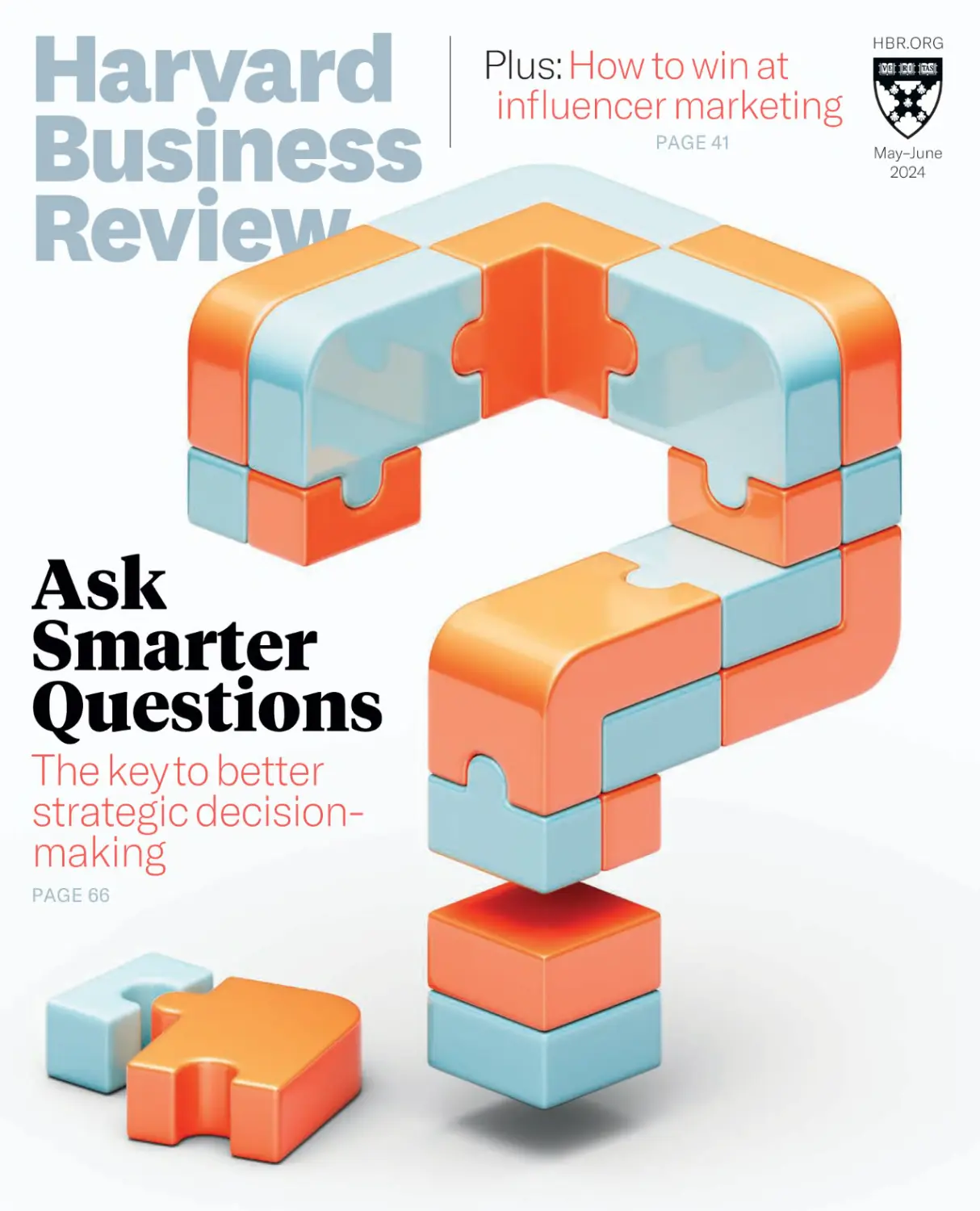
Ask
Smarter
Questions
The key to better
strategic decisionmaking
PAGE 66
HBR.ORG
May–June
2024
Portofino
smeg.com
Some AI talks
the talk.
We get it
running
for your
business.
Move beyond the AI hype
with a partner that puts it
to work for you, so you’re
free to focus on moving
your business ahead. Get
started at unisys.com/ai
Keep Breaking Through
“The influencer industry is an established global force that
sometimes behaves like a ramshackle start-up.”
Contents
“ WHY THE INFLUENCER INDUSTRY NEEDS GUARDR AILS,” PAGE 42
41
Spotlight
May–June 2024
Winning at
Influencer Marketing
42
Why the Influencer
Industry Needs
Guardrails
And how to professionalize
a maturing practice
Emily Hund
50
What Makes
a Successful
Celebrity Brand?
Stars are using their
influencer status to launch
their own products.
Ayelet Israeli et al.
56
Should Your Brand
Hire a Virtual
Influencer?
That can be a low-risk,
high-engagement strategy.
Serim Hwang et al.
61
How Marketers
Choose College
Athlete Influencers
Trunk Archive
The characteristics that
matter most Kimberly A.
Whitler and Graham Twente
COVER ILLUSTRATION
Michael Brandon Myers
Photograph by LANDON NORDEMAN
Harvard Business Review
May–June 2024
7
May–June
2024
65
Features
66 INTERPERSONAL
SKILLS
The Art of Asking
Smarter Questions
These five techniques
can drive great strategic
decision-making.
Arnaud Chevallier,
Frédéric Dalsace, and
Jean-Louis Barsoux
76 TALENT
MANAGEMENT
Highly Skilled
Professionals
Want Your Work—
But Not Your Job
Freelancers are in huge
demand today, and they
know it. It’s time for new
rules of engagement.
Diane Gherson and
Lynda Gratton
86 ORGANIZATIONAL
TRANSFORMATION
Transformations
That Work
Lessons from companies
that are defying the odds
Michael Mankins and
Patrick Litre
96 HUMAN RESOURCE
MANAGEMENT
HR’s New Role
In this tight labor market,
cost cutting is out.
Championing employee
concerns is in.
Peter Cappelli and
Ranya Nehmeh
8
Harvard Business Review
May–June 2024
132
104 ENVIRONMENTAL
SUSTAINABILITY
114 DIVERSITY &
INCLUSION
124 AI & MACHINE
LEARNING
To Create a Greener How Inclusive
For Success with
Future, the West
Brands Fuel Growth AI, Bring Everyone
unlock new sources
Can’t Ignore China They
On Board
of value by meeting the
Four ways for companies
to safely engage
Shameen Prashantham
and Lola Woetzel
needs of underrecognized
customers.
Omar Rodríguez-Vilá,
Dionne Nickerson, and
Sundar Bharadwaj
When you include rankand-file employees,
you’ll improve your overall
performance.
David De Cremer
132 DECISION-MAKING
& PROBLEM-SOLVING
Make Decisions
with a VC Mindset
The key is to embrace risk,
disagreement, and agility.
Ilya A. Strebulaev and
Alex Dang
Photograph by DAEHYUK IM
Conquer your fear
of finance.
Feel confident that you can mine every bit of meaning from the
next financial report that crosses your desk with the help of the
Financial Intelligence Set: What You Need to Know to Succeed,
a curated collection of ebooks and tools.
Includes five ebooks and downloadable tools.
PRODUCT #1095BN
HBR Guide to
Data Analytics
Basics for Managers
HBR TOOLS
UNDERSTANDING
EBITDA
AVAILABLE EXCLUSIVELY AT
store.hbr.org
How Finance Works
THE HBR GUIDE TO THINKING SMART
ABOUT THE NUMBERS
HBR Guide to
Finance Basics
for Managers
May–June
2024
Our Commitment to Sustainability
We’re proud that the paper we use in our print magazine is certified
under the Sustainable Forestry Initiative® program, meaning that it
comes from responsibly managed sources and is a renewable resource.
19
Idea Watch
New Research and
Emerging Insights
19 CORPORATE
STRATEGY
A Better Approach
to Mergers and
Acquisitions
Far more mergers succeed
today than in the past.
Here’s how to post a win.
plus Getting more traction
from your marketing
referral program, the pitfalls
of soliciting employee
feedback, and more
32 DEFEND YOUR
RESEARCH
142
Experience
Advice and
Inspiration
142 MANAGING
YOURSELF
Advice for the
Unmotivated
How to reignite your
enthusiasm for work
Robin Abrahams and
Boris Groysberg
148 CASE STUDY
When AI Teammates How Aggressively
Come On Board,
a Bank
Performance Drops Should
Pursue AI?
Even if machine
intelligence outperforms
people on tasks, it can drag
down group productivity.
34 HOW I DID IT
The CEO and
Founder of
Praava Health on
Reimagining
Care in an
Emerging Market
The author set a new and
high standard for health
care in Bangladesh and
achieved it.
Sylvana Quader Sinha
10
A Malaysia-based CEO
weighs the risks and
potential benefits of
turning a traditional bank
into an AI-first institution.
Thomas H. Davenport and
George Westerman
154 SYNTHESIS
34
What Can Business
Learn from Art?
How to focus on
accomplishment
over achievement
Scott Berinato
Departments
160 LIFE’S WORK
156 EXECUTIVE SUMMARIES
Hernan Diaz
Harvard Business Review
May–June 2024
12 FROM THE EDITOR
14 CONTRIBUTORS
“Our job was to treat people
coming into our facilities as
we would want to be treated.”
–SYLVANA QUADER SINHA,
CEO OF PRAAVA HEALTH
Photograph by WEBB CHAPPELL
What will power the
industrial future?
A new book shows how real-time data
and AI will radically transform physical
products—and the companies that
make them.
In Fusion Strategy, world-renowned innovation
guru Vijay Govindarajan and digital strategy
expert Venkat Venkatraman offer a first-ofits-kind playbook that will help industrial
companies combine what they do best (create
physical products) with what digitals do best
(use algorithms and AI to parse expansive,
interconnected datasets) to make strategic
connections that would otherwise be impossible.
store.hbr.org
AND BOOKSELLERS WORLDWIDE
From the Editor
Connect
with HBR
JOIN US ONLINE
WWW.HBR.ORG
FACEBOOK @HBR
INSTAGRAM @harvard_business_review
LINKEDIN Harvard Business Review
YOUTUBE @harvardbusinessreview
X @HarvardBiz
TIKTOK @hbrascend
CONTACT HBR
PHONE 800.988.0886
EMAIL editors@hbr.org
customerservice@hbr.org
designers@hbr.org
publishers@hbr.org
We’re All Influencers Now
Adi Ignatius
12
Harvard Business Review
May–June 2024
college athlete influencer? Or perhaps an AI-generated virtual one?
And how can you ensure that your
influencers behave transparently
and authentically?
In one article, authors from
Harvard Business School explain
how celebrities are increasingly
moving beyond endorsing existing brands and are creating their
own direct-to-consumer brands,
which they market primarily
through their own social media.
When Kim Kardashian came to
HBS last year to speak to a class
about how she and her cofounders
built the clothing brand Skims,
the news went viral—a crisp
display of the new power of the
influencer.
We hope this issue gets (and
holds) your attention.
Thanks for reading,
ADI IGNATIUS
Editor in chief
Robyn Twomey
career in magazines
in the pre-influencer era. As
editors, we spent most of our time
choosing and shaping articles
for each edition, and just sort of
hoped the ideas would find their
way to our readers. We still do the
curating and editing, of course,
but we now spend considerable
time trying to garner attention for
what we’re publishing. Much of
that happens on social media.
Today an organization like ours
has editors dedicated to crafting
editorial strategy on Instagram,
TikTok, LinkedIn, and other social
media platforms. When HBR’s
book publishing division signs
new authors, one critical question
we ask ourselves is: Do they have
the following necessary to get
attention for their books? We’ve
all arrived in the influencer era.
On a grander stage, industries
such as cosmetics and fashion
now rely heavily on influencer
marketing. Does your business
need to do so as well? In this
issue’s Spotlight, we examine
how brands are navigating this
increasingly essential channel.
Should you consider enlisting a
I B E GAN MY
Asset Management
Wealth Management
Asset Services
Alternative Investments
pictet.com
Investment
leadership.
A question of
talent not size.
Contributors
When racial justice protests swept across the
United States in 2020,
Dionne Nickerson,
an assistant professor
at Goizueta Business
School, noticed how
many brands issued
statements in support
of racial equity but did
little to market to diverse customers. In this
article Nickerson and
her coauthors highlight
marketing practices
that incorporate the
needs of historically underrecognized communities. “A certain level of
inclusion is within the
reach of most brands,”
she says. “I hope that
this article helps brands
consider the needs of
these communities
throughout the marketing function and not
merely as a reaction to
societal events.”
Len Schlesinger, a
professor at Harvard
Business School, has
spent much of his professional life alternating
between academia and
industry. As vice chairman at L Brands (the former parent of Victoria’s
Secret and other labels),
he became interested in
the direct-to-consumer
business model. While
cocreating an MBA
course on the subject,
he began researching
the power of celebrity influencers. And
when he brought Kim
Kardashian to campus
as a guest speaker, the
news went viral. In
this article Schlesinger
and his coauthors
explain how celebrities
have moved beyond
endorser or influencer
roles to launch brands
of their own.
114 How Inclusive
Brands Fuel Growth
50 What Makes a
Successful Celebrity Brand?
14
Harvard Business Review
May–June 2024
“I have studied the influencer industry since
before it was an industry,” says University of
Pennsylvania research
affiliate Emily Hund,
who authored a 2023
book on the subject.
Influencer marketing is
at a turning point, she
says, due to growing
concerns about transparency, authenticity,
exploitation, and the
never-ending quest for
traffic. “This industry
must engage in some
serious self-reflection,”
she says. “What do we
want the future to look
like? How can we ensure that this industry
is a positive presence
in the world?” In this
article she describes
how to achieve the
desired outcome.
42 Why the Influencer
Industry Needs Guardrails
In September 2020
China’s president Xi
Jinping announced
that China was committed to achieving
carbon neutrality
by 2060. Watching
from his Shanghai
home, CEIBS professor Shameen
Prashantham sensed
immediately that
enormous resources
would soon flow into
the green tech space.
Almost four years later,
many Western companies are unaware of the
strides Chinese companies are making. In this
article Prashantham
and his coauthor make
the case that China
and the West have a
golden opportunity to
collaborate on climate
solutions that benefit
everyone.
Yan Wang Preston is a
visual artist who, after
returning to China from
the United Kingdom
in 2010, noticed that
old trees—missing
leaves and most of their
branches—had been
newly planted in urban
areas. “Perhaps due to
my own situation as a
rootless migrant living
outside of my homeland, I felt a shared
pain toward the old
trees,” she says. So she
began photographing
them. Over several
years, the series, Forest,
expanded to include
urban surroundings
and human neighbors.
“It tells the adaptation
stories of the trees and
the urban dwellers in
the context of China’s
mass reforestation
effort.”
104 To Create a
Greener Future, the West
Can’t Ignore China
104 To Create a
Greener Future, the West
Can’t Ignore China
Global CEO
Program
Define your legacy
Join CEOs from around the world for a unique opportunity offered
jointly by IESE and MIT Sloan. Step back and tackle your organization’s
challenges head-on in today’s rapidly changing global landscape.
Starting: October 2024
Module 1
MIT Sloan
Cambridge, Massachusetts, USA
October 27–November 1, 2024
Module 2
Asia week
Singapore
January 19–24, 2025
Module 3
IESE Business School
Barcelona, Spain
May 18–23, 2025
More information:
Luis Casas - Program Co-Director
lcasas@iese.edu
www.iese.edu/gcp
EDITOR IN CHIEF Adi Ignatius
EDITOR, HBR
Amy Bernstein
EDITOR, HBR.ORG
Maureen Hoch
EDITORIAL DIRECTOR,
HBR PRESS
Melinda Merino
EXECUTIVE CREATIVE
DIRECTOR
John Korpics
EXECUTIVE EDITORS
Alison Beard
Daniel McGinn
Sarah Moughty
Ania G. Wieckowski
EDITORIAL
SPRING SPECIAL ISSUE
Got work fatigue?
We’re all so tired—of uncertainty, of change, of
the constant fire hose of information and tasks
coming at us.
But a few shifts can help boost both organizational
productivity and personal well-being. This issue
shows you what to do.
Available through May 6 on newsstands and on HBR.org.
SUMMER SPECIAL ISSUE
How to lead—now.
Everything you need to know about the essentials
of leadership: what doesn’t change—and what’s
most important right now.
Available May 7 on newsstands and on HBR.org.
SENIOR EDITORS Scott Berinato, Courtney Cashman,
David Champion, Paige Cohen, Kevin Evers,
Holly Bauer Forsyth, Gretchen Gavett, Eben Harrell,
Jeff Kehoe, Scott LaPierre, Dave Lievens, Toby Lester,
Juan Martinez, Curt Nickisch, Steven Prokesch,
Vasundhara Sawhney, Thomas Stackpole, Erica Truxler
PRODUCTION DIRECTOR & MANAGING EDITOR,
HBR PRESS Allison Peter
SENIOR ASSOCIATE EDITOR Susan Francis
ASSOCIATE EDITORS Stefanie Fernández, Ramsey Khabbaz,
Emma Waldman
ARTICLES EDITORS Christina Bortz, Susan Donovan,
Martha Lee Spaulding
DIRECTOR, EDITORIAL AUDIENCE Nicole D. Smith
SENIOR ASSOCIATE EDITOR, AUDIENCE
ENGAGEMENT Kelsey Hansen
SENIOR AUDIO PRODUCERS Amanda Kersey,
Anne Noyes Saini
ASSOCIATE AUDIO PRODUCER Hannah Bates
EDITORIAL COORDINATORS Rachel DuRose,
Cheyenne Paterson, Taylour Peters
EXECUTIVE ASSISTANT Christine C. Jack
CONTRIBUTING EDITORS Sarah Cliffe, Karen Dillon,
Walter Frick, Amy Gallo, Jane Heifetz, Paul Hemp,
John Landry, Gardiner Morse, Andrew O’Connell,
Anand P. Raman, Dana Rousmaniere
CONTRIBUTING STAFF Eileen Ahuja, Leslie Cauldwell,
Jenny Cromie, Kathryn K. Dahl, Sarabeth Fields,
Kelly Messier, Annie Noonan, JM Olejarz, Debbie White
DESIGN
DESIGN DIRECTORS Stephani Finks HBR Press,
Susannah Haesche HBR, Marta Kusztra Product & UX,
Karen Player Special Projects
SENIOR GRAPHICS EDITOR Macaulay Campbell
SENIOR DESIGNERS Carey Bass HBR, Kim Lapan UX
SENIOR PHOTO EDITOR Sasha Patkin
DESIGNERS Alex Belser Multimedia; So Young Park Product
CONTRIBUTING DESIGNER Yuliya Bas
PRODUCTION
DIRECTOR, EDITORIAL PRODUCTION Dana Lissy
MANAGER, EDITORIAL PRODUCTION Christine Wilder
SENIOR PRODUCTION EDITORS Kristin Murphy Romano,
Jennifer Waring
PRODUCTION EDITORS Victoria Desmond, Jodi Fisher,
Anne Starr
SENIOR PRODUCTION SPECIALIST Robert Eckhardt
PRODUCTION SPECIALIST Alexie Rodriguez
EDITORIAL ADVISORY BOARD
Bharat Anand, Azeem Azhar, John Battelle,
Marcus Buckingham, Nicco Mele, Vivek Shah
EDITORIAL OFFICES
Each quarterly Harvard Business Review special
issue focuses on a single, timely theme and includes
expert-authored articles from HBR’s rich archives,
along with concise article summaries.
60 Harvard Way, Boston, MA 02163
617-783-7410 | fax 617-783-7493
HBR.org
VOLUME 102, NUMBER 3 | MAY–JUNE 2024
Printed in the U.S.A.
Copyright 2024 Harvard Business School Publishing Corporation.
All rights reserved.
COPRESIDENT, HARVARD BUSINESS PUBLISHING Sarah McConville
VICE PRESIDENT,
DEPUTY PUBLISHER
Erika Heilman
VICE PRESIDENT, GLOBAL
ADVERTISING SALES
Gail Day
VICE PRESIDENT, NATIONAL
ADVERTISING & MARKETING
Craig Catalano
ADVERTISING
MANAGING DIRECTOR, ANALYTIC SERVICES Alex Clemente
DIRECTOR, INTERNATIONAL ADVERTISING & PARTNERSHIPS Daniel Cohen
DIRECTOR OF RESEARCH, ANALYTIC SERVICES Beth Tracton-Bishop
SENIOR EDITOR, RESEARCH & SPECIAL PROJECTS Todd Pruzan
MANAGING EDITOR, ANALYTIC SERVICES Anthony Baldo
SENIOR EDITOR, ANALYTIC SERVICES Ronald Fink
EDITORIAL ASSISTANT, ANALYTIC SERVICES Amanda Yao
DIRECTOR, MARKETING Yasir Salem
MANAGER, MARKETING Monica Ha
DIRECTOR OF PROJECT MANAGEMENT, ANALYTIC SERVICES Samantha Barry
SENIOR MANAGER, MARKETING Samantha Holloway
SENIOR RESEARCHER, ANALYTIC SERVICES Mary Callaghan
SENIOR PROJECT MANAGER, ANALYTIC SERVICES Audrey White
COORDINATOR, MARKETING Caitlin Amorin
CONTRIBUTING CONSULTANT MaryAlice Holmes
MARKETING & COMMUNICATIONS
DIRECTOR, CONSUMER MARKETING Nini Diana
DIRECTOR, COMMUNICATIONS Amy Poftak
ASSOCIATE DIRECTOR, MARKETING FOR CUSTOMER JOURNEYS Caty Jackson
SENIOR MANAGER, REVENUE & RETENTION Corrine Callahan
SENIOR MANAGER, LEAD GENERATION & CONVERSION Josh Getman
MANAGER, DIGITAL MARKETING Stephanie Kazemi
PRODUCT MANAGEMENT
DIRECTOR, PRODUCT MANAGEMENT Anne Bartholomew
SENIOR TECHNICAL PRODUCT MANAGER Frederic Lalande
SENIOR PRODUCT MANAGER Jon Goldberg
SENIOR PRODUCT MARKETING MANAGER, LEARNING Marqui Mapp-Taylor
PRODUCT MANAGER Dhanan Lathia
PRODUCT MANAGER, AUDIO Ian Fox
AGILE PROJECT MANAGER Kara Berrini
MANAGING DIRECTOR,
DIGITAL PRODUCT STRATEGY
Dave Lefort
WORLDWIDE ADVERTISING OFFICES
NEW YORK
3 Columbus Circle, Suite 2210
New York, NY 10019
212-872-9280 | fax 212-956-0933
Maria A. Beacom Sales Director,
Technology & North American Research
Michael Valecce New England & NY Luxury
Account Manager
CHICAGO
312-206-6045
James A. Mack
Central/Southwest U.S. Sales Director
LONDON
44-0-7890-608-707
Alexander Bart
Director, European Sales & Research
CALIFORNIA 415-986-7762
BEIJING 86-10-6551-0663
FRANCE 33-01-4643-0066
HONG KONG 852-237-52311
INDIA 212-872-9291
JAPAN 81-03-3541-4166
KOREA 82-2-730-8004
SOUTH AMERICA 55-11-98160-0177
UAE 971-4-228-7708
UNITED KINGDOM 44-20-7291-9129
For all other inquiries, please
call 212-872-9280 or visit
HBR.org/hbr-advertising-sales.
BUSINESS & CUSTOMER ANALYTICS
SENIOR DIRECTOR, BUSINESS ANALYTICS & INSIGHTS Jessica Avery
DIRECTOR, CUSTOMER & MARKETING ANALYTICS Emily Freeman Kroger
ASSOCIATE DIRECTOR, EMAIL AUTOMATION & OPERATIONS Jerry Knott
SENIOR MANAGER, CUSTOMER & MARKETING ANALYTICS Ellen Bonaccorsi
ASSOCIATE DIRECTOR, EXPERIMENTATION & ANALYTICS Abigail Dawson
SENIOR MANAGER, EMAIL PRODUCTION Frances Lee
MANAGER, EMAIL MARKETING Cara Vaccaro
SENIOR MANAGER, EXPERIMENTATION & ANALYTICS Chris Chaky
MANAGER, EMAIL MARKETING Milo Goodman
ANALYST, MARKETING David Gikoshvili
FINANCE & OPERATIONS
SENIOR DIRECTOR, FINANCE & OPERATIONS Greg St. Pierre
SENIOR DIRECTOR, INTERNATIONAL STRATEGY Kate Griffin
ASSOCIATE DIRECTOR, OPERATIONS & CUSTOMER EXPERIENCE Greg Daly
SENIOR MANAGER, FINANCE Krishna Dudhwewala
MANAGER, CUSTOMER EXPERIENCE Danielle Weber
SPECIALIST, DATA INTEGRITY & OPERATIONS Edward D. Domina IV
FINANCIAL ANALYST Olivia Johnston
HBR PRESS
COMMERCIAL DIRECTOR Jon Shipley
DIRECTOR, MARKETING & COMMUNICATIONS Julie Devoll
ASSOCIATE DIRECTOR, MEDIA & COMMUNICATIONS Sally Ashworth
ASSOCIATE DIRECTOR, PUBLICITY Felicia Sinusas
SENIOR MANAGER, OPERATIONS Rick Emanuel
ASSOCIATE DIRECTOR, DIRECT & CUSTOM SALES, HBRG Lindsey Dietrich
MANAGER, MARKETING & COMMUNICATIONS Alexandra Kephart
COORDINATOR, SALES Jordan Concannon
TECHNOLOGY
LEAD APPLICATION DEVELOPER Matt Wagner
SENIOR WEB DEVELOPER Kenneth Pereira
SENIOR RELEASE ENGINEER Matthew Han
SENIOR APPLICATION DEVELOPER Rollin Crittendon
FRONT-END ENGINEER Caitlin Smith
A NOTE TO READERS
The views expressed in articles are the authors’ and not
necessarily those of Harvard Business Review, Harvard Business
School, or Harvard University. Authors may have consulting or
other business relationships with the companies they discuss.
SUBSCRIPTION SERVICES
UNITED STATES & CANADA
800-274-3214
Harvard Business Review
P.O. Box 37457; Boone, IA 50037-0457
HBR.org/subscriberservices
ALL OTHER COUNTRIES
Asia Pacific region: 61-2-9158-6127
All other regions: 44-1858-438412
Harvard Business Review
Tower House, Lathkill Street
Market Harborough LE16 9EF
United Kingdom
www.subscription.co.uk/hbr/help
RATES PER YEAR
United States $119 | Canada US$139
International US$165 | Mexico US$139
SUBMISSIONS
We encourage prospective authors
to follow HBR’s “Guidelines for Authors”
before submitting manuscripts.
To obtain a copy, please visit HBR.org;
write to: The Editor, Harvard Business
Review, 60 Harvard Way, Boston, MA
02163; or email hbr_editorial@HBR.org.
Unsolicited manuscripts will be returned
only if accompanied by a self-addressed
stamped envelope.
"Read cover
to cover.
Superb."
Tom Peters
Author, In Search of Excellence;
Thinkers50 Hall of Fame
The Art of
Precision
Questioning
Hybrid Leadership:
Lessons from
a Crisis
The Magazine of the Rotman School of Management
UNIVERSITY OF TORONTO
SPRING 2023
How to Stay
Cool Under
Pressure
TAKE YOUR LEADERSHIP
UP A NOTCH
MANAGEMENT
Next-Level
Leadership
+
Free
Gift
Filled with thoughtprovoking ideas and
insights from leading
global academics
and management
practitioners. Published
by Canada’s leading
business school.
Subscribe today and
receive our mini issue
on creativity FREE!
Just $49.95 cad/year
Available in print or digital
www.rotman.utoronto.ca/hbr
ARTICLE REPRINTS
To purchase reprints,
go to HBR.org.
LIBRARY ACCESS
Libraries offer online access to current and
back issues of Harvard Business Review
through EBSCO host databases.
IdeaWatch
New Research and
Emerging Insights
T
WEN T Y
consultants at Bain & Company published a book that explored a
dispiriting reality: Although companies
spent billions of dollars a year pursuing
deals, 70% of mergers and acquisitions
wound up as failures. The book, Mastering the Merger, was released in the wake
of a series of corporate marriages that
ended badly, including AOL and Time
Warner, Daimler and Chrysler, and Citicorp and Travelers. This wasn’t a new
phenomenon. Academic studies dating
back to the 1970s had concluded that
most acquisitions don’t play out the way
the investment bankers promise. Even
among deals that appeared profitable
from investors’ perspective, Bain’s surveys of executives showed that many fell
YE ARS AG O,
I N T H E O RY
A Better Approach to
Mergers and Acquisitions
Far more mergers succeed today than
in the past. Here’s how to post a win.
Illustrations by JUSTYNA STASIK
Harvard Business Review
May–June 2024
19
IDE AWATCH
short of the internal projections made to
justify the purchase.
Recently one of the book’s authors,
David Harding, and two Bain colleagues
decided to take a fresh look at the M&A
landscape. What they found surprised
them. Over the past 20 years, firms
have done more than 660,000 acquisitions, worth a total of $56 trillion, with
deals reaching a peak in 2021. But the
odds of failure have inverted: Today,
close to 70% of mergers succeed. Even
among the roughly 30% that were less
successful, many of the deals still created some value.
What has changed? Bain’s deep dive
into that question led to four explanations for the turnabout:
Acquiring companies use M&A to
pursue a broader range of strategies.
In the 1990s and early 2000s, most
acquirers were targeting competitors
or companies in similar industries,
looking to increase scale, lower costs,
and gain on rivals. Over the past 20
years, however, companies have taken
a broader approach to M&A. They are
pursuing deals to develop toeholds in
emerging industries or geographies,
to make their supply chains more efficient, to take advantage of geopolitical
opportunities, to gain new capabilities
in areas such as artificial intelligence,
and even to find new sources of talent.
Often, the strategic rationale focuses
on growth opportunities, meaning that
companies aren’t as reliant on grinding
out cost savings, which in the past often
proved harder to achieve than predicted.
Acquirers are more sophisticated
about due diligence. In the past, most
of the due diligence for mergers was
conducted on spreadsheets, with a
20
Harvard Business Review
May–June 2024
focus on whether the financials made
sense. More recently, companies have
expanded the types of investigations
they conduct before signing a deal. They
make cultural assessments to determine
how well the people working in the
target company will adapt to the norms
and values of the acquirer. Formal talent
assessments allow acquirers to take a
harder look at the capabilities of the people running the target company—and
make smarter projections about their
ability to make postmerger integration
a success. Social media gives acquirers
easy access to feedback and commentary from target companies’ customers,
employees, and former employees.
Today, the researchers write, “the best
acquirers quickly make themselves
authorities on the businesses they are
pursuing.”
Acquiring companies gain experience and expertise by doing more
deals. It’s no secret that the more often
you do something, the more skilled you
become. Over the past two decades,
companies have done fewer megadeals
and have instead pursued morefrequent and more-modest transactions. That has helped companies get
better at the various facets of M&A,
including estimating synergies before
the deal closes and achieving them
during integration. And when a company is doing deals frequently enough,
it can justify having a full-time team of
specialists who do nothing other than
identify targets, negotiate terms, and
IDE AWATCH
conduct due diligence. Over time, that
specialization can pay off.
“If you’re only doing deals episodically…there simply isn’t a platform
to have a dedicated team,” says Dale
Stafford, a leader in Bain’s mergers
and acquisitions practice. In the past,
companies would often pull a disparate
group of relatively inexperienced people
away from their regular jobs to do due
diligence or work on postmerger integration. The advantages of having full-time
specialists are obvious. “It’s a bit of a
volume game: Doing more deals means
that you can have dedicated M&A people
who acquire more and more experience
over time,” Stafford says.
Consider the larger Silicon Valley
companies. “Some of the tech companies were doing almost a deal a week at
the peak,” says Suzanne Kumar, a vice
president in Bain’s M&A practice. “They
have fully built-out teams, with different people for due diligence and integration.” And the trend extends beyond
Silicon Valley. Bain points to Thermo
Fisher Scientific and beverage distributor Constellation Brands as examples of
firms that have built substantial teams
focused on M&A—and given the people
leading them a seat at the senior leadership table.
Acquiring companies are better at
integration. Integrating two companies
is a giant undertaking. Fortunately, the
techniques, tools, and technology used
to manage large projects have advanced
significantly in the past 20 years. (For
example, the agile methodology was
invented only four years prior to the
publication of Mastering the Merger.)
Additionally, as organizations gain
experience by making acquisitions
22
Harvard Business Review
May–June 2024
more frequently, they learn what integration tasks they need to prioritize,
what areas are likely to be troublesome,
and how to make key decisions more
efficiently. “We cringe a little when
we reread our integration advice from
20 years ago,” the researchers write,
because the field has advanced so
much since then.
The overall increase in M&A has
been rewarded by investors. Twenty
years ago, even though the majority
of acquisitions were unsuccessful, the
researchers found, companies that
made frequent deals showed higher
shareholder returns—a sign that investors preferred companies that were willing to take these risks. Since then, this
phenomenon has increased. Companies
that are frequent acquirers (doing at
least one acquisition a year) earn double
the returns earned by companies that
rarely or never do deals.
Moving from a 70% M&A failure rate
to a 70% success rate over 20 years is
significant, but as the deals continue,
an important question has arisen: Has
the success rate reached a plateau, or
is there potential for the gains to keep
increasing?
“The vast majority of companies are
not frequent acquirers, so they are just
starting on this journey and haven’t
really created that repeatable model
yet,” Kumar says. For that reason, the
researchers are hopeful that the success
rate can increase even further.
HBR Reprint F2403A
ABOUT THE RESEARCH “How Compa-
nies Got So Good at M&A,” (Bain white
paper, by David Harding, Dale Stafford, and
Suzanne Kumar)
I N P R ACT I C E
“We’re Not
Looking
at FixerUppers”
Chris Koch has been CEO of
Carlisle Companies, an Arizonabased building-products company,
since 2016. Carlisle has acquired
24 companies in deals totaling
$3.5 billion since he took the helm—
a continuation of its long-standing
growth-by-M&A strategy. Koch
spoke to HBR about rising M&A
success rates. Edited excerpts of
the conversation follow.
Looking back, do you recall
learning that M&A is fraught
with failure?
It’s something we were indoctrinated in as MBA students in
the 1990s. I remember someone
teaching us: “The first rule of
acquisitions is that most fail.
There are no good acquisitions.”
I’ve learned that depends partly
on how you define failure. Some
acquisitions may look successful
because they increased earnings,
but they failed to meet the internal projections used to justify the
deal. In those cases, you would
probably have been better off
allocating that capital elsewhere.
Has the way you do M&A
changed?
Years ago, we had a very small
corporate staff, so our M&A
process was decentralized, and
most of the ideas for acquisitions
and due diligence came out of the
operating divisions. Today due
diligence is handled by a larger
team at corporate, and it’s much
more thorough. We have become
much more process oriented, as
opposed to approaching each
acquisition as a one-off. We also
have clearer principles for the
kinds of companies we’ll acquire
and the kinds we won’t.
What type of companies do
you look for?
First, we look for companies that
have organic growth opportunities on a stand-alone basis. We’re
not looking at fixer-uppers. We
bring in third-party researchers
and consultants to do additional
investigative work into the economics of the business. Second,
we look for hard synergies—raw
material savings, factory consolidation opportunities, reduced
corporate costs. We want to see
substantial savings if we bring
the companies together, and we
really dig into that during due diligence. Third, we create a detailed
integration playbook with dates,
milestones, and goals. Investors
expect to see results from an
acquisition immediately, so it’s
important to demonstrate prog
ress quickly. We also look more
deeply at the human element—
the people at the target company.
We used to assess the leaders on
whether they could run their own
business. Now we look at whether
they can be leveraged across our
organization and become a bigger
part of Carlisle.
Can you describe an acquisition that you rejected because
Photograph by CASSIDY ARAIZA
of what you found during due
diligence?
We were going to acquire a
company in Europe and went right
up to the eleventh hour with it.
Part of the rationale for the deal
was cost savings from factory
improvement—something that is
fairly straightforward to achieve in
the United States. We sent people
from our corporate leadership
team to Europe to do on-site due
diligence, and the more we looked
at it, the more we realized that local regulations and labor practices
would make those savings hard to
achieve. When you added in that
risk, the return went down, and it
didn’t get over the hurdle.
why we do a lot of smaller, bolt-on
acquisitions that open up a new
channel, a new geographic area,
or access to a new technology.
Does the industry the acquisition is in matter?
We’ve found that the closer the
acquisition is to your core, the
better you understand the business and the potential synergies.
That helps de-risk the deal. The
further you get from your core,
the more uncertainties there are
and the greater the risk. That’s
As a CEO, how much time do
you personally spend on M&A?
A significant amount. I’m looking
at deal flow. I’m deeply involved
in evaluating the deal model for
proposed acquisitions. I ensure
that resources are available for
due diligence. It’s a substantial
part of my job because M&A is an
important part of our strategy.
Harvard Business Review
May–June 2024
23
IDE AWATCH
ENTREPRENEURSHIP
Temp: Americans Are
Start-Ups
AreNew
Starting
More
Surging
More
in the
Businesses
U.S. Than in Other
Total monthly business applications in the
U.S.
for likely employers now stands at
Countries
154,000, well above a low of roughly 100,000
during
years following
thetotal
global
Despitethe
recession
concerns,
monthly
financial
crisis.
ipsum
dolor sitsur
amet,
applications
forLorem
new U.S.
businesses
consectetuer
adipiscing
elit,2023.
sed diam
passed 154,000
in October
Some
356,000 more new businesses opened in
the U.S. in 2022 than in 2019, a 34% increase.
T H E G E N D E R PAY G A P
Women Now
Negotiate More
Than Men
It’s widely believed that one reason
women earn less than men is that they
shy away from asking for higher pay.
According to a new study, that explanation no longer holds water.
The researchers asked several
hundred people to estimate the share
of recent male and female graduates of
an MBA program who had negotiated
about their pay on their first job offer.
On average, participants guessed that
64% of men but only 47% of women, on
average, had done so. The researchers
then examined exit surveys from a university career-management office that
had asked 900 recent MBAs whether
they had negotiated their offers. The
real-world data sharply contradicted the
participants’ assumptions: Some 54%
of women and 44% of men had tried to
better their offers. A survey of nearly
2,000 of the program’s alums found a
similar pattern: More women than men
reported having asked for higher pay.
They were more likely than the men to
say that their negotiations had failed,
24
Harvard Business Review
May–June 2024
however, and they ended up earning
22% less, on average.
Examining prior studies, the
researchers found that for many years
men did negotiate pay at higher rates
than women did, but the difference
disappeared in the 1990s and began to
reverse in the early 2000s. Members of
both sexes bargained more with their
employers, but the increase was especially pronounced among women, to the
point where they overtook men.
The mistaken notion that women
still avoid negotiation has far-reaching
consequences. The two final studies in
the series showed that it undermines
support for legislation intended to
promote equity in pay by forbidding
employers from considering people’s
salary histories. “The positive stereotype of male negotiators legitimizes
their success as well-deserved and
justified,” the researchers write. “The
negative stereotype of female negotiators suggests [that] their plight is
well-deserved.”
ABOUT THE RESEARCH “Now, Women
Do Ask: A Call to Update Beliefs About
the Gender Pay Gap,” by Laura J. Kray, Jessica
A. Kennedy, and Margaret Lee (Academy of
Management Discoveries, 2023)
U.S. total
monthly business
applications for
likely employers
JAN. 2005
117,674
Change
in annual
business
openings
United 34%
States
2019
France
23
Canada
16
Belgium
United
Kingdom
25
16
Norway
9
10
Germany
6
154,153
2022
Netherlands
Sweden
Spain
OCT. 2023
8
Italy
0.1
-12
Source: “How the Pandemic Rebooted Entrepreneurship
in the U.S.,” by Kenan Fikri and Daniel Newman
(HBR.org, 2024)
PEOPLE ARE MORE WILLING TO GET MENTAL HEALTH SUPPORT AFTER PEERS DO
Researchers found that employees who learned about a colleague’s experience with peer-support services
for mild anxiety and stress were 8% more likely to access the program themselves. The odds went up by
6.6% when employees learned about a colleague using the services to cope with an abusive relationship.
Research by MoreThanNow et al.
MARKETING
Get More Traction
for Your Referral
Program
While many organizations offer
rewards to customers who refer friends,
few such programs get stellar results.
One recent study, for example, found
that even among highly satisfied
customers, the average referring rate
is only 29%. New research points to an
easy-to-implement remedy. Across two
field studies and six laboratory experiments in a wide range of contexts,
people were more likely to promote
businesses to others when it was clear
to everyone that both parties would
benefit from the referral.
In the first study, 371 people who
had made at least one purchase from
a small U.S. fish-taxidermy company
were offered a discount of up to $100
for each referral that resulted in a
purchase. In some cases the invitation
that participants forwarded to their
referees mentioned only that the friend
would get a discount when signing up.
In others the invitation stated that the
referrer, too, would get one. The referral rate was 5% among the first group
and 14% among the second group—and
the second group generated 665% more
revenue. A similar pattern occurred
when the product was a package of
tutoring sessions offered to the parents
of Chinese students and in lab experiments involving memberships to a
coffee shop, subscriptions to a meal
delivery service, and participation in
the mobile games Angry Birds 2 and
Pokémon Go.
Psychologists divide interpersonal
relationships into two broad types:
friendships, or communal relationships
in which benefits are extended without
any expectation of reciprocal gain, and
exchange relationships, or businesslike
arrangements in which givers are looking to receive something of comparable
value. Having surveyed participants
at the close of the experiments, the
researchers say that disclosing the referrer’s reward makes solicitations feel
more compatible with communal norms
and mitigates people’s discomfort about
mixing friendship and financial gain.
But there are exceptions: The benefit
from disclosure was lessened when the
referrer stood to gain more than the referee (a violation of communal norms),
when the referrer’s reward was framed
as coming from the referee’s purchase
rather than from the company coffers
(making the offer seem exploitative,
although the distinction is merely
semantic), and when the offer was
pitched as a communal activity to begin
with (“It will be more fun if you join!”).
Surveying 45 referral programs
across nine industries, the researchers
found that only seven used invitations
that told referees about the referrer’s
reward. “The most basic practical
implication of our research is that marketers should adopt disclosure because,
contrary to [their] expectations, [it]
should help, rather than hurt, campaign
effectiveness,” the researchers write.
ABOUT THE RESEARCH “I Will Get a
Reward, Too: When Disclosing the
Referrer Reward Increases Referring,” by
Minzhe Xu, Zhihao Yu, and Yanping Tu
(Journal of Marketing Research, 2023)
ARTIFICIAL INTELLIGENCE
When It Comes to
Chatbots People
Usually Prefer
Robots to Animals
Kittens and puppies are cute, but think
twice before you make one the face of
your AI. Studies of more than 1,500 U.S.
residents shows that in most cases people prefer products that have humanoid
avatars to those that look like animals.
In one study, researchers introduced participants to two versions of
Taylor, an AI chatbot: One looked like
a humanoid robot and the other like a
tiger. Participants were asked to rate
how likely they were to use each version
of the bot (on a scale of 0 to 100, with
100 being the most likely to adopt) for
proofreading assistance. The humanoid
version received an average score of 68;
the tiger a score of 55.
“We have observed a growing trend
among companies...that employ zoonotic designs (animal-like appearances)
to perform tasks traditionally completed by humans, such as transcribing
meeting notes and providing customer
Harvard Business Review
May–June 2024
25
IDE AWATCH
services,” the researchers write.
“However, our findings suggest that
consumers are less inclined to adopt
these services when they are delivered
by zoonotic…AI.”
To better understand why and when
participants prefer humanoid bots to
animal bots, the researchers replicated
the experiments with different tasks.
In one, they compared the participants’
likelihood to use Taylor for physical
fitness help. In that experiment, the
humanoid advantage disappeared:
Participants gave the tiger version of
Taylor an average score of 46; the robot
received a score of 45.
Participants were also asked whether
they’d use Jasper, a bot designed to
resemble either a robot or a cheetah,
to serve either as a proofreader or as
a running coach. When asked about
their likelihood to adopt the bot for
proofreading help, participants gave the
robot version an average score of 68 and
the cheetah a score of 60. Conversely,
when asked how likely they were to use
Jasper as a running coach, the cheetah
version prevailed, receiving a score of 50
compared with 45 for the robot.
The researchers conclude that
people prefer humanoid bots for tasks
traditionally associated with humans.
They prefer bots that look like animals
for tasks that are associated with the
animal’s natural skill set—and, the
researchers add, for tasks that users
consider to be enjoyable.
ABOUT THE RESEARCH “Beyond
Humans: Consumer Reluctance to
Adopt Zoonotic Artificial Intelligence,” by
Sara-Maude Poirier et al. (Psychology &
Marketing, 2023)
26
Harvard Business Review
May–June 2024
HUMAN RESOURCES
Companies Often
Solicit Employee
Feedback but
Seldom Act on It
Managers know that suggestion boxes,
town halls, and surveys are excellent
ways to gather employee feedback.
Unfortunately, most don’t seem to
realize that implementing the feedback
is also important. In a 2023 survey of
3,500 U.S.-based workers, only 34% said
they thought their companies would act
on feedback they provide.
The disconnect between the feedback and positive change significantly
decreased employee fulfillment and
business results. Almost 70% of the
survey respondents said they were
unengaged and didn’t feel a meaningful
connection to their job. That’s a problem, the researcher says, because those
who reported being energized and
excited about their work were 31% more
likely to stay at their organization
and 31% more likely to go above and
beyond. Perhaps more important, they
were 15% more productive than their
less-fulfilled peers.
Managers and HR professionals who
solicit employee feedback but have trouble implementing it may benefit from
three recommendations, the researcher
says. First, they should focus on solving
process roadblocks rather than on
employee-engagement tactics. For
example, 40% of survey respondents
said they would rather have difficult
processes fixed than receive more career
development opportunities.
Second, HR should coach managers
on engaging employees. A survey of chief
human resources officers (CHROs) conducted several months prior to the study
revealed that out of 12 corporate actions
meant to engage employees, managers
were responsible for 10 of them. Yet only
19% of CHROs said they believed their
managers knew how to act on the feedback resulting from those activities.
Finally, organizations should promote and be transparent about the ways
in which they are soliciting, collecting,
and using employee feedback to improve
engagement. “Using the blanket term
‘engagement’ may be helpful for project
planning, but it’s not helpful for employees,” the researcher adds. “Companies
have an opportunity to rebrand these
activities in a way that feels much more
relevant and employee-centric.”
ABOUT THE RESEARCH “Employee
Engagement: Close the Action Gap to
Drive Business Outcomes,” by Jen Priem
(Gartner white paper, 2023)
Reviewing the forecasting insights
before ordering more inventory.
Realizing he’s afraid
of heights.
Booking time with a banker
after going over the books.
Tracking same-day payments
while stocking the shelves.
Business solutions so powerful,
you’ll make every move matter.
What would you like the power to do?®
Learn more at bankofamerica.com/bankingforbusiness
You must be enrolled in Business Advantage 360, our small business online banking, or Mobile Banking to use Cash Flow Monitor and Connected Apps, and have an eligible Bank of America® small
business deposit account. Mobile Banking requires that you download the Mobile Banking app and is only available for select mobile devices. Message and data rates may apply.
Screen images simulated. Sequences shortened.
©2024 Bank of America Corporation. All rights reserved. | MAP6204811
IDE AWATCH
ABUSIVE BOSSES MAKE PEOPLE NOT WANT TO HAVE CHILDREN
Three studies found that people with abusive managers are 10% to 22% less likely
to want to have children than other employees are. “The ‘Life’ Consequences of
Abusive Supervision: How Abusive Supervision Diminishes Employee Procreation,”
by Feng Qiu et al.
A U T O M AT I O N
A Guide for AIHuman Collaboration
HIGH
Some activities benefit from heavy AI use,
and others require a human touch. The
lower-left quadrant consists of rote tasks that
could be easily automated or done by lowskilled workers. Activities in the upper-right
quadrant require a combination of AI and
complex human capabilities.
Research &
data analysis
Strategizing
& decisionmaking
Repetitive &
simple tasks
Individual
& team
development
LOW
Leverage
AI
LOW
Leverage human qualities
HIGH
Source: “The Best Leaders Can’t Be Replaced by AI,”
by Rasmus Hougaard, Jacqueline Carter, and
Rob Stembridge (HBR.org, 2024)
P R O D U C T PA C K A G I N G
When Less Is More
Packaging designers often combine a
variety of elements—text, illustration,
color—in complex designs meant to
attract consumers’ attention. In many
cases, according to a new series of
studies, they’d get better results from
a simpler approach.
In the first study, the researchers
worked with data from the U.S. supermarket chain Kroger. They gathered all
product images across four consumable
categories—shampoo, deodorant,
crackers, and cereal—along with each
28
Harvard Business Review
May–June 2024
product’s name, brand, retail price, and
weight. Independent research assistants rated the images on complexity of
design. Mapping the ratings against each
product’s price per ounce showed that
the simpler the package was, the higher
the product’s unit price—suggesting
that people are willing to pay more when
items are presented simply.
In the first of several subsequent
experiments, the researchers created
simple and complex packages for trail
mix and showed one or the other to
each of 362 university students. The
students indicated the highest amount
they would pay for the snack, reported
whether they thought it contained few
or many ingredients and how pure they
believed it to be, and rated the package
on attractiveness and simplicity. Those
who saw the simple design were willing
to pay more, even though they were less
likely than people who saw the complex
design to award high marks on attractiveness. The simple design got higher
scores on purity, and participants
believed the product contained fewer
ingredients. Repeating the experiment
with a different item—hand lotion—
yielded similar results, as did asking
participants what they thought others
would be willing to pay.
“Simplifying packaging design may
be an efficient way…to convey product
information independent of text,” the
researchers write. Managers should note
some mitigating circumstances, they
add. Additional experiments showed
that the boost from a simple design was
less pronounced when the product’s
ingredients were highlighted on the
package; consumers then had no need
to make inferences about purity. It was
also less pronounced for store brands,
because people assumed that the simple
design reflected low investment in the
product overall. And when participants
wanted indulgent rather than healthful
items, complex packaging elicited a
higher willingness to pay—so managers
“may want to avoid simple designs…if
they want to signal that their products
are tasty,” the researchers say.
ABOUT THE RESEARCH “Symbolically
Simple: How Simple Packaging Design
Influences Willingness to Pay for Consumable Products,” by Lan Anh N. Ton, Rosanna
K. Smith, and Julio Sevilla (Journal of
Marketing, 2023)
— Mergers and Acquisitions —
In an era of technological change, the business landscape has become intensely
competitive, prompting organizations to turn to mergers and acquisitions as strategic
tools for enhancing shareholder value. However, engaging in M&A activity is not a lowrisk endeavor— executives must know how to navigate this landscape.
When you attend Mergers and Acquisitions, an executive education program from
the University of Chicago Booth School of Business, you’ll gain an interdisciplinary
approach to successfully executing mergers, acquisitions, and corporate restructuring
with an analytical framework. You’ll learn from the same faculty who teach in our
highly ranked MBA and Master’s degree programs how to navigate deal-making
complexities with confidence and strategic foresight.
This program will be held at the
Gleacher Center in downtown Chicago
from July 15—19, 2024.
Learn more at
ChicagoBooth.edu/MA
Contact us at +1.312.464.8732 or
exec.ed@chicagobooth.edu for a
consultation.
We offer special pricing for group enrollment, and our enrollment
advisors are ready to work with you to support your education
budgets.
Explore our suite of program offerings by visiting
chicagobooth.edu/catalog. Contact us at +1.312.464.8732
or exec.ed@chicagobooth.edu for a consultation.
IDE AWATCH
R E M OT E WO R K
The More
Lucrative the
Job, the Greater
the Flexibility
Since the Covid-19 pandemic, remotework opportunities have steadily
increased—but not for everyone.
To determine which roles most often
allowed employees to work from home,
researchers used machine learning
to study more than 250 million job
postings across five English-speaking
countries. The findings were clear:
The higher the pay associated with the
job, the greater the freedom to work
remotely.
Fewer than 3% of job postings with
a salary of less than $30,000 offered at
listed remote work as an option 27% and
29% of the time, respectively.
Location matters too, the researchers
found. English speakers actively pursuing remote work would be best served
by moving to the UK, where 18% of open
jobs offer it. They’d be wise to avoid New
Zealand, where only 8% of job postings
offered remote options.
least one day per week of remote flexibility, the researchers found. Roughly
10% of jobs that offered $60,000, 20% of
those that offered $100,000, and 30%
of those that offered $200,000 allowed
at least some remote work. Researchers
also found links between education,
experience, and remote work. Fewer
than 2% of jobs that required a high
school diploma offered remote-work
opportunities. That figure rose to 6% for
jobs requiring an associate’s degree and
15% for a bachelor’s degree. Job postings
requiring master’s degrees and PhDs
ABOUT THE RESEARCH “Remote Work
Across Jobs, Companies, and Space,”
by Stephen Hansen et al. (National Bureau
of Economic Research working paper, 2023)
CAREER DEVELOPMENT
Temp: Which Companies Are Top Talent Incubators?
Which Companies Are Top Talent Incubators?
*
25
*
25
* K
PM
G
25
24
20
*
20
*
20
*
18*
20
*
18*
BC
G
JPM
org
an
Joh
nso
n&
Pfi
Joh
zer
nso
n
Bai
n&
Co
mp
Ha
rva
any
rd
Un
Pep
i
v
e
siC
rsit
o
y
Sh
ell
Cit
iba
nk
Bo
sch
EY
17
13*
15
13*
11
12
16
loit
te
Acc
ent
ure
Ne
stlé
Go
ldm
an
Sac
Pw
C
hs
Sie
me
ns
IBM
De
9
10
7
8
6
5
Un
Mic
4
3
1
Industry
2
Go
Mc
Ki
*Denotes
a tie
ogl
nse
y
e
Most frequently
mentioned
companies
ros
oft
ilev
er
Pro
cte
r
Am & Gam
azo
ble
n
Ap
ple
GE
Temp: In 2018, 31 companies listed on the S&P 1500 were led by former GE employees. GE is what was known as an “academy company” — an
elite firm that
produces
more
talent
holds on to,exporters
exportingof
effective
leaders
toMcKinsey,
other organizations
and
even industries.
better the
Following
in the
footsteps
of GE,
one than
of theitbest-known
effective
leaders,
Google, and
Microsoft
are now To
considered
understand
which
companies
are top
talent
incubators
Board, ainfirm
that to
provides
data on corporate
organizational
three
top global
producers
of talent.
That’s
according
to atoday,
surveythe
of Official
853 executives
midsize
large companies
in January
and Februarycharts
2023. and
executive
surveyed
853 are
executives
on the
topic.
most frequently mentioned companies.
Five
of themovement,
top-25 talent
incubators
technology
firms,
the These
most ofwere
any the
industry.
ACCOUNTING/CONSULTING
CONSULTING
CONSUMER PACKAGED GOODS
EDUCATION
ENERGY
FINANCIAL
INDUSTRIAL
PHARMACEUTICAL
TECHNOLOGY
Source: “What Makes a Company Great at Producing Leaders?” by Sarah Abbott, Robin Abrahams, and Boris Groysberg (HBR.org, 2023)
30
Harvard Business Review
May–June 2024
COMPILED BY HBR EDITORS | SOME OF THESE ARTICLES PREVIOUSLY APPEARED IN DIFFERENT FORM ON HBR.ORG.
The 2023
HBR Prize
The HBR Prize, judged by an independent panel of business and academic
leaders, commends outstanding articles published each year in Harvard
Business Review. Previously called the HBR McKinsey Award, it was
established in 1959 to recognize groundbreaking management thinking.
Reskilling in the Age of AI
SEPTEMBER–OCTOBER 2023
FIRST PLACE
As the pace of technological change increases, millions of
workers may need to be not just upskilled but reskilled—a
profoundly complex societal challenge that will sometimes
require them to both acquire new skills and change occupations entirely. Companies have a critical role to play in addressing this challenge. The authors, Jorge Tamayo, Leila Doumi,
Sagar Goel, Orsolya Kovács-Ondrejkovic, and Raffaella
Sadun, interviewed leaders at some 40 organizations around
the world that are investing in large-scale reskilling programs.
In this article they synthesize what they’ve learned.
The Judges
Beware a Culture of Busyness
P H OTO G R A P H E R PELLE CASS
TIME
M A N AG E M E N T
Organizations must
stop conflating activity
with achievement.
Adam Waytz
AU T H O R
THE FINALISTS
58
Professor, Kellogg School
of Management
Harvard Business Review
March–April 2023
Harvard Business Review
March–April 2023
59
The High
Cost of
Neglecting
Low-Wage
Workers
Six mistakes that companies make—
and how they can do better
AU T H O RS
Joseph
Fuller
Professor,
Harvard Business
School
Manjari
Raman
Program director,
Harvard Business
School
DES P I T E A L L T H E I R efforts since the
summer of 2021 to bring frontline
workers back into the fold, companies
are struggling to rehire and return
40
Harvard Business Review
May–June 2023
operations to a prepandemic normal.
As a result they have failed to deliver
products and services, lost revenue,
and disappointed their customers.
Supply chains remain snarled, with
warehouse and delivery operations
woefully understaffed. Grocery stores
and pharmacies are unable to keep
their shelves stocked. Restaurants
can’t find enough cooks, cleaners,
and waiters. Hotel chains can’t book
to their full capacity, because they
don’t have enough housekeeping staff.
Once upon a time, leisure was a sign of prestige. Today busyness
is the new status symbol. In this article Adam Waytz explores both
the downsides of busyness (employee turnover, reduced engagement, absenteeism, and impaired health) and the reasons for our
obsession with it. He also presents strategies for breaking away
from this fixation.
Airlines have been forced to ground
hundreds of flights.
In 2021 companies convinced themselves that the labor shortages they were
experiencing were a passing phenomenon, and in response they trotted out
the standard short-term fixes: raising
wages by a few dollars an hour, awarding signing and referral bonuses, and
even offering more flexibility in working
shifts. But none of those measures were
particularly effective. So in 2022, with
the labor situation worsening, some
companies resorted to tactics that ran
counter to their core strategies. CVS and
Walgreens began closing stores earlier
or shutting down on Sundays. Domino’s,
unable to find drivers, reversed its focus
on deliveries and instead offered customers a $3 “tip” if they picked up their
own orders. Others took extraordinary
measures to fill frontline jobs. When it
didn’t have enough baggage handlers,
Qantas begged senior executives to
volunteer to sort, scan, and transport
baggage for three months.
Companies blamed everyone but
themselves for the labor shortages:
The pandemic was a once-in-a-lifetime
shock to the system that had provoked
the scarcity. The government had exacerbated the problem by issuing stimulus
checks. High rates of churn were a fact
of life in the world of low-wage work.
But that thinking was misguided.
After studying this topic for several
years (see the sidebar “About the
Research”), as part of Harvard Business School’s Project on Managing the
Future of Work, we have concluded that
the real problem lies in the way that
organizations mismanage their hourly
workers: They are underinvesting in
Photographs by BRIAN FINKE
Harvard Business Review
May–June 2023
41
Senior lecturer,
Harvard
Business School
Claudio
FernándezAráoz
Former partner,
Egon Zehnder
Hubert Joly
The High Cost of Neglecting
Low-Wage Workers | MAY–JUNE 2023
ABOUT THE ART
The photographer Brian Finke photographs
scenes of industry and workers, often
highlighting unusual perspectives on human
behavior and everyday life.
Spotlight
Jill Avery
MARCH–APRIL 2023
Beware a
Culture
of
Busyness
Many companies blame outside factors for their trouble finding and
retaining frontline workers. Joseph Fuller and Manjari Raman argue
that the real problem lies in six big mistakes companies themselves
have long been making, in such basic areas as hiring, career development, and mentoring. They offer some practical suggestions for
how leaders can do better, for their workers and their organizations.
Former CEO
and chairman,
Best Buy
Mihnea
Moldoveanu
Professor,
Rotman School
of Management
Karthik
Ramanna
A Step-by-Step Guide to Real-Time
Pricing | NOVEMBER–DECEMBER 2023
In today’s fast-paced world of digital retail, the ability to revise prices
swiftly has emerged as a decisive differentiator for companies. In this
article Marshall Fisher, Santiago Gallino, and Jun Li describe a process for dynamic pricing that focuses on building computer models
that consider not just competitor pricing but also product availability
and customer behavior to recommend optimal pricing in real time.
Professor,
University
of Oxford
Stefan
Thomke
Professor,
Harvard
Business School
Harvard Business Review
May–June 2024
31
IDE AWATCH
Columbia Business School’s Bruce Kogut and two colleagues—Harvard
Business School’s Fabrizio Dell’Acqua and Yeshiva University’s Patryk
Perkowski—studied the impact of artificial intelligence on team functioning.
They asked 110 two-person teams to play 12 rounds of Super Mario Party’s
Dash and Dine, a video game in which players must collect ingredients for
a recipe. After the first six rounds of play, one member of some teams was
replaced by an intelligent agent. Over the next six rounds, those teams
gathered, on average, three fewer ingredients than teams that continued
as originally configured. The conclusion:
When AI Teammates
Come On Board,
Performance Drops
Professor Kogut,
DEFEND YOUR RESEARCH
KOGUT: Prior studies have already
explored the impact of artificial intelligence on individual and firm productivity, but we wanted to understand
how AI affects organizational teams
internally. After all, most work is done
in teams. We were curious about the
32
Harvard Business Review
May–June 2024
consequences of adding intelligent
agents to teams, and not just for the
people interacting directly with those
agents. We also wanted to see what
impact it had on the behavior and attitudes of colleagues who observed those
interactions.
HBR: Why did you use Super Mario Party
for your experiment? Wouldn’t something corporate, like a data-entry task,
have been a more logical choice?
Video games are more cognitively
demanding than your run-of-the-mill
office task. They’re also more motivating; who doesn’t like Mario? Dash
and Dine had a lot of advantages for
our purposes. It’s not hard to play,
and many people have some experience with the Super Mario Bros. video
games, although most of the subjects
in the experiment had never played
this particular one. The tasks involved
depend on coordination and teamwork
rather than only individual experience,
and the game has built-in AI that we
could easily tap to replace some of the
players.
How did the experiment work? We
started by having each participant play
four one-minute rounds on their own.
From the results we developed a skills
index and determined each person’s
baseline level of play. Next we placed
pairs of two-person teams in a room
with a large-screen TV, a Nintendo
Switch console, and four joysticks;
each pair of teams constituted a “firm.”
Players had to work with their partners
to retrieve fruits and vegetables from a
table at the bottom of the screen. They
also had to work with the other team in
their firm to make sure their on-screen
characters didn’t crash into one another. It was a lot of fun.
What happened when you introduced
the AI players? The AI players proved
themselves far superior to the human
ones in the rounds of individual play.
On average they collected 7.5 ingredients per round, whereas the human
players collected just 6.4—a difference
of 17%. Only 3% of the human players
outperformed the AI players. In fact,
even in their worst rounds, the AI
players outperformed 30% of the human players.
Illustration by AGATA NOWICKA
We learned that AI causes team sociability to fall, and
that lessens members’ motivation, effort, and trust.
The team results were a different
story. In the initial round after the AI
players came on board, teams including an AI member retrieved 8% fewer
ingredients, on average, than teams that
had kept their original members did.
The difference in performance shrank
in half in the next four rounds and
disappeared in the final one. But even if
it’s short-lived, a 4% dip in performance
is significant—especially if you think
about it from the perspective of a large
enterprise with multiple AI projects in
the works.
If the AI players were so much bet
ter, why did their teams do so much
worse? Despite the AI’s superior individual performance and the fact that
bonuses were paid to the entire team if
it performed well, 84% of respondents
preferred to play with their human
teammates. From surveys conducted at
the midpoint and end of the experiment,
we learned that AI causes team sociability to fall, and that lessens members’
motivation, effort, and trust.
How do you know the decrease in
performance wasn’t simply a result of
teams’ being disrupted, whether by
a new AI player or a new human one?
One of the most intriguing things
we found was that all-human teams
playing alongside an AI-and-human
team also saw drops in performance
in the first round after the teammate
change. In fact, those drops contributed
equally to their firms’ overall decrease
in productivity. We call this the spillover
effect. It’s similar to what happens in an
organization when an employee departs
and established collaborative practices
The one
primer every
manager
needs.
are shaken up. Things change: Routines
and processes are disrupted, which
harms performance. The same was
true in the experiment. However, the
introduction of an AI player uniquely
extended this disruption to the adjacent all-human teams. Those teams,
despite not undergoing a direct change,
encountered vicarious challenges in
adapting to the new AI-influenced
dynamics within the interconnected
environment.
Whether you are a new
manager or looking to
have more influence
in your current role,
Harvard Business Review
Manager’s Handbook
Ebook + Tools will help
you reach your potential.
Can managers guard against the spill
over effect? They can mitigate the
detrimental effects of introducing AI
to team environments by partnering
AI only with their most-skilled workers.
The weaker the players on a human
team in our experiment, the more
that team suffered when given an AI
member. The highly proficient players
were better able to integrate new AI
players, whether the player was on their
own team or the adjacent team. The
adept players’ teams actually gathered
slightly more ingredients after gaining
an AI teammate. So companies looking
to introduce AI to teams might start
with employees who are skilled enough
to make the best use of automation. In
other words, high-skilled humans and
intelligent agents working together are
high performing.
Managers have a major role to play
in understanding why skilled humans
and intelligent agents working on
teams together are so productive and
how this learning can help less-capable
colleagues work effectively with AI
partners.
PRODUCT #10136E
Interview by Juan Martinez
HBR Reprint F2403B
Tooklkit includes ebook
and 17 downloadable tools
and templates.
AVAILABLE EXCLUSIVELY AT
store.hbr.org
HOW I DID IT
M
The CEO and Founder of
Praava Health on Reimagining
Care in an Emerging Market
by Sylvana Quader Sinha
34
Harvard Business Review
May–June 2024
Y O B SE S SI O N WITH
health care in Bangladesh started with my
mother’s appendicitis.
It was 2011, and I had
come from my home in
New York City to Dhaka, Bangladesh’s
capital city, to attend a cousin’s wedding. When my mom complained of a
debilitating pain in her side, my family
rushed her to the hospital. However, the
care she received—and the care we witnessed other patients getting (or not)—
was awful. We had to chase doctors to
get them to examine her, and even then
none gave us straight answers. Scans
and tests took ages, nursing was downright lackadaisical, and most terrifying, her surgery was delayed and then
botched. Eventually, after her condition worsened, we took her to Bangkok,
where doctors ordered a second surgery.
A year later she needed a third, in Virginia, owing to complications from the
original procedure.
Even as I pursued my career in law
and foreign policy back in the United
States, the experience stuck with me.
After visiting a top Bangladeshi hospital, in one of the world’s fastest-growing
economies, we had to leave the country
to get quality care. Why?
I soon realized that this was not just
a problem but an opportunity: to build
a new and better system of health care
Photograph by WEBB CHAPPELL
IDE AWATCH
for Bangladesh that would be grounded
in international best practices, patient-
centric, and affordable. I threw myself
into learning about the industry and the
country, which, as a Bangladeshi born
and raised in America, I’d visited but
never lived in. In 2015 I drew up a business plan and began to court investors,
jump through regulatory hoops, hire
a founding team, and work to outline a
clear mission, a set of values, and a corporate culture. In 2018 we opened our
first state-of-the-art medical center in
Dhaka. We called the company Praava
Health—combining the words pran
(“life”) and aava (“beam”) to suggest
the beam of life.
Today more than 600,000 patients
trust Praava Health for their care, making it larger than most U.S. health care
systems. We are a household name in
one of the world’s megacities. Through
our “click-and-brick” platform, we guarantee 15-minute appointments in a
country where 48 seconds is the average
for a consultation. Our Net Promoter
Score is consistently over 80, higher
than that of most Fortune 500 companies. We are nearly cash-flow positive
on a corporate basis, and MBA students
and health care practitioners around the
world study our business model. We owe
this success to all the members of the
Praava team, who bring our vision to life
and earn the trust of our community,
one patient at a time.
FOUNDATIONS
I’m not the first entrepreneur in my family. In 1954, when Bangladesh was still
East Pakistan, my paternal grandfather,
Hamidur Rahman Sinha, founded a
pharmaceutical company that is now
the country’s oldest and one of its most
successful. Like me, he wasn’t a scientist
or a doctor or a pharmacist, but he had
a vision. At the time, 80% of the drugs
on the regional market were counterfeit.
He built a business that manufactured
quality medicines, constantly warning,
“If we ever cheat the consumer, it will
be the end of us.” He died when I was 16;
I have often wished he were still around
to advise me.
His son, my father, grew up in what
is now Bangladesh but came to the
United States in 1964 as a scholarship
student. He expected to study chemistry
and then return home to help run the
family business. However, after the war
for Bangladeshi independence broke
out, he decided to stay in America and
become a professor. On a visit back to
Bangladesh he met my mother, and they
soon married. They settled in Roanoke,
Virginia, where my brother, sister, and
I spent our childhood. Occasionally our
family traveled to Bangladesh when we
were young, and those visits sparked my
interest in economic development.
Health care was a big part of our lives
from early on, because my brother was
quite sick from birth, needing surgery
within hours of his delivery and then
suffering from inexplicable skin issues,
asthma, and seizures for the first years
of his life. Doctors didn’t always take
my mother’s concerns seriously, but
she finally found a pediatric immunologist at Johns Hopkins who could help.
That was an early lesson in the power of
patient-centered health care—and the
perseverance required to find it.
After graduating from Wellesley College, in 1999, I worked as a consultant
at PwC before pursuing a joint graduate
degree at Columbia Law School for a JD
and at Harvard Kennedy School for a
master’s in international development.
My education solidified my belief that
the private sector is the most sustainable form of development. I spent five
years at a New York law firm, and in
2007 I joined the Obama campaign as
an external foreign-policy adviser. I felt
strongly that the people setting U.S.
policy regarding other parts of the world
should experience them, so instead
of joining the president’s administration when he won the 2008 election,
I moved to Afghanistan with the World
Bank, then to Thailand with the United
Nations, then to Qatar with BCG, and
finally back to Afghanistan with the
U.S. Institute of Peace. I had some
extraordinary experiences, but I missed
the accountability and the pace of the
private sector, so I returned to my legal
career in the United States.
After a few years, however, I found
myself longing for more-creative work
and a more direct impact on people’s
lives. The experience of my mother’s
appendicitis still haunted me. And
because of my connection to Bangladesh, a country of 170 million, I knew
it was making tremendous progress.
Described as a “basket case” by Henry
Kissinger when it gained independence
in 1971, it had by the early 2010s become
one of the world’s fastest-growing
economies and had reduced the share
of citizens living below the poverty
line from 40% in 2005 to less than 30%
by 2010, all while creating a dynamic,
growing middle class of 40 million plus
and progressing to “middle income”
status according to the World Bank,
Harvard Business Review
May–June 2024
35
IDE AWATCH
In countries like Bangladesh, the leading cause of mortality
is not lack of access to care but inadequate care.
leading the World Economic Forum to
call it “the next Asian tiger.” Bangladesh was growing at a faster pace over a
longer period of time than even China.
It boasted a GDP per capita higher than
India’s and a GDP of more than $300 billion, putting it on track to be one of the
world’s 30 largest national economies
by 2030.
This was a market that needed quality health care. In August 2014 I decided
to see whether I could build something
to tackle that challenge.
INVESTIGATING THE PROBLEM
I had a lot to learn about the country,
its health care system, the business
and systems of the industry around the
world, and entrepreneurship. At first
my research was self-funded. I went on
a global listening tour, meeting Bangladeshi patients and practitioners and
leveraging networks across Asia, the
United States, Europe, Latin America,
and beyond to study health care business models. I met anyone who was
willing to teach me something.
Over the years, I had heard other
health-care horror stories from my
Bangladeshi relatives. Once my aunt
and her daughter had gone together
to a private Dhaka hospital for routine
mammograms, and the clinicians told
my cousin they’d found a concerning
spot requiring investigation. But when
she went for a follow-up in Bangkok,
her scans were clear, and she realized
that the Bangladeshi mammographers
had mixed up her and her mother’s
results. My aunt had breast cancer that
demanded a full mastectomy. Some
time later, when the same aunt was
36
Harvard Business Review
May–June 2024
cancer-free but suffering from joint
pain, doctors in Dhaka scanned her
bones, determined that they were full
of tumors, and prescribed intensive
radiation. But when she sought a second opinion abroad, the true diagnosis
proved to be osteoporosis, requiring a
course of treatment very different from
radiation, which would only have made
matters worse.
As I talked with more people in Bangladesh, I found that such stories were
all too common. People consistently
told me that they didn’t trust the health
care system. I discovered two primary
reasons. First, the quality of care in both
the public and private systems varied
greatly, partly because the government
lacked the capacity to regulate it. In fact,
across low- and middle-income countries like Bangladesh, the leading cause
of mortality is not lack of access to care
but inadequate care. Second, demand
exceeded supply. As in other emerging
markets, health spending in Bangladesh
was growing at an annual compound
rate of 10%, outpacing the economy.
With the public system understaffed
and overstretched, private facilities
were left to fill the gap, but they were
costly, focused on episodic care, and
driven by incentives that pushed doctors to hospitalize patients and order
unnecessary tests and drugs.
The opportunity to have an impact
was compelling. Access to trustworthy
health care is a human right and something Bangladesh’s citizens deserved.
The financial opportunity was also
evident: Across Asia entrepreneurs in
other growing economies with similar supply-demand imbalances had
scaled up thriving systems with two to
three times the market valuations of
similar businesses in the United States.
I became increasingly convinced that
I could develop a better alternative for
Bangladesh—one that would create
more accountability in the system and
challenge all the country’s providers to
do better.
IMAGINING A NEW MODEL
By the spring of 2015 I had a 100-page
business plan and a financial model for a
vertically integrated health-care system
that would be centered on high-quality
primary care and family medicine—
the bedrock for patient trust—while
including secondary and specialist
care; outpatient procedures; in-house,
world-class lab and imaging diagnostics; and a pharmacy that procured only
directly from manufacturers. It would
be supported by Bangladesh’s first fully
integrated hospital information system,
its first patient app, and tools such as
telemedicine and an e-pharmacy to
improve accountability, quality control,
efficiency, and access. The idea was to
be the first call and most trusted re
source for any medical issue and to help
patients manage their health in a way
that would prevent hospitalizations.
We raised $1.4 million in our first
round of funding, at the end of 2015,
and have secured more than $15 million
since, all from angel investors. I began
to build a global advisory council to
bring lessons learned in health care and
emerging-market entrepreneurship to
Bangladesh. This group now includes
Omar Ishrak, MD (Intel, Medtronic);
Esther Dyson (23andMe, Wellville);
David Petraeus (retired U.S. Army
Courtesy of Praava Health
In the Praava lab, from left: Mahbubur
Rahman, the lab director; Sinha; and
Shafiul Azam, the molecular lab supervisor
general, KKR); Rushika Fernandopulle,
MD (Iora Health, One Medical); and
Jeremy Lim, MD (Oliver Wyman, Amili).
I started recruiting seasoned professionals to Praava before I could even
afford to hire them. Among them were
Mahbubur Rahman, a clinical biochemist with deep experience running
world-class labs, who became our laboratory director, and Zaheed Husain, an
eminent cancer immunologist who had
spent 30 years at Beth Israel Hospital
and Harvard Medical School and would
set up Bangladesh’s first molecular
cancer diagnostics PCR lab at Praava.
Simeen Akhtar, a Bangladeshi physician
and an expert in quality management
who had practiced medicine all over the
world, agreed to come out of retirement
to be our chief medical officer, while
Sabrina Imam, a software engineer with
more than a dozen years of experience
at IBM and recent stints in health tech,
signed on as our IT director. Sawsan
Eskander, one of a handful of trained
actuaries in Bangladesh with extensive
experience in health insurance, joined
as our chief innovation officer. Kutub
Uddin Kamal, a former journalist who
had never previously worked in health
care but is now our head of patient experience, joined because of a passion for
changing the system. All were frustrated
with the current state of medicine in
Bangladesh and wanted to be part of
making Praava a reality.
Success would require more than
just a business plan, capital, and a team,
however. So in August 2015 I took the
biggest leap: permanently relocating to
Dhaka. I was all in.
I knew the transition would be chal
lenging, because I was neither an in
sider nor a total outsider; I was a “third
culture kid.” Even today I’m the only
American-born Bangladeshi I know in
Dhaka who moved there for any reason
other than marriage. But my vision
was so clear that I wasn’t worried. I surrounded myself with a strong local team
and a global army of supporters to build
the bridges we needed.
As I met with potential investors,
prospective hires, and government
officials, they peppered me with understandable questions. What were my
motives? Was I in it for the long haul?
Why did I—a 37-year-old Bangladeshi
American—think I could solve this big
problem? No one said, “Who do you
think you are?” but some were certainly
suspicious and occasionally ageist,
sexist, and anti-foreigner. Still, being
underestimated and flying under the
radar allowed me to focus on the work.
To those who were open to it, I patiently
explained my vision, my intentions,
and the kind of company I wanted to
build, and I won over everyone I needed
to. I’m also grateful to the people who
challenged me, because facing their
questions better prepared me for what
was ahead.
About a dozen city and national
government agencies would regulate
the sort of health care company we were
creating, and we had to build relationships to ensure that we could secure
the numerous permits and licenses
required to operate. The processes
were transparent but tedious. Later
we developed a strict code of conduct
and anti-corruption, antibribery, and
whistleblowing policies to protect our
team and investors.
COALESCING AROUND VALUES
AND CULTURE
In the spring of 2017 I convened Praava’s
fledgling team of 20 to define our orga
nizational purpose, values, and culture. A spirited brainstorming session
Harvard Business Review
May–June 2024
37
A Praava family doctor
meets with her patient.
38
Harvard Business Review
May–June 2024
building among colleagues from different departments. (Six years later I still
conduct these sessions once a quarter as
a core part of employee onboarding.)
In February 2018 we officially opened
Praava’s medical center in Dhaka—a
one-stop shop for outpatient health
care, with 19 consultation rooms, an
advanced laboratory setup, basic to
advanced imaging services, and a pharmacy. Within a few months our patient
app—Bangladesh’s first—was live. For
the most part we got our product-
market fit exactly right from the start.
We were offering trustworthy, integrated, tech-enabled health care that
the country hadn’t seen before.
From day one we asked patients, Did
our medical professionals listen to you?
Did they answer your questions? Were
they empathetic? Praava managers and
team leaders meet weekly to review all
patient feedback. We spend about five
minutes on the positive comments and
the rest of an hour on the ambivalent or
negative ones, trying to learn and adapt
and improve our work accordingly.
Science is not perfect, and neither are
the doctors and the staff at Praava, but
when we make a mistake, we hold ourselves accountable and try to prevent
similar incidents in the future.
In the early days we spent very little
on marketing. Each patient we served
became an ambassador and a word-ofmouth marketer, and the patients kept
flowing in. In November 2018, in our
10th month of full-fledged operations,
our flagship unit broke even.
However, with aspirations to build
smaller clinics as spokes around Dhaka
and eventually scale up a similar model
in cities across the country, we still had
work to do. I knew that staying focused
on values and culture would position us
best for expansion. In 2019 we embarked
on a formal initiative to create a culture
deck. First we surveyed 30 culture documents from companies around the
world that had frameworks we admired.
Then we talked with employees across
all our groups to understand how their
work aligned with our corporate goals
and culture and what they loved about
working at Praava. Simultaneously we
launched a companywide survey. All
those learnings plus details of our five
values went into the culture deck that
we now use alongside the hospitality
training to onboard hires and refresh
existing teams.
This might seem like a lot of energy
for a start-up to invest in culture. But
I believe it helps us ensure that all who
Courtesy of Praava Health
produced our vision (“We envision a
world-class health care system that puts
patients first”), mission (“We aspire to
be your trusted partner in health”), and
core values: service, my Praava, integrity, listening, and excellence. (See the
sidebar, “SMILE: Praava’s Five Values.”)
For us, investing in culture is more
than a feel-good activity; it is a business
strategy. As we mapped out patient journeys, renovated what would become our
flagship Dhaka clinic, drafted our brand
guidelines, and readied ourselves for
patients, we also developed an intensive
hospitality-training program to connect
everyone to the patient experience we
were imagining. Every one of our first
65 Praava employees—from security
guards to doctors to software engineers—
attended the first training session, in
August 2017. We shared health experiences and sometimes emotional stories
about loved ones who had died owing
to misdiagnosis, personal suffering and
pain, and unethical practices condoned
by other management teams.
That was a powerful reminder of why
we were launching Praava. Our job was
to treat people coming into our facilities
as we would want to be treated in the
same circumstances. We ended that day
with an inspiring video on empathy. On
the second day we watched a TED Talk
on patient experience and then broke
into smaller groups to brainstorm how
each of us might bring Praava’s five
values to life in our various roles. Then,
on the third day, each group performed
skits illustrating both a poor health care
experience and how it could have been
improved—a nice way to encourage
creative collaboration and relationship
Praava’s mission, vision, and values grew out of a spirited
brainstorming session with its founding team.
Service
Praava is a safe
place that offers
a warm welcome
and personalized
services.
→ I am respectful
and ready to work
together to create
the best care.
→ I practice
safe behaviors in
everything I do
and take action
to always put
safety first.
→ I project a
positive image
and energy.
My Praava
I am accountable
for an important
part of Praava, no
matter how big or
small.
→ I am engaged
and dedicated to
making Praava the
best it can be.
→ I am constantly
learning and
improving.
→ I am always
challenging myself
and my team mem
bers to do better.
→ I speak up to
ensure that
Praava lives up to
our promises.
work at Praava are on the same page
about who we are and, as a result, can
be trusted to act in line with our values
no matter what decisions they need
to make. That’s especially important
for frontline workers, who constantly
face unpredictable scenarios and
personalities.
Our response to the Covid-19 pandemic was a case in point. Our team rose
to the moment largely thanks to our
investments in culture, and I couldn’t
have been prouder. Initially we faced a
terrible cash crunch: We couldn’t pay
anyone for two months. But by the end
of March 2020 we were the first private
facility to partner with the government on telemedicine and offer it to
our patients, and by May 2020 we had
launched our e-pharmacy. That same
month we were entrusted with being one
of the first private providers to process
Covid tests, and in June we received a
public grant for a remote-care management tool that resulted in a two-thirds
reduction in hospitalization rates. Like
Integrity
Praava means
care that I and my
patients can trust.
→ In every inter
action—with my
team members,
patients, and
community—
I am honest,
trustworthy, and
transparent.
→ I respect the
privacy of my
team members
and patients.
→ I use my time
and resources
wisely.
Listening
Compassionate care
starts with listening
to our patients
and each other.
→ I listen with
empathy so that I
can act effectively.
→ I am courteous
and respectful to all.
Excellence
Praava is setting
a whole new stan
dard for patientcentered care.
→ I perform my
role efficiently so
that patients
get the most out
of their visits.
→ I go above
and beyond to
exceed patients’
expectations.
health care systems everywhere, we
were initially stretched thin and had
long wait times for our call center and
care. But everyone worked tirelessly
around the clock to serve every patient
who needed us.
THE ROAD AHEAD
Over the past few years we have harnessed the goodwill we earned during
the pandemic and continued to grow.
We have stayed true to our vision and
values and are excited about the future.
Data from the more than half a million
patients we’ve served shows that they
are less likely to be hospitalized than
those treated elsewhere. Among our
in-house doctors, we have a 0% attrition
rate: Once physicians come to work at
Praava, they don’t leave. Our lab is one
of only seven in the country that meet
international standards, and it also processes samples collected from hospitals
and doctors across more than half of
Bangladesh’s 64 districts. We have more
IDE AWATCH
SMILE: Praava’s Five Values
than 2,000 corporate clients who offer
Praava access to their employees. They
include local conglomerates; multinationals such as Unilever, Mastercard,
and Chevron; and institutions such as
the World Bank, the U.S. embassy, and
a dozen UN agencies, and they account
for more than 20% of our revenue. We’re
seeking capital for expansion into more
areas of Dhaka and then the rest of the
country and beyond. We have seen
larger players, such as BRAC (the Bangladesh Rural Advancement Committee, now known as Building Resources
Across Communities) and private hospitals, start to copy our model in Dhaka—
competition we welcome if it helps
more Bangladeshi patients get access to
high-quality health care.
Launching a start-up in an emerging market is the hardest thing I’ve ever
done, but it’s also undeniably my greatest privilege. In founding Praava, I was
able to leverage my experiences and
networks to bring health care to Bangladesh in a way that I was uniquely committed to. I am proud that we’ve built
a company with rock-solid values, a
cohesive culture, and a dedicated team,
and that we never brought in investors
who would push us away from our initial mission and vision. We want Praava
to be available to all of Bangladesh’s
170 million people. We also hope to see
our model deployed in the many other
emerging markets where high-quality
health care is desperately needed.
Strangers frequently approach
members of our team in Dhaka to thank
us for building the company. That only
fuels our impatience to bring quality
care to more patients. We are just getting
HBR Reprint R2403A
started.
Harvard Business Review
May–June 2024
39
— Welcome to —
The Executive Development Program
for Private Companies
Private companies face unique challenges as they expand. Only one school—
the University of Chicago Booth School of Business—has responded with
an executive education program to help executives from private companies
address today’s challenges and prepare for tomorrow’s opportunities.
The Executive Development Program for Private Companies provides
the management tools to develop sustainable private sector-led growth. You
will explore critical levers to enhance sustainable growth while retaining what
matters to your private company. Participants will examine various private
company ownership structures, succession planning, talent acquisition
strategies, and unique governance challenges and opportunities.
This program is held on October 28—November 1, 2024, at the
Gleacher Center in downtown Chicago.
Learn more at ChicagoBooth.edu/EDP-Private and empower your
organization with The Chicago Approach™.
We offer special pricing for group enrollment, and our enrollment
advisors are ready to work with you to support your education
budgets.
Explore our suite of program offerings by visiting
chicagobooth.edu/catalog. Contact us at +1.312.464.8732
or exec.ed@chicagobooth.edu for a consultation.
-
Why the
Influencer
Industry Needs
Guardrails
42
-
What Makes
a Successful
Celebrity
Brand?
50
-
Should Your
Brand Hire
a Virtual
Influencer?
56
-
How Marketers
Choose
College Athlete
Influencers
61
Spotlight
Winning
at Influencer
Marketing
Illustrations by DAVID MILAN
Harvard Business Review
May–June 2024
41
42
Harvard Business Review
May–June 2024
SP OTLIGHT
Winning at
Influencer
Marketing
Why the
Influencer
Industry
Needs
Guardrails
And how to professionalize a
maturing practice
AU T H O R
O
Emily Hund
Research affiliate,
Annenberg School
VE R THE PA ST 20
years the social media
influencer industry has
grown from nothing
into a pervasive global
force that has completely rearranged
the way information and culture are
conceived, produced, marketed, and
shared. Commercial sectors such as
Photographs by LANDON NORDEMAN
fashion, beauty, and travel led the way,
but nonprofits, government services,
and political campaigns are increasingly joining in, hoping to harness the
seemingly more authentic medium of
influencer marketing.
For the most part, influencer marketing has worked: At the end of 2023
the global industry was worth some
$21 billion, according to Influencer
Marketing Hub. Surveys conducted by
the Keller Advisory Group and Adobe
reported that 27 million Americans and
300 million people globally consider
Harvard Business Review
May–June 2024
43
SP OTLIGHT
Winning at
Influencer
Marketing
themselves content creators. And
according to HubSpot, roughly 88% of
marketers that had already tried influencer marketing planned to increase or
maintain their spend. It is difficult to
imagine an organization or a consumer
today who is exempt from contending
with the realities of a world shaped by
influencers. Surveys from Nielsen, Reuters, and others illustrate this striking
reality: People trust influencers; social
media users get news from influencers more often than from journalists;
people believe that brands are better
positioned than governments to solve
social problems; and becoming an influencer is a top career aspiration for many
young people.
But the industry has several major
problems. It is an established global force
that sometimes behaves like a ramshackle start-up, with little professional
cohesion and inconsistent consequences
for unfair play. My research over the past
decade has revealed a number of internal
contradictions. The influencer industry is a space for both entrepreneurship and exploitation, connection and
harassment, truth and falsehood, self-
expression and harm, encountering new
ideas and finding comfort in familiar
biases. Today the industry stands at an
existential turning point. Those working
within it—brands, marketers, influencers, and social media companies—have
a responsibility to shape a future that
prioritizes, incentivizes, and protects
buyers, sellers, and influencers. We must
all ensure that unethical behavior is
punished; expectations, pay, and desired
outcomes are standardized; and creators
are given the same rights and protections as other professional marketers.
44
Harvard Business Review
May–June 2024
In this article I discuss how the influencer industry became an unregulated
market and how we can begin to provide
guardrails to prevent influencer and
brand misuse.
HOW DID WE GET HERE?
The influencer industry was born of a
particular historical moment, amid
a perfect storm of factors in the 2000s.
Software such as WordPress and Blogger
made self-publishing accessible to anyone in the world with a computer. Facebook, YouTube, Tumblr, Twitter (now
X), and others normalized the phenomenon of “regular” people creating content for the internet. First-generation
social media companies introduced
themselves as more authentic and democratic than the establishment—a shrewd
move in an era of waning public trust
in mass media and government—and
promised connection and empowerment. That strategy continues to guide
them today.
The 2008 financial crisis and the
ensuing Great Recession propelled the
industry’s growth. Within one year
tens of millions of workers lost their
jobs. Unemployed and underemployed
people flocked to blogging and social
media to try to showcase their expertise,
to network, and to let people know they
were still there. That’s what made the
seeming authenticity of early creators
so potent. They were, for the most part,
people “just like us”—struggling amid
economic and professional precarity,
toying with new technology, trying to
connect with others—at a time when
people were seeking alternatives to the
faceless institutions that had let them
down. And an entire generation coming
of age at the time watched, learned, and
reoriented their relationship to work.
Advertising and marketing profes
sionals, who also felt the pressure of
economic turmoil, began to monetize
the relationships between early influencers and their followers—audiences that
were far more targeted than those of
larger media companies. And, crucially,
influencers weren’t governed by journalistic standards. Paying for coverage
with cash or free products was suddenly
something brands could do. Sponsored
content was born.
Marketers launched countless
ventures in this new medium, aimed
at making the process of identifying, selecting, and pricing influencers
more efficient. Throughout the 2010s
I followed along as this cottage industry rapidly expanded. RewardStyle,
dedicated in the early days to making blogs and Instagram shoppable,
became a leader in affiliate marketing
and now generates more than $4 billion
in annual sales for its brand partners.
Digital Brand Architects pioneered the
influencer-management model and has
arranged industry-changing deals for
creators such as the blogger and fashion
designer Aimee Song and the organization experts behind the Home Edit.
Meanwhile, Fohr, Dash Hudson, IZEA
Worldwide, and other agencies have
created a range of tools and processes
to increase the volume and precision of
influencer campaigns.
SOLVING THE INDUSTRY’S PROBLEMS
While the industry has developed into
a sophisticated, albeit chaotic, space,
The influencer industry is a space for both entrepreneurship and exploitation,
connection and harassment, truth and falsehood, self-expression and harm.
THE PROBLEM
IDEA
IN
BRIEF
Influencer marketing is a global force
with huge potential for both positive
and negative social impact. Influencers,
brands, and social media companies that
mislead the public could ruin an industry
reliant on credibility.
THE CAUSE
The industry is built
on precarity, with little
professional cohesion
and inconsistent
consequences for
unfair play.
THE SOLUTION
Marketers must build teams of trustworthy
professionals. They must commission work
that prioritizes quality and integrity over
virality. And the industry as a whole should
develop trade organizations and unions to
protect influencers, marketers, and the public.
Harvard Business Review
May–June 2024
45
it has done so largely outside the
confines of regulatory or professional
oversight. Its lack of boundaries opens
the door for multidirectional exploitation. Marketers, brands, influencers,
and platform companies all have
opportunities to exploit one another
to varying degrees of harm. Platforms
are at the helm, able to control what
types of content are prioritized, with no
mandate for transparency. Brands can
pay unpredictably and unfairly. Marketers can obscure metrics, discriminate against creators, or allow unsavory
actors into dealmaking spaces, as happens in election seasons when super
PACs and activist groups hire influencers through commercial marketplaces.
Creators can misrepresent themselves,
their expertise, and their business
dealings.
Few systems are in place to guard
against bad-faith actors’ taking
46
Harvard Business Review
May–June 2024
advantage of the industry’s mechanisms. Safeguarding the industry is
critically important because of what it
sells: the very idea of “realness.” Allowing our understanding of authenticity
to be warped and misused, and personal narratives to become vectors for
lies and misdirection, will have serious
consequences.
The three primary challenges facing the influencer industry all revolve
around the lack of guardrails and regulation in what is still a nascent marketplace. What happens when influencers
lie? Who gets in trouble when companies take advantage of influencers who
endorse their products? And how can
we make the industry sustainable and
productive for everyone involved?
Next I will discuss each of the industry’s central challenges and provide
an overview of what we must do to
modernize the influencer industry as
a whole, with protections for both consumers and workers at the center.
DON’T: Let bad behavior go
unpunished
DO: Build a team of trustworthy
professionals
Under Federal Trade Commission
guidelines, influencers who are paid
promoters are expected to provide “clear
and conspicuous” disclosure of any and
all relationships involving an exchange
of goods, whether cash or free products.
The FTC’s Disclosures 101 details what
this should look like in practice. Yet the
consequences for running afoul of such
rules are wildly uneven both within the
United States and around the world.
The Securities and Exchange
Commission fined Kim Kardashian
$1.26 million in 2022 after she failed
to disclose her paid relationship with
SP OTLIGHT
Winning at
Influencer
Trunk Archive
Marketing
EthereumMax, a crypto company she
promoted in an Instagram post. The SEC
also banned her from promoting cryptocurrency for three years. Because she is
one of the highest-profile celebrities in
the world, Kardashian was an easy “get”
for regulators. But far too much sponsored content and far too many influencers exist for government agencies to
effectively oversee them all.
Similar stories have played out
repeatedly over the past decade. Federal agencies have gone after Lindsay
Lohan, DJ Khaled, and Naomi Campbell—sometimes more than once—for
failing to properly disclose the commercial relationships behind their social
media posts. More recently the FTC has
signaled an expansion of its approach,
issuing warning letters to the trade
associations American Beverage and the
Canadian Sugar Institute along with a
dozen high-profile nutrition influencers.
Meanwhile, millions of other influencers’ posts escape review.
It thus falls to brands and marketing
agencies that work with influencers to
ensure their authenticity, which can
require significant technological, legal,
and managerial resources. Getting it
wrong can be damaging. Beyond regulatory issues, working with influencers
who fail to disclose their relationships
puts brand equity at risk. Plenty of
brands have earned a reputation for
being all marketing and no substance
when it became clear that they prioritized a quick sale over integrity of the
product or the message. (A number of
wellness products, such as diet teas and
supplements, come to mind.)
Many tools and agencies are available to help brands find, vet, price, and
hire influencers. Most of them make
compelling promises to simplify and
streamline the process. But research
has shown that in the quest for efficiency, marketing platforms may blunt
nuance, fail to surface relevant creators,
or unfairly disadvantage others. The
marketer should ask critical questions
during the sales process. How do these
agencies rank qualitative areas such as
authenticity and credibility? Why might
an influencer be red-flagged or banned
from the marketplace or agency? Is
internal oversight of partnerships facilitated on the platform or through the
agency, and if so, how is it conducted?
Marketers must also consider the
impact of the social team, whether
in-house or with an agency, on the
entire influencer process. The industry
has been around long enough to give
rise to a wealth of professionals with
a decade or more of experience. And a
strong point of view—a critical understanding of the industry and a stance
on how to help it evolve—can compensate for a lack of formal training among
younger workers. When building a
team, look for a thoughtful perspective
as well as experience.
Nycole Hampton, the senior director
of content and marketing at GoodRx, has
identified an issue in influencer marketing: the tendency to hire people who love
influencers but may not actually understand the industry. “They think it’s this
sexy job, this easy job, because they’re
already on social media,” she says. “But
this is a really important function that
should not live in a silo.”
Indeed, in-house influencer-
marketing teams sometimes experience
condescension from colleagues who
dismiss influencer work as superficial or
transactional. But internal teams have
the potential to be a brand’s best tool,
because they understand the brand and
relevant stakeholders best. Influencer
strategy can and should be connected
to companywide strategy and given
the forethought and scaffolding that
any organizational effort needs to be
successful. As the influencer industry
becomes larger, more expensive, more
visible, and more socially consequential, you must plan for the long term and
educate your teams accordingly.
DON’T: Be vague about your intentions
or the influencer’s credibility
DO: Create a clear, mutual set of
expectations
In 2023, amid allegations that the Chinese ultrafast fashion company Shein
used forced labor in dangerous working
Harvard Business Review
May–June 2024
47
Roughly 13 million people in the United States call social media content creation
their full-time job—about the same number as are in the manufacturing sector.
environments, the company paid U.S.based influencers to tour its facilities.
The resulting content was excoriated
in the press as corporate propaganda.
One influencer, who had no journalistic
background or training but called herself “an investigative journalist,” praised
the working conditions and posted
multiple videos glamorizing the brand.
Sharp audiences knew her behavior was
out of line with the norms and expectations of professional journalism. But
brand-influencer relationships like this
demonstrate the lack of clarity about
what exactly an influencer’s job is.
Writer, community leader, court
jester, content machine, storyteller, technical editor: these are just a few of the
terms that influencers and brand executives have used to describe the influencer’s role to me. Depending on their background and topic niche, influencers may
perform many overlapping jobs. But that
doesn’t mean the role eludes definition.
History shows that earlier media
industries such as newspapers, broadcasting, and advertising also faced
existential questions during their development—and the way leaders answered
those questions had a long-range impact
on the future of democracy, culture
production, and self-expression. People
working in the influencer industry must
now confront a central question: What
is our purpose? Is it entertainment,
advertising, reporting, activism, personal connection, or something else?
The consequences of this uncertainty are manifest in the lack of shared
expectations around how to select,
price, cast, and use influencers—or who
even counts as an influencer. Roughly
13 million people in the United States
48
Harvard Business Review
May–June 2024
call social media content creation their
full-time job—about the same number
as are in the manufacturing sector. Yet
professional cohesion is scant around
what the work looks like or is worth.
An excellent example of the disconnect between brands, influencers,
and consumers was brought to light
in late 2023, when Italian regulators
announced a fraud investigation into
the influencer Chiara Ferragni. Ferragni,
who has almost 30 million followers on
Instagram, had endorsed a Christmas
cake in 2022 made by the Italian food
company Balocco. According to Ferragni’s and Balocco’s posts, proceeds from
the cakes, which cost three times as
much as a normal Balocco cake, would
go to a children’s hospital. But after the
campaign, for which Ferragni earned
more than €1 million, no such donation
was made, according to Italy’s antitrust
authority. In December 2023 the authority fined her €1 million and Balocco
€420,000 for misleading consumers.
Governments have begun to build an
equitable industry through regulation.
The United Kingdom and France, for
example, have introduced transparency
laws designed to protect influencers,
brands, and consumers alike. In 2023
France passed what it hailed as the most
comprehensive influencer regulation in
the world, requiring influencers to have
a written contract for every payment or
gift of a certain value. They must clearly
state in the post if it is sponsored. Some
things, such as tobacco and betting,
are banned from any promotion at all.
France also has rules requiring transparency around drop shipping (whereby a
business accepts orders without keeping
inventory on hand), a popular income
stream for influencers. In 2021 France
enacted legislation aimed at protecting
child influencers the way child actors
and models are protected. It regulates
the number of hours that children under
age 16 may work in a week, requires that
their earnings be protected in a bank
account until age 16, and enshrines their
“right to be forgotten”—meaning that
platforms must honor their requests for
content to be taken down.
The UK was one of the first countries
to apply advertising laws to influencers.
Since 2008 it has been illegal in that
country for brands and influencers to
post paid content without a disclaimer.
And in 2022 the UK’s Competition and
Markets Authority published guidelines
relating to ads and paid promotions by
influencers. According to one guideline,
social media platforms must give users
tools to label commercial content.
But government agencies and watchdog groups can do only so much. The
influencer industry is a global force, and
the stakes for influencers vary according to local, national, and regional laws
and cultures. Ultimately, social media
content creation will become a “regular”
job—another role in our ever-expanding
global media landscape. Bringing stability to both expectations and payment
infrastructures is necessary for longterm sustainability. Contracts should
always include clear compensation terms
and schedules, along with the assumption of compliance with applicable laws
and regulations. More broadly, the industry needs formal gatherings and internal
communications to share best practices,
set standards for dealmaking and disclosure, and hear about participants’ pain
points. (More on this in a moment.)
SP OTLIGHT
Winning at
Influencer
Marketing
DON’T: Chase clicks
DO: Selectively commission work that
aligns with your values
The influencer industry doesn’t work if
platforms and brands do not incentivize
quality content. Creators bear the brunt
of the industry’s pervasive uncertainty:
They must spend a significant amount
of time navigating changing content
norms, new platforms and tools, uneven
contracts, high expectations for audience engagement, and the blowback
that can come with being a public figure
with few professional protections. Many
leaders on both the brand and influencer sides want transactional relationships to go by the wayside, and for good
reason. Longer-term professional relationships that focus on a genuine alignment of values and goals rather than
virality and content quantity tend to be
more gratifying for everyone involved.
At the same time, platforms and some
brands pressure more people to think of
themselves as creators, with diminishing returns. In such a crowded market,
millions of self-identified creators make
less than $2,000 a year, according to the
Keller Advisory survey. The same survey
found that one-third of all creators, and
nearly half of full-timers, report burnout
from the demands of creating content.
Most would like the nature of their brand
collaborations to change.
Brian Lindo, a food and lifestyle content creator with 379,000 Instagram
followers at this writing, points to his
work with PepsiCo and its Dig In campaign as an example of mutually beneficial influencer-brand collaboration. Dig
In shines a spotlight on Black-owned
restaurants that historically may not
have gotten much press. “This campaign
is a door to help tell a story,” Lindo says.
“[PepsiCo] gave me this platform to say,
hey, go do some research on your own,
leverage your following, crowdsource,
and figure out if there are restaurants
that need highlighting.”
Tiffaine Stephens, the PepsiCo senior
marketing manager for Dig In, explains,
“You have to be out there and have your
feet on the street to understand what’s
happening. Only work with people who
have built credibility and knowledge
and have insight about problems and
how they can use their voices.”
If the Dig In campaign goes viral,
great. But the goal of the initiative is to
tell honest, compelling stories that align
PepsiCo with positive community outreach. Providing influencers with campaign briefs and goals is still a necessary
part of the process, but brands should
look for influencers they can trust to tell
a story in their own honest way, backed
up by expertise and community connections. A large following or a viral TikTok
does not an influencer make. Get to
know the person behind the account as
you would any other work colleague.
Influencers can become a core part of
your social strategy, used across the
organization.
a lack of boundaries cause much of the industry’s woes,
professionalizing the industry is the
answer. People working in it are optimistic about what lies ahead. Let’s
translate that optimism into a clear, prosocial vision of the future, with defined
roles and expectations for everyone
involved internally, and a better public
understanding of the industry. Its fate
I F P R EC ARI T Y AND
lies in the community and solidarity
among those working within it.
We can learn from other cultural
industries. Influencers, marketers, and
agencies should draft and implement
a professional code of ethics like the one
maintained by the Society of Professional Journalists. They should form a
robust trade organization like, for example, the Council of Fashion Designers of
America, to educate the public, award
quality and innovative work, and provide
support for early-career workers. We saw
in the summer of 2023 how the unions
SAG-AFTRA and the Writers Guild negotiated and codified industrywide standards for pay and working conditions
in Hollywood. The differences between
influencers and Hollywood workers blur
more as time passes, from the basic
setup of their work—on a project basis,
sometimes as individual contributors
and sometimes as part of a team, typically in collaboration with large corporations that control the methods of
distribution—to the role they occupy in
the hearts and minds of their fans. Influencers might take a cue from the success
of Hollywood unions, either by starting
their own or by joining SAG-AFTRA.
Whether through unionization or
some other form of professionalization,
pay equity, platform transparency and
accountability, and protection of influencers’ rights should remain front and
HBR Reprint S24031
center.
EMILY HUND is the author of The
Influencer Industry: The Quest for
Authenticity on Social Media and a research
affiliate in the Center on Digital Culture and
Society at the University of Pennsylvania’s
Annenberg School for Communication.
Harvard Business Review
May–June 2024
49
What Makes
a Successful
Celebrity Brand?
Stars are using their influencer status
to launch their own products and capture
more profits for themselves.
50
Harvard Business Review
May–June 2024
AU T H O RS
Ayelet Israeli
Associate professor,
Harvard Business School
Jill Avery
Senior lecturer,
Harvard Business School
Leonard A. Schlesinger
Professor, Harvard Business School
Matt Higgins
Executive fellow,
Harvard Business School
Illustrations by DAVID MILAN
SP OTLIGHT
Winning at
Influencer
Marketing
I
Ryan
Reynolds and George Clooney
earned more money from
selling their liquor brands,
Aviation American Gin and
Casamigos tequila, than from their
movie deals. Serena Williams and Maria
Sharapova, retired from sports, now
generate significant earnings through
the sale of their apparel and skin care
lines, S by Serena and Supergoop.
Rihanna and Dr. Dre make millions selling their own brands of cosmetics and
lingerie and headphones, respectively.
Celebrity endorsements of existing
brands have been a part of marketing
strategy for decades. But in a world
where celebrities have built enormous
social media followings and have
become effective influencers, many
stars are making a pivot: Instead of
endorsing or serving as an influencer
for other companies’ products, they are
launching their own brands to profit
from their renown.
For every juggernaut celebrity
brand, however, many more have
crashed and burned—even those of
some major stars. To be successful, the
founders of these brands must identify
potential strategic advantages, turn
them into competitive advantages, and
develop expertise in areas vastly different from the ones in which they earned
their fame.
In this article we introduce a framework for building a successful celebrity
brand, derived from field research we
did while writing case studies about
Kim Kardashian’s Skims shapewear and
David Chang’s Momofuku Goods line of
packaged foods. We also highlight the
common pitfalls.
N R E C E N T Y EA R S
THE EVOLUTION OF CELEBRITIES
AS MARKETERS
Endorsement deals often require a
celebrity to make promotional appearances and use or wear the products
in public as well as to appear in ads.
For celebrities, endorsements provide
ancillary income; for brands, they offer
an opportunity to raise awareness and
attract buyers. The common wisdom,
backed by volumes of academic research,
is that brands succeed when they attach
themselves to an appealing endorser
who is credibly expert in a given area
and appears trustworthy.
With the rise of social media, celebrities have become influencers as well
as endorsers, posting promotional
material on their own channels. To be
attractive to brands, influencers must
have a sizable and loyal audience. Traditionally, the influencers with the largest
audiences were celebrities in highly
visible fields, such as acting, musical
performance, and sports. More recently
social media has allowed ordinary people to become influencers by posting
engaging content that goes viral. For
example, MrBeast (who began amassing followers at age 13 by posting video
game content) has more than 241 million subscribers on YouTube, and Khaby
Lame (a Senegal-born Italian whose
videos mock life hacks) has more than
161 million followers on TikTok.
Influencer marketing has advantages
for brands: As more people try to avoid
intrusive advertising, those browsing
social media are increasingly willing
to accept marketing messages from
influencers they admire and rely on for
advice. Consumers who make purchases
as a result may be more committed
to the brand because it signals their
fandom and their perceived parasocial
relationship with the celebrity.
Celebrities shifting from simple
endorsement deals to influencer deals
must be able to attract millions of followers, create engaging content, mix
day-to-day (unpaid) posts with promotional messaging, and recommend the
brand in ways that feel unscripted and
authentic. Because this work entails
higher-order skills and sustained daily
effort, brands richly compensate celebrity influencers.
Why have celebrities now begun to
imagine, launch, manage, and promote
their own brands? First, the ubiquity
of social media influencers has led
consumers to seek authenticity in
advertising—and they perceive more of
it in a celebrity-owned brand. Second,
social media (particularly with the use
of video) has opened a direct line of
communication between celebrities
and their fans. Third, e-commerce and
direct-to-consumer (DTC) brands allow
much faster development and distribution of new products and thus higher
margins. Fourth, while existing brands
may use endorsements or influencers as
one part of a larger marketing strategy,
celebrity brand owners can rely heavily
on their own social media, dramatically
lowering marketing costs for a cost
advantage over existing brands.
WHAT MAKES A CELEBRITY
BRAND SUCCESSFUL?
Kim Kardashian is a ubiquitous realityTV star and celebrity. As of the end of
2023 she had 363 million followers on
Harvard Business Review
May–June 2024
51
SP OTLIGHT
Winning at
Influencer
Marketing
Instagram, 75 million on X (formerly
Twitter), 35 million on Facebook, and
9 million on TikTok. She has done
traditional endorsements of brands
such as Balenciaga and OPI nail polish,
and she served as a paid influencer on
her social media platforms, promoting Dolce & Gabbana, among others.
As she began thinking about creating her own brand, she recognized a
market need: Traditional women’s
shapewear (the category pioneered by
Spanx) didn’t work well for her body
type. In 2019 Kardashian launched
Skims to fill that need. She serves as
the brand’s creative director and aesthetic muse; a cofounder, Jens Grede,
serves as CEO. They positioned Skims
as a solutions-oriented brand with an
eye toward body type and skin tone
inclusivity. Since its founding it has
expanded into other apparel categories, including underwear, loungewear,
sleepwear, and activewear. In 2023
Skims was valued at $4 billion, with
the majority of its products sold DTC
through the company website.
David Chang is a well-known chef
with restaurants in New York City,
Toronto, Las Vegas, and Los Angeles. He
is also a television personality, a podcast
host, and a best-selling author. Although
Chang’s social media following is far
smaller than Kardashian’s (1.7 million on
Instagram, 345,000 on X, and 271,000
on TikTok), his followers tend to be serious foodies who are highly engaged with
his content. Like Kardashian, Chang
has done traditional endorsements (for
Audi) and served as a paid influencer
(for Impossible plant-based meat substitutes). In the fall of 2020, after months of
restaurant closures due to the Covid-19
52
Harvard Business Review
May–June 2024
pandemic, Chang’s restaurant group,
Momofuku, launched its first line of
consumer packaged goods, Momofuku
Goods, selling sauces exclusively DTC
through the company website. Since
then Momofuku Goods has introduced
a variety of products, including noodles,
seasoned salts, chilis, and sauces, which
are now also available at retailers such as
Target and Whole Foods.
Our in-depth analysis of Skims and
Momofuku Goods, along with observation of a range of other celebrity brands,
has enabled us to identify four key
principles for making celebrity brands
successful.
Have a strong social media following.
This is an obvious precondition for
success. As we will discuss, it’s not just
the number of followers but the depth
of engagement that sets successful
brands apart. Some celebrities prefer
to maintain privacy. For example, the
actors Jennifer Lawrence, Chris Pine,
and Emma Stone have no public social
media accounts. And some have philosophical objections to social media.
Scarlett Johansson, who has no public
social media accounts, is a prime example. She has stated that social media is
not good for her mental health (“I have
enough anxiety”). When Johansson
founded the skin care brand the Outset,
in 2022, in part because of her own
struggles with acne, she realized the
importance of creating a digital place
for followers to engage with her and
with the brand. She began posting con
tent (exclusively about the brand) on
the Outset’s social media accounts. The
Outset’s Instagram account has 300,000
followers. (Meanwhile, an Instagram
account dedicated to Johansson and
managed by a fan has more than 4 million followers.) Celebrity founders who
eschew personal social media may
choose to minimize DTC as a channel and instead rely more heavily on
third parties to sell their products. The
Outset can be found at major retailers, including Sephora, whereas Skims
achieved its success relying solely on
DTC distribution.
Craft a good fit between celebrity
and product category. Advertisers
have always tried to select endorsers
and influencers who feel right for the
brand. Those people must seem natural
and credible when recommending the
product. If the collaboration seems
inauthentic, consumers won’t be persuaded to buy.
The same is proving true for celebrity brands. Celebrities typically are
known for something: a field of expertise, a clear point of view, a distinct
aesthetic, or a particular lifestyle. Harnessing that and transferring it to the
brand in a manner that seems consistent with the celebrity is key to success.
Momofuku leverages Chang’s culinary
point of view to create products that
consumers readily and naturally associate with Chang, such as noodles and
“chili crunch.” Skims’ designs reflect
Kardashian’s minimalist aesthetic and
love of earth tones as well as celebrating
her famous figure.
Hulk Hogan provides a contrasting
case study. Hogan, who wrestled profes
sionally on and off from 1977 to 2003,
has experimented (and failed) with several celebrity brands. Some of his early
forays were in the food business—
where, consumers perceived, he had
no specific expertise or point of view.
Pastamania was a fast-food restaurant
that closed within a year. Hulkster
Cheeseburgers were microwavable
sandwiches that were discontinued
shortly after launch. Hulk Hogan Thunder Mixer was a blender that failed to
gain traction with consumers. More
recently Hogan launched a health-andwellness cannabis brand, one he created
to deal with chronic back pain that he
incurred during his wrestling career.
This brand, more in line with his source
of fame, may be a better match for mov
ing his celebrity from wrestling to a
salable consumer product.
Find or develop a superior product.
Even the most beloved celebrity will
have a difficult time supporting a subpar
product line. Although the celebrity’s
name and endorsement might sell to a
consumer once, repeat purchases will
be difficult to earn.
Sometimes celebrities and their representatives search existing products
to identify a high-quality offering that’s
suitable for a partnership and then
rebrand it. Aviation American Gin, for
instance, was created in 2006 by a team
of distillers in Portland, Oregon, who
worked with a local bartender. It won
acclaim for its unique flavor profile—
one that is less dominated by juniper,
as English gins typically are, and has
notes of French lavender, orange peel,
cardamom, coriander, sarsaparilla,
and anise seed. The brand was a dozen
years old when Ryan Reynolds bought
a minority stake and began aggressively promoting it in ads and on social
media, turning it into a celebrity brand.
Two years later the owners sold it to the
liquor giant Diageo for $610 million.
In other cases the celebrity is personally and intensively involved in
developing the product from scratch.
When launching Momofuku Goods and
Skims, Chang and Kardashian invested
substantial time, effort, and funds to
deliver exceptional products to consumers. Momofuku’s secret culinary
lab was established to experiment
with proprietary ingredients for the
restaurants long before the launch of
its consumer products, and Chang leveraged that strategic asset to develop
new and exciting offerings for retail
sale. The company’s initial product
launches sold out quickly, and consumers’ reviews have been overwhelmingly positive. Similarly, the Skims
team carefully studied and tested each
product category prior to launch. For
example, before releasing the Skims
line of bras, designers spent three years
developing them and an additional
year conducting fitting trials with consumers of various shapes. Kardashian
herself tries on hundreds of new products each year to ensure that they are
up to her personal high standards. (She
often posts images from these try-on
sessions on social media, sparking
demand.) Skims’ initial products were
extremely popular, and currently they
have earned more than 115,000 fourand five-star reviews.
When a product lacks distinction,
however, consumers tend to notice. In
2007 Donald Trump launched Trump
Steaks, delivering frozen beef by mail.
Consumers immediately complained
about the poor value proposition, and
within two months the steaks were selling at deep discounts. Although Trump
enjoyed widespread awareness and
popularity, and his brand had proved
successful on real estate and casinos,
his name was not enough to compensate for an inferior and overpriced food
product.
When thinking about the level
of personal involvement they want
during product development, celebrity
Harvard Business Review
May–June 2024
53
Fans and followers need to feel that they have a personal relationship with the influencer.
A deeply engaged following is as important as a large number of followers.
founders should be aware that some
members of the public are skeptical about stars’ commitment to their
brands—a cynicism that stems in part
from a long history of endorsements
by celebrities who lacked loyalty to the
products. For example, Oprah Winfrey
advertised a Microsoft Surface tablet but
was seen publicly using an Apple iPad;
David Beckham advertised Motorola
phones and publicly used an Apple
iPhone; and Brad Pitt was featured in
advertising for Chanel No. 5 and later
admitted that he never wore it. Along
with ensuring the quality of a product
and investing in its development, celebrities must commit to actually using it.
Be actively engaged with, and
listen to, followers. For influencer marketing to be effective, fans and followers need to be engaged with and feel
that they have a personal relationship
with the influencer. As noted, a deeply
engaged following is as important as
a large number of followers. Celebrity
brand owners drive this engagement by
peppering their social feeds with persuasive messages that deliver resonant
and relevant information, emotional
value, and entertainment.
Chang, whose social media includes
cooking demonstrations and tutorials,
uses Momofuku products in videos and
also occasionally promotes new products not of his own design, to help maintain credibility with his followers and
earn their trust. For Kardashian, whose
social media accounts have always
included photos of herself with friends
and family, sharing photos of her circle
wearing Skims products seems natural. She often wears Skims when she
appears in other forums across social
54
Harvard Business Review
May–June 2024
media. And she used her followers as
a focus group, seeking their feedback
before launching the Skims bra line,
which enabled her to learn about customers and allowed customers to feel
they were a part of the brand.
CREATING MOMENTUM
The ability to craft engaging storytelling through their various channels
significantly reduces customer acquisition costs for celebrities. That is
especially critical in an era when DTC
brands are struggling with the high
price and declining return on investment of digital advertising on platforms such as Facebook, Instagram,
and TikTok.
Chang creates new dishes in his
restaurants, touts his expertise on television, writes cookbooks, and translates
that content into consumer products.
The restaurants, the television shows,
and the press allow him to offer a clear
point of view to followers all over the
country (even in places remote from
his restaurants), which made creating a
food brand that can deliver to followers
everywhere very sensible. His continual engagement in these forums helps
increase the momentum.
Kardashian, too, combines online
and offline behavior to power her
success. She and her family have been
reality-TV fixtures for 16 years, and
she routinely features Skims products
on their show. Although most of its
sales are through the website, Skims
opened pop-up shops in key locations
in 2023, allowing for more-personal
engagement with the brand (and with
Kardashian) and increasing awareness.
Kardashian deeply understands pop
culture moments and has found ways to
embed them in Skims campaigns: She
routinely features well-known celebrities in ads, and she has signed partnerships with the U.S. Olympic team and
the National Basketball Association.
She posts these offline moments on her
social media, creating additional exposure and virality beyond her immediate
followers.
These principles also apply to the
new version of celebrities—those
born on social media, who earn their
status by being online influencers and
building credibility and engagement
with their audiences. They develop
branded products to monetize their
influence without relying on sponsorships or endorsements. One example
is Emma Chamberlain, who started a
YouTube channel in high school that
amassed more than 12 million followers.
Known for her penchant for coffee, she
launched a DTC brand in 2020, Chamberlain Coffee, which continues to grow
and is now also available at Target and
other retail locations.
As a counterexample, consider
Beyoncé’s athleisure brand, Ivy Park,
which is lagging because it doesn’t
observe some of these principles for
success. The overall brand aesthetic
is sporty, which may seem out of step
with the singer’s more glamorous,
high-fashion image. Reviews suggest
that the product is not sufficiently
differentiated from competitor brands.
And although Beyoncé’s Instagram
account has more than 318 million
followers, she posts about Ivy Park less
frequently than more-successful celebrity founders do about their brands.
SP OTLIGHT
Winning at
Influencer
Marketing
Observers speculate that in contrast to
Kardashian, Beyoncé is a private person whose appeal comes in part from
remaining mysterious. Instead of using
her own influence, she sends free products to other celebrities and influencers
in hopes that they will wear Ivy Park
and engage with consumers. That’s
better than nothing, but by limiting
her direct engagement and promotion,
she’s distancing herself and her celebrity from the brand.
WHAT CAN GO WRONG?
Celebrity brands get attention—and
that can cut both ways. Consumers may
be skeptical about the brands, especially
if the stars behind them are controversial or polarizing. Kardashian has
millions of followers—but also millions
of detractors. Sometimes it seems that
people enjoy nothing more than tearing
down a celebrity—and if that celebrity
has launched a brand, it may get caught
in the crossfire.
An example is Gwyneth Paltrow’s
Goop lifestyle brand, which has been a
financial success by any measure: It has
raised $70 million in venture funding,
and in 2020 it was valued at $250 million. At the same time, Paltrow is often
ridiculed for promoting what many see
as “health quackery”—unproved alternative health practices, energy healing,
and other scientifically questionable
wellness claims. In 2023 she mused
publicly about wanting to sell her Goop
stake in a few years, and some argue
that the company’s valuation would be
higher if it had steered away from promoting health and wellness products
that invite skepticism.
Similarly, the model Miranda Kerr’s
cosmetic company, Kora Organics, was
criticized for the quality of its products, which have allegedly caused skin
irritation and breakouts. Tom Brady’s
apparel brand, Brady, was launched
relatively recently. It has been criticized as overpriced and appears to have
achieved little traction. Jessica Alba’s
the Honest Company has faced multiple complaints and a lawsuit about the
quality of the products, the ingredients
used, and claims made by the company. (At the same time, the company
now trades publicly, with a market
cap of more than $270 million in early
2024, and at one point Alba’s personal
stake was worth more than $100 million—far more than she could make
from acting.)
In addition to ongoing scrutiny,
celebrity brands face the risk that the
celebrity will be involved in a scandal or a legal or ethical transgression,
reflecting poorly on the brand. For
example, Kardashian’s ex-husband, the
controversial rapper Kanye West (now
Ye), who developed the Yeezy clothing
and sneakers line for Adidas and was
an influencer for many other brands,
saw most of his deals disappear after he
made a series of racist and anti-Semitic
remarks.
When a celebrity is merely an
endorser of a brand rather than an
owner and creator of it, such scandals
may be more easily overcome, because
the tie between the celebrity and the
brand is more easily severed. (For
instance, many brands moved away
from Tiger Woods after his 2009 car
crash and sex scandal but carefully
reengaged as the controversy receded.)
Consumer research finds that brands
that respond quickly by detaching
from an influencer after a personal
scandal show more-positive share performance than do those that respond
slowly or not at all. However, when the
brand is owned by and deeply associated with the celebrity, it is harder to
mitigate this risk. If a brand has grown
and can establish meaning above and
beyond the celebrity, managers should
consider some distancing from the star
to avoid any possible future negative
impact.
I T ’S CLE AR FROM these examples that
if celebrity brands are to soar in the
era of influencer marketing and social
media, they need at minimum a deeply
engaged following, a genuine fit between
the celebrity and the product, a superior
product, and a strong two-way engagement with fans and followers. Without
those, not all the fame in the world will
help a celebrity brand fly.
HBR Reprint S24032
AYELET ISRAELI is the Marvin Bower
Associate Professor of Business
Administration at Harvard Business School.
JILL AVERY is a senior lecturer in business
administration and the C. Roland Christen
sen Distinguished Management Educator
in the marketing unit at Harvard Business
School. LEONARD A. SCHLESINGER is the
Baker Foundation Professor at Harvard
Business School, where he serves as chair
of its practice-based faculty. MATT HIGGINS
is an executive fellow at Harvard Business
School, a cofounder of RSE Ventures, and
the author of Burn the Boats: Toss Plan B
Overboard and Unleash Your Full Potential.
He is also an investor in companies mentioned in this article, including Momofuku,
Skims, and the Outset.
Harvard Business Review
May–June 2024
55
Lil Miquela earns an
average of $2 million
a year posting content
for leading brands.
56
Harvard Business Review
May–June 2024
SP OTLIGHT
Winning at
Influencer
Marketing
Should Your
Brand Hire a
Virtual
Influencer?
Relying on AI-generated personalities can
be a low-risk, high-engagement strategy.
AU T H O RS
Shunyuan
Zhang
Serim Hwang
Assistant
professor,
Sungkyunkwan
University
W
Assistant
professor, Harvard
Business School
H EN T H E M EA L -
delivery
company HelloFresh wanted to
promote its latest
line of healthful menu items, it made an
increasingly popular choice: It hired
an Instagram lifestyle influencer. Jenna
Kutcher is a Minnesota-based mother
of two who has more than a million followers, and as part of a 21-day challenge,
she and 15 other influencers hired by
the brand posted recipes and photos
of meals they made using HelloFresh,
KIT
Xiao Liu
Associate
professor,
Stern School
of Business
Kannan
Srinivasan
Professor, Tepper
School
of Business
each tagged #RefreshWithHelloFresh.
The campaign produced 461 influencer posts and generated 5.5 million
impressions, with 20% of the influencers’ followers mentioning HelloFresh on
Instagram—a clear success.
Results like that helped influencers
earn some $21 billion in 2023. But such
partnerships are not without potential pitfalls. Influencers’ credibility is
built on trust, which can prove delicate. Sometimes a post is perceived as
inauthentic, or the influencer exhibits
off-platform behavior that’s not aligned
with the image or values of the brand
being promoted. And as influencer
marketing grows, so do examples of
promotional relationships that caused
disillusionment and regret.
In 2017, for example, Adidas Originals created an Instagram ad featuring
Kendall Jenner as its brand ambassador.
Detractors argued that there was nothing “original” about Jenner: “[Has she]
really faced it all? What could a bourgeois like [her] have possibly faced?”
In late 2023 China’s “Lipstick King”
Li Jiaqi, a pioneer among fashion and
cosmetic influencers with 76 million
followers, publicly lost his temper with
one who complained about the price
of eyeliner, excoriating the commenter
for not working hard enough to grow
his income. The incident prompted a
backlash and a tearful public apology by
Li. When Chriselle Lim, a fashion and
beauty influencer, collaborated with
Volvo on posts promoting the carmaker’s eco-friendly product line, critics
highlighted the disconnect between
the green promotion and Lim’s high-
consumption, materialistic lifestyle.
Those incidents raise a question:
Can you hire an influencer whose careful behavior and reliable image limit the
risk of undercutting the promotional
message? Yes, you can.
Lil Miquela is a social media influencer who has 3.5 million followers
on TikTok and another 2.7 million on
Instagram. Since her debut, in 2016,
she has earned an average of $2 million
a year posting content on behalf of
brands including Dior, Calvin Klein,
and BMW. Lil Miquela is far less likely
than traditional influencers to say or do
something scandalous, because she’s
Harvard Business Review
May–June 2024
57
Studies have shown that organic Instagram posts by a virtual influencer tend to receive
more likes and positive emojis than do the posts of human influencers.
a computer-generated image, programmed and controlled by a marketing company.
Although human influencers still
vastly outnumber virtual influencers,
the latter are becoming more common.
According to one survey, 52% of U.S.
social media users already follow a virtual influencer, and that percentage is
higher globally. Brands including Prada,
Cartier, Disney, Puma, Nike, and Tiffany
use virtual influencers to promote their
products. In this article we draw on our
academic research and studies by others
to examine how brands should choose
between a human influencer and a
virtual one. We also offer insights that
brands can use when developing their
influencer marketing strategy.
MEASURING THE PROS AND CONS
To understand the advantages and
disadvantages of human influencers
and virtual influencers, we focus on five
factors: engagement, reach, diversity,
reputation risk, and cost.
Engagement. To learn how consumers react to virtual as opposed to human
influencers, we conducted research on
the way followers engage with posts
from each type. We collected marketing
content posted by 551 human influencers and 13 virtual influencers, all sponsored by 112 brands. Most of the brands
are in the fashion and beauty segments,
with a handful representing technology,
travel and lifestyle, health care, or other
industries. The content, which included
more than one million posts, was put
online between June 2014 and December 2020. Some of it was sponsored, and
some was organic. We measured how
58
Harvard Business Review
May–June 2024
much followers liked and commented
on various types of influencer content.
Prior studies have shown that when
a virtual influencer (whether animelike or humanlike) creates organic
Instagram posts, they tend to receive
more likes and more positive emojis
than do the posts of human influencers.
Research by Chen Lou of Nanyang Technological University and colleagues
identified what drives consumers to
engage more with virtual influencers,
including the novelty of interacting
with computer-generated imagery (CGI)
and the different aesthetic it represents.
In addition, consumers exposed to
virtual influencers’ posts show greater
willingness to share their favorable
experiences with others.
In our research we focused on
sponsored posts—the kind marketers
arrange and pay for. When we compared
paid posts by virtual influencers with
their organic content, we found that followers showed 13.3% more engagement
with paid than with nonpaid posts,
whereas sponsored posts by human
influencers garnered 2.1% less engagement, on average, compared with the
same influencers’ organic content.
Among the industries we studied, the
fashion and beauty sector was especially hospitable to sponsored posts by
virtual influencers—and also showed
more resistance to sponsored posts by
human influencers: Virtual influencers’ paid posts in that sector drew 16.3%
more engagement than did their organic
content, on average, while human
influencers’ paid posts drew 2.3% less
engagement than their unpaid postings.
The engagement data shows a clear
upside to using virtual influencers.
Reach. Brands choose to use bigname celebrities as influencers for a
reason: Celebrities have lots of followers, which increases exposure for their
products. In December 2020 the average
number of followers for human influencers in our study was about 2.8 million, whereas the average number
for virtual influencers stood at about
1.1 million.
In academic research about influencers, the number of followers and
consumer engagement have an inverted
U-shape relationship—that is, influencers with relatively higher or lower
numbers of followers create less engagement than influencers with moderate
followings do. That suggests that brands
needn’t necessarily be put off by virtual
influencers’ smaller audiences. Our
research found that when a brand is not
widely known, the number of followers an influencer has doesn’t play a big
role in how much engagement a piece
of sponsored content sparks. Among
the fashion brands in our sample, for
instance, we found that lesser-known
brands such as Misbhv and Moschino
achieved greater engagement in
response to sponsored virtual-influencer
posts than did more-established brands
such as Burberry, Chanel, Dior, and
Louis Vuitton.
Diversity. Modern brands want to be
inclusive, and that requires partnering
with influencers who represent a variety
of demographics. Human influencers
are not a particularly diverse group.
Marketers in certain segments, such as
fashion and beauty, say the majority of
influencers in their field are female and
white. When we used an AI program to
try to detect the racial background of
SP OTLIGHT
Winning at
Top: Cory Strassburger; bottom: Chris Nolte-Kuhlman
Top: Blu promotes XanaDew, his own virtual energy drink brand,
which sponsors his YouTube series. Bottom: Lil Miquela collaborated
with BMW in its global campaign to launch the all-electric iX2.
the 551 human influencers in our study,
it estimated that 68% were white, 11%
were Latino/Hispanic, 10% were Black,
8% were Asian, 1% were Middle Eastern,
and 1% were Indian. In theory, brands
could try to hire from those shallow
pools, but they may face other complications: The influencers may already
have deals with competing brands, or be
promoting so many other brands that
they’re not taking new clients, or be so
geographically distant that it is logistically challenging to work with them,
or have an aesthetic that doesn’t align
with what the brand wants, or have
accents or speak languages that may be
difficult for the brand’s target market to
understand. Thus brands have begun
looking to virtual influencers to achieve
diversity.
When marketers are creating an
influencer with computer graphics, they
Influencer
Marketing
have no constraints on race, gender, or
other characteristics. As an example
of how extreme the diversity can get,
one virtual influencer, named Blu, is
fashioned as an extraterrestrial creature
orbiting Earth in his spaceship, the
Xanadu. Companies show imagination
in building their own influencers by
seeking the optimal combination of
demographics, behavioral traits, and
personality characteristics.
Ralph & Russo, a British fashion
house, successfully used a virtual influencer to launch its 2020–2021 couture
collection. The company designed
Hauli, a tall Black virtual model. Her
name comes from the Swahili words
for strength and power. The campaign showed images of her posing
at the Taj Mahal, the Great Wall, and
other wonders of the world—places
where conducting a photo shoot with
a human influencer would be difficult
(and expensive). The combination of an
African influencer and a global context proved successful. The promotion
achieved 19.4 million views worldwide,
and the company estimated the value of
the media exposure at $65.1 million.
Reputation risk. Human influencers
periodically become embroiled in scandal or notoriety. Brands try to manage
this risk, but it is ever present. Virtual
influencers, devoid of the autonomy
that typically accompanies human
behavior, mitigate it.
Nars, a French cosmetics and skin
care company, turned to virtual influencers after such a scandal. In 2018 the
YouTube beauty influencer Manny Mua
and others were featured in a group
photo giving the finger to and denigrating a rival beauty influencer named
Harvard Business Review
May–June 2024
59
SP OTLIGHT
Winning at
Influencer
Marketing
Jeffree Star. The post created a backlash
that the influencer media labeled Dramageddon. Mua lost a large portion of
his followers, and Nars severed ties with
him. The following year Nars launched
a trio of virtual influencers—Maxine,
Chelsea, and Sissi—who behaved the
way their computer handlers programmed them to. Not surprisingly,
their content has been drama-free.
Cost. Put simply, human influencers are more expensive than virtual
influencers. For instance, a human
influencer with a million-plus followers might charge a brand more than
$250,000 per post. The company that
created Lil Miquela, currently the most
popular virtual influencer, charges only
$9,000. Because virtual influencers are
cheaper—and don’t have travel expenses
that must be covered—brands can hire
larger numbers of them.
MAKING THE CHOICE
The concept of virtual influencers is just
a few years old, so academic research
is only beginning to understand how
and why consumers react to this form
of marketing. Nonetheless, our research
and close observation of the field’s evolution suggest four principles to help
guide brands in their choice.
Recognize consumers’ desire for
novelty. When it comes to endorsers
and influencers, some brands find value
in stability and longevity. For example, Tiger Woods’s recently dissolved
relationship with Nike lasted 27 years.
In the social media era, however, many
consumers crave something new and
different. Brands that rely on familiar
celebrities risk being perceived as stale
60
Harvard Business Review
May–June 2024
or uninteresting. People scroll social
media quickly, and it takes something
unusual to make them pause. Indeed,
research has shown that one reason
consumers follow virtual influencers is
that they are unexpected and previously
unknown. Although betting on a virtual
influencer may require a leap of faith,
marketers should realize that human
influencers may be perceived as overexposed or past their prime.
Look at the data. Our research
involved studying more than a million
pieces of content over six years and
doing statistical analysis. That level of
research may not be feasible for every
brand, but a fundamental analysis of
social media data is both achievable and
essential. Are your competitors’ brands
using virtual influencers? If so, how do
consumers appear to be engaging with
that content versus posts by human
influencers, and how is that changing?
Are brands in your industry using more
virtual influencers over time? Engagement data is public and easily accessible on Instagram and other platforms.
Brand managers should collect and
study the data relevant to their category.
Embrace a portfolio approach.
Brands typically do not rely on either
human or virtual influencers, or on
any individual within either category.
Instead they choose a mix of influencers.
In a recent study we looked at whether
human influencers are being replaced
as brands find success with virtual influencers. We discovered that brands that
embrace virtual influencers continue to
use human influencers as well, but they
typically switch to different ones.
Experiment, measure, and learn.
Because virtual influencers represent
a lower-cost marketing opportunity,
brands can treat the choice to hire them
as an experiment. They can deploy a virtual influencer or two and then closely
watch engagement and results. They
should calculate the return on investment and compare it with alternatives,
including other virtual influencers,
human influencers, and other kinds of
marketing. The influencer industry is
mature enough to have standard KPIs
and metrics for judging performance,
and brands can embrace this methodology as they evaluate decisions about
influencer marketing.
A S CO NSUME RS SPE ND less time on traditional media and more time on social
media, influencer marketing is likely
to become even more important for
brands. Because it remains fairly new,
fewer rules and established practices
exist, which creates opportunities for
innovation. Our research suggests that
virtual influencers offer distinct advantages over traditional influencers. The
success brands are having with them
should inspire companies to be open to
additional innovations as they embrace
social media marketing.
HBR Reprint S24033
SERIM HWANG is an assistant professor
of marketing at SKK Graduate School
of Business at Sungkyunkwan University
in Seoul. SHUNYUAN ZHANG is an assistant
professor in the marketing unit at Harvard
Business School. XIAO LIU is an associate
professor of marketing at NYU’s Stern
School of Business. KANNAN SRINIVASAN
is the H.J. Heinz II Professor of Management,
Marketing, and Business Technologies
at Carnegie Mellon’s Tepper School of
Business.
AU T H O RS
Kimberly A.
Whitler
Associate professor,
Darden School
of Business
Gallery Stock
S
How Marketers
Choose
College Athlete
Influencers
Here are the characteristics that matter most.
Photograph by BRIAN FINKE
Graham
Twente
Consultant,
EY
I NC E 2021 MCD ONA LD’S,
Microsoft, PepsiCo, Berkshire Hathaway, Amazon,
Unilever, and other leading
companies have done something that was never before possible:
They have paid U.S. college athletes to
act as product endorsers and influencers. Until a Supreme Court ruling that
year, paying college athletes was forbidden under the rules of the National
Collegiate Athletic Association (NCAA).
In the aftermath of the Court’s ruling,
the NCAA adopted a policy that enabled
more than 520,000 student athletes
to monetize their names, images, and
likenesses by signing what have become
known as NIL deals. Although no definitive count exists of athletes who have
signed such deals, 278 students (40% of
varsity athletes) at Texas Tech had been
sponsored as of 2022. In just a few years
marketers have already spent more
than $1 billion on such endorsements.
For individual athletes these deals can
be lucrative. Consider Paige Bueckers,
a University of Connecticut basketball
player, whom Gatorade chose as its first
sponsored college athlete. Bueckers is
expected to earn more than $1 million
while playing college basketball.
College athletes are especially attractive as endorsers and influencers for
Harvard Business Review
May–June 2024
61
Sponsorship deals with college athletes allow brands to tap into the loyal and passionate
relationships that fans (especially alumni) have with university sports teams.
several reasons. Brands hope that their
age will make them effective at engaging and connecting with a younger
audience. Their sponsorship deals cost
less than those of professional athletes.
They allow brands to tap into the loyal
and passionate relationships that fans
(especially alumni) have with university sports teams. And by signing them,
brands can build a relationship that may
extend into Olympic and professional
sports careers.
These relationships come with risks,
however. Misbehavior and scandal can
threaten celebrity endorsers, and college students may be even more likely
to behave in ways that cause negative
publicity. Therefore marketers work to
identify and partner with those whose
character suggests they represent a
low risk. Such due diligence can take a
variety of forms, but one important element is scrutinizing the content of the
athletes’ social media posts—especially
because social media is often a primary
channel through which athletes will
promote their brands.
To understand what companies
look for in college athletes, we relied on
observed behavior—the patterns that
athletes who have been chosen for sponsorship by top companies exhibit in their
social media posts. We identified 64
college athletes hired as influencers by
the 100 companies with the best reputations according to the 2022 Axios Harris
Poll. We then analyzed the Instagram
posts of those athletes and identified 20
characteristics, including the number of
followers, the number and pace of posts,
whether posts were about the athlete’s
sport, whether posts were about the
athlete or others, whether posts were
62
Harvard Business Review
May–June 2024
sexualized, whether images were posed
or candid, and so forth. Wherever possible, we used objective measures or established methods of assessing images.
Our analysis revealed five insights
that may be useful as marketers consider their own best practices for sponsoring college athletes—and as college
athletes produce social media content
that may maximize their odds of receiving sponsorship offers.
High follower counts aren’t essential. Perhaps surprisingly, few athletes
sponsored by the top brands had a high
number of followers compared with
other types of influencers. Only 29%
had more than 100,000 followers. In
fact, 59% had fewer than 50,000 followers, 14% had from 2,000 to 5,000, and
3% had fewer than 2,000. Many athletes
not chosen by the top brands have more
followers than those who were chosen.
Apparently, brands select athletes for
the strength of their image: who they
are and what they represent.
Jonathan Cotten is a leading franchisee of the Good Feet Store, a national
retailer of arch supports. When he
decided to sponsor college athletes as
part of his company’s marketing plan,
he paid little attention to follower
counts. Instead he sought “strong character” in someone he trusted would
fit with the values of the company. To
gauge character, Cotten and his executive team looked at players’ social
media posts, had conversations with
players, and even talked to the parents
of several athletes. While considering
whether to spend money on college
athlete influencers, Cotten decided
that the biggest potential cost was
not the payment to the athlete but the
reputational risk if the athlete behaved
in ways (whether during the sport or
not) that reflected poorly on his brand.
He eventually signed several University
of Virginia athletes with little regard
for the size of their followings: Yonta
Vaughn, a women’s basketball player,
had fewer than 2,000 followers; Skylar
Dahl, a rower, fewer than 1,300; and
Isaac McKneely, a men’s basketball
player, fewer than 16,000.
When we asked Cotten why he was
willing to choose influencers with relatively small followings, he said that
when he and his team identify the right
kind of athlete, they are willing to begin
by promoting the relationship on the
company’s own social media platforms,
rather than relying on the athlete’s platform. They are betting that the influencer’s following will grow over time.
Our research indicates that Cotten is
not alone in his thinking. If follower
count was a priority for big brands, the
profile of athletes chosen for sponsoring would be different.
It’s not just football and basketball.
Historically only football and men’s
basketball have generated substantial
revenue, media exposure, and game
attendance in the United States. An
early effort to track NIL deals focused
on those two sports, because it was
assumed that marketers would concentrate on them when choosing sponsors.
But the people chosen by the top 100
companies include athletes from golf,
gymnastics, hockey, lacrosse, soccer,
and other sports. In fact, about 50% of
sponsored athletes came from sports
other than football or men’s basketball.
Clearly, the value of an athlete’s brand
extends beyond the revenue associated
SP OTLIGHT
Winning at
Influencer
Marketing
with a sport. Consider Matthew Boling,
a track-and-field athlete at the University
of Georgia who partners with Dunkin’
Donuts. Boling’s social media posts
include images of him in competition,
training with teammates, and ordering Dunkin’ coffee. Boling emphasizes
excellence on and off the track—an
attractive position for the company.
It’s not about striking a pose. If
you’ve spent time looking at college athletes’ posts, you’ll have seen that many
of them share predominantly posed
images. Often their feeds are filled with
what look like professional modeling
photos: The camera is aimed straight at
the athlete, who is alone in the picture.
In contrast, more than half the images
posted by the athletes in our study are
natural and unposed.
Consider Blake Corum, a running
back on the 2023 national champion
University of Michigan football team,
who has worked with Subway (and a
number of other brands not among the
top 100). His social media is full of photos of him working out, playing football,
talking in the middle of a team huddle,
walking past Michigan fans, and so
forth. More than 80% of the Instagram
photos featuring Corum in our study
were candid rather than posed. They
make him appear more natural and
authentic (and less self-centered) than
others, and prior research indicates that
audiences react more positively to candid photos than to posed ones in online
contexts.
The mix of posts leans toward
sports. Athletics are not everything in
the life of a college athlete. And because
most college athletes today have been
active on Instagram and other social
media platforms since their early teenage years, they’ve grown up posting
both sports and nonsports content,
such as photos from parties, concerts,
milestones, or activities with friends.
However, the athletes in our study have
started to shift away from personal content and toward sports-oriented content
in their Instagram accounts. That makes
sense. The brands are choosing to pay
them because of their involvement in
sports. Among the Instagram images
of college athletes with NIL deals, 48%
featured sports content. The proportion
of sports content goes up among college
athletes who transition to the pros as
well. Sixty-three percent of the postings
of professional athletes sponsored by
the top brands were sports-focused. It’s
not clear whether brands are encouraging this or the athletes are simply mimicking their peers. But the difference is
striking—and when we speak with student athletes about shaping their own
brands to appeal to corporate sponsors,
we suggest that they emulate the pros
and keep the ratio of sports to nonsports
content high.
The chosen athletes avoid suggestive imagery. College students often
post sexualized images of themselves.
When we asked college athletes who
post suggestive content why they do
so, they said that such posts typically
increase their followings; and in their
view, gaining a lot of followers is the
primary goal of their social media efforts.
However, our research found that 85% of
the athletes chosen as influencers by top
brands never posted sexualized imagery
or content. Among the 15% who did post
such content, just two out of 21 photos,
on average, were suggestive. That makes
sense. Although brands hope that college
athlete influencers will reach young
audiences, the top brands are also targeting parents, grandparents, and others who may be put off by such content.
are allocating marketing budgets to college athletes, the
obvious question is, How well are those
expenditures paying off? It’s hard to say.
Sports marketing’s return on investment can be especially difficult to measure. (One of us, Kimberly, once oversaw
the laundry brand Tide’s partnership
with NASCAR. She tried to quantify the
return with a variety of methods, such
as assigning value to stronger business
relationships with retailers, with limited
success.) That’s compounded by the fact
that NIL deals didn’t even exist three
years ago. But signing college athletes
costs so much less than signing professional athletes that a good ROI seems
likely—especially given the possibility
of forging a long-lasting relationship
with a potential Michael Jordan before
the athlete reaches the pinnacle of his
or her career. Future research will
illuminate how to maximize a brand’s
odds of success with this new marketing
HBR Reprint S24034
channel.
FO R B RAND S THAT
Spotlight Reprint R2403B
KIMBERLY A. WHITLER is the Frank M.
Sands Sr. Associate Professor of
Business Administration at the University
of Virginia’s Darden School of Business
and a coauthor of Athlete Brands: How to
Benefit from Your Name, Image & Likeness.
GRAHAM TWENTE is a former senior research
manager at the Darden School of Business
and currently a member of the data and
analytics technology consulting staff at EY
in Washington, DC.
Harvard Business Review
May–June 2024
63
ADVERTISEMENT
Standards of
Excellence
Al Faleh is the first
woman-led Qatari
public shareholding
company chaired by
Dr Sheikha Aisha Bint
Faleh Al Thani.
Al Faleh Educational Holding
is a leading group that
provides educational services
of the highest quality in the
state of Qatar. The Holding
delivers a comprehensive
portfolio of industry-led
academic programmes and
initiatives.
The
Holding
became the first listed
company to launch Qatar
Venture Market in April 2021.
Following the continued
growth,
the
Holding
successfully moved to the
Main Market in January 2024.
Forging a partnership with the
University of Aberdeen, Al
Faleh introduced the first
British university offering
undergraduate
and
postgraduate degrees within
the State of Qatar. The
University of Aberdeen is a
528-year-old
Scottish
university and consistently
ranked within the top
universities in the world.
Sheikha Aisha Bint Faleh Al Thani
Sheikha Anwar Bint Nawaf Al Thani
In recognition of its growth
and the success, Sheikha
Anwar Bint Nawaf Al Thani,
Chief Executive Officer of Al
Faleh Educational Holding, was
featured in Forbes Magazine
amongst the 100 most
powerful businesswomen in
the Middle East 2024. AFG
College with the University of
Aberdeen is set to move to a
new $100 million purpose-built
campus that will house a space
dedicated to research.
“True transformation calls for breakthrough thinking and
pushing beyond current practices.”
“ TR ANSFORMATIONS THAT WORK,” PAGE 86
Photograph by RICK SALAFIA
Features
Harvard Business Review
May–June 2024
65
66
Harvard Business Review
May–June 2024
The Art
of Asking
Smarter
Questions
I N T E R P E RS O N A L
S K I L LS
These five techniques can drive
great strategic decision-making.
AU T H O RS
Arnaud
Chevallier
Professor, IMD
Business School
Frédéric
Dalsace
Professor, IMD
Business School
Jean-Louis
Barsoux
Term research professor,
IMD Business School
I L LU ST R ATO R
NÚRIA MADRID
Harvard Business Review
May–June 2024
67
I N T E R P E RS O N A L
SKILLS
IDEA IN BRIEF
THE SITUATION
With organizations
of all sorts facing
increased urgency
and uncertainty,
the ability to ask
smart questions
has become key.
But business pro
fessionals aren’t
formally trained
in that skill.
WHY IT’S SO
CHALLENGING
Managers’ expertise
often blinds them
to new ideas. And
the flow of ques
tions can be hard
to process in real
time, so certain con
cerns and insights
may never be raised.
THE REMEDY
Strategic questions
can be grouped
into five domains:
investigative, spec
ulative, productive,
interpretive, and
subjective. By
attending to each,
leaders and teams
are more likely to
cover all the areas
that need to be ex
plored—and they’ll
surface information
and options they
might otherwise
have missed.
68
Harvard Business Review
May–June 2024
As a cofounder and the CEO of the
U.S. chipmaker Nvidia, Jensen Huang
operates in a high-velocity industry
requiring agile, innovative thinking.
Advances in AI have caused a seismic shift from a world in which answers were crucial to
one in which questions are. The big differentiator is the ability to craft smart prompts.
Reflecting on how his leadership style has evolved, he told
the New York Times, “I probably give fewer answers and I ask
a lot more questions….It’s almost possible now for me to go
through a day and do nothing but ask questions.” He continued, “Through probing, I help [my management team]…
explore ideas that they didn’t realize needed to be explored.”
The urgency and unpredictability long faced by tech companies have spread to more-mature sectors, elevating inquiry
as an essential skill. Advances in AI have caused a seismic
shift from a world in which answers were crucial to one in
which questions are. The big differentiator is no longer access
to information but the ability to craft smart prompts. “As a
leader, you don’t have the answers; your workforce [does],
your people [do],” Jane Fraser, Citi’s CEO, told Fortune magazine. “That’s completely changed how you have to lead an
organization. You have to unleash the creativity.…The innovation isn’t happening because there’s a genius at the top of the
company that’s coming up with the answers for everything.”
Indeed, leaders have embraced the importance of listening, curiosity, learning, and humility—qualities critical to
skillful interrogation. “Question-storming”—brainstorming
for questions rather than answers—is now a creativity technique. But unlike lawyers, doctors, and psychologists, business leaders aren’t formally trained on what kinds of questions to ask. They must learn as they go. (See “The Surprising
Power of Questions,” HBR, May–June 2018, among others.)
It’s not a matter of asking lots of questions in hopes of
eventually hitting on the right ones. Corinne Dauger, a former
VP of creative development at Hermès, told us, “In a one-hour
meeting, there are only so many questions you can ask….So
where do you want to spend the time? When you’re asking one
question, you’re not asking another.” If any one line of questioning dominates, it inevitably crowds out others. Leaders
must also watch for complacency, diminishing returns, avoidance of sensitive topics, and stubbornness.
In our research and consulting over the past decade, we’ve
seen that certain kinds of questions have gained resonance
across the business world. And in a three-year project we asked
executives to question-storm about the decisions they’ve
faced and the kinds of inquiry they’ve pursued. In this article
we share what we’ve learned. We offer a practical framework
for the types of questions to ask in strategic decision-making
and a tool to help you assess your interrogatory style.
The Great Unasked Questions
Before we lay out our framework, we want to emphasize
one point above all: The questions that get leaders and
teams into trouble are often the ones they fail to ask. These
are questions that don’t come spontaneously; they require
prompting and conscious effort. They may run counter to
your and your team’s individual or collective habits, preoccupations, and patterns of interaction.
The late scholar and business thinker Sumantra Ghoshal
once said that leadership means making happen what otherwise would not. In the realm of inquiry a leader’s job is to
flush out information, insights, and alternatives, unearthing
critical questions the team has overlooked. You don’t need
to come up with the missing questions yourself, but you do
need to draw attention to neglected spheres of inquiry so
that others can raise them.
All this is harder than it may sound, for two reasons.
First, you may be hampered by your expertise. Your professional successes and deep experience may have skewed
your approach to problem-solving. (See “Don’t Be Blinded
by Your Own Expertise,” HBR, May–June 2019.) It can be
hard to escape the gravitational pull of such conditioning
unless you take a hard look at your question habits. Second,
the flow and diversity of questions can be hard to process in
real time, especially amid heated exchanges. Often it’s only
after the fact that you realize certain concerns or options
were never raised.
Our research reveals that strategic questions can be
grouped into five domains: investigative, speculative, productive, interpretive, and subjective. Each unlocks a different
aspect of the decision-making process. Together they can
help you tackle key issues that are all too easy to miss.
INVESTIGATIVE
What’s Known?
When they are facing a problem or an opportunity, effective
decision-makers start by clarifying their purpose—asking
themselves what they want to achieve and what they need
to learn to do so. The process can be fueled by using successive “Why?” questions, as in the “five whys” sequence
devised by managers at Toyota. Successively asking “How?”
Harvard Business Review
May–June 2024
69
I N T E R P E RS O N A L
SKILLS
can also help you transcend generic solutions and develop
more-sophisticated alternatives. Investigative questions dig
ever deeper to generate nonobvious information. The most
common mistake is failing to go deep enough.
It sounds like a straightforward process, but lapses are
surprisingly common. In 2014 a failure of investigation led
a team at the French rail operator SNCF to neglect an essential piece of data during its €15 billion purchase of 1,860
regional trains. No one thought to ask whether the platform
measurements were universal. They weren’t. The trains
proved too wide for 1,300 older stations—a mistake that
cost €50 million to fix. The Spanish train operator Renfe
discovered a similar oversight in 2021: The 31 state-of-the-art
commuter trains it had ordered were too big to pass through
some tunnels in the mountainous areas they were meant to
serve. The problem was detected before the trains were built,
but delivery was significantly delayed.
SPECULATIVE
What If?
Whereas investigative questions help you identify and
analyze a problem in depth, speculative questions help you
consider it more broadly. To reframe the problem or explore
more-creative solutions, leaders must ask things like “What
if...?” and “What else...?” The global design company IDEO
popularized this approach. It systematically uses the prompt
“How might we…?”—coined by Min Basadur when he was a
young manager at P&G—to overcome limiting assumptions
and jump-start creative problem-solving.
Consider how Emirates Team New Zealand’s innovative
catamaran won international sport’s oldest extant trophy,
the America’s Cup, in 2017. Crew members pedaled stationary bikes to generate power for the vessel’s hydraulic
systems rather than turning handles, as was customary.
Many observers assumed that the breakthrough question
had been “What if we used leg power instead of arm power?”
That wasn’t a new suggestion, however. Other competitors
had considered and rejected the idea, unwilling to hamper
crew members’ ability to move around the boat. One team
had even tried it.
The team from New Zealand went a step further, asking,
“What else could a pedal system allow?” It could free up
70
Harvard Business Review
May–June 2024
crew members’ hands, the team realized, and the boat’s
hydraulic systems could then be operated with handlebar
controls. That distributed the crew’s roles more evenly and
allowed multiple maneuvers to be executed quickly. The
boat could be sailed more precisely and aggressively, leading to an upset win over Oracle Team USA.
PRODUCTIVE
Now What?
Productive questions help you assess the availability of talent,
capabilities, time, and other resources. They influence the
speed of decision-making, the introduction of initiatives,
and the pace of growth.
In the 1990s the CEO of AlliedSignal, Larry Bossidy,
famously integrated a focus on execution into his company’s
culture. He insisted on rigorously questioning and rethinking the various hows of executing on strategy: “How can we
get it done?” “How will we synchronize our actions?” “How
will we measure progress?” and so on. Such questions can
help you identify key metrics and milestones—along with
possible bottlenecks—to align your people and projects and
keep your plans on track. They will expose risks, including
strains on the organization’s capacity.
The top team at Lego neglected productive questions
when responding to the rise of digital toys in the early 2000s.
The toymaker tried to diversify its way out of trouble, introducing several products in rapid succession. The initiatives
themselves weren’t necessarily misguided, but each meant a
stretch into an adjacent area, such as software (LEGO Movie
Maker), learning concepts (LEGO Education), or clothing
(LEGO Wear). Collectively they far exceeded the company’s
bandwidth, and Lego suffered record losses in 2003. The following year the incoming CEO, Jørgen Vig Knudstorp, shared
his diagnosis of the problem with the board: “Rather than
doing one adjacency every three to five years, we did three
to five adjacencies every year.” He later told the MIT professor David Robertson, “Suddenly we had to manage a lot of
businesses that we just didn’t understand. We didn’t have the
capabilities, and we couldn’t keep up the pace.”
INTERPRETIVE
So, What...?
Interpretive questions—sensemaking questions—enable synthesis. They push you to continually redefine the core issue—
to go beneath the surface and ask, “What is this problem
really about?” Natural follow-ups to investigative, speculative,
and productive questions, interpretive questions draw out the
implications of an observation or an idea. After an investigative question, you might ask, “So, what happens if this trend
Investigative questions dig ever deeper to generate nonobvious information.
The most common mistake is failing to go deep enough.
Harvard Business Review
May–June 2024
71
What’s Your Question Mix?
I N T E R P E RS O N A L
SKILLS
continues?” After a speculative question, “So, what opportunities does that idea open up?” After a productive question,
“So, what does that imply for scaling up or sequencing?”
Interpretive questions come in other forms, too: “What
did we learn from this?” “How is that useful?” “Are these the
right questions to ask?” In an interview on The Tim Ferriss
Show, Daniel Ek reflected on what he considered his chief
role as the CEO of Spotify: “It’s almost always back to purpose—like, Why are we doing things? Why does it matter?
How does this ladder up to the mission?”
A decision-making process should always circle back
to interpretive questions. They provide the momentum to
move from one mode of inquiry to another, and they convert
information into actionable insight. Even solid analyses are
ineffectual if you fail to make sense of them. Ten years ago
we worked with the top team at a high-end European car
manufacturer. When we brought up Tesla’s recently released
all-electric sedan, some of the engineers laughed. “There’s a
seven-millimeter gap between the door and the chassis,” one
said. “These people don’t know how to make a car.”
That was a serious error of sensemaking. By focusing on
a technical imperfection, the automaker failed to spot the
car’s revolutionary appeal and missed the urgent competitive questions it should have raised.
SUBJECTIVE
What’s Unsaid?
The final category of questions differs from all the others.
Whereas they deal with the substance of a challenge, it deals
with the personal reservations, frustrations, tensions, and
hidden agendas that can push decision-making off course.
Volocopter’s CEO, Dirk Hoke, once told us, “When we fail,
it’s often because we haven’t considered the emotional part.”
The notion of people issues as a competitive advantage
gained prominence in the aviation industry in the early 1980s.
Herb Kelleher, then the CEO of Southwest Airlines, recognized that the customer experience could be dramatically
improved by putting employees first and empowering them
to treat people right. SAS’s CEO, Jan Carlzon, transformed the
Scandinavian airline by “inverting the pyramid” to support
customer-facing staffers in “moments of truth.” (See “The
Work of Leadership,” HBR, December 2001.) In both cases the
72
Harvard Business Review
May–June 2024
The questions below are taken from the self-assessment we
use with executives and their teams. Our wording here is very
direct to avoid ambiguity, but you’ll want to be more diplomatic
in practice. Reflect on the five sets of questions and think
about which ones come most naturally to you and which feel
less comfortable, rating them on a scale of 1 (not part of my
repertoire) to 5 (one of my go-tos). Compare the totals for each
section and focus your attention on the lowest-scoring sets.
Investigative
What happened?
1 2 3 4 5
What is and isn’t working?
1 2 3 4 5
What are the causes of the problem?
1 2 3 4 5
How feasible and desirable is each option?
1 2 3 4 5
What evidence supports our proposed plan?
1 2 3 4 5
TOTAL
Speculative
1 2 3 4 5
What other scenarios might exist?
Could we do this differently?
1 2 3 4 5
What else might we propose?
1 2 3 4 5
What can we simplify, combine, modify,
reverse, or eliminate?
1 2 3 4 5
What potential solutions have we
not considered?
1 2 3 4 5
TOTAL
Productive
What is the next step?
1 2 3 4 5
What do we need to achieve before taking it?
1 2 3 4 5
Do we have the resources to move ahead?
1 2 3 4 5
Do we know enough to proceed?
1 2 3 4 5
Are we ready to decide?
1 2 3 4 5
TOTAL
Interpretive
What did we learn from this new information?
1 2 3 4 5
What does it mean for our present
and future actions?
1 2 3 4 5
What should be our overarching goal?
1 2 3 4 5
How does this fit with that goal?
1 2 3 4 5
What are we trying to achieve?
1 2 3 4 5
TOTAL
Subjective
How do you really feel about this decision?
1 2 3 4 5
What aspect of it most concerns you?
1 2 3 4 5
Are there differences between what was said,
what was heard, and what was meant?
1 2 3 4 5
Have we consulted the right people?
1 2 3 4 5
Are all stakeholders genuinely aligned?
1 2 3 4 5
TOTAL
Team members may fail to share misgivings simply because no one else
is doing so—a social dynamic known as pluralistic ignorance.
role of managers became to coach and support—not monitor
and control—frontline staff. They learned to ask their internal
customers, “How can I help?”
If you neglect this mode of questioning or fail to push
hard enough in it, your proposed solution might be undone
by subjective reactions even though your analysis, insights,
and plans are sound. British Airways is a cautionary example. In 1997 it was the world’s leading carrier of international
passengers, but surveys showed that it was viewed as staid
and stuffy. So CEO Robert Ayling and his team decided to
boost the airline’s global image by replacing the British colors on the planes’ tail fins with ethnic designs by artists from
around the world.
The designs were visually striking, but the top team badly
misgauged employees’ and customers’ emotional reactions.
The staff was distressed that a £60 million rebrand had been
undertaken amid ongoing cost-saving measures. British
business travelers—the airline’s core customers—were
strongly attached to the national branding and antagonized
by its removal. And as if to underline the error, Virgin CEO
Richard Branson announced that his planes would proudly
“fly the flag.” BA’s new designs were withdrawn two years
later, and the misjudgment contributed to Ayling’s ouster.
Team members may be reluctant to explore emotional
issues unless the leader provides encouragement and a safe
space for discussion. They may fail to share misgivings simply because no one else is doing so—a social dynamic known
as pluralistic ignorance. Leaders must invite dissenting
views and encourage doubters to share their concerns.
Balancing Your Question Mix
We created a tool to help people assess their questioning
styles and gave it to 1,200 global executives. Although the
combined results showed an even distribution among the
five styles we’ve described, individual answers revealed
major imbalances. One category or another was barely on the
radar of more than a third of the executives. And follow-up
interviews showed that many leaders were overly attached to
the types of questions that had brought them success. They
relied on those at the expense of other kinds of inquiries.
Assess your current question style. Self-awareness
is an essential first step, of course, toward correcting or
compensating for weaknesses. For insight into your questioning preferences and habits, you can take an abridged
version of our self-assessment (see the sidebar “What’s Your
Question Mix?”). After you’ve identified your strong points
and weaknesses, three tactics can improve your mix. You
can adjust your repertoire of questions; change your emphasis to reflect evolving needs; and surround yourself with
people who compensate for your blind spots.
Adjust your repertoire. Having established which types
of questions you are most and least comfortable asking,
you need to create a better balance. One way to begin is to
remind yourself of the five categories before your next
decision-making meeting and ensure that you’re considering all of them. The CHRO at a large tech company we
worked with had us display the framework throughout an
important company program.
You can also try out questions from your weak or missing
categories in a few low-stakes situations. That will help you
understand how things you’re not accustomed to asking can
open up a discussion. Steven Baert, a former chief people
and organization officer at Novartis, described his process
on The Curious Advantage podcast. “Previously [I focused on]
listening to fix,” he told the host. “‘You have a problem.
I need a few points of data from you so I can solve the problem.’ [But now] I’m practicing listening to learn.”
There’s another step involved in adjusting your repertoire: You may need to discard some types of questions
that served you well in the past. This point was captured
in a Financial Times profile of Erick Brimen, CEO of the
investment group NeWay Capital, who describes himself as
a stubborn, goal-oriented micromanager. “The lesson I’ve
been learning,” he said, “is to let go of the ‘how to get there’
and to focus on ‘where we are going.’”
Change your emphasis. Your question mix is a moving target, especially if you’re now in a new role, company,
or industry. As you take on bigger responsibilities, for
instance, you’ll face increasingly complex challenges, not
just because they have more components but also because
you’re allowed to take larger leaps. Reflecting on her own
trajectory, Patricia Corsi, the chief marketing, digital, and
information officer at Bayer Consumer Health, told us,
“As your career progresses, you’re offered riskier moves,
into jobs you’ve never done, domains you don’t know, and
Harvard Business Review
May–June 2024
73
I N T E R P E RS O N A L
SKILLS
challenges you’ve never experienced….[People] gamble on
your ability to ask the questions that will help you learn.”
With every job change, you face a challenge to adapt. The
question mix that previously worked for you and helped you
land your new role might now lead you astray. We spoke with
Larry Dominique when he was adjusting to his new position
as the SVP and head of Alfa Romeo and Fiat North America.
“Drawing on my experience as an engineer, I’ll go deeper into
costs, resources-management efficiency, and customer satisfaction,” he told us. But he recognized the danger of playing
only to his established strengths: “I have to remind myself
that my real value as a leader is to provide the big picture and
to move beyond the questions that are comfortable for me.”
Find others who can compensate. As previously noted,
you don’t need to come up with all the questions yourself; it
should be a team effort. José Muñoz, the global president and
COO of Hyundai Motor Company, sometimes delegates the
questioner role. “The person who asks the question should be
the one who’s best equipped,” he told us. “As the boss, I might
invite someone on my team to continue a line of questioning.” After completing his self-assessment, Robert Jasiński,
then the managing director of Danone in Romania, said, “I’ll
pay more attention to what I value the least [the speculative
category]. And if someone on my team is a good creative
thinker, I’ll do a better job of listening to what they have to say.”
As a leader, you’re responsible for noticing missing perspectives and giving people a chance to contribute. Gilles
Morel, the president of Whirlpool Europe, Middle East, and
Africa, told us, “I need to make space for the people who
aren’t like me to ask these questions that I’m not good at
asking.” But getting everyone to contribute may not be easy.
A change of leadership style to a more inquisitive approach
can feel threatening. And the same query may elicit either
vital input or defensiveness, depending on how it’s phrased.
One HR specialist finds that “Why?” questions sometimes trigger resistance and that a simple change to “How
come…?” gets better results. David Loew, CEO of the biopharmaceutical company Ipsen, told us, “If you start asking
closed or loaded questions, such as ‘Why have you done it
like this?,’ it can feel like a police interrogation. That creates
an unsafe space, and unease spreads to the rest of the team.”
At least as important as the words used are the perceived
attitude and intention of the questioner. The question “Is
74
Harvard Business Review
May–June 2024
everyone OK with that?,” for example, can be heard as either
a genuine invitation to share reservations or an attempt to
shut down the discussion. “When I ask searching questions,
I make it clear that it’s OK if you don’t have an answer, or
if you don’t have one right away,” Charles Bouaziz, CEO
of the medical technology group MTD, told us. “Your tone
often matters more than the question. People sometimes
assume you’re testing them.” Problems of interpretation are
exacerbated in virtual meetings, where intention is harder
to assess; you can’t be sure how your question has landed.
“Without the full body cues of in-person meetings, leaders have to lean even more strongly into asking the right
questions, and listening for misunderstandings or trigger
points,” Lisa Curtis, the founder and CEO of Kuli Kuli Foods,
wrote in Inc. magazine.
You’ll need to educate your team about the various kinds
of questions and the importance of attending to all of them.
Some of the most successful executives we know always start
conversations with new people by creating a safe space and
demonstrating openness and vulnerability. They operate in
what Marilee Adams, the author of Change Your Questions,
Change Your Life and the founder of the Inquiry Institute,
calls “learner mode,” as opposed to “judger mode.” The former is expansive and focuses on assumptions, possibilities,
solutions, and meaningful action. The latter is reactive and
shortsighted and focuses on discovering who’s to blame.
But even when the entire team contributes, there’s no
guarantee that all five kinds of questions will be covered,
especially in high-stress situations. Team members may
have a shared blind spot. If that’s the case, try assigning one
question type to each member—at least until the group’s
collective repertoire is reasonably well balanced.
To Gilles Morel, the end goal is clear. “I want to create a
questioning muscle within the team,” he has said. “I need to
set the stage so that my curiosity is amplified by the curiosity
of others. Their questions should stimulate my questions.”
His remarks echo Jensen Huang’s belief that leadership
involves “getting everybody to ask and answer questions.”
BY PI NP O I N TI NG THE strengths and weaknesses in your
interrogatory styles and considering the five types of questions we’ve outlined, you and your team can make smarter
strategic decisions. You’ll be more likely to cover all the
critical areas that need to be explored—and you’ll surface
information, insights, and options you might otherwise
HBR Reprint R2403C
have missed.
ARNAUD CHEVALLIER is a professor of strategy at IMD
Business School, where FRÉDÉRIC DALSACE is a professor
of marketing and strategy and JEAN-LOUIS BARSOUX is a term
research professor.
The Big Idea
Timely topics explored with extraordinary depth and insight
May 2024
Managing Long Covid and
Other Chronic Illnesses at Work
February 2024
Corporate Advocacy in a
Time of Social Outrage
December 2023
Use Strategic Thinking to
Create the Life You Want
MirageC/Getty Images; Mariaelena Caputi;
Vanessa Branchi; Stephanie Singleton; Carolina Niño
September 2023
Where Does DEI Go from Here?
May 2023
How to Avoid the Ethical Nightmares
of Emerging Technology
hbr.org/big-ideas
TA L E N T
M A N AG E M E N T
P H OTO G R A P H E R XAN PADRÓN
Highly Skilled
Professionals
Want Your
Work
Freelancers are in huge
demand today, and they
know it. It’s time for new
rules of engagement.
AU T H O RS
Diane Gherson
Senior adviser, Boston
Consulting Group
Lynda Gratton
Professor, London
Business School
76
Harvard Business Review
May–June 2024
But Not
Your Job
Harvard Business Review
May–June 2024
77
IDEA IN BRIEF
THE CHALLENGE
As highly skilled
professionals
increasingly
choose freelance
work over in-house
employment,
companies are
struggling to
recruit and retain
the talent they
need to transform
their offerings,
processes, and
infrastructures.
THE IMPLICATION
A new model
for how work gets
done is taking
hold, one that
blends in-house
and freelance
talent. In particular, the role of the
manager is changing, along with
the skills needed
to respond to
the very different
needs, goals, and
interests of these
two groups.
THE LESSONS
This article looks
at successful
efforts to manage
the blended
workforce at
companies such
as Microsoft, M&C
Saatchi, and Mars
and lays out some
of the most helpful
lessons they have
learned.
78
Harvard Business Review
May–June 2024
ABOUT THE ART
Xan Padrón’s series Time Lapse combines individual
photographs to create a larger portrait of all the movement and
changes that happen in even the smallest corners of a city.
Marta, the CTO at
a sporting goods
company, scans her
operating metrics
and flinches at the
continued “red”
status of her team’s
technical capability.
The board is concerned that upstart competition is nibbling
away at market share, so Marta is under intense pressure to
help the company move faster to market by implementing
more-sophisticated digital and conversational AI capabilities. But her in-house talent lacks the deep expertise and
experience necessary to transform the company’s offerings,
processes, and data and security infrastructures, and her
recruitment team has been unable to pry away top professionals from tech firms, despite making generous offers.
Taking stock, Marta (a composite character we’ve drawn
from numerous interviews) reluctantly acknowledges that
she needs to tap the freelancer market. She recognizes
that this is not a stopgap measure and that a major shift in
how work gets done is underway. But she has qualms. How
can she properly prepare her team for the issues this new
blended workforce will unleash?
At almost every company we talk with, managers are
facing the same recruiting challenge. They simply do not
have the talent they need in-house, and they’re unable to
persuade highly skilled professionals to come on board fulltime. As a result, companies are embracing the freelance
TA L E N T
M A N AG E M E N T
model more than ever before. “To stay competitive in our
manufacturing, digital, and veterinary services,” says
Michele Cefola, the global vice president of talent acquisition at Mars, “we must continually attract people with the
latest skill sets.” This is particularly true for tech and digital
experts, her colleague Jeremy Andrulis, the vice president of
talent, told us. “And people with the most sought-after skills
are more than likely to be freelancers.” He went on to explain
why this works for Mars: “Freelancers tend to jump from
one project to another. That’s essentially what we’re paying
for—their accumulated experiences and the fresh external
perspectives they bring.”
Peter Fasolo, the chief human resources officer (CHRO) at
Johnson & Johnson, also remarked on the change in worker
preferences: “Without question, there has been a huge shift.
Many of the individuals we’re looking to attract—in technology, data sciences, machine learning, blockchain, and the
internet of things—have a different mindset now. They want
more-flexible working arrangements.”
Talented workers have sought flexible work for some
time, but it’s only recently that the downsides traditionally
involved in freelancing have been addressed. Independent
work used to be an unreliable source of income that was heavily dependent on personal networks, but today job-matching
platforms—such as Upwork and Fiverr—can instantly match
highly skilled candidates with employers’ needs. Some
platforms are hyperspecialized, such as A.team and People
Analytics, which serve engineers and data scientists. Technology also now provides administrative and other support to
independent workers, whether it’s virtual fractional accountants, tax apps, or AI for managing email and calendars.
Today at least 36% of the U.S. workforce has chosen
to work as contract, freelance, temporary, or gig workers,
according to an extensive study conducted by McKinsey in
2022. Upwork’s December 2023 study of 3,000 professionals
put the number at 38%, or 64 million workers. Of these, onethird were earning more than $150,000 a year, and just over
half were providing knowledge services—such as computer
programming, marketing, IT, and business consulting.
Significantly, 52% of Gen Z workers and 43% of Millennials
were freelancers in 2023. And the shift is catching on globally: Gartner predicts that independent workers will make
up 35% to 40% of the global workforce by 2025.
Harvard Business Review
May–June 2024
79
EMERGING MANAGEMENT PRACTICES
TA L E N T
M A N AG E M E N T
Integrating and managing what we call the “blended
workforce” will be one of the main managerial challenges
in the years ahead. We’ve recently interviewed executives at leading companies that are experimenting with
how best to bring freelancers into their organizations. In
this article, we’ll lay out some of the most helpful lessons
they’ve learned and what all this bodes for the future of the
enterprise.
THE CHALLENGES OF A BLENDED WORKFORCE
Let’s return to Marta as she wrestles with her concerns about
hiring freelancers for her digital and AI projects. She and
her team have worked hard to create a culture of inclusion,
collaboration, ownership, and continuous learning. Will
skilled freelancers live by these values and help maintain
this culture? A colleague recently told her that a freelancer at
his company took screenshots of an internal CEO video and
posted them online. “It felt like an onlooker eavesdropping
on our family dinner conversation and posting our squabbles,” the colleague said. And what of skills transfer? How
will Marta avoid developing a problematic dependence on
outside talent over time—and how can she make sure her
own employees’ skills don’t atrophy?
Marta is also concerned about her ability to manage freelancers without the formal authority over employees that is
traditionally invested in company managers. She recognizes
that managing freelance workers will require a different set
of skills; they’re specialists, after all, and she’ll need to evaluate them strictly on project deliverables, rather than on their
contribution to overall performance. She also knows that she
can’t rely on the (often unspoken) leverage of pay increases
or enhanced career opportunities to motivate them and
manage their performance.
Finally, Marta wonders if her full-time team members
will stay committed once they see the autonomy granted
to freelancers, who can more easily decline extra work or
inconvenient demands. How will they react, say, to a freelancer calling in to join a team stand-up that they’ve been
told they must attend in person? How will they feel when
freelancers are given a pass on pitching in when crises arise?
How will Marta keep everyone in various work arrangements
appropriately engaged?
80
Harvard Business Review
May–June 2024
Many of the leaders we talked with initially tried to
manage freelancers the same way they’ve long managed
other temporary workers: by relying on a contract agency
for staffing and then maintaining a transactional relationship with the workers that focused on specific deliverables,
with minimal investment by the company in developing an
emotional connection with them. But they soon learned that
force-fitting the model they use for temporary staff needs
doesn’t work well for freelancers. That’s not surprising. The
role of traditional contractors is staff augmentation: They
add capacity on a temporary basis and perform outsourced,
noncore work as employees of a third party. But when the
purpose is not augmentation but innovation, firms need
a different approach—one that fully integrates expert freelancers into a highly cohesive team. (See the exhibit “The
Emerging Blended Workforce.”) To that end, forward-looking
companies are starting to develop new practices.
The Emerging Blended Workforce
Increasingly, the new workforce will consist of an inner circle of
employees and outer circles composed of a range of independent
workers. Each group has different attributes and contributes to
the organization in different ways.
Employees
Non-employees
In-house
employees
Highly
skilled
freelancers
Temporary
contract
workers
Workers on
outsourcing
contracts
Valued for
commitment
Valued for
skills
Valued for
efficiency
Valued for
efficiency
Possess
company-specific
skills
•
Perform work
defined by
responsibilities
rather than tasks
or deliverables
•
Contribute to
company culture
•
Work primarily
on-site, with some
remote flexibility
Possess
leading-edge
professional skills
•
Perform
work defined
by contract
deliverables
•
Often have
multiple
concurrent clients
•
Have autonomy
over what to work
on and where
to work
Possess mostly
commodity skills
•
Perform work
on a temporary
basis
•
Work primarily
on-site
Are employees
of a third-party
organization
•
Possess
commodity skills
•
Often work in
global outposts,
such as call
centers
Harvard Business Review
May–June 2024
81
J&J’s purpose, values, and credo critically shape how work is done, so the company
gives freelancers the same in-depth introduction that it gives to employees.
They help freelancers understand and embrace company culture. Options abound for how to do this. Johnson &
Johnson, for example, recognizes that its purpose, values, and
credo critically shape how employees interact and how work
is done, so the company gives freelancers the same in-depth
introduction that it gives to employees. The software giant
Salesforce onboards employees and freelancers together
using its Culture in a Box process, which asks workers to
commit to one another and to their deliverables as a team.
Freelancers receive in-depth training on company values and
work processes, including the disciplined use of project tools
to manage workflows and facilitate communication.
At the M&C Saatchi Group, where one business has been
experimenting with staffing all nonmanagement positions
with freelancers, the introduction to company culture starts
even earlier—at the interview stage. Mark Dickinson-Keen,
the company’s chief people officer, told us, “The majority of
the interview time is spent sharing how our freelance model
works, helping them understand what they can expect from
the business, and checking that they are truly ready to work
in this way. It is very much a two-way process.”
They follow rigorous practices to retain institutional
knowledge. A common concern with hiring freelancers
is that when they leave, they’ll take the valuable skills and
knowledge they’ve accumulated with them. Companies are
handling this in several ways: by engaging in disciplined
project-hygiene practices, using shared project-management
tools (such as Asana, Moovila, or Smartsheet), and assigning
full-time employees to take responsibility for end-to-end
critical project deliverables. In some highly digitized workplaces, such as at J&J, the internal knowledge-management
systems are facilitated by AI, enabling skills transfer and
corporate knowledge management without the need for
extra process steps or human effort. “We try to ensure that all
the data sits in what we call the ‘operating room,’” says Fasolo.
“It’s a digital workspace where we can track critical project
data in one place. It’s visible to everyone—employees and
freelancers—and managers can observe the flow of work and
intervene to adjust workloads, reprioritize tasks, and solve
bottlenecks in real time.”
Where skills transfer is of lesser concern, companies
can adopt a complementary workforce strategy: In-house
employees develop generalist skills and are augmented on
82
Harvard Business Review
May–June 2024
an as-needed basis by highly specialized freelancers. At
Mars, freelancers return periodically to conduct tune-ups
on the products and services they helped develop.
They adopt a “sponsor” mindset to guide freelancers’
performance. Managers know that it’s critical to provide
their employees with feedback and help them progress in
their careers while motivating them to contribute to company performance. When it comes to freelancers, though,
managers should take a different tack, focusing on shaping
challenging work assignments and creating an environment
that allows freelancers to meet their professional goals during
their stints with the company. Roshni Haywood, the global
head of HR at HSBC Digital Business Services, told us, “A key
motivator for skilled freelancers to join us is the opportunity
to work on a major digital transformation at a legacy bank.”
At J&J, the role of “sponsor” is formally defined, with a
specific job description and a training program. The role
differs from the supervisory relationship that a manager
has with in-house employees: It is designed to forge a bond
between the freelancer and the company and is aligned with
the local legal and regulatory frameworks for independent
work. Sponsors acknowledge freelancers’ desire to work
autonomously and to gain a range of experiences. “Sponsors ensure that the freelancers are not only executing their
tasks,” Fasolo told us, “but are also advancing their broader
professional development. We ask our freelancers to share
their aspirations, and we support them in their journey. We
believe that if we are their partner in the advancement of
their professional development, everybody wins.”
They leverage digital workflows and build trust to
manage changes in project needs. One dilemma with
bringing in freelancers is that although their work is determined by a fixed contract, a company’s project needs will
inevitably change. Saatchi resolves this issue with digital
workflows. Dickinson-Keen describes it this way: “First, we
redesigned the operational processes of how work gets done;
then we rebuilt the workflow system to have more of a realtime pulse on what everyone’s doing. It sounds controlling,
but it’s smart workflow management.” This enables Saatchi
to have more visibility into how the workload and hours are
distributed. “To digitize workflow, we have to quantify tasks
and streamline operational workflows,” he adds. “It requires
strong management of time and output daily.”
A Fragile Equilibrium
As highly skilled freelancers are increasingly integrated
into the core of the workforce, managers will need to
understand how their capabilities, needs, and ambitions
complement—and diverge from—those of in-house
employees.
What
workers
value
most
What
companies
need
from them
HIGHLY SKILLED
FREELANCERS
EMPLOYEES
• New
experiences
• Autonomy
• Flexibility
• Learning
• Variety
• Steady and
satisfying work
• Belonging and
inclusion
• Professional
relationships
• Benefits
• Upward mobility
• Specific
project
deliverables
• Cutting-edge
expertise
• Diverse
cross-industry
experience
• Adherence
to company
values
• Ability to adapt to
diverse and changing
business demands
• Availability in
times of crisis
• Dedication to
sustaining
company culture
• Commitment
to continuous
upskilling
When freelancers are working on multiple projects at
different companies simultaneously, as they often are, it can
be tricky for managers to gauge their availability and bandwidth. Delegation and traditional control mechanisms are
off-limits for freelancers, so managers must invest in mutual
trust building. Employers need to trust that their freelancers
will tell them if they are occupied with another significant
project, and workers should be able to trust that they’ll be
informed in advance if projects are accelerated or put on
hold. As Dickinson-Keen told us, “It’s not about controlling
the worker’s time or choices but understanding and managing expectations. It’s about keeping commitments and
ensuring both parties are aware of the work availability.”
As more work devolves from fixed jobs into a series of projects, managers are applying this approach even when working
with full-time employees. For example, the introduction of
internal talent marketplaces for project gigs enables fulltime employees to fluidly move into roles that tap their skills
and experience while still formally reporting to their people
managers. As we wrote in “Managers Can’t Do It All” (HBR,
TA L E N T
M A N AG E M E N T
March–April 2022), at some companies, especially those using
agile methods, managers no longer “own” the in-house talent
but instead are project managers—scoping and budgeting
a project, determining skills requirements, and contracting
with workers for their time and energy.
WHAT DOES THIS MEAN FOR IN-HOUSE EMPLOYEES?
The influx of skilled freelancers into the workplace is a phenomenon in gestation, but at the moment, we’ve arrived at an
equilibrium. Both freelancers and employees have a deal that
matches their preferences. Employees get the stability of a
job, relationships at work, a sense of belonging, the promise of
upward mobility, and benefits. For their part, skilled freelancers can earn six-figure incomes while working when they wish,
without the hassles of a commute, dealing with a difficult boss,
navigating bureaucracy, or taking on less-than-fulfilling work.
But this equilibrium is increasingly fragile, with much
riding on the continued engagement and performance of
in-house employees. Those workers bear the brunt of jumping
in when the unexpected happens. More than ever, employers
count on them to keep the business running smoothly and do
the right thing to achieve the outcomes the company needs.
In-house employees are prized as much for their willingness
to show up and pitch in as they are for their skills. (Indeed,
already 71% of employees say that their job description no
longer matches the work they’re actually doing, and 24% say
their organizations have begun to drop job titles.)
This is happening at a time when employees are demanding more and tolerating less. A 2023 HP study of 15,600 workers in 12 countries found that expectations have changed
dramatically since the pandemic. In particular, organizations
will need to address unhealthy relationships at work in order
to retain valued employees. For example, 83% of employees
said they would take a pay cut to be happier at work. According to a 2023 study by the American Psychological Association, 64% of U.S. employees characterize their workplaces as
“toxic,” citing behavior such as disrespectful and noninclusive treatment. This is often missed in company engagement
surveys that focus on aggregate scores covering a range of
topics such as pride in and connection with the company and
satisfaction with management and employee programs. In
2022, Microsoft decided to abandon its annual “engagement”
Harvard Business Review
May–June 2024
83
The focus on well-being is part of a shift away from industrial-era policies and toward
more flexibility in time and place of work and better employee benefits.
84
Harvard Business Review
May–June 2024
survey when managers realized that it consistently generated
very positive feedback despite reports that employee wellbeing was suffering in some areas. They decided to dig
deeper into areas where people were clearly struggling.
Their more frequent survey measures how much employees are “thriving,” which they define as “being energized
and empowered to do meaningful work.”
This focus on well-being is part of a shift away from
industrial-era policies and toward more flexibility in time
and place of work and better employee benefits. Recent
examples of such enhancements include sabbaticals,
expanded bereavement and family leave, four-day work
weeks, and paid time off for volunteerism.
Employees are also demanding that their companies
demonstrate alignment, in word and in deed, with their personal social and environmental concerns. Increasingly, they
are making career choices based on those criteria. According
to a 2022 IBM survey, more than two-thirds of employees
said they would be more likely to apply for and accept a job
with an organization that they considered to be environmentally conscious. Nearly half of respondents (48%) also
said they’d be willing to accept a lower salary from an organization that they perceived as environmentally sustainable.
In ways that could not have been predicted even two decades
ago, many companies are now working hard to show how
they are serving a higher purpose.
Looking ahead, we see two key challenges for companies.
First, as newer generations increasingly choose freelance
work, they may put the full-time employment model at risk.
Research shows that the primary downside for freelancers is
the lack of employee benefits, but at 38% of the U.S. workforce, freelancers are capable of exercising their considerable
voting power to push for improvements in social benefits,
among them universal health care as an alternative to the
employer-sponsored model. If companies do not substantially enhance the in-house offer in response to such changes,
the full-time employment model may start to crumble.
Second, companies may also be in danger of developing
a concentration of risk-averse individuals in their in-house
workforces. A lot of the employees who choose full-time
employment do so because they like the security of benefits
and steady work. That does not bode well for the quality of
the in-house leadership pipeline. Perhaps the Saatchi experiment of hiring only freelancers for nonmanagerial roles is a
harbinger of the future: With an eye toward attracting people
with an entrepreneurial mindset, that business unit offers
in-house managers a profit-sharing program.
this leave Marta? To start, she makes
it a priority to upskill her current managers so that they
can better handle a blended workforce. She develops a
W H E R E D OE S AL L
TA L E N T
M A N AG E M E N T
manager playbook and a training program that ensure that
employment laws are observed and that teams comprising
both employees and freelancers are engaged and working
well. She knows this won’t be easy. She acknowledges that
many employees are increasingly reluctant to be available on
demand, and she still has managers who lead through “command and control,” especially when a project is under stress.
Marta decides to enlist her management team to create
an initiative to address those issues. Working with HR, the
team identifies pain points in the workplace and comes up
with ways to keep core employees motivated, especially now
that they are working side by side with freelancers who have
full autonomy, great flexibility, and higher pay. First steps
include improved time-off policies, a clearer flexible-work
framework, core collaboration hours, and a more generous
recognition program for in-house employees. The team
looks at creative compensation arrangements to bolster
employees’ incentive to deliver needed business outcomes.
Marta also establishes a “give back” day each quarter at local
high schools to strengthen employees’ connection with the
company’s sports and fitness purpose and to nourish their
desire to make a societal impact.
She recognizes that none of her efforts will bear fruit in a
toxic work environment. She decides to publish the results
of her department’s employee-sentiment survey. She adjusts
key performance indicators to hold her managers accountable for the climate in their units and looks into AI-powered
tools to help managers detect patterns indicative of low
psychological safety and to pinpoint and address negative or
harmful behaviors.
It will take time for Marta—and all of us—to navigate this
new terrain. For now, we’ve entered a period of profound reassessment in which smart companies must rethink the role
and skills of the manager—and how organizations address the
HBR Reprint R2403D
demands of the modern workplace.
DIANE GHERSON is the former chief human resources officer
of IBM, a director of Kraft Heinz, and a senior adviser at Boston
Consulting Group. LYNDA GRATTON is a professor of management
practice at London Business School and the founder of HSM
Advisory, a future-of-work research consultancy. Her most recent
book is Redesigning Work: How to Transform Your Organization and
Make Hybrid Work for Everyone (Penguin Business, 2022).
Harvard Business Review
May–June 2024
85
O RG A N I Z AT I O N A L
T R A N S FO R M AT I O N
Transformations
AU T H O RS
Michael
Mankins
Partner, Bain
& Company
Patrick
Litre
Partner, Bain
& Company
86
Harvard Business Review
May–June 2024
That Work
P H OTO G R A P H E R RICK SALAFIA
Lessons from companies
that are defying the odds
Harvard Business Review
May–June 2024
87
O RG A N I Z AT I O N A L
T R A N S FO R M AT I O N
IDEA IN BRIEF
THE PROBLEM
Although compa
nies frequently
engage in transfor
mation initiatives,
few are actually
transformative.
Research indicates
that only 12% of
major change
programs produce
lasting results.
WHY IT HAPPENS
Leaders are in
creasingly content
with incremental
improvements.
As a result, they
experience fewer
outright failures but
equally fewer real
transformations.
THE SOLUTION
To deliver, change
programs must
treat transformation
as a continuous
process, build it
into the company’s
operating rhythm,
explicitly manage
organizational
energy, state aspi
rations rather than
set targets, drive
change from the
middle out, and be
funded by serious
capital investments.
88
Nearly every major corporation has embarked on some
sort of transformation in recent years. By our estimates,
at any given time more than a third of large organizations have
a transformation program underway. When asked, roughly
50% of CEOs we’ve interviewed report that their company has
undertaken two or more major change efforts within the past
five years, with nearly 20% reporting three or more.
Harvard Business Review
May–June 2024
ABOUT THE ART
Rick Salafia creates fantastical and nonsensical
measuring instruments out of aluminum alloy to explore
how we quantify and conceive of the unmeasurable.
that didn’t. In this article we’ll explain why so many ambitious change initiatives come up short and outline the steps
that leading companies are taking to defy the odds and realize the full promise of transformation.
Underwhelming Results
Unfortunately, most transformation programs aren’t all
that transformative. Though they typically start with great
fanfare—complete with big announcements and proclamations of wholesale change—most fail to deliver. Our research
indicates that only 12% of major change programs produce
lasting results. Too often, leadership accepts disappointing
outcomes and moves on, only to launch another program
in a few years’ time. One prominent U.S. bank, for example,
has initiated three substantial restructuring programs in the
span of just four years, yet all of them have fallen flat.
It doesn’t have to be this way. Over the past two decades
we’ve worked with dozens of companies that have effectively
transformed their businesses and studied hundreds of others
that have attempted to. Our analysis has revealed six important differences between the programs that worked and those
In late 2023, Bain & Company completed the second of two
comprehensive surveys of 300 large companies worldwide
that had attempted transformations. The first survey had
taken place a decade earlier. The participating companies
included both Bain clients and nonclients. The findings (see
the exhibit “Transformation Efforts Are Still Missing the
Mark”) highlighted two concerning trends.
Less failure, but not more success. In the 1990s John
Kotter and other scholars identified the most common
reasons for ineffective transformation attempts—notably,
a lack of urgency, insufficient leadership, limited vision,
poor communication, and a shortage of “quick wins.” Many
companies have taken steps to avoid those pitfalls, often
seeking outside advisory support. As a result, companies
are experiencing fewer outright failures in their transformation endeavors. If we define “failure” as achieving
less than half of what leadership aimed for, then only
13% of recent transformation programs can be labeled as
such. That’s a significant improvement from the 38% rate
observed in 2013 and can be attributed to lessons learned
over the years.
But there’s a catch. Despite the decline in outright failures, success rates have not risen. If “success” is defined as
meeting or exceeding leadership’s expectations, then only
one in eight transformations can be considered successful—
and that rate has remained constant since 2013.
An acceptance of mediocrity. The percentage of transformation programs with so-so outcomes—that is, those
that achieved more than 50% but less than 100% of their
targets—increased from 50% in 2013 to 75% in 2023. Instead
of pushing their organizations to deliver more, many senior
leaders seem to settle for improved but still unexceptional
performance. While that reaction is understandable, it often
signals to employees that if they wait long enough, the status
quo will be restored. Worse, it breeds cynicism that undermines the success of future change efforts.
Harvard Business Review
May–June 2024
89
O RG A N I Z AT I O N A L
T R A N S FO R M AT I O N
Six Critical Practices
Clearly, the prevailing approach to transformation in most
companies is not yielding the desired results. It’s time
for a new model—one incorporating six practices that our
research has shown are key to successful programs.
1
Treating transformation as a continuous process. Most transformation efforts are structured
as discrete programs—with a clear beginning and
end. Top management sets an ambitious goal,
defines a series of initiatives designed to meet it,
assigns leaders to manage the change, and then monitors
performance until the program is complete. It’s an approach
inspired by the work of the psychologist Kurt Lewin, who
believed that the process of change entails (1) creating the
perception that a change is needed, (2) moving toward the
new desired behavior, and (3) solidifying that new behavior
as the norm. This became widely known as the “unfreezechange-refreeze” model.
Although that model may have made sense when most
business transformations were transitory—that is, a temporary deviation from “normal”—or if the change involved
managing the implementation of, say, a new enterprise
resource planning system, it’s not well suited to deliver major
change in today’s highly dynamic environment. Most companies are (or should be) in a state of constant transformation.
It’s simply no longer possible to refreeze and step aside. The
most successful efforts recognize that transformation must
be continuous and orchestrate their programs accordingly.
Dell Technologies is a case in point. When Michael Dell
took the company private, in 2013, he knew he wanted to
transform the PC maker into a broad-based leader in infrastructure technology. He also recognized that to do so he
needed his team to keep stretching to drive the next level of
performance.
Starting in 2014, Dell’s executive leadership meetings
centered on what was referred to as the Dell Agenda. This
agenda amounted to a backlog of the most critical issues the
company was confronting at the time and, by implication,
the most important changes Dell had to make to transform
successfully. Some issues, such as the need to simplify Dell’s
product portfolio and transition from a made-to-order to
90
Harvard Business Review
May–June 2024
a made-to-stock approach, pertained to day-to-day operations. Others, like defining a new go-to-market structure
for the company’s direct sales force, were organizational
in nature. Finally, many, such as determining how to
strengthen the company’s position in the rapidly growing, high-margin storage segment, involved strategic
opportunities.
What made the Dell Agenda particularly noteworthy
was its evergreen nature. When an issue was successfully
resolved, it was removed, and a new issue took its place.
This ongoing process of addressing operational, organizational, and strategic issues produced extraordinary results.
From 2014 to 2023, Dell Technologies experienced a dramatic increase in market value, achieving more than 10-fold
growth. The surge in value was a testament to the company’s
newly established leadership positions in areas such as commercial PCs, servers, storage solutions, and other critical
infrastructure technologies.
2
Building transformation into the company’s
operating rhythm. Too often transformations
are viewed as separate from company operations
and handled by a distinct program-management
office. In most instances, however, working on
both should be considered part of every manager’s day job.
Consider the approach Alan Mulally took to successfully
lead the transformation of Ford Motor Company from 2006
to 2014. Shortly after taking the helm, he introduced a rigorous business plan review (BPR) process, which involved
weekly meetings with the entire senior leadership team.
The BPR played a pivotal role in aligning the team around a
compelling vision and a comprehensive strategy known as
One Ford.
Transformation Efforts Are
Still Missing the Mark
In 2013 and 2023, Bain & Company conducted surveys of the
transformation initiatives of 300 large companies worldwide. The
companies included both Bain clients and nonclients. The results
reveal that despite everything companies have learned from
research on what derails change programs, very few transformation
efforts achieve their goals.
Met or exceeded
expectations
2013
12%
2023
12%
Settled for
mediocre results
Failed
to deliver
50
38
75
13
Our research shows that if an organization tries to change more than two primary
routines simultaneously, the odds of failure increase dramatically.
The BPR ingrained the implementation of One Ford into
the company’s operating rhythm. As Mulally noted, “Everyone knew the plan, the status against that plan, and all the
areas that needed special attention. Everyone was working
together to change the reds to yellows and greens.”
Under One Ford the company divested itself of Aston
Martin, Jaguar, Land Rover, and Volvo. It terminated its
passenger-vehicle joint venture with Mazda and discontinued the Mercury brand. Ford also streamlined its vehicle
platforms and standardized components across its models,
which resulted in significant cost savings and improved
product quality. The proceeds from asset sales and the savings
from restructuring, along with external financing, were channeled into creating a “balanced business” of cars, trucks, and
SUVs. The company revitalized its iconic brands, including
the Ford F-150 pickup and the Mustang, transforming itself
from a near-bankrupt relic into an industry leader.
During Mulally’s tenure, Ford rebounded from a $12.7 billion loss to a $6.3 billion pretax profit. Though its stock price
fell during the global financial crisis, it shot up 800% from
its low point, and when Mulally left it was nearly double
what it had been when he started.
3
Explicitly managing organizational energy.
Transformations fizzle when they consume
more energy than they generate. That’s why
their tendency to continually disrupt the
work routines of the same group of individuals is problematic. Over time that group may start to ignore
further requests for change or even actively resist them.
Our research shows that if an organization tries to change
more than two primary routines simultaneously, the odds
of failure increase dramatically. For example, consider a
scenario in which a company’s sales force is asked to sell in
newly defined territories while also promoting an expanded
portfolio of products and services. In such a situation it’s
highly likely that sales productivity will drop. Still, despite
its importance, organizational energy is rarely managed
effectively during transformations.
In successful programs leaders explicitly identify the
employees and functions that will be most impacted by each
aspect of the initiative and ensure that no group is expected
to alter multiple routines at once. Changes are carefully
sequenced to limit disruption and prevent widespread
organizational fatigue. Success is recognized and rewarded
along the way to build energy and enthusiasm for the effort.
Take the transformation of Virgin Australia. In April 2020,
just a few months into the Covid-19 pandemic, the company
entered voluntary administration as a bankrupt carrier. That
September, Virgin was acquired by the U.S. private equity firm
Bain Capital (an entity entirely separate from our firm), and
by the end of November, Jayne Hrdlicka had been appointed
CEO. Under her leadership the company reorganized itself
as a much leaner, midmarket carrier. Once it had turned the
corner it expanded its fleet by 60%, hired thousands of new
employees, opened many new routes, and completely reimagined its customers’ experience. Such massive changes could
have caused debilitating disruptions had leadership not been
meticulous about managing organizational energy.
At the start of the process, every aspect of Virgin
Australia’s overhaul was carefully sequenced. The airline
made significant investments in new planes and technology,
restructured its head office, revamped its marketing and
sales function, bolstered its procurement team’s capabilities, and introduced new customer-service innovations.
Virgin’s leadership assessed how each change would affect
employees and consciously scheduled the hundreds of initiatives involved to avoid overburdening any one part of the
organization at any one time. Unnecessary or lower-priority
efforts were put on hold, either temporarily or permanently,
freeing up organizational bandwidth. Leadership applied a
simple rule of thumb: Prioritize the changes that were most
crucial to passengers and deemphasize or eliminate those
that weren’t. The strategic staging and focus allowed Virgin
Australia to move quickly without exhausting its people.
Hrdlicka and her team also actively engaged the organization throughout the transformation, tapping into Virgin
Australia’s unique “Virgin Flair” culture. They encouraged
employees to contribute new ideas for making Virgin “the
most-loved airline in Australia.” Great ideas were celebrated,
and the inclusive approach injected passion and energy
into the team’s work, significantly accelerating the pace of
change. Frontline staff and executives shared in the success
of the transformation, receiving bonuses and other financial rewards in recognition of their contributions to the
turnaround.
Harvard Business Review
May–June 2024
91
O RG A N I Z AT I O N A L
T R A N S FO R M AT I O N
4
Using aspirations, not just targets, to stretch
management’s thinking. In typical transforma-
tion efforts, especially turnarounds and restructurings, the initial step involves examining
external benchmarks. These are then used to set
top-down targets for cost and head count reductions, and the
organization is tasked with figuring out how to meet them.
While that approach may appear rigorous and data-driven,
it seldom sparks transformative thinking. Relying on benchmarks tends to confine “the art of the possible” to what others have already achieved, effectively setting the bar too low.
True transformation calls for breakthrough thinking and
pushing beyond current practices, often with the help of
new technology. Consider Adobe, the $18 billion developer
of software for creative services professionals. In 2011, when
it declared its intent to shift its entire product line to the
cloud, the strategy was deemed unusually ambitious, if not
revolutionary. There were few benchmarks that Adobe could
refer to—only the aspiration of fundamentally reshaping the
company’s business model.
Shantanu Narayen, Adobe’s CEO, challenged his management team to reinvent the company. Historically, Adobe’s
formula of selling software like Photoshop to creative professionals at attractive prices had been highly successful. However, Narayen recognized that clinging to the past would not
be a winning business strategy. Drawing on his extensive
knowledge of the industry and the company, he set the goal
of transitioning 100% of Adobe’s products to a web-based
subscription model. The company would be among the first
to adopt the software-as-a-service (SaaS) approach.
This bold ambition unified and motivated everyone at
Adobe. Every facet of the business had to grapple with the
question, How do we need to do this differently? Transitioning to the cloud significantly affected the company’s product
development, operations, and go-to-market strategies. For
instance, Adobe had traditionally introduced new features
whenever a new software version was released, typically every
18 to 24 months. But in the cloud, products could be continuously updated, tested, and released, necessitating a more
agile and scrum-based approach to product development.
In addition, Adobe had to invest in cloud-based components that would facilitate seamless downloads of products
because customers still needed to have many applications
92
Harvard Business Review
May–June 2024
Harvard Business Review
May–June 2024
93
In our study nearly all failed transformations were underfunded. Many leaders tried to
finance them through cost-cutting measures. That strategy typically fell short.
on their desktops. And the way that Adobe engaged with its
customers had to change. Its value proposition was reorganized around delivering high-quality service, not merely
introducing new features. Aspects of it like uptime, availability, disaster recovery, and security all became pivotal. Much
closer collaboration among the functional groups contributing to the overall customer experience, including product
management, engineering, marketing, and IT—which all
had previously operated separately—was also required.
Adobe continues to transform itself, lately by harnessing
breakthroughs in generative AI. In 2023 alone the company
introduced 100 new features and updates for its software,
including many advanced AI-powered tools. It has expanded
Firefly, its AI product line, with three new image generators.
Beyond the “wow factor,” the wide range and high quality of
these innovations have firmly established Adobe as the leading maker of creative tools for professionals.
The results have been truly impressive. Since Narayen
became the CEO, Adobe’s market value has shot to more than
$250 billion from just $24 billion—and the company’s average
annual total shareholder return has been more than 15%. This
compares very favorably with the tech-heavy Nasdaq’s TSR of
just under 9% in the same period. What’s more, Adobe’s transformation has reshaped the entire software landscape. Nowadays nearly every software company, ranging from Autodesk
to Microsoft, has followed Adobe’s pioneering lead.
and so trim around the edges rather than propose major
changes. But midlevel executives tend to have enough experience to see the shortcomings in current operations—and
aren’t so close to the ground that they get lost in the weeds.
Amgen, the $27 billion global biopharma company, is a
case in point. In 2013 its CEO, Bob Bradway, and his team set
out to reshape the company, which was more than 30 years
old and grappling with the expiration of the patents on several of its most successful drugs. The goal was to reposition
Amgen as an agile, patient-centered powerhouse capable of
developing groundbreaking drugs quickly.
For each transformation initiative, Bradway and his team
selected two midlevel leaders—a VP-level “initiative lead”
and a director-level “initiative liaison.” These leaders were
to make the transformation effort their primary focus. Their
selection was rigorous: A “draft,” coordinated by the chief
transformation officer and the chief human resources officer,
was conducted by the CEO and all his direct reports. Eligible
executives had to be among the highest rated at Amgen, with
proven ability to tackle the most-pressing challenges.
Once the initiative leads and liaisons were in place, teams
with the necessary capabilities and expertise were assembled. Leadership emphasized the importance of assigning
5
Good Practices
Lead to Better
Outcomes
Driving change from the middle out. Most
transformation programs are top-down: Upper
management sets targets and relies on lower
organizational levels to figure out how to meet
them. Initiatives are then typically executed
from the bottom up. While this approach can yield effective
ways to cut waste, it rarely produces lasting results. Why?
Because enduring improvement requires changes in both the
work being done and how it is accomplished. Cross-company
intelligence and deep experience are needed to identify those
changes, and that calls for a “middle-out” approach.
Senior executives frequently are too far removed from dayto-day operations to understand what truly needs to change.
Consequently, top-down solutions tend to be superficial or at
least short-lived. Frontline managers, meanwhile, often lack
the contextual understanding to challenge existing processes,
94
Harvard Business Review
May–June 2024
Across Bain & Company’s
2023 sample of transformations,
efforts that incorporated at least
three of six key practices reported
higher rates of success than
efforts that incorporated two or
fewer. The success rate of efforts
that incorporated at least five
practices was even higher.
Treating
transformation as a
continuous
process
Building
it into the
company’s
operating
rhythm
Success rate
Percent of companies
meeting or exceeding
transformation
expectations
22
13
8%
2 or fewer
3 to 4
5 or more
Number of practices (listed below)
reflected in transformation effort
Accessing
Explicitly
Using
Driving
managing aspirations, change from substantial
external
organizational
not just
the middle
capital from
energy
targets,
out
the start
to set
expectations
the best talent to each transformation initiative. This
ensured that the teams had the skills to drive meaningful
change quickly. Soon the transformation process became
a vehicle for testing and developing the next generation of
leadership within the company. Many of the initiative leads
and liaisons have since moved into senior roles at Amgen.
The middle-out approach surfaced better solutions
at Amgen. The team overhauling the company’s critical
process-development capability offers a great example.
Its breakthroughs included such fundamental changes as
the consolidation of 17 functions into seven, the closure
of five sites, the integration of 25 disparate systems into
one new platform, and the implementation of three new
cycle-time-reduction processes across the company. Its
efforts were a significant departure from previous transformation initiatives at Amgen, which had typically led to modest changes to established practices and processes.
The results have been impressive. From 2013 to 2022 the
company doubled the number of approved medicines in its
portfolio—from 13 to 27. Many more of its drugs are blockbusters. In 2013, Amgen had only three drugs that generated $1 billion or more in sales. By 2022 it had nine. Significantly, the
transformation is still ongoing, with Bradway and his team
constantly pushing Amgen to greater heights, as evidenced
by its $28 billion acquisition of Horizon Therapeutics.
6
Accessing substantial external capital from
the start. Transforming a business is often
expensive. Mulally borrowed $24 billion to fund
Ford’s transformation in 2006, and Michael Dell
invested more than $60 billion to turn Dell into
a leader in infrastructure technology in 2017.
In our study nearly all failed transformations were underfunded. Many leaders tried to finance them through cost-
cutting measures. While that strategy may sound appealing,
it typically falls short. Efficiency gains and waste reduction
alone usually can’t provide enough financial resources.
In contrast, nearly all successful transformations tapped
the capital markets. External capital played a crucial role in
fueling T-Mobile’s growth from 2013 to 2020, for instance.
Shortly after John Legere took the reins as CEO in 2012,
he and his team acknowledged that a substantial investment was required to pull off the turnaround the company
needed. At the time, T-Mobile lagged far behind Verizon
and AT&T, with only a third of the wireless subscribers of
either carrier. One major problem was that T-Mobile had not
supported the iPhone when it became ubiquitous. “Before I
joined T-Mobile it was the fastest-shrinking wireless company
in America,” Legere told Investor’s Business Daily.
Avoiding the common mistake of relying solely on internal cost-cutting measures, Legere and his team decided to
O RG A N I Z AT I O N A L
T R A N S FO R M AT I O N
borrow $7 billion to initiate a comprehensive transformation. They set out to redefine T-Mobile as the “uncarrier” by
eliminating hated industry practices that benefited carriers
but harmed consumers. The company started including
taxes and fees in its price quotes to eliminate surprises
for customers. Unlimited service became standard, and
contracts and global roaming charges were abolished. The
iPhone was integrated into the T-Mobile network, and
the company invested heavily in acquiring spectrum to
enhance coverage. Finally, T-Mobile secured an additional
$19 billion to fund its $66 billion acquisition of its U.S. telecom rival Sprint in 2020.
Though the transformation required significant investment, the returns were extraordinary. From 2013 to 2019
(Legere’s last full year as CEO), the company’s earnings soared
1,000%. Subscriber numbers more than doubled, from 33 million to 86 million. That growth far outpaced that of AT&T and
Verizon over the same period. The share price of T-Mobile
also rose by more than 400% during Legere’s tenure, significantly outperforming the S&P 500’s 150% gain. During that
time T-Mobile’s performance even surpassed Apple’s.
TRANSFO RMATI O N PRO GRAM S O F TE N promise breakthrough results, but most never realize them. The successful ones adopt an approach that fundamentally differs from
the approach at other companies. Their leaders view change
as a continuous process, integrating it into the company’s
operating rhythm. They understand that organizational
energy is a scarce resource and manage it diligently, and
they keep the focus on driving the transformation from the
middle out. Never forgetting that major change requires
major investments, they secure external capital early
(and often). In short, successful transformations employ a
transformative strategy—a must for companies aiming for
enduring success in today’s ever-changing world.
HBR Reprint R2403E
MICHAEL MANKINS is a leader in Bain & Company’s Organization and Strategy practices and is a partner based in Austin.
He is a coauthor of Time, Talent, Energy: Overcome Organizational
Drag and Unleash Your Team’s Productive Power (Harvard Business
Review Press, 2017). PATRICK LITRE leads Bain’s Global Transformation and Change practice and is a partner based in Atlanta.
Harvard Business Review
May–June 2024
95
HR’s
Role
AU T H O RS
Peter
Cappelli
Professor,
Wharton
School
Ranya
Nehmeh
HR
specialist
I L LU ST R ATO R
KIRSTEN ULVE
H U M A N R ES O U RC E
M A N AG E M E N T
New
In this tight
labor market, cost
cutting is out.
Championing employee
concerns is in.
Harvard Business Review
May–June 2024
97
H U M A N R ES O U RC E
M A N AG E M E N T
ROM WO R L D WA R I I T H RO U GH 1980 the
focus of the human resources function
was advocating for workers—first as a
way to keep unions out of companies and
later to manage employees’ development
in the era when all talent was grown from within. Then
things changed. Driven by the stagflation of the 1970s, the
recession of the early 1980s, and more recently the Great
Recession, HR’s focus increasingly shifted to relentless cost
cutting. Decades of slack labor markets made slashing HR
expenses easy because it was hard for people to quit. Pay
and every kind of benefit, including training and development, got squeezed. Work demands went up, and job
security fell.
Now the pendulum has swung sharply the other way. The
U.S. unemployment rate has been below 4% for five years,
with the exception of the Covid shutdown period. Productivity growth has lagged, with the 2010s being the worst
decade for it in modern times. That, along with slow growth
THE PENDULUM SWING
IDEA
IN
BRIEF
98
For decades, when U.S. labor markets
were slack, HR focused on cost cutting,
which meant squeezing employees’
pay, benefits, and training. But now that
labor markets are tight, the challenge is
to retain workers.
Harvard Business Review
May–June 2024
in the labor force, will probably keep the job market tight
for some time. Meanwhile, overwork, fear of layoffs, lack of
advancement opportunities, and worries of being replaced
by technologies like artificial intelligence have created an
epidemic of workplace stress in the United States. Evidence
that companies have hit the limits of lean staffing includes
the remarkable Kaiser Permanente strike of 2023, which
was the largest health-care labor dispute in U.S. history, and
pharmacists’ walkouts and sick-outs at CVS and Walgreens.
In all those disputes one of the main worker demands was
that the companies staff open positions.
HR’s focus on minimizing personnel costs was not a problem when job markets were cool. But now keeping positions
filled and preventing employees from burning out or becoming dissatisfied are the priorities. To meet the fundamental
challenge of hiring and retaining good people, HR needs to
return to its traditional role of taking care of employees. It
must play a lead role in persuading top management to treat
employees better and to change company policies on pay,
training, layoffs, vacancies, outsourcing, and restructuring.
More Talk Than Action
In a slew of C-suite surveys, including those conducted
by the Conference Board, CEOs ranking the importance
of stakeholders place employees even higher than shareholders. They also say that talent, especially acquiring it,
is the most critical factor affecting their business. Yet so
far little has changed in the way that companies manage
their workforces. Real wages are still barely keeping up
with inflation; weekly earnings actually declined slightly
in 2022 and did not grow at all in the first three quarters
of 2023. Promotions are rare, with only 4.5% of employees
receiving one within two years of being hired, according
THE NEW PRIORITIES
HR must focus on
keeping positions
filled and preventing
employees from burning out or becoming
dissatisfied.
HR’S NEW ROLE
The HR function must educate leaders about
the true costs of turnover, address employee
anxiety about AI and restructuring, lobby for
investments in training, rethink how contract
workers and vendors are used, and strengthen
diversity, equity, and inclusion efforts.
If leaders realized that the true cost of turnover is often a multiple of an
employee’s annual salary, they would immediately demand changes.
to an ADP Research Institute analysis of the careers of
51 million U.S. workers. A 2022 McKinsey survey found
that a lack of career development and advancement was the
most common reason people gave for quitting a job. A dearth
of training and feedback from supervisors and two other
cost-cutting practices, “hoteling” (not giving workers a permanent office or cubicle and making them reserve one when
they need it) and open office layouts, have also contributed
to employee discontent.
Then there are the repeated restructurings that have
become a way of life at large companies. The constant
changes raise employees’ stress levels and take a big toll
on their mental health. That not only pushes up healthcare costs but also increases turnover and undermines
employee engagement, performance, and productivity, as
well as firms’ ability to recruit.
It’s understandable why breaking old habits is hard.
Telling leaders that the approach they’ve been following for
40 years—and the one thing investors seem to understand
about human capital (“cut it!”)—is all wrong does not seem
like a career-building move. Nonetheless, HR executives
can—and must—make the case to their CEOs and operating
executives that the old way is no longer working and that
their companies need to change direction.
Make True Costs Clear
One critical step HR can take to get the C-suite to alter
course is to show leaders what the costs of current practices
really are and illustrate the value of human capital. To that
end, HR should provide a dashboard that includes metrics
on turnover and what it costs the company, information
on why employees are quitting, and figures on vacancies
filled from within. It should also include data on employees’ well-being, such as absenteeism rates, incidents of
new illnesses and disabilities, use of employee assistance
programs, and levels of commitment and engagement.
Those things all can have a significant impact on firms’
success, but since they don’t show up in any single financial accounting category, they have to be pulled out and
highlighted for the C-suite. Corporate leaders often are
unaware of the reality in their workplaces. A long-running
MetLife survey, for example, has found that while 83% of
top managers say that their employees are “financially
healthy,” only 55% of employees feel that way. And in their
research Joseph Fuller and Manjari Raman of Harvard Business School have found that C-suite executives believe they
routinely implement career advancement practices that
their employees say never happen.
To supply leaders with good information, HR must get
control of data from company vendors. Many firms can’t see
how well their hiring practices work, because their applicanttracking-system vendors have all the data about job candidates and their performance-appraisal vendors have the
data on how hires are doing. Businesses should require that
their data be delivered to them in usable, compatible formats and, if not, that the vendors themselves do analyses for
companies on demand.
Perhaps the single most important piece of information that most leaders lack is what turnover actually costs.
When we’ve tested groups of CEOs about this, we’ve found
that they have no idea. Unfortunately, HR leaders often
don’t know either, or the figure they use is completely off:
Most cite the cost as $4,000 an employee, which is simply
an estimate of the marginal administrative costs of hiring
a new person. It ignores things like training expenses, new
hires’ lower initial performance, and the time coworkers
have to spend interviewing candidates. If leaders realized that the true cost of turnover is often a multiple of an
employee’s annual salary, knew what the value of the firm’s
best employees was relative to that of average employees,
and understood that 29% of people who have just been promoted quit (perhaps because 39% of employers routinely
fail to give promoted employees more pay), they would
immediately demand changes. It’s one thing to tell leaders
that treating employees well is the right thing to do and that
it supports the company’s environmental, social, and governance goals. It’s another to be able to add that the failure
to do it costs the business in question an extra $10 million
each quarter.
Ten years ago, driven by better information on the true
costs of turnover and how the retention and performance
of frontline workers affect operational and financial results,
Walmart embarked on an ambitious change program. (See
“‘The Right Thing to Do,’” HBR.org, December 7, 2017, and
“‘You’ve Got to Set Your People Up to Succeed,’” May–June
Harvard Business Review
May–June 2024
99
When earnings fall, cutting head count deep and early leads to worse
financial performance because of the difficulty of staffing up again.
H U M A N R ES O U RC E
M A N AG E M E N T
2023.) Among other moves, it increased pay, improved
benefits, invested more in training, and redesigned jobs
and schedules.
At Neiman Marcus, Eric Severson, the chief people officer, spearheaded a similar transition by persuading the rest
of the C-suite that the retail chain was investing too little in
human capital. He presented top management with data on
the costs of turnover and the benefits of retention and leveraged “voice of the customer” tools from marketing to find
out what drove turnover and successful hiring. On the basis
of that information, the company introduced generous paid
parental and family leave for all its associates, which was
rare in retail but would be especially valuable to its mainly
female workforce, and allowed many jobs to continue to be
remote after the pandemic. Severson also got the company
to stop outsourcing recruiting by showing that it could be
done better and more cheaply in-house.
Such companies are the exception, however. At thousands of firms, a lack of information continues to drive job
cuts and decisions to put off filling open positions. Executives announce restructurings and layoffs because they
think investors like them. But even when these sweeping
plans aren’t carried out, they panic employees, causing them
to freeze up and start looking for jobs elsewhere. Recent evidence has shown that cutting head count deep and early, the
typical advice when earnings fall, leads to worse financial
performance because of the difficulty of staffing up again.
(Meta and other tech companies that had layoffs in early
2023 in response to investor pressure announced hiring
plans a few months later.) And research by Ciao-Wei Chen
and Laura Yue Li of the University of Illinois at UrbanaChampaign shows that leaving positions open also can have
significant costs. They found that a one-standard-deviation
increase in the length of job vacancies was associated with
5% to 6% lower quarterly returns on assets.
Better information on the true costs of such actions might
change senior management’s decisions. HR can easily close
the gap by sharing the right data with leaders.
Address Employee Stress
HR should establish standard, credible metrics for employee
stress and discuss them alongside financial and production
100
Harvard Business Review
May–June 2024
numbers. But the priority should be on reducing the causes of
stress, not monitoring it or alleviating its symptoms. Implementing wellness programs to help employees manage stress
is like building trauma centers to deal with car accidents.
One huge cause of stress is uncertainty. That’s why HR
should encourage leaders to communicate their plans more
proactively with employees. If employees don’t know what’s
in the works, they’ll make up their own stories, which are
practically guaranteed to be worse than the reality.
Two of the things they’re most anxious about these days
are technological change and restructuring.
Fear of AI. Perhaps the biggest worry across workplaces
is whether new forms of AI will eliminate jobs. That was
one of the main concerns prompting the 2023 Hollywood
strikes by screenwriters’ and actors’ unions, which succeeded in getting studios to place boundaries around the
use of AI to replace human talent. HR needs to calm the
furor by communicating to the organization, “We’re just
figuring out how these tools can be used. In the past it has
taken decades for new technologies to be fully embraced,
and virtually none has lived up to the hype.” In fact, the
evidence so far suggests that generative AI, which has
produced widespread worker fear, will be more likely to
enhance jobs in the near term than eliminate them. (See
“How to Capitalize on Generative AI,” HBR, November–
December 2023.) It’s particularly important to be clear that
the company has no secret plan to replace people with AI.
In addition, it’s smart to engage employees in evaluating
AI’s potential uses, because doing so helps reduce their
stress and increases learning in the process.
The restructuring threat. Company efforts to reorganize
to adapt to the changing business environment are another
major source of workplace stress. The shift to “green” products, for instance, was one of the main issues in the 2023
United Auto Workers strike, which ended with the union’s
securing protections for employees from restructuring
resulting from the transition to electric vehicles.
Throughout the business world, companies see the ability to restructure quickly as the key to long-term success.
Yet without employee support, change efforts fail. Lately
that support has been harder for companies to come by.
Gartner’s Cian O Morain and Peter Aykens note that a
survey conducted by their company found that employee
Harvard Business Review
May–June 2024
101
H U M A N R ES O U RC E
M A N AG E M E N T
willingness to get behind new initiatives plunged from 2016
to 2022. (See “Employees Are Losing Patience with Change
Initiatives,” HBR.org, May 9, 2023.)
We believe that if leaders fully understood the effects
of reorganizations on mental health, turnover, and job
performance, they would limit them or go about them in
different ways. While many new organizational structures
are unlikely to last, all too often they involve changes that
cannot be easily reversed, such as laying off employees and
hiring new ones.
Find Better Ways to Be Dexterous
When companies do restructure, they should avoid simply
moving from one rigid architecture to another, redrawing
boxes on the org chart and reassigning employees to new
managers. A smarter approach is to compartmentalize
change by creating smaller P&L units that grow or shrink
based on needs in a company’s target markets. AIG was
famous for entering markets by creating new companies to
go after them and then shutting those ventures down if the
markets became unprofitable. That was no doubt painful—
but not as painful as restructuring the entire corporation
first to chase a new market and then again to exit it. Two
other companies that have taken a similar approach are
the French infrastructure company Vinci and Haier, the
Chinese multinational maker of home appliances and con
sumer electronics.
The downside to decentralizing around autonomous
P&Ls is a loss of synergies, but there are remedies for that.
ING, for instance, inspired by tech companies’ agile models,
loosely groups small multidisciplinary teams into larger col
lectives for the purpose of coordinating bigger tasks. When
a project finishes, the team assigned to it disbands. Func
tional experts in legal, finance, and operational risk are not
assigned to teams but can be called on to help out and give
objective advice. The system can flex to meet new demands,
but job titles and reporting arrangements do not change.
Business leaders should also rethink how contract
employees and vendors are used. Almost 50 years ago,
Charles Handy and John Atkinson argued that contrac
tors should do the peripheral work that shifts when busi
ness needs and strategies change, allowing the core of
102
Harvard Business Review
May–June 2024
the business and its employees to remain stable. In recent
decades companies have done just the opposite and have
resorted to using contract workers and to outsourcing entire
core functions, such as IT, to drive down operating costs. In
many cases that was a mistake because the vendor couldn’t
deliver or, worse, went out of business.
Rebuild the Internal Labor Market
One effective way for companies to increase flexibility and
reduce employee anxiety is to retrain workers and give them
opportunities to transfer into promising areas of the orga
nization. HR can play a central role in making the case for
those practices.
Despite the fact that training is necessary to grow talent
from within, companies invest remarkably little in it. A
survey conducted in 2020 by MIT’s Paul Osterman suggests
that the average U.S. employee gets only a half day of train
ing per year—and that includes training of any kind, from
compliance with new administrative practices to safety
training.
The dearth of training translates into fewer opportu
nities to move up. Indeed, one of the most astonishing
characteristics of the contemporary workplace is how little
career advancement there is. Research suggests that only
10% to 20% of job vacancies are filled by current employees.
And like the McKinsey study we mentioned earlier, a Pew
Foundation survey found lack of advancement to be a sub
stantial cause of turnover: Sixty-three percent of people
who’d left their jobs in 2021 cited it as a reason for quitting.
Lateral moves are even rarer than upward ones: Only 1% of
U.S. employees move laterally to different businesses and
operations in a given year, according to data from the Soci
ety for Human Resource Management.
The benefits of retraining are enormous because it
prevents companies from replacing good employees with
people with different skill sets, who often have to be paid
more. Some companies have realized this. Several years ago,
IBM offered some employees who were about to be restruc
tured out of jobs the option of taking severance or mov
ing into roles requiring new skills that they would receive
training in for one day a week on their own time—a way
of sharing the costs with them. This approach had a huge
Internal job markets not only cost very little but also save enormous amounts
of money by reducing turnover and the need to hire from the outside.
payoff—including better productivity, better employee fit,
and lower turnover—and saved twice as much money as the
retraining cost. In 2019 PwC committed $3 billion to retraining and promised its workforce of 275,000 that all employees
who agreed to undergo it, even those whose roles were eliminated by automation, would have a job with the company,
though it might not be the same job.
Internal job markets help current employees move to
new positions in their organizations where the growth is
and where they can learn new skills. They not only cost
very little but also save enormous amounts of money by
reducing turnover and the need to hire from the outside.
Though internal job markets date back to the dot-com
days of 1995 to 2000, they were scaled down after the Great
Recession under pressure from line managers who didn’t
want to let their good employees leave them, even if it
was for better jobs in the same organization. Now these
programs are being revived, often under the name “talent
marketplace.” (See “How to Design an Internal Talent Marketplace,” HBR, May–June, 2023.)
HSBC says its talent marketplace was critical to its transformation into a digital-first bank. Unilever’s former CEO
Alan Jope praised its revamped internal job market, Flex
Experiences, for helping the company rearrange talent in
a way that allowed it to weather the pandemic and become
more agile. A few years ago Flex expanded into matching
employees with learning opportunities on projects, particularly those with ESG objectives. Since 2018 Unilever has
reallocated 500,000 employee hours toward more than 4,000
business-critical projects, improving overall productivity
by 41% in the process. Seventy percent of the assignments
in those projects were cross-functional, helping employees
build skills that will make the organization even more agile.
Strengthen DEI Efforts
A final area where HR can take the lead is diversity, equity,
and inclusion. The “equity and inclusion” components,
which get less attention, are where HR advocacy for
employee interests is especially needed. Improving equity
involves making the treatment of employees and the distribution of opportunities fairer, offering opportunities on a
clear and meritocratic basis, reducing favoritism, and tying
rewards to actual performance in a straightforward way—all
changes that reduce perceived injustices, which can create
enormous stress for employees. Increasing inclusion comes
down to creating an atmosphere of tolerance and helping
employees with their individual challenges.
A work environment in which employees feel safe being
who they are encourages people to speak up and inspires
a sense of pride and belonging. Those positive feelings
translate into hard work and increased employee loyalty.
Employers who get DEI right are far more able to attract talent because it widens the pool they can access, particularly
among younger people.
long-term change like the shift from
slack to tight labor markets usually takes a great deal of
time. But no one wants to be at the end of the line of companies reacting to an important inflection point. The question
is, Who will be at the front of the line? Over the past 40 years
companies have built HR practices and operating cultures
based on the notion that squeezing employment costs and
HR resources had little downside. Some of the cost cutting was indirect—by not filling vacancies and letting the
remaining employees figure out how to get additional work
done—and some was direct, like shrinking training and
development budgets. That model is no longer working, yet
companies continue with it out of inertia and because costs
like turnover, unstaffed positions, and disengaged employees have no line item in the financial accounting systems of
enterprises in the United States and many other countries.
(See “How Financial Accounting Screws Up HR,” HBR,
January–February 2023.) To change harmful, outdated
practices, HR will have to provide business leaders with
HBR Reprint R2403F
that vital information.
RE SP O ND I NG T O A
PETER CAPPELLI is the George W. Taylor Professor of Management at the Wharton School and the director of its Center
for Human Resources. He is the author of several books, including
Our Least Important Asset: Why the Relentless Focus on Finance
and Accounting Is Bad for Business and Employees (Oxford
University Press, 2023). RANYA NEHMEH is an HR specailist working
on topics related to people strategy, human capital, leadership
development, and talent management and is the author of The
Chameleon Leader: Connecting with Millennials (2019).
Harvard Business Review
May–June 2024
103
E N V I RO N M E N TA L
S U STA I N A B I L I T Y
To Create a
Greener Future,
the West
Can’t Ignore
China
Four ways
for companies to
safely engage
AU T H O RS
Shameen Prashantham
Professor, China Europe
International Business School
Lola Woetzel
Senior partner emerita,
McKinsey & Company
P H OTO G R A P H E R YAN WANG PRESTON
104
Harvard Business Review
May–June 2024
Harvard Business Review
May–June 2024
105
E N V I RO N M E N TA L
S U STA I N A B I L I T Y
IDEA IN BRIEF
THE OPPORTUNITY
Fighting climate
change is a prom
ising area for en
gagement between
Western com
panies and China.
After all, China
is responsible
for 27% of global
emissions and of
fers a vast market
for green tech.
THE CHALLENGE
Geopolitical
strains, the disrup
tion of business re
lationships by the
Covid pandemic,
and domestic
Chinese policies
all make engage
ment complex.
THE SOLUTION
To engage effec
tively with China,
consider forming
coalitions for
safe technological
development,
forging local
partnerships for
market access,
and insourcing
innovative
technology.
106
Harvard Business Review
May–June 2024
ABOUT THE ART
British Chinese artist Yan Wang Preston spent eight years
investigating the politics of urban reforestation in Chinese
cities such as Chongqing, which transplanted thousands of
saplings and mature trees into ready-made forests.
in
THE CURREN T
geopolitical landscape, marked
by escalating
tensions between
Western nations
and China, it’s a challenge to identify potential areas of
collaboration between East and West that would yield
mutual benefits and foster trust. But fighting climate
change is one. Climate change is a problem that affects
every nation, and it cannot be solved without China’s
involvement because the country contributes 27% of
global emissions, according to the World Bank.
On the surface, working together on climate change
seems like a win-win. China aims to drastically reduce
its carbon footprint, and collaborating with international groups is key to reaching this goal. But the reality
is complicated. Many businesses hesitate to work closely
with China because of geopolitical tensions and concerns about transparency, particularly after the Covid‑19
pandemic. The pandemic also disrupted important
business relationships; many foreign experts left China
in its wake, weakening ties between Chinese and international businesses. What’s more, Western governments
(particularly the United States) are now reversing years
of policy and taking steps to isolate themselves from
China politically and economically.
Harvard Business Review
May–June 2024
107
China offers a vast market for Western-developed climate solutions. And businesses
have an opportunity to integrate China’s own advances in climate-related technologies.
108
Harvard Business Review
May–June 2024
Of course, other obstacles—such as strict rules about
money and business ownership, complex supply chains,
intrusive digital-data laws, competition from fast-growing
Chinese companies, and preferential legal protections
for Chinese firms—have been imposed on Western companies by China. In fact, many businesses have started to
question whether the Chinese market is as great a prize as
they had hoped: Changing demographics and high debt
All images © Yan Wang Preston, from Forest series (2010–2017)
These tensions have real consequences. For example,
Bill Gates’s TerraPower, an advanced nuclear-energy project, had to stop working with China because of restrictions
by the U.S. government. And numerous solar projects in
the United States that involve China are on hold, awaiting
government review. These are just two examples of the
growing pressure companies face externally when dealing
with China.
E N V I RO N M E N TA L
S U STA I N A B I L I T Y
threaten the once-meteoric growth of China’s domestic
economy. Some companies are exiting China entirely. In
2021, for example, Siemens Gamesa left the Chinese onshore
wind market because of frustrations over perceived advantages for local companies.
Despite these hurdles, opportunities for Western and
Chinese collaboration on climate change are promising. As
Western-trained experts deeply embedded in China, we’ve
witnessed firsthand the potential for productive engagement. In this article we dissect the complexities of the
current climate-change opportunity in China and present
practical strategies for businesses that are ready to enter
the market.
A Twofold Opportunity
The first thing we explain to Western business leaders
wishing to engage with China on climate change is that the
opportunity is twofold. First, China offers a vast potential
market for Western-developed solutions. The Chinese government has set ambitious targets in this area, aiming to
peak carbon dioxide emissions by 2030 and achieve carbon
neutrality by 2060. Those goals create significant opportunities for firms with cutting-edge technologies. Take,
for example, Bosch Thermotechnology and its hydrogen-
fueled heating systems, which could garner a significant
share of China’s clean-technology market (worth an estimated $500 billion). The opportunities for Bosch Thermotechnology are broad and include hydrogen production,
carbon capture, sustainable aviation fuels, green urban
infrastructure, and the reduction of methane emissions
from livestock.
Second, businesses have an opportunity to integrate
China’s own advances in climate-related technologies.
Chinese firms have excelled at replacing traditional energy
sources, directly with solar power and indirectly through
the production of electric vehicles and battery technology.
Chinese companies have made these advances partly in
response to government incentives to develop clean technologies and other innovations. Multinationals with extensive
supply chains in China can tap into areas where Chinese
firms have a competitive edge and use their innovations to
become more sustainable themselves.
Strategies for Engaging with
China on Climate Change
So how can Western multinationals confidently move forward given the size of the opportunity and the risks? We recommend four strategies, each of which involves partnering
in some way, particularly with local companies.
Make sustainability a global theme. Companies that have made sustainability a priority
will find significant advantages in China. Their
products will attract more demand from Chinese customers, and they’ll attract reputable partners that
are also striving to become more sustainable. In addition,
Chinese regulators are more likely to favor and protect the
intellectual property of companies that invest in environmental sustainability. Perhaps most important, companies
that are sustainability leaders will be better positioned to
address any China-related concerns that their global customers, partners, regulators, and investors have. Because
they’ve made sustainability central to their value proposition, their stakeholders will have confidence that they will
address associated risks. They will trust that these companies’ engagement with China will be consistent with their
strategic purpose and intent.
Consider Apple. Decarbonization is a key global strat
egy for the company. In Latin America it’s working to
combat deforestation, and in advanced markets it encourages consumers to practice clean-energy charging. Apple
actively promotes green practices in its global supply
chain, including in China, where a significant portion of
its supply chain is based and where substantial decarbonization expertise exists.
To be credible to stakeholders outside China, however,
it’s imperative for Apple (and other Western multinationals)
to rigorously address risks associated with forced labor concerns in China. Investors are increasingly scrutinizing environmental, social, and governance issues, placing them on
par with climate concerns. Companies need comprehensive
strategies that address both environmental and social governance risks. Those strategies must be an integral part of their
operational calculus and ensure compliance with relevant
legislation, such as the U.S.’s Foreign Corrupt Practices Act.
1
Harvard Business Review
May–June 2024
109
E N V I RO N M E N TA L
S U STA I N A B I L I T Y
Microsoft is another global company with a broad and
credible commitment to sustainability that has engaged
with China on climate change. The Microsoft Climate
Research Initiative involves multidisciplinary researchers
from Western universities (such as MIT) and Chinese ones
(such as Tsinghua). Precisely because sustainability is so
central to Microsoft’s value proposition for investors, the
company has been able to mount a broad-based effort to
bring in multiple partners from outside China, thus reducing
the China-specific risk element for non-Chinese investors,
partners, and regulators.
This approach isn’t just for corporate giants: Small players that make sustainability core to their strategy and values
can also engage effectively with China. LanzaTech, a U.S.based company specializing in carbon-recycling technology,
is a prime example. Its unique microbial gas-fermentation
process mitigates carbon emissions in the manufacturing
of numerous products. That makes large emerging markets
such as China and India (where it works with the stateowned Indian Oil Corporation) of direct strategic relevance.
Companies with strong sustainability credentials may
also benefit by getting their home governments to help
them foster partnerships with China. Innovation Centre
Denmark in Shanghai, for instance, facilitates collaborations between Danish companies and Chinese initiatives
like the Sustainable Packaging Project, which aims to make
China’s packaging sector more green. This project, which
includes tackling plastic waste in China’s food delivery
industry, could be beneficial to many Chinese companies,
such as Alibaba’s Ele.me. The involvement of the Danish
government not only helps address apprehensions investors may have regarding business ventures in China but also
helps Danish companies reach their goals of operating on a
global scale.
2
Form or join coalitions to find safe spaces
for technological development. In the com-
petitive Chinese market, Western firms can
benefit greatly from taking a “strength in numbers” approach to mitigate risks. By building coalitions or
joining consortia of global and local like-minded peers,
companies can create (or get access to) safe spaces where
they can explore technology and market possibilities in
110
Harvard Business Review
May–June 2024
China and beyond. When companies pool their specialized skills and resources, they’re better equipped to grow.
And they’re less likely to develop unsustainable conflicts,
because they share a commitment to work together in good
faith, despite ongoing geopolitical tensions. Although
consortia always run the risks of free riders and complex
bureaucracies, these groups can exert more influence and
incorporate more parties and perspectives than any one
company could alone, allowing for greater experimentation,
learning, and action. Additionally, there is no way to guarantee that a company is immune to regulatory scrutiny and
pressure, but coalitions can build greater transparency in
dealings with regulators and can provide opportunities for
local players to be brought into joint efforts—without harming coalition members’ prospects for operating as robust
competitors. One example is the coalition behind the Low
Carbon Patent Pledge. It includes companies such as Meta
and Microsoft, which invited the Chinese giant Alibaba to
join, and promotes the sharing of eco-friendly technologies
among members.
The previously mentioned LanzaTech also has benefited from being in a coalition. In China, LanzaTech found
a market that believed in its technology. So it adopted a
strategy of partnering with reputable companies in the
steel and petroleum industries there. Those partners
accelerate the deployment of LanzaTech’s technology and,
because of their prominence and stability, mitigate the risk
that other parties might not fulfill their contractual obligations. The petroleum giant Sinopec became a strategic
investor, and LanzaTech developed demonstration plants
with steel majors Shougang Group and Baowu. Shougang
and LanzaTech formed a joint venture—Beijing Shougang
LanzaTech New Energy Technology—with participation
from the Japanese corporation Mitsui and investors such
as Beijing-Hebei Cooperation Green Industry Investment
Fund and Shanghai Dehui Group and its New Zealand partner, TangMing Group. Involving additional global players
demonstrated that the technology partnership would meet
global standards of governance and risk management.
Working with premier local companies allowed the venture
to take advantage of China’s adeptness at speed and scale
and build three new plants in the time it took LanzaTech to
build just one in Europe.
By building coalitions of global and local like-minded peers, Western companies can
create safe spaces to explore technology and market possibilities in China and beyond.
LanzaTech capitalized on its strong sustainability technology proposition to mitigate its risk by contributing a license
rather than intellectual property. (If a transferring joint-
venture partner does not have a majority stake in the JV, it will
effectively lose control over IP rights. To limit those risks, an
exclusive license is preferable to a transfer of IP rights.) Lanza
Tech retained global distribution rights for any know-how
and IP developed jointly with its partners—for example, for
extending the ethanol value chain into fiber production.
Start-ups, too, can take advantage of the benefits of
being in a coalition. For instance, Iceland’s Carbfix, which
turns carbon dioxide into stone, is working with Tencent’s
CarbonX program, a combined accelerator and digital-
capability-building program dedicated to exploring nextgeneration low-carbon technologies. It’s also working with
Frontier, a nearly $1 billion advance market commitment,
which aims to guarantee future demand for carbon-removal
technologies, thereby sending a strong demand signal to
Harvard Business Review
May–June 2024
111
E N V I RO N M E N TA L
S U STA I N A B I L I T Y
firms working on them to accelerate progress and enhance
supply. (McKinsey, where one of us, Woetzel, is a partner
emerita, orchestrated the Frontier partnership with Stripe,
Alphabet, Shopify, and Meta.) These two coalitions provide
Carbfix with market access and an opportunity to tap into
thinking both in China and globally regarding carbon capture. Participating in CarbonX helps Carbfix reduce the risk
of being in China through engagement with Tencent, a leading Chinese company with a solid reputation for IP protection and itself a participant in many global carbon alliances.
Moreover, the Frontier initiative creates additional allies
outside China, as it works by using global technical and
commercial experts to make purchases from high-potential
carbon-removal companies on behalf of buyers.
Some consortia are started by Chinese companies.
Tencent’s Global Carbon Neutral Technology Alliance, for
instance, shares carbon neutrality patents and technologies
for free and includes competitors like Alibaba and Microsoft.
Other consortia are international, like the Science Based
Targets initiative launched by the UN Global Compact. This
initiative offers a platform for setting science-based netzero targets and includes Chinese firms such as Longi Green
Energy, Jinko Solar, and JDLogistics.
Western businesses can also find support through
international chambers of commerce in China. For
example, the British Chamber of Commerce in Shanghai
helps businesses collaborate on environmental, social,
and governance issues. (One of us, Prashantham, serves
as a volunteer adviser.) A notable effort is its ESG China
Awards, which recognize companies having a positive ESG
impact in China and are open to both local and international businesses operating in China. As a British diplomat
in Shanghai explains, it offers businesses peer support
and the opportunity to share experience, knowledge, and
expertise. He notes, “We endeavor to help to develop an
ecosystem of force for ESG best practices in China and the
global market.”
3
Forge partnerships with local companies
for market access. Instead of building
consortia, Western companies can set up
company-to-company partnerships in
China by combining their technical expertise with the
112
Harvard Business Review
May–June 2024
manufacturing and marketing prowess of local partners.
Of course, certain industries in China require foreign
companies to have a local partner to operate—particularly
in sectors that the government considers to be strategically
important or sensitive. But even when partners aren’t
mandated, Western companies can adopt a partnering
approach in order to take advantage of the demand for
international green technology in China while mitigating
market access risk (as opposed to global technology risk,
which the coalition strategy helps mitigate). Proactive and
robust partnerships between international and domestic
companies can help meet the demand for climate-relevant
offerings and help international companies scale up. These
partnerships, moreover, need not hew to the traditional
joint-venture structure.
Consider Logan Energy, a Scottish start-up with expertise in hydrogen energy. Because of its interest in clean
and renewable energy, China is an ideal geography for
Logan Energy to scale up in. The company has teamed up
with Henan Lanxing Power Equipment, a seasoned player
in China’s power-transmission sector. This collaboration
blends Western technical skills with the marketing reach
of a Chinese firm.
Such partnerships are more likely to succeed when there
are “bridging” executives—Western-trained Chinese professionals who bring a more balanced and equitable approach
to ventures. They play a helpful role not only by smoothing
cross-cultural communication between executives of the
two companies but also by assuaging each party’s concerns
about the other’s competence and ethics. They help each
party understand more clearly the capabilities and limitations of the other by explaining them in understandable language, literally and figuratively. At Logan Energy, for example, Yuxuan Zhang is a member of the leadership team. With
his help, the joint venture has already secured an investment
of more than $1 million, and there are high hopes for rapid
growth in the post-Covid era.
Multinationals like Honeywell have also embraced the
direct partnership approach. Its Sustainability Research
Institute Low Carbon Center encompasses a fusion of
Honeywell’s cutting-edge technologies that focus on developing and implementing low-carbon solutions tailored to
the Chinese market. For instance, Honeywell is introducing
The complex landscape of China’s business environment and geopolitical tensions poses
significant challenges. But the urgency of the climate crisis demands global engagement.
innovative products like aviation fuel made from waste
cooking oil. To address market access risk, it requires a reliable and steady supply of raw materials in the local market.
And so the company works closely with local partners to
ensure that its supply chain and operations within China
are strong.
4
Insource technology. It’s outdated to think
of China only as a massive market for Western
solutions; the country is already an innovation
powerhouse in its own right. Companies should
look to China to insource new technology, particularly in
areas like solar power and EV batteries.
AB InBev, a beer producer that embraces sustainability, illustrates how climate-relevant technology can be
insourced in China. Operating as Budweiser APAC in China,
the company has looked for technological innovations
from local start-ups. It has established a partnering mechanism called 100+ Accelerator, which is a platform run in
collaboration with Impact Hub Shanghai (a third-party
specialist in connecting corporations with social enterprises). Through it, start-ups can pitch solutions that relate
to Budweiser APAC’s areas of sustainability focus, such as
smart agriculture, water stewardship, circular packaging,
and climate action.
That’s how a collaboration began with the Chinese
start-up Yushuo Energy. Yushuo recovers EV batteries from
electric cars and trucks, giving them an extended lease
on life after they’ve been discarded—typically after five
to eight years. The refurbished batteries can then be used
in on-site renewable-energy storage systems. Budweiser
APAC partnered with Yushuo and installed a storage unit
at its brewery in Suqian, Jiangsu. Later, in collaboration
with the World Bank’s Sustainability Fund, Budweiser
installed an even larger unit at its brewery in Foshan,
Guangdong.
It is not only large multinationals that are insourcing
sustainability-relevant innovations from China. Some young
Western companies are too. Allbirds, a Silicon Valley–based
company with ties to New Zealand, makes shoes from sus
tainable materials. Itself an expert in identifying and incorporating materials that have a low carbon footprint, such as
sugarcane and tree fiber, Allbirds partnered with a leading
Chinese electric car company, Nio, in an effort to access
new ideas in China. Although a nonobvious partner for
a shoe company, Nio devotes a lot of effort to developing
sustainable materials for use in the interiors and seats of
its vehicles. The two companies collaborated to develop a
limited-edition shoe using one such material. The response
from the market was enthusiastic. Moreover, the initiative
allowed Allbirds to enhance its brand awareness among
Nio’s customer base, which overlaps with its own target
market segments.
If a company’s stakeholders (including governments
in important markets) have strong reservations about
adopting Chinese technology, then at a minimum, China
offers the scope to scout for next-generation green technology that can be developed in-house or with partners elsewhere. While geopolitical uncertainties involving China
continue to dominate headlines and stakeholders weigh
national security interests, many green innovations,
such as the ones used by Budweiser APAC, offer fertile
opportunities for advancement, testing, and implementation—without giving rise to national security concerns.
of China’s business environment
and geopolitical tensions poses significant challenges for
Western companies. However, the urgency of the climate
crisis demands innovative solutions and global engagement.
Companies must adopt a pragmatic approach, balancing
the risks and opportunities of engaging with China. We have
outlined a range of strategies that involve partnering in one
form or another, in particular with local companies. The
planet doesn’t care about our politics. A spirit of engagement
and mutual benefit, rather than isolation and suspicion, will
be key to unlocking the vast potential of the Chinese market
and making significant strides in the global fight against
HBR Reprint R2403G
climate change.
THE COMPLE X L AND S CAPE
SHAMEEN PRASHANTHAM is a professor of international
business and strategy at China Europe International
Business School and the author of Gorillas Can Dance (Wiley,
2021). LOLA WOETZEL is a senior partner emerita of McKinsey &
Company in Shanghai, and until recently, was the global leader
of its Cities Special Initiative and the Asia-based director of the
McKinsey Global Institute.
Harvard Business Review
May–June 2024
113
D I V E RS I T Y &
I N C LU S I O N
AU T H O RS
Omar
RodríguezVilá
Professor,
Goizueta
Business
School
Dionne
Nickerson
Assistant
professor,
Goizueta
Business School
Sundar
Bharadwaj
Professor,
Terry College
of Business
P H OTO G R A P H E R
BOBBY DOHERTY
How
Inclusive
Brands
Fuel
Growth
They unlock new
sources of value by meeting
the needs of underrecognized customers.
Harvard Business Review
May–June 2024
115
D I V E RS I T Y &
I N C LU S I O N
IDEA IN BRIEF
THE OPPORTUNITY
Research shows that
the perception of inclusion can materially
change customers’
likelihood to purchase
and willingness to
recommend products
and services.
THE PROBLEM
Despite the many
business and societal
benefits of marketplace inclusion, there
is a systematic lack of
it across industries.
THE APPROACH
This article presents
a framework for increasing marketplace
inclusion in three
areas: seeing the
market, which is about
market definition,
market intelligence,
and strategies for
growth; serving the
market, which involves
developing products,
packaging, and other
commercial practices;
and being in the
market, which looks
at advocacy and the
customer experience.
116
Harvard Business Review
May–June 2024
Mattel’s inclusion strategy coincided with a period of significant growth. Barbie
revenues increased 63% from 2015 to 2022—before the boost from the film.
Greta Gerwig’s Barbie
grossed more than
$1 billion at the box office
in about two weeks.
Only 53 films have ever
hit that mark (adjusted
for inflation). The 2023
movie, which features
themes of women’s
empowerment, multiculturalism, and inclusiveness, was a divergence from the narrow
social and demographic
representation of
the original tall, thin,
white doll that Mattel
introduced in 1959.
Years before the movie phenomenon, leaders at Mattel
had grown concerned that perceptions of Barbie were out of
sync with the demographic trajectory of its domestic market.
The company conducted in-depth research to understand
how customers felt about the famous doll and to determine
whether more-inclusive Barbies presented a strong market
opportunity. The findings led to an expansion in the diversity
of the dolls and in Mattel’s overarching customer strategy.
In 2016, the company expanded the So in Style line of Black
dolls to include more skin tones, eye colors, and hair types,
and also introduced Barbies with a range of body types.
While adoption was slow at the start, Mattel’s leaders went
on a road show armed with market data to help retailers create the right commercial environment for the more inclusive
offerings—one in which diverse dolls were featured prominently, rather than on a bottom shelf. Eventually, the in-store
environment began to change, and so did sales. Today, Barbie
comes in 35 skin tones, 97 hair types, and nine body types.
Mattel’s Hispanic, red-haired Barbie became a bestseller.
The company also has dolls representing people with disabilities, both physical and cognitive. For example, it developed a
doll with Down syndrome in collaboration with the National
Down Syndrome Society. Mattel’s inclusion strategy affected
all areas of the brand—product design, distribution, and
commercial activities—and coincided with a period of significant growth. Barbie revenues increased 63% from 2015 to
2022—before the boost from the film.
Barbie’s evolution illustrates that marketplace inclusion
can help brands capture untapped markets. Mattel’s combination of market orientation, business practice transformation, and intentional representation is at the core of what
it takes to become an inclusive brand, which we define as
one that serves the needs of historically underrecognized
communities (HUCs) in ways that help a brand win and make
its customers feel seen. In studies we’ve conducted over the
past two years, we found that the perception of inclusion
can materially change customers’ likelihood to purchase
and willingness to recommend products and services. For
example, in one study of the sportswear market, purchase
intent among Black customers increased from 17% to 40% as
their perceptions of brand inclusion increased. We also found
that perceived inclusion played a primary role in purchase
decisions for 87% of consumers who identify as nonbinary,
Harvard Business Review
May–June 2024
117
D I V E RS I T Y &
I N C LU S I O N
61% of Black consumers and plus-size consumers, 63% of
Gen Z consumers, and 38% of white consumers.
Despite inclusion’s many benefits, we find a systematic
lack of it in the marketplace. We measured the level of inclusion in more than 10,000 posts on Instagram, TikTok, and
Facebook by the 50 most valuable brands in the United States
from 2021 to 2022, evaluating the extent to which different
skin colors, body types, hair types, and physical abilities
were present. The results revealed a consistent prevalence of
people with lighter skin, smaller body types, straighter hair,
and no visible disabilities—a representation that was consistent across industry sectors. We then applied the Simpson’s
Diversity Index—which measures the probability that two
people chosen at random will be from different racial and ethnic groups—to the people shown in the posts. The diversity
index of the social media content was 41%, a level similar to
the diversity index of the U.S. population in 2000, according
to U.S. census data. The 2020 census revealed a score of 61%,
meaning that the diversity reflected in our study was 23 years
behind the makeup of the actual population.
Over the past three years, we have worked with Bridge,
a trade organization focused on operationalizing inclusion,
to study the journey of nearly 40 companies. We analyzed
the impediments and enablers they encountered and the
business practices they adopted in making their brands
more inclusive. Drawing on that research, we created a framework for increasing marketplace inclusion that focuses on
three areas: seeing the market, which is about incorporating
inclusion into market definitions, market intelligence, and
strategies for growth; serving the market, which involves
developing and adapting products, packaging, and other
commercial practices to address the needs of specific underrecognized communities more effectively; and being in the
market, which looks at customer experience and corporate
advocacy. In this article, we explore how to use the framework to gauge your company’s level of marketplace inclusion, identify areas of strength and weakness, and define
actions to expand inclusion in ways that contribute to growth.
WHERE COMPANIES GO WRONG
To attract the interest of a so-called “general market,” brands
commonly associate their products with cultural standards
118
Harvard Business Review
May–June 2024
of beauty, success, and so on. We call this approach the
exclusivity paradigm for demand generation. The positioning of Victoria’s Secret in the mid-2000s is a classic example.
Its models, store experience, events, and product design
were all focused on a white, Western standard of beauty.
Using one cultural standard to appeal to a general market is
often seen as more efficient than seeking to associate with
multiple standards, and Victoria’s Secret used the strategy
for many years to build a customer base among women who
found that beauty standard relevant.
While simple to adopt, the exclusivity paradigm has
major limitations. First, it alienates segments of customers who do not see themselves, their preferences, or their
ambitions reflected in the products. The result is a selfimposed barrier to expansion. Second, the aggregate effect
of brands’ adopting similar standards to compete results in
the overrepresentation of some segments and the invisibility of others, which can damage the emotional well-being
of underrecognized communities.
Marketplace inclusion is a different paradigm for competition that increases brand relevance for a diversity of people. Savage X Fenty, which was founded by Barbados-born
recording artist Rihanna, is an example of achieving growth
by adopting the marketplace inclusion paradigm. Fenty’s
products, designs, models, and store experience feature
women of a wide range of races, body types, and beauty
standards and use realistic and unaltered photography that
contributes to a more natural and accessible image. Fenty
Beauty followed a similar path with products for all skin colors. Rather than focusing on one standard, it allows customers to find their own standard among its offerings, helping
them feel understood, seen, and respected. From its launch
in 2018 through 2022, Fenty reported annual growth rates
of 150%. In 2022, Victoria’s Secret countered by unveiling a
new, more inclusive identity, product, and store experience.
THE BRAND INCLUSION FRAMEWORK
Our research into dozens of companies across industries, all
of which actively pursue marketplace inclusion with varying
levels of success, sheds light on the systematic and structural changes needed to become an inclusive brand.
Consider Sephora, a global cosmetics retailer. DEI was
not absent from its management approach, but under the
leadership of George-Axelle Broussillon Matschinga, vice
president of diversity and inclusion, the U.S. team wanted
to embed inclusion into the way it approached the market. In 2019 Sephora commissioned its Racial Bias in Retail
study to understand the shopping experience of Black,
Indigenous, and People of Color (BIPOC) customers across
the industry. The findings were surprising. Three in five
Harvard Business Review
May–June 2024
119
D I V E RS I T Y &
I N C LU S I O N
BIPOC customers did not feel welcome in many beauty
retail environments, causing them to leave the stores. More
than 60% of customers said they would not return to a store
where they felt unwelcome. BIPOC customers reported experiencing in-store discrimination at a rate three times that of
non-BIPOC shoppers. Sephora used this research to define
a specific goal for inclusion centered on transforming the
experience of BIPOC customers.
Serving the market more inclusively required a broad
organizational response. Sephora developed training
programs on DEI, implicit bias, and cultural sensitivity to
equip employees with inclusive skills. It also significantly
increased the hiring of BIPOC store managers and staff to
ensure that the shopping environment accurately represented customer diversity. The company pledged to buy 15%
of its products from Black-owned businesses, rebalanced its
portfolio of offerings to increase the availability of products
for all skin tones, and expanded its Accelerate program,
which helps BIPOC-owned start-ups grow their brands.
Finally, Sephora adjusted aspects of its engagement practices to be more inclusive. It created guidelines for external
communications, including new diversity standards for casting, social media content, production, branding elements,
and partner selection, to ensure that the company’s engagement efforts were representative of and relevant to its diverse
base of customers. Sephora shared the research at industry
forums, which ultimately led to the signing of a charter by a
coalition of 28 companies to create a more inclusive and representative retail environment. Collectively, the actions led
to the adoption of marketplace inclusion as one of Sephora’s
strategic imperatives. The results are telling: Sephora has seen
a twofold increase in revenues since it started the initiative.
Let’s now look at the framework in more detail.
HOW TO SEE THE MARKET
This area focuses on opportunity mapping, market intelligence, and market definition. To become an inclusive brand,
you must make the needs of historically underrecognized
communities part of the regular investigation and configuration of market opportunities. That requires a comprehensive
understanding of the composition of your current customer
base, the HUCs you want to target, and how the segments fit
into your brand ecosystem. For instance, Yin Woon Rani, the
120
Harvard Business Review
May–June 2024
CEO of the trade organization MilkPep, made inclusion one
of the core values guiding its understanding of the market
on behalf of the nation’s dairy farmers. She imposed strict
sample quotas for conducting market research to ensure that
market intelligence efforts facilitated an in-depth understanding of the needs of HUCs.
In defining your market, it is also critical to specify your
brand’s inclusion goals. Inclusion can mean different things
to different people, and organizations must be careful to
avoid ambiguity that can lead to misalignment. Measuring
how various communities perceive your brand’s level of
inclusion can help. For example, we conducted a study of
how historically recognized consumers (mainly white, midsize body type, and binary gender) perceived marketplace
inclusion in the sportswear industry. We compared their
perceptions with those of consumers from underrecognized
communities: mainly Black, plus-size body type, and nonbinary gender orientation. The results show that even inclusive brands have areas where they can improve. Nike, for
example, was considered one of the most inclusive brands in
the industry, with 80% of customers in our study describing
it as an inclusive brand—but it fared significantly worse with
customers in need of plus sizes, who reported experiencing
lower levels of inclusion across all brands, including Nike.
Findings like these can help brands define their specific
goals for inclusion.
To gauge how well your company sees the market for
inclusion, consider three questions:
→ Have you articulated a clear business case for marketplace inclusion that balances moral imperatives and the
business opportunity?
→ Are HUCs robustly represented in market research
design, sample collection, and segmentation studies to generate an in-depth understanding of their needs and preferences?
→ Does your brand incorporate specific inclusion goals
when defining its customer base?
HOW TO SERVE THE MARKET
This area of the framework focuses on the design, market
execution, and measurement of products and services. We
find it to be the most difficult step to take, but it is essential
for brands that view inclusion as a source of competitive
advantage. It involves designing new products, developing
new services, and other commercial activities that improve
your product-market fit with underrecognized communities.
Consider the market context that led to the creation of
Bevel grooming products. Since the Gillette Sensor was introduced, in 1990, multiblade razors have been the standard for
Inclusion can mean different things to different people, and organizations
must be careful to avoid ambiguity that can lead to misalignment.
a good shaving experience. In the mid-2000s new competitors such as Dollar Shave Club and Harry’s raised millions
to challenge Gillette’s leadership by disrupting the price
of razors and the process of buying them. But they kept
one feature consistent—multiple blades. And that’s a great
option unless you are one of the millions of men globally who
have coily or curly hair. For those customers, using multiblade razors creates ingrown hairs, leading to irritation and
uncomfortable facial bumps. With each additional blade, the
incumbent brands enhanced the shaving experience of men
with straight hair and moved further away from the needs of
men with other hair types. Still, Gillette frequently used men
with coily or curly hair in its advertising. That amounted to
diversity without inclusion, because those consumers did
not get good results from multiblade razors. Their alternatives were suboptimal given that single-blade razors tend
to be of lower quality and depilatory creams can irritate the
skin and have undesirable side effects. Some male consumers simply grew beards and avoided shaving altogether,
effectively exiting the market.
In 2013, Tristan Walker, a Stanford MBA, founded Walker
& Co., the parent company behind Bevel, a shaving and
skin care brand for men with coily or curly hair. Like many
entrepreneurs, he saw a market gap where others did not.
Like leaders of inclusive brands, he was motivated to reduce
the inequity that resulted from the gap. With the launch of
Bevel, Walker awakened the industry to the value of serving
a historically underrecognized community. The brand he
started and eventually sold to Procter & Gamble for close to
$50 million acquired a deep following and cultivated a sense
of respect and belonging among many customers.
Consider also the financial industry, which has a mixed
record on serving HUCs. Some fintech providers are redesigning service offerings in ways that provide greater access
to products among HUCs. Peer-to-peer lending (for example, LendingClub and Upstart), savings apps (Acorns and
SoFi), and robo-advisers (for example, Betterment) are just
a few areas that have increased market inclusion among
lower-income communities by addressing barriers such as
extensive documentation, high minimum-balance requirements, and limited access to financial-literacy education.
Serving the market is also about mass customization
of product features in ways that address the needs of
underrecognized groups. For example, Microsoft, in collaboration with organizations such as AbleGamers Charity and
the Cerebral Palsy Foundation, designed the Xbox Adaptive
Controller to make the product accessible for people with
limited mobility. Its success has led competitors such as
Logitech to follow suit.
To determine whether your company is serving the
market in an inclusive way, ask these questions:
→ Does your brand regularly measure inclusion in the
customer base across different consumer communities?
→ Are your brand’s inclusion goals part of the inputs
guiding the creation of new products and services?
→ Do your brand’s inclusion targets influence marketing
decisions such as setting budgets, distributing and pricing
products, and defining partnerships?
HOW TO BE IN THE MARKET
The third dimension of the framework covers activities
related to how a brand shows up in the market, specifically
in managing the customer experience, communication
channels, and brand advocacy efforts. These are often the
most visible areas of action and the easiest to implement.
They include redesigning stores, for example, weighing
in on current events and social issues, and promoting the
adoption of inclusive practices across an industry.
Although critical in creating an inclusive brand, these
activities also carry great reputational or financial risk if
they’re not designed in ways that reflect an understanding of underrecognized communities. Consider Target, a
brand that has consistently embedded inclusion into many
aspects of its customer experience. It is common to see
models with Down syndrome and physical disabilities and
diverse body types and races represented in Target stores.
In its support for the LGBTQ+ community, the retailer has
taken its inclusive engagement beyond simple messages
of support—such as those often posted by brands during
Pride Month—into the selection and presentation of offerings. For example, it stopped organizing its toy products
by gender and instead organized them by age and type of
play. This change provided a more inclusive in-store and
Harvard Business Review
May–June 2024
121
online experience for transgender or gender-nonconforming
children and their parents.
However, the sale of some products directed at LGBTQ+
guests enraged a different segment of customers. In 2023,
the company faced boycotts by conservative groups, and
employees were threatened by shoppers who trashed
displays and products specifically tied to Pride Month.
During the customer backlash, Target experienced a 14%
drop in share value, and it attributed a 5% sales decline
in the second quarter of 2023 to the boycotts. To contain
the situation, Target stores in more-conservative cities
moved Pride displays to the rear aisles and pulled some
gender-nonconforming merchandise from their shelves
entirely, which angered LGBTQ+ activists. Lesson: Inclusive customer experiences require not only an understanding of the needs of various segments of your
customer base but also preparation for and mitigation
of conflicts among them.
122
Harvard Business Review
May–June 2024
In addition to designing more-representative experiences, inclusive brands find direct and indirect ways of
promoting inclusivity across their industries. An example
is the Delta Air Lines Faces of Travel program. Over the past
several years, a team at Delta built a large database of inclusive travel images for use in marketing campaigns and materials across the organization, driven by the realization that
the images available in stock photographs or search engines
were not reflective of the diversity of today’s travelers. Delta
partnered with Adobe Stock to launch the program with the
goal of increasing the representation of people of diverse
races, ages, sexual orientations, gender identities, religious
beliefs, and physical abilities. Similarly, the marketing team
at Google launched an inclusive marketing tool kit with a
public-facing website that consolidates guidance on how to
develop more-inclusive content across industries. Through
those actions, Delta and Google are making initial strides
toward provoking and enabling change in their industries.
To evaluate your brand inclusion when showing
up in the market, consider these questions:
→ Is the development of customer experiences for your
brand guided by insights, expert partners, and technologies
that ensure effective representation of your target HUCs?
→ Do your goals for brand inclusion influence the selection
of communication channels, influencer partners, publishing
schedules, and algorithms used for media management?
→ Is your brand acting in the market, sharing its views,
or designing new practices in ways that promote inclusion
across the industry?
embarked on bold efforts to align
their organizations more closely with their diversity, equity,
and inclusion ambitions. However, many DEI actions, while
M AN Y L E AD E R S H AV E
essential, do not translate into higher levels of marketplace
inclusion as experienced by customers.
Inclusive brands are intentional in defining their customer base, developing product offerings, and taking action
in the market in ways that serve historically underrecognized communities. By serving the needs of HUC consumers, they unlock new sources of business value. At the same
time, they cultivate inclusivity in the market and nourish a
greater sense of representation, respect, and belonging in
HBR Reprint R2403H
our society.
OMAR RODRÍGUEZ-VILÁ is a professor of marketing practice
at the Goizueta Business School at Emory University and the
academic director of education at its Business & Society Institute.
DIONNE NICKERSON is an assistant professor of marketing at the
Goizueta Business School. SUNDAR BHARADWAJ is the Coca-Cola
Company Chair and Professor of Marketing at the University of
Georgia’s Terry College of Business.
Harvard Business Review
May–June 2024
123
124
Harvard Business Review
May–June 2024
AU T H O R
David
De Cremer
Dean,
Northeastern
University
I L LU ST R ATO R
CHAD HAGEN
A I & M AC H I N E
LEARNING
For Success with
AI, Bring Everyone
On Board When you
include rank-and-file
employees, you’ll
improve your overall
performance.
Harvard Business Review
May–June 2024
125
A I & M AC H I N E
LEARNING
AI is intimidating your
employees. As machines
increasingly perform
intellectually demanding
tasks that were previously
reserved for humans, your
people feel more excluded
and less necessary than
ever. And the problem is
getting worse.
THE PROBLEM
IDEA
IN
BRIEF
126
When employees are
excluded from the adoption
process, they become averse
to working with AI, never
develop trust in its capabilities, and resist even the
positive changes that come
from using it.
Harvard Business Review
May–June 2024
According to the market research company Vanson Bourne,
80% of organizations say that their main technological
goal is hyperautomation—the end-to-end automation of
as many business processes as possible. Executives have
a tendency to pursue that goal without any feedback from
their employees—the people whose jobs, and lives, will be
most affected by achieving it. But my decades of research
into the enterprise adoption of emerging technologies
has proved one thing time and again: The savviest leaders
prioritize participation by the rank and file throughout the
adoption process.
When employees are excluded from that process, they
become averse to working with AI, never develop trust in its
capabilities, and resist even the positive changes that come
from using it. Nonetheless, done correctly, human-AI collaborations represent the most promising way of working. They
may not always be the fastest, cheapest, or easiest way to
introduce and use artificial intelligence, but the alternative,
which excludes workers, is no alternative at all. Consider
one example, from researchers at New York University’s
Center for Cybersecurity. The research team used Copilot,
a tool developed by GitHub to generate code automatically,
to produce 1,692 software programs with no input from
human coders. Forty percent of those programs had critical
security flaws.
In this article I examine what keeps leaders from including rank-and-file employees in AI projects, how they should
model inclusive behavior, and what your organization must
do to develop employee-inclusive AI practices. Those practices can make your long-term performance more likely to
improve and your employees more likely to be happy, productive, and engaged.
THE CAUSE
Eighty percent of organizations say their
main technological goal is hyperautomation—the end-to-end automation of as
many business processes as possible.
Executives often pursue that goal without
feedback from employees—the people
whose jobs and lives will be most affected
by achieving it.
THE SOLUTION
AI transformation requires constant
human-to-human connection across
business disciplines. Including rankand-file employees in AI projects will
make your long-term performance
more likely to improve—and your
employees more likely to be happy,
productive, and engaged.
It’s AI’s ability to learn that results in comparisons to human intelligence. But too many
business leaders assume that AI can take over almost any job from humans.
Becoming Comfortable with AI
You can’t bring everyone into the AI adoption process if
you’re not heavily involved yourself. But business leaders
often ask me how they can guide an AI-based transformation
when they have no personal expertise with the technology.
Business leaders don’t have to be AI experts. They only
need to be AI-savvy enough to recognize the technology’s
benefits for the organization and its stakeholders. Once
AI has been deployed, leaders must learn to empower and
drive human-AI collaborations. For example, they should be
able to identify opportunities for AI integration in everyday workflows and to anticipate its potential advantages for
teams and projects associated with the technology. In short,
learning must be part of their ongoing AI leadership.
Some executives in my advanced leadership classes
have wondered aloud whether they need to become professional coders to be effective leaders. What they need is not
coding expertise but a foundational understanding of the
technology.
The Basics of AI
Most managers know that AI tools are computational systems that have autonomous learning ability. They understand that AI can learn from large datasets and engage in
pattern recognition and problem-solving. They’ve probably
already seen it used in a variety of organizational applications: scanning the résumés of job applicants, evaluating
employee performance, optimizing task scheduling, managing inventory, and automating repetitive tasks so that
employees can explore new ideas and promote innovation
rather than count widgets. It’s AI’s ability to learn—using
algorithms to process new data and change its computation
of information based on that data—that results in comparisons to human intelligence. But too many business leaders
implicitly assume that AI can take over almost any position
from humans.
The reality is that AI cannot think like a human, and
it isn’t all that creative. First, it generates no novel ideas;
its ideas exist in the datasets that are fed into it. Not even
the most sophisticated AI systems can infer meaning from
learning, as humans do. They cannot draw analogies, and
they cannot appreciate cultural and contextual nuances.
Whereas humans can extract the deeper meanings and intricate nuances of business conversations, AI cannot tell when
what is said is contradictory to what is meant. For example,
it will interpret “You’re serious about this offer?” as a simple
request to confirm what is being offered. Most humans will
understand that the other party is unhappy with what is
being offered.
Business leaders who are just AI-savvy enough recognize
that the technology can do much to improve work efficiency
and the overall functioning of an organization. They must
also recognize that it cannot entirely replace humans and,
most important, it cannot do our thinking for us.
Three Ways AI Can Alienate Employees
Once you’ve become comfortable with your ability to discuss
and champion AI adoption, you’ll need to generate enthusiasm throughout the rank and file—not an easy process. To
be an effective leader, you must understand why AI causes
a rift between your workers and management and find ways
to bridge the gap between what they’re feeling about it and
what you’d like them to feel. And you’ll need to prevent the
territorialism and tribalism that can occur when one group
controls AI and another doesn’t even understand it.
Here are three common reasons for workers’ alienation.
Employees lose autonomy and become cynical. Not
long ago a colleague of mine applied for a credit card at her
bank. The employee helping her entered all her information into a computer program, which ran an algorithm to
determine whether she qualified. My colleague, who earns
a good living and has good credit, was surprised when the
employee informed her that the algorithm had decided she
did not qualify for the card. When she asked for an expla
nation, he replied that the decision was fact-based and
automated, so he could not add much to it. Eventually he
mumbled that he was not a machine, so why should she
expect him to understand the algorithm’s decision? That
comment revealed that the employee did not feel in control
of his job, was clearly demotivated, and had no intention of
trying to make the algorithm’s decision comprehensible
to my colleague. The result was poor customer service and
a missed business opportunity.
Harvard Business Review
May–June 2024
127
A I & M AC H I N E
LEARNING
When you automate easy tasks but leave difficult and
emotionally demanding ones to humans, you negatively
affect the well-being of your workers. A 2021 study from
Georgia State University revealed that the more automation
is introduced in the workplace, the worse employee health
and job satisfaction become.
Employees don’t understand AI and resist it. People
generally prefer to work with and receive advice from
humans rather than AI. You should be aware of this bias and
recognize that employees will respond emotionally rather
than rationally to the technology—even when it has proved
to be superior to humans.
If you want to make AI adoption inclusive, you must
position yourself as both a mediator and a facilitator in
human-AI interactions. You need to ensure that your
employees receive adequate support and training to interact effectively with AI systems and to create opportunities
for them to turn to a human if those interactions go wrong.
If they feel truly included in how you plan to work with AI,
they will be less averse to it.
A failure to be inclusive may even lead to active resistance. For example, when workers at Amazon’s packing
facilities were “supervised” by AI algorithms, they became
more injury-prone. They were forced to meet high productivity targets, with few if any opportunities to take a break,
and could be indiscriminately fired for not hitting their
targets. Frustrated, they signed petitions and gathered outside their warehouses, united by the rallying cry “We are not
robots!” Indeed, as one employee succinctly put it, “[Productivity is] all they care about. They don’t care about their
employees. They care more about the robots than they care
about the employees.”
If you want to avoid resistance from your employees
when introducing AI, you must push them out of their comfort zone while ensuring that they understand why you’re
doing so. They should know how you plan to take care of
them during this transition. You’ll need to exercise patience,
because it will take time and effort for workers to become
familiar with AI and see how it can help them in their jobs.
AI creates business silos. In addition to eliciting
resistance, AI adoption can undermine inclusiveness by
entrenching silos in your organization in three ways.
First, because the deep expertise required to understand
128
Harvard Business Review
May–June 2024
and operate AI systems is often found only in tech teams,
employees in other departments (such as HR, operations,
and marketing) may have difficulty interacting with AI. But
they need the know-how to make use of it in ways that are
meaningful to their own business goals. Second, data ownership and access can be a contentious issue between departments. AI systems rely heavily on data for training and
decision-making, but individual teams may have their own
data repositories and be unwilling or unable to share data
with others. Third, the impact AI has will vary across teams:
Some may find it more useful than others do, and some may
see it being used to automate their tasks more than the tasks
in other departments. When different teams feel more or less
threat (or benefit) from the adoption of AI, they may turn
to siloed behavior, avoiding collaboration and information
sharing to protect their own interests.
Employee resistance often creates an organization in
which experts in AI and those in business work separately.
People mentally shut down and live within the realm of
their own expertise. And when AI is adopted differently
across silos, resources may be duplicated or underutilized,
limiting leaders’ ability to scale up the technology across the
organization. Teams may collect, store, and manage data
independently, resulting in inconsistencies, redundancy, or
incomplete datasets. That can hinder your ability to leverage
the full potential of your data. When departments operate in
isolation, cross-functional collaboration and interdisciplinary problem-solving become impossible. It will be your job
as an inclusive leader to stress the importance of collaboration and push for the implementation of technological and
organizational solutions, such as centralizing data for analysis in cloud-based tools.
To address all these challenges, you need to adjust your
organization’s culture.
A More Effective and Inclusive Model for AI
As a business leader, you have to make people feel like
full-fledged members of your organization—empowered to
work like human beings while collaborating with AI in every
automated process. AI can quickly produce code for new
programs, for example, but human employees are needed to
fix any security flaws and other glitches.
An inclusive approach will make employees feel in control of the adoption process, reduce aversion to the technology, and increase trust in it. Those outcomes will help
integrate it more efficiently in your employees’ workflow
and will enhance the likelihood of creating value across the
organization (rather than establishing only siloed, and thus
minor, effects). To achieve them, the organization must consistently follow four practices.
Recognize that employees will respond emotionally rather than rationally to artificial
intelligence—even when it has proved to be superior to humans.
Harvard Business Review
May–June 2024
129
Successful human-AI collaborations cross disciplines. Your tech and business experts
should not retreat to their separate corners, literal and virtual.
Create space and time for social connection. When
working with AI, people have to spend a lot of time in front
of computer screens communicating with machines. That
limits their interaction with other humans. A 2022 poll by
the Pew Research Center revealed that a major concern
people have about the presence of artificial intelligence
in their lives is that it isolates them from other humans.
As a leader, you have an important responsibility to foster
the social connections of your employees, which you can
do through events and online communities within and
outside the organization. Digital underwriters, for example, often issue insurance policies without even meeting
applicants. They could be asked to have weekly meetings
with other underwriters and with the people who built the
AI system they use to discuss possible improvements. Uber
now allows its drivers, who are under constant algorithmic
supervision and feel dehumanized as a result, to telephone
other people in the organization when they need help or
have a question.
The Fortune 500 dairy company Land O’Lakes provides
an excellent example of how to free employees from the
solitude of working with AI. It began its AI transformation
in 2017, when it sought to partially automate commodity
forecasting and propensity modeling. Company leaders prioritized speaking with the rank and file about the expected
challenges, helping establish a common understanding of
the project’s possibilities and limits and assuring people
that the company wasn’t pursuing tech for the sake of tech.
Teams coordinated across departments, but company leaders also conducted weekly people-to-people check-ins with
every business unit to address any challenges, emotional
or procedural, that may have arisen. That approach was
crucial to the success of Land O’Lakes’ AI transformation.
Employees were given opportunities to voice concern, to
question tactics, and to raise anything else that might be on
their minds.
Make tech and nontech teams collaborate. As an
AI-savvy leader, you know that successful human-AI collaborations cross disciplines. Your tech and business experts
should not retreat to their separate corners, literal and virtual. So build diverse teams that work together to adopt AI.
For example, business experts can explain to tech experts
what goals must be achieved, and tech experts can make
130
Harvard Business Review
May–June 2024
suggestions regarding which AI systems will be needed.
Meanwhile, HR can familiarize employees with the AI system they’ll be using and the skills they’ll require, and operational staffers can focus on integrating the entire human-AI
workflow into the organizational setup.
To lead such diverse teams and bring them together, you
must communicate in ways that unite rather than divide
people, allowing for and integrating multiple perspectives
and identifying roadblocks that may complicate or prevent
collaboration. As a business leader, you can start by explaining the organization’s needs to your tech and business teams
and then outline how the tech experts will become part of
the business process to achieve the desired results. Try to
establish a common language and understanding for both
groups regarding how to approach challenges, recognize patterns, break big problems down into smaller ones, and find a
shared work method. Without that common language, your
teams may fail to cohere, and the inclusive culture you’ve
tried to develop may dissipate.
In one of my consulting projects I watched the chief
technology officer of a global financial institution present
the company’s new tech strategy. Just a few minutes in, the
CEO interrupted. He said he didn’t understand anything the
CTO was saying and pressured him to present his message in
three simple bullet points. It was embarrassing for the CTO.
The tech team retrenched. IT departments stopped trying to
talk to top executives. The CEO lost credibility with senior
executives, who realized he wouldn’t be capable of guiding
the bank through its AI-adoption project. He hadn’t become
AI-savvy, didn’t connect AI to the purpose of the company,
and, worst of all, had not developed the inclusive mindset
needed to translate from the CTO to the business and back.
Needless to say, the project failed. The CEO left the company
the following year.
When done properly, mixing teams can fundamentally
improve not only a company’s technology but also its overall culture. In 2017 the agricultural equipment maker CNH
Industrial’s leadership team decided it wanted to create a
host of AI-powered automation capabilities. It also wanted
to connect customers with internal and external partners
and promote CNH as a service-oriented business.
The executives began the transformation process by
speaking with employees from its commercial vehicle unit,
A I & M AC H I N E
LEARNING
industry-specific vehicle units, IT, and operations. Digital advisers and a new digital team were created within
CNH’s existing IT organization to support ongoing strat
egy, implementation, and execution. By establishing cross-
disciplinary teams and keeping them involved throughout the process, CNH was able to quickly adopt (or retire)
experimental approaches. It lowered the barriers between
developers and business owners, and it allowed for real-time
feedback on scheduled work.
Constantly develop your own leadership skills. Making your employees feel included in your AI adoption project
requires that you account for their uncertainty and discomfort when dealing with AI. As an AI-savvy leader, you should
be seen as open to listening to their concerns. My research
indicates that employees are indeed more willing to trust
and engage with AI if their leaders are humble and demonstrate that openness.
Consider Satya Nadella, the CEO of Microsoft, who is
a master at using empathy to foster inclusion. One of the
first things he did when he was appointed CEO, in 2014, was
to persuade his employees that no matter how successful
Microsoft had been in the past, they should stay open to
new ideas and other ways of working. Asking them to think
differently required courage, but it also showed the importance of being humble—unafraid of receiving feedback from
others. A humble attitude in a leader encourages employees
to interact regularly with experts in different departments to
understand and relate to the diverse perspectives at work in
the organization.
You must also guide employees in their understanding
of AI. For human-AI interactions to be truly collaborative,
employees need strong frameworks for thinking about how
to work with smart machines. In airline safety, for example,
pilots need more training to fly planes with collaborative
autopilot systems. That’s because, as Captain Shem Malmquist, a veteran safety and aviation accident investigator,
told Wired in 2022, they “must have a mental model of both
the aircraft and its primary systems, as well as how the flight
automation works” to manage issues that could turn into
catastrophic crashes. Only when employees have a clear
model of their own strengths and weaknesses, and those
of their AI tools, will they understand how AI can augment
their work.
Reward workers for being human. Employees want
you to tell them how you see their role in the human-AI collaborative process. They also want to know how they will be
rewarded for the value that collaboration creates. For humans
and AI to work together successfully, you need to establish
clear guidelines for who is credited with what. Otherwise your
employees may feel that you’ve downplayed their contribution and attributed the project’s success largely to the AI.
To ensure that employees feel included, let them share
in the rewards that come with the value that AI creates.
Emphasize that in your view, humans are crucial to the performance of AI and therefore deserve appropriate acknowledgment. Even just a companywide email recognizing and
celebrating someone’s accomplishments can go a long way
toward boosting morale.
a complex process that requires everyone
involved to learn, question, and collaborate. How your company approaches it will depend on the level of your employees’ technological acumen, your budget, and many other
critical factors. But the approach I recommend is one that
any company can take to optimize the process.
It should begin with managers’ learning just enough
about AI to feel confident communicating its importance
to their teams. Then you need constant human-to-human
connection among cross-disciplinary business units as well
as meetings at which everyone feels free to speak openly.
Such gatherings provide excellent opportunities for managers to show vulnerability, communicate their own questions,
or even just listen to venting among colleagues. When your
transformation is underway, and your business is focused
on optimizing AI rather than simply implementing it, you
should reward your employees for their uniquely human
contributions. If they don’t feel valued and respected, your
transformation attempt will certainly fail.
AI AD O P TI O N I S
HBR Reprint R2403J
DAVID DE CREMER is a professor of management and
technology at Northeastern University and the Dunton
Family Dean of its D’Amore-McKim School of Business.
He is the author of The AI-Savvy Leader: 9 Ways to Take
Back Control and Make AI Work (Harvard Business
Review Press, 2024), from which this article is adapted.
Harvard Business Review
May–June 2024
131
132
Harvard Business Review
May–June 2024
D EC I S I O N - M A K I N G
& P RO B L E M S O LV I N G
Make
Decisions
with a
VC Mindset
The key is to
embrace risk,
disagreement,
and agility.
AU T H O RS
Ilya A. Strebulaev
Professor, Stanford Graduate
School of Business
P H OTO G R A P H E R DAEHYUK IM
Alex Dang
Venture builder and
digital adviser
Harvard Business Review
May–June 2024
133
ABOUT THE ART
D EC I S I O N - M A K I N G
& P RO B L E M S O LV I N G
V
EN T U R E I N V E ST O R S A R E T H E hidden
hand behind the most innovative
companies surrounding us. According to research conducted by one
of us (Ilya), venture capitalists were
causally responsible for the launch
of one-fifth of the 300 largest U.S.
public companies in existence today.
They have played an essential role in
unlocking the power of the internet, the mobile revolution,
and now artificial intelligence in all its forms. Apple, Google,
Moderna, Netflix, Airbnb, OpenAI, Salesforce, Tesla, Uber,
and Zoom—these firms disrupted entire industries despite
initially having fewer resources and less support and experience than their mature, successful, cash-rich competitors.
All these businesses could theoretically have emerged from
within an established company—but they didn’t. Instead,
they were financed and shaped by VCs. Indeed, we estimate
that three-quarters of the largest U.S. companies founded
in the past 50 years would not have existed or achieved their
current scale without VC support.
The question is, Why? What makes small and nimble
venture firms from Silicon Valley, Berlin, and Beijing so
good at finding and funding start-ups that go on to achieve
tremendous success and drive innovative trends? What
skills do venture firms have that experienced, networked,
and powerful large corporations lack? And most important,
are those skills replicable?
For the past decade, we have studied the most successful
venture investors, analyzing how they make decisions and
interviewing and surveying hundreds of their top leaders. We
have also studied corporations, conducting numerous experiments focused on decision-making and working with many
firms on their corporate innovation and venture efforts.
We’ve found that the way successful VCs make decisions
is different from the way traditional corporations do: They
134
Harvard Business Review
May–June 2024
Daehyuk Im’s series Up & Up takes
a minimalist view of the amusement
park rides on Coney Island.
use what we call the venture mindset. One of its hallmarks
is a high level of comfort with failure. VCs expect up to 80%
of their investments to fail. This is a feature—not a bug—of
their business model. The investment thesis is that even if
19 of 20 start-ups fail, one investment will be a home run and
cover the losses from all the failures combined—and then
some. In other words, home runs matter; strikeouts don’t.
VCs don’t worry about protecting capital from failures and
losses. They fear missing out on an opportunity that might
change the destiny of a company or an entire sector. As Alex
Rampell of venture firm Andreessen Horowitz (a16z) told us,
“In the VC world, errors of omission are much more damaging than errors of commission.” Bill Gurley of Benchmark
Capital echoed that sentiment in a Vox interview: “If you
invest in something that doesn’t work, you lose 1x your money.
If you miss Google, you lose 10,000x your money,” he said.
VCs don’t seek common denominators; they look for outliers.
It’s more important than ever for large companies to
understand how VCs operate. The playbook of steady, incremental growth served corporations well for decades, but the
era of stability and continuity is coming to a close. Longevity
of incumbents has diminished dramatically: Only one in
six of the companies on the inaugural 1955 Fortune 500
list remains on it today. In the late 1970s, the firms on the
S&P 500 had been on that list for 35 years, on average; by
2019, the average tenure was closer to 20 years. And rapid
advances in technology mean that even the most stable
industries risk being upended by start-ups that can reach
scale on ever-faster timelines.
Today, few companies are safe from disruption. Established firms are frequently competing directly with
fast-moving VC-funded newcomers, whose approach to
decision-making and innovation draws from the styles and
methodology used by their investors.
Our research reveals that the venture mindset is characterized by several key principles: the individual over the
group, disagreement over consensus, exceptions over dogma,
and agility over bureaucracy. Guided by these principles,
VCs speed up decision-making and prevent groupthink from
torpedoing unconventional opportunities. In this article, we
offer guidance for understanding when and how incumbents
should wield the VC mindset to spur innovation—and secure
their survival.
VCs don’t worry about protecting capital from failures and losses. They fear missing
out on an opportunity that might change the destiny of a company or an entire sector.
THE OPPORTUNITY
IDEA
IN
BRIEF
Venture capitalists’ unique approach to
investment and innovation has played
a pivotal role in launching one-fifth
of the largest U.S. public companies,
demonstrating the power of the
venture mindset.
THE CHALLENGE
Traditional companies often
struggle to replicate the success of venture firms because
of their aversion to risk and
failure and their preference
for consensus and stability.
THE SOLUTION
When faced with market changes or disrup
tive technology, big companies should adopt
the venture mindset, prioritizing the individual
over the group, disagreement over consensus, exceptions over dogma, and agility over
bureaucracy.
Harvard Business Review
May–June 2024
135
136
Harvard Business Review
May–June 2024
VCs realize that sometimes just a single person at the table may
understand the potential of a big idea—and that person must be heard.
DECISION-MAKING
& P RO B L E M S O LV I N G
WHEN TO ADOPT THE VC MINDSET
Embracing failure might be the VC mantra, but established
corporations need to be more strategic about risk-taking.
They have operations that they need to protect and can’t
“bet the farm” on a single idea. A simple rule: For routine
decisions in a predictable environment, the venture mindset
isn’t needed. But in times of high uncertainty and disruption, corporations must think like VCs and be poised to make
bold decisions.
Suppose a firm is planning to launch a modified version
of an existing product or is conducting a feasibility study for
a mine expansion. The level of uncertainty is reasonably low
for such initiatives, underlying assumptions follow linear
rather than exponential laws, and discounted cash flow
numbers are readily estimated. Thus, the tenets of the venture mindset, which are focused on questioning everything,
are not necessary or even helpful.
In contrast, suppose a firm is developing a radically new
product or service line, is reallocating budget from traditional marketing to digital and social media campaigns, or
is considering acquiring a digital start-up in response to a
threat from disrupters. Risky moves like these hold enormous potential—but they are often rejected in traditional
corporate settings because they don’t easily generate the
level of consensus required among various department
heads and stakeholders to win approval. These are exactly
the type of situations when corporations need to be fearless
or, as Rampell put it to us, “conviction must beat consensus.”
At Greylock Partners, the VC firm that backed Airbnb,
Coinbase, Facebook, and many others, partners can wildly
disagree but still trust one partner who insists on doing a
deal. This rule arguably made Airbnb possible: After hearing the pitch by the company’s founders, Reid Hoffman
recounts in his podcast, his fellow investors were opposed to
the idea. Understanding that universal approval often meant
an idea was too obvious, he held firm despite the opposition.
Of course, the magnitude of an investment influences the
level of caution that corporations should have. This is true
even at VC firms. For extra-large commitments, VC investors ratchet up the level of consensus required. At Founders
Fund, a prominent VC firm, partners are free to cut checks
for smaller investments, which are often very early stage
and thus are the most uncertain, if they can convince just
one other partner out of seven that the idea is promising. As
the investment size grows, however, the number of partners
needed for approval also rises. Unanimity is never a requirement, though—even the largest investments can proceed
with just five out of seven partners signing on.
At corporations, sponsors of extra-large projects must be
mindful that risking everything on one investment is unacceptable. Even VCs tend to spread their capital across multiple ideas and have checks and balances in place. So corporate
managers should garner support by testing their idea on a
smaller scale or cultivating other internal advocates.
Let’s now look more closely at the principles leaders can
use to integrate the VC mindset into their organizations.
THE INDIVIDUAL OVER THE GROUP
VCs look for contrarian ideas because those are the ones that
deliver outsize returns. They realize that sometimes just
a single person at the table may understand the potential
of a big idea—and that person must be heard. This is why
VCs care so much about designing an environment that lets
every individual in the room share opinions, concerns, and
competing perspectives. At successful VC firms, individuals
are not trumped by the group.
Promoting this principle, even loudly, isn’t enough,
however. Specific mechanisms and processes are required
because, without them, groups tend to converge on a single
idea almost immediately, often without even noticing that
they’re doing so. This well-known phenomenon is especially
pervasive at large corporations.
One of us, Ilya, leads a course at Stanford where rapid
convergence happens regularly. Students are split into “VC
partnership” teams and asked to decide whether to invest
in a slate of real-world start-ups. The start-ups are at the
VC funding stage at the time of the class, so nobody knows
which of them will ultimately succeed. Students review
pitch decks, grill the founders, conduct due diligence, and
then discuss with their teams which start-ups they want to
fund. Ninety percent of the time, teams reach agreement
among all six members on which ventures they want to back.
Even when individuals make counterarguments, their voices
are usually ignored, and consensus is reached quickly.
Harvard Business Review
May–June 2024
137
D EC I S I O N - M A K I N G
& P RO B L E M S O LV I N G
The surprise comes when the results of the various
teams are revealed. Groups almost always evenly split
on their assessments, with half the teams believing that
a given start-up is a clear winner and half certain that it
is a loser. Confronted with the results, students realize
that they might have ignored contradictory perspectives
within their groups and jumped to a consensus opinion too
quickly.
Are experienced managers different from MBA students?
During the Covid-19 pandemic, our corporate innovation
workshops shifted to Zoom, offering a unique window into
decision-making within large organizations. This virtual
environment allowed us to enter breakout rooms and
observe team discussions. And we saw the same pattern:
Teams quickly came to consensus on decisions, especially
when influenced by a senior member or a perceived expert.
We’ve known about the perils of groupthink since Irving
Janis’s foundational 1972 study of military disasters. Social
psychologists such as Daniel Kahneman have since studied
various tactics for improving group decision-making. But
overcoming groupthink is tough, and most organizations
have failed to crack that nut. VCs use three tactics to avoid
this pitfall.
Keep teams small. Many VC partnerships have only
three to five partners. Even when you include junior team
members, discussion groups still tend to be intimate and
informal. This approach is frequently used by tech companies. Think of Amazon, where meetings with more than 10
participants are quite rare. Communication in smaller teams
is faster and clearer, and there is greater accountability.
The setup not only streamlines decision-making but also
ensures that diverse perspectives—crucial for innovative
outcomes—are heard and considered.
Ask for feedback in advance. Many VC firms, such
as Emergence, one of the first investors in Zoom, ask team
members to share their position on an investment opportunity in advance of meetings. Each participant reads the
investment memo ahead of time and submits an opinion
independently, before hearing the opinions of others. This
strategy applies not only to investment decisions. Google’s
policy is to ask members of an interview committee to
record their comments on each candidate individually,
before they meet to discuss whom to make an offer to.
138
Harvard Business Review
May–June 2024
To debias thinking even further, some VC firms make the
advance feedback blind. When participants receive all the
feedback to review prior to the discussion, they still don’t
know what the senior partner thinks.
Juniors speak first. Often, junior investment team
members do most of the hands-on research: talking to
customers, conducting reference calls, analyzing the market, preparing the investment memo. So they have unique
insights into many aspects of an opportunity, which they
should be encouraged to share. To provide fresh perspectives on customers, companies may want to consider bringing junior employees to management board meetings. Gucci
and AccorHotels did exactly that when they created shadow
boards composed of Millennials to help them get closer to
their customers.
Allowing junior employees to speak first can also counteract entrenched power dynamics. People tend to pay
immediate attention and defer to the most senior person in
the room, so the best approach is to keep executives silent
and let others take the floor—whether in a boardroom, a VC
meeting, or the Oval Office. “You’re the boss. You talk last” is
the advice of Jeff Bezos, himself a venture-backed founder
who adopted many of the best practices of the VC mindset
at Amazon. “Let everyone else talk so that they don’t get
swayed by your opinion.”
With these three rules in place, you increase the chances
that every voice in the room will be heard. But this is only
the first step. You also need to manage expectations about
reaching agreement.
DISAGREEMENT OVER CONSENSUS
How does the performance of VCs that allow some disagreement about proposed investments compare with that of VCs
that require unanimous approval? Ilya and his colleagues
studied 700 VC firms and their IPO rates—that is, the percentage of their portfolio companies that go public, a key indicator of success—and found that firms with high IPO rates
were less likely to adhere to a unanimity rule in decisionmaking. Those requiring unanimous approval often performed worse, particularly in highly uncertain environments with many unknowns. Research reveals that firms
whose investors don’t force themselves to get on the same
page tend to outperform others.
Unlike VC firms, corporations are prone to seeking con
sensus. Media stories recounting agonizingly long decisionmaking processes abound. Consider the British broadcaster
BBC, where six or more meetings were required to make
most decisions. Or Mattel, where under previous leadership,
managers regularly sat through presentations of hundreds
of slides as decisions dragged on and on.
To develop a venture mindset, senior leaders should
consider two specific mechanisms from the VC tool kit.
Assign a devil’s advocate. To ensure that opposing
views are heard, many VC partnerships make it a standard
practice to assign the role of contrarian to one person or
to a small team. For example, a16z often designates a “red
team” of people who are tasked with arguing against a deal.
Similarly, when Warren Buffett contemplates Berkshire
Hathaway’s biggest acquisitions, he hires two advisers: one
to support a case for the investment and the other to make
the case against it. By letting disagreement flourish, companies ensure that more time is spent weighing both sides
of the most controversial ideas.
Invoke a “consensus minus x” rule. To further fuel a
shift in mindset, cultivate a tolerance for some degree of
unresolved opposition when moving forward with an idea.
Many VC firms have a version of the “consensus minus
one” or “consensus minus two” rule, in which a decision
is allowed go through even if one or two skeptics remain
unconvinced, as long as the proponents are sufficiently
enthusiastic.
At Venrock—the firm behind Intel, Apple, and DoubleClick—partners vigorously debate every deal, and then the
partner who initially presented the idea makes the final
investment decision unilaterally. “Our investors always ask
me, ‘How does your investment committee work?’” Venrock’s
partner Bryan Roberts told us. “Well, we don’t have an investment committee. No voting. At all.” All partners provide their
perspective, question the lead partner’s judgment, and play
devil’s advocate. But the decision is ultimately in the hands
of one partner.
If nobody opposes a decision or raises critical issues,
that often means that people in your organization are not
motivated to ask tough questions. Silence in the room does
not always mean consent; rather, it may be a harbinger of
disaster. As Alfred P. Sloan of General Motors once said
at a meeting, “Gentlemen, I take it we are all in complete
agreement on the decision here?” Hearing no objections, he
continued, “Then I propose we postpone further discussion
of this matter until our next meeting, to give ourselves time
to develop disagreement.” He understood that perhaps the
most alarming sign is no disagreement at all.
Harvard Business Review
May–June 2024
139
D EC I S I O N - M A K I N G
& P RO B L E M S O LV I N G
EXCEPTIONS OVER DOGMA
If silence occurs too often, it is probably time to revisit the
rules and introduce more exceptions. Even when an idea is
rejected, VCs make room for individuals to find ways to keep
it alive. To institutionalize the belief in exceptions, VCs make
two practices standard.
Encourage alternative paths. Zoom may never have
become the reality of our daily lives if one VC firm hadn’t
believed in allowing exceptions to the rules. Qualcomm
Ventures, Zoom’s early backer, initially rejected the opportunity to invest in the start-up. Most of the team found the
idea too controversial and risky: Cisco, Skype, and Google
were all already in the teleconferencing space. However,
the Qualcomm team had three strong believers in the Zoom
idea: Nagraj Kashyap, Patrick Eggen, and Sachin Deshpande.
They took advantage of a work-around that allowed them to
make a relatively small seed investment that didn’t require
the full team’s approval.
Similarly, the company that launched PowerPoint may
not have become successful if not for Dick Kramlich. His
colleagues at the VC firm NEA declined to put more money
beyond the initial investment into the company that created
the tool. But in a break from usual practice, NEA allowed
Kramlich to open his own wallet and become an angel investor. It was a risky bet, but when Microsoft acquired the enormously successful company, in 1987, it worked out pretty
well for him and NEA.
Institute an anti-veto rule. When Kashyap left Qualcomm Ventures to set up M12, the venture arm of Microsoft,
he denied himself veto power. The team was welcome to
go against him and invest in a deal if he didn’t like it. He
could not veto the decision. However, he reserved the right
to move forward with an investment even if everybody else
was against it, calling it anti-veto power. The aim was to
help unconventional opportunities secure funding. Consider M12’s investment in the game-based learning platform
Kahoot. Many were skeptical about it, and the team voted the
investment down. Kashyap went ahead with it anyway. When
Kahoot went public, in 2021, the returns on the deal exceeded
the total capital of all investments M12 had made that year.
This practice has also been key to success at Venrock,
where every partner can make investments even if the rest
140
Harvard Business Review
May–June 2024
are skeptical. Without this, the Dollar Shave Club, a successful grooming company, may not have existed. The reasoning
behind the approach is clear, according to Nicolas Sauvage of
TDK Ventures. “We are not in the business of averages but in
the business of extremes,” he told us. “Truly innovative ideas
and companies are rarely cookie-cutter ones. So as not to miss
them, no one—including me—has a veto right over what our
investment directors want to proceed with.”
AGILITY OVER BUREAUCRACY
Almost nothing is worse for a start-up founder than waiting months for a response from venture investors. And
nothing could be worse for VCs than losing out on a great
deal to competitors who move more quickly. So smart
venture investors have made their processes superagile.
For instance, FJ Labs can’t promise to invest in your ideas
(indeed, 97% of pitches are rejected), but it guarantees a
response within two weeks. By moving so quickly, it was
able to invest in Coupang and Rappi, popular apps in Korea
and South America, respectively.
In our experience, similar decisions within traditional
firms take months and involve many people from disparate parts of the organization. Bureaucracy creates decision
paralysis—and for innovation, moving slowly and being indecisive is a death sentence. Take IBM and its corporate innovation entity, Fireworks Partners. The fund was launched with
fanfare but didn’t survive even three years before disappearing. What is astounding, as Josh Lerner of Harvard Business
School found, is that some of the first investment opportunities proposed to the fund were still in the internal review
process when IBM gave up on the entire Fireworks venture.
What is the cure for analysis paralysis? VCs have three
answers.
Set ambitious timelines. The only way to find out if
an idea will skyrocket or fail is to try it. Spending months
debating possible outcomes won’t dramatically reduce the
risk. NFX, the Silicon Valley–based firm and investor in
DoorDash, Lyft, and Trulia, sets its bar for speed exceptionally high. It makes this promise to founders on its website: an
initial response in four business days; a decision in nine days;
money in the bank in three weeks. Note that NFX, like other
VC firms, does not commit to seeing the project through no
matter what. It gets in the door quickly by writing the first
(and often a sizable) check but reserves the right to pull out at
future investment stages. Speed does not imply a bias for yes,
of course. According to Ilya’s research, VCs close the deal on
only one of every 101 opportunities they consider, on average.
But being picky doesn’t mean you can afford to be slow.
Imagine how such speed could transform many corporations. Ilya and his Stanford research fellow Amanda Wang
The only way to find out if an idea will skyrocket or fail is to try it. Spending
months debating possible outcomes won’t dramatically reduce the risk.
conducted a study of more than 160 VC arms of large corporations around the globe. A comment from one of the interviews summed up a common sentiment: “Quite honestly,
if something came to us completely fresh with a six-week
deadline…I wouldn’t ruin our reputation by pretending
we could do it. I’d say, ‘This is for someone else.’” Lack of
speed is one reason many of the best start-ups don’t bother
knocking on the doors of corporate venture entities—and
why many corporate investment arms don’t reach their
fifth birthday.
It may seem that VCs have an advantage in being agile
because of their small size, but even very large organizations
can act fast. McDonald’s rolled out its instant delivery offering in a matter of weeks, having sensed the threat posed by
delivery apps from other fast-food chains and new entrants.
Amazon, which has more than one million full-time employees, managed to launch its Prime Now service in just 111 days.
WeChat, an app with more than one billion users today, was
once a side project of the giant tech company Tencent, but
seven engineers launched it in just a few months.
Avoid many approval layers. VCs tend to be small, but
it’s their streamlined operating model that is even more
important than size in their ability to move fast. In VC
firms, once a partner decides to invest in a start-up, the
deal can quickly be finalized. But their corporate counterparts, according to the Stanford research, tend to use a
two-tier decision-making process, often requiring additional
approval by a committee outside the team. Syndication calls,
premeetings, and corporate politics immediately seep in.
The number of bosses included at each stage does more than
slow down the process. It also makes decisions “regress to
the mean”—that is, to safer and less controversial proposals.
To avoid that problem, companies such as Amazon, Google,
and Netflix give more decision-making rights to their executives and let them decide what to invest time and money on.
As with VCs, the charter and goals are carefully defined, but
after that the individuals can make investment calls themselves without jumping through bureaucratic hoops.
Don’t clutter the funnel. Innovation dies in the bureaucratic swamp. What you need is a deal flow. Consider JLabs
(Johnson & Johnson’s incubator), which reviews thousands
of applications for collaborative partnerships and accepts
only a small fraction of them. To carefully review and
process so many opportunities, J&J must be disciplined
about decluttering its funnel. It can’t leave opportunities
sitting there for extended periods.
Some companies maintain a broad slate of projects, many
of them with high-level champions, but fail to significantly
advance any of them. Indeed, in our work with large companies, we have found it common for senior executive teams to
have the same discussions about the same initiatives in successive meetings, without ever coming to a clear resolution.
That makes it hard for new ideas to gain traction or receive
adequate attention from decision-makers, who might be
preoccupied with revisiting existing proposals.
are often worthy of
admiration. Who could fail to stand in awe of FedEx and its
incredible logistics network or admire Toyota for its pioneering advances in manufacturing efficiency and reliability?
But what works well in centrally controlled environments
may not succeed in times of uncertainty or disruption. As we
have seen, the traditional corporate approach can be costly:
Former stalwarts GE, Kodak, Sears, Nokia, and Nortel all
experienced serious—sometimes fatal—challenges because
of disruption in their industries.
In contrast to slow-moving businesses, VCs are not consensus seekers. They love arguing, fighting for their view
of the future, hearing new perspectives, and kicking ideas
around. “There are no firm rules in the venture capital business,” VC investor Reid Dennis once said, “except that there
are no firm rules.” Our research, however, suggests that VCs
do have a playbook, full of creative and successful practices,
that decision-makers everywhere can use to emulate an
industry that has backed the most innovative companies in
HBR Reprint R2403K
the world.
L ARGE , I NC UMB E N T CO RP O RATI O NS
ILYA A. STREBULAEV is the David S. Lobel Professor of Private
Equity and a professor of finance at the Stanford Graduate
School of Business. He is also the founder of the Stanford GSB
Venture Capital Initiative and a research associate at the National
Bureau of Economic Research. ALEX DANG is a venture builder and
a digital strategy adviser. He was a partner at McKinsey and EY and
launched numerous businesses at Amazon. They are the authors of
The Venture Mindset (Portfolio/Penguin Random House, 2024), from
which this article is adapted.
Harvard Business Review
May–June 2024
141
Experience
Advice and
Inspiration
M A N A G I N G YO U R S E L F
Advice for the
Unmotivated
How to reignite
your enthusiasm
for work
by Robin Abrahams
and Boris Groysberg
IN V I RT UAL LY EV E RYO N E ’S career,
there comes a time when motivation
and interest vanish. The usual tasks
feel tedious. It’s hard to muster the
energy for new projects. Though we
go through the motions of being good
employees or managers, we’re not
really “there.” We become ghosts or
zombies: the working dead.
Boston University’s William Kahn
first diagnosed this problem as disengagement in the 1990s, and three
decades later it’s still rampant. According to the most recent Gallup polling,
only 23% of people around the world are
engaged at work. (While that’s a record
high, it’s a pretty dismal one.) A full 59%
142
Harvard Business Review
May–June 2024
are not engaged—that is, they “put in
the minimum effort required” and are
“psychologically disconnected from
their employer”—while 18% are highly
disengaged and deliberately acting
against their organizations’ interests.
A recent American Psychological Association survey likewise found woefully
negative attitudes among workers: In
it 31% were emotionally exhausted, 26%
felt unmotivated to do their best, 25%
felt “a desire to keep to themselves,” and
19% reported irritability or anger toward
colleagues and customers.
We all have witnessed this phenomenon—as customers encountering
Illustrations by OLIVIA FIELDS
It’s important to take time to step back and objectively analyze your situation
and feelings. You need distance and perspective to make wise choices.
checked-out baristas and unhelpful
retail clerks, and as colleagues and
bosses dealing with underperforming,
apathetic team members. But what
happens when you yourself start to feel
dead at work?
This year we posed that question
to HBR readers and HBS executiveeducation program participants. We
heard back from nearly 90 of them,
from countries around the world. They
described feeling powerless, anxious, and depressed; suffering from
insomnia; struggling to perform; having intense impostor syndrome; and
repressing their authentic selves at
work. But disengagement isn’t just
unpleasant to experience. It can also
lead to self-defeating behaviors—cynicism, social withdrawal, and learned
helplessness—that prevent people from
making positive changes in their lives.
Most advice on how to address this
problem is aimed at managers and organizational leaders who have the power
to influence the factors that promote
engagement. However, it is possible for
individuals to take steps to sustain their
motivation or recover it, even after a
period of deep disengagement and even
in the most stultifying of jobs. As one
HBR reader, Mason, the CEO of a talent
agency, put it, motivational valleys are
“a natural part of the professional journey and can last from a few hours to a
few months—and affect you no matter
how high or low you sit on the org chart.
But there are ways out of the rut.”
After synthesizing research on workplace motivation and experimenting
with various strategies, we’ve developed a four-step process for reenergizing yourself. It isn’t about creating
a relentlessly upbeat “rainbows and
lollipops” view of work. Many people
disengage for understandable reasons,
including underlying problems in their
teams or organizations that need to be
dealt with at some point. Our process,
which we call DEAR—for detachment,
empathy, action, and reframing—is
meant to interrupt the cycle of numbness and paralysis and restore your
sense of agency so that you’re able to
effectively address such challenges.
DETACHMENT
Though this may sound like a counterintuitive first step for overcoming disengagement, it’s important to take time to
step back and objectively analyze your
situation and feelings. When people are
unhappy—at work or in general—they
interpret events and information negatively. Bad things appear worse than
they are, as if they’ll last forever. And
they seem to always be happening to
you no matter what you do.
You need distance and perspective
to make wise choices; otherwise you’re
merely reacting, in a fight-or-flight kind
of way. One of the biggest career mistakes people make, for example, is “running from and not to”—taking a new job
purely to escape the old one. The following detachment practices can help free
you from the cognitive distortions that
cloud your decision-making.
Reflect and then break away. At
the end of your workday, review what
went well and felt meaningful to
you. This practice has been shown to
improve people’s moods and engagement. Then mentally disconnect from
work, perhaps with a physical ritual like
straightening your desk, putting your
laptop in a closet, or signing out of your
office email account. Try not to think
about work at all for the rest of the night,
to allow yourself time to restore your
mental energy. Research reveals that
this enhances well-being and reduces
exhaustion, improving your resilience
the following day.
Meditate. Research from Herbert
Benson of the Benson-Henry Institute at
Massachusetts General Hospital shows
that 10 to 20 minutes of extremely simple meditation twice a day produces a
relaxation response that improves both
physical and mental health and reduces
the fight-or-flight response. You don’t
need to follow any complicated techniques; just set aside the time to concentrate on an image or a repeated phrase
while either sitting still or moving rhythmically. When distracting thoughts
intrude, strengthen your focus.
Move your body. A considerable
body of research shows that exercise—
even a single session—reduces stress
and improves mood and cognitive
function. Physical movement replenishes your psychological energy, which
will help you reengage at work. Even a
brief stretch or walk around the office—
or better yet, outside—can make a
difference. Some activities can serve
multiple purposes: Practices such as
yoga or tai chi can be combined with
meditation; sports, outdoor activities,
and exercise classes can be opportunities to socialize.
Think in the third person. Odd as
it might sound when people refer to
themselves this way, doing so—at least
in your thoughts—can be surprisingly
helpful. Studies show that when people
Harvard Business Review
May–June 2024
143
Helping others is one of the best ways to feel empowered and make work more meaningful.
Interestingly, it has been shown to lessen burnout more than receiving help does.
use their names, titles, or a third-person
pronoun instead of “I” or “me” in their
inner monologues, they’re better able
to control their thoughts, feelings, and
behavior under stress. This technique
helps trick the brain into viewing your
problems as if they were someone
else’s—which are always less anxietyinducing than your own.
Several people who responded to
us wrote about the power of detaching.
“Doing less at work gave me space to
discover that my lack of motivation was
influenced by other things,” said Marta,
a team leader in the Polish office of a
U.S. IT company. “I spent a lot of time
working on myself. I figured out what
motivates me, and now I do enjoy my
job again.”
Jacki, a project management director for a biotech company, had left two
previous jobs because of feeling disengaged. When she noticed signs of waning motivation in her current work, she
turned to reflection rather than recruiters, arranging to take three weeks of
paid short-term disability leave. “I realized that I needed to reset the spiral,”
she said. “I went to therapy and did a lot
of thinking and journaling to identify
what was causing the issue.”
Mason likewise told us that deep
introspection and establishing clear
boundaries between his work and his
personal life helped him recharge professionally. “It’s easy to fall into the trap
of overworking when trying to regain
engagement,” he said. But he found
that setting and sticking to a specific
work schedule, avoiding email during
off hours, getting a good night’s sleep,
spending time on leisure pursuits such
as DJing and pickleball, and taking
144
Harvard Business Review
May–June 2024
staycations or even just short breaks
were more effective ways to boost his
motivation back at the office.
EMPATHY
When you’re feeling unmotivated at
work, you might beat yourself up for
your lack of interest and ambition. But
compassion toward yourself is crucial
for reengagement. It’s also important
to resist the impulse to withdraw from
your manager and colleagues. We all
have psychological needs—for social
interaction, intellectual satisfaction,
positive regard from others, feelings of
accomplishment. And one of the most
effective ways to meet those needs is to
help others meet theirs.
Practice self-care. Do you feel
you’re just a cog in the machine at work,
an interchangeable human resource
being deployed to achieve the organization’s goals? If so, remind yourself that
your thoughts, feelings, and values
matter—and honor them by being kind
to yourself. The people who responded
to our email and social media call did
this with a range of rituals such as starting the day with a really good cup of
coffee, playing energizing music, and
finding a therapist to see regularly.
Treat people as people. No matter
how you’re feeling, you can always
improve your interactions with colleagues and customers by making eye
contact, observing social niceties, and
appreciating the contributions of each
person. A hallmark of disengagement
is depersonalization, or feeling less than
fully human. Fight it by recognizing
the humanity of others. For example,
Manjunathan, an automotive-parts
warehouse manager and consultant in
Bengaluru, India, told us that his trick
for regaining motivation is to simply
pay more attention to his subordinates’
“impeccable workmanship.”
Ask questions. Empathy requires
curiosity about other people. Observe
their behavior, listen to what they say,
ask questions, and pay attention to
their responses. Try to understand
the differing views and knowledge of
your constituencies—your customers, bosses, and peers in other departments. Deliberately seeking out new
perspectives increases intellectual
engagement, builds workplace rela
tionships, and can lead to new insights
on how to change or redesign an unrewarding job.
Look for friends. Try to find people you actually like at the office. One
of Gallup’s 12 elements of employee
engagement is “I have a best friend at
work,” and the organization reports that
it is an undeniable predictor of better
performance. So seek out people you
connect personally with and try to build
real friendships. The idea is to make
work a more enjoyable, interesting place
to be even if the job itself is frustrating
or deadening.
Help others. This is one of the best
ways to feel empowered and make work
more meaningful. It can be done as
part of your job or in smaller, “extracurricular” ways, such as organizing the
office refrigerator, explaining the email
system to a new hire, or mentoring a
less-experienced colleague. Engaged
employees tend to be good workplace
citizens, but you don’t need to feel
engaged to assist other people. Interestingly, providing help has been shown
EXPERIENCE
to lessen burnout more than receiving
help does.
Nearly everyone who shared stories
with us about losing and regaining
motivation emphasized the importance
of empathetic connections. Patricia,
an administrator at a university in
Mexico, told us that during periods of
low engagement she makes a point of
acknowledging and rewarding others’
good work (as well as her own). Anna,
a health care professional in Canada,
said that she books coffees, lunches,
and check-ins with coworkers, including those she doesn’t know. Giavana,
who works in the food industry, reaches
out to clients and does extra briefings
and meetings with them. Tim, the chief
technology officer of an IT company
in the Netherlands, said he engages in
“gemba walks”—the Japanese practice of touring the workplace—which
allow him to “communicate more with
colleagues, celebrate their successes,
and express gratitude.” And Mason
described initiating conversations with
colleagues, mentors, industry peers,
and his therapist, who offered not just
fresh insights, new perspectives, and
practical solutions but also “a sense of
camaraderie and understanding, which
in itself can be a significant motivator.”
ACTION
Research shows that disengaged
employees act out: They seek escape
through drinking or drugs; spend excessive amounts of time surfing the internet or taking care of personal business
at work; and often behave unprofessionally. (Randstad USA found that 40% of
disengaged workers played pranks on
coworkers.) But that rebellious energy
can be channeled in more-productive
ways, both small and big.
Tackle the little stuff. Research
shows that when you make progress
on even minor, mundane tasks, your
mood improves—as do the chances
that you’ll be able to accomplish bigger jobs. Our HBS colleague Teresa
Amabile calls this “the power of small
wins,” which her study of workers’
daily diaries shows are a key driver of
engagement. So, though best practice
might be to tackle your most important
work first thing in the morning, those
lacking motivation might want to tick
some easy-to-complete items off their
to-do lists first instead.
Invest in outside activities. Multiple
studies show that rewarding nonwork
activities actually make people better—
less distracted, more energized—at
unsatisfying jobs. Disengagement and
engagement tend to transfer from one
setting to another. Hobbies, volunteer
jobs, and “side hustles” can give you
a sense of empowerment and reconnection that carries over to your work.
If your job is failing to provide meaning and satisfaction, finding those
things elsewhere can make it feel more
tolerable.
Job craft. Many workers have some
freedom to redefine their jobs to match
their strengths and passions, an activity
organizational psychologists refer to as
“job crafting.” It can be additive (vying
for more-interesting responsibilities
or better resources) or subtractive (trying to minimize your load or the emotional or cognitive impact of the work).
Be strategic: Narrowing your focus to
mission-critical tasks may be necessary
to keep your performance in the acceptable range and help reduce stress, but
it can block the kind of curiosity and
relationship building that could get you
out of a rut.
Gamify. Even the most meaningless
tasks can become strangely motivating if
you turn them into a puzzle or a competition, as the makers of various tracking
apps—such as Streaks and Habitify—can
attest. So play mental games to engage
your competitive drive. Give yourself
time limits and gold stars if you achieve
Harvard Business Review
May–June 2024
145
EXPERIENCE
goals. The games don’t always have to
be about rewarding productivity—if it
takes Buzzword Bingo to keep you awake
during a mind-numbing meeting, so be
it. If you can find colleagues willing to
play along, that’s even better.
Pretend. Research shows that simply imagining that you’re someone else
can enhance your performance, at least
in the short term. In one study, people
asked to envision themselves as “eccentric poets” exhibited more creativity
than those asked to envision themselves as “rigid librarians.” Children
who were told to make believe they
were superheroes persevered longer
at a boring task and showed improvements in executive function. (Batman
is no quitter!) Like taking alternative
perspectives or thinking in the third
person, asking yourself how a favorite
mentor or fictional character would
handle a situation can interrupt negative mental-feedback loops. It can also
reconnect you with your more playful,
imaginative side.
Dress the part. Studies indicate that
clothing can help you get into character at work. For example, research subjects who wore doctors’ lab coats performed better on tasks demanding
attention than did subjects who were
told they were wearing painters’ coats or
who merely saw a doctor’s coat. In the
superhero study, children wore capes
to help them get into their roles. And
when a Japanese train-cleaning company changed its employee uniforms
from drab, “invisible” jumpsuits to
brightly colored ones, workers felt more
noticeable and perceived their jobs to
have higher status. (They were transformed from janitors to hosts.) Given
146
Harvard Business Review
May–June 2024
the rise of remote work and increasingly
casual office attire, three-piece suits
or pearls and heels may not be appropriate. But you can still have dedicated
work clothes that make you feel professional and confident and convey that
self-perception to others.
Danira, a Luxembourg-based lawyer,
takes simple actions to get herself going
when she’s feeling unmotivated. “I start
with little tasks that require no complex
thinking or preparation—for example,
cleaning my desk, bringing books back
to the office library, ordering office supplies, booking a table for lunch,” she
told us. “Accomplishing them gives me
satisfaction, which often triggers the
desire to accomplish bigger tasks.”
Others described taking bigger
steps to reengage. For example, Mason,
the talent agency CEO, enrolled in an
online course, which eventually led him
into a part-time degree program. After
Jacki, the biotech manager, came back
from her leave, she negotiated to take
on more and different work assignments and to be relocated to an office
where she would feel less isolated.
Manjunathan, the Indian warehouse
manager, said that he teaches aspiring professionals how to use Microsoft
Excel and Google Sheets on the side
“as a passion.”
REFRAMING
You can reframe your thinking about
work in two ways. First, by asking yourself who you are in your job, and second,
by considering what role your job plays
in your life.
Examine your work identity. Many
of us have informal roles at work—for
example, teacher, visionary, logistics
person. Which ones do you play? Which
do you like and feel authentic and comfortable in? Try coming up with a title
that describes your unique role or work
style—a simple intervention that has
been shown to help employees recognize the more meaningful and rewarding elements of their jobs.
Look at the big picture. Concentrate on the higher-order purpose of
your work. This is the classic “one man
is laying bricks, the other is building
Research shows that simply imagining that you’re
someone else can enhance your performance.
a cathedral” mindset shift, and it really
does work. Multiple studies have shown
that people can perform unpleasant
or boring tasks better and longer when
they understand how those tasks are
connected to a larger goal. Instead of the
how and what—the process of a task—
focus on the why, the reason for doing it.
Filling out forms doesn’t feel rewarding,
but winning a grant for your organization will.
Consider how others benefit from
your work. This is one of the most
effective ways to reframe your job. You
may help others inherently by doing
your work or perhaps by being your
family’s breadwinner, for example.
A vast body of research has shown that
this focus can help motivate people
through disagreeable tasks. In one study
high school students reminded of the
“self-transcendent” reasons for their
education (for instance, that they would
be able to make the world a better place)
showed sustained improvement in
difficult classes. People with challenging jobs—telemarketers, trash collectors, orderlies—found more meaning
in them and did them more efficiently
when they thought about how their
work benefited others. As the study
authors put it, “Prosocial trash men do
not find trash more appealing, but they
collect it more effectively.”
Corey, a recruiter in Canada, told us
that during a recent spell of disengage
ment he worked to see negative experiences as opportunities. “For example,”
he said, “when leadership set impossible expectations, I would think, How
would I do it better if I were a manager?
and Would a reasonable person be satis
fied with my work? In going through
that, I realized that my love for my
responsibilities, my field, and my contributions was always present.”
Mason tries to recast mundane tasks
as stepping stones toward his larger
objectives and career goals. Anna, the
health care worker, asks herself, How do
I matter? “Understanding your unique
strengths and how you can add value
helps,” she explained. Laura, a welfare
officer at a UK university, focuses on the
students she’s counseling: “I ask them
what has been most helpful about our
sessions or what they’ll take away from
the conversations we’ve had,” she said.
“And then it hits me: My work is useful.
I am helping young people in their life’s
journey. And—bang!—my motivation
is back.”
Difficult
colleague?
Try this.
The interactive worksheets,
templates, and tools in the
Getting Along Toolkit:
Practical Techniques for
Dealing with Difficult
People at Work will help
you apply a nuanced and
evidence-based approach
to dealing with difficult
people at work.
Toolkit includes ebook,
handbook, assessment, audio
recordings, and worksheets.
PRODUCT #10611E
EV EN I F YO U R job is not what you want
it to be, the steps we’ve described here
can help you reengage at work. All these
things—giving yourself distance, act
ing empathetically, channeling your
energy productively, and reframing
your thoughts about work—will improve
your mental health, make you better
at your job, and increase the odds that
something good will happen in your
professional future.
HBR Reprint R2403L
ROBIN ABRAHAMS is a research
associate at Harvard Business School.
BORIS GROYSBERG is a professor of
business administration in the Organizational Behavior unit at Harvard Business
School and a faculty affiliate at the school’s
Race, Gender & Equity Initiative. He is the
coauthor, with Colleen Ammerman, of Glass
Half-Broken: Shattering the Barriers That
Still Hold Women Back at Work (Harvard
Business Review Press, 2021).
AVAILABLE EXCLUSIVELY AT
store.hbr.org
Case Study
How Aggressively
Should a Bank
Pursue AI?
by Thomas H. Davenport
and George Westerman
HBR’s fictionalized case studies present problems
faced by leaders in real companies and offer solutions
from experts.
148
Harvard Business Review
May–June 2024
SI TI RAHMAN, THE C E O O F
Malaysia-headquartered NVF
Bank, hurried through the corridors of the university’s computer
engineering department. She had
directed her driver to the wrong
building—thinking of her usual
talent-recruitment appearances
in the finance department—and
now she was running late. As she
approached the room, she could
hear her head of AI innovation,
Michael Lim, who had joined
NVF from Google 18 months
earlier, breaking the ice with the
students. “You know, NVF used
to stand for Never Very Fast,”
he said to a few giggles. “But the
bank is crawling into the 21st
century.”
“Actually,” Siti said, entering
the room, “we are one of the most
innovative banks in the region,
though no one moves fast enough
for Michael.”
Michael laughed, but Siti
made sure he saw her look of
rebuke as she walked to the front
of the room. In recent weeks,
Michael had been agitating for
a huge investment in artificial
intelligence, and tensions had
developed between Michael and
pretty much everyone at the
bank other than people in his
department.
Illustrations by ANUJ SHRESTHA
THE HUMAN TOUCH
“Good afternoon, Siti,” Arjun
Singh said in his deep baritone as
Siti entered his office with a smile
on her face. NVF’s CFO, Arjun had
been at the company for 40 years,
having started as a controller at
one of the bank’s first branches.
EXPERIENCE
Siti took a deep breath and
gazed out at the students. “More
than a decade ago, NVF began
a digital transformation,” she
began. She clicked on a slide
showing the first phase, from
2009 to 2014, when the bank
achieved a 10% CAGR in income
and 15% in net profit. “We
achieved this by investing with
discipline,” she explained. “We
green-lit back-office AI and digital
projects with low risk and clear
ROIs—ways to predict ATM cashouts, identify high-performing
sales executives at risk of attrition, detect fraudulent financial
activity, and so on.”
Her next slide was a collage
of various global banking awards
that NVF had collected in the past
year. “We were well positioned
during Covid to take the lead on
digital banking,” Siti says. “And
the future is very bright.” 1
The moment she finished
talking, a hand shot up at the
back of the room. “What you’ve
described is business intelligence
and legacy machine learning.
Most of us here are more interested in generative AI. Would we
find interesting projects at NVF
to work on?”
Siti smiled with the smooth,
unruffled charm that had helped
her handle investors, journalists,
and board members throughout her career. “At NVF you’ll
find people much like yourselves—we’ve hired more than
400 experts in technology and AI
from some of the world’s leading
tech companies. Like Michael,
who came to us from Google.”
The student’s hand shot up
again. “I’m sorry, but you haven’t
answered my question. Would we
be working on generative AI?” 2
Michael stepped forward.
“Look, NVF understands the
potential for AI to disrupt all
industries, including banking,”
he said. “We as a bank are all in
on AI. Right, Siti?”
Siti nodded, with only the
faintest trace of a grimace on her
face. “That’s right, Michael. We
are all in on AI.”
He and Siti had a close relationship, and he treated her with
avuncular kindness.
“Arjun, you know why I’m
here,” she said with a twinkle in
her eye. “I’m coming to ask you
for some pocket money. We need
to up our investment in AI.”
“How much are we talking
about?” Arjun replied.
“I don’t know yet. Michael is
building the proposal with Sarah,”
Siti said, referring to Sarah Binte
Yusof, NVF’s chief technology
officer. “But it will probably have a
substantial impact on our balance
sheet for the next few years.”
“Siti, you know I support you,”
Arjun said. “And I’m no fuddyduddy. I’ve seen what these LLMs
can do. But I also remember how
impressive it was when IBM’s
Watson won Jeopardy!”
Siti winced at the memory.
Shortly after Watson’s game-show
success, NVF had launched a
highly publicized program with
IBM to help wealth-management
customers with investing advice—
and it failed. The technology
couldn’t make sense of charts
and graphs. Such an impressive
technology overall, Siti reflected,
but that weakness had sunk the
whole project.
“I fear we are chasing the
next hype cycle,” Arjun went on.
“We’ve been well served by investing only in AI that offers a solid
ROI and managing to that ROI.” 3
Arjun paused. “I’m sorry,” he
said. “I’m racing ahead. Tell me,
what is the optimistic case?”
Case Study
Classroom
Notes
1. A 2023 report
by McKinsey
found that
increased productivity from
AI could equal
an additional
$200 billion
to $340 billion
annually for the
banking industry if the use
cases were fully
implemented.
2. What sort
of guarantees
should NVF be
willing to make
to recruit the
best talent?
How important
is it for a large
traditional organization to have
market-leading
(and potentially
high-priced)
technical talent?
3. In a 2019 survey by MIT Sloan
Management
Review and
BCG, seven of
10 companies
reported that
their AI efforts
had had minimal
or no impact.
Harvard Business Review
May–June 2024
149
4. Research
shows that when
customers use
ATMs more and
tellers less, their
overall level of
satisfaction with
their bank goes
down.
5. Michael’s plan
seems to focus
on reducing
head count.
How could NVF
use AI to make
existing staff
more productive
and creative?
What are the
possibilities in
the banking
industry?
150
“We would become a truly
AI-first bank: The first touch for
every customer will be a computer. Our people will be reserved
for the toughest problems and
our highest-value customers, or
customers wishing to pay for the
human touch. 4 Our virtual advisers could interact in any language
with our customers. We would
offer concierge-level services at
low-end prices.”
“I’m not sure I’d want that in
a press release,” Arjun responded.
“But what is the payoff?”
“Here’s an early estimate,”
Siti continued, handing Arjun
a document that contained a
series of bullet points: reduce
call-center head count by 80%,
reduce wealth-management staff
by 90%, reduce and repurpose
branches. 5
Arjun scanned the paper.
“Siti, assuming all this is possible, do we even want this for our
bank? I’m not sure that this would
Harvard Business Review
May–June 2024
please either our customers or
our employees. Or our regulators,
for that matter.”
Siti raised an eyebrow. “Arjun,
I don’t want to step into your
territory, but I don’t think I need
to point out that 30% of our cost
is in our branch network and
another 20% is in upkeep of our
legacy IT systems. The savings
could be enormous. And this
technology is not Watson. The
new LLMs can handle charts
and graphs—as deftly as many
of the CPAs and MBAs in your
department.”
“Will you take a walk with
me?” Arjun asked. “I want to show
you something.” The duo took
the elevator down to the NVF
branch on the ground floor of the
office building. Arjun pointed to
one of the glass-paneled rooms
where a personal banker was
meeting with a client. Through
the glass, Siti could see that the
bank officer was serving tea and
a bite-size Malay sponge cake to
the customer—part of the service
ritual of all in-person meetings at
the bank.
“I see people come into the
bank,” Arjun said. “Their shoulders are slumped, and their eyes
are glued to their phones. They
look harassed and grumpy. And
then they meet with our financial advisers or our tellers, and
they leave with their heads up,
smiling. I know this is sacrilege
for a CFO to say, but efficiency
isn’t everything, even in banking.
Relationships matter. The human
touch matters.”
“You old softy,” Siti teased.
“Look, maybe this doesn’t need to
be an either-or situation. Humans
equipped with AI can be better
wealth managers, credit analysts, and call-center reps, and
NVF won’t lose the human touch.
Maybe I should ask Michael
and Sarah to scale down their
proposal.”
“Yes,” Arjun replied. “Your
CFO thinks that’s a very good
approach.”
THE PROPOSAL SHOWDOWN
Later that day, Siti met with
Michael and Sarah in her office.
As she perused the full business
plan, Michael was practically
twitching with nervous energy.
The plan outlined an ambitious and transformative strategy:
• Talent acquisition: Aim to
have 10% of NVF staff be AI
experts by the end of 2024, with
90% of all employees well-versed
in AI capabilities and applications.
• Data infrastructure: Upgrade
cloud computing and expand
data storage and processing
capabilities.
• Algorithm training data:
Procure large, diverse datasets
vital for training advanced LLMs.
• Strategic acquisitions: Purchase AI start-ups or fintech firms
possessing novel AI technologies
or unique datasets.
• Customer-facing processes:
Use traditional and generative
AI extensively throughout
wealth management, customer-
relationship management,
branch operations, and so on.
• Real estate rationalization:
Shed or repurpose many
customer-facing branches and
offices.
The goal was to handle 95% of
all customer interactions digitally
within four years, slash operational costs per account by 40%,
and initially deploy the technologies in smaller markets before
introducing them in Kuala Lumpur and Singapore. 6
The price tag? Fifteen billion
ringgit (about us$3 billion) over
five years. The estimated cost
savings and anticipated new revenue from higher regional and,
later, global market share would
pencil out at 40 billion MYR over
five years. But Michael and Sarah
admitted this was a best-guess
estimate. 7
Michael broke the silence.
“This technology isn’t just a
generational leap; it’s a pivotal
moment in human history. We
need an investment to match the
gravity of the moment.”
“Let me stop you,” Siti interjected. “Before we dive into this,
I want you to come back with
another option—one that doesn’t
move as aggressively and that
keeps the human interaction at
the center of our business.”
“No,” Michael replied.
“No?”
“Look, I came here to revolutionize the industry,” Michael
said. “I’m not interested in doing
this half-heartedly.”
Sarah jumped in. “I think what
Michael is trying to say is that he
feels—we feel—like we don’t have
a choice. If we don’t move quickly,
one of our competitors will.”
6. Is there a risk
of backlash on
a plan that may
lead to mass
job losses?
How will NVF
communicate
the plan and
keep employees engaged?
How will the
transformation
affect employees’ willingness
to participate in
process changes
or suggest
improvements?
7. What are the
challenges in
estimating ROI
in such technology projects?
How much ROI
certainty is
required?
Harvard Business Review
May–June 2024
151
EXPERIENCE
Siti assessed Michael. If he
were to leave, it would be a huge
blow—indicating to the press,
competitors, investors, and talent
that NVF isn’t serious about AI.
And all the talent Michael had
brought on board would become
flight risks.
“Microsoft is pouring $13 billion into generative AI,” Sarah
said. “To lead in our sector, we
should be ready to invest at least
a quarter of that. Just consider
the possibility of AI-driven realtime translation. The first bank to
master that will have a significant
edge in the global market.”
Siti was struck by the enormity
of the decision. A 15 billion MYR
investment over five years—60%
more than the annual 1 billion
MYR NVF was currently spending on IT—was more than just a
financial commitment; it would
be a strategic pivot. It would
announce that NVF was willing
to compete with digital-native
companies—a step that Siti had
argued was necessary but had
not yet taken. It felt like a point
of no return, a true test of NVF’s
resolve to become a leader in AI.
“I’ll need to give this some
thought,” she said.
THOMAS H. DAVENPORT is the
President’s Distinguished Professor
of IT and Management at Babson
College and a coauthor of All In
on AI (HBR Press, 2023). GEORGE
WESTERMAN is a senior lecturer at
MIT Sloan School of Management
and a coauthor of Leading Digital
(HBR Press, 2014).
152
Harvard Business Review
May–June 2024
Should Siti accept Michael
and Sarah’s proposal to boldly
embrace AI?
The experts respond.
NOEMIE ELLEZAM-DANIELO
is the chief digital &
AI strategy officer at
Société Générale.
Before Siti decides,
she needs to solve an
organizational problem.
The technology team shouldn’t be the
only drivers of NVF’s AI strategy—not
least because Michael and Sarah seem
more interested in attracting top IT
talent and keeping up with big tech
players than achieving NVF’s core
business goals. Siti should gather a
cross-functional group of senior NVF
executives, including business heads
as well as tech leaders, to create an AI
strategy that’s really customer-centric.
Different options could then emerge.
The team might choose to give Michael
leeway to launch a stand-alone AI-led
digital bank to take positions on a new
market or customer segment. Or it
might prefer to integrate those efforts
within NVF’s existing value proposition, boosting both employee productivity and customer satisfaction. Either
way, Siti needs to stay disciplined and
green-light only those investments that
show a clear ROI. That doesn’t mean
they should all be small, incremental
projects. NVF could look for large bets
in back-office areas—for example, in
verification of customers’ identities,
a resource-intensive process that could
be made much more efficient with AI.
Arjun is right to focus on the customer, but he’s wrong to assume that
customers’ wants and needs are uniform. Their behaviors vary across
geographies and demographic groups.
In France, for example, less than 20%
of sales in banking are digital; in the
United Kingdom it’s more than 50%.
Although the stereotype is that young
people like online tools while older
customers want human interaction,
research shows that preferences depend
more on the type of task. An AI-bank
is a data-driven bank, equipped to analyze customer’s behaviors precisely
and adapt product and service offers
consequently.
Siti must foster an AI-savvy leadership culture at NVF. She must also
ensure that its AI efforts serve business
and customer needs, are understood and
embraced by employees, and bolster the
bank’s overall corporate strategy.
SASTRY DURVASULA
is the chief information
& client services officer
at TIAA.
Siti should certainly agree
to some of what Michael is
proposing.
Every company needs an executive who
is willing to challenge the status quo
and shake things up. If Blockbuster or
BlackBerry had had a “Michael,” they
might have had a greater chance of success. NVF needs this kind of disruption
to compete with its existing competitors
and new digital-native players.
But before she decides exactly what
or how much to fund, Siti needs to sit
with Michael, Sarah, and Arjun and
get aligned on goals. Michael should
know that NVF won’t just throw money
at shiny new tech; it will invest only
in projects that advance the company
toward its strategic goals. Arjun must
realize that NVF has to evolve; incremental projects with traditional ROIs
won’t cut it in the midst of a big shift
in the banking industry. As leaders,
they have the responsibility to come to
an agreement and are accountable for
getting their peers’ buy-in on a common
strategy.
Customers know what they like
today, but they don’t always know what
they will want tomorrow. NVF needs to
invest in AI—in a way that supplements
rather than replaces Arjun’s prized
in-person customer service—to set itself
up for the future.
It’s important for everyone at NVF
to recognize that these new AI tools
are more powerful than ever and much
more user-friendly. That will make
upskilling the bank’s staff and converting customers a lot easier. Michael and
Sarah’s goal of 95% digital interactions
within four years seems overly ambitious, but that’s the right direction to be
headed in. Especially in Asia, Covid-era
restrictions on face-to-face interactions
prompted a big migration to digital
banking. Indian street vendors now
take mobile payments, so we’ve surely
reached a tipping point.
As NVF strives to become a hub
of banking innovation, the narrative
should be about both human and digital evolution. The company needs more
than a huge monetary investment and
technological leap. There’s a massive
culture shift involved. The whole team
should embrace an AI-led future of
not just greater efficiency but also new
opportunities and roles for employees
and better service for customers. Being
able to execute quickly, manage risks,
and pivot based on market learnings
is key.
HBR Reprint R2403M
Reprint Case only R2403X
Reprint Commentary only R2403Z
Bring out
the best in
your team
through
coaching.
Guide your team to make
their own decisions, solve
tough problems, and
actively develop their
skills on the job with the
HBR Guide to Coaching
Employees Ebook + Tools.
Toolkit includes ebook,
manual, case study, worksheets,
and more.
PRODUCT #13990H
AVAILABLE EXCLUSIVELY AT
store.hbr.org
EXPERIENCE
SYNTHESIS
What Can
Business Learn
from Art?
How to focus on
accomplishment over
achievement
by Scott Berinato
154
Harvard Business Review
May–June 2024
know what they
titled this essay, but I’ll bet it says
something about art over there,
and your first instinct, as someone
seeking serious business content,
may be to flip the page or scroll by.
But I beseech you: Read on. If you
made it to this sentence, I know
you harbor at least a scintilla of
curiosity, so I will now reward you
with a secret that all those hardos
who mock soft topics aren’t
privy to: Understanding how art
gets made, and why, is a path to
accomplishment and mastery—
yes, even in the corporate world.
LO O KI T, I D O N ’ T
I’ve considered this in my
own work of writing, editing, and
advising on information design
and data visualization, but a few
new books and, surprisingly, a TV
show have helped me crystallize
why those of us in business need
to learn from the arts—instead
of being allergic to the idea. Last
point first: The allergy stems from
a misunderstanding of the artistic
process. Most of us think of it in
divine terms: mythic and miraculous, thus neither instructive nor
useful. The artist ponders until
lightning strikes, and out comes
Gatsby or Guernica.
In The Work of Art, the former
New York magazine editor Adam
Moss acknowledges the power of
that notion but then deletes it.
His book mixes interviews of more
than three dozen artists (writers,
painters, composers, comedians,
designers) with images of their
work and, crucially, their work
in progress. We see sketches that
inform Frank Gehry’s whirly
architecture; pages of Stephen
Sondheim’s lyrics, well worked
over; and even a text message
thread in which the music producer Thomas Bartlett solicits
collaborators. This is arduous,
disheveled, iterative work—as
messy as building a business case.
The creatives also talk about
problem solving, communication,
and collaboration—skills I’m told
are very helpful in workplaces,
too. So you start to see that you can
learn from art and artists. What
they’re doing isn’t so different
Illustration by TANG YAU HOONG
from what you’re trying to do.
Hell, Kara Walker even shares part
of the PowerPoint she presented
to the group that commissioned
a sculpture from her. Art is basically product development. Or, as
one composer says, it’s “more like
being a carpenter than like being
God.…What we do is a craft.” The
product—whether it’s a mural,
a song, a dance, or a joke—may
seem miraculous, but its creation
is not. It was born from the same
effort you might put in to find
mastery in your own work.
Mastery is the obsession of the
New Yorker writer Adam Gopnik
in The Real Work. He excavates
seven traits that define the highest achievement, from performance to intention to action and
more, and tells moving stories
from realms as varied as baking,
dancing, boxing, and driving.
In an engaging set piece, Gopnik
explains what magicians mean
when they talk about “the real
work”: the “accumulated craft,
savvy, and technical mastery that
makes a magic trick great.” It’s not
who does the trick first, or who
does it best, necessarily, but who
did the work to master it.
In delving into how hard it is
to do the real work in any pursuit or profession, he exposes
why mastery is elusive. When he
describes the dizzying complexity
of putting on a Broadway musical,
for example, it’s not hard to apply
his description to any business
context: “A seven-person creative
team of equals is called war.” And
yet, that’s what it takes to launch
a show, and people do it because
when they nail it, the thrill is
unparalleled—and what they’ve
put into the world matters. “We
all know the real work in whatever
field it is we’ve mastered,” Gopnik
writes. “It’s shorthand...for the
difference between accomplishment and mere achievement.”
He carries this sentiment into
a tiny, 60-page companion tome,
All That Happiness Is, in which
he explains that achievement is
merely completing a task, the
reward for which is often another
task, whereas accomplishment is
“the engulfing activity we’ve chosen, whose reward is the rush of
fulfillment, the sense of happiness
that rises uniquely from absorption in a thing outside ourselves.”
He notes, too, that accomplishment is egalitarian. “Every enterprise, every job, every short-order
recipe—everything we do can be
done more or less beautifully.”
Whether it’s plumbing or building
rockets or leading a team, the real
work involves some artistry.
Is your work about artful
accomplishment? Probably not.
Gopnik notes that “our social
world conspires to denigrate…
accomplishments in favor of the
rote work of achievement.” This is
in part why mastery (and happiness) feels out of reach for many.
I thought of this while bingewatching the long-running British
TV series Grand Designs. The
show follows people over several
years as they attempt to build
bespoke homes. The host, Kevin
McCloud, trained in design and
architecture, gets the homeowners to lay out their vision,
strategy, budget, and timeline
early on (and sometimes can
barely hold back a laugh at their
confidence). Much goes wrong,
and viewers get to revel in those
travails, while anyone who sees
the world through a management
lens recognizes all the tropes:
poor process, conflicting visions,
bad compromises, sunk costs,
and so on. Then, about two-thirds
through, you recognize that these
The Work
of Art
Adam Moss
(Penguin Press,
2024)
The Real Work
Adam Gopnik
(Liveright,
2023)
All That
Happiness Is
Adam Gopnik
(Liveright,
2024)
Grand Designs
Naked
Television
(UK Channel 4)
people aren’t just trying to achieve
the task of building a house; they
are trying to accomplish a feat of
architecture. McCloud hails the
nobility of the pursuit, however
it turns out, and as an observer,
you acquire a grudging fondness
for the enterprise. Maybe you
wish you could accomplish something like that.
Businesses and businesspeople could be more like the Grand
Designs homeowners, or the teams
behind Broadway musicals, or
Frank Gehry, or magicians. But
first they’d have to turn away from
the maniacal focus on achievement: Hit the numbers. Grow the
bottom line. Get the promotion.
The whole idea of stakeholder
capitalism is that companies
ought to have grander designs,
and I suspect we all know this.
Our favorite case studies are about
leaders and organizations really
trying to accomplish something.
Sometimes, as with Steve Jobs
or Oprah, we might even suggest
they’re artists in their own way.
But in our minds they’re outliers,
possibly myths.
Earlier I glibly compared art
to product development, but that
wasn’t entirely fair or accurate.
The process of creating art may
look like your plans for an innovative new offering, or your attempt
to devise a growth strategy, or
even your effort to build a profoundly effective financial model.
But those are just achievements.
Artists, craftspeople, are striving
for accomplishment. I suspect you
want to, too. After all, you didn’t
flip past this little essay. And in
that small act you’ve already done
a bit of the real work.
HBR Reprint R2403N
SCOTT BERINATO is a senior
editor at HBR.
Harvard Business Review
May–June 2024
155
Executive Summaries
May–June 2024
SPOTLIGHT
Why the
Influencer
Industry Needs
Guardrails
42
-
What Makes
a Successful
Celebrity
Brand?
50
-
Should Your
Brand Hire
a Virtual
Influencer?
56
SP OTLIGHT
-
-
How Marketers
Choose
College Athlete
Influencers
61
Winning at
Influencer
Spotlight
Marketing
Winning
at Influencer
Marketing
Why the
Influencer
Industry
Needs
Guardrails
And how to professionalize a
maturing practice
AU T H O R
O
Harvard Business Review
May–June 2024
Illustrations by DAVID MILAN
years the social media
influencer industry has
grown from nothing
into a pervasive global
force that has completely rearranged
the way information and culture are
conceived, produced, marketed, and
shared. Commercial sectors such as
41
42
Winning at Influencer
Marketing
Over the past 20 years the social media
influencer industry has completely
rearranged the way information and
culture are conceived, produced,
marketed, and shared. This month’s
Spotlight package looks at how brands
are responding.
page 41
Emily Hund
Research affiliate,
Annenberg School
V E R T HE PA ST 2 0
Harvard Business Review
May–June 2024
Photographs by LANDON NORDEMAN
fashion, beauty, and travel led the way,
but nonprofits, government services,
and political campaigns are increasingly joining in, hoping to harness the
seemingly more authentic medium of
influencer marketing.
For the most part, influencer marketing has worked: At the end of 2023
the global industry was worth some
$21 billion, according to Influencer
Marketing Hub. Surveys conducted by
the Keller Advisory Group and Adobe
reported that 27 million Americans and
300 million people globally consider
Harvard Business Review
May–June 2024
43
Why the Influencer Industry Needs Guardrails
Emily Hund | page 42
The author argues for an industry in which unethical behavior is punished;
professional expectations, pay, and desired outcomes are standardized;
and creators are given the same rights and protections as other professional
HBR Reprint S24031
marketers.
What Makes a Successful Celebrity Brand?
Ayelet Israeli et al. | page 50
Celebrities have shifted from endorsing established brands to being influencers for established brands to drawing on their influence to create brands
themselves. The authors examine what it takes to make celebrity brands work.
HBR Reprint S24032
Should Your Brand Hire a Virtual Influencer?
Serim Hwang et al. | page 56
Followers respond more favorably to sponsored posts by virtual influencers
versus those by humans, costs are lower, and creating an influencer from
scratch allows marketers to introduce more diversity.
HBR Reprint S24033
How Marketers Choose College
Athlete Influencers
Each article in this Spotlight
is available as a single reprint.
The complete Spotlight is
also available as a package.
HBR Reprint R2403B
156
Harvard Business Review
May–June 2024
Kimberly A. Whitler and Graham Twente | page 61
The authors’ research findings: Athletes’ image and quality of social media
posts are more important than their follower counts, posts should feature
sports more than personal content, and sexy imagery should be avoided.
HBR Reprint S24034
HOW I DID IT
MANAGING YOURSELF
HOW I DID IT
Experience
Advice and
Inspiration
M
The CEO and Founder of
Praava Health on Reimagining
Care in an Emerging Market
by Sylvana Quader Sinha
34
Harvard Business Review
May–June 2024
Y OBSESSION WITH
health care in Bangladesh started with my
mother’s appendicitis.
It was 2011, and I had
come from my home in
New York City to Dhaka, Bangladesh’s
capital city, to attend a cousin’s wedding. When my mom complained of a
debilitating pain in her side, my family
rushed her to the hospital. However, the
care she received—and the care we witnessed other patients getting (or not)—
was awful. We had to chase doctors to
get them to examine her, and even then
none gave us straight answers. Scans
and tests took ages, nursing was downright lackadaisical, and most terrifying, her surgery was delayed and then
botched. Eventually, after her condition worsened, we took her to Bangkok,
where doctors ordered a second surgery.
A year later she needed a third, in Virginia, owing to complications from the
original procedure.
Even as I pursued my career in law
and foreign policy back in the United
States, the experience stuck with me.
After visiting a top Bangladeshi hospital, in one of the world’s fastest-growing
economies, we had to leave the country
to get quality care. Why?
I soon realized that this was not just
a problem but an opportunity: to build
a new and better system of health care
Photograph by WEBB CHAPPELL
M A N A G I N G YO U R S E L F
Advice for the
Unmotivated
How to reignite
your enthusiasm
for work
by Robin Abrahams
and Boris Groysberg
IN V IRT UA LLY EV E RYONE ’S career,
there comes a time when motivation
and interest vanish. The usual tasks
feel tedious. It’s hard to muster the
energy for new projects. Though we
go through the motions of being good
employees or managers, we’re not
really “there.” We become ghosts or
zombies: the working dead.
Boston University’s William Kahn
first diagnosed this problem as disengagement in the 1990s, and three
decades later it’s still rampant. According to the most recent Gallup polling,
only 23% of people around the world are
engaged at work. (While that’s a record
high, it’s a pretty dismal one.) A full 59%
142
Harvard Business Review
May–June 2024
are not engaged—that is, they “put in
the minimum effort required” and are
“psychologically disconnected from
their employer”—while 18% are highly
disengaged and deliberately acting
against their organizations’ interests.
A recent American Psychological Association survey likewise found woefully
negative attitudes among workers: In
it 31% were emotionally exhausted, 26%
felt unmotivated to do their best, 25%
felt “a desire to keep to themselves,” and
19% reported irritability or anger toward
colleagues and customers.
We all have witnessed this phenomenon—as customers encountering
Illustrations by OLIVIA FIELDS
The CEO and Founder of
Advice for the Unmotivated
Abrahams and Boris Groysberg
Praava Health on Reimagining Robin
page 142
Care in an Emerging Market
Sylvana Quader Sinha | page 34
Although the author’s grandfather founded the
largest pharmaceutical company in Bangladesh,
she never expected to follow in his footsteps.
Raised in Roanoke, Virginia, she studied international development and law before working
first as a corporate lawyer and then in the
Obama administration. But when her mother
fell seriously ill during a family wedding in Bangladesh—and Sinha discovered how difficult it
was to get access to quality health care in that
country even for well-off, well-connected families—she found a new mission. She developed a
business plan for a state-of-the-art, full-service
primary-care facility in Dhaka, Bangladesh’s
capital city, and moved there—where she’d
never lived before—to launch it. She focused
on hiring a great team and building a culture
around the distinctive service they would offer.
Five years later, Praava Health has served
600,000 patients, is cash-flow positive, and
continues to grow.
HBR Reprint R2403A
Employee disengagement is rampant in the
workplace. We’ve all experienced it as customers encountering unhelpful retail clerks and as
colleagues dealing with apathetic teammates.
But what happens when you yourself feel dead
at work?
This article describes what you as an individual can do to sustain your motivation or recover
it, even in the most stultifying of jobs. After
synthesizing research on this challenge and
experimenting with various strategies, the authors have developed a process for recharging
yourself called DEAR.
The first step is to detach and objectively analyze your situation so that you can make wise
choices about it, instead of reacting in a fightor-flight way. At day’s end, review what went
well at your job and then mentally disconnect
from it to give yourself a break. Meditation and
exercise can help you do that and will improve
your mood and cognitive function. Next, show
empathy. Practice self-care, make friends,
recognize the accomplishments of others, seek
their views, and help them. Research shows
that this combats burnout. Third, take action:
achieve small wins, invest in rewarding outside
activities, redefine your responsibilities, and
turn uninteresting tasks into games. Ask yourself how someone you admire would behave in
your situation, and dress in a way that projects
confidence. Last, reframe your thinking: Focus
on the informal roles you enjoy at work, your
job’s higher-order purpose, and how others
benefit from your work. All these techniques will
improve your mental health and increase the energy you bring to your job—even if it is not what
HBR Reprint R2403L
you’d like it to be.
Make your
case with
confidence.
Win the support you need
with the HBR Guide to
Building Your Business
Case Ebook + Tools. This
set of interactive tools
and templates will walk
you step-by-step through
the process of building a
compelling business case.
Toolkit includes ebook, two
annotated business cases,
templates, and worksheets.
PRODUCT #10020E
AVAILABLE EXCLUSIVELY AT
store.hbr.org
Features
INTERPERSONAL SKILLS
TA L E N T
M A N AG E M E N T
The Art
of Asking
Smarter
Questions
I N T E R P E RS O N A L
SKILLS
66
Frédéric
Dalsace
Professor, IMD
Business School
Jean-Louis
Barsoux
Term research professor,
IMD Business School
Harvard Business Review
May–June 2024
AU T H O RS
Senior adviser, Boston
Consulting Group
I L LU ST R ATO R
NÚRIA MADRID
Harvard Business Review
May–June 2024
67
The Art of Asking
Smarter Questions
Arnaud Chevallier, Frédéric
Dalsace, and Jean-Louis
Barsoux | page 66
With organizations of all sorts
facing increased urgency and
unpredictability, being able to ask
smart questions has become key.
But unlike lawyers, doctors, and
psychologists, business professionals are not formally trained
on what kinds of questions to ask
when approaching a problem. They
must learn as they go. In their research and consulting, the authors
have seen that certain kinds of
questions have gained resonance
across the business world. In a
three-year project they asked
executives to brainstorm about the
decisions they’ve faced and the
kinds of inquiry they’ve pursued.
In this article they share what
they’ve learned and offer a practical framework for the five types of
questions to ask during strategic
decision-making: investigative,
speculative, productive, interpretive, and subjective. By attending
to each, leaders and teams can
become more likely to cover all the
areas that need to be explored, and
they’ll surface information and
options they might otherwise have
HBR Reprint R2403C
missed.
158
O RG A N I Z AT I O N A L
T R A N S FO R M AT I O N
Harvard Business Review
May–June 2024
Transformations That Work
HUMAN RESOURCE
MANAGEMENT
Lessons from companies
that are defying the odds
HR’s
AU T H O RS
Michael
Mankins
Partner, Bain
& Company
Patrick
Litre
Partner, Bain
& Company
Role
Freelancers are in huge
demand today, and they
know it. It’s time for new
rules of engagement.
Diane Gherson
Arnaud
Chevallier
Professor, IMD
Business School
P H OTO G R A P H E R XAN PADRÓN
Highly Skilled
Professionals
Want Your
Work
These five techniques can drive
great strategic decision-making.
AU T H O RS
ORGANIZATIONAL
TRANSFORMATION
TALENT MANAGEMENT
Lynda Gratton
Professor, London
Business School
76
But Not
Your Job
Harvard Business Review
May–June 2024
AU T H O RS
Harvard Business Review
May–June 2024
77
Highly Skilled
Professionals
Want Your Work—
But Not Your Job
Diane Gherson and
Lynda Gratton | page 76
Companies today are facing a big
talent-management challenge.
They simply do not have the
capabilities they need in-house
to transform their offerings, processes, and infrastructures—and
they’re increasingly unable to persuade highly skilled professionals
to come on board full-time, despite
making attractive offers.
In many fields—particularly
technology, data sciences, and
machine learning—the people with
the most sought-after skills are
freelancers. Integrating and managing a new “blended workforce”
will be one of the main managerial
challenges in the years ahead.
Force-fitting the model used for
temporary staff onto highly skilled
freelancers won’t work, however.
Firms must fully integrate these
professionals into a highly cohesive internal team.
This article looks at successful
efforts to manage the blended
workforce at companies such as
Microsoft, M&C Saatchi, and Mars
and lays out some of the most
helpful lessons they have learned.
HBR Reprint R2403D
86
Harvard Business Review
May–June 2024
P H OTO G R A P H E R RICK SALAFIA
Harvard Business Review
May–June 2024
Peter
Cappelli
Professor,
Wharton
School
Ranya
Nehmeh
HR
specialist
I L LU ST R ATO R
KIRSTEN ULVE
New
In this tight
labor market, cost
cutting is out.
Championing employee
concerns is in.
87
Transformations
That Work
Michael Mankins and
Patrick Litre | page 86
More than a third of large organi
zations have some type of transformation program underway at
any given time, and many launch
one major change initiative after
another. Though they kick off
with a lot of fanfare, most of these
efforts fail to deliver. Only 12%
produce lasting results, and that
figure hasn’t budged in the past
two decades, despite everything
we’ve learned over the years about
how to lead change.
Clearly, businesses need a new
model for transformation. In this
article the authors present one
based on research with dozens
of leading companies that have
defied the odds, such as Ford,
Dell, Amgen, T-Mobile, Adobe, and
Virgin Australia. The successful
programs, the authors found, employed six critical practices: treating transformation as a continuous
process; building it into the company’s operating rhythm; explicitly
managing organizational energy;
using aspirations, not benchmarks,
to set goals; driving change from
the middle of the organization out;
and tapping significant external
capital to fund the effort from the
HBR Reprint R2403E
start.
H U M A N R ES O U RC E
M A N AG E M E N T
Harvard Business Review
May–June 2024
97
HR’s New Role
Peter Cappelli and Ranya
Nehmeh | page 96
Though the human resources
function was once a strong advocate for employees, in the 1980s
things changed. As labor markets
became slack, HR shifted its focus
to relentless cost cutting. Because
it was hard for employees to quit,
pay and every kind of benefit got
squeezed. But now the pendulum
has swung the other way. The U.S.
unemployment rate has been below 4% for five years (except during
the Covid shutdown), and the job
market is likely to remain tight. So
today the priorities are keeping
positions filled and preventing employees from burning out. Toward
that end HR needs to focus again
on taking care of workers and
persuade management to change
outdated policies on compensation, training and development,
layoffs, vacancies, outsourcing,
and restructuring.
One way to do that is to show
leaders what the true costs of current practices are, creating dashboards with metrics on turnover,
absenteeism, reasons for quitting,
illness rates, and engagement. It’s
also critical to prevent employee
stress, especially by addressing
fears about AI and restructuring.
And when firms do restructure,
they should take a less-painful, decentralized approach. To increase
organizational flexibility and
employees’ opportunities, HR can
establish internal labor markets,
and to promote a sense of belonging and win employees’ loyalty, it
should ramp up DEI efforts.
HBR Reprint R2403F
ENVIRONMENTAL
SUSTAINABILITY
DIVERSITY & INCLUSION
E N V I RO N M E N TA L
S U STA I N A B I L I T Y
D I V E RS I T Y &
I N C LU S I O N
To Create a
Greener Future,
the West
Can’t Ignore
China
AU T H O RS
Omar
RodríguezVilá
Professor,
Goizueta
Business
School
Four ways
for companies to
safely engage
Dionne
Nickerson
Assistant
professor,
Goizueta
Business School
Sundar
Bharadwaj
Professor,
Terry College
of Business
AU T H O RS
Shameen Prashantham
Professor, China Europe
International Business School
Lola Woetzel
Senior partner emerita,
McKinsey & Company
P H OTO G R A P H E R
BOBBY DOHERTY
P H OTO G R A P H E R YAN WANG PRESTON
104
Harvard Business Review
May–June 2024
Harvard Business Review
May–June 2024
How
Inclusive
Brands
Fuel
Growth
To Create a Greener
Future, the West
Can’t Ignore China
Shameen Prashantham and
Lola Woetzel | page 104
Fighting climate change is a promising area for engagement between
Western companies and China.
However, geopolitical strains, the
disruption of business relationships by the Covid pandemic,
and domestic Chinese policies
all make engagement complex. In
this article the authors examine
the complexities of the current
climate-change opportunities in
China and present practical strategies for businesses ready to enter
the market.
There is a twofold opportu
nity, they explain. First, China
offers a vast market for Western-
developed solutions. The Chinese
government has set ambitious
targets, aiming to achieve carbon
neutrality by 2060. That goal creates significant opportunities for
firms with cutting-edge technologies. Second, businesses have an
opportunity to integrate China’s
own advances in climate-related
technology.
The authors go on to outline
four strategies, all of which involve
partnering in some way. They advise companies to make sustainability a global theme, to join or
form coalitions to find safe spaces
for technological development, to
forge partnerships with local companies for market access, and to
insource technology.
HBR Reprint R2403G
AU T H O R
Harvard Business Review
May–June 2024
115
David
De Cremer
Dean,
Northeastern
University
I L LU ST R ATO R
CHAD HAGEN
A I & M AC H I N E
LEARNING
D EC I S I O N - M A K I N G
& P RO B L E M S O LV I N G
Make
Decisions
with a
VC Mindset
For Success with
AI, Bring Everyone
On Board When you
include rank-and-file
employees, you’ll
improve your overall
performance.
They unlock new
sources of value by meeting
the needs of underrecognized customers.
105
DECISION-MAKING &
PROBLEM-SOLVING
AI & MACHINE LEARNING
124
Harvard Business Review
May–June 2024
Harvard Business Review
May–June 2024
125
How Inclusive Brands For Success with
Fuel Growth
AI, Bring Everyone
Omar Rodríguez-Vilá, Dionne
On Board
Nickerson, and Sundar
Bharadwaj | page 114
David De Cremer | page 124
Years before the Barbie movie
phenomenon, leaders at Mattel
became concerned that consumer
perceptions of the famous doll
were out of sync with demographic
trends. The company conducted
in-depth research to understand
how customers felt about Barbie
and to determine whether more-
inclusive versions presented a
strong market opportunity. The
findings led to a new inclusion
strategy that affected all areas of
the brand—product design, distribution, and commercial activities—and coincided with a period
of significant growth. Barbie revenues increased 63% from 2015
to 2022—before the boost from
the film.
Research shows that in most
industries the perception of
inclusion can materially change
customers’ likelihood to purchase
and willingness to recommend
products and services.
This article presents a framework for increasing marketplace
inclusion in three areas: seeing
the market, which is about market
definition, market intelligence, and
strategies for growth; serving the
market, which involves developing
products, packaging, and other
commercial practices; and being
in the market, which looks at advocacy and the customer experience.
HBR Reprint R2403H
AI is intimidating employees. As
machines perform intellectually
demanding tasks that were previously reserved for human workers,
people feel more excluded and
less necessary than ever. The
problem is only getting worse.
Eighty percent of organizations say
their main technological goal is
hyperautomation—or the complete
end-to-end automation of as many
business processes as possible.
Executives often pursue that goal
without feedback from employees—the people whose jobs, and
lives, will feel the greatest impact
from automation.
In this article the author examines what keeps leaders from involving rank-and-file employees
in AI projects, how they should
model inclusive behavior, and what
organizations must do to develop
employee-inclusive AI practices.
Those practices will make companies more likely to improve longterm performance—and to keep
their employees happy, productive,
and engaged.
HBR Reprint R2403J
The key is to
embrace risk,
disagreement,
and agility.
AU T H O RS
Ilya A. Strebulaev
Professor, Stanford Graduate
School of Business
132
Harvard Business Review
May–June 2024
Alex Dang
Venture builder and
digital adviser
Harvard Business Review
May–June 2024
P H OTO G R A P H E R DAEHYUK IM
133
Make Decisions
with a VC Mindset
Ilya A. Strebulaev and
Alex Dang | page 132
Venture capitalists’ unique
approach to investment and
innovation has played a pivotal
role in launching one-fifth of the
largest U.S. public companies.
And three-quarters of the largest
U.S. companies founded in the
past 50 years would not have
existed or achieved their current
scale without VC support.
The question is, Why? What
makes venture firms so good at
finding start-ups that go on to
achieve tremendous success?
What skills do they have that experienced, networked, and powerful
large corporations lack?
The authors’ research reveals
that the venture mindset is characterized by several principles: the
individual over the group, disagreement over consensus, exceptions
over dogma, and agility over bureaucracy. This article offers guidance to traditional firms in using
the VC mindset to spur innovation.
HBR Reprint R2403K
POSTMASTER
Send domestic address changes, orders,
and inquiries to: Harvard Business Review,
Subscription Service, P.O. Box 37457, Boone,
IA 50037. GST Registration No. 1247384345.
Periodical postage paid at Boston, MA, and
additional mailing offices.
Printed in the U.S.A. Harvard Business Review
(ISSN 0017-8012; USPS 0236-520),
published every other month for professional
managers, is an education program of
Harvard Business School, Harvard University;
Srikant Datar, dean.
Published by Harvard Business School
Publishing Corporation, 60 Harvard Way,
Boston, MA 02163.
Harvard Business Review
May–June 2024
159
Life’s Work
“Faced with rejection—many years of manuscripts
being turned down—the answer was always in the work
itself. There’s nothing else I would rather do.”
HBR: How did your multicultural, multilingual upbringing
inform your career and work?
DIAZ: I’m very alert to language.
That was the largest effect
of growing up in Spanish and
Swedish, and then acquiring
English. Together they form a
semantic mosaic that lets you see
with greater sharpness. The mu
sicality of language is also impor
tant, and when you speak more
than one language, you’re more
attuned to the melodies. One of
the main things I’m trying to do
as a writer is erase myself, inhabit
an other. Perhaps this slipping
and sliding between cultures has
helped me in that regard.
Hernan Diaz
160
Harvard Business Review
May–June 2024
The women in Trust are smart
but hidden behind the scenes. Is
that still a problem in business?
Yes. If you look at who’s sitting at
boardroom tables or think about
equal pay, it is very clear. What
happened was, as I read about the
history of finance, I saw that the
accounts included zero women.
That’s not hyperbole. Zero. I had
to wonder about this silencing—
or deliberate erasure—of half
the population from financial life
and thus economic and political
power. That’s why the book be
came so much about voice and
had a polyphonic structure.
I wanted to consider who had
been gagged and who had been
given a megaphone and why.
That four-part structure was
innovative but risky.
Yes. Terrifying but worth it, be
cause the form was inherent to
the content. It wasn’t a gimmick or
a flashy display of whatever verbal
dexterity I might have. It was the
way that story had to be told.
Are you a full-time writer now?
I asked for a leave of absence to
write a book and to see whether
I dare to be one.
HBR Reprint R2403P
FOR MORE FROM HERNAN DIAZ, GO TO HBR.ORG.
Pascal Perich
In his novel Trust, which won the 2023 Pulitzer Prize, Diaz
offered four contrasting perspectives on early-20th-century
U.S. capitalism—a treatment that modern-day readers found
deeply resonant. The author, who was born in Argentina, raised
in Sweden, and now lives in the United States, says he likes
to experiment with different voices and “mess with” American
mythology. A longtime professor and academic editor, he
published his first novel, In the Distance, a Pulitzer finalist,
at age 44. Trust was his second. Interview by Alison Beard
Can executives who need to
consider perspectives across
cultures and functions learn
from novelists?
I’m loath to instrumentalize
literature. Its beauty is that it’s
useless, which I value in a society
of universal exchange, where
everything is meant to be traded.
But the first thing is, of course,
empathy. Literature enables us
to imagine what it feels like to
be someone else, and if you can
do that, kindness, respect, and
decency will most likely follow.
Also imagination: to broaden your
horizons and contemplate some
thing larger than you. There’s an
assumption that learning takes
place only with genres more
anchored in the epistemological
standards of science, the law,
journalism. The truth of fiction
is in showing us how we expe
rience the world with emotional
depth. To know the complexity,
consciousness, connectedness,
and finitude of being human, you
go to fiction.
Trust is partly a takedown of
the high-flying financier. Was
that intentional?
Yes, but I didn’t want some
cartoonish, cigar-chomping,
pin-striped, top-hatted capitalist
buffoon. I wanted a character with
true heart, moral complexity, and
values, even if I don’t happen to
agree with them. Some people ac
tually love that character, Andrew
Bevel. They believe he’s doing the
right thing and admire him.
ALUMNI STATUS
GLOBAL ADVANCED
FINANCE PROGRAM
Taught by world-renowned Chicago Booth finance faculty,
this exclusive certificate program awards alumni status upon
completion of the two-year learning journey.
CHICAGO
Downtown campus, Gleacher Center
ACCELERATE YOUR CAREER IN FINANCE
As the home of 10 Nobel laureates who have helped define the nature of
today’s financial markets and ranked by U.S. News as the #1 Business School
—Chicago Booth is the ideal setting for executives to advance their expertise
in finance. We introduce the Global Advanced Finance Program for senior
executives who seek cutting-edge financial frameworks for high-stakes
decisions.
LONDON
Whether you are a corporate finance leader, investment professional, or
strategic decision-maker, this program provides a customized curriculum
of six open-enrollment electives to meet your unique learning objectives.
Moreover, the program provides geographic flexibility by offering electives at
the Chicago Booth campus of your choice—Chicago, London, and Hong Kong.
So, no matter where you are, you’ll learn the Chicago Approach™ to business
from the best minds in finance.
Robert Rothman, '77, London Campus
LEARN MORE AND APPLY
Applications are accepted anytime during the year;
select electives that fit your location and schedule.
Visit ChicagoBooth.edu/GAFP to learn more and apply.
Contact us at +1.312.464.8732 or exec.ed@chicagobooth.edu
for a consultation.
HONG KONG
The Hong Kong Jockey Club University of Chicago Academic Complex |
The University of Chicago Francis and Rose Yuen Campus in Hong Kong