/













































Text
T
H
A
Y
LAND of the
RED WIZARDS
BY ED GREENWOOD, ALEX KAMMER,
& ALAN PATRICK
T
H
A
Y
LAND of the
RED WIZARDS
BY ED GREENWOOD, ALEX KAMMER,
& ALAN PATRICK
Credits
Writers: Ed Greenwood, Alex Kammer, and Alan Patrick
Editor: Alex Kammer
Art Direction: Casey Christofferson
Graphic Designer and Layout Artist: Gordon McAlpin
Cover Illustrator: Britt Martin
Cartographers: Dyson Logos, Ian McGarty, Mike Schley
Interior Illustrators: Brett Barkley, Adrian Landeros,
Britt Martin, Thuan Pham, Hector Rodriguez, Artem
Shukaev, Quentin Soubrouillard, Victor Tan Design
(artstation.com/victortandesign)
About the Authors
Ed Greenwood is a Canadian writer, game designer,
voice actor, and librarian best known for creating the
Forgotten Realms fantasy world, starting at age six;
he still works on the Realms every day, more than fifty
years later. Ed’s 300-plus books have sold millions of
copies worldwide in over three dozen languages. Ed
was elected to the Academy of Adventure Gaming Art
& Design Hall of Fame in 2003, and has won multiple
ENNIE and Origins and other awards. He has judged
the World Fantasy Awards and the Sunburst Awards,
hosted radio shows, acted onstage, explored caves,
jousted, appeared in comic books as himself, and been
Santa Claus—but not all on the same day. Follow Ed
on Twitter @TheEdVerse.
Alex Kammer is a lawyer, game designer, freelance
author, pub owner, and general reprobate who is
otherwise known for being the Director/Owner of
Gamehole Con, one of the largest tabletop gaming
conventions in the United States. Alex has many RPG
publishing credits to his name from a variety of publishers. Finally, Alex really likes D&D and has done
so for a long time. He is known for having one of the
largest and most complete collections of vintage D&D/
TSR gaming products that exist today. Follow Alex on
Twitter @GHCandTacos.
Alan Patrick is allegedly a human being who lives
in central Michigan. He likes normal human things
like writing and breathing and looking at trees and
water. When not practicing the totally normal art
of writing tabletop RPG materials, he can be found
playing various video games or attempting to upgrade
his house. He’s written for Dungeons & Dragons,
Shadow of the Demon Lord, Star Trek Adventures,
and other product lines over the years. Much of his
work features horror themes—there’s a reason they
say “write what you know!”
On the Cover
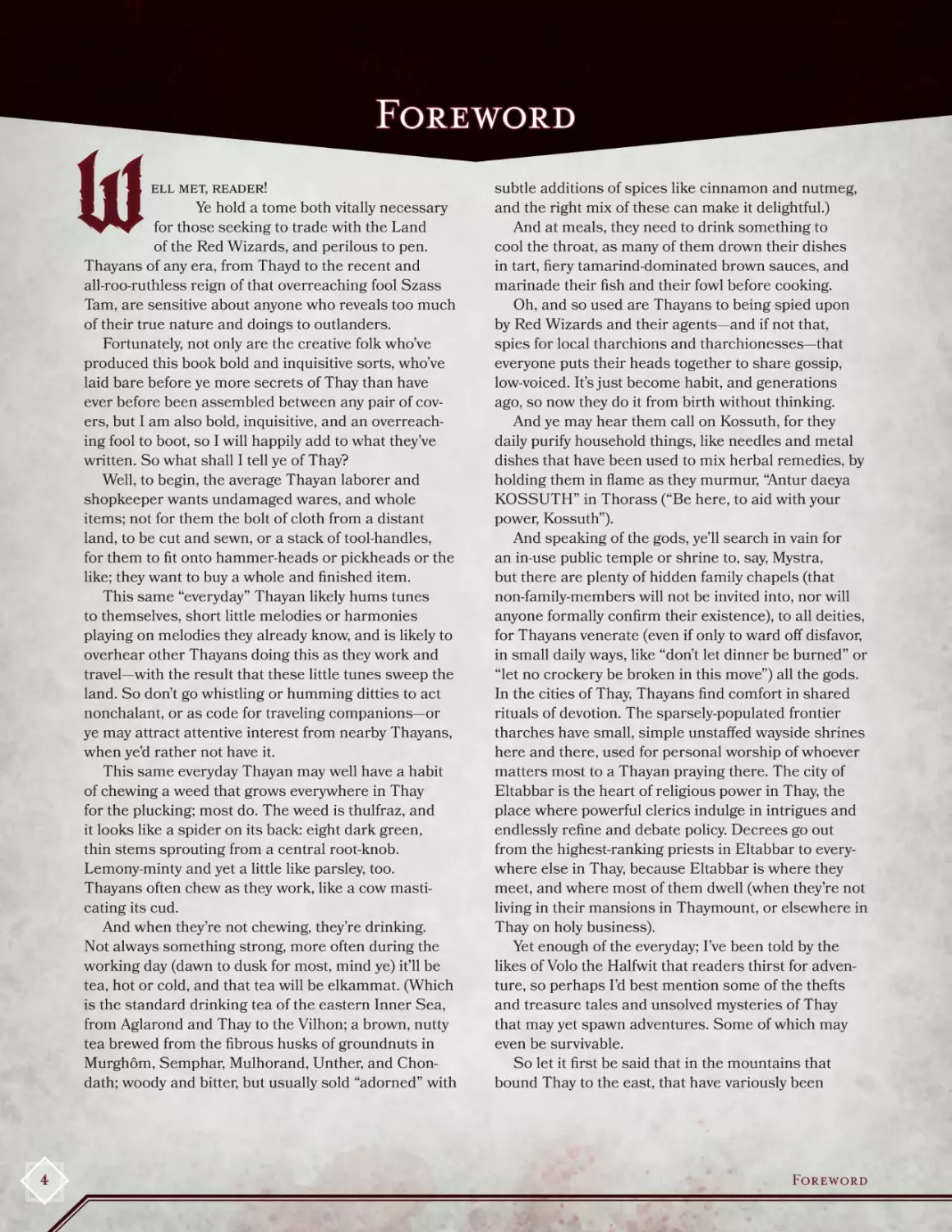
In the cover illustration by Britt Martin, we see a tense
trade negotiation in the street foyer of an Eltabbar merchant. Red Wizards Bezunthyn Phrul, Lazurmrella Hlaree,
and Harazulkh Orblaun are engaged in a tense negotiation with Thayan merchants Shelmazra Hornwyntur,
Albrynd Mrethem, and Alamrund Draug.
Watching the negotiations is the floating, purple skull
of the Red Wizard lich Hauzrym, often sent to watch
and listen for Szass Tam himself. If the ruler of Thay is
taking a personal interest in Ang Harrad dealings, the Ang
Harrad cabal may soon find itself used in some dark plan.
On the far right, Orblaun has had enough of the
contrary nature and curt refusals of important senior Ang
Harrad merchant Alamrund Draug, and is now forcefully
mingling not-so-veiled threats with trading details into
Draug’s ear.
Dungeons & Dragons, D&D, Wizards of the Coast, Forgotten Realms, Ravenloft, Eberron, the dragon ampersand, Ravnica and all other Wizards
of the Coast product names, and their respective logos are trademarks of Wizards of the Coast in the USA and other countries. This work contains
material that is copyright Wizards of the Coast and/or other authors. Such material is used with permission under the Community Content Agreement
for Dungeon Masters Guild. All other original material in this work is copyright 2022 by Ed Greenwood, Alex Kammer, and Alan Patrick, and published
under the Community Content Agreement for Dungeon Masters Guild.
Table of
Contents
Foreword. . . . . . . . . . . . . . . . . . . . . . . . . . . . . . . . . . . 4
Map of Thay . . . . . . . . . . . . . . . . . . . . . . . . . . . . . . . . 6
Part I: The Red Land
Chapter 1: The People of Thay. . . . . . . . . . . . . . . . 8
Life in Thay. . . . . . . . . . . . . . . . . . . . . . . . . . . . . . . . . . . . . 8
The Red Wizards of Thay. . . . . . . . . . . . . . . . . . . . . . . . 16
Magical Training . . . . . . . . . . . . . . . . . . . . . . . . . . . . . . . 18
Non-Magical Training. . . . . . . . . . . . . . . . . . . . . . . . . . . 18
Chapter 2: Ruling Thay. . . . . . . . . . . . . . . . . . . . . . 19
Thay and the Realms. . . . . . . . . . . . . . . . . . . . . . . . . . . .19
The Laraer . . . . . . . . . . . . . . . . . . . . . . . . . . . . . . . . . . . . 20
Civil, Cold War. . . . . . . . . . . . . . . . . . . . . . . . . . . . . . . . . 20
The Zulkirs of Thay. . . . . . . . . . . . . . . . . . . . . . . . . . . . . 22
The Separatists of Thay. . . . . . . . . . . . . . . . . . . . . . . . . 24
Thayan Military Might. . . . . . . . . . . . . . . . . . . . . . . . . . . 26
Chapter 3: Points of Interest. . . . . . . . . . . . . . . . . 31
Alaor, the Docks of Thay. . . . . . . . . . . . . . . . . . . . . . . . . 33
Delhumide, the Spirit of Thay. . . . . . . . . . . . . . . . . . . . 35
Eltabbar, the Wealth of Thay. . . . . . . . . . . . . . . . . . . . . 35
Gauros, the Wilderness of Thay. . . . . . . . . . . . . . . . . . 37
Lapendrar, the Pulse of Thay. . . . . . . . . . . . . . . . . . . . . 39
Priador, the Jewel of Thay . . . . . . . . . . . . . . . . . . . . . . . 40
Pyarados, the Bright Heart of Thay. . . . . . . . . . . . . . . 42
Surthay, the Absence of Thay . . . . . . . . . . . . . . . . . . . . 44
Thaymount, the Height of Thay. . . . . . . . . . . . . . . . . . . 47
Thazalhar, the Future of Thay. . . . . . . . . . . . . . . . . . . . 50
Tyraturos, the Bounty of Thay. . . . . . . . . . . . . . . . . . . . 51
Shelmazra’s Tour. . . . . . . . . . . . . . . . . . . . . . . . . . . . . . . 54
Chapter 4: Heroes from Thay. . . . . . . . . . . . . . . . 66
The Weavebound Paladin. . . . . . . . . . . . . . . . . . . . . . . . 66
New Magic Option: Circle Magic . . . . . . . . . . . . . . . . . 68
Thayan Backgrounds . . . . . . . . . . . . . . . . . . . . . . . . . . . 72
Thayan Equipment . . . . . . . . . . . . . . . . . . . . . . . . . . . . . 75
Chapter 5: Creatures of the Plateau. . . . . . . . . . . 77
Fey Creatures. . . . . . . . . . . . . . . . . . . . . . . . . . . . . . . . . . 77
Goblinoids. . . . . . . . . . . . . . . . . . . . . . . . . . . . . . . . . . . . . 77
Monstrosities . . . . . . . . . . . . . . . . . . . . . . . . . . . . . . . . . . 77
Star Spawn. . . . . . . . . . . . . . . . . . . . . . . . . . . . . . . . . . . . 77
Kyuss. . . . . . . . . . . . . . . . . . . . . . . . . . . . . . . . . . . . . . . . . 78
Undead . . . . . . . . . . . . . . . . . . . . . . . . . . . . . . . . . . . . . . . 78
Bogmaw. . . . . . . . . . . . . . . . . . . . . . . . . . . . . . . . . . . . . . . 79
Many-hued Goat. . . . . . . . . . . . . . . . . . . . . . . . . . . . . . . . 80
Protodracolich. . . . . . . . . . . . . . . . . . . . . . . . . . . . . . . . . 81
Poltergoat. . . . . . . . . . . . . . . . . . . . . . . . . . . . . . . . . . . . . 82
Part II: Intrigue in Eltabbar
Adventure Summary. . . . . . . . . . . . . . . . . . . . . . . . . . . . 84
Adventure Start. . . . . . . . . . . . . . . . . . . . . . . . . . . . . . . . 84
Gafna Bilton’s Tasks . . . . . . . . . . . . . . . . . . . . . . . . . . . . 90
The Wedding. . . . . . . . . . . . . . . . . . . . . . . . . . . . . . . . . . .99
Epilogue. . . . . . . . . . . . . . . . . . . . . . . . . . . . . . . . . . . . . 103
Appendix A: Probity Corps Black Site
Player Maps . . . . . . . . . . . . . . . . . . . . . . . . . . . . . 104
Appendix B: Party Invitation Handout. . . . . . . 106
Appendix C: Dark House of Tyranny
Player Map. . . . . . . . . . . . . . . . . . . . . . . . . . . . . . 107
The designers would like to assure and reassure every reader of these pages that every magical precaution has been taken
to shield them from the attention of any Red Wizard, malicious or otherwise. We assume no responsibility for any use made
of the information contained herein; you mess with Thay at your peril. Don’t mess with—oh, that's taken, never mind.
W
Foreword
ell met, reader!
Ye hold a tome both vitally necessary
for those seeking to trade with the Land
of the Red Wizards, and perilous to pen.
Thayans of any era, from Thayd to the recent and
all-roo-ruthless reign of that overreaching fool Szass
Tam, are sensitive about anyone who reveals too much
of their true nature and doings to outlanders.
Fortunately, not only are the creative folk who’ve
produced this book bold and inquisitive sorts, who’ve
laid bare before ye more secrets of Thay than have
ever before been assembled between any pair of covers, but I am also bold, inquisitive, and an overreaching fool to boot, so I will happily add to what they’ve
written. So what shall I tell ye of Thay?
Well, to begin, the average Thayan laborer and
shopkeeper wants undamaged wares, and whole
items; not for them the bolt of cloth from a distant
land, to be cut and sewn, or a stack of tool-handles,
for them to fit onto hammer-heads or pickheads or the
like; they want to buy a whole and finished item.
This same “everyday” Thayan likely hums tunes
to themselves, short little melodies or harmonies
playing on melodies they already know, and is likely to
overhear other Thayans doing this as they work and
travel—with the result that these little tunes sweep the
land. So don’t go whistling or humming ditties to act
nonchalant, or as code for traveling companions—or
ye may attract attentive interest from nearby Thayans,
when ye’d rather not have it.
This same everyday Thayan may well have a habit
of chewing a weed that grows everywhere in Thay
for the plucking; most do. The weed is thulfraz, and
it looks like a spider on its back: eight dark green,
thin stems sprouting from a central root-knob.
Lemony-minty and yet a little like parsley, too.
Thayans often chew as they work, like a cow masticating its cud.
And when they’re not chewing, they’re drinking.
Not always something strong, more often during the
working day (dawn to dusk for most, mind ye) it’ll be
tea, hot or cold, and that tea will be elkammat. (Which
is the standard drinking tea of the eastern Inner Sea,
from Aglarond and Thay to the Vilhon; a brown, nutty
tea brewed from the fibrous husks of groundnuts in
Murghôm, Semphar, Mulhorand, Unther, and Chondath; woody and bitter, but usually sold “adorned” with
4
subtle additions of spices like cinnamon and nutmeg,
and the right mix of these can make it delightful.)
And at meals, they need to drink something to
cool the throat, as many of them drown their dishes
in tart, fiery tamarind-dominated brown sauces, and
marinade their fish and their fowl before cooking.
Oh, and so used are Thayans to being spied upon
by Red Wizards and their agents—and if not that,
spies for local tharchions and tharchionesses—that
everyone puts their heads together to share gossip,
low-voiced. It’s just become habit, and generations
ago, so now they do it from birth without thinking.
And ye may hear them call on Kossuth, for they
daily purify household things, like needles and metal
dishes that have been used to mix herbal remedies, by
holding them in flame as they murmur, “Antur daeya
KOSSUTH” in Thorass (“Be here, to aid with your
power, Kossuth”).
And speaking of the gods, ye’ll search in vain for
an in-use public temple or shrine to, say, Mystra,
but there are plenty of hidden family chapels (that
non-family-members will not be invited into, nor will
anyone formally confirm their existence), to all deities,
for Thayans venerate (even if only to ward off disfavor,
in small daily ways, like “don’t let dinner be burned” or
“let no crockery be broken in this move”) all the gods.
In the cities of Thay, Thayans find comfort in shared
rituals of devotion. The sparsely-populated frontier
tharches have small, simple unstaffed wayside shrines
here and there, used for personal worship of whoever
matters most to a Thayan praying there. The city of
Eltabbar is the heart of religious power in Thay, the
place where powerful clerics indulge in intrigues and
endlessly refine and debate policy. Decrees go out
from the highest-ranking priests in Eltabbar to everywhere else in Thay, because Eltabbar is where they
meet, and where most of them dwell (when they’re not
living in their mansions in Thaymount, or elsewhere in
Thay on holy business).
Yet enough of the everyday; I’ve been told by the
likes of Volo the Halfwit that readers thirst for adventure, so perhaps I’d best mention some of the thefts
and treasure tales and unsolved mysteries of Thay
that may yet spawn adventures. Some of which may
even be survivable.
So let it first be said that in the mountains that
bound Thay to the east, that have variously been
Foreword
Foreword
called the Sunrise Mountains or the Sunset Mountains—very Thayan, that; in rulership, they can’t keep
to one decision for long—there are many tombs full of
long-hidden magic. Enchanted items, that dead mages
of early Thay were interred wearing, and whose
magics have often transformed the dead into undead—
lich-like, spellwielding unique undead, many of them.
These are small tombs of a few chambers gouged out
of cave walls, not grand buildings. A good thing, too,
for even Red Wizards aren’t quite so proudly unobservant and stupid as to not notice surface structures
just sitting there.
There’s also the Whispering Ghost, which is an
undead spirit actually more akin to a vampiric mist
than what we usually call a “ghost.” Or rather, scores
of such spirits, not a lone entity. Once they decide ye
will make a good means of helping them become more
powerful than they are, they hound ye, whispering to
ye in dreams and when ye’re alone, to try to goad ye
into doing things that will aid them. They’ll feed on
others, but not ye, unless ye repudiate or try determinedly to destroy them. Many a Thayan is the driven
tool of such a spirit, but they seem to seize upon
visiting outlanders with especial eagerness.
It would be remiss of me not to mention a somewhat similar whisperer, this one a lone lady: Qulone
Trythkul—that’s “koo-LOAN Trithh-KOOL”—who has
passed into undeath. She was Szass Tam’s lover,
or one of them, long ago, and he tired of her and
tricked her to her doom by getting her to retrieve for
him a magical scepter whose touch ate living flesh.
She wasted away after delivering it to him, but Tam
overreached once more, for he’d not realized the
scepter’s magic would enmesh with the lady’s own
worn enchanted items, dissolving them but making
her undead in the process as their magic sank into her
very bones. She exists now to get her revenge on Tam,
and may whisper to the living not just to do things
that may harm him or his schemes, but also to aid
them in escaping his minions and vengeance. Qulone’s
whispered counsel has rescued many outlanders and
Thayan rebels alike from doom.
And then there are the forgotten underways of
Bezantur, where many of its magnificent temples
were built atop the extensive cellars of grand noble
mansions that were simply covered over with rubble—
entombing all manner of creatures and wares, until
inquisitive Underdark denizens tunneled up into them
Foreword
from beneath. Most of them still lie dark and waiting
under the city’s cobbles, and their own thick layers
of dust, holding fistfuls of gems and only long-dead
Thayan servants know what else.
Yet I’ll ramble for pages and pages, given the slightest opportunity, and it’s not me ye’ve come for! ’Tis the
splendor of Thay.
So read on, and until next we meet on some
page or other,
Yours in the service of Mystra,
Elminster of Shadowdale
5
6
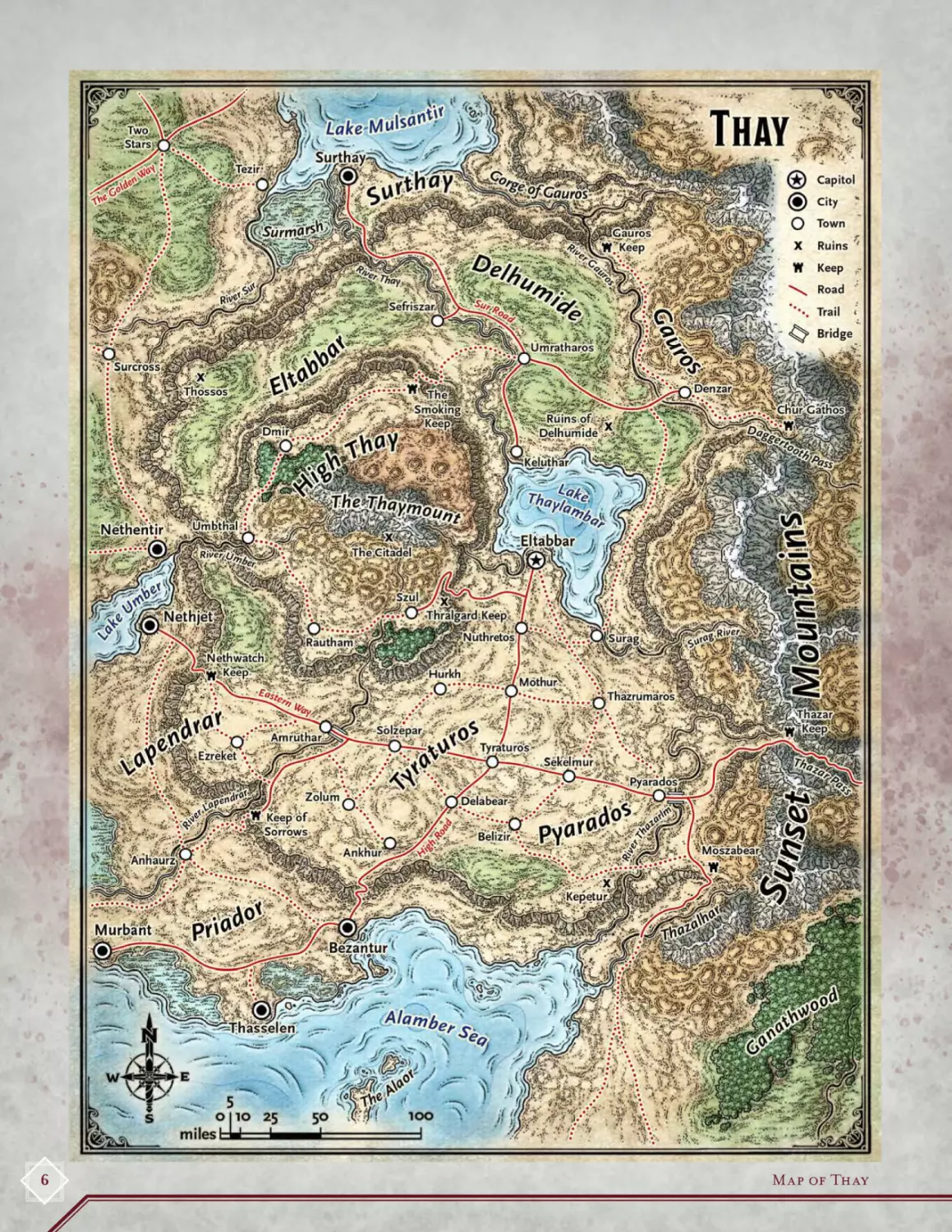
Map of Thay
PART I
The Red Land
CHAPTER 1
T
The People of Thay
hay. The name invokes images of an evil
nation, bent on conquering the surrounding
kingdoms and subjugating them to their will.
It brings to mind vibrant imagery of massive
undead armies, explosive magics, and demons
shackled by profane rituals to perform the will of their
vile masters.
But this isn’t entirely correct. While Thay is led by
a group of evil mages, it is also home to thousands of
innocent, hard-working people. The nation is perceived
to be evil, but as with all things, perception is based
only upon what people are allowed to witness. Those
who explore Thay often find that it is filled with gentle,
peaceful people that are content to fill their days with
crafting and family. However, these people are still
bound to their leaders and labor under the ever-present
risks associated with their vicious leaders.
Life in Thay
The people of Thay are primarily human, but other
races find homes here as well. Even those races that
are typically considered monstrous, such as goblins
and bugbears, may be able to establish homes in
some of the tharches (states) of Thay. They are a hardworking people, mainly focused on their daily tasks,
and only rarely do they plan into the future beyond
satisfying the needs of their children.
Each of the tharches are given greater detail
elsewhere in this supplement, but the general essence
of Thay is that the people are honest and reliable,
but labor under the oppressive yoke of a totalitarian
arcane regime. The zulkirs that rule the nation place
their desires and goals above those of the people, and
while each of the rulers do desire to promote and
protect Thay, nothing is as important as themselves.
Unlike previous years, the worship of deities other
than Mystra is now permitted in Thay. Each tharch
8
claims influence from a small number of deities, with
most people across the nation revering some mix of
Chauntea, Gond, Mystra, and Waukeen. In a surprisingly supportive move by several of the tharches, the
recognition and even the worship of the Mulhorandi
pantheon has become commonplace.
The Folk of Thay
Nearly all of the citizens of Thay are of two main
ethnic groups. The Mulani comprise the bulk of the
bureaucracy and aristocracy. The Rashemi are the
other primary group; they tend to be burlier and
shorter than the Mulani.
Mulani Thayans are raised to obey the laws of Thay,
revere Red Wizards and especially the zulkirs and
Szass Tam above all, and believe they are an integral
part of the most powerful and advanced realm in
the world. Thanks to their upbringing, many tend to
be arrogant, especially towards non-humans. Many
Mulani view such as elves and halflings as equivalent
to children, while gnomes and dwarves are often despised or driven away under pain of death. Other races
like orcs, half-orcs, and centaurs are tolerated so long
as the Mulani believe that they can be employed as
useful, strong-backed individuals.
A typical Mulani is tall and thin with brown or
hazel eyes, deep yellow through brown to, in very rare
circumstances, almost slate-gray skin. They have very
little natural black or dark brown body hair, which they
are generally expected to keep closely shaved. As a
result of a drought in Thay’s past, the people typically
oil any remaining hair that they have and bathe in
scented oils that are later scraped off the body along
with any dirt.
Many Thayans bear intricate tattoos whose patterns reflect their goals and accomplishments. Similarly, Red Wizards often have many tattoos signifying
Chapter 1: The People of Thay
marks of mastery and prestige, but these are often
far more detailed than those a Mulani Thayan might
dare to acquire without truthfully earning them. While
such intricate tattoos were almost always limited to
men in the past, such a taboo is no longer present and
all people are free to demonstrate their designs and
accomplishments via tattoos.
Typical Mulani attitudes include these beliefs:
• We of Thay are the most advanced folk in the world.
• Thay is strong because Thay is well ordered, and
we steadfastly uphold what makes Thay great
through our traditions.
• We seek to master the Art (arcane magic), sending
our children to be apprentices under veteran Red
Wizards so that they may make Thay ever greater.
• It is the innate right of Thay to be best and mightiest; we need no guidance from gods.
Thayans hate and fear others of magical might, especially when those people come from the neighboring
nations of Rashemen or Aglarond. Far-off locations
such Halruaa and Calimshan are also viewed as
opposition at least and vile enemies of Thay at worst.
Thayans have been taught to view these people as foes
to be thwarted and denigrated whenever possible, and
ignored and not spoken of the rest of the time.
Mulani Thayans make up most of the bureaucracy
and upper class within Thay, and look down on Rashemi commoners. Zulkirs, tharchions and tharchionesses, and senior bureaucrats (sometimes referred
to as Thaen) tend to be drawn from the ranks of the
Mulani, first from the most financially successful,
long-powerful, and haughty families like the houses of
Cathyl, Iryleian, Thrond, and Valakkar, and secondly
from individuals of outstanding personal drive and
merit. As a result, there are very few lazy, corrupt, or
incompetent administrators in Thay; those in power
are efficient, insightful, and quick to act with precision.
The bulk of Thay’s citizens, the shopkeepers and
skilled laborers and overseers of most slave workteams in the realm, are of Rashemi stock: short, burly,
muscular, hairy-bodied people with thick black hair,
dark eyes, and light to dark brown skin. Unlike Rashemi in Rashemen and elsewhere, Thayan Rashemi
shave their heads to emulate Mulani Thayans. Thayan
Rashemi see themselves as the true heart and core of
Thay’s greatness, carrying the realm upon their backs
and doing the work that is truly necessary—for the Mulani lack the skills to properly feed themselves, build
or make anything, or really function; all they know is
how to decide and lead and boss others around, and
so they are nothing without us to do the real work
for them. This engenders not so much resentment of
Mulani as a deep pride that we the workers are pulling
Thay forward and ever upward, to brighter greatness.
Chapter 1: The People of Thay
Thayan Society
Historically, Thay was a magocracy. The nation was
headed by a ruling Council of Zulkirs who pursued
ever-greater mastery of the Art and left military
matters—such as the frequent invasions of Aglarond,
Rashemen, and other neighboring lands—and
administration of the daily life of the country to the
noble tharchions and tharchionesses of districts of
Thay (tharches). Today, however, Thay has become
a dictatorship that is ruled by the undead lich Szass
Tam, a tyrant who largely dictated policy to the Council of Zulkirs and appointed Red Wizards to it who
would obey him.
Despite his increasingly erratic and failed attempts
to achieve godhood or at least far greater power, the
beliefs of High Regent Szass Tam—that the pursuit of
greater mastery of the Art was the supreme aim in any
existence, and that achieving undeath was the best
way to do so, as it opened a personal portal to limitless power and opportunities—have over time come to
permeate Thayan society and thinking.
Those Thayan citizens who have the aptitude to
wield arcane magic become Red Wizards, and ruthlessly vie for advancement and power through diligent
service to the High Regent, often in intrigues and
mercantile schemes all across Faerûn.
Those who lack the Gift for wielding the Art see
no reward for them in Thay. Lichdom is offered only to
natural-born masters of the Art, so their only benefit is
the privilege of being a citizen; while this enables them
to have a chance to accumulate wealth or petty local
power, it simply fails to satisfy the deep and ravenous
appetites that most Thayans possess.
Over the passing years, whether supreme authority
rested in the hands of Szass Tam or the Council,
the social order in Thay below the rank of Zulkir
remained much the same, though the true authority
of tharchions was steadily eroding. The Red Wizards
are on top, with their own hierarchy descending from
Zulkir and their spies and enforcers to senior mages
of each school, then the rank-and-file experienced
mages, down through the novices.
Below the Red Wizards come the rest of the nobility: the Mulani tharchions, bureaucrats, sages, priests,
and the richest merchant families, the houses who
invest in the businesses of lesser merchants and are
landlords to most Thayans dwelling in cities. Beneath
these are the military commanders and veteran soldiers of Thay, who may or may not be Mulani nobles,
for over time Thay has learned the hard way to reward
merit and experience in their military.
Then come the rest of the merchants, enjoying a
status in society commensurate with their personal
wealth, influence, and achievements. Engineers
and owners of forges and construction materials
9
and warehouses rank highly, mingled among the
best artisans and craftworkers. Beneath them stand
the most successful shopkeepers, more than a few
of whom own chains of outlets, and proprietors of
currently-popular city eateries. This middle class are
Mulani, Rashemi, and mixed-lineage humans, and
at the bottom of it are apprentices, skilled laborers,
and crafters.
Then come the lower class, semi-skilled workers
and common laborers, bodyguards and shop and
warehouse guards, and loaders and drovers, who
might be of any Thayan-tolerated race, including obvious outlanders. Some are citizens but most are not.
Finally, underpinning everything in Thay, are the
many, many slaves. Some through long service have
won some measure of trust and are allowed to work
under light or no supervision—but slaves are never
freed in Thay; they always belong to someone, and
Slavery in Thay
Although slavery is known and accepted by the
aristocracy of Thay, it is not accepted elsewhere in the
Forgotten Realms and beyond. If your games broach
this topic in more than a passing manner, it should
be made expressly clear that this is an evil act and one
that should be rectified. Alongside that, no matter how
“good” a Thayan may pretend to be, those that allow
the continued practice of slavery are inherently evil.
10
upon the death of an owner are inherited by someone
else or seized by a creditor. In recent years it has
become less acceptable to bring in new slaves, and
even less palatable to have living slaves—the upkeep
simply isn’t worth it in the minds of many of the eldest
Thayans—and so the market for undead servitors
has been on the rise. This, coupled with a younger
populace that is becoming more and more impactfully
vocal about the need to prove Thay’s value through
direct action rather than on the backs of slaves may
put the very concept of slave ownership in question.
The Thayan View
All Thayans seek more power in society, and more personal wealth. They also work towards personal fulfillment by attaining the skills and mastering the hobbies
and pastimes that bring them the greatest personal
pleasure. Painting, sculpting, and the making of fine
jewelry are prestige crafting even among Thayan
nobles and are considered personal expression as well
as a source of enrichment. Paintings, statuettes, and
jewelry are important Thayan exports.
Caring for others, and compassion—beyond the
duty of rearing one’s own offspring and guiding them
to their best chances for advancement, and loyalty to
trusted trade allies and conspirators—is for weaker,
lesser humans. Rather, be strong of will and clear of
purpose, and seize what can be yours.
Thayan Fashion
In Thay, the foundation layer of underwear is a
breechclout, consisting of a tight-fitting belt or sash,
through which a strip of readily washable fabric is
passed fore and aft, and between the legs between
its foldover meetings with the belt. Also used in
Mulhorand, Raurin, and Unther, this garment is
known in Thay as a qadamra, and tends to be cotton,
dyed a solid dark hue, and to contain a small “private
carry-pouch” sometimes filled with a folded spare
qadamra; sometimes with an armor or bone plate for
protection of the wearer’s private areas; and sometimes for secret carriage of vials of poisons, healing
potions, or contraband.
Thayan Cuisine
Traditional Thayan cooking makes abundant use
of diced olives, leeks, lemons and lemon juice, and
thaenen (a wild, tall grass that grows everywhere in
Thay and the wilderlands to the east that isn’t too
Chapter 1: The People of Thay
rocky or dry; it tastes a little like spring onions but
more like lemongrass).
Honey is the usual sweetener in Thayan dishes
(even in places where no one “keeps” bees, rocky
terrain in Thay is home to plenty of wild bees), onions
make frequent appearances, and so, as fill-the-belly
bases, do barley and what Thayans call quth (in our
world, “broad beans” or “fava beans”). Common
Thayan spices include garlic, nutmeg, and cloves.
In northern Thay, morren (rhubarb), arrath (celery),
persimmon, and quince join the kitchen staples. Along
the Red Land’s southern coasts, wild rice makes its
way into dishes but is seldom seen elsewhere. In Thay,
grain—mainly barley and rye—is plentiful; rice is not.
Most Thayan bread is flatbread, cooked on hearthheated stones. Fancy breads are sprinkled with nuts
and honey, and heavier, heartier, coarser “field bread”
for farm laborers and wayfarers often has diced leeks,
onions, or garlic mixed into its flour.
Thayan cookery makes use of spiced, fiery wine
marinades for fish and fowl but not for meats, and the
dishes outlanders all remember are those dominated
by tart, hot tamarind sauces (“brown sauces” from
their appearance to those who don’t know what’s
in what they consume, but “rarthaek” to Thayans).
Almost every Thayan cook has family recipes for
rathaek that they swear by, but although these vary
11
widely in heat, they tend to be similar in overall flavor
profile. Rarthaek is poured on a dish when it’s ready
to serve, and the “iron-throated” will even add more
at the table for “a good deep burn,” but there are also
kitchen sauces, or “ulvurr,” that begin as lemon juice
and wine mixes, are thickened with what we would
call a roux and a Thayan cook would call a “dusult”
(“Dusult it more—that’s a thin as a child’s spit! More
fat is what it needs, and swiftly!”), that a dish cooks in.
Phalou
To keep dishes from drying out from the hearth-heat
(the ulvurr boiling off), many Thayan dishes are
cooked in metal pans over a fire, that have a series of
conical, spout-topped earthenware lids over them, to
aid in condensation and so, keep the moisture in to
intensity flavor. In our real world, these are usually
called tajines or tagines, but they are always singular
(tapering smoothly to a single chimney or spout).
Thayan versions are called “phalou” (singular and
plural are the same word), and consist of lipped bases
(so a phalou placed over a metal dish will rest on its
rim and also overlap it on the outside) of standard
sizes, and straight edges so several can be placed
touching each other down the length of a long metal
cooking-dish (resulting in complete coverage, and a
row of two or up to four parallel chimneys).
Spices and marinade can be poured down a chimney to try to “enliven” a dish, but that’s the mark of a
poor cook, as it cracks a heated phalou sooner or later
(usually sooner). Tongs and padded gloves and a roll
of a leather kitchen apron are all employed to remove
phalou and move dishes about.
Drinks with Meals
A diner unused to Thayan cuisine is going to find a lot
of heat in their mouth and throat, and even Thayans
like to have iced water, or minted or lemon-laced
water, on the table before they begin eating—and eateries (restaurants) expect to sell a lot of cold ale, wine,
or liqueurs (ruby brandy is always popular in Thay) to
cool diners’ throats throughout a meal.
Thayan farmers make pear wine (taress) and peach
wine (tarai), but Thayan vintners make such wines as
the minty, semi-sweet emerald-green nethaele, the very
dry dark red ommanth, and the amber-hued shulda, a
semi-dry fruity. All of them are blends of grapes and are
made all over Thay, with the means of making them
widely known among the populace, so there’s little rivalry among vintners and almost no “wine snobbery.” In
Thay, wine is wine. Kindly refill my goblet or tallglass.
Snacks
Snacks and “way food” (trail hand-meals) in Thay
include cinnamon-dusted fried locusts and talang beetles (think ladybugs big enough to fill an adult human
palm), deep-fried “long onions” (think “onion rings,”
12
but using a straight spring onion as a base, and filling
it with red wine before frying), and dang (mixes of
spiced nuts, doused in honey which is then baked
into a glaze).
A growing “food fashion” in Thay, spreading
fast from its origins in Nethjet, is to make and sell
“adorned” honey: honey with powdered dill or garlic or
onion or cinnamon simmered into it before jarring. The
typical Thayan honey-pot is teardrop-shaped, with a flat
round bottom but a pointed, curved top that becomes,
when its thin brass stopper is removed, a pour-spout.
Upscale Meals
Signature dishes at upscale restaurants include such
delights as Fireturtle (a fiery stew of cut-into-strips
turtles and watersnake over diced onions, leeks, and
sweet peppers), Gulhaunt (the necks of herons and
swans, cooked to falling-off-the-bones softness in the
cook’s complex and usually secret blend of spices;
the aim here is to make the dish taste nice and even
“nutty” but not fiery), and Anathur’s Feast (a mix of
roast lamb, goat, and fowl, in lemon-dominated spices;
a sure way to start a friendly dispute among Thayans
is to ask who Anathur was, as everyone has their own
wildly different story).
Everyday Meals
More “everyday” fare, to be found in private homes
and in “everyday” eateries, is dominated by three
dishes: dardraun (spiced roast fowl), cardrauth
(stuffed fowl), and taeth (baby eels or squid in garlic
sauce). Detailed recipes follow; interested modern
cooks are warned that although every one of these
dishes is safe to eat (notes to real-world cooks appear
in squared parentheses), the flavor profiles Thayan
palates prefer may seem unusual to the modern diner.
Dardraun
Serves 4 hungry diners with hearty appetites
First, dress (defeather, wash, and slice apart
to begin deboning) your fowl.
From the larder:
broth
olive oil
1 lemon [or 1 lime]
1 onion
From the hearth:
fowlsimmer [modern substitute: chicken broth]
From the spice cupboard, take you and mix in
a small bowl:
4 pinches dtarmin [1 tsp. ground paprika]
4 pinches dauntaun [1 tsp. ground cumin]
1 pinch hot ground pepper [1/4 tsp. cayenne pepper]
2 pinches ground ginger [1/2 tsp.]
2 pinches sarataun [1/2 tsp. ground coriander]
1 pinch ground cinnamon [1/4 tsp.]
Chapter 1: The People of Thay
From the cupboard but keep aside:
Salt, to taste
Pepper, to taste
At the cutting board:
1 onion, halved then cut into smallest-finger-thick
slices [1/4-inch-thick-sliced yellow onion]
5 cloves garlic, minced, but set 1-clove-worth aside
from the rest
3 medium (or 2 large) parsnips or carrots, peeled then
cut into finger-thick coins [1/2-inch-thick]
A cupped pair of hands of pitted, halved green
olives [1/2 cup]
A cupped pair of hands of parsley or savory [1/2 cup] or
half that of rosemary
Fowl [about 4 pounds of bone-in, skin-on de-necked,
de-winged ducks, or chicken or turkey thighs]
Once you begin:
A swift pour [1 tbsp.] olive oil
1 small ladle [2 tbsp.] of barrzin (barley flour)
[all-purpose flour can be subsituted]
4 cupped pairs of hands of fowlsimmer [2 cups of
chicken broth]
Twice thy olive oil of honey [2 tbsp.]
A pouring-vessel of drinkable water
Do it thus:
• Get thy hearth-coals ready, and a roasting pan that
has a cover, and a metal hot-save-bowl, and tongs of
a size to handle the fowl, and a small sharp knife,
and a platter and some small bowls.
• With the knife, frazzle the lemon [modern: zest the
lemon, but make sure to remove the preservative
wax coating first, if it’s not an organic lemon]. Combine in a small bowl the 1 clove-worth of minced
garlic ye set aside with a like amount of the frazzle,
and set that bowl aside also. Reserve the rest of the
frazzle in yet another bowl for later.
• Then salt and pepper the fowl pieces, both sides;
if uncertain how much, let it be 2 pinches pepper
and 8 pinches salt, combined in another small bowl
before applying to the fowl.
• Heat the olive oil in the roasting pan (no pan cover,
for now) until the oil doth begin to smoke. Then put
the fowl pieces into it, skin side down in a single
layer, and fry until deep golden, about 5 minutes;
then turn the pieces over and brown the other side,
about 4 minutes. Then take the fowl out onto a
platter to let cool.
• From the pan, pour off and discard all but a palmsized trace of any fowl-fate from the pan, into the
hot-save-bowl, for other days and other dishes. Set
the pan over lesser heat.
• Turn ye back to the fowl, and peel off the skin and
set aside for the broth-pot or pets to dine upon.
Chapter 1: The People of Thay
Dardraun
• Then back to the pan. Add to it the onion and
cook, stirring occasionally, until the slices have
browned at the edges yet keep their shape [likely
5–7 minutes]. Should the pan darken overmuch
ere browning hath befallen, add water to the pan in
small amounts, bewaring the steam!
• When thy onion slices are browned, add all the
minced garlic ye did not mix with the lemon frazzle
to the pan and cook, stirring about the pan, until
the garlic smell strikes thy nose hard [likely half a
minute], then add the bowl of spices and immediately the barrzin, too, and stir without ceasing until
their smell joins the garlic to the fore [likely another
half minute].
• Now stir ye in the fowlsimmer, then the honey, and
then the frazzle ye did not mix with the garlic earlier,
plus another pinch [1/4 tsp.] of salt, and scrape the
pan to dredge up anything browned.
• Add the fowl back in, then take the pan to even
lesser heat, cover it with the pan cover, and let it
simmer for long enough to enjoy a good, unhurried
tankard [10 minutes].
• Then add the carrots or parsnips, cover anew, and
simmer until the carrots are crisp and tender and
the fowl is cooked through [another 10 minutes
more or so].
13
• Then it is time at last to stir in a swift pour [1 tbsp.]
of the juice of thy lemon, then the garlic-frazzle
mix, then the parsley or savory or rosemary,
and the olives.
• Stir well, then take from the heat and taste the
sauce when cool enough. Add more lemon juice,
pepper, and salt to taste. Done.
Pairs well with cooked barley.
Cardrauth
Serves 4 hungry diners with hearty appetites
First, assemble thy utensils: a good big pouring-vessel
of drinkable water; kitchen needles and kitchen
twine; a roasting rack; two roasting pans; and several
bowls, both large and small; clean linens [towels],
tongs or hot-gloves for the handling of rack and pan;
fire-irons for tending the hearthfire; longfork or tongs
for turning the cooking fowl; wet-sieve if ye have one
(spare hot-tolerant ewer and towels for straining, if ye
do not), and one serving-platter for all the fowl, that
can take heat.
Build a good hot hearthfire, coals to last.
Then, dress (defeather, wash, and slice apart to
begin deboning) your fowl and mince thy beef, or
procure from the market or slaughterhouse:
About 5 lbs. fowl (bone-in, skin-on, de-necked, and
de-winged duck, goose, or swan) [modern: yes, you
can substitute chicken or turkey]
1/2 lb. minced meat (cow or ox meat)
From the hearth:
2 cups fowlsimmer [modern: chicken broth, 2 cups]
From the larder:
A goodly skin of dry red wine [2 cups or a trifle more]
A goodly skin of the unstrained juice of apples [2 cups
or a trifle more, of unsweetened apple juice]
A slow pour [5 tbsp.] olive oil (or another cooking oil,
such as sunflower)
A cupped pair of hands of honey [1/2 cup]
A cupped pair of hands of apricot jam or jelly [1/2 cup]
A cupped single hand of pulverized stale bread
[breadcrumbs: a 1/4 cup]
3 good-sized apples, of a sour sort
1 orange or persimmon
1 leek
3 onions
From the spice cupboard:
4 pinches marjoram
4 pinches oregano
2 pinches sage
2 pinches thyme
3 pinches sarataun [1 tbsp. ground coriander]
4 fists [about 1 lb.] of salt
1/3 lb. sugar
14
A palm-full of ground pepper
5 bay leaves
1 sprig rosemary
1 sprig thyme
And for the sauce:
The cook’s palm half-full of cashew nuts [1/3 cup]
The cook’s palm half-full of chestnuts [1/3 cup]
If either nut can’t be had, double the one ye can get
A finger-joint-length of ginger
The cook’s palm full of ground cinammon [or 1 stick]
3 pinches [1 tbsp.] of barley flour [all-purpose flour]
1 apple
A swift pour of olive oil [or sunflower or other
cooking oil]
1 fist salt
1 fist ground pepper
Do it thus:
• Check thy hearth for readiness. Set water
near it to warm.
• Pluck the fowl, then wash it inside and out, pat dry.
Then rub it well inside and out with salt and pepper.
• Wash the apples, peel them, halve them, core them,
and cut into cubes. Set aside in a small bowl.
• Wash clean the leek, dress its ends, then cut the
stalk all into rings. Set aside in another small bowl.
• In a large bowl mix together the marjoram,
oregano, sage, thyme, sarataun, a pinch of pepper,
the cashew nuts (they can be whole), and the
breadcrumbs. Then mix in the minced meat.
Then add the cut-up apple and leek, and the wine,
and mix well.
• Take this wet mixture and stuff the cavity or cavities
of the fowl with it (worry not if you have more
than will fit, but discard this excess not), using
the needles and the twine. If thy fowl retains its
wings, tie them to the carcass so they’ll burn not in
the cooking.
• Mix thy oil with the leftover seasoning mix ye
stuffed the fowl with (if ye have none, use pinches of
salt and pepper) and coat the fowl with it, all over.
If thy fowl is intact enough to have a breast side,
place fowl pieces or whole bird breast side up on a
roasting rack.
• Place thy (larger, if they vary in size) roasting pan
in the hearthfire, and cautiously—scalding steam
warning!—pour warmed water into it, about the
thickness of the cook’s hand, or more [modern
cooks: water in the pan first, then slide into lower
rack of oven, fowl will go in a roasting-pan on upper
rack]. Position the roasting rack above the roasting
pan, and on it roast the fowl until ready [about 4
hours at 200º F].
Chapter 1: The People of Thay
• During this time, gently warm the fowlsimmer near
the hearthfire, so it spits not (it will, if used cold).
• When the color deepens sufficiently [after about
an hour] turn the fowl over, and baste it with the
fowlsimmer. Thereafter, baste several times, as you
think it necessary [about every 30 minutes], but
keep the remaining fowlsimmer, do not use it all.
• When the turned-over fowl has attained the same
color as at first turning [so, about two hours
into roasting], prick the legs and wings of the
fowl [if any] with a fork to let the fat of the fowl
fry the better.
• When the fowl sizzles and sings, if you wish to
brown it, build up the fire around it [at the 3:45
mark of oven cooking, increase oven heat to
230º F]. Move thy water to near enough the fire
to heat, but not boil. Also move thy serving-platter
near, to get warm.
• When thy fowl is ready, take it off the hearth-heat
onto a surface that can withstand the heat, and
cover it, to let it rest for the length of two long songs
[let it rest out of the oven, covered, for 10 minutes].
• While it rests, take three small skins-worth [3 cups]
of thy heated water and add to the remaining fowlsimmer, then strain this mix through a sieve.
• Now make ye the sauce. Wash, peel and halve the
apple, core it and discard the core, and dice it. Peel
the ginger and cut it up fine. Let thy sauce-portion
of oil heat in thy second roasting-pan. When steam
starts to rise from it, add the diced apple, ginger,
cashew nuts, chestnuts, and cinnamon. Then stir
once, and let fry for the length of a song [about 3
minutes]. Then pour in the sieved fowlsimmer-water mix, and build up the fire or move it to a hotter
spot, to bring the pan contents to a boil. When the
bubbles are hearty, stir in thy flour, and add salt
and pepper to taste, and let boil hearty for less than
half a song [about 1 minute], then take from heat.
Let rest while ye carve the fowl, then use tongs to
remove the cinnamon stick.
• On thy cutting surface, carve thy fowl, stuffing and
all. Arrange on thy warmed platter and pour the
sauce over it. (If platter not large enough for sauce,
put sauce into pourer for diners to apply, but serve
swiftly lest the fowl grow cold too soon.)
Taeth
Serves 4 hungry diners with hearty appetites (much
faster to prepare than the other two popular dishes)
First, assemble:
A roasting pan
A large bowl for serving the dish to table
Water for washing the eels or squid
Build a good hearthfire.
Chapter 1: The People of Thay
From the market:
15 oz. baby eels or squid
From the larder:
Half a small skin of white wine [1/2 cup or a trifle more]
2 swift pours [2 tbsp.] olive oil (or another cooking oil,
such as sunflower)
2 cloves garlic
From the spice cupboard:
1/2 cup white wine
Salt and pepper
1 fist paprika (or less, to taste; some may
prefer half that)
Do it thus:
• Heat oil in roasting-pan over a good fire.
• While it heats, clean thy eels or squid (for the latter,
cut out and discard beak and “quill” of cartilage),
and then mince thy garlic.
• When oil is hot, add minced garlic and baby eels or
squid, and fry in the oil until cooked through. Pour
in white wine slowly to cut down on spitting, then
season with salt, pepper, and paprika, and simmer
until the meat of the eels turns opaque, or the
squid-ends just start to curl.
• Then take off heat and serve. Often paired with
fried dumplings.
General Economy
Much of Thay’s commerce is centered on trade. As the
last major power ere travelers heading east from settled Faerûn cross the Sunrise Mountains and venture
into the Endless Wastes or the wildlands of the Plains
of Purple Dust and the Great Wild Wood, Thay controls the flow of goods in and out of the trade routes
between the eastern and western lands. They also
have significant influence in ports around the world,
from Mulmaster to Baldur’s Gate and beyond. Even
fair Waterdeep has some amount of Thayan influence.
The nation creates a significant amount of food exports as well. They offer large crops of wheat and corn
every year, and several tharches are rich in berries
and tomatoes. Thayan metallurgy is also highly sought
after by collectors of fine wares, with Thayan-mined
silver and gold pieces often fetching exorbitantly high
prices due to the brilliant hues and level of purity
found in these metals in their natural veins in Thay.
Thay is well-known to the world at large as being
the home of some of the most luxurious types of
goats. Some of these breeds have coats as thick and
voluminous as a sheep’s fleece, others have intensely
rich milk which is perfect for both consumption
and soap-making, and a few offer a variety of meat
that is so intensely delectable that it is said to cause
a pleasant delirium upon completion of the meal.
15
Nobles around the world often jump at the chance
to acquire goat products from Thay, with a few
merchants even going so far as to enter into franchise
farm agreements with commercial farmers in Thay so
that the breeds can be experienced the world over.
Mining in Thay
Mineral mining tends to be vast open workings rather
than tunnels, which results in a lot of barren “broken
lands” dominated by hills of loose scree tailings and
dust. The process of mining follows these steps, after
a working face is established. Often this begins with
a prospector calling upon their patron wizard to blast
the rock; those prospectors that aren’t working for a
wizard often find that they enter into the service of
one soon after finding a rich vein of gems or minerals,
whether they want to or not.
Another popular, and largely nonmagical, method is
to employ a flail-wagon. This large many-axled wagon
has huge tree-trunk wheels and is fitted with giant
pickaxes chained to hand-cranked rotating drums, so
as the drum turns a forest of flailing pickaxes screechingly descends and rebounds, attacking a rock surface.
Then the flail-wagon moves on, and the rock is soaked
with jets of water hand-pumped from water-tank
wagons. Then a low-level wizard casts a spell to turn
the soaked-in water to ice, so this ice cracks the rock
internally as it expands, and then teams with threeman-long prybars and hammers and splitting wedges
go in and break open that area.
After the rock is sundered, magically or otherwise,
upspars are erected. A skilled team accomplishes
this by setting up a prepared portable upright beam
with many legs that can be leveled or secured at
different elevations. To keep it stable, the beam is then
weighed down with rubble-filled boxes. Each upspar
has jointed arms ending in rock-scoop buckets, that
descend from pivots in a collar-sleeve atop the upright
spar, this bucket-arm is guided by workers on the
ground around using pull-chains. The bucket is ridden
by one person, who with cords guides its scooping
motion, and opens and closes the bucket.
The buckets move the broken rock rubble to a sidearea where it is broken down into smaller fragments
by teams wielding mauls or mallets. This process
gleans the desirable ore from the tailings. The tailings
are taken away to a dumping area, and the ore hauled
away for smelting.
This is distinct from quarrying stone for building,
paving, and roofing uses. Stone grit and gravel is often
gathered and carted to riverbanks for roof- and drainage-tile making.
16
General Government
While it is generally well-known that Szass Tam is
the individual in control of Thay, most people aren’t
aware that he leads a Council of Zulkirs that rules
the nation, generally by delivering his decisions and
acting upon his demands. Each Zulkir that Szass has
recruited represents one of the eight schools of magic.
Below them are the tharchions or tharchionesses,
the rulers of each of the tharches (effectively, states)
of Thay. These tharches and their rulers are detailed
elsewhere in this supplement.
It’s important to remember that the zulkirs are
powerful and ambitious, and while they all seek to protect and promote Thay they all have very strong ideas
about how best to accomplish these tasks. They work
together for the most part, but it is not uncommon for
them to harbor their own goals and to sometimes plot
against their fellow zulkirs. While they are allies, they
are certainly not friends.
The Red Wizards of Thay
In Thay, a true Red Wizard is beyond reproach.
They are not, however, beyond approach—herein are
methods by which a future Red Wizard is identified
and trained, and some examples of how they might
conduct their business. Pursuing mastery of the Art is
their core drive, and more often than not they are loyal
to none but themselves.
Identifying Talent
In infancy, every Thayan resident, citizens and visitors
alike, are tested by Red Wizards to see if they possess
the Gift to practice magic. In rare circumstances a person may be given a second test when they first enter
into adulthood. Beyond these times the Red Wizards
deem magic to be soured or lost.
The first test is almost always delivered covertly
and by surprise, letting the youngling encounter subtle
active magic in play to see if they sense anything about
it, or can affect it. This may take the form of a spell
involving warmth or radiance, or an enchanted item
that glows and can be turned on or off, or the glow
altered in intensity or hue. These are rarely complex
enchantments but are always configured to be manipulatable by someone strong in the Art. Successful or
not, this will be followed by a formal test done by two
or more Red Wizards in which the youngling’s status
is tracked in a register, so that they may be identified
for their as magical threat and potential. The chief
fear of all Red Wizards is unrecognized, potentially
hostile wizards or sorcerers of power dwelling in Thay,
in their very midst.
If a young person has no discernable Gift or affinity
or magic, no wild talent or psionic ability or sensitivity
Chapter 1: The People of Thay
to magic, they are steered into tutelage intended to
discover what they do have a knack for, so they can be
shaped into becoming a craftworker, scribe, or other
useful member of Thayan society. If they do have the
Gift, they are removed from their current family and
situation and are reared by Red Wizards and nurses
under the command of Red Wizards.
This controlled upbringing, away from family and
wider Thayan society, is intended first and foremost to
instill loyalty to Thay. This includes not just the land
or the nation of Thayans, but also the hierarchy of Red
Wizards, their role in safeguarding all of Thay against
treachery from non-wizards high (ambitious tharchions
and nobility) and low (such as disaffected poor farmers
and citizens of little power), as well as “outlander spies
of rival realms jealous of our achievements, who work
tirelessly to weaken us.” Red Wizards are taught that
Aglarond, Rashemen, and Mulhorand all want the
Red Wizards gone so they can conquer Thay, and that
distant financial rivals like Baldur’s Gate, Sembia,
Waterdeep, and the Zhentarim all want to slyly
dominate or come to own Thayan assets, and thus are
constantly seeking to blackmail Thayans into acting for
them, and that the nearby ruling dragons of Murghôm
would pounce on Thay to hunt humans at will were it
not for the deterrance the Red Wizards offer by their
very presence.
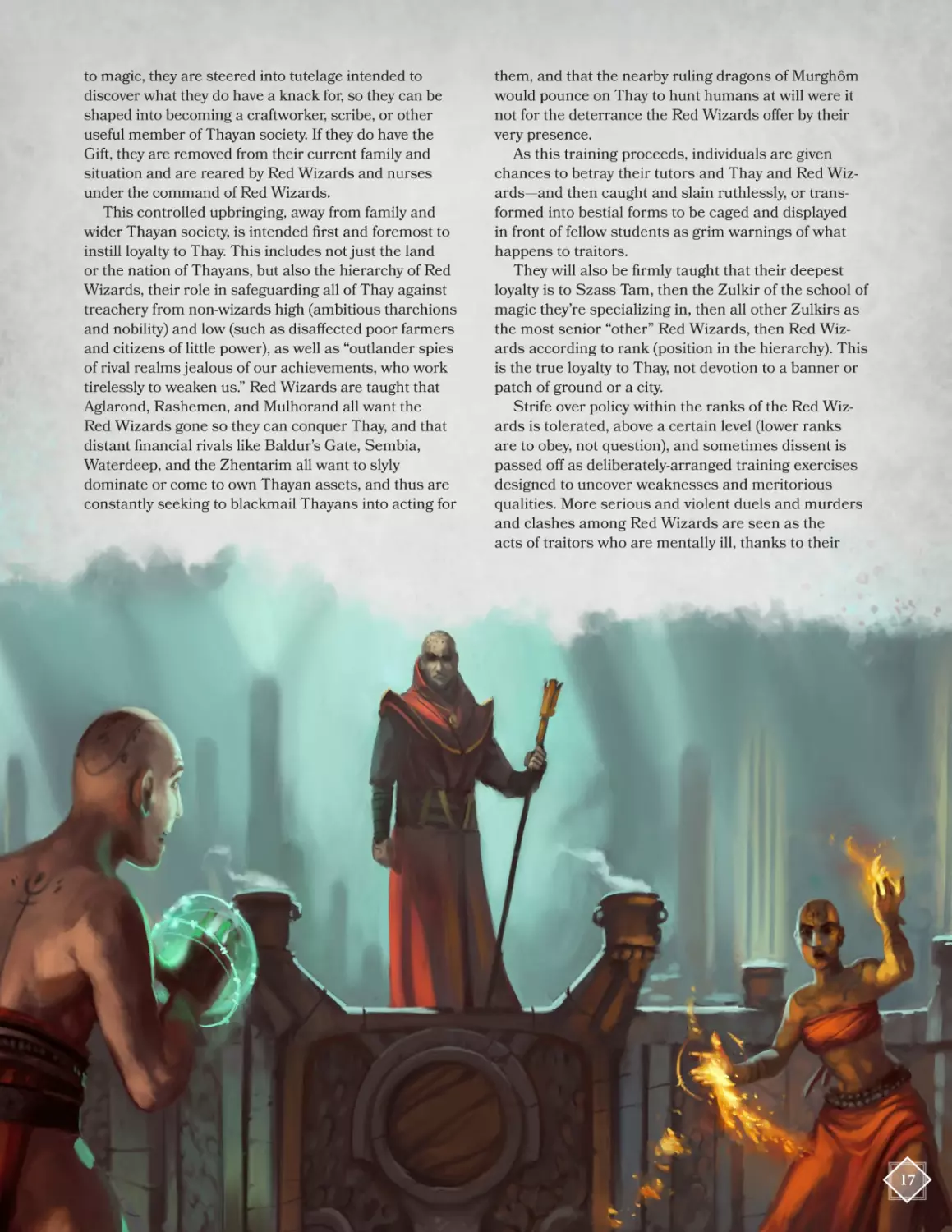
As this training proceeds, individuals are given
chances to betray their tutors and Thay and Red Wizards—and then caught and slain ruthlessly, or transformed into bestial forms to be caged and displayed
in front of fellow students as grim warnings of what
happens to traitors.
They will also be firmly taught that their deepest
loyalty is to Szass Tam, then the Zulkir of the school of
magic they’re specializing in, then all other Zulkirs as
the most senior “other” Red Wizards, then Red Wizards according to rank (position in the hierarchy). This
is the true loyalty to Thay, not devotion to a banner or
patch of ground or a city.
Strife over policy within the ranks of the Red Wizards is tolerated, above a certain level (lower ranks
are to obey, not question), and sometimes dissent is
passed off as deliberately-arranged training exercises
designed to uncover weaknesses and meritorious
qualities. More serious and violent duels and murders
and clashes among Red Wizards are seen as the
acts of traitors who are mentally ill, thanks to their
17
treachery festering inwardly until it breaks forth—for
only the insane would question their purposes, their
fitness to rule, and their plans and strivings for a
brighter future.
Magical Training
In the olden days, Red Wizards of the various schools
of magic sought to capture potential Red Wizards
who showed skills in their school for training and
rearing and eliminate strong-in-the-Art individuals
who showed aptitude for other schools, but Szass
Tam put a stop to that as he tightened his open rule,
as these habits weakened the Red Wizards as a
whole. Now, training is a mixture of math and history
(strong on the “We are Thay, and Thay is the feared
and unappreciated light of an ignorant world” indoctrination), languages, and trade skills, with a broad
range of magical testing sprinkled among the other
tutoring to reveal what sort of schools of magic a given
student is good at.
Once this personal aptitude is revealed, Red Wizards are formally entered into their education. They
are taught with exhaustive, repetitive practice under
supervision. They are given and expected to master
not just a basic roster of relevant-to-them useful spells,
but also to cast these magics in precisely the same
way each and every time.
Red Wizards at lower levels are actively discouraged when it comes to experimentation with existing
spells and are not permitted to create new magics or
variants; they’re told that this is dangerous to them
and to everyone around them. Simply put, those that
pursue such foolish notions are irresponsible and
reckless at a minimum, or are fools and if pursued
anyway are traitors to be hunted down and destroyed.
When experimentation is allowed, it is under the
direct and constant supervision of a senior Red Wizard who has authority over the experimenters. The
intent is to keep Red Wizards loyal above all, with a
conformity of obedience so they will make not just the
right decisions in a combat situation, but react in the
“right”—that is, as expected by superiors—way. This
is one important instance of how Red Wizards differ
from the Zhentarim, with their open intriguing for
advancement, and the War Wizards of Cormyr, where
conformity has long been seen as a weakness any
enemy can exploit.
18
Non-Magical Training
Red Wizards are trained in a broad smattering of
languages, in customs and habits of the traveling
merchants of many lands, and are also trained in the
lives of monsters—especially those most likely to be encountered in Thay and the lands immediately around
it. A Red Wizard is also trained to try to “read” facial
expressions, movements, and tones of voice to try to
tell what a stranger is likely thinking, or about to do, or
their attitude towards the Red Wizard or others. They
are taught always to be alert, aware of surroundings
including escape routes, possible nearby foes or hazards, and potential attack vectors, and to pay attention,
even in crowded streets or markets, of movements
and stealthy behavior—all without seeming to watch.
So many Red Wizards encountered outside of Thay
are apt to be ready when surprise-attacked, because
to them attack really wasn’t a surprise, but perpetually
anticipated.
And lastly, every Red Wizard is encouraged to
develop their own side-interests or hobbies, anything
from collecting tiny carved figurines to covertly assembling valuable Sembian urban real estate. Zulkirs have
long seen that this cuts down on treachery and rash
acts by giving Red Wizards an outlet for stress and
anger, a feeling (however false; as Dove Falconhand
once put it, “the only retired Red Wizards are the
dead ones that have the good sense to stay dead”)
that there’s something for them to escape to if they
ever tire of being a Red Wizard or things get too hot
for them, and side expertise that can serve them well
as they serve Thay. Having a Red Wizard who can fix
a leaky boat, pick a lock, or successfully impersonate
a courtier of a different land and gender can be very
useful in advancing Thayan interests.
Luskan
Their enclaves are fading away and on their own,
so now the Blood-Robes are more like Zhentarim
wizards in a red uniform, one more nasty bunch of
mages out to rule the world. And whatever they tried
in and about Neverwinter failed, and everyone knows
it, so they’re as prone to pratfalls as all the rest of us.
Don’t turn your back on them.
—Farlo Dethremmon,
warehouse owner and trader,
Shadows Lane, Southbank Luskan
Chapter 1: The People of Thay
CHAPTER 2
Ruling Thay
T
he nation of Thay is ruled by the ancient
lich Szass Tam and his selected council of
zulkirs. Together, these beings maintain the dayto-day operations of their individual tharches but
also the ever-present war machine of Thay. These
rulers are inherently evil as they seek to provide for
themselves first and foremost, but they work tirelessly
to defend their people should they be threatened
from any source.
Thay and the Realms
Thay is generally seen as an evil nation by the other
powers of the world. This label is important for two
reasons: firstly, in that it is not inaccurate due to
Thay’s history as a nation of conquerors and instigators as they seek out magic and territory across
Faerun; and secondly, in that it is not entirely accurate.
The Thayans use war engines, monsters, highly
trained arcanists, and the like in their conquests. But
they also use common people that have been pressed
into service, given hollow offers of land ownership
or citizenship, or have been otherwise coerced into
military service. And those that don’t serve in the
military directly may find themselves toiling endlessly
under the yoke of Thay’s exorbitant taxes and living
fees, straining to provide for themselves and their
families as those above them in the hierarchy grow fat,
lazy, and mean thanks to their efforts. Still, the nations
of the world that are aware of these injustices are
extremely hesitant to strike at Thay to resolve the matter as time and again, the zulkirs have demonstrated
that they are willing to sacrifice their own people in
defense of the nation and their ideals.
Chapter 2: Ruling Thay
To say that rebellion is brewing is an understatement. Hidden enclaves of citizens of Thay exist
through the tharches, especially around the larger
cities, that are beginning to suspect that Szass Tam’s
inability to gain a decisive victory against Rashemen,
the Wychlaran, or even the Zhentarim mercenaries,
is a clear sign that the current leadership council is
more focused on preserving their own local power
than promoting the interests of the nation at large. It
has not gone unnoticed that many of the zulkirs have
remained entirely within the nation’s borders for many
years, unlike in the past where a Zulkir would visit
Waterdeep or Baldur’s Gate at times, or even lead
attacks in the greater world.
Alongside the emerging groups of concerned citizens are a small but influential group of Thayan expatriates. These individuals have enmeshed themselves
in the ongoing political schemes of the world at-large,
with many of them referring to themselves as zulkirs.
These people may or may not have legitimate claim to
these titles. Perhaps they’re merely separatists, desperate to depose the ancient lich and take control of
the plateau. Perhaps they’re legitimate zulkirs, unable
or unwilling to return to Thay until some mission is
completed. Only time—and Szass Tam—will tell.
The lich and his inner circle of zulkirs that remain
within the borders of Thay are thoroughly embroiled
in their own power struggles and efforts. Periodically
rumors of a Zulkir being supplanted may reach the
ears of the outside world, but Szass Tam maintains a
tight grip on such communications. As far as the world
knows, the zulkirs presented elsewhere in this chapter
represent the current list of people in charge of Thay.
19
The Laraer
Laraer (“lahr-AIR”) is a Thayan dialect word meaning
“big change” or “life change” or “new direction in life.”
Although this term can be broadly applied, the people
of Thay refer to one specific event as “the laraer.”
Some 150 years prior to today, an event known as
the Spellplague ripped through Faerûn. Magic was
undone and the Weave began to spew wild threads of
arcane power across the whole of the world. During
this time many Red Wizards of Thay found their
minds broken and an unknown number of arcanists
died as their spells failed or turned against them.
This event broke Thay’s power structure and nearly
broke its people.
Arguably, no individual in Thay was more deeply affected than Szass Tam, the ancient lich that ruled the
nation. His magic became unreliable and his attention
and concentration, which had previously allowed him
to juggle many schemes and magical experimentations were shattered. No longer could he magically
spy on the important players in Thayan politics and
society; no longer could he abide neither the presence
nor even the sight of undead creatures—especially
those that he had created, for now that magic was unraveling, the protections he had woven into the spells
that animated them were becoming undone, and some
became mindless killing machines while others were
granted their free will once more.
For a time, Thay was effectively on its own. And
Thayans, who live to inhale, eat, and drink intrigues
and schemes, did not sit idle in this time of chaos and
ruling weakness. Red Wizards at a stroke lost their supremacy, and many learned the hard way that slaves,
upon whose backs the nation of Thay had been built,
bear no burden of historic gratitude when a chance at
freedom is presented. In a dramatically short time, an
immense amount of scores were settled, “accidents”
occurred to Red Wizards, manors were thoroughly
destroyed, and trade organizations were subjected
to what the rest of the world politely referred to as “a
series of hostile takeovers.” As the wizards flailed for
stability, the outside world simply waited and watched.
Such actions weren’t limited to the Thaymount and
surrounding tharches. All across the world, Thayan
enclaves and centers of power were realized to be
finally vulnerable. Many were outright destroyed
and nearly all were looted. Those Thayans that lived
outside of the nation’s borders knew fear in those dark
days, fear that was justified and well-deserved.
The nobles of Thay, who’d long resented being
shoved aside from the reins of power, saw a chance
to regain power and influence at the expense of Red
Wizards within reach. Every dead Red Wizard is one
less spy and agent for Szass Tam, and a chance for a
noble to make decisions or enrich themselves instead.
20
Many Red Wizards were hunted by a flood of hired
assassins; for the first year of the Spellplague’s raging,
it seemed that any Red Wizard was a suitable target.
Adventurers made for prime bounty hunters, and
organizations like the Harpers and Emerald Enclave
made no secret of their attempts to further destabilize the region.
Thayans who didn’t happen to be either noble
or Red Wizards saw chances to redress slights and
wrongs, and went after Red Wizards, too. They
also realized the danger and increasing expense of
keeping live slaves. The historic mindset of unthinking
acceptance of slavery as “the way society works, and
should” was wiped away, and in that shattering of the
status quo and its acceptance, many Thayans started
to think energetically and seriously about change
in Thay, and a different country in the future. The
remaining Red Wizards felt that they had made a
pragmatic shift in their processes and culture but had
unwittingly set the stage for true societal advancement
by this course of action.
Thayan change—laraer—was everywhere, inside
Thay and all across Faerûn. Szass Tam’s ever-tightening grip on power changed in nature and might, reliance on slaves and their numbers declined sharply,
intrigues and grand dreams among “just plain folks”
soared, and Szass Tam discovered that the obedient
undead Zulkirs he’d installed in his ruling council
lacked vision, imagination, ambition and the drive it
fosters, and attentiveness to human nature; they repeatedly overlooked details, and didn’t notice cabals
and treachery beneath them, unless Szass Tam was at
their sides, guiding them. Szass had no choice but to
turn to the living, even with their near-certain
disloyalty.
Right Now, in Thay
Truly, this was the laraer. Change all over, and in
nigh everything. Where will it head? And what will
Thay become?
Ah, that is why this is one of the most interesting
times of all to be in Thay. Change, as our real-world saying puts it, is “busting out all over.” It’s a time for entrepreneurs, a time for adventurers, a time for innovation
and new livelihoods and new things. It’s the Laraer.
Civil, Cold War
Szass Tam has been in power for hundreds of years
and has taken care to install the correct zulkirs as
his support base. He is fully aware that some of the
currently living zulkirs plot against him, but he has
learned from the previous decades and centuries that
using liches as zulkirs leads to a leadership platform
Chapter 2: Ruling Thay
that merely echoes his sentiments rather than work to
develop the nation as it needs to be. For all of Szass
Tam’s villainy and transgressions, he does indeed treasure his nation—this love is second only to the love
he feels for magic itself, and Mystra by association.
He tolerates the plots of the zulkirs until they cross
the line and directly threaten him or the well-being of
Thay as a whole; when this happens, he is unhesitant
and total in his retaliation.
In recent years, he’s found it to be much more
efficient to simply expel an offending Zulkir or Red
Wizard under pain of eternal magical torment should
they return to Thay rather than wait for them to grow
arrogant enough to strike against him. Unknown to
the general populace, Szass has recently closed the
borders to the nation for his zulkirs. They are not permitted to travel outside of the nation, even via magic,
as he works to consolidate his power and smooth the
operations of the people and the state. By expelling an
offending Red Wizard and cutting them off from support, he knows that they will have many challenges in
the outside world and, down deep in his mind, that if
they return empowered and emboldened then perhaps
it is truly the will of Mystra that they should do so.
Szass’s stance in politics and the control of trade
in and out of the nation has led to uprisings from
the citizenry on more than one occasion in the past.
The most recent uprising is led in spirit by a Red Wizard in Mulmaster by the name of Dar’lon Ma. Dar’lon
has claimed the title of Zulkir of enchantment and has
been working with other Red Wizards that are not
present upon the plateau to create his own council
of zulkirs. He plots to one day storm Thaymount and
slay Szass Tam so that Thay can return to its rightful
place of glory among the Realms. Dar’lon and his
compatriots have toiled long and hard to recover lost
magic from ancient Netherese ruins, mind-shattering
aberrant beings from beyond the stars, dead gods, and
other sources to support and further their mission. As
Red Wizards and even zulkirs cross or irritate Szass
Tam and are expelled from Thay, he cautiously addresses them and explains his mission in an attempt
to bring them into his fold. So far, his charismatic
crusade has gained him a significant amount of power
and followers. Dar’lon’s rebellion isn’t public knowledge and more often than not, if someone were to talk
about a Thayan rebellion they would be dismissed as a
crackpot or conspiracy theorist.
As with the behavior of upstart zulkirs, Szass
Tam tolerates Dar’lon Ma and his separatists. As of
yet, they have not launched a decisive strike against
Thaymount and as such the lich cares little for their
squabbles and kingdom-building efforts. Even so, he is
keenly aware of the fact that trouble is brewing for his
beloved Thay and that he will once against be called
upon by his people to protect them from forces they
neither understand nor comprehend—at least, this
is what he tells himself. Heroes across the Forgotten
Realms have found themselves enmeshed in this
power struggle, and whether they know it or not,
everyone has a part to play in the coming battles.
21
The Zulkirs of Thay
Although the nation of Thay answers to Szass Tam as
its one true ruler, they also have a council of Zulkirs
that oversee the general operations of the nation.
The zulkirs each represent a single school of magic,
and they all have their own schemes and plots. Many
zulkirs are liches, and all are loyal to Thay first
and foremost.
Szass Tam
As the sole ruler of Thay, Szass Tam often finds
himself burdened with the process of ruling his nation
rather than doing what he prefers to do: research
magic and delve into forgotten lore. A terrifyingly powerful lich, Szass is the only creature known to have
bargained with the ancient lich Larloch and retained
his independence—as well as gaining gifts and training. Szass seeks to establish a council of zulkirs that
is simultaneously loyal to Thay and himself and has
come to realize that having undead zulkirs often leads
to those beings either losing themselves in schemes
and plots of their own creation, or simply becoming
echo chambers for his own desires (as is more common). He has, in recent years, sought to expand the
criteria for becoming a zulkir largely due his realization that populating these roles with undead, including
liches, only results in creating an echo chamber for his
own plots and machinations. To promote Thay, Szass
Tam must identify and recruit arcanists that are loyal
to him, devoted to Thay, and wholly dedicated to the
support and defense of the nation—all while being possessing free will and remaining clear of the corruption
of the outside world or personal plots.
Abjuration
A woman known only as Sirikhan has taken the
position of Zulkir of abjuration as her own. She is a
human of Shou descent and busies herself with matters east and south of Thay along the Golden Way, the
main trade road that connects the western lands with
the lands of Kara-Tur far to the east. Szass Tam has so
far been impressed with both her ability to accomplish
the tasks that he sets before her but also her willingness to speak her mind, even when her opinions do
not match those of the ancient lich. Sirikhan was last
referenced in DDAL-DRW05 Uncertain Scrutiny.
Conjuration
Saj Amog is a Thayan lich and a staunch ally of
Valindra Shadowmantle, the Zulkir of necromancy.
Prior to his return to Thaymount, Saj was stationed in
Neverwinter and worked to quell the rebel uprisings.
He was later tasked by Szass Tam to capture a dread
ring, a heinously evil creation that Szass desired for
his own purposes. While it is true that Saj Amog is
22
a lich, he is not under Szass’s complete control as is
Samas Kul, the Zulkir of transmutation, and he often
wonders what Szass Tam’s endgame really is for the
nation of Thay.
Divination
Yaphyll, a ruthless and cruel human Mulan woman,
served as the Zulkir of divination for just over a hundred years until she died while performing a complex,
powerful ritual at Szass Tam’s command. Though
he knew that she had previously worked against his
position as the one true ruler of Thay, he knew that her
command of divination magic marked her as an extremely powerful member of the council of zulkirs, and
as such he desired to raise her from the dead. Unfortunately, the ritual that ultimately took her life bound her
with a small piece of the blue flame known generally
as the Spellplague, and he was unable to raise her. In
an unexpected turn of events, though, she clawed her
way out of her tomb when Valindra Shadowmantle
returned from Chult; the exact reason is uncertain,
but it has piqued Szass’s interest. She is not undead
but she appears to be frozen in age in her early forties.
Despite his best efforts and much to her delight, Szass
Tam is unable to use telepathy or divination magic to
spy upon her.
Enchantment
This position was previously held by a Red Wizard
named Lauzoril. Lauzoril arranged and conducted a
massive insurrection, even going so far as to motivate
most of his fellow zulkirs to strike out at Szass Tam
and his armies. Although Szass retaliated, Lauzoril
seemingly escaped and has not yet been discovered.
As multiple previous zulkirs of enchantment have
proven themselves to be hostile to Szass Tam, the
lich has determined that this seat is cursed and is to
remain vacant until such time as he finds, or creates,
an appropriate candidate for the role of Zulkir.
Evocation
M’Weru is a human woman from Rashemen. She uses
her knowledge of the Wychlaran to her significant
advantage in her post as the Zulkir of evocation. She
controls her magic to such an extent that her power
is at once terrifying and intoxicatingly beautiful to
behold, as she can reportedly shape those magics
in previously impossible ways. Szass Tam recruited
her after she decimated a pair of Red Wizards and
disintegrated their guards without breaking from her
ongoing conversation with a harbormaster in Alaor—
all without damaging the docks or causing additional
casualties. M’Weru was last seen in DDAL-DRW05
Uncertain Scrutiny.
Chapter 2: Ruling Thay
Illusion
Hlarkus Baltreyo is a male human lich that rarely, if
ever, saw cause to leave Thay. He has been a long-time
supporter of Valindra Shadowmantle and threw a
massive celebration upon Szass Tam’s announcement
of her promotion to the role of Zulkir of necromancy.
A devilishly skilled illusionist, he delights in crafting
images and experiences are so lifelike that they pass
for being alive themselves. He was exceptionally fond
of creating illusory forms of the friends and family of
his foes. Due to circumstances outside of his control,
Szass Tam can exert complete control of Hlarkus if he
desires to, even going so far as to treat Hlarkus as a
familiar should he desire to.
Necromancy
As a reward for her efforts in uncovering the mysteries
of the Soulmonger in the jungles of Chult, Szass Tam
promoted the reckless moon elf lich Valindra Shadowmantle to the position of Zulkir of necromancy.
A resourceful and vicious creature, Valindra both relishes her new role and chafes at the restrictions that
it imposes upon her activities. She longs to shed the
mantle of leadership and return to the world beyond
Thay’s borders so that she can strike down those that
would stand against her beloved homeland. Valindra
Shadowmantle was last seen in Tomb of Annihilation,
which shows the activities that would see her promoted into this role.
Transmutation
Samas Kul served as the Zulkir of transmutation
under Szass Tam for nearly a century until his
gruesome assassination. However, Szass Tam found
him to be a serviceable ally and worked to return the
tall, morbidly obese wizard to Thay. Samas is now
an undead creature under Szass Tam’s control, and
while he possesses a small spark of personality he is
largely, as with the other undead zulkirs, an extension
of Szass Tam’s will and ideology.
Candlekeep
History has shown us that all attempts to control
access to the Art are doomed. Cabals of mages who
share spells and research in secret are one thing, and
guilds who seek to set prices and curb mage-tyrants
are another, but the Red Wizards of Thay are the
worst sort of oppressive wizards’ collective. They
foment fear that inevitably leads to outbursts of
violence, in which those not of their membership
destroy books and spell-scrolls and sometimesirreplaceable knowledge in the process, seeking to
wipe out or weaken those they hate and fear.
Moreover, the Red Wizards seek to control what
Art is learned, and how, and that is evil in itself, as
well as foolishness that never ends well. Still, if such
stains were not upon the world, we’d appreciate no
brightness, and be tempered by no testing flames.
It’s sad that such words are the best praise I can give
them, but there you are. Be wiser, if not less sad.
—Ulmarth Rendikho,
Monk of the Avowed
Chapter 2: Ruling Thay
23
The Separatists of Thay
This faction of powerful Red Wizards led by Zulkir
Dar’lon Ma of Mulmaster is no less evil than their
counterparts that reside within the borders of Thay.
They firmly believe that their claims to the title of
Zulkir are legitimate and they staunchly defend their
positions as such. While they are careful to not call for
the removal of Szass Tam and the others, they have no
qualms about referring to the impending changes that
Dar’lon will be implementing.
Dar’lon Ma is no stranger to controversy and has
worked to establish several new zulkirs for realms
that did not exist before: artifice, chronomancy, and
information. Szass Tam has long held that only a
school of magic is to have a Zulkir, but Dar’lon has
expanded this model to include information as a
school of thought rather than a school of magic. This
is troublesome for the Red Wizards of the plateau, and
while it shows some progressive thinking on Dar’lon’s
part, it also demonstrates his capacity for strategic
thinking as he shapes his influence into a chokehold
around Thay proper.
Artifice
Lantan is an island nation close to Chult but this does
not reduce their impact on modern culture. As time
goes on, the practices of the artificers that dwell and
practice there have pushed into the larger world, and
Dar’lon Ma has recruited a Lantanese artificer to be
the Zulkir of artifice. This is a significant departure
from established Thayan practices in that historically
only Thay-born Red Wizards could ascend to this
status, and some have correctly surmised that this
Dar’Lon Ma
24
association was done to more closely bind Dar’lon’s
vision of Thay to the Isles. No name has been
formally given for this person, as Dar’lon only refers
to them by title. Some believe that the Lantanese
artificer is actually the subject of a magic jar spell
and that their soul has been replaced by that of a true
Thayan Red Wizard.
Chronomancy
The school of chronomancy is new to the modern
world, but also a holdover from the ancient Empire of
Netheril. Research into this type of magic is ongoing,
and Dar’lon Ma makes no secret of the fact that he is
actively seeking to fill this role in the near future. At
this time, the magic of chronomancy is barely more
than a theory; time-manipulation magics have been
largely banned by Mystra and the few lingering reminders are limited to spells such as haste and slow. It is
safe to assume that any individual hoping to become
the Zulkir of chronomancy will need to demonstrate
their mastery of this school of magic in some diabolical
fashion in order to earn their rank.
Divination
The title of Zulkir of divination has been claimed by
Damond, an aged human male and native of Thay. Despite his obviously advanced years, he is in excellent
health and remains quite spry. His mind is equally
nimble, and he equally invokes and projects an aura of
dangerous cunning at all times. Every aspect of life is
but a game to him—a game where only he can see the
pattern, where few aside from him are aware of the
rules, and everyone is but a pawn to be manipulated
by the scant few people and creatures that are actually in charge.
The More Things Change…
Dar’lon Ma is a fired-up Red Wizard and is open about
his desire to depose Szass Tam’s council of zulkirs. He
believes that he can lead Thay to a better future, and
while he does not state that he wishes to destroy the
vile lich he won’t deny that “sometimes things must
break and be reforged”. The people that he is gathering
across the Forgotten Realms are powerful and driven,
possessed of their own goals and machinations, and
altogether evil. No matter how much gloss is applied
to a Red Wizard, their motives are inherently evil. No
matter what good they’re willing to perform upon their
road to conquering Thay, the end result is, and always
has been, total domination and subjugation of Thay, its
people, and its holdings.
What may come of the separatists winning their cold
war? What evilness will they perpetrate to accomplish
their goals? They are simply one set of would-be tyrants
seeking to depose another, and the cost to the people
of Thay is monstrous, as it always has been.
Chapter 2: Ruling Thay
Damond and Dar’lon Ma have a strong relationship
even though it is an open secret that the old diviner
is known to be working closely with Szass Tam. Both
Red Wizards seek to promote Thay, and the lich
wishes to use every available tool to its utmost potential. When the inevitable conflict occurs, Damond
aims to be poised at the summit of greatness one way
or another. Damond was last encountered in DDALDRW05 Uncertain Scrutiny.
Enchantment
After the city of Mulmaster was decimated by crazed
cultists, a charismatic human Red Wizard by the name
of Dar’lon Ma saw an opportunity. He claimed the title
of Zulkir of enchantment and initiated efforts to rebuild
the city in exchange for unfettered access to several
historical sites that had been discovered in the vicinity
of the Moonsea. His plans have since expanded and his
influence has been felt as far away as Chult. His words
call for alliances and the deposing of Szass Tam, but
his all-too-bright smile promises only pain and poison
for everyone involved. Dar’lon Ma was first encountered in DDAL00-01 Window to the Past and has
appeared in numerous adventures in the Dreams of
the Red Wizards storyline. He is generally considered
the leader of the Red Wizards outside of Thay.
Information
While information isn’t a school of magic, it is a school
of thought. Dar’lon’s chosen Zulkir of information
has been referred to as Dusk, a charismatic darkling
residing in Luskan. As Zulkir of information, Dusk
manages propaganda, both positive and negative,
for Dar’lon Ma and all Thayans that can’t or won’t
live within the nation’s borders. As with the Zulkir of
artifice, Dusk is not a native of Thay and represents an
evolution of Dar’lon Ma’s vision of leadership.
Vacancies in the Council
No Red Wizard has claimed the title of Zulkir for Abjuration, Conjuration, Evocation, Illusion, Necromancy,
or Transmutation. Neither has Dar’lon Ma made
reference to anyone in these roles. Perhaps this is
because the right candidate has not yet defected from
Thay, or perhaps Dar’lon simply hasn’t found the right
individual to take their place in his growing regime.
Only the future knows!
25
Thayan Military Might
Reports of Szass Tam’s mindless legions of terrifying
undead are borne and spread across the length and
breadth of the Realms. The mere mention of these
hordes in a council meeting in the far-off Dales is
enough to see a motion to improve a town’s fortifications approved. And there is good reason behind the
terror that these swarms inspire.
Thay’s undead legions operate like an army of
unthinking and relentless ants. When confronted by
an obstacle such as a river, they unhesitatingly plunge
themselves into the water as more and more pile atop
the underwater ones, to form a bridge/road across the
torrent so the rest of the force can swiftly cross. They
move themselves and whatever they are transporting
over the submerged creatures finishing with the
“drowned” undead walking up out of the water to
follow as if the entire effort was no bother at all.
Yet thanks to the defenders of Aglarond, Thay has
learned that Red Wizards should always reinforce
undead armies. When they don’t, enemy mages can
readily set a battlefield of advancing Thayan undead
aflame, then hold them off from behind a deep ditch
and rampart until the ashes can advance no more.
Rational battlemasters across Faerûn suggest that
despite Thay’s staggering undead headcount the Red
Wizards must follow some kind of martial doctrine or
process. Unfortunately, very little is known about the
actual makeup of Thay’s armies and tactics outside of
those that actively serve. What follows is a summary
of the intelligence that has been recovered by agents
of the Zhentarim and the Harpers; the veracity of
these points is hotly contested by military powers
across the world.
Despite the undeniable fact that Szass Tam’s
unlimited throng of undead is the central feature of
Thayan military might, it is hardly the entire picture.
Thay also boasts a standing army, navy and a division
of secret police all composed of mortal humanoids
rather than mindless undead. While fielding droves of
undead that do not require either rest or food affords
obvious advantages, the undead bring their own set
of notable drawbacks as well, primarily among them
from a military standpoint being the lack of ability to
think tactically and to reason generally. This is where
the Thayan Knights, the Water Fist, and the Probity
Corps come in.
Thayan
Knight
Rank Insignia and Titles
Rank insignia are customarily worn on both shoulders,
and they are the same for army and naval units. All
elements of an insignia are depicted in crimson, on a
black field. See the Current Military Ranks of Thay table
on page 28.
Any Red Wizard attached to a military unit uses and
is addressed by their customary rank. Any non-Red Wizard mage or sorcerer attached to a military unit holds
Vardhond-equivalent rank and is called a “Nauthkir.”
Thayan nobility are treated and addressed as their
knightly ranks.
The title of “Autharch” is a Lord Mayor equivalent
in the governing bureaucracy of Thay (i.e. the head administrator of a city), but is also bestowed as a military
title for the Lord Commanders of standing garrisons
(i.e. the commander of a fortress, or the troops guarding a city).
26
Water Fist
Chapter 2: Ruling Thay
Thayan Knights
In the present day, in addition to the throng of undead,
the Thayan Army consists of the Thayan Knights.
These highly trained and unfailingly loyal soldiers
primarily serve as bodyguards/escorts for the famed
Red Wizards, as castle/fortress guards (including all
patrols and guards on the Plateau of Thay), and as
commanders for massed undead armies in the field.
Their organizational structure is similar to that of
most traditional standing armies with titled ranks
topping out at general.
Membership in the Knights is a position of privilege. It is reserved strictly for native Thayans that are
of sufficient martial abilities, but most importantly,
can demonstrate near fanatical loyalty to their Red
Wizard masters. Once assigned to or appropriated
by a given Red Wizard, a Thayan Knight’s highest
duty is to protect that Red Wizard. This sole duty
passes as the Thayan Knight’s code. This said, the
vast majority of Thayan Knights do not directly serve
specific Red Wizards. Most Thayan Knights fill out the
ranks of gate-guards, harbor sentries, road patrols,
wilderness wardens, and the rank-and-file officers in
the army itself.
Chapter 2: Ruling Thay
The funding, training, and equipping of each
division of Thayan Knights is the responsibility of
the individual Tharchions. This dynamic is a source
of constant political tension in Thay as Szass Tam
and the Red Wizards incessantly demand more
troops from the Tharchions who in turn resist when
convenient, citing costs and the shortage of suitable
candidates.
Barring unusual situations—when battle losses
necessitate a recent replacement, for example—any
Thayan Knight encountered as a bodyguard knows
well the habits and quirks of the Red Wizard they’re
guarding. They anticipate what interests their master,
which way the mage customarily looks or turn, and
what triggers them to anger. They know the areas of
effect and consequences of their master’s preferred
spells (secondary fires, for instance) and will move
and act accordingly. And they are always alert.
Thayan Knights Sigil/Dress: The Thayan Knights
wear a kit featuring black armor bearing a circle
device of eight red flames to represent the eight
schools of magic/zulkirates.
27
Current Military Ranks of Thay
Thayan
Rank Insignia
28
Thayan
Army Rank
Thayan
Naval Rank
Rough Real-World
U.S. Equivalent
Purple Dragons
of Cormyr
The Talons
of Turmish
Irhrand
Irtane
Private
Blade
Sword
Kelrhond
Vaethrar
Corporal
Telsword
Avondas
Tarsabbar
Yoehvar
Sergeant
First Sword
Ralvondas
Vardhond
Vornadar
Lieutenant
Swordcaptain
Khortal
Khortalhond
Heemadar
Captain
Lionar
Larvant
Marahond
Tantrar
Major
Ornrion
Vornral
Ulthark
Aunkhlar
Colonel
Constal
Hahavrho
Narantark
Ommondravar
Major General
Oversword
Ondaggar
Vulthark
Soudravar
Lieutenant
General
Battlemaster
Tavalant
Zulthark
Zuldravar
General/Admiral
Lord High Marshal
Korondor
Chapter 2: Ruling Thay
The Water Fist
Before the rise of Szass Tam, the Thayan navy was
formally dubbed The Wave Serpents but no one but
sages, pedants, and formal court documents calls
them that these days. To one and all in Thay, they are
colloquially “the Water Fist,” after a famous line Szass
Tam delivered in a speech: “Thay has three fists: one
in armor, one on the water, and one unseen until it’s
too late.” That last one is his cute way of referring to
the arcane magic of the Red Wizards, but nonetheless
his words gave the navy its daily Thayan name.
The highly-efficient Thayan navy sails out of a base
located on the island-tharch of Alaor. As such, the navy
has traditionally fallen under the authority of Alaor’s
Tharchion. Currently though, while Alaor’s Tharchion
still maintains nominal oversight over the navy, as with
just about every other important institution in Thay,
the navy is now under the direct control of Szass Tam.
The naval vessels themselves are crewed by undead
rowers, but also with actual living sailors to perform
every other important function on each ship. As
with the Thayan Knights, membership in The Water
Fist is reserved for native Thayans alone. Sailors
in the Thayan Navy, beyond enjoying the ubiquitous
and substantial Thayan military training, occupy
varying ranks/positions as found in other traditional
Chapter 2: Ruling Thay
navies from rigging crew to carpenter and from ensign to admiral.
As the Water Fist plies the normally calm waters of
the Sea of Fallen Stars rather than more tempestuous
bodies such as the Sea of Swords, the Thayan Navy
favors the sleeker hull designs of clippers and schooners over the wide and wallowing galleys and cogs
more commonly found along the Sword Coast. These
craft, either of two- or three-masted varieties, are built
for speed and maneuverability. Typically, each is garrisoned by both benches of undead rowers set to execute the complicated rowing instructions necessary
for efficient broadside and boarding maneuvers, as
well as well-trained sailors who know to quickly seize
the enemy ship’s captain, “the head of the snake,” in
order to rapidly bring a boarding action to a successful
conclusion.
Finally, Thayan vessels favor traditional appellations borrowing magic-related themes such as
spells, schools of magic, or famous wizards. Some
examples of such are The Fire Ball, The Enchanter,
or The Zhengyi.
The Water Fist Sigil/Dress: The device for the Water
Fist is a black equilateral triangle surrounded by
a circle of eight crimson tongues of flame, on a
light blue field.
29
The Probity Corps
Pervasive undead performing manual labor or marching to war are facts of everyday life in Thay. The same
can be said of the ever-present guards and patrols
conducted by the Thayan Knights and other militia.
However, for each and every citizen of Thay, the most
terrifying branch of the Thayan government is unquestionably the Probity Corps - the secret police of Thay.
This innocuous sounding bureau is a source of
daily anxiety for all members of the highly structured
and stratified Thayan society because agents of the
Probity Corps are immune to any and all social or
political barriers. Reporting to Szass Tam directly,
Probity Corps agents ghost through Thayan society
and government on their merest whim. Known more
colloquially as the “inquisition,” agents of the Probity
Corps can be anywhere at any time.
Their enigmatic nature is the source of their
greatest power—the ubiquitous fear that literally
anyone can be an informant for the inquisition or
Probity Corps Titles
The Probity Corps does not have “ranks” as such. However, the base title of any member of the Probity Corps
is “Inquisitor.” Further, the Probity Corp has a commanding Inquisitor in each tharch called the “Inquisitor
Superior.” Each Superior is personally selected by Szass
Tam. Finally, the soldiers employed by the Probity Corps
are referred to generically as “Troopers.”
be an agent themselves. It would be a search indeed
to find a Thayan who does not know or at least heard
of someone “disappeared” by the Probity Corps. Enforcing absolute loyalty and obedience to Szass Tam,
the Probity Corps are feared and hated by all Thayans.
The rich and powerful of Thay particularly resent
this omnipresence, because as secure as they may
be in their strata from virtually every other segment
of Thayan society, agents of the Probity Corps can
suddenly rip them down from their perch without the
least bit of warning.
Szass Tam himself delights in the terror inspired by
his secret police. He has worked hard to see agents of
the Probity Corps entrenched in every important layer
of government and Thayan society. They are his most
trusted servants.
Headquartered on Thaymount, little is known about
the specific training that agents of the Probity Corps
receive. The little that has been gleaned reveals that
agents of the Probity Corps are subjected to extensive
and fierce indoctrination as well as deep and rigorous
training in both martial and arcane combat. Finally,
agents of the Probity Corps are famous for their ability
to catch an untruth, actual or perceived, and for then
obtaining a confession for the lie.
The Probity Corps Sigil/Dress: While rarely openly
displayed, the sigil of the Corps is a stylized scale
with the golden key of fidelity on one side and the
red heart of loyalty on the other.
Thayan Knights
Sigil
Water Fist
Sigil
Probity Corps
Sigil
30
Chapter 2: Ruling Thay
CHAPTER 3
Points of Interest
A
ll across Thay can be found common
elements and themes. No matter how diverse
the people are or how distant one tharch may
be from another, some things are almost always
the same across the land.
Red Wizard Compounds
For reasons of personal security, it is rare for any Red
Wizard to have any slaves within their compounds,
though slaves may live and toil in an “outer ring” of
paddocks, fenced or walled courtyards, granaries,
stables, and warehouses.
In elder days, paranoid Red Wizards built such
outer rings in a manner akin to many snail shells: from
the outside, their entire length had to be traversed,
circling the fortified walls of the inner compound, to
reach the entrance to that inner compound, so defenders could contest every step of an advancing invading
force, and sap the numbers of attackers with many
pre-prepared traps (spiked pits, fire-barrels ignited
from above and then spread by hurled flammable oil
“bombs,” and so on).
Rather than the Red Wizard or any guests being
served by slaves, servants drawn from Thay’s middle
class work within the fortified inner compound, in the
relatively luxurious surroundings of the Red Wizard’s
home, which typically boasts a small, sumptuous,
intended-to-impress guesthouse (with spies waiting in
secret passages in the walls, to employ spying holes
and their ears, to learn all they can); a central mansion
furnished to the personal taste of the Red Wizard; a
servant’s abode often sited between guesthouse and
mansion to give warning (screaming servants) of an
intrusion towards the mansion from the guesthouse;
and lastly, often surrounded by protective earth berms
(rings of raised earthen walls, intended to absorb
and deflect upwards harmful magics), a spellcasting
Chapter 3: Points of Interest
chamber built like a double-walled warehouse, for use
in practicing spellcastings and perfecting new magics.
Most Red Wizard compounds have a fortress-like
gatehouse guarding the wagon-width main entrance:
a massive stone building in the shape of a squared
arch, surrounding the two-paneled gate that normally
blocks the wagon-path leading inside. The gatehouse
has thick stone inner and outer walls, each at least
three courses of blocks in thickness, with an area
twice that width or more between these walls that’s
entirely filled with loose stone rubble—so someone
breaching a wall will be buried in a heavy outflow of
shifting stones.
The entry gates always open inwards and stand just
in front of a rising slope of the wagon-path, so there’s no
clear gap beneath them. They can be braced inside by
massive timber beams that are slid out of holes in the
sides of the gatehouse, through massive iron sockets
bolted to the inside of the doors, and on into sockets on
the other side of the gatehouse. Some of these bracing
beams are stored in either side of the gatehouse, and so
are extended out in both directions to hold the doors in
place and brace them, passing through the sockets in
the same manner as a waist-belt passes through clothstrip “keepers” in a pair of breeches.
These beams may further be reinforced with angled
braces placed between the inside surface of the gates
and stone pockets sunk into the wagon-path (in locations intended to avoid wagon-wheels during normal
daily passage of wagons in and out).
There may even be additional top-down braces
dropped from the “cross-header” of the arch down
directly behind the gates, into stone pockets sunk into
the wagon-path below.
All such beams are moved, with the aid of projecting-metal-spike “handles,” by zombies stored in
interior rooms within the gatehouse. Such rooms are
31
commonly connected to each other through the crossheader of the arch, and in the floor of this above-thegates cross-passage are hatches so zombies can be
released to plummet down on the heads of intruders,
both outside the closed gates and inside them, to form
an undead wall of defenders.
If a compound is ever surprise-assaulted while the
gates are open, zombies will be released to “fill the
gap” of the open gateway and defend the compound
until the gates can be closed—hopefully trapping some
intruders inside the compound, where they can be
overwhelmed with superior numbers (or having no
place to hide from or avoid the spells of any Red Wizards in the compound) and easily despatched (usually
with the exception of one or two survivors who can
be tortured to reveal who’s behind the assault, and its
exact goals).
Thayan Homes
To drive off unpleasant smells in a household—and
to many Thayans, the “high, clear” smell of crushed
mint is desirable, but cooking smells other beings of
Faerûn might find mouth-watering, like roasting meat,
are considered too pungent or “rich” (earthy, bloody)
to be pleasant—incense is often burned in what the
wider Realms might call a thurible, but to any Thayan
is a “taermra.”
A taermra always takes the form of a piercedsided, hinged-to-open two-part metal container with
hanging-rings and chains, but it is never swung as a
censer, always hung from a ceiling-look or projecting
spires of furniture or arches (both open doorways
and the ornamental arches found in many Thayan
dwellings, that consist of stub walls projecting out into
a room about the width of a person, to visually divide
the chamber into two or more rooms, without actually
doing so; sometimes, overlapping cloth hangings fill
these archways to provide more of a visual barrier).
The incense is always made in Thay, from local barks,
roots, flower petals, and seeds, sometimes soaked in
perfumes and spices from Murghôm and Semphar,
so that it has the “high, clear” (menthol- or mint-like)
scents preferred by Thayans.
Less-well-off free Thayans, who can afford incense
only for special occasions (such as birthdays, which
are annual celebrations known as someone’s “godssmile,” marking when the gods first smiled upon
them, at which the celebrant eats something favorite
and special, drinks something expensive and special,
and receives a tiny handmade gift from one family
member, if any survive and dwell near), try to bring
nice smells to their dwellings by burning scented
candles, which tend to have blander, coarser scents
than incense.
32
Thayan Room Furnishings
Thayans vary in personal tastes as all sentient beings
do, but rooms in typical Thayan homes are dominated
by couches strewn with many pillows and fringed
blankets (wraps for warmth when the air is cold).
Flanking most couches, and in clusters along
the walls (often interspersed with mirrors of buffed
and polished metal) are waist-high or so (varying in
height) stone pedestals. These flaring-carved (that is,
slender pillars with wider bases and tops) “vorcel”
(pronounced VOR-sell; a single pillar is a “vorce”) provide handy surfaces upon which clusters of scented
candles are sited, or bowls are placed, of flower-petals
or snacks (Thayan snacks are often nuts or small,
round, nutty-flavored balls of cheese).
There will also be oval or star-shaped small tables
usually used as sidetables for highbacked chairs fashioned for one person to sit on. Thayans usually dine
facing each other in a cluster of such chairs, each with
their own separate sidetables, and slaves circulating
to bring and remove small domed platters and bowls
(plates are rarities). Some grand Thayans (such as nobles with large chambers in which there’s lots of room
behind the chairs) consider it rude for slaves to pass
or stand between them, “in the center” of a dining
group, but most Thayans do not.
Ceilings are of stucco painted with designs or
scenes of past family achievements or Thayan life.
Protruding down from them are treadle-powered
ceiling fans (a foot-treadle’s force is communicated by
slender rods, cogs, and linkages to a broad-bladed fan,
the blades always resembling the fins of large fish in
shape), to cool occupants during the more frequent
times when the air is too still and too warm.
Floors are tiled, or in poor homes smooth-compacted earth painted or covered with pebble mosaics.
The Serpent Statues of Thay
The Athora made Thay a land of magic. To this day,
the Athora lies in a cavern-lair deep inside Thaymount
constructed by the Ba’etith, that mysterious group of
sarrukh, batrachi and aearee who were responsible
for the creation of the Nether Scrolls. Known as Assikhath to the sarrukh, the lair is adorned with statues
that house protective and preservative magics (for
some of the magic items in the lair are both powerful
and dangerous; the Ba’etith didn’t want them to fall
into the hands of anyone unauthorized—for such
unwanted beings wouldn’t know the secrets of how
to bypass the defenses of the lair, and so would have
to fight them). A few of these statues can animate as
guardians, but most shoot forth magics to defend the
lair against intruders, particularly those who seek to
damage and despoil, or unleash magic. Most of these
statues are of stylized sarrukh (snaked-headed lizards,
Chapter 3: Points of Interest
giant serpents, or even winged upright bipeds with
snake heads).
Thayans of all walks of life (including wise, sophisticated zulkirs) associate magical power and success
in the Art with the presence of such statues, so down
the years similar statues have been fashioned and
installed in many Thayan homes, compounds, and
offices. Although no Red Wizard would state matters
so baldly (a Thayan laborer or merchant might), they
are thought to bring good luck, and to “evoke what is
best of Thay,” no matter how distant they may actually
be from Thay.
A Thayan of the 1300s and 1400s DR feels at home
in chambers adorned with snake statuary. As a result,
they can be found everywhere Thayans have control
over interior décor.
Chapter 3: Points of Interest
Alaor,
the Docks of Thay
Alaor (“Al-LAY-oar”)
Population: 81,500
Leader: Uldroud Harlrammon
(LE male human fighter/wizard)
Official Military Presence: The Water Fist,
Thayan Knights
Commerce: Imports, fishing, local retail
Religious Influences: Gond, Istishia, Umberlee, Valkur
Renewed in recent years as the seat of Thay’s navy,
Alaor consists of two islands in the Alamber Sea.
The larger of the two is Alaoran, and the smaller one
is Raeldreth. The islands are often referred to in the
collective sense as “the Alaor.”
Alaoran is a shipyard and naval base and has been
built over and honeycombed with tunnels and chambers many times over the years. The city above these
secret places is where the sailors and their families
dwell, and sailmakers and the like work daily.
Much of Raeldreth has been made over into a
forested abode of the wealthy and powerful, replete
with glade-gardens and ornamental ponds. These
elite Thayans live in their mansions, centered on the
freshwater springs that rise from the Underdark in
three places on the isle.
Thund Greatharbor Anchorage is the breakwater-strengthened main harbor of Alaoran and
serves as the seat of daily bustle and moneymaking
in the tharch. It is usually home to a dozen naval
ships and four times that many merchant vessels at
any one time.
For security reasons, local fishing boats have
been exiled to the lesser harbor of Orjehet, halfway
around the island to the east. Orjehet has become the
tradesmoot and “neutral ground” for Thay’s poor and
criminals and outlanders, including smugglers and
dealers in poisons and contraband. The Kraken is a
well-known dockside inn which hosts many clandestine meetings, adventurers for hire, as well as other
agents provocateur.
On Raeldreth, an inn and dining club known as Havandrar’s Haven — “the Haven” in daily converse—at
the local winery of Larantheir’s Goblet, has become a
rental meeting-place for revels and mercantile meetings, and is a popular place for Thayans to meet with
outlanders to talk business, or to meet with each other
to speak of intrigues.
As there is virtually no tilled land on either island,
the Alaor is entirely reliant on imports for basic foodstuffs, building materials, and just about every other
fundamental necessity.
33
Uldroud Harlrammon
Tall, thin, and balding, Harlrammon’s black-bearded
and beak-nosed visage is stark to say the least. His
penetrating stare and cold, light gray eyes underscore
his reputation as a calculating, careful administrator
who believes in backup plans, preparedness, and
redundancies. He is paranoid when it comes to
outlander spies and saboteurs working against Thay’s
navy and traveling Thayan merchants. A Szass Tam
loyalist through-and-through, he regards most Red
Wizards as arrogant incompetents who weaken and
mar Thay with their personal ambitions and intrigues.
Harlrammon maintains a network of personally
loyal spies and informants on Alaoran, especially concentrated in the harbor of Orjehet. He regards those
that live on Raeldreth as traitors to Thay, or at best
idle drones, and due in no small part to his outspoken
opinion on this matter is loathed by many of the
wealthy and powerful who live there. New innovations
in sails and rigging and hull design, and in cargo loading and unloading efficiencies, are meat and drink to
Harlrammon (whose local nickname is “the Drood”).
34
His goal is to arrange “accidents” for the naval ships
of rival realms, so Thay will eventually covertly control
Westgate, bottle up Cormyr at the Neck, be able to
blockade Sembia and the Dragonreach ports at will,
and so dominate the Sea of Fallen Stars.
Heraldry: The badge of the tharch is the Daej, or
“Proud Rule of the Waves,” and represents the navy
(a gold sail on the ocean, with Thay behind it).
Roleplaying Uldroud Harlrammon
Bond: The enemies of Thay are everywhere. Only order
and vigilance will protect the great nation from their
ceaseless machinations.
Flaw: I smiled once. I did not like it. I will never do
it again.
Ideal: Perseverance. By being steadfast in our duty,
we are the rock that resists the crashing of
incoming waves.
Quote: “Fools and the careless prepare insufficiently
and reap appropriate downfalls. Work together, in
loyalty to great Thay, and all prosper and know
greatness.”
Delhumide,
the Spirit of Thay
Delhumide (“Dell-hew-MEED”)
Population: 58,000
Leader: Arauntra Taelthoun (LE female
human wizard)
Official Military Presence: The Probity
Corps, Thayan Knights
Commerce: Agriculture products,
subsistence farming
Religious Influences: Chauntea, Gond,
Nesharia (Nephthys), Osirant (Osiris)
Once the most populous tharch of Thay, this district
was largely reduced to sparsely populated open
grazing land after the city of Delhumide was destroyed
in Thay’s war for independence from Mulhorand. The
city was never rebuilt, and the ruins remain shunned
to this day. The crumbling region is roamed by living
spells, brigands, “wizard-ghosts,” and all manner of
foul monsters. Curiously, these powerful denizens
don’t roam far, staying contained in the vicinity of the
tattered towers of that place. Beyond, Delhumide
today is the safest and most regimented of tharches,
being “under the eye” of Thay’s ruler Szass Tam.
Some whisper that the lich vents his frustrations on
those denizens, and even uses the ruins as cover for
more nefarious projects and experiments.
Then as now, the tharch consists of that part of the
plateau of Thay between Lake Thaylambar and the
Gorge of Gauros, bounded by the River Thay and the
River Gauros. Ranchland is increasingly giving way
to farms, and the roadways are constantly improved
by crews of skeletons and zombies that toil away after
sunset. The population is rising rapidly in recent
decades yet is still far less than in olden times.
Since the fall of the city of Delhumide, this tharch
has been governed from the city of Umratharos
(“Oom-rath-THAIR-ohs”) which is becoming a city of
crafters and innovators, carving wood and casting
metal and firing ceramics all under the watchful
eye of the Probity Corps, the absolutist authority
ensuring peace and order. These enforcers are free
from corruption and diligent in their duties out of fear
of Szass Tam.
Delhumide continues to evolve into an increasingly
productive agricultural sector for Thay. While the
legions of undead are of course not reliant on such,
the population growth being experienced across all
of Thay progressively depends on Delhumide’s rising
agricultural capacity. Featured crops from this developing and verdant region are rice, wheat, and corn.
Chapter 3: Points of Interest
Arauntra Taelthoun
A petite human woman with long honeyed curls and
large, kindly brown eyes, Aranuntra is utterly entangled with Szass Tam. She is singularly devoted to him,
even though she readily and proudly admits to the foul
magical effects that he visits upon her in his research
efforts. Most Thayans believe her infatuation with
Szass Tam has poisoned her mind. She has proven
that she is willing to do anything for him and is fanatical in hunting down any treachery towards him.
She is said to love to fly and that she often indulges
in aerial acrobatics if transformed by Szass Tam into
winged form and given that much freedom.
Heraldry: The badge of the tharch is the Thaumaund,
or “Might of Making,” and represents the busy
crafters of the tharch.
Roleplaying Arauntra Taelthoun
Bond: I hope to live to see a day where all experience
the beauty and joy in reverence of Szass Tam.
Flaw: While I do my best to stay focused, I find myself
often lost in daydreaming and whimsy.
Ideal: Loyalty. Without faith and fidelity, we are nothing.
Quote: “Szass Tam is the greatest lord this or any realm
has ever known. If you knew him as I do, you would
see the greatness he has achieved, and can—if we
but cleave to him—bring to us all.”
Eltabbar,
the Wealth of Thay
Eltabbar (“El-TAB-bar”)
Population: 2,699,500
Leader: Aumaund Halakoun (LE male
human fighter)
Official Military Presence: The Probity
Corps, Thayan Knights
Commerce: Caravan traffic, local retail,
agricultural products
Religious Influences: Helcaliant (Horus-Re), Kossuth,
Nesharia (Nephthys), Waukeen
The wealthiest tharch of Thay, the tharch known as
Eltabbar is home to its current capitol, the city of
Eltabbar. This city has been rebuilt and expanded in
recent decades and portrays a sense of ever-greater
magnificence with each passing year. “Tabar,” as the
city is called by most citizens, contains homes for
most of Thay’s nobility regardless of their tharch of origin. Anyone of significant power or influence in Thay,
or desires to attain a measure of the same, keeps
quarters in Eltabbar.
35
Eltabbar is sprawling and populous. Its streets
and buildings teem with citizens and residents of all
ranks, but few outlanders are found here. It is a place
of domes and tall spires, walled compounds of the rich
and powerful, and balconied structures crowded together for everyone else. Eltabbar is rife with fountains,
whose mechanical pumps are increasingly undead or
oxen powered, but those that operate the beautiful fountains take great care to hide their workings under the
streets or by keeping them wrapped in illusion magic.
Always a hotbed of intrigue, Eltabbar has seen
a dramatic increase in the presence of private and
well-armed street patrols. The Probity Corps operates
openly here and numerous other governmental spies
canvas the city. This extends to Daerath Market—the
one place in the city where stalls and wagons crowd
each other, streets becoming winding alleys between
them. Daerath is where shady business can be
conducted openly, adventurers may be found and
hired, and so on, but sensible citizens know that the
tharchion’s spies are more attentive in Daerath than
anywhere else.
On one edge of Daerath stands the notorious
Pheldanther’s gambling club, in which wagers are
placed not just on games played with cards or dice
or battle-boards with miniature armies and intricate
36
rules, but on contests between human wrestlers,
beasts, fighting fowl, and even humans pitted against
hungry monsters desiring to eat them. Deadly human-against-human duels have even been wagered on,
though spell-duels have been strictly outlawed after
several unfortunate fires and explosions.
The infamous Deep Canal is also found here; it is a
subterranean sewage circuit that is navigated by narrow barges poled by those who know its labyrinthine
ways. It is used as a network of travel routes between
the deepest cellars of many city locales. It is said that
the corpses of those that ask too many questions or
upset the nobles may be found here, but only briefly
for aquatic monsters are common here and are eternally hungry.
Along the broad, well-maintained High Road where
the Szul Road branches off, stands the popular walled
way-inn known as The Stone Wizard; a statue in its
front yard is widely believed to be the worn-down,
ancient remains of a mage turned to stone in a longago duel. Whatever the truth of this, the rambling,
many-times-expanded establishment has become notorious as a meeting ground for rivals and foes, a place
where nigh any behavior is tolerated by the authorities
due to the Inn’s reputation as neutral ground. This
neutrality makes it a place where gang leaders settle
disputes with each other, Red Wizards not wanting to
use magic meet to battle each other by other means,
criminals trade contraband, make payments, and forge
pacts, and outlanders meet with Thayans who don’t
want to be seen meeting with outlanders. It’s rumored
that there are tunnels and passages beneath the
Stone Wizard, descending from its cellars to unknown
depths—and that those dark places include cells where
kidnapping victims and stolen goods are stored and
the boldest denizens of the Underdark prowl.
Aumaund Halarkoun
Aumaund’s visage is often described (when he and his
agents aren’t in earshot) as bloated like a toad left too
long in the summer sun. He has heavy-lidded eyes,
cheeks with burst blood vessels, and a crooked nose
that has clearly been broken more than once. His excessive dandruff often settles on his expansive paunch
after tumbling out of his greasy brown hair and across
his shoulders.
He became very rich before being appointed to his
current exalted position through a combination of his
land holdings and his aggressively unsavory rental
practices but found a real sense of purpose and pride
in being tharchion. He now devotes himself to making
Thay ever wealthier and aims to spread its prosperity
more widely among its citizens. In contrast to his
earlier landlord habits, he busies himself by bettering
roads, irrigation, sanitation, stores of cached food and
other resources, improving toolmaking works and
wagonworks, and so on. He sponsors, encourages, or
oversees thousands of projects large and small—and no
one else meddles in the lives of the cizitenzry of Eltabbar without him knowing about it, and keeping watch
on what they’re doing. Over the years, he has become a
shockingly deft manipulator, both covertly and by meeting with others and saying the right things or striking
the right small bargains, at the right moments. Very few
Thayans like him, but almost all respect him.
Heraldry: The badge of the tharch is the Triumph,
and represents the wealth, glory, and might of the
city of Eltabbar.
Roleplaying Aumaund Klarkoun
Bond: I have been underestimated my entire life.
Despite my ever-growing list of vanquished rivals, it
continues to the current day.
Flaw: I simply cannot resist delicious cheeses.
Ideal: Greed. The most important interest is selfinterest. Only by putting ourselves first can we see to
the needs of others.
Quote: “I work to make Thay greater every day of my
life; those who join me in such work will find me a
steadfast ally, and those who do not will find in me
something else entirely.”
Chapter 3: Points of Interest
Gauros,
the Wilderness of Thay
Gauros (“GOR-ohs”)
Population: 28,000
Leader: Haelaedra Kren (LE female
human sorcerer)
Official Military Presence: Thayan Knights
Commerce: Mining, subsistence farming
Religious Influences: Gebthant (Geb),
Malar, Nesharia (Nephthys), Ramathant (Anhur),
Sebethant (Sebek)
Always one of the wildest, poorest, and most thinly
populated tharches of Thay, Gauros is a border region.
The rest of Thay tends to think of it as barren hills,
roaming monsters, and a few dirty, backwoods woodcutters and miners eking out hard livings and dying
poor and young. The truth is that while Gauros is the
wildest region of Thay, it is also verdant and almost
completely unspoiled.
Its main exports are rough-smelted ingots—primarily of iron or copper—and logs of various hardwoods.
Nearly all of its citizens are free, and they enjoy plentiful game and bountiful harvest thanks to the region’s
abundant natural resources. Still, most are poor but
have little need of coin as they pride themselves on
being nearly completely self-sustaining. Gauros is one
of the most well-watered areas in Thay, with many
springs rising and running to sinkholes, and tiny bogs
and swamps beyond number. What it lacks most is
flat areas; everywhere the eye looks are hills and more
hills, with mountains beyond to the east.
Gauros is a place of pragmatism and living close
to the land, with most inhabitants sharing a distaste
for the energetic intrigues and politics that most other
Thayans hold dear. The strongest desires here are
to keep Gauros as it is, not let cities and marching
undead and lots of slaves and Red Wizards become
numerous and dominant. Gaurans even push back
against Thay’s plans to “garden” Gauros by planting
new trees and shrubs to make the more barren hills
yield additional berries and timber, and breed and
release animals to make game more plentiful.
The Gorge of Gauros is the most widely-famous feature of the tharch; the river is cold and fast-flowing and
alive with plentiful fish. In olden times, many gems
were plucked out of the exposed rocks of the gorge
walls on the dagger-points of casual passersby, but so
many were taken that such activities now only reap
rewards after one of the infrequent spring landslides.
The stumps of several long-abandoned wizard’s towers stand here and there in the Gorge, but these have
been thoroughly picked over, leaving behind only the
legends of what they once contained. Veteran Thayan
soldiers—and, if you can catch them after a few drinks,
37
more than one Red Wizard—will attest that some of
the tales of mages’ ghosts haunting the Gorge are true.
Most of the ruins in the Gorge that are near the
gorge-mouth are the foundations of old mills; one
working mill survives, a sawmill that provides timbers
to Surthay and Gauran boatbuilders. There’s constant
talk of rebuilding one of the stamping mills to crush
ore, but it never seems to come to anything; local belief is that Red Wizards dwelling in wealthier tharches
want ores smelted into pure metal in their own
tharches, so they’ll make the coin and not Gaurans.
Perhaps the most famous such ruin is the Falcon
Fang, a upjutting rock shaped like a giant tusk, that
stands in the hills due east of Gauros Keep, about as
far as one can travel before the hills give way to the rising rock flanks of the Sunset Mountains. The Falcon
Fang has been a lair of both dragons and wyverns at
various times past, and there are rumors of a well-hidden subterranean labyrinth beneath it that have long
been used as a hidden brigand lair. These outlaws,
it is said, raid the rest of Thay with great care and
precision, taking only what they need and keeping as
low of a profile as possible to mitigate the likelihood
of hostile response from the Red Wizards. Sometimes
referred to as “The Quiet Claws,” these outlaws are
said to act to discredit or assassinate any Thayan who
seems to have decided that they must be eradicated.
Gauros is ruled from the frowning stone fortress
of Gauros Keep, which features a well-armed and armored garrison of Thayan Knights. However, on their
patrols, the Knights keep close to the Keep and seldom stray far from the dirt road linking the Keep with
Denzar and the Daggertooth Pass.
Haelaedra Kren
A disciplined administrator, Haelaedra Kren is consumed by her seething rage. She loves opportunities
to let it out in battle and she coldly shuts down anyone
with a dissenting opinion with clipped, well-chosen
phrases that would make a bard envious. She revels in
the creative interpretation of facts but avoids personal
insults, choosing instead to deliver a string of accusations that, while factual, may not be entirely true in
hindsight when taken at their combined value.
As the Gauran saying puts it, “Many a being has
been hurled into the sky in small pieces for the crime
of coming within the reach of Hunting Haelaedra.”
Heraldry: The badge of the tharch is the Konthaunt,
or “Tireless Burrower,” and represents the mining
achievements of the tharch.
Roleplaying Haelaedra Kren
Bond: I will outwit and outfight any who seek to take
from me what is mine.
Flaw: I simply do not respect the intellect of others.
I am surrounded by lessers and such is my burden.
Ideal: Sophistry. I do not let facts or actual evidence get
in the way of a winning argument.
Quote: “Lack of control is for outlanders, fools, and the
deranged. I hunt the undisciplined for duty—and
satisfaction.”
38
Chapter 3: Points of Interest
Lapendrar,
the Pulse of Thay
Lapendrar (“Lah-PEN-drarr”)
Population: 1,006,500
Leader: Dathace Yamraharr (LE female
human fighter)
Official Military Presence: The Probity
Corps; Corps of Thayan Knights
Commerce: Cash crops and agricultural
exports, durable fine goods
Religious Influences: Chauntea, Isharia (Isis), Osirant
(Osiris), Ramathant (Anhur), Shiallia
Laprendar has always been a popular destination for
visiting outlanders. Its cities of Nethentir and Nethjet
have always been centers of covert hostility to the Red
Wizards and any authoritative rule from elsewhere in
Thay. Szass Tam and the zulkirs know this, but have
decided to rely on the Probity Corps’ spies, covert
assassins, and other agents of quiet warfare rather than
to clamp down with military patrols or direct actions by
the Red Wizards. Nonetheless, all senior Red Wizards
know that “the Neth” (the folk of Nethentir and Nethjet)
are a source of trouble with the ever-present promise of
a brewing rebellion.
Tam’s policies on this region come from his
recognition that Thay needs relief valves for wealth
and ideas and strivings and influences from outside,
both for morale reasons as well as to provide the Red
Wizards with a method by which they can acquire
exploitable goods and resources. Although any Thayan
border port can and does serve this function, the
relative isolation of Lapendrar from the wider Realms
(as opposed to the southern port cities of Thay) means
that outlanders and goods must travel longer distances under Thayan surveillance to reach the Neth
cities, and so can be more easily noticed and—if need
be—responded to.
The eastern uplands of Lapendrar are ranchlands,
open country, and small-hold farms. In recent years,
Red Wizards have been ordered to work weather
magic to provide enough dependable rainfall to keep
the land from being parched. This has quelled much
of the open mutterings against the red-robed mages or
Tam’s rule; most citizens in this tharch are fairly content because they feel they’re largely being left alone
and ignored by the mighty of Thay right now—and
that’s the way they like things. What they do not want
is any open conflict with Aglarond flaring up again,
because this will turn Lapendrar into battlefields, mustering areas, and supply dumps, with Thayan armies
trampling all the crops, eating all the ready food, and
commandeering anything else they want. Similarly,
they do not want to foment an open rebellion against
the Szass Tam and the zulkirs for these same reasons.
The city of Nethentir has always supported a
thriving cluster of rival live theaters. The locals have
39
a significant appetite for for tragedies and comedies,
and especially savor sharp satires of Red Wizards and
Thayan nobles. Nethentans like and frequently buy
broadsheets, not just of news and gossip, but poetry
and prose; there are even local traders and collectors
of the written word. The city is a center of glass-blowing and staining, and of finework wood-carving
and carpentry.
The rival city of Nethjet has always been a center
of innovation and mechanization. The city’s residents
have a love of assembly line processes and the
creation of jigs and forms to assist with repeatable
tasks. Fortunes have been made and many usefold
household items that can be readily sold have been
produced in Nethjet. It is also a place of workers’
cabals, silent “disappearances” where unwanted individuals get strangled or drowned and then rendered
down into locally-produced preserved food for export,
and quiet local mercantile feuds.
Dathace Yamraharr
Dathace Yamraharr has chalk-white skin and bloodred eyes framed with thick black hair, which, when
combined with her short stature, commanding voice,
and powerful presence leave her visitors with few
reactions other than “powerful.” She is a farsighted
schemer, and a superb actor; she delights in using her
skills as a wily diplomat. She makes as few enemies
as possible, attentively obeys Szass Tam, and pursues
no ambitions of her own.
She is a collector of magic items and has a special
fondness for items from outside the Sword Coast
region. Some say that this is due to her bloodline coming from some far-off land, while others assume that
this is because she secretly fears the Red Wizards and
simply wants to be able to survive any and all potential
disagreements with them. She is a capable fighter
with a preference for throwing knives and darts.
Heraldry: The badge of the tharch is the Parommul,
or “Great Bounty,” and represents the abundant
crops of the tharch’s farming.
Roleplaying Dathace Yamraharr
Bond: My loyalty to the great nation of Thay is
unwavering.
Flaw: I have a weakness for the exotic and rare.
Ideal: Patience. Too few recognize the value of a
measured and well thought out response.
Quote: “We should all collect more friends in life,
individuals we can trust. How can we come to trust
each other?”
40
Priador,
the Jewel of Thay
Priador (“PREE-ah-door”)
Population: 96,500
Leader: Olone Dieyamron (LE female
human wizard)
Official Military Presence: The Water Fist,
Thayan Knights
Commerce: Cash crops; Local retail
Religious Influences: Nesharia (Nephthys), Valkur,
Umberlee, Waukeen
Priador is the most-recently founded tharch and is just
over a century old. Originally consisting of just the city
of Bezantur, the region was eventually expanded to
encompass the surrounding coastal area as well. The
tharch is now largely comprised of low-lying, cool-climate grassland rolling plains, verdant and green.
Vegetation of all types flourishes here and has given
rise to the Thayan saying “Things grow with the blessings of all the gods in the Priador.” This combined
with three thriving port cities collectively called by
some sailors of other lands “the Jewels of Thay,” has
made Priador perennially one of the most prosperous
parts of Thay.
Much of this tharch is wilderland little touched by
human alterations. Scores of Red Wizards claim parts
of it, and many of these holdings consist of markers,
fences, small private compounds, and lots of open
land roamed by monsters captured and collected by
these mages for use in arcane magical experiments.
The monster presence restricts Priadoran citizens to
the tharch’s sole town of Anhaurz and its three cities,
which are now all walled against marauding monster
raids: Bezantur, Murbant, and Thasselen. As a result,
some Priadorans feel spurned by, or at least cut off
from, the rest of Thay. This has resulted in them
resenting the authority of the Red Wizards but they’ve
learned to do so silently.
The brightest of the Jewels of Thay has always been
Bezantur, known throughout Thay as “the heart of
Thay” because it’s where fashions are often set, where
before the rise of the Red Wizards the nobility met to
make pacts and decide policies, where in older times
the largest slave markets were located, and where the
makers of early Thayan culture were centered. Many
bards and traveling merchant tale-tellers are also swift
to point out that Bezantur is a place where any vice
or depravity one can imagine can still be indulged in
“given the appropriate loosening of both morals and
purse strings.” It was also the center of early Thayan
religion, which earned it the title of “the City of a Thousand Temples.” War or peace, good times or bad, Red
Wizards or Szass Tam or not, Bezantur has been ever
prosperous and has always flourished. It has grown in
Chapter 3: Points of Interest
size and architectural magnificence, its older buildings
being torn down and newer, taller ones put up in their
places. As a result, it looms impressively (or forebodingly, depending on one’s point of view) no matter what
direction it is approached from. Bezantur has always
been in love with the new, and it shows. Bezantans buy
new clothes constantly, and new furniture often; they
are among the few city-dwellers in the Realms to move
to different domiciles frequently, almost always after
purchasing a newer, grander residence or having one
built for them.
The city of Murbant is surrounded by the largest
Red Wizard estates, and has been called “the home
of smugglers, traffickers of all types, and reeking fisherfolk,” a dismissive reputation that has stuck. Most
Thayans of every tharch save perhaps Gauros like to
look down on Murbant, the “Tainted Jewel.” Some
of the city’s smugglers deal in kidnapped Thayans
being rushed out of the realm while it’s rumored that
others specialize in capturing roaming beasts of the
Red Wizard menageries, sailing them covertly and
hastily elsewhere for sale in places like Chessenta,
Westgate, or Sembia. The city is known for the many
amethyst-hued domes of its homes that dominate the
cityscape; local buildings are almost all domed and
sport large oval windows.
Thasselen’s main site of interest to outlanders is
Galauntowers, a mansion made over into six luxurious suites, but now abandoned thanks to a deadly
spell-duel involving multiple mages and some strong
local ward-spells that got twisted in the fighting, so
Chapter 3: Points of Interest
that monsters controlled by the mages—and, some
say, the ghosts of apprentices slain in the fray—now
appear and disappear at random within its halls, stuck
eternally in their cycle of casting, attacking, and falling
in combat. The flickering, failing wards also disgorge
dangerous magical discharges from time to time, without warning, and of course there are treasure-tales
and wild stories of all of this magical mayhem being
part of some grander scheme to lure outlander mages
and Red Wizards alike into the clutches of whoever’s
in hiding and directing the wards as their own private
magical weapons and outreaching arms.
Olone Dieyamron
A brilliant and creative spellcrafter, Olone Dieyamron
is a very shrewd judge of character. She maintains
a large and expensive network of spies throughout
the tharch as well as in important social and political
circles across Thay. She aims to keep herself abreast
of the latest intrigues, shifts in power and influence
among Thayan cabals, and new business opportunities. She is genuinely dedicated to making Thay
better for all, believing that making the poor wealthier
will lead to spending and prosperity for the entire
country, instead of the lofty few. Olone has no interest
in becoming a Red Wizard, with all of what she sees
as “their haughty blindnesses to the world as it really
is,” and has a great interest in working with outlanders
in Thay, as she believes that far too many of her fellow
Thayans ignore or dismiss the wider world. She will
happily hire, work with, and even genuinely befriend
41
outlander adventurers, whereas most tharchions and
their autarchs view outlanders—adventurers in particular—with suspicion, as walking sources of trouble.
Heraldry: The badge of the tharch is the Taerlvhond,
or “Three Jewels,” and represents the three port
cities (“Jewels”) of the tharch.
Roleplaying Olone Dieyamran
Bond: There is a solution to every problem. I have
dedicated my life to applying reason and logic to
challenges in order to make the world a better place.
Flaw: I cannot abide inactivity. If I am not busy, I am
very unhappy.
Ideal: Ingenuity. Most of Thay’s troubles come from
hidebound thinking, stuck in the past. We need
innovative solutions.
Quote: “This is a time of opportunity across Faerûn,
and we in Thay very much want to be a part of it. Not
to mention showing all the world how wealthy and
comfortable the lives of even the lowly can be if we
choose the right paths forward.”
Pyarados,
the Bright Heart of Thay
Pyarados (“PIE-arr-AH-dose”)
Population: 84,000
Leader: Ortraun Naumarkh (LE male
human fighter)
Official Military Presence: The Probity
Corps, Thayan Knights
Commerce: Caravan traffic, cash crops,
metallurgy
Religious Influences: Gebthant (Geb), Helcaliant
(Horus-Re), Malar, Nesharia (Nephthys), Waukeen
This tharch is full of rolling hills that are patrolled
lightly from the city at its heart for which the entire
region is named. Pyarados the city is what it has been
from the start: two distinct cities, one a slowly-growing
ring around the other. As it has been for centuries,
the city remains sharply divided. The seat of power
and local governance is the interior city, with tall,
reinforced walls; it is clean, ordered, and luxurious,
with wide avenues bordered by manicured parks that
sprawl everywhere. The grounds of noble homes
and Red Wizards’ mansions maintain aggressively
respectful separation so that no great house is close to
another. Every such home has its stables, and lanes,
and orchard-lined gardens and bowers, usually with
fountain-fed pools. They give way to a narrow ring
of balconied tallhouses around the inner wall. The
wealthy and well-to-do merchants live in this crowded
splendor as houses are scarce, fiercely sought-after,
with most being purchased or otherwise appropriated
42
by the nobles and Red Wizards immediately. In all,
some four thousand souls dwell in “the Bright Heart.”
Six gates pierce the walls, spoking major streets
into the outer city. This outer ring of Pyarados is much
larger than the Bright Heart and is ever-expanding,
spilling outside the outer city walls to the east as opportunity and resources allow. The autarch of the city,
a veteran soldier named Ularth Haeraundor, uses his
soldiers to forcibly prevent any attempts to build to the
west, southwest, and northwest, as this is fertile land
needed to feed the city.
Most farms in this tharch are in its westernmost
lands, and are owned by the realm rather than a farmer
or landholder; the farmers pay annual rents to work
them. This outer ring of Pyarados is the Grimshield
(just “Shield” in daily local speech) and is a dirty,
crowded slum of unpaved, muddy winding alleys, ramshackle buildings that often collapse or lean groaningly
against neighboring buildings, and lawless, grinding
poverty; children scramble along the rooftops hurling
stones at “dungbirds” (pigeons, as they’re known in
the Sword Coast). Many of these children behave as
urchins, some rightfully so, and seek anything of value
they can use, trade, or sell. Gangs roam the streets in
the dark hours, battling each other for supremacy and
a chance to raid any outlander goods left too lightly
guarded. Justice in the Shield is still a matter of cudgels
and swords, on the streets, not trials; trials are for the
people of the Bright Heart and are rare even there,
where quiet backroom deals settle most disputes,
and the autarch exiles many unless overridden by
the tharchion.
Roughly sixty thousand folk dwell in the Shield, but
no one properly counts “dirty Shielders” because to
be counted is to be taxed, so the autarch really only
knows the approximate count of how many building
owners and official renters live in the outer part
of his city.
For years, Pyarados was sneered at by the rest
of Thay as “where the thicknecks dwell,” and was
viewed as a place of coarse untutored folk who were
desperate enough to be readily hired as grunt labor.
The city was—and still is—a base for prospectors and
miners seeking to find gems and metal ores in the
mountains, and for hunters and adventurers exploring
the hills and heights and the wilderlands beyond. The
mountains remain untamed and teeming with game,
with more than a few prowling monsters as well.
Several large veins of gems and precious ores have
been discovered here recently, and it is home to numerous fortified, always-busy smelters in the foothills
to the east of the city. The Red Wizards take great
interest in the smelters and their operations and maintain a close watch over them. Local merchants have to
claw and grasp and scramble to make their fortunes
and learn very early on to keep their mouths shut and
Chapter 3: Points of Interest
leave politics to those that active play in those cloakand-dagger games. Laborers learn that if they want to
eat regularly, let alone live in any sort of comfort and
dignity, they have to go elsewhere and forge lives away
from this harsh backwater.
Some interesting sites in this tharch are Redfist
Tower and Laumauntor’s in the city, and the abandoned, reportedly haunted smelter of Hurrkeep, in the
foothills a day northeast of the city.
Redfist Tower is the main soldiers’ barracks and
the abode of the autarch of Pyarados. Its name comes
from the red stone it is built from, which was long ago
fused together through enchantment and artifice so as
to have a hard, glass-like nigh-unbreakable outer shell,
and from its shape: the squat tower bulges at the top
into two wider floors that house the autarch and his
household, combined together, these elements look like
a fist atop an upthrust arm when viewed from some
angles. It’s pierced by the Red Gate, the largest gate in
the inner city wall, that carries a wide avenue named
Rauntar’s Way straight east to an outer city gate. Unlike
the muddy and hole filled lanes in the rest of the Shield,
Rauntar’s Way is a carefully paved and well-maintained
street. City soldiers forcibly keep the Way clear of
vendor wagons and squatters so there is always a clear
and ostensibly secure swift route through the Shield.
Redfist Tower has a dungeon beneath it, and local
tales insist strange monsters are locked up in it, not
just miscreants. Legend insists that treasure is hidden
within the halls and walls of Redfist Tower, put there by
autarchs who ran afoul of the wrong Red Wizard and
ended up too swiftly dead to ever retrieve it.
Laumauntor’s (“Law-MON-tor’s”) is a rambling,
dimly-lit, dirty labyrinth of a tavern in a dark corner
of the Shield, a place where the ceiling sags in many
places and gets “fixed” by hammering a log into place
as a temporary prop that becomes as permanent as
anything in the place. Some call it “the Muttering
House” due to the ever-present, droning sound of a
myriad of quiet conversations that take place here at
all hours. Laumauntor’s never closes, so it serves as
a home for the homeless and as hiring-fair for adventurers or anyone willing to do shady work. Everyone in
the Shield knows where Laumauntor’s stands but few
know that Laumauntor became a lich long ago; the
wizard stays in hiding, sending out floating apparitions
of himself to talk to clientele or more often just spy on
them from the darkest shadows.
Hurrkeep takes the form of a now-roofless, half-collapsed stone castle tower with attached rampart that
once enclosed ingot sheds (roofs over the in-ground
dirt molds the smelted metal was poured into, to form
wagon-sized ingots whose weight and bulk cut down
on casual theft) that have long since utterly collapsed.
43
Hurrkeep still has cellars beneath it, where the actual
smelting was done, but it was abandoned during
the raging height of the Spellplague when lurking
monsters of the Underdark broke up into the cellars
from below—and the resident Red Wizards were too
crazed or mind-melted from the blue fire to effectively
fight them. Those who didn’t flee fast enough perished
horribly, and the denizens of the Realms Below took
over Hurrkeep. Later, when Red Wizards sought to
retake the place, no trace of them could be found, but
the monsters attacked without warning whenever the
smelter’s workers were weakest, slaughtering them
time and again, until the remaining Red Wizards
refused to work at Hurrkeep and it was abandoned for
good in favor of larger and safer smelters elsewhere in
the tharch. These days, outlander adventurers are the
most common visitors, and fresh rumors of treasure
hidden in Hurrkeep attract more hopeful challengers
whenever the supply of edible opportunists dwindles.
It’s doubtful any of them are true beyond a few coins
and enchanted rings scattered as bait, but adventurers
are too often optimists to stop coming.
Ortraun Naumarkh
A stern and humorless former soldier, Ortraun
Naumarkh’s shrewd mannerisms are well known
throughout Pyarados. He abides by and delivers
clear-cut orders and expects them to be followed to
the letter, and possesses a drive to maintain order for
Thayans over outlanders. Brigands, criminal gangs,
and invading armies are unwelcome and historically
unsuccessful in the tharch under his hand. He is
seldom seen out of his armor and is rumored to never
sleep, instead spending his life attentively watching
over his patrols and receiving reports from his spies.
With his drive for efficiency there is little to no room
for corruption among those he employs.
He sees adventurers not as troublemakers but
instead as a necessary relief valve in Thayan society.
He delights in using adventurers over native Thayans
in “fighting at the fore” against monsters, gangs, rogue
wizards, other adventurers, and any foe that will take
too high a toll of his precious soldiers.
Naumarkh never forgets a face, a name, or an
indiscretion, and is very good at anticipating alliances
and schemes, and sending troops and spies to the
right spot, at the right moment, to thwart them or at
least see what unfolds, so he knows what’s happening
in the darkest shadows of the Shield, and the most
remote valleys of the mountains. Slow to anger, but
patient and never gives up—so, a formidable and
dangerous foe.
Heraldry: The badge of the tharch is the Saarkatath, or “Red Fist,” and represents the city of
Pyarados itself.
44
Roleplaying Ortraun Naumarkh
Bond: Harnessing and controlling the chaos of the
wider world is what motivates me every moment of
every day.
Flaw: I delegated an important duty to an underlying
once. It resulted in disaster. Never again.
Ideal: Obedience. There is an order to the world. It is
important that everyone fully understands their
place in it.
Quote: “Be vigilant, be tireless, relax never, and obey
orders. I do, and if more did, there’d be a lot less
trouble in the world.”
Surthay,
the Absence of Thay
Surthay (“SUR-thay”)
Population: 62,000
Leader: Azaelra Odesseiron (LE female
human wizard)
Official Military Presence: The Water Fist,
Corps of Thayan Knights
Commerce: Caravan traffic, fishing,
subsistence farming
Religious Influences: Helm, Ramathant (Anhur), Malar,
Sebethant (Sebek), Tempus
This tharch, a strip of poor-soil hill country between
the northern edge of the Plateau and Lake Mulsantir,
has always been Thay’s military “wall of ready spells
and swords” against its longtime foe, Rashemen. A
“heavily-patrolled waste” was how one visiting merchant accurately described this region, and although
this description is more than a few decades old, not
much has changed. The frequent patrols find their
base in the remains the fortified city of Surthay itself,
a walled settlement that grew around the original
castle of Surthay.
This muddy city was a home for fisherfolk supplying
the kitchens of the castle with fresh lake food. Surthay
has always been squalid and reeking of decay; a sandbar jutting east to enclose and shelter an arm of the
lake forms an excellent natural harbor for small craft
but no currents or other water movements scour out
this backwater except during the most violent storms,
so it stinks of all the dying plants and fish that rot in
it. Aside from these fishing boats, no Thayan vessels
ply Lake Mulsantir so Surthay has never had any sort
of real port facilities. There are many mud flats where
fishing boats can be careened and moored against
rising tides, rising to bare rock outcrops where nets
are spread to dry and for repair; a visitor may look in
vain for wharves and warehouses. Still, the creatures
in the mud flats and the lake, from large crabs to eels
Chapter 3: Points of Interest
to curiously shiny small fish, are all quite delicious and
require only minimum seasoning or treatment prior
to consumption.
The city of Surthay today consists of three very
different parts: “Westsulkh,” a dirty, crime-ridden shantytown that’s home to fisherfolk, poor Thayans who’ve
fetched up here because they could find no better
place to live in the rest of Thay, and a few outlanders
who fled from justice or feuds or debts elsewhere; the
frowning, mighty, many-towered fortress of Surtowers
rising like the brutal stone prow of a huge ship in the
center, pointed north at Rashemen and bristling with
catapults, trebuchets, and ballistae; and “True Surthay” to the east, a district title self-bestowed by local
Mulan nobles who dwell in a luxurious maze of walled
mansions and the two-comfortable-coach-width lanes
that curve between them. Among the nobles dwell
the local Red Wizards of Surthay, with many of them
being skilled abjurers.
Dung- and refuse-heaped mud flats separate Westsulkh from the mouth of the River Thay, which has
its ship jetties to the south, well inland to keep them
out of easy reach of raiders from Rashemen. Walls
and patrols keep the Westar from those jetties, and
their slum from expanding to engulf them. The river
separates Westsulkh from the real reek—and very real
perils—of the vast, trackless swamp of Surmarsh.
This sinister wetland has always been a maze of
bogs that can swallow and drown entire teams of
horses and oxen, and clumps of ground dry enough to
support trees that the swamp cannot drown, so a canopy of tree leaves and hanging vines shrouds much of
the swamp in permanent gloom; the trees and grasses
that are often as tall and thick as stands of bamboo
provide ample cover for even large and fierce swamp
inhabitants like black dragons, lizardfolk, otyughs,
ropers, and a coven of green hags. It’s said in Westsulkh
that the green hags invite and control a succession of
black dragons to lair in the Surmarsh, maneuvering
the wyrms into confronting and fighting formidable
intruders. Nonetheless, the swamp has always been a
magnet for Thayans—nobles, and wealthy, successful
merchants who like to behave like nobles—who love
to hunt and bring back monster trophies. It is said in
Westsulkh that the hags keep score, desiring to take
a greater toll of hunters than the hunters take of their
“beloved beasties.”
As the tharchioness must pay for food supplies
sent to her tharch, Surthay is often a hungry city; the
wealthy and powerful know to maintain their own larder-cellars, and the soldiery often eat the castle stores
and the shelves of all food shops bare, leaving the
poor of Westsulkh to fend for themselves, from what
Chapter 3: Points of Interest
the fishing-boats bring and what can be gleaned wild
from the fringes of the Surmarsh and from the bleak
hills of the rest of Surthay. The sandbar and mud flats
do yield clams to those who don’t mind getting really
filthy and risking potential death by drowning while
digging for them.
Locals soon grow used to the ever-present stench of
the Surmarsh and lose most nuances of their sense of
smell. Although the Red Wizards work minor weather
magics to divert the breezes north out over the lake,
disease-carrying stinging insects plague the city.
Thunderstorms often rage in spring and fall, humidity
makes the city nigh-unbearable in high summer, and
winters are both damp and cold.
By pitting the poor and the fisherfolk against each
other in feuds her spies and covert agents promote,
the tharchioness keeps crime in the city personal and
low-level rather than the more complex intrigues that
plague the other tharches. Still, torture and casual
murder is far less common than it once was as the
tharchioness tends to personally kill any who dare to
commit these acts in her tharch, so most crime is of
the “snatch goods and beat those who object” variety.
Surthay is a frontier backwater that the rest of Thay
ignores as much as possible; it’s sometimes said to be
“a good place to exile someone to.” It doesn’t produce
enough food to feed itself, let alone ship anything to
rest of Thay; what little it does export (often stolen
Thayan goods to Thesk) is usually traded for more
and better food than can be gleaned or grown locally.
Aside from the notorious Surmarsh, sites of
interest in this tharch include the Lost Spires and
Duskur’s Cave.
The Lost Spires are the ruins of more than a dozen
overgrown, long-abandoned mansions overlooking the
mouth of the River Gauros, in easternmost Surthay.
These monster-infested, once-grand complexes were
built by Red Wizards who eventually grew tired of
defending and rebuilding them against brigand raids,
Rashemi invasions, and the occasional hunting black
dragon from the Surmarsh. They can readily be found
from afar thanks to the few slender, spire-topped towers among them that haven’t collapsed and fallen yet.
These have their lingering tales of hidden treasure stolen from Thayan nobles and magic snatched from Red
Wizards. What is known is that certain Red Wizards
from time to time use their spells to transport themselves for covert face-to-face negotiating meetings in
the upper rooms of these towers where none will overhear. These spur fresh rumors that they leave cryptic
messages and valuables in those lofty chambers for
others to retrieve.
45
Duskur’s Cave is one of many narrow clefts in the
north face of the Plateau and faces Lake Mulsantir.
Most of these are dead ends that serve as temporary
lairs for brigands or for trolls, leucrotta, and other
opportunistic monsters, but one of them—and Surthan
can never agree on just which one—has a small,
unassuming-looking side-crevice that makes a few
sharp turns and then descends into the upper reaches
of the Underdark. Duskur was a Thayan merchant
whose head was eaten by one such monster, but in
Surthay there are frequent rumors of local merchants
who’ve retained their heads thus far and have dared
to establish regular trade expeditions with denizens of
the Underdark.
Azaelra Odesseiron
A slender, cold-eyed, blonde woman of middle age,
Azaelra Odesseiron wears a habitual frown. She is
a shrewd and ruthless strategist who looks ahead,
always planning for the worst. Calm under pressure,
and swift to act, she comes from a long and proud
lineage of Thayan nobles but spent her youth as a
rebel and an adventurer. Unlike her few surviving kin,
she has known hunger, the pain of wounds unhealed,
and hardship.
Nothing scares her, and her every decision, word,
or act is for her own survival first, obedience to Szass
Tam second, and the betterment of Thay third. Nothing else matters; she doesn’t care what others think of
her, and if someone is trying to ambush, swindle, or
frame her, she’s usually a step or two ahead of them—
as half a dozen Red Wizards have learned across the
years. These days, the wearers of red robes don’t like
her but they do respect her as a solidly competent
administrator who can be worked with by all who put
Szass Tam and Thay first. She has no ambition to supplant any Red Wizard, and no interest in wider politics
in Thay unless wider issues in Thay take an interest
in her. Azaelra has none of the haughtiness of most
nobles and deals with outlanders, brigands, the poor,
and the high and mighty alike; as equals who must
bow to her will if they are to remain in her tharch. As
Surthans are wont to say, “She sees through deceit
before you commit it.”
Heraldry: The badge of the tharch is the Taerlvrath,
or “Three Strivings,” and represents three major
activities in the tharch: fishing, agriculture, and
defense of Thay.
46
Roleplaying Azaelra Odesseiron
Bond: I will face all challenges with pragmatism to
ensure both my self-preservation as well as for the
betterment of Thay.
Flaw: I have a profound weakness for sweets and
candied delicacies.
Ideal: Discipline. Through vigilance, forethought, and
anticipation, the strong can control many of the
chaotic and dangerous variables that plague
lesser people.
Quote: “I rule here—not for me, but for Szass Tam, and
the betterment of Thay. Which is the same thing if
we see clearly and serve loyally.”
Chapter 3: Points of Interest
Thaymount,
the Height of Thay
Thaymount
Population: 21,000
Leader: Eldroun Myrantar (NE male
human fighter/sorcerer)
Official Military Presence: The Probity
Corps, Thayan Knights
Commerce: Mining, local retail,
general exports
Religious Influences: Helcaliant (Horus-Re), Osirant
(Osiris), Tholaunt (Thoth)
The highest-elevation tharch in the realm, Thaymount
consists of the Ruthammar Plateau and a range of volcanic mountains that rise up from it; collectively, they
are referred to as “the Thaymount” or “High Thay”
when speaking of the entire, larger region.
In the past, much of this area served as the homes
and training-grounds of Thayan legions; reinforcements were drawn from them whenever needed for
Thay’s many wars. Other than that, the tharch was
largely wilderland, save for a few army-guarded gold
mines along the southern edge of the plateau. However, this region was rapidly transformed after Szass
Tam chose to dwell and rule from here. Szass Tam’s
presence meant that the zulkirs of the realm soon
maintained residences in Thaymount and spent most
of their time there. So too did the most ambitious and
powerful Red Wizards beneath the zulkirs, for fear of
being sidelined, demoted, or simply ignored. This in
turn attracted lesser Red Wizards, noble families, and
even the wealthiest priests of Thay, all of whom established estates in High Thay, transforming the barren
foothills of the mountains into terraced gardens
around palatial mansions.
From the lower reaches of this heart of luxury and
spreading out over the plateau is an ever-growing
patchwork of more extensive estates. For those not
active in the daily governance of the realm, abodes
in this tharch tend to serve as refuges from city residences, especially in the hottest months of each year.
Most Thayans prefer to be city-dwellers, and return
from their luxurious Thaymount villas and surrounding manicured estates to the bustle and crowding of
their favorite cities whenever they can.
With the coming of the mighty to this tharch came
security; soldiers patrol the heights along the edge
of the plateau often. All outlanders and most Thayan
slaves and commoners are forbidden to enter this
tharch unless accompanied and watched over by a
Red Wizard, and even Red Wizards seldom visit this
tharch unless summoned or on specific missions.
An outlander traveling alone who doesn’t look like
someone’s bodyguard on an urgent errand, or any
Chapter 3: Points of Interest
group of armed outlanders on the move, is going to
attract attention in Thaymount—and can expect to be
challenged sooner rather than later.
Some of the surrounding volcanoes are still active
and gift the region with frequent earth tremors, smoke
plumes of various sizes, and the occasional sulphurous stinking wind, though full eruptions are rarities.
The entire region is arid and barren due to ashfalls
but outside of this immediate space, Thaymount consists of verdant grasslands, dotted here and there with
pine forests that were once far more extensive.
There are a few towns and a handful of small,
nameless settlements here and there across High
Thay, where commoners dwell and farm to supply the
estates of the nobles and Red Wizards, but no cities.
The mighty of Thay haven’t yet expanded their holdings into the northeastern part of the tharch which
remains wild. This Wild High is roamed by gnolls,
orcs, and a few goblins; these beings forage, farm, and
hunt, keeping well away from the humans—for to be
noticed is to be captured and forced into service in
the armies of Thay, gaining regular food but losing all
freedom, and enduring harsh and constant discipline.
All around Thaymount, the rising flanks of the
plateau are honeycombed with now-abandoned caverns and passage networks that once housed Thay’s
armies. The soldiers now dwell in similar tunneled
accommodations in the sides of the Thaymount range
itself. Gnolls, darkenbeasts, and captured monsters
inhabit caverns on the north and northwest flanks of
the mountains, where humans are few. Highly trained,
well-equipped orc and orog soldiers of the foremost
legions among Thay’s armies dwell in passages and
caverns on the south and southeast sides of the mountains, ready at hand to defend and be commanded
by the zulkirs and Red Wizards, not to mention the
High Regent.
Weather throughout this tharch is strictly controlled by weather spells worked by the Red Wizards;
they keep everything well-watered, but restrict almost
all rainfall to nighttime, to discourage illicit activities
and to keep the daylit hours dry for the enjoyment of,
and full use by, Thay’s wealthy and powerful.
The rivers Eltar, Lapendrar, and Umber all descend
from the soot-covered glaciers of the Thaymount
peaks, and deep volcanic rifts serve as forges; the
smiths dwell where they work, in chambers flanked by
the barracks of soldiers assigned to watch over them
for any hint of treachery. Red Wizard spells whisk air
to the “hammering floors,” and carry harmful gases
away to vent into the skies above the peaks. These
mountains also hold spellcasting chambers for Red
Wizards to practice and experiment in and the private
fortresses of certain zulkirs; lesser Red Wizards have
been banished from the mountains and forced to build
their towers on the grassy plains of High Thay.
47
48
Szass Tam rules from the Citadel, located within
one of the highest peaks of Thaymount, slightly south
of the midpoint of the range. It long ago expanded
into worked-out gold mines immediately south of it, in
the mountains; the mines worked today are along the
southern edge of High Thay.
The Citadel is an ancient stronghold of tunnels
and subterranean chambers, encircling the caldera of
an extinct volcano. These subterranean spaces have
been much enlarged by Szass Tam—sometimes unintentionally, when spells he was experimenting with
in deep caverns went awry, blowing apart huge areas
of bedrock. The Citadel is now Szass Tam’s “ruling
castle” even though it lacks towers and magnificent
chambers of state, and its defenses are almost entirely
the undead that crowd it. Red Wizards attending
him here are well aware that powerful, foe-smiting
“hanging spells” cast long ago lurk everywhere; Szass
can trigger any of them in an instant, even when his
attention seems to be elsewhere.
Passages descend from the deepest halls of the
Citadel in two directions: north under the mountain
range to the Doomvault, and south to a gigantic cavern
that thrums with crackling blue fire, and houses a
floating rock of immense size that is rumored to be
larger than many fortresses.
This floating rock is the greatest secret of Thay: the
Athora, a rock that also happens to be a mighty node
of magic, a source of magical energies so strong and
restless that it has made the mountain, and much of
the plateau around it, radiate strong magic. Its presence makes sentient creatures born and living in this
tharch for long periods have an increased aptitude for
the Art, or even spontaneously exhibit innate magical
talents. The Athora continues to make Thay a source
of wizards, a land of magic to rival Halruaa. It’s said
the stone is a sacred thing whose purpose is known
exclusively to the goddess Mystra and Szass Tam, and
that he often visits it, to stand fascinated or to “renew
himself” when weak or damaged or uncertain, but
dares do no more for reasons known only to himself.
The Doomvault is the creation of the now-dead Red
Wizard Kazit Gul, whose fascination and life-work
was to explore and study the most famous and deadly
dungeons of Faerûn. Eventually he began constructing
his own vast labyrinth beneath Thaymount, and
made himself a lich in order to finish his work. He
constructed features of the Doomvault, and applied
enchantments to it, to lure adventurers so he could devour their souls to empower his phylactery. Today, the
Doomvault remains a dangerous, trap-filled labyrinth
defended by Red Wizards, golems who obey them,
resident undead, and various bound and unleashed
monsters. Certain Red Wizards in every military fortress across Thay know spells that can teleport hostile
intruders—such as adventurers—into the Doomvault.
Chapter 3: Points of Interest
Today, Thay’s economy is underpinned by the vast
amounts of gold coming out of a huge deposit, the Fist
of Gold, underlying the central southern edge of High
Thay, just north of the lip of the Second Escarpment.
Guarded not just by soldiers and undead, and mined
by tireless undead with only a handful of Red Wizard
overseers, the gold mines are covered by seven low,
squat fortresses, each concealing the headframe
of a shaft sloping down into the Fist. The crushing
and smelting are done inside these strongholds, and
massive conical gold ingots the size of an adult human
are shipped out of the mines through tunnels under
Red Wizard guard. Slag and rubble are simply tipped
over the edge of the Escarpment to rain down onto an
ever-heightening pile below in Lapendrar. Caverns in
the Citadel contain more smelted gold than humans
have seen across all the rest of Faerûn, as Szass Tam
releases only what is needed to keep Thay well-to-do,
not wanting gold to become too abundant and so
lose its value.
Eldroun Myrantar
A thin-lipped, cold, and vicious man of few clipped
words but many grudges, Eldroun is known to be malevolent and sadistic. Many Red Wizards believe that
his grasp of reality is not as firm as it was, but he is
fanatically loyal to Szass Tam. He devotes his days to
his work which consists of overseeing the gold mines,
keeping track of all intrusions into the tharch from
outside, and keeping discipline among the troops, Red
Wizards, and clerks and scribes of Thay’s government;
he does this so well that even the most veteran orcs
fear him, and theft, corruption, and violence are all
kept to a minimum because “Myrant the Tyrant sees
all and punishes more.” Eldroun enjoys inflicting pain,
often with a metal-spiked whip, which he tests on
himself, publicly, before lashing a miscreant.
He is paranoid about the tharch’s security and
assigns spies to watch all outlanders whose presence
comes to his attention—and spies to watch those
spies, for he will assume outlanders are foes of Thay,
and will detect and slay spies, so there must be layers
of spying on them.
Heraldry: The badge of the tharch is the Vor, or
“Heart (of the Realm),” and represents the mountain at the heart of Thay (i.e. the tharch).
Roleplaying Eldroun Myrantar
Bond: The daily prospect of rooting out thieves,
spies, and the envious in Thay gets me out of bed
each morning.
Flaw: My desire to inflict pain has resulted in a few
poor decisions, but whatever.
Ideal: Sadism. It is not just for breakfast.
Quote: “You’re right to fear me. I’m watching you.”
49
Thazalhar,
the Future of Thay
Thazalhar (“THAZ-all-har”)
Population: 14,000
Leader: Yaelend Hulthroun (NE male
human fighter/sorcerer)
Official Military Presence: Thayan Knights
Commerce: Caravan traffic, sporadic inns,
subsistence farming
Religious Influences: Malar, Osirant (Osiris),
Ramathant (Anhur)
The southernmost tharch of Thay, Thazalhar is essentially a border defense region. It is hilly countryside,
patrolled by mounted soldiers as commanded by
Yaelend Hulthroun, the tharchion. It has no cities and
no named settlements on maps, and its population
consists of a handful of roving shepherds and their
flocks, a larger handful of innkeepers and horse- and
oxen-traders located in individual steadings along
the trade roads. There are secret forts in abundance
(earthen rings with dugout barracks and stables, and
adjacent lookout hills topped by signal beacons), scattered throughout the region.
The land is verdant and with almost no local population to regularly forage it teems with game. The land
is filled with berries of all types, and nearly all the flora
is safely edible. Birds are plentiful and the children in
the inns and hill-forts are sent out daily with baskets
of stones to fling and bring down enough fowl for
stewpots. Traplines around most inn properties, and
fishing in local streams (of which there are many; the
land is very well watered) can readily feed inhabitants,
and even wayfarers can feed themselves easily.
Due to its devastation in the Battle of Thazalhar
when the demon Eltab was summoned, most of Thay
believes this tharch is haunted; after the fighting was
done, this tharch was described as “one vast graveyard.”
Many Thayan tales tell of “armies of the restless dead”
rising out of the soil to march by night, overwhelming
isolated homes and even inns, and terrorizing the living
who do manage to flee. Heroic travelers claim the truth
is different: most see the occasional ghoul or skeleton
or three, and not much more.
To keep Mulhorand from invading, or any master
among the many caravans carrying the exports of
Thay south, or imports north, from getting the idea
that invading Thay is merely a matter of butchering a
few mounted troops with lances and crossbows, Red
Wizards regularly send their apprentices unannounced
to Thazalhar to spell-hunt monsters, with instructions
to “impress everyone but soldiers of Thay, and spare
no brigands or horse-thieves.” Which means that spells
can be hurled without warning in this “empty” land, especially off the trade-roads. This has the added benefit
50
of also keeping control of what many Thayans refer to
as “the Monster Prowl,” an event that sees creatures
from the mountains descend upon the lowlands in
winter and spring in search of food when their regular
prey grows scarce.
There is a persistent rumor in Thay that Szass Tam
intends to make the graveyard battlefield of this tharch
“erupt” with masses of undead, someday soon, and
invade Mulhorand with them, “sweeping the living before them, or slaughtering them all.” No evidence has
been discovered to support this, so this rumor carries
little weight.
Yaelend Hulthroun
A self-taught talent at the Art who was once just a
soldier stationed in Thazalhar, he impressed Szass
Tam by defeating a Mulhorandi strike force despite
being vastly outnumbered. When Tam discovered
Yaelend was a sorcerer, he named him to the vacant
tharchionate on the spot.
Just as Yaelend’s position as a ruling sorcerer
(when so many of his erstwhile peers are wizards) is
a deviation from the Thayan norm, so too is the pay
that he receives from Szass Tam’s personal coffers:
regular deliveries of easily portable and useful magic
items. Hulthroun treasures these baubles and trinkets
and keeps them hidden as much as possible. He is a
diligent steward of the tharch which he firmly believes
is “Thay’s tomorrow” and that it will one day grow to
expand and annex Mulhorand.
Hulthroun is a hardy man, a superb horseman, and
has simple tastes. He’s dedicated to defending his corner of Thay and is keenly aware of wayfarers who enter
the region, but he doesn’t look down on Mulhorandi
or any other sort of outlander. In fact, he treats mighty
Red Wizards and dirt-poor laborers alike: as equals. He
is, however, desperately lonely, and dreams of someday
finding a suitable mate who will ride at his side, the
long-haired companion of his dreams.
Heraldry: The badge of the tharch is the Novroth, or
“Watchful Guardian,” and represents the war-ready
border guardianship of Thay.
Roleplaying Yaelend Hulthroun
Bond: I was often mocked as a child for being strange.
These memories fuel my desire to achieve.
Flaw: As a young commander, I made a mistake and it
cost several loyal soldiers’ lives. I will live that regret
for the rest of my days.
Ideal: Fidelity. Being true to your monarch is simply an
extension of being true to one’s own self.
Quote: “Staunch and true am I, and I serve only the
High Regent, Thay’s bright tomorrow—as Thay shall
be the bright tomorrow for all.”
Chapter 3: Points of Interest
Tyraturos,
the Bounty of Thay
Tyraturos (“Tie-Rah-Tor-Ohs”)
Population: 2,770,000
Leader: Elveirhyadra Haundor (NE female
human fighter)
Official Military Presence: The Probity
Corps, Thayan Knights
Commerce: Exports including various
cash crops, spirits, and finished goods; retail sales;
destination travel; banking
Religious Influences: Chauntea, Hatharia (Hathor),
Isharia (Isis), Osirant (Osiris), Ramathant
(Anhur), Shiallia
To all Thayans who aren’t zulkirs, nobles, or powerful
Red Wizards, this tharch is the heart, backbone, and
“big belly” of Thay. Tyraturos annually produces many
vegetable crops and copious amounts of fruit in its
southern reaches, and is especially known for grain
crops that are made into bread, ale, and stronger fiery
drinks like bazaedur. Bazaedur is a sweet, jet-black
syrupy vintage, beloved by many Thayans but is an
acquired taste for most drinkers from other lands.
Wagons creak and groan through this tharch day
and night, and its toll booths—as its tax stations are
known—are populated day and night. An empty wagon
may pass for free, but a laden one must pay one silver
piece, which they sometimes do with a practiced
throw of that coin. Thanks to these regular tolls and
the bountiful crops, Tyraturos is quite prosperous,
and its current tharchioness makes sure that wealth
reaches even the lowliest of residents.
Tyraturans are generally contented citizens, who
live in a peaceful, orderly, fairly-governed tharch where
adventures and bad things happen elsewhere, the
roads and even the back orchards are safe by night,
and the surveillance of Red Wizards and less obvious
spies is happily accepted as the price of such safety.
This is the tharch where one can buy anything,
or find skilled crafters who—for a price, and when
they can finally get to your order among all their
high-piled orders—will make something to your own
custom design. Skilled glassblowers, masons, dyers,
and weavers can be found in abundance, and their
workshops are busy for as much of a day and night as
they desire them to be. Thay’s economy is bustling and
Tyraturos is its engine that makes things, all manner
of things, as well as feeding the realm and preparing
most of Thay’s exports.
The city of Tyraturos was once notorious as a filthy,
unpleasant place, but under its last three autarchs
and the current tharchioness and her predecessor,
sewers have been constructed, roads re-laid, and
Chapter 3: Points of Interest
many buildings razed and replaced. Moreover, a highly
trained and professional city watch has been founded
and trained; they are paid well and most strive to
become ever-better at their jobs and feel little urge
to succumb to bribery and corruption as the rest of
the world might know it. The city remains Thay’s
third-largest and is no longer one of its most detested.
The current tharchioness has worked hard to craft
a “social round” of regular revels and street music
performances and plays put on at newly-constructed
theaters for the city. She and her team even work to
organize trips from elsewhere in the tharch to stay at
set-price inns and “take in a play and shop for a day,”
to the great delight of those Thayans that find themselves gifted with the opportunity.
The city of Tyraturos is the best place to seek
moneylenders or investors in Thay. Coin is abundant
and competition is fierce, and unlike so many other
cities and tharches, commerce is not controlled by a
few noble and wealthy merchant families who make
covert behind-curtain deals to cut down on competition and raise fees and prices. Corruption is the foe
of the current autarch, Laheirauna Mraedros (human
female fighter and sorcerer; chaotic neutral; flamehaired, curious, and swift to laughter), and in this she
is fully backed by her longtime friend and lover the
tharchioness.
Formerly, Tyraturos was a political battleground
between feuding nobles, cabals of merchants backed
by a Zulkir, an ambitious Red Wizard, or one of the old
and wealthy local non-noble families like the Kaunturs, the Naravens, the Paladreths, or the Yavaunds,
but Szass Tam not-so-subtly let it be known that the rebuilding city would no longer welcome such infighting,
and they were to relocate their disputes to elsewhere
in Thay and treat this city as neutral ground—or else.
It only took about a dozen unpleasant public demises
before his message was accepted, and the new social
whirl captured the support of most of the local antagonists; those who couldn’t or wouldn’t bend withdrew
from social life in the city, and everyone else tried to
be nice to each other and soon—on the surface, at
least—succeeded. Now, the “Peace of Tyraturos” is
something most citizens, high and low, prize and fight
to maintain. And as a result, trade and commerce has
soared, fortunes are being made, taxes are being paid
almost joyfully, and “all banners are rising.”
Points of Interest
The city holds many sites and citizens of interest, but
the tharch around it is home to three sites of especial
interest: The Hall of Masks in Ankhur, the Loom of
Many in Delabear, and the Ring of Wizards on the
road between Tyraturos and Solzepar.
51
The Hall of Masks
The Hall of Masks is a mansion transformed into a
club; the interior is a dark labyrinth of interconnected
grand rooms. A few unfortunate stabbings took place
here, and now those who enter are searched for
weapons and relieved of them, and hands are loosestrapped to waists to prevent stranglings. Clients
may pay one gold piece per visit to don one of the enchanted masks that have been collected by the owner
“from tombs all over Toril” and wander the rooms.
All who put on a mask are guaranteed to have visions
that “may entertain, guide, or enlighten as to where
the heart’s true desire may be found.” Some of the
visions are vividly unpleasant, many are puzzling, and
one or two have even driven mask-wearers murderous
or mad, but most leave pleased, and some depart
inspired, to embark on expeditions or adventures in
light of what they’ve just seen.
The owner goes only by the name “The Seer,” and
says the masks “bear old magics, from realms so long
fallen that they’re forgotten” that the gods use “to
whisper to us.” She always obscures her face beneath
one of her many gold-inlaid porcelain masks, and
speaks with a stilted, almost musical Shou accent.
52
The Loom of Many
The Loom of Many is a large weavery—a maker of
patterned cloth—that can produce dozens of nigh-identical garments in short order thanks to its many
mechanical advancements; it sells almost faster than
it can produce, as shops everywhere in Thay—and
increasingly, all over the Sea of Fallen Stars ports—
hunger to get their hands on “multiple garments
alike” to sell.
The five women who jointly own the Loom have
swiftly become very rich, and are using their wealth
to become landlords, buying up seedy local properties
and building taller, better housing new on the same
sites. They’re certain many of their weavers depart to
start weaveries elsewhere along the same lines, but
they don’t care; they’re too busy and too wealthy to
begrudge such doings.
The Ring of Wizards
The Ring of Wizards is a ring of very realistic stone
statues of men in ankle-length robes and pointed hats
that stands at the roadside about halfway between
Tyraturos and Solzepar. The statues are far larger
than even the tallest Thayan, but not so tall as to be
giant, and no one knows who erected them. They were
Chapter 3: Points of Interest
buried and hidden inside a hill for an uncertain number of years until an attempt to straighten the road
and do away with a popular local brigand ambush spot
resulted in that soil being dug away and the statues
exposed. Upon exposure to the light they spoke, and
that property continues to make them a local wonder.
Szass Tam has forbidden Red Wizards or anyone
else to deface or attack them, attempt to move them,
or cast spells upon them, for reasons known only
to him. Only one statue speaks at a time, and likely
only two or three of them each day; for years now,
Red Wizards have been stationed in the Ring to note
down everything that is said. At first, they sought to
keep all non-wearers of the red robes at a distance, so
only they could hear the utterances, but Szass Tam
publicly decreed they were to “Let all who wish to
hear, hear all they will.” So now, some folk journey to
the site, stay for a day or two making notes, then travel
back home and sell what they’ve heard. Others visit
the Ring on pilgrimages to seek guidance for major
life decisions.
Some say that Szass Tam himself speaks through
the statues, to cozen and mislead Thayans and outlanders alike to do his covert bidding. Others believe
that demons are trapped within, while still others
firmly believe that the statues do not speak at all and
that this is all just a made-up occurrence. Some recent
known utterances from the Ring include:
• When the tower falls, your best road ahead shall
be revealed.
• When you see black wings against the sun, it will be
time; hesitate not, then.
• The third spell shall reveal all.
• You’ve grown far too accustomed to smiling falsehoods; time to believe them not.
• When the night erupts in hundreds of staring eyes,
dream no longer; take up your sword and use it.
• Watch for six matched gems, no more and no less.
When you see them, slay without delay.
• Trust only the silent mage.
• In olden days, matched sets of swords were forged
for good reasons.
• As the realm provides no shortage of fools, always
feel free to expend them.
• The beasts of the ninth world shall reveal the way.
• Six wizards fell, but the seventh, who tricked them
all, hides among us yet.
• Not in rings, but in wands it lurks.
• Ten-and-six poisons shall fail, but one more shall
transform but not slay.
Chapter 3: Points of Interest
Elveirhyadra Haundor
A petite, brown-haired, rather plain woman who
possesses scowling brows and a black-irised gaze that
can become dagger-sharp when she’s irked; a master
diplomat and actor always in complete control of her
face and voice, who reasons calmly even under intense
pressure, and seeks to always do “the right thing,”
meaning what will advance her causes and aims in the
long run, not necessarily what will win the moment
or be the most comfortable or least awkward right
now. Szass Tam speaks to her often in guidance, and
she is careful to obey him with diligent care. She sees
that the High Regent is conducting an experiment in
Tyraturos, and wants to aid him in carrying it out, as
she genuinely wants life to be better for all Thayans,
and believes it will be if this endeavor succeeds.
Haundor wants more personal freedom and tolerance for all and hopes that zulkirs and Red Wizards
will increasingly turn their attention and efforts to
exploiting and dominating other lands across Toril,
and employ “lighter hands” at home; Thay should
benefit from their energy, not suffer under it, and
should rely less and less on slaves (Tam’s undead can
provide any grunt labor for dangerous and distasteful
tasks). Building social lives and hobbies, and therefore
happiness for Thayans is worthy work that can and
should be done, and she’s eager to devote her life to it.
Heraldry: The badge of the tharch is the Huraunmmul, or “Peerless Bounty,” and represents the
food and wine produced by this tharch.
Roleplaying Elveirhyadra Haundor
Bond: No cause is greater to me than service to my
lord, my country, and my tharch.
Flaw: I consider outspoken and rabid adherents of the
gods to be deluded simpletons at best, or dangerous
fools at worst.
Ideal: Aspiration. We are defined by our goals and the
efforts we undertake to reach them.
Quote: “Let us all see more roads ahead, and so find
our own way to happiness. Judge others less harshly
but obey the High Regent—for his is the guidance we
need, not each of us seeking to lord over others.”
53
Shelmazra’s Tour
As it would mean the swift death of the infamous
wayfarer Volo to show his face again in Thay, we had
to turn to a local guide to get useful-for-visitors information about the cities of Thay. We were lucky enough
to secure the services of one of the relatively few nonRed Wizards to travel often and extensively in Thay,
who was willing to share way-lore with us—for a price.
Our guide is the half-elven merchant Shelmazra
Hornwyntur, Thayan born, and an influential, rising
member of the Ang Harrad merchant cabal. Elminster
assures us that while her words set down here may
make her seem a terrible snob, she’s by no means as
bad as most Thayans of her profession and standing.
Here, then, is what Shelmazra passed on to us:
Alaoran
Not my favorite trading-stop in Thay, what with the
choppy waters always encountered when trying to
reach it and the everpresent fishstink down by the
docks. Be aware that every outlander—and every
Thayan mingling with outlanders—at Havandrar’s
Haven on Raeldreth is spied on not just then, but
thereafter for at least a tenday, wherever they go (and
of course longer, if anything suspicious is observed).
So prudent merchants who haven’t heaped loyal
governing hands high enough with coin to buy a lack
of attention to their dealings confine themselves to
trading with local Thayans in need of, well, everything,
as Alaoran provides its inhabitants with little more
than rain, wind, rocks, and fish.
So I stay at the only decent inn, the Amaharthond
on Wuldragon Way—it’s the highest-elevation major
street, winding along the very crest of the slope the
city climbs—and meet with local shopkeepers and
traders at its rental meeting-rooms or in the upper
rooms of the eateries east along the Way, which grow
progressively more wretched but also more affordable
as one nears the edge of the city. My rule: if the reek
of fish from the kitchens greets you at the entrance,
turn on your heel and go elsewhere. The best of these
dining-houses is Maeryel’s—it has a royal blue door,
tall triangle in shape, the only such—and also acceptable are Sarruth’s Table and Balaor’s Blue Goat. Avoid
the taverns; sailors are brawlers and loud, coarse
drinkers. Pray in your rented room; there are shrines
in the tawdry fringes of the city, but no decent temples
to be found.
Amruthar
The Eastern Way is the broadest street through this
city, and retains its name between the city walls.
Wagons can readily turn on it, and it’s heavily patrolled
to prevent anyone stopping a cart or setting up a stall
to sell anything; dolts trying to can expect to be set
upon with whips by the tharchion’s soldiers. And one
can readily see why they do this; in daylight, it’s always
crowded. Half a dozen good, though expensive, inns
front along it, and the best eateries; I dine there but
never seek to sleep, as the rumble of wagons goes on
night-long. Threescore superior shops, but all overpriced as they’re the first establishments visitors see,
and know it. They’re also the safest to shop at, given
all the patrols.
For a more restful night, seek the Raethruthond (expensive, but clean and trendy, though they seem to love
mauve shimmerweave tapestries far more than I do) or
the older and shabbier, but quieter Aunuth’s Rest, both
north of the Way on the westernmost of Amruthar’s
two main cross streets: Uolauphant’s Ride. Pass them
and head out to the end of the Ride, and you’ll find the
54
Chapter 3: Points of Interest
best wagon-rental and hire-stables in the city, side by
side: Ralaunthral’s Wheel and Morlah’s Manes and
Tails (tasteless cuteness in names is a regrettably
widespread failing, these days).
Next to the Rest is a bathhouse, Rhaena’s Manypetals, that scents its waters delightfully and welcomes
non-humans rather than merely tolerating us as some
places do. It provides the nose with some relief from
the cattle-stink wafting from the extensive slaughterhouse paddocks north of the city proper.
If you want to mix with the nobility, governing
officials of real power, or the wealthy and ambitious
when you pray, seek The House of Bane Triumphant
on Harrath Street, the other main cross street, to the
east of Uolauphant’s Ride. All black stone, looks like a
castle built to impress with its menace.
The eateries: Alkauth’s Flagon if you want to be
seen by folk who locally matter; Ordruu’s Welcome
for a raucous good time (getting a client drunk, for
instance); and Thantil’s Quaff or Bezorlun’s Board
for quieter, downscale just good food at a good price
(Thantil’s is the more private, if you want to talk about
sensitive matters).
Amruthar has a good array of wares and plentiful
moneylenders, if you take the time to hunt them down.
All in all, one of the better minor cities in the land.
Bezantur
The City of a Thousand Temples remains the center
of holiness in Thay for commoners and tourists,
which is to say it’s not where upperpriests fight behind
closed doors for supremacy and temple policy is
decided (that would be Eltabbar), but it’s where one
goes to buy prayers and statuettes and holy water and
devotional jewelry in bulk; the mercantile heart of
Thayan religion.
Many of the largest, showiest temples stand along
the High Holy Way, which is a long, broad, gently-curving (northwest to east and around to southwest again)
street paved with whitestone cobbles. I’m no expert
on cobbles, but they crack and crumble faster than the
usual darker ones, so repair crews are almost always
to be seen fussing with the paving somewhere along it.
The other major streets in town, from north to
south, are Tasharaka’s Way, Lorlurduin Lane, and
Shavrath Street, all of which cross over the High Holy
Way, all three bending from northwest-southeast to
due east after they do so. Shavrath is where you’ll find
all the small, interesting shops “everyone” flocks to,
particularly east of the High Holy Way, and Lorlurduin’s eastern end hosts most of the noisiest, dirtiest
foundries, smithies, and weaveries. Tasharaka’s is
more residential, lined with the walled grand homes of
wealthy local citizens—and where you’ll always find a
few expensive mansions for rent.
Chapter 3: Points of Interest
Bezantur is one of the few cities in Thay to welcome and cater to outlanders, rather than tolerating
and ignoring them. This can be seen in the friendly
attitudes of its shopkeepers and in a tangible way:
arkuls. Arkuls are purple banners on poles that have
oil lanterns perched atop them that illuminate the banners in dark times, usually located in streetmoots. The
banners display a circle of holy symbols to many of the
tolerated major gods, and have a local courtier standing under them, who’s there to provide bewildered
visitors with directions. Almost all of these pleasant
folk—and they are, I’ll give them that—supplement
their poor pay by accepting inducements (bribes, but
we Thayans hate that word; always call them “inducements”) to recommend specific inns, taverns, jewelers,
stables, and local businesses.
I’m not so easily bought, but the local shops that
most impress me begin with Bethandor’s Rugs,
Tapestries, and Blankets (on Shavrath, of course)—top
quality and understated designs that please the
eye, not shouting one’s gaze into submission, and
Bethandor stocks some very large pieces, where other
places must custom-order, so you wait. A place not to
be missed is Taltyn’s, a gnome-run shop that carries
small, metal household gadgets like coffers that hide
daggers in their outer surfaces, and wheel-striker
tinder boxes for lamplighting, and swivel-trios of
hand magnifying glasses, and rooms of similar stuff. I
always buy some of their tiny pliers with the chain-cutting blades built in at the joint, and a fold-down clip for
holding a torch or wick or candle so one can see what
one’s manipulating. I’m told Bezantur is home to some
good pet shops that run to large serpents and even
larger hunting cats (lions and tigers), but I’ve never
been—pets are expensive, and I travel so much I’d
almost be forced to neglect them.
I always stay at the block-long, redstone Haelhontorh
ond (old, haughty, and pricey but worth it), but other
good inns include Sussavrel’s House, Yaraetowers,
and Miklarra’s Moondoor (very popular with young
ladies who like posing in the jaws of danger, being
seen with other young ladies, and hiring entertainments of questionable taste—but it has two much
quieter rear wings for everyone else, who just want
decent service and privacy and a good suite of rooms
in which to sleep). At the south end of the city are
many small inns that are little better than oversized
family homes, varying widely in quality depending on
the family, but I’m told some of them are astonishingly
affordable, and sometimes give discounts in return
for service (a guest helping re-tile a roof, or reset a
downspout or recaulk a rain-barrel). Some names I’ve
heard are Thrammon’s, Belhrin’s, Kauntlann’s, and
Thul Habbadar’s. (There are a lot of folk surnamed
“Thul Habbadar” in Bezantur; it must be one of those
55
endless-cousins families—and it’s always pronounced
“THOOL Habbah-dar.”)
As for eating in Bezantur, if you have coin to toss
wildly, no more expensive a good meal can be found
than at Arzarael’s Bower—slow service and everything
is wildly showy, six or seven wait-staff for every dish
that’s brought, but the sauces and side-dishes are to
die for, and they roast whole beasts with care and six
different marinades and oils. I find that Arzarael’s is
for impressing naïve clients, once, and the rest of the
time I’d rather eat with less fanfare and purse-gouging,
at such establishments as Dazzakhar’s and Touzoon’s
Table and even The River Eel, which has a dangerous
past as the site of several fatal duels, and so fascinates
the young who flock there—but if they have any sense
or tastebuds, stay for the superb cooking.
And if you want to be seen to kneel to Bane in the
best company, the temple to do it in is The House of
The Black Hand, newest and most tasteless of the
blackstone temples along the High Holy Way (if you
find judging tastelessness difficult, it’s on the west side
of the street, at the north end).
Bezantur
The Redheads. Let me hiss out my hate for a moment,
while I find words diplomatic enough…
Right. They’re our daily oppressors and exploiters, but our shield and backbone, too. Without
them, Aglarond and Mulhorand and the witches of
the north and all would sweep down on us and we’d
be gone. So we’re stuck with them, for good or ill.
Mostly ill. I’d much prefer a Thay in which wizards
took orders from our autharchs, and our autharchs
obeyed our tharchions, and our tharchions listened
to the people. I think all that magic burns out the
brains of any mage, leaving only rage and ambition
and malice.
—A Shopkeeper who refused to give
his name, speaking while under the
influence of strong drink,
in a tavern on Thoalanth Street,
Shezind’s Tart
56
Eltabbar
The first city of Thay spends far too much time shoutingly reminding you of its status, I find, in part with
a lot of heavy-handed “don’t park thy wagon HERE”
rules and in part by overpricing everything egregiously,
but it does host some of the most impressive architecture in the land. It’s also a city where every hand-patch
of ground is paved in cobbles; outside the walls of the
compounds of the rich (a few of whom have gardens,
but not many) there’s not a tree nor blade of grass
to be seen. So the place bakes in the sun. Hence the
lavish use of pumped, cascading water and unseencellar-mule-turned fans in the larger chambers of inns,
high-class eateries, and a few civic buildings.
Eltabbar is also a place swept by fads, as everyone
seeks to ape the whims of the powerful, so last season
everyone wore brass facemasks in public, the season
before everyone waved ornate walking-sticks about
as they walked, and this year it’s little bobbing beholder-sculptures dangling from elbow and wrist on fine
chains. And every last one of these fads leaves a residue: each time, a few folk cling to them forever-after,
so most gatherings of Eltabbrans look like eccentrics
have been let out of a dungeon, and haven’t dispersed
yet. Rich, well-dressed eccentrics, mind you.
Eltabbar is a mix of a crossgrid of slightly-winding
but generally north-south and east-west minor streets,
cut through by wider radial streets, radiating out from
central civic buildings (most of them hollow squares
around courtyards), where of old Red Wizards lorded
it over cringing minor bureaucrats (these days, Szass
Tam thankfully keeps his wizards busy patrolling
Thay’s countryside and on specific missions, not
nitpicking the clerical functions of taxation and
government record-keeping and overseeing granary-stock rotations).
The most important east-west street is Harrival’s
Ride, and it’s twice the width of most of them and
stretches almost the entire width of the city. If you
need to rent a palanquin or coach, the best establishments to do so (providing the cleanest and most
stylish rides) are clustered at the west end of the
Ride; in typically frustating “Elt” fashion, most of the
horse-rental stables are clear across the city at the
Ride’s east end.
The major north-south street is in the east end,
crossing all but the southern third of the city, a quarter
of the way west from the eastern edge of Eltabbar.
It, too, is unusually wide, and is known as Old Crypt
Street because its northern end is a necropolis of
Chapter 3: Points of Interest
stone mansions that house only the dead—Thayan
nobles, fallen tharchions and tharchionesses, and Red
Wizards and zulkirs, all in their own personal wagon-sized sarcophagi arranged tastefully around the
ornate, silent, dusty mansion chambers. Of old, this
district rang to the nightly-shrieks of would-be tomb
robbers being torn or hacked apart by guards and
monstrous guardians, but these days Eltabbar seems
to be running out of reckless idiots.
The radial streets are where the best inns, taverns,
clubs, and eateries are all to be found, and there’s a
glittering array of them, for those with coin to melt
in their profligate haste. I’m not such a person, and
so avoid most of them, though I have been inside
Luth Murleph’s Pride, a gambling club known for its
debauchery for hire, extensive wine cellar, and habit of
draping everything in rich deep purple draperies and
tapestries, with matching carpet everywhere underfoot.
It stands on Miirathoyor’s Lane. Around the corner
on Murbekh Street is the Kalvondrel, the club for
utterly wanton revelry, but the jests about its patrons
unexpectedly growing rare skin-molds wore thin many
ailments ago, for we prudent folk.
My favored inn is the old, dimly-lit, quiet and cozy
Elvurturhond on Lyontul Street, but some swear by
the haughtier and far more expensive Szeltothur’s
Welcome, on Rendrel’s Ride. I dislike loud fountains
of overly-scented water, and echoing chimes, and so
avoid it and all of the folk who patronize it, who are of
the gaily-laughing-at-all-hours-to-show-how-rich-andcarefree-they-are ilk I detest.
Eltabbar has many local alehouses for commoners
to wearily drink in, and even a few justly better known
taverns like Paeral’s Flying Dolphyn on Tul Street
and The Iron Tankard on Lazzeyelar’s Lane, but I find
them all too noisy and crowded for talking trade, and
so take my libations with platters of fine roast boar or
cardrauth at the better eateries of the city.
Again, there are haughty and overly priced
establishments like Three Black Plumes on The
Street of Seven Statues (where once seven zulkirs
were sculpted in stone at twice life size, ere someone
devised a spell that turned one of them into deadly
shrapnel whenever they wanted to slaughter a hefty
number of Eltabbrans , and the few remaining statues
were hastily removed) and Ilkryn’s Tabard on The
Street of Murlanth’s Sorrows, but like most working
merchants, I don’t dine to be seen dining. I eat to avoid
passing out, and to talk trade with folk I don’t mind
eating with. So I prefer The Six Platters on Urtraunt
Lane, Tranch’s Folly on The Street of the Riven Bell
(superb wine cellar, and they serve black cake to bulge
for, bristling with more cherries and roast nuts than
Chapter 3: Points of Interest
I’ve ever seen elsewhere), and for real privacy but far
more spartan—and lower-priced—fare, Szult’s Corner,
on Tablakh Street.
When it comes to shops, Eltabbar has some
magnificent ones, and if you don’t mind fawning shop
assistants and prices thrice what they should be, you
can truly buy anything in the city. Just don’t expect
bargains; just breathing seems to cost more in Thay’s
capitol city.
The local temple to be seen in is The Dark House
of Tyranny, on The Way of Arduskan. It’s huge and
hulking, you can’t miss it.
Escalant
Too often forgotten or even seen as “lesser” by other
cities of Thay (following the lead of the Red Wizards,
who disdain it along with the rest of the cities in the
tharch of Lapendrar; in turn, all of these cities disdain
Red Wizards whenever they can do so yet retain their
skins), Escalant is one of my favorite port cities to visit
and trade in, second only to Nethjet (as devices and
innovations fascinate me and kindle my trading-lust).
Escalantrans know how to party, and every third
or fourth day, all the year round, seems to be a
local festival for potters, or tavern-dancers, or those
sport fisherfolk who land record-large fish, or temple-lantern-carvers, or tomb effigy figurine polishers,
or someone. It’s all an occasion for piping music,
dancing, drinking, and standing up on tavern-tables
to declaim hilariously bad poetry. If you know a
hopelessly-bad bard or minstrel, this is the city for
them, they’ll fit right in. This is one of the few places
in all Thay where folk don’t look over their shoulders
and keep their voices down for fear of Red Wizards or
the spies of the High Regent—because Tam seems to
ignore it. Outlanders come and go freely, folk in little
backstreet shops cast spells for fees or sell potions
and scrolls that really work—folk who aren’t Red
Wizards and fervently don’t want to be—and there’s a
thriving black market in goods “liberated” from civic
storage warehouses and granaries, and even Thayan
military barracks.
Not that I would have anything to do with such
shady trade or goods; I like my skin as whole as it is,
and so come here only to trade with respectable Chessentan and Sembian merchants who want Thayan
barley and bulk vegetables at lower prices than they
can grow them for back home, and in return can sell
me metals and fine textiles for less than I can buy
them for via my trading-contacts all over Thay. Many
merchants are of like mind, so Escalant is something
of a hot trading center, and one of the few places
where outlander bodyguards and mercenaries for
57
hire can slip into Thay almost unnoticed, so there’s a
brisk hiring market for them, too—as most Thayans
see such “foreign swords” as the only way to surprise
homegrown rivals who keep a close eye on anyone
Thayan for hire.
So I come here more often than I should, and
always stay at The Blue Stag on Thundle Street, and
drink at The Five-Headed Newt on Pryath’s Lane for
choice, though crowding sometimes forces me to my
second choices: Hulfaer’s Doors inn on Dartrumpet
Way, and to drink and dine at The Blood Blazon on
Bottle Lane.
Carousers head for such taverns as Helver’s
Harpoon on Hyrdrar Street and the Beheaded Behir
on Vulantern Lane. The Five-Bladed Bull used to be
“the” wild tavern, but it burned to the ground after a
wizard’s duel almost a decade ago, and has never been
rebuilt for fear of the Red Wizards using it as a pretext
for arriving in force to clamp down on local liberties—
being as none of the mages involved in the duel was
even Thayan, let alone red-robed.
The haughty overpayers rest their heads at The
Irbrandthond inn on Beldrard Street, and dine in
shining and horribly overpriced splendor at Calanna’s
58
Chance on The Way of The Wyverns (myself, I don’t
see the appeal of scantily clad lads and lasses dancing
atop the very table you’re eating from, but that’s the
signature entertainment at the Chance).
As for major streets: there aren’t any. Every street
winds like a drunken snake, and is almost as important as any other street, and the maze they make up, all
taken together, takes years to learn but thankfully locals are all cheerfully eager to give accurate directions
to any outlander or visiting Thayan—unless they’re a
Red Wizard, in which case the directions will almost
always take the Red Wizard to a particularly smelly
and rundown back-alley privy, where street urchins
play pranks.
To be seen at devotions by the wealthy and locally
socially important and the top Escalantran authorities,
kneel at The Doors of the Black Lord, on Sampranar Street.
Murbant
The city of a thousand purple domes is walled, claustrophobic, and easy to get lost in, as just about every
street looks like every other street.
Chapter 3: Points of Interest
With two notable exceptions: the long, winding,
wide street known as Tarthant’s Way, where the best
and the brightest in Thay’s “City of Dirty Underhanded
Smugglers” work, shop, and trade, and Setsethrar’s
Ride, the wagon-way that links all of the important
warehouses that ring the inner walls of the city, almost
all the way around it (there’s a triangular break in the
ring at the south end of the city, where an open market
known as the Sakkandar persists as the best place for
moneylending with blood bargains and no written trail
in all of Thay—don’t break a bargain unless you want
your throat slit, but otherwise taxes and official notice
can readily be avoided).
Not that I, not being any sort of smuggler, would
know anything about that. No, as a respectable trader,
I confine my activities to staying at Thisskim’s House
inn or The Alaphthond inn, both on Tarthant’s Way,
and dining and making trade deals in the rentable
private dining rooms upstairs at The Emerald Cellar
on Brazantur’s Way, or the noisier and less private, but
with a matchless wine cellar and tasty small appetizer
platters galore, Hardarmored Hippocampus Club on
Uthscimitar Street.
Now if I was a two-fisted drinker, I’d visit the
Staring Eye tavern on Nethembril Lane, with its mock
giant beholder’s eye overhanging street sign out front
and a real, pickled eyestalk in a lit brine-tank behind
the bar, and if I was a real shatter-tankard brawler,
I’d go to The Mrahout’s Fist on Wulyrabur Street, but
I’m thankfully neither. Nor am I likely to brave the
low prices but hit-and-miss meals served at that enormously popular barn of an eatery The Old Rahanna,
on Premble Street—where the poorer working half
of Murbant fills their bellies twice daily because it’s
cheap and fast.
Any merchant with more than half their wits knows
not to visit Murbant too often, as the authorities do
keep watch, and assume merchants who fetch up
amid the amethyst-hued domes too often are too cozy
with smugglers. Which means searches and inspections and ledger checks and inducements to be paid in
all directions.
So I visit seldom, and go only to my favorite few
places to trade with the same few relatively respectable local merchants, and make very certain I’m
publicly seen calling on Bane’s favor at The House of
The Hand, on Tarthant’s Way.
Nethentir
Another place where Red Wizards are hated and hampered by scrupulously polite but deceitful citizenry,
who will direct them astray whenever they get the
chance. Along with Thayan soldiers and civic officials
of all sorts, if a Nethentan recognizes them.
Chapter 3: Points of Interest
Unlike many other cities in Thay, Nethentans like
their greenery; hanging plants festoon almost every
window, and not all of them are handy-for-clipping
herbs for the cook of the household. Nethentir has
varied architecture, and a lively literary scene—there
are even entire shops here not just of books old, and
books new, but of chapbooks of poetry!
And all Thay knows that Nethentir is the place to
come to see a play—with no less than sixteen rival
playhouses scattered all over the city, with the four
oldest and best clustered close enough to glare at each
other around the streetmoot known as The Fanfare,
where the major, radial streets of Congaur’s Walk,
Thylen’s Lane, Stornpost Street, Ulmur’s Ride, and
The Salumandurlar all meet. In the angles between
them are all inns or playhouses, with a tavern right
beside each theater (its entrance being the first door
down the street it fronts on).
The Fanfare is apt to be noisy even in the darkest
hours of the night, though live music and horn-calls to
signal the imminent beginning of a performance were
both outlawed decades ago, and street loudcryers
have been recently muzzled by local decree, so I stay
some distance away along Stornpost, at Belvadarnra’s
Haven, a ladies-only inn that offers beauty baths
and prohibits paid escorts, where things are luxuriously quieter.
However, most visitors can’t wait to take in one of
the bawdy plays, where catcalling and even throwing
things (squishy missiles, not daggers or lit handbombs or darts from hand crossbows!) are acceptable
or even encouraged. They’re usually staged at The
Drunken Lion (the adjacent tavern being the notorious
Floon’s Fireflagon; don’t pass by with impressionable
innocents or children) or The Raging Raumathari
(next door to Ulkur’s Bench tavern, the cheapest and
oldest of the popular taverns).
Nethentans themselves prefer satirical farces in
which Thayan nobles or Red Wizards—or both—get
ridiculed, and there are always a trio of these running
at any one time, in the evenings, with earlier-in-the-day
performances of older, classic comedies (like The Wizard Was Wandering) and tragedies (like Rothzauna’s
Choice) at the same theaters.
The cleanest and most uppercrust of the four
oldest playhouses are Thaphonter’s (its adjacent
tavern is Pulkoon’s Pleasure) and its fierce rival
Dlaezur’s Doors (flanked by The Dancing Duthdragon
tavern, infamous for the tasteless jesters it hires to
wait on tables).
Many visitors to the city do all their dining either
in the expensive dining lounges of the high-priced
inns they stay at (such as Brenlaur’s on Hazul Lane
and Yulraph’s on Valmalurth Street), or at the taverns
that flank the playhouses around The Fanfare, but I
59
prefer less boisterous and haughty and high-priced
dining, that is also more private and suited to talking
trade (as there’s a steady appetite all over Thay for
the fine glass lamps and vessels and ornaments the
glassblowers of Nethentir produce, not to mention the
superb Nethentan chairs, tables, and wood panels for
walls and stair-ends; the carvers Undred and Ilmhrad
Sturlast, brothers, do especially fine work). So I dine
at Ungalast’s Fine Cauldron on Dajent Street, or Balandur’s Bowl on Evendur Way. At all costs avoid The
Three-Headed Ettin dining club at the southern end
of Velkroon’s Street, where the food is wretched, the
drinks blended and much stronger than they should
be so wild drunkenness is frequent, and the brawls
are often fatal. There’s no truth to the rumor that the
most beautiful ladies can be swept off their feet at the
Ettin; those beauties are all at home busily writing
claws-out anonymous pieces for the more biting
Nethentan broadsheets, like Toranadur’s Torch and
The Happy Gallop.
When you’re tired of all the drama, Nethentir’s
haughtiest, to-be-seen-at temple to Bane is The
Most Holy House of The Lord of Darkness, on
Lorvyn’s Lane.
Nethjet
Where its rival Nethentir turns to books, poems, and
plays, Nethjet—best-known to merchants like me for
its inky-watered, mildew-reeking canals, that reach
fingers everywhere in a labyrinth of busy docks and
warehouses—looks to new ways of doing things
(almost all of which Thay stubbornly pushes back
against, detesting change like most large countries
with centralized power) and especially new devices.
“Gadgets,” I once heard Elminster of Shadowdale call
them: small fabricated items that hold or manipulate
or store things for you. Useful once you have them.
Coinbelts that sort coins poured into them, and dispense them, quill boxes that eject a writing quill when
you slide a button, sharpening the quill as it emerges.
Self-lighting lanterns, at the flick of a wheel. That sort
of thing. Even aging, conservative Red Wizards and
civic officials who publicly sneer at these devices own
some, and treasure them. When I’m travelling, I wear
one that many merchants have adopted: a bracer on
my left forearm that stores quills, parchment scraps,
a trade-seal and stamp and spare wax, needles
and thread, a vial of water, a dabbing-cloth, and a
tinder-striker. Oh, and a tiny hidden dagger, for those
defend-yourself moments. Too useful to be without,
once you have one.
Yet Nethjet has an even more useful side: it’s where
bolts, and nails and spikes, and corner-braces that timbers can be slid into to quickly make a frame, and window-frames, are all made far faster and more cheaply
60
than elsewhere, at a “standard” level of quality. This
is done through Jetran innovation, through use of
cutting jigs and drilling forms (collectively “fabrant”
in local parlance), and assembly lines, so relatively
unskilled workers can produce corner braces, hinges,
lockplates, mending plates, and the like that all have
holes of the right sizes and in the right locations to
function as identical replacements. This has made
better housing and workplaces possible for many, not
just in Thay but around the Inner Sea and in places
caravans travel on to from the Fallen Stars ports. This
has made the makers of Nethjet quietly rich beyond
what dukes and kings elsewhere can dream of—and it
has made meddling authorities who seek to trammel
such creativity, and tax too heavily, locally detested as
the worst sort of vermin. As the Jetran saying puts it,
“Lower than cockroaches. At least I can fry and eat
cockroaches without fear of the head roach sending
an army to take my life for it.”
This underlying anger makes Nethjet a dangerous
place for the tharchion’s spies or Red Wizards or tax
collectors if they wander alone, and also for misfits
who damage fabrant and steal wares and create unrest among workers; such individuals all too often just
“disappear.” And when Jetran makers and powerful
traders aren’t taking care of such nuisances, they’re
feuding with each other—in long-running disputes that
never really end, and are never really won. Competition with a deadly edge, one might call it.
So when I come here, I watch my back. I stay at
good inns in the best district (the Stride, atop the
slightly-raised ridge that overlooks Lake Umber, home
to the civic buildings and the temples), usually the
Alameirthond on Dazarl Lane or Thelvurt’s House on
Tultryaun Street, and dine at nearby merchant-friendly
eateries like The Crab Platter on Chanzult Street and
Duthengo’s Den on the Way of Taraghar, who rent out
rooms for trading negotiations and can send wine and
hotbites to the table-side if you order them.
I avoid the taverns, where scores have a habit of
being suddenly and viciously settled, but can tell you
from hearsay that the most beloved are “family locals”
like Havalar’s Talltankard on Tharbanner Street and
Lhaerivro’s Lantern on Maskadder Lane, as well as
Multraer’s Hearth right out at the east end of the city
on the Wayserpent Ride—and the real dives where
bodies pile up under the tables and not just outside
the back alley doors include Barsykkur’s Boots on
Maersakkhan Lane and the Gelded Unicorn on Lenduth Street. In Nethjet, a tavern always serves food,
but the quality as well as the breadth of the menu may
vary from “Here’s our rat stew—see the rats?” to “I’d
actually order that again.”
The best shopping district for visitors and outlanders is along The Street of Lanterns in the Stride, but
Chapter 3: Points of Interest
Jetrans go below it, to the water’s edge in the Umberside district, where in the muddy alleys and maze
of hovels real bargains can be had. Including, I hear,
poisons and caged, live snakes, scorpions, and small
monsters, for those who know who to ask.
The temple to be seen at in Nethjet is its recentlyrebuilt holy place of Bane, Talondoors House, on
The Street of the Holy Ones.
Pyarados
Like most visitors to this city, my business is in the
outer Grimshield, not the inner Bright Heart. Not
with prospectors who’ve struck it rich and have
fistfuls of raw gems to sell; such individuals exist,
from time to time, but have long since sold out—or
been murdered—before I get there. The Grimshield’s
a dangerous place even at the height of day, so my
first stop (as I always approach the city from the west,
along the Eastern Way) is always just inside the gates,
at the Harlhond inn. Where I rent a room I’ll never
use, just to be able to call on their yard-guards to keep
safe my wares and wagons while I go half a block
down the Way to Nlathoud “the Eye” Draevyn to hire
bodyguards (it doesn’t matter if you bring your own;
you need locals, or your bodyguards will just become
lesser targets, after you’re taken down). Folk see you
have them, and they leave you alone and look for more
overconfident or poorer folk to accost, instead.
Having equipped myself for my stay, I depart the
Eastern Way—which cuts right across the city, but is
watched by all manner of local spies, seeking targets—
along Orlserpent Street, to where I prefer to rent
rooms: at Harhethur’s Haven, a walled and guarded
stables and carriage-house and inn, with its own
eatery (dreadful to adequate, depending on what part
of the menu you sample). From there, it’s an easy walk
to the much better eateries of Harl’s Hothearth on
Mlendil Lane, or Beldur’s Boar House on Skuulmur
Street. The Hothearth is suitable for trade negotiations, but the Boar House is too noisy, too crowded,
and too full of spies looking to sell whatever they
overhear—but the food is wonderful. The Grimshield
isn’t the place to go looking for a wagon or closed
coach or guide to hire; for the former, I go to Istyn
Orlaudhvar of Istyn’s Conveyances on Irburl Lane, and
for the latter, I always engage Orlaudros Hlyvvyn (who
assigns trusted guides depending on who you are, and
where you want to go).
I’m not so lacking in sense as to seek out a Grimshield tavern—good drink can be had at any of the inns
and eateries I use in Pyarados—but I hear the best
ones are Skarth’s Platter on Thazmran Street and The
Three-Headed Efreet on Lapramkullet Lane, and one
of the wildest is Arkhuld’s Neck on Dragontail Way—
which is a very long and winding street that worms its
way two-thirds of the way around the Shield, and is
home to all manner of strange shops, notably one that
pickles monster carcasses and uses some preserved
beholders as street-signs out front: Forthyn’s Fellmaw
Remembrances.
There’s also someone, somewhere in Pyarados,
who breeds and feeds up snakes, because you can buy
live ones by the well-ventilated cask—non-venomous
edible varieties like the brown rocksnake and the
Thazarim false viper—from several Shield traders
(I always deal with Oddskull, the jovial half-orc at
Oddskull’s Journey on Darprentar Street).
If you want to be seen on your knees to Bane by folk
who locally matter, the place to do it is in the Bright
Heart: The House of the Tyrant, on The Mountainride.
Sekelmur
The Ang Harrad have interests in this crossroads city,
so I visit more often than I otherwise might; it’s dominated by granaries and wagons, oxen and way-stables,
and has little else of interest. The amenities are
far rougher than most of the other cities I frequent
(though Umratharos isn’t much better), so of the four
inns—one at each gate—I usually stay at the Belathond
nigh the south gate purely because it’s slightly quieter
Chapter 3: Points of Interest
61
(less traffic to and from Belizir than elsewhere) and
because their beds are a trifle newer and better. Yet
you may find the Torathond to the north, Zelzora’s to
the west, and Alavrandur’s to the east little different.
All of them have their own tiresome but adequate
dining-lounges, and forgettable taverns stand hard
by each of them, but I prefer to dine upstairs at the
back of the best eatery in the city: Avalae’s Prospect
on Thazant Street. Try their Six Surprises Platter; the
oysters are fiery, but worth it. There is one good tavern
in the city that I know of, and other traders prefer
alternatives to it, so you may find some. “My” good
tavern is Alsrake’s Raised Goblet on Tethlizard Lane.
They provide fresh sprigs of mint to chew, to clear the
breath and mouth ere stumbling “home” afire from
strong drink.
If you need a guide in town, seek Lhyzlyn Luzkund
at the Goblet; a sly, flirtatious dog, but he’ll not lead
you wrong. If you need a remount, or fresh draft
beasts, deal with Dyzcindra Mahlout of Fresh Hooves
Await on Vonthurlen Lane, and if you need a new
wagon or coach, or yours repaired, Svandyn Havandhar of Havandar’s Wheels Turning on the Way of the
Wind is your man.
And if you’d be seen by the locally high and mighty
being devout before Bane, seek The Towers of the
Tyrant, on Vauntreth Street. Follow your nose; it’s next
to a slaughterhouse.
Surthay
I almost never visit this backwater, as there’s nothing
to trade for here. Occasionally, however, it’s necessary
to meet with some of the nobles in “True Surthay” to
have agreements signed (or more often, to hear their
self-serving excuses for their failure to perform their
end of a deal), and on such occasions I stay at one of
the few tolerable inns the city offers: the Aemathond
on Gauros Way, just inside the city gate. Hard by it
stands an acceptable eatery and a superb club (one
must purchase a year’s membership but it’s well worth
it for the amenities), and I seldom stray far from
this tiny slice of Surthay except to depart again, as
fast as I can.
The eatery is The Plenty of Mulsantir, which despite its name serves thankfully few eel and fish dishes
(I quite like the soft-shelled crabs, though it’s better
never to think about what they may have dined on),
and the club is Tshamaura’s (pronounced “Tuh-SHAHmore-ahs” and not “Tash-uh-more-uhs,” unless you
want to be thought a truly uncultured outlander). They
do delightful iced drinks in the hot season, and sugar
confections I could get very used to, year-round.
There’s also a tavern within sight, Duthdance’s
Flagon on Dlool Street, but unless you want to see
62
drunken nobles behaving badly, what’s the point?
(Don’t think you can take advantage of their state to
mistreat them; their bodyguards all sit there, bored
and disapproving, waiting to drag their sodden employers safely home.)
If you need a guide to anywhere in True Surthay,
ask at the other tolerable inn nigh the gate, The Pride
of Surthay, for Hlantur Ozurlur, and they’ll send for
him. Pricey but a delightful companion, considerate,
and knows everyone “of the True.”
Should your whim or needs take you to Westsulkh,
go well armed and in a large party, and either hire a
closed coach from Bazhandur Omlarent (Omlarent
Travels on the Foregate), or ask at the bar of the
Flagon for Onstur Vorluth, and expect to pay him very
well for disguises and guidance that your life may well
depend upon, so treat him well and try to befriend.
And should you want to be noticed by local nobles
and civic officials of influence and power, your temple
is The Black Lord’s Door, on The Way of the Wizard (a
street used by Red Wizards, so one of them long ago
cast a spell that shields it from driving rain, while the
rest of the city gets drenched).
Szul
This is where the exalted of Thay choose to meet with
lowly merchants when they’ve decided to ascend to
Thaymount for vacations of idle luxury, and don’t want
to invite unwashed traders into their compounds, nor
yet descend too far back into the world of toil and
stink and the lower classes. So it’s something of a
way-stop, but at the same time offers more luxuries at
even modest establishments then can be found for far
higher prices at cities elsewhere in Thay.
So you can’t go wrong at any of the three inns. I
prefer Helra’s Harathond on Qulshrine Street, but
you may like Taumalaer’s on Waybanners Way, or the
Paerathond on Immul Street, better. All have their
own dining lounges that serve perfectly good fare, but
unless the weather is bad, why not go to one of the five
splendid eateries that line Waybanners? All have large
carved “full platter” jutting-out-into-the-street signs, so
even dullards can spot them.
If you want to talk trade privately, The Soaring
Wyvern has the best back rooms and the best wine
cellar, too, but if you want to be seen by the most
people and don’t care if you dine in a happy din, The
Rozaerl is your place. The Morkalyn is the most pricey
and attracts patrons hunting for each other’s caresses
more than the other places, The Hunting Horn is the
cheapest and most comfortable family place, and that
leaves Skorel’s Soond as not too much of anything, a
balance of all. As I said, you can’t go wrong.
Chapter 3: Points of Interest
Where you can find disappointment is in the search
for a good tavern, as it seems the High Regent tired
of one too many brawls among drunken servants
throwing off their cloaks of tension, and closed them
all. You can get drinks at any of the places I’ve mentioned, but all of them expect you to order something
to chew and park it like a wagon on the table between
you. So do that.
Should you need to rent or purchase a coach, or
matching draft beasts to make a suitable impression,
seek out Ulvur Gokont or any of his daughters at
Gokont’s on Waybanners Way.
If it’s a guide to Szul and Thaymount’s mansions
you need, see Umur Glaskyn of Glaskyn’s Guiding
Hand on Qulshrine Street.
And if you need any wardrobe repairs or augmentations, or scents or face-paints, your man is the mincing, feather-bedecked Ostryn Phandror of Phandror’s
Triumphs on Immul Street. He can even teach courtly
dances, if you feel the need.
It seems that away from public gaze, the lofty of
Thay aren’t all that devout, or prefer to use their own
private home chapels, for Szul offers no decent temples, but the best temple to be seen at by local civic
authorities is Bane’s Dark Regard on Helyndrul Street.
in Thasselen. Which at least beats goat-herding and
making goat cheeses, their other big thing.
I like the city, but fear I’d grow utterly bored very
quickly if I was ever forced to live here and not just
make brief, hastening visits.
Though it is a busy port, offering the most traffic
to and from the Alaor, it has surprisingly few inns,
eateries—Thasselens seem to prefer to dine at home,
or at the homes of close friends—or taverns. Yet those
they do have are clean, spacious, seem new or newly
refurbished, and superior to the Thayan norm.
For places to stay, I recommend Hathkongh’s
Haven on Maerence Street or the Zarundthond on
Muranthur’s Ride (which has a tallhedge garden full
of orange, lime, and pear trees for guests to relax in!).
For eateries, try Belabront’s Haunch on Kalandavur
Street (despite the name, the menu is almost all seafood) or Boy Riding Goat on Eltorlabbar Street (goat,
goat, and more goat, but they do prepare it in some
very succulent ways).
As for taverns, I’ve only been to Borel’s Flagon on
Deldusk Lane, but have heard good things about Ammanastra’s Smile on Maerence Street (don’t expect to
see Ammanastra or her smile; it seems she died about
a century ago).
Thasselen
Another city I seldom visit for reasons of paucity
of trade, though the Ang Harrad are wondering if
it might be a good place to establish a covert “back
channel” for shipments in and out of Thay (myself,
I think that a busier city provides more cover;
Thasselen is sleepy enough for such activity to be
red-robes-obvious).
Yet this walled port city is pleasant enough, and
feels almost in another world from haughty Eltabbar
or squalid Surthay or all the places in Thay where the
Red Wizards watch you disapprovingly. They have Red
Wizards here, to be sure, but only a handful, and they
seem so contented in their debauchery as to not much
care what anyone else gets up to. Citizens here feel
this isolation, and are mostly thankful for it, and have
little interest in traveling to see more of Thay.
And who can blame them? Thasselen is a place of
wide streets that never seem crowded, and statues.
Statues everywhere, lining the streets: humans thrice
life sized and up on plinths, forgotten local officials
staring heroically off into the sky as they proudly
hold up tax-rolls or ledgers that presumably paid for
the statues.
Sculpting statues, and statuettes to be sold as table
adornments elsewhere, is one of the big industries
Chapter 3: Points of Interest
63
And as for clubs: there aren’t any. Or rather, there
are private clubs where they presumably get up to all
manner of wild revelry, but nothing that strangers and
visitors can so much as find, let alone be welcomed at.
If you need a guide to the city, ask at the Flagon for
Ilkus Bhandras (moustache, catlike knowing smile,
preens a lot) and he’ll appear soon enough. Debonair but kindly.
If it’s mounts you need, or draft beasts, see Skultur
Hrezzend of Hrezzend’s Fine Animals on Muranthur’s
Ride. And if it’s a wagon or coach, or repairs to either,
you want, seek out Azalyn Uldryth on Delnym Lane.
To pray to Bane and be seen doing it by the locally
prominent and important, go to Blackbanners House,
on The March of the Dead (which, yes, leads out of
town to a huge garden-like, carefully-maintained cemetery of winding paths and small stone crypt-houses; a
surprising number of locals use it for open-air covert
“walking meetings”).
Tyraturos
A noisy, always-bustling city, even in the usually dead
time of deep night, where many workshops produce
things, from chairs to looms to churns to pulleys. And
of course, endless tapestries, rugs, and bolts of cloth
from the many local weaveries. We ship wagons upon
wagons of them.
I come here often, but get in and get out as swiftly
as I can. Everyone here seems always in a great hurry,
to work, work, work themselves closer to their graves.
I think I’d hate it here.
Smoke often hangs in the air, there are bright moving lanterns and rumbling wagons at all times, and
everything seems worn, hastily patched, and grimy.
Which leaves me struggling to recommend anywhere, though I usually stay at Tlaroarah’s Thond
on Askaddam Street, which at least has plenty of hot
bathwater as well as cold, for soaking away the grime
of a day. I’d not eat at the place, but if your taste runs
to huge roast oxen and boar cooked to blackened
and then drowned in fiery red sauces, you’ll be happy
enough with its dining-lounge.
Better eateries are The Happy Horned Dragon
on Nlouvryn Lane (a noisy, bring-the-family barn of
multiple levels and inner balconies; beware youths
throwing food from on high), Mulsymm’s Bower on
Haeltront Street (haughty and pricey but hushed and
superb food), and The Bull And Blade on Surtarpryn
Street (best for merchants, as it’s all alcoves and gently-harping strolling minstrels who never sing, so one
can talk trade without nearby tables listening in).
64
Taverns in this city are of two sorts: filling stations
where exhausted workers and shopkeepers crowd
at benches to get drunk as fast as possible before
stumbling home to snore, and loud, raucous revel-houses where folk come to laugh, brawl, tryst, and
make wagers. Your cautious, respectable merchant
visits neither.
If you must, I’m told that of the second, noisier
sort of tavern, a place called The Stag Skull Laughs
on Rendrel Street isn’t too bad. If you don’t mind
being deafened, or having someone else’s drink
hurled over you.
Luckily for me, Tyraturos offers a club with a
reasonable annual fee that members can rent private
meeting-rooms at, with little fear of overcrowding—
and a good wine cellar, to boot. It’s called The Dazed
Dragon Down, and stands at the corner of Rezild
Street and Taunthorl Lane.
It’s also where you can easily hire, by asking at the
front desk, a good guide to the city; just ask for Ezeld
Turraunt. Who is an old, retired civic official and looks
it, but is surprisingly kind, polite, and attentive. He’s
not the man to guide you to the taverns and the wilder
delights of Tyraturos, however; for that sort of guide,
ask for Ozol Vulkym at The Bull And Blade. He seems
a bit of an alley-dagger bullyblade, and sly.
And should you need to buy a horse or team of draft
beasts, or even a mule or a pony, go to Dazant Yard,
the rather aromatic stockyards on Hurbrakh Street,
and ask for Oblur Dazant.
If your needs are for wagons or coaches, or repairs
to same, seek out Vuldym Chazant of Chazant’s Coach
Castle, on Dondravur Lane.
In Tyraturos, the uppercrust “be seen to pray in”
temple is The Hall of the Black Tyrant on Moondown
Street. Its six-adult-humans-tall black double doors
are adorned with welded-on pieces of black-painted
armor from fallen priests of Bane.
Umratharos
Of old a mere crossroads way-stop along the Sur
Road on the way to Delhumide, this city is a rising
center of crafters making crockery, wagon axles,
furniture and decorative wooden railings and panels,
and sledges and runners for use in high mountain
snows elsewhere, too. We make more deals here with
every passing month, shipping raw materials in and
finished goods out.
And fortunately for me, I like the place. Fresh air—
the breezes are cool, mind, and seldom die down—and
less mud, filth, and crowding than in many older,
larger Thayan cities.
Chapter 3: Points of Interest
Major streets include the Sur Road, the Keluthar
Road, the Way of Serpents (which curves in a great
arc across the southern two-thirds of the city, from
the banks of the River Thay to the Sur Road as it
heads east, out of the city), Malambrar’s Ride (running
south from the Daoloar [“DAY-oh-lore”], the triangular
open space where all the major roads meet, midway
between the Keluthar and the eastern leg of the Sur
Road), and Huthcloak Lane, which winds like a drunkard through the city north and east of the Daoloar.
The best places to stay, though one can’t escape the
night-lanterns or bustle at all hours, all front side-byside on the Daoloar, three inns out of the dozen-some
Umratharos offers (the others are along the Sur and
Keluthar at edges of the city). These three are Irkhann’s
Thond (edgy; young folk and rakes like to stay here),
Dulkryn’s Thond (family; old, haughty, and priciest);
and the Delathond (quietest and with the most rental
rooms, so most popular with escorts and with merchants like me). All three offer superb dining-lounges,
so I seldom go farther to dine, though Thaeltharra’s
Delights on Shezluth Street offers lovely drinks and
sugary confections I can’t resist. If you or your client
is more the seared-boar and braised whole haunch of
oxen sort, seek The Flaming Hoof on Yultora’s Ride.
Chapter 3: Points of Interest
Taverns in the city seem to be good and very similar
to each other, so slake your thirst in wherever’s closest. The one where old adventurers go to tell treasure
tales and wave maps about and hire each other to hie
off to beckoning dooms, however, is Halaunt’s Old
Armor on Huzlepard Lane.
I’ve only needed a guide in Urmratharos once, to
find a particular goldsmith, and I hired the saturnine,
dapper, might even be the noble he claims to be Orzil
Thalont, of Thalont’s Fair Journeying on Thrultzar
Street. He has a rival, I must reveal: the handsome
but older and definitely common-born and cynical
Toumurr Rhal, of Rhal’s Wise Guidance on Lorulaunt Lane.
If it’s horses or oxen or mules you want, seek out
Razh Ulmarrim at the west in-city end of Sur Road,
or his rival Mnarlh Hazahr (of Hazahr’s Horses) at the
east in-city end of the Sur.
And if it’s coaches, wagons, or their repair you
need, your lady is Izla Mahantir, of Mahantir’s House
of Coaches on Malambrar’s Ride.
And finally, the temple to be seen in, by the locally
prominent and high-ranking, is The Black Flame of
Bane on Onstran Street.
65
CHAPTER
Heroes from Thay
T
his chapter presents new player options for
characters from Thay. While it is a land of magic,
it is also a place of rampant loyalism and passion,
and where the opulent mask often obscures the
grotesque personality underneath.
The Weavebound Paladin
Thay is most certainly a magocracy, but that is not to
say that divine power isn’t acknowledged. In fact, this
couldn’t be further from the truth: Szass Tam has, as
he always does, gleaned methods by which to pervert
a resource that he don’t own so that he can bend it to
his own nefarious ends.
A weavebound paladin draws power from their
god—almost always Mystra, but worshipers of Shar,
Oghma, and other Faerûnian deities of magic exist
as well—and binds that energy into their martial
pursuits. They have been irrevocably changed by their
far-reaching dreams of conquest and their loyalty to
Red Wizards and the greater glory of Thay itself. The
raw power of the Weave, the fundamental arcane fabric that powers all magic across the Forgotten Realms,
courses through the paladin and provides the lens
through which they perceive the world. The protection
and promotion of magic is their sworn goal, and they
will go to any length to achieve it.
Finally, and perhaps most importantly, a weavebound paladin is bound not only to the glory of Thay
but also directly to a single zulkir. The secret of creating a weavebound paladin was until recently known
only to Szass Tam, but others around the realms—notably the Blackstaff in Waterdeep and Zulkir Dar’lon
Ma of Mulmaster—have begun to craft their own
versions of this path. Still, there are those wary few
across the Sword Coast and beyond who believe that
Szass Tam merely leaked a corrupt version of the ritual into the world so that he might have more eyes and
66
ears where he needs them most: adjacent to the most
powerful casters that he does not already control.
Special Requirements. A weavebound paladin
must meet the following requirements before they are
able to gain levels in this class:
• Must have an Intelligence score of 12 or higher.
• Must have at least 2 levels in the wizard class.
• Must have a powerful patron (minimum Challenge
Rating of 20) such as a demon lord, a zulkir, or similar, and that patron must not be currently bonded
to another weavebound paladin.
Tenets of the Weavebound
A weavebound paladin is terrifyingly powerful force
of magic and faith in the nation of Thay. They channel
their god into their own arcane works, and in turn use
those combined energies to promote the glory of Thay
above all else. To see arcanists of Thay succumb to
doubt is treason; to learn that a wizard of Thay, Red
Robed or otherwise, has fallen to an outlander is akin
to hearing a declaration of war from that outlander’s
home realm. The weavebound paladin is part of
the Weave, and their god is a part of them. Their
tenets are direct:
Preserve the Art. The Weave is a powerful but delicate thing. Its existence is sacred, its power exquisite,
and it must not be undone.
Glory to the Weave. Your mission is to preserve
the Weave at all costs. Even your own life is insignificant when compared to the need to keep the
eternal pattern.
Might is the Only Power. Only those that can bend
the Weave to their will are truly capable of leading.
Oath Spells
You gain weavebound spells at the paladin
levels listed.
Chapter 4: Heroes from Thay
Weavebound Spells
Paladin Level
Spells
3rd
bane, heroism
5th
augury, Nystul’s magic aura
9th
enemies abound, glyph of warding
13th
compulsion, Mordenkainen’s private sanctum
17th
circle of power, legend lore
Channel Divinity Options
When you take this oath at 3rd level, you gain the
following two Channel Divinity options:
Arcane Armor. You can use your Channel Divinity as
a reaction to provide yourself or your patron with
a defensive boost. If you do, you may choose to
increase your armor class, or that of your patron,
by +6 versus a single magical spell, effect, or attack
(including one made with a magical weapon).
Woven from Faith. You can use your Channel Divinity
to create a spell component worth up to 50 gp
times your paladin level. This spell component lasts
until consumed or until one minute has elapsed,
whichever occurs first. Selling this item or using it
in a duplicitous manner rather than consuming it
as part of a spell you cast may draw the ire of your
god and patron.
Weaver’s Mantle
Beginning at 7th level, you can manifest an aura of
pure Weave energy. When you manifest this aura,
choose a school of magic and a creature to receive
your mantle; you must be able to perceive this
creature, and this creature must be of size Medium
or smaller. When a creature wearing your mantle
is targeted by or would be affected by a spell from
the chosen school, they must choose one of the following effects:
Arcane Sustenance. If the creature is successful in
making their saving throw (if any) against the spell
or effect, they may then use their reaction to make
an Intelligence (Arcana) check; the DC of this check
is equal to the spell’s DC. If this is also successful,
they immediately regain one expended spell slot
of a level no higher than your Charisma modifier
(minimum 1).
Delayed Effect. The spell’s effect takes place at the beginning of the creature’s next turn. This only effects
the creature with the mantle; any other creatures
affected by the spell receive that effect normally.
Increased Effect. The creature receives an extra
50% of the spell’s effect. Non-numerical effects
aren’t increased.
Chapter 4: Heroes from Thay
Increased Resistance. The creature has advantage
on their saving throw against this effect.
The mantle lasts for a number of rounds equal to your
Charisma modifier (minimum 1). Once your mantle
is active, you may sacrifice an unused spell slot as a
bonus action; if you do, the mantle’s duration is extended by a number of rounds equal to the level of the
spell slot sacrificed in this way. Once a mantle’s effect
is used, it ceases to exist immediately.
When you reach 18th level in this class, your
mantle covers a number of allies within 30 feet of you
equal to your Charisma bonus (minimum 1) and the
following mantle options are also available:
Limited Immunity. If the spell is of 3rd level or less,
the creature is immune to it.
Spell Turning. The creature may sacrifice an unused
spell slot and make an Intelligence saving throw. If
they are successful, the spell is turned back upon
its caster and no longer has any effect upon the
wearer of the mantle.
Crafting the Pattern
Starting at 15th level, you may enact a ritual that
requires you to spend a full day fasting, meditating,
and praying. Upon completion of this day, you may
temporarily lose a number of paladin levels equal to
your Intelligence modifier (minimum 1) and in return
gain that number of wizard levels. Until you reverse
this ritual by spending a full day fasting, meditating,
and praying on this matter again you gain no experience, you can’t attune to magical items that you didn’t
own prior to enacting this ritual, and you can’t learn
any new spells, nor can you regain spent spell slots.
No magic, not even wish, can swap these class levels
permanently.
You may use this ritual once per month and doing
so requires you to expend 5,000 gp worth of rare and
exotic spell components such as a hair of the tail of a
tarrasque, a sphinx’s riddle in a bottle, and the pinion
feathers of an ancient pegasus.
When the ritual is reversed, your paladin and
wizard levels revert to their normal levels.
Weavebound Paladins Outside of Thay
Weavebound paladins are almost exclusively found in
Thay and are bound to the zulkirs. But this isn’t to say
that they can’t exist elsewhere in the world—in fact, it’s
entirely possible (and somewhat likely) that they can be
located elsewhere, especially where powerful arcanists
might be found. However, it’s also possible that those
weavebound paladins that grow their powers outside of
Thay are doing so using a corrupt version of the ritual
that Szass Tam created, and may actually be sleeper
agents for that terrible lich…
67
Avatar of the Arcane
At 20th level, you may consult your own path through
the Weave in order to realize your most potent form:
that of an empowered golem, blending your mortal
form with the raw power of the weave. You pull and
tug strands of the Weave itself to create an arcane
carapace that surrounds you and grants the following
powers and abilities:
• You gain all the mechanical abilities and traits
of an iron golem, including its size unless you
are already larger. Your stats replace those of
the iron golem.
• You are not constructed of iron, but of solidified,
raw essence of magic.
• While in this form, you don’t require air, food,
drink, or sleep.
• Instead of the iron golem’s Fire Absorption feature,
you have the following feature:
Force Absorption. Whenever you are subjected to
force damage, you take no damage and instead
regain a number of hit points equal to the force
damage dealt.
• Instead of the iron golem’s Poison Breath feature,
you have the following feature:
Force Breath. You exhale a mighty wind infused with
the raw essence of magic in a 15-foot cone. Each
creature in that area is knocked prone and must
make a DC 19 Strength saving throw, taking 45
(10d8) force damage on a failed save, or half as
much damage on a successful one.
This effect lasts for one minute, and once used
it can’t be used again until you have completed an
extended rest.
New Magic Option:
Circle Magic
The practice of communal spellcasting isn’t original
to Thay, nor is it exclusive to this region. Having originated with ancient civilizations that predate Thay, the
Witches of Rashemen, and even Netheril, circle magic
provides a method by which a group of spellcasters
may pool their resources in such a way that the eventual effects are manifested at an incredible level, but
also so that Mystra’s will and command of the usage of
the Weave isn’t truly violated. Where one practitioner
of the Art may be mighty, together a group of circle
casting mages are nigh unstoppable.
68
Chapter 4: Heroes from Thay
Becoming a Circle Caster
Circle casting is a powerful practice, and the secrets of
its usage are jealously guarded by Szass Tam. A Red
Wizard that possesses the Thayan circle caster feat
may participate in the practice of circle casting. Even
so, the blessing that Szass Tam bestows upon the wizard may be terminated at any time, which immediately
rescinds this ability—and in fact, may outright destroy
the wizard in a mighty pillar of magical power, if Szass
Tam so desires it.
The Practice of Circle Casting
At its core, circle casting is an evolution of the practice
of ritual casting. Modern rituals are performed by a
single spellcaster, who spends at least 10 minutes
reciting their spell and using their reagents as they
perform the complex steps of the spell. Circle-cast
spells take this base concept and ramp it up in a
manner that is clearly Thayan: it is ostentatious, it is
greedy, and it is powerful.
Each practitioner of the Art that wishes to participate in the practice of circle casting must be an active
circle caster. They gather in a manner that leaves
them no more than 20 feet distant from all of the
other Red Wizards that are participating in the ritual.
The Red Wizard that is performing the circle casting
ritual stands in the center of the gathering, while each
of the other participants performs a 10-minute-long
ritual, or longer if the central Red Wizard’s ritual
would take more than 10 minutes, in which they channel their spell slots into the Red Wizard in the center.
Upon completion of the ritual, the central Red Wizard
Circle Casting & the Forgotten Realms
The nature of circle casting as it exists today isn’t identical to what it once was. Due to decades and centuries
of tinkering and meddling with arcane formulae, it has
become an inherently evil act: it drains power and vitae
from those that not only participate, but also the land
and the creatures near the center of the casting endeavor. Furthermore, this practice requires the personal
blessing of Szass Tam; to say that this would be a challenge for heroic adventurers to achieve is a dramatic
understatement, to say the least.
decides what to do with the channeled spell slots and
the desired effect from their own ritual manifests
immediately.
Starting a Circle Cast Ritual. You may initiate a
circle cast ritual if you have both the Thayan circle
caster feat and Szass Tam’s blessing. When you decide
to start a circle cast ritual, you are serving as the focal
point for the ritual. This does not necessarily change
the spell’s effect, range, target, or other variables.
You must have at least 2 other Red Wizards with the
Thayan circle casting feat in order to start a circle cast
ritual. As you perform your ritual, you:
• Choose one spell that you have prepared to be your
circle casting spell. This spell consumes your highest-level spell slot, which must be equal to or higher
than the level of the spell. This spell does not need
to be a ritual spell and does not become a ritual
spell by virtue of using this ability.
69
• Must perform your circle cast ritual for 10 minutes
or the standard casting time for your chosen spell,
whichever is longer.
• Fully open yourself to telepathic communication
with Szass Tam, even if you are on different planes
of existence.
• May not take any actions or movements.
• At the beginning of each minute that you spend
casting your ritual, you gain spell points from each
Red Wizard participating. For example, if you
gained three 5th-level spell slots, you would gain
15 spell points. These spell points are expended at
the end of the ritual, and any unused points are lost.
• Unlike the other participants, if you run out of spell
slots you do not gain levels of exhaustion.
Participating in a Circle Cast Ritual. You may participate in a circle cast ritual provided that you have
both the Thayan circle caster feat and Szass Tam’s
blessing. You may take no other actions or movements
for the entire duration of the ritual. While performing
in the ritual, you:
• Must perform your circle cast ritual for 10 minutes
or the standard casting time for your chosen spell,
whichever is longer.
70
• Fully open yourself to telepathic communication
with Szass Tam, even if you are on different planes
of existence.
• May not take any actions or movements.
• At the beginning of each minute that you spend
within the ritual, your highest-level spell slot is delivered to the focal point. If you have no spell slots
remaining, you instead gain one level of exhaustion.
• If a Red Wizard is rendered unconscious or killed
during their participation in a circle cast ritual,
all other participants gain one level of exhaustion
unless they succeed on a Constitution saving throw.
The DC for this saving throw is:
DC = 8 + level of spell being cast +
focal point’s spellcasting modifier +
focal point’s proficiency bonus
The Vile Cost of Circle Casting
As with anything that Szass Tam touches, the practice
of circle casting has become inherently corrupt.
Upon the completion of a spell cast in this manner,
several effects manifest in addition to anything the
spell creates:
Blasted Hellscape. The land surrounding the focal
point of the ritual is turned into a blasted, lifeless
hellscape. The range of this effect is equal to the
Chapter 4: Heroes from Thay
combined level of all spell slots gathered in the ritual
times the focal point’s wizard level in feet.
Weaverend. Due to the extreme amount of energy
that has been channeled in the ritual, each spellcaster
that participated in any portion of the circle cast ritual
has their Intelligence score reduced by 1d4 points
and their Constitution score reduced by 1d4 unless
they succeed on a Constitution saving throw. The
participant dies if their Intelligence or Constitution is
reduced to 0. Otherwise, the reduction lasts until the
participant finishes a short or long rest. The DC for
this saving throw is:
DC = 8 + half of the total spell points
gathered by the ritual
The Effects of Circle Casting
Once a circle cast ritual is complete, the focal point
needs to determine what to do with the spell points
that they have gathered. The focal point may purchase
multiple effects, chosen from the following options:
Enhanced Destruction. One of the spell’s damage
dice is automatically set to its maximum value.
This effect costs a number of spell points equal to
half of the value of the die chosen (e.g.: a d6 costs
3 spell points).
Extend Range. The spell’s range is increased
by 50 percent.
Grant Advantage. If your spell requires an attack
roll, you may grant yourself advantage on a single
attack roll by spending 10 spell points on this effect.
This effect may be purchased multiple times.
Impose Disadvantage. Anything included in the
spell’s effect has disadvantage on their saving throw
against the spell’s effect(s). This option may only be
chosen if at least one 8th-level or higher spell slot was
consumed in the casting of the ritual, and costs 10
spell points.
Manifest Essence. For every 5 spell points that you
use to purchase this effect, you manifest one magic
missile that deals 1d4 + 1 points of force damage to a
target of your choosing.
Modify Duration. The spell’s duration is extended
by an additional 50 percent. If you use 40 or more
spell points to purchase this effect, the duration
becomes 7 days. If you spend 100 spell points to
purchase this effect, the duration becomes permanent.
Raise DC. The spell’s DC is increased by 1/4 of
the spell slots used to purchase this effect.
Sculpt Spell. You may exclude a single target
from your spell’s area of effect. This effect costs
30 spell points.
Shape Spell. You may adjust the shape of your
spell to a cube, cone, sphere, or spray. This effect costs
40 spell points.
Chapter 4: Heroes from Thay
Shred the Weave. This dangerous effect costs 200
spell points. When purchased, the spell becomes a
living spell and instantly kills each Red Wizard that
participated in the circle cast ritual unless they succeed on a DC 24 Constitution saving throw as Mystra’s
fury courses through them.
New Feats
The practice of Thayan circle magic has led to the creation of several new feats:
Circle of Duplication
Prerequisite: Thayan circle caster feat, ritual caster
feat or ritual caster class feature
When you serve as the focal point for a Thayan circle
cast spell, you may attempt to manifest your spell’s
effect twice when the ritual completes. If you do, the
spell’s base DC is half of its normal value, determined
after all adjustments from your ritual are compiled in.
You choose new targets for the duplicated spell.
Circle of Hunger
Prerequisite: Thayan circle caster feat, ritual caster
feat or ritual caster class feature
When you serve as the focal point for a Thayan circle
cast spell, you may attempt to siphon additional energy from each caster other than yourself participating
in the ritual. This decision is made at the end of each
minute that you spend casting your ritual, and once
made each caster other than yourself automatically
loses their highest-level unused spell slot unless they
succeed on a Constitution saving throw. The DC for
this saving throw is:
DC = 8 + your spellcasting modifier +
your proficiency bonus + the number of rounds
in this ritual that you’ve used this ability
A spellcaster that fails this saving throw and has no
spell slots remaining falls unconscious and is no
longer able to participate in the current circle casting
effort. Any spell slots lost by the circle casting participants may be used by you in your ritual’s final effect,
and the original caster regains spell slots lost in this
manner when they complete a long rest.
Thayan Circle Caster
Prerequisite: Intelligence of 18 or higher, Red Wizard
of Thay with 8 or more wizard levels, must have
received a unique arcane blessing from Szass Tam,
ritual caster feat or class feature
You have been blessed by Szass Tam himself and have
become a conduit for enhanced arcane power. You
may participate in Thayan circle casting.
71
Thayan Backgrounds
Characters that hail from Thay aren’t necessarily evil.
They, as with characters from any other land, are
defined by their actions and their free will. However,
certain backgrounds are only available to those that
began their heroic journey in this evil place.
Blank Slate
The first thing that you can remember of your life
is emerging from the ruined laboratory. You were in
agony, mentally and physically, and to this day haven’t
discovered anything about what caused you to be
in Thay. You are both drawn to that mystery as well as
repulsed by it, because once you discover what gave
you your scars, you can never unlearn it.
Skill Proficiencies: Survival, and choose one from:
Arcana, Athletics, Intimidation, Persuasion, Stealth
Languages: Deep Speech
Tool Proficiencies: Disguise kit or thieves’ tools
Equipment: A Thayan trinket, a locket that contains
a small portrait of an old person that you don’t recognize, a small glass vial with what appear to be shed
skins (snake, insect, or other similar creature), a
fancy signet ring, shredded clothes (noble’s, sailor’s,
or soldier’s), a shovel, and a small cedar box that
contains 14 gp. The coins are at least 60 years old.
How Did I Get These Scars?
Upon emerging from the ruins you either saw your
scars in your reflection or someone pointed them out
to you. What are they? Where are they located? Do you
really want to know?
Location of Scars
d6
Command
1
Across your face and cheeks
2
Covering your arms
3
All across your legs
4
Haphazardly across your back
5
Encompassing your chest
6
Marring your hands and wrists
Type of Scars
d6
Command
1
Dozens of small, perfect circles
2
A series of deep slashes that have rudely healed
3
The faint remains of medical stitches and staples
4
Deep purple tissue that is intensely itchy
5
Bright white, old scar tissue that is always warm
6
Gibberish arcane runes that occasionally
weep green fluid
Feature: Starbonded
When you are presented with an aberrant creature’s
natural form, you instantly recall some esoteric bit of
lore about that creature. Usually, this information regards the creature’s favored diet or habitat, but on rare
occasion you may know that creature’s name. When
this effect is triggered, your scars grow slightly larger
or more numerous. If this effect is triggered because
you saw a starspawn creature, you feel both kinship
and intense revulsion.
Your DM might rule that this effect may only happen once per day, or that the information only comes
to you when you next fall asleep.
72
Chapter 4: Heroes from Thay
Expatriate Mage
You, and others, were being tutored by a zulkir’s
trusted advisors. As a fledgling Red Wizard, you were
destined for greatness should you survive your training. You experienced a great many things during your
classes, though, and slowly you were the only person
left in your training class. When you found out what
happened to your classmates you were left with more
questions than answers, and ultimately decided that
the sacrifices that Thay requires just aren’t worth your
time and effort. You abandoned your training, possibly
forsaking the path of magic altogether, and swore that
you would only return to mete out justice for all the
wrongs you witnessed.
Feature: Student of Evil
You are familiar with the Zulkir that you trained
under, and know the information presented in their
description elsewhere in this supplement. You may
not have spent significant time with them directly as
your training was primarily handled by their advisors,
but your awareness may open (or inadvertently close!)
doors when speaking with other people, especially
adventurers, merchants, and nobles. Similarly, the
Zulkir may have a bounty on your head for your safe
(or otherwise) return.
Skill Proficiencies: Arcana plus one other
(your choice)
Languages: Choose any two
Equipment: A Thayan trinket, a ruined
spellbook that once belonged to one of
your peers, a scroll tube that contains four
preserved humanoid eyeballs, a necklace with
a trio of tiny crystals that have been woven
together with silver filigree, asset of traveler’s
clothes, and 20 gp.
The School of Sacrifice
What did you give up in order to enter tutelage? What
concessions did you make to stay there?
Sacrifices and Concessions
d6
Command
1
You had to give up your family; they were disappeared by the zulkir’s enforcers, but you entered
into your education for free.
2
As you became close with your peers, they were
removed from class. You never heard from them
again, and the administrators didn’t recognize
their names or descriptions when you inquired.
3
You had to give up part of your eternal soul.
4
You had to accept part of the zulkir’s soul into
yourself. You have no control over or communication with this fragment, but its presence mars
your existence.
5
You had to swear an oath to Thay upon pain of
eternal torment, and you’re convinced that actions
taken against Thay would result in excruciating
retaliation.
6
You willingly accepted a curse that causes you to
lose your memories if you act against Thay. You
have no idea how much you’ve already forgotten.
Chapter 4: Heroes from Thay
73
Thayan Deserter
You were a soldier in the Thayan army, beholden to
a Tharchion, Tharchioness, or Zulkir that sought to
deploy you against the enemies of the magocracy.
Over time you grew to question your orders, quietly
at first and then more loudly. One way or another you
deserted your post and abandoned your commission.
The memories of the atrocities that you were party to,
or that you committed, echo in your mind to this day.
Skill Proficiencies: Choose two from among
Athletics, Medicine, Perception, Survival
Tool Proficiencies: Choose one type of gaming set
and one vehicle
Equipment: A Thayan trinket, Thayan citizenship
papers, a memento from a member of your platoon
or commander (Tharchion, Tharchioness, or
Zulkir), a small booklet of Thayan propaganda,
and a pouch containing 10 gp.
A Step Too Far
Before you decided that enough was enough and abandoned your post, you were commanded to perform
one questionable activity after another. The memory
of the final command haunts you to this day.
The Final Command
d6 Command
1
Your discovered your commander was magically
charming other members of your platoon. When
you voiced concern, you were awarded a promotion and removed from field duty.
2
After several weeks of raids that left caravans
destroyed and their supplies completely raided,
you found the raider’s lair. Upon discovering that
the raiders weren’t quite adults, you were told to
recruit them or to let the necromancers do it.
3
You had guarded the tollhouse for several mostly
uneventful months near the distant border. One
day while inspecting a wagon, you found it was
full of children who were being smuggled out of
Thay while their parents stayed behind, so the
children might have a better life. Their plight
resonated with you on a deep level.
4
War is terrible for many reasons, but you’ve been
unable to reconcile your bloody actions against
the reasoning that your commanders kept
presenting.
5
Your unit was always assigned to clear the
battlefield. The aftermath became too much to
bear, and the dead seem to be getting younger
and younger.
6
After being told for years that the outside world
was filled with monstrous people, you were
shown kindness after sustaining a life-threatening injury. Their openness has caused your
perceptions to shift.
Feature: Heart of Darkness
Those who look into your eyes can see that you
have faced unimaginable horror and that you are no
stranger to darkness. Though they might fear you,
commoners will extend you every courtesy and do
their utmost to help you. Unless you have shown
yourself to be a danger to them, they will even take up
arms to fight alongside you, should you find yourself
facing an enemy alone. (This feature originally appeared in Van Richten’s Guide to Ravenloft.)
74
Chapter 4: Heroes from Thay
Popular Thayan All-gender
Given Names
Ahlund
Baezr
Desz (“Dess”)
Eluphond
Javvath
Laed
Laetamm, Laetan
Lavvak
Ohjo
Orbral
Qeldyn
Qes
Rarm
Rararru
Sylru
Taerith
Tammadanth (“Tam”)
Tarou
Tazza
Yand
Popular Thayan Female
Given Names
Amma
Apharra
Baraed
Faej
Gazornra
Gorra
Haethe
Imsrae/Imsra
Indra
Jessa
Kaele
Kalva
Olone/Olorne
Phondra
Taela, Taelra
Talgem
Uoumra
Vraeya
Yalakra
Zobeia
Thayan Equipment
Treasure acquired in Thay may hail from anywhere,
but the pride of all Thayans may well dictate that
the item was locally manufactured. As discussed
elsewhere in this book, Thayan metalwork is highly
sought after and features indicative qualities, but this
is not the extent of their customized works.
Potions
All Thayan potions are thick like syrup. This is due
to the vegetable oils that they use during the brewing
process. The thickened nature helps to keep the
potions from breaking down in the often extreme
and prolonged hot weather.
Skaerath
Across Thay, Red Wizards make use of standard
carry-kits of material components for commonly-used
Red Wizard spells. Known as skaerath, these
oval-cornered, rectangular leather cases are about
as long as an adult human forearm, half that wide,
and half as deep as wide, that fasten with many bone
toggles through leather-thong loops. They have broad
back-straps for fastening to belts, but are customarily
worn with over-one-shoulder baldric straps to hang at
hip, and are black, emblazoned with a circle of eight
scarlet wisps of flame (representing the zulkirates).
Any Red Wizard can commandeer a replacement
skaerath, in the same fashion as they’d procure a
replacement mount, from stores kept ready at any
Thayan fortress, barracks, naval base, civic government building, and Red Wizard compound gatehouse.
Chapter 4: Heroes from Thay
Popular Thayan Male
Given Names
Adjalar
Baerkoun
Dulvur
Evdyn
Jarand
Joront
Koenar
Kultuul
Malkom
Manthur
Morrakaur
Navrant
Oskral/Oskrul
Parlrend
Qinndur
Ruz
Skoum
Talat
Vrayd
Zuskar
Most Popular Thayan
Family Names
Amru
Azanth
Gaddanth
Hondur
Hone
Ilmram
Ilvur
Kalist
Kadorn
Lorkhuul
Meilor
Morgast
Nurmarl
Presqur
Qilhurth
Quaund
Sulkoond
Tartram
Tjassim
Ulgast
Spell Scrolls
The scrolls often take the form of an elongated triable,
so that they come to a point at the bottom when
unrolled and resemble in shape the banners used in
the Vilhon Reach and Lake of Steam regions. These
scrolls are treated to resist fire, heat, and long-term
desiccation; these treatments make them a deep
golden-brown in hue and aren’t magical in origin. For
easy readability, symbols and words written on them
to convey spells are red-hued and bear elegant accent
marks. Thayan spell scrolls are often written with inks
that include the blood of the scribe mixed with flecks
of Thayan-mined copper or silver.
Port Nyanzaru
I heard a priest of Kossuth praise them once, but
outlanders have strange ideas. The traders hereabouts
trust their scrolls and the daggers they sell that can be
commanded to glow like a lantern, or go dark again;
the one doesn’t rot, and the other doesn’t rust. Yet
other traders who sail here revile them, and avoid
them whenever they can, and speak of them as spies or
worse. They’ve never been less than polite to me, but
then, they want to buy the spices and the wines and the
bars of purest smelted metal I sell. So I smile, and they
smile, and we do business. But they are not among
those I’d turn my back on.
—Chonzra Uday,
Harborsar Trading House,
Old City
75
Thayan Trinkets
d20
Weapons
Superior Thayan swords, enchanted or not, almost
always have grips made of polished stone, most
commonly turquoise or jade, and are capped at their
ends with brass fittings. They rarely bear wire- or hidewrapped handles. Common Thayan adornments are
stylized snake heads with their jaws open and fangs
bared, or ragged leaping flames with the tongues of
those flames pointing at the tip of the blade to symbolize the power and favor of Kossuth. It is a common
practice among Thayan smiths to cap the pommel of a
weapon that is intended to be enchanted with a large
gem, but only if they are certain that such a fine work
will be retained by a Thayan national.
Thay’s slavekeeping history led to the development
of a supposedly non-lethal weapon now used by many
Thayan gateguards and houseguards to drive off
would-be intruders when they want such undesirables
to stagger away bleeding rather than end up as (inconvenient to explain or dispose of) corpses: the goad.
Goads are ten-foot-long (or shorter) whips tipped
with a pointed-both-ends metal “finger” or a tiny grapnel with sharpened points. A goad does 1d6 slashing
damage and has the finesse and reach properties, but
unlike most whips, goads cannot coil around creatures
or objects to entangle or grapple them, even if tipped
with grapnels. The general attitude in Thay these days
is that anyone who uses a goad on a slave is a wasteful
fool, and that being attacked with one is an insult to
the attacked. Most Thayans only see them used for
crowd control.
76
Trinket
1
A brilliant red velvet pouch filled with
bright blue sand
2
A gilded goblet with gaudy but fake gems
3
A wooden walking cane shaped like a stork
4
An ornate key for an unknown lock with the head
fashioned into a leering skull
5
A 6-inch bronze statuette of a Loxodon bearing a spear
6
A small spool of very fine and flexible silver wire
7
A bottle of purple ink with a stamp in the shape of
a rearing horse
8
A pendant fashioned in the shape of a scale with
an equal number of coins on both sides
9
A black hairpin made out of some unknown but
incredibly flexible material
10
A brass coin featuring the same embossed crown
on either side
11
A large glass marble that works like a snow globe
depicting a winter forest
12
A chipped but obviously very fine porcelain teacup with light blue floral etching
13
A belt buckle shaped like a lizard man
14
A deck of cards depicting famous Tharchions
15
A silver signet ring shaped as the head of
an owlbear
16
A specimen tube containing a long and hollow
tooth from some unknown creature
17
A brass circlet shaped like a fork of lightning
18
A chunk of amber encasing a small and
toothy frog
19
A monocle when worn revealing heat signatures
but leaves the wearer dizzy
20
A well-worn cockatrice plushie toy
Candlekeep
A handy source of useful magic, from glowing globes
to alarm-shouting locks on doors and chests. If
only one could trust the source more. The Watchful
Order tests Thayan-sold items often for signs of
spying side-enchantments and the like, and I’ve
never heard that they’ve found anything, myself, yet
they test anew every season—and that should tell
you something in itself, shouldn’t it?
—Almarra Tethtar,
Almarra’s Scents and Finery,
River Street, Trades Ward
Chapter 4: Heroes from Thay
CHAPTER
T
Creatures of the Plateau
he Red Wizards of Thay are no strangers to
dangerous creatures. Some of the creatures that
live in Thay aren’t native to the region, as they
have been created by the vile wizards using bits
and pieces of other creatures. Other creatures that are
commonly found across the Forgotten Realms are
different here thanks to their influence.
Fey Creatures
The Feywild’s presence is rarely felt in Thay. Fey and
fey-touched creatures have few reasons to linger in
this area, often referring to the region surrounding the
Thayan plateau as a blight upon the world. Even so,
darklings and redcaps find themselves drawn here,
likely out of spite for the world at large or because of
the perceived slights of the Summer Queen in years
gone by. Their skills as assassins and thieves make
them ideal allies for the Red Wizards.
Goblinoids
Goblins, hobgoblins, and their ilk aren’t commonly
found in Thay as they’ve been routinely hunted and
driven out by the Red Wizards for centuries. Those
that remain are either there in secret or because
they’ve been forcibly recruited by the mages. In such
cases, the creatures have advantage on a single
skill—a clan of goblins living in secret in a cliff-side
cave might have advantage on Dexterity (Stealth)
checks, for example, while a pair of family bonded
and vicious hobgoblins in service to a zulkir may have
advantage on Charisma (Intimidation) checks.
Monstrosities
The Red Wizards have learned much from the remnants of the ancient Empire of Netheril. They have
long worked to continue the research that those elder
wizards began, especially around the creation of new
Chapter 5: Creatures of the Plateau
creatures by merging two or more existing creatures
together, so adventurers may find monstrosities like
ankhegs, cockatrices, hippogriffs, and owlbears are
more common here than elsewhere in the Forgotten
Realms. In some cases, these creatures may have an
additional appendage or other body part that reflects
Thay’s ongoing efforts. When a monstrosity is encountered in Thay, roll a d20. On a result of 20, the creature has one extra feature chosen from the following:
• Can speak and/or understand one language
• Has one extra limb. This does not add any attacks
or increase the creature’s CR.
• As an action it can hover in place at a height of no
more than 6 inches from the ground by flapping its
wings. If it does not have wings in its normal form,
it has frail, nearly vestigial wings. This does not
grant the creature flight.
• The creature is much larger or smaller than normal. This does not change a creature’s stats—but
imagine seeing a bulette-sized cockatrice!
Star Spawn
As the years have marched on, the Red Wizards
have expanded their efforts into the summoning and
attempted control of creatures that defy traditional
description. They’ve amassed a significant well of
knowledge concerning aberrations such as aboleths,
beholders, and the various hues of slaads, and in so
doing have become aware of the presence of the star
spawn. These creatures are reportedly the emissaries
of powers not native to the Forgotten Realms, and the
Thayans are irresponsibly eager to broker deals with
those powers. Once brought to the Realms, star spawn
creatures take on a variety of shapes and sizes and
can be exceptionally hard to eradicate.
Star spawn encountered within the borders of Thay
often take on forms suited for stealth and subterfuge.
77
While star spawn aren’t prevalent in the tharches,
the tales that survivors tell almost always refer to
worm-infused masses of unknowable flesh that undulate in impossible ways while consuming everything
around them. Such vile creatures are generally found
in pairs, nestled deep within subcellars or ruined
battlefields, and seem ruinously drawn to magic
items—or those with magical ability, especially clerics
and paladins. Once a star spawn has devoured a creature, it can adopt that creature’s general form though
it will retain much of its star spawn appearance, such
as possessing bubbling, oily flesh, joints that hinge
at inappropriate angles, extra or vestigial limbs and
appendages, and so on.
Kyuss
The ongoing efforts of self-proclaimed Zulkir Dar’lon
Ma have led to an increased number of star spawn
being spotted in and around the Forgotten Realms,
nearly all of which center on the legend of the longdead deity Kyuss. Also known as The Worm that
Walks, Kyuss is an otherworldly being, an ancient
evil that waits to be permitted back into the world
78
at-large. It works through its agents across Faerun
to build loyalty while tearing down those that would
prevent its return.
Undead
While most of the world believes that the nation of
Thay is teeming with undead, the reality is equally
more mundane and more fantastic than that. Undead
are common enough in and around Thay’s military
encampments and, just like elsewhere in the world, a
zombie or skeleton may be encountered by travelers,
but whereas adventurers the world over might treat
those creatures as vile monsters to be eradicated,
the people of Thay know that randomly discovered
undead are to be returned to the nearest Red Wizard
enclave, fort, or encampment without harm. In some
cases, these errant undead are intentionally placed
by the Red Wizards. When a random encounter with
undead takes place within the borders of Thay, roll a
d20. On a result of 20, one or more of the creatures
is sharing its senses with a nearby Red Wizard as if it
were a familiar.
Bogmaw
Gargantuan monstrosity, unaligned
—
Armor Class 17 (natural armor)
Hit Points 181 (11d20 + 66)
Speed 40 ft., swim 40 ft.
—
STR
DEX
CON
INT
WIS
CHA
22 (+6) 10 (+0) 22 (+6) 2 (−4) 10 (+0) 7 (−2)
—
Skills Perception +8
Damage Immunities acid
Senses darkvision 60 ft., passive Perception 18
Languages —
Challenge 12 (8,400 XP) Proficiency Bonus +4
—
Hold Breath. Bogmaw can hold its breath for 1 hour.
Multiple Heads. Bogmaw has five heads. While it
has more than one head, Bogmaw has advantage
on saving throws against being blinded, charmed,
deafened, frightened, stunned, and knocked unconscious. Whenever Bogmaw takes 25 or more damage
in a single turn, one of its heads dies. If all its heads
die, Bogmaw dies. At the end of its turn, it grows two
heads for each of its heads that died since its last turn,
unless it has taken fire damage since its last turn.
Bogmaw regains 10 hit points for each head regrown
in this way. When a new head is grown, roll a d20; on a
result of 18 or higher, the new head has horns.
Reactive Heads. For each head the hydra has beyond
one, it gets an extra reaction that can be used only for
opportunity attacks.
Wakeful. While Bogmaw sleeps, at least one of its
heads is awake.
Bogmaw
The wetlands of Thay are rife with terrible monsters,
some of which were transported into the area by the
Red Wizards themselves to keep “intrepid heroes”
at bay. One such terrible monster was the legendary
Bogmaw, a hydra of near-unimaginable size that
laid waste to numerous villages and farms before
it was defeated. The Thayans, impressed with the
creature’s savagery, sought to duplicate its powers
and might; their efforts would soon escape their
grasp, though, as the goats they were experimenting
upon escaped into the wilderness. Reportedly, only
one now remains and those that have witnessed the
aftermath of its passage believe this to be Bogmaw
returned—most people have no idea that the original
hydra is long gone and only this tormented
monstrosity remains.
Actions
Multiattack. Bogmaw uses its bite or headbutt actions
to make as many attacks as it has heads.
Bite. Melee Weapon Attack: +9 to hit, reach 10 ft.,
one target. Hit: 11 (1d10 + 6) piercing damage.
Headbutt (horned heads only). Melee Weapon Attack:
+9 to hit, reach 15 ft., one target. Hit: 13 (2d6 + 6)
bludgeoning damage and the target is knocked prone
unless they succeed on a DC 18 Strength saving throw.
Bonus Actions
Clamp Down. If Bogmaw hits the same target with
2 or more bite attacks in a single turn, it can use its
bonus action to grapple that target (escape DC 18).
Until the grapple ends, the target is restrained and has
disadvantage on Strength checks and Strength saving
throws, and Bogmaw can’t use the same head on
another target.
Chapter 5: Creatures of the Plateau
79
Many-hued Goat
Not all Thayan projects revolve around conquest or
subjugation. The many-hued goat, for example, is the
result of a merchant’s desire to have a range of vibrant
fabric colors available for sale without having to use
expensive dyes and rare pigments. The merchant invested heavily in arcane research that would grant her
the ability to speak a command word at a goat which
would cause that goat’s flesh and coat to immediately
change to the desired color. Once the project was
deemed a success, additional efforts were made to
ensure that this bloodline of goats would possess this
ability for the rest of their days.
Many-hued Goat
—
Armor Class 11 (natural armor)
Hit Points 19 (3d10 + 3)
Speed 40 ft.
bludgeoning damage. If the target is a creature, it must
succeed on a DC 13 Strength saving throw or be
knocked prone.
Sure-Footed. The goat has advantage on Strength
and Dexterity saving throws made against effects that
would knock it prone.
—
STR
DEX
CON
INT
WIS
CHA
Reactions
Medium beast, unaligned
17 (+3) 11 (+0) 12 (+1) 3 (−4) 12 (+1) 6 (−2)
—
Senses passive Perception 11
Languages —
Challenge 1/2 (100 XP)
Proficiency Bonus +2
—
Actions
Charge. If the goat moves at least 20 feet straight
toward a target and then hits it with a ram attack
on the same turn, the target takes an extra 5 (2d4)
80
Color Shift. If a creature speaks the name of a color in
Common or a Thayan dialect and the many-hued goat
is conscious and can hear that creature, the goat uses
its reaction to cause its flesh and hair to immediately
become that color. It can’t adopt more than one color
at a time. Any hair that is removed from the goat
retains its last color forever; such coloration is immune
to effects like fading from sunlight, washing out from
abrasive or chemicals, and staining from grass, foods,
mud, blood, and so on.
Chapter 5: Creatures of the Plateau
Protodracolich
While the Thayans aren’t allies of the Cult of the
Dragon, they grant them a small measure of begrudging respect. The secrets of transforming a dragon
into a dracolich have long been held tightly by the
Cult, but now the Red Wizards are inching closer to
success in their own research into the matter. The
process used by the Thayans is especially dreadful
and mutilates the test subject, magically marring them
beyond repair.
Draconic Nature. Despite their undead nature, a
protodracolich retains many of qualities of their draconic heritage. Even so, they lose some of these qualities due to the horrific nature of their transformation.
Undead Nature. A protodracolich is an abomination, even where undead creatures are concerned. The
secrets held by the Cult haven’t been fully unraveled by
the Red Wizards, so these undead creatures aren’t as
powerful as their kin.
Protodracolich Template
The Red Wizards have yet to create a dracolich using
anything older than a wyrmling, as all other efforts
have failed. When a wyrmling becomes a protodracolich, it retains all its statistics except as noted below.
Befouled Breath Weapon. A protodracolich’s
breath weapon deals an extra 6 (2d6) points of
necrotic damage.
Dual Nature. A protodracolich is both a dragon and
an undead creature.
Languages. A protodracolich can’t speak, but it can
still understand any languages that it knew in life.
Lifespan. A protodracolich’s life span is approximately
one year. After this time, the magic energy used in
the transformation ritual unravels and the protodracolich dissolves into a disgusting puddle of putrid
chunks. Only a wyrmling can be subjected to the
protodracolich ritual.
Senses. The protodracolich loses all ability to use its
eyes. So long as it can hear, it is aware of the location of any creatures—even those that are hidden or
invisible—within 30 feet of it.
Vulnerabilities. A protodracolich is vulnerable to
healing magic and effects. If a spell or effect would
heal it, it instead suffers that amount of healing as
if it were unpreventable damage. If a spell or effect
would return it to life, it is instead immediately
destroyed. The ritual that transforms a wyrmling
into a protodracolich destroys its soul.
Chapter 5: Creatures of the Plateau
Sample Protodracolich
Below, the protodracolich template has been applied
to a black dragon wyrmling.
Black Wyrmling
Protodracolich
Medium dragon undead, chaotic evil
—
Armor Class 17 (natural armor)
Hit Points 33 (6d8 + 6)
Speed 30 ft., fly 60 ft., swim 30 ft.
—
STR
DEX
CON
INT
WIS
CHA
15 (+2) 14 (+2) 13 (+1) 10 (+0) 11 (+0) 13 (+1)
—
Saving Throws Dex +4, Con +3, Wis +2, Cha +3
Skills Perception +4, Stealth +4
Damage Immunities acid, poison
Damage Vulnerabilities see below
Condition Immunities poison
Senses blindsense 30 ft., passive Perception 14
Languages understands but can’t speak Draconic
Challenge 2 (450 XP)
Proficiency Bonus +2
—
Amphibious. The protodracolich can breathe air
and water.
Blindsense. The protodracolich can’t use its eyes but
has developed an innate blindsense. So long as it can
hear, it is aware of all creatures within 30 feet.
Vulnerable. The protodracolich takes damage from
healing magic, and effects that would return it to
life instead destroy it immediately. Its soul has
been destroyed.
Dual Nature. A protodracolich is both a dragon and
an undead creature.
Actions
Bite. Melee Weapon Attack: +4 to hit, reach 5 ft.,
one target. Hit: 7 (1d10 + 2) piercing damage plus
2 (1d4) acid damage.
Acid Breath (Recharge 5–6). The dragon exhales acid
in a 15-foot line that is 5 feet wide. Each creature in
that line must make a DC 11 Dexterity saving throw,
taking 6 (2d6) necrotic damage and 22 (5d8) acid
damage on a failed save, or half as much damage on
a successful one.
81
Poltergoat
The Red Wizards have long sought to find ways by
which to give their soldiers spell-like abilities without
giving them actual spellcasting power. One such
experiment led to the mages attempting to give creatures the ability to shift between the prime material
plane and the astral plane at will. After the initial theorycrafting was complete and the runic work began,
they turned their gaze upon the local goat herds for
experimentation. Unfortunately, they only succeeded
in making invisible goats. Today these goats are considered feral and there is an unknown (but assumedly
large) number of them. The wizards attached to the
project were slain by Szass Tam out of spite.
Poltergoat
Medium monstrosity, unaligned
—
Armor Class 12
Hit Points 22 (5d8)
Speed 0 ft., fly 50 ft. (hover)
—
STR
DEX
CON
INT
WIS
CHA
1 (−5) 14 (+2) 11 (+0) 10 (+0) 10 (+0) 11 (+0)
—
Damage Resistances acid, cold, fire, lightning,
thunder; bludgeoning, piercing, and slashing from
nonmagical attacks
Damage Immunities necrotic, poison
Condition Immunities charmed, exhaustion, grappled,
paralyzed, petrified, poisoned, prone, restrained,
unconscious
Senses darkvision 60 ft., passive Perception 10
Languages understands all languages it knew in life but
can’t speak
Challenge 2 (450 XP)
Proficiency Bonus +2
—
Incorporeal Movement. The poltergoat can move
through other creatures and objects as if they were
difficult terrain. It takes 5 (1d10) force damage if it
ends its turn inside an object.
82
Invisibility. The poltergoat is invisible.
Sunlight Sensitivity. While in sunlight, the poltergoat
has disadvantage on attack rolls, as well as on Wisdom
(Perception) checks that rely on sight.
Actions
Forceful Slam. Melee Weapon Attack: +4 to hit,
reach 5 ft., one creature. Hit: 10 (3d6) force damage.
Telekinetic Thrust. The poltergoat targets a creature or
unattended object within 30 feet of it. A creature must
be Medium or smaller to be affected by this magic, and
an object can weigh up to 150 pounds.
If the target is a creature, the poltergoat makes
a Charisma check contested by the target’s Strength
check. If the poltergoat wins the contest, the poltergoat
hurls the target up to 30 feet in any direction, including
upward. If the target then comes into contact with
a hard surface or heavy object, the target takes 1d6
damage per 10 feet moved.
If the target is an object that isn’t being worn
or carried, the poltergoat hurls it up to 30 feet in
any direction. The poltergoat can use the object
as a ranged weapon, attacking one creature along
the object’s path (+4 to hit) and dealing 5 (2d4)
bludgeoning damage on a hit.
Chapter 5: Creatures of the Plateau
PART II
Intrigue in Eltabbar
T
hay. What an effective conversation killer.
Even a casual mention of this nation while in
polite company frequently brings talk to an
abrupt halt. No other realm, with the mere
naming of it, provokes such a visceral reaction.
The bare utterance alone evokes images of terrible
magics and hordes of terrifying undead. And that
reputation is well earned. For decades the nation of
Thay has schemed and meddled in the affairs of
nations all across Faerûn.
Its fierce and frightful reputation aside, in practical
terms, Thay itself in many respects is much like any
other nation in the Realms. It is filled with farmers,
craftspeople, artisans, bureaucrats, men, women,
children—ordinary people pursuing the daily and mundane tasks familiar to all. While Szass Tam and the
Red Wizards certainly reign supreme, such matters
have very little impact on day-to-day life in Thay.
It is against this backdrop where this adventure
begins. The characters can be native Thayans or foreign adventurers in Thay for any conceivable reason.
Whatever reason brought them to Thay, the characters
find themselves at The Stone Wizard, a popular and
walled inn located in the Tharch of Eltabbar at the
point on High Road where the Szul road branches off
to the west.
The characters are at The Stone Wizard for a meeting. They have learned either through an intermediary
or a gleaned rumor that a local governmental official
named Prim Handor is looking to retain the services
of a group of capable adventurers.
Adventure Summary
There are very few loci in all of Faerûn that are as
much of a hotbed of political intrigue as is the Capital
City of Thay, Eltabbar. The characters, hired for an innocent enough job of delivering a packet to an individual in the capital city, quickly find themselves caught
up in a conspiracy to assassinate the Tharchion of
Eltabbar, Aumaund Halarkoun. The primary conspirators are Nurush Xamaroth, one of the Seneschals
of Eltabbar, and Gafna Bilton, a prominent member
of Eltabbar’s criminal underground. Ultimately, the
fate of the assassination attempt ends up being in the
hands of the characters.
Level Progression
This adventure is written for four 1st-level characters.
Should the characters survive the giant hyena attack
during their meeting with Gafna Bilton, they will
advance to 2nd level. Finally, should the characters
successfully complete Gafna’s three tasks, they will
ascend to 3rd level and be ready for the final section of
the adventure.
84
The Stone Wizard
Positioned on the west side of the well-maintained
High Road in the Tharch of Eltabbar behind an aged
10-foot curtain wall sits the sprawling lodge known
as The Stone Wizard. It is so named because of the
weathered and hoary statue of a mage caught in mid
spell cast located in front of the inn. Whether this
effigy is merely a well-aged sculpture or the ancient
remains of a mage turned to stone in a long-ago spell
duel as is commonly rumored, it has become the centerpiece of a well cultivated garden and walk that lead
up to the famous inn’s great door.
The building itself is of uncertain age and has been
added onto many times over its history. While the wall
that surrounds the lodge is sound, the iron gates at the
main entrance have not been closed in years.
The Stone Wizard is a widely known and accepted
neutral ground and welcomes all visitors who obey the
rules. Those rules are simple and only twofold—1) no
fighting; and 2) mind your own business.
The rambling building itself is a warren of private
dining rooms, secluded booths, and discreet tables.
The Stone Wizard is currently owned by Jago
Xander, a reserved, slender, and swarthy Thayan (use
stats for conjurer from Volo’s Guide to Monsters) who
oversees the entire operation.
Adventure Start
The characters start off with knowing only the name
of the potential hiring agent, Prim Handor, and the
location of the meeting, The Stone Wizard.
Prim has been tasked by his employer, Nurush
Xamaroth, to hire a group of adventurers to travel
to Eltabbar (city) and deliver a packet to a minor bureaucrat in Eltabbar (city), Lavas Gurza. Lavas works
for the Department of Sewer and Water in Eltabbar.
What Prim does not know is that Lavas Gurza is in
the employ of a woman named Gafna Bilton, a notorious figure in Eltabbar’s criminal underground. The
packet then, in effect, is for Gafna Bilton, not Lavas
Gurza. Lavas is simply the intermediary. The packet is
magically keyed to Gafna via a variation of the arcane
lock abjuration spell. Prim does not know the contents
of the packet and should sternly and repeatedly warn
against any attempts to open or otherwise investigate
the packet’s contents.
Through question-and-answer roleplaying, the
characters can learn any of the following from Prim:
• Prim is an administrative assistant to Nurush
Xamaroth, one of several Seneschals in Eltabbar
who serve at the pleasure of the Tharchion, Aumaund Halarkoun.
• In the Tharch of Eltabbar, a Seneschal is a sort of
regional governor responsible to taxing and other
administrative functions.
Part II: Intrigue in Eltabbar
• Prim has been instructed by his superior, Nurush,
to hire a group of adventurers to deliver a packet of
materials to Lavas Gurza, a bureaucrat employed
by the Department of Sewer and Water in the city
of Eltabbar.
• Prim instructs that the characters are to seek out
Lavas Gurza at the Pheldanther’s Gambling Club
which is located just outside of the Daerath Market
in Eltabbar (city).
• Prim does not know why Pheldanther’s Gambling
Club was the chosen meeting place.
• Prim does not know the contents of the packet.
• Prim does not know Lavas Gurza and cannot
describe him.
• Prim does know that the contents are none of his
business nor that of the characters’.
• The packet is magically sealed and his employer
will know if the packet has been tampered
with in anyway.
• Prim will pay 10 gp to the party to deliver the
packet. He has been instructed to pay the amount
in full up front.
• Prim gleefully informs that taking the Seneschal’s
money and then not performing the agreed upon
task is tantamount to suicide.
• Finally, he stresses to the characters that discretion
is a must and if the characters run into any trouble
with the authorities, they should not expect rescue
from Prim or his employer.
Prim Handor
A pale complexioned and paunchy man of middle years,
Prim Handor always attempts to dress to impress. His
intention is to communicate through his garb that he is
a man of refinement, importance, and wealth. In reality,
he is none of these things.
Prim (use stats for commoner from the Monster
Manual) is one of a number of undersecretaries to one
of the Eltabbar’s seneschals, Nurush Xamaroth, who
in turn serves the Tharchion of Eltabbar, Aumaund
Halarkoun. While he has never even met Tharchion
Halarkoun, Prim is endlessly puffed up with pride at his
distant relationship to the man.
Prim has all of the grasping ambition of a true
Thayan bureaucrat, but none of the actual abilities of a
successful one. As such, he makes for a perfect stooge.
While inflated with notions of his own self-importance,
in this tale he is a mere pawn for powers far beyond
his reckoning.
Part II: Intrigue in Eltabbar
In effect, Nurush Xamaroth, is sending a message to
Gafna Bilton, a kingpin of sorts in the criminal underground of Eltabbar. Nurush already knows Gafna well
as she is a longstanding associate of his. Lavas Gurza
is a red herring intended to keep Prim from suspecting that Nurush and Gafna are confidants. This simple
ruse is intended to keep Prim from suspecting a possible relationship between Nurush and Gafna Bilton.
After delivering his instructions to the characters
and after admonishing them a final time about
opening the packet, Prim passes the packet to the
characters. It is a paper packet that is roughly 8 × 11
inches and 2 inches thick. It is comprised of some sort
of waxy brown paper and bears the seal of Eltabbar.
Prim has nothing further to offer the characters
by way of either information or supplies. Nurush has
carefully kept his minion ignorant of any details that
might compromise any of Nurush’s plotting.
Should the characters ignore Prim’s repeated
warnings and investigate the packet before delivering
it, a successful DC 12 Intelligence (Arcana) check
reveals that the packet was ensorcelled in some
manner. Further, if detect magic is cast on the packet,
it radiates faint abjuration magic. Finally, a successful
85
DC 12 Intelligence (Investigation) check informs that
once the packet has been opened, there is no way
to disguise that fact to the ultimate recipient (Lavas
Gurza/Gafna Bilton).
All that aside, amidst the copious packaging, there
is a simply folded piece of paper with the message in
nondescript handwriting: “Move to the next phase.
I hope the attached prove useful to you.”
If the characters do open it, find and read the note,
it might very well occur to them: “Why would someone
with such arcane resources hire adventurers to deliver
a simple note? Why indeed.”
It is only 20 miles or so from The Stone Wizard to
the city of Eltabbar.
Probity Corps Check Point
Check points are far from uncommon in Thay. Such is
one of the realities of living under authoritarian rule.
Of all the roadways accessing Eltabbar, the High Road
to the capital city of Eltabbar sees the most traffic into
and out of the city. Because of this fact, it is a frequent
location for law enforcement check points.
One such check point is in place as the character
make their way towards the city. This check point is
being run by Probity Corps operators. Present at this
check point are two Probity Corps Inquisitors (use
mage stats) and four Probity Corps Troopers (use
guard stats).
The characters should have plenty of warning that
a check point is ahead. A successful DC 10 Wisdom
(Perception) check notices that other travelers
hundreds of yards ahead of the characters are being
stopped and asked questions. Even if this check is
failed, once the characters get to within 100 yards
of the check point, they cannot fail to notice the
traffic back up/queue being formed because of the
check point.
Of the array of options before the characters, if they
attempt to bypass the check point and go around it,
they can attempt a DC 14 group Dexterity (Stealth)
check or strike out cross country to circumnavigate it,
requiring a successful DC 12 Wisdom (Survival) check
to keep from getting lost.
Should they wait their turn and go through the
check point, they will be asked some pointed questions by one of the Inquisitors including:
•
•
•
•
Where are you headed?
Where are you coming from?
What is your Tharch of origin?
What is your business in the capital city?
If the characters are obviously outlanders, the Inquisitor will comment, but being an outlander in Thay is
not necessarily a crime in and of itself. The Inquisitors
86
are not looking for the characters. Any reasonable
answers will get the characters past the check point.
In the stead of plausible answers, a successful DC 10
Charisma (Persuasion) convinces the Inquisitors to
let them pass.
The point of this encounter is not to be a hurdle or
a major challenge for the characters. It is to impart the
extent to which Thay is a police state and the need for
discretion while operating within its borders.
Eltabbar City
The journey to the capitol city of Eltabbar is short
(approximately 20 miles) along the well-maintained
High Road. As the characters approach the city proper
the farmsteads and ranches give way to gated estates
and elaborate country villas.
After passing through the gates into the city proper,
the sprawling city lies before the characters. It is a riot
of winding streets, walled compounds, and opulent
manor homes. Express signs and signals of wealth are
everywhere in the form of elaborate fountains, fanciful
statuary, and carefully terraced gardens.
Beyond the obvious wealth of the city, law enforcement is also quite prominent in Eltabbar. This
includes patrols of Thayan Knights, groups of private
armed guards and militia, and small groups of cloaked
individuals openly bearing Probity Corps insignia, a
circumstance uncommon other than in the capital city
and in the Thaymount itself.
Finally, it is immediately clear to anyone visiting the
city that foreigners and outlanders are few in number
and not frequently seen here. In fact, if the characters
do not make reasonable precautions against being
recognized as such, a successful DC 10 Wisdom
(Insight) check reveals that their presence is drawing
the attention of law enforcement, most notably the
Probity Corps.
The characters can easily find their way to the
Pheldanther’s Gambling Club in Daerath Market by
Eltabbar, the Capitol City
The city of Eltabbar is the current capitol of Thay. As
such, it features the most conspicuous displays of
wealth and power anywhere in Thay. The city’s recent
history is one marked with ambitious expansion and
building projects noted for their competing opulence.
“Tabar,” as the city is called by most citizens, contains
homes for most of Thay’s nobility regardless of their
tharch of origin. Anyone of significant power or influence in Thay, or desires to attain a measure of the
same, keeps quarters in Eltabbar.
Part II: Intrigue in Eltabbar
either asking just about anyone or by simple exploration. Unlike the rest of the city, Daerath is a warren
of narrow and cramped alleys where the crowds are
close and tight. Should the characters have attracted
any unwanted attention from law enforcement, the
Market is a great place to give them the slip.
The notorious Pheldanther’s gambling club stands
on the north side of the Daerath Market. Stationed
just outside the entrance of this rambling structure
are two well-armed and battle-scarred bouncer/
guards. After giving the characters a once over, they
allow them to pass with a nod.
Once inside, the characters are greeted by a cacophony of noise and a hive of activity. Players gather
around tables playing various games of chance. No
matter the time of day, there are dice games, card
games, as well as games set up with battle-boards
featuring what look like miniature armies actively
in progress.
Among the players hovering over and around these
tables, servers expertly weave their way through the
crowd dropping off ordered food and beverage to the
assembled gamblers. These servers stream though
a set of swinging double doors behind which is the
kitchen. Adjacent to and in front of the kitchen, is a
broad and crowded bar. Many of the seats at the bar
are taken by patrons who have their backs to the bar
so that they can watch the action in the gambling hall.
Finally, on the far side of the hall, a host stands
behind a podium, watching over a section of private
dining rooms and booths. Asking either at the bar or
at the host’s stand after Lavas Gurza results in the
individual asked excusing themselves for a moment
after instructing the characters to wait where they are.
A few minutes later, the queried individual returns and
beckons the characters to follow.
While being led back through this section of
Pheldanther’s the characters cannot help notice the
sounds of fighting and raucous cheers emanating
from somewhere deeper in the complex. A successful
DC 13 Wisdom (Perception) check reveals there is
more than one source of noise, suggesting that several fights/combats going on at the same time.
87
The characters are led to a small private dining
room wherein sits one individual sporting fine clothing
and horn-rimmed glasses. Spread before this individual are stacks of papers and documents that he seems
to be studying or organizing. Without looking up, he
states, “I understand you were asking after me. Please
come in and state your business.”
Should the characters present the packet they were
tasked to deliver, Lavas (use commoner stats) briefly
inspects it without opening it.
If asked about the noise, Lavas freely relates it is
coming from the fighting pits, another featured attraction of Pheldanther’s. If asked further, he informs
that the contests can be between wrestlers, armed
combatants, and even between monsters and their
challengers. Of course, bets can be placed on any of
the contestants.
After briefly inspecting the packet, he states
something along the lines of, “Ah, this was not
intended for me. I am merely the intermediary. If you
will accompany me, I can take you to the true and
intended recipient.”
Lavas does not know Prim Handor or anything
about him. He readily admits that he (Lavas) works
for the Department of Sewer and Water in Eltabbar
and finds it most “useful” to hold his offices here at
Pheldanther’s.
Finally, he is reluctant to reveal the name of the
intended recipient of the packet, but a successful DC
15 Charisma (Persuasion) check convinces Lavas to
reveal her name at least, Gafna Bilton. Beyond that, he
will reveal nothing more beyond repeating his invitation to take you to her.
Two Eltabbars
Basic inequality in almost every possible respect is
a fundamental reality of life in Thay. This disparity
between rich and poor/powerful and weak is quite apparent in Thayan cities. Because Eltabbar is the current
capital, the dissimilitude between classes is all the
more obvious and spectacular.
So, while a visitor cannot help but first notice the
grandiose and express displays of wealth so prevalent
in the city, the vast majority of the residents of Eltabbar live in very different circumstances that nowhere
approximates this conspicuous luxury.
It likely then should become quickly clear to a
newcomer that there is the Eltabbar of the startlingly
affluent and a second, “real” Eltabbar comprised of everyone else, from the desperately poor to the successful
merchant class as well as the criminal to the middling
bureaucrat.
88
Should the characters acquiesce, Lavas leads them
deeper into the complex towards the roars and noise
from the fighting pits.
Opulent Barbarism
After stepping out of the private dining section and
joining what appears to be a main corridor that leads
into the heart of the complex, the characters are led
towards the fighting pits via a descending set of broad
stairs. In a space that is roughly twice as large as
the gambling hall above, visitors are greeted with a
boisterous and intense scene. Inset in the floor are
four separate fighting pits evenly spaced in this large
hall. Each inset pit is surrounded with a railing over
which spectators lean and shout encouragement or
abuse onto the below combatants. The floors of each
of the pits is roughly 15 feet below the floor of the hall
itself and each pit is approximately 20 feet across in
width. How the participants get into the pits is not
immediately obvious.
Paying the scene no mind at all, Lavas leads the
characters through the crowd of spectators towards
the very back of the hall and a smaller set of stairs
that descend further. There are two bouts currently in
progress: One featuring a hulking human wielding a
massive club and little in the way of armor facing off
against a much slenderer opponent bearing two slim
swords. The other active pit contains what appears
to be an ogre being circled by a trio of disparately
armed fighters.
Ignoring all of that, Lavas heads directly for the
back stairs.
The 15-foot staircase descends into a high-ceilinged chamber that is partially natural and partially
worked/finished stone. The prominent features of this
chamber include a finished hallway adjacent to the
stairs that heads back the way the character came and
towards the fighting pits. A glance down that hallway
confirms the presence of four iron bound doors—the
individual access points to the pits themselves.
Further, on either sides of the chamber and pushed
into naturally occurring recesses stand several large
cages, some of them occupied. The most eye catching
one is occupied by a pacing giant hyena that moves
back and forth in its tight enclosure. A successful DC
12 Wisdom (Nature) check informs that the creature
is agitated, presumably from a recent appearance
in the pits.
Other cages hold a pair of worgs, a lion, and a giant
spider, all in different states of health.
Near the tunnel sits a set of benches, a couple of
low tables, and a weapons rack. A successful DC 10
Intelligence (History) check reveals that is where the
Part II: Intrigue in Eltabbar
gladiators/combatants prepare before entering the
pits themselves.
Deeper into the chamber and away from the stairs/
pits sit a series of bins containing different powdered
materials. The bins appear to hold three distinct powders of different colors: black, white, and yellow each
in separate bins. Without careful inspection it is hard
to discern what these substances are, but a successful
DC 14 Wisdom (Perception) check alerts that the
yellow material certainly smells like Sulphur.
Finally, at the far end of the chamber, flanked by
two armed guards (use guard stats), sits a dark-complexioned woman, a cast common to natives of Thay,
dressed in dark colored and nondescript clothing.
Without hesitation, Lavas heads in her direction obviously expecting the characters to follow.
Without preamble, this woman speaks in a strong
voice, “Ah Lavas, you have brought visitors. Who do
we have here?” Lavas then turns addressing the characters, “This is Gafna Bilton, one of the owners of this
establishment.” And without missing a beat continues,
“Mistress Bilton, these individuals bear a package for
you.” He then bows to Gafna, turns around, and heads
back towards the stairs.
The characters are left with Gafna looking expectantly at them.
If the characters turn over the packet to her
and they did not previously open it, she unceremoniously opens it, finds the note, and reads it nodding to herself.
If the characters did open the packet before delivering it to Gafna, after inspecting it briefly, she says, “You
opened it. Don’t worry about it. I would have done the
same thing in your position.” and then proceeds with
the packet as above.
Gafna Bilton is looking to recruit some strangers,
most preferably outlanders, to participate in an
assassination of the Tharchion. She would like to use
foreigners for this, because if things go wrong and
the recruited outsiders are killed or captured, that
minimizes the obvious connections to Gafna and her
organization.
Through a series of intermediaries, Nursh Xamaroth arranged this meeting because his coconspirator,
Gafna, has needs of operators in Eltabbar that are otherwise unknown in the city. What better than a group
of adventurers looking for some coin. But at this point,
she will neither reveal the nature of her relationship
with Xamorth, or even that there is a relationship in
the first place, nor will she mention in any way the
greater conspiracy to commit an assassination that
she is participating in.
Part II: Intrigue in Eltabbar
Through question-and-answer roleplaying, the
characters can learn any of the following from Gafna:
• She is one of the owners of Pheldanther’s.
• She is not at liberty to reveal the identity of the
other owners.
• She is involved in many enterprises in and
around Eltabbar.
• Many of these endeavors are of the illicit/
illegal sort.
• Thay is an ordered and strictly governed society.
• Gafna has need of assistance that is best handled
by those not known in Eltabbar.
• The bins of powdered materials are for a “side project” that it is best the characters don’t know about.
• Gafna will pay 25 gp to each character for completion of each of her tasks (see below).
• The monster combatants for the pits are collected/
captured typically from the Tharch of Gauros.
Hyena Rampage
At some point during the exchange between Gafna
and the characters, the caged hyena, with a mighty
growl, bursts through the improperly locked door of
its cage and rushes in a rage towards the characters.
Gafna’s guards pull her towards the back of the cavern
where there is a passage that eventually leads to the
sewers in the city. They will not fight the hyena unless
absolutely necessary. Their job is to keep their boss
safe and with the characters as a convenient buffer,
they can slip away if it looks like the characters are
losing the fight.
The hyena is agitated and stressed by its circumstances so fights to the death.
Should the characters quickly deal with the
escaped hyena, Gafna is impressed. She is now
further willing to provide the characters room upstairs
(Pheldanther’s has a section of rooms set aside for
high rollers) for as long as they are staying in Eltabbar
and helping her with her tasks.
The powdered compounds are sulphur, charcoal,
and potassium nitrate (saltpeter). These ingredients
combined create a simple explosive. Gafna plans
to use this explosive in her attempt to assassinate
the Tharchion.
Should the characters find a way to inspect the
powders, a successful DC 14 Intelligence (History)
identifies the sulphur and the charcoal. The remaining
substance seems to be salt. Unless any of the characters has an alchemy or chemistry background, they
will not be able to identify the potassium nitrate for
anything other than some form of salt.
89
Gafna Bilton’s Tasks
The characters should be 2nd level at this point.
Gafna Bilton has three tasks for the characters.
They can be attempted in any order but all of them
need to be completed before Gafna trusts the
characters enough to bring them into her confidence
regarding her involvement in the conspiracy to
assassinate the Tharchion of Eltabbar, Aumaund
Halarkoun. She and her organization have the
resources necessary to handle these problems, but
that is not the point. The purpose of these tasks is
to measure the guile, resolve, and abilities of the
characters before deciding to bring them in on
the conspiracy.
Gafna will continue the “adventurers for hire”
pretext though in the meantime and offers to pay the
characters each 25 gp for every completed task.
Gafna Bilton
Of dusky complexion with dark hair, Gafna is an athletic
looking woman who in terms of age appears to be
somewhere in the young adult to early middle-aged
range. She wears well-made but dark and nondescript clothing.
Gafna (use stats for master thief from Volo’s Guide
to Monsters) is one of the stakeholders/owners of
Pheldanther’s and is involved in varying capacities in a
number of other businesses in and around Eltabbar.
Gafna is smart, capable, and to the point. While
involved in a number of illicit ventures, she is nonetheless a very principled and honorable person. She loves
her city but chafes under Tharchion rule longing for a
more representative form of government for Eltabbar.
Embassy Dinner Party
As Eltabbar is the current capital of Thay, each
Tharch maintains an embassy in the city. Aragos
Toslav is the Chancellor from Pyarados and is
throwing a party for the city’s elite tonight. It is a
party to celebrate his impending nuptials two days
hence. Gafna would like the characters to attend in
order to discover a piece of information important
to her plans.
Should the characters accept the assignment,
Gafna will provide them the formal invitation necessary to gain entrance to the event as well as have the
characters seen by a tailor so that they each may be
fitted with the finery necessary to blend in at such
a function. Finally, she will hire a coach befitting a
wealthy and influential guest to drive them to the
fete itself.
One guest certain to attend the gala is Ethra
Taston. She, like Nurush Xamaroth, is another of
several Seneschals in Eltabbar who serve at the
pleasure of the Tharchion, Aumaund Halarkoun.
Her specific duties for the Tharch are the administration and collection of customs, duties, and taxes
for Eltabbar.
It is well known that Ethra is one of Aumaund
Halarkoun’s current favorites and as such, is likely
privy to some information that Gafna Bilton wants—
specifically, whether or not Tharchion Aumaund
Halarkoun will be attending Aragos Toslav’s wedding, set to take place two days from now.
The characters’ cover can of course be of their
choosing, but the source of their invitations is their
association with powerful merchant interests in the
city. While political power, and most specifically that
wielded by the Red Wizards and the Tharchions
reigns supreme in Thay, mercantile interests are
begrudgingly given a seat at the table as well.
90
Part II: Intrigue in Eltabbar
Gafna shares the following with the characters
about the party:
• Aragos Toslav is a Chancellor from the Tharch
of Pyarados.
• He is the highest-ranking official from Pyarados
making Eltabbar his permanent residence.
• He is getting married two days from now.
• Aragos is throwing a party for the city’s elite tonight.
• Gafna Bilton wants to know whether or not the
Tharchion Aumaund Halarkoun will be attending
Aragos Toslav’s wedding.
• One guest, Ethra Taston, will almost certainly
attend tonight’s party. She is close to the Tharchion,
Aumaund Halarkoun.
• Ethra is one of the Tharchion’s favorites so will
know whether or not the Tharchion plans to attend
Aragos Toslav’s wedding.
• Ethra Taston, like Nurush Xamaroth, is one of
several Seneschals in Eltabbar who serve at the
pleasure of the Tharchion.
• Among the “who’s who” likely to attend will be Beld
Thola, Ethra Taston’s consort.
• Beld Thola may know the sought-after information as well.
• Merchants and merchant interests are not held
in high regard among the wealthy and powerful of Thay.
• Gafna provides the needed credentials/inviatations
to gain entry, suitable garb for everyone, as well
as a coach to make an appropriate entrance
to the event.
• Finally, Gafna encourages the characters to come
up with a credible cover story relating to their
supposed merchant ties.
If any of the characters wonder why Gafna desires
such information, a successful DC 12 Wisdom
(Insight) check reveals that Gafna is interested in the
Tharchion’s future whereabouts for more than idle
curiosity. As to what exactly those reasons might be
though remain unclear.
The estate maintained by the Tharch of Pyarados
is in the eastern portion of the city. The walled
compound features a circular drive around a massive
fountain depicting a sea battle between a massive
squid and a ship. The drive leads to the front of the
magnificent complex itself. The opulent estate with
its domes and spires borders on being considered a
palace. On the night in question, the gates are opened
and are flanked by liveried guards with the drive lit by
multihued dancing lights spells.
After disembarking their carriage and having their
invitations checked and verified at the door, the characters are ushered into the party, a sea of swirling
and sparkling clothing and a cacophony of noise from
Part II: Intrigue in Eltabbar
Roster of Notable Guests
The following guests use generic NPC stat blocks from
appendix B of the Monster Manual.
Ethra Taston: Seneschal of Eltabbar. Outgoing, dark
complexion, athletic build. Use stats for noble.
Jora Ultan: Thayan Knight, rank Ulthark, Commander
of the Knights at Eltabbar. Gruff, over the top formal
military garb complete with puffed out and medal
draped chest. Use stats for champion.
Beld Thola: Ethra Taston’s consort. Mild, early middle
aged, grey suit. Use stats for noble.
Cazna Ozno: High Inquisitor of the Eltabbar Probity
Corps. Vigilant, with a deceivingly mild and pleasant
expression, wearing non-descript, but fine clothes.
Use stats for assassin.
Kolex Senda: Headmaster, Arcane College of Eltabbar.
Haughty, with garish wizard robes. Use stats
for archmage.
Envoy Liss Irun: Diplomat from Vaasa. Jovial, slight of
build and pale of complexion. Use stats for noble.
Ivor Nikos: Local silk merchant’s son. Young man in his
early 20’s, over served. Use stats for commoner.
Ryla Yamos: Plant by Gafna Bilton pretending to be a
server going by the name “Desala.” Use stats for spy.
hundreds of voices competing with a string orchestra.
Through it all wind dozens of servants butlering platters heaped with every sort of delicacy imaginable.
Stationed at the estate and around the event itself
are 30 Pyarados guards (use stats for knight). Their
presence is an explicit show of force and security.
This should be a fluid encounter fully dependent
on the actions of the characters to drive events and
ultimately the outcome.
Gafna has installed a plant, Ryla Yamos, masquerading as a servant in order to keep an eye on the
characters. Should things get out of hand, Ryla could
intervene with a well-timed tray spill as a distraction to
possibly lead the characters out of the party to safety.
Good roleplay or a successful DC 10 Charisma
(Persuasion) enables the characters to get a feel for
who is at the event and which of the guests is Ethra
Taston. Success should also net the characters the
names and stations of several other notable guests.
Further, Ivor (see the Roster of Notable Guests
sidebar) can drunkenly bump into the characters
immediately begging their pardon and desperately
seeking companionship as he knows no one at the
party and is very much out of his element. He happily
identifies many of the partygoers for the characters
seeking to ingratiate himself with them.
Ethra Taston is not going to respond to a direct and
out of the blue inquiry about the whereabouts of her
superior, the Tharchion. At best, such a bald-faced
91
Navigating the Gala
The characters should be encouraged to describe their
intentions before they attempt any social skill checks.
This way, good roleplay and situational modifiers can be
taken into account and rewarded. Ability checks have a
suggested DC of 12. Some suggested checks include:
Action
Ability Check
Compliments and flattery
Charisma (Persuasion
or Performance)
An impressive dance
routine or display
Dexterity (Acrobatics)
A well thought out discussion Intelligence (History)
on the wonders of Thay
Consoling a sad or
intoxicated guest
Wisdom (Insight)
Some “tough talk” or
a feat of strength
Strength (Athletics)
question from unknown and quite possibly outlanders
would result Ethra’s looking for the guards.
The characters will have to “work” the party and
the guests to get the information that they are looking
for: whether Tharchion Aumaund Halarkoun will be
attending Aragos Toslav’s wedding. Some suggested
skill checks are in the adjacent “Navigating the
Gala” sidebar.
To gain this information, at least one of the characters will have to form some sort of rapport with either
Ethra or her consort Beld, while staying out of the
watchful eye of either Jora Ultan, the Thayan Knight,
or that of Cazna Ozno, the High Inquisitor.
At some point, the host of the party, Aragos
Toslav (older middle-aged man, graying, with
bright, bordering on garish clothes) and his
bride-to-be (Deliah Preen, much younger, small
and dark of coloring) proceed through the party,
greeting guests and accepting congratulations for
their impending nuptuals.
Should the characters engage in good roleplay and
succeed in at least two social skill tests of some sort,
they learn from either Ethra or Beld that, yes, Tharchion Aumaund Halarkoun will be attending Aragos
Toslav’s wedding two days from now.
Deep Canal
Gafna explains to the characters that the main way
that she and her associates can move around Eltabbar
freely is through the sewers deep underneath the
city. The authorities never venture down and into this
network of old sewers called Deep Canal unless they
absolutely have to.
92
Gafna further relates that recently members of her
organization have disappeared while traversing the
sewers. While the occasional monster in Deep Canal
is not heard of, it has not been outright hazardous
until of late. She would like the characters to investigate, discover, and hopefully eliminate the source of
the danger in the sewers. Finally, she believes that the
missing persons were heading generally south from
Pheldanther’s when they disappeared.
The cause of the missing persons is a carrion
crawler that has recently taken up residence in Deep
Canal. Its lair is hundreds of yards to the south of the
sewer entrance under Pheldanther’s.
If the characters agree to take this on, Gafna points
out the passageway leading down into the sewers.
She does not have any further information about what
could be causing these disappearances other than
the fact that no signs of the missing people have been
found anywhere.
The sewer network that makes up Deep Canal is a
winding maze of passageways that run the length and
breadth of the city above.
Other than heading generally south, the characters
don’t have any other information. And, as they head
away from Pheldanther’s, they are confronted with
many intersecting and branching passageways.
A successful DC 10 Wisdom (Survival) check
locates the most heavily traveled option that heads
generally south. A successful DC 14 Wisdom (Survival) check reveals the intermittent presence of odd
clusters of round tracks. These tracks left by the
carrion crawler are intermittent because it routinely
climbs the walls and ceilings as it hunts, rather than
sticking to the passageways themselves.
Should the characters successfully track the
monster to its ambush spot, this negates the below
mentioned stealth advantage enjoyed by the carrion crawler.
After searching for an hour, the carrion crawler
finds them. At any location you choose, it has set
up an ambush and once the characters get close,
scuttles forward and attacks. Because of its ambush
position, the crawler enjoys advantage on its stealth
role against the highest passive perception among the
characters.
The carrion crawler fights to the death. If the characters survive, a successful DC 12 Wisdom (Survival)
check allows them follow the creatures tracks back to
its nearby nest.
Beyond the horrid stench of the nest and amidst
the scraps of clothing, buckles, bone shards, and
other worthless detritus left from past victims, a
successful DC 12 Intelligence (Investigation) check
finds a +1 short sword, a cloth purse containing 17 pp,
and a potion of invisibility buried among the copious
amounts of refuse.
Part II: Intrigue in Eltabbar
The Compromised Agent
Gafna relates to the characters that one of her associates, a young man named Jigor Raxia, was picked up
by the Probity Corps yesterday. No one has seen or
heard of him since. That is until this morning. Gafna
further relates that she has learned that Jigor is being
held at a Probity Corps black site located in the north
end of the city.
Gafna makes it clear that she needs to have Jigor
either rescued or “neutralized” as he knows things
Deep Canal General Conditions
The deep canal has the following features:
Light. The sewers are completely dark.
Ceiling. Varies between 8 feet and 10 feet.
Geography. Because the sewers have seen many
additions and renovations over the centuries of their existence, there is a good deal of variety in their physical
setup. The width of each sewer tunnel varies from 6 feet
to 10 feet. The trough part of the sewer can either run
down one side of the passage or the other or down the
middle of the walkway, creating two narrower walkways on either side of the sewer trough. The walkway
portions of each sewer tunnel vary from 3 feet to 5 feet
wide. Finally, the sewer troughs themselves vary in
depth from 3 feet to over 5 feet.
Part II: Intrigue in Eltabbar
about her organization and plans. The task simply is
to somehow infiltrate the Probity Corps facility and
either rescue or eliminate Jigor to keep him from confessing compromising information concerning Gafna’s
operation and plans.
Gafna shares the following with the characters
about the mission:
• Jigor Raxia is a trusted employee/associate
of Gafna’s.
• He was recently tasked with keeping discreet tabs
on the Tharchion, Aumaund Halarkoun.
• Word is that he was captured by Inquisitors of the
Probity Corps early yesterday and that he is being
held at one of their sites on the northside of the city.
• The Inquisitors at the Probity Corps are legendary
for their ability to pry information and confessions
from unwilling subjects.
• Jigor knows sensitive and compromising information regarding Gafna’s operation and her
current plans.
• At all costs, the knowledge that Jigor has of Gafna’s operation and plans cannot pass to Probity
Corps hands.
• The site is too well defended to be directly
assaulted.
• In the event of an obvious attack, the Probity Corps
inquisitors would secure their prisoners first and
spirit them away to a different location.
93
• Besides, such an obvious attack would bring down
too much heat.
• What Jigor knows must be kept from the authorities, by any means necessary.
• Gafna can provide the location of the site, and
should the characters need them, some passable
credentials that should at least help gain entrance
to the building (see below).
• She also has some information about a possible
way to sneak into the building (see below).
• The Probity Corps building is a repurposed former
inn that was called The Blushing Mage.
• The building has not been run as an inn for at
least two years.
• Gafna believes that prisoners are held in the basement of the former inn, but is not certain about that.
If any of the characters act with surprise or offense
at Gafna’s apparent ruthlessness, she responds with
something along the lines of—“We all knew the risks
when we chose this life. Jigor knew them when he
accepted this mission. He is one of our best and would
rather die than betray us.”
If any of the characters have not pointedly asked
what exactly Gafna’s organization does, she will give a
vague answer about “political resistance.”
94
Gafna Bilton does not direct the characters on how
to accomplish this task. After all, the point of this is to
test their capabilities and resourcefulness.
Assuming that the characters do not attempt an
ill-advised solution such as a frontal assault or burning
the building down, Gafna can provide some further
information and help.
Gafna will further encourage some effort at
disguise—if not via a disguise self spell or a disguise
kit (if either are available to the characters), then
at least some effort to match the nondescript garb
Probity Corps inquisitors favor. Gafna has significant
resources so should be able to get whatever the
characters require. The credentials should get the
characters in the door. If reasonable efforts are
undertaken, consider awarding advantage or some
other circumstantial bonus on any Charisma checks
attempted while in disguise.
Finally, at any mention of poison or some similar
suggestion, Gafna offers a supply of Thaymount scorpion distillate (see below) should the characters have
any interest in attempting to handle matters that way.
Leaving frontal assault aside, a likely fork in the
road then is deciding how to gain entry to the building
with the most likely two means being either by stealth
or by bluff/disguise.
Stealth. All of the doors on the first floor besides
the front are physically barred from the inside and
can be forced open with a successful DC 25 Strength
(Athletics) check. Additionally, the windows are
magically sealed with the arcane lock spell. However,
Gafna has learned that the southernmost window off
the former common room, now general meeting room
(area PC3), is unlocked. A successful DC 13 Wisdom
(Perception) check reveals if the room is occupied
before any attempt to open the window is undertaken.
A successful DC 13 group Dexterity (Stealth) gets
the characters through areas PC3 and the currently-empty offices in area PC2, and to the top of the
stairs leading to the cellar.
Bluff/Disguise. The Probity Corp operates in
every Tharch and has innumerable inquisitors and
agents spread across Thay. Gafna has two sets of
Probity Corps credentials taken from slain inquisitors
from Delhumide. The names on the credentials are
Gextas Rolasi and Cora Yamo. The documents bear
no images of their former owners but a detect magic
spell reveals the faint radiation of abjuration magic
from the Probity Corp insignia on the wax paper documents. Gafna explains that the rest of the characters
can act as the inquisitors’ guards; inquisitors rarely
travel without an armed escort.
The only unlocked doors to the building are the
main double doors on the south side of the building.
The single door on the south side of the building
accesses the former panty area is locked and barred
on the inside (DC 25 Strength check to force). Finally,
the double doors on the east side of the building are
similarly locked and barred from the inside (DC 25
Strength check to force).
Probity Corps Black Site
Locations (Areas PC1–PC10)
The following areas correspond to the labels on Probity Corps Black Site map.
PC1: Reception
The oaken double doors of the repurposed inn open to
reveal the reception area of this Probity Corp installation. All that remains of the previous common room is
the long bar against the east wall. In the middle of this
space sits a desk facing the entrance behind which is
seated a bespectacled woman (use apprentice wizard
stats) of middling years with short cut brown hair who
looks up with an expression of mild annoyance from
whatever it was she was working on.
There are two doors on the eastern wall. One is
behind the bar and is accessible by a trap door in the
bar top on the northern end of the bar. The other is
located on the northern most part of the eastern wall
Part II: Intrigue in Eltabbar
Thaymount Scorpion Distillate (Ingested)
Rare and emerald-green in hue, this viscous poison is
derived from boiling crushed scorpions found only in
the central Thayan mountains; it retains its efficacy in
sauces or food if not baked to charred condition, and
in ale but not stronger spirits. A creature subjected to
it must make a DC 17 Constitution saving throw. On
a failed save, 24 (7d6) poison damage is suffered, and
the victim gains the poisoned condition for 24 hours.
On a successful save, the creature takes half damage
and isn’t poisoned. If the victim is brought to zero
hit points or less by their initial contact, roll 1d6; on
any roll except a 1, they rebound, writhing in agony
and blinded for 1 minute as they regain 2d6 points of
poison damage. They will twitch and hiss from time to
time, involuntarily, for the next 1d4+1 hours.
and has been permanently sealed off, but it can be
forced open with a successful DC 25 Strength (Athletics) check.
There are four total Probity Corps Troopers (use
guard stats) in this room, a pair of each at the base/
head of the two sets of stairs. One pair is stationed
at the top of the stairs down to the lower level and
the other pair guards the stairs going up. All look
thoroughly bored and if the characters pass the
bureaucracy challenge below, they merely nod as the
characters pass.
Any approach towards or even eye contact with
the no nonsense receptionist results in the following
detached and official sounding request: “Credentials?”
while extending a hand towards the characters, an
obvious invitation to place their credentials in her
outstretched hand.
After giving the credentials a cursory examination,
the receptionist asks, “So, what brings you to #37?”
Any plausible answer accompanied by a successful
DC 12 Charisma (Persuasion) satisfies the bureaucrat. The check is made with advantage if the characters made any reasonable attempt at disguise.
At this point, the receptionist, Ikar Nalek, digs
around on her desk for a moment and, after finding
what she is looking for, presents a document and a
quill. Without ceremony, she places it in front of the
characters and says, “Fill this out, please.”
It is a confusing form containing a series of interrelated questions and boxes to check, all dealing with
the purpose of their visit to this Probity Corps facility.
The form, titled “Purpose of Visit Form,” is byzantine
in its complexity and requires a successful DC 13 Intelligence check to fill out properly. The check is made
with advantage if any of the characters have either a
governmental or a guild background. Any fellow character can assist, giving advantage that way, as well.
95
Day vs. Night Conditions and Roster
The location descriptions are for general daylight hours.
After sunset, two additional Troopers are on patrol
on the outside of the building. The two usually sit and
pass the time near the front door. Neither the receptionist, Ikar Nalek, nor the head Inquisitor, Serena
Halig, are present after dark. However, additional
Inquisitors inside may be working on the prisoner
after dark.
Finally, the front door is barred from the inside after
sunset. A successful DC 25 Strength (Athletics) check
can force the door open.
If the characters state that they are here to take
custody of the prisoner, Jigor Raxia, they must also fill
out a “Prisoner Release Form” which is even worse.
This document requires a successful DC 15 Intelligence check to correctly execute. The same modifiers
as above apply to this check.
If the characters successfully negotiate the first
form and say that they wish to visit the prisoner, the
receptionist calls one of the two guards over and asks
him/her to escort these Inquisitors to see the prisoner.
Jigor is either in his cell (area PC6) or is actively being
put to the question (area PC4).
If the characters fail the first bureaucratic challenge, the receptionist looks confused for a moment
and then tells the characters to “Please wait for a moment while I retrieve the station’s Inquisitor.” She then
heads upstairs to summon the head Inquisitor, Serena
Halig (use mage stats), and the two other Probity
Corps Troopers (use guard stats).
Serena Halig, a pale-complexioned young woman
with medium-length blonde hair and a practiced
neutral expression, immediately asks to see the characters’ credentials. She repeats the above question,
“So, what brings you to #37?”
A sensible answer accompanied by a successful
DC 15 Charisma (Persuasion) mollifies the Inquisitor.
She will then allow the characters to visit the prisoner,
asking one of the guards to escort them to Jigor Raxia.
PC2: Offices
The former kitchen and pantry of the inn have since
been repurposed into two separate work stations,
each with a desk and a filing cabinet. Most of actual
cooking equipment has been removed, but the hearth
and the pantry shelves remain.
This room is currently unoccupied. The most
important feature is the set of stairs down leading into
the cellar.
Both desks are covered with scattered papers
covering mundane Probity Corps business such as
Trooper time sheets, receipts for provisions, and a
96
collection of copies of invoices for repairs and maintenance to the building.
PC3: Cafeteria
This former dining room is now used as an informal
mess and meeting room. It is not often used and
it is unlikely to encounter any Probity Corps operatives here.
PC4: Chamber of Answers
This is one of two places where the characters can
encounter Jigor Raxia (use scout stats, but with 3 hit
points from his injuries, AC 12, and no weapons or
armor). If so, he is currently being interrogated by two
Probity Corps Inquisitors (use mage stats). Jigor is
currently strapped down to a chair and, understandably, sweating profusely. The two Inquisitors look up
as the characters enter. The nature of their reaction
very much depends on the means of the characters’
entry. If accompanied by a Trooper from upstairs, the
Inquisitors (one male and one female) look mildly
annoyed but do not object to whatever instructions the
Trooper delivers, as that is the nature of any well-oiled
bureaucracy.
If the characters snuck in and suddenly appeared,
the Inquisitors are startled but quickly demand answers as to who the characters are and why they are
here. Only a successful DC 17 Charisma (Persuasion)
prevents the outbreak of violence.
Beyond the oaken chair replete with a series of
straps in the center of the room, there are various torture devices spread around this room including a table
covered in cruel looking and sharp knives, hooks,
and pliers.
PC5: Cellar
This landing was formally storage and the scullery
of the inn. All of that equipment has been pushed to
the walls and clearly has not seen use in quite some
time. It is unlikely to encounter any Probity Corps
operatives here.
PC6: Cells
This former storage space has been modified to form
two separate cells. They are either both empty if Jigor
Raxia is being put to the questions in area PC4. If
not, Jigor Raxia is in the southern cell and looks up
curiously as the approach of the characters.
The bare cells contain nothing of interest. If the
characters snuck in, a character using thieves’ tools
along with a successful DC 16 Dexterity check unlocks Jigor Raxia’s cell door.
PC7: Meeting Room
If accompanied by a Trooper to either PC4 or PC6,
the Trooper will take Jigor Raxia to this room for
Part II: Intrigue in Eltabbar
Probity Corps Black Site Map
Main Floor
Second Floor
PC3
PC1
PC10
PC9
PC2
PC8
Cellar
PC4
PC7
PC5
PC6
Part II: Intrigue in Eltabbar
97
Jigor Raxia
Jigor is a young man with dark hair and a thin build.
Further, he is a lifelong resident of Eltabbar. Wherever
the characters first encounter him, Jigor is bruised,
battered and understandably despondent.
If the characters make it clear that they were sent by
Gafna either with good role play or via a successful DC
12 Charisma (Persuasion) check, he is quite forthcoming about what landed him in a Probity Corps black
site. Otherwise, he will not offer anything up fearing
that this is an elaborate Probity Corp ruse to trick him
into talking.
Gafna asked him to track and monitor the movement of the Tharchion, Aumaund Halarkoun. He was
grabbed suddenly from behind while he was attempting
to follow the Tharchion’s retinue as it made its way
through town on an outing of unknown purpose. Everything then went black and Jigor found himself here,
in a cell.
He readily explains that his cover story was that
he was hired by a Thayan merchant from another city,
whose name he doesn’t remember (and who paid
98
him up front), who wishes to begin doing business in
Eltabbar. His further lied and said that he was hired by
this merchant to follow the Tharchion and try to find
out what his hobbies and interests are by where he
shops and what he takes an interest in as he moves
about the city, so the merchant can present the Tharchion with a suitable gift and not something the Tharchion wouldn’t care about or even find offensive.
He further explains to the characters that he had not
betrayed Gafna’s trust or revealed anything about her or
her organization.
Finally, he states that he is not sure if his interrogators believed his story or not. But in either event, he is
quite sure that the real questioning (torture) was going
to be starting soon so is ineffably grateful for the rescue.
If the characters further gain his trust, he will share
that Gafna heads an underground resistance that is
plotting to overthrow the Tharchion with the aim of
restoring freedom to the people of Eltabbar. The hope is
that their rebellion will be a spark that ignites a broader
rebellion across Thay.
the characters to interrogate him. After moving the
prisoner into the room and manacling him to a chair
(the Trooper will desist locking Jigor in place if the
characters so request), the Trooper then departs, leaving the characters alone with Jigor Raxia. Otherwise,
the Trooper and any other Probity Corps operatives
simply depart if the characters respond that they want
to interrogate the prisoner where they find him, either
in his cell (PC6) or in the Chamber of Answers (PC4).
PC8: Empty Common Room
Most of the furniture has been removed from this
former upstairs dining/common room.
PC9: Trooper Bunks
These two rooms are the same, each containing two
beds and two footlockers each. Each footlocker contains a few trinkets, some spare clothing, and a purse
containing between 5 and 10 silver pieces.
At any time, there are at least two off duty Troopers
(use guard stats) resting in one of these rooms.
PC10: Inquisitor Serena Halig’s Office
What purpose this room served when the building was
an inn is not clear. All that remains is a broad hearth,
now cold and unused. In the middle of the room there
sits a desk with two chairs in front of the desk. There
is a comfortable looking couch against the north wall
of the room.
This is Serena Halig’s office. If after sunset, Serena
has left for the day. Her residence is elsewhere in the
city. If during the day, Serena (use mage stats) can be
encountered just about anywhere in the building with
the most likely place being here, in her office.
On the desk, there are folders of papers and documents. If the characters examine them, they find a
prisoner roster with each name followed by a date, the
date they were apprehended. The most recent name
on this list is Jigor Raxia and is dated two days ago.
Finally, the second drawer on the right side is
locked. A character using thieves’ tools along with a
successful DC 16 Dexterity check opens the lock. It
can also be forced with a successful DC 18 Strength
(Athletics) check.
Inside is a wand of magic missiles and a purse
containing 25 pp and four 50 gp agates.
Part II: Intrigue in Eltabbar
The Wedding
The characters should be 3rd level at this point.
If the characters complete Gafna’s three tasks
to her satisfaction, she should then be willing to
take the characters further into her confidence and
reveal the full details of her conspiracy. She and her
co-conspirators seek to assassinate the Tharchion of
Eltabbar, Aumaund Halarkoun. Her primary co-conspirator is Nurush Xamaroth, one of the Eltabbar’s
seneschals, who has ambitions of ascending to the
position of Tharchion himself. He has made promises to Gafna and her cohorts to enact democratic
reforms in the Tharch should he attain the position
of Tharchion. Whether those promises are genuine is
another matter.
The Tharchion is expected to be a guest at the wedding of Aragos Toslav, the Chancellor from Pyarados
serving here in Eltabbar. As this is one of the bigger
social events of the year in Eltabbar, everyone who is
anyone is expected to turn up for it.
The wedding takes place tomorrow.
The wedding itself will take place at the temple
called “The Dark House of Tyranny,” which is the city’s
biggest and most important temple of Bane. Its main
front entrance opens onto the street known as The
Way of Arduskan. The wedding is planned to begin at
noon with all of the guests and dignitaries arriving in
the minutes before.
Gafna further explains that this cannot be a simple
assassination. It has to be a grand and magnificent
event that will hopefully capture the imaginations
of all Thayans sparking a democratic revolution
across Thay. So, a knife in the dark will not do.
Gafna relates that she and her people have been
working on assembling an explosive device. She
details that those bins of powdered materials that
the characters saw underneath Pheldanther’s are
the prime ingredients. If things go according to plan,
the device will explode with enough force to kill not
only Aumaund Halarkoun, but also anyone within
The City Watch
Should open violence break out or the watch called for
any reason, the alarm is most typically answered by a
patrol of Thayan Knights. Typically, once the watch is
called, the patrol arrives five rounds later. If the events
leading to a call for the watch occur in the Daerath Market, the response time can be as much as twice as long.
A typical patrol consists of six Thayan Knights (use
knight stats).
99
approximately 50 feet of the blast. Killing so many of
the wealthy and powerful of Thay in such a public and
sensational fashion is exactly the gesture their movement needs, or so at least Gafna believes.
The plan is to either set the device near the entrance of The Dark House of Tyranny, the site of the
wedding itself, or on the approach to Aragos Toslav
estate, the same location as the dinner party—the site
of the wedding celebration/reception.
would be the more effective. “More effective” meaning
bringing the best chances of maximizing the carnage.
Gafna Bilton should be played as more than just a
little fanatical at this point. If asked about the prospect
of innocents being injured or killed in this attempt, she
responds with indifference citing the classic “casualties of war” pretext. She is a true believer in her cause
and as such, has adopted a by any means necessary
approach. She cannot be dissuaded from this course
of action and any attempts to convince her otherwise
are met with cold disdain.
The characters very well may not be interested in
participating in such a violent act. Despite any and all
possible efforts by the characters, again, Gafna will
not be persuaded to abandon this course.
The Dilemma
It is at this point that Gafna will attempt to secure the
characters acquiescence to and approval of the idea
of assassinating the Tharchion before she reveals any
of the exact details of her plan. If the characters seek
to “play along” they must either succeed on a DC 13
group Charisma (Deception) check, or one of the characters must succeed on a Charisma (Deception) check
opposed by Gafna’s Wisdom (Insight) check.
Should she gain their consent, Gafna would then
like input from the characters as to which location
If the characters refuse…
If the characters refuse to participate, Gafna coldly
demands that they leave the city immediately “if they
value their lives.” She makes it quite clear that any
attempts to interfere with her plans will be met with
swift and deadly retribution.
The Dark House of Tyranny Map
D1
D2
D5
D6
D12
D7
D11
D3
D4
D8
The Dark House of Tyranny Map Legend
D1: Patio
D2: Dark House Manager’s Office
D3: Private Cellar
D4: Private Dining
D5: Musicians’ Stage
D6: Dance Floor
100
D9
D10
D7: Dining Hall
D8: Guard Post
D9: Coat Room
D10: Wine Room
D11: Kitchen
D12: Garden & Loading Area
Part II: Intrigue in Eltabbar
If the characters refuse and seek to
thwart Gafna Bilton’s plans…
After departing Gafna’s company per above, the characters may decide that they want to try to foil Gafna’s
plans rather than simply leave town as she urged.
In that event, Gafna most likely would not have
shared either the exact location of the assassination
attempt or the precise means to the characters up
to this point. The characters should only learn of the
details of the explosive device if they go along with
Gafna’s plan, or successfully deceive her into believing
that they are willing to participate (as above-described
group or opposed Deception checks).
Going to the authorities is one option. However,
who exactly to contact and where to report this conspiracy are of course questions they have to sort out.
The Tharchion’s palace is an option, but it is unlikely
in the extreme that the characters would be admitted
for any reason.
The Tharchion’s Palace in Eltabbar
The palace occupies an entire block on the north and
west sides of the west end of the Way of the Zulkirs. The
Way of the Zulkirs is a wide, impressive, statue-flanked
street (statues of dead zulkirs, on high pedestals) that
runs east-west. Traversing it heading west, it runs to
the gates of the Tharchion’s Palace and ends there, in a
huge circular cul-de-sac so coaches with many horses,
oxen, or slaves to pull them can either be turned around
readily or “parked” to await entry.
The Palace fills the westernmost block of the Way.
The first north-south cross street, heading east out of
the Palace, is the Street of Six Lions.
While under false pretenses, the characters may already be known among some of the Probity Corps. How
the Probity Corps would react to such a report from
the characters strongly depends on the nature of their
previous interaction at the Probity Corps’ black site.
If the characters rescued Jigor
Raxia…
If the characters rescued Jigor Raxia earlier in
the adventure, he seeks them out and expresses
deep reservations about Gafna Bilton’s plans. He
does not want to be party to that much destruction and the injury to that many innocents. As
he is indebted to the characters, he shares the
location of the planned attack—outside of the
Temple of Bane on The Way of Arduskan, and
the means—the innocently parked hay wagon
containing the explosive device.
If the characters opted to participate in
the assassination, Jigor is surprised and
disappointed to hear this and immediately
takes his leave.
However, should the characters wish it,
Jigor willingly and freely shares the details
of the plan:
A minor wizard in Gafna’s organization (use
apprentice wizard stats, but AC 13 from mage
armor and 20 HP) and six partisan guards (use
spy stats) will wait for the Tharchion’s carriage
and retinue to approach, light the 60-second
fuse via a discreet fire bolt spell, and then
make their escape.
Jigor can provide intelligence/details so
that the characters can identify the disguised
wizard and six guards (all will be disguised to
look like normal Eltabbaran citizens watching
the rich and famous parade to the temple for
this important event). Should the characters
seek to intervene, the guards move to protect
the wizard at all costs. All of the insurgents
fight to the death.
Part II: Intrigue in Eltabbar
101
Open combat immediately attracts the attentions of
the Watch with a typical patrol (see “The City Watch”
sidebar) rushing in after the second round of combat.
Additional patrols appear every two rounds thereafter.
How the Watch responds to the open fighting as the
Tharchion approaches should be influenced by the
characters’ actions such as revealing the mutineers to
the Thayan Knights (characters’ Persuasion checks
opposed by the insurgents’ Deception checks) and
revealing the presence of the bomb itself.
If the explosive is lit, the fuse affords 60 seconds of
time to get out of the blast radius. The fuse can be put
out by physically doing so or with a ranged attack with
a target AC of 18.
Without Jigor Raxia’s help…
If the characters seek to stop the attack without
inside help, they must first figure out the location of
the planned attack. A successful DC 15 Intelligence
(History) check informs that the most logical location
will be on The Way of Arduskan in front of the
Temple of Bane.
If the characters can figure out the location and can
get there in time, successful DC 13 Wisdom (Perception) or Intelligence (Investigation) checks pick out
the seven total insurgents who plan to light the fuse of
the explosive as the Tharchion approaches. The same
guidance in “If the characters rescued Jigor Raxia”
then applies.
If the characters plan to participate…
If the characters are able to put aside whatever misgivings they have about Gafna’s plans and decide to
participate in her plan, they must first help to decide
the location of the attack itself. The default location
is on The Way of Arduskan in front of the Temple of
Bane. Should the characters prefer to stage the attack
on the approach to Aragos Toslav estate, Gafna is
amenable to that change.
The characters then replace the insurgents described above in the “If the characters rescued Jigor
Raxia…” section. They must escape the notice of the
Thayan Knights by making a successful DC 14 Dexterity (Stealth) or Charisma (Deception) check, which has
advantage if it’s accompanied by a reasonable attempt
at disguise. Then they must light the fuse without
attracting any attention by making a successful DC 14
Dexterity (Sleight of Hand) or Charisma (Deception)
check. Should either a Thayan Knight or any other
Thayan citizen realize what the characters are up to,
they likely will raise the alarm, attempt to put out the
fuse, and to restrain the characters.
102
The Device
The black powder that Gafna’s people produced has
been tightly packed into a cask (a 40-liter firkin) complete with a 60-second fuse. The cask then was installed
in the bed of a small and ordinary two wheeled hay
cart designed to be pulled by a single dray animal. The
insurgents surrounded the cask with all manner of
scrap iron they could locate and then covered all of it
in 12 inches of hay. The bits of scrap iron on the wagon
include rusty garden bedding-marker stakes connected
by rotting old lengths of rough hempen twine: these
stakes being foot-long steel needles sharpened at both
ends. Upon detonation, these garden stakes will be
transformed into deadly shrapnel.
The lead end of the wick dangles out of the back of
the cart looking like nothing more than a stray piece
of cord. So, even if the cart is inspected, it would only
reveal what looks like a small barrel and a bunch of
scrap iron.
Blast Damage. Upon detonation, every creature in a
50-foot-radius of the locus of the blast must attempt
a Constitution saving throw (DC 20). A target falls
unconscious and is reduced to 0 hp on a failed save.
A target that succeeds on this save take 10d6 force
damage + 4d4 fire damage. Further, all creatures
within 120 feet are deafened for 1d10 rounds. Any
creature within 250 feet of the blast feels the shock
wave from the explosion but take no damage. At a
distance of 1,000 feet creatures can barely hear the
detonation.
Fragmentation Damage. Every creature in a 50-foot-radius of the locus of the blast must attempt a Dexterity saving throw (DC 18). A target takes 10d4 piercing
damage for the flying bits of scrap iron on a failed
save, half as damage on a successful one.
Aftermath and Collateral Damage
It is hard to express in game mechanics terms what the
effects of a detonation like this would be in a crowded urban location. Many people would be down and
unmoving. Smoke and haze would suffuse the entire
area. People would be running in terror, some covered in
blood, while others would be stunned from shock.
Following this immediate aftermath, Thayan
Knights—either members of the city watch or those
specifically detailed to police this procession—swarm
the scene. Survivors in the immediate vicinity should
expect to be taken into custody quickly. The entire area
is subject to a brutally efficient lockdown.
Part II: Intrigue in Eltabbar
Epilogue
This all of course makes for a dynamic and chaotic
closing scene with innumerable possible outcomes. As
Gafna is an unapologetic fanatic, she certainly could
have a backup plan including a second set of explosives set elsewhere along the Tharchions route.
But leaving such possibilities aside, will the
characters’ actions save the Tharchion and will they
then be publicly recognized as “heroes of Thay”? Will
they save the Tharchion and other innocent Thayans
anonymously? Will they willingly participate in a
potentially devastating terrorist act resulting in dozens
of casualties? Will they get caught in the act and be
executed for high crimes against the state?
Whatever role the characters play in these dramatic
events, Tharchion Aumaund Halarkoun is no fool. He
has a contingency spell combined with a teleport spell
cast on his person, anticipating such an attack. Most
likely, Aumaund Halarkoun should survive the events
of this tumultuous day.
Finally, in all likelihood and regardless of the exact
details of the outcome, the Tharchion orders an
extreme lockdown and martial law in the city of Eltabbar in an attempt to root out the insurgents. What
becomes of the characters in the midst of all that is of
course a tale of your choosing.
103
APPENDIX A
Probity Corps Black Site Player Maps
Main Floor
104
Part II: Intrigue in Eltabbar
Cellar
Part II: Intrigue in Eltabbar
105
Second Floor
APPENDIX B
Party Invitation Handout
The Right Honorable Chancellor of
Pyarados,
Argos Toslav,
of
requests the pleasure of the company
er’s et. al.
associates & derivatives of Pheldanth
at the Celebration
of his impending Nuptials to
Deliah Preen
of Priador
at the Bright Heart Estate
de
on 16th day of Eleint at Eventi
Refreshments and entertainment
106
brilliantly provided.
Part II: Intrigue in Eltabbar
APPENDIX C
Dark House of Tyranny Player Map
Part II: Intrigue in Eltabbar
107
More than
Just Red Wizards!
Known to the wider Forgotten Realms® as a sinister land
of Red Wizards, slavers, and marching undead armies,
Thay is the distant—or uncomfortably close—menace that
“may become our doom if Szass Tam turns his attention
in our direction.”
And Thay is that, but it is also so much more. A truly
magical land (thanks to a secret that even the goddess
Mystra helps to keep) of rich culture, a rising middle class,
ambitious nobles and Red Wizards who fear Szass Tam
more than they hate him, but may soon be forced to defy
him, and wealth beyond the imaginings of even wealthy
and proud realms elsewhere.
This tome is your guide to the Thay of right now, a
valuable resource for Dungeon Masters and players alike.
It sets forth the people and places of the Land of Red
Wizards, what life is like, and seeds, hints, and secrets
sufficient to spur adventures for years of enjoyment at
your gaming table.
◆
For use with the fifth edition Player’s Handbook®,
Monster Manual®, and Dungeon Master’s Guide®, this book
provides the setting, character backgrounds, supporting
lore, and even a full-fledged adventure to bring the Land of
the Red Wizards fully to life in your D&D® game.